Arthur was accustomed to hold his court at Caerlleon-upon-Usk. And
there he held it seven Easters and five Christmases. And once upon a
time he held his court there at Whitsuntide. For Caerlleon was the
place most easy of access in his dominions, both by sea and by land.
And there were assembled nine crowned kings, who were his tributaries,
and likewise earls and barons. For they were his invited guests at all
the high festivals, unless they were prevented by any great hindrance.
And when he was at Caerlleon, holding his court, thirteen churches were
set apart for mass. And thus were they appointed: one church for Arthur
and his kings and his guests; and the second for Gwenhwyvar and her
ladies; and the third for the steward of the household and the suitors;
and the fourth for the franks and the other officers: and the other
nine churches were for the nine masters of the household, and chiefly
for Gwalchmai;[18] for he, from the eminence of his warlike fame, and
from the nobleness of his birth, was the most exalted of the nine.
Glewlwyd Gavaelvawr was the chief porter; but he did not himself
perform the office, except at one of the three high festivals, for he
had seven men to serve him, and they divided the year amongst them.
And on Whit-Tuesday, as the king sat at the banquet, lo! there entered
a tall, fair-headed youth, clad in a coat and a surcoat of diapered
satin, and a golden-hilted sword about his neck, and low shoes of
leather upon his feet. And he came and stood before Arthur. "Hail to
thee, lord!" said he.
"Heaven prosper thee," he answered, "and be thou welcome. Dost thou
bring any new tidings?"'
"I do, lord," he said.
"I know thee not," said Arthur.
"It is a marvel to me that thou dost not know me. I am one of thy
foresters, lord, in the Forest of Dean, and my name is Madawe, the son
of Twrgadarn."
"Tell me thine errand," said Arthur.
"I will do so, lord," said he: "in the forest I saw a stag the like of
which beheld I never yet."
"What is there about him," asked Arthur, "that thou never yet didst see
his like?"
"He is of pure white, lord, and he does not herd with any other animal
through stateliness and pride, so royal is his bearing. And I come to
seek thy counsel, lord, and to know thy will concerning him."
"It seems best to me," said Arthur, "to go and hunt him to-morrow at
break of day, and to cause general notice thereof to be given to-night
in all quarters of the court." And Arryfuerys was Arthur's chief
huntsman, and Arelivri was his chief page. And all received notice; and
thus it was arranged. And they sent the youth before them.
Then Gwenhwyvar said to Arthur, "Wilt thou permit me, lord," said she,
"to go to-morrow to see and hear the hunt of the stag of which the
young man spoke?"
"I will gladly," said Arthur.
"Then will I go," said she.
And Gwalchmai said to Arthur, "Lord, if it seem well to thee, permit
that into whose hunt soever the stag shall come, that one, be he a
knight, or one on foot, may cut off his head, and give it to whom he
pleases, whether to his own lady-love, or to the lady of his friend."
"I grant it gladly," said Arthur, "and let the steward of the household
be chastised, if all are not ready to-morrow for the chase."
And they passed the night with songs and diversions and discourse, and
ample entertainment. And when it was time for them all to go to sleep,
they went. And when the next day came, they arose; and Arthur called
the attendants who guarded his couch. And these men came to Arthur
and saluted him, and arrayed him in his garments. And Arthur wondered
that Gwenhwyvar did not awake, and did not move in her bed; and the
attendants wished to awaken her. "Disturb her not," said Arthur, "for
she had rather sleep than go to see the hunting."
Then Arthur went forth; and he heard two horns sounding, one from near
the lodging of the chief huntsman, and the other from near that of the
chief page. And the whole assembly of the multitudes came to Arthur,
and they took the road to the forest.
And after Arthur had gone forth from the palace, Gwenhwyvar awoke,
and called to her maidens, and apparelled herself. "Maidens," said
she, "I had leave last night to go and see the hunt. Go one of you
to the stable, and order hither a horse such as a woman may ride."
And one of them went, and she found but two horses in the stable; and
Gwenhwyvar and one of her maidens mounted them, and went through the
Usk, and followed the track of the men and the horses. And as they
rode thus, they heard a loud and rushing sound; and they looked behind
them, and beheld a knight upon a hunter-foal of mighty size; and the
rider was a fair-haired youth, bare-legged, and of princely mien, and
a golden-hilted sword was at his side, and a robe and a surcoat of
satin were upon him, and two low shoes of leather upon his feet, and
around him was a scarf of blue purple, at each corner of which was a
golden apple. And his horse stepped stately and swift and proud; and he
overtook Gwenhwyvar, and saluted her. "Heaven prosper thee, Geraint,"
said she: "I knew thee when first I saw thee just now. And the welcome
of Heaven be unto thee. And why didst thou not go with thy lord to
hunt?"
"Because I knew not when he went," said he.
"I marvel too," said she, "how he could go unknown to me."
"Indeed, lady!" said he.
"I was asleep, and knew not when he went. And it may be that I shall
be more amused with the hunting than they; for we shall hear the horns
when they sound, and we shall hear the dogs when they are let loose,
and begin to cry." So they went to the edge of the forest, and there
they stood. "From this place," said she, "we shall hear when the dogs
are let loose." And thereupon they heard a loud noise, and they looked
towards the spot whence it came, and they beheld a dwarf riding upon
a horse, stately, and foaming and prancing, and strong and spirited.
And in the hand of the dwarf was a whip. And near the dwarf they saw a
lady upon a beautiful white horse of steady and stately pace; and she
was clothed in a garment of gold brocade. And near her was a knight
upon a war-horse of large size, with heavy and bright armor both upon
himself and upon his horse. And truly they never before saw a knight,
or a horse, or armor, of such remarkable size. And they were all near
to each other.
"Geraint," said Gwenhwyvar, "knowest thou the name of that tall knight
yonder?"
"I know him not," said he; "and the strange armor that he wears
prevents my either seeing his face or his features."
"Go, maiden," said Gwenhwyvar, "and ask the dwarf who that knight is."
Then the maiden went up to the dwarf; and the dwarf waited for the
maiden when he saw her coming towards him. And the maiden inquired of
the dwarf who the knight was.
"I will not tell thee," he answered.
"Since thou art so churlish as not to tell me," said she, "I will ask
him himself."
"Thou shalt not ask him, by my faith!" said he.
"Wherefore?" said she.
"Because thou art not of honor sufficient to befit thee to speak to my
lord." Then the maiden turned her horse's head towards the knight, upon
which the dwarf struck her, with the whip that was in his hand, across
the face and the eyes, until the blood flowed forth. And the maiden,
through the hurt she received from the blow, returned to Gwenhwyvar,
complaining of the pain.
"Very rudely has the dwarf treated thee," said Geraint. "I will go
myself to know who the knight is."
"Go," said Gwenhwyvar. And Geraint went up to the dwarf.
"Who is yonder knight?" said Geraint.
"I will not tell thee," said the dwarf.
"Then will I ask him himself," said he.
"That wilt thou not, by my faith!" said the dwarf. "Thou art not
honorable enough to speak with my lord."
Said Geraint, "I have spoken with men of equal rank with him." And he
turned his horse's head towards the knight; but the dwarf overtook him,
and struck him as he had done the maiden, so that the blood colored the
scarf that Geraint wore. Then Geraint put his hand upon the hilt of his
sword; but he took counsel with himself, and considered that it would
be no vengeance for him to slay the dwarf, and to be attacked unarmed
by the armed knight: so he returned to where Gwenhwyvar was.
"Thou hast acted wisely and discreetly," said she.
"Lady," said he, "I will follow him yet, with thy permission; and at
last he will come to some inhabited place, where I may have arms either
as a loan or for a pledge, so that I may encounter the knight."
"Go," said she, "and do not attack him until thou hast good arms; and I
shall be very anxious concerning thee until I hear tidings of thee."
"If I am alive," said he, "thou shalt hear tidings of me by to-morrow
afternoon." And with that he departed.
And the road they took was below the palace of Caerlleon, and across
the ford of the Usk. And they went along a fair and even and lofty
ridge of ground until they came to a town, and at the extremity of the
town they saw a fortress and a castle. And they came to the extremity
of the town. And as the knight passed through it, all the people arose
and saluted him, and bade him welcome. And when Geraint came into the
town, he looked at every house to see if he knew any of those whom he
saw. But he knew none, and none knew him to do him the kindness to let
him have arms either as a loan or for a pledge. And every house he saw
was full of men and arms and horses. And they were polishing shields,
and burnishing swords, and washing armor, and shoeing horses. And the
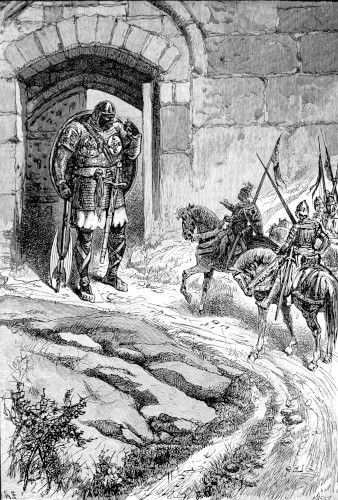
knight and the lady and the dwarf rode up to the castle that was in the
town, and every one was glad in the castle. And from the battlements
and the gates they risked their necks through their eagerness to greet
them, and to show their joy.
Geraint stood there to see whether the knight would remain in the
castle. And when he was certain that he would do so, he looked around
him; and at a little distance from the town he saw an old palace in
ruins, wherein was a hall that was falling to decay. And as he knew not
any one in the town, he went towards the old palace; and when he came
near to the palace he saw but one chamber, and a bridge of marble-stone
leading to it. And upon the bridge he saw sitting a hoary-headed man,
upon whom were tattered garments. And Geraint gazed steadfastly upon
him for a long time. Then the hoary-headed man spoke to him. "Young
man," he said, "wherefore art thou thoughtful?"
"I am thoughtful," said he, "because I know not where to go to-night."
"Wilt thou come forward this way, chieftain?" said he, "and thou shalt
have the best that can be procured for thee." So Geraint went forward.
And the hoary-headed man preceded him into the hall. And in the hall he
dismounted, and he left there his horse. Then he went on to the upper
chamber with the hoary-headed man. And in the chamber he beheld an old
decrepit woman sitting on a cushion, with old, tattered garments of
satin upon her; and it seemed to him that he had never seen a woman
fairer than she must have been when in the fulness of youth. And beside
her was a maiden, upon whom were a vest and a veil that were old, and
beginning to be worn out. And truly he never saw a maiden more full of
comeliness and grace and beauty than she. And the hoary-headed man said
to the maiden, "There is no attendant for the horse of this youth but
thyself."
"I will render the best service I am able," said she, "both to him
and to his horse." And the maiden disarrayed the youth, and then she
furnished his horse with straw and with corn. And she went to the hall
as before, and then she returned to the chamber.
And the hoary-headed man said to the maiden, "Go to the town," said he,
"and bring hither the best that thou canst find both of food and of
liquor."
"I will gladly, lord," said she. And to the town went the maiden. And
they conversed together while the maiden was at the town. And behold!
the maiden came back, and a youth with her, bearing on his back a
costrel full of good purchased mead, and a quarter of a young bullock.
And in the hands of the maiden was a quantity of white bread, and she
had some manchet bread in her veil, and she came into the chamber.
"I could not obtain better than this," said she, "nor with better
should I have been trusted."
"It is good enough," said Geraint. And they caused the meat to be
boiled; and when their food was ready, they sat down. And it was on
this wise: Geraint sat between the hoary-headed man and his wife, and
the maiden served them. And they ate and drank.
And when they had finished eating, Geraint talked with the hoary-headed
man; and he asked him, in the first place, to whom belonged the palace
that he was in.
"Truly," said he, "it was I that built it, and to me also belonged the
city and the castle which thou sawest."
"Alas!" said Geraint, "how is it that thou hast lost them now?"
"I lost a great earldom as well as these," said he. "And this is how
I lost them. I had a nephew, the son of my brother, and I took his
possessions to myself; and when he came to his strength, he demanded of
me his property; but I withheld it from him. So he made war upon me,
and wrested from me all that I possessed."
"Good sir," said Geraint, "wilt thou tell me wherefore came the knight
and the lady and the dwarf just now into the town, and what is the
preparation which I saw and the putting of arms in order?"
"I will do so," said he. "The preparations are for the game that is to
be held to-morrow by the young earl, which will be on this wise. In the
midst of a meadow which is here, two forks will be set up, and upon the
two forks a silver rod, and upon the silver rod a sparrow-hawk; and for
the sparrow-hawk there will be a tournament. And to the tournament will
go all the array thou didst see in the city, of men and of horses and
of arms. And with each man will go the lady he loves best; and no man
can joust for the sparrow-hawk, except the lady he loves best be with
him. And the knight that thou sawest has gained the sparrow-hawk these
two years; and if he gains it the third year, they will from that time
send it every year to him, and he himself will come here no more. And
he will be called the Knight of the Sparrow-hawk from that time forth."
"Sir," said Geraint, "what is thy counsel to me concerning this knight,
on account of the insult which I received from the dwarf, and that
which was received by the maiden of Gwenhwyvar, the wife of Arthur?"
And Geraint told the hoary-headed man what the insult was that he had
received.
"It is not easy to counsel thee, inasmuch as thou hast neither dame nor
maiden belonging to thee for whom thou canst joust. Yet I have arms
here which thou couldest have, and there is my horse also, if he seem
to thee better than thine own."
"Ah, sir," said he, "Heaven reward thee! But my own horse, to which
I am accustomed, together with thy arms, will suffice. And if, when
the appointed time shall come to-morrow, thou wilt permit me, sir, to
challenge for yonder maiden that is thy daughter, I will engage, if I
escape from the tournament, to love the maiden as long as I live; and,
if I do not escape, she will remain as before."
"Gladly will I permit thee," said the hoary-headed man. "And since
thou dost thus resolve, it is necessary that thy horse and arms
should be ready to-morrow at break of day. For then the Knight of the
Sparrow-hawk will make proclamation, and ask the lady he loves best to
take the sparrow-hawk. 'For,' will he say to her, 'thou art the fairest
of women, and thou didst possess it last year and the year previous;
and if any deny it thee to-day, by force will I defend it for thee.'
And therefore," said the hoary-headed man, "it is needful for thee to
be there at daybreak; and we three will be with thee." And thus was it
settled.
And at night, lo! they went to sleep. And before the dawn they arose,
and arrayed themselves; and by the time that it was day, they were all
four in the meadow. And there was the Knight of the Sparrow-hawk making
the proclamation, and asking his lady-love to fetch the sparrow-hawk.
"Fetch it not," said Geraint, "for there is here a maiden who is
fairer, and more noble, and more comely, and who has a better claim to
it, than thou."
"If thou maintainest the sparrow-hawk to be due to her, come forward
and do battle with me." And Geraint went forward to the top of the
meadow, having upon himself and upon his horse armor which was heavy
and rusty and worthless, and of uncouth shape. Then they encountered
each other, and they broke a set of lances, and they broke a second
set, and a third. And thus they did at every onset, and they broke
as many lances as were brought to them. And when the earl and his
company saw the Knight of the Sparrow-hawk gaining the mastery, there
was shouting and joy and mirth amongst them. And the hoary-headed man
and his wife and his daughter were sorrowful. And the hoary-headed
man served Geraint lances as often as he broke them; and the dwarf
served the Knight of the Sparrow-hawk. Then the hoary-headed man came
to Geraint. "O chieftain!" said he, "since no other will hold with
thee, behold, here is the lance which was in my hand on the day when I
received the honor of knighthood; and from that time to this I never
broke it. And it has an excellent point." Then Geraint took the lance,
thanking the hoary-headed man. And thereupon the dwarf also brought a
lance to his lord.
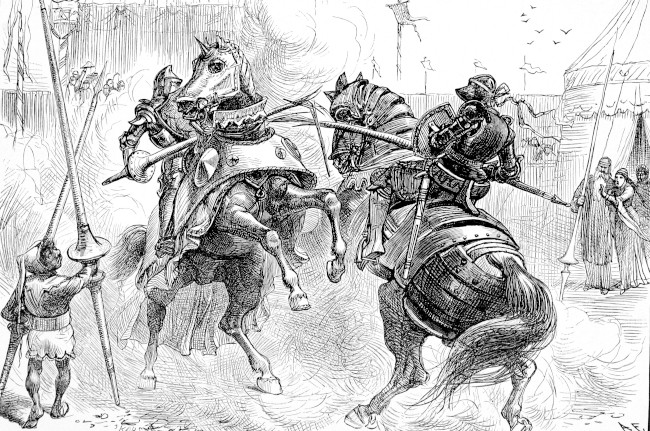
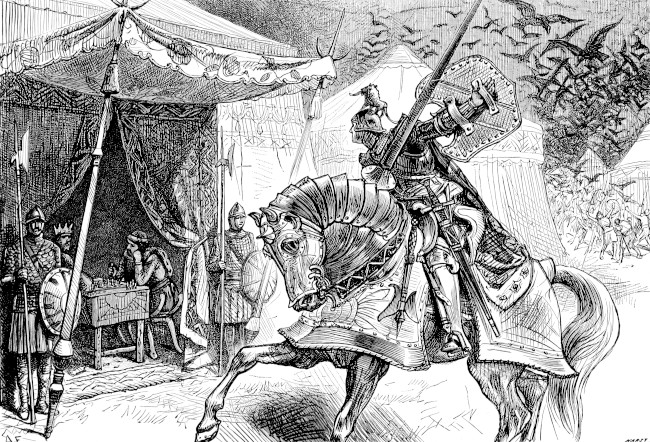
The Tournament for the Sparrow-hawk.
"Behold, here is a lance for thee, not less good than his," said the
dwarf. "And bethink thee that no knight ever withstood thee before so
long as this one has done."
"I declare to Heaven," said Geraint, "that, unless death takes me
quickly hence, he shall fare never the better for thy service." And
Geraint pricked his horse towards him from afar, and warning him, he
rushed upon him, and gave him a blow so severe and furious and fierce,
upon the face of his shield, that he cleft it in two, and broke his
armor, and burst his girths, so that both he and his saddle were borne
to the ground over the horse's crupper. And Geraint dismounted quickly.
And he was wroth, and he drew his sword, and rushed fiercely upon him.
Then the knight also arose, and drew his sword against Geraint. And
they fought on foot with their swords until their arms struck sparks
of fire like stars from one another; and thus they continued fighting
until the blood and sweat obscured the light from their eyes. And when
Geraint prevailed, the hoary-headed man and his wife and his daughter
were glad; and when the knight prevailed, it rejoiced the earl and his
party.
Then the hoary-headed man saw Geraint receive a severe stroke, and
he went up to him quickly, and said to him, "O chieftain, remember
the treatment which thou hadst from the dwarf; and wilt thou not seek
vengeance for the insult to thyself, and for the insult to Gwenhwyvar
the wife of Arthur?"
And Geraint was roused by what he said to him, and he called to him all
his strength, and lifted up his sword, and struck the knight upon the
crown of his head, so that he broke all his head-armor, and cut through
all the flesh and the skin, even to the skull, until he wounded the
bone.
Then the knight fell upon his knees, and cast his sword from his hand,
and besought mercy of Geraint. "Of a truth," said he, "I relinquish my
overdaring and my pride in craving thy mercy; and unless I have time
to commit myself to Heaven for my sins, and to talk with a priest, thy
mercy will avail me little."
"I will grant thee grace upon this condition," said Geraint, "that thou
wilt go to Gwenhwyvar the wife of Arthur, to do her satisfaction for
the insult which her maiden received from thy dwarf. As to myself, for
the insult which I received from thee and thy dwarf, I am content with
that which I have done unto thee. Dismount not from the time thou goest
hence until thou comest into the presence of Gwenhwyvar, to make her
what atonement shall be adjudged at the court of Arthur."
"This will I do gladly. And who art thou?" said he.
"I am Geraint the son of Erbin. And declare thou also who thou art."
"I am Edeyrn the son of Nudd." Then he threw himself upon his horse,
and went forward to Arthur's court, and the lady he loved best went
before him and the dwarf with much lamentation. And thus far this story
up to that time.
Then came the little earl and his hosts to Geraint, and saluted him,
and bade him to his castle.
"I may not go," said Geraint; "but where I was last night, there will I
be to-night also."
"Since thou wilt none of my inviting, thou shalt have abundance of all
that I can command for thee in the place thou wast last night. And I
will order ointment for thee, to recover thee from thy fatigues and
from the weariness that is upon thee."
"Heaven reward thee!" said Geraint, "and I will go to my lodging." And
thus went Geraint, and Earl Ynywl, and his wife, and his daughter. And
when they reached the chamber, the household servants and attendants
of the young earl had arrived at the court, and they arranged all the
houses, dressing them with straw and with fire. And in a short time the
ointment was ready, and Geraint came there, and they washed his head.
Then came the young earl, with forty honorable knights from among his
attendants, and those who were bidden to the tournament. And Geraint
came from the anointing. And the earl asked him to go to the hall to
eat.
"Where is the Earl Ynywl," said Geraint, "and his wife, and his
daughter?"
"They are in the chamber yonder," said the earl's chamberlain,
"arraying themselves in garments which the earl has caused to be
brought for them."
"Let not the damsel array herself," said he, "except in her vest
and her veil, until she come to the court of Arthur to be clad by
Gwenhwyvar in such garments as she may choose." So the maiden did not
array herself.
Then they all entered the hall, and they washed, and went and sat down
to meat. And thus they were seated: on one side of Geraint sat the
young earl, and Earl Ynywl beyond him; and on the other side of Geraint
were the maiden and her mother. And after these, all sat according
to their precedence in honor. And they ate. And they were served
abundantly, and they received a profusion of divers kind of gifts. Then
they conversed together. And the young earl invited Geraint to visit
him next day.
"I will not, by Heaven!" said Geraint. "To the court of Arthur will I
go with this maiden to-morrow. And it is enough for me, as long as Earl
Ynywl is in poverty and trouble; and I go chiefly to seek to add to his
maintenance."
"Ah, chieftain!" said the young earl, "it is not by my fault that Earl
Ynywl is without his possessions."
"By my faith," said Geraint, "he shall not remain without them, unless
death quickly takes me hence."
"Oh, chieftain!" said he, "with regard to the disagreement between me
and Ynywl, I will gladly abide by thy counsel, and agree to what thou
mayest judge right between us."
"I but ask thee," said Geraint, "to restore to him what is his, and
what he should have received from the time he lost his possessions,
even until this day."
"That I will do gladly for thee," answered he.
"Then," said Geraint, "whosoever is here who owes homage to Ynywl, let
him come forward, and perform it on the spot." And all the men did so.
And by that treaty they abided. And his castle, and his town, and all
his possessions, were restored to Ynywl. And he received back all that
he had lost, even to the smallest jewel.
Then spoke Earl Ynywl to Geraint. "Chieftain," said he, "behold the
maiden for whom thou didst challenge at the tournament: I bestow her
upon thee."
"She shall go with me," said Geraint, "to the court of Arthur; and
Arthur and Gwenhwyvar they shall dispose of her as they will." And the
next day they proceeded to Arthur's court. So far concerning Geraint.
Now, this is how Arthur hunted the stag. The men and the dogs were
divided into hunting-parties, and the dogs were let loose upon the
stag. And the last dog that was let loose was the favorite dog of
Arthur. Cavall[19] was his name. And he left all the other dogs behind
him, and turned the stag. And at the second turn, the stag came towards
the hunting-party of Arthur. And Arthur set upon him. And before he
could be slain by any other, Arthur cut off his head. Then they sounded
the death-horn for slaying, and they all gathered round.
Then came Kadyriaith to Arthur, and spoke to him. "Lord," said he,
"behold, yonder is Gwenhwyvar, and none with her save only one maiden."
"Command Gildas the son of Caw, and all the scholars of the court,"
said Arthur, "to attend Gwenhwyvar to the palace." And they did so.
Then they all set forth, holding converse together concerning the head
of the stag, to whom it should be given. One wished that it should be
given to the lady best beloved by him, and another to the lady whom he
loved best. And all they of the household, and the knights, disputed
sharply concerning the head. And with that they came to the palace.
And when Arthur and Gwenhwyvar heard them disputing about the head
of the stag, Gwenhwyvar said to Arthur, "My lord, this is my counsel
concerning the stag's head: let it not be given away until Geraint the
son of Erbin shall return from the errand he is upon." And Gwenhwyvar
told Arthur what that errand was.
"Right gladly shall it be so," said Arthur. And thus it was settled.
And the next day Gwenhwyvar caused a watch to be set upon the ramparts
for Geraint's coming. And after mid-day they beheld an unshapely little
man upon a horse, and after him, as they supposed, a dame or a damsel,
also on horseback, and after her a knight of large stature, bowed
down, and hanging his head low and sorrowfully, and clad in broken and
worthless armor.
And before they came near to the gate, one of the watch went to
Gwenhwyvar, and told her what kind of people they saw, and what aspect
they bore. "I know not who they are," said he.
"But I know," said Gwenhwyvar. "This is the knight whom Geraint
pursued: and methinks that he comes not here by his own free will; but
Geraint has overtaken him, and avenged the insult to the maiden to the
uttermost."
And thereupon behold a porter came to the spot where Gwenhwyvar was.
"Lady," said he, "at the gate there is a knight, and I saw never a man
of so pitiful an aspect to look upon as he. Miserable and broken is the
armor that he wears; and the hue of blood is more conspicuous upon it
than its own color."
"Knowest thou his name?" said she.
"I do," said he. "He tells me that he is Edeyrn the son of Nudd."
Then she replied, "I know him not."
So Gwenhwyvar went to the gate to meet him, and he entered. And
Gwenhwyvar was sorry when she saw the condition he was in, even
though he was accompanied by the churlish dwarf. Then Edeyrn saluted
Gwenhwyvar. "Heaven protect thee!" said she.
"Lady," said he, "Geraint the son of Erbin, thy best and most valiant
servant, greets thee."
"Did he meet thee?" she asked.
"Yes," said he, "and it was not to my advantage; and that was not his
fault, but mine, lady. And Geraint greets thee well; and in greeting
thee he compelled me to come hither to do thy pleasure for the insult
which thy maiden received from the dwarf. He forgives the insult to
himself in consideration of his having put me in peril of my life. And
he imposed on me a condition manly and honorable and warrior-like,
which was to do thee justice, lady."
"Now, where did he overtake thee?"
"At the place where we were jousting, and contending for the
sparrow-hawk, in the town which is now called Cardiff. And there were
none with him save three persons of a mean and tattered condition. And
these were an aged, hoary-headed man, and a woman advanced in years,
and a fair young maiden clad in worn-out garments. And it was for
the avouchment of the love of that maiden that Geraint jousted for
the sparrow-hawk at the tournament; for he said that that maiden was
better entitled to the sparrow-hawk than this maiden who was with me.
And thereupon we encountered each other, and he left me, lady, as thou
seest."
"Sir," said she, "when thinkest thou that Geraint will be here?"
"To-morrow, lady, I think he will be here with the maiden."
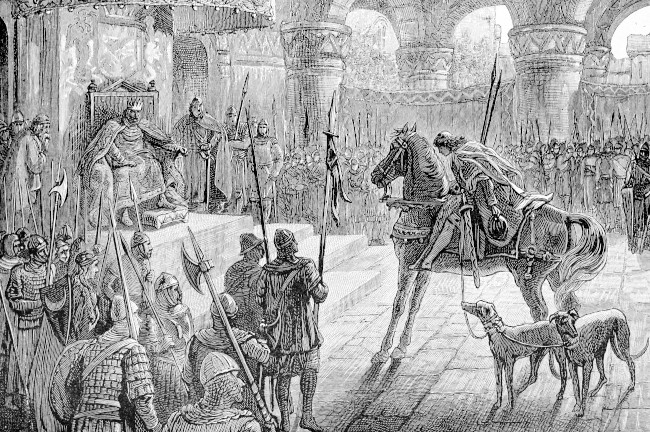
Then Arthur came to him; and he saluted Arthur. And Arthur gazed a long
time upon him, and was amazed to see him thus. And, thinking that he
knew him, he inquired of him, "Art thou Edeyrn the son of Nudd?"
"I am, lord," said he, "and I have met with much trouble, and received
wounds insupportable." Then he told Arthur all his adventure.
"Well," said Arthur, "from what I hear, it behooves Gwenhwyvar to be
merciful towards thee."
"The mercy which thou desirest, lord," said she, "will I grant to him,
since it is as insulting to thee that an insult should be offered to me
as to thyself."
"Thus will it be best to do," said Arthur. "Let this man have medical
care until it be known whether he may live. And, if he live, he shall
do such satisfaction as shall be judged best by the men of the court;
and take thou sureties to that effect."
"This pleases me," said Gwenhwyvar. And Arthur became surety for
Edeyrn, and Caradawc the son of Llyr, Gwallawg the son of Llenawg,
and Owain the son of Nudd, and Gwalchmai, and many others with them.
And Arthur caused Morgan Tud to be called to him. He was the chief
physician.
"Take with thee Edeyrn the son of Nudd, and cause a chamber to be
prepared for him, and let him have the aid of medicine as thou wouldest
do unto myself, if I were wounded, and let none into his chamber
to molest him, but thyself and thy disciples to administer to him
remedies."
"I will do so gladly, lord," said Morgan Tud.
Then said the steward of the household, "Whither is it right, lord, to
order the maiden?"
"To Gwenhwyvar and her handmaidens," said he. And the steward of the
household so ordered her. Thus far concerning them.
The next day came Geraint towards the court; and there was a watch set
on the ramparts by Gwenhwyvar, lest he should arrive unawares. And
one of the watch came to the place where Gwenhwyvar was. "Lady," said
he, "methinks that I see Geraint, and the maiden with him. He is on
horseback; but he has his walking-gear upon him, and the maiden appears
to be in white, seeming to be clad in a garment of linen."
"Assemble all the women," said Gwenhwyvar, "and come to meet Geraint,
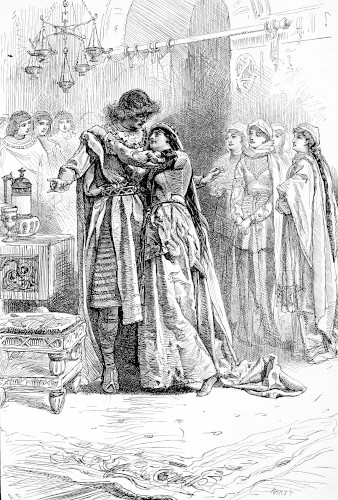
to welcome him, and wish him joy." And Gwenhwyvar went to meet Geraint
and the maiden. And when Geraint came to the place where Gwenhwyvar
was, he saluted her. "Heaven prosper thee," said she, "and welcome
to thee. And thy career has been successful, and fortunate, and
resistless, and glorious. And Heaven reward thee, that thou hast so
proudly caused me to have retribution."
"Lady," said he, "I earnestly desired to obtain thee satisfaction
according to thy will; and behold, here is the maiden through whom thou
hadst thy revenge."
"Verily," said Gwenhwyvar, "the welcome of Heaven be unto her! and it
is fitting that we should receive her joyfully." Then they went in, and
dismounted. And Geraint came to where Arthur was, and saluted him.
"Heaven protect thee," said Arthur, "and the welcome of Heaven be unto
thee! And since Edeyrn the son of Nudd has received his overthrow and
wounds from thy hands, thou hast had a prosperous career."
"Not upon me be the blame!" said Geraint. "It was through the arrogance
of Edeyrn the son of Nudd himself that we were not friends. I would not
quit him until I knew who he was, and until the one had vanquished the
other."
"Now," said Arthur, "where is the maiden for whom I heard thou didst
give challenge?"
"She is gone with Gwenhwyvar to her chamber."
Then went Arthur to see the maiden. And Arthur, and all his companions,
and his whole court, were glad concerning the maiden. And certain were
they all, that, had her array been suitable to her beauty, they had
never seen a maid fairer than she. And Arthur gave away the maiden to
Geraint. And the usual bond made between two persons was made between
Geraint and the maiden; and the choicest of all Gwenhwyvar's apparel
was given to the maiden; and thus arrayed, she appeared comely and
graceful to all who beheld her.
And from that time she became his bride. And the next day Arthur
satisfied all the claimants upon Geraint with bountiful gifts. And the
maiden took up her abode in the palace; and she had many companions,
both men and women, and there was no maiden more esteemed than she in
the Island of Britain.
Then spake Gwenhwyvar. "Rightly did I judge," said she, "concerning the
head of the stag, that it should not be given to any until Geraint's
return; and behold, here is a fit occasion for bestowing it. Let it
be given to Enid the daughter of Ynywl, the most illustrious maiden.
And I do not believe that any will begrudge it her; for between her
and every one here there exists nothing but love and friendship." Much
applauded was this by them all, and by Arthur also. And the head of
the stag was given to Enid; and thereupon her fame increased, and her
friends thenceforward became more in number than before. And Geraint
from that time forth loved the stag, and the tournament, and hard
encounters; and he came victorious from them all. And a year, and a
second, and a third, he proceeded thus, until his fame had flown over
the face of the kingdom.
And once upon a time Arthur was holding his court at
Caerlleon-upon-Usk, at Whitsuntide. And behold, there came to him
ambassadors, wise and prudent, full of knowledge, and eloquent of
speech, and they saluted Arthur. "Heaven prosper you," said Arthur,
"and the welcome of Heaven be unto you! And whence do you come?"
"We come, lord," said they, "from Cornwall; and we are ambassadors from
Erbin the son of Custennin, thy uncle, and our mission is unto thee.
And he greets thee well, as an uncle should greet his nephew, and as
a vassal should greet his lord. And he represents unto thee that he
waxes heavy and feeble, and is advancing in years. And the neighboring
chiefs, knowing this, grow insolent towards him, and covet his land and
possessions. And he earnestly beseeches thee, lord, to permit Geraint
his son to return to him to protect his possessions, and to become
acquainted with his boundaries. And unto him he represents that it were
better for him to spend the flower of his youth and the prime of his
age in preserving his own boundaries than in tournaments, which are
productive of no profit, although he obtains glory in them."
"Well," said Arthur, "go and divest yourselves of your accoutrements,
and take food, and refresh yourselves after your fatigues; and before
you go forth hence, you shall have an answer."
And they went to eat. And Arthur considered that it would go hard with
him to let Geraint depart from him and from his court; neither did
he think it fair that his cousin should be restrained from going to
protect his dominions and his boundaries, seeing that his father was
unable to do so. No less was the grief and regret of Gwenhwyvar, and
all her women, and all her damsels, through fear that the maiden would
leave them. And that day and that night were spent in abundance of
feasting. And Arthur showed Geraint the cause of the mission, and of
the coming of the ambassadors to him out of Cornwall.
"Truly," said Geraint, "be it to my advantage or disadvantage, lord, I
will do according to thy will concerning this embassy."
"Behold," said Arthur, "though it grieves me to part with thee, it is
my counsel that thou go to dwell in thine own dominions, and to defend
thy boundaries, and to take with thee to accompany thee as many as thou
wilt of those thou lovest best among my faithful ones, and among thy
friends, and among thy companions in arms."
"Heaven reward thee! And this will I do," said Geraint.
"What discourse," said Gwenhwyvar, "do I hear between you? Is it of
those who are to conduct Geraint to his country?"
"It is," said Arthur.
"Then it is needful for me to consider," said she, "concerning
companions and a provision for the lady that is with me?"
"Thou wilt do well," said Arthur.
And that night they went to sleep. And the next day the ambassadors
were permitted to depart, and they were told that Geraint should follow
them. And on the third day Geraint set forth, and many went with him.
Gwalchmai the son of Gwyar, and Riogonedd the son of the King of
Ireland, and Ondyaw the son of the Duke of Burgundy, Gwilim the son of
the ruler of the Franks, Howel the son of Emyr of Brittany, Elivry, and
Nawkyrd, Gwynn the son of Tringad, Goreu the son of Custennin, Gweir
Gwrhyd Vawr, Garannaw the son of Golithmer, Peredur the son of Evrawc,
Gwynnllogell, Gwyr a judge in the court of Arthur, Dyvyr the son of
Alun of Dyved, Gwrei Gwalstawd Ieithoedd, Bedwyr the son of Bedrawd,
Hadwry the son of Gwryon, Kai the son of Kynyr, Odyar the Frank, the
steward of Arthur's court, and Edeyrn the son of Nudd.
Said Geraint, "I think that I shall have enough of knighthood with me."
"Yes," said Arthur; "but it will not be fitting for thee to take Edeyrn
with thee, although he is well, until peace shall be made between him
and Gwenhwyvar."
"Gwenhwyvar can permit him to go with me, if he give sureties."
"If she please, she can let him go without sureties; for enough of pain
and affliction has he suffered for the insult which the maiden received
from the dwarf."
"Truly," said Gwenhwyvar, "since it seems well to thee and to Geraint,
I will do this gladly, lord." Then she permitted Edeyrn freely to
depart. And many there were who accompanied Geraint, and they set
forth; and never was there seen a fairer host journeying towards the
Severn. And on the other side of the Severn were the nobles of Erbin
the son of Custennin, and his foster-father at their head, to welcome
Geraint with gladness; and many of the women of the court, with his
mother, came to receive Enid the daughter of Ynywl, his wife. And
there was great rejoicing and gladness throughout the whole court,
and throughout all the country, concerning Geraint, because of the
greatness of their love towards him, and of the greatness of the fame
which he had gained since he went from amongst them, and because he
was come to take possession of his dominions, and to preserve his
boundaries. And they came to the court. And in the court they had ample
entertainment, and a multitude of gifts, and abundance of liquor, and a
sufficiency of service, and a variety of minstrelsy and of games. And
to do honor to Geraint, all the chief men of the country were invited
that night to visit him. And they passed that day and that night in the
utmost enjoyment.
And at dawn next day Erbin arose, and summoned to him Geraint, and the
noble persons who had borne him company. And he said to Geraint, "I am
a feeble and aged man, and, whilst I was able to maintain the dominion
for thee and for myself, I did so. But thou art young, and in the
flower of thy vigor and of thy youth: henceforth do thou preserve thy
possessions."
"Truly," said Geraint, "with my consent thou shalt not give the power
over thy dominions at this time into my hands, and thou shalt not take
me from Arthur's court."
"Into thy hands will I give them," said Erbin; "and this day also shalt
thou receive the homage of thy subjects."
Then said Gwalchmai, "It were better for thee to satisfy those who have
boons to ask to-day, and to-morrow thou canst receive the homage of thy
dominions." So all that had boons to ask were summoned into one place.
And Kadyrieith came to them to know what were their requests. And every
one asked that which he desired. And the followers of Arthur began to
make gifts, and immediately the men of Cornwall came and gave also. And
they were not long in giving, so eager was every one to bestow gifts.
And of those who came to ask gifts none departed unsatisfied. And that
day and that night were spent in the utmost enjoyment.
And the next day, at dawn, Erbin desired Geraint to send messengers
to the men to ask them whether it was displeasing to them that he
should come to receive their homage, and whether they had any thing to
object to him. Then Geraint sent ambassadors to the men of Cornwall
to ask them this. And they all said that it would be the fulness of
joy and honor to them for Geraint to come and receive their homage. So
he received the homage of such as were there. And they remained with
him till the third night. And the day after, the followers of Arthur
intended to go away.
"It is too soon for you to go away yet," said he; "stay with me until I
have finished receiving the homage of my chief men, who have agreed to
come to me." And they remained with him until he had done so. Then they
set forth towards the court of Arthur; and Geraint went to bear them
company, and Enid also, as far as Diganhwy: there they parted.
Then Ondyaw the son of the Duke of Burgundy said to Geraint, "Go first
of all, and visit the uttermost parts of thy dominions, and see well
to the boundaries of thy territories; and, if thou hast any trouble
respecting them, send unto thy companions."
"Heaven reward thee!" said Geraint. "And this will I do." And Geraint
journeyed to the uttermost part of his dominions. And experienced
guides, and the chief men of his country, went with him. And the
furthermost point that they showed him he kept possession of.
And, as he had been used to do when he was at Arthur's court, he
frequented tournaments. And he became acquainted with valiant and
mighty men, until he had gained as much fame there as he had formerly
done elsewhere. And he enriched his court, and his companions, and his
nobles, with the best horses and the best arms, and with the best and
most valuable jewels; and he ceased not until his fame had flown over
the face of the whole kingdom. And when he knew that it was thus, he
began to love ease and pleasure, for there was no one who was worth
his opposing. And he loved his wife, and liked to continue in the
palace, with minstrelsy and diversions. And for a long time he abode
at home. And he took no delight in any thing besides, insomuch that he
gave up the friendship of his nobles, together with his hunting and
his amusements, and lost the hearts of all the host in his court. And
there was murmuring and scoffing concerning him among the inhabitants
of the palace, on account of his relinquishing so completely their
companionship for the love of his wife. And these tidings came to
Erbin. And when Erbin had heard these things, he spoke unto Enid, and
inquired of her whether it was she that had caused Geraint to act thus,
and to forsake his people and his hosts.
"Not I, by my confession unto Heaven!" said she. "There is nothing
more hateful to me than this." And she knew not what she should do,
for, although it was hard for her to own this to Geraint, yet was it
not more easy for her to listen to what she heard, without warning
Geraint concerning it. And she was very sorrowful.
And one morning in the summer time, Enid was without sleep in the
apartment which had windows of glass. And the sun shone upon the
couch. And the clothes had slipped from off his arms and his breast,
and he was asleep. Then she gazed upon the marvellous beauty of his
appearance, and she said, "Alas! and am I the cause that these arms
and this breast have lost their glory and the warlike fame which they
once so richly enjoyed?" And as she said this, the tears dropped from
her eyes, and they fell upon his breast. And the tears she shed, and
the words she had spoken, awoke him. And another thing contributed to
awaken him, and that was the idea that it was not in thinking of him
that she spoke thus, but that it was because she loved some other man
more than him.
And thereupon Geraint was troubled in his mind, and he called his
squire. And when he came to him, "Go quickly," said he "and prepare my
horse and my arms, and make them ready.—And do thou arise," said he
to Enid, "and apparel thyself; and cause thy horse to be accoutred,
and clothe thee in the worst riding-dress that thou hast in thy
possession. And evil betide me," said he, "if thou returnest here until
thou knowest whether I have lost my strength so completely as thou
didst say. And if it be so, it will then be easy for thee to seek the
society thou didst wish for of him of whom thou wast thinking."
So she arose, and clothed herself in her meanest garments. "I know
nothing, lord," said she, "of thy meaning."
"Neither wilt thou know at this time," said he.
Then Geraint went to see Erbin. "Sir," said he, "I am going upon a
quest, and I am not certain when I may come back. Take heed, therefore,
unto thy possessions, until my return."
"I will do so," said he; "but it is strange to me that thou shouldest
go so suddenly. And who will proceed with thee, since thou art not
strong enough to traverse the land of Lloegyr alone?"
"But one person only will go with me."
"Heaven counsel thee, my son!" said Erbin. "And may many attach
themselves to thee in Lloegyr!"
Then went Geraint to the place where his horse was, and it was equipped
with foreign armor, heavy and shining. And he desired Enid to mount her
horse, and to ride forward, and to keep a long way before him. "And
whatever thou mayest see, and whatever thou mayest hear concerning me,"
said he, "do thou not turn back. And unless I speak unto thee, say not
thou one word, either." And they set forward. And he did not choose the
pleasantest and most frequented road, but that which was the wildest,
and most beset by thieves and robbers, and venomous animals. And they
came to a high road, which they followed till they saw a vast forest;
and they went towards it, and they saw four armed horsemen come forth
from the forest.
When the horsemen had beheld them, one of them said to the others,
"Behold, here is a good occasion for us to capture two horses and
armor, and a lady likewise; for this we shall have no difficulty in
doing against yonder single knight, who hangs his head so pensively and
heavily."
And Enid heard this discourse, and she knew not what she should do
through fear of Geraint, who had told her to be silent. "The vengeance
of Heaven be upon me," she said, "if I would not rather receive my
death from his hand than from the hand of any other! And though he
should slay me, yet will I speak to him, lest I should have the misery
to witness his death." So she waited for Geraint until he came near
to her. "Lord," said she, "didst thou hear the words of those men
concerning thee?"
Then he lifted up his eyes, and looked at her angrily. "Thou hadst
only," said he, "to hold thy peace as I bade thee. I wish but for
silence, and not for warning. And though thou shouldest desire to see
my defeat and my death by the hands of those men, yet do I feel no
dread."
Then the foremost of them couched his lance, and rushed upon Geraint.
And he received him, and that not feebly. But he let the thrust go by
him, while he struck the horseman upon the centre of his shield in
such a manner that his shield was split, and his armor broken, and so
that a cubit's length of the shaft of Geraint's lance passed through
his body, and sent him to the earth the length of the lance over his
horse's crupper. Then the second horseman attacked him furiously,
being wroth at the death of his companion. But with one thrust Geraint
overthrew him also, and killed him as he had done the other. Then the
third set upon him, and he killed him in like manner. And thus also he
slew the fourth. Sad and sorrowful was the maiden as she saw all this.
Geraint dismounted from his horse, and took the arms of the men he had
slain, and placed them upon their saddles, and tied together the reins
of their horses, and he mounted his horse again. "Behold, what thou
must do," said he; "take the four horses, and drive them before thee,
and proceed forward, as I bade thee just now. And say not one word unto
me, unless I speak first unto thee. And I declare unto Heaven," said
he, "if thou doest not thus, it will be to thy cost."
"I will do, as far as I can, lord," said she, "according to thy desire."
Then they went forward through the forest; and when they left the
forest, they came to a vast plain, in the centre of which was a group
of thickly tangled copse-wood; and from out thereof they beheld three
horsemen coming towards them, well equipped with armor, both they and
their horses. Then the maiden looked steadfastly upon them; and when
they had come near, she heard them say one to another, "Behold, here
is a good arrival for us: here are coming for us four horses and four
suits of armor. We shall easily obtain them, spite of yonder dolorous
knight, and the maiden also will fall into our power."
"This is but too true," said she to herself; "for my husband is tired
with his former combat. The vengeance of Heaven will be upon me unless
I warn him of this." So the maiden waited until Geraint came up to
her. "Lord," said she, "dost thou not hear the discourse of yonder men
concerning thee?"
"What was it?" asked he.
"They say to one another, that they will easily obtain all this spoil."
"I declare to Heaven," he answered, "that their words are less grievous
to me than that thou wilt not be silent, and abide by my counsel."
"My lord," said she, "I feared lest they should surprise thee unawares."
"Hold thy peace, then!" said he. "Do not I desire silence?"
And thereupon one of the horsemen couched his lance, and attacked
Geraint. And he made a thrust at him which he thought would be very
effective. But Geraint received it carelessly, and struck it aside; and
then he rushed upon him, and aimed at the centre of his person, and
from the shock of man and horse the quantity of his armor did not avail
him, and the head of the lance and part of the shaft passed through
him, so that he was carried to the ground an arm and a spear's length
over the crupper of his horse. And both the other horsemen came forward
in their turn; but their onset was not more successful than that of
their companion. And the maiden stood by, looking at all this; and on
the one hand she was in trouble lest Geraint should be wounded in his
encounter with the men, and on the other hand she was joyful to see him
victorious. Then Geraint dismounted, and bound the three suits of armor
upon the three saddles, and he fastened the reins of all the horses
together, so that he had seven horses with him. And he mounted his own
horse, and commanded the maiden to drive forward the others. "It is no
more use for me to speak to thee than to refrain; for thou wilt not
attend to my advice."
"I will do so, as far as I am able, lord," said she; "but I cannot
conceal from thee the fierce and threatening words which I may hear
against thee, lord, from such strange people as those that haunt this
wilderness."
"I declare to Heaven," said he, "that I desire nought but silence:
therefore hold thy peace."
"I will, lord, while I can." And the maiden went on with the horses
before her, and she pursued her way straight onwards. And from the
copse-wood already mentioned they journeyed over a vast and dreary open
plain. And at a great distance from them they beheld a wood, and they
could see neither end nor boundary to the wood, except on that side
that was nearest to them, and they went towards it. Then there came
from out the wood five horsemen, eager and bold, and mighty and strong,
mounted upon chargers that were powerful, and large of bone, and high
mettled, and proudly snorting; and both the men and the horses were
well equipped with arms. And when they drew near to them, Enid heard
them say, "Behold, here is a fine booty coming to us, which we shall
obtain easily and without labor, for we shall have no trouble in taking
all those horses and arms, and the lady also, from yonder single knight
so doleful and sad."
Sorely grieved was the maiden upon hearing this discourse, so that
she knew not in the world what she should do. At last, however, she
determined to warn Geraint: so she turned her horse's head towards him.
"Lord," said she, "if thou hadst heard as I did what yonder horsemen
said concerning thee, thy heaviness would be greater than it is."
Angrily and bitterly did Geraint smile upon her, and he said, "Thee do
I hear doing every thing that I forbade thee; but it may be that thou
wilt repent this yet."
And immediately, behold, the men met them; and victoriously and
gallantly did Geraint overcome them all five. And he placed the five
suits of armor upon the five saddles, and tied together the reins of
the twelve horses, and gave them in charge to Enid. "I know not," said
he, "what good it is for me to order thee; but this time I charge thee
in an especial manner."
So the maiden went forward towards the wood, keeping in advance of
Geraint, as he had desired her; and it grieved him as much as his wrath
would permit to see a maiden so illustrious as she having so much
trouble with the care of the horses. Then they reached the wood, and
it was both deep and vast; and in the wood night overtook them. "Ah,
maiden," said he, "it is vain to attempt proceeding forward!"
"Well, lord," said she, "whatsoever thou wishest, we will do."
"It will be best for us," he answered, "to turn out of the wood, and to
rest, and wait for the day, in order to pursue our journey."
"That will we gladly," said she. And they did so.
Having dismounted himself, he took her down from her horse. "I cannot
by any means refrain from sleep, through weariness," said he. "Do thou,
therefore, watch the horses, and sleep not."
"I will, lord," said she. Then he went to sleep in his armor; and thus
passed the night, which was not long at that season. And when she saw
the dawn of day appear, she looked around her to see if he were waking,
and thereupon he woke. "My lord," she said, "I have desired to awake
thee for some time."
But he spake nothing to her about fatigue, as he had desired her to be
silent. Then he arose, and said unto her, "Take the horses and ride on;
and keep straight on before thee, as thou didst yesterday."
And early in the day they left the wood, and they came to an open
country, with meadows on one hand, and mowers mowing the meadows. And
there was a river before them, and the horses bent down, and drank the
water. And they went up out of the river by a lofty steep; and there
they met a slender stripling, with a satchel about his neck, and they
saw that there was something in the satchel, but they knew not what it
was. And he had a small blue pitcher in his hand, and a bowl on the
mouth of the pitcher. And the youth saluted Geraint.
"Heaven prosper thee!" said Geraint. "And whence dost thou come?"
"I come," said he, "from the city that lies before thee. My lord," he
added, "will it be displeasing to thee if I ask whence thou comest
also?"
"By no means. Through yonder wood did I come."
"Thou camest not through the wood to-day."
"No," he replied. "We were in the wood last night."
"I warrant," said the youth, "that thy condition there last night was
not the most pleasant, and that thou hadst neither meat nor drink."
"No, by my faith!" said he.
"Wilt thou follow my counsel," said the youth, "and take thy meal from
me?"
"What sort of meal?" he inquired.
"The breakfast which is sent for yonder mowers; nothing less than bread
and meat and wine. And if thou wilt, sir, they shall have none of it."
"I will," said he. "And Heaven reward thee for it!"
So Geraint alighted, and the youth took the maiden from off her horse.
Then they washed, and took their repast. And the youth cut the bread in
slices, and gave them drink, and served them withal.
And when they had finished, the youth arose, and said to Geraint, "My
lord, with thy permission, I will now go and fetch some food for the
mowers."
"Go first to the town," said Geraint, "and take a lodging for me in
the best place that thou knowest, and the most commodious one for the
horses, and take thou whichever horse and arms thou choosest in payment
for thy service and thy gift."
"Heaven reward thee, lord!" said the youth. "And this would be ample to
repay services much greater than those I have rendered unto thee."
And to the town went the youth, and he took the best and the most
pleasant lodgings that he knew; and after that he went to the palace,
having the horse and armor with him, and proceeded to the place where
the earl was, and told him all his adventure. "I go now, lord," said
he, "to meet the young man, and to conduct him to his lodging."
"Go gladly," said the earl; "and right joyfully shall he be received
here, if he so come."
And the youth went to meet Geraint, and told him that he would be
received gladly by the earl in his own palace, but he would go only
to his lodgings. And he had a goodly chamber, in which was plenty of
straw, and drapery, and a spacious and commodious place he had for the
horses; and the youth prepared for them plenty of provender.
And after they had disarrayed themselves, Geraint spoke thus to Enid:
"Go," said he, "to the other side of the chamber, and come not to this
side of the house; and thou mayest call to thee the woman of the house,
if thou wilt."
"I will do, lord," said she, "as thou sayest."
And thereupon the man of the house came to Geraint, and welcomed him.
"O chieftain!" he said, "hast thou taken thy meal?"
"I have," said he. Then the youth spoke to him, and inquired if he
would not drink something before he met the earl. "Truly I will," said
he.
So the youth went into the town, and brought them drink. And they drank.
"I must needs sleep," said Geraint.
"Well," said the youth. "And whilst thou sleepest, I will go to see the
earl."
"Go gladly," he said, "and come here again when I require thee." And
Geraint went to sleep; and so did Enid also.
And the youth came to the place where the earl was, and the earl asked
him where the lodgings of the knight were, and he told him. "I must
go," said the youth, "to wait on him in the evening."
"Go," answered the earl, "and greet him well from me, and tell him
that in the evening I will go to see him."
"This will I do," said the youth. So he came when it was time for them
to awake. And they arose and went forth. And when it was time for them
to take their food, they took it. And the youth served them.
And Geraint inquired of the man of the house whether there were any of
his companions that he wished to invite to him, and he said that there
were. "Bring them hither, and entertain them at my cost with the best
thou canst buy in the town."
And the man of the house brought there those whom he chose, and feasted
them at Geraint's expense. Thereupon, behold the earl came to visit
Geraint, and his twelve honorable knights with him. And Geraint rose up
and welcomed him.
"Heaven preserve thee!" said the Earl. Then they all sat down according
to their precedence in honor. And the earl conversed with Geraint, and
inquired of him the object of his journey.
"I have none," he replied, "but to seek adventures, and to follow my
own inclination."
Then the earl cast his eye upon Enid, and he looked at her steadfastly.
And he thought he had never seen a maiden fairer or more comely
than her. So he arose, and took his leave, and went forth with his
attendants. And she told not then to Geraint any of the conversation
which she had had with the earl, lest it should rouse his anger, and
cause him uneasiness and care.
And at the usual hour they went to sleep. And at the beginning of the
night Enid slept a little; and at midnight she arose, and placed all
Geraint's armor together, so that it might be ready to put on. And
although fearful of her errand, she came to the side of Geraint's bed;
and she spoke to him softly and gently, saying, "My lord, arise, and
clothe thyself; for these were the words of the earl to me, and his
intention concerning me." So she told Geraint [that the earl was coming
with a troop of followers on the morrow to take her away by force].
And, although he was wroth with her, he took warning, and clothed
himself. And she lighted a candle, that he might have light to do so.
"Leave there the candle," said he, "and desire the man of the house to
come here." Then she went, and the man of the house came to him. "Dost
thou know how much I owe thee?" asked Geraint.
"I think thou owest but little."
"Take the eleven horses and the eleven suits of armor."
"Heaven reward thee, lord!" said he. "But I spent not the value of one
suit of armor upon thee."
"For that reason," said he, "thou wilt be the richer. And now wilt thou
come to guide me out of the town?"
"I will gladly," said he. "And in which direction dost thou intend to
go?"
"I wish to leave the town by a different way from that by which I
entered it." So the man of the lodgings accompanied him as far as he
desired. Then he bade the maiden to go on before him. And she did so,
and went straight forward, and his host returned home. And he had only
just reached his house, when, behold, the greatest tumult approached
that was ever heard. And when he looked out, he saw fourscore knights
in complete armor around the house, with the Earl Dwrm at their head.
"Where is the knight that was here?" said the earl.
"By thy hand," said he, "he went hence some time ago."
"Wherefore, villain," said he, "didst thou let him go without informing
me?"
"My lord, thou didst not command me to do so, else would I not have
allowed him to depart."
"What way dost thou think that he took?"
"I know not, except that he went along the high road."
And they turned their horses' heads that way, and seeing the tracks
of the horses upon the high road, they followed. And when the maiden
beheld the dawning of the day, she looked behind her, and saw vast
clouds of dust coming nearer and nearer to her. And thereupon she
became uneasy, and she thought that it was the earl and his host coming
after them. And thereupon she beheld a knight appearing through the
mist. "By my faith!" said she, "though he should slay me, it were
better for me to receive my death at his hands than to see him killed
without warning him.—My lord," she said to him, "seest thou yonder man
hastening after thee, and many others with him?"
"I do see him," said he; "and, in despite of all my orders, I see that
thou wilt never keep silence." Then he turned upon the knight, and with
the first thrust he threw him down under his horse's feet. And as long
as there remained one of the fourscore knights, he overthrew every one
of them at the first onset. And from the weakest to the strongest, they
all attacked him one after the other, except the earl. And last of all
the earl came against him also. And he broke his lance, and then he
broke a second. But Geraint turned upon him, and struck him with his
lance upon the centre of his shield, so that by that single thrust the
shield was split, and all his armor broken, and he himself was brought
over his horse's crupper to the ground, and was in peril of his life.
And Geraint drew near to him; and at the noise of the trampling of his
horse the earl revived.
"Mercy, lord!" said he to Geraint.
And Geraint granted him mercy. But through the hardness of the ground
where they had fallen, and the violence of the stroke which they had
received, there was not a single knight amongst them that escaped
without receiving a fall mortally severe, and grievously painful, and
desperately wounding, from the hand of Geraint.
And Geraint journeyed along the high road that was before him, and the
maiden went on first; and near them they beheld a valley, which was
the fairest ever seen, and which had a large river running through it;
and there was a bridge over the river, and the high road led to the
bridge. And above the bridge, upon the opposite side of the river, they
beheld a fortified town, the fairest ever seen. And as they approached
the bridge, Geraint saw coming towards him from a thick copse a man
mounted upon a large and lofty steed, even of pace, and spirited,
though tractable. "Ah, knight!" said Geraint, "whence comest thou?"
"I come," said he, "from the valley below us."
"Canst thou tell me," said Geraint, "who is the owner of this fair
valley and yonder walled town?"
"I will tell thee willingly," said he. "Gwiffert Petit he is called by
the Franks; but the Cymry call him the Little King."
"Can I go by yonder bridge," said Geraint, "and by the lower highway
that is beneath the town?"
Said the knight, "Thou canst not go by his tower on the other side of
the bridge, unless thou dost intend to combat him; because it is his
custom to encounter every knight that comes upon his lands."
"I declare to Heaven," said Geraint, "that I will, nevertheless, pursue
my journey that way."
"If thou dost so," said the knight, "thou wilt probably meet with shame
and disgrace in reward for thy daring."
Then Geraint proceeded along the road that led to the town; and the
road brought him to a ground that was hard and rugged and high and
ridgy. And as he journeyed thus, he beheld a knight following him upon
a war-horse strong and large and proudly-stepping and wide-hoofed and
broad-chested. And he never saw a man of smaller stature than he who
was upon the horse. And both he and his horse were completely armed.
When he had overtaken Geraint, he said to him, "Tell me, chieftain,
whether it is through ignorance or through presumption that thou
seekest to insult my dignity and to infringe my rules."
"Nay," answered Geraint, "I knew not this road was forbid to any."
"Thou didst know it," said the other. "Come with me to my court, to
give me satisfaction."
"That will I not, by my faith!" said Geraint. "I would not go even to
thy lord's court, excepting Arthur were thy lord."
"By the hand of Arthur himself," said the knight, "I will have
satisfaction of thee, or receive my overthrow at thy hands!" And
immediately they charged one another. And a squire of his came to
serve him with lances as he broke them. And they gave each other such
hard and severe strokes, that their shields lost all their color. But
it was very difficult for Geraint to fight with him on account of his
small size; for he was hardly able to get a full aim at him with all
the efforts he could make. And they fought thus until their horses were
brought down upon their knees. And at length Geraint threw the knight
headlong to the ground; and then they fought on foot, and they gave one
another blows so boldly fierce, so frequent, and so severely powerful,
that their helmets were pierced, and their skullcaps were broken, and
their arms were shattered, and the light of their eyes was darkened
by sweat and blood. At the last Geraint became enraged, and he called
to him all his strength. And boldly angry, and swiftly resolute, and
furiously determined, he lifted up his sword, and struck him on the
crown of his head a blow so mortally painful, so violent, so fierce,
and so penetrating, that it cut through all his head armor, and his
skin, and his flesh, until it wounded the very bone, and the sword flew
out of the hand of the Little King to the furthest end of the plain,
and he besought Geraint that he would have mercy and compassion upon
him.
"Though thou hast been neither courteous nor just," said Geraint, "thou
shalt have mercy, upon condition that thou wilt become my ally, and
engage never to fight against me again, but to come to my assistance
whenever thou hearest of my being in trouble."
"This will I do gladly, lord," said he. So he pledged him his faith
thereof. "And now, lord, come with me," said he, "to my court yonder,
to recover from thy weariness and fatigue."
"That will I not, by Heaven!" said he.
Then Gwiffert Petit beheld Enid where she stood, and it grieved him to
see one of her noble mien appear so deeply afflicted. And he said to
Geraint, "My lord, thou doest wrong not to take repose, and refresh
thyself a while; for, if thou meetest with any difficulty in thy
present condition, it will not be easy for thee to surmount it."
But Geraint would do no other than proceed on his journey, and he
mounted his horse in pain, and all covered with blood. And the maiden
went on first, and they proceeded towards the wood which they saw
before them.
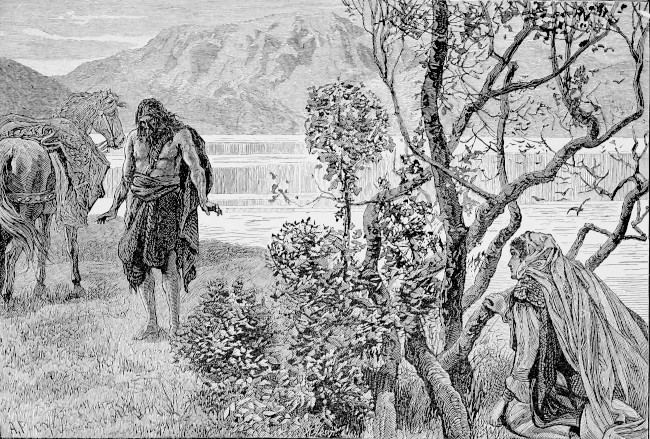
And the heat of the sun was very great, and through the blood and
sweat, Geraint's armor cleaved to his flesh. And when they came into
the wood, he stood under a tree, to avoid the sun's heat; and his
wounds pained him more than they had done at the time when he received
them. And the maiden stood under another tree. And, lo! they heard the
sound of horns, and a tumultuous noise; and the occasion of it was that
Arthur and his company had come down to the wood. And while Geraint was
considering which way he should go to avoid them, behold, he was espied
by a foot-page, who was an attendant on the steward of the household;
and he went to the steward, and told him what kind of man he had seen
in the wood.
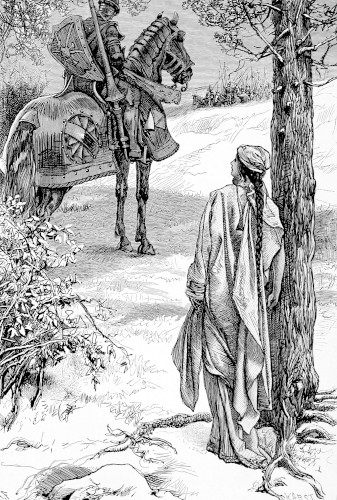
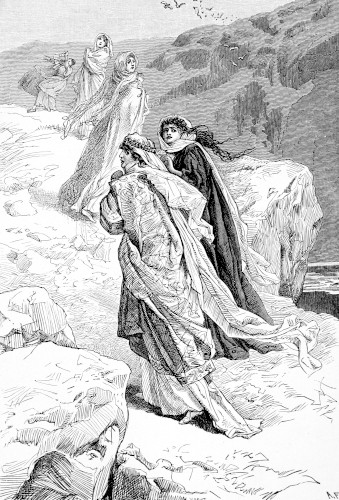
Geraint and the Maiden at the Edge of the Wood.
Then the steward caused his horse to be saddled, and he took his lance
and his shield, and went to the place where Geraint was. "Ah, knight!"
said he, "what dost thou here?"
"I am standing under a shady tree to avoid the heat and the rays of the
sun."
"Wherefore is thy journey? and who art thou?"
"I seek adventures, and go where I list."
"Indeed!" said Kai. "Then come with me to see Arthur, who is here hard
by."
"That will I not, by Heaven!" said Geraint.
"Thou must needs come," said Kai. Then Geraint knew who he was; but Kai
did not know Geraint. And Kai attacked Geraint as best he could. And
Geraint became wroth, and he struck him with the shaft of his lance, so
that he rolled headlong to the ground. But chastisement worse than this
would he not inflict on him.
Scared and wildly Kai arose, and he mounted his horse, and went back to
his lodging. And thence he proceeded to Gwalchmai's tent. "O sir!" said
he to Gwalchmai, "I was told by one of the attendants, that he saw in
the wood above a wounded knight, having on battered armor; and if thou
dost right, thou wilt go and see if this be true."
"I care not if I do so," said Gwalchmai.
"Take, then, thy horse, and some of thy armor," said Kai; "for I hear
that he is not over courteous to those who approach him."
So Gwalchmai took his spear and his shield, and mounted his horse, and
came to the spot where Geraint was. "Sir knight," said he, "wherefore
is thy journey?"
"I journey for my own pleasure, and to seek the adventures of the
world."
"Wilt thou tell me who thou art? or wilt thou come and visit Arthur,
who is near at hand?"
"I will make no alliance with thee, nor will I go and visit Arthur,"
said he. And he knew that it was Gwalchmai; but Gwalchmai knew him not.
"I purpose not to leave thee," said Gwalchmai, "till I know who thou
art." And he charged him with his lance, and struck him on his shield,
so that the shaft was shivered into splinters, and their horses were
front to front. Then Gwalchmai gazed fixedly upon him, and he knew him.
"Ah, Geraint!" said he, "is it thou that art here?"
"I am not Geraint," said he.
"Geraint thou art, by Heaven!" he replied; "and a wretched and insane
expedition is this." Then he looked around, and beheld Enid, and he
welcomed her gladly. "Geraint," said Gwalchmai, "come thou and see
Arthur: he is thy lord and thy cousin."
"I will not," said he; "for I am not in a fit state to go and see
any one." Thereupon, behold one of the pages came after Gwalchmai
to speak to him. So he sent him to apprise Arthur that Geraint was
there wounded, and that he would not go to visit him, and that it was
pitiable to see the plight that he was in. And this he did without
Geraint's knowledge, inasmuch as he spoke in a whisper to the page.
"Entreat Arthur," said he, "to have his tent brought near to the road,
for he will not meet him willingly, and it is not easy to compel him
in the mood he is in." So the page came to Arthur, and told him this.
And he caused his tent to be removed unto the side of the road. And the
maiden rejoiced in her heart. And Gwalchmai led Geraint onwards along
the road, till they came to the place where Arthur was encamped, and
the pages were pitching his tent by the roadside.
"Lord," said Geraint, "all hail unto thee!"
"Heaven prosper thee! And who art thou?" said Arthur.
"It is Geraint," said Gwalchmai; "and of his own free will would he not
come to meet thee."
"Verily," said Arthur, "he is bereft of his reason."
Then came Enid, and saluted Arthur. "Heaven protect thee!" said he. And
thereupon he caused one of the pages to take her from her horse. "Alas,
Enid!" said Arthur, "what expedition is this?"
"I know not, lord," said she, "save that it behooves me to journey by
the same road that he journeys."
"My lord," said Geraint, "with thy permission we will depart."
"Whither wilt thou go?" said Arthur. "Thou canst not proceed now,
unless it be unto thy death."
"He will not suffer himself to be invited by me," said Gwalchmai.
"But by me he will," said Arthur; "and moreover he does not go from
here until he is healed."
"I had rather, lord," said Geraint, "that thou wouldest let me go
forth."
"That will I not, I declare to Heaven!" said he. Then he caused a
maiden to be sent for to conduct Enid to the tent where Gwenhwyvar's
chamber was. And Gwenhwyvar and all her women were joyful at her
coming; and they took off her riding-dress, and placed other garments
upon her. Arthur also called Kadyrieith, and ordered him to pitch a
tent for Geraint and the physicians; and he enjoined him to provide him
with abundance of all that might be requisite for him. And Kadyrieith
did as he had commanded him. And Morgan Tud and his disciples were
brought to Geraint.
And Arthur and his hosts remained there nearly a month, whilst Geraint
was being healed. And when he was fully recovered, Geraint came to
Arthur, and asked his permission to depart.
"I know not if thou art quite well."
"In truth I am, lord," said Geraint.
"I shall not believe thee concerning that, but the physicians that were
with thee." So Arthur caused the physicians to be summoned to him, and
asked them if it were true.
"It is true, lord," said Morgan Tud. So the next day Arthur permitted
him to go forth, and he pursued his journey. And on the same day Arthur
removed thence.
And Geraint desired Enid to go on, and to keep before him, as she had
formerly done. And she went forward along the high road. And as they
journeyed thus, they heard an exceeding loud wailing near to them.
"Stay thou here," said he, "and I will go and see what is the cause of
this wailing."
"I will," said she.
Then he went forward unto an open glade that was near the road. And in
the glade he saw two horses, one having a man's saddle, and the other
a woman's saddle upon it. And, behold, there was a knight lying dead
in his armor, and a young damsel in a riding-dress standing over him,
lamenting. "Ah, lady!" said Geraint, "what hath befallen thee?"
"Behold," she answered, "I journeyed here with my beloved husband,
when, lo! three giants came upon us, and without any cause in the world
they slew him."
"Which way went they hence?" said Geraint.
"Yonder by the high road," she replied.
So he returned to Enid. "Go," said he, "to the lady that is below
yonder, and await me there till I come."
She was sad when he ordered her to do thus; but nevertheless she went
to the damsel, whom it was ruth to hear, and she felt certain that
Geraint would never return. Meanwhile Geraint followed the giants, and
overtook them. And each of them was greater of stature than three other
men, and a huge club was on the shoulder of each. Then he rushed upon
one of them, and thrust his lance through his body. And having drawn
it forth again, he pierced another of them through likewise. But the
third turned upon him, and struck him with his club; so that he split
his shield, and crushed his shoulder, and opened his wounds anew, and
all his blood began to flow from him. But Geraint drew his sword, and
attacked the giant, and gave him a blow on the crown of his head so
severe and fierce and violent, that his head and his neck were split
down to his shoulders, and he fell dead. So Geraint left him thus, and
returned to Enid. And when he saw her, he fell down lifeless from his
horse. Piercing and loud and thrilling was the cry that Enid uttered.
And she came and stood over him where he had fallen. And at the sound
of her cries came the Earl of Limours, and the host that journeyed with
him, whom her lamentations brought out of their road. And the earl said
to Enid, "Alas, lady! what hath befallen thee?"
"Ah, good sir!" said she, "the only man I have loved, or ever shall
love, is slain."
Then he said to the other, "And what is the cause of thy grief?"
"They have slain my beloved husband also," said she.
"And who was it that slew them?"
"Some giants," she answered, "slew my best-beloved; and the other
knight went in pursuit of them, and came back in the state thou seest,
his blood flowing excessively. But it appears to me that he did not
leave the giants without killing some of them, if not all." The earl
caused the knight that was dead to be buried, but he thought that there
still remained some life in Geraint; and to see if he yet would live,
he had him carried with him in the hollow of his shield, and upon a
bier. And the two damsels went to the court; and when they arrived
there, Geraint was placed upon a litter-couch in front of the table
that was in the hall. Then they all took off their travelling-gear,
and the earl besought Enid to do the same, and to clothe her self in
other garments.
"I will not, by Heaven!" said she.
"Ah, lady!" said he, "be not so sorrowful for this matter."
"It were hard to persuade me to be otherwise," said she.
"I will act towards thee in such wise, that thou needest not be
sorrowful, whether yonder knight live or die. Behold, a good earldom,
together with myself, will I bestow on thee. Be therefore happy and
joyful."
"I declare to Heaven," said she, "that henceforth I shall never be
joyful while I live."
"Come, then," said he, "and eat."
"No, by Heaven, I will not," she answered.
"But, by Heaven, thou shalt," said he. So he took her with him to the
table, against her will, and many times desired her to eat.
"I call Heaven to witness," said she, "that I will not eat until the
man that is upon yonder bier shall eat likewise."
"Thou canst not fulfil that," said the earl. "Yonder man is dead
already."
"I will prove that I can," said she.
Then he offered her a goblet of liquor. "Drink this goblet," he said,
"and it will cause thee to change thy mind."
"Evil betide me," she answered, "if I drink aught until he drink also."
"Truly," said the earl, "it is of no more avail for me to be gentle
with thee than ungentle." And he gave her a box in the ear. Thereupon
she raised a loud and piercing shriek; and her lamentations were much
greater than they had been before, for she considered in her mind,
that, had Geraint been alive, he durst not have struck her thus.
But behold, at the sound of her cry, Geraint revived from his swoon,
and he sat up on the bier, and, finding his sword in the hollow of his
shield, he rushed to the place where the earl was, and struck him a
fiercely-wounding, severely-venomous, and sternly-smiting blow upon the
crown of his head, so that he clove him in twain, until his sword was
stayed by the table. Then all left the board, and fled away. And this
was not so much through fear of the living as through the dread they
felt at seeing the dead man rise up to slay them. And Geraint looked
upon Enid, and he was grieved for two causes: one was to see that Enid
had lost her color and her wonted aspect; and the other, to know that
she was in the right. "Lady," said he, "knowest thou where our horses
are?"
"I know, lord, where thy horse is," she replied; "but I know not where
is the other. Thy horse is in the house yonder."
So he went to the house, and brought forth his horse, and mounted him,
and took up Enid from the ground, and placed her upon the horse with
him. And he rode forward. And their road lay between two hedges. And
the night was gaining on the day. And lo! they saw behind them the
shafts of spears betwixt them and the sky, and they heard the trampling
of horses and the noise of a host approaching. "I hear something
following us," said he, "and I will put thee on the other side of
the hedge." And thus he did. And thereupon, behold, a knight pricked
towards him, and couched his lance.
When Enid saw this, she cried out, saying, "O chieftain! whoever thou
art, what renown wilt thou gain by slaying a dead man?"
"O Heaven!" said he, "is it Geraint?"
"Yes, in truth," said she. "And who art thou?"
"I am the Little King," he answered, "coming to thy assistance; for I
heard that thou wast in trouble. And if thou hadst followed my advice,
none of these hardships would have befallen thee."
"Nothing can happen," said Geraint, "without the will of Heaven, though
much good results from counsel."
"Yes," said the Little King; "and I know good counsel for thee now.
Come with me to the court of a son-in-law of my sister, which is near
here, and thou shalt have the best medical assistance in the kingdom."
"I will do so gladly," said Geraint. And Enid was placed upon the
horse of one of the Little King's squires, and they went forward to
the baron's palace. And they were received there with gladness, and
they met with hospitality and attention. And the next morning they went
to seek physicians, and it was not long before they came; and they
attended Geraint until he was perfectly well. And while Geraint was
under medical care, the Little King caused his armor to be repaired,
until it was as good as it had ever been. And they remained there a
fortnight and a month.
Then the Little King said to Geraint, "Now will we go towards my own
court, to take rest and amuse ourselves."
"Not so," said Geraint. "We will first journey for one day more, and
return again."
"With all my heart!" said the Little King. "Do thou go then." And early
in the day they set forth. And more gladly and more joyfully did Enid
journey with them that day than she had ever done. And they came to the
main road. And when they reached a place where the road divided in two,
they beheld a man on foot coming towards them along one of these roads;
and Gwiffert asked the man whence he came.
"I come," said he, "from an errand in the country."
"Tell me," said Geraint: "which is the best for me to follow of these
two roads?"
"That is the best for thee to follow," answered he; "for if thou goest
by this one, thou wilt never return. Below us," said he, "there is a
hedge of mist, and within it are enchanted games; and no one who has
gone there has ever returned. And the court of the Earl Owain is there,
and he permits no one to go to lodge in the town, except he will go to
his court."
"I declare to Heaven," said Geraint, "that we will take the lower
road." And they went along it until they came to the town. And they
took the fairest and pleasantest place in the town for their lodging.
And while they were thus, behold, a young man came to them, and greeted
them. "Heaven be propitious to thee!" said they.
"Good sirs," said he, "what preparations are you making here?"
"We are taking up our lodging," said they, "to pass the night."
"It is not the custom with him who owns the town," he answered, "to
permit any of gentle birth, unless they come to stay in his court, to
abide here therefore: come ye to the court."
"We will come gladly," said Geraint. And they went with the page, and
they were joyfully received. And the earl came to the hall to meet
them, and he commanded the tables to be laid. And they washed, and sat
down. And this is the order in which they sat: Geraint on one side of
the earl, and Enid on the other side, and next to Enid the Little King,
and then the countess next to Geraint; and all after that as became
their rank. Then Geraint recollected the games, and thought that he
should not go to them; and on that account he did not eat. Then the
earl looked upon Geraint, and considered; and he bethought him that his
not eating was because of the games, and it grieved him that he had
ever established those games, were it only on account of losing such a
youth as Geraint. And if Geraint had asked him to abolish the games, he
would gladly have done so.
Then the earl said to Geraint, "What thought occupies thy mind, that
thou dost not eat? If thou hesitatest about going to the games, thou
shalt not go, and no other of thy rank shall ever go, either."
"Heaven reward thee!" said Geraint. "But I wish nothing better than to
go to the games, and to be shown the way thither."
"If that is what thou dost prefer, thou shalt obtain it willingly."
"I do prefer it, indeed," said he. Then they ate, and they were amply
served, and they had a variety of gifts, and abundance of liquor. And
when they had finished eating they arose. And Geraint called for his
horse and his armor, and he accoutred both himself and his horse. And
all the hosts went forth until they came to the side of the hedge; and
the hedge was so lofty, that it reached as high as they could see in
the air; and upon every stake in the hedge, except two, there was the
head of a man, and the number of stakes throughout the hedge was very
great.
Then said the Little King, "May no one go in with the chieftain?"
"No one may," said Earl Owain.
"Which way can I enter?" inquired Geraint.
"I know not," said Owain. "But enter by the way that thou wilt, and
that seemeth easiest to thee."
Then fearlessly and unhesitatingly Geraint dashed forward into the
mist. And on leaving the mist he came to a large orchard; and in the
orchard he saw an open space, wherein was a tent of red satin. And
the door of the tent was open, and an apple-tree stood in front of
the door of the tent; and on a branch of the apple-tree hung a huge
hunting-horn. Then he dismounted, and went into the tent; and there
was no one in the tent save one maiden sitting in a golden chair, and
another chair was opposite to her, empty. And Geraint went to the empty
chair, and sat down therein.
"Ah, chieftain!" said the maiden, "I would not counsel thee to sit in
that chair."
"Wherefore?" said Geraint.
"The man to whom that chair belongs has never suffered another to sit
in it."
"I care not," said Geraint, "though it displease him that I sit in
the chair." And thereupon they heard a mighty tumult around the tent.
And Geraint looked to see what was the cause of the tumult. And he
beheld without a knight mounted upon a war-horse, proudly snorting,
high-mettled, and large of bone; and a robe of honor in two parts was
upon him and upon his horse, and beneath it was plenty of armor.
"Tell me, chieftain," said he to Geraint, "who it was that bade thee
sit there."
"Myself," answered he.
"It was wrong of thee to do me this shame and disgrace. Arise, and do
me satisfaction for thine insolence."
Then Geraint arose; and they encountered immediately; and they broke a
set of lances, and a second set, and a third; and they gave each other
fierce and frequent strokes. And at last Geraint became enraged; and
he urged on his horse, and rushed upon him, and gave him a thrust on
the centre of his shield, so that it was split, and so that the head of
his lance went through his armor, and his girths were broken, and he
himself was borne headlong to the ground, the length of Geraint's lance
and arm, over his horse's crupper. "Oh, my lord!" said he, "thy mercy,
and thou shalt have what thou wilt."
"I only desire," said Geraint, "that this game shall no longer exist
here, nor the hedge of mist, nor magic, nor enchantment."
"Thou shalt have this gladly, lord," he replied.
"Cause, then, the mist to disappear from this place," said Geraint.
"Sound yonder horn," said he, "and when thou soundest it, the mist will
vanish; but it will not go hence unless the horn be blown by the knight
by whom I am vanquished."
And sad and sorrowful was Enid where she remained, through anxiety
concerning Geraint. Then Geraint went and sounded the horn. And at
the first blast he gave, the mist vanished. And all the hosts came
together, and they all became reconciled to each other. And the earl
invited Geraint and the Little King to stay with him that night. And
the next morning they separated. And Geraint went towards his own
dominions; and thenceforth he reigned prosperously, and his warlike
fame and splendor lasted with renown and honor both to him and to Enid
from that time forth.