Book VI. CONTAINING THE SECOND PART OF THE REIGN OF PETER THE HEADSTRONG, AND HIS GALLANT ACHIEVEMENTS ON THE DELAWARE. — Chapter I. IN WHICH IS EXHIBITED A WARLIKE PORTRAIT OF THE GREAT PETER—OF THE WINDY CONTEST OF GENERAL VAN POFFENBURGH AND GENERAL PRINTZ, AND OF THE MOSQUITO WAR ON THE DELAWARE. — Chapter II. OF JAN RISINGH, HIS GIANTLY PERSON AND CRAFTY DEEDS; AND OF THE CATASTROPHE AT FORT CASIMIR. — Chapter III. SHOWING HOW PROFOUND SECRETS ARE OFTEN BROUGHT TO LIGHT; WITH THE PROCEEDINGS OF PETER THE HEADSTRONG WHEN HE HEARD OF THE MISFORTUNES OF GENERAL VAN POFFENBURGH. — Chapter IV. CONTAINING PETER STUYVESANT’S VOYAGE UP THE HUDSON, AND THE WONDERS AND DELIGHTS OF THAT RENOWNED RIVER. — Chapter V. DESCRIBING THE POWERFUL ARMY THAT ASSEMBLED AT THE CITY OF NEW AMSTERDAM—TOGETHER WITH THE INTERVIEW BETWEEN PETER THE HEADSTRONG AND GENERAL VAN POFFENBURGH, AND PETER’S SENTIMENTS TOUCHING UNFORTUNATE GREAT MEN. — Chapter VI. IN WHICH THE AUTHOR DISCOURSES VERY INGENUOUSLY OF HIMSELF—AFTER WHICH IS TO BE FOUND MUCH INTERESTING HISTORY ABOUT PETER THE HEADSTRONG AND HIS FOLLOWERS. — Chapter VII. SHOWING THE GREAT ADVANTAGE THAT THE AUTHOR HAS OVER HIS READER IN TIME OF BATTLE—TOGETHER WITH DIVERS PORTENTOUS MOVEMENTS; WHICH BETOKEN THAT SOMETHING TERRIBLE IS ABOUT TO HAPPEN. — Chapter VIII. CONTAINING THE MOST HORRIBLE BATTLE EVER RECORDED IN POETRY OR PROSE; WITH THE ADMIRABLE EXPLOITS OF PETER THE HEADSTRONG. — Chapter IX. IN WHICH THE AUTHOR AND THE READER, WHILE REPOSING AFTER THE BATTLE, FALL INTO A VERY GRAVE DISCOURSE—AFTER WHICH IS RECORDED THE CONDUCT OF PETER STUYVESANT AFTER HIS VICTORY.
131
132
133
Hitherto, most venerable
and courteous
reader, have I shown
thee the administration
of the valorous Stuyvesant,
under the mild
moonshine of peace, or
rather the grim tranquillity
of awful expectation;
but now the
war-drum rumbles from
afar, the brazen trumpet brays its thrilling
note, and the rude crash of hostile arms speaks
fearful prophecies of coming troubles. The
gallant warrior starts from soft repose, from
golden visions and voluptuous ease, where in
the dulcet, “piping time of peace” he sought
134sweet solace after all his toils. No more in
beauty’s siren lap reclined, he weaves fair garlands
for his lady’s brows; no more entwines
with flowers his shining sword, nor through
the livelong lazy summer’s day chants forth
his love-sick soul in madrigals. To manhood
roused, he spurns the amorous flute; doffs
from his brawny back the robe of peace, and
clothes his pampered limbs in panoply of steel.
O’er his dark brow, where late the myrtle
waved, where wanton roses breathed enervate
love, he rears the beaming casque and nodding
plume; grasps the bright shield, and shakes
the ponderous lance; or mounts with eager
pride his fiery steed, and burns for deeds of
glorious chivalry!
But soft, worthy reader! I would not have
you imagine that any preux chevalier, thus
hideously begirt with iron, existed in the city
of New Amsterdam. This is but a lofty and
gigantic mode, in which we heroic writers always
talk of war, thereby to give it a noble
and imposing aspect,—equipping our warriors
with bucklers, helms, and lances, and such
like outlandish and obsolete weapons, the like
of which perchance they had never seen or
heard of,—in the same manner that a cunning
statuary arrays a modern general or an admiral
in the accoutrements of a Cæsar or an Alexander.
135The simple truth, then, of all this oratorical
nourish is this, that the valiant Peter
Stuyvesant all of a sudden found it necessary
to scour his rusty blade, which too long had
rusted in its scabbard, and prepare himself to
undergo those hardy toils of war in which his
mighty soul so much delighted.
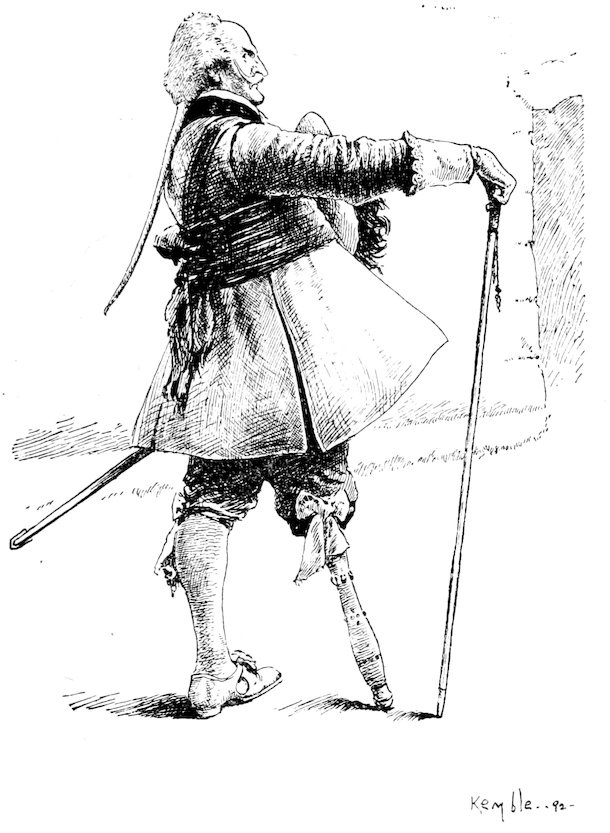
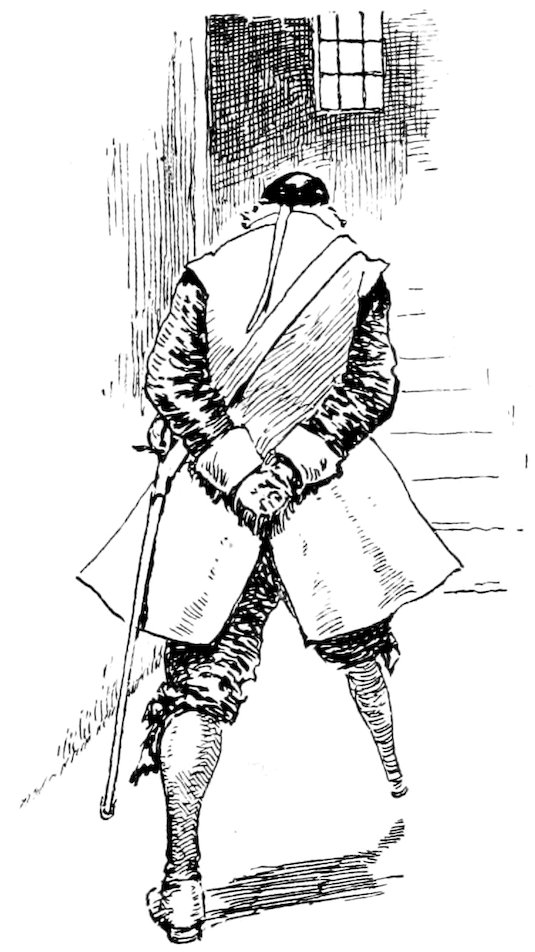
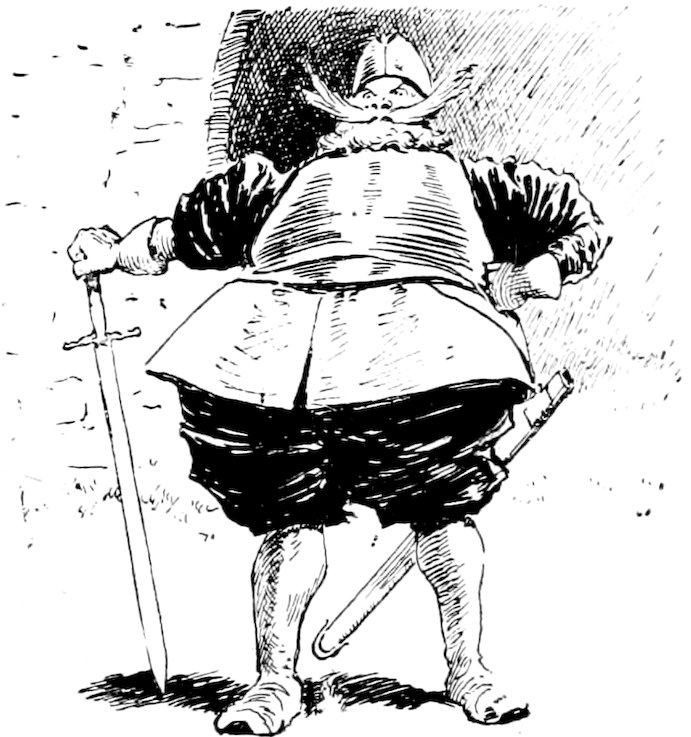
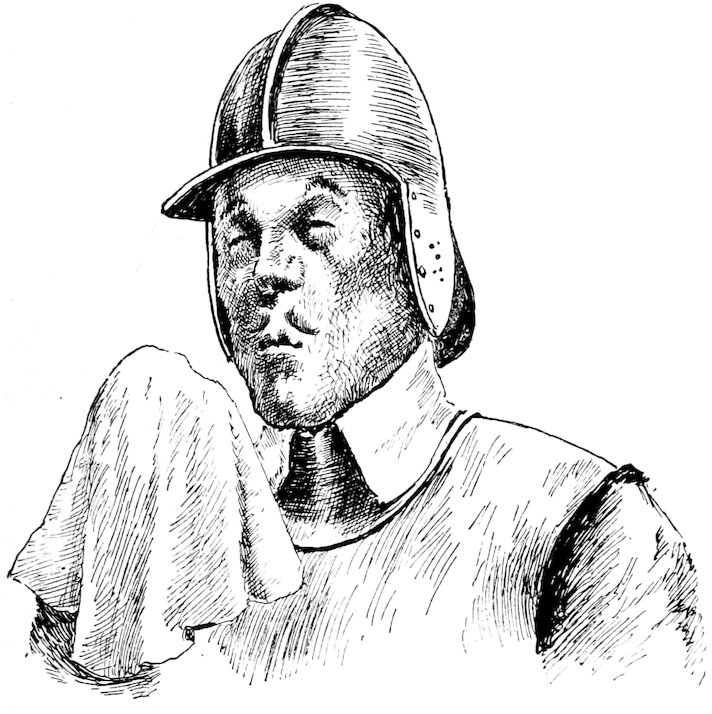
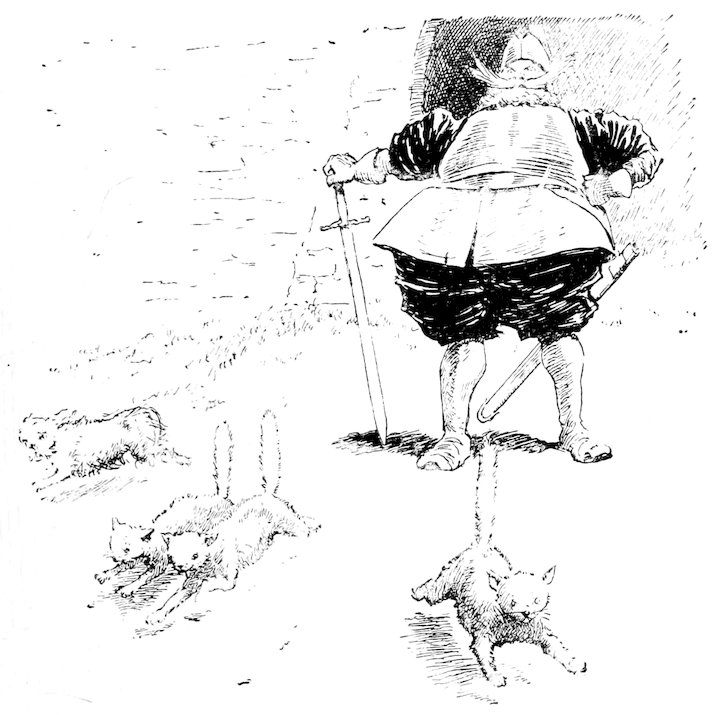
136Methinks I at this moment behold him in
my imagination, or rather, I behold his goodly
portrait, which still hangs up in the family
mansion of the Stuyvesants, arrayed in all the
terrors of a true Dutch general. His regimental
coat of German blue, gorgeously decorated
with a goodly show of large brass buttons,
reaching from his waistband to his chin; the
voluminous skirts turned up at the corners and
separating gallantly behind, so as to display the
seat of a sumptuous pair of brimstone-colored
trunk breeches; a graceful style still prevalent
among the warriors of our day, and which is
in conformity to the custom of ancient heroes,
who scorned to defend themselves in rear.
His face rendered exceeding terrible and warlike
by a pair of black mustachios; his hair
strutting out on each side in stiffly pomatumed
ear-locks, and descending in a rat-tail queue
below his waist; a shining stock of black
leather supporting his chin, and a little but
fierce cocked hat, stuck with a gallant and
137fiery air over his left eye. Such was the chivalric
port of Peter the Headstrong; and when he
made a sudden halt, planted himself firmly on
his solid supporter, with his wooden leg, inlaid
with silver, a little in advance, in order to
strengthen his position, his right hand grasping
a gold-headed cane, his left resting upon
the pommel of his sword, his head dressing
spiritedly to the right, with a most appalling
and hard-favored frown upon his brow,—he
presented altogether one of the most commanding,
bitter-looking, and soldier-like figures that
ever strutted upon canvas.—Proceed we now
to inquire the cause of this warlike preparation.
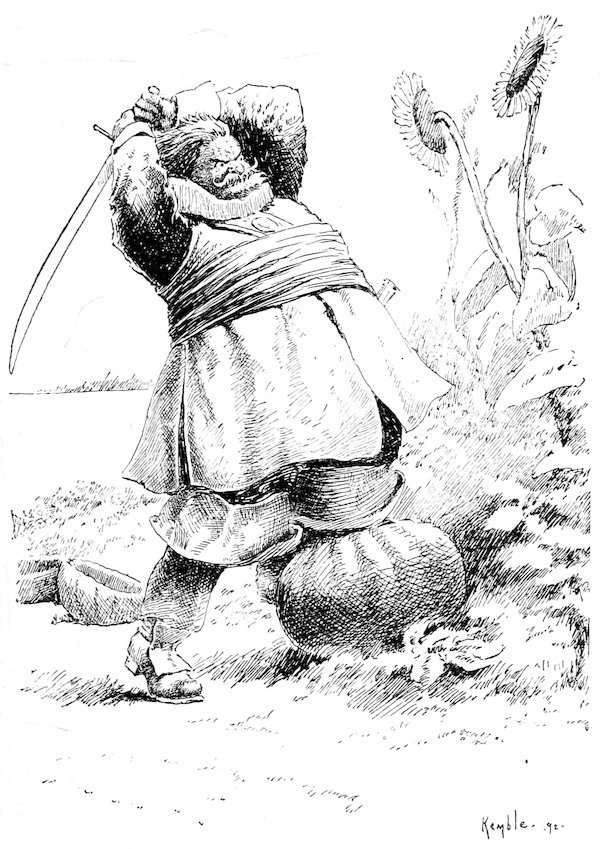
In the preceding chapter we have spoken of
the founding of Fort Casimir, and of the merciless
warfare waged by its commander upon
cabbages, sunflowers, and pumpkins, for want
of better occasion to flesh his sword. Now it
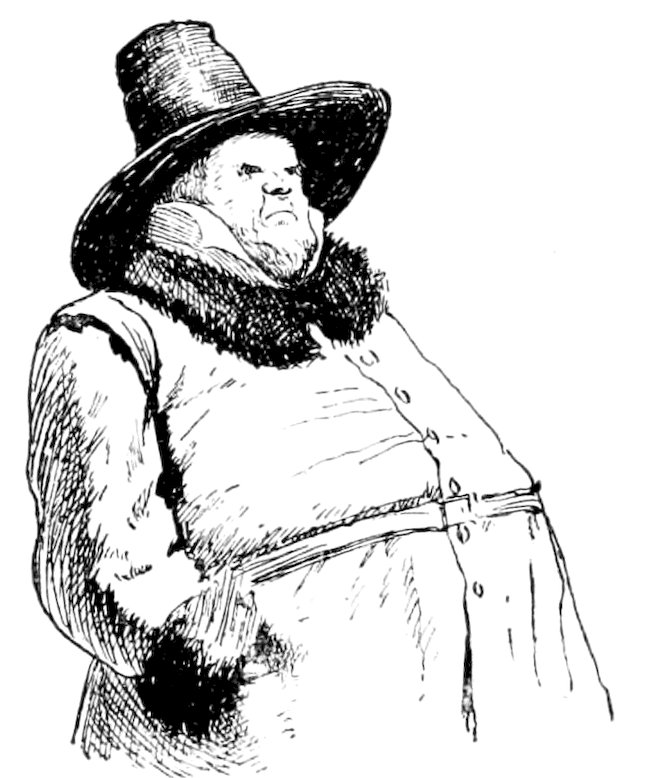
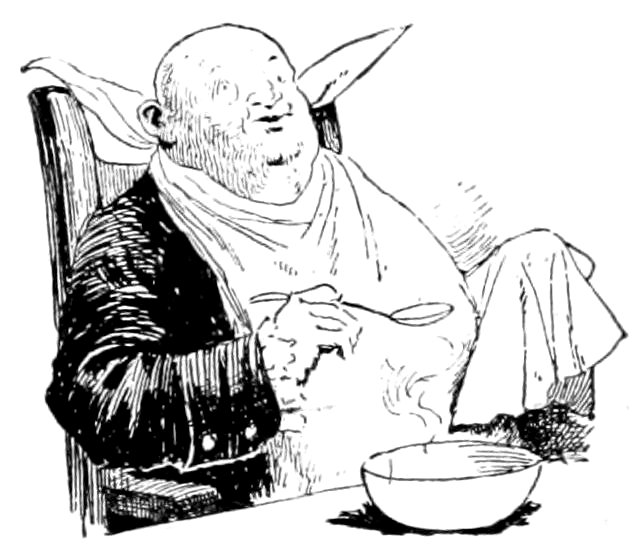
came to pass, that, higher up the Delaware, at
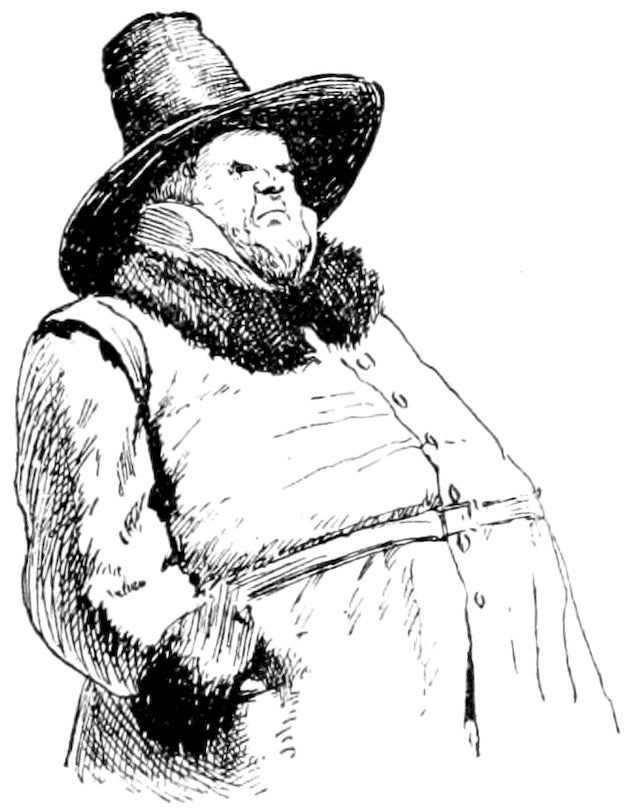
his stronghold of Tinnekonk, resided one Jan
Printz, who styled himself Governor of New
Sweden. If history belie not this redoubtable
Swede, he was a rival worthy of the windy
and inflated commander of Fort Casimir, for
master David Pieterzen de Vrie, in his excellent
book of voyages, describes him as
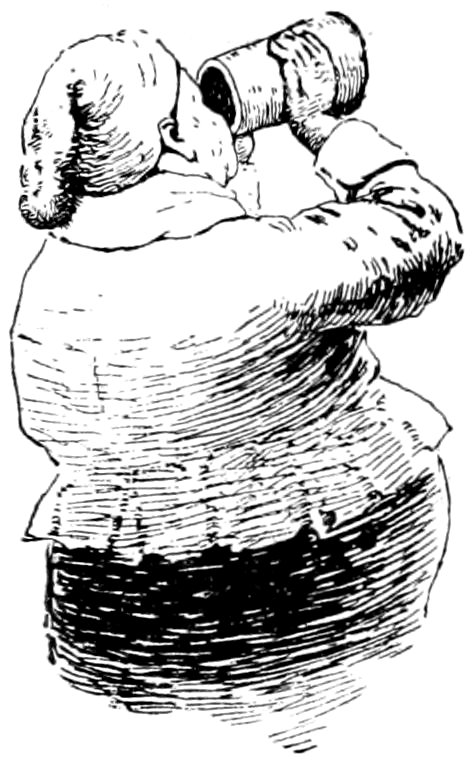
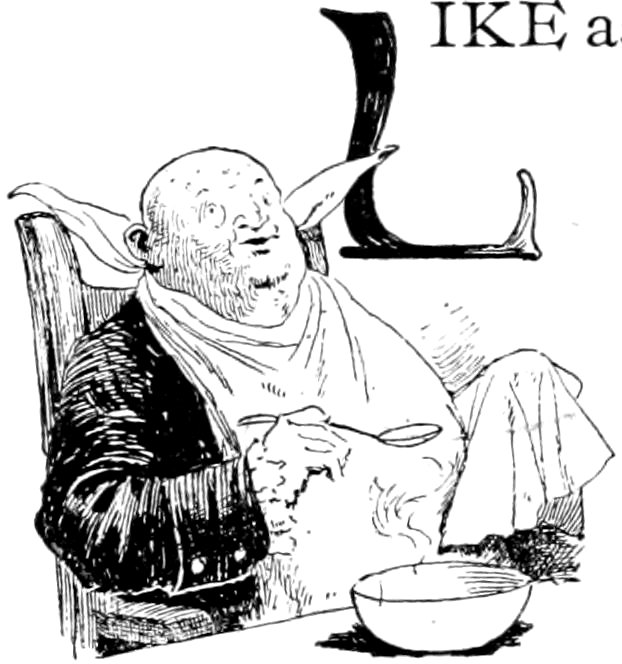
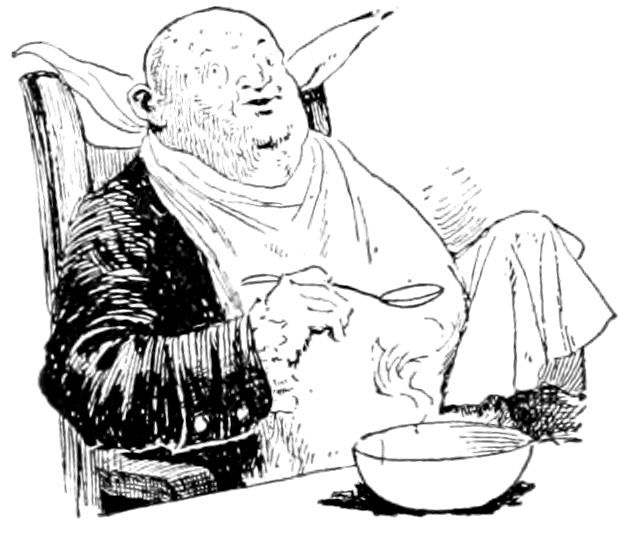
“weighing upwards of four hundred pounds,”
a huge feeder and bowser in proportion, taking
138three potations pottle-deep at every meal.
He had a garrison after his own heart at
Tinnekonk,—guzzling, deep-drinking swashbucklers,
who made the wild woods ring with
their carousals.
No sooner did this robustious commander
hear of the erection of Fort Casimir, than he
sent a message to Van Poffenburgh, warning
him off the land, as being within the bounds of
his jurisdiction.
To this General Van Poffenburgh replied
that the land belonged to their High Mightinesses,
having been regularly purchased of the
natives, as discoverers from the Manhattoes,
as witness the breeches of their land-measurer
Ten Broeck.
To this the governor rejoined that the land
had previously been sold by the Indians to the
Swedes, and consequently was under the petticoat
government of her Swedish majesty,
Christina; and woe be to any mortal that wore
breeches who should dare to meddle even with
the hem of her sacred garment.
I forbear to dilate upon the war of words
which was kept up for some time by these
windy commanders; Van Poffenburgh, however,
had served under William the Testy, and
was a veteran in this kind of warfare. Governor
Printz, finding he was not to be dislodged
139by these long shots, now determined upon
coming to closer quarters. Accordingly, he
descended the river in great force and fume,
and erected a rival fortress just one Swedish
mile below Fort Casimir, to which he gave
the name of Helsenburg.
And now commenced a tremendous rivalry
between these two doughty commanders, striving
to out-strut and out-swell each other like a
couple of belligerent turkey-cocks. There was
a contest who should run up the tallest flagstaff
and display the broadest flag; all day
long there was a furious rolling of drums and
twanging of trumpets in either fortress, and
140whichever had the wind in its favor would
keep up a continual firing of cannon, to taunt
its antagonist with the smell of gun-powder.
On all these points of windy warfare the antagonists
were well matched; but so it happened,
that, the Swedish fortress being lower
down the river, all the Dutch vessels bound to
Fort Casimir with supplies had to pass it.
Governor Printz at once took advantage of
this circumstance, and compelled them to
lower their flags as they passed under the
guns of his battery.
141
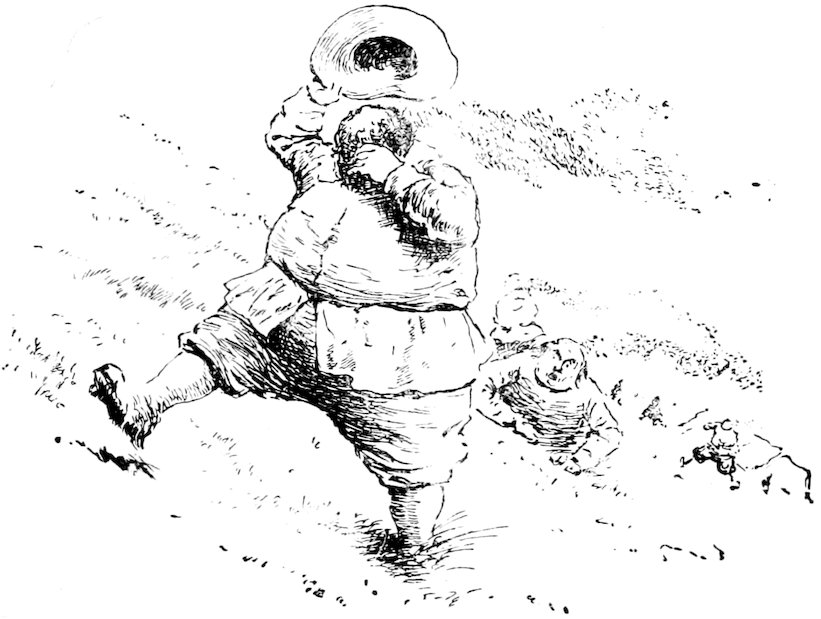
This was a deadly wound to the Dutch pride
of General Van Poffenburgh, and sorely would
he swell when from the ramparts of Fort Casimir
he beheld the flag of their High Mightinesses
struck to the rival fortress. To heighten
his vexation, Governor Printz, who, as has
been shown, was a huge trencherman, took the
liberty of having the first rummage of every
Dutch merchant-ship, and securing to himself
and his guzzling garrison all the little round
Dutch cheeses, all the Dutch herrings, the
gingerbread, the sweetmeats, the curious stone
jugs of gin, and all the other Dutch luxuries,
on their way for the solace of Fort Casimir.
It is possible he may have paid to the Dutch
skippers the full value of their commodities;
but what consolation was this to Jacobus Van
Poffenburgh and his garrison, who thus found
their favorite supplies cut off, and diverted into
the larders of the hostile camp? For some
time this war of the cupboard was carried on
to the great festivity and jollification of the
Swedes, while the warriors of Fort Casimir
found their hearts, or rather their stomachs,
daily failing them. At length the summer
heats and summer showers set in, and now, lo
and behold, a great miracle was wrought for
the relief of the Nederlandts, not a little resembling
one of the plagues of Egypt; for it came
to pass that a great cloud of mosquitoes arose
142out of the marshy borders of the river and
settled upon the fortress of Helsenburg, being,
doubtless, attracted by the scent of the fresh
blood of these Swedish gormandizers. Nay,
it is said that the body of Jan Printz alone,
which was as big and as full of blood as that
of a prize-ox, was sufficient to attract the mosquitoes
from every part of the country. For
some time the garrison endeavored to hold out,
but it was all in vain; the mosquitoes penetrated
into every chink and crevice, and gave
them no rest day nor night; and as to Governor
Jan Printz, he moved about as in a cloud,
with mosquito music in his ears, and mosquito
stings to the very end of his nose. Finally
the garrison was fairly driven out of the fortress,
and obliged to retreat to Tinnekonk;
nay, it is said that the mosquitoes followed
Jan Printz even thither, and absolutely drove
him out of the country; certain it is, he embarked
for Sweden shortly afterwards, and
Jan Claudius Risingh was sent to govern New
Sweden in his stead.
Such was the famous mosquito war on the
Delaware, of which General Van Poffenburgh
would fain have been the hero; but the devout
people of the Nieuw Nederlandts always
ascribed the discomfiture of the Swedes to the
miraculous intervention of St. Nicholas. As
143to the fortress of Helsenburg, it fell to ruin;
but the story of its strange destruction was
perpetuated by the Swedish name of Myggenborg,
that is to say, Mosquito Castle.[12]
144
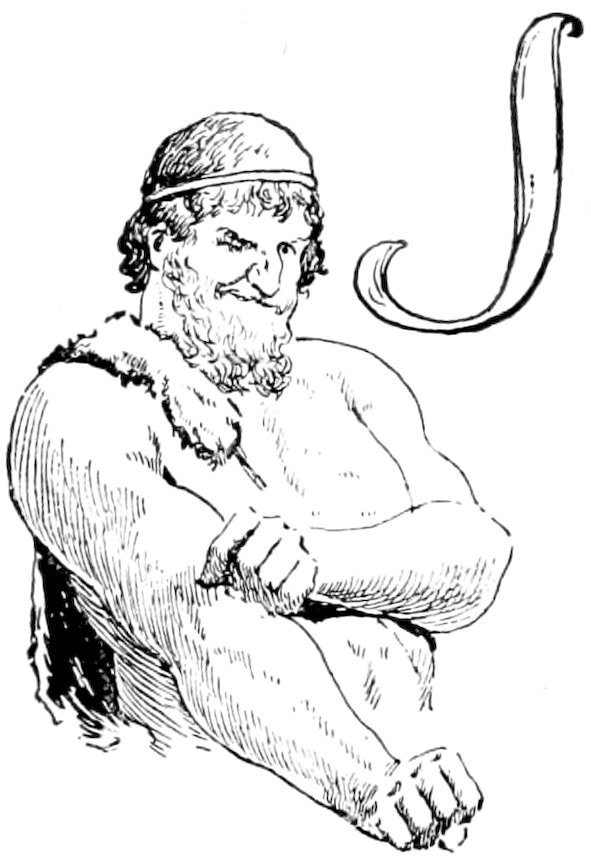
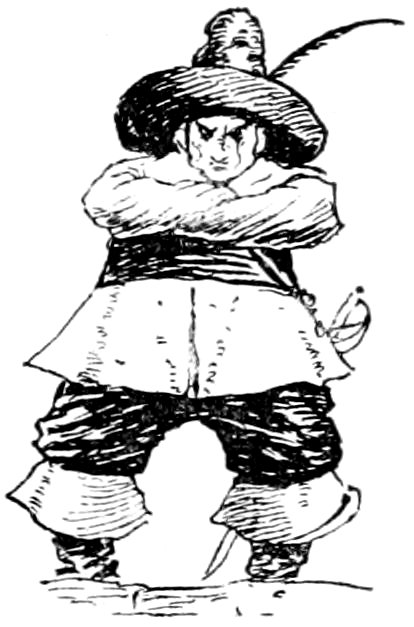
Jan Claudius Risingh,
who succeeded to the
command of New Sweden,
looms largely in ancient
records as a gigantic
Swede, who, had he
not been rather knock-kneed
and splay-footed,
might have served for
the model of a Samson
or a Hercules. He was
no less rapacious than
mighty, and, withal, as crafty as he was rapacious;
so that there is very little doubt, that,
had he lived some four or five centuries since,
he would have figured as one of those wicked
giants who took a cruel pleasure in pocketing
beautiful princesses and distressed damsels,
when gadding about the world, and locking
them up in enchanted castles, without a toilet,
145a change of linen, or any other convenience.
In consequence of which enormities they fell
under the high displeasure of chivalry, and all
true, loyal, and gallant knights were instructed
to attack and slay outright any miscreant they
might happen to find above six feet high;
which is doubtless one reason why the race of
large men is nearly extinct, and the generations
of latter ages are so exceedingly small.
Governor Risingh, notwithstanding his giantly
condition, was, as I have hinted, a man of
craft. He was not a man to ruffle the vanity
of General Van Poffenburgh, or to rub his
self-conceit against the grain. On the contrary,
as he sailed up the Delaware, he paused
before Fort Casimir, displayed his flag, and
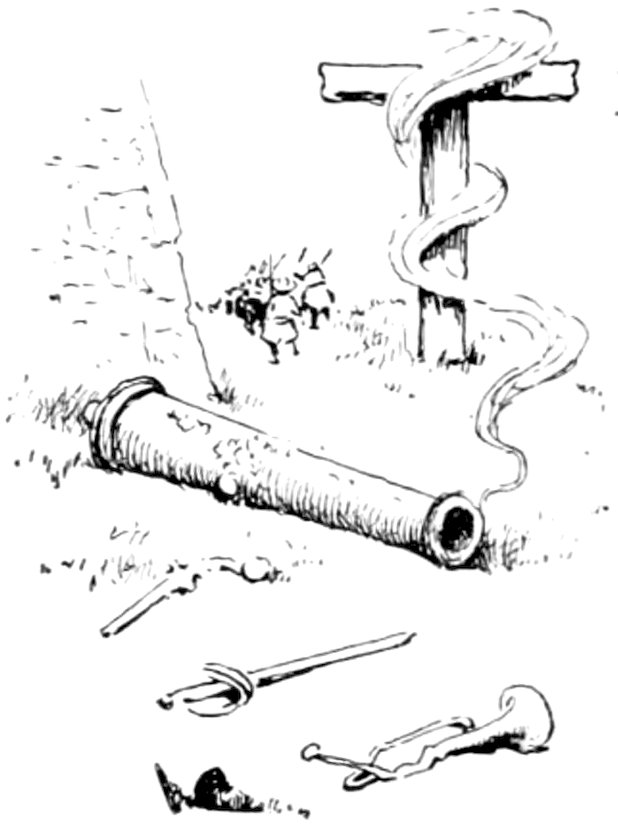
fired a royal salute before dropping anchor.
The salute would doubtless have been returned,
had not the guns been dismounted; as it was,
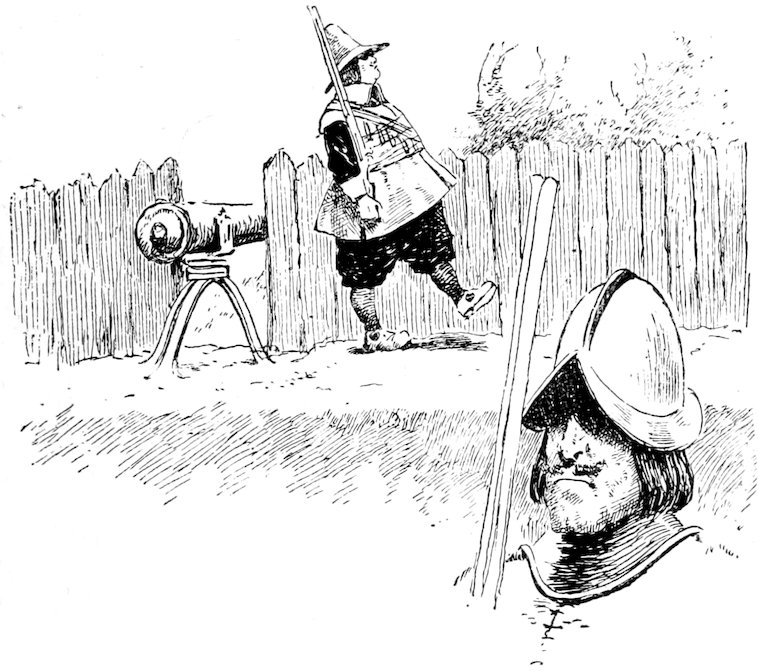
a veteran sentinel, who had been napping at
his post, and had suffered his match to go out,
returned the compliment by discharging his
musket with the spark of a pipe borrowed from
a comrade. Governor Risingh accepted this as
a courteous reply, and treated the fortress to a
second salute, well knowing its commander was
apt to be marvellously delighted with these
little ceremonials, considering them so many
acts of homage paid to his greatness. He
146then prepared to land with a military retinue
of thirty men, a prodigious pageant in the
wilderness.
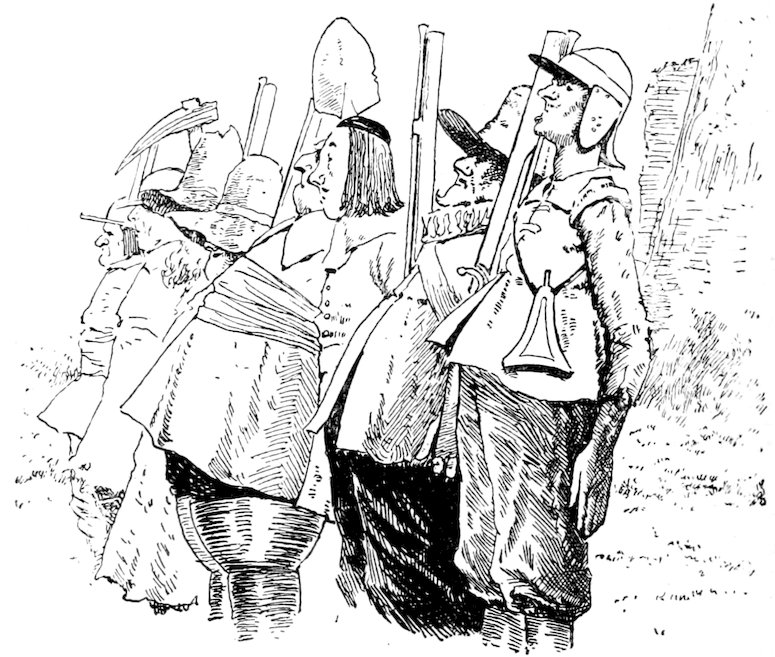
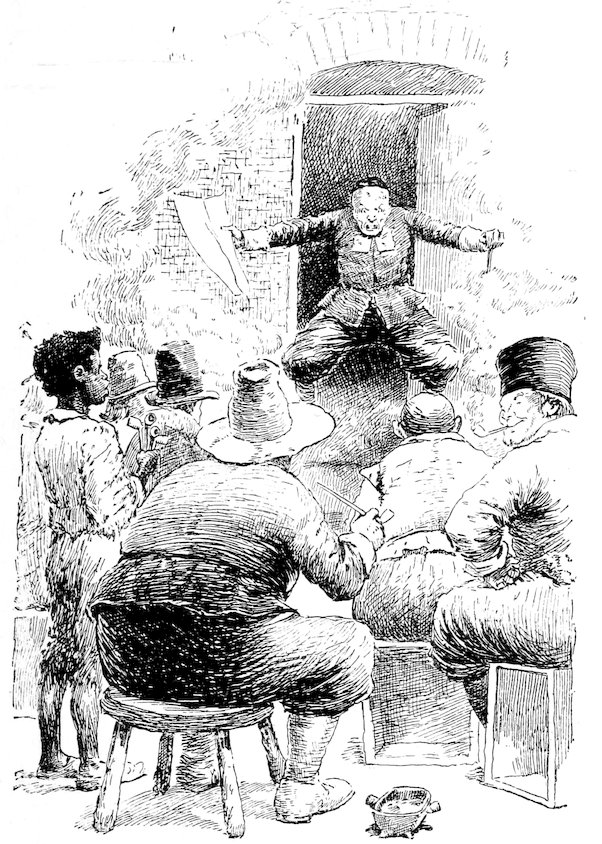
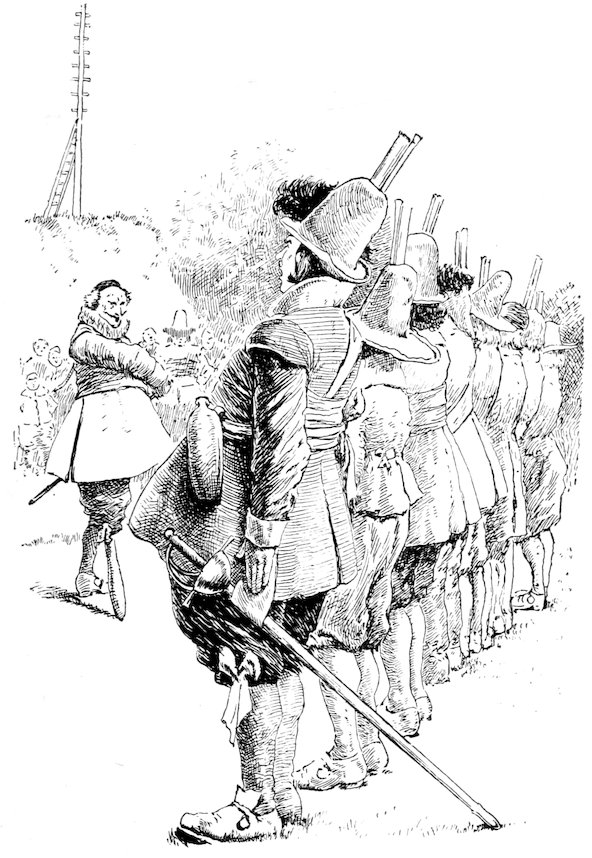
“THE MAIN GUARD WAS TURNED OUT.”
And now took place a terrible rummage and
racket in Fort Casimir, to receive such a visitor
in proper style, and to make an imposing
appearance. The main guard was turned out
as soon as possible, equipped to the best advantage
in the few suits of regimentals, which had
to do duty by turns with the whole garrison.
One tall, lank fellow appeared in a little man’s
coat, with the buttons between his shoulders;
147the skirts scarce covering his bottom; his
hands hanging like spades out of the sleeves
and the coat linked in front by worsted loops
made out of a pair of red garters. Another
had a cocked hat stuck on the back of his
head, and decorated with a bunch of cock’s
tails; a third had a pair of rusty gaiters hanging
about his heels; while a fourth, a little
duck-legged fellow, was equipped in a pair of
the general’s cast-off breeches, which he held
up with one hand while he grasped his firelock
with the other. The rest were accoutred in
similar style, except three ragamuffins without
shirts, and with but a pair and a half of
breeches between them; wherefore they were
sent to the black hole, to keep them out of
sight, that they might not disgrace the fortress.
His men being thus gallantly arrayed,—those
who lacked muskets shouldering spades and
pickaxes, and every man being ordered to tuck
in his shirt-tail and pull up his brogues,—General
Van Poffenburgh first took a sturdy
draught of foaming ale, which, like the magnanimous
More of More-hall,[13] was his invariable
148practice on all great occasions; this done,
he put himself at their head, and issued forth
from his castle, like a mighty giant, just refreshed
with wine. But when the two heroes
met, they began a scene of warlike parade
that beggars all description. The shrewd
Risingh, who had grown gray much before his
time in consequence of his craftiness, saw at
one glance the ruling passion of the great Van
Poffenburgh, and humored him in all his
valorous fantasies.
Their detachments were accordingly drawn
up in front of each other; they carried
arms and they presented arms; they gave the
standing salute and the passing salute; they
rolled their drums, they nourished their fifes,
and they waved their colors; they faced to the
left, and they faced to the right, and they
faced to the rightabout; they wheeled forward,
and they wheeled backward, and they wheeled
into echellon; they marched and they countermarched,
by grand divisions, by single divisions,
and by subdivisions; by platoons, by
sections, and by files; in quick time, in slow
time, and in no time at all; for, having gone
through all the evolutions of two great armies,
including the eighteen manœuvres of Dundas;
having exhausted all they could recollect or
imagine of military tactics, including sundry
149strange and irregular evolutions, the like of
which were never seen before nor since, except
among certain of our newly raised militia,—the
two commanders and their respective
troops came at length to a dead halt, completely
exhausted by the toils of war. Never
did two valiant trainband captains, or two
buskined theatric heroes, in the renowned
tragedies of Pizarro, Tom Thumb, or any
other heroical and fighting tragedy, marshal
their gallows-looking, duck-legged, heavy-heeled
myrmidons with more glory and self-admiration.
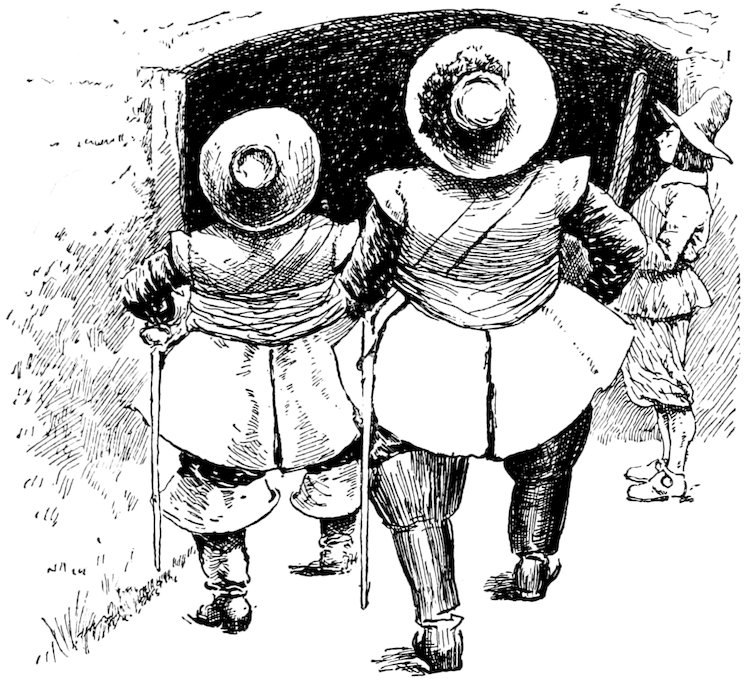
“WITH GREAT CEREMONY, INTO THE FORT.”
150These military compliments being finished,
General Van Poffenburgh escorted his illustrious
visitor, with great ceremony, into the Fort;
attended him throughout the fortifications;
showed him the horn-works, crown-works,
half-moons, and various other outworks, or
rather the places where they ought to be
erected, and where they might be erected if
he pleased; plainly demonstrating that it was
a place of “great capability,” and though at
present but a little redoubt, yet that it was
evidently a formidable fortress, in embryo.
This survey over, he next had the whole garrison
put under arms, exercised, and reviewed;
and concluded by ordering the three bridewell
birds to be hauled out of the black hole,
brought up to the halberds, and soundly
flogged, for the amusement of his visitor, and
to convince him that he was a great disciplinarian.
The cunning Risingh, while he pretended to
be struck dumb outright with the puissance of
the great Van Poffenburgh, took silent note
of the incompetency of his garrison,—of which
he gave a wink to his trusty followers, who
tipped each other the wink, and laughed most
obstreperously—in their sleeves.
151The inspection, review, and flogging being
concluded, the party adjourned to the table;
for among his other great qualities, the general
was remarkably addicted to huge carousals, and
in one afternoon’s campaign would leave more
dead men on the field than he ever did in the
whole course of his military career. Many
bulletins of these bloodless victories do still
remain on record; and the whole province was
once thrown into amaze by the return of one
of his campaigns, wherein it was stated, that,
though, like Captain Bobadil, he had only
twenty men to back him, yet in the short space
of six months he had conquered and utterly
annihilated sixty oxen, ninety hogs, one hundred
sheep, ten thousand cabbages, one thousand
bushels of potatoes, one hundred and
fifty kilderkins of small beer, two thousand
seven hundred and thirty-five pipes, seventy-eight
pounds of sugar-plums, and forty bars
of iron, besides sundry small meats, game,
poultry, and garden-stuff:—an achievement
unparalleled since the days of Pantagruel and
his all-devouring army, and which showed
that it was only necessary to let Van Poffenburgh
and his garrison loose in an enemy’s
country, and in a little while they would breed
a famine, and starve all the inhabitants.
No sooner, therefore, had the general received
152intimation of the visit of Governor
Risingh, than he ordered a great dinner to be
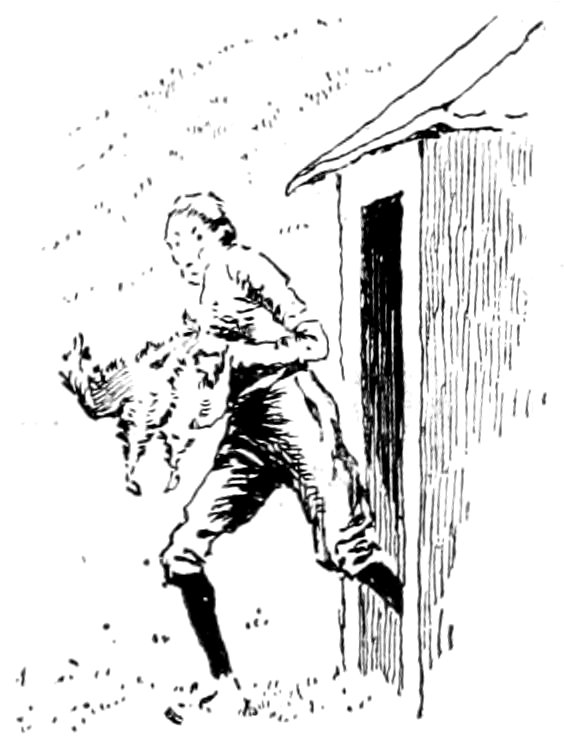
prepared, and privately sent out a detachment
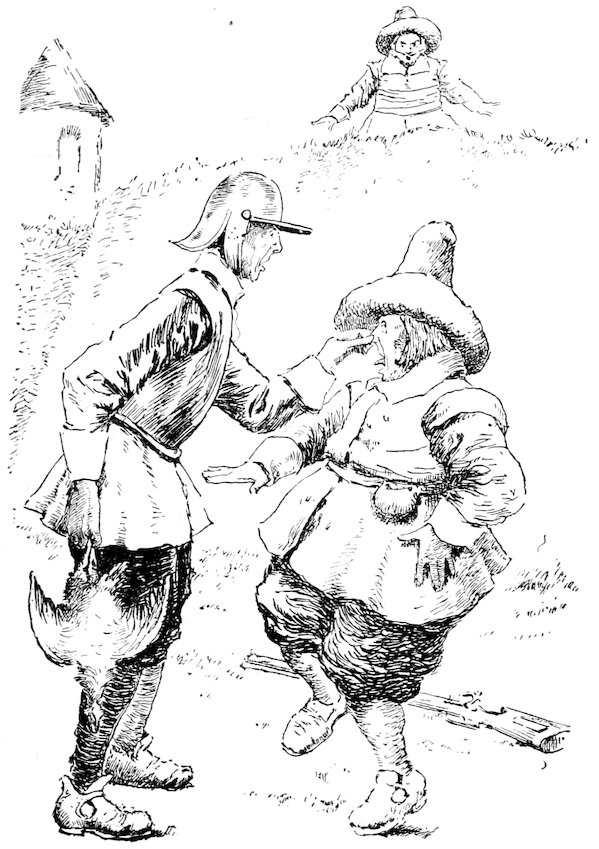
of the most experienced veterans, to rob all
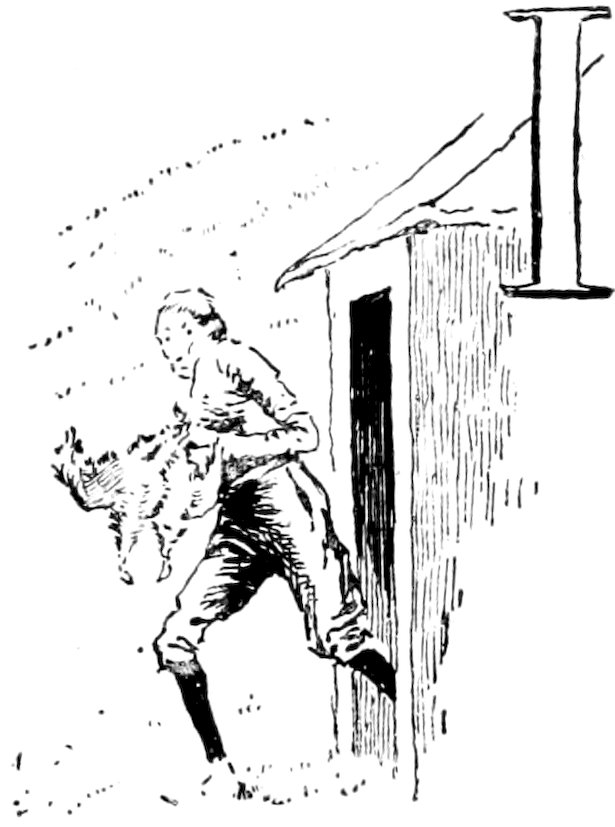
the hen-roosts in the neighborhood, and lay
the pigsties under contribution,—a service
which they discharged with such zeal and
promptitude, that the garrison-table groaned
under the weight of their spoils.
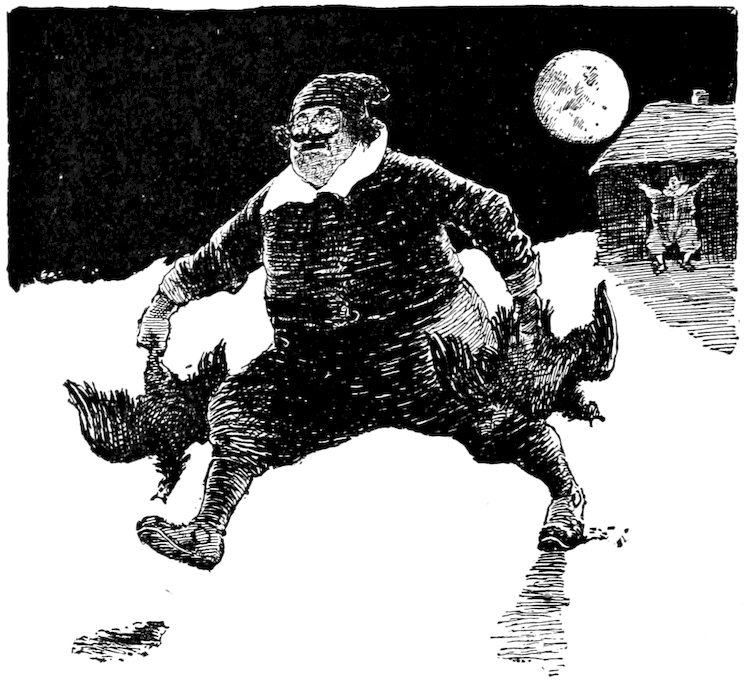
“TO ROB ALL THE HEN-ROOSTS IN THE NEIGHBORHOOD.”
I wish, with all my heart, my readers could
153see the valiant Van Poffenburgh, as he presided
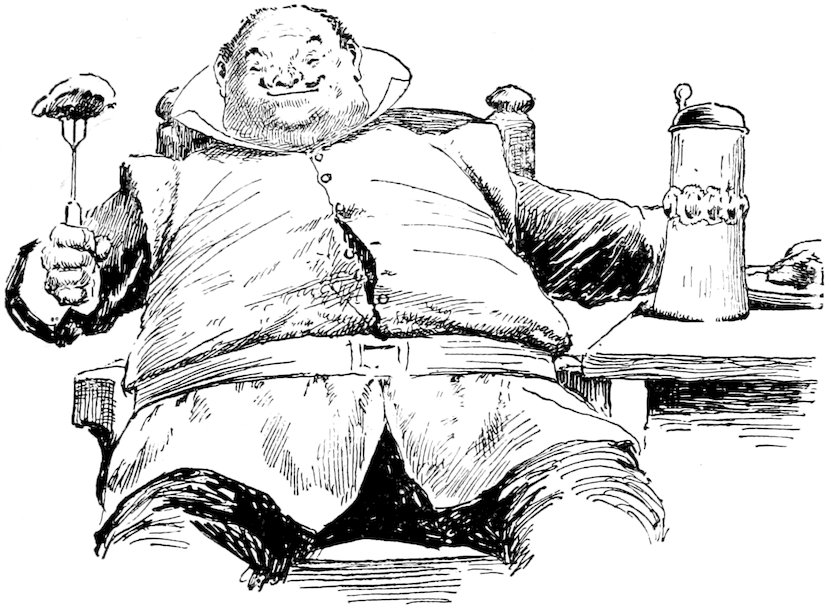
at the head of the banquet; it was a
sight worth beholding:—there he sat, in his
greatest glory, surrounded by his soldiers, like
that famous wine-bibber, Alexander, whose
thirsty virtues he did most ably imitate,—telling
astonishing stories of his hair-breadth adventures
and heroic exploits; at which, though
all his auditors knew them to be incontinent
lies and outrageous gasconadoes, yet did they
cast up their eyes in admiration, and utter
many interjections of astonishment. Nor could
the general pronounce anything that bore the
remotest resemblance to a joke, but the stout
Risingh would strike his brawny fist upon the
table till every glass rattled again, throw himself
back in the chair, utter gigantic peals of
laughter, and swear most horribly it was the
best joke he ever heard in his life. Thus all
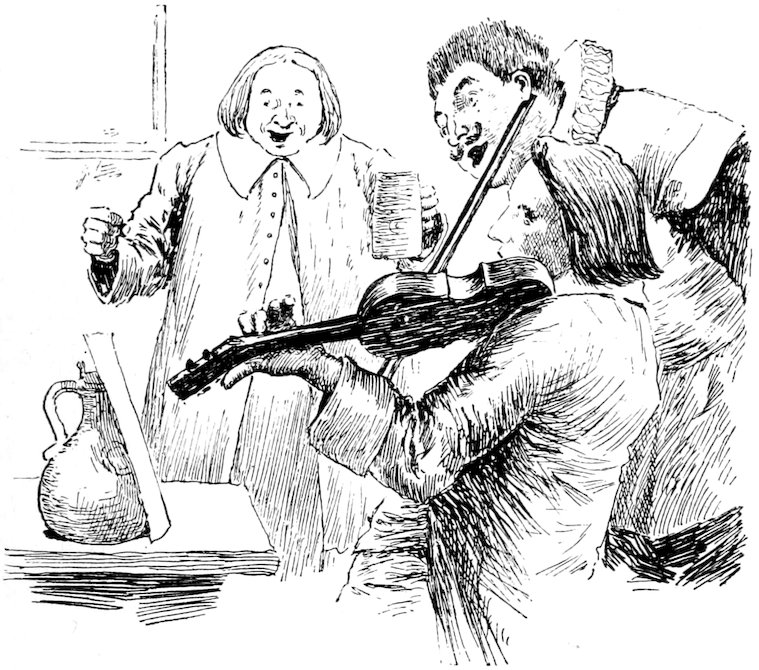
was rout and revelry and hideous carousal
within Fort Casimir; and so lustily did Van
Poffenburgh ply the bottle, that in less than
four short hours he made himself and his
whole garrison, who all sedulously emulated in
the deeds of their chieftain, dead drunk, with
singing songs, quaffing bumpers, and drinking
patriotic toasts, none of which but was as long
as a Welsh pedigree or a plea in chancery.
No sooner did things come to this pass, than
154Risingh and his Swedes, who had cunningly
kept themselves sober, rose on their entertainers,
tied them neck and heels, and took formal
possession of the fort, and all its dependencies,
in the name of Queen Christina of Sweden,
administering at the same time an oath of allegiance
to all the Dutch soldiers who could
be made sober enough to swallow it. Risingh
then put the fortification in order, appointed
his discreet and vigilant friend Suen Schüte,
otherwise called Skytte, a tall, wind-dried,
water-drinking Swede, to the command, and
departed, bearing with him this truly amiable
garrison and its puissant commander, who,
when brought to himself by a sound drubbing,
bore no little resemblance to a “deboshed
fish,” or bloated sea-monster, caught upon
dry land.
The transportation of the garrison was done
to prevent the transmission of intelligence to
New Amsterdam; for much as the cunning
Risingh exulted in his stratagem, yet did he
dread the vengeance of the sturdy Peter Stuyvesant,
whose name spread as much terror in
the neighborhood as did whilom that of the
unconquerable Scanderbeg among his scurvy
enemies the Turks.
155
Whoever first described
common fame, or rumor,
as belonging to
the sager sex, was a
very owl for shrewdness.
She has in truth
certain feminine qualities
to an astonishing
degree, particularly that
benevolent anxiety to
take care of the affairs
of others, which keeps
her continually hunting after secrets, and gadding
about proclaiming them. Whatever is
done openly and in the face of the world, she
takes but transient notice of; but whenever a
transaction is done in a corner, and attempted
to be shrouded in mystery, then her goddess-ship
156is at her wit’s end to find it out, and takes
a most mischievous and lady-like pleasure in
publishing it to the world.
It is this truly feminine propensity which
induces her continually to be prying into the
cabinets of princes, listening at the key-holes
of senate-chambers, and peering through
chinks and crannies, when our worthy Congress
are sitting with closed doors; deliberating
between a dozen excellent modes of ruining
the nation. It is this which makes her so
baneful to all wary statesmen and intriguing
commanders,—such a stumbling-block to private
negotiations and secret expeditions,—betraying
them by means and instruments
which never would have been thought of by
any but a female head.
Thus it was in the case of the affair of Fort
Casimir. No doubt the cunning Risingh
imagined, that, by securing the garrison, he
should for a long time prevent the history of
its fate from reaching the ears of the gallant
Stuyvesant; but his exploit was blown to the
world when he least expected, and by one of
the last beings he would ever have suspected
of enlisting as trumpeter to the wide-mouthed
deity.
157
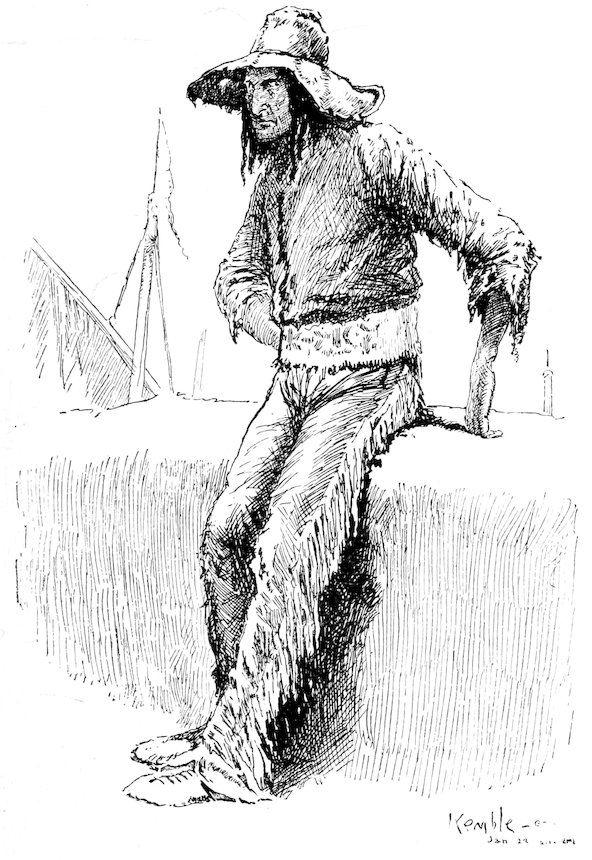
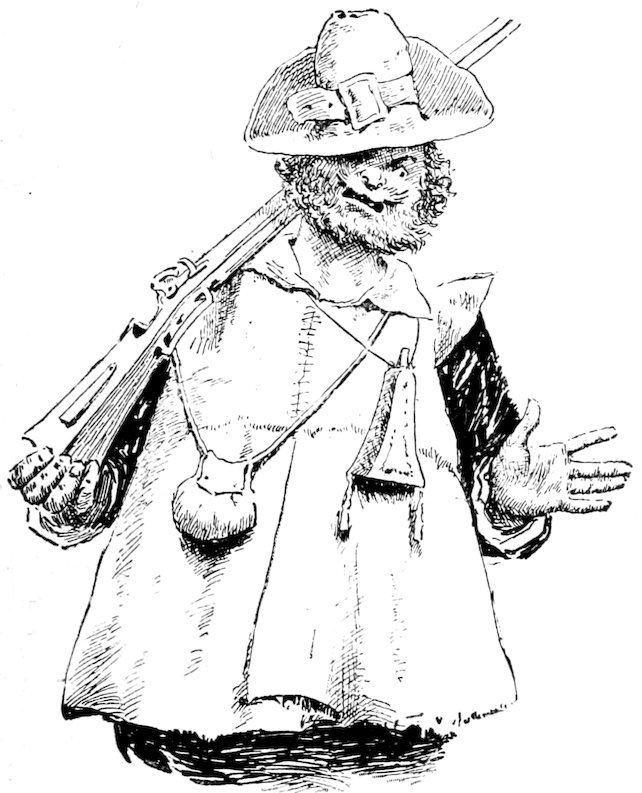
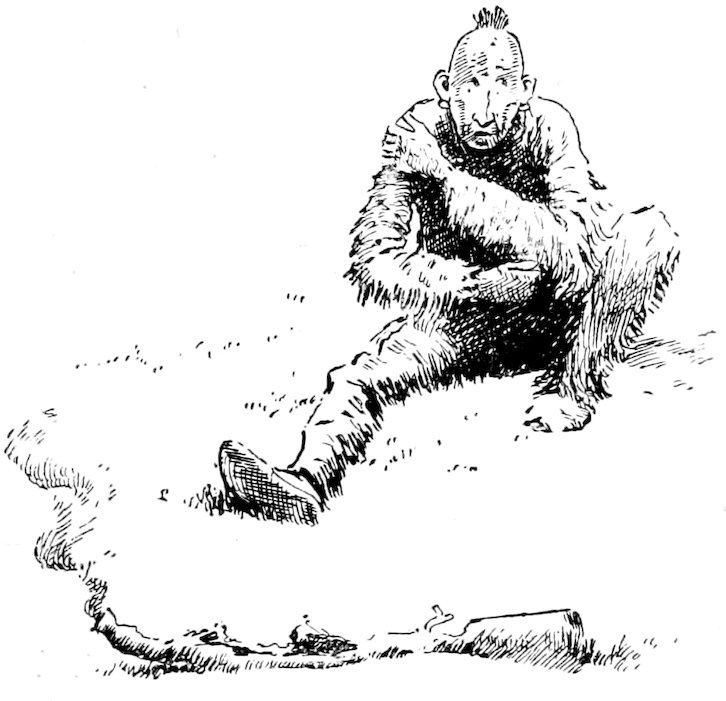
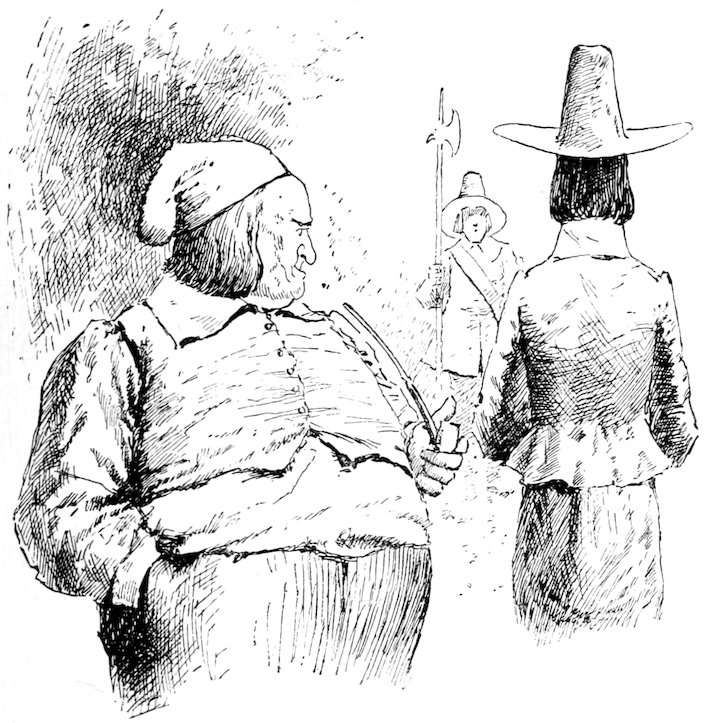
This was one Dirk Schuiler (or Skulker), a
kind of hanger-on to the garrison, who seemed
158to belong to nobody, and in a manner to be
self-outlawed. He was one of those vagabond
cosmopolites who shark about the world as if
they had no right or business in it, and who
infest the skirts of society like poachers and
interlopers. Every garrison and country village
has one or more scape-goats of this kind,
whose life is a kind of enigma, whose existence
is without motive, who comes from the Lord
knows where, who lives the Lord knows how,
and who seems created for no other earthly
purpose but to keep up the ancient and honorable
order of idleness. This vagrant philosopher
was supposed to have some Indian blood
in his veins, which was manifested by a certain
Indian complexion and cast of countenance,
but more especially by his propensities
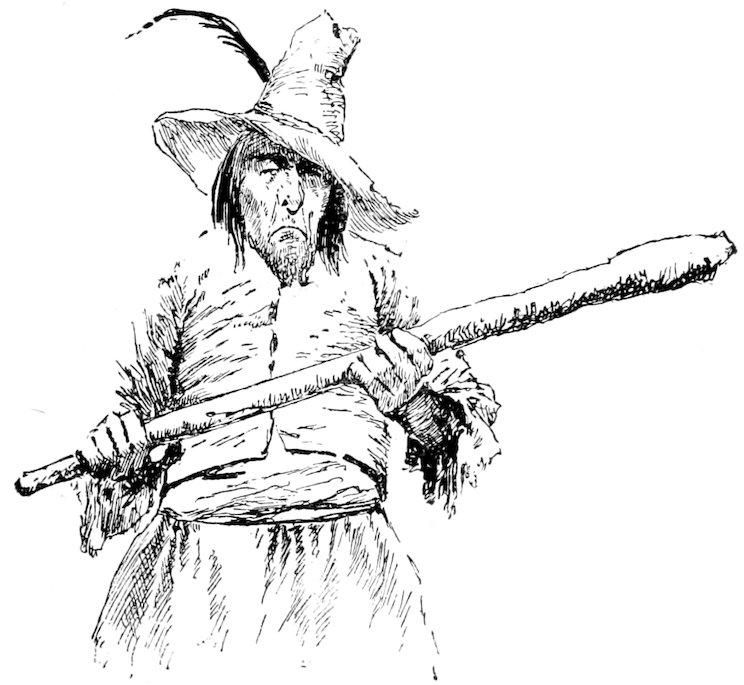
and habits. He was a tall, lank fellow, swift
of foot, and long-winded. He was generally
equipped in a half Indian dress, with belt,
leggings, and moccasins. His hair hung in
straight gallows-locks about his ears, and
added not a little to his sharking demeanor.
It is an old remark, that persons of Indian
mixture are half civilized, half savage, and
half devil,—a third half being provided for
their particular convenience. It is for similar
reasons and probably with equal truth, that the
backwoodsmen of Kentucky are styled half
159man, half horse, and half alligator, by the
settlers on the Mississippi, and held accordingly
in great respect and abhorrence.
The above character may have presented
itself to the garrison as applicable to Dirk
Schuiler, whom they familiarly dubbed Gallows
Dirk. Certain it is, he acknowledged
allegiance to no one,—was an utter enemy to
work, holding it in no manner of estimation,—but
lounging about the fort, depending upon
chance for a subsistence, getting drunk whenever
he could get liquor, and stealing whatever
he could lay his hands on. Every day or
two he was sure to get a sound rib-roasting for
some of his misdemeanors, which, however, as
it broke no bones, he made very light of, and
scrupled not to repeat the offence whenever
another opportunity presented. Sometimes,
in consequence of some flagrant villany, he
would abscond from the garrison, and be
absent for a month at a time, skulking about
the woods and swamps, with a long fowling-piece
on his shoulder, lying in ambush for
game,—or squatting himself down on the edge
of a pond, catching fish for hours together,
and bearing no little resemblance to that
notable bird of the crane family, ycleped the
Mudpoke. When he thought his crimes had
been forgotten or forgiven, he would sneak
160back to the fort with a bundle of skins, or a
load of poultry, which, perchance, he had
stolen, and would exchange them for liquor,
with which having well soaked his carcass, he
would lie in the sun and enjoy all the luxurious
indolence of that swinish philosopher Diogenes.
He was the terror of all the farmyards
in the country into which he made fearful
inroads; and sometimes he would make his
sudden appearance in the garrison at daybreak,
with the whole neighborhood at his heels,—like
the scoundrel thief of a fox, detected in
his maraudings and hunted to his hole.
Such was this Dirk Schuiler; and from the
total indifference he showed to the world and
its concerns, and from his truly Indian stoicism
and taciturnity, no one would ever have
dreamt that he would have been the publisher
of the treachery of Risingh.
When the carousal was going on, which
proved so fatal to the brave Poffenburgh and
his watchful garrison, Dirk skulked about
from room to room, being a kind of privileged
vagrant, or useless hound, whom nobody noticed.
But though a fellow of few words, yet,
like your taciturn people, his eyes and ears were
always open, and in the course of his prowlings
he overheard the whole plot of the Swedes.
Dirk immediately settled in his own mind how
161he should turn the matter to his own advantage.
He played the perfect jack-of-both-sides,
that is to say, he made a prize of everything
that came in his reach, robbed both parties,
stuck the copper-bound cocked hat of the
puissant Van Poffenburgh on his head, whipped
a huge pair of Risingh’s jackboots under his
arm, and took to his heels just before the
catastrophe and confusion at the garrison.
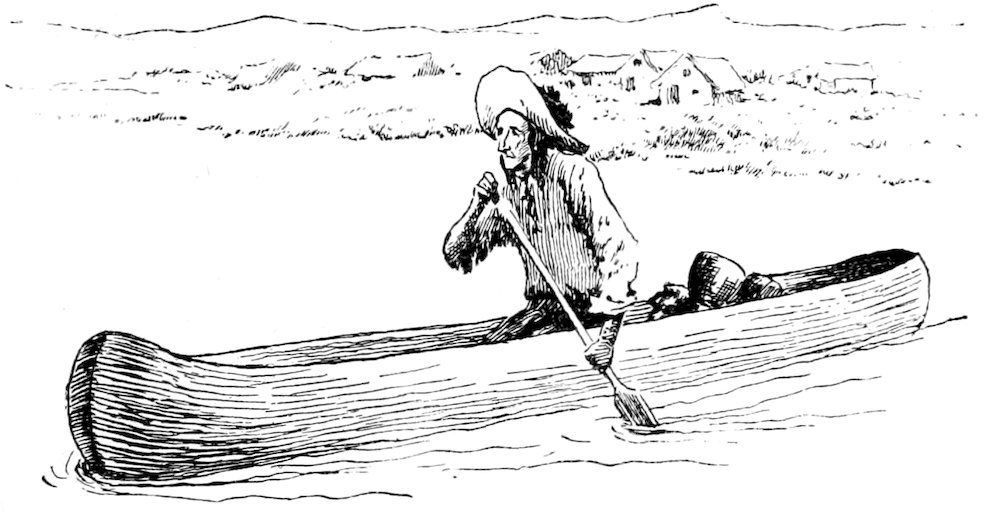
“AND PADDLED OVER TO NEW AMSTERDAM.”
Finding himself completely dislodged from
his haunt in this quarter, he directed his flight
towards his native place, New Amsterdam,
whence he had formerly been obliged to abscond
precipitately, in consequence of misfortune
in business,—that is to say, having been
detected in the act of sheep-stealing. After
wandering many days in the woods, toiling
162through swamps, fording brooks, swimming
various rivers, and encountering a world of
hardships that would have killed any other
being but an Indian, a backwoodsman, or the
devil, he at length arrived, half famished, and
lank as a starved weasel, at Communipaw,
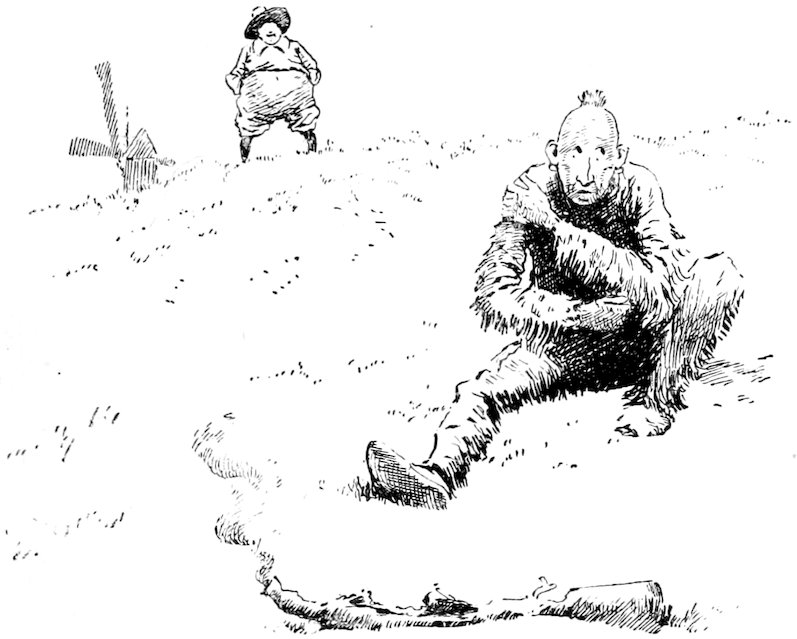
where he stole a canoe, and paddled over to
New Amsterdam. Immediately on landing,
he repaired to Governor Stuyvesant, and, in
more words than he had ever spoken before in
the whole course of his life, gave an account
of the disastrous affair.
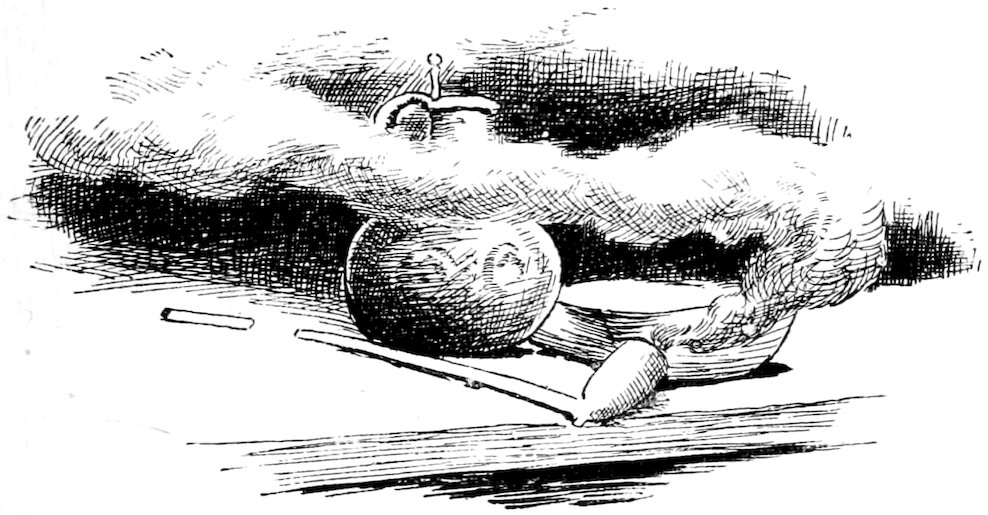
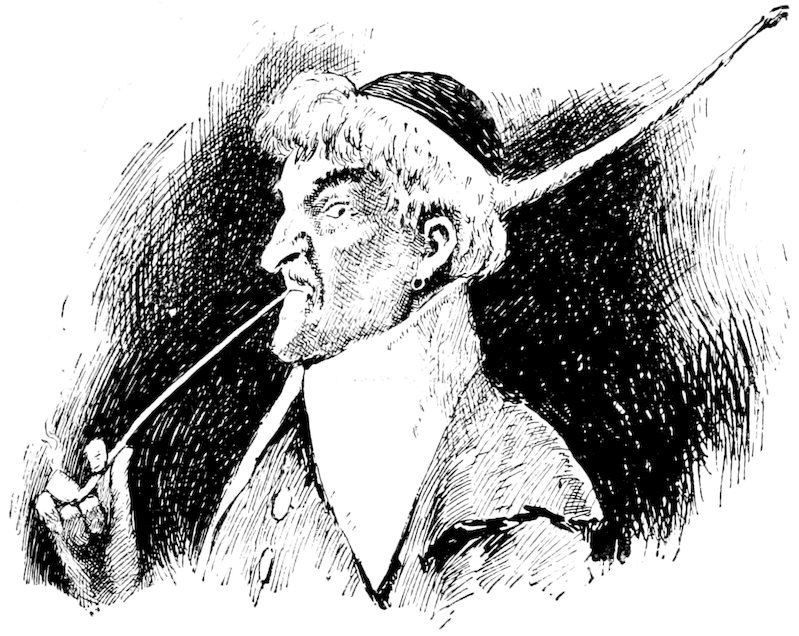
On receiving these direful tidings, the valiant
Peter started from his seat, dashed the pipe he
was smoking against the back of the chimney,
thrust a prodigious quid of tobacco into his
left cheek, pulled up his galligaskins, and
strode up and down the room, humming, as
was customary with him when in a passion, a
hideous northwest ditty. But, as I have before
shown, he was not a man to vent his spleen
in idle vaporing. His first measure, after the
paroxysm of wrath had subsided, was to
stump up stairs to a huge wooden chest, which
served as his armory, from whence he drew
forth that identical suit of regimentals described
in the preceding chapter. In these
portentous habiliments he arrayed himself like
Achilles in the armor of Vulcan, maintaining
163all the while an appalling silence, knitting his
brows, and drawing his breath through his
clenched teeth. Being hastily equipped, he
strode down into the parlor and jerked down
his trusty sword from over the fireplace, where
it was usually suspended; but before he girded
it on his thigh, he drew it from its scabbard,
and as his eye coursed along the rusty blade, a
grim smile stole over his iron visage; it was
the first smile that had visited his countenance
for five long weeks; but every one who beheld
it prophesied that there would soon be warm
work in the province!
Thus armed at all points, with grisly war
depicted in each feature, his very cocked hat
assuming an air of uncommon defiance, he
instantly put himself upon the alert, and
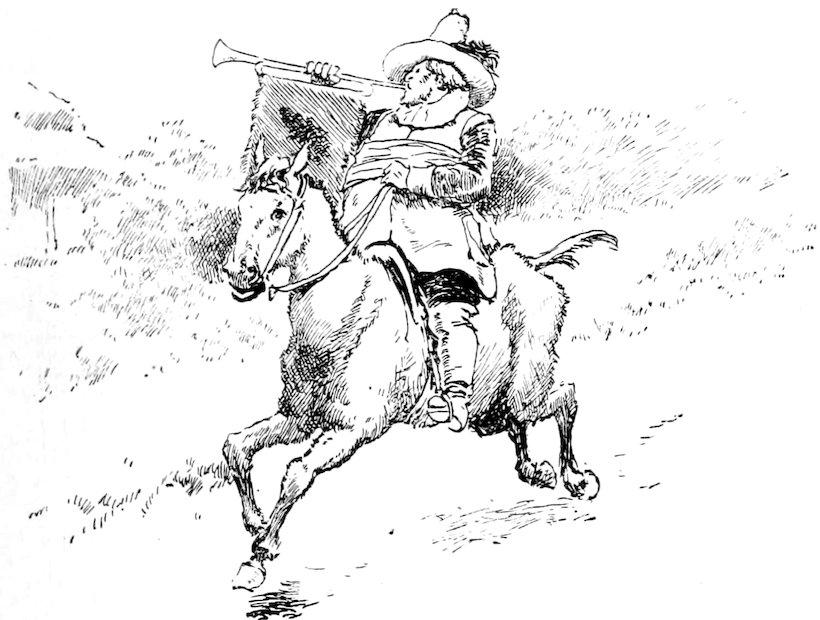
despatched Antony Van Corlear hither and
thither, this way and that way, through all
the muddy streets and crooked lanes of the
city, summoning by sound of trumpet his
trusty peers to assemble in instant council.
This done, by way of expediting matters, according
to the custom of people in a hurry, he
kept in continual bustle, shifting from chair to
chair, popping his head out of every window,
and stumping up and down stairs with his
wooden leg in such brisk and incessant motion,
that, as we are informed by an authentic
164historian of the times, the continual clatter
bore no small resemblance to the music of a
cooper hooping a flour-barrel.
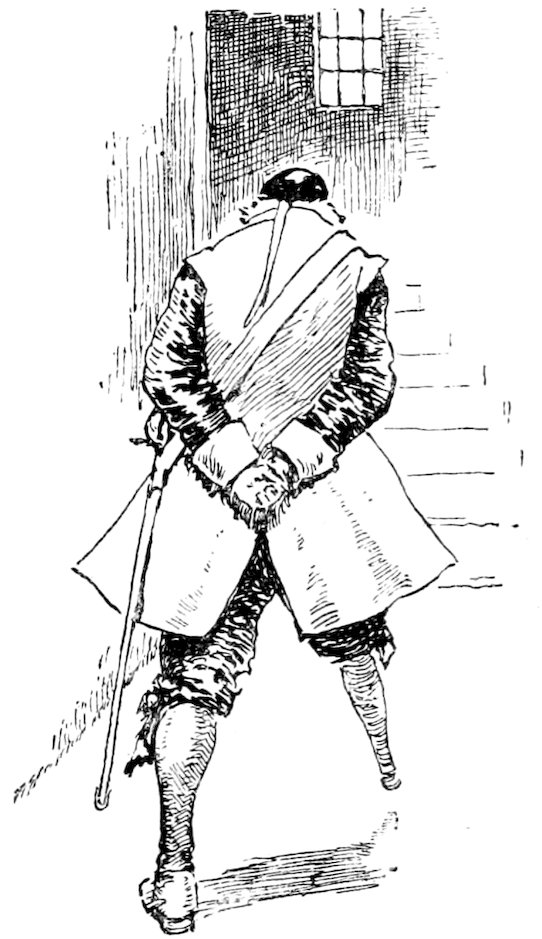
“AND STUMPING UP AND DOWN STAIRS.”
A summons so peremptory, and from a man
of the governor’s mettle, was not to be trifled
with: the sages forthwith repaired to the
council-chamber, seated themselves with the
utmost tranquillity, and lighting their long
pipes, gazed with unruffled composure on his
Excellency and his regimentals,—being, as all
165councillors should be, not easily flustered,
nor taken by surprise. The governor, looking
around for a moment with a lofty and soldier-like
air, and, resting one hand on the pommel
of his sword, and flinging the other forth in a
free and spirited manner, addressed them in a
short but soul-stirring harangue.
I am extremely sorry that I have not the
advantages of Livy, Thucydides, Plutarch,
and others of my predecessors, who were furnished,
as I am told, with the speeches of all
their heroes, taken down in shorthand by the
most accurate stenographers of the time,—whereby
they were enabled wonderfully to
enrich their histories, and delight their readers
with sublime strains of eloquence. Not having
such important auxiliaries, I cannot possibly
pronounce what was the tenor of Governor
Stuyvesant’s speech. I am bold, however, to
say, from the tenor of his character, that he did
not wrap his rugged subject in silks and ermines
and other sickly trickeries of phrase, but
spoke forth like a man of nerve and vigor,
who scorned to shrink in words from those
dangers which he stood ready to encounter in
very deed. This much is certain, that he concluded
by announcing his determination to lead
on his troops in person, and rout these costard-monger
Swedes from their usurped quarters at
166Fort Casimir. To this hardy resolution, such
of his council as were awake gave their usual
signal of concurrence; and as to the rest, who
had fallen asleep about the middle of the harangue
(their “usual custom in the afternoon”),
they made not the least objection.
And now was seen in the fair city of New
Amsterdam a prodigious bustle and preparation
for iron war. Recruiting parties marched
hither and thither, calling lustily upon all the
scrubs, the runagates, and tatterdemalions
of the Manhattoes and its vicinity, who had
any ambition of sixpence a day, and immortal
fame into the bargain, to enlist in the cause of
glory:—for I would have you note that your
warlike heroes who trudge in the rear of conquerors
are generally of that illustrious class
of gentlemen who are equal candidates for the
army or the bridewell, the halberds or the
whipping-post,—for whom dame Fortune has
cast an even die, whether they shall make their
exit by the sword or the halter, and whose
deaths shall, at all events, be a lofty example
to their countrymen.
But, notwithstanding all this martial rout
and invitation, the ranks of honor were but
scantily supplied, so averse were the peaceful
burghers of New Amsterdam from enlisting in
foreign broils, of stirring beyond that home
167which rounded all their earthly ideas. Upon
beholding this, the great Peter, whose noble
heart was all on fire with war and sweet revenge,
determined to wait no longer for the
tardy assistance of these oily citizens, but to
muster up his merry men of the Hudson,
who, brought up among woods, and wilds, and
savage beasts, like our yeomen of Kentucky,
delighted in nothing so much as desperate adventures
and perilous expeditions through the
wilderness. Thus resolving, he ordered his
trusty squire Antony Van Corlear to have his
state galley prepared and duly victualled;
which being performed, he attended public
service at the great church of St. Nicholas, like
a true and pious governor; and then leaving
peremptory orders with his council to have the
chivalry of the Manhattoes marshalled out and
appointed against his return, departed upon
his recruiting voyage up the waters of the
Hudson.
168
Now did the soft breezes
of the south steal sweetly
over the face of nature,
tempering the panting
heat of summer into
genial and prolific
warmth; when that
miracle of hardihood
and chivalric virtue, the
dauntless Peter Stuyvesant,
spread his canvas
to the wind, and departed
from the fair island of Manna-hata. The
galley in which he embarked was sumptuously
adorned with pendants and streamers of gorgeous
dyes, which fluttered gayly in the wind,
or drooped their ends into the bosom of the
stream. The bow and poop of this majestic
vessel were gallantly bedight, after the rarest
169Dutch fashion, with figures of little pursy
Cupids with periwigs on their heads, and bearing
in their hands garlands of flowers, the like
of which are not to be found in any book of
botany, being the matchless flowers which
flourished in the golden age, and exist no
longer, unless it be in the imaginations of ingenious
carvers of wood and discolorers of
canvas.
Thus rarely decorated, in style befitting the
puissant potentate of the Manhattoes, did the
galley of Peter Stuyvesant launch forth upon
the bosom of the lordly Hudson, which, as it
rolled its broad waves to the ocean, seemed to
pause for a while and swell with pride, as if
conscious of the illustrious burden it sustained.
But trust me, gentlefolk, far other was the
scene presented to the contemplation of the
crew from that which may be witnessed at this
degenerate day. Wildness and savage majesty
reigned on the borders of this mighty river;
the hand of cultivation had not as yet laid
low the dark forest, and tamed the features of
the landscape; nor had the frequent sail of
commerce broken in upon the profound and
awful solitude of ages. Here and there might
be seen a rude wigwam perched among the
cliffs of the mountains, with its curling column
of smoke mounting in the transparent atmosphere,—but
170so loftily situated that the whoopings
of the savage children, gambolling on the
margin of the dizzy heights, fell almost as
faintly on the ear as do the notes of the lark
when lost in the azure vault of heaven. Now
and then, from the beetling brow of some precipice,
the wild deer would look timidly down
upon the splendid pageant as it passed below,
and then, tossing his antlers in the air, would
bound away into the thickest of the forest.
Through such scenes did the stately vessel
of Peter Stuyvesant pass. Now did they skirt
the bases of the rocky heights of Jersey, which
spring up like everlasting walls, reaching from
the waves unto the heavens, and were fashioned,
if tradition may be believed, in times
long past, by the mighty spirit Manetho, to
protect his favorite abodes from the unhallowed
eyes of mortals. Now did they career it
gayly across the vast expanse of Tappan Bay,
whose wide-extended shores present a variety
of delectable scenery,—here the bold promontory,
crowned with embowering trees, advancing
into the bay,—there the long woodland
slope, sweeping up from the shore in rich
luxuriance, and terminating in the upland
precipice,—while at a distance a long waving
line of rocky heights threw their gigantic
shades across the water. Now would they
171pass where some modest little interval, opening
among these stupendous scenes, yet retreating
as it were for protection into the embraces
of the neighboring mountains, displayed a
rural paradise, fraught with sweet and pastoral
beauties,—the velvet-tufted lawn, the bushy
copse, the tinkling rivulet, stealing through
the fresh and vivid verdure, on whose banks
was situated some little Indian village, or,
peradventure, the rude cabin of some solitary
hunter.
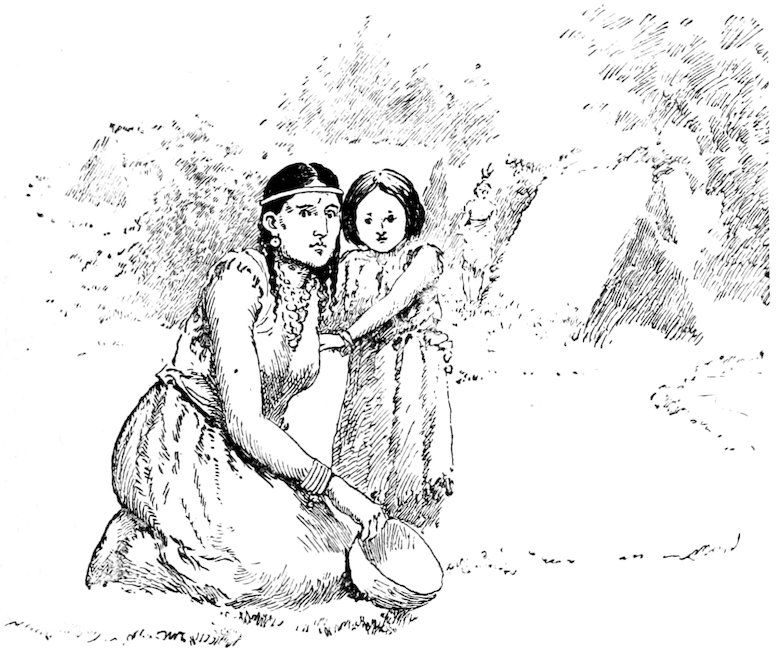
“SOME LITTLE INDIAN VILLAGE.”
172The different periods of the revolving day
seemed each, with cunning magic, to diffuse a
different charm over the scene. Now would
the jovial sun break gloriously from the east,
blazing from the summits of the hills, and
sparkling the landscape with a thousand dewy
gems; while along the borders of the river
were seen the heavy masses of mist, which,
like midnight caitiffs disturbed at his approach,
made a sluggish retreat, rolling in
sullen reluctance up the mountains. At such
times all was brightness, and life, and gayety,—the
atmosphere was of an indescribable pureness
and transparency,—the birds broke forth
in wanton madrigals, and the freshening
breezes wafted the vessel merrily on her course.
But when the sun sunk amid a flood of glory
in the west, mantling the heavens and the
earth with a thousand gorgeous dyes, then all
was calm, and silent, and magnificent. The
late swelling sail hung lifelessly against the
mast;—the seamen, with folded arms, leaned
against the shrouds, lost in that involuntary
musing which the sober grandeur of nature
commands in the rudest of her children. The
vast bosom of the Hudson was like an unruffled
mirror, reflecting the golden splendor of
the heavens, excepting that now and then a
bark canoe would steal across its surface, filled
173with painted savages, whose gay feathers
glared brightly as perchance a lingering ray
of the setting sun gleamed upon them from
the western mountains.
But when the hour of twilight spread its majestic
mists around, then did the face of nature
assume a thousand fugitive charms, which to
the worthy heart that seeks enjoyment in the
glorious works of its Maker are inexpressibly
captivating. The mellow dubious light that
prevailed just served to tinge with illusive
colors the softened features of the scenery.
The deceived but delighted eye sought vainly
to discern in the broad masses of shade the
separating line between the land and water,
or to distinguish the fading objects that seemed
sinking into chaos. Now did the busy fancy
supply the feebleness of vision, producing with
industrious craft a fairy creation of her own.
Under her plastic wand the barren rocks
frowned upon the watery waste in the semblance
of lofty towers and high embattled
castles,—trees assumed the direful forms of
mighty giants, and the inaccessible summits
of the mountains seemed peopled with a thousand
shadowy beings.
Now broke forth from the shores the notes
of an innumerable variety of insects, which
filled the air with a strange but not inharmonious
174concert, while ever and anon was heard
the melancholy plaint of the whippoorwill,
who, perched on some lone tree, wearied the
ear of night with his incessant moanings. The
mind, soothed into a hallowed melancholy,
listened with pensive stillness to catch and distinguish
each sound that vaguely echoed from
the shore,—now and then startled perchance
by the whoop of some straggling savage, or by
the dreary howl of a wolf, stealing forth upon
his nightly prowlings.
175Thus happily did they pursue their course,
until they entered upon those awful defiles
denominated The Highlands; where it would
seem that the gigantic Titans had erst waged
their impious war with heaven, piling up cliffs
on cliffs, and hurling vast masses of rock in
wild confusion. But in sooth very different is
the history of these cloud-capt mountains.
These in ancient days, before the Hudson
poured its waters from the lakes, formed one
vast prison, within whose rocky bosom the
omnipotent Manetho confined the rebellious
spirits who repined at his control. Here,
bound in adamantine chains, or jammed in
rifted pines, or crushed by ponderous rocks,
they groaned for many an age. At length the
conquering Hudson, in its career towards the
ocean, burst open their prison-house, rolling
its tide triumphantly through the stupendous
ruins.
Still, however, do many of them lurk about
their old abodes; and these it is, according to
venerable legends, that cause the echoes which
resound throughout these awful solitudes,—which
are nothing but their angry clamors
when any noise disturbs the profoundness of
their repose. For when the elements are agitated
by tempest, when the winds are up and
the thunder rolls, then horrible is the yelling
176and howling of these troubled spirits, making
the mountains to rebellow with their hideous
uproar; for at such times it is said that they
think the great Manetho is returning once
more to plunge them in gloomy caverns, and
renew their intolerable captivity.
But all these fair and glorious scenes were
lost upon the gallant Stuyvesant; naught occupied
his mind but thoughts of iron war, and
proud anticipations of hardy deeds of arms.
Neither did his honest crew trouble their heads
with any romantic speculations of the kind.
The pilot at the helm quietly smoked his pipe,
thinking of nothing either past, present, or to
come;—those of his comrades who were not industriously
smoking under the hatches were listening
with open mouths to Antony Van Corlear,
who, seated on the windlass, was relating
to them the marvellous history of those myriads
of fire-flies that sparkled like gems and spangles
upon the dusky robe of night. These, according
to tradition, were originally a race of pestilent
sempiternous beldames, who peopled these
parts long before the memory of man, being of
that abominated race emphatically called brimstones,
and who, for their innumerable sins
against the children of men, and to furnish an
awful warning to the beauteous sex, were
doomed to infest the earth in the shape of these
177threatening and terrible little bugs, enduring
the internal torments of that fire which they formerly
carried in their hearts and breathed forth
in their words, but now are sentenced to bear
about forever—in their tails!
And now I am going to tell a fact, which I
doubt much my readers will hesitate to believe;
but if they do, they are welcome not to
believe a word in this whole history, for nothing
which it contains is more true. It must
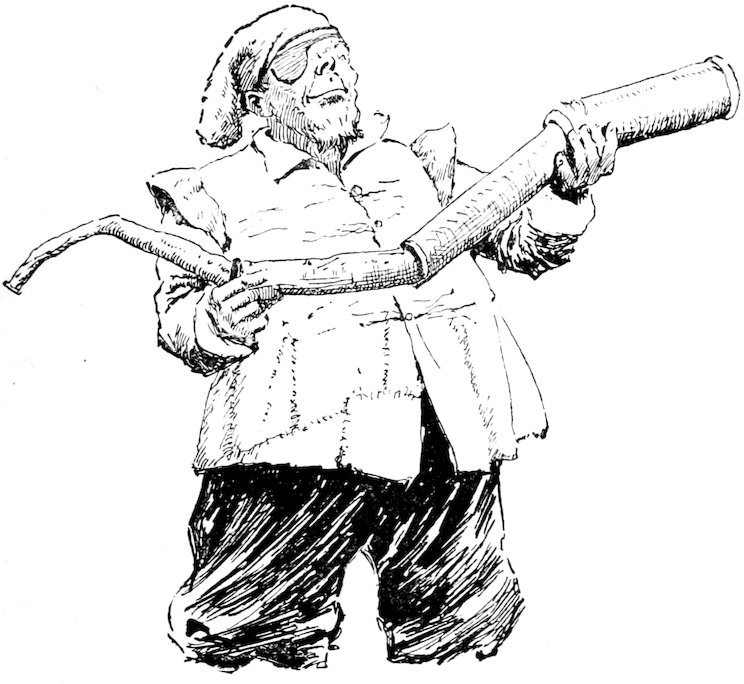
be known that the nose of Antony the trumpeter
was of a very lusty size, strutting boldly
from his countenance like a mountain of Golconda;
being sumptuously bedecked with rubies
and other precious stones,—the true regalia
of a king of good fellows, which jolly Bacchus
grants to all who bouse it heartily at the
flagon. Now thus it happened, that bright
and early in the morning, the good Antony,
having washed his burly visage, was leaning
over the quarter-railing of the galley, contemplating
it in the glassy wave below. Just at
this moment the illustrious sun, breaking in all
its splendor from behind a high bluff of the
highlands, did dart one of his most potent
beams full upon the refulgent nose of the
sounder of brass—the reflection of which shot
straightway down, hissing-hot, into the water,
and killed a mighty sturgeon that was sporting
178beside the vessel! This huge monster,
being with infinite labor hoisted on board, furnished
a luxurious repast to all the crew, being
accounted of excellent flavor, excepting about
the wound, where it smacked a little of brimstone;
and this, on my veracity, was the first
time that ever sturgeon was eaten in these
parts by Christian people.[14]
When this astonishing miracle came to be
made known to Peter Stuyvesant, and he
tasted of the unknown fish, he, as may well
be supposed, marvelled exceedingly; and as a
monument thereof, he gave the name of Antony’s
Nose to a stout promontory in the neighborhood;
and it has continued to be called
Antony’s Nose ever since that time.
179
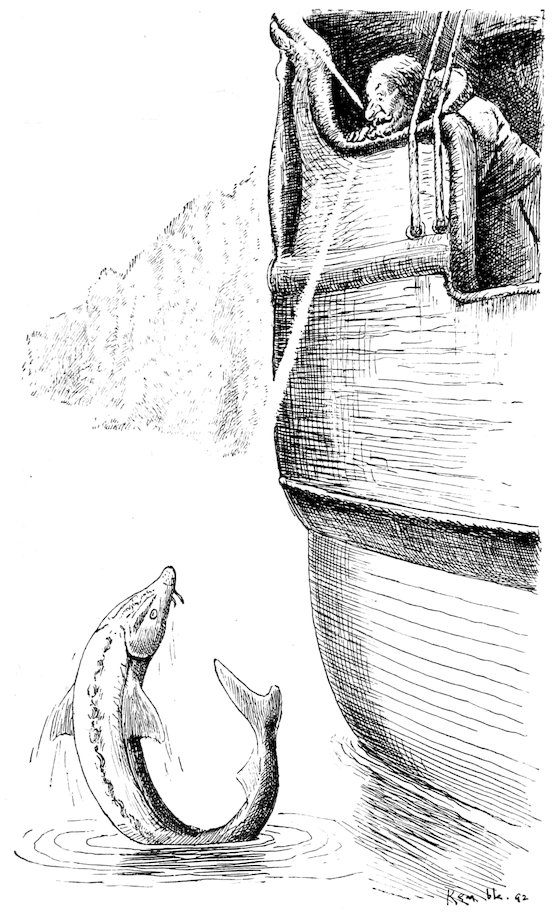
THE KILLING OF THE STURGEON.
But hold: whither am I wandering? By
the mass, if I attempt to accompany the good
Peter Stuyvesant on this voyage, I shall never
make an end; for never was there a voyage so
fraught with marvellous incidents, nor a river
so abounding with transcendent beauties,
worthy of being severally recorded. Even
180now I have it on the point of my pen to relate
how his crew were most horribly frightened,
on going on shore above the highlands, by a
gang of merry roistering devils, frisking and
curveting on a flat rock, which projected into
the river, and which is called the Duyvel’s
Dans-Kamer to this very day. But no!
Diedrich Knickerbocker, it becomes thee not
to idle thus in thy historic warfaring.
Recollect that, while dwelling with the fond
garrulity of age over these fairy scenes, endeared
to thee by the recollections of thy
youth, and the charms of a thousand legendary
tales, which beguiled the simple ear of thy
childhood,—recollect that thou art trifling with
those fleeting moments which should be devoted
to loftier themes. Is not Time—relentless
Time!—shaking, with palsied hand, his
almost exhausted hour-glass before thee?
Hasten then to pursue thy weary task, lest
the last sands be run ere thou hast finished
thy history of the Manhattoes.
Let us, then, commit the dauntless Peter,
his brave galley, and his loyal crew, to the
protection of the blessed St. Nicholas; who, I
have no doubt, will prosper him in his voyage,
while we await his return at the great city of
New Amsterdam.
181
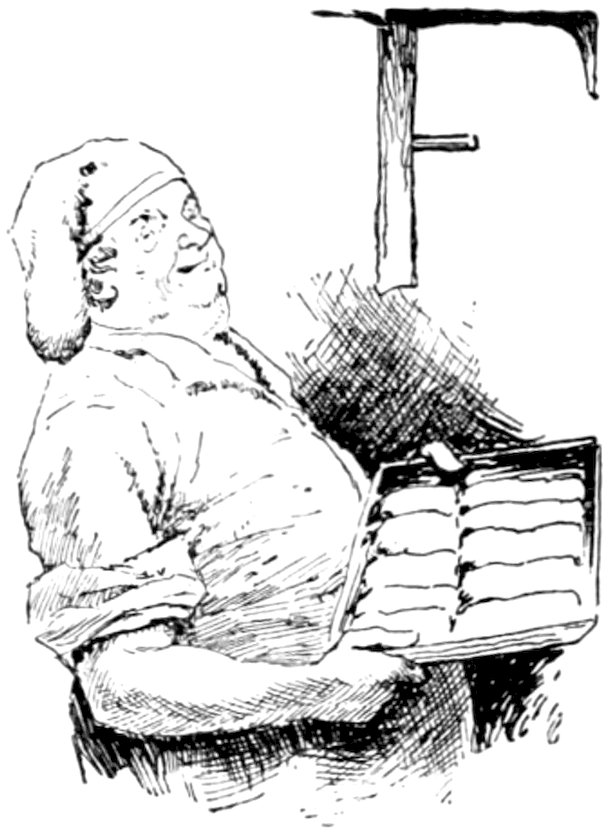
While thus the enterprising
Peter was coasting,
with flowing sail, up
the shores of the lordly
Hudson, and arousing
all the phlegmatic little
Dutch settlements upon
its borders, a great and
puissant concourse of
warriors was assembling
at the city of
New Amsterdam. And
here that invaluable
fragment of antiquity, the Stuyvesant manuscript,
is more than commonly particular; by
which means I am enabled to record the illustrious
host that encamped itself in the public
182square in front of the fort, at present denominated
the Bowling Green.
In the centre, then, was pitched the tent of
the men of battle of the Manhattoes, who,
being the inmates of the metropolis, composed
the life-guards of the governor. These were
commanded by the valiant Stoffel Brinkerhoff,
who whilom had acquired such immortal fame
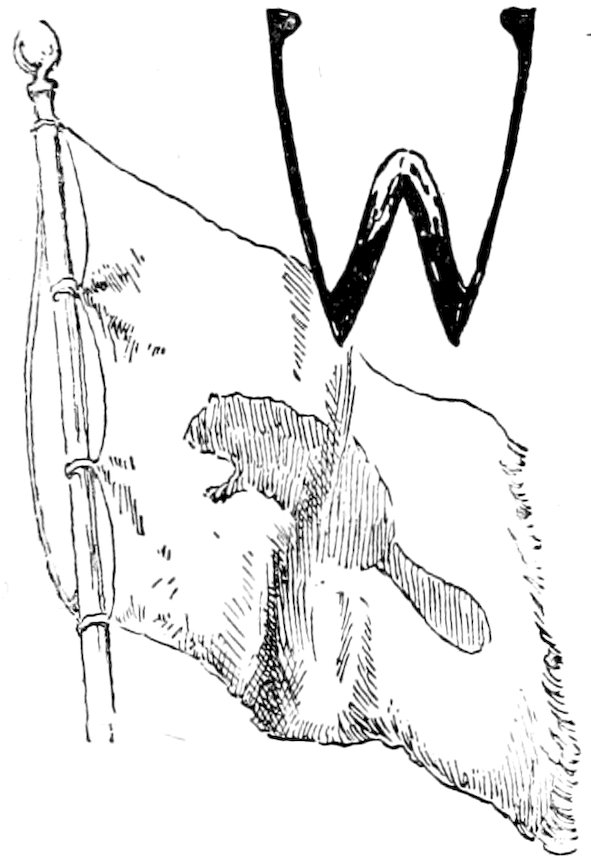
at Oyster Bay; they displayed as a standard a
beaver rampant on a field of orange, being the
arms of the province, and denoting the persevering
industry and the amphibious origin of
the Nederlanders.[15]
On their right hand might be seen the vassals
of that renowned Mynheer, Michael Paw,[16]
who lorded it over the fair regions of ancient
Pavonia, and the lands away south even unto
183the Navesink mountains,[17] and was moreover
patroon of Gibbet Island. His standard was
borne by his trusty squire, Cornelius Van
Vorst; consisting of a huge oyster recumbent
upon a sea-green field; being the armorial
bearings of his favorite metropolis, Communipaw.
He brought to the camp a stout force of
warriors, heavily armed, being each clad in
ten pair of linsey-woolsey breeches, and overshadowed
by broad-brimmed beavers, with
short pipes twisted in their hat-bands. These
were the men who vegetated in the mud along
the shores of Pavonia, being of the race of
genuine copperheads, and were fabled to have
sprung from oysters.
At a little distance was encamped the tribe
of warriors who came from the neighborhood
of Hell-gate. These were commanded by the
Suy Dams, and the Van Dams,—incontinent
hard swearers, as their names betoken. They
were terrible-looking fellows, clad in broad-skirted
gaberdines, of that curious-colored
cloth called thunder and lightning,—and bore
as a standard three devil’s darning-needles,
volant, in a flame-colored field.
184
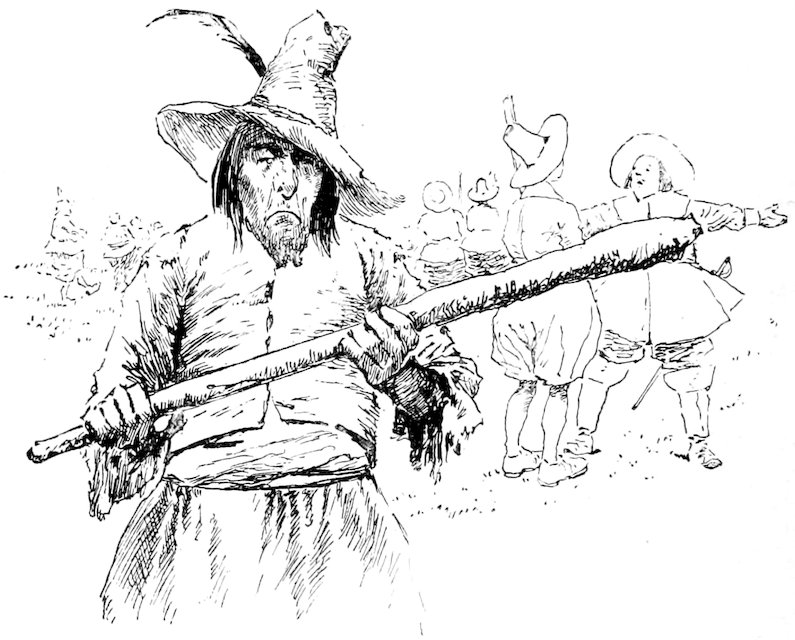
“THESE WERE OF A SOUR ASPECT.”
Hard by was the tent of the men of battle
from the marshy borders of the Waale-Boght[18]
and the country thereabouts. These were of a
sour aspect, by reason that they lived on crabs,
which abound in these parts. They were the
first institutors of that honorable order of
knighthood called Fly-market shirks, and, if
tradition speak true, did likewise introduce
the far-famed step in dancing called “double
trouble.” They were commanded by the fearless
185Jacobus Varra Vanger,—and had, moreover,
a jolly band of Breuckelen[19] ferry-men,
who performed a brave concerto on conch
shells.
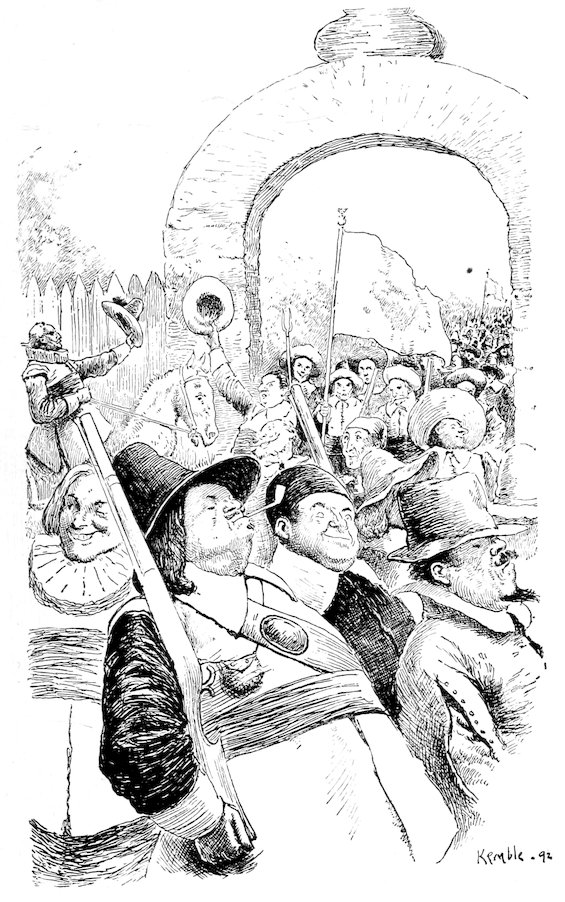
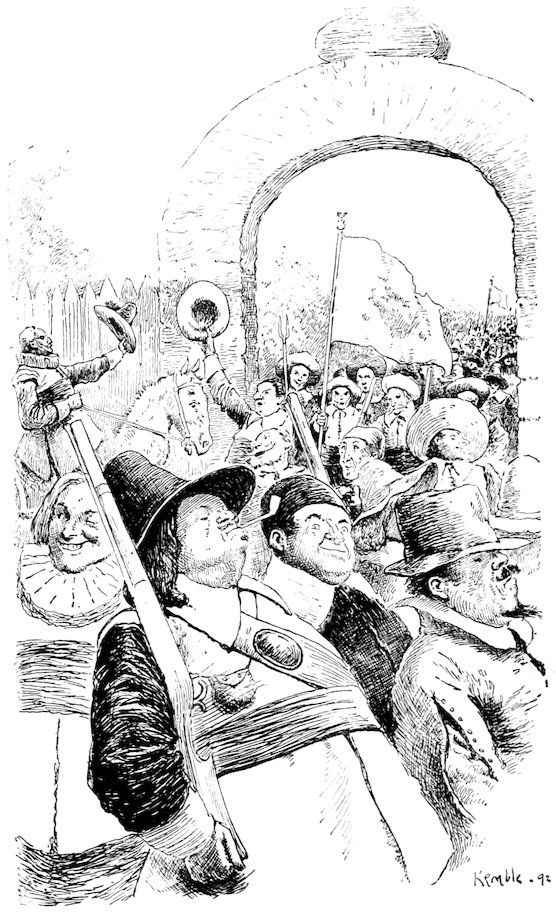
“AS THEY DEFILED THROUGH THE PRINCIPAL GATE THAT STOOD AT THE HEAD OF WALL STREET.”
186But I refrain from pursuing this minute
description, which goes on to describe the warriors
of Bloemen-dael, and Weehawk, and Hoboken,
and sundry other places, well known in
history and song; for now do the notes of martial
music alarm the people of New Amsterdam,
sounding afar from beyond the walls of
the city. But this alarm was in a little while
relieved, for lo! from the midst of a vast cloud
of dust, they recognized the brimstone-colored
breeches and splendid silver leg, of Peter Stuyvesant,
glaring in the sunbeams; and beheld
him approaching at the head of a formidable
army, which he had mustered along the banks
of the Hudson. And here the excellent but
anonymous writer of the Stuyvesant manuscript
breaks out into a brave and glorious description
of the forces, as they defiled through
the principal gate of the city, that stood by the
head of Wall Street.
First of all came the Van Bummels, who
inhabit the pleasant borders of the Bronx:
these were short fat men, wearing exceeding
large trunk-breeches, and were renowned for
187feats of the trencher. They were the first inventors
of suppawn, or mush and milk.—Close
in their rear marched the Van Vlotens,
of Kaatskill, horrible quaffers of new cider,
and arrant braggarts in their liquor.—After
them came the Van Pelts of Groodt Esopus,
dexterous horsemen, mounted upon goodly
switch-tailed steeds of the Esopus breed.
These were mighty hunters of minks and
musk-rats, whence came the word Peltry.—Then
the Van Nests of Kinderhoeck, valiant
robbers of birds’-nests, as their name denotes.
To these, if reports may be believed, we are
indebted for the invention of slap-jacks, or
buckwheat-cakes.—Then the Van Higginbottoms,
of Wapping’s creek. These came
armed with ferules and birchen rods, being a
race of schoolmasters, who first discovered the
marvellous sympathy between the seat of honor
and the seat of intellect,—and that the shortest
way to get knowledge into the head was to
hammer it into the bottom.—Then the Van
Grolls of Antony’s Nose, who carried their
liquor in fair round little pottles, by reason
they could not bouse it out of their canteens,
having such rare long noses.—Then the Gardeniers
of Hudson and thereabouts, distinguished
by many triumphant feats, such as
robbing watermelon-patches, smoking rabbits
188out of their holes, and the like, and by being
great lovers of roasted pigs’ tails. These were
the ancestors of the renowned congressman of
that name.—Then the Van Hœsens, of Sing-Sing,
great choristers and players upon the
jews-harp. These marched two and two,
singing the great song of St. Nicholas.—Then
the Couenhovens, of Sleepy Hollow. These
gave birth to a jolly race of publicans, who
first discovered the magic artifice of conjuring
a quart of wine into a pint bottle.—Then the
Van Kortlandts, who lived on the wild banks
of the Croton, and were great killers of wild
ducks, being much spoken of for their skill in
shooting with the long bow.—Then the Van
Bunschotens, of Nyack and Kakiat, who were
the first that did ever kick with the left foot.
They were gallant bushwhackers and hunters
of raccoons by moonlight.—Then the Van
Winkles of Haerlem, potent suckers of eggs,
and noted for running of horses, and running
up of scores at taverns. They were the first
that ever winked with both eyes at once.—Lastly
came the Knickerbockers, of the
great town of Schaghtikoke, where the folk
lay stones upon the houses in windy weather,
lest they should be blown away. These derive
their name, as some say, from Knicker, to
shake, and Beker, a goblet, indicating thereby
189that they were sturdy toss-pots of yore; but,
in truth, it was derived from Knicker, to nod,
and Boeken, books: plainly meaning that they
were great nodders or dozers over books.
From them did descend the writer of this
history.
Such was the legion of sturdy bush-beaters
that poured in at the grand gate of New Amsterdam;
the Stuyvesant manuscript indeed
speaks of many more, whose names I omit to
mention, seeing that it behooves me to hasten
to matters of greater moment. Nothing could
surpass the joy and martial pride of the lion-hearted
Peter as he reviewed this mighty host
of warriors, and he determined no longer to
defer the gratification of his much-wished-for
revenge upon the scoundrel Swedes at Fort
Casimir.
But before I hasten to record those unmatchable
events which will be found in the
sequel of this faithful history, let me pause to
notice the fate of Jacobus Van Poffenburgh,
the discomfited commander-in-chief of the
armies of the New Netherlands. Such is the
inherent uncharitableness of human nature,
that scarcely did the news become public of
his deplorable discomfiture at Fort Casimir,
than a thousand scurvy rumors were set afloat
in New Amsterdam, wherein it was insinuated
190that he had in reality a treacherous understanding
with the Swedish commander; that
he had long been in the practice of privately
communicating with the Swedes; together
with divers hints about “secret-service
money.” To all of which deadly charges I
do not give a jot more credit than I think they
deserve.
Certain it is, that the general vindicated his
character by the most vehement oaths and protestations,
and put every man out of the ranks
of honor who dared to doubt his integrity.
Moreover, on returning to New Amsterdam,
he paraded up and down the streets with a
crew of hard swearers at his heels,—sturdy bottle-companions,
whom he gorged and fattened,
and who were ready to bolster him through all
the courts of justice,—heroes of his own kidney,
fierce-whiskered, broad-shouldered, colbrand-looking
swaggerers,—not one of whom
but looked as though he could eat up an ox,
and pick his teeth with the horns. These lifeguard-men
quarrelled all his quarrels, were
ready to fight all his battles, and scowled at
every man that turned up his nose at the general,
as though they would devour him alive.
Their conversation was interspersed with
oaths like minute guns, and every bombastic
rodomontade was rounded off by a thundering
191execration, like a patriotic toast honored with
a discharge of artillery.
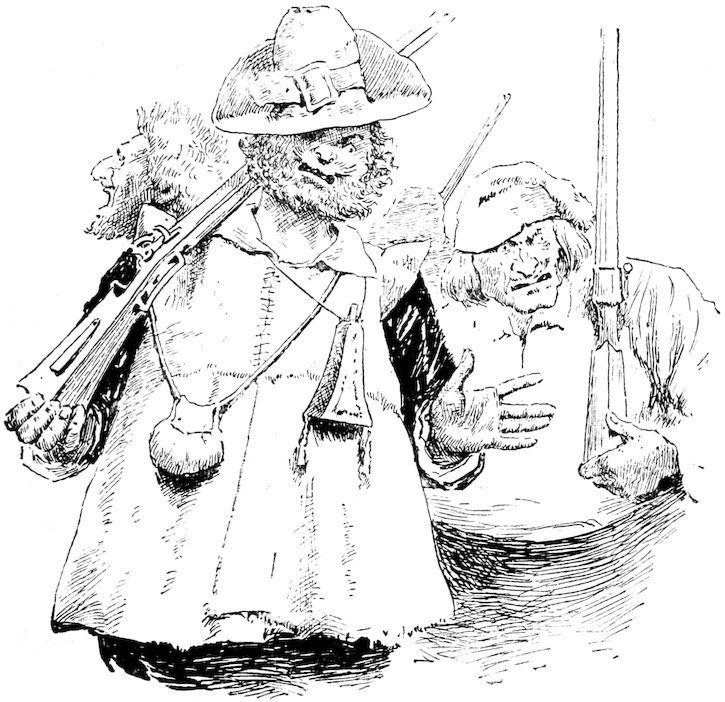
“A CREW OF HARD SWEARERS.”
All these valorous vaporings had a considerable
effect in convincing certain profound
sages, who began to think the general a hero
of unmatchable loftiness and magnanimity of
soul, particularly as he was continually protesting
on the honor of a soldier,—a marvellously
high-sounding asseveration. Nay, one
192of the members of the council went so far as to
propose they should immortalize him by an
imperishable statue of plaster-of-Paris.
But the vigilant Peter the Headstrong was
not thus to be deceived. Sending privately
for the commander-in-chief of all the armies,
and having heard all his story, garnished with
the customary pious oaths, protestations, and
ejaculations,—“Harkee, comrade,” cried he,
“though by your own account you are the
most brave, upright, and honorable man in
the whole province, yet do you lie under the
misfortune of being damnably traduced, and
immeasurably despised. Now, though it is
certainly hard to punish a man for his misfortunes,
and though it is very possible you are
totally innocent of the crimes laid to your
charge, yet as heaven, doubtless for some wise
purpose, sees fit at present to withhold all
proofs of your innocence, far be it from me to
counteract its sovereign will. Besides, I cannot
consent to venture my armies with a commander
whom they despise, nor to trust the
welfare of my people to a champion whom they
distrust. Retire, therefore, my friend, from
the irksome toils and cares of public life, with
this comforting reflection, that, if guilty, you
are but enjoying your just reward, and if innocent,
you are not the first great and good man
193who has most wrongfully been slandered and
maltreated in this wicked world,—doubtless to
be better treated in a better world, where there
shall be neither error, calumny, nor persecution.
In the meantime let me never see your
face again, for I have a horrible antipathy to
the countenances of unfortunate great men like
yourself.”
194
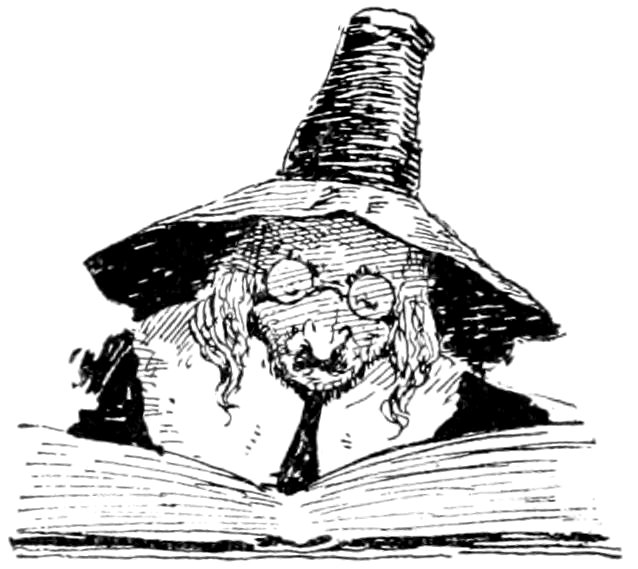
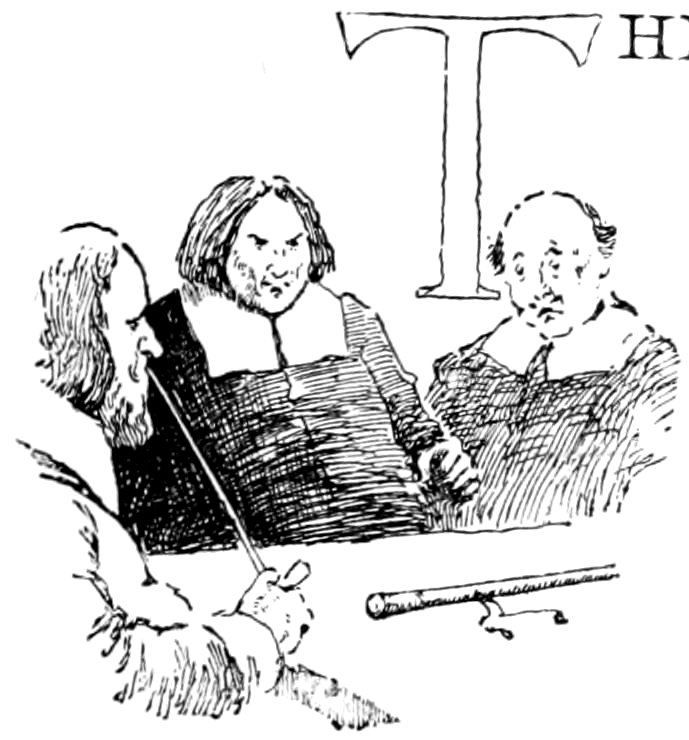
As my readers and myself
are about entering on as
many perils as ever a
confederacy of meddlesome
knights-errant
wilfully ran their heads
into, it is meet that,
like those hardy adventurers,
we should join
hands, bury all differences,
and swear to
stand by one another, in weal or woe, to the
end of the enterprise. My readers must doubtless
perceive how completely I have altered my
tone and deportment since we first set out together.
I warrant they then thought me a
crabbed, cynical, impertinent little son of a
Dutchman; for I scarcely gave them a civil
word, nor so much as touched my beaver, when
195I had occasion to address them. But as we
jogged along together on the high road of
my history, I gradually began to relax, to
grow more courteous, and occasionally to enter
into familiar discourse, until at length I came
to conceive a most social, companionable kind
of regard for them. This is just my way: I
am always a little cold and reserved at first,
particularly to people whom I neither know nor
care for, and am only to be completely won
by long intimacy.
Besides, why should I have been sociable to
the crowd of how-d’ye-do acquaintances that
flocked around me at my first appearance?
Many were merely attracted by a new face;
and having stared me full in the title-page,
walked off without saying a word: while others
lingered yawningly through the preface,
and, having gratified their short-lived curiosity,
soon dropped off one by one. But, more especially
to try their mettle, I had recourse to an
expedient, similar to one which we are told
was used by that peerless flower of chivalry,
King Arthur; who, before he admitted any
knight to his intimacy, first required that he
should show himself superior to danger or
hardships, by encountering unheard-of mishaps,
slaying some dozen giants, vanquishing
wicked enchanters, not to say a word of
196dwarfs, hippogriffs, and fiery dragons. On a
similar principle did I cunningly lead my
readers, at the first sally, into two or three
knotty chapters, where they were most wofully
belabored and buffeted by a host of pagan
philosophers, and infidel writers. Though
naturally a very grave man, yet could I scarcely
refrain from smiling outright at seeing the
utter confusion and dismay of my valiant cavaliers.
Some dropped down dead (asleep) on
the field; others threw down my book in the
middle of the first chapter, took to their heels,
and never ceased scampering until they had
fairly run it out of sight: when they stopped
to take breath, to tell their friends what
troubles they had undergone, and to warn all
others from venturing on so thankless an expedition.
Every page thinned my ranks more
and more; and of the vast multitude that first
set out, but a comparatively few made shift to
survive, in exceedingly battered condition,
through the five introductory chapters.
What, then! would you have had me take
such sunshine, faint-hearted recreants to my
bosom at our first acquaintance? No, no; I
reserved my friendship for those who deserved
it, for those who undauntedly bore me company,
in spite of difficulties, dangers, and
fatigues. And now, as to those who adhere
197to me at present, I take them affectionately by
the hand. Worthy and thrice-beloved readers!
brave and well-tried comrades! who have
faithfully followed my footsteps through all
my wanderings,—I salute you from my heart,—I
pledge myself to stand by you to the last,
and to conduct you (so Heaven speed this
trusty weapon which I now hold between my
fingers) triumphantly to the end of this our
stupendous undertaking.
But, hark! while we are thus talking, the
city of New Amsterdam is in a bustle. The
host of warriors encamped in the Bowling
Green are striking their tents; the brazen
trumpet of Antony Van Corlear makes the
welkin to resound with portentous clangor;
the drums beat; the standards of the Manhattoes,
of Hell-gate, and of Michael Paw,
wave proudly in the air. And now behold
where the mariners are busily employed hoisting
the sails of yon topsail schooner, and those
clump-built sloops, which are to waft the army
of the Nederlanders to gather immortal honors
on the Delaware!
198
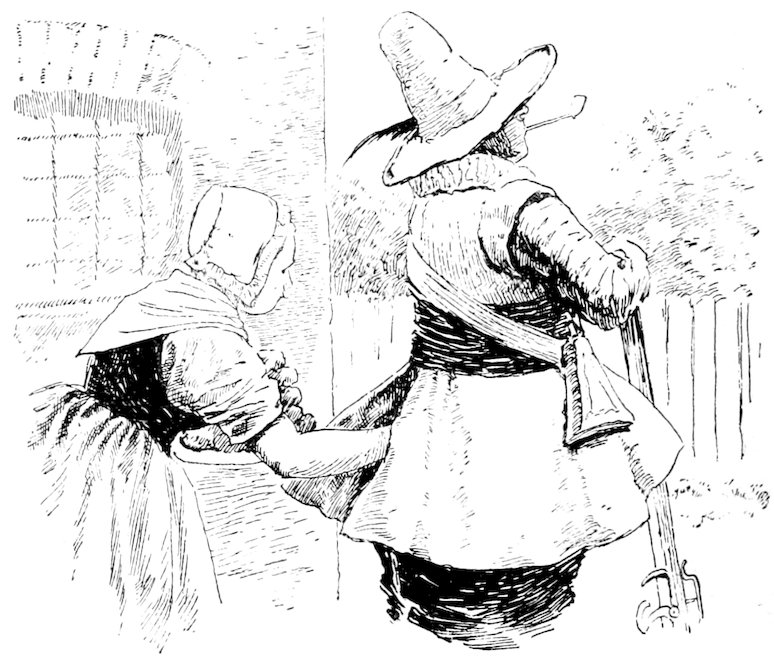
“CRAMMED THE POCKETS OF HER HERO WITH GINGERBREAD AND DOUGHNUTS.”
The entire population of the city, man,
woman, and child, turned out to behold the
chivalry of New Amsterdam, as it paraded the
streets previous to embarkation. Many a handkerchief
was waved out of the windows; many
a fair nose was blown in melodious sorrow
on the mournful occasion. The grief of the
fair dames and beauteous damsels of Granada
could not have been more vociferous on the
banishment of the gallant tribe of Abencerrages
than was that of the kind-hearted fair ones
of New Amsterdam on the departure of their
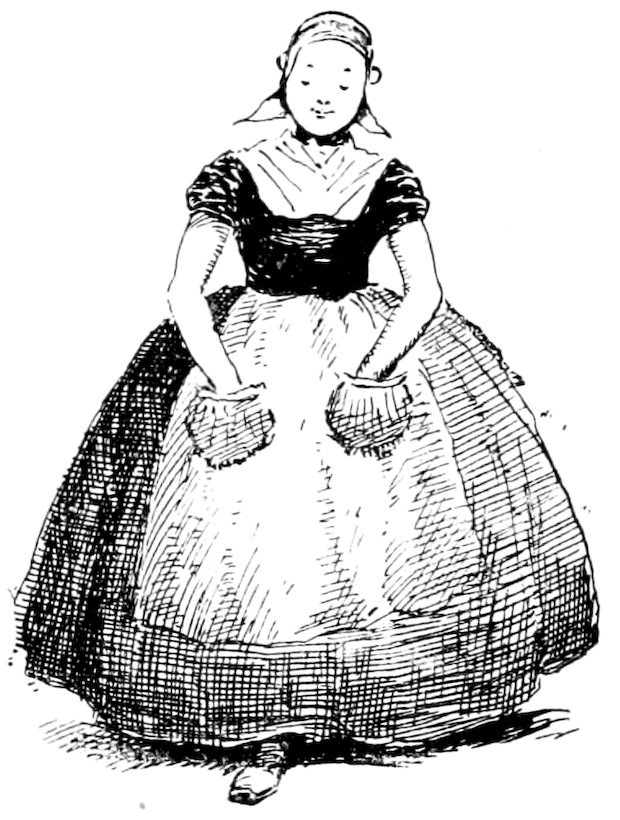
intrepid warriors. Every love-sick maiden
fondly crammed the pockets of her hero with
gingerbread and doughnuts; many a copper
199ring was exchanged, and crooked sixpence
broken, in pledge of eternal constancy; and
there remain extant to this day some love-verses
written on that occasion, sufficiently
crabbed and incomprehensible to confound the
whole universe.
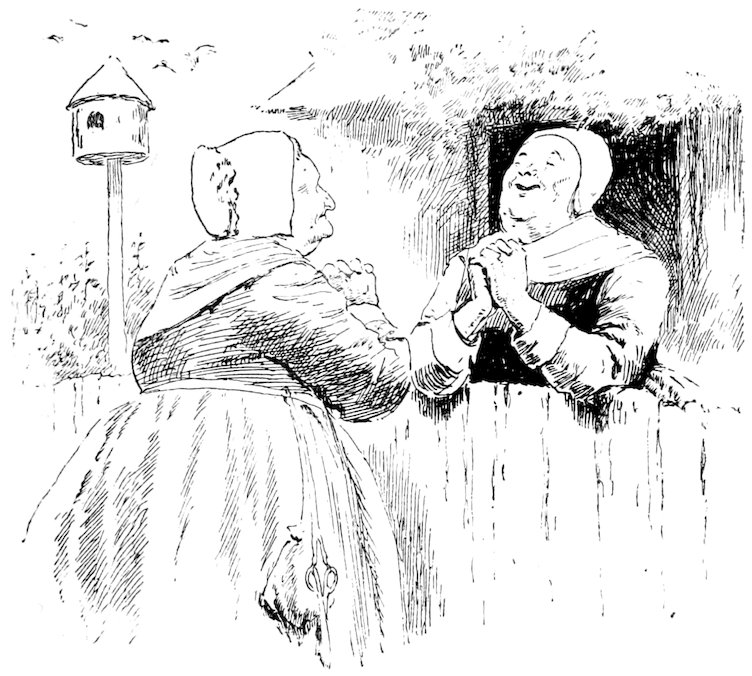
But it was a moving sight to see the buxom
lasses, how they hung about the doughty
Antony Van Corlear,—for he was a jolly,
rosy-faced, lusty bachelor, fond of his joke,
and withal a desperate rogue among the
women. Fain would they have kept him to
comfort them while the army was away; for,
besides what I have said of him, it is no more
than justice to add, that he was a kind-hearted
soul, noted for his benevolent attentions
in comforting disconsolate wives during
the absence of their husbands; and this made
him to be very much regarded by the honest
burghers of the city. But nothing could keep
the valiant Antony from following the heels of
the old governor, whom he loved as he did his
very soul; so, embracing all the young vrouws,
and giving every one of them that had good
teeth and rosy lips a dozen hearty smacks, he
departed, loaded with their kind wishes.
Nor was the departure of the gallant Peter
among the least causes of public distress.
Though the old governor was by no means indulgent
200to the follies and waywardness of his
subjects, yet somehow or other he had become
strangely popular among the people. There is
something so captivating in personal bravery,
that, with the common mass of mankind, it
takes the lead of most other merits. The simple
folk of New Amsterdam looked upon Peter
Stuyvesant as a prodigy of valor. His wooden
leg, that trophy of his martial encounters,
was regarded with reverence and admiration.
Every old burgher had a budget of miraculous
stories to tell about the exploits of Hardkoppig
Piet, wherewith he regaled his children of a
long winter night, and on which he dwelt with
as much delight and exaggeration as do our
honest country yeomen on the hardy adventures
of old General Putnam (or, as he is familiarly
termed, Old Put) during our glorious
Revolution. Not an individual but verily
believed the old governor was a match for
Beëlzebub himself; and there was even a story
told, with great mystery, and under the rose,
of his having shot the devil with a silver bullet
one dark stormy night, as he was sailing in a
canoe through Hell-gate,—but this I do not
record as being an absolute fact. Perish the
man who would let fall a drop to discolor the
pure stream of history!
201
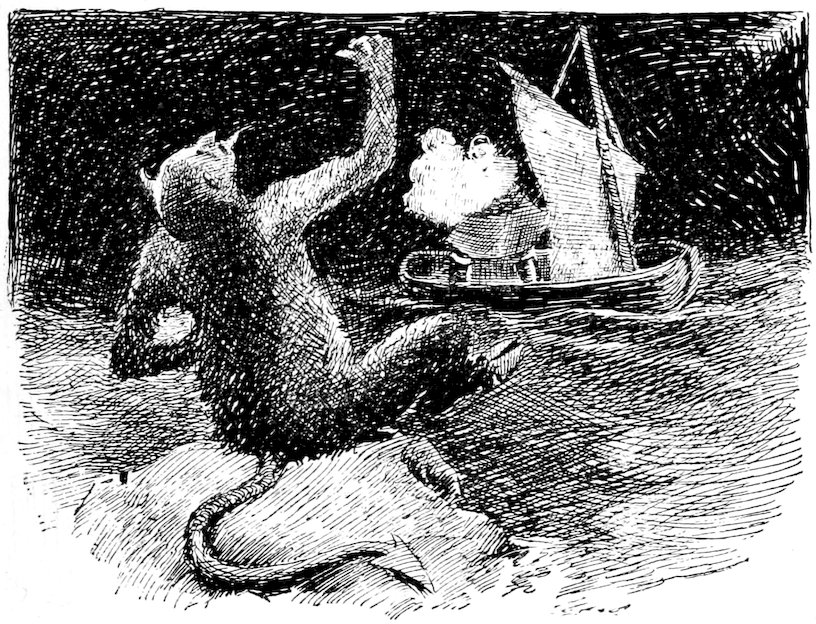
“HAVING SHOT THE DEVIL WITH A SILVER BULLET ONE DARK STORMY NIGHT.”
Certain it is, not an old woman in New Amsterdam
but considered Peter Stuyvesant as a
tower of strength, and rested satisfied that the
public welfare was secure so long as he was in
the city. It is not surprising, then, that they
looked upon his departure as a sore affliction.
With heavy hearts they dragged at the heels
of his troop, as they marched down to the riverside
to embark. The governor, from the stern
of his schooner, gave a short but truly patriarchal
address to his citizens, wherein he recommended
them to comport like loyal and peaceable
subjects,—to go to church regularly on
202Sundays, and to mind their business all the
week besides. That the women should be
dutiful and affectionate to their husbands,—looking
after nobody’s concerns but their own,—eschewing
all gossipings and morning gaddings,—and
carrying short tongues and long
petticoats. That the men should abstain from
intermeddling in public concerns, intrusting
the cares of government to the officers appointed
to support them,—staying at home,
like good citizens, making money for themselves,
and getting children for the benefit of
their country. That the burgomasters should
look well to the public interest,—not oppressing
the poor nor indulging the rich,—not tasking
their ingenuity to devise new laws, but
faithfully enforcing those which were already
made,—rather bending their attention to prevent
evil than to punish it; ever recollecting
that civil magistrates should consider themselves
more as guardians of public morals than
rat-catchers employed to entrap public delinquents.
Finally, he exhorted them, one and
all, high and low, rich and poor, to conduct
themselves as well as they could, assuring them
that if they faithfully and conscientiously complied
with this golden rule, there was no danger
but that they would all conduct themselves
well enough. This done, he gave them a paternal
203benediction, the sturdy Antony sounded
a most loving farewell with his trumpet, the
jolly crews put up a shout of triumph, and
the invincible armada swept off proudly down
the bay.
The good people of New Amsterdam
crowded down to the Battery,—that blest resort,
from whence so many a tender prayer has
been wafted, so many a fair hand waved, so
many a tearful look been cast by love-sick
damsel, after the lessening bark, bearing her
adventurous swain to distant climes!—Here
the populace watched with straining eyes the
gallant squadron, as it slowly floated down
the bay, and when the intervening land at the
Narrows shut it from their sight, gradually
dispersed with silent tongues and downcast
countenances.
A heavy gloom hung over the late bustling
city: the honest burghers smoked their pipes
in profound thoughtfulness, casting many a
wistful look to the weather-cock on the church
of St. Nicholas; and all the old women, having
no longer the presence of Peter Stuyvesant
to hearten them, gathered their children home,
and barricaded the doors and windows every
evening at sundown.
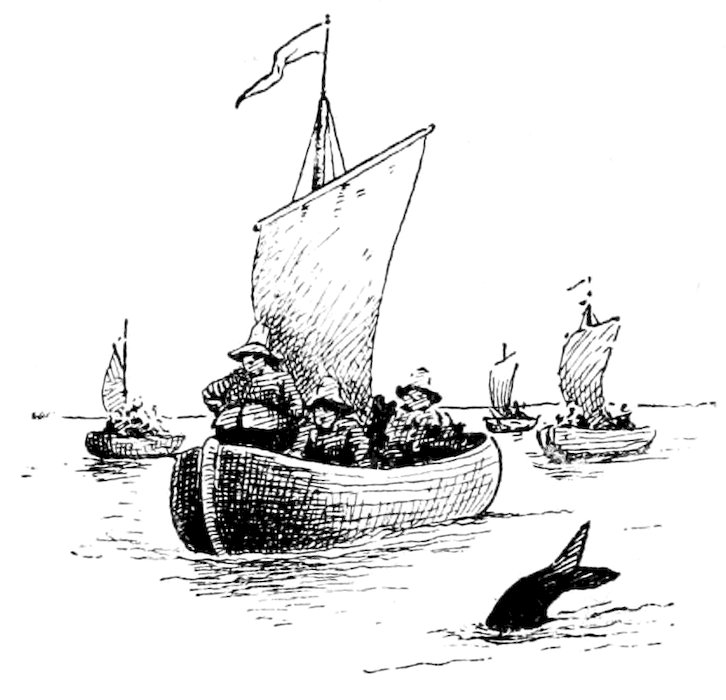
In the meanwhile the armada of the sturdy
Peter proceeded prosperously on its voyage;
204and after encountering about as many storms,
and water-spouts, and whales, and other horrors
and phenomena as generally befall adventurous
landsmen in perilous voyages of the
kind, and after undergoing a severe scouring
from that deplorable and unpitied malady
called seasickness, the whole squadron arrived
safely in the Delaware.
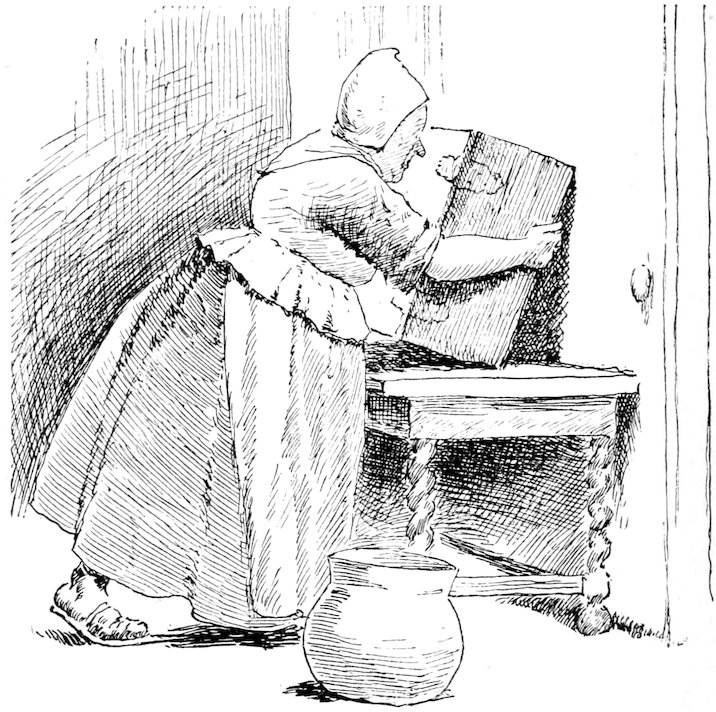
“BARRICADED THE DOORS AND WINDOWS EVERY EVENING AT SUNDOWN.”
Without so much as dropping anchor and
205giving his wearied ships time to breathe, after
laboring so long on the ocean, the intrepid
Peter pursued his course up the Delaware, and
made a sudden appearance before Fort Casimir.
Having summoned the astonished garrison by
a terrific blast from the trumpet of the long-winded
Van Corlear, he demanded, in a tone
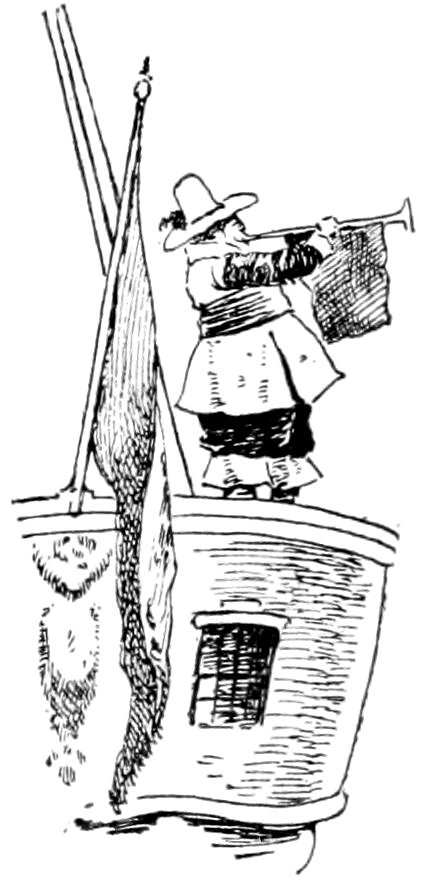
of thunder, an instant surrender of the fort.
To this demand, Suen Skytte, the wind-dried
commandant, replied in a shrill, whiffling
voice, which, by reason of his extreme spareness,
sounded like the wind whistling through
a broken bellows,—“That he had no very
strong reason for refusing, except that the demand
was particularly disagreeable, as he had
been ordered to maintain his post to the last
extremity.” He requested time, therefore, to
consult with Governor Risingh, and proposed
a truce for that purpose.
The choleric Peter, indignant at having his
rightful fort so treacherously taken from him,
and thus pertinaciously withheld, refused the
proposed armistice, and swore by the pipe of
St. Nicholas, which, like the sacred fire, was
never extinguished, that unless the fort were
surrendered in ten minutes, he would incontinently
storm the works, make all the garrison
run the gauntlet, and split their scoundrel of a
commander like a pickled shad. To give this
206menace the greater effect, he drew forth his
trusty sword, and shook it at them with such
a fierce and vigorous motion, that doubtless, if
it had not been exceedingly rusty, it would
have lightened terror into the eyes and hearts
of the enemy. He then ordered his men to
bring a broadside to bear upon the fort, consisting
of two swivels, three muskets, a long
duck fowling-piece, and two brace of horse-pistols.
In the meantime the sturdy Van Corlear
marshalled all the forces, and commenced his
warlike operations. Distending his cheeks
like a very Boreas, he kept up a most horrific
twanging of his trumpet,—the lusty choristers
of Sing-Sing broke forth into a hideous song
of battle,—the warriors of Breuckelen and the
Wallabout blew a potent and astonishing blast
on their conch shells,—altogether forming as
outrageous a concerto as though five thousand
French fiddlers were displaying their skill
in a modern overture.
Whether the formidable front of war thus suddenly
presented smote the garrison with sore
dismay,—or whether the concluding terms of
the summons, which mentioned that he should
surrender “at discretion,” were mistaken by
Suen Skytte, who, though a Swede, was a
very considerate, easy-tempered man, as a
207compliment to his discretion, I will not take
upon me to say; certain it is he found it impossible
to resist so courteous a demand. Accordingly,
in the very nick of time, just as the
cabin-boy had gone after a coal of fire to discharge
the swivel, a chamade was beat on the
rampart by the only drum in the garrison, to
the no small satisfaction of both parties, who,
notwithstanding their great stomach for fighting,
had full as good an inclination to eat
a quiet dinner as to exchange black eyes and
bloody noses.
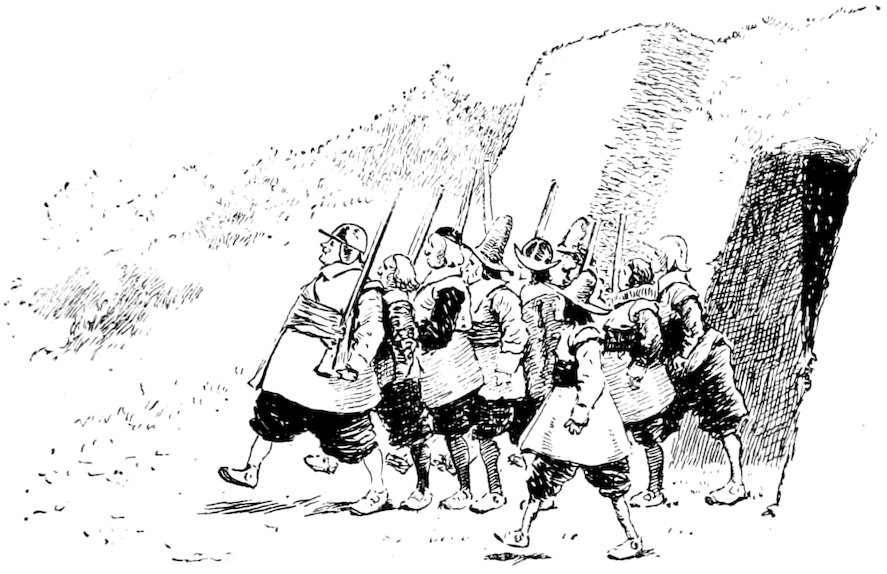
“MARCHED OUT WITH THE HONORS OF WAR.”
Thus did this impregnable fortress once
more return to the domination of their High
Mightinesses. Skytte and his garrison of
twenty men were allowed to march out with
208the honors of war; and the victorious Peter,
who was as generous as brave, permitted them
to keep possession of all their arms and ammunition,—the
same on inspection being found
totally unfit for service, having long rusted in
the magazine of the fortress, even before it
was wrested by the Swedes from the windy
Van Poffenburgh. But I must not omit to
mention that the governor was so well pleased
with the service of his faithful squire, Van
Corlear, in the reduction of this great fortress,
that he made him on the spot lord of a goodly
domain in the vicinity of New Amsterdam,—which
goes by the name of Corlear’s Hook
unto this very day.
The unexampled liberality of Peter Stuyvesant
towards the Swedes, occasioned great
surprise in the city of New Amsterdam,—nay,
certain factious individuals, who had been enlightened
by political meetings in the days of
William the Testy, but who had not dared to
indulge their meddlesome habits under the eye
of their present ruler, now, emboldened by his
absence, gave vent to their censures in the
street. Murmurs were heard in the very
council-chamber of New Amsterdam; and
there is no knowing whether they might not
have broken out into downright speeches and
invectives, had not Peter Stuyvesant privately
209sent home his walking-staff, to be laid as a
mace on the table of the council-chamber, in
the midst of his counsellors; who, like wise
men, took the hint, and forever after held
their peace.
jolly man in a nightcap or baker's hat, smiling while holding out a
tray of freshly baked rolls."
210
Like as a mighty alderman, when
at a corporation feast the
first spoonful of turtle-soup
salutes his palate,
feels his appetite but
tenfold quickened, and
redoubles his vigorous
attacks upon the tureen,
while his projecting eyes
roll greedily round, devouring
everything at table, so did the mettlesome
Peter Stuyvesant feel that hunger for
martial glory, which raged within his bowels,
inflamed by the capture of Fort Casimir, and
nothing could allay it but the conquest of all
New Sweden. No sooner, therefore, had he
secured his conquest, than he stumped resolutely
211on, flushed with success, to gather
fresh laurels at Fort Christina.[20]
This was the grand Swedish post, established
on a small river (or, as it is improperly termed,
creek) of the same name; and here that crafty
governor Jan Risingh lay grimly drawn up, like
a gray-bearded spider in the citadel of his web.
But before we hurry into the direful scenes
which must attend the meeting of two such
potent chieftains, it is advisable to pause for a
moment, and hold a kind of warlike council.
Battles should not be rushed into, precipitately
by the historian and his readers, any more than
by the general and his soldiers. The great
commanders of antiquity never engaged the
enemy without previously preparing the minds
of their followers by animating harangues,
spiriting them up to heroic deeds, assuring
them of the protection of the gods, and inspiring
them with a confidence in the prowess of
their leaders. So the historian should awaken
the attention and enlist the passions of his
readers; and having set them all on fire with
the importance of his subject, he should put
himself at their head, flourish his pen, and
lead them on to the thickest of the fight.
212
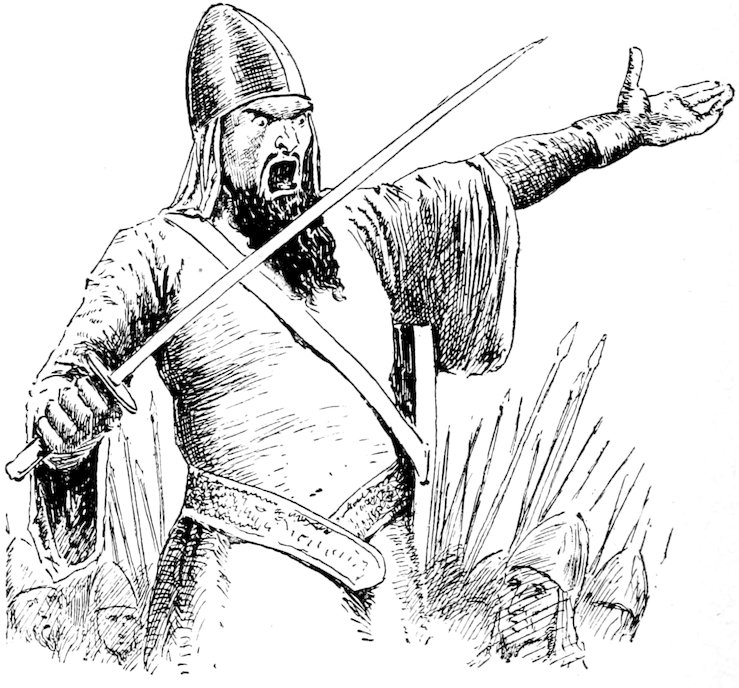
An illustrious example of this rule may be
seen in that mirror of historians, the immortal
Thucydides. Having arrived at the breaking
out of the Peloponnesian war, one of his commentators
observes that “he sounds the charge
in all the disposition and spirit of Homer.
He catalogues the allies on both sides. He
awakens our expectations, and fast engages
our attention. All mankind are concerned in
the important point now going to be decided.
Endeavors are made to disclose futurity.
213Heaven itself is interested in the dispute. The
earth totters, and nature seems to labor with
the great event. This is his solemn, sublime
manner of setting out. Thus he magnifies a
war between two, as Rapin styles them, petty
states; and thus artfully he supports a little
subject by treating it in a great and noble
method.”
In like manner, having conducted my readers
into the very teeth of peril,—having followed
the adventurous Peter and his band
into foreign regions, surrounded by foes, and
stunned by the horrid din of arms,—at this
important moment, while darkness and doubt
hang o’er each coming chapter, I hold it meet
to harangue them, and prepare them for the
events that are to follow.
And here I would premise one great advantage
which, as historian, I possess over my
reader; and this it is, that, though I cannot
save the life of my favorite hero, nor absolutely
contradict the event of a battle (both which
liberties, though often taken by the French
writers of the present reign, I hold to be utterly
unworthy of a scrupulous historian), yet
I can now and then make him bestow on his
enemy a sturdy back-stroke sufficient to fell a
giant,—though, in honest truth, he may never
have done anything of the kind,—or I can
214drive his antagonist clear round and round the
field, as did Homer make that fine fellow Hector
scamper like a poltroon round the walls of
Troy; for which, if ever they have encountered
one another in the Elysian fields, I’ll warrant
the prince of poets has had to make the most
humble apology.
I am aware that many conscientious readers
will be ready to cry out “foul play!” whenever
I render a little assistance to my hero,
but I consider it one of those privileges exercised
by historians of all ages, and one which
has never been disputed. An historian is, in
fact, as it were, bound in honor to stand by his
hero; the fame of the latter is intrusted to his
hands, and it is his duty to do the best by it
he can. Never was there a general, an admiral,
or any other commander, who, in giving
account of any battle he had fought, did not
sorely belabor the enemy; and I have no
doubt that, had my heroes written the history
of their own achievements, they would have
dealt much harder blows than any that I shall
recount. Standing forth, therefore, as the
guardian of their fame, it behooves me to do
them the same justice they would have done
themselves; and if I happen to be a little hard
upon the Swedes, I give free leave to any of
their descendants, who may write a story of
215the State of Delaware to take fair retaliation,
and belabor Peter Stuyvesant as hard as they
please.
Therefore stand by for broken heads and
bloody noses! My pen hath long itched for
a battle; siege after siege have I carried on
without blows or bloodshed; but now I have
at length got a chance, and I vow to Heaven
and St. Nicholas, that, let the chronicles of
the times say what they please, neither Sallust,
Livy, Tacitus, Polybius, nor any other
historian, did ever record a fiercer fight than
that in which my valiant chieftains are now
about to engage.
And you, oh most excellent readers, whom,
for your faithful adherence, I could cherish in
the warmest corner of my heart, be not uneasy,—trust
the fate of our favorite Stuyvesant with
me, for by the rood, come what may, I’ll stick
by Hardkoppig Piet to the last. I’ll make
him drive about these losels vile, as did the
renowned Launcelot of the Lake a herd of recreant
Cornish knights; and if he does fall, let
me never draw my pen to fight another battle
in behalf of a brave man, if I don’t make these
lubberly Swedes pay for it.
No sooner had Peter Stuyvesant arrived at
Fort Christina than he proceeded without
delay to intrench himself, and immediately on
216running his first parallel, despatched Antony
Van Corlear to summon the fortress to surrender.
Van Corlear was received with all due
formality, hoodwinked at the portal, and conducted
through a pestiferous smell of salt fish
and onions to the citadel, a substantial hut
built on pine logs. His eyes were here uncovered,
and he found himself in the august
presence of Governor Risingh. This chieftain,
as I have before noted, was a very
giantly man, and was clad in a coarse blue
coat, strapped round the waist with a leathern
belt, which caused the enormous skirts and
pockets to set off with a warlike sweep. His
ponderous legs were cased in a pair of foxy-colored
jackboots, and he was straddling in the
attitude of the Colossus of Rhodes before a bit
of broken looking-glass, shaving himself with
a villanously dull razor. This afflicting operation
caused him to make a series of horrible
grimaces, which heightened exceedingly the
grisly terrors of his visage. On Antony Van
Corlear’s being announced, the grim commander
paused for a moment in the midst of one
of his most hard-favored contortions, and after
eying him askance over the shoulder, with a
kind of snarling grin on his countenance,
resumed his labors at the glass.
217
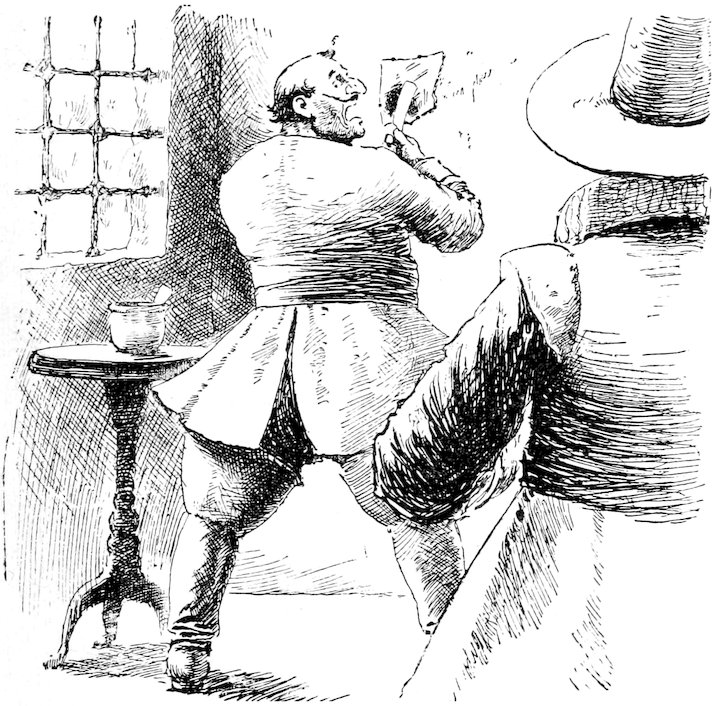
“BEFORE A BIT OF BROKEN LOOKING-GLASS SHAVING HIMSELF.”
This iron harvest being reaped, he turned
once more to the trumpeter, and demanded
the purport of his errand. Antony Van Corlear
delivered in a few words, being a kind of
shorthand speaker, a long message from his
Excellency, recounting the whole history of
the province, with a recapitulation of grievances
and enumeration of claims, and concluding
with a peremptory demand of instant
surrender; which done, he turned aside, took
218his nose between his thumb and fingers, and
blew a tremendous blast, not unlike the flourish
of a trumpet of defiance,—which it had
doubtless learned from a long and intimate
neighborhood with that melodious instrument.
Governor Risingh heard him through,
trumpet and all, but with infinite impatience,—leaning
at times, as was his usual custom,
on the pommel of his sword, and at times
twirling a huge steel watch-chain, or snapping
his fingers. Van Corlear having finished, he
bluntly replied, that Peter Stuyvesant and his
summons might go to the d——l, whither he
hoped to send him and his crew of ragamuffins
before supper-time. Then unsheathing his
brass-hilted sword, and throwing away the
scabbard,—“’Fore gad,” quod he, “but I
will not sheathe thee again until I make a
scabbard of the smoke-dried leathern hide of
this runagate Dutchman.” Then having
flung a fierce defiance in the teeth of his adversary
by the lips of his messenger, the latter
was reconducted to the portal with all the ceremonious
civility due to the trumpeter, squire,
and ambassador of so great a commander; and
being again unblinded, was courteously dismissed
with a tweak of the nose, to assist him
in recollecting his message.
219No sooner did the gallant Peter receive this
insolent reply then he let fly a tremendous
volley of red-hot execrations, which would infallibly
have battered down the fortifications,
and blown up the powder-magazine about the
ears of the fiery Swede, had not the ramparts
been remarkably strong, and the magazine
bomb-proof. Perceiving that the works withstood
this terrific blast, and that it was utterly
impossible (as it really was in those unphilosophic
days) to carry on a war with words, he
ordered his merry men to all prepare for an
immediate assault. But here a strange murmur
broke out among his troops, beginning
with the tribe of the Van Bummels, those
valiant trenchermen of the Bronx, and spreading
from man to man, accompanied with
certain mutinous looks and discontented murmurs.
For once in his life, and only for once,
did the great Peter turn pale, for he verily
thought his warriors were going to falter in
this hour of perilous trial, and thus to tarnish
forever the fame of the province of New
Netherlands.
But soon did he discover, to his great joy,
that in his suspicion he deeply wronged his
most undaunted army; for the cause of this
agitation and uneasiness simply was, that the
hour of dinner was at hand, and it would have
220almost broken the hearts of these regular Dutch
warriors to have broken in upon the invariable
routine of their habits. Besides, it was an
established rule among our ancestors always
to fight upon a full stomach; and to this may
be doubtless attributed the circumstance that
they came to be so renowned in arms.
And now are the hearty men of the Manhattoes,
and their no less hearty comrades, all
lustily engaged under the trees, buffeting
stoutly with the contents of their wallets, and
taking such affectionate embraces of their
canteens and pottles as though they verily
believed they were to be the last. And as I
foresee we shall have hot work in a page or two,
I advise my readers to do the same, for which
purpose I will bring this chapter to a close,—giving
them my word of honor, that no advantage
shall be taken of this armistice to surprise,
or in any wise molest, the honest Nederlanders
while at their vigorous repast.
221
Now had the Dutchmen
snatched a huge repast,
and finding themselves
wonderfully encouraged
and animated thereby,
prepared to take the
field. Expectation, says
the writer of the Stuyvesant
manuscript,—Expectation
now stood
on stilts. The world
forgot to turn round, or rather stood still,
that it might witness the affray,—like a
round-bellied alderman, watching the combat
of two chivalrous flies upon his jerkin. The
eyes of all mankind, as usual in such cases,
were turned upon Fort Christina. The sun,
like a little man in a crowd at a puppet-show,
scampered about the heavens, popping his
222head here and there, and endeavoring to get a
peep between the unmannerly clouds that obtruded
themselves in his way. The historians
filled their ink-horns; the poets went without
their dinners, either that they might buy paper
and goose-quills, or because they could not
get anything to eat. Antiquity scowled sulkily
out of its grave, to see itself outdone,—while
even Posterity stood mute, gazing in
gaping ecstasy of retrospection on the eventful
field.
The immortal deities, who whilom had seen
service at the “affair” of Troy, now mounted
their feather-bed clouds, and sailed over the
plain, or mingled among the combatants in
different disguises, all itching to have a finger
in the pie. Jupiter sent off his thunderbolt to
a noted coppersmith, to have it furbished up
for the direful occasion. Venus vowed by her
chastity to patronize the Swedes, and in semblance
of a blear-eyed trull paraded the battlements
of Fort Christina, accompanied by Diana,
as a sergeant’s widow, of cracked reputation.
The noted bully, Mars, stuck two horse-pistols
into his belt, shouldered a rusty firelock, and
gallantly swaggered at their elbow, as a
drunken corporal,—while Apollo trudged in
their rear, as a bandy-legged fifer, playing
most villanously out of tune.
223
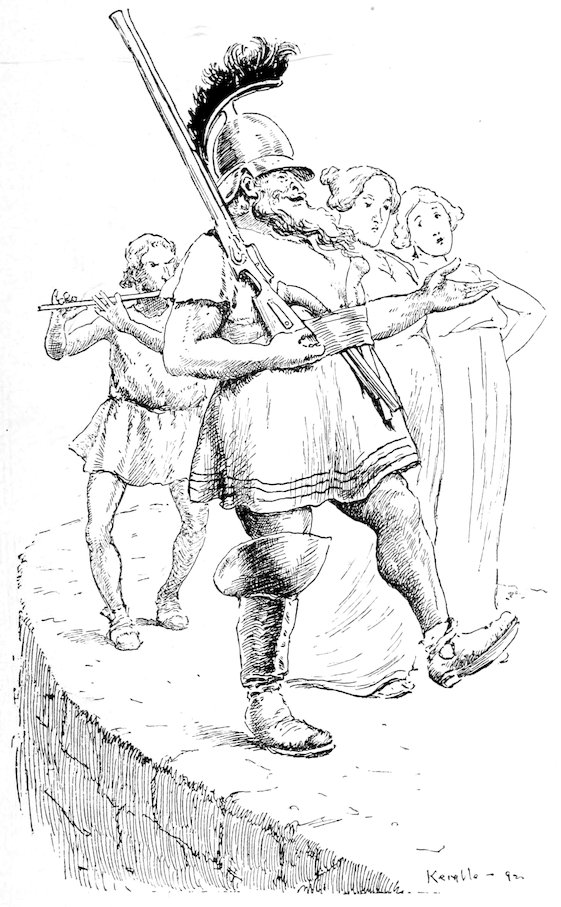
MARS AS A DRUNKEN COPORAL.
224On the other side, the ox-eyed Juno, who
had gained a pair of black eyes overnight, in
one of her curtain-lectures with old Jupiter,
displayed her haughty beauties on a baggage-wagon;
Minerva, as a brawny gin-sutler,
tucked up her skirts, brandished her fists, and
swore most heroically, in exceeding bad Dutch
(having but lately studied the language), by
way of keeping up the spirits of the soldiers;
while Vulcan halted as a club-footed blacksmith,
lately promoted to be a captain of
militia. All was silent awe, or bustling preparation:
war reared his horrid front, gnashed
loud his iron fangs, and shook his direful crest
of bristling bayonets.
And now the mighty chieftains marshalled
out their hosts. Here stood stout Risingh,
firm as a thousand rocks,—incrusted with
stockades, and intrenched to the chin in mud
batteries. His valiant soldiery lined the
breastwork in grim array, each having his
mustachios fiercely greased, and his hair pomatumed
back, and queued so stiffly, that he
grinned above the ramparts like a grisly
death’s-head.
There came on the intrepid Peter,—his brows
knit, his teeth set, his fists clenched, almost
breathing forth volumes of smoke, so fierce
was the fire that raged within his bosom. His
225faithful squire Van Corlear trudged valiantly
at his heels, with his trumpet gorgeously bedecked
with red and yellow ribbons, the remembrances
of his fair mistresses at the Manhattoes.
Then came waddling on the sturdy
chivalry of the Hudson. There were the Van
Wycks, and the Van Dycks, and the Ten
Eycks; the Van Nesses, the Van Tassels, the
Van Grolls; the Van Hœsens, the Van Giesons,
and the Van Blarcoms; the Van Warts, the
Van Winkles, the Van Dams; the Van Pelts,
the Van Rippers, and the Van Brunts. There
were the Van Hornes, the Van Hooks, the
Van Bunschotens; the Van Gelders, the Van
Arsdales, and the Van Bummels; the Vander
Belts, the Vander Hoofs, the Vander Voorts,
the Vander Lyns, the Vander Pools, and the
Vander Spiegles;—then came the Hoffmans,
the Hooghlands, the Hoppers, the Cloppers,
the Ryckmans, the Dyckmans, the Hogebooms,
the Rosebooms, the Oothouts, the
Quackenbosses, the Roerbacks, the Garrebrantzes,
the Bensons, the Brouwers, the
Waldrons, the Onderdonks, the Varra Vangers,
the Schermerhorns, the Stoutenburghs,
the Brinkerhoffs, the Bontecous, the Knickerbockers,
the Hockstrassers, the Ten Breecheses
and the Tough Breecheses, with a host more of
worthies, whose names are too crabbed to be
226written, or if they could be written, it would
be impossible for man to utter,—all fortified
with a mighty dinner, and, to use the words
of a great Dutch poet,
“Brimful of wrath and cabbage.”
For an instant the mighty Peter paused in
the midst of his career, and mounting on a
stump, addressed his troops in eloquent Low
Dutch, exhorting them to fight like duyvels,
and assuring them that if they conquered, they
should get plenty of booty,—if they fell, they
should be allowed the satisfaction, while dying,
of reflecting that it was in the service of their
country, and after they were dead, of seeing
their names inscribed in the temple of renown,
and handed down, in company with all the
other great men of the year, for the admiration
of posterity. Finally, he swore to them,
on the word of a governor (and they knew
him too well to doubt it for a moment), that
if he caught any mother’s son of them looking
pale, or playing craven, he would curry his
hide till he made him run out of it like a
snake in spring-time. Then lugging out his
trusty sabre, he brandished it three times over
his head, ordered Van Corlear to sound a
charge, and shouting the words “St. Nicholas
and the Manhattoes!” courageously dashed
227forwards. His warlike followers, who had
employed the interval in lighting their pipes,
instantly stuck them into their mouths, gave a
furious puff, and charged gallantly under
cover of the smoke.
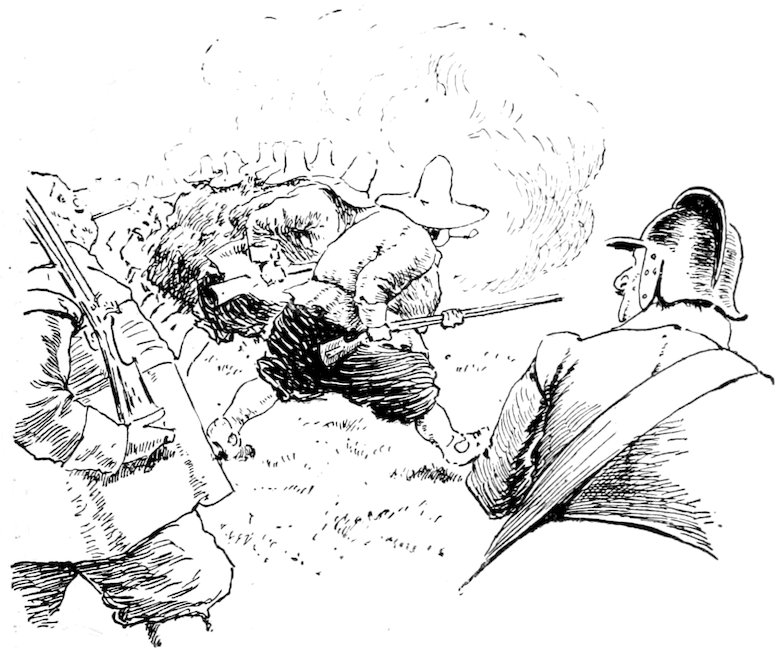
The Swedish garrison, ordered by the cunning
Risingh not to fire until they could distinguish
the whites of their assailants’ eyes,
stood in horrid silence on the covertway, until
the eager Dutchmen had ascended the glacis.
Then did they pour into them such a tremendous
228volley, that the very hills quaked around,
and were terrified even unto an incontinence
of water, insomuch that certain springs burst
forth from their sides, which continue to run
until the present day. Not a Dutchman but
would have bitten the dust beneath that dreadful
fire, had not the protecting Minerva kindly
taken care that the Swedes should, one and all,
observe their usual custom of shutting their
eyes, and turning away their heads at the
moment of discharge.
The Swedes followed up their fire by leaping
the counterscarp, and falling tooth and nail
upon the foe with furious outcries. And now
might be seen prodigies of valor, unmatched
in history or song. Here was the sturdy
Stoffel Brinkerhoff brandishing his quarterstaff,
like the giant Blanderon his oak-tree (for
he scorned to carry any other weapon), and
drumming a horrific tune upon the hard heads
of the Swedish soldiery. There were the Van
Kortlandts, posted at a distance, like the
Locrain archers of yore, and plying it most
potently with the long-bow, for which they
were so justly renowned. On a rising knoll
were gathered the valiant men of Sing-Sing,
assisting marvellously in the fight, by chanting
the great song of St. Nicholas; but as to the
Gardeniers of Hudson, they were absent on a
229marauding party, laying waste the neighboring
watermelon patches.
In a different part of the field were the Van
Grolls of Antony’s Nose, struggling to get to
the thickest of the fight, but horribly perplexed
in a defile between two hills, by reason
of the length of their noses. So also the Van
Bunschotens of Nyack and Kakiat, so renowned
for kicking with the left foot, were
brought to a stand for want of wind, in consequence
of the hearty dinner they had eaten,
and would have been put to utter rout but for
the arrival of a gallant corps of voltigeurs,
composed of the Hoppers, who advanced
nimbly to their assistance on one foot. Nor
must I omit to mention the valiant achievements
of Antony Van Corlear, who, for a good
quarter of an hour, waged stubborn fight with
a little pursy Swedish drummer, whose hide he
drummed most magnificently, and whom he
would infallibly have annihilated on the spot,
but that he had come into the battle with no
other weapon but his trumpet.
But now the combat thickened. On came
the mighty Jacobus Varra Vanger and the
fighting men of the Wallabout; after them
thundered the Van Pelts of Esopus, together
with the Van Rippers and the Van Brunts,
bearing down all before them; then the Suy
230Dams, and the Van Dams, pressing forward
with many a blustering oath, at the head of
the warriors at Hell-gate, clad in their thunder-and-lightning
gaberdines; and lastly, the
standard-bearers and body-guard of Peter
Stuyvesant, bearing the great beaver of the
Manhattoes.
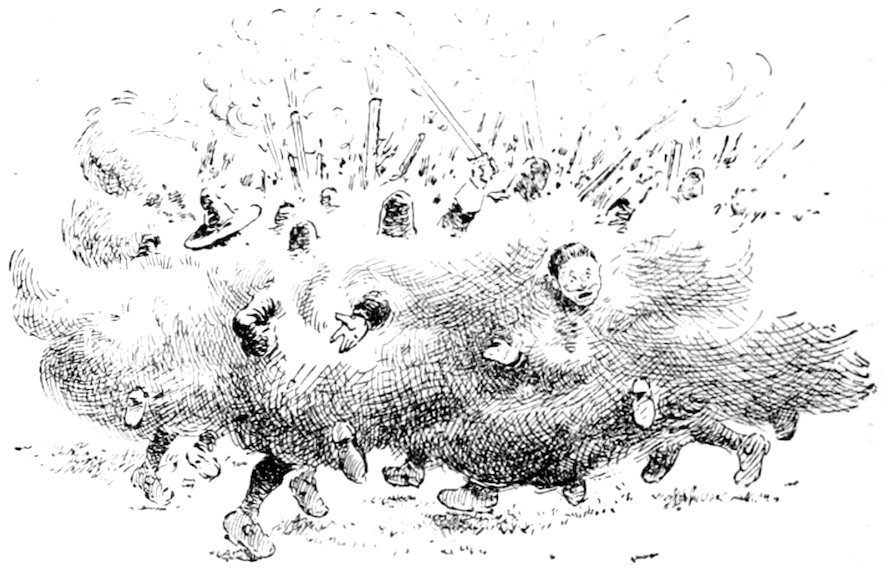
And now commenced the horrid din, the
desperate struggle, the maddening ferocity, the
frantic desperation, the confusion and self-abandonment
of war. Dutchman and Swede
commingled, tugged, panted, and blowed.
The heavens were darkened with a tempest
of missives. Bang! went the guns; whack!
went the broad-swords; thump! went the cudgels;
231crash! went the musket-stocks; blows,
kicks, cuffs, scratches, black eyes and bloody
noses swelling the horrors of the scene!
Thick thwack, cut and hack, helter-skelter,
higgledly-piggledly, hurly-burly, head-over-heels,
rough-and-tumble! Dunder and blixum!
swore the Dutchmen; splitter and
splutter! cried the Swedes. Storm the
works! shouted Hardkoppig Peter. Fire the
mine! roared stout Risingh. Tanta-rar-ra-ra!
twanged the trumpet of Antony Van Corlear;—until
all voice and sound became unintelligible,—grunts
of pain, yells of fury, and
shouts of triumph mingling in one hideous
clamor. The earth shook as if struck with a
paralytic stroke; trees shrunk aghast, and
withered at the sight; rocks burrowed in the
ground like rabbits; and even Christina creek
turned from its course, and ran up a hill in
breathless terror!
Long hung the contest doubtful; for though
a heavy shower of rain, sent by the “cloud-compelling
Jove,” in some measure cooled their
ardor, as doth a bucket of water thrown on a
group of fighting mastiffs, yet did they but
pause for a moment, to return with tenfold fury
to the charge. Just at this juncture a vast and
dense column of smoke was seen slowly rolling
toward the scene of battle. The combatants
232paused for a moment, gazing in mute astonishment,
until the wind, dispelling the murky
cloud, revealed the flaunting banner of
Michael Paw, the Patroon of Communipaw.
That valiant chieftain came fearlessly on at
the head of a phalanx of oysterfed Pavonians
and a corps de reserve of the Van Arsdales and
Van Bummels, who had remained behind to
digest the enormous dinner they had eaten.
These now trudged manfully forward, smoking
their pipes with outrageous vigor, so as to
raise the awful cloud that has been mentioned,
but marching exceedingly slow, being short of
leg, and of great rotundity in the belt.
And now the deities who watched over the fortunes
of the Nederlanders having unthinkingly
left the field, and stepped into a neighboring
tavern to refresh themselves with a pot of beer,
a direful catastrophe had wellnigh ensued.
Scarce had the myrmidons of Michael Paw
attained the front of battle, when the Swedes,
instructed by the cunning Risingh, levelled
a shower of blows full at their tobacco-pipes.
Astounded at this assault, and dismayed at
the havoc of their pipes, these ponderous warriors
gave way, and like a drove of frightened
elephants broke through the ranks of their own
army. The little Hoppers were borne down in
the surge; the sacred banner emblazoned with
233the gigantic oyster of Communipaw was trampled
in the dirt; on blundered and thundered
the heavy-sterned fugitives, the Swedes pressing
on their rear and applying their feet a parte
poste of the Van Arsdales and the Van Bummels
with a vigor that prodigiously accelerated
their movements; nor did the renowned
Michael Paw himself fail to receive divers
grievous and dishonorable visitations of shoe-leather.
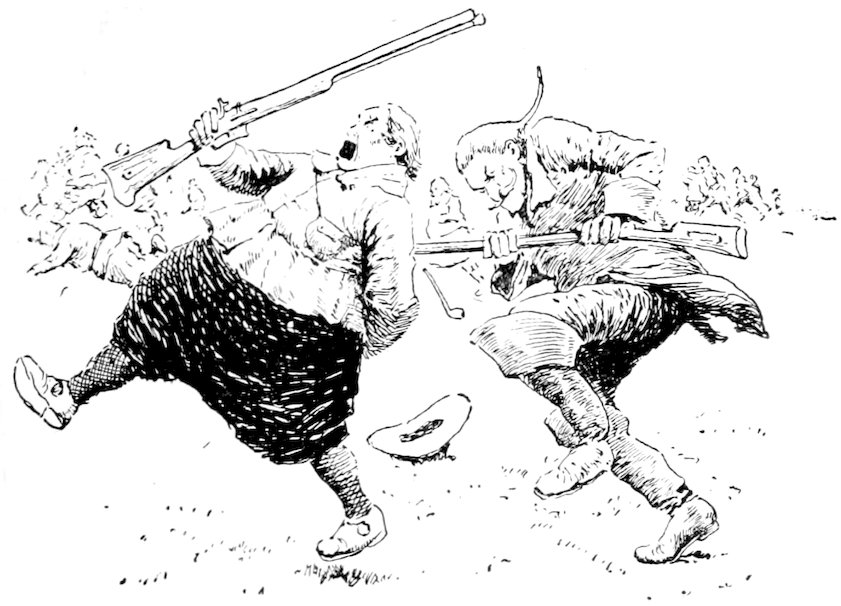
“ON BLUNDERED AND THUNDERED THE HEAVY-STERNED FUGITIVES.”
But what, oh Muse! was the rage of Peter
Stuyvesant, when from afar he saw his army
giving way! In the transports of his wrath
he sent forth a roar, enough to shake the very
234hills. The men of the Manhattoes plucked up
new courage at the sound, or rather, they rallied
at the voice of their leader, of whom they
stood more in awe than of all the Swedes in
Christendom. Without waiting for their aid,
the daring Peter dashed, sword in hand, into
the thickest of the foe. Then might be seen
achievements worthy of the days of the giants.
Wherever he went, the enemy shrank before
him; the Swedes fled to right and left, or were
driven, like dogs, into their own ditch; but as
he pushed forward singly with headlong courage,
the foe closed behind and hung upon his
rear. One aimed a blow full at his heart; but
the protecting power which watches over the
great and good turned aside the hostile blade
and directed it to a side-pocket, where reposed
an enormous iron tobacco-box, endowed, like
the shield of Achilles, with supernatural
powers, doubtless from bearing the portrait of
the blessed St. Nicholas. Peter Stuyvesant
turned like an angry bear upon the foe, and
seizing him, as he fled, by an immeasurable
queue, “Ah, whoreson caterpillar,” roared he,
“here’s what shall make worms’ meat of thee!”
So saying, he whirled his sword, and dealt a
blow that would have decapitated the varlet,
but that the pitying steel struck short and
shaved the queue forever from his crown. At
235this moment an arquebusier levelled his piece
from a neighboring mound, with deadly aim;
but the watchful Minerva, who had just
stopped to tie up her garter, seeing the peril of
her favorite hero; sent old Boreas with his bellows,
who, as the match descended to the pan,
gave a blast that blew the priming from the
touch-hole.
Thus waged the fight, when the stout
Risingh, surveying the field from the top of
a little ravelin, perceived his troops banged,
beaten, and kicked by the invincible Peter.
Drawing his falchion and uttering a thousand
anathemas, he strode down to the scene of
combat with such thundering strides as Jupiter
is said by Hesiod to have taken when he strode
down the spheres to hurl his thunderbolts
at the Titans.
When the rival heroes came face to face,
each made a prodigious start in the style of a
veteran stage-champion. Then did they regard
each other for a moment with the bitter
aspect of two furious ram-cats on the point
of a clapper-clawing. Then did they throw
themselves into one attitude, then into another,
striking their swords on the ground, first on
the right side, then on the left; at last at it
they went, with incredible ferocity. Words
cannot tell the prodigies of strength and valor
236displayed in this direful encounter,—an encounter
compared to which the far-famed battles
of Ajax with Hector, of Æneas with Turnus,
Orlando with Rodomont, Guy of Warwick
with Colbrand the Dane, or of that renowned
Welsh knight, Sir Owen of the Mountains,
with the giant Guylon, were all gentle sports
and holiday recreations. At length the valiant
Peter, watching his opportunity, aimed a blow,
enough to cleave his adversary to the very
chine; but Risingh, nimbly raising his sword,
warded it off so narrowly, that, glancing on
one side, it shaved away a huge canteen in
which he carried his liquor,—thence pursuing
its trenchant course, it severed off a deep coat-pocket,
stored with bread and cheese,—which
provant rolling among the armies, occasioned
a fearful scrambling between the Swedes and
Dutchmen, and made the general battle to
wax more furious than ever.
Enraged to see his military stores laid waste,
the stout Risingh, collecting all his forces,
aimed a mighty blow full at the hero’s crest.
In vain did his fierce little cocked hat oppose
its course. The biting steel clove through the
stubborn ram beaver, and would have cracked
the crown of any one not endowed with
supernatural hardness of head; but the brittle
weapon shivered in pieces on the skull
237of Hardkoppig Piet, shedding a thousand
sparks, like beams of glory, round his grisly
visage.
The good Peter reeled with the blow, and
turning up his eyes beheld a thousand suns,
besides moons and stars, dancing about the
firmament; at length, missing his footing, by
reason of his wooden leg, down he came on
his seat of honor with a crash which shook the
surrounding hills, and might have wrecked
his frame, had he not been received into a cushion
softer than velvet, which Providence, or
Minerva, or St. Nicholas, or some cow, had
benevolently prepared for his reception.
The furious Risingh, in spite of the maxim,
cherished by all true knights, that “fair play
is a jewel,” hastened to take advantage of the
hero’s fall; but, as he stooped to give a fatal
blow, Peter Stuyvesant dealt him a thwack over
the sconce with his wooden leg, which sent a
chime of bells ringing triple bob-majors in his
cerebellum. The bewildered Swede staggered
with the blow, and the wary Peter seizing a
pocket-pistol, which lay hard by, discharged
it full at the head of the reeling Risingh. Let
not my reader mistake; it was not a murderous
weapon loaded with powder and ball, but a little
sturdy stone pottle charged to the muzzle
with a double dram of true Dutch courage,
238which the knowing Antony Van Corlear carried
about him by way of replenishing his
valor, and which had dropped from his wallet
during his furious encounter with the drummer.
The hideous weapon sang through the
air, and true to its course as was the fragment
of a rock discharged at Hector by bully Ajax,
encountered the head of the gigantic Swede
with matchless violence.
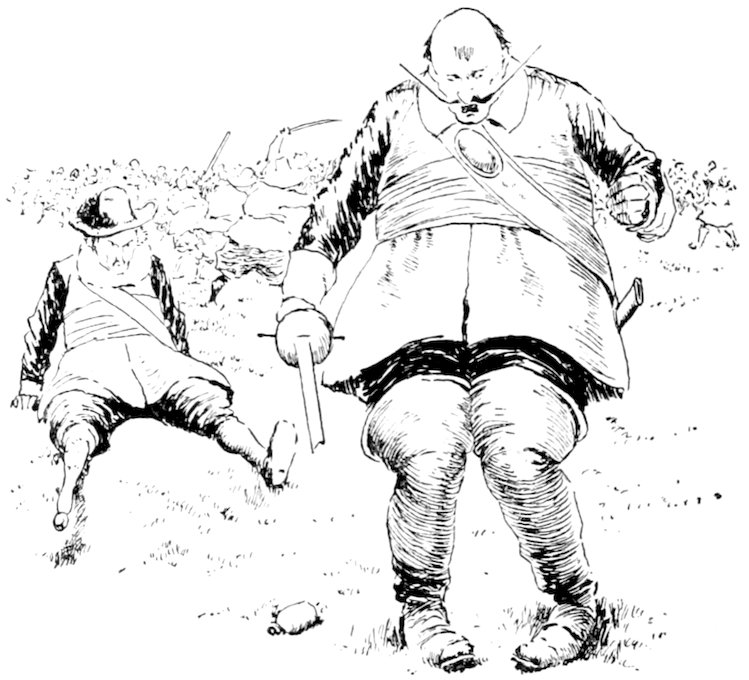
“THIS HEAVEN-DIRECTED BLOW DECIDED THE BATTLE.”
This heaven-directed blow decided the battle.
The ponderous pericranium of General
239Jan Risingh sank upon his breast; his knees
tottered under him; a death-like torpor seized
upon his frame, and he tumbled to the earth
with such violence, that old Pluto started with
affright, lest he should have broken through
the roof of his infernal palace.
His fall was the signal of defeat and victory:
the Swedes gave way, the Dutch pressed forward;
the former took to their heels, the latter
hotly pursued. Some entered with them, pell-mell,
through the sally-port; others stormed
the bastion, and others scrambled over the
curtain. Thus in a little while the fortress of
Fort Christina, which, like another Troy, had
stood a siege of full ten hours, was carried
by assault, without the loss of a single man
on either side. Victory, in the likeness of a
gigantic ox-fly, sat perched upon the cocked
hat of the gallant Stuyvesant; and it was declared,
by all the writers whom he hired to
write the history of his expedition, that on this
memorable day he gained a sufficient quantity
of glory to immortalize a dozen of the greatest
heroes in Christendom!
240
Thanks to St. Nicholas,
we have safely finished
this tremendous battle:
let us sit down, my
worthy reader, and cool
ourselves, for I am in
a prodigious sweat and
agitation; truly, this
fighting of battles is hot
work! and if your great
commanders did but
know what trouble they give their historians,
they would not have the conscience to achieve
so many horrible victories. But methinks I
hear my reader complain, that throughout
this boasted battle there is not the least slaughter,
not a single individual maimed, if we except
241the unhappy Swede, who was shorn of his
queue by the trenchant blade of Peter Stuyvesant;
all which, he observes, is a great outrage
on probability, and highly injurious to the
interest of the narration.
This is certainly an objection of no little
moment, but it arises entirely from the obscurity
enveloping the remote periods of time
about which I have undertaken to write.
Thus, though doubtless, from the importance
of the object and the prowess of the parties
concerned, there must have been terrible carnage,
and prodigies of valor displayed before
the walls of Christina, yet, notwithstanding
that I have consulted every history, manuscript,
and tradition, touching this memorable
though long-forgotten battle, I cannot find
mention made of a single man killed or
wounded in the whole affair.
This is, without doubt, owing to the extreme
modesty of our forefathers, who, unlike their
descendants, were never prone to vaunt of
their achievements; but it is a virtue which
places their historian in a most embarrassing
predicament; for, having promised my readers
a hideous and unparalleled battle, and having
worked them up into a warlike and bloodthirsty
state of mind, to put them off without
any havoc and slaughter would have been as
242bitter a disappointment as to summon a multitude
of good people to attend an execution,
and then cruelly balk them by a reprieve.
Had the fates only allowed me some half a
score of dead men, I had been content; for
I would have made them such heroes as
abounded in the olden time, but whose race is
now unfortunately extinct,—any one of whom,
if we may believe those authentic writers, the
poets, could drive great armies, like sheep,
before him, and conquer and desolate whole
cities by his single arm.
But seeing that I had not a single life at my
disposal, all that was left me was to make the
most I could of my battle, by means of kicks,
and cuffs, and bruises, and such like ignoble
wounds. And here I cannot but compare my
dilemma, in some sort, to that of the divine
Milton, who, having arrayed with sublime
preparation his immortal hosts against each
other, is sadly put to it how to manage them,
and how he shall make the end of his battle
answer to the beginning, inasmuch as, being
mere spirits, he cannot deal a mortal blow, nor
even give a flesh wound to any of his combatants.
For my part, the greatest difficulty
I found was, when I had once put my warriors
in a passion, and let them loose into
the midst of the enemy, to keep them from
243doing mischief. Many a time had I to restrain
the sturdy Peter from cleaving a gigantic
Swede to the very waistband, or spitting
half a dozen little fellows on his sword, like so
many sparrows. And when I had set some
hundred of missives flying in the air, I did
not dare to suffer one of them to reach the
ground, lest it should have put an end to
some unlucky Dutchman.
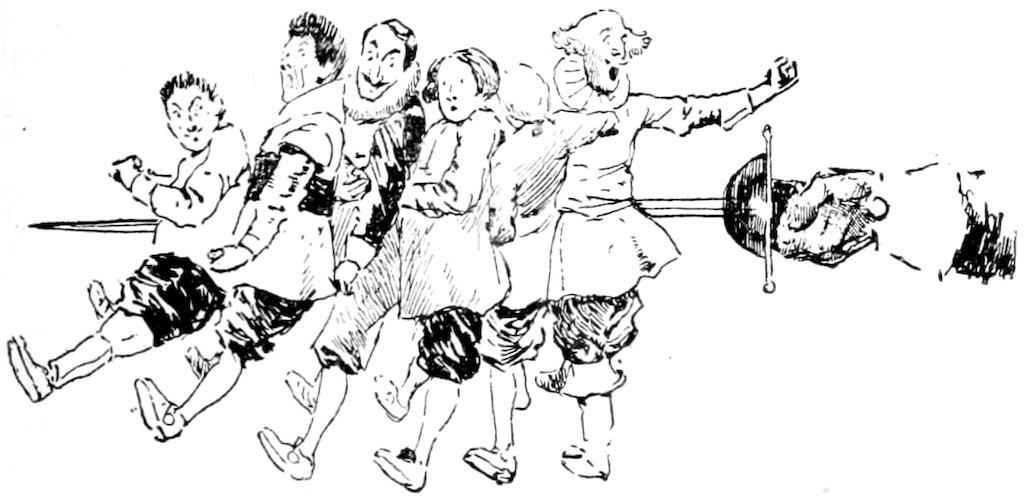
“SPITTING HALF A DOZEN LITTLE FELLOWS ON HIS SWORD.”
The reader cannot conceive how mortifying
it is to a writer thus in a manner to have his
hands tied, and how many tempting opportunities
I had to wink at, where I might have
made as fine a death-blow as any recorded in
history or song.
From my own experience I begin to doubt
most potently of the authenticity of many of
Homer’s stories. I verily believe, that, when
244he had once launched one of his favorite
heroes among a crowd of the enemy, he cut
down many an honest fellow, without any
authority for so doing, excepting that he presented
a fair mark,—and that often a poor fellow
was sent to grim Pluto’s domains, merely because
he had a name that would give a sounding
turn to a period. But I disclaim all such
unprincipled liberties; let me but have truth
and the law on my side, and no man would
fight harder than myself; but since the various
records I consulted did not warrant it, I had
too much conscience to kill a single soldier.
By St. Nicholas, but it would have been a
pretty piece of business! My enemies, the
critics, who I foresee will be ready enough to
lay any crime they can discover at my door,
might have charged me with murder outright,
and I should have esteemed myself lucky to
escape with no harsher verdict than manslaughter!
And now, gentle reader, that we are tranquilly
sitting down here, smoking our pipes,
permit me to indulge in a melancholy reflection
which at this moment passes across my mind.
How vain, how fleeting, how uncertain are all
those gaudy bubbles after which we are panting
and toiling in this world of fair delusions!
The wealth which the miser has amassed with
245so many weary days, so many sleepless nights,
a spendthrift here may squander away in joyless
prodigality; the noblest monuments which
pride has ever reared to perpetuate a name, the
hand of time will shortly tumble into ruins;
and even the brightest laurels, gained by feats
of arms, may wither, and be forever blighted
by the chilling neglect of mankind. “How
many illustrious heroes,” said the good Boëtius,
“who were once the pride and glory of
the age, hath the silence of historians buried
in eternal oblivion!” And this it was that induced
the Spartans, when they went to battle,
solemnly to sacrifice to the Muses, supplicating
that their achievements might be worthily
recorded. Had not Homer tuned his lofty
lyre, observes the elegant Cicero, the valor of
Achilles had remained unsung. And such,
too, after all the toils and perils he had braved,
after all the gallant actions he had achieved,
such too had nearly been the fate of the chivalric
Peter Stuyvesant, but that I fortunately
stepped in and engraved his name on the
indelible tablet of history, just as the caitiff
Time was silently brushing it away forever!
246
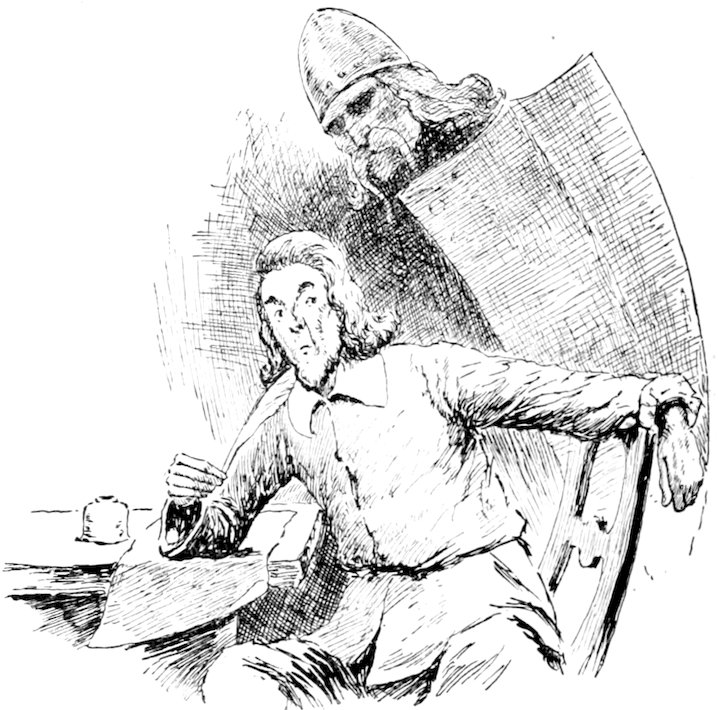
“THE SHADES OF DEPARTED AND LONG-FORGOTTEN HEROES.”
The more I reflect, the more I am astonished
at the important character of the historian.
He is the sovereign censor to decide upon
the renown or infamy of his fellow-men. He
is the patron of kings and conquerors, on
whom it depends whether they shall live in
after-ages, or be forgotten as were their ancestors
before them. The tyrant may oppress,
while the object of his tyranny exists; but the
historian possesses superior might, for his power
extends even beyond the grave. The shades of
departed and long-forgotten heroes anxiously
bend down from above, while he writes, watching
247each movement of his pen, whether it shall
pass by their names with neglect, or inscribe
them on the deathless pages of renown. Even
the drop of ink which hangs trembling on his
pen, which he may either dash upon the floor,
or waste in idle scrawlings—that very drop,
which to him is not worth the twentieth part
of a farthing, may be of incalculable value to
some departed worthy, may elevate half a
score, in one moment, to immortality, who
would have given worlds, had they possessed
them, to insure the glorious meed.
Let not my readers imagine, however, that
I am indulging in vainglorious boastings, or
am anxious to blazon forth the importance of
my tribe. On the contrary, I shrink when I
reflect on the awful responsibility we historians
assume; I shudder to think what direful commotions
and calamities we occasion in the
world; I swear to thee, honest reader, as I am
a man, I weep at the very idea! Why, let me
ask, are so many illustrious men daily tearing
themselves away from the embraces of their
families, slighting the smiles of beauty, despising
the allurements of fortune, and exposing
themselves to the miseries of war? Why
are kings desolating empires, and depopulating
whole countries? In short, what induces all
great men of all ages and countries to commit
248so many victories and misdeeds, and inflict
so many miseries upon mankind and upon
themselves, but the mere hope that some historian
will kindly take them into notice, and
admit them into a corner of his volume? For,
in short, the mighty object of all their toils,
their hardships, and privations, is nothing but
immortal fame. And what is immortal fame?—why,
half a page of dirty paper! Alas!
alas! how humiliating the idea, that the renown
of so great a man as Peter Stuyvesant
should depend upon the pen of so little a man
as Diedrich Knickerbocker!
And now, having refreshed ourselves after
the fatigues and perils of the field, it behooves
us to return once more to the scene of conflict,
and inquire what were the results of this renowned
conquest. The fortress of Christina
being the fair metropolis, and in a manner the
key to New Sweden, its capture was speedily
followed by the entire subjugation of the
province. This was not a little promoted by
the gallant and courteous deportment of the
chivalric Peter. Though a man terrible in
battle, yet in the hour of victory was he endued
with a spirit generous, merciful, and humane.
He vaunted not over his enemies, nor did he
make defeat more galling by unmanly insults;
for like that mirror of knightly virtue, the renowned
249Paladin Orlando, he was more anxious
to do great actions than to talk of them after
they were done. He put no man to death;
ordered no houses to be burnt down; permitted
no ravages to be perpetrated on the
property of the vanquished; and even gave
one of his bravest officers a severe admonishment
with his walking-staff, for having been
detected in the act of sacking a hen-roost.
He moreover issued a proclamation, inviting
the inhabitants to submit to the authority of
their High Mightinesses; but declaring, with
unexampled clemency, that whoever refused
should be lodged at the public expense, in a
goodly castle provided for the purpose, and
have an armed retinue to wait on them in the
bargain. In consequence of these beneficent
terms, about thirty Swedes stepped manfully
forward and took the oath of allegiance; in
reward for which they were graciously permitted
to remain on the banks of the Delaware,
where their descendants reside at this very
day. I am told, however, by divers observant
travellers, that they have never been able to
get over the chapfallen looks of their ancestors,
but that they still do strangely transmit
from father to son manifest marks of the sound
drubbing given them by the sturdy Amsterdammers.
250
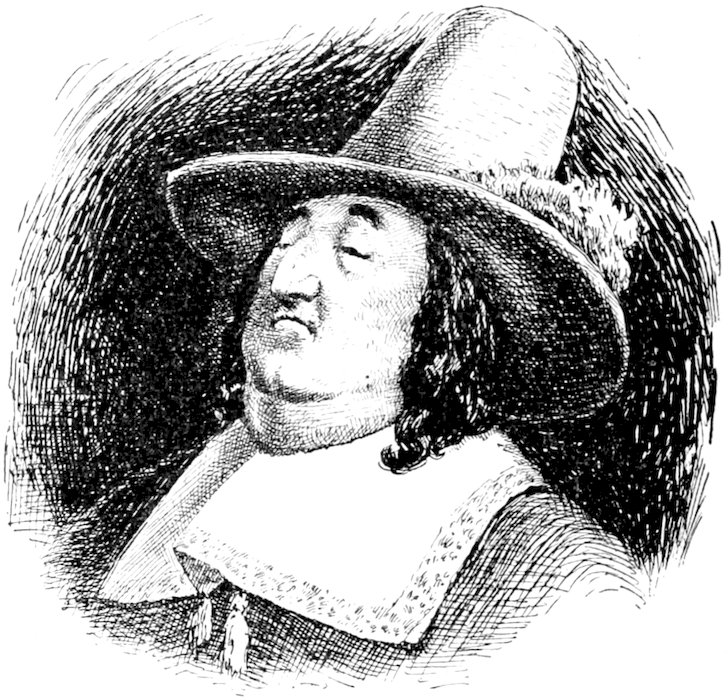
“MYNHEER WILLIAM BEEKMAN.”
The whole country of New Sweden, having
thus yielded to the arms of the triumphant
Peter, was reduced to a colony called South
River, and placed under the superintendence
of a lieutenant-governor, subject to the control
of the supreme government of New Amsterdam.
This great dignitary was called Mynheer
William Beekman, or rather Beck-man, who
derived his surname, as did Ovidious Naso of
yore, from the lordly dimensions of his nose,
251which projected from the centre of his countenance,
like the beak of a parrot. He was the
great progenitor of the tribe of the Beekmans,
one of the most ancient and honorable families
of the province, the members of which do
gratefully commemorate the origin of their
dignity,—not as your noble families in England
would do, by having a glowing proboscis emblazoned
in their escutcheon, but by one and
all wearing a right goodly nose, stuck in the
very middle of their faces.
Thus was this perilous enterprise gloriously
terminated, with the loss of only two men:
Wolfert Van Horne, a tall spare man, who was
knocked overboard by the boom of a sloop in
a flaw of wind; and fat Brom Van Bummels,
who was suddenly carried off by an indigestion;
both, however, were immortalized, as
having bravely fallen in the service of their
country. True it is, Peter Stuyvesant had one
of his limbs terribly fractured in the act of
storming the fortress; but as it was fortunately
his wooden leg, the wound was promptly and
effectually healed.
And now nothing remains to this branch of
my history but to mention that this immaculate
hero, and his victorious army, returned
joyously to the Manhattoes; where they made
a solemn and triumphant entry, bearing with
252them the conquered Risingh, and the remnant
of his battered crew, who had refused allegiance;
for it appears that the gigantic Swede
had only fallen into a swoon, at the end of the
battle, from which he was speedily restored by
a wholesome tweak of the nose.
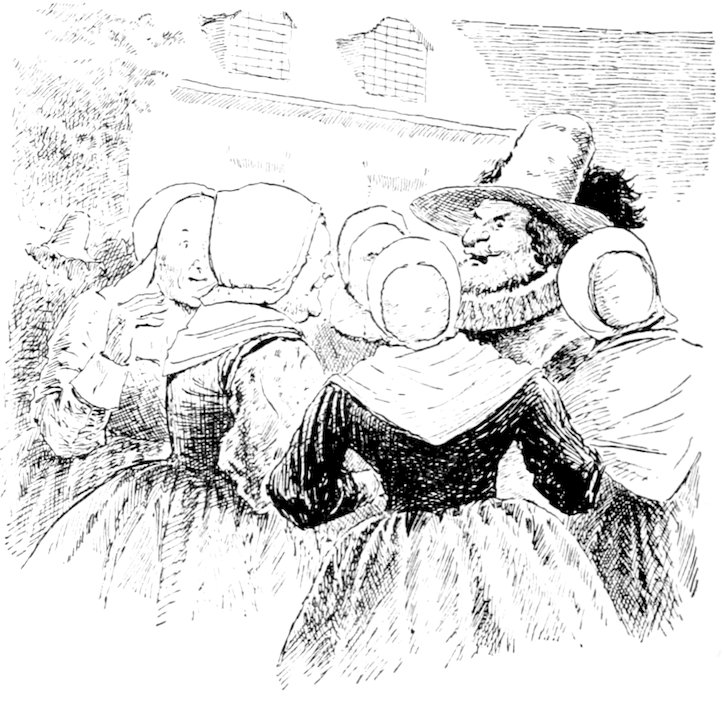
“THE OLD WOMEN FLOCKED AROUND ANTONY.”
These captive heroes were lodged, according
to the promise of the governor, at the public
expense, in a fair and spacious castle,—being
253the prison of state, of which Stoffel Brinkerhoff,
the immortal conqueror of Oyster Bay, was
appointed governor, and which has ever since
remained in the possession of his descendants.[21]
It was a pleasant and goodly sight to witness
the joy of the people of New Amsterdam, at
beholding their warriors once more return
from this war in the wilderness. The old
women thronged round Antony Van Corlear,
who gave the whole history of the campaign
with matchless accuracy, saving that he took
the credit of fighting the whole battle himself,
and especially of vanquishing the stout
Risingh,—which he considered himself as
clearly entitled to, seeing that it was effected
by his own stone pottle.
The schoolmasters throughout the town
gave holiday to their little urchins, who followed
in droves after the drums, with paper
caps on their heads, and sticks in their
breeches, thus taking the first lesson in the
art of war. As to the sturdy rabble, they
thronged at the heels of Peter Stuyvesant
wherever he went, waving their greasy hats
in the air, and shouting “Hardkoppig Piet
forever!”
254It was indeed a day of roaring rout and jubilee.
A huge dinner was prepared at the Stadthouse
in honor of the conquerors, where were
assembled in one glorious constellation the
great and little luminaries of New Amsterdam.
There were the lordly Schout and his obsequious
deputy; the burgomasters with their
officious schepens at their elbows; the subaltern
officers at the elbows of the schepens, and
so on down to the lowest hanger-on of police:
every tag having his rag at his side, to finish
his pipe, drink off his heel-taps, and laugh at
his flights of immortal dulness. In short,—for a
city feast is a city feast all the world over, and
has been a city feast ever since the creation,—the
dinner went off much the same as do our
great corporation junketings and Fourth-of-July
banquets. Loads of fish, flesh, and fowl
were devoured, oceans of liquor drank, thousands
of pipes smoked, and many a dull
joke honored with much obstreperous fat-sided
laughter.
I must not omit to mention that to this far-famed
victory, Peter Stuyvesant was indebted
for another of his many titles; for so hugely
delighted were the honest burghers with his
achievements, that they unanimously honored
him with the name of Pieter de Groodt, that
is to say, Peter the Great, or, as it was
255translated into English by the people of
New Amsterdam, for the benefit of their New
England visitors, Piet de pig,—an appellation
which he maintained even unto the day
of his death.
256
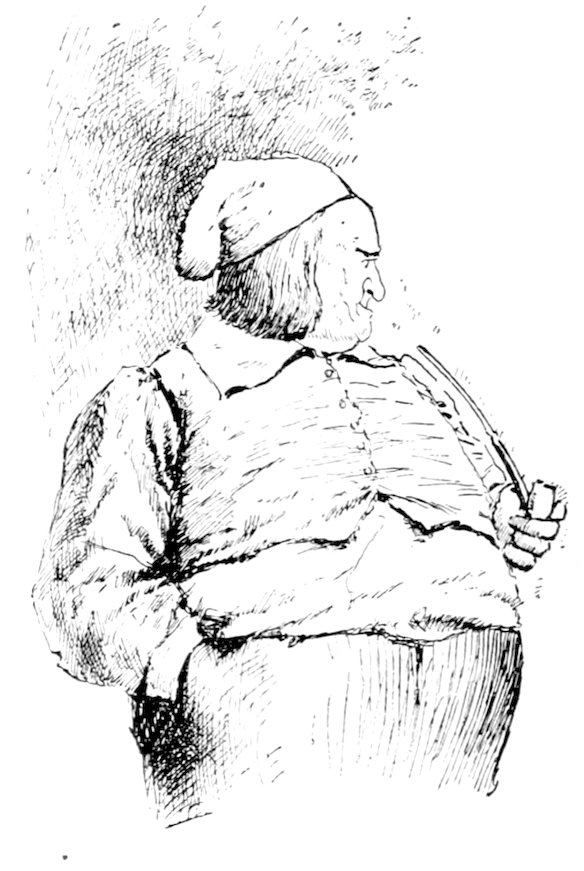
BOOK VII. CONTAINING THE THIRD PART OF THE REIGN OF PETER THE HEADSTRONG—HIS TROUBLES WITH THE BRITISH NATION, AND THE DECLINE AND FALL OF THE DUTCH DYNASTY. — Chapter I. HOW PETER STUYVESANT RELIEVED THE SOVEREIGN PEOPLE FROM THE BURDEN OF TAKING CARE OF THE NATION; WITH SUNDRY PARTICULARS OF HIS CONDUCT IN TIME OF PEACE, AND OF THE RISE OF A GREAT DUTCH ARISTOCRACY. — Chapter II. HOW PETER STUYVESANT LABORED TO CIVILIZE THE COMMUNITY—HOW HE WAS A GREAT PROMOTER OF HOLIDAYS—HOW HE INSTITUTED KISSING ON NEW YEAR’S DAY—HOW HE DISTRIBUTED FIDDLES THROUGHOUT THE NEW NETHERLANDS—HOW HE VENTURED TO REFORM THE LADIES’ PETTICOATS, AND HOW HE CAUGHT A TARTAR. — Chapter III. HOW TROUBLES THICKENED ON THE PROVINCE—HOW IT IS THREATENED BY THE HELDERBERGERS, THE MERRYLANDERS, AND THE GIANTS OF THE SUSQUEHANNA. — Chapter IV. HOW PETER STUYVESANT ADVENTURED INTO THE EAST COUNTRY, AND HOW HE FARED THERE. — Chapter V. HOW THE YANKEES SECRETLY SOUGHT THE AID OF THE BRITISH CABINET IN THEIR HOSTILE SCHEMES AGAINST THE MANHATTOES. — Chapter VI. OF PETER STUYVESANT’S EXPEDITION INTO THE EAST COUNTRY, SHOWING THAT THOUGH AN OLD BIRD, HE DID NOT UNDERSTAND TRAP. — Chapter VII. HOW THE PEOPLE OF NEW AMSTERDAM WERE THROWN INTO A GREAT PANIC BY THE NEWS OF THE THREATENED INVASION, AND THE MANNER IN WHICH THEY FORTIFIED THEMSELVES. — Chapter VIII. HOW THE GRAND COUNCIL OF THE NEW NETHERLANDS WERE MIRACULOUSLY GIFTED WITH LONG TONGUES IN THE MOMENT OF EMERGENCY—SHOWING THE VALUE OF WORDS IN WARFARE. — Chapter IX. IN WHICH THE TROUBLES OF NEW AMSTERDAM APPEARED TO THICKEN—SHOWING THE BRAVERY, IN TIME OF PERIL, OF A PEOPLE WHO DEFEND THEMSELVES BY RESOLUTION. — Chapter X. CONTAINING A DOLEFUL DISASTER OF ANTONY THE TRUMPETER—AND HOW PETER STUYVESANT, LIKE A SECOND CROMWELL, SUDDENLY DISSOLVED A RUMP PARLIAMENT. — Chapter XI. HOW PETER STUYVESANT DEFENDED THE CITY OF NEW AMSTERDAM FOR SEVERAL DAYS, BY DINT OF THE STRENGTH OF HIS HEAD. — Chapter XII. CONTAINING THE DIGNIFIED RETIREMENT, AND MORTAL SURRENDER OF PETER THE HEADSTRONG. — Chapter XIII. THE AUTHOR’S REFLECTIONS UPON WHAT HAS BEEN SAID.
257
258
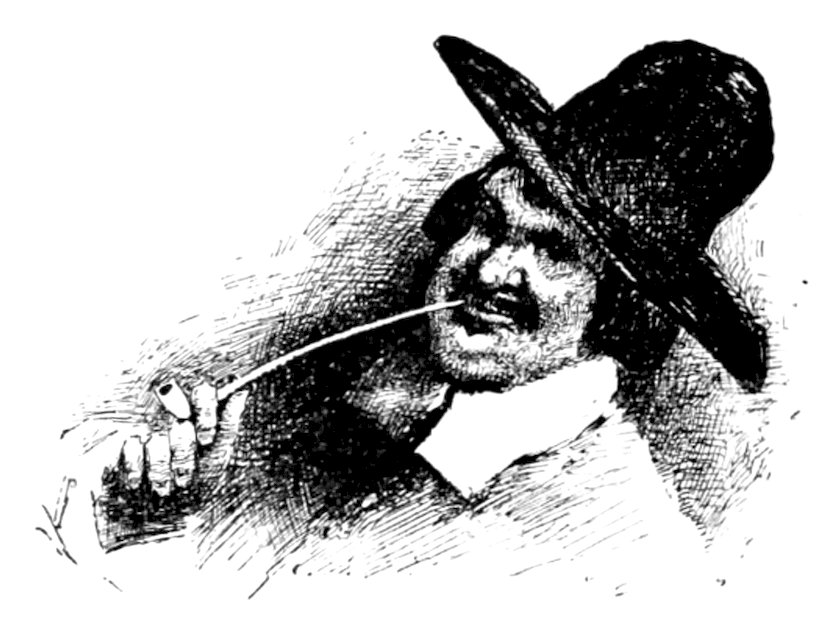
259
The history of the reign of
Peter Stuyvesant furnishes
an edifying picture
of the cares and
vexations inseparable
from sovereignty, and
a solemn warning to
all who are ambitious
of attaining the seat
of honor. Though returning
in triumph and crowned with victory,
his exultation was checked on observing the
abuses which had sprung up in New Amsterdam
during his short absence. His walking-staff,
which he had sent home to act as vice-gerent,
had, it is true, kept his council-chamber
in order,—the counsellors eying it with awe,
as it lay in grim repose upon the table, and
260smoking their pipes in silence,—but its control
extended not out of doors.
The populace unfortunately had had too
much their own way under the slack though
fitful reign of William the Testy; and though
upon the accession of Peter Stuyvesant they
had felt, with the instinctive perception which
mobs as well as cattle possess, that the reins
of government had passed into stronger hands,
yet could they not help fretting and chafing
and champing upon the bit, in restive silence.
Scarcely, therefore, had he departed on his
expedition against the Swedes, than the old
factions of William Kieft’s reign had again
thrust their heads above water. Pot-house
meetings were again held to “discuss the state
of the nation,” where cobblers, tinkers, and
tailors, the self-dubbed “friends of the people,”
once more felt themselves inspired with
the gift of legislation, and undertook to lecture
on every movement of government.
Now, as Peter Stuyvesant had a singular
inclination to govern the province by his individual
will, his first move, on his return,
was to put a stop to this gratuitous legislation.
Accordingly, one evening, when an inspired
cobbler was holding forth to an assemblage of
the kind, the intrepid Peter suddenly made his
appearance, with his ominous walking-staff in
261his hand, and a countenance sufficient to petrify
a mill-stone. The whole meeting was
thrown into confusion,—the orator stood
aghast, with open mouth and trembling
knees, while “horror! tyranny! liberty!
rights! taxes! death! destruction!” and a
host of other patriotic phrases were bolted
forth before he had time to close his lips.
Peter took no notice of the skulking throng,
but strode up to the brawling bully-ruffian,
and pulling out a huge silver watch, which
might have served in times of yore as a town
clock, and which is still retained by his descendants
as a family curiosity, requested the
orator to mend it, and set it going. The orator
humbly confessed it was utterly out of his
power, as he was unacquainted with the nature
of its construction. “Nay, but,” said Peter,
“try your ingenuity, man: you see all the
springs and wheels, and how easily the clumsiest
hand may stop it, and pull it to pieces;
and why should it not be equally easy to regulate
as to stop it?” The orator declared that
his trade was wholly different,—that he was a
poor cobbler, and had never meddled with a
watch in his life,—that there were men skilled
in the art, whose business it was to attend to
those matters; but for his part, he should
only mar the workmanship and put the whole
262in confusion. “Why, harkee, master of
mine,” cried Peter,—turning suddenly upon
him, with a countenance that almost petrified
the patcher of shoes into a perfect lapstone,—“dost
thou pretend to meddle with the movements
of government,—to regulate, and correct,
and patch, and cobble a complicated
machine, the principles of which are above
thy comprehension, and its simplest operations
too subtle for thy understanding, when thou
canst not correct a trifling error in a common
piece of mechanism, the whole mystery of
which is open to thy inspection?—Hence with
thee to the leather and stone, which are
emblems of thy head; cobble thy shoes, and
confine thyself to the vocation for which
Heaven has fitted thee. But,” elevating his
voice until it made the welkin ring, “if ever I
catch thee, or any of thy tribe, meddling again
with the affairs of government, by St. Nicholas,
but I’ll have every mother’s bastard of ye
flayed alive, and your hides stretched for drumheads,
that ye may thenceforth make a noise
to some purpose!”
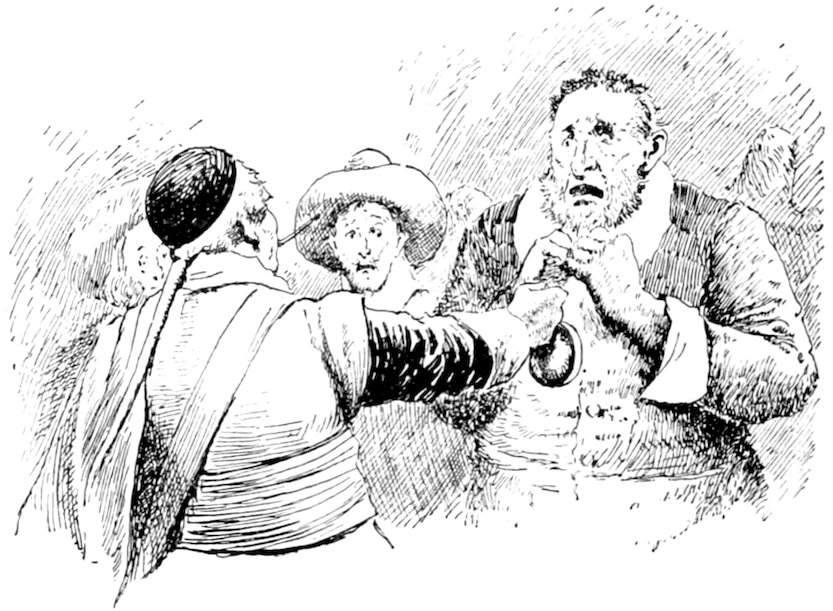
“‘NAY, BUT,’ SAID PETER, ‘TRY YOUR INGENUITY, MAN.’”
263This threat, and the tremendous voice in
which it was uttered, caused the whole multitude
to quake with fear. The hair of the orator
rose on his head like his own swines’
bristles, and not a knight of the thimble
present but his heart died within him, and he
felt as though he could have verily escaped
through the eye of a needle. The assembly
dispersed in silent consternation; the pseudo-statesmen,
who had hitherto undertaken to
regulate public affairs, were now fain to stay
at home, hold their tongues, and take care of
their families; and party feuds died away to
such a degree, that many thriving keepers of
taverns and dram-shops were utterly ruined for
want of business. But though this measure
produced the desired effect in putting an extinguisher
on the new lights just brightening up,
264yet did it tend to injure the popularity of the
Great Peter with the thinking part of the community,
that is to say, that part which thinks for
others instead of for themselves, or, in other
words, who attend to everybody’s business but
their own. These accused the old governor of
being highly aristocratical; and in truth there
seems to have been some ground for such an
accusation; for he carried himself with a lofty,
soldier-like air, and was somewhat particular
in dress, appearing, when not in uniform, in
rich apparel of the antique flaundrish cut, and
was especially noted for having his sound leg
(which was a very comely one) always arrayed
in a red stocking and high-heeled shoe.
Justice he often dispensed in the primitive
patriarchal way, seated on the “stoep” before
his door, under the shade of a great buttonwood
tree; but all visits of form and state were
received with something of court ceremony in
the best parlor; where Antony the Trumpeter
officiated as high chamberlain. On public
occasions he appeared with a great pomp of
equipage, and always rode to church in a
yellow wagon with flaming red wheels.
265
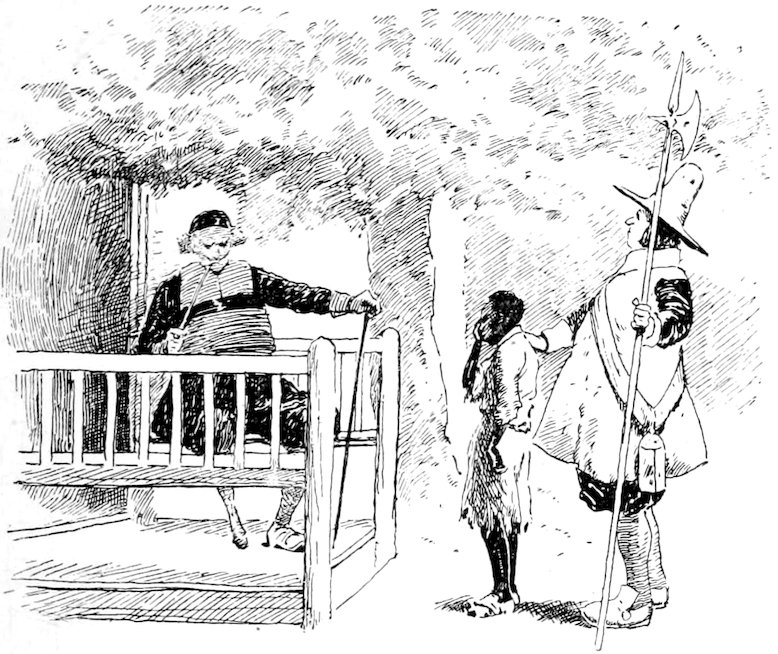
“SEATED ON THE ‘STOEP’ BEFORE HIS DOOR.”
These symptoms of state and ceremony, as
we have hinted, were much cavilled at by the
thinking (and talking) part of the community.
They had been accustomed to find easy access
to their former governors, and in particular
had lived on terms of extreme intimacy with
William the Testy; and they accused Peter
Stuyvesant of assuming too much dignity and
reserve, and of wrapping himself in mystery.
Others, however, have pretended to discover in
all this a shrewd policy on the part of the old
governor. It is certainly of the first importance,
say they, that a country should be governed
by wise men: but then it is almost
equally important that the people should think
them wise; for this belief alone can produce
266willing subordination. To keep up, however,
this desirable confidence, in rulers, the people
should be allowed to see as little of them as
possible. It is the mystery which envelopes
great men, that gives them half their greatness.
There is a kind of superstitious reverence for
office which leads us to exaggerate the merits
of the occupant, and to suppose that he must
be wiser than common men. He, however,
who gains access to cabinets, soon finds out by
what foolishness the world is governed. He
finds that there is quackery in legislation as in
everything else; that rulers have their whims
and errors as well as other men, are not so
wonderfully superior as he had imagined, since
even he may occasionally confute them in argument.
Thus awe subsides into confidence,
confidence inspires familiarity, and familiarity
produces contempt. Such was the case, say
they, with William the Testy. By making
himself too easy of access, he enabled every
scrub-politician to measure wits with him, and
to find out the true dimensions not only of his
person but of his mind: and thus it was that,
by being familiarly scanned, he was discovered
to be a very little man. Peter Stuyvesant on
the contrary, say they, by conducting himself
with dignity and loftiness, was looked up to
with great reverence. As he never gave credit
267for very profound ones; every movement, however
intrinsically unimportant, was a matter
of speculation; and his very red stockings
excited some respect, as being different from
the stockings of other men.
Another charge against Peter Stuyvesant
was that he had a great leaning in favor of the
patricians; and indeed in his time rose many
of those mighty Dutch families which have
taken such vigorous root, and branched out so
luxuriantly in our State. Some, to be sure,
were of earlier date, such as the Van Kortlandts,
the Van Zandts, the Ten Broecks, the
Harden Broeks, and others of Pavonian renown,
who gloried in the title of “Discoverers,”
from having been engaged in the
nautical expedition from Communipaw, in
which they so heroically braved the terrors of
Hell-gate and Buttermilk Channel, and discovered
a site for New Amsterdam.
Others claimed to themselves the appellation
of “Conquerors,” from their gallant achievements
in New Sweden and their victory over
the Yankees at Oyster Bay. Such was that
list of warlike worthies heretofore enumerated,
beginning with the Van Wycks, the Van
Dycks, and the Ten Eycks, and extending to
the Rutgers, the Bensons, the Brinkerhoffs,
and the Schermerhorns,—a roll equal to the
268Doomsday-Book of William the Conqueror, and
establishing the heroic origin of many an ancient
aristocratical Dutch family. These, after all,
are the only legitimate nobility and lords of
the soil; these are the real “beavers of the
Manhattoes”; and much does it grieve me in
modern days to see them elbowed aside by
foreign invaders, and more especially by those
ingenious people, “the Sons of the Pilgrims”;
who out-bargain them in the market, out-speculate
them on the exchange, out-top them
in fortune, and run up mushroom palaces so
high, that the tallest Dutch family mansion
has not wind enough left for its weather-cock.
In the proud days of Peter Stuyvesant, however,
the good old Dutch aristocracy loomed
out in all its grandeur. The burly burgher,
in round-crowned flaundrish hat with brim of
vast circumference, in portly gabardine and
bulbous multiplicity of breeches, sat on his
“stoep,” and smoked his pipe in lordly
silence; nor did it ever enter his brain that the
active, restless Yankee, whom he saw through
his half-shut eyes worrying about in dog-day
heat, ever intent on the main chance, was one
day to usurp control over these goodly Dutch
domains. Already, however, the races regarded
each other with disparaging eyes.
The Yankees sneeringly spoke of the round-crowned
269burghers of the Manhattoes as the
“Copperheads,” while the latter, glorying in
their own nether rotundity, and observing the
slack galligaskins of their rivals, flapping like
an empty sail against the mast, retorted upon
them with the opprobrious appellation of
“Platter-breeches.”
270
From what I have recounted
in the foregoing
chapter, I would
not have it imagined
that the great Peter
was a tyrannical potentate,
ruling with a
rod of iron. On the
contrary, where the
dignity of office permitted,
he abounded
in generosity and condescension.
If he refused the brawling
multitude the right of misrule, he at least
endeavored to rule them in righteousness.
To spread abundance in the land, he obliged
271the bakers to give thirteen loaves to the dozen,
a golden rule which remains a monument of
his beneficence. So far from indulging in
unreasonable austerity, he delighted to see the
poor and the laboring man rejoice; and for this
purpose he was a great promoter of holidays.
Under his reign there was a great cracking of
eggs at Paas or Easter; Whitsuntide or Pinxter
also flourished in all its bloom; and never
were stockings better filled on the eve of the
blessed St. Nicholas.
New Year’s day, however, was his favorite
festival, and was ushered in by the ringing of
bells and firing of guns. On that genial day
the fountains of hospitality were broken up,
and the whole community was deluged with
cherry-brandy, true Hollands, and mulled
cider; every house was a temple of the jolly
god; and many a provident vagabond got
drunk out of pure economy—taking in liquor
enough gratis to serve him half a year afterwards.
The great assemblage, however, was at the
governor’s house, whither repaired all the
burghers of New Amsterdam with their wives
and daughters, pranked out in their best attire.
On this occasion the good Peter was
devoutly observant of the pious Dutch rite of
kissing the women-kind for a Happy New
272Year; and it is traditional that Antony the
Trumpeter, who acted as gentleman usher,
took toll of all who were young and handsome,
as they passed through the antechamber.
This venerable custom, thus happily
introduced, was followed with such zeal by
high and low, that on New Year’s day, during
the reign of Peter Stuyvesant, New Amsterdam
was the most thoroughly be-kissed
community in all Christendom. Another
great measure of Peter Stuyvesant for public
improvement was the distribution of fiddles
throughout the land. These were placed in
the hands of veteran negroes, who were despatched
as missionaries to every part of the
province. This measure, it is said, was first
suggested by Antony the Trumpeter; and the
effect was marvellous. Instead of those “indignation
meetings” set on foot in the time of
William the Testy, where men met together to
rail at public abuses, groan over the evils of
the times, and make each other miserable,
there were joyous gatherings of the two sexes
to dance and make merry. Now were instituted
“quilting bees,” and “husking bees,”
and other rural assemblages, where, under the
inspiring influence of the fiddle, toil was enlivened
by gayety and followed up by the
dance. “Raising-bees” also were frequent,
273where houses sprung up at the wagging of the
fiddle-sticks, as the walls of Thebes sprang up
of yore to the sound of the lyre of Amphion.
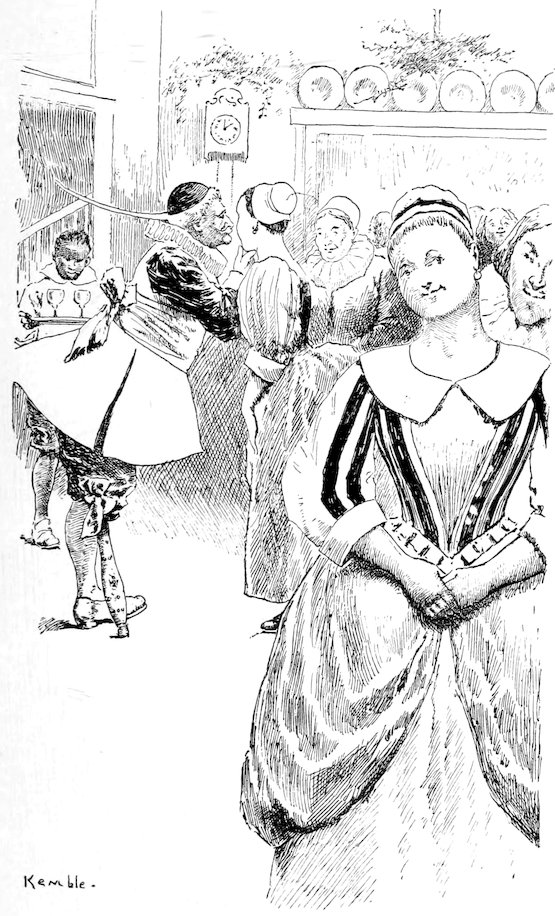
NEW YEAR’S DAY AT THE GOVERNOR’S.
274Jolly autumn, which pours its treasures over
hill and dale, was in those days a season for
the lifting of the heel as well as the heart;
labor came dancing in the train of abundance,
and frolic prevailed throughout the land.
Happy days! when the yeomanry of the
Nieuw Nederlandts were merry rather than
wise; and when the notes of the fiddle, those
harbingers of good-humor and good-will, resounded
at the close of the day from every
hamlet along the Hudson!
Nor was it in rural communities alone that
Peter Stuyvesant introduced his favorite engine
of civilization. Under his rule the fiddle
acquired that potent sway in New Amsterdam
which it has ever since retained. Weekly
assemblages were held, not in heated ballrooms
at midnight hours, but on Saturday
afternoons, by the golden light of the sun, on
the green lawn of the Battery,—with Antony
the Trumpeter for master of ceremonies. Here
would the good Peter take his seat under the
spreading trees, among the old burghers and
their wives, and watch the mazes of the dance.
Here would he smoke his pipe, crack his joke,
and forget the rugged toils of war in the sweet
275oblivious festivities of peace, giving a nod of
approbation to those of the young men who
shuffled and kicked most vigorously,—and
now and then a hearty smack, in all honesty
of soul, to the buxom lass who held out longest,
and tired down every competitor,—infallible
proof of her being the best dancer.
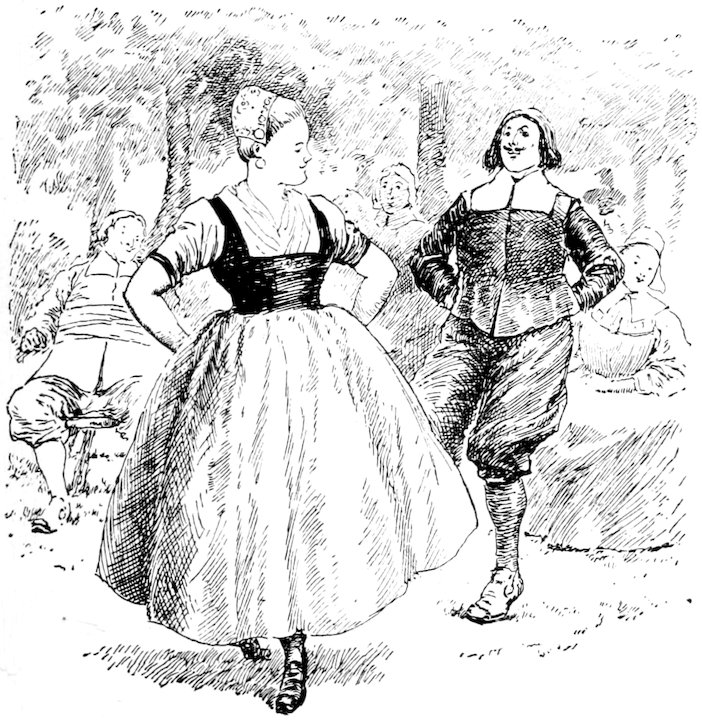
Once, it is true, the harmony of these meetings
was in danger of interruption. A young
276belle, just returned from a visit to Holland,
who of course led the fashions, made her appearance
in not more than half a dozen petticoats,
and these of alarming shortness. A
whisper and a nutter ran though the assembly.
The young men, of course, were lost in admiration;
but the old ladies were shocked in the
extreme, especially those who had marriageable
daughters; the young ladies blushed and
felt excessively for the “poor thing,” and even
the governor himself appeared to be in some
kind of perturbation.
To complete the confusion of the good folks,
she undertook, in the course of a jig, to describe
some figures in algebra taught her by a
dancing-master at Rotterdam. Unfortunately,
at the highest flourish of her feet some vagabond
zephyr obtruded his services, and a display
of the graces took place, at which all
the ladies present were thrown into great consternation;
several grave country members
were not a little moved, and the good Peter
Stuyvesant himself was grievously scandalized.
The shortness of the females’ dress, which
had continued in fashion ever since the days
of William Kieft, had long offended his eye;
and though extremely averse to meddling with
the petticoats of the ladies, yet he immediately
277recommended that every one should be furnished
with a flounce to the bottom. He likewise
ordered that the ladies, and indeed the
gentlemen, should use no other step in dancing
than “shuffle and turn,” and “double trouble”;
and forbade, under pain of his high
displeasure, any young lady thenceforth to
attempt what was termed “exhibiting the
graces.”
These were the only restrictions he ever imposed
upon the sex; and these were considered
by them as tyrannical oppressions, and resisted
with that becoming spirit manifested by the
gentle sex whenever their privileges are invaded.
In fact, Antony Van Corlear, who, as
has been shown, was a sagacious man, experienced
in the ways of women, took a private
occasion to intimate to the governor that a
conspiracy was forming among the young
vrouws of New Amsterdam; and that, if the
matter were pushed any further, there was
danger of their leaving off petticoats altogether;
whereupon the good Peter shrugged
his shoulders, dropped the subject, and ever
after suffered the women to wear their petticoats
and cut their capers as high as they
pleased,—a privilege which they have jealously
maintained in the Manhattoes unto the present
day.
278
In the last two chapters I
have regaled the reader
with a delectable picture
of the good Peter and his
metropolis during an interval
of peace. It was,
however, but a bit of
blue sky in a stormy day;
the clouds are again
gathering up from all
points of the compass,
and, if I am not mistaken
in my forebodings, we shall have rattling
weather in the ensuing chapters.
It is with some communities as it is with
certain meddlesome individuals: they have a
wonderful facility at getting into scrapes; and
I have always remarked that those are most
279prone to get in who have the least talent at
getting out again. This is doubtless owing to
the excessive valor of those states; for I have
likewise noticed that this rampant quality is
always most frothy and fussy where most confined;
which accounts for its vaporing so
amazingly in little states, little men, and ugly
little women more especially.
Such is the case with this little province of
the Nieuw Nederlandts; which, by its exceeding
valor, has already drawn upon itself a host
of enemies; has had fighting enough to satisfy
a province twice its size; and is in a fair way
of becoming an exceedingly forlorn, well-belabored,
and woe-begone little province. All
which was providentially ordered to give interest
and sublimity to this pathetic history.
The first interruption to the halcyon quiet
of Peter Stuyvesant was caused by hostile intelligence
from the old belligerent nest of Rensellaerstein.
Killian, the lordly patroon of
Rensellaerwick, was again in the field, at the
head of his myrmidons of the Helderberg,
seeking to annex the whole of the Kaatskill
mountains to his dominions. The Indian
tribes of these mountains had likewise taken
up the hatchet and menaced the venerable
Dutch settlement of Esopus.
Fain would I entertain the reader with the
280triumphant campaign of Peter Stuyvesant in
the haunted regions of those mountains, but
that I hold all Indian conflicts to be mere barbaric
brawls, unworthy of the pen which has
recorded the classic war of Fort Christina;
and as to these Helderberg commotions, they
are among the flatulencies which from time to
time afflict the bowels of this ancient province,
as with a wind-colic, and which I deem it
seemly and decent to pass over in silence.
The next storm of troubles was from the
south. Scarcely had the worthy Mynheer
Beekman got warm in the seat of authority on
the South River, than enemies began to spring
up all around him. Hard by was a formidable
race of savages inhabiting the gentle region
watered by the Susquehanna, of whom the
following mention is made by Master Hariot,
in his excellent history:
“The Susquesahanocks are a giantly people,
strange in proportion, behavior, and attire—their
voice sounding from them as out of a
cave. Their tobacco-pipes were three quarters
of a yard long; carved at the great end with a
bird, beare, or other device, sufficient to beat
out the brains of a horse. The calfe of one of
their legges measured three quarters of a yard
about; the rest of the limbs proportionable.”[22]
281
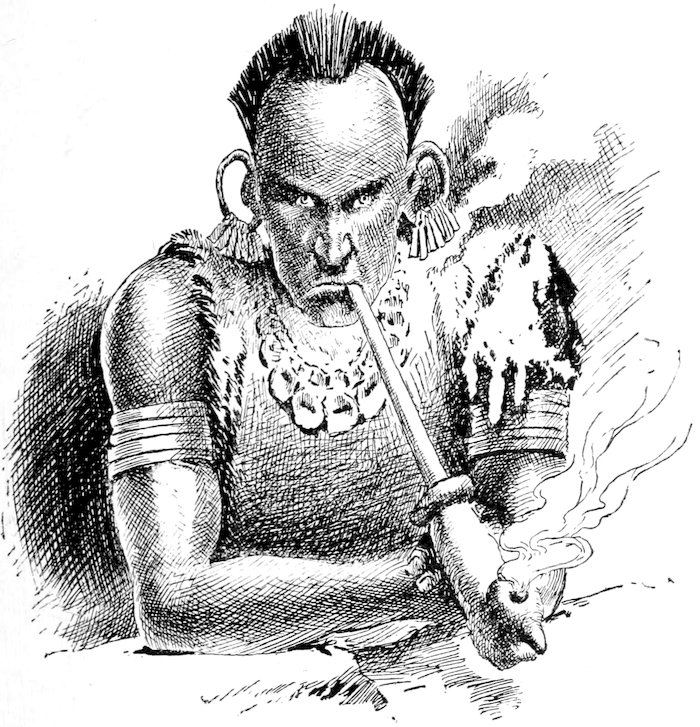
These gigantic savages and smokers caused
no little disquiet in the mind of Mynheer
Beekman, threatening to cause a famine of tobacco
in the land; but his most formidable
enemy was the roaring, roistering English
colony of Maryland, or, as it was anciently
written, Merryland,—so called because the
inhabitants, not having the fear of the Lord
before their eyes, were prone to make merry
282and get fuddled with mint-julep and apple-toddy.
They were, moreover, great horse-racers
and cock-fighters, mighty wrestlers
and jumpers, and enormous consumers of hoe-cake
and bacon. They lay claim to be the
first inventors of those recondite beverages,
cock-tail, stone-fence, and sherry-cobbler, and
to have discovered the gastronomical merits of
terrapins, soft crabs, and canvas-back ducks.
This rantipole colony, founded by Lord Baltimore,
a British nobleman, was managed by his
agent, a swaggering Englishman, commonly
called Fendall, that is to say, “offend all,”—a
name given him for his bullying propensities.
These were seen in a message to Mynheer
Beekman, threatening him, unless he immediately
swore allegiance to Lord Baltimore as
the rightful lord of the soil, to come, at the
head of the roaring boys of Merryland and the
giants of the Susquehanna, and sweep him and
his Nederlanders out of the country.
The trusty sword of Peter Stuyvesant almost
leaped from its scabbard when he received
missives from Mynheer Beekman, informing
him of the swaggering menaces of the bully
Fendall; and as to the giantly warriors of
the Susquehanna, nothing would have more
delighted him than a bout, hand to hand, with
half a score of them, having never encountered
283a giant in the whole course of his campaigns,
unless we may consider the stout Risingh as
such—and he was but a little one.
Nothing prevented his marching instantly
to the South River and enacting scenes still
more glorious than those of Fort Christina,
but the necessity of first putting a stop to the
increasing aggressions and inroads of the
Yankees, so as not to leave an enemy in his
rear; but he wrote to Mynheer Beekman to
keep up a bold front and stout heart, promising,
as soon as he had settled affairs in the
east, that he would hasten to the south with
his burly warriors of the Hudson, to lower the
crests of the giants, and mar the merriment of
the Merrylanders.
284
To explain the apparently
sudden movement of
Peter Stuyvesant against
the crafty men of the
East Country, I would
observe that, during his
campaigns on the South
River, and in the enchanted
regions of the
Catskill Mountains, the
twelve tribes of the East
had been more than usually active in prosecuting
their subtle scheme for the subjugation of
the Nieuw Nederlandts.
Independent of the incessant maraudings
among hen-roosts and squattings along the
border, invading armies would penetrate, from
time to time, into the very heart of the country.
As their prototypes of yore went forth
into the land of Canaan, with their wives and
285their children, their men-servants and their
maid-servants, their flocks and herds, to settle
themselves down in the land and possess it, so
these chosen people of modern days would
progress through the country in patriarchal
style, conducting carts and wagons laden with
household furniture, with women and children
piled on top, and pots and kettles dangling
beneath. At the tails of these vehicles would
stalk a crew of long-limbed, lank-sided varlets,
with axes on their shoulders and packs on
their backs, resolutely bent upon “locating”
themselves, as they termed it, and improving
the country. These were the most dangerous
kind of invaders. It is true they were guilty
of no overt acts of hostility; but it was notorious
that, wherever they got a footing, the
honest Dutchmen gradually disappeared, retiring
slowly, as do the Indians before the
white men, being in some way or other talked
and chaffed, and bargained and swapped, and,
in plain English, elbowed out of all those rich
bottoms and fertile nooks in which our Dutch
yeomanry are prone to nestle themselves.
Peter Stuyvesant was at length roused to
this kind of war in disguise, by which the
Yankees were craftily aiming to subjugate his
dominions. He was a man easily taken in, it
is true, as all great-hearted men are apt to be;
286but if he once found it out, his wrath was
terrible. He now threw diplomacy to the
dogs—determined to appear no more by ambassadors,
but to repair in person to the great
council of the Amphictyons, bearing the
sword in one hand and the olive-branch in the
other, and giving them their choice of sincere
and honest peace, or open and iron war.
His privy councillors were astonished and
dismayed when he announced his determination.
For once they ventured to remonstrate,
setting forth the rashness of venturing his
sacred person in the midst of a strange and
barbarous people. They might as well have
tried to turn a rusty weather-cock with a
broken-winded bellows. In the fiery heart of
the iron-headed Peter sat enthroned the five
kinds of courage described by Aristotle; and
had the philosopher enumerated five hundred
more, I verily believe he would have possessed
them all. As to that better part of valor called
discretion, it was too cold-blooded a virtue for
his tropical temperament.
Summoning, therefore, to his presence his
trusty follower, Antony Van Corlear, he commanded
him to hold himself in readiness to
accompany him the following morning on this,
his hazardous enterprise. Now Antony the
Trumpeter was by this time a little stricken in
287years, but by dint of keeping up a good heart,
and having never known care or sorrow (having
never been married), he was still a hearty,
jocund, rubicund, gamesome wag, and of
great capacity in the doublet. This last was
ascribed to his living a jolly life on those domains
at the Hook, which Peter Stuyvesant had
granted to him for his gallantry at Fort Casimir.
Be this as it may, there was nothing that
more delighted Antony than this command of
the great Peter, for he could have followed the
stout-hearted old governor to the world’s end,
with love and loyalty; and he moreover still
remembered the frolicking, and dancing, and
bundling, and other disports of the east country,
and entertained dainty recollections of
numerous kind and buxom lasses, whom he
longed exceedingly again to encounter.
Thus then did the mirror of hardihood set
forth, with no other attendant but his trumpeter,
upon one of the most perilous enterprises
ever recorded in the annals of knight-errantry.
For a single warrior to venture
openly among a whole nation of foes,—but,
above all, for a plain downright Dutchman to
think of negotiating with the whole council
of New England!—never was there known
a more desperate undertaking!—Ever since I
have entered upon the chronicles of this peerless
288but hitherto uncelebrated chieftain, has
he kept me in a state of incessant action and
anxiety with the toils and dangers he is constantly
encountering. Oh! for a chapter of
the tranquil reign of Wouter Van Twiller,
that I might repose on it as on a feather-bed!
Is it not enough, Peter Stuyvesant, that I
have once already rescued thee from the machinations
of these terrible Amphictyons, by
bringing the powers of witchcraft to thine aid?
Is it not enough, that I have followed thee undaunted,
like a guardian spirit, into the midst
of the horrid battle of Fort Christina?—that I
have been put incessantly to my trumps to
keep thee safe and sound,—now warding off
with my single pen the shower of dastard
blows that fell upon thy rear,—now narrowly
shielding thee from a deadly thrust, by a mere
tobacco-box,—now casing thy dauntless skull
with adamant, when even thy stubborn ram-beaver
failed to resist the sword of the stout
Risingh,—and now, not merely bringing
thee off alive, but triumphant, from the
clutches of the gigantic Swede, by the desperate
means of a paltry stone pottle? Is not all
this enough, but must thou still be plunging
into new difficulties, and hazarding in headlong
enterprises thyself, thy trumpeter, and
thy historian?
289
And now the ruddy-faced Aurora, like a
buxom chambermaid, draws aside the sable
curtains of the night, and out bounces from
his bed the jolly red-haired Phœbus, startled
at being caught so late in the embraces of
Dame Thetis. With many a stable-boy oath
he harnesses his brazen-footed steeds, and
whips, and lashes, and splashes up the firmament,
like a loitering coachman, half an hour
behind his time. And now behold that imp of
290fame and prowess, the headstrong Peter,
bestriding a raw-boned, switch-tailed charger,
gallantly arrayed in full regimentals, and
bracing on his thigh that trusty brass-hilted
sword, which had wrought such fearful deeds
on the banks of the Delaware.
Behold hard after him his doughty trumpeter,
Van Corlear, mounted on a broken-winded,
wall-eyed, calico mare, his stone
pottle, which had laid low the mighty Risingh,
slung under his arm, and his trumpet displayed
vauntingly in his right hand, decorated
with a gorgeous banner, on which is emblazoned
the great beaver of the Manhattoes.
See him proudly issuing out of the city-gate,
like an iron-clad hero of yore, with his faithful
squire at his heels, the populace following
with their eyes, and shouting many a parting
wish, and hearty cheering.—Farewell, Hardkoppig
Piet! Farewell, honest Antony!—Pleasant
be your wayfaring—prosperous your
return! The stoutest hero that ever drew a
sword, and the worthiest trumpeter that ever
trod shoe-leather.
291
Legends are lamentably silent about the
events that befell our adventurers in this their
adventurous travel, excepting the Stuyvesant
manuscript, which gives the substance of a
pleasant little heroic poem, written on the
292occasion by Dominie Ægidius Luyck,[23] who
appears to have been the poet-laureate of New
Amsterdam. This inestimable manuscript assures
us, that it was a rare spectacle to behold
the great Peter and his loyal follower hailing
the morning sun, and rejoicing in the clear
countenance of nature, as they pranced it
through the pastoral scenes of Bloemen Dael;
which, in those days, was a sweet and rural
valley, beautified with many a bright wildflower,
refreshed by many a pure streamlet,
and enlivened here and there by a delectable
little Dutch cottage, sheltered under some
sloping hill, and almost buried in embowering
trees.
293
“THEY BESTRODE THEIR CANES AND GALLOPED OFF IN HORRIBLE CONFUSION.”
Now did they enter upon the confines of
Connecticut, where they encountered many
grievous difficulties and perils. At one place
they were assailed by a troop of country
squires and militia colonels, who, mounted on
goodly steeds, hung upon their rear for several
miles, harassing them exceedingly with
guesses and questions, more especially the
worthy Peter, whose silver-chased leg excited
not a little marvel. At another place, hard by
the renowned town of Stamford, they were set
upon by a great and mighty legion of church-deacons,
who imperiously demanded of them
five shillings, for travelling on Sunday, and
threatened to carry them captive to a neighboring
church, whose steeple peered above the
trees; but these the valiant Peter put to rout
with little difficulty, insomuch that they bestrode
their canes and galloped off in horrible
294confusion, leaving their cocked hats behind in
the hurry of their flight. But not so easily did
he escape from the hands of a crafty man of Pyquag,
who, with undaunted perseverance, and
repeated onsets, fairly bargained him out of his
goodly switch-tailed charger, leaving in place
thereof a villanous, foundered Narragansett
pacer.
But maugre all these hardships, they pursued
their journey cheerily along the course
of the soft-flowing Connecticut, whose gentle
waves, says the song, roll through many a
fertile vale and sunny plain,—now reflecting
the lofty spires of the bustling city, and now
the rural beauties of the humble hamlet,—now
echoing with the busy hum of commerce, and
now with the cheerful song of the peasant.
At every town would Peter Stuyvesant, who
was noted for warlike punctilio, order the
sturdy Antony to sound a courteous salutation;
though the manuscript observes, that
the inhabitants were thrown into great dismay
when they heard of his approach. For the fame
of his incomparable achievements on the Delaware
had spread throughout the east country,
and they dreaded lest he had come to take
vengeance on their manifold transgressions.
But the good Peter rode through these
towns with a smiling aspect, waving his hand
295with inexpressible majesty and condescension;
for he verily believed that the old clothes
which these ingenious people had thrust into
their broken windows, and the festoons of
dried apples and peaches which ornamented
the fronts of their houses, were so many decorations
in honor of his approach, as it was the
custom in the days of chivalry to compliment
renowned heroes by sumptuous displays of
tapestry and gorgeous furniture. The women
crowded to the doors to gaze upon him as he
passed, so much does prowess in arms delight
the gentle sex. The little children, too, ran
after him in troops, staring with wonder at
his regimentals, his brimstone breeches, and
the silver garniture of his wooden leg. Nor
must I omit to mention the joy which many
strapping wenches betrayed at beholding the
jovial Van Corlear, who had whilom delighted
them so much with his trumpet, when he bore
the great Peter’s challenge to the Amphictyons.
The kind-hearted Antony alighted
from his calico mare, and kissed them all
with infinite loving-kindness,—and was right
pleased to see a crew of little trumpeters crowding
around him for his blessing, each of whom
he patted on the head, bade him be a good
boy, and gave him a penny to buy molasses
candy.
296
Now so it happened, that,
while the great and
good Peter Stuyvesant,
followed by his trusty
squire, was making his
chivalric progress
through the east country,
a dark and direful
scheme of war against
his beloved province
was forming in that
nursery of monstrous projects, the British
Cabinet. This, we are confidently informed, was
the result of the secret instigations of the great
council of the league; who, finding themselves
totally incompetent to vie in arms with
the heavy-sterned warriors of the Manhattoes
and their iron-headed commander, sent emissaries
to the British government, setting forth in
eloquent language the wonders and delights
297of this delicious little Dutch Canaan, and imploring
that a force might be sent out to invade
it by sea, while they should co-operate
by land.
298
These emissaries arrived at a critical juncture,
just as the British Lion was beginning to
bristle up his mane and wag his tail; for we
are assured by the anonymous writer of the
Stuyvesant manuscript, that the astounding
victory of Peter Stuyvesant at Fort Christina
had resounded throughout Europe, and his
annexation of the territory of New Sweden
had awakened the jealousy of the British
Cabinet for their wild lands at the south.
This jealousy was brought to a head by the
representations of Lord Baltimore, who declared
that the territory thus annexed lay
within the lands granted to him by the British
crown, and he claimed to be protected in his
rights. Lord Sterling, another British subject,
claimed the whole of Nassau, or Long
Island, once the Ophir of William the Testy,
but now the kitchen-garden of the Manhattoes,
which he declared to be British territory
by the right of discovery, but unjustly usurped
by the Nederlanders. The result of all these
rumors and representations was a sudden zeal
on the part of his Majesty Charles the Second,
for the safety and well-being of his transatlantic
possessions, and especially for the recovery
of the New Netherlands, which Yankee logic
had, somehow or other, proved to be a continuity
of the territory taken possession of for
the British crown for the Pilgrims, when they
landed on Plymouth Rock, fugitives from
British oppression. All this goodly land, thus
wrongfully held by the Dutchmen, he presented,
in a fit of affection, to his brother, the
Duke of York,—a donation truly royal, since
none but great sovereigns have a right to give
away what does not belong to them. That
299this munificent gift might not be merely nominal,
his Majesty ordered that an armament
should be straightway despatched to invade the
city of New Amsterdam by land and water,
and put his brother in complete possession of
the premises.
Thus critically situated are the affairs of the
New Nederlanders. While the honest burghers
are smoking their pipes in sober security,
and the privy councillors are snoring in the
council-chamber,—while Peter the Headstrong
is undauntedly making his way through the
east country in the confident hope by honest
words and manly deeds to bring the grand
council to terms,—a hostile fleet is sweeping
like a thunder-cloud across the Atlantic, soon
to rattle a storm of war about the ears of the
dozing Nederlanders, and to put the mettle
of their governor to trial.
But come what may, I here pledge my veracity,
that in all warlike conflicts and doubtful
perplexities he will ever acquit himself like a
gallant, noble-minded, obstinate old cavalier.—Forward,
then, to the charge! Shine out,
propitious stars, on the renowned city of the
Manhattoes; and the blessing of St. Nicholas
go with thee, honest Peter Stuyvesant.
300
Great nations resemble
great men in this particular,
that their greatness
is seldom known
until they get in trouble;
adversity, therefore, has
been wisely denominated
the ordeal of true greatness,
which, like gold,
can never receive its real
estimation until it has passed through the
furnace. In proportion, therefore, as a nation,
a community, or an individual (possessing the
inherent quality of greatness) is involved in
perils and misfortunes, in proportion does it
rise in grandeur, and even when sinking under
calamity, makes, like a house on fire, a more
glorious display than ever it did in the fairest
period of its prosperity.
301The vast empire of China, though teeming
with population and imbibing and concentrating
the wealth of nations, has vegetated
through a succession of drowsy ages; and
were it not for its internal revolutions, and the
subversion of its ancient government by the
Tartars, might have presented nothing but a
dull detail of monotonous prosperity. Pompeii
and Herculaneum might have passed into
oblivion, with a herd of their contemporaries,
had they not been fortunately overwhelmed
by a volcano. The renowned city of Troy
acquired celebrity only from its ten years’ distress,
and final conflagration; Paris rose in
importance by the plots and massacres which
ended in the exaltation of Napoleon; and even
the mighty London has skulked through the
records of time, celebrated for nothing of
moment excepting the plague, the great fire,
and Guy Faux’s gun-powder plot! Thus
cities and empires creep along, enlarging in
silent obscurity, until they burst forth in some
tremendous calamity—and snatch, as it were,
immortality from the explosion!
The above principle being admitted, my
reader will plainly perceive that the city of
New Amsterdam and its dependent province
are on the high-road to greatness. Dangers
and hostilities threaten from every side, and it
302is really a matter of astonishment, how so
small a state has been able, in so short a time,
to entangle itself in so many difficulties. Ever
since the province was first taken by the nose,
at the Fort of Goed Hoop, in the tranquil days
of Wouter Van Twiller, has it been gradually
increasing in historic importance; and never
could it have had a more appropriate chieftain
to conduct it to the pinnacle of grandeur than
Peter Stuyvesant.
This truly headstrong hero having successfully
effected his daring progress through the
east country, girded up his loins as he approached
Boston, and prepared for the grand
onslaught with the Amphictyons, which was
to be the crowning achievement of the campaign.
Throwing Antony Van Corlear, who,
with his calico mare formed his escort and army
a little in the advance, and bidding him be
of stout heart and great wind, he placed himself
firmly in his saddle, cocked his hat more
fiercely over his left eye, summoned all the
heroism of his soul into his countenance, and,
with one arm akimbo, the hand resting on
the pommel of his sword, rode into the great
metropolis of the league, Antony sounding his
trumpet before him in a manner to electrify the
whole community.
Never was there such a stir in Boston as on
303this occasion; never such a hurrying hither
and thither about the streets; such popping
of heads out of windows; such gathering of
knots in market-places. Peter Stuyvesant was
a straightforward man, and prone to do everything
aboveboard. He would have ridden at
once to the great council-house of the league
and sounded a parley; but the grand council
knew the mettlesome hero they had to deal
with, and were not for doing things in a hurry.
On the contrary, they sent forth deputations to
meet him on the way, to receive him in a style
befitting the great potentate of the Manhattoes,
and to multiply all kind of honors, and
ceremonies, and formalities, and other courteous
impediments in his path. Solemn banquets
were accordingly given him, equal to
thanksgiving feasts. Complimentary speeches
were made him, wherein he was entertained
with the surpassing virtues, long-sufferings,
and achievements of the Pilgrim Fathers; and
it is even said he was treated to a sight of
Plymouth Rock,—that great corner-stone of
Yankee empire.
I will not detain my readers by recounting
the endless devices by which time was wasted,
and obstacles and delays multiplied to the
infinite annoyance of the impatient Peter.
Neither will I fatigue them by dwelling on his
304negotiations with the grand council, when he
at length brought them to business. Suffice
it to say, it was like most other diplomatic
negotiations: a great deal was said and very
little done; one conversation led to another,
one conference begot misunderstandings which
it took a dozen conferences to explain, at the
end of which both parties found themselves
just where they had begun, but ten times less
likely to come to an agreement.
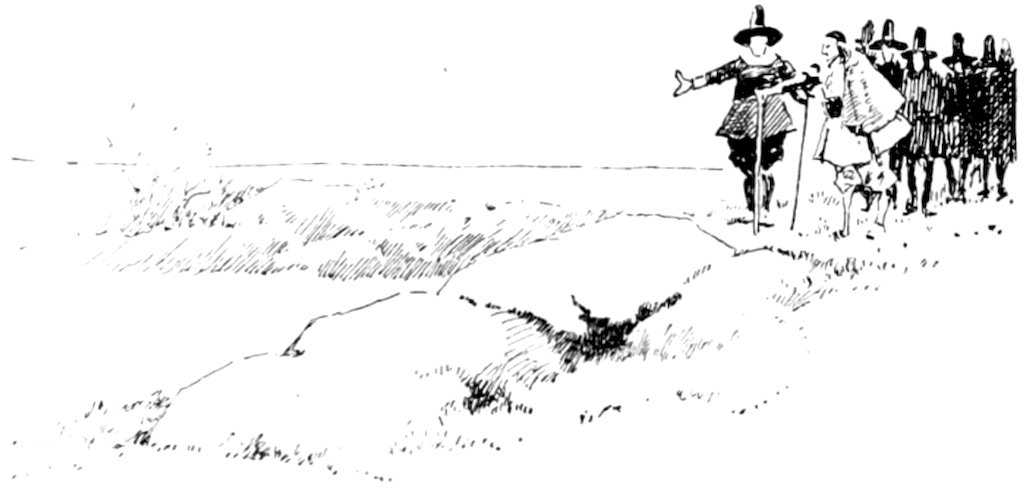
“HE WAS TREATED TO A SIGHT OF PLYMOUTH ROCK.”
In the midst of these perplexities which
bewildered the brain and incensed the ire of
honest Peter, he received private intelligence
of the dark conspiracy matured in the British
cabinet, with the astounding fact that a British
squadron was already on the way to invade
New Amsterdam by sea, and that the grand
council of Amphictyons, while thus beguiling
305him with subtleties, were actually prepared to
co-operate by land!
Oh! how did the sturdy old warrior rage
and roar, when he found himself thus entrapped,
like a lion in the hunter’s toil! Now
did he draw his trusty sword, and determine
to break in upon the council of the Amphictyons
and put every mother’s son of them to
death. Now did he resolve to fight his way
throughout all the region of the east and to
lay waste Connecticut River!
Gallant, but unfortunate Peter! Did I not
enter with sad forebodings on this ill-starred
expedition? Did I not tremble when I saw
thee, with no other counsellor than thine own
head; no other armor but an honest tongue, a
spotless conscience, and a rusty sword; no
other protector but St. Nicholas, and no other
attendant but a trumpeter; did I not tremble
when I beheld thee thus sally forth to contend
with all the knowing powers of New England?
It was a long time before the kind-hearted
expostulations of Antony Van Corlear, aided
by the soothing melody of his trumpet, could
lower the spirits of Peter Stuyvesant from
their warlike and vindictive tones, and prevent
his making widows and orphans of half the
population of Boston. With great difficulty
he was prevailed upon to bottle up his wrath
306for the present, to conceal from the council his
knowledge of their machinations, and by effecting
his escape, to be able to arrive in time
for the salvation of the Manhattoes.
The latter suggestion awakened a new ray
of hope in his bosom; he forthwith despatched
a secret message to his councillors at
New Amsterdam, apprising them of their
danger, and commanding them to put the city
in a posture of defence, promising to come as
soon as possible to their assistance. This
done, he felt marvellously relieved, rose
slowly, shook himself like a rhinoceros, and
issued forth from his den, in much the same
manner as Giant Despair is described to have
issued from Doubting Castle, in the chivalric
history of the Pilgrim’s Progress.
And now much does it grieve me that I
must leave the gallant Peter in this imminent
jeopardy; but it behooves us to hurry back
and see what is going on at New Amsterdam,
for greatly do I fear that city is already in a
turmoil. Such was ever the fate of Peter
Stuyvesant; while doing one thing with heart
and soul, he was too apt to leave everything
else at sixes and sevens. While, like a potentate
of yore, he was absent attending to those
things in person which in modern days are
trusted to generals and ambassadors, his little
307territory at home was sure to get in an uproar;
all which was owing to that uncommon
strength of intellect, which induced him to
trust to nobody but himself, and which had
acquired him the renowned appellation of
Peter the Headstrong.
308
There is no sight more
truly interesting to a
philosopher than a community
where every individual
has a voice in
public affairs, where
every individual considers
himself the Atlas of
the nation, and where
every individual thinks
it his duty to bestir himself
for the good of his country: I say, there
is nothing more interesting to a philosopher
than such a community in a sudden bustle of
war. Such clamor of tongues—such patriotic
bawling—such running hither and thither—everybody
in a hurry—everybody in trouble—everybody
in the way, and everybody
309interrupting his neighbor—who is busily
employed in doing nothing! It is like
witnessing a great fire, where the whole
community are agog—some dragging about
empty engines—others scampering with full
buckets, and spilling the contents into their
neighbor’s boots—and others ringing the
church-bells all night, by way of putting out
the fire. Little firemen, like sturdy little
knights storming a breach, clambering up and
down scaling-ladders, and bawling through
tin trumpets, by way of directing the attack.
Here a fellow, in his great zeal to save the
property of the unfortunate, catches up an
anonymous chamber-utensil, and gallants it off
with an air of as much self-importance as if
he had rescued a pot of money; there another
throws looking-glasses and china out of the
window, to save them from the flames; whilst
those who can do nothing else run up and
down the streets keeping up an incessant cry
of Fire! Fire! Fire!
“When the news arrived at Sinope,” says
Lucian,—though I own the story is rather
trite,—“that Philip was about to attack them,
the inhabitants were thrown into violent alarm.
Some ran to furbish up their arms; others
rolled stones to build up the walls,—everybody,
in short, was employed, and everybody in the
310way of his neighbor. Diogenes alone could
find nothing to do; whereupon, not to be idle
when the welfare of his country was at stake,
he tucked up his robe, and fell to rolling his
tub with might and main up and down the
Gymnasium.” In like manner did every
mother’s son in the patriotic community of
New Amsterdam, on receiving the missive of
Peter Stuyvesant, busy himself most mightily
in putting things in confusion, and assisting
the general uproar. “Every man”—saith the
Stuyvesant manuscript—“flew to arms!”—by
which is meant, that not one of our
honest Dutch citizens would venture to church
or to market without an old-fashioned spit of a
sword dangling at his side, and a long Dutch
fowling-piece on his shoulder; nor would he
go out of a night without a lantern; nor turn a
corner without first peeping cautiously round,
lest he should come unawares upon a British
army;—and we are informed that Stoffel
Brinkerhoff, who was considered by the old
women almost as brave a man as the governor
himself, actually had two one-pound swivels
mounted in his entry, one pointing out at the
front door, and the other at the back.
311
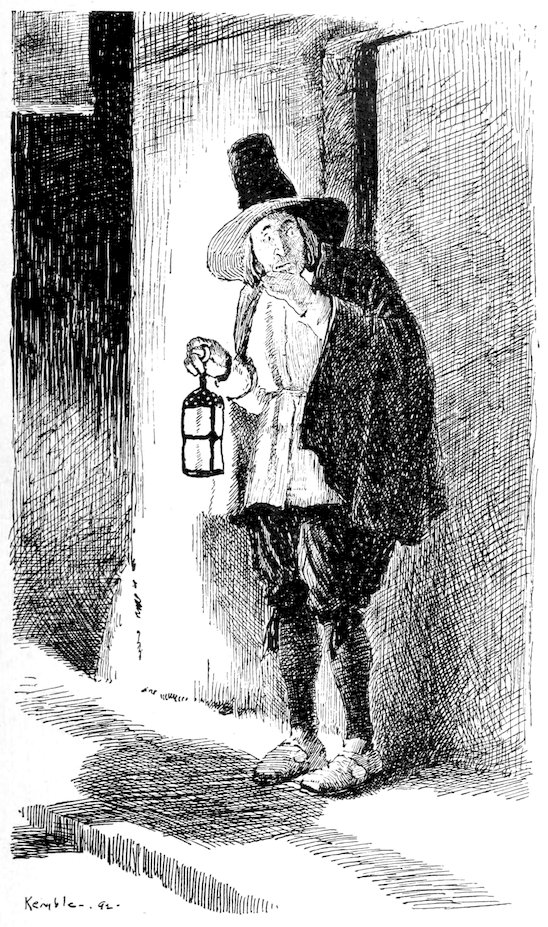
“NOR WOULD HE GO OUT OF A NIGHT WITHOUT A LANTERN.”
But the most strenuous measure resorted to
on this awful occasion, and one which has
since been found of wonderful efficacy, was to
312assemble popular meetings. These brawling
convocations, I have already shown, were extremely
offensive to Peter Stuyvesant; but as
this was a moment of unusual agitation, and
as the old governor was not present to repress
them, they broke out with intolerable violence.
Hither, therefore, the orators and politicians
repaired, striving who should bawl loudest, and
exceed the others in hyperbolical bursts of
patriotism, and in resolutions to uphold and
defend the government. In these sage meetings
it was resolved that they were the most
enlightened, the most dignified, the most formidable,
and the most ancient community
upon the face of the earth. This resolution
being carried unanimously, another was immediately
proposed,—whether it were not possible
and politic to exterminate Great Britain?
upon which sixty-nine members spoke in the
affirmative, and only one arose to suggest
some doubts, who as a punishment for his
treasonable presumption, was immediately
seized by the mob, and tarred and feathered,—which
punishment being equivalent to the
Tarpeian Rock, he was afterwards considered
as an outcast from society, and his opinion
went for nothing. The question, therefore,
being unanimously carried in the affirmative,
it was recommended to the grand council to
313pass it into a law; which was accordingly
done. By this measure the hearts of the people
at large were wonderfully encouraged, and
they waxed exceedingly choleric and valorous.
Indeed, the first paroxysm of alarm having in
some measure subsided,—the old women having
buried all the money they could lay their
hands on, and their husbands daily getting
fuddled with what was left,—the community
began even to stand on the offensive. Songs
were manufactured in Low Dutch and sung
about the streets, wherein the English were
most wofully beaten, and shown no quarter;
and popular addresses were made, wherein it
was proved, to a certainty, that the fate of Old
England depended upon the will of the New
Amsterdammers.
Finally, to strike a violent blow at the very
vitals of Great Britain, a multitude of the
wiser inhabitants assembled, and having purchased
all the British manufactures they could
find, they made thereof a huge bonfire; and,
in the patriotic glow of the moment, every
man present, who had a hat or breeches of
English workmanship, pulled it off, and threw
it into the flames,—to the irreparable detriment,
loss, and ruin of the English manufacturers.
In commemoration of this great
exploit, they erected a pole on the spot, with
314a device on the top intended to represent the
province of Nieuw Nederlandts destroying
Great Britain, under the similitude of an
Eagle picking the little Island of Old England
out of the globe; but either through the
unskilfulness of the sculptor, or his ill-timed
waggery, it bore a striking resemblance to a
goose, vainly striving to get hold of a dumpling.
315
It will need but little penetration
in any one conversant
with the ways of
that wise but windy
potentate, the sovereign
people, to discover
that notwithstanding
all the warlike bluster
and bustle of the last
chapter, the city of
New Amsterdam was
not a whit more prepared for war than before.
The privy councillors of Peter Stuyvesant
were aware of this; and, having received his
private orders to put the city in an immediate
posture of defence, they called a meeting of
the oldest and richest burghers to assist them
with their wisdom. These were that order of
316citizens commonly termed “men of the greatest
weight in the community”; their weight
being estimated by the heaviness of their
heads and of their purses. Their wisdom in
fact is apt to be of a ponderous kind, and to
hang like a mill-stone round the neck of the
community.
Two things were unanimously determined
in this assembly of venerables: First, that
the city required to be put in a state of defence;
and, Second, that, as the danger was
imminent, there should be no time lost: which
point being settled, they fell to making long
speeches and belaboring one another in endless
and intemperate disputes. For about this
time was this unhappy city first visited by that
talking endemic so prevalent in this country,
and which so invariably evinces itself wherever
a number of wise men assemble together,
breaking out in long, windy speeches, caused,
as physicians suppose, by the foul air which is
ever generated in a crowd. Now it was, moreover,
that they first introduced the ingenious
method of measuring the merits of an harangue
by the hour-glass, he being considered the
ablest orator who spoke longest on a question.
For which excellent invention, it is recorded,
we are indebted to the same profound Dutch
critic who judged of books by their size.
317
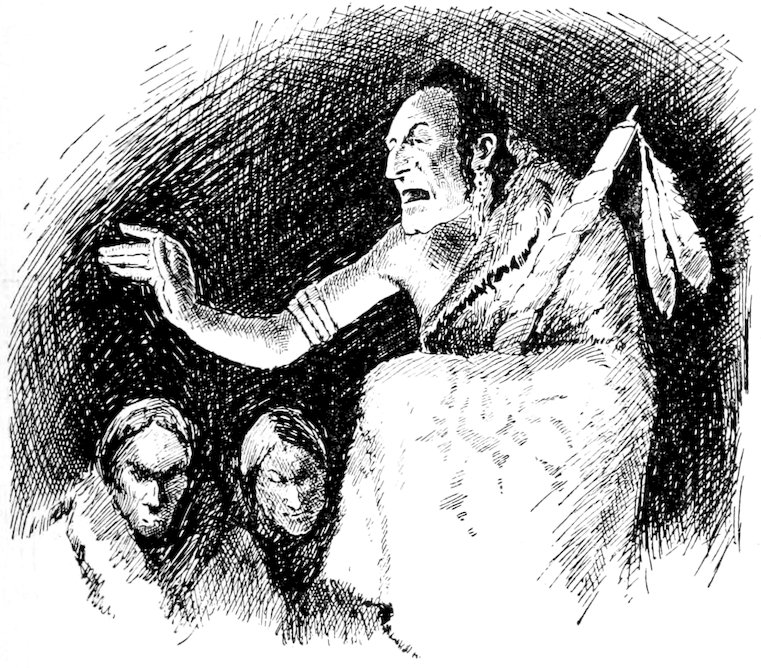
THE LONG TALK AT THE COUNCIL-FIRE.
This sudden passion for endless harangues,
so little consonant with the customary gravity
and taciturnity of our sage forefathers, was
supposed by certain philosophers to have been
imbibed, together with divers other barbarous
propensities, from their savage neighbors; who
were particularly noted for long talks and council-fires,
and never undertook any affair of the
least importance without previous debates and
harangues among their chiefs and old men.
But the real cause was, that the people, in
318electing their representatives to the grand
council, were particular in choosing them for
their talents at talking, without inquiring
whether they possessed the more rare, difficult,
and ofttimes important talent of holding their
tongues. The consequence was, that this deliberative
body was composed of the most
loquacious men in the community. As they
considered themselves placed there to talk,
every man concluded that his duty to his constituents,
and, what is more, his popularity
with them, required that he should harangue
on every subject, whether he understood it or
not. There was an ancient mode of burying a
chieftain, by every soldier throwing his shield
full of earth on the corpse, until a mighty
mound was formed; so, whenever a question
was brought forward in this assembly, every
member pressing forward to throw on his
quantum of wisdom, the subject was quickly
buried under a mountain of words.
We are told that disciples, on entering the
school of Pythagoras, were for two years enjoined
silence, and forbidden either to ask
questions, or make remarks. After they had
thus acquired the inestimable art of holding
their tongues, they were gradually permitted
to make inquiries, and finally to communicate
their own opinions.
319With what a beneficial effect could this wise
regulation of Pythagoras be introduced in
modern legislative bodies,—and how wonderfully
would it have tended to expedite business
in the grand council of the Manhattoes!
At this perilous juncture the fatal word
economy, the stumbling-block of William the
Testy, had been once more set afloat, according
to which the cheapest plan of defence was
insisted upon as the best; it being deemed a
great stroke of policy in furnishing powder to
economize in ball.
Thus did dame Wisdom (whom the wags of
antiquity have humorously personified as a
woman) seem to take a mischievous pleasure
in jilting the venerable councillors of New
Amsterdam. To add to the confusion, the old
factions of Short Pipes and Long Pipes, which
had been almost strangled by the Herculean
grasp of Peter Stuyvesant, now sprang up
with tenfold vigor. Whatever was proposed
by Short Pipe was opposed by the whole
tribe of Long Pipes, who, like true partisans,
deemed it their first duty to effect the downfall
of their rivals, their second, to elevate themselves,
and their third, to consult the public
good; though many left the third consideration
out of question altogether.
In this great collision of hard heads it is
320astonishing the number of projects that were
struck out,—projects which threw the wind-mill
system of William the Testy completely in the
background. These were almost uniformly
opposed by the “men of the greatest weight
in the community!” your weighty men,
though slow to devise, being always great at
“negativing.” Among these were a set of
fat, self-important old burghers, who smoked
their pipes, and said nothing except to negative
every plan of defence proposed. These
were that class of “conservatives” who, having
amassed a fortune, button up their pockets,
shut their mouths, sink, as it were, into themselves,
and pass the rest of their lives in the
in-dwelling beatitude of conscious wealth; as
some phlegmatic oyster, having swallowed a
pearl, closes its shell, sinks in the mud, and
devotes the rest of its life to the conservation
of its treasure. Every plan of defence seemed
to these worthy old gentlemen pregnant with
ruin. An armed force was a legion of locusts
preying upon the public property; to fit out a
naval armament was to throw their money into
the sea; to build fortifications was to bury it
in the dirt. In short, they settled it as a sovereign
maxim, so long as their pockets were
full, no matter how much they were drubbed.
A kick left no scar; a broken head cured
321itself; but an empty purse was of all maladies
the slowest to heal, and one in which nature
did nothing for the patient.
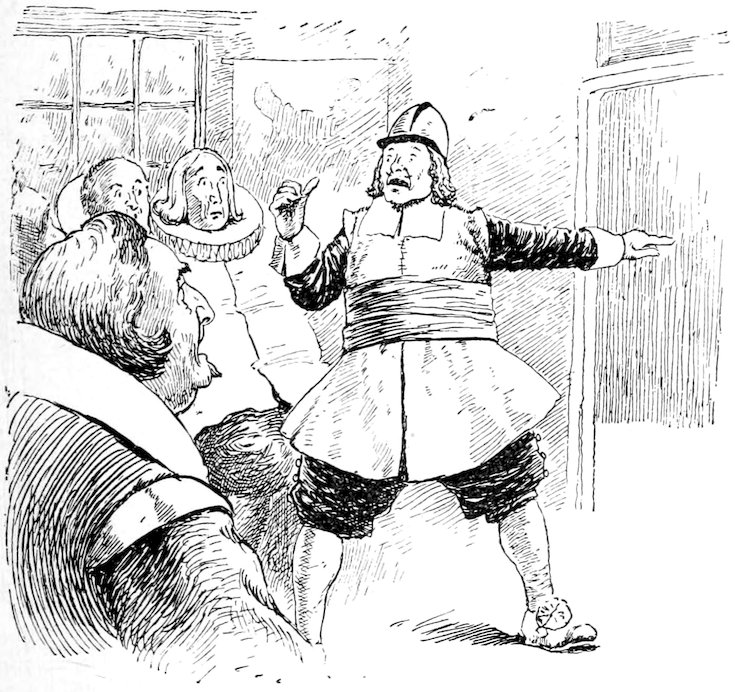
“THE SUDDEN ENTRANCE OF A MESSENGER.”
Thus did this venerable assembly of sages
lavish away that time which the urgency of
affairs rendered invaluable, in empty brawls
and long-winded speeches, without ever agreeing,
except on the point with which they
started, namely, that there was no time to be
lost, and delay was ruinous. At length, St.
322Nicholas taking compassion on their distracted
situation, and anxious to preserve
them from anarchy, so ordered, that in the
midst of one of their most noisy debates, on
the subject of fortification and defence, when
they had nearly fallen to loggerheads in consequence
of not being able to convince each
other, the question was happily settled by the
sudden entrance of a messenger, who informed
them that a hostile fleet had arrived, and was
actually advancing up the bay!
323
Like as an assemblage
of belligerent cats,
gibbering and caterwauling,
eying one
another with hideous
grimaces and
contortions, spitting
in each other’s faces,
and on the point of a
general clapper-clawing,
are suddenly put
to scampering rout
and confusion by the
appearance of a house-dog, so was the no less
vociferous council of New Amsterdam amazed,
astounded, and totally dispersed by the sudden
arrival of the enemy. Every member
waddled home as fast as his short legs could
324carry him, wheezing as he went with corpulency
and terror. Arrived at his castle, he
barricadoed the street-door, and buried himself
in the cider-cellar, without venturing to peep
out, lest he should have his head carried off by
a cannon-ball.
The sovereign people crowded into the market-place,
herding together with the instinct
of sheep, who seek safety in each other’s company
when the shepherd and his dog are
absent, and the wolf is prowling round the
fold. Far from finding relief, however, they
only increased each other’s terrors. Each
man looked ruefully in his neighbor’s face, in
search of encouragement, but only found in
its woe-begone lineaments a confirmation of
his own dismay. Not a word now was to be
heard of conquering Great Britain, not a whisper
about the sovereign virtues of economy,—while
the old women heightened the general
gloom by clamorously bewailing their fate, and
calling for protection on St. Nicholas and Peter
Stuyvesant.
325
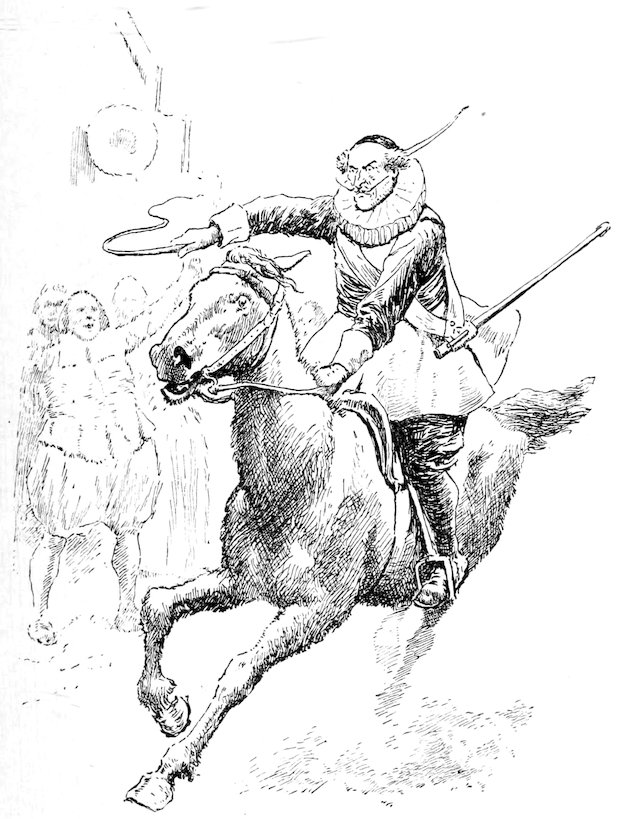
Oh, how did they bewail the absence of the
lion-hearted Peter! and how did they long for
the comforting presence of Antony Van Corlear!
Indeed, a gloomy uncertainty hung over
the fate of these adventurous heroes. Day after
day had elapsed since the alarming message
326from the governor without bringing any further
tidings of his safety. Many a fearful conjecture
was hazarded as to what had befallen him
and his loyal squire. Had they not been
devoured alive by the cannibals of Marblehead
and Cape Cod?—had they not been put to the
question by the great council of Amphictyons?—had
they not been smothered in onions by
the terrible men of Pyquag? In the midst of
this consternation and perplexity, when horror,
like a mighty nightmare, sat brooding upon
the little, fat, plethoric city of New Amsterdam,
the ears of the multitude were suddenly
startled by the distant sound of a trumpet: it
approached, it grew louder and louder, and
now it resounded at the city gate. The public
could not be mistaken in the well-known
sound; a shout of joy burst from their lips, as
the gallant Peter, covered with dust, and followed
by his faithful trumpeter, came galloping
into the market-place.
The first transports of the populace having
subsided, they gathered round the honest
Antony, as he dismounted, overwhelming
him with greetings and congratulations. In
breathless accents he related to them the marvellous
adventures through which the old
governor and himself had gone, in making
their escape from the clutches of the terrible
327Amphictyons. But though the Stuyvesant
manuscript, with its customary minuteness
where anything touching the great Peter is
concerned, is very particular as to the incidents
of this masterly retreat, the state of the
public affairs will not allow me to indulge
in a full recital thereof. Let it suffice to say,
that, while Peter Stuyvesant was anxiously
revolving in his mind how he could make
good his escape with honor and dignity, certain
of the ships sent out for the conquest of
the Manhattoes touched at the eastern ports to
obtain supplies, and to call on the grand council
of the league for its promised co-operation.
Upon hearing of this, the vigilant Peter,
perceiving that a moment’s delay were fatal,
made a secret and precipitate decampment;
though much did it grieve his lofty soul to be
obliged to turn his back even upon a nation
of foes. Many hair-breadth ’scapes and divers
perilous mishaps did they sustain, as they
scoured, without sound of trumpet, through
the fair regions of the east. Already was the
country in an uproar with hostile preparations,
and they were obliged to take a large circuit
in their flight, lurking along through the
woody mountains of the Devil’s backbone;
whence the valiant Peter sallied forth one day
like a lion, and put to rout a whole legion of
328squatters, consisting of three generations of a
prolific family, who were already on their way
to take possession of some corner of the New
Netherlands. Nay, the faithful Antony had
great difficulty, at sundry times, to prevent
him, in the excess of his wrath, from descending
down from the mountains, and falling,
sword in hand, upon certain of the border-towns,
who were marshalling forth their
draggle-tailed militia.
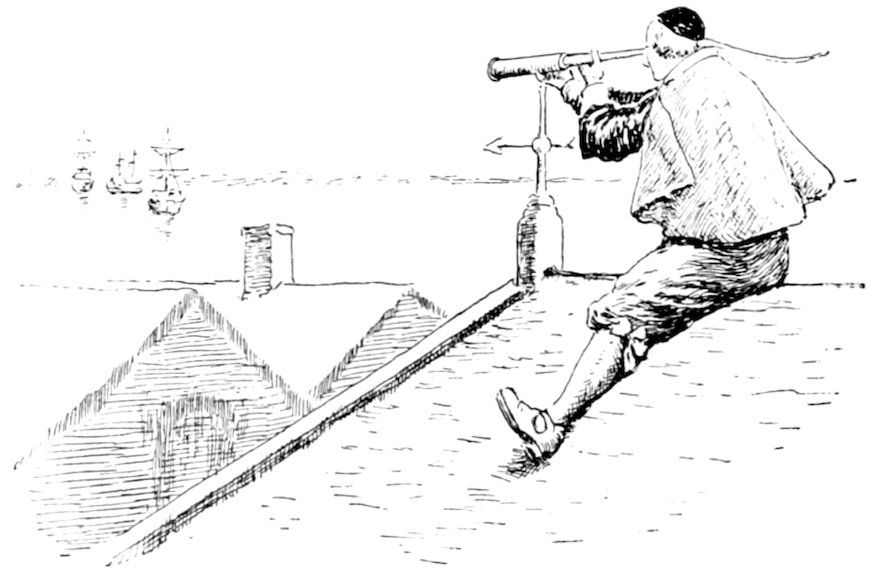
“THE ROOF, WHENCE HE CONTEMPLATES WITH RUEFUL ASPECT THE HOSTILE SQUADRON.”
The first movement of the governor, on
reaching his dwelling, was to mount the roof,
whence he contemplated with rueful aspect the
hostile squadron. This had already come to
329anchor in the bay, and consisted of two stout
frigates, having on board, as John Josselyn,
Gent., informs us, “three hundred valiant redcoats.”
Having taken this survey, he sat
himself down and wrote an epistle to the commander,
demanding the reason of his anchoring
in the harbor without obtaining previous
permission so to do. This letter was couched
in the most dignified and courteous terms,
though I have it from undoubted authority
that his teeth were clinched, and he had a
bitter, sardonic grin upon his visage all the
while he wrote. Having despatched his letter,
the grim Peter stumped to and fro about the
town with a most war-betokening countenance,
his hands thrust into his breeches-pockets,
and whistling a Low Dutch psalm-tune, which
bore no small resemblance to the music of
a northeast wind, when a storm is brewing.
The very dogs as they eyed him skulked away
in dismay; while all the old and ugly women
of New Amsterdam ran howling at his heels,
imploring him to save them from murder,
robbery, and pitiless ravishment!
The reply of Colonel Nicholas, who commanded
the invaders, was couched in terms of
equal courtesy with the letter of the governor;
declaring the right and title of his British
Majesty to the province; where he affirmed
330the Dutch to be mere interlopers; and demanding
that the town, forts, etc., should be forthwith
rendered into his Majesty’s obedience
and protection; promising, at the same time,
life, liberty, estate, and free trade to every
Dutch denizen who should readily submit to
his Majesty’s government.
Peter Stuyvesant read over this friendly
epistle with some such harmony of aspect as
we may suppose a crusty farmer reads the
loving letter of John Stiles, warning him of
an action of ejectment. He was not, however,
to be taken by surprise; but, thrusting the
summons into his breeches-pocket, stalked
three times across the room, took a pinch
of snuff with great vehemence, and then,
loftily waving his hand, promised to send an
answer next morning. He now summoned a
general meeting of his privy councillors and
burgomasters, not to ask their advice, for,
confident in his own strong head, he needed
no man’s counsel, but apparently to give them
a piece of his mind on their late craven conduct.
331
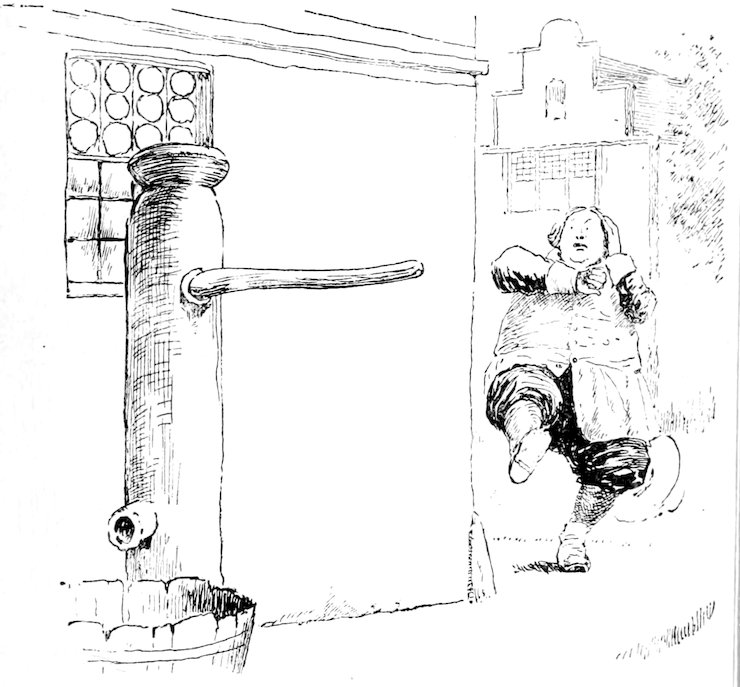
“METAMORPHOSING PUMPS INTO FORMIDABLE SOLDIERS.”
His orders being duly promulgated, it was
a piteous sight to behold the late valiant burgomasters,
who had demolished the whole
British empire in their harangues, peeping ruefully
out of their hiding-places; crawling cautiously
forth; dodging through narrow lanes
and alleys; starting at every little dog that
barked; mistaking lamp-posts for British grenadiers;
and, in the excess of their panic, metamorphosing
pumps into formidable soldiers
levelling blunderbusses at their bosoms! Having,
however, in despite of numerous perils
and difficulties of the kind, arrived safe, without
the loss of a single man, at the hall of assembly,
332they took their seats, and awaited in
fearful silence the arrival of the governor. In
a few moments the wooden leg of the intrepid
Peter was heard in regular and stout-hearted
thumps upon the staircase. He entered the
chamber, arrayed in full suit of regimentals,
and carrying his trusty toledo, not girded on
his thigh, but tucked under his arm. As the
governor never equipped himself in this portentous
manner unless something of martial
nature were working within his pericranium,
his council regarded him ruefully, as if they
saw fire and sword in his iron countenance,
and forgot to light their pipes in breathless
suspense.
His first words were, to rate his council
soundly for having wasted in idle debate and
party feud the time which should have been
devoted to putting the city in a state of defence.
He was particularly indignant at those
brawlers who had disgraced the councils of the
province by empty bickerings and scurrilous
invectives against an absent enemy. He now
called upon them to make good their words by
deeds, as the enemy they had defied and derided
was at the gate. Finally, he informed
them of the summons he had received to surrender,
but concluded by swearing to defend
the province as long as Heaven was on his
333side and he had a wooden leg to stand upon;
which warlike sentence he emphasized by a
thwack with the flat of his sword upon the
table, that quite electrified his auditors.
The privy councillors, who had long since
been brought into as perfect discipline as were
ever the soldiers of the great Frederick, knew
there was no use in saying a word,—so lighted
their pipes, and smoked away in silence, like
fat and discreet councillors. But the burgomasters,
being inflated with considerable
importance and self-sufficiency, acquired at
popular meetings, were not so easily satisfied.
Mustering up fresh spirit, when they found
there was some chance of escaping from their
present jeopardy without the disagreeable alternative
of fighting, they requested a copy of
the summons to surrender, that they might
show it to a general meeting of the people.
So insolent and mutinous a request would
have been enough to have roused the gorge
of the tranquil Van Twiller himself,—what
then must have been its effect upon the great
Stuyvesant, who was not only a Dutchman, a
governor, and a valiant wooden-legged soldier
to boot, but withal a man of the most stomachful
and gun-powder disposition? He burst
forth into a blaze of indignation,—swore not a
mother’s son of them should see a syllable of
334it,—that as to their advice or concurrence, he
did not care a whiff of tobacco for either,—that
they might go home, and go to bed like
old women; for he was determined to defend
the colony himself, without the assistance of
them or their adherents! So saying he tucked
his sword under his arm, cocked his hat upon
his head, and girding up his loins, stumped
indignantly out of the council-chamber, everybody
making room for him as he passed.
No sooner was he gone than the busy burgomasters
called a public meeting in front of the
Stadthouse, where they appointed as chairman
one Dofue Roerback, formerly a meddlesome
member of the cabinet during the reign of
William the Testy, but kicked out of office by
Peter Stuyvesant on taking the reins of government.
He was, withal, a mighty gingerbread
baker in the land, and reverenced by the
populace as a man of dark knowledge, seeing
that he was the first to imprint New-Year
cakes with the mysterious hieroglyphics of the
Cock and Breeches, and such like magical
devices.
This burgomaster, who still chewed the cud
of ill-will against Peter Stuyvesant, addressed
the multitude in what is called a patriotic
speech, informing them of the courteous summons
which the governor had received, to surrender,
335of his refusal to comply therewith, and
of his denying the public even a sight of the
summons, which doubtless contained conditions
highly to the honor and advantage of
the province.
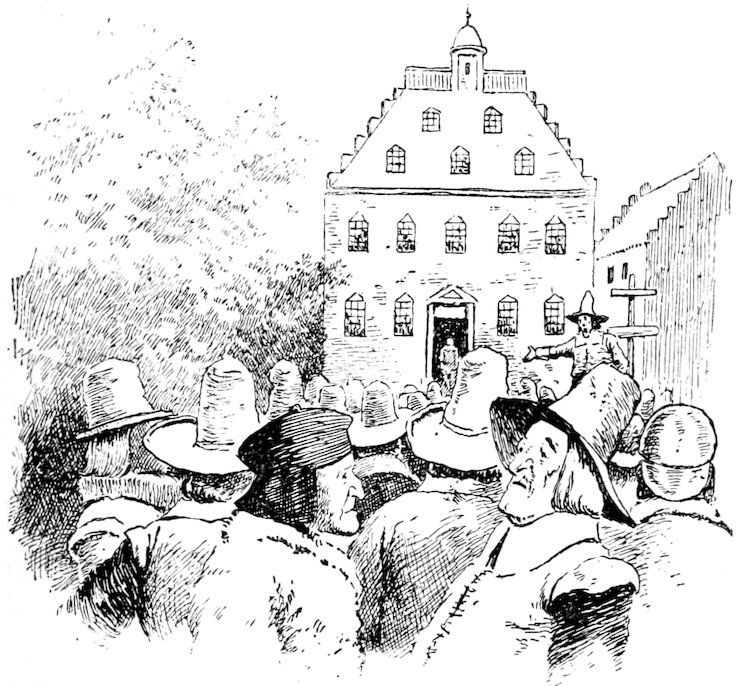
“A PUBLIC MEETING IN FRONT OF THE STADTHOUSE.”
He then proceeded to speak of his Excellency
in high-sounding terms of vituperation,
suited to the dignity of his station; comparing
him to Nero, Caligula, and other flagrant great
men of yore; assuring the people that the history
336of the world did not contain a despotic outrage
equal to the present. That it would be recorded
in letters of fire, on the blood-stained
tablet of history! That ages would roll back
with sudden horror when they came to view it!
That the womb of time (by the way, your
orators and writers take strange liberties with
the womb of time, though some would fain
have us believe that time is an old gentleman)—that
the womb of time, pregnant as it was
with direful horrors, would never produce a
parallel enormity!—with a variety of other
heart-rending, soul-stirring tropes and figures,
which I cannot enumerate; neither, indeed,
need I, for they were of the kind which even
to the present day form the style of popular
harangues and patriotic orations, and may be
classed in rhetoric under the general title of
Rigmarole.
The result of this speech of the inspired
burgomaster was a memorial addressed to the
governor, remonstrating in good round terms
on his conduct. It was proposed that Dofue
Roerback himself should be the bearer of this
memorial; but this he warily declined, having
no inclination of coming again within kicking
distance of his Excellency. Who did deliver
it has never been named in history, in which
neglect he has suffered grievous wrong; seeing
337that he was equally worthy of blazon with
him perpetuated in Scottish song and story by
the surname of Bell-the-cat. All we know of
the fate of this memorial is, that it was used
by the grim Peter to light his pipe; which,
from the vehemence with which he smoked
it, was evidently anything but a pipe of peace.
338
Now did the high-minded
Pieter de Groodt shower
down a pannier-load of
maledictions upon his
burgomasters for a set
of self-willed, obstinate,
factious varlets, who
would neither be convinced
nor persuaded.
Nor did he omit to bestow
some left-handed
compliments upon the
sovereign people, as a
herd of poltroons, who had no relish for the
glorious hardships and illustrious misadventures
of battle, but would rather stay at home,
and eat and sleep in ignoble ease, than fight in
a ditch for immortality and a broken head.
Resolutely bent, however, upon defending
339his beloved city, in despite even of itself, he
called unto him his trusty Van Corlear, who
was his right-hand man in all times of emergency.
Him did he adjure to take his war-denouncing
trumpet, and mounting his horse,
to beat up the country night and day,—sounding
the alarm along the pastoral borders of the
Bronx,—startling the wild solitudes of Croton,—arousing
the rugged yeomanry of Weehawk
and Hoboken,—the mighty men of battle of
Tappan Bay,—and the brave boys of Tarry-Town,
Petticoat-Lane, and Sleepy-Hollow,—charging
them one and all to sling their
powder-horns, shoulder their fowling-pieces,
and march merrily down to the Manhattoes.
Now there was nothing in all the world, the
divine sex excepted, that Antony Van Corlear
loved better than errands of this kind. So
just stopping to take a lusty dinner, and
bracing to his side his junk-bottle, well
charged with heart-inspiring Hollands, he
issued jollily from the city gate, which looked
out upon what is at present called Broadway,
sounding a farewell strain, that rung in
sprightly echoes through the winding streets
of New Amsterdam. Alas! never more were
they to be gladdened by the melody of their
favorite trumpeter!
It was a dark and stormy night when the
340good Antony arrived at the creek (sagely denominated
Haerlem River) which separates the
island of Manna-hata from the mainland. The
wind was high, the elements were in an uproar,
and no Charon could be found to ferry
the adventurous sounder of brass across the
water. For a short time he vapored like an
impatient ghost upon the brink, and then bethinking
himself of the urgency of his errand,
took a hearty embrace of his stone bottle,
swore most valorously that he would swim
across in spite of the devil! (Spyt den
Duyvel!) and daringly plunged into the
stream. Luckless Antony! Scarce had he
buffeted halfway over, when he was observed
to struggle violently, as if battling with the
spirit of the waters,—instinctively he put his
trumpet to his mouth, and giving a vehement
blast—sank forever to the bottom!
341
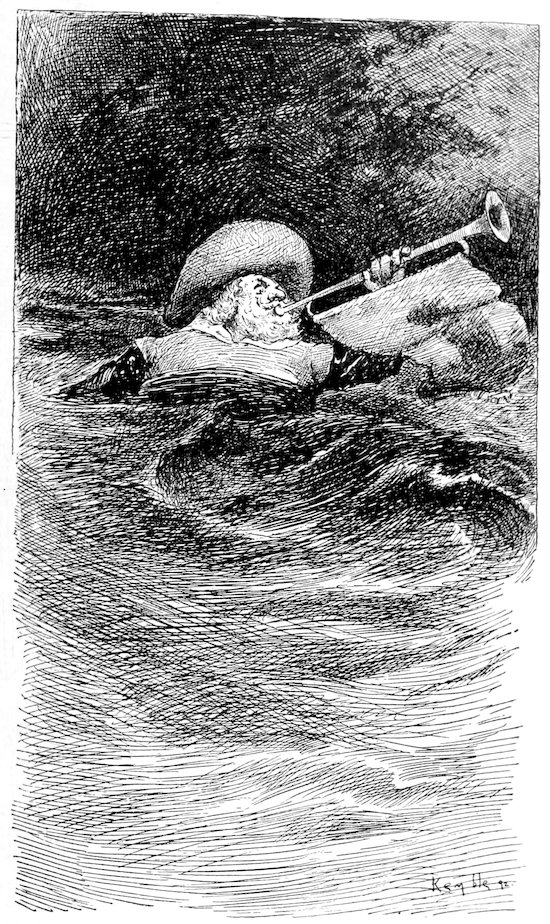
THE DEATH OF ANTONY VAN CORLEAR.
The clangor of his trumpet, like that of the
ivory horn of the renowned Paladin Orlando,
when expiring in the glorious field of Roncesvalles,
rang far and wide through the country,
alarming the neighbors round, who hurried in
amazement to the spot. Here an old Dutch
burgher, famed for his veracity, and who had
been a witness of the fact, related to them the
melancholy affair; with the fearful addition (to
which I am slow in giving belief) that he saw
342the duyvel, in the shape of a huge mossbonker,
seize the sturdy Antony by the leg,
and drag him beneath the waves. Certain it
is, the place, with the adjoining promontory,
which projects into the Hudson, has been
called Spyt den Duyvel ever since; the ghost
of the unfortunate Antony still haunts the
surrounding solitudes, and his trumpet has
often been heard by the neighbors, of a stormy
night, mingling with the howling of the
blast. Nobody ever attempts to swim across
the creek after dark; on the contrary, a bridge
has been built to guard against such melancholy
accidents in future; and as to the mossbonkers,
they are held in such abhorrence, that
no true Dutchman will admit them to his
table, who loves good fish and hates the devil.
Such was the end of Antony Van Corlear,—a
man deserving of a better fate. He lived
roundly and soundly, like a true and jolly
bachelor, until the day of his death; but
though he was never married, yet did he leave
behind some two or three dozen children, in
different parts of the country,—fine, chubby,
brawling, flatulent little urchins; from whom,
if legends speak true, (and they are not apt to
lie) did descend the innumerable race of editors,
who people and defend this country, and
who are bountifully paid by the people for
343keeping up a constant alarm—and making
them miserable. It is hinted, too, that in his
various expeditions into the East he did much
towards promoting the population of the country;
in proof of which is adduced the notorious
propensity of the people of those parts to sound
their own trumpet.
As some way-worn pilgrim, when the tempest
whistles through his locks, and night is
gathering round, beholds his faithful dog, the
companion and solace of his journeying,
stretched lifeless at his feet, so did the generous-hearted
hero of the Manhattoes contemplate
the untimely end of Antony Van Corlear.
He had been the faithful attendant of his
footsteps; he had charmed him in many a
weary hour by his honest gayety and the martial
melody of his trumpet, and had followed him
with unflinching loyalty and affection through
many a scene of direful peril and mishap. He
was gone forever! and that, too, at a moment
when every mongrel cur was skulking from his
side. This, Peter Stuyvesant, was the moment
to try thy fortitude; and this was the
moment when thou didst indeed shine forth
Peter the Headstrong!
344
“APOLLO PEEPING OUT NOW AND THEN FOR AN INSTANT.”
The glare of day had long dispelled the horrors
of the stormy night; still all was dull and
gloomy. The late jovial Apollo hid his face
behind lugubrious clouds, peeping out now
and then for an instant, as if anxious, yet fearful,
to see what was going on in his favorite
city. This was the eventful morning when
the great Peter was to give his reply to the
summons of the invaders. Already was he
closeted with his privy council, sitting in grim
345state, brooding over the fate of his favorite
trumpeter, and anon boiling with indignation
as the insolence of his recreant burgomasters
flashed upon his mind.—While in this state of
irritation, a courier arrived in all haste from
Winthrop, the subtle governor of Connecticut,
counselling him, in the most affectionate and
disinterested manner, to surrender the province,
and magnifying the dangers and calamities
to which a refusal would subject him.—What
a moment was this to intrude officious advice
upon a man who never took advice in his
whole life!—The fiery old governor strode up
and down the chamber with the vehemence
that made the bosoms of his councillors to
quake with awe,—railing at his unlucky fate,
that thus made him the constant butt of factious
subjects, and jesuitical advisers.
Just at this ill-chosen juncture, the officious
burgomasters, who had heard of the arrival
of mysterious despatches, came marching in a
body into the room, with a legion of schepens
and toad-eaters at their heels, and abruptly
demanded a perusal of the letter. This was
too much for the spleen of Peter Stuyvesant.
He tore the letter in a thousand pieces,—threw
it in the face of the nearest burgomaster,—broke
his pipe over the head of the next,—hurled
his spitting-box at an unlucky schepen,
346who was just retreating out at the door, and
finally prorogued the whole meeting sine die,
by kicking them down-stairs with his wooden
leg.
As soon as the burgomasters could recover
from their confusion and had time to breathe,
they called a public meeting, where they
related at full length, and with appropriate coloring
and exaggeration, the despotic and vindictive
deportment of the governor; declaring
that, for their own parts, they did not value a
straw the being kicked, cuffed, and mauled by
the timber toe of his Excellency, but that they
felt for the dignity of the sovereign people,
thus rudely insulted by the outrage committed
on the seat of honor of their representatives.
The latter part of the harangue came home at
once to that delicacy of feeling and jealous
pride of character vested in all true mobs,—who,
though they may bear injuries without a
murmur, yet are marvellously jealous of their
sovereign dignity; and there is no knowing to
what act of resentment they might have been
provoked, had they not been somewhat more
afraid of their sturdy old governor than they
were of St. Nicholas, the English—or the d—l
himself.
347
There is something exceedingly
sublime and
melancholy in the spectacle
which the present
crisis of our history presents.
An illustrious and
venerable little city,—the
metropolis of a vast
extent of uninhabited
country,—garrisoned by
a doughty host of orators,
chairmen, committee-men, burgomasters,
schepens, and old women,—governed by a determined
and strong-headed warrior, and fortified
by mud batteries, palisadoes, and resolutions,—blockaded
by sea, beleaguered by land, and
threatened with direful desolation from without,
while its very vitals are torn with internal
faction and commotion! Never did historic
348pen record a page of more complicated distress,
unless it be the strife that distracted the Israelites,
during the siege of Jerusalem,—where
discordant parties were cutting each other’s
throats, at the moment when the victorious
legions of Titus had toppled down their bulwarks,
and were carrying fire and sword into
the very sanctum sanctorum of the temple.
Governor Stuyvesant having triumphantly
put his grand council to the rout, and delivered
himself from a multitude of impertinent
advisers, despatched a categorical reply to the
commanders of the invading squadron; wherein
he asserted the right and title of their High
Mightinesses the Lords States-General to the
province of New Netherlands, and trusting in
the righteousness of his cause, set the whole
British nation at defiance!
My anxiety to extricate my readers and
myself from these disastrous scenes prevents
me from giving the whole of this gallant letter,
which concluded in these manly and affectionate
terms:—
“As touching the threats in your conclusion,
we have nothing to answer, only that we fear
nothing but what God (who is as just as
merciful) shall lay upon us; all things being
in his gracious disposal, and we may as well
349be preserved by him with small forces as by a
great army; which makes us to wish you all
happiness and prosperity, and recommend you
to his protection. My lords, your thrice humble
and affectionate servant and friend,
Thus having thrown his gauntlet, the brave
Peter stuck a pair of horse-pistols in his belt,
girded an immense powder-horn on his side,—thrust
his sound leg into a Hessian boot, and
clapping his fierce little war-hat on the top of
his head,—paraded up and down in front of
his house, determined to defend his beloved
city to the last.
While all these struggles and dissensions
were prevailing in the unhappy city of New
Amsterdam, and while its worthy but ill-starred
governor was framing the above-quoted
letter, the English commanders did not remain
idle. They had agents secretly employed to
foment the fears and clamors of the populace;
and moreover circulated far and wide, through
the adjacent country, a proclamation, repeating
the terms they had already held out in
their summons to surrender, at the same time
beguiling the simple Nederlanders with the
most crafty and conciliating professions.
They promised that every man who voluntarily
350submitted to the authority of his
British Majesty should retain peaceful possession
of his house, his vrouw, and his
cabbage-garden. That he should be suffered
to smoke his pipe, speak Dutch, wear as many
breeches as he pleased, and import bricks, tiles,
and stone jugs from Holland, instead of manufacturing
them on the spot. That he should
on no account be compelled to learn the English
language, nor eat codfish on Saturdays,
nor keep accounts in any other way than
by casting them up on his fingers, and chalking
them down upon the crown of his hat; as
is observed among the Dutch yeomanry at the
present day. That every man should be allowed
quietly to inherit his father’s hat, coat, shoe
buckles, pipe, and every other personal appendage;
and that no man should be obliged to conform
to any improvements, inventions, or any
other modern innovations; but, on the contrary,
should be permitted to build his house, follow
his trade, manage his farm, rear his hogs, and
educate his children, precisely as his ancestors
had done before him from time immemorial.
Finally, that he should have all the benefits of
free trade, and should not be required to acknowledge
any other saint in the calendar than
St. Nicholas, who should thenceforward, as
before, be considered the tutelar saint of the city.
351These terms, as may be supposed, appeared
very satisfactory to the people, who had a great
disposition to enjoy their property unmolested,
and a most singular aversion to engage in a
contest, where they could gain little more
than honor and broken heads,—the first of
which they held in philosophic indifference,
the latter in utter detestation. By these insidious
means, therefore, did the English succeed
in alienating the confidence and affections of
the populace from their gallant old governor,
whom they considered as obstinately bent
upon running them into hideous misadventures;
and did not hesitate to speak their
minds freely, and abuse him most heartily—behind
his back.
Like as a mighty grampus when assailed
and buffeted by roaring waves and brawling
surges, still keeps on an undeviating course,
rising above the boisterous billows, spouting
and blowing as he emerges,—so did the inflexible
Peter pursue, unwavering, his determined
career, and rise, contemptuous, above the
clamors of the rabble.
But when the British warriors found that he
set their power at defiance, they despatched
recruiting officers to Jamaica, and Jericho, and
Nineveh, and Quag, and Patchog, and all those
towns on Long Island which had been subdued
352of yore by Stoffel Brinkerhoff; stirring up
the progeny of Preserved Fish, and Determined
Cock, and those other New-England squatters,
to assail the city of New Amsterdam by land,
while the hostile ships prepared for an assault
by water.
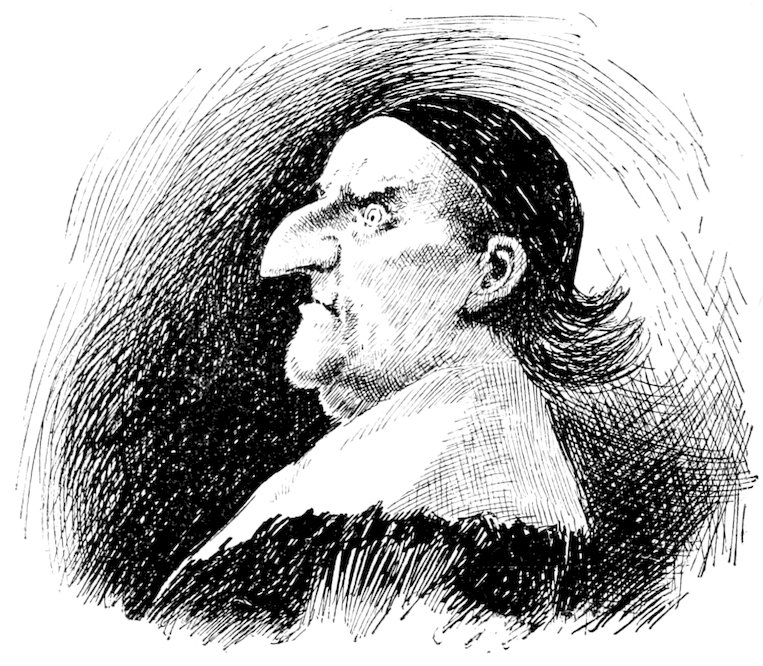
The streets of New Amsterdam now presented
a scene of wild dismay and consternation.
In vain did Peter Stuyvesant order the citizens
to arm and assemble on the Battery. Blank
terror reigned over the community. The whole
party of Short Pipes in the course of a single
353night had changed into arrant old women—a
metamorphosis only to be paralleled by the
prodigies recorded by Livy as having happened
at Rome at the approach of Hannibal,
when statues sweated in pure affright, goats
were converted into sheep, and cocks, turning
into hens, ran cackling about the street.
Thus baffled in all attempts to put the city
in a state of defence, blockaded from without,
tormented from within, and menaced with a
Yankee invasion, even the stiff-necked will of
Peter Stuyvesant for once gave way, and in
spite of his mighty heart, which swelled in his
throat until it nearly choked him, he consented
to a treaty of surrender.
Words cannot express the transports of the
populace, on receiving this intelligence; had
they obtained a conquest over their enemies,
they could not have indulged greater delight.
The streets resounded with their congratulations,—they
extolled their governor as the
father and deliverer of his country,—they
crowded to his house to testify their gratitude,
and were ten times more noisy in their plaudits
then when he returned, with victory perched
upon his beaver, from the glorious capture of
Fort Christina. But the indignant Peter shut
his doors and windows, and took refuge in the
innermost recesses of his mansion, that he
354might not hear the ignoble rejoicings of the
rabble.
Commissioners were now appointed on
both sides, and a capitulation was speedily
arranged; all that was wanting to ratify it
was that it should be signed by the governor.
When the commissioners waited upon him for
this purpose, they were received with grim and
bitter courtesy. His warlike accoutrements
were laid aside,—an old Indian night-gown
was wrapped about his rugged limbs, a red
night-cap overshadowed his frowning brow,
an iron-gray beard of three days’ growth gave
additional grimness to his visage. Thrice
did he seize a worn-out stump of a pen, and
essay to sign the loathsome paper,—thrice did
he clinch his teeth, and make a horrible countenance,
as though a dose of rhubarb, senna,
and ipecacuanha had been offered to his lips;
at length, dashing it from him, he seized his
brass-hilted sword, and jerking it from the
scabbard, swore by St. Nicholas, to sooner die
than yield to any power under heaven.
For two whole days did he persist in this
magnanimous resolution, during which his
house was besieged by the rabble, and menaces
and clamorous revilings exhausted to
no purpose. And now another course was
adopted to soothe, if possible, his mighty ire.
355A procession was formed by the burgomasters
and schepens, followed by the populace, to
bear the capitulation in state to the governor’s
dwelling. They found the castle strongly
barricadoed, and the old hero in full regimentals
with his cocked hat on his head, posted
with a blunderbuss at the garret-window.
There was something in this formidable position
that struck even the ignoble vulgar with
awe and admiration. The brawling multitude
could not but reflect with self-abasement upon
their own pusillanimous conduct, when they
beheld their hardy but deserted old governor,
thus faithful to his post, like a forlorn hope,
and fully prepared to defend his ungrateful
city to the last. These compunctions, however,
were soon overwhelmed by the recurring
tide of public apprehension. The populace
arranged themselves before the house, taking
off their hats with most respectful humility;
Burgomaster Roerback, who was of that popular
class of orators described by Sallust as being
“talkative rather than eloquent,” stepped
forth and addressed the governor in a speech
of three hours’ length, detailing, in the most
pathetic terms, the calamitous situation of the
province, and urging him in a constant repetition
of the same arguments and words to sign
the capitulation.
356The mighty Peter eyed him from his garret-window
in grim silence,—now and then his eye
would glance over the surrounding rabble, and
an indignant grin, like that of an angry mastiff,
would mark his iron visage. But though
a man of most undaunted mettle,—though he
had a heart as big as an ox, and a head that
would have set adamant to scorn,—yet after all
he was a mere mortal. Wearied out by these
repeated oppositions, and this eternal haranguing,
and perceiving that unless he complied,
the inhabitants would follow their own inclination,
or rather their fears, without waiting for
his consent, or, what was still worse, the Yankees
would have time to pour in their forces
and claim a share in the conquest, he testily
ordered them to hand up the paper. It was
accordingly hoisted to him on the end of a
pole; and having scrawled his name at the
bottom of it, he anathematized them all for a set
of cowardly, mutinous, degenerate poltroons,
threw the capitulation at their heads, slammed
down the window, and was heard stumping
down-stairs with vehement indignation. The
rabble incontinently took to their heels; even
the burgomasters were not slow in evacuating
the premises, fearing lest the sturdy Peter might
issue from his den, and greet them with some
unwelcome testimonial of his displeasure.
357
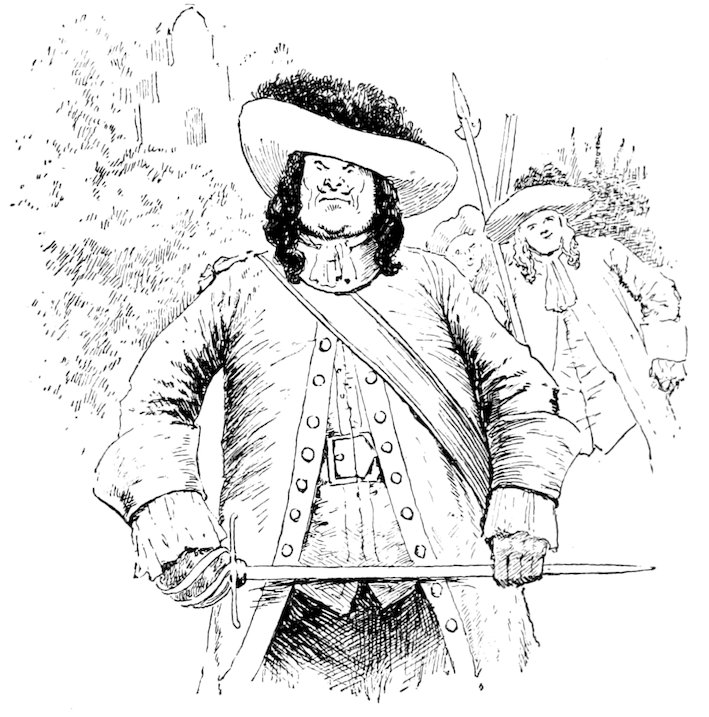
“A LEGION OF BRITISH BEEF-FED WARRIORS POURED INTO NEW AMSTERDAM.”
Within three hours after the surrender, a
legion of British beef-fed warriors poured into
New Amsterdam, taking possession of the
fort and batteries. And now might be heard,
from all quarters, the sound of hammers made
by the old Dutch burghers, in nailing up
their doors and windows, to protect their
vrouws from these fierce barbarians, whom
they contemplated in silent sullenness from
358the garret-windows as they paraded through
the streets.
Thus did Colonel Richard Nichols, the commander
of the British forces, enter into quiet
possession of the conquered realm as locum
tenens for the Duke of York. The victory was
attended with no other outrage than that of
changing the name of the province and its
metropolis, which thenceforth were denominated
New York, and so have continued to
be called unto the present day. The inhabitants,
according to treaty, were allowed to
maintain quiet possession of their property;
but so inveterately did they retain their abhorrence
of the British nation, that in a private
meeting of the leading citizens it was unanimously
determined never to ask any of their
conquerors to dinner.
Note.—Modern historians assert that when the
New Netherlands were thus overrun by the British,
as Spain in ancient days by the Saracens, a resolute
band refused to bend the neck to the invader. Led
by one Garret Van Horne, a valorous and gigantic
Dutchman, they crossed the bay and buried themselves
among the marshes and cabbage-gardens of
Communipaw; as did Pelayo and his followers among
the mountains of Asturias. Here their descendants
have remained ever since, keeping themselves apart,
like seed-corn, to re-people the city with the genuine
359breed whenever it shall be effectually recovered from
its intruders. It is said the genuine descendants of
the Nederlanders who inhabit New York, still look
with longing eyes to the green marshes of ancient
Pavonia, as did the conquered Spaniards of yore to
the stern mountains of Asturias, considering these
the regions whence deliverance is to come.
360
Thus, then, have I concluded
this great historical
enterprise; but before I
lay aside my weary pen,
there yet remains to be
performed one pious
duty. If among the variety
of readers who may
peruse this book, there
should haply be found any of those souls of
true nobility, which glow with celestial fire as
the history of the generous and the brave,
they will doubtless be anxious to know the
fate of the gallant Peter Stuyvesant. To gratify
one such sterling heart of gold I would go
more lengths than to instruct the cold-blooded
curiosity of a whole fraternity of philosophers.
No sooner had that high-mettled cavalier
signed the articles of capitulation, than, determined
not to witness the humiliation of his
361favorite city, he turned his back on its walls
and made a growling retreat to his bouwery,
or country-seat, which was situated about two
miles off; where he passed the remainder of
his days in patriarchal retirement. There he
enjoyed that tranquillity of mind which he had
never known amid the distracting cares of
government; and tasted the sweets of absolute
and uncontrolled authority, which his factious
subjects had so often dashed with the bitterness
of opposition.
No persuasions could ever induce him to
revisit the city; on the contrary, he would
always have his great arm-chair placed with
its back to the windows which looked in that
direction, until a thick grove of trees planted
by his own hand grew up and formed a screen
that effectually excluded it from the prospect.
He railed continually at the degenerate innovations
and improvements introduced by the
conquerors; forbade a word of their detested
language to be spoken in his family,—a prohibition
readily obeyed, since none of the household
could speak anything but Dutch,—and
even ordered a fine avenue to be cut down in
front of his house because it consisted of
English cherry-trees.
362
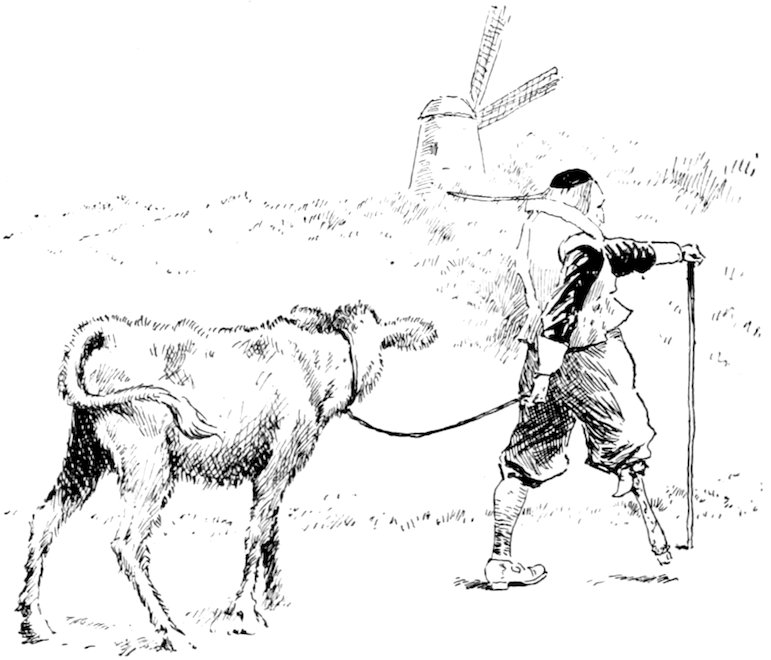
“CONDUCTED EVERY STRAY HOG OR COW IN TRIUMPH TO THE POUND.”
The same incessant vigilance, which blazed
forth when he had a vast province under his
care, now showed itself with equal vigor,
though in narrower limits. He patrolled with
unceasing watchfulness the boundaries of his
little territory; repelled every encroachment
with intrepid promptness; punished every
vagrant depredation upon his orchard or his
farmyard with inflexible severity; and conducted
every stray hog or cow in triumph to
the pound. But to the indignant neighbor,
the friendless stranger, or the weary wanderer,
his spacious doors were ever open, and his
363capacious fireplace, that emblem of his own
warm and generous heart, had always a corner
to receive and cherish them. There was an
exception to this, I must confess, in case the
ill-starred applicant were an Englishman or
a Yankee; to whom, though he might extend
the hand of assistance, he could never be
brought to yield the rites of hospitality. Nay,
if peradventure some straggling merchant of
the East should stop at his door, with his cartload
of tin ware or wooden bowls, the fiery
Peter would issue forth like a giant from his
castle, and make such a furious clattering
among his pots and kettles, that the vender of
“notions” was fain to betake himself to instant
flight.
His suit of regimentals, worn threadbare by
the brush, were carefully hung up in the state
bed-chamber, and regularly aired the first fair
day of every month; and his cocked hat and
trusty sword were suspended in grim repose
over the parlor mantelpiece, forming supporters
to a full-length portrait of the renowned
Admiral Van Tromp. In his domestic
empire he maintained strict discipline and
a well-organized despotic government; but
though his own will was the supreme law, yet
the good of his subjects was his constant object.
He watched over, not merely their immediate
364comforts, but their morals, and their ultimate
welfare; for he gave them abundance of excellent
admonition, nor could any of them complain,
that, when occasion required, he was by
any means niggardly in bestowing wholesome
correction.
The good old Dutch festivals, those periodical
demonstrations of an overflowing heart and
a thankful spirit, which are falling into sad
disuse among my fellow-citizens, were faithfully
observed in the mansion of Governor
Stuyvesant. New Year was truly a day of
open-handed liberality, of jocund revelry, and
warm-hearted congratulation, when the bosom
swelled with genial good fellowship, and the
plenteous table was attended with an unceremonious
freedom, and honest broad-mouthed
merriment, unknown in these days of degeneracy
and refinement. Paas and Pinxter were
scrupulously observed throughout his dominions;
nor was the day of St. Nicholas suffered
to pass by, without making presents, hanging
the stocking in the chimney, and complying
with all its other ceremonies.
365
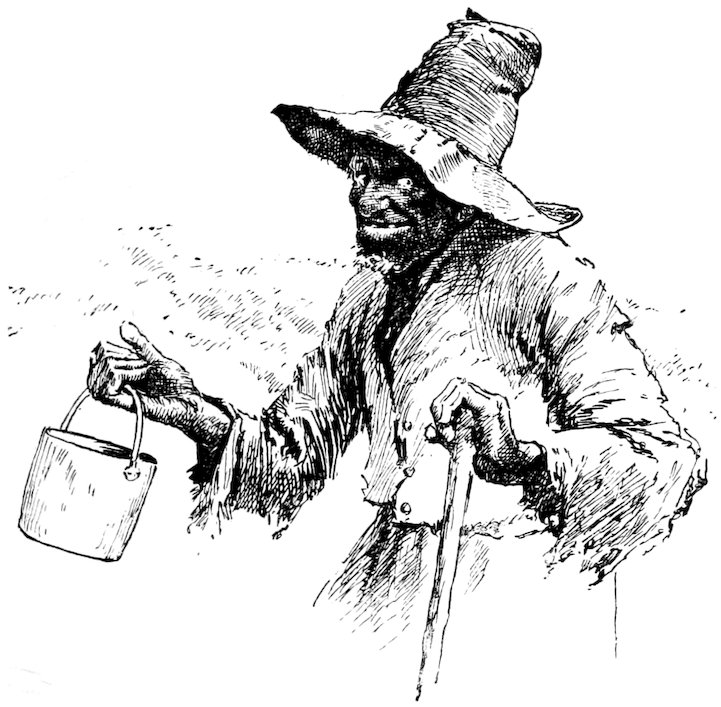
“ON APRIL FOOL’S ERRANDS FOR PIGEON’S MILK.”
Once a year, on the first day of April, he
used to array himself in full regimentals, being
the anniversary of his triumphal entry into
New Amsterdam, after the conquest of New
Sweden. This was always a kind of saturnalia
among the domestics, when they considered
themselves at liberty, in some measure, to
say and do what they pleased: for on this day
their master was always observed to unbend,
and become exceeding pleasant and jocose, sending
the old gray-headed negroes on April-fool’s
errands for pigeon’s milk; not one of whom
but allowed himself to be taken in, and
humored his old master’s jokes, as became a
faithful and well-disciplined dependant. Thus
366did he reign, happily and peacefully on his own
land—injuring no man—envying no man—molested
by no outward strifes—perplexed by
no internal commotions;—and mighty monarchs
of the earth, who were vainly seeking
to maintain peace, and promote the welfare of
mankind, by war and desolation, would have
done well to have made a voyage to the little
island of Manna-hata, and learned a lesson in
government from the domestic economy of
Peter Stuyvesant.
In process of time, however, the old governor,
like all other children of mortality,
began to exhibit evident tokens of decay.
Like an aged oak, which, though it long
has braved the fury of the elements, and
still retains its gigantic proportions, begins
to shake and groan with every blast—so
was it with the gallant Peter; for though
he still bore the port and semblance of what he
was in the days of his hardihood and chivalry,
yet did age and infirmity begin to sap the
vigor of his frame,—but his heart, that unconquerable
citadel, still triumphed unsubdued.
With matchless avidity would he listen to
every article of intelligence concerning the
battles between the English and Dutch,—still
would his pulse beat high whenever he heard
of the victories of De Ruyter, and his countenance
367lower, and his eyebrows knit, when fortune
turned in favor of the English. At
length, as on a certain day he had just smoked
his fifth pipe, and was napping after dinner, in
his arm-chair, conquering the whole British
nation in his dreams, he was suddenly aroused
by a ringing of bells, rattling of drums, and
roaring of cannon, that put all his blood in a
ferment. But when he learnt that these rejoicings
were in honor of a great victory obtained
by the combined English and French
fleets over the brave De Ruyter, and the
younger Van Tromp, it went so much to his
heart, that he took to his bed, and in less than
three days was brought to death’s door, by a
violent cholera morbus! Even in this extremity
he still displayed the unconquerable spirit
of Peter the Headstrong; holding out to the
last gasp, with inflexible obstinacy, against a
whole army of old women who were bent upon
driving the enemy out of his bowels, in the
true Dutch mode of defence, by inundation.
While he thus lay, lingering on the verge of
dissolution, news was brought him that the
brave De Ruyter had made good his retreat,
with little loss, and meant once more to meet
the enemy in battle. The closing eye of the
old warrior kindled with martial fire at the
words,—he partly raised himself in bed,—clinched
368his withered hand, as if he felt within
his gripe that sword which waved in triumph
before the walls of Fort Christina, and giving
a grim smile of exultation, sank back upon
his pillow, and expired.
Thus died Peter Stuyvesant,—a valiant soldier—a
loyal subject—an upright governor,
and an honest Dutchman,—who wanted only a
few empires to desolate, to have been immortalized
as a hero!
His funeral obsequies were celebrated with
the utmost grandeur and solemnity. The
town was perfectly emptied of its inhabitants,
who crowded in throngs to pay the last sad
honors to their good old governor. All his
sterling qualities rushed in full tide upon their
recollection, while the memory of his foibles
and his faults had expired with him. The
ancient burghers contended who should have
the privilege of bearing the pall; the populace
strove who should walk nearest to the bier;
and the melancholy procession was closed by
a number of gray-headed negroes, who had
wintered and summered in the household of
their departed master for the greater part of a
century.
369
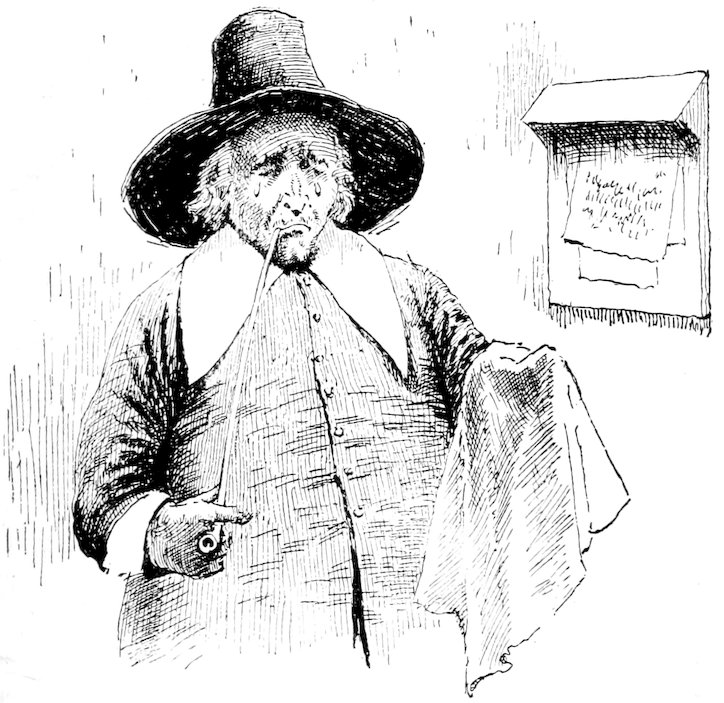
“WELL, DEN! HARDKOPPIG PETER BEN GONE AT LAST!”
With sad and gloomy countenances, the
multitude gathered round the grave. They
dwelt with mournful hearts on the sturdy virtues,
the signal services, and the gallant exploits
of the brave old worthy. They recalled,
with secret upbraidings, their own factious
oppositions to his government; and many an
ancient burgher, whose phlegmatic features
had never been known to relax, nor his eyes to
moisten, was now observed to puff a pensive
pipe, and the big drops to steal down his
cheek, while he muttered with affectionate
accent, and melancholy shake of the head—“Well,
370den!—Hardkoppig Peter ben gone
at last!”
His remains were deposited in the family
vault, under a chapel which he had piously
erected on his estate, and dedicated to St.
Nicholas,—and which stood on the identical
spot at present occupied by St. Mark’s church,
where his tombstone is still to be seen. His
estate, or bouwery, as it was called, has ever
continued in the possession of his descendants,
who, by the uniform integrity of their conduct,
and their strict adherence to the customs
and manners that prevailed in the
“good old times,” have proved themselves
worthy of their illustrious ancestor. Many a
time and oft has the farm been haunted at
night by enterprising money-diggers, in quest
of pots of gold, said to have been buried by the
old governor, though I cannot learn that any
of them have ever been enriched by their researches;
and who is there, among my native-born
fellow-citizens, that does not remember
when, in the mischievous days of his boyhood,
he conceived it a great exploit to rob “Stuyvesant’s
orchard” on a holiday afternoon?
At this stronghold of the family may still be
seen certain memorials of the immortal Peter.
His full-length portrait frowns in martial terrors
from the parlor-wall; his cocked hat and
371sword still hang up in the best bedroom; his
brimstone-colored breeches were for a long
while suspended in the hall, until some years
since they occasioned a dispute between a
new-married couple; and his silver-mounted
wooden leg is still treasured up in the store-room,
as an invaluable relique.
372
Among the numerous
events, which are each
in their turn the most
direful and melancholy
of all possible
occurrences, in your
interesting and authentic
history, there is
none that occasions
such deep and heart-rending
grief as the
decline and fall of your
renowned and mighty empires. Where is the
reader who can contemplate without emotion
the disastrous events by which the great dynasties
of the world have been extinguished?
While wandering, in imagination, among the
gigantic ruins of states and empires, and marking
the tremendous convulsions that wrought
their overthrow, the bosom of the melancholy
inquirer swells with sympathy commensurate
373to the surrounding desolation. Kingdoms,
principalities, and powers, have each had their
rise, their progress, and their downfall,—each
in its turn has swayed a potent sceptre,—each
has returned to its primeval nothingness.
And thus did it fare with the empire of their
High Mightinesses, at the Manhattoes, under
the peaceful reign of Walter the Doubter, the
fretful reign of William the Testy, and the
chivalric reign of Peter the Headstrong.
Its history is fruitful of instruction, and
worthy of being pondered over attentively, for
it is by thus raking among the ashes of departed
greatness, that the sparks of true knowledge
are to be found, and the lamp of wisdom
illuminated. Let then the reign of Walter the
Doubter warn against yielding to that sleek,
contented security, and that overweening fondness
for comfort and repose, which are produced
by a state of prosperity and peace. These
tend to unnerve a nation; to destroy its pride
of character; to render it patient of insult;
deaf to the calls of honor and of justice; and
cause it to cling to peace, like the sluggard to
his pillow, at the expense of every valuable
duty and consideration. Such supineness
insures the very evil from which it shrinks.
One right yielded up produces the usurpation
of a second; one encroachment passively suffered
374makes way for another; and the nation
which thus, through a doting love of peace, has
sacrificed honor and interest, will at length
have to fight for existence.
Let the disastrous reign of William the Testy
serve as a salutary warning against that fitful,
feverish mode of legislation, which acts without
system; depends on shifts and projects,
and trusts to lucky contingencies. Which
hesitates, and wavers, and at length decides
with the rashness of ignorance and imbecility.
Which stoops for popularity by courting the
prejudices and flattering the arrogance, rather
than commanding the respect of the rabble.
Which seeks safety in a multitude of counsellors,
and distracts itself by a variety of contradictory
schemes and opinions. Which
mistakes procrastination for wariness—hurry
for decision—parsimony for economy—bustle
for business—and vaporing for valor. Which
is violent in council, sanguine in expectation,
precipitate in action, and feeble in execution.
Which undertakes enterprises without forethought,
enters upon them without preparation,
conducts them with energy, and ends them in
confusion and defeat.
Let the reign of the good Stuyvesant show
the effects of vigor and decision even when
destitute of cool judgment, and surrounded
375by perplexities. Let it show how frankness,
probity, and high-souled courage will command
respect, and secure honor, even where
success is unattainable. But at the same time,
let it caution against a too ready reliance on
the good faith of others, and a too honest confidence
in the loving professions of powerful
neighbors, who are most friendly when they
most mean to betray. Let it teach a judicious
attention to the opinions and wishes of the
many, who, in times of peril, must be soothed
and led, or apprehension will overpower the
deference to authority.
Let the empty wordiness of his factious subjects;
their intemperate harangues; their violent
“resolutions”; their hectorings against
an absent enemy, and their pusillanimity on
his approach, teach us to distrust and despise
those clamorous patriots whose courage dwells
but in the tongue. Let them serve as a lesson
to repress that insolence of speech, destitute
of real force, which too often breaks forth
in popular bodies, and bespeaks the vanity
rather than the spirit of a nation. Let them
caution us against vaunting too much of our
own power and prowess, and reviling a noble
enemy. True gallantry of soul would always
lead us to treat a foe with courtesy and proud
punctilio; a contrary conduct but takes from
376the merit of victory, and renders defeat doubly
disgraceful.
But I cease to dwell on the stores of excellent
examples to be drawn from the ancient
chronicles of the Manhattoes. He who reads
attentively will discover the threads of gold
which run throughout the web of history, and
are invisible to the dull eye of ignorance. But,
before I conclude, let me point out a solemn
warning, furnished in the subtle chain of
events by which the capture of Fort Casimir has
produced the present convulsions of our globe.
Attend then, gentle reader, to this plain
deduction, which, if thou art a king, an emperor,
or other powerful potentate, I advise
thee to treasure up in thy heart,—though little
expectation have I that my work shall fall into
such hands, for well I know the care of crafty
ministers, to keep all grave and edifying
books of the kind out of the way of unhappy
monarchs—lest peradventure they should read
them and learn wisdom.
By the treacherous surprisal of Fort Casimir,
then, did the crafty Swedes enjoy a transient
triumph; but drew upon their heads the
vengeance of Peter Stuyvesant, who wrested
all New Sweden from their hands. By the
conquest of New Sweden, Peter Stuyvesant
aroused the claims of Lord Baltimore, who
377appealed to the Cabinet of Great Britain;
who subdued the whole province of New
Netherlands. By this great achievement the
whole extent of North America, from Nova
Scotia to the Floridas, was rendered one entire
dependency upon the British crown. But
mark the consequence: the hitherto scattered
colonies being thus consolidated, and having
no rival colonies to check or keep them in awe.
waxed great and powerful, and finally becoming
too strong for the mother-country, were
enabled to shake off its bonds, and by a glorious
revolution became an independent empire.
But the chain of effect stopped not here: the
successful revolution in America produced the
sanguinary revolution in France; which produced
the puissant Bonaparte; who produced
the French despotism; which has thrown the
whole world in confusion! Thus have these
great powers been successively punished for
their ill-starred conquests; and thus, as I
asserted, have all the present convulsions, revolutions,
and disasters that overwhelm mankind,
originated in the capture of the little Fort Casimir,
as recorded in this eventful history.
And now, worthy reader, ere I take a sad
farewell,—which, alas! must be forever,—willingly
would I part in cordial fellowship,
and bespeak thy kind-hearted remembrance.
378That I have not written a better history of the
days of the patriarchs is not my fault; had
any other person written one as good, I should
not have attempted it at all. That many will
hereafter spring up and surpass me in excellence,
I have very little doubt, and still less
care; well knowing that, when the great
Christovallo Colon (who is vulgarly called
Columbus) had once stood his egg upon its
end, every one at table could stand his up a
thousand times more dexterously. Should any
reader find matter of offence in this history,
I should heartily grieve, though I would on no
account question his penetration by telling him
he was mistaken—his good-nature by telling
him he was captious—or his pure conscience
by telling him he was startled at a shadow.
Surely when so ingenious in finding offence
where none was intended, it were a thousand
pities he should not be suffered to enjoy the
benefit of his discovery.
I have too high an opinion of the understanding
of my fellow-citizens to think of
yielding them instruction, and I covet too
much their good-will, to forfeit it by giving
them good advice. I am none of those cynics
who despise the world, because it despises
them: on the contrary, though but low in its
regard, I look up to it with the most perfect
379good-nature, and my only sorrow is, that it
does not prove itself more worthy of the unbounded
love I bear it. If, however, in this
my historic production—the scanty fruit of a
long and laborious life—I have failed to gratify
the dainty palate of the age, I can only lament
my misfortune—for it is too late in the season
for me ever to hope to repair it. Already has
withering age showered his sterile snows upon
my brow; in a little while, and this genial
warmth which still lingers around my heart,
and throbs—worthy reader—throbs kindly towards
thyself, will be chilled forever. Haply
this frail compound of dust, which while alive
may have given birth to naught but unprofitable
weeds, may form a humble sod of the
valley, whence may spring many a sweet
wild flower, to adorn my beloved island of
Manna-hata!
380
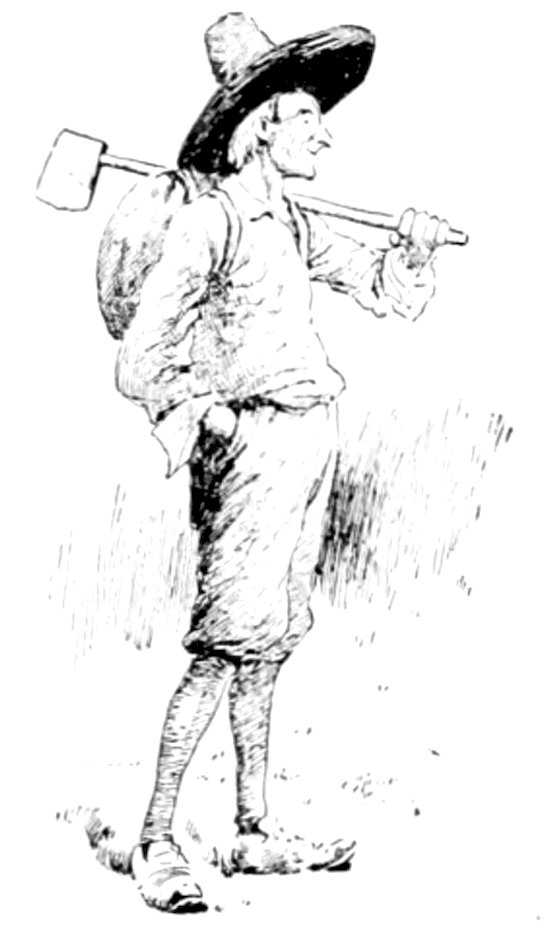
| Page |
Changed from |
Changed to |
| 54 |
vulgar,—a wonderful slave for official blunders |
vulgar,—a wonderful salve for official blunders |
| 140 |
its antagonist with the smell of gun-power |
its antagonist with the smell of gun-powder |
| 158 |
Her hair hung in straight gallows-locks about his ears |
His hair hung in straight gallows-locks about his ears |
- Fixed typos; non-standard spelling and dialect retained.
- Renumbered footnotes and moved them all to the end of the final chapter.