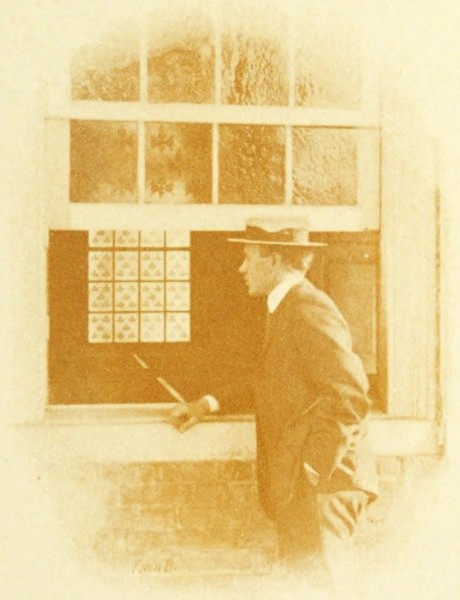
Through the wide-open window
floated in the fragrance of dew-dripping
flowers. On the edge of the
table a smouldering cigarette sent
up a thin, wavering filament of gray
smoke that lost itself in the upper
gloom of the darkened room, leaving
behind it a not-unpleasing odor of
the Orient to mingle with the incense
from the gardens without.
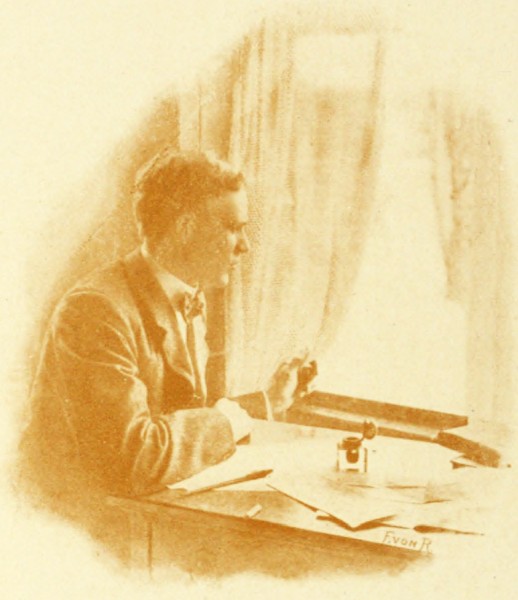
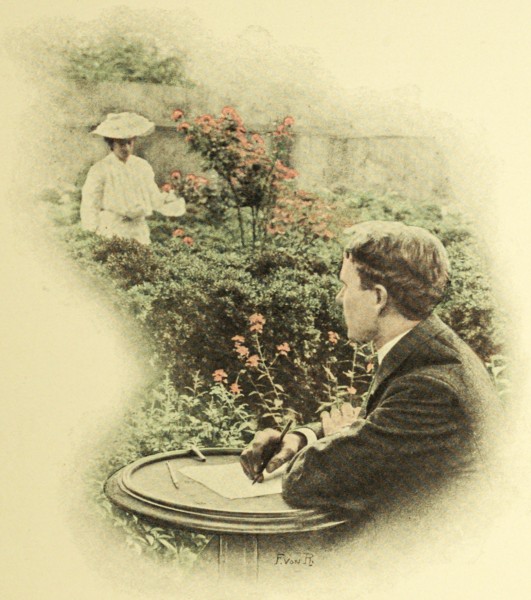
When he paused in his writing—and
pauses were frequent—Mr. Stephen
Burton’s gaze invariably wandered to
the sunlighted morning world represented
by the vista at his elbow.
Immediately below him a small,
turf-carpeted garden formed a square
of shadow and sunlight. A jasmine
clambered and
sprawled along
the purple brick
wall at the rear,
and a narrow,
chocolate-hued
bed of moist
loam caught the
fallen blooms.
The bed held
white and purple
and lavender iris, and spiræa, and
blue pentstemon, and was bordered
with honey-flower. At the end of
the old wall, where it formed an
angle with an iron fence, a queerly
shaped Daphne-tree threw grotesque
shadows on the little lawn. But it
was beyond the rusty
iron barrier that Burton’s
eyes found their
richest reward.
There stretched a
quadrangle that was bounded
by walls on two sides and
at the farther end by the back
of an old-fashioned Southern house,
staid and sleepy-looking, whose second-story
porch, half hidden by vines
over white-painted iron lattice-work,
held a hammock which ever since Burton’s
coming had remained idle, swinging
lazily in the afternoon breezes.
The quadrangle was intersected by
narrow red gravel paths bordered by
box hedges waist-high. And between
the hedges, against the walls, along
the fence, and clambering upon the
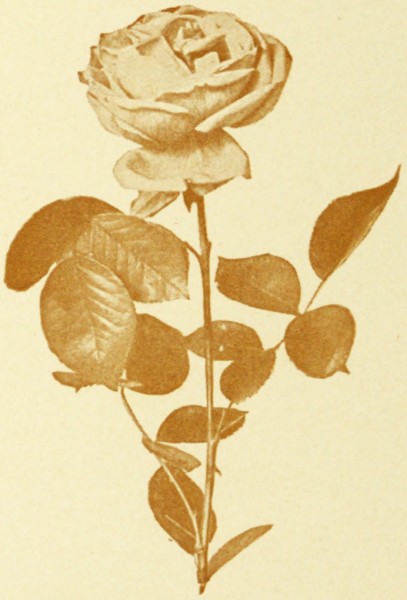
house were roses. Never had Burton
seen or dreamed of such roses.
The garden was a riot of intense
reds, of tender pinks, of flaring yellows
and dazzling whites, and of
every hue and tint between.
For the most part, they were the favorites
of a generation gone: Banksias,
festooning the warm bricks with
bouquets of amber yellow and of
violet-tinged white; Baltimore Belles,
creamy-hued and graceful; rosy-violet
Pride of Washingtons; sweetbriers
of scarlet and blush; Austrian briers,
single blossoms of flame-yellow. In
the beds were great cabbage-roses of
delicate, clear pink and of deep rose;
moss-roses of many sorts, crimson
Damasks, bright-red Luxembourgs,
tiny clusters of flesh-colored Pompons.
An immense bush of Gloire des Jardins
was aflame with its great double
blooms of red, while clustered about it
were Madame Cottins, Philippe
Quatres, Marceaus, Madame
Hardys, Princess Clementines,
and Madame Plantiers. The
rich crimson, cup-shaped
blossoms of a George the
Fourth were nodding regally
over the yellow-pink blooms
of an Emmeline; the brown
velvet petals of a Lord Nelson were
clustering above a lowly Wellington;
while, supreme in one three-cornered
jungle of color, a spreading bush of
Queen Victoria, an offshoot of the
parent stem, showered the ground
with its glowing petals.
Above the farther wall leaned a
magnolia, a portly, eminently respectable
magnolia, spreading its long
branches far out over
the garden as though
offering old-gentlemanly
protection to
the rose-ladies. In
the long afternoons the green
and bronze foliage, now reflecting
the morning sunlight from
its varnished surface, made a pleasant
gloom thereabouts, throwing great
gently-moving ovals of greenish
shadow over the rosebushes along
the old wall; here was the Giant of
Battles, with petals so darkly red as
to verge upon black, and the Duchess,
with old-fashioned blooms, globular,
chary of petals, showing yellow
at the heart when fully opened to
the sun, and of a rare old shade of
pink that made one think of lavender-scented
brocades and was like the
inner surface of a sea-shell.
Many a rose bloomed there
whose name was no longer
known, whose origin was forgotten
with its grower, but
which, nameless and unpretentious,
leafed and budded
and flowered season after season,
year after year, gladly and
humbly fulfilling its mission and setting
an example which many of the
far-heralded and perverse beauties
of the garden might well have emulated.
In one corner dwelt a foreign colony
of hardy phlox, white, scarlet, and
crimson, tall and vigorous as they
needs must be in order to reach the
sunlight above the great rose-bushes
and to maintain their hard-won footing.
And here and there, aliens too,
yuccas shot their great spikes above
the wilderness of bloom and swung
their panicles of cream-colored bells,
whose tinkling the birds and bees
alone might hear, in the languorous
morning breeze. Fallen petals
splashed the level tops of the box
hedges with brilliant colors, and, when
a vagrant wind set the blooms a-nodding,
fluttered to the gravel paths
and so drifted like scented, tinted
snowflakes to and fro. In the shadowed
corners of the hedge closely
woven spider webs were jewelled
with dew-drops and, when the moving
leaves let the sun-flecks through,
gleamed and sparkled like silver filaments
hung with diamonds and blue
pearls.
For the fiftieth time since breakfast
Burton looked up from the littered
table and gazed over
the scene, inhaling
the intense yet delicate
perfume and
bathing his sight in
the little sea of color with a
sensation of almost physical
delight. And as he looked, there
stepped into the scene a flower that
dimmed the others as the moonlight
dims the first faint radiance of the
stars. He dropped his pen, heedless
of the fact that it rolled over his
clean sheets leaving a broken trail of
ink, and leaned towards the casement
with eager eyes and quickened breath.
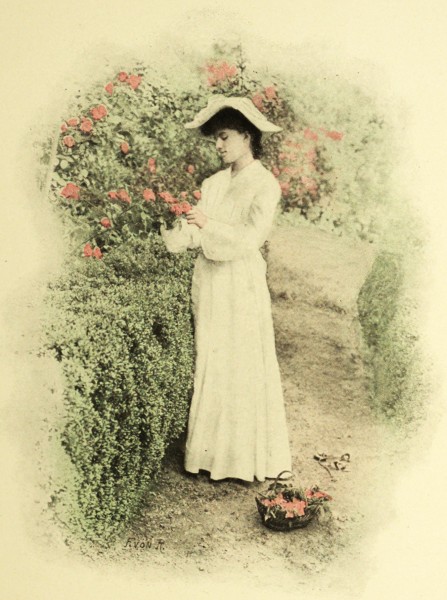
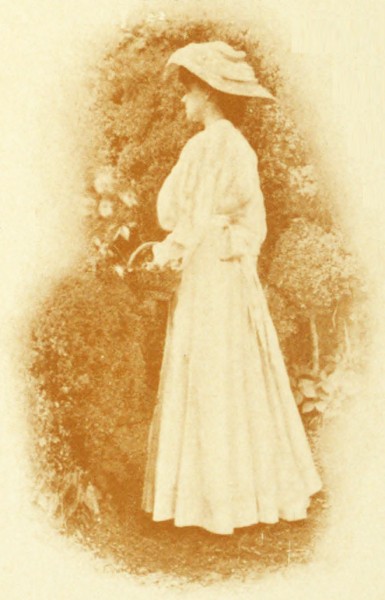
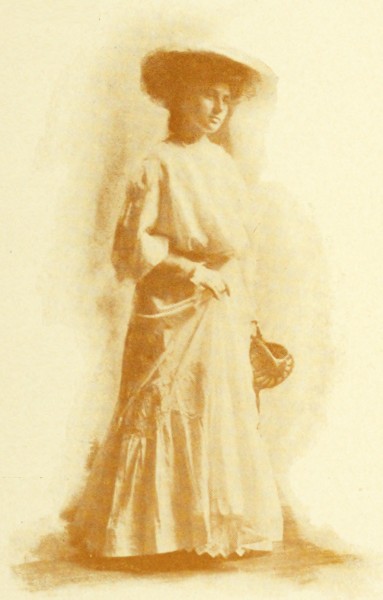
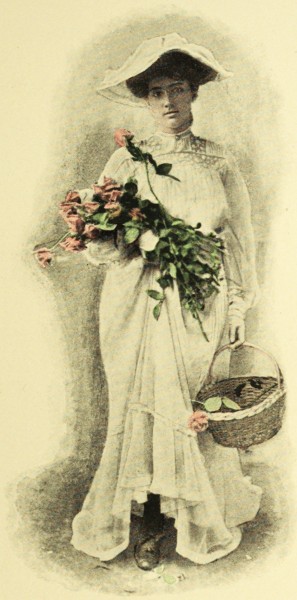
The flower was dressed in white,
in hue a modest blossom enough, its
only color being a sash of lilac ribbon
about its waist. On its head—for,
after all, what does it matter if metaphors
are mixed?—was a broad-brimmed
garden hat wound about
the crown with a filmy white veil.
It—she—carried a basket in one hand
and with the other held up daintily
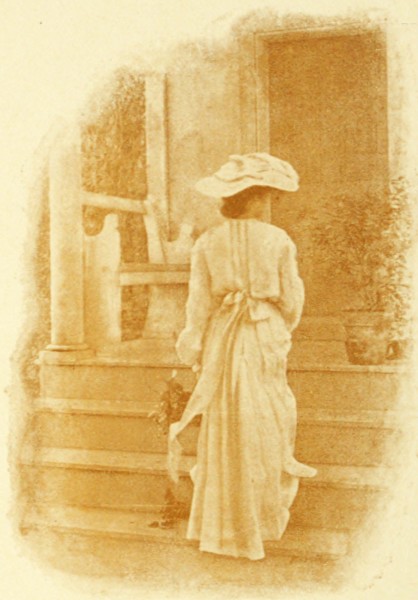
the skirt of her gown. For a moment
she stood on the topmost step in the
green shadow of a yellow Banksia,
small, graceful, a very rose herself,
and the fairest, daintiest in all the
garden. Burton’s papers rustled in
the tiny morning breeze and fluttered
unseen one by one to the dark-hued,
highly polished floor. He leaned an
elbow on the sill and, without shame,
kept his eyes upon the denizen of
the rose-garden. After a moment of
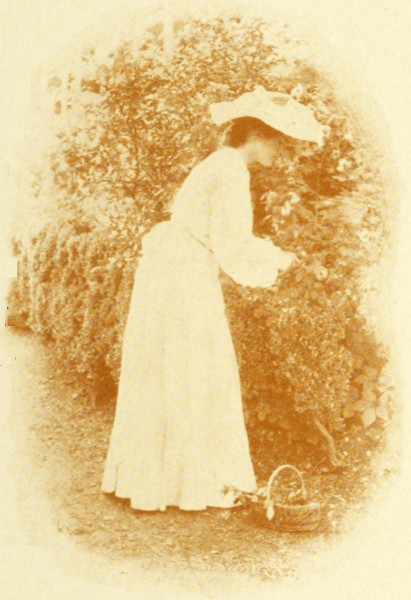
smiling survey of the scene the girl
descended the steps and, basket at
side, threaded the paths, snipping here
and there with a pair of tiny scissors
held in a gloved hand until the basket
was filled and weighted with pink and
white blossoms.
Yet all the time the broad brim of
her hat threw a soft shadow across
her face, and it was not until she
paused beside the iron fence to clip a
single cluster of crimson Damasks
that the watcher in the window was
rewarded with a clear view of her
features. Perhaps, for a Northerner,
Burton was impressionable. At all
events, it is a fact that when she lifted
her face for a moment in an idle
glance towards the neighboring house
and the light fell fully, boldly upon it,
his heart leaped chokingly and then,
with a series of disconcerting bumps
and thuds, raced faster than it had
within his memory. And yet the
glimpse he had was but a fleeting
one, for the girl’s eyes encountered
his own, and after a
look of infinitesimal
duration, a look pregnant
with surprise
and dismay, were
swiftly lowered, while
a faint blush crept
over the warm, clear
skin. The next instant
the shadow had
descended again; another,
and she had
turned away, blossom-laden,
towards the house.
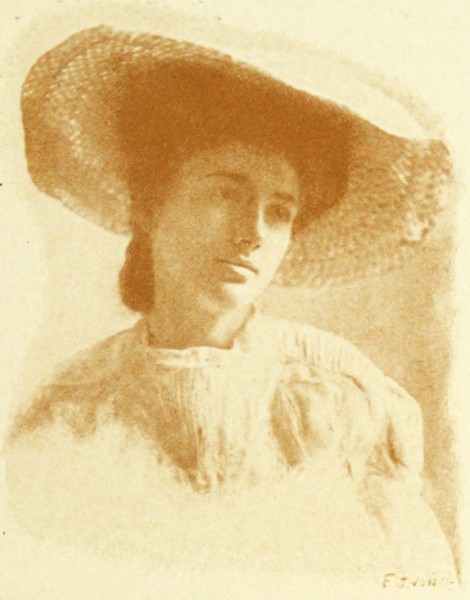
Burton gazed after her, his mind a
confused memory of warm, brown
hair and clear, startled brown eyes;
of a tender, oval face, southern-hued,
sun-lighted; of small, red lips, upon
which a little glad smile was fading
before a look of confusion. Up
the path she went, with never
a look behind, yet not hurriedly;
plainly, she wanted it
understood that here was no
rout, but merely a retirement
in good order before a
superior and better-positioned
force. Suddenly from an open window
of the house above her a voice
called, a man’s voice, languidly imperative,—
“Kitty! Kitty!”
“I’m coming,” called the girl. She
flew lightly up the steps, the door was
opened from within by invisible hands,
and the girl and the blossoms disappeared.
The door closed with a subdued
slam.
Burton drew a long sigh and mechanically
picked up his dead cigarette.
“Kitty,” he murmured under his
breath; and again, “Kitty!”
Then, with the cigarette burning,
he blew a cloud of purple smoke out
of the window into the June sunshine
and nodded his head confidentially
towards the garden and the house.
“Kitty of the Roses,” he whispered.
II
Towns, like persons, have individuality,
some distinct, others indistinct.
By the individuality of some we are
attracted, by that of others we are
repelled. There are some that are
sour, selfish, intent only upon themselves,
that give us a scowl of suspicion
for greeting and turn their
shoulder as one who would say “I
don’t know you and I don’t want to.
I am very busy; keep out of my
way.” Then there are towns that
shout us a laughing “Hello,” that
shake our hand and pat our back,
merry, care-free, pleasure-pursuing
towns these that make us welcome
so long as we laugh and sing with
them, but have no love for us when
we frown or weep.
There are frankly mercenary towns
whose greetings are shrewd and sober
and whose eyes seek our pocket-book
even as the door closes behind us.
In such towns our welcome is likely
to be just as long as our bank account,
but, at least, we will find no
hypocrisy. And then there are towns
that are like—well, like a genial,
kindly-faced fellow who sits on a bench
in the sunlight whittling a stick, gives
us a neighborly nod and moves along
that we may sit beside him. He
doesn’t take our hand, he doesn’t look
askance at our frayed cuffs and battered
valise, but, after awhile, if he
likes us he offers us a stick that we,
too, may whittle, or, maybe, he shoves
his tobacco along to
us. Perhaps as we
sit there in the sunlight
and watch him
we wonder why he
doesn’t work; after we have
stayed awhile we cease wondering
and find ourself content to
whittle and smoke in the sunshine
and let the world wag along.
And there are many other sorts of
towns, just as many as there are sorts
of personality; hard, cross-grained
towns; fretful, grumpy towns; alert,
busy, inhospitable towns; lazy, dirty
towns; nervous, hysterical towns, and
mean, rapacious towns. It takes all
sorts to make a world, and even in
the worst of them, if we know them
intimately enough, we may find virtues
large enough to atone for the
faults. And all this
sermonizing merely
as an introduction to
a little country town
that is barely on the
ordinary map and that not
one person in fifty—no, not
one in a hundred, perhaps—has ever
heard of.
Belle Harbour is a town that
whittles in the sunshine. It is a
sleepy, good-natured, courteous old
town with a picturesque past and a
dubious future.
I would much rather not venture
upon exact dates, but Belle Harbour
was something of a place when the
British marched on Washington, and
a house that does not lay claim to
having served as a Hessian barracks,
a British hospital, or a general’s residence,
is so indecently modern
that good citizens view it
askance. Belle Harbour dozed
quietly until the Civil War disturbed
it. Even then it bore
excitement with a sort of
calm dignity. When the war
was over it relapsed into slumber
once more and now nothing
save the last trump will ever fully
awaken it.
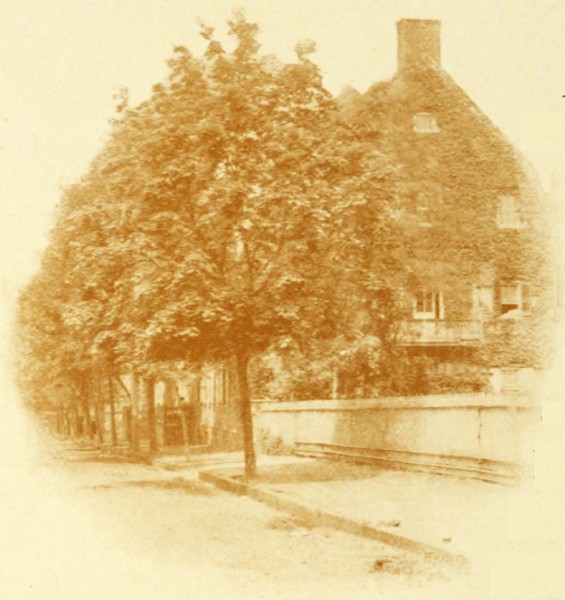
But it’s a fine old town, a town with
a dignified past, with substantial red
brick mansions set just back from its
broad streets, with oaks and chestnuts
shading the crumbling brick sidewalks,
and magnolias leaning over the mossy
walls and rusted fences. Belle Harbour’s
streets are wide, not because
traffic demands width, but because
when the town was laid out there was
a great deal of room and it seemed a
pity not to make use of as much of
it as was possible. So on Belle Harbour’s
main streets ten vehicles could
very easily pass side by side. Not
that they ever have or ever will; the
sound of one mud-splashed buggy
rattling over the paving stones is an
event that causes great interest, while
the simultaneous appearance of two
vehicles produces a condition of mild
panic up and down the streets. Next
to the low curbstones the worn, irregular
paving stones show signs of
travel; but for the rest, the streets
are wild wastes of weeds and grass,
wherein here and there a splash of
color tells where an adventurous
garden flower, aided by bird or breeze,
is striving to colonize the wilderness.
Life flows very evenly, very quietly,
and, I think, very happily in Belle
Harbour. Children are born, grow
up, marry, and die without moving out
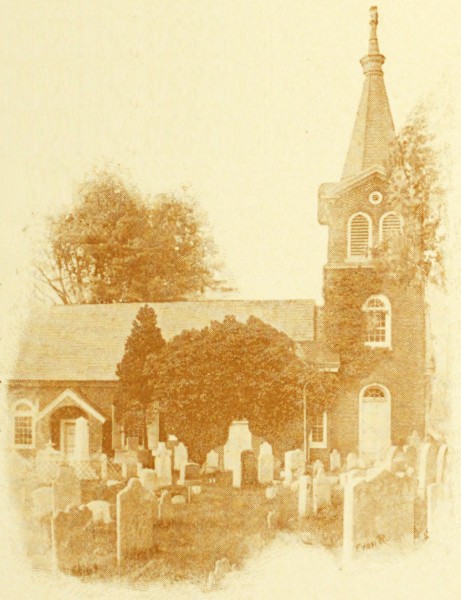
of sight of old Christ Church, save,
perhaps, for a brief but adventurous
journey to Washington, Richmond or
the coast. Business sometimes takes
the Belle Harbour citizen to Washington;
sometimes social obligations
render a trip to the capital necessary;
honeymoons are always spent at Virginia
Beach. But for the most part
the resident of King’s
Street lives his life
between the post-office
and the
Seminary, respectively
the Northern
and Southern limits of his world.
When he penetrates beyond the Seminary
it is to drive into the country,
perhaps to some decaying plantation.
When he goes North of the post-office
it is to enter the shabby, care-free
negro quarter. He clings very closely
to the old traditions, the old customs,
the old thoughts. There are no telephones
in Belle Harbour, and I doubt
if you could find a phonograph in any
of the dim, white-walled drawing-rooms.
Belle Harbour still shudders
when it recalls how, a few years ago,
it was threatened with the advent of
an electric car line. On that occasion
the old town, if it did not absolutely
awake, at least turned and muttered
in its sleep, disturbed by monstrous
visions.
The residents of King’s Street,
observing him from behind latticed
windows or meeting
him on the oak-shaded
sidewalk of
that grass-grown thoroughfare,
wondered
who Burton was and why
he elected to take up quarters
in the town when Washington
was less than twenty miles away
across the Potomac. The citizens
of Belle Harbour entertained no illusions
regarding the desirability of
their town as a place of sojourn, especially
after May; they realized that an
elevation of five feet above tide-level
does not constitute an ideal situation,
and that, judged as a health resort,
Belle Harbour was far from being a
success. Even admitting the idiosyncrasies
of the Northerner, Burton’s
presence was inexplicable. Belle Harbour
knew something about the
Northern traveller, for the town was
a Mecca towards which
Washington visitors frequently
turned their
steps. But they seldom
tarried; having viewed
the old church in which
Revolutionary heroes
had worshipped, and paid
their dimes and quarters
for sections of crumbling
bricks supposed to have
been detached from the edifice walls,
but in reality pried out of neighboring
sidewalks by enterprising boys, they
literally as well as metaphorically
shook the dust of the old town from
their feet and hurried to the steamboat.
Even the commercial traveller
took pains to insure the completion
of his business before the last
boat returned to Washington.
The only hostelry in the town
confined its ministrations entirely
to the citizens, and
they seldom penetrated
farther than the little, low-raftered
bar-room. And so
Belle Harbour viewed Burton with
extreme but courteous interest.
The information afforded by
Mrs. Phillips, of whom the visitor
had rented two second-floor rooms for
an indefinite period, was limited and
unsatisfactory. He was a New York
man, she confided, and an architect;
he had his meals sent to his rooms
and ate three eggs every morning;
he found Belle Harbour very picturesque
and interesting, and wore pink
and blue pajamas; he made strange
drawings in books and did much writing;
he smoked cigarettes or pipes all
day long and dropped the ashes on
the floor. King’s Street heard these
facts with avidity and reiterated
“Why?” And Mrs. Phillips only
shook her head and murmured in
tones of finality,—
“Well, you must remember he’s
a No’therner!”
Burton’s conduct on the afternoon
of the day which had given him his
first glimpse of the girl in the rose-garden
did nothing to dispel the growing
conviction that there was something
strange and mysterious about
his presence in Belle Harbour. Armed
with a sketch-book, he wandered aimlessly
the length of King’s Street,
smoked four cigarettes in the shade
of the church-yard
chestnuts, and subsequently
wandered
aimlessly home again
without once having
set pencil to paper or, apparently,
having seen aught but
the end of his well-made nose.
King’s Street whispered behind its
sun-repelling jalousies. And yet
Mrs. Phillips’s information, as far as it
went, was quite correct, and the mystery
was apparent rather than real.
Stephen Burton was an architect.
A commission for a costly church edifice
for a wealthy congregation in a
New Jersey residential village had
sent him South in search of details of
pure Colonial architecture. He had
found more to interest him in Belle
Harbour than he had anticipated or
than its citizens knew of. The old
church was a veritable mine of valuable
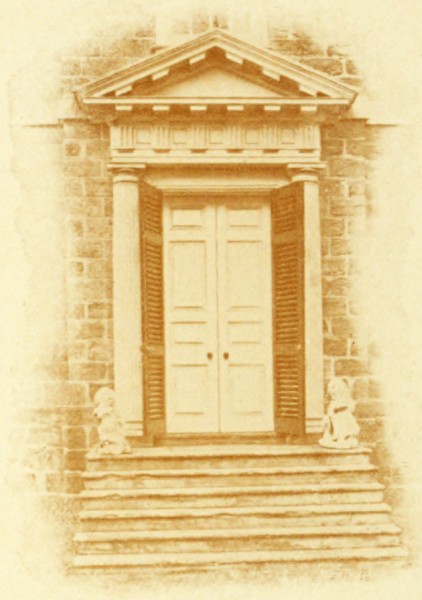
material, and certain old
doorways and gables and
porches scattered through
the town and over the
adjacent country were far
too interesting to allow
of neglect. Being a man
of comfortable means,
Burton’s profession was a
passion rather than a trade;
he could and did afford to accept
only those commissions that appealed
to him, but having once
taken them he put his very best into
each, with the result that he was already
known, at thirty-eight years
of age, as the foremost man in the
line of his selection—church and public
edifices. He had already spent a
week in Belle Harbour; there
was no hurry; if he liked,
there was another week at his
disposal. With an office force
that could be entirely depended
upon there was no
good reason for returning
North until it suited his pleasure.
This afternoon New York
seemed utterly repellent to him; a
hot, noisy, dusty city in which
were no rose-gardens and no girls
in white gowns gathered at the waist
with lavender ribbons. Deuce take
New York!
When he gained his room, the rear
apartment that overlooked the side
yard, his first action was to go to the
window and survey the prospect. He
found it disappointing. The roses
were there, to be sure, and the hammock;
but roses and hammocks do
not always in themselves satisfy. He
lighted a pipe and wondered a trifle
impatiently why the denizens of the
house beyond the box-hedged garden
kept indoors when there was a cool
and shady porch and a comfortable
hammock awaiting them. He felt
somewhat aggrieved over it. When
Bob—the general factotum of the
establishment—brought up
his supper and set the
frayed white cloth
over the table Burton
contemplated making
inquiries as to the occupants
of the house
at whose blank windows
he had been
gazing for the better part of an
hour. But on second thought he
refrained; there was
something alluring in
the thought of nursing
his ignorance; he
could give his fancy
full swing and make of the
rose-filled space beyond the
iron fence an Enchanted Garden and
of the girl in white an imprisoned
Princess. The idea appealed to him,
and he recalled with satisfaction that
the voice he had heard calling from
the house—that is to say, Castle—had
sounded Blue Beardish to a
degree. So he merely sent Bob for
a fresh syphon of soda and uncorked
the bottle of Scotch whiskey with a
thrill of something approaching excitement.
Burton frequently wondered, when
he gazed about his apartments, why
he had thought it necessary to rent
two rooms from Mrs. Phillips. So far
as space went one would have been
quite enough. The front room overlooked
King’s Street, or would have
done so had the trees which grew close
to the windows allowed, and was broad
and long and high, with white walls
and ceiling against which three old
yellow-stained steel engravings looked
lamentably inadequate. Even the big
four-poster bed seemed lost in the
immensity of the apartment. The
rear room was more cheerful. It was
no smaller and there were the same
glaringly white walls, but the furnishings
were more numerous and the
adornments more ambitious. Here
he was the proud possessor of six
pictures, a framed sampler, three advertising
calendars, and two lithographed
mottoes. He never
tired of studying the sampler;
its artistic effects fascinated
him even though the information
conveyed was but
slight:
A b c d e f g
H i j k l m n
O p q r s t u
V w x y z &
Elizabeth R. Warren Her Work
1827 1838
It was the border of purple, green,
and yellow roses that awakened his
enthusiasm, and the queer little something—which
might have been an hourglass
and might have been a dressmaker’s
form—which divided the dates
at the bottom. As for the mottoes he
found less in them to care for. “Give
Us this Day our Daily Bread” was
hackneyed and incomplete, while
“Dare to do Right” had so many
violent comparisons of color that none
would have thought of paying heed to
its advice. The pictures were uninteresting,
a few depressing, a few inexcusable,
even when their period was
taken into consideration. Aside from
the sampler, the most artistic of the
wall-decorations, Burton decided, were
the three calendars.
The furniture was all of it good, if
somewhat out of repair. The big
lounge was of mahogany veneer with
a high, straight back of such delightfully
simple lines as to atone for the
slippery, inhospitable horsehair with
which it was upholstered.
There were
some good chairs, a
folding card-table, a
swell-front, claw-footed
lowboy, and a solid
mahogany desk, beautiful
enough to drive a man to theft. The
floor was polished until it shone, and
over it were scattered four rag rugs
whose tones of gray and brown or gray
and blue were a delight. After a week
of practice Burton was able to step
upon these rugs without having them
slide from under him. But he never
became proud and careless, and this
evening as he carried the bottle of
Scotch across to the table he held his
breath and only felt quite safe when he
had lowered himself carefully into his
fiddle-back, rush-bottomed chair.
The table was placed by the window
commanding the Castle, and
during supper he
studied speculatively
the pregnability of
the place. What he
saw delighted him.
The rose-vines made
it possible to attain
the second-story balcony
with a minimum
of exertion. With
the Princess once in
his arms—— He paused suddenly
just there and closed his eyes, striving
with a pleasant warmth under
the pocket of his negligee shirt to
imagine the situation thoroughly.
With the Princess in his arms! With
those wide brown eyes just under his
own and the pearl-like cheek within
reach—— He shook his head
and opened his own eyes,
which, by the way, were steel-colored
and not brown, and
looked across the two gardens
to the Castle.
“If I had you there, Princess,”
he murmured, “I very
much fear we would never escape
from the Ogre. We should be
caught like rats in a trap—I think
that’s the correct term, though
hardly complimentary to you—up
there on the balcony. Personally,
I wouldn’t much care; with those
lips of yours where I could reach
them, my dear, the Ogre might do his
worst and be hanged to him; but
then there’s you to think of. On the
whole, perhaps it would be best if I
had you rescued by proxy. There’s
Bob, for instance!”
He smiled broadly at the thought
and refilled his glass.
“Once down from the balcony, the
rest would be simple. A wild flight
through the rose-garden, a perilous
surmounting of the iron fence, a swift
rush down the side yard here, and
then a trusty steed in waiting,—you
see, my dear, an automobile would be
out of the question on these funny
roads of yours,—and the wide world
before us!”
He lighted a cigarette and leaned
out over the casement. The evening
shadows were blurring the rose-blooms,
and high overhead a half
moon was sailing out of a bank of
fleecy clouds. The Castle showed a
solitary light in the window beyond
the balcony. He blew a puff of smoke
towards it.
“Kitty—Kitty of the
Roses,” he murmured,
“do you want to be rescued,
dear?”
From the house came
the sound of a girl’s voice
in song, sweet, caressing;
he could not distinguish
the words, and in a moment
the voice was stilled.
He waited and listened, but the
silence held. With a little laugh at
himself, Burton arose and lighted
his lamp.
“I’m afraid you don’t, my dear,”
he said. “You’re too happy. Don’t
you know that real Princesses are
never happy?”
He lowered the shade with a last
look into the darkened garden and
resolutely took up his papers.
III
“Put it under the tree in the corner,”
Burton directed, “and then bring
me a chair.”
“Mos’ pow’ful warm out hyar, sah,”
remonstrated the negro.
“Warm? Nonsense, Robert! Feel
that breeze fresh from the river. Isn’t
that cool enough?”
“Ah ain’ feelin’ no breeze; an’ anyways
it doan come from no river, sah;
river’s over that a-ways.”
“Robert, I fear you’re deficient in
imagination,” answered Burton, shaking
his head. “I insist that there is a
breeze and that it is coming from the
river. Geography mustn’t interfere
with imagination; if it does, why, so
much the worse for geography,
Robert.”
“Yessah.” Having set table and
chair in place, Robert retired, only
pausing at the side door long enough
to throw a last dubious glance behind
him. “He’s plum’ crazy,” he muttered
with a shake of the head.
Burton spread his papers over the
table, looked to pens and pencils,
lighted a cigarette, thrust his hands
in his pockets, and, tilting backward
in the kitchen chair, surveyed the
scene contentedly. Above him the
contorted branches of the Daphne-tree
spread out and upward, making
a leafy canopy through which the
morning sunlight dripped in great,
golden globules. Birds were singing
happily in the garden and in the dense
oaks that lined the
wide street beyond.
To his right was the
old brick wall; before
him ran the iron
fence through which yellow
and crimson and white climbing
roses thrust their cool green
leaves and dew-sprinkled blossoms.
Beyond was the Enchanted Garden.
Straight before him ran a narrow,
red-gravel walk, box-walled and flower-draped,
to the back door of the Castle.
Burton smiled; he was highly pleased
with his generalship. Yesterday’s position
was commanding, but to-day’s
was impregnable! He took up a
sketch-book and idly turned its leaves,
scanning the bold pencil-strokes that
reproduced pillar and pediment, cornice
and gable, with appreciative eyes.
Yet he was not so much absorbed but
that he heard the sound of an opening
door. Keeping his head bent over
his book, he looked towards the
Castle.
On the steps stood the girl. She
wore the same white muslin gown
with the lavender ribbon and carried
the same basket. And, as yesterday,
she stood, lithe and graceful, on the
top step and surveyed the riot of color
before her. Yet, ere she stepped
down to the gravel, she raised her
eyes in a fleeting glance towards a
certain window in the other house.
Burton chuckled.
“Ah, Kitty,” he murmured, “you’re
only human, after all!”
She took the farther path, a choice
he applauded silently, since she would
not discover him until she turned at
the bottom of the garden,
when flight with dignity
would be out of the
question. Now and
then he caught fleeting
glimpses of her
hat above the bushes
as she moved along
and heard the clipping
of the scissors.
As she neared the
corner he dipped
pen in ink and wrote
industriously:
“Belle Harbour, Virginia, June 3.
“She’s coming; she’s almost in sight. I
don’t quite know what I am writing. The
situation grows intense. Will she retreat or
advance? I can see the white of her gown
through the leaves. She is almost at the corner
of the path. My courage is ebbing fast; if she
delays much longer, I shall beat a disordered
retreat myself. Now! She’s coming, coming,
coming—she’s here....”
The girl came around the corner.
She was humming softly to herself
and swinging her basket. Burton’s
head was bent over the table. She
stopped and added a cluster of damask
roses to her store. When she
raised her head her eyes sought the
window that had harbored the foe the
previous day; it was empty. Undoubtedly
she was vastly relieved,
even if her countenance didn’t express
it. Alas! little did she think
that the enemy was entrenched
almost beside her. Unsuspectingly,
carelessly, still humming her little air,
she drew nearer and nearer to his
position.
Suddenly the humming
ceased abruptly. Burton’s heart
gave a leap and he brought his
artillery into action. He
raised his eyes calmly—they
belied the tumult in his breast—and
gazed with polite surprise
into hers. She returned his
look with one expressive of amaze
and—yes—appreciation; ere she
turned her head away and bent
over a bush the ghost of a smile, a
roguish and demure smile, crept
around her mouth. Then the abominable
hat hid her.
Burton was grateful for the respite;
his forces were becoming disorganized.
He took a long breath and—
“... She scorns retreat! Despite the superiority
of my position I cannot congratulate
myself upon having had the advantage in the
first skirmish. At present we are both out of
action. Had I the courage I would ask for a
parley, but alas! I am already wavering along
my entire line; I can only put up a brave front
and rely upon awing her. She is delicious,
simply delicious. Her eyes....”
Ah! what heroism! What impudent
daring! What magnificent bravery!
The girl came to the fence just
in front of the table—not six yards distant!—and
calmly snipped two bunches
of pink roses with the coolest, most
composed, and most unconscious air
in the world! She even hummed a
little! Burton stared most impolitely
and strove to think of something to
say. “Good-morning” sounded so idiotic,
so puerile! “How do you do?”
was out of the question! To ask for
a rose would have been absolutely
impertinent! The psychological moment
passed; the girl turned away!
Burton sighed regretfully and blamed
his faint-heartedness. Up the centre
path she went, stooping here and
there, humming more assuredly now—a
sweet, dainty, charming figure.
He leaned his chin in his palm and
gazed his fill. The basket was so
laden that the blossoms spilled upon
the path, but still she gathered more.
Burton smiled appreciatingly.
“Yes, yes, I understand, my dear,”
he muttered beneath his breath. “In
the best of order; horse, foot, and
artillery intact; such a retirement is a
victory!”
At the foot of the steps she paused
and deliberately gazed about her over
the wealth of leaf and bud and blossom.
But she did not bestow a glance
upon the discomfited enemy. Then,
gathering her skirts daintily about
her, she tripped up the steps and
entered the house. With the closing
of the door Burton sighed again. He
lighted a fresh cigarette and with a
whimsical smile read what he had
written. Then he again dipped pen
in ink and wrote:
“... It is all over! I have met the enemy
and I am hers! I have retained my position,
but at what a cost! I have lost my heart and
my self-possession; my self-esteem is sorely
wounded. And, alas, I glory in defeat! My
only regret is that in her clemency she has
refrained from taking me prisoner. Ah, Kitty
of the Roses, come back and make your victory
complete!”
He tossed aside the pen, placed his
hands behind his head, and blew
smoke-rings up into
the branches. A little
wind crept in gustily
from the street and
fluttered the papers
on the table. Burton took his
cigarette from his mouth and
pursed his lips.
“How did it go?” he muttered,
striving to recall and re-render the air
that the girl had been humming. But
his memory failed him and he gave
up the attempt. A stronger breeze
caught up the paper upon which he
had written and blew it to the grass
beside the fence. He watched it lazily
as it turned over and over until
caught by the iron pickets. Presently,
he told himself, he would rescue it.
Then his gaze, travelling beyond,
caught sight of a cluster of scarlet
roses lying upon the path just inside
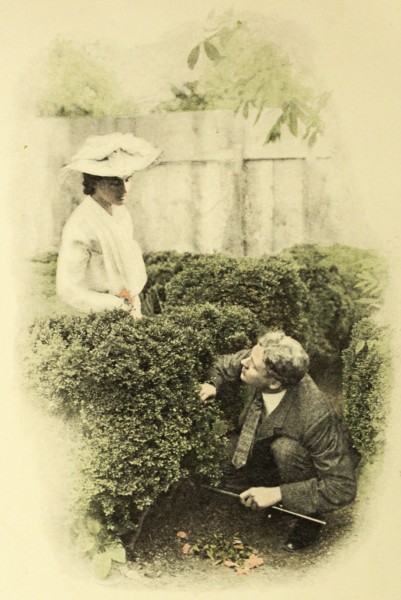
the fence. He glanced rapidly, stealthily,
towards the Castle. There was
no one in sight. His roaming eyes
fell upon his cane. The next moment
he had seized it and was thrusting
it between the pickets of the fence,
squatting most ungracefully with the
mid-morning sun beating remorselessly
down upon his back.
The cane was long enough for his
purpose and its crooked handle
seemed fashioned for just such an
emergency. But the low branches
of a rose-bush were between him and
the prize, and every time he tried to
drag the latter towards the fence they
interposed and foiled him. The leaves
of the Daphne-tree rustled in the gathering
breeze and murmured “Thief!
Thief!” At his side a sheet of
paper escaped from the pickets
and, all unseen, bounded merrily
into the Enchanted Garden.
Burton’s face grew redder
and redder and the sun
seemed resolved on burning
his back through the light shirt.
The perspiration gathered on his
forehead and slipped down his
straight, long nose in little drops
that tickled excruciatingly. Again
and again the cluster of roses was
almost within reach of his outstretched
brown hand, and again and
again the faithful branches whipped
it back. Burton paused, wiped the
drops from his face, viewed the somewhat
bedraggled bunch of flowers
exasperatedly, and summed up the
situation mildly and satisfactorily in
a clearly enunciated and temper-relieving
“Damn!”
Then he poked the cane again
through the pickets and past the
branches. And then,—
He looked up into the amused
brown eyes of the girl.
IV
The person whose self-possession
fails him miserably at ordinary junctures
may rise superior at a soul-disturbing
crisis. Burton, red-faced, perspiring,
conscious of the sorry figure
he presented, arose from his hands
and knees with brilliant composure.
A glistening drop was tickling the
side of his nose, yet he inclined his
head politely towards the pickets;
innumerable other drops were creeping
disturbingly down the middle of
his back, yet he smiled almost blandly.
“Thank you, if you will be so kind,”
he said, and held forth his hand.
She bent gracefully and picked up
the spray. Then,—
“I fear they are rather wilted,” she
said with polite regret. “There are
fresher ones on your side of the fence,
are there not?”
Her accent was delicious, Burton
thought; soft, creamy,—like her
cheeks,—filled with odd little drawls
and slurs. He hoped she would go
on. But she didn’t; she only paused
and looked questioningly from the
withered spray of roses to his face.
Her expression was merely one of
courteous indifference, of polite interest
tinctured with reserve; yet in
the farther depths of her brown eyes
a little imp of mischief danced into
sight and out again.
“The roses on my side are charmingly
fresh,” responded Burton, “but
the fact is I have a desire for that
especial spray.”
“Perhaps because
stolen fruit is sweetest?”
she asked maliciously.
“Not altogether for that
reason,” he smiled. “There
are certain associations connected
with it that endear it.”
“Indeed?” She held it gingerly
by the extreme tip of the stem
and reached towards the fence. He
accepted it gravely and thanked
her.
“Please don’t,” she said; “I’m not
sure that I am not compounding a
felony.”
“I’m convinced that you are needlessly
alarmed,” he answered. “You
have only presented me with what
was yours to give.”
But she shook her head. “Oh, no,
not at all! I discovered you stealing”—this
with awful emphasis—“my
roses, and I came to your aid merely
because I feared that if I did not you
would have a sunstroke.”
“Stealing is an unpleasant word,”
he said tentatively. “Couldn’t you
substitute borrowing?”
“Borrowing?” The brown eyes
opened very wide. “But I don’t believe
it would be true.”
“I give you my word,” he answered
earnestly, “that I will return
these to you as soon as I am done
with them.”
She leaned forward and plucked a
withered leaf from a bush to hide the
smile that trembled about her lips.
“Have you—have you any idea
when that will be?” she asked.
“Indeed, yes, I can tell you
to a minute!”
“Can you?”
“You shall have them
back the very instant you
give me some fresh ones.”
“Oh!” She was still hunting
for withered leaves. “Are you
going to press them, then?”
Burton acknowledged the touché
with a smile.
“I had entertained hopes that you,
with such a fabulous wealth of blossoms,
would be charitable to one who
has none,” he replied gravely.
“Charity is only for the deserving.”
She gave up her search and faced him
again. “Thieves are not worthy subjects.”
“But a little charity might have the
effect of reforming them. For example,
if you were to
present me each morning
with a rose, there
would remain no necessity
for stealing.”
She shook her head again.
“Reform should come through
repentance; that would be merely
bribery.”
“But in extreme cases,” he pleaded,
“shouldn’t we consider the end rather
than the means? Now, with such a
hardened, desperate criminal as myself——”
“Perhaps you are right,” she acknowledged.
“And so you have permission
to help yourself to a cluster
of roses every day. You can reach
them, you see, without trouble.”
“Oh!” he said disappointedly.
“But I shouldn’t want to do that;
I fear I would damage the
bushes.”
“Not if you used scissors.”
He made a pretence of
searching his pockets.
“I’m afraid I haven’t such
a thing,” he said despondently.
“I’m sure Mrs. Phillips will lend
you a pair.”
“You are taking an entirely
wrong course with me,” he said sadly.
“I feel that I shall never reform without
some assistance; I haven’t enough
moral courage. Now, if you would
take a little interest in my case—to
the extent of one rose, just a single,
solitary rose now and then, you know—I’m
sure I could lead a better life.
Don’t you think that—er—you
could?”
A sheet of paper danced out to
the path at her feet and she stooped
and picked it up, crumpling it in her
hand.
“I’m afraid not,” she said.
She dropped the crumpled paper
into her basket and moved off up the
path. Then she paused and turned.
“Good-morning.” She gave a
polite little inclination of her head
and Burton removed his hat.
“Good-morning,” he answered dejectedly.
She went on towards the house,
humming softly. He watched until
the door had closed behind her; then
he threw himself in his chair again
and looked smilingly at the faded,
bedraggled cluster of tiny crimson
roses in his hand.
“She’s wonderful,”
he said under his
breath. “She’s a real
Princess, after all, a
little five-foot-two Princess,
with the most beautiful eyes
in the world and the dearest red
lips and the pearliest, softest cheeks
ever woman had! She’s older than
I thought; she must be twenty-one
or two. I wonder—but, no, she’s not
married; she’s just a girl—a sweet,
womanly girl.”
He placed a cigarette between his
lips but forgot to light it.
“Kitty,” he murmured, “Kitty,
Kitty of the Roses! Never was there
a name that fitted as that does; she
could have had no other name! Maud—Alice—Mary—Lilian—Florence—none
would have suited her; Kitty
was made for her! It never struck
me before as being a beautiful name—Kitty.
I wonder why? It’s absolutely
musical! It’s a poem, a love-song!
It’s——”
He sat up very straight and scowled
at the littered table.
“Great Scott! this won’t do! These
Enchanted Gardens are dangerous
places; they evidently affect the
brain.”
He rescued his pen from the grass
and dipped it into the ink.
“Or maybe the heart!”
He drew his sheets before him and
smoothed and arranged them. Then
he frowned intently. Presently he began
to write:
“The crowning of these columns with the
Roman Doric abacus is quite unjustifiable and
altogether incongruous to the purist. Yet the
effect in the eye of the layman is not unpleasing.
It is difficult if not impossible to account——”
He looked up from the sheet before
him with exultant eyes, the pen poised
motionless in mid-air.
“I’ll swear there were dimples
when she smiled!” he murmured joyously.
V
There had been a shower in the
gray of the morning; Burton remembered
hearing the brisk patter of the
falling drops against the sounding
magnolia leaves while the open casement
was still but an oblong of gray-black
in the surrounding darkness;
and now, at nine o’clock, the garden
was still moist in the sunlight and
dripping in shadow. The Daphne-tree
was gloriously fresh, the honey-flowers
were drenched in crystal drops,
and the bees, moving hoveringly from
spray to spray, were in constant danger
of shower-baths. Across the fence the
roses were laughing as the sun, fiercely
solicitous, dried leaf and bloom. The
hedges were festooned with glistening
webs of silver and spun
glass in which gems trembled
and scintillated. The fallen
petals, rain-beaten, strewed
beds and paths and were
washed here and there into
tiny ridges of pale colors like
the rim of an artist’s palette. And
the air, renewed and refreshed, was
fragrant with the mingled odors of
the blossoms and moist loam.
Even Burton’s table beneath the
Daphne-tree showed evidences of the
recent shower, for the painted top was
spotted with tiny pools in which the
greenery overhead was dimly reflected.
Burton moved it into the sunshine,
tipped it until the emerald pools
trickled off, and left it there to dry
while he lighted a cigarette and, between
inhalations, cast casual glances
over the rose-bushes at the neighboring
door. But the door remained
closed. A second cigarette followed
the first. The table was quite dry by
now, but Burton seemed to have forgotten
its existence while he strolled
to and fro along the path beside the
house. Once he glanced at his watch
a trifle impatiently; it was after nine-thirty.
He shook his head disapprovingly;
the Princess was late. Didn’t
she know, he wondered, that punctuality
was a virtue in Princesses as well
as in others? Besides, it was growing
very warm and she was keeping him
from his work. Then he had the grace
to blush mentally as he remembered
the two pencils and the block of paper
in his coat pocket which, while they
might give the appearance
of labor,
were intended merely
as a cloak for idleness.
He rescued
the table from the sun, which
already showed a disposition
to blister the yellow painted top,
and laid his pad and pencils upon
it with a great show of importance.
He had forgotten the chair, so he
went to the back door and requisitioned
one from the kitchen. Bob,
wearing a long blue-checked apron
which impeded his progress by winding
its folds about his thin shanks, appeared
presently—Burton had been
in Belle Harbour long enough to cease
expecting immediate results—and set
a kitchen chair before the table. Burton
shook his head.
“No, Robert, the other side, if you
please,” he said. “Your tastes may
run towards brick walls and Daphne-trees,
but mine prefer roses
and enchantment. The
other side, Robert.”
“Yessah, ve’y well, sah.”
Bob had given up attempting
to understand Burton,
and had philosophically
decided to pay no heed to
his vagaries save to humor
them whenever possible
and so earn as many as he might of the
silver coins with which the Northerner’s
pockets seemed to be filled. He placed
the chair with its back to the Daphne-tree,
wiped the seat of it with the end
of his apron and grinned inquiringly.
“Robert,” said Burton, “I presume
that you agree with me in holding the
lack of punctuality to be one of
the deadliest of the deadly
sins?”
Bob scratched his head and
appeared to be giving the
matter serious consideration.
But as he made no reply
Burton continued, accepting
silence for consent.
“It seems to me, Robert, that tardiness
in plain, ordinary every-day
mortals like you and me may be
forgiven; I hope so for your sake;
but a Princess—I may say the Princess!—Eh?
You see the difference?”
“Yessah,” said Bob explosively.
“Of course,” Burton went on, seating
himself in the chair and with difficulty
getting his knees beneath the
table, “of course, living in an Enchanted
Castle it may be that one is
not at liberty to come
and go as we are,
Robert. You follow
me, I trust?”
“Y-yessah!”
“Thank you. I realize that
there are times when my remarks
possess a certain involution,
as you might say, which persons with
less penetration than you, Robert,
might find confusing. It pleases me
that you so thoroughly understand
my remarks; your sympathetic attitude
arouses my gratitude. That possibly
sounds to your finely-trained
ear like poetry, Robert, but I assure
you that nothing of the sort was
intended. So far I have not reached
the condition when poetry becomes
necessary for the expression of
thought. When I do reach that
phase of the malady—for love
has been not inaptly termed
a malady, you’ll remember—when
I do, I say, your ears
shall be the first to listen to
my rhymed periods; that I
promise you. But—no,
thanks, I beg of you!”
The request seemed unnecessary,
for Bob’s countenance was expressive
of other emotions than
gratitude, chief of which, perhaps,
was bewilderment. He rolled his
eyes towards the kitchen door, and
his settled grin—the sort of grin
with which one might strive to placate
a dangerous lunatic—held a
trace of uneasiness. But Burton,
leaning with his elbows on the table
and levelling a drawing pencil at
him, held him captive to his will.
“Robert,” he asked, “have you
ever seen a Princess?”
“N-no, sah; leastways, sah, not to
know it.”
“Ah,” said Burton with a shake of
his head, “that’s it! ‘Not to know it!’
Perhaps, Robert, you have met your
Princess without recognizing her, have
passed her on the street, at the market,
in—Robert!”
“Sah?”
“How about cook? You don’t
think that possibly—er—she might
be your Princess?”
“Who, sah? Lavinia, sah? Ah
reckon yo’ makin’ fun, Mister Burton.
Why, she ain’ no Princess, sah; she’s
jes’ one dem no ’count No’th Ca’lina
niggers!”
Burton nodded gravely.
“Perhaps you are right. Nevertheless,
Robert, Princesses move in
strange disguises, I
have no doubt. Unfortunately,
I am unable
to acquaint you
with any certain
method of detecting them.
Of course, if she lives in a
Castle and picks roses in an Enchanted
Garden you know at once
that she is a Princess; that is simplicity
itself. Also, if she has beautiful
soft brown eyes and—and dimples—”
He snapped his fingers
triumphantly and Bob started in
alarm. “We have it, Robert! Rejoice!”
“Yessah, yessah!”
“That, Robert, is the secret! Dimples!
Look for dimples! All Princesses
have dimples. Aren’t you
awfully glad I thought of that? When
you go back, Robert, observe Lavinia
closely. If she has dimples”—he
spread his hands wide—“there you
are, you have found your Princess!”
“Ah reckon th’ won’t be no dimples,
Mister Burton,” said Bob lugubriously.
“Ah reckon she’ll jes’
natu’ally snatch me bald-headed, sah,
for not comin’ back an’ wipin’ de
dishes.”
Burton shook his head sorrowfully.
“You pain me, Robert. All the
time you have stayed here keeping
me from my work you have been
neglecting your own labors. That is
not right. Return at once to the
kitchen and the Princess Lavinia. Not
a word! I refuse to listen any longer
to your chatter.”
“Yessah,” said Bob eagerly.
“Thank’ y’, sah. Anythin’ Ah
can git you, sah?”
“Nothing, Robert. Do
not attempt to disarm my
resentment; I am disappointed
in you.” Burton
waved him away. When he had
gone, Burton lighted a third cigarette,
stretched his arms overhead,
yawned inelegantly and—suddenly
sat up very straight and attentive in
the chair.
From across the nodding roses,
from an open window of the Castle,
floated again a girl’s sweet, fresh
voice in song. Burton’s heart leaped
and he tried to still his breathing that
he might hear the better, the while he
searched eagerly with his gaze the
windows of the house beyond the
rose-garden.
“O Paradise, O Paradise, the world is growing old; Who would not be at rest and free where love is never cold? Where loyal hearts and true stand ever in the light, All rapture thro’ and thro’ in God’s most holy sight?”
The words of the hymn died softly
away and silence held the Castle again,
a peaceful silence that now held for
Burton a new significance. After a
few moments he gathered his pencils
and paper together and arose. The
hymn had recalled to his mind a fact
which he had lost sight of,—namely,
that to-day was Sunday. And he
knew enough of Belle Harbour and
its customs to be sure that, even
should he wait there in the garden all
day long, he would
not be rewarded with
a glimpse of the Princess.
At the door of
the house he turned
and looked again over the enchanting
scene. Beyond the
iron fence the roses drowsed and
nodded sleepily, the yuccas gently
swung their bells, the leaves cast
flickering shadows on the red gravel
paths, and the bees droned. The
magnolia had already begun to spread
its mellow gloom over the garden and
from its depths a yellow-breasted
songster, half seen like a speck of
molten gold between the moving
leaves, gushed its soul into song. But
for the rest, silence and emptiness.
VI
“I wonder,” mused Burton, “if it
ever rained in the Garden of Eden.
And, if it did, I wonder if Adam was
as bored as I am now. Of course he,
lucky beggar, had Eve, while I—my
Garden of Eden is Eveless. Come
to think of it, though,—” and he
smiled for the first time since he had
lifted his head from the pillow to see
the rain streaming relentlessly from a
leaden sky—“come to think of it Eve
and I would cut rather sorry figures
out there in that dripping Eden. She,
of course, would wear a little gray
rain coat and a felt hat, while I would
have to appear in rubber coat and
sou’wester. And we’d each have to
wear rubbers and, perhaps, carry
umbrellas. It doesn’t sound
romantic. Not that Kitty of
the Roses wouldn’t be absolutely
charming in a raincoat,
or that I am anything
short of distinguished in that
absurd garment of black rubber,
only—well, it would test our
tempers as well as our powers of
entertainment to have to sit out
there with our backs to a box hedge—probably
quite well stocked with
spiders and assorted bugs—for any
length of time. It must be difficult to
talk well when a raindrop is hanging
from the end of your nose and your
cheek is plastered with wet rose petals.
I’m sure that at the end of half an
hour Kitty would detest me cordially
and I would—but no, my dear, I
couldn’t detest you
under any circumstances.
If you’ll only
make your appearance
through that
aggravating back door over
there I’ll fly to your side and
sit contentedly on the sharpest picket
of the fence as long as you’ll stay in
sight.”
“It isn’t as though I couldn’t see
her if I wanted to take extreme
measures,” he went on. “If I liked I
could go this minute to the front door
of the Castle and ask for her. She
might refuse to speak to me when she
discovered who I was, but, at least, I
would have had the satisfaction of
seeing her again.”
The thought seemed to bring him
a degree of comfort, for his face, which
since rising had been as cloudy
as the sky, lighted somewhat,
and he blew cigarette smoke
out into the rain with new
gusto.
“But she wouldn’t like
it; not a bit of it. And so
I’ll worry through this beast
of a day as well as I can, and to-morrow—to-morrow
the sun will shine
again, those sorry-looking flowers
will raise their heads once more
and Kitty, Kitty of the Roses, will snip
them off with her shears. Happy,
thrice blessed flowers!”
Suddenly his countenance fell again
and his cigarette dangled disconsolately
from drooping lips.
“I wonder though if she’ll put in an
appearance to-morrow! Perhaps she
thought me impertinent, a bit of a
bounder! Perhaps she’ll keep out
of my way! Perhaps—but she can’t
do that altogether, else what
would become of the
roses? She must come
into the garden, and if
she comes into the garden
I shall see her. And
I’ll behave very, very
well, oh, perfectly! And
she’ll say to herself, ‘Poor
fellow, his manners are
really quite nice—for a
Northerner. And he seems rather
harmless. I think I’ll be kind to him.’
And everything will be lovely!”
Cheered by his prophecies, he drew
the table as near to the open window
as the spattering raindrops permitted
and resolutely took up his pen. For
the first half-hour his gaze was more
often on the door of the neighboring
house than on his task. But after
that the work—a paper on “Early
Colonial Architecture in the South” to
be read at a meeting of the Society
of Architects—progressed finely, while
the rain beat ceaselessly upon trees
and shrubs and pat, pattered on the
window-sill at his elbow.
By bedtime he had written the final
word. After he had blown out his
lamp he went to the window overlooking
the Enchanted Garden. The
back of the Castle was in darkness,
but the rain had ceased, the dripping
roses were scenting the night with
their perfume and, high overhead, the
moon peeped wanly through a rift in
the clouds.
VII
“They are looking well after the
rain,” he suggested interrogatively.
She had shown no disposition to avoid
him, in fact, her rather distant inclination
of the head had preceded his
own bow by a flattering fraction of a
second.
“Yes,” she agreed, without, however,
pausing in her task of filling
her basket with great long-stemmed
blooms. Burton left the table and
leaned over the fence.
“On a day like yesterday one
rather wishes oneself a rose-bush or
tree or something equally inanimate,
don’t you think?”
“I don’t think I
ever have,” she answered.
“Why
should one?”
“Perhaps you are one of
those unnaturally cheerful persons
who like rainy days,” he said.
“For my part, I can’t bear them.
Yesterday, for instance, I was awfully
bored. I think I must have stood at
my window up there for all of an
hour looking down here and wishing
for the sight of”—he suddenly recollected
his resolve to be on his good
behavior—“of a human being. It
was a beast of a day!”
“You didn’t look happy, that is
true,” she said, bending to rescue
a fallen clump of flaring red Luxembourgs.
“Then you saw me?” he asked
eagerly.
“Why not? You stood in full
sight at your window.”
“But—but I didn’t see you,” he
answered aggrievedly. She shook her
head.
“You couldn’t; I was in the kitchen
making cake.”
“Really?” From his tone one
would have thought the making of
cake a wonderful and quite unprecedented
performance.
“Really,” she mocked smilingly.
“What—what kind?” He sought
desperately in his mind for knowledge
on the subject. “Gingerbread?”
“Chocolate layer cake,” she answered.
“Oh!” he sighed ecstatically.
“Do you like it?” she asked,
touched, perchance, by the pathos of
his tone.
“Worship it!” he assured
her. “I suppose you—er—I
suppose you haven’t any left?”
“I think there is some,”
she answered, striving to
control the quivering corners
of her delicious mouth. “Are
you hungry?”
“Awfully,” he sighed. “Will you
take pity on me?”
“I think you want a great deal.
Yesterday it was roses, to-day cake.
I wonder what it will be to-morrow?”
It was hard work keeping back the
“You!” that rushed to his lips. But
she had acknowledged the possibility
of their meeting again on the morrow,
nay, had practically suggested it as
though it were a matter of course, and
he took heart from that.
“I’ll say no more about the cake,”
he said insinuatingly, “if you’ll give
me the roses.”
“But I’m not sure I wouldn’t
rather give you the cake,” she replied
thoughtfully. “You see, the roses
mean more to me.” Her eyes ranged
slowly, lovingly over the garden. The
shadow of her hat cast a warmer tone
over one clear, creamy cheek, and
Burton’s heart thumped immoderately.
“They would mean
more, much more, to me,
too,” he said softly, and
his voice was not quite
even. Perhaps she
caught his meaning; at
least the shadowed
cheek found new color, and she made
a little movement as though to go on
her way up the path
towards the house.
But—and perhaps,
after all, she was not
altogether displeased—she
only bent her warm face
over a tempting spray of golden
blossoms, and Burton, who had noted
the impulse toward flight, went on
hurriedly:
“One hears so much, and rightly,
of Southern hospitality,” he said, “that
certainly I am not mistaken in thinking
you will give me, out of your
vast wealth, one little rose a day?”
“You wouldn’t rather have the
cake?” she asked, raising her head
and viewing him quite calmly.
“No, the rose, if you please.”
“But it was delicious cake,” she
went on musingly. “It was really the
best I ever made, and Aunt Amanda
says I make very good cake.”
“I could never doubt that,” he answered
gallantly.
“It was very high, and it had four
layers of lovely chocolate cream filling
and lots and lots of chocolate icing
on top. Don’t you like chocolate
icing?”
“Awfully, but I like roses—some
roses—far more.”
“Oh! But—every day? Don’t
you think that’s rather often? Fresh
roses will easily last three days without
wilting, and if I gave you one this
morning it ought to do until—let me
see”—she counted the tips of three
gloved fingers—“why, until Thursday!”
But he shook his head with decision.
“It must be one a day.”
“Must?” she repeated with a tinge
of emphasis and a slight lifting
of her brows.
“Pardon me, should was
what I meant to say. I shall
soon begin to think you a
miser. Perhaps if I look
out into the garden some
moonlight night I shall see
you here counting your roses, as
a miser counts his gold.”
She smiled at the picture he
drew. Then, tossing some loose
petals from her hand with a gesture
of surrender,—
“Very well,” she said, “you shall
have your one rose a day while you’re
here. I reckon it won’t impoverish
me, for no one never stays in Belle
Harbour very long at a time—unless
one lives here.”
He thought there was just a suggestion
of interrogation in the remark.
“Don’t be too sure of that,” he replied.
“I came down here for a fortnight,
but I shan’t promise to go at
the end of that period. You see, in
New York I am not presented each
day with a rose.”
“You must be very fortunate to be
able to make your business affairs secondary
to your whims,” she said a
little unkindly.
“I am very fortunate,” he answered
simply.
“But to stay here in our poor little
shabby town just for a handful of
roses?” she persisted. “It sounds
rather silly, doesn’t it?”
“Have I said,” he asked gently, a
smile hovering under his moustache,
“that it was altogether the roses?
When you are tired of having me
come a-begging to your garden fence
send—send Aunt Amanda out with
my rose.”
She laughed softly and caught up
the skirt of her white gown in
the hand that held the scissors.
“I will remember,” she
said. “Good morning.”
“But my rose?” he
cried in dismay.
“To-morrow,” she answered
mockingly, “if
Aunt Amanda is not too
busy.”
She nodded and moved
away towards the house.
Burton gazed ruefully after her
until the door had hidden her from
his sight. Then he
went back to his chair
under the Daphne-tree,
clasped his
hands behind his
head, tilted back and sighed
ecstatically.
Five minutes passed; ten; twenty.
A lark high up in the magnolia-tree
sang his shrill and florid melody to
unheeding ears. The sun crept
higher and higher until the shadow
of the Daphne-tree reached the edge
of the grass-plot. The bees rose
and fell above the blossoms on invisible
wings and humming-birds
darted and poised along the tangle
of honey-flowers.
Suddenly Burton’s chair came
down with a thud and he sat erect,
a frown on his brow.
“Were there,” he murmured,
“or were there not
dimples?”
“I think I must be repentant,”
he said the next
morning. “I’ve been feeling
strangely happy of late—in
fact, ever since I saw you coming
out of the house.”
“Your repentance is not of very
long standing,” she scoffed.
“Don’t discourage me, please! Five
minutes of time may be of little consequence,
but five minutes of happiness
is so uncommon as to be priceless.”
“You are unfortunate,” she answered
gravely. “I should be thankful,
I suppose, that my happiness is not
reckoned by minutes.”
“Unberufen!” he cried.
“Unberufen!” she echoed. Then
their glances met and they laughed
together. He saw with relief that the
dimples were not mere creations of
his imagination; they were there,
appearing and disappearing on the
clear, soft cheeks. He held a withered
spray of roses across the fence.
“You are prepared to fulfil your
promise?” he asked.
“Are you sure I promised?”
“Absolutely!”
“I said perhaps.”
“Impossible! Do you imagine
that I would have got out of bed at
six o’clock this morning, bolted my
breakfast, and waited here under this
absurd tree for nearly an hour and a
half unless I had been certain of the
reward?”
“Really? But you don’t look
hungry.”
“I’m starved—for
roses; absolutely famishing!”
“How awful!” she
exclaimed in awe-struck tones.
“Wait, then.”
She turned and looked about her
over the laden branches.
“Does your hunger demand any
especial kind or color of rose?”
“It does; it cries aloud for a large
pink rose with one or two crushed
petals.”
“What a strange appetite you
have! I’m afraid I can’t see one just
filling those requirements.” She
creased her forehead and looked the
garden over.
“May I help you?” he asked.
“I wish you would.”
“Then I will respectfully suggest
that the rose you wear exactly fits the
description. In fact, strange as it
may seem, it appears to have been
fashioned with that end in view.”
He met her glance with one of
serene and self-satisfied composure.
Her eyes dropped to the blossom in
question and she lifted it and examined
it carefully.
“It is strange,” she mused. “Here
are the crushed petals and all.” He
held out his hand. “But, then, there
are larger roses and pinker ones,
beyond doubt, and as for crushed
petals—why, they are easily made.”
She moved towards a bush of immense
cabbage-roses and put forth
her scissors.
“One moment!” he cried. She
turned, mutely questioning.
“Appetites,” he went on
plausibly, “are capricious things—mine
especially. Having
once set itself upon a certain
thing it rejects all others, no
matter how similar in outward
appearance they may be. My hunger
craves the rose you wear. I
throw myself—and my hunger—upon
your mercy! Be generous!
You see before you a starving man!”
She turned back with a little gesture
of despair and slowly, hesitatingly,
detached the blossom from her gown.
“Of course I can’t refuse a starving
man,” she said.
“It would be quite impossible,” he
answered.
“And so”—she stretched the pink
blossom out to him and he seized it
greedily across the fence—“I shall
take credit to myself
for having saved
your life,” she
said soberly.
“Please do so
every minute of
the day,” he
begged. “And
now——” He
held forth the
withered spray
he had received
the day before.
But she shook
her head.
“I have so many fresh ones, you
see.”
“But it was a part of the bargain!”
he pleaded.
“Was it?” She accepted the limp
cluster of faded blooms, viewed it
carelessly, and dropped it to the path,
where it lay, a pathetic symbol of
Beauty’s perishableness.
“Kitty,” he said to himself, “you’re
a minx, a dear, charming little minx!”
“Please tell me,” he said aloud,
“what you do with yourself all the
rest of the time?”
She looked across questioningly.
“After you leave the garden, I
mean. I see you for a minute or two
and then you utterly disappear and
never come back—until the next
morning. Do you live in a real
house? Is there a front door to it?
Or is it an enchanted palace? If I
searched, could I find it, or would
folks merely look at me compassionately
and shake their heads if I asked
them to direct me to the Castle of
the Roses?”
“Oh, I’m sure
they’d shake their
heads,” she laughed,
“if you asked for
that. But there is a front door.”
“And if I were to come to it
and ask—ask for the Princess——”
“Aunt Amanda would send you
away in short order. You see, she
doesn’t consider me exactly as a princess.”
“Then whom would you advise me
to ask for?”
“Nobody.”
“Oh! But—if I should get someone
to bring me?”
“That might be different, I reckon.
Perhaps then Aunt Amanda would let
you in.”
“And the Ogre? I would not be
eaten alive?”
“The Ogre?” she asked,
puzzled.
“Yes; I heard him calling
you one morning.”
“Oh,” she laughed, “the
Ogre! Well, now as for the
Ogre—— But you’d have to
risk the Ogre.”
“I will!” he exclaimed with decision.
“Only—— Perhaps you
know a Colonel Barrett here in
Belle Harbour?”
“Barrett?” She shot a sudden
glance of surprise. “What is his
first name?”
“I—really, I don’t remember. A
friend in Baltimore insisted upon giving
me a letter of introduction to him.
I don’t fancy them much, you see, and
so I’ve never presented it. But now—if
you think—that is, you know, if
Colonel Barrett knows the Ogre—or
Aunt Amanda—” He paused suggestively.
“There is a Colonel Robert Barrett
here,” she said, “and I’ve met him.
And I think”—she was smiling as
though the mention of the Colonel’s
name evoked humorous recollections—“I
think he knows the Ogre.”
“Really?” he cried. “Then I must
find him out. When you come to think
of it now, a letter of introduction is
something that shouldn’t be neglected,
should it?”
“I never had one,” she replied demurely.
Then, catching sight of the
neglected basket of roses, “Oh, just
see,” she exclaimed remorsefully,
“they’re all withering!”
“Not enough to hurt,” he said.
“Besides, there are lots more.”
But she shook her
head and, with the
basket over one arm
and scissors and
skirts in hand, turned
towards the house.
“Good-morning,” she said.
“Oh, but wait.”
“Well?”
He searched desperately for something
to say, anything to keep her
there. Finally,—
“They’re looking well, aren’t they,
the roses?”
“Oh, yes.”
“But—er—perhaps they need rain?
Roses require a good bit of moisture,
don’t they? I think I’ve read somewhere
that—er—that——”
“Good-morning.” She turned away
again, smiling deliciously when her
back was towards him, and went
quickly up the path.
“Good-morning,” he called regretfully.
Then:
“Confound it, I did read something
about roses and moisture somewhere!
Now, what was it? Just like my silly
memory to go back on me when most
needed! I shall read up on roses;
everyone ought to know about
flowers.”
He gathered up his papers and
writing utensils and went up to his
room. There he placed the pink rose
in a goblet of water and, in the manner
of one performing a sacred rite,
pressed his lips to the crushed petals.
“This afternoon,” he said, “I will
present my letter to the worthy
Colonel.”
But he didn’t, for with the
afternoon came a telegram
from New York calling him
back. For a few moments
he railed eloquently at fate:
in the end he accepted her
command with ill grace: “I am
leaving my trunk, Mrs. Phillips,” he
explained to his landlady, “in order
that I may return and get it later.
Meanwhile I shall be glad to retain
the rooms. I shall be back in a week
or ten days, I fancy.”
During the operation of packing a
suit-case he made trips to the window
overlooking the rose-garden at frequent
intervals, but without reward.
The back of the Castle presented a
sleepy, undisturbed aspect, and the
garden was empty of all life save birds
and bees and butterflies. Just before
it was time to leave
for his train he went
down to the iron fence
and looked mournfully
across.
“Kitty,” he whispered to
the drowsing leaves and blossoms,
“Kitty of the Roses, I’m
coming back to you, dear, just as
soon as the Lord will let me.”
Suddenly he remembered the withered
spray of roses that she had
dropped to the path, and a desire to
repossess it took hold of him. His
cane was in his hand and he knew just
where they had fallen. He leaned
over the tops of the pickets and
reached forward. Then he stopped.
The roses were gone.
VIII
Burton returned to Belle Harbour
and King’s Street just two weeks later
to a day. It was dusk when he stepped
on the station platform, and starlit
darkness when, followed by a tattered
and grinning little darky bearing his
luggage, he reached his lodgings. His
first act was to throw open the bowed
shutters and look out upon the Enchanted
Garden. It was a dark expanse
of bush and hedge, with here
and there an uncertain fleck of gray
where the wan light from the sky
caught a white blossom. Beyond, the
house was empty of light. Something—what
he scarcely knew—in the
aspect of house and garden oppressed
him; had he believed in premonitions
he would have accepted that as one
of ill augury. He turned
away with a shrug of
impatience and lighted
his lamp.
In the morning he
leaped out of bed
and again thrust
aside the blinds. His
heart sank. The Enchanted
Garden was
still below him; but it
looked unmistakably neglected
and uninhabited. Most of
the roses were through blooming for
the while and what blossoms there
were seemed faded and imperfect.
The blinds in the rear of the Castle
were all tightly closed; the hammock
was gone from the porch; the vines
looked dusty. In a sudden panic
of alarm Burton strode to the
hall and called loudly for Bob.
“Have those people in
that house over there gone
away?” he demanded when
the darky appeared.
“Which house is dat, sah?”
“There, idiot—beyond the rose-garden!
Have they gone?”
“Oh, yessah; they gone; been
gone a week, I reckon.”
Burton sat down on the edge of the
bed and groaned. Then,—
“Where?” he demanded. Bob
shook his head:
“I dunno, sah; somewhars up No’th.
The Colonel he al’ays goes No’th in
summer.”
“The Colonel?”
“Yessah, Colonel Barrett. Wasn’t
you askin’ about——”
“Barrett!” Burton seized Bob by
the arm and dragged him to the casement.
“Look here,” he said desperately,
“do you mean to tell me that
Colonel Barrett lives in that house,
the one with the rose-garden behind
it?”
“Y-yessah, I surely does, sah.”
“You’re not mistaken?”
“No, sah; why, I knows the Colonel
well!”
“Then why didn’t you tell me this
before, you fool nigger? Why didn’t
you tell me Colonel Barrett lived
there?”
“Yo’ didn’t ask me!”
“Oh, get out of here!” groaned
Burton. “Hold on, though. Has the
Colonel a daughter?”
“No, sah, he ain’
never got mahied.”
“Then——” cried
Burton in sudden
hope.
“He got a niece, though.”
“Oh! So she’s his niece? What’s
her name?”
“Name’s Miss Kitty.”
“I know that,” said the other impatiently.
“What’s the rest of it?”
“Ah ain’ never heard no mo’.”
“Do you mean to tell me that she
has no last name?”
“Oh, las’ name! I didn’t know
you meant las’ name, sah. Las’ name’s
Fletcher, o’ co’se!”
“That’s all. Get out!”
Bob departed to tell the cook that
“Mister Burton he done wen’ crazy,”
and the subject of the announcement
remained for many minutes sitting on
the bed in his pajamas gazing out into
the Enchanted Garden and mentally
heaping maledictions upon himself.
The thought of the letter of introduction
in his trunk was maddening. It
was all very plain now; no wonder
she had smiled when he had asked
about the Colonel!
“Oh Kitty, Kitty!” he muttered,
“you’re the cruel one!”
After breakfast he packed his trunk
hurriedly and then, armed with the
letter, sallied forth. Down King’s
Street he went to the first corner;
here a half-obliterated sign, nailed
against the trunk of a giant oak, bore
the legend “Mary Street;” he counted
the houses and chose the third one.
Emptiness was written all over its
sleepy, red-brick front. Nevertheless
he knocked, and waited.
After many minutes the
door was opened cautiously
and an aged negress—he
was certain it
was Aunt Amanda—stuck
her head through the
narrow aperture.
“Is Colonel Barrett at
home?” asked Burton.
“No, sah, he gone up
No’th.”
“Impossible!” exclaimed
Burton, simulating
intense surprise and dismay.
“I have a letter of introduction to
him. Can you tell me where he has
gone?”
“But isn’t there
anyone here in town that can
give me his address?”
“Don’ reckon so.”
“But his mail, where does that
go?”
“Folkses at the pos’-office lookin’
arter that, sah.”
“Oh! And is Miss Fletcher with
him?”
“Yessah.”
“Thank you. I think I will leave
my card. Will you kindly see that
he gets it when he returns?”
Burton tried the post-office without,
however, much hope of success. And,
as he had expected, the post-mistress,
an elderly lady with an extremely
suspicious expression about
her thin lips, refused to divulge
any information.
“It’s a rule of the Department,”
she explained
severely.
That evening Burton returned
to New York without having
obtained any more explicit directions
than those given by Aunt Amanda.
But he was not hopeless. Surely,
he assured himself, it would not be
difficult to discover the whereabouts
of the Colonel and his niece so long
as hotel registers were open to public
inspection.
But at the end of two days he had
changed his mind. At the end of the
third he gave up the search. New
York had swallowed the Princess and
the Ogre! Burton returned to his
affairs, which had begun to suffer,
and strove, for their good, to banish
thoughts of Belle Harbour and the
Enchanted Garden and Kitty of the
Roses from his mind. But the task
he had set himself was a difficult one;
and just when it seemed that he was
arriving at some degree of success,
lo! a prankish Fate interposed.
It was well into July. New York
had been sweltering all day under hot,
cloudless skies, and even the darkness
brought no relief. To stay indoors
was out of the question, and
so Burton dragged himself from an
already deserted club after a late dinner
and hailed a hansom.
“Drive around,” he directed,—“any
old place so long as it’s cool.”
Cabby turned the
horse’s head up-town
and it trotted listlessly
along over the
still heated asphalt.
Burton leaned forward to catch
what air there was and smoked
and meditated. For some reason—perhaps
it was a glimpse of a florist’s
window that did it—his thoughts flew
southward to a garden of roses and to
a small, graceful figure that walked
therein. Fagged by the heat of the
long day, he had no strength left with
which to combat temptation, and he
yielded. It came back to him very
vividly; closing his eyes he saw the
garden and the blank, drowsy old
house; he saw the door beside the
rose-vines open and a white-gowned
figure trip down the steps. She came
nearer and nearer, smiling, happy-eyed,
the broad brim of her hat lifting
in the breeze and chasing the
edge of the mellow shadow over her
cheek. Never before had her face
come back to him so clearly. In
the length of eight blocks he lived
over those precious mornings minute
by minute. In the middle of
the ninth he was suffering all the
torments of a despairing lover of
twenty. He hurled the dead cigar
from his lips to the pavement and
thrust up the trap with his cane.
“This won’t do,” he muttered savagely;
and aloud, “Stop here; I’ve
had enough.”
On the curb he found himself
bathed in the bright glare of many
lights; he had landed at the entrance
of an uptown theatre. With a
shrug of his shoulders he went
in. “As well here as anywhere,”
he thought. Of the
entertainment he recalled
but little the next day. But
the theatre was fairly cool
and the music bright and eminently
cheerful. When the final
curtain had descended he joined the
pushing throng at the right of the
house. Half-way towards the entrance
his eyes, ranging carelessly
over the scene, were suddenly arrested
and his heart leaped. Across the
rows of empty seats, at the far side of
the theatre, a man and a girl were
slowly making their way towards the
door. The man was tall, thin, with
grizzled hair and moustache, Southern-looking
from head to heel, and about
fifty years of age.
The girl was slight
and rather small, with
brown hair and warm
skin hued like the
inner petals of a rose. She
was plainly dressed in a street
skirt of gray and a white shirt-waist
against which three or four pink roses
drooped. In short, it was Kitty—and
the Ogre!
Burton looked about him desperately.
The only course open was to
remain in the aisle where he was and
trust to reaching the lobby in time to
intercept them. He took advantage
of every cranny and crevice in the
throng and pushed his way through
with slight regard for toes or skirts.
It seemed hours before he reached
the entrance. Now and then he was
able to catch sight of his quarry
over the shoulders of the
throng. It was while so engaged
that he heard an eloquent
sound of rending silk
and felt himself seized
roughly by the arm. He
turned to face an indignant
cavalier.
“Sir, you are very awkward! You
should look where you are going!
You have torn this lady’s dress!”
“I am very sorry,” replied Burton,
striving to wrest himself from the
other’s clutch. “Believe me, Madam,
I am deeply grieved and—er—— I
beg of you, sir, don’t detain me; I
am trying to reach some friends
who——”
“Deuce take your friends, sir!
Your clumsiness——”
But Burton wrenched himself free
and plunged into the lobby, followed
by muttered execrations from those
whom he unceremoniously thrust from
his path. But the delay had cost him
dear. The Princess and the Ogre
were not to be seen. He rushed to
the street door just in time to catch
a fleeting glimpse of a gray skirt disappearing
into a brougham.
“Kitty!” he called, and struggled
across the sidewalk.
The door closed, the driver snapped
his lash, and the carriage rolled away.
And yet for an instant he was certain
a face had looked from the window
and a hand had rested upon the sill.
He hailed a hansom.
“Keep that brougham in sight,”
he said hurriedly. “There’s a five-dollar
bill in it if you do!” With one
foot on the step he paused, stooped,
and lifted something from the asphalt.
It was a pink rose.
The driver’s task was not a hard
one. The brougham went northward
slowly for a few blocks and then
turned to the west down a quiet side
street. Presently Burton’s conveyance
stopped.
“All right, sir,”
said the driver.
The brougham
had paused some
dozen doors beyond
and its passengers
were
alighting. Burton
descended, dismissed
his cab, and keeping the house
into which the Princess and the Ogre
had disappeared in
sight, walked leisurely
towards it. It proved
to be a small, unpretentious,
but attractive
hotel. When he entered
the hall was empty save for a
clerk, behind the tiny desk, and a
negro elevator boy.
“Is Colonel Barrett, of Virginia,
staying here?” Burton asked.
“Yes, sir. Will you send up your
card?”
Burton hesitated; then shook his
head.
“No, I think I’ll wait until morning;
I presume they have retired?”
“Did Colonel Barrett and the young
lady go to their room, Billy?” the clerk
inquired. The elevator boy nodded
sleepily. Burton turned away and
walked homeward through the breathless
streets with a triumphant
joy and
a fragrant pink
rose for companions.
To-morrow
he would see
Kitty, his Kitty,
Kitty of the
Roses!
He went to his
office early the following
morning, and at ten o’clock,
summoning a hansom, had himself
driven to a florist’s. There he purchased
two dozen and one roses and
personally superintended the packing
and dispatching of them. His selection
may have struck the attendant as
somewhat unique, consisting, as it
did, of a dozen white blossoms, a dozen
pink ones, and a single half-blown bud
of deep crimson; but Burton, remembering
Kitty’s wont, thought she would
understand. After the flowers had
been sent he hesitated a moment on
the curb. In the end he sent the cab
away. He did not want to present
himself at the hotel before eleven; the
thought of sitting inactive in a club
window was distasteful; he would walk
slowly uptown. So he crossed to the
Avenue and, lighting a fresh cigarette,
idled from window to window in a desperate
attempt to kill time. He allowed
no display on the shady side of the
street to pass unexamined, and by the
time he had reached his northerly goal
his brain was a kaleidoscope of sporting
prints, French landscapes, jewelry,
silk stockings, bric-à-brac, lingerie, and
smokers’ articles. But it was
eleven o’clock!
This time there was no premonition
of disappointment.
He sought the desk and
produced his card.
“Sorry, but Colonel Barrett
and his niece left ten minutes
ago for the steamer,” said the clerk.
“Steamer!” gasped Burton.
“What steamer?”
“I’ll find out for you in a minute
from the porter.” He disappeared,
leaving Burton leaning against the
desk staring blankly out onto the sun-smitten
pavement. In a moment he
returned.
“Trunks went to the American Line
pier, sir.”
“Thank you,” Burton muttered.
Then, turning suddenly at the doorway,
“What time is
the sailing?”
“Half after twelve,
sir, I believe.”
Burton glanced at
his watch, compared it with
the smug-faced clock over the
desk, and strode to the steps. But
again he turned:
“I sent a box of flowers here for the
young lady this morning; did she get
them?”
“No, sir, they came just after she’d
left. They’re here; I was going to
send them back to the florist’s.”
That was a wild race against time!
With the long box of roses between
his knees, one hand on his watch, and
a cigarette hanging unlighted from his
lips, Burton sat like a stern-faced Fate
and was whirled from the hotel to the
wharf in what was practically one long
bump. When the horse was pulled
back on his haunches before the pier
entrance there was no need to ask
questions: a stream of persons whose
handkerchiefs still hung from their
hands was emerging into the hot sunlight.
With a groan Burton threw himself
back against the cushions.
“Never before in the history of
ocean travel has a steamship
left on time,” he muttered.
“But to-day—oh, damn!”
“Where to, sir?”
asked the driver, his
red, perspiring face
glowing above the
opened trap. Burton
gulped, and then gave his office address.
The wearied horse and creaking
hansom crept dejectedly uptown
again through close, furnace-like
streets and over pavements that
threw the heat upward with intolerable
intensity. Burton thought of
the open, wind-swept ocean and
cursed weakly. When the hansom
came to a stop in front of the narrow,
white-marble monstrosity on the tenth
floor of which was his office, he paid
three prices to the driver and strode
towards the entrance. The cabman
called after him,—
“Hi, sir, you’ve forgotten your
flowers!”
Burton turned and scowled ferociously.
“I don’t want them,” he said.
“Throw them away—take them home—eat
them—anything!”
But cabby, being a person of business
principles, did none of these
things: he sold them at the next
corner to a sidewalk vender for fifty
cents.
IX
It was June once more.
Burton had been in Washington for
two days; it was Tuesday evening
now and his business was at last completed.
He had earned a vacation, he
told himself, and he meant to take it.
Washington was maintaining its reputation
for torridness, and when at the
lunch-table an acquaintance had pictured
a mile of cool green waves
breaking on the shingle at Virginia
Beach and had likened the sea-breezes
there to a million electric fans, Burton
had made up his mind on the instant.
He would take the night boat for
Hampton and spend the morrow by
salt water; the thought of cleaving
his way through gurgling,
hissing combers was
so enticing that the
rest of the hot, humid
afternoon was almost
endurable.
He took the little
steamer after dinner,
just as the weary sun
was sinking back of
the miles of parched
brick and fetid asphalt.
He was tired, and he
meant to go to bed
early, but the deck was
comparatively cool and the little box-like
state-room was incomparably hot,
and so darkness found him still smoking
with his feet on the rail. Near at
hand two men were talking lazily,
but he gave them no heed until one
said:
“Belle Harbour?
Yes, over there where
you see the lights.
We stop there. Say,
have you ever been there?
Well, of all——”
Burton listened no longer. Belle
Harbour—the Enchanted Garden—and
Kitty! How long ago it all
seemed, to be sure! And yet the
mere mention of the sleepy old town
set his heart a-racing and the memory
of the girl amidst the roses still never
failed to bring a frown to his brow and
a queer little ache to his breast. It
was June once more, he thought, and
the garden would be gay and fragrant
with the waving blooms, but Kitty——
He dropped his feet from the rail
and sat up suddenly in his deck chair.
But would Kitty be absent?
Wasn’t it far more probable
that she would be at home,
there in the garden, now that
rose-time had come? It
was a long cry from Algiers
to Virginia, and yet, as he
gazed across the dark water
to the few scattered lights, he felt
certain that the girl he loved was
there.
Only twice since she had gone
abroad had he had tidings of her,
though he had searched the foreign
pages diligently. Once her name was
among a list of persons who had registered
at the Herald Bureau in Paris:
that was in September. In January
the paper had mentioned Colonel
Simpson Barrett as having been a
guest at a Government function given
in Algiers to a visiting potentate.
That was all. He had instructed Mrs.
Phillips to advise him the instant the
Colonel and his niece returned to
Mary Street, but such advice had never
come. And yet—and yet something
seemed to tell him that Kitty was back
among the roses, that the Castle once
more held the Princess!
The steamer sidled across the black
waste of water with a warning screech
and much tinkling of bells. The lights
on the wharves grew brighter and
brighter. Burton tossed his cigarette
into the wake and sought his state-room.
Virginia Beach and rolling
waves and sea-breezes were forgotten.
The steamer bumped against the
spiling and a voice droned:
“Belle Harbour! All off for Belle
Harbour!”
A solitary figure,
laden with suit-case
and umbrella, strode
down the gang-plank.
As Burton turned into King’s
Street and walked along under
the motionless branches of the
arching oaks he caught dim glimpses
of white-gowned figures on doorsteps
and heard young voices. Once the
tinkling of a mandolin floated across
the street, and with it the sound of
a girl singing softly in the darkness.
It was June once more, the month of
roses and of love! Burton went on
with a new lightness in his heart.
“How things do happen!” exclaimed
Mrs. Phillips, leading the way
upstairs. “The Colonel got back
yesterday, and I was just this minute
hunting for pen and paper to write to
you! Mr. Burton, that is surely a
coincidence!”
“It is indeed, Mrs. Phillips. Er—I
presume the Colonel brought his family
back with him?”
“Well, now, sir, he hasn’t got
much family to bring, but he brought
what he had—his niece, Miss Fletcher,
you know.”
“Ah, his niece? Indeed! There’s
nothing I shall want, thank you. I
think I will go out again for a stroll.
If you will ask the worthy Robert to
remember my existence in the morning——”
Out under the oaks again, Burton
lighted a pipe and set off in an aimless
manner down King’s Street. But
at the first corner he turned to the
right without hesitation. The third
house held a solitary light. He stood
for several moments across the way
watching it, and then, humming a
tune from sheer gladness, strolled on.
At the next corner he again took
the right-hand turning, and presently
the tower of the old church arose,
murky-white, against the starlit sky.
The green, dotted with its crumbling
tombstones, invited him in through the
open gate. As he passed the church
door he saw that the building
was lighted, and simultaneously
the sound of
voices reached him.
Wondering, he stepped
noiselessly to a window
and looked in.
A little group of men
and girls were congregated near the
farthest door and a second group
stood beside the chancel.
There was much
talking, and what was
said he could not
hear. But as he
looked the group at the door
ranged itself in couples, from
the organ loft came the first notes
of the wedding-march, and the procession
started up the aisle. At
the same moment Burton’s heart
stood still. Back of the first three
couples—apparently the ushers—a
middle-aged gentleman and a girl
came. For the man Burton had no
eyes, but at the girl he gazed fixedly,
hungrily. It was Kitty of the Roses!
Up the nearer aisle marched the
bridegroom and the best man. The
organ’s notes rose and sank. Burton,
with a vague disquiet at his heart,
watched frowningly. “A rehearsal,”
he told himself. The
ushers turned at the end of
the aisle and took up their stations.
Bride and bridesmaids
went slowly onward
to the chancel; groom and
best man advanced to meet
them. Then the organ’s notes died
away and with them went Burton’s
happiness.
Side by side before the empty altar
stood the bridegroom and Kitty!
Burton turned away from the window
and stumbled blindly down the
gravel driveway that led through the
darkness to King’s Street. His hands
clinched themselves fiercely and his
heart was like lead. At the gate he
paused and relighted his pipe with
fingers that trembled. Then he
laughed softly and walked homeward.
“You’re too late, old man,” he
muttered, “too late!”
When he was ready for bed he
blew out the lamp and drawing a
chair to the open window sat and
smoked many pipes and looked miserably
down onto the darkened rose-garden.
In the Castle all lights were
gone. The town was silent save for
a distant whistle from the direction of
the railroad or the occasional cheep of
a circling bat.
“Kitty!” he murmured once,
“Kitty!” Then he closed his lips
resolutely, grimly, over the stem of
his pipe.
God! how he hated the fragrance
of roses!
X
The north-bound train left at eleven;
his bag stood in the hallway; his
watch said ten minutes of nine. Two
dreary hours remained before he could
shake the dust of Belle Harbour from
his shoes for the last time.
There is a strain of morbidness in
the most healthy of us and Burton
was no exception. That, perhaps,
is why, after vainly striving to find
interest in the Washington morning
paper, he lighted the inevitable cigarette
and went out into the yard.
It might well have been a morning
of a year ago; everything was unchanged.
The Daphne-tree threw its
grotesque shadows on the turf; the
iris bloomed along
the old wall; the
birds sang and called
from the boughs; and
beyond the iron fence
the roses were courtesying and
swaying—flares of pink and
yellow, white and red—on their
slender stalks; the Enchanted Garden
was as beautiful as ever. Burton,
his hands behind his back, a little
stream of smoke curling up from
under his moustache, stood in the
shade of the tree in the corner and
viewed the scene with unresponsive
eyes. It was all over, he told himself
for the fiftieth time—over and done
with, dead and buried. In an hour
or two he would put the memory of
it out of his heart; until then, though,
what harm in——
There came the sound of an
opening door from beyond the
rose-garden. At the top of the
steps stood a girl in a
muslin gown and a broad-brimmed
hat. The gown was
caught at her waist with a sash
of light blue ribbon. With one
gloved hand she held a basket,
with the other her skirts. For a
moment she stood there in the half-shadow
of the rose-vines looking
thoughtfully over the sea of color that
broke at her feet. Over the garden
her gaze wandered to the farther end,
to the neighboring house, to a window
open to the morning sunlight; and
suddenly a flush of color ran riot over
her cheeks, then faded. She stepped
down to the path between the box
hedges, and Burton, watching from
beyond the fence, lost sight of her.
He contemplated retreat; he even
reached a point half way to the side
door; then he stole back, like a thief,
to the shade of the Daphne-tree and
waited there, his heart galloping and
plodding by turns; waited for just one
more sight of her, for a word before
he went away. He could hear the
snipping of her scissors and, as often
before, could catch a glimpse now and
then of her hat above the bushes. He
waited and tried to think of things to
say, things which would tell nothing
of his heart-sickness. And, ere he
had prepared his speech of greeting,
she turned the corner of the path and
stood gazing full upon him.
She was surprised; oh, yes, she
must have been surprised, for the
color came and went in her cheeks
and her lips parted breathlessly as she
bowed to him. Burton removed his
hat and took a step towards the fence.
But he said nothing; nor did she;
and the next instant they were gazing
at each other again in silence over the
topmost leaves. Burton made a desperate
effort; he advanced to the
fence and with a picket in each hand
for support uttered a remark masterly
in its originality, utter simplicity, and
veracity,—
“A lovely morning?”
“Yes,” she answered. The blushes
were gone, leaving her clear, soft
cheeks paler than before. She moved
towards the fence until, had he
stretched forth his hand, he could
have almost touched her gown. She
was the same Kitty, he thought with
something of wonder; a year had
made no change in her that his eyes
could discern. And yet—perhaps—she
seemed graver, though not a whit
less sweetly fair and gracious.
“A year makes little difference to
a Princess,” he said smilingly.
“It leaves her a year older,” she
answered.
“But perhaps, after all, it hasn’t
been a year. Perhaps it was only
yesterday that you left me here and
went up the path and into the Castle;
I could almost believe it.” She shook
her head.
“Things have happened since
then,” she replied with a little sigh.
He echoed the sigh; did not he know
it?
“Yes, I suppose so. You’ve travelled
much and seen many things
since that morning.”
“Yes.” She showed
no surprise that he
should know.
“And——” But he
stopped. “The Ogre is well,
I trust?”
“Very well,” she answered with a
laugh.
“You know you fooled me there.”
“Not I; you fooled yourself. We
found your card when we returned
yesterday.”
“Yes. I remember.” He looked
thoughtfully at one of his thin, sunburned
hands.
“My uncle will be glad to see you,”
she went on a little breathlessly. “He
was saying so this morning.”
“You are very kind,” he said, “but
I fear I can’t give myself the pleasure
of calling upon him this time. I am
leaving for the North at eleven
o’clock.”
“Oh!” she said. There was silence
between them. Then,—
“Are those for the church?” he
asked, indicating the roses in the
basket.
“The church?”
“Yes, the—the wedding is to-night,
I presume?”
“Yes, to-night; but these are not
for that. They are having a florist in
Washington do the decorating.”
“I see.” He put a hand inside his
serge coat and drew forth a pocket-book.
From it he brought to light a
flattened, crumbling rose. He held
it forth, smiling bravely.
“I want you to accept this as a
present,” he said lightly. “It is no
longer very lovely to look at, but”—with
a bow of artificial gallantry—“it
has been what I prized most in the
world.”
“A present?” she repeated, while
a tinge of color crept into her cheeks.
“You mean——”
“A wedding-present, yes.” He
wondered whether the smile on his
face looked as ugly as it felt! She
looked from the rose in his outstretched
palm to his face and back
again to the rose with a puzzled expression
in her brown eyes.
“But I don’t understand,”
she said.
“I beg your pardon,”
he answered
gravely, “it was a
poor joke.” He
began to slip the dried blossom back
into his pocket-book.
“But I will accept
it,” she cried, and
held forth a small
hand. “I will take it
as a wedding-present,
although it is somewhat ahead
of time.”
He placed it in her hand, looking,
in turn, puzzled.
“But you said it was to-night—the
wedding?”
“But why should you give me
presents?”
“Why—but—you’re to be married!”
She shook her head, smiling across
at him with a new light in her eyes.
“Not I, alas!” He stared back in
bewilderment.
“But I saw! I looked in the window
last night!”
“And you thought I was the
bride?” She laughed deliciously.
“Didn’t you know
that it was bad luck for a
bride to take part in a rehearsal?
I was only a substitute,
you see.”
“Kitty!” He had seized her
hand and was gazing rapturously into
her eyes. “Kitty!”
The lids fluttered down over the
brown depths. The hand trembled.
“You—you’re crushing my rose,”
she whispered.
“Kitty!” he cried again, releasing
her hand as though it were life itself,
“tell me again that it’s true!”
“True that I was only a substitute
bride?” she asked tremulously, with
hidden eyes. “Yes, it’s quite true,
sadly true.” She looked up with an
attempt at exaggerated woe, but when
she saw his face she averted her own
again and gave all her attention to the
crushed rose in her hand. “I—I must
be going now,” she said.
“Going? No, you mustn’t go!” he
cried.
“I must,” she murmured from the
safe distance of a yard away. “Good-by.”
“Good-by?”
“You are going North, are you
not?” she asked innocently.
“North? I? Never!”
“Oh!” said Kitty.
“North!” he repeated witheringly.
“I’m not such an idiot! I lost you
twice, Kitty, and now—now I’m not
going to let you out of my sight!”
“I fear you’ll have to,” she laughed,
with a shake of her head, “at least
as far as the house.”
“I shall follow!”
“You mustn’t.”
“But you said your
uncle——”
“He won’t be at home until
dinner-time.”
Burton groaned.
“But you’re coming back into the
garden, aren’t you, after awhile?”
She shook her head again.
“No, you forget the wedding,” she
answered.
“Hang the wedding, Kitty!”
“I—I don’t think you ought to call
me Kitty so—so much,” she protested.
“Don’t you?” he scoffed. “Kitty—Kitty—Kitty!
But—but there’s another
name I know, and if you like
I’ll call you that—Kitty; shall I?
May I tell you what it is—Kitty?”
“No, I—I don’t think so,” she answered
in sudden alarm. She moved
away as though meditating flight.
“Good-by,” she said again.
“But it’s not good-by,” he pleaded.
“I may come this evening, mayn’t I?”
“If you are not afraid of the Ogre,”
she laughed.
She moved farther.
“Kitty,” he called softly.
“Yes?”
“It begins with an S!”
“It?—Oh!”
She fled to the house.
XI
A cool breeze, moist and fresh
from the river, was blowing across
the garden, stirring the leaves to
sleepy rustlings and wafting the fragrance
of thousands of roses into the
evening air. There was no light
save the soft radiance of the stars;
no sound save their voices as they
strolled slowly back and forth between
the hedges and swaying blossoms.
“A confession?” he was saying.
“Yes,” she answered. “I wonder
if you will absolve me?”
“Kitty——”
“Wait until you hear,” she advised
solemnly. “There was a paper.”
“A paper?”
“Yes, I found it
on the path that first
morning. It must
have blown through
the fence, you see. I picked
it up; I didn’t know what it
was. Afterwards, in the house, I
found it in among the roses and—and
I saw something on it that made
me—made me read it. Was it frightfully
wrong?”
“Wrong? No, but what was it?”
“It was ‘Kitty’!”
“But the paper?”
“Don’t you remember?” she asked
wonderingly. “Really?”
“Really!”
“Well——” She took something
from the bosom of her dress and
spread it out in the half-darkness.
Then, “Listen,” she said:
“‘Belle Harbour, Virginia,
June the third. She’s coming;
she’s almost in sight. I
don’t quite know what I
am writing. The situation
grows intense. Will
she——’”
“I remember!” he cried. “And
you found that? And you knew,
then, that——”
“Listen,” she said sternly. Again
she bent over the paper. “‘Will
she retreat or advance? I can see
the white of her gown through the
leaves. She is almost at the corner
of the path. My courage is ebbing
fast; if she delays much longer, I
shall beat a disordered retreat myself.
Now! She’s coming, coming, coming—she’s
here——’”
“Kitty,” he cried, “you’re not
reading! You couldn’t in this light.”
“I don’t need to,” she said with a
little, soft laugh, “I know it by heart.
‘Had I the courage I would ask for a
parley, but, alas! I am already wavering
along my entire line; I can only
put up a brave front and rely upon
awing her. She is delicious, simply
delicious. Her eyes——’ What about
my eyes? You stopped there.”
“Your eyes? Your eyes—your
eyes——” He paused, at a loss for
words. She sighed dolefully.
“There, you’ve stopped again! I
reckon I’ll never know,” she mourned.
He took her hands and turned her
about until the light of the stars was
full upon her face.
“Your eyes, Kitty—ah, I’ll spend
my life, sweetheart, telling you about
your eyes!” They dropped before
his own ardent ones. “Was it—was
it then, Kitty?” he whispered.
“What?” she murmured.
“That you cared for me?”
“I—I think so!”
With sudden shyness she broke
from his clasp and went forward up
the path. When he caught up with
her she was bending with her face
almost buried in a great cup-like rose.
He stooped and placed his cheek
against hers and their hands met and
caught.
“Ah, dear, dear roses,” she murmured
tremulously, “how I love you,
how I love you!”
She raised her head and laid her
hands upon his arms, looking up
silently into his face. About them
the roses whispered and nodded in
the breeze. He bent until his lips
were upon hers.
“Kitty,” he cried softly, “my Kitty!
Kitty of the Roses!”
Transcriber’s Notes:
A List of Chapters has been provided for the convenience of the
reader.
Except for the frontispiece, illustrations have been moved to
follow the text that they illustrate, so the page number of the
illustration may not match the page number in Illustrations.
Punctuation and spelling inaccuracies were silently corrected.
Archaic and variable spelling has been preserved.
Variations in hyphenation and compound words have been preserved.