In my last lecture I began the demonstration of
the dependence of the classificatory terminology of
relationship upon social institutions by showing
how a number of terms used in several parts of
Melanesia have been determined by the cross-cousin
marriage. I showed that in places where
the cross-cousin marriage is practised there are not
merely one or two, but large groups of, terms of
relationship which are exactly such as would follow
from this form of marriage. To-day I begin by
considering other forms of Melanesian marriage
which bring out almost as clearly and conclusively
the dependence of the classificatory terminology
upon social conditions.
The systems of relationship of the Banks Islands
possess certain very remarkable features which were
first recorded by Dr. Codrington.[10] Put very
shortly, it may be stated that cross-cousins stand
to one another in the relation of parent and child,
or, more exactly, cross-cousins apply to one another
terms of relationship which are otherwise used
between parents and children. A man applies to
his mother’s brother’s children the term which he
otherwise uses for his own children, and, conversely,
a person applies to his father’s sister’s son a term he
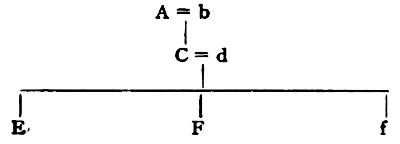
otherwise uses for his father. Thus, in the following
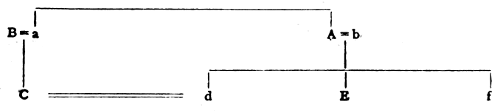
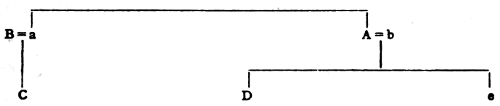
diagram, C will apply to D and e the terms
which are in general use for a son and daughter,
while D and e will apply to C the term they otherwise
use for their father.
In most forms of the classificatory system members
of different generations are denoted in wholly
different ways and belong to different classes,[11] but
here we have a case in which persons of the same
generation as the speaker are classed with those of
an older or a younger generation.
I will first ask you to consider to what kind of
psychological similarity such a practice can be due.
What kind of psychological similarity can there
be between one special kind of cousin and the
father, and between another special kind of cousin
and a son or daughter? If the puzzle as put in
this form does not seem capable of a satisfactory
answer, let us turn to see if the Banks Islanders
practise any social custom to which this peculiar
terminology can have been due. In the story of
Ganviviris told to Dr. Codrington in these islands[12]
an incident occurs in which a man hands over
one of his wives to his sister’s son, or, in other
words, in which a man marries one of the wives of
his mother’s brother. Inquiries showed, not only
that this form of marriage was once widely current
in the islands, but that it still persists though in
a modified form. The Christianity of the natives
does not now permit a man to have superfluous
wives whom he can pass on to his sister’s sons, but
it is still the orthodox, and indeed I was told the
popular, custom to marry the widow of the
mother’s brother. It seemed that in the old days
a man would take the widow of his mother’s
brother in addition to any wife or wives he might
already have. Though this is no longer allowed,
the leaning towards this form of marriage is so
strong that after fifty years of external influence a
young man still marries the widow of his mother’s
brother, sometimes in preference to a girl of his
own age. Indeed, there was reason to believe that
there was an obligation to do so, if the deceased
husband had a nephew who was not yet married.
The peculiar features of the terminology of relationship
in these islands are exactly such as would follow
from this form of marriage. If, in Diagram 2,
C marries b, the wife or widow of his mother’s
brother, and thereby comes to occupy the social
position of his uncle A, the children of the uncle,
D and e, will come to stand to him in the relation
of children, while he, who had previously been the
father’s sister’s son of D and e, will now become
their father. An exceptional form of the classificatory
system, in which there is a departure from
the usual rule limiting a term of relationship to
members of the same generation, is found to be
the natural consequence of a social regulation
which enjoins the marriage of persons belonging to
different generations.
The next step in the process of demonstrating
the social significance of the classificatory system of
relationship will take us to the island of Pentecost
in the northern New Hebrides. When I recorded
the system of this island, I found it to have so
bizarre and complex a character that I could hardly
believe at first it could be other than the result
of a ludicrous misunderstanding between myself
and my seemingly intelligent and trustworthy
informants. Nevertheless, the records obtained from
two independent witnesses, and based on separate
pedigrees, agreed so closely even in the details
which seemed most improbable that I felt confident
that the whole construction could not be so mad
as it seemed. This confidence was strengthened
by finding that some of its features were of the
same order of peculiarity as others which I had
already found in a set of Fijian systems I have yet
to consider. There were certain features which
brought relatives separated by two generations into
one category; the mother’s mother, for instance,
received the same designation as the elder sister;
the wife’s mother the same as the daughter; the
wife’s brother the same as the daughter’s son. The
only conclusion I was then able to formulate was
that these features were the result of some social
institution resembling the matrimonial classes of
Australia, which would have the effect of putting
persons of alternate generations into one social
category.
This idea was supported by the system of
relationship of the Dieri of Australia which
possesses at least one feature similar to those of
Pentecost, a fact I happened to remember at the
time because Mr. N. W. Thomas[13] had used it as
the basis of a reductio ad absurdum argument to
show that terms of relationship do not express
kinship. The interest of the Pentecost system
seemed at first to lie in the possibility thus opened
of bringing Melanesian into relation with Australian
sociology, a hope which was the more promising
in that the people of Pentecost and the Dieri
resemble one another in the general character of
their social organisation, each being organised on
the dual basis with matrilineal descent. When in
Pentecost, however, I was unable to get further
than this, and the details of the system remained
wholly inexplicable.
The meaning of some of the peculiarities of the
Pentecost system became clear when I reached the
Banks Islands; they were of the same kind as
those I have already considered as characteristic
of these islands. When I had discovered the
dependence of these features upon the marriage of
a man with the wife of his mother’s brother, it
became evident that not only these, but certain
other features of the Pentecost system, were
capable of being accounted for by this kind of
marriage. The peculiar features of the Pentecost
system could be divided into two groups, and all
the members of one group could be accounted for
by the marriage with the mother’s brother’s wife.
All these features had the character in common
that persons of the generation immediately above
or below that of the speaker were classed in nomenclature
with relatives of the same generation.
The other group consisted of terms in which
persons two generations apart were classed with
relatives of the same generation. Since the first
group of correspondences had been explained by
a marriage between persons one generation apart,
it should have been obvious that the classing
together of persons two generations apart might
have been the result of marriage between persons
two generations apart. The idea of a society in
which marriages between those having the status
of grandparents and grandchildren were habitual
must have seemed so unlikely that, if it entered
my mind at all, it must have been at once
dismissed. The clue only came later from a
man named John Pantutun, a native of the
Banks Islands, who had been a teacher in
Pentecost. In talking to me he often mentioned
in a most instructive manner resemblances and
differences between the customs of his own island
and those he had observed in Pentecost. One day
he let fall the observation with just such a manner
as that in which we so often accuse neighbouring
nations of ridiculous or disgusting practices, “O!
Raga![14] That is the place where they marry their
granddaughters.” I saw at once that he had given
me a possible explanation of the peculiar features
of the system of the island. By that time I had
forgotten the details of the Pentecost system, and
it occurred to me that it would be interesting, not
immediately to consult my note-books, but to
endeavour to construct a system of relationship
which would be the result of marriage with a
granddaughter, and then to see how far my
theoretical construction agreed with the terminology
I had recorded. The first question which
arose was with which kind of granddaughter the
marriage had been practised, with the son’s
daughter or with the daughter’s daughter, and this
was a question readily answered by means of a
consideration arising out of the nature of the social
organisation of Pentecost.
The society of this island is organised on the
dual basis with matrilineal descent in which a man
must marry a woman of the opposite moiety.
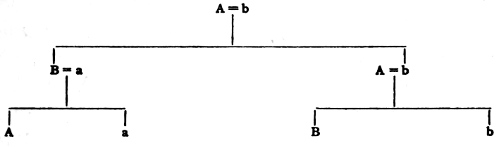
Diagram 3, in which A and a stand for men and
women of one moiety, and B and b for those of
the other moiety, shows that a marriage between
a man and his son’s daughter would be out of the
question, for it would be a case of A marrying a.
It was evident that the marriage, the consequences
of which I had to formulate, must have been one
in which a man married his daughter’s daughter.
It would take too long to go through the whole
set of relationships, and I choose only a few
examples which I illustrate by the following
diagram:
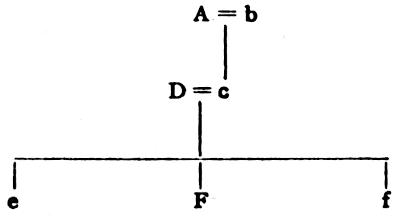
This diagram shows that if A marries e, c, who
previous to the marriage had been only the
daughter of A, now becomes also his wife’s
mother; and D, who had previously been his
daughter’s husband, now becomes his wife’s father.
Similarly, F, who before the new marriage was the
daughter’s son of A, now becomes the brother of his
wife, while f, his daughter’s daughter, becomes his
wife’s sister. Lastly, if we assume that it would
be the elder daughters of the daughter who would
be married by their grandfathers, e, who before
the marriage had been the elder sister of F and f,
now comes through her marriage to occupy the
position of their mother’s mother.
When, after making these deductions, I examined
my record of the Pentecost terms, I found
that its terminology corresponded exactly with
those which had been deduced. The wife’s mother
and the daughter were both called nitu. The
daughter’s husband and the wife’s father were
both bwaliga. The daughter’s children were
called mabi, and this term was also used for the
brother and sister of the wife. Lastly, the mother’s
mother was found to be classed with the elder
sister, both being called tuaga.
For the sake of simplicity of demonstration I
have assumed that a man marries his own daughter’s
daughter, but through the classificatory principle
all the features I have described would follow
equally well if a man married the granddaughter
of his brother, either in the narrow or the classificatory
sense. There was one correspondence,
according to which both the husband’s brother and
the mother’s father were called sibi, which does not
follow from the marriage with the own granddaughter,
but would be the natural result of
marriage with the daughter’s daughter of the
brother—i.e., with a marriage in which e was
married by A’s brother.
I hope these examples will be sufficient to show
how a number of features which might otherwise
seem so absurd as to suggest a system of relationship
gone mad become natural and intelligible,
even obvious, if it were once the established
practice of the people to marry the daughter’s
daughter of the brother.
Such inquiries as I was able to make confirmed
the conclusion that the Pentecost marriage was
with the granddaughter of the brother rather than
with the daughter of the daughter herself. After
I had been put on the track of the explanation by
John Pantutun I had the chance of talking to only
one native of Pentecost, unfortunately not a very
good informant. From his evidence it appeared
that the marriage I had inferred from the system
of relationship even now occurs in the island, but
only with the granddaughter of the brother, and
that marriage with the own granddaughter is
forbidden. The evidence is not as complete as I
should like, but it points to the actual existence in
the island of a peculiar form of marriage from
which the extraordinary features of its system of
relationship directly follow.
When I returned to England I found that this
marriage was not unique, but had been recorded
among the Dieri of Australia,[15] where, as I have
already mentioned, it is associated with peculiar
features of nomenclature resembling those of
Pentecost.
I must again ask, how are you going to explain
the features of the Pentecost system psychologically?
What psychological resemblance is there
between a grandmother and a sister, between
a mother-in-law and a daughter, between a
brother-in-law and a grandfather? Apart from
some special form of social relationship, there can
be no such resemblances. Further, if there were
such psychological resemblances, why should we
know of their influence on nomenclature only in
Pentecost and among the Dieri? The features to
be explained are definitely known to exist in only
two systems of the world, and it is only among the
peoples who use these two systems that we have
any evidence of that extraordinary form of marriage
of which they would be the natural consequence.
I have now tried to show the dependence of
special features of the classificatory system of
relationship upon special social conditions. If I
have succeeded in this I shall have gone far towards
the accomplishment of one of the main purposes of
these lectures. They have, however, another purpose,
viz., to inquire how far we are justified in
inferring the existence of a social institution of
which we have no direct evidence when we find
features of the nomenclature of relationship which
would result from such an institution. I have now
to enter upon this part of my subject, and I think
it will be instructive to take you at once to a
case in which I believe that an extraordinary form
of marriage can be established as a feature of the
past history of a people, although at the present
moment any direct evidence for the existence of
such a marriage is wholly lacking.
When I was in the interior of Viti Levu, one of
the Fijian islands, I discovered the existence of
certain systems of relationship which differed
fundamentally from the only Fijian systems previously
known. Any features referable to the
cross-cousin marriage were completely absent, but
in their place were others, one of which I have
already mentioned, which brought into one class
relatives two generations apart. The father’s
father received the same designation as the elder
brother, and the son’s wife was called by the same
term as the mother. As I have already said, my
first conclusion was that these terms were the
survivals of forms of social organisation resembling
the matrimonial classes of Australia, but as soon as
I had worked out the explanation of the Pentecost
system, it became evident that the Fijian peculiarities
would have to be explained on similar lines.
At first I thought it probable that the difference
between the Pentecost and Fijian systems was due
to the difference in the mode of descent in the
two places. For long I tried to work out schemes
whereby a change from the matrilineal descent of
Pentecost to the patrilineal condition of Fiji could
have had as one of its consequences a change from
a correspondence in nomenclature between the
mother’s mother and the elder sister to one in
which the common nomenclature applied to the
father’s father and the elder brother. It is an
interesting example of the strength of a preconceived
opinion, and of some measure of the belief
in the impossibility of customs not practised by
ourselves, that for more than two years I failed to
see an obvious alternative explanation, although I
returned to the subject again and again. The clue
came at last from the system of Buin, in the island
of Bougainville, recorded by Dr. Thurnwald.[16] The
nomenclature of this system agreed with that of
inland Fiji in having one term for the father’s
father and the elder brother, but since the people
of Buin still practice matrilineal descent, it was
evident that I had been on a false track in
supposing the correspondence to have been the
result of a change in the mode of descent. Once
turned into a fresh path by the necessity of showing
how the correspondence could have arisen out
of a matrilineal condition, it was not long before
I saw how it might be accounted for in a very
different way. I saw that the correspondence
would be the natural result of a form of social
organisation in which it was the practice to marry
a grandmother, viz., the wife of the father’s
father. Not only did this form of marriage explain
the second peculiar feature of the Fijian system,
viz., the classing of the son’s wife with the mother,
but it would also account for several features of the
Buin system which would otherwise be difficult to
understand.
If, as shown in Diagram 5, E marries b, the
wife or widow of his father’s father, he, who had
previously been the elder brother of F and f, now
comes to occupy the position of their father’s
father, while d, the mother of E, will now come to
stand to him in the relationship of son’s wife.
I need only mention here one of the features of
the Buin system which can be accounted for by
means of this marriage. The term mamai is used,
not only for the elder sister and for the elder
brother’s wife, but it is also applied to the
father’s mother; that is, the wife of the elder
brother is designated by the same term as the wife
of the father’s father, exactly as must happen if
E marries b, the wife of his father’s father. A
number of extraordinary features from two Melanesian
islands collected by two independent workers
fit into a coherent scheme if they have been the
result of a marriage in which a man gives one of
his wives to his son’s son during his life, or in
which this woman is taken to wife by her husband’s
grandson when she becomes a widow. If the
practice were ever sufficiently habitual to become
the basis of the system of relationship, we can be
confident that it is the former of these two
alternatives with which we have to do.
If you are still so under the domination of ideas
derived from your own social surroundings that you
cannot believe in such a marriage, I would remind
you that there is definite evidence from the Banks
Islands that men used to hand over wives to their
sisters’ sons. It is not taking us so much into the
unknown as it might appear to suppose that they
once also gave their wives to their sons’ sons.
I have taken this case somewhat out of its proper
place in my argument because the evidence is so
closely connected with that by means of which I
have shown the relation between features of
systems of relationship and peculiar forms of
marriage in Melanesia. I have now to return to
the more sober task of considering how far we are
justified in inferring the former existence of
marriage institutions when we find features of
systems of relationship of which they would have
been the natural consequence. It is evident that,
whenever we find such a feature as common
nomenclature for a grandmother and a sister or
for a cross-cousin and a parent, it should suggest
to us the possibility of such marriage regulations
as those of Pentecost and the Banks Islands.
But such common designations might have arisen
in some other way, and in order to establish the
existence of such forms of marriage in the past
history of the people, we must have criteria to
guide us when we are considering whether a given
feature of the terminology of relationship is or is
not a survival of a marriage institution.
I will return to the cross-cousin marriage for my
examples. The task before us is to inquire how
far such features of relationship as exist in Fiji,
Anaiteum or Guadalcanar, in conjunction with the
cross-cousin marriage, will justify us in inferring
the former existence of this form of marriage in
places where it is not now practised.
If there be found among any people all the
characteristic features of a coastal Fijian or of an
Anaiteum system, I think few will be found to
doubt the former existence of the cross-cousin
marriage. It would seem almost inconceivable that
there should ever have existed any other conditions,
whether social or psychological, which could have
produced this special combination of peculiar uses
of terms of relationship. It is when some only of
these features are present that there will arise any
serious doubt whether they are to be regarded as
survivals of the former existence of the cross-cousin
marriage.
One consideration I must point out at once.
Certain of the features which follow from the
cross-cousin marriage may be the result of another
marriage regulation. In some parts of the world
there exists a custom of exchanging brothers and
sisters, so that, when a man marries a woman, his
sister marries his wife’s brother. As the result of
this custom the mother’s brother and the father’s
sister’s husband will come to be one and the same
person, and the father’s sister will become also the
mother’s brother’s wife.
This form of marriage exists among the western
people of Torres Straits,[17] and is accompanied by
features of the system of relationship which would
follow from the practice. The mother’s brother is
classed with the father’s sister’s husband as wad-wam,
but there is an alternative term for the
father’s sister’s husband and there was no evidence
that the mother’s brother’s wife was classed with
the father’s sister. It seemed possible that the
classing together of the mother’s brother and the
father’s sister’s husband was not a constant feature
of the system of relationship, but only occurred in
cases where the custom of exchange had made it
necessary. The case, however, is sufficient to show
that two of the correspondences which follow
from the cross-cousin marriage may be the result
of another kind of marriage. If we accept the
social causation of such features and find these
correspondences alone, it would still remain an
open question whether they were the results of the
custom of exchange or of the marriage of cross-cousins.
The custom of exchange, however, is
wholly incapable of accounting for the use of a
common term for the mother’s brother and the
father-in-law, for the father’s sister and the mother-in-law,
or for cross-cousins and brothers- or sisters-in-law.
It is only when these correspondences
are present that there will be any decisive reason
for inferring the former existence of the cross-cousin
marriage.
The first conclusion, then, is that some of the
features found in association with the cross-cousin
marriage are of greater value than others in
enabling us to infer the former existence of the
cross-cousin marriage where it no longer exists.
Next, the probability that such features as I am
considering are due to the former presence of the
cross-cousin marriage will be greatly heightened if
this form of marriage should exist among people
with allied cultures. An instance from Melanesia
will bring out this point clearly.
In the island of Florida in the Solomons it is
clear that the cross-cousin marriage is not now the
custom, and I could discover no tradition of its
existence in the past. One feature, however, of
the system of relationship is just such as would
follow from the cross-cousin marriage. Both the
wife’s mother and the wife of the mother’s brother
are called vungo.
Florida is not only near Guadalcanar where the
cross-cousin marriage is practised, (the two islands
are within sight of one another), but their cultures
are very closely related. In such a case the probability
that the single feature of the Florida system
which follows from the cross-cousin marriage has
actually had that form of marriage as its antecedent
becomes very great, and this conclusion
becomes still more probable when we find that in a
third island, Ysabel, closely allied in culture both
to Florida and Guadalcanar, there is a clear
tradition of the former practice of the cross-cousin
marriage although it is now only an occasional
event.
Again, in one district of San Cristoval in the
Solomons the term fongo is used both for the
father-in-law and the father’s sister’s husband, and
kafongo similarly denotes both the mother-in-law
and the mother’s brother’s wife. This island differs
more widely from Guadalcanar in culture than
Florida or Ysabel, but the evidence for the former
existence of the marriage in these islands gives
us more confidence in ascribing the common
designations of San Cristoval to the cross-cousin
marriage than would have been the case if
these common designations had been the only
examples of such possible survivals in the Solomons.
Speaking in more general terms, one may say that
the probability that the common nomenclature for
two relatives is the survival of a form of marriage
becomes the greater, the more similar is the general
culture in which the supposed survival is found
to that of a people who practise this form of
marriage. The case will be greatly strengthened if
there should be intermediate links between the
supposed survival and the still living institution.
When we find a feature such as that of the
Florida system among a people none of whose allies
in culture practise the cross-cousin marriage, the
matter must be far more doubtful. In the
present state of our knowledge we are only justified
in making such a feature the basis of a working
hypothesis to stimulate research and encourage us
to look for other evidence in the neighbourhood of
the place where the feature has been found. Our
knowledge of the social institutions of the world is
not yet so complete that we can afford to neglect
any clue which may guide our steps.
I propose briefly to consider two regions, South
India and North America, to show how they differ
from this point of view.
The terms of relationship used in three[18] of the
chief languages spoken by the people of South
India are exactly such as would follow from the
cross-cousin marriage. In Tamil[19] the mother’s
brother, the father’s sister’s husband, and the
father of both husband and wife are all called mama,
and this term is also used for these relatives in
Telegu. In Canarese the mother’s brother and the
father-in-law are both called mava, but the father’s
sister’s husband fails to fall into line and is classed
with the father’s brother.
Similarly, the father’s sister, the mother’s
brother’s wife and the mother of both wife and
husband are called atta in Telegu and atte in
Canarese, Tamil here spoiling the harmony by
having one term, attai, for the father’s sister and
another, mami, for the mother’s brother’s wife
and the mother-in-law. Since, however, the Tamil
term for the father’s sister is only another form of
the Telegu and Canarese words for the combined
relationships, the exception only serves to
strengthen the agreement with the condition which
would follow from the cross-cousin marriage.
The South Indian terms for cross-cousin and
brother- and sister-in-law are complicated by the
presence of distinctions dependent on the sex and
relative age of those who use them, but these complications
do not disguise how definitely the
terminology would follow from the cross-cousin
marriage. Thus, to take only two examples: a
Tamil man applies the term maittuni to the
daughters of his mother’s brother and of his
father’s sister as well as to his brother’s wife and
his wife’s sister, and a Canarese woman uses one
term for the sons of her mother’s brother and of
her father’s sister, for her husband’s brother and
her sister’s husband.
So far as we know, the cross-cousin marriage is
not now practised by the vast majority of those
who use these terms of relationship. If the
terminology has been the result of the cross-cousin
marriage, it is only a survival of an ancient social
condition in which this form of marriage was
habitual. That it is such a survival, however,
becomes certain when we find the cross-cousin
marriage still persisting in many parts of South
India, and that among one such people at least,
the Todas,[20] this form of marriage is associated with
a system of relationship agreeing both in its
structure and linguistic character with that of the
Tamils. I have elsewhere[21] brought together the
evidence for the former prevalence of this form
of marriage in India, but even if there were no
evidence, the terminology of relationship is so
exactly such as would follow from the cross-cousin
marriage that we can be certain that this form of
marriage was once the habitual custom of the
people of South India.
While South India thus provides a good example
of a case in which we can confidently infer the
former existence of the cross-cousin marriage from
the terminology of relationship, the evidence from
North America is of a kind which gives to such an
inference only a certain degree of probability. In
this case it is necessary to suspend judgment and
await further evidence before coming to a positive
conclusion.
I will begin with a very doubtful feature which
comes from an Athapascan tribe, the Red Knives[22]
(probably that now called Yellow Knife). These
people use a common term, set-so, for the father’s
sister, the mother’s brother’s wife, the wife’s
mother and the husband’s mother, a usage which
would be the necessary result of the cross-cousin
marriage. Against this, however, is to be put the
fact that there are three different terms for the
corresponding male relatives, the two kinds of
father-in-law being called seth-a, the mother’s
brother ser-a, and the father’s sister’s husband sel-the-ne.
Further, the term set-so, the common use
of which for the aunt and mother-in-law seems to
indicate the cross-cousin marriage, is also applied
by a man to his brother’s wife and his wife’s sister,
features which cannot possibly be the result of this
form of marriage. These features show, either
that the terminology has arisen in some other way,
or that there has been some additional social
factor in operation which has greatly modified
a nomenclature derived from the cross-cousin
marriage.
A stronger case is presented by the terminology
of three branches of the Cree tribe, also recorded by
Morgan. In all three systems, one term, ne-sis or
nee-sis, is used for the mother’s brother, the father’s
sister’s husband, the wife’s father and the husband’s
father; while the term nis-si-goos applies to
the father’s sister, the mother’s brother’s wife and
the two kinds of mother-in-law. These usages are
exactly such as would follow from the cross-cousin
marriage. The terms for the sister’s son of a man
and the brother’s son of a woman, however, differ
from those used for the son-in-law, and there is also
no correspondence between the terms for cross-cousin
and any kind of brother- or sister-in-law.
The case points more definitely to the cross-cousin
marriage than in the case of the Red Knives, but
yet lacks the completeness which would allow us
to make the inference with confidence.
The Assiniboin have a common term, me-toh-we,
used for the father’s sister, the mother’s
brother’s wife and the two kinds of mother-in-law,
and also a common term, me-nake-she, for the
mother’s brother and the father’s sister’s husband,
but the latter differs from the word, me-to-ga-she,
used for the father of husband or wife. The case
here is decidedly stronger than among the Red
Knives, but is less complete than among the
Crees.
Among a number of branches of the Dakotas the
evidence is of a different kind, being derived from
similar nomenclature for the cross-cousin and
certain kinds of brother- and sister-in-law. Morgan[23]
has recorded eight systems, all of which show the
features in question, but I will consider here only
that of the Isauntie or Santee Dakotas, which was
collected for him by the Rev. S. R. Riggs. Riggs[24]
and Dorsey[25] have given independent accounts of
this system which are far less complete than
that given by Morgan, but agree with it in all
essentials.
In this system a man calls the son of his mother’s
brother or of his father’s sister ta-hang-she or
tang-hang-she, while his wife’s brother and his
sister’s husband are ta-hang or tang-hang.
Similarly, a woman calls her cross-cousin she-chay-she,
while her husband’s brother and her sister’s
husband are called she-chay. The terms for
brothers-in-law are thus the same as those for cross-cousins
with the omission of the suffix she. One
of these resemblances, that when a woman is speaking,
has been cited by Professor Kroeber[26] as an
example of the psychological causation of such
features of relationship as I am considering in these
lectures. He rejects its dependence on the cross-cousin
marriage and refers the resemblance to the
psychological similarity between a woman’s cousin
and her brother-in-law in that both are collateral
relatives alike in sex, of the same generation as the
speaker, but different from her in sex.
As we have seen, however, the Dakota correspondence
is not an isolated occurrence, but fits in
with a number of other features of the systems of
cognate peoples to form a body of evidence pointing
to the former prevalence of the cross-cousin
marriage.
There is also indirect evidence leading in the
same direction. In Melanesia there is reason to
believe that the cross-cousin marriage stands in a
definite relation to another form of marriage, that
with the wife of the mother’s brother. If there
should be evidence for the former existence of
this marriage in North America, it would increase
the probability in favour of the cross-cousin
marriage.
Among a number of peoples, some of whom
form part of the Sioux, including the Minnitarees,
Crows, Choctas, Creeks, Cherokees and Pawnees,
cross-cousins are classed with parents and children
exactly as in the Banks Islands, and exactly as in
those islands, it is the son of the father’s sister who
is classed with the father, and the children of the
mother’s brother who are classed with sons or
daughters. Further, among the Pawnees the wife
of the mother’s brother is classed with the wife,
a feature also associated with the peculiar nomenclature
for cross-cousins in the Banks Islands. The
agreement is so close as to make it highly probable
that the American features of relationship have
been derived from a social institution of the same
kind as that to which the Melanesian features are
due, and that it was once the custom of these
American peoples to marry the wife of the
mother’s brother. Here, as in the case of the cross-cousin
marriage itself, the case rests entirely upon
the terminology of relationship, but we cannot
ignore the association in neighbouring parts of
North America of features of relationship which
would be the natural consequence of two forms of
marriage which are known to be associated together
elsewhere.
I am indebted to Miss Freire-Marreco for the
information that the Tewa of Hano, a Pueblo
tribe, call the father’s sister’s son tada, a term
otherwise used for the father, thus suggesting that
they also may once have practised marriage with
the wife of the mother’s brother. The use of this
term, however, is only one example of a practice
whereby all the males of the father’s clan are called
tada, irrespective of age and generation. The
common nomenclature for the father and the
father’s sister’s son among the Tewa thus differs
in character from the apparently similar nomenclature
of the Banks Islands and cannot have been
determined directly, perhaps not even remotely,
by marriage with the wife of the mother’s brother.
This raises the question whether the nomenclature
of the Sioux has not arisen out of a practice similar
to that of the Tewa. The terms for other relatives
recorded by Morgan show some evidence of the
widely generalised use of the Tewa, but such a
use cannot account for the classing of the wife of
the mother’s brother with the wife which occurs
among the Pawnees. Nevertheless, the Tewa
practice should keep us alive to the possibility that
the Sioux nomenclature may depend on some social
condition different from that which has been
effective in the Banks Islands in spite of the close
resemblance between the two.
The case for the former existence of the cross-cousin
marriage will be much strengthened if this
form of marriage should occur elsewhere in North
America. So far as I am aware, the only people
among whom it has been recorded are the Haidahs
of Queen Charlotte Island.[27] It is a far cry from
this outpost of North American culture to Dakota,
but it may be noted that it is among the Crees
who formerly lived in the intermediate region of
Manitoba and Assiniboia that the traces of the
cross-cousin marriage are most definite. This mode
of distribution of the peoples whose terminology
of relationship bears evidence of the cross-cousin
marriage suggests that other intermediate links
may yet be found. Though the existing evidence
is inconclusive, it should be sufficient to stimulate
a search for other evidence which may make it
possible to decide whether or no the cross-cousin
marriage was once a widespread practice in North
America.
I can only consider one other kind of marriage
here. The discovery of so remarkable a union as
that with the daughter’s daughter in Pentecost
and the evidence pointing to a still more remarkable
marriage between those having the status of
grandparent and grandchild in Fiji and Buin have
naturally led me to look for similar evidence
elsewhere in Melanesia. Though there is nothing
conclusive, conditions are to be found here and
there which suggest the former existence of such
marriages.
When I was in the Solomons I met a native of
the Trobriand Islands, who told me that among
his people the term tabu was applied both to grandparents
and to the father’s sister’s child. I went
into the whole subject as fully as was possible with
only one witness, but in spite of his obvious intelligence
and good faith, I remained doubtful whether
the information was correct. The feature in question,
however, occurs in the list of Trobriand terms
drawn up for Dr. Seligmann[28] by Mr. Bellamy, and
with this double warrant it must be accepted. It
is a feature which would follow from marriage
with the daughter’s daughter, for by this marriage
one who was previously a father’s sister’s daughter
becomes the wife of a grandfather and thereby
attains the status of a grandparent. The feature
exists alone, and, further, it is combined with
other applications of the term which deprive it of
some of its significance; nevertheless, the fact that
a peculiar and exceptional feature of a Melanesian
system of relationship is such as would follow
naturally from a form of marriage which is practised
in another part of Melanesia cannot be passed
over. Standing alone, it would be wholly insufficient
to justify the conclusion that the marriage
with the daughter’s daughter was ever prevalent
among the Massim, but in place of expressing a
dogmatic denial, let us look for other features of
Massim sociology which may have been the results
of such a marriage.
In Wagawaga[29] there is a peculiar term, warihi,
which is used by men for other men of their own
generation and social group, but the term is also
applied by an old man or woman to one of a
younger generation. Again, in Tubetube[30] the term
for a husband, taubara, is also a term for an old
man, and the term for the wife is also applied to
an old woman. These usages may be nothing more
than indications of respect for a husband or wife, or
of some mechanism which brought those differing
widely in age into one social category, but with the
clue provided by the Trobriand term of relationship
it becomes possible, though even now only possible,
that the Wagawaga and Tubetube customs may
have arisen out of a social condition in which it was
customary to have great disparity of age between
husbands and wives, and social relations between
old and young following from such disparity in the
age of consorts.
In Tubetube there is yet another piece of
evidence. Mr. Field[31] has recorded the existence
in this island of three named categories of persons,
two of which comprise relatives with whom
marriage is prohibited, while the third groups
together those with whom marriage is allowed.
The grandparents and grandchildren are included
in one of the two prohibited classes, so that we can
be confident that marriage between these relatives
does not now occur. The point to which I call
your attention is that the class of relative with
whom marriage is allowed is called kasoriegogoli.
Li is the third person pronominal suffix, and we do
not know the meaning of kasorie, but goga is the
term used in Wagawaga and Wedau for the grandparents,
its place being taken by the usual Melanesian
term tubu in Tubetube. The term kasoriegogoli
applied to marriageable relatives thus contains
as one of its constituent elements a word
which is probably the ancient term for grandparent
in the island, since it is still used in this sense in
the closely allied societies of the mainland.
We have thus a number of independent facts
among the Massim, all of which would be the natural
outcome of marriage between persons of alternate
generations. To no one of them standing alone
could much importance be attached, but taken in
conjunction, they ought at least to suggest the
possibility of such a marriage, a possibility which
becomes the more probable when we consider that
the Massim show clear evidence of the dual
organisation of society with matrilineal descent
which is associated with the granddaughter marriage
of Pentecost and the Dieri of Australia.
It adds to the weight of the evidence that indications
of this peculiar form of marriage should be
found among a people whose social organisation so
closely resembles that in which the marriages
between persons of alternate generations elsewhere
occur.
I have no time for other examples. I hope to
have shown that there are cases in which it is
possible to infer with certainty the ancient existence
of forms of marriage from the survival of
their results in the terminology of relationship. In
other cases, differences of culture or the absence of
intermediate links make it unjustifiable to infer the
ancient existence of the forms of marriage from
which features of terminology might be derived.
Other cases lie between the two, the confidence
with which a form of marriage can be inferred
varying with the degree of likeness of culture,
the distance in space, and the presence or absence
of other features of culture which may be related
to the form of marriage in question. Even in
the cases, however, where the inference is most
doubtful, we have no right dogmatically to deny
the origin of the terminology of relationship in
social conditions, but should keep each example
before an open mind, to guide and stimulate
inquiry in a region where ethnologists have till now
only scratched the surface covering a rich mine of
knowledge.