An iron coast, bleak, black, and desolate,
without harborage for so much as a catboat
for leagues to north or south. A coast so
pitiless, so lashed forever by the long, sullen
rollers of the North Atlantic, so tormented by
the shifting and treacherous currents of the tide
between its chains of outlying rocky islets, that
no ship ever ventured willingly within miles of
its uncompromising menace. A coast so little
favored by summer that even in glowing August
the sun could reach it seldom through its
cold and drenching fogs.
Perhaps half a mile off shore lay the islands—some
of them, indeed, mere ledges, deathtraps
for ships, invisible except at low tide, but
others naked hills of upthrust rock, which the
highest tides and wildest hurricanes could not
overwhelm. Even on the loftiest of them there
was neither grass, bush, nor tree to break the
jagged outlines, but day and night, summer and
194
winter long, the sea-birds clamored over them,
and brooded by the myriad on their upper
ledges.
These islands were fretted, on both their
landward and their seaward sides, by innumerable
caves. In one of these caves, above the
reach of the highest tide, and facing landward,
so that even in the wildest storms no waves
could invade it, the pup of the seal first opened
his mild eyes upon the misty northern daylight.
Of all the younglings of the wild, he was perhaps
the most winsome, with his soft, whitish,
shadowy-toned, close, woolly coat, his round,
babyish head, his dark, gentle eyes wide with
wonder at everything to be seen from the cave
mouth. He lay usually very near the entrance,
but partly hidden from view by a ragged horn
of rock. While alone—which was a good
part of the time, indeed, like most fishermen’s
children—he would lie so still that his woolly
little form was hardly to be distinguished from
the rock that formed his couch. He had no
desire to attract public attention—for the only
public that might have been attracted to attend
consisted of the pair of great sea eagles whose
shadows sometimes swooped aross the ledge,
or of an occasional southward-wandering white
bear. As for the innumerable gulls, and gannets,
195
and terns, and lesser auks, which made
the air forever loud about these lonely islets,
nothing could have induced them to pay him
any attention whatever. They knew him, and
his people, to be harmless; and that was all
their winged and garrulous companies were
concerned to know.
But to the little seal, on the other hand, the
noisy birds were incessantly interesting. Filled
with insatiable curiosity, his mild eyes gazed
out upon the world. The sea just below the
cave was, of course, below his line of vision;
but at a distance of some hundred yards or so—a
distance which varied hugely with the
rising and falling of the tide—he caught sight
of the waves, and felt himself strangely drawn
to them. Whether leaden and menacing under
the drift of rain and the brooding of gray
clouds, or green-glinting under the sheen of
too rare sunshine, he loved them and found
them always absorbing. The sky, too, was
worth watching, especially when white fleeces
chased each other across a patch of blue, or
wonderful colors, pallid yet intense, shot up
into it at dawn from behind a far-off line of
saw-toothed rocks.
The absences of the mother seal were sometimes
long, for it required many fish to satisfy
196
her appetite and keep warm her red blood in
those ice-cold arctic currents. Fish were abundant,
to be sure, along that coast, where the
invisible fruitfulness of the sea made compensation
for the blank barrenness of the land; but
they were swift and wary, and had to be caught,
one at a time, outwitted and outspeeded in their
own element. The woolly cub, therefore, was
often hungry before his mother returned. But
when, at last, she came, flopping awkwardly up
the rocky slope, and pausing for an instant to
reconnoitre, as her round, glistening head appeared
over the brink of the ledge, the youngster’s
delight was not all in the satisfying of his
hunger and in the mothering of his loneliness.
As he snuggled under her caress, the salty drip
from her wet, sleek sides thrilled him with a
dim sense of anticipation. He connected it
vaguely with that endless, alluring dance of the
waves beyond his threshold.
When he had grown a few days older, the
little seal began to turn his attention from the
brighter world outside to the shadows that
surrounded him in his cave. His interest was
caught at once by a woolly gray creature like
himself, only somewhat smaller, which lay perhaps
seven or eight feet away, at the other side
of the cave, and farther back. He had not
197
realized before that his narrow retreat was the
home of two families. Being of a companionable
disposition, he eyed his newly discovered
neighbor with immense good-will. Finding no
discouragement in the mild gaze that answered
his, he presently raised himself on his flippers,
and with laborious, ungainly effort flopped himself
over to make acquaintance. Both youngsters
were too unsophisticated for ceremony, too
trusting for shyness, so in a very few minutes
they were sprawling over each other in great
content.
In this baby comradeship the stranger’s
mother, returning to her household duties,
found them. She was smaller and younger
than our Pup’s dam, but with the same kindly
eyes and the same salty-dripping coat. So,
when her own baby fell to nursing, the Pup
insisted confidently on sharing the entertainment.
The young mother protested, and drew
herself away uneasily, with little threatening
grunts; but the Pup, refusing to believe she was
in earnest, pressed his point so pertinaciously
that at length he got his way. When, half an
hour later, the other mother returned to her
charge, well filled with fish and well disposed
toward all the world, she showed no discontent
at the situation. She belonged to the tribe of
198
the “Harbor Seals,” and, unlike her pugnacious
cousins, the big “Hoods,” she was always
inclined towards peace and a good understanding.
There was probably nothing that could
have brought the flame of wrath into her confiding
eyes, except an attack upon her young,
on whose behalf she would have faced the sea-serpent
himself. Without a moment’s question,
she joined the group; and henceforth the cave
was the seat of a convenient partnership in
mothers.
It was perhaps a week or two later, when the
islands were visited by a wonderful spell of sun
and calm. It was what would have been called,
farther south, Indian summer. All along the
ledges, just above the mark of the diminished
surf, the seals lay basking in the glow. The
gulls and mews clamored rapturously, and
squabbled with gay zest over the choicer prizes
of their fishing. It appeared to be generally
known that the bears, displeased at the warmth,
had withdrawn farther north. The sea took
on strange hues of opal and lilac and thrice-diluted
sapphire. Even the high black cliffs
across the charmed water veiled their harshness
in a skyey haze. It was a time for delicious indolence,
for the slackening of vigilance, for the
forgetfulness of peril. And it was just at this
199
very time that it came the young seal’s way to
get his first lesson in fear.
He was lying beside his mother, about a
dozen feet out from the mouth of the cave. A
few steps away basked his little cave-mate—alone
for the moment, because its mother had
flung herself vehemently down the slope to capture
a wounded fish which had just been washed
ashore. As she reached the water’s edge, a
wide shadow floated across the rocks. She
wheeled like a flash and scrambled frantically
up the steep. But she was too late. She saw
the other mothers near by throw their bodies
over those of their young, and lift their faces skyward
with bared, defiant fangs. She saw her
own little one, alone in the bright open, gaze
around in helpless bewilderment and alarm. He
saw her coming, and lifting himself on his weak
flippers, started towards her with a little cry.
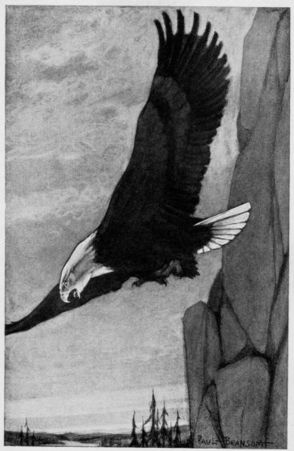
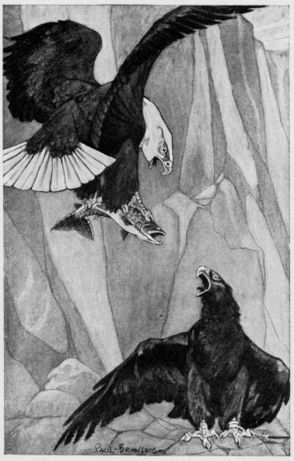
Then came a terrible hissing of wings in the
air above, and he cowered, trembling. The
next instant, with a huge buffet of wind in all
the upturned faces, a pair of vast, dark pinions
were outspread above the trembler; great
clutching talons reached down and seized him
by neck and back; and his tiny life went out
in a throttled whimper. The nearest seal, the
mother of the Pup, reared on her flippers and
200
lunged savagely at the marauder. But all she got
was a blinding slash of rigid wing-tips across her
face. Then, launching himself from the brink
of the slope, the eagle flapped scornfully away
across the water toward the black cliffs, his victim
hanging limply from his claws. And all along
the ledges the seals barked furiously after him.
The Pup, whom death had brushed so closely,
could not be persuaded for hours to leave the
shelter of his mother’s side, even after she had
led him back to the cave. But now he found
himself the exclusive proprietor of two mothers;
for the bereaved dam, thenceforth, was no less
assiduously devoted to him than his own parent.
With such care, and with so abundant
nourishment, he throve amazingly, outstripping
in growth all the other youngsters of his age
along the ledges. His terror quickly passed
away from him; but the results of the lesson
long remained, in the vigilance with which his
glance would sweep the sky, and question every
approach of wings more wide than those of
gull or gannet.
It was not long after this grim chance that
the Pup’s woolly coat began to change. A
straight, close-lying under-fur pushed swiftly
into view, and the wool dropped out—a process
which a certain sense of irritation in his
201
skin led him to hasten by rubbing his back
and sides against the rock. In an astonishingly
short time his coat grew like his mother’s—a
yellowish gray, dotted irregularly with blackish
spots, and running to a creamy tone under the
belly. As soon as this change was completed
to his mother’s satisfaction, he was led down
close to the water’s edge, where he had never
been allowed before.
Eagerly as he loved the sight of the waves,
and the salty savor of them, when the first thin
crest splashed up and soused him he shrank
back daunted. It was colder, too, that first slap
in his face, than he had expected. He turned,
intending to retreat a little way up the rocks
and consider the question, in spite of the fact
that there was his little mother in the water,
swimming gayly a few feet out from shore and
coaxing him with soft cries. He was anxious to
join her—but not just yet. Then, all at once
the question was decided for him. His real
mother, who was just behind him, suddenly
thrust her muzzle under his flank, and sent him
rolling into deep water.
He came up at once, much startled. Straightway
he found that he could move in the water
much more easily and naturally than on shore—and
he applied the discovery to getting ashore
202
again with all possible haste. But his mother,
awaiting him at the edge, shoved him off relentlessly.
Feeling much injured, he turned and swam
out to his other mother. Here the first one
joined him; and in a few minutes amazement
and resentment alike were lost in delight, as
he began to realize that this, at last, was life.
Here, and not sprawling half helplessly on the
rocks, was where he belonged. He swam, and
dived, and darted like a fish, and went wild
with childish ecstasy. He had come to his own
element. After this, he hardly ever returned
to the cave, but slept close at the side of
one or the other of his mothers, on the open
rocks just a few feet above the edge of tide.
A little later came a period of mad weather,
ushering in the autumn storms. Snow and
sleet drove down out of the north, and lay in
great patches over the more level portions of
the islets above tide. The wind seemed as if
it would lift the islets bodily and sweep them
away. The vast seas, green and black and
lead-color, thundered down upon the rocks as
if they would batter them to fragments. The
ledges shuddered under the incessant crashing.
When the snow stopped, on its heels came the
vanguard of the arctic cold. The ice formed
203
instantly in all the pools left by the tide. Along
the edges of the tide it was ground to a bitter
slush by the perpetual churning of the waves.
After a week or two of this violence, the
seals—who, unlike their polar cousins, the
“Harps” and the “Hoods,” were no great lovers
of storm and the fiercer cold—began to feel
discontented. Presently a little party of them,
not more than a score in all, with a few of the
stronger youngsters of that season, on a sudden
impulse left their stormy ledges and started
southward. The Pup, who, thanks to his double
mothering, was far bigger and more capable
than any of his mates, went with his partner-mothers
in the very forefront of the migration.
Straight down along the roaring coast they
kept, usually at a distance of not more than
half a mile from shore. They had, of course,
no objection to going farther out, but neither
had they any object in doing so, since the fish-life
on which they fed as they journeyed was
the more abundant where the sea began to
shoal. With their slim, sleek, rounded bodies,
thickest at the fore flippers and tapering finely
to tail and muzzle, each a lithe and close-knit
structure of muscle and nerve-energy, they could
swim with astounding speed; and therefore, although
there was no hurry whatever, they went
along at the pace of a motor-boat.
204
All this time the gale was lashing the coast,
but it gave them little concern. Down in the
black troughs of the gigantic rollers there was
always peace from the yelling of the wind—a
tranquillity wherein the gulls and mews would
snatch their rest after being buffeted too long
about the sky. Near the tops of the waves, of
course, it was not good to be, for the gale would
rip the crests off bodily and tear them into
shreds of whipping spray. But the seals could
always dive and slip smoothly under these tormented
regions. Moreover, if weary of the
tossing surfaces and the tumult of the gale,
they had only to sink themselves down, down,
into the untroubled gloom beneath the wave-bases,
where greenish lights gleamed or faded
with the passing of the rollers overhead, and
where strange, phosphorescent shapes of life
crawled or clung among the silent rocks.
Longer than any other red-blooded animal,
except the whale, could their lungs go without
fresh oxygen; so, though they knew nothing of
those great depths where the whales sometimes
frequent, it was easy for them to go deep
enough to get below the storm.
Sometimes a break in the coast-line, revealing
the mouth of an inlet, would tempt the little
band of migrants. Hastening shoreward, they
205
would push their way inland between the
narrowing banks, often as far as the head of
tide, gambolling in the quiet water, and chasing
the salmon fairly out upon the shoals. Like
most discriminating creatures, they were very
fond of salmon, but it was rarely, except on such
occasions as this, that they had a chance to
gratify their taste.
After perhaps a week of this southward
journeying, the travellers found themselves one
night at the head of a little creek where the tide
lapped pleasantly on a smooth, sandy beach.
They were already getting into milder weather,
and here, a half mile inland, there was no wind.
The sky was overcast, and the seals lay in contented
security along the edge of the water.
The blacker darkness of a fir forest came down
to within perhaps fifty paces of their resting-place.
But they had no anxieties. The only
creatures that they had learned to fear on shore
besides man were the polar bears; and they
knew they were now well south of that deadly
hunter’s range. As for eagles, they did not
hunt at night; and, moreover, they were a terror
only in the woolly-coated, baby stage of a
seal’s existence.
But it often enough happens that wild animals,
no less than human beings, may be ignorant
206
of something which their health requires
them to know. There was another bear in
Labrador—a smallish, rusty-coated, broad-headed,
crafty cousin of the ordinary American
black bear. And one of these, who had acquired
a taste for seal, along with some cleverness
in gratifying that taste, had his headquarters,
as it chanced, in that near-neighboring
fir wood.
The Pup lay crowded in snugly between his
two mothers. He liked the warmth of being
crowded; for the light breeze, drawing up from
the water, was sharp with frost. There is such
a thing, however, as being just a little too
crowded, and presently, waking up with a protest,
he pushed and wriggled to get more space.
As he did so, he raised his head. His keen
young eyes fell upon a black something a little
blacker than the surrounding gloom.
The black something was up the slope halfway
between the water and the wood. It
looked like a mass of rock. But the Pup had
a vague feeling that there had been no rock
thereabouts when he went to sleep. A thrill of
apprehension went up and down his spine,
raising the stiffish hairs along his neck. Staring
with all his eyes through the dimness, he presently
saw the black shape move. Yes, it was
207
drawing nearer. With a shrill little bark of
terror he gave the alarm, at the same time
struggling free and hurling himself toward the
water.
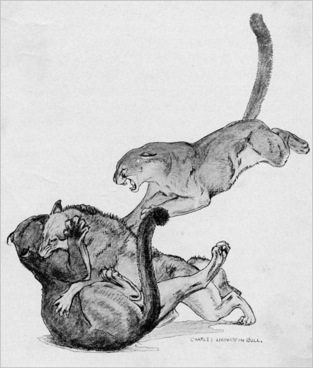
In that same instant the bear rushed, coming
down the slope as it were in one plunging
jump. The seals, light sleepers all, were already
awake and floundering madly back to the water.
But for one of them, and that one the Pup’s
assistant mother, the alarm came too late.
Just as she was turning, bewildered with terror
of she knew not what, the dark bulk of the bear
landed upon her, crushing her down. A terrific
blow on the muzzle broke her skull, and she
collapsed into a quivering mass. The rest of
the band, after a moment of loud splashing,
swam off noiselessly for the safe retreat of the
outer ledges. And the bear, after shaking the
body of his victim to make sure it was quite
dead, dragged it away with a grunt of satisfaction
into the fir wood.
After this tragedy, though the travellers continued
to ascend the creeks and inlets when the
whim so moved them, they took care to choose
for sleep the ruder security of outlying rocks
and islands, and cherished, by night and by
day, a wholesome distrust of dark fir woods.
But for all their watchfulness their journeying
208
was care-free and joyous, and from time to time,
as they went, their light-heartedness would
break out into aimless gambols, or something
very like a children’s game of tag. Nothing,
however, checked their progress southward,
and presently, turning into the Belle Isle Straits,
they came to summer skies and softer weather.
At this point, under the guidance of an old
male who had followed the southward track
before, they forsook the Labrador shore-line
and headed fearlessly out across the strait till
they reached the coast of Newfoundland. This
coast they followed westward till they gained
the Gulf of St. Lawrence, then, turning south,
worked their way down the southwest coast
of the great Island Province, past shores still
basking in the amethystine light of Indian
summer, through seas so teeming with fish that
they began to grow lazy with fatness. Here
the Pup and other younger members of the
company felt inclined to stay. But their elders
knew that winter, with the long cold, and the
scanty sun, and the perilous grinding of tortured
ice-floes around the shore-rocks, would
soon be upon them; so the journey was continued.
On they pressed, across the wide gateway
of the Gulf, from Cape Ray to North Cape,
the eastern point of Nova Scotia. Good
209
weather still waited upon their wayfaring, and
they loitered onward gayly, till, arriving at the
myriad-islanded bay of the Tuskets, near the
westernmost tip of the peninsula, they could
not, for sheer satisfaction, go farther. Here
was safe seclusion, with countless inaccessible
retreats. Here was food in exhaustless plenty;
and here was weather benignant enough for
any reasonable needs.
It was just here, off the Tuskets, that the
Pup got another lesson. Hitherto his ideas
of danger had been altogether associated with
the land where eagles swooped out of a clear
sky and bears skulked in the darkness, and
where, moreover, he himself was incapable of
swift escape. But now he found that the sea,
too, held its menace for the gentle kindred of
the seals. It was a still, autumnal morning, blue
and clear, with a sunny sparkle on sea and air.
The seals were most of them basking luxuriously
on the seaward ledges of one of the outermost
islands, while half a dozen of the more
energetic were amusing themselves with their
game of tag in the deep water. Pausing for a
moment to take breath, after a sharp wrestling-match
far down among the seaweeds, the Pup’s
observant eyes caught sight of a small, black
triangular object cutting swiftly the smooth surface
210
of the swells. He stared at it curiously.
It was coming towards him, but it did not, to
his uninitiated eyes, look dangerous. Then he
became conscious of a scurrying of alarm all
about him; and cries of sharp warning reached
him from the sentinels on the ledge. Like a
flash he dived, at an acute angle to the line of
approach of the mysterious black object. Even
in the instant, it was close upon him, and he
caught sight of a long, terrible, gray shape,
thrice as long as a seal, which turned on one
side in its rush, showing a whitish belly, and a
gaping, saw-toothed mouth big enough to take
him in at one gulp. Only by a hair’s-breadth
did he avoid that awful rush, carrying with him
as he passed the sound of the snapping jaws
and the cold gleam of the shark’s small, malignant
eye.
Hideously frightened, he doubled this way
and that, with a nimbleness that his huge pursuer
could not hope to match. It took the shark
but a few seconds to realize that this was a
vain chase. An easier quarry caught his eye.
He darted straight shoreward, where the deep
water ran in abruptly to the very lip of the
ledge. The Pup came to the surface to watch.
One of the younger seals, losing its wits utterly
with fright, and forgetting that its safety lay in
211
the deep water where it could twist and dodge,
was struggling frantically to clamber out upon
the rocks. It had almost succeeded, indeed.
It was just drawing up its narrow, tail-like hind
flippers, when the great, rounded snout of the
shark shot into the air above it. The monstrous
shape descended upon it, and fell back
with it into the water, leaving only a splash and
trickle of blood upon the lip of the ledge. The
other seals tossed their heads wildly, jumped
about on their fore-flippers, and barked in lively
dismay; and in a few moments, as if the matter
had been put to vote and carried unanimously,
they betook themselves in haste to one of the
inner islands, where they knew that the shark,
who hates shoal water, would not venture to
follow them.
In this sheltered archipelago the little herd
might well have passed the winter. But after a
few weeks of content the southing spirit again
seized upon the old male who had hitherto been
the unquestioned leader. At this point, however,
his authority went to pieces. When he
resumed the southward wandering, less than
half the herd accompanied him. But among
those faithful were the Pup and his mild-eyed
mother.
Rounding the extremity of Nova Scotia, the
212
travellers crossed the wide mouth of the Bay of
Fundy, and lingered a few days about the lofty
headlands of Grand Manan. By this time they
had grown so accustomed to ships of all kinds,
from the white-sailed fishing-smack to the long,
black, churning bulk of the ocean liner, that
they no longer heeded them any more than
enough to give them a wide berth. One and
all, these strange apparitions appeared quite indifferent
to seals, so very soon the seals became
almost indifferent to them. Off the island of
Campobello, however, something mysterious
occurred which put an end to this indifference,
although none of the band could comprehend
it.
A beautiful, swift, white craft, with yellow
gleams flashing here and there from her deck
as the sun caught her polished brasswork, was
cleaving the light waves northward. The seals,
their round, dark heads bobbing above the
water at a distance of perhaps three hundred
yards from her port-quarter, gazed at the spectacle
with childlike interest. They saw a group
of men eying them from the deck of the swift
monster. All at once from this group spurted
two thin jets of flame. The Pup heard some
tiny vicious thing go close over his head with
a cruel whine, and zip sharply through a wave-crest
213
just beyond. On the instant, even before
the sharp clatter of the two reports came to
their ears, all the seals dived, and swam desperately
to get as far away as possible from the
terrifying bright monster. When they came
to the surface again, they were far out of range.
But the restless old male, their leader, was not
among them. The white yacht was steaming
away into the distance, with its so-called sportsmen
congratulating themselves that they had
almost certainly killed something. The little
band of seals waited about the spot for an hour
or two, expecting the return of their chief; and
then, puzzled and apprehensive, swam away
toward the green-crested shore-line of Maine.
Here, lacking a leader, their migration came
to an end. There seemed no reason to go
farther, since here was everything they wanted.
The Pup, by this time an expert pursuer of all
but the swiftest fish, was less careful now to
keep always within his mother’s reach, though
the affection between the two was still ardent.
One day, while he was swimming some little
distance apart from the herd, he noticed a
black-hulled boat rocking idly on the swells
near by. It was too near for his comfort, so he
dived at once, intending to seek a safer neighborhood.
But as luck would have it, he had
214
hardly plunged below the surface when he encountered
an enormous school of young herring.
What throngs of them there were!
And how crowded together! Never had he
seen anything like it. They were darting this
way and that in terrific excitement. He himself
went wild at once, dashing hither and
thither among them with snapping jaws, destroying
many more than he could eat. And
still they seemed to throng about him ever the
more closely. At last he got tired of it, and
dashed straight ahead to clear the shoal. The
next moment, to his immeasurable astonishment,
he was checked and flung back by a fine,
invisible barrier. No, it was not quite invisible.
He could see a network of meshes before him.
Puzzled and alarmed, he shot up to the surface
to reconnoitre.
As his head rose above the water, his heart
fairly stopped for a second with dismay. The
black side of the fishing boat was just above
him, and the terrifying eyes of men looked
straight down into his. Instantly he dived
again, through the ever thickening masses of
the herring. But straightway again he met the
fine, invincible barrier of the net. Frantically
he struggled to break through it, but only succeeded
in coiling it about him till he could not
215
move a flipper. And while he wriggled there
impotently, under the squirming myriads of the
fish, he was lifted out into the air and dragged
into the boat.
Seeing the damage he had wrought in their
catch, the fishermen were for knocking their
captive straightway on the nose. But as he
lay there, looking up with innocent eyes of
wonder and appeal through the meshes, something
in his baby helplessness softened the
captain’s heart.
“Hold hard, Jim,” he ordered, staying a big
sailor’s hand. “Blamed if the little varmint
ain’t got eyes most as soft as my Libby’s. I
reckon he’ll make a right purty pet fer the kid,
an’ kind of keep her from frettin’ after her
canary what died last Sunday.”
“He don’t much resemble a canary,
Ephraim,” laughed Jim, dropping the belaying-pin.
“I reckon he’ll fill the bill fine, all the same,”
said the captain.
So the Pup was carried prisoner to Eastport.
As it happened, Miss Libby was a child of
decided views. One of the most decided of her
views proved to be that a seal pup, with very
little voice and that little by no means melodious,
was no substitute for a canary. She refused
to look at the Pup at all, until her father,
much disappointed, assured her that she should
have a canary also without further delay. And
even then, though she could not remain quite
indifferent to the Pup’s soft eyes and confiding
friendliness, she never developed any real enthusiasm
for him. She would minister amiably
to his wants, and laugh at his antics, and praise
his good temper, and stroke his sleek, round
head, but she stuck resolutely to her first
notion, that he was quite too “queer” for her
to really love. She could never approve of his
having flippers instead of fore paws, and of his
lying down all the time even when he walked.
As for his hind feet, which stuck out always
straight behind him and close together, like a
sort of double-barrelled tail, she was quite sure
they had been fixed that way by mistake, and
217
she could not, in spite of all her father’s explanations
as to the advantages, for a seal, of that
arrangement, ever bring herself to accept them
as normal.
Miss Libby’s mother proved even less cordial.
Her notions of natural history being of
the most primitive, at first view she had jumped
to the conclusion that the Pup was a species of
fish; and in this opinion nothing could ever
shake her.
“Well, I never!” she had exclaimed. “If
that ain’t just like you, Eph Barnes. As if it
wa’n’t enough to have to eat fish, an’ talk fish,
an’ smell fish, year in an’ year out, but you must
go an’ bring a live fish home to flop aroun’ the
house an’ keep gittin’ under a body’s feet every
way they turn! An’ what’s he goin’ to eat,
anyways, I’d like to know?”
“He eats fish, but he ain’t no manner of fish
himself, mother, no more than you nor I be!”
explained Captain Ephraim, with a grin. “An’
he won’t be in your way a mite, for he’ll live
out in the yard, an’ I’ll sink the half of a molasses
hogshead out there an’ fill it with salt
water for him to play in. He’s an amusin’ little
beggar, an’ gentle as a kitten.”
“Well, I’d have you know that I wash my
hands of him, Ephraim!” declared Mrs. Barnes,
218
with emphasis. And so it came about that the
Pup presently found himself, not Libby’s special
pet, but Captain Ephraim’s.
Two important members of the Barnes family
were a large yellow cat and a small, tangle-haired,
blue-gray mop of a Skye terrier. At
the first glimpse of the Pup, the yellow cat had
fled, with tail as big as a bottle-brush, to the
top of the kitchen dresser, where she crouched
growling, with eyes like green full moons. The
terrier, on the other hand, whose name was
Toby, had shown himself rather hospitable to
the mild-eyed stranger. Unacquainted with fear,
and always inclined to be scornful of whatever
conduct the yellow cat might indulge in, he had
approached the newcomer with a friendly wagging
of his long-haired stump of a tail, and sniffed
at him with pleased curiosity. The Pup, his lonely
heart hungering for comradeship, had met this
civil advance with effusion; and thenceforward
the two were fast friends.
By the time the yellow cat and Mrs. Barnes
had both got over regarding the Pup as a
stranger, he had become an object of rather
distant interest to them. When he played at
wrestling matches with Toby in the yard,—which
always ended by the Pup rolling indulgently
on his back, while Toby, with yelps of
219
excitement, mounted triumphantly between his
fanning flippers,—the yellow cat would crouch
upon the woodpile close by and regard the proceedings
with intent but non-committal eye.
Mrs. Barnes, for her part, would open the kitchen
door and surreptitiously coax the Pup in, with
the lure of a dish of warm milk, which he
loved extravagantly. Then—this being while
Libby was at school and Captain Ephraim away
on the water—she would seat herself in the
rocking-chair by the window with her knitting
and watch the Pup and Toby at their play.
The young seal was an endless source of speculation
to her.
“To think, now,” she would mutter to herself,
“that I’d be a-settin’ here day after day
a-studyin’ out a critter like that, what’s no more’n
jest plain fish says I, if he do flop roun’ the
house an’ drink milk like a cat. He’s right uncanny;
but there ain’t no denyin’ but what he’s
as good as a circus when he gits to playin’ with
Toby.”
As Mrs. Barnes had a very good opinion of
Toby’s intelligence, declaring him to be the
smartest dog in Maine, she gradually imbibed
a certain degree of respect for Toby’s friend.
And so it came about that the Pup acquired a
taste which no seal was ever intended to acquire—a
220
taste for the luxurious glow of the kitchen
fire.
When at last the real Atlantic winter had
settled down upon the coast, binding it with
bitter frost and scourging it with storm, then
Captain Ephraim spent most of his time at
home in his snug cottage. He had once, on a
flying visit to New York, seen a troupe of performing
seals, which had opened his eyes to
the marvellous intelligence of these amphibians.
It now became his chief occupation, in the long
winter evenings, to teach tricks to the Pup.
And stimulated by abundant prizes in the
shape of fresh herrings and warm milk, right
generously did the Pup respond. He learned
so fast that before spring the accomplished
Toby was outstripped; and as for the canary,—an
aristocratic golden fellow who had come all
the way from Boston,—Miss Libby was constrained
to admit that, except when it came
to a question of singing, her pet was “not in
it” with her father’s. Mrs. Barnes’ verdict was
that “canaries seemed more natural-like, but
couldn’t rightly be called so interestin’.”
Between Libby and her father there was always
a lot of gay banter going on, and now
Captain Ephraim declared that he would teach
the Pup to sing as well as the canary. The
221
obliging animal had already acquired a repertoire
of tricks that would have made him something
of a star in any troupe. The new demand
upon his wits did not disturb him, so long as
it meant more fish, more milk, and more petting.
Captain Ephraim took a large tin bucket,
turned it upside down on the floor, and made
the Pup rest his chest upon the bottom. Then,
tying a tin plate to each flipper, he taught the
animal to pound the plates vigorously against
the sides of the bucket, with a noise that put the
shrill canary to shamefaced silence and drove
the yellow cat in frantic amazement from the
kitchen. This lesson it took weeks to perfect,
because the Pup himself always seemed mortified
at the blatant discords which he made. When
it was all achieved, however, it was not singing,
but mere instrumental music, as Libby triumphantly
proclaimed. Her father straightway
swore that he was not to be downed by any
canary. A few weeks more, and he had taught
the Pup to point his muzzle skyward and emit
long, agonizing groans, the while he kept flapping
the two tin plates against the bucket. It
was a wonderful achievement, which made Toby
retreat behind the kitchen stove and gaze forth
upon his friend with grieved surprise. But it
obliged Libby, who was a fair-minded child, to
222
confess to her father that she and her pet were
vanquished.
All this while the Pup was growing, as perhaps
no harbor seal of his months had grown
before. When spring came, he saw less of Captain
Ephraim, but he had compensation, for the
good captain now diverted into his modest
grounds a no-account little brook which was going
begging, and dug a snug little basin at the
foot of the garden for the Pup to disport himself
therein. All through the summer he continued
to grow and was happy, playing with
Toby, offending the yellow cat, amusing Miss
Libby, and affording food for speculation to
Mrs. Barnes over her knitting. In the winter
Captain Ephraim polished him up in his old
tricks, and taught him some new ones. But by
this time he had grown so big that Mrs. Barnes
began to grumble at him for taking up too much
room. He was, as ever, a model of confiding
amiability, in spite of his ample jaws and formidable
teeth. But one day toward spring he
showed that this good nature of his would not
stand the test of seeing a friend ill-used.
It happened in this way. Toby, who was an
impudent little dog, had managed to incur the
enmity of a vicious half-breed mastiff, which
lived on a farm some distance out of Eastport.
223
The brute was known to have killed several
smaller dogs; so whenever he passed the Barnes’
gate, and snarled his threats at Toby, Toby
would content himself with a scornful growl
from the doorstep.
But one morning, as the big mongrel went by
at the tail of his master’s sled, Toby chanced to
be very busy in the snow near the gate digging
up a precious buried bone. The big dog crept
up on tiptoe, and went over the gate with a
scrambling bound. Toby had just time to lift
his shaggy little head out of the snow and turn
to face the assault. His heart was great, and
there was no terror in the growl with which he
darted under the foe’s huge body and sank his
teeth strategically into the nearest hind paw.
But the life would have been crushed out of him
in half a minute, had not the Pup, at this critical
juncture, come flopping up awkwardly to see
how his little friend was faring.
Now the Pup, as we have seen, was simply
overflowing with good-will towards dogs, and
cats, and every one. But that was because he
thought they were all friendly. He was amazed
to find here a dog that seemed unfriendly. Then
all at once he realized that something very serious
was happening to his playmate. His eyes reddened
and blazed; and with one mighty lunge
224
he flung himself forward upon the enemy. With
that terrific speed of action which could snap up
a darting mackerel, he caught the mastiff in the
neck, close behind the jaw. His teeth were
built to hold the writhings of the biggest
salmon, and his grip was that of a bulldog—except
that it cut far deeper.
The mastiff yelped, snapped wildly at his
strange antagonist, and then, finding himself
held so that he could not by any possibility get
a grip, strove to leap into the air and shake his
assailant off. But the Pup held him down inexorably,
his long teeth cutting deeper and
deeper with every struggle. For perhaps half
a minute the fight continued, the mad contortions
of the entangled three (for Toby still clung
to his grip on the foe’s hind paw) tearing up the
snow for a dozen feet in every direction. The
snow was flecked with crimson,—but suddenly,
with a throbbing gush, it was flooded scarlet.
The Pup’s teeth had torn through the great
artery of his opponent’s neck. With a cough
the brute fell over, limp and unresisting as a
half-filled bran sack.
At this moment the mastiff’s owner, belatedly
aware that the tables were being turned on his vicious
favorite, came yelling and cursing over the
gate, brandishing a sled stake in his hands.
225
But at the same time arrived Captain Ephraim,
rushing bareheaded from the kitchen, and
stepped in front of the new arrival. One glance
had shown him that the fight was over.
“Hold hard there, Baiseley!” he ordered in
curt tones. Then he continued more slowly—“It
ain’t no use makin’ a fuss. That murderin’
brute of yourn begun it, an’ come into my yard
to kill my own little tike here. He’s got just
what he deserved. An’ if the Pup here hadn’t
’a’ done it, I’d ’a’ done it myself. See?”
Baiseley, like his mongrel follower, was a
bully. But he had discretion. He calmed
down.
“That there dog o’ mine, Captain Ephraim,
was a good dog, an’ worth money. I reckon
ye’ll hev to pay me ten dollars for that dog, an’
we’ll call it square.”
“Reckon I’ll have to owe it to ye, Hank!
Mebbe I’ll pay it some day when you git
han’somer ’n you are now!” laughed Captain
Ephraim dryly. He gave a piercing whistle
through his teeth. Straightway Toby, sadly
bedraggled, came limping up to him. The Pup
let go of his dead enemy, and lifted his head
to eye his master inquiringly. His whole front
was streaming with blood.
“Go wash yerself!” ordered the captain
226
picking up a chip and hurling it into the pond,
which was now half empty of ice.
The Pup floundered off obediently to get
the chip, and Baiseley, muttering inarticulate
abuse, slouched away to his sled.
Toward the end of April there came a great
change in the Pup’s affairs. Primarily, the
change was in Captain Ephraim’s. Promoted
to the command of a smart schooner engaged
in cod-fishing on the Grand Banks, he sold his
cottage at Eastport and removed his family to
Gloucester, Massachusetts. At the same time,
recognizing with many a pang that a city like
Gloucester was no place for him to keep a seal
in, he sold the Pup, at a most consoling price
indeed, to the agent of an English animal
trainer. With the prospect of shortly becoming
the cynosure of all eyes at Shepherd’s Bush
or Earl’s Court, the Pup was shipped on a
freighter for Liverpool.
With his pervasive friendliness, and seeking
solace for the absence of Toby and Captain
Ephraim, the Pup proved a most privileged
and popular passenger. All went well till the
ship came off Cape Race, Newfoundland.
Then that treacherous and implacable promontory
made haste to justify its reputation; and
in a blind sou’wester the ship was driven on the
228
ledges. While she was pounding to pieces, the
crew got away in their boats, and presently the
Pup found himself reviving half-forgotten
memories amid the buffeting of the huge Atlantic
rollers.
He felt amazingly at home, but very lonely.
Bobbing his head as high as he could above
the water, he stared about him in every direction,
dimly hoping to catch sight of Captain
Ephraim or Toby—or even of the unsociable
yellow cat. They were nowhere to be seen.
Well, company he must have. After fish, of
which there was no lack in those teeming
waters, company was his urgent demand. He
headed impatiently for the coast, which he
could not see indeed, but which he felt clearly
in the distance.
The first land he encountered was a high
hogback of rock which proved to be an island.
Swimming around under its lea, he ran into a
little herd of seals of his own kind, and hastened
confidently to fraternize with them.
The strangers, mostly females and young
males, met his advances with a good-natured
indifference. One of the herd, however, a big
dog-seal who seemed to consider himself the
chief, would have none of him, but grumbled
and showed his teeth in a most unpleasant
229
manner. The Pup avoided him politely, and
crawled out upon the rocks, about twenty feet
away, beside two friendly females. He wanted
to get acquainted, that was all. But the old
male, after grumbling for several minutes, got
himself worked up into a rage, and came
floundering over the rocks to do up the visitor.
Roughly he pushed the two complaisant females
off into the water, and then, with a savage
lunge, he fell upon the Pup.
But in this last step the old male was ill-advised.
Hitherto the Pup had felt diffident in
the face of such a reception, but now a sudden
red rage flared into his eyes. Young as he was,
he was as big as his antagonist, and, here on
land, a dozen times more nimble. Here came
in the advantage of Captain Ephraim’s training.
When the old male lunged upon him, he simply
wasn’t there. He had shot aside, and wheeled
like a flash, and secured a hold at the root of
his assailant’s flipper. Of course in this position
he too received some sharp punishment. But
he held on like a bulldog, worrying, worrying
mercilessly, till all at once the other squealed,
and threw up his muzzle, and struggled to get
away. The Pup, satisfied with this sign of submission,
let him go at once, and he flounced
off furiously into the water.
230
As a prompt result of this victory, the Pup
found himself undisputed leader of the little
herd, his late antagonist, after a vain effort to
effect a division, having slipped indolently into
a subordinate place. This suited the Pup exactly,
who was happy himself, and wanted everybody
else to be so likewise.
As spring advanced, the herd worked their
way northward along the Newfoundland coast,
sometimes journeying hurriedly, sometimes lingering
for days in the uninhabited inlets and
creek mouths. The Pup was in a kind of ecstasy
over his return to the water world, and indulged
in antics that seemed perhaps frivolous
in the head of so important a family. But once
in a while a qualm of homesickness would come
over him, for Toby, and the Captain, and a big
tin basin of warm milk. And in one of these
moods he was suddenly confronted by men.
The herd was loitering off a point which
marked the entrance to a shallow cove, when
round the jutting rocks slid a row-boat, with
two fishermen coming out to set lines. They
had no guns with them, fortunately. They saw
the seals dive and vanish at the first glimpse of
them, as was natural. But to their amazement,
one seal—the biggest, to their astonished eyes,
in the whole North Atlantic—did not vanish
231
with the rest. Instead of that, after eying them
fearlessly at a distance of some fifty feet, he
swam deliberately straight toward them.
Now there is nothing very terrifying, except
to a fish, in the aspect of even the biggest harbor
seal; but to these fishermen, who knew
the shyness of the seals, it was terrifying to the
last degree that one should conduct himself in
this unheard-of way. They stopped rowing,
and stared with superstitious eyes.
“Howly Mother!” gasped one, “that b’ain’t
no seal, Mike!”
“What d’ye s’pose he wants wid us, Barney,
annyhow?” demanded Mike, in an awed voice.
“Sure, an’ it’s a sign for the one or t’other of
us. It’s gittin’ back to shore we’d better be,”
suggested Barney, pulling round hard on the
bow oar.
As the mysterious visitor was still advancing,
this counsel highly commended itself to Mike,
who would have faced a polar bear with no
weapon but his oar, but had no stomach for
a parley with the supernatural. In another
moment the boat was rushing back up the cove
with all the speed their practised muscles could
impart. But still, swimming leisurely in their
wake, with what seemed to them a dreadful deliberation,
the Pup came after them.
232
“Don’t ye be comin’ nigh me!” cried Mike,
somewhat hysterically, “or I’ll bash yer face
wid the oar, mind!”
“Whisht!” said Barney, “don’t ye be after
talkin’ that way to a sperrit, or maybe he’ll blast
ye!”
“I’m thinkin’, now,” said Mike, presently, in
a hushed voice, “as maybe it be Dan Sheedy’s
sperrit, comin’ back to ha’nt me coz I didn’t
give up them boots o’ his to his b’y, accordin’
to me promise.”
“Shure an’ why not that?” agreed Barney,
cheered by the hope that the visitation was not
meant for him.
A moment more and the boat reached the
beach with an abruptness that hurled both
rowers from their seats. Scrambling out upon
the shingle, they tugged wildly at the boat to
draw her up. But the Pup, his eyes beaming
affection, was almost on their heels. With a
yell of dismay Mike dashed up the shore toward
their shack; but Barney, having less on
his conscience, delayed to snatch out of the bow
the precious tin pail in which they carried their
bait. Then he followed Mike. But looking
back over his shoulder, he saw his mysterious
pursuer ascend from the water and come flopping
up the shore at a pace which assuredly no
233
mortal seal could ever accomplish on dry land.
At that he fell over a boulder, dropped the pail
of bait, picked himself up with a startled yell,
and made a dash for the shack as if all the fiends
were chasing him.
Slamming the door behind them, the two
stared fearfully out of the window. Their guns,
loaded with slugs, leaned against the wall, but
they would never be guilty of such perilous impiety
as to use them.
When he came to the tin pail and the spilled
bait the Pup was pleased. He knew very well
what the pail was for, and what the men expected
of him. He had no objection to being
paid in advance, so he gobbled the bait at once.
It was not much, but he had great hopes that,
if he acquitted himself well, he might get a pan
of warm milk. Cheerfully he hoisted his massive
chest upon the pail, and then, pounding jerkily
with his flippers as hard as he could, he lifted
his muzzle heavenward and delivered himself
of a series of prolonged and anguished groans.
This was too much for his audience.
“Howly Mother, save us!” sobbed Barney,
dropping upon his knees, and scrabbling desperately
in his untidy memory for some fragments
of his childhood’s prayers.
“Don’t, Dan, don’t!” pleaded Mike, gazing
234
out with wild eyes at the Pup’s mystical performance.
“I’ll give back them boots to the
b’y. I’ll give ’em back, Dan! Let me be now,
won’t ’ee, old mate?”
Thus adjured, the Pup presently stopped,
and stared expectantly at the shack, awaiting
the pan of warm milk. When it did not come,
he was disgusted. He had never been kept
waiting this way before. These men were not
like Captain Ephraim. In a minute or two
he rolled off the pail, flopped heavily down the
beach, and plunged back indignantly into the
sea. As his dark head grew smaller and
smaller in the distance, the men in the shack
threw open the door, and came out as if they
needed fresh air.
“I always said as how Dan had a good
heart,” muttered Mike, in a shaken voice.
“An’ shure, now, ye see, Barney, he ain’t
after bearin’ no grudge.”
“But ye’ll be takin’ back them boots to
young Dan, this very day of our lives,” urged
Barney. “An’ ye’ll be after makin’ it all right
wid the Widdy Sheedy, afore ye’re a day older,
now.”
“Shure, an’ to wanst ain’t none too quick for
me, an’ me receavin’ a hint loike that!” agreed
Mike.
235
As for the Pup, after this shock to his faith
in man, he began to forget the days of his
comfortable captivity. His own kind proved
vastly interesting to him, and in a few weeks
his reversion was complete. By that time his
journeyings had led him, with his little herd,
far up the coast of Labrador. At last he
came to a chain of rocky islands, lying off a
black and desolate coast. The islands were
full of caves, and clamorous with sea-birds, and
trodden forever by a white and shuddering
surf. Here old memories stirred dimly but
sweetly within him—and here he brought his
wanderers to rest.