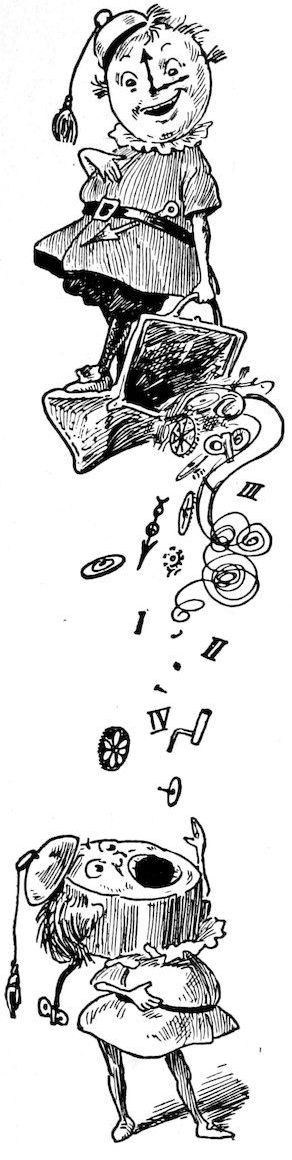
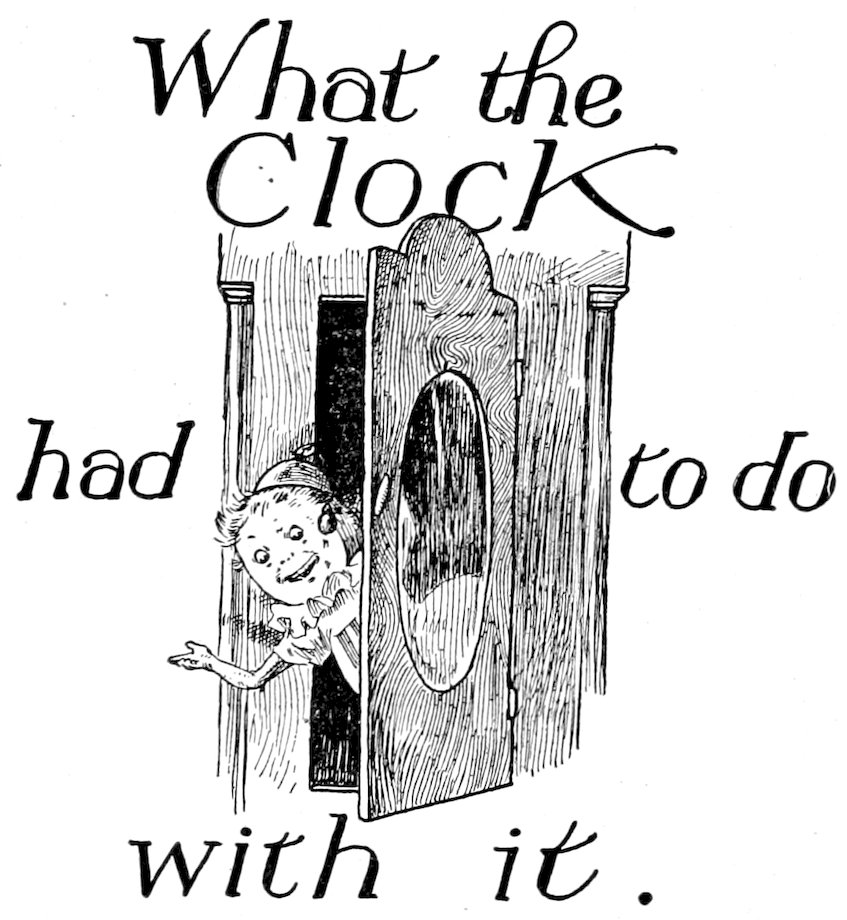
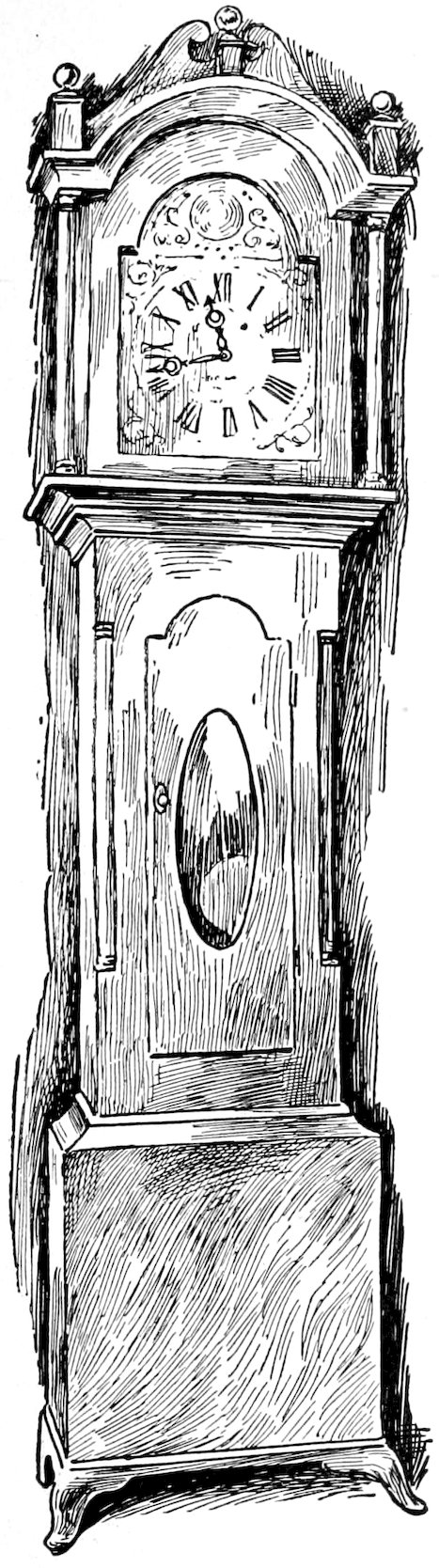
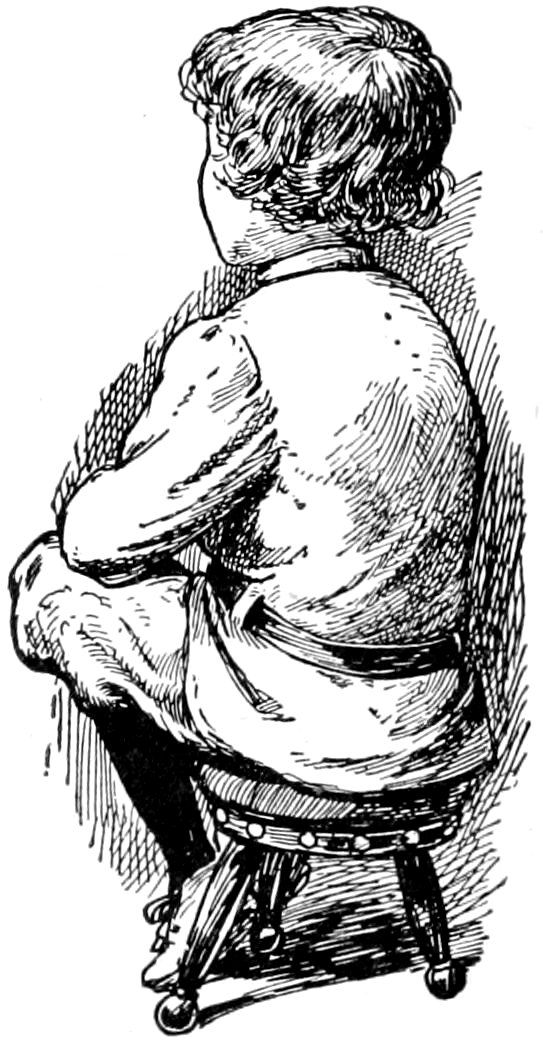
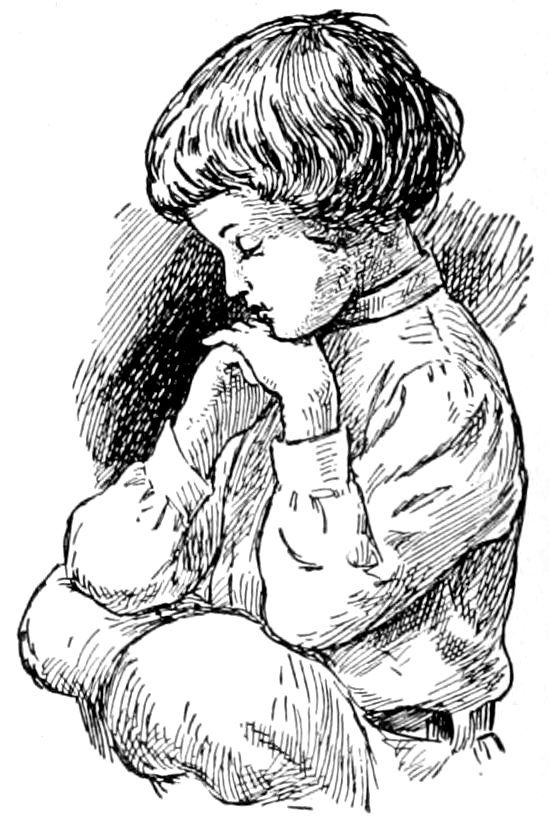
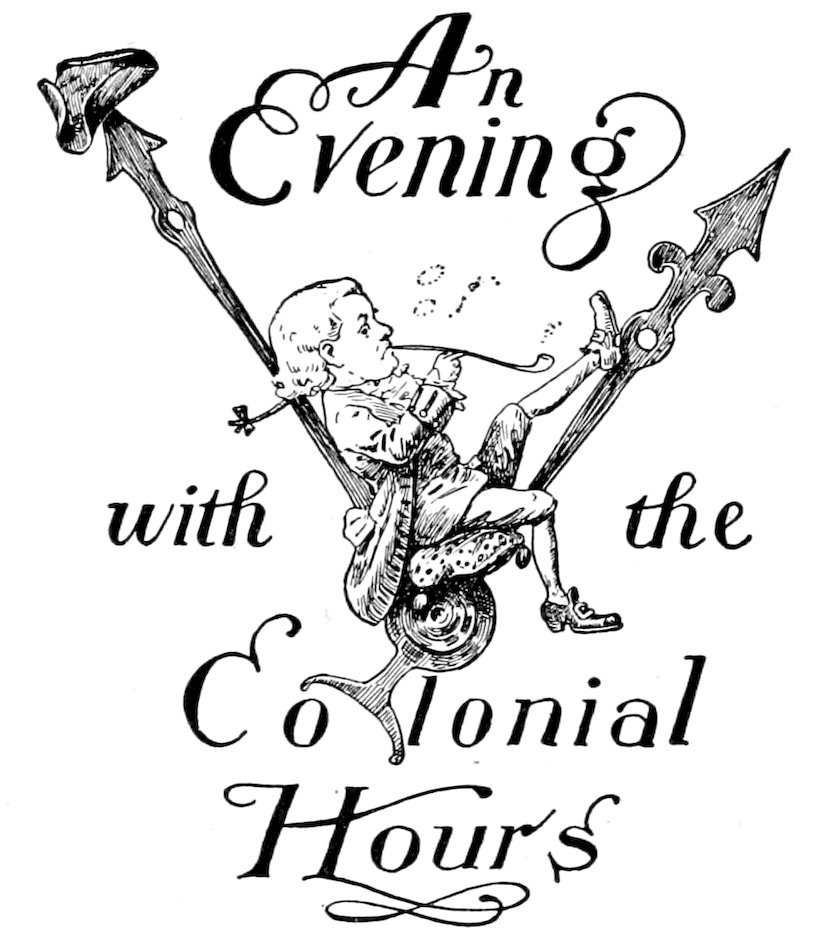
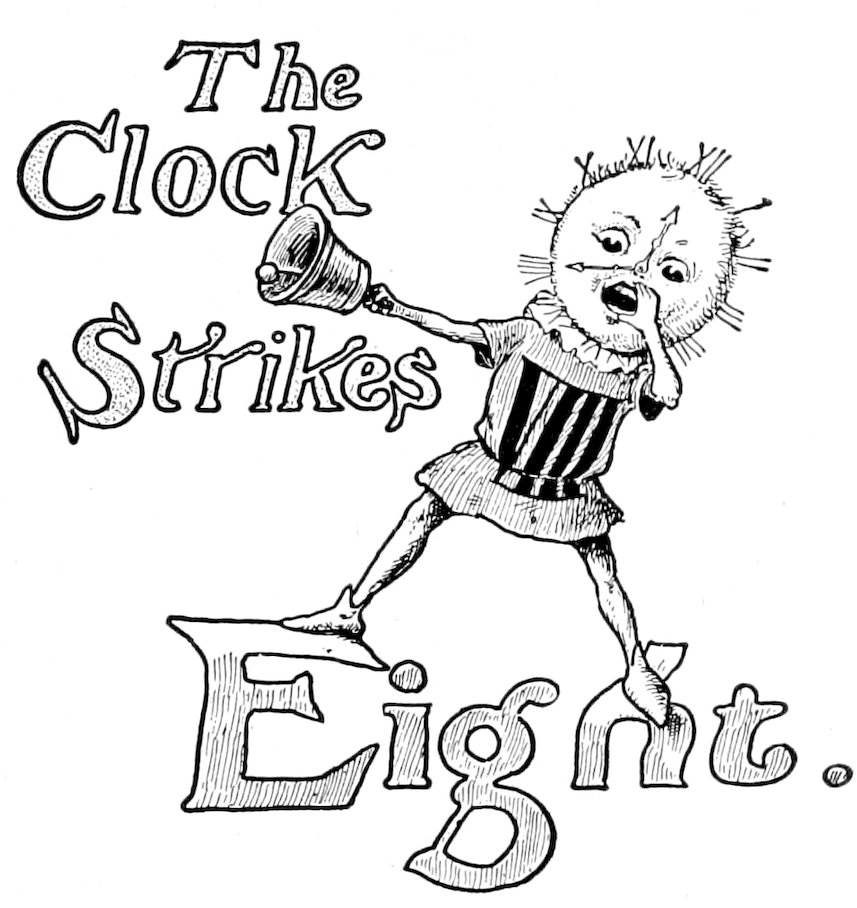
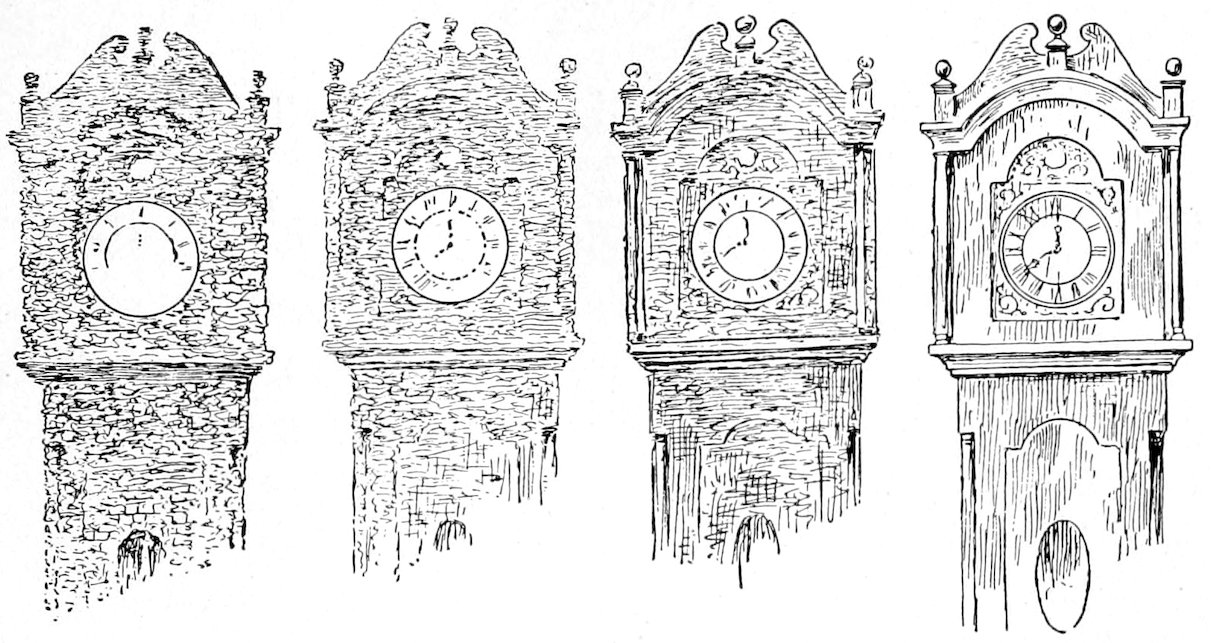
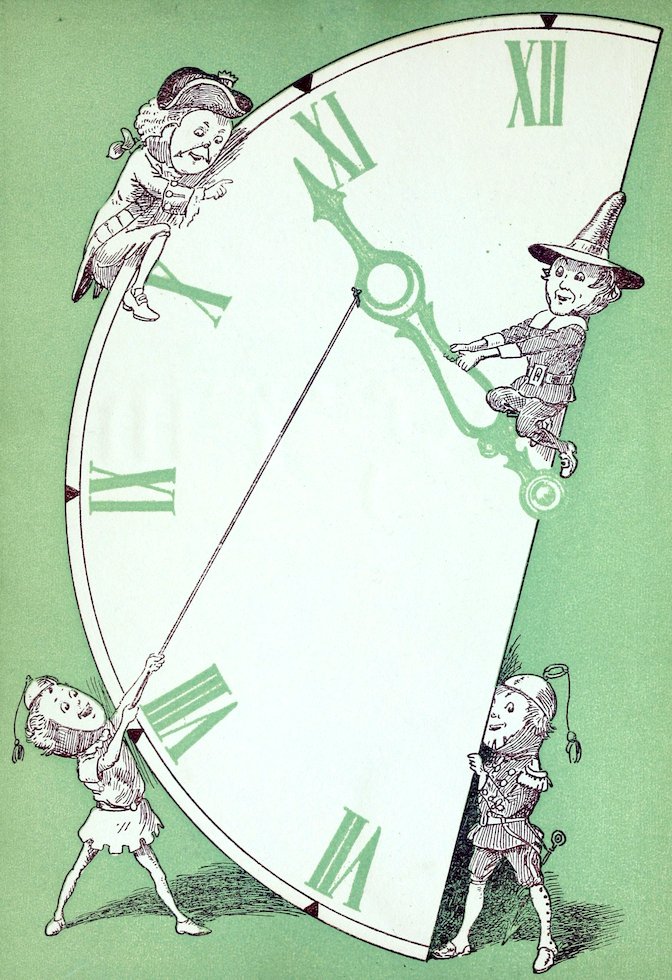
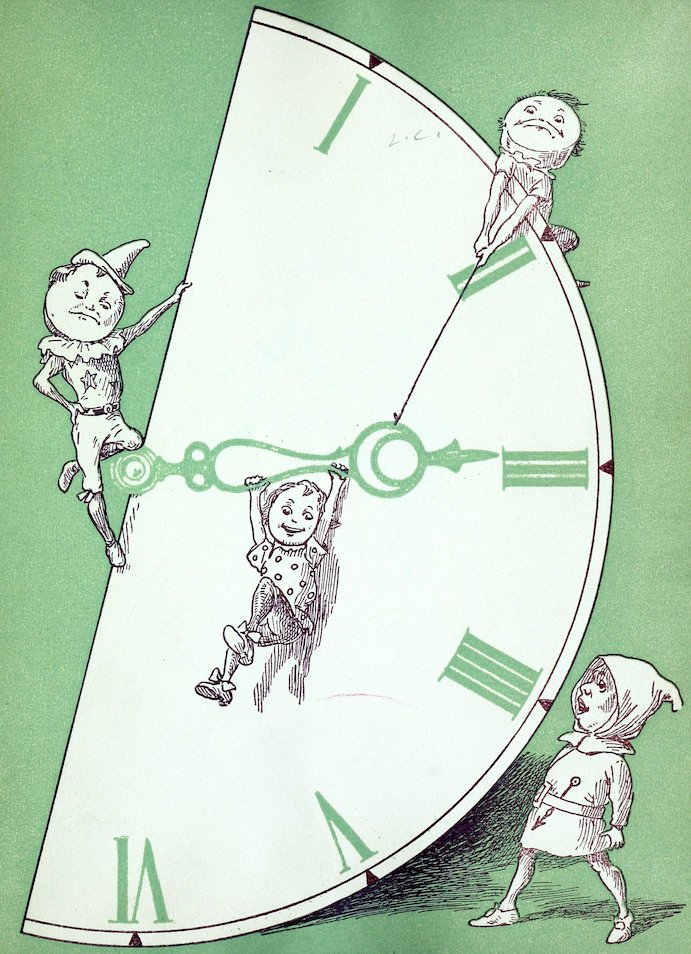
The clock struck twelve, and the clock struck one,
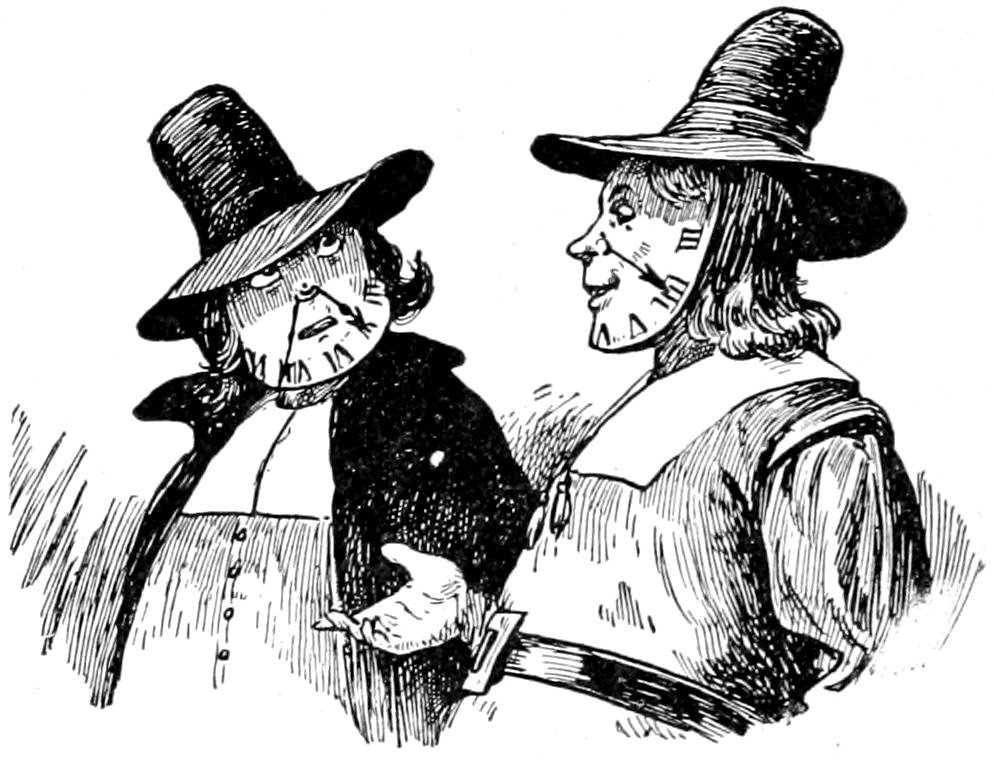
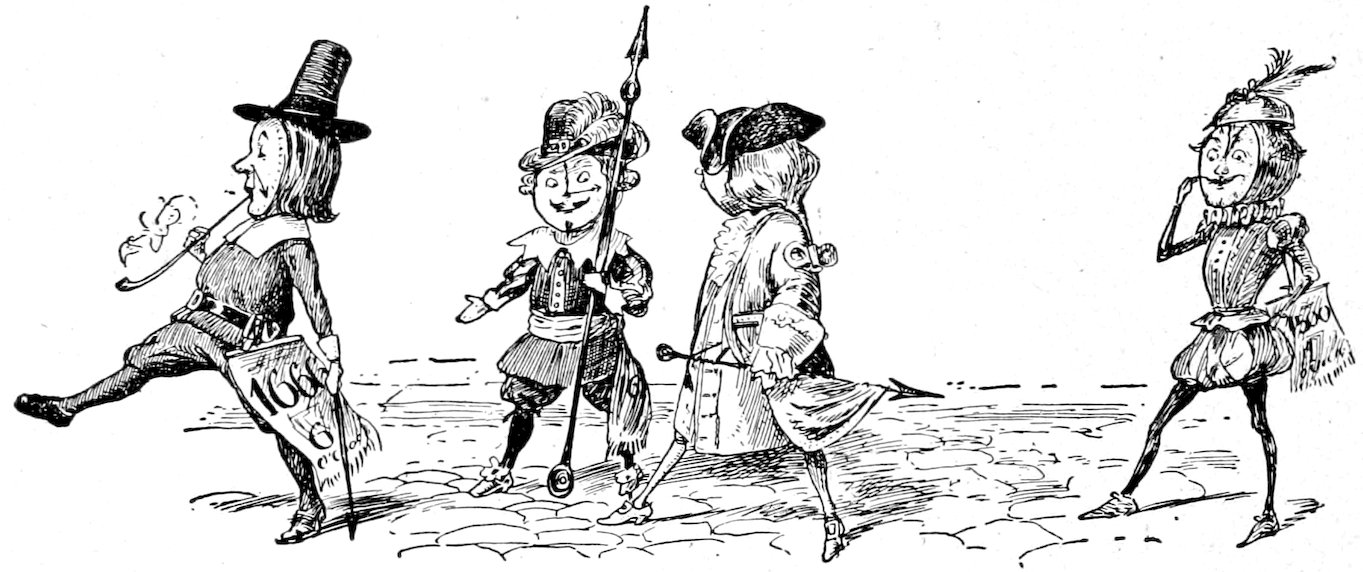
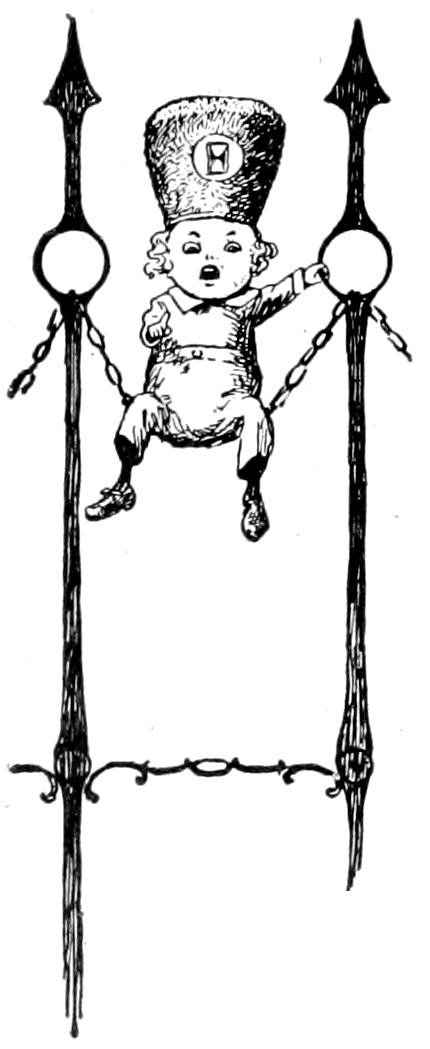
And the swinger down below
Seemed to nod “Good-bye” to the parting hours
That took their leave so slow,
Till the drowsy bell it rang again,
It was time for “Two” to go.
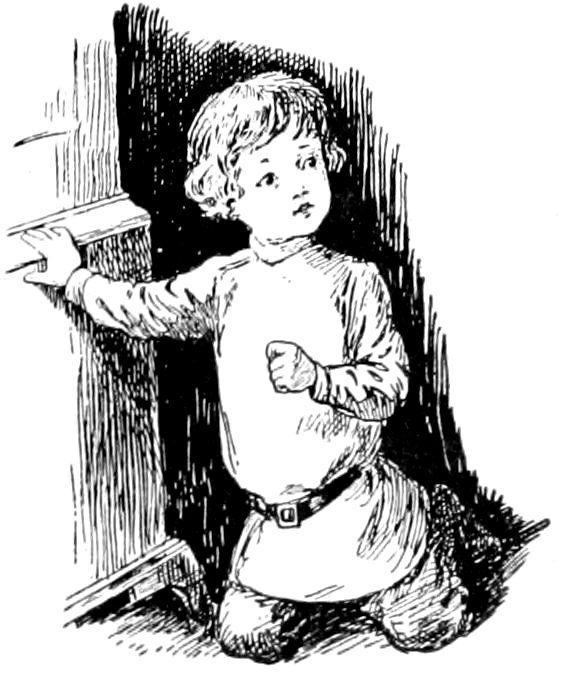
And the little boy blinked his sleepy eyes,
And he said, “I wish I knew
Where the hours go as they pass away,
And what in the world they do.”
And his eyes shut tight, and he hung his head,
And the clock struck half past two.
21And the sly old hand, it crept up-hill,
For its way was long and steep,
But the little boy didn’t see it move,
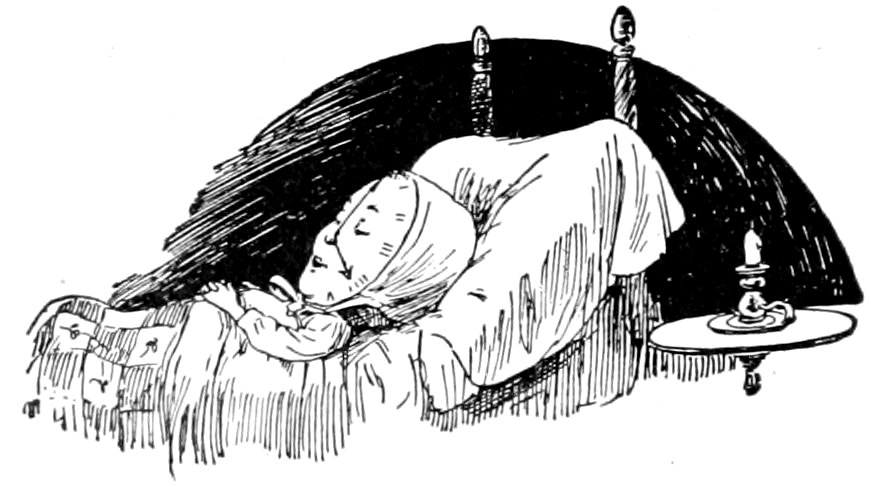
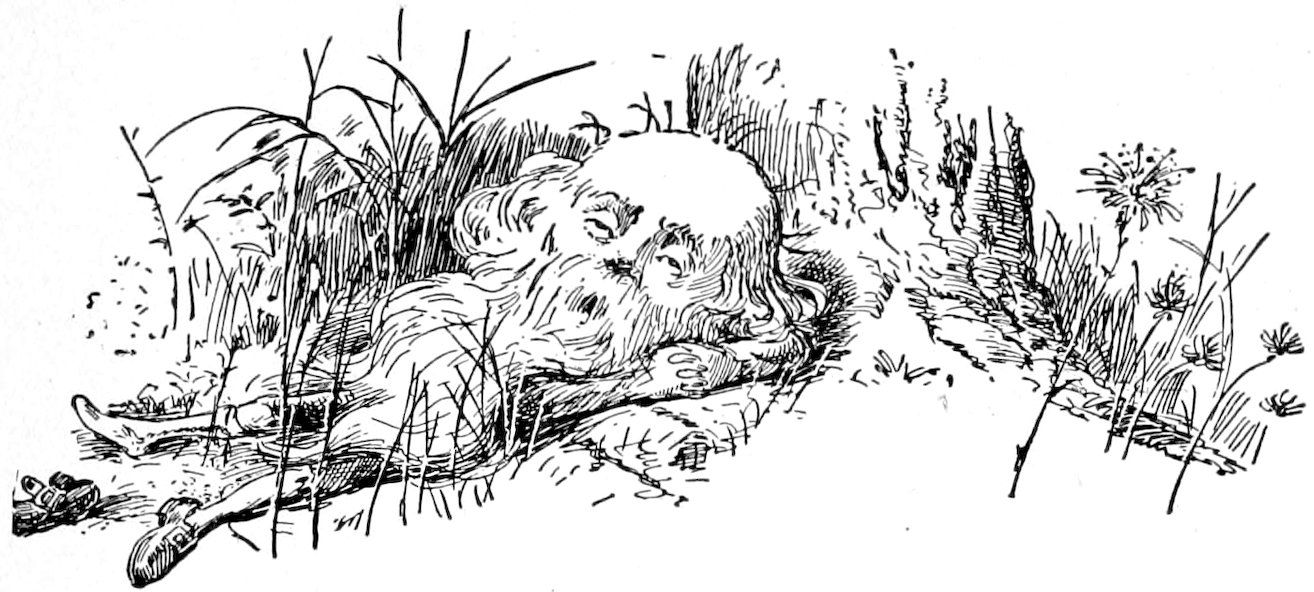
For he lay in the hall asleep,
And all was still but the drowsy tick,
And the sleeper, breathing deep.
When all of a sudden, he heard a sound,
Like the ring of a distant bell,
And following this an hilarious roar,
And then a terrific yell.
It’s a wonder it didn’t wake him up—
Which it didn’t, I’m glad to tell,—
And there, in front of his very face,
On the arm of his father’s chair,
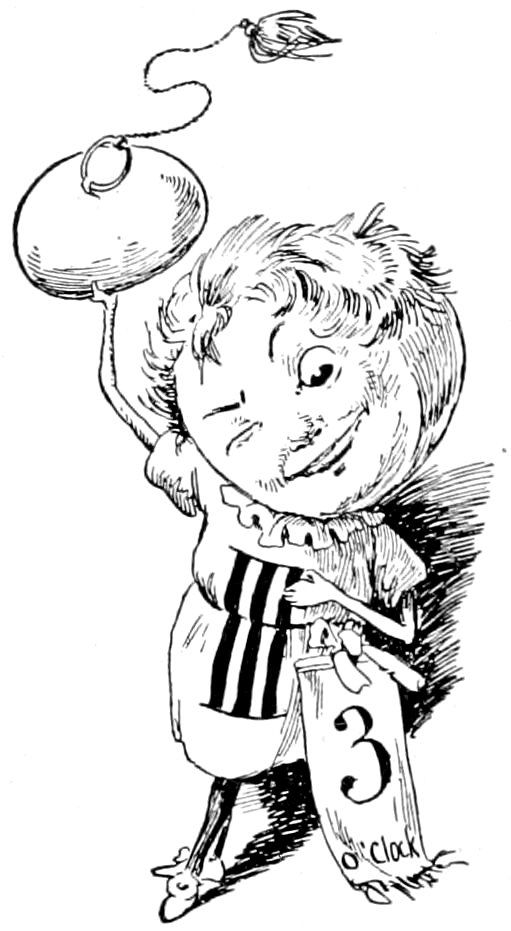
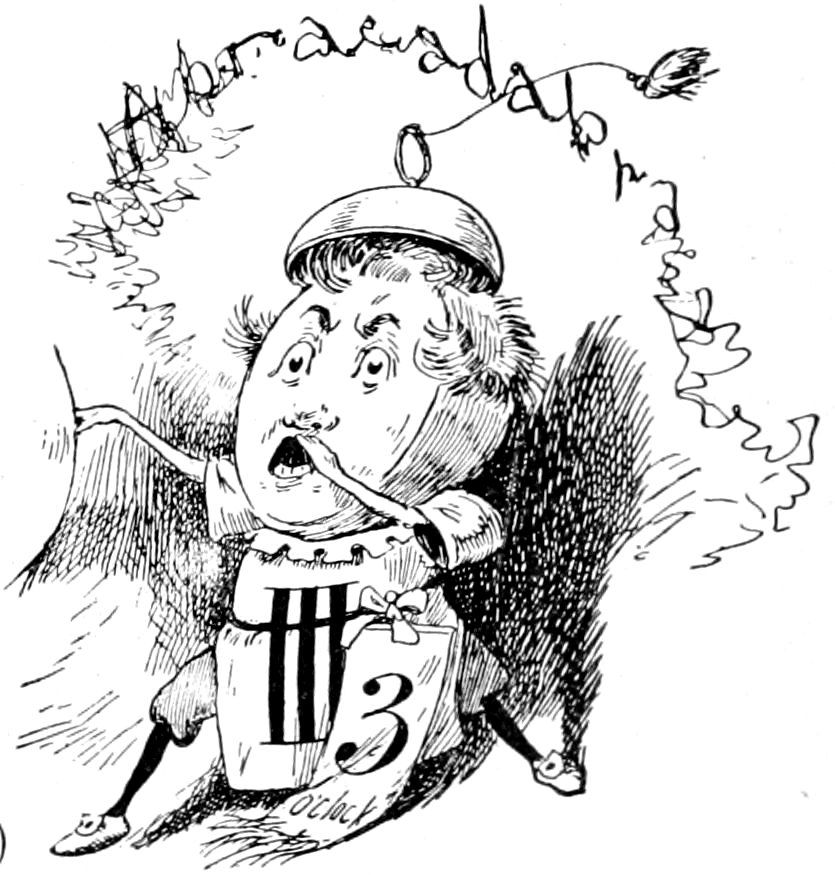
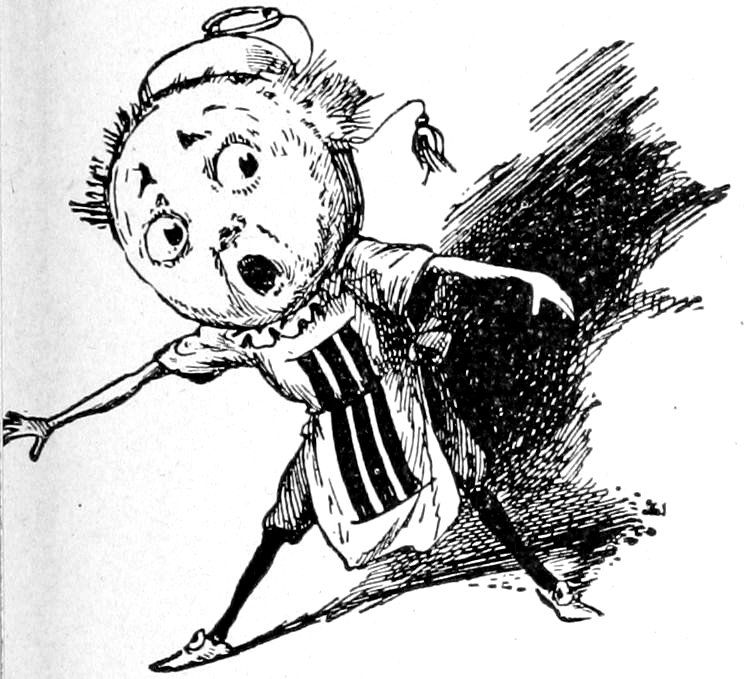
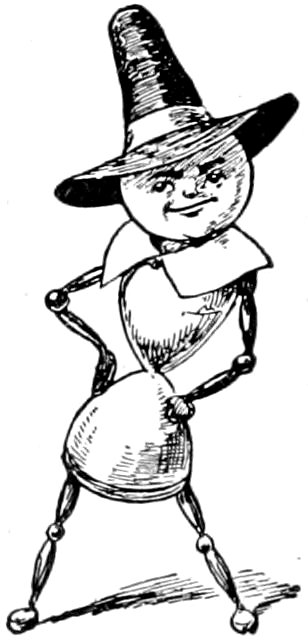
Stood the queerest imp that you ever saw,
A-smoothing his ruffled hair;
And he smiled and winked, and danced a jig,
With a very sporty air.
And he touched the child who was fast asleep,
In a manner soft, but gay—
It’s surprising that such an exuberant imp
Could have such a gentle way—
And the little boy looked with wondering eyes,
As he heard his caller say,
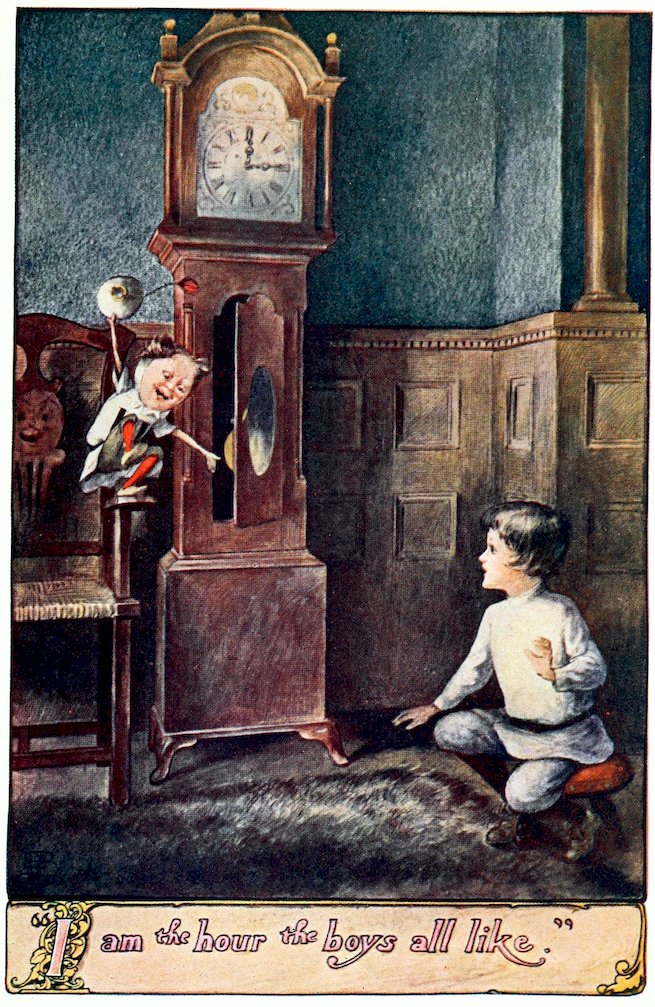
22“Oh, I am the hour the boys all like,
I’m the glorious hour of Three,
And I’m no sort of hand at studies and books,
And I never pretended to be!
“And I don’t care a rap, or a slap, or a bang
For all of the schools in creation,
And there’s only one thing about school that I like,
And that is the summer vacation.
“I never could draw on a blackboard or slate,
And I always dance rapidly by,
For I cannot be slow like some hours that I know,
And I have no intention to try.
“And I always arrive with a cheer and a roar,
And a laugh, and a run, and a shout.
I’m the hour that every child welcomes with joy,
The hour when school is out.
“And I say to the boys, ‘Now, out with your toys!
Climb up in the fences and trees,
For I am the hour that gives you the power,
Thank Goodness! to do as you please!’”
23
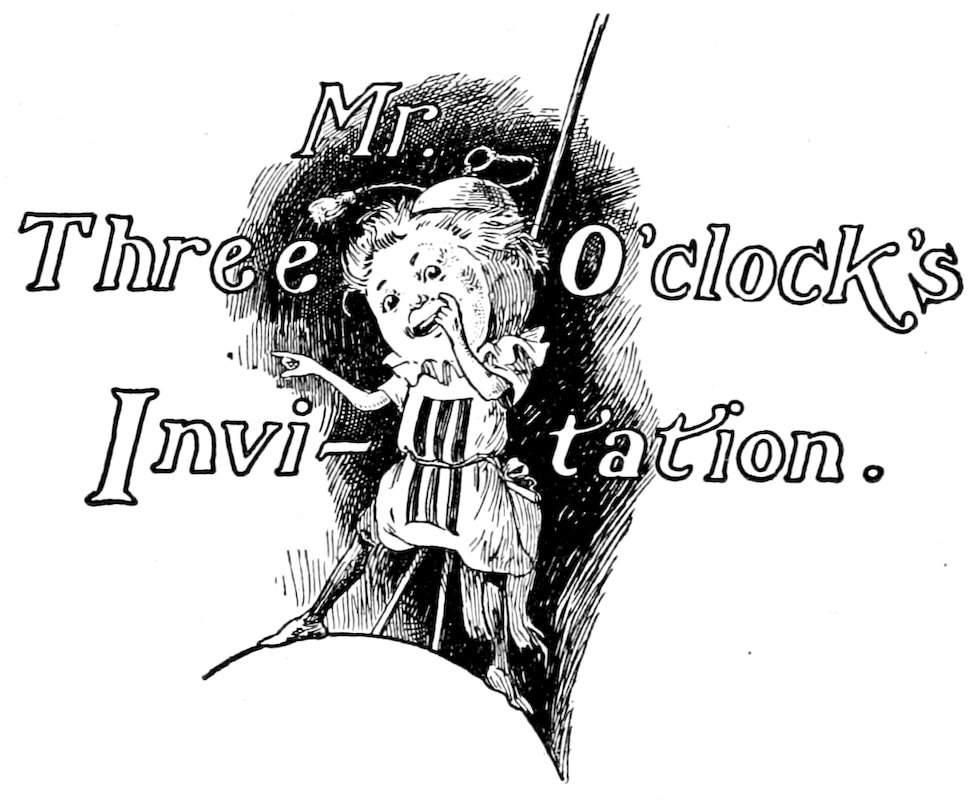
MR. THREE O’CLOCK’S INVITATION
25
“Oh, it’s very kind,” said the little boy,
“To spend your time on me,
And your arguments certainly have great force
As any sane boy can see,
And if I were an hour, you’re just the one
I’m sure that I’d like to be.
“But I probably do not appreciate,
As I sit on that little stool,
The regard that other boys have for you,
Which you say is quite the rule,
For I’m not in the habit of romping much,
And I do not go to school.
“But now that you’re here, there’s a certain thing
That I’d like to ask of you,—
I’m afraid that I ask too many things,
The nurses say I do,
But I never have troubled you before,
So I’m sure you’ll answer true.
26“I’ve watched that clock for the last three days,
And I’ve puzzled my brains to tell
What becomes of the hours that pass away
At the sound of that sleepy bell.
Do they just die out, or is there some place
Where the worn-out hours dwell?”
The Imp, he smiled and he cocked his head,
And he doffed his tasselled hat.
“So you want to know where they go,” said he,
And he came right down and sat
By the little boy’s ear, and whispered low,
“It’s I that can tell you that!”
The Secret of the Passing Hours
27
“You want to know where the hours go,
As they vanish softly away?
To a wonderful land that you’ve never seen,
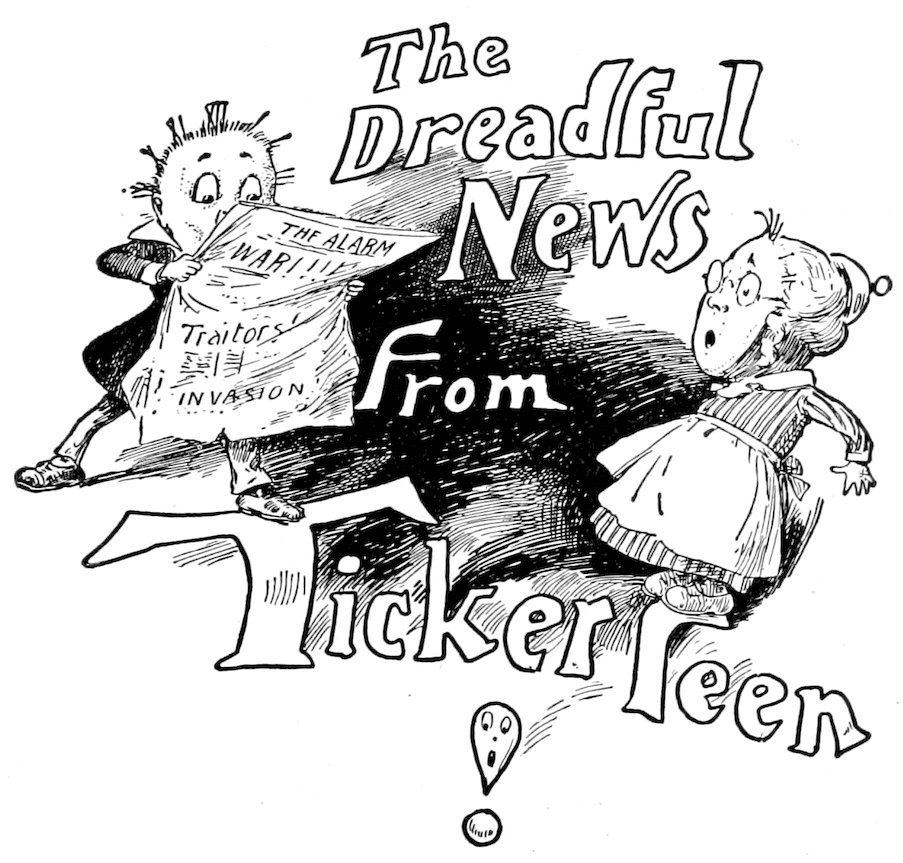
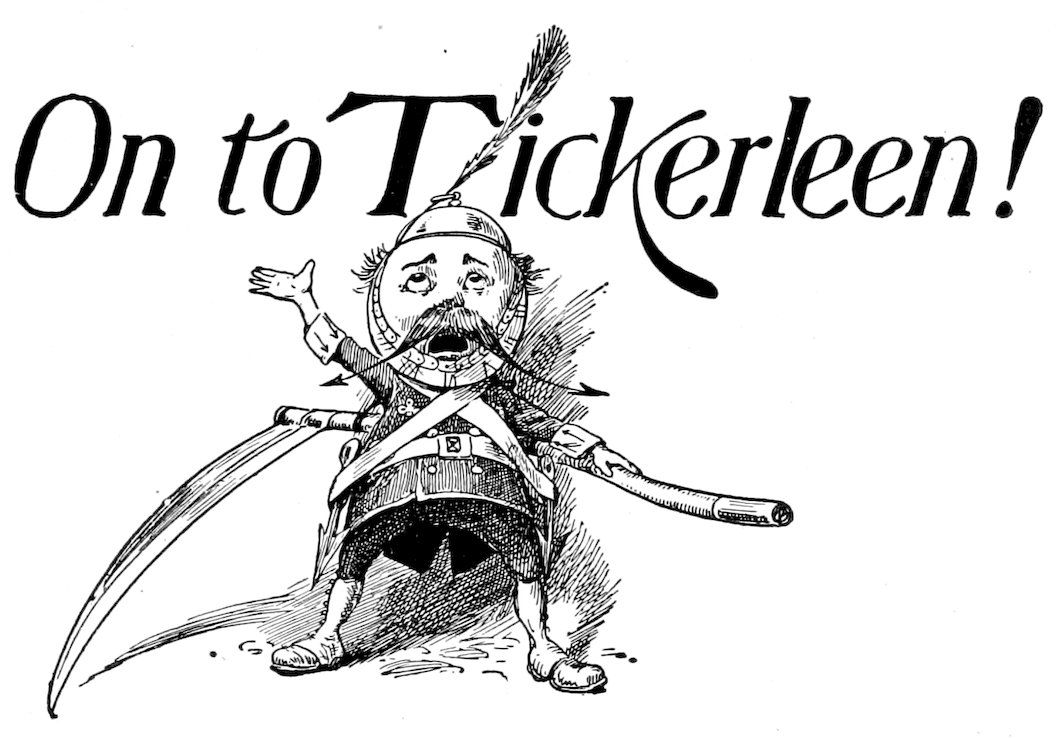
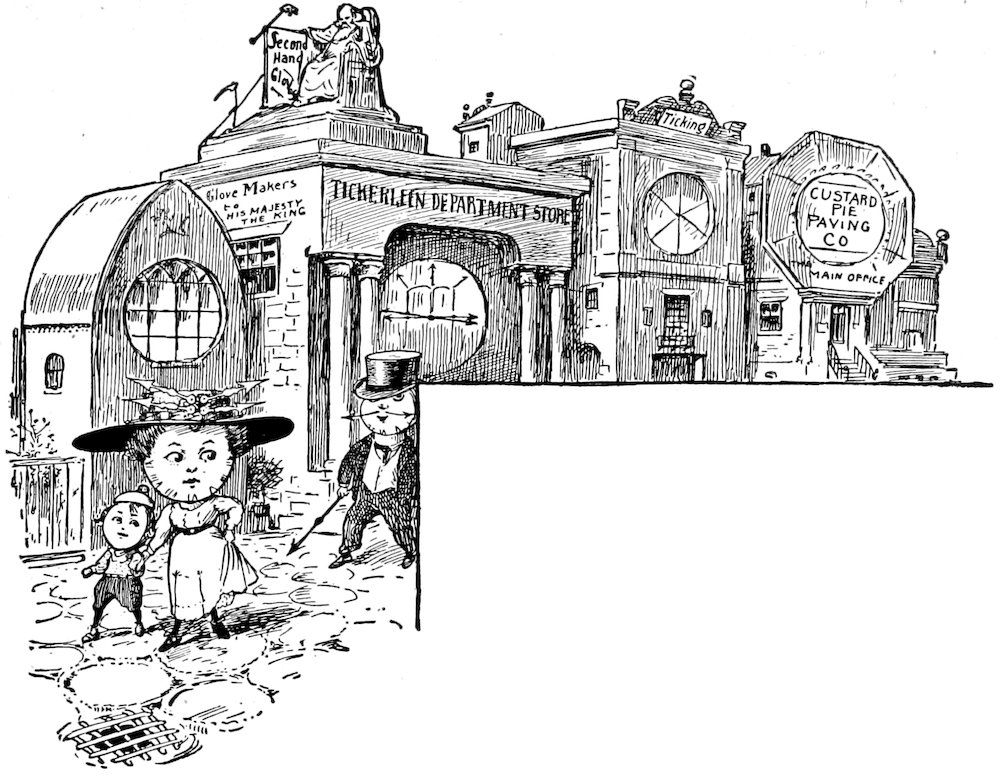
To the mystical city of Tickerleen,
Where every hour of every day,
Recounts his life in a manner gay,
And deports himself in the oddest way—
The pleasantest way, I mean.
28“For they sing, ‘Ha, ha,’ and they dance tra la—
You’d laugh at the things they do—
And they tell in a manner quite sublime—
For they talk in prose and sing in rhyme—
The stories of what they’ve all been through,
And every word that they tell is true,
With a guarantee trademark right in view,
And signed by Father Time.
“And I’ve heard it said, though I shouldn’t care
To be quoted in this regard,
That the musty tales of dry old fools
From histories used in the public schools,
With their beauty gone and their interest marred,
Are, candidly speaking, thrown down hard,
And scornfully, rigidly, justly debarred
By wisely ordered rules.
“And the hours from every single age,
They assemble at Tickerleen,
And recount their tales of ancient lore,
Of actual things they really saw,
Which nobody living now has seen,
Which you couldn’t find in a magazine,
To our aged king and his beauteous queen,
In the land of Tockerlore.”
29“And is it far to that wonderful land?”
Said the little boy on the floor;
“To Tickerleen, in the land of Tock—
Of—What do you call it?—Lore?
And will the hours ever come back,
Or never be heard of more?”
“Not one has ever been known to leave,
Or even try to get out;
Why, some have been there a thousand years,
Or a million, or thereabout,
And whether they’d even like to return
Is a matter of gravest doubt.
“But I’ll tell you what,” said the laughing Imp,
“As you seem to be fully dressed,
And as I’m just starting for Tockerlore
Where all of the hours rest,
I’d be glad to have you visit me there,—
Suppose you be my guest.
“For the rules of our land are very strict,
And the sentinels stern and grim;
And the hour Three must always land
Before the light grows dim,
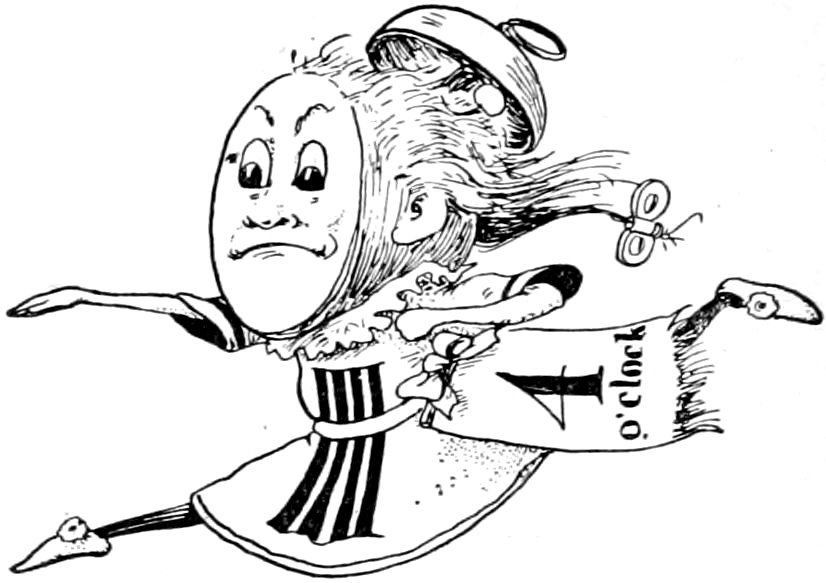
And if Four O’clock were to find me here
It would more than stagger him.
30
“And he’s coming on at a dreadful pace,
He’s now almost half way;
If he were to find me standing here
’Twould upset the time of day.
And old Father Time would be all confused,
And I can’t think what he’d say.”
And the words he spoke as he started up
Were as true as words can be,
For there he’d sat for a half an hour;
“Come, be my guest,” said he,
And the little boy was about to speak
When the clock struck half past three.
“Come on,” said the Imp, as he turned to go,
“It’s a magical, wondrous land
Where you’ll see the strangest, queerest things—
That’s right, I’ll help you stand!”
And he lifted the little boy right up,
And he took him by the hand.
And then he escorted that little boy,
Like a real professional guide,
To the clock, and then—unlocked the door
31And gallantly stalked inside,
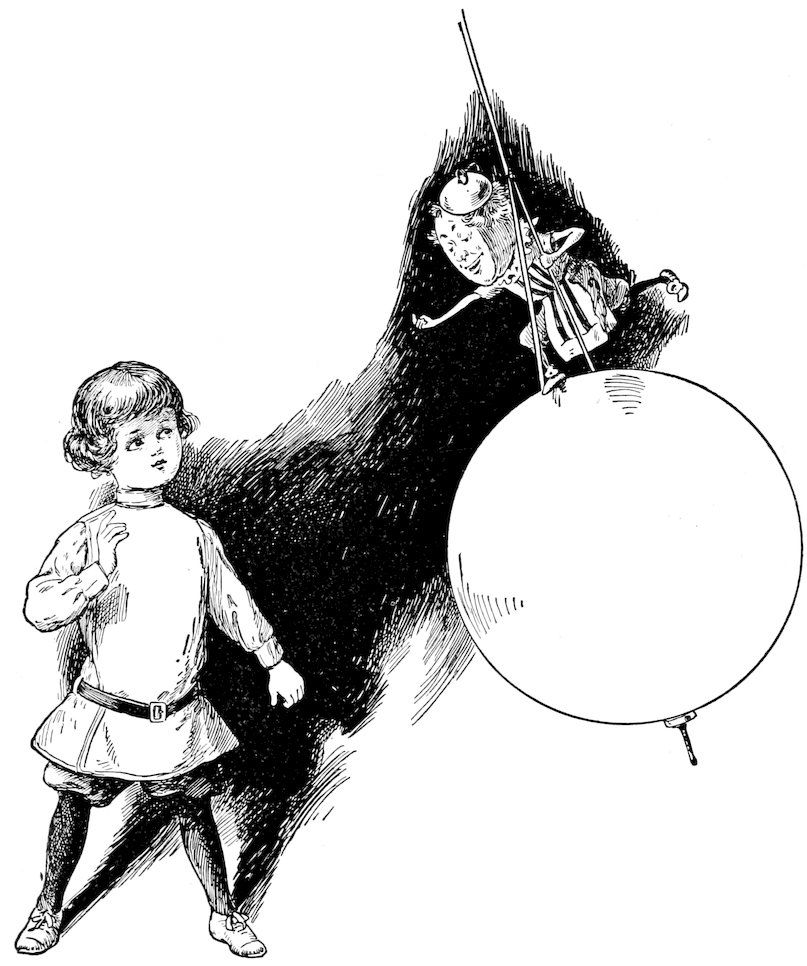
And catching the swinger, he held it fast;
“And now,” said he, “for a ride!”
And then there happened a curious thing,
And I hope you will not fail
To credit each word that I’m telling you,
For confidence must prevail;
And there on that swinger, as one might say,
There hangs the entire tale.
As the Imp took hold of the shiny disk
He uttered a magical word,
(Protected, I’m told, by copyright)
Which the boy had never heard;
It was most a yard and a quarter long,
And it sounded quite absurd.
But whatever that singular word might be,
(And I do not pretend to say)
The swinger at once began to act
In a most suspicious way,
For it grew as large as a cannon ball,
And began to slowly sway.
32
“Jump on!” said the Imp to the little boy,
“There isn’t a minute to spare;
Be quick! for in just a second more
That swinger’ll be in the air.”
But the little boy didn’t mind the Imp,
For he simply didn’t dare.
And he said to the Imp, “Before I start
I am anxious to ascertain,
When I’ve seen the sights of Tockerlore
May I come back home again?
For I don’t want to stay away for good;
Will they force me to remain?”
33“Jump on!” said the Imp, with a laughing face,
“For the land that you’re going to see
Is strongly opposed to all restraint,
And its citizens all agree
That tourists arriving from other worlds
Should be entirely free.”
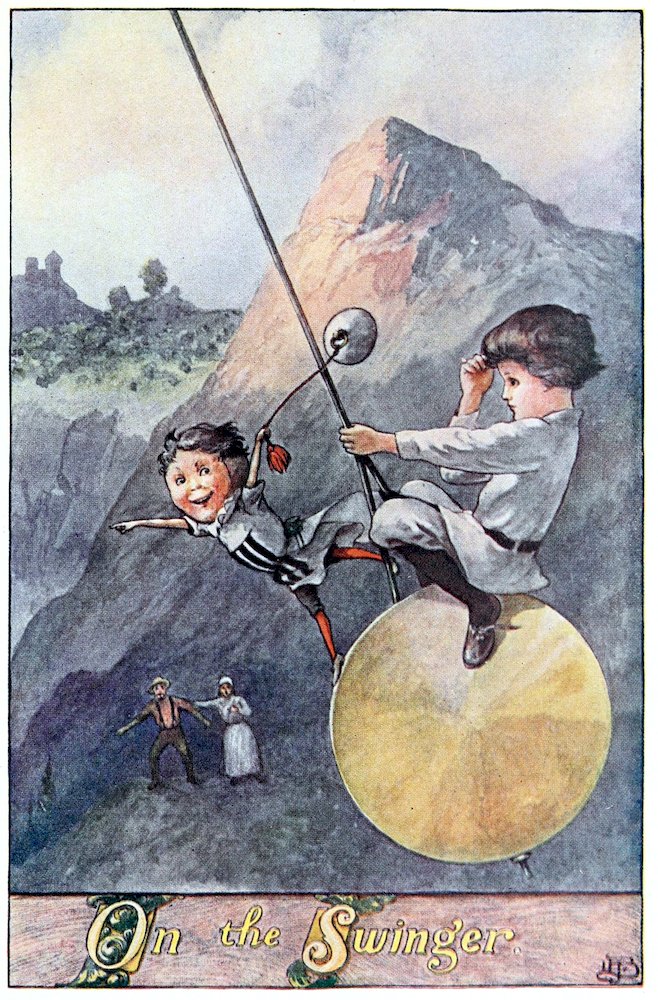
So the little boy jumped with all his might,
And he presently sat astride
The long thin stem of the shiny ball
To make sure he wouldn’t slide;
And he felt quite gay as he smiled at the Imp
Who sat on the other side.
And grasping the stem with his little hands,
The little boy presently saw
The furniture near him growing dim
On the disappearing floor,
And they swung to right! And they swung to left!
And he heard the clock strike four.
THE JOURNEY
34
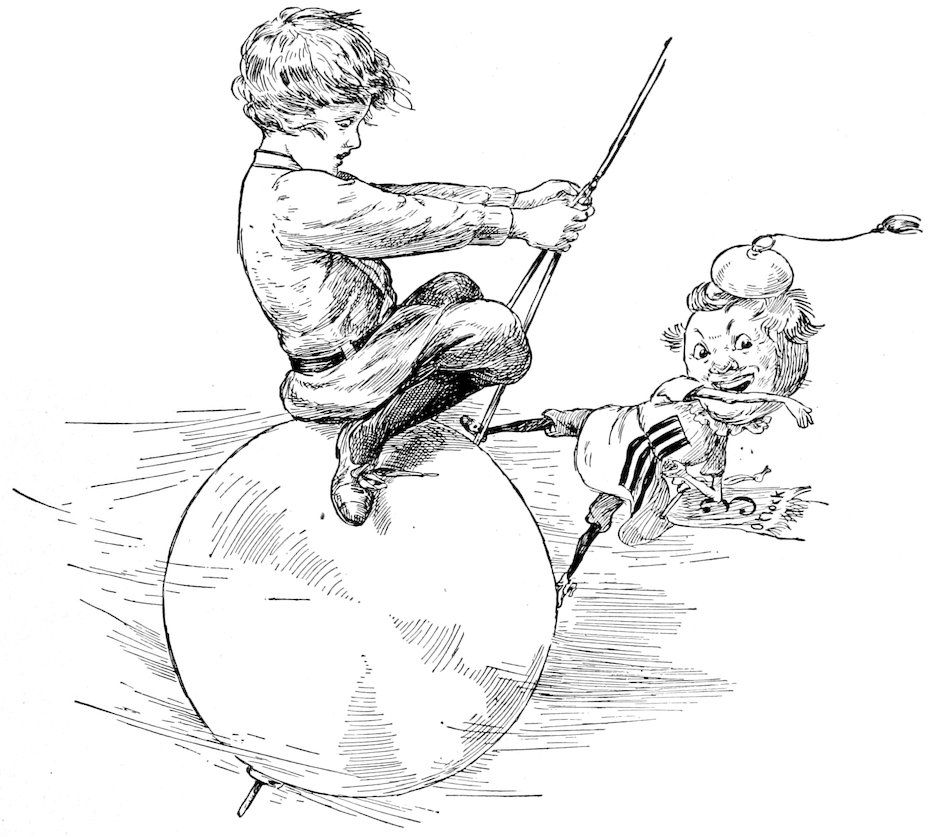
After they were both comfortably seated on the
swinger and settled down for their long ride, the Imp
was presently seized with the wildest excitement,
which first startled and then amused the little boy.
The more the swinger swung, the more loud and
boisterous became the Imp’s extraordinary conduct.
But in less than a minute everything seemed to
the little boy to be growing dreamy and hazy. He did
not know where he was; he simply knew that he was
sitting on something and holding on and moving at a
terrific rate. He remembered being carried past the
big parlour, and seeing the piano which looked all
shadowy and strange, as if it were covered with thick
dust. He recognized the hat-rack, as he flew by, and
the silver plate which held the calling cards seemed
to be whizzing round like a pin wheel. He did not
know whether the clock had suddenly grown large
enough to accommodate its tumultuous swinger, or
whether the swinger had given up its usual duties
altogether, and was running away as fast as it could.
In short he did not know anything except that he
was sitting opposite his singular friend, who had risen
35and was giving an acrobatic performance on
the opposite
side of the
long stem—apparently
without the
smallest regard
for the
danger which
attended
his reckless
actions.
Suddenly
he began to
sing and dance, and
the song, as nearly as the
little boy could make it out, was as follows. It
amused him greatly, for it seemed to be curiously
fitted to the motions which, of course, cannot be given
here.
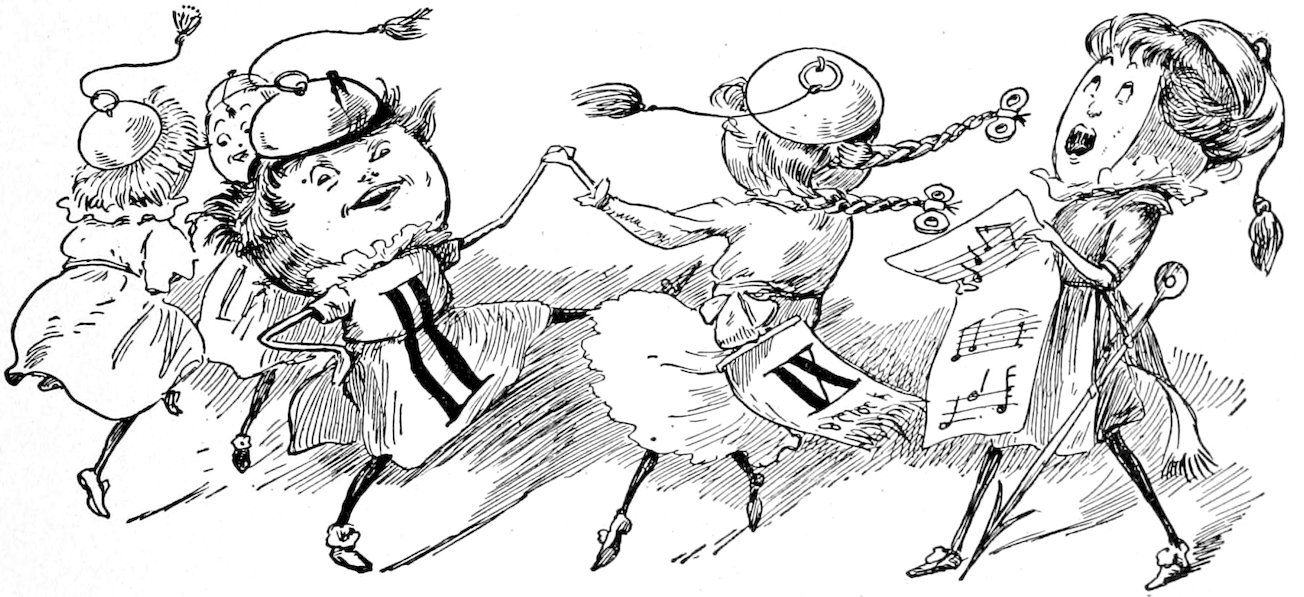
“And it’s merrily out of the front hall door,
When the good old clock is striking four,
36We’re off to the Land of Tockerlore—
The land you’ve never seen!
“And it’s pleasantly over the hills we go;
Look out for your feet! Don’t hold them so!
Just pull them up when the ball swings low!
Hurrah, for Tickerleen!
“And it’s merry I’ll be at your great surprise!
And I’ll laugh to see you strain your eyes,
And stare all day at the custard pies,
With which the streets are paved!
“And you’ll probably say, as your feet sink in
To the yellow custard, rich and thin,
In the rural districts, ‘What a sin!
Such custard should be saved.’
“And it’s jolly we are, and a merry pair!
My life! I believe we’re half way there!
Do you notice yet the change of air?
Those distant mountains tall?
“And hurrah, for the glorious King and Queen!
And the queerest court you’ve ever seen!
Hurrah, for the Duke of Limabean!
Look out! You’re going to fall!
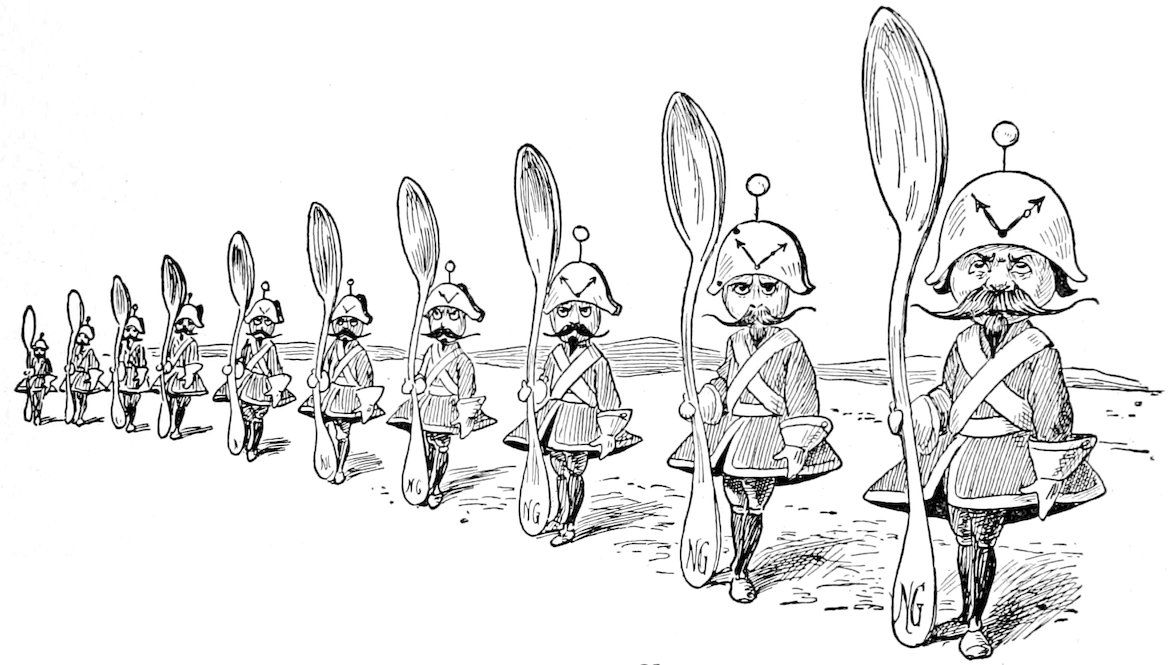
37“And it’s hip, hurrah, for the National Guard!
With their table-spoons and deep regard
For the country’s—Oh, don’t laugh so hard!
You’d better hold on tight!
“For the country’s—
Oh, what was I going to tell?
Oh, never mind and it’s just as well,
For I see the village of Minutel;
Just watch that distant light!
“And I’m glad that you never attended school!
I’m glad you were sitting on that stool!
And glad you’re out of the common rule!”
(And then he gave a wink.)
“For our land is one glorious, gorgeous toy,
That you cannot lose nor yet destroy,
38Especially made for a little boy
That has the brains to think!”
“There!” said the Imp, as he resumed his seat on
the swinging ball, “now I feel better! I was locked
up in that musty clock for an hour before I met you,
without a particle of fresh air. Now I feel better!
I’m a great believer in exercise, and they say dancing
is the greatest exercise in the world. I once knew a
boy about your age who had St. Vitus’ Dance, and
they thought there was no hope for him, but I said,
‘This is a disease and a cure all in one; let him dance;
it’s good exercise.’ And he did, and he cured himself
of dancing simply by dancing. The more he danced,
the less he danced, until he was well altogether.”
“Wasn’t that a little strange?” asked the little
boy; “you say he is well now?”
“Perfectly; he is a clock maker. I know him
personally.”
There was a long pause after this, and then the
little boy asked,
“Shall I meet the Duke of Limabean?”
“I wouldn’t be surprised,” said the Imp. “I’ll
show you his country-place when we get past the
frontier. He married the Countess of Corn, you know.
Their beautiful place at Succotash is visited by all
tourists. There! Look close, and look out, don’t
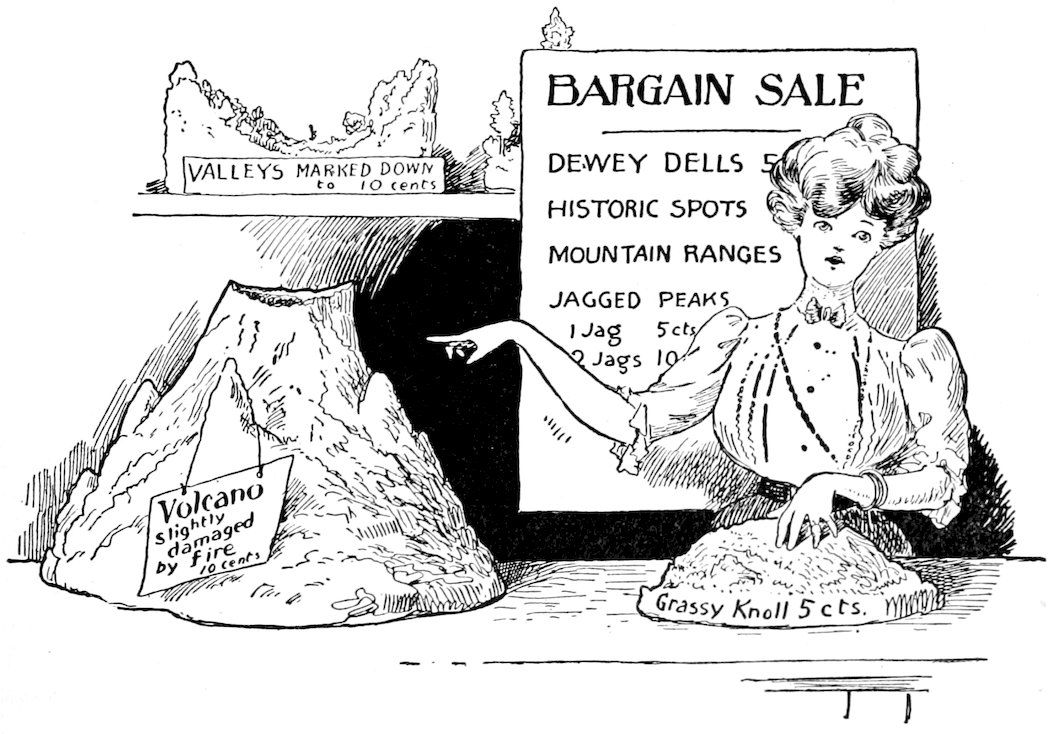
fall! You see that row of hills over there? Those
39are the Tockerlore Mountains. They form the frontier
of the land. There used to be a fence there instead,
but Father Time happened to see those mountains at
a bargain sale and he thought they’d be better.”
“What?” said the little boy.
“I say there used to be a fence there instead.”
“Did you say that the king bought the mountains?”
“Why, yes, you don’t suppose he got them for
nothing, do you?”
“I never heard of a person buying a range of mountains!”
“Did you ever hear of any one getting a range of
mountains for nothing?”
“N-no, I can’t say I
did.”
40“Well, then!”
“But what was the use of buying the mountains
for a frontier when they were already there?”
“I didn’t say they were already there.”
There was a pause after this retort, and the little
boy looked at his friend curiously. He then unfastened
the belt of his Russian suit, and fixed it so that it
went around the long stem.
“They have straps like this to hold you on merry-go-rounds;
don’t you think this is a good idea?”
“Excellent,” said the Imp.
“May I ask another question?” said the little
boy.
“Certainly; what is it?”
“Where were the mountains before the king bought
them?”
“At the bargain sale.”
“And you mean to say that some one carried them
there?”
“Why, certainly; you don’t suppose they walked
there, do you? That is a strange question.”
“How far was the bargain sale?” asked the little
boy.
“About two miles; at the five and ten cent store.”
“And the mountains were bought there?”
“Yes, delivered C. O. D.”
“Tockerlore is a kind of magic place, where they
have fairies and magic wands, isn’t it?”
41“Why, do you think there is anything strange in a
range of mountains not walking two miles of their
own accord?”
“Oh, I didn’t expect them to walk!” said the little
boy.
“Yes, you did, and you seemed to doubt that the
king bought them—as if he would have stolen
them!”
“Oh, I never thought that!” said the little boy.
“I truly didn’t. I thought it was strange that—well,
I don’t understand it, that’s all.”
The Imp looked at him in a quizzical way, and then
said,
“What a queer child you are!” And that was all
the conversation which took place until the strange
mountains loomed up in full view before the boy’s
eyes. But he had made a resolution not to express
any surprise at anything he saw, for the Imp didn’t
seem to see things in his way, and was very touchy.
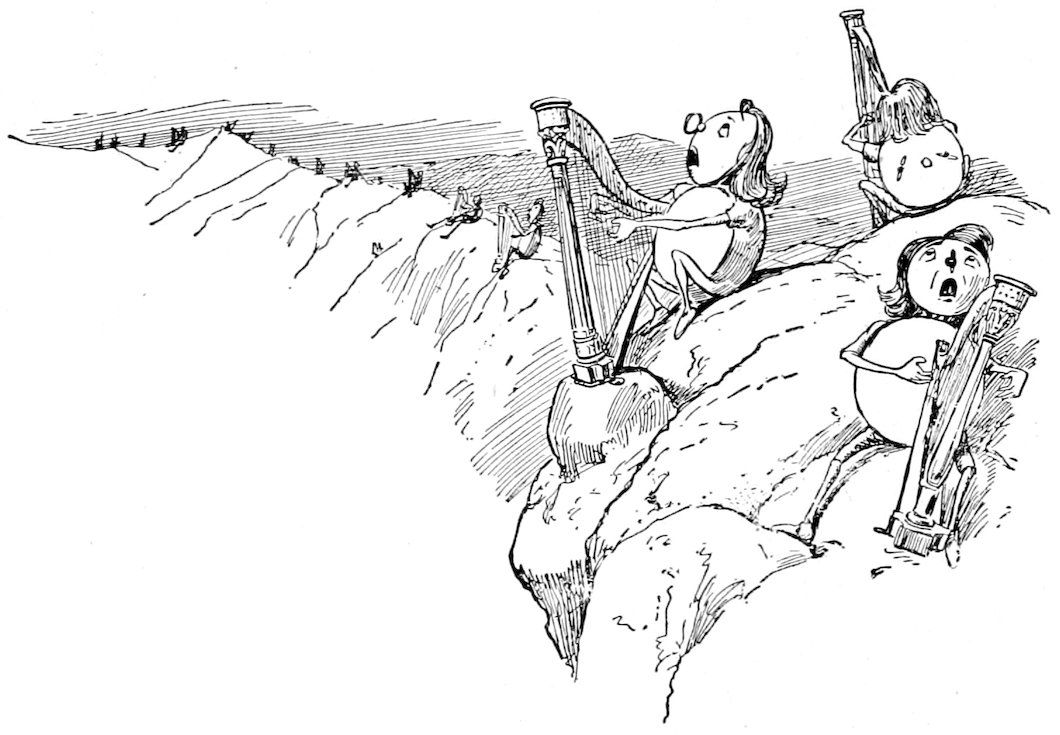
As they approached nearer and nearer to the mighty
hills, the little boy could distinguish living figures
seated upon the rocks and ledges all about, and twanging
little harps. They were very small—these figures—and
they seemed to be singing an anthem, or something
of the sort, which the little boy couldn’t make
out. But he hesitated to ask any question concerning
them and their business for fear of getting into a
dispute.
42“There!” said the Imp, finally; “those are His
Majesty’s Minstrels on guard at the mountains.”
“To keep them from running away?” asked the
boy.
“To keep what from running away?”
“The mountains.”
“Now, don’t be absurd,” said the Imp, “do you
hear that song they’re
singing? That’s the
national hymn. How
beautiful it is. Just listen!”
They were now close upon a mighty canyon which
ran between two great hills and formed a gateway
into the mystic land.
The scented breeze wafted the voices of the tiny
singers in the little boy’s direction, and he was struck
with consternation on hearing the words of the national
song.
Song of the Minstrels on the Frontier
43
Upon the snow-clad mountain tops
The waves of ocean roar,
And the ships that bear the milkmaids home,
From their cabins out on the briny foam,
Are tied again to the barnyard door;
And all is still
On the sun-kissed hill
As the rain begins to pour;
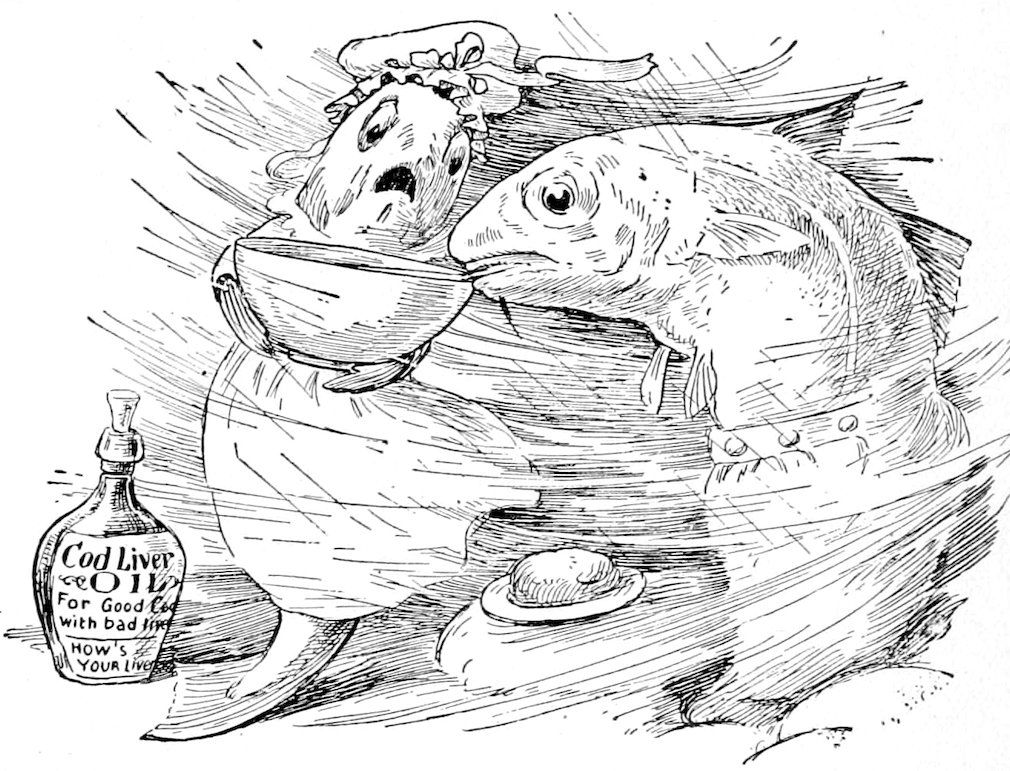
And the codfish, coming out of his hole,
He heaves a sigh as he sips his bowl
Of cod liver oil, and eats his roll—
In the Land of Tockerlore.
And the song that we sing
To our mighty king
Will resound the wide world o’er,
44And it’s magical,
musical,
mystical
muse
Will be heard forevermore!
As they passed into the great canyon which lay
between the two high mountains, they could hear the
echo of the minstrels’ song, farther and farther away
in the distance,
“Magical, musical, mystical muse,
musical, mystical muse,
mystical muse,
muse,
use,
se,
e”
and so on, until it died away altogether, and they
realized that they were in the Land of Tockerlore.
45
47
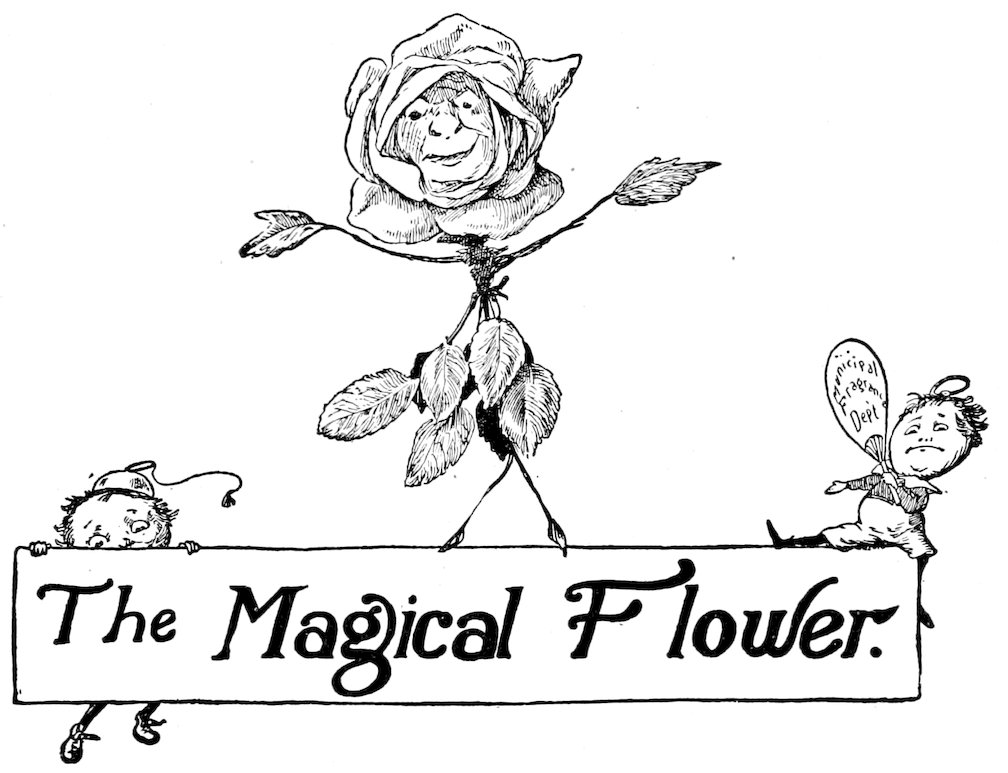
THE MAGICAL FLOWER
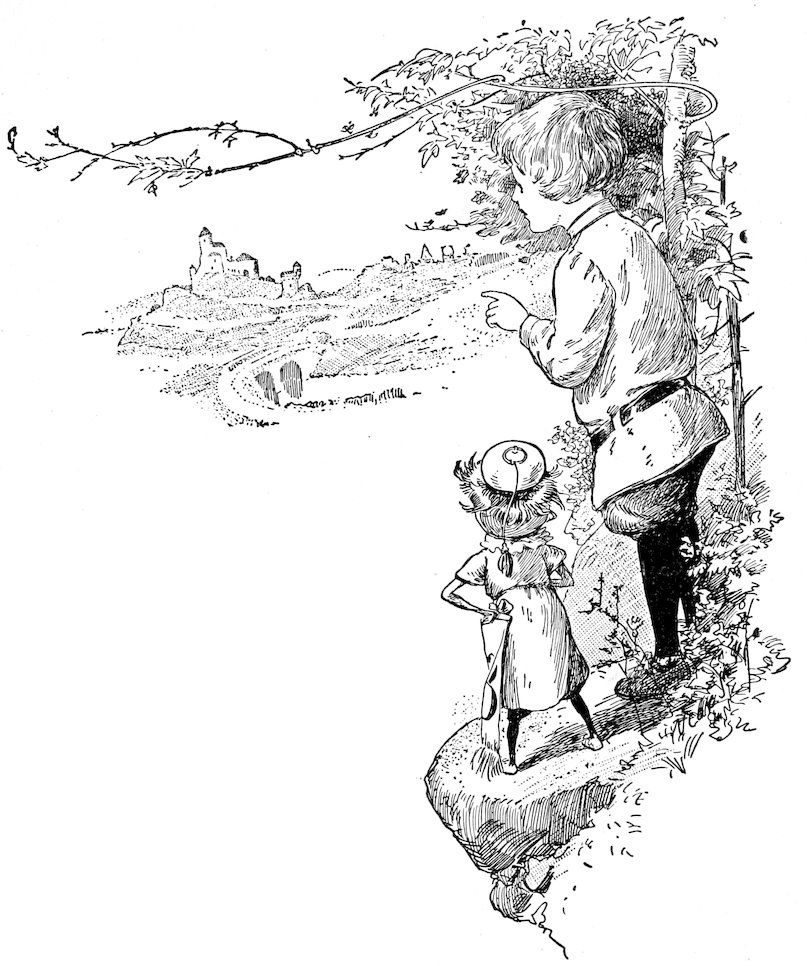
As the little boy glanced about the scene
Which he’d just arrived to explore,
A curious sight it met his gaze,
And he scanned it o’er and o’er;
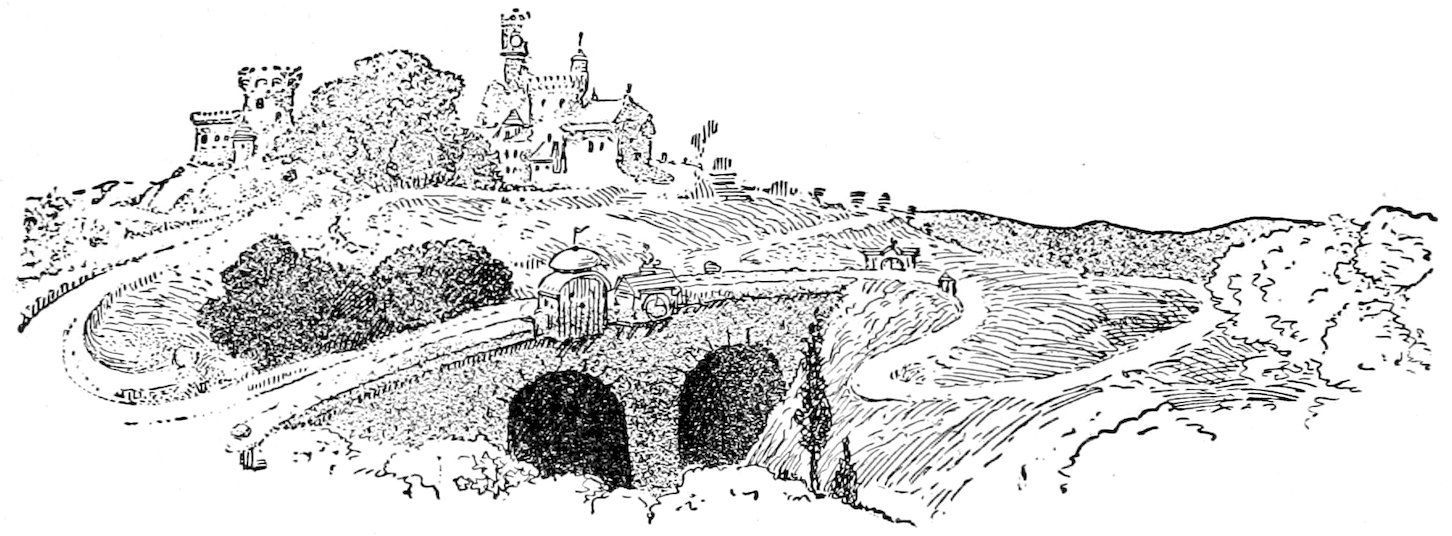
’Twas the beautiful, winding country road
Extending through Tockerlore.
48They stood on the edge of a rocky shelf
Surveying the beautiful land,
And no matter where his eyes would turn
The road was on every hand,
And he noticed the distant towns it touched
And the rivers that it spanned
And looking afar from the rocky height,
He remarked to the Imp, “It seems
Like places they have in fairy books,
And the things you see in dreams;
And is that the village of Minutel,
Where the little white light gleams?”
And turning his wondering eyes above
To the beautiful fleecy sky,
He saw how the floating clouds were formed
Like mystical clocks on high,
And he thought as he saw them passing there
How the time was fleeting by.
49And still as he paused on the mighty cliff
And noted those clouds pass o’er,
His ears caught a smothered rolling sound
Like the distant thunder’s roar,
And he said, “They’re winding the clock-clouds up
In the land of Tockerlore.”
The Imp laid his hand on the little boy,
And he said, “We shall have to strive
To follow that road to Minutel,
Or we never shall arrive.
How nice, when you follow its winding way,
To think it was once alive!
“Now watch what you’re doing, and step right down,
Holding fast to those slender trees;
When we’re off this hill, we’ll be all right,
And can find the—”
50“Wait a minute!” said the little boy. “Did you
say that the road was once alive! Or didn’t you say
that?”
“Yes, I did, and you shouldn’t interrupt.
“And can find the road with ease;
And we’ll see the garden of Minutel,
Where they make the scented breeze.
“There, now what is it?”
“Well, I thought it seemed funny that—I didn’t
see how a road—Well, nothing.”
“Go on,” said the Imp, “I’m listening.”
“Well, would you mind telling me about how the
road was alive—if it wouldn’t be too much trouble?”
“Oh, there’s an old legend they tell in Minutel—I’ve
no doubt you’ll hear it; we’ll ask when we get
there. Minutel is a queer little place, full of folk-lore.
Those gardens I spoke of are called the Fields of
Fragrant Flowers; they are a reservoir.”
“A what?”
“A reservoir, supplying fragrance to the whole
kingdom. The delightful scent from the flowers is
carried through pipes into Tickerleen and the smaller
places. You’ll notice the little registers in the streets
which open and close. Just see how beautiful the view
is now—look over there—”
51And he pointed off to a distant spot,
Where some clustering steeples rose
Like stately ghosts in the soft, clear air,
And said to the child, “Now those
Are within the City of Tickerleen
Where each tired hour goes.”
But while he was speaking, a scented breeze
From the region of Minutel
Bore a sound the child had often heard
And seemed to remember well;
’Twas the steady tick of the old hall clock,
And a faintly chiming bell.
It was wafted up from the lowlands fair,
Where the flickering light was seen.
“Look there!” said the Imp, “you’ll see it move;
It’s skirting that long ravine;
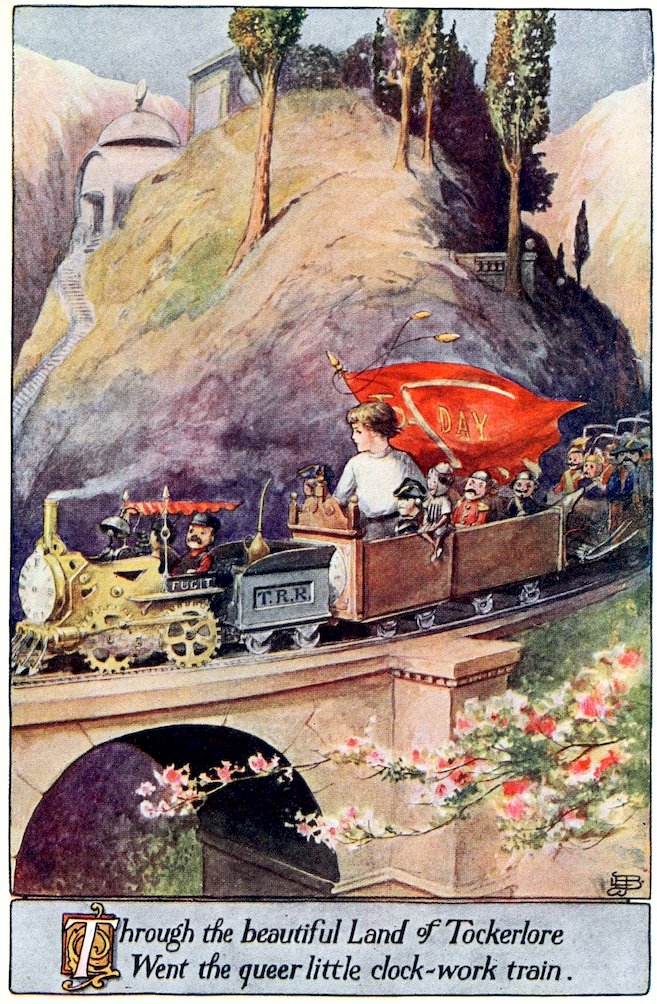
’Tis the clock-work train leaving Minutel
On its way to Tickerleen.
“And that means, in plain language, that we’ve
missed it! And there won’t be another till that gets
back, for there’s only one train. There, that’s the last
you’ll see of it, for it’s gone behind the mountains.
It’ll be in Chymerline before you and I get to Minutel.
Now, step down this way.”
“That’s too bad,” said the little boy, as he stepped
52down, “but we can wait in Minutel, can’t we? We’ll
want to see the village anyway, I suppose.”
“Yes, but I don’t know how long we’ll have to wait.
Minutel is an old-fashioned place, filled with queer,
old hours,—Pilgrim hours, and Puritan hours, and
that sort; there’s not much to do there unless you want
to listen to their prosy chaff.”
“Oh, I’ve heard about the Pilgrims landing on Plymouth
Rock, and I like stories of that kind,” said the
boy. “Do you suppose the hour is there who saw
them land?”
“Yes, I suppose so—Look out, don’t fall!”
“Is the train usually on time?” asked the little
boy.
“Yes, always,—except once I believe it lost three
minutes, but the engineer got them back again.”
“Made them up, you mean?”
“No, he lost them somewhere between Snooze and
Tickerleen, so he advertised in the Tickerleen papers
and some one who had picked them up returned them.”
“What!” said the little boy, standing stark still
53and staring at the Imp. “Do you mean that those
minutes were brought back to him?”
“Yes; what a curious little boy you are! You
seem to think that nobody is honest. First Father
Time is suspected of stealing mountains. Then you
seem to be surprised that there is a single person in
the whole great city of Tickerleen honourable enough
to return three little golden minutes which he knew
didn’t belong to him!”
“It isn’t that,” said the little boy, as they picked
their way along down into the valley from the rocky
ledge, “but it seems so funny—oh, well, I suppose
things are different here.”
Soon they found themselves on level ground and
hastened across some wide meadow land where they
found a part of the road they had seen from the hill,
and falling into it they saw at once how it led out of
the valley up into Minutel, which was on the side of
a mountain, not very far up.
“Wasn’t that a funny song?” said the little boy,
as he trudged along up the winding road, watching
the ground beneath him lest it should come to life
again and shake him off. “I don’t think I ever heard
such an odd song; it was meant to be funny, wasn’t
it?”
“What song was that?”
“The song the minstrels were singing as we came
in.”
54“I thought it was beautiful and stirring,” said the
Imp.
“I thought it was funny about the ships being tied
to the barnyard door.”
“O-oh, I don’t know, I suppose they must be tied
somewhere; it’s just a matter of taste.”
“And the cod-fish coming out of his hole in the
rain!”
“Yes,” said the Imp, “I’ll admit that was rather
strange.”
“I’m glad that you agree with me at last,” said the
little boy, “for I was beginning to think that nothing
would ever seem strange to you.”
“Yes, that was strange,” said the Imp, “I can’t
understand it.”
“And the cod liver oil part—the bowl of cod liver
oil, you know. I thought that was odd.”
“Yes,” said the Imp, “that was the queerest part.”
“Ha, ha!” laughed the little boy.
“Very strange!” said the Imp.
The little boy seemed to be quite encouraged that
he and his guide had come to an agreement about
something at last, and he laughed uproariously as he
thought over the rest of the minstrels’ song.
“The idea of his taking cod liver oil for his health
and then coming out in the rain!” said the Imp.
“I should think that he would have had better sense;
that was a strange thing to do, I’ll admit.”
55The little boy’s face became very serious again as
he heard this, and a look of disappointment was plainly
visible in his big eyes.
“I didn’t mean that his coming out was strange,
but his having a hole; I thought that was queer.”
The Imp stopped in the middle of the road, and
looked at the little boy in utter astonishment. The
poor little fellow was quite uncomfortable at being so
sternly scrutinized, but he could only stand still too,
and wait. Then the Imp spoke very slowly as if he
wanted to make sure that the little boy understood
every word,
“If you were taking medicine in such a quantity
as that cod-fish—that is, if you were taking a whole
bowl of something for your health—I ask you if you
would come out in a rain storm. Now answer!”
“No, I wouldn’t, but—”
“No, you wouldn’t, of course you wouldn’t! Then
it was strange for him to come out and do it, wasn’t
it?”
“Yes, it was, but—”
“There is no ‘but’ about it; it was a foolhardy
and absurd thing to do, and it was strange, as you
said yourself.”
The little boy was about to speak when he changed
his mind and decided that it was of no use. But he
resolved to ask Father Time a few questions if His
56Majesty was willing to give
him an audience when they
got to the royal city.
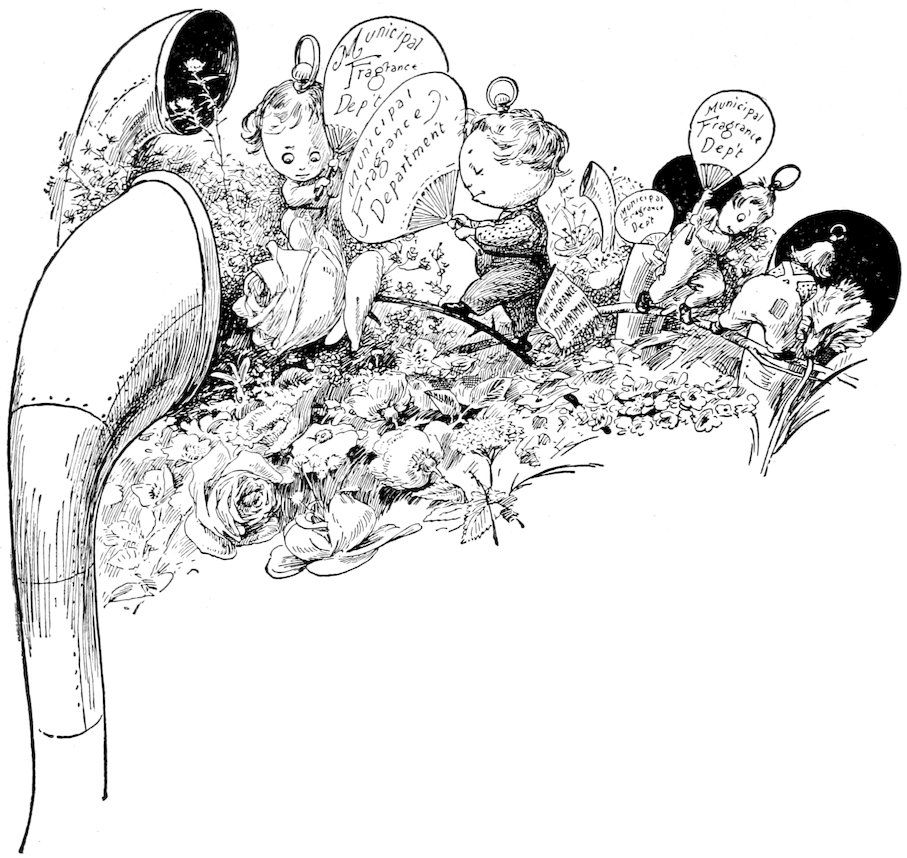
Soon they reached the Fields of Fragrant Flowers,
which were just outside of the village. Many little
imps were here, roaming about amid a veritable forest
of fragrant plants, and fanning the air into large
funnels which rose here and there among the flowers,
and which looked like the pipes the little boy had
seen on the big ocean liner on which his parents had
taken him abroad, and which he had been told were
for the purpose of carrying air down into the staterooms
below.
They sat on the fence a while to rest and watch
the imps who were wandering here and there and
57fanning vigorously. Now and then a head would peer
up from the clustering plants and take a peep at the
little boy and then disappear again. Finally the little
fellow noticed that many of the imps were stopping
their work and joining a group where an animated
conversation seemed to be going on. He watched them
eagerly, supposing that something queer must have
happened, and that perhaps one of them had been
too stubborn to admit its queerness, and the rest were
arguing with him. At last, to his great surprise, one
of the little imps came running through the flowers
till he almost reached the fence, where he stood and
beckoned to the little boy to come inside.
“Shall I go?” said the little boy.
“Certainly,” said his friend, “they won’t hurt
you.”
“I suppose they must have been talking about me;
don’t you think so?” said the child.
“I shouldn’t be surprised,” responded his guide.
“You’d better go in and see what they want.”
The little boy jumped down from the fence and
hastened through the flowers till he reached the Imp,
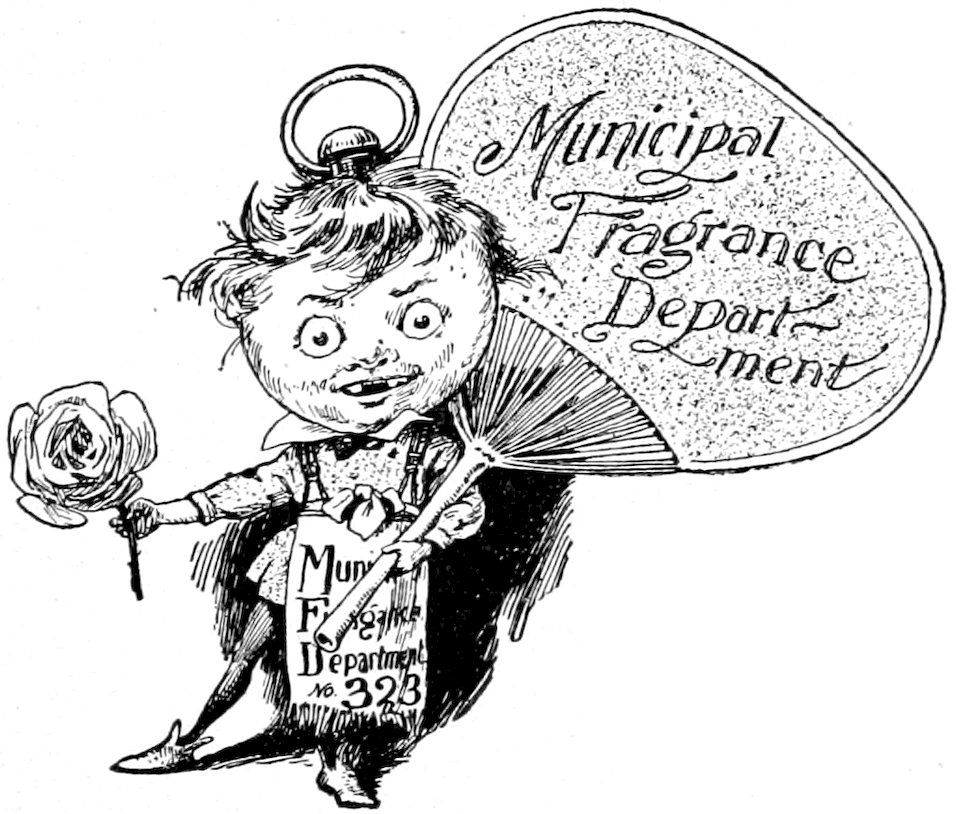
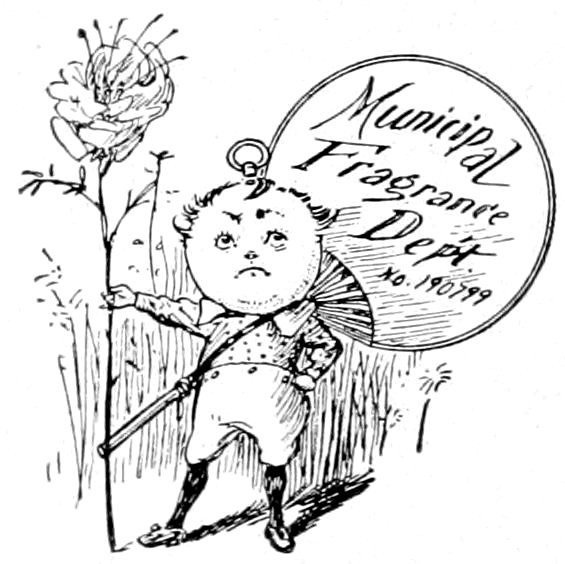
who, he now saw, was smaller than his travelling companion,
but whose fan was perfectly gigantic. He wore
a badge which said “Municipal Fragrance Department,”
with a number underneath the words.
“What is it you want?” asked the little boy.
“Come back here; we want to speak with you,”
58said the Imp. So the little boy followed him back to
the corner where the rest of the Municipal Fragrance
Department workers were standing.
“How do you do?” said one of them.
“I’m very well,” said the little boy, “except my
eyes hurt me. What do you want to see me about?”
“Where do you come from—the earth?”
“Yes, I’m here to see the Land of Tockerlore.”
“Who is your friend?”
“His name is Three O’clock. He invited me;
wasn’t it all right?”
“Oh, yes, there are a good many Three O’clocks
here; one comes about every day. Have you seen
anything strange, unusual?”
The little boy looked back toward the fence to
make sure his friend could not overhear the conversation.
There was no danger of this, however, for his
friendly guide was swinging his legs and singing a
boisterous song about what an unpleasant thing school
was.
“He’s very prejudiced against schools,” said the
little boy. “I don’t know why, I’m sure. No, I
haven’t seen anything so very strange, but he tells
me strange things. I don’t know what to think of
them; I don’t want to be impolite with him.”
“No, certainly not,” said the group, “you are quite
right.”
“What did I tell you?” said one imp.
59“I thought he wouldn’t understand,” said another.
“Didn’t I say we ought to set him right?” said a
third.
“It is just as I suspected,” observed a fourth.
“There ought to be some one out on the frontier to
inform visitors; they get all confused before they’re
in the land. I’m glad we called him in,” and he
looked about at the others as if he thought they ought
to thank him for his thoughtfulness.
“My dear little boy,” said one of the imps, “there
is nothing strange about Tockerlore, but the Earth,
where you come from, is a queer place. Consequently,
when you come here things appear strange when they
really are not so. Scarcely a week passes but some
visitor goes by here—invited, I suppose, by a friendly
hour—and we always notice how surprised he seems
to be. Now if you will just let me pin this flower on
your blouse, it will set you right until you get to Tickerleen,
where you won’t need it. They have so much
fragrance there from the
pipes that you won’t need
any flower, but Minutel
has no municipal
supply, and
only gets what fragrance
the free air
supplies, and that
isn’t much. Now run along—you
60came up through the Snooze Valley from the frontier,
didn’t you?”
“Yes, was that the Snooze Valley?” said the
child.
“That was the Snooze Valley. Good-bye.”
“Good-bye,” said the little boy, “and I thank you—I
really thank you very much if it will make me see
things right.”
The imps all nodded as he ran away, and as he and
his friend proceeded along the road, he turned and
saw that they were all at work again, fanning with
all their might and main. He explained to the Imp
what they had done, and the Imp seemed to think it
was a good idea.
“I only hope it will work,” said he, “for you are
the strangest child I ever knew.”
61
63
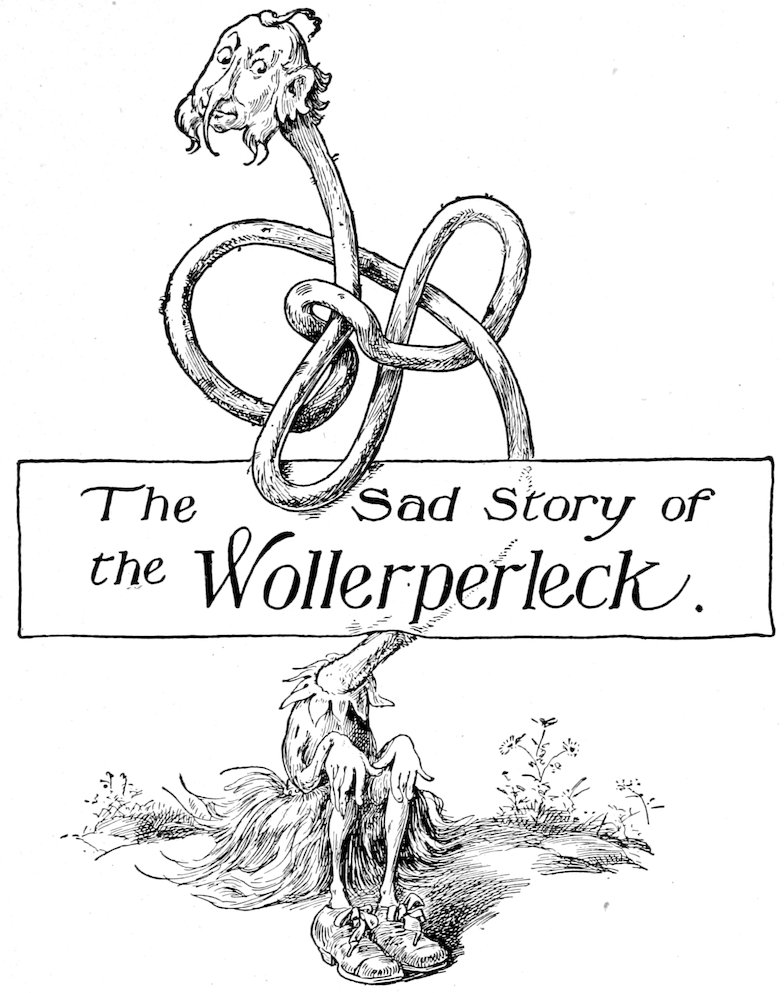
THE SAD STORY OF THE WOLLERPERLECK
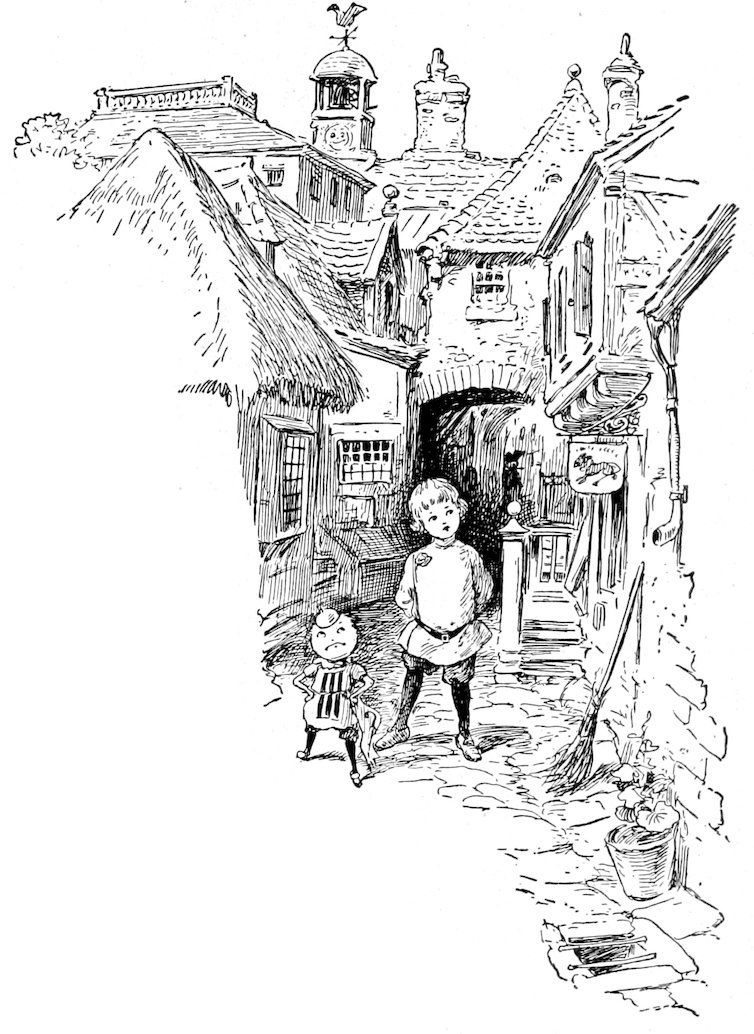
So they trudged along the curious road
Till the village was quite in view,—
A funny old town with crooked lanes
And houses all askew;
And some of them seemed to be tumbling down,
And not a thing was new.
And the place seemed wrapped in a drowsy calm
Which pervaded the very air,
And nobody took the slightest heed
That one of the weary pair
Was a little boy from some distant sphere,—
And nobody seemed to care:
64And the sleepy bell on the little church,
Which was chiming sadly and low,
Seemed lost in a dreamy reverie,
In its swinging to and fro;
Seemed lost in a vision of other things,
In the days of long ago.
They hastened along to the Hairspring Inn,
(’Twas the place where they’d seen the lights)
And said, “We have brought four tired legs,
And two splendid appetites.
Have you room, mine host, for a little boy
Who wants to see the sights?”
“We have,” said the host, “but my house is old,
And I shouldn’t neglect to state
That I’m doubtful if the place would do
For a boy who is up to date;
For the china we use is quite passé—
As well as the silver plate.
“And the bread that we serve is quite antique—
Though it’s thought to be very fine
By antiquarians living here,
Who frequently stop to dine—
And all of our biscuits and pies were made
In seventeen twenty-nine.”
65“You see,” said the Imp, drawing the little boy
aside, “he is inclined to be perfectly honest; he doesn’t
want to have you stop here and then be dissatisfied.”
“Is he an hour?” asked the little boy.
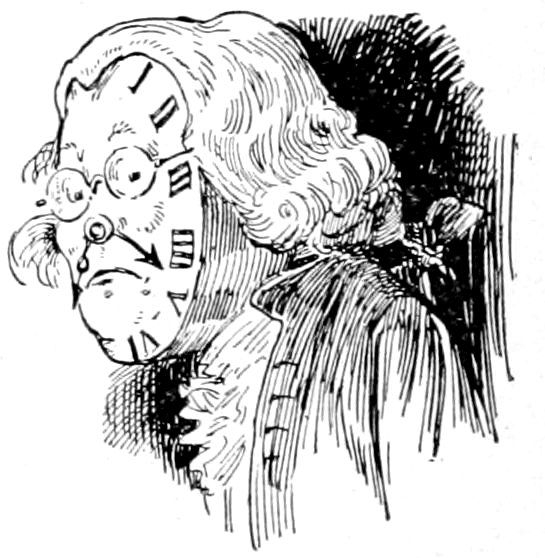
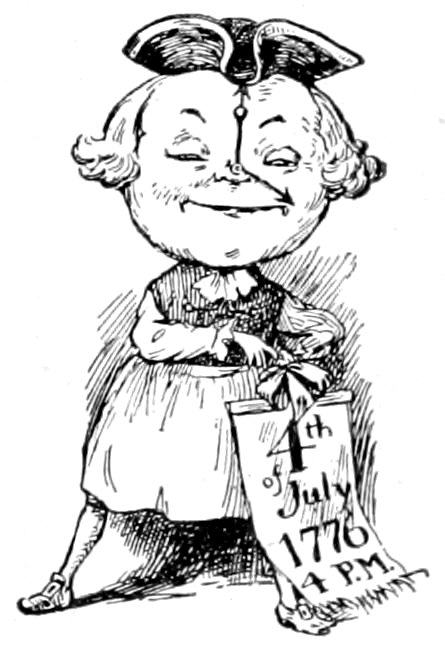
“Certainly, every imp you meet here is an hour.
Just look on his badge and you’ll see what hour he is;
Fourth of July, 1776, 4 P. M.—That was the day
the Declaration of Independence was signed, wasn’t
it? He ought to have some interesting things to tell.”
Then the Imp walked back to the counter where
the innkeeper was standing, and said:
“Pardon me, good host, I interrupted you; you
were telling us about your house, I believe. Pray
continue.”
“And I haven’t a doubt,” the host remarked,
As the Imp and the boy sat down,
“That you’ll want to see our quaint, old club,
Which enjoys a wide renown.
It meets in a tumble-down, queer, old house,
At the other end of town.
“There’s a little poem which I used to know,
From a paper in Tickerleen,
By some one who spent the summer here,
And went to the club, I mean,
And he wrote the poem on arriving home,
Describing the things he’d seen.”
66“Oh, try to remember it,” said the child,
“And I hope that you surely can,
For I am old-fashioned, people say,—
Can’t you think how it began?”
And the host he smiled and presently said,
“I think that the stanzas ran,—
“‘When the twilight slowly lowers,
On the Fields of Fragrant Flowers,
Then the good, old-fashioned hours,
With their quaint, old-fashioned ways,
“‘With their pointed, antique noses,
And their doublets and their hoses,
Meet to talk when business closes,
Of the good, old-fashioned days.
“‘All unheedful of each mocker,
Each arrives and bangs the knocker,
And proceeding to his rocker,
He begins at once to flay
“‘Every sociable and smoker,
Every modern, flippant joker,
And observes how mediocre
Is the joking of to-day.
67“‘All unheedful of inventions,
In their queer, old-time conventions,
Not a member even mentions
Such a word as “telephone.”
“‘And they scorn all modern folly,
And denounce the useful trolley,
And are seized with melancholy
If they hear a megaphone!
“‘And upon a quaint old bracket,
Each one hangs his funny jacket,
And they have a quaint old racket,
In the queer old house they use.
“‘You can hear their solemn laughing,
And their Puritanic chaffing,
And suspicious sounds of quaffing,
As they tell their good old news.
“‘Of the quaint old times, untainted,
Of events quite often painted,
And with which we’re all acquainted,
But which never lose their spell;
68“‘Of the knowledge they acquired,
Ere their time on earth expired,
And they quietly retired
To the town of Minutel.’”
“We’ll take that in,” laughed the gay little Imp,
“Is there any especial date?
For we’re on our way to Tickerleen;
How long shall we have to wait?”
“They meet,” said the host, “as I understand,
On Fridays, at half-past eight.”
“And the train next starting for Tickerleen,—
May I ask you when that will leave?”
“The train will depart,—now, let me see,
On Saturday, I believe.
It will get back here at Saturday noon,
And start on Saturday eve.”
69“Ah, that will be fine!” said the little Imp,
“And our plans will come out just right;
It’s Thursday now, and we’ll do the club
When it meets to-morrow night,
And to-night we’ll stay in this cosy inn,
And sit by the fire bright.”
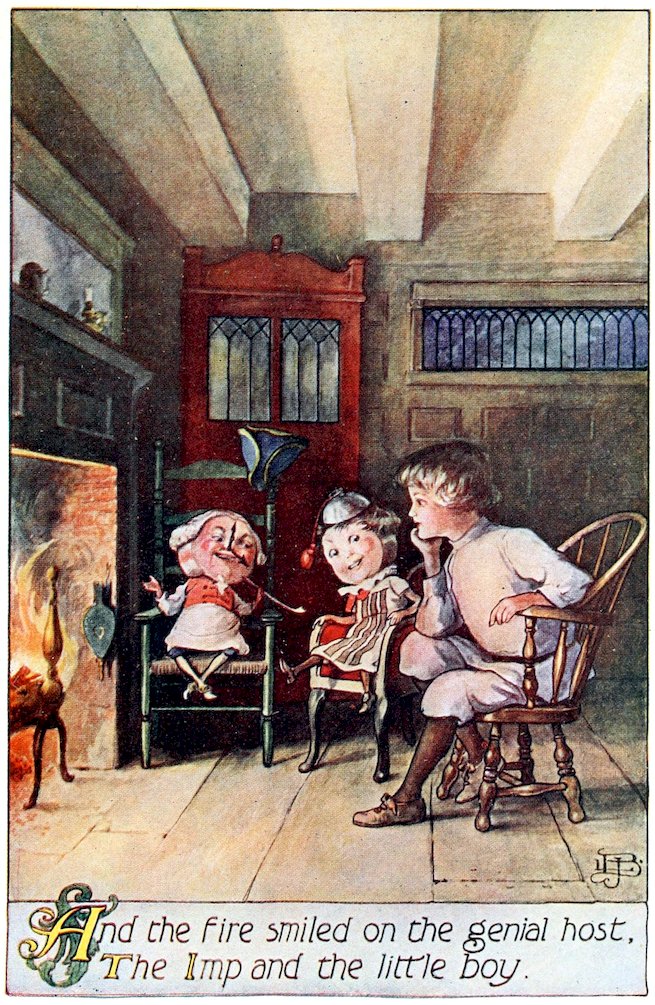
So they drew close up to the cheerful blaze,
And the host began to employ
The time in relating many tales
Which the child received with joy;
And the fire smiled on the genial host,
The Imp, and the little boy.
And the sound borne in on the soft, still air
From the drowsily chiming bell,
Seemed to say, “Those good, old-fashioned tales
Are ones that I know quite well,
For they’re all about things I saw myself
In the village of Minutel.”
“May I ask you, please,” said the little boy,
“There’s a story of old folk-lore
That I heard about, and I want to know—
Would you tell me just one more?
It’s the legend about those funny roads
In the Land of Tockerlore.”
70“I will,” said the host, as he settled down,
“But you’ll think it is sad, I fear.
You know the valley you came across
Before you arrived up here?
The valley that separates Minutel
From the mountainous frontier?
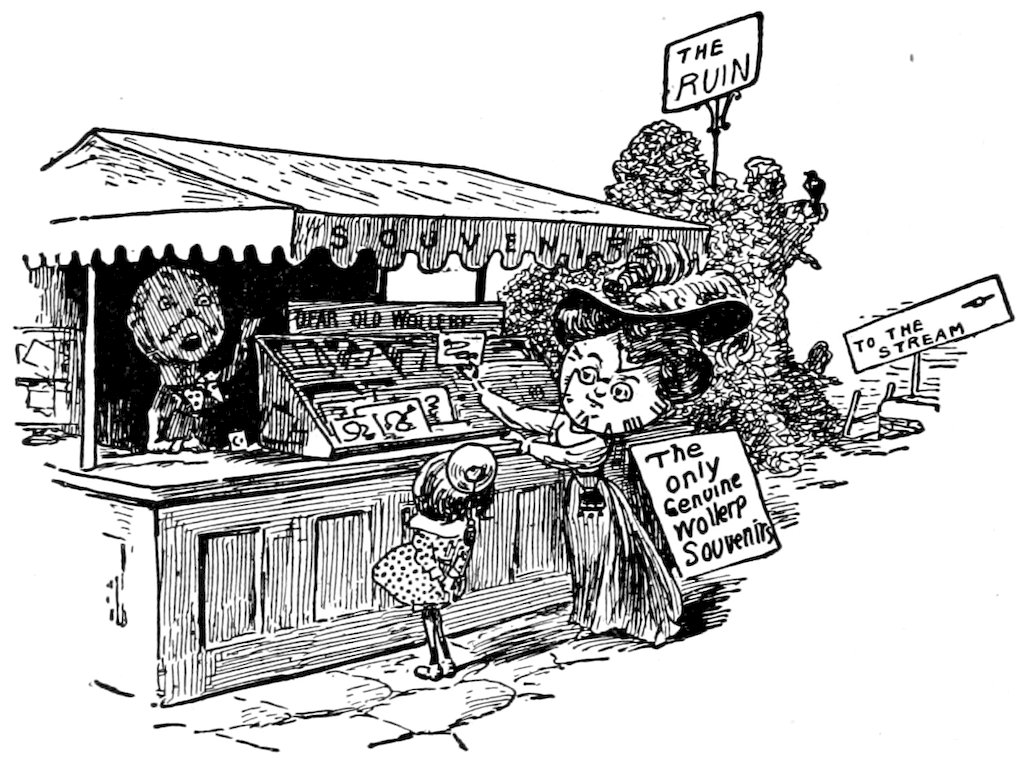
“Did you notice along a narrow stream
A ruin, all mossy and old,
And near it a little vender’s stand,
Where souvenir cards are sold?
It’s about the ruin along that stream
The following tale is told—”
71
The Wollerperleck or The Legend of the Roads
In the mystical land of the Hours,
In the beautiful valley of Snooze
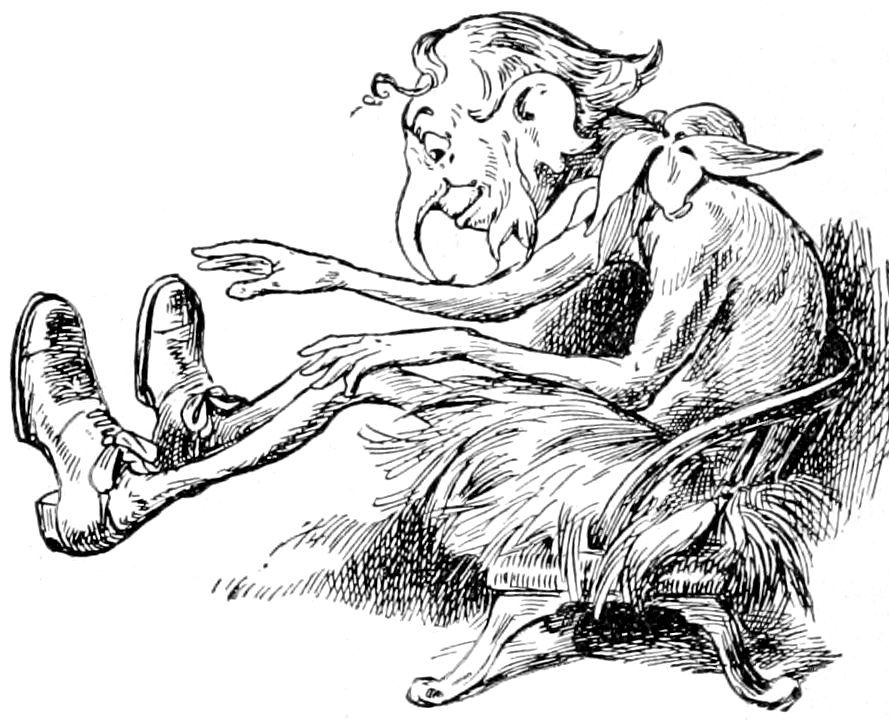
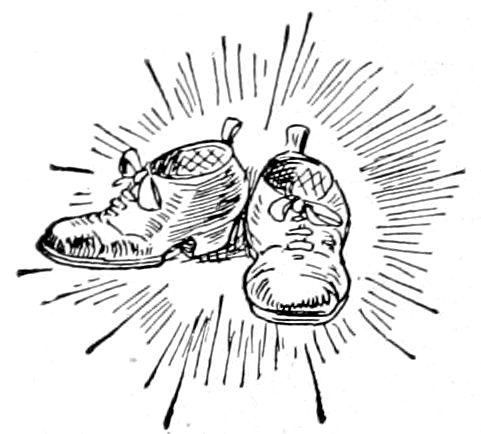
Lived a Wollerperleck, with a wabbly neck
And a pair of russet shoes.
He resided alone in the valley,
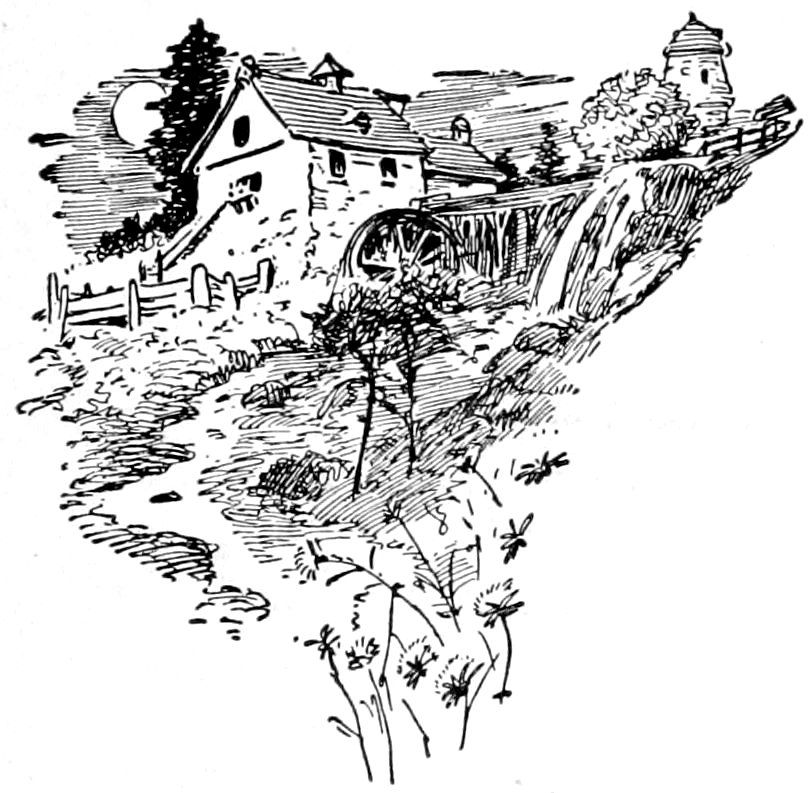
Near a brooklet with murmuring rills,
With the moon, you know, and a tree or so,
And a couple of rustic mills.
The surroundings were simply perfection,
For the scenery on every hand
Was of rarest hue, and even the dew
Was of an imported brand.
And the sunshine which gilded the meadows
And illumined each showery tear,
I’m happy to state, was of triple plate
And warranted for a year.
72And the maidens who passed in the evening
Would incessantly loiter and stand
By the fence near by, and giggle and sigh,
And remark, “He is simply grand!”
And he noted their flattering comments,
And the way that they’d gurgle and gush,
And he entered each look in a leather book,
And credited every blush.
And the maidens, embracing each pretext
(It was all that they had to embrace),
Would cluster together and talk of the weather,
In front of the Wollerp’s place.
And they gave not a thought as they practised
Each alluring and innocent art
And swung on his gate, that as sure as fate
They were breaking that Wollerp’s heart.
And it’s woe to their maidenly graces!
And alas, for each innocent gaze!
Oh, woe and alack and a liberal stack
Of sorrowful welladays!
Oh, alas, that a maiden should flatter!
And alas, that they never could see
73How each ominous word was overheard
By the miserable flatteree!
In the past his young life had been simple,
Unaccustomed to people and news.
He’d sit by the fire for days and admire
His beautiful russet shoes.
But the happiest life can be broken,
And its blessed contentments escape,
Or, like to the neck of the Wollerperleck,
Be twisted all out of shape.
In the mystical land of the Hours,
In the beautiful valley of Snooze
That Wollerperleck, he became a wreck,
And took off his russet shoes.
It was little he cared for their beauty,
And he had no intention to wed,
But a silly desire consumed him like fire
To hear what those maidens said.
When they likened his eyes to the heavens,
And his rippling laugh to a brook,
The Wollerp, concealed by some rock in his field,
Would enter it in his book.
74He would listen in rapt consternation,
And his curious intellect burned
To such an extent that his neck was bent,
And his head completely turned.
When they spoke of him as an Apollo,
In their fervent but innocent way,
He would open his book with a fiendish look,
And enter it under “A.”
And each sigh, and each giggle and simper,
And each sweet exhibition of guile,
And each movement of grace had its regular place
In his patented index file.
But I cannot conceal the finale,
Nor the lesson it’s certain to teach.
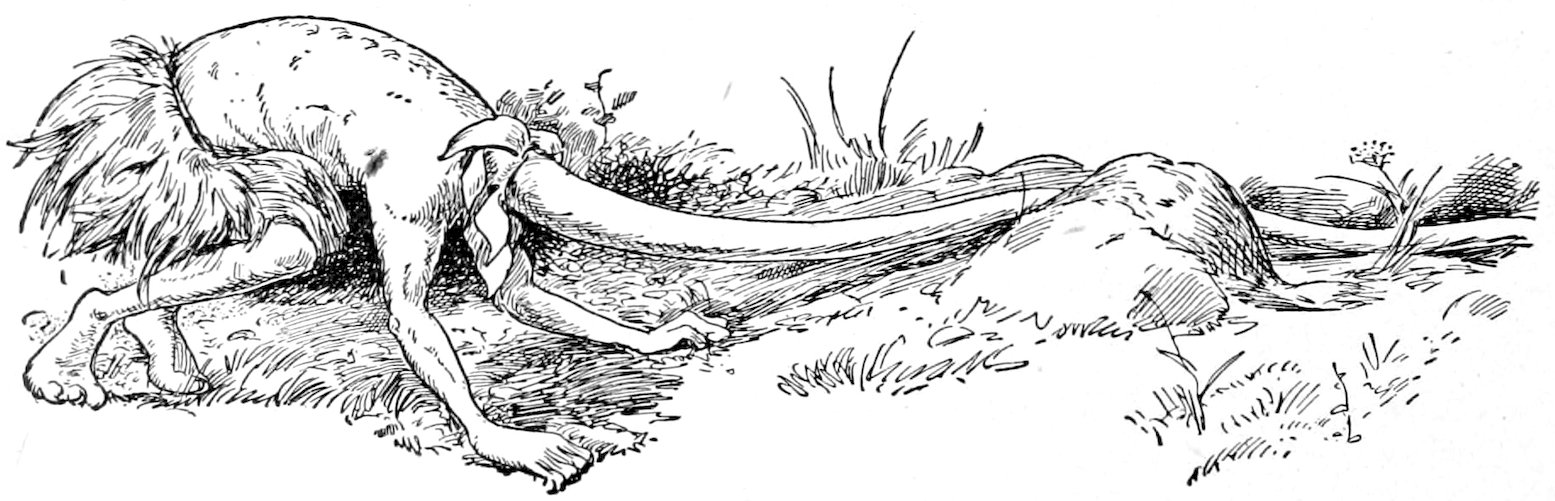
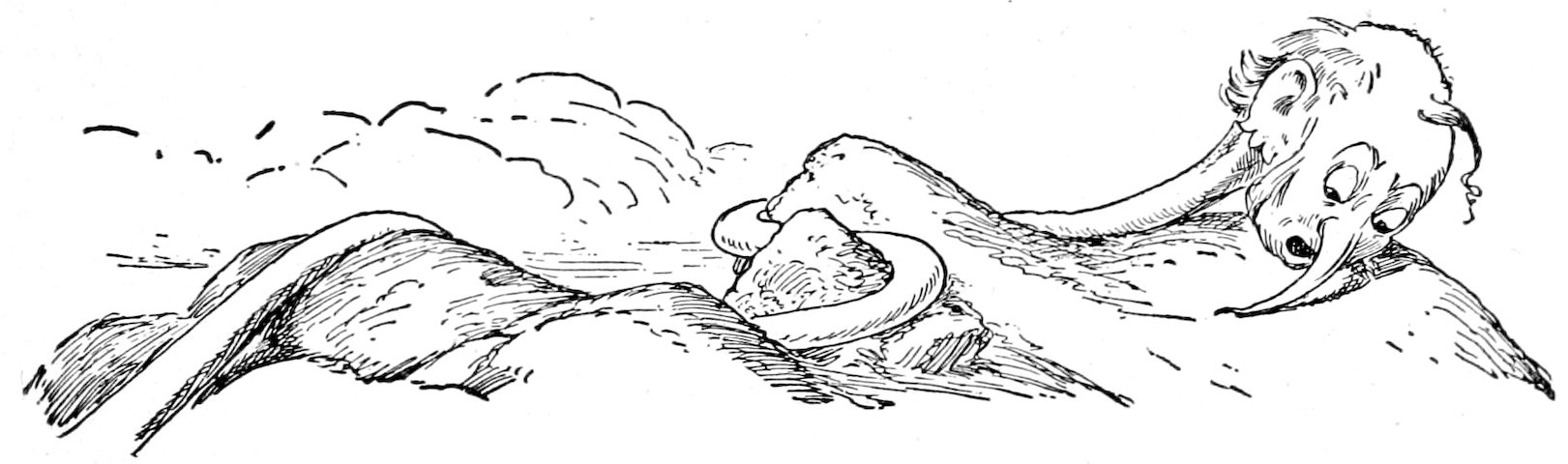
How the beautiful neck of the Wollerperleck
Extended beyond his reach.
How it strayed far beyond the intentions
Which Dame Nature had once entertained;
How it first got askew; then rapidly grew
From being incessantly craned.
75How it wound as it slowly meandered;
How its owner would constantly bend
Its unlimited length with all of his strength,
In search of his other end.
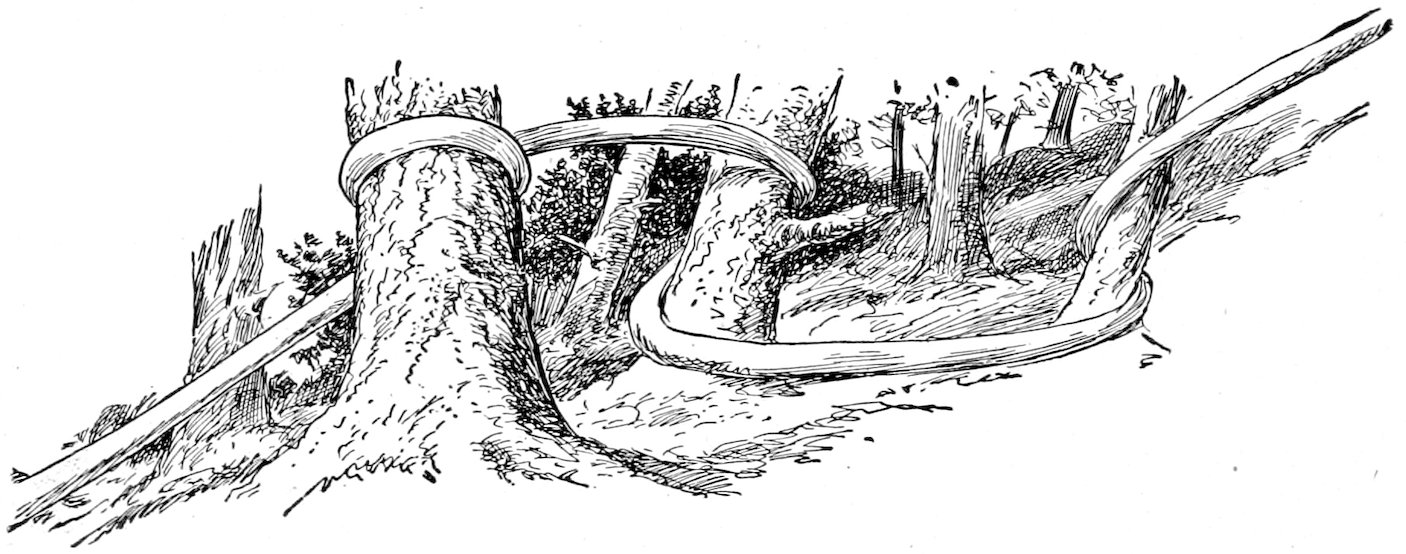
How it entered the Minute Hand Forest,
And explored every leaf bordered track;
How he peered here and there, and with utter despair,
Tried to follow its windings back.
How it curled round the trees of the woodland,
While its body in dreadful suspense,
Would stroll out and wait by the ill-omened gate,
Or sit on the fateful fence.
At his beautiful home in the valley,
In the vine covered cottage at Snooze,
The Wollerp repined and endeavoured to find
His beautiful russet shoes.
And he cried from the Minute Hand Forest,
“I would give my existence to see
76Those beautiful shoes in my home at Snooze!
Oh, where is the rest of me?”
So he felt in each corner and closet,
And he looked high and low for a day,
But his absent mind, it was all confined
In the head that had gone away.
And anon, as he groped round undaunted,
All in spite of his wandering head,
Toward the close of the day a voice seemed to say,
“Have you felt at the foot of the bed?”
’Mid the dismal and wind haunted Forest,
Through its trackless and endless expanse,
For a year and a day, on its sorrowful way,
Did that Wollerp’s head advance.
Till his body came forth from the cottage,
And the gathering populace said,
77“He simply can’t wait, for the strain is too great;
He is going to hunt for his head.”
To the beautiful Minute Hand Forest
He proceeded with might and with main,
And he felt all around his neck on the ground,
But the head had gone out again.
So he followed its curious windings,
All bewildered and weary the while,
And came without harm to the mount of “Alarm”
Near the quaint little hamlet of “Dial;”
And along a steep, rock bordered pathway,
From a dizzy and crooked incline,
Came a voice calling shrill from the top of the hill,
Which said, “I am thine, I am thine!”
And the neck, as it lay o’er the mountain,
Seemed to thrill at each love-laden word,
But the Wollerp was still at the foot of the hill,
For the calling was all unheard.
78And the voice wailing out in the darkness,
Said, “My misery now is complete!
With my body in sight at the foot of the height,
And yet we can never meet!”
And advancing from under its shelter,
Came the head of the Wollerperleck,
And he wailed and he cried, as he shortly espied
The extent of his tangled neck.
For it seemed like some wandering mainspring,
As it wound mid the Tockerlore wild,
All twisted and bent to a shocking extent,
Like a spring in the hands of a child.
And it wound, and meandered, and twisted,
And the head of the Wollerp it saw
How it actually went to the whole extent
Of the Land of Tockerlore!
And remarking its limitless windings,
He perceived how absurd it would be
To endeavour to go to his body below,
For there’d be nothing gained, you see.
So he quietly lived on the mountain,
And his brain kept in touch with his heart,
79But his trunk and his head—so the gossips said—
Had agreed to live apart.
But they acted in amiable concert,
Till their earthly existence was o’er,
And he proudly wrote that his delicate throat
Was the Land of Tockerlore.
And the souvenir hunters from Swipo,
They demolished the cottage at Snooze,
And all his estate which went to probate
Was his beautiful russet shoes.
81
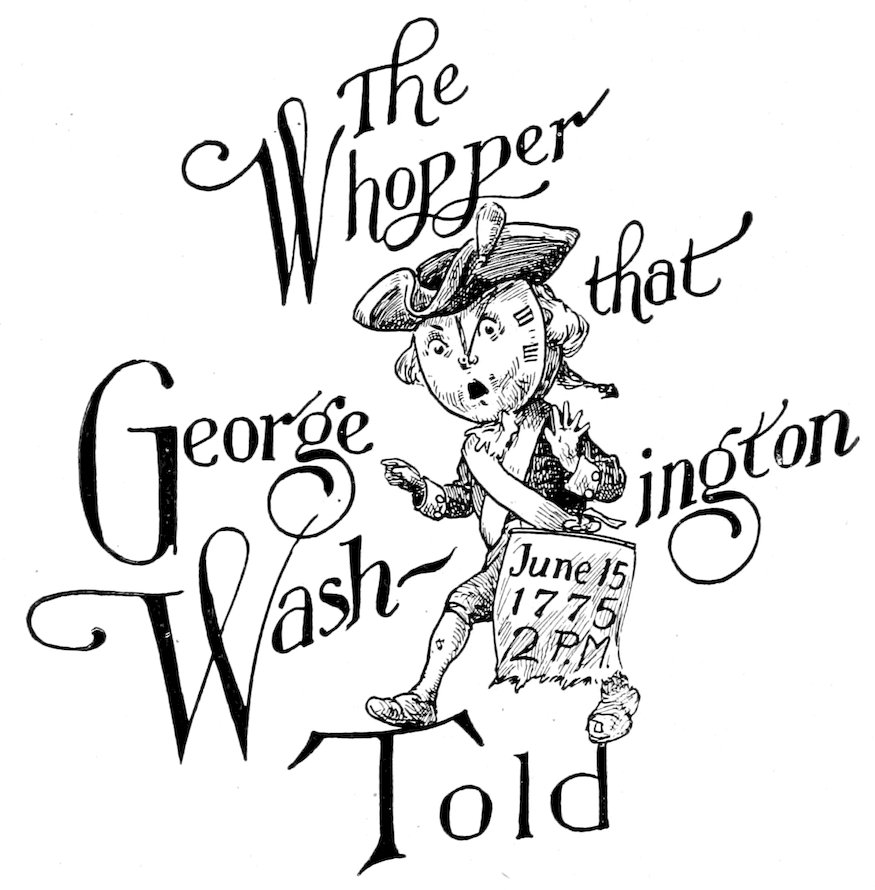
THE WHOPPER THAT GEORGE WASHINGTON TOLD
83
Several times during the host’s narrative the Imp
glanced in the direction of his young friend to see
whether the little fellow appeared surprised at anything
he heard. The child gave no signs, however, to indicate
that he had any doubt as to the perfect accuracy of
the tale, in which he was deeply interested, being visibly
affected toward the end, when his eyes were filled with
tears. The Imp concluded that the flower was working
splendidly, and making the little boy quite sensible in
his way of seeing things.
After a moment or two of meditation into which all
three had fallen when the story was finished, the little
boy said,
“That Wollerp did a fine thing for the country,
didn’t he?”
“Yes, indeed,” said the host, “and it was appreciated,
too. As you go through Chymerline you’ll notice a
monument on the village green; the road goes right
past it. It was put there by the road commissioners
in honour of the noble martyr who saved them the
84trouble of doing their duty. You see, people used to
try to follow the curious windings of the neck, just for
fun, until it got to be a kind of national game. Expeditions
started out continually, until finally ‘Hunting
the Head’ became a perfect fad. They had little
wollerps with long necks to play with indoors, and
they’d tangle the necks up on dining tables, and then
try to follow them with little pointers until they came to
the end. Of course, all this travelling outside made
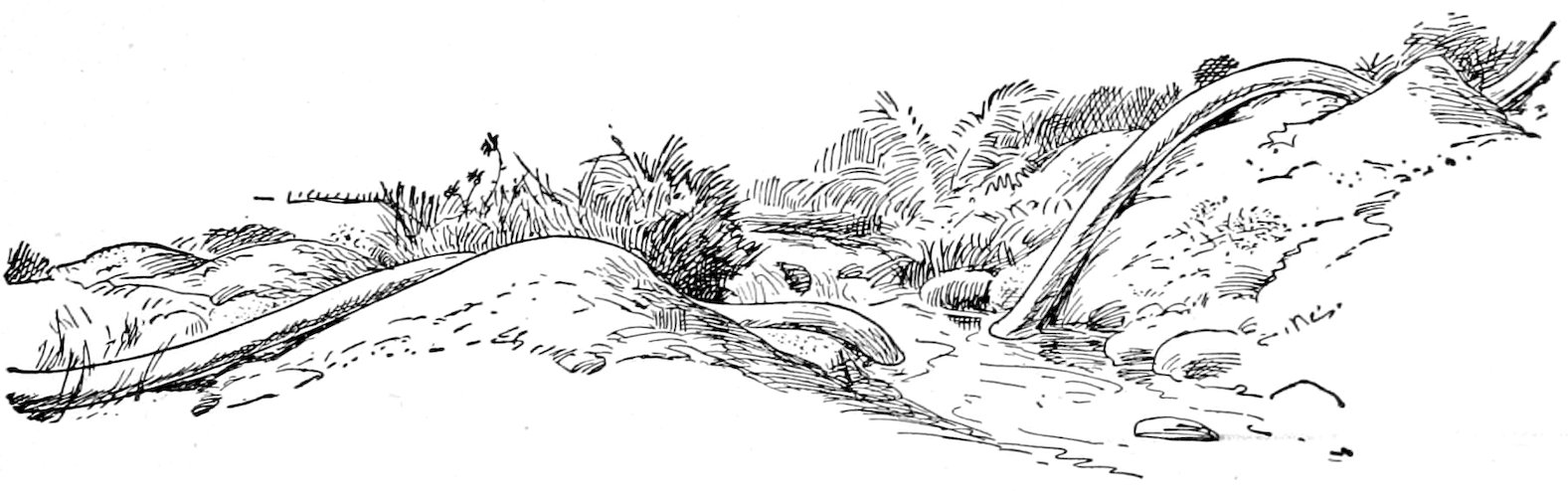
a beaten track, and the track developed into a path,
and the path into a road, and the road into this beautiful
endless highway which is the pride of the Kingdom
and the delight of tourists.
“I remember the day I first got here. It was the
afternoon of the Fourth of July, 1776, and everyone
was saying a little poem. Some had gone crazy trying
to learn to say it. I didn’t know what it meant until
I heard the old road legend. This is how it went:—
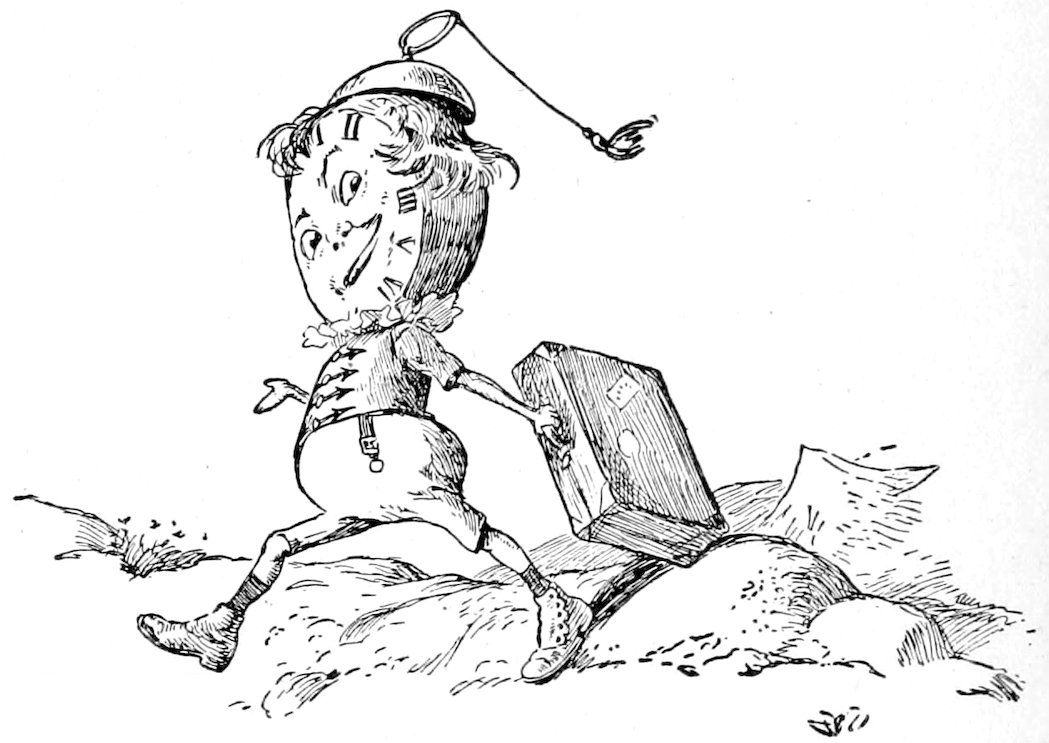
“Said an imp as he buttoned his shoes,
‘I will follow that neck into Snooze,’
And he giggled with glee,
‘What a lark it would be,
I believe it would banish the blues!’
“And taking his suitcase, said he,
‘Now promise, don’t worry for me,
85For I never shall flinch,
It’s a regular cinch,
And as easy as easy can be.’
“But when he arrived at the Ku-
Peremaliganundi of Soo,
He had to go back
On account of the crack
In the Nickuberamelegoo!
In the Nick, in the Nick, in the—”
“Don’t you think we’d better have dinner?” asked
the host, rising. “It’s long past time.”
The little boy did think so, and had thought so for
an hour or more, so he answered that he was perfectly
agreeable, and they all went into the dining-room
where they were soon seated before a steaming tankard
of frizzled strikers with daybreak sauce.
“When is it going to be night?” asked the little
boy, as they finished. For he knew they must have
been in Tockerlore for sometime, and yet it was neither
darker nor lighter than when they had passed the
frontier.
“Why, it’s night now, I suppose,” said the landlord,
“it’s never dark here, you know; the light always
remains as you see it now. Would you like to go to
bed?”
“If you don’t mind,” said the little boy.
86“Mind! Why, certainly I don’t mind. You’ve no
objection to your friend’s sitting up with me a while,
have you?”
“Oh, certainly not, not at all, but would someone
be good enough to help me undo the buttons? I don’t
want to trouble you, but you know I always have nurse
to help me when I go to bed.”
So they both fell to and helped him undo the buttons,
and then the host showed him to his room.
He felt a little homesick as he curled himself up in the
strange bed, and wished that he had his Teddy bear
to talk with and tell things to. However, as he couldn’t
do that, he did the next best thing, and talked to himself,
which, as even grown up people know, is one of
the greatest pleasures in the whole world.
“If that Imp were only fond of school and knew
something about history; if he really cared for them,
how nice it would be, for I suppose he’ll stay here all
the rest of his life. I don’t suppose he ever had a
governess to tell him things—it isn’t his fault. How
many things Father Time must know! Just to think
how that landlord saw the Declaration of Independence
signed, maybe! I wonder if it was signed after lunch.
I think the host’s badge said 4 P. M. Anyway, if he
didn’t see it signed he saw some of the excitement after
it was signed. Maybe he saw Benjamin Franklin. I
wonder if he’ll tell about it while I’m asleep. I wonder
what that place was where the young Imp had to go
87back; I suppose they all laughed at him when they
saw him come walking in. It served him right; he
was too sure. I wonder what that Nickub—that
Nickuber—I wonder what that name was.” But
while he tried to think of it he fell fast asleep.
When he awoke he knew it must be morning, for he
heard voices in the yard beneath his window. There
seemed to be several voices and all of them were very
loud and angry in tone. Some were saying, “No,
he didn’t!” Others were calling, “Yes, he did!”
And still others were exclaiming, “Don’t you believe
a word of it.” Then all the voices would be heard
together in excited argument, and it sounded as if
the owners of these voices might resort to blows at any
minute if the matter under discussion were not settled
very soon. Finally the little boy heard someone shout,
“Go on with what you were saying.”
“I intend to,” another voice answered.
“If it’s the truth, we want to hear it.”
“You’re going to hear it.”
“He’d better look out!”
“Who had?”
“You had.”
“Me?”
“Yes, you.”
“Don’t you believe in free speech?”
“Not that kind.”
“Go on, tell the rest of it.”
88“We’d like to see you do it!”
“You’ll hear me do it.”
“He knows what he’s talking about.”
“He thinks he does, anyway.”
“Go on, tell it!”
“Where did I leave off—oh, I know—
“He did not always justify
The view that you have taken,
And when you say he couldn’t lie—
Why, simply, you’re mistaken.
“And now, in view of all this talk
I think it only proper
To say that on a certain day
I heard him tell a whopper!”
“A whopper, did you really say?”
“We can’t believe it—name the day!”
“’Twas just before I came away,—
I heard him tell a whopper!”
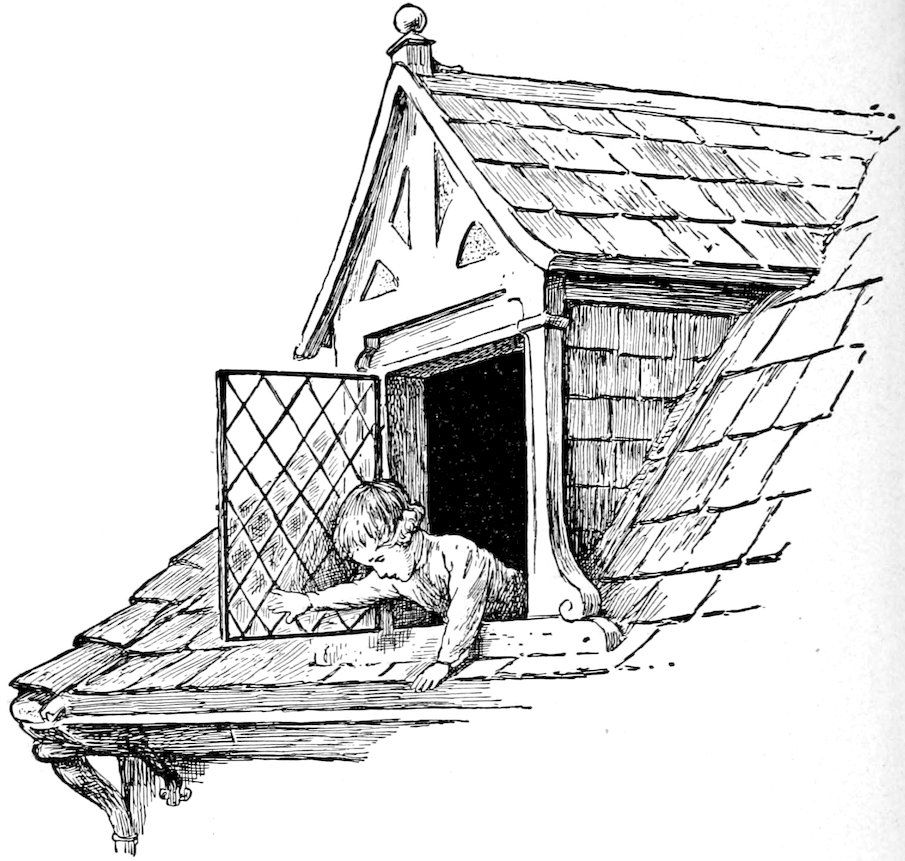
At this the little boy, who had risen and begun to
dress, threw open the window and gazed on the assemblage
below. On the fence sat his friend, Mr. Three
O’clock, swinging his legs and laughing uproariously
89as if the disclosure which had just been made pleased
him greatly. There were several little imps about the
yard, all in colonial costume, some standing, others
sitting, and in the centre stood the imp who had experienced
such difficulty in telling his story. He had on
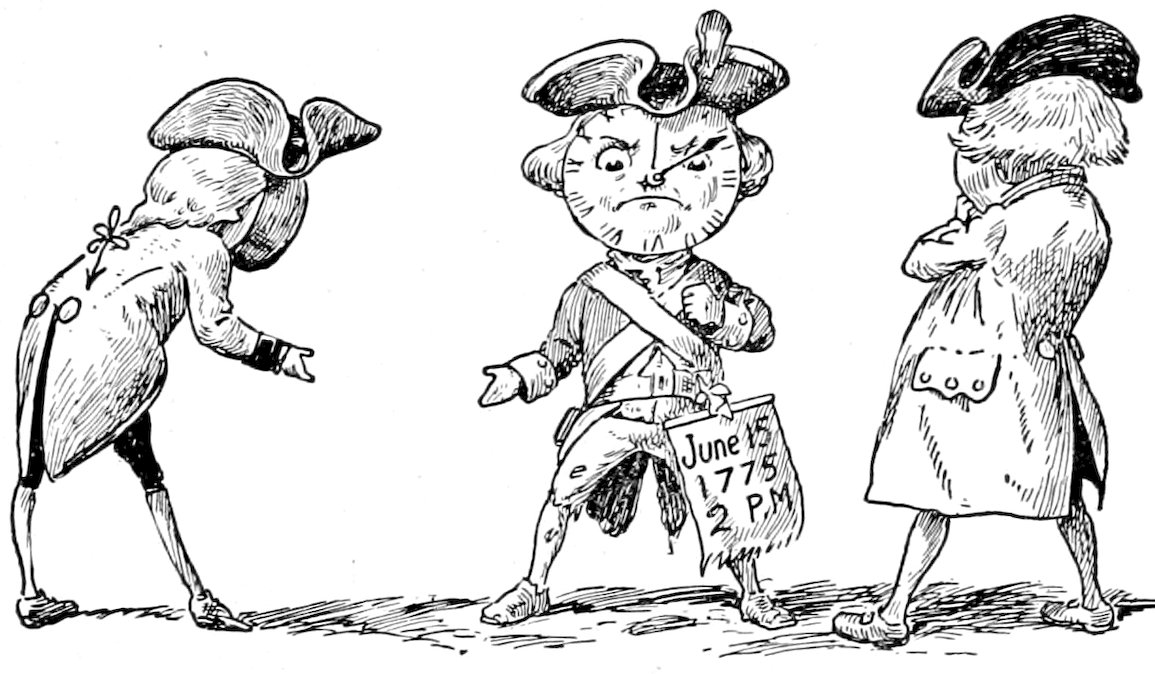
a ragged Continental uniform, and his badge said
“June 15, 1775. 2 P. M.” Altogether, he was very
defiant looking and out of patience.
“Good morning,” said the little boy.
“How do you do,” said the Continental Imp.
“I am very well, thank you; what is the trouble?”
“No trouble at all; who are you?”
“I’m a little boy visiting Minutel. May I ask you
what the quarrelling was about? Did you say someone
told a whopper?”
“That’s exactly what I said.”
“You ought not to say it unless you’re sure it’s
true. May I ask who you said it about: who it was
90that told the whopper? It wasn’t
my friend, was it?”
“No.”
“May I ask who it was?”
“You may; it was George
Washington.”
The little boy started.
“Oh, that is a dreadful thing
to say about George Washington.
I’m sure that
George Washington
never told a whopper;
you know
all the school
books—”
“Now you see how much good the school
books are!” said Mr. Three O’clock, from
the fence. “Ha, ha, ha!”
The little boy gave an indignant look at his hilarious
friend, for it was no laughing matter, and continued
his conversation with the Continental Imp.
“How do you know he told a whopper?”
“I heard him.”
“With your own ears?”
“Yes, whose ears do you suppose I heard him
with?”
The little boy felt to make sure his flower was safely
fastened in his buttonhole, for he did not know what
91the conversation might lead to, and he wanted to be
perfectly reasonable.
“I beg your pardon,” said he, “but are you sure
it was a w-h-o-p-p-e-r?” He was gaping as he said
this, and it stretched the word out a little.
“Positive,” said the Continental Imp.
“Perhaps it was a small whopper?”
“There is no such thing.”
“Or a middle-sized one?”
“No such thing.”
“Oh, I’m sure there must be some mistake, for I’m
sure that a wh-a-a-a-aap-” and he gaped so that he
couldn’t finish the word. “Just wait a minute,” said
he, “and I’ll come down there.”
In less than a minute the little boy came out into the
yard arranging the belt of his Russian suit.
“I have couldn’t all the didn’ts that I buttoned, but
I didn’t the couldn’ts that I didn’t when I buttoned the
didn’ts,” said he, “and I hope you will excuse me.”
“Go back to bed,” said Mr. Three O’clock, “you’re
not awake yet.”
“I am awake,” said the little boy.
“He said he couldn’t the didn’ts,” observed one
imp.
“No, he didn’t, he said he didn’t the buttons that
he couldn’t,” said another.
“He said he buttoned the couldn’ts when he didn’t,”
called a third.
92“I didn’t,” said the little boy, “how could I?”
“Well, how could you didn’t if you couldn’t?”
“He said he buttoned the didn’ts.”
“He didn’t.”
“He said he couldn’t the didn’ts that he buttoned
when he didn’t the buttons—what did you say?”
“Now wait a minute,” said the little boy. “How
easily you get into a quarrel! I will tell you just what
I said. I said that I buttoned all the buttons that I
could button, but that I didn’t button the buttons that
I couldn’t button. There!”
“Talk about whoppers!” said the Continental Imp.
“Well, now what is it you want to know? Let’s get
through with it.”
“I want,” said the little boy, “to know when George
Washington told a whopper.”
“On the 15th of June, 1775, at 2 P. M., just after
they made him commander of the army.”
“Would you mind telling me what the whopper was?
You know all the stories say that George Washington
couldn’t—”
“Oh, yes,” said the Continental Imp, smiling at
Mr. Three O’clock, “we understand, of course, that
George Washington couldn’t if he didn’t and that if
he didn’t—”
“He didn’t,” shouted the little boy, stamping his
foot. “What was the whopper?”
“He said, right in my hearing,” said the Continental
93Imp, “that he wasn’t fit for the exalted position.
There!”
“Well?” said the little boy.
“Well, he was, that’s all,” replied the Continental
Imp.
“You mean,” said the little boy, “that you think
that was a whopper?”
“Well, it certainly wasn’t true, was it?”
“N-no, perhaps not, but he—well, it wasn’t a
whopper.”
“He said he wasn’t fit for the position when he
was, and he said he couldn’t win the war, and he did.”
Here the Continental Imp looked toward Mr. Three
O’clock, who was still sitting on the fence, and said,
“What do you think about that?”
“Do I understand you to say that George Washington
said he wouldn’t win the war?” asked Mr. Three
O’clock.
“Yes.”
“Well, then, I think that, as a gentleman, he should
have kept his word.”
“That is perfectly ridiculous!” said the little boy.
“If he hadn’t won the war there wouldn’t be any
America, and if there wasn’t any America there wouldn’t
be any Tockerlore, and where would you all be, I’d
like to know?”
“You don’t think Tockerlore is in America, do
you?” asked one.
94“Where is it, then?”
“It’s right here where Father Time put it.”
“He didn’t,” said the little boy, whose patience
was almost exhausted.
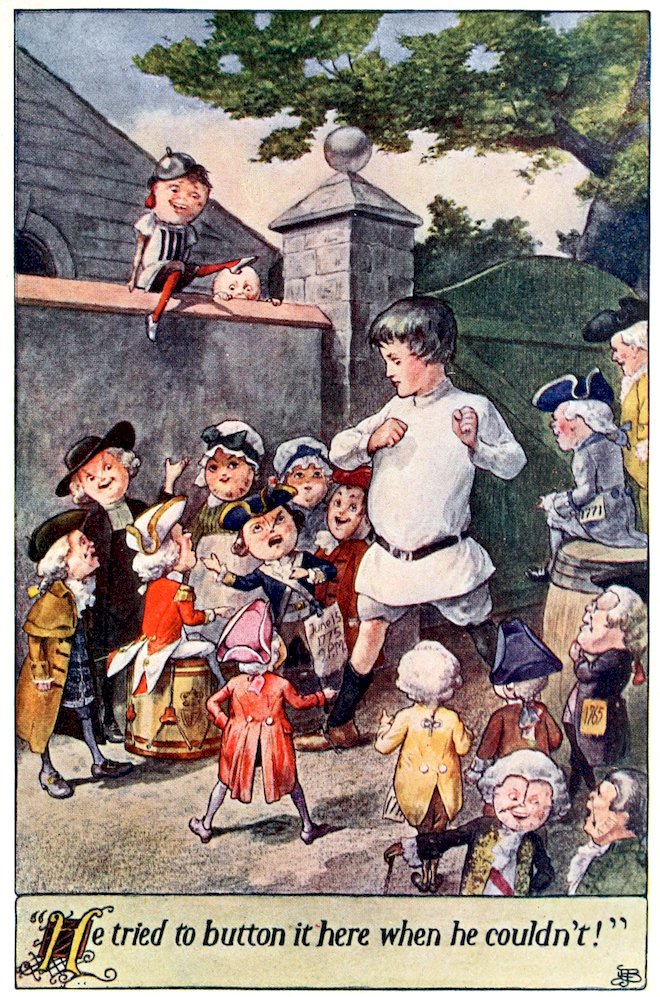
“He tried to button it here when he couldn’t, so
he didn’t!” roared the Continental Imp.
“He couldn’t,” said the little boy, white with
rage.
“Well, then, if he couldn’t, he probably didn’t!”
yelled Mr. Three O’clock.
“He didn’t, he couldn’t!” screamed the little boy,
quite beside himself. “And if I say he didn’t, he
couldn’t, and don’t say that he couldn’t when he
buttoned the couldn’ts to the didn’ts, if he didn’t
the couldn’ts when the buttons didn’t—!!!”
“Come to breakfast!” called the genial host,
standing in the doorway and smiling broadly at the
little boy. So they all scampered in to the dining-room,
where a large platter of delicate little second
hands (done, of course, to a turn), with delicious
eight day gravy, was awaiting them.
95
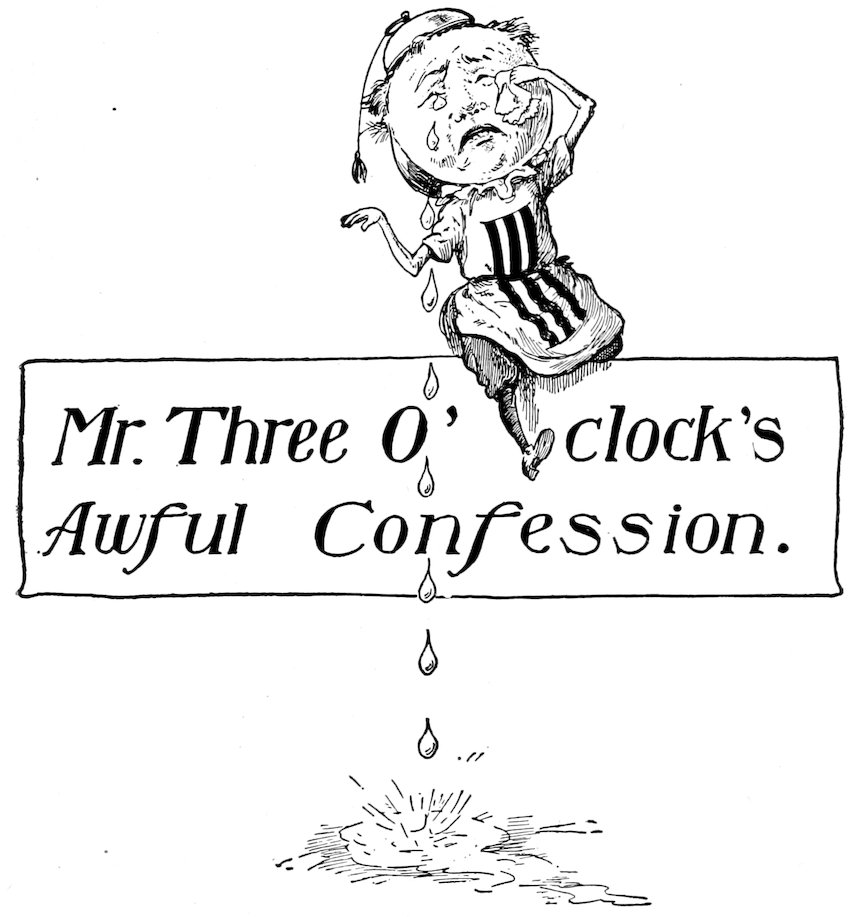
MR. THREE O’CLOCK’S AWFUL CONFESSION
97
And now could be heard in the village street
A monotonous calling sound,
And many a drowsy sluggard rose
From a slumber all profound;
’Twas the village crier of Minutel
On his early morning round.
“Be up and astir!” they could hear him cry,
As he paused at each door to knock,
And hearing no sound, would bang and call,
And angrily try each lock.
98“Did ye sleep like this in ye olden time,
When ye lived inside the clock?”
For the old-fashioned hours in Minutel,
Regarding their duties as through,
Would frequently lie asleep all day,
At least, till their time was due;
For example, the “Twelves” would rise at noon,
But the “Twos” would sleep till two.
“You are up betimes,” said the genial host,
As he ladled the breakfast out,
“And to-day, I expect, you’ll see the town
By wandering all about.
Will you have your ticklets, my honoured guest,
With twinkling sauce, or without?
“These ticklets were made in Seventy-six,
They are nice as a second course.
Just hear the crier along the street;
He’s turning them out by force!
May I trouble you, Mr. Three O’clock,
To pass the twinkling sauce?”
“How luscious and rich,” said the little boy,
“Is this ‘pendulum shake’ with ice.”
“Ha, ha!” said the host, “Indeed it is,
But think of the dreadful price
99To bring it a couple of billion miles!
These hunting case flips are nice.
“Won’t you have this dickery dock croquette,
The only one left on the plate?
That soft whipped cream which you see inside
Was whipped in Seventeen eight.
Ah, the rod, little boy, was seldom spared
At that very early date.”
“Yes, indeed,” said the host, as he wiped his mouth,
and folded his calendar-page napkin, “yes, indeed,
they seldom spared the rod in those good old days in
your world. That’s why the children grew up so good,
I suppose, and that is probably why the good old
cooking was so much better than the cooking of to-day.
Such mashings as the potatoes and turnips got, such
unmerciful beatings as the poor little eggs had to undergo;
it’s no wonder that few eggs were bad! And how
they used to whip the cream—no wonder it was
good; if you were whipped as much as this cream
was, you’d be good; they whipped it till it was white
in the face.”
“I am good,” said the little boy. “Did you say
that in Minutel they do the same things they used to
do when they lived in the world?”
“Don’t you be afraid,” said the Continental Imp.
“They’ll not hurt you.”
100“No indeed,” said Mr. Three O’clock, as they all
rose, “we’ll stay together and protect ourselves.”
“By the way,” said the Continental Imp, “do you
know, I believe I’ll run up to Tickerleen when you go;
it’s too slow and old-fashioned for me here. I wonder
if you’d have any objection to my going along?”
By this time, they had come out of the house and
were looking about them to determine which way
they would go. The host said he would lock up the
inn for the day and join them. The other imps, whom
the kindly landlord had invited to breakfast out of
the goodness of his heart, scampered off about their
business, and the little boy, the host, the Continental
Imp, and Mr. Three O’clock proceeded leisurely along
the road.
All through the beautiful little village of Minutel
were the houses where the old-fashioned hours lived.
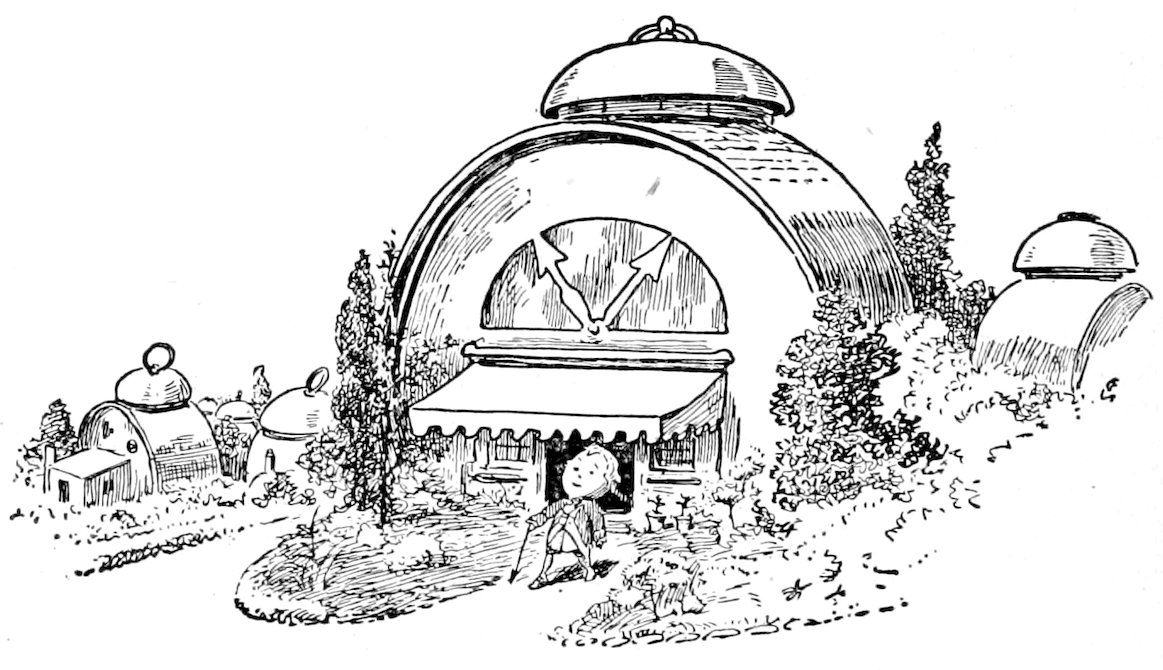
They were queer houses with domes, and from a distance
they looked like so many
alarm clocks with the alarm bells
up on top. There was a
low, drowsy ticking in the
air all the time
which the little
boy couldn’t locate.
He heard
it clearly enough,
yet it seemed
101to be far away—or rather, it seemed to be all about,
like the very breeze. Every now and then the church
bell would chime, which the little boy fancied to be a
clock striking the hour, and he pictured to himself the
village of Minutel as a huge clock with the church bell
as a striker to notify each hour when it was time to
get out, just as the real striker did on the real clock.
The host and the Continental Imp pointed out to
the newly arrived pair the homes of the principal hours.
The little boy was interested to see the house where
the hour lived who saw the Pilgrim Fathers land, and
also the hour which had the pleasure of witnessing
the arrival of Columbus on the shores of the western
world. He also gazed for sometime at the house where
the host told him the hour resided which had seen
George Washington chop down the cherry tree.
“That hour,” said the Continental Imp, “is the
greatest bore in Minutel; he’s always telling what he
saw, and nobody cares anything about it.”
“You know all about it, I suppose,” said the little
boy.
“Yes, I know all about it; he claims that George
Washington never told a lie simply on the strength of
his having told the truth on one particular occasion
when he was a little boy. I don’t deny that he told the
truth about the cherry tree, but I do say that on the
15th of June, 1775, I heard him tell a whop—”
“Stop!” said the little boy.
102“per. There!”
“I wish you wouldn’t say that,” said the little boy,
“because I don’t consider that that was a whopper.”
“Yes, it was,” said Mr. Three O’clock, “and I
agree with our Continental friend here that the hour
you’re speaking of—that Cherry Tree Hour—is a
bore.”
“How do you know he’s a bore when you’ve never
met him?” said the little boy.
At this Mr. Three O’clock turned very white and
seemed quite uncomfortable.
“I don’t see how you know anything about this
land, anyway,” persisted the little boy. “You’ve
never been here before.”
“Yes, how is that?” asked the Continental Imp;
“of course, you’re right, but I don’t see how you know
that you’re right.”
“My understanding,” said the host, “is that you
just arrived—it seems rather unusual—have you
any explanation?”
There was a pause after this, and Mr. Three O’clock
looked very confused. Finally he looked all about him,
and said, “Shh-h!”
“What is it?” asked the little boy.
“He said, ‘Shh-h,’” said the host.
“I know he did,” said the Continental Imp.
“There is a mystery about my life,” said Mr.
Three O’clock, speaking in an impressive whisper,
103“a mystery which I cannot reveal. But under my light
and airy nature, there is a burden on my soul. Do
not force me to reveal it!”
“I am sure you may confide in me,” said the little
boy. “What is the trouble? You seemed so free and
happy when you came out of the clock. I hope—Oh,
I hope that you have never done anything wrong!”
“Alas!” said Mr. Three O’clock, “I am not what
you think I am—I have a past!”
“Have you it with you?” asked the Continental
Imp.
“Suppose you let us see it,” said the host.
“Tell us all about it,” said the little boy, soothingly,
“and then you will feel better. Maybe you are not as
bad as you think you are. Tell us, anyway.”
“I suppose I might as well,” sighed poor little Mr.
Three O’clock, “for Father Time’s secretary, Old
Calendar, will only find it out when I apply for my date
badge, and the whole thing will be made public. They
have a great system; they say the red tape in the government
offices is longer and more tangled than the Wollerp’s
neck! Try not to think ill of me, and as we walk
along I’ll tell you my sad tale.”
They all looked very grave as they paced along in
silence and waited for the culprit to begin. The poor
little imp who had recently danced and laughed so
happily experienced a great deal of difficulty in starting
and several times began with, “’Twas in a little district—”
104and had to break off
again. Finally he succeeded
in conquering his feelings, and told the following
extraordinary tale:
“’Twas in a little district school,
Which I remember well;
A hundred restless little boys
Were waiting for the bell.
’Twas just about a year ago
This awful thing befell!
“The scene was in a country town;
The teacher, she was new.
It lacked an hour of closing time,
And tasks were nearly through.
And high upon the schoolroom wall
The clock was striking Two.
105“Two hundred eyes were on that clock
To watch the minutes flee;
One hundred weary little boys
Were waiting there for me;
For, in pursuance of the rule,
They always closed at Three.
“Before me, in the old round clock,
Dragged out the hour Two—
The slowest hour in all the day,
As every urchin knew.
The tempter whispered in my ear,
‘I’ll tell you what you do!’
“I listened to his wicked voice,
And sought the hand at Two.
I had no business to go out
Till Two O’clock was through;
Another hour yet must pass
Before my time was due.
“But there upon the figure Two
I straightway took my stand,
While just above me, moving down,
I saw the Minute Hand.
Alas, alas, he did not know
The scheme that I had planned!
106
“How innocent he seemed to me,
As slowly down he stole.
I watched him pass the figure One,
And then the winding hole.
Ah, would that they who clean the clock
Could cleanse my guilty soul!
“Past figure Two the two hands met.
My time had come at last!
Together they must pass to Three
(I see you stand aghast),
Yes, yes, I will confess it all;
I fixed those two hands fast!!
“In just five little minutes more,
Those children heard with glee
The teacher, glancing at the clock,
Exclaim, ‘Why, goodness me!
’Twas Two O’clock a moment since,
But now ’tis after Three!’
“In just one minute more, my friends,
In just one minute more,
The scuffling sound of many feet
Was heard upon the floor,
And full a hundred happy boys
Were romping through the door.
107
“But now the thought of what I’d done
Came home with dreadful force;
An exile, I, before my time!
And, stricken with remorse,
I could not then undo the deed
And had but one recourse.
“One frightened glance about I gave,
And then resolved to flee.
But, glancing upward at the clock,
I sank upon my knee.
For, lo, ten thousand Minute Hands
Were pointing down at me!
“One desperate dash, with hidden face,
And I had passed the door,
And closed it fast to keep those hands
From pointing at me more;
I dragged my heavy, guilty soul
To merry Tock-Tock-k-k-k-el—”
“We understand,” said the host, “don’t try to
finish.”
“There’s only one syllable more, and I want to
s-s-s-ay it!” said the poor, little Imp, “it’s lore.
There!”
There was a moment of silence after this pitiful
narrative, during which the poor, little Imp turned away
108and wept copiously. They all respected his feelings,
and no one spoke until his little fit of sorrow and
remorse had passed, when he faced about and began
to put away a little chamois handkerchief which had
been the receptacle of his tears.
“It was a pen-wipe-ipe-ipe-ipe-er,” said he, trying
in vain to control himself. “I picked it up-up-p-p
after the little boys had gone out, and I have kept it
ever since as a bub-bub-bb-bub-b-bub—”
“He means a memento,” said the host.
“No, he doesn’t,” said the Continental Imp, “he’s
trying to say something that begins with ‘bub.’”
“As a bub-bub-bub-b-bub-b-b—” cried the poor
little Imp.
“Perhaps he means to say memento,” suggested
the little boy. “You know, if you try to say memento
when you’re crying hard, you will say it through your
nose and it will sound like ‘bubento.’”
“No, I think he means bubble,” said the host.
“As a bub-bub-ba-ba-a-dge of my shame!” said
the poor little Imp, at last.
“Well, it wasn’t memento,” said the Continental
Imp.
“No, and it wasn’t bubble either,” said the little
boy, and then, turning to his little friend, he said,
“Don’t feel so bad; I am sure you didn’t mean
to do anything wrong. You must cheer up and be
happy again just as you were on the journey here.”
109“I wouldn’t worry,” said the Continental Imp.
“You were just a little fast, that’s all. There are many
human beings worse than you and faster than you too
who get credit. Take George Washington—look
at that whop—”
“Don’t, please,” said the little boy.
“per,” said the Continental Imp.
“Yes,” said poor little Three O’clock, “but that
whop-op-op-op-p—”
“Don’t,” said the little boy. “There isn’t any use
in talking about that now. Tell us how you happened
to get back to the world again.”
“Remorse!” said the poor little Imp. “I applied
for my date badge at Old Calendar’s office, but they
were suspicious—said I arrived too soon—and
wouldn’t give it to me. So I wandered about the land,
an outcast, for an hour without a badge is always looked
on with discredit. Other hours asked me what I had
seen and I could not tell them. ‘Begone!’ they would
then say, ‘thou idle hour that saw no deed accomplished,
no duty done, no heroism performed in the
great world; where hast thou been?’ Wherever I went
I was stared at and shamed and shunned. I heard
the hours tell what they had seen, but had nothing to
tell myself. You see, our lives in the world are short;
each one has but sixty minutes in which to build his
character, and therefore a whole life may be ruined
by one bad deed. You know, an hour’s standing here
110depends on what he has seen during his working life.
In my wanderings I met the glorious hour that watched
Abraham Lincoln sign the paper which freed the
slaves.
“‘Ah,’ said I, without thinking, ‘I, too, freed some
slaves.’ And then he asked me how, and I told him
by a wrong I had committed, and this got about and I
was asked to leave Chymerline, where I had met him.
Then, I dared not look behind me, for I always saw
hundreds of long, thin Minute Hands pointing at me
and reminding me of my crime. Alas, how dearly was
the liberty of those little boys purchased! At last,
weary and lonely and penitent,
I sought the frontier, succeeded
in passing the minstrel guards,
and found my way back into the
world. I never went to the little
country town again, but wandered
into the great city and succeeded
in getting into the big, handsome
clock in your father’s house. I
found, to my delight, that the
clock had once lost an hour, and
I resolved to make that hour up
and come forth again unstained
and having done my duty. That
is the story of my sad life.”
“You see,” said the little boy, seriously,
111“all that came from your disliking school so—I
noticed that fact when I first met you. But come, try
to forget all about it now and we will walk along.”
The little boy had meant to ask a few questions
about how the big hall clock had become slow, and
how it could be put right again in the manner described,
but he thought it would be wiser to change the subject
altogether, as his little friend seemed to be feeling so
sorrowful. So he began to ask who the various little
alarm-clock houses belonged to, and was especially
interested to hear of all the wonderful and famous
things which their little occupants had once seen. Each
appeared to have seen just one thing, and the little
boy was informed that each hour usually made a
practice of telling his own particular story and never
got tired of repeating it. He was on the point of asking
if each hour knew of all the things which had happened
all over the world at that particular time, but he saw
at once that this question might lead to a very complicated
explanation, and would probably result in a
quarrel, which he always dreaded.
“Surely,” said he, to himself, “an hour which saw
Columbus land could well afford to go without knowing
anything else.”
The Continental Imp explained to him how many
hours who arrived on particularly auspicious days, and
who had seen exceptionally great things, were swelled
112up with importance, like the host, who had arrived on
the Fourth of July, 1776, and had undoubtedly seen
Benjamin Franklin, who was very much in evidence
on that day.
So they ambled along, through the pleasant, hazy
village until soon they came upon a sheet of water
which was very rough and which, the host said, was
called the Hour Glass Lake because it consisted
really of two sheets of water joined together by a little
strait through which the water ran, so that the
whole thing had not a little the appearance of an hour-glass
with the sand running through it. The road ran
straight down to the banks of the water and the little
boy could see how it came right down to the shore on
the opposite side also. He thought how it marked the
aimless wanderings of the poor, lost Wollerp while
he was hunting for himself, and he wondered if the
lake was there then, and if so, how the poor little
creature had crossed it.
Down at the shore was a curious boat which looked
like the long box of a hall clock, and into this they all
stepped for a row over to the other side. The little
boy tried to talk as they rowed him across the lake,
but the water was so rough that he could not talk
properly, and he held on with all his might as the little
craft rose and fell on the tumultuous waves.
“Do you suppose,” said he, “that we shall be able
113to start for Tickerleen in the morning? I want very
much to
“That,” said the host, “is the station where you’ll
take the train for Tickerleen in the morning. Hello,
there seems to be a crowd there; there must be something
the matter! Row a little faster, and we’ll see
what the trouble is! They seem to be all reading the
bulletin.”
So the Continental Imp and Mr. Three O’clock,
who were rowing, made haste, and soon the party had
114landed and were hastening up the road in the direction
of a queer, little cottage building with a roof and doors
like a cuckoo clock, and about which fully a hundred
imps were congregated, all talking in a most excited
fashion. When they got a little nearer they could see
that upon the outer wall hung a large placard, with
a heading which said,
TICKERLEEN MAINSPRING. EXTRA!!!
and it was evidently the information on this sheet which
had created all the excitement.
“What do you suppose it can be?” asked the little
boy.
“News from the capital. I suppose the old Duke
is at it again,” said the Continental Imp.
“I don’t understand,” said the little boy.
“Why, it’s the Mainspring’s local bulletin,” said
the host. “The Mainspring can’t run down, you
know—ha, ha, ha—so they have the news sent up
by the errorgraph.”
They hastened on as fast as they could to the little
building, and sure enough, there stood a cuckoo in the
doorway, calling,
“Tick-tick-tickerleen—
Tickerleen Extra!”
and the crowd was all excitement.
115“Isn’t it dreadful!” some were saying.
“Things must be in a pretty state at court,” others
observed.
“She shouldn’t have left it for the king to do; she
should have stayed at home and done it herself,” one
persisted.
The party elbowed their way right down to the front
of the crowd, as newcomers are expected to do, till
they reached a position where the words of the bulletin
were quite legible.
“Read it,” said Mr. Three O’clock. So the host,
who was a little to the front, read the following startling
announcement.
116
Instantly when the host finished reading the little
boy felt in his buttonhole for his wonderful flower,
and then gave one despairing cry—for it was gone.
He looked all about on the ground, but it was nowhere
to be seen. He had evidently dropped it from the boat
while leaning over the edge in his fit of sea sickness.
“Will you please read that bulletin again?” he said
to the host, and the host read it again, very slowly
and carefully. Then the little boy looked again for
his treasured flower, but it had disappeared, and he
was all bewildered and confused. Meanwhile, his
three companions were discussing the news from Tickerleen
with great earnestness.
117“Of course,” said the Continental Imp, “if the
Queen goes out sleighing, leaving the soups unflavoured,
why, many will use buns, that’s obvious. There’s
more or less flavouring in a bun, you know.”
“It’s a natural consequence,” said the host. “Take
my own soups, for instance—”
“Why, certainly,” said Mr. Three O’clock. “I
don’t blame the King at all, but it’s awful to think of
his dying that way; he probably was about to get some
of the lard for flavouring. I don’t believe he meant to
kill himself. You couldn’t make me think so!”
The little boy listened to this conversation with an
expression of great wonder, for, to be sure, the news
from the capitol was unusual.
“What do you think about it?” asked Mr. Three
O’clock.
“Isn’t it unusual?” said the little boy.
“Certainly,” answered his friend, “most extras
are unusual in the news they give. You don’t suppose
things like this happen every day, do you? This is
dreadful—dreadful!”
“Do you think it really happened?” asked the
little boy, whereupon a dozen imps turned and stared
at him with contempt.
“Happened!” said Mr. Three O’clock. “Why, of
course, it happened! Do you think the Mainspring
lies?”
“It seems to me,” said the little boy, in the host’s
118ear, “that it is just a little—well, just a little bit crazy,
you know; but, of course, I may be mistaken. I wish
I had my flower!”
“Crazy?” said the host. “But wait! There goes
an imp up the ladder again! See there, he’s crossing
out that first line. It was a mistake, after all! Now
see what he puts in its place.”
“You see,” said the little boy, as he watched the
Imp on the ladder, drawing a line through the first
announcement. “I knew it must be wrong. Now
he’s going to correct it, and it will be sensible.”
“Wait!” said Mr. Three O’clock.
“Watch!” said several others.
“See there!” said the little boy. “He has put
something in place of it. Now it will be all right. Will
you read it, Mr. Host, please?”
The dextrous little imp came down the ladder and
disappeared into the Errorgraph Office in the station,
and the host read aloud:
“That is crazy!” said the little boy.
“It’s perfectly crazy and I know it
is. The Queen wouldn’t—she
couldn’t—”
119“She couldn’t and she wouldn’t and she didn’t!”
laughed the Continental Imp.
“She buttoned the didn’ts to the—Oh, see there!”
called Mr. Three O’clock. “He’s coming out to change
it again, maybe. There he goes up the ladder!”
“Good,” said the little boy. “He’ll get it right
at last.”
The little bulletin imp came dancing down the
ladder and the little boy, with a merry, hopeful face,
turned to his good friend, the host, and said:
“Now he’s fixed it so that it’s all right. Would you
mind reading it just this once more?”
So the host read, in a loud and very serious voice:
This was too much for the poor little
boy. His hand went unconsciously to
his buttonhole in one last desperate
hope of finding his precious flower, and
then, with a piercing shriek and a long
gasp, he reeled and fell fainting to the
ground, his hat blowing off and landing
a foot or so from his outstretched
form, so that he presented the appearance
of an enormous exclamation mark.
121
AN EVENING WITH THE COLONIAL HOURS
123
As the boy awoke from his fainting spell,
And presently opened his eyes,
He glanced about with a startled look
Of the most intense surprise,
For he found himself on a little couch
Of a quite convenient size.
And he saw that the couch was in a room
Where he never had been before,
With old-fashioned mottoes on the wall
And a queer, old-fashioned door,
And a regular, antique warming pan
In a corner on the floor.
And, staring down from around the wall,
From portraits all faded and old,
Were men with the queerest neckties on,
And features severe and cold;
And the frames which encased these dreadful men
Were covered with greenish mould.
124And off to one side in the queer, old room
He noticed, in looking about,
A chair and a rickety spinning wheel,
And it seemed, without a doubt,
As if he awoke in a room from which
Priscilla had just stepped out.
For articles such as are sold to-day
At a perfectly shocking price
Were placed about in that queer, old room
In a manner all precise,
And the only ornament to be seen
Was a worsted work device.
And, gazing about, he rubbed his eyes,
While he puzzled his brain and tried
To find out how he had gotten there,
When the old door opened wide.
“And how do you do?” said his friend, the host,
And cheerily walked inside.
“I am very well,” said the little boy,
“And delighted to see you here,
For I really don’t know where I am,—
In a bygone age, I fear;
Or else I’ve been sold for a live antique
On account of being queer.
125“Would you mind,” he said, as the host advanced,
“Informing me what you have heard
From Tickerleen since I went to sleep;
Is there any further word?
For the statements on that bulletin board
I’m certain were quite absurd.”
“Oh, never you mind the bulletin board,”
Said his merry and genial friend,
“For this is the good old-fashioned club,
And the members all extend
A welcome to little old-fashioned boys,
And invite you to attend.
“For to-morrow morning you’ll all be off
To the dazzling Tickerleen
With its wondrous streets of custard pies,
And after you all have seen
The local conditions prevailing there
You’ll know what the posters mean!”
So the host and the little boy came out,
Down a creaky old-fashioned stair,
And paused outside of the queer old door
Of a double parlour where
They heard an unearthly and dreadful sound
Which startled the very air.
126’Twas a rollicking, boisterous, noisy song,
Which was not in the least bit sweet,
For every voice sang a different air,
Accompanied by a beat,
And they heard a banging which sounded like
The stamping of many feet.
The little boy peered through the keyhole small,
And there, on a bench in a row,
Were fully a dozen antique imps
In costumes of long ago,
But their noisy behaviour seemed to him
Like a modern minstrel show.
“Now, try it again!” cried the leader imp,
“And try to imagine that you
Are really whipping a little boy
With a slipper or a shoe,
In the genuine, good, old-fashioned way,
As parents used to do!”
So they all started over again with great earnestness
and enthusiasm, and sang so fast that the little boy
had a good deal of difficulty in following what they
sang.
127
“With their old, old ways,
In the old, old days,
The little boys, they bowed and were polite,
lite,
lite.
“Every prank, prank, prank.
Had a spank, spank, spank,
They were spanking them from morning until night,
night,
night.
“When the small, small boys
Made a noise, noise, noise,
And simply wouldn’t sit up and be still,
still,
still,
128“Every back, back, back,
Had a whack, whack, whack,
And they whacked ’em with a vigour and a will,
will,
will.
“Every child, child, child,
That was wild, wild, wild,
Was very promptly laid out on a couch,
couch,
couch,
“And a slap, slap, slap,
With a strap, strap, strap,
You could hear the little urchins crying, ‘Ouch!
Ouch!
Ouch!’
“With a whack, whack, whack,
On the back, back, back,
How much better than the foolishness of modern ways
“Is a slap, slap, slap,
With a strap, strap, strap,
And they did it to perfection in the olden days.
129
“And we say, say, say,
That to-day, day, day,
When a boy is in a temper or a grouch,
grouch,
grouch,
“’Mid the yelling and distraction,
There’s a singular attraction,
And a pleasant satisfaction,
In an Ouch!
Ouch!!
Ouch!!
Ouch!!
OUCH!!!”
“I have changed my
mind,” said the little boy,
“I don’t want to go in
there.”
“Oh, they won’t hurt you,” said the host.
“No, I know they won’t,” said the little boy, “because
I won’t give them a chance; I’ll stay outside.”
“Don’t you believe in spanking?” asked the host.
“I don’t believe in spanking me,” said the little
boy.
“Have you never been spanked?”
“No, never!”
“Then you don’t know what you’ve missed.”
“Oh, yes, I know what I missed! I wanted to miss
it.”
“And the pain, pain, pain,
From a cane, cane, cane,—”
“There they go again,” said the host. “Let us
walk right in; your two friends are in there.”
The little boy gave his hand rather reluctantly to his
130good friend, and the two walked into the room from
which the threatening and anything but pleasant
sound had emanated.
And such a looking room as it was! The Continental
Imp was there in full glory, and so was Mr. Three
O’clock, who was making himself very much at home
withal, considering that he was a new arrival in the
village and a stranger to the old-fashioned set. There
must have been as many as twenty or thirty old-fashioned
imps, each one wearing a badge with a date,
and they were all breathing heavily and seemed to be
very much exhausted. And the appearance of the
room was frightful!
“If Nurse could only see this,” said the little boy
to himself, “she would never complain of my nursery
again! I never saw such a litter!”
The floor indeed was simply covered with words
which had been spilled and scattered about in singing.
“They have been trying to sing too fast,” said the
little boy, whispering in the host’s ear. “Did you ever
see anything like this!”
“It looks as if the dictionary were on a picnic,
doesn’t it?” said the host. “See those ‘chances’
over there! Be careful not to step on these!”
The members of the old-fashioned club stood staring
at the little boy, and the little boy stood staring on the
floor. Meanwhile, his two friends, the Continental
Imp and Mr. Three O’clock, came up and asked him
131if he was feeling quite himself again, and why he had
been overcome so at the railroad station. But the little
boy could not take his eyes from the floor. He had
heard of people being slovenly with food, and he knew
how careless he often was about his own toys, but he
had never before seen such untidiness caused by loose
words.
“It is all because,” thought he, “they tried to use
too many words at once, and tried to sing them too fast.
They ought to have tin trays to sing on!”
The more he looked, the more amazed he became,
for the floor appeared something like this:
132“I hope you will excuse the appearance of things,”
said one of the hours, stepping up. “I’m not accustomed
to such untidiness myself, but we were singing
of the good old days, and I’m afraid we lost all control
of ourselves. Won’t you be seated?”
“Are you an hour?” asked the little boy.
“Yes, indeed, I am; I’m the hour that saw the
Boston Tea Party—saw all the—”
“Wait a minute,” said another. “I’m the hour
that saw the battle of—”
“And I’m the hour that saw Cornwallis surrender
at Yorktown!”
“And I’m the hour that saw John Alden carry
Myles Standish’s proposal to Priscilla.”
And so all the hours gathered about him, clamouring
to tell what they knew, and it was fully ten minutes
before the little boy could get an opportunity to speak.
As soon as he could he asked what the words all over
the floor meant.
“Oh, that’s a verse,” said one of the hours. “We
can’t bother to pick it up now.”
“I should like to know what the verse is,” said the
little boy. “I’m going to Tickerleen to-morrow.”
“Well, then,” said the hour who had first addressed
him, “I’ll tell you what we’ll do. When we get these
words all picked up, we’ll put them together the way
they ought to go to make the verse and send it to
Tickerleen. You must leave your address.”
133“Is the verse about spanking?” asked the little
boy.
“Yes, indeed, that was a spanking chorus, you know.
It has to be sung fast to be realistic. It ought to sound
like the dear, old-fashioned spankings—”
“Let us talk about something else,” said the little
boy. “I—I don’t like to talk about spankings. I
wonder if any of you hours knew Benjamin Franklin.
You know he lived in those old days, and I once heard
a story about him—”
“Benjamin Franklin!” said half a dozen imps.
“Certainly; we all saw him at different times.”
“Isn’t that wonderful!” said the little boy. “Could
any of you tell me about him?”
“Certainly,” said one of the hours. “I’ll tell you
what I know about him. He was a great sluggard,
you know.”
“What?” said the little boy.
“Just listen,” said the hour, “and I’ll say you a
little poem I wrote.”
So they all sat down and the hour who had volunteered
to give the little boy some information about
Benjamin Franklin, told the following story.
“Of course, you’ve all heard of Electrical Ben,
With spectacles massive in size,
Who claimed, it is said, if you’re early to bed,
You’ll be healthy, and wealthy, and wise.
134
“He ordered his coffee in slices, you know,
And he drank buttered toast from a cup;
And the fact is he never retired at all,
And he always refused to get up.
“Instead of attending to business, you know,
Or joining the army to fight,
He spent all the day in ridiculous play,
And was constantly flying a kite.
“He wore a fur hat that came over his ears
To keep the wind out of his brain,
And his gaiters came up to the top of his head,
And he carried a gold-headed cane.
“He got up an almanac once on a time
To amuse the Colonial folks,
And he filled it with morsels of useful advice
And he packed it with horrible jokes.
“He hated the red-coats with all of his heart,
And he simply detested a pun,
And he never went out in the street after dark
For fear he’d be struck by the sun.”
“Ha, ha, ha!” laughed Mr. Three O’clock. “That’s
pretty good! Tells people to get up early so as to be
healthy and wealthy and wise, and then sleeps all day!
135Now you see how much truth there is in the school
books!”
“Ha, ha, ha!” said the Continental Imp. “You’ll
have to excuse me for laughing so, but I never knew
that Benjamin Franklin was so much like George
Washington! So Benjamin Franklin was in the habit
of lying too—”
“He was in the habit of lying down,” said the hour
who had recited the verses.
“Well, it’s the same thing,” said the Continental
Imp.
The little boy was very anxious to change the subject,
for he did not like the freedom with which these
great historical characters were talked about, and as for
the poem,—he thought it was disgraceful.
“Can’t you sing one of the old-fashioned songs?” he
said to the Continental Imp, whereupon that gay little
hour took out his Continental handkerchief, and raising
his little hand to his eye, wiped away a briny Continental
tear.
“I cannot,” said he.
“Try,” said the little boy.
There was a moment of silence while they all waited,
until finally, seeing that all eyes were upon him, the
little Continental Imp began,
“I cannot sing the old songs now,
I’ll have to be excused;
136Those dear old songs are now, alas,
Too feeble to be used.
“I cannot sing those dear old songs;
I simply cannot start;
For, oh, I never would survive
The strain upon my heart!”
“Don’t try to sing, then,” said the little boy, “if it
makes you feel so bad.” But the Imp raised his hand,
as if to command silence, and continued,
“I cannot sing those dear old songs,
Those songs of other years;
For, oh, my little handkerchief
Would be all wet with tears!”
“Take mine,” said the host.
“Here’s mine; you’re welcome to it,” said Mr.
Three O’clock. And in an instant a dozen handkerchiefs
which looked like pages torn from calendars
were offered to him. But he motioned again for silence
and proceeded in a broken voice.
“I simply cannot sing them now,
For can’t—oh, can’t you see,
The very thought of doing it
Would prove too much for me!”
137“I don’t see why you want to try it, then,” observed
the host.
“No one is insisting, you know,” said another
imp.
“Of course,” said the little boy, “I’d like to hear a
good, old-fashioned song—the kind they sang in 1775—if
there is nothing about spanking or George Washington
in it?”
“Who said anything about spanking George Washington?”
called a bold, little imp, stepping forward, in
a very indignant and independent manner, to where the
little boy stood. This imp wore a hat covered with
cherry blossoms, and carried a hatchet in
his belt.
“I didn’t!” said the little boy.
“You did,” said the indignant imp.
“And he was never spanked! Never in
his life! I heard his father refuse to
spank him when he chopped down the
cherry tree and—”
“Put him out!” called a voice.
“He’s a bore and a nuisance!” cried another.
“Throw him out! He’s at it again! He ought
never to have been allowed in here!”
And with this the little imp who had seen George
Washington chop down the cherry tree was picked up
by a half a dozen members of the old-fashioned club,
and thrown out of the window, to the utter astonishment
138of the little boy, and to the perfect delight of the Continental
Imp, who now continued,
“I cannot try to sing them now,
Those songs of long ago,
For, oh, I know I should break down,
And cruel tears would flow!”
“I am very sorry I asked you to sing,” said the little
boy. “I really am! I had no idea—”
“I could not do them justice now,
For each of them belongs
To olden days, and then besides—”
“What?” said the host.
“Besides—besides—” sang the weeping Imp.
“Besides what?” asked the little boy.
“For each of them belongs
To olden days, and then besides—”
“Yes?”
“What?”
“I haven’t got the songs!!
“I cannot, cannot sing them now,
Those songs so true and good;
139I simply can’t, but anyhow,
I wouldn’t if I could!!”
“Well, what was the need of all that fuss, then?”
said the host. There was more or less indignation on
the part of the other hours as well, who felt that the
Continental Imp had been playing a trick on them, but
soon the whole party fell into conversation and the
little boy listened in rapt attention to the stories which
the various imps told. It seemed quite wonderful that
he should actually be sitting right among the old hours
who had seen so many famous things, and who talked
about them just as if they were every-day occurrences.
It wasn’t like history books at all, and before long he
began to feel that all the famous men who looked so
severe and forbidding on pages of the school books
which his brother brought home each day, and which
his nurse sometimes read to him, were after all nothing
but common men, and he even began to suspect that
some of the books were
wrong. He listened, spell-bound,
to the
story of the
Landing of the
Pilgrim Fathers,
told by an eye-witness,
and
laughed out loud
140at hearing how Mistress Priscilla got her feet wet trying
to step from Plymouth Rock, and how John Alden
made fun of her.
He learned that Benjamin Franklin was not such a
terrible person, after all, but was simply a jolly, old
gentleman who was very fond of making jokes. He
heard about the landing of Columbus, and was surprised
to hear that the great discoverer and his little
band of followers had not all struck attitudes and performed
a tableau as soon as they got on dry land, as if
they were going to have their pictures taken.
He was a little shocked at learning that Henry Hudson,
whose bold, romantic face, in its high, ruffled stock, he
had so much admired, was really nothing but a little,
round, fat Dutchman with a red nose. He found that
George Washington was a real man who used to chat
pleasantly and pat little boys on the head just as any
other man might do who was not the father of a country.
And he was particularly astonished to know that when
Washington crossed the Delaware in the night, he had
not stood in the bow of the boat holding a flag, as he is
represented in all the pictures, but had sat comfortably
down, while one of his kind soldiers performed this duty
for him.
All these things were very hard to believe until the
little boy became accustomed to them. He was especially
amazed to hear that nobody had ever been burned
as a witch in America, for all the books and stories
141which he had heard about the Salem witches said distinctly
that the poor people who were thought to be
witches were burned. He now learned from eye witnesses
that they had been hung instead, and that most
of the history writers had made a dreadful mistake
about it. He learned that Captain John Smith not only
had great courage, but that he had a fine imagination as
well, and that the Pocahontas incident probably took
place only in the captain’s mind—where any number
of interesting things happened. Before very long all
the old Puritans and Pilgrims began to seem very real,
and the Indians began to seem real too and much better
than he had ever supposed they were. In fact, he began
to think that the shrewd Yankees, with their tall, thin
hats and their solemn faces, were really very unfair to
the red men, and that they often cheated the poor savages
and drove very sharp bargains. He could scarcely
believe his ears when he was told that one of these
Puritans, who came to America because Europe was so
wicked, gave an Indian two glass beads and a bottle of
medicine for three hundred acres of land, and it was
very shocking to know that the boys used to jeer and
make fun of William Penn’s hat.
In fact, the little boy spent a most enjoyable evening
among the old-fashioned hours, hearing about the
things they had seen and asking them questions. When
the time came to go, he thanked the good old hours who
had been so perfectly free and candid for a “most enjoyable
142treat,” which were the words his mother had told
him to say when he went to a little neighbour’s birthday
party. He and his three friends, the host, the Continental
Imp and Mr. Three O’clock, then made their
way back to the inn, where they sat about the fire eating
cold ticklets and discussing plans for the morrow.
They all tried very hard to persuade the kindly host
to go to Tickerleen with them on the morning train,
and he finally yielded to their arguments and said that
he would accompany them on their visit to the capital
city.
“And now,” said the kindly landlord “it is time to
wind you up.” So they all rose and the host accompanied
the little boy to his room, where he actually
did wind the little fellow very comfortably up in a
soft quilt, with Roman numerals worked all over it,
and then betaking himself to his own apartment was
soon fast asleep.
143
THE DREADFUL NEWS FROM TICKERLEEN
145
Early in the morning the host closed his inn and the
four travellers hastened to the railroad station by a
different road from that which they had taken the day
before, for the little boy was anxious not to cross the
tumultuous lake again. When they got within sight of
the Cuckoo Clock Station, they noticed that the train was
in and that the crowd was much larger and more excited
than it had been the day before. Imps were flying here
and there with their date badges blowing in the breeze,
and all seemed bustle and confusion.
The little boy was very much interested in examining
the train which seemed to consist of little cars made
from hall clocks, with a clock-work engine in front. He
was just trying to determine how he should accommodate
himself in one of these cars for the long ride, when he
felt a gentle tap on his shoulder, and looking around,
he saw the host standing at his elbow.
“What is it?” asked the little boy.
“Look at the bulletin; it has been corrected. This
is dreadful news! Much more serious than we supposed
yesterday!” said the host.
The little boy, who had been very much engrossed in
146his examination of the curious train, turned about and
walked over with the host to the spot where the crowd
was standing. As soon as his eyes fell upon the bulletin,
he gave a shout of joy, for the whole thing had been
changed.
“Don’t faint!” said the Continental Imp, rushing
up to him.
“What’s the matter now?” said Mr. Three O’clock.
“There is nothing the matter,” said the little boy,
“but, ha, ha, ha! They’ve changed it just as I knew
they’d have to, and you see I was right yesterday!”
“There is nothing to laugh about,” said the host.
“Have you read it?” said Mr. Three O’clock, addressing
the little boy.
“No, I haven’t,” said the little fellow. “I was
laughing at its being all changed. Will one of you please
read it, because you can read it better, you know?”
So the good host, who was deeply concerned about
this corrected information from the capitol, read the
revised bulletin, which appeared as follows:
147
“What does it all mean?” asked the little boy, when
the host had finished reading. “I think it is sensible
enough now, but just what does it mean?”
“What does it mean?” shouted the Continental Imp.
“Why, it means that the old Duke of Procrastination
148is threatening the kingdom of Father Time, and that
the poor King—but wait! See there!”
They all looked at the bulletin, to which the Errorgraph
Imp from the Cuckoo Clock Station was adding
another item.
“Father Time Not Dead,”
read the host, in a reassuring tone.
“Then the kingdom is not lost!” shouted the
Continental Imp, drawing his
sword.
“And I, who heard a famous
whop—”
“Stop!” screamed the little
boy.
“Will fight to save the country’s
pop!” continued the Continental
Imp.
“That is no way to speak of
Father Time!” said the little boy.
“Well, if you don’t let me say whopper,” said the
Continental Imp, “how can I say popper? It’s your
own fault.”
“Come,” said the kindly host. “It is not a time for
quarrelling. You will have to stop saying unpleasant
things about General Washington if the boy doesn’t
like it. Washington was the father of his country, you
know, and he got the best of the—”
149“Yes, and Father Time got the best of him, didn’t
he?” said Mr. Three O’clock, who was always inclined
to take sides with the Continental Imp.
“Never mind that now,” said the host. “The fact
that stares us in the face is that Father Time, our beloved
sovereign, and the mightiest king that ever wielded
a scythe or a sceptre, is threatened by Procrastination
and that we, his subjects and dependents, are called
upon to defend his throne!”
“I suppose,” said Mr. Three O’clock, addressing
the little boy, “that you had better go home and not
be mixed up in this civil war. What say you?”
But the little boy did not answer, for he was thinking.
He was thinking what his mother would say if the news
were brought to her that he had fallen fighting in the
army of Father Time. Then he thought of how he had
once heard Procrastination spoken of as a thief, and
how if this wicked old rebel were to gain control, all
the clocks in the world would become slow and there
would be no depending on them. Then he thought of
something else, and meanwhile the crowd began to
move toward the waiting train.
“Come,” said the host. “You had better let your
friend, Mr. Three O’clock, take you to the frontier, and
you can go home on the pendulum alone. Then he can
follow us to the city, for we shall all join the army, of
course.”
But the little boy was silent, and they all waited.
150Suddenly he looked up, and for the first time since they
had known him, there were tears in his eyes.
“I think I will go with you and help,” he said.
“Maybe I can’t do much, but I can help a little.
Father Time was once very good to my mother, and I
want to see him and thank him and help him so that I
can tell her when I go home. Do you mind if I go with
you?”
“All aboard for Chymerline, Snooze, and the Royal
City!” called an imp, and at this there was a great
rush for the train.
“Come on,” said some.
“Hurry up,” said others.
“Step right in,” said the guard.
And in less than another minute, the little clock-work
train, loaded with sturdy volunteers from good, old-fashioned
Minutel, and carrying in its foremost car the
little boy, the host, the Continental Imp
and Mr. Three O’clock, went whizzing
through the beautiful, rolling country,
following in its rapid course the road
which marked the aimless wanderings of
the poor Wollerp, ticking steadily the
while, and ringing its drowsy bell occasionally
like the old hall clock in the
little boy’s home.
151
ON TO TICKERLEEN!
153
Through the beautiful Land of Tockerlore
Went the queer little clock-work train,
Past many a valley fair to see,
And many a mountain chain;
And merrily ticked as it sped along
Through the Precious Moments Plain.
And the echoes answered its chiming bell
From the cliffs and the mountains gray,
Till it seemed as if a thousand clocks
Were ticking the time away;
As if, in the hazy mountain tops,
The hours were all at play.
And now it would traverse some mountain ledge,
As it pleasantly ticked the while,
And now rush through a fairy grove,
Or some gloomy forest aisle;
And the boy, he counted the minute-hands
Which noted each fleeting mile.
154
They were placed in the pathway all along
By the side of the little track
Like spectres pointing up at the sky
Or sentinels tall and black;
And soon they arrived at a signal post
And the speed began to slack.
It was nothing more than a pendulum
With its shiny disk in the air,
For they’d wisely placed it upside down
So it shed a dazzling glare;
For life it was precious in Tockerlore
And the roads were run with care.
And now they were travelling on again
With as many as fifty more
Of sturdy and loyal volunteers
With glittering scythes galore,
And now were apparent on every hand
The signs of impending war.
For the woods rang out with the thrilling strains
Which they sang as they sped along,
And the boy joined in the chorus loud
And cheered at each martial song;
And at every village they glided through
Was a mighty cheering throng.
155
And the tall, gray trees, as they bowed and bent
In the path of the clock-work train,
Seemed urging them on to fight and save
Their glorious King’s domain,
And never, oh, never, to cease the fight
Till the wretched Duke was slain.
Past the beautiful Lake of Passing Years,
In the region of Speeding-Quick,
Through many a grove and flowered slope
And wilderness, dark and thick,
They sang to the chime of the clock-work train
And its steady, rapid tick.
And, skirting the edge of the Mopish Hills
On a treacherous ledge, they flew
Toward a dark ravine among the cliffs,
Which, rapidly ticking through,
They beheld in the hazy lowlands, fair,
A beautiful distant view.
156
For there in the Valley of Sleepitude,
On the river of Tymerlooze,
Rose the traitor’s castle, grim and black,
Near the drowsy town of Snooze;
And here they expected to pause a while
To gather the latest news.
For none of the passengers really knew
From the bulletin board just what
The lazy old Duke had planned to do,
Nor the details of his plot,
But they all were anxious to know the truth
And whether he’d gone or not.
They were all aware of the evil name
Which attached to the town of Snooze,
And they knew full well of the evil wrought
By the Duke’s disgraceful views,
And they knew that time was a thing he’d steal,
But probably never use.
So, ticking along at a dreadful rate,
They went whizzing across the lawn
Of the old Duke’s place, which stood alone
In the tranquil suburb, Yawn;
And were more than amazed at learning there
That the duke had really gone.
157And they heard that his troops were all togged out
And were marching in splendid shape;
That each of them had a night cap on
In place of a soldier’s cape;
That all of them carried hot water bags,
And their war-cry was a gape!
And the little boy caught a passing glimpse
Of the castle, all grim and dark
(The estate was known as Idlewhile,
As he heard the host remark).
And he thought it strange they should run the trains
On the old Duke’s private park.
But the Duke had threatened a hundred times
To compel them to change the route.
He had even sent them notices,
And threatened to prosecute,
But they only laughed as the time went on,
For he never brought the suit.
There wasn’t a sound as the train pulled in
From the hours which moped about,
And nobody waved a handkerchief,
And nobody gave a shout;
And that Snooze supported her wretched Duke
There wasn’t the slightest doubt.
158But nobody tried to attack the train,
And nobody fired a gun,
For the hours of Snooze, they dragged about
Too lazy to fight or run,
Too sluggish and wicked to give three cheers,
Or two—or even one!
They paused but a moment in wicked Snooze
Which appeared to be almost dead,
For most of the hours which hadn’t gone
Were soundly asleep, in bed,
But two of them boarded the clock-work train
And the boy heard what they said.
And this was the tale of the coming fight,
As told by a sleepy Snoozelite:
159“The mighty Duke Procrastinate
Came from his castle grim
While thousands gathered at his gate
To get a look at him.
“‘Now, mark me, fellow countrymen,
For what I’m going to say
I never shall repeat again—
At least, I won’t to-day!
“‘Upon the throne in Tickerleen
You’ll probably admit,
There sit an ancient king and queen
Who think that they are It!’
“He scanned his mighty legion o’er
And said, ‘My soldiers, I
Will take the throne of Tockerlore
Or know the reason why!’
“The throng which cheered him as they heard
Each daring and courageous word
Responded, ‘We will try.’
“And as the tumult slowly ceased,
A few said, ‘If we don’t, at least,
We’ll know the reason why!’
160“‘The slur those monarchs hurl at me
I’ve borne from ancient days,
And what they say has come to be
A rather hackneyed phrase.
“‘Within these walls, I’d like to state,
I’ve known each royal scoff,
Intending to retaliate,
But always put it off.
“‘And so these insults to my name
Have always been condoned,
And my attempts to check the same
Incessantly postponed.
“‘But now, with confidence serene,
To-morrow morning, I
Will lead you into Tickerleen
With banners waving high!’
“And as the echo died away,
He heard his loyal soldiers say,
‘My lord, you mean we’ll try.
“‘And if they put us to the rout,
Why, then, my lord, without a doubt,
We’ll know the reason why!’”
161“‘For though defeat we can’t conceal,
Though failure may attend our zeal,
We’re well repaid if we can feel
We know the reason why!’”
Now out of the slothful and sluggish town
Did the little train tick away
Toward the live and dazzling Tickerleen,
With its soldiers staunch and gay;
And above them floated the Tockish flag—
A scythe, with the word, “To-day.”
162And so, toward the beautiful Tickerleen,
Did the little train tick along,
With its load of rural volunteers,
A hundred and fifty strong,
And the hills re-echoed the martial strains
As they sang this stirring song:
“Ye Hours of Tockerlore,
Know ye the crime
That a villain hath planned
Against old Father Time?
“How the Duke of Procrastinate
Published his views
To a gathering crowd
At his castle in Snooze?
“How he tempted and lured them,
To quiet their fears,
Till the heavens were shocked
At their treacherous cheers?
“How he offered them places,
With salaries, at court?
How he promised them favours
To win their support?
163
“How they stood there and listened
Without a rebuke
To the claims of the lazy
And sluggish old duke?
“Then, Hours of Tockerlore,
Rise in your might
And put the old duke
And his rebels to flight!
“Was time made for wasting,
Or is it to use?
Then down with the sleepy
Old sluggard of Snooze!
“Down, down with the wretch
Till he wriggles and writhes
’Neath the glittering blades
Of our national scythes!
“Till he’s swept from the land
In a manner sublime
By the beautiful whiskers
Of good Father Time!
“Then, Hours of Tockerlore,
Rise up and say,
‘No time like the present;
We’ll do it to-day!’
164“Was time made for wasting?
No, rather to use,
Then down with the sleepy
Old sluggard of Snooze!”
When lo! mid the strains of this noble song
The host extended his arm.
“See there,” said he as he looked afar,
“Tis the old Dark Ages farm
And rising beyond those barren fields
The towering Mount Alarm.
“Now see!” he said, as he pointed again,
“Do you notice upon the side
Of the mighty hill, a narrow path—
A sort of a mountain slide?”
And everyone looked as the host observed,
“’Twas there that the Wollerp died.”
165And now they went ticking through Dickery town,
And skirted the beautiful green
Surrounding a castle fair and high
Where the Tockish flag was seen;
’Twas the beautiful palace, Succotash,
Of the faithful Limabean.
And now through the outskirts of Tickerleen
They rushed at a terrible rate,
Till, ringing the clock-work bell like mad,
The queer little train went straight
Through the beautiful Passing Hours Park,
By the Fleeting Moments Gate.
Then, speeding through Almanac Place, they flew
Through the Calendar Row, and down
The beautiful Keyhole Boulevard
To the palace of the Crown,
Through the beautiful Square of Golden Days
To the very heart of town.
And the boy required no friendly voice
To answer his wondering stare,
For the sights he saw on every side
Assured him that they were there!
For where but in glittering Tickerleen
Could be witnessed sights so rare?
166’Twas the mighty city of Father Time
And his beautiful lively queen,
The glorious, gorgeous, dazzling,
Magical, mystical Tickerleen,
Renowned for its billions of famous hours
And the wondrous things they’d seen!
167
FATHER TIME GIVES HIS OPINION
169
“Tickerleen Mainspring! All the latest
news from the Duke’s camp! Get the
Alarm! Here’s the Alarm! Ye-e-e-e-extra!
Ye-e-e-e-extra! Royal City Dial! Get the
Dial! Here’s the Mainspring! Here’s the Dial!
Here’s the Alarm, Mister!”
“Goodness gracious!” said the little boy, as he
stood in the Tickerleen station with his three friends.
“I never saw anything like this! Please give me
a chance to stretch myself after that long ride.”
“Tickerleen Dial! Tickerleen Mainspring! Daily
Alarm!” shouted a score of grimy-faced little imps,
unheedful of his request.
“Tick—”
“Get away!” said Mr. Three O’clock. “He doesn’t
want to be bothered with you; get away!”
“Who is he?” asked one of the news imps of Mr.
Three O’clock.
“He’s a little boy from the Earth, visiting—” but
that was all he had a chance to say. The news that a
little boy from the Earth was visiting Tickerleen spread
like wildfire, and in less than a minute the little fellow
170was the centre of a wild, scrambling crowd of imps
which actually filled the large cuckoo-clock station to
its utmost capacity. They crowded and pushed and
elbowed as if the poor little boy were the old Duke
Procrastinate himself descending upon the royal city,
or maybe the Duke of Limabean, or some other famous
Tockerlorish celebrity. And how they talked and
yelled and contradicted each other in their anxiety to
tell the startled little boy all that they knew!
“I’m the hour that saw Julius Cæsar killed!”
“I’m the hour that saw Charles the First beheaded!”
“That’s nothing! I saw the French Revolution!”
“No, you didn’t! You only saw a part of it!”
“Well, I saw the worst part of it!”
“I saw Shakespeare!”
“I saw William Tell!”
“I saw them building the pyramids!”
“Who? Shakespeare and William Tell?”
“No, the Egyptians!”
“Well, why didn’t you say so?”
“I saw Napoleon drink a cup of tea!”
“Wonderful!”
“I’m the hour just before William the Conqueror
landed!”
“I’m the hour just after he landed!”
“I’m the second hour just before he landed!”
“I’m the hour that came before that one!”
“I saw Socrates drink poison!”
171“So did I!”
“That’s not true! One of you is wrong!”
“No, we’re not. He began to drink it at one minute
before three and finished one minute after three. I
saw it just as I was coming in!”
“And I saw it just before I went out!”
“I’m the hour that saw—”
Suddenly, the Continental Imp, who had been holding
himself in with the greatest difficulty, stalked boldly
into the crowd, shouting at the top of his voice,
“I’m the hour that heard George Washington tell a
Whopper!”
“Please don’t!” said the little boy.
“Let’s get out of here,” suggested the kindly host.
“This reminds me of the day the Declaration of Independence
was signed—I never saw such excitement.”
It was with the greatest difficulty that the four
visitors made their way out of the beautiful Cuckoo-Clock
Station, for a large crowd of hours followed them
to the very door shouting about what they had seen in
the little boy’s ear until he was nearly deaf with the
noise. But the surprise which he had just experienced
was nothing to the one which awaited him when they
reached the outside of the station, for scarcely had they
stepped out into the beautiful, soft gray, perfumed
atmosphere when Mr. Three O’clock gave a sudden
start, and shrieked,
“The pies!”
172And then holding his little hand before him as children
are taught to do when they speak pieces in
school, he said,
“The pies! The pies! The custard pies!
About which I have raved!
How sweet the sight unto my eyes,
Those scores on scores of custard pies;
From north to south, from east to west,
They tell a tale of indigest
ion, caused by actions most unwise
In eating of the custard pies
With which the streets are paved.”
As soon as he had finished, the good host, who had
been looking admiringly on the vast array of pastry
which appeared on every hand, began,
“The pies! The yellow custard pies!
Oh, why were they not saved?
That yellow custard, rich and thick,
It might have made a million sick;
They seem to crowd at every step,
And tell a tale of weird dyspep
sia, causing dreams of grim surprise
Induced by eating custard pies,
With which the streets are paved.”
173Scarcely had he spoken the last word when the Continental
Imp, who would not be outdone, stepped forward,
and drawing his sword as if he intended to carve
the pies for himself and friends, said, in a tremendous
voice,
“The pies! The pies! The custard pies!
Which I have always craved!
I see them all about the town,
Those heavy crusts so nice and brown,
They tell of many a little pill
And sleepless nights of awful bil
iousness, with loud, despairing cries,
All caused by eating custard pies!
And as along the street I hop,
So very fast I cannot stop,
I hope that if I go ker-flop,
You’ll bear me to some druggist shop,
And tell them that—”
“Stop!” said the little boy, trembling with excitement.
“What’s the matter?” asked the Continental Imp.
“A great deal is the matter,” said the little boy. “I
know what was coming; shop and flop and stop and
hop all rhyme with whop! You were going to say
something about George Washington’s telling a
whop—”
174“I was merely going to ask you,” said the Continental
Imp, contemptuously,
“To bear me to some druggist shop,
And tell them that I heard a wh—”
“Stop!” shrieked the little boy, stamping his foot.
“I will not!” said the Imp. “I am a Continental
Hour, and I believe in life, liberty, and saying what you
please.”
“And tell them that I heard a wh—”
“Stop!” screamed the little boy again.
“And tell them that I heard a wh—”
“Stop!”
“—isk broom was very good to get the custard off
after it is dry. There!”
“Now, you see, you were too hasty,” said Mr. Three
O’clock to the little boy. “Let’s go away from here;
we’ll be surrounded by famous hours again if we don’t
look out!”
So they made their way up the street, walking very
carefully on the edges of the crusts, and keeping clear
of the custard. The boy wondered a little why they
used custard pies for paving the streets, and ventured
to ask Mr. Three O’clock about it.
“Don’t you like custard pies?” asked his friend.
“Certainly,” said the little boy.
175
“Well, then,” answered his
friend. “What would you
have them use? Mince?”
“No,” said the little boy,
“but—”
“There isn’t any ‘but’ about it.
You admit yourself that custard pies
are very nice.”
The little boy thought it would be of no use to press
the argument, nor was it necessary, for soon he began to
feel that the beautiful, fragrant air was affecting him
strangely. It came up out of little registers here and
there in the streets, which looked like the open work
crust on cranberry pies, being all crisscrossed with nice,
white pie crust. As they picked their way along, the
little boy saw many strange things—things which he
could not explain nor understand—yet they did not
seem queer to him now. He very soon became accustomed
to the custard pie streets and thought they were
176splendid. He saw houses in the shapes of all sorts of
clocks,—hall clocks, alarm clocks, cuckoo clocks,
mantel piece clocks, boudoir clocks,—but even this
did not seem strange. “What a fine house a clock
makes!” he would say to himself.
So they picked their way along through the streets of
the royal city until they came in sight of a beautiful park
surrounded by a picket fence made of pretty hour
hands, and in the centre stood a magnificent marble
clock, much larger than the little boy’s own home—and
as for beauty, there was no comparison!
The gate posts which supported the dazzling gate in
this picket fence of hour hands, surrounding the fairy
park, were in the form of tremendous clock keys, and
the gate, itself, which was of solid gold, was enamelled
with thirty-one numbers in little squares, so as to present
the appearance of an enormous monthly page from
some giant calendar. As they drew nearer to the beautiful
park, the little boy could see more distinctly the
gorgeous marble clock edifice which stood towering in
the centre, and which was approached by a beautiful
path of fine, red hour-glass sand, bordered with century
plants. All through this fairy park stood bronze
statues here and there, similar in design to those ornaments
which are often seen on large clocks, and on the
enormous marble edifice itself stood a huge hour-glass,
of glittering gold. As the party drew still nearer, the
little boy could see that there was no face in the clock,
177but that the large
opening was used
for the main doorway
and was approached
by a
series of wide,
marble steps.
They picked
their way along
the pie
crusts
very
carefully,
and soon passed through the gateway of the park
where the little boy noticed several soldier-imps, of the
famous National Guard, each one armed with a golden
table spoon, just as Mr. Three O’clock had described
them in his hilarious song.
“Why do they carry table spoons?” whispered the
little boy.
178“Sh! to eat the enemy with,” replied Mr. Three
O’clock.
This explanation would have seemed very queer to
the little boy a while before, but now it did not appear
in the least strange. The more he breathed of the fragrant
air, the more perfectly natural did everything
about him seem to be.
They made their way through the fairy park unmolested,
and ascended the steps of the great marble
clock. There was no doubt at all in the little fellow’s
mind that this was the royal palace, and such indeed it
was. He felt a little nervous at the thought that he was
actually going to meet Father Time face to face, and
had some misgiving lest the mighty king would be so
enraged at his presumption as to cut his head off with
the imperial scythe. But it was too late now to turn
back; they were right on the steps of the royal palace,
and surely that, of all places, was no place to stand
and think. But he did linger a moment outside the
massive circular doorway to examine the numbers and
designs which were carved in the beautiful, white
marble.
Some of the marble blocks had the number “60”
graven in them, others the number “24,” and still
others, the number “365.” But the thing which interested
him most was a long, golden rope hanging from
the door, which on closer inspection he saw to be
wrought into the shape of a lamb’s tail.
179“Just give that three shakes, will you?” said the
host, as the little boy was examining it.
The little boy did so, and instantly the large door
opened and they entered the palace of the king.
“Step lively, please,” said a guard who stood in the
spacious hall.
“Is he an hour that saw a policeman?” whispered
the little boy to Mr. Three O’clock.
“I don’t know who he is or what he saw, but he
sounds like a car conductor, doesn’t he?” answered
his friend.
They walked along the hall until they reached an
open door leading into a beautifully decorated room
with a throne, where a large crowd of hours was
standing. They entered and the little boy became
interested in reading the badges of the
various Hour-Imps. They seemed to bear all
the famous dates of history, though he recognized
only a very few. Some of them
bore the letters “B. C.” and, of course,
the little fellow knew that the wearer
of these badges had actually seen things
which took place before the time when
Christ lived. They had scarcely been in the
room a minute when the little boy noticed
that all eyes were upon him. Then some one
asked him who he was.
“I am a little boy from the Earth—” but that is all
180he had a chance to say. Instantly there was a scramble
to get near him and scores of voices were raised for his
especial benefit. Modern hours, ancient hours, Dark
Ages hours, hours that had seen good things, and bad
things, and great things, and little things, all clustered
about, yelling their life stories into the little boy’s ear,
much to the amusement of his three friends. And the
hours did not respect each other either; far from it!
An hour who had seen King Solomon take a walk was
jostled about and finally knocked down by a half
dozen of modern and mediæval hours who had no
respect for age. It made no difference what famous
thing an hour might have seen, they treated each other
all alike, for every one seemed the equal of every one
else, except those who had nothing to tell, and most of
those were with the old Duke Procrastinate, who, the
little boy learned, was encamped outside the city, waiting
for a good opportunity to descend on the imperial
palace.
While they were thus clustering about the little boy
and making a dreadful noise with their shouting, a
voice called, “Silence!” And in an instant not a
sound could be heard. The guard who had spoken
waited patiently for a minute, and then walked on tip-toe
over toward the wall where a little metal contrivance
hung, and, putting his ear to it, listened attentively.
“What is he doing?” asked the little boy.
“He’s trying the stillometer,” said the host.
181“The what?” asked the little fellow.
“Sh! the stillometer.”
“What’s it for?”
“To see how quiet it is.”
“Can’t he tell without that?”
“Oh, he can in a general way, but not exactly, not
with accuracy,” answered the host. “You see, there’s
a piece of felt on the bottom of the instrument, and
when he presses that little button the pin falls, and if he
hears the pin fall—”
“The King! The King!” called several voices,
and in another instant every hour in the room was on
his knees, except one who remained standing to unfurl
a large flag. The little boy was very much impressed
with this beautiful display of patriotism and homage,
though he trembled visibly at the thought of seeing the
great ruler. Suddenly the assemblage began to sing.
“Let the flag of the kingdom, so graceful and fair,
Be raised while its citizens sing,
‘Hurrah! Tempus Fugit!’ the national air,
And kneel to our glorious king!
“All hail to the monarch of monarchs, supreme,
As the beautiful flag is unfurled,
Beloved of his subjects—although it would seem,
Detested all over the world!”
182As soon as the singing ceased, a procession of tiny
imps marched into the room and took their places about
the royal throne.
“Are they hours?” asked the little boy, of the host,
who stood nearest him.
“Sh!” said the host. “No, they are not hours;
they are jiffies. The King will enter presently.”
Scarcely had he said the words when the principal
jiffy shouted in a shrill voice,
“His Imperial Highness, the Monarch of Monarchs!”
“All hail!” cried the hours, and there was another
little pause, after which the head jiffy pulled aside a
curtain and said, in an impressive voice,
“His August Majesty, Father Time!”
and scarcely had he uttered the last word when a little,
wizened, old gentleman, wearing a long, white beard
and a white robe, and carrying a magnificent golden
scythe, toddled into the room with a quick, short step,
183smiling pleasantly through his deep wrinkles to right
and left, and ascended the throne with the agility of a
boy. He had a funny twinkle in his eye, had old Father
Time, as if he enjoyed playing jokes on people, and
seeing them confused and perturbed. He had a firm
mouth, also, had old Father Time, as if he were not in the
habit of changing his mind, and were accustomed to
demanding his rights and having his own way. The
little boy did not dare to open his lips nor to move an
inch to ask any questions, but he thought to himself
that the mighty King, considering his age and fame,
was very kindly looking, and he wondered if he was any
relation to Santa Claus.
“Well, well, well, to be sure, to be sure; this is very
gratifying,” said the King, as he seated himself, arranging
his robes, and handing his golden scythe to the
nearest jiffy in attendance. “And I wish I had a few
moments to listen to your applause, but tide and myself,
as you all know, cannot wait, and the clock goes right
on while you are applauding. Now, who is this, pray?”
The little boy trembled very much as he realized
that the great King was speaking of him, but there was
nothing to do but step right up to the throne, for that
seemed to be what His Majesty expected. So he
walked right up and said, bravely,
“I am a little boy from the World.”
“Ah yes, to be sure,” said His Majesty. “They
don’t like me very well there.”
184“I like you, Your Majesty,” said the little boy.
“Well, that’s very nice, isn’t it,” said the King, “and
I like little boys, too.” He was about to say more
when suddenly the door opened, and an attendant
rushed in and kneeling before the throne, said,
“Your Majesty, the Duke approaches the city!”
“At last!” said the King, with a smile. “Let every
hour take his post then, and be ready.”
It was perfectly evident that precious moments were
never allowed to be wasted at the royal court. There
was no discussing the startling news, no waiting, and
planning, and suggesting, and giving and taking of
orders; nothing but an immediate obedience to the
King’s wish. No one asked any questions, no one hesitated,
but every hour-imp in the room filed through the
doorway, and even the little jiffy pages marched out,
leaving the mighty King all alone, save for the presence
of the little boy. As the little fellow watched the crowd
of subjects surging through the door to take their
allotted places in defence of the Royal Palace, he
noticed his three friends among them. His first thought
was to run after them, but something made him feel as
if he must wait in the throne room. He saw the genial
host, of whom he had grown so fond, passing out, followed
by little Mr. Three O’clock, who in turn, was
followed by the Continental Imp, who had drawn his
Continental sword, and was talking in a very animated
way to several hours who were clustering about him as
185he stalked through the door. They seemed to be all
listening to the Continental Imp with the greatest
attention, and the last word the little boy heard as the
door closed was the full word “Whopper,” and he
knew that his little friend was telling his new acquaintances
the dreadful story about George Washington.
When they were all gone, the little boy glanced in the
direction of the throne, and saw that His Majesty was
getting ready to leave the room himself. The little
fellow did not know what he had better do. He had
remained, hoping to speak privately with the mighty
King of kings, but now that the opportunity was at
hand, he was afraid. He looked toward the door, then
toward the throne, and then toward the door again, and
then toward the imperial scythe, which was now hanging
on the wall, as if he feared that the King might chop his
head off with it if he dared to speak uninvited in the
royal presence. Then he remembered how the King
had said that he was not accustomed to waiting for
anything, and he decided that if he were going to speak
at all he had better do it at once. So he approached
very quietly, and as he did so, he noticed that His
Majesty was smiling and settling down in his great
chair as though willing to listen. There was a long
lock of white hair hanging down over the King’s forehead
which interested the little boy a great deal.
“I wonder if that can be his forelock which people
are always taking him by—if I thought it would be all
186right I would pull it, for there is no use of standing here
like this and doing nothing.” So after hesitating a little
he approached very respectfully and gave old Father
Time’s forelock a good pull. The mighty monarch
started and the little boy was very much frightened at
what he had done, until Father Time said good naturedly,
“Don’t be afraid, little man, that is what it is for,
to be sure—I keep it there to encourage promptness,
you know. Now what can I do for you, little man?
Take a seat down there on that step and let me hear
what you have to say, for soon I shall be passing—in
fact I’m passing now, so be quick.”
The little boy lost no time, but began in a very low
and respectful tone:
“May I say a word to you,
Father Time?
Just a little word or two,
Father Time?
While you’re sitting all alone,
May I climb up on your throne,
Just as if I were your own,
Father Time?
“I have often heard it told,
Father Time,
That you’re very, very old,
Father Time;
187Is it true, what people say,
That the world might pass away,
But that you would always stay,
Father Time?
“That you always travel fast,
Father Time,
That you’re sure to win at last,
Father Time,
That you sometimes will retreat,
When a sturdy foe you meet,
But have never known defeat,
Father Time?
“All about throughout your land,
Father Time,
There are foes on every hand,
Father Time,
And the Duke, with rank and file,
Is, perhaps, within a mile,
Yet you only sit and smile,
Father Time.
“Oh, my mother knows you well,
Father Time,
For I heard my father tell,
Father Time,
188When her birthday did occur,
How polite and good you were,
In the way you treated her,
Father Time.
“And he says that people do,
Father Time,
Tell some whoppers about you,
Father Time,
And he says that you’re a foe
To some people that you know—
Do you treat all ladies so,
Father Time?
“Do you hear that dreadful roar,
Father Time?
It is almost at the door,
Father Time!
Can you turn the foe away?
You are laughing—won’t you say,
Do you think we’ll win the day,
Father Time?
“And if I help you win,
Father Time,
Keep the Duke from getting in,
Father Time,
189If I help to keep you free,
Will Your Majesty agree
To be always good to me,
Father Time?”
The King, who had listened with great good humour
as the little fellow sat on the top step of the royal throne,
bent down until his aged face was very near to that of
the little boy, and said, slowly,
“I am not troubled in the least
About what I have learned;
In fact, I’m rather glad of it,
As far as that’s concerned.
“I’ve seen this Duke prepare for war,
Then talk, and wait, and linger,
So when he says he’ll vanquish me,
I simply snap my finger!
“I know the threats against my life
This foolish Duke has made,
And all I have to say is this,—
I’m not a bit afraid.
“I am not much at making boasts,
But I should like to state
Among my victims I include
The greatest of the great.
190
“Napoleon fought in many wars,
And seldom failed to win;
He conquered everything, and then,
I calmly conquered him.
“And Cleopatra, tall and fair,
And beautiful to see;
She captured every one she saw—
That is, excepting me.
“‘You think,’ said I, ‘to capture me,
But that you’ll never do;
Instead, oh Cleopat,’ said I,
‘I think I’ll capture you.’
“She smiled, and said, ‘Good Father Time,
Just kindly show me how.’
I smiled, and stepping up, I placed
A wrinkle on her brow.
“I am not much at making boasts,
But I should like to state
Among my conquests I can name
The greatest of the great.
“I am not full of pompous claims,
But modest, calm and quiet;
And that’s the reason when I win,
They usually deny it.
191“So let the old Duke make his threats;
His chance is very slim,
For I, who conquered Greece and Rome,
Am not afraid of him.
“I am not much at making boasts,
As I’ve already said,
And yet throughout your world, I’m held
In universal dread.”
“I guess that is because you conquer so many people
in my world, isn’t it?” asked the little boy, timidly.
“I am always very good to little boys,” said the great
monarch, “and to many grown people too, but it always
makes me angry to be snubbed, as I am in your
world, no matter where I go. People deny my presence
right to my face; they tell their friends they have never
seen me when they’ve known me well for years. They
even get wigs and things to try to disguise themselves
so that I will not know them, and I a king!”
“I am very sorry,” said the little boy, “that people in
192my world are so impolite. I should think they would
like you.”
“Well, they generally do for a while when they’re
young, but it doesn’t last long; they just make a convenience
of me, you know,—or try to. I once knew a
young man who wanted me to help him on to twenty-one
years so that he could have a fortune, and my,
wasn’t he pleasant! Invited me right in and got suggestions
from me, urged me on, told me I wasn’t fast
enough for him, grew whiskers,—bah! Then, when
he got to be a fine, elderly gentleman, I called on
him one day to talk about old times, and what did he
do?”
“I don’t know—I really don’t.”
“Why, he didn’t even recognize me—or said he
didn’t! Wouldn’t have anything to do with me!”
“What did you do with him?” asked the little boy.
“Do with him? I just gave him the gout to remember
me by, ha, ha, ha, ha, ha! Look out, don’t get too
near that scythe!”
“And girls?” said the little boy.
“Yes, it’s the same with girls, only worse; all like
me and want me to help them get to be young ladies;
then begin to snub me!”
“I am really very sorry,” said the little boy, “that
you are not popular.”
“Popular! Well, I should think I’m not! But I
don’t care!”
193“You don’t think that I am so unkind, do you?”
said the little boy, anxiously.
“No, indeed I don’t,” answered the King, in a kindly
manner. “And I suppose you’re going to stay a while
with us, eh?”
“I must go home sometime,” said the little boy.
“That’s too bad, for I should like to have you stay
right here, but you’ll stay a while at least, and give me
an opportunity to show you that in Tockerlore we know
how to be polite and hospitable. Now, I’ll tell you
what I’m going to do; I’m going to give you a position—just
a temporary position, you know—of high
honour. How would you like that?”
“I would like it,” said the little boy.
“Very well, then, I want you to go out and visit the
old Duke Procrastinate’s camp as a spy, and find out
just what he really means to do, and come back and
tell me. These newspapers—well, you can’t believe
a word they say. The Mainspring says one thing,
and the Alarm rings with another, and so on. Now, I
want to know whether the old Duke really intends to do
anything or not, and I want you to go and find out, and
come back here and let me know; do you understand?”
The little boy knew perfectly well that there was no
time to stand and talk about it, that the King was in a
hurry, and that he would have to make up his mind at
once. Then, besides, he remembered how kind the
great King had been to his mother, and how badly
194treated the kindly monarch was whenever he came to
the world. He felt very much ashamed of the people
who had treated old Father Time with such neglect and
disdain, and he felt that now was his chance to help
repay the good King for all his kindness, especially to
his own dear mother. So he answered that he would go
to the Duke’s camp, and the King told him to be off. He
meant to ask for a few directions, but seeing that His
Majesty was in a great hurry, he decided to find his
way to the old Duke’s camp as best he could.
As he passed out through the big circular doorway,
he paused a moment, wondering where his three friends
were, when suddenly an imp came running up to him,
and said, all out of breath,
“Are you the little boy from the World?”
“Yes,” said the little fellow. “What is it?”
“Here is a letter for you,” said the imp, “which
came in care of the Royal Palace: it
comes from Minutel.”
The little boy thanked him, and taking
the letter, opened it, and read,
“Dear little boy from the World:
“We hope you will excuse us for the
delay, but in picking up the words to the verse, some
were lost and very hard to find, as they had been
kicked all about. This is the way they are supposed to
go.
195“We hope you are enjoying yourself at Tickerleen. If
your friend, Mr. Three O’clock, is with you, please tell
him that there is a Mr. Nine O’clock here who says
that school is a very fine place, particularly for little
boys, and he wants to fight a duel with your friend.
Here are the words properly arranged,
“Every second week,
In the days antique,
They would hold a public flogging on the chance,
chance,
chance,
“Of preventing crime,
By a stroke in time,
And a timely little spanking in advance,
vance,
vance.”
“Well,” said the little boy, as he put the letter from
Minutel into his pocket, and hurried out of the palace,
“I am glad they got the verse picked up and put together
at last, though I don’t just like what it says. I
shouldn’t like to have lived in those days; it’s bad
enough to spank at all without doing it beforehand!
But it was very kind of the old-fashioned hours to pick
up the verse and send it to me.”
He was pausing on the palace steps trying to locate
the gate through which he and his friends had entered,
196intending to go out the same way and hasten to the old
Duke’s camp.
But suddenly he noticed that the road did not lie as it
had lain when he entered. It was now all wound up
tight like a mainspring, with a little minute hand fence
separating the coils from each other.
“I suppose I will have to begin right here at the palace,”
said he, “and go round and round and round and
round until I come to the gate, and there may be miles
and miles before I get to it! It’s too bad, but there’s
no help for it. I suppose they’ve been winding up the
city on account of the war.”
This, indeed, seemed the only way to get out except
to take a short cut by climbing over no end of
fences and running the risk of being stopped by
the jiffies who were sitting here and there on
the minute hand posts or swinging on the
chain. So he stepped into the road and began
to run as fast as he could, inscribing a
wider circle each time he went around, and getting
farther and farther away from the palace
in the centre all the time.
“Oh, dear, how dizzy I am getting!” said he,
after he had run around several times. “I can
hardly see where I am going. I feel like a top!”
“How do you know how a top feels?” called one of
the jiffies, as he passed. “Step lively, please, and don’t
talk so much!”
197After a time, the little fellow, quite giddy, began to
slacken his speed a little, for he felt that he could not
go on at that rate.
“Step lively, please!” said a jiffy, as the little boy
went past, and the poor little fellow started in again
with all his might and main.
“If they wind this road up any tighter,” said he,
breathing heavily, “I’ll be squeezed to death, and—”
“Step lively, please!” called a jiffy, and the poor
little fellow, panting for breath, started around again at
full speed.
“I simply can’t keep this up,” he said to himself,
finally. “I shall have to go slower; I don’t believe
I’m half way to the gate, and I think there must be
enough of this road—”
“Step lively, please!” called another jiffy, and the
poor little fellow started and hastened on. He was now
so dizzy that he could hardly stand up, but he ran along
and round and round and round as fast as his little legs
would carry him. As he looked across the road, he
could see the large gate not far away, but this made no
difference, for there were, it seemed to him, miles and
miles of road wound up ahead of him. On, on, on he
ran until finally, quite exhausted, he went reeling
headlong into one of the minute hand posts.
“Step lively, please,” said a jiffy who was sitting on
the adjoining post. “Father Time permits no delays,
you know; come, step lively!”
198The little boy dared not disobey, so he let go of the
post, and went staggering round again, though he
scarcely knew what he was doing.
“Step lively, please,” he heard every now and then,
though each time he heard it, it was less distinct. First
it sounded like, “Ste—li—e-ease;” then it sounded
like, “Ste—li-e-e-e-e-e—” until finally he ceased to hear
it altogether. And still he went spinning round and
round and round. He was going so fast now and knew
so little about what he was doing that he could not have
stopped even if he had dared. On, on, on, and round,
round, round, he went until at length he came reeling
and staggering through the great gateway.
“Here’s your chance!” called a quick, high-pitched
voice, as he reached wildly for one of the gate posts,
caught it and went wheeling about. The poor little
fellow could only stare for a moment, and then say,
“Wha-a-a-a-t?”
“I say, here’s your chance,” said a little,
wiry man about a foot high who had evidently
been standing in the road at the
entrance to the royal park.
“Chance to what?” inquired the little
boy, when he was able to speak.
“What’s the matter with you?” piped
the small man, indignantly. “Here’s your
chance, I say.”
199“My chance?” said the little boy.
“Well, it isn’t mine,” said the little man, with rather
a sarcastic air. “If it isn’t yours I don’t know how you
came by it; you certainly dropped it.”
“I dropped it?” said the little boy.
“Yes, you dropped it; what’s the matter with you?”
“Nothing, only how could I drop a chance?”
“Did you never drop a hint?”
“Yes,” said the little boy, “but—”
“No ‘but’ about it; it’s a question of telling the truth,
that’s all,” said the little man, in a rage. “I don’t care
what you drop!”
“Suppose we drop the subject,” said the little boy,
“but wait, I beg your pardon!” The little fellow,
suddenly recollecting, began to fumble in his pocket,
and pulling out the paper from Minutel, began to study
it carefully.
“Yes,” said he, finally, “you are right; I have lost
my last ‘chance’; I had three, and I have lost my
‘antique’ and I have lost a ‘week.’”
“You had better not let that get to the king! Weeks
are precious things here.”
“And I’ve lost a ‘second’; I’ve lost the ‘second
week,’” said the little boy. “There’s not much left;
I’ve lost ‘time,’ and let me see—yes, I ought to have
a ‘flogging.’”
“Perhaps you will be able to find your treasures,”
said the little man, “if you will go back over the road
200again; your antique and your week and your second;
as for the flogging, I suppose I could accommodate you
with that if you really feel so—”
“You needn’t trouble,” said the little boy. “What
is your name?”
“Say it.”
“I don’t know it,” said the little boy.
“Every one knows it,” roared the little man.
“I am not every one,” shouted the little boy.
“I will tell you before you can say it,” yelled the
little man.
“I suppose you will,” said the little boy, “for I
don’t know it.”
“You must learn to say it quick,” said the little man.
“It’s Jack Robinson; you’ve heard of me, I guess.
People do things faster than they can say my name, you
know.”
The little boy studied him very carefully, and then
said,
“Are you any relation to Boo?”
“He’s my brother. Listen.
“No matter what the thing may be
That you have planned to do,
You’ll do it quicker if you say,
‘Jack Robinson’—or ‘Boo’!”
“I’ve often heard of doing things quicker than one
201can say Boo,” said the little boy, “and I think I’ve
heard of you too,—but more especially of your
brother.”
“He’s home—sick,” said the little man, who talked
very rapidly.
“Oh, that is too bad! What is the matter with him?”
“He was struck—struck with a thought. He was
coming through Calendar Row and it struck him in
the brain. He fainted before he could say his own
name.”
“He is not in any danger, is he?” asked the little
boy, seriously.
“Well, that’s hard to say,” answered Jack Robinson.
“They can’t seem to get the thought out of his brain;
it stayed there, you know. And then he’s so impatient—expects
to get well quicker than he can say his name.”
The little boy took several stimulating whiffs of the
magical air, for he was becoming a little puzzled.
“Do either you or your brother know the famous
Duke Procrastinate?”
“No, he has no use for us—says our names are too
short, especially my brother’s; he never used our names.
I’m on my way to the palace now to see if the King wants
me. He might want to go after the Duke quicker than
he could say ‘Jack Robinson,’ you know, and he’d like
to have me on the spot. I always encourage haste, you
know. Ha, ha, ha!”
“I guess your brother is better for making people act
202quickly than you are; he has such a very short
name,” said the little boy.
“Yes, he had it made to order—it just
suits the purpose. He wanted one that could
be said quickly, and that had a nice, soft
sound. So he offered a prize for the best
suggestion and the Duke of Limabean
sent in ‘Boo,’ and my brother accepted
it before he could say it; he didn’t know
what it was until afterwards.”
“Is the Duke of Limabean an hour?”
“Well, not exactly, he’s an association of hours, you
know; he’s a day. All the hours from one day got together
and said, ‘Let’s organize and be somebody.’
So they did, and he’s the result.”
“Why do they call him the Duke of Limabean?”
“Because he stalks about so. Did you see the
Queen?”
“No,” said the little boy.
“She’s ill, you know,” ran on the little man.
“Seriously ill?”
“Well, rather—yes. She was standing on ceremonies,
fell off, and broke her word and one of her
resolutions.”
“Her word?” said the little boy. “Could one do
that by falling?”
“Well, that would depend on how one fell and what
one fell into.”
203“Yes, I suppose so,” said the little boy, thoughtfully.
“What did the queen fall into?”
“She fell into a deep sleep; a hundred yards deep, I
think it was, and when they fished her out, her word was
broken. They said she would have fallen right to the
bottom, but she reached a conclusion about half way
down and clung to it. When they got her out, she let the
resolution go, but kept her broken word.”
“Kept her word after she broke it? Wasn’t it droll
about her breaking her word that way—just a little
odd?”
“No,” said the little man, rapidly. “Didn’t you
drop some words? Of course, you did, and some of
them may be broken. I must be off now. Good-bye.”
And he was gone before the little boy could say Jack
Robinson.
“Do you know who he reminds me of?” said the
little boy to himself. He asked the question several
times without receiving an answer (he was still a little
dizzy from his run), and then realizing how impolite it
was not to reply to a perfectly civil question, he said,
“No, who does he remind you of?”
“Why, he reminds me just a little of Mr. Three
O’clock,” he answered. And then recollecting his
errand he walked quickly out of the great gateway of
the Palace Park, saying Jack Robinson and Boo as he
ran along in order to encourage himself to speed as
rapidly as possible.
205
207
THE MIGHTY DUKE PROCRASTINATE
Through the beautiful, yellow, custard streets,
On the edge of the pie-crusts, brown,
The little boy made his lonely way
From the palace of the Crown,
Till he came to a tower, tall and grim
On the outskirts of the town.
And he sat on a rock to rest a while,
And he noted the tower’s height,
When, near its summit, he plainly saw
A spot that was large and bright,
Like a target fixed to the shiny wall,
Or a window, round and white.
“Now I wonder what,” said the little boy,
“This curious tower is for;
It must be used to protect the town
In case of a sudden war,
And perhaps it is filled with soldier hours
Of the Land of Tockerlore.
208“Yes, I know it is, for I hear a sound
From that towering wall so thick,
As if they were drilling in it now,
And all of them marching quick;
Yes, I’m sure that it’s full of soldier hours,
For now I can hear them tick!”
And his eyes turned back to the threatened town,
Which he’d promised to help defend,
And he said, “I really, truly wish
That this war was at an end,
For I’m very lonely in Tockerlore
And I haven’t got a friend.
“I was fond of that Continental Imp,
Except for his terrible boast,
And I liked that little Three O’clock,
But the one I liked the most—
And I only wish I could see him now—
Was my special friend, the host.”
But he bent his steps o’er the winding road
And farther and farther away
Along the path of the Wollerp’s neck,
Till he saw with great dismay
The actual camp of the dawdling Duke
And his indolent array.
209It was pitched in a most delightful nook,
As the little boy might have guessed,
With modern improvements all about,
And you simply can’t suggest
A convenience the Duke had not secured,
Conducive to perfect rest!
For beneath the spreading and graceful trees
He could see, through the soft, gray air,
A number of rockers strewn about
With a hammock here and there,
And the indolent Duke, himself, reposed
In a gorgeous Morris chair.
And up from the midst of this pleasing camp
Rose a pole with a hanging rag
On which were the words, “More haste—less speed;”
’Twas Procrastination’s flag;
And it gave no heed to the cheering breeze,
But could only droop and sag.
And the leaves, they rustled; the boughs, they bent,
And the breezes, they blew away,
But the drooping rag upon its pole
Hung lifeless, as if to say,
“Oh, breezes, don’t bother me, please, just now,
I’ll see you some other day.”
210And the miserable hours from sleepy Snooze,—
All fallen from grace, you know,—
Who had played their parts within the world
(In clocks that were always slow),
Who had lost their sense of self-respect
A number of years ago,
Were lying about in the old Duke’s camp
Quite as pleasantly as you please,
And some of them lolled in steamer chairs,
And all of them took their ease
(It was probably all they meant to take,
Excepting the cooling breeze).
And the mighty Duke in his Morris chair,
Was delivering quite a speech
To the faithful hours that moped about
(He was quite a hand to preach),
And the little boy heard these precepts, wise,
And he made a note of each:
211“Do not march without a reason,
Decked in martial style,
Fight no battles out of season;
Wait a while!
“When they say the future’s coming
(Claimed, I think, by some),
Simply answer, gayly humming,
‘Let it come!’
“When you’re told the days are fleeting,
Don’t be indiscreet,
Simply say to such a greeting,
‘Let them fleet!’
“Let them call us idle traitors
From the town of Snooze,
Let them call us dawdlers, waiters,
If they choose.
“Do not heed their loud reviling,
Made in flippant style,
When they say we’re time-beguiling,
Simply smile.
“When they say we are not steady,
Ask us when we go,
Tell them, ‘When we’re good and ready,’
Then they’ll know.
212“When they claim the King is waiting,
Tell us we are late,
Say that while we are debating,
He must wait.
“Let them say we are not zealous,
That delays are bad,
And no matter what they tell us,
Don’t be mad!”
The little boy had been standing behind a tree not far
away from the camp listening to these bits of advice.
But suddenly realizing that, as a representative of old
Father Time, he should allow not a single precious
moment to escape, he advanced from his place of concealment
and walked toward the spot where the Duke
and his army were resting.
“It is rather funny,” said he, as he walked along.
“I don’t know just what to do when I get there. They
will see at once that I’m not an Imp-hour and, of course,
they’ll wonder who I am. I don’t just like to tell them
I’m a spy; it might annoy them. Perhaps they’ll hang
me like Nathan Hale; I wish I could meet the hour that
saw them hang Nathan Hale!”
By this time he had almost reached the camp. There
was no fragrance in the breeze now, for he was quite a
distance from the city, and he began to wonder a little
whether the old Duke, himself, were some disreputable
hour with a questionable record. Things began
to seem a little odd again. “But I am glad,” thought
he, “that Mr. Three O’clock is not here to explain
things, for he would only make them worse.”
213He was now close enough to see the Hour-imps very
plainly, and he walked bravely toward the camp resolved
to get the information that Father Time had sent
him for and to carry it back to the King, even if he were
killed while at the Duke’s camp. Then he realized that
he couldn’t exactly do that. “But anyway,” thought he,
“if they decide to kill me they might not be in a hurry
about it. They might put it off from day to day and I
could escape.”
So he came nearer and nearer, until finally he found
himself pushing through the tall grass amid which the
Army of Procrastination was gathered. He marched
boldly past hammocks and steamer chairs, from which
the Hour-imps stared at him, until he reached the
beautiful, soft-cushioned Morris chair in which the
mighty Duke was reclining. The renowned leader of
the Army of Procrastination had on a spotless
nightcap, and carried a polished, brass warming-pan
in his belt. His feet were raised, in order
that he might recline with the greater comfort,
and rested upon an hour-glass which had no sand
in it. He was, perhaps, a
trifle larger than the hours
who made up his loyal
214following, but otherwise he was a perfect Hour-imp
in appearance, with a face like the face of a clock, his
two little twinkling eyes representing the two holes in
which the key is placed to wind the clock.
“How do you do?” said the little boy.
“I’m very well, thank you,” said the Duke of Procrastination.
“I suppose you wonder who I am,” said the little
boy.
“I haven’t had time to wonder,” drawled the Duke.
“Could you wait a little?”
“Certainly,” said the little boy, “but I don’t want
to trouble you.”
“Not at all,” replied the Duke. “I’m in no hurry.
Won’t you sit down?”
“Thank you,” said the little boy. “I am just a
little tired from walking through the long grass.”
“Yes,” said the Duke, smiling. “We always let the
grass grow under our feet, you know. Now, I believe
I am beginning to wonder just a little who you are—suppose
you tell me. Or would you rather wait until
later?”
By this time a number of curious imps had left their
resting places and came yawning and straggling toward
the Duke’s chair for a better inspection of the strange
visitor. Some of them sat down in the long grass, others
leaned against trees, and all listened, as the little fellow
said,
215“I am a little boy from the World—from Tickerleen,
and I’d like to know when you’re coming to attack the
city, if you wouldn’t mind telling me.”
“You represent one of the Tickerleen papers, I suppose,”
said the Duke, eying him critically.
“No, I don’t; I’m just visiting Tickerleen from the
World, if you must know; and His Majesty sent me here
to find out what you are going to do. I hope you are
not displeased. You know, Father Time is fond of
little boys.”
“Oh, yes, but he’ll go back on you some day—when
you need him most. He never thinks of any one but
himself,” replied the Duke. “But I’m not displeased
with you; oh, dear, no, not at all; you’re welcome.”
“Well, then,” said the little fellow, “would you mind
telling me—”
“No, not to-day,” said the duke. “To-morrow
morning, if all goes well, I will issue a statement, and
you are welcome to stay here and make yourself at home
until then.”
There was nothing for the little boy to do but to wait,
for he saw that the Duke was inflexible. So he spent the
rest of the day chatting pleasantly with the Duke’s
hours, and asking them what they had seen in the World.
Nearly every one of them said that nothing whatever
of interest had happened during his time of duty in the
World. A good many of them came from the Dark Ages
when nothing had taken place to amount to anything,
216anyway. Altogether, they were an uninteresting and
tedious set compared with the hours of Minutel, and
the little boy was very glad when the next day came
and he was told that the Duke was about to deliver his
proclamation before the entire army. It was quite late
in the afternoon when the proclamation was actually
read by the Duke, for he had put off the reading eleven
times during the day. At last, he appeared before his
assembled troops, and the little boy, who had secured
a very good position in front, listened with great attention
to the proclamation, which was as follows:
“I really don’t see the occasion
For suddenly starting away;
A thing like a city’s invasion
Will certainly keep for a day.
“This life in the woods is delicious,
And surely it’s none of our fault
That the weather is hardly propitious
For making a sudden assault.
“Then what is the need of advancing,
With heavens beclouded and drear?
Our camp is secure and entrancing—
We’ll wait till the weather is clear.”
“Then let us not fidget and flurry,
Nor think of the future and worry,
217And let us not be in a hurry,
But wait till the weather is clear!”
The last words which
the Duke uttered before
he sat down were the
words, “We’ll wait till
the weather is clear,” the
remainder being a response
from his trusty
followers who always
cheered him and nodded
approvingly when he
spoke, frequently to the
extent of voicing their
sentiments whenever the Duke paused for a moment.
219
221
THE REASON WHY
When the reading of the proclamation was finished,
the hours betook themselves to their various resting
places, where they gathered in little groups to talk over
the proclamation and to praise the wisdom and thoughtfulness
of the great Duke. But the little boy was very
much disappointed, and bewildered withal, for it had
seemed to him that the weather was almost ideal.
“I think I had better stay,” he said to himself, “for
a day or two, at least, and see what they will do.” So
he busied himself in talking with the various hours and
in trying to find an hour who had seen some great historical
event, but the only one he met who was at all
interesting was a drowsy looking imp who said he had
seen Rip Van Winkle go to sleep—or some one that
looked very much like Rip Van Winkle, at any rate.
One day went by—two days went by—three days
went by—but the army did not move. Finally at the
end of seven days, it was rumored about that the Duke
intended to deliver another and very important proclamation
222on the following day. There was a great deal of
whispering among the hours who were in close touch
with the Duke, and the little boy noticed that many of
the imps were getting their belongings together as if
preparing to start away. No one seemed to know what
the proclamation was going to be, but there was a general
expectation that it would be in connection with
some important move. When the next day came, the
entire army, including the little boy, gathered in the
usual place to hear the Duke, but the renowned head of
the army did not appear. The next day at the same time
they assembled again, and this time it was given out
that the Duke was very sorry but that the importance
of what he had to say made it necessary for him to
give more time to its preparation. The troops were
ordered to make ready to start at two or three hours’
notice and to assemble the following morning to hear
the proclamation. The little boy began to feel very
nervous, for he knew, of course, that they were going to
march against the King at last, and he did not know
whether he ought to hasten at once to Tickerleen or to
wait for the proclamation and make sure of his information.
He decided that he would wait.
On the following morning there was great excitement
in the camp. Every imp which came to join the throng
that waited outside the Duke’s headquarters was armed
with a warming-pan and seemed ready to start right
away. And so the crowd increased and waited for the
223mighty Duke Procrastinate to appear. The little boy
was in a fever of excitement. Finally, after much waiting,
the great leader, with his warming-pan highly
polished and his nightcap freshly laundered and highly
starched, appeared upon the platform amid deafening
cheers. He had a gallant, soldierly air about him as he
glanced around at his faithful followers, as if he had
accomplished wonderful deeds and thought the applause
was no more than his due. The little boy was
so nervous as he stood waiting that he could hardly
keep still. He thought it a little strange that the Duke
should be willing for him to hear the proclamation and
then go and tell the King. “But I suppose,” said he to
himself, “that he doesn’t really believe I’ll get there
first.”
When the shouting began to die away, the renowned
Duke raised his hand to command perfect silence, and
stepping forward with a martial air, he said impressively,
“My brave and loyal followers,
“When coming from my castle grand,
And from my downy bed,
You will recall, my noble band,
I most distinctly said
“That when the fighting should be o’er,
Unquestionably, I,
224In case we failed to win the war,
Would know the reason why!”
“As nearly as we recollect,
Your memory is quite correct,
And then you heard us cry,
“As, doubtless, noble lord, you know,
That if we fled before the foe,
We’d know the reason why!”
“Yes, yes, I heard you all comply
That if our course was checked
We’d surely know the reason why—
Or words to that effect.
“The din of war has now been stilled,
And, let us hope, for good.
The prophesy has been fulfilled,
Just as I said it would.
“We cannot say we’ve won the day
Nor conquered any hours,
Yet let the bands of music play,
For victory is ours!”
“We’ll let them play, of course, my lord,
And cheer them as with one accord,
With all our feeble powers,
225“But hope we do not make too free
In stating that we cannot see
How victory is ours!”
“To that remark, my loyal host,
I’ll cheerfully reply,
Though martial spoils we cannot boast,
We know the reason why!”
“And surely, all we hours ought
To take some comfort in the thought,
As years go fleeting by,
“And justly claim for evermore,
We failed in taking Tockerlore,
Because we didn’t try!”
“And is it not a triumph grand,
And worthy of applause,
When we have failed to take a land,
We really know the cause?
“So let us yawn our loud hurrahs,
Until the forest rings,
With gapes of joy and long huzzas,
And several other things!”
“Indeed, my lord, we’ll do our best
To gape and yawn, as you suggest.
And sing huzzas and things,
226“Although our memories will not let
A single one of us forget,
The land is still the King’s!
“For though, in all our recent wars,
We finish up with wild applause,
To strangers it is odd because,
The land is still the King’s!”
227
THE CLOCK STRIKES EIGHT
229
“What are they going to do?” asked the little boy,
in great surprise, of the imp who stood nearest him.
“Do!” answered the imp. “Why, we’re going home
to Snooze! Hurrah! Hurrah!”
“Hurrah! Hu-u-rra-ah!” yawned several other
imps, throwing their night-caps into the air. “The
King has the land, but we have the reason! Hurrah!
Hurrah!” And in less than a minute the camp was all
bustle and confusion.
But the little boy did not wait. He had seen enough
precious moments wasted already, and he stalked out
of the camp and bent his steps toward the capital city.
He was old enough to know that people who put things
off from day to day end by never doing them at all.
“And I suppose,” thought he, “that it is the same with
imps that have once been hours in the world; it is the
same everywhere.” He was beginning to see now how
foolish it is to endeavour to get the best of old Father
Time, and he wondered as he went along why so many
sensible people really try to do it.
“I shall tell the King,” said he, as he trudged along
the path where the poor little Wollerperleck had once
230wandered in search of himself, “I shall tell the King
that those who are always putting things off and waiting,
who are always going to do things, really never do
them at all; that is what I shall tell him! Then I will
hunt up my three friends, and as soon as they have been
mustered out, I will go back with them to Minutel and
then start home on the first swinger.”
So he trudged boldly on, like the sturdy little fellow
that he was, until he saw far ahead of him the tower on
the outskirts of the city where he had paused to rest.
On he trudged, keeping his big eyes on the tower as he
came closer and closer to it, and hurrying as fast as he
could.
“There are probably soldiers in it,” said he, “and
I will stop there and tell them the news, and then go
straight on to Tickerleen.”
On, on he trudged, until finally he stopped short and
looked quite perplexed.
“It is a very funny thing,” said he, “that the nearer I
get to that tower, the smaller it grows; ’most always
it’s the other way. Yet I can see it plainer all the time.
I can see something moving in that round, white window
up at the top. I guess it’s the soldiers.”
So he marched straight along until finally he was very
near to the tower.
“I didn’t notice it before,” he thought, “but it’s just
like all the other buildings and houses here. It’s in the
shape of a clock, I do believe!”
231
He stalked boldly toward the door and tripped over
something and gave it a kick in his anxiety to enter and
see the soldiers. It went tumbling away to one side of
him and left his path clear. Then going straight up to
the door, he began to knock and, receiving no answer,
he banged and kicked on the space beside it, calling,
“Come down! Come down! I have wonderful
news! I’m going to Tickerleen. Stop drilling up there
and come down! The old Duke has gone back to Snooze—he
made a speech. Come down! I’m going to tell
the King. I can’t wait here!”
He was still calling and trying to get in, when suddenly
he heard a door open. But it was not the one
which he was trying to enter.
“Gracious me!” said a pleasant and familiar voice.
“What are you trying to do to the clock, little man?
Stop the pendulum?”
232The little boy rubbed his sleepy eyes; then he looked
around, and stood staring.
For it was only the governess!
And there was the clock in his father’s hall,
With its swinger of shiny brass,
Still swinging steadily to and fro
In its little cell of glass,
And everything just as it was before,
When he watched the hours pass.
And the carved design on his father’s chair,
In which he was wont to rock,
Smiled wide at the little waking boy
And gave him a sudden shock,
For it seemed to be in the very shape
Of Mr. Three O’clock!
And the fitful blaze, as it flickered low
From the logs in the big hall grate,
Was the only light within the hall,
So he knew it must be late—
When, hark! And his wandering eyes looked up,
For the clock was striking eight!
Seated in our easy chair,
When the rainy day is o’er,
233See, the sunset’s lurid glare
Says to-morrow will be fair;
That’s an end of fairy lore.
Charmless, then, each mystic tale;
How they seem to fade away!
How each whimsical detail,
Sadly rivalled, seems to pale
In the sunlight’s magic ray!
Go, and seek out pleasures new,
Think no more of nonsense rhyme,
And before my dreaming’s through
I will ask for all of you
Blessings from old Father Time.
TRANSCRIBER’S NOTES
Fixed typos; non-standard spelling and dialect retained.
Music Transcribers note;
The music files are the music transcriber's interpretation of the printed notation
and are placed in the public domain.