“Margaret of Anjou was the loveliest, the best-educated,
and the most fearless Princess in Christendom!”
High praise indeed, but not more than her
due, and universally accorded her by every historian
who has undertaken to chronicle her character and
career.
Born at the Castle of Pont-à-Mousson,—one of
the finest in all Lorraine, and a favourite residence
of her father and mother,—on March 23, 1429,
Margaret was the youngest child of René, Duke of
Bar, and Isabelle of Lorraine his wife. Her father
was far away from his home when this pretty babe
first smiled upon her sweet mother. He was escorting
La Pucelle to Chinon, and leading the troops
of Charles VII. to victory. Her mother was
Lieutenant-General of the duchies—a devoted and
heroic spouse. The little girl’s cradle was rocked
amid the rivalries and hostilities of the Houses of
Lorraine and Vaudémont. She was the child of
Mars. She was baptized by Henri de Ville, Bishop
of Toul, who had just been created, by the Emperor
Sigismund, Prince of the Holy Roman Empire.
The Bishop was a trusty friend of Duke René in
shower and shine.
That ducal nursery, where faithful Théophaine la
Magine bore maternal nursing sway, was a merry
one; for Margaret’s brothers Jean, Louis, and little
Nicholas,—twin with her only sister Yolande,—were
all vigorous youngsters. Then, besides these legitimate
children, the Castle of Bar-le-Duc sheltered
another Jean and Blanche and Madeleine, born to
their father out of wedlock. The ducal sepulchre
had given rest to two other baby boys, Charles and
René, own brothers to little Margaret.
Margaret’s experience of the joys and sorrows of
the world began at a very early age. Her doting
father was a captive away at Dijon under the
rigorous hand of the Duke of Burgundy, and Duchess
Isabelle was up and about seeking his deliverance.
René and she had succeeded Charles II. as Duke and
Duchess of Lorraine the same year that saw the
Tour de Bar receive its distinguished prisoner, and
upon Isabelle fell all the complications and difficulties
attending the succession. To be sure, she had the
very able help of the Dowager Duchess, her own
dear mother Marguerite, godmother of her little girl,
but the first consideration in her mind was her
husband’s liberty. Handing over the reins of government
to Duchess Marguerite and the Council of
State, Isabelle betook herself to the Court of
Charles VII. to claim his assistance and interference.
With her she took her two little daughters—Yolande,
only three years old, and Margaret, but two. Her
sons were sent to Burgundy to stand as hostages at
the Duke’s orders, and little Nicholas remained with
his grandmother at Nancy.
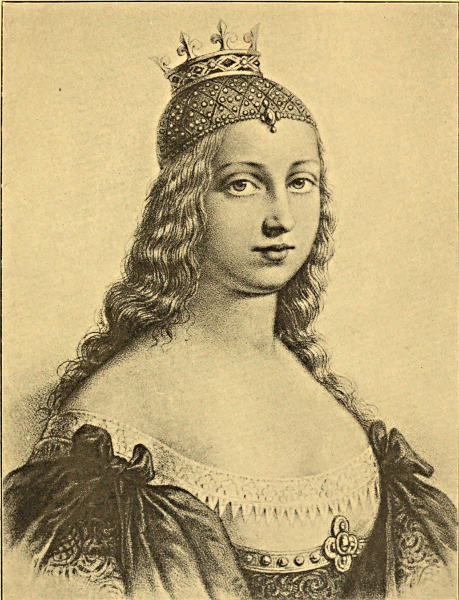
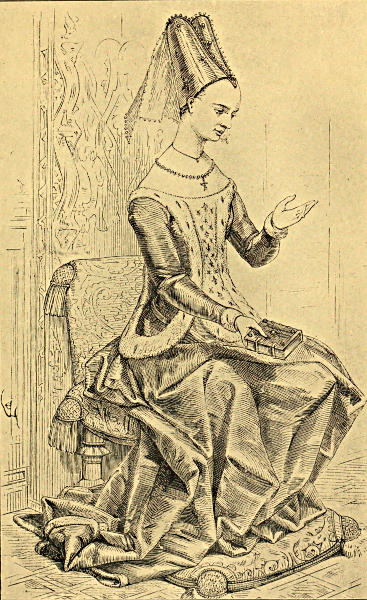
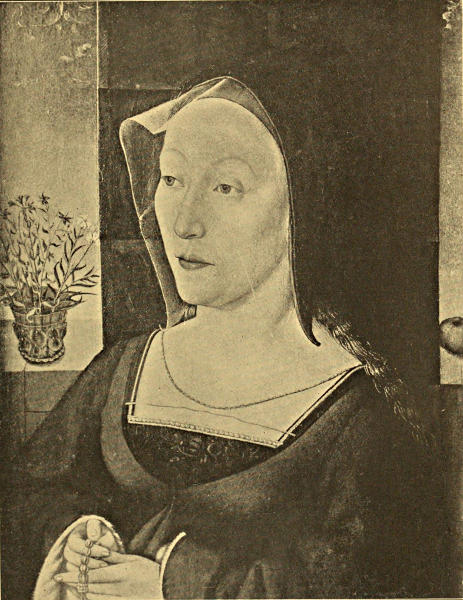
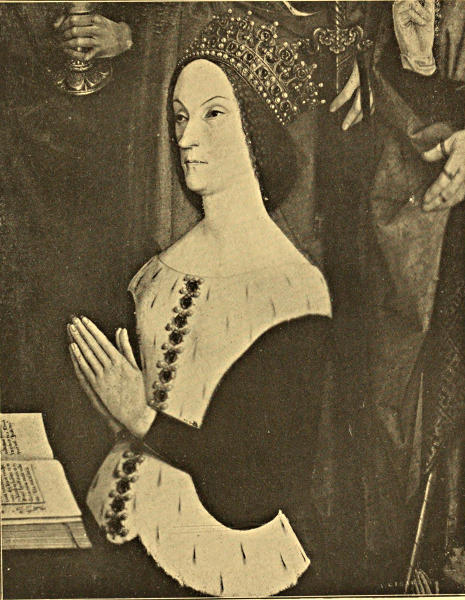
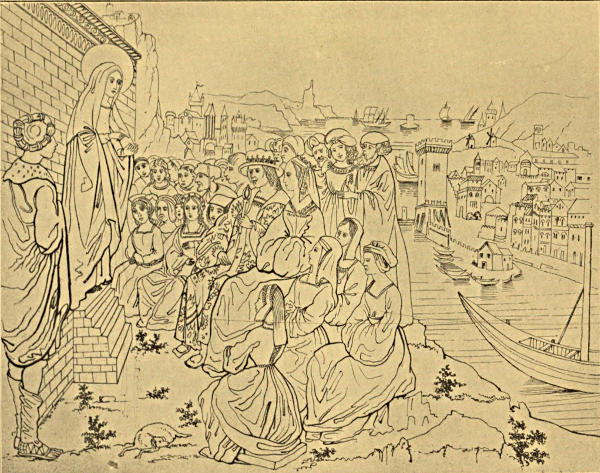
MARGUERITE D’ANJOU
From a Miniature by King René, in “Le Livre des Heures”
To face page 254
At Vienne, where the French Court was at the
time, having gone south from Reims and the coronation,
the King gave his brother-in-law’s consort a
very hearty greeting, but he hesitated to commit
himself to action which might ferment once more
evil blood between his people and the Burgundians.
Isabelle held by their hands, as she pleaded for her
dear husband, her two baby girls, and Charles’s
indecision was overcome by little Margaret, then a
dauntless infant, who ran up to him and insisted
upon being nursed upon his knee and kissed. A
child’s instinctive disingenuousness is affected by
magnetic natures regardless of conventions and proprieties;
how often and often again is this proved
to be axiomatic! That interview was memorable
for the meeting of Charles with a woman—to be sure,
then a girl—who would in after-years affect him and
his considerably. Agnes Sorel was in attendance
upon the Duchess Isabelle. Charles beheld her for
the first time, and her face and figure haunted him
for good and ill many a long day.
Not content with winning over the King of France
to intercede for the liberation of her consort, the
Duchess returned to Lorraine, and went off at once
to Vaudémont to plead with Count Antoine, the
Duke of Burgundy’s brother, in the same cause.
Vaudémont agreed to assist his kinswoman, but
upon one chief condition, among others—that she
would consent to Yolande, her eldest daughter, being
betrothed to his eldest son Ferri. There was, of
course, method in this extraordinary proposal,—for
the child was only three years of age,—and it was
this: He, the Count, claimed Lorraine, by the Salic
Law, as first heir male against Isabelle. Whatever
might eventuate, his son married to René’s
daughter would be an additional lien upon the
duchy. This policy also commended itself to
Isabelle’s prudential mind, and she gave a qualitative
consent dependent upon confirmation by Duke René
later on. The Count added a rider to the stipulation,
and that was the committal of the girl to the care
of his wife, the Countess, for education and training.
This, too, the Duchess accepted, although it cost
her sore to part with her dear child. Margaret and
Nicholas alone remained to solace her; but Isabelle
was far too strong a character to spend much time
in comforting or being comforted. Whilst René was
in durance vile she could not remain idle; so off she
went, taking Margaret and Nicholas with her, to
the Castle of Tarascon, in order to enlist the sympathies
and services of René’s devoted Provençals.
Isabelle’s coming into Provence provoked remarkable
demonstrations on the part of the warm-hearted
and loyal subjects of the county. Troubadours
and glee maidens flocked to the Rhone
shore; they sang, they danced, they ate, they drank,
and laid floral offerings and votive crowns at the feet
of their Countess and her tender children. Bonfires
blazed from shore to shore, and echoes of the rejoicings
might have been carried by the warm south wind
right into the dungeoned ears of their beloved Count.
Whilst Duchess Isabelle was in residence at Tarascon
negotiations were already on foot for the betrothal
of little Margaret. An eligible suitor arrived, the
young Pierre de Luxembourg, eldest son of the Count
of St. Pol, whose esquire, by a singular coincidence,
happened to be the recipient at Bulgneville of
Duke René’s sword. Arrangements for the ceremony
of espousal were, however, rudely interrupted
by a serious outbreak of plague, and Isabelle
and her children fled to Marseilles, where they
remained till René joined them, released upon a
year’s parole.
When René was proclaimed King of Sicily,
Naples, and Jerusalem, Duke of Anjou, and Count
of Provence, upon the premature death of his elder
brother, Louis III., at Cosenza, Isabelle was again
at Marseilles, on her way to take possession of her
husband’s rights in Naples. Such pageants and
spectacles at those exhibited in her honour by the
exuberant Marseillais that city had never seen. She
rode through ranks on ranks of cheering citizens,
in a great state chariot covered with crimson and
gold, and wearing a queenly crown upon her head,
and with her were Jean, her eldest son, and Margaret
and Nicholas. The little Princess captivated everybody
by her naïveté and the graceful kissing of her
little hand. Margaret sent kisses flying through
every street, winning all men’s loyalty and the love
of all the boys.
Queen Isabelle and her children took up their
residence at the Palace of Capua. Queen Giovanna
offered her the new royal palace in Naples, but
Isabelle’s instinct was not in error when she chose
to dwell a little distance from the royal hussy.
There King René joined his family, bringing with
him both Louis, his second son, and Yolande. The
reunion was the happiest that could be. Upon the
King devolved, of course, the onus of government,
with the co-operation of Queen Giovanna. Queen
Isabelle, relieved from the trammels of the executive,
had now a much-longed-for respite in which to give
attention to the neglected education of her children.
She constituted herself their teacher-in-chief, but
called to her assistance the very noted writer of
French romance, Antoine de Salle. Alas! it was a
brief interlude indeed, for the studies had hardly
had time to affect the young pupils when the King
of Aragon resumed his hostile demonstration against
the Angevine dynasty, and René and his were
locked in the grip of war. Very unwillingly Queen
Isabelle agreed to return to France with her children,
Naples being an armed camp and the whole country
in a turmoil. They wended their way leisurely to
Anjou, and not to Lorraine. Two reasons dictated
this course. Angers was the capital par excellence
of the dominions of the King of Sicily-Anjou, the
ancestral seat of his house, and Anjou was more
favourably conditioned than Lorraine or Bar for the
completion of the training of the royal children.
Queen Yolande was only too delighted to welcome
her brave daughter-in-law and to caress her beloved
grandchildren. She went off to the Castle of
Saumur, her favourite residence, and the walls of the
grim Castle of Angers once more resounded to the
merry laughter of childish games. Sadly enough
those joyous sounds yielded place to saddest dirges
when Prince Nicholas, not yet ten years old, died
suddenly of poison. This was the first break by
Death into that home circle.
The King and Queen were again in residence at
the Castle of Tarascon in 1443, and there, on
February 2, they received an imposing mission from
the Duke of Burgundy, headed by Guillaume
Harancourt, Bishop of Verdun, the Seigneurs Pierre
de Beauprémont and Adolphe de Charny, with
Antoine de Gaudel, the Duke’s principal secretary.
They came to Tarascon to negotiate a marriage
between the Duke’s nephew, Charles de Borugges,
son of Philippe, Count of Nevers, and the Princess
Margaret. This bridegroom expectant had been very
much in the matrimonial market before accepting the
choice of his uncle. His first fiancée was Jeanne,
daughter of Robert, Count de la Marche; she gave
place to Anne, Duchess of Austria; and she in turn
was passed over before the greater charms of the
Angevine Princess. The contract of betrothal with
Pierre de Luxembourg was cancelled, and Charles de
Nevers was the choice of René and Isabelle.
The date for signing the marriage contract was
fixed, February 4, and to all the articles the King
and Queen readily assented. The dowry was
50,000 livres, but how that large sum was to be
raised neither René nor Isabelle had the slightest
idea; they had exhausted their exchequer in the
fruitless fight for Naples. The Duke of Burgundy,
acting as next of kin to the bridegroom-elect, promised
to settle a jointure of 40,000 livres on Margaret.
René had put forward a plea that the Duke should
forego 80,000 écus d’or, which was due on loans, and
Philippe agreed, receiving as further security and
indemnity to the towns of Neufchâteau, Preny, and
Longwy,—already in pawn to him,—the Castles of
Clermont, Varennes, and Renne, all in Argonne. A
secret clause was, however, at the eleventh hour
foisted upon the Angevine Sovereigns—a proceeding
quite in accordance with the proverbial
cunning of the Court of Burgundy. It stipulated
that the children of Charles and Margaret should
be heirs-presumptive of Sicily-Anjou-Provence,
Lorraine, and Bar, to the exclusion of the issue of
Ferri and Yolande de Vaudémont.
The judicial mind of King René would not let his
consent to this article be recorded until he had consulted
both the Count de Vaudémont and King
Charles of France. The former indignantly interviewed
the Duke of Burgundy, and stated his determination
to oppose the proposed marriage. Charles
resented the stipulation upon the ground of its
injustice, and warned his brother-in-law not to agree
to any such proposals. The marriage contract was
not signed, and, whilst acrimonious negotiations were
carried on both at Dijon and Vienne, another and a
very much more illustrious suitor of the hand of
Princess Margaret appeared upon the scene, no less a
person than Henry VI., King of England and France.
When the matter was first mooted, it was thought
nothing of by the King and Queen of Sicily, because
Henry had been all but betrothed to Isabelle, the
daughter of the Count of Armagnac, to whom he
owed so very much in earlier days. Indeed, the
gossip went so far as to link the English King’s name
in turn with all three daughters of the Count—the
loveliest girls in France: “Three Graces of Armagnac”
they were called. Henry had sent his favourite
painter, Hans of Antwerp, to paint the three comely
sisters, and his handiwork was so acceptable to the
royal young bachelor that he sat and gazed at them
for long, changing the order of their arrangement to
see which face of the beauteous three made the
most passionate appeal. The Armagnac marriage was
backed by all the influence of the Duke of Gloucester,
the younger of the King’s uncles, and lately Lord
Protector of England.
What drew Margaret of Anjou into the orbit of
Henry of England was that she had gone on a visit
to her aunt, Queen Marie of France, and had at the
French Court created quite a sensation. She was
nearly fourteen years of age, and gave fascinating
indications of those charms of mind and person which
made her “the most lovely, the best-educated, and
the most fearless Princess in Christendom.”
Cardinal Beaufort was also a visitor at King
Charles’s castle at Chinon, and was immensely moved
by Margaret’s appearance and accomplishments. He
also detected her latent strength of character, and
certain traits therein which marked her unerringly as
the counterfoil of his royal pupil and master’s mental
and moral weaknesses. The Cardinal returned to
England full of the charms of the young Princess,
and descanted upon them so enthusiastically to the
King that Henry was in a perfect fever to behold the
beauteous Princess for himself. His amorous appetite
was further stimulated by conversations he quite
accidentally had with one Jules Champchevier, a
prisoner of war on parole from Anjou, lodging with
Sir John Falstaff, in attendance upon the King.
Champchevier was sent off to Saumur to obtain, if
possible, a portrait of the bewitching young Princess.
The King wished her to be painted quite simply and
naturally “in a plain kirtle, her face unpainted, and
her hair in coils.” He required information about
“her height, her form, the colour of her skin, her
hair, her eyes, and what size of hand she hath.”
Champchevier was taken prisoner on landing in
France, and threatened with death for breaking his
parole whilst executing the royal commission; but
news reaching Charles VII. of the unfortunate fellow’s
predicament, he laughed heartily at the situation
when he learned the reason of his mission, and forthwith
ordered his release. The idea of a matrimonial
contract between his royal rival and his royal niece
opened His Majesty’s eyes to possibilities created
thereby of a satisfactory peace between the two
countries. Once more,—and how many times before
and since!—a royal maiden’s heart contained the key
to great political issues.
The portrait was painted exactly to order—perhaps,
and quite correctly, with a little artistic embellishment.
The beauty of Nature is always enhanced by
the decorative features of art. Henry was charmed
with the sweet face he gazed and gazed upon, quite
putting into the shade the other reigning beauties of
his heart. He was himself as comely as might be,
just four-and-twenty, highly educated, his mind unusually
refined. In thought and deed he was pure
and devout, and very shy of strange women. Upon
the latter head he was emphatic, for when at Court
or elsewhere he beheld women with open bosoms
à l’Isabeau de Bavière he was shocked, and turned
away his face, muttering: “Oh fie! oh fie! ye be
much to blame!” His earnest wish was marriage,
not concubinage. The King’s choice very soon
became noised abroad, and the Court became agitated
and divided. The Duke of Gloucester, the King’s
next of kin and heir-presumptive to the throne,
championed the Armagnac match, whilst Cardinal
Beaufort and the Earl of Suffolk decided for Margaret
of Anjou.
There was, however, an obstacle in the way, quite
consistently with the proverbial rugged course of all
true love; the Count of Nevers refused to release
his fiancée. He was prepared, he averred, to cancel
the contentious clause in the marriage contract, made
at Tarascon, and not to insist upon anything derogatory
to the dignity of King René and his elder
daughter, the Countess Ferri de Vaudémont. The
prospect to René of such an auspicious union, however,
which would place his daughter upon one of the
greatest of European thrones, was too dazzling to be
ignored, and the outcome of the imbroglio was the
assembling in January, 1444, of a mixed Commission,
representing England, France, Anjou, and Burgundy,
at Tours, whereat two protocols were framed:
a treaty for a two years’ peace, and a marriage agreement
between the King of England and the Princess
of Anjou. This was signed on May 28 of the same
year. The marriage contract thus drawn out was
very favourable to the House of Sicily-Anjou: Henry
asked for no dowry, but required only the rights
transmitted to King René by Queen Yolande with
respect to the kingdom of Minorca. Henry further
agreed to the retrocession of Le Mans and other points
in Anjou held by the English.
To the Earl of Suffolk, the leading English plenipotentiary,
was mainly due the successful issue of the
conference. Henry created him Marquis and Grand
Seneschal of the Royal Household. The King furthermore
despatched to him an autograph letter to the
following effect: “As you have lately, by the Divine
favour and grace, in our name, and for us, engaged
verbally the excellent, magnificent, and very bright
Margaret, the second daughter of the King of Sicily,
and sworn that we shall contract marriage with her,
we consent thereto, and will that she be conveyed to
us over the seas at our expense.” Arrangements were
forthwith made for the immediate marriage of the
Princess. Suffolk,—one of the handsomest and most
cultivated men of the day, though now verging on
fifty years of age,—headed a majestic embassy to
Nancy, where the Sicily-Anjou Court was in residence.
He bore with him a dispensation from his
royal master to act as his proxy at the nuptial ceremony,
and to receive in his name the hand of his
fascinating bride. It was indeed a notable function,
and held in the ancient cathedral of Tours, whereat
all that was royal, noble, brave, and beautiful, forgathered.
The witnesses for Margaret were the
King and Queen of France, the King and Queen of
Sicily-Anjou, and the Duke and Duchess of Calabria,
with the Dauphin Louis. The Princess’s supporters
were the Duke of Alençon, the most gallant and most
accomplished Prince in France, and the Marquis of
Suffolk, the premier noble of England. Upon the
latter’s consort, the clever Marchioness, devolved the
duties of Mistress of the Robes.
That day,—February 27, 1445,—was a red-letter
day in the annals of all three kingdoms. Louis
d’Harcourt, Bishop of Toul, was chief celebrant,
assisted by half the prelates of France, and Cardinal
Beaufort was in choir to administer the Papal
benediction. The young Queen’s Maids of Honour
were the two most lovely girls in France—Jehanne
de Laval, in the suite of Queen Marie, and Agnes
Sorel, in that of Queen Isabelle. It was a singular
and delightful coincidence that these two lovely
damsels were in evidence on that auspicious
day; for were they not the charming cynosures respectively
of two pairs of kingly eyes—René and
Charles!
The interest and the importance of the celebration
was heightened considerably by the fact that there
was a double wedding: Count Ferri de Vaudémont
and Princess Yolande of Sicily-Anjou were united in
the bonds of matrimony immediately after the nuptials
of the new Queen. Fêtes and festivities were carried
out right royally for eight whole days and nights.
The “Lists” were held in the great wide Place de
Carrière in Nancy. Charles and René met in
amicable conflict, but it was the former’s lance which
was tossed up, and René gained the guerdon, which
he presented gallantly enough to his sister, the Queen
of France. The champion of champions, however,
was none other than Pierre de Luxembourg, the
earliest fiancée of Queen Margaret, and he had the
happy satisfaction of receiving the victor’s crest of
honour from her hands—now another’s! Minstrelsy
and the stage also lent their aid to the general
rejoicings. King René was already styled the
“Royal Troubadour,” and he rallied his melodious,
merry men in a goodly phalanx, whilst he himself
led the music in person and recited his own new
marriage poem. The theatre proper had only very
recently been established in France. Church
mysteries and pageant plays had had their vogue,
when, in 1402, Charles VI. granted his charter to
“La Confrèrerie de la Passion,”—a company, or
guild, of masons, carpenters, saddlers, and other
craftsmen, and women,—which he established at the
village of St. Maur, near Vincennes. These merry
fellows introduced to their distinguished audience, in
the Castle of Nancy, secular travesties of the well-worn
religious spectacles, and won the heartiest
applause. King René personally, through the
gracious hands of the royal bride, decorated the
actors with gay ribbons and medallions.
The dress of the right royal company was, as may
well be supposed, sumptuous in the extreme; but
among the wearers of rich attire a pathetic note was
struck, when it was mooted that royal Margaret
had been dressed for her bridal by Queen Marie, her
aunt, because her own parents were too much impoverished
to supply suitable marriage robes! The
bride’s dress was mainly that worn by Queen Marie
herself, twenty-three years before, at her own nuptials
with Charles VII. The kirtle was of cloth of gold
cunningly embroidered with the white lilies of France—the
same for Anjou; the robe of state was of
crimson velvet bordered with ermine, which also
formed the trimming of the stomacher she wore.
Her hair was dressed à l’Angloise, its rich golden
coils being crowned with a royal diadem, almost the
only jewel of Queen Yolande’s treasury which had
not been sold or pawned. The little Queen was
slight of build and short of stature for her age; very
fair of skin, with a peachy blush; her eyes light
blue, her hair a golden auburn; her whole face and
figure lent themselves to delightful expression and
graceful pose. Above all, she was very self-possessed,
and gave all beholders the impression of ability and
decision beyond the average.
With respect to King René’s inability to provide
a fitting trousseau for his daughter, there is an entry
in the Comptes de Roy René which indicates that
he was not unmindful of the sartorial requirements of
his family. Under date September 11, 1442, is an
order, addressed to Guillaume de la Planche, merchant
of Angers, for 11 aulnes of cloth of gold, embroidered
in crimson and pleated, at 30 écus per aulne,
with a suite of trimming to cost 30 livres. At
the same time François Castargis, furrier of Angers,
is directed to supply ten dozen finest marten skins at
a cost of £15 7s. 6d., and to pack and despatch
them to the care of the Seigneur de Precigny
at Saumur, “for dresses for Madame Margaret.”
This de Precigny was Bertrand de Beauvau,
who married King René’s natural daughter Blanche
d’Anjou.
At the wedding of Henry VI. and Margaret at
Tours and Nancy, the courtiers were very richly attired
in short jackets or tunics of pleated brocade trimmed
with silk fringes; their body hose was of parti-coloured
spun silk to match their tunics. Their shoes
were made long, of white kid with high heels, and
were laced with golden thread. Calves where skimpy
were padded, and narrow shoulders were puffed out.
They wore long pendent sleeves, pricked and furred.
Their hair, generally worn à la Nazarene, hung in
thick straight locks upon their shoulders, cut square
over the forehead. A small berretta, with a heron’s
plume and a jewelled brooch, completed the costume.
Chains of gold and jewels were worn at will. The
ladies of the Court wore short kirtles or petticoats,
with long bunched-up trains of silk brocade in two
contrasting colours; cloth of gold was reserved for
dames of royal degree. Strict rules were observed
in the wearing of fur—its quality and its breadth;
ermine was reserved for royalty. Their gloves were
long-fingered, and their shoes long-toed, the points
of each being caught up with thin golden chains to
their garters—“un chose ridicule et absurde,” as
Paradin wrote. The salient mark adopted by the
ladies of fashion was noted in their coiffures. The
popular name, or, rather, the name of scorn,—thanks
to Father Thomas of Brittany,—for the astounding
headgear à la mode, “hennin,” was in select circles
called en papillons—“butterflied.” Some ladies had
double horns like the mitres of Bishops, some had
round redoubts “comme les donjons,” some were half-moon
shape, and some like hearts, whilst many goodly
dames made themselves still more ridiculous by wearing
miniature windmills! All these erections were
made of white stiffened linen, built up on frameworks
of wicker and carton. Over all floquarts,—thin gauze
veils,—were gently cast. Collars of jewels and ropes
of pearls were de rigueur, and most of the ladies
wore badges of chivalry—the guerdons of their lords
and sweethearts. One very pretty conceit was introduced
at the time of Queen Margaret’s marriage—a
dainty holder for the necessary pocket-handkerchief.
This took the shape of a small heart of gold suspended
from an enamelled white marguerite, and hung
at the side of the jewelled cincture. The ladies’
shoes were richly embroidered with seed-pearls
and gold thread. Rings were worn outside the
gloves.
Among the suite sent by Henry to attend upon
his bride were the Countess of Shrewsbury and
the Lady Emma de Scales, with five Barons and
Baronesses of the realm. In attendance, too, was
Scrivener William Andrews, Private Secretary to the
King, who acted as juris-consult at the signing of
the marriage registers. In his diary he wrote:
“Never have I seen or heard of a young Princess
so greatly loved and admired.”
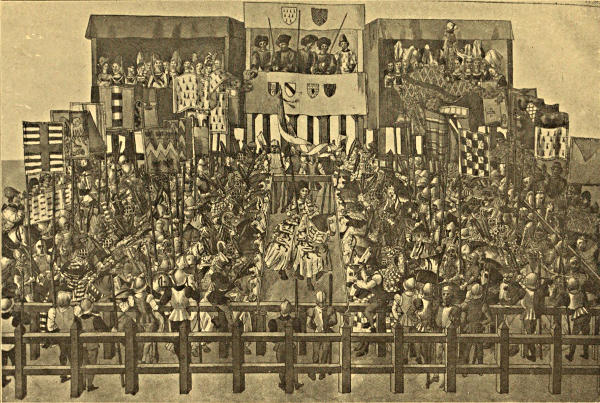
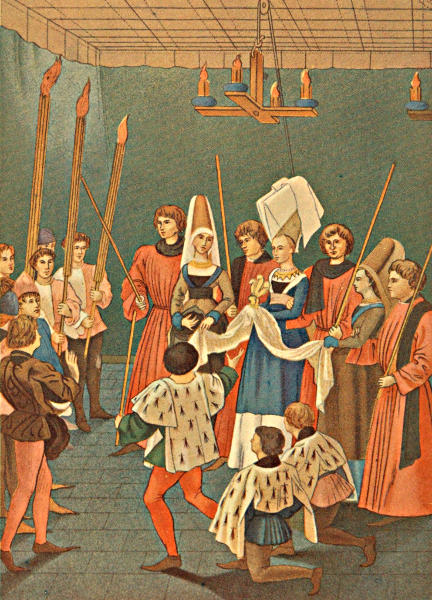
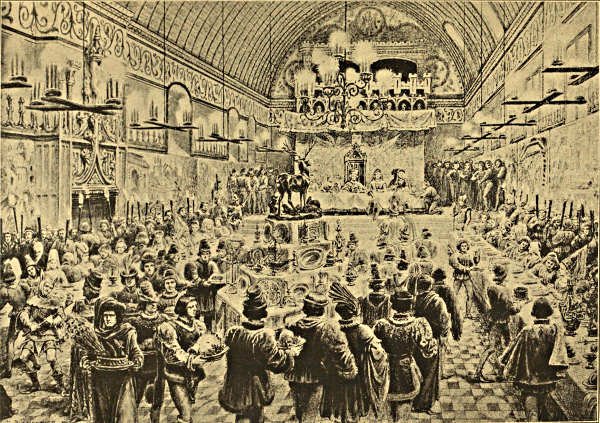
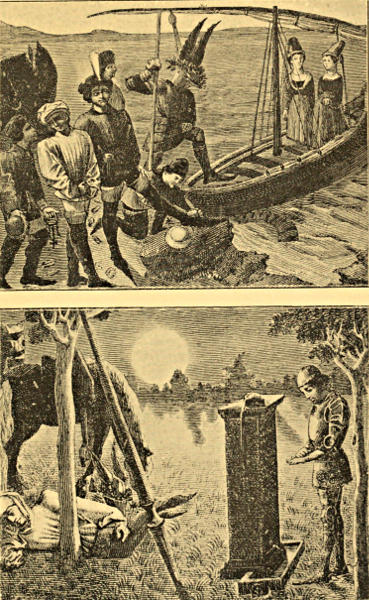
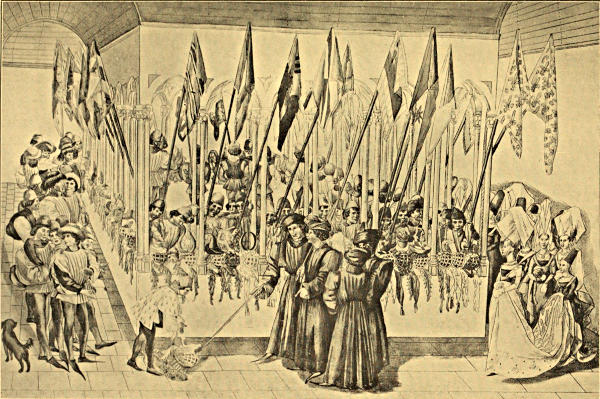
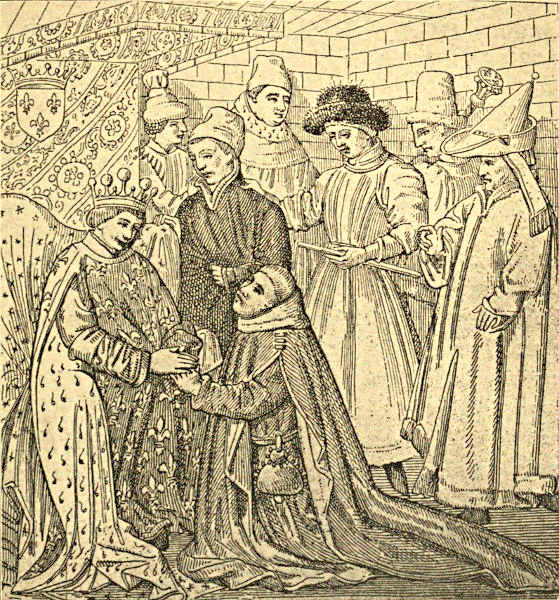
EMPANELLING THE KNIGHTS BEFORE THE “LISTS,” SAUMUR TOURNAMENT, 1446
Painted by King René. From “Le Livre des Tournois”
To face page 268
Upon the ninth day after the marriage ceremony
Queen Margaret took a tearful but brave farewell
of her fond parents and of the princely company, and
King René committed her proudly, yet regretfully,
to the care of the Marquis of Suffolk. An imposing
cavalcade accompanied the parting Queen; indeed,
all Nancy, noble and bourgeois, rich and poor, turned
out to do honour to Her Majesty. King Charles
and Queen Marie went as far as Toul, and then bade
their niece adieu. Charles was strangely sad, and
said with a deep-drawn sigh: “I seem to have done
nothing for you, my well-beloved niece, in placing
you upon one of the greatest thrones in Europe, but
it certainly is worthy of possessing you as Queen.”
Queen Marie’s farewell was very affecting: “I bid
you God-speed, my best-loved niece. I am sure I
do not know what we shall do without you. I weep
for you, my child!”
King René and Queen Isabelle travelled with their
dear daughter right on to Bar-le-Duc, where the
cortège was enthusiastically received, and where a
rest was called over the Sunday, and parents and
daughter partook of the Communion. Then, on the
morrow, Margaret broke down completely at the
parting, and both René and Isabelle gave way to
sobs and tears. If the prospect of the royal marriage
had been pleasant to them all, its realization and the
future filled their hearts with apprehension. A
dearly loved child was now to make her way all
alone among strangers—too young to go so far from
home, but too good to err.
“Je fais peur pour vous, ma fille,” cried the
sorrowing father, “en vous plaçant sur un des plus
grands trônes de Chrétienté; que le bon Dieu vous
gardiez. Pour moi et pour vôtre mère, nous sommes
tous les deux désolés.”[A] Queen Isabelle’s heart was
too full for words. She folded her child to her
bosom, and the two wept together. It was Margaret
who first dried her tears, and said bravely: “N’ayez
aucun regret pour moi; je serai vôtre fille la plus
devouée pour jamais. Si mon corps veçut en Angleterre,
mon âme restera tousjours en France avec
la vôtre.”[B]
Bare-headed, King René stood at the castle portal
till Margaret and her escort had faded from his sight;
then he and the Queen shut themselves up in their
apartments and gave way to their pent-up feelings.
Travelling as the Queen of England, Margaret had
now for her supporters her brother, the Duke of
Calabria, the Duke of Alençon, and the courteous
Marquis of Suffolk. Leisurely enough the company
traversed the fertile fields of Champagne, ever aiming
for the north French coast. Besides a strong escort
of soldiery, in the royal train were seventeen knights
and two esquire-carvers, sixty-five esquires, twenty
grooms, and 174 servitors of all kinds, and with
them serving-maids and dressers. At every stopping-place
heartiest greetings awaited the young Queen,
and Princes and nobles knelt to pay their homage.
The English garrisons en route were forward in their
loyal salutations; their new Queen was the pledge
of a greatly-yearned-for entente cordiale.
At Nantes the Duke of York, King Henry’s near
kinsman, and the representative of the older line of
the English Royal House, received the Queen, and
entertained her in the castle of the French Kings.
On March 23 the royal progress ended at Rouen,
where a week’s rest was called. Bicknoke, in his
“Computus,” has enumerated several curious items
in the bill of costs which covered the lengthy journey
from Lorraine. The Barons and Baronesses of the
Queen’s suite received each four shillings and sixpence
a day, the knights had half a crown each a
day, and, at the tail of the following, the grooms
were paid no more than fourpence per diem. At
Rouen the Queen paid four shillings and ninepence
for fourteen pairs of shoes to give to certain poor
women of the town. She also made many purchases
of second-hand silver plate from a silversmith,
Jean Tubande by name. The articles were chiefly
cups and plates which bore the arms of Henry,
Count of Luxembourg, father of her first fiancé.
These escutcheons the Queen had removed, and in
place of them marguerites were engraved. The
Queen, moreover, came short of ready cash, so she
pawned some of her real silver wedding presents to
the Marchioness of Suffolk, that she might have the
wherewithal for gifts to the seamen on her transport
to England.
The royal party embarked in river boats, and made
for Honfleur, where the Cokke John, a great galley,
was waiting off the port. Such a stormy passage
as that which was the prelude to Queen Margaret’s
triumphant progress to the English capital had
hardly been exceeded for fury in the memory of the
most ancient mariners. Thunder and lightning and
sheets of ice-cold water threatened to destroy the
stately craft and to engulf her lordly fares. After
beating about in the Channel for one whole day
and night, with utmost difficulty the harbour of
Porchester was attained on April 10.
It was rather hard upon the Queen’s impoverished
exchequer that she should have been called upon to
pay £5 4s. 10d. for her pilot, £13 6s. 8d. for new
hawsers, and £9 7s. for alterations and repairs in
the vessel.
The terrified young Queen had never beheld the
angry sea before nor tasted its misery, and she was
utterly prostrated in her state-room, and wept and
cried for her mother and to God for help. The
Marquis raised her inanimate form gently in his arms,
and wading bravely to land through the scudding
sea-foam, he bore his precious burden, marching
manfully along the fresh-rush-strewn streets of
the little fishing town. King Henry was at Winchester,
anxiously awaiting couriers who should gladden
his ears by the news of his royal bride’s arrival, and
he galloped off at once to greet her at the Goddes
House of Southwick, whither she was borne for
rest and treatment. Unhappily, Margaret had contracted
some infectious complaint,—perhaps chicken-pox,—and,
very tantalizing for herself and Henry,
their meeting was postponed until her illness had
abated.
At the priory church of St. Mary and All Saints
the ceremony of the English espousal was celebrated
by Cardinal Kemp, and Henry placed upon Margaret’s
finger the ring which he had worn at his
coronation in Paris eighteen years before. If the
King was charmed by the portrait of his Queen, he
was transported with joy and passion when he beheld
and embraced beauteous Margaret. The half of her
excellence had not been revealed in pigment; she
was more, much more, lovely and attractive than he
had imagined. Preparations for the state nuptials
were hurried forward, and also for the coronation of
the Queen, and Henry with his bride rowed on to
Southampton, saluted as they passed by all the
shipping in the Solent. Two Genoese galleys in
particular were gaily festooned and manned, and as
the royal barge swept by seven trumpeters blew a
wedding fanfare, and then the crews shouted their
loud “Evviva.” Margaret insisted on sending for the
two captains of the foreign crafts, and gave them
£1 3s. 4d. “for plaieing so merrielie my musique”—so
the Queen phrased it. Another heavy item in
the cost of her progress was her doctor’s fee; Maistre
François of Nancy claimed £5 9s. 2d. for his professional
services upon the journey. A further delay
was caused in the completion of the nuptial arrangements
by reason of the poverty of the Queen’s wardrobe.
Her trousseau was quite unworthy of her
rank, and Henry, although himself as poor as a
King might be, despatched messengers to London
to summon Margaret Chamberlayne, a famous tire-worker,
and a number of craftswomen with sumptuous
materials for the wedding gown. The King, indeed,
had to pawn his own jewellery and plate to furnish
sufficient funds for the double ceremony.
Henry of England and Margaret of Anjou were
married by Cardinal Beaufort in the abbey church
of Titchfield on April 22. The bride was just
sixteen years of age—already a woman, but with the
heart of a man. Most extraordinary presents were
showered upon the young Queen: a lion in a cage,
a score of hedgehogs, a dozen thick all-wool blankets,
two tuns of English wine, a suit of bronze silver
armour, several chairs,—two of state,—five young
lambs’ fleeces, and so forth. Then the royal progress
began to the capital. Halfway between Fareham
and London the Duke of Gloucester, with 500 armed
and superbly mounted retainers, greeted the King
and Queen, and conducted them to the palace at
Greenwich. Triumphal arches spanned the road,
and maidens scattered spring blossoms before the
royal couple.
On May 30 the King and Queen quitted Blackheath
for Westminster, passing many notable pageant
spectacles—“Noah’s Ark,” “Grace,” “God’s Chancellor,”
“St. Margaret,” the “Heavenly Jerusalem,”
and so forth—all marshalled in their honour. Somewhat
wearied by the dust and the shaking of her
chariot, and deafened by the plaudits of the crowds,
Margaret was handed down by the King, at the
great west door of the royal abbey. Her entry was
accompanied by minstrelsy, for King René had
sent over for the ceremonial a large company of the
troubadours and glee maidens of Bar, Lorraine, and
Provence, under the orders of his Groom of the
Stole, Sire Jehan d’Escose. The cost of this expedition
ran up to nearly £100, a great sum for the
poor King of Sicily to disburse.
King Henry spared no expense, but ran still more
heavily into debt to make the crowning of his Queen
magnificent. Rarely had such a gallant and splendid
company gathered for a royal wedding. Everybody
wore the Queen’s badge—a red-tipped daisy. Three
days were set apart for tournaments between Palace
Yard and Broad Sanctuary, whereat the new Queen
presided, wearing the Queen-consort’s jewelled crown
of England.
Margaret was now de facto and de jure Queen of
England and mistress of her destiny—her husband’s,
also. What a unique elevation it was for a young
girl of sixteen, all alone among strangers, rivals, and
adventurers! A false step seemed inevitable; indeed,
absolute rectitude and tactfulness of conduct under
the exigeant circumstances which surrounded her
would have tried the grit of the stoutest mind and
the grasp of the strongest hand. Dubbed “La
Française” by men and women jealous of the King
and of herself, she had to steer her course amid
endless pitfalls placed in her way. Warfare and
politics were the two chief contentions of the day.
As for the first, she (Margaret) was its mascot, and
warriors laid down their arms at her feet; but with
respect to the wordy warfare of parties and their
intrigues and plots the young Queen danced upon
the thinnest ice, and unconsciously she slipped.
She gave herself into the hands, quite naturally, of
the party which held first to the King and herself,
as opposed to that which sought initially self-interest.
The Duke of Gloucester was the leader of the loyal
section of her lieges, and to him the young Queen
turned for light and leading.
Very soon the impress of Margaret’s strong
character made itself felt in every quarter. She
spared neither the Duke of York himself, nor any
other rival to her own Lord and King; but what
could a child still in her teens do against the cabals
of crafty and influential foes? Henry was as weak
as water; he hated political questions, caring very
much more, of course, for peaceful intercourse with
his fascinating spouse, and for the delights of leisure
and learning, than for the turmoil of Parliament and
the vexed questions of the day. York held Henry
in his hand, but Margaret was a doughty nut to
crack, and she kept him in his proper place.
Letters written from Sheen and Windsor to
Queen Isabelle by her loving daughter show how
happy was her state. Henry’s passionate love she
returned as passionately, and their loves made for
peace both at home and abroad. Literary pursuits
and benevolent aims were in both their minds: the
King founded Eton College, and King’s College,
Cambridge, in 1446; the Queen, Queen’s College,
Cambridge. Together they invited Italian, French,
and Flemish craftsmen to settle in England, and teach
their ignorant but not unwilling subjects some of the
arts of peace. The poor were relieved, the naked
clothed, the hungry fed; but when all estates of the
realm seemed secure and in prosperity, the dark spectre
of sedition rose at the beck and call of the Duke
of York. King Henry had to rouse himself and lay
low the insurrection of Jack Cade and 30,000
mislead Kentish men. This was the beginning of
troubles.
For some little time Margaret had detected signs
in her consort’s speech and manner that caused her the
gravest solicitude. She had witnessed the mental depression
and lassitude of her uncle, the King of France,
and she had grieved for her beloved aunt’s (Queen
Marie’s) anxieties. The insanity of King Charles VI.,
too, had been one of the sad family histories of her
school days in Anjou. Now she was faced with a
trouble far away more terrible than any of these. In
1453 the King’s memory began to fail, he was bereft
of feeling, and gradually he lost his power of walking.
The malady, indeed, had shown itself during the
Christmas revels at Greenwich. The Queen was
already broken-hearted by the news she received from
France of the critical state of her mother’s health,
and when, on March 5, she heard of her death, poor
Margaret was indeed disconsolate. In pain she
turned to Henry for comfort, but he failed to comprehend
her sorrow. All around were men and
women intriguing against herself and him; alone she
had to bear her trouble, and the trouble was intensified
in pathos by the fact that she was at last enceinte.
Would her child be stillborn, she asked herself many
a time; how could she expect otherwise when so
utterly cast down? Then she realized the loneliness
of a throne. The menace of the Duke of York was
a scourge to wear her down, and his denunciation of
her barrenness an unspeakable affront.
Crushed indeed she was, and yet she had to play
the man; for she was both King and Queen of
England, and while she lived she determined that
none should sap her authority. Henry subsided
into imbecility, but Margaret’s will matched and
vanquished York’s, although he was proclaimed
“Protector of the Realm and Church.” The year
sped on, but it brought joy to the sad heart of the
lonely Queen, and the whole nation shared her
happiness. On October 11 she brought forth her
first-born child, a son and heir, a fact of the vastest
importance for all concerned, friend and foe. York
at once denounced the child for a changeling; but the
nation would not have it so, and he was christened
Edward publicly at Westminster, and created Prince
of Wales, so named because his birthday was that of
the holy King St. Edward.
Alas! the King could not be roused sufficiently
to recognize his son, nor, indeed, his wife, and this
was construed by York and his party as proof conclusive
against the truth of the Queen’s accouchement.
At the same time they threw out insinuations
against her character with respect to relations with
many prominent men of her entourage.
The chivalrous spirit of the Queen felt York’s
false imputations crushingly. Her convalescence was
retarded, and when she came to be churched at the
Abbey of Westminster, she was almost too prostrate
to go through the ceremony. Like the noble woman
that she was, she roused herself; and when she
beheld the distinguished and numerous suite awaiting
her,—the forty most influential peeresses in the
land,—she took heart, and was herself once more.
She assumed her costly churching robe. It was of
white, gold-embroidered silk and was bordered with
500 sable pelts, and it had cost £554 16s. 8d.
The Duke’s despicable conduct was flouted when
Christmas next came round, for on the Feast of the
Nativity the Queen presented herself holding her
babe in her arms before the King. To her unspeakable
joy, Henry held out his hands and drew her and
the infant Prince to his breast, and out loud thanked
God for the recovery of his reason and acknowledged
the child as his. York was away on mischief bent,
and Margaret did not fail to make use of the opportunity
for checkmating his unworthy aspirations.
She took the King to the Parliament, then sitting,
and at his command and in his presence the decree
appointing York Protector of the kingdom was
revoked, and Henry, Margaret, and Edward, assumed
their orthodox positions. This step was the first
move in the great war game which devastated the
whole realm, and ended, alas! in the absolute undoing
of the King, the Queen, and the Prince. York,
hearing what had transpired at Westminster, hurried
from the Welsh border with 5,000 armed followers.
The King met him at St. Albans, and ordered him to
disband his troop and salute the royal banner. The
Duke refused to obey only on impossible conditions.
But what of King René and Queen Isabelle?
Their hearts were torn asunder, we may be sure, at
the contemplation of their Margaret’s peril. They
were powerless to assist her save by their whole
soul’s sympathy; besides, they were faced by a contrariety
of facts. The all too brief “truce of Margaret”
was broken in 1449, and René was summoned
to support King Charles and fight against the
servants of her consort,—her subjects too,—for,
spite of being “La Française,” she had won all hearts
in bonnie England. A beautiful girl and a brave is
unmatchable! Fortune of war favoured the French-Anjou
colours, and Charles became master of Normandy
and all English-held North France. Guienne,
too, was yielded to the valiant young Duke of
Calabria. Moreover, the war-galleys of “Le Petit Roy
de Bourges” scoured the Channel, and gained prizes
and renown for Charles and René off the English
coast.
Somerset’s defeat was a loss of credit, however, to
Queen Margaret, and York of course made the most
of it. He boasted that, “as Henry was fitter
for a cell than a throne, and had transferred his
authority to Margaret, the affairs of the kingdom
could not be managed by a Frenchwoman, who cared
only for her own power and profit.” To placate this
arrogance the Queen made a tactless move: she
named the Duke Governor of Ireland, thus adding to
his prestige and opportunity. Talbot’s death at
Albany further weakened the King’s authority and
Margaret’s strategy.
Upon the death of Queen Isabelle, so deeply
mourned, not alone by her daughter in England, but
by all the chivalry of France, René devolved his
authority in Bar and Lorraine upon Jean, Duke of
Calabria, intending to withdraw gradually from the
responsibilities of government. His efforts, however,
were discounted by the entreaties of Francesco
Sforza, Duke of Milan, and his Florentine allies, that
he should again take up arms and appear in the field
against King Alfonso of Aragon and the Venetians
who were supporting him. René was victorious, but
the palm of triumph was withered in his hand by the
news that reached him on his way back to France:
civil war had broken out in England, and Margaret
was in command of the Lancastrians. Margaret, so
lovely, so cultivated, and so fearless, was adding
lustre to the heroic deeds of the House of Anjou—but
what terrible risks she ran! The initial victory at
Wakefield was tarnished by the irony of circumstances,
and, though decreed by her in the moment of
her emphatic triumph, York’s grey head speared upon
the walls of York must have shocked her sense of
magnanimity.
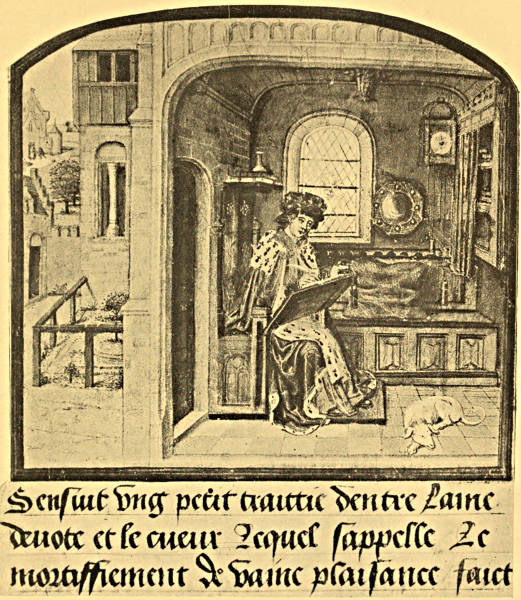
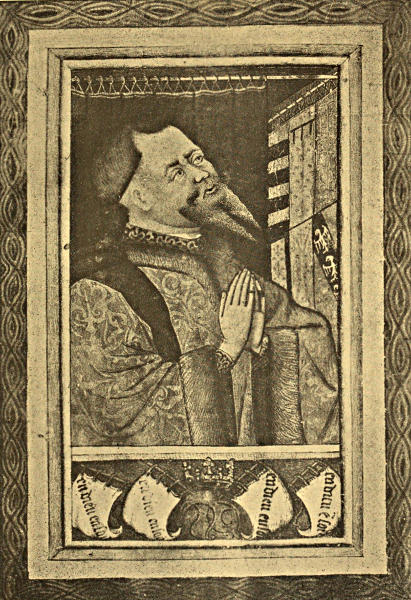
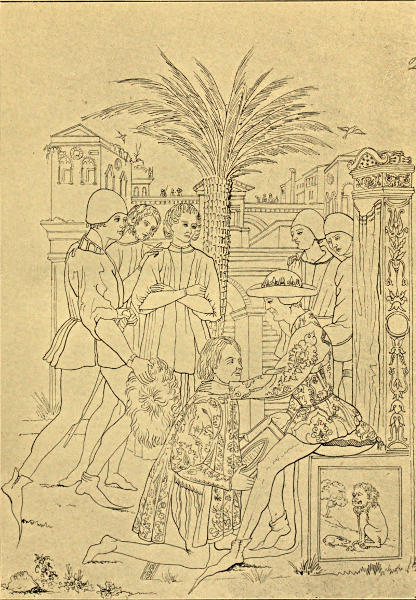
KING RENÉ WRITING HIS POEM, “LE MORTEFIEMENT DE VAINE PLAISANCE”
From the Frontispiece painted by King René
To face page 280
Margaret led her troops in person,—they worshipped
the ground she trod,—but her splendid
courage was of no avail at the second battle of
St. Albans. Henry was deposed, and York’s eldest
son, the Earl of March, was proclaimed King as
Edward IV. Margaret never accepted defeat; she
quailed not, but off she went with her little son, who
was never parted from her side, to Yorkshire and the
North.
“Love Lady-Day” was the quaint if somewhat
hypocritical name bestowed by general consent upon
March 25, 1458. On that auspicious Lady-Day a
very notable assemblage gathered together at the
Palace of Westminster. The Queen had personally
summoned the leaders of the rival factions to meet
the King and accompany him and herself in procession
to St. Paul’s, to crave from on high the spirit
of conciliation. The streets were crowded with loyal
and appreciative citizens, whose delight knew no
bounds as they witnessed pass before them the King
in his crown, his horse’s bridle held by a “White
Rose” knight and a “Red.” Then followed the
Queen in a litter, escorted by the new Duke of York,
Somerset hand in hand with Salisbury, Essex with
Warwick, and others in order of precedence. No
man was armed, no woman feared, and joy-bells tossed
themselves over and over again, swung by stalwart
ringers. Te Deum was sung, but as the progress
turned westward rumblings of thunder made wise-acres
shake their heads,—and in sooth they had good
cause, as matters chanced,—at the dire omen.
Warwick was the bête noire of the reconciliation.
By instinct and preference a plotter-royal, he incurred
the Queen’s suspicion by a system of sea-piracy he
established, and because of inconsiderate language
about the elder line of Plantagenet. An unfortunate
street fracas led to Warwick’s imprisonment. He
was too proud to plead guilty, the Queen too jealous
to release him. York and Salisbury at once enrolled
their retainers, and stood ready to deliver Warwick.
The fruits of the reconciliation fell instantly to the
ground, and the complement of “Love Lady-Day”
was renunciation and conflict à l’outrance. Before
the fresh outbreak of hostilities, whilst the King
retired for rest and quietude to St. Albans Abbey,
the Queen, accompanied by the baby Prince, made a
progress through the Midlands. The child’s winning
ways touched every heart, and when he distributed
to struggling hands everywhere the cognizance of his
patron saint, St. Edward,—little silver swans,—everybody
swore to be his henchman and to stand by
Henry and Margaret. Salisbury hung upon the
skirts of the Queen’s cortège, and Margaret inquired
his business. His curt reply determined her to
demand his body, alive or dead. At Bloreheath
adherents of both sides met, and then Margaret had
her baptism of blood; her own was tinged with
warriors’ strains from Charlemagne of old, and in her
veins the old lion sprang up phœnix-like. Margaret
saw red. She offered two courses only to her
rebellious and disaffected subjects, submission or
death—no quarter. Alas! her experience was the
common one, the faithlessness of friends.
The Battle of Northampton, on July 10, 1460,
was lost by the treachery of Lord Grey de Ruthen.
The Queen and Prince were posted upon an eminence
to view the fight, and her military instinct detected
the base defection whereby Warwick was enabled to
take the King’s army in the rear. Henry was
captured before her eyes, and Margaret, powerless
to retrieve the disaster, fled with her boy at once to
the North. By a circuitous route they reached the
impregnable walls of Harlech Castle. Henry was
led in mock triumph to the Tower, whence Warwick
had the effrontery to demand the custody of the
persons of the Queen and Prince. Margaret
expressed her indignation at the insult emphatically,
but, waiting not to bandy useless words, she hurried
off to Scotland to seek sympathy and assistance.
Meanwhile the Duke of York formally claimed the
crown. Margaret’s response was impressive. Without
difficulty she roused Scottish enthusiasm,—generally
so slow to move,—and, sweeping across the
border, she gathered in her train an army of 60,000
men, and appeared before the gates of York. There
she called a plenary council of lords, to whom she
expressed her determination “to rest not till I have
entered London and set free the King.”
York, taken by surprise, hastened to meet the
valiant Queen, and found her encamped at Wakefield.
Warned of his approach, she sent heralds to his
quarters, who in her name defied the Duke “to
meet her in honest, open fight.” He held back, and
then she poured the vials of her scorn upon his head:
“Doth want of courage,” she exclaimed, “allow thee
to be browbeaten by a woman—fie on thee, thou
traitor!” The battle was joined on December 30,
and gained in less than half an hour. A troop of
horse, headed by young Lord Clifford,—and followed
immediately by the Queen, mounted and armed,—made
an impetuous dash to where the Duke’s
standard hung heavy in the still, damp air. It they
captured, and forthwith threw it over Margaret’s
knees, and with his sword Clifford struck the rebel
leader down from his horse, and slew him as he lay
at Margaret’s feet. In a trice he had severed the
head of her mortal enemy, and upon his knee he
offered the ghastly trophy to his Queen. “Madam,”
he said, “the war is over; here is the King’s
ransom!” The Queen turned sick at the terrible
sight, and hysterically sobbed and laughed alternately,
and she screamed aloud when soldiers stuffed the
blood-dripping head into a common chaff-sack. Lord
Clifford she knighted on the spot, using his own
gory sword; then she ordered York’s head to be
carried off to York, and placed on the city’s southern
gateway.
Salisbury was also hors de combat, wounded and
a prisoner, and by the Queen’s orders he was beheaded
on the field of battle,—for he would not yield his
sword and word,—and his head was placed by the side
of his leader’s. In a moment, too, of justifiable
vengeance, the Queen directed that space should be
left on that carrion portal for two other traitors’
heads—Warwick’s and March’s. “There,” she said,
“they all four shall dangle till the rain and the sun
and the birds have consumed them—warnings to all
and sundry who shall hereafter raise voice and hand
against their liege.”
Margaret pushed south, and at St. Albans, on
February 17, met Warwick, with the King in his
camp. The issue was soon decided; 2,000 Yorkists
were slain, and Henry and Margaret were united
once more. Lord Montague discovered him alone
seated under a tree. Clifford galloped off to the
Queen to tell her the good news, and, bereft of kirtle
and veil and every sign of royalty, she rushed as she
was to where the King was awaiting her. He bade
her kneel before he embraced her, and gave her
then and there the knightly accolade, as well as to
his son, who had run as hard as he could after his
mother, and he also knighted sixty worthy, loyal
gentlemen. All entered the abbey church for Te Deum
and Benediction, and then the royal pair sought the
monastery for rest and food. Leaving Henry at his
devotions, and the Prince to cheer him, Margaret
again mounted her charger and marched straight on
London, where York’s eldest son, Edward, Earl of
March, a lad of eighteen, had been proclaimed King
as Edward IV. Perhaps over-confident, and at all
events uncompromising in her intention to punish
the disloyal and rebel citizens, she failed to post her
army advantageously, although she had 60,000 men
against Warwick’s 40,000. At Towton the fates
were once more against her, and she, with the King
and the Prince, fled for their lives to Newcastle, and
over the border to the friendly Court of the Queen
Regent, Margaret. Henry was established in royal
state at Kirkcudbright, and the Queen and Prince at
Dunfermline, and there the little fellow, just eight
years of age, was betrothed to the young King’s
sister, Margaret.
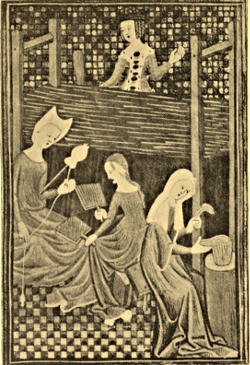
Margaret was really happy in her new home, and,
resourceful as she was and never cast down, she
turned her attention to peaceful pursuits, and in particular
interested herself in the local industry of
wool-weaving. She had seen her father’s and her
mother’s interest, in her happy days in Lorraine and
Anjou, in the craftsmen and craftswomen about
them, and her own skilful fingers had busied themselves
in homely, peaceful avocations. Margaret
endeared herself to her Fifeshire friends, as she
usually did to all who were fortunate enough to be
thrown into contact with her, and they sang of
her:
“God bless Margaret of Anjou,
For she taught Dunfermline how to sew.”
It was said, too, of Margaret, that “if she had
not been destined to play the rôle of Bellona, she
would have glorified that of Minerva.” The Earl of
March,—to whom she never allowed the style of
Edward IV.,—was wont to repeat his quaint joke:
“Margaret is more to be feared when a fugitive
than all the leaders of Lancaster put together!”
On April 16, 1462, Queen Margaret bade adieu to
her consort at Kirkcudbright, and with her son and
suite, in four well-found Scottish galleys, set sail for
France. She landed at Ecluse in Brittany, after
more perils on the sea, and was cordially welcomed
by Duke Francis, who gave her 12,000 livres.
Thence she made straight to Chinon,—of happy
memories,—to interview King Louis, who had just
been crowned at Reims, upon the death of his father,
Charles VII. There she was folded in the loving
arms of her dear aunt, Queen Marie; and what a
meeting that was for both royal ladies! They had
not seen each other since that auspicious wedding-day
sixteen years before. Then they were both in
the heyday of prosperity; now both were crushed by
Providence—Marie flouted by her ill-conditioned,
jealous daughter-in-law, Charlotte de Savoy, now
Queen-consort of France, and Margaret a fugitive!
Louis played a double game—a cruel one indeed,
and insincere so far as Margaret was concerned. He
spoke to her fairly, but his mind was with the usurping
King of England. Under one pretext or another
he delayed his reply to her plea for assistance, but at
length, in desperation, Margaret pledged Jersey with
him for 2,000 French bowmen. King René was in
Provence, but, taking a hint from Louis that his
presence would be undesirable just then in Anjou, he
sent for his daughter to join him at Aix. This was
impossible; for Margaret time was all too valuable,
and she set sail for Scotland on October 10. With
her went a few single-hearted knights, but of all the
hosts of admirers and loyal followers of sixteen years
before, only one of mark wore his badge of chivalry
consistently—the gallant and accomplished Pierre de
Brézé, a preux chevalier indeed, the forerunner of
Bayart, and like him “sans peur et sans reproche.”
Again the elements were not only unpropitious,
but malevolent. Escaping the vigilance of Edward’s
cruisers, and the rebel guns of Tynemouth, basely
trained upon their Queen, her ships were wrecked
on Holy Island. There 500 of her troops were
massacred, and Margaret and de Brézé, and a very
meagre following, put to sea in a fisherman’s open
boat which landed them on Bamborough sands. The
banner of Henry of Lancaster, once more raised
aloft by Margaret, magnet-like drew all the
northern counties, and in spite of Somerset’s desertion
the Queen soon found herself at the head of
a formidable army, with the King beside her and the
Prince. Once more at Hexham fickle fortune failed
the intrepid Queen. Henry was again a captive, but
Margaret and Edward made good their escape over
the Scottish border.
How often, when human affairs appear most
desperate, and all hope and effort are thrown away,
help comes from some unexpected quarter! So it
was in Queen Margaret’s experience. There is a
romantic tale with respect to her flight from Hexham’s
stricken field—the story of the robber.
Whether one or more outlaws waylaid and robbed
the fugitives it matters not, but, stripped of everything
but the clothes they wore, Queen and Prince
were in dismal straits. Wonder of wonders! a
messenger followed Margaret from no less a person
than the Duke of Burgundy, the inveterate enemy
of her house, the friend and ally of the English in
France. The message was in effect an invitation to
the Queen and Prince to Flanders—the splendid
appanage of ducal Burgundy. Margaret’s implacable
foes,—the winds and seas,—were waiting for their
prey, and nearly secured their quarry as she tossed
to and fro across the wild North Sea on her way to
meet Philippe. Landing on the Flemish coast on
July 31,—when storm and tempest should never
have appeared,—with utmost difficulty, the Queen
presented a sorry figure. No badge or symbol of
royalty marked her worn-out figure; she was clad
meanly in a coarse short worsted skirt—robette—without
chemise or shawl, her stockings low down on
her heels, her hair dishevelled and unveiled. Who
could have recognized in that chastened traveller
“the loveliest woman in Christendom”?
True to his loyal devotion, Sieur Pierre de Brézé
was with his Queen poor as herself, he had, he
said, “spent 50,000 crowns for nothing”—and a
faithful valet, Louis Carbonelle, and no more than
seven women-dresses. At once the Duke was
apprised of Margaret’s coming; but, being on a
pilgrimage to Our Lady of Boulogne, he sent his
apologies by Philippe Pot, Seigneur de la Roche
and a Knight of the Golden Fleece, bidding the
Queen welcome, and saying that he would present
his homage to her shortly if she would proceed direct
to Bruges.
That progress was a nightmare, an “Inferno,” a
masquerade—what you will: the Queen of England
clad in rags, her hair untied, seated in a common
country bullock-cart, drawn by a pair of sorry steeds,
mocked all the way along as “Une Merrie Mol!”
“Une Naufragée!” “Une Sorcière de Vent!” The
Comte de Charolois, heir to the duchy, met her
Majesty at the digue, saluted her with all reverence,
and conducted her to the Castle of St. Pol. On the
morrow the Duke of Burgundy arrived, and at once
went to the Queen’s lodgings to pay his homage.
Right in the middle of the street, where Margaret
stood to greet him, with a courtly bow he swept the
ground with the drooping plume of his berretta,
whilst the Queen curtsied in her abbreviated gown
twice majestically. Never was there a finer piece of
royal burlesque enacted!
Margaret caught the Duke by the arm as he was
about to give the kiss of etiquette. “Thanks, my
cousin,” she said; “now I am, perhaps, in no fit
mind for compliments. I seek your aid for Henry
and our son, and I beseech you, by the love of Our
Lady, not to credit the abominable tales which have
been circulated touching me.” The Duke did not
commit himself, but generously gave his “sweet
cousin” 2,000 golden crowns,—wherewith “to fit
your Majesty with proper raiment,” he said,—and a
fine diamond to wear for him. The next day the
Duchess of Bourbon, Philippe’s sister, visited Queen
Margaret, and in her she found a sincere and
sympathizing confidante. She set before the Duchess
all the sad facts of her impoverished condition, and
told her all about the hardships she and her spouse
and son had met with in England. “We were
reduced,” she said, “on one occasion to one herring
among three, and not more bread than would suffice
for five days’ nourishment.” She went on to say
that once at Mass, at Dunfermline, she had no coin
for the offertory, and she asked an archer of the
King of Scotland, kneeling near her, for a farthing,
which he most reluctantly gave her.
“Alas!” replied the weeping Duchess, “no Queen
save your Majesty has been so hardly dealt with by
Providence; but now we must offer you, sweet cousin,
some consolation for your sufferings.” One more
affecting speech of the heroic Queen must be recorded.
“When on the day of my espousal,” she said, “I
gathered the rose of England, I was quite well aware
that I should have to wear it whole with all its
thorns!”
The Duchess, true to her word, organized splendid
fêtes at the Castle of St. Pol in honour of the royal
refugees, and Margaret, now attired as became her
lofty station, put on one side her cruel anxieties, and
yielded herself to the pleasures and humours of the
festivities. They put her in mind of the gay tournaments
in her happy home—the Court of her good
father, King René.
Henry was all the while a prisoner in the Tower,
and Margaret’s tender heart bled on his account.
She for the moment was without resources, and she
had to bide her time. She knew that that time would
come, and never for a moment did she lend herself to
unprofitable despair. The Duke stood by her, a friend
in need, and bestowed both money and an escort upon
his royal visitor. In the spring of 1463 she and the
Prince were welcomed in Bar-le-Duc by King René
and his Court, though it cost Margaret a pang to see
her one-time Maid of Honour, Jehanne de Laval, in
her dear mother’s place.
Six months passed all too swiftly under the hospitable
roofs of her brother Jean, Duke of Calabria,
and now actual Duke of Lorraine as well, and of
her sister Yolande, Countess of Vaudémont. Then
widowed Queen Marie sent an urgent summons for
her favourite niece to pay her a visit at Amboise in
Touraine, and there most happily Margaret forgot her
troubles, and looked more hopefully than ever to the
future.
King René’s affairs were in hopeless confusion, and
his interests and resources were drained by his son’s
campaign in Italy. He could offer nothing but a
loving father’s whole-hearted love and protection to his
unfortunate daughter and his little grandson, the
pride and joy of his life. He breathed out his deep
feelings in two elegant canticles eloquent of Margaret’s
woes. His example set all the poets singing
sweetly of the Lancastrian Queen; her beauty and
her accomplishments, her troubles and her fortitude,
appealed to them mightily. They sought, too, to
cheer the riven soul of their liege lord and poet leader:
“Rouse thee, King René! rouse thee, good René!
Let not sorrow all thy spirits beguile.
Thy dear daughter, brave spouse of King Henry,
Tho’ sadly she wept still she coaxes a smile.”
All that René was able to do for his royal daughter
was to establish her and her son at his castle of
Kuerere, near St. Mihil’s by Verdun in Lorraine,
with 2,000 livres to carry on the education of the
Prince. Sir John Fortescue, a soldier of fortune,
was appointed his tutor. He was a devoted adherent
of the Red Rose. “We are,” he wrote, “reduced to
great poverty, and the Queen with difficulty sustaineth
us in meat and drink.”
Louis XI., who had refused to have anything to do
with his unfortunate cousin, Queen Margaret, at last
agreed to meet her at Tours in December, 1469, and
with her he invited King René; Jean, Duke of
Calabria and Lorraine; and her sister Yolande, with
her husband, Ferri, Count of Vaudémont, “to consider,”
as he put it, “what may or may not be done.”
Louis treated Margaret with scant ceremony. Whilst
discussions were going on, startling news came from
England which very much altered the situation. The
North and Midlands had again risen against Edward,
and Warwick had gone over to the Lancastrians.
Edward was a prisoner at Middleham Castle, and
Warwick was virtually King of England! The
diversion was, however, of short duration, for in a
few weeks Edward managed to escape. And now it
was Warwick’s turn to fly. He sought the French
Court, and confided in Louis, who, sinister and
scheming as he was always, saw a way to help
Margaret and still be on the winning side. The
King proposed an interview between the Queen and
the Earl, with a view to a reconciliation. Margaret
rejected indignantly the proposal. “The Earl of
Warwick,” she exclaimed, “has pierced my heart
with wounds that can never be healed. They will
bleed till the Day of Judgment. He hath done
things which I can never forgive.”
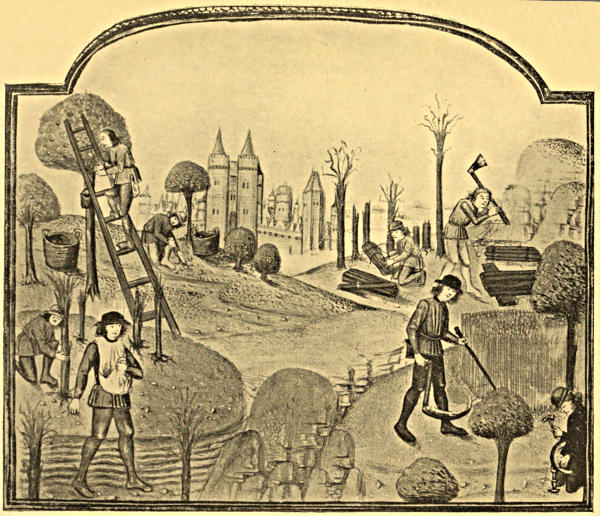
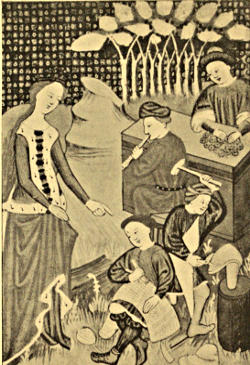
AGRICULTURAL PURSUITS
From a Miniature, MS. Fourteenth Century, “Livre des Proprietez des Choses”
British Museum
To face page 292.
The King was, however, determined that his idea
of a rapprochement between the Lancastrians and
the wing of the Yorkists who looked to Warwick for
light and leading should be realized, and he urged his
view so emphatically upon Margaret that at last she
agreed to meet Warwick, but upon one condition:
that “he shall unsay before your Majesty and the
King of Sicily, my father, all that he has foully
uttered about me and the Prince, and shall swear to
repeat the same at Paul’s Cross in London later.”
Warwick, to the amazement of Louis, agreed to this
condition, and forthwith presented himself most
humbly to the Queen upon his knees. Swordless,
gloveless, and uncovered, he sought pardon for his
evil conduct, and prayed her to accept him as her true
henchman and devoted lieutenant. Margaret seemed
stunned by this extraordinary volte-face, and kept the
Earl upon his knees quite a long time before she
vouchsafed a reply. At last she extended her hand
for him to kiss, and he, further, servilely kissed the fur
hem of her robe. Then he laid his plans before the
august company for releasing the King and placing
him once more upon his throne. He next called on
King Louis and King René to stand surety for the
performance of his purpose. He said he could command
immediately 50,000 men to fight under his
orders, and he craved the presence of the Queen in
the saddle by his side.
With Warwick was the Earl of Oxford and other
leaders of his party, who all knelt in homage to the
Queen and craved her clemency. To Oxford she at
once extended her hand. “Your pardon, my lord,”
she said, “is right easy. What wrongs you have done
me are cancelled by what you have borne for King
Henry.” The conference at Tours was adjourned,
and resumed at the Castle of Angers; and then
Louis had another startling proposition to lay before
Queen Margaret: no less than the betrothal of Prince
Edward,—now a well-grown and handsome lad of
seventeen,—to the Earl of Warwick’s daughter
Anne! Margaret flared up at once. “Impossible!”
she said. “What! will he indeed give his daughter
to my royal son, whom he has so often branded as
the offspring of adultery or fraud! By God’s name,
that can never be!”
For a whole fortnight Margaret stood her ground.
She could not agree to this extraordinary proposal;
but then the peaceful, fatherly insistence of René
caused her to relent, but not before she roundly rated
her good sire for his pusillanimity and too ready
credence. Meanwhile the Countess of Warwick and
her daughter had arrived at Amboise, and had been
most ostentatiously received by King Louis. Then
happened, by happy coincidence, an event vastly
important to the King of France—the birth of an
heir. Queen Charlotte was delivered of a son, the
future Charles VIII., on June 30. Nothing would
content the King but Prince Edward and Anne
Neville must be among the child’s sponsors. At the
same time, to influence Queen Margaret, Warwick, at
Louis’s suggestion, made a solemn asseveration in the
cathedral church of Angers: “Upon this fragment of
the True Cross I promise to be true to King Henry VI.
of England; to Queen Margaret, his spouse; and to
the Prince of Wales, his true and only son; and to go
back at once to England, raise 50,000 men, and
restore the King to his honours.” Louis gave him
46,000 gold crowns and 2,000 French archers, and at
the same time asked Queen Margaret to accept the
charge of his young daughter Anne whilst he was
away.
Margaret could not stand out any longer, and so,
immediately after the baptismal ceremony,—where
she herself held her little royal nephew at the font,—Edward,
Prince of Wales, and Anne Neville were
betrothed with gorgeous ceremonial in the Chapel of
St. Florentin, within the Castle of Amboise, in the
presence of nearly all the Sovereigns of France and
their Courts.
“The Prince,” so said the chroniclers, “is one of the
handsomest and most accomplished Princes in Europe,
tall, fair like his mother, and with her soft voice and
courteous carriage, was well pleased with his pretty
and sprightly fiancée.” People sought to belittle the
match, and called it a mésalliance; but the bride’s
great-grandmother was Joanna Beaufort, daughter
of Prince John of Ghent, Edward III.’s third son.
She married the Earl of Westmoreland. In Queen
Margaret’s estimation, what certainly did weigh
very considerably was the fact that her daughter-in-law-to-be
was one of the wealthiest heiresses in
England. The august company went on to Angers
after the double ceremony, at the desire of Queen
Margaret, who insisted that a Prince of Wales could
only be married in his ancestral dominions. She
cited the intention of King René to leave to her and
her heirs the duchy of Anjou, and so she claimed
it as already English territory. Louis acceded to
her whim. He could afford to wait and watch the
course of events. The marriage of Prince Edward
and the Lady Anne was consequently solemnized, on
August 15, in the Cathedral of St. Maurice, which
had witnessed so many royal functions.
The Earl of Warwick, accompanied by the Duke
of Clarence, grandson of King Henry IV., departed
immediately for England, to make good his brave
words and prove his loyalty. His proclamation in
favour of Henry, Margaret, and Edward, produced
an immense sensation, and in a couple of days he
found himself in command of 70,000 men, all crying,
“A Henry! A Henry!” Edward IV. immediately
left the capital and sought the friendly shores of
Holland, and Warwick was, without a blow being
struck, master of the kingdom. His first step was
to send the Bishop of Winchester to the Tower, to
clothe King Henry in regal robes, and conduct him
with the Sovereign’s escort to the Palace of Westminster.
On October 13 the King went to St. Paul’s,
wearing once more his crown. Louis ordered Te
Deum to be sung in every church in France, and
went in person to the Castle of Saumur to salute
Queen Margaret. Early in November the Queen,
with the Prince and Princess of Wales and a very
distinguished following, set out for Paris, on their
way to London. Every town through which the
royal cortège passed was gaily decorated, and the
hearty plaudits of the thronging inhabitants were
mingled with the joy peals of all the bells.
Harfleur once more was fixed upon as the port
of passage, and once more the Channel churned and
a tempest fell upon the royal flotilla. Nobody has
been able to explain why Margaret of England was
so persistently persecuted by the divinities of the
weather. Twice they put back to port, and then,
after tossing about for sixteen whole days and nights,
they made Weymouth,—a passage ordinarily of no
more than as many hours,—and landed on April 13.
That day was indeed ill-omened for the cause Queen
Margaret had at heart, and for which she had suffered
such appalling vicissitudes. The Battle of Barnet
was fought and lost; Warwick was killed, and King
Henry was again a prisoner. Verily, Queen Margaret’s
star was a blaze of disasters!
The terrible news staggered the courageous Queen;
she swooned, but soon recovered her usual equanimity,
although out of the bitterness of her soul she sobbed:
“Better die right out, methinks, than exist so insecurely!”
She appeared to have no plan of action,
for such a disaster seemed to be impossible; so, to
gain time for thought and effort, she moved herself
and those she loved into the safe sanctuary of Beaulieu
Abbey. There Somerset and many other notable
fugitives forgathered. To them she counselled retreat—“Till
Providence,” she said, “ordereth better luck.”
The Prince now for the first time asserted himself,
and, with his mother’s daring, gave an emphatic “No.”
At Bath a goodly array of soldiers rallied to the
royal standard, and Margaret determined to cross the
Severn and join her forces to Jasper Tudor’s army
of sturdy loyal Welshmen. The Duke of Gloucester
opposed her advance, and so she turned aside to
Tewkesbury, and there encamped.
The morrow (May 4, 1471) was to be the darkest
in all the chequered career of Margaret of Anjou
and England. Sweet Pentecost though it was, the
spirit of comfort belied, failed the fated Queen once
more. With early dawn fell aslant the springtide
sunbeams a rain of feathered hail. Battle was joined,
each man at his post—save one, the perjured Lord
Wenlock. His command, in the centre of Queen
Margaret’s forces, lacked its leader, and Somerset
rode off to find him. At a low brothel he discovered
the miscreant drinking with and fondling loose
wenches. “Traitor!” cried the Duke; “die, thou
scoundrel!” And he clove his head in two. This
defection caused irretrievable disaster; still, the
Prince of Wales did prodigies of valour, and so did
many more; but he was felled from his horse, and
the “Hope of England” was lead captive to
victorious Edward’s tent. Received with every
mark of discourtesy, the heart of the chivalrous
young Prince must have quailed as he stood before
the arch-enemy of his house, but he had very little
time for reflection.
“How durst thou, changeling, presumptuously
enter my dominions with banners displayed against
me?” demanded Edward.
“To recover my father’s crown, the heritage of
my ancestors,” bravely replied the Prince.
“Speakest thou thus to me, thou upstart! See,
I smite thee on thy bastard mouth!” roughly exclaimed
the conqueror, and with that he demeaned
himself and the crown he fought for by cowardly
and savagely striking with his mailed fist the unsuspecting
and unarmed Prince. This treacherous blow
was the signal to the titled scoundrels standing by
for a murderous attack upon the Prince of Wales.
He fell crying fearlessly: “A Henry! A Henry!”
pierced by many daggers. It was a dark deed and
dastardly; its stain no course of years will ever cleanse,
and Edward IV. is for all time “Bloody Edward.”
Queen Margaret, seeing the hopelessness of the
conflict, and fearing the worst had happened to the
Prince,—for he never came to cheer her,—took the
Princess and fled to a convent hard by the battlefield,
and there lay concealed. Edward, yielding to
the base instincts of a cruel nature, very soon got
news of Margaret’s hiding-place, and with a demoniacal
scowl, “Ah, ah!” he cried out, “we’ve settled
the cub; now for the she-wolf!”
The Queen was dragged from her hiding-place,
and borne to Edward’s quarters, where, like the
brute he was, he reviled and insulted her.
“Slay me, thou bloodthirsty wretch, if thou wilt!
I care not for death at thy desecrating hands! May
God strike thee, as He will!” she exclaimed.
Margaret was sent to the Tower, but not to her
husband; they were kept apart, and the Princess of
Wales was delivered over to the care of her uncle, the
Archbishop of York. But even so Edward’s malice
was not exhausted. The Queen was conducted without
honour, or even decency, in the suite of Edward
on his return to the capital. At Coventry,—of all
places for further outrage, a place so greatly agreeable
to Henry and herself,—ill-fated Margaret was
subjected to personal insults from her vanquisher.
In reply she reviled him, and thrust him with abhorrence
from her. In revenge he ordered her to be
fastened upon a common sumpter horse, and he
ordered a placard to be placed on her breast,
“This is Queen Margaret, good lieges,” and her
hands were tied behind her back. Thus was the
most valiant, most unselfish, and most loyal Queen
that England ever had led to grace the mock
triumph of a royal murderer. She was thrust into
the foulest dungeon of the grim Tower, and there
remained, bereft of food, of service, and wellnigh of
reason, too, for seven dreary, weary months.
The day after her incarceration King Henry’s
dead body was discovered in his cell. Gloucester,
it was said, had killed him; but Edward was, if
not the actual murderer, privy to the deed. Queen
Margaret, hearing in her dark, foul den the heavy
tramp of men-at-arms, scrambled up to the bars
of her little window, and beheld,—what probably
Edward meant she should,—the corpse of her slaughtered
husband borne past for burial. No ceremony
of any kind accompanied that mournful passing. At
St. Paul’s, Henry’s body was exposed in a chapel
of the crypt, and then it found merciful sepulture in
the God’s-acre at Chertsey Abbey.
That her beloved son,—her one and only hope,—was
dead as well, heart-broken Margaret gathered
amid ribald blasphemies of the intoxicated soldiery as
she was borne to London in that “Triumph.” Now
was she bereft indeed, and nothing seemed so desirable
as death; indeed, she resigned herself, and prepared
herself for execution at any moment, at any
savage hint of her consort’s supplanter on England’s
throne—accursed Edward! It was, however, not to
be supposed that King Louis of France or King
René of Sicily-Anjou should silently condone the
unhalting cruelty of a bloodthirsty monarch, especially
when the person and the honour of a French Princess
were at stake.
Efforts were made, more or less feeble, for the
delivery of the incarcerated Queen by Louis,—fearful
of offence to the Yorkist King,—and by René, who
had no resources with which to back up his appeal.
Anyhow, Margaret was, at the Christmas following
the fatal battle, released from durance vile, and consigned
to the care of the Duchess-Dowager of
Somerset,—one of her earliest friends,—and went to
live under her wing at Wallingford. Edward made
her the beggarly grant of 5 marks weekly for the
support of herself and two maid-servants! There
Margaret remained for five years, each one more
intolerable than its predecessor.
At the Peace of Picquigny, August 29, 1475,
between Louis and Edward, the latter agreed to
accept a ransom of 50,000 gold crowns for the
widowed Queen. This compact was not an act of
grace on the part of Louis so much as a quid pro
quo. He insisted upon René ceding Provence to the
crown of France, upon his death, by way of payment
of the ransom. Still, in this matter Edward was as
good as his bond, and directly the first instalment of
the amount was paid in London to John Howard,
Edward’s Treasurer, Margaret was conducted to Sandwich,
not without indignity, and placed upon a
common fishing-boat. Landing at Dieppe, January
14, 1476, she was taken on to Rouen, where she
received the following affecting letter from her
sorrowing father, King René:
“Ma fille, que Dieu vous assiste dans vos conseils,
car c’est rarement des hommes qu’il faut en attendre
dans les revers de fortune. Lorsque vous désirerez
moins ressentir vos peines, pensez aux miennes; elles
sont grandes, ma fille, et pourtant je vous console.”[A]
True enough, the troubles and reverses of King
René were more than fall to the lot of most men of
high culture and degree; but what of Queen Margaret’s
shipwreck? For nearly thirty years she had endured
experiences which had tried no other Queen half so
hardly; and all the while she had set a unique
example of devotion, loyalty, courage, and endurance,
unexampled in history. There never was a truer
wife, a more self-sacrificing mother, a more intrepid
and a nobler Queen, than Margaret of Anjou.
From Rouen the Queen sent a message to King
Louis, desiring to see him; but he, knowing well her
desperate case, and seeing no likelihood of profit
accruing to himself, coward-like, evaded an interview.
His miserable aunt might forage for herself, for all
he cared, and go where she listed, but not to Paris
nor Amboise. With bent head and slow feet, the
great heroine of the Wars of the Roses, broken like
a pitcher at a fountain, took her lonely way no more
in gallant cavalcade, but almost in funereal cortège,
to Anjou and Angers—the cradle of her race.
At Reculée father and daughter once more
embraced each other. Alas, what a sorrowful meeting
that was, and how mixed their feelings!
Margaret’s filial duty conquered the reproaches she
had prepared, and René’s tears and silence spoke
more loudly than words of regret could do. Providence
had been cruel to them both. René loved
Reculée for its peace and solitude, and there Margaret
should repose awhile and recover mind and body.
No prettier resort was there in all Anjou than the
Maison de Reculée—“Reculée” René named it, a
place of “recoil” from the buffetings of fate. He
had purchased the estate, in 1465, from one Colin, an
Angers butcher, for 300 écus d’or, and had greatly
enjoyed laying out the estate and erecting a bijou
residence. His paintings and his sculptures, his
books, his music scores, his miniatures, and all his
artistic hobbies, he lavished there for himself and fair
Queen Jehanne. They often dropped down the
Maine in a pleasure barge, and landed in the sedges,
full of warblers and wild life. Reculée was but a
league or two from Angers. Hard by the manoir
was the sheltered and picturesque hermitage of La
Baumette,—a shrine of St. Baume, patroness of
Provence,—and hither René and Margaret resorted
daily for prayer and meditation.
Margaret’s home-coming was sad enough, but her
demeanour was rather that of defiance than of
patience. Her pride had been laid low by her sufferings
and ill-treatment, but not slain; and when she
heard of the treachery and chicanery of the King of
France in entering Angers in force, and proclaiming
himself Sovereign of Anjou, her scorn knew no
bounds, and she chided her father for his pusillanimity,
and reproached him for his dilettante life. His
sedentary pleasures and his artistic tastes bored her
cruelly; she despised his peaceful handiwork, and
craved his strong arm once more in the fight. If
England was lost to her, Anjou and Provence should
not be; this was her grim determination, and she
roused herself for action and foray. Like a lioness at
bay, she fought out to a finish strenuously her troubled
life, away from stricken fields and gruesome dungeons.
René felt his daughter’s strictures more acutely than
he said; indeed, they fell like blows of sharp poniards
upon his wounded heart. The deaths of all his near
relatives, sons and daughters, and his son-in-law,
Ferri de Vaudémont, saddening as they were, were
as nothing to the vituperations of Margaret—now
almost a frenzied recluse. King René sank at last,
wearied, heart-broken, yet trustful in his God, into
his mortal resting-place, and Queen Margaret retired
to the Castle of Dampière, near Saumur, the modest
manoir of a devoted servant of her father’s house,—the
Sieur François de la Vignolles, of Moraens,—to
end her dire days of woe.
Her father left her what he could, impoverished
as he was: 1,000 gold crowns and the Castle of
Queniez—an inconsiderable estate between Angers
and Saumur. René wrote to Louis a few months
before his death, commending Margaret to his care
and charity, and this is how the King of France
executed the trust, so characteristic of his greed and
cunning. He negotiated with Margaret the sale of
her reversionary rights in Lorraine, Anjou, Maine,
Provence, and Barrois, for an annual income of
600 livres. The deed was executed at Reculée,
November 19, 1480, but Louis never paid the
annuity! One purpose Margaret had in view in this
arrangement was the recovery of the bodies of her
husband and son, that she might give them decent
burial. Edward IV. would not allow this seemly
duty, and the bones of the illustrious dead were left
dishonoured and unnoted.
Margaret’s nature would not allow of comfort.
She was devoured with regret and consumed by
revenge; she spent the last two years of her stormy
life in fretting and fuming over the disasters of her
family. Her whole appearance and her manner
changed. No longer lovely, as when she stepped on
England’s inhospitable shore, she became shrunk,
aged, and pallid. The ravenings of her spirit had
indeed transformed her into the “grim grey wolf of
Anjou.” She became leprous and hideous—“the
most hideous Princess in Europe,” one might write.
Gently but firmly she had to be restrained, lest she
should do herself some harm and injure others.
Alas! Margaret of Anjou came to her death, not in
the halo of sanctity, but in the mist of mental
obscurity, and thus she died alone—perhaps unlamented,
and certainly misjudged by posterity.
Near her end languor and paralysis seized her, and
she passed away unconsciously on August 25, 1482.
Above the chief portal of his castle De la Vignolles
put up this epitaph:
“In the year 1480 Margaret of Anjou and Queen
of England, daughter of René, King of Naples, Sicily,
and Jerusalem, forced to abandon her kingdom after
having courageously borne herself in a great number
of encounters and in twelve pitched battles, deprived
of the rights of her family, spoiled of all her possessions,
without means of support and without help,
found a resting-place in this manoir, the home of
François de la Vignolles, an old and faithful servant
of her father. She died here August 25, 1482, aged
no more than fifty-three years. Upon whose soul
may Christ Jesus have pity.”
All that remained of this remarkable woman was
interred without ceremony in the Cathedral of
Angers. She was laid, it was said, by her father’s
side, but no inscription, no mark of any kind, records
the fact. No one knows exactly where to bow the
head in reverence and bend the knee in homage to the
memory of Great Queen Margaret. In a very few
words, however, are summed up in the “Paston
Letters,” No. 275, the character of Margaret
d’Anjou: “The Queen is a grete and stronge
laborid woman, for she spareth noo peyne to save
hir things.”