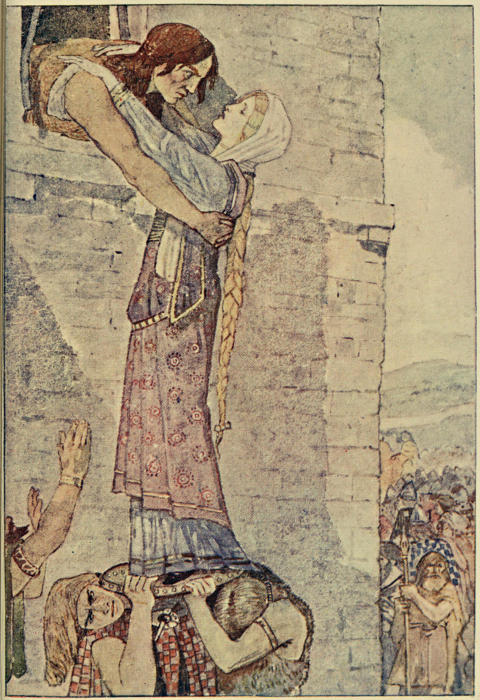
Long time he lay, till at length he became ware
of one kneeling beside him, while strong wine
was poured between his teeth; then soft lips
kissed his forehead and a soft voice whispered
in his ear, “Awake, oh, awake! Oh, what aileth
thee, my Feargus? Now thou openest thine
eyes. Thanks be to God! hadst thou died I
would have slain myself—there, drink a little.”
And then she kissed him again and wept and
kissed, between joy and grief. “Canst thou
arise,” she said at length, “for there is danger in
lying here lest any should come. Better sit in
my chamber till thou art well—my tire-woman
is abed.”
So Feargus arose and stepped into the light,
but he no longer dare look at her, but stood
before her shamefaced and cringed on the ground
beneath, kissing her feet and asking forgiveness.
“I know not what it is that I must forgive;
what hast thou ever done that should need my
forgiveness?”
Then Feargus told her and she went white and
trembled, and wept again, and refused his kisses
and turned from him, till at last she forgave him
and he arose. And she told him all that had
happened since she was taken captive, and how
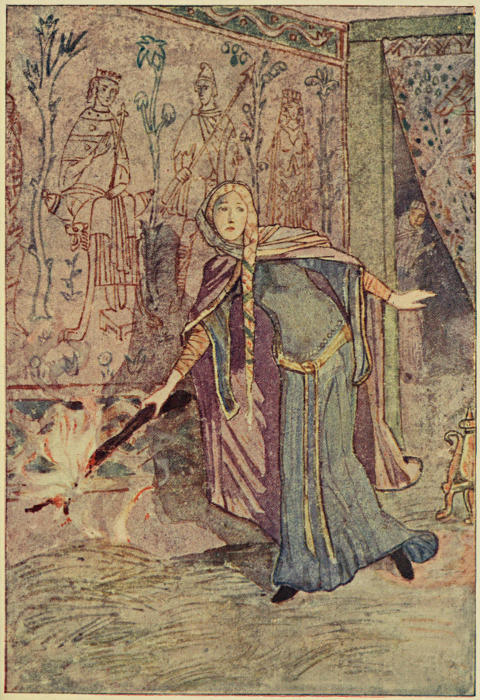
she had set the tapestry on fire and been beaten by
the earl’s mother and had tried to find the battlements
to fling herself from them, and how she
had gone instead into the hall where her enemy
was and been again sorely beaten. And he was
full of rage and indignation and grief and shame
at his own doubts of one so noble and devoted.
“Then,” said she, “know that I knew thee
the moment thou didst enter despite thy disguise,
for no other harper that ever me saw
doth hold his harp as fondly and strike it just as
thou dost; but even had this not been so, I
should have known thee for Feargus among ten
thousand, and so overjoyed was I at seeing thee
that I could scarce contain myself, for never
did I think the ring would betray him so quickly
and I had little hope indeed. Now thou must
go, and at thy signal I will do as thou hast bidden
me, to-morrow, and I pray we may get hence
with whole skins, but my heart fails me at the
thought.”
“Much have we come through and it will go
hard if we do not escape from this place.”
So he departed to the hall and lay among the
rushes on the floor, where he slept soundly, many
dangers having taught him to sleep when he
might, that his strength should be husbanded.
When the folk began to stir about the castle he
arose, and, breakfasting with the soldiers, waited
in the hall while they got ready a great feast, for
that day the prince was to wed the strange lady
and he and his friends were to make merry. So
the hour of the feast drew nigh and the nobles
entered and took their places at the board on
either side the prince. On the right hand was
Torfrida, dressed in a long white gown, about
which in cunning wise was drawn a sash of gold.
The veil which had half hidden her face yesterday
had gone, and her fair hair with its shining
depths of red and gold fell down over her
shoulders in simple fashion. So lovely she
looked, and so young and fresh and ruddy, that a
murmur arose from the rough soldiers and serving
men as she entered, and even the loose, low
sots who sat round the board gazed upon her for
a moment open-mouthed. And they ceased to
wonder how it was that the strange maiden had
been able to make their master put off the
wedding, day by day. Feargus, who sat among
the servants at the opposite end of the table, had
been playing, but as she entered his hand had
fallen, and he stopped to gaze with the rest.
Seeing this the prince turned and said, “Why
stoppest thou, minstrel? When I bid thee thou
mayest stop.”
Then there entered a few other women, wives
of the nobles, coarse and red-faced like their
lords with much eating and drinking. By
them Torfrida looked the fairer. The feast
began, and thereafter the wine cup went round
and Feargus played his merriest music that they
might drink the more. Soon there was no man
among them that had not taken more than
enough and some grew noisy, and shouts and
oaths filled the hall, while some lay asleeping with
their heads on the board. And so mad was the
music that many drank still, till at length the
prince arose, his face flushed and hand unsteady,
and cried, “A toast with me, my friends; I
pledge the bonniest lady in Lothian!”
“Nay, now, sir prince, how shall they know
that thy words be true unless thou tellest whose
lady she is that thou dost pledge, for there may
be some here who hold their own ladies the
bonniest.”
“Thou hast over much to say for thyself, sir
minstrel. I tell thee I will break the head of
him who will refuse to drink this toast with me:
the lady I speak of is mine.”
“Nay, then, prince, my head must thou break,
for her I hold to be the fairest lady in this company
is mine.”
“Ha, ha! what new foolery is this to please
the company? Go on, minstrel, it must be
something of great wit to warrant thy assurance.
Here is an old coxcomb indeed, friends.” And
the laugh went round. And Feargus sang this
song, thinking to sober the company a little and
hoping to escape without bloodshed:—
I take my lyre—what should I sing
Of love who makes my soul her harp,
Whose frowns awake each stented string
To tones how sad, how sweet, how sharp!
At other times love is my guide
And to the sunlight leads my feet,
By silver streams and leafy ways
And langourous meadows cool and sweet.
Yet life it hath a toilsome road,
With many a heart-break, many a thorn;
And all men stagger ’neath their load
From twilight unto morn.
Yet had life nothing good but she,
Love’s laughing eyes would grief dispel;
So it were well, content I’d be,
If but love came, ah, yes! ’twere well!
The song pleased the love-sick prince and
there was a round of cheers ere Feargus had
done.
“Thou art indeed a good minstrel,” said the
prince, “but now to the toast.”
“Yea, he singeth well, but he hath had over
much wine and his head is not so strong as it
once was,” said one.
“Nay, good sir knight, thou art mistaken,
wine hath not passed these lips to-day, for I
drink wine but sparingly; but I hold that no
man may drink this pledge an he hath a lady
whom he holdeth fairest.”
“Thou art mad; sit thee down,” roared the
prince, “or a halter shall sit where thy lady’s
arm should be.”
“Thou wilt at least put me to the proof, and
ye gentlemen all. I swear that when I ask, the
bonniest lady shall arise and walk to me across
the hall, or, an she doth not, thou mayest hang
me forthwith.”
Then followed roars of rude laughter, and
shouts of, “Where is she?” “Bring her forth,”
and others shouted, “’Twill be a good jest; let
the minstrel have his way.”
“Go on then, minstrel,” said the prince,
“since it is the wish of the company.”
“That will I, but thou must first give me thy
pledge that if I fail not, then wilt thou allow my
lady and myself to leave thy halls unmolested
and without scath, and will leave us to wend our
way as we may list, on two good beasts of thy
stable.”
“Thou art beside thyself. How could it
profit us to keep the lady of such as thou?”
Then the nobles, who began to feel a kind of
curiosity stirring them, said, “This is so persistent
a madman that we must needs let him
have his way.”
“I swear to thee, minstrel,” said the prince,
“to do as thou sayest, an thou succeed, and,
moreover, I swear to hang thee an thou failest.”
Feargus turned to the knights and called them
to witness, and then rose and taking his long staff
bound round with thongs, and his harp, he
walked down the hall to the door and standing
with his back against it struck a few notes on his
harp and sang this verse in strong, clear tones:—
“When I call she will arise
’Spite the fears that fill her eyes;
When I suffer she will weep
For her love is boundless deep.
Yet than I she’s nobler far,
Beautiful as still streams are,
Pure as is the purest thought,
Or as dew the night hath brought.
Yet she is my willing slave,
Full of fears, she will be brave
When I call, and come to me,
For her love is as the sea.”
The passionate tones of the singer had stirred
his hearers and the laugh died out on their lips
ere he had finished the first bar. Mere curiosity
had become keen interest, and there was a pause
in the buzz and murmur that had filled the hall.
He reached his right hand to his left shoulder
and from beneath the loose red plaid he wore
drew forth his great sword. This was the signal.
Torfrida arose from her place and, ere the
astonished prince could collect his senses, tripped
lightly down the hall and stood beside the aged
minstrel, the company being too much astonished
to hinder her. Siegfried started up in great
rage, and made towards them. Quickly and
with wondrous strength did Feargus draw some
ponderous benches that lay about to the front of
him as a fence, and warned the prince back.
“Prince, thou hast sworn, and all the company
hath witnessed; be not rash, for an thou
break promise given, thou wilt lose such worship
as is left to thee. And I ask ye, knights and
gentlemen, to see right done.”
Many were for Feargus, but the prince still
advanced, slowly and with great labour clearing
the benches from before him as he went. Then
Feargus set down his harp, and handed his long
staff, which was his bow, to Torfrida that she
might free it of the thongs which had served to
hide it, and he started to his full height and cast
off his grey beard and his rags and stood big and
strong in his byrny with his great sword in his
palm. Then those who had unwillingly followed
their master held back, for they knew him the
captain of the king’s guard.
“Thou hast stolen my lady, and I am come to
rescue her, and be he earl or boor, he that goeth
to stay me shall die.”
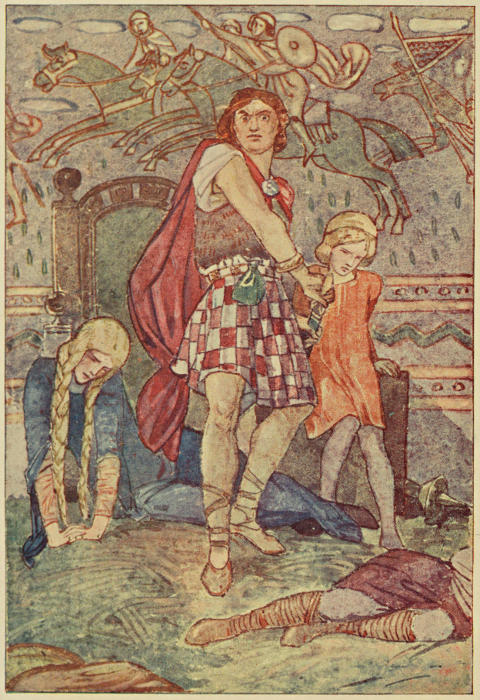
Then the prince, mad with rage, drew forth
his sword and with many oaths advanced upon
him, followed by those of his own Northumbrians
who were present. The others, Britons from
Strathclyde and Lothian and Southern Picts who
had submitted to the rule of the strangers, saw
that the minstrel was a Pict, and their jealousy
of the Northumbrians being aroused they were
less ready to see so gross a wrong done to one of
their race.
“Now he is a coward and recreant chief who
keeps not his pledge,” cried Feargus, “and they
be coward knights who help a lying leader.”
Then the Britons tried to reason with the
prince, but in vain, still he came on, followed by
his drunken rout.
“Back, prince, or thou shalt die,” said Feargus
once more, wishing to spare the spilling of blood.
Drunk and mad with anger, however, the prince
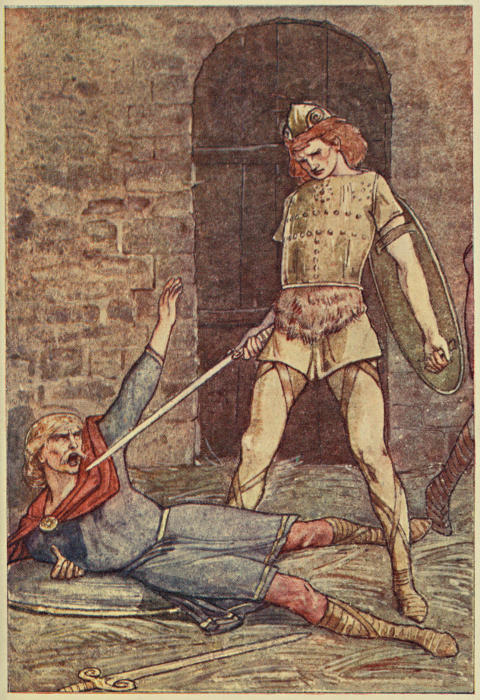
heeded not, but laid his steel against that of
Feargus, though it was only a moment ere the
sword of Feargus was buried in his body, and
the blood of him leaped up suddenly from his
mouth and, to the horror of his men, he fell back
dead. Then Feargus tried to stop the Northumbrians,
stout fighting men and big of body,
but they would not hearken to him, coming on
crying, “Down with him! he hath killed the
prince!” They pressed against him on the right
hand and the left, but so close the one upon the
other that they had little space to move, while
lightly Feargus swung his brand from behind
the benches, so that they could not get into him,
and legs and arms were shorn in its sweep, until
there lay before him a confused and bloody
mound, mixed up with wine cups and meat and
drink and table gear, and still the Picts and
Britons withheld from the strife. But Feargus
knew that the fight must go against him, so
thick and fast they came, wounding and trampling
on each other in their eagerness to get at
him. Then, wounded and weary of so much
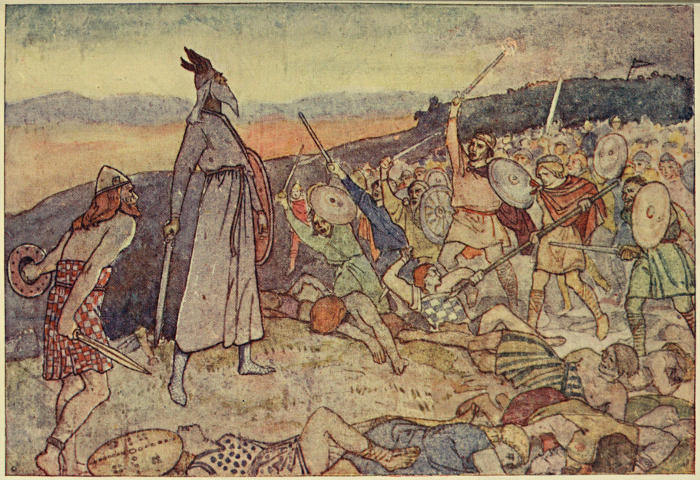
sword play, in a pause of the fight he cried out
in Gaelic, “Now here am I, Feargus, son to king
Nechtan of the Hundred Fights, and kin to all ye
Picts and Britons, and my lady is of the South
Albanich by her mother’s side. Yet though of
these Northumbrians I have slain some and
maimed more, till I am sick of slaughter, yet my
lady and I must fall, so many are our enemies.
Never a friend shall he lack though all the world
be turned against him who helpeth me.”
Then said one to his fellows, “This must
indeed be Feargus, king Penda’s captain, for
never saw I man so giant-like or of so great
strength and hardihood. All that man can do
hath he done; shameful and unknightly of us
were it to see him, our kin, who is in his right,
destroyed.” Then many of the others agreed,
though they were loth to join the fray, fearing
for their own lands. But he who had spoken
first, one Llewellin of the Gwynedd tribe of
Britons whose lands had stretched up into the
Lothians, stepped to the leader of the Northumbrians
and for a moment the fight ceased.
“Now,” said he, “ye men of Northumbria, ye
have had your fill of fighting and it is dastardly
of all ye to attack one, though he hath ye at
some advantage. Surely your king would little
admire ye.”
“Hath he not slain our prince? right angry
will be the king. Not one of us dare face him
without this man’s head, stark though he be,
for he is son to king Nechtan and it must be he
who was Penda’s captain.”
“Then no hand will we have in this unknightly
work; but we bid ye desist, or an ye do not we
will join with Feargus, and what could we not do
under so mighty a leader?”
Feargus spoke out to the Lindeseymen. “Now,
ye men of Lindesey, this, my lady, is Torfrida,
daughter of Sigmund, your king, and ye, men of
Mercia, I have bled for your king, and two hundred
of my men fought for him when others fled, and
all died for him at the last. If ye do not help
me we must fall.”
Then one Lindeseyman said: “I saw him save
prince Edwy and his thanes from the Mercians.
I will help him.”
“And I saw him stop the slaughter of the
Lindeseymen,” said another.
“And I was with him when he held the cliffs
for Penda on Trent water,” said a Mercian.
“And I when he saved the day for Mercia at
Camulodunum in East Anglia.”
“And I, and I,” said others.
So all these who had held aloof came down
over the barriers and stood beside him.
“And I and all Lindeseymen will fight for
Torfrida,” said another thane. And he cried,
“Lindesey! Lindesey!” and behind him followed
the rest of the Lindeseymen crying, “Lindesey!
Lindesey!” And the Mercian thanes cried the
cry of “Penda! Penda!” that held armies spellbound
with fear in the old days, and all the
Mercians joined them.
Then said Llewellin of the Gwynedd to the
Northumbrians, “Let no more blood be spilt.
We do not want to fight ye, Northumbrians; we
would be friends.”
Getting scornful reply they drew their swords
and fell mightily upon the Northumbrians.
And the clang of sword on helm, and the rushing
and hurrying of mailed feet, and the cries of
“Lindesey! Lindesey!” “Penda! Penda!” filled
the hall, where late had been merriment and
a different music. And no more terrible and
savage sight fell ever on the eye of Feargus.
Torfrida had long fainted for very horror of it.
And when the din ceased there was no Northumbrian
left standing unwounded out of all that
throng.