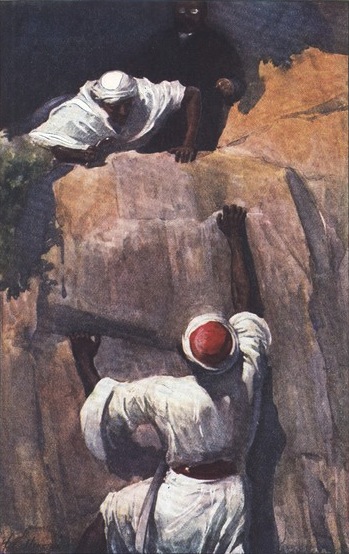
Before the band of horsemen had approached
the edge of the little plateau where the airship
lay, the two men stepped forward through
the trees at its lower edge and waved to the
oncomers with every sign of welcome.
“I hope none of them will recognize me,” said
Sir Mark in a low tone to Oliphant. “Probably
few in this wild district have ever been in Tangier,
where my features are tolerably well known;
and having been for some time unable to shave—these
followers of the Prophet are forbidden the
use of the razor, and Mr. Schwab does not carry
one—I look perhaps a little unlike myself.”
The horsemen came up at a gallop, bringing
their horses to a halt when it seemed to Oliphant
that he and his companion must be trampled
to the ground.
“Peace be with you!” said Sir Mark in
Arabic, making a slight inclination.
“And with thee, peace!” returned the leader
197
of the party, looking not a little surprised at this
orthodox salutation from a N’zrani.
“In the name of the most Merciful!” Sir
Mark continued. “Thou dost behold us in sore
straits, O Son of the Mountain. We are brothers
under our skin, thou and I, and I crave thy help.”
“Bismillah! I am thy host, and all that I
have is thine.”
“Thou sayest well. Behold this strange monster
that lieth on the ground beyond us. It was
made by a countryman of mine, to simulate the
flying of birds in the air—a most wondrous thing,
and worthy to be seen by his Shereefian Majesty
the Sultan himself. I was indeed on my way
to visit the Sultan, but was prevented by a most
untoward happening. (That is strictly true,
though the fact is somewhat post-dated,” he added
in an aside.) “Even a bird tires with overmuch
flying; and, as thou seest, this thing that imitates
the flying of a bird tires also, so much so,
indeed, that we saw that its wings would not
carry us the full extent of our journey, and we
were on our way back to the coast in order to
repair its strength, when it failed us utterly.
Wherefore, friend, we ask thee to lend us the
assistance of some sturdy men from your village
to carry our poor bird to Casa Blanca, or to any
ship that may chance to be off your shore.
198
(They may have seen the yacht.) For this service
we will reward them liberally.”
“Bismillah!” ejaculated the Moor. Oliphant,
watching his face during Sir Mark’s address, had
caught a fleeting expression of perplexity and
disappointment. Expecting to make an out-and-out
capture, he was no doubt somewhat nonplussed
at this request for assistance. But he
had the Moor’s ready adaptability to circumstances.
His speech gave no sign of his thoughts.
“Bismillah!” he repeated. “We are all in
God’s hands. Let my brother give thanks to
Allah the most Merciful that he came to a man
so friendly disposed as Salaam son of Absalaam.
It shall be even as thou wishest, Sidi. But first
thou and thy son must come to my village, for
your bird yonder is too heavy to be carried without
much preparation. It will need the shoulders
of a great number of men. But while the men
are making ready, enter my house, all too unworthy
to shelter you: yet we will comfort you with
food, and do all that is in our power to please
our guests.”
“We thank thee, O Salaam, for thy proffered
hospitality, which we will accept, knowing that
all things will be provided for our comfort.”
“So be it, Sidi. But within the walls of my
village, when I first looked heavenwards and
199
saw this strange flying thing, did I not see three
men borne along in it, and one of them in djellab
something like my own?”
Sir Mark smiled and, pointing to a part of
the apparatus that was coloured grey, said—
“No doubt in the distance my brother mistook
that for a person. We are two, as thou seest.”
The Moor still looked somewhat mistrustfully
around. Then, with an appearance of being
convinced, he dismounted, and ordered his
followers to dismount also, asking his guest to
choose whichever of the horses he pleased for
himself and his son. At this imputation of
kinship, Sir Mark elevated his eyebrows; the
young man was certainly a disreputable-looking
object. Thinking it policy to accept the offer,
Sir Mark mounted the head-man’s own steed,
Oliphant following his example with the horse
of one of his party. Then, bidding a score of
the men lift the airship on their shoulders, the
head-man and the rest remounted, and led the
way to the village. Both Sir Mark and Oliphant
were glad that the distance was not great, for
the high Moorish saddles were a sore trial to their
unaccustomed limbs. The envoy, at any rate,
was under no delusion as to the nature of the
hospitality promised. From the manner in which
the tribesmen escorted the two Englishmen to
200
the village, there could be little doubt that they
were prisoners.
From his perch in the tree Tom noticed that
although the majority of the horsemen accompanied
his friends towards the walls, four or five
detached themselves from the party and returned
to the plantation, which they proceeded to
search pretty thoroughly. He made himself as
small as he could among the foliage when they
passed beneath him, but they did not look up;
apparently it did not occur to them that any one
should have mounted into a tree. When they
had finished their fruitless search, they went, not
in the direction their fellow-villagers had taken,
but towards the coast. Tom saw them spread
out as they rode from the plantation, and watched
them until they were mere specks in the distance.
Then, when they were, he supposed, perfectly
satisfied that the suspected third member of
the English party could not have escaped them,
they wheeled round and returned one by one
again passing not far from his hiding-place.
Clearly, if they were so suspicious, it would be
expedient for him to remain for some time in the
tree—an unpleasant prospect, for he was becoming
very stiff and cramped, and suffering rather
severely from hunger and thirst.
It was some hours before he ventured to slip
201
to the ground. Even then he did not dare to
leave the shelter of the wood, knowing that in
the open he would inevitably be observed. But
he stretched his limbs and found a few blackberries,
which somewhat appeased his hunger.
Every now and then he again climbed the tree
to find out whether any one was approaching, or
whether a watch was still being kept. Late in
the afternoon he descried, on the further side
of the village, a horseman approaching from the
direction of the hills. He came at full gallop,
and rode straight into the village, disappearing
there from Tom’s view.
“Hope to goodness he isn’t a messenger from
the sheikh!” thought Tom.
At last, when the sun had set, and the sky
was darkening, he deemed it safe to leave his
hiding-place. If the yacht had remained where
he had last seen her—and it was scarcely likely
that Mr. Greatorex would shift his anchorage—he
conjectured that a five mile walk would
bring him to the nearest point of the shore.
Fortunately it was a beautiful night, clear and
starlit, though the moon had not yet risen.
Taking his bearings very carefully by the stars,
in anticipation of a return journey, he started,
going very slowly and cautiously, watching every
shadow lest it should indicate the presence of a
202
Moor. Ignorant of their language, he knew
well that he had no chance whatever of slipping
past if he were once accosted. In such a case
he could trust only to his lightness of foot.
But nothing happened to cause him uneasiness,
and after trudging along for nearly two hours
he was beyond measure delighted to see what
was evidently a masthead light some distance out
at sea. No native craft would show a light; he
could hardly doubt that the Dandy Dinmont and
his friends were before him.
He was quickening his step in the pleasure of
this discovery, when suddenly, without warning,
he found himself at the edge of an encampment
lying in a slight hollow at the summit of the
cliffs. He started back, but it was too late. A
Moor, swathed in his hooded djellab, came out
of the darkness and spoke to him. Tom saw
that it might be fatal to run now; he walked
on, hoping that he might pass without replying.
But the Moor spoke again, more sharply, in a
more questioning tone. Tom, whose head was
covered with the hood, mumbled something
beneath his breath; but his unpractised tongue
could not achieve the hard guttural accent of
the Moorish speech, and the sentinel took a hasty
step towards him.
There was now nothing for it but to take to
203
his heels. Disguise was no longer possible, and,
to free his limbs, he cast the djellab from him,
and dashed at full speed across the grass to the
edge of the cliff. The slope was steep, but he
scarcely gave a thought to the risks he ran.
Scrambling over, he lay down and rolled from
top to bottom, with many a gash and bruise
from sharp edges of the rock.
Loud shouts pursued him. The camp was
aroused. Picking himself up, feeling breathless
and dazed, he sped across the sandy stretch of
beach and sent a sounding hail in the direction
of the yacht; perchance his voice might carry
above the rustle of the surf and the cries
of his pursuers. He heard men scurrying down
a path in the cliff somewhere behind him; then
their footsteps on the light shingle that lay above
the sand. Even if his cry had been heard on
the yacht, it was impossible that a boat should
reach him before he was overtaken. There was
only one way to safety. He plunged into the
surf, and struck out towards the vessel. A shot
followed him, but he cared nothing for that; in
the darkness it would puzzle an expert marksman
to hit him, when nothing of him could be seen
but a head bobbing up and down. Not till he
had swum well out of the reach of his pursuers,
who had not followed him into the sea, did the
204
thought of sharks cross his mind. Then he trod
water for a little, and, making a bell of his hands,
sent another prolonged cry across the water.
Is that an answering hail? He shouts once
more; yes, a cry comes back to him: “Ahoy-o!”
But at the same moment he hears also the sound
of paddles, to his right, apparently from a bend
of the shore. The Moors have not given him
up, then. Again he presses on, putting all his
force into a strong side-stroke. Now another
sound falls upon his ear; the welcome sound
of oars plied sturdily in rowlocks. The yacht’s
boat is coming to meet him. But the pursuers
are the nearer—will his friends arrive in time?
His long exertions since he left the yacht, his
want of food and sleep, have robbed him of
his strength. His pace becomes slower and
slower. The pursuers’ boat is coming up behind,
while yet the beat of oars before him sounds
terribly distant. But he is still swimming;
every yard he makes is a yard added to the speed
of the friendly boat. He struggled on; and
the Moors were still some distance behind when,
gasping and spent, he was helped by Timothy
and another into his ark of safety.
But the boat did not head at once for the yacht.
“Give way, men!” cried Captain Bodgers
himself, at the tiller.
205
He pointed the nose of the boat straight for
the Moors’ light craft. Eight sturdy British
sailors pulled with a will. There was a crash,
a cry, and a dozen Moors were in the water,
struggling to right their capsized boat.
“That’s all right. Now we’ll get back, my
men,” said Captain Bodgers, and some few
minutes thereafter Tom was assisted up the
side of the yacht, and into the arms of Mr.
Greatorex.
“God bless my soul, what has happened?”
said the worthy merchant.
“We’ve got him—Ingleton,” murmured Tom
faintly. “He’s with Oliphant, captured again.
Schwab’s in the cave with Abdul.”
“He’s light-headed, poor fellow!” said Mr.
Greatorex. “Here, some one, blankets, and
brandy—look alive now.”
Tom was soon stripped, dried, swathed in
warm blankets, and dosed with brandy till his
blood tingled. Mr. Greatorex fussed round
him, waiving his proffered explanations until
he was thoroughly recovered. Then Tom gave
him an account of all that had happened since
he left the yacht, Mr. Greatorex breaking in
every now and then with “Dear, dear!” “You
don’t say so!” “The villains!” “What a
mercy!” and such like exclamations. Early
206
in the narrative he interrupted with a question:
“You say Oliphant! Who’s Oliphant? Am
I on my head or my heels?”
“Oh, I forgot you didn’t know,” said Tom
with a smile. “Your new stoker was Oliphant
in disguise. You see, Byles, your late stoker,
had to remain at home and attend to his sick
mother.”
“No more sick than I am!” declared Mr.
Greatorex. “Don’t believe he had a mother!
M’Cracken, indeed! I’ll M’Cracken him! I
hope his father will get him well thrashed when
he goes back to school.”
“He’s rather big for that, don’t you think?”
“The bigger the better! I never heard of
such a thing! The impudence of it! And
taking us all in so! What things are coming to
I don’t know. No obedience, no respect for
age—pretending to be Scotch, too——”
“Well, he is Scotch, you know.”
“Don’t tell me! He’s only Scotch when it
suits him. There are others like him in the
Lords. He was never Scotch in my house—where
he shall never show his face again, never!”
Tom was not deceived by this explosion of
wrath. He knew very well that Mr. Greatorex
was only relieving the tension of his feelings,
207
and working off his nervous excitability on the
most convenient object. “Les absents ont toujours
tort,” he remembered. Mr. Greatorex
presently calmed down, and heard the rest of
the story in comparative quietude.
“And what are we to do?” he said at the close.
“Swob doesn’t matter; we’re not bound to
lift a finger for him; but we can’t leave Ingleton
and M’C—— and Oliphant in the hands of those
wretches. They’ll break up our machine, too,
and play the very deuce with my property.
What are we to do?”
What Tom answered is shown by subsequent
events. Two or three hours after his return
to the yacht, when he had had a thorough rest and
a good meal, a well-armed party, consisting of
the whole ship’s company except the cook and
one seaman, left the yacht, on which all lights
had been extinguished, and rowed with muffled
oars to a sheltered cove on the south side of the
bay—that furthest removed from the Arab
encampment. Mr. Greatorex had insisted on
joining the party. In vain Tom pointed out
that a hard march was before them, suggesting
delicately that Mr. Greatorex was not so
light as he once was. The merchant puffed the
objection away. They disembarked in dead
silence, and, leaving two of their number to
208
take the boat back to the yacht, made their way
cautiously up the cliff.
Led by Tom, the party, ten in all, struck off
in the direction of the village. Thanks to the
light of the moon, which now lay a little above
the horizon, Tom was able to make a fairly
straight course for the plantation in which he
had hidden during the previous day. Once or
twice he strayed from the proper track, and
ultimately found that he was nearly a mile from
his objective; but this was not bad, considering
that there was no beaten road, and they had to
tramp across rough country. When he reached
the plantation he was no longer in doubt as
to the true direction; during his long stay
among the trees he had had time to take his
bearings pretty thoroughly.
Mr. Greatorex was blown by the time they
came to the clearing in which the airship had
descended, and Tom begged him to remain
hidden in the plantation while the rest went on
to the village.
“Pff!” panted the perspiring old gentleman.
“Never gave up anything yet; on you
go!”
But a slight halt was made while Tom completed
arrangements for his night raid. The village
was walled; the gates would no doubt be shut,
209
as at Ain Afroo; the wall must be scaled. Captain
Bodgers selected the biggest men to give
their more active comrades a “leg-up.” These
latter were provided with ropes, by which they
might haul up the others when they had themselves
gained a footing on the wall. Tom
impressed on them all the necessity of maintaining
dead silence. He estimated that the village
contained about a hundred fighting men, and
if the approach of the raiders were discovered
in time for the walls to be manned, the chance of a
successful coup would be small indeed.
All carried firearms except Mr. Greatorex.
He had a knobbed stick, capable of dealing a
very damaging blow.
“There’s bound to be a fight, I suppose?”
he had said when Tom was discussing his plans
on the yacht. “I don’t like that, you know.
I’d punch a man’s nose and knock him down
without scruple, of course; but that needn’t
kill him, you know. Besides, how do I stand?
This is uncommonly like a piratical raid—like
Jameson’s, and he might have been hanged.
However!”
Tom assured him that no blood should be shed
if it could possibly be avoided; but he had small
hopes that the night would end without a fight,
and a very brisk one.
210
The party set off for the village, stealing along
under what cover was afforded by bushes and
inequalities in the ground. When about three
hundred yards from the wall all such protection
ceased; the ground was level and apparently
open. Tom’s heart was in his mouth lest their
footsteps should be heard as they crossed this.
He dared not set them at a run, for the soil all
around was stony, and the sound of near a dozen
men rushing at speed could not fail to be heard
in the village. So he kept up the same stealthy
approach, and his caution was justified, for level
as the space had appeared at a distance, it proved
to have patches of loose stones, and some yards
of boggy land, through which ran a narrow and
evil-smelling creek; to rush would have ended in
disaster.
They arrived beneath the wall without having
heard any alarm raised within. In a trice the
men began to clamber up. It was made of mud
and rubble, and was not in so ruinous a condition
as the wall of Ain Afroo. The first man reached
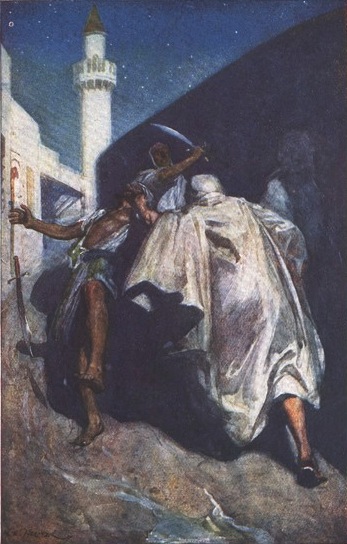
the top. Immediately there was a shout and
the sound of hurrying feet, and Tom sprang
up to the sailor’s side in time to see a Moor in
long djellab dashing from the nearest house
towards the wall. Suddenly he halted, and
fired. The young sailor winced as the bullet
211
struck him; but he was not badly hurt, and
letting down his rope, calmly proceeded to haul
up one of his comrades. After firing, the Moor
made a rush along the wall. Tom grappled
with him; both fell, dropping their weapons,
and Tom felt in an instant that he was no match
for the sinewy figure that had him in his arms.
The Moor forced him down; his hands were
already at Tom’s throat, when Timothy Ball,
who had accompanied the party in spite of his
half-healed wound, threw himself upon the
enemy from behind, dragged him backwards,
and left him half-strangled, but yet alive.
When Tom rose dizzily to his feet, all his party
were within the wall. One or two shouts were
heard from the village, but apparently the Moors
were not yet quite awake to what was happening.
Tom pulled himself together, and led the way
straight for the kasbah, which, from his lofty
perch in the tree during the day, he had seen
slightly to the right of the place at which the
entry into the village had been made. When
they dashed up to the main gate, this was being
opened to give exit to a couple of men who were
apparently about to inquire into the cause of the
slight commotion and the rifle shot that had
been heard. The two were instantly bowled
over by the onrush of British seamen, the party
212
swarmed through into the kasbah, the gate was
shut, and they came face to face with the head-man.
“What have you—got to—say for yourself?”
The Moor had naturally nothing to say for
himself. He saw himself confronted by an
elderly whiskered foreigner, in a yachting cap
and blue serge suit, brandishing a formidable
stick. Mr. Greatorex was in a passion. The
exertions of the march, the pains of being hauled
up a wall, not without bumps, the scamper at
the rear of his men into the Moor’s kasbah,
had deprived him equally of breath and of self-control.
Determined not to be left ignominiously
out of the hurly-burly, he forced himself to the
front, and thrust his stick under the very nose
of the Moor—who stood a foot above him—calling
him to account in the spluttering sentence
recorded above.
For a few moments there was a deadlock, and
Tom felt the need of an interpreter. Eventually
he persuaded Mr. Greatorex to give way, and
managed to make the Moor understand that
if he valued his life he must at once bring out the
Firangi whom he had recently introduced to
his house. Finding himself shut off by the gate
of his own kasbah from the support of his men,
the Moor recognized that he had no choice but
213
to comply, and at a command from him one of
his servants brought Sir Mark Ingleton and
Oliphant from the upper floor into the patio,
looking none the worse for their brief incarceration.
“Delighted to see you,” said Mr. Greatorex,
stepping forward and wringing the diplomatist’s
hand; Oliphant he studiously ignored.
“Mr. Greatorex, I presume,” returned Sir
Mark. “I hope to make your better acquaintance,
sir. Meanwhile, if I may be allowed——”
His quick eye had taken in the situation at a
glance.
“Peace be with thee!” he said in Arabic,
turning with a bland smile to the scowling Moor,
“You perceive, O Salaam, that my friends also,
being alarmed at my absence, have availed themselves
of your generous hospitality. They are
distressed at the unceremonious manner of their
entry, but you will assuredly deign to pardon it,
for have you not professed yourself my devoted
servant? You will be the first to forgive an
intrusion due solely to the too great zeal of my
friends.”
The Moor, chagrined and bewildered, had
no option but to acquiesce in this polite fiction,
though it is to be feared his reply lacked something
of the diplomatist’s ease and suavity.
214
“But we are a large company,” Sir Mark
went on, “and should be loth to trespass on
your hospitality. You will be relieved, I am
sure, if we betake ourselves to the vessel that
awaits us off your coast. You will, of course,
honour us by giving us your company so far.
Indeed, if you will do us the favour to accompany
us on board our vessel, we shall endeavour
to return in some slight measure the gracious
hospitality that has been vouchsafed to myself
and—my son. If you add to your favours by
assisting us in the march—by showing us the
easiest road and defending us from the perils
that may beset us, such as are known to you, O
Salaam—you may be assured that we shall show
our gratitude in very tangible form. There
are, as you know, even in Morocco, evil counsellors,
men of violence, some who would even dare
to lift their hands against the Sultan himself. If
there be any such in this village, which truly I
am loth to believe, I advise you, as brother
advises brother, to exhort them to mildness
of demeanour. These friends of mine who now
enjoy your hospitality are men of war; they
have arms, you perceive, in the use of which
they are well skilled; and since, in our progress
to the shore, you will of course occupy the place
of honour at my right hand, in all likelihood
215
you would suffer hurt if there are among your
followers any men of Belial whose hearts incline
towards bloodshed; that would be a great grief
to us. And now, O Salaam, as the night draws
towards dawn, it will be well if you perform
your morning ablutions and devotions and prepare
to lead us forth. Bismillah!”
Sir Mark, as he laughingly informed Mr.
Greatorex afterwards, had purposely made his
address somewhat lengthy, so as to give Salaam
plenty of time to regain his self-possession and
to weigh the pros and cons. The upshot was
that, shortly after dawn, the whole party, with
Salaam son of Absalaam in their midst, set off
towards the coast, the airship being carried on
the shoulders of a troop of the villagers who had
been promised liberal bakshish in return for their
services.
On arriving at the shore, Captain Bodgers
signalled to his men on the yacht to send a boat,
and with it a fresh supply of fuel for the airship,
which had been deposited just above high-water
mark. While this was being done, Mr. Greatorex
emptied his pockets of small coin, to redeem
the promise to the carriers, and Sir Mark kept
up an even flow of amicable talk, apparently
quite oblivious of the throng of Arabs who had
observed the proceedings from their encampment
216
on the cliff, and by and by came down to the
shore and stood around, listening with looks of
amazement to this fluent Nazarene who discoursed
so pleasantly of things intimate to
them.
The men soon arrived with a large tin of the
fuel-paste. It was placed in the car; Tom
made an inspection of the machinery to assure
himself that it had suffered no hurt while in the
charge of Salaam; then Oliphant joined him.
A few moments later, with a mighty whirring
sound, the airship rose gallantly into the air, to
the great wonderment of the Moors. While
they were intently watching the manœuvres of
the airship, filling the air with their cries of
“Mashallah!” Sir Mark and the rest of the party
embarked and pulled out into the bay, two of the
men sitting in the stern of the boat with their
faces to the shore and their rifles held conspicuously
ready. Salaam indulged in a burst of fury
at the manner in which he had been outwitted.
His followers gathered around him and held
excited consultation, some being apparently
inclined to fire on the departing boat, others
to pursue the airship. But they had made up
their minds to neither course by the time the
party reached the yacht; and when Captain
Bodgers trained on them the two brass guns
217
she carried, they hurriedly broke up and disappeared
over the cliffs.
“You were just in time, Mr. Greatorex,”
said Sir Mark Ingleton as they sat together in
the boat. “A messenger came in from the
sheikh yesterday afternoon, and I shrewdly suspect
that arrangements had been made to transfer us
to our old quarters in the kasbah. I say ‘our
old quarters,’ forgetting that Mr. Oliphant——”
“Oliphant!” interrupted Mr. Greatorex.
“There now! What do you think of this, Sir
Mark?”
And he proceeded to delight his guest with
a vigorous indictment of M’Cracken, and Byles,
and Byles’ sick mother, and Lord Langside for
having sent an English gentleman on a mission to
such an abominable country, and for having
such an outrageously impudent son.