Time waits for no one, and that statement was as true of Ranleigh boys
as of any others. Clive Darrell, in a mere twinkling as it seemed, had
become quite an old stager at the school. Since that momentous match
when Sturton had led his eleven to victory, thereby stimulating Clive to
declare the most ambitious of sentiments, two and a half years had
slipped by, two and half years which had seen great changes at Ranleigh.
"But always the Old Firm hangs on and exists," reflected Bert, as he sat
on the table in Upper Sixth and stared into the fire. "I remember the
term when Harvey left."
"One of the best," interjected Susanne, now no longer a gawky,
ill-dressed youth, given to smoking cigarettes on every occasion, but
spick-and-span, as immaculate as Rawlings, very English in appearance,
and looking quite twenty-one years of age, for the great Susanne sported
a moustache, and could, had he wished it, as he often declared, have
grown a beard even.
"Better than any of the masters, too," he had said. "Awful bore, don't
you know, you fellows. A chap has to shave regularly now every day. That
means getting up half an hour earlier——"
"Draw it mild," Hugh had cried. "Half an hour. That's enough for a dozen
shaves."
Whereat Susanne had crushed his friend with a withering glance and an
air of superiority which made Hugh blush.
"What do you know of shaving?" he had asked satirically, closely
inspecting his friend's smooth chin. "Not much. You're a baby."
But the subject under discussion was the change which had come to
Ranleigh. Harvey had swayed the destinies of the school. Then Sturton
had come upon the scene with his new ideas of exercise for all every
day. Clive remembered the success of that innovation. Then Lawton, an
Upper Sixth fellow, had followed, and held the post for more than a
year. Later Franklin had ascended to the giddy height to which Clive
ventured to aim. As to the Old Firm, as Bert had said, it still clung
tenaciously together.
"As big friends as ever," reflected Susanne. "That's something. Of
course, there have been rows, eh?"
"Some. That one between Masters and Clive was a bad un. Remember it?"
Susanne did. It was back in a past age. It had taken place long ago. But
in those days it had appeared excessively severe, and had threatened the
break-up of the partnership. And the cause was really so very simple.
"All about a cricket ball," laughed Bert. "Masters had lost one."
"Yes, Masters always does lose something," agreed Susanne. "Of course,
he discovered the exact article in Clive's locker."
"Of course! And claimed it."
"Refused all explanations. Almost went to the extreme of accusing Clive
of theft. In the end said he must have put the ball there himself in
mistake. They fought it out."
That was where the seriousness of the thing came in. And yet, looking
back upon the event, there was little doubt that the tussle which had
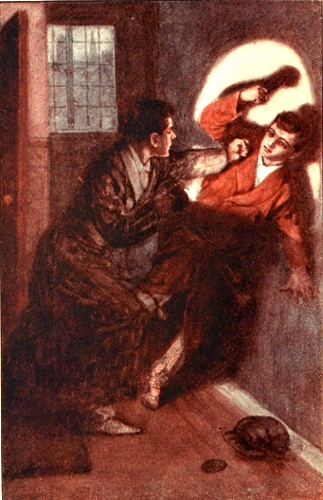
resulted cleared the air wonderfully. For Clive and Masters went at one
another with their fists, and having struggled through half a dozen
rounds were declared to have made a drawn battle of it. Of course they
shook hands. In fact, within ten minutes of the finish of the contest
they were chatting in the old amicable manner and demolishing a cake
which had arrived at the school for one of them that very morning.
"And the funny thing about it all was that the cricket ball—the one
Masters had lost—was discovered tucked away in a corner of his own
locker, where, no doubt, he himself had placed it," laughed Susanne.
"That's Masters all over. Flares out in an instant. Licks the dust
afterwards when he knows he's wrong, and makes the most ample apologies.
By the way, Bert, I wish that fellow Rawlings would take himself off. He
spoils our happy family here. No one wants him, and precious few trust
him. Besides, he's too old to be at the school any longer. He ought to
have gone up to the 'Varsity long ago."
It may be said with truth and fairness that Susanne was by no means
prejudiced. He didn't like Rawlings, and never had done so. More than
that, Rawlings was decidedly unpopular, and had been so from the day
when the ranks of the Old Firm had been recruited. Had he been
different, more friendly and less underhanded, he would most certainly
have been captain of the school. As it was the Sixth voted en masse
against him, a fact which Rawlings did not fail to perceive. It made him
furious. He hated his fellow prefects, detested the masters, and was
stupidly and outrageously jealous of them all. And the presence of this
unpopular fellow, older than any of the others in Upper Sixth, was a
damper to their enjoyment. He was a damper elsewhere. In East he was
head prefect, and a martinet. He seemed to air there all the
high-handed manners he loved so much, and which were forbidden in his
class-room. Why he remained on at the school was a problem which none
could solve. But there he was, barred by the Sixth, detested by the
juniors in his dormitory, and disliked by not a few of the masters.
Clive, too, had ascended to the Upper Sixth. It may be said, indeed,
that his rise had been meteoric. Of a sudden he had taken most seriously
to work, had developed an acuteness hitherto unsuspected, and much to
the delight of Old B., who coached him, had rushed his way up the school
till now he was the youngest fellow in his form. A prefect also, he was
senior in his old dormitory, reigning where Sturton had once held sway.
Masters had managed to crawl to the Lower Sixth, and was noted in the
school more for games than for lessons. His sturdy, genial figure
attracted the admiring eye of many a junior as he tramped the corridor,
and when we admit that he was still as much a boy as ever, we do no harm
to his reputation. Trendall, now an excellent fellow, was with Susanne
and Bert in the Upper Sixth, while Hugh, now Ranleigh's chief exponent
of gymnastics, was in the Upper Fifth.
It seemed, in fact, that nothing more could be wanted by the Old Firm
and their fellows at Ranleigh to complete their happiness, and that
something approaching an earthquake would be needed to upset their
equanimity. However, it is the unexpected which always happens, and one
night Ranleigh was stirred to the very depths of its foundations.
"Darrell—I say, Darrell," whispered a tremulous voice somewhere near
the hour of midnight, while a ghost-like figure bent over him. "Darrell,
please, are you awake?"
Clive wasn't. He stirred uneasily at the touch of this junior's hand,
for Parfit, the boy who had stolen across from his bed to wake him, was
hardly eleven years of age. Naturally timid at the thought of disturbing
so august a person as the head prefect of his dormitory, Parfit quaked
as Clive rolled over on to his other side and snored. Then, as if forced
on by desperation, the lad shook him with a heavy hand.
"Darrell, please," he called. "I—I——"
"Hullo!" Clive sat up, gaping and rubbing his eyes. "Bell gone! Eh? Then
what the dickens——! Why, it's Parfit."
"Please, Darrell," said the youth, "I'm awfully sorry for waking you,
but——"
"You'll need your sorrow, young un," came the none too friendly
interruption, for Clive, like others, objected to be roused in the
middle of the night without due reason. Not that he was hard with his
juniors. Indeed, he was always jovial with them.
"Well, what is it?" he asked, hearing the boy's teeth chattering, and at
once speaking to him kindly. "Been scared, eh? Been dreaming something
that's disturbed you? Well, cut along, young un, you'll be all right."
But Parfit had no intention of cutting. "It's not dreaming, Darrell," he
said eagerly. "It's fire."
"Fire!"
"Yes, I—I think. I'm next to the door, and I feel sure I can smell
smoke. Please, Darrell, I hope you won't be angry, but I felt bound to
come and wake you."
Clive was out of his bed like a shot, and getting into his dressing-gown
and slippers before Parfit could believe it.
"You get back to bed, young un. I'll go and see. And don't talk of being
sorry. If you smelled smoke, or thought you did, why, of course, the
thing to do was to wake me. I'd have licked you if it had been a piece
of foolery. But, right or wrong, you can expect only thanks for what
you've done. So cut, there's a sensible fellow. I'll hop downstairs and
see whether there's anything in it."
He slipped down the length of the dormitory while Parfit was thanking
him, and swiftly pulled the door open.
"Yes, smoke," he told himself, sniffing. "And thick. I can see it coming
up the stairway."
There was a gas jet on the stairs, kept burning all night, and sure
enough, by the light it gave, smoke could be seen filtering up the
stairs and whirling in thin wisps over the banisters. Clive shut the
door behind him, gathered his dressing-gown about his body, and ran
downstairs.
"I can hear crackling," he told himself, stopping for a second or more
to listen. "That means a fire. George! This is serious!"
It was more, as he discovered when he reached the foot of the stairs.
For there the smoke was dense and suffocating. It was swirling from the
opposite side of the wide corridor passing between the two staircases
leading to the South Dormitories, while beneath the one giving access to
Two and Three South the flash of flames could be seen through the dense
haze.
"A fire under the stairs. Spreading fast, by the look of it," Clive
thought. "It'll reach the gallery above, perhaps, and then the fellows
in South Dormitories would be cut off and would have to clear out
through the door to West landing. What ought a fellow to do?"
His inclination was to go tearing off up the stairs to his own
dormitory, there to awaken the boys, while he rapped hard at the door
of the room leading out of One South, occupied by Mr. Branson. And then
he thought of the excitement which would result once the alarm was
sounded.
"Make sure that it's a bad thing first of all," he said. "I'm going to
squint in through that door and see what's happening."
His eyes were shedding streams of tears by now, for the pungent smoke
attacked them remorselessly. Then, too, he was choking violently. To
cross the wide corridor below and open the door beneath the far
stairway, behind which the fire lay without a doubt, meant encountering
denser and still more choking fumes. But Clive did not think of the
discomfort or of the danger of the act. He thought of the welfare of
Ranleigh, of the commotion there would be were he to give an alarm, and
of the fact that action on the part of himself and others of the
prefects in South Dormitories might put an end to the fire, and that
without disturbing others. Wrapping the tail of his dressing-gown round
his mouth, therefore, he darted to the bottom of the stairs and raced
across the corridor, diving into a swirling cloud of choking vapour
through which he could not see. But the reflection of the flames within
the door he aimed for caught his eye. He felt for the handle and pushed
the door open. Instantly flames blazed out at him, while hot smoke
poured into his face, enveloped him completely, and went swirling up to
the roof. There was a perfect furnace beneath those stairs. He could
hear the woodwork all around crackling. It was clear that the
conflagration was of a serious nature and most threatening. Instantly he
banged the hot door to, and raced across for his own stairway. And in
the short time it took him to ascend he had made up his mind how to act.
"Wake Susanne first. Let him do the same for the other prefects. Then
take towels, blankets, and water. If the thing can't be beaten out,
we'll wake Mr. Branson, and turn every fellow out of the dormitories.
Here goes for Susanne."
But a violent fit of coughing doubled him up at the top of the stairs,
and for a while he was helpless. "Please, Darrell," he heard in the
midst of the attack, while Parfit's voice came feebly to him, "is—is it
smoke? Is there a fire?"
Clive did not deign to answer. He shook off the fit of coughing with an
effort and raced into Two South. He knew exactly where Susanne slept,
and soon had that worthy along with him. In fact, in less than two
minutes every prefect in South was mustered. Taking their bath towels
with them and bearing cans of water they dashed down the stairs, while
Clive himself reached for the extinguisher kept on every landing.
"We'll give it a trial," he said to Susanne. "If we don't make any sort
of effect on the fire we'll sound an alarm, collect all prefects, and
man the hoses. In fact, as only three or four of us can work below, I'll
get Slater and Gregory to mount the nearest there is. Come on, you
fellows."
A word to the two junior prefects, Slater and Gregory, sent them off
post-haste to the nearest stand-pipe, near which a hose was coiled,
while Clive led the way down the stairs to the site of the fire.
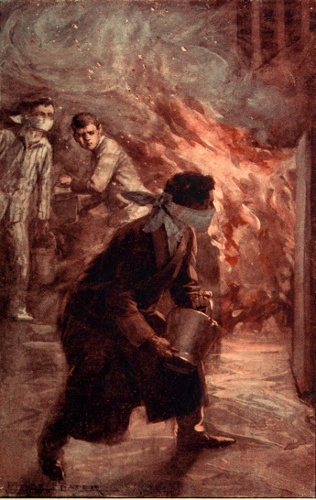
"Tie your towels round your faces," he gasped, for the smoke was even
more irritating now, and was denser even. "Now, we've half a dozen cans
of water between us. I'll open the door. Let my extinguisher play on the
flames for a while, and then finish the business with water."
But though an extinguisher may be an excellent invention, and will
extinguish a fire swiftly, its successful action depends entirely on one
point. The contents must be delivered on the fire direct, and to that
end the one who grips it must approach sufficiently close to the flames.
Here, as it happened, that was almost impossible. For when the
staircase door was thrown open the improvised brigade was swept back by
an appalling gush of flame and smoke. Clive ducked his head, turned his
face away, and set the extinguisher going. But the effect was nil, for
the actual fire was situated round the angle of the door. Clive forced
his way nearer till he was within two feet of the entrance, and
endeavoured to direct the jet round the corner. And then Susanne dragged
him backward.
"You can't do it," he said peremptorily. "Your clothes are on fire
already. Here, you chaps, help to beat them out."
The effort to say as much set him coughing violently. But the words were
heard distinctly, and Martin and Fellows, two of the helpers, at once
attacked the flames which had taken hold of Clive's dressing-gown. A
moment later the whole party was forced into the outer corridor by an
even fiercer blast of flame, accompanied by pungent smoke.
They gasped for breath, and then looked desperately at one another.
"We must rouse the school," declared Clive.
"Certain," came from Susanne.
"Then let's do it. I'll take South. Susanne, will you go to North?
Martin can take East and Fellows West. Don't shout. Wake the chaps
quietly. I'm going to shut that door first, though, and see what
Gregory is doing."
There was no time for discussion, for it was clear that they had a
serious fire to contend with. And though Ranleigh, like every other
well-managed school, where thought is taken for such a happening, was
equipped with extinguishers and hoses, while the boys were given fire
drill at regular intervals, it looked as if this outbreak might prove
too serious for them. Clive looked grave when he thought of what might
happen.
"Couldn't expect much help from the village," he told himself. "The
whole place would be on fire before they could possibly get here. We've
got to fight this thing out ourselves. Ah, there's Gregory. Got it
fixed?" he asked, as that youth came panting through the smoke towards
him.
"Nearly," came the answer. "We shall want another length of hose. I'm
going for the one at the end of the corridor. We'll have it ready in two
minutes."
"Then I'll get up to the fellows in South. Look here, Gregory, I'm going
to shut that door now. When you've got the hose going, break the place
open and play direct on the flames."
He dived through the smoke, his towel pulled up to his eyes, and, led by
the red glare of the flames, was soon near the door. But the heat was
now overpowering. Though Clive tried twice, he could not get near that
handle, while at the end of the second attempt his gown was again in
flames and he had to beat hard with his hands to extinguish them.
Meanwhile, the peace and tranquillity of Ranleigh's night was swiftly
being disturbed. A hum was coming from the dormitories. Clive found One
South in a condition of animation.
"Turn out, you fellows," he said, as if this was the most natural thing
to expect them to do, and as if it were the usual time for rising. "Stay
here till I give you permission to move. I'm going into the other South
Dormitories. I shall want Peart and Godfrey and Offord when I get back.
You other fellows had better make a bundle of your things. There's a
fire below. I'll kick the first fellow who makes a shindy."
One by one he awoke the dormitories, commanding the boys in Two and
Three South to gather their belongings at once and pass out through Four
South. By the time he reached his own dormitory again every boy was
ready, while those he had called for were standing in the gloom by the
door.
"You others skip," said Clive, still in his ordinary tones. "Peart, go
along to the Head's house and ring till he answers. Tell him what's
happening. Godfrey, you get off to the Matron, and knock at her door.
Tell her not to be alarmed, but merely to make ready and warn the maids.
Offord, your job is to rouse the butler and the beakies, and tell old
Sant to cut the gas off at the meter. There, off you bundle."
He seemed to have been giving directions for an age, whereas from the
commencement, when Parfit had wakened him, till this moment, but very
few minutes had elapsed. But those few minutes had made all the
difference to the conflagration. When Clive dashed out of the dormitory,
having wakened Mr. Branson, and descended the stairs, the opposite
staircase was blazing, the flames sweeping right up to the roof of the
corridor. The crackle of flames could now be distinctly heard, mingled
with a curious sizzling. In the far background, through the doors
leading to the quad, as a rule kept firmly fastened, he imagined he
could make out a group. Then thick volumes of smoke hid everything. He
felt someone step down beside him, and then heard Mr. Branson speak.
"It's serious," he said. "You've called the Head?"
"Everyone, sir," said Clive. "Gregory's out there, I think, with one of
the hoses. Fancy we could do something from here. I'll see."
Unceremonious at such a time, he bolted up the stairs again and so to
the West landing. Five minutes later he and Susanne held the nozzle of a
second hose, and from the point of vantage which the stairs gave them
poured a torrent of water into the blazing mass on the opposite side of
the corridor.
Meanwhile, it may be imagined that Ranleigh was in a condition of
disturbance, though thanks to the example which Clive had set in the
first place, and which Susanne and the others had so naturally copied,
there was no panic, nor even shouting. Perhaps five minutes after the
first alarm, when it had become obvious that the whole school must be
roused, every Ranleigh boy was assembled in the quadrangle, where,
pressing as close as possible, they watched Gregory and his friends
directing water upon the flames. They would have hampered the workers
even had not Masters and Trendall promptly taken a grip of the
situation.
"Look here, you fellows," cried the former, "you'll all get back to this
line here. That'll give the brigade every chance to do their work.
Trendall, send along anyone who breaks the rule. I'll deal with 'em."
There was something sinister in the speech, and hearing his voice
Ranleigh obeyed on the instant. For Masters was accustomed to speak in
jovial tones. With him an order came always as a request, such as, "Oh,
I say, Parker, just cut along like a good chap and bring down my cricket
togs," or, "You fellows here in Middle, there's a beastly noise. Go on
with your prep., do."
And his requests were obeyed with promptness as a general rule. If not,
on rare occasions, Masters could become very insistent. But he was
seldom threatening, and hearing the threat in his voice now small boys
slunk back to the quad steps and, with bulging eyes, watched the fire
over the heads of their seniors. Fellows in the Upper School shuffled
backwards, eyeing Masters askance, while even those in Upper Fifth,
fellows soon to be prefects and perhaps a trifle jealous of the Sixth
and of those in authority, quelled their inclination to push to the
front.
At this moment the familiar figure of the Head arrived on the scene.
"Who's directing matters?" he asked of Mr. Branson, who stood beside the
group of boys plying their hose from the entrance to the quad.
"Well, I am partly, and Darrell is mostly," came the answer. "Of course,
I haven't had time yet to learn how the thing was discovered. But when I
was awakened Darrell had made all arrangements. He and those with him,
Feofé and others, have behaved splendidly. There hasn't been a sign of
panic. Boys in South have cleared out with all their belongings."
"Good. Where is he? What other directions has he given?" asked the Head.
A gust of wind at that moment went swirling through the centre corridor
past the fire, sucking long tongues of flame along with it and carrying
them toward the chapel. But it also had the effect of sweeping the smoke
away, enabling those in the quad to see their comrades grouped on the
staircase opposite the one beneath which the fire raged. There they
were, sheltering behind the blistering woodwork which formed the closed
banisters, the heads of three of them, wrapped in towels saturated with
water, just appearing above the rail. A nozzle between two of the heads
gripped by a pair of hands sent a jet of water sizzling across the
corridor into the centre of the fire. The Head thought he could
recognise in one of those towelled faces the features of Clive Darrell.
"Can I get through?" he asked, stepping toward the entrance of the
corridor.
"Too hot, sir," Mr. Branson told him. "You must go round by West. I'll
stay here and direct matters. I think we are getting the better of the
flames."
At once the Head of Ranleigh turned and hurried away, the boys collected
in the quad making way for him. And we must state it now with no small
degree of pride that he set as fine an example as had any of the
prefects.
"Might easily have been a panic, with all the boys rushing here and
there shouting and shrieking," he told himself. "Everything is
wonderfully orderly. I must back these boys up. Coolness is what is
wanted. But I must also learn what steps Darrell and his helpers have
taken in other directions. That's essential. One has to consider what to
do supposing the flames beat us."
It was therefore, in spite of his hurry, with measured tread and an
appearance of unconcern that Ranleigh's Head stalked through the
assembled boys and reached West landing. A minute later he was amongst
the prefects on the South staircase, watching that descending jet of
water pouring into the flames.
"Which is Darrell?" he asked coolly, and at the sound of his voice one
of the group turned. Clive, for he it was, tore the towel from his face
at once and smiled at the master.
"Getting it down, sir," he said.
"Ah! You could leave for a moment? The smoke here makes one cough."
Clive handed the nozzle to his friends and went up the stairs two at a
time. At the top the two stopped to discuss matters.
"Now, tell me how the thing was discovered and what steps you have taken
to warn people," asked the Head.
"Parfit smelled smoke," said Clive hurriedly, anxious to get back to his
task. "I came down and found the fire. Then I turned Susanne—er—Feofé,
you know, sir."
"Yes, I know as well as anyone," smiled the Head.
"I turned him and all the South prefects out. We tried to stop the fire
with an extinguisher and cans of water. But the thing had got too firm a
hold. It was really serious. Then we decided to call up the school and
man the hoses. Gregory and Martin did the last. I sent prefects round to
the various dormitories. Fellows from One South were told to call you,
the Matron and the butler and his men. Er—that's all, I think."
"All? Then you haven't——?"
"Oh, I forgot," said Clive hurriedly. "Of course, I told 'em to turn off
the gas, so as to save an explosion, and I sent for the butler. One of
the men got on to his bicycle at once and went off to call the village
brigade. But we'll be able to do without them, sir. Can I return now,
sir?"
He was eager to get back, and the Head dismissed him with a hearty
shake of the hand.
"You've done splendidly, Darrell," he said. "There really was no need to
call me. I shan't interfere. I shall watch, and if you get the fire
down, it will be all of your own doing. I'm proud to have such
prefects."
Well might he be proud too. The seeds which Harvey and Sturton had sown
two and more years ago were now bearing fruit with a vengeance. Perhaps
at no previous period had Ranleigh been blessed with such a set of
prefects, and here was proof of it. The orderliness of the school under
trying circumstances was extraordinary. The coolness of those who had
taken the fire in hand, and their measures to warn all and sundry, were
really remarkable. No wonder the Head was filled with a glow of pride.
No wonder Ranleigh boys went mad with delight as they saw the flames
extinguished. And then how they cheered the fellows who had been
conducting the fight!
The early morning found the Hall filled to overflowing. Masters were
there in full strength. Ranleigh was present without exception, some of
the smaller boys yawning widely. Even the village fire brigade had been
invited to partake of refreshments. And then they slowly filed off to
their beds, a whole holiday with late breakfast having been proclaimed
from the dais. But that holiday was one only in name for Clive and
Susanne and a few others. They collected in the Upper Sixth when the
school was almost empty, and Susanne shut the door and turned the key.
"Now, Clive," he said, "you tell the fellows."
At once eager glances were cast at our hero. Masters sat up abruptly.
Bert stood looking almost fiercely at his old friend, while Trendall was
obviously puzzled. Clive went to the fireplace, leaned against it, and
slowly glanced at each of his comrades in succession.
"It's a beastly thing to have to say," he began, somewhat awkwardly.
"But I'm bound to tell you. That fire was started on purpose. Someone
wanted to burn the school down. I'm positive."
"What! Positive! Surely there's a mistake," gasped Bert.
"None. Susanne will tell you. I'm going to show the proofs to everyone
present, but only on a pledge of secrecy. You give it?"
They nodded at him one by one.
"You can trust us to a man," said Masters.
"Then come. Ourselves and the village sergeant are the only people aware
of the business."
"And, of course, the beggar who carried out the job," said Susanne
bitterly.
Never before perhaps had a group of the school seniors looked so
serious. Jones Quartus, happening to meet them as they issued from the
Sixth and passed along the corridor, positively shrank away from them.
The group of curious youngsters gathered near the site of the fire
shuffled backwards.
"Here, cut!" commanded Masters abruptly, and at the word they bolted, as
if only too eager to escape from the presence of their seniors. Then
Clive led the way. When he and his friends returned to the Sixth some
five minutes later, accompanied by the police sergeant, not the smallest
doubt existed in their minds that some miscreant had successfully
attempted arson, and that the fire had been started for some sinister
reason.
"We've got to get to the bottom of the mystery," said Clive.
"Yes," agreed Susanne. "But how? That's the difficulty."
It was, in fact, an absolute necessity, for the two weeks which followed
saw no fewer than three other outbreaks of fire on the school premises,
all, however, happily extinguished after causing little damage. It was
no wonder, then, that the prefects of Ranleigh set themselves seriously
to work to discover the incendiary.