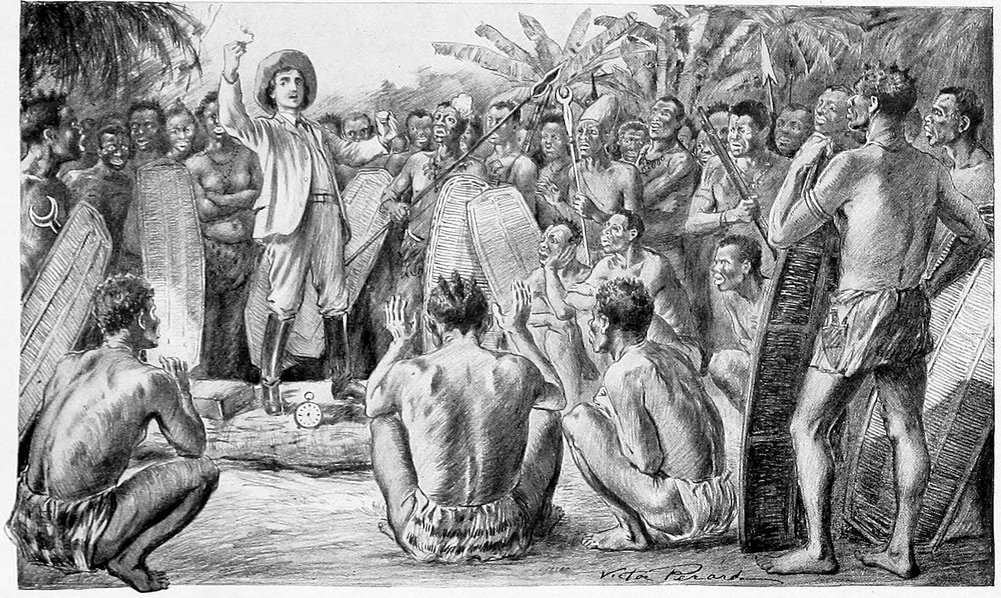
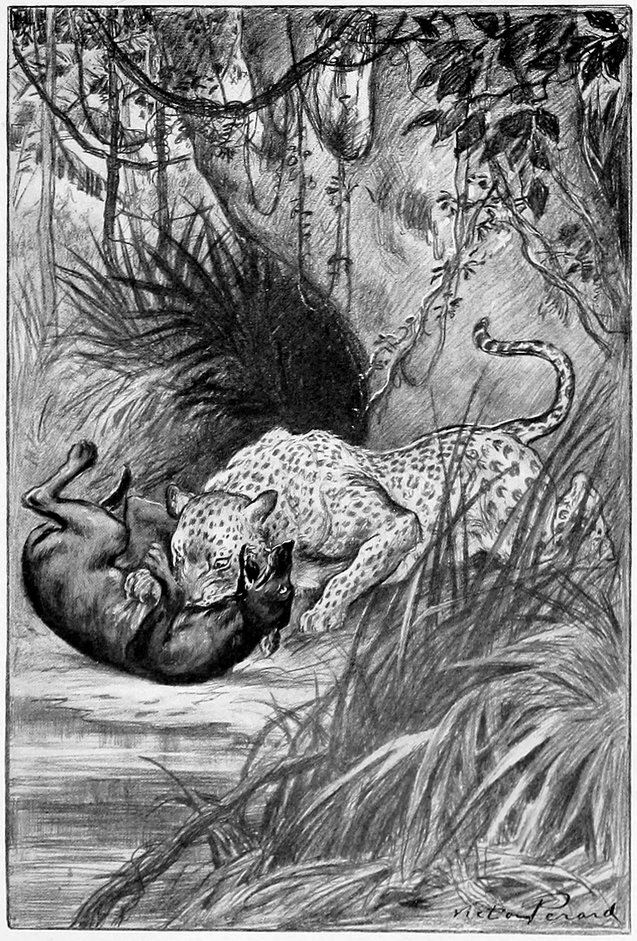
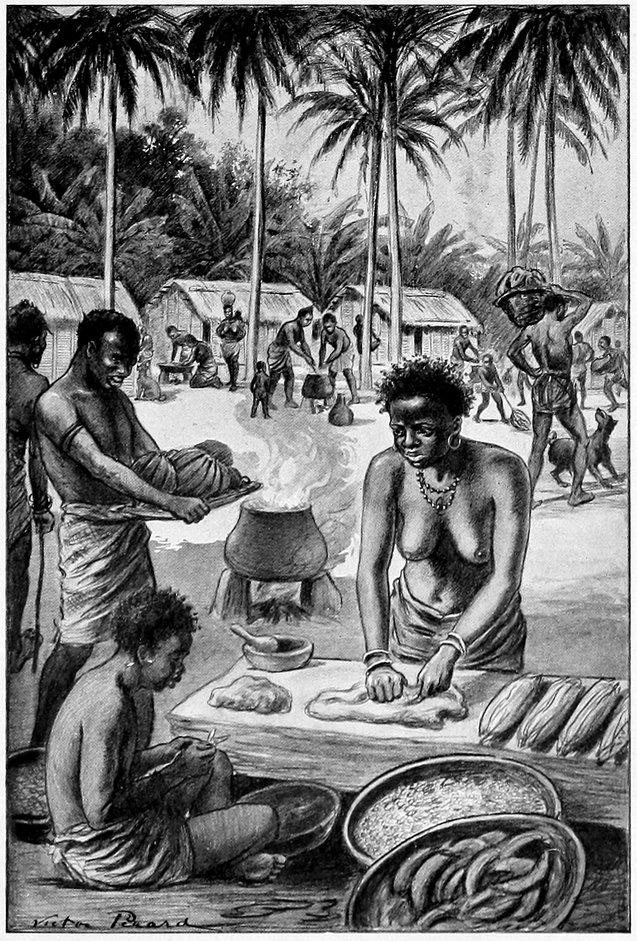
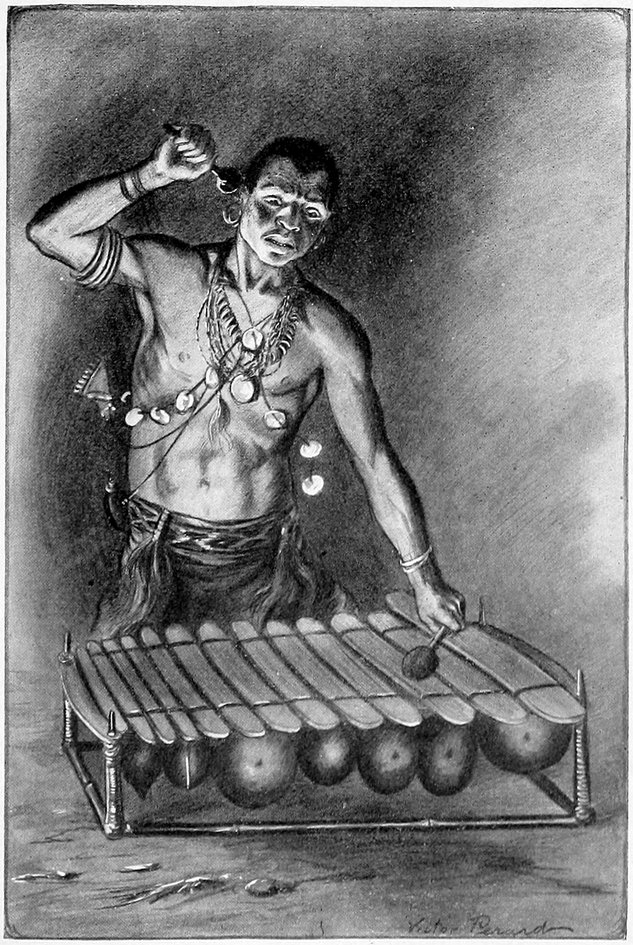
The cover image was created by the transcriber and is placed in the public domain.
King Mombo
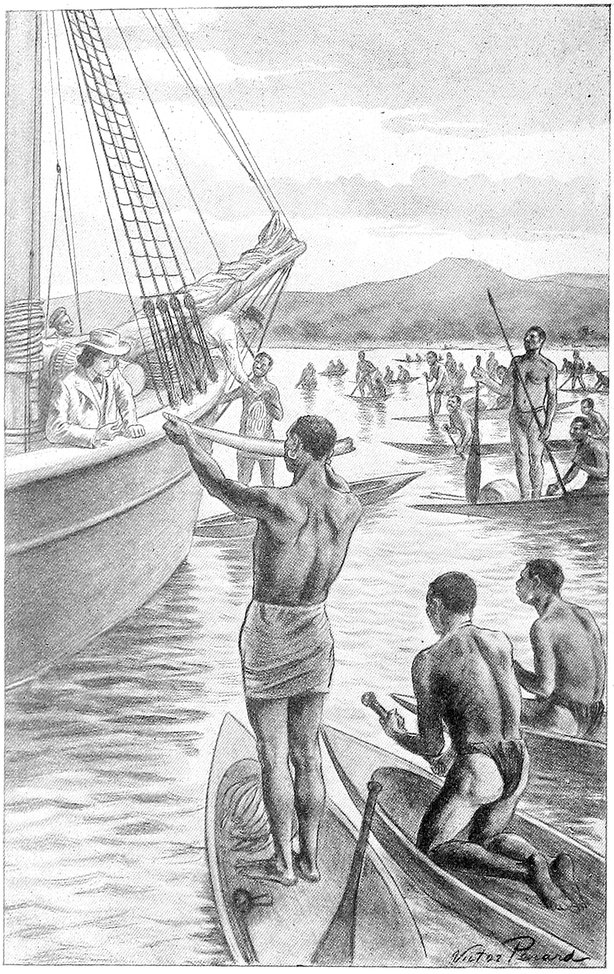
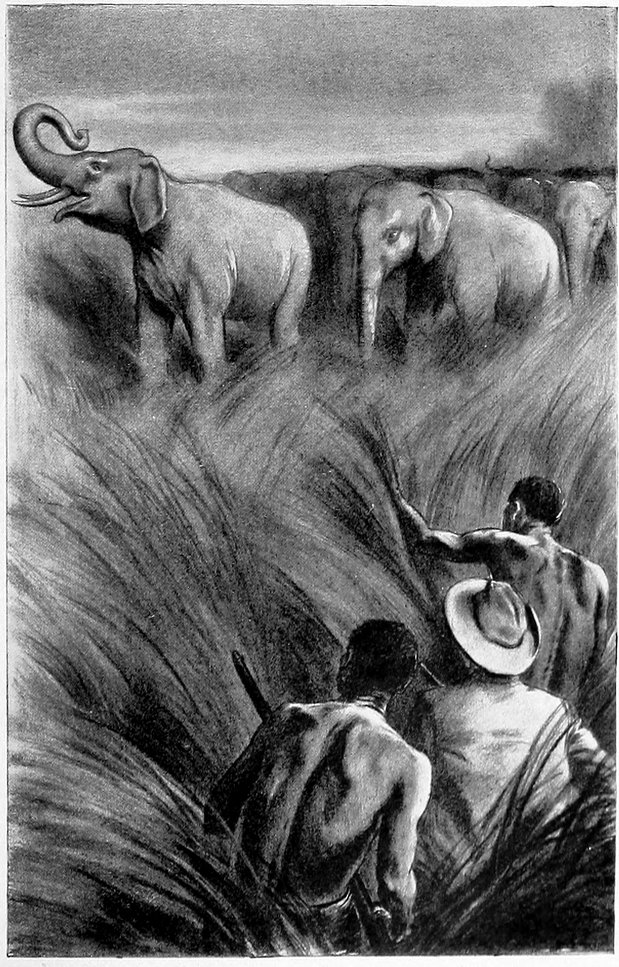
“These ... inquired if we wanted to barter for ivory with them”
By
Paul Du Chaillu
Author of “The World of the Great Forest,” “The Viking Age,” “The Land of the Long Night,” “Ivar the Viking,” “The Land of the Midnight Sun,” “Explorations in Equatorial Africa,” “Stories of the Gorilla Country,” “Wild Life under the Equator,” “Lost in the Jungle,” “My Apingi Kingdom,” “The Country of the Dwarfs,” etc., etc.
Illustrated by Victor Perard
London
John Murray
1902
Copyright, 1902, by Charles Scribner’s Sons,
for the United States of America.
Printed at The University Press, John Wilson and Son,
Cambridge, U.S.A.
TO
SOLOMON SOLIS COHEN, M.D.
Philadelphia
My dear Solis,—Looking back through the vista of years, and
remembering your solicitude when I came to you broken in health,
and the care, professional and other, through which your affection and
skill restored me to health and permitted the resumption of my literary
labors, my heart overflows. I take great pleasure in dedicating this
volume to you as a partial evidence of the gratitude and brotherly
affection of
Ever your firm friend,
PAUL DU CHAILLU.
New York, June 19, 1901.
Contents
ix
CHAPTER I
Page
I leave New York for Africa—Narrow quarters on the schooner—Our cargo—Out of sight of land—The sea and all that therein is—A storm brewing
Crossing the equator—The southeast trade-winds—The equatorial current—The Gulf Stream—Struck by a tornado—Land in sight—Africa at last—The great forest
Wandering through the forest and learning the country—I reach King Mombo’s village—Received by the king—His fear of witchcraft—Visits my dwelling and receives presents from me
King Mombo’s plantation—Work of the slaves in clearing and cultivating the forest—Strange village of the slaves—Houses of the spirits—Regundo’s account of witchcraft and its punishment—Ovengua
The animals of the forest—Five kinds of apes—The ngina or gorilla—His great strength and fierceness—How he attacks man and other animals—Oshoria’s account of him
The other apes of the great forest—Oshoria tells about the nshiego mbouvés—Capture of a baby “man of the woods”—His mother killed—Correspondence of the different apes with the various human races
News brought that gorillas are near by in the forest—The dogs got ready for the hunt—Their names—A grand hunting council—Regundo’s wise advice—Cautions to be observed
We start after the gorillas—Cautious walking through the forest—The dogs find the ngina—Yells of the monster brought to bay—He slaughters two of the dogs—Taunts of the hunters—Shot through the heart at last
Singular sight in the forest—All kinds of animals fleeing in one direction—A terrible ant—The bashikouay army—Attacked everywhere at once—How I escaped the tormentors
Difficulty of making our way—Fallen trees and dense thickets—Our meat gives out—Looking for koola trees—A meal of their nutritious nuts—Their importance to the traveller in the forest
The elephant hunting-ground—The beautiful prairie skirting the forest—The welcome sky and sun and stars after the forest gloom—Hunting elephants by moonlight—Three large herds—Narrow escape of Oshoria and myself—Death of the huge tusker
The killing of a second elephant—How bull elephants fight—The contest for the leadership of the herd—Oshoria’s graphic account of a battle royal witnessed by him—Return to the plantation
Departure from the slaves’ plantations—Arrival at King Mombo’s—A warm greeting from the old king—His sacred promise never to part with his slaves—Farewell to him and his people
I LEAVE NEW YORK FOR AFRICA—NARROW QUARTERS
ON THE SCHOONER—OUR CARGO—OUT OF SIGHT
OF LAND—THE SEA AND ALL THAT THEREIN IS—A
STORM BREWING.
One summer morning I found myself on board
a small schooner lying at anchor in the beautiful
bay of New York. This little vessel, though so
small, was large enough to sail safely across the Atlantic
to the west coast of Africa, to which part of the
world we were bound.
On account of the small size of the schooner, the
accommodations on board were not very comfortable.
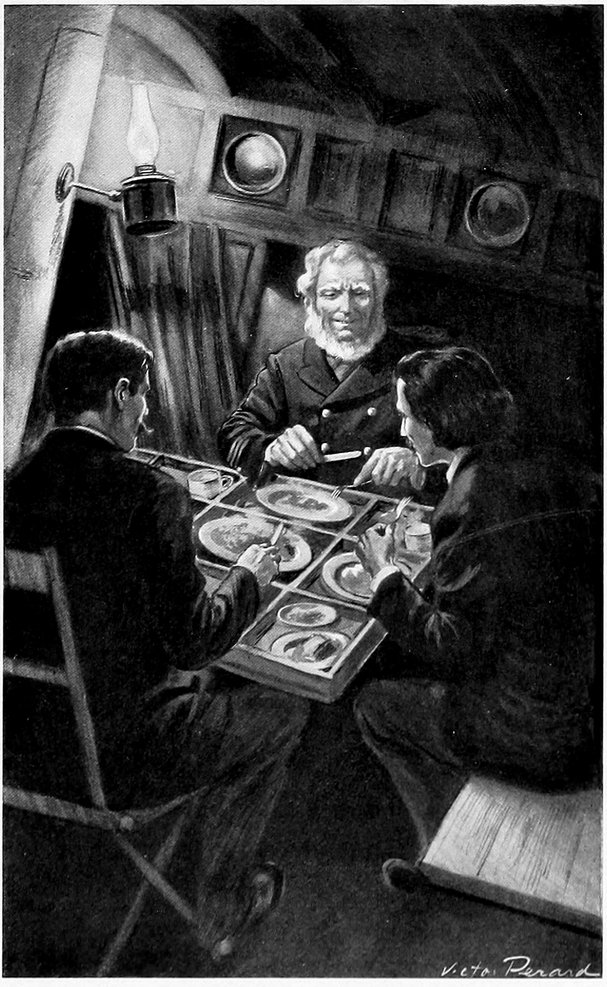
The tiny cabin had three narrow bunks—one for the
captain, another for the mate, the third for myself. A
little cupboard, containing the plates, glasses, forks,
spoons, knives, etc., secured against the rolling of the
ship, was near one of the bunks.
A small table upon which our meals were served
stood in the centre, and was the only piece of furniture
we had, for box-like benches along the bunks
2were our seats, and these were also used as places of
storage for different things that had to be handy.
Besides these there was a medicine chest.
The only place where one could stand upright was
under the skylight. Our toilet or the washing of our
faces and hands took place on deck, and when it was
raining or stormy the tin wash-basin had to be used
in the cabin, though we tried to avoid this as much
as possible, it made such a mess.
The forecastle had accommodation for the crew of
four sailors and the cook—the latter being also the
steward, and having therefore to set the table, serve
the meals, wash the dishes, towels, and napkins, and
attend to our bunks.
On the deck stood the galley or kitchen, close by,
a large cask containing fresh water, with a dipper.
Some other casks were safely stored in the hold.
These contained water, to us more precious than
gold, for what would gold have availed us if we
had had no water to drink?
Our cargo was composed of many things, such as
brass kettles, guns, small kegs of powder, brass rods,
looking-glasses, files, knives, plates, and a great number
of beads of all sizes and colors, bright colored cotton
umbrellas, coats of gaudy hues, each coat having
sleeves and backs of different tints, brilliant colored
waistcoats and many other objects. All these were to
buy for me the right of way with the African kings,
or to give away to the natives, or pay for food or pay
my porters.
In the cabin of the schooner
3When the tide served for our departure the captain
gave the order to unfurl the sails and raise the anchor.
Our ship then glided out into the bay, passed through
the Narrows and breasted the broad Atlantic. When
we began to lose sight of land, strange sensations crept
over me. Before me was the bright future, the great
African forest with its tribes of wild men, strange
beasts, birds, and insects. Looming above these was
the wonderful unknown, so fascinating to me and to
all men, especially to lads. Behind me were those I
had left, who were dear to me, and to them I whispered
a silent farewell, telling them that I would continue to
love them and that I would never forget them. That
evening with conflicting emotions, and a sad heart I
fell asleep.
The following morning when I came on deck there
was no land to be seen. The sea with its apparently
boundless horizon surrounded our little ship. Long
heaving swells rose one after another, and with great
wonder my eyes followed them until they faded away
in the distance. It seemed as if some great unseen
giant were asleep at the bottom of the sea, and that
4his breathing caused this up-heaving of the ocean into
these long swells.
Gulls were our only companions, and followed our
little ship; they seemed to fly without any effort whatever,
their spread wings remaining perfectly still for
minutes at a time. As I watched them, I said musingly:
“Dear harmless gulls, where is your home?” And
it seemed to me that they answered: “We have no
home; we wander far and wide over the ocean, which
gives us our food. We rest on the waves now and
then, we care not for wind and storms. We often
follow ships,—watching for things thrown overboard.
But every year we go to the sea cliffs to lay
our eggs, and take care of our young. Then we are
a great throng together.”
I thought of the many birds of the sea, and of the
giant albatross, closely allied to the gulls—the largest
and strongest of all sea-birds, measuring sometimes
sixteen and seventeen feet between the tips of their
extended wings.
My mind was full of reflections as I was looking at
the sea, and I said to myself: “How apparently boundless
is this great Atlantic Ocean, and how wonderful!
In the far north a gigantic barrier of ice prevents the
mariner with his ship from reaching the North Pole.”
And I thought of all the heroes who had made the
5attempt in vain. In the far south a still more forbidding
and more extended wall of ice prevents the
mariner also from reaching the South Pole. I thought
of the white bears, the sea-lions, the walrus. I thought
of the Esquimaux, of his dogs, of his kayak or skin
canoe, and wondered how men could choose such
regions to live in; for life, there, is a battle all the
time; dangers meet man on every side. The elements
and the country are against him; but in spite of all
that, the Esquimaux loves the dreary ice and barren
rocks where he was born.
How strange, I thought, that no inhabitant had
been found in the southern polar regions, and that no
bears had ever been discovered there; and how wonderful
it was that at the poles, the sun was in sight for
six months, and remained unseen during the six other
months of the year, so that a day of light and a day
of darkness made one year. When the sun shone
at the North Pole, it was dark at the South Pole, and
vice versa.
I could not help it, but the view of the great ocean
that surrounded us set me continually thinking that
day. I wondered at the great depth of the sea, and
that the Pacific Ocean was even deeper than the Atlantic—the
former in some places having been found to
be thirty thousand feet deep, and in a number of places
6the lead having failed to reach the bottom. The pressure
of the water is so great that often the wire holding
the lead breaks before reaching such great depths;
but if our eyes could pierce through this immense
mass of water, we should see that the configuration
of land at the bottom of the oceans is very much
like that of the earth above the sea. We should
behold high mountains, deep ravines, and precipices,
and large plains or plateaux, and see that in some
places the bottom of the sea is changing constantly,
owing to drifting deposits. These have been revealed
to us by soundings.
Strange to say, under that great mass of water, as
upon the land, sudden volcanic eruptions take place
which cause islands to rise high above the sea and to
disappear again. Many islands to this day have remained
as witnesses of these volcanic eruptions, and become,
in the course of ages, covered with forests and
other vegetation, and are now inhabited by man.
There is about three times as much sea as there is
land; and if it were not for the sea bringing moisture,
neither tree, beast, nor man could live on the earth.
Though the oceans bear different names, they all communicate
with each other.
Then I thought of the rain, and all the rivers
pouring their waters into the sea, and I wondered why
7the sea did not get higher, and, in the course of time,
overflow the land. It is because of the evaporation
of the water. Do we not see, every morning, the dewdrops
glitter in the sun and then disappear? They
have evaporated, and gone back to help form the
clouds, as well as the sea.
Then I thought of the whales, and of their huge
size; that on land the elephant was the largest animal,
and that in the sea the whale was the largest creature;
and that, though the whale was so much larger that
in the comparison the elephant was but a pigmy, yet
the home of the whale is correspondingly greater than
that of the elephant.
There are several varieties of whales. The Arctic
and Greenland whale is from forty to fifty feet in
length. Its enormous head is a third of the whole
creature. There is also a species of whale which
attains a length of eighty, and even eighty-five, feet.
How strange that several species of these huge creatures,
on account of the peculiar formation of their
throats, can only feed on the most minute crustaceans
and pteropods. The fecundity of some of the species
of the latter is so wonderful that they cover large
areas of the northern and southern Atlantic and Pacific,
and swarm in vast shoals, covering the sea for miles,
showing their presence by a ruddy hue contrasting
8with the color of the water. What a feast the whales
have when they come where these small creatures are!
Their big mouths allow them to take in barrels of
water filled with these minute organisms, and they are
provided with a peculiar and delicate sieve, by which
the water is drained off and the mass of pteropods
taken into their stomachs.
I said to myself: “I am now sailing over the home
of the whales, and I am going to the home of the
elephants.”
But the poor whales and elephants are so much
hunted that they become fewer in number every year;
and I remembered how my grandmother used to worry
at the thought of the disappearance of the whale, for
no oil for lamps could then be procured, and what
would people then do for light?
After thinking of the whales, I thought of the countless
millions and varieties of fish that swim in the sea.
I thought of the codfish, of the herring, and of the
mackerel, and of their innumerable numbers, and of
the many millions that are caught every year by man.
Their vast shoals seem not to diminish in spite of all.
How intelligent are the codfish, and other fishes, in
their migration. The cod come by countless millions
to the same place to spawn. They make their appearance
at the same time, year after year, often coming
9the very same day as the year before, and rarely more
than a week before or after their usual time of arrival.
After spawning they disappear, leaving stragglers
remaining behind. No one knows where they go.
Then I thought of the relentless warfare among
fishes, the big fish feeding on the smaller ones,—one
single big fish eating hundreds of little ones in one
day, the very big ones thousands. The number eaten
every day is so great that no calculation can be made
of those destroyed. But if it were not for this great
destruction among themselves, the sea would become
so thick with them, the water would become poisoned
and they would all die, and the stench would spread
the plague over the world and destroy man.
The second day we saw a sail in the offing, which
relieved the loneliness of the sea. Human beings
were on board. Man loves the sight of man. The
ship passed close to ours and then the wake it left
behind disappeared forever.
Towards evening the breeze freshened, the sky became
dark, and clouds hung low and sped rapidly.
During the night the whistling of the wind and the
tossing of the ship told me that a storm was raging.
We had entered in the meantime the wonderful Gulf
Stream, with its warm water flowing northward. The
gale was from the southwest.
CHAPTER II
10
A STORM AT SEA—A TEMPEST-TOSSED LITTLE BIRD—FINE
WEATHER AGAIN—FIGHT BETWEEN A SWORDFISH
AND A WHALE.
When I came on deck in the morning there
was a great storm raging. The sky above
our heads was dark and threatening. The clouds
were low and moved with great swiftness. The wind
blew with the fury of a hurricane and hissed through
the rigging. The sails were furled except two, which,
however, had three reefs in them. The sea looked
fiercely angry and the big waves broke one after another
in foaming white crests. The ocean was one mass
of foam and spray. The rain was pouring in torrents.
Our little ship was tossed as if she had been a walnut-shell.
Wave after wave broke upon her side or buried
her prow, pouring tons of water on our deck and
enveloping us at the same time in spray. At times
the men were lashed to keep them from being washed
overboard. The gulls were flying over our heads,
and the stormy petrel had made its appearance. For
a few hours it looked as if our ship could not withstand
11the storm and would founder under a big wave.
I thought at that time that I should never see home
again.
For three days we were buffeted over the great sea.
Then the storm ceased. The sails were unreefed and
the carpenters and the sailors made the necessary repairs
upon our battered little ship.
Suddenly I thought I heard the cry of distress of
a bird, and looking upward I saw a little bulfinch flying
near the ship. The bird wanted to perch on the
rigging but did not dare. He came near, and then
moved away, uttering little cries of anguish. Evidently
the sails scared him—for he had never seen a ship
before and he knew that it was not a tree. The
tempestuous wind, blowing from the land, had driven
this little wanderer far out to sea; he had lost his
reckoning and did not know where the land was. For
several days and nights he had been flying, finding no
trees to rest upon, no water to drink, no berries, fruits
or seeds to eat. He was exhausted, for he had had
no rest and no food. Fear was in his little heart. I
got water and bread ready for him in case he came on
board and we could catch him.
During the day he followed us, uttering his little
cries of distress, but did not dare to alight upon the
ship, though he knew that the sea was his enemy
12and that if he fell into the water he would meet his
death. Perhaps he thought of the land he had left
behind—of his dear mates, of trees, of water and of
food, of lovely dales and little brooks.
I noticed, as the day advanced, that the little bulfinch
did not fly so high above the sea as in the morning;
lower and lower became his flight. The motion
of his wings in his despair became quicker and quicker
as his strength diminished. At times he almost
touched the water, then, uttering a shrill cry, he
would rise, only to come down again. I shouted:
“Come and rest upon our little ship, dear little bulfinch.
Come on deck; I will take good care of you.
Here are food and water waiting for you. Nobody on
board is so wicked as to kill you, or harm you.”
But the little bird kept on, and at last his body
touched the sea, and as he rose he uttered a most
piercing cry of distress, then, taking an upward flight,
he hovered over the ship. His strength was gone, his
wings refused to move, and he fell upon the deck. I
rushed quickly towards him—he was panting. I took
him in my hands—how quickly his heart was beating!
I gave him some water; he drank it, then
dropped dead. His struggles for dear life were over.
Then I put the little bulfinch in a small wooden box;
it was his coffin, and I closed the top and buried him
13at sea just as the sun was disappearing below the
horizon.
The following day the weather was very beautiful,—a
lovely blue sky was over our heads. What a change
between this and the great storm we had passed
through! The sea was a mass of beautiful “white
caps,” each one with its own changing form. Strange
as it seems, there are no two things exactly alike in the
world—not even two white caps, two blades of
grass, two leaves, neither two men nor two women.
We sailed merrily along day after day, carried on
by variable winds, our course being one point south
of east, and one afternoon gazing over the ocean, I
saw a number of whales disporting and spouting water
high in the air. Looking over the rail my attention
was suddenly attracted to a large, dark, elongated fish,
that was swimming fast, as if in quest of something.
As it neared the ship and swam alongside I recognized
it to be a powerful swordfish, which I thought was
about twelve or fifteen feet in length. Its sword
seemed about three feet long, and was a continuation
of its upper jaw. The sword was flat and pointed at
the end. The very shape of the fish showed that it
could swim with great rapidity.
The swordfish is the most fearless of all fishes, I
reflected; he is afraid of nothing and might take
14our little ship for a whale, and attack us; for the
whale and the swordfish are sworn enemies. There
are many instances on record of ships being attacked
by swordfish, and their thick oak hulls pierced through,
the sword remaining in the wood, the fish not having
strength enough to draw it out when deeply imbedded
in the hull. There have also been instances in which
small vessels have been sunk by them.
Soon I noticed another swordfish, and saw both of
them leap out of the water, pursuing each other and
then discovered that they were fighting. They were
swimming with the rapidity of an express train at the
rate, I thought, of thirty or forty miles an hour. They
were so quick in their movements that they could not
hit each other with their swords. Their dorsal fins as
they cut through the surface of the water made a
peculiar noise like a sharp boat with sails set cutting
through the sea. They would disappear under the
water and then reappear on the surface, then swim
towards each other with such extraordinary velocity
that my eyes could hardly follow them. They seemed
to know that their vulnerable point was the side,
and wheeled with astonishing quickness, so that they
would always face each other.
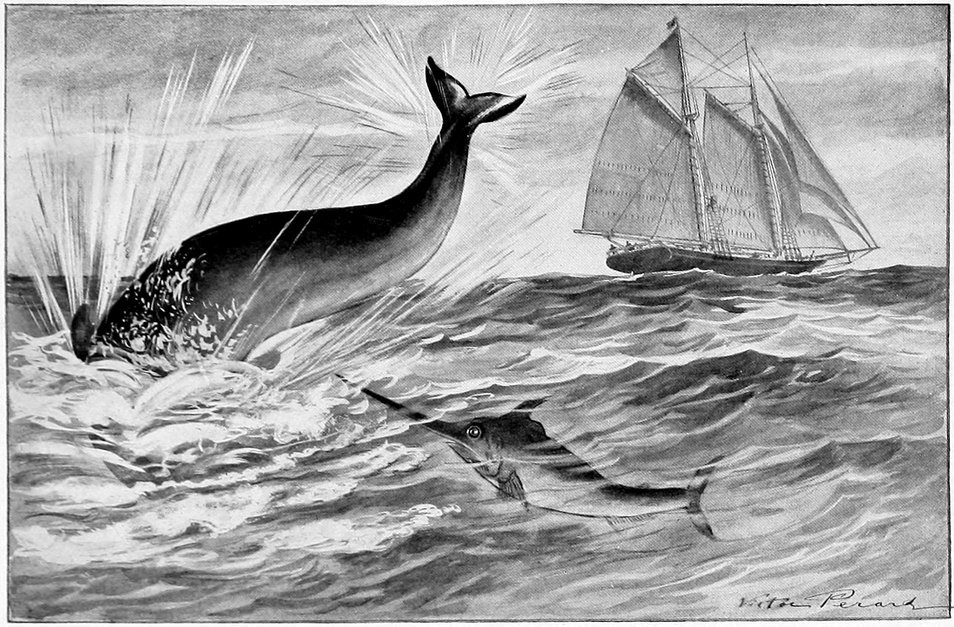
“The captain shouted to me: ‘A swordfish is fighting a whale’”
15A short time afterwards I saw ahead of us a great
commotion in the water—the sea was white with
foam. The captain shouted to me: “A swordfish
is fighting a whale.” I went up the rigging to see the
fight. The whale spouted big streams of water in the
air, its tail was slapping the sea with terrific force,
beating the water into white spray all around. At
times everything was like a white mist round the huge
creature, which seemed to be going in every direction,
as if bewildered. It was fighting for dear life, and
was trying to hit its antagonist with its powerful tail.
If it only succeeded in striking the swordfish, then
the greatest creature of the sea would be the victor.
Unfortunately, the whale is unwieldy and the swordfish
is very quick in its movements. Every frantic
motion the whale made was a sign that the swordfish
had plunged its long, pointed sword into its body.
The fight went on for a while, the swordfish getting
evidently the better of the whale, for the blows of
the latter’s huge tail did not strike the water with as
much force as before, and the sea did not look so
disturbed. Then suddenly I saw a great spout of
water rise above the sea, and all became quiet. The
fight was over; the whale had been vanquished and
had received its death-thrust from the swordfish, and
it must have received many wounds, for as we sailed
over the place where they had been fighting, the sea
was red with blood.
16“In these conflicts between the swordfish and the
whale, it is said that the whale is oftener the victor,”
said the captain to me, “for if the whale succeeds
in striking the swordfish with its tail, the latter is
either killed or so much stunned that the combat is
not renewed.”
CHAPTER III
17
THE SARGASSO SEA—THE NORTHEAST TRADE-WINDS—DOLPHINS
AND BONITAS—NEW STARS COME INTO
VIEW.
A few days after the fight between the swordfish
and the whale, as I came on deck early in
the morning, a strange sight met my eyes. I could
not see the water of the ocean, the vessel appeared as
if it had been stranded and left by the tide on a land
covered with seaweed. We had entered during the
night that part of the Atlantic which was called by
Columbus and other early Spanish navigators “Mar
de Sargaço”—and which is known to us now under
the name of the Sargasso Sea.
The Sargasso Sea lies in that quiet area of the Atlantic
Ocean between 28° and 32° north latitude,
and 35° and 55° west longitude, varying slightly in its
position at times on account of long prevailing winds,
or currents caused by those winds. This sea comprises
an area of about one hundred and fifty miles from
north to south, and about four hundred and fifty
miles from east to west. This space is entirely covered
with seaweed and in many places so thick that
for hundreds of acres the water is hidden from view.
18The stem of the Sargasso weed attains often a length
of several hundred feet and has many branches growing
from the stem, which in the course of time break
in many places. These vines are covered with berries,
which have the appearance of bunches of grapes. On
that account the seaweed is called by the sailors by
the different names of grape weed, grape of the tropics,
and the Sargasso weed. We sailed through this
remarkable area of the ocean, carried onwards by light
variable winds—sometimes making but little headway.
One day we met the Northeast trade-winds, which
are generally encountered at about the fortieth degree
of longitude west of Greenwich, and 30° north
latitude. I thought how wonderful it was that these
northeast trade-winds had been blowing constantly
without intermission over a part of the Atlantic, as long
as men remembered, for thousands of years and, in
fact, from the time the great desert of Sahara appeared
upon our earth. These northeast trade-winds blow
across the Atlantic Ocean as far south as the tenth
degree of north latitude and at certain times of the year
as far as the fifth and sixth degrees, and lose their
force as they reach the West Indies.
We sailed somewhat parallel to the coast which forms
the western part of the great desert of Sahara, which
begins south of Morocco, latitude 30° north and follows
19the Atlantic near to the Senegal river 15° north—a
distance on a straight line of nine hundred miles.
One morning as I came on deck, before it had been
washed, I noticed some minute particles of sand that
had fallen from the sky, and were still falling, though
we were hundreds of miles at sea. It was sand from
the great Sahara, which had been carried high into the
atmosphere by the wind, and the captain said to me
when he saw my astonishment: “Sometimes the sand
from the Sahara is carried a thousand miles out to sea,
and we are now about seven hundred miles from the
coast.”
The lively northeast trade-winds carried us southward
day after day—and how beautiful was the sky!
White fleecy clouds, looking like gigantic flashes of
cotton, often diaphanous, floated rapidly by, borne on
the wind in the blue heavens which were reflected in
the sea. There was no rain to disturb us. No
weather could have been more beautiful.
Almost every day we saw immense shoals of porpoises
swimming at a great rate and jumping out of
the water, many amusing themselves in swimming
round our little ship. They seemed always to swim
against the wind. At other times dolphins and bonitas
followed us. The dolphin is the most beautiful of all
fishes, and they added to our larder, for they were
20voracious and eagerly bit at the hooks. In its death
throes the dolphin changed into hues of marvellous
colors. Once in a great while we would see a turtle
floating on the sea. Days passed away, our little vessel
sailing under a most beautiful sky with a lovely
breeze. I had noticed a change in the firmament.
The heavens at night were not like those at home.
Some of the stars that were south in the northern
states were now north, and stars appeared daily
which were unknown to me. The constellations had
changed their shape also. The north star reached its
meridian altitude lower every day, and came nearer
and nearer the horizon. Other stars of our northern
latitude followed in its wake.
At last, one night the north star was very near the
horizon and showed itself for a short time only. The
next night as I watched for it, it suddenly appeared,
and for the last time, as it was on the point of
disappearing under the horizon. It seemed as if
I heard the dear north star say to me: “Good-by,
Paul: you will not see me again until you come back
home,” and I answered: “Good-by, little north star,
I hope to come home again and look at you when
you twinkle in the sky,” and at those words of mine,
the star vanished from my sight. The next night I
watched in vain for its appearance; it never came.
21As we sailed southward the constellation of the
southern cross appeared,—four brilliant stars making
the perfect shape of a cross,—Sirius resplendent in
light and the most brilliant star in the heavens, called
also the Dog Star. All the southern stars seemed to
say “Welcome, Paul, to our southern latitudes.” But
they were strangers to me. Though I admired their
brilliancy I longed for our northern stars,—for we
love the stars which shine upon the country where we
were born.
CHAPTER IV
22
THE “DOLDRUMS”—FIERCE HEAT OF THE SUN—STRONG
LOCAL CURRENTS—THE SOUTHEAST TRADE-WINDS—HUGE
SHARKS ALL AROUND US.
Our happy days in this enchanted region of the
Atlantic Ocean were coming to an end. The
northeast trade-winds became less strong as we neared
the equator, and soon died away. Then came a great
calm; we had entered that area of the Atlantic which
is the dread of the mariner with sailing ships and
known under the name of “Doldrums,” a region of
calms, baffling winds, and squalls accompanied by
thunder and lightning.
I shall never forget the “Doldrums” as long as I
live, and the days I spent crossing it. It lies between
the northeast and southeast trade-winds, and we had to
sail through it to reach the southeast trade-winds.
“Doldrums,” in the language of the sailor, means
dull and low-spirited, and well deserved is the name.
It is also known by them as the horse latitudes, for
when ships linger there for weeks, horses, cattle, live
stock have to be thrown overboard for lack of water
23and food. When unlucky, vessels are detained several
weeks within its belt. The area varies more or less
according to the strength of the trade-winds.
No northeast trade-winds cooled the atmosphere.
The reflection of the powerful rays of the sun from
the warm ocean made the heat intense during the day.
During the night our cabin was unbearable. Not a
breath of wind came to our relief, not a ripple was
seen on the deep-blue ocean, which looked like a sea
of glass. For five days two empty flour barrels that
had been thrown overboard remained alongside of
our ship. Long, heavy swells followed each other
and made the vessel roll in such a terrible manner
that I thought at times that the ends of the main-yards
would touch the sea. The calm was so great that the
steering gear was of no use, the sails had to be furled
to protect them from being torn to pieces, as they
struck the mast at each roll of the ship with tremendous
force. We lay often athwart these swells,
the vessel rolling in such manner that we could not
stand on the deck, and had to hold to the rigging or
something fast in order not to be dashed to one side
or another or against the bulwarks.
The unprotected parts of the ship that came under
the rays of the sun became so hot that we could not
rest our hands upon them. If we had had no tents
24protecting the decks and ourselves we should not have
been able to live through the “Doldrums.” It was out
of the question to sleep below decks, for there the atmosphere
was suffocating and the ventilators had become
useless for want of air. We always longed for the
night, and rejoiced each time the sun disappeared
below the horizon. In the morning we dreaded its
appearance. To go into the cabin for our meals, to
hold on to the table while eating, was often impossible
on account of the terrific rolling; our drinking water
became tepid, for we had no ice to cool it. In a word,
life was a burden.
After a few days of dead calms we encountered baffling
winds and squalls day after day. A squall would
rise, push us on our way towards the southeast trade-winds,
another would come in another direction and
send us back where we had come from. Between the
squalls came a dead calm.
The captain often mistrusted the strength of the
squalls, and when he saw the black clouds gather on
the horizon, the forerunner of the squall, the sails
were furled, for fear that the power of the wind
might dismast or capsize the ship. Sometimes when
he thought the squall would not be a heavy one and
when it came from the right direction, he would have
the men at the halliards ready to spread the sails, in
25case he was mistaken in his judgment, for he wanted
to take every advantage and not lose one minute of
fair wind that would help us to get away from the
regions of the “Doldrums.”
Once in a while we encountered strong local currents.
How strange are these currents found in the
middle of the ocean—an independent body of water
moving at times with a velocity of three and four
miles an hour—a wide, rippling river with its own
eddies and white caps flowing in an ocean often as
smooth as a looking-glass!
When I could hardly stand the stifling heat, I
looked with a longing eye at the sea, and wished
that I could plunge into it and take a swim, but the
sharks were there watching for food and prey.
After entering the “Doldrums,” sharks had become
far more numerous than before and were hardly ever
out of sight. They swam round our vessel when we
did not move, and when we did move they followed in
our wake. The sharks frequenting the equatorial
regions are more voracious than in other parts of
the ocean,—they are the tigers and leopards of the
sea. Woe to the man who falls into the water when
they are about, for he is sure to be devoured by
them.
The sailors have a superstition that when a man is
26ill on board, the sharks know it, and follow the ship
until the man dies and is thrown overboard.
Many of these sharks were surrounded by tiny little
fish which the sailors call pilots. These seem to feed
on the vermin which adhere to the skin of the sharks.
These little pilot fish were not more than four or five
inches in length and were very pretty to look at.
The structure of the mouth of the sharks is such
that they have to turn on their backs in order to swallow.
What terrible rows of teeth they have,—so
sharp, just like the teeth of a saw! With a heavy
hook made fast to a chain we captured one that had
seven rows of teeth.
I often shuddered when I looked at some huge shark
following the ship, and retired instinctively from the
stern for fear lest something should give way and I
should fall into the sea. Nothing could then have
saved my life—I should have been dragged down by
one of those voracious creatures, and then eaten piecemeal.
Once in a while there was not a shark in sight—they
were simply hovering around under the surface
of the water waiting for prey. The sailors often said:
“Let a man fall overboard, and they will appear soon
enough!”
Some sharks love the solitude of the open sea—others
27like to be near the shore. There are many
kinds of these fierce creatures. Some, which are called
the pelagic sharks, are the largest inhabitants of
the sea, after the whale, and there are several species
or varieties. Some of these attain a length of from
twenty-five to forty feet.
As I watched the water, I would see a hammer
shark, so named on account of his head, with a
thick body of about nine feet in length; this species
is reputed one of the most ferocious. Then a blue
shark would make its appearance, and one day I saw a
specimen belonging to the genus Carcharodon. He
was an enormous one; the captain said that sometimes
they attain a length of forty feet. But the
largest of all these monsters of the deep are found in
the Pacific Ocean, and attain a length of fifty feet.
CHAPTER V
28
CROSSING THE EQUATOR—THE SOUTHEAST TRADE-WINDS—THE
EQUATORIAL CURRENT—THE GULF
STREAM—STRUCK BY A TORNADO—LAND IN SIGHT—AFRICA
AT LAST—THE GREAT FOREST.
In spite of the counter currents and contrary squalls,
we crept slowly southward to meet the southeasterly
winds, the captain taking advantage of every
opportunity offered by the weather. After many discouragements
and setbacks, we at last crossed the
equator.
One afternoon a squall rose and drove us southward.
After it had blown over, it became calm again. Then
we saw, far away, ripples on the ocean, which gradually
came nearer and nearer. These ripples were the forerunners
of the southeast trade-winds that were coming
towards us. Soon after we felt a cool, gentle breeze,
and a shout of joy came from all on board. Our
imprisonment in the “Doldrums” was over!
The southeast trade-winds were at first very light,
for we had reached just where they were dying away,
close to the region of the “Doldrums,” but towards
29evening the breeze freshened. The next day white caps
covered the sea, and life became pleasant once more.
The southeast trade-winds were strong, and now we had
the same beautiful blue sky as under the northeast
trade-winds, and the same beautiful white and often
transparent clouds.
These southeast trade-winds have also blown from
time immemorial—the hot air of the South African
continent bringing about the same results as the hot
air of the desert of Sahara.
Then we tacked ship, and laid our course towards
the west coast of Africa. I asked the captain if I
should have to pass again through such dreadful regions
as that of the “Doldrums” when I returned home.
“No,” he replied; “on the return trip from the equatorial
regions of Africa, we sail with the southeast
trade-winds, south of the equator, to avoid these
dreaded ‘Doldrums,’ carried onward by the southeast
trade-winds until a few hundred miles off the coast of
Brazil; then we get into variable, and often light
winds.”
Then I thought that if our little ship were left to
drift within the area of the northeast or southeast
trade-winds, in the course of time she would reach the
South American coast, then drift gradually northward,
and, if not stranded on the way, would get into the
30Gulf Stream, then be carried northward, passing the
latitude of New York, whence we came.
The northeast and southeast trade-winds cause the
initial movement of the currents which, in their
course, make the current known to us as the Gulf
Stream.
The two trade-winds, blowing continually from the
hot regions of Africa, drive the hot water of the
tropics from Africa westward, towards South America,
and this current is known as the equatorial current.
The Bight of Biafra, in the Gulf of Guinea, may be
considered the head waters of this equatorial current,
which runs all the way from about eighteen to twenty-five
miles every twenty-four hours, until it strikes the
South American coast.
This equatorial current, or stream, is a shallow river
of warm water, not deeper than three hundred feet.
The temperature of the water is between 75° and 80°
Fahrenheit at the surface, and not more than 60° at
the depth of six hundred feet,—the deeper water not
being so heated by the sun, of course, as the surface
water. Besides, from below there is a continual rising
or flow of cold polar water.
This equatorial current strikes the American coast
about Cape St. Roque, some three hundred miles
south of the equator. The obstruction of the land
31divides the current into two parts, one going southward,
but the greater volume of water going northward,
with great increase of velocity, for the simple reason
that any current, even in a river, that finds an obstruction,
runs more rapidly along the obstruction. So the
equatorial current, which presses northward along the
coast from Cape St. Roque and the Orinoco River,
flows with great rapidity—from sixty to eighty miles in
twenty-four hours. Then it passes the Caribbean Sea,
turns westward, and follows the shores of the Gulf of
Mexico at the rate of from thirty to sixty miles a day.
The Gulf Stream flows along the American coast,
from which it is separated by a cold current from the
icy north, forming what might be called a wide band
separating the Gulf Stream from our shores. We
ought to be thankful to this cold-water band, otherwise
our climate would be much warmer.
Now we were sailing towards the west coast of
Africa,—the innermost part of the Gulf of Guinea,
situated somewhat near the equator. At last came the
day when we were not more than one hundred and
fifty miles from the mainland. In the afternoon of
that day a dark, compact mass rose from the east, over
the horizon, and became larger and larger, in spite of
the contrary winds that struck against it. There was
a contest between the two, and one had to get the mastery
32over the other. The captain was watching
anxiously that part of the horizon. Finally he turned
to me and said: “A tornado is going to burst upon us
very soon. We must be ready when it strikes us.”
So all the sails were furled. The muttering of the
thunder could be heard. The wind had died away,
and the calm was the forerunner of the tornado.
In the meantime a grayish spot rose from the horizon
under the black mass. Soon after, this great spot
rose with great rapidity, driving and breaking the dark
mass into black clouds that flew wildly in every direction.
The tornado was coming. We saw the sea
enveloped with spray, and in an instant it was upon
us. Fortunately we were ready. The wind blew
with terrific force, our little vessel careened over, the
gunwales on the starboard side almost reaching the
sea. The force of the wind was so great that it prevented
the sea from rising into big waves.
Then came rain, lightning, and thunder. Never in
my life before had I heard such thunder, or seen such
vivid lightning, or such pouring rain. I was constantly
afraid that we would be struck by lightning, and I
had powder enough on board to blow the ship to
pieces. Gradually the thunder and lightning moved
away from us, and the wind, though strong, moderated.
By that time it was night, and as dark as pitch.
33When I awoke in the morning the wind had gone
down, and I saw an island covered with forest. After
a noon observation we found that it was Princess
Island, belonging to Portugal, and situated about one
hundred and fifty miles from the coast of Africa.
Two days after we came in sight of the mainland,
and saw the great African equatorial forest as if rising
from the sea. Far inland were mountains clad with
trees to their very tops. The forest was inhabited by
numerous savage tribes who had never seen a white
man, and ferocious and strange-looking beasts, seen
in no other part of the world. In that great forest I
was to live, and we skirted the shore until we found a
proper anchorage. Then we saw numerous canoes,
filled with men paddling towards us. These came on
board and inquired if we wanted to barter for ivory
with them. They had, they said, a number of big
elephants’ tusks in their village. I replied that I did
not want to trade with them, but would like to stay
with them and kill wild beasts and birds, and stuff them,
and collect also all the butterflies and insects I could,
and keep them, and take these to the country of the
white man. We told them to go back and to tell
their king that I was coming. One canoe remained
behind to take me ashore.
How strange was that great forest! Not a tree
34was like those we had at home. Their leaves were
different in shape, and some of them were large and
beautiful. Many of these trees bore brilliant flowers.
Some were as big as the California trees. The foliage
was so thick that for long distances in the forest the
sun, the moon, the stars, and the sky could not be
seen.
There were hunting and other paths leading from
one village to another. The way from one tribe to
another was often very tedious. At a certain season
of the year there was great thunder, lightning, and
rain, preceded by tornadoes. This was called the
rainy season. Then there was a time without rain.
This was called the dry season, or enomo.
I had no white man with me—and as time went
on I learned many languages or dialects, so that I
could talk to the people. When I was absent, the
kings or other friends took care of the goods I left
in their hands.
CHAPTER VI
35
WANDERING THROUGH THE FOREST AND LEARNING
THE COUNTRY—I REACH KING MOMBO’S VILLAGE—RECEIVED
BY THE KING—HIS FEAR OF WITCHCRAFT—VISITS
MY DWELLING AND RECEIVES
PRESENTS FROM ME.
After wandering in that part of the great forest
north of the equator and seeing many of its
wild and fierce inhabitants—and hunting and killing
many strange animals and birds—I came back to the
coast and sailed along its shore southward until I
came to several large rivers, the Nazareth, the Mexias
and the Fernan-Vaz,—the Nazareth forty miles,
and the Fernan-Vaz seventy miles south of the
equator. These rivers pour forth a great quantity
of fresh water far out to sea. They flow through the
great forest, and their shores are inhabited by many
tribes. I lived among them a long while, and was
greatly beloved by the people and their chiefs, many
of whom became my good friends. Wherever I went
I was sure of a hearty welcome. I felt perfectly safe
among them. My word was law. I was known all
over the land as the Oguizi, or “Spirit.”
36Often I used to go all alone in my canoe from one
place to another. Strange indeed was the life I led.
I loved to roam alone and be by myself, and often I
slept in the forest without any companion. It happened
that one day I came to a village where I landed
and asked the people who had seen my canoe arrive and
had come to meet me if the place was the residence of
King Mombo—for I knew that I had come to that part
of the forest where he ruled. They answered that it was
and told me to follow them. We walked together
through the strange-looking street that made up the village.
The houses were small, built of the bark of
trees, each having one door but no windows.
Back of the houses and between them and the forest
were numerous plantain trees with here and there a
banana tree. The leaves of these were very large;
some were over six feet in length and eighteen or
twenty inches wide. The plantain is much like a
banana, only much larger, and is cooked by the
natives when green and used by them as bread is by us
at home. I was led to a large building where the
people met to discuss subjects of importance. It was
simply a roof supported by a number of pillars. A
stool made of a single piece of a tree was brought in
for me and another one for King Mombo.
After I was seated, some man went to tell the king
37that a stranger had come to see him. King Mombo
and his people had heard of me, for my reputation
had gone far and wide, as I have said, and whoever
met me knew from the description they had heard of
me that I was the good Oguizi, with long, straight black
hair hanging over his shoulders, who did harm to
nobody and was the friend of so many people.
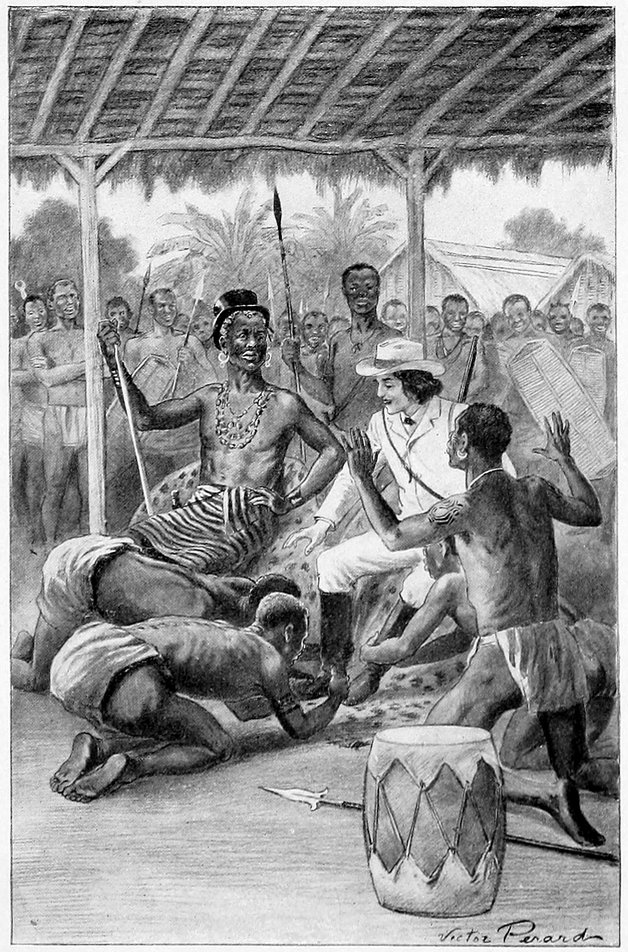
Soon after, I heard the sound of the “kendo”—an
emblem only worn by chiefs—a rude bell of iron in
one piece with a long handle of iron also and sounding
like a cow-bell. The sound grew louder and louder,
until King Mombo stood before me. He was tall
and slender; on his body were several scars from
wounds he had received in wars, but he had a kind
face, and was gray-headed. Round his neck was a
necklace of leopards’ teeth and round his waist a belt
of leopard skin on which hung a number of amulets
or charms called by the people “mondahs.” These
were to protect him from harm.
Some of his slaves and several of his wives set
before me a number of bunches of plantains, several
baskets of sweet potatoes, a goat, several chickens,
and nine eggs. These presents showed that I was
welcomed.
After a short pause King Mombo said: “Oguizi,
I am very glad you have come to see me. Remain
38with me a long time. There is plenty of game in the
forest, and among my people and slaves are great
hunters.”
Looking at his people, he said to them: “Take
good care of our Oguizi.” Then he shouted aloud:
“See how far my name and my fame are known. The
Oguizi has come to see me,” and as he said these
words he raised his head proudly. The people shouted:
“Great indeed is Mombo our king. Great is the
Oguizi.” The tomtoms made a great noise in
honor of my arrival.
Then King Mombo called three of his wives and
six of his slaves, and said to me: “These women are
yours; they will cook for you, get water for you, and
keep your house clean. These slaves are yours, and
will do what you order them to do. I and my people
will all do whatever you wish us to do.”
Then the king’s men went to fetch the things I
had in my canoe. Among them were presents for the
king.
A house was given to me not far from the one
where King Mombo slept. It was divided into two
rooms, and there were two beds in one of the rooms.
These beds were simply flat surfaces made of the bark
of trees, upon which were several pretty mats made by
the king’s wives. In the evening I went to see King
Mombo, and said to him: “To-morrow morning I
will make your heart glad, for I have some presents
for you.”
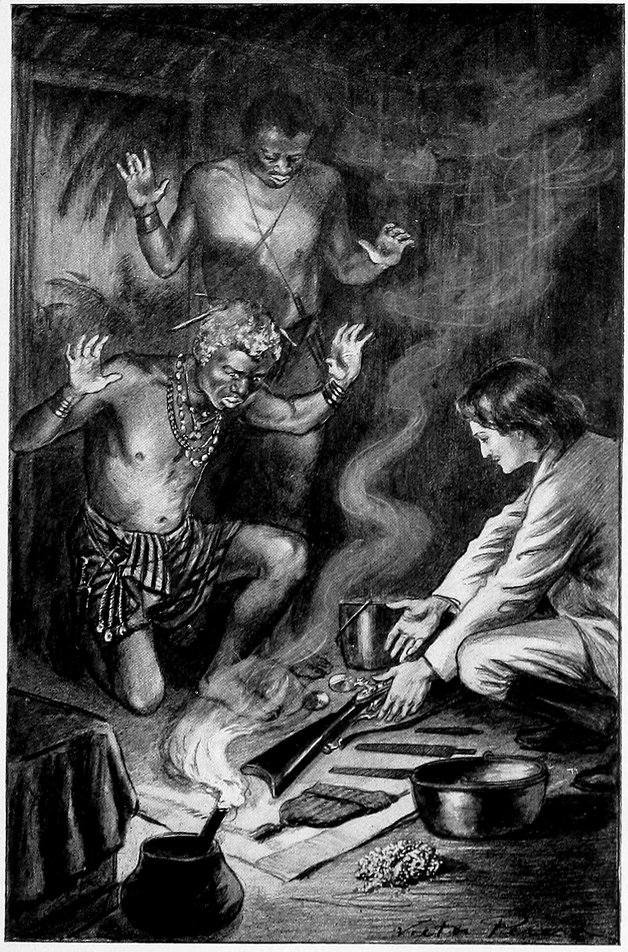
“When he saw these presents his face beamed with joy”
39“Not in the morning,” he replied, “for I do not
want my people to see what you are going to give me,
for there is much witchcraft in our land, and many are
killed by it. Often relatives bewitch those from
whom they expect to inherit, and cause their death.
Oh,” he added, with fierceness in his eyes, “when
we find wizards and witches we put them to death.”
After a pause, he resumed: “Kokolo, Kokolo,”
(which meant “Please”) “do not tell any one that you
gave me presents.” Then he took hold of my right
foot to add force to his request. Slaves do that to
their masters when imploring for their lives, or asking
not to be sold. I promised him not to tell, and he
gave a great sigh of relief at my words. And as he
left me he whispered in my ear, “Wait until it is dark,
very dark, to-morrow before you send for me to give
me my presents.”
“It will be very dark when I send for you, King
Mombo,” I replied, and at my words he shook my
hand gratefully.
In the middle of the night when everybody was
asleep I saw in the dark two people entering my hut,
and heard in a whisper: “It is I, King Mombo,
40and my faithful slave Rabolo. I come to get my
presents.”
I lighted a torch. It was Mombo. He had not
had the patience to wait longer. His face and body
were painted in different colors, and he was covered
with charms to protect him against witchcraft. I set
at his feet two brass kettles, a gun, a big bunch of
white beads, three files, two discs of steel with flint for
making fire, a red woollen cap, and two looking-glasses.
When he saw these presents his face beamed with joy,
and after thanking me profusely he and his slave
Rabolo left, carrying with them the precious gifts.
The king implored me again to tell no one of the
things I had given him.
CHAPTER VII
41
SUPERSTITIONS OF KING MOMBO—VISITS TO THE
HOUSE OF HIS IDOLS AND HIS ANCESTORS—A
STRANGE MEAL FOLLOWED BY A STRANGE DANCE.
Poor King Mombo was, you will see, excessively
superstitious. He was often unhappy on that
account. He was thinking almost all the time that
some of his relations wanted to bewitch him in order
to inherit his wealth, which was composed chiefly of
wives and slaves. He wore what he firmly believed
to be most potent “mondahs,” charms against witchcraft
and evil spirits. He had a little idol, having
the shape of a woman, called Makaylay, which he
always carried with him wherever he went. At night
he kept her by his side.
He was also a great believer in dreams, for these
foretold to him what was to happen, and forewarned
him of dangers to come. Often after something had
taken place he would say to his people that he had
had a dream in which the spirits of his ancestors came
to him and told him of what was about to happen.
He was most particular about his food. His forbidden
food was buffalo meat, and no amount of gifts
on my part could have tempted him to eat buffalo.
42Here and there throughout the village were sacred
houses, where spirits came to dwell during the night,
while others had been built for idols.
One day King Mombo and I entered the house of
Abamboo, one of the wandering spirits in which they
believe. The face of the king showed that he was
inspired with deep reverence. A little fire was burning.
On one side was a bed for Abamboo to sleep
on when he came to visit the village at night.
“Abamboo is a spirit which can send to men a
great deal of evil,” said Mombo. “We have to do a
great many things to propitiate his good will. He
lives in many places, especially among the skeletons
of the dead. He walks through the country, and if
he is angry at any one he causes him to fall sick, and
often condemns him to die. We cook food for him.
We give him game, plantain, and sugar-cane, which
we deposit in the forest.”
Next we entered the house where Pangeo and his
wife Aleha dwelt. Pangeo was about two feet high.
His tongue was of iron, sharp-pointed and came out
about two inches from his mouth. His eyes were of
iron; his legs were short and he had a very big
stomach; his body was painted of different colors.
Aleha was of the same size. Her eyes were made of
pieces of looking-glass. She wore enormous earrings
43of brass, had bracelets of brass, and her ankles were
adorned with brass rings. She wore a necklace of cowry
shells. King Mombo stood in awe before the idol;
he spoke to Pangeo and told him how much he loved
him, and then spoke to Aleha, saying the same to her.
After that, we entered the house of Makambi and
Abiala. Makambi was a big idol, about three feet
high. He wore a feather headdress and held a spear
in his hand which he was ready to throw; his eyes
were carved and painted red.
Abiala, his wife, held a pistol in her hand—which
she had taken from her husband, as Mombo said to
me in a whisper.
The king stood before Makambi and Abiala and
told them how much he loved them—as he had done
to Pangeo and Aleha. “You know I love you both,”
he added in a loud voice. “I bring to you the
products of the hunt and of the earth. Take good
care of me—watch over me.”
After leaving the house of Makambi and Abiala,
King Mombo returned to his house and I to mine.
The head wife of King Mombo was called Ogandaga;
she was dressed with three strings of beads round
her waist, and wore over thirty heavy brass rings on
each of her legs. She it was who cooked the food of
the king.
44Often Mombo would walk in the street when it was
quite dark, and talk about me to his people, and say
how much he loved me. Then he would shout aloud,
so that all his people could hear: “Chally the
Oguizi, I love you. I am your friend. All I have
is yours—my slaves are yours—my plantations are
yours—my wives are yours—my daughters, my
sons, and my nephews are yours. You can say to them
‘Follow me,’ and they will all follow you. Oguizi,
all my people love you.” And when the people heard
this, they would shout “Yo—yo.” (“That is so,
that is so.”)
Not far from King Mombo’s sleeping-house, and
back of it, was a strange little building which was called
the Alumbi house. Every time I saw the king enter
this place he came out of it with his body painted with
ochre of different colors, and his face always looked
very thoughtful. When inside I could hear him
making loud invocations. One day he came out
more daubed than I had ever seen him before. His
body was covered with white, red, and yellow. I
thought he looked savage and awful.
My curiosity became very much aroused in regard
to the Alumbi house. One day, as King Mombo came
out of it I went up to him and said: “King, show me
the inside of the Alumbi house.”
45After hearing my words, he looked at me, as if trying
to read my thoughts. He remained silent for a little
while, and then said: “Oguizi, you can go inside and
see for yourself, and I will accompany you.” He
opened the door; we entered, and he shut the door
behind us.
What a strange and unexpected sight met my eyes!
Along the walls were large cakes of colored clay.
These were black, white, and of different shades of
yellow and red. Upon each stood the skull of a man
which seemed to look at me and say: “What are you
doing in our abode? You do not belong to our race.”
Mombo marked his body with the ochre of two of the
cakes, muttering words I could not understand. Then
he said to me in a whisper: “The skulls you see
here are those of my kinsmen. They were great and
valiant men in their day. It is the custom in our
country when a man much greater than all other men
dies to cut his head off after his death and then put it
on a cake of clay and let it decay there. Then the
mass of ochre is kneaded together and dyed and the
skull is always kept on the cake that belongs to it.
Oh, Oguizi, these skulls belonged to great forefathers of
mine. They were never afraid of war. Here on the
cake of white clay is the skull of Olenga-Yombee. He
died a very old man, and when young he was the
46greatest warrior of his time. He founded our clan and
our tribe. He was the most dreaded by our enemies of
all their foes. He burned many villages. His people
believed all he said, for he was wise. He had many
wives and many slaves, and his ‘oyana’ [idol] granted
him all he asked. He lived about three hundred
rainy seasons ago. At that time our tribe was much
further inland, towards the country where the sun
rises.”
Then, pointing out to me a cake of a deep yellow
color, he said: “Oguizi, the skull there is that of
Jombouay. He led us through the forest and had
many wars, for our ancestors had to fight many tribes
who opposed them before coming to this part of the
forest where we are now settled.”
When he had finished telling the history of the men
whose skulls were before me, he said: “Oguizi, the
spirits of these men are hovering in the air above us;
when I invoke them to protect me and our clan and
tribe, they come round us and protect us. They have
saved my life many times.”
Then we left the Alumbi house. That evening
Mombo walked in the street of the village and invoked
the spirits of his ancestors, calling each by name. He
invoked especially the spirits of Olenga-Yombee and
of Jombouay, saying to them: “Look at the Oguizi;
47you never saw him during your lives. But Mombo,
your kinsman, has him in his village.”
The following day King Mombo came to me and
said: “Oguizi I want you to eat with me to-morrow—I
will have the fattest of my goats killed and some
chickens. These will be cooked in fresh palm oil
that has just been made.” “I will,” I replied.
Then he called Ogandaga, his head wife, and said to
her: “Prepare a meal for to-morrow. Have the fat
goat killed and also a few chickens, for the Oguizi and
I are going to eat together.” When I had accepted the
invitation we separated, the king looking happier than
usual.
Little did I know what King Mombo intended to
do, and why he had invited me to eat with him, and
his reasons for doing so. I will however recount to
you now what I was told afterwards.
The following day, while Ogandaga was cooking
our dinner, Mombo went into the Alumbi house and
took in his hands the skull of his great ancestor,
Olenga-Yombee, and said: “Olenga-Yombee, my
great beloved ancestor, see that I make the great
Oguizi love me.” Then he scraped with a knife a
little of the forehead of the skull. The scrapings fell
into a small wooden bowl which he had taken with
him. He replaced the skull on its own cake of ochre,
48and went to where his wife was cooking, and told her
to go and fetch a bag that was in his sleeping-house.
When she had gone he put the scrapings of the skull
of Olenga-Yombee into the pot which contained the
goat’s meat, stirred it with the wooden spoon that was
near by, and went away.
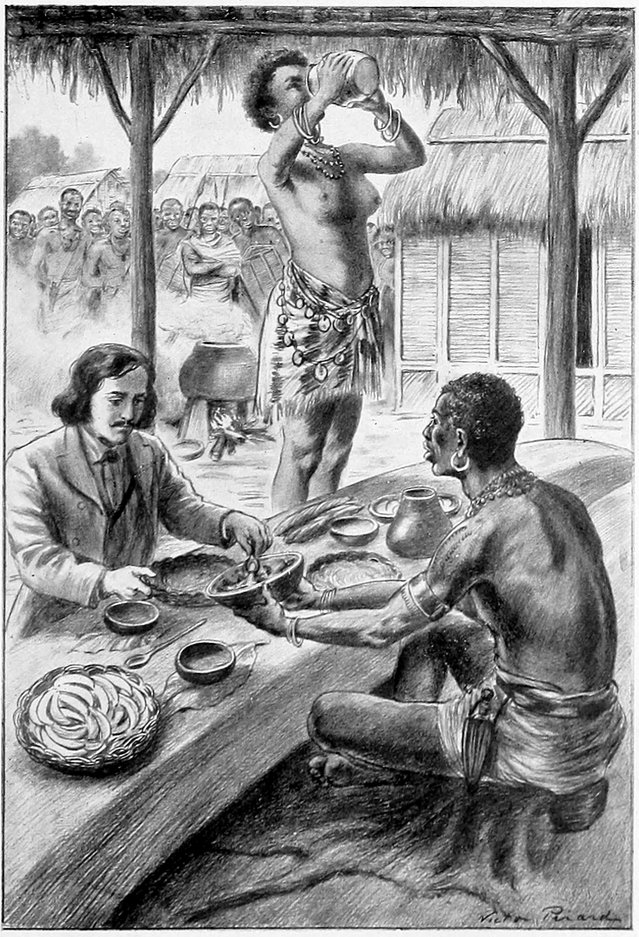
After a while Ogandaga told us that the meal was
ready. The bottom of a canoe put on two mortars
made our table; baskets on which were large leaves
were our plates, and cocoanuts cut in two were our
glasses; our fingers were to be our forks. According
to the custom of the country, Ogandaga tasted of
every dish before our eyes, and drank of the water
that was in the jug before we did, and then bade us
eat and drink.
The king and I sat down opposite each other.
Then he gave me some of the meat of the goat which
had been served in a wooden dish used for the first
time. As soon as he saw that I had eaten all I had on
my plate he seemed overjoyed, for now he was sure I
would love him.
Then he invoked in a loud voice the spirit of his
great ancestor, Olenga-Yombee, and called upon him
to make me love him.
“The king and I sat down opposite each other”
49There is a belief amongst the people that after the
scraped skull is in the body it turns into the blood of
that ancestor, which then becomes part of your own
blood. Hence you must love the person who is a
descendant of the man to whom the skull belonged.
The whole population of the village was present
while we were eating, and shouted: “Great is Mombo,
the friend of the Oguizi!”
After our meal the king disappeared and went into
the Alumbi house. When he came out, his appearance
had quite changed. Now his body was painted
in different colors. He was covered with “mondahs,”
or charms. He was chewing some of the clay which
dyed his lips yellow. Then taking my two hands, he
blew the ochre from his mouth upon them until they
were entirely covered with it, and invoked the spirits
of his ancestors, Kombé-Ratenon-Olenda and Olenga-Yombee,
to be my friends, and watch over me.
That night there was a great dance. Singing and
dancing went on together. At times women danced
alone, and moved the muscles of their bodies in most
ridiculous fashion. At other times men and women
danced and sang together. The noise was very great,
for there were over twenty tomtoms beating at the
same time.
CHAPTER VIII
50
BAD LUCK OF MOMBO’S VILLAGE—ASCRIBED TO WITCHCRAFT—ARRIVAL
OF A GREAT MEDICINE-MAN—HIS
INCANTATIONS—THE ACCUSED SOLD AS SLAVES.
The people had been filled for some time with
the fear of witchcraft. Two men had died
away from the village; and, since, they had been unlucky
in fishing and hunting. Certainly all this could
not have happened without some one wishing the village
bad luck. A great medicine doctor living far
away had been sent for, and had arrived, and the
ceremony to find out who were the sorcerers was
about to take place.
One morning King Mombo and all his men assembled
to listen to the words of the great medicine-man,
and were seated cross-legged on the ground
around him, all looking excited and with hatred in
their eyes.
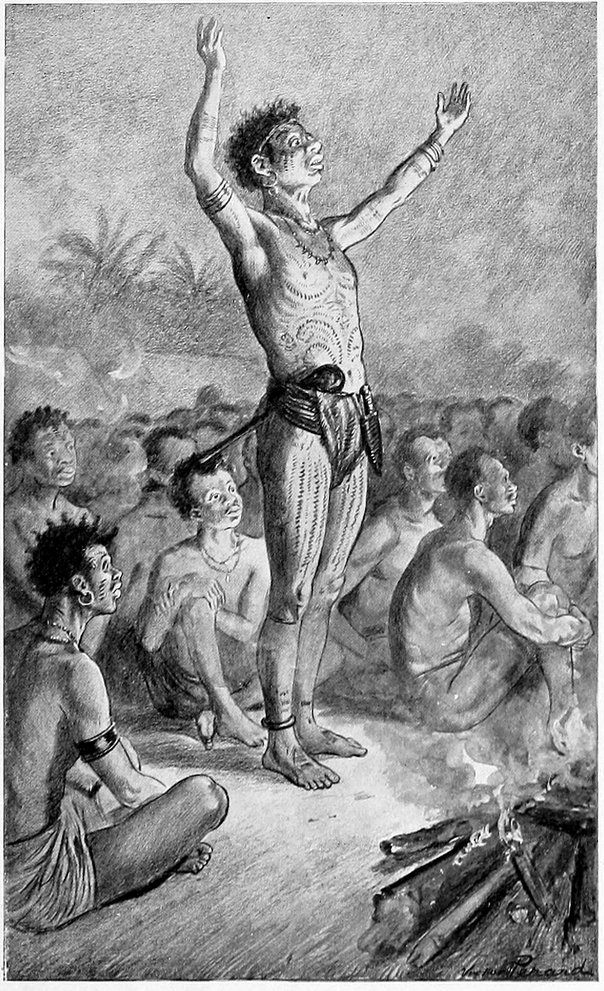
The medicine-man, whose reputation for power to
find out sorcerers was known all over the country, was
extremely ugly to look upon, and was weirdly dressed
for the occasion. His teeth were filed sharp to a
point. He was tall and slender, and about fifty years
51old. He had a treacherous and cunning eye. I
could tell by his face that he would denounce people
as guilty of witchcraft about whom he really knew
nothing. His head, chest, and arms were painted with
sacred ochre of different colors, likewise his eyelids.
He wore around his waist a string of long grass upon
which were hung several bells of iron. Near the medicine-man
was the horn of a buffalo filled up with a sort
of black powder made of skins and bones of snakes,
dried brains of monkeys, and intestines of rare animals.
He held in his hand a wicker rattle filled
with snakes’ bones, eagles’ talons and monkeys’ nails,
which he shook during his incantations.
After each incantation the people shouted, “Ouganga,
tell us who are sorcerers amongst us, so that
we may kill them.”
Another man was on the top of a slender tree, calling
now and then upon Joko, a powerful spirit, and
shaking the tree at the same time.
The medicine-man remained silent for awhile, as if
in deep thought; then he made all kinds of contortions,
and muttered unintelligible words. He took a knife
and cut his hands in different places. The blood fell
into a little wooden vessel, and he looked intently at
his own blood, as if trying to find out something; then
he danced, the queer bells round his waist making a
52strange sound. The people kept shouting: “Tell
us, Ouganga, who are the witches and sorcerers that
have brought bad luck to us in the hunt and in fishing,
who made some of our people sick, and some of
our people die? Ouganga, drink the ‘mboundou,’
then you will be able to tell us who they are.”
Then roots of a tree called the “mboundou” were
laid at his feet, and also a wooden bowl filled with
water. The ouganga scraped the root of the “mboundou”
into the water, which turned the color of the root,
which was reddish, and then bubbled. He made incantations,
and then drank the potion. Soon after his
countenance changed, his eyes became bloodshot and
glared. His veins swelled, and he looked as if he
were drunk. Such was the effect of the “mboundou”
upon him.
A man from the village named several of their own
people whom they suspected of being sorcerers, and
asked the ouganga to say if they were the ones. The
ouganga seemed at first to speak incoherently. Then
he said: “There are no witches or sorcerers in your own
village. The guilty ones are living in another village.”
At these words they shouted with one voice: “Tell
us their names and the name of the village, for we
want to make war on that village, unless they deliver
up the sorcerers to us.”
53Then the hollow voice of the ouganga was heard
saying: “Okabi and Aquailay are those who are sorcerers.
They are full of witchcraft.”
“Death to Okabi and Aquailay!” shouted the
people.
Okabi and Aquailay lived in a neighboring village,
and were well known to all present, and, moreover,
whispers charging them with sorcery had been rife
for several years.
That night there was a great war dance. The
people invoked their guardian spirits. The next day
they were going to get Okabi and Aquailay and
make them stand the “mboundou” trial, and if the
people of the village where these two men lived refused
to deliver them up, then they would make war
upon them and take them by force. Not only must
the two men be delivered, but indemnity, in the form
of slaves, must be given for the mischief, deaths, sickness,
and bad luck generally these two men were supposed
to have caused.
The next day, however, on their formal request, the
two men were at once delivered up by their people, who
had long suspected them of witchcraft. The brother
of Okabi came and talked in his behalf, and finally,
after a most eloquent speech, persuaded the people
not to kill them, but to sell them as slaves. This
54was acquiesced in by the leading people of the two
towns, and it was arranged that the relatives of the
two men should share equally the proceeds of the sale.
Both were to pay a certain part of their goods to the
families of the men who had died. The accused could
have submitted to the ordeal of trial by “mboundou”—drinking—which
is almost always mortal, except to
doctors—but they preferred to be sold as slaves.
CHAPTER IX
55
KING MOMBO GIVES ME THE STICK “OMEMBA”—I
LEAVE THE VILLAGE ON A HUNTING TRIP—PARTING
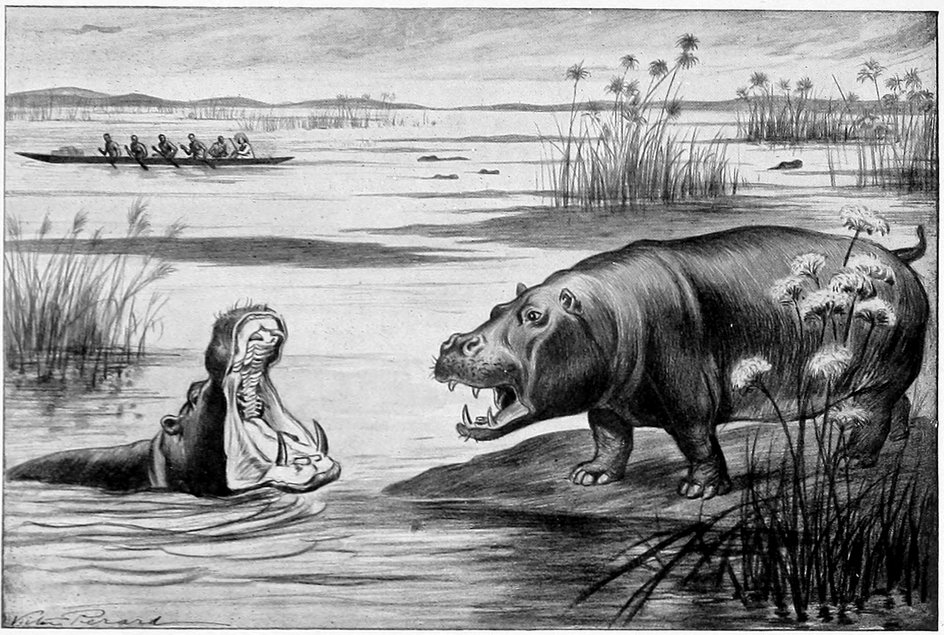
INJUNCTIONS—A HERD OF HIPPOPOTAMI.
Some days after the sorcery trial King Mombo
sent for me.
When I arrived I saw that there were a great many
people who had come from many different villages.
The king was seated, and bade me sit by his side.
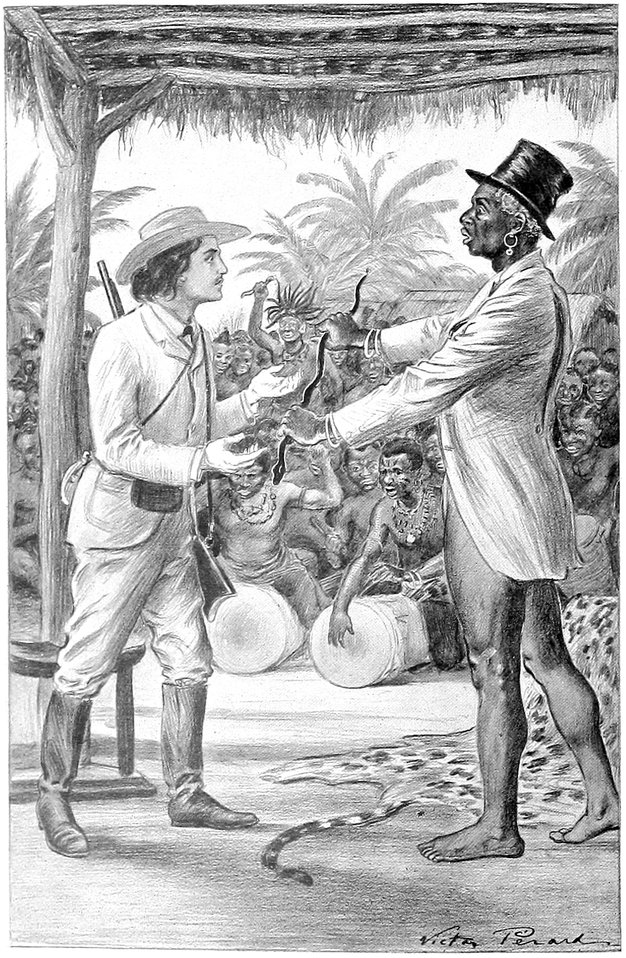
He had an old silk hat on his head. His coat was
split up the back to let the air in. Then ensued a
great silence; no one dared to speak.
King Mombo rose. He held a stick in his hand,
and said to me: “Oguizi, the stick I hold in my
hand is known all over my country as belonging to
me, and when I send word anywhere I send it with
the messenger. This stick is called ‘Omemba,’ the
snake, for it is twisted, and the carved head of a snake
is at the top. Whoever carries ‘Omemba’ is my representative,
and my people have to listen to him.
Take this stick, and wherever you go carry it with
you.”
56Then he handed me “Omemba,” in the midst of
great shouts of approbation from his people and of
the beating of the tomtoms.
“When you leave the country, return ‘Omemba’ to
me,” added the king.
I thanked Mombo for his important gift, and the
people dispersed.
A few days after I had received “Omemba,” I
went to King Mombo, and said to him, “I am going to
leave you soon. I wish to go all alone in a small canoe,
so do not be astonished, if, when you awake some
morning, you find that I am gone, but I shall not fail,
before I leave your country, to bring back ‘Omemba’
to you, and say good-by.”
Then I prepared my outfit and packed the things I
wanted, among them a small round Waterbury clock,
a powerful magnet, a music-box, and lots of matches,
for these things added much to my power. When
the people heard the clock and music-box, they thought
they were spirits talking to me, and were full of wonder,
and often afraid of them.
I took some ammunition and fish hooks, for I had to
depend on fishing and hunting for my food. I had
also some brass rods, and quite a number of bright-colored
beads to give away to those who were friendly
to me, for I should very soon have become a very
57poor oguizi if I had had nothing to give them. I
also took a frying-pan, some quinine, and salt.
Among my weapons I had a double-barrelled breech-loading
rifle, which I loved better than all my other
rifles, for it was the most powerful weapon I had. I
could load it either with steel-pointed bullets, or with
explosive shells. I had named this rifle “Bulldog.”
The only fault I found with “Bulldog” was that it
was too heavy to carry, for it weighed sixteen pounds,
on account of the thickness of the barrels and of its large
calibre. “Bulldog” was somewhat short. When I
carried it I always had a feeling that I was with
my best friend, and one I could rely upon in case
of great danger. No matter how huge or fierce the
animals I encountered might be, I felt that “Bulldog”
could kill them, for the steel-pointed bullets
were large and powerful, and I had found out that they
could pierce through four or five inches, and even
more, of the hardest wood. So I knew what “Bulldog”
could do. This feeling gave me confidence,
and I aimed with greater steadiness, and I knew I had
a shot to spare in case of merely wounding an animal.
“Bulldog” was well known among my native
hunters, who looked at it with wonder and superstitious
awe. They were always glad when ‘Bulldog’ was
going with us. They used to say, ‘Bulldog’ never
58misses, and always brings death in its path. The elephants,
hippopotami, and all the wild beasts fall
dead when hit by the bullets of ‘Bulldog.’ They
knew “Bulldog” among all my other rifles, and
there was always great rejoicing among my men when,
before our departure, I said to one of them, “Go and
fetch ‘Bulldog,’ and carry it until we reach the
hunting-ground,” or when I carried it myself. “Bulldog”
was so heavy that by the end of the day my
shoulders, especially my left one, felt very sore. In
the course of time my left shoulder became quite black
from the effects of carrying “Bulldog,” and other guns.
A gun that is quite light to carry the first hour becomes
heavy enough by the end of the day.
The eve of my departure I called Ogandaga, the
head wife of King Mombo, and pointing out a box to
her, I said: “Here is a box which is very precious,
and I want you to take care of it. No man or woman
must open it—neither King Mombo, nor yourself—for
misfortune will befall whoever opens it. This
precious box was of tin, waterproof, and contained
the scientific instruments and books necessary to find
my latitude and longitude, also the days of the week,
of the month, the exact time in Greenwich or
Washington, and wherever I was. In that box were
also four watches, which had been made especially for
use in astronomical observations. Ogandaga said that
she would take great care of the precious box, and
then, pointing out to her all the boxes containing my
goods, I said: “These are also under your care.” I
gave her a beautiful necklace of large beads, for which
she thanked me, and went away, and soon after returned
with a slave to take the precious box to her
house.”
“Then he handed me ‘Omemba’”
59Then I called King Mombo, and said to him: “All
my things that you see here I leave in care of Ogandaga.”
“They are safe,” he replied.
That evening the king walked from one end of the
village to the other, and shouted, so that everybody
could hear: “The Oguizi will soon leave us for a
while. I and Ogandaga will take care of his things
during his absence. Let no one ever dare to touch
them, and if any one tries to take any of them, he
will have his head cut off.”
The people answered: “He is our Oguizi. His
things are safe, and would be even if we were not
threatened with having our heads cut off.”
Towards four o’clock in the morning, by moonlight,
and when every one was asleep, I carried my outfit
to a small canoe made of the trunk of a tree, and
departed, paddling along the shore of the river. Just
at daylight I heard the grunt of the hippopotami.
60These animals are called river horses, because their
heads in a certain profile look very much like that of
a horse.
At the sight of my canoe they gave a peculiar grunt
and disappeared under the water and reappeared somewhere
else, and did this several times. At times they
rose so near me that I was afraid they would rise right
under my canoe and overturn it. Then they might
come and attack me in the water, which certainly
would have been the end of me. Further on I met
several other herds, but kept quite out of their way.
Leaving the hippopotami behind me I continued
my way, when suddenly I thought I heard the sound
of paddles and of human voices. I pulled my canoe
as fast as I could among the thick reeds which lined
the banks of the river, and was soon out of sight.
I was hardly there when I thought of crocodiles. It
was just the spot for them, for the river was here sluggish
and with muddy banks. I felt very uncomfortable,
for my canoe was not so very much above
water and I might be attacked by a crocodile, hiding
among the reeds. They are very voracious when
hungry.
“The voices came nearer and I saw a large canoe”
61The voices came nearer and I saw a large canoe
through a small opening. I counted twenty paddlers
and saw three captives fettered with chains round
their necks. They were evidently slaves that came
from some tribes further up the river. I waited
a while and when I thought the canoe was out of
sight I left my hiding-place.
I paddled close to the shore, often under the overhanging
branches of the trees. I began to notice that
a large eagle was following me, soaring above my
head. Not knowing exactly what the eagle intended
to do, and becoming suspicious that the big bird of
prey might perhaps pounce upon me and tear my
eyes out, I stopped, put my shot-gun to my shoulder
and, as the great bird soared over my head, I fired.
The eagle uttered a scream, then plunged downward
and fell into the water near me. I took his talons
as a trophy.
Ere long it became so hot that I filled my panama
hat with green leaves and dipped it now and then into
the water to keep my head cool. Further along the
heat became so great that I hauled my canoe ashore
to rest in the shade of the forest. I found a rivulet
of clear water close by, and there I lighted a fire and
roasted two plantains and a part of a monkey King
Mombo had given me. Then I lay under a tree and
soon after fell asleep with “Bulldog” in my arms.
When I awoke I looked at my watch—it was three
o’clock. Soon after, I was paddling again. I was so
62interested in looking round that the time passed
quickly. The height of the sun warned me that in
about one hour more it would be sunset, and dark
shortly afterwards, for under or near the equator the
days and the nights are about equal, and it is nearly
twelve hours between sunrise and sunset.
A short time after I saw a few plantain trees on the
shore of a small creek. I paddled in their direction,
when, a little further on, hundreds of plantain trees
came in sight—then I saw a path through them,
and hauling my canoe by its side, I landed, taking
“Omemba” and “Bulldog” with me.
CHAPTER X
63
SOUNDS OF HUMAN VOICES—I ENCOUNTER REGUNDO
AND HIS WIFE, SLAVES OF KING MOMBO—OTHER
SLAVES—HUNTERS AND WARRIORS OF MOMBO.
I followed the path. I had hardly walked
fifteen steps when I heard the sound of an axe—some
one evidently was chopping wood. The path
was a well beaten one, showing that many people
passed over it. The sound made by the axe became
louder and louder as I advanced inland. Then I
heard human voices, and stopped to listen. After
a while I found that two people were talking to each
other, but I was too far away to hear the language
they spoke. I wondered if these two people would
be friendly, or would run away at sight of me.
I advanced cautiously, and soon saw the roof of a
house, then the whole house, which had a veranda; and
under the veranda were a man and a woman talking
to each other. The house was built of the bark of
trees. The man was gray-headed, the woman likewise;
they were almost naked and only wore a little strip of
soft bark round their loins.
64I appeared suddenly before them, so that they did
not even have time to rise. Both looked at me, appearing
dumbfounded. They tried to get up, but fear
had paralyzed both and they could not rise. I showed
to them “Omemba,” the stick of King Mombo, which
they recognized at once. Then I saluted them in the
Commi language by saying, “Mbolo.” They answered,
“A-ee,” and returned the salutation by saying
“Mbolo,” and I answered “A-ee.” This is the mode
of salutation in King Mombo’s country.
The sight of “Omemba” had somewhat calmed
their fears. I saw by their appearance that they were
slaves, for both had their front teeth filed to a point.
The Commi people do not file theirs—these two
people came evidently from a far country. The man
said to me, in the Commi language, “Both my wife
and I are slaves of King Mombo, and many more
slaves owned by him are in the neighborhood, on different
plantations.”
His wife went inside of her house and brought me
out a stool and the tail of an elephant to kill the flies
which bothered me, and they both bade me welcome
and asked me to stay with them.
Strange indeed was the appearance of Regundo, for
such was the man’s name. One side of his face was
painted with red ochre, the other with white; a broad
65yellow stripe adorned the middle of his chest; the circuits
of his eyes were also daubed with color. In the
middle of his forehead was a round, white spot. He
had evidently just made his toilet, for the colors
looked fresh. He was also covered with charms or
“mondahs.” His wife’s face was also painted. She
wore large iron rings in her ears.
On the roof of Regundo’s house were skulls of antelopes
with their horns, skulls of wild boars, leopards,
monkeys, and other animals, evidently apes, unknown
to me, but the heads of which resembled, somewhat,
human heads. Six large elephants’ skulls were lying
in front of the veranda—under which hung in a line
sixty-three elephants’ tails.
As I was looking at them, Regundo said, “These are
the tails of the elephants I have killed. I have been a
great hunter all my life, but now I have given up
hunting, and I send but very little game to my master,
King Mombo. But there are hunters here who
are younger than I am, and who go much into the
forest in search of elephants and other game.”
While Regundo was talking his wife went away,
but soon returned with a chicken that was a kind of
bantam, tied by the legs, a basket of sweet potatoes,
a bunch of plantains, and four eggs, and laid these at
my feet. My talking to them in a language they
66could understand, and the sight of “Omemba,” had
reconciled them to me. They had also heard, before
I came, that I was a great friend of King Mombo.
I looked round. I saw, at a little distance, a number
of small houses together, also built of the bark of
trees. As soon as Regundo saw me looking at them
he said: “Those are houses of slaves belonging to
King Mombo. He has many slaves; some of them
are old, and he has inherited them from one of his
brothers.”
He had hardly uttered these words when I saw a
number of men and women coming towards the
houses. The women carried heavy bunches of plantains,
or baskets filled with manioc roots. Most of
the men had axes with them, and were returning from
the forest, where they had been felling trees for new
plantations.
“Those people are the slaves of King Mombo,”
said Regundo. “There are others that live further
on in the forest. The brothers of the king, and some
of his people, also have plantations and slaves not very
far from here, higher up the river and in the forest.”
I went towards them, and when they saw me they
stood still. I raised “Omemba,” which they recognized
at once as the stick of King Mombo, their master,
and which reassured them.
67These slaves, from their appearance, seemed to belong
to many different tribes. Some belonged to
tribes which filed their front teeth sharp to a point.
Others had their four upper and lower front teeth
pulled, this being considered beautiful among some
tribes. Some had two upper middle front teeth somewhat
filed in the middle. They also varied in the color
of their skins; some were quite black, others less so,
and some dark-brown color. Many shaved their eyebrows,
and two women wore rings in their noses.
They were all more or less tattooed. This form of
adornment among the Africans is not done without
pain; the skin is cut in such a manner that it is made
to stand up in small ridges.
Regundo soon rejoined me, and told the slaves that
the great Oguizi, of whom they had heard, was before
them.
When I was talking to these slaves, four or five
men made their appearance. They looked like great
warriors. They carried with them long, single-barrelled
flint-lock guns, of heavy calibre—the only
kind of guns the natives like. They are called
“tower guns,” and are made in England especially
for the West African trade.
They were followed by queer-looking hunting-dogs,
which at once began to bark furiously at me.
68These dogs seemed half starved, they were so lean.
They had short hair, straight ears, a somewhat elongated
muzzle, with powerful jaws and sharp teeth.
Their tails were curly, a sign of their being thoroughbred.
They were not large, and had rather long legs
for their size. They were yellow and white, or black
and white. Some were almost all of one color.
Then Regundo, pointing to one of these four men,
said: “This man is Oshoria; he is the greatest hunter
among us all, and knows not what fear is. He hunts
all the time, and spends many days in the forest by
himself; and when he finds no game he has to feed
on berries, nuts, and fruit. He knows every part of
the forest for a long way.”
I looked at Oshoria. He was a fine-looking man,
about five feet seven in height, well proportioned, with
broad chest, and strong, muscular arms and legs, and
small feet. He had broad, thick lips, deep, searching,
and suspicious-looking eyes, which seemed to look all
round at the same time, as if expecting danger everywhere,
and he had a very determined face. He was
not much tattooed. His teeth were not filed. After
eying him I said to myself: “Regundo is right.
The whole appearance of Oshoria shows that he is
a cool and brave man, who knows not what fear is.”
“He had a very determined face”
69Then Regundo, pointing out three other men,
who had come with Oshoria, said to me: “These
three men are great hunters also, and the equal of
Oshoria in fearlessness, but are not quite as successful
in killing game. Their names are Ogoola, Ngola, and
Quabi. When King Mombo makes war, he always
calls upon these four men to follow him, and they are
always in his canoe.”
I looked at Ngola. He was tall, very thin, of reddish-black
color, with piercing eyes and a bold, daring
countenance. The scars on his body showed that he
had followed King Mombo in war. One cut on one
of his shoulders had been a terrible one, judging from
the scar, and had been inflicted by a heavy machete.
Quabi was thick and short, the counterpart of
Ngola, and was very black. No negro could have
been blacker. He was blue-black. He also had
scars on his body—from the wounds he had received
when he followed King Mombo in warfare. He
came from a far country and had been sold by his
relations when very young, so he had forgotten the
language of his people. By merely looking at him
one could see that he was brave.
Ogoola was of medium height, with a bold countenance,
a real fighting chin; his eyes like those of
Oshoria seemed to look all around at the same time in
the same wandering and restless way. No scars were
70to be seen on his body, for he was so quick of motion
and so expert with his shield that no spears, arrows, or
bullets had ever been able to strike him. So quick
were his eyes when watching the motions of his antagonist,
that he seemed always to guess the time when
a spear was thrown or an arrow shot or a gun fired
at him. Then he would either jump sideways, or bend
low, or even fall on the ground to escape the shot. He
attributed his escape to a powerful “mondah,” or
charm, in which he had great faith. He was of medium
height, and he had come into the possession of King
Mombo when a boy.
“No leopard,” said Regundo to me, “can approach
its prey as these hunters can the wild beasts. They
are the bravest and best hunters of King Mombo.”
I called these four fierce-looking fellows to me and
shook hands with them. They looked shyly at me,
for they had never seen a white man before, though
Regundo had. I gave each of them a steel disc and
a flint, to make fire with, with which they were
delighted. When I returned to Regundo’s house his
wife had prepared a meal for me of boiled antelope
meat and plantains. In the meantime she had made
ready the little house that I was to occupy while with
them. It was quite small, about nine feet long and
six feet wide. The walls, made of bark, were about
71five feet in height, the top of the roof about eight feet,
and made of palm leaves; the sticks supporting the
leaves were close together and made very secure to
prevent leopards at night getting through and seizing
the inmates in their sleep. The door was made of
the bottom of an old canoe.
Being tired, I bade good-night to Regundo, who
handed me a lighted torch, and after getting inside I
looked carefully all round and under the bed to see if
there were snakes, scorpions, or centipedes about.
Then I lay down to sleep without undressing, wearing
my shoes. I took my two revolvers from my belt
and put them under my head, and laid “Bulldog”
by my side. Such was the way I went to sleep
almost every night, and even without fearing danger,
prudence made me do so. In that way I was ready
for a fight at once in case of any sudden emergency.
As I fell asleep I heard the voice of Regundo calling
on the spirits of his ancestors.
CHAPTER XI
72
WONDER OF THE NATIVES AT MY WATERBURY CLOCK,
MAGNET, MATCHES AND MUSIC-BOX—CHARACTER
OF MOMBO’S PLANTATION.
The following morning I got up before any one,
and immediately wound my Waterbury clock
and hung it on the wall under the veranda. “Ticktock,”
it went. Close to it I put my music-box,
which immediately began to play, my magnet, and a
box of matches. Then I went back into my little
house and kept quiet there watching through a crack
to see what would happen outside.
After a while Regundo came out. The noise of
the clock and of the music-box attracted his attention.
He looked at them with wonder, but did not dare to
approach them. He went to his house and soon
came back with his wife, and the two kept looking and
listening to the music and the tick of the clock. Soon
Oshoria, Ogoola, Ngola and Quabi made their
appearance and these warriors, who had faced death
so many times without fear, were afraid. They all
remained silent and spellbound before the Waterbury
clock and the music-box.
73I came out and we saluted each other. Regundo,
pointing with his finger to the clock, said: “Oguizi,
are there many spirits in this box? Are they speaking
to you now, or are they talking among themselves?”
I did not answer, but laughed at his question. Then
they all went away.
It is wonderful how fast news travels in the forest,
and the news of my arrival, and of the clock, the music-box,
and the matches had spread far and wide, and
all the slaves of King Mombo, of his brothers, and of
other great men of the neighborhood came in the
afternoon to see the Oguizi and the wonderful things
he had with him.
Quite a change had taken place in the appearance
of all the women from the day before. They had
made their toilet in order to appear beautiful before
me. They had rubbed their bodies with a compound
called “yombo,” composed of oil and the powder
made from a kind of odoriferous red wood which made
their bodies fragrant; each wore a string of beads
round her waist; their hair was filled with little clay-balls
of the size of peas mixed with “yombo.” They
were more or less tattooed. Some had tattooing peculiar
to the tribe to which they belonged, which was thought
most beautiful among the people who used it. Some
74had two broad stripes made of a mass of small spots
drawn from the back of the neck, joining another
broad stripe imitating a belt which went round their
waists. Others had different figures on their stomachs,
others broad stripes starting from their shoulders,
forming a triangle with the apex downward.
Each woman brought a present of food to me,
a bunch of plantains, or a chicken, a basket of sweet
potatoes, of peanuts, or eggs. I thanked them for
their gifts and gave to each a string of beads to put
round her waist. Then Regundo gave me a goat.
Oshoria, Ogoola, Ngola, Quabi, laid before me a
huge python about eighteen feet long, two monkeys, a
gazelle they had killed in the morning, and said,
“Oguizi, eat those.” And the crowd shouted, “You
shall never be hungry while you are with us.”
Suddenly a man I had not seen before made his
appearance. I noticed that the people looked upon
him with reverence. He was entirely covered with
charms, and his body was painted in different colors.
He was old, tall, very dark, his teeth had been filed to
a point. His body was tattooed all over with strange
figures of beasts and men. His name was Angooka,
and he was a great medicine-man who had the reputation
of making most powerful charms by incantations.
He made “mondahs” to protect men against witchcraft,
75and to make them invulnerable against spears,
arrows, or bullets; others of his “mondahs” were
supposed to give long life, and luck in hunting and
fishing. When men started for warlike or hunting
expeditions, they would always send for Angooka
beforehand, and after numerous incantations he would
tell whether they should go or not. Above all he
could find out who were sorcerers or witches.
Angooka, who was on one of his plantations, had
come with his slaves to see the Oguizi. The first thing
he did was to look at the clock and music-box and
listen to them; but after all, though a great medicine-man,
he was not braver than the rest of the people on
this occasion and he would not come near the clock
or music-box.
To all the natives the clock and music-box were
supernatural things far above their idols; spirits dwelt
there talking to me in a language that was very peculiar
and that nobody but I could understand. I
did not wonder at their wonder, for they never had seen
a clock or music-box in their lives. How could such
noise come out unless there were life inside?
Raising my voice, I said: “Men and women look
at me.” Then I took my box of matches, and lighted
one before them. A wild shout was uttered by all at
the same time. They did not seem to believe their
76own eyes. I shouted again, “Look at me.” Then
came a profound silence. I lighted another match.
Another shout of astonishment. Then with one voice
they cried, “Great indeed is our Oguizi, the friend of
King Mombo.”
Then I took my magnet, and I told Regundo to
give me the small knife he had by his side. He did
so. I placed it next the magnet where it held fast.
Another wild shout of wonder was the result. Then
I told Ashoonga, Regundo’s wife, to bring me an iron
needle, one of their own make. Then they saw the
needle hang to the magnet without falling, and as
I put the needle upon the stool, upon which I had
been seated, they saw the needle fly to the magnet.
There was a great silence during this exhibition of the
power of the magnet. Then rose a mighty shout from
the throats of all, even from Angooka, the great
medicine-man.
I did not want Angooka to be jealous, so I made
friends with him and presented him with five matches.
In his eyes it was a very great gift, for which he
thanked me and then he invited me to come to his
plantation. Then I called Regundo and Oshoria,
and told them to fill their pipes with tobacco, which
they did. “Put them in your mouths, I will light them
with this,” I said to them, showing them a match at the
same time. As they seemed afraid, I said, “Be without
fear, for I, the Oguizi, am your friend.”
“Then came a profound silence. I lighted another match”
77I lighted a match, put it over the pipe of Regundo
and ordered him to smoke. When they saw the smoke
coming out of the pipe, a tremendous shout rose.
There was no mistake, their eyes did not deceive
them; it was real fire. Then Oshoria wanted his pipe
lighted also and after him nearly all the men and
women filled their pipes and asked me to light theirs
for them also. I lighted over fifty pipes.
After this I called the great medicine-man, and taking
my watch out of my pocket held it to his ear.
He jumped when he heard it tick, and shouted his
astonishment. Then I went into my little house and
came out with “Omemba,” the stick of King Mombo,
and at its sight they all shouted “We will obey you.”
The penalty for any man taking “Omemba” without
its being given to him by King Mombo was death.
The hunters and I became good friends at once, and
almost every evening some of them came to see me.
One evening as I was seated by a blazing fire which
threw its light around us, I said to those about me,
“Tell me how you travel and how you go hunting in
this great forest.” Regundo got up and replied, “In
the forest there are many paths. These lead from one
village to another, or from one tribe to another, or to
78the plantations. Among many tribes the paths used
as highways of communication have to pass through
the villages, and if one wishes to avoid those villages
he has to go through the forest until he gets by.
There are many hunting paths. These are not easy
to follow, for they are little used, and often they are
very intricate, and it is difficult to find the way back.
There are also paths used to mislead people. Often
these end abruptly in the forest, just as hunting
paths do.”
CHAPTER XII
79
KING MOMBO’S PLANTATION—WORK OF THE SLAVES
IN CLEARING AND CULTIVATING THE FOREST—STRANGE
VILLAGE OF THE SLAVES—HOUSES OF THE
SPIRITS—REGUNDO’S ACCOUNT OF WITCHCRAFT AND
ITS PUNISHMENT—OVENGUA.
In the midst of this forest, far away from their
master, lived these slaves of King Mombo, and
none tried to escape, because they were sure to be
caught by the people of some other tribes, and become
the slaves of their captors, and having a good
master they knew that it was better for them to be
under his protection.
The plantains or cassava or manioc fields were
scattered all over the forest. One day, as Regundo
and I were seated together, he said, “I am an old man.
I rule over the slaves of King Mombo, and tell them
what to do on the plantation. My wife and I are
Apinjis, and I remember that we passed through
several tribes coming down a big river, changing
masters at different times until we came to King
Mombo. But that was long ago; many rainy seasons
have passed away since, for I was then a boy and
now I am gray-headed.”
80The slaves had a great deal to do to clear the forest.
These clearings were in large patches. In some the
trees had been cut and burned and only the huge
trunks were standing. Thousands of plantain trees
had been planted. In some patches or fields the
plantain trees were large and bore heavy bunches,
some bunches weighing over one hundred and fifty
pounds each. In other patches the plantain trees
were on the point of bearing; in others the trees were
smaller. In a word, the plantations or patches were
so arranged as to bear fruit all the year round. The
plantain tree, like the banana tree, bears only one
bunch and then dies. During its life several shoots
spring from the ground from the base of the trunk, and
these are transplanted and in time bear fruit. No two
crops are gathered on the same spot, for the bunches
become quite small. So new parts of the forest have
to be constantly cleared for new plantations.
There were also large fields of cassava or manioc.
The manioc yields a large return. It is cultivated by
cuttings, and one little stem is stuck carelessly into the
ground, and produces in a season two or three large
roots of the size of a yam. The natives boil the
roots. When taken from the ground, they are very
poisonous and have to be laid in running streams from
three to five days before being eaten. Near the dwellings
81were large patches of ginger, of sweet potatoes,
of yams, Indian corn, tobacco, peanuts, and wild
hemp which the natives smoke. The ground in
many places was covered with squashes and gourds of
different sizes and shapes. There were vines running
in every direction. The gourds were used as water
vessels, or to hold palm oil and other kinds of vegetable
oils made from the nuts of the forest.
These fields were cultivated by the women. Numerous
lime trees, covered with limes of different sizes
were to be seen in different directions. There were
many plants covered with small red peppers.
Almost every day one or two canoes were loaded
with the products of the plantations, and with game,
and were despatched to King Mombo.
Not far from Regundo’s house was the sacred or
holy tree. It was a kind of india-rubber tree, which
had grown to its present size from a cutting Regundo
had planted years before. The people believed that
as long as the tree flourished the place where they
lived was a good one for their settlement; but if the
tree were to die it would be a sign that the spot had
become unlucky, and that witchcraft had taken possession
of the place. If the cutting when planted dies,
it is an omen that the place chosen will not be a lucky
one and in that case the place is abandoned at once.
82As usual on such occasions, a powerful charm or
“mondah” had been buried by the medicine doctor,
with many incantations to keep witchcraft away from
the settlement.
“The ‘mondah’ that is buried there,” said Regundo,
“was made of three skulls of chimpanzees, five heads of
monkeys, three heads of snakes, one leopard’s skull, the
talons of several eagles, and charms made by the medicine
doctor, of which nobody but he knew the composition.
Under the gate or arch through which you
passed when you came, another powerful ‘mondah’ was
buried by another great medicine-man, who had come
from a far country and had been sold to King Mombo.
He is now dead, but the power of the ‘mondah’ he
made, and which is buried there, is very great.”
Regundo had implicit faith in the powers of these
two “mondahs” under the arch and by the india-rubber
tree, for he and his wife had always been well since he
had settled on that spot.
Not far from Regundo’s house were several little
houses, standing by themselves, and not big enough
for human beings to live in. Calling Regundo, I asked
him what these houses were for? He answered with a
great deal of solemnity—“The nearest one to us, which
is also the largest, is the house of Okookoo, a great
spirit; the second is that of Abamboo, called also
83Jockoo by some of the slaves; the third one is that of
Mbuiri, another spirit; and the fourth is the great and
powerful idol Makambi, who watches over us and
often talks to us during the night.”
On our way back to his house Regundo said:
“Oguizi, we all dread Ovengua.”
“Who is Ovengua, and to what tribe does he belong?”
I asked.
“Oh,” replied Regundo, “if he were a man I should
not be afraid of him, for I am afraid of no man when
I have my gun with me. He is a spirit, and we dread
him very much. He is a great catcher of men. He
wanders incessantly through the forest, seeking always
to kill men. We never see again those who are caught
by him. By day he lives in a dark cavern, but at
night he roams freely, and sometimes even gets into
the body of a man, and beats and kills all those who
come out in the dark. When Ovengua gets into the
body of a man, that man must be killed and his body
burned to ashes—not a single piece of bone must
remain, lest a new Ovengua arise from it. When a
bad man dies, the bones of his body leave the place
where he was left, one by one, and become an Ovengua.
There is much witchcraft in our land, Oguizi.
You have seen slaves of many different countries
here; witchcraft is in their country also. There is
84witchcraft in all the countries inhabited by the black
man.”
Then, after a pause, he added: “Wizards and
witches are the worst kind of people, for they bewitch
men and women and cause them no end of sickness
and trouble, and make them die. The spirit of witchcraft
goes into the body of a man or woman, sometimes
against his will; but often envy and hatred cause men
and women to become wizards and witches. These are
so cunning that they carry out their evil designs unknown
to the people for months, nay, even for years,
and keep on killing and giving bad luck to people
without detection. They smile and appear friendly
to those they want to bewitch, so they may not be
suspected. When witchcraft enters people and gets
possession of them, it gives them the greatest power
for evil and they can do all they wish. They can
make one have a long and painful illness, or make one
die suddenly. They can also give one bad luck in
hunting and fishing, they can bewitch your food and
water and the road upon which you pass. Through
witchcraft people sometimes appear in the eyes of
other people to be animals or birds.” Then he
shouted, with fierceness in his eyes, “Yes, our medicine
doctors can find out wizards and witches after they
have drunk the ‘mboundou.’”
85“What is the ‘mboundou?’” I asked Regundo,
though I had of course learned about it at the village
of King Mombo.
“It is a tree,” he answered, “that Aniambie, the good
spirit, has given to us poor black men to enable us to
discover those who possess the power of witchcraft.
Our doctors drink the ‘mboundou’ without dying, and
when they are under the influence of it, they have the
power of divination, and find out who the sorcerers
are. Then those accused of witchcraft appeal to the
‘mboundou’ to prove their innocence, and they drink it
in presence of the people and of the doctor, who drinks
it from the same bowl. If the accused falters and falls
to the ground, he is a sorcerer, and we kill him and
put him on a road where the bashikouay ant is, or
we tie him to a tree and make cuts in different parts of
his body, and fill these cuts with those little red peppers
that are so strong, or we burn him slowly, or we
cut him to pieces as soon as he falls.”
“But,” I said, “Regundo, this is terribly wicked,
to make poor creatures die by being eaten slowly by
the bashikouay ants, or from the fearful tortures of red
peppers in their wounds, or by slow burning. If I
were present, I think I would take ‘Bulldog’ with
me and shoot the perpetrators of such deeds.”
“But,” Regundo replied, with much animation,
86“no punishment is big enough for wizards and witches.
Our land is full of them. Still,” he added, as if to
soften my displeasure and sorrow at such a story,
“Oguizi, wizards and witches are almost always sold to
the people of other tribes instead of being killed.”
CHAPTER XIII
87
THE NATIVE DOGS—HOW THEY HUNT THEIR OWN
GAME WHEN THEY ARE NOT FED—THEIR WAYS OF
ATTACK—THEIR USEFULNESS TO THEIR MASTERS
IN WAR-TIME—OSHORIA’S STORY.
One morning I was surprised not to see a single
dog on the plantation, and I wondered where
they could have gone.
“Where are all the dogs?” I asked Regundo.
“Oguizi,” he replied, “all the dogs have gone to
the forest. They act in this way when they are hungry.
They found that we had no food for them, and, having
gnawed all the bones they had hidden in the ground,
they thought it was time to go and hunt by themselves,
and feed on what they could catch. Often they spend
the whole day hunting, and do not return before
sunset, sometimes not until the next day, when they
find out an old camp to sleep in. Dogs are very sly.
They have a leader; they understand him, and they
understand each other. One by one they leave the
plantation and meet outside.”
I had been wondering, since I came, what the poor
dogs had to eat, for no one ever gave them food.
88They seemed to feed only on the bones that were
thrown to them. The hungry dogs were always watching
the movements of the people, though they appeared
as if asleep. But this was only a blind, for as soon as
a house was left vacant, they immediately got up and
entered the place to see if there were any food to
steal. All these native dogs are great thieves, and
wherever they have a chance they steal, and it is very
seldom they miss the opportunity offered. As soon
as they get a bone they go to a lonely spot where they
are safe from the other dogs, and when tired of gnawing
it, they hide it in the ground, and never forget the spot
where they have left it when they want it again.
In the evening the dogs made their appearance
before the houses of their respective masters. They had
evidently been unsuccessful in their hunt, and had had
nothing to eat, to judge by the pinched appearance of
their stomachs. A few pieces of manioc, just enough
to prevent them from dying of starvation, were thrown
to them, after which they fell asleep, as they were very
tired.
“It is not good for dogs to be too well fed,”
said Regundo to me.
After what Regundo had told me, I watched the
dogs every day, and found that, though they belonged
to different masters, they formed a pack amongst
89themselves, and that they understood each other
thoroughly. I discovered that “Fierce” was their
leader. When they wanted to go a hunting together,
they did not bark. On the contrary, they were very
sly, and looked at each other with a peculiar expression
of their eyes, which meant one thing or another to
them.
How “Fierce” had become their leader I could not
tell, except that he could attack with fierceness, and could
bite savagely. Physically he was the strongest of all
the dogs; hence he ruled over the others. He was
always the first to leave, and the others followed. He
generally went to see the other dogs before they
started. He always led in the attack, and seemed
to prevent the other dogs from being too forward in the
fray. When he retreated, they retreated, and in some
way, unknown to me, each dog was given his proper
position in the attack.
One morning when I got up I found that the dogs
had again left, and no one had seen them go away, or
could tell whither they had gone. “They are very
hungry,” said Regundo, “and will continue to go
into the forest until they have killed some game, and
thus have their hunger satisfied.”
Towards sunset the dogs returned. What a sight
they presented! their muzzles were red with the blood
90of the animals they had killed and eaten. Some were
wounded. One had its ears cut almost in two. Another
had the end of one of its ears bitten off. Another
had the upper lip cut. Three had their backs
somewhat lacerated. Suddenly Rogola said, “Where
is my dog ‘Spear’? I do not see him among the
others; he must have been killed in his fight with
the wild beasts.” It was no doubt so, for “Spear”
was never seen again. Regundo gave it as his opinion
that the dogs that came in with their ears and lips cut,
had fought with monkeys they had surprised on the
ground. Those whose backs were lacerated had been
wounded by wild boars; and they had succeeded in
killing some animal, and had devoured it; hence their
bloody muzzles.
Some of the men attended to the wounded dogs,
and said that in a few days they would be all right
again. The dogs had evidently fed well that day;
soon after their return they all were fast asleep under
the piazzas of their masters’ houses. Three days
afterwards all the dogs that were not wounded disappeared
again and went to the forest to hunt. They
were evidently on the scent of game, for we heard
them barking. Regundo took his gun, to be ready,
but gradually their bark became fainter and finally
died away. The game had escaped them.
91“Sometimes the dogs have great trouble in chasing
an antelope,” said Regundo to me, “for these animals
are very fleet. Often they tire the dogs; these then
gradually fall behind, and the antelope escapes.”
Early the following morning Oshoria, Ogoola,
Ngola, Quabi, and I went after antelopes. The men
had their dogs with them. These were soon out of
sight, and as we went along on the hunting path, my
hunters would call them. After walking about three
hours we heard the dogs bark. “They are running
after an antelope,” said Oshoria. The barking came
nearer. Soon it was very close to us and we were
watching intently when an antelope, followed closely
by the dogs, dashed by us. We fired, and the beautiful
animal fell dead. We had the greatest trouble to
keep the dogs at a distance, and we could not do so
until we had cut off the legs and some of the meat of
the animal and thrown these to them.
In the evening, as my hunters and I were seated by
a bright fire, they told stories of dogs.
Oshoria’s story, which was the longest, was as follows:
“Some dogs are very useful in time of war, for
they can find men hiding behind trees, and warn us of
their presence. One day, years ago, I was on the war-path.
I had then a dog called ‘Idombe.’ He was very
cunning, and followed me always in the forest in war
92times. I had trained him never to bark when he discovered
a stranger, but to come back to me. At that
time the enemies of King Mombo would lie in wait
for his people along the paths in the forest, then
attack them suddenly. Sometimes there were two
or three together, and sometimes but one. I had gone
to reconnoitre, and had Idombe with me. He was
scouring the forest in every direction ahead of me as
I went along. Sometimes I lost sight of him. Once
when he reappeared and came towards me, when he
was near enough he looked at me and made me signs
to follow him, which I did, for I knew that he had
seen something unusual. Suspecting danger, and fearing
a sudden attack, I walked most carefully, at the
same time stopping every few steps and looking around
and even up into the trees. Suddenly Idombe barked
fiercely, looking in a certain direction, turning towards
which I saw a spear fly out and graze Idombe’s body.
This was followed by an arrow, which imbedded its
head in a tree near him.
“I looked all around. At first I could see no enemy.
Then I saw two men near together lying flat on the
ground among the leaves; one had a bunch of barbed
spears by his side, the other a bow and a bag filled
with arrows. I came forward, giving the cry of King
Mombo. This was immediately answered by the same
cry, which meant peace. These two men belonged to
a friendly clan, whose warriors had come to side with
King Mombo. Poor Idombe had a narrow escape.
“Just in time to see a huge male leopard spring upon one of the dogs”
93“The next day I went again into the forest with
Idombe. I had lost sight of him and wondered where
he had gone, when I heard him give a certain cry of
pain, as if some one were choking him. I went in
that direction and came to a little pool of water where
animals came to drink, for there were many footprints
round it. Then I saw a very large python squeezing
poor Idombe tightly within its powerful folds.
The dog was dead, its head was already in the mouth
of the big snake. It is the habit of these big pythons
to lie by pools coiled round a tree of the color of
their skin and wait for their prey; then they spring
upon their victims and, squeezing them to death, swallow
them slowly.
“Our dogs are brave and a number of them are not
even afraid of leopards. These leopards, when they
become man-eaters, like the meat of man better than
any other. Some years ago a leopard prowling near
our plantation succeeded, to our great sorrow, in killing
and devouring two people, a man and a woman.
Our idol said that we must go and hunt the leopard.
Then, taking our dogs with us, we went in search of
him. After a while we heard the fierce barking of
94the dogs. They had discovered the leopard’s lair,
and we came up just in time to see a huge male
leopard spring upon one of the dogs and crush him
between his jaws. With fierce glaring eyes he looked
at us, then he let the dog drop from his mouth and
lay flat on the ground ready to spring on one of us.
But we were ready for the beast, and before he had
time to spring we fired and killed him on the spot.
The belt I wear is from the skin of this leopard.”
When the leopard story was ended it was time to
go to sleep, and we all left for our respective quarters
bidding each other good-night.
CHAPTER XIV
95
A GREAT HUNTING-FEAST—“ROONDAH”—DIFFERENT
VIANDS OF THE MENU—SPEECHES AT THE BANQUET—MUSIC
AND DANCING—A WEIRD FOREST-SCENE
IN THE TORCHLIGHT.
One afternoon Regundo said to me: “Oguizi,
all the hunters and all the men on the different
plantations have gone into the forest to hunt, for we
want to give a big feast. They will not return for
three days. Some have gone net-hunting, others will
make traps to catch game, and some hunters have gone
with their guns.”
I had accustomed myself to eat the food of the
natives. I often fed, while hunting, on fruits, berries
and nuts. I ate all that came in my way—elephant,
crocodile, buffalo, antelope, monkey, and all kinds of
strange animals—and, when starving, I ate even snakes.
Bread had been unknown to me since I had lived in the
country. Plantain and manioc were my bread when I
could get them. In a word, I ate whatever I could
get; it was better to do so than to die of starvation.
During the absence of the men, I saw that the
women were preparing food; large wooden mortars
96were filled up with manioc, a root which had been left
to soak in the water. The manioc was pounded into
a paste which was boiled and became thick and firm.
This paste was then shaped into long loaves, enveloped
with plantain leaves, these being used instead of the
paper we should use at home. These loaves can be
kept quite a number of days. To the palate the manioc
is somewhat sour.
Some women had been collecting njavi nuts, which
come from one of the most beautiful and largest trees
of the forest. They boiled the seed, which they
mashed afterward on hollowed-out boards, squeezing
the paste with their hands, thus extracting the oil,
which they poured into gourds.
The small children were busy skinning the squash-seeds,
after which the seed was put into a mortar and
pounded, forming a very fine paste to which, from
time to time, a little njavi oil was added. This is
mixed with meat afterwards.
One woman was busy making ndica. She had put
seeds of the wild mango into a mortar, and pounded
these into a paste, after which the paste was kneaded
into the form of a big square cake and left to dry.
“I hope,” said Regundo to me, “the men will
return with much game, for I have ‘gouamba.’”
“What is ‘gouamba’?” I asked.
“The women were preparing food”
97He replied, “It is a craving for meat. When
plantain or manioc is set before us day after day without
meat or fish, we begin to look at the food with
disgust.”
Regundo was right in his description. I had had
“gouamba” many times, and I longed for meat, experiencing
the same effect as if at home one were fed
day after day on bread and water.
But Regundo’s wish was gratified. The hunters
returned with a great quantity of game. The most
successful were those who had gone net-hunting.
Great numbers of long nets tied together had been
spread in the forest, and the game had been driven
into them.
Everybody was happy. Thank-offerings of game
to the spirits “Olombo” and “Mombo” were taken
into the forest for them to eat.
That day Regundo made a great offering of food
to “Abamboo,” game, plantains, nuts, sugar-cane,
ground-nuts, and placed them carefully in the forest.
On his return he shouted, “Abamboo, I love you. I
offer the best of the food I have to you. Be good to
me. Do not let sickness come to me, Abamboo.
Kill my enemies, those who wish me evil by witchcraft.”
He also made a sumptuous offering to “Mbuiri.”
98The following morning the plantation wore an unusual
aspect. Every woman was busy cooking something.
I waited around to see what.
In one pot a piece of elephant was boiling; in another
a piece of antelope was being cooked. Further
on a big fat monkey was roasting on a bright charcoal
fire. In another place, the ribs of a huge boar were
being roasted in the same manner. Not far from
where the boar was being cooked, a big piece of smoked
hippopotamus was being boiled. Still further, a piece
of smoked buffalo was also boiling, and the cook was
scraping ndica into the pot, to add to the flavor of the
meat, while another woman was mixing njavi oil with
some other kind of meat. In one pot a piece of a
large python was boiling.
When all the meats were nearly ready, the women
cooked green plantains, took their skins off, cut them
in two or three pieces, and then put them in earthenware
pots, covering them with green plantain leaves,
and in less than half an hour they were ready to be
eaten. The plantain must be eaten when quite warm;
then it is mealy; when cold it becomes hard, and is
not very good.
In the meantime, some of the men were beating
tomtoms furiously. Then men appeared with calabashes
filled up with palm wine, a liquid coming
99from the sap of a species of palm-tree which, after it
has fermented, becomes intoxicating.
Mats had been spread upon the ground. Baskets
and home-made earthenware pots were to be used as
dishes. Leaves took the place of plates, gourds of
goblets, and fingers of forks.
When everything was ready, we seated ourselves
cross-legged on the ground, upon the mats that had
been spread. Regundo, Oshoria, Ngola, Ogoola,
Quabi, the medicine doctor, or ouganga, and I were
close together. Dishes containing the meat of the
animals I have mentioned were put before us. I
offered to Regundo some buffalo meat.
“No, Oguizi,” said Regundo; “I never touch
buffalo meat when it is before me, for it is ‘roondah’
[a forbidden thing]. In the days of old, one of my
ancestresses gave birth to a buffalo, and since that time
it is ‘roondah’ to all the people that belong to our
camp to eat of the buffalo. A vessel in which buffalo
has been cooked is never used by our clan. I can eat
all other animals.”
Then the ouganga, or medicine-man, exclaimed:
“The wild boar is ‘roondah’ to me and to my clan;”
and as I was on the point of putting a piece of hippopotamus
on the leaf of Oshoria, the latter said: “No,
no, Oguizi. I never eat hippopotamus meat. It is
100‘roondah’ to me, because in the days of old one of
my clan gave birth to a hippopotamus.”
I laughed so much after he said this, shouting,
“Never did a human being give birth to a hippopotamus!”
that Oshoria said, very seriously: “I speak
the truth, Oguizi, believe me.”
Every man had a “roondah,” and never used the
vessel in which his forbidden meat had been cooked.
We all had voracious appetites. Big pieces of meat
disappeared fast one after another. The men did not
seem to take time to chew their food—they took
such big mouthfuls. I did not wonder at the size of
the pieces they seemed to swallow, for the mouths of
most of them, when they laughed almost spread from
ear to ear.
Once in a while they would look suspiciously
towards the Waterbury clock. They could not get
accustomed to it, for it was in their eyes a supernatural
thing that was always talking. As to myself, to show
them that I had no “roondah,” I tasted of every
dish, but ate most of the monkey, for its meat was fat
and juicy, and tasted very good.
The dogs surrounded us, and with expectant look
were waiting for a bone, and as soon as one got a
bone he disappeared to eat it alone.
After every dish had been cleared of its contents I
101got up from my seat and said: “Slaves of King
Mombo, and you belonging to other masters, the
Oguizi loves you all.”
Thereupon all shouted at the same time: “We
love you also, for you are good, Oguizi. Stay with us
all the time.”
At these words Regundo rose and said: “You will
not be hungry, Oguizi, while you are with us. The
hunters will go and hunt with you; there is plenty of
game in the forest—plenty of plantain trees and
manioc in the ground.”
“Yes,” shouted all the hunters, “we will go and
hunt and kill game for you. Stay with us, good
Oguizi.”
At this I got up, telling them not to go away, went
into my house, and came out with some beads, looking-glasses,
files, fire-steel, flints and powder, and
distributed these among them, giving to the women
beads and looking-glasses, and to the men the rest.
Great excitement ensued. They shouted: “We can
die for you, Oguizi, for we love you.” Then in a
quieter manner they added: “Every evening after
our day’s work is over we will come and talk to you,
for it does us good to see you.”
In the evening the slaves came with strange-looking
musical instruments. I was to be present at an
102African concert. The first musician played on a
“handja.” How queer the instrument looked! It
consisted of a frame about three feet and a half long,
and two feet broad, in which were set some ten or
twelve hollow gourds covered by thin strips of hardwood.
These gourds and the strips of wood were of
different sizes and so graduated that they formed a
regular series of notes. The tone was clear and
good.
When the player had finished his piece, another
got up and played upon a kind of harp, covered with
the skin of a gazelle, and sang at the same time.
Then another man took his place and played on
what we might call a small guitar, covered with a
snake skin, singing at the same time. The strings of
these instruments were of vegetable fibre.
Ten men then came on with their tomtoms, which
varied in size and length according to the fashions of
the tribes to which they belonged. The cylinder
of the longest was about six feet in length, of the
shortest about four feet. The wood was hollowed
out quite thin, and antelope skin stretched over both
ends tightly. The drummers beat furiously on the
upper or larger end with two sticks. The more
excited the people became, the louder the drummers
beat. No music can excite the savage more than
these tomtoms. The singing became terrific; the
women, as well as the men, made the wildest contortions
and gesticulations as they danced. By the
light of the torches, with the great forest surrounding
us, the scene appeared weird and fantastic, as if it did
not belong to this world. It was almost morning
when the festivities ended.
“The first musician played on a ‘handja’”
CHAPTER XV
104
A TALK WITH KING MOMBO’S SLAVES—WHY SLAVES
DO NOT RUN AWAY—VARIOUS FEATURES OF THE
TRAFFIC—THE CANNIBALS OF THE INTERIOR—MY
DAILY OCCUPATIONS.
After the feast the slaves and I became more
friendly than ever. The following evening they
all came to see me. I told them to fill their pipes and
sit down—that I was going to light the pipe of every
one with my sticks giving fire. The matches gave them
great delight. Some wanted their pipes lighted several
times, but I could not afford this great extravagance.
I did not want to run short of matches.
We made a big blazing fire and I stood under the
little piazza having Regundo, Oshoria, Ngola, Ogoola,
Quabi, and the medicine-man by me. I had made
friends with the medicine-man by giving him four
of my long hairs. The men and women and children
formed a group in the shape of a horseshoe.
At first nobody uttered a word, but all looked at
me, and I said with a loud voice, so that every one
could hear me: “I have wandered in this great forest
105for a long time—can any one here tell me how large it
is, and where it ends?” Then all shouted at the same
time: “No one amongst us can tell where this forest
ends, but we think that it goes as far as the country
where the sun rises in the morning.”
A queer-looking slave tattooed all over then got up
and said: “Oguizi, it is so. Here are slaves that
have come from very far countries, but none of them
has ever been out of this great forest. There are
prairies, but as soon as you get out of them you are
once more in the forest. Those prairies are like the
islands, found in the rivers. When you leave them
there is water all round; when we leave the prairie
there is the forest all round.”
Next another slave rose and said: “Oguizi, I had
to walk many months in the forest before I came here.
I was sold from tribe to tribe, and I had to follow
many of the paths. Sometimes I journeyed by rivers,
at other times by land. Once I was given with
four other men as payment for canoes. At another
time I was sold for some salt—and still another, I
was exchanged for a tusk of ivory. It took me five
rainy seasons [years] on the way before I came here to
belong to King Mombo. I thought all the time I
was travelling that I was coming to the country where
the sun set. King Mombo took me to see the big
106water [the sea]. I was much frightened when I saw
the big waves strike the land. I made sure they
would break the land and engulf me, but what frightened
me more was to see the sun disappear under the
water. Then it became dark. In my country we
had never heard of the sea.”
I asked him where then he thought the rivers were
going to; and he replied: “Our people thought they
became smaller and smaller as they ran down and that
they finally disappeared in the earth.”
Another slave who then rose said: “I was sold on
account of witchcraft. The people of my tribe
thought I was a sorcerer. I was not, but they
sold me, and before I came here, I passed through
many tribes. I am so glad I am here, for I am
contented. My only fear is that perhaps one of
these days King Mombo will sell me. He has been
kind to me, for he has given me a nice wife, and I have
fine children, and I am happy to know that my
children cannot be sold, for the children of us slaves
are free. They are called ‘bambais.’ That is the
name the free people give us,—and the ‘bambais’
remain under their protection, and have to fight with
the men to whom their parents belonged; they belong
to his clan and tribe, but if King Mombo dies before
we do, his slaves will be divided among his brothers,
107and if his brothers are dead, among nephews or
the nearest of kin.”
He pointed out to me his wife and children, and
had them come and sit by me.
“When you are on the way from one tribe to
another, don’t you sometimes have chances to escape?”
I asked.
“What is the use of trying to escape?” they
replied. “Some men, it is true, are foolish enough
to try. But when you run away from your tribe or
from your master, you have no friends. Every man
is against you. When you have a master, he is like
your father; he takes your part. A slave that runs
away is sure to be captured and be made a slave
again. Sometimes, when they think they are to be
killed, they run away to save their lives.”
One of the slaves then rose and said: “Oguizi, I do
not come from a far country,—only four tribes inland
from here,—but I was sold by my parents.”
“What?” said I. “Sold by your parents?”
“It is so, Oguizi. Not only in my tribe, but in
many other tribes, parents sell their children.”
“It is so, Oguizi,” all shouted with one voice.
“Yo, yo, yo, it is so.”
Then the slave continued: “When we are small
and helpless, our parents love us, and would not
108part from us, but as we grow to be big boys and can
help ourselves, they often sell us. This is the custom
among many tribes.”
“Do they sell their daughters also?” I asked.
“Yes, they do, but not as often as they do their
sons, because when they give their daughters in
marriage, the suitor has to give them one or more
slaves for her. The more daughters they have, the
richer they become. A man has to give several
slaves in order to marry the daughter of a chief.”
Then another slave got up and said: “I was given
away in that way. My old master married one of King
Mombo’s daughters, and I was given to the king with
three other slaves, as payment, before he could take
her away. Oguizi, when people want to sell their
children or grown people, they find plenty of excuses.
The best of all is that you are a sorcerer, or a witch;
people would rather be sold as slaves than be killed
as sorcerers. But people cannot hold slaves of their
own tribe, their slaves must always belong to some
other tribe.”
“What do people buy slaves with?” I asked.
“With guns, brass kettles, copper rods, iron bars,
beads, and other things. Far inland, sometimes a
man is sold for salt.”
At these words, a slave got up and said: “I was
109sold for salt and nothing else. My family wanted to
get rid of me.”
After this, Regundo himself rose and said: “King
Mombo is very good to us all. He has given to each
of us a wife, and when a man has no wife, he buys one
for him, and if one of our women has no husband, he
buys a man for her. He loves me, for I was given
to him when a child as part payment by my former
master who married his daughter. He had to give
four more slaves to him before he took her to his
village.
“Our wives attend to the cultivation of the soil, go
fishing, and smoke the fish. They prepare food
for our master. We men cut down the trees and
burn them, for you see there are no open spaces in the
forest. Cutting down trees is very hard work.
Only our wives cultivate the soil. Plantain trees and
manioc are only planted once in the same spot.
Often the wives of King Mombo come here. They
also cultivate the soil.”
One old slave said: “Very few of us like to go to
King Mombo, for fear that if somebody should die
while we are there we might be accused of witchcraft,
and our master might take it into his head to kill us
without trial, or to sell us. But our master always
takes the part of the slaves he loves and insists that
110they shall be tried by the poison ordeal, the ‘mboundou,’
the same as if they were freemen.”
Then they all looked at the moon and thought it
was time to go to bed, and said good-night. When
they left I said to them, “Come again to-morrow
evening,” to which they replied, “We will come.”
The following evening the slaves came again and
seated themselves on the ground. They said never a
word, but kept gazing at me and looking at the Waterbury
clock by turns.
Then I said to them: “Friends of mine, yesterday
we talked about the big forest and about yourselves.
Now tell me all about the people who live in the great
forest.”
A big fellow, tall and slender, rose. He was tattooed
all over and had teeth that were filed sharp to a point.
It was believed by all that he had come from the
furthest part of the interior of the continent. After a
deep silence he said: “There are many tribes of men
in the forests, Oguizi. Some are fierce and warlike.
There are also tribes of men that are cannibals, who
eat human flesh. These are the fiercest of all. They
are always fighting, and they eat many of the prisoners
they capture, for they prefer eating to selling them.
They are great, powerful men. Their villages are
fenced outside with long poles, and on the top of many
poles are seen human skulls and skulls of wild beasts.
They have many powerful idols and are great witchcraft
men. They are great smiths, and make many
terrible implements of war. Their spears are barbed.
They carry crossbows and use poisoned arrows; they
have also many terrible-looking axes of strange shape,
which they can throw through the air and with the sharp
edge split in two the skulls of their enemies. Their
shields are square and are often made of the skin of the
elephant; they are as hard as iron.
“A big fellow, tall and slender, rose. He was tattooed all over”
111“A cannibal bought me. He belonged to the
Osheba tribe. I was dreadfully afraid that I should
be eaten up, but a few days afterwards he sold me for
some pieces of copper and beads to a man who belonged
to a neighboring tribe that was not cannibal.”
“Do you know by what name those cannibal tribes
are called?” I asked.
“I know the names of two of them,” he replied.
“One is called Fan, the other Osheba.”
“We have an Osheba man and woman amongst us,
also a Fan and his wife,” they all shouted at once.
Regundo told these two couples to get up and come
before me. I looked at them. The men were fierce-looking
fellows and as fine negroes as I had ever seen.
They were very tall, over six feet in height, and their
skin was of the color of chocolate. Their front teeth
112were filed to a fine point and colored black. The
mouths of these two cannibals looked horrid when
they laughed. Each wore a long queue of hair hanging
down his back. They wore round their ankles
two large, heavy iron rings. Their bodies were tattooed.
They had been owned by King Mombo for
over twelve years, and were amongst his bravest warriors.
When they went out to fight they would not use
guns, but armed themselves with barbed spears which
they made themselves, turning the iron into steel by
forging it in charcoal. Their shields were made of
the hide of an elephant that they had trapped in a
pit.
I asked them where they came from, and they said
that their village was situated on the shores of a big
river, that they had been sold for two brass kettles,
and had come to King Mombo all the way by water,
being bartered from one tribe to another, each tribe
giving more and more goods for them as they came
down the river, the price of slaves increasing always as
they come nearer the sea.
Here an Ishogo slave got up, and said: “Oguizi,
the strangest people who live in the forest are the
Obongos, a race of pigmies. They never grow tall,
never plant anything like other men, and live only on
fruits, berries, and nuts. They wander continually in
113the forest in search of these, and do not even live one
moon [month] at the same place.
“They have little villages, but their houses are not
like ours, they are so small”—and, raising his hands
to a certain height, I understood that the houses of the
pigmies were not more than three feet in height, and
the doors or openings of these through which they go
inside were not more than twelve or fifteen inches from
the ground.
“How can that be?” I said. “Then the Obongos
must be scarcely more than a foot in height.”
“They are taller than that,” the Ishogo replied,
“but when they enter their houses they lie flat on
their stomachs and creep like snakes, or bend very
low.” Then, making a gesture with his hands, he
gave me to understand that they were between three
feet and a half and four feet tall.
Then an Apinji and an Oshango slave rose and
testified to the truth of the narrative and the Apinji said:
“These little people are called Ashoongas by us.”
“Who amongst all the tribes are the best fighters?”
I inquired.
“The cannibals first,” they all shouted—“then the
Bakolai, then the Shekianis.”
“Do all the tribes when they make war kill only
warriors?”
114“No,” they replied; “they kill old men, women,
and children also.”
It was getting late, and time for them to disperse,
and as they rose to do so they gave a last suspicious
glance at the Waterbury clock.
The mode of life I led on the plantation was the
same every day. I got up before sunrise and bathed
in a little stream of clear water running in the forest
at a short distance from my little cabin. By that
time Regundo’s wife had my breakfast ready. The
meal varied according to the game on hand—but I
always had plantain. Immediately after this early
breakfast, generally about 6.30 A. M., I started for the
forest.
Some days I went for birds, others for butterflies
and other insects, and once in a while for big game.
I generally returned towards noon, then had another
meal—after which I went into the shade of trees and
stuffed the birds I had killed. I often went again
into the forest in the afternoon. I had a very busy
life, and very little time to feel lonely. Every morning
when I awoke I was filled with the hope of discovering
some new animals or birds. When I had time
to spare I studied the habits of the people, and their
ways of thinking. Still, though I was much occupied,
115I often thought of my friends, and at times was homesick
enough.
Part of my time was also spent in learning from
different slaves the languages of their tribe, so
that I might be able to speak to people during my
wanderings. None, of course, had a written language.
So I had to write the words, with my pencil, on paper.
I made a sort of dictionary, writing the words as I
understood the people to pronounce them. There
were many dialects, belonging, no doubt, to a single
language in former times. They had not many words,
as their needs were few, but all these languages had
grammatical forms, handed down from one generation
to another.
CHAPTER XVI
116
THE ANIMALS OF THE FOREST—FIVE KINDS OF APES—THE
NGINA OR GORILLA—HIS GREAT STRENGTH
AND FIERCENESS—HOW HE ATTACKS MAN AND
OTHER ANIMALS—OSHORIA’S ACCOUNT OF HIM.
The slaves assembled the next evening. I said to
them: “Yesterday I heard about the people
living in the big forest. Now tell me of the strange
beasts that roam amongst the trees.”
Regundo replied: “Oguizi, there are many strange
creatures living in the forest. Some of them resemble
people. We call them men and women of the woods,
for they have no tails and have faces like human
beings. There are five kinds of them, nginas [gorillas],
nshiego-mbouvés, nshiego-kengos, nshiegos, and
kooloo-kambas. The ngina is the blackest of all.
Some of the nshiegos have faces almost of the same
color as yours, Oguizi.
“The one amongst these we dread more than all the
others is the ngina, for he is very fierce and has
the strength of many men. So we call him the ‘giant
of the forest.’ There is the skull of a ‘man’ ngina
on the top of my house. Look at it. I killed the
117creature several years ago, when I was younger. By its
side is the skull of his mate.”
I looked up and in the moonlight I saw a strange-looking
head with a crest on the top and powerful
teeth. Its jaws had apparently more power than
those of a lion.
Regundo got up, went into his house and, coming
back with a gun, said: “Oguizi, this gun has killed
several nginas, many elephants. The ‘mondah’
[charm] attached to it is very powerful. It has
brought me good luck in hunting and is the cause of
my always having killed the animals I shot, no matter
how strong or how fierce they were.”
Then Oshoria rose and said: “When a hunter
comes before a big adult man ngina, he feels that he
must kill the ngina or be killed by him. It is sure
to be one or the other.” Then after a short pause
he continued: “Strange to say, the ngina has the same
number of bones that we have. The babies have
twenty teeth like our children; later they have twenty-eight.
Then they get four more and have thirty-two
teeth, like adult human beings.
“The ngina lives in the dense and most solitary
parts of the forest; it is a restless creature, wandering
from place to place in search of food. They never
kill animals to eat them, for they feed only on berries,
118nuts, and fruits of the forest, and on the sugar-cane,
plantains, and bananas, which they steal from our
plantations, thus causing us often to go hungry. A
full grown ngina can easily eat twenty or thirty
bunches of green plantains or bananas a day, many
scores of pine-apples, and big heaps of berries, nuts,
and fruits. They eat all the time, from morning
until dark. So they have to roam about in search
of food, unless they discover a field of plantain trees
bearing fruit; then they remain near the place until
they have eaten up everything.
“A man ngina is so strong that no number of men
can ever capture him. He would tear to pieces
those attacking him. He can bend the barrel of
a gun, and break trees, or branches of trees, that
are much bigger than his thighs just as if they
were reeds.”
“Tell me, Oshoria,” said I, “how nginas attack
the hunters that pursue them.”
Oshoria replied: “If the man ngina is with his
mate, the latter always runs away, giving a shrill
cry of alarm. Then the man ngina gets up on his
hind legs, standing like a man, and looks around to
see where his enemy is. Then he gives yell after
yell, roar after roar, until the whole forest is filled
with the din of his big voice. Then he comes
119forward to attack, walking erect, and roaring all the
time. Sometimes the yell resembles that of an
angry dog, though a hundred times louder. His
big vindictive gray eyes look his antagonist straight
in the face, glaring vengeance, and meaning death.
The hair on the top of his head moves up and down,
and the hair on his body stands erect. Then he
beats his chest with his huge and powerful hands.
They have such big hands, Oguizi, and these are so
powerful, that when they strike a man they almost
cut him in two. Once I killed a big ngina, who
had one arm shorter than the other, for it had been
broken, probably by the blow of another ngina
fighting him, but, strange to say, the arm had knitted
together of itself.
“It takes a stout heart to face the monster when
he comes to the attack. It is of no use to try to run
away, for a ngina runs faster than a man. When
he looks at his enemy he seems to say to him,
‘I am going to kill you. You are soon to die.
How do you dare to come and disturb me in my
solitude.’ His wrinkled black face is terrible to look
at, and every time he roars, he shows his powerful teeth,
which can crush the arm of a man in an instant.”
“Do they fight with their teeth,” I inquired.
“No,” he replied, “their great weapons are their
120big, long muscular arms, and their hands, their legs,
and their feet, but especially their arms. When they
have disabled or seized their antagonists, they often
in their rage give a bite or two, but one way or
the other it is all over with a man when he is in
the clutches of the ngina. Oguizi, the huge creature has
nails like those of a man.”
“How big are the nginas?” I asked.
“They are as tall as men, and vary in size also, but
they have such big chests that two grown men put side
by side at the back of the ngina could not be seen by
a man coming from the opposite direction.”
“Where do you aim when you are going to shoot a
ngina?”
“In the direction of the heart. When shot
there he dies instantly, and, like men who are
shot through the heart, he falls forward. Then comes
a great sight. He groans, the long arms stretch out.
His fingers twitch, his hands open and shut several
times, and woe to the man who should find himself
in his grip at that time.
“A little before dark she goes up a tree with the baby to sleep”
121“When a ngina roams in the forest where men have
only spears or poisoned arrows,” continued Oshoria,
“he roams undisturbed and at leisure, for no body of
warriors, however brave, would dare to attack him.
Though he might fall under the weight of many
spears, he would succeed in killing many men first.
Only guns can kill nginas. The nginas are very
suspicious, and when they hear a noise in the forest
they move away from it, but when they tire of
being tracked they show fight. When old, the man
ngina and his mate travel together with the baby.
When very old the man of the woods is always
alone. There is a great danger when we walk in the
forest in coming suddenly upon a man ngina. Then
he is sure to attack us, and if a man has no gun he is
sure to be killed.
“I wish you could see a ‘woman’ ngina with her
baby. They look like human beings. Just a little
before dark she goes up a tree with the baby to sleep.
The big fellow sleeps at the foot of the tree to keep
watch, and woe to the animal that comes near.”
“Tell me, Oshoria,” said I, “do leopards attack
the ngina?”
“They do sometimes. The leopards move so
silently in the forest that the nginas cannot hear them
approach; then the leopard springs upon the back of
the ngina and fastens his teeth into his neck, while his
claws are deeply imbedded in his back. Then the
combat is soon over, for the neck of the ngina is torn
to pieces, and he succumbs. But woe to the leopard
if the ngina can seize him with his powerful hands.
122“When a ngina sees a leopard on the ground, he
runs towards a tree, and, setting his back against the
trunk, stands in an erect posture, or seats himself.
There he feels strong, and can withstand the attack of
the leopard. He watches with deep, gray, sunken
eyes every movement of his antagonist, trying to scare
him with his yells and roars. We believe that if
a leopard is bold enough to spring upon a ngina
when he has his back against a tree, the ngina often
succeeds in seizing the leopard by his tail as the
latter springs. Then he swings the animal round and
round by the tail, striking it at last against a tree, and
killing his enemy instantly in that way. At other times,
when a ngina succeeds in jumping upon a leopard, he
puts one of his powerful hands upon his neck to prevent
him from turning his head and biting him, then holding
the beast with his feet, which are like hands, he
breaks his spine, and tears him to pieces, biting him
terribly at the same time. Just look at his teeth!”
concluded Oshoria, pointing at the same time at the
head on the top of the house.
“Does the ngina attack elephants?” I asked.
“I do not think the ngina attacks elephants,
Oguizi. I hope you will see and kill a ngina with
‘Bulldog’ while you are with us. There are not
many in the forest.”
123“We must see some nginas,” I cried.
“You will meet some,” shouted the hunter in
response.
When Oshoria had finished his narrative the perspiration
was fairly running down his face, he had
become so excited. I did not wonder, for he remembered
how the huge beasts had attacked him, and
he fancied that the animal was before him and that
he heard his fearful yells and tremendous roars.
I said to him: “Now fill your pipe, and I will light it
with my fire-stick.” After he had rested a while I
said to him: “Do nginas build houses, or any shelter
whatever?”
“No,” he replied, “and if any one says that he has
seen a shelter built by a ngina, he lies.”
By this time it had grown late and soon all the slaves
left after bidding me good-night.
CHAPTER XVII
124
THE OTHER APES OF THE GREAT FOREST—OSHORIA
TELLS ABOUT THE NSHIEGO MBOUVÉS—CAPTURE
OF A BABY “MAN OF THE WOODS”—HIS MOTHER
KILLED—CORRESPONDENCE OF THE DIFFERENT APES
WITH THE VARIOUS HUMAN RACES.
The next evening the slaves again made their
appearance, and to amuse them I told them
again to fill their pipes, and lighted them with my
matches, to their great delight. While they were
smoking I said: “I heard yesterday about the strong
and fierce ngina. Tell me this evening something
about the nshiego, nshiego mbouvé, nshiego kengo,
and kooloo-kamba. Tell me how you can distinguish
the different kinds among these ‘men of the woods,’ as
you call them.”
“We easily recognize each kind,” replied Oshoria,
for he was again to be the spokesman. “I will tell
first of the nshiego mbouvé. He is far from being
as tall and powerful as the ngina. The nshiego
mbouvé is the bald-headed man of the woods—he
is born with thin hair on his head, but as he grows
older the hair drops off entirely. He is the only one
125amongst the nshiegos that becomes bald. But,
Oguizi, the nshiego mbouvé when very young has a
face whiter and paler than yours—though his mother
and father are as black as the blackest among us.
Strange to say, as the baby nshiego mbouvé grows
older, his pale face grows darker and darker, and after
a time comes to be as black as that of his father and
mother.
“But, Oguizi,” added Oshoria, with emphasis, “they
are so shy that it is very difficult to approach them.
The best way is to discover their shelter and lie in
wait for them.”
After a pause, he said: “The nshiego kengo is
born pale yellow, and has a pale face also; the blood
does not go through its skin, as your blood does
through yours; no matter how warm they are, how
much they have run, they always remain pale. The
nshiego mbouvé and the nshiego kengo are more
intelligent than the ngina. They make a shelter for
themselves on trees, about five or six arms’ lengths
from the ground. There they rest at night, as they
are afraid of the leopards. The ‘man’ has one shelter,
the ‘woman’ another, on two different trees close together.
They do not attack men, and run away at the
least noise.
“Then comes the kooloo-kamba, another kind of
126nshiego. This kind is very rare. He is different from
the nshiego mbouvé and nshiego kengo. He is born
black. We call him kooloo-kamba because his cry
is ‘kooloo-kooloo.’
“Then comes the last of the men of the woods, and
the most numerous species. He goes by the name
of nshiego. He is born pale-faced and gradually becomes
black. He also is very intelligent. We can
tame easily all the species of young nshiegos, and we
capture them by killing their mothers when we find
them together.
“The reason we call all this kind of ‘men of the
woods’ ‘nshiego’ is because they are much alike in
some respects: they all have elongated hands with
long fingers, and long and narrow feet. All nshiegos
have big ears, too, while the ngina has very small ears
and much shorter hands and feet. All the nginas
and the nshiegos are tailless; they have a spine,
like man. The nshiegos spend much of their time
on trees; they are great tree-climbers—that is the
reason that they have long hands and fingers. With
these they readily seize the branches of trees; their
feet are also on that account more flexible than those
of the ngina.”
When Oshoria had done speaking about all the
“men of the woods” found in this great African forest,
127I thought of the strange orang-outangs, which I had
seen alive at home in New York and Boston, and how
wonderfully human they looked, with their high foreheads.
These also live in big forests in the islands of
Borneo and Sumatra. They are another kind of
“men of the woods,” without tails. “How strange it
is,” I said to myself, “that amongst the ‘men of the
woods,’ there are three colors, as with human beings.
The orang-outang has hair that is brown and a face of
almost the same color, and corresponds to the brown
races. The nshiego kengo has somewhat the color
of the white man, and the ngina and the kooloo-kamba
have that of the black man.”
Two days after our conversation about the nshiegos
I heard a great uproar near Regundo’s house, just as
I was emerging from the forest after my morning’s
hunting. I saw a big crowd of slaves, and heard loud
exclamations of astonishment, and the words “nshiego
mbouvé” and “baby nshiego mbouvé.” I hurried up
and saw Regundo, Oshoria, Ogoola, Ngola, and Quabi
coming to meet me. They said: “Oguizi, we have
killed a nshiego mbouvé and captured her baby, which
is alive and well. Come and see them.” Soon after I
stood by the side of the dead nshiego mbouvé, which
was perfectly black, and looked with wonder at the
very white face of the baby nshiego mbouvé. I
128thought I had never seen amongst wild creatures such
a human face as I did in that little old face of the
baby; he looked so pale that one might have thought
he had just left a sick bed or the hospital. He crept
over the body of his mother and moaned, “Whoe,
whoe,” as if he were a human being. It was his mode
of crying. He knew that his mother was dead.
In the evening Oshoria and the slaves assembled
and we talked about nshiego mbouvés and the other
“men of the woods.” Pointing to the little nshiego
mbouvé fast asleep on a bed of dry leaves, Oshoria
said: “The pale-faced nshiego mbouvé and the
other ‘men of the woods’ have in many respects
better luck than we poor black men have. They
have not to work hard as we do, they have not to dig
the ground, to cut down the trees of the forest, to sow
or to plant, in order to live. If we did not do this we
should die of hunger. Food grows of itself for them
in the forest; they can always find something to eat.
It is true that there is the race of pigmies, who are
human beings like us and live chiefly, like the ‘men
of the woods,’ on the nuts, berries, and fruits of the
forest and do not plant or sow anything, but then the
pigmies can trap game and exchange it with the big
people for plantains. They know the use of fire and
cook their food.
129“These ‘men of the woods’ do not have to go into
the forest and collect firewood; they do not have to
carry big loads on their backs; they do not have to
cook food. There are a number of things we can do
and they cannot. They cannot make fire. They cannot
make intoxicating drinks and get drunk. They
cannot smoke. They have no idols, no ‘mondahs,’ no
witchcraft. They do not sell each other into slavery.
They do not beat their mates, as we do our wives.
“These ‘men of the woods’ look so much like human
beings that there are tribes of men who do not eat
them, for to them it would seem like eating people.
But there are many tribes who eat them, just as there
are tribes of men who eat people as they eat game.
“The monkeys,” he continued, “are the relations
of the ‘men of the woods.’ What human faces they
have! When they are travelling in the woods, they
have their leaders and follow them. They all understand
each other. When we walk in the forest, they
look down upon us as if they were human beings.
When we shoot and kill them with our bows and arrows,
they look at us with their dying eyes as if to say: ‘Why
did you hurt me? Have I ever done you any harm?’
But how angry they look when in captivity if we do
something that does not please them. Strange to say,
Oguizi, we can trap monkeys, but can never trap the
130‘men of the woods.’ I do not know that a ‘man of
the woods’ has ever been caught in a trap.
“Oguizi, do you remember this morning, how the
baby nshiego mbouvé moaned after his mother,—how
he walked over her dead body; he knew that she
was dead.
“There is a great difference between the baby
human being and the baby of a nshiego mbouvé and
of the other ‘men of the woods.’ Almost as soon as
a baby of the ‘men of the woods’ is born, his fingers
can clutch and cling to his mother. Our babies cannot;
they are helpless.”
It was late when our talk ended. The slaves rose
and bade me good-night. The dear slaves were my
only companions.
CHAPTER XVIII
131
ANGOOKA, THE MEDICINE-MAN—HIS STRANGE APPEARANCE—EAVESDROPPING—I
OVERHEAR THE
CONVERSATION OF THE SLAVES—THEY TALK
AMONG THEMSELVES ABOUT THE OGUIZI.
Early the next morning all the slaves on the
plantation gathered near Regundo’s house, for
I had gone hunting by myself, and they thought I
was far away. Suddenly I changed my mind and
returned. As I approached the village, I heard
voices. I approached cautiously, and when I got a
glimpse of the talkers I hid myself in order not to
be seen.
Angooka was easily recognized, for he was dressed
in the garb of the medicine-man. He wore a headdress
of gaudy red feathers from the tails of gray
parrots. Among these were also eagles’ and hawks’
feathers. On his neck was a necklace made of the
beaks of eagles between which were leopards’ claws,
while as a pendant hung four leopards’ teeth. Round
his waist was a belt to which were fastened cowry shells
filled with charmed powder. His body was painted all
over with white ochre (chalk), over which were scattered
132round yellow spots. Upon each of his cheeks were
two flaming red spots. In his hand he held several
charmed skins tied together, holding precious and
powerful powders.
At a little distance a man was stationed on the top
of a slender tree. From there he addressed the medicine-man, and asked him questions about Jockoo
or Abamboo, shaking the tree at the same time,
to which Angooka replied in a sonorous manner.
The business of Angooka was to keep away the evil
spirits and destroy witchcraft in the plantation. Angooka
suddenly danced in the wildest manner, uttered
all sorts of incantations, peered into the face of
every one as if to divine their thoughts, and then
declared that there were no witches or wizards with
them. Then the ceremony came to an end. Near
Angooka were Oshoria, Ngola, Ogoola, and Quabi.
I heard the medicine-man say to them: “Great indeed
is the Oguizi that we have with us. How strange he
looks, with his long, straight black hair. His eyes
seem to find out the thoughts of a person. Strange
that the Oguizi has come to the country of King
Mombo, and to you his slaves.”
“Where do you think the Oguizi lives?” asked
the men of Angooka, who replied:
“The Oguizi can disappear from our sight when
133he wishes. He has come to see our land, and one
of these days he will go and we shall never see him any
more. He will rise in the air unseen and go to the
moon.”
Regundo then said to the medicine doctor: “Last
night we heard a rumbling noise in his house, the
striking of a hammer upon an anvil, and saw flashes
of light inside through the cracks in the walls. We
heard the Oguizi’s incantations. He was then making
the things he gives away. When I went into the house
in the morning the anvil and hammer were gone, and
no remains of fire were to be seen. How strange is
the piece of iron which he holds in his hands, to
which our knives hang without dropping! How
wonderful are his little sticks from which fire springs!
How wonderful are the strange boxes [the Waterbury
clock and the musical box] full of spirits that are talking
to him.”
I did not want them to know that I had been listening
to them, and when I finally revealed myself and
went toward them, I acted as if I had heard nothing.
CHAPTER XIX
134
NEWS BROUGHT THAT GORILLAS ARE NEAR BY IN THE
FOREST—THE DOGS GOT READY FOR THE HUNT—THEIR
NAMES—A GRAND HUNTING COUNCIL—REGUNDO’S
WISE ADVICE—CAUTIONS TO BE OBSERVED.
One morning just as I shouldered “Bulldog,” and
was ready to go into the forest, Regundo came
to me much excited, and said: “Oguizi, I have great
news to tell you. Some men have just arrived with
the news that there are nginas in the forest, and near
the plantain trees.”
“Great news, indeed, you tell me, Regundo,” I
replied, “and we must get ready to go and attack them.
Send for Oshoria, Ngola, Ogoola, and Quabi.”
“Yes,” said Regundo, “for they are your hunters,
and wherever you go they must follow you.”
Soon my four hunters were on hand; they had also
received the news about the nginas and came to tell
us of what they had heard. There was great excitement
among the people.
While we were sitting together Regundo said
thoughtfully: “If the nginas were only contented
135to eat two or three big bunches of plantains or bananas,
and then go away, it would not be so bad. But
they pull the trees down, give two or three bites to a
bunch, leave the rest, then go to another tree and do
likewise, so that in a short time they have plucked
twenty or thirty bunches. When tired of eating they
go back into the forest and the following morning
they come again and take another meal, return into
the forest and late in the afternoon make their appearance
again for still another meal, after which they
go into the forest to sleep. But the elephants are our
worst enemies; when a herd of them go into a plantain
field they destroy it utterly, and often cause widespread
hunger in the country.”
It was agreed that early the following morning
Oshoria, Ogoola, Ngola, Quabi, and I should start
with the men who had brought the news, and that
we should take dogs with us. So we made preparations
at once. Towards sunset fourteen of the best
hunting-dogs—the fiercest and bravest, which were
afraid of no beast—were tied together. Names had
been given to them that denoted the qualities they
possessed. They were called “Fierce,” “Never
Sleepy,” “The Attacker,” “He who never runs
away,” “The Catcher,” “The Never Afraid,” “The
Pouncer,” “The Defier,” “The Sly,” “The Biter,”
136“The Jumper,” “The Runner,” “The Watchful,”
“The Bloody.” They were indeed a fierce set of
dogs, covered with scars, marks of the wounds they
had received from the wild beasts they had attacked.
They were all descended from fierce hunting-dogs.
They seemed to know that they were to be led out
to the fray, for they were all yelping, barking, and
jumping about. They were strange-looking animals;
small, with short hair, straight ears, twisted tails, and
yellow and black in color.
As Regundo looked at them he said: “Oguizi, if
you encounter any nginas some of these dogs will
not come back; they will be killed in the fight.”
To this Oshoria returned: “Perhaps it will be so,
perhaps not; for these dogs are very knowing. They
know how to retire or advance; their eyes are sharp,
and they will watch every motion of the nginas.”
In the evening a large idol was set in front of Regundo’s
house. Women came with lighted torches,
the tomtoms were brought out, and soon a dance
began, accompanied by wild singing.
Later in the evening, as Regundo, Oshoria, Ngola,
Ogoola, Quabi, and I were seated by a bright blazing
fire, Regundo broke the silence and said: “Oguizi,
when people go hunting, they have to be careful about
not getting lost in the great forest. Often hunters
137have to leave the paths or have to walk in small
streams for a long time, to get to a path further on.
Their eyes have to be very sharp in order not to pass
it by. In many places the hunting paths are very
difficult to follow as there are hardly any traces of
them, or they disappear entirely for a while on
account either of the growth of the jungle over them,
or of fallen trees. Many of these paths are seldom
trodden and have to be followed with the greatest of
care. At certain places a number of paths come
together or diverge in different directions. In this
case it is very important to make no mistake, otherwise
one goes entirely out of his way. So when one
gets into a path that is almost entirely obliterated, or
leaves the hunting path, his eyes must notice everything
round him, every peculiar tree, every stream,
every rock.
“But this is not enough, for often when one is lost
he fancies that he has seen such and such a tree before,
though really he has not. It is necessary therefore
to make marks with your knife upon the bark of
trees; to break now and then young boughs of trees
on your right and on your left; to collect big handfuls
of leaves and to put them together on the ground; to
cut off branches and lay them across the path. By
doing this carefully people do not get lost. By following
138these marks one returns to the point whence
he started. One can never be too careful, for it is
very dangerous to be lost in the great forest. If you
have been bewitched you may die of starvation, find
neither wild honey, berries, nor nuts. Or you may
go so far out of your way that you come to a land
inhabited by another tribe than yours and then you
are captured and made a slave. Once lost it is very
difficult to get back to your starting-point. You turn
round and round without knowing it. Once I was
lost, and when evening came I found myself by the
same big tree I had left in the morning.”
Here Regundo took a long breath and lighted his
pipe, which had gone out while he was speaking.
Then he resumed: “Hunters must be very careful
in the handling of their guns; for the forest is full of
creepers and vines of all kinds. Branches continually
get in the way, and any of these may catch the trigger,
and the gun go off. Never have the muzzle of your
guns pointed towards your body or in the direction
of your neighbor.”
“You are right, Regundo,” I exclaimed. “Besides
one man must never point his gun at another, even
though he calls it playing. It is a very bad sort of
playing. People are often killed in that manner.
Then the man who was playing with his gun, says
139that he thought it was not loaded. A man who
points his gun towards another man ought to be
punished.”
“Yes, he ought,” shouted the hunters with one
voice. “We hunters never play in that way with our
guns.”
Then came another pause, after which Regundo
continued: “A man who has not a cool head must
never be a hunter. In the presence of a dangerous
beast he is lost himself if he loses his head, for he
cannot shoot straight. A cool head is very necessary
in the presence of an elephant, a ngina, a buffalo, or
a leopard, especially if you come suddenly upon them,
or when they attack or charge you.”
At the end of these words of wisdom from Regundo,
all shouted: “That is so, that is so.”
“Yes,” I said, “no man is a good hunter unless he
has a cool head; otherwise he is sure to be killed.”
After this little interruption Regundo continued:
“Hunters have to be particularly careful when they
hunt elephants, especially a bull or ‘rogue elephant,’
for these often charge even when the bullet is sure to
cause their death afterwards. The best thing that can
happen is to kill them on the spot, then there is no
danger ahead. A man must be particularly cool-headed
when an elephant charges. He must stand
140perfectly still, looking at the beast when he comes
towards him and must know exactly the time to move,
and then retreat three steps, if he is not protected by
a tree, just in time for the elephant to pass before him.
Elephants cannot make a sudden sharp turn or stop
at once when they charge. They go straight ahead
and they do not return to charge the enemy a second
time. One must be exceedingly careful not to approach
the elephant, though he appears to be dead, for
sometimes he gets up suddenly and charges, and if the
hunter has not a clear field, or is encumbered by
creepers or trees and cannot step backward, then the
elephant will impale him, trample upon his body, or
kill him with his trunk.”
“Yes, yes, that is surely so,” shouted the hunters.
“Mbango was killed in that manner, two dry seasons
ago. We found him dead, the elephant having
trampled upon him. One of his feet had been
entangled in a creeper, and he could not step backward
in time.”
Regundo finished his speech by saying: “Hunters
must always be very careful in shooting, so that the
bullet does not hit on its way some young tree or
creeper, for then the bullet not only loses its force,
but deviates from its course. But,” he added thoughtfully,
“all precautions are useless if witchcraft comes
in, for misfortune follows the man who has been
bewitched.”
“Sometimes he suddenly gets up and charges”
141As the men got up they invoked Mombo and
Olombo to give them good luck. “You know that
we love you, that every time we kill game we give you
some,” they shouted. Then we bade each other good-night.
CHAPTER XX
142
WE START AFTER THE GORILLAS—CAUTIOUS WALKING
THROUGH THE FOREST—THE DOGS FIND THE
NGINA—YELLS OF THE MONSTER BROUGHT TO
BAY—HE SLAUGHTERS TWO OF THE DOGS—TAUNTS
OF THE HUNTERS—SHOT THROUGH THE HEART
AT LAST.
Early in the morning, just at dawn of day, I
was ready for the start. Soon Oshoria, Ogoola,
Ngola, and Quabi made their appearance. What a
sight they were! Their bodies were daubed all over
with ochre of different colors, a sign that they were on
the war-path. Each wore a broad belt of charmed
leopard skin over which incantations from the medicine
doctor had been made the day before, and which
were thereupon pronounced by him invulnerable against
spears, arrows, and bullets. They were all covered
with “mondahs,” which also had been made powerful
by incantations and were to protect their lives.
They would never have started for the hunt without
these.
These charms were made of skins of rare animals
which enclosed the dried flesh and brains of rare
monkeys and birds, teeth of crocodiles and leopards,
143feathers of birds, fangs and brains of snakes, ashes of
animals’ intestines that had been burned by the medicine
doctor, and rare and precious land shells, filled with
charmed ingredients.
Oshoria wore a charmed iron chain which had been
forged in a far country. This chain was looked upon
by all the slaves as the most invincible of all charms,
for Oshoria had met many dangerous and ferocious
beasts, he had killed several nginas, and had never
been wounded. This chain ran from his left shoulder
to his right side.
The men had left that morning in the forest an
offering of a leg of an antelope to the spirits Olombo
and Mombo to propitiate their good will, so that
they should give them good luck.
Before starting, my hunters cut the backs of their
hands in several places before one of the idols, and
mixed their blood with earth and some kind of dust
and clay, with which each filled a land shell, carried by
every man in a bag, that also contained a special
little idol, to guard and protect them from harm.
They neglected nothing to insure their lives. Regundo
invoked the spirits of his ancestors in a loud
voice and called upon them to follow us and protect
us.
When everything was ready we went to the canoes
144that were waiting for us. Into one we put the dogs,
Ogoola and Ngola going with them; Oshoria and
Quabi, and the two men who had brought us news of
the presence of the nginas and were to act as our guides
were in my canoe. Regundo followed us to the river
and, taking my hands, blew on them and wished me
success.
We paddled along until we came to a tree under
which the spirit called Mbuiri was supposed to rest
sometimes and look at the river. The men danced
and sang under it.
Then we continued our way upon the silent river—lined
all along with the dense forest. We saw two
huge black and yellow snakes in the water. Afterwards
we met a troop of monkeys which from a tree
were looking towards the other side of the river.
They were chattering among themselves in great earnest.
They wanted, I thought, to cross to the other
side—but the river was too wide. When we came
near them they stopped chattering, and looked down
upon us as we passed. When far enough away we
heard them chattering again.
Further up we landed near a large tree, where I saw
a path. We partook of a light meal, and then, making
our canoes secure among the reeds that hid them from
sight, we started. This path led to the plantation of
145the two men who had brought the news of the nginas.
The dogs were led by leashes, for we did not want
them to run in the forest.
As we marched in single file, not one of us spoke a
word. Two or three times we heard troops of monkeys
travelling in the forest. Once we heard the shrill
cries of a flock of parrots. Suddenly we came upon a
great number of pineapple plants; many of the pine-apples
had been eaten up. Oshoria looked at me and
said: “Nginas have been here,—not to-day, but two
or three days ago.”
We continued our way and discovered in a muddy
part of the path four footprints of nginas. Their
heel-prints were deep in the mud—but the toe-prints
were hardly visible. Two of the heels were much
larger than the other two. “The big footprints are
those of a man ngina,” said Oshoria; “the smaller ones
are those of his wife.” When looking round I saw two
tiny footprints and pointed them out to Oshoria who
said: “Those are the footprints of the baby ngina.”
Further on we saw along the path a place where the
nginas had tarried, for the jungle was much broken,
and some of the saplings had been broken and partly
chewed or eaten up. This looked as if it had been
done the day before. We all agreed that the nginas
were in the neighborhood.
146We slept in the forest that night. Before daylight
we were up. I painted my face and hands black
with powdered charcoal mixed with oil so that I might
not be easily seen. Men from the plantation, who had
come to meet us, took charge of the dogs.
After two hours’ walk we stopped, and one of the
guides said something to Oshoria in a very low voice
which I could not hear. Then Oshoria said: “We
had better loose the dogs and let them go.” In the
twinkling of an eye they were in the forest and out of
sight.
We entered a large field of plantain trees. Oshoria
led, I followed, then came Ngola, Ogoola, and then
Quabi. We walked very silently, and our excitement
was so great that we could hear each other pant.
After a while Oshoria was quite a distance ahead of all
of us. He was the scout, and we had lost sight of him
through the crookedness of the path. I stopped to see
if we were all at hand and then we continued our way,
when, after passing a bend in the path, I saw Oshoria
standing still waiting for us. As soon as he saw us he
gave the cluck of danger, “Kluk, kluk,” put his hand
on his mouth as a sign not to speak, then his hand
towards his ear as a sign for us to listen. We walked
towards him without uttering a word, but looked
towards each other. Then Oshoria pointed with his
147finger in a certain direction. He had evidently heard
something that had attracted his attention there.
Soon we heard the peculiar shrill piercing cry of
fear of a ngina. Oshoria whispered to me: “That is
the cry of a female gorilla who is afraid and has fled.
Probably she has scented the dogs and given the cry
of distrust and fear to her mate.”
Immediately after we heard the barking of our dogs,
followed by the tremendous yells of defiance and fight
of a huge male gorilla “Whoah, whoah;” then roars
that filled the forest with their din, and seemed to be
like the sound of thunder along the sky. These roars
almost entirely drowned the fierce barking of the fourteen
dogs. “It is a man ngina,” whispered Oshoria.
“His mate has fled. Let us prepare ourselves for a
fight.” Instinctively we came still nearer together
and looked at our guns; my hunters’ guns were
loaded with plugs of iron, plugs which they use to
kill elephants. I looked at “Bulldog” and said:
“Thou faithful rifle, which hast never failed me before
in time of danger, be true to me to-day, be true to
me!”
“Let us go and fight this man ngina,” shouted
my men with eagerness in their eyes and a sort of
ferocious joy. This time they were not afraid of
being heard, for they knew that the huge beast was
148brought to bay and would not run away, but attack.
We advanced through the plantain trees, many of
which had been pulled down by the two nginas.
Every step forward increased the terrific din made by
the fierce barking of the dogs and the angry roars of
the ngina. We came nearer and nearer the border of
the forest, and soon caught sight of the dogs. Looking
in the direction where the most forward and daring
of them were barking, we saw a huge male gorilla with
his back against a tree and following with his eyes the
dogs that surrounded him. Evidently the huge fiendish
creature had never been attacked by dogs before.
He was bewildered by their number and did not know
what to do except to yell and roar at them. He was
seated, ready to use his powerful long arms or his feet,
catching the dogs with his terrible manlike hands if
they came near him. The dogs knew this and were
cautious in their attack; they advanced and retreated,
led by “Bloodthirsty” and “Pouncer,” closely followed
by the others.
Suddenly the gorilla’s yells and roars stopped. He
had seen us, and he did not know what to make of
these new enemies. His eyes glanced from the dogs
to us—he seemed to know that if he went after one of
the dogs the others would fall on him from everywhere.
What a sight! The huge creature seemed the incarnation
149of ugliness. “No other creature in the world
can look so ugly,” I said to myself. His legs were short
and bent, he had such a broad chest and such a protruding
abdomen, that it appeared to contain at least a
barrel of the food he had devoured. He had big, powerful,
muscular long arms, and huge paws, of which the
fingers were short and thick. His huge foot had four
toes and one thumb. His body was thinly covered
with hair, his face was intensely black—blue-black—his eyes were deeply sunken in his head, and
he looked straight at us, as if he were a human being.
Tigers, lions, dogs, and other animals never can
look in that way. The sockets of his eyes were evidently
like those of man, allowing him to look in the
same manner. His hair stood erect all over his body
owing to his rage—and that on his head moved
up and down, and he beat his breast. But in spite
of all that he had an anxious expression in his eyes,
which were looking all round, for he had never been
surrounded by so many enemies before, dogs and men,
and this was the reason he had put himself against
a tree—so that no dog could attack him from behind—and
thus placed he could see all his foes.
Our guns were pointed at him in the direction of his
heart, and at the least advance he made towards us we
would have fired. The only thing I feared was that
150instead of advancing erect to attack us, he would drop
on all fours, being surrounded by so many enemies,
and would run towards us in that posture; then it
would have been far more difficult to shoot at and
wound him mortally. I noticed blood on one of his
hands and then I saw at about five or six feet from
him the prostrate form of one of the dogs. It was
“Fierce.” My men saw the dog at the same time—“Fierce”
was one of the most intrepid of their dogs.
They shouted to the ngina: “You have killed fierce
‘Fierce.’ We will kill you also.” The gorilla became
so hard pressed by the dogs that he had no time to
yell, for he was too busy looking round for them; he
only uttered now and then, when one came too near, a
“Whoah wah.” The dogs were ready to spring on him
as soon as they had an opportunity. They watched
their time, but the huge ngina was watching them also;
he knew what they were about, and as soon as they
came within his reach he would, by a sudden motion of
his long arm shoot it forward and try to catch the most
daring one that came near him, sometimes using his
legs and feet instead. My hunters were cool—but
they were on the war-path and had met their enemy.
Oshoria, Ngola, Ogoola, Quabi, shouted words of
defiance to the gorilla such as—“We are men. Yes,
we are men. Come towards us, if you dare. We are
"The big monster ... seized 'Bloodthirsty' and threw him dead on the ground"
151ok at us straight in the face. We laugh at
you. How do you dare to yell at the Oguizi. Soon
you will hear ‘Bulldog’ talk to you. Our guns will
talk to you also. Ngina, you are a coward—come
towards us if you are not afraid. You have only a
short time to live; soon you will lie dead at the feet
of the Oguizi.”
Then they gave a terrific war-cry, the one used
before attacking their enemy, and the gorilla uttered a
terrific yell of defiance in response. The dogs had
become bolder and bolder, and more and more angry.
Suddenly “Bloodthirsty” came too near the ngina,
and before he had time to retreat, and quicker than
the eye could follow, the big monster had sent his
powerful arm forward and with his huge hand seized
“Bloodthirsty” and threw him dead on the ground.
At this the other dogs, enraged by the loss of their
two companions, lost control of themselves—forgot
all prudence—and as they were on the point of jumping
on the huge beast, which now was uttering terrific
yells, I, not wishing the men to lose more dogs, said
“Fire!” and we all shot at the same time. The huge
monster fell forward on his face, shot through the
heart. In the twinkling of an eye the dogs jumped on
him and he was torn to pieces.
152Poor “Fierce” and “Bloodthirsty,” were dead.
Regundo was right when he said that if we met with
nginas all the dogs would not return.
Then my hunters went round the ngina, and, looking
at him, shouted: “We were not afraid of you.
When the Oguizi looked at you, it was just the same
as if you were dead, for he had made up his mind to
kill you as soon as he saw you.”
Then I cut off his head, as a trophy, and, carrying
it with us, we went back to the plantation and saw
our three guides, who had left us as soon as they thought
the nginas were near. We laughed at them.
The following day we were on our way back to my
hunters’ home. When we reached the plantation,
Oshoria carried the head of the gorilla on a pole,
Regundo and the other people welcoming us back
with great expressions of joy. In the meantime, my
clock had stopped, and was silent under the veranda,
and Regundo and the other people thought that the
spirits that were in it had followed me. Their belief
in this increased when they saw that after my return
the tick of the clock began again.
CHAPTER XXI
153
SINGULAR SIGHT IN THE FOREST—ALL KINDS OF ANIMALS
FLEEING IN ONE DIRECTION—A TERRIBLE
ANT—THE BASHIKOUAY ARMY—ATTACKED EVERYWHERE
AT ONCE—HOW I ESCAPED THE TORMENTORS.
A few days after my return from the gorilla
hunt I found myself one morning all alone.
Regundo had gone for the day. The men were cutting
trees for a new plantation; the women were weeding
the fields. Feeling somewhat lonely, I left for the
forest, armed with a gun. I became so interested on
my way in collecting insects and butterflies that the
time passed quickly, and before I was aware of it
the greater part of the day had gone, and I could
not reach the plantation before dark. Knowing this
I decided to remain and camp in the forest, for it was
impossible to follow the path in the darkness. I had
no torch with me, and a leopard might pounce upon
me while on my way. So I lighted a fire, collected
large leaves, built my camp, and gathered a lot of dead
wood, for I intended to surround myself by four fires
during the night to make sure that no wild beasts or
154snakes should come near me. I slept well, waking two
or three times during the night to attend to the fires.
The following morning I determined to go a little further
before I retraced my steps towards the plantation.
After a while I noticed a number of snakes which
seemed to follow each other in rapid succession, creeping
as fast as they could, and all going in the same
direction. Two or three of these passed close to me.
Suddenly I heard the tramping of elephants through
the jungles breaking down everything before them,
and apparently running as fast as they could. One of
them crossed the path in sight of me. They were
going in the same direction as the snakes.
These were followed by a number of gazelles, antelopes
and wild boars. The forest seemed alive with
beasts. These went also in the same direction that the
snakes and elephants had gone.
I stood still for a moment, for I had never seen
such a sight before, when to my utter astonishment a
leopard passed near by, bounding and running as fast
as it could in the direction of the other animals.
“What is the cause of this leopard leaving his lair during
the day time, for they generally sleep during the day?”
I asked myself. A strange feeling of fear and awe
came over me. I thought that some great convulsion
of nature was about to take place. The earth was perhaps
155to open, and a volcano burst out at the spot where
I stood. An involuntary dread that something grave
was to happen came over me. The forest became
alive with multitudes of insects and butterflies. They
too were fleeing, and in the same direction which the
animals had taken before them. A great number
of insectivorous birds followed them, preying on
them in their flight. In a word, all the living creatures
of the forest were in a panic, and were all fleeing in
the same direction.
Just as I was about to retrace my steps and run as
fast as I could towards the plantation, I found myself
suddenly covered with countless ants, which bit
me with the greatest ferocity. In an instant they were
biting me everywhere,—on my legs, on my arms, on
my back, on my neck, they were in my hair. As I
ran I tried to kill those that were on my body, those
that were outside had their pincers fast in my clothes.
They were also everywhere around me, on the ground
and on the trees.
These ants were the fierce bashikouays. They
were on the war-path, and attacked on their march
every leaving creature. Fortunately I could run away
in the path faster than they could advance, but I
could not get rid of those that were already on me.
After about one hour’s run I came to a stream, took
156off my watch and put it on the ground, and then
lay flat at the bottom of the shallow water, in order
that it might cover me entirely, and drown the ants.
I did not dare to stay too long in the water, for fear
that the bashikouay army would overtake me. Fortunately
I succeeded ere long in drowning them, for
I did not feel any more bites.
Panting and out of breath I reached the plantation
before dark, and I told Regundo about the bashikouays,
and how animals and insects had fled at their approach,
but did not tell him how I had been bitten by them.
Regundo said: “These ants are called bashikouays,
and they were on the war-path.”
“What do you mean, Regundo, when you say that
the bashikouays were on the war-path?” I asked.
“When they are not on the war-path,” he replied,
“they walk close together in a line. They are as
thick as the grains of dry earth or of sand on the
sandy shores of a river; then they are harmless, for
they attack no one. But when they scatter, they
attack every living thing that comes in their way.
They even climb trees, going after insects. Gorillas,
elephants, leopards, all living things, flee before them.
When they come into our villages or into our houses,
we have to protect ourselves, our children, and our
babies, by boiling water, fire, and hot ashes.”
157Two or three days after my adventure with the
bashikouays, Regundo came to me, saying: “Follow
me, and you will see the bashikouay ants in marching
order; they are harmless, for they are not on the war-path.”
I followed him, and soon after he stopped and said:
“Here they are,” and I saw a moving line of bashikouays
crossing the pass, the line being about two
inches in width.
CHAPTER XXII
158
A JOURNEY TO THE ELEPHANT COUNTRY—SERIOUS
ANNOYANCE FROM FLIES, WASPS, AND MOSQUITOES—IN
THE MIDST OF A DROVE OF HIPPOPOTAMI.
I was anxious to go on a long hunting expedition.
One day when Regundo, Oshoria, Ogoola, Ngola,
Quabi, and I were seated under a big tree, I said to
them: “We must go and hunt elephants, hippopotami,
crocodiles, and other big game.” This suggestion
was received with sonorous grunts of approbation by
them all, and it was agreed that we should prepare
ourselves for a long expedition.
The following day I saw Oshoria slyly entering the
idol house, and after he had closed the door behind
him I approached the house and, peeping through a
crack, saw that he was marking his body with ochre
of different colors. Then he muttered words to the
idol that I could not understand. Afterwards he took
from a little wooden box a piece of red ochre and
made a mark with it between his eyes, and another
mark in the hollow of his chest, and then spoke very
fast. Then he went to another box, and took from it
a charmed necklace, to which was hung a sort of small
159iron bell, which was filled with charmed powder and
which he put around his neck. When I saw that he
was ready to come out I retired as quickly as possible.
For three days great preparations were made for
our hunting expedition. The wives of the hunters
prepared food for us. Dear Regundo invoked every
evening the spirits of his ancestors to protect us. The
ouganga or medicine doctor, made incantations for
our success, and said that we were to be lucky.
We started with two canoes, the people following
us to the banks of the river. As the day advanced it
became very warm, for there was not a breath of wind
on the river. It was a good day for flies; they plagued
us sadly, attacking us with great persistency. I was
kept busy all the time handling my elephant-tail to
protect myself against them, but when they got
between its long, coarse, black hairs it meant death to
them. My eyes had to be everywhere in order to
watch for them, and my ears very quick to find out
where they were flying; but in spite of all my watchfulness
they succeeded in giving me now and then a
sting.
Suddenly we would hear a sharp whiz; then the men
would shout at once: “Look out, there is an ibolay
flying around.” They were not mistaken. There
was an ibolay, flying with such rapidity that he was no
160sooner seen than lost to sight. I kept a sharp lookout
for him, ready to strike with my elephant’s tail,
but I was stung twice by one during the day. It was
worse than the sting of a bee. I had to be quiet, for
it would not have done for an Oguizi to utter cries of
pain, but it was very hard sometimes not to do so.
Another fly, the iboca, of the size of a hornet, also
quick in its motion, gave the severest bite of all;
my clothes were no protection whatever. Often the
blood ran down the face or body of the men that were
bitten. The fly that annoyed us most was the
nchouna, which was very numerous. We could not tell
of its approach, for it came unobserved and silently
and had inserted its bill so gently that it got its
fill of blood before we knew we were bitten. Afterwards
the itching began, and lasted several hours,
varied at intervals by certain sharp stabs of pain. We
paddled as often as we could under the branches of
trees overhanging the water, to be protected from the
powerful sun. Once, to our utter dismay, our canoe
went bang into an elonay’s nest. The elonay is a very
fierce wasp. There are no flies the natives dread so
much. The men shouted: “The elonays are after
us; let us get out of the way,” and we paddled as fast
as we could, to be out of their reach. Ogoola, Ngola,
and Quabi seemed to be the men they chiefly
161attacked. These threw themselves into the water.
They did not think of crocodiles or anything else.
They kept under water quite a while, and after a time
came back on board. The bite of the elonays is very
painful. It leaves an acrid poison, which causes
pain for two or three days. At intervals the poison
seems to gather fresh force, and the wound begins to
throb.
That night we slept in our canoes. During the
night there was a constant howling of wild beasts. I
thought the forest was full of leopards, hyenas, and
unknown fierce creatures. Fortunately, our canoes
were at anchor far away from the banks, and the hungry
animals could not reach or spring upon us. Evidently
they scented us, and would have been delighted
to make a meal of some of our number.
The mosquitoes troubled us so much that we were
glad when morning came. Then we were bothered
by sand-flies. These disappeared when the sun became
powerful enough to drive them away, but the flies that
delight in the sun and the heat of the day took their
place. The rivers are far worse than the forest in
regard to flies.
Suddenly Oshoria, who steered my canoe, shouted:
“Ngooboos [hippopotami] ahead.” Then he added:
“They are in the middle of the stream; let us go near
162the shore.” The men stopped paddling, and we all
looked in the direction in which Oshoria pointed, and saw
a herd of hippopotami, looking like stranded logs on the
water, for they did not move. We paddled slowly
and noiselessly close to the shore, so that the huge
beasts could not see us. We came nearer and nearer
to them every minute. I counted twenty-two hippopotami.
My attention was suddenly attracted to a part of the
river where I heard peculiar loud sounds, or grunts.
Looking in that direction, I saw two bull hippopotami
by themselves, fighting with each other. They rushed
towards each other,—then disappeared under the
water, and reappeared again. Their big, ugly mouths,
when opened, showed us their tusks. They attacked
with great fierceness, lacerating each other’s bodies
with their crooked tusks. Finally one was victorious,
and the other swam away as fast as he could.
“Their big, ugly mouths when opened, showed us their tusks”
163We approached the hippopotami slowly and with
caution, to within fifty yards of the herd, without
seeming to attract their attention. “Let us paddle
nearer,” I said to the men. We came within twenty-five
yards, and then I took “Bulldog,” and aiming
at the ear, as one of their vulnerable spots, I
fired. The animal sank. I found that it was of no
use to kill a hippopotamus in the water, for they sink
to the bottom. The whole herd of hippopotami
became much excited at the shot, snorted and plunged
under the water,—disappearing and reappearing,—and
soon the animals were seen scattered in every
direction around us. They dived, and when they
rose some of them came dangerously near. I became
fearful they would upset our canoes, and that if they
succeeded in doing so, they would attack us, and their
big crooked tusks were sure to make short work of
our poor bodies. Oshoria ordered that we should
paddle as fast as we could to get out of their way. One
of the hippopotami swam under our canoe, and rose
about three yards from us. But we kept on our way
untouched, and a few miles further upstream we came
to another herd of these unwieldy creatures, sporting
and snorting in the water, now popping their huge
unshapely heads out, then diving to the bottom.
We passed this herd, and after paddling two or three
miles further we saw two cow hippopotami, with their
little ones apparently resting on their backs.
CHAPTER XXIII
164
MUDBANKS COVERED WITH CROCODILES—HOW THEY
STALK THEIR PREY—AN UNSUSPECTING BOAR SUDDENLY
SWALLOWED UP—HABITS OF THE HUGE
CREATURES.
We continued on our way, and about two hours
afterwards entered a small creek, and then
got into very tall and dense reeds, through which we
had great difficulty in advancing. Suddenly we emerged
into a shallow lake, and I saw a strange sight.
I could hardly believe my own eyes. Hundreds
of huge crocodiles, and other hundreds of smaller ones
were to be seen everywhere resting on the muddy
islands basking in the powerful rays of the sun. At first
I thought they were logs of dark wood stranded on the
mud. In some places the crocodiles were solitary,—in
others, three or four, and sometimes ten or twelve were
together. I had never seen so many crocodiles before.
Paddling cautiously, we kept gazing at the crocodiles.
I did not wish to fire a shot at them, for I
did not want to disturb, but to watch them. Oshoria,
who was steering, said: “Oguizi, look there!” pointing
at the same time with his finger in the direction
165towards which he wanted to draw my attention. Following
his gesture, I saw a herd of yellow wild boars
standing near the shore. Watching them in the water
was a large crocodile. His big head was the only
part of his body that could be seen. After a while we
noticed his head moving slowly towards the shore.
He left hardly a ripple behind him. Then the head
became stationary once more.
The boars grunted as they advanced towards the
water, headed by their leader. Suddenly they stopped
and gave peculiar grunts unlike those they had first
given. They were talking among themselves. Then
all went on the muddy bank. They were evidently
having a grand time in the mud.
Once more we saw the head of the crocodile moving
and getting nearer and nearer the boars. The boars
appeared to feel uneasy. Suddenly the head of the
crocodile disappeared entirely under the water. The
boars became quieter, and continued to enjoy themselves.
Oshoria said: “The crocodile is swimming under
the water. It has done this to fool the boars. Watch,
Oguizi. Soon you will see the crocodile again.”
I watched intently and all at once I saw the crocodile’s
head reappear on the surface of the water. It
was hardly perceptible, and quite near the shore this
166time. Before I had time to think, I saw a huge crocodile
amidst the boars and seizing one of them in its
powerful jaws. All the rest gave a squeal of fear
and fled.
The teeth of the crocodile were fastened into the
boar’s body and as quickly as he had come the monster
disappeared in the thick reeds which were close
by to devour his prey. The men, laughing, said:
“How much better lodged the meat of the boar
would have been in our stomachs instead of in that
of the crocodile.”
We left this spot and continued to paddle amid
muddy black islands covered with crocodiles. I said
to my hunters: “We must not camp on the shores
of the lake, for we shall surely be attacked by crocodiles.”
Pointing to one that seemed to be eighteen
or twenty feet long, I said: “Look at his big jaws;
he would make short work of one of you if you got
between them.”
“He would!” they all shouted with one voice,
“but we won’t give him a chance.”
“We will camp on the top of that high hill yonder,”
said Oshoria, at the same time pointing out the
place to me, “for that is near the path that will lead
us to the elephants’ hunting-ground.” He had hardly
uttered these last words when we passed near a muddy
167bank just above the water, upon which I counted nine
big crocodiles; not one of them seemed less than fifteen
feet in length. They were perfectly motionless and
looked exactly as if they were dead.
Oshoria said: “How quiet they are, Oguizi!
They seem so harmless and so sleepy, but they look
round slyly with their cunning eyes. When hungry
they often hide among the reeds. Once I came here
to hunt, and three of my dogs were eaten by them.
The dogs when thirsty come to the lake to drink, and
then are seized by the crocodiles.”
“Oguizi,” said Ogoola, “when a crocodile knows a
spot where animals come to drink he remains quiet
near by and watches constantly. When he sees the
game he dives away to make the beast unsuspicious,
as we have seen one do with the boars,—then quick
as a bird of prey he pounces upon his victim, seizes it
in his powerful jaws and carries it to some retired spot
to devour it.”
In the evening we camped on the top of the hill
just by the path that led to the elephant country.
We lighted big fires, and after supper I said: “To-morrow
we will take to the lake and kill some of the
big crocodiles.”
“You are our Oguizi; we will follow you everywhere,”
they replied.
168As we were seated by the fire Oshoria said: “There
was a time when there were several villages on Crocodile
Lake, for the land around is good for cultivating
and there is much game in the forest. There are yet
two or three villages left, which we cannot see from here.
“Now, Oguizi, I am going to tell you a sad story.
Years, years ago, there lived in a village by Crocodile
Lake a beautiful woman, the wife of a great
hunter. All the people loved them, for they were
kind, and when the man killed game he always
used to divide the meat with other people. He loved
his wife dearly. One day as they were crossing the
lake a tornado overtook them and upset their canoe.
Just as they were on the point of reaching the shore,
a crocodile that was in the weeds near by, in the
twinkling of an eye seized the man’s wife and disappeared,
the poor woman uttering a fearful shriek;
then all became silent.
“Oguizi,” he added, “a man who loved that
woman had changed his shape into that of a crocodile
and carried her off. That man, who lived in the same
village, was never seen afterward.”
“But,” I said, “Oshoria, that man was probably
devoured by a leopard or a crocodile.”
“No,” Oshoria replied, “it was witchcraft.”
“We dragged the board with the crocodile upon it into the water”
169After this story we went to sleep. The following
morning we were once more on the lake. The crocodiles
were far more lively than the day before. They
disappeared constantly under the water and reappeared.
Oshoria was forward in my canoe, watching for crocodiles.
We wanted to kill one that we could haul
easily. We paddled along until we saw one that was
in the right place, and then steered towards the big,
ugly, sly creature.
When Ngola saw me take “Bulldog” he said,
“Crocodile, your days are numbered. ‘Bulldog’
will kill you, and you will eat no more wild boars,
antelopes, and gazelles. What a nice necklace your
teeth will make!”
We paddled in such a manner as to keep in the
rear of the crocodile, for I wanted to shoot him
behind one of his forelegs. The beast was apparently
asleep. The men used their paddles so carefully
that we could hardly hear them going through
the water. Coming into position, I aimed behind the
right shoulder and fired. Dear “Bulldog” did his
work well. The monster advanced about a yard
towards the water, slamming his tail to help him, but
he died before he could reach it.
“Let us try to get at the crocodile,” I said to
Oshoria, to which he replied: “We will try, but it will
be difficult, for the mud is very soft and dangerous.”
170“It is sure death,” they all shouted.
“Then,” I answered, “we will not try to get the
crocodile into our canoe. Let us go back and get
that old abandoned canoe we saw near the shore on
our way here, break it up into three boards, bring
them with us, lay them on the mud and walk upon
them to where the beast lies; then with the help of a
rope we will haul him off.” The suggestion was
received with shouts of approval and we went for the
old canoe to carry out my suggestion.
On our return we succeeded in putting the crocodile
upon one of the boards and then after a great deal
of work we dragged the board with the crocodile upon
it into the water and towed our prize towards our
camp.
Near the landing I spied a very large crocodile on
the shore. When we came near enough, we all took
aim and fired at the same time, and killed the beast
instantly. He hardly moved. It was an enormous
one, over twenty feet long. What powerful jaws,
what tremendous, long round teeth! We ate crocodile
for supper. Before going to sleep, the men
rubbed their bodies with oil, for their skin was blistered
by the sun, and they seemed very comfortable afterwards.
CHAPTER XXIV
171
DIFFICULTY OF MAKING OUR WAY—FALLEN TREES AND
DENSE THICKETS—OUR MEAT GIVES OUT—LOOKING
FOR KOOLA TREES—A MEAL OF THEIR NUTRITIOUS
NUTS—THEIR IMPORTANCE TO THE TRAVELLER
IN THE FOREST.
Next morning we determined to leave Crocodile
Lake and go at once to the elephant country.
We breakfasted on crocodile, to save our provisions.
We hauled up our canoes and hid them in the
forest. Then we started. Once more we were in the
great forest; the foliage was so thick that no one could
see the sun or the sky.
We could not walk fast enough to please me, for I
wished to reach the elephant hunting-ground. The
path was difficult to follow, for it was so little used.
Our advance was impeded by fallen trees blocking the
path. The big ones had brought down with them
many others. So we had sometimes to go through
acres of broken branches, losing the path. In many
places we had to creep under low branches with our
bodies bent, looking more like apes than human beings.
We had to climb or go under fallen trees, or
172jump from one root to another, these often being
over a foot above the ground,—or else we walked for
hours in the bed of a stream.
Fortunately I was in my teens, and weighed only a
little over one hundred pounds. I was then only five
feet two inches tall. Had I been a tall and heavy fellow
I should have had an awfully hard time to creep
through the jungle. To-day I am but five feet four
inches and a half in height.
We travelled the whole day in a northern direction
towards a prairie country. A little before sunset we
built our camp. The fires were kept blazing all night,
for in the region were many leopards, besides snakes
crawling at night. We built fifteen fires in a circle,
and slept in the centre, the smoke driving the mosquitoes
away.
During the night the men on the watch were
startled by a rustling in the jungle. They awoke me
at once—the noise was close to our camp. The
men thought some one was trying to approach our
place and to surprise us. We could not see far away,
for the bright fires blinded us. An unseen enemy in
the dark could see us, while we could not discover
him. The men went, with their fingers on the triggers
of their guns, to the place whence they thought the
noise proceeded. There was no one there.
173Another time our suspicions were aroused by a rustling
of branches; this one was far more pronounced
than the first. We looked at each other, and pointed
our guns in the direction of the noise. Then the men
gave a terrific war-cry—and fired towards the suspected
spot, and with a rush made for it. There was
no trace whatever of men having been there.
“This noise must have been made by some huge
snake,” said Ogoola.
“Yes,” replied Quabi, “it must have been a huge
python, or perhaps some night animals.”
We put more wood on the fires, then Oshoria and
Ogoola relieved the watch, and the rest of us went to
sleep again. I had not been long asleep when I suddenly
jumped up—I thought I had heard a noise—but
the forest was still. I had been dreaming, I suppose.
Oshoria and Ogoola looked at me in astonishment
and said: “Only a big leaf fell on the ground,
Oguizi.”
The least noise awakened me in the forest. My
sleep was as light as a watch-dog’s.
At dawn of day, after a breakfast of crocodile
meat, we were again on the march. Towards noon
we rested a while to eat, after which we continued our
march, and looked for elephants; but no traces of
them could be seen. The day was sultry, and I became
174very thirsty, which was seldom the case, for I had
trained myself not to drink between meals. By and
by we came upon a little stream the water of which
was as clear as crystal. I plucked a big leaf, which I
rolled up into a cornucopia, filled with the cool water,
and took a big drink. Rising, I saw what I had not
noticed before—a number of human footprints. My
men were behind and I waited for them. When they
came in sight I bade them come towards me. The
fellows’ feet seemed to glide over the ground—I could
not hear their footsteps. I pointed out the footprints
to them. Their looks betrayed their feelings. They
thought evidently that there were people in the neighborhood.
Oshoria said: “It is strange that we should
see the footprints of men here.”
We continued our march until it was near sunset.
Then Oshoria stopped and said: “Let us stop here
for the night, for the light in the forest is getting less
bright, and warns us that it will be dark soon.”
The crocodile meat was getting somewhat tainted.
We had got to the last piece. Henceforth we should
have to rely upon berries, nuts, and fruits. After our
meal the men filled their pipes and seated themselves
by the fire. “To-morrow,” said Oshoria, “we must
be most careful. Our eyes must look everywhere,
and our ears must be listening. Sometimes men lie
in wait in the trees along the path, and you are only
aware of their presence when they throw a spear or a
poisoned arrow, fire a gun at you, or capture you;
then it is too late to look out.”
“I pointed out the footprints to them”
175In the morning we started without breakfast.
“Further on,” said Oshoria, “we shall come to the
koola trees. This is the time of the year when they
bear nuts. These are the best nuts found in the forest
and we shall have plenty of food. The koola nut
satisfies a man’s hunger better than any other berries
or nuts. They taste so good. A man gets so much
strength after he has eaten them.”
We were getting more and more hungry as the
hours passed away, and had to drink water to keep
up our strength. At last Ogoola said: “We are near
the koola trees.” He was right. A little further on
he pointed out to me a grove of four magnificent koola
trees. They towered above the other trees round
them, and as I was looking at them nut after nut fell.
These nuts were dark, quite round, and of the size of
a walnut.
The men immediately began to break them with
stones. The shell is very hard and thick. The kernel
is as large as that of a cherry. My dear hunters, even
before they ate a single one, poured them upon my
lap, and said:
176“Oguizi, eat, eat; you are hungry.”
“No,” said I, “we will eat together.” They broke
the shells of a lot of the nuts and afterwards we began
to eat them. The kernel was whitish and as condensed
in substance as the almond. After I had
eaten some thirty of them I could not eat one more.
We all laid ourselves flat on the ground and took a
nap, for we were exhausted from hunger. When we
awoke we could hear the nuts falling on the ground—sometimes
one by one, sometimes a lot together.
This delighted our hearts, for no man could go up the
trees, they were so tall and their trunks were so big.
That day we collected all the nuts that fell on the
ground and made our supper of them. After our
meal we seated ourselves in the centre of our fires;
then the men filled their pipes. Ogoola, who had been
the first to see the koola trees, said: “Oguizi, if it were
not for the koola trees we hunters would often die of
hunger in the forest. Aniembié [the good spirit]
made them grow for us. Men cannot subsist on
berries and fruits; not only are they not strengthening—though
they prevent a man from starving—but
if you eat too much of them you are sure to be ill
with dysentery. We are never ill from eating koola
nuts.”
I found afterwards that thirty nuts were enough for
177one meal and would keep a man vigorous from morning
until evening.
“The koola trees,” continued Ogoola, “are sometimes
found like those in this place, three or four
together, but oftener they are single. They are easily
recognized, for they are among the big trees of the
forest. We generally make our paths pass by where
they are, for it is hard to carry food enough for a long
journey,—the plantain gets ripe so soon and the
bunches are so heavy, and the igouma is also very
heavy. During the season of the koola nuts, we
carry very little food with us. Our greatest enemies
at that time are the boars, for they like the nuts as
well as we do, and feed much upon them. Then they
become very fat however, and are delicious to eat.
The gorillas and other ‘men of the woods’ are also
very fond of koola nuts.”
Then the men added a lot of wood to the fires and
we went to sleep. Nothing happened during the
night to disturb us, and the next morning we collected
the nuts that had fallen during the night, cracked them,
and started again for the elephant hunting-ground.
CHAPTER XXV
178
LOST IN THE FOREST—A HERD OF ELEPHANTS LURES
ME ON—SEPARATED FROM MY HUNTERS—TWO
NIGHTS ON THE GROUND AND ONE IN A TREE—FOUND
AT LAST—JOY OF THE MEN.
We had not left our encampment two hours
when we fell in with a great number of elephant
tracks. These seemed to show that the elephants
had been there during the night. Further on
the tracks became so numerous that we thought several
herds must have followed each other, for the
jungle was trodden down in every direction. We held
a council. The men said that the elephants were not
very far away, and agreed to leave the path and hunt
the huge beasts, meeting in the evening in the spot
where we then stood. We made marks on the trees,
and cut a number of boughs and broke others, in order
that we might recognize the place.
Oshoria and I were to hunt together. Quabi,
Ogoola, and Ngola made up the other party. We
left the path and got into thick forest. I had never
seen so many elephant tracks before. There must
have been at least one hundred elephants together.
179After two hours’ walk, we heard the tramping of
the elephants ahead of us. They were breaking the
branches of trees and feeding upon the leaves. Soon
after we heard them trumpeting. I looked at “Bulldog,”
Oshoria looked at his gun also, and we marched
carefully in the direction of the elephants. I got a
glimpse of several, and went towards them. Just as I
was on the point of taking aim, the elephants fled,
breaking and treading down the saplings that were in
their way. I followed the track they had left behind
them, in the hope of seeing them again. Ere long I
spied a bull elephant, and seven cows. These fled
also. I chased them but was not able to overtake
them.
Without my being aware of it, time had passed
more quickly than I thought. It was getting late,
and I retraced my steps towards the place where we
had agreed to meet. I had lost sight of Oshoria.
After a while I found I did not recognize some of the
trees I had especially noticed, and did not see the
marks we had made when following the elephants.
I began to suspect that I was walking in a wrong
direction. I had not met two ebony trees which had
particularly attracted my attention on account of their
size. Surely I had gone the wrong way. I shouted
after Oshoria, but received no answer back.
180Finally I came to a path which I thought was the
one upon which we had agreed to meet, but I could
not tell whether I was beyond or lower down than
our place of meeting. I walked on for a while to see if
I could recognize some of the trees, but I could not.
I seated myself on the trunk of a tree that had fallen
across the path and waited for Oshoria and the other
men. I had hardly seated myself when the bloody
head of a monkey with its eyes plucked out fell within
a yard in front of me, and I knew that a guanionien,
the largest eagle of the forest, was devouring his prey,
perched on a giant tree, though the foliage was so thick
that I could not see the bird, called by the natives
the leopard of the air. Then I tried to call to mind
how it had happened that I had lost Oshoria, and I
remembered that we had not before seen the fallen
tree upon which I was seated. This made me believe
that I was further on. I waited but Oshoria did not
come. Then I thought that perhaps he was waiting
for me still further ahead, and decided to go on myself.
I broke a few branches on each side of the path and
made marks on the bark of the trees with my hunting
knife. I put a big handful of leaves on the tree upon
which I had been seated, and I laid parallel with the
path three sticks, with sharp points at one end, indicating
the direction I was to take. Thus Oshoria would
181be sure to know where I had gone when he passed the
place.
I walked slowly. Time passed; but no Oshoria
came, and night was near. To add to my difficulties, I
came to a place where the path forked into three distinct
branches. I determined to go no further that
day, but to camp for the night at the junction of
these paths.
I shouted with all my might after Oshoria and the
rest of my hunters, but only the echo of my voice
came back. I fired a gun, but the same silence
continued.
Fortunately I had some koola nuts with me, but
before eating them, as it was getting late, I collected
a lot of dead branches, of which the forest is full, and
made four separate piles of wood for fires,—when
lo! I remembered that Oshoria had my steel and flint.
I had lent them to him to light his pipe before we
started in the morning, and he had forgotten to
return them to me; and I had left my matches at
Regundo’s.
I took two pieces of very dry wood, a large and
a small one, and after rubbing them rapidly and vigorously
together I succeeded in getting a little fire, to
which I added some dried fungus, and soon my four
fires were in full blaze. I slept surrounded by them.
182During the night a dead branch fell with a great
crash and awoke me. I put more wood on the fires
to keep away the wild beasts, and went to sleep
again.
When I awoke in the morning I thought of
Oshoria and of my hunters and said to myself:
“Surely we shall find one another to-day.”
Taking from my bag twenty koola nuts, I ate
them for breakfast; I counted the others, and found
that I had enough for a day and a half, that is, for
three meals.
When I was ready to start, I chose the centre path
out of the three branching ones, cut tree-limbs on each
side, then again sharpened three sticks at one end and
laid them parallel with the path, the sharp end designed
to show the direction I had taken. I shouted
now and then with the whole strength of my lungs,
“Oshoria, Oshoria,” but the forest remained silent.
Then I gave the peculiar native cry of “Whoo,
whoo, whoo—a,” which reaches very far, but no answer
came back. I fired “Bulldog,” but only its echo
returned to me.
I kept on walking slowly, and towards noon I took
a meal of koola nuts, but ate only ten of them.
While I was eating, “Bulldog” lay at my side. I
looked at the dear old rifle, and said to it: “‘Bulldog,’
183you are the only friend I have now: I think a great
deal of you, and I love you. Do not fail me in time
of danger or hunger.”
Then, taking the precious rifle on my shoulders, I
continued my way. After a while, I heard a rustling
in the jungle, and looking in that direction, a strange
sight met my eyes. I saw a bald-headed ape, the
nshiego mbouvé, with a baby. The mother had
a very black face, while the face of the baby was so
white that the little fellow looked quite human. The
mother was seated on the ground eating some fruit
and giving some to the little nshiego mbouvé, that was
looking in her face, seated between her legs. I hid
behind a tree and watched the two.
Then the little fellow lay on his back and his
mother cleaned his skin with her nails, taking off
dandruff, or killing little insects. Once or twice the
baby nshiego mbouvé said, “Woe, woe,” and afterwards
clung to his mother’s breast. Then he climbed
to her shoulders, the mother uttering low, guttural
sounds of happiness or contentment.
How human they both looked! The little fellow’s
face was so pale that one might have thought
he had just recovered from a long illness. But it
was his natural color. Suddenly the big nshiego
mbouvé gave a shrill, piercing cry and with her baby
184holding on to her ran away into the thick of the
forest. She had evidently seen me.
I continued my way. I do not know why, but the
forest seemed to me more silent than before. I began
to feel very anxious at the non-appearance of
Oshoria and my hunters. “Paul,” I said, “are you
going to be lost in this great forest, and die of starvation
or illness? Your ammunition cannot last
forever, and the fever may come at any time and
you may be so feeble afterwards that you cannot
help yourself. Then it will be all over with you.”
The day went by. The path still led on—and
no answer had come to my cries of “Whoe—whoe—whoe—a.”
The dim light of the forest told me that
the day was coming to its close and that it was about
time to make my camp. I stopped beside a little
stream of clear water. I thought of Oshoria, of Ngola,
Quabi, and Ogoola. I wondered if they also were
lost and making their camp, and whether they were
separated or together. I looked for two pieces of
dry wood, and lighted four fires, as the day before,
in the midst of which I lay down. I was very
tired, for “Bulldog” was very heavy. I was soon
lulled to sleep by the murmur of the little rivulet
winding its way to some bigger one. I dreamt of
home, of friends, of corn-bread, of turkey, of roast
185beef. When I awoke it was broad daylight—and
only the embers of the fires remained. It was fortunate
that no leopards had been round during the
night, this unusual sleep had done me good.
I ate the last of my koola nuts, and before starting
for the day I made the same kind of marks I had made
each morning, so that my men could know the direction
I had taken. I hoped I should find some
koola trees, for I was hungry. I had not left the
camp ten minutes before I came to two koola trees
under which the path passed. There were but few
nuts on the ground, as the wild boars had been there
but a short time before, judging from the freshness of
their tracks.
I collected what nuts there were. I was sure not
to starve on that day. “Providence,” I exclaimed,
“thou art kind to me. Thou hast always been kind
to me.”
After a hearty meal of nuts I continued on my way.
The path seemed endless and was very crooked.
Many a time I shouted “Oshoria, Ogoola, Ngola,
Quabi,” but got no answer. Taking courage, I said:
“This path must come to an end or reach some
inhabited place.” I only fired “Bulldog” once that
day, for I had become chary of my ammunition.
Again the day passed without sight of any of my
186hunters. The country I traversed was in many places
very marshy, which made me believe that a river was
not far off. Before dark I built my camp. I then
tried to make a fire with two pieces of wood. I
rubbed them against each other; the little piece dug
quite a hole in the big one, but no smoke came;
either it was not the right sort of wood, or it was too
damp. I took some other wood but succeeded no
better. Night was fast coming on. Then I said to myself:
“I cannot sleep on the ground in the dark, for if
a leopard passes by he is sure to spring on me and
devour me. Even if I climb a tree and rest in the
midst of its branches, he is sure to climb also if he
scents me.” The leopards are great tree-climbers. The
only way for me was to ascend a tall and very slim
tree that no leopard could climb on account of the
small size of its trunk. Looking ahead in the path I
saw three very slender trees close together. Their
branches intertwined with each other, after a certain
height. I saw that from the first tree I could reach
the second by creeping on one of its branches, and
would be able to reach the third tree, that was the
highest, in the same manner. I spied a branch about
thirty feet from the ground, upon which I could rest
for the night. There the prowling leopards could not
reach me. I cut a slender creeper for a strap with
187which to fasten “Bulldog” on my back when I ascended
the trees; then unloaded the dear rifle, to guard
against accident. I climbed the first tree, took hold of
one of its branches and lifted myself up; but not
without great trouble, for “Bulldog” was much in
the way. I succeeded, however, in reaching the
second tree; I was then about fifteen feet above the
ground. To reach the third tree from the second
one was a very hazardous undertaking, and I ran
great risk of tumbling down and breaking my neck,
for the branch that was to help me to cross over
was very slender; and I had some doubt if it would
carry me safely. At first I thought I would drop
“Bulldog” down, but I said upon reflection, “Paul,
whatever you do, do not let your rifle be separated from
you; an elephant might come and get hold of it with
his trunk and break it; some leopard or other wild
beast might beset you.”
With some hesitation I crept upon the transverse
limb—but finally succeeded in reaching the third
tree. Then I took a long breath and rested a while,
after which I ascended still higher until I reached a
height of about thirty feet, where I found a branch
upon which I could rest for the night. There the
prowling leopard could not reach me. A slender
liane hung from a tree above my head, looking
188exactly like a snake, and I cut off about eight feet of
it, and using it as a rope, made it fast round my
waist and the trunk of the tree, so that, in case I
fell asleep, I should not fall to the ground. I should
have to remain on the tree eleven hours, for daylight
would not come before that time. Soon darkness
set in.
In the silence of the night I could hear the slightest
noise. Two or three times I thought I heard little night
animals walking on the dead leaves in search of prey,
but I could not see two feet ahead of me, it was so
dark. Once I thought I saw through the darkness
the shining eyes of a leopard. I thought he was
looking at me. The cold perspiration dropped from
my forehead at the idea, but I was mistaken. The
eyes were two big fireflies.
“With some hesitation I crept upon the transverse limb”
189Time seemed so long I thought the night would
never come to an end. At last I heard the cackling
of the guinea fowl, the forerunner of morning,
and dawn came at last! I came down the same
way I had ascended. After reaching the ground I
stretched my legs, for they were very stiff, then ate
some koola nuts. I did not like them any more;
I had “gouamba,” or hunger for meat. I shouted
with all my might, “Oshoria, Ngola, Ogoola, Quabi.”
No answer. Then I fired “Bulldog,” and lo! in
less than two minutes I heard what I thought to be
the detonation of a gun, far, far off. It was certainly
not the echo of “Bulldog.” A thrill of joy
ran through me. It was an answer from one of
my hunters. But I did not dare to trust my ears.
Perhaps I was mistaken. To make sure, I loaded
two cartridges with twice the usual amount of powder,
and then fired. The charge was so heavy that it
almost threw me over. Soon after I heard two guns.
There was no mistake this time. These were answers
to mine.
I followed the path in the direction where I thought
the sound came from. After a while I fired another
shot; then I heard another in answer. This time it
was much nearer. Forward I went, and after a little
while I fired again. The firing of another gun responded
to mine, and this time the detonation was
quite near. I shouted, “Oshoria, Ogoola, Ngola,
Quabi,” and heard the shouts of “Oguizi, Oguizi,”
in answer. A short time after I saw in the path
Oshoria, Ogoola, Quabi, and Ngola. They were all
there. In the twinkling of an eye we were in each
other’s embrace, after which the men shouted: “We
are men! we are men!” Then Oshoria seated himself
on the ground, took his idol from his bag, muttered
words I could not understand, and said, “Oguizi,
190the idol told me this morning that we should meet
you to-day.”
Soon after a big blazing fire was burning, and a
great quantity of wood was piled upon it, and when
it was reduced to charcoal, three men put some large
pieces of boar upon the embers. They had killed
the animal while searching for me. The smell of
the roasted boar was delicious to me, for I had
“gouamba” badly.
Oshoria was the salt carrier. Salt was very precious
to us, and it made the boar’s meat taste so good.
After our meal I recounted to them how I had lost
Oshoria, and what had happened to me.
Then came the turn of Oshoria, who said: “The
elephants are the cause of the Oguizi and me becoming
separated. I followed that day the track which I thought
the Oguizi had taken, but it was the wrong one.
The second day I saw in one place the marks of the
Oguizi’s shoes, but when the ground became hard I
lost them. The second day in the morning I came
to the place where we had agreed to meet. There I
found Ngola, Ogoola, and Quabi waiting for us.
They asked me: ‘Where is the Oguizi?’ I replied:
‘He is gone, he has disappeared.’ We followed the
path, and saw the marks you had left to guide us.
How glad we were this morning when we heard
191‘Bulldog’ talk. Then our guns talked to ‘Bulldog.’
Our hearts were filled with joy, for we thought we
should never see the Oguizi any more.”
Then they all cried: “Here we are once more with
the good Oguizi!”
Oshoria said: “Oguizi, we thought you had
changed shape, and left us. Then we said: ‘The
good Oguizi would not leave us without saying good-by,
for he told us that he loved us.’”
“You are right, my hunters,” I replied, “the Oguizi
would not go away without saying good-by to you,
for you are his friends, and he loves you.”
At my words they came forward closer to me and
all looked in my face, with great wonder. I wished I
could know what their thoughts were.
“Oguizi,” said Oshoria, “though I have hunted
many dry and rainy seasons in the forest, I have never
seen so many elephant tracks before. The animals
must have been driven here by being too much
hunted further inland, or by the bashikouay ants.
To-morrow the path will end in a beautiful prairie,
and there we shall meet, I think, many elephants.”
We were so tired that we determined to remain
where we were for the rest of the day, as there was a
clear rivulet of water close by. We had some boar’s
meat for supper, and after our meal, my hunters lay
192flat on their backs upon the ground, and held the soles
of their feet within a few inches of the fire. The sole
of the foot often becomes very sore from walking upon
pebbles, or upon the roots of trees, and that was the
way the natives cured the soreness of their feet. Before
we knew it we were all fast asleep.
CHAPTER XXVI
193
THE ELEPHANT HUNTING-GROUND—THE BEAUTIFUL
PRAIRIE SKIRTING THE FOREST—THE WELCOME
SKY AND SUN AND STARS AFTER THE FOREST
GLOOM—HUNTING ELEPHANTS BY MOONLIGHT—THREE
LARGE HERDS—NARROW ESCAPE OF OSHORIA
AND MYSELF—DEATH OF THE HUGE TUSKER.
We took up our march again at dawn, walking at
a very quick pace, for we were all anxious to
reach the prairie. After travelling about eight miles I
noticed that the light in the forest was getting brighter.
This was the sure indication that we were coming to
an open space. A moment after, we came out on a
lovely prairie, which, after the dark forest, looked the
more beautiful. It was so pleasant to see again the
blue sky, the white floating clouds, and the sun, to feel
the wind blowing in our faces,—for the forest is all
the time as quiet as if wind did not exist. “To-night,”
I thought, “how happy I shall be, for I shall see the
stars and the moon.”
The waving grass looked very lovely to me, for I
was tired of seeing nothing but trees day after day,
month after month, and the world had never appeared
194more beautiful than it did that morning. Perhaps
also it was because I had found my friends again.
I stood still for a while, gazing at the sky, and said:
“Sunshine makes the heart of man happy. I do not
wonder that in ancient times men worshipped the sun,
for it is the source of all life upon earth. Without
sun no vegetation or life would exist.”
Along the borders of the forest were groups of
plantain trees, some standing not far from us.
“The elephants are, as we know, in the neighborhood,”
said Oshoria. “They will surely come here to
eat the young leaves of the plantain trees and their fruit.
We could not be here at a better time, for the moon is on
the wane and we shall be able to see the elephants well
and at the same time the moon will not be too bright.
Let us build our camp on the border of the forest.”
To this we all agreed, and the rest of the day we
were busy collecting material for our camp. Afterwards
we cleaned our guns, and swore that we would
not return to the plantation before killing an elephant
or two. That night we slept soundly, for we needed
rest. In the morning I left my men in the camp, as
I loved to hunt alone. I walked along the border of
the forest, thus having all the way a good sight of the
prairie, while at the same time I was hidden by the
trees.
195I had walked hardly two hours before I thought I
heard the booming tramp of elephants. I lay down
upon the ground, my right ear to the earth in order to
make sure that I was not mistaken. I heard nothing,
however, and thought I must have been mistaken.
But, continuing my way, I suddenly heard a great
racket in the forest. Elephants were breaking branches
of trees. I looked at “Bulldog”; it was all right. I
advanced cautiously in the direction of the noise, and
soon saw under the trees bordering the prairie five
elephants,—a bull and four cows. I crawled towards
them like a snake. I drew nearer and nearer. Now
and then I would raise my head above the grass to
get a look at the elephants. The bull was a huge
creature and seemed to be over ten feet in height,—the
cows from nine to nine feet and a half. Finally I
hid behind a tree, for I wanted to watch the noble animals
at my ease. I noticed the big tusks of the bull
and thought of his charging a man and impaling him
upon them.
The animals were feeding upon the fruit growing
upon a cluster of trees. One was shaking a tree with
its trunk entwined round the slender stem. Another
was butting its head against a tree, and after a lot
of the fruit had fallen they picked it up, uttering
occasionally a gentle trumpeting of contentment.
196I was so intensely interested in watching them, that
I forgot that I had “Bulldog” with me. All at once
the bull trumpeted loudly and they all fled, plunging
headlong into the forest. I immediately returned to the
camp and told of the news. We held a council, and
it was agreed that we should set out on an elephant
hunt that night.
We took a survey of the surrounding country and
saw that the forest advanced here and there into the
prairie just as the land does into the sea, and formed
in a number of places what might be called capes.
These capes were splendid places from which to watch
for elephants. We waited impatiently for the night
and lighted no fire that day. We agreed to divide
into two parties, Oshoria and I going to the nearest
cape on our right, which was near a fine field of plantain
trees. Ogoola, Quabi, and Ngola were to go to
another cape on our left, from which they could also
have a good view of the surrounding country. They
could see far towards the north, we towards the south.
When evening came we bade each other good-night
and started for our respective places. When I looked
back I saw the dark forms of Ogoola, Quabi, and
Ngola moving away from us. We reached our place
and hid under a tall tree, the branches of which extended
over the grass. We were at the extreme end
197of the point, near a big field of plantain trees, a great
many of these bearing fruit not yet full grown. The
stars were shining brightly in the blue sky and multitudes
of fireflies were moving above the grass, almost
illuminating the prairie.
By the brighter light above the trees we knew that
the moon had risen. After a while it appeared just
above the forest, and gradually rose higher and higher
and shed its tempered light over the country.
Soon life began to show itself—I saw a few antelopes
emerging from the forest. They were fine animals,
with long spiral horns, but we let them alone,
for we were after larger game. On the other side of
the prairie we saw a large herd of buffaloes—I counted
thirty-seven of them. Their bulls are very dangerous
animals; they charge furiously, and only a very powerful
gun can be effective with a shot in front, on account
of the formation of their horns. I always took very
careful aim when shooting them—they were among
the animals I dreaded most. They hide during the
day in the forest, and come out at night. But we left
the buffaloes also alone.
How impressive was the night on the prairie. We
could hear once in a while the cry of the owl, and see
flying squirrels above our heads. The sky and the
dear twinkling stars were looking down upon us.
198The time seemed very long, as it always does when
one is kept waiting. Three hours passed away. No
elephants had come in sight. I scanned the prairie
carefully as far as my eye could reach. Suddenly my
attention was drawn, in the far distance, towards a big
black spot in the grass which I took to be a cluster
of shrubs, but wondered that I had not noticed it
before. I watched the black spot, for I was not sure
that it was formed by young trees. Soon I saw it moving
slowly and advancing towards our side of the prairie.
I thought they were elephants, but they might also have
been hippopotami, for there might have been a river
in the neighborhood. The animals were so far away
I could not distinguish them.
I looked for Oshoria, but he was not in sight.
Where had he gone?
“I distinguished a huge bull which was leading them”
199The black mass kept moving slowly, and I watched
it intently. After a while, I made out certainly that
it was a herd of elephants. Later I distinguished a
huge bull which was leading them. I counted twenty-three
elephants. Looking again for Oshoria, I saw
him standing close to me, also watching the elephants.
He made a sign for me to follow him, which I did.
Then he pointed out to me a big, moving black mass.
It was another herd, but much larger than the one I
had discovered. They were walking slowly in the
direction of Quabi, Ngola, and Ogoola. I could see
the herd sidewise. The elephants were led by a huge
bull, which looked larger than any of the others. I
made out forty-three elephants. As they stood still,
their bodies slowly rocked and swayed to and fro. Once
in a while their big ears pricked up. Their trunks
were in motion, curling and uncurling themselves.
Their tails with the long, coarse, black hair beat their
flanks. Now and then the cows squealed, and their
squeals were followed by the violent trumpeting of
the bulls, which sounded strange in the midst of the
silence of the night.
Suddenly the herd stopped, and the bull uttered a
piercing trumpeting. Did he scent danger? Was
he aware of our presence? What was the cause of the
sudden halt? These were questions I asked myself.
After a while I heard another trumpeting, unlike the
first one we heard. Then a general trumpeting of all
the herd filled the prairie with its sound. This was responded
to by a loud, angry trumpeting from the bull
of the other herd. Were these two bulls to fight for
the mastery of the two herds? A fight between two
such monsters would be fine to look at. “If the bulls
fight,” I whispered very low to Oshoria, “we must
look on and not fire at them.”
I had hardly uttered these words when a big cloud
200hid the moon, and the herd of elephants could not be
seen. When the cloud had passed over, we saw the
elephants moving slowly.
Just then I was startled by a great crash of trees in
our rear. Elephants were in the forest and were
going out on to the prairie. The noise they made as
they tramped in the jungle came nearer and nearer;
the huge creatures were evidently coming our way.
Oshoria came close to me and took me to a very large
tree, so as to be protected by its size, which would
prevent us from being trampled upon by the elephants.
Suddenly the elephants stopped, the bull uttered a
sharp and shrill trumpeting. The bulls of the two
other herds answered also with trumpetings of defiance.
There was to be a great battle. For one reason or
another the elephants in the forest changed their
course and entered the prairie on our right. I counted
seventeen of them; they were walking in single file, led
by the bull, which after a while stopped; the herd then
came together into a group. The bull uttered another
loud trumpeting, which was answered by the trumpeting
of the other two bulls. Not a buffalo was in sight; at
the appearance of the elephants they had moved away.
It was a fine sight to see these three herds walking
slowly in the prairie, with the dim light of the moon shining
upon them. They were the very emblem of strength
201among the animals of the earth. The herd that had
been in our rear was the first to enter a plantain field.
Soon after we heard them breaking the plantain trees,
while the animals now and then gave forth low trumpetings
of satisfaction.
We left our hiding-place and crept towards the
plantain trees. Oshoria looked at his guns,—I
looked at mine. The cartridges were in place. Soon
we were in the midst of the scattered elephants. I
had hardly seen them when I thought I heard the
trampling of one of the two other herds coming
in our direction. If that was the case, we should
be in great danger, for we should find ourselves
between the two herds. If they met, it was probable
that the two bulls would fight. “Who knows,” I
said to myself, “perhaps the third herd is coming here
also. Then there may ensue a grand battle among
the bulls for the mastery of the herds,—and the cow
elephants may run in every direction.”
There was no time to be lost, if we did not wish to
have elephants all around us; either we must kill one
of those in sight, or fire a gun to scare them. In
either case there was danger.
I noticed that the bull and cow elephants were restless,—they
evidently thought the two other herds
were coming towards them.
202Oshoria, who was within a few feet from me, was in
a better position to shoot, for I had a number of plantain
trees in my way. I could not get a good aim.
The gun of Oshoria rose slowly,—then I saw a flash
and heard a terrific detonation, and, to my consternation,
the bull charged in my direction. He had had a glimpse
of me. He was coming at full speed, while the crash
made by the frightened and fleeing elephants added to
the confusion.
In the twinkling of an eye I took three steps backward,
and was protected by the burned trunk of a tree.
I was just in time. The infuriated animal passed close
by me. As he did so, I fired behind his right shoulder,
but he did not fall, and went on into the forest
followed by the cow elephants. I was sure “Bulldog”
had hit the huge beast, and Oshoria was much
surprised that the elephant had not fallen dead. He
eyed “Bulldog,” as if to say: “I do not understand
why you did not kill the elephant outright.”
In the meantime, the detonation of our guns had
scared the two other herds; we heard them tearing
down everything in the forest that opposed their flight.
This was a narrow escape of mine; but for the tree I
should have been trampled upon or impaled,—so
quick was the charging of the bull. Then the advice
of Regundo came into my mind, that a hunter should
203never lose his head before sudden danger. I was
covered with perspiration, and my heart beat quickly
from the excitement.
We returned to the camp, and Ngola, Ogoola, and
Quabi came back at dawn, reporting that they had been
watching the two herds of elephants, and fully expected
to kill one, but the firing of our guns had blighted their
hopes.
After breakfast, Oshoria and I went in search of
the bull we had shot, for we were sure he was wounded.
We came to the track the elephant had left behind
him, and after a short time, not five hundred yards
from the place where we had shot him, Oshoria gave
a cluck to draw my attention, and pointed ahead. I
looked and saw a huge bull elephant lying on the
ground upon his stomach, with his head downward,
but facing us. Our coming seemed to rouse him.
He raised his head and looked at us. He evidently
recognized in us his enemies of the night, who had
inflicted his deadly wound,—and before we had even
time to think, and while I was pitying the poor beast,
he rose and charged us at furious speed. We had
just time to get out of his way. He dashed past us
and fell down, exhausted by his efforts. He wanted
revenge before dying. Oshoria fired at the elephant
and shouted to me to fire, for he was not sure that he
204would not rise again. The magnificent beast was dead
when we came near. He was over ten feet in height,
and had very large tusks. We found that he had been
wounded. His charge had been so unexpected
that I wondered that one of us had not been killed.
This was the narrowest escape I ever had with
elephants.
I looked at the huge bull. His thick hide was
covered with scars,—most of them healed, but two or
three new. All bore witness to the numerous
fights he had had with other bulls for the mastery
of the herd. He had had to assert his supremacy by
constant fighting, and had he not been killed by us,
the day was sure to come, as he grew old, when he
would at last find a bull stronger than he was.
At the sound of our guns Ogoola, Ngola, and
Quabi left their camp and soon came up. Oshoria
and I were seated on the huge beast when they
appeared. Oshoria shouted to them: “We are
men! We are men!” and they responded: “You
are men! You are men indeed!”
Quabi went after an axe and the big hunting-knives.
The first thing we did on his return was to
take off the fine tusks from the elephant’s head. It
was hard work, for they were embedded in the skull
for nearly three feet. One tusk weighed ninety-seven,
205the other ninety-one pounds. The tusks are never of
the same weight. Then we brought a great deal of
the meat to the camp, for we had nothing to eat, and
the men took two large pieces into the forest for
Mombo and Olombo.
CHAPTER XXVII
206
THE KILLING OF A SECOND ELEPHANT—HOW BULL ELEPHANTS
FIGHT—THE CONTEST FOR THE LEADERSHIP
OF THE HERD—OSHORIA’S GRAPHIC ACCOUNT
OF A BATTLE ROYAL WITNESSED BY HIM—RETURN
TO THE PLANTATION.
Quabi and Ngola went to reconnoitre during
the day, and came back with the news that
further down the prairie there was a little lake, the
shores of which were entirely covered with elephants’
tracks, and that the forest near there showed that
elephants had been in that region during the night.
We all went to sleep, so that we might be in good
trim for the coming night. When we awoke, the sun
had disappeared in the west behind the trees of the
forest. We cut some of the meat of the bull elephant
we had killed into thin slices, and roasted these
on charcoal. The meat was very tough, but fortunately
I had good teeth and a splendid digestion.
The eating of coarse food is very healthful and helped
me to lay in a good store of health for future years;
and to this day I have never suffered from a single
attack of dyspepsia. During my explorations, I only
207drank the delicious water of the springs, or crystal-like
rivulets of the forest.
After our supper we left for the little lake of which
Quabi and Ngola had told us. Night overtook us on
our way. We skirted the border of the forest, so as
to be in the shadow of the trees and so as not to be
discovered by elephants or other animals. The grass
was not more than a foot and a half in height, and
it was pleasant to walk freely without meeting fallen
trees, or stepping upon roots, and without bending
over, jumping, or climbing, and it was pleasant, too,
to have for companions the lovely stars twinkling
above our heads.
After walking about six miles we came in sight of
a little lake nestled in the midst of undulating hills.
We concluded not to remain by the lake, but to hide
under the trees near by. There we waited for the
rising of the moon with the expectation of seeing
elephants again. Towards eleven o’clock the moon
rose, and as it was on the wane it was not as light as
the preceding night.
We waited and waited, but no elephants came, and
it got to be nearly four o’clock. We were on the
point of giving up the hope of seeing any when we
discerned the black form of one walking toward the
lake. We looked all round to discover if there were
208any herd in sight, but there was none. The one before
us was evidently a bull that had been driven away
from a herd by a stronger bull and was wandering
solitary. Then I said: “Ogoola, Quabi, and Ngola,
upon you will devolve the task of killing this elephant,
as Oshoria and I have killed one. Prove that you
are great hunters.”
Oshoria, with an imploring look said to me:
“May I not go also?”
“No,” I replied. “Three men even are too
many, for the grass is so short; besides, we must give
them a chance to say, on their return, that they killed
an elephant when they were hunting with the Oguizi.
We will watch them.”
“You are right, Oguizi,” replied Oshoria.
I was always right with these dear fellows.
The three hunters started. They bent over so
low that their heads and shoulders only appeared
above the grass; they were going directly towards
the lone elephant. At times they would lie flat on
the ground and disappear entirely from sight, then
reappear again. The wind was in their favor, for it
blew from the elephant towards them, so the huge
beast could not scent danger. Fortunately also, they
and he were going in the same direction, towards the
lake. I whispered to Oshoria: “I am glad that the
209men will be in such a position that when they shoot
the elephant, he will not be able to see them and
charge.”
For before saying this it had suddenly come across
my mind that the elephant might suddenly turn and
follow them and that it would have perhaps been
better if we had shared the danger with them, for
nothing can be more dangerous than to face an elephant
in an open space, and give him a straight shot.
It requires then a very cool head, and a very quick
eye to move just in time to avoid the charge of the
huge creature.
The three men approached nearer and nearer, for
the elephant had stopped several times, evidently to
find out if there were any cows near that loved him
better than the bull that had driven him away from
the herd. At last the men came within gunshot.
The elephant stood still, looking at the water of the
lake. He was evidently thinking of taking a bath.
Two of the hunters were on his left side, the other
on his right. We watched them with breathless
attention. All at once we saw them stand up,—then
three flashes, followed by the detonations of their guns.
Then we saw the huge beast falter and fall. We ran
towards our three friends as fast as our legs could
carry us, and when we came near them the three were
210seated on the body of the elephant. They shouted
to us: “We are men! We are men!” And we
shouted back to them: “You are men! You are
men!” Then we all shouted together: “We are
men!”
The elephant was a bull, but not so large as the
one killed the night before. We had our axes with
us and after some hard blows succeeded in getting out
the two small tusks. We took no meat with us, for
we had all we wanted. When we returned to our
camp it was broad daylight, and we turned in and
slept almost the whole day.
That evening, as we were seated silently round a
huge fire, Oshoria suddenly said: “Oguizi, it is a
great sight to see two bull elephants fight together for
the mastery of the herd. The solitary one has
generally been driven away from another herd by a
stronger bull, and wanders in the forest all alone until
he sees another herd; then he tries his luck again with
the ruling bull. Twice in my life I have seen such
a fight.”
“Tell me all about it,” I said.
“I will,” he replied, and after a pause he began:
“One evening at dusk, not far from where we stand,
I saw a big herd of elephants emerging from the forest.
They walked slowly and silently in the middle of the
211prairie on their way towards the lake. They stopped
twice, squealed and trumpeted, and then continued
their march. Suddenly the bull stopped again, and
the cow elephants came near him.
“At the same time I saw emerging from the forest
on the opposite side a huge bull elephant. He was
alone, and no herd followed him. The bull which
had a herd trumpeted fiercely, as they do when they
are angry and want to fight. The solitary bull answered
in the same way, signifying that he also was
ready to fight. The cows gave forth piercing squeals,
and remained by themselves.
“Then the two bulls ran towards each other. It was
fine to see them. The solitary bull had evidently not
forgotten his previous ignominious defeat, and wanted
to avenge himself, hoping to be the victor this time
and have a herd of his own. They squealed and
trumpeted in the fiercest manner as they approached
each other. I could see that the cow elephants were
very uneasy, for they rocked and swayed quickly to
and fro, their trunks also waving rapidly.
“As the two bulls neared each other their speed
increased. Then I heard a thumping, booming sound,
like two big trees knocking against each other. Their
heads had met with terrific force. For a while they
pushed each other, neither of them moving backward
212or forward, but at last the solitary bull retreated slowly,
facing his enemy. He proved the weaker. The
victorious elephant stood his ground looking at his
enemy, who halted after a while, and stood still. They
looked at each other steadily, then each uttered a long
trumpeting of defiance.
“The cows remained at the same place all the time,
waiting for the victor to come to them. Then the two
bull elephants charged again. The leader of the herd
by a clever movement succeeded in grazing the body
of his antagonist, inflicting a fearful gash with his
right tusk all along his side. The great object of
the bull elephant in fighting is to exhaust his rival
and pierce his side with his tusks. Elephants when
they charge cannot stop suddenly and turn back,
the momentum occasioned by their weight being too
great to allow them to do so.
“Once more the two bulls looked at each other. The
wounded elephant did not want to give up the fight
before another trial of strength. He felt that this was
his last chance. They came towards each other at a
furious rate. The two heads met with tremendous
force, and a sound like the sudden rolling of thunder
far away in the forest. A man caught between those
two heads would have been mashed as flat as the
hide of an antelope. The solitary bull was stunned
by the blow. He staggered an instant, and it was all
over with him. He had not the strength to flee for his
life, and at that moment the other charged him on the
flank. The two enormous tusks went through his side,
and he fell dead. The tusks had penetrated nearly
three feet into the body. The victor returned to his
herd, which received him with loud trumpetings of joy.
“The two enormous tusks went through his side”
213“Often,” concluded Oshoria, “one finds big tusks
of ivory in the forest. These come from elephants
killed in like manner. Some also come from elephants
who have died of old age or of their wounds some
time subsequent to such a fight as this one.”
We remained three more days on the prairie; but
no more elephants were to be seen. They had all
evidently left that part of the country. So we determined
to return to the plantation, with our four tusks.
When we came to Crocodile Lake we found our
canoes; we were glad to continue our journey by
water, for not only had we the tusks to carry, but also
plenty of smoked elephant meat.
When we reached King Regundo’s plantation we
were received with great demonstrations of joy by
Regundo, his wife, and all the slaves. They exclaimed:
“Will not our master’s heart be glad when
he sees these large tusks, for he will get many goods
when he barters for them.”
CHAPTER XXVIII
214
DEPARTURE FROM THE SLAVES’ PLANTATIONS—ARRIVAL
AT KING MOMBO’S—A WARM GREETING FROM THE
OLD KING—HIS SACRED PROMISE NEVER TO PART
WITH HIS SLAVES—FAREWELL TO HIM AND HIS
PEOPLE.
The evening of our arrival, all my hunters and
their wives, and all the slaves on the plantations
came to spend the evening with me. Regundo,
Oshoria, Ngola, Ogoola, and Quabi stood beside me.
Before us on the ground were the four tusks of the
elephants we had killed, and their two tails.
There was great excitement among the people; they
had remarked this time also that after my departure
the clock had stopped; and were persuaded more than
ever that the noise of its tick was made by spirits inside;
that these had left to follow me, but that now
I had returned they also had come back to dwell
therein again. The same had happened before, when I
had gone with my hunters to shoot nginas. No
one during my absence had dared to come near the
clock. They were even afraid to go under the
veranda of the house. All my goods I found where
I had left them.
215In the midst of deep silence my hunters recounted
all that had taken place since we had left the plantation.
They omitted nothing, and the dear slaves thought they
were the greatest men that had ever existed, for they
had travelled with the Oguizi. It was very late when
they all bade me good-night and left. After they were
gone, and I had retired, I heard the voice of Regundo
thanking the spirits of his forefathers that
every one had come back safely; and he told them
also how happy he was to see the Oguizi once more.
After a few days’ hunting and shooting in the
neighborhood of the plantation, seeing only birds and
animals that I found before, I considered it time to
leave the place, and one day I said to Regundo and
to my faithful hunters that I must return to King
Mombo.
I began to pack the birds and animals I had stuffed,
also the butterflies and insects I had collected. The
news spread fast among the people that I was getting
ready to go away. Preparations were immediately
made for my departure. A great quantity of food
was prepared for King Mombo.
That evening, every man, woman, and child had
gathered round my little house. Regundo, Oshoria,
Ngola, Ogoola, and Quabi were seated as close to me
as they could get. All were silent, and sadness was
216on their faces. They knew that the Oguizi was going
away, and that they would never see him again.
They loved me and I loved them in return. We
love those who love us; and if one has friends, he is
sure to be friendly himself. Above all, we love those
who are kind to us.
I broke the painful silence, and said aloud: “Regundo
and Oshoria, Ngola, Quabi, Ogoola, and you
men, women, and children that are round me to-night,
you have all been kind to me. I love you all.”
At these words they all shouted with one voice:
“Oguizi, we love you! We love you!”
Then came again another pause, and I said: “We
have all had a good time together. You have taken
great care of me. I have been very happy when with
you. The best you had you have given to me. No
man has trapped or killed game that he has not
brought to me first. I would have a bad heart if I
did not love you, but the Oguizi must soon leave you,
for he must go and see other countries. I will tell
Mombo how good you have been to me, and that
you are all my friends, and I will make him promise
me, and take as his witnesses the spirits of his ancestors,
that he will let you die on his plantations,
and never sell you, or give you away as payment for
wives, for indemnity, or in exchange for canoes or
217anything else.” They listened to my words in breathless
silence, and then with one voice cried, “Thank
you, Oguizi. You are a good Oguizi.”
After they had become quiet again, I continued:
“To-morrow I shall leave you and go back to King
Mombo,” at which my hunters, Regundo, and others
shouted; “We are going with you.”
“After I have left you,” I continued, “I want you
to remember the Oguizi, for I shall never forget you,
and when I go back to the country of the Oguizis
I will tell them what friends we were, how we hunted
together, and how we spent many evenings round the
bright fires.”
When I spoke these words one could have heard
a leaf fall on the ground. Then an old slave got up
and said: “Oguizi, stay with us a little longer.” And
my hunters, looking tenderly at me added: “We will
go again with you into the great forest and hunt elephants
and nginas, and other wild beasts.” But I
replied: “I have to go far, far away towards the country
where the sun rises, before I return to the land of
the Oguizis, who are waiting for me to hear the news
about what I have seen in the great forest.”
Then another slave arose and said: “Oguizi, give
to each of us some of your hair; we will keep it to
remember you by, and show it to strangers to prove
218that you have been amongst us. Otherwise they will
not believe us; but when they see the hair they will
know that they have never seen the like.”
These words were greeted with a great shout of
approbation. I began to pull my hair out one hair at
a time; I gave to each man one hair. My hair had
grown very long and hung on my shoulders. I could
not have given a greater present to these people. No
brass kettle even had the same value in their eyes.
To Regundo, Oshoria, Ogoola, Ngola, and Quabi,
who had been my constant companions, I gave three
hairs each.
After this, I distributed among the women all the
beads I had. To Regundo’s wife and to each of the
wives of my hunters I gave a small looking-glass.
Then they all went to their quarters, saying: “Good
night, good Oguizi.”
Early the next morning every one was on the river
bank to bid good-by to me, the women bringing
presents of mats and food. Regundo, Oshoria, Ngola,
Quabi, and Ogoola were in my canoe, with the elephant-tusks and tails. After I was in the canoe I
stood up and held “Omemba” in my right hand, so
that all the people could see the stick of King Mombo.
I gave the order for departure and immediately my
hunters fired their guns, while ashore other men fired
also, and others beat the tomtoms. The noise was
deafening as gun after gun was fired.
“I stood up and held ‘Omemba’ in my right hand”
219The last words I heard after the guns ceased firing
and the tomtoms were still, were: “Good-by,
Oguizi, come back to us.” Three canoes loaded with
bunches of plantains, manioc, and all kinds of food
for King Mombo followed us. The little American
flag which I always carried with me floated proudly
on the breeze at the stern of my canoe, and displayed
its stars and stripes. Wherever I went I took the
precious flag with me.
My hunters were in a high glee, for they knew that
the heart of King Mombo their master would be glad
when he saw the big elephant-tusks, and Oshoria
said: “I think King Mombo will be able to buy six
slaves with the goods he will get for the four tusks,
and marry several women also.”
Ngola suggested that possibly Mombo might
barter the tusks for guns, so that he could arm his
people and be more powerful in case of war.
Then came a pause and all shouted: “We are men,
we are men; the great Oguizi is our friend.” They
fired their guns and the tomtoms beat louder than
ever. The paddling was renewed with more vigor
than before. At last King Mombo’s village came in
sight. The men sang louder than ever as we neared
220the place. The tomtoms beat. Regundo and
Oshoria stood up and began to gesticulate in the
wildest possible manner. My other hunters followed
their example and all sang: “We come back with the
Oguizi. Great, indeed, is King Mombo,” and repeated
the same thing over and over again.
The men paddled with such force that two-thirds of
our canoe was out of the water when we landed, the
men shouting again as they stepped ashore: “We are
men, we are men.”
I landed, holding “Omemba” in my right hand.
King Mombo was on the shore to receive me, beating
his kendo and calling on the spirits of his ancestors
to come and see the sight. Mombo wore a
waistcoat and a coat, but had no shirt or trousers.
We embraced each other amid the shouts of his
people, who had also come to welcome me back.
Many tomtoms were beating violently in the village,
and guns were fired to celebrate my return. The
people were wild with excitement.
King Mombo led me to the big building where the
people were accustomed to meet, and bade me take a
seat by his side. We were surrounded by a great
crowd. Then Regundo, Oshoria, Ngola, Ogoola,
and Quabi came forward with the four elephant-tusks
and laid them on the ground at the feet of King
221Mombo, whose face beamed with pleasure at the sight.
“The two big tusks,” said Oshoria, “are from an elephant
the Oguizi and I killed. The two others are
from another elephant which Ngola, Ogoola, and
Quabi killed. Here are the tails, they are not yet
quite dried.”
Other slaves followed and laid before the king two
boars, an antelope, two gazelles, three monkeys, and a
quantity of dried fish. The sight delighted the old
king, who was fond of good living, and disliked “gouamba.”
“I can see that you love me, and that you do not
forget me, my slaves,” said he, pointing to the pile of
food.
Then ensued a great stillness. King Mombo rose
and shouted: “Look at me, my people! Look at
Mombo, your chief! Look at the Oguizi! Never
did an Oguizi visit our forefathers.” To which the
people shouted in return: “Great indeed is King
Mombo.”
Then Regundo recounted in a loud voice, so that
everybody could hear, how I arrived at the plantation,
how I showed him King Mombo’s stick and all
that had happened during the time I was with them.
The King congratulated Oshoria, Ogoola, Ngola, and
Quabi on their success in hunting elephants. Turning
222to Regundo, he said: “You, my old and faithful
slave, I love you and I trust you. I am glad you
came with the Oguizi. In your days you were a great
elephant hunter also. You and I have grown old together.”
Oshoria next arose and told of our hunting, and how
one day I disappeared in the forest and they did not
see me for three days, during which they all believed I
had changed my form. In the evening there was a
great war dance, for which the men put on their war
paint. Several times they formed a ring round me,
dancing and bending low their bodies and singing:
“You are a great Oguizi! You are a good Oguizi!
You are the friend of King Mombo. King Mombo is
a great king above all other kings.”
Two days after my reception found me again under
the big roof seated by the side of King Mombo with a
great crowd of people round us.
I rose from my seat and said: “King Mombo,
soon I am going to leave your country. I return to
you ‘Omemba.’ It has been of great service to me.
I thank you for it. King, you have been good and
kind to me. I love you. You have given me food
when I was hungry, water when I was thirsty, a house
to rest and sleep in. All your people have been kind
and good to me.”
223Then I called Regundo, Oshoria, Ngola, Ogoola,
and Quabi, and bade them stand by my side. I bade
the other slaves that had come with me come near me.
A deep silence followed, and in a loud voice, so that
all the people could hear, I said: “King Mombo,
the Oguizi wants you to make him a solemn promise,
and to call on the spirits of your forefathers whom you
venerate and worship, to be witnesses of your promise.
Promise me, King Mombo, that no matter what happens,
you will never sell Regundo, Oshoria, Ogoola,
Ngola, Quabi, or their wives, or any of the other slaves
living on the plantations where I have been. Promise
me that you will let them die where they have their
home. These men and women were born free as you
were and were sold into slavery, by their parents,
relations, or by the people of their tribe for one reason
or another.”
Then I stopped. The tomtoms began to beat furiously,
the drummers singing war-songs at the same
time. Then came a great silence, in the midst of
which King Mombo rose, and spoke in a loud voice
as follows: “Oguizi, I promise that I will never sell
Regundo, Oshoria, Ogoola, Ngola, or Quabi, or their
wives,—that I will never sell the slaves that are your
friends and are living to-day on the plantations where
you have been.”
224After these words he paused, then he called upon
the spirits of his ancestors to witness the promise he
had just made to me. He called first on the spirit
of Olenda, then on that of Ratenoo, then upon the
spirit of Ronpano twice, of Sholomba three times, of
Adooma four times. These had been great men and
had accomplished valiant deeds in their day, which had
been repeated to the people generation after generation.
The spirits upon which he called several times
had died long ago, and Adooma, upon whom he had
called four times, was the father of the clan and had
died long, long ago. In the great forest each tribe is
divided into a number of clans, each clan having its
chief.
After King Mombo had sat down a great shout
arose, and Regundo, and my hunters, Oshoria, Ogoola,
Ngola, and Quabi fell at my feet and clasped them,
and looked me in the face without saying a word.
But their eyes spoke and told me of their gratitude.
Then they prostrated themselves before King Mombo,
and said to him: “Master, we love you, and we are
your faithful slaves,” and took hold of his feet.
I thanked King Mombo for his promise, and when
I embraced him a great shout rose among his people.
Then the tomtoms beat violently and we all separated.
“My hunters ... fell at my feet and clasped them”
225The following evening, when it was quite dark,
Regundo, Oshoria, Ogoola, Ngola, and Quabi came
into my hut, as I had told them to do. All the
people were asleep and no one had seen them come in.
I gave them powder and presents for them and their
wives. They implored me to tell to no one that I
had given them presents, saying people might become
jealous and bewitch them.
A few days afterwards, Regundo, my hunters, and
all the people who had come with me returned to
King Mombo’s plantation. I accompanied them to
their canoe and bade them a friendly farewell.
After they had gone I made preparations for my
departure. King Mombo was to give me canoes and
men to take me to Rotembo, a great chief living far
up the Ogobai river. When I had bid farewell to
King Mombo, he and his people followed me to the
bank of the river. Before I embarked in my canoe,
Mombo took hold of both my hands. His mouth was
filled with the ochre upon which the skull of his ancestor
rested, and he blew it over my hands, invoking
at the same time his ancestors’ spirits.
Soon after I was out of sight.
TRANSCRIBER’S NOTES
Silently corrected typographical errors and variations in spelling.
Archaic, non-standard, and uncertain spellings retained as printed.