CONCLUSIONS
To piece together the dislocated fragments which are all that remain of
the life of Arthur, they thus present themselves. Arthur, though unknown
or unrecorded by the Saxon chroniclers of the invasion, who say nothing of
what went on in the west and north, finds abundant mention among the Welsh
bards and poets assigned to the sixth century, who speak of him by name,
attribute to him great fame as a warrior, and briefly refer to certain
details which connect him with places some of which can still be
identified. This positive and detailed evidence is of more weight than the
negative evidence, if so it can be called, which lies in the omission of
Arthur’s name by Gildas and Bede, two ecclesiastics who touch only
incidentally upon the wars of the sixth century and are satisfied with the
mention of Ambrosius, who preceded Arthur, and apparently occupied a
position more nearly approaching that of commander-in-chief, having regard
to the whole country, than did the later champion.
But it is not my purpose now to recapitulate the writings to which I have
already referred, but only to put together, with their help, some
indications as to the probable biography of a personage who is at once so
famous and so obscure.
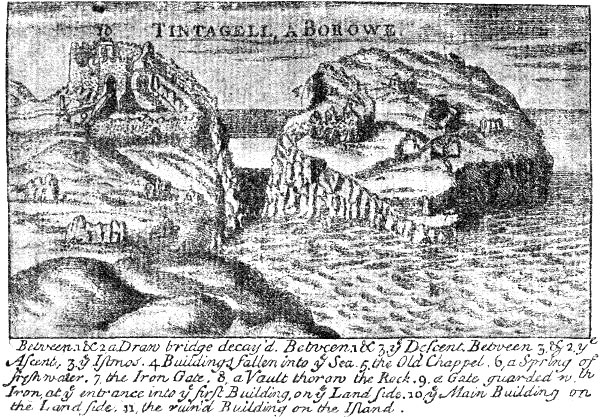
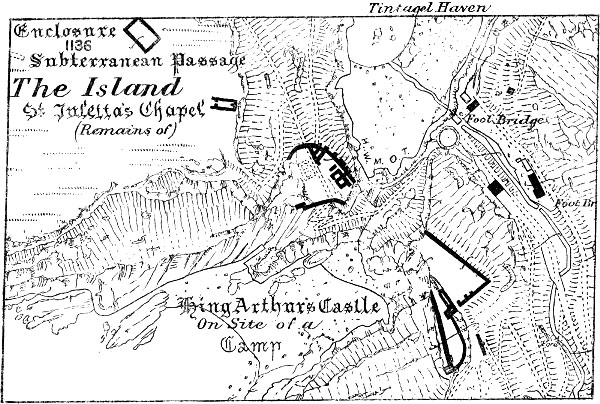
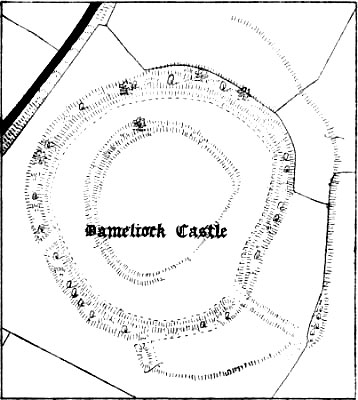
We may look upon Tintagel as the birthplace of Arthur, and believe that he
was the son or putative son of a petty Cornish king. The exact fitness of
Tintagel and Damelioc for the story of which they are the scene lends
probability to it: not that we need accept the narrative precisely as
related. Time, verbal transmission, and Celtic imagination have to be
allowed for; but we may without undue credulity believe that Gorlois was
slain at Damelioc and Arthur born at Tintagel. We may presume that Arthur
remained in possession and occupation of the country of his nativity.
Tintagel Castle has been from time immemorial known as King Arthur’s;
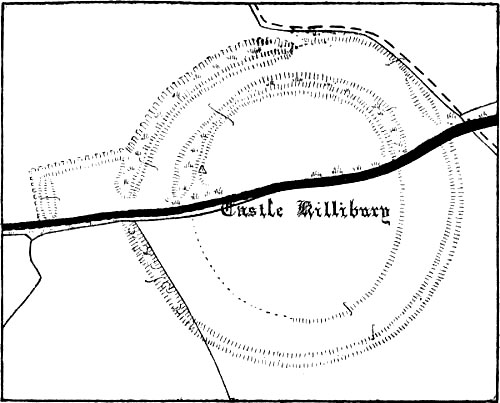
Kelliwic, which is mentioned in the earliest records in connection with
Arthur, may with probability be identified with Kelly Rounds and placed
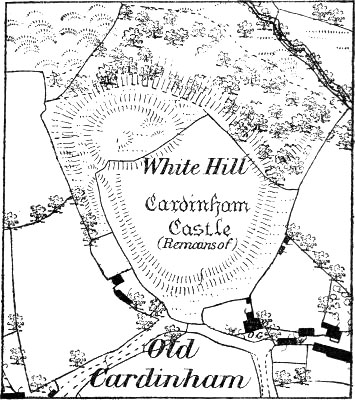
near the estuary of the Camel; and Cardinam Castle, which credible though
later tradition assigns to Arthur as a palace or residence, exists near
Bodmin. Great interest, to my mind, attaches to these memorials. Military
engineering is older than the corps of Royal Engineers; and it may be said
that the most ancient history of our country is written in earth. These
memorials, together with Tintagel, a fortification constructed by the hand
of nature, indicate that King Arthur occupied the coast line from Tintagel
to the Camel, and the inland country to the vicinity of Bodmin.
If we accept the evidence of names, that of Pentargon in particular, we
must suppose Boscastle to be included in the Arthurian country, which
would thus extend from the mouth of the Camel to the mouth of the
Vallency. The town of Camelford lies within this district, and it is
difficult not to think of Camelot as possibly on the Camel, though we have
no indication, excepting the name, to justify the assumption, and other
places compete for the distinction of supplying the site of this somewhat
hypothetical creation.
We can speak with more confidence of Kelliwic, assuming that it is still
with us under the name of Kelly Rounds. This lies 2½ miles from
Wadebridge, where the Camel forms a practicable tidal harbour, and was no
doubt used as such in the sixth century. The fortification covered the
landing-place, at a convenient distance, and commanded what must have been
the chief line of communication between Arthur’s Cornish domain, Wales,
Ireland, and the north-west coast. The sea is a connection rather than a
separation, and may have provided the lord of Kelliwic with an access to
the north which would have been practically unattainable by other means.
It may be doubted whether in Arthur’s time the Saxons had reached
Tintagel: it is clear that in the ninth century they were fighting on the
Camel, apparently unsuccessfully, and that they never generally superseded
the Celtic population much further to the west than the traditional
territory of Arthur. That Arthur ever fought a great battle on this river
is improbable; nor is it likely that the Saxons in his time got far enough
to the west to assault his earthworks; but these at any rate may have
served as places of retreat, and been used by him as Torres Vedras was by
Wellington.
We may accept the statement of Nennius, who was apparently an historian of
honest intentions, that Arthur was selected to command against the Saxons,
and that in this capacity he fought many, perhaps twelve, battles. There
must, it is certain, have been much fighting in the west and north as well
as elsewhere, and we may give Arthur the credit of much of it, though
details, if not entirely absent, are by no means explicit. It seems clear
that he entered Scotland, perhaps more than once, became a prominent
character in the Lowlands, as the dissemination of his name implies, and
finally perished at Camelon or Camlan, near the Firth of Forth, fighting
against a coalition of Saxons, or, strictly speaking, Angles, Picts, and
Scots, or, according to another tradition, against one consisting of
Picts, Scots, and revolted Britons. It is a far cry from Cornwall to
Scotland, but the feat is not impossible. Agricola marched from the south
of England to Scotland at an earlier date; but he had the resources of the
Roman Empire behind him. Arthur must have been aided by his access to the
sea, and probably found allies in the Celts of the west and north-west
along the whole front of the Teutonic encroachments. His movements in the
south and in the north were attended with a series of British victories in
which the invaders were pushed back from the western parts of the island,
and which contributed to the preservation of the Celtic race in the
regions of Cornwall and Wales, where it still survives. Such achievements
were enough to make Arthur famous from the Camel to the Forth, however
little in those days of imperfect communication his reputation extended to
the ‘Saxon shore.’ The places where above all others he was held in memory
and where his name was handed down as a local tradition were his little
inheritance in Cornwall, where he was born, and which we cannot doubt that
he occupied—more or less; and the northern region, where he apparently
did much fighting and where he ultimately perished. I need not repeat that
if, as seems probable, Arthur’s last battle was in Scotland we must
dissociate his death with the Camel and his burial with Glastonbury.
So much for what may be accepted as history. We might have had more had
the Cornish language survived like the Welsh. I do not propose to deal
with the superstructure of romance which in succeeding centuries
collected about Arthur’s name. The magnitude of this echo, if so it may be
called, is in some sort a measure of the impression produced by Arthur in
his life time. The romance seems to have come chiefly from France. There
was little communication in Arthur’s time between the west and east of
England: even between Cornwall and Devonshire there seems to have been
little. The chief connection between Cornwall and the rest of the world
was by sea, and Wales, Britanny and Ireland were the countries in the most
intimate association with this peninsula. Navigation is an ancient art,
older than the mariner’s compass: in the comparatively late sixth century
crossing the Channel and the narrow seas must have been familiar to our
ancestors, whether Saxon or British. Britanny and Wales, countries within
touch of Cornwall, were, like it, occupied by Celts, a race gifted with
more imagination than has been granted to the practical and hard-headed
Saxon. The fictions of which Arthur is the centre, constructed chiefly in
France, but to a lesser extent in Wales, were brought to England in the
twelfth and later centuries, and replaced history by myth. In these
poetic regions this story attained a complicated development the like of
which is not to be found in British history, though we can discern
something like it in connection with the siege of Troy and the subsequent
adventures of some of the persons supposed to have been concerned in it.
That Arthur was a patriot, a defender of the soil against foreign
invaders, is sufficiently obvious. That he was also a Christian must be
believed. Christianity reached Cornwall before St. Augustine preached in
Kent: Britain probably received some sprinkling of Christianity during the
Roman occupation, though we cannot suppose that much of this religion
penetrated from London to Cornwall. The western extremity of the island
was much associated with Ireland, and we have reason to believe that as
early as the fifth century the creed of St. Patrick was brought to
Cornwall, which thus became one of the earliest places in Britain to
receive the Christian religion. It is worth observing that the ancient
Cornish crosses, of which there are so many, generally present the Greek
cross rather than the Latin, and would appear to belong to the Eastern
rather than the Western Church. The oldest of these crosses are supposed
to date back to the sixth century. It is more than probable that a Cornish
chieftain at this period would have been a Christian, and possible that
Arthur himself may have knelt before some of the crosses which still
exist.
THE END
PRINTED BY
SPOTTISWOODE AND CO., NEW-STREET SQUARE
LONDON
Footnotes:
[1] I have to thank the Rev. S. Baring-Gould for supplying me with these
particulars, which are to be found in the Report of the Launceston Meeting
of the Cambrian Archæological Society, Archæologia Cambrensis, No. 51,
fifth series, July 1896. This relic is preserved in the royal collection
at Osborne, and is described and figured in the Archæological Journal,
vol. xxiv. p. 189. The vessel is represented as in excellent preservation
and of artistic design. It is of hammered gold, and is supposed to be of
Scandinavian workmanship.
[2] See The Four Ancient Books of Wales, by W. F. Skene, 1868; also an
essay on Arthurian localities, by J. S. Stuart Glennie, Merlin, part
iii., published by the Early English Text Society, 1869.
[3] History of Britain, by John Milton.
[4] I need not refer to La Morte d’Arthur, a work of which Roger Ascham
disapproves as encouraging manslaughter and incontinence: ‘yet I know,’
says Roger, ‘when God’s Bible was banished the Court, and La Morte
d’Arthur received into the prince’s Chamber.’
[5] Skene’s Four Ancient Books of Wales, vol. ii. p. 457.
[6] Guest’s Origines Celticæ, vol. ii. p. 194.
[7] Dr. Guest’s opinion as that of an antiquarian scholar deservedly
carries great weight, though some at least of the bardic fragments usually
ascribed to the sixth century are held by Stephens to belong to the
twelfth. (See Literature of the Kymry, 1849.) This writer allows certain
of these fragments to have come down from the sixth century, and the
admission of so scrupulous a critic goes far to establish their antiquity.
I may refer to Skene’s Four Ancient Books of Wales for information
regarding the works in question, as well as for the text of some of them.
There appears to be no reasonable doubt that Taliessin, Llymarch Hen, and
Myrddin lived in the sixth century, though their supposed compositions are
not presented to us in any manuscripts which bear an earlier date than the
twelfth. The Black Book of Caermarthen, which contains some of these
remnants, of the greatest reputed antiquity, was written in the time of
Henry II. But though all intermediate writings have perished or remain
hidden, we are not to infer that none ever existed. It is clear that some
of the bardic fragments refer to the sixth century; for example, that
relating to the fight at Llongborth between Geraint and, as is supposed,
Cerdric, in which Arthur is mentioned. It is possible that this and other
poems may at first have been transmitted by word of mouth, but impossible
that they could have been so conveyed for six hundred years. Intermediate
writings there must have been; these have not survived, but they are
probably fairly represented in the Black Book of Caermarthen and similar
records. It cannot be doubted that these compositions relating to the
sixth century, by whatever means and with whatever modifications they
reached the twelfth century, must have had some substantial foundation. It
would have been impossible in the twelfth century to create out of nothing
stories and allusions so suited to the sixth in historic probability and
local association.
[8] Skene’s Four Ancient Books of Wales, vol. i. p. 426.
[9] Quoted from the edition by J. A. Giles in Six Old English
Chronicles.
[10] See the Chronicle of Henry of Huntingdon.
[11] As bearing upon Arthur’s early campaigns and their connection with
Scotland, it is of interest to recall the tradition which connects Arthur
with Mordred. Arthur’s sister, Anne by name, married Llew, otherwise
Lothus or Lot, King of the Picts, to whom Arthur is supposed to have given
Lothian. Of this marriage came Mordred, or Modred, Arthur’s nephew and
mortal enemy. From this it would appear that the southern adventurer was
associated with the northern monarch before Mordred was born, and had
visited Scotland apparently as a conqueror in the time of Mordred’s
father.
[12] An elaborate and learned disquisition relating to Arthur and his
battles is to be found in Whitaker’s History of Manchester, published in
the year 1775. See book ii. chapter ii.
[13] Quoted by Camden from Marianus Scotus.
[14] Jacit, instead of jacet, calls for remark. Mr. Iago assures me
that this spelling was not unusual in the time to which the inscription
belongs, and refers to Professor Hübner for instances of Christian
inscriptions in Britain in which the same spelling was employed.
[15] See Trigg Minor, by Sir John Maclean, vol. i. p. 583, where is a
representation of the stone and inscription provided by Mr. Iago.
[16] Skene’s Four Ancient Books of Wales, vol. i. p. 60; Stuart Glennie,
Arthurian Scotland, Merlin Early English Text Society, part iii. p. lxi.
[17] The Scots with whom Arthur fought were probably, like the Picts,
inhabitants of Scotland, though the term Scotti is also applied to a
portion of the inhabitants of Ireland.
[18] Leland’s Assertio Arturii.
[19] There are discrepancies of date with regard to disentombment which
increase the doubts which on other grounds surround the story. The date
commonly assigned is that adopted by Camden, 1189, the last year of King
Henry’s reign. Leland gives the date as 1191, in which he is followed by
Hume, in the reign of Richard I. Giraldus, who represents himself as an
eye-witness, and is necessarily the earliest authority, does not give the
year, but indicates the time within certain limits. He states that the
grave was opened by order of Henry II. during the rule of the Abbot Henry.
This Abbot was apparently Henry de Blois, the grandson of the Conqueror
and the brother of King Stephen; Henry II. was therefore his first cousin
once removed. It has been supposed that the consanguinity may have
disposed the Abbot to gratify the king by finding what he wanted. Henry de
Blois was the 37th Abbot. He was appointed in 1126, in the time of Henry
I., and died in 1171, in that of Henry II. In the year 1129, three years
after his appointment to Glastonbury, this Abbot became, according to
Leland, also Bishop of Winchester. Giraldus tells us that the discovery
took place before the Abbot became Bishop. If that were so the remains
were found not later than 1129, in the reign of Henry I., not in that of
Henry II., as Giraldus represents. Giraldus himself was not born until
1147, or 1150 (both dates are assigned); so it is evident that a large
error has come in with regard to the date of the disentombment, in
reference to the appointment of the Abbot to the bishopric. Putting aside
this contradiction as possibly due to some mistake in the ecclesiastical
records, we at any rate cannot doubt, if any credit is to be attached to
Giraldus, that the exhumation took place, if at all, in the time of Henry
de Blois, who died in 1171. This is inconsistent with the dates 1189 and
1191 which are respectively assigned to the event. Thus three Kings are
presented as contemporary with the finding of Arthur’s grave, while two
Abbots and a locum tenens offer themselves as immediately concerned in
the transaction. For in the last year of the reign of Henry II., in which
according to one account the grave was opened, there was no Abbot of
Glastonbury, the King from the year 1178 until his death in 1189 having
retained the Abbey in his own hands and administered it by means of a
subordinate. Thus in 1189, the date authoritatively assigned for the
concurrence of the Abbot and the King, there was no Abbot and the King was
approaching his end. In the year 1191 Richard I. and the 39th Abbot bore
sway. Like the Abbot of royal blood, he was named Henry (which may have
led to confusion), one Henry de Saliaco, but he does not supply the
requirements of the case if we are to believe that King Henry was the
instigator and his sacerdotal kinsman the agent. Thus the whole story is
beset with doubts. This much may be believed: in the time probably of
Henry II. the bones of Arthur were sought for; two skeletons were found
where skeletons most do congregate, which with judicious exaggeration and
some invention were made to come up to what was demanded of the remains of
the warrior and his beautiful consort; these were re-interred under the
names of Arthur and Guenevere, and about 100 years later were honestly
accepted as such by Edward and Eleanor.
[20] History of the Deanery of Trigg Minor, by Sir John Maclean, vol.
iii. p. 194.
[21] Among the more noticeable particulars in the buildings, both on the
island and the mainland, especially on the island, are the numerous holes
in the walls. These have given rise to much remark and speculation; by
some they have been inconsiderately interpreted as arrow holes. It is
sufficiently obvious that they once gave lodgment to the beams which
formed the scaffolding employed in the construction of the walls. The
orifices are rectangular, about 7 inches × 6 or 6 inches × 5. The passages
in connection with them are horizontal and give no scope for the
adjustment of the weapon; many of them have no exits, but come to an end
against rock or masonry. The holes are generally arranged so that several
are on the same level. Similar holes for the same purpose are not uncommon
in the neighbourhood, and may be seen in the Vicarage wall. I am indebted
to Colonel Mead, of the Royal Engineers, for the self-evident explanation
which I have adopted.
[22] A similar projecting course is to be seen on a wall which cuts off
the neighbouring peninsula of the Willapark from the mainland. This wall,
though ancient and probably defensive, cannot be supposed to be Roman or
to show Roman methods.
[23] Rickman’s Gothic Architecture.
[24] I insert the description of Tintagel Castle as given in The High
History of the Holy Grail, a French romance of the thirteenth century:
‘They (i.e. Arthur, Lancelot and Gawain) came into a very different
land, scarce inhabited of any folk, and found a little castle in a combe.
They came thitherward and saw that the enclosure of the castle was fallen
down into an abysm, so that none might approach it on that side, but it
had a right fair gateway and a door tall and wide, whereby they entered.
They beheld a chapel that was right fair and rich, and below was a great
ancient hall. They saw a priest appear in the middle of the castle, bald
and old, that had come forth of the chapel. They are come thither and
alighted, and asked the priest what the castle was, and he told them it
was the great Tintagel. “And how is the ground all caved in about the
castle?” The priest then relates the death of Gorlois and the
transfiguration of Uther, “so that he begat King Arthur in a great hall
that was next to the enclosure there, where this abysm is. And for this
sin hath the ground sunken in on this wise.” He cometh then with them
toward the chapel, that was right fair and had a right rich sepulchre
therein. “Lords, in this sepulchre was placed the body of Merlin, but
never mought it be set inside the chapel, wherefore perforce it remained
outside. And know of very truth that the body lieth not within the
sepulchre, for so soon as it was set therein it was taken out and snatched
away, either in God’s behalf or the Enemy’s, but which we know not.”’ The
High History of the Holy Grail, by Master Blihis (1200-1250), translated
by Sebastian Evans, vol. ii., p. 75.
If we may suppose, as probably we may, that Master Blihis describes the
castle as it was in his own time, though affecting to adapt his
description to that of King Arthur, we may infer that in the thirteenth
century when the existing castle was comparatively new it had already
begun to suffer from the encroachments of the sea.
[25] In connection with the identification of Damelioc Castle, I have to
acknowledge my obligation to the Director-General of the Ordnance Survey,
and to Staff-Surgeon Trevan, of Bideford.
[26] See Gilbert’s History of Cornwall, 1838, vol. i. p. 328, vol. iv.
p. 94.
[27] These measurements and others relating to the camps are only to be
taken as approximate, the horizontal distances were measured by pacing,
the heights by the eye. They will serve to give a generally correct
impression, though not made with the accuracy of a land-surveyor. This may
be found in the Ordnance maps which are attached.
[28] The Arthurian Legend, by Professor Rhys, pp. 15 and 38.
[29] The Arthurian Legend, by Professor Rhys, pp. 129 and 132.