1. In the original printed edition of this work the chapters are not
divided into subheaded sections, but each page has a header at the
top. In addition, there are marginal notes (sidenotes), many embedded
within lengthy paragraphs (the incidence of sidenotes varies markedly
through the book). To preserve this material and in the interests of
readability:
(a) While the original paragraphing has been retained, the text
of page headers has been inserted into appropriate paragraph
breaks, shown as centered subheadings. These entries are
suppressed where multiple headings would occur within the same
paragraph: in this case only the first header is shown.
(b) Marginal notes have been inserted close to their original location.
2. Footnotes (some of which are lengthy or in diagrammatic form) have
been numbered and placed at the end of the chapter in which they
appear.
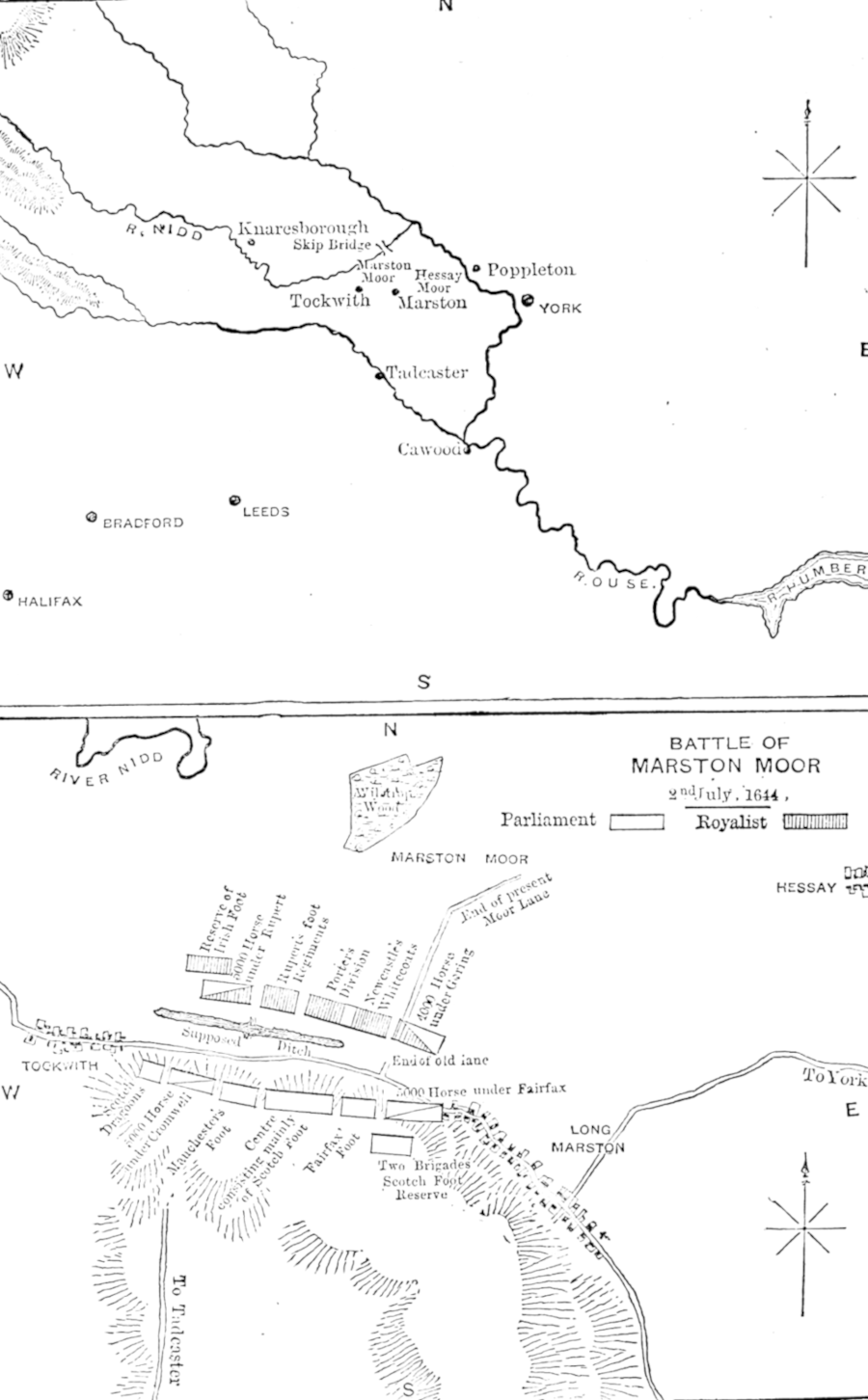
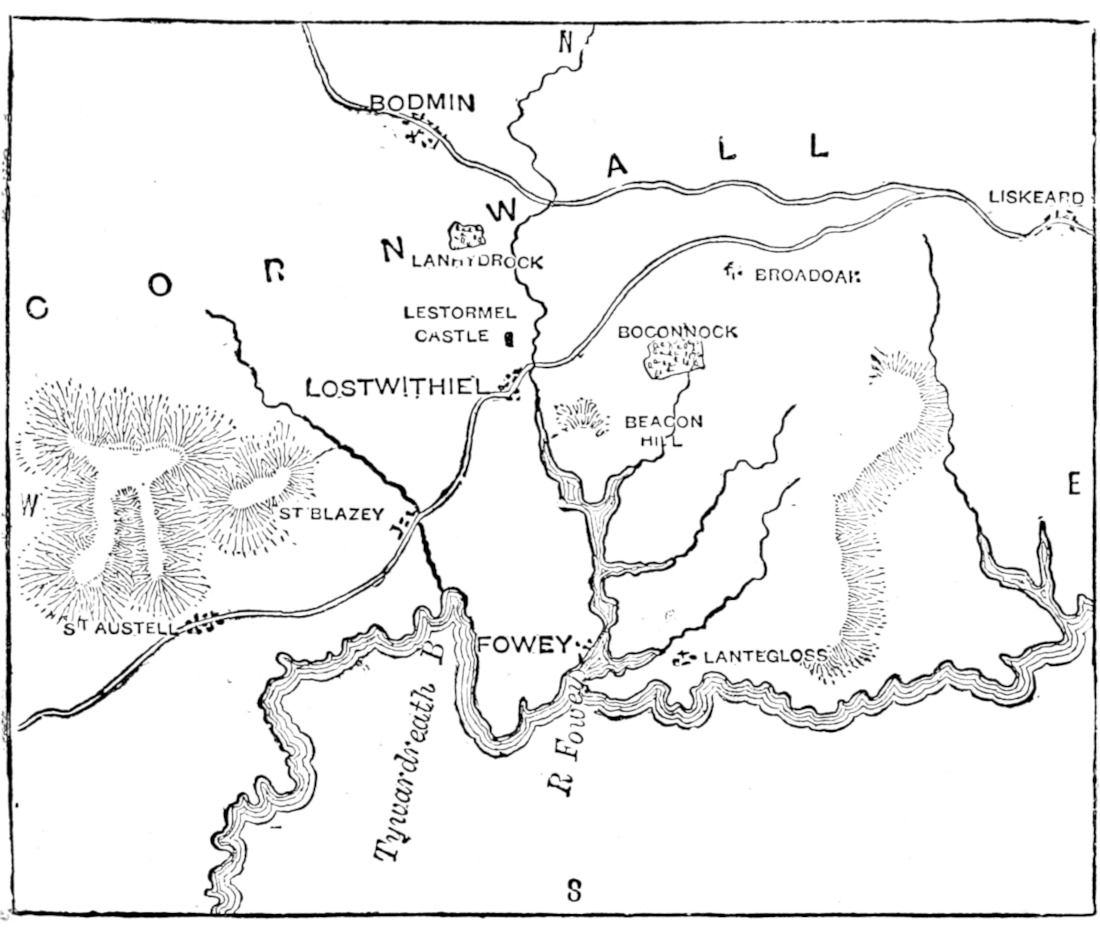
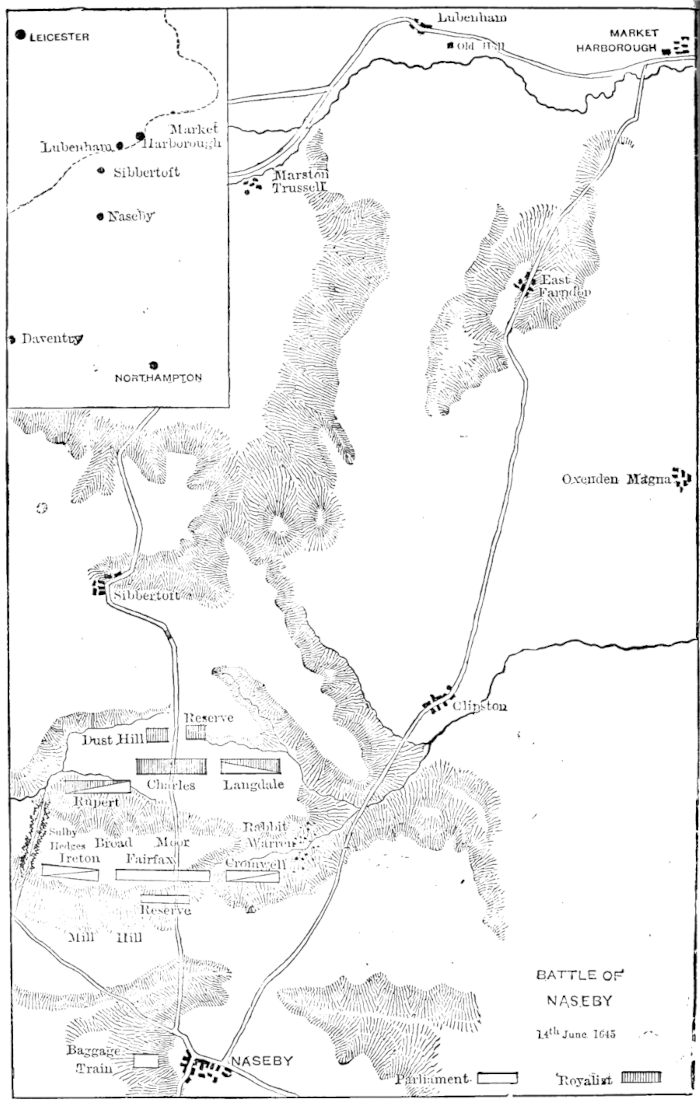
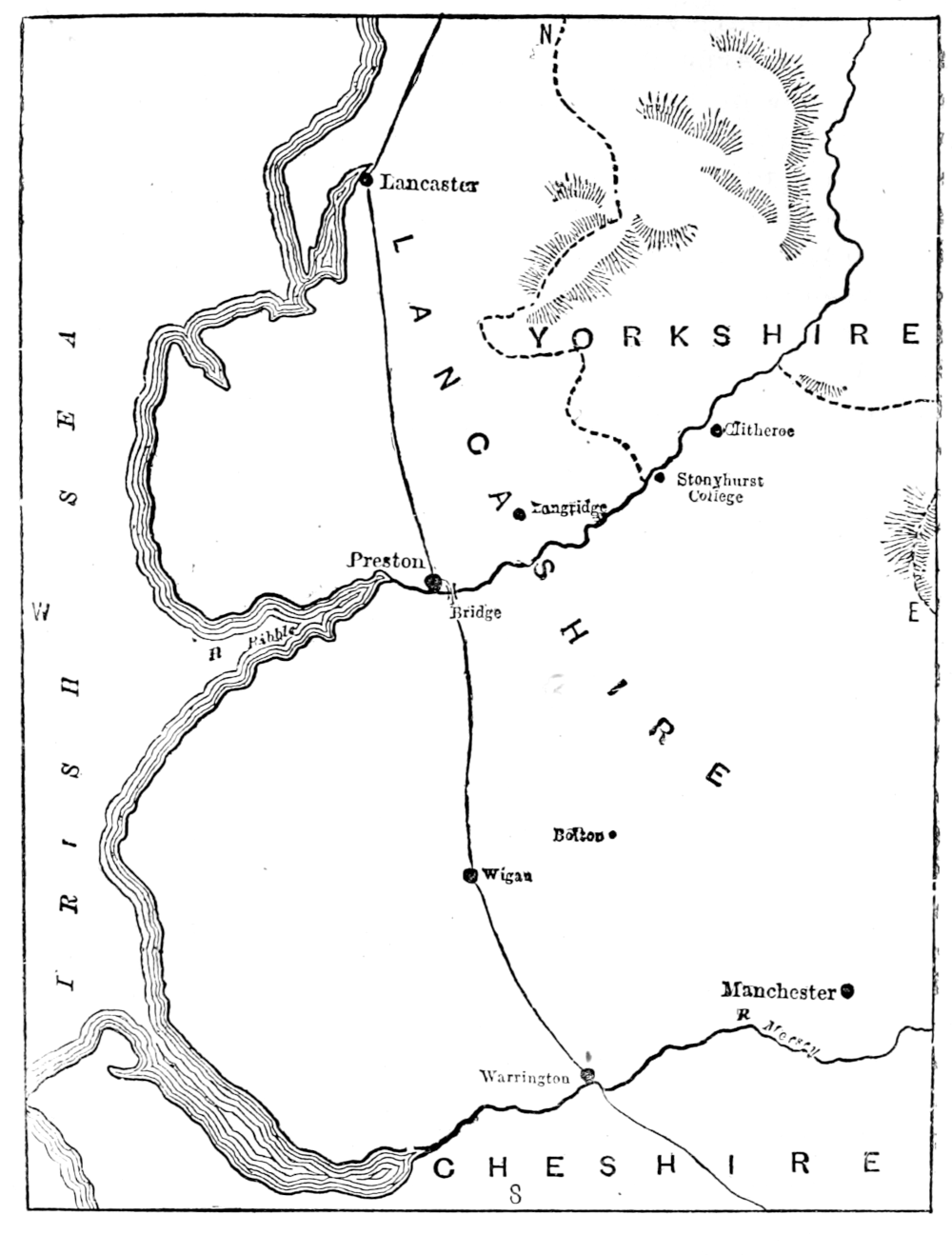
3. Illustrations, in the form of maps and genealogical tables, are
shown in appropriate paragraph breaks. A list of illustrations, not
part of the original work, has been included following the Table of
Contents.
4. To facilitate readability on electronic devices, the complex diagram
preceding p. 1 has been split into four parts.
5. New original cover art included with the work is granted to the public domain.
KING AND COMMONWEALTH
A HISTORY OF
CHARLES I. AND THE GREAT REBELLION
BY
B. MERITON CORDERY
AND
J. SURTEES PHILLPOTTS
HEAD MASTER OF BEDFORD SCHOOL
FORMERLY FELLOW OF NEW COLLEGE, OXFORD
Nothing extenuate
Nor set down aught in malice
PHILADELPHIA JOS. H. COATES AND CO.
1876
PREFACE.
The aim in writing this short history has been to give within
a moderate compass a lively idea of the feelings and motives
at work in what was perhaps the most important epoch of our
national history. With this aim it seemed best to treat the
main events with all that fulness of detail, which assists the
imagination in realizing the past, and to omit such minor
actions as seemed not essential to the understanding of the
main facts. The same rule has been followed in dealing with
the military history. For this, personal visits have been
made to the battle-fields, and some rough sketches of the
ground have been added. No constitutional question has
been touched without a preliminary attempt to put the
growth and forms of the Constitution before the reader in
such a manner as to encourage him to form a judgment for
himself.
In a joint work it is difficult to define exactly the part
taken by each writer, but my own share in the book may be
described rather as that of editor than author; it has, in
fact, been mainly confined to matters of style and arrangement,
with criticisms on events and on constitutional questions.
My coadjutor, who kindly undertook the subject at my
suggestion, wrote the first draft of the whole book, and is
not only responsible for the accuracy of the facts, but deserves
all the credit of research into original documents at
the British Museum and Bodleian libraries.
While for facts our endeavour has always been to go to
contemporary records, yet it is impossible that any one can
write on this period without feeling more obligation to the
labours of Mr. Forster than can be adequately expressed in
foot-notes. Acknowledgement is also due for many suggestive
ideas not only to Hallam and other writers on the
time, but to Mr. Freeman for the light he has thrown on
the early history of the English constitution, and to Mr.
Bagehot for his vivid description of its practical working at
the present time.
I cannot conclude without expressing our thanks to Mr.
R. W. Taylor for some corrections in the proof, to the Rev.
C. E. Moberly for revising the earlier chapters, and above
all to the Bishop of Exeter, whose occasional hints have
given the kind of help that can only be given by one who
has not only an accurate knowledge of the facts, but a thorough
grasp of the constitutional questions at issue.
J. SURTEES PHILLPOTTS.
CONTENTS.
CHAPTER
PAGE
I.
CONSTITUTIONAL INTRODUCTION.—GOVERNMENTS OF ELIZABETH AND JAMES I.
GOVERNMENT. | +——————————————————————+——————————————————————————-+ | | | Legislative, Executive, Judicial, deciding what framing laws executing laws law is, and whether it | | is broken or not. | | | | | +——————+————————+ | | | | | | Civil Ecclesiastical | | Courts Courts | | | | +————+——————+ +————-+————+ +————-+————+ +——+————+ | | | | | | | | Legal Arbitrary Legal Arbitrary Legal Arbitrary Legal Arbitrary
Legislative, framing laws | +——————————————————+————————————————————————————————————+ | | Legal Arbitrary | | +——————-+——————————-+————————-+————————————+——————————-+ | | | | | | | | | | | freeholders freeholders inhabitants | | | | holding by holding by of certain | | | | free socage, feudal towns | | | | who elect service, elect | | | | | who elect | | | | | | | | | | | | +————-+————-+ | | | | about 120 | | | | 26 bishops peers about 100 about | | and sitting by knights of 400 | | archbishops hereditary shires burgesses | | | right | | | | | | | | | | +——————-+——-+ +————+————————————-+ | | | | | King House of Lords House of Commons King who \ | / by prerogative \ | / | +————————————+————————————————————-+ | | +——————+ Parliament | | | +————————-+——————————-+ +————————-+——————-+ | | | | makes grants makes raises loans, laws subsidies and proclamations ship-money, customs in council grants monopolies
Executive, executing laws | +——————————————————-+——————————————————————+ | | Legal Arbitrary | | King who in King who by the eye of prerogative the law can | ‘do no wrong’ | | | makes treaties, declares war, arrests by personal mandate, but has no standing army, and imprisons without habeas has no money without Parliament; corpus, billets soldiers | | +——————+——————————————————-+————————————————+ | | | secretaries and appoints sheriffs councillors appointed lords-lieutenant, enforce and removed by king, but and officers of decisions in the eye of the law militia by sea of judges ‘responsible;’ carrying and land out laws and collecting revenue through their agents
Judicial, deciding what law is, and whether it is broken or not. | +————————————+————————————————————————-+ | | | Ecclesiastical Civil Courts Courts. No | trial by jury | | +————————————————————-+ +————+——————+ | | | | Legal Arbitrary Legal Arbitrary | No trial | | | by jury | | | | | | +——————————-+——————+ | | | | | | | | Equity Common law. | | | | Trial by jury | | | | | | | | | +————-+ +-+ | | | | | | | Court of +——King’s +——Council Courts of High Chancery; | Bench | Board bishops Commission; lord chancellor | (Note A) | (Note B) who were judges appointed | | appointed appointed by king +——Common +——Star by king by king | Pleas | Chamber | (Note A) | (Note C) | | +——Exchequer +——Council (Note A) of North (Note D)
Notes
(A) Judges appointed and removed by king, but by their
oaths bound to give judgment according to the
laws, and to do equal law and execution of right,
without having regard to any person
(B) Councillors appointed and removed by king;
use of torture
(C) Judges, councillors, and others appointed by king
(D) President appointed by king
CHAPTER I. — CONSTITUTION— I. LEGISLATURE. — REPRESENTATION IN PARLIAMENT. — CONSTITUTION—II. EXECUTIVE. — SAFEGUARDS—DANGER OF ABUSE. — CONSTITUTION— III. JUDICATURE. — STAR CHAMBER—HIGH COMMISSION. — RELIGIOUS DIFFERENCES—REFORMATION. — NO TOLERATION. — RELIGIOUS DIFFERENCES—PRESBYTERIANS. — DIVINE RIGHT OF KINGS. — RELIGIOUS DIFFERENCES—SECTARIANS. — PROTESTANT FOREIGN POLICY. — JAMES I. —ACCESSION. — ARBITRARY GOVERNMENT. — HIGH COMMISSION—FULLER’S CASE. — ARABELLA STUART. — A PIRATE CASE. — PERSECUTION OF PURITANS. — THIRTY YEARS’ WAR. — WAVERING FOREIGN POLICY. — PARLIAMENT OVERRIDDEN. — TOM TELL-TRUTH. — BREACH WITH SPAIN. — DEATH OF JAMES. — FOOTNOTES:
KING AND COMMONWEALTH.
CONSTITUTIONAL INTRODUCTION.—GOVERNMENTS OF ELIZABETH
AND JAMES I.
No people ever was and remained free, but because it was determined to be
so; because neither its rulers nor any other party in the nation could
compel it to be otherwise. If a people—especially one whose freedom has
not yet become prescriptive—does not value it sufficiently to fight for it
and maintain it against any force which can be mustered within the
country, it is only a question in how few years or months that people will
be enslaved.—Mill, Dissertations and Discussions.
Three functions of government, I. Legislative, II. Executive, III. Judicial.A people, to be free, must take part in, or possess
control over, the three powers of government, Legislative,
Executive, Judicial. As to the first, if they are
to be masters of their persons and properties, neither
laws must be made nor taxes imposed without their
consent; secondly, ministers of the executive, whether councillors
of state, tax-collectors, military or police officers, must be personally
responsible to the law courts, or they may infringe with
impunity the laws the people have secured; lastly, though persons
and properties be protected by laws, and though ministers
be liable to prosecution, this protection is nominal only, unless
the judges who interpret the laws, are sufficiently independent of
the executive.
I. Legislative. Liberties of Englishmen in 16th and 17th centuries.
I. Englishmen of the seventeenth century shared in
the legislative power with the sovereign, who could make
no laws without consent of the two Houses of Parliament.
Their properties were protected from arbitrary
seizure, their persons from arbitrary imprisonment,
by two statutes, the Magna Charta, first granted by King
John, and the Confirmatio Chartarum, first granted by Edward I.
These together provide, first, that no person shall be put in
prison without legal warrant, or kept there without being brought
to trial according to the laws of the land; that is, that the question
of law shall be decided by the established judge of the law;
secondly, that the question of fact, whether a man accused at the
suit of the crown, has, or has not, committed the crime laid to
his charge, shall be decided by a jury of twelve of his countrymen;
and lastly, that no taxes of any sort shall be imposed without
consent of Parliament.
Classes represented in Parliament.
Several classes of the nation shared indirectly in the government by being represented in Parliament. In
the Upper House sat the temporal and spiritual lords
of the realm in their own right. To the Lower House all the fifty-two
counties of England and Wales, with the exception of Durham,
returned two members each, elected by freeholders possessed
of lands or tenements to the annual value of 40s.[1]Freeholders including feudal tenants and yeomen.
The term freeholder included two classes, holders of land by
knight’s service, and holders of land by free socage.[2]
The first class was composed of feudal tenants, gentlemen
by birth, who had originally held land in return
for military service, and whose tenure was still subject to several
irksome burdens. The second class was composed of yeomen,
men of ignoble blood, but with a tenure dating from feudal
times. The Normans of the conquest would have thought it
beneath them to hold land by any other than a military tenure.
But in many cases they permitted the despised Saxons to remain
in possession of their lands, sometimes on condition of performing
agricultural services which soon took the form of a fixed annual
rent; sometimes on condition merely of taking an oath of fealty
and paying occasional fines. Thus in England there sprang up
in quite early times an independent class who were owners of the
soil, and though not of gentle birth, sat on juries, voted at county
elections, and attended the courts in which freeholders met together
to transact the business of their county.
Burgesses.
Besides county representatives, the House of Commons contained over four hundred members, returned according
to usage by certain privileged towns. These were the classes
possessed of political rights. Below these were the whole mass of
the unenfranchised—hired labourers, tenants at will, and copyholders.[3]Copyholders and hired labourers unrepresented.
These were the descendants of those Saxons whom the Normans had reduced to a state of serfdom;
and, unlike freeholders, were incapable either of sitting
on juries or voting at elections. For the last hundred
years, however, they had nearly all been free, and were protected
in person and property by the same laws as freeholders.
All classes being thus possessed of the same liberties, their
common freedom gave them common interests, and caused them
to unite in spite of social distinctions, and oppose the establishment
of arbitrary government.
No privileged class.
In France the political condition of the people was inferior to that of the English, and this mainly from
want of union and fellow-feeling between the different ranks into
which French society was divided. There was no class answering
to the English yeomanry; the feudal tenants were a noble and privileged
class, and were divided by this barrier of privilege from
their unfortunate inferiors in rank, on whom the main burden
of direct taxation fell; as the inequalities of taxation increased,
the different classes became more and more isolated, and thus
the kings, never meeting with combined resistance from the
whole body of their subjects, came by degrees to usurp absolute
power, to impose taxes at will, and to govern without the aid of
any national assembly.
II. Executive Power now exercised by a committee of the legislature.
II. A people are little benefited by the possession of
good laws, unless those laws are respected and obeyed
by those who are entrusted with the execution of them.
The executive power was then, as now, exercised by
ministers of the crown. But in the course of two centuries
the position of these ministers has been totally changed.
The queen’s ministers are now in such close harmony with the
Parliament, that they have been defined as a committee of the
legislature.[4] Chosen out of the predominant party in Parliament,
they conduct the government only so long as they can
command a majority of votes in the Lower House. If their
measures are outvoted, they have no choice but to resign office,
or by obtaining a dissolution, to appeal to a new Parliament for
renewal of the support which is their only claim to power.
Executive in 16th century exercised by the crown.
In the sixteenth century, on the contrary, the executive
power lay entirely in the hands of the king, who
settled all questions of administration, made peace and
war, appointed and dismissed officers of state, and expended
the revenue, uncontrolled by the representatives of the
people. Yet, great as was the power thus exercised by the crown,
two safeguards were provided against its abuse.Two safeguards. (1) No army in England.
The first was negative, the absence of a standing army in England.
In France absolute power was upheld by an army,
recruited in part by foreigners, and officered solely by
nobles; this army the king found no difficulty in
maintaining, as he imposed taxes at pleasure. No such right,
however, belonged to English monarchs, who were without the
funds necessary for the support of a standing army; and it was
only by means of a standing army, possessed with an ‘esprit de
corps’ of its own, and divided in interest from the people, that
arbitrary government could be permanently established. The
House of Commons always originated money bills; they held,
therefore, the purse-strings of the nation, and were careful only to
grant supplies sufficient for the ordinary purposes of government.
(2) Responsibility of king’s ministers.The principles of the constitution contained a second and positive
safeguard against the abuse of the regal power.
Great lawyers had long since declared that the king,
his subjects, was bound to respect the laws. “The
king,” Bracton wrote as early as the thirteenth century, “also
hath a superior, namely God, and also the law, by which he was
made a king.” It was not likely, however, that the subject
would have either the power or the desire to arraign sovereigns
themselves before courts of law. A fiction of the lawyers intervened
and gave a better means of securing the same end.
This fiction was that the “king could do no wrong.” From this
it followed that if wrong was done, the ministers, and not
the king, must have advised and executed the wrong; ministers
could not screen themselves behind the king’s name; if they
broke the laws in the performance of their functions, though
it was at the king’s bidding, they were still liable to be sued
by the injured parties in a court of justice.
Liberties not secure. (1) Illegal powers exercised by crown.
Still these safeguards had not been found sufficient
to prevent the executive from violating the law. In
the first place, several powers, sometimes simply oppressive,
sometimes actually illegal, were regarded as
belonging to the crown in right of the royal prerogative. By
these both the subject’s property and liberty were endangered.
Thus the king, though he dared not tax without consent of
Parliament, used to borrow large sums under the name of loans,
which were seldom repaid. Both the king and his council imprisoned
without showing legal cause. Proclamations were made
by the King in Council, which, though regarded as temporary
measures only, were in matter of fact laws, and sometimes had
penalties attached to them for disobedience. So again, though
the use of torture was not lawful by the common law, and
contrary to several statutes, State prisoners were constantly put
to the rack on the strength of warrants signed by the king.
In the second place, though the law allowed the subject to seek
redress, the redress was rarely attainable. Few dared to incur
the king’s displeasure by attacking the conduct of his
servants, and if they did, juries were often intimidated,[5]
judges were often corrupt.(2) Judges dependent upon crown.
The strength of the chain is the
strength of its weakest point. The weak point of the English
constitution lay in the dependence of the judges upon the crown;
unless the interpreters of the laws were independent, no law
could ever effectually secure the liberties of the people.
(3) Arbitrary courts.
And in the third place, besides the common law courts, other courts of justice existed, in which the accused
was neither tried by jury nor sentenced according
to known laws.
III. Judicial.
Omitting the Court of Chancery, which had no jurisdiction in political cases, there were then, as now, three
chief courts of justice, the King’s Bench, the Common Pleas, and
the Exchequer, all of which sat at Westminster; four or five
judges belonged to each, who in all cases were bound to give
judgment, not according to their own pleasure, or the will of the
king, but according to the law of the realm, whether statute or
common law.[6]
Since the Act of Settlement in 1702 the common law judges
hold office for life, receive salaries fixed by law, and can only be
dismissed from office if convicted of some offence, or in consequence
of an address of the two Houses of Parliament. But in
the seventeenth century they only held office at the pleasure of
the king, and being dependent in part upon his bounty for their
salaries, were regarded as the servants of the court.[7]
But these courts at any rate acknowledged the known laws, and
tried prisoners by jury. Of a very different character was the
Court of Star Chamber, so called because its sittings were
held in a room leading out of Westminster Hall, of which
the walls were decorated with stars. The germ of this court
lay in a jurisdiction exercised from the time of Edward III.
by the king’s Common Council, which was accustomed to call
to account offenders too powerful to be brought to submit to
the ordinary courts of law. Then came a second stage. An
Act of Parliament was passed in the reign of Henry VII. (1491),
forming a court of justice, composed of certain members of the
council, and entrusted with powers of judging cases of riots, the
bribing of juries, and other specified offences. This second stage
gave a parliamentary sanction to the court, but limited its powers
and specified its persons. It was out of this chrysalis that the
Court of Star Chamber emerged. By the end of Henry the
Eighth’s reign, it had reached its third, or final stage, in which
it boasted parliamentary sanction, at the same time that it repudiated
the conditions under which that sanction had been
given. The limits of persons and of offences had both disappeared.
The powers formerly vested only in the members of the
court of Henry VII. had silently passed into the hands of the
whole body of the Common Council,[8] while its jurisdiction had
been extended beyond the offences specified by the statute to
cases of breach of trust, fraud, and libel.
Besides the Court of Star Chamber, there was a second court,
the Court of High Commission, which deprived the subject of
the protection granted him by the common law, and of trial by
jury. After Henry VIII. quarrelled with Pope Clement VII.
about a divorce from Catherine of Arragon, Parliament passed
an Act of Supremacy, declaring the king the supreme head
of the Church. This was re-enacted when Elizabeth came to
the throne (1558), and an addition made to it, granting the
queen power to appoint persons to exercise jurisdiction in ecclesiastical
affairs, as, for instance, in the reformation of heresies
and abuses. Elizabeth, therefore, was acting within her powers
when, in 1583, she erected a permanent commission, consisting of
twelve bishops, privy councillors, and others; but she undoubtedly
was straining her power when she gave this court an authority—not
granted her by the statute—to try suspected persons
by juries, or by any other means they could devise, and to punish
by fine and imprisonment. Thus, while the Court of Star
Chamber, by judging cases of libel, deprived the subject of
liberty of speech, the Court of High Commission deprived him
of liberty of conscience. Both alike, therefore, soon came to be
hated by the people; both were distinctly contrary to Magna
Charta, for in neither was the accused tried by jury or by the
laws of the land; both were contrary to the first axioms of justice,
the separation of accuser and judge, for in these courts the
ministers of the crown first prosecuted a man in their capacity of
councillors, and then themselves passed sentence upon him as
judges.
Queen Elizabeth was not disposed to yield up any powers, legal or
illegal, that had been exercised by her predecessors on the throne.Caution with which Elizabeth exercised her power.
She, however, was careful not to strain them beyond what the temper
of the nation would bear. Though she often violated the rights of
individuals, she never attacked those of large numbers at once,
and always kept on good terms with her parliaments, by making
concessions at times when a refusal would have caused ill-feeling. But
notwithstanding the tact with which her government was conducted, as
the people increased in knowledge and wealth, they grew more and more
sensitive to infringements of their rights, and gave signs that through
their representative, the House of Commons, they would soon call upon
the crown to resign the powers it had usurped to the great detriment of
the subject’s liberty.
That the legislature should make laws, and the executive
break them, was a sufficient cause in itself to produce a rupture
between the two powers. The probability, however, of such a
rupture was greatly increased by the fact that a second cause of
quarrel existed between the crown and the Parliament—religious
differences.The Reformation directed by the English kings.
In England, the Reformation had been, no doubt, a popular movement, as
it had been abroad; but it was controlled and directed by a monarchy
which had but a partial sympathy with its aims. The consequence was an
exceeding moderation. The king was made head of the Church in place
of the pope; the monasteries were dissolved; the clergy were allowed
to marry; the doctrine of purgatory was denied, as was that of a
physical change in the elements at the sacrament; images and crosses
were removed from churches; the people were allowed to read the Bible
in their own tongue; an English liturgy was composed; and the English
sovereigns, heads of the Church, said, as it were, to the people,
‘Thus far shall ye go, and no farther.’ But no sooner had the princes
finished their work, than a new set of reformers arose, preaching
another, fuller, more popular reformation.
Popular reformers attack popish ceremonies.
The main principle of the reformers was to get rid of those
superstitious observances which marred the freedom of the worshipper’s
communicating with his Maker; they did not believe in the necessity
of priestly intervention, nor in the special sanctity of prayers in
a foreign tongue. On the continent, this principle had been carried
much further than in England; and when exiles, who had fled the
country during the persecutions of Mary’s reign, returned home from
Flanders, Strasburg, or Geneva, they regarded the English Church as
hardly deserving the name of reformed. ‘How many signs of Romish
superstition,’ they said, ‘are left in the prayer-book, and the
services! What abuses yet remain in administration! Look at the
plurality of benefices. How can one man be in a dozen places at a
time? Are the clergy still to flaunt the priestly surplice and gaudy
popish vestments, foolish and abominable apparel, in which the Catholic
priests pretend to make mere water holy, to achieve a miraculous
transformation of bread and wine, or to conjure the devil out of
persons and places possessed? Is the communion-table not to stand,
table-like, in the body of the church, but to be set up in the chancel
like the altar of the papists? Shall the sign of the cross in baptism,
the bowing at the name of Jesus, the ring in marriage, the keeping of
saints’ days, all these remains of popish superstitions, be observed in
a church that calls itself reformed! Surely the snake is only scotched,
not killed.’
Elizabeth, on the contrary, while she regarded the authority of
her bishops as a support to the power of the crown, also hoped, by
disallowing further change in church ceremonies, to
conciliate Catholics. Her ecclesiastical power was absolute.No toleration allowed by Elizabeth.
She, therefore, refused to give the Puritans satisfaction even in matters of form. If the Puritan minister
would officiate at the services of the Church, he must wear vestments
he abhorred; if he would baptize a child, he must make
the sign of the cross; if he would join two people in marriage,
he must use the ring; in all points, he must conform exactly to
the minutiæ of the rubric.
Act of Supremacy.
The Act of Supremacy was a double-edged sword, cruel to Puritans and
Catholics alike. All clergymen holding benefices, all laymen holding
office in the State, who refused to take an oath, when tendered,
recognizing the queen as head of the Church, were to be deprived of
their benefices or
offices (1558).Act of Uniformity.
The Act of Uniformity forbade ministers, beneficed or not, to use
any other than the established liturgy; for the first offence, they
forfeited all their goods and chattels; for the second, they suffered a
year’s imprisonment; for the third, imprisonment for life; while fines
were imposed upon laymen who stayed away from their parish church on
Sundays or holidays (1559).
But persecution, instead of suppressing the reformers, only increased
their numbers and animosity. From attacking ceremonies, they went on to
attack the authority of the bishops.Reformers desire establishment of Presbyterian Church.
If the Holy Scriptures, they said, contain all things necessary for
salvation, then where in them is to be found mention of that proud
hierarchy of archbishops, bishops, and priests, by which the English
Church is governed? Turning their eyes towards Scotland, they there saw
established a church on a Presbyterian model, governed by assemblies
of ministers and lay elders on less hierarchical principles than the
Episcopal. For this model they claimed the authority of a Divine Right,
as being the original form of church government established by the will
of God in the time of the apostles.
To the queen, this new programme of reform, attacking, as it
did, not only episcopal authority, but her own prerogative as
head of the Church, was still more distasteful than that which
had required merely a reform of ceremonies.
An established church may be either self-governed or governed
by the State.Episcopal Church dependent upon the State.
The Episcopal Church was a State church in the fullest sense of the
term; archbishops and bishops, like ministers of state, were appointed
by the sovereign; no laws to regulate the conduct of the laity in
spiritual matters could emanate from any source but the queen in
Parliament; and, in fact, there was no spiritual authority distinct
from the State.Presbyterian Church independent of State control.
On the other hand, the Presbyterian Church prided itself on being
self-governed. According to this system, every parish had its minister,
its deacon, and its lay elder, together forming a little court of
justice, or kirk session, which called parishioners to account for
spiritual and moral offences, such as drunkenness, scolding, or
Sabbath-breaking; and punished by censures, fines, or imprisonment. So
many parishes formed a presbytery; so
many presbyteries formed a province, and both presbytery and province
possessed a distinct judicial assembly, composed of lay elders and
ministers. Lastly, there was a general assembly of the church, composed
of all the ministers of parishes, together with a sprinkling of lay
elders, and to this body appeals were made from the judicial decisions
of the lesser assemblies. The orders and regulations made by the
general assembly of the church were binding upon the whole nation,
clergy and laity. This church had been established in Scotland by
rebellion, and its ministers did not hesitate to set up their own
authority in opposition to that of king and State. “Disregard not our
threatening,” they said to James VI., “for there was never yet one in
this realm, in the place where your grace is, who prospered after the
ministers began to threaten him.”
Episcopal Church less tyrannical than the Presbyterian.
Of these two systems, the Episcopal form of church government, though
less popular, was also less tyrannical than the Presbyterian. The
powers of English bishops were far more limited than those of Scottish
assemblies. The Church of Scotland, however, which gave power to the
ministers of the people, instead of to courtly prelates, suited the
enthusiasm of the age, and naturally recommended itself to the more
earnest reformers on this side the border.Bishops support the power of the crown.
Rejoiced to find that Elizabeth regarded the Presbyterians as
rebellious fanatics, the bishops on their side now set up a counter
claim of Divine Right in favour of the Episcopal Church as administered
by the queen; and, in return for the privilege of fining, imprisoning,
and ejecting nonconformists, taught the people that kings rule by
Divine Right, as the viceregents of God upon earth, and that opposition
to the commands of princes is disobedience to the commands of God.
Puritans cannot be suppressed.
But Puritan ministers, though deprived of their livings, could
not be silenced. They thought the whole state of society
and religion in England needed to be penetrated
with a new spirit. Themselves eager readers of their
Bibles, zealous preachers, active reformers, filled with true missionary
zeal, they found that the court and nobility cared little
for serious matters, and that noblemen and gentlemen spent their
time in gaming, in dancing, in attending grand shows, or in fighting
on the continent. They aimed at a social as well as a religious
reform. Printing had largely increased the numbers of readers and
writers, and had at the same time extended the range not only
of serious but also of profane literature. It was an age of poets.
There were two hundred living in the last part of the century,
Spenser and Shakespeare amongst them. The middle classes
followed the same kind of amusements as their superiors, frequenting
the bear-garden, the bowling-green, the gaming-house,
and the theatre. The country people had their wakes and fairs
and festivals. Amidst so much rioting and pleasuring the
Puritans saw few ministers competent to lead the people to more
serious paths. The clergy, so far from checking the freedom of
society, were as eager in the pursuit of amusement as their
parishioners: before the Reformation their incapacity had been
the reproach of the Catholic Church; it was now equally the
reproach of the newly established Church. Many Catholics,
rather than lose their livings, had taken the oaths required of
them—were they reformed? While they passed their time in
taverns, gaming and drinking, they were not likely to acquire
the new art of preaching. “Dumb dogs,” said the Puritans, are
“left to guard the Church, while we are turned out.” In many
villages no sermon was heard “from year’s end to year’s end.”
Such a church seemed to invite reform; and the Presbyterians
were ready for the task. Persecution not going far enough to
extirpate the reformers, only attracted the minds of others to the
consideration of the questions in dispute, and discussion led to more
advanced views on reform. Episcopacy was generally the religion
of the upper classes.Sectarians.
Presbyterian opinions prevailed amongst
the middle ranks; and now the very poorest of the
nation began also to have their special ideas on religious
questions. Men, women, and children, poor people who
had nothing to support them but their handicrafts and trades,
would in summer-time meet in the fields outside London at five
o’clock in the morning, and in winter in private houses, in order
to worship after their own fashion. Every congregation, they
maintained, however small, ought to be left free to settle its own
affairs, without interference from either bishops or assemblies.
Amongst these latest reformers were several distinct sects, which,
without holding the same doctrines, agreed in their general view
of church government; and being taught by weakness to combine
together in spite of minor differences of opinion, were the
first to raise the flag of ‘liberty of conscience.’ More cruelly
used than Presbyterians, many of these sectarians fled the country
for Holland, where they established churches on their own principles.
Those who stayed in England ran the risk of imprisonment
for life.
Elizabeth supports Protestant cause on continent.
In spite, however, of persecution, the reformers were
devotedly loyal to the queen. For though, through
political motives, she persecuted Puritans at home,
abroad she supported the Protestants in the fierce
conflict they were waging with Catholicism. On one side were
arrayed the pope, the King of Spain, the Emperor of Austria,
the Catholic princes of Germany; on the other, Sweden, Denmark,
Holland, and the Protestant German princes; and it was
chiefly owing to the support of England that this side was able
to maintain its ground against the Catholics.
The popes had long desired to force back into their fold the
country that was thus recognized as the head of Protestant
States. Pius V. had said he wished he could shed his blood in
an expedition against England; and now Gregory XIII. urged
on Philip II. of Spain to attempt the conquest of the heretic
kingdom. He could not have found a prince or nation more suited
for his purpose. The Spaniards and English hated one another
with a national as well as a religious hatred. A love of enterprise
and discovery had spread rapidly amongst all classes during
Elizabeth’s long reign. Adventurers, led often by noblemen and
gentlemen, sailed to America and the West Indies, making fruitless
efforts to discover gold mines, or to found colonies.Enmity between Spain and England.
On these expeditions they burnt the settlements and
seized the treasure ships of the Spaniards, who, being
already possessed of Mexico, Peru, and much of the West Indies,
regarded themselves as sole lords of the New World, and were
quite prepared for a war to the knife with the intruders.
It was thus to fight the battle at once of the pope and of the
nation that the Invincible Armada sailed from Spain. It sailed
to take vengeance on a heretic queen, who, while supporting the
Dutch in rebellion, disputed the claims of Philip to the possession
of two continents. It came threatening England with conquest
and Protestantism with destruction. But storms and winds and
the courage of English seamen shattered and destroyed the
Armada (1588). The triumph of England was the salvation of
the Protestant cause. The invaded now becoming the invaders,
burned Spanish galleons in the very harbours of Spain.
Her foreign policy a chief cause of Elizabeth’s
popularity.
With the people success will go far to justify even a
tyrannical government. Hence it was that, although
storms were rising, and the political atmosphere was
charged with electricity, no violent contention ever
arose between Elizabeth and her subjects. The occasional
illegal acts committed by her government, the cruel
sentences passed upon Puritans by the courts of High Commission
and Star Chamber, were forgiven because she pursued a
foreign policy that accorded with the wishes of the nation, and
caused England to be feared and respected. The bonds of loyalty
seemed strong because they had not been tried too severely, It
is a principle in mechanics that girders should not be strained
beyond the limits of perfect recovery. An excessive tension may
not only cause danger for the moment, but may be a source of
permanent weakness, Such a tension came when the nation was
ruled by monarchs who had neither the capacity to lead their
Parliaments nor the temper to follow them.
On the death of Elizabeth the great Tudor line was
extinct.[9]James I., his character.
James VI. of Scotland, who outwardly united
the two kingdoms, failed to unite his subjects to himself.
He was thought cowardly, conceited, pretentious. It was
believed that flattery was the readiest road to his favour; he
certainly suffered himself to fall under the control of unworthy
favourites, so that his court received the character of being the
head-quarters of riot and vice, if not of far darker crimes.
The members of the Commons refused to grant the money of
the nation to be lavished on such favourites or wasted in such
riot. James, therefore, did not trouble himself with often meeting
the representatives of the people. Holding the theory that
he was possessed of absolute power, he ventured to try to carry that
theory into practice. A few instances will show the manner in
which the liberties of the subject were violated by his government.
His first Parliament granted him for life duties on exports and
imports, called tonnage and poundage (1604). These
duties were fixed at a certain rate; for instance, there
was a duty of 2s. 6d. on every hundred-weight of
currants imported into the country.James imposes illegal taxes.
James, of his sole authority,
trebled this duty, and afterwards, without asking the consent of
Parliament, imposed heavy taxes upon almost all merchandise. In
principle there is no distinction between the illegal levying of
a direct or an indirect tax. The ignorant, however, are much
more struck by that which comes plainly before them. Hence,
had James attempted to raise a direct tax, such as the subsidies
granted in Parliament, which were levied on land and articles of
personal property, he would have aroused far more indignation
than he did by the imposition of illegal customs. The subsidy
must have been paid directly into the hands of the tax-gatherer,
whereas the illegal duties were paid in the first instance by the
merchants, and the fact that these merchants repaid themselves
out of the profits of the consumer by raising prices, was not
obvious to the vulgar. The people, however, really suffered in
purse as well as in right, and Parliament would have been
wanting in its duty, if it had not protested against this interference
with the property of the subject.
The person of the subject was no safer than his property.
It is contrary to the common law of England to force any
man to criminate himself. The Courts of High Commission
and Star Chamber, however, did not follow the procedure of the
common law courts, and were in the habit of tendering the
prisoner an oath, technically called the oath ex officio, to answer
truly all questions put to him. Two Puritans, for refusing to
take this oath, were imprisoned by the Court of High Commission.Illegal commitments.
The common law allowed every man committed to
prison upon a criminal charge, to apply to the court of
King’s Bench for a so-called writ of habeas corpus, directing the
gaoler to produce his prisoner and the warrant upon which he
was committed before the court on a stated day.[10] The judge,
upon view of the warrant, discharged the prisoner, released him
on bail, or sent him back to prison to await his trial, according
as the charge against him was no offence in the eye of the law,
or a bailable offence, or one for which no bail could be received.
The two Puritans in question were brought before the judges
of the King’s Bench on a writ of habeas corpus.Arbitrary procedure of Court of High Commission.
Fuller, their
counsel, argued that they ought to be released, because
the High Commissioners had not been empowered by
law to imprison, or fine, or administer the oath ex
officio. This argument struck at the root of the authority
of the High Commission, and Fuller was himself summoned
before the court, on the ground that he had slandered
the king’s authority. He refused, like his clients, to take the
oath, “to answer truly all questions put to him,” and applied to
the Court of King’s Bench for a prohibition to stay the proceedings.
It was by means of such prohibitions that the common
law courts were accustomed to prevent the ecclesiastical courts
from meddling with cases which properly came under the cognizance
of the common law. The judges sent the prohibition, but
at the same time signified that they should not interfere, if the
High Commissioners charged the prisoner with heresy and
schism. The Puritan advocate was accordingly convicted of
heresy, fined £200, and committed to prison. The common law
judges would not interfere in his favour, though he appealed
again to them, and he seems, eventually, to have regained his
liberty only by submitting, and paying the fine.[11]
The Courts of Star Chamber and High Commission, however
illegally their jurisdiction was acquired and conducted, at least
brought definite charges against the accused, and allowed him a
form of trial.Arbitrary action of King’s Council.
The King’s Council went even further than
this, and constantly committed political opponents of
the government, without bringing any charge against
them, or allowing them the benefit of a trial. The
imprisonment extended from weeks, or months, to years, and the
writ of habeas corpus, which ought to have protected any subject
from such an outrage, was rarely obtainable. In the case of
Arabella Stuart, the causeless displeasure of the king formed the
ground of a life-long imprisonment. This lady, who was first
cousin to James, married, through pure affection, a distant relation,
William Seymour, a descendant of Mary, the youngest
daughter of Henry VII.Case of Lady Arabella Stuart.
James, jealous of the union
of two relations, both of whom had a distant claim to
the crown, confined Seymour in the Tower, and placed
Arabella in confinement at Lambeth. Both made their escape,
with the intention of meeting at Leigh, near Blackwall, on
board a French vessel, which was engaged to carry them across
the Channel. Arabella arrived before her husband, and, in spite
of her entreaties, her attendants, in fear of pursuit, forced the
captain to sail. Seymour, on his arrival, finding the French
vessel gone, hired a collier, and was landed in safety at Ostend.
Arabella was not so fortunate. When within sight of Calais, a
vessel, sent from Dover in pursuit, overtook the fugitive, and
carried her back to England. On her arrival, she was immediately
committed to the Tower, whence she wrote to the two
chief justices, imploring them to secure her a trial by the usual
writ of habeas corpus: “And if your lordships may not, or will
not, grant unto me the ordinary relief of a distressed subject,
then, I beseech you, become humble intercessors to his Majesty,
that I may receive such benefit of justice as both his Majesty by
his oath hath promised, and the laws of this realm afford to all
others, those of his blood not excepted. And though, unfortunate
woman! I can obtain neither, yet, I beseech your lordships, retain
me in your good opinion, and judge charitably, till I be
proved to have committed any offence, either against God or his
Majesty, deserving so long restraint or separation from my lawful
husband.” Arabella’s just demand remained ungranted. Her
marriage was no crime at law, and had she been brought before
the judges, they could hardly have done less than order her release.
The idea of attempting to change the succession would
have been ludicrous, if true, but there was no ground for suspicion
of political motive in the marriage to give a shadow of excuse for
her restraint. Separated from her husband, and broken-hearted,
Arabella lost her reason, and, after some four years of confinement,
at last died in the Tower.
The Countess of Shrewsbury, Arabella’s aunt, was brought up
before the council, on the charge of being an accomplice in her
niece’s escape. Refusing to implicate herself, by answering
in any way to a charge so unknown to the law, she bravely replied,
that, if the council had a charge against her, she would be
ready to answer before her peers. Such an appeal to the hated
liberties of the subject was not suffered to pass unpunished, and
for several years her name appears in the list of unhappy inmates
of the Tower.
It was not only the king’s animosity which was to be dreaded,
but the greed of the court. The interests of the nation were bought
and sold by courtiers and ministers. Several of James’ council
were in receipt of salaries from the King of Spain. Others were
in a nefarious league with the pirates who then preyed on our
shipping. The story of Sir John Eliot and Captain Nutt sheds a
flood of light on various judicial and executive anomalies of the
reign. In 1623 Eliot was Vice-admiral of Devon. Amongst
his duties were those of boarding pirate vessels, and deciding
upon the lawfulness of prizes. Captain Nutt, an English pirate,
who, at the head of several ships, had for three years past ranged
the seas between the coasts of England and America, was notorious
alike for audacity and cruelty. Sailing to Torbay and
landing in force whenever he came ashore, he dared the vice-admiral
to seize him, and boasted of the pardons he had already
obtained. Armed with a copy of one of these pardons, conditional
on the captain’s surrendering himself within a certain
time, Eliot risked his life and went on board the pirate
vessel. There was little doubt that the time within which
the pardon was valid was already past, but Nutt, acting probably
on the supposition that Eliot could only be influenced by mercenary
motives, agreed to surrender himself, and to pay a fine of
£500, together with six packs of calves’ skins. If the pardon
were good, the fine would be shared between the vice-admiral,
Eliot, and the lord-admiral, Buckingham. Directly the man was
ashore, Eliot placed him under arrest, and then wrote an account
of the whole transaction to the council. He took occasion to
point out how the pirate, even while treating, had audaciously
seized a Colchester brig, laden with woods and sugar to the value
of some £4000, but left the question of the validity of the pardon
entirely to their lordships’ decision. The first result of this was,
that Eliot received a letter from Conway, the under-secretary of
state, highly commending him for his good service, and intimating
that he should before long receive the honour of kissing the
king’s hand. Within a few days Eliot repaired to London, not,
however, to kiss the king’s hand, but to become a prisoner in the
Marshalsea, and answer in the Court of Admiralty charges preferred
against him by the Council Board. The pirate, Nutt,
to give his court friends an excuse for shielding him, had the
audacity to come forward as the accuser of his captor, alleging
that Eliot, both by letter and message, had urged him to sail
to Dartmouth and make prizes of divers ships that were there,
laden with goods and money out of Spain; and that it was
not until thus encouraged that he had ventured on seizing the
Colchester brig. The letter Nutt was unable to produce; the
charges were denied both by Eliot and his officers. The judge of
the Admiralty, in his reports to the council, did not venture to
express an opinion in regard to Eliot, but pointed out how the
lord-admiral’s interests might be neglected, if the vice-admiral
were kept long absent from his post in Devon. But while Buckingham
at the time was in Spain, Eliot’s enemy, and Nutt’s
friend, Sir John Calvert, the principal secretary of state, was in
England. It was through his influence that the council had proceeded
against Eliot. The pirate had rendered him some service
in the establishment of a colony in Newfoundland, and if his
word may be believed, this was his sole motive for seeking to
blacken the character of the vice-admiral, and obtain a pardon
from the king for that “unlucky fellow, Captain Nutt.” It
was no wonder Eliot felt angry and used stronger language in
writing to Secretary Conway than he usually employed. “I cannot
so much yet undervalue my integrity, to doubt that the words
of a malicious assassin, now standing for his life, shall have reputation
equal to the credit of a gentleman.” Nutt, however, by
means of his powerful friend, obtained his pardon and, in addition,
a grant of £100 out of the ship and goods seized at Torbay.
The duration of Eliot’s imprisonment is uncertain; probably he
remained in the Marshalsea until the following October, at which
time Charles and Buckingham returned from Spain. In the
following month he was canvassing for a seat in the last of James’
parliaments.[12]
While person and property were thus dealt with, it was
hardly likely that there should be any recognition of the later
rights of freedom of speech and freedom of thought. Presbyterians
and sectarians were forced to fly the country, in order to
escape imprisonment.Puritans persecuted.
Puritan preachers were ejected
from their livings. Puritan writers were prosecuted
in the Star Chamber. James himself made a jest of the fines
inflicted on them;—“it were no reason that those that will refuse
the airy sign of the cross after baptism should have their purses
stuffed with any more solid and substantial crosses.”[13] But
persecution that does not go far enough to extirpate its victims
defeats its own ends. Sympathy was felt for the Puritans, their
opinion spread, and the division between the two parties grew
wider and wider. Clergymen who found favour at court adopted
doctrines approaching to those of Rome, and supported the power
of the crown by teaching the duty of passive obedience, and the
doctrine of the Divine Right of kings. Clergymen who found
favour with the people taught that in the plain words of Scripture
is to be found all that the Christian needs for his guidance;
and denounced to their hearers, as sinful and displeasing to God,
popish ceremonies and doctrines, and the worldly court-life, with
its drinking, swearing, acting, fine dressing, and dancing.
Thus, at the end of James’ reign, men of very various opinions
were all alike designated Puritans.Word Puritan designates men of various opinions.
There was the sectarian,
who desired that each separate congregation should be allowed
its own special form of worship; the Presbyterian, who desired
to see a church similar to that of Scotland established in
England; the churchman, who objected to popish
ceremonies and doctrines; the patriot, who, from opposing
tyranny in the State, came to mistrust a church
that taught the duty of passive obedience to kings’
commands; and, lastly, the earnest man, who, by
merely leading, in his own person, a pure life, seemed to reprove
the manners of the court; all these became alike objects of the
scoffs and jeers of the king’s friends, and were classed together
as factious hypocrites and Puritans.
But neither James’ pretensions to absolute power, nor his actual
infringement of the constitution, nor the persecution of
Puritans, nor the vices of his court, did so much to alienate the
affection of his subjects, as did the conduct of his foreign policy.James’ foreign policy cause of division between himself and his subjects.
The Thirty Years’ War had now begun. Matthias,
Emperor of Germany, ruler of Austria, Hungary, and
Bohemia, was childless. To secure the succession, he
caused his cousin Ferdinand, archduke of Styria, to be
crowned as next king of his great kingdoms of Bohemia
and Hungary.[14] This prince had been brought up by the Jesuits,
and was so ardent a Catholic that he said he would sooner beg
his bread from door to door, than that the Catholic Church
should suffer injury. He had long since driven the Protestants
out of his own duchy of Styria. Sooner than accept such a
fanatic as their king, the Bohemians, of whom the majority were
Protestants, rose in rebellion, and offered the crown to one of
their own persuasion, Frederick, prince of the Palatinate,[15] who
accepted the dangerous gift, and was crowned King of Bohemia
(August, 1619).
Thirty Years’ War.
This was the origin of the great religious struggle
between Catholics and Protestants, which is called the
Thirty Years’ War. Frederick, the Protestant champion, had for
his enemies, Ferdinand, elected Emperor of Germany on the
death of Matthias (1619); the Catholic princes of the German
empire; and Philip III. of Spain.
The Austrian Emperors of Germany, and the Kings of Spain,
Milan, and the Netherlands, being near relations, always acted in
one another’s interests. Jealousy of the united power of Spain and
Austria inclined France to prefer political to religious considerations,
so that it usually supported the Protestant princes in withstanding
the encroachments of the emperors; but it was useless
at the present time for Frederick to look for help to a country
torn by civil dissensions, and governed by a minor.
From James, his Protestant father-in-law, whose daughter,
Elizabeth, he had married amidst the rejoicings of the English
(1613), as well as from his fellow Protestant princes of the empire,
he might, not without reason, hope for support, in a war
nominally undertaken in the interests of the Protestant cause.
James, however, hating war, had made peace, on his accession,
with the old Catholic enemy, Spain, and declared his intention
to the French ambassador, of “avoiding war as his own damnation.”
But, on the breaking out of the Thirty Years’ War, the
king found himself placed in a dilemma. For he must either
give up his theory of non-intervention, or suffer England to fall
from the proud position to which Elizabeth had raised her, as
head of the Protestant States. Even now, when we recognize
the full evil of war, it seems hardly generous in those themselves
possessed of liberty to refuse assistance to a free people maintaining
their freedom against foreign armies. To English Protestants,
in whose minds the remembrance of the Armada was
still fresh, it seemed at once both base and foolish to look on
with indifference, while a Protestant people were deprived of
liberty of conscience by armies composed of foreigners and
Catholics. Protestant Europe was one country; and a blow
struck at one Protestant State was regarded as a blow struck at
the interests of all Protestant States.
James’ reasons for refusing to assist his son-in-law
James, however, acting in opposition to the wishes of his subjects,
refused to support his son-in-law. In the first
place, he desired to avoid hostilities with Spain, in the
interests of a match that he had been negotiating for
the past six years between the Prince of Wales and
Philip the Third’s daughter, to whose dowry he cannily looked
as a means of paying his debts, without applying to Parliament
for aid. He had just executed England’s greatest captain, Sir
Walter Raleigh, to please Philip. In the second place, he disliked
the idea of assisting subjects in rebellion against their
prince. In favour of the first motive, there was nothing to be
said. Who could uphold a King of England in relying on foreign
gold for the support of his government, rather than on the good-will
of his subjects? In favour of the second more might be
urged, though not from James’ point of view. The Bohemian
nobles, the authors of the rebellion, were rapacious and lawless,
and without the moral qualities necessary for the conduct of a
revolution and the establishment of a free government. A state
of anarchy in Germany was foreseen as the probable result of
their success, and even several Protestant princes refused to assist
Frederick in weakening the imperial power, by which alone some
sort of law was maintained between the different States that
composed the empire. Accordingly, neither England nor France
took part in the struggle; the Protestant princes made peace for
themselves (July, 1620); and Frederick was defeated and driven
out of Bohemia (Nov., 1620). When the armies of Spain and
Austria proceeded to invade the Palatinate, Frederick’s hereditary
dominions, James summoned a Parliament, with a half-formed
resolve of breaking with Spain, and taking an active part
in the war (1620).
It was impracticable for England to maintain a large army in
the Palatinate, and even the attempt would have required supplies
far larger than the country was disposed to grant. James
was aware of these facts, and therefore the slower to enter upon
hostilities. Commons press James to enter on spirited policy, but slow to grant necessary funds.It must be allowed that the Commons acted unreasonably.
The country gentlemen, who came up to
Westminster once in five or six years, were not enlightened
by newspapers, and had no means of acquainting
themselves with the intricate course of foreign
politics, or of forming any correct estimate of the probable
cost of a war. Now, while knowledge of their
own incapacity prevented them from pretending to
direct operations, their Protestant zeal caused them to press
James to assist his son-in-law, and their ignorance to suppose
that this could be done at comparatively a small expense to the
country. Elizabeth had always had the skill so to direct the
blow that it should inflict the greatest injury to her adversary at
the least possible cost to herself. She would have seen that the
sea was England’s field of fame, and would never have marched
an army to Heidelberg. Had she still sat on the throne, perhaps
a dash upon some Spanish port might have rendered the Protestants
a material assistance, by drawing Philip’s armies off
from Germany. But her foreign policy, when not marred by
misplaced parsimony or favouritism, had been marked by her
exceptional genius, and it was unreasonable to expect her commonplace
successor to strike out a line of action at once spirited,
effective, and economical. It was probably fortunate for England
that he never heartily made the attempt.
The Parliament was asked for money sufficient to maintain for
the winter some regiments of English volunteers, engaged in
defending Heidelberg, the capital of the Palatinate.Commons petition James to marry his son to a Protestant princess.
But the
Commons, before voting money, desired to see the king commit
himself to a decided policy, and prepared a petition,
begging him to marry his son to a Protestant princess,
and to make war on Spain. James, hearing beforehand
of the contents of the petition, wrote a letter,
forbidding the House to meddle with his son’s match;
and adding, as a warning to those who should disregard the
royal command, that, “as for liberty of speech, he was free to
punish any man’s misdemeanours in Parliament, both during
and after their sitting.” In meddling with matters of peace and
war, the Commons were not so sure of their ground, but liberty
of speech[16] they regarded as a precious inheritance from their
earliest ancestors. A second petition was at once prepared, begging
his Majesty, “such a wise and just king, to recognise liberty
of speech, their ancient and undoubted right.” James replied
by saying “he would not infringe their privileges, only he did
not like their style of speaking—how could any privileges be
their undoubted right and inheritance, when these were all derived
from the grace and permission of his ancestors and himself?”
Commons enter in their journals declaration of their privileges.
The Commons, too wise to let such doctrine as this pass unchallenged,
entered a protest in their journals (18 Dec., 1621),
to the effect that, ‘Their liberties and privileges
were the undoubted birthright of the subjects of
England; the State, the defence of the realm, the
Church, the laws and grievances were proper matters
for them to debate; members have liberty of speech,
and freedom from all imprisonment for speaking on any matters
touching Parliament business.’ James, in the full assembly of
his council, and in presence of the judges, caused the journal-book
to be brought before him, and, with his own hand, erased
this protestation, declaring it to be invalid, void, and of none
effect.
The dissatisfaction of the nation at the king, and his Spanish
Catholic match, was greatly increased after the dissolution of
this Parliament (6 Jan., 1622).Protestants defeated.
Abroad, the Protestants
were being defeated, persecuted, crushed.
Frederick was driven, not only out of Bohemia, but out of
his hereditary dominions, the Palatinate, and forced, with his
family, to take refuge in Holland, and live on the alms of the
Prince of Orange. Protestants were banished from Austria
Proper. In Bohemia, the Protestant faith and civil liberty disappeared
together. In the Palatinate, the Protestant worship
was suppressed. In France, the government was in arms
against the Huguenots, and succeeded in wresting one stronghold
from them after another. Spain seized the hopeful opportunity
to renew the war with Holland.
Spanish marriage spoken, written, preached against.
The Puritan pulpits “rang against the Spanish marriage.”
In vain James told the bishops to prevent the
clergy from preaching on such topics; in vain he issued
proclamations, forbidding the people to talk; their
voices could no more be restrained than a “mountain
torrent.” Pamphlets were written and published which risked
the ears, if not the lives of their authors.Tom Tell-Truth.
Most malignant of all,
“Tom Tell-Truth” attacked the king and his government
on every side.
“I, a poor unknown subject,” says the pamphleteer, “who hear the people
talk, will undertake that discontinued but noble office of telling your Majesty
the truth. Some there are that find fault with your government, even to
wishing Elizabeth were alive again, for we have lost by change of sex. Great
Britain, say they, is a great deal less than little England was wont to be. The
excess of peace hath long since turned virtue into vice, and health into sickness.
“The Spaniards and the Duke of Bavaria play with your Majesty as men
do with little children, at handy-dandy, which hand will you have? and give
them nothing. The very losers at cards fall a cursing and swearing at the
loss of the Palatinate; and, when told of your Majesty’s proclamation not to
talk about State affairs, answer in a chafe, ‘You must give losers leave to
speak.’
“You sent my Lord of Doncaster into France to mediate peace. It would
have been better had the money spent on that embassage been given to the
poor Huguenots; they may well call England the ‘Land of Promise.’ The
princes that serve the Pope send arms; you—that should fight the battles
of the Lord—ambassadors.
“No need for your Majesty to fear the Puritan religion; if a king will
be absolute and dissolute, it is a wonder he will suffer any other; for it may
be observed in some parts of Christendom[17] that let a king ruling over a Protestant
people be never so wicked in his person, nor so enormous in his
government, let him stamp vice with his example, let him remove the ancient
bounds of sovereignty, and make every day new yokes and new scourges for
his poor people, let him take rewards and punishments out of the hand of
justice, and distribute them without regard to right or wrong; in short, let
him so excel in mischief, ruin, and oppression, as Nero compared with him
may be held a very father of the people. Yet, when he hath done all that
can be imagined to procure hate and contempt, he may go boldly in and out
to his sports, clothed in his quilted garments, stiletto-proof, he shall not
need to take either the less drink when he goes to bed, or the more thought
when he riseth.
“His minions, a pack of ravenous curs, think all other subjects beasts,
and only made for them to prey upon; they may revel and laugh, when all
the kingdom mourns. His poor Protestant subjects shall only think he is
given them of God for the punishment of their sins, for the preachers shall
praise him and make the pulpit a stage of flattery. He ought to be obeyed,
not because he is good but because he is their king. The subject is tied to
such wonderful patience and obedience as doth almost verify that bold speech
of Machiavel, when he said, ‘Christianity made men cowards.’”[18]
Charles and Buckingham go to Spain.
James, after quarrelling with his Parliament, eagerly
renewed the Marriage Treaty with Spain. He hankered
more than ever after the Infanta’s dower, and hoped,
by means of Philip’s interest with the Emperor, to secure the
restoration of the Palatinate to Frederick. The Spaniards, on
their side, were ready for a treaty which would secure them from
a war with England while fighting in Germany. Following the
suggestion of the Spanish ambassador, Charles undertook a secret
journey to Spain, intending to conclude the treaty in person, and
return home with his bride by his side (Feb., 1623). He was accompanied
only by his father’s favourite, George Villiers, Marquis
(afterwards Duke) of Buckingham.
Philip IV. took advantage of this foolish act to raise his demands,
and obtained the consent of both James and Charles to
secret articles, in which they engaged never to put the laws
against Catholics into force, and to obtain the consent of Parliament
to their repeal within three years. The promise was worthless;
for James well knew the Parliament would never consent.
Marriage Treaty with Spain broken off.
Wearied by the delays caused by the Spaniards,
Charles returned home (Oct., 1623) before the time
agreed on for the performance of the marriage ceremony,
and afterwards wrote to the Earl of Bristol, with
whom he had left his proxy, that there was to be neither marriage
nor friendship, unless Philip consented to restore the Palatinate
to Frederick by force of arms. This demand broke off the
treaty; for whatever delusive hopes Philip had held out to
James, he had never undertaken to do more than endeavour by
his interest with the Emperor, to effect a peace favourable to
Frederick. “We have a maxim of State,” said a Spanish minister,
for once speaking the truth,“that the King of Spain must
never fight the Emperor.”
Money voted by Parliament to carry on war with Spain.
Buckingham, who had quarrelled with the Spaniards,
was now eager for war. James found his favourite
would leave him no peace till he summoned a Parliament,
which he did sorely against his will, and then
Buckingham, with Charles by his side to confirm his
story, gave the two Houses a false account of what had taken
place in Spain, declaring that the Spaniards broke off the match
because the prince would not become a Catholic. James’ court
was not a good school for training a young prince in the duties of
veracity; and it was certainly unfortunate for Charles’ character
that the circumstance of his first introduction to Parliament
should have been of so ambiguous a nature. However, the story
thus supported was believed for the time, and the question of
peace and war with Spain being submitted to the Commons’ consideration,
they voted a subsidy of £300,000 to defend the coasts
and help Holland. The same year four regiments crossed the
Channel to assist the Dutch in fighting the Spaniards in the
Netherlands (1624).
French Marriage Treaty.
While the nation desired a Protestant alliance, the
king only thought of a dowry. James now proposed to
marry his son to another Catholic princess, Henrietta,
sister of Louis XIII., King of France. He died, however, before
the marriage took place, after a reign of twenty-three years
(25th March, 1625). Though a French marriage was hailed as a
deliverance after the Spanish project, yet the history of the next
twenty years will perhaps seem to justify the Commons’ antipathy
to any Catholic marriage.
[1] Money was about four times its present value, that is, one shilling
then could purchase as much food or other necessaries of life as four
shillings now; so this would now represent land which would bring in £8 a
year as rent and cost say £250 to buy.
[2] Socage is probably derived from Saxon soc, “liberty,” “privilege,”
“franchise.” Socagers were bound to attend the court of the lord to whose
soc or “right” of justice they belonged.
[3] The copyholder held land of the lord of the manor, subject to certain
restrictions and agricultural services enumerated in the copy of the roll of
the estate. So long as he performed those services he might not be dispossessed.
[4] Though this is substantially true as a contrast to the position of the
ministry in the 16th century, it would be a great mistake to disregard the
influence of the forms under which the constitution works. (I.) Even now
the control of the Commons is not so great as it seems. The ministers are
not mere delegates, for Parliament controls rather than directs; it has no
right to tell the Queen’s ministers what to do, though it can veto their proposals,
and censure them for their acts when done; the initiative remains
with the cabinet. (II.) The influence of the crown is more than it seems.
(i.) It has a voice in discussing despatches which settle foreign policy. (ii.)
Though it cannot exclude from office a man who has made himself indispensable
to the nation, it has, no doubt, a negative voice in the selection of
the less conspicuous members of the cabinet, and thus exercises a real,
though imperceptible, influence on the attitude of rising politicians.
The form is always of vast importance in constitutional questions. The
popular influence, which seems to be the substantial power, is the wind that
fills the sails and gives the motion; but the exact direction of the motion
must still depend in a large measure on the helmsman. The shipwreck of
the 17th century came from an attempt to sail in the teeth of the wind. A
skilful helmsman may do much by gaining and losing tacks, but the Stuarts
were not skilful.
[5] Under the Tudors, juries had been fined and imprisoned for deciding
against the crown. If they decided for the crown, though unjustly, they
could not be punished, because they could not have been tampered with by
the sovereign!
[6] The common law consists of customs handed down from Norman times,
and of the judgments of judges founded upon those customs; statute law of
acts of Parliament.
[7] Thus in James’ time the Admiralty judge acknowledges the receipt of
instructions, “by which I understand his Majesty’s resolution to continue
Sir John Eliot in prison. I am glad I did forbear to deliver my opinion of
the state of his cause, lest perhaps it might have differed somewhat.”—Forster’s
Eliot, i. ii. 4.
[8] The king had two councils: his Privy Council, which advised with him
in all State matters, and his Common Council. In the Common Council sat,
not only all members of the Privy Council, but also some of the common law
judges, and others added at the pleasure of the king.
Henry VII., 1492–1509. | +————————-+————————+ | | Henry VIII., 1509–1548. Margaret = James IV. of Scotland. | | +——-+——————-+————————————+ +——————+ | | | | Edward VI. Mary. Elizabeth. James V. of Scotland. 1548–1553. 1553–1558. 1558–1603. | | Mary, Queen = Lord Darnley, of Scots. | H. Stuart +——————————————-+ | James VI. of Scotland and I. of England, 1603–1625. | +————————————————-+——————————-+ | | Charles I., 1625–1649. Elizabeth = Frederick. | | +——————-+————————+ +——————————-+——————————-+ | | | | | | Charles II. Mary. James II. Chas. Louis. Rupert. Sophia.
[10]Habeas corpus ad subjiciendum are the first words of the writ to the
gaoler, meaning that he is to have the person (of the prisoner) to produce
before the court (so habeas corpus ad testificandum are the first words of a
writ for producing a prisoner to give evidence). The writ was anciently
called corpus cum causâ, because it required the return of the cause of detention,
as well as of the body imprisoned. The principle of the writ was
contained in the Magna Charta of King John, which enacted that “no
freeman should be imprisoned but by lawful judgment of his peers or by the
law of the land.” It was used between subject and subject in the time of
Henry VI., and against the crown in that of Henry VII., so that it was
fully recognized as law long before the re-enactments in the reign of
Charles I., and the Habeas Corpus Act of Charles II., 1679.
[13] Ellis Orig. Letters, iii. 450: Coins were called crosses from the stamp of
the cross on the reverse, as sovereigns from the king’s head on the obverse.
Ferdinand = Isabella Maximilian I., Emperor of | Spain. of Germany, | Archduke of Austria. | | | +————————-+ | | Joanna = Philip the Fair. | Archdukes of Austria, Kings of | Spain, Kings of Bohemia, Hungary, Milan, | Naples, and Emperors of and Nether-| lands. Germany. | +——————-+——————————————————————————————+ | | Charles V., Emperor of Ferdinand I. (emperor Germany, 1519–1556. after resignation of | his brother Charles V.), | 1556–1564. Philip II., | 1555–1598. +————————-+——————-+ | | | | Maximilian II., Charles, Archduke Philip III., 1564–1574. of Styria. 1598–1621. | | | +————————————-+————+ | | | | | Philip IV., Rodolph II., Matthias, Ferdinand II., 1621–1667. 1574–1612. 1612–1619. 1619–1637.
[15] The Count Palatine represented, in theory, the king or emperor as
judge in his own palace. Barons, especially those of frontier provinces, had
similar royal judicial privileges delegated to them. Such provinces were
called palatine. In Germany there was an upper and lower Palatinate; the
lower Palatinate comprised the upper part of the rich Rhine valley, with
Heidelberg for its capital, and conferred a vote at the election of the emperors
of Germany.
[16] Even in Edward the Third’s time, the Commons seem to have been allowed
to debate on many things concerning the king’s prerogative; and
Henry IV. promised to take no notice of any reports made to him of their
proceedings before such matters were brought before him by the advice and
assent of all the Commons. A Parliament, or “speaking-house,” would be
a poor guardian of liberties without itself having liberty of utterance. The
principle was well stated nearly half a century after this (1667): “No man
can doubt but whatever is once enacted is lawful; but nothing can come into
an Act of Parliament but it must be first affirmed or propounded by somebody;
so that if the Act can wrong nobody, no more can the first propounding.
The members must be as free as the Houses; an Act of Parliament
cannot disturb the State; therefore the debate that tends to it cannot; for
it must be propounded and debated before it can be enacted.”—May’s
Parl. Practice, 102.
Besides freedom of speech on subjects of Parliamentary debate, the principal
privileges of Parliament were:
The right of both Houses of judging and punishing their own members
for any misdemeanour committed in Parliament.
The right of the Commons of determining any disputed election.
The right of members of both Houses to enjoy freedom from arrest, and
exemption from all legal process, while Parliament was sitting, except on
charges of treason, felony, and breach of the peace.
CHAPTER II. — TONNAGE AND POUNDAGE. — ADJOURNMENT TO OXFORD—DISCONTENT. — FIRST PARLIAMENT DISSOLVED. — WAR WITH SPAIN—FAILURE. — IMPEACHMENT OF BUCKINGHAM. — PRACTICE OF IMPEACHMENT. — WAR WITH FRANCE. — FORCED LOANS. — DEFEAT AT ROCHELLE. — THIRD PARLIAMENT. — PETITION OF RIGHT. — ATTEMPTED EVASION. — MURDER OF BUCKINGHAM. — POLITICAL ASSASSINATION. — FALL OF ROCHELLE. — WENTWORTH THE MINISTER. — ELIOT’S DECLARATION. — ANGRY DISSOLUTION. — FOOTNOTES:
CHARLES’ FIRST PARLIAMENTS.—IMPEACHMENT OF BUCKINGHAM.—PETITION OF RIGHT.—(1625–1629).
How shall we do for money for these wars?
Richard II.
Little was known of the new king, who was only twenty-four
years old when he came to the throne, and had seldom appeared
in public. His manners were grave and cold; he loved order
and propriety. “I will have no drunkards in my bedchamber,”
he said, and turned out of office one of Buckingham’s own brothers.
The courtiers followed the lead of their master, and led
outwardly decorous lives.[19]
Certainty of quarrel between King and Parliament.
But all hopes that were entertained of good agreement
between king and people were doomed to a speedy end.
Charles, who from his earliest years had heard taught
at his father’s court the doctrine of the Divine Right
of kings, regarded it as the duty of Parliament submissively
to vote supplies and carry out the wishes of the monarch,
without questioning his government or bargaining for redress
of grievances. His subjects, on the other hand, still smarting
at James’ disregard of the laws of the land and the privilege
of Parliament, were determined to make the new king acknowledge
the limits which the laws set to the prerogative of
the Crown.
An immediate cause of quarrel between Charles and the
nation lay in the ascendancy of Buckingham, whose popularity
had faded almost as soon as born. For if he had broken off the
Spanish match on the grounds alleged by himself, he had since
brought about the king’s marriage with another Catholic, Henrietta
Maria, sister of Louis XIII. It is rare for a favourite to
remain supreme during the life of one master; still more rare for
him to gain the affection of a second.Buckingham hated; his character.
Disappointment
that Buckingham had not been ruined on the death of
James now intensified the hatred felt by all classes towards
him. Almost every officer employed by the Government
was his creature, and at his command. “He on whom the duke
smiled, was advanced; he on whom he frowned, cast down.”[20]
The highest nobles in the land found that, to stand well in the eyes
of the king, they must court the favour of this haughty minion—this
upstart country squire. Buckingham himself was ill-fitted
to exercise power. Handsome, of fascinating manners, courageous
and not implacable, he was yet vain withal, insolent, reckless, no
genius, and utterly selfish; a man who would embroil his country
in war to salve a wound of vanity, and then, after pledging his
country’s word, break it again to satisfy a change of whim.
Such was the adviser with whom Charles met his first Parliament—a
Parliament he soon summoned, as he was preparing a
fleet for an expedition carefully kept secret from the country, and
found himself in urgent need of money to fit this out. (18th June.)
Charles’ first Parliament.
A dreadful plague was raging in London, of which
the people were dying by thousands a week, so that
the Houses were anxious to finish their business quickly
and end the session. A bill for two subsidies,[21] amounting to
something short of £200,000, was brought into the Lower House,
and the members understanding from a message sent by the king
that he was satisfied with the amount, and would allow them
to re-assemble at some more convenient season, began to disperse
in large numbers to their homes. The House was already emptied
of two-thirds of its members, when the Bill of Tonnage and
Poundage, granting the king the custom duties, came before it.
Commons limit to a year the Bill of Tonnage and Poundage.
Although the usual practice since the reign of Henry
V. had been to grant the customs for life, the Commons,
owing to the thinness of their House, and their wish for
time to regulate the scale of duties, only granted them
to Charles for a year, delaying to make him a life grant until the
next session of Parliament. The bill reached the Upper House;[22]
but Charles taking the contents as an insult, did not care to get
it passed. The Parliament, however, might have adjourned
without greater causes of discontent than the favour shown to
Catholics and the rejection of the Tonnage and Poundage Bill,
had not Buckingham deliberately fomented a quarrel.
First Parliament adjourned to Oxford.
At the calling of James’ last Parliament, when the
match with Spain was broken off, the duke had allied
himself with the popular leaders. Now, wishing to be
entirely free of their control, especially in the conduct of the fleet,
he determined to bring about a rupture with the Parliament and
so effect a dissolution. Accordingly, on the day when the two
Houses adjourned, and the king’s assent was given to the bill
for two subsidies, the members heard, to their dismay, that they
were required, within a fortnight’s time, to meet again at Oxford,
a town where the plague had not yet appeared. (10th July.)
Causes of discontent.
Short as the interval was between the two sessions,
events were not wanting to breed suspicion and distrust.
Dr. Montague, a clergyman, censured by the Commons for publishing
books upholding the Divine Right of kings, and teaching
confession, the use of images, and other Roman doctrines, had
been appointed chaplain to the king. Charles had agreed in the
French Marriage Treaty not to put the laws against Catholics into
force; and these conditions, kept secret at the time, were now
beginning to be divulged. The customs were still levied,
though the king had no legal claim to them, having failed to
carry the Bill for Tonnage and Poundage. The national fleet
was not allowed to defend the nation; reserved for the king’s
high purposes, which were still unrevealed, it might not move to
clear the channel of the Turkish pirates, now ravaging the coasts,
plundering merchant vessels, and carrying off captives by hundreds.
There was an ugly story abroad, that eight ships had
been actually lent the French king to assist him in blocking up
the Huguenots, brother Protestants, in Rochelle. And now, as
a crowning cause of discontent, the Parliament was re-assembled
at an unusual place, at the hottest time of a plague-smitten
season (Aug 1st), and asked for sums that the king’s ministers
should have shown were necessary before. Long journeys were
no light matter in those days, when roads were so bad that a
coach and four could often go little more than four miles an hour.
The members regarded the demand now made upon them almost
as an insult, and felt convinced that Charles and Buckingham
preferred this patent disregard of their convenience to revealing
their whole policy at first. Thus, instead of granting a second
supply, the House began to debate upon the abuses of the administration,
and to point at the duke as the cause of them.
“Strange, the adjournment for only a few days, and that meeting
there in Oxford! As it could not be that the king should
have such mutability in himself, was not the real cause manifest
to them? To have the whole kingdom hurried in such haste for
the will and pleasure of one subject! All this was beyond example
and comparison.”[23]
Parliament dissolved.
On this, Charles carried out Buckingham’s intention,
and dissolved the Parliament at once (12th Aug.)
There had been good cause for the caution displayed by the
Commons in granting supplies.Charles lends Louis ships to use against Rochelle.
In the spring, Charles and Buckingham,
keeping their purpose concealed even from the Privy
Council, pressed seven merchant vessels, and sent them with a ship
of war under Captain Pennington’s command, to be employed by
Louis XIII. in blocking up the Huguenots in Rochelle.
The sailors, however, showed their spirit. Learning
at Dieppe their destined service, masters and men persisted
in sailing back to the Downs, swearing that they
would be hanged or thrown overboard before they would fight;
while Pennington, who fully shared the feelings of the crews,
wrote to the king, asking to be removed from command. In reply,
however, he was only peremptorily ordered back to the
French coast, and received a royal warrant authorizing him to
compel obedience, “even unto the sinking of the ships.” The
men, being now told that the civil war in France was at an
end, and that they were to be employed against Genoa, an ally of
Spain, were with difficulty a second time persuaded to sail. At
Dieppe, however, the truth could no longer be concealed.Sailors desert the vessels.
One
vessel sailed back to the Downs, and the rest of the
crews deserted their ships, leaving them to be manned
by Frenchmen. A gunner—the only Englishman who
took part in the service—was killed by a shot before Rochelle.
This story was the common talk of the nation at the time of
the dissolution of Parliament. An expedition so unpopular was
especially unfortunate when the king was bent on going to war
with Spain. No English king could hope to carry on war without
obtaining large parliamentary grants, unless he was prepared to
resort to illegal means of raising money. James had disliked
Parliaments, and therefore, with good reason, clung to peace.
Peace was still open to Charles, for war had not been declared;
but he preferred breaking the law to breaking his resolution.
Money was raised in the form of loans.
Fleet sails against Spain.
By these means, a fleet of ninety vessels was collected.
It sailed in the autumn (4th Oct.). Buckingham,
though lord-admiral, was too wise to command in person.
Sir Edward Cecil, created Viscount Wimbledon for the
occasion, was sent as deputy, to take the blame in case of failure.
Success those who knew the state of the fleet hardly ventured to
hope for. The agents the duke employed in manning, provisioning,
and furnishing the vessels, had shamefully embezzled the
funds, so that victuals were bad, men sick, and ships leaky, even
at starting. Wimbledon received secret instructions to seize
shipping and stores in the Spanish harbours, and to capture a
fleet of richly laden merchantmen, returning home from the West
Indies. Charles had great hopes that his exchequer would be
replenished with Spanish bullion.
Returns home disgraced.
Wimbledon, however, after entering the harbour of
Cadiz and surprising a fort, found his troops disorderly,
and finally returned to England without having fought
an enemy or made a prize (Nov., Dec.). Disease broke out on the
voyage home; hundreds perished at sea; hundreds were landed
in a dying condition, solely, as it was said, through the bad food
supplied for both soldiers and sailors. Upon the success of
this expedition Buckingham’s reputation was staked. It had
been planned by him, by his advice its destination had been kept
secret from Parliament, and he was justly regarded as the real
author of the disgrace.
Charles summons a Second Parliament.
Meantime the loans had fallen short; the seamen
came up to London clamouring for their pay; the
royal exchequer was empty. There was no escape,
and Charles had to summon a second Parliament, which met only
some six months after the dissolution of the first (6th Feb., 1626).
The illegal methods of raising money, the employment of English
ships for crushing French Protestants, the fiasco of the fleet,
were all set down to Buckingham.
Buckingham advised to conciliate the country.
The duke received hints of what was coming. “The
office of high-admiral,” wrote a friendly counsellor,
“requires one whole man to execute it. Your grace
hath another sea of business to wade through, and the voluntary
resigning of this office would fill all men, yea, even your enemies,
with affection.” Buckingham, Lord High-Admiral of England
and Ireland, Governor-General of seas and navy, Master of the
Horse, Warden of the Cinque Ports, refused to resign one of these
or his other titles to popular clamour.
But while Charles asked for a subsidy, the Commons appointed
a committee to search into grievances. The committee soon
satisfied themselves that all evils found their head and source in
Buckingham. On this the king tried threats. “I must let you
know,” he wrote in a letter to the House, “that I will not allow
any of my servants to be questioned amongst you, much less
such as are of eminent place and near unto me. The old question
was, What shall be done to the man whom the king will honour?
But now it hath been the labour of some to seek what may be
done against him whom the king thinks fit to honour.... I
wish you would hasten my supply, or else it will be worse for
yourselves, for if any ill happen, I think I shall be the last that
shall feel it.”
Buckingham impeached.
The Commons, undaunted, impeached the duke
for high crimes and misdemeanours (22nd April). In
cases of parliamentary impeachment, the House of
Commons is accuser, the House of Lords judge. The earliest case
occurred towards the end of Edward the Third’s reign (1376).
From the time of Henry VI. there was no impeachment for nearly
two centuries (1449–1621), till the practice was revived in the
reign of James I., when two of the king’s ministers were impeached
for bribery and corruption—Bacon, lord chancellor, in 1621; the
Earl of Middlesex, lord treasurer, in 1624. In times when the
Parliament and the crown, the law and the prerogative, were
struggling for mastery, and when the crown dismissed and appointed
at pleasure both judges and ministers of State, such a
power was a most useful weapon in the hands of the Commons.
Now, since the trials of Warren Hastings (1791) and Lord Melville
(1805), the right of impeachment has ceased to be exercised,
because the relation of all parties has changed. The law has
gained the victory over the prerogative. Courts of justice are
independent, and ministers of the crown only hold office at the
pleasure of the Commons.
True charge against Buckingham.
The reverse of all this might have been affirmed at the
time when Buckingham was impeached. The special
allegations against him were his holding many offices at
the same time, selling places of judicature, lending ships to Louis
to be used against Rochelle, with various other offences, in all
thirteen. But the Commons did not, in fact, impeach Buckingham
for any particular crime. Their quarrel with him was that he
alone possessed the royal ear, and that he counselled Charles to
commit illegal acts at home, and pursue a wavering course of
foreign policy, detrimental to the interests of the Protestants.
The English nation has always been intolerant of tyranny at
second hand. It seemed to them now monstrous that the wishes
of people and Parliament should be over-ruled by the fancies of
one unworthy favourite. They determined, therefore, to impeach
the duke, as the only constitutional means then possessed
of securing the change of ministry they desired.
Speech of Sir John Eliot
“What vast treasures he has gotten,” said Sir John Eliot, conducting
the impeachment before the Lords, “what infinite sums
of money, and what a mass of lands! If your lordships please
to calculate, you will find it all amounting to little less than the whole of the
subsidies which the king has had within that time. A lamentable example
of the subjects’ bounties so to be employed! His profuse expenses, his
superfluous feasts, his magnificent buildings, his riots, his excesses, what are
they but the visible evidences of an express exhausting of the State, a
chronicle of the immensity of his waste of the revenues of the crown? No
wonder, then, our king is now in want, this man abounding so. And as long
as he abounds, the king must still be wanting....
“Of all the precedents I can find, none so near resembles him as doth Sejanus,
and him Tacitus describes thus: that he was audax, sui obtegens, in
alios criminator: juxta adulatio et superbia.[24] If your lordships please to
measure him by this, pray see in what they vary. He is bold, and of such a
boldness, I dare be bold to say, as is seldom heard of. He is secret in his
purposes, and more, that we have showed already. Is he a slanderer? Is
he an accuser? I wish this Parliament had not felt it, nor that which was
before. As for his pride and flattery, what man can judge the greater?...
And now, my lords, I will conclude with a particular censure given on the
Bishop of Ely in the time of Richard I. That prelate had the king’s treasures
at his command, and had luxuriously abused them. His obscure kindred
were married to earls, barons, and others of great rank and place. No
man’s business could be done without his help. He would not suffer the
king’s council to advise in the highest affairs of state. He gave ignotis personis
et obscuris the custody of castles and great trusts. He ascended to
such a height of insolence and pride, that he ceased to be fit for characters of
mercy. And therefore, says the record, of which I now hold the original,
per totam insulam publicè proclametur;—Pereat qui perdere cuncta
festinat; Opprimatur ne omnes opprimat”[25] (10th May).
Charles visits the House of Lords,
When Charles heard that Eliot had compared the
duke to Sejanus, he exclaimed, “He must intend me
for Tiberius!” and with the defendant by his side,
went to the Upper House, and tried to overawe the duke’s judges
by informing the Lords that he had given orders for punishment
of some insolent speeches spoken to them yesterday, and that he
could himself be a witness to clear the duke of every charge
brought against him (11th May).and imprisons two members of the Commons.
He was as good as
his word, and the same day committed to the Tower
two of the managers of the impeachment, Sir Dudley
Digges and Sir John Eliot. The Lords, of whom many
were concealed enemies of the favourite, let the king speak and
depart in silence. The Commons agreed to do no business until
their members were restored to the House.
Charles angrily dissolves the Parliament.
Charles might have ended the struggle by a dissolution,
but as he still hoped to obtain a supply, he preferred
to release the two members. Finding, however,
that the Commons would not grant money, unless the duke was
first removed from office, he determined to put a stop to the impeachment,
by dissolving the Parliament. “No, not a minute!” he
said to the Lords, who came in person to petition him to stay the
dissolution, and the next day he carried out his purpose (15th
June).
Fear entertained in the country.
The people had been anxiously watching the course
of events within the House. “This is the king’s last
Parliament,” they said, aware of Charles’ indignation
at the impeachment of his minister. “And now that the Parliament
is dissolved, and the duke still in power, what will follow
next?” “Is it not time to pray? Unless God show us the way
out, we are but in an ill case.”[26]
Charles did not keep his subjects long in doubt of his intentions.
In fact, a series of measures followed, attacking more
classes and more interests within a shorter period than had been
ever known in English history.
Although Charles was already engaged in war with Spain, and
had not received a penny from his last Parliament, he had still
the temerity to enter into war with France. Several causes of
quarrel existed between himself and his brother-in-law, Louis
XIII.Coalition of Protestant powers against Spain and Austria.
Shortly before the death of James, Cardinal Richelieu,
Louis’ chief minister, had effected a league between
France and the Protestant powers (1624). The French
were to fight the armies of Austria and Spain, while
the King of Denmark, Christian IV., assisted by men
from England, and money from France, was to lead the
Protestant forces of Germany for the recovery of the Palatinate.
The fleets of England and Holland were to attack Spain, while
the Turks were engaged to fall upon Hungary. But as soon as
Louis had reduced the Huguenots in Rochelle by the aid of the
ships borrowed from Charles, he deserted his allies, and made
peace with Spain (March, 1626). The reason of this sudden
change in French policy was that the Huguenots, regardless of the
interests of their co-religionists, seized the moment when France
was about to engage in foreign war, to rise in arms against the
government. The English contingent had already been fitted
out with the money granted in James’ last Parliament. But
Louis now refused permission for these troops to pass through
France on their way to join the German army, so that they were
obliged to take a long sea passage to Zealand. Disease broke
out, and 5000 men out of the 14,000 men perished before they
saw the face of the foe.[27]
Christian IV., thus left unsupported, was defeated at Lutter
(27th August, 1626), and the armies of the emperor, Ferdinand
II., were soon overrunning the north of Germany (1627–8).
Charles, who had agreed in his marriage treaty not to put the
laws against Catholics into force, and had afterwards lent Louis
ships, expecting, in return, to receive aid for the recovery of the
Palatinate, naturally felt aggrieved at the conduct of the French
government. Moreover, Buckingham had some personal disagreement
with Richelieu, which was believed to be his only
motive for breaking the peace between the two nations.
War with France.
The war was unpopular in England, because the
French, through their well-known jealousy of Spain
and Austria, were regarded as the natural allies of the German
Protestants. But Charles and Buckingham were ill advised
enough to hope that, by merely declaring themselves friends of the
Huguenots, they would be carried along on a flood-tide of popularity,
and thus be able to raise money enough by illegal means for
the support of two wars at once.Money raised by illegal means.
A general loan was
demanded; every man, rich or poor, was required to
give in the same proportion as he had been rated in
the last subsidy granted by Parliament. This so-called loan was
in fact nothing less than a tax laid on land and property, without
consent of Parliament. Henry VIII., the most absolute of the
Tudor sovereigns, once endeavoured to raise money by means of
a general loan; but even in his time the attempt produced widespread
discontent; a serious insurrection broke out in Suffolk,
and the imposition was withdrawn (1525). Since that time a
steady increase in wealth and knowledge had for more than a
century been strengthening the middle classes, and confirming
their attachment to their liberties. Leaders were now
to be found in the House of Commons, ready boldly to point
the attention of the nation to acts of arbitrary power, and
to brave the consequences of the royal displeasure. It was
hardly likely, therefore, that an act from which Henry VIII.
and Cardinal Wolsey had shrunk, should fail to rouse indignation
when attempted by Charles and his detested favourite.
Opposition to loan offered by all classes.
Opposition arose on all sides from rich and poor.
The prisons were full of gentlemen who refused to
lend. Lincolnshire “almost rebelled;” Shropshire
“utterly denied.” Several gentlemen, on being brought before
the Council Chamber, refused to kneel, for fear of seeming to
acknowledge that they were in any way responsible for a legitimate
refusal of an illegitimate demand. In London, only two or
three in a parish would pay, and that though goods were seized,
and the duke threatened, saying, “Sirrah, take heed what you
do; did not you speak treason at such a time?” Charles himself
was reported to be so inflamed against refusers, that he was
“vowing a perpetual remembrance, as well as a present punishment.”[28]
Five gentlemen, imprisoned for refusing the loan, applied to
the Court of King’s Bench for a writ of habeas corpus.[29] The
judge sent a writ to the gaoler, commanding him to produce his
prisoners before the court, with the warrant on which they had
been imprisoned. The gaoler replied that they were committed
by a warrant from the king’s council, by the special command of
his Majesty, but that no special cause of imprisonment
was mentioned.Judgment of Court of King’s Bench concerning personal liberty of subject.
Accordingly, the question was pleaded
before the judges of the King’s Bench, whether or not
the king had power to commit his subjects to prison
without alleging any crime against them. The court
was crowded, and shouts of applause were raised at the arguments
of the prisoners’ counsel. The judges, however, gave judgment
in favour of the king, and the five gentlemen were remanded
to prison.
The poor, who refused the loans, were pressed into the service
of the army and navy. On some districts an extra imposition
was laid, called “coat and conduct money,” for fitting out the
soldiers. The rich had soldiers quartered on them, who acted as
though the king’s soldiers were as much above the law as their
master.Disorderly conduct of soldiers.
Not content with killing and carrying off oxen and
sheep from the owners’ grounds, they murdered and
robbed upon the highways, “nay, in fairs and markets,
for to meet a poor man coming from the market
with a pair of shoes, and take them from him, was but a sport
and merriment.”Commissions issued for execution of martial law.
The highways became so insecure, that, to suppress
disorders, Charles issued commissions to execute
martial law. The ordinary course of justice was then
set aside, and the commissioners tried and sentenced
the soldiers under forms more summary than those of
the common law. In spite, however, of the crimes committed,
the remedy seemed to the nation worse than the disease. Standing
armies and courts-martial being alike unknown to English
statute or common law, Charles had no more legal power to issue
commissions to try soldiers by martial law than he had to try
civilians.[30]Clergy preach duty of passive obedience.
To increase the general indignation, the clergy received
orders to preach up the duty of passive obedience
and the divine right of kings. Those who looked
out for promotion complied, but the preachers were
regarded as mere lacqueys of the court. It was adding insult to
injury, first to take the people’s properties illegally, and then to
tell them that submission was a duty, pleasing to God.
Expedition of Buckingham to Rochelle.
At last, at the expense of so much bitterness between king
and commons, a fleet of 100 vessels was fitted out, and sailed for
France (27th June). Buckingham took the command himself; a
landing was effected on the Isle of Rhé, and the
Huguenots in Rochelle were persuaded to trust to the
honour of the English, and try the event of war
against Louis XIII. once more. But, after two months had been
spent in an unsuccessful siege of the fortified town of St. Martin,[31]
Buckingham made a disastrous retreat along a narrow causeway,
beset on either side with salt pits and ditches. So
many officers and soldiers were slain, so many taken prisoners,
that not above half the number of those who sailed returned
to their homes. Beside the cries of private mourning
were heard those of public indignation. Buckingham was believed
to have gone to Rochelle in a pet, merely to gratify his
spleen against Louis, without caring either for the Huguenots or
his troops; and the people, in whose minds the remembrance of
Elizabeth’s triumphs was still fresh, went back to King John’s
time to find a parallel disgrace, describing it as “the shamefullest
overthrow the English have received since we lost Normandy.”
A clamour was raised for a Parliament. The coasts were infested;
pirates entered the harbours, and sailed up the rivers;
the very fishermen were afraid to put out; trade was decaying,
for merchants refused to build vessels only to be pressed into the
king’s service; the sailors came round about the palace at Whitehall,
crying out for pay. Charles had pledged himself to relieve
Rochelle, the siege of which, by Louis, was the only outcome of his
intervention; but how he was to carry on two wars, in the face
of all these difficulties, was a question to puzzle the wisest head.Charles summons a third Parliament.
The lords of the council were afraid to try forced loans again,
and Charles, though, as he truly said, he did “abominate
the name,” consented to follow their advice, and
send out the summons for another Parliament.
Enemies of court in large majority.
The House was filled with patriots, elected against court candidates
by overwhelming majorities. Eliot, Pym, Coke,
Selden, Wentworth, were all there; and Oliver Cromwell,
a young man of twenty-nine, took his seat for
the first time as member for the town of Huntingdon. Charles
opened this, his third Parliament, with threats (17th March). “If
you,” he said, “should not do your duties in contributing what
the State at this time needs, I must, in discharge of my conscience,
use those other means which God hath put into my
hands.” The threat only made the Commons more determined
to put an end to the loans, billeting of soldiers, and imprisonments,
“those other means” which had caused such just and bitter
resentment.
Debates on granting the king a supply, and on finding a
remedy for grievances, advanced hand in hand. The decision of
the judges, that the king might not commit a subject to prison,
except at his pleasure,[32] was thought a wanton outrage on the
intelligence of the nation. According to this theory, the laws
were only binding on the king so long as he graciously chose not
to act in right of his royal prerogative, so that Acts of Parliament,
regarded for centuries as the bulwarks of public liberty, were
rendered absolutely meaningless.
Judgment of King’s Bench canvassed in Commons.
“To have my body pent up in a gaol,” exclaimed
an indignant patriot, “without remedy of law, and to
be so adjudged.... If this be law, why do we talk
of liberties? Why do we trouble ourselves with a
dispute about law, franchises, property of goods, and the like?
What may a man call his own, if not the liberty of his person?
I am weary of treading these ways.”
A security was needed that the old laws should be kept in
force, and the king’s prerogative be prevented from trampling
them under foot. “We must vindicate—what?” said Wentworth,
“new things? No! our ancient, lawful, and vital liberties!
We must reinforce the laws made by our ancestors. We must
set such a stamp upon them as no licentious spirit shall dare
hereafter to invade them.”
Petition of Right.
The Commons, however, still believed the king would feel
bound in conscience to respect a law which he passed himself;
and, under this impression, drew up a bill, in the form of a
Petition of Right, to serve as a new guarantee for
the preservation of liberty. They called their bill the Petition
of Right, because it was but a confirmation of old laws, of rights
already possessed. The Petition demanded:
1st. That no freeman be required to give any gift, loan, benevolence,
or tax without common consent by Act of Parliament.
2nd. That no freeman be imprisoned or detained contrary to
the laws of the land.
3rd. That soldiers and mariners be not billeted in private houses.
4th. That commissions to punish soldiers and sailors by martial
law be revoked, and no more issued.
Saving clause proposed by Lords, rejected by Commons.
The Upper House, which the king had partially packed by the
creation of several new lords, proposed to add to the petition the
following saving clause:—“We humbly present this petition to
your Majesty, with due regard to leave entire that sovereign
power wherewith your Majesty is entrusted for the protection of
your people.” The Commons, however, refused to accept
the amendment, which conceded the very point
at issue. “All our petition,” said Pym, “is for the
laws of England; this power seems to be another
power distinct from the power of the law. We cannot
leave him a sovereign power, for he was never possessed of
it.” After several conferences between the two Houses, the
Lords yielded and passed the petition in the form desired by the
Commons (27th May).Charles’ first answer to Petition of Right.
Charles, being in want of money, did
not venture in any direct manner to refuse his consent, but when
the petition was read before assembled King, Lords, and Commons,
the lord keeper read out, instead of the usual
words by which the royal assent is signified, a new
form, “that the king wished that right should be
done, and that he held himself in conscience as much obliged to
maintain their just rights and liberties as his own prerogative”
(2nd June). The Commons were engaged in preparing a remonstrance
against the evil advisers by whose counsel this worthless
answer had been given, when a message came from the king, forbidding
the House to meddle with affairs of State (5th June).
There followed a prolonged silence.Charles forbids House of Commons to meddle with affairs of State.
Not to meddle with affairs
of State, meant that they must endure the ascendancy
of the duke, and see the name of England despised
abroad from a policy which was at once meddlesome,
feeble, and fickle; while at home outrages were done
to the dearest liberties of their country, which it was
their bounden duty to defend. Some members sat down in tears,
dumb through grief; others mingled their speech with tears;
some hundred wept in all, they felt so much was at stake. “Let
us palliate no longer,” cried the old lawyer, Sir Edward Coke,
“if we do, God will not prosper us. I think the Duke of Buckingham
is the cause of all our miseries—that man is the grievance
of grievances; it is not the king but the duke”—(a great cry of
“’Tis he, ’tis he!” “Yea, yea!” “Well moved, well spoken”)—“that
saith, ‘We require you not to meddle with State government
or the ministers thereof’” (5th June).
King’s second answer to Petition of Right.
Two days later, Charles yielded, the Petition of
Right was read a second time, and the reply given in
the usual form: “Soit droit fait comme il est désiré”
(7th June).
The Commons, on their side, passed a bill for five subsidies,
after which Parliament was prorogued (26th June).
While Parliament was sitting, another fleet which was sent to
Rochelle, returned without raising the siege. “What wonder!”
said the people; “was not the commander Buckingham’s brother-in-law?”
No allowance had been made for the shallowness of
that sandy coast: Lord Denbigh, finding his ships drew too much
water to approach the city, seemed only too glad of an excuse for
sailing away at once. It was believed that the expedition had
been got up, not to save Rochelle, but merely to blind the eyes of
Parliament. One of the duke’s household, called Dr. Lamb, was
set upon by the rabble in the streets of London, and so brutally
knocked about that he died the same night. The city magistrates
could not, or would not, find the offenders. The people sang,
“Let Charles and George do what they can,
The duke shall die like Dr. Lamb.”
Felton murders Buckingham.
Felton, described as a gentleman of low stature, few
words, and melancholy spirit, after pondering over a
remonstrance of the Commons, declaring Buckingham
the cause of all the evils under which the kingdom suffered, conceived
it his duty to rid his country of an enemy. The duke was
at Portsmouth, preparing to set sail immediately in command of
another fleet for the relief of Rochelle. He was in company with
several officers, French and English, when, in passing through a
dark lobby leading from a breakfast-room into a hall, he was
stabbed to the heart. “The villain hath killed me!” he cried,
pulled out the knife, staggered to a table, and fell dead in the
arms of the bystanders (23rd Aug.). No one had seen the blow
struck, and suspicion was falling on the Frenchmen, when Felton
stepped forward out of the crowd and said, “I am the man who
did the deed, let no one suffer who is innocent.” The people could
not restrain their joy; healths were drunk to the murderer,
verses written in his honour. Crowds gathered to see him on his
way to London and the Tower, greeting him as the slayer of the
Philistine. “Now, God bless thee, little David,” “The Lord be
merciful unto thee,” “The Lord comfort thee,” were the cries that
reached his ears.
Judges declare use of torture against the common law.
On being brought before the council and threatened
by Bishop Laud with the rack, unless he revealed the
names of his associates, he replied that he alone was
author of the deed, and that as for the rack, he could
not say whether torture might make him accuse his
lordship, or which of their lordships. The threat was not put
into execution. The judges unanimously declared the use of torture
was contrary to the common law of England, and the king
did not think it prudent to override their decision. Felton was
hanged at Tyburn. To the last he felt little remorse for the
murder. Though he confessed he had done wrong in shedding
blood, he could not be brought to doubt but that good would result
to Church and State from his act.
The duke was only thirty-five. Charles called him “his
martyr,” and never forgave those who opposed him during life, or
spoke ill of him after death. His fate shows the truth of the
common maxim that those who are above the law are above the
protection of law; but the crime was the crime of a fanatic.Popular leaders not implicated in the crime.
Not a shadow of suspicion rests on the popular
leaders. They were at once too far-sighted and too
honourable. Acts of treachery and violence, whatever
the immediate advantage gained, are sure in the long run to recoil
to the injury of the side that practises them. Sooner or later,
violence is condemned by public opinion, for in a constitutional
struggle, the mass of the nation have really more the feelings
of a jury than of parties to a case. It is only by winning a
favourable judgment from the large and wavering masses, that
any party, which has no armed force behind it, can obtain a sure
and final triumph. Violent partisans are always to be found
ready to approve and employ all means without distinction to
advance their ends; but the English leaders knew that the
statue of Wingless Victory can only stand in the shrine of law
and right.
The fleet, which now sailed under Lord Lindsay, was as unsuccessful
as though Buckingham himself had lived to command it.
While Charles delayed, Richelieu’s genius and energy were at
work. The city was gradually shut in on the land side by a line
of circumvallation extending nine miles, while a vast mole of
nearly a mile in length was raised across the roadstead. After
two unsuccessful attempts to force their way through the mole,
the English returned without having placed a morsel of food
within reach of the starving inhabitants. The town had a strong
position between the sea and the marshes on the rocky promontory
from which it got its name of the “little rock.” Originally
a colony of serfs, who had fled from the oppressions of their
feudal lords, it had a tradition of political as well as of religious
freedom. Once a fief of the English kings, and now much dearer
as a stronghold of Protestantism, the English were deeply
interested in its heroic resistance, and regarded themselves and
their country as irretrievably disgraced, when, after 16,000 were
said to have died of famine, the city at last surrendered at discretion
(8th Oct., 1628).
Fall of Rochelle.
The fall was a fatal blow to the cause of the Huguenots.
Liberty of conscience was still left them, but
their fortresses were destroyed, their assemblies, their privileges,
their organization by churches abolished. Instead of being a
power within the state, they became a sect.[33]
The English, after this defeat of their religion, could not console
themselves for long with the victory they had obtained over
the government in the Petition of Right. At first the people in
London rung bells and made bonfires, believing their liberties to
be now secured; but their mistake was soon proved. Notwithstanding
the king’s distinct promise to respect the rights enumerated
in the Petition, the customs were still levied.Petition of Right broken by ministers.
A merchant,
a member of the Commons, who refused to pay £200 duty, had
his goods seized to the value of £5000. “If all the
Parliament were in you, we would take your goods,”
said the custom-house officers. Men who ventured on
speaking or writing against the introduction of Catholic ceremonies
and doctrines into a Protestant church, were brought
before the Star Chamber on charges of libel, fined, cast into prison,
and, in some cases, mutilated. Bishop Laud, a cruel persecutor of
Puritans, was translated to the see of London (July). Clergymen,
tried and censured by the last Parliament for publishing
books and sermons maintaining the right of the king to take his
subjects’ goods without their own consent, were now rewarded
with bishoprics or rich livings, Charles did not seem to realize
the alteration he had made in his position by giving his consent
to the Petition of Right. Previously, no special tie bound him
to act by law. No special charge of deceit, therefore, could be
brought against him if, like his father, he tried to exalt his position
into that of a French king, free arbitrarily to tax and imprison
his subjects. But now a victory had been fairly won by
patriots armed only with the legal weapons of the constitution,
and by confirming the old charters by a new statute, he had
pledged his word to their observance; by infringement now, he
would lose the confidence as well as the affection of his subjects.
Sir Thomas Wentworth fills Buckingham’s place in council.
Meantime the place of Buckingham was filled.
The name of Sir Thomas Wentworth had hitherto
been counted among the chief leaders of the opposition.
But his subsequent conduct seemed to show that his
actions had been dictated by pride rather than by
patriotism. Haughty and ambitious, scorning to hold a second
place, he had chosen to rise to influence as an enemy of the court,
rather than lower himself and sue for favour to Buckingham.
Promotion, however, is sure to be offered to a dangerous opponent,
who will sacrifice principles to place. A month before
Buckingham’s death, Wentworth was raised to a barony.
Thus when Felton made the first place vacant, Charles had
already enlisted in his service a man, whose great abilities and
commanding nature rendered him far more competent to be his
adviser in the exercise of arbitrary government than the vain
and frivolous favourite he had lost. Wentworth made no conditions
as to the policy to be pursued; thus he left his party, not
to forward their views in office, but simply to gratify his inordinate
ambition. He appointed a meeting with his old friend
and companion, Pym, at Greenwich, and there discoursed to him
“of the dangers they were like to run by the courses they were
in, and what advantages they might have, if they would listen to
some offers which would probably be made to them from court.”
“You need not use all this art,” replied Pym, “to tell me that
you have a mind to leave us. But remember what I tell you.
You are going to be undone. And remember also, that though
you leave us now, I will never leave you, while your head is upon
your shoulders.”[see Appendix]
Second session of Charles’ Third Parliament.
Thus Wentworth, now Viscount Wentworth, and a
member of the Privy Council, at the next session of
Parliament sat amongst the king’s ministers in the
Upper House, ready to throw all the weight of his
abilities and eloquence upon the side of arbitrary power (20th
Jan).
The Commons immediately began to debate upon their grievances.
‘The goods of merchants had been seized for refusing
to pay illegal customs. Further, though no man ought to lose
life or limb but by the law, the Star Chamber sentenced men to
lose their ears.’ “Next it will be our arms, and then our legs, and
so our lives.” Charles, not content with thus breaking his royal
promise, had descended to subterfuge. Though by the king’s
own orders the Petition of Right, with the proper answer, had
been entered in the journals of the House, yet copies had subsequently
been dispersed over the country, with the first evasive
answer annexed, as well as the second. It was found that the
printer had received royal orders to suppress the true copies, and
make a new impression. ‘Noblesse oblige,’ but such doubtful
dealing could only bring obloquy on the sovereign. The strength
of loyalty lies in sentiment, and this was a fatal omen of the
future for king and commons.
Commons inquire into illegal acts of ministers and officers of executive.
Meantime Charles sent message after message bidding
the House pass a bill, granting him the customs, for this
was in fact the only purpose for which he had called
the Parliament. “Let the merchants have their goods
restored,” said the Commons, “before the bill is
passed.” “Kings,” said one, “ought not, by the law of God, thus
to oppress their subjects. I know we have a good king, and this
is the advice of his wicked ministers, but there is nothing can be
more dishonourable unto him.” They proceeded to question those
ministers; they demanded of the king’s attorney-general by
whose warrant he had discharged Catholic priests; they demanded
of the farmers of the customs on what warrants they had
seized the goods of merchants who refused to pay illegal duties;
they demanded of the judges on what grounds they had refused
to let the merchants have their cause tried at law. No acts could
have given more dire offence to Charles. Other Houses of Commons
had attacked some single minister of state, but none had
ever ventured on questioning the conduct of the king’s servants
at large. An immediate dissolution being fully expected, the
popular leaders determined not to separate, without first passing
a vote against the illegal levying of the customs. On the 2nd of
March Eliot rose to address the House.The Speaker refuses to put Eliot’s
declaration to the vote.
The Speaker,
Finch, a thorough courtier, rose also, and saying that
he had the king’s orders for an immediate adjournment,
left his chair. Two members, Denzil Hollis and
Valentine, standing on either side, forced him back to his seat,
and held him down, whilst Eliot made a short speech, in which
he declared it to be the duty of the House to maintain religion
and the rights of the subject, and brought forward a declaration
to that effect, which he desired the Speaker to put to the vote.
But Finch, with tears, refused to receive it or put it to the vote,
declaring that he had the king’s command to the contrary.
Again he tried to rise from his chair, and again was forced
down by Hollis and Valentine. “God’s wounds,” said Hollis,
“he should sit there until it pleased them to rise.” “You are
the disgrace of your country, and the blot of a noble family,”
cried one of his own kinsmen.Tumult in the House. King’s messenger refused admittance.
The king’s councillors,
coming forward to rescue the Speaker, were forcibly
driven back to their seats. Blows were given, and
sword hilts handled. “Let all,” said Strode, “who
desire the declaration read and put to the vote, stand
up.” Whereupon the majority of the House started to their feet,
and Eliot flung down the paper before them. At this moment
a messenger from the king came to the door, with orders to the
sergeant to withdraw with the mace, which, by custom always
lies on the Commons’ table while the House is proceeding with
business. No sooner, however, had the sergeant laid his hand
upon the mace, than a cry was raised to lock the door, and Sir
Miles Hobert turned the lock, and put the key in his pocket.
Eliot then read a protest against any who should levy or pay
customs. “And for myself,” he said, “I protest further, as I am
a gentleman, if my fortune be ever again to meet in this honourable
assembly, where I now leave, I will begin again.” While he
was speaking, the gentleman usher of the black rod, sent by
Charles to pronounce a dissolution, vainly knocked at the door
for admittance. And now Hollis, standing by the Speaker’s
chair, with a paper containing three resolutions in his hand, called
out, that he put the question, “that they were traitors who should
introduce Popery; that they were traitors who should levy the
customs, ungranted by Parliament; that they were traitors who
should voluntarily pay them.” “Ay, ay,” was shouted on all
sides. The door was unlocked, and the members rushed out,
carrying away in the stream a third messenger waiting outside
from the king (2nd March).
The next day Charles signed a proclamation for a dissolution.
The Commons “had,” he said, “tried to erect an universal overwhelming
power to themselves, which belongs only to us, and
not to them.” They had in fact tried to gain control over
the executive power. So far the charge was true. The nation
was weary of entering upon wars without its own approval or
consent; of giving money for one object, and seeing it spent on
another; of seeing good laws not only violated by ministers of
the crown, but rendered nugatory by the quibbles of time-serving
judges. The Petition of Right was already a dead letter.
Judges, ministers, custom-house officers, all acted as though the
king’s consent to such a law had never been given. The Commons
saw that it was but a vain guarantee against tyranny to
‘have a king’s word to the contrary.’ They were on the right
track when they sought to make the officers of the executive
personally responsible, as according to the principles of the constitution
they had always been. Charles, on his side, published a
proclamation against Parliament, threatening “certain vipers of
the Commonwealth” with condign punishment, and declaring it
“presumption for any one to prescribe to him any time for the
calling of that assembly.”
[21] A subsidy was an income tax of 4s. in the pound upon the annual value
of lands, and a property-tax of 2s. 8d. in the pound upon the actual value of
goods. Those whose lands were not worth 20s. a year, or whose personal
property was less than £3 in value, were not taxed. These subsidies were
levied by commissioners, appointed by the Chancellor of the Exchequer from
amongst the inhabitants of the county or borough. The assessment was
made with great laxity; owing to this fact and to a constant rise in the
money-value of lands, and goods (the price of wheat for instance, doubling
in Elizabeth’s reign), the real state of the subsidy was very much less than
the nominal. A tenth or a fifteenth was generally voted in addition to the
subsidy. These were originally the real tenth or fifteenth of all the movables
or personal property of the subject. Each county or borough was responsible
for a certain sum, which was levied by commissioners, appointed by its
representatives in the Commons. Since the last valuation had been made
in the reign of Edward III., in that of Charles I., when the purchasing
power of money had decreased five times, the tenths and fifteenths instead of
being taxes of 2s., and of 1s. 4d., were more like taxes of 5d. and 3d., in the £
respectively.
[22] This has been proved by Forster’s Life of Sir John Eliot, i. v. 6.
[23] See Forster’s Life of Sir John Eliot. i. vi. 4.
[27] Vessels were not then required, as they happily are now, to have on
board a sufficient supply of lime juice, or other preventives against consequences
of a salt diet. Hence the fatal ravages of scurvy in those times. The
symptoms of this disease are described as—discoloured spots, swelled legs,
extraordinary lassitude and dejection, sudden death resulting on the least
motion or exertion of strength. See G. Anson’s Voyage, I. x.
[28] Straff. Letters, I. 38; Birch. 190, 154, 157, 164.
[30] Kings of England had indeed always exercised the right of issuing ordinances
of war for the regulation of their armies. But this military law had
been confined to military offences committed on actual service, while these
‘soldiers, mariners, and other dissolute persons,’ were (1) not on actual service,
and (2) had committed offences which were cognizable at the courts of
common law; hence fears were naturally entertained that so tempting a
method of procedure would be extended to civilians. Since England has had
a standing army, a Mutiny Act is annually passed, allowing courts-martial
for punishment of military offences, and reserving the crown power to frame
further articles in case of actual war.
CHAPTER III. — CHARLES AND WENTWORTH. — COURT AND QUEEN. — DESPERATE FINANCE. — MONOPOLIES. — PRIVILEGE OF PARLIAMENT. — DEATH OF ELIOT. — CHARACTER OF ELIOT. — ILLEGAL COURTS. — WENTWORTH IN ENGLAND. — WENTWORTH IN IRELAND. — IRISH PARLIAMENT. — THIRTY YEARS’ WAR. — SHIP-MONEY. — HAMPDEN—SHIP-MONEY CASE. — FAVOURS TO CATHOLICS. — FEELINGS AGAINST CATHOLICS. — THE PURITANS. — LAUD AS PERSECUTOR. — PRYNNE AND LILBURNE. — PERSECUTION OF PURITANS. — LITURGY FOR SCOTLAND. — THE SCOTCH COVENANT. — PACIFICATION AT BERWICK. — SHORT PARLIAMENT DISSOLVED. — PEERS AT YORK. — LONG PARLIAMENT SUMMONED. — FOOTNOTES:
ELEVEN YEARS OF ARBITRARY GOVERNMENT.—1629–1640.
ΚΡΕΩΝ. ἄλλῳ γὰρ ἤ μοι χρή γε τῆσδ᾽ ἄρχειν χθονός;
ΑΙΜΩΝ. πόλις γὰρ οὐκ ἔσθ᾽ ἥτις ἀνδρός ἐσθ᾽ ἑνός.
ΚΡΕΩΝ. οὐ τοῦ κρατοῦντος ἡ πόλις νομίζεται;
ΑΙΜΩΝ. καλῶς ἐρήμης γ᾽ ἄν σὺ γῆς ἄρχοις μόνος.
Creon. For my behoof I have right to rule this land.
Haemon. It is no state where all belongs to one.
Creon. Is not the state the sovereign’s property?
Haemon. A manless state how grand to rule—alone!—Soph. Ant. 739.
Charles had now made up his mind to govern without the aid
of Parliament, and thus raise himself into the position of an
absolute monarch. His education and his character had alike
tended to blind his mind to the fact that, from the subjects’ point
of view, such an intention was criminal. Princes rarely converse
with their fellows on an equal footing, or hear their own
opinions and actions freely criticized. They are, therefore,
apt to grow up prejudiced.Charles’ education and character.
Charles was especially
unfortunate in this respect. In James’ court, no man could maintain
a footing who was not obsequious enough to let his own
opinion follow that of his Majesty. The divine right by which
kings rule, the superiority of the prerogative to the law, the subject’s
duty of passive obedience, were household words to the
young prince. His social training was as bad as his political; the
companions amongst whom he was thrown, were not only obsequious
but immoral, and when he became king, his father’s
influence lived on in one of the most worthless of his favourites.
Edward I., indeed, a king whose only thought was for
his people’s “security under fixed laws and customs” yet failed
in inspiring his son with any such noble aims, though he banished
the evil companions who were bent on marring that son’s mind.
But Charles was in all points a prince far superior to Edward II.
Had he been trained by a father endowed with the noble qualities
of Edward I., he might have run a peaceful course and lived and
died in accord with his virtues. Charles’ virtues, in fact,
were his own, and displayed themselves in spite of his education.
His manners and his tastes were refined, and his enemies were
never able to deny that he was both a good husband and a
good father. On the other hand, nature had bestowed on him
no special gifts to counteract the evil effects of his political training.
His character was cold and unbending, and he was without
any generous sympathies, that might have brought him to recognize
good in cause or man opposed to his own fixed ideas.
Obstinate and opinionated when he came to the throne at twenty-four,
so he remained to the last day of his life; no amount of
experience proved sufficient to teach him the necessity of yielding
to public opinion, or even of listening with patience to arguments
that offended his high notions of what was due to himself as a
king. With such an education and such a character, he was born
in an evil time for himself. He had found a minister who could
put his wishes into act, for Wentworth set himself, with all the
energy of his nature, to the support of arbitrary government.
Having shared in the counsels of the patriots, and knowing their
deep-rooted love of liberty, this clear-sighted counsellor never deceived
himself into thinking that any half measures were sufficient
for success. On the Continent, many instances had proved that
a standing army was the surest support to an arbitrary throne.Advice of Wentworth too good for Charles.
With a fleet only and without such an army, Wentworth would
say, a government had but ‘one leg to stand upon.’ To
secure an army he must have money. At present much
of the monies taken from the pockets of the people
passed into those of courtiers and their dependents, instead of
enriching the royal exchequer. It was easier to save money than
to get it and Wentworth, therefore, advocated economy in administration,
in fact, the true financial policy of getting money’s worth
for money given. But Wentworth’s advice was too good and his
energy too great for his master. The minister was to be like the
dwarf in the fairy tale, he was not to prescribe prudence but to
save his employer from the results of imprudence. Advancing
Wentworth as he did, Charles shrank from opposing the wishes of
his wife and curtailing the perquisites of his friends. Under these
conditions, the king’s government might be violent, it could never
be strong.
Wentworth speedily concluded peace with France (April, 1629)
and Spain (Nov., 1630). Experience had already proved that it
was impossible to carry on war without applying to Parliament
for aid. To provide for the expenses of the court and government
was no easy matter, even when the country was at peace.
Character of Henrietta Maria.
Charles’ vain and passionate wife, Henrietta Maria,
who in an ill-temper could dash her hands through the
panes of a window, or turn a whole company out of
her presence with one of her royal scowls, was not a queen to be
easily guided by a minister. With some, however, her smiles
were as potent as her frowns, and she soon won an ascendancy
over her husband equal to that which Buckingham once exercised.
To her, happiness meant a gay life at Whitehall, with a constant
series of balls and masques, so that the expenses of the
court rose rapidly, and soon reached sums far larger
than those considered enormous in the time of James.Charles’ court and government corrupt.
Delighting, as she did, in the exercise of power and patronage, it
was to the queen, and not to the king, or to Wentworth, that
courtiers and their dependents applied, in order to obtain lucrative
monopolies, offices, or pensions. The court offices were, indeed,
regarded as a sort of booty. Fixed salaries there were none;
but fees and perquisites were numerous, and every man’s hand
was open to a bribe. There was no shame felt in the matter.
The Earl of Dorset, a member of council, and a judge in the Star
Chamber, openly declared that he thought it no crime for a courtier
to receive a reward from one for whom he procured a favour.
Out of the royal revenue[34] had to be provided, not only money
sufficient to satisfy the desires of the court, but also to keep up
the navy, to provide for the repairs of castles and forts, the expenses
of ambassadors, and the salaries of officers of the executive.
Since Parliamentary grants were out of the question and the
ordinary revenue did not nearly meet the demand, a raid was
made upon the property of all classes of society.
Money raised by illegal means.
The nobility and gentry suffered as much as any. Holders of
land on the borders of royal forests were accused
of having encroached on the king’s domains; the
judges received orders to ferret out the weak points
of titles, and when the cases came into court, to intimidate jurors
into giving verdicts in the king’s favour. Adverse verdicts entailed
fines of ruinous amounts, and the legal rule that no prescription
holds good against the crown was carried so far that
even lands held by a title of three hundred years were reclaimed
as royal property. By these means, the bounds of Rockingham
Forest were increased from six miles to sixty. But ‘depression
of the nobility,’ says Bacon, ‘may make a king more absolute,
but less safe.’ These, and similar encroachments, only helped to
cement the alliance between peers and commoners.
There was an old feudal custom, long fallen into disuse, that
on the accession of a new king, all who held land of him by
knights’ service, worth above the paltry sum of £20 per annum,
should receive the order of knighthood, or pay a fine. Fines
were now exacted from noblemen and gentlemen in all parts of
the country, for having neglected to be knighted when Charles
came to the throne. The fines levied were three or four times
the amount at which the delinquents would have been rated for
subsidies. The Catholics in return for their support were allowed
to compound at an easier rate.[35]
Old laws raked up.
The poor were also attacked. A statute, passed during the
reign of Elizabeth, requiring that cottagers should have four acres
of ground attached to their dwellings, had probably never been
enforced, had certainly long since fallen into disuse;
the poor householders were now held responsible, and
complained that they were “mightily vexed,” for commissioners
were sent twenty miles round London to search out and fine
those who had disobeyed the statute. The commissioners employed
were “needy men of no fame, prisoners out of the Fleet,” whose
services, of course, could be cheaply bought; the money they
collected mostly went to enrich two lords, who had received as a
favour from the king, leave to put the commission into execution.
If no old law could be raked up, Charles would act by proclamation.
For instance, he forbade by proclamation the building
of new houses, in or about London. Builders either bought
licences, or else ran the risk of being called to account and
punished for disregarding the proclamation.[36] Thus one man was
fined £1000, and ordered to pull down forty-two dwelling-houses,
stables, and coach-houses, by a certain time, on pain of paying a
second £1000. Any classes who refused such black mail were
severely dealt with. The innkeepers of London were inhibited
from dressing any meat, because they declined to pay an excise
duty on wine, when levied by the sole authority of the Council.
They were soon glad to compound.
As a further means of raising money, the king granted or sold
patents for the exclusive sale or manufacture of certain articles.
Monopolies.The monopolists formed companies, of which all
traders or manufacturers were forced to become
members and obey the regulations. By these means taxes were
laid on articles of every-day use and consumption, such as salt,
corn, lace, tobacco, barrels, linen, cloth; but most of the money
so raised, while impoverishing the nation by raising the price of
all necessaries, enriched, not the king, but his courtiers and their
dependents. For instance, out of every £12 raised by the monopoly
of wine, only £1 reached the exchequer, the other £11 stopping
by the way amongst the vintners and the owners of the
patent. If the companies sold bad articles, there was no redress.
The poor women in London complained that the soap made by the
company burnt the linen, scalded their fingers, and was full of
tallow and lime. The soap-boilers were Catholics, and got the
queen’s laundress to subscribe to the goodness of the soap, but
“she tells her Majesty she does not wash her linen with any
other than Castile soap, and the truth is, most of the ladies that
have subscribed have their linen washed with Castile soap.”
The Lord Mayor, whom the women followed about in the streets,
clamorously petitioning against the new soap, received a sharp
reproof at the Council Board for giving too soft answers. The
monopolies alienated London, which might have supplied the
sinews of war to the king, as it eventually did for the Parliament.
It was noted that “discontinuance of Parliaments brings
up this kind of grain, which commonly is blasted when they
come.”
Besides being extortionate and arbitrary, the government was
often cruel; and the common law judges, instead of administering
justice impartially between subject and sovereign, allowed
themselves to be made the instruments of oppression. Upon the
dissolution of the last Parliament, several members of the Commons
were imprisoned on warrants signed by the king, charging
them with having stirred up sedition.Members of late Parliament committed illegally to prison.
Their counsel
argued that sedition was a bailable offence, and that,
therefore, they ought to be let free on bail. The
judges, however, following the king’s instructions,
required the prisoners, not only to find bail for the present
charge, but securities for their good behaviour in the future. As
they refused to comply with these demands, which would have
kept them under the thumb of the court and its judges, they were
ordered back into prison.
These country leaders, who led the opposition in Parliament,
risked much—property, liberty, life. Sir John Eliot, being of too
noble a nature to be wrought upon either by corruption or intimidation,
naturally became the victim of a government that always
required submission before it relaxed its hold. He had long
since been obliged to give away his property in trust for his
children, to preserve himself and his family from ruin. An information
in the King’s Bench was now brought against Hollis
and Valentine for raising a tumult in the Commons on the last
day of the session, and against Eliot, for words spoken in the
House. The three pleaded that the offences with which they were
charged, being committed in Parliament, were not
punishable in any other place.Judgment of King’s Bench on Eliot, Hollis, Valentine.
The most important
of all privileges of Parliament, freedom of speech concerning
matters of Parliamentary debate, was here
called into question; and the prisoners’ counsel brought
forward many precedents to show that the liberties and privileges
of Parliament could only be determined in Parliament, and not
by any inferior court. The King’s Bench, however, decided that
it had a right to judge the alleged offences, though committed in
Parliament, and condemned the defendants to be imprisoned
during the king’s pleasure; Eliot to pay a fine to the king of
£2000, Hollis 1000 marks,[37]
Valentine £500 (Feb. 12, 1630).[38]
In the course of twelve months’ time, the other prisoners either
consented to find sureties for good behaviour, or paid their fines,
or were allowed to go at large on some excuse or other. Sir John
Eliot alone refused to make any concession of principle, and was still
closely confined in the Tower. Consumption attacked him, and
his doctors prescribed air and exercise, but he was not allowed
to pass out of the walls of his prison. “I am now,” he writes,
“where candlelight may be suffered, but scarce fire;” and this,
though his lodgings had been changed to a dark
gloomy chamber.End of Sir John Eliot.
He sent a petition to the king,
informing him that he had fallen into a dangerous disease,
and praying to be allowed to take some fresh air. Charles
replied that the petition was not humble enough. Sir John
sent a second by the hand of his son. “I am heartily sorry,”
he wrote, “I have displeased your Majesty, and beseech
you once again to command your judges to set me at liberty,
that when I have recovered my health, I may return back
to my prison.” But no order for release came: and the
Lieutenant of the Tower offered to present a third petition
with his own hand, and made no doubt but that Charles would
grant it if Sir John would only write so as to acknowledge his
fault, and humbly pray for pardon. “I thank you, sir,” replied
Eliot, “for your friendly advice, but my spirits are grown
feeble and faint, which when it shall please God to restore unto
their former vigour, I will take it into consideration.” He did
not mean to use the language of a culprit, and purchase his
own life by betraying the cause of the nation. Death soon released
him while still in the prime of his life (æt. 40). His son
sent a petition to the king, begging that his father’s body might
be buried in his own county of Cornwall. Charles wrote under
the petition these words: “‘Let Sir John Eliot’s body be buried
in the church of that parish where he died.’ And so he was
buried in the Tower.” Such was the fate of one of the purest-hearted
of patriots (1632).
His history shows in an eminent degree the nobleness of the
leaders of the opposition and the constitutional rectitude of their
aims: with a true loyalty to his king, whom he tried in vain to
urge into right courses, he won the leadership of the Commons, not
more by his vivid eloquence than by the single-minded devotion
of his character. There was a true pathos in his stoical bearing
under suffering. In the solitude of his prison he bade his friends,
‘for their own sakes forbear coming to visit him.’ Dying in the
Tower he appealed to his son at college not to let him ‘receive by
any misconduct of his that wound which no enemy could give—sorrow
and affliction of the mind.’ The limit he gently put to
the intercessions of the friendly governor reminds us of the scene
in Plato when Socrates put Crito’s appeal aside by telling him
that he heard the laws of his land remonstrating with him ‘to
think of right first, and of life and children afterwards.’ Thus,
unlike the Royalist victim of the Revolution, he departed ‘as a
sufferer and not a doer of evil.’[39] His country did not lose by his
adherence to principle. In later times when the cause of liberty
was in peril its defenders thought of Eliot and fought on.[40]
Illegal courts. Court of the North.
Illegal judgments were now the curse of the nation.
Where the common law courts could find no crime,
the illegal courts came into action. North of the
Humber, the Court of the North, of which Wentworth was
president, took the place of the Star Chamber in the south. Its
origin was even more questionable. Henry VIII., after an insurrection
in 1536, issued a commission to the Archbishop of York
and several gentlemen of the north, to examine into the grounds
of the disorder, and to punish offenders in riots and conspiracies.
But long after all traces of the insurrection had disappeared, the
court remained, and its authority was gradually extended. The
people dwelling north of the Humber complained that they were
shut out from the protection of the common law courts at
Westminster, and that their personal liberty and property were
at the mercy of arbitrary judges, who sentenced according to their
discretion. While the Court of the North was thus accused of
encroaching even upon the civil jurisdiction of the Westminster
courts, the Star Chamber was chiefly concerned with criminal
cases, such as forgery, perjury, riot, libel, conspiracy, and every
kind of misdemeanour. It adjudged any punishment short of
death, as pillory, whipping, branding, cutting off the ears, fine,
and imprisonment.
The customs were levied with rigour, though they had never
been granted to Charles by statute.
Sentence of Star Chamber on Chambers.
Chambers, one of several merchants whose goods had been
seized for refusing to pay illegal duties, vented his indignation
by saying before the Council Board, “that the
merchants in no part of the world were so screwed and
wrung as in England; that in Turkey they had more encouragement.”
The judges of the common law courts could have found
no law by which to inflict a heavy punishment for a few hasty
words. The judges of the Star Chamber, guided in their judgment
by their discretion, declared the expressions used were likely
to make the people believe that Charles’ happy government was a
Turkish tyranny, and sentenced Chambers to pay a fine of £2000,
and to sign a submission. Chambers wrote under the submission
these words: “I do utterly abhor and detest the contents of
this submission, and never, till death, will acknowledge any part
thereof.” He was refused by the judges his habeas corpus, and
remained a prisoner many years.
Wentworth, as the councillor who possessed most influence in
the government, incurred the hatred of all lovers of liberty, without
gaining the friendship of the queen or the court.Administration of Wentworth and Laud.
Regardless
of the interests of courtiers and their dependents, he
resolutely endeavoured, as far as he could obtain
Charles’ support, to govern with a view to increase the
power of the crown. This administration required the surrender
of illicit gains, and the punishment of criminals, however close
their connection with men in high places. While, therefore, its
vices incurred the odium of the country, its virtues incurred the
odium of the court. However much a Somerset or a Buckingham
may have been hated by rival aspirants to royal favour, it was
the men who were hated and not their régime. Under them, so
long as the interests of the favourite remained untouched, free
licence was given to all to make their fortunes by the first means
that came to hand. The court and government of James had been
thoroughly corrupt. The corruption of the courtiers under James
had continued under Charles. But, where free rein was given
him, Wentworth thus, not unaptly, describes the character of his
administration: “Where I found a crown, a church, and a people
spoiled, I could not imagine to redeem them from under the pressure
with gracious smiles and gentle looks; it would cost warmer
water than so.... True it was, indeed, I knew no other rule
to govern by but by reward and punishment; and I must profess
that where I found a person well and entirely set for the service
of my master, I should lay my hand under his foot, and add to
his respect and power all I might; and that where I found the
contrary, I should not dandle him in my arms, or soothe him
in his untoward humour, but if he came in my reach, so
far as honour and justice would warrant me, I must knock him
soundly over the knuckles.”[41] In Yorkshire, as president of the
Court of the North, by preventing the proceeds of his trenchant
measures from being filched by petty tax-gatherers, he succeeded
in raising the royal revenue in the four northern counties to four
or five times its previous amount. In London, Laud was also a
zealous servant of the crown, and though ruthlessly trampling on
recalcitrant merchants who refused to pay illegal customs, would
try to remedy abuses and give ear to complaints, if trade were in
any way injured for the advantage of a courtier.
Wentworth, Lord Deputy of Ireland.
In the year 1632 Wentworth was appointed Lord Deputy of
Ireland. During the reigns of Elizabeth and James I., Ireland
had for the first time been brought into complete
subjection to English rule. English laws and English
customs had been introduced into every province,
and the Protestant Church established in place of the Catholic.
The population was divided into three parts: 1st, the native
Irish; 2nd, the old English settlers in Dublin and the neighbouring
counties of Kildare, Louth, and the two Meaths, which constituted
‘the English pale’; 3rd, new English and Scotch
settlers who had been planted upon lands taken from Irish rebels
by Elizabeth and James.
State of Ireland.
The Irish and old English settlers, forming a large
majority of the population, were Catholics; the new
settlers Protestants. Though the Acts of Supremacy and Uniformity
had been enacted by an Irish Parliament, they were not
fully put into force, because it was hardly possible to fine nonconformists,
when ‘in six parishes scarce six came to church.’
Those, however, who refused to take the oath of supremacy
when tendered, were shut out from holding any office in the State,
or even from practising as lawyers. The people were ignorant
and untaught. The Protestant clergy could not speak the same
language as their flocks, and, while living with idle hands in a
false position, had won for themselves an indifferent character.
The Catholic bishops exercised far more power than the Protestant;
the great lords, whether English or Irish, oppressed their
tenants; the ministers of justice took bribes; the officers employed
by the government, and the Protestant clergy, extorted
large fees on every possible pretext; an undisciplined army was
scattered over the country, living at free quarters; pirates from
Dunkirk, Algiers, Spain, the Bay of Biscay, so infested the coasts,
that the people were plundered in every creek; while the captains
of the king’s ships refused to move against them, alleging
want of victuals, though the crews—‘mere rabbles of disorderly
people’—did the country more injury than the pirates
themselves; meantime merchant vessels were run aground, rifled
and burnt in sight of Dublin Castle; there was little trade; the
taxes did not pay the expenses of the government, so that there
was a debt of £100,000 owing by the crown.[42]
Wentworth was probably sent there because fair promises had
been made to the Irish, which it was disagreeable to fulfil. The
king hoped Wentworth’s genius would keep Ireland quiet; he
could not yet have hoped it would forge Ireland into a weapon to
use against English liberty.[43]Wentworth’s administration.
Wentworth set himself to work to
rule despotically, but after he had put first his master’s interest, he
showed some regard for that of the people entrusted to
him. No corruption was allowed; the fees received by
the officers, high and low, in the government employ,
were inquired into; judges were not allowed to act as mere instruments
of great lords’ oppression: the army was remodelled;
discipline enforced; Wentworth saw every single man himself,
though it numbered nearly 4000; the soldier paid for all he took;
captains were made to understand that for the future they must
perform garrison duty, must drill their troops, and provide them
with good arms and horses, instead of appropriating the funds
for their own uses. They soon found that the lord deputy was
not the sort of man to jest with; they had either to do as they
were told, or leave the service. The navy was unfortunately independent
of his control. In Wentworth’s own words, it grieved
his heart that he had no power over the Admiralty. His grief
indeed was no matter for wonder. The ship that was conveying
over from England his wardrobe, furniture, and plate, was seized
on the passage by that same Captain Nutt whom James I. and
Secretary Calvert in 1623 let loose a second time upon the
world.[44] As it was, to protect Dublin harbour from pirates,
he fitted out a vessel at his own charge. He encouraged trade,
but only so far as he thought the increase of Irish trade not detrimental
to that of England. Thus in order to ensure to English
manufacturers a readier sale for their cloths from the absence of
Irish competition, he actually destroyed the woollen trade in
Ireland. At the same time he introduced into Ulster the manufacture
of linen from flax, erected looms, brought workmen from
France and Flanders, and sent the first cargo of linen to Spain at
his own risk. For this prohibitive policy in the supposed interest
of England, Wentworth deserves no special blame. It is a blot
attaching quite as much to the character of English parliaments as
to that of English kings. What was special in that policy now,
was the length to which it was carried. No deputy before Wentworth
had been in possession at once of the necessary energy,
determination, and disregard of human suffering, to uproot one
branch of industry in the vain hope of seeing another spring up
in a moment. Notwithstanding this suicidal act, the vigour of the
government soon produced striking results; the debts of the
crown were paid off, and in four years the customs were raised
from £1200 to £40,000 and were still on the increase.
Yet the Irish felt no gratitude to the deputy, for if he protected
them from the oppression of the government officers, and
of their own aristocracy, he laid their property open to the rapacity
of the king, and their personal freedom to his own vengeance.
The Irish had been required by Elizabeth and James to surrender
their lands, in order to receive them back to hold by
feudal tenure. The grants, by which the land had been restored,
ought to have been enrolled in the Court of Chancery. But
though the Irish of Connaught had paid £3000 for the purpose,
the enrolment had in many cases been neglected, and James’
council had advised him on this pretext to forfeit the whole province,
and to plant English Protestants on the lands thus taken
from their rightful owners. When Charles came to the throne, the
Irish, in terror of this project, proposed to support an army of
5000 men for three years, in return for fifty-three royal concessions
or “graces.” Of these the most important were, that the inhabitants
of Connaught should be allowed to enrol their grants; that
the crown should lay claim to no estates that had been held for
sixty years; and that an Irish Parliament should be held to confirm
these graces. Charles had agreed, signed the graces, and promised
that a Parliament should be summoned to confirm them.
Wentworth obtains a subsidy from Irish Parliament.
This Parliament was at last summoned by Wentworth,
after the army had been supported for four, instead of
for three years, the time originally agreed upon. It
would seem hardly credible that neither the king nor
his deputy, after having received the money, should have had the
smallest intention of performing their part of the compact. Yet
such was the case; it was only with great reluctance that Charles
allowed a Parliament, “that hydra, cunning as malicious,” to be
summoned at all. Wentworth, however, was confident that he
should be able to manage it, by playing off the jealousies of
Protestants against Catholics, and of Catholics against Protestants,
and succeeded so well, that he persuaded the Parliament
to grant the king six subsidies, giving the members to understand
that after they had proved themselves such dutiful subjects, the
king would be sure to grant them their desires. Never were
men more deceived. The perfidious deputy, when sure of the
money, turned round and told the Commons that most of the
graces were prejudicial to the crown, and that it was his duty to
beseech his Majesty not to grant them. They were helpless. A
law called Poyning’s Law had been passed in 1495, by which no
bills could be introduced into the Irish Parliament except such
as had been first allowed by the king and the English council.
Hence the Irish House of Commons was not nearly so independent
in action as the English, and the Parliament was dissolved
without the most important graces having been passed into law.
Lands in Connaught forfeited to crown.
The consequences were soon experienced. Wentworth
travelled west into Connaught, and inquired
into defective titles (1635). The Council Chamber, an
arbitrary court, answering the same purpose as the Star Chamber
in England, fined the first jurors who declared against the crown
£4000 each. After this example, little resistance was made.
Some lands were declared to belong to the crown, that had been
held for 300 years, and landowners were glad to be allowed to
pay a rent to the king for part of their lands, and to give up the
rest for him to bestow on new Protestant settlers. This attack
upon their property was far from being all that the Irish suffered.
The deputy’s pride and vindictiveness were unparalleled.
Any who offended he marked out for destruction, and hunted
down. Lord Mountnorris, vice-treasurer in Ireland, and a captain
in the navy, was suddenly summoned, with several other officers in
Dublin, to attend the deputy at a council of war (12th Dec., 1635).
Mountnorris found himself accused of having said, six months
before, at a dinner table, that a gentleman, struck by Wentworth,
“had a brother that would not have taken such a blow.” The
court, composed mainly of councillors, then and there, in the
presence of the deputy, sentenced the victim to be deprived of all
office, and to be shot dead. The latter part of the sentence Wentworth
only intended to be passed, not executed; the former he
caused to be put in force, and prided himself on thus having
humbled a man towards whom he had for a long time felt ill
will.
Laws against Catholics not enforced.
His ecclesiastical policy was somewhat less severe.
Though the endowments of churches had been given
to Protestant bishops and clergymen, every parish was
allowed its priest and its mass-house, simply because Wentworth
did not feel himself strong enough to put the Act of Uniformity
into full force. When the English should be more thickly settled,
when there should be in the country an army composed entirely
of Protestants, strong enough to crush rebellion, he looked forward
to forcing every Papist to conform to the Protestant worship.
Meantime the success of his Irish government did not lessen the
number of the deputy’s enemies at home. The queen and her tribe
looked upon Ireland as a country where offices ought to be bestowed,
as in England, upon her Majesty’s recommendation. Wentworth
begged the king that no office might be given away without the
deputy’s consent. Charles agreed, but ungenerously objected to
make the denials himself. “You,” he wrote, “must take upon
you the refusing part.” The disappointed courtiers displayed
their spite by exclaiming against the deputy’s pride and tyranny.
True, they said, he refused to take bribes, but he was none the
worse off, for he never gave any, as others refused his presents. If
Wentworth’s enemies in London might be believed, Mountnorris
was actually shot, and people could even tell where the bullets
had entered his body.
In spite of the great financial success of the Irish administration,
the revenue raised in that country could not possibly be
made to provide for the expenses of the English government.
Hence although Wentworth carefully husbanded his surplus
funds, and although so many illegal modes of taxation were resorted
to in England, poverty prevented Charles from rendering
the Protestant cause on the continent any effectual support either
by arms or by negotiation.
Thirty Years’ War.
The Thirty Years’ War was still raging. The Emperor
Ferdinand II., after his armies had overrun the
north of Germany, nourished hopes, not only of rooting the Protestant
doctrines out of Germany, but also of reducing the
Catholic princes to dependence upon Austria (1628–1630). But
at the moment when his power seemed greatest, the Protestants
were saved by the break up of the Catholic camp. The Catholic
princes of Germany feared they might lose their own independence
if they suffered the emperor to overpower their Protestant
fellows. The pope himself, Urban VIII., alarmed at the interference
of Austria in Italy, joined the side of the French, and
thus indirectly aided the Protestants. Finally Richelieu, still
the chief minister of Louis XIII., eager as his successors for a
divided Germany, called on Gustavus Adolphus, King of
Sweden, to help in restoring the German princes to their ancient
rights, by overthrowing the tyranny of the emperor.
Gustavus, with a small army of 30,000 men, defeated the Imperial
general, Tilly, at Leipzig (Sept., 1631), and penetrated into
the heart of Bavaria. At Lutzen he defeated the celebrated
Wallenstein, and lost his own life (Nov., 1632). After his
death every nation engaged was fighting for some special interest,
and the war continued for seventeen years with varied
success. Frederic, prince of the palatinate, died in 1632, still
an exile from his dominions, but leaving his son to continue his
claims.
The course of Gustavus was followed in England with deep
interest. English and Scotch volunteers, after serving in the
Swedish armies, returned home to note with grief that while
they had been fighting in defence of the Protestant faith and
political rights, their own country was falling subject to the sway
of a religion that differed little from the Romish, and of a
tyranny in the State that threatened to make government by
Parliaments a thing of the past. Wentworth’s influence, however,
foiled the war-party; “Good my lord,” he wrote to Laud
in 1637, “if it be not too late, use your best to divert us from
this war [with Austria]; it will necessarily put the king into all
high ways possible, else will he not be able to subsist under the
charge of it, and if these fail the next will be but the sacrificing
those who have been his ministers.”
Coasts of Britain infested by pirates.
Not only, however, was Charles too poor to aid the
Protestant cause, he could not even defend the coasts of
his own kingdom. Dutch and French fishing vessels
encroached on the English fisheries, refusing even to ‘vail their
flags’ to the king’s ships, while pirates from Algiers made
descents upon the coasts of both England and Ireland, and carried
off captives to be slaves to the Mussulman.
Ship-money.
To raise a fleet, Charles ventured on a great strain
of his prerogative. A lawyer, Noy, had found in the
Tower some old writs, calling on the ports and maritime counties
to provide ships for the public service. It was suggested by Finch,
chief justice of the Common Pleas, that the same demand should
now be made, not only on ports and maritime places, but also
on inland counties, and that instead of causing each county to
provide so many ships, a general tax under the name of ship-money,
should be levied on land and property, in the same manner
as a subsidy granted in Parliament.
People wondered, and even dependents of Wentworth ventured
to express their dislike to the new imposition. “I would rather,”
one wrote, “pay ten subsidies in Parliament, than ten shillings
this new-old-way of dead Noy’s.” None, however, had yet resisted
illegal demands with impunity, and no immoderate opposition
being offered, Charles gained yearly a sum of about
£200,000 by this tax. He employed, indeed, the money on the
object for which it was nominally raised. The Dutch fishers
one year bought licences, and Rainsborough led an expedition
against Salee on the coast of Algiers, whence he brought back
from slavery 370 Englishmen and Irishmen (1637). So far the
fleet restored England’s supremacy, and the court gloried in the
success of this high-handed policy. Privy councillors would laugh
when the expression ‘Liberty of the subject’ was used before
them; they said that the taxes and monopolies in England were
nothing compared with those endured by other kingdoms,
and that the people ought to be thankful for the
happiness of England, which grew rich in long years of
peace while cruel wars devastated the continent and its inhabitants
perished from famine.Discontent general in country.
The facts were true enough, but it
offers no satisfaction to sufferers to be told that others suffer
more. The English people, who prided themselves on the
free constitution of their country, felt as though an insult were
offered them when their condition was compared with that of the
slavish peasant of France, who could call nothing his own.[45]
Gentlemen, freeholders, artisans, would talk and argue about
their rights, and regret their old government by Parliaments.
The students at the Inns of Court were noted for their loyalty,
but even they, in getting up a masque in the queen’s honour,
could not forbear having a sly cut at the government. After the
well-mounted masquers, with their gold and silver lace, their
cloth of tissue, their silver spangles, followed the antimasquers,
cripples, and beggars, on “poor lean jades;” amongst them a
fellow with a bunch of carrots upon his head, and a capon upon
his fist, who begged a patent of monopoly as the first inventor of
the art to feed capons fat with carrots; after him came riding a
man on a little horse with a great bit, who begged a patent that
none might use any bits but such as were made by him. The
crowd in the streets applauded, understanding a covert reproach
at the monopolies, which raised the prices of the commonest
necessaries of life.
Judgment of Court of Exchequer in Hampden’s case.
John Hampden, a gentleman of Buckinghamshire,
was among the first to endanger his property and
liberty in support of his country’s rights. He refused
to pay the twenty shillings at which a piece of his land
was rated for ship-money. Charles consented to allow the case to
be tried at law. He thought himself sure of the judges, for he
had already obtained the signatures of all twelve to an extra-judicial
opinion, publicly read in the Star Chamber, ‘that his
Majesty might command all his subjects to provide and furnish
such number of ships with men, munition, and victuals, and for
such time as he should think fit, for the defence and safeguard of
the kingdom, and that he was the sole judge both of the danger,
and when and how the same was to be prevented and avoided.’
The cause of Hampden was pleaded for twelve days before
all the twelve judges of the Westminster courts, who by virtue
of the Star Chamber opinion, stood in the same relation to the
parties, as though previous to a trial for murder they had in a
public and notorious manner declared their belief in the innocence
of the accused. The whole nation, poor and rich, Puritans and
Episcopalians, alike waited eagerly for the judgment.
Hampden’s counsel brought forward what seemed an overwhelming
weight of evidence. They could point to the various statutes
from Magna Charta to the Petition of Right, that declared taxation,
without consent of Parliament, illegal. Even if precedents to
the contrary were to be found in times when “the government
was more of force than of law,” such, they argued, must give way
before the authority of statute law. This was in fact unanswerable.
But the crown lawyers maintained that absolute power—power
to act without consent of Parliament—was innate
in the person of the King of England. Some of the judges
in giving sentence treated all constitutional statutes as waste
paper. “Where Mr. Holborne,” said Justice Berkeley, “supposed
a fundamental policy in the creation of the frame of
this kingdom—that in case the monarch of England should be
inclined to exact from his subjects at his pleasure, he should be
restrained, for he could have nothing from them but upon a
common consent in Parliament—he is utterly mistaken herein.
The law knows no such king-yoking policy. The law is itself
an old and trusty servant of the king’s; it is his instrument or
means which he useth to govern his people by. I never read nor
heard that lex was rex, but it is common and most true that rex
is lex.” “The king,” said another, “may dispense with any law
in cases of necessity.” Out of the twelve judges only two pronounced
in favour of Hampden; one of these had intended to
give his judgment on the side of the crown, but changed his
mind through the persuasion of his wife, who bade him not to
fear danger for himself or his family, for she would sooner suffer
any want or misery with him, than that he should act against his
conscience (1637–8).[see Appendix]
But at the moment when the victory of the king seemed complete
and courtiers were most exultant, danger was nearer than
they thought. The decision gave universal discontent. It is hard
to have your property taken from you illegally, but harder still
to be told that that illegality is law. It was a Cadmean victory
Charles had won;[see Appendix] the levying of ship-money was more difficult
after the verdict than before, and he could not put thousands
into prison for expressing discontent. Wentworth, wiser than his
master, had not approved of the trial at all—“Hampden,” like
other opposers of tyranny, “had better have been whipped into
his right senses;” “if the rod be so used that it smarts not, I
am the more sorry.”
The nation hated the government of the State as arbitrary,
corrupt, and cruel; it hated, however, still more the connivance
at Popery, which characterized the government of
the Church.Government of the Church.
During the reign of Elizabeth, several severe
laws had been passed against Catholics, condemning
priests and Jesuits to suffer death as traitors, forbidding
the exercise of the Catholic worship, and ordering recusants
who refused to attend service in the parish church, to pay a fine
of £20 a month. But now these laws were not put into force;
fines were not regularly levied: if priests were arrested, they
were at once discharged on warrants signed by the king or his
secretaries. A Catholic chapel, built at Somerset House for Queen
Henrietta’s use, was publicly consecrated with three days’ ceremonies,
masses, and singing of litanies. Agents from the court of
Rome actually resided in London; they were known to everybody;
their carriages rolled down the streets without any one daring to
say a word against them. Many of the courtiers, some of the
king’s council, and even some of the bishops, were open or concealed
Catholics; court ladies constantly went over to Rome, and
the queen’s Capuchin friars boasted that not a week passed but
there were two or three conversions.
The king, however, all the time, had no thoughts of weakening
his own prerogative by making the Church of England dependent
on a foreign see. He was courting Rome to procure the
pope’s interest for the restoration of the palatinate to Charles,
eldest son of his sister, Elizabeth. The pope, on his side, was
willing to keep on good terms with the heretical government, in
order to save English Catholics from persecution. In itself this
toleration was laudable. The motives, however, that influenced
Charles to exercise it, were no enlarged views of religious toleration.
He forbore to put the laws against Catholics in force,
because the Catholics supported his pretensions to arbitrary
power.[see Appendix] The public law was set aside by a private agreement.
At the same time, to make the contrast more bitter, Puritans,
often guiltless of any crime at law, were suffered to pine away in
prison under sentences of the courts of High Commission and
Star Chamber.
Excuse for intolerance of Puritans.
Various causes afford excuse for the bitter and intolerant spirit
with which the Puritan regarded his Catholic fellow-countrymen.
Many still lived who could recall to
mind the events of 1588, when the Armada threatened the shores
of England. Thousands still lived who remembered the discovery
of the Gunpowder Plot. Jesuits had taught the doctrine, that heretic
princes might be dethroned and murdered. Several attempts
had been made upon Elizabeth’s life. William the Silent, the
heroic maintainer of Dutch liberty, had perished by the hand of
a fanatic. The same fate had befallen the great Henri IV. of
France. Diversity in the Church was thought incompatible with
unity in the State. On the continent, not only did Catholics
persecute Protestants, and Protestants Catholics, but one Protestant
sect could not tolerate another; in England Presbyterians
approved of the persecution of sectarians. In fact the principles
of toleration had hardly as yet been enunciated, much less had
they received a fair trial. It is experience alone that gives confidence,
and few are bold enough to enter upon an untried course
of action. The ordinary Englishman regarded the free toleration
of Catholics as a crime both against his God and his country; as
a Protestant he considered it a direct encouragement to the
spread of idolatry and superstition; as a patriot, an opening for
Catholic priests to usurp political power, and bring England again
into dependence upon a foreign jurisdiction.
There were, indeed, grounds for the fear, entertained by many,
that a union would finally be effected between the Established
Church of England and of Rome. Altars and images were restored
to churches; popish ceremonies were revived, popish doctrines
taught; the work of the Reformation was in part undone; the
worshipper was required to believe that all his church taught
him was true and necessary for salvation, even though her teaching
found no foundation in the Bible; and again, in order to hold
communion with God, he must seek the aid of priests
and assist in ceremonies he regarded as superstitious.Character of the Puritans.
But though a Puritan, even if a Presbyterian or sectarian, could be
forced to conform and attend his parish church, he could not be prevented
from spreading his opinions and making them felt by others.
For his manners and his conduct betrayed him, and they were such
as to command approval. Morality was inculcated by the ministers
of the Church, as much as by the more popular preachers, but
practice is more than profession, and that Church was supported
by a court which treated vice lightly and made a scoff of virtue.
The genuine Puritan, on the contrary, was distinguished by his
strict observance of the moral virtues. He sought in the Bible,
but more especially in the books of the Old Testament, for the
rules by which to guide his actions; he gained a vivid conception
of a personal God, with whom his own soul could enter into direct
communion, and beneath whose displeasure it was fatal to fall;
and he felt with the Hebrew of the Old Testament, “he that
keepeth the law, happy is he; its ways are ways of pleasantness
and all its paths are peace; if thou hadst walked in its ways, thou
shouldst have dwelt in peace for ever.”
Imbued with such feelings, a certain seriousness of demeanour
characterized the Puritan, and he not unnaturally preferred to
pass his time in listening to sermons, in prayer, and in attending
to the business of his calling, to idly seeking amusement at the
theatre, the fair, or the dance, where he was sure to hear coarse
and profane language spoken, and to fall into the society of
drunkards. Confident that his conduct was approved by God,
he could look down upon the unregenerate, and regard their
scoffs with contempt. Amongst uneducated tradesmen and artisans,
there were many fanatics, who refused to take part in any
amusements, however innocent; and who almost seemed to court
ridicule by their austere mode of life, their ostentatiously plain
dress, their close-cut hair, and their frequent use of the words of
scripture.
Character of Laud.
At the head of the Church stood Laud, Archbishop of Canterbury.
A man more unsuited to assuage the religious
passions of the times could hardly have held the position.
However great a virtue in itself, sincere zeal, when untempered
by charity, has produced the cruellest of persecutors. Some
by nature are possessed of a largeness of mind that enables them
to sympathize with the thoughts and feelings of others; while to
some experience and education teach the duty, or at least the
necessity of tolerating what they fail themselves to understand.
Laud was sincere in his views, but nature had not generously gifted
him with the quality of mercy. He came into power untutored by
the experience won by working with others of different opinions.
His abilities were only ordinary, and though his education was
good for his time, it gave him learning rather than wisdom, and
never succeeded in making up for the deficiencies of his heart. The
new opinions seething around were nothing to him but a troublesome
and dangerous fanaticism that required to be suppressed. Such
sincere bigots placed in power have often wrought their country
untold harm. They may by force succeed in stifling the new
movement for years, perhaps for centuries; but, in either case, it
is sure at last to break forth, possibly in some new form, and
always with dangerous violence. Philip II., acting in the full
belief that his work was sacred, drove freedom of thought out of
Spain; hence, to this very day, the tyranny of extremes retards
his country’s advance and prosperity. Happily for England,
Laud’s success was of short duration. The reaction came in his
lifetime, and he paid a heavy penalty for his rash attempt to force
conformity upon a people panting for spiritual freedom.
Puritans forced to conform.
The courts held by bishops, as well as the Court of High Commission,
called to account ministers and laymen who
did not attend church, or who failed to perform every
ceremony exactly as ordained in the Prayer-book, or, indeed,
as prescribed by Laud on his sole authority. A minister of
Durham, for speaking in a sermon against the use of pictures and
images, was degraded by the Court of High Commission, fined
£500, and placed in prison, where he waited eleven years for the
hour of release. The Court of Star Chamber, in which Laud himself
sat as a judge, was always ready to support the cause of the
Church. Three professional men, Prynne, a lawyer; Burton, a
London minister; and Bastwick, a doctor, had written books inveighing
against the bishops.Sentences of Star Chamber on Burton, Bastwick, Prynne.
On being brought before
the Star Chamber, they were charged with felony, for
having tried to stir up sedition, and sentenced to pay
fines of £5000 each, to stand in the pillory in Palace
Yard, Westminster, to have their ears cut off, and to be imprisoned
for life.
“So far,” said Bastwick, addressing the crowd, surging round
the pillories, “am I from base fear, or caring for anything that
they can do, that had I as much blood as would swell the Thames,
I would shed it every drop in this cause. Therefore, be not any
of you discouraged, be not daunted at their power.” “Had we,”
said Prynne, “respected (regarded) our liberties we had not
stood here at this time.” “Sir,” said a woman to Burton,
“there are many hundreds which, by God’s assistance, would
willingly suffer for the cause you suffer for this day.” A
mournful cry arose from the crowd, as the prisoners’ ears were
cropped, and many pressed forward to dip handkerchiefs into
the blood streaming down the scaffold.
Lilburne refuses illegal oath.
John Lilburne, a young man about twenty years
old, was brought before the Star Chamber on a charge
of being concerned in bringing seditious books over
from Holland. He was required to swear, laying his hand
upon the Gospels, to answer truly all questions put to him. He
refused. “The oath,” he said, “is of the same nature as the High
Commission oath, which oath I know to be unlawful, and withal
I find no warrant in the word of God for an oath of inquiry, and
therefore, my lords, I dare not take it.”[46] In accordance with
his sentence, Lilburne was tied to a cart’s tail and whipped from
the Fleet prison to Westminster Yard, at every two or three steps
receiving on his bare back a blow from a knotted treble-corded
whip. The young enthusiast never flinched, but all the way
quoted texts of Scripture, exhorting the crowd to resist the
bishops. At Westminster Yard he bowed to his judges, whom
he saw looking out at him from the Court of Star Chamber window,
and then sitting in the bent painful attitude required by the
pillory, continued his exhortations. “I will never take the oath,
though I be pulled to pieces by wild horses; neither shall I think
that man a faithful subject of Christ’s kingdom, that shall at any
time hereafter take it. My brethren, we are all at this present
in a very dangerous and fearful condition, in regard we have
turned traitors unto our God, in seeing His almighty great name
and His heavenly truth trodden under foot, and yet we not only
let the bishops alone in holding our peace, but most slavishly
subject ourselves unto them, fearing the face of a piece of dirt
more than the almighty great God of heaven and earth, who is
able to cast both body and soul into everlasting damnation.” He
was still addressing the people in the same strain, when the
warden of the Fleet came and placed a gag on his mouth.
Such were the means taken by the archbishop to crush the spirit
of the Puritans, and by him not considered sufficiently “thorough.”
As if for the sole purpose of irritating his opponents, the king,
by his advice, ordered a proclamation, called the Book of Sports,
to be read by ministers after service, declaring that certain
games, such as leaping, vaulting, and wrestling were lawful on
Sundays. It had been originally published by James, but its
reading not enforced. Now no minister might escape. Thirty
who refused to obey in the diocese of Norwich—a stronghold of
Puritanism—were suspended. Some temporized. A London
minister read the proclamation, and after it the ten commandments.
“Dearly beloved,” he said, “you have heard the commandment
of God and of man, obey which you please.”
‘Lecturers’ put down.
The Puritans raised subscriptions for purchasing
from laymen their right of presentation to livings and
for hiring lecturers to preach on afternoons in market towns.
But Laud, not content with ordering that lecturers should wear
the surplice and read the service, determined to break up the
whole association. The trustees were declared by the Court of
Exchequer to have misused the funds with which they were
entrusted, and the whole were forfeited to the king, to be used
for the good of the Church and the maintenance of conformable
ministers. The Church, however, lost its hold on the people, when
it lost the most earnest and most popular of its preachers. Into
the livings of the ejected Puritans were put ignorant men or court
clergy, who bade their people be passively obedient, while they
lost their cherished liberties. Of such pastors Milton wrote,
as—
“Blind mouths that scarce themselves know how to hold
A sheephook, or have learned aught else the least
That to the faithful herdsman’s art belongs!
What recks it them? What need they? They are sped;
While Laud thus awoke the hate of Puritans by intolerance, he
aroused that of the laity generally by endeavouring to raise the
political importance of the Church. As a politician, he was both
ambitious and unscrupulous, as might be expected of one who
had risen to power at the heels of Buckingham. Courts held by
bishops now sent out writs in their own names, instead of in that
of the king. Clergymen were made justices of the peace in place
of country gentlemen. Bishops sat in the king’s council and in
the Court of Star Chamber. Juxon, Bishop of London, was appointed
by the king to the influential and coveted office of lord
treasurer. “Now,” wrote Laud in his diary, “if the Church
will not hold themselves up under God, I can do no more.”
Emigration to America.
In order to escape persecution and tyranny, new
homes were sought in America. In Virginia a Church
of England colony had been founded by adventurers in 1607.
The earliest settlers in New England were the Pilgrim Fathers,
a body of persecuted sectarians, who had sailed across the Atlantic
in the “Mayflower,” in 1620. Rhode Island was colonized in 1634,
and liberty of conscience established. Lord Baltimore, a Roman
Catholic, granted the same boon to all settlers in Maryland (1638).
In the ten years preceding 1640, the number of emigrants to
New England was estimated at 21,200.
The Presbyterian Church had been long since established in
Scotland by an act of the Scotch Parliament (1592). James I.,
however, had succeeded by not very creditable means in restoring
Scotch bishops to the possession of their former titles, though to
little of their former influence and position.
Episcopacy in Scotland.
Charles and Laud now determined on setting up a church
government in Scotland, to answer in all respects to that established
in England. Canons, to regulate the Church of Scotland,
were drawn up by the Scotch bishops, and afterwards revised
by Laud, in which no place was left for the action of any Presbyterian
assemblies. The following year, in place of “Knox’s
Liturgy,” as the Service-book ordinarily used by the Scots was
called, a new Prayer-book, nearly the same as the English, was
ordered to be read in all churches, from the 23rd July, 1637. In St.
Giles’, the cathedral church of Edinburgh, no sooner had the dean
opened the new liturgy, than all the lower order of people in the
church began to scream, clap their hands, hiss and groan, making
such a hideous outcry that no one could either hear or be heard.
The cry was, “Sorrow, sorrow, for this dreadful day;
they are bringing Popery amongst us.” Sticks, stones,
Bibles, stools, were hurled at the dean’s head. In other places the
Prayer-book received a like reception. By most it was looked
on as little better than the mass itself. Its very exterior gave
offence to the Presbyterian; the red and black type, the Gothic
letters, pictorial capitals, and other illustrations, seemed to imply
a revival of Catholic times. The nobles were afraid of being
required to restore church property acquired at the Reformation;
when not moved by religious fervour themselves, their interests
made them at heart on the side of the rioters.
The whole nation was enraged. When James I. had introduced
changes into the Presbyterian form of church government, he
had at least obtained the sanction of a corrupt church-assembly
and parliament. But Charles was endeavouring to establish the
Episcopalian Church in the place of the Presbyterian, upon his
own sole authority, as though he were indeed an absolute monarch,
able to make laws without the consent of his subjects.
The king, to whom a tumult raised by the rabble seemed no
cause for alarm, sent orders that the new Service-book was still
to be read. The lords of the Scotch council, however, dared not
put his commands into execution. They were themselves assaulted
in the streets of Edinburgh by an infuriated mob, and
only rescued from death by the nobles and gentry, who now,
following the example of the people, came flocking into the capital
to sign an accusation against the bishops (18th Oct., 1637).
Scots enter into a covenant in defence of religious laws and liberties.
The tumults rapidly took the form of rebellion: a
council was chosen, composed of members from the
four classes, nobles, gentry, clergy, burgesses, which
soon became a new power in the State, more formidable
than the king’s council (15th Nov., 1637); at last,
a national league was formed under the name of the Covenant
(a forerunner of the ‘Solemn League and Covenant’ with the
English in 1643), binding the signers to reject the new canons
and liturgy, and to defend their sovereign, their religion, their
laws, and liberties (1st March, 1638). An assembly of the
Church, which met at Glasgow, refused to dissolve at the
instance of the Duke of Hamilton, the king’s deputy (28th
Nov., 1638), and proceeded to abolish liturgy, canons, and episcopacy
itself. After thus defying the royal authority, the Covenanters
prepared for war. The question of war had also to be
debated in the king’s council at home. The critical moment was now
come, when the strength of the government was put to the test.War with Scotland.
“I am not for war,” wrote one of the privy council; “in the exchequer
there is but £200; the magazines are totally
unfurnished; commanders are there none for execution
or advice; the people are so discontented, there is reason to fear
a greater part of them will be readier to join the Scots than to
draw swords in the king’s service.” Wentworth, who did not
despair so quickly as these panic-stricken councillors, began to
increase the size of the army in Ireland, and to call for sterner
measures against defaulters. Yet to advise Charles to do nothing
by halves, to introduce episcopacy into Scotland, and to govern
that country as he himself governed Ireland, was much like telling
a man with a palsied hand to drive the nail home. The deputy,
so proud of his Irish government, could not, or would not, read
aright the signs of the times. Some of the council advised the
calling of a Parliament, but Charles could not hear the proposal
with patience. Money was therefore raised by loans and
other illegal means.Charles and court proceed to York.
By the spring of 1639 an army of
some 12,000 men was fitted out, and the king proceeded
to York, followed, not only by his court, but by
all the nobility and most influential gentry of the kingdom, whom
he summoned to attend his person at their own charge, as had
been customary in feudal times. He hoped by this display to
overawe his needy Scottish subjects.
But the Scots were too much in earnest, and too well understood
the state of feeling in England, to be easily overawed. By
the time Charles reached Berwick, it was evident that they could
not be reduced that summer. The first English force that saw
the face of an enemy, made a precipitate retreat. The courtiers
who longed for a return to their pleasures, the nobles and gentlemen
who desired a redress of their wrongs, all urged the necessity
of coming to an agreement with the Covenanters.Pacification of Berwick.
Charles
found himself obliged to sign a Pacification at Berwick,
in which it was agreed that both a Parliament and a
Church Assembly should be summoned in Scotland, for the settlement
of all grievances, religious and civil (18th June, 1639).
The king, however, signed the agreement merely as a temporary
measure, and with the full intention of raising a larger force and
renewing the war next summer. The Scots had plenty of friends
in England to warn them of the policy pursued; how Wentworth
had been summoned from Ireland, and created Earl of Strafford;
how the Irish army was being increased in size; how a new army
was being raised in England, and every nerve strained to get
money.
In foreign policy meantime Charles had been inconsistent
and wavering. At one time he had entered into negotiations
with France, at another with Spain, for the restoration of the
palatinate to his nephew.Foreign governments unfriendly to Charles.
Now, therefore, that he was involved
in difficulties with his subjects, governments which
had received cause of offence assumed an unfriendly
attitude. The pope forbade the Catholics to be so
ready in lending money and offering to serve in the
army, for after all, Laud’s religion, which did not acknowledge
the pope as head of the Church, was no more the Catholic religion
than that of the Puritans. The Dutch grew so insolent
that they destroyed a Spanish fleet which was riding in the Downs
under Charles’ own protection, while the English ambassador
wrote from Spain that the Spaniards were instigating the Irish
to rebel. Richelieu, bearing in mind the expeditions in aid of
Rochelle, now took the opportunity to repay his injuries by sending
supplies of money and arms to the Covenanters. A copy of
a letter written by the Scots to Louis XIII. was intercepted by
Charles, who thought that with this proof of treason in his hand,
he might venture on meeting a Parliament. But indeed, the necessity
of calling a Parliament if the war were to be continued,
was daily becoming more and more manifest.Illegal demands opposed.
‘Men’s consciences awoke,’ and forbade them to pay
ship-money. Even in Yorkshire, where Strafford possessed so
much influence, gentlemen refused to equip soldiers without receiving
some security for repayment of the money. Strafford
advised the lords of the council to send for them to London, and
“lay them up by the heels.”[48] “What,” he asked, “should become
of the levy of 30,000 men in case the other counties should
return the like answer?” A pregnant question, for everywhere
the same spirit was manifested; London refused loans, country
gentlemen made excuses, and the king was at last driven to that
resource, which last year he would not hear mentioned. He
summoned his fourth Parliament on the 13th April, 1640.
Charles’ fourth Parliament.
Charles asked for an immediate grant of money.
Pym rose, and in a speech of two hours, while speaking
respectfully of the king, laid bare the offences of
the government against religion, justice, and the power and
privilege of Parliament. The House, with deep attention, heard
him out, and then voted that they would find a remedy for their
grievances before granting the king a supply. The letter of the
Scots to Louis XIII. did not trouble the Commons at all, and was
no fair proof of treason, as it was dated before the Pacification
of Berwick. “The people,” it was said, “would sooner pay subsidies
to prevent the unhappy war than to carry it on.” Grievances
formed such an ample subject of debate, that Charles, growing
impatient, sent a message saying, if the Parliament would grant
him twelve subsidies, to be paid in three years, he would never
levy ship-money without consent of Parliament (4th May, 1640).
Though the Commons felt indignant that they should be asked
to purchase immunity from an illegal tax, they were about, after
a long debate, to put the question to the vote, whether a supply
should be given to the king, without, for the present, specifying
any particular sum, when Sir Henry Vane, Charles’ secretary,
rose and said it was of no use to put that question, for the king
would not accept less than he had asked. In disgust the House
broke up; and the next morning, Charles having lost patience,
dissolved the Parliament (5th May, 1640).
Arbitrary measures were now again employed to raise money
for the war; and refusers of loans were imprisoned. But no
severity was able to suppress the spirit of opposition. The gentry
of Yorkshire sent a petition to the king, complaining of the billeting
of unruly soldiers, “to whose violence and insolence we are
so daily subject, as we cannot say we possess our wives and children
in security. Wherefore,” continues the petition, “we are
emboldened to present these our complaints, beseeching your
Majesty that, as the billeting of soldiers in any of your subjects’
houses is contrary to the ancient laws of this kingdom confirmed
by your Majesty in the Petition of Right, this insupportable
charge may be taken off.”[49]Soldiers mutinous; refuse to fight.
Riots broke out in London;
the militia refused to serve; officers and soldiers
said they would not fight ‘to support the power
and pride of bishops.’ Soldiers had to be pressed, and artisans
were daily dragged from the shops and forced on board
the fleet. A disorderly army was at length formed; when
formed it would not fight. Some regiments dispersed of themselves;
others killed officers who were Catholics; others broke
open the prisons, and made havoc of the country through
which they passed. Before Strafford, the general of the army,
reached the camp, his soldiers fled before the enemy; this
was at Newburn Ford, on the borders of the two kingdoms
(28th Aug., 1640). The Scots, having by this easy success gained
possession of the passage of the Tyne, entered Newcastle without
opposition, and continued to advance in the direction of York.
Charles’ weakness was now proved. Doubtful and despondent,
he knew not what to do or whither to turn for counsel. The Irish
army, though in good training, was only about 5000 strong, and was
required in Ireland to overawe the people. The Scots were in the
kingdom, masters of the four northern counties, while his own army
refused to fight.Assembly of peers at York.
Yet a Parliament seemed a terribly caustic remedy
to apply to his difficulties, and he bethought himself of calling an
assembly, composed solely of peers, as had occasionally been the
custom of English kings four centuries before, when the
House of Commons was hardly recognized as an integral
part of the government. Perhaps, thought
some credulous courtier, this assembly of peers might even vote
the king money. But the nation thought otherwise. “If,” said
two lords consulted by the king’s council, “it be intended to
raise money by any other way than a Parliament, it will give no
satisfaction.”[50] Charles was left in no doubt of his subjects’
wishes; counties sent petitions for a Parliament; twelve of the
chief peers of the realm signed a petition for a Parliament; the
City of London petitioned for a Parliament; the Scots sent a
petition: ‘they were loyal subjects, their grievances were the
cause of their being in arms; they begged their king to settle
a firm and durable peace by advice of a Parliament.’
So at last, forced by necessity, Charles yielded.Charles summons his fifth Parliament.
When the peers met at York (24th Sept., 1640), he informed
them that he had already sent out writs for a Parliament, and
asked their advice for treating with the Scots. “They were so
taken,” writes the king’s secretary, “with his Majesty’s speech
and with his Majesty’s offer of a Parliament that whatever was
afterwards proposed they yielded to.... There is no doubt but
this black storm will be dispersed.”[51]
Sixteen peers, none of them favourable to arbitrary government,
negotiated with eight Scottish commissioners at Ripon. It
was agreed that a cessation of arms should be made for two
months; that both armies should remain where they were; that the
northern counties should support the Scottish army by paying it
£5600 a week, until a peace should be concluded in London
(23rd Oct., 1640). Then king, lords, and Scottish commissioners
hastened to the capital, where Charles met his fifth and last Parliament
(3rd Nov., 1640).
(2.) Of rents accruing from lands belonging to the crown.
(3.) Of fines and fees paid in courts of justice.
(4.) Of forfeitures of lands and goods for offences.
(5.) Of the first-fruits and tenths of all spiritual preferments in the kingdom.
The first-fruits or annates were the first year’s whole profits by a
valuation made in the thirteenth century (1288–1292). The decimæ were
the tenth part of the annual profit of every living by the same valuation.
These taxes, originally paid to the pope, were annexed to the crown by an act
passed in the twenty-sixth year of Henry VIII. (By a statute of 2nd and
3rd Anne, the revenue of first-fruits and tenths has been vested in trustees
for ever, to form a perpetual fund for the augmentation of poor livings.)
(6.) Of the custom duties, when granted to the king for life. To these
however, Charles had no legal claim. See p. 31.
(1) Issued by the crown in its purely executive capacity.
(2) Prohibiting acts already prohibited by law, or calling on the subject
to perform some duty to which he was bound by law.
Unlawful proclamations were those usurping the legislative power, which
the crown by right could only exercise in common with the two Houses of
Parliament, as for instance, those granting individuals privileges against
the rights of others, imposing duties not imposed by law, prohibiting under
penalties acts which the law did not recognize as offences.
[38] In 1667, only seven years after the Restoration, the Commons resolved
that the judgment now given against Eliot, Hollis, and Valentine, though
right as regarded the imputed riot, was illegal in extending to words spoken
in Parliament; the Lords concurred in the vote and reversed the judgment.
This decision established, once for all, the privilege of freedom of speech in
Parliament, unlimited by any authority except that of the House itself.
[45] During the reign of Henri IV. the prisons of Normandy were full of
prisoners unable to pay the tax on salt. So many died, that 120 corpses were
taken out at a time. The Parliament of Rouen begged his Majesty to take
pity on his people; but the king, who had been informed that the tax was
very productive, said he wished it to be continued, and seemed as though he
would make a joke of the rest—‘Semblait qu’il voulût tourner le reste en
risée.’—Lavallée, iii. 57.
[51] Windebank to Sir A. Hopton, 1st Oct., 1640, MSS. Clar. Papers in
Bodleian.
CHAPTER IV. — MEETING OF LONG PARLIAMENT. — STRAFFORD IMPEACHED. — STRAFFORD AND LAUD IN TOWER. — TRIAL OF STRAFFORD. — LAW OF HIGH TREASON. — TWO MAIN CHARGES. — BILL OF ATTAINDER. — KING PROPOSES A COMPROMISE. — ARMY PLOT REVEALED. — FOOTNOTES:
MEETING OF LONG PARLIAMENT AND TRIAL OF STRAFFORD.—1640–1641.
Had I but served my God with half the zeal
I served my king, he would not in mine age
Have left me naked to mine enemies.—Henry VIII., iii. 2.
House of Commons.Westminster Hall, in the year 1640, was just the same building
that we see to-day: but the house in which the Commons
sat was utterly different. At right angles to the hall, between
it and the river, stood a building which was once a chapel of the
old palace of Westminster, but was now fitted with tiers of horse-shoe
benches for the members of the Commons. The building
itself was small, somewhat dingy and gloomy; though
sittings were generally by day, on winter afternoons
candles were placed on a table in the centre. The appearance of the
members, however, belied the meanness of their meeting-house; for
these were peers’ sons, country gentlemen, merchants, lawyers, distinguished
in their towns or counties for birth or wealth, or both;
their dress displayed their quality—the sword by the side, the velvet
coat, the large frilled linen collar to protect the lace and gold or
silver trimming from the long hair falling in curls upon the shoulders,
were sure signs that the House did not count among its members
any of the fanatics from the lower orders, who cut their hair close
and prided themselves upon the especial plainness of their attire.Leading members.
Chief amongst the many notables of that assembly were
John Pym, John Hampden, Lord Falkland,[52] Edward
Hyde, Oliver Cromwell. Pym, the old opposer of tyranny in the previous
reign; Hampden, the ship-money hero, gentle and affable to
all, and now the most popular man in the House; Lord Falkland,
whose truthful, generous nature made him the declared enemy of
injustice in high places; Hyde, afterwards Earl of Clarendon, and
the Royalist historian of the Rebellion, now carried along with the
stream, and as eager as his friend Falkland to restore the old government
of England by Parliaments; Cromwell, member for the town
of Cambridge, a country gentleman, dressed in a plain cloth suit,
and as yet little remarked, save for his activity in defending the
poor of his own neighbourhood from oppression.[see Appendix]
The members of both Houses of Parliament, urged by a hundred
different motives, were almost unanimous in their determination
to make the agents of the government answer for their
conduct, and above all, the chief offender, Strafford.Grievances, delinquents.
The noble ruinously fined in the Star Chamber; the courtier of whom
Strafford had used sharp words, as ‘that the king would do well
to cut off his head;’ the merchant, forced to pay illegal customs;
the patriot, indignant at the judges’ verdict that
ship-money was a just and legal tax; the Presbyterian
fined and insulted by the Court of High Commission, were
all alike eager to gratify, as the case might be, their desires for
reform, or justice, or revenge.
The House proceeded to business at once. Votes were passed
that all monopolists should be deprived of their seats (9th Nov.),
that ship-money was against the laws of the realm (7th Dec.),[53]
that all agents of the crown who had taken part in the collection
of ship-money, or had shared in any other acts condemned by the
House, were ‘delinquents,’ and might be proceeded against at
any moment. This made offenders of all ranks tremble, lords of
the Council and Star Chamber, lords-lieutenant of counties,
sheriffs, judges, besides a host of inferior officers. It was not so
much the intention of the Commons to proceed against all these
delinquents, as to terrify them into submission. The chief criminals
alone had real cause to fear.
Strafford trusts in Charles.
Strafford[54] had seen the storm gathering and was anxious to
return to Ireland, but Charles wrote him a positive
command to come to London, assuring him, ‘as he
was King of England, he was able to secure him from
any danger, and the Parliament should not touch one hair of his
head.’ The king was in fact afraid of meeting his enraged Parliament
unsupported. Accordingly Strafford came prepared with
charges of treason against some of the leading members, for having
encouraged the Scots in rebellion. They were aware of his intention
and determined to strike first. No time was lost. Their
feelings at this crisis are analyzed in Browning’s lines:[see Appendix]
“Now, by Heaven,
They may be cool who can, silent who will—
Some have a gift that way! Wentworth is here;
Here, and the king’s safe closeted with him
Ere this. And when I think on all that’s past—
... how all this while
That man has set himself to one dear task,
The bringing Charles to relish more and more
Power—power without law, power and blood too—
Can I be still?”
Impeachment of Strafford.
Strafford had only been one day in London when, on the 11th of
November, Pym proposed in the House of Commons to
impeach of high treason the man who, “according to
the nature of apostates, had become the greatest enemy
to the liberties of his country, and the greatest promoter of
tyranny that any age had produced.”
The process by impeachment has been described in Buckingham’s
case,[55] it is still more familiar to us from the trial of Warren
Hastings in the following century (1788). The king having no
part in an impeachment, and the House of Lords being judge, the
only preliminary required is a resolution of the Commons to prosecute.
The Commons now agreed to the proposal without a dissenting
voice, and Pym, followed by a train of three hundred
members, went up straight to the Lords’ house, and there accused
the earl of high treason, desiring that he might be lodged a prisoner
in the Tower, until the time of his trial came on.
Thus, at one blow, was the king deprived of his ablest adviser,
and Strafford himself of the awe with which power had previously
invested him. Strafford was in consultation with the king when
the news came. Hastening to the Lords’ house with a “proud,
glooming countenance, he makes towards his place at the board-head.
But at once many bid him void the house.Strafford sent to Tower.
After consultation, being called in, he stands, but is commanded to kneel,
and on his knees, is delivered to the keeper of the black
rod, to be prisoner until he was cleared of those crimes
the House of Commons had charged him with. As he
passed through the gazing crowd outside to find his coach, no
man capped to him, before whom that morning the greatest of
England would have stood discovered, all crying, ‘What is the
matter?’ He said, ‘A small matter, I warrant you.’ They replied,
‘Yes, indeed, high treason is a small matter.’”
Other ‘delinquents.’
The next month Laud was impeached too (18th Dec.), and
followed his friend to the Tower, amid the curses and
howlings of the populace. Windebank, the king’s
secretary, wise in time, jumped into an open boat, and, steering
through the mist, succeeded in putting the Channel between him
and his foes. Finch, though known as the first adviser of imposing
ship-money on the inland counties, hoped much from the
graceful defence he made before the Commons. But the temper
of his hearers was too stern; “There be birds,” said one, “that
in the summer of Parliament will sing sweetly, that in winter
turn into birds of prey!” The most he could effect was to be
allowed, like others, to escape into exile.
Judge Berkeley, the principal supporter of ship-money, was
also a marked man. The messenger of the Lords entered Westminster
Hall, while the courts of justice were sitting, and then
and there carried him off to the Tower, impeached by the Commons
of high treason. The gazing crowd felt awe-struck, while
the consciences of some of Berkeley’s brethren gave them uneasy
qualms.
Reparation to sufferers.
Hand in hand with justice went reparation. The
prison doors were opened to men shut up for five or
eight or ten years, as the case might be. Chambers, the merchant,
came out ruined; Leighton, a minister, unable to walk or stand or
see; Lilburne, with a tale to tell of starvation, irons, and the scourge.
Prynne, Burton, and Bastwick came from their distant prisons in
Jersey, Guernsey, and Scilly, to forget the shame of the pillory
and the loss of their ears, in the triumph of the day when they
were welcomed back to London by thousands of men and women
decked with white rosemary and bay and filling the air with
their acclamations.[56] Large numbers of sufferers brought their
cases before committees of Parliament, and had the satisfaction of
hearing their sentences declared illegal, while many received
compensation in money for their losses.
But the event which above all others excited men’s minds,
was the trial of Strafford. Until March, a committee of Parliament
was engaged in examining witnesses and preparing the
case. The Scots joined in the prosecution, accusing Strafford of
having been the cause of the war, and even the Irish, lately so
submissive, now sent over charges against the deputy. On the
22nd of March the trial began.Scene of trial.
In the cold spring morning,
as early as five o’clock, crowds might be seen gathering
about Westminster. A stage was erected, reaching
right across the end of the hall. Here sat the judges, the members
of the House of Lords, about eighty in number, ‘wearing
their red robes lined with white ermine.’ The lawn of the
bishops was not seen at trials for life. At one end of the stage
sat the committee of the Commons who conducted the impeachment,
at the other Strafford’s secretaries and counsel. Behind the
lords’ seats was the empty throne; the king and queen, though
present, sat in a gallery concealed by curtains. On both sides of
the hall, east and west, the forms rising one above another to the
roof were occupied by the members of the Commons, with the
Scottish commissioners, and some favoured friends. Ladies paid
high prices for seats in galleries, and diligently took notes of the
proceedings.
About eight Strafford was brought from the Tower by water.
All were struck with his appearance. Clad in black, his countenance
pale through suffering, his body bent by illness, he bore
himself with a proud humility, implying excess of courtesy, and
not defect of confidence. Having first bowed to the court, he
took his place in a small desk in front of his judges, where he
stood or sat at pleasure.
Precedents of harsh procedure too often return to plague the
inventors. The difficulties put in the way of state criminals whom
kings attacked, were now all cast in the way of Strafford, whose
life the people were seeking.Course of state trials in seventeenth century.
He had himself to examine witnesses
brought against him, and to speak as to the
truth of the facts of which he was accused. His counsel
were only allowed at the close of the trial to argue
that the facts did not fall within the legal definition of
high treason. Though most of his witnesses were in Ireland, he
had not been allowed to summon them to attend, until three days
before the trial. He did not know from day to day what charges
would be brought against him, but after his accusers had spoken,
was allowed half an hour to sit down with his secretaries and prepare
his answer. The time given was not favourable for quiet
thought. During these intervals the whole hall rose to its feet,
judges, prosecutors, spectators, talking and laughing; bread and
meat were handed about, bottles of beer and wine ‘went thick
from mouth to mouth,’ and all this in the king’s eyes, who, in the
excitement of the trial, with his own hands tore down the curtains
in front of his gallery, and there sat visible to all, but as unregarded
as if he had not been present.[57]
Thus unaided for seventeen days, from eight in the morning
until three or four in the afternoon, Strafford had to hear and
answer his accusers and their witnesses.
Law of high treason.
The crime of high treason was defined by a statute
of Edward III. (1351), to consist of seven offences.
Five of these did not touch Strafford. The two under which he
was prosecuted were those of ‘levying war upon the king,’
and ‘compassing the king’s death.’ Of all legal procedure, prosecutions
for high treason are the most unintelligible to the
ordinary mind.Forced interpretation of judges.
The interpretations of the judges had
extended the meaning of ‘levying war,’ to mean any
overt act which was considered objectionable; that ‘of
compassing or imagining the king’s death,’ to mean any objectionable
purpose which was not carried into act. To understand
this process it is necessary to recall the origin of the act, and the
fact of the dependence of the judges upon the crown. The act
was brought forward by the nobles as a safeguard to themselves,
by defining more clearly in what treason consisted. They had
found before that if the crown wished to confiscate their lands, it
could make out anything to be treason; but though they hoped
much from a clearer definition, they gained little; first, because the
judges extended the meaning of the words of the law; secondly,
because untrustworthy evidence was admitted as to the facts.
As an instance of the first, a rioter who had joined in an attack
upon Laud’s palace at Lambeth, was convicted of high treason
for ‘having levied war upon the king.’Laxity of evidence.
Of the second,
Sir Walter Raleigh’s case may serve as an epitome.[58]
The evidence on which he was convicted of having intrigued with
Spanish emissaries to set Arabella Stuart on the throne, was the
written accusation of one witness, who retracted, and then retracted
his retractation, and was never confronted with the prisoner.
A correspondent of the time wrote of Raleigh’s trial thus:
“The evidence was no more to be weighed than the barking of a
dog. I would not for much have been of the jury to have found
him guilty.”[59]
These forced interpretations of the judges and their laxity
about evidence, were unjustifiable enough, but there was another
process at work, of a perfectly legitimate character, which had
enlarged the meaning of laws containing the king’s name. In
England the constitution has continually changed in fact, without
changing in form, and the fictions of the constitutional lawyers have
been the regular means by which, as liberty has advanced, new
facts have been brought under old forms.Ideal king of English law.
It is on this principle,
that from the doctrine of the irresponsibility of the king,
the constitutional lawyers have justly treated the name
of king as meaning not the mere fallible being who wears the
crown for the moment, but the true king who acts in accordance
with the constitution he represents. The obvious plea, that Strafford
had acted according to Charles’ wishes and therefore could not
have levied war upon the king, no lawyer would have thought of
urging in the earl’s defence. The king, the ideal king of English
law, ‘can do no wrong,’ and under all circumstances is the maintainer
of the rights and liberties of his subjects. Though illegal
acts are done by a king’s command, a court of justice is bound to set
this fact aside, and regard them as committed contrary to his
wishes. The minister, therefore, who attacks the liberties of the
subject, is also in the eye of the law attacking the authority of
the king.
Yet the managers of the prosecution had a difficult task in trying
to bring Strafford’s acts within the definition of treason. As
to the question of law, there were two main charges, which
must be kept clearly distinct.‘Levying war upon the king.’
The first and finally successful
charge was the billeting of soldiers upon the people of
Ireland, in order to make them submit to illegal commands,
which was said to amount to ‘levying war
upon the king,’ as it was really reducing the country by conquest.
It must be allowed that technically Strafford had broken the law,
and that what he had done amounted to treason within the
meaning of the statute. But his counsel could argue that like
arbitrary acts of power had been committed by previous deputies,
and that he had not committed the offence in a manner systematic
enough to be found guilty upon a liberal interpretation of
the law.
‘Compassing the king’s death.’
The second and unsuccessful point was the ‘compassing
the death of the king,’ which they interpreted as
meaning an endeavour to subvert the laws of the
realm represented by the king. This accusation rested on Strafford’s
having advised Charles in council to bring over the Irish
army to reduce ‘this kingdom,’ meaning England, to subjection.
They had to prove both the question of fact and the question of
law.
As to the facts, Strafford could point to a straining of evidence,
and could show up some charges as absurd in themselves, others
as breaking down in proof. The prosecutors could retort, they were
sufficiently proved, the sufficiency being in the custom of the time,
and the usage of the courts which Strafford had administered.
The fact that was most stoutly contested was ‘the advising
Charles to use the Irish army to reduce this kingdom.’ The
witness to this was no less than Sir Henry Vane, the king’s
secretary. Strafford’s answer was that ‘this kingdom’ meant
not England, but Scotland, which was then in rebellion, and he
brought other members of the council to swear that they had no
recollection of his advising Charles to use an army against English
liberty. The importance which the Commons attached to the
proof of this fact will be shown in the sequel.
Cumulative treason.
As to the question of law, the Commons argued that it
did not depend on this single article, but that the whole
of the charges, twenty-eight in all, mounted up to a sort of accumulative
treason, proving that Strafford had formed a scheme to subvert
the laws of the realm, and govern by means of a standing army.
This design of enforcing submission by means of an armed force
was what moved the Commons most deeply. If that was not
high treason, the constitution was a mockery indeed. If the law of
high treason was to protect the sovereign power of the State, and if
this sovereign power was not the king only, but the king acting
through his Parliament, then to destroy Parliament was to destroy
the vitality of the king. Was it ‘compassing the king’s death?’
Well, would it not have been the death of the constitution? It
would, no doubt, and should certainly have been included in a good
law defining high treason against the State. But it was not. Pym
felt this himself when he made the following grand rhetorical appeal
to the earl’s judges. “Shall it be treason to embase the king’s coin,
though but a piece of twelvepence or sixpence? and must it not
needs be the effect of a greater treason to embase the spirit of his
subjects, and to set up a stamp and character of servitude upon
them, whereby they shall be disabled to do anything for the service
of the king and the commonwealth?” The king can indeed have
no interest but the good of his subjects, and Pym’s view was here
as ever that of the true constitutional statesman, but it lacked the
support of precedents to commend it to judges. Strafford’s plea of
moderation on the other hand was easily met. “His moderation!
when you find so many imprisoned of the nobility! so many men,
some adjudged to death, some executed without law! when you find
so many public rapines on the state, soldiers sent to make good his
decrees, so many whippings in defence of monopolies, so many gentlemen
that were jurors, because they would not apply themselves
to give verdicts on his side, to be fined in the Star Chamber, men
of quality to be disgraced, set in the pillory, and wearing papers
and such things—can you, my lords, think there was any moderation?”
On the 10th of April, additional evidence, hitherto kept back,
was read in the House of Commons, in support of the charge of
advising the king to use the Irish army against English liberty.
Before the meeting of the present Parliament, young Sir Henry
Vane had found in his father’s despatch box some notes made in
council of the very debate in which Strafford advised the king to
use the Irish army to reduce ‘this kingdom.’ He had shown
them to Pym, who had made a copy, now produced.Bill of Attainder.
The double evidence upon the same article was considered
conclusive of Strafford’s guilt, and Sir Arthur Haslerig
proposed to proceed against him by Bill of Attainder,[60] in other
words to vote him guilty by act of Parliament. The motive for
this change in procedure was “to avoid delay, which was now of
extreme dangerous consequence.” The known faithlessness of
the king, and the peril impending from it, justified much informality.
When a prisoner’s friends threaten violence, they
can hardly complain if his foes quicken the slow processes of
law.
It has generally been supposed that this measure was brought
in by the extreme patriots; but a member’s notes, made in Parliament
at the time, have revealed the fact that whereas it was
warmly supported by the moderates, such as Hyde,[61] Falkland,
Culpepper, and others, who took the Royalist side in the war; it
was opposed by both Pym and Hampden, who preferred to ask
the Lords to give judgment on the trial by impeachment. They
had a quiet confidence in the goodness of their case, and were
anxious to avoid even the appearance of differing from the Lords.
However, on finding those who supported them were bent on the
measure, they acquiesced, sharing, as they did, the universal conviction
that, if Strafford escaped with his life, the king would
restore him to power. But others gave utterance to the criticism
to which such measures are undoubtedly open.
“I do not say,” said the Royalist, Lord Digby, “but the charges may represent
him as a man worthy to die, and perhaps worthier than many a traitor.
I do not say but they may justly direct us to enact that they shall be treason for
the future. But God keep me from giving judgment of death on any man upon
a law made à posteriori. Let the mark be set on the door where the plague
is, and then let him that will enter, die. I believe his practices in themselves
as high, as tyrannical, as any subject ever ventured on; and the malignity
of them largely aggravated by those rare abilities of his, whereof God has
given him the use, but the devil the application. In one word, I believe him
to be still that grand apostate to the commonwealth, who must not expect
to be pardoned in this world till he be despatched to the other. And yet let
me tell you, Mr. Speaker, my hand must not be to that despatch.”
The bill, however, easily passed the Commons (21st April);
only fifty-nine members voted against it, whose names were
posted up in the streets of London, as ‘Straffordians, enemies to
their country.’ The trial by impeachment in Westminster Hall
still continued. Strafford made a brilliant defence, in which he
carefully turned the attention of his hearers away from the
billeting or ‘levying war upon the king,’ the weak point of his
case, to the weak point of the prosecution, the charge of ‘compassing
the king’s death.’ The highway, which brought him to
the Tower, furnished a simple illustration which seemed to demolish
their laboured construction.
Strafford’s defence.
“My lords,” he said, “I do not conceive that there is either statute
law, or common law, that hath declared this—endeavouring
to subvert the fundamental laws—to be high treason. Jesu! my
lords, where hath this fire lain all this while, so many hundred years together
that no smoke should appear till it burst out now, to consume me and my
children? Hard it is, and extreme hard, in my opinion, that I should be
punished by a law subsequent to the act done.... If I pass down the
Thames in a boat, and run and split myself upon an anchor, if there be not
a buoy to give me warning, the party shall give me damages; but if it be
marked out, then it is at my own peril. Now, my lords, where is the mark
set upon this crime? where is the token by which I should discover? if it be
not marked, if it lie under water and not above, there is no human providence
can prevent the destruction of a man instantly and presently. My
lords, I have troubled your lordships a great deal longer than I would have
done; were it not for the interest of those pledges, that a saint in heaven
left me, I should be loath, my lords [here his weeping stopped him]—what I
forfeit for myself is nothing; but I confess that my indiscretion should forfeit
for them, it wounds me very deeply; you will be pleased to pardon my
importunity, something I should have said, but I see I shall not be able,
and therefore I will leave it....”[62]
And then lifting up his hands and eyes, he said, ‘In te,
Domine, confido ne confundar in æternum.’ Strafford’s defence
had laid bare the real principle at issue, as far as the court was
concerned. A law has a relation to the innocent as well as to the
guilty. If the law of high treason meant that those guilty of
such and such crimes should die, it meant just as much that those
not guilty of them should have their lives safe, as far as the
crime of treason was concerned. Such stretching of a law might
be as dangerous to the liberty of the subject as the offences with
which Strafford was charged. For if the words, ‘compassing the
king’s death’ should at one time be made to include a scheme of
subverting the laws, they might, he argued, at another be made to
include some other offence equally far from their literal meaning,
and thus men’s lives, finding no protection in the law, would lie at
the mercy of any party in power. Strafford carried his judges
with him in thus repelling the charge of compassing the king’s
death. Peers indeed had no wish to extend the responsibility of
ministers too far. The prosecutors, however, felt that the extension
of this principle was the only security for their lives; they
considered that the simple meaning of the words could not
be trusted as a complete exponent of the cases included, without
implying a perfection of form in English law which did
not exist, and that the gist of his argument was, that a malefactor
who found a new way to break the principle of a law
should get the benefit of his ability at the expense of their
liberties, while, as to the possibility of future consequences from
such straining of law, they felt that their chief fear in that respect
was from Strafford himself. It had fallen to Pym to reply to the
earl’s defence. As he ended his speech, he caught the eye of his
old friend earnestly fixed upon him: he faltered, turned over his
papers, and, with difficulty recovering himself, asked their lordships
to close the proceedings for the day. Strafford’s friends,
meanwhile, were not idle. The queen, fond of exercising power,
and anxious to avert this blow to royalty, now exerted herself
in his behalf. Torch in hand, she was nightly to be found
holding conferences with popular lords, offering them, as she
thought, all they could desire, if only they would save Strafford’s
life.[63]Opposition refuse office.
A compromise was proposed: Charles offered to
form a ministry out of the opposition leaders both in
Lords and Commons; the Earl of Bedford was to be treasurer;
St. John, a member of the Commons, had already been made
solicitor-general; places were to be found for the Earl of Essex,
for Hampden, Pym, Hollis, and others. The new ministry, on
their side, were to allow Strafford to escape with his life, and to
ward off any attack made against the bishops by the Presbyterians.
The compromise, however, was never effected. Bedford
died, Essex was not to be persuaded: “Stone dead,” said the
blunt, plain-spoken earl, “hath no fellow;[64] if he be fined or
imprisoned, the king will grant him his pardon as soon as the
Parliament is ended.” Pym and Hampden were not less far-sighted
than Essex, and had even better reasons for distrusting
any advances from the king.
Army plot.
The Scottish and English armies were still in the
northern counties, awaiting the ratification of the
treaty, after which the one was to be disbanded and the other to
return to Scotland. The Parliament, looking upon the Scots as
friends, who would, in case of need, render assistance against the
king, had voted them £300,000 as a free gift. But the English
army had no love for the Parliament, which had no wish to do
anything for them. The soldiers had become discontented because
their pay was in arrear, while of the officers, many were
Catholics, almost all devoted partisans of the king. Ill-feeling
towards the Parliament was so general, that some of the leading
officers in London ventured on talking over with the queen an
ill-matured plan of bringing up the army to coerce the Parliament.
Charles gave his assent, though at the very time he was
negotiating with the leaders of the Parliament. Naturally he
would sooner have seen Hampden, Pym, and Essex changing
places with Strafford and Laud in the Tower, than have had
them sitting by his side in the council chamber. Still, such a
double-dealing game was a hazardous one to play, and Pym was
not an easy man to overreach: he had his spies abroad to tell
him the tavern discourse of too sanguine officers; he had his
friends even in the court circle; in fact, the whole plan had been
betrayed by Lord Goring, one of the conspirators, and Pym was
only holding back his knowledge from the Parliament until he
should find the fittest moment for revealing it. While these
negotiations and army plots were going on behind the scenes, the
nation still had its attention fixed on the Bill of Attainder, which
did not easily make its way through the Lords. Charles tried
to intimidate by threatening to refuse his assent. He summoned
the two Houses, and told them that he did not consider the earl
fit to serve him even in the position of a constable, but that no fear,
no respect whatsoever should make him act against his conscience
in consenting to his death (1st May). But if the king threatened
on the one side, the people threatened on the other. The next
day was Sunday; the London pulpits preached the duty of
justice upon a great delinquent. By the Monday London was
roused; some thousands of apprentices and others, armed with
swords and cudgels, gathered around Westminster Hall, crying,
‘Justice on Strafford, justice on traitors,’ and demanding from
every lord as he went into the house, ‘that they might have
speedy execution on the earl, or they were all undone, their
wives and children.’ The Lords, dismayed at their violence, spoke
them fair, and sent word to the Commons to demand aid in
suppressing the tumult. But the messenger could gain no admittance;
the doors of the Commons’ house had been locked since
seven o’clock in the morning, and remained locked until eight
o’clock that evening. Within, fear, horror, and amazement sat
on the faces of the members, for Pym was revealing to them, not
only that grand idea of bringing up the army to crush the Parliament,
but various other desperate designs formed by the friends
of Strafford; how there was a plan of sending a hundred picked
men into the Tower, where Strafford was confined, under the
name of a guard; how bribery had been attempted on the
governor to let his prisoner escape; how, lastly, there was
some dark design of bringing over a French force into Portsmouth.
A protestation was drawn up on Pym’s motion, to defend the
privileges of Parliament and the lawful rights of the people, and
signed by every member present. Hyde, who had written his
name second on the list, took it up to the Lords himself to receive
their signatures.[65] Great was the panic in London when the doors
of the Commons were unbarred. To think of an army led by
Royalist and Papist officers, marching into their city, the stronghold
of Presbyterian faith! Rumours of plots, true and false,
were in every man’s mouth, and easily found credence. The
Lords began to think their own lives in danger from the populace,
if they delayed the trial any longer. Having already voted the
facts of some of the articles of impeachment proved, they now
appealed to the judges on the question of law. The judges unanimously
declared ‘that upon all their lordships had voted to be
proved, the earl was guilty of high treason.’Lords pass Bill of Attainder.
On this the Lords
passed the Bill of Attainder, voting the earl guilty, not
upon all the articles, but only upon the fifteenth, the
quartering of troops upon the people of Ireland, and
the nineteenth, the imposing an unlawful oath upon the Scots in
Ireland. In voting on the bill, it is important to observe, that
they acted as nearly as possible as if they had been giving judgment
on the impeachment, for they used the forms in which they
were accustomed to vote as judges, not as legislators.[66] Thirty-four
lords stayed away; twenty-six voted for the bill, nineteen
against it (7th May).
Strafford’s warning that the precedent of the case might be
used against others no doubt had weight with many who had
supported the king in unconstitutional acts, but these only succeeded
in protecting themselves so far as to insert a clause in the
bill, to the effect that the judges should count nothing as treason
in consequence of this bill which was not treason before. As the
judges had pronounced the acts were treason, the clause was unmeaning.
But now Charles’ turn was come. If he had in him
the courage to resist, if not to resent, intimidation, in these desperate
circumstances he had still the opportunity of securing one
of two triumphs, either of saving the life of the earl, or of throwing
on Parliament the reproach of executing him against law,
for that he possessed the legal right to refuse his consent to any
bill was at that time undisputed. It might have been thought,
therefore, that the king would have been glad of the substitution
of the bill for the impeachment, since the change gave him an
opportunity of making good his promises to Strafford. But
these were not Charles’ feelings. His chief misery lay not in
the fact that Strafford must die, but that his own hand must
consent to his death. The angry rabble followed
him to Whitehall, with their shouts of “justice, justice,
we will have justice.” The queen wept bitterly,
in fear, it seems, for her own safety, as she began to make
preparations to leave the country.Charles passes Bill of Attainder.
In anguish of soul Charles
asked his councillors how the rioters were to be suppressed;
they bade him please his Parliament and pass the Bill of Attainder:
he asked five bishops how he was to remove his scruples
of conscience; all but one told him he had both a public and a
private conscience, and that the duty of saving the life of a friend
or servant was as nothing compared with that of preserving his
kingdom. The same day a letter was handed him from the earl
bidding him pass the bill—“Sire, my consent shall more acquit
you herein to God than all the world can do besides; to a willing
man there is no injury done.”
“My Lord of Strafford’s condition,” said Charles, “is more
happy than mine.”[67] He shed tears, but sent a commission for
others to sign the bill, a mode of relieving his conscience suggested
to him by his council. ‘Put not your trust in princes, nor in the
sons of men, for in them there is no salvation,’ Strafford exclaimed
when told that the king had consented to his death.
After passing the bill, Charles sent a letter to the House of Lords
by the hands of the Prince of Wales, requesting the Parliament
to commute the punishment of death into that of perpetual imprisonment;
the letter, however, had a postscript: ‘If he must
die, it were charity to reprieve him till Saturday.’ But the
discovery of the plot for Strafford’s release had made longer imprisonment
impossible, and the House ordered the execution for
the next day (12th May).
Question of justice of Strafford’s
conviction
In forming a judgment on the justice of the conviction upon
which Strafford suffered, we must recall the various
points—that the lawyers and judges in serving the
interests of the crown, had really enlarged the statute;
that undoubtedly the earl had technically offended against the
law, by quartering troops to coerce the people; that the Commons
heard the points of law argued at length in their house,
and decided that his acts fell within the provision of the statute,
before they passed the third reading of the bill; that after this the
judges declared that the facts voted to be proved amounted to high
treason by law; that the Lords, by voting judicially upon the
bill, were acting as supreme judges when they also declared that
in their view the offences came within the statute; and lastly,
that proceeding by bill only gave the king a chance of exercising
his prerogative of mercy, which he would not otherwise have had.
Briefly put, the case would amount to this, that the judicial competence
of the House of Lords was unquestioned, but in this case
Strafford’s peers, acting simply as a jury, declared certain facts
proved, the judges of the land declared the law on these facts
against him, and the peers then pronounced the verdict; and
though the fact that the conviction itself was on small and technical
grounds might well be pleaded as an extenuating circumstance
to reprieve him from the full punishment of death, yet
his own conduct towards others deprived him of any such claim
to exceptional mercy. It has hardly been sufficiently observed
that, whatever the contemplated object of the bill, its actual effect
was not to enlarge the statute retrospectively, but only to alter
the procedure. If we apply the standard of the nineteenth century
to judge of the procedure of the seventeenth, we shall say
that this conviction of treason was not just, though it was far
more just than any other of that day.
So far as to the technical issue. At the bar of history, Strafford
is arraigned as a traitor to the constitution. He is proved guilty
by the undoubted evidence of his own correspondence. The two
restraints on the executive are, the freedom of Parliament and
the independence of the judges. According to Strafford’s scheme,
judges were to receive percentages on verdicts for the crown, and
dismissal for verdicts against it.[see Appendix] Parliament was only to vote
subsidies, and not inquire into grievances. Discontent at grievances
unredressed was to be quelled by a standing army. This
standing army was to be supported by taxes levied, like ship-money,
on the sole authority of the crown. If we turn now to
Pym’s ideal, since realized, and look upon this picture and on that,
we shall with Hallam ‘distrust any one’s attachment to the English
constitution, who reveres the name of the Earl of Strafford.’
[52] He had succeeded his father (Sir H. Cary, Deputy of Ireland), as second
Viscount of Falkland, in the county of Fife, in Scotland. He sat as burgess
for Newport, Scotch peers being eligible before the Act of Union (1707).
[53] Lord Falkland felt and spoke strongly on the extra-judicial opinion the
judges had given at Charles’ request, on the king’s right to ship-money.
“No meal undigested,” he said, “can lie heavier upon the stomach than that
unsaid would have lain upon my conscience.” He complained that the
judges, “the persons who should have been as dogs to defend the flock, have
become the wolves to devour it;” that they had exceeded their functions,
“being judges of law and not of necessity, that is, being judges and not philosophers
or politicians;” that to justify the plea of necessity, they have “supposed
mighty and eminent dangers in the most quiet and halcyon days, but a
few contemptible pirates being our most formidable enemies;” they also “supposing
the supposed doings to be so sudden that it could not stay for a Parliament
which required but a forty days’ stay, allowed to the king the sole power
in necessity, the sole judgment of necessity, and by that enabled him to take
from us what he would, when he would, and how he would.” He especially declaimed
against the Chief Justice (at this time Lord Keeper) Finch, who importuned
the other judges “as a most admirable solicitor, but a most abominable
judge.”... “He it was who gave away with his breath what our ancestors
have purchased with so long expense of their time, their care, their treasures,
and their bloods, and strove to make our grievances mortal and our slavery
irreparable,” ... “he who hath already undone us by wholesale [and now
as chancellor] hath the power of undoing us by retail.”—MSS. Clarendon
Papers, No. 1464, and Rushworth.
[54] Wentworth created Earl of Strafford, 12 Jan. 1640.
[60] Bills of Attainder were first introduced by Henry VIII. The last instance
of the legislature’s passing a Bill of Attainder, was in the case of Sir
John Fenwick, in the reign of William III. See a remarkably clear statement
of the character of such bills in Macaulay’s Hist., c. 22 and 23.
[61] It is a significant fact that, among the Clarendon State Papers at Oxford,
none are to be found relating to Strafford’s trial. As there must have
been such, it is presumed that Hyde destroyed them, wishing to conceal that
he had acted on the popular side. His name is not in the list of ‘Straffordians.’
[65] Forster: Lives of British Statesmen, iii. 185. Grand Remonstrance.
[66] The difference between voting on a Bill of Attainder and an impeachment
is, that in giving judgment on the latter a peer professed to be bound by the
letter of the jaw and of the rules of evidence; in voting for the former, though
bound by the spirit, he professedly held himself emancipated from the letter.
Further, there was a great difference in form. In voting for a bill a peer
says ‘aye’ in his seat, and if a division is called, walks in silence past the
teller of his side; in voting on an impeachment each peer stands up in his
place, puts his hand on his breast, and says, ‘Guilty (or not) on my honour.’
CHAPTER V. — AN INDISSOLUBLE PARLIAMENT. — REFORM IN LAW AND CHURCH. — QUESTION OF EPISCOPACY. — ROYALISTS DRAW APART. — IRISH REBELLION. — GRAND REMONSTRANCE. — BISHOPS’ EXCLUSION BILL. — PROTEST OF BISHOPS. — FIVE MEMBERS IMPEACHED. — ATTEMPT ON FIVE MEMBERS. — FATAL RESULTS OF ATTEMPT. — COMMAND OF MILITIA. — KING LEAVES LONDON. — PRELUDE TO WAR. — MEETINGS IN YORKSHIRE. — ESSEX APPOINTED GENERAL. — CHARLES THE DECEIVER. — FOOTNOTES:
GRAND REMONSTRANCE.—IMPEACHMENT OF FIVE MEMBERS.—
1641–1642.
* * It is not so, thou hast misspoke, misheard;
Be well advised, tell o’er thy tale again:
It cannot be; thou dost but say ’tis so:
I trust I may not trust thee; for thy word
Is but the vain breath of a common man:
Believe me, I do not believe thee, man;
I have a king’s oath to the contrary.—King John, iii. 1.
During Strafford’s trial, the Commons had not been unmindful
of reform. Early in the year Charles had given his consent to a
bill which required that a Parliament should be elected once
every three years, and that no future Parliament should be dissolved
or adjourned, without its own consent, in less than fifty
days from the opening of the session (16th Feb.). In order
that the act might not remain a dead letter, it provided that if
the king failed in his duty, various officers employed in the
Government should send out writs for elections in his stead; and
that if these failed in their duty, the electors should meet of themselves
and choose their representatives.
The too long continuance of the same Parliament changes the
character of the House of Commons from that of a popular
assembly to that of an oligarchical senate, by making the members
heedless of the wishes of their constituents, and apt to sacrifice
their duties to their interests. The too frequent election of new
Parliaments renders members subservient to their electors, so that
instead of following some settled course of action according to
their own convictions, they act merely as delegates apt to reflect
every prejudice that obtains amongst the multitude. There is no
universal rule of right in this matter. In the seventeenth century,
new Parliaments might, without injury to their character, have been
elected every year, so slight was the control constituents possessed
over their representatives. The House of Commons was subject
to the influence of the court; the county members were gentlemen
by birth, often connected by blood or marriage with peers and
ministers; while the members for small boroughs were returned
according to the directions of neighbouring peers and gentlemen.
No public meetings were held for the debate of political questions.
No petitions of a political character had been presented to any
previous Parliament. No newspaper press existed before the commencement
of the civil war. The votes of members were unrecorded.
Parliamentary debates were never published. The
privilege of excluding strangers from the House was constantly
exerted by the Commons. London, however, in stirring times,
knew much and judged freely; but at duller periods there was a
want of the coffee-houses of a later date to bring public opinion
to a focus. The knowledge of events in London took months in
circulating through the country. The action, therefore, of a
Triennial Bill would have been beneficial in itself, and the experience
of the last eleven years had shown the absolute necessity of
a guarantee for the meeting of Parliaments. The measure which
followed was of a different character.
Parliament cannot be dissolved without its own consent.
At the same time that he gave his consent to the Bill of Attainder,
Charles, sick at heart, without heeding its contents, passed
a second bill, depriving him of the right to dissolve the
Parliament without its own consent (10th May). This
bill had been introduced into the Commons upon the
disclosure of the Army Plot, which gave Pym and
Hampden good cause to doubt, whether their own lives or the
liberties of the people would be safe, were the Parliament once
dissolved.
Danger of assembly which cannot be dissolved.
If too long Parliaments become oligarchical, much more will a
Parliament which is indissoluble. It may now, in fact,
be taken as an axiom that a Parliament which can only
dissolve of its own consent, will never dissolve unless
forced to do so by some power external to itself.
Either it is in accordance with the popular feeling, in which case
there is no reason it should dissolve as it is still representative;
or, again, if the pulse of popular opinion beats feebly, it feels it can
go on governing as it likes; or, lastly, public opinion is strongly
against it, and under these circumstances it feels that dissolution
is suicide, so it is then most determined to ride over the storm
and wait for a time when sympathy is restored. But in a moment
of terror like this such far-sighted calculations would have seemed
but mistrust of the patriotism of fellow-members.[68] It is not the
only occasion on which the disregard of future dangers, induced
by the terrors of the present, has brought countries into a constitutional
dead-lock.
Illegal courts abolished.
Statutes were passed to abolish those great engines of tyranny,
the courts of Star Chamber, of High Commission, and
of the North, and deprive the king’s council of all jurisdiction,
criminal or civil, and of the power of imprisoning
without showing legal cause[69] (July); as also to prevent the
recurrence of what was practically confiscation, by fixing the
extent of the royal forests; and, lastly, to declare the illegality of
all customs levied without consent of Parliament.
Reform in Church.
In the Church, reform was also carried on. The
times were likened to ‘a little Doomsday;’ ministers
who frequented taverns instead of teaching and preaching, those
who burned three hundred wax candles in honour of our Lady,
who called the communion table, altar, who taught the people
that all they had belonged to the king, or in other ways had
the character of being popishly or slavishly inclined, were now
all alike turned out of their livings, fined, and imprisoned.
Presbyterians and Independents.
All over the country the Presbyterians and sectarians rose
again to the surface. The Presbyterians looked forward
to overthrowing the Episcopal Church; the aspirations
of the sectarians, or Independents, as they were
often called, from the name of their most influential sect, looked
rather to securing liberty to worship as they pleased. Men who
had lain hid in corners, or migrated to New England, re-appeared
to spread their special doctrines. Conventicles were filled, preachings
held, by the poorest of the people. No wonder, it was said,
“that chandlers, salters, and such like preached, when the Archbishop
of Canterbury, instead of preaching, had busied himself in
projects about leather, salt, soap, and the like. They had but
reciprocally invaded each other’s calling.”[70] Nevertheless there
were numbers both in the Parliament and the country unwilling
to see strange forms of Church government, free preaching, and the
growth of schism uncontrolled by the authority of
the bishops. Hence when religious matters were debated,
the House was far from being at unity.Episcopalians and political reformers.
‘Let us keep the Church as it is,’ said Hyde and his Church party.
‘Let us allow bishops to keep their office, but shut them out of
all share in State government, and lessen their power over the
clergy,’ said Pym and Hampden and the political reformers.Different religious parties.
‘Let us bring them down, root and branch’, said a third, the
Presbyterians. The Independents joined their votes
to the Presbyterians, for although they did not wish
the Presbyterian Church to be established by law, they
knew there was little hope of escaping persecution, until the old
rule of Episcopacy was overthrown. “I can tell you, sir, what I
would not have, though I cannot tell you what I would,” said
Cromwell, their leader, one day when pressed to declare his views.[71]
The country was as divided in its wishes as the House. The
abolition of Episcopal government was demanded by a petition of
15,000 Londoners (11th Dec., 1640), its maintenance by nineteen
petitions from different counties.
After the discovery of the Army Plot, the force of the Presbyterians
in the Commons was much increased, for Pym and Hampden,
with the political reformers, though not ill disposed to the
Church, found it necessary to form an alliance with the Presbyterians.
Hence for the present, in religious or political questions alike,
these two sections voted as one.‘Root and Branch Bill’ thrown out.
The results of this powerful coalition
were soon shown in the introduction into the Lower House of
a bill called the ‘Root and Branch Bill’, which required, not simply
that the clergy should be deprived of all civil power, and
the bishops consequently of their seats in the House of
Lords, as one did that had already passed the Commons (1st
May), but that the very order of bishops should be abolished,
their titles, their power over the clergy, their revenues, all taken
from them (27th May). On this parties plainly declared themselves,
and the previous unanimity gave way to a fierce division,
which crushed the bill.Royalist party formed.
Men such as Hyde and Falkland drew
back from further change whether in Church or State. The work
of reform and justice, they argued, had now been completed;
Strafford had paid the full penalty of his tyranny;
Laud was in the Tower, a prisoner for life; other
culprits had been punished by fine, imprisonment, or banishment;
to ensure liberty, new statutes had been made, and the
illegal courts abolished. If more was demanded of the king,
the Commons would be trespassing on his just rights, and
altering the ancient form of government as it had existed before
Charles first encroached on the liberties of the people.Political reformers.
On the
other hand to Pym, Hampden, and their followers, the
Army Plot, and other intrigues in Strafford’s behalf,
were convincing proofs that Charles was not to be trusted.
Granted he had consented to many bills, how had he given
this consent? His deep reluctance was not subdued, it was only
biding its time till he could use force to recover what he had
lost? Even now the queen was talking of going to Spa, nominally
to recover her health, really to try and gain some foreign
aid to help her husband in crushing the Parliament; Charles, of
a journey to Scotland, no doubt to strengthen his party there, and
maybe to foster the discontent of the English army he would
pass through. And what then? So old friends parted company.
The party of Hyde and Falkland, now become royalist,
went one way; that of Pym and Hampden, followed by all the
Presbyterians and Independents, another.
Tampering with army.
Charles, on his way to Scotland, visited the English army, at
the time disbanding (Aug.), and readily obtained promises of
assistance from Papist officers and soldiers of fortune.
But his opponents were generals enough to
have organized their intelligence department well: they numbered
friends among the king’s friends, and one wrote to the
Earl of Essex, that strange attempts had been made to pervert
and corrupt the army.
King in Scotland.
Arrived in Scotland, Charles granted the Scottish Parliament
the establishment of the Presbyterian Church and triennial
Parliaments, and bestowed honours and pensions upon the leading
Covenanters, hoping by such means to win the favour of
nobles and people, and prevent them from befriending
his enemies in England. At the same time he sought
to obtain proofs against the leaders of the Parliament of having
been in communication with the Covenanters in 1640, and on
these he intended impeaching them of high treason on his return.
“I believe after all be done,” he wrote to his secretary, who
reported Pym’s apparent cheerfulness, “that they will not have
such great cause of joy.” While his conduct, narrowly scanned
as it was, was making Parliament more and more doubtful of his
good faith, an act fell out that cast upon him the suspicion of
all his Protestant subjects.Irish Rebellion.
On the 1st November, the Commons,
holding their breaths through horror, heard, that on the 23rd of
October, the Irish of Ulster had risen in arms, and
nearly surprised Dublin, and all over their own province
were driving the Scotch and English from their homes with
robbery, plunder, murder, while they displayed a commission,
stamped, as they said, with the king’s great seal, authorizing
them to take up arms. Every week with fresh despatches the
tale increased in horror. Ulster was the province where the
settlers were most thickly planted, but the rebellion and its attendant
massacre spread fast from county to county, from province
to province. The scattered remains of Strafford’s army, still
some 3000 in number, joined the insurgents, the ‘degenerate
English,’ also Papists, uniting with the Irish. It was a fearful
time, a whole people in rebellion to avenge years of oppression
and wrong, a people, moreover, brutal through ignorance, burning
with fanaticism. Heartrending were the accounts that came to
England, how men, women, and children were mercilessly
butchered; how people of all conditions, spoiled and stripped,
with only rags for coverings, some wounded to death, others
frozen with cold, came crowding into Dublin, now almost their
only asylum, until barns, stables, and outhouses were over-filled
with dying wretches; how the Irish boldly declared their purpose
to extirpate English Protestants, and not to lay down arms
until the Romish religion was established, the government
settled in the hands of natives, and the Irish restored to the
lands of their ancestors.[72]
King and queen suspected of complicity in rebellion.
Though Charles declared that the commission published
in his name was a forgery, and offered to commit
the care of the war entirely to the Parliament, he did
not succeed in counteracting the prevailing and persistent
opinion that both he and the queen had been concerned in
the rebellion.
History has revealed that there was grave cause of suspicion.
Charles, when the Parliament had insisted on his disbanding
Strafford’s army, had sent private instructions to the Earl of
Antrim, in Ireland, to get the same forces together again, and
to engage the lords of the Pale to seize possession of Dublin
castle, and declare for himself against the English Parliament.
But it is ill playing with edged tools. The native Irish, who had
planned an insurrection on their own account, possibly with the
knowledge and consent of the queen,[73] seized the occasion to wreak
vengeance for the seizure of their lands, and rising before the
English Catholics were ready to join them, began the rebellion
with the inhuman massacre of the Protestant settlers.[74] The king
seems now to have cherished the strangely mistaken idea that the
horrors of the rebellion might make his English subjects more inclined
to support his own authority. “I hope,” he wrote to his
secretary, “this ill news in Ireland will hinder some of these
follies in England.”
Grand Remonstrance.
It had, of course, quite the opposite effect. Before
Charles returned from Scotland, Pym and Hampden
caused a Remonstrance to be drawn up, which it was intended
afterwards to print and disperse throughout the country. This
Remonstrance began by indicting the king’s government for all its
past errors, the voyage to Cadiz, the loss of Rochelle, the long imprisonments
and cruel sentences of the Star Chamber, and the
death of one whose “blood still cries for vengeance, or repentance
of those ministers of State who at once obstructed the course both
of his Majesty’s justice and mercy.”[75] Next followed a statement
of the reforms effected by the Parliament, the abolition of the
illegal courts, the beneficial laws passed, the justice meted to evil
councillors. After this came a complaint against the enemies of
the Parliament, who had tampered with the army, and whose “designs
defeated in England and Scotland, had succeeded in Ireland,”
and this led up to the final demand that for the future the
king should select councillors in whom Parliament could confide.
To understand the motives which led a body of country gentlemen
to propose what was in fact the first step to a revolution, we
must imagine ourselves environed with the dangers that they
saw around them on every side.
In England, Pym’s life had been attempted, not only by a loathsome
attempt to inoculate him with the plague, but in Westminster
Hall another man had been stabbed by mistake for him. From
Scotland accounts came of a plot to assassinate both Hamilton and
Argyle; there were suspicions, which history has confirmed, that
the would-be murderer was Montrose. The popular leaders had
strong reasons for believing that there was a second Army Plot
brewing in Scotland; by which Parliament was to be crushed.
Meantime, within the House the union which had been strength
was gone; the Lords were inclined to retrace their steps; in the
Commons, the longer Parliament lasted the more court influence
increased. The secession of Hyde had carried with it even Falkland,
though noted as a lover of justice, and of Parliament as the
fountain of justice. Outside there was one of the reactions which
ensue on revolutionary legislation, however salutary. The weak
are alarmed; the violent remain dissatisfied; while the masses,
on finding their wild and unreasonable hopes have met with an
inevitable disappointment, are apt to echo the cries of the privileged
classes who resent or dread interference. The people in
such a mood will sacrifice their friends, and let slip all they have
gained, unless some leader appears to restore confidence by showing
clearly what is yet to be done, and how. The Remonstrance
was Pym’s manifesto. In its pages the good of government by
Parliament was contrasted with the well-known evils of government
by Prerogative; the remedy was shown; the old method of
electing the king’s council must give way to a new and more constitutional
one; and the country must be governed by ministers
in whom the Parliament had confidence, whether the king had
confidence in them or not. After a debate which lasted for more
than fifteen hours, the House divided on the question whether the
Remonstrance should be passed. It was passed. The yeas numbered
159, the noes 148. Whereupon a member moved that it
should be printed at once. To print it was to appeal from the
king to the people.[see Appendix] Hyde and Colepepper said, if the motion were
persisted in, they should ask leave to enter their protest in the
journals of the House, a custom occasionally adopted in the
Upper House, but unknown in the Lower. Pym and Hollis referred
to the usage of the House. An opponent then, putting aside
the question of leave, called out that he did then and there protest
for himself and for all the rest of his party. ‘All! all!’ shouted
the enemies of the Remonstrance, waving their hats over their
heads and snatching their swords from their belts. In the passion
of the moment, blood might have been shed within the walls of
the Commons’ House itself, had not Hampden, ever ready, calmed
the turbulent spirits by a few well-timed words. Debates were
then by day and not by night, but though no final vote was
taken, it was not until two o’clock in the morning that the wearied
members, depressed or elated by that majority of eleven, left their
gloomy chamber for their homes[76] (Nov. 22).
So far the political reformers had gained a victory, but they
were still far from carrying the whole sense of the House or the
nation with them.Royalist party.
Even in London, among the wealthier citizens
a royalist party appeared, and celebrated the king’s
return from Scotland by a great demonstration. A
royalist Lord Mayor was elected, who, attended by the city aldermen
in their scarlet robes, by troops of horsemen, by gentlemen
richly clad in velvet coats and chains of gold, went out to meet
the king and queen, and entertained them royally in the city.
Charles, elated by the rise of a royalist party, and with the
lightly-given promises of Scotch nobles and army officers fresh
in his mind, felt confident that he should yet be able to get
the better of his enemies in the Parliament. But his acts gave
warning of danger. A proclamation for the enforcement of laws
against Puritans was published; the train-band that formed the
guard of the two Houses, was dismissed by his orders; Balfour, a
friend of the Parliament, was removed from the command of the
Tower; and Lunsford, a cavalier of bad reputation, appointed
in his place (22nd Dec.). On the news of this appointment,
tumults arose in the city, where there was already excitement
enough to warn Charles that his friends were not so many as he
thought. But though he consented to cancel it within twenty-four
hours at the representation of his friend the Lord Mayor, he
could not allay the suspicion to which such peculiar measures had
given rise.
The Remonstrance, printed by order of the House (15th Dec.), was
already in the hands of the citizens. Reports were abroad that a
charge of treason was intended against some members of Parliament.Bill for depriving bishops of seats.
At this critical time, a bill to deprive the
bishops of their seats in the House of Lords, was
rejected for the second time, owing, as was said, to the
opposition of papist peers. It was the Christmas holidays; and
apprentices, watermen, workmen, crowds of all sorts, came flooding
out of the city to Westminster, threatening the lords opposed
to the bill, and insulting the bishops.
Meanwhile, there had gathered round Charles at Whitehall,
officers from the late disbanded army, young students from the
inns of court, gentlemen from the country, eager for a fight with
the Parliament. “What!” said one, in actual hearing of some
members, “shall we suffer these base fellows at Westminster to
domineer thus? Let us go into the country and bring up our
tenants to pull them out!”[77] These reckless men, spreading
themselves between Whitehall and Westminster, soon drew
their swords upon the citizens, who were often armed only with
clubs. In Westminster Hall, in Westminster Abbey, frays
took place; citizens were wounded, and a knight, who supported
the Parliament, was slain.Frays between ‘Cavaliers’ and ‘Roundheads.’
The names of Roundheads and Cavaliers
were now first heard, bandied as epithets of reproach.
The spiritual peers, as the cause of the
quarrel, suffered most from the insolence of the mob;
one day the Archbishop of York nearly had his robes
torn off his back; on another, in real or pretended fear, the bishops
slipped out of the House by back ways, or went home in the
coaches of the popular lords.
Protest of bishops.
After this last adventure, eleven bishops, following the lead of
Williams, Archbishop of York, who, as some think,
had arranged the whole matter with Charles, drew up
a protestation declaring that all that should be done during their
compelled absence from the Parliament was null and void. The
protestation was presented to the king, who ordered it without
delay to be read to the Lords (30th Dec.) fancying that now any
bill passed by them during the bishops’ absence would be recognized
as void in law.Bishops impeached.
The Lords, deeply offended at the conduct
of the absentees, sent the protestation down to the Commons, who
immediately impeached the bishops of high treason, for endeavouring
to subvert the fundamental laws of the realm (30th
Dec.). The violence offered in no case seems to have been
great, in fact three prelates still continued to frequent the House;
and, if a bishop had met with injuries while attending his post in
the House of Lords, the question might have entered the minds
of those not unfriendly to the Parliament, whether, after all, the
tyranny of a king was not more tolerable than the tyranny of
a mob. But, at the very time when his friends might have won
golden opinions as the victims of violence, he laid himself open
to the suspicion of double dealing. Straws show which way the
wind blows; and his message only made the House think that he
intended hereafter to declare acts of Parliament null and void, because
the bishops had been too timid to face the menaces of a crowd.
The suspicion in Pym’s mind was not removed by a secret offer
now made him of the chancellorship of the exchequer.Pym refuses office.
At a previous
crisis, such an offer had tempted one of the ablest
leaders of the opposition to forsake the principles he
professed. But Pym was not Strafford. The Remonstrance was
not a bid for office, but a demand for a constitutional ministry.
This demand could be satisfied not by a secret concession to one
of its subscribers, but by the public resignation of a point of prerogative.
The secrecy was itself a proof that there was no concession
of the principle. Failing Pym, Charles sought new
ministers out of the party of his friends.
Falkland and Colepepper take office.
Lord Falkland, with reluctance, became secretary of
state. “I choose to serve the king,” he said to his
friend Hyde, “because honesty obliges me to it, but I
foresee my own ruin.” Charles, who had made him his minister
only because of his influence in the Parliament, felt no gratitude;
a man who objected to the opening of letters, or the employment
of spies, was of little use for the measures he contemplated. Sir
John Colepepper, another member belonging to the same party,
was made chancellor of the exchequer (1st Jan., 1642). Hyde
refused office, only to serve the king’s interests in the House with
less suspicion of his honesty. Charles, however, had framed his
policy before he appointed his ministers; for he now determined
on carrying into execution a deep-laid plot, which he had been
discussing with the queen and his confidants ever since he went
to Scotland. Among patriots, vague rumours of impending danger
thickened. The Commons, growing more and more suspicious,
petitioned the king to allow the restoration of their proper guard
(31st Dec.). Charles took three days in replying, and then sent
a refusal, concluding thus: “We do engage unto you solemnly,
on the word of a king, that the security of all and
every one of you from violence is, and shall ever be,
as much our care as the preservation of us and our
children” (3rd Jan.).Impeachment of five members.
Upon the same day that this
message was received, the king’s attorney impeached of high
treason, in the king’s name, at the bar of the House of
Lords, Lord Kimbolton, and five members of the Commons,
Pym, Hampden, Hollis, Haslerig, and Strode; and
desired immediate possession of the persons of the
accused. He read seven articles of accusation, but the
real charge, which Charles hoped hereafter to substantiate by
proof, was the fourth, that of having invited a foreign foe to invade
England. This referred to secret encouragement that had
been given by some of the popular leaders to the invading Covenanters
of 1640, the very men on whom the king had just been
conferring honours in Scotland; and though such a charge could
not be fairly made after the Scotch Act of Oblivion, passed in
1641, it was quite possible that, the members once in his power, he
could find means to ensure their suffering the penalty of high treason.
Shortly after the articles of impeachment had been read in
the Upper House, a sergeant-at-arms entered the Lower and
said, “In the name of the king, my master, I am come to require
Mr. Speaker to place in my custody five gentlemen, members of
this House, whom his Majesty hath commanded me to arrest for
high treason.” The Lords had refused to deliver up Lord Kimbolton;
the Commons replied by sending a committee to the
king, in which were both Falkland and Colepepper, to inform
him that their members should be forthcoming as soon as a legal
charge was preferred against them (3rd Jan.).Illegality of king’s proceedings.
The
answer of the Commons meant more than it said, for
the king’s whole method of proceeding was illegal:
1st, a commoner cannot be called to answer at the suit of the
crown to a criminal charge, unless the articles contained in the
bill of accusation are first declared by a grand jury not to be
groundless; 2nd, a commoner, unless impeached by the Commons
before the House of Lords, can only be tried for treason before
the common law judges by a petty jury, after the bill of accusation
has been ‘found’ by a grand jury; 3rd, the king cannot
arrest in person or by a messenger, but only by a warrant drawn
up and signed by a magistrate or councillor; and for this reason,
that, if the arrest is illegal, an action may be brought against a
fellow-subject, but not against the king, who, in the eye of the
law, is himself the fountain of justice.
Though the members, who should have been prisoners, were
the heroes of the hour, Charles was far as yet from doubting his
triumph. The next morning the queen at Whitehall was urging
him not to hesitate in playing out the second act of his plan.
“Allez, poltron,” said she, as he seemed to hesitate, “go, pull
those rogues out by the ears, ou ne me revoyez jamais.” “In an
hour,” said the king, as he kissed her, “I will return master of
my kingdom;” and, followed by a train of some three hundred
armed men, proceeded to Westminster to arrest his enemies in
person.
The Commons had received intimations from various quarters
that some violence was intended, and were sitting, foreboding
evil, when a friendly officer, who had climbed over the roofs of
some neighbouring houses to be in time, entered the House with
the information that, from this vantage point, he had seen the
king set out from Whitehall, attended by his guards and a long
train of cavaliers.Five members escape.
The five members slipped out
through the Speaker’s garden, and thence took boat
for the city, not a moment too soon, as they were hardly out of
the House before Charles was entering Palace Yard, outside
Westminster Hall. He came to the door of the Commons’
House, and taking his nephew, now elector palatine,[78] in with him,
commanded all others upon their lives to stay without. “So
the doors were kept open, and the Earl of Roxburgh stood within
the door leaning upon it. Then the king came upwards towards
the chair with his hat off, and the Speaker stepped out to meet
him; then the king stepped up to his place, and stood upon the
steps, but sat not down in the chair. And after he had looked a
great while, he told us he would not break our privileges, but
treason had no privilege; he came for those five gentlemen,
for he expected obedience yesterday, and not an answer. Then
he called Mr. Pym and Mr. Hollis by name, but no answer was
made. Then he asked the Speaker if they were here, or where
they were. Upon this, the Speaker fell on his knees, and said,
‘May it please your Majesty, I have neither eyes to see nor
tongue to speak in this place, but as the House is pleased to
direct me, whose servant I am here, and humbly beg your
Majesty’s pardon, that I cannot give any other answer than this,
to what your Majesty is pleased to demand of me.’ ‘Well,’
replied the king, ‘since I see all the birds are flown, I do expect
from you that you shall send them unto me as soon as they return
hither, otherwise, I must take my own course to find them. But
I assure you, on the word of a king, I never did intend any
force, but shall proceed against them in a fair and legal way.’
He then left the House, amid cries of ‘Privilege! privilege!’”
(4th Jan.).
Notwithstanding his protest, the House felt that bloodshed
had only been averted by the narrow escape of the five members.King drives to Guildhall, and demands persons of five members.
The next morning, still adhering to his resolution of obtaining
the persons of the accused, Charles, unattended by any guards,
drove from Whitehall into the city. As he passed through the
streets, cries were raised of ‘Privilege of Parliament,’
and some daring hand flung into his coach a paper
inscribed, ‘To your tents, O Israel!’ a menace of revolt
like that of the ten tribes to Rehoboam. Arrived
at Guildhall, he addressed the lord mayor, aldermen,
and common councilmen, demanding them not to shelter in the
city those whom he had accused of high treason, and saying repeatedly
he must have those traitors. But he had come on a
bootless errand. Even among the city dignitaries his friends
were few, while his foes were many, and cries of ‘God bless the
King,’ were drowned by those of ‘Privilege of Parliament.’[79] “I
have,” said Charles, “and will observe all privileges of Parliament,
but no privileges can protect a traitor from a trial” (5th
Jan.). Westminster being regarded as no longer safe, the Commons
were installed in the Guildhall, where the city set a guard
to defend them. There was no chance of Charles getting the
members into his power, unless by force.City alienated.
The citizens were completely
alienated. Even those who had doubted the reports of
previous plots against the Parliament, now believed in them all,
and recognized the foresight of Pym and Hampden,
whom they had thought alarmists. All that had been
whispered of Ireland was now talked aloud and printed, while
the shops of the city were shut, as if an enemy were at the gates.
“Our late troubles have been attended with one benefit,” said
Hampden to Hyde, “that we know who are our friends. I
know well you have a mind we should be all in prison.” Whether
Hyde and the two new ministers did know or not, is still a moot
point. Every one disclaims complicity in a plot that has failed.
In Hyde’s case even a knowledge of the intended impeachment
involved treachery to friends he had long worked with. According
to Hyde’s own account, Charles had promised nothing should
be done without their knowledge, and then concealed this from
them. The best solution is to suppose that Hyde knew he was
not to know.
War inevitable.
There was now no hope of reconciliation between the two
parties, short of Charles submitting to rule through a ministry
responsible to Parliament. The march of those 300 on Westminster
was in fact looked on as the declaration of war,
or rather as war without a declaration. Men who remembered
Eliot’s fate, could not renounce self-defence after such
a hair-breadth escape. Charles’ hope had been, Periander like,
to cut off the ears that overtopped. History has shown that a
country can be unmanned by such a policy for a time. But
by failure he had rather given the party heads than taken them
away.
The 11th of January was a gala day, a day of triumph for Presbyterians
and reformers. While the London train-bands marched
along the banks of the Thames, to the sound of drum and trumpet,
as a guard, the five heroes of the day went by water from
London Bridge to Westminster, followed by hundreds of boats
and barges thronged with people and adorned with flags and
streamers. Whitehall was silent as they passed. Charles had
retired the day before to Hampton Court with his family to
avoid the spectacle. “Where now are the king and his cavaliers?
What has become of them?” cried the people, as with shouts of
triumph they rowed on to reseat the members at Westminster.
On landing the members were met by 4000 gentlemen and freeholders,
who had come on horseback from Buckinghamshire,
Hampden’s native county, as a guard of honour for their insulted
representative, bringing them a petition to the Parliament
against the king’s evil councillors.
The king had made a great mistake. A momentary triumph,
if won, is not a final victory; and no successes won by violence
or chicanery can make up for the lost vantage ground of clean
hands and frank conduct. Charles was especially unfortunate;
his secret plots were always revealed, always failed, and always
precipitated the discussion of vital questions.County militia.
It was
now necessary to raise forces to send against the Irish
rebels. To whom was the right of commanding and calling out the
county militia to belong? By the statute of Winchester, passed
in the thirteenth year of Edward I., every man was required to
possess arms in quantity and value according to the value of his
lands and goods, so that each county was provided with a sort of
feudal militia, which was called out in lieu of police by the lord-lieutenant
of the county, in case of any tumult or riot. Two
rights with regard to this militia the king of England had always
exercised; first, that of nominating the lords-lieutenant and
other officers in command;[80] secondly, when invasion was threatened,
that of sending so-called commissions of array to the
lords-lieutenant, bidding them call out the militia and train them
for service. But whether in time of peace the king could summon
his subjects to service outside their respective counties, was a
question that had never yet been determined, or if at all in the
negative, as Charles had just passed a bill which deprived him of
the power of pressing troops into his service.
Both sides were equally keen on the question. The failure that
rankled in Charles’ breast was due, he thought, to the fact that
his volunteers were enough to overawe the Commons, but not
enough to overawe the capital. The Parliament had
seen to what use Charles intended to put the sword, if
he got it.Command of militia.
Accordingly the Commons sent a petition to the
king, asking that Parliament should nominate the commanders
of fortified places, and the lords-lieutenant and other officers
of the militia forces. The people beset the Upper House, demanding
that the lords should both join in petitioning for the
militia, which they had refused to do, and pass the bill removing
ecclesiastics from all civil offices.
Between the 20th of January, and 5th of February, numbers of
petitions to this effect flowed in from town and country,
from young men, apprentices, seamen, tradesmen, porters,
women. Many lords left the House in disgust at
the noise and violence of their petitioners.Lords pass Bishops’ Exclusion Bill.
Those that remained
yielded in both the points required, and an ordinance was at once
prepared to transfer the command of the militia from the king
to the Parliament (Feb.). Since his departure from London,
Charles had been preparing for war. The queen was to cross
to Holland to procure arms and ammunition by the sale of the
crown jewels. He intended himself to fix his residence at York,
where it was expected his friends would gather round him, and
the people be found more devoted to their king than in the immediate
neighbourhood of London.Charles consents to Bishops’ Exclusion Bill,
When the bill to deprive the
bishops of their seats in the House of Lords was presented to
Charles, Colepepper urged him to yield, hoping that he
might save the command of the militia. ‘It is better,’
he said, ‘to satisfy them in one or other of these bills;
this one can easily be repealed, and while the sword remains in
your hands, there will be no attempts to make further alterations.’[81]
‘Is Ned Hyde of this mind?’ asked the king. ‘No, he does not
wish that either of the bills should be passed; a very unreasonable
judgment, as times go.’ ‘It is mine too, though,’ replied
Charles, ‘and I will run the hazard.’ Finding the king obstinate,
Colepepper went to the queen, and assured her that in consequence
of this refusal, the Parliament would stop her journey
abroad. Henrietta, eager to get out of a country in which she
felt herself always hated and now defenceless, never ceased importuning
her husband with tears till he gave his consent to this
bill.
At Newmarket, on his way to York, Charles gave his final
answer to the commissioners sent by the Parliament to ask his
consent to the Militia Ordinance.but refuses Militia Bill.
‘Talk of your fears and
jealousies,’ he said indignantly, after hearing a bitterly worded
declaration read, ‘what would you have? Have I violated your
laws? Have I declined to pass one bill for the ease and security
of my subjects? I do not ask you what you have done for me.
God so deal with me and mine as all my thoughts and
intentions are upright for the observance of the laws
of the land.’ ‘I wish,’ said one of the commissioners, ‘your
Majesty would reside nearer your Parliament.’ ‘I would you
had given me cause; but I am sure this declaration is not the
way to it.’ ‘Might not the militia be granted for a time?’
‘By God, not for an hour. You have asked that of me in this,
was never asked of a king, and with which I will not trust my
wife and children’ (9th March).
At York, Charles found himself again in possession of power.
The Cavaliers followed in eager crowds; friends, who had been
forced into exile, returned to his side, and many gentlemen
from the neighbouring counties came to offer their support to his
cause. His first step was to demand admittance to Hull, at that
time the arsenal of the north.Charles refused admittance into Hull.
On his approach he
found the gates shut, the bridges drawn, the walls
manned, as though an enemy were expected: and Sir
John Hotham, who had been lately sent down as governor by
the Commons, came upon the walls and, kneeling down, said
he durst not open the gates, being placed in trust by
the Parliament (April). When the Commons were attacked
as endangering the foundations of private property by thus
denying the king access to his own arsenal, Pym replied by
attacking as unconstitutional the principle, “that his Majesty
hath the same right and title to his towns and magazines that
every particular man hath to his house, lands, and goods....
This erroneous maxim, being infused into princes, that their
kingdoms are their own, and that they may do with them what
they will (as if their kingdoms were for them, and not they for
their kingdoms) is the root of all the subjects’ misery, and of all
the invading of their just rights and liberties. Whereas, they
are only intrusted with their kingdoms.... By the known law
of this kingdom, the very jewels of the crown are not the king’s
proper goods, but are only intrusted to him for the use and ornament
thereof; as the towns, forts, treasures, magazines, offices,
and people of the kingdom, and the whole kingdom itself, are
intrusted unto him for the good, and safety, and best advantage
thereof; and as this trust is for the use of the kingdom, so it
ought to be managed by the advice of the Houses of Parliament,
whom the kingdom hath trusted for that purpose; it being their
duty to see it be discharged according to the condition and true
intent thereof.”
Even the pretence of peace could hardly be maintained much
longer; and events were hurried on by the gentlemen of Yorkshire,
who held a meeting in which it was proposed to raise a
guard for the king’s person (14th May). On the other side, after
a century and a half of civil peace, the great body of the nation,
whatever the injuries they suffered, were not willing to see the
flames of civil war re-lighted; and now, while the gentlemen
were assembling, the freeholders of the county came crowding
into York, declaring that they also ought to have been summoned,
for the knights and gentlemen had no right to act in their names.Meeting at Heyworth Moor.
To satisfy them, a second meeting was held on the 3rd of June,
at Heyworth Moor, where some 40,000 men assembled
to meet the king. The freeholders had prepared a
petition, begging him to dismiss the Cavaliers and be
at accord with his Parliament. The Cavaliers, indignant at its
contents, tore the petition out of the hands of those who were
reading it to approving groups. Yet the freeholders had their
wish, for young Thomas Fairfax, a Yorkshire gentleman, who
sympathized with them, forced his way right up to the king, and
falling upon one knee, fixed a copy of the petition upon the pommel
of the royal saddle.
Parliament becomes a war-council.
The Parliament, on its side, was making active preparations.
First it formed itself into a war-council, eliminating
obstructives. The House had made up its mind on the
end to be pursued, and freedom of discussion was confined
henceforward to the means. Open supporters of the royal
enemy were put in confinement for a time or expelled the House.[82]
One by one, as occasion or excuse offered, the king’s friends fled to
York; the House of Peers, in which, when the Parliament first
met, had sat above eighty, now dwindled down to twenty members;[83]
of the House of Commons sixty-five departed, amongst
them Hyde and Falkland. An order was passed for raising troops
and money (10th June); the money lent was to receive eight per
cent. interest, the Parliament promising repayment on the nation’s
credit. Within a few days, such an amount of money and plate
was brought to the treasurer at Guildhall, that there was hardly
room to stow it; the wealthy bringing their large bags and
goblets, the poor women their very wedding-rings, and their gold
and silver hair-pins, thimble and bodkin money,[84] as the
royalists contemptuously called it. The city was treated as a
camp; one who called the leaders traitors as a spy. In the
artillery grounds in Finsbury fields, the muster ground of
the volunteer troops, citizens were nearly all day at drill. The
Presbyterians, who had formerly looked on the grounds with disfavour,
as the resort of courtiers and gentlemen, now hastened
thither to practise themselves in arms, and enlist in the London
trained bands. Major-General Skippon soon commanded eight
regiments, above 8000 soldiers. The militia ordinance was put
in force without further care for the king’s consent. In the
same counties, in the same towns, sometimes on the very same
day, appeared the officer appointed by the Parliament, and the
officer appointed by the crown, the one summoning the people to
arms in the name of the ordinance, the other in that of the king’s
commission of array.
Without slackening their preparations, the Parliament sent to
the king at York nineteen propositions, for the first time formally
tabulating their demands. Their hope was not so much that the
king would grant them, as that the blame of the war would fall
upon him for his refusal. They asked, that he should resign to
Parliament (1) the nomination of his privy councillors and other
officers of state, (2) the command of the militia and all fortified
places; (3) that he should suffer the Church to be reformed by
the advice of Parliament, and (4) not marry his children without
asking its consent.Charles refuses propositions of York.
Though securities practically equivalent
to these are now incorporated in the constitution,
the king of the seventeenth century was indignant at
their bare proposal. “These being passed,” he said, “we may be
waited on bare-headed, have swords and maces carried before us,
and please ourselves with the sight of a crown and sceptre, but as to
true and real power, we should remain but the picture, but the sign
of a king.” The Commons fixed on the Earl of Essex as the general
for their army. He had fought in his youth for the Protestant
cause in the Low Countries. Charles had appointed him lieutenant-general
in the first Scotch campaign, and after it had dismissed
him with studied discourtesy. In earlier times he had suffered
a deeper wrong from the Stuart court, for James the First
had caused him to be divorced from his wife, in order to marry
her to his own profligate favourite, Robert Carr, afterwards Earl of
Somerset. Thus experience and personal antecedents seemed alike
to fit him for the post. His nomination was acceptable to the Presbyterians,
who sympathized with his creed; to gentlemen, who
would have scorned to serve under a general of inferior
rank; to the people at large, who loved his honest,
straightforward nature.Essex appointed general.
On being voted general (4th
July), he proved at once his honesty and courage, by accepting
the dangerous honour, defeat meaning death to the leader of
a rebel army. Several members of the Parliament received
commands; St. John, Hampden, Hollis, were named colonels of
regiments of foot; Cromwell, Haslerig, Fiennes, of regiments
of horse. Great excitement prevailed in London; everybody
went about decorated with orange ribands, the colour of Essex’
house, the shops were closed, and civil business was almost at a
standstill.
King raises his standard.
The king was not idle; the queen sent arms and
money from Holland, and, as soon as a small force
was collected, he raised his standard on a hill near
Nottingham (23rd August). Thence he marched into the west,
making many friendly speeches to the people on his way, declaring
his good intentions towards the laws and liberties of the
kingdom.[85] His nephews, Rupert and Maurice, sons of his sister
Elizabeth, came over from Germany to fight for him; the Catholics
lent him money, and by the middle of October he mustered
at Shrewsbury an army of about 12,000 men.
Charles depicted by Parliament as tyrant and persecutor.
And now the people had to choose between King
and Commons. Declarations and pamphlets were
eagerly devoured. Though half a year had passed,
the Grand Remonstrance still served as the chief manifesto
of the Parliament. In that document the king
had been depicted as the tyrant, imprisoning without law, and
taxing without right; as the friend of Rome and the persecutor,
cruelly maiming his subjects’ bodies, and more cruelly maiming
their souls’ health; while the Parliament stood forth as the upholder
of true and tempered liberty, who kept the property of
the rich safe from the grasping hand of confiscation, the hard-won
earnings of the poor from being wasted by monopolies and
illegal customs; who enabled peer and peasant to walk again on
English soil, free of all constraint but the well-known laws; and
above all as the protector of tender consciences, godly itself, and
a shield to the godly against the courts which formed the
English Inquisition.
Commons depicted by Royalists as rebels and fanatics.
In the royalist pamphlets the king was God’s
anointed, ruling by divine right, a pillar of the
Church, the preserver of order, the upholder of the
ancient constitution, yet giving up his right at his subjects’
desire, and passing every law that conduced to his people’s
good; while the Commons were rebels, bent on encroaching alike
on the king’s prerogative and the rightful authority of the peers,
friends of anarchy and misrule, ready to plunge the country in
civil war to gratify their inordinate ambition, with a sullen and
fanatical religion, which could neither take enjoyment itself, nor
tolerate it in others; in fact, with that in them which might
make a tyranny of many, far worse than any tyranny of one.
Charles the deceiver.
But since the Remonstrance the king had unfortunately
added to the reckoning his enemies kept against
him. Not only had the tyranny received a new illustration in
their eyes from the attempted arrest of the five members; the
friendship with Rome by the muster of Catholics, and the persecution
from a proclamation against Puritans; but a new count
of crime was added. The solemn assurance to the Commons,
that their preservation was as much his care as that of his wife
and children, had been used to lull them into a false security;
the oath that, on the honour of a king, he had never intended
force, stood blankly contradicted by his armed retinue at the door.
The untruthfulness of character suspected from his answer to the
Petition of Right, and more than suspected from the army plots,
now seemed a certainty. To the Parliament the king was not
only the tyrant and the persecutor, but the deceiver. This count
was really the cause of the war. Charles was not incapable of
the position of a constitutional governor. He had ability above
the average, dignity of manners, and a higher dignity, raising
him above all low tastes; and he had not that unbending
obstinacy, which would amount to incapacity, as a governor.
But he was believed to have admitted an unfortunate distinction
between a public and private conscience, which dispensed him
from the necessity of keeping faith with political opponents.
Measures past, concessions obtained, promises to observe the law,
all these the cherished victories of peaceful patriots, seemed as
unavailing as bands to bind a Proteus. The very awe of majesty
requires a king’s truthfulness to be above suspicion. But the
leaders of the Commons had to work with a vision of the Tower
ever before their eyes: the fairer the offers made to them the
more the dread of foul play. This prevented the due action of that
safety-valve of the State, a constitutional opposition. Even in
foreign diplomacy, where bad faith is not uncommon, the discoverer
of fraud is held justified in laying arbitration aside and
drawing the sword at once: at home the interests of king and
subjects being really identical, deceit has still less occasion for
practice.
Devoted partisans on either side were not very many in number.
Those of the king were mostly to be found in the soldiers
of fortune from Germany, and the more reckless of the country
gentlemen, who looked forward to the excitement of war. On
the Parliament’s side the Presbyterians and sectarians, seeing in
their own cause the cause of God, strove for the overthrow of the
Established Church with all the ardour of religious enthusiasts.
But between the views of these two extreme parties opinion
generally fluctuated, and men took sides doubtingly as their natures
or circumstances prompted.
Gentry with king.
The greater part of the nobility and gentry either openly joined
the king, or tried to remain neutral, and generally had
sufficient influence over their tenantry to cause them to
embrace the same side as themselves, To many it seemed absurd
to hazard wealth and a secured position to avoid paying a few
shillings arbitrarily raised; an upheaval from below was more
dangerous to them than pressure from above; others, again, who
recognized the importance of the principle at stake, were still inclined
to their king by the instincts of chivalry, or the abhorrence
of fanaticism.Towns and freeholders with Commons.
On the other hand, the inhabitants of manufacturing
towns, independent county freeholders, merchants,
and others, who had made fortunes in trade, and afterwards
bought land in the country, showed themselves,
as a rule, friendly to Parliament. Besides being influenced by religion
and a sense of independence, these classes had especially
suffered from the monopolies and extortions which had raised the
price of necessaries and shackled the enterprise of trade. There
were exceptions, however, on both sides. Many gentlemen felt that
the cause of the Parliament was so good, they were bound to take
up arms in its defence; many yeomen and burghers adhered to their
county magnates and their king. As a general rule where the contagion
of neighbourhood or the necessities of religion did not decide
the question, the king was preferred to the Parliament. It was only
the men of strong convictions, of unusual foresight, who would
coolly and deliberately embark on an unknown sea, without chart
or compass of guidance, and risk all for the sake of liberty, and
the doubtful gratitude of posterity. So with unwilling hearts
did men array themselves. One Royalist wrote to his wife, that
though he loved not his side, ‘grinning honour’ compelled him
to stay by it, for he could not bring himself to fight for the Parliament,
and if he remained neutral he should be called a coward.[86]
“You,” said Sir Edmund Verney, the king’s standard-bearer, to
Hyde, who reproved him for looking melancholy, “are satisfied
in conscience that the king ought not to grant what they desire.
I have eaten my master’s bread, and served him near these thirty
years, and will not do so base a thing as to forsake him, but for
my part I do not like the quarrel, and wish he would yield.”[87]
Sir William Waller, one of the Parliament’s commanders,
wrote to Sir Ralph Hopton, a Royalist officer: “The great God,
who is the searcher of my heart, knows with what reluctance I
go upon this service, and with what perfect hatred I look upon a
war without an enemy. The God of peace in His good time
send us peace, and in the meantime fit us to receive it! We are
both on the stage, and we must act the parts that are assigned us
in this tragedy; let us do it in a way of honour, and without personal
animosities.”
At any rate, thought these unwilling enemies, one battle will
decide everything, so that, whatever the consequences to the
vanquished, our country will soon rest again on ‘the gentle
bosom of civil peace.’
[68] According to an act passed in the first year of George I. (1717), Parliaments
now sit for seven years, unless previously dissolved by the crown.
[69] The statute abolishing the arbitrary courts contained a clause, that any
person imprisoned by the command or warrant of the king, or any of his
council, should be entitled to a writ of Habeas Corpus from the Courts of
King’s Bench or Common Pleas, without delay on any pretence whatsoever.—See
p. 16.
[73] The suspicion against the queen was revived at the Restoration by the extraordinary
exertions she then made to procure for Antrim the restoration of
the estates forfeited by his treasonable help to Cromwell. It was supposed he
knew some dark secret; and the only other motive her apologist suggests was
certainly inadequate. See Carte’s Ormond, 277–293.
CHAPTER VI. — BATTLE OF EDGEHILL. — ARMOUR AND WEAPONS. — ESSEX’ WINGS ROUTED. — DOUBTFUL RESULT. — LONDON THREATENED. — EAST VERSUS WEST. — PEACE PARTY IN LONDON. — DISTRUST OF ESSEX. — DEATH OF HAMPDEN. — ROYALIST TRIUMPHS IN WEST. — LONDON FORTIFIED. — SIEGE OF GLOUCESTER. — RELIEF OF GLOUCESTER. — FIRST BATTLE OF NEWBURY. — DEATH OF FALKLAND. — SUCCESS OF ESSEX. — FOOTNOTES:
FIRST YEARS OF THE WAR.—BATTLES OF EDGEHILL AND NEWBURY.—1642–1643.
They stood aloof, the scars remaining,
Like cliffs which had been rent asunder,
A dreary sea now flows between,—
But neither heat, nor frost, nor thunder,
Shall wholly do away, I ween,
The marks of that which once hath been.
Coleridge.
Constitutional attitude of Commons.It must not be supposed that the Commons declared
war against the king. The popular leaders were most
careful to maintain a quasi-legal ground for their resistance.
Novel and subtle as their principles seemed at the
time, they have since been largely accepted. Pym’s speeches
in fact may be said to have laid down the lines of the theory on
which modern constitutional government is based. Thus the
Remonstrance was framed as an attack, not on the king, but on
his councillors; and when the king objected that actions which
he avowed as his own were ‘censured under that common style,’
Pym’s answer was, “How often and undutifully soever these
wicked counsellors fix their dishonour upon the king, by making
his Majesty the author of those evil actions which are the effects
of their own evil counsels, we, his Majesty’s loyal and dutiful
subjects, can use no other style, according to that maxim in the
law, ‘the king can do no wrong,’ but if any ill be committed in
matter of State, the council must answer for it: if in matters of
justice, the judges.”[88] So now the Commons went to war with the
actual king to protect the ideal king of the constitution from evil
counsellors. This appears in their declaration “that, whereas the
king was seduced by wicked counsel to make war against the
Parliament, who proposed no other end unto themselves than the
care of his kingdom and the performance of all loyalty to his
person, it was a breach of the trust reposed in him by his
people, and tending to the dissolution of his government.” The
legal maxims of the royal lawyers of the past had received a new
reading from the popular lawyers of the present. The new wine
seemed bursting the old bottles, but the bottles have since expanded
to the strain. That these ideas were genuine beliefs of the
time, is shown as well by the cherished clause of the covenant, “to
preserve the king’s person and authority,” as by the real horror
felt when Republicans first broke through this reserve, or when
Cromwell averred that his pistol would be no respecter of persons.
The patriots were not, however, wanting in readiness to chastise
their ‘poor, semi-divine, misguided father, fallen insane.’[89]
Essex marched from London into the west (9th Sept., 1642),
and took up his head-quarters at Worcester, where he remained
without venturing to offer the Royalists battle. Charles, wishing
to fight before the rebel army could be reinforced, broke up his
camp at Shrewsbury (12th Oct.), and marched across the country
in the direction of London, feeling certain that Essex would
follow him to protect the city. He went by way of Wolverhampton,
Birmingham, Kenilworth, and passing Southam, on
the road to Banbury and Buckingham, arrived at Edgecote,
without having any knowledge of his enemies’ movements (22nd
Oct.).[90] Here, however, Rupert, who was encamped with the rear
at Wormleighton, learnt from his scouts that fires were to be seen
from the Dassett hills, and that Essex had his head-quarters that
night at the village of Kineton, half way between Warwick and
Banbury, and only ten miles to the north-west of Edgecote.
The king, aroused from sleep at three in the morning, on hearing
this news, at once summoned a council of war, in which it was
agreed to hold without delay a general rendezvous of the army on
the top of Edgehill.
Armour of foot soldiers.
To appreciate the tactics of the time it is necessary to remember
the nature of the weapons. The soldiers on either side
were armed after the same fashion. The introduction
of fire-arms had caused the defensive armour of the ordinary horse
and foot soldiers to be reduced to a back and breast piece and a
broad iron hat, commonly called a pot; calves’-leather boots reaching
up to the knees, and a long buff coat worn under the armour,
completed their equipment. Officers often wore open helmets, arm
and shoulder pieces, and tassets or skirts to protect the thighs.
Cavalry,—three classes.
The cavalry was divided into three classes—the cuirassiers,
the carabineers, and the dragoons.[91] The cuirassiers
being almost without exception gentlemen, arming
themselves at their own expense, came to battle magnificently
appointed, with silver-hilted swords, plumes of feathers waving
above open helmets, and buff coats gay with gold and silver trimmings.
Their usual weapons were the sword and pistol. The
carabineers were so called from the name of their carbine or musket.
The dragoons were light armed, having only the buff coat
and iron hat, and were like mounted riflemen, fighting as much
on foot as on horse, but with swords for cavalry work.
Musket and pike.
The infantry was divided into bodies of pikemen and
musketeers, the use of musket and bayonet not yet
being combined in the same weapons. The pike, made of ash,
was fifteen or sixteen feet long, and headed with steel.
The musket or matchlock was not advanced beyond the first
stage of invention. The spark to fire the gunpowder was applied
from the outside, instead of being produced by the concussion of
flint and steel. The match consisted of little ropes of tow,
boiled in spirit; these, when lighted at one end, smouldered on
until the whole was consumed. The musket was still such a
heavy and cumbersome weapon that it had to be fixed on a rest.
This rest was made of ash-wood, headed at one end with iron
to fix in the ground, and having at the other a half hoop of iron.
Before the end of the war the musketeer was relieved of this
additional burden. Rests were disused owing to the introduction
of lighter and more portable muskets. To a belt, fastened
round the musketeer’s left shoulder, hung a bullet bag, some
twists of spare match, a flask of touch powder, and a bandoleer,
with twelve little cases, made of leather or tin, each of which
contained a separate charge of powder. As loading and firing
were both long operations, only one rank fired at a time, and the
musket was by no means so great an advance in the art of destruction
as we might suppose from our experience of the modern
rifle. Field guns were also cumbersome, and seem to have done
little execution. It was when the ranks had come to push of
pike, or when the victors mercilessly cut down flying foe
with the sword, that the dead fell thickest. There were no regular
uniforms. Different regiments of infantry on either side often
wore buff coats dyed the colour belonging to the house of their
colonel. Thus Hampden’s men wore green coats; Lord Grey’s
blue; others, red, purple, and gray. All the officers of the Parliament
wore orange scarfs, the colour of the house of Essex. But
in the confusion of the battle, a twig of green, a sprig of broom, or
a bit of coloured riband, fastened to the hat, with the help of the
word for the day, was the chief guide by which to distinguish
friend from foe.
Battle of Edgehill.
Edgehill, which forms ‘the face or edge of the tableland of the
north of Oxfordshire,’ looks abruptly down on the Warwickshire
level below, and as it is approached from Kineton, stands out a
long bold line of hill against the horizon. The eastern
slopes rise more gently, and hither on Sunday morning,
the 23rd of October, came the Royalist regiments from their
scattered quarters on the Southam and Banbury road, many of
them having to march eight miles or more before they reached
the summit. The side of the hill, which faces Kineton, is now
covered with large trees, wearing on an October day all the varied
tints of autumn, but then only a few bushes were scattered over
it. The undulating plain below, lying between Kineton and Radway,
now all brought under cultivation and crossed by innumerable
hedgerows, was then an open desolate-looking pasture ground;
one long hedge alone, which survives to the present day and
probably marked the enclosure of an old homestead there, struck
across it about midway between the two villages.
BATTLE OF EDGEHILL
23rd Oct. 1642
Essex saw the Royalist horse moving on the top of Edgehill
before eight o’clock, and at once formed his army in front of
Kineton, facing south-east, ready to fight if the king should
come down and offer battle on equal terms. Several causes
induced Charles to gratify the wishes of his enemies, and abandon
his unassailable position on the summit of Edgehill. Extreme
confidence prevailed amongst the Cavaliers. Rupert made no
doubt of victory, and urged immediate battle. It was known
that two regiments of horse and one of foot under Colonel Hampden
were a day’s march behind the rest of Essex’ army, engaged
in bringing up some artillery, which it was hard to drag through
the heavy clayey soil. Lastly, ever since the army had reached
Kenilworth, there was no food to be got. The country people, in
these Midland counties more inclined to the Parliament than
to the king, and frightened by reports of the cruel and plundering
habits of the Cavaliers, had hidden their provisions, so that
some of the common soldiers were half starved, and had hardly
eaten bread for forty-eight hours. The prince thought no better
remedy could be found to bring the people to their reason than
a victory gained over the rebels.Disposition of armies.
Accordingly the Royalists
formed on the top of Edgehill, fronting the north-west, ready to
march down the hill and give the enemy battle on the level
between Radway and Kineton. The king’s army was about
12,000 strong; that of Essex about 10,000. Both were disposed
according to the tactics of the time. The main body of
foot held the centre. Every corps of infantry consisted
of pikemen and musketeers, the pikemen drawn up in the centre,
the musketeers in the flanks. The lines were rarely less than
ten deep, in order that when the front rank of musketeers had
fired, they might have time to retire to the rear, form and reload,
while the other nine ranks were severally performing the same
motions. In either wing was placed the horse, generally supported
by regiments of infantry or dragoons. A body of horse was kept
in reserve, ready at any critical moment to assist friends or press
hard upon foes. Essex commanded his centre in person. On his
left wing, he placed his principal body of horse, and part of five
regiments of infantry; on his right, three regiments of horse,
his artillery on some slightly rising ground near where Battle
Farm now stands, and dragoons on foot to line the long hedge
that ran across the ground. The king’s centre was commanded
by his general-in-chief, the Earl of Lindsey. Rupert was half
a mile off to the right; Colonel Wilmot, who commanded the left
wing, as far off on the left.
Rupert, though far more distinguished for courage than judgment,
and only twenty-three years old, had been made by Charles
lieutenant-general of the horse. His temper was imperious, his
manners overbearing, and now, refusing to obey any commands,
except those received directly from the king’s lips, he acted as
though he was entirely independent of the Earl of Lindsey.
About one o’clock, the Royalists, having a front of two miles,
streamed down the hill in three lines, their two wings gradually
converging towards their centre as they approached the enemy.
It was already three o’clock, and the October day on its decline,
before the battle commenced. “Come life or death,” said
Charles to his principal officers, as he left his tent, “your king
will bear you company,” and with his own hand fired the first
piece of artillery.
As Rupert was advancing upon the enemy’s left wing, Sir
Faithful Fortescue, a major in Essex’ army, and his whole troop
of horse, rode forward and joined the ranks of the prince.Essex’ left wing routed.
Thus
encouraged, the Cavaliers charged impetuously, while the Parliament’s
horse, inexperienced, and panic-stricken by the base desertion
of their comrades, having once fired their pistols into the
air, turned their horses’ heads and fled, throwing into confusion
several regiments of infantry behind them, which also
took to flight, in spite of all the efforts of their officers.
“The Lord Mandeville’s[92] men would not stand the field, though
his lordship beseeched, nay cudgelled, them; no nor yet the Lord
Wharton’s men; Sir William Fairfax his regiment, except some
eighty of them, used their heels.” Horse and foot fled in one
confusion together towards Kineton, whither they were closely pursued
by Rupert, who was intent on plundering the baggage carts,
which could be seen standing unguarded in the village streets.
Essex’ right wing routed.
Meanwhile, on the king’s left wing, the Royalists had been
equally successful in clearing the field of the larger part
of the Parliamentary horse. But whatever advantage
these mounted gentlemen gained over the raw recruits of the
Parliament, who had but just learnt to sit a horse or fire a pistol,
was all lost through want of subordination to their general.
For what folly in Rupert to be plundering at Kineton, instead of
seeing how the battle went under Edgehill! What rashness in
the king’s reserve of horse, whose special function it was to decide
the day by a charge at the critical moment on the critical point,
and as a reserve never to follow up an advantage till the whole
field was theirs, to clap spurs into their horses, and without orders
join in this idiotic pursuit of one wing of the enemy, while his
centre was still unbroken! These heedless acts lost the king his
victory.Meeting of centres.
In the absence of all the Royalist horse from the field,
the Parliament’s reserve, after charging through the enemy’s
lines, and spiking several pieces of cannon, fell upon the rear of
his centre. At the same time Essex, supported by the officers
from his broken wings, who, scorning to fly with their men, had
rallied around their own main battle, put himself at the
head of his infantry, and fiercely charged the Royalist
ranks in front. And now came the real struggle of the day. Charles,
conspicuous in his steel armour and black velvet mantle, on which
glittered his Star and George, rode into the leading ranks, encouraging
his troops to hold their ground. But no valour could
resist the odds against which his men were fighting, attacked at
once in front and rear, and outflanked through the absence of
their own wings and the superior numbers of the enemy. What
slope of the ground there was favoured the troops of the Parliament;
the slain and wounded fell by scores in the space of a few
yards; the Earl of Lindsey, badly shot, was carried off the field by
the enemy; the king’s standard-bearer was slain, and his standard
placed in the hands of Essex. But a gallant Royalist captain,
by the simple artifice of fastening an orange scarf to his person,
and riding boldly up to the earl’s secretary, to whose keeping the
prize had been entrusted, succeeded in quietly taking it from him,
saying it was not fit for a penman to have the honour of carrying
that standard; then bearing it back in triumph to the king, he
was knighted beneath its shadow.
Charles, though he had only a hundred horse about him, and
was within half a musket-shot of the enemy, refused to retire. He
ordered Charles and James, his two boys of twelve and nine years
old, who were by his side, to be taken out of danger. His physician,
the great Harvey, the discoverer of the circulation of the
blood, having retired with the princes to the shelter of some
bushes, took a book out of his pocket, and read, quite regardless
of the turmoil round him, until a bullet grazed the ground close
by, and warned him to remove his charges out of range.
Meanwhile Rupert and the Cavaliers, after plundering the
baggage, were following up the pursuit of the Parliament’s horse,
when they were stopped at a hill a little beyond Kineton, which
is still known as Rupert’s headland, by the approach of Hampden’s
three regiments with the artillery.Rupert retires before Hampden.
Rupert retreated hastily, but
only to find the Royal infantry forced up under the
foot of the hill, and the ground he had occupied in
the morning now held by the troops of the Parliament.
“I can give a good account of the enemy’s horse,” he said,
when he saw the confusion of his party. “Ay!” exclaimed a
Cavalier, with an oath, “and of their carts too.” As it was now
half-past five, it was quite impossible to distinguish friends from
foes, and the two armies drew apart. The Royalists passed the
night at the foot and on the side of the hill, where, pinched with
cold and hunger, they made what fires they might out of the few
bushes growing about. Essex’ troops also spent that Sunday
night on the field, in little better plight than their enemies. “I
had tasted no meat,” says one, “since the Saturday before, and
having nothing to keep me warm but a suit of iron, I was obliged
to walk about all night, which proved very cold by reason of a
sharp frost.” Large numbers on both sides deserted during the
night, and the next morning there was, in either army, a general
unwillingness to renew the battle. The king retired, over Edgehill
into Oxfordshire; Essex to Warwick, whence he had come.[93]
Results of battle.
Though the Parliamentarians laid claim to a victory, the results
of the battle seemed to favour the king. Banbury,
Abingdon, Henley, opened their gates without a show
of resistance; and soon Rupert and the Cavaliers were plundering
the country in the very neighbourhood of London.
Disposition of Londoners.
The disposition of London was most important. Not only did
the opinions and acts of the Londoners exercise weight all over
the kingdom, but on the readiness of the city merchants
to lend money was likely for some time to depend
the pay and maintenance of the Parliament’s
army. Though often terrified, the city never failed in its support
to the Parliament, nor was it unfairly called by Charles “the
nursery of the rebellion.” It opened wide its coffers; sent out
apprentices by thousands to enlist in the army; organized a formidable
force of its own under the name of the city trained bands;
and, in fact, was always ready to give the nation some striking,
if not turbulent, proof of its zeal.
The principal motive that urged the citizens to support the war
was their eager longing to be allowed to worship according to
the forms of the Presbyterian Church. Had Charles at this time
granted toleration to Presbyterians, he would have deprived the
Parliament of some half of its most zealous supporters. The day
after Essex’ arrival in London, Lord Brook,[94] who had fought at
Edgehill, addressed a crowded audience at the Guildhall (8th Nov.).
“Gentlemen, citizens of London,” he said, “you must not think to
fight in the sighs and tears of your wives and children. Therefore,
when you hear the drums beat, say not, I beseech you, I am not of
the trained band, nor this, nor that, nor the other, but doubt not to
go out to the work, and this shall be the day of your deliverance.
What is it we fight for? It is for our religion, and for our God,
and for our liberty and all. And what is it they fight for? For
their lust, for their wills, and for their tyranny; to make us
slaves, and to overthrow all. Gentlemen, methinks I see your
courage in your faces. I spy you ready to do anything, and the
general’s resolution is to go out to-morrow, and do as a man of
courage and resolution, and never man did like him.”[95]
Proposed Treaty. Attack on Brentford.
In spite, however, of the exhortations of the leaders of the Parliament,
and the presence of Essex and his army, fear was so prevalent
in the city that the Commons sent a petition to the king,
proposing a treaty. Charles, after returning a gracious
answer, in which he called God to witness his great
desire for peace and offered to treat at Windsor or
wherever else he might be (12th Nov.), took advantage of a thick
mist to advance unperceived from Colnbrook, and fall upon a few
regiments of foot and a small party of horse, that garrisoned Brentford
and protected the road to London (13th Nov.).[96] For this
action he was accused by his enemies of treachery. Since no cessation
of arms had been made, he was justified, by the rules of
war, in seizing any advantage that offered him an opportunity
of treating from a more favourable position. Still he had been
trusted as a king rather than as an enemy, and the citizens were
exasperated on finding that his gracious answer to their petition
had been intended as a mere blind, and that his hope, when
he gave it, had been to enter London at the sword’s point.
Not a word was any longer heard of a treaty.Indignation in London.
All the night
after the action at Brentford, the indignant city was
pouring out men, encouraging its apprentices to enlist,
and reinforcing the army of Essex out of its own train-bands.
“Come, my boys, my brave boys,” said their commander,
Skippon, to these new troops, “I will run the same
fortunes and hazards with you. Remember, the cause is for
God, and for the defence of yourselves, your wives and children.
Come, my honest and brave boys, pray heartily, and fight
heartily, and God will bless us.” Two days after the fight,
24,000 men were reviewed on Turnham Green, midway between
London and Brentford; yet Essex, habitually cautious, refused
to risk a battle, so that the king was allowed to withdraw his
troops, without opposition, to the neighbourhood of Oxford, a
town devoted to his cause, which he intended making his head-quarters
for the winter.
Whole country engaged in struggle.
The whole country now began to take part in the
war. Leaders on either side appeared in nearly every
county, and maintained a desultory warfare. Towns,
castles, houses, were fortified, garrisoned, and besieged. The
number of the troops on each side depended on the inclinations
of the people. Those counties alone enjoyed peace within their
borders, in which one party far outnumbered the other.
In the east, where there were many towns engaged in the
staple manufacture of England—woollen cloth—as Norwich, Sudbury,
Colchester, Yarmouth, and Lynn, the king’s enemies so far
outnumbered his friends, that all opposition to the Parliament was
quickly crushed by the energy of Colonel Cromwell, who associated
the seven counties of Norfolk, Essex, Suffolk, Cambridge, Huntingdon,
Lincoln, and Hertford together into a confederacy against
the king. In Kent and the other south-eastern counties, though
many of the gentry were Royalists, the Parliament’s friends were
so far the stronger, that little opposition could be offered them.
Berkshire went with Oxford for the king, while Hampshire and
Wiltshire were battle-grounds between the two. In the west,
where there were fewer freeholders than in the east, the king’s
friends predominated, though even here many important trading,
manufacturing, or fishing towns were held for the Parliament, as
Bristol, the second town in the kingdom for size and wealth, Gloucester,
Weymouth, Plymouth, and Lyme. The backward district
of Wales, and the Cornish, like their Breton brethren in later time,
went wholly with their king and feudal lords: but elsewhere in
the west, the king’s enemies were generally to be found in numbers
sufficient to keep the country in a state of constant warfare.
In the midland counties, the partisans of the Parliament again
predominated, though here the Royalists made head against their
enemies, and held a strong garrison at Newark, in Nottinghamshire,
by which communication was kept up between Oxford and
York. North of the Humber, the two parties were about equally
matched. The Earl of Newcastle and his numerous tenantry declared
for the king; but many of the county freeholders joined
the inhabitants of Bradford, Leeds, Wakefield, Halifax, Manchester,
and the other seats of the woollen manufacture, in adhering
to the Parliament. Thus, as generally happens in times of
movement, the towns favoured progress, the country reaction.
The queen, who had been successful in Holland, through the
interest of the Prince of Orange, her son-in-law, returned to England
in the spring, accompanied by four ships, laden with arms
and ammunition, soldiers and officers (22nd February.) She
escaped the fleet of the Parliament in her passage, but about
two days after her landing at Bridlington, in Yorkshire, the
town was bombarded by Admiral Batten with such effect, that
she was forced to fly from her lodging, and seek shelter in a ditch
in the open fields, where balls scoured over her head. She
escaped however without injury, and by the union of her resources
with those of the Earl of Newcastle, a formidable army
was soon raised, which was called by the friends of the Parliament
‘the Northern Papist Army,’ being regarded with special aversion.Newcastle’s army of ‘Papists.’
Papists there were in plenty amongst its ranks, for
Charles, though in his printed declarations he constantly
denied the fact, had ordered Newcastle to let any serve
who would. “You see,” said the joking earl, one day as he
pointed out the weakness of some fortifications, “though they call
us the army of Papists, we cannot trust in our good works.”
The increasing power and success of the Royalist forces now
caused discouragement to many friends of the Parliament, who
had thought to bring the king to terms within a few months.Peace party formed in London.
In the Parliament and in the city, a peace party appeared, composed
in large part of men who observed with annoyance
the influence into which the war was raising
both sectarians and people of inferior rank. It was not pleasant
to the lord to hear himself spoken of as on an equality
with a plain country gentleman; the Presbyterian did not like
to hear the sectarian demanding toleration for all creeds; indignation
burnt in more breasts than those of Royalists, when the
tale was told how Admiral Batten had done such an ungracious,
unchivalrous act as to fire on the very house the queen was in.
Some began to think it time to change sides. The governor of
Scarborough betrayed his trust, and surrendered the town to the
queen. Sir John Hotham, governor of Hull, would now have followed
this example, had not the Parliament discovered his intention
in time to prevent its execution. Many Presbyterians would
gladly have made peace, if only they could have obtained the king’s
consent to the establishment of their own Church: while the evils
of the hour made those who were no friends to arbitrary power
overlook the many proofs they had experienced of Charles’ ill
faith, and forget the importance of the cause for which they were
engaged. But the leaders of the Commons, Pym, Hampden, and
their close followers, never wavered for an instant; they had
taken the resolution of continuing the war until the king was
really conquered and forced to submit to terms that would deprive
him of power to injure his subjects’ liberties, and from this
resolution they never swerved. These firmer spirits found their
warmest supporters in the sectarians, to whom peace and a consequent
triumph of Presbyterians or Episcopalians offered nothing
but a prospect of bitter persecution. At Oxford councils were as
divided as at Westminster.Parties in Oxford.
There also two parties appeared; the
one desired to restore Charles to the exercise of absolute power at
the sword’s point; the other to obtain by negotiations a peace restoring
him to the exercise of power bounded by law.
The war party was led by the king’s nephews, Rupert
and Maurice, two imperious young foreigners. “Tush,” Rupert
would say, when any objection was made to his commands, as
contrary to law, “we will have no more law in England but the
sword.” This party was supported by the professional soldiers
from the continent, the Papists, many of the country gentlemen,
and by courtiers and self-seekers generally, who thought that if
a peace were effected by negotiation, the rebels at Westminster
would get too good terms for themselves, and the king be unable
to reward his friends sufficiently for their services. The peace
party, on the other hand, was composed of men of less selfish
and less violent dispositions, who, though fighting under Charles’
banner, loved their country’s liberties, and grieved over its sufferings.
The people, indeed, endured much, and the war was
raising up a bitter spirit even between members of the same
families. The nearest relations constantly fought in opposite
ranks, and it was no uncommon tale to hear of the dying
soldier who took his death the more heavily because he had
seen the fatal shot fired by a brother’s hand. The courteous
and affable Lord Falkland was so altered by grief, that to his
friends he seemed hardly the same man. He became pale, morose,
short in his answers, untidy in his dress; and sitting among his
friends would after a long silence cry out passionately, “Peace,
peace,” and say, “that the very agony of the war, and the view
of the calamities and desolation the kingdom did and must endure,
took his sleep from him, and would shortly break his heart.” So
loud was the cry for peace raised, both in London and at Oxford,
that the extreme party on either side was obliged to yield and
allow negotiations to be held (March).Peace propositions offered at Oxford.
The propositions
now drawn up for the king’s acceptance, like
those before offered at York, required him to abolish
Episcopacy, and to resign the command of the militia and other
executive powers to Parliament.
Charles, having been proved a match for his opponents in
arms, of course refused these terms. Though he pretended to
be exceedingly desirous for peace, he belonged at heart to the
war party, and looked forward to being restored to an arbitrary
throne by the force of his friends’ swords. Angrily interrupting
the Earl of Northumberland, when reading as one of the
Parliament’s propositions, ‘A bill to vindicate the five members,’
he proposed as his final answer that the Parliament should
deliver into his hands forts, towns, magazines, ships, and revenue,
and adjourn to some place twenty miles from the capital, in
which case he would consent to the disbanding of the armies,
and speedily return to London. By this, negotiations were at
once broken off (15th April).Waller’s plot.
Soon after a plot was
discovered, which had been formed by some of the disappointed
peace party. Their design was to seize the leaders of the Parliament,
occupy the military posts, and then admit the royal forces
into the city (May).
The intercepted letters by which the plot was discovered implicated
Waller, the poet, a cousin of Hampden, and a member
of Parliament; and by his confessions, several others were involved.
But though it was startling to discover the presence of
traitors within the very walls of the Commons’ House, Pym, acting
with his accustomed moderation, did not increase the irritation
of the friends of peace by pressing uncertain evidence. Out
of five persons condemned by court-martial, only two were executed.
Waller, who had made a most abject submission, was
allowed to escape with no greater punishment than a fine and a
short imprisonment.
Meanwhile, both parties made ready for a second summer’s campaign.
The Parliament’s officers were divided in counsel. Hampden
advised an immediate advance upon Oxford, but Essex persisted
in first laying siege to Reading.Distrust of Essex.
The war party began
to be doubtful of the zeal of their general, and took
little trouble to see that his troops were well supplied with pay
and clothing. His conduct led men to think that he wished, not
to reduce the king to the Parliament’s mercy, but only to keep up a
balance of parties and so bring about a peace by negotiation. After
Edgehill, he had retreated to Warwick, leaving the road to London
open to the enemy—a movement several of his officers failed
to understand. After the action at Brentford, he had refused to
risk a battle, saying he dared not trust his young and raw recruits.
Men who wished to conquer would gladly have seen Colonel
Hampden command in Essex’ place. Hampden’s regiment of
green-coats, raised and trained by himself, was known as one of
the best in the army; his military genius he had proved unmistakably
in many minor actions; his daring was more likely to lead
to victory than Essex’ caution. But no one ventured to propose
to displace the earl. All the peace party, all the Presbyterians,
were warmly attached to him, while many noblemen and gentlemen
would have been averse to serving under any one his inferior in
rank.
But the first and last duty of a general is to win, and he must be
chosen for no other object. A half-hearted policy ruins an army,
and either ruins a cause or prolongs the miseries of war. Through
the hesitation of their aristocratic leader, a series of disasters
now befell the Parliament’s forces. Essex’ head-quarters were at
Thame, a few miles east of Oxford. His army, through disease
and desertion, had gradually dwindled down to a force of about
5000 men. Though long urged by Hampden to act boldly on
the offensive, or at least to concentrate his troops, now too scattered
to be safe, he persisted in maintaining a defensive attitude
on a weak and extended line.Essex at Thame.
His troops, thus dotted about in
detachments, were hardly able to defend their own outposts, much
less the neighbouring counties, against the Cavaliers,
who weekly, almost nightly, crept out of Oxford to
burn and plunder villages and manor houses. It was on one of
these occasions that the Parliament experienced the loss of a
leader who was not to be replaced. A body of Royalists, commanded
by Rupert himself, had surprised a troop at Chinnor
on the Chilterns, and were bearing off booty and prisoners in
triumph to Oxford. Colonel Hampden started in pursuit from
Watlington, and overtook them at Chalgrove Common on their
way to the bridge over the Thame at Chiselhampton. A sharp
skirmish followed.Death of Hampden (24th June).
At the first charge two balls
entered Hampden’s shoulder and broke the bone. A
prisoner brought the news to Oxford. “I saw him,”
he said, “ride off the field before the action was done, which he
never used to do, and with his head hanging down, and resting
his hands upon the neck of his horse” (18th June). Hampden
only lived for a week more. After receiving the sacrament, he
prayed with his last breath that the God of hosts would ‘have
these realms in His special keeping: that He would level in the
dust those who would rob the people of their liberty, and would
let the king see his error and turn the hearts of his wicked
counsellors from the malice of their designs.’ “O Lord, save
my bleeding country,” were almost the last words he spoke.
His body, carried from Thame to be buried at his native village
of Hampden, was followed as a hero’s to the grave by soldiers with
heads uncovered, drums and ensigns muffled, arms reversed. The
grief of soldier and citizen was real enough. As general and as statesman
Hampden had the true leader’s spirit, whose presence inspires
followers with confidence and commands their sympathy by mere
contact. “The memory of the deceased colonel,” says a newspaper
of the day, “is such that in no age to come but it will more
and more be had in honour and esteem; a man so religious,
and of that prudence, judgment, temper, valour, and integrity,
that he hath left few his like behind.” After two hundred and
thirty years we can but endorse the verdict.
It seemed as though all the forces of the Parliament were
dispirited by Hampden’s death.Royalist successes in north and west.
In the north Fairfax, defeated
by Newcastle at Atherton Moor near Bradford (30th June),
was shut up in Hull, so that the eastern counties lay
open to the approach of the northern ‘Papist’ army.
In the west their successful general, Sir William Waller,
suffered two severe defeats; in fact, the king’s commanders there,
Prince Maurice and Sir Ralph Hopton, ‘the soldier’s darling,’
gained one success on another, until the Parliament lost all its
hold over the three counties of Devon, Somerset, and Wilts. The
Cornish peasants and the Cavaliers united overcame all enemies.
The former would ask their commander’s leave to fetch off cannon
from hills surmounted with breastworks, and dauntlessly perform
what they proposed—a feat repeated by their Breton brethren at
La Vendée[see Appendix]—the latter would think it play-work to storm defences,
on which the soldiers of the Parliament would have looked askance.
Stories went about amongst the terrified garrisons “that the king’s
soldiers made nothing of running up walls twenty feet high, and
that no works could keep them out.” One town after another
surrendered during the summer and autumn months; Taunton,
Bridgewater, Bath (July), Dorchester, Weymouth, Portland,
Barnstaple, Bideford (August), Exeter (September 4). Prince
Rupert took Bristol by storm.Bristol stormed by Cavaliers.
The governor, Nathaniel Fiennes,
capitulated without disputing his entrance by a hand to hand
fight in the streets, though Rupert’s losses had been heavy enough
to warrant the attempt (25th July). It was agreed that the
garrison should march off with arms and baggage, and
the townspeople be preserved from plunder and
violence. But the Cavaliers, without regard to the
terms they had made, plundered the waggons belonging to the
garrison and sacked the city; and so mercenary was the spirit of
some of the Parliament’s troops, that they took service in Rupert’s
army, and pointed out to their new friends the houses
where the most valuable plunder might be found. By the middle
of the summer, Gloucester was the only important city still held
for the Parliament in the west.
The news of the surrender of Bristol, the second town in the
kingdom, caused extreme depression in London.Peace propositions of Lords.
The
House of Lords drew up propositions for peace, the
most moderate yet brought forward. Both armies were
to be disbanded; the militia question was to be settled by a
future Parliament, the Church by a future synod. After a
long and fierce debate, the propositions were carried in the
Commons by a majority of twenty-nine votes (5th Aug.). The
vote was an act of political suicide, and the war party appealed
from Parliament to the people, knowing that if Charles returned
to London on these terms, his word would be no guarantee
for the performance of his promises.Tumults in London.
The result was that
two days after the propositions were passed, the
Lord Mayor and Common Council came to the door
of the Commons to present a petition against peace, followed by
a tumultuous rabble of several thousands. The demonstration
succeeded, and the House agreed by a majority of seven to lay
aside the peace propositions (7th Aug.).
Two days after this scene had occurred, some hundreds of
women, wearing white silk ribands in their hats, as an emblem
of their mission, came to the Commons’ House, bearing a counter-petition
for peace. Four or five members went to the door, and
telling them that the House was no enemy to peace, ordered them to
return to their homes. But dissatisfied with this answer, they
stayed on, and by noon there were some 5000 women, with men
amongst them dressed in women’s clothes, pressing round about
the house, allowing none to pass in or out, and crying, “Peace,
peace,” “Give us those traitors that are against peace,” “Give us
that dog, Pym.”
The Parliament’s guards, after firing powder without dispersing
the mob, loaded with ball and shot a ballad-singer
dead at the moment she was urging her companions on with
her songs. A troop of cavalry at the same time coming up,
charged in upon the crowd, slashing with their swords at hands
and faces, until the women fled on all sides, leaving some seven
or eight of their number lying wounded or dead upon the ground
(9th Aug.). The friends of peace, disgusted with such scenes
and with their own defeat, tried to persuade Essex to make
use of his army in forcing the Parliament to offer propositions
to the king. But Essex, though he had himself advised the
Parliament to treat, was too honourable to think of betraying his
trust, and felt indignant that such a proposal should have been
made to him. In consequence of his refusal, seven lords and several
members of the Commons changed sides and went to Oxford.[97]
Ill success of Parliament.
Extreme danger now threatened the Parliament.
There was no force between Oxford and London
to oppose the king’s approach, except Essex’ wretched army,
whose thinned ranks had not yet been refilled. The Parliament,
says May, its own historian, “was then in a low ebb; and before
the end of that July, they had no forces at all to keep the
field, their main armies being quite ruined. Thus seemed the
Parliament to be quite sunk beyond any hope of recovery, and
was so believed by many men. The king was possessed of all the
western counties from the farthest part of Cornwall, and from
thence northward as far as the borders of Scotland. His armies
were full and flourishing, free to march wherever they pleased, and
numerous enough to be divided for several exploits.”Charles’ proposed march on London.
Charles
judged rightly that the time had come, when one bold stroke
might finish the war. His plan was conceived with
unusual force and spirit. His own and Newcastle’s
army were to converge on the capital and form a
junction within sight of it. But his generals were jealous of one
another, and slow to obey even royal commands. Newcastle
was not inclined to give up the independent authority he had in
the north, merely to be domineered over by Prince Rupert; so he
sent word to Charles, that he could not carry out his orders and
march through the associated counties upon London, because he
was sure the gentlemen in his army would refuse to leave Yorkshire
unless Hull were first reduced. Meanwhile, the desertion
of many of the peace party had united the friends of the Parliament,
while the extremity of the danger itself inspired them.London fortified.
The Londoners were hard at work raising fortifications
for the protection of their threatened city. Thousands
were to be seen, men and women of every “profession, trade, and
occupation,” marching out daily in a body to dig at their appointed
place of labour, with colours flying and drums beating before
them. The tailors went out 8000 strong, the watchmen 7000, the
shoemakers numbered 5000; the very oyster women from Billingsgate
1000. It was one of those stirring moments when all feel proud
to labour, and knights, ladies, and gentlemen might be seen marching
out with the crowd, spade and mattock in hand, so that within
a few weeks a breastwork was raised all round the city for a
circuit of twelve miles, strengthened by twenty-four forts and
carrying 212 pieces of cannon.[98] Before, however, these fortifications
were fully completed, the citizens breathed more freely.
Newcastle’s aversion to leave Yorkshire brought them a respite
when their doom seemed fixed.March on London deferred.
His dislike of the plan, falling in,
as it did, with the feeling of many of the officers, induced Charles
to try and make the conquest of the west complete by
besieging Gloucester, before marching east. The town
was known to be badly provided with stores; everybody
said it could not hold out long; and Massey, the governor,
was suspected of an inclination to desert the side of the Parliament.
The king summoned the town, fully expecting it would
surrender at once, but a stern defiance was brought from ‘the
godly city of Gloucester’ by two citizens, whose plain garb, close
cut hair, Scripture phrases, and quiet yet assured demeanour
marked them out as undoubted Puritans. “Waller is extinct,
and Essex cannot come,” replied Charles, quietly, more surprised
than disconcerted at the confidence they displayed, so sure was he
that the town would be compelled to surrender before the Parliament
could find an army for its relief (10th Aug.).[99]
Much hung on the resolution of this garrison of 1500 men, who
possessed but forty barrels of gunpowder and a slender artillery.
If they yielded, Charles would turn immediately upon the disheartened
and defenceless capital; if they resisted, the Parliament
would obtain a breathing time in which to recruit its forces.Siege of Gloucester, 10th Aug.-5th Sept.
Neither soldiers nor citizens showed any lack of resolution. They
set on fire the suburbs of the town, in order to deprive the
Royalists of shelter while forming their entrenchments.
They made constant sallies, and met the besiegers’
mines by counter mines. The women and children
daily laboured at repairing the breaches, and sallied out under the
eyes of the king’s horse to fetch in the turf. There was little
complaining heard in the streets, and no disaffection took place
amongst the garrison. Though constant opportunities were
offered by the sallies, only three soldiers deserted. Though the
country people, whose cattle the Royalists were killing by thousands
through mere wantonness, implored the town to surrender,
soldiers and citizens endured on, trusting that relief would come to
them in time.
“Waller is extinct, and Essex cannot come,” Charles, in his
confidence, had said. But he was wrong. With wonderful speed the
thinned ranks of the Parliament’s army were filled up; four regiments
of the London train-bands volunteered for the service, and
Essex relieves Gloucester.Essex left London on the 24th of August at the head
of 14,000 men. He conducted his march with speed
and dexterity, driving before him a body of horse sent
by the king to oppose him; but the besieged had no knowledge
of the succour which was coming, still less of its whereabouts,
until, on the 4th of September, they heard the sound of guns
fired from the Presbury hills. The next morning they saw the
royal forces withdraw from their trenches, fire their huts, and
depart. Relief had come but just in time, for the garrison had
only three barrels of gunpowder left.[100]
March to Newbury.
Essex, after re-supplying Gloucester with provisions
and ammunition, returned eastwards for the protection
of London. The Royalists at first did not know what road he had
taken, and he succeeded in surprising their garrison at Cirencester
and securing their supplies for himself before pursuit commenced.
He had nearly crossed the Wiltshire Downs between
Swindon and Hungerford, when Rupert and the Cavaliers
attacked his rear while embarrassed in some deep lanes, near
Aldbourn Chase, and a sharp skirmish took place, in which the
Parliamentarians suffered considerable loss. Charles, while
Rupert delayed the enemy, had pressed on with the infantry by
forced marches on a more direct road to Newbury, which he
entered the following day, so that Essex, on approaching it from
the Hungerford side, found the road to London barred (19th Sept.).
South of Newbury, which lies low on the banks of the Kennet,
the ground gradually rises, until, at the distance of about a mile
from the town, it reaches the level of a long line of hill, running
east and west, and dividing the beds of the two rivers, the Kennet
and the Emborne. This high ground was then open common;
but the side of the spur sloping down to Newbury, as well as
much of the low ground lying nearer the Kennet, was under cultivation
and crossed by hedgerows. Charles stationed his left
wing, centre, and artillery upon the brow of the hill, facing west
towards Emborne and Hungerford, his right wing only on the
lower ground in front of Newbury, protected by hedges and
resting on the Kennet. Aware of the strength of this position,
he determined, with the advice of his chief officers, to maintain
a defensive attitude there, and not advance to meet the enemy
as the more hot-headed subordinates would have liked. The
Parliamentarians, on the other hand, could have no choice but
to attack, as the enemy lay between them and their supplies,
and to attack meant forcing their way up a hillside in the face
of an artillery fire before they could come to close quarters.
BATTLES OF NEWBURY.
20th Sept. 1643 & 27th Oct. 1644.
On seeing the king’s tactics, Essex drew up his army upon some
open ground in front of Emborne. Two causes compelled him
to fight at all hazards. The first, that, for the protection of
London, it was necessary he should make his way through the
enemy; the second, that, while delay mattered nothing to the
king, who could refresh his troops in Newbury, and draw provisions,
if necessary, from his garrisons at Wallingford and Oxford,
it was fatal to himself, lying in the open fields and in an unfriendly
country. The king, on the other hand, failed to reap the
advantages of his position; for he could not secure the obedience
of his own followers any more than of his Parliament. His own
wise resolution was broken by the rashness and insubordination
of his officers, some of whom, despising the London militia, and
making sure of victory, became so excited at the sight of an enemy
drawn up for action that they charged impetuously and, the battle
soon becoming general, obliged their friends to advance for their
support, leaving much of the artillery behind them on the hill.
Many of the officers flung off their doublets in bravado, and led on
their men in their shirts, as if armour was a useless encumbrance
in dealing with the base-born apprentices, whom they came rather
to triumph over than to fight.
Hedges prevent horse from deciding the day.
Essex’ left and the king’s right were so impeded by the hedges
that they could only engage in small parties. The
horse, however, on the king’s left found a free passage
down a lane by which Essex had intended to advance
his right. Essex’ horse, though at first thrown into
some disorder, soon rallied, and returned the charge of the impetuous
Cavaliers. But in an enclosed country as this was the
cavalry could not have much effect in deciding the day. It was
the daring and skill of Essex, and the valour of the troops he led—the
very train-bands the Royalists despised—that were destined
to win the laurels of the field. The general, “being foremost in
person, did lead up the city regiments, and when a vast body of
the enemy’s horse had given so violent a charge, that they had
broken quite through, he quickly rallied his men together, and
with undaunted courage did lead them up the hill. In this way
he did beat the infantry of the king from hedge to hedge, and
after six hours’ long fight planted his ordnance upon the brow of
the hill. The train-bands of the City of London endured the
chiefest heat of the day, for being now upon the brow of the
hill, they lay not only open to the horse but to the cannon of the
enemy; yet they stood undaunted and conquerors against all,
and like a grove of pines, in a day of wind and tempest, they only
moved their heads, but kept their footing sure.”Death of Lord Falkland.
It was on this
hard-fought day that Lord Falkland met his death. In the
morning he seemed to have recovered a little of his old cheerfulness,
and dressed himself with unusual care, saying,
“he was weary of his country’s misery, and believed he
should be out of it before night.” Though his duties as
the king’s secretary gave him no position in the field, he fought as
a volunteer at the head of Lord Byron’s regiment of horse. This
was on the right wing, where the ground was cut up by enclosures.
Byron found his approach to a body of the enemy’s infantry impeded
by a high quick hedge. A single gap offered a passage
through, which was so narrow that only one horse could pass at
a time. The enemy stationed on the other side of the hedge
were keeping up a hot fire, and as Byron viewed the place his
horse was shot under him. While he retired to remount, Lord
Falkland, “more gallantly than advisedly,” clapped spurs into
his horse, and charged through the gap. In an instant horse and
rider fell dead together.[101] His end gives us a painful insight into
the misery the more delicate minds endured during such a time.
There was no doubt his life had been a burden to him for months.
A patriot at heart, he had chosen his side from chivalry rather
than from insight; and, though he followed his king, had no
sympathy for that policy of ‘thorough’ which lay at the root of
the civil war.
Darkness at last caused the two armies to separate. Both
spent the night on the hill, the Royalists retiring to the further
side of it, towards Greenham, and leaving the ground they had
held in the morning in the hands of the Parliament’s infantry.
Essex fully expected the battle to be renewed the next day, and
determined to force his way through the enemy or die. But the
Royalists were dispirited. Though the loss of life was not so
great as might have been expected, it had fallen heavily upon
men of rank. More than twenty officers, distinguished for birth
or merit, were among the dead. Such a catastrophe seemed to
the king’s friends in no way compensated by the loss of an equal
number of obscure Parliamentary colonels.Royalists withdraw into Newbury. Essex marches to London.
With these feelings
the Royalists withdrew during the night into Newbury.
Essex, finding the way by Greenham open before
him, continued his march to Reading and London.[102]
Charles, after leaving Newbury, retired to Oxford for
the winter.[103]
[91] The dragoons are said to have received their name from the locks of the
first muskets in use amongst them, on which was represented a dragon’s
head with a lighted match in its jaws, a natural image of a death-dealing
engine. Both weapon and name came from France. The cuirassiers were
so called from the original name of the back and breast piece, a cuirasse.
Like other pieces of defensive arms the cuirasse was made of leather (cuir)
before it was made of iron. Buff was leather like buffalo-hide; it would often
turn a sword-cut.
[92] Lord Kimbolton (p. 111), afterwards Earl of Manchester (p. 155).
[93] Clar. Hist., iii.; Ludlow, i.; Ellis, Orig. Letters, 2nd series, iii. 303;
May, 23; Warwick Mem., 231; Beesley, Hist. of Banbury, 308, 320; Grose,
Hist. of Ancient Armour.
[94] Heir to Sir Fulke Greville, to whom James I. granted the barony, with
Warwick Castle.
[96] On this occasion Milton fixed this sonnet on his door, claiming the reverence
Lysander showed to the city of Euripides, and Alexander to the poet of
Thebes:
Captain or colonel, or knight in arms,
Whose chance on these defenceless doors may seize,
[101] Lord Byron’s account of battle of Newbury, in a letter to Hyde, in
MSS. Clar. State Papers in Bodleian, No. 1738.
[102] Byron’s letter to Hyde leaves no doubt that Essex, instead of marching
through Newbury (as is often stated), kept south of the Kennet. “The next
morning early, Essex, finding the ground quitted by us, drew his army upon it,
and there made a bravado in sight of ours, which was then drawn into the
town of Newbury. Prince Rupert marched with such horse as were nearest to
him, and fell on the enemy’s rear as they marched off. But the country
being full of enclosures secured them so that no great execution could be
done upon them before they recovered Reading, and thus concluded
the battle.”
[103] May, Long Parl.; Clar. Hist.; Rush. Abr., v.; Account in Harl. Miscellany;
Lord Byron’s letter to Hyde in Clar. Papers in Bodleian, 1738.
CHAPTER VII. — WAR EMBITTERED. — PRESBYTERIAN INTOLERANCE. — NEW POLITICAL REFORMERS. — SOLEMN LEAGUE AND COVENANT. — DEATH OF PYM. — ARMY OF INDEPENDENTS. — CHARLES’ IRISH TROOPS. — ARMIES OF KING AND PARLIAMENT. — SIEGE OF OXFORD. — BATTLE OF CROPREDY BRIDGE. — MARSTON MOOR. — POSITION OF FAIRFAX. — POSITION OF ROYALISTS. — ROUT OF FAIRFAX’ WING. — ESSEX IN WEST. — ESSEX’ ARMY SURRENDERS. — MONTROSE IN SCOTLAND. — SECOND BATTLE OF NEWBURY. — CROMWELL VERSUS MANCHESTER. — SELF-DENYING ORDINANCE. — UXBRIDGE NEGOTIATIONS. — EXECUTION OF LAUD. — FOOTNOTES:
RISE OF INDEPENDENTS.—BATTLE OF MARSTON MOOR.—SELF-DENYING
ORDINANCE.—1643–1645.
The communities of Greece suffered all the embittering results of civil strife
that visit men, and always will visit them, so long as human nature remains
the same, though with more or less intensity, and varying in form, according
to the special circumstances that arise in each case. The fact is, that, in
times of peace and prosperity, states alike and individuals form their judgments
in a better spirit from the absence of constraining necessities, while
war, by besetting daily life with difficulties, teaches violence, and frames men’s
temper to suit their surroundings.
Though the Parliament was saved, the Royalists might fairly
boast that the balance of success was on their side. In the west
they had driven their enemies out of every important town but
Gloucester. In the north, the reduction of Hull would leave
them masters of the whole of Yorkshire. It might well seem
that the current of their success would remain unchecked, or that if
there was a check, they could at any moment win a favourable
peace by negotiation; but there were causes at work which made
either of these results impossible.
Character of king’s troops.
Success did not improve the character of the king’s troops.
The cavaliers and officers were becoming cruel and rapacious
in their habits of warfare; while the common
soldiers, often in want of pay, and retained in little
discipline, followed the example of their leaders, and plundered
the country people without distinction of friend or foe. Though
feelings of honour still caused generals and officers to treat prisoners,
their own equals in rank, with courtesy if not with generosity,
the common soldier was too often ruthlessly handed over
to the care of some inhuman gaoler.Cruelty to prisoners.
Rupert, on one
occasion, marched prisoners from Cirencester to Oxford,
half-clad, bareheaded, barefooted, bound together by cords,
with gaping wounds still undressed, though there was a cutting
wind and snow on the ground; the king, the two princes,
and several lords, rode about a mile out of Oxford on purpose to
see Rupert’s prisoners come in; Charles was observed to smile:
no words of pity, no order for their relief, passed his lips. If a
tender-hearted Lord Falkland were by, what wonder he grew
weary of his life, when such were the acts of his party? For
the captives such marches were but the beginning of misery.
Prisoners were kept crowded together for months in noisome
dungeons, and sometimes left two days together without food.
“I was so hungry,” said one prisoner, after making a vain attempt
to cut his throat, “the devil tempted me to cut it and be
out of my misery.”[104] This cruel usage of prisoners was not confined
to the Royalists. The governor of Windsor Castle so
starved the common soldiers committed to his keeping, that three
men, it was said, fell down dead in the street on their release.
Some hypocrites went so far as to parade their brutality as a
proof of godliness. “My soul abhors to see this favour done to
the enemies of God,” said a turn-coat captain, addressing the wife
of the governor of Nottingham Castle, as she bound up the
wounds of her Royalist prisoners. Tales such as these, sayings
ascribed to Puritans or Cavaliers, not to mention the harrowing
details of battles and sieges—all these were published weekly,
almost daily, in papers and pamphlets, and spread broadcast over
the kingdom. No story was too foul or false to be refused a
place in these publications. For instance, the Mercurius Aulicus,
the chief Oxford paper, selecting domestic grief as an instance of
God’s judgments, after relating in a tone of exultation that
death had deprived Hampden of his two eldest children, added
gratuitously the lie that of his two remaining sons, the one was a
cripple, the other a lunatic.[105] Slander thus did its part with
violence and cruelty in embittering the feelings of men who, in
the outset of the war, had felt almost as friends. Religious animosity
helped to broaden the gulf. Ministers especially suffered.Sufferings of clergy.
If they refused to read out the king’s declarations, where the
king had power, or the Parliament’s declarations, where it had
power, they had to fly their parishes to escape imprisonment.
Thus deprived of home and livelihood,
Puritans and Episcopalians had no choice but to take refuge with
the nearest friendly garrison or come to regiments as chaplains.
As they suffered most, they hated most. It was not bad usage
only; as wars go on, the questions which touch men’s hearts most
deeply come more and more to the front. The church question
was one of these, and one on which the ministers could not but
feel deeply. So it was that the religious influence which should
have tempered the bitterness of faction, gave its sanction to acts
breathing more of the Old Testament than the New; and those
who should have been the mediators taught that any parleying
with the foe was treason against God. Thus the demands of the
Parliamentarians increased, and there was no basis for negotiation,
unless Charles would consent not simply to lessen the
power of bishops, but to establish a non-Episcopal church.Assembly of divines.
Through Scottish influence, Parliament had already summoned
to London an assembly of divines to settle uniformity of
worship for the two countries. This, of course, simply
meant to discuss the means for the establishment of
the Presbyterian Church in England (1st July). The bishops
had completely lost all influence in the country, and as far as
that went, Episcopacy was already dead.London a Puritan city.
London was quite
changed from the time when a gay court was held at Whitehall,
when Laud lived at Lambeth, when cavaliers daily
visited the artillery gardens, when crowds frequented
the theatres. The grass was already growing in the courts of Whitehall;[106]
Lambeth Palace was deserted, and was soon to be used as a
prison. In the artillery gardens, once so gay, grave citizens now
learnt the use of pike and musket; the theatres were all closed
by order of Parliament (September 2nd, 1642). Services, preachings,
and fasts had taken the place of the old bonfires, dances,
and feasts. The book of sports had been burnt by the common
hangman by another order of Parliament (5th May, 1643).
Services were no more conducted with vestments and postures,
lighted candles, and choirs. The wearing of any vestment was
become a matter of indifference; the liturgy was read or prayers
extemporized as minister and congregation pleased; organs,
images, altars, were gone from churches. The beautiful old
crosses, remains of Catholic times, and still left standing in the
streets, were removed by order of Parliament. Presbyterians rejoiced
to see bonfires made of “fine pictures of Christ and the
saints, of relics, beads, and the like remains of Catholic superstition.”[107]
The gaming houses were put down, and laws and ordinances
for the punishment of vice[108] so strictly enforced, that no swearing
was to be heard, no drunken man to be seen in the streets.
Everybody led, or affected to lead, a life of strictness; for he
who failed to attend some place of worship, or in public swore or
drank, was looked upon as a reprobate, and could not hope to exercise
any influence amongst his fellows. Sundays were no longer
holidays of pleasure, but were strictly spent in religious services.
In the evening men might pass through the town, and hear nothing
but the voice of prayer and praise, from private houses as from
churches.[109] No fruiterer or herb woman dared stand about and
sell in the streets; no milk-woman cry her milk on that day, but
at stated hours; no one but travellers by necessity might be received
in taverns. Even if a child danced round a maypole, its
parents were fined twelvepence for the offence. Fast days were observed
after each success or failure, and, soon after the breaking out
of the Irish rebellion, an order of Parliament was issued, enacting
that the last Wednesday in every month should be kept regularly
as a solemn fast and day of humiliation (8th January, 1642).
Presbyterian intolerance.
The Presbyterians, who now ruled, regarding as they did
their own as the true church coeval with the early
ages of Christianity, were unwilling to tolerate any
other worship, and had they possessed the power
would have been as despotic as the bishops. As it was, they persecuted
as far as they dared. They hunted out Catholic priests,
and put to death on an average about three a year;[110] others they
sent into banishment or left to die in prison. To keep under the
sectarians, they tried to restrain the liberty of the press by passing
an ordinance for the suppression of slanderous papers and
pamphlets (11th June). But the sectarians were now too numerous
to be crushed, and could disobey the ordinance with impunity.
Ideas grow rapidly in times of revolution. The habit of private
judgment grows still more rapidly. The very means by which
the popular leaders have carried the mass to their point of view,
soon carry it beyond them. The pamphlets of the Presbyterians
and Episcopalians had made the people controversialists; and in
many cases undermined the authority of the teachers who had
converted them. The same phenomenon occurred in the region of
political strife. The war of words, bandied between patriots
and Royalists, discussing the rights of King and Parliament, had
familiarized the people with the discussion of constitutional
questions. When such questions are left to popular discussion
moderation is soon lost; violent opinions grow apace, and the
claims of custom and prescription evaporate, like
subtler elements, in that rough crucible.New political reformers.
Out of
the ranks of the sectarians arose a new set of political
reformers, who no longer ascribed the divisions existing
between King and Parliament to evil counsellors, but spoke of
Charles as personally in fault. Some went further. A pamphlet
was published, saying that if the king did not yield to what was
demanded of him, he and his race ought to be destroyed.
Henry Marten, one of the Independent party, defended the
writer in the Lower House. “I see no reason,” he said, “to condemn
him; it is better one family should be destroyed than
many.” “I move,” said another member, “that Mr. Marten be
ordered to explain what one family he means.” “The king and
his children,” replied the Republican boldly. The use of such
language horrified the Presbyterians, and Marten was for some
time expelled the House.
It was evident that there was an advanced party with whom
the Presbyterians were as much at issue as they were with the
Royalists. But the presence of a common danger checked a schism
for the time. The Presbyterians still far outnumbered all other
sections on their side, and the misfortunes that befell the arms of
the Parliament in this summer of 1643, made the Independents
not merely rally to them, but agree to call in the aid of Scotland
on terms which would require the establishment of the national
church of the north. The interest of the Scots was really
identical with that of the English Presbyterians, for if Charles
and Episcopacy were restored together, Scotland would not long
be allowed to retain her own form of worship.Solemn league and covenant.
They tried,
therefore, to bind their allies down by prescribing a solemn league
and covenant (August). Subscribers to this document
bound themselves: (1.) To endeavour to reform religion
in England and Ireland according to the Word of God,
and practice of the best reformed churches, and to bring the
three churches in the three kingdoms to uniformity in confession
of faith, form of church government, and directory or prayer-book
for worship; (2.) To extirpate Popery, prelacy, schism;
(3.) To preserve the liberties of the kingdom, the king’s
person and authority, and to bring malignants to punishment;
(4.) To assist and defend all such as should enter into the covenant.
All civil and military officers, all ministers holding livings,
and all members of Parliament were required to take the covenant.
Thus Episcopalian representatives were obliged to leave the
Assembly of Divines, and over 1500 ministers resigned their livings.
Union in a State must of course necessitate many sacrifices of
the individual. A subject must often be required to give a passive
submission, and sometimes an active co-operation, to acts of which
he does not approve.Covenant a test.
There are two limits to such interference.
Firstly, it should be confined, as far as possible, to political as
distinguished from religious duties, since it is only when religious
questions have taken a political form that they can lead to the disruption
of the State; and further, in political matters
the duty of bowing to the majority is more clear, and
the conscience less tender, than in cases which seem to touch the
intercourse of man with his Maker. Secondly, the interference
should be limited to overt acts as distinguished from opinions; if
a man does what is required by the law, he should not be required
to make a declaration of his feelings. Such a requirement is
simply inquisitorial, and generally defeats its own ends, by encouraging
either open defiance, or a disregard of the sanctity of
oaths. The Presbyterian system recognized no such limits to interference.
Some of the Independents, indeed, had learnt the
lesson of a higher duty, and strove earnestly to make the league
with Scotland a political league only, and not a religious covenant;
in fact, Sir Henry Vane, had power been in his hands, would have
been ready to grant toleration even to Catholics. The Scots, however,
were impracticable, and all Vane could do was procure
the insertion of the ambiguous words “to endeavour the reformation
of religion according to the Word of God and the best reformed
churches.” These words, though, when taken in connection
with their context, they obviously referred to the Presbyterian
Church, yet served as a loophole for the Independents in the army,
the Parliament, and the Assembly of Divines, who subscribed in
numbers to a test which was intended to eliminate them.Failure of test. Covenant subscribed to by Independents.
The
2nd clause left the Episcopalians no such opening, yet many
followed the example of the Independents, putting
some forced meaning on the words to suit their own
consciences. Such laxity of conscience must not be too
severely censured. In these cases the real guilt lies rather
on those who induce hypocrisy than on those who practise it. The
determination of successive governments to exact oaths of fidelity
to themselves resulted finally in a general relaxation of the
moral fibre of the nation.
For the time, however, the power of the Presbyterians seemed
to have overwhelmed the Independents. Four Scotch ministers
were admitted into the Assembly of Divines; a Scotch army was
engaged to enter England early in the ensuing spring; and
Scotch commissioners were joined with a committee of the two
Houses, who sat in the capital at Derby House to direct the
operations of the war.
Causes of decline of Presbyterian ascendancy.
In spite, however, of Scotch support, the ascendancy
of the Presbyterians was already on the decline; for
though superior in position and in numbers, their leaders
were no match for the Independents in ability. Hampden’s
death had been a blow to the moderate party. Pym, like
Hampden, had possessed the trust of both parties, of Independents,
because of the vigour with which he had prosecuted the
war, and of Presbyterians because he seemed to acquiesce in their
views of church matters, and had agreed with them
politically in advocating a limited monarchy. Himself
sincere, yet no bigot, he had long kept the peace between the
intolerant Presbyterians and Independents.Death of Pym (8th Dec.).
His death now
came after a short illness, in which he preserved his usual calmness
of temper, telling his chaplain “that it was a most indifferent
thing to him to live or die; if he lived, he would do what service
he could; if he died, he would go to God whom he had served,
and who would carry on his work by others” (8th Dec.).
In Oxford bonfires were lighted the night the news came that
Pym was dead, and the Cavaliers “drank deeper healths than usual
to the confusion of the Roundheads.” In London there was real
sorrow among all parties. The Commons paid off a sum of
£10,000, the amount of debts their great leader had incurred in
his country’s service, and erected a monument in his honour in
Westminster Abbey.
The political reformers, who hitherto had implicitly followed
Pym, now drifted to the right or the left, and either became
absorbed in the ranks of the Presbyterians, or passed over to the
new men who were now rising into influence.False position of Presbyterians.
Thus after Pym’s
death the breach with the Independents widened rapidly, and the
Presbyterians were soon in a false position. Obliged
to continue the war, because the king refused to grant
them the establishment of their Church, they were, at the same
time, afraid of winning a decisive victory, which they saw would
only encourage the sectarians and men of new ideas in politics.
On the other hand, the Independents desired nothing more than
to crush the king’s forces, and so bring the war to a speedy end.
They were already in possession of a force fitted, if any,
for the accomplishment of the task.Eastern counties’ army.
Cromwell, lieutenant-general
of the horse to the Earl of Manchester, had been
very active in forming a new army, raised by order of Parliament
in the eastern counties. He had long seen that Essex and
Waller’s half-hearted soldiers were not the men to gain great
victories. “Your troops,” he said one day to Hampden, “are
most of them old decayed serving men, and tapsters, and such
kind of fellows; their troops are gentlemen’s sons, younger sons,
and persons of quality; do you think that the spirits of such base
and mean fellows will ever be able to encounter gentlemen, that
have honour and courage and resolution in them; you must get
men of a spirit; and take it not ill what I say—I know you will
not—of a spirit that is likely to go as far as gentlemen will go—or
else you will be beaten still.” Hampden thought the notion
good, but impracticable. Cromwell undertook to put it into
practice.Cromwell’s Ironsides.
He sought out soldiers amongst the more independent
classes, the sons of freeholders and artisans, sectarians,
who fought not for pay and plunder, but with the
higher motive of winning liberty to worship God according to
their own fashion. From the very first, when Cromwell only
commanded a troop of horse in Essex’ army, it was observed that
his men were of a different stamp to their fellow-soldiers. They
did not plunder or drink; he who swore paid his twelvepence;
he who drank was put in the stocks. And now Cromwell was
forming a whole army on the same principles, not heeding to what
despised sect his recruits belonged, so long as they proved good
soldiers. “I raised such men,” he boasted long afterwards, “as
had the fear of God before them, as made some conscience of what
they did, and from that time forward, I must say, they were
never beaten, and wherever they were engaged against the
enemy, they beat continually.” The valour of the troops thus
raised was early attested by their popular name of “The Ironsides.”
The rise of the Independents created no alarm at Oxford, as
Charles expected to reap a new advantage from the divisions of
his enemies. He exulted, moreover, in having found a fresh
means of increasing the strength of his own armies.
Cessation of arms with Irish.
Since the rebellion broke out in 1641, the war in Ireland had
been carried on with great success on the part of the
Catholics, and a Catholic council of twenty-four persons
established at Kilkenny now ruled the larger part of the kingdom.
The old English settlers at the head of this party were, however,
now eager to make peace with the king, and caused numerous
petitions to be sent to Oxford, begging for the free exercise of the
Catholic worship, and the calling of a Parliament. Charles,
making no absolute promises, agreed to a cessation of arms for a
year, and then ordered the Duke of Ormond, his general in Ireland,
a devoted and able Royalist, to send over to England ten
regiments of the troops that had hitherto been engaged in fighting
Irish rebels.
This truce with the Irish Catholics excited indignation not only
amongst Charles’ enemies, but also amongst his Protestant friends.
It was believed that many rebels were to be found among the regiments
sent over by Ormond. “The queen’s army,” it was commonly
said, “of French and Walloon Papists, the king’s army of
English Papists, together with the Irish rebels, are to settle the
Protestant religion, and the liberties of England.”[111]
Oxford Parliament.
Hyde suggested to the king that, in order to make his cause
more popular with the nation, which reverenced the very word
‘Parliament’, he should summon to sit at Oxford
those members whom fear had driven from Westminster.
Charles unwillingly consented; he feared the proposed
assembly would force peace on him, and so mar the success he
hoped from the new accession to his forces. His fears proved correct.
This body, though it was Royalist, showed a strong dislike
to certain of the council, as Papists, and as having been the old
instruments of tyranny. They even showed some suspicion of
the king’s own intentions; and, in fact, this half Parliament was
evidently inclined to make peace with its other half at Westminster.
All overtures, however, proved nugatory, for “the
Lords and Commons” of the Long Parliament refused to hold any
communication with the king while he spoke of the Oxford assembly
as on an equality with themselves. After a three months’
session, Charles gladly adjourned the Parliament of his friends
(16th April), which he described, in writing to his wife, as “this
mongrel assembly, the haunt of cowardly and seditious motions.”
Armies of the Parliament.
When hostilities re-commenced, the Parliament had
no less than five armies afoot; the army of Lord Fairfax,
now moving freely in Yorkshire, as the siege of
Hull had been raised by the advance of the Scots; that of Essex,
now being recruited in London after its successes at Gloucester
and Newbury; that of Waller, now reinforced after its expulsion
from the west; the eastern counties’ army, under the command of
Cromwell and Manchester; and, lastly, the army of the Scots,
21,000 strong, commanded by a Scotchman, Leslie, Earl of Leven.
Armies of the King.
Charles had two large armies—his own, at Oxford,
of 10,000 men; that of Newcastle, in Yorkshire, of
14,000 men; besides several considerable forces scattered
over the country, and regiments of English and Irish
troops landing from time to time in Wales, and at Chester and
Bristol.
Taxes.
The Parliament had laid on the country heavy taxes
for the maintenance of its armies. Custom duties were levied on
various articles of export and import. An ordinance had been
passed for a weekly assessment of £10,000 on London, and of
£24,000 on the rest of the kingdom. This tax, like the subsidy,
was levied on lands and goods, but not after the same
fashion. The subsidies had been levied after an old rate, and
by commissioners appointed by the Chancellor from amongst the
inhabitants of the county or borough. Through the laxity of
these commissioners the receipts had steadily decreased. Now a
specific sum was laid upon each county, and raised by commissioners
named by Parliament. By further ordinances, the excise
duty, a tax hitherto unknown in England, was introduced,
which consisted of a tax on the manufacture of commodities as
distinct from the custom duties on their importation, and as
touching home rather than foreign produce. The ignorant always
prefer customs to excise, because the incidence of the former is
less visible; but the objection to customs is that they take much
more out of the pocket of the consumer than they bring to the exchequer.
Customs, being mainly levied on raw produce, have to
be paid by the merchant; his payment has to be recouped by the
manufacturer and the dealers, besides other intermediaries, all of
whom require a profit on the money sunk in the payment of the
tax. Excise, being levied on the last stage before sale, is, therefore,
a more economical tax. The Dutch had employed it before
this, but its introduction into England was due to the genius of
Pym.
Such excise was now laid upon many articles of every-day use
and consumption; upon ale, cider, perry, wine, oil, sugar, pepper,
salt, silk, soap, and even meat (May, 1643-July, 1644). Counties
under the power of the Royalists were no better off than those
under the power of the Parliament. The Oxford Parliament
copied that of Westminster, and laid on an excise; irregular contributions
were constantly levied by the king’s troops, and his whole
army, when unpaid, as it now often was, lived at free quarters.
The committee of the two nations, sitting at Derby House,
directed the movements of the generals. Fairfax, Manchester,
and Leslie received instructions to attack Newcastle’s army, and
lay siege to York; Essex and Waller to invest Oxford.Discontent in Oxford.
When
it was known within Oxford that a siege was impending,
faction and discontent broke all bonds of control.
Money was getting scarce, and everybody was out of
humour. The queen took fright, and departed for Exeter, bidding
Charles her last farewell. Courtiers grumbled, and considered
themselves neglected. The officers wanted to govern
everything, and quarrelled with the civilians in the council. The
number of Papists in the town annoyed many of the king’s Protestant
friends. Charles was incapable of silencing discontent and
making men work together. He had no faculty for putting the
right man into the right place. Promotion went by caprice or importunity.
His officers quarrelled with one another for command.
In fact it was a reign of jealousy before; and now, to gratify his
nephews Rupert and Maurice, he displaced and offended some of
the best and most trustworthy of his servants.
Oxford was already nearly invested, when Charles, by a skilful
manœuvre, saved both his army and the town. At the dead of
night, accompanied by his cavalry and 2500 foot, he passed undiscovered
between the two armies of Essex and Waller (3rd
June), and proceeded by quick marches to Worcester, and thence
across the Severn to Bewdley. Rupert, in command of his
Cavaliers and some of the troops which had been sent over from
Ireland, was now in Lancashire, engaged in reducing the fortified
places which were held for the Parliament. But Charles, hearing
that Newcastle—who was closely besieged in York—could not hold
out for six weeks longer unless relieved, sent orders to Rupert to
march straight to York and relieve it by engaging the Scots.
Meanwhile, the Parliamentary leaders, as soon as they became
aware of Charles’ escape, agreed that Waller and his army should
pursue the royal forces, while Essex and his army reduced the
towns in the west. Waller thought the king was making for
Lancashire to join Rupert, and so kept ahead of him on the
eastern bank of the Severn. But Charles’ plan was much bolder;
on hearing the Parliament’s forces were divided, his aim was to regain
his head-quarters immediately and attack before his enemies
could re-unite. With this view he crossed the river behind Waller,
and on the 20th June was again in Oxford. Without giving any
time for Essex to reappear, he marched out at once at the head
of his whole army, and soon fell in with Waller, who, on hearing
of his movements, had returned in haste to cover the road to
London. The two armies were in sight of one another as they
marched northwards from Banbury, Charles being on the eastern,
Waller on the western, bank of the Cherwell.
Battle of Cropredy Bridge. (Map, p. 127.)
About midday, Waller, observing that the rear of
the king’s army was some distance behind the main
body, forced a passage across Cropredy Bridge, and
fell upon it in front, while at the same time he sent a body of
horse to make their way over a ford about a mile lower down
the river. Charles, seeing his rear about to be attacked on two sides,
at once recalled his advanced troops, and a succession of skirmishes
followed, in which the Royalists were generally victorious,
taking several pieces of cannon, and beating the enemy back both
over the ford and the bridge. Fighting lasted until night caused
the two armies to separate. The action in itself might have been
called indecisive, but the king gained all the advantages of a victory,
for death and desertion soon reduced Waller’s army to half
its numbers.
Three days after the battle of Cropredy Bridge, the eastern
counties’ army was brought into action in Yorkshire. It was
supporting the Scots in besieging York; but the generals of the
Parliament, on hearing that Rupert was marching from Lancashire
with 20,000 men to raise the siege, withdrew from their
entrenchments to Hessay Moor in order to oppose his approach
(30th June). The prince, however, disappointed their expectations,
for instead of following the high road from Knaresborough,
over Skip Bridge, he crossed the Ouse with his army above its
junction with the Nidd, and entered York the same evening
without opposition (1st July).
As Rupert had already effected his object in relieving the town,
Newcastle wished to avoid, or at least delay a battle; urging
in the first place that divisions would probably break out in the
enemy’s army, composed as it was of Scots and English, Presbyterians
and Independents, in the second, that he was expecting
a reinforcement of 3000 men, and that no battle ought to be
fought until after their arrival. But Rupert, confident of victory,
put forward the king’s letter: “I have his Majesty’s commands,”
he said; “I am bound to fight.” “I am ready to obey your Highness,”
replied Newcastle, “as if the king himself were here.”
The prince’s army was encamped a few miles to the north of
York, and it was agreed that Newcastle’s foot should be ready by
two o’clock at night to march out and unite with it. Their
sudden and unlooked-for deliverance seemed, however, for the
time to have demoralized the York forces. Some of the soldiers
were out seeking for booty in the deserted trenches of the enemy;
others were already drawn together, when a report spread that
before marching they were to receive their pay; at once the men
broke from their ranks and dispersed, and some hours elapsed before
they could be gathered together again.[112] Rupert rode out of
the town at daybreak, without waiting for Newcastle,[113] and proceeded
to lead his army across the Ouse at Poppelton, where the
Scots had left standing a bridge of boats (2nd July).
The counsels of the Parliament’s generals were, like those of the
Royalists, divided. The English were for seeking out the enemy
and fighting, but the Scots proposed to retreat to Cawood, where,
by forming a tête-de-pont to defend the bridge at the junction of
the branches of the Ouse, they might oppose Rupert’s further advance
south. The Scots’ counsel prevailed, and the army drew off
from Hessay Moor southwards, in the direction of Tadcaster:
those in the van had already advanced some miles, when it was
attacked in the rear by Rupert’s horse at Marston village and
forced hastily to turn and form in order of battle.
Both Hessay and Marston Moors form part of a low plain,
watered by the Ouse and the Nidd. Drainage and tillage have
now changed the character of a tract that was then in the main
really moor, open and unenclosed. Immediately south of the
road that joins Tockwith and Marston, the dead level ends, and
an easy ascent of ten minutes leads to the summit of a line
of higher ground, running from one village to the other. The
Parliamentarians on the first attack promptly faced about to the
north, and formed upon the brow of this hill, on Marston Field,
a large enclosure with crops of rye then dotted over it. Their
right wing, consisting of Sir Thomas Fairfax’ regiments of horse
and foot, together with the larger part of the Scotch horse, and a
reserve of Scottish infantry, occupied a position immediately west
of Marston village, where the elevation is highest. Their main
battle was composed of Scotch and English infantry, commanded
by Lords Leven and Manchester and Sir Thomas’s father, Lord
Fairfax. Still farther west, resting on the village of Tockwith,
where the hill is much lower than at Marston, was the left wing,
comprised of three regiments of Scottish cavalry and the eastern
counties’ horse, under the command respectively of David Leslie
and Lieutenant-General Cromwell. Its outer flank was supported
by a body of Scotch dragoons.
BATTLE OF MARSTON MOOR
2nd July, 1644.
Rupert, who was following from the north-east, finding that his
enemies were facing about to accept battle, formed his army upon
Marston Moor, awaiting meanwhile impatiently the arrival of
the York forces. After some delay the marquis, “accompanied
with all the gentlemen of quality which were in York, came to the
prince, who said, ‘My lord, I wish you had come sooner with
your forces, but, I hope we shall yet have a glorious day.’ The
marquis informed him how his foot had been a-plundering in the
trenches, and that it was impossible to have got together all at
the time fixed, but that he had left General King about the work,
who would bring them up with all the expedition that might be.
The prince, seeing the marquis’ foot were not come up, would with
his own forces have been falling upon the enemy, but the marquis
dissuaded him, telling him that he had 4000 good foot as were in
the world coming. About four o’clock in the afternoon General King
brought up the marquis’ foot, of which yet many were wanting,
for there was not above 3000. The prince demanded of King
how he liked the marshalling of his army, who replied, he did
not approve of it, being drawn too near the enemy and in a
place of disadvantage. Then said the prince, ‘They may be
drawn a further distance.’ ‘No, sire,’ said King, ‘it is too late.’”
The two armies were drawn up so close together that “their
foot,” says a Parliamentarian, “was close to our noses.” Rupert
had been beforehand in gaining possession of a deep ditch that
ran in a straight line between them. In this he placed four
bodies of musketeers opposite the eastern counties’ army. His
right wing he led in person. Newcastle’s foot fell into position
on the extreme left of the main body, which was placed under
the command of General King; the left wing was commanded
by Colonel Goring. A few fields cut up the moor on
this side, so that the only approach for the horse on the enemy’s
right lay up a narrow lane with a hedge on one side and a
ditch on the other, both lined with dismounted dragoons. All
along the line waved banners magnificent with gold and silver
fringes. Here a red pennon with a white cross, and motto, ‘Pro
rege et regno;’ there a black coronet and sword reaching from the
clouds, ‘Terribilis ut acies ordinata;’ while far on the right the
presence of the prince was marked by a standard nearly five yards
long and broad, with a red cross in the centre. Each army was
nearly 23,000 strong, so that never before in the course of the
war had such large forces met face to face. The Parliamentarians
wore as their mark a white paper or handkerchief in their hats;
their word for the day was ‘God with us.’ The Royalist mark
was to be without bands or scarfs; their word ‘God and the king.’
Since two o’clock the cannon had been booming, but still the
two armies delayed to join battle. The Parliament’s generals,
trusting in Rupert’s proverbial daring, waited for him to disorder
his lines by being the first to charge across the ditch. Their
soldiers meanwhile ‘fell to singing psalms,’ a sign that they at
least were nerved and ready for any odds.
When the forces from York had at last arrived, Rupert’s impetuosity
was restrained by the representations of Newcastle and
King, both of whom were averse to fighting because of the lateness
of the hour. He declared accordingly his intention of delaying
the battle till the next day, ordered provisions to be brought
for his army from York, and with most culpable neglect suffered
many of his horsemen to dismount and lie on the ground, with
their horses’ bridles in their hands.
But that long summer’s day was not so to end. It was already
seven o’clock when Leven, who acted as commander-in-chief, finding
that the enemy would not charge him, determined to charge
them, and ordered the whole line of his army to advance. “We
came down the hill,” says Oliver’s scout-master, “in the bravest
order, and with the greatest resolution—I mean the left wing of
our horse, led by Cromwell, which was to charge their right wing,
led by Rupert, in which was all their gallant men.” At the sound
of the enemy’s alarums, the prince in hot haste sprung to horse
and galloped up to the front of the field. He found his own regiment
taken by surprise, and in some disorder. “’Swounds!” he
cried, “do you run—follow me!” and fiercely led the way to
meet the enemy’s charge. Meanwhile Manchester’s foot, in the
face of a fierce fire, dashed down the hill at a bit of level, where
there was a break in the ditch, and thus taking the Royalist musketeers
in flank, drove them out of their shelter. A desperate
struggle ensued. The horsemen discharged their pistols, and then,
flinging them at one another’s heads, fell to with their swords. A
company of Cavaliers, led by Rupert in person, charged Cromwell’s
own division of three hundred horse in front and flank. A
shot grazed the lieutenant-general’s neck. “A miss is as good as
a mile,” he exclaimed, and scattering his assailants before him
“like a little dust,” pressed onwards till he broke through the
lines of the enemy. “Manchester’s foot, on the right hand, went
on by our side,” says Oliver’s scout-master again, “dispersing the
enemy’s foot almost as fast as they charged them, still going by
our side, cutting them down that we carried the whole field before
us, thinking the victory wholly ours, and nothing to be done
but to kill and take prisoners.” Soon Rupert’s whole wing, horse
and foot, was in full flight, and the Cavaliers were swept off the
field, flying northwards “along by Wilstrop woodside as fast and
thick as could be.”
Meanwhile the Parliament’s troops on the right wing found
their advance impeded by the hedge and ditch which protected
the enemy’s left. They could only march up the lane three or
four abreast, and were exposed all the while to a hot fire from the
musketeers stationed by Rupert on either side. After forcing
their way to the open ground at the end of the lane, they were
received by large bodies of the enemy, who fell upon each party
as it emerged. Fairfax, indeed, in face of all difficulties, charged
right through Goring’s squadrons, at the head of four hundred
horse. But finding himself left unsupported, he was fain to take
the white handkerchief out of his hat, and pass for a Royalist commander
while he rode hastily back to his own side.
Meantime his van, composed of newly-levied regiments, had
wheeled round before the enemy, and disordered his own infantry
and the Scots’ reserve, so that on his return, he found his
whole wing broken and already in flight. Some of the Cavaliers,
with their usual impetuosity, pursued the flying enemy over
the hill which shut out their view of the field, and miles on
to the south in the direction of Cawood and Tadcaster; others
tarried to plunder the carriages and baggage left by the Parliamentarians
on the top of the hill; others under the command of
Goring joined Newcastle’s regiment of Whitecoats, and wheeled
round on the unprotected right flank of the enemy’s centre.
Thus attacked in front and flank, the Scots’ infantry on this side
gave way. In vain Leven exhorted his men to stand. “Though
you run from your enemies,” he cried, “yet leave not your
general.” Believing the battle to be lost, he joined the stream
of fugitives, and never drew rein until he came to Leeds.
The general confusion—account of an eye-witness.
The confusion was not confined to the Parliament side.
“I knew not for my soul,” says one who was there looking
for Rupert, “whither to incline: runaways on both
sides, so many, so breathless, so speechless, not a man
of them able to give me the least hope where the prince was to
be found, both armies being mingled, horse and foot. In this
terrible distraction did I scour the country, here meeting with a
shoal of Scots crying out, ‘Wae’s us, we’re a’ undone!’ then with
a ragged troop, reduced to four and a cornet, by-and-by with a
little foot-officer, without hat, band, or anything but feet.”
It is a time of confusion such as this that gives an opening for
the calm and collected officer who has his men well in hand.
Half the Royalist left wing were far away, triumphantly driving
the blow home, as they thought, by a hot pursuit. Goring had
only Newcastle’s Whitecoats and a sprinkling of his own Cavaliers,
when the fading light revealed to him a new enemy occupying
the very ground he had himself held in the morning.
Cromwell redeems the day.
It was the Parliament’s left wing, led by Cromwell
and Leslie; who, after dispersing the Royalist right,
had relinquished pursuit and crossed the battle-field
to support their less fortunate friends. Once again Cavaliers
and Ironsides fiercely charged, and once again victory remained
with the Ironsides. The Cavaliers fled the field,
while Newcastle’s regiment of Whitecoats, a thousand brave
Northumbrians raised out of his own tenantry, scorning to
receive quarter or to fly, were all, save some thirty, cut
down to a man, in the same order and rank in which they
stood. Major-General Porter, who had forced back part of the
Parliament’s main battle, now, in the moment of success, found
foes in his own rear, and had to surrender with his men.
Broken and routed, the Royalists on all sides fled, and were
chased with terrible slaughter to within a mile of York. By ten
o’clock, the battle was over, and after scarce three hours’ fighting,
more than 3000 Royalists lay dead upon the field. The Parliamentarians
lost, it was said, only some 300 men; they made 1500
prisoners, and took all the enemy’s artillery, ammunition, and
baggage. “The Earl of Manchester,” says his chaplain, “about
eleven o’clock that night, did ride about to the soldiers both
horse and foot, giving them many thanks for the exceeding good
service they had done for the kingdom; and he often earnestly
entreated them to give the honour of the victory unto God alone.
The soldiers unanimously gave God the glory of their great deliverance
and victory, and told his lordship with much cheerfulness
that, though they had long fasted and were faint, yet they
would willingly want three days longer, rather than to give up
the service or leave his lordship.”Leven bewails his flight.
It was not, however, till
noon the next day, that the joyful news reached Leven,
who had fled in the belief that the battle was irrecoverably
lost. Upon hearing of this, he knocks upon his
breast, and says, “I would to God I had died upon the plain.”[114]
Newcastle, in disgust at seeing his army destroyed and power
gone through Rupert’s rashness, went beyond seas, accompanied
by more than eighty gentlemen. The prince returned
to Chester, with the remnants of a broken army. York surrendered
to the Parliament, and the king lost all hold in the
north.Results of battle.
Such was one result of the battle; but there
was a second hardly less momentous. The Independents
had triumphed not only over the Royalists, but over
the Presbyterians. In London, it was told how “Cromwell,
with his unspeakable valorous regiments, had done all the service;
the Presbyterians, the Scots, had fled.”[115] As though to render
the triumph of the Ironsides the more complete, a terrible misfortune
befell the army in which the Presbyterians placed their
trust.
The Royalist leader, Sir Richard Grenville, on hearing of the
presence of Essex in the west, raised the siege of Plymouth, and
marched for refuge into Cornwall. Essex had already advanced
as far as Exeter, when the news reached him that the king had defeated
Waller, and was now following in pursuit of himself. Some
of his officers, who had estates in Cornwall which they wished to
visit, persuaded him to march after Grenville, instead of turning
at once to meet the royal forces. He soon found that he had
taken a fatal step. The country people were Royalists, and gave
him no support. The country itself is enough to embarrass a
general, with its bare back-bone of mountain, moor, or marsh,
while the southern coast, which is the least desolate, is split up
into a succession of deep valleys running to the sea.
Essex had his head-quarters at Lostwithiel, in the valley of
the Fowey, then spelt, as it is still pronounced, Foy, when the
king, advancing from Liskeard, pitched his camp and standard
on Broadoak or Braddoc Downs, near Boconnoc. Hoping
to profit by the enmity existing between the Presbyterian and
Independent commanders, he wrote Essex a letter, calling on
him to end the war by uniting the two armies, and promising
on the word of a king that he would ever prove a faithful
friend to both him and his army. The Royalist officers afterwards
set their names to a letter, in which they undertook to
see carried out all that his Majesty might promise. But Essex’
honesty stood the test. In answer to their overtures he declared
his inability to treat, and referred the king to the Parliament.
His generalship, however, did not prove equal to his honesty.
Though he was in possession of the valley of the Foy, from the
haven itself to Lanhydrock, a house belonging to the Parliamentarian
Lord Robartes, so that supplies could be brought into his
army, both by sea and land, from all sides, excepting the east;
yet with little opposition, he suffered the king to draw the toils so
closely round him, that starvation or surrender were
the only alternatives left.Surrender at Lostwithiel.
Grenville, at the head of
1400 men, advanced from Bodmin, gained possession of Lanhydrock,
and thus opened communication with Charles on Broadoak
Downs, and shut in the army of the enemy on the north (12th
August). Essex had neglected to occupy View Hall, a house on
the east bank of the river opposite Foy, and Pernon Fort,
standing on the same side and commanding the entrance of the
harbour. These important positions were now seized and occupied
by the Royalists, so that the Parliamentarians were prevented
any longer from bringing provisions into Fowey by sea
(13th August). Their position at Lostwithiel soon became still
more circumscribed. Sir Richard Grenville advanced from
Lanhydrock and drove Essex out of Lestormel Castle, which
commands the Fowey valley scarce a mile above Lostwithiel
(21st August). The same day the king, advancing from enclosures
which bounded the south side of Boconnoc Park,
forced the Parliamentarians to quit their quarters on a beacon
hill, which stands about a mile east of Lostwithiel. Here
the following night, he raised a battery, whence he shot right
into their camp. The west was now the only side still open to
Essex, and even from this he was shortly to be cut off. Goring
and the horse seized possession of St. Austell, and thus commanded
all the country round Tywardreath Bay, whence provisions
had still reached Lostwithiel by sea (25th August).
Essex had now no choice left but to surrender.
The horse escaped by riding off about three o’clock one misty
morning, between the armies of the king and Prince Maurice,
which were encamped a small distance apart (31st August).
Map of Lostwithiel area
Essex and the foot marched from Lostwithiel for Foy, hoping
as a last resource to escape across the river and sail from Lanteglos
to Plymouth. Before leaving Lostwithiel, they tried to
break down the bridge over the river, but were prevented by
the enemy’s infantry, who followed them through the town and
down the valley, forcing them to a hasty retreat. On the march
they came to some high ground and enclosures, which they
occupied, and succeeded for the time in making a successful stand
and driving the enemy back. The next day, Essex sailed from
Foy, in company with his principal officers. As he left the
harbour, he narrowly escaped being taken prisoner by the
garrison of Pernon Fort. The infantry, about 6000 in number,
surrendered their ammunition, artillery, and arms, on condition
that they should be allowed their liberty and conducted
to the nearest quarters of their friends. The terms, however,
were not kept; the men were maltreated and plundered all
the way on their march through the enemy’s country, and so
many were the deaths and desertions, that only some 1000
arrived at Poole in safety. Thus the two Presbyterian generals
in the west were crushed in a single campaign. “Mr. Sheriff,”
said Charles, on his departure from Cornwall, “I leave the
country entirely at peace in your hands.”[116]
Civil war in Scotland.
At this time the flames of civil war had spread from England
into Scotland. Before the cessation of arms had been concluded
with the Irish, and before the Scots had declared themselves for
the Parliament, the Marquis of Montrose had formed
with Charles a secret plan of raising the Highlanders
and uniting them with a body of troops to be transported from
Ireland, and thus beginning a second civil war in Scotland. An
attempt was made to carry this plan into execution during the present
summer; and Montrose, coming down from the Highlands at
the head of a brave, but savage and undisciplined, army of Highlanders
and Irishmen, twice defeated such forces as the Covenanters
were able to bring together during the absence of their
best troops in England.[117]
Hostilities were carried on in a more and more brutal spirit.
This was especially the case after the introduction of Irish troops
into England. The introduction of troops of a lower order of
civilization is always looked upon with horror. If not savages
as Indians in America, or ‘Turcos’ in France, both Highlanders
and Irish were looked upon as such.Irish and Highlanders.
They both fought
without regard to the ordinary rules of war. Montrose’s
Highland ‘hell hounds,’ as they were called,
were allowed to plunder and butcher at will; while the Irish
came stained with the blood of massacred Protestants. An ordinance
passed by the Parliament forbidding quarter to be given to
any Irishmen or Papists taken in arms (Oct. 3rd), was in their
case literally enforced. Irish soldiers seized on their way to English
ports were tied back to back and cast into the sea; those
made prisoners in England were shot by hundreds. The more
moderate of the Royalists had objected to the introduction of the
Irish; but the less scrupulous, not to be behind in acts of cruelty,
would retaliate by hanging English prisoners, taken in arms,
twelve at a time, on a tree, or by putting members of garrisons
to death on slight excuses, contrary to articles of capitulation.
Thus the war was more and more embittered as it went on.
Charles, on hearing of Montrose’s victories, regarded the
disastrous day of Marston Moor as already retrieved. He expected
either that the Scotch army would return to defend their
homes, or else that Montrose would march into England, fight the
Scots, and recover his lost ascendancy in the north. But his
wishes made him overlook the character of Montrose’s army.
After a raid on the Lowlands, the Highlanders’ custom was to
return to the mountains, and enjoy their spoil. The present expedition
was nothing to them but a raid on a larger scale than
usual; and no sooner did the winter set in, than they melted
away from their leader, who found his Irish troops insufficient to
protect him, and was fain to follow his Highlanders and take
refuge in their mountains.
Charles, meantime, was marching back from Cornwall to Oxfordshire.
He had passed through Wiltshire, and reached Newbury,
when he heard that the armies of Waller, Essex, and Manchester
were advancing from London to meet him. The Independents,
content with the proved superiority of their army, had not pressed
their victory over the fallen Essex and Waller. Waller’s army
had been recruited once more; and Essex’ men had been re-furnished
with arms on returning from their catastrophe in the west.
Essex himself pleaded sickness, and remained absent from his
army, feeling that since the relief of Gloucester, the day of his
triumphs was over.
As the united armies of the enemy were 16,000 strong, and his
own forces not above 8000, Charles, not venturing to risk a
battle in the open field, took up a strong defensive position in
Newbury, between the rivers Kennet and Lamborne. On the
south the town was protected by the Kennet. On the north-east
troops were quartered in Shaw village, which was strengthened
with a breastwork, and in a large house, called Doleman’s,
still standing, as the map shows (p. 144), a little in advance of the
village on the northern bank of the Lamborne. Bodies of horse
occupied a gentle eminence rising immediately east of Doleman’s
House, and a few neighbouring hedges were lined with musketeers.
On the west Prince Maurice’s infantry was quartered in the village
of Speen; and in two large fields, lying north of Newbury, between
the rivers Kennet and Lamborne, was stationed a large body of
horse together with a train of artillery. Approach to this quarter
was rendered the more difficult by the neighbourhood of Donnington
Castle, which was held by a strong garrison for the king.
The Parliament’s generals took possession of Clay Hill, lying
to the north-east of Newbury, and agreed to make a combined
attack upon Shaw and Speen. For this purpose, the greater
part of Manchester’s horse, all Essex’ horse and foot, and almost all
the forces under Waller, separated from Manchester, and making
a detour beyond Donnington Castle, surprised the Royalists in
their quarters on the north-west. Many of the king’s guards being
absent from their posts, the Lamborne was crossed without opposition,
and Prince Maurice’s infantry quickly dislodged from Speen.
A fierce three-hours’ contest followed in the fields lying between
Donnington and Newbury. The king, who was present in person,
could not prevent some of his troops from flying under the walls of
the castle for protection. Essex’ men, crying out “that they would
be revenged for the business of Cornwall,” carried off in triumph the
very cannon they had before surrendered. The Royalists, however,
succeeded in retaining possession of the field, and when night caused
the battle to end, Waller retired into Speen. Meanwhile, on the
other side of the town, a still fiercer struggle had been maintained.
Manchester had agreed with Waller that as soon as the sound
of cannon should be heard from Speen, he would advance with
his forces upon the Royalist quarters at Shaw. During the morning
he “rode about from regiment to regiment to encourage the
soldiers, and to keep them in due order fit for that service which
every hour almost was expected.” It was about four o’clock in the
afternoon when, says an eye-witness, “we saw the firing of the muskets
in Speen, which discovered the service to be very hot, and
with joy and thankfulness beheld the hasty disorderly retreat of
the enemy towards Newbury.” On this encouraging sight 3000
of Manchester’s foot burst down Clay Hill singing a psalm
as they came, intending to storm the defences of the Royalists,
and meet their friends in the fields lying between Newbury
and Donnington. Charging furiously, the Parliamentarians
forced the king’s horse back into the garden of Doleman’s
House, and made their way right up to the breastworks.
Here, however, they were exposed to a murderous fire, and
fell in numbers, while they were able to do little execution
upon enemies sheltered by walls and earthworks. As was
not seldom the case in this war, with the approach of night,
friends were mistaken for foes; so that after one company of
Manchester’s foot had possessed themselves of one of the enemy’s
outworks, a second beat them out again with great loss of life
to both. After four hours’ hard fighting, the Parliamentarians
gave up the attack and drew off, while sheltered from pursuit by
their own horse, which had stayed all the time barely beyond
range of the enemy’s pistols. It was now ten o’clock, and a clear,
moonlight night. Charles, seeing that he had lost ground upon
the western side of the town, forsook his quarters, and, without
meeting any opposition, withdrew by Donnington Castle to Wallingford,
passing between Waller’s and Manchester’s armies.[118]
It was a victory, but not a victory to break the king’s
power in the south, as Marston Moor had broken it in the north.Dissensions in London.
When the generals returned to London, Cromwell
laid a heavy charge against the Presbyterian earl
in the House of Commons; how Manchester had always been
for such a peace as a victory would be a disadvantage to; how
he had often acted as if he thought the king too low and
the Parliament too high, but especially at Donnington Castle:
“Though,” said Cromwell, “I showed him evidently how this
success might be obtained, and only desired leave with my own
brigade of horse, to charge the king’s army in their retreat,
leaving it to the earl’s choice, if he thought proper to remain
neutral with the rest of his forces. But he positively refused his
consent, and gave no other reason but that, if we met with a
defeat, there was an end of our pretensions—we should all be
rebels and traitors, and be executed and forfeited by law.”
Manchester, in turn, retorted on his lieutenant-general charges
of insubordination, and of deep dark designs; of having said,
“that it would never be well in England till I were plain Mr.
Montague, and there was never a peer nor a lord in the land.”
Indeed, it was reported that Cromwell said to his soldiers, “if he
met the king in battle, he would fire his pistol at the king as at
another.” The charges were not pressed on either side, and no
judgment was passed. But the Presbyterians from this time
feared Cromwell as the ablest and most determined of their
opponents. Pym was dead nearly a year now, and there had
risen up in his place a man they owned to be “of a very wise and
active head, universally well-beloved as religious and stout, being
a known Independent, and loved by the soldiers.” Their fears
made them the more eager to effect a peace, which would secure
their own ascendancy, and crush the hated Independents. Peace
propositions were accordingly brought forward, and passed both
Houses of Parliament after meeting much opposition from the
Independent party (9th Nov.). Charles agreed to send seventeen
commissioners to Uxbridge, to discuss the terms proposed, with
thirty-five members of Parliament and the Scottish commissioners.
But while the Presbyterians were intending peace, the Independents
were preparing to re-model the army, and place it in
the hands of men who knew how to conquer; for it was evident
that the war would never be brought to a successful close while
the command of the forces of the Parliament was divided between
rival generals of different principles, some of whom did not wish
to push matters to an extreme.Self-denying ordinance.
To effect their purpose, they
proposed to deprive of office, civil and military, all
members of Parliament. The House was considering
the sad condition of the kingdom, when Cromwell
rose and spoke to the following effect: “It is now time to speak,
or for ever hold the tongue. The important occasion now is no
less than to save a nation out of a bleeding, nay almost out of a
dying condition.... For what do the enemy say? Nay,
what do men say that were friends at the beginning of the Parliament?
Even this, that the members of both Houses have got
great places, and commands, and the sword into their hands, and
will not permit the war speedily to end, lest their own power
should determine with it.” “Whatever is the matter,” continued
another member; “two summers are passed over, and we are not
saved. A summer’s victory has proved but a winter’s story; the
game has shut up with autumn, to be new played again next
spring, as if the blood that has been shed were only to manure
the field of war. I determine nothing, but it is apparent that
the forces being under several great commanders has oftentimes
hindered the public service.” “There is but one way of ending
so many evils,” said a third member. “I move that no member
of either house shall, during this war, execute any office or command,
civil or military” (9th Dec.).
The motion was acted upon, and a ‘self-denying ordinance’ to
the effect proposed was ordered to be brought into the House.
Since the Presbyterians fully understood that this measure
was intended to place the army under the sole control of the
Independents, they were not inclined to relax in their opposition.
But they had now been three years at the head of affairs and
not yet brought the war to an end. Public opinion was strong
against them and turned the waverers, so that the ordinance was
carried by a small majority of seven votes (19th Dec.).
In the Upper House, the opposition was even stronger than in
the Commons. The peers of England had always held the
highest command in the state, and were now unwilling to make
way for the rise of their inferiors in rank, by yielding up honours
that they regarded as their hereditary right. They accordingly
rejected the ordinance, saying, that they did not know what
shape the army would take (15th Jan., 1645).Ordinance for re-modelling army.
The Independents
answered the objection by introducing into the Commons a
second ordinance for the re-modelling of the army.
There was only to be one army, to consist of 21,000
men. Sir Thomas Fairfax was named commander-in-chief;
Skippon, major-general; and a blank was left for the
name of the new lieutenant-general. This ordinance also passed
the Commons, and was sent up to the Lords (28th Jan.).
Uxbridge negotiations.
Meanwhile, commissioners from king and Parliament met, as
agreed, at Uxbridge. The question of religion was first discussed.
The Parliament demanded that Episcopacy should be
abolished, the Presbyterian Church established, and the king
himself take the covenant. The king’s commissioners
offered so far to reduce the power of bishops that, in
most points, they should be incapable of acting without
the consent of the ministers of their respective dioceses.
This concession might have been accepted at the beginning of
the war, before the hopes of the Presbyterians had soared so
high. But the two nations were now bound together by their
solemn league and covenant, and nothing would satisfy Scotch
or English Presbyterians but the entire abolition of the order of
bishops. Next came the question of the militia. The king
offered to resign the command to Parliament for seven years, on
condition it should then revert to the crown. Two years ago,
this concession also might have given satisfaction, but the strength
of the Independent party was now far too great to allow of its
acceptance by the Commons. Thirdly it was required that the cessation
of arms, made by Charles with the Irish, should be declared
void, and, hardest of all, that all his friends, even his very nephews,
should be excepted from receiving the benefit of the royal prerogative
of pardon. It was through the Independents that the stringency
of the terms had been increased. The offer of peace was
genuine on the part of the Presbyterians, who were most anxious
that the king should accept terms before the army passed out of
their hands. It was certainly a time for Charles to consider the
question seriously. If he accepted, the Presbyterians would restore
him—at least, in a manner—to his throne; the army of the
Scots, the armies of Essex and Waller, united with the Cavaliers,
would present a force more than enough to meet any opposition
the Independents might offer. On the other hand, if he refused,
the Independents would gain the sole control of the forces of the
Parliament, and the result was sure to be some crushing defeat
to himself.
Charles opposed to peace.
This was the sober truth; but Charles’ eyes were dazzled by a
far more brilliant prospect, as he sat over letters and despatches
in his rooms at Oxford. The queen, who had fled from Exeter to
France, when Essex marched into the west, constantly sent her
husband advice, much in the shape of command, bidding
him be careful of making any peace that should
not restore him to his full rights, and ensure her own
safety. Montrose, who had gained a third victory in Scotland, at
Inverlochy (2nd Feb.), wrote to implore him not to make himself ‘a
king of straw,’ promising, before the end of the next summer, to be
in England at the head of a gallant army. Charles, however, did
not need to be dissuaded from accepting the terms offered by the
Parliament, for he still believed in the final success of his arms.
He was soliciting both France and Denmark for assistance, and,
through the queen, was carrying on a negotiation with the Duke
of Lorraine for the transportation of 10,000 soldiers into England.
He was writing to Ormond that if the Irish Catholics should
assist him, and he be restored to his throne by their means, he
would consent to repeal all the penal statutes made against them.[119]
He was trusting for success to the divisions of his enemies, and
believed that, if he failed in the field, he could still play off one
against the other, and that either section must be glad to bid
high for his support against the other. Buoyed up by such
hopes, Charles wrote to the queen, that he would never quit
Episcopacy, nor the sword which God had put into his hands,
and that she need not doubt the issue of the negotiations, for
there was “no probability of a peace.” He forbade the commissioners
to make any further concessions, and the negotiations at
Uxbridge were accordingly broken off (21st Feb.).
The king’s rejection of the propositions was a terrible blow to
the Presbyterians.Lords pass self-denying ordinance.
The Lords, of whom only five or six had any
sympathy with the Independents, had now to pass the
ordinance for the re-modelling of the army (15th Feb.),
and a second self-denying ordinance, depriving members
of any office conferred on them since the election of the Parliament
(3rd April). Any further opposition on their part would
only have accelerated the speed of the revolution, by causing the
Commons to declare their ordinance good at law without the consent
of the House of Lords. For, in times of revolution, when the
real powers in the State are the sword and the people, an upper
chamber is useless and weak. The Commons, now acting as the
executive, commanded the sword, the people supported the Commons,
and the Lords were powerless to guide or stay the march
of events.
The self-denying ordinance, which now passed the Upper House,
differed in an important point from the one before rejected. By
this, members were not precluded from taking office on any future
occasion. Its only effect was, in fact, to make, as it were, a
fresh start. The existing Presbyterian generals were practically
cashiered, but new nominees could be generals as well as members.
But the Presbyterians, though foiled in these matters
through their political half-heartedness, could still console themselves
with their ecclesiastical supremacy. In that sphere they
never pretended to be tolerant. Their victim now was Laud.Impeachment of Laud.
He
had been impeached of high treason at the same time as Strafford,
but the charge in his case was not pressed to an issue, and Pym
and his party had contented themselves with leaving him to die a
natural death in the Tower. Now, however, through
the bigotry of Scotch and English Presbyterians, these
proceedings were revived against the old man, already
a four years’ prisoner. His innovations in religion, the cruel
sentences of the Star Chamber, and his interference with the
judges, were charged against him, as an endeavour to subvert
the laws and overthrow the Protestant religion. The judges,
on being asked their opinion by the Lords, replied that the
charges did not fall within the legal definition of high treason.
The Lords would doubtless have followed the opinions of the
judges.Laud condemned by ordinance of Parliament.
The Presbyterians, however, being determined on his
death, voted him guilty by an ordinance of Parliament,
which the House of Lords wanted spirit to reject.
The verdict of the judges marked this as far more
unjustifiable than Strafford’s case. The fact that the chief prosecutor
was Prynne, whose body showed the marks of the cruel
judgments of the Star Chamber, roused, no doubt, a strong
feeling against the archbishop. But a Parliament cannot plead
the excuses of a mob, and cruelty did not constitute high treason.
The conviction shows how little the securities that fence
justice round are likely to be regarded when a popular assembly
usurps the functions of the judicature. It shows, also, the evil
of the precedent which was set when Strafford’s conviction was
secured by a Bill of Attainder instead of the legal process of an
impeachment. The ordinance was simply a Bill of Attainder
without the king’s consent. The Presbyterians desired the blood
of their former persecutor; and the Independents, in return for
the passing of the self-denying ordinance, refrained from offering
opposition to the gratification of their rivals’ vengeance.
[112] There is a curious account of the ‘battle of York’ (I.e., Marston Moor) in
the Clarendon State Papers at Oxford. The writing is in the same hand as a
paper printed in the Clar. State Papers, ii. p. 181, which is endorsed by
Hyde, ‘Sir Hugh Cholmeley’s Memorials.’ The writer, whoever he is, tells
us he received his account ‘from a gentleman of quality of that country who
was a colonel and had a command there and present all the time.’ The other
accounts of the battle given by eye-witnesses are nearly all written by Parliamentarians.
[113] William Cavendish, Earl of Newcastle (p. 134), now Marquis.
[114] Rushworth; Ormond Pap., i. 56; Fairfax’ Mem.; Cromwelliana; Sir
H. Slingsby’s Mem.; Letters and Accounts of Ash, Watson, and Steward, in
King’s Pamphlets, 164, 166; Memorials touching the battle of York, in
Clarendon Papers in Bodleian.
[116] Letter of Sir F. Basset; Hals’ Parochial History (both apud Davies
Gilbert’s History of Cornwall); Clar. Hist.; Sir E. Walker’s Historical Discourses.
[117] At Tipper Muir, 1st September, 1644. At Bridge of Dee, 14th September,
1644.
[118] Ludlow Mem.; Clar. Hist.; E. Walker’s Hist. Discourses; A true relation
of the most chief occurrences at and since the Battle at Newbury,
(by Simeon Ash, chaplain to Manchester) in King’s Tracts.
CHAPTER VIII. — FAIRFAX’ REMODELLED ARMY. — RUPERT STORMS LEICESTER. — FAIRFAX ATTACKS NASEBY. — NASEBY FIELD. — BATTLE OF NASEBY. — KING’S CABINET OPENED. — REDUCTION OF WEST. — DEFEAT OF MONTROSE. — DECLINE OF PRESBYTERIANS. — TREATY OF GLAMORGAN. — CHARLES’ FLIGHT TO SCOTS. — ANGER OF INDEPENDENTS. — NEWCASTLE PROPOSITIONS. — CHARLES REJECTS PROPOSITIONS. — SCOTS SURRENDER CHARLES. — FOOTNOTES:
NASEBY.—END OF WAR (1645–1646).
Fellows in arms, and my most loving friends,
Bruised underneath the yoke of tyranny,
****
In God’s name cheerly on, courageous friends,
To reap the harvest of perpetual peace
By this one bloody trial of sharp war.
Rich. III., v. 2, 1–16.
The army, re-modelled at Windsor, was reduced, according to the
ordinance, to a body of 21,000 men—14,000 foot, 6000 horse, 1000
dragoons. Though a smaller, it was a far more formidable force
than it had ever been before, its ranks being now almost entirely
composed of sectarians, and these either freeholders’ sons or artisans.
A clause introduced into the self-denying ordinance allowed
religious men to serve without first taking the covenant, so
that the new army was in no way bound to the Presbyterians.
Re-modelled army.
These men had taken up arms, not to earn pay, but to win the
victory of liberty of conscience. They proved no ordinary
soldiers. A severe but popular discipline banished
profane language and drunkenness from their camp. They would
pass hours with their officers reading and expounding the Bible,
and were able and ready to win converts for their doctrine by
argument. A Presbyterian, appointed chaplain to one of these
regiments, found his life a ‘daily misery,’ from abhorrence of the
new views of these zealots. One soldier would argue against set
forms of prayer; another against the baptism of infants; a third
would maintain the thesis that there was no need of ordained
ministers at all, since any man might be moved by the Spirit of
God to preach and pray—a doctrine as horrible to the Presbyterian
as making priests of the lowest of the people to the Levite;
while all alike would contend for liberty of conscience, including
the right of every sect to worship with its own forms, and promulgate
its own doctrines.
In Oxford the new army was rather despised than feared. The
Cavaliers scoffed at “Noll Cromwell” going forth “in the might
of his spirit, with his swords and his Bibles, and all the train of
his disciples, every one of whom is as David, a man of war and a
prophet.” Yet such confidence was singularly ill founded. It was
Cromwell’s men who had overthrown the Cavaliers on Marston
Moor, and now a whole army was coming against them, fired
by the same fierce enthusiasm as the Ironsides. Fanatical as
these might be in their zeal, their courage was undoubtedly steeled
by the conviction that, like the Israelites of old, they were fighting
in God’s cause, and that in such a cause victory must come,
and death was better than delaying it.[120]
Obedience—the first step to victory—was rigidly enforced.
Soon after the army left Windsor, a council of war was held upon
several soldiers for disobeying regulations, and the body of one
was left hanging upon a tree, as a warning to his comrades. The
following day a proclamation was made that it was ‘death for any
to plunder.’ The man whom Charles described as the “rebels’
new brutish general,” was Fairfax. He had been the chief
framer of the new model army. He was no self-seeker, but a
simple and straightforward patriot. Too refined to be a fanatic,
he was deeply religious. His family had fought for the Protestant
cause in the Low Countries, and he had himself seen service there as
a lad. Fearless as a lion, fire and daring were his chief characteristics
at first, but he soon showed power as an organizer, and
was as vigilant as he was collected in the field. His wife was a
general’s daughter, and cheered his soldiers by her presence in
the camp. Though of delicate health, he was as ready to face
discomfort and hardships as peril. Once, when his own regiment
grumbled at being ordered to bring up the rear instead of
leading the column, he dismounted from his horse, and himself
marched on foot that whole day at its head. Lessons like these
have not to be read twice. By the self-denying ordinance Cromwell
had been displaced. But Cromwell’s name had become a
talisman of victory, and instructions were soon sent him by the
committee of the two nations to take command of a body of
horse in the west (23rd April).Cromwell lieutenant-general of new army.
Fairfax and his officers not long
afterwards petitioned the Lower House for Cromwell’s
appointment as lieutenant-general of the horse
(6th June); and though the appointment was nominally
temporary, it was always renewed, and his position, both
as officer and member, soon became unassailable.
On the other hand some of the best of the king’s officers had
been killed, others displaced to make way for worse men than
themselves. Goring and Grenville, two unprincipled adventurers,
commanded in the west, and were ruining the king’s cause by
their conduct towards one another and the people.Royalist decline in west.
Hyde and Colepepper were sent with the Prince
of Wales, now a boy of fourteen, to bring them to
obedience; but the prince’s presence only added new fuel to
the fire, and between the jealousy of the generals, the insubordination
of the officers, and the marauding habits of the soldiers,
the king’s interest declined rapidly in those parts.
Early in May the king himself left Oxford for the north, and
joined Rupert near Chester, intending to take the enemy in detail,
and attack the Scots before he met the re-modelled army
of Fairfax. This plan was changed on the news that the re-modelled
army was itself investing Oxford. He now determined
to march east towards the associated counties, expecting that
Fairfax would draw off his forces from Oxford for their
protection. The line of march led the army by Leicester, which
was held for the Parliament. Rupert erected a battery, and
sent a summons to the garrison to surrender. Not receiving
an answer at once, he opened fire.Storming of Leicester.
For some hours “both
sides plied each other with cannon and musket-shot as fast
as they could charge and discharge, and so continued all
day” till midnight, when a great breach was made, and on
the morning of the fourth day a general assault was
ordered on six or seven different points, and, after a
terrible struggle, the Cavaliers forced their way into the town,
falling three to one, according to their own calculation.[see Appendix] The garrison,
about 1000 in number, threw down their arms and became
prisoners of war; but the townspeople suffered dreadfully, the
Royalists at their first entrance putting many to the sword, and
plundering churches, hospitals, Royalists and Roundheads indiscriminately.[121]
Charles was so much elated by this success that, a
few days after the storming of Leicester, he wrote to the queen:
“I may, without being too much sanguine, affirm that since the
rebellion my affairs were never in so fair and hopeful a way.”
Rupert was still in favour of one of the bolder courses, of
marching either east against the associated counties, or northwards
on the Scots; but Charles was persuaded to turn south and relieve
Oxford, which he believed was still closely invested. He was
grievously misinformed. On hearing of the fate of Leicester,
Fairfax had raised the siege, and was now marching north to offer
the king battle. On reaching Kislingbury, within five miles of
the Royalist quarters, which were on Borough Hill, outside
Daventry (12th June), he learnt from some stragglers that the
enemy were in complete ignorance of his movements, the king
out hunting, the soldiers in no order, the horses at grass. Yet all
that night the careful general rode round his outposts in the rain,
half expecting the Royalists would attempt a surprise on hearing
of his presence. But at three in the morning he saw a blaze on
Borough Hill; the Royalists had fired the huts they had made
of the furze then covering the hill, and could be seen riding
fast away to the north. The unexpected arrival of the enemy
had, in fact, determined Charles to return to Leicester, and
there recruit his army before risking a battle. Fairfax was
holding a council of war at six in the morning, when Cromwell,
just made lieutenant-general of the horse, came in from the
associated counties, bringing with him a troop of six hundred
horse and dragoons. The soldiers greeted Cromwell’s arrival with
huzzas; the generals soon settled their plans; the king was pursued;
and that same evening (13th June) a body of horse under
Ireton beat up the Royalist rear at Naseby, taking several prisoners.
The fugitives carried the news that night to the main
body, who had advanced some seven miles to Harborough.Charles holds a council of war.
The king himself was lodged at Lubenham Hall, a mile or two west of
Harborough, to which town he rode at once, and summoned a council
of war, ‘resting in a chair in a low room,’ till his officers were
roused from their beds, and collected from their various quarters. Of
the council, some proposed
to wait for reinforcements expected from
the west, but the majority agreed with Rupert that the insult was too
much to be endured; that, as the Roundheads pleased to follow, they
would turn and fight, not doubting they would defeat the psalm-singing
saints, who had cast off their natural leaders.
Between Sibbertoft and Naseby the country rises and falls in a
succession of rounded undulating hills. Both villages stand high;
the lowest depression between the two is a piece of marshy
land, now called Broad Moor. From Broad Moor the ground
rises rapidly at first to the south; it is then broken by smaller
hollows, and then continues to rise more gradually to the village
of Naseby. This country, now covered with trees, hedges, cornfields,
and meadows, on that morning of the 14th of June lay
still in nature’s keeping, for the most part an open pasture-ground,
scattered over with furze-bushes. Patches of corn-land
were discernible here and there, but the ground was mainly unenclosed,
as in fact it remained till within the last half-century.
Fairfax, who early in the morning saw large bodies of horse
moving on a hill a little south of Harborough, drew up his army
on the brow of Mill Hill, which immediately slopes down into
Broad Moor. Cromwell and the Ironsides occupied the ground
on the right, flanked by Naseby rabbit-warren. Fairfax himself
commanded the main body. The left wing, led by Ireton, was
composed of horse, with some dragoons on foot, who were set to
line the one hedge on the field which then, as now, marked the
boundary line of the parishes of Naseby and Sulby. The baggage
was left behind at Naseby, nearly two miles in the rear. The
word for the day was passed along the ranks as “God is our
strength.”
Battle of Naseby, 14th June, 1645.
About ten o’clock the Royalists were seen advancing over the
Sibbertoft Hills in order of battle. The two armies
were both between 10,000 and 11,000 strong, there not
being “five hundred odds in number.” The king’s force
consisted of about 5520 horse and 5300 foot. The Parliamentarians
were stronger in infantry than in horse. Fairfax, wishing
to conceal from the advancing enemy the exact form of his battle,
ordered his soldiers to fall back a hundred paces in a hollow behind
the brow of Mill Hill. Rupert, who, as usual, commanded
the Royalist right wing, gathered from this movement that the
enemy was in full retreat, and thought the day already his own.
It was the work of a moment to send word back and bid Charles
come on with all speed, and then he and his Cavaliers, shouting
their word, “Queen Mary!” dashed down Dust Hill, over Broad
Moor, and up Mill Hill.Charge of Rupert.
The dragoons who lined Sulby hedges
on his right fired hotly on him as he passed, but he
charged till he drove into Ireton’s horse, sent them flying
before him, and in headlong course galloped away hard up to
Naseby hamlet. There he spied the baggage-train, and made for
it; the commander, hardly thinking the Cavaliers could be there
already, seeing, as he thought, his own general officer approaching,
asked, hat in hand, “How goes the day?” “Will you have
quarter?” was Rupert’s curt rejoinder, for it was he. The commander
declined, and Rupert, still nothing doubting his friends
were as successful as himself, wasted much precious time in an
attack on the baggage, which the guard successfully repelled.
BATTLE OF NASEBY
14th June 1645.
The other divisions of the king’s army hurried on after the
right wing, in slight disorder and too quickly to bring up all their
artillery with them. Their left wing was ordered to charge up
the hill against Cromwell, who commanded the Parliament’s right
wing.Ironsides break Royalist left.
But before they had time to charge home, the Ironsides
came on over rabbit-burrows and furze-bushes, swinging
down upon Broad Moor with all the impetus of the
hill, broke the Royalist horse, and sent them flying fast
and far behind their foot. Leaving some horse to prevent their
rallying again, Cromwell turned round with the remaining
troops to assist his friends. The infantry in the Parliament’s
centre was in difficulties; on the first charge of the king’s foot all,
except Fairfax’ own regiment, “gave back in disorder,” but their
officers snatched the colours, and, with the help of the reserve,
soon rallied and brought them on again. Fairfax, with animation
in voice and eye, looking even taller than his wont, rode about in
the thick of the danger, cheering on his troops. His helmet was
beaten off by a sword, and the colonel of his guards, seeing him
riding bareheaded amid showering bullets, begged him to take his
own in its place. “’Tis well enough,” shortly replied the general.
Skippon behaved as bravely; though dangerously shot in the side,
he refused to leave the field—“As long as one man will stand, I
will not stir.” It was at this critical moment, when the Royalist
left wing was broken, Rupert and the right wing nowhere to be
seen, that Cromwell’s horse rode up and charged the king’s main
body in flank. This decided the day. The Royalist lines turned
and fled. One regiment of Bluecoats, indeed, rivalled the gallantry
of Newcastle’s Whitecoats on Marston Moor in resisting the efforts
of the enemy to break them. Leaving their greater number
lying wounded or dead upon the ground, they too at last were scattered
before the combined charge of Cromwell and Fairfax. The
Royalist reserves of horse and foot now alone remained undisordered.
Rupert, as usual, brought back some of his Cavaliers to
the field in time to see the battle lost. His return awoke a gleam
of hope in Charles’ breast, who, placing himself at the head of his
horse-guards, prepared for a last desperate charge upon the Ironsides.
“Face about once!” he cried, “give one charge more, and
recover the day!” But a Scotchman, the Earl of Carnwath, seized
his bridle and turned his horse’s head, swearing and saying, “Will
you go upon your death?” Some one at the same moment cried
out, “March to the right!” an order which caused the whole
troop to turn their backs on the enemy, thinking they were intended
to shift for themselves. In an instant all were in full
flight, and had ridden a quarter of a mile before they could be
rallied again. And then, indeed, the day was lost, for the Royalist
foot were flying, hopelessly broken by the final charge of Cromwell
and Fairfax. “They ran away,” says a Parliamentarian,
“both fronts and reserves, without standing one stroke more.”King’s letters taken.
Off went the beaten Cavaliers after the foot, leaving for the enemy
their cannon, carriages, arms, jewels, clothes, and a
cabinet of letters belonging to the king, “supposed to
be of great consequence.” The battle had lasted only three hours
when the day was won. The chase was carried for twenty miles,
through Harborough, to within sight of Leicester; 5000 prisoners
were taken; 2000 Royalists said to be left dead on the ground.[122]
The victory was complete, but it was not the Royalists only
who were depressed by it. The Presbyterians felt their sun had
set to the Independents, and became more desirous than ever to
conclude a peace with the king. This was the king’s chance, but
the cabinet of letters foiled it. The Independents agreed the
Presbyterians should have their way if this prize proved the
king was not the deceiver they had painted him. A trial of the
king’s capacity for keeping treaties was then held before a crowd
of citizens at Guildhall. The letters were read, and amongst
other passages the following, addressed to the queen:—“I give
thee power to promise in my name, to whom thou thinkest most
fit, that I will take away all the Penal Laws against Roman Catholics
in England, as soon as God shall make me able to do it;
so as by their means I have so powerful assistance as may deserve
so great a favour, and enable me to do it” (5th March, 1645).—“I
must again tell thee that most assuredly France will be the
best way for transporting the Duke of Lorraine’s army, there
being divers fit and safe places of landing for them upon the
western coasts” (Oxford, 30th March, 1645). These letters were
then published by order of Parliament, who were bound to make
known to the nation the dangers that menaced it. A cry of indignation
rose on all sides against the king. Men said there
could be no doubt of his bad faith. Though he had so often
declared his intention of maintaining the Protestant religion,
he was allowing his wife to make promises to the Catholics in his
name; and then, while his commissioners were negotiating peace
at Uxbridge, he had been intriguing to bring over foreign soldiers
into England. The questions of peace, war, and religion were all
to be settled by the Catholic queen; she was to have the disposal
of the destinies of England, and the concessions at Uxbridge had
been only a blind—no peace was ever intended. To offer the
repeal of the law as a price for the aid of the English Papists
was either a mockery, or a proof of the intention to rule without
Parliaments.
Last stage of war.
The war now entered on its last stage. Charles’ army was
gone; all that was left were small forces, scattered
about in the west, or engaged in garrison duty. The
Scots, who had been besieging the towns near the Border, now
marched right down through the country and laid siege to Hereford,
while Fairfax and Cromwell marched west, driving before
them Goring and Grenville’s beggarly troops, with their knavish
leaders—as Clarendon himself described them—and forcing the
garrison of one town to surrender after another. The king,
meanwhile, with a body of 1000 horse, was in Wales and the
western counties, flitting about from place to place in a purposeless
way, and sometimes hardly knowing where to betake himself
for safety. “Whatever you do,” writes Colepepper, still with the
Prince of Wales, to Lord Digby, “take care of the king’s person.
I assure you these skipping jaunts make my heart ache.”
Though the war had now reached its lowest ebb, the country
suffered more than ever. The adherents of the Parliament, whose
estates lay in districts hitherto Royalist, now came down upon
their tenants for rents already paid to the king’s friends.
Excisemen, sent by the Parliament into the country, compelled
the people to pay taxes for sheep, money, or provisions of which
they had been robbed by the plundering Royalists. In some
cases so much suffering ensued, that the very soldiers said “they
would starve before they would be employed in forcing the tax,
or take any of it for their pay.” In the north the Scots lived at
free quarters, and their conduct made the people look on them
as freebooters rather than as friends. In the west the king’s soldiers
became mere marauders; men were captured with as much
as £20 in their pockets; while their leaders cast innocent men
into prison, merely to exact a ransom.
Clubmen in west.
When Fairfax and Cromwell marched into the west, they found
that in these counties the country-people had begun to
assemble in bodies, sometimes 5000 strong, to resist
their oppressors, whether they fought in the name of King or
Parliament. They were called clubmen from their arms, and
carried banners, with the motto—
“If you offer to plunder our cattle,
Be assured we will give you battle.”
The clubmen, however, could not hope to control the movements
of the disciplined troops who now appeared against them. After
a few fruitless attempts at resistance they dispersed, leaving the
new army to do their work more effectually by completely suppressing
the Royalists.
Charles himself, in the midst of his wanderings and reverses,
was too proud to think of leaving England or deserting his throne,
or even as yet of humbling himself to purchase peace from Presbyterians
or Independents. But his friends began to despair.Rupert surrenders Bristol.
Rupert himself wrote to counsel peace, and soon afterwards
surrendered Bristol, the most important town in
the west. The defences had been stormed and partially
carried by Cromwell and Fairfax; and though Rupert was
severely criticized by men who believed the town might still have
held out, there seems no just ground for attributing the capture
to any pusillanimity in the prince. Charles, however, who had
understood from Rupert that, if no mutiny happened in the garrison,
he would keep the place for four months, felt deeply
wounded at this apparent desertion of his cause. He sent the
prince an indignant letter, with a pass to take him beyond seas.
The surrender of Bristol was soon followed by a second blow.
Montrose had come down from the Highlands for another summer’s
raid, in which he gained three victories over the Covenanters
(Aulderne, 4th May; Alford, 2nd July; Kilsyth, 15th August);
gentlemen of the Lowlands had been induced by his success to declare
for the king; Edinburgh had opened its gates; and the army
of the Covenanters in England had been obliged to raise the siege
of Hereford, and march back northwards to meet this new enemy.
Charles, on hearing of the surrender of Bristol, started to join Montrose,
now, as he believed, about to fulfil his promises, and enter
England at the head of a Royalist army. But at Chester his own
troops were defeated and dispersed by Poyntz, a commander of
the Parliament, and, after he had escaped himself to Wales, he
heard the disastrous news that the army he sought to
join no longer existed.Montrose defeated at Philiphaugh (13th Sept., 1645).
Montrose, surprised by Leslie
at Philiphaugh, on the border, not far north of Carlisle,
had been entirely routed, and had again become
a fugitive in the Highlands. The king with difficulty now made
his way first to Newark, and afterwards to Oxford, where he was
thankful to find himself once again in safety for a time (6th Nov.).
But it was evident that Oxford would not be safe for long. Fairfax
was completing his victorious career in the west; that over,
the siege of Oxford would follow at once, and then it would not
be long before the king was a prisoner of war. Overtures of peace
were the only hope, and Charles sent one message upon the heels
of another, offering to come to London and treat in person with
the Parliament (Dec. and Jan., 1645–6). But his messages met
with no friendly reception at Westminster.Presbyterian decline.—Causes: I. New elections.
The Presbyterians,
no doubt, would before have been glad to treat, preferring
even the Royalists to the Independents; but they
had now lost alike the power and the will to treat.
Two causes had weakened their power. During the
autumn months 130 new members were elected to fill
the vacancies five years had caused by death, desertion, or expulsion.
Though Presbyterians were returned in larger numbers,
yet through want of experience, or want of ability, they did not
carry half so much weight with them as the new Independent
members, many of whom had already won distinction in politics
or in war. Such were Hutchinson, Ludlow, Blake the admiral of
the future, Fleetwood, Ireton who soon afterwards became
Cromwell’s son-in-law,[123] and Algernon Sidney son of the Earl of
Leicester. The officers who got their seats by these new elections
did not come under the provisions of the self-denying ordinance,
so that, while the Presbyterians had lost their commissions, the
newer party won their seats and kept their commissions as well.
II. Conduct of Scots.
The second cause that weakened the influence of the Presbyterians
was the oppressive conduct of their friends the
Scots while quartered in the northern counties. But,
supposing the Presbyterian party had had the power to make
peace of themselves, at this time they had no longer the will.
This was in consequence of a new disclosure. A year before this
Charles had authorized Ormond to make promises to the Irish
Catholics in his name.[124] The Catholics, however, were wary, and
refused to hear of a peace, or of rendering the king any assistance,
without first obtaining his consent to the establishment of their
own religion in Ireland. If Charles granted these conditions, he
knew the affection of his own party in England would be cooled,
while the hate of the Puritans would be increased ten-thousand-fold
against him. The problem that had been occupying his mind
for the last twelve months was how to obtain aid from the Irish,
and yet keep concealed from the English the terms on which it
was granted, until victory should enable him to set public opinion
at defiance. He had solved it by entrusting to Lord Herbert,
Earl of Glamorgan, the most loyal of Catholics, a secret warrant,
signed by his own hand, and sealed with his private seal, giving
him power to make terms with the Council of Kilkenny, without
the privity of the Earl of Ormond.III. Glamorgan’s secret treaty with Irish.
Accordingly Glamorgan
concluded a secret treaty, in which it was
agreed that, all penal laws being repealed, the Roman
Catholics were to be allowed the public exercise of their religion,
and to hold the revenues of all churches of which they had gained
possession since the war first broke out. As they held far more
than half the churches, this amounted to the establishment of
their religion. They, on their side, were to send 20,000 men to
assist his Majesty in England (12th Aug., 1645). After the defeat
at Naseby, Charles also wrote to the pope, engaging his royal word
to fulfil whatever conditions should be agreed upon by Glamorgan.
But this treaty came to light, like Charles’ other secret plots. In
a skirmish fought in Ireland, duplicates of the whole transaction
were taken in the carriage of a Catholic archbishop, and sent to
London to the committee of the two nations (Oct., 1645). After
having reserved this secret for three months, the Independents
caused the papers to be read in Parliament and published, at the
very time when Charles was sending one message after another
for a treaty of peace (Jan.). The country was in a ferment of indignation.
The establishment of the Roman Catholic religion in
a Catholic country seems an innocent proposition, if not a just
concession. To understand the ferment it raised, it is necessary
to recall the circumstances of the time. The Thirty Years’
War was still in progress. The fire of the Reformation was
still burning in men’s hearts. They had come out of a great
struggle, in which Europe had been split into two camps.
Protestant nations had preserved their religious independence
only by resisting the armed assaults of Catholicism. The gain
was worth the struggle, but there is no struggle without some
bitterness remaining, and the Catholics were the victims of this
bitterness. The hate felt by Protestants towards Catholics was,
in fact, one of the characteristics of the age. The Protestants regarded
the Catholic religion as at once idolatrous and subversive
of all good government. The gorgeous and imposing ceremonies,
standing in such striking contrast to the simplicity of Puritan
worship; the blind obedience to the pope; the doctrine that the
end justifies the means, illustrated as this had been by the massacre
of St. Bartholomew, the Gunpowder Plot, and the late
butchery in Ireland—all this had raised up in the nation’s mind
such a wall of prejudice that the Catholics, regarded as a class,
were shut out of all sympathy whatsoever. For a people with
these feelings to see, as it seemed, the fruits of the victory over
Spain bartered away by the king in return for the loan of savage
and Popish troops, to be used against the liberty of Protestant
subjects, was more than could be borne. The Royalist Hyde,
in the history he wrote of the rebellion, omitted all mention of
this business with Glamorgan, which he could not palliate. In
his private correspondence he calls it “inexcusable to justice,
piety, and prudence.”
Indignation felt in the country.
While Charles’ friends were disgusted with the treaty, his enemies
looked upon it as another proof of the unfathomable deceitfulness
of his nature: for, “while he was protesting before God to the
Parliament, saying, ‘I will never abrogate the laws against the
Papists,’ he was underhand dealing with the Irish rebels, and
promising to repeal the laws against them; and while
he said, ‘I abhor to think of bringing foreign soldiers
into the kingdom,’ he was soliciting the Duke of Lorraine,
the French, the Danes, the very Irish, for assistance.” The
newspapers had their scathing criticisms. “We are experienced,”
wrote a weekly Intelligencer, “that kings often deal like watermen:
look one way and row another. What else mean those
overtures of a treaty with us, when those bloodthirsty rebels are
proffered the enjoyment of Popery! Now judge whether the
king hath any real intention of peace, when he labours to bring
over 10,000 of the Irish rebels to cut our throats here, as they
have done to divers of our brethren there!” Meantime, to save
the king’s character, the Earl of Ormond put Glamorgan at once
into prison, as though he had acted without authority. Charles
again offered to come to London for a personal treaty, declaring
to the Parliament that, until Glamorgan’s arrest, he had never
heard of the negotiations (January 29th). His words, however,
found no credit at Westminster, and his warrant to Glamorgan
still remains to give the lie to his statement. Glamorgan, who
had been devoted enough not to reveal his secret instructions,
was released after a month’s imprisonment (February 1st), and
continued the negotiation. The landing of a body of Irish
troops was, it seems, only prevented by the war coming to an end
before they were ready to sail.
Whether or no such a treaty would have been politic at any
time in the war, it was certainly impolitic now. The one chance
now was to divide the two parties; the arrival of Irish soldiers
on such terms would have thrown Presbyterians and Independents
into one another’s arms as brothers, while the troops
themselves would have been taken at sea, or crushed on landing,
where there would have been no force to join them.
By the end of March, the royal forces, scattered over the west,
were all defeated and dispersed, or forced to take refuge in
garrison towns. Hyde and the Prince of Wales were driven
down to the very extremity of Cornwall, and had to sail from the
coast (March 1st). Sir Jacob Astley, an old gray-headed Cavalier,
was the last to resist in the open field. “Now, gentlemen,” he
said, to the officers of the Parliament, on surrendering, “you have
done your work, and may go play, unless you choose to fall out
amongst yourselves” (March 22nd).
It was on the belief that his enemies would still fall out among
themselves, that Charles now grounded his hopes of restoration to
his throne. At the same time that he was courting the Presbyterians,
and proposing to come to London and treat with them in
person, he was making secret offers to the Independents to root
out the Presbyterians, offering them freedom of conscience, if they
would ensure the same to the Royalists. “I am not without hope,”
he wrote about this time, “that I shall be able to draw either
the Presbyterians or Independents to side with me for extirpating
the other—that I shall be really king again.” But the distrust
he had engendered was too deep: his advances were not
met, and he soon found that, unless he made haste to get out of
Oxford before it was invested, he should fall into his enemies’
hands, without having bound them to any conditions at all.
After much consultation, it was agreed that his best plan would
be to seek a refuge in the Scottish army. M. de Montreuil, the
French ambassador, had been authorized by Cardinal Mazarin,
the chief minister of Louis XIV., to negotiate an agreement between
Charles and the Scots, and engage the faith of France for
the performance of whatever promises either side should make.
Though Charles refused to agree to take the covenant, Montreuil
at first obtained some civil speeches from the Scots’ commissioners
in London, to the effect that if the king came to them,
they would receive him as their natural king, offer no violence to
his person or conscience, and endeavour to procure a happy and
well-grounded peace. But the London commissioners soon drew
back, thinking they had gone too far; while the commissioners
at the Scottish camp refused to make any such agreement, only
promising to receive the king, and demanding that he should
give them satisfaction in the question of religion, by which they
meant, take the covenant, as soon as possible.Charles with Scots.
Upon this poor
security, Charles, accompanied by two companions, left
Oxford in the guise of a servant (27th April), and after
nine days’ wanderings, arrived in safety at Kelham, near Newark,
the head-quarters of the Scots. Montreuil brought him some
verbal promise of safety and introduced him into the camp
(5th May). The chief officers affected extreme surprise at his appearance,
but at the same time great gratitude for the trust he
had placed in them. “I shall be well satisfied,” replied the king,
“if you perform the conditions upon which I have come to you.”
But they corrected him when he used the word “conditions,”
saying, ‘they had never been privy to anything of that nature;
and if the king had made any treaty, it must be with the Scottish
commissioners in London, which was no concern of theirs.’
Charles’ spirits fell, and he already wished himself out of their
power.
When the news reached London, the Independents were
furious. They thought the king would never have taken the step
without having made up his mind to consent to the covenant, establish
the Presbyterian Church, and in return be allowed to rule
subject to Presbyterian guidance; while they, the true conquerors,
would be persecuted by Presbyterians and Royalists, their
noble army be disbanded, their noble cause—freedom of conscience—be
stifled at its birth. To stave off such an end as
this, they might, no doubt, have used their army, and appealed
to force. But the Independents still aimed at a victory within
the lines of the constitution. Parliament, and not the army, was
the supreme authority; it was in the sacred name of Parliament
that they had won their victories, and they still wished to lead
the Parliament, and not to fight it. Although, therefore, inclined
in the first flush of anger to have followed the Scots and taken
possession of the king’s person by force, they contented themselves
with doing all in their power to produce a rupture between the
two nations, in order that the Commons might vote war, and
they, in obedience to the supreme authority of the nation, might
lead the Ironsides to fight the hated allies. In the newspapers,
in pamphlets, in Parliament, at all times, in all places, the Independents
attacked the Scots as traitors, the cruel oppressors of the
northern counties, who designed to betray and ruin England.
The national hatred was readily excited, and, after many debates,
the Commons voted that the Scotch army was no longer required,
that it should be asked what was owing to it, and be
requested to withdraw (11th June).
But the Scots, who had already retreated in fear as far as
Newcastle, were willing to bear any amount of reproach rather
than draw down upon themselves the Independent army. On
their side, the English Presbyterians, still the majority in the
Commons, were far more anxious to disband the dangerous sectarian
army, than to batten it on the blood of their own northern
allies. The Independents could not bring about a war, when so
many were determined not to quarrel. Charles outwardly did
what he could to effect an agreement. He sent messages to the
two Houses, urging them to draw up peace propositions; ordered
the commanders of all towns and castles still held for him to
surrender (10th June); bade Montrose, who was then a wanderer
in the Highlands, to lay down his arms; and made a
parade of sending orders to Ormond to make no peace with the
Irish rebels—orders which Ormond had secret instructions to disobey
(11th June).
Newcastle propositions.
Charles’ outward submission aided the efforts of the Presbyterians,
and he finally received peace propositions from
Parliament (23rd July). By these, he was required
to take the covenant, to establish the Presbyterian Church, to
surrender to Parliament, for twenty years, the command of the
army, navy, and militia; to consent that seventy-seven of his
friends should be excluded from amnesty, and that all his party
should be shut out from public employment during the pleasure
of Parliament. Anxiously was Charles’ answer looked for on
both sides. If he consented, the Independents would either be
obliged to submit to Presbyterian tyranny, or begin a second
civil war against Scots, English Presbyterians, and Royalists
united. If he refused, the Presbyterians were checkmated; they
could make no concession on the Church question; on the
militia question they could not get easier terms for him against
the opposition of the Independents, and dared not offer easier
terms if they got them, because they had no confidence in his
word. The possible prospect of his refusal revealed darkly
looming before them a thousand difficulties in retaining their own
supremacy over the sectarians. “The great God,” was their
prayer, “soften that man’s heart, or else he will fall in tragic
miseries, and bring ruin upon himself and us together.”
The king endured a bitter trial for the next six months. He
would have made some concessions about the militia, had not his
wife forbidden him; but he could not bring himself to establish
a new Presbyterian Church in England. Some trace his reluctance
on this point to a belief that the support of the Church
was even more essential to monarchical power than the command
of the militia; but this view seems to do injustice both to
his sense and his sincerity. He had too much ability to believe
the pen of the bishop could guard his throne as well as the sword
of the army. The ‘command of the militia’ had been the stake
of the war, and there was now not a militia, but an army, to
command. Secondly, a careful study of his letters induces the
belief that his religious convictions were deeper and stronger
than his political views. His political views may have been
taught to him by his father and his ministers; his religious
views were taught by his father, his ministers, and his heart.
Yet it was on this very point that his friends, both at home
and abroad, most urgently pressed him to yield. They thought
that if this concession by itself did not win over the Parliament,
it would certainly win over the Scots. To keep the militia, to
yield the Church, was the command, rather than the advice, of
his wife. “By granting the militia,” she wrote, “you cut your
own throat, for then there is nothing you can refuse, no not my
life even, if they ask it; but I will take care not to fall into
their hands.”[125] Her letters were always written in the same
heartless tone. She was far less tender of her husband’s happiness,
conscience, or life, than she was of his power. If he regained his
old authority, she was ready to return and share it with him;
if he lost it, she would sooner he stayed a prisoner in England
than trouble her with the presence of a crownless fugitive.
Charles, however, wrote doleful letters, pointing out that if he
did not quit the kingdom now, he might lose his last chance of
escape. These she only answered by forbidding him to think of
escape, until the Scots should have declared in plain language
they would not protect him. Poor Charles! there were two acts
for which he felt real regret, and to both of which he had been
urged by his queen; the first was, in his own words, “that base,
unworthy concession about Strafford;” the second, “that great
wrong and injustice to the Church, of taking away bishops’ votes
in Parliament.” Though he sacrificed his personal safety to her
wishes, he refused to load his conscience a third time for her
satisfaction. He did, indeed, endeavour to meet her wishes by a
compromise. He proposed to her that he should let the Presbyterian
Church remain as the established Church of England for
three years, on condition that the question should then be referred
to Parliament for an ultimate decision after previous discussion
by an Assembly of Divines. This compromise was
approved by Juxon, to whom Charles submitted it as at once
the keeper of his conscience and the maintainer of the Church.
But the queen treated the compromise with scorn; she taunted
him with the folly of having a conscience which would give up a
point for three years, when nothing was to be got by it, and yet
scrupled to give up the point for life to save his kingdom. “Permettez
moi de vous dire, que je crois, si je me pouvais dispenser
d’une chose que je croyais contre ma conscience pour trois ans et
pour rien, j’irais plus loin pour sauver mon royaume. Mais pour
toutes autres choses n’accordez plus rien.” Thus brow-beaten
out of all concession on the militia question, and heartlessly
ridiculed out of his attempt to meet his wife’s wishes on the
Church question, Charles in despair returned to his original
intention, and sent messages to Parliament, making no concessions,
but only proposing to come to London and treat in person
(Aug., Dec.).
Though the Presbyterians were disappointed with his answer,
which was tantamount to a refusal, they still believed that, once
in their hands, they could wring the concessions from him, and
then disband the Independent army. After some haggling, the
Scots secured a written promise for £400,000, as the charge to
which they had been put by the war. A treaty was signed accordingly
(Dec.). Though no mention was made of the king, it
was fully understood that the Scots were to deliver him up, when
their army evacuated Newcastle.Scots surrender king.
As Charles had come to his
enemies’ camp, uninvited, after refusing the covenant,
the only terms on which they offered to protect him, they
were not bound to let him go, still less to fight for him; though
they would have done even that, if he would now have agreed to
their offer. It was understood that if he was given up, the English
Presbyterians would restore him to the throne, on their own
terms, and disband the ‘evil army’[126] of the Independents. It
would have been perfectly justifiable in the Scots to give him up
on these terms. Not content with this they made a canny bargain.
No doubt, had they given him up without a money treaty,
they would never have been paid their arrears, and this was
much to poor men. As it was, they got their money, but more
than their money’s worth of abuse. They earned the abuse by
making the terms of surrender mercenary, and not political.
The distinction may seem fine, and the judgment hard. But
there are cases where a high sense of honour can alone save
men from deep dishonour. They were now called ‘the traitor
Scots,’ ‘the Jews who sold their king,’ and as they marched
out of Newcastle, which was always Royalist in feeling, the
very women were all but stoning them (30th Jan.). Meantime,
the Presbyterian commissioners escorted the king from
Newcastle to the residence assigned him at Holmby House in
Northamptonshire. On the road crowds flocked to see him. The
country people everywhere hoped that their troubles were over,
that an agreement would be made on which the army would be
disbanded, and the king return to London with honour and
safety.[127] Near Nottingham Charles met Sir Thomas Fairfax,
who dismounted to kiss his hand, and afterwards rode through
the town by his side. At Holmby he received a hearty welcome
from a large concourse of gentlemen, ladies, and yeomen (Feb.
13th). Well content with his reception, his spirits rose, and he
made no doubt he should yet get either Presbyterians or Independents
to unite with him, “to extirpate the other and make
him really a king again!”
[120] The spirit of the Ironsides is not wholly extinct. In 1856 the question
whether Kansas was to be a free or slave state gave rise to a border war.
John Brown, a descendant of one of the English pilgrims who sailed to
America in the “Mayflower” in 1620, formed a camp of God-fearing Puritans,
who were “earnestness incarnate.” Six of them were his own sons. Twenty-eight
of these defeated fifty-six pro-slave borderers, and once 2000 Missourians
retreated before 250 of his men. John Brown was taken and hanged
in 1859, but his story became the marching-song in the great war of abolition
(1861–1865).
[121] Sprigge (but see p. 392); King’s Tracts, 212.
[122] Rushworth; Whitelock; Clar. Hist. v., 175; Sprigge, Anglia Rediviva;
King’s Tracts, 212; Markham, Life of Lord Fairfax; Carlyle, Letters and
Speeches of Cromwell.
[125] “Vous vous êtes coupé la gorge; car vous ne leur pouvez rien refuser,
pas même ma vie, s’ils vous la demandent. Mais je ne me mettrai pas entre
leurs mains.”
CHAPTER IX. — ASSEMBLY OF DIVINES. — PRESBYTERIAN INTOLERANCE. — PRESBYTERIAN CHURCH ESTABLISHED. — SECTARIANS. — REPUBLICANS. — SIR HENRY VANE. — JOHN MILTON. — LUDLOW—HUTCHINSON. — IRETON—OLIVER CROMWELL. — OLIVER CROMWELL. — JEREMY TAYLOR—CHILLINGWORTH. — FOOTNOTES:
PRESBYTERIANS, INDEPENDENTS, ERASTIANS, AND THEIR THEORIES.
O wad some pow’r the giftie gie us
To see oursel’s as others see us!
It wad frae monie a blunder free us
An’ foolish notion;
What airs in dress an’ gait wad lea’e us,
An’ e’en devotion.—Burns.
Presbyterians.For the last three years the Assembly of Divines had been
sitting almost daily in the Jerusalem Chamber of Westminster
Abbey. The assembly consisted of a hundred and twenty
ministers, all Presbyterians but ten or twelve Independents;
twenty members of the Commons and ten
peers; besides four ministers and three laymen from Scotland.
They were preparing a new Prayer-book, a form of Church Government,
a Confession of Faith, and a Catechism; but the real
questions at issue were the establishment of the Presbyterian
Church and the toleration of sectarians.
The Presbyterians, as we know, desired to establish their own
form of Church government by assemblies and synods, without
any toleration for nonconformists, whether Catholics, Episcopalians,
or sectarians. But though they formed a large majority
in the assembly, there was a well-organized opposition of Independents
and Erastians, whose union made it no easy matter for
the Presbyterians to carry every vote their own way.
Church Government—Independents.
The Independents agreed with the Presbyterians in freeing the
Church from the control of the State, but the essential requirements
of their theory of Church government were—1st, the independence
of each separate congregation, including the
election of its own ministers; 2nd, that penalties for
spiritual offences should be spiritual and not temporal;
inflicted, not by the civil magistrate, nor by assemblies, but by the
congregation. Their theory on this second point was expressed
by Milton in a pamphlet in which he wrote, “It is not to be expected
all in a church to be gold and silver and precious stones;
it is not possible for man to sever the wheat from the tares, the
good fish from the other fry; that must be the angels’ ministry,
at the end of mortal things. Yet, if all cannot be of one mind,
as who looks they should be? this, doubtless, is more wholesome,
more prudent, and more Christian, that many be tolerated rather
than all compelled.” This noble theory of toleration naturally,
but illogically, they confined to all sects who taught the fundamental
doctrines of Christianity.
Erastians.
The name of the Erastian party was derived from a German of
the sixteenth century, called Erastus. These were at the opposite
pole to their allies. The Independents made each congregation
independent of both Church and State; the Presbyterians made
the congregation dependent on an independent Church; while
the Erastians made the Church itself dependent on the State.
Their wish being to reduce the power of the Church, they were
as strongly opposed as the Independents to the strong Church
government of the Presbyterians, and were quite willing to
agree with them in making the congregation independent of any
such central authority as the Scotch assembly. They
also agreed with the Independents in their objection to civil
penalties for spiritual offences. In fact they went further, and
objected to spiritual offences being punished by the spiritual
weapon of excommunication. Their party mainly consisted of
lay members from the Parliament, who had the intuitive dislike
of lawyers to courts administered by ecclesiastics. Episcopacy
many of them would have been willing to restore, if shorn of
the moral and social jurisdiction it enforced under civil penalties.
The English Church, as administered at the present day, would
have nearly come up to their ideal.
The Presbyterian Church could be seen in full work in Scotland.
There toleration was unknown. Those who conformed
held their goods and chattels at the mercy of ministers and elders
sitting in kirk session; while those who did not conform were
imprisoned till they did; neighbours and servants acted as informers,
and the edifice was crowned by a great Church Assembly,
in power more than a match for the Scotch Parliament. Bad
as it is to have Church and State acting in antagonism to one
another, in Scotland the establishment of the Presbyterian
system kept political liberty alive among the people. The
Scotch Parliament was corrupt, and did not represent the
country. The Church assemblies, on the contrary, were really
popular in constitution; conscious that their power was based on
the affections of the people, the ministers and elders who sat in
them dared to uphold the cause of liberty, when their Parliament
was suffering itself to be made a tool in the hands of the
executive. Thus, however contentious they showed themselves,
however unreasonable the claims they put forward, the assemblies
none the less played the same part as the English House of
Commons in preventing the establishment of an arbitrary monarchy.
Further, the excessive influence which the Presbyterian
Church exercised in Scotland was itself due to the fact that a
very large proportion of the nation was Presbyterian, so that
even where tyranny was exercised the sufferers as a rule themselves
approved of the discipline. In England neither of these
conditions existed; the Parliament was far better fitted than
an assembly of churchmen to defend the nation’s liberties, while
the Presbyterians themselves were in a minority. It was impossible,
however, that in the warmth of their zeal the Presbyterian
party should be brought to recognize the force of the different
conditions prevailing in the two countries. In fact, the
arguments used in the assembly did not regard these points.
The question was debated from the theological point of view,
whether the Presbyterian Church had been originally established
by the will of God. When the Presbyterians were opposed by
Erastians and Independents, the ignorance which accompanied
their dogmatism was often exposed. When they quoted a telling
text, Selden, the Erastian lawyer, would say, “Perhaps in
your little pocket Bibles with gilt leaves” (which they would often
pull out and read) “the translation may be thus or thus, but in
the Greek or Hebrew it signifies the other.” His opponents had
to bow to his superior knowledge. Thus the Opposition
went on for months, battling every point; and “besides all this,”
says a Presbyterian, plaintively, “we have to answer the pamphlets
of our many opponents, often very plausibly written, demanding
liberty for all religions.” The Commons, moreover, in
summoning the divines, meant to hear their advice, not to abide
by their votes. As soon as a debate ended in the assembly it
began again in the House. There the Presbyterians found it
more difficult to command a majority, for the ranks of their
opponents were swelled by a new contingent, the “worldly profane
men,” who, though impartial as Gallio as to creeds, evinced
a desperate antagonism to any ‘kirk-sessional’ discipline.
New Prayer-book.
At last, however, after the assembly had sat a year and a half,
the Parliament passed an ordinance for putting a directory, prepared
by the divines, into force, and taking away the
Common Prayer-book (3rd Jan., 1645). The sign of the
cross in baptism, the ring in marriage, the wearing of vestments,
the keeping of saints’ days, were discontinued. The communion
table was ordered to be set in the body of the church, about
which the people were to stand or sit; the passages of Scripture
to be read were left to the minister’s choice; no forms of prayer
were prescribed. The same year a new directory for ordination
of ministers was passed into an ordinance. The Presbyterian
assemblies, called presbyteries, were empowered to ordain, and
none were allowed to enter the ministry without first taking the
covenant (8th Nov., 1645).Ordinance for establishment of Presbyterian Church.
This was followed by a third
ordinance for establishing the Presbyterian system of
Church government in England by way of trial for
three years. As originally introduced into the House,
this ordinance met with great opposition, because it gave power
to ministers of refusing the sacrament and turning men out of
the Church for scandalous offences. Now, in what, argued the
Erastians, did scandalous offences consist? Were 10,000 little
courts of justice to be set up over the kingdom, searching into
men’s lives, and punishing any fault they pleased to call a scandalous
offence? A modified ordinance accordingly was passed;
scandalous offences, for which ministers might refuse the sacrament
and excommunicate, were specified; assemblies were declared
subject to Parliament, and leave was granted to those who
thought themselves unjustly sentenced, to appeal right up from
one Church assembly after another to the civil power—the Parliament
(16th March, 1646).
Presbyterians, both in England and Scotland, felt deeply
mortified. After all these years’ contending, then, just when they
thought they were entering on the fruits of their labours, to
see the Church still left under the power of the State—the disappointment
was intense to a degree we cannot estimate. They
looked on the Independents as the enemies of God; this ‘lame
Erastian Presbytery’ as hardly worth the having.
Ordinance for the suppression of blasphemies and heresies.
Through Presbyterian influence, a severe ordinance passed the
Parliament for the suppression of blasphemies and heresies
(2nd May, 1648). Those who denied the doctrines
of the Trinity, the Atonement, or the inspiration of
the Scriptures, were to be punished with death as
felons. Anabaptists and those who denied the lawfulness
of the Presbyterian government to be imprisoned until they
should recant. But, happily, these terrible persecutors failed in
power. It seemed, indeed, as if all their force was spent in the
process of getting their ordinances through Parliament. Thus, to
the very last, their Church government was only set up in London
and Lancashire, while their ordinance to suppress heresies entirely
failed in its object. To get the ordinance passed the assembly
had sent petition after petition to the Commons, showing the daily
growth of heresies and schisms; the city of London had complained
that private meetings multiplied, that eleven were held
in one parish alone, that women and ignorant persons preached.[128]
But, after all, the passing of the ordinance did not abate the evil.
The Presbyterian party in Parliament dared not attempt strong
measures for the suppression of sectarians, while the fatal Independent
army remained undisbanded, while the king obstinately
rejected the terms offered him, and the Royalists stood by
mocking and exulting over the feuds and heart-burnings of their
opponents. Milton with bold bitterness appealed to Parliament
against these new forcers of conscience:[see Appendix]
“Men whose life, learning, faith, and pure intent,
Would have been held in high esteem with Paul,
Must now be named and printed Heretics,
By shallow Edwards and Scotch what-d’ye-call;
But we do hope to find out all your tricks,
Your plots and packing, worse than those of Trent,
That so the Parliament
May with their wholesome and preventive shears
Clip your phylacteries, though balk your ears,[129]
And succour our just fears,
When they shall read this clearly in your charge
New Presbyter is but Old Priest writ large.”
Colonel Hutchinson, governor of Nottingham Castle, and
Cromwell’s friend, was not a man who could be imprisoned
because he refused to have his child baptized, nor yet one likely
to fail in protecting poorer brethren of his own persuasion. Persecution
to any extent was only possible against Catholics and
Episcopalians, who were regarded as Royalists by Independents
and Presbyterians alike. An ordinance was passed, forbidding
the Prayer-book to be publicly or privately read, on payment of a
fine of £5 for the first offence, £10 for the second, a year’s imprisonment
for the third. Catholic priests taken in the country were
remorselessly imprisoned, banished, or executed. Meanwhile new
sects sprung up on all sides, and obtained safe shelter under the
shadow of the army and its leaders. Any man, however ignorant
and untaught, might obtain his little band of followers, for the
people’s minds were restless and willing to give ear to every new
doctrine. A book written at this time asserted that there were
176 heresies which found believers in the nation.Leading sects.
Amongst
many other sects, appeared the Brownists, who would have had
the laws of England modelled upon those of the Old Testament,
and even blasphemers and Sabbath-breakers punished by the
magistrates with death; the Anabaptists, who rejected
the baptism of infants, and went about re-baptizing
their converts in the rivers by a hundred at a
time: the Quakers, who lived lives of extreme austerity, refusing
to take oaths, declaring all war sinful, and teaching that the
light within man is his sufficient rule of conduct:[130] and lastly the
Fifth Monarchists, who held that the world’s history was comprised
under four monarchies,—the Assyrian, the Persian, the
Greek, and the Roman; that the Roman was soon, like its predecessors,
to pass away, and the Fifth Monarchy—the reign of
Christ upon earth—to begin. In every country town and village,
an Anabaptist, or some other sectarian, would appear, and it was
well for the Presbyterian minister, if, by holding a public disputation
in his church,[131] he could convince his parishioners of the
stranger’s error, and drive schism from their doors.[132]
The mental excitement, the questioning, revolving, doubting,
was not confined to one side or to one question. Not only did
sectarians increase in numbers, but also men of new political
ideas, demanding reforms in the law, the Church, the constitution
of the State; some called for a reform of the law, observing
that lawyers pocketed enormous fees, and that suitors were often
kept waiting years before they could get a cause decided in
Westminster Hall; others, with feeling for poor debtors, shut
up for life within a prison’s walls, demanded the abolition of imprisonment
for debt; Republicans, disgusted with Charles’ perfidy,
openly avowed their opinion, that a republic, in which a House
of Commons, or some other representative assembly, exercised
supreme authority by itself, was a far superior form of government
to a monarchy, and the only one under which liberty
could be secured; whilst boldest of all, sectarian soldiers, who
had read in the Old Testament that blood defiles a land, and
that a land cannot be cleansed of the blood that is shed therein,
but by the blood of him that shed it, talked of the duty of bringing
the king to justice, as guilty of the blood of the thousands
who had lost their lives in the war. Amid the general confusion,
the Presbyterians made their voices heard plainly enough.
Though they could not produce a Milton to write, or a Cromwell
to act, they at least endeavoured to make up for quality by
quantity, and gave to the world thousands of pamphlets extolling
their own form of Church government. Yet all their efforts to
keep down their opponents were unavailing. Sectarians, Republicans,
law reformers, though they did not necessarily share one
another’s special views, all agreed in opposing the Presbyterians,
whose ideas of reform were rapidly narrowing to the establishment
of their own Church in place of the Episcopal. The Presbyterians
gazed in dismay upon the increasing numbers of their
enemies, the birth of the war they had themselves begun. Nor
was their fear groundless; for, either on the side of Independents
or of Royalists, the greater part of the intellect of England was
engaged against them.
Sir Henry Vane.
Ever since Pym’s death, the young Sir Henry Vane had stood
at the head of civil leaders. This English stoic at the
age of twenty sacrificed his brilliant prospects at court
and emigrated to America for conscience’ sake. Chosen governor
of the little colony of Massachusetts at twenty-three, after exciting
enthusiastic admiration for a time, he soon displeased the
colonists by his advocacy of toleration. He thus returned to
England in time to take an active part in the discussions preceding
the meeting of the Long Parliament, of which he was
elected a member. Though he was hated by the Presbyterians,
the troublous war times necessarily brought to the helm
of the State the men, whatever their opinions, whose judgment
and skill were greatest in directing immediate operations.
Vane’s sagacity in practical matters even his enemies did not
dispute. Clarendon describes him as a man of extraordinary
parts, with a wonderful insight into character, and in fact as
“all in any business where others were joined with him.” It
had chiefly been through his exertions that the Parliament secured
the aid of the Scots in 1643, at the critical juncture when
the triumph of the king’s arms made many regard the cause of
the Parliament as lost. Milton recognized his greatness, and thus
at a later date described his administration in the perilous times
of the Dutch war:
“Vane, young in years, but in sage counsel old,
Than whom a better senator ne’er held
The helm of Rome, when gowns not arms repelled
The fierce Epirot and the African bold,
Whether to settle peace, or to unfold
The drift of hollow States, hard to be spelled,
Then to advise how war may, best upheld,
Move by her two main nerves, iron and gold,
In all her equipage; besides to know
Both spiritual power and civil, what each means,
What severs each, thou hast learn’d, which few have done:
The bounds of either sword to thee we owe:
Therefore, on thy firm hand Religion leans
In peace, and reckons thee her eldest son.”
His abstract theories of government, however, for Church
and State, were generally ill understood, and laid him open
to much misrepresentation. Though called an Independent,
he in fact belonged to no particular sect, being, as some
said, ‘above ordinances;’ for he held that there was no true
church established by Divine Right—neither Episcopalian, Presbyterian,
nor Independent; but that they, whatever their creed,
who acted in the spirit of Christ, best deserved to be called members
of the true Church of Christ. Thus he lost caste with each sect
by his enthusiastic advocacy of toleration of all; he braved the
denunciations of Baxter in supporting Catholics, and stood by
the Unitarian on trial; and, while himself spending much of
most days in prayer, he claimed to be at one with Paul in accounting
the Sabbath as now a mere “magisterial institution.”
With an infinite belief in the perfectibility of human nature he
aimed at attaining this object, not through weakening the will
by repression, but through strengthening it by freedom.
In the government of the State, as in that of the Church, he desired
that, as far as possible, men should be left free to think and
act for themselves. While at one with his age in earnestness, his
ideas were tinged with mysticism, and his theories were too far in
advance of his age to be understood. By his friends he was regarded
as an impracticable enthusiast; by the Presbyterians
as a dreamer of dreams, a man of obscure doctrines; by the
Royalists as a fanatic who was expecting the saints to govern the
earth, and himself to reign as their king.
John Milton.
Milton’s name had already emerged among the Independents.
In 1644 he published a tract, maintaining that non-suitability
of temper between man and wife is a sufficient
ground for divorce; a doctrine so objectionable to the Presbyterians,
that they caused the author to be called to account before
the House of Lords. But Milton’s pen was soon engaged in a nobler
cause, the freedom of the press (1644). Since the Reformation,
the crown had assumed the power before exercised by the Church,
of maintaining a censorship over the publication of books; and
authors, printers, and importers of prohibited works had
been prosecuted in the Star Chamber, and often barbarously
punished. The Presbyterians, copying the example of the
tyranny they had overthrown, framed an ordinance, forbidding
the publication of books, that had not been first perused and
licensed by officers appointed by Parliament (June, 1643).Areopagitica or liberty of unlicensed printing (1644).
The ordinance was evaded by all parties, but Milton wrote to
show the falseness of the principles on which it rested.
He addressed his tract to the Lords and Commons,
and told them that their ordinance could do no good,
because evil manners are learnt in a thousand other
ways than by books; that if it answered its purpose it must do
harm, because it would stop the search for truth and expel as
much of virtue as of sin. “Truth, indeed,” he wrote, “came
once into the world with her Divine Master, and was a perfect
shape, most glorious to look on; but when He ascended, and His
apostles after Him were laid asleep, there straight arose a wicked
race of deceivers, who, as that story goes of the Egyptian
Typhon, with his conspirators took the virgin Truth, hewed her
lovely form into a thousand pieces, and scattered them to the four
winds. From that time ever since, the sad friends of truth, such
as durst appear, imitating the careful search that Isis made for
the mangled body of Osiris, went up and down gathering up
limb by limb still as they could find them. We have not yet
found them all, Lords and Commons, nor ever shall do, till her
Master’s second coming; He shall bring together every joint and
member, and shall mould them into an immortal feature of loveliness
and perfection. Suffer not these licensing prohibitions to
stand at every place of opportunity forbidding and disturbing
them that continue seeking, that continue to do our obsequies to
the torn body of our martyred saint.” “Opinion in good men,”
he said, “is but knowledge in the making.” That the greater
part of the people should be taken up with the study of the
highest and most important matters; that there should be a disputing,
reasoning, reading, inventing, discoursing, he told them,
betokened, not that the nation was degenerated or “drooping to a
fatal decay, but casting off the old and wrinkled skin of corruption,
to outlive these pangs and wax young again, entering the
glorious ways of truth and prosperous virtue, destined to become
great and honourable in these later ages. Methinks I see in my
mind,” he continued, “a noble and puissant nation rousing herself
like a strong man after sleep, and shaking her invincible locks;
methinks I see her as an eagle, muing[133] her mighty youth, and
kindling her undazzled eyes at the full midday beam; purging
and unscaling her long-abused sight at the fountain itself of
heavenly radiance; while the whole noise of timorous and flocking
birds, with those also that love the twilight, flutter about,
amazed at what she means, and in their envious gabble would
prognosticate a year of sects and schisms.”[134] The Parliament,
however, far from being influenced by Milton’s noble appeal,
passed several further ordinances for restraining unlicensed printing[135]
(Ord. 1647—1649—1652).
Ludlow and Hutchinson.
On the military side there were Ludlow and Hutchinson, both
of them officers in the army and members of the
Commons, open-hearted men, who made no concealment
of their desire to effect a revolution in the government of
the State. Distrust of the king had gradually ripened into distrust
of monarchy, and a belief that England could never enjoy
true liberty or freedom of conscience under any but a republican
form of government. Ireton, Cromwell’s son-in-law, was abler
and more reserved than these brother-officers of his. Though
devoted to the cause of freedom, he had not, as they, attached
himself blindly to republicanism as the only security for England’s
liberties.
It was Cromwell, however, whom all adherents of the party
that now found itself standing in such fierce opposition to
the Presbyterians, regarded as their chief; whom the enthusiastic
Vane, the cautious Ireton, the generous Hutchinson, the
sincere Ludlow, as well as the sectarian, whatever his denomination,
Independent, Brownist, or Anabaptist, all alike looked
upon as the one man able to understand their wants, and
to lead them to the accomplishment of their aims. For above
others he possessed a power of sympathy, talking to each in
the language of the hearer’s heart, until one and all found
it impossible to doubt that his obvious sympathy with their
feelings must spring from a sympathy with their views; with
Ludlow and Hutchinson he would discuss republican government;
with Vane he could look forward to the time when men,
instead of being governed by self-interest, should strive to act
as Christ would act did He reign upon earth; with his soldiers
he could pray and humble himself before the Lord, feeling that
he and they were but as weak worms, and that it was God in His
mercy who bestowed victory upon His saints; with the more
worldly-minded he could unbend and be a pleasant companion,
using the language of the ordinary English gentleman, while in
debate he could either attest his sincerity with the fervid words
and tears of a more demonstrative age, or rein in his feelings
and battle with the calm arguments of reason. Freedom with
the various forms of vigorous life that spring from freedom—this
was his ideal, and it was one that had room within itself for all
the others. A man whose nature is based on a principle so wide
and deep, when dealing with those whose aims converge in different
lines on the same point as his own, is not to be considered
false-hearted because his conversation seems to accord with his
companion’s character; it is rather that his mind is more capacious,
able to entertain more ideas and feelings than those of his fellows;
he sees the many sides to a question, they but one. Sympathy
is, in fact, the first quality of a leader. To move men he must
be moved by them; thus alone will they follow while he leads.
It was thus through his being able to obtain the confidence of all
that Cromwell took his natural position as chief of a coalition,
united by common hatred of Presbyterian ascendancy, and including
fanatical Anabaptists and Fifth-Monarchists, aristocratical
Republicans and Independents, democratical law reformers and
Church reformers, with lawyers and Erastians who were Monarchists
at heart.
The features of this man who, having begun life as a farmer,
was rapidly rising to become the director of a great nation, rough
as they were to look upon, could not fail to bear upon them the
expression of his true worth. A big head, which was covered
with light brown hair curling down upon his neck; a forehead
broad and high; shaggy eyebrows, with stern, deep-set eyes
looking out from beneath them; a nose that stood well out
from the face, rather broad and red; a chin and mouth expressive
of firmness; a skin tanned brown with exposure to
wind and weather; a rough-looking face, with a big wart
over the right eyebrow; the whole, bearing the expression of
dignity though not of grace, showing a man of strong feelings
with stronger self-control, of spirit stern and just. One of his
household, writing to a friend in America, thus describes him:
“His body was well compact and strong, his stature under six
foot about two inches; his head so shaped, as you might see it
a store-house and shop both of a vast treasury of natural parts;
his temper exceeding fiery (as I have known), but the flame
of it kept down for the most part, or soon allayed with those
moral endowments he had. He was naturally compassionate towards
objects in distress, even to an effeminate measure. Though
God had made him a heart wherein was little room for any fear,
but what was due to Himself, of which there was a large proportion,
yet he did exceed in tenderness towards sufferers. A
larger soul, I think, hath seldom dwelt in a house of clay than
his was.”[136]
The thorough Presbyterians boasted no great names, but there
were those among the king’s friends who have won fame for
their theories on Church and State. The philosopher Hobbes
published the ‘Leviathan’ in 1651: in this he proposed to give
the sovereign absolute power, both in Church and State, with the
right to make laws, impose taxes, and decide what creeds should
be tolerated in his kingdom, arguing that whatever dangers attended
this form of government were none of them so bad as
that anarchy which attends civil war. In short, Hobbes’ ideal
was a wise and just despotism, a form of government almost impossible
to get, and quite impossible to keep.
There were others among the Royalists who could plead for
religious toleration in words as noble as those of the Independents
themselves. Jeremy Taylor, an Episcopalian minister, driven
from his living during the war, but drawing a noble lesson from
his own and others’ sufferings, was teaching in his ‘Liberty of
Prophesying’ (1647), that no matters of mere opinion, no
errors that are not sins, ought to be persecuted or punished.
Chillingworth, also, who fought in the royal armies, had written
before the war broke out a book called the “Religion of Protestants,”
in which he maintains that the Bible is the sole religion
of Protestants, and each man’s reason its interpreter. Protestants,
he says, are inexcusable, if they offer violence to other men’s
consciences, and if faulty in the matter of claiming authority,
“it is for doing it too much and not too little. This presumptuous
imposing of the senses of men upon the words of God, the
special senses of men upon the general words of God, and laying
them upon men’s conscience together, under the equal penalty of
death and damnation ... this restraining of the word of God
from that latitude and generality, and the understandings of men
from that liberty wherein Christ and the apostles left them, is
and hath been the only fountain of all the schisms of the Church,
and that which makes them immortal.... Take away these
walls of separation, and all will quickly be one. Take away this
persecuting, burning, cursing, damning of men for not subscribing
the words of men as the words of God; require of Christians
only to believe Christ and to call no man master but Him only;
let those leave claiming infallibility that have no title to it, and
let them that in their words disclaim it, disclaim it also in their
actions.”
[132] The Assembly of Divines practically came to an end in 1649, when it
was changed into a committee for examining candidates for the Presbyterian
ministry. It finally broke up without any formal dismissal on the dispersion
of the Rump Parliament in March, 1653.
[133] The mew was the dark cage where falcons were mewed up while they
mewed or moulted their feathers. See Spenser’s ‘darksome mew’ and Hastings’
exclamation on Clarence’s imprisonment:
‘More pity that the eagle should be mew’d,
While kites and buzzards prey at liberty.’—Richard III., i. 132.
[134] Areopagitica, or speech for the liberty of unlicensed printing. Published
1644.
[135] The press was set free in 1695, when the Commons refused to renew the
Licensing Act passed soon after the Restoration (1662).
CHAPTER X. — VOTES AGAINST ARMY. — MUTINY OF ARMY. — ARMY SEIZES CHARLES. — COMMONS AGAINST ARMY. — ARMY PROPOSITIONS. — ARMY PROPOSITIONS—KING’S CHANCE. — PARLIAMENT MOBBED BY PRESBYTERIANS. — ARMY MARCHES ON LONDON. — FLIGHT OF CHARLES. — MUTINY OF LEVELLERS. — CROMWELL SUPPRESSES MUTINY. — CHARLES’ TREATY WITH SCOTS. — CROMWELL FORESEES REACTION. — SCOTCH PARTIES—HAMILTON’S INVASION. — CROMWELL IN SCOTLAND. — PARLIAMENT UNPOPULAR. — TRIAL OF LILBURNE. — FINANCIAL OPPRESSION. — PARTIES IN COMMONS. — NEGOTIATIONS AT NEWPORT. — CHARLES AT HURST CASTLE. — PRIDE’S PURGE. — TRIAL OF THE KING. — EXECUTION OF THE KING. — INSTANCES OF DEPOSITION. — THE FEELINGS OF THE ACTORS. — CAUSES OF SYMPATHY. — FOOTNOTES:
TRIUMPH OF THE ARMY OVER PARLIAMENT.
DEATH OF THE KING.
1647–1649.
Men must reap the things they sow;
Force from force must ever flow.
Shelley.
The ablest men that ever were, have had all an openness and frankness of
dealing, and a name of certainty and veracity. Dissimulation is but a faint
kind of policy or wisdom; it commonly carries with it a show of fearfulness
which in any business doth spoil the feathers of sound flying up to the mark;
it depriveth a man of one of the most principal instruments for action, which
is trust and belief.—Bacon, Essay, vi.
The war was now at an end. Harlech Castle, in Wales, the last
place to hold out for the king, surrendered in April (1647). A
committee of Parliament sat daily at Goldsmith’s Hall, whither
came Royalists in numbers to compound for their estates; compounding
being the resignation of a part to avert the confiscation
of the whole. Yet the Presbyterians could have little pleasure
in the submission of the Royalists; what they yearned for was a
triumph over the Independents. In the Commons the Presbyterian
majority was but small; and the hopes they had built on
the king had fallen through. The Earl of Essex, their most
respected leader, had been some months in the grave (ob. 14th
Sept., 1646). The Scotch army had left the kingdom, and it was
hazardous for unarmed politicians to irritate an armed body of
some thirty thousand men. They had to rely on themselves,
and they had no genius for policy. The pay of the army was
ten months in arrear.Presbyterians pass votes for disbanding army.
The Presbyterians proposed to pay a
sixth of this sum and disband these dangerous allies. Their
proposal was carried by a bare majority of ten. Of
the few regiments who were excepted, some were to
be despatched to Ireland, others employed upon garrison
duty at home (Feb. 19th). They then passed a
new self-denying ordinance to eliminate from the army the Independent
officers who were in the Commons, while they required
subscription of the covenant to eliminate those who were not (8th
March). A bare majority saved Fairfax from being cashiered (5th
March). In passing these votes, the Presbyterians had at once attacked
the soldier by an attempt to deprive him of his arrears;
the officer, by threatening to remove him from command; the sectarian,
by the imposition of the covenant, the first step to persecution.
A petition was drawn up by officers and soldiers, to be presented
to Fairfax, demanding that all arrears should be paid; that
none should be required to go to Ireland against their will; that
provision should be made for orphans and wounded; that an Act
of Indemnity should be passed to protect the soldiers from being
called to account for any past acts—crimes, perhaps, in the eye
of the common law, but justified by the necessities of war. The
Presbyterians, still thinking themselves masters of the situation,
sent orders to Fairfax to suppress the petition, and published
a declaration, that whoever joined in it “was an enemy to the
State, and a disturber of the public peace” (20th March).
The army was in a ferment. “Have we,” said the soldiers,
“who have been the instruments to recover the lost liberties of
the nation, fought ourselves into slavery? Hard it is that we
should be denied the subject’s liberty to petition.”[137] Two
councils were formed, in communication with one
another; the first of officers, the second of ‘adjutators’
or representatives of the regiments.Army petitions Parliament.
The officers
addressed to Parliament a vindication of their conduct, complaining
of the treatment they had received, and asserting
that, by being soldiers, they had not lost the subject’s
capacity of petitioning (30th April). No sooner had the Commons
heard this paper read, than Skippon produced a second,
given him by three troopers, which declared the service in
Ireland “a perfidious design to separate the soldiers from the
officers they loved, and to conceal the ambition of a few men, who
had long been servants, but having lately tasted of sovereign
power, were degenerating into tyrants.” The Presbyterians fully
understood at whom these bold expressions were aimed. The
three troopers were called in and questioned. “Were your
officers engaged in this letter, or not?” “No; it was drawn up
by the agents of eight regiments, and few of the officers knew of
it.” “Were you ever Cavaliers; for none but Cavaliers would
have been concerned in such a letter?” “No; we have been engaged
in the Parliament’s cause ever since Edgehill fight, and
have been wounded in several battles.” “What does that expression
mean—‘certain men aiming at sovereignty’?” “The letter
being a joint act, we cannot answer; but if you will put your
question in writing, we will bring you back the replies of the
regiments.”[138] The Presbyterians were at first inclined to pass
some violent votes, but fear soon got the better of anger, and
they agreed to send down to head-quarters four of the Independent
officers, Cromwell, Ireton, Fleetwood, and Skippon, with instructions
to pacify the soldiers before disbanding, inquire into
grievances, and promise redress (7th May). They afterwards increased
their offer of pay by a miserable pittance (14th May),
drew up an ordinance for an amnesty (21st May), voted funds
for widows and orphans, and then, thinking they had granted
enough to carry their point, sent down Presbyterian commissioners
to see the army disbanded (22nd May).Army refuses to disband.
The
soldiers, however, mutinied instead of disbanding,
seized money intended for their pay, expelled officers they mistrusted,
and then demanded of Fairfax a general meeting of the
army.
A dangerous crisis had now arrived, when it was natural that
both army and Parliament should turn their thoughts upon the
king as a possible makeweight to one side or the other.Charles carried off from Holmby.
At two o’clock in the morning of the 3rd of June, a body of horse was
discovered before the gates of Holmby Castle. “Who commands?” anxiously
inquired the Presbyterian commissioners, entrusted by Parliament with
the care of Charles. “All command,” replied the strange troops; “we
come from the army to secure the king’s person, there being a plot
to steal him away and raise another army to suppress this, which is
under Sir Thomas Fairfax.” No attempt was made at resistance, for the
soldiers of the garrison were at one with the troopers.
The following evening, about ten o’clock, Cornet Joyce, the
leader of the party, holding a cocked pistol in his hand, went to
the door of the king’s chamber. “I am sorry,” he said, “to disquiet
the king, but cannot help it, for speak with him I will.”
The gentlemen of the bedchamber, not liking the look of the
pistol, disputed his entrance, until Charles, awakened by the noise,
bade them let the intruder in. After a long conversation, the
king half promised to leave the castle in his company. “Come,
Mr. Joyce,” he said, the next morning, standing on the castle
steps, “deal ingenuously with me, and tell me what commission
you have.” “Here,” said the cornet, pointing with his hand behind
him to his mounted soldiers drawn up in the court below.
“As fair a commission,” replied the king, smiling, “as I ever saw
in my life; such a company of proper handsome men as I have
not seen a great while.” The king made a pretence of unwillingness
to blind the Presbyterian commissioners, but soon rode off
with his new escort to Cambridge, the merriest of the party.[139] It
was clear that the value of his support was rising; he might yet
get his terms. Fairfax, who was perfectly sincere, wishing neither
to disband the army, nor to quarrel with the Parliament, was displeased
when he heard the news.[140] “I don’t like it,” he said;
“who gave the orders?” But none of the officers owned to them.
Ireton said he had ordered that the king should be secured at
Holmby, but not that he should be carried away. Cromwell,
who was much suspected by his Presbyterian fellow-members, left
London quietly one day, and joined the army in the eastern
counties. The Presbyterians, thoroughly depressed at the loss
of their prize, now passed a Bill of Indemnity, voted that some
instalments of the arrears should be paid down on disbanding,
and once again sent down commissioners to see the
army disbanded.Rendezvous at Triploe Heath.
At a rendezvous, held at Triploe Heath,
near Cambridge, the votes of the Parliament were
read to the assembled regiments. It was not likely
they would disband now. The commissioners received
their answer in loud shouts of ‘Justice, justice!’ and that
same afternoon Cromwell and Fairfax set the army in motion
for London (10th June). Both Parliament and city had for some
time past been taking measures to oppose force by force. The
command of the city militia was taken from the Independents
and given to a committee of Presbyterians (4th May). Strong
guards were set, the shops were shut, and Presbyterian officers of
Waller’s and Essex’ old armies crowded to serve in the train-bands,
which were largely recruited. But no one really believed
the city forces could stand an attack for a day. The army meanwhile
was approaching, and sent in its demands. The House was
required to give a month’s pay to the troops, without conditions,
to raise no new forces, and to suspend eleven of the leading Presbyterian
members, against whom an impeachment of treason was
preferred, for having caused a misunderstanding between the Parliament
and the army (16th, 17th June). The Commons granted
a month’s pay, and reversed an ordinance passed for raising new
forces, but could not bring themselves to turn out their own members.
The army, however, still advanced. It was at Uxbridge
and Kingston-upon-Thames, within twenty miles of the city,
when the eleven members saved the pride of their friends by asking
leave to absent themselves for six months from the House
(26th June). The army, so far satisfied, withdrew from the immediate
neighbourhood of the city.
At this time, ‘settlement of the kingdom’ were the only words
in men’s mouths, the only hope in their hearts. No one perceived
more clearly than Cromwell how much a settlement was
needed, nor how difficult it would be to effect. Royalists, Republicans,
Presbyterians, sectarians, soldiers, reformers—what
possible form of government was to harmonize all these? The
Royalists beaten, but numerous; the Republicans speaking with
calm contempt of the rule of kings; the Presbyterians regarding
the sectarians “as the most wicked men that breathed;” the army
filled with fanatics and revolutionists, demanding reform in the
law, the Church, and society. On one point alone was Cromwell’s
mind at this time fixed, that, as far as in his power lay, he
would prevent any settlement that did not provide for civil
liberty and freedom of conscience. And now the clouds seemed
to break, and the sun again to shine upon Charles; for the officers
decided that the best way of making a settlement, satisfactory to
at least the larger part of the nation, would be by restoring the
king to some shadow of his former power. At Holmby under
the care of the Presbyterians, Charles, though always civilly
treated, had been deprived of the attendance of his chaplains,
forced to dismiss his favourite servants, and not allowed to see
his friends and children, or to correspond with his wife. But,
from the time of his arrival in the army’s quarters, he met with
far more liberal treatment. Four chaplains were permitted to
attend him, and perform the old Church of England service; the
officers were his frequent and respectful visitors; and his friends
found ready access to his presence. At the request of Fairfax,
the Parliament allowed the Duke of York, the Lady Elizabeth,
and the Duke of Gloucester to visit their father for two
days. The meeting took place at Maidenhead; people strewed
flowers on the road, and the Republicans remembered afterwards
with horror that Cromwell, their hoped-for leader, came away
shedding tears, and saying that the interview between the king
and his children was one of the tenderest sights that ever his eyes
beheld.
The propositions now drawn up for the king’s acceptance by
commissioners from the Parliament and the army demanded
that a period should be put to the present Parliament within
a year at most; that new Parliaments should be elected
every two years, and should appoint standing committees
to continue during the intervals; that the command of the
militia by sea and land should reside in Parliament for ten years,
and should not even then return to the crown, without the consent
of both Houses; that Parliament and its committees should
dispose of all great offices of State, and that peace and war
should not be made without their consent. Thus far these
demands aimed at transferring the executive power from king to
Parliament in much the same way as previous propositions, with
the one exception of the dissolution of the existing assembly, a
measure specially dreaded by the Presbyterians, because they had
lost the confidence of the country. But the propositions on religion
and reform, which now emanated from the Independents,
were conceived in a very different spirit from those which had
been proposed by the Presbyterians. Instead of requiring the
king to abolish Episcopacy, establish the Presbyterian Church,
and take the covenant, they asked that an Act of Parliament
should be passed, repealing all laws which inflicted civil penalties
for spiritual offences. There was to be no privilege for covenant
any more than for Prayer-book; the sword of the persecutor was
to be changed into the harmless crook of the pastor. To the king’s
friends they were as merciful as they were to his conscience: with
the exception of seven persons, Royalists were to be allowed to
compound for their estates at easier rates, and their incapacity for
office was to be limited to five years. “There must,” said Ireton
“be some distinction made between the conquerors and the conquered.”
Lastly, there were additional reforms proposed, in
which the popular instinct of the army showed to advantage beside
Presbyterians and Republicans, who cared more to gratify
their theories than to relieve the wants of the people. No man’s
life was to be taken away by less than two witnesses. The course
of law was to be reformed, so that suits might be more certain in
their issues, and costs not so great. Poor debtors were not to be
kept in perpetual imprisonment. The excise was to be taken off
the necessaries of life. Lastly, there was to be a redistribution of
seats, giving more weight in the Commons to the chief centres of
population.
These propositions, with which Ireton was chiefly credited, were
by far the most liberal towards all parties that had yet been
brought forward. But we must not suppose that the officers intended
to trust themselves or their friends to the generosity of
Presbyterians and Royalists. Not a word was said about disbanding
the army. Had these offers been accepted, Cromwell, as
privy councillor, member of Parliament, and general of a devoted
army, would have stood by the side of the throne, the controller
of the king’s actions, and with a sword to repel attacks on religious
toleration or civil liberty. Such a position was not what Charles
held before the war; but it was a tolerable position. The loss of
the power of the sword was a great loss; but Charles had put
this question to the arbitrament of war, and had been beaten.
He could not hope to be trusted with the sword by either Presbyterians
or Independents. But the Independents offered him
great advantages. His religious convictions would be respected,
and if he could not resuscitate the glories of the Laudian hierarchy,
he at least escaped the establishment of the Presbyterian
Church and the subscription of the covenant. The treatment
of himself and his friends was liberal. Further, the Independents
had the power to perform what they promised, which the Presbyterians
had not. They had not only the army with them,
but the country. Moreover, had Charles understood the country
which he ruled, he would have seen that two or three years of
real constitutional government, enforced or not, would have
cleared off the remains of his unpopularity, so that when the inevitable
reaction set in, the current would have carried him on the
flood of popular favour into much of his former dignity and
power. But this was not to be. Charles was, unfortunately, too
astute to be wise. While outwardly treating with the officers, he
was secretly dealing with their enemies, and as he wrote to his
friends, “he was engaged either to Presbyterians or Independents,
and whichever bid most for him should have him.”[141] He
was, in fact, hoping for a new civil war, which might end in his
own restoration to absolute power.
The impeachment of the eleven members not only cowed
the Presbyterians, but put them in an actual minority. But
though they lost command of the House, the city was still at their
back, and when the Commons passed an ordinance, giving the
command of the train-bands to Independents, London rose in
tumult, and the citizens, flocking in crowds to Skinners’ Hall,
put their hands to an engagement to ‘endeavour the king’s
return to his Parliament with safety, honour, and freedom.’
Parliament passed a vote that all who joined in the engagement
were traitors. On this, a mob of apprentices, watermen,
and officers invaded the House with petitions for the restoration
of the city militia to its Presbyterian officers, and for the return
of the eleven members to their seats. Though the terrified Parliament
yielded to both these demands, their petitioners still barred
the doors. “What question,” said Lenthall, the speaker, “do
you further desire to be put?” “That the king be invited to
come to London with safety, honour, and freedom,” shouted the
rabble. “No!” cried the Republican Ludlow, at the top of his
voice. The question, however, being put to the vote, was carried,
in the midst of general noise and confusion, and Lenthall, at last
released from his chair and hustled downstairs by the mob, was
thankful to escape into the first coach he could find (26th July).
On hearing of this adverse vote, the indignation of both officers
and soldiers turned upon the king. They knew, or believed, that
he had been at the bottom of the rising. “Sire,” said Ireton, “you
intend to be arbitrator between the Parliament and us, and we
intend to be so between your Majesty and the Parliament.”King rejects army propositions.
The Army Propositions were presented to him notwithstanding.
To these Charles’ refusal was so defiant,
that it made his own friends stand aghast when they
heard it. First alluding to the exclusion of seven Royalists from
the amnesty, “I will have no man suffer for my sake,” he said. “I
repent of nothing so much as that I passed the bill against the
Earl of Strafford.” He then added, that he wished Episcopacy to
be established by law; and repeated several times over, “You cannot
be without me; you will fall to ruin if I do not sustain you.”
Enraged with king and Presbyterians alike, the officers and soldiers
marched on the capital, to teach the citizens to recognize their
masters; on the way, at Hounslow Heath, they met the speaker,
accompanied by a hundred members of the Lower House and
fourteen of the Upper, who in disgust at the violence offered them,
sought refuge with the army (30th July). Meanwhile in London
the shops were again shut, the drums beat, and new troops enlisted
in the train-bands. But the hearts of the citizens began
to fail them when they heard the army had already reached
Hounslow Heath, and was still continuing its advance, after receiving
the fugitive members with shouts of joy (3rd Aug.). If a
scout reported a halt of the army, the word in London was, “One
and all; live and die;” if an advance, the cry was, “Treat, treat,
treat.” The Borough of Southwark refused to fight, and the
Lord Mayor and City Council finally wrote to Fairfax that they
quite concurred with him in wishing to restore the fugitive
members. Thus the king’s hopes were disappointed: all passed
over without a blow; the eleven Presbyterian members fled a
second time; the fugitive Republicans and Independents retook
their seats (6th Aug.), and the whole army marched in triumph
through London (8th Aug.).
Cromwell, however, was aware that at least two-thirds of the
nation still desired the king’s restoration. He, therefore, continued
to treat with Charles. It was doubtful, however, whether
it was any longer in his power to conclude a treaty, even if
Charles would have made the required concessions. The distrust
that had always prevailed of the king’s good faith, had deepened
into an absolute certainty.Republicans, sectarians, Levellers, refuse to treat any longer with king.
Republicans and sectarians had from
the first disliked holding dealings with a man they regarded
as the “chief delinquent, guilty of all the blood shed in the
war,” and now finding themselves absolute masters of city,
Parliament, and king, they were far from thinking of allowing
Charles any shadow of power. On seeing that Cromwell
continued to treat, they openly talked of the “baseness of those
who would for the sake of honours and office desert a
noble cause, and a second time enslave the people.”
A report was soon credited in the army that Cromwell
had been promised the command-in-chief of
the king’s armies with the title of Earl of Essex,
and Ireton the government of Ireland, as the price of betraying
their cause and their friends. The army had, in fact, been
leavened by a new class of reformers, who had won over to
their opinions a majority of both soldiers and officers. These
reformers were nicknamed Levellers, being rather pure Democrats
than Republicans. They disliked the House of Lords as much
as the king, and their aim was equality of ranks and abolition
of all class privileges before the law. Their leader, John Lilburne,
who began life by defying the Court of Star Chamber,[142]
tried to stir the soldiers to mutiny against the generals. Cromwell
knew that divisions in the army would only pave the way
for the triumph of Presbyterians and Royalists. In that event
his cherished cause, ‘Liberty of conscience,’ would be lost. He
therefore determined on making his peace with his old friends,
and giving up the attempt to effect a settlement by restoring
Charles to the throne. In this he was perfectly justified, for
there was no doubt that the king was acting insincerely towards
the officers. “I shall play my game as well as I can,” Charles
said, in one of his sanguine moments. “If your Majesty have
a game to play,” replied Ireton, “you must give us also liberty
to play ours.” All this time Charles was placing his faith in
the Scots, who, finding that the Independent army was not,
after all, disbanded, nor the king restored to his throne, began to
use menacing language, and to threaten an invasion of England.
So well was Cromwell aware of the whole thread of the king’s
policy, that he told the royalist, Berkley, “he had in his own
possession letters which showed that the king had commanded
all his party to serve under the Parliament and the city, and
that he had at that instant, when he made greatest profession
to close with the army, a treaty with the Scots, which did very
much justify the general misfortune he lived under of having
the reputation of little faith in his dealings.”[143][see Appendix]
Charles, who was residing at Hampton Court, found his position
altered; his movements were more restrained; his friends
were shut out from his presence, and anonymous letters reached
his hands, warning him that his life was in danger. Accompanied
only by a servant and two friends, Berkley and Ashburnham, he
fled from Hampton Court one dark stormy evening, and after
riding hard all night arrived early the next morning at the
coast opposite the Isle of Wight (12th Nov.). Here, taking
refuge the while in a neighbouring house, he sent Berkley and
Ashburnham over to the island with instructions to extract
from the governor, Hammond, a promise to grant his Majesty
means of conduct to a place of safety. Hammond turned pale,
and at first, in terror at the news, begged that the king
might not be brought to the island, for “what between his
duty to the king and his trust to the army, he should be confounded.”
But he soon changed his mind, and became anxious
to know where the king was to be found. “I will promise to
perform,” he said, “whatever can be expected of a person of
honour and honesty.” Though little confidence could be placed
in such a vague expression of good-will, Ashburnham and Berkley,
not knowing how to rid themselves of the governor’s company,
undertook to conduct him and one other man, Captain
Basket, to the royal presence. “Oh, you have undone me!” exclaimed
Charles, when he heard that they had brought Hammond
with them, “for I am by this means made fast from stirring.”
“Since what has been done does not please your Majesty,” replied
Ashburnham in tears, “I will kill the governor and the
captain with my own hands.” Charles took two or three turns
up and down the room. “No,” he replied; “it would be said
that he ventured his life for me, and I took it away from him.
We must go through with it now.” Arrived at Carisbrooke,
Charles felt in better spirits. Hammond treated him courteously;
gentlemen came to visit him, and being left at liberty
to ride over the island he did not doubt of being able at any
time to escape across the Channel.
Cromwell has been accused of having purposely frightened
Charles away from Hampton Court, with the intention of getting
him more completely into the power of the army. He certainly
wrote a note to Colonel Whalley, bidding him have a care of his
guards, for “if any attempt should be made upon his Majesty’s
person, it would be accounted a most horrid act.” He was also
the first to hear from Whalley of the king’s escape, and reported
the news to Parliament. But this evidence does not seem
strong enough to support the conclusion drawn from it. Many
of the Levellers were so unscrupulous that the rumours of an intended
assassination were not likely to be without foundation.
Cromwell’s note, therefore, may have been intended simply as a
caution to Whalley. Further, Cromwell could not have foreseen
that the fugitives would seek refuge in the Isle of Wight; in
fact, when there the king was not more but less in the power
of the army than before. At Hampton Court, his keeper
was Whalley, who was throughout on the side of the army,
and was afterwards one of his judges; whereas in the Isle of
Wight he was under Hammond, who disapproved of the dealings
of the army with the Parliament, and was afterwards removed
from his post to make place for a surer man. Had he, on the
other hand, escaped into Scotland, he would undoubtedly have
soon been again in England at the head of an army, and
Royalists by thousands been flocking to his standard. The
obvious conclusion is that if Cromwell connived at the flight from
Hampton Court, his desire can only have been to save Charles’
life from the assassin’s dagger, and to give him a chance of
escape across the Channel.
Cromwell had incurred unpopularity with the army by being
too favourable to the king, and now had to turn his mind to the suppression
of the mutinous spirit that had appeared amongst the soldiers.
Different regiments of the army were ordered to attend him
at three several meetings. To the first meeting, held between Hertford
and Ware, only three regiments were summoned. But when
Fairfax and Cromwell arrived on the ground, they found that
Robert Lilburne’s regiment of infantry and Colonel Harrison’s
regiment of cavalry had come without orders. The soldiers, most
of whom were Levellers, were in a state of great excitement, and
had fixed to their hats copies of one of Lilburne’s pamphlets, entitled
‘The Agreement of the People.’ Fairfax read a remonstrance
to the quieter regiments, reminding them of the good faith
their chiefs had always shown them, and promising that he would
support the demands of the soldiers, if they would obey the orders
of their officers. This appeal to the soldiers’ feelings was answered
by shouts of approval. Even Harrison’s troopers, on hearing the
address, tore the copies of the ‘Agreement’ from their hats, declaring
that they had been deceived, and would live and die with
their general. But Lilburne’s regiment showed no signs of submission.
“Take that paper from your hats!” cried Cromwell;
and when none obeyed, riding with drawn sword into the ranks,
he ordered fourteen of the leading mutineers to be arrested. Old
habits of discipline in the soldier, the commanding voice and
gesture of the officer, produced obedience. A court-martial was
held on the spot, and, out of three condemned, one soldier was
shot to death in front of the regiment (Nov. 15th). The two
following meetings went off quietly.
Yet, though he had overawed them for the moment, Cromwell
knew that these soldiers held the destinies of England in their
hands, and that, if he would be their master and stay their hands
from havoc, he must first regain their confidence. Several meetings
were held between officers and adjutators, at which he and
the officers admitted that the treaty with the king, entered into
‘through the fear of man and want of a spirit of faith, had become
a cause of division, to the danger of the blessed cause in
which the army was engaged.’ In thus speaking it is not to be
supposed that Cromwell and his officers were acting the parts
of knaves and hypocrites. It was an undeniable fact that, in
treating with Charles, they had taken a wrong road to effect a
settlement which would secure religious toleration and civil
liberty. Charles had deceived them; he had not only stirred up
the city against them, but now at his summons a Scotch army
was about to invade the country, while Royalists were preparing
to rise. In the divisions that had ensued amongst themselves,
in the dangers that now threatened them, they recognized a
judgment of God on their own backslidings. The conferences
concluded with “a very clear and joint resolution, on many
grounds at large there debated amongst us, that it was our
duty, if ever the Lord brought us back again in peace, to call
Charles Stuart, that man of blood, to an account for that blood
he had shed and mischief he had done to his utmost against the
Lord’s cause and people in these poor nations.”[144]
While this was the final resolution of the army, the Presbyterians
in Parliament carried a vote that, if the king gave his
consent to four bills, granting the command of the militia to the
Parliament, and revoking his declarations of treason against the
two Houses, he should be allowed to come to London and treat
in person (Dec. 14th).Charles’ secret treaty with Scots.
Charles, however, rejected the bills; for
about the same time that they were presented, commissioners
came from Scotland to Carisbrooke, and concluded a
treaty with him on easier terms then had ever yet
been proposed. It was agreed that a Scotch army
should enter the kingdom in the ensuing spring; that the Cavaliers
should rise at the same time; that the Presbyterian Church
should be established in England for three years; and that
the king should not be required to take the covenant or conform
to the public worship (26th Dec.). The papers containing
the terms were carefully closed up in lead, and concealed in a
private house, for it would have been fatal to the king’s character
had their contents become known to the English Parliament.
Charles, however, had, unfortunately, but little character for
honesty left with either party. Both Parliament and army knew
he had made a secret agreement with the Scots, and ascribed his
rejection of the four bills to its true cause (27th Dec.). Having
delayed to escape until he had concluded the treaty with the
Scots, Charles found that the opportunity was gone; his guards
were doubled, his friends dismissed, and his walks confined to a
small garden.
Republicans propose dethronement.
The Republicans seized the advantage offered them by the rejection
of the bills to venture on the boldest step they had yet taken;
they openly proposed, in Parliament, to exclude the king from
the throne. “Mr. Speaker,” said Sir Thomas Wroth, “Bedlam
was appointed for madmen, and Tophet for kings; but our kings
of late have carried themselves as if they were fit for
no place but Bedlam. I propose we lay the king by,
and settle the kingdom without him. I care not what
form of government you set up, so it be not by kings or devils.”
After a warm debate, the Presbyterians were beaten, and a
resolution was carried by 141 votes against 92, that no more
addresses should be made to the king by any person whatsoever,
without consent of both Houses, under penalties of high
treason (3rd Jan., 1648). Yet, in spite of this success within Parliament
House, outside there were many signs of disaffection, which
boded but a stormy birth for the young Republic. An invasion
from Scotland was expected; the city was slow to lend money to
pay the army, and hated the Parliament ever since the exclusion
of the eleven Presbyterian members; the country people were
clamouring against the taxes and calling for the restoration of the
king. Cromwell, hoping at least to effect cordial co-operation between
the friends of a common cause, brought together the ‘Parliament
grandees’ and the ‘army grandees’ at a dinner at his own
house. He there stated, as his own opinion, that either a monarchical,
aristocratical, or democratical government might be
good in themselves, or good for England, according to the directions
of Providence. The Republicans disputed both points.
God, they said, had charged upon the Israelites their choice of
Saul as a rejection of Himself; therefore, monarchy could not be
good in itself, any more than it could be good for England, to
which it had been the main source of oppression. “It is our duty,”
they said, “to call the king to account for the blood that has been
shed, and then to establish a commonwealth, founded upon the
consent of the people, so that it may have their hearts and hands
in its support.” Cromwell, being pressed by Ludlow to declare
himself plainly for or against a republic, flung a cushion at his
questioner’s head, and ran downstairs, to give some vent to the irritation
he was obliged to suppress. Fools to talk of founding a republic,
with the consent of the nation! when against it were not
Royalists only, but Presbyterians and thousands of honest men
who had taken arms against the king, not to abolish kingship, but
to ensure their own liberties. “I see,” he said to Ludlow the next
day, “that it is desirable, but not that it is possible;” whereupon
Ludlow angrily left him, suspicious of his intentions. For these
Republicans had now become so deeply imbued with the idea that
the only way to ensure England’s liberties was by founding a
commonwealth without king or House of Lords, that they disbelieved
in the honesty of every one who doubted the efficacy of
the nostrum.
But the storm, which Cromwell had foreseen, now burst, and
the presence of a common foe made Levellers, Republicans, and
army officers unite again. Great excitement had prevailed
throughout the country since the vote passed against making
further addresses to the king. Reverence for their country’s past
combined with pity for their fallen monarch. Bands of the City
militia would patrol the streets, stop coaches, and force their occupants
to drink the king’s health. Some apprentices, playing at
bowls in Moorfields one Sunday, drove off a body of soldiers who
would have stopped their game, and then marched to the City,
raising the cry of ‘God and King Charles!’ Joined on their way
by thousands of sympathizers, they broke open an arsenal, placed
chains across the streets, and remained masters of the City till
the following morning (April 13th).
In the country similar scenes were witnessed. In defiance of
the soldiers, tumultuous crowds of country people assembled
to raise the forbidden maypole, and were seldom dispersed
without bloodshed. Rebellion followed tumult. The knowledge
that the Scots were coming to deliver the king from
prison raised the drooping spirits of the Cavaliers. In Wales, in
Kent, in Essex, in Hertfordshire, in Nottinghamshire, in Cornwall,
in the western counties, the royal standard was unfurled.
The same reaction extended to the navy. Seventeen ships of war
sailed to Holland and offered their services to the Prince of Wales.
But the army had generals who were not slow to act, and troops
such as the raw levies of the Cavaliers could not long resist.
Cromwell soon triumphed in the west, and forced the Royalists
to take refuge in Pembroke Castle (May). In the counties round
London, after a fortnight’s fighting, little remained of the royal
forces, and this little was besieged by Fairfax in Colchester (June).
There was serious danger, however, yet to come. Scotland, at
this time, was a country divided against itself. The Covenanters
had split into two parties. The first, headed by the Duke of
Argyle, and supported by the Church Assembly, were indignant
at the terms of the treaty their commissioners had made in the
Isle of Wight. A war to replace a king who refused the Covenant
seemed at once treason to their religion and a breach of their
treaty with the English Parliament. The second, or moderate
party, under the Duke of Hamilton, were ready to forgive any
shortcomings of the king sooner than see Independents triumph
over Presbyterians. In defence of the war they could argue, not
without truth, that the purpose of their solemn league and covenant
had been to establish the Presbyterian Church in England,
and secure constitutional rule, and not to enable Republicans
and sectarians to overthrow monarchy and secure liberty of conscience.
The moderate party was strongest in the Scottish Parliament,
and, in spite of the opposition of the Church Assembly,
a vote had been passed to raise an army of 40,000 men
to fight in defence of the Covenant and of the king. The service,
however, was not popular. Under Hamilton’s command some
20,000 came straggling into England, followed by the curses of
the extreme Covenanters. Fairfax being before Colchester, Cromwell
before Pembroke, the invaders marched loosely and confidently.
On the 16th of August, Hamilton, with the main body of
his army, was at Preston; his horse at Wigan, more than ten
miles in advance; his rear straggling another ten miles behind.
At Langridge, about four miles to the east, up the northern bank
of the Ribble, was Sir Marmaduke Langdale and a body of 3000
English Cavaliers. But security is not safety. Further east,
another four or five miles up the same stream, at Stonyhurst and
Clitheroe, was Cromwell, with an army of nearly 9000 men, a fact
of which Duke Hamilton lay in complete ignorance. Pembroke
had, in fact, surrendered just in time to allow the Ironsides to
hasten north by forced marches, and meet the new enemy before
he had advanced far into Lancashire. In the morning Cromwell
descended the stream of the Ribble on the northern bank,
and attacked the Cavaliers at Langridge. Hamilton, believing
the enemy to be merely some small body of Yorkshiremen, sent
no reinforcements to Langdale, who, after a gallant resistance and
four hours’ hard fighting, was driven back from hedge to hedge
into Preston town, the enemy following close at his heels, and
charging through the streets. While the Cavaliers were fighting,
the main body of the Scots had been making their way in happy
ignorance to the south side of the Ribble, intending to follow
their horse. While in this plight, Cromwell fell upon them and
drove them off Ribble bridge before their rear had crossed. The
troops thus left on the north bank of the river were cut to pieces,
and chased to Lancaster with terrible loss (Aug. 17th).
MAP OF LANCASHIRE.
South of the Ribble, Hamilton held a council of war. Most of
his officers were for pushing on the same night to Wigan, where
they expected to find their horse. “But what,” said others, “will
become of our unfortunate ammunition, since forward with us we
cannot get it?” “It shall be blown up by a train,” said the duke.
But, in the hurry and confusion of a retreat by night, it was not
blown up, and the whole fell into the hands of Cromwell. The
next morning (Aug. 18th), after this “drumless march,” the Scots
found themselves at Wigan Moor, weary in body and depressed
in spirit, for weather was wet and ways were bad, and the twenty
thousand had dwindled to ten. The officers agreed to push the
retreat on to Warrington, another ten miles south, where they
hoped to take up a strong defensive position, and dispute the
passage of the enemy at the bridge over the Mersey. But before
their rear, which did not begin its march until the evening, was
through Wigan, Cromwell was upon them. In the market-place
the moon cast dim light upon a scene of inextricable confusion.
The Ironsides charged the Scots’ rear; the Scots’ horse dashed
headlong onwards, and were received on the pikes of their own
infantry, who cried out, “These are Cromwell’s men!” They
charged, however, so fiercely that the pikemen threw down their
weapons and fled for refuge to the nearest houses. The same
mistakes were repeated. “After this,” says one who was present,
“all the horse galloped away, and, as I was told afterwards, rode
not through, but over our whole foot.” Such were the scenes of
the night. In the morning (Aug. 19th), at a place called Redbank,
two miles outside Warrington, a body of pikemen took advantage
of a favourable position to face about, and dispute the
ground with the enemy. After several hours’ hard fighting,
driven back at push of pike, they entered Warrington in company
with their pursuers, and pressed on to the bridge over the Mersey,
which was already held by their friends, and strongly barricaded.
Here, however, the three days’ battle ended. Hamilton
and the horse had made off some time before, sending word to the
lieutenant-general of the foot to make as good conditions for himself
as he could. Officers and soldiers yielded themselves prisoners
of war, being promised their lives and civil usage. Hamilton and
his horse were caught in Staffordshire. Thus, as Cromwell wrote
to the Parliament, did an army of 8600 men shatter and dissipate
another of at least 21,000. Two thousand Scots were slain, and
eight or nine thousand more made prisoners, without counting
those destroyed or brought in by the country people[145] (August
17, 18, 19).
Cromwell, after his victory, marched with his army into Scotland,
where the extreme Covenanters had risen in arms against
the friends of Hamilton’s invasion. A peace was effected by his
influence (Sept. 28th). The Engagers, the name given to those
who served under Hamilton, were disqualified from serving in
any public employment, but were left in possession of their property,
on condition of disbanding their forces and renewing their
allegiance to the Covenant. The government was thus left entirely
in the hands of Argyle and other opponents of the late war.
A few days after Cromwell’s victory over the Scots in Lancashire,
Fairfax brought the war to a close in the south. Subdued
by famine, the gentlemen and officers shut up in Colchester surrendered
at discretion, the soldiers upon promise of quarter (Aug.
27th). Three of the garrison were condemned by a council of war
to be shot. “It is necessary,” Ireton is reported to have said,
“for the example of others, and to prevent the peace of the kingdom
from being disturbed in this way again, that some should
suffer.” Fairfax, though always inclined to the side of mercy,
agreed with Ireton. One, a foreigner, he reprieved; the other
two, who had both broken their word of honour not to bear arms
against the Parliament, were executed.
While the generals were engaged in fighting Royalists and
Scots, the Presbyterians in London, taking advantage of the
absence of many Independent members with the army, were
doing their utmost to ruin the cause of civil and religious liberty.
There were, without doubt, many members of the Parliament who
would sooner have seen victory on the side of the Scots than of
the Independents. In the Upper House this party was in a majority,
so that when the Commons voted that all Englishmen who
should abet the invaders were traitors, the Lords actually refused
to concur in the vote (July 18th). A persecuting ordinance was
fulminated against sectarians (p. 203). The eleven Presbyterian
members were recalled to their seats (June). The Presbyterian
major-general, Huntingdon, presented to Parliament a paper,
modestly entitled, ‘Sundry Reasons inducing him to lay down his
Commission,’ but really containing charges against his commander,
which, in the event of the Scots’ success, might have
served to cost Cromwell his head. Even those Presbyterians
whose feelings of nationality were too strong to suffer them to
wish success to the invaders, were yet most eager to conclude a
treaty with the king, and thereby sacrifice the cause for which
the English armies were fighting. The vote of the 3rd of January,
forbidding any addresses to be made to the king, under
penalties of treason, was now rescinded (June 30th), and, after
some time had passed in preliminaries, fifteen commissioners were
sent to negotiate the terms of a treaty with Charles at Newport
(Sept. 13th).
The Parliament had now exercised supreme power since the
breaking out of the war in the year ’41. Once looked upon as the
saviour of the nation’s liberties, it was now hated and despised.
The causes of this were manifold. In the first place, however
able and honest were some of its members, it had, as a body, been
subjected to violence, and had sacrificed all consistency, voting
one day to please the soldiers, another to please a City mob. A
former Royalist member justly reproaches them with “voting
of members in and out so often; voting there shall be no
more addresses to the king, and then voting that there shall—a
temper something like that of Henry VIII., who advanced men in
a good humour he knew not why, and ruined them again in another
he knew not why.”[146]
A second cause that brought the Parliament into disfavour
with the people, was that both Houses of Parliament constantly
trespassed on the liberties of the people by fining and imprisoning
political offenders, under the pretence of breach of privilege,
without showing legal cause or bringing the victims to trial. Yet
the House of Lords, except in cases of impeachment or appeals
from inferior courts, possessed an undisputed jurisdiction only
over peers; while the House of Commons possessed no judicial
power at all, except in disputed elections and in cases of interference
with the free action of members. Lilburne had already
signalized himself by attacking the encroachments thus made
upon the liberties of the people. He had been committed to
prison by order of the Lords (July, 1646), and it was two years
before he succeeded in obtaining from the judges of the King’s
Bench his writ of ‘habeas corpus.’ It was not to be expected that
in time of war a troublesome agitator should meet with other than
summary treatment. Lilburne had attacked one of the two Houses
under which he served, and, when imprisoned for this, had been
writing pamphlets exciting the soldiers to mutiny. In such a case, a
temporary suspension of the subject’s right to a ‘habeas corpus’ was
necessary and justifiable. It probably, however, did the Parliament
quite as much injury as if the man had been left at liberty.
A revolutionary government, though surrounded by enemies,
and with none of the prestige of an old-established régime to
protect it, is none the less expected to show a far greater regard
to the liberties of the subject than the government it has displaced.
So now crowds of sympathizing spectators thronged the
court when Lilburne demanded his liberty on the ground that
the Lords acted illegally in calling any but peers to the bar of their
House. The judges, however, supported the jurisdiction of the
Lords, and refused to grant Lilburne his release, on the ground
that he had been committed by a superior court. Notwithstanding
the decision of the judges, abuse of privilege was a real
blot on the administration: so was also the subservience the
Parliament had shown.
There can be no doubt, however, that what ruined the government
in the opinion of the country at large was the bad financial
administration. The other causes touched the men who thought
and the men who felt; but this weighed with the average men
who did not either think much or feel much. Such men are four
out of five in any community. As a rule they follow their
leaders, but in England, if their pockets are once touched, they
take a course of their own. These men the Parliament had
alienated by bad finance. Properly administered, the revenue
would have been more than sufficient to meet the expenditure.
Its sources were numerous—the excise, the customs, the monthly
assessment on land and goods, the compositions made by Royalists,
and the seizure and sale of bishops’ lands, crown lands, and the
estates of those who preferred poverty and exile to having any
dealings with rebels. But the machinery for collection was both
oppressive and expensive. There was a bureaucracy of the worst
kind, for the counties were put in the hands of committees,
who levied the taxes, looked after Royalists’ estates, and secured
obedience to the government. It was said, indeed, that one half of
the revenue was devoured by these committees and their officials.
Large sums of money were lavishly granted by the Parliament to
its adherents, sometimes as rewards for services, sometimes as
payments of loans, borrowed at a high interest during the war.
Adventurers who had joined the side of the Parliament as a
paying speculation, succeeded in their object, making large fortunes
either as members of Parliament or as members of county committees.
Colonel Birch, a merchant of Bristol, who had abandoned
his business as unprofitable, and enlisted in the Parliament’s
army, was granted at different times the sums of £1500, £800,
and £4900, and in the year 1650 had so much spare capital that
he bought bishops’ lands to the value of £2000. While these liberal
gifts were made, the pay of the soldiers was left in arrear. To
meet the deficit, heavy extra impositions were laid on the country.
Thus, in 1647, the people in many parts of Radnor, though they
had already paid their six months’ contribution, were required
to raise an additional rate of three shillings for each foot soldier
quartered amongst them. During the war Fairfax exacted from
the city of Bath £90,000 in six months, in addition to twelve
months’ pay, which had been previously granted. Thus, while
men connected with the government grew rich, the tradespeople
in garrison towns were being gradually reduced to beggary, and
the country people in some places were almost starving.
“Amazing,” says Lilburne in one of his pamphlets, “that so
many men in Parliament, and their associates elsewhere, who
pride themselves as the only saints and godly men upon earth,
and have large possessions of their own, can take yearly salaries
of £1000, £3000, £6000.”[147]
From these various causes the House of Commons was unpopular.
It was also divided against itself. It contained three chief political
parties. First, the Presbyterians, eager to recover their former ascendancy
by making a treaty with the king; secondly, the Republicans,
who aimed at getting rid of king and House of Lords;
thirdly, Independents, still true to the cause of liberty of conscience:
besides these were the lawyers and the waverers, who voted with
the Republicans, either through dread of Presbyterian ascendancy,
or because, after long enjoying the sweets of power, they were
loath to see the present Parliament dissolved. Outside the
Commons’ House was an army of between 20,000 and 30,000 men,
at this time the real power in the land. The officers’ views of
settlement differed from those of the Republicans principally in
the following point, that while the Republicans wished the army
to act as an obedient servant in establishing their Republican
ideal, the officers cared little about the form of the civil power
as long as it carried out their own views of reform. The two
parties, however, were closely allied, and, in fact, intermingled.
A standing army had never before been known in England, and
was as little loved by the people as the perpetual Parliament
itself. Thus the officers, unable to rule in their own names,
hoped to rule by coalescing with the Republicans. The Republicans,
in their anxiety to found their own form of government,
mistook the character and aims of their only and necessary supporters.
The ranks of the army were really filled with sectarians
and Levellers. The reforms these demanded were not theoretical,
but practical and popular—the abolition of imprisonment for
debt, the lessening of lawyers’ fees, an adjustment of seats to population,
the meeting of new parliaments every year, and the reform
of the Church.
A Leveller has given us a picture of a meeting of officers, Republicans,
Independents, and some of his own party, held during the
autumn months, while the Presbyterians were treating with the
king. “We intend,” said the officers, “to cut off the king’s head,
and purge, if not dissolve, the Parliament.” “We know,” replied
Lilburne, as the spokesman of the Levellers, “that the king is a
bad man, but the army deceived us last year, and is not to be
trusted. It is our interest to keep up one tyrant against the
other, until we can know which tyrant will give more freedom.
For we do not wish the government to develop into the wills and
swords of the army, and we [be] dealt with as the slavish peasants
of France, who can call nothing their own. An agreement must be
drawn up before anything else is done.” “There is no time,” objected
an officer; “the treaty between the king and the Parliament
will be concluded, and then you will be destroyed as well
as we.” “We must dissolve the Parliament,” said Ireton for the
officers, “for how else are we to get rid of it? It will never dissolve
itself.” On the other hand, Republican and Independent
members of the House opposed a dissolution, thinking a purge of
their Presbyterian companions a far more desirable remedy, and
by no means objecting to concentrating all civil power in their
own hands.
When such were the counsels of the men in power, the
negotiations begun at Newport in September appear little better
than a farce. There Charles was himself receiving, disputing,
and answering the propositions of the Parliament, which were
the same as those offered at Newcastle. Two of the commissioners
on their knees implored him to waste no time, but to grant on
the first day all that he could on the last. It probably mattered
less than they thought whether he yielded on the first or last day,
for where in either case was to be found the means to resist the
will of the army, which was opposed to all compromise? At
last, after protracting the negotiations over six weeks, Charles
agreed to grant to Parliament the command of the militia and the
government of Ireland for twenty years; to suspend the power of
bishops for three years, until a form of Church government should
be agreed upon by himself and the two Houses; and to allow
seven of his friends to be excepted from pardon. How far, however,
he was sincere in making these concessions may be judged
from his own letters. “Be not startled,” he wrote to Ormond,
“at my great concessions about Ireland, for that they will come
to nothing.”
For some time past Charles’ mind had been occupied with
thoughts of escape. He was beginning at last to realize that it
was possible for subjects to take the life of an anointed king.
Still he hardly dared leave the country without first obtaining
the consent of his wife. The Prince of Wales might have sailed
from Holland with the revolted ships to attempt his father’s release,
but he made no effort. One day Charles told Sir John
Bowring, who frequently pressed him to escape, that he had received
a letter from beyond seas, advising him not to go out of the
island, for it was not in the power of the army to touch a hair of
his head. “So,” he continued, “as I have made concessions, and
the treaty has had a fair end, and especially since I have received
this advice (you guess from whence it comes), I am resolved to
stay here, and God’s will be done.” It was in fact his wife’s
will which was still to be done, till her fatal influence had finally
ruined him. The will of the army was soon shown. Regiment
after regiment presented petitions to Fairfax demanding ‘that
the same fault may have the same punishment in a king or lord
as in the poorest commoner.’ A united Army Remonstrance was
read in Parliament, requiring the House to set aside the treaty
and ‘proceed against the king in a way of justice.’ By a majority
of ninety, the Commons decided not to take the Army Remonstrance
into consideration.
On the 2nd of December they were debating whether the king’s
concessions were sufficient to serve as a basis of peace. Meanwhile
the soldiers were taking up their quarters in the City, and
Fairfax was establishing himself at Whitehall. “The debate
ought to be laid aside,” said Prynne, “until we are a free Parliament.
Our debates cannot be with liberty now we are environed
by the army.” On Monday (Dec. 4th) the news came that Charles
had been carried off by a party of soldiers from Carisbrooke to
Hurst Castle, a gloomy fortress on the Hampshire coast. The
Presbyterians, more indignant than alarmed, declared the honour
of Parliament at stake, for it had voted that the king should
treat in honour, safety, and freedom. Prynne appeared as the
King’s champion, so vastly had times changed within the last eight
years. “Mr. Speaker,” he said, “all the royal favour I ever yet
received from his Majesty was the slitting off my ears in a most
barbarous manner; the setting me upon three several pillories
for two hours at a time; the burning of my books by the hand
of the hangman; the imposing two fines upon me of £5000 a
piece; expulsion from the University of Oxford; above eight
years’ imprisonment without pens, ink, paper, or books except
my Bible. If any member envy me for such royal favour, I only
wish him the same badges of favour, and then he will no more
asperse me for a royal favourite or apostate from the public
cause.” For hours he continued speaking, showing that there
was no danger to liberty in accepting the king’s concessions, and
calling on the House not to sacrifice its freedom to fear of the
army. “If the king and we shall happily close upon this treaty,
I hope we shall have not such great need of their future service;
however, fiat justitia, ruat cœlum—let us do our duty and leave
the issue to God.”
It was five o’clock on Tuesday morning before the House divided,
when a resolution was carried by 140 to 104, that the
answers of the king were a sufficient ground to proceed upon for
a settlement of the kingdom. The next day (6th Dec.) was
memorable as that of Pride’s Purge. A party of officers, headed
by Ireton, had determined to put an end to what they considered
Presbyterian dictation. Cromwell was on his way from Scotland,
and did not reach London till the next day; and Fairfax
was in ignorance of the designs of his officers. But by seven
o’clock in the morning every approach to the Commons’ House
was barred by soldiers. At the door stood their officer, Colonel
Pride, with a list of the proscribed in his hand. When a leading
Presbyterian came up the staircase, Lord Grey of Groby pointed
him out to Pride, and if the member refused to go away of his own
accord, the soldiers forced him down the staircase. Forty Presbyterians
were thus excluded, while several others were frightened
and kept away of themselves. As the House refused to proceed
to business until its absent members should be restored, the next
morning the same scene was repeated, and forty more members
were excluded (Dec. 7). A minority of twenty-six withdrew of
their own accord; the remainder, nicknamed the Rump, formed
a House of fifty-three members, all bound to work in accordance
with their friends in the army.
Ordinance for High Court of Justice.
First, in order to have a law by which to convict Charles of
treason, the Commons voted that it was treason in the King of
England to levy war against the Parliament and kingdom; next,
in order to have a court by which to try him, they framed an
ordinance for making a special or High Court of
Justice, composed of men of their own party. As the
House of Lords, though it had now dwindled down to
twelve members, still had spirit enough to reject the ordinance
unanimously, the Commons resolved, that whatever is enacted
by the Commons has the force of law without the consent of
king or House of Peers, and then passed the ordinance in their
own name alone (Jan. 6th).
The court first met in private in order to make preparations
for the trial. 135 judges were named on the ordinance, but
many refused to attend the sittings. Algernon Sidney came
once, and interrupted the debate by saying, “The king can
be tried by no court, and no man by this court.” “I tell you,”
said Cromwell, “we will cut off his head with the crown upon
it.” “You may take your course, I cannot stop you,” replied
Algernon; “but I will keep myself clean from having any hand
in the business.”[148] He then left the room and never returned.
Sir Henry Vane retired into the country; Fairfax attended the
first meeting only.
Charles had already been removed from Hurst Castle to
Windsor, and after a few days was taken on to London. The
trial was held in Westminster Hall. The judges, about eighty
in number, sat upon benches, which rose one above another at
the upper end of the hall. Bradshaw, Cromwell’s cousin, sat on
a chair of state as Lord President of the Court. Below the
President’s chair was a table, on which lay the sword and mace
of the House of Commons. Twenty-one gentlemen, bearing
‘partisans,’ were ranged on either side in front of the judges. At
the other end of the table, opposite the President’s seat, was
placed a red velvet chair for the prisoner; within a bar on the
right-hand side of the prisoner’s chair stood the three solicitors
for the Commonwealth. Ladies and others were seated in
galleries. The body of the hall was filled with a tearful, expectant
crowd, separated from the soldiers by scaffoldings. The king was
conducted up the centre of the hall by a guard of soldiers. He
did not raise his hat or show any sign of respect to the court, but
after regarding his judges severely for some moments, turned round
and inspected the crowds behind. Cook, the solicitor of the Commonwealth,
read the charge, in which Charles Stuart was accused
of having endeavoured to overturn the liberties of the people, and
of being guilty of all the murders and spoils under which the nation
had suffered, “wherefore the people of England impeached Charles
Stuart as a tyrant, traitor, and murderer.” The king smiled visibly
when he heard the words, “tyrant, traitor, murderer.” He persistently
refused to answer to the charge, asserting that the court had
no lawful authority derived from the people of England by which
to try him, and that therefore in refusing to plead “he stood
more for the liberties of the people than did his pretended judges.”
Cook accordingly demanded that sentence might be pronounced
against the prisoner, in accordance with the rule of law, that
if the accused refuses to plead guilty or not guilty, his silence
be taken as a confession of guilt. The king was brought before
the court for the fourth and last time to hear his sentence read.
The President had changed his black for a scarlet gown. He
spoke as follows: ‘Gentlemen, it is well known to all, or most of
you here present, that the prisoner at the bar hath been several
times brought before the court to make answer to a charge of
high treason, exhibited against him in the name of the people of
England——’
‘It’s a lie! not one half of them. Oliver Cromwell is a
traitor!’ shouted a voice from one of the galleries.
A violent commotion arose in the hall; murmurs of indignation
amongst the soldiers, of applause amongst the crowd. The
speaker was found to be no less a person than Lady Fairfax, and
order with some difficulty having been restored, Bradshaw offered
the prisoner for the last time leave to answer to his charge, before
sentence was pronounced. “I desire,” said the king, “to make
a proposal to the Lords and Commons in the Painted Chamber,
touching the peace of the kingdom and the liberty of the subject.”
The judges withdrew for half an hour, and on their return
Bradshaw first informed the king that his proposal was rejected,
and then made a long speech to justify the conduct of the
Parliament, charging the king with having ruled as a tyrant, and
thereby rendered resistance both a duty and necessity. “A
great necessity,” he said, “occasioned the calling of the Parliament,
and what your designs and plots and endeavours all along
have been for the crushing and confounding of this Parliament
hath been very notorious to the whole kingdom; it makes me
call to mind that that we read of a great Roman emperor—by-the-way,
let us call him a great Roman tyrant—Caligula, that
wished that the people of Rome had had but one neck, that at
one blow he might cut it off. And your proceedings have been
somewhat like to this, for the body of the people of England hath
been represented but in the Parliament, and could but have
confounded that, you had at one blow cut off the neck of England.
But God hath reserved better things for us, and hath
pleased for to confound your designs and to break your forces,
and to bring your person into custody that you might be responsible
to justice.”
The whole court stood up in sign of assent, while the clerk
read the sentence, that Charles Stuart, as a tyrant, traitor, and
murderer, should be put to death by the severance of the head
from the body.
The king appeared deeply agitated and now tried to speak, but
as he had refused to plead before the sentence was given, he was
not allowed to speak after, and the judges rose and retired. The
king, in the midst of vain endeavours to make himself heard,
was forced down the hall by the soldiers, who shouted in his
ears, ‘Justice! justice!’ ‘Execution!’ As he passed in his
chair from Westminster to Whitehall, the windows, the shops,
the streets, were crowded with people weeping and praying
‘God to bless the king’[149] (Jan. 27th).
On taking leave of his two youngest children, who were still
in England, Charles bade the Lady Elizabeth, a girl of twelve
years old, tell her brother James it was his father’s last desire
that he should no longer look on Charles as his eldest brother
only, but be obedient to him as his sovereign. Then taking the
little Duke of Gloucester on his knee, he said to him, ‘Sweet
heart, now they’ll cut off thy father’s head; mark, child, what I
say, they’ll cut off my head, and perhaps make thee a king; but
mark what I say, you must not be king so long as your brothers
Charles and James live; for they’ll cut off your brothers’ heads
when they can catch them, and cut off thy head too at last; and,
therefore, I charge you not to be made a king by them.’ ‘I will
be torn in pieces first,’ said the child weeping.[150] Charles kissed
them both, and bade Bishop Juxon have them taken away, while he
turned to the window to hide his own emotion. The next morning
the king walked from St. James’s to Whitehall amidst a
guard of soldiers, with Juxon on one side and Col. Tomlinson
on the other, talking to them on the way calmly and cheerfully.
About noon he was conducted through a passage, made in the
wall of the Banqueting House at Whitehall, on to the scaffold,
which had been erected in the open street. Men and women
who had forced their way into the hall uttered prayers in his
behalf as he passed by. The soldiers throughout the whole occasion
kept a deep silence, awed by the solemnity of their own act.
On the scaffold, which was hung with black, stood two executioners
disguised in masks. Soldiers filled the space immediately
below, so that the crowded spectators beyond could hear no word
the king uttered. Charles died in the firm belief in which he
had lived, that in the quarrel between himself and his subjects
he had been always in the right, they always in the wrong. He
addressed a short, cold speech to the few assembled on the scaffold,
in which he asserted this belief, and then prepared calmly to die.
“Hurt not the axe,” he said to a gentlemen who touched its
edge while he was speaking; “that may hurt me.” In the words
of Marvell:
“He nothing common did or mean
Upon that memorable scene,
But with his keener eye
The axe’s edge did try;
Nor call’d the gods with vulgar spite
To vindicate his helpless right;
But bow’d his comely head
Down, as upon a bed.”
“I go from a corruptible to an incorruptible crown,” he said to
the bishop, “where no disturbance can be, no disturbance in the
world.” Then putting his head upon the block, he said to the
executioner, “When I put out my hands this way, then—;
stay for the sign.” Within a few moments the sign was
given, and the executioner, holding the head up in his hand,
cried to the people, “Behold the head of a traitor.”
By Charles’ trial two issues were decided, the king’s deposition
and his execution. The two issues are distinct. That
a king holds office for the good of his people, and, if he
perverts his power to their injury, may justly be deprived of it
by their representatives, is a constitutional principle, which has
been acted on in the later as well as in the earlier years of
history. Forty years after the trial and execution of Charles I.,
Parliament resolved that his son, King James II., having endeavoured
to subvert the constitution of the kingdom by breaking
the original contract between king and people, and having
violated the fundamental laws, and having withdrawn himself
out of the kingdom, had abdicated the government, that the
throne had thereby become vacant. The crown which the House
of Stuart thus for a second time forfeited, they proceeded to
bestow upon William and Mary of Orange. For a hundred
years, in fact till the death of Charles Edward in 1788, that the
kings ruled by a Parliamentary title was not merely a theoretical
principle, but the actual basis of the settlement of the crown. It
was also one of the original principles of the nation. The Saxon
kings were, in fact, elected, and the principle was partly recognized
that what the nation gave, it could take away; Sigeberht,
Æthelred, Harthacnut were all deposed by the Witenagemot, or
great council of the nation.[see Appendix] Hereditary succession was not
established as the rule in practice till the accession of Edward I.
The sanction of the nation was added in doubtful cases. Nor
did the Great Council, when transformed into the two Houses
of Parliament, forget the use of its ultimate power of deposition.
In 1327 the moral sense of the nation revolted at the
conduct of its king. A bill, charging him with immorality,
incapacity, cruelty, and oppression was read and admitted as a
sufficient ground of deposition. By this, Parliament declared
that Edward II. had ceased to reign, and bestowed the crown on
his son. In 1399 thirty-three charges were read in Parliament
against Richard II. The king was declared guilty on every charge,
and his deposition pronounced. The scene was one which the
great dramatist had made familiar to the nation. When, therefore,
the court told Charles that he was responsible to the Commons of
England, and was tried in the name of the people of England,
they were introducing no new principle into the constitution.
In such cases, the fictions of lawyers, which in ordinary times
may often be useful as preventives against revolutions, are cast
aside like gossamer threads, and the king, “who can do no
wrong,” stands arraigned as a common criminal.
If Charles then had been merely deposed by Parliament, he
would never have gained the reputation he has had as a martyr.
The justice and legality of the course taken to compass his death
is, however, a distinct question. His trial and execution was the
work, not of a full Parliament, but of a small minority which could
make no pretence of representing the people of England. To carry
out their end, this minority proceeded to violent measures which
only circumstances of extreme necessity could justify. They
excluded members by violence from the House of Commons;[151]
they virtually abolished the House of Lords; they passed a
retrospective ordinance; and, instead of exercising their function
in Parliament according to precedent, they erected a new and
arbitrary court of justice.
It must, indeed, be said that a great advance had been made
in the treatment of deposed kings since the fourteenth century.
An arbitrary court and an ex post facto law are better than the
secret murder which was the lot of Edward and Richard. The
light of day and the presence of the chief men of the nation gave
the semblance of a fair trial. Even this semblance is less debasing
to the morality of the community than the sanction of
murder by government. Compared with this, informalities were
but a slight evil; indeed it could scarcely be expected that a
constitution could provide special legal forms for the trial of the
chief of the State, who could never be tried except after a revolution.
On the one hand it has been said that the people had been rent
asunder into two great bodies, one engaged for the king, the other
for the Parliament, and that, therefore, if Charles was to be put on
trial for his life at all, he ought to have been tried, not by the
rules of common or statute law, but by those of international
law, which obtain between foreign nations. These forbid that
the victors should take the lives of the vanquished. It was, in
fact, on these principles that the struggle had been maintained.
Prisoners on either side had rarely been put to death as traitors, the
fellow-feeling of the combatants, as well as the fear of retaliation,
having prevented such cruelty. The rules of international law applied
as much to the leaders as to their followers. On the other
hand, it was undoubtedly true that Charles was guilty in a sense
in which no other leader was guilty, and no mere general could
have been. For it was his deceptions, followed as they were by
the refusal of the necessary Militia Bill, that caused the war.
Had he read aright the history of the past, he would have seen
that the great Edward’s “pactum serva” contained the whole law
for a constitutional king. Charles was not punished as a combatant,
but as the cause of the combat, in other words, for his
previous actions as a king. As for the rights of war, the Independent
leaders could scarcely have doubted that, had the cases
been reversed, he would have meted the same measure to them.
The voice of the nation, however, was for clemency in the
hour of their king’s fall; they did not think he had committed
such sanguinary crimes as justified the violation of law
to accomplish his death. Thousands had fought on his side;
thousands who had fought against him wished to spare his
life. His enemies might plead that they were acting in self-defence;
but if they counted on the king’s death stopping the
reaction, they greatly miscalculated. When Charles was dead,
they had his son to deal with, who had not, as his father, lost
the confidence of the nation.
These objections were so strongly felt at the time, that several
officers, and several Republicans, stood aloof from the whole proceeding.
Fairfax, Skippon, Vane, Algernon Sidney, exerted all
their influence to prevent a trial for life, wishing to see the king
merely deposed. On the other hand, the mass of sectarians,
Republicans, and Levellers pressed for Charles’ execution as
a grand and signal display of justice; one that had not its
record in history, and might serve as a warning to all crowned
heads for the future. Charles, according to them, had broken
his coronation oath, in which he swore to govern by the laws
of the land, and had thereby been the author of the civil
war, and the bloodshed attendant upon it. Any accommodation
was alike unsafe and wicked; unsafe, because his duplicity
had been proved over and over again; wicked, because of
the express words to be found in God’s law, that “blood defileth
the land, and the land cannot be cleansed of the blood that is
shed therein, but by the blood of him that shed it.”[152] “As for
Mr. Hutchinson,” says his wife, “although he was very much
confirmed in his judgment concerning the cause, yet being here
called to an extraordinary action, whereof many were of several
minds, he addressed himself to God by prayer, desiring the Lord,
that, if through any human frailty he were led into any error, He
would open his eyes and not suffer him to proceed—and finding
no check, he proceeded to sign the sentence against the king.
Although he did not then believe but it might one day come to
be again disputed among men, yet both he and others thought
they could not refuse it without giving up the people of God
(whom they had led forth and engaged themselves unto by oath)
into the hands of God and their enemies.”
Cromwell and Ireton placed themselves at the head of the movement
they were powerless to prevent. There is no doubt that they
sympathized in it. Only once does Cromwell allude to the execution,
at least in the letters and speeches that still remain. “They,” he
says, “that acted this great business have given a reason of their
faith in the action, and some here are ready, further, to do it against
all gainsayers.”[153] Such a decision as the Independent leaders had
to make in regard to the execution of Charles I., shows what is
really terrible in revolutions. It is not that men carry their lives in
their hands, the soldier thinks nothing of that. It is that crises
come then, when men cannot choose the good, cannot stand aside,
but must choose between two evils, and see the evil of what
they choose. At such a time many a man would gladly oppose
both and fall; but a leader is bound to the helm, though
he may see no course but to run his ship on the rocks, and drown
some to save many. This is what is most terrible in revolutions;
after the fact it is terrible to all; it is terrible at the time only
to the weaker or more delicate spirits. These birds of calm are
caught by the storm and drowned while doubting. Not so the
real leaders of revolutions. They ride upon the storm. They
see but as the lightning flashes. To them the lesser evil seems
a transcendent good. Charles had hoped by his intrigues to
crush Cromwell; he failed; and Cromwell thenceforth looked
upon him as hopelessly false; as one who was destitute of that
sense of truth between man and man, which was a necessity of
political life. Such a man, if a ruler, he held, must be dealt with
by banishment or by death, as an incurable evil of the commonwealth.
His was a stern mind, and a mind into which an idea
of privilege did not enter. There was with him no respect of
persons. If he had no mercy on Lilburne’s misguided Leveller,
who endangered the fidelity of a regiment, he was as severe to
the prince, who endangered the liberty of the country. Such a
mind, intensely confident of its own sense of justice, never recoiled
from its conclusion. If it could not draw back, still less could
it conceal its purpose. As it abhorred secret murder, so it abhorred
that lingering murder, which, while it shrinks from taking away
life, shrinks not from taking away the means of life. If Charles
was to die, it could not be by the lingering death Charles himself
had assigned to Eliot. There was no secrecy in Cromwell’s
dealing with prince or private; the one was given over to martial
law before the eyes of his comrades; the other was given as
openly to no less stern inquisitors of blood.
The world, however, has not judged as Cromwell did. And,
though on grounds of abstract justice, it is hard to say why a
king deserves a mercy which he has denied to his subjects, yet
many faults will be forgiven to those who have had the difficult
task of governing others. Among the causes which have
won an excess of sympathy for Charles, we observe the natural
pity for the greatness of the fall, a disinclination to judge hardly
of the fallen, but, above all, the deep-rooted sentiment of loyalty,
which the restriction of prerogative has itself attached to the king,
by making his throne the ideal element of the constitution, and
thus so raising him above parties, that when his ministers do
well, he receives the honour, when ill, he can restore, or even
increase, his own popularity by ridding himself of his advisers.
Besides these general considerations, it will be remembered that
the interpreter of his times for all the generations before our
own, has been one who wrote in the full tide of the reaction,
and who, as is now known, has not shrunk on occasion from
suppressing truth, in his endeavour to palliate the faults of one
side or blacken those of the other. The historian has been
seconded so ably by the painter and novelist, that a Cavalier has
been held the type of all that is noble, and a patriot of all that is
mean. It will be noticed that the two classes by whom Charles
has been most admired, have been the clergy, who may have
been unconsciously biassed by a not unnatural antipathy to
the religious theories of his opponents; and those whose lives
have brought them least in contact with public interests: these
have judged him as one of their own society, and have been
carried away by the many virtues of his private life, his courage
in the field, his tender nature and his piety, as well as by the
noble attitude in which these qualities sustained him at his death.
Those, on the other hand, who have interested themselves
deeply in the cause of the people, must perforce judge public men
by what they have done for the nation. In their roll of martyrs
will come not Charles, who died from reluctance to abandon boldly
a prerogative which had been proved to be untenable and pernicious,
but Eliot, who died in defence of the necessary rights of
the Commons’ house, and the ransacking of whose most secret
papers has only proved more clearly what was clear before, that the
only ends he aimed at were his country’s, his God’s, and truth’s.
Those who look to national interests will hold that the first intellectual
virtue of a ruler is an insight into the spirit of his time
and the first moral virtue, a sympathy with his people’s hopes and
fears. As men may be too good fathers, if they use patronage as
a vehicle of nepotism, so kings are too good husbands, when they
give or withhold their consent to the nation’s wishes according to
the tempers or caprices of their wives, and too good churchmen,
when they put one half of their subjects without the pale of
toleration. This is not the sense in which, with kings, as with
others, “England expects every man to do his duty.”
[151] This great blot on the proceedings was well hit by a remonstrance
addressed to Ireton. “The godly and moral jealousy, I have over
you and others related to the lieutenant-general, makes me present
these few lines.... Surely of all others the change of laws and government
had need to be done in full Parliament. But that it may be as
near as possible the act of the whole people, as many as may be should
be present, lest it fails of the esse of magnum consilium, or that the absence
of many by a forced or legal impediment be not judged a just impediment
to proceedings. And whether this Parliament be either a free or impartial
one will abide disputed at least, and if ever time shall come in which examination
may be of things and present transactions in reference to this
Parliament, who can tell if it may not be judged beyond the Earl of Strafford’s
fault, which was but arbitrary government, which is but a slighting of
laws—much of this a total abolition of them?... It may, perhaps, come to
be said of your many dangerous ends and extraordinary actings, as the
Romans of Pompey the Great, his daughter, it was a fair and happy
daughter, brought forth of an ugly and odious mother; I wish it may be
so—only thus much, if you save the people of this land in the way you are
in, it must be both against their wills and prayers.” “This I delivered to
Ireton about a fortnight before the king’s trial. Signed, John Clayton.”
See an unpublished pamphlet among Clarendon Papers in Bodleian, entitled,
“State Colours and Complections, in which are reasons against the proceedings
to try the king.”
CHAPTER XI. — MONOPOLIES. — MERCANTILE SYSTEM. — TRADING COMPANIES—EAST INDIES. — JEALOUSY OF DUTCH. — DUTCH IN EAST INDIES. — AMERICA COLONIZED. — EXTRAVAGANCE IN DRESS. — ART AND KNOWLEDGE. — THE STAGE AND COURT. — WANT OF HUMANITY. — SUPERSTITIONS. — THE NOBLEMAN. — THE COUNTRY GENTLEMAN. — THE YEOMAN. — THE LABOURER. — POOR LAWS. — LONDON. — APPRENTICES. — SOCIAL STATE OF SEVENTEENTH CENTURY. — FOOTNOTES:
You are doubtless aware that the varieties of human character must involve
a corresponding number of constitutions. Or do you think that the
constitutions we see are foundlings from the woods and rocks, and not the
legitimate offspring of the moral dispositions of the members of each State
which, so to speak, turn the scale, carrying the whole balance with them?—Plato,
Rep., vii. 2.
The population of England, now over three and twenty millions,
and increasing two more every decade, numbered, in the
middle of the seventeenth century, but about five and a half
millions. Commerce was too insufficiently extended, too little
of the soil had been brought under cultivation, too little science
introduced into the processes of manufacture and agriculture, for
the country to provide food or employment for a large number of
inhabitants.
The largest and most important trading towns were in the
southern half of the kingdom. London contained about 500,000
inhabitants, a sixth of its present population. The population of
Bristol, the next place to London in size, was not 30,000, The
large manufacturing towns in the north were just beginning to
rise into importance. Sheffield, where knives were made, contained
between 2000 and 3000 inhabitants; Leeds, a great seat
of the woollen manufacture, between 3000 and 4000; 5000 or
6000 formed the population of Manchester, where cotton, imported
from Cyprus and Smyrna, had been manufactured for the
last thirty or forty years.
It is now acknowledged that the result of granting to persons
or classes special privileges for the conduct of any trade or manufacture
can only be to destroy competition and so raise prices to
the injury of the consumers, for the supposed or real advantage
of a few. Nor is this the whole of the evil. Wages can only
come out of capital, and when capital lies idle and is checked in
its natural growth by a narrowing of the market and an artificial
enhancement of price, then wages are checked as well.Trade and commerce.
In the
seventeenth century, however, these principles were
not understood, and trade was shackled by restrictions,
imposed sometimes by the Executive, sometimes by the Legislature.
The monopolies granted by Elizabeth, James I., and
Charles I. were especially injurious, because the owners of each
patent were so few, that they were enabled, by combining together,
to force upon the consumer a bad article, and at the
same time to raise its price and tax the public for their own
benefit. Though the granting of monopolies was forbidden by
statute law in James’ last Parliament (1623), the practice was
continued until the Scotch war, when Charles recalled all patents,
in the hope of regaining some of the popularity he had lost.
Though, in this case, the evils of interference were very clearly
felt and seen, yet there was no perception of the principle that
trade flourishes most when left alone; and the interference of
Parliament was often invoked to protect both producers and
traders against their own countrymen and against foreigners.
For instance, indigo was brought from the Indies to Europe, and
was soon largely employed in the place of woad for dyeing cloth,
as the dye was richer, and the process cheaper; but when
farmers, merchants, and carriers, engaged in the woad trade,
found their employment decreasing, they raised a loud outcry
against the new dye, saying that it injured the material of the
cloth: on this the governments in England, Germany, and
France forbade the use of indigo, branding it with the name of
the ‘Devil’s dye.’ An act, passed in England to this effect, under
Elizabeth, remained in force until the reign of Charles II., so
that the price of cloth was artificially raised, for nearly a century,
through the interference of the government.
Nations, like individuals, gain by being allowed to interchange
their goods freely. Each can then expend its labour and capital
upon those branches of industry for which it possesses special advantages,
while it has its own wants supplied at the least possible
cost, by taking from other nations those products which they can
supply more cheaply than itself. For these imports the nation pays
by exporting, in exchange, the superfluity of its own special products.
Legislators of the seventeenth century believed, however
in the mercantile system, which assumed that money was wealth,
and that the more money a country contained, the more prosperous
it would be. Money, however, is, of course, only one form of
wealth, although the medium of exchange for all other wealth.
If the amount of coin in a country was doubled, and none of it
allowed to quit the country, its true wealth, its corn, stock, its
mineral produce, and the like, would not be doubled also. A rise
of prices would result. Where one shilling had been paid before,
two shillings would now have to be paid. Everybody’s pocket
would be heavier, but nobody would be any the richer. Governments,
however, from a belief in the mercantile system, tried to
prevent the importation of goods, in order to stop money from
going out of the country, and encouraged their exportation, in
order to bring money into the country; and the more exports
and fewer imports of a people, the more prosperous they were
supposed to be. Hence it followed that nations were jealous of
one another’s trade, and it was thought a happy thing for England,
that while she was at peace, the Continent was devastated
by war, because she was likely to find fewer rivals to compete
with in foreign markets. Heavy duties were laid on articles of
importation, in order that the country, instead of buying them
of foreigners, might, if possible, produce them at home. Such
duties could only be pernicious. They compelled consumers to
pay high prices; they did not provide extra employment for
Englishmen, because the same amount of labour and capital,
given to industries more suited to the climate, the soil, or the
character of the people, would have served to buy the protected
articles from foreigners, and left a surplus over, to be employed
upon further production.
Foreign trade in hands of companies.
During the sixteenth century, merchants trading to foreign
parts had generally obtained charters from the crown, incorporating
them into companies with special privileges. Thus the
trade with Russia was monopolized by a ‘Russian
Company,’ incorporated in 1554; that with the Low
Countries and Germany by the ‘Merchant Adventurers,’
who were incorporated as early as 1407. One company
traded with Norway, Sweden, and Denmark; while the ‘Turkey
Company’ engrossed the trade with the Levant. The fact that the
members of these companies were generally Londoners, helps
to explain the great size and wealth of the capital compared
with other ports. In the year 1604, the sum received in the
port of London for customs and imposts amounted to £110,000,
while that collected from the same sources in all the rest of the
kingdom only to £17,000. At the accession of James I., the
French trade alone was open to merchants not members of the
companies. This monopoly of the foreign trade excited great
discontent among the excluded, and, in 1604, a bill to throw open
foreign commerce passed the Commons, but was rejected by the
Lords. An act, however, was passed in 1606, granting liberty of
trade with France, Spain, and Portugal; and the Turkey Company
was formed on a new footing, so that all who paid a certain
subscription were allowed to become members. Commerce grew,
and the long peace that lasted from the beginning of the century
until the breaking out of the civil war, was so favourable to its
extension, that, if the accounts of writers of the time may be believed,
the progress of the present century has hardly been in a
greater ratio than that which prevailed in all but the war decade.[154]
In the year 1600, three years before James’ accession, the
first charter was granted to an East India Company, ‘freely and
solely to trade into countries and parts of Asia, Africa, and
America, beyond the Cape of Good Hope to the Straits of
Magellan.’ Without the licence of this company, no merchant
might trade in all this sea, upon pain of forfeiting ships and
cargoes. The first trading stations or factories on the coasts of
India, and in the West India islands, had been established by the
Portuguese. Jealous of the appearance of strangers, the Portuguese
starved and imprisoned Englishmen unfortunate enough to
fall into their power, and, by blocking up the river mouths, prevented
English vessels from approaching the trading town of Surat,
which was then the emporium of the western coast of India (1606).
English captains, however, by defeating the Portuguese with a
smaller number of ships, greatly impressed the natives with an
idea of English courage and seamanship. The enterprise of
English merchants soon made its way inland to Agra, then the
seat of government of the Great Mogul, and obtained from him a
charter, granting their countrymen liberty to trade. English
trading stations were established in Sumatra and Java, and
at last, in spite of the opposition of the Portuguese, an English
factory was founded at Surat (1612). In 1616, there
were nine factories in India alone, one in Japan, besides
many in Celebes, Borneo, and other of the East India islands.
About the same time as the English, the Dutch also opened
a trade with the East. The Portuguese had made themselves
so detested through their cruelties, that the natives willingly
joined with the newcomers in driving them from their stations.
But by the time that they had quitted the field, commercial
jealousy arose between the English and the Dutch.Commercial prosperity of Holland.
The
seven united provinces of Holland, ever since they had won their
independence of Spain, had prospered to such an
extent, that the number and activity of their inhabitants
was the marvel of every traveller. The English
merchant service could not cope in number with the vessels the
Dutch sent annually to France, Spain, Norway, Russia, Germany,
and the East. The herring fisheries off the English coasts were
mostly carried on by Dutch fishing-boats, called busses. The
most valuable export of England was wool in the raw or manufactured
state; but the Dutch were so much the better workmen,
that they imported large quantities of wool from England, and
having worked it up into cloth, made their money by selling
it again to foreigners, including the English themselves. They
possessed further a large carrying trade; for, having the true instinct
for business, and being content with a low rate of interest,
when combined with security of payment and quickness of returns,
they became the carriers of Europe, buying the produce of
one country and selling it to another, requiring such a small
profit in addition to the original cost of the goods, that merchants
of other nations did not care to compete with them.[155]
As the English showed a more enterprising spirit, and an intention
of extending their trade, they awoke the jealousy of
their neighbours in Holland. The seamen of the two nations
had already come into unfriendly contact off the coast of Spitzbergen,
where whale fisheries were carried on. The English, the
Dutch, and the Danes, each making a preposterous claim to the
dominion of this island and the surrounding waters, used to demand
toll of all foreign vessels in return for licence to fish. It
was rare, however, for the demand to be enforced, as the merchants
of each nation took the precaution of sending out a fleet
sufficiently strong to resist the claims of all opponents. In the
East Indies, the Dutch, relying on James’ well-known dislike to
war, made outrageous aggressions on English merchants and
traders. They drove the English out of the Molucca islands,
and would have massacred them in Japan but for the interference
of the natives (1619). At Amboyna, one of the Moluccas, they
murdered ten Englishmen on a groundless charge of conspiracy
(1623). From this time, though the two countries continued
nominally at peace, constant fighting took place upon these
Eastern waters between the sailors of the Dutch and English
East India Companies. Little law prevailed at sea, and a
merchant vessel, if a safe opportunity occurred, felt no shame
in taking up the calling of a pirate. The English were
finally driven from several of their settlements, and the affairs
of the East India Company languished in consequence.
Imports.
The principal imports from the East were silk, indigo,
and spices. From Turkey, besides gems, came silk, cotton, and yarn.
Coffee was first brought to England by a merchant belonging to the
Turkey Company, who set up a coffee-house in Cornhill (1652). From that
time coffee-houses multiplied in London, and became favourite places
of resort. Tea, though commonly drunk by Europeans in Surat, was not
imported to England in any quantity before the end of the century.Exports.
The principal exports which England exchanged for her
imports were her wool and cloth, with tin and lead.
Colonization of North American coast.
In 1606 James I. had incorporated by charter two companies
for the colonization of America. The one called the South Virginian
Company, or London Adventurers, was authorized
to colonize the territory which now forms the
States of Delaware, Maryland, and Virginia; the
second, or Plymouth Company, the territory which forms the
modern Pennsylvania, New Jersey, New York, and New England
States. Neither company was to form any settlement within a
hundred miles of land previously colonized by the other. The
first, or London Adventurers, indeed, set to work at once, and
colonized Virginia (1607). Maryland, however, was not colonized
by them, but through the exertions of Lord Baltimore, who
obtained from Charles I. a charter, granting him the country to
hold of the crown for himself and his heirs (1634). The
Plymouth Company was simply obstructive. The earliest
colonists in New England were the Pilgrim Fathers, a body of
persecuted sectarians. Having obtained leave from the London
Adventurers, on hard terms, to settle in Virginia, they were
carried by a treacherous captain in the bleak months of winter
to the coast of Massachusetts, where, fighting hard with cold,
hunger, and disease, they founded Plymouth (1620). But though
their endurance had conquered nature, it had still to struggle
with the ‘laws in defence of trade.’ The fact that the original
Plymouth Company had never succeeded in founding a single
colony did not impair its exclusive rights; and, without the consent
of that company, “not a ship might sail into a harbour from
Newfoundland to the latitude of Philadelphia; not a skin might
be purchased in the interior; not a fish caught on the coast; not
an emigrant tread the soil.”[156] In 1624, the company was fiercely
assailed in the House of Commons. “Your patent,” said Coke,
to one of its members, “is a monopoly; and the ends of private
gain are concealed under colour of planting a colony.... Shall
none visit the sea-coast for fishing? This is to make a monopoly
upon the seas, which wont to be free. If you alone are to
pack and dry fish, you attempt a monopoly of wind and sun.”
On the coast of Maine private adventurers were soon emboldened
to plant fishing stations, which gradually ripened into colonies.
The company, however, so far maintained its exclusive privileges,
that it used to sell patents to individuals and companies, authorizing
them to colonize vast tracts of country. Thus Charlestown
was founded in 1628. A company bought Massachusetts
and founded Salem (1629). Connecticut was colonized from
Massachusetts (1636). By the middle of the century, the whole
line of coast reaching from Newfoundland to Florida, and many
of the West India islands, were studded with settlements. The
principal imports from these colonies were tobacco, grain, and
fish.
The influx of wealth from these extensions of trade was enormous;
but though wealth, where it falls on worthy shoulders,
brings refinement, in many it breeds mere luxury and ostentation.
There was immense extravagance in dress and style of
living; this was especially displayed in London, before the ascendancy
of the Presbyterians. Ladies, while they followed the
fashions in wearing paint and patches upon their faces, vied with
one another in the amount of gold they could show broidered on
their silks and satins. Gentlemen would
‘Wear a farm in shoe-strings edged with gold,
And spangled garters worth a copyhold;
A hose and doublet which a lordship cost;
A gaudy cloak, three manors’ price almost;
A beaver band and feather for the head,
Prized at the Church’s tithe—the poor man’s bread.’[157]
The costume was picturesque enough. A broad-brimmed
beaver hat, adorned with feathers; the long and curling hair
shown off by a lace collar; a doublet of silk or satin, with
slashed sleeves; a short cloak hanging over one shoulder;
breeches reaching to the knee, and finished off with ribands;
silk stockings and shoes adorned with rosettes; a sword-belt,
with weapon attached; and the whole set off with jewels and
gold lace.
Upper classes cultivated.
In many the leisure which wealth gave was well employed.
Intellectual activity, a love of music and of art, a spirit of
enterprise and research, distinguished the upper and
educated classes of society. Sir John Eliot’s previous
studies enabled him to employ his years of captivity
in writing a philosophical treatise. At that ‘college situated
in purer air,’ as Hyde called Lord Falkland’s house near Oxford,
men, who afterwards took different sides in the war, used to meet
and discuss their different opinions, whether scientific or social,
political or religious, with the happy freedom of friendly intercourse.
Sir Robert Cotton formed an antiquarian and historical
library, whence the popular leaders drew stores of precedents
on which to base their defence of their country’s liberties, in
their struggle with the prerogative. On a trivial excuse, Sir
Robert was imprisoned by order of the Council, and his library
put under lock and key. “I went several times to visit and
comfort him,” wrote one of his friends in the year 1630. “He
would tell me they had broken his heart that had locked up his
library from him.” He remained in prison for several months,
and died in the spring of the following year (1631). Though men
such as Falkland, Eliot, and Cotton were the élite of their class,
they were also its representatives. Noblemen and gentlemen commonly
made collections of pictures, antiquities, ancient armour,
bronzes, and medals; and took interest in scientific discoveries.
The barometer, the microscope, the telescope, were all instruments
newly invented. Glamorgan, Charles’ agent in Ireland, was
renowned for his mechanical skill. In love of art, Charles was at one
with some of the first of his enemies. He made a fine collection of
pictures, medals, and curiosities of all kinds, and treated English
and foreign artists liberally. Rubens, who was sent to Charles
as the Spanish king’s envoy, painted for him the ceiling of the
Banqueting House at Whitehall, built by Inigo Jones for
James I. Vandyke passed the best years of his life in England;
and though Charles’ weakness may be read in eyes and mouth
on his canvas, yet the painter has done much to foster the ideal
conception of the cavalier-king. Walker, an English painter, has
left several portraits of Cromwell. But love of knowledge, of
art, of antiquities, would never have created the greatness which
shone out in the English character during the great rebellion.
The enterprise and patriotism of the Elizabethan age remained
unimpaired, and was spiritualized by religion. Except the
courtiers, all classes, lettered and unlettered, seemed inspired by
fulness of belief and earnestness of purpose. Men were unselfish
and faithful, ready to risk fortune and life in their cause. Hence
the first New England colonies struggled into existence through
a terrible ordeal of cold and want. Hence the appearance of
men with the heroic qualities of Eliot, Hampden, Pym, Vane,
and Cromwell, rising up one after another, to lead the way in
defence of liberty. Hence the devotion with which the perilous
cause of the Parliament was embraced by thousands, while the
result of the war was yet doubtful; and the unquenched hope
with which Cavaliers met the ruin of themselves and their
families, clinging to the cause of their master after all was lost.
Puritan tradesmen and yeomen had played a leading part in
accomplishing the overthrow of the government of Church and
State. These denounced the pursuit of pleasure as vanity, if not
actual sin. Discarding jewels, lace, silks, and satins, they dressed
themselves in plain black suits, long black cloaks, and high
steeple-crowned hats. Many went so far as to exclaim against
music, art, and profane learning, as temptations of the devil, that
divert the thoughts from God. Yet their fanaticism, however
exaggerated, had its apology in the exaggeration of the opposite
principles, as well as in the grandeur of the religious movement
from which their feelings sprang. The character of the stage had
been deteriorating ever since the death of Elizabeth. The plays of
Beaumont, Fletcher, and Massinger, were far coarser in language
and spirit than those of the earlier dramatists, and, from their
low moral tone and the character of their plots, were but too often
calculated to make the theatre a school of vice. The courtiers
of James I. and Charles I., amongst the most constant of play-goers,
were not only absurdly extravagant in their dress, but
often outrageously profligate in their lives. The latest historian
of English literature observes how at this period of the stage, ‘the
noble chivalric paganism’ of the sixteenth century had degenerated
into ‘a base and coarse sensuality.’ Elizabeth’s old courtiers,
though by no means straitlaced, were astounded at the licence of
James’ court, Sir John Harrington thus describes an entertainment
given by James in honour of the King of Denmark. “The
ladies abandon their sobriety, and are seen to roll about in intoxication....
The lady who did play the queen’s part (in the
masque of the Queen of Sheba) did carry most precious gifts to
both their majesties; but, forgetting the steps arising to the
canopy, overset her caskets into his Danish Majesty’s lap and fell
at his feet, though I rather think it was in his face. Much was
the hurry and confusion; cloths and napkins were at hand to
make all clean. His Majesty then got up and would dance
with the Queen of Sheba; but he fell down and humbled himself
before her, and was carried to an inner chamber and laid on a
bed of state, which was not a little defiled with the presents of
the Queen, which had been bestowed on his garments; such as
wine, cream, jelly, beverage, cakes, spices, and other good matters....
Now did appear in rich dress Hope, Faith, and Charity;
Hope did essay to speak, but wine rendered her endeavours so
feeble that she withdrew and hoped the king would excuse her
brevity; Faith left the court in a staggering condition. Next came
Victory, who after much lamentable utterance, was led away
like a silly captive, and laid to sleep on the outer steps of the
ante-chamber. As for Peace, she most rudely made war with
her olive branch, and laid on the pates of those who did oppose
her coming. I ne’er did see such lack of good order, discretion,
and sobriety in our queen’s days.”[158]Immorality amongst upper classes generated fanatics amongst lower.
Though Charles
himself was not addicted to the coarser vices, and required
the forms of propriety to be observed in his
court, he had no such hatred of vice as to cause him
to select his friends or companions from amongst men
of pure lives, Neither Buckingham, the king’s
favourite, nor Lord Jermyn, the queen’s favourite, made the
least pretence to purity of morals.[159] The example of courtiers
had its weight in influencing the conduct of the classes beneath
them. Gentlemen from the country came up to London and
ruined themselves in trying to keep pace with a fashionable life.
Idlers of all ranks spent their days drinking, smoking, and
gambling in taverns. When such was the order of the day
amongst the pleasure-seeking classes of society, it was no matter
of wonder that, by a revulsion of feeling, the more earnest
amongst the uneducated should seek refuge from vice in austerity
of life, and that amusements, constantly abused, should come to
be regarded as wicked and demoralizing in themselves. It was
a noble disgust at whatever was really lowering to human nature,
that led the Puritans into the error of trying to suppress vice by
discountenancing games and sports that had delighted many
generations of Englishmen. Thus it was that theatrical exhibitions
of all kinds were put down by ordinance of Parliament;
spectators were ordered to be fined; actors to be whipped at the
cart’s tail. The dance round the maypole, the wrestling match
on the village green, were proscribed. Christmas-day, kept from
time immemorial as a feast, was turned into a solemn fast. Music
and art had been taken into the service both of Laud’s Church
and of levity; they were therefore regarded as accessories to
the spread of Popish superstitions and laxity of life, and against
them a like war was waged. Paintings and sculptures were
removed from churches, and organs were forbidden. Though, in
many cases, the ravages done by time, war, spoliation, and neglect
have been unfairly put down to the Puritans, yet in others there
is little doubt that works of art which had been spared for their
beauty and antiquity at the Reformation, were now wantonly
defaced and destroyed by the ignorant and fanatical soldiers who
fought in the armies of the Commonwealth, It would be unfair,
however, to class all Puritans together as holding upon these points
the same opinions. Like other great religious movements, Puritanism,
beginning with the people, spread upwards, and in its
course became subject to the influences of education and class
feeling. Hence there were numbers of Puritan gentlemen, whose
minds knowledge had rendered too liberal, or in whom the pride
of birth was too strong to allow them to adopt the habits, language,
and ideas of their more ignorant and fanatical companions.
Rembrandt’s etching of the Dutch Anabaptist minister shows
a face by no means wanting in intelligence, refinement, and
capacity for enjoyment of life. Mrs. Hutchinson’s description
of her husband, an Anabaptist officer, presents us with a
picture of the Puritan English gentleman, as he appeared at
the time when Puritanism was most in repute:—“He could
dance admirably well, but neither in youth nor riper years made
any practice of it; he had skill in fencing, such as became a
gentleman; he had a great love of music, and often diverted himself
with a viol, on which he played masterly; he shot excellently
in bows and guns, and much used them for his exercise; he had
great judgment in paintings, gravings, sculpture, and all liberal
arts, and had many curiosities of value in all kinds; he took much
pleasure in planting groves and walks and fruit-trees; he left off
very early the wearing of anything that was costly, yet in his
plainest negligent habit appeared very much a gentleman: upon
occasions, though never without just ones, he would be very
angry, yet he was never outrageous in passion. He hated persecution
for religion, and detested all scoffs at any practice of
worship, though such a one as he was not persuaded of it.
Wherever he saw wisdom, learning, or other virtues in men, he
honoured them highly. His conversation was very pleasant, for
he was naturally cheerful. Scurrilous discourse even among
men he abhorred. His whole life was the rule of temperance in
meat, drink, apparel, pleasure.” Milton, the poet of the Puritans,
was a Hebrew, Greek, Latin, Syriac, and Italian scholar. Fairfax
and Cromwell both gave manuscripts and books to the newly-founded
Bodleian Library at Oxford. The Presbyterians, indeed,
during their ascendancy, passed an order in Parliament,
that all superstitious pictures in the king’s collections should be
burnt, the remainder sold. For the sale the Parliament has
received more censure than it perhaps deserves. Charles himself
would no doubt have denied that his valuable collection was in
any sense the nation’s property; but, in the year 1643, when the
exigencies of the war were very great, it was hardly to be expected
that the Parliament should hesitate to confiscate and sell
the king’s movables, more than those of any minor delinquent.
It is said that Cromwell, on becoming Protector, tried to keep
the remainder of the collection together, and put a stop to the
sales.[160] Nor was this the only point in which his largeness of
mind made him tread in opposite footsteps to the Presbyterians.
Though unable to obtain the repeal of persecuting laws, yet when
the executive came to lie in his own hand he often suffered them
to be broken with impunity. Himself a lover of music, he placed
an organ in the palace at Hampton Court, where he often retired
for Sunday. Plays, written by Sir William Davenant, were
performed at the cockpit in Drury Lane (1658), while strolling
players again acted at country places, and in the houses of the nobility.[161]
Much of the savage violence of the middle ages still remained
in the midst of the increased refinements of life that wealth and
knowledge were bringing in their train. The custom of society
did not require that the smallest effort should be made to control
passion. Every gentleman wore his sword by his side, and was
ready to draw it on provocation, and it was no uncommon occurrence
for a man to be wounded in the presence of ladies in consequence
of some drunken brawl. Amusements were cruel; bull-baiting,
bear-baiting, and cock-fighting delighted all classes in
town and country, till they were suppressed by Cromwell. The
greatest subsequent advance of morality and refinement has been
in this question of cruelty. There was then a general callousness to
the sight of pain. The humanity of those who have signalized
our own age by carrying laws to check the ill-treatment of
animals, would then have had first to check the brutalizing
punishments which the law itself inflicted on men. The sight
of human beings in torment failed to awaken feelings of indignation
or of pain sufficiently strong to cause a reform of the
criminal law. Women who had murdered their husbands were
burned alive in Smithfield. Men were yearly hung by hundreds
for paltry thefts. Prisoners were so neglected that they often died
of disease and starvation before the time of their trial came on.
Town and county gaols were miserable and filthy dens unfit for
the habitation of man or beast. In the following century,
Howard thus describes the gaol for the county of Cornwall at
Launceston: “The prison is a room or passage 23½ feet by 7½
feet, with only one window 2 feet by 1½; and three dungeons or
cages on the side opposite the window; these are about 6½ feet
deep, one 9 feet long, one about 8 feet, one not five feet; the last
for women. They are all very offensive; no chimney, no water,
no sewers, damp earth floors, no infirmary. The court not secure,
and prisoners seldom permitted to go out into it. Indeed, the
whole prison is out of repair, and yet the gaoler lives distant.
I once found the prisoners chained two or three together. Their
provisions were put down to them through a hole (9 inches by 8)
in the floor of the room above, and those who served them often
caught the fatal fever. I found the keeper, his assistant, and one
prisoner all sick of it, and heard that a few years before many
prisoners had died of it, and the keeper and his wife in one night.”
Though dungeons and fetters were, as a rule, reserved for felons,
debtors were in some respects worse off than the highwayman,
the housebreaker, and the murderer. To these last it was usual
to allow a pennyworth or two-pennyworth of bread a day, but
debtors and other offenders guilty of no criminal, often of no
moral, offence were left to provide entirely for their own sustenance.
In the London prisons a wealthy man, such as Sir John
Eliot, by paying high fees could provide himself with the luxury
of a bed and a separate room, but the ordinary prisoner slept on the
floor in the common apartment, thankful if he could obtain of his
keeper a little straw at a reasonable rate. As a rule, keepers and
gaolers received no salaries, but made fortunes on the fees they
extorted from prisoners. Men might be confined in prison for
months, and then acquitted at the assizes, and, after acquittal, were
still liable to be dragged back again and locked up because unable
or unwilling to pay the exorbitant fees demanded. It was not
seldom that the sufferings of the prison inmates were avenged in
a fearful way. “The most pernicious infection,” says Bacon,
“next the plague, is the smell of the gaol where the prisoners
have been long and close and nastily kept, whereof we have had
in our time the experience twice or thrice, when both the judges that
sat upon the gaol and numbers of those who attended the business,
sickened upon it and died.” Between the years 1573 and
1579, 100 prisoners died in the King’s Bench of ‘a certain contagion
called the sickness of the house.’ Without knowledge of
what the prison was, it is not possible fully to appreciate the
cruelty of the sentences of the Star Chamber, nor yet the
heroism of those who accepted an imprisonment of indefinite
length, rather than pay an illegal fine. When this Court ordered
Lilburne to be ‘laid alone, with irons on his hands and legs, in
the wards of the Fleet, where the meanest sort of the prisoners
are put,’ and forbade any to resort to him or give him money,
the sentence was nothing short of a lingering death by disease
and starvation. If it had been literally carried out for many
months, the prisoner must have died.[162]
Credulity and ignorance walking, as they do, hand in hand,
added to the cruelty of the age. Knowledge had not spread
far enough to free the minds of men of a load of superstitious
beliefs, handed down to them by their forefathers. The cavalier,
afraid of no enemy in the field, would forebode evil to himself
when a hare crossed his path, or the salt was overset. The clergyman
of every parish was ready to exorcise the possessed. Ladies
hung round the necks of the sick a charm, such as ‘a spider in a
nutshell lapped in silk,’ with full belief in its efficacy to effect a
cure. A belief in such amulets inspired hope, and probably
saved many from falling by the hands of the country doctors of
the time. An eclipse of the sun was so dreaded that hardly any
would work or turn out of their doors for the day. During the
war, astrologers on both sides published almanacs, foretelling
events. King James prided himself on his learning in this subject,
and had an old woman tortured and put to death in Scotland,
for raising a storm as he came from Denmark. He afterwards
wrote a book on purpose to support the common belief
in witchcraft; and in the second year of his reign a law
was passed, making it felony to consult or employ any evil spirit.
On one occasion at the Lancashire assizes nineteen witches
were arraigned, and ten executed. The history of the witchcraft
laws is the strongest homily on the necessity of diffusing such an
education as will stimulate the intellect to independent thought.
The vagaries of independent thought may be corrected by the
conflict of minds, but bigotry with its narrow zeal cramps the
development of all, while it deals murder or terror broadcast.
Any withered decrepit old woman was liable to be at once
feared and abused by her neighbours as a witch. Perhaps
in her irritation she might curse “sometimes one, sometimes
another, and that from the master of the house, his wife and
children, to the little pig that lyeth in the sty;” then, did a
sick cow die, she had bewitched it; did a child languish, she was
causing its death, for she had been seen by one of her neighbours
with a clay or waxen image of the child in her hands. Such
proofs of witchcraft were quite sufficient to convince a jury that
the accused was guilty. Men conceived that because an object
was disagreeable and revolting to the eye, it must therefore have
a sinister influence on their fortunes, just as conversely the beautiful
wise women of the Norsemen were held to have a beneficial
power. It was the common fallacy of inferring facts from feelings—of
judging that there was necessarily some reality in
nature corresponding to a feeling in the mind. Special delusions
arise, when men shut themselves up in some little world
of their own, and the conceptions of the Puritans made them peculiarly
liable to this error. During their ascendancy, hundreds
suffered death for witchcraft, for just as they believed in special
providences for good, that is in God’s continual interference with
the ordinary course of the world for the support of His servants, so
they believed in the immediate interposition of Satan with horn
and hoof, and would as soon have denied the power of one man
to make an agreement with another, as that of man or woman to
form a compact with the devil. A common ordeal was to prick
the witch with pins and needles, to find out if the devil had
rendered any spot insensible: another was to throw her into a
pond, and if she did not sink, it was held a clear proof that she was
rejected by the baptismal element. In one year of the Presbyterian
domination fourteen witches were found in a village of fourteen
families, and twenty more were selected for burning in a place near.[163]
About the same time, a man, by name Hopkins, travelled through
the eastern counties in the character of a witch-finder, and caused
sixty persons to be hung in Suffolk alone. His career at last was
stopped short by some magistrate, who, wiser than his fellows, set
the villain himself to the swimming ordeal. The belief in witchcraft
was universal in Europe at the time. If a judge had no
belief in witchcraft, he was obliged to conceal his opinion on the
Bench, as otherwise the jury would have set him down as a man of
no religion, and declared the accused guilty forthwith.[164]
Though the social system of the country showed a painful
contrast between boundless wealth and hopeless poverty, and
though the laws of debt and of trade caused a needless amount
of misery, yet as compared with previous times, the barriers of
privilege were not so unrelaxing, the lines between classes were
not so hardly drawn. The Procrustean arrangement of the feudal
system had long been gradually modified. The revolutionary
spirit now tried to eliminate it from the law. The gentry were,
in fact, eager themselves to change an honourable but irksome
tenure into one that they had once looked upon as inferior, but
the freedom of which they had now long coveted. The Long Parliament
passed a resolution for the removal of feudal tenure (24th
Feb.). Cromwell, when Protector, passed an Act of Parliament
to the same effect. After the restoration, Cromwell’s acts were
held invalid, but Charles II. gave his consent to a similar act,
converting feudal tenure into common socage. The king was then,
indeed, not merely a nominal landlord. Feudal tenants had to
pay him fines before entering upon their estates. If the heirs
were minors he appropriated their rents until they came of age.
A female ward was required to marry any person of suitable
rank, proposed by the sovereign, under penalty of paying a heavy
fine; in fact this was one of the perquisites of favourites. Fines
were exacted when the sovereign’s eldest son was knighted or
his eldest daughter married.
The chief sources of the wealth of the nobles and richer
gentry were the rents received from their tenantry and the
wool of their sheep, which browsed by thousands on heaths
and pasture lands. Their houses were large and commodious.
Stag heads, muskets, swords, and coats of armour
decorated the sides of their halls. The walls of their sitting-rooms
were often painted with figures, hunting landscapes, or
curious designs; tables, chairs, and cabinets, were richly carved.
In the dining-room, the substitution of forks for fingers in eating
was a notable advance in refinement. There were displays of plate
for ornament, as well as for use. The households of some of the
chief nobility consisted of as many as two hundred persons. At the
Duke of Beaufort’s house at Badminton, soap, candles, beer, and
beds were all home-made. Outside their mansions the owners
formed terraces, bowling-alleys, and tennis-courts, planted groves
of elms, oaks, and walnuts, and enclosed large parks, which they
stocked with deer. They laid out gardens adorned with statues,
fountains, and aviaries, and cultivated what were then rare flowers
and fruits—lilies, roses, cherries, pomegranates, and grapes. The
eldest son inherited his father’s dignities and estates. The younger
passed into other employments, became barristers or merchants,
held office at court, or sought their fortunes in foreign service. The
girls were educated at home, and learnt, besides their letters,
music, dancing, and painting.[165]
The ordinary country gentleman held land by knights’ service
of some superior lord, or of the crown. He lived the life of
a farmer, looking after his corn and pigs and sheep. He seldom
left his county, and a journey to London would be a leading event
in his life. Besides cock-fighting and bull-baiting, hunting was
his chief amusement. His table was plentifully supplied, and he
was generally hospitable to his poorer neighbours. Sheep and cattle
could not be fattened, as clover and turnips were not grown until
the beginning of the next century, so that in winter time his fare
consisted mainly of salted meat, fish, wild fowl, and rabbits. If he
was justice of the peace, he had half the business of the parish
upon his hands; to see that the peace was kept; to set children
found growing up idle to work; to receive the accounts of the
overseers of paupers; to punish rogues and vagabonds. But as
in the army and the Parliament, so in the country parish, new
men had risen into importance; and now, perhaps, some yeoman
or Roundhead tradesman, a buyer of bishops’ lands, was justice
of the peace, in place of the Royalist knight or squire, who,
having fought for King Charles, had been obliged to compound
for his estate, and returned to his home to find himself a comparatively
poor and uninfluential man. This was felt bitterly,
for the Cavaliers who swelled Charles’ armies, though not refined
over their cups or in their amusements, were as proud of their
descent as the greatest noble in the land. The children learnt
their letters at home, or at the village school, some “little house
by the churchyard side.” The eldest son inherited his father’s
land; the younger became merchants, lawyers, sailors, and clergymen.
The daughters, though getting a share of what education
there was, for all that, often could barely read and write, but
were brought up to be good housewives, to manage a dairy, to
bake, to brew, to distil water from flowers and plants.
Small farmers, or freeholders, were numerous and independent.
It was common for yeomen holding land by free socage[166] tenure to
possess £40 or £50 a year. Of these petty proprietors, who farmed
their few acres with their own hands, there were reported to be
180,000, a large proportion out of a population of 5,500,000.
Their sons became tradesmen and lawyers, or entered the
church. Sometimes very distinguished men rose out of their
ranks. Thus the father of Selden, the lawyer and great Hebrew
scholar, is said to have been a yeoman worth about £40 a year.
The sectarian army, which conquered the Cavaliers, was mainly recruited
from freeholders and their sons. Small farmers, proprietors
of the soil, who once played this important part in English history,
can no longer be said to exist as a class, large farms and hired
labour having taken their place in the economy of the country.Decrease in numbers of small farmers.
For
more than a century preceding the time of the civil war, their
numbers had been slowly decreasing. The demand for
English wool in foreign parts was constantly rising, so
that to keep sheep became a more profitable occupation
than to grow corn. To convert arable into pasture land,
landed proprietors would sometimes employ fraud, menace, or
actual violence, in order to dispossess the small farmers of
their Naboth’s vineyards. Whether these small farmers were
tenants holding land for life or a stated number of years, or were
copyholders, or even freeholders, it was no easy matter for the
owner of a few acres to withstand the ‘little tyrant of the fields,’
who might possibly be justice of the peace, or even lord lieutenant
of his county.
The following is an instance of landlord oppression in the
reign of Charles I.:—Sir Edward Bullock, wishing to enclose
land in Norfolk, informed his tenant, Blackhall, that unless he
would consent to sell his lands and yield up his leases, he should
be made to ‘run the country.’ Blackhall, in consequence of his
refusal to part with his property, found his hedges broken down,
his gates opened, and himself sued at law for trespass, because his
cattle had strayed out upon the common. The verdict was given
against Sir Edward, who vowed to be revenged upon Blackhall’s
witnesses. He caused the house of one to be pulled down, so that
the owner’s wife and children passed two nights in the streets, for
nobody dared take them in; and they “being afterwards by a
justice’s direction received into a house, Sir Edward so threatened
the owner, that he turned them out of doors, and all the winter
they lay in an outhouse, without fire, so that the witness himself,
his wife, and one child died.” He caused a second witness, a
woman, to be so beaten, that she could not put on her clothes for
a month afterwards. The Star Chamber fined Sir Edward £1000
damages to the king, and £100 damages to Blackhall, ‘out of
which something was to be given to the children of the man
whose house was pulled down.’[167] After such a tale of wrong, it is
cheering to find that substantial justice was done, even by the
Star Chamber, though it may be said that now the offences would
receive a much severer punishment than a fine, and that the
records of the court show it was only too glad to fine any rich
man, as a means of recouping the exchequer, when the king had
dispensed with Parliaments.
Although villeinage had long died out in England, and had
been suppressed even in the western counties before the latter
part of Elizabeth’s reign (1574), the condition of the hired labourer
was such, that, from a modern point of view, he could not fairly
be called a free man. His employers, the landowners, passed
laws which kept him in a state of half-bondage to themselves.
His wages were fixed by the justices of the peace, according to
the price of food. If he refused to work at the wages offered, or
went out of his county in search of higher wages, he became in
the eye of the law a rogue and vagabond. The laws against such
were exceedingly severe. Any person for the first time found
‘wandering or roguing about,’ was to be whipped on his naked
back until his body was bloody, and then sent from parish
to parish straightway to the place of his birth; or, if this was
not known, then to ‘the parish where he last dwelt for the
space of a year’ (49th Eliz., 1597). “Poor Tom,” says Edgar,
in King Lear, when he plays the madman, “who is whipped
from tything to tything, and stocked and punished and imprisoned.”
In order that the vagrant might be recognized, he was
to be branded on the left shoulder with the letter R, and if a
second time found begging or wandering about was to be adjudged
a felon and hanged (2nd James I., 1604). This barbarous law,
though probably not often enforced to its whole extent, was quite
in keeping with the criminal legislation of the time, which condemned
the thief, who stole any article above ten shillings in
value, to die as a felon on the gallows.
Before the sixteenth century lords had naturally been expected
to provide for the old age of their villeins, whose lives had
been spent for their profit. But after villeinage became extinct,
private charity was not openhanded enough to maintain the
impotent poor, and the Government found it necessary to legislate
in their favour. During the sixteenth century, the earliest of
the poor-laws were passed. Statutes of Henry VIII. empower
the justices of the peace to give licences to impotent persons to beg
within certain limits, and also order collections for the relief of the
poor to be made in church on Sundays and holidays (22nd, 27th
Henry VIII.). In the reign of Elizabeth, laws were passed, rendering
these alms compulsory, and appointing in every parish
overseers of the poor. These overseers were to consist of the
churchwardens, together with three or four householders, to be
appointed by the justices of the peace. The justices of the peace
were further ordered to build houses of correction in waste places,
where the impotent might be maintained, and the strong found
idling or out of employ be set to work (5th, 43rd, 49th Eliz.). No
means, however, were taken to see that these statutes were put
into force; wanderers were branded, but workhouses were not
built. “I have heard rogues and vagabonds,” says a pamphlet
writer, “curse the magistrates to their faces, for providing such
a law to whip and brand them, when no place is provided to set
them to work.” These complaints were not ill-founded; and, in
1610, a statute was passed, that justices of the peace who neglected
to build houses of correction should be fined £5 each. James
I., in alarm at the beggars in London, usurped the legislative power,
and issued a proclamation to the effect, that as rogues grew to be
dangerous to himself and his court, they were to be banished to
Newfoundland, the East and West Indies, Spain, or the Low
Countries. Though the poor laws of Elizabeth and James do not
forbid the labourer to remove from the place of his birth, they
practically prevent migration by classing the man who is without a
master, or refuses to work at the wages offered, under the same
category as rogues and vagabonds. The Law of Settlement,
passed immediately after the Restoration, actually bound the
labourers to the soil (1662). It enacted that if any person came
to settle in a parish and occupied a tenement under the yearly
value of £10, the justices of the peace should have power to remove
him back to the parish where he was last settled for the
space of forty days. Roger North, writing in 1688, thus described
the fatal effects of this pernicious law. “Surely, it is a great imprisonment,
if not slavery, to a poor family to be under restraint
by law, that they must always live in one place, whether they
have friends, kindred, employment, or not. Such persons, if they
had spirits, have no encouragement to aspire to a better condition,
since being born poor and in a place which gives no means
to be otherwise, they are not allowed to go and search it elsewhere;
and if they find it, they are not permitted to entertain
it. Then their spirits sink, and they fall into a sottish way of
living, depend on the parish, who must however wretchedly
maintain them.” Two motives prevented the repeal of a law
which was thus early allowed by intelligent men to be injurious—the
one, the selfish desire of employers of labour to
force the labourers to take work at the wages offered; the other,
the selfish desire of ratepayers to limit as far as possible the number
of poor in their own parish.[168] In the reigns of James and
Charles I., a labourer generally received from eightpence to one
shilling a day, or from four shillings to six shillings a week, without
board. As, however, four shillings then would buy as much
as fourteen now, his living was not inferior to that of many agricultural
labourers at the present time. So much land, moreover, still
remained unenclosed, that he probably possessed a bit of garden-ground
attached to his cottage, and fed his cow, or pig, or flock of
geese, on the neighbouring common. His ordinary fare was rye-bread,
barley-meal, onions, carrots, bacon, and beer. Vegetables
common now, were then rarities. Potatoes, first brought from America
by Hawkins, Drake, and Raleigh, sold at two shillings a pound.
Articles of clothing, candles, salt, sugar, and wheaten bread, were
all much dearer than they now are, though meat and beer were much
cheaper. The wages of artificers and those engaged in manufactures
were also fixed by the justices of the peace; and generally
ranged at about one shilling a day. At Kidderminster there
were few beggars, the common trade of stuff-weaving providing
work for men, women, and children. ‘But none were very
wealthy, as the wages only served to provide food and raiment.’[169]
Some of the master workmen got one shilling and eightpence a
day. There were no large factories, as little machinery had
been introduced, but weaving and other manufacturing processes
were carried on in the poor people’s homes by hand labour.
Though the table of wages of the seventeenth century may not
compare unfavourably with that of the nineteenth, in other respects
a great improvement has taken place in the material condition
of the working classes. In the seventeenth century the
ravages of fire, disease, and famine often inflicted a greater
amount of suffering than a war would now bring upon the
country. Destructive fires took place periodically in most towns,
for the houses were all of wood, and there were no appliances at
hand with which to quench the flames. Whether the town were
wholly or partially destroyed depended principally upon the direction
of the wind at the time of the breaking out of the fire. Owing
to an utter neglect of the laws of health, villages and towns were
subject to the visitation of frightful plagues and diseases, for which
no remedies were known. At such times the deaths in London
would increase by several thousands a week.[170] Famines were common
in England then, for the same reasons as they are now in India.
The badness of the roads prevented any rapid communication from
one part of the country to another, so that the people in Yorkshire
might be near starving from lack of bread, while those
in Kent possessed a superfluity of corn. It was customary to
travel with a coach and four horses, not from ideas of grandeur
or speed, but because otherwise there was no chance of getting
through the bogs. Often a coach would be six or eight hours in
going a distance of twelve miles. An overset was not the
worst danger that might befall the traveller.Highwaymen.
He sometimes
had to pass through gloomy forests and over far-stretching heaths
without seeing a single enclosed field for a distance of forty or
even fifty miles, and under these circumstances, it was a lucky
chance if he came to his journey’s end without being
stopped by a band of highwaymen and robbed of money
and goods. At the close of the civil war, many Cavaliers, finding
they had ruined themselves in the service of the king, took to
the road, and ended their lives on the gallows. Thus, in 1656, a
notable highwayman was secured, the chief of a company which
had robbed the carrier of York of £1500. “And it is reported,”
says the newspaper, “that he and his companions have, in little
more than a twelvemonth’s time, robbed to the value of £11,000;
[and have taken] so great sums of money at a time, that, instead of
telling it, they shared it by the quart pot.”[171]
Post-office.
Charles was the first to establish a post-office, to carry letters
between London, Edinburgh, Chester, Holyhead, and
other towns. The charge was twopence a letter on any
distance under eighty miles. During the war, the post fell into
disuse, but was re-established on the return of peace.
London itself was the centre of trade, wealth, and intelligence.Corporation of London.
It
was, as it still is, a chartered or self-governed town. The city was
divided into twenty-six wards. The householders or
freemen of every ward elected the members of a
common council, which formed the legislative body of the corporation,
making bye-laws and police regulations to be of force within
the city boundaries. The aldermen were also elected by the householders,
and these with the lord mayor were the principal magistrates.
In the Old Bailey they had an independent criminal court
for the trial of treasons, murders, and felonies, committed within the
city of London and the County of Middlesex. The independence
and power of the city have been shown in the previous history. The
Guildhall was the asylum of the five members of the Parliament.
Without the support of the corporation, that is to say, of freemen,
common council, and city aldermen, the Parliament could
never have commenced the war with the king; at a later hour,
when the corporation went with the Presbyterians for the king, the
Independent leaders, though backed by a veteran army, were
greatly weakened by the defection. The city had supplied the
sinews of war; indeed, from no other town in England could
enough money have been borrowed to pay the troops of the Parliament.
Had the king had the city at his back, he need never
have been bankrupt, and might have checked the marauding
habits of his army. It was in fact in London that the richest
merchants of the kingdom were collected. The nobles themselves
had not houses more magnificent, furniture more costly
and collections of pictures and rarities more valuable. The
Thames served as a highway between the city and Westminster.
There were numbers of public landing-places, where boatmen
waited to ferry passengers to any part up and down the river, or
over to Southwark. Old London Bridge was the one bridge that
had then been built; the highway across, passing under gateways
and flanked by houses, gave it the appearance of a castellated
street. Some noblemen still lived in the Strand, and had
gardens attached to their dwellings, sloping down to the river’s
edge, with private landing-places; but the more fashionable quarter
was now further west, about Covent Garden and Drury Lane.
Though London was then considered of enormous size, on the east it
hardly extended beyond the Tower; on the west it touched the city
of Westminster. In the north, around the old Convent or Covent
Garden, Inigo Jones had lately designed new streets, connecting
the City with St. Giles’, then really a hamlet in-the-Fields. The
old houses were all of timber, with high-gabled roofs, and stories
jutting out one above the other. As few could read, not only
every tavern, but every shop, possessed its signboard, and the
streets presented a succession of Cross Keys, Three Pigeons,
Golden Lambs, Ships, and Black Swans. The principal streets
alone were paved, and these merely with little round jolting
stones. The dirt was frightful. Into the kennel, or open gutter-like
sewer, refuse was thrown out of houses and shops, and there
rotted and reeked until it was carried away by the rain to Fleet
Ditch and the Thames. Rain, in fact, did yeoman’s service,
though the pipes on the house-roofs first conducted their contents
to the heads of passers-by. Kites and ravens were kept to act as
scavengers, and the bonfires lighted on every occasion of rejoicing
served a good purpose in occasionally consuming the rubbish.
The streets, before the great fire, were rather to be called alleys;
in some, friends could shake hands across from the projecting
upper stories. Coaches had been introduced into England from
Germany about 1580. Some enterprising man, a few years later,
set up hackney-coaches in London, and in 1634 there were said to
be 1900 such vehicles ready for hire in the streets. Sedan chairs
followed. The first was brought by Buckingham from Spain.
The street mob hooted at the hated favourite, regarding it as a
‘mastering pride’ in him to be borne upon men’s shoulders; but
the convenience of the conveyance overcame prejudice, and, like
coaches, sedan chairs were soon in common use.
Hyde Park was a fashionable drive, where coach-races were
sometimes held. Spring Gardens, opening into St. James’ Park,
was a favourite resort of ladies and gentlemen. There was drinking
going on always under the trees, and quarrels took place two
or three times a week. Cromwell, much to the discontent of
Royalists, caused both gardens and park to be closed for
months.[172] Before the breaking out of the Civil War, St. Paul’s
Cathedral had been used as a daily lounging and meeting-place
by people of every rank and profession. Its uses were, perhaps,
less worldly when it became the stable of the sectarian horse during
the war. The streets were always a Babel of sounds. Masters or
their apprentices stood at the shop doors, touting for customers
with cries of ‘What d’ye lack, sir—what d’ye please to lack?’
Fish-wives, orange-women, broom-men, chimney-sweepers, with
the original costard-applemongers, passed up and down, crying
their wares or services. Over this motley crowd hung the warning
gallows, occupying a prominent position outside the Old
Bailey on Ludgate Hill. Felons and others were hung there every
Monday morning. Riots and scuffles often took place. We
have seen how ready the populace of London was to rise, and how
rival parties in Parliament raised mobs to intimidate their opponents.
On all such occasions the apprentices took a leading part.
There was a strong class feeling and close union amongst them.
The apprentice was bound to his master for seven years, after
which he might set up in business for himself, and rise if he could
to be a member of the Common Council, a City Alderman, and
even sworn Lord Mayor of London. If an apprentice were
assaulted, he raised the cry of ‘’Prentices, clubs!’ and out of every
shop in the street rushed friends to the rescue. The students of
the Inns of Court, mostly gentlemen by birth and Royalist at
heart, felt themselves natural enemies of Presbyterian shopkeepers,
and a standing feud produced frequent fights between
Templars and apprentices. Like the athletic sports of the time—boating,
bowling, shooting, football, cudgelling—the London street
fights helped to form the raw material of a soldiery. Formerly
the London train-bands had been famous for their archers. The
Artillery Company had been originally formed in 1585 by volunteer
citizens and officers, when the country was threatened with
invasion; and from this small beginning had developed the new
set of train-bands raised upon the breaking out of the Civil
War. These, however, were not used as police, and the
citizen of London had to trust in the strength of his own
arm to defend his property and life from the assaults of thieves
and robbers. There were no street lamps, though, indeed, an
order existed for every householder to hang out a lanthorn
over his door at night; and at stated times bellmen walked
the streets, ringing their bells, and crying, ‘Hang out your lanthorns!’
The order, however, seems to have been but little
observed, so that the city remained practically unlighted. Standing
watchmen, who remained at their posts only till one or
two o’clock in the morning, formed but an inefficient police, and,
when it grew dark, even the chief streets grew dangerous for all
but the well-armed. London was, indeed, the head-quarters of
thieves and rogues of all descriptions, and the exercise of their
profession required but little ingenuity or caution. The country
gentleman was known to them at once by his manners, his accent,
and the cut of his clothes. While he, a stranger in the great city,
was gazing upon the new sights round him, thieves cut the string
of his purse, which he wore, as was the custom, attached to his
girdle. Sharpers prevailed upon him to enter taverns in their
company, where his pockets were soon emptied of his cash.
In the intervals of business, all rogues could find an asylum in
Whitefriars, which took its name from a house of white-hooded
friars; before the Reformation it had been a sanctuary for
criminals, and still remained one for debtors. Accordingly, not
only bankrupts and debtors, but highwaymen, false witnesses,
robbers, and murderers herded together in Whitefriars and other
congenial haunts, where the officers of justice dared not enter
unattended by a guard of musketeers.[173][see Appendix]
A very slight comparison of the England of to-day with the
England of the seventeenth century is sufficient to show what a
vast advance has been made in the material condition of the
country. Yet, because an efficient police system now renders
roads and streets nearly as safe by night as by day; because the
population has more than quadrupled; because towns have sprung
up where once were villages; because trade has increased to an
extent far beyond the vision of the statesmen of the Long Parliament;
because science has done much to prolong life and alleviate
suffering—it would be a great mistake to suppose that, because of
these things merely, future generations will regard the nineteenth
century as superior to those before it. The men of the time of
James I. and Charles I. are not now allowed any special credit,
because in travelling they used coaches instead of riding on horseback;
because they built better houses than their great-grandfathers,
and slept on softer beds; because they had more wealth,
more knowledge, and more refinement; all this was the result of
work done before they were born. Material well-being must, in
the first instance, spring from certain qualities of mind, and the
people who, while they have inherited the well-being, have lost
the qualities of mind which enabled their ancestors to bequeath it
them, are far less likely to be at the highest than at the lowest
stage of their career. The claim of any age to the respect and
gratitude of posterity rests on the manner in which it dealt with
its own special problems. Judged by this test, the patriots of the
seventeenth century can never be found wanting. It has taken a
course of two hundred years but to polish off the work that they
rough-hewed. The material advantages now enjoyed spring in great
part from the principles then so boldly maintained. Science cannot
flourish in a land where men are imprisoned for speaking and
writing what they believe; trade cannot flourish amid the shackles
of monopolies and restrictive laws; abuses will rarely be reformed,
or bad laws abolished, where the light of free discussion never
penetrates. On the other hand, the mistakes of their age may be
warnings for other generations: to take a single instance, the
history of the witchcraft laws shows that education is vital to
the morality of a state, and that the association of false theories
with cherished beliefs is a means by which cruel and heartless
oppression may win the support of religion and piety. The
problems of the present century are distinct from those of the
seventeenth, but, perhaps, no less important. Two or three
hundred years hence it may be possible to form a fair judgment
of the manner in which those problems have been treated. It
may well be doubted whether future generations will allow that
they owe us as great a debt of gratitude as we and they owe the
men whose judgment, fortitude, and self-sacrifice alone prevented
the establishment of arbitrary government in England.
[155] “It cometh many times to pass,” says Bacon, “that ‘materiam superabit
opus’—that the work and carriage is more worth than the material, and enricheth
a State more; as is notably seen in the Low Countries, who have the
best mines above ground in the world.”—Bacon’s Essays, xv.
[159] Jermyn debauched Lord Grandison’s sister, Miss Villiers; this incident
was important, as it first led Hyde, a connection of the lady, into a correspondence
with the king, whom Hyde tried to get to act firmly in the
matter. Such misconduct, however, in no way impaired Jermyn’s influence
with the queen, who not only supported him against the king at home, but
afterwards kept him by her as her constant companion abroad.—Lister’s
Life of Clarendon.
[162] Though a committee of Parliament was appointed to investigate the
state of prisons in 1729, no reforms were made for another half century. In
1773 John Howard began his tour of inspection. He lived to see many
reforms introduced, both in the condition of prisons and the treatment of
prisoners, the results of his own noble efforts.
[168] The law, having thus forbidden the labourer to move from his parish to
seek work for himself, was compelled to provide for him. If the overseers
could not find him full employment, they were required to make up
any deficiency in wages out of rates. In consequence of this system, farmers
purposely underpaid their labourers, knowing the parish could not refuse relief,
while the labourers themselves were deprived of any motive for self-exertion.
As the overseers were not appointed by the ratepayers, there was
no check upon the expenditure, and the poor-rates rose with extraordinary
rapidity. In 1760, the population was 7,000,000; the rates were £1,250,000.
In 1834, the population had rather more than doubled, being 14,372,000, the
poor-rates had increased by more than five times, £6,317,235. In 1834, the
Reformed Parliament passed the Poor Law Amendment Act. A central
authority was created—a board of three commissioners, with power to regulate
the administration of relief throughout England and Wales. Parishes
were united into unions, directed by boards of guardians, of whom the majority
were elected by the ratepayers. The commissioners put an end to the
allowance system, only granting outdoor relief to the able-bodied poor in exceptional
cases. This Act made no alteration in the Law of Settlement. The
35th George III. had already prohibited the removal from a parish of any
newcomer, until he should have become actually chargeable (1795). The 9th
and 10th Victoria prohibits the removal of any person who shall have resided
five years in a parish without being chargeable. The 11th and 12th Vict. relieves
the parish of the cost of maintaining persons who have so become
chargeable, and lays it on the common fund of the union. The continuance
of the Laws of Settlement to the present time is consequent upon the principle,
that every parish, however poor itself, is bound to relieve its own poor. The
entire abolition of these is still required, as well as the universal substitution
of union instead of parochial chargeability; and, where necessary, an equalization
of the poor-rates over wider areas than a single union presents.—Nicholls
on the Poor Laws. Chitty’s Statutes.
[172] Evelyn, Diary; Knight, i. 191; Character of England, Somers Tracts, vii.
[173] In 1697 an Act of Parliament was passed, abolishing the privileges of
Whitefriars and of the Savoy, another haunt of the same kind. See Macaulay,
chap. xxii.
CHAPTER XII. — THE REPUBLIC—ITS ENEMIES. — EIKON BASILIKE. — MUTINY OF LEVELLERS. — STORMING OF DROGHEDA. — IRISH CAMPAIGN. — REDUCTION OF IRELAND. — PARTIES IN SCOTLAND. — SCOTCH CAMPAIGN. — DUNBAR FIELD. — BATTLE OF DUNBAR. — CHARLES INVADES ENGLAND. — BATTLE OF WORCESTER. — ESCAPE OF CHARLES. — FOREIGN AFFAIRS. — PORTUGAL—FRANCE. — FOREIGN RELATIONS. — HOLLAND. — WAR WITH THE DUTCH. — FOOTNOTES:
TRIUMPHS OF THE COMMONWEALTH BY LAND AND SEA.—(1649–1652.)
True dispatch is a rich thing; for time is the measure of business, as
money is of wares.—Bacon.
The Commons now formally abolished the House of Lords (19th
March), and settled the government as a ‘commonwealth or free
state’ (19th May, 1649). A Republican government is more or
less democratical according to the number of those that are privileged
to take part in it, either directly as rulers, or indirectly as
electors. The government now established under the name of a
republic was, in fact, a close oligarchy, and not so popular in constitution
as the monarchy which it had overthrown. The body
that exercised both the legislative and executive functions numbered
about 120, and of these there were rarely more than fifty
present at a debate. Though these members had been elected
more than eight years ago, and represented but a small fraction
of the nation, they had the power of refusing all share in the
government to any but their own partisans, while they could
not themselves be legally removed without their own consent.
Yet, if the Republican ideal was to be carried into act, it had
to be done by this remnant of a Parliament. The dissolution
of the House involved too great a risk. If all the electors
were allowed to take part in choosing a new representative, the
majority of members would be Presbyterians and Royalists; if, on
the other hand, Presbyterian and Royalist electors were disfranchised,
the army officers would get an assembly which only
represented themselves. Under these circumstances, both the
honest men in the House and the self-interested were agreed in
wishing to avoid a dissolution—the former, such as Vane, Martin,
Ludlow, Hutchinson, and Bradshaw, because they thought
that, in founding a republic, they were rendering their country
an incalculable benefit; the latter, either through desire of power
in the future, or fear of consequences for the past. “We slipped
into circumstances by degrees,” says the lawyer Whitelock, one of
these followers with the stream, “by little and little plunging
further in, until we knew not how to get out again.”[174] To carry
on the executive for the present a council of state was appointed,
containing forty-one of the most influential men in the army and
the House.
The Commonwealth had so many enemies that, but for the support
of Cromwell and the army, it could not have stood for a day.
At home it was threatened with danger alike from the country
people and the Levellers: abroad it was threatened from Scotland,
where the Prince of Wales had been proclaimed king of the
three countries (Feb. 12th); from Ireland, where Ormond was
still supreme; from the Channel, which Rupert held with the revolted
ships; and from Europe at large, whose princes refused to
recognize the rule of Republican rebels. The Emperor of Russia
drove English merchants out of his dominions. The foreign representatives
of the Commonwealth were assassinated. Dr. Dorislaus,
the agent of the Republic to the States of Holland, was
murdered by six Scotch followers of Montrose the very evening
of his arrival at the Hague (May 3rd). A like fate befell Ascham,
the agent of the Commonwealth to Spain. Two days after his
arrival at Madrid, six men entered his chamber while he was at
dinner, and, taking off their hats, saluted the company with the
words, “Welcome, gallants, welcome!” Ascham rose, thinking
them to be friends, and in another moment lay dead on the floor
along with one of his companions. Out of the six criminals the
Spanish government brought but one to justice. These disgraceful
murders of “the things called ambassadors” were open subjects
of rejoicing with Royalist exiles.
The Commonwealth, while thus attacked by its open enemies
abroad, found no support among the masses at home. The immediate
result of Charles’ execution was to produce a revulsion
of feeling in his favour. His faults were buried in his grave;
his private virtues lived after him. A book was published,
entitled Eikôn Basilikê, or the Royal Image, which professed
to be written by Charles himself during his captivity at
Carisbrooke Castle. In it the theory of Divine Right was pictured
in its softest colours. Without abating one jot or tittle of
the king’s high pretensions as ruling by the will of God, Charles
was portrayed as the father of his people, the lover of the
established laws and of Parliaments, yielding in all points to the
desires of his subjects, save where conscience and honour forbade.
Against such a prince the people had taken up arms, misled by a
few bold, bad men acting from love of power, blind party passions,
and greed to satisfy their own necessities out of the lands and
revenues of the Church. By these men the king’s acts had been
misrepresented, his good faith unreasonably questioned, but he
remained frank and generously forgiving as ever. In his instructions
to his son he is represented as bidding him entertain no
dislike of Parliaments, but remember that the rebels had acted
from misapprehension of their own good. In the prayers with
which each chapter of the book closes, he is found beseeching
God to bestow upon his enemies repentance and pardon, in place
of punishment for the sin of fighting against God’s anointed.
For himself, let what would happen, he could still patiently submit
to God’s chastening hand, in the full assurance that his
Saviour’s crown of thorns was more precious than any crown
of gold. Though in fact a forgery of Doctor Gauden, the book
produced as great an effect as if it had proceeded from Charles’
own hand. 48,000 copies of this Image of the Martyr-King
were sold in a year.[175]
To increase the reaction in the king’s favour, famine appeared
in many parts of the country. The present Commonwealth
and the late government of the two Houses were associated
in the mind of the people with a standing army and heavy taxes;[176]
Charles’ rule with the happy memories of unbroken peace. Tales
of distress often came before the House—of a town reduced
almost to penury, because the commander of the garrison, left unprovided
by the government, was forced to allow the soldiers to
live at free quarters; of tumults against the tax-gatherers, in
which the starving people declared “that they would leave their
wives and children to be maintained by the gentry, for the bread
was eaten out of their mouths by the taxes.”[177]
From all this discontent the Republicans had little to fear, so
long as the army remained faithful. Discontent, however, was
widespread there. A successful revolution, however much it
offends moderates, must disappoint extremes. Fifth Monarchists,
Levellers, Anabaptists, found that neither the equality of men nor
the millennium had come with the Republic. Petitions came that
the House should dissolve in August; that new parliaments should
be held every year; that excise and customs should be abolished;
that the law and the church should be reformed; and, lastly, that
none should pay rent or homage to fellow-creatures. Aroused by
hunger or belief in natural right, bands of men began to dig and
plant unenclosed lands. Pamphlets and papers were published
supporting the principles of the Levellers. “The gentry,” it was
said, “held all authority and command, and drove on designs for
their own interest and the people’s slavery. The nobles, who had
come in with William the Conqueror, had seized the lands of the
people and forced the king to consent to laws necessary to preserve
themselves, but had never acted from any love to the poor Commons.”
The impracticable Lilburne, the leader and mouthpiece
of all the discontented, published tract after tract to stir up the
soldiers to mutiny by attacking the ambition of the officers and
the tyranny of the House. “The officers,” he wrote, “are inferior
to the essential part of the army, the soldiery, and ought to be
controlled and overthrown when they try to overthrow and control
the soldiery. We were before ruled by a King, Lords, and
Commons; now by a General, a Court-Martial, and a House of
Commons. We are but under an old cheat, the transmutation of
names, but with the addition of new tyrannies to the old; and
the last state of this Commonwealth is worse than the first.”
The moment was critical. Prince Charles was invited to Ireland,
and, should he land the Irish army in England in the midst
of all this surging discontent, Presbyterians and Royalists might
rise and defeat an army and party divided against itself. To meet
the danger at its source, the Council of State appointed Cromwell
commander-in-chief, with orders to make an expedition against
Ireland. The soldiers, however, now refused to obey the orders
of their officers, and broke out into open mutiny. In Oxfordshire,
in Gloucestershire, in Wiltshire, bodies of men marched off from
their head-quarters in arms. Fairfax, however, and his officers
followed closely on the insurgents, who within a fortnight were
all either taken prisoners or defeated and dispersed. The last
body of mutineers had marched north from Salisbury, forded the
Thames, and reached Burford, in Oxfordshire. Fairfax was at
Andover, but, by a march of fifty miles in the day, he surprised
them the same evening in their quarters. The larger part of the
army had, in fact, remained faithful to their generals, who could
be tender, without being weak, stern, without being cruel, so
that their soldiers loved and respected them accordingly. “Those,”
said Cromwell, “that thought martial law a burden should have
liberty to lay down their arms, and be paid their arrears the same
as those that stayed; for the rest, the Parliament would in time
do all that they desired.” Of the Burford mutineers, out of 400
prisoners, every tenth man was condemned by court-martial to be
shot. The sentence was only executed upon three; the others
felt grateful for the mercy extended to them: Cromwell’s words
brought them to their reason; the men repented, and their
leader confessed that many of his party “were so enraged
against the Parliament that he did think (in his conscience) there
would have been great cruelty exercised by these men, and that
it was a happy hour they were surprised and prevented.”
Meantime the Duke of Ormond had effected a peace with the
Catholics in Ireland by promising them, in the name of Charles
Stuart, the free exercise of their religion (Jan., 1649). He had
further succeeded in uniting in the Prince’s favour all four parties
in the island—the Irish Catholics; the Catholic descendants of
the old English settlers; English Episcopalians, whether fugitive
Royalists or men whose fathers had been planted by Elizabeth
and James on the lands of Irish rebels; and, lastly, the Scotch
Presbyterians of the Ulster settlement. Accordingly, when Cromwell
arrived in Ireland at the head of 12,000 men, he found almost
the whole country under the power of the Royalists (Aug. 15th).
A Parliamentary garrison in Dublin itself had only escaped a
siege by surprising the enemy on the banks of the Liffey (Aug.
2nd). The general first marched against Drogheda, then called
Droghdagh or Tredah, and summoned the garrison to surrender.
Sir Arthur Ashton, the governor, refused; he had 3000 of the
choicest troops of the confederates and enough provisions to enable
him to hold out till winter should compel the enemy to raise
the siege. But within twenty-four hours the English batteries
had made a breach in the wall. Oliver, after twice seeing his
soldiers beaten off, led them on in person and carried the breach.
A terrible massacre followed. “Being in the heat of action I
forbade them,” Cromwell wrote in his despatch to the Parliament,
“to spare any that were in arms in the town; and I think
that night they put to the sword about 2000 men.” Of these,
one-half probably fell in the streets; the other half Cromwell
describes as having been slain at early dawn in St. Peter’s
Church. This he looks upon as a judgment for their previous
proceedings there. “It is remarkable,” he writes, “that these
people at first set up the mass in some places of the town that had
been monasteries; but afterwards grew so insolent that, the last
Lord’s day before the storm, the Protestants were thrust out of
the great church called St. Peter’s, and they had public mass
there; and in this very place near 1000 of them were put to the
sword, fleeing thither for safety. I believe all the friars were
knocked on the head promiscuously but two.” Of the original
garrison of 3000, many must have fallen in the defence; and of
the remainder who escaped for that night, the officers were
‘knocked on the head,’ and the soldiers mostly shipped for Barbadoes.
“I am persuaded,” he further writes, “that this is a
righteous judgment of God upon these barbarous wretches, who
have imbrued their hands in so much innocent blood; and that it
will tend to prevent the effusion of blood for the future, which are
the satisfactory grounds to such actions, which otherwise cannot
but work remorse and regret. The officers and soldiers of this
garrison were the flower of their army.... That which caused
your men to storm so courageously, it was the Spirit of God, who
gave your men courage, and took it away again; and gave the
enemy courage, and took it away again; and gave your men
courage again, and therewith this happy success. And, therefore,
it is good that God alone have all the glory.”
Royalist accounts assert that many hundreds of women and
children were slain in St. Peter’s Church. It is, of course, possible
that some of the townspeople, fleeing thither for safety, lost
their lives in the general massacre of the garrison. There is, however,
no trustworthy witness[178] for any lives being taken except
those of soldiers and friars. Cromwell did not sanction the killing
of any but those with arms in their hands, though he seems to have
approved of the fate of the friars. The fanatical zeal of his letter,
and the fact that he takes the full credit or discredit for the slaughter
of the garrison, makes it improbable that he concealed anything;
and this is substantiated by his subsequent declaration, in which
he gives this challenge:—“Give us an instance of one man, since
my coming into Ireland, not in arms, massacred, destroyed, or
banished, concerning the massacre or the destruction of whom
justice hath not been done, or endeavoured to be done.”
With the enemy’s troops Cromwell carried out the determined
mode of warfare which he began at Drogheda. They were mostly
scattered over the country, occupied in garrison duty. Before
whatever town he came he demanded immediate surrender, or
threatened to refuse quarter. Town after town opened its gates
to this grim summons. Wexford, which refused to surrender, was
stormed, and the whole garrison, 2000 in number, put to the
sword (Oct. 11th).
While condemning these massacres we must remember, not only
that there had been a terrible massacre of Protestants eight years
before,[179] but that the Celts, whether Irish or Highlanders, failed
themselves to observe towards others the rules of war obtaining
among more civilized nations; and further that, even according
to the rules of war of that time, the garrisons of places taken by
storm were presumed to have lost their right to quarter; the Catholic
generals on the Continent had, in fact, put to the sword, not
only the garrisons, but the inhabitants of Protestant towns. Yet
Cromwell was probably not so much influenced by precedents
of his own day as by those drawn from “the wars of the Lord”
in his Bible. It is not the only time that religion has been made
to seem at war with humanity through the mistaken idea, that
usages tolerated among uncivilized nations 3000 years ago are a
model for the observance of Christians. The history of the
Indian mutiny, in our own time, shows that the danger of an
uncritical interpretation of the sacred records is not past for us.
It was only in the case of these two garrisons that Cromwell
was merciless, but this blot on his character increased his difficulties
in the next Scottish campaign by inspiring groundless
fears in the civil population.
In other respects, while Cromwell’s rigour and determination
saved bloodshed in the end by the rapidity and completeness of
his conquests, his conduct in Ireland contrasted favourably on many
points with that of the Royalists there. His own soldiers, for ill-using
the people contrary to regulations, were sometimes cashiered
the army, sometimes hanged. When a treaty was made, he kept
faithfully to its terms. Garrisons that yielded on summons were
allowed either to march away with arms and baggage, or else to
go abroad and enter the service of any government at peace with
England. Before the war was over he had rid the country, on
these terms, of some 45,000 soldiers. Taking advantage of the
divisions of his enemies, he persuaded several garrisons of English
soldiers to desert the cause of Charles Stuart for the Commonwealth.
His conduct of the war was so successful that, during
the nine months of his stay in Ireland, the forces of the Royalists
were shattered, and the provinces of Leinster and Munster recovered
for the Parliament. Cromwell returned to England in May
1650, leaving his son-in-law Ireton to complete the conquest of
the country. The last garrisons in Ulster and Munster surrendered
during the course of the ensuing summer and autumn.
Ireton crossed the Shannon and drove the Irish back into the
bogs and mountain fastnesses of Connaught, their last refuge,
where fighting still continued for two years after all the rest of
the country had been reduced (1651–2).
Cromwell had hastened from Ireland because a pressing danger
now threatened England from Scotland. The Scots were divided
into three parties—first, the Strict Covenanters, followers of
Argyle, who had been placed in power by Cromwell after the defeat
of Hamilton in Lancashire (1648); secondly, the Lax Covenanters,
or Engagers, who had taken part in Hamilton’s invasion;
thirdly, the old Royalists, headed by the Marquis of Montrose.
Though the Strict Covenanters declined to fight for a king who
refused the Covenant, they grew indignant at seeing Republicans
and Sectarians triumph over Presbyterians in England; and,
having hopes that the son would be less recalcitrant than the
father, sent deputies to the Hague to offer Charles the crown of
Scotland, on condition of his taking the Covenant, and promising
to rule by the advice of Parliament and Kirk. At the time
this treaty was being negotiated, Montrose was defeated and
taken prisoner by the Covenanters. Charles, though he had given
him a full commission, yet, not wishing to break off the treaty,
basely disowned the earl, and caused word to be sent to Argyle
that he felt no sorrow for the defeat of the man who had drawn
the sword “contrary to the royal command.” The outrages of
Montrose’s savage levies were long remembered in the Lowlands,
and the Covenanters, in revenge, now determined to execute him
with all the circumstances of shame they could devise. He was
sentenced to be hung on a gibbet, thirty feet high, in the Grassmarket
in Edinburgh, the place of execution for the lowest felons,
his body quartered, and his limbs fixed on the gates of four
towns in Scotland. Montrose, by the calmness and dignity of his
bearing, cast back the scorn and the shame into the faces of his
enemies. He had always loved to play the hero, and never had
such a scene been offered him before. He walked calmly to the
place of execution with a “grand air,” magnificently dressed, as if
he had been going to wait upon the king. His country honoured
him in his death more than in his life (May 21st).
The Republican statesmen were aware that, if Charles Stuart
reigned in Scotland, English and Scotch Presbyterians would
unite in an attempt to place him upon the throne of England.
They determined, therefore, to ward off the danger by being the
first in the field. Fairfax, however, refused to command. The
Republicans knew that the only man able to take his place was
Cromwell. Cromwell’s power they feared already, but it was in
vain they begged and implored Fairfax to go; in vain Cromwell
himself entreated him, which he did so earnestly that none could
doubt his sincerity; in vain it was urged upon him that the Scots
had already broken the Covenant by one invasion under Hamilton,
and were now, without doubt, intending a second. Fairfax,
however, refusing to march against the Scots unless they first
actually entered England, resigned his command to the Commons,
who appointed Cromwell commander-in-chief of the whole army
in his stead (June 26th).
When Cromwell, at the head of 16,000 men, crossed the border
(July 22nd), he found silence and desolation around him. The
country people, frightened at horrible tales spread about of cruelties
practised by the Sectarian soldiers, had obeyed the orders of
the Scotch Parliament and fled for refuge to the towns, leaving
behind them only a few women, who baked and brewed for the
invaders. When Cromwell arrived at Musselburgh he found the
Scotch army of 24,000 men occupying a long line of entrenchments,
running from Leith to the hills called Salisbury Crags
and Arthur’s Seat, which lie to the east of Edinburgh Old
Town. David Leslie, the Scotch general, had taken up this unassailable
position with the intention of starving the English out
of the country. His own army was amply supplied with provisions
from all the north of Scotland lying at his back; while,
the eastern Lowlands having been purposely laid waste, his
enemies were entirely dependent for their supplies upon a fleet
which had followed them from England.
Cromwell marched and countermarched, in hopes of drawing
Leslie out of his fastness and bringing on a general engagement.
But his efforts were in vain. As autumn approached the difficulties
of the situation increased. The weather was wet and stormy,
the soldiers fell sick, and the ocean was so rough that provisions
were landed with difficulty. A council of war agreed to retreat
to Dunbar, a town on the sea-coast, lying between Edinburgh and
Berwick, which might, at the worst, be fortified, and afford some
quarters for the winter (Aug. 31st). Accordingly the “poor,
shattered, hungry, discouraged army” first shipped 500 sick men
for Berwick, and then marched from Musselburgh through Haddingtonshire
to Dunbar (Aug. 31st). Leslie, who mistakenly
supposed that his enemies had put on board their great guns and
a large number of troops, followed closely in pursuit, with the intention
of putting himself between them and their communications
with England. Having succeeded in passing them, he
thus made it impossible for them to continue their retreat without
cutting their way through his army, which now faced about
to front them. They were cooped up between Belhaven Bay
and the mouth of the Broxburn, on a strip of coast not above
two miles long. Behind there was no shelter but the little fishing
town of Dunbar. Immediately in front of this, barely a
mile off, was Doon Hill, rising like a hog’s back to a height of
more than 500 feet, and forming the northern extremity of the
dreary and boggy Lammermoor range. Upon the long level
summit of this hill was stationed the Scots’ army, commanding
from its vantage ground the surrounding lowland country, and
ready to seize any opportune moment to descend and annihilate
the smaller force beneath it. In order the more completely to
close the road to Berwick, Leslie’s right wing of horse descended
and occupied the undulating but comparatively level ground
spreading between the foot of Doon Hill and the sea-coast.
South of Doon Hill, the Lammermoors gradually approach closer
and closer to the sea, until, at Copperspath, some eight or nine
miles south of Dunbar, the road to Berwick runs through a
narrow pass, “where ten men to hinder are better than forty to
make their way,” which was itself already held by the enemy.
To return westwards to Musselburgh was worse than useless.
An attempt to escape in their ships was full of danger, as they
would be open to attack from the Scots in their rear while embarking.
To advance was destruction, as long as Leslie commanded
the road to Berwick. To fight was impossible, so long
as he remained upon the top of Doon Hill. Oliver prepared for
the worst, but did not despair. He wrote to Haslerig, then
governor of Newcastle, telling him to collect what forces he could,
for the army was so blocked up he could not get out without
“almost a miracle,” and his soldiers were falling sick “beyond
imagination.” Neither did Oliver’s men despair, to judge from
the spirit of a musketeer with a wooden arm, who was taken
prisoner in a skirmish. When asked by Leslie “if the army intended
to fight,” he replied, “What else do you think we came
here for?” “Soldier, how will you fight when you have shipped
half your men and all your great guns?” “Sir, if you please to
draw down your men to the foot of the hill, you will find both
men and great guns also.” Leslie sent him back again free.
The Broxburn is a small stream which divides the foot of Doon
Hill from the base of the little promontory upon which stands
Dunbar. It flows in a glen with steep grassy banks between
forty and fifty feet high, and as many apart. The easiest passage
across is at a point about a mile from the sea-coast, near the
Duke of Roxburgh’s seat, Broxmouth House, where the sides of
the glen slope gently down to the water, and the high road to
Berwick now crosses by a bridge. Oliver, about four o’clock on
Monday afternoon (Sept. 2nd), was walking in the garden of
Broxmouth House and watching the movements of the enemy
upon Doon Hill, when he perceived that Leslie was actually
bringing his whole army down below the steep part of the hill-side,
strengthening his right wing, opposite the duke’s house, with
two-thirds of the cavalry from his left, and posting his infantry
in the cornfields which sloped gently down to the Broxburn.
What did this movement mean? Cromwell divined at once.
Leslie’s purpose was to seize the easy passage over the brook
near Broxmouth House by a surprise, and then bring his forces
over and fight at pleasure. Cromwell saw that, by attacking first,
he might seize the passage, outflank Leslie’s right wing, and drive
it back upon the main body, and thus rout the whole army while
hemmed up in that narrow space between the steep of Doon Hill
and Broxburn glen. He suggested the plan to Lambert, who said
he had meant to say the same thing, and the action was agreed
upon for the morrow.
BATTLE OF DUNBAR
3rd Sept 1650.
It was the Presbyterian Committee who had persuaded Leslie
to abandon his masterly inactivity on the hill-top. They
thought it a mistake to adopt a policy which would let the Sectarians
surrender, and thus escape utter destruction. Moreover,
while the English were provided with tents, Leslie’s own men
were absolutely without shelter, exposed to all the furies of wind
and weather. Leslie himself, as his forces numbered 22,000
men, while those of Cromwell, supposing all the men had been
in fighting condition, were not above 12,000, had no doubt of the
event, and gave out in his camp that, by seven o’clock on the
Tuesday, “they would have the army of the enemy dead or alive.”
A misty morning followed a wet and tempestuous night. By
four o’clock Cromwell had already set his troops in motion. Large
bodies of horse and foot were massed opposite the Scots’ right
wing, while, for a mile along the bank of the Broxburn, great
guns were stationed, and regiments of foot drawn up, in readiness
to assault Leslie’s main battle, now lying in the stubble of the
reaped cornfields opposite. At six o’clock the trumpets sounded,
the cannon fired all up the line, and the soldiers charged, shouting
their word of battle, “The Lord of hosts—the Lord of hosts!”
The Scots’ foot were hardly well awake, and had let their matches,
then ropes of tow, nearly all out, so that they could not so much
as return the fire that assailed them from the opposite side of the
glen. Only at the passage, where the road to Berwick then went
through the Broxburn, was the struggle fierce. For here the
Scotch horse, themselves preparing for a surprise, returned the
charge with spirit, and forced their enemies back over brook and
hollow. Few, however, were their moments of triumph. Cromwell’s
own regiment of foot, coming up to battle, drove them back
in turn at push of pike; two foot regiments, which had crossed
the glen below Broxmouth House, took their wing in flank; the
English horse, charging a second time, broke through horse and
foot. Leslie’s whole wing then turned and fled right back upon
his own main battle, disordering the whole line, and trampling
their friends to death beneath their horses’ feet. For nearly an
hour the whole scene was enveloped in mist; when at last the
fog broke and the sun shone out upon the sea, Oliver shouted
aloud the battle cry of Israel, “Now let God arise and scatter
His enemies!” and, as the fog was more and more dispersed, and
the battle-field more clearly revealed, he cried again, “I profess
they run!” and there “was the Scots’ army all in confusion and
running, both right wing and left and main battle.” In all directions
they fled—some back towards Copperspath,[see Appendix] some in mad panic
northwards across the Broxburn to Dunbar itself, but the mass of
the fugitives, horse and foot, along the skirts of Doon Hill westwards
towards Haddington. Thus within one short hour the situation
of the two armies was more than reversed. The English
were victorious; destruction surrounded the Scotch. Before joining
the chase, the general and those about him halted and sang Psalm
cxvii.:—“O praise the Lord, all ye nations; praise him, all ye
people. For His merciful kindness is great towards us, and the
truth of the Lord endureth for ever. Praise ye the Lord.”
Such was the battle, or rather the rout of Dunbar. Upon the
place, or near about it, 3000 men were killed or trampled to
death; the chase was pursued for nearly eight miles; 10,000 prisoners
were taken; the whole of the Scottish baggage and artillery
fell into the hands of the conquerors (Sept. 3rd, 1650). Cromwell
in his turn advanced; the town of Edinburgh opened its gates,
and he laid siege to the castle.
After the defeat of the army of Strict Covenanters at Dunbar,
the middle party obtained greater influence in the State. The
members of this party were called Engagers, from their having
entered into that ‘Engagement’ to free the king, which led to
Hamilton’s invasion in 1648. The Parliament met at Perth, and
voted that not only Engagers, but Royalists, who submitted to
public penance, should be allowed to serve in the army. Charles
himself was crowned king at Scone (Jan. 1st), and made commander-in-chief
of the army, which by the spring was again
raised to a force of 20,000 men. Many Covenanters, however,
could not hide from themselves the truth of reproaches cast upon
them by Cromwell, that Charles hated the Covenant and sacrificed
his conscience for love of a crown. The officers of a new
army, raised during the autumn in the western Lowland counties,
had presented a remonstrance, refused to fight for the king, and
finally joined the invaders. The governor of Edinburgh Castle
had shared the views of the remonstrants, and opened its gates to
Cromwell (Dec. 19th, 1650).
Leslie and Charles, adopting the strategy of the former year,
took up a strong position near Stirling, where they could not
readily be attacked. Cromwell determined to starve them out.
He crossed his army over the Firth of Forth at Queensferry, dispersed
the force sent to oppose his landing, and thus gained possession
of Fife, and shut Charles off from all the north of
Scotland. Perth, the seat of the Scottish government, itself
surrendered. Charles, finding his supplies cut off, and the road
to England open, played the desperate game which Cromwell
seems almost to have designed for him. Suddenly breaking up
his camp (July 31st), and getting three days’ start of the
enemy, he marched straight into England, becoming in his
turn the invader. He bent his course towards Gloucestershire,
hoping that the people in the west would rise in his favour,
and increase the size of his army before he turned upon London.
But his friends were unprepared. Only a few partial risings took
place, and, when the royal standard was raised at Worcester, his
army barely numbered 16,000 men (Aug. 22nd). The Republicans
despatched the militia, and every force that could be raised,
to check his progress. Cromwell himself, having left 5000 men
under General Monk, to complete the conquest of Scotland, followed
fast in pursuit, and having effected a junction with the other
Republican forces, found himself by the time he reached Worcester,
in command of a force of 30,000 men (Aug. 28th).
The city of Worcester, which stands on the eastern bank of the
Severn, was then, as now, connected by a bridge with its western
suburb of St. John’s. The surrounding country, on either side of
the Severn, was cultivated, and the numerous fields, lanes, and
ditches rendered it all unsuited for cavalry fighting. West of the
Severn a fruitful plain stretches away uninterruptedly as far as
the Malvern Hills; but on the eastern side of the river the
country is broken, and, at the distance of about a mile from the
city, Red Hill, crowned by the Perry Woods, bounds the view.
Around and within city and suburb Charles entrenched his army.
On a small but abruptly rising eminence, which looks down on
Worcester from the south-east, the Scots planted guns and raised
an entrenchment, which they called Fort Royal. A bridge
at Upton, some miles below Worcester, was broken down, to
secure the suburb of St. John’s from attack, by preventing the
enemy from crossing to the Severn’s western bank. The work,
however, was not thoroughly done. Some of Lambert’s soldiers
straddled across a parapet left standing, and, after a fierce struggle,
drove the Royalists out of Upton, and repaired and maintained the
bridge. The next day, the 29th of August, Cromwell, advancing
from Pershore and Whiteladies Ashton, occupied Red Hill and the
Perry Woods with the main body of his army. On the 2nd of
September, Fleetwood took over the repaired bridge at Upton a
formidable force of 10,000 men. Several difficulties, however, remained
to be overcome before he could approach St. John’s,
for the Royalists held the only bridge over the Teme at Powick,
and had placed a strong detachment of troops in the village before
it. To ensure a close communication with the other forces, from
which he was now separated by the Severn, Fleetwood brought
boats up from Upton and Gloucester, and made a bridge of them
over the Severn. He then made a second bridge, within pistol-shot
of the other, over the Teme, to be ready for use in case his
troops could not force the Powick Bridge. Fleetwood began his
march from Upton at five o’clock in the morning, but the
bridges were not completed until about three in the afternoon.
A furious assault was then made upon the Royalists’ advanced
guard at Powick, and, after a hard struggle, Fleetwood’s soldiers
succeeded in driving them from their position, and forcing a passage
over the Teme. This success, however, was but momentary.
On seeing the confusion of their friends, large bodies of horse
and foot poured out from St. John’s, and, charging furiously,
forced the Parliamentarians back again upon the Teme. At this
critical moment Cromwell brought several regiments of horse and
foot across by the bridge of boats over the Severn. A body of
Highlanders gallantly but vainly threw themselves in the way of
their advance. Cromwell “led the van in person, being the first
man that set foot on the enemy’s ground.” He effected a junction
with Fleetwood’s forces, and once for all turned the tide of battle
on this side the river. “We beat the enemy,” he says, “from
hedge to hedge till we beat him into Worcester.”
BATTLE OF WORCESTER
3rd Sept^r. 1651.
Charles, with his principal officers, was watching the operations
from the tower of Worcester Cathedral. On seeing regiment after
regiment of Parliamentarians stream across the bridge of boats to
the western side of the Severn, he determined to assail the position
of the forces still remaining on Red Hill. From the number
of the enclosures which cut up the ground, the action was mainly
confined to the infantry. The Royalists charged out of Sudbury
Gate with even more than their usual gallantry, but could not
succeed in breaking two of Cromwell’s foot regiments, who bore
the brunt of the shock. Before they had found time for a second
charge, Oliver, with several regiments, had re-crossed the bridge
of boats. He now charged himself, at the head of his veterans,
and the fiercest struggle of all came on. The Highlanders,
when their powder was spent, rather than retreat, fought with
the butt-ends of their muskets; the artillery from Fort Royal
played upon the ranks of the Parliamentarians; the king led his
troops on in person again and again. Cromwell saw the position
of the Royalists was really untenable; he “did exceedingly
hazard himself, riding up and down in the midst of the fire;
riding himself in person to the enemy’s foot to offer them
quarter, whereto they returned no answer but shot.” In spite of
the courage displayed by Charles and his troops, the battle necessarily
ended in their complete discomfiture. Closely pursued
by Cromwell, they were forced back into the city, where
the bloody struggle was continued in the streets. About seven
o’clock Fort Royal itself was stormed, and the guns turned upon
Worcester. On the south-east side of the city, by Sudbury Gate,
and on the west side, over Severn Bridge, the Parliamentarians
pressed in at the same time. Charles, in despair, rode up and
down the streets, now calling on the foot soldiers, who were throwing
away their arms, to stand again; now imploring the horse to
charge once more, crying that he would rather they should shoot
him than let him outlive that fatal day. But his words were spent
in vain; his troops were being pressed back to the north end of the
town; the streets were becoming strewn with the dead bodies of
men and horses; at last, to avoid falling into the hands of his enemies,
he was obliged to fly hard out of the city’s northern gate.[180]
Leslie himself was taken prisoner, but while prisoners of note,
both Scotch and English noblemen, were captured daily, the
Commonwealth’s troops, though they scoured the country up
and down, failed to light upon the greatest prize of all. Riding
north from Worcester the night after the battle, Charles, early
the next morning, reached Whiteladies, a house belonging to
a Royalist gentleman. Here he changed his clothes for a
peasant’s dress; a coarse linen shirt, a pair of old green
breeches, a coat of green, his own stockings with their embroidered
tops cut off, and a pair of clumsy shoes, formed his
apparel. His face and hands were dyed brown with walnuts.
Richard Penderell, one of five brothers, tenants on the
estate, clipped off the fugitive’s long locks, and took him to a
neighbouring wood for concealment. They had only left Whiteladies
half an hour, when soldiers in pursuit came and searched
the house. It was wet and cold in the wood, and Penderell sent
his sister, Joan Yates, to the king with a blanket and a mess of
milk, butter, and eggs. Charles started when she came. “Good
woman,” he said, “can you be faithful to a distressed Cavalier?”
“Yes, sir,” she replied; “I would rather die than betray you.”
At nightfall Charles left his retreat, hoping to get across the
Severn and escape into Wales; but the bridges being all guarded,
and no boat obtainable, he was obliged to retrace his steps to
Whiteladies, where he spent a day, in company with a Cavalier,
Captain Careless, in an oak, the thick foliage of which concealed
the two fugitives from the sight of passers by. William Penderell
and his wife gathered sticks near at hand, ready to give warning
of danger, for occasionally soldiers came along the path near the
tree, and looked about the surrounding woods and meadows.
After running many risks of discovery, Charles made his way
through the country to the south coast, and, sailing from Brighton,
was landed in safety at Fécamp, in Normandy (Oct. 16th). His
escape spoke much for the good faith and loyalty of the English
people. He had been a wanderer for forty-four days, and at the
mercy of forty-five persons at least whose names are known—peasants,
servants, gentlemen, women, Protestants, Catholics—of
whom none were prevailed upon to betray him either by fear or
greed; and this though the House of Commons had declared all
his harbourers traitors, and offered a reward of £1000 for his discovery.
During the two troubled years in which Cromwell was reducing
Ireland and Scotland, the Council of State had not
neglected foreign affairs. Milton had been appointed their Secretary
for Foreign Tongues (March 13th, 1649), and with Blake,
Popham, and Dean for their admirals, they were engaged in
strengthening the navy and raising England’s power by sea.
Prince Rupert, driven from the Channel and from Ireland, fled
for refuge to the Tagus. Blake pursued him with eighteen ships
of war, blocked up the mouth of the river, and inflicted so much
damage on Portuguese merchants by seizing vessels coming home
from the Indies, that the King of Portugal gave the prince
orders to quit the coast (1650). Rupert sailed first to the Mediterranean,
but when most of his vessels were destroyed by Blake
he made with the remaining three for the West Indies, where
being still pursued, wherever he went, by the Commonwealth’s
fleets, he at last gave over his pirate’s calling, and sold his vessels
to the King of France (March, 1652). His brother Maurice, who
accompanied him, had been lost in a storm. By the end of the
year 1652 there was hardly a corner of the British dominions that
dared any longer openly support the cause of Charles. Guernsey
was the last to give in, but Jersey, the Scilly Isles, and the
colonies planted on the North American coast and in the West
India Islands had all been visited by the Republican admirals,
and had consented to recognize the authority of the Commonwealth.
After the victory of Worcester, foreign princes hastened to
make friends of men who might prove formidable enemies, and
no longer hesitated to recognize the Republic as the lawful government
of England. Tuscany, Venice, Geneva, the Swiss cantons,
the Hanseatic towns, German princes, sent and received agents;
Sweden, Denmark, and Portugal sent extraordinary ambassadors.
A Spanish ambassador, as early as December, 1650, received
audience of the Commons. The aspirations of the Republican
statesmen, Vane, Bradshaw, Martin, and their companions, rose
with success. To foreigners they seemed “filled with pride,” and
vast schemes of advancing England’s power and commerce were
believed to float before their minds. “They intend,” writes a
foreigner, “to destroy the trade of Holland and usurp it to themselves.
The Dutch must serve on board their fleet, and all the
shipwrights, sailmakers, and ropemakers will be obliged to go and
earn their living in England. Then they will turn their arms
against Denmark, and will oblige Norway to sell their wood to no
other nation than England. They will send their fleets against
Spain and Lisbon to destroy their trade with the East Indies, and
usurp the trade of all the European nations. All the earth must
submit to them, work for nobody but them, and they will, from
time to time, come into their ports and sweep away all their treasure.
All commodities will be worked up in England, so that the
best artificers will flock thither; and, if they will have any fine
linen or good cloth to wear in another country, the flax and wool
must be sent to be manufactured in England.”[181]
When the King of Portugal sought a treaty, the Republicans
demanded a very large sum as indemnity for the expenses England
had incurred in fitting out the fleet against Rupert. The
ambassador, on hesitating to agree to such terms, was peremptorily
ordered to quit the country (May, 1651). Louis XIV. had
allowed French vessels to join with those of Rupert in seizing
English merchantmen. The Republicans were now in possession
of the more powerful navy, and retaliated severely on
the French for their former ill-will. There was no means by
which Louis could come to more friendly relations but by sending
an ambassador to England and making a treaty. But, though
eager for England’s support or, at least, neutrality in the war in
which he was now engaged with Spain, his pride forbade him to
recognize as lawful rulers the men who had driven his young
cousin into exile, and put his uncle to death on the scaffold. The
French merchants, in despair at the injuries inflicted on their
commerce, asked permission of the English Parliament to
send an agent to London to treat privately. “I cannot,”
replied the Secretary of the Council of State, “procure for you a
safe conduct to come in the capacity you propose. But, if the
French Government will consider the wrongs by it committed,
and will save us the necessity of seeking justice for ourselves, and
treat with the Republic in the forms usual between sovereign
states, I have no doubt that this State will be willing to entertain
any honest and just propositions for the settlement of differences”[182]
(Dec., 1650). Meantime Louis’ delay not only affected the interest
of merchants, but threatened the success of his own military
expeditions. Agents from the revolted city of Bordeaux appeared
in London, soliciting aid of the Republicans, and offering in return
to place England in possession of a port it could secure for
them on the west coast of France. The English fleet did not
hesitate to seize some French vessels carrying provisions for the
relief of Dunkirk, at the time besieged by the Netherlanders.
The town, in consequence, was forced to surrender (Sept.); and,
when the French government complained of the conduct of the
English fleet, the Republicans replied that the act was merely a
reprisal for damages inflicted on English merchants by French
vessels in the Mediterranean. Thus pressed, Louis at last consented
to send an ambassador to England, and formally recognized
the Republican government (Dec.)
Though the Republicans, by the energy of their government,
caused England to be feared and respected, yet their foreign policy
was not marked by any true insight into the relations of states at
the time. France, though a Catholic country, was no deadly
enemy of Protestantism or of progress; the governments of Spain
and Austria were distinguished for their fanatical and reactionary
spirit. The Republicans, however, showed themselves inclined to
support Spain against France, and now entered into a disastrous
war with Holland, the enemy of Spain, a Protestant country, and
their own natural ally. This war was, partly, the result of commercial
jealousy. The aspiring spirit of the Republicans caused
them to make unjust and unreasonable demands as the price of
their friendship with the sister republic. We have before had
occasion to notice the commercial rivalries existing between the
English and the Dutch, the cruel murders perpetrated in the
East Indies, and the consequent depression of English trade.[183]
The unfriendly feeling thus produced became still more pronounced
after the execution of the king and the establishment
of the Republic. The Dutch were afraid that England, now
that it had a government like their own, would also turn its attention
to commerce, and, by the superior size and resources of the
country, eclipse the smaller luminary at its side.
On the other hand the Republicans had been so successful in
founding and maintaining their new form of government, that
now no designs seemed too bold for accomplishment. At first, trying
fair means to prevent the Dutch from acting as their rivals
on the sea and the destroyers of their commerce, they had
sent two extraordinary ambassadors, Strickland and St. John,
to Holland, offering the renewal of a former treaty of 1495,
and proposing further that the two countries should unite in a
kind of confederacy and have the same friends and enemies (Jan.,
1651). The States of Holland, in place of a confederacy, proposed
terms of their own for an alliance. Dutch statesmen foresaw
that if England and Holland were confederated together,
their country being the smaller and less powerful, would practically
lose its independence, and in its foreign relations be
forced to act in the interest of England. The negotiations were
broken off, and the English ambassadors recalled (June, 1651).
“My lords,” said St. John to the States commissioners upon
taking his leave, “you have your eye upon the issue of the affairs
of the King of Scotland, and therefore have despised the friendship
we proffered you; I will assure you that many in the Parliament
were of opinion that we ought not to have come hither,
or to have sent ambassadors till we had first overcome our difficulties,
and seen an ambassador from you. I now see my fault,
and perceive very well that those members of Parliament judged
right. You will in a little time see our affairs against the King
of Scotland despatched, and then you will by your ambassadors
come and desire what we now so cordially come to proffer. But
assure yourselves, you will then repent you have rejected our
kindness.”[184]
After the battle of Worcester (3rd Sept., 1651), the victorious
Republicans passed the Navigation Act, the heading of which
briefly expressed its contents: “Goods from foreign parts; by
whom to be imported.” First, with a few exceptions named,
it forbade any goods to be imported into England from Asia,
Africa, or America, excepting in English ships, or in ships
belonging to the English colonies; secondly, it forbade the produce
or manufacture of any country in Europe, to be imported
into England, except in English ships, or in ships of the country
in which the goods were produced (9th Oct., 1651). The framers of
this law had two ends in view. The first, to transfer part of the
carrying trade[185] of the Dutch to Englishmen; the second, to
increase the strength of the English navy. The first end was
contrary to the principles of free trade. If the Dutch could import
foreign goods into England cheaper than English merchants,
the English consumer was benefited by the trade being in their
hands, and a saving of labour was made. The second end, however,
that of national defence, may, perhaps, then have partly
justified the law. English merchants were practically compelled
to build vessels in order to import the goods formerly imported
by the Dutch; and from the merchant marine came the sailors,
and often the ships, that guarded the coasts and caused
foreigners to hesitate before insulting the English government.
The usage English traders had experienced in the East Indies
from the Dutch, in the West Indies from the Spaniards, had
proved the necessity of England’s possessing a powerful navy, if
she was either to extend her trade or protect her colonies.
The Dutch sent ambassadors to resume the negotiations, and
obtain the repeal of the new law, but so unfriendly was the feeling
existing between the two nations, that while the ambassadors
were still in the country, the English and Dutch admirals, Blake
and Van Tromp, engaged with their fleets in the Downs (19th
May). Each admiral accused the other of having been the
aggressor, and war with Holland was now declared (19th July.)
Blake sailed to the eastern coast of Scotland, where he surprised
600 Dutch fishing vessels, and exacted from them the tribute of
the tenth herring. Meanwhile Van Tromp was prevented by a
contrary wind from approaching a small fleet of fifteen vessels,
left in the channel under the command of Ayscue to guard the
English coasts. He sailed north in search of Blake, but while in
the German Ocean a violent storm so damaged his fleet, that he
returned to Holland with his vessels reduced to a third of their
former number. The Dutch, who thought themselves better
sailors than the English, were deeply mortified at their misfortunes,
which they ascribed to the “witch-wind” that prevented
their admiral from attacking Ayscue. Nor were the English
satisfied with such fortuitous successes. They remarked that the
country had run great hazards during the summer, from which
it had escaped rather by fortune of wind and weather than by the
providence of committee or admiral. The committee of council
which was at the head of the Admiralty, was, in the opinion of
many, too large a body to conduct the affairs of the navy with
the skill and expedition required in time of war. The council
was now informed that “they were letting slip many fair
opportunities, and were like to play a very dangerous after-game,
for the Dutch were preparing a great fleet, and would pass
through the channel to convoy their merchantmen, when the best
of the English ships would be called in for want of victuals.”[186]
These fears proved not unfounded. Some of Blake’s ships were
under repair, while twenty others had been despatched to the
Mediterranean, when Van Tromp, with 95 vessels, passed down
the channel. Though Blake had only 37, he preferred fighting to
retreating down the channel, and thus leaving the coast towns
unguarded. An engagement took place off Dover, which lasted
from eleven in the morning until dark. Although the fleets
were so unequal in numbers, Blake under cover of the night, succeeded
in reaching the Thames in safety with the larger part of
his damaged fleet. Two vessels fell into the hands of the Dutch,
the “Garland” and one other merchantman, which, when the rest
made off, were left fighting ‘board and board’ with Van Tromp’s
own flagship (29th Nov.).
On news of this defeat great discouragement prevailed amongst
the seamen, great fear amongst the people. General Monk was associated
with Blake and Dean in command of the fleet, and four or five
special commissioners of the Admiralty were appointed, with Vane
at their head. Vane’s name itself was sufficient to serve as a guarantee
for an honest administration. The commissioners made every
effort to repair the fleet and place it in a flourishing condition.
“They sent letters to all vice-admirals and mayors of sea towns
to stir up seamen to engage in the service. The best and ablest
commanders that could be heard of were invited to the service
and entertained, if they were men of courage and civil conversation,
and keeping good order in their ships. No fee or gratuity
was suffered to be given or taken by any man for their places.
The seamen were well paid; the wives and children of the slain
were provided for; pensions were given to the wounded. Inquiry
made after misdemeanours in officers, and of embezzlements
of stores and prize goods, and such officers were removed whose
actions appeared to be ill. The commissioners sat daily at Whitehall,
both early and late, and were private in their debates.”[187]
Early in the spring Van Tromp, convoying on their return voyage
up the channel more than 200 laden merchantmen, fell in with
the English admirals off Portland Isle. On three successive days
the two fleets, each of 80 or 90 sail, were engaged. The battle,
begun off Portland Isle, extended to the coast of Holland. The
Dutch were entirely defeated, and compelled to seek refuge in the
shallow waters of the Texel, whither the English vessels, which
drew more water than theirs, were unable to pursue. In this
defeat the Dutch lost eleven men-of-war and thirty merchantmen
(18, 19, 20 Feb., 1653).
[177] Whitelock, 464, 398, 421, 443; Carlyle, i. 345.
[178] Dr. Lingard gives credit to the story of Cromwell’s massacre of townspeople—men,
women, and children—but the only direct testimony is a story
told by Thomas Wood (the brother of Anthony Wood, the historiographer of
Oxford). This Thomas Wood had fought on the king’s side, and after the
king’s death, “being deeply engaged in a Cavaliering plot in 1648, he, to
avoid being taken and hanged, fled to Ireland,” where, according to his
brother’s account, he got a command in the regiment of Ingoldsby, an old
schoolfellow, and then a Parliamentary officer; and thus, having changed
sides, “was engaged in the storming and assaulting” of Drogheda. He tells
a tale, in Spenser’s manner, of a “most handsome virgin, arrayed in costly
and gorgeous apparel,” whom a soldier treated as though he were Phineas
and she a Midianitish woman; whereupon Wood, “seeing her gasping, took
away her money, jewels, &c., and flung her clean over the works.” His
brother says “he had an art of merriment called buffooning,” and he seems
to have practised this on “his mother and brethren,” to whom he often told
this story. Ormond, writing from the neighbourhood, and speaking generally
of great cruelty having been exercised for five days after the town was
taken, makes no mention of a massacre of townspeople. The Catholic
Council of Kilkenny, in the manifesto they published at Clonmacnoise at
this time, make no mention of a massacre of townspeople at Drogheda, and
even think it necessary to warn the Irish against being deceived by a show
of clemency. It is in his answer to this manifesto that Cromwell makes the
statement quoted in the text. Ormond Papers, ii. 412; Lingard, viii.
Appendix.
[180] Cromwelliana; Carlyle; Boscobel Tracts; Personal Expenses of Charles
II. in City of Worcester, communicated to the Transactions of the Historical
Society by R. Woof.
[181] Sorbière to M. de Courcelles at Amsterdam, 1st July, 1652, in Harris,
Life of Cromwell, 270.
CHAPTER XIII. — DEATH OF IRETON. — HIGH COURTS OF JUSTICE. — TRIALS AND CONFISCATIONS. — BANISHMENT OF LILBURNE. — SHORTCOMINGS OF REPUBLICANS. — POSITION OF CROMWELL. — POSITION OF PARLIAMENT. — EXPULSION OF LONG PARLIAMENT. — END OF LONG PARLIAMENT. — LAW REFORM. — LAW AND EQUITY. — A REFORMING PARLIAMENT. — ABOLITION OF PATRONAGE. — REFORMS—WISE AND FOOLISH. — FINAL VICTORIES OVER DUTCH. — END OF BAREBONE’S PARLIAMENT. — CROMWELL INAUGURATED LORD PROTECTOR. — BREACH WITH REPUBLICANS. — FOOTNOTES:
FALL OF REPUBLICANS, AND BAREBONE’S PARLIAMENT (1651–1653).
Nothing is good for a nation but that which arises from its own core and
its own general wants, without apish imitation of another; since what to one
race of people, of a certain age, is a wholesome nutriment, may, perhaps,
prove a poison for another.—Goethe’s Conversations with Eckermann.
Cromwell, in his despatch to the Parliament, called his victory at
Worcester a crowning mercy, words which the Republicans understood
in a double sense. Conscious that he adhered to their party
rather by sufferance than on principle, they dreaded to what use
he might turn his influence with the army, now that his sword
was sheathed. There was certainly cause for fear. The size of
the army had been gradually increased during the late wars, so
that the forces in England, Ireland, and Scotland numbered upwards
of 50,000 men. The character of the army, moreover, was
to some extent altered from what it was in the year ’48, when
the soldiers nearly mutinied against their officers for treating with
the king. Since Fairfax’ resignation, Cromwell had used his position
as commander-in-chief to weed out of the ranks violent agitators,
supplying their places by any who were willing to enter
the service, even old Royalists, so long as these proved themselves
orderly and good soldiers. Thus the men, no longer accustomed
to hold meetings, pass resolutions, and form plans of their own,
had, as a rule, become more ready to obey the commands of their
general without questioning his purposes; while the fanatical element
which still remained, the Anabaptists and Fifth Monarchists,
at this time placed a blind confidence in Cromwell, because they
knew that he shared their desire of reforming the law and the
Church.
A change was not only discernible in the character of the ranks,
but also in that of the council of officers. Here also it was due to
Cromwell, who, unwilling that the government of the country
should rest upon a small Republican faction, was always ready to
advance merit wherever he met it, and constantly succeeded in
attaching to his service men of contrary principles to his own.
Lord Broghill, to whom the Commons had just voted £2000, had
been a Royalist. He was a son of the Earl of Cork, and
his Irish influence made him an important acquisition. He
was passing through London, on his way to join Charles Stuart
on the continent, when Oliver, about to proceed to Ireland,
paid him an unexpected visit, and told him he must either
go to the Tower, or accept a command in the Irish army. Broghill
asked for a little time in which to make up his mind. “Impossible,”
replied Cromwell; “if I leave you, my offer rejected,
you will be at once a State prisoner.” The offer was accepted.
General Monk, now commander-in-chief in Scotland, was also an
old Royalist, who had once fought in the king’s armies in Ireland.
Men such as these, unlike the heroes of Marston Moor and Naseby,
allowed their principles to be identical with their interests. Accepting
facts as they stood, it seemed to them unreasonable to follow
any other line of action than that of supporting whatever government
was best able to support itself. Meantime, the one link that
remained between the Republicans and Cromwell was gone, when
Ireton died at the age of forty-one, with a burning fever upon him,
while still acting as commander-in-chief in Ireland (Nov. 26th).
Ireton had great influence with the army; he used to say to his
soldiers and fellow-officers, ‘You may not want to do a thing, but
you must do it, because the good of the State requires it of you;’
sternly just, and though fond of his own way, yet ready to yield to
those that first yielded to him, as hard to himself as to others, he
won obedience by the confidence he inspired in his men. The
Republicans he inspired with an equal confidence, and when they
distrusted Cromwell they still trusted Ireton. But now aware of
the change produced in the army, the Republicans were indignant
with Cromwell for having, as they said, turned out “godly
men, and put in rascally turncoat Cavaliers, pitiful sottish
beasts of his own alliance.” Yet there could be no matter of doubt
that Cromwell was right alike in rendering the army more submissive
in temper, and in conciliating men of all parties, whatever
their principles or views. An army that refuses obedience to its
commanders necessarily becomes demoralized, and can only bring
mischief upon the country it professes to serve. The Republicans,
dreading the increased power of the general, forgot the danger
with which their government had been threatened by the mutinies
of the Levellers. The second point, that touched the necessity
of conciliating political opponents, was more important still.
No government, whatever its inherent merits, however honest and
upright the men who conduct it, can hope to be lasting unless it
conciliates a general support sufficient to make it rest on a
national as distinct from a party basis. In this the Republicans
had entirely failed. The dream of Vane, Bradshaw, Martin,
Ludlow, and Hutchinson, of establishing a “free commonwealth,
with the hearts and affections of the people to support it,” was
still as far from fact as on the day when Colonel Pride stood at the
door of the Commons and turned Presbyterian members back
from the threshold. The Republicans had, in fact, made a capital
error in abolishing the two established institutions of monarchy
and an Upper House in obedience to a theory. No single
form of government can be said to be good for all nations
without regard to circumstances of climate, race, progress, and
the history of the past. To alter a form of government, to
change the relations which the executive, judicial, and legislative
powers hold to one another, is a most delicate operation.
Governments grow with the growth of nations, and shape themselves
according to the circumstances of the national history. Hence
a government rooted in the past is strong in the affections of a
people, while a constitution transplanted or written on paper
rarely lasts beyond the particular exigency which called it
forth. Reforms, therefore, which, in an advancing state of
civilization must always be needful, ought never to be introduced
by means of violent changes, but, as far as possible, under the disguise
of those old forms to which a people is already accustomed.
A despotism, it is true, can rarely be changed into a free government
without, as it were, setting the axe at the root of the tree,
and planting a new constitution in the place of one man’s will.
This was the case in France at the time of the Revolution. But her
history ever since has been a warning of the danger of snapping
the chain that connects the past with the present. It has been
well said that those who do so must prove that their work produces
more good than evil. The men who established a republic
in England in the seventeenth century failed to prove the good
they did was greater than the good they undid. The English constitution
they upset was distinctly free, though certain reforms
were needed to shear the crown of prerogatives which in bad hands
were fatal to liberty. Part of the work had been done by the
laws passed by the Long Parliament; there remained the second,
and possibly more difficult part of finding a king who would consent
to allow his ministers to be responsible to Parliament. The
foresight of Pym had provided for the emergency. There is
little doubt that when he invited to London Charles Louis, the
elector palatine, and elder brother of Rupert, he thought he had
found such a king, and contemplated a change of succession. But
Pym was long dead and gone, and there had now risen a race of
politicians who drew their statesmanship from Biblical or
classical models, and not from the study of English constitutional
history. The scheme of the Republicans happened unfortunately
to be utterly incapable of fitting on to old institutions.
They would not hear of a government consisting of two
Houses of Parliament, with a president bearing the name of
king, though such a government might have been made practically
Republican. What they proposed to establish was government
by a standing assembly, re-elected or recruited at stated intervals;
and to this it was impossible that the nation should give
a willing adherence. They might have accomplished more for
their country, had they laid to heart the weighty sentences of the
great philosopher of their youth. “It is true,” says Bacon, “that
what is settled by custom, though it be not good, yet, at least, it is
fit; and those things which have gone long together are, as it
were, confederate within themselves, whereas new things piece
not so well; but, though they help by their utility, yet they
trouble by their inconformity; besides, they are like strangers,
more admired and less favoured. It were good, therefore, that
men in their innovations would follow the example of time itself,
which, indeed, innovateth greatly, but quietly, and by degrees
scarce to be perceived, for otherwise whatsoever is new is unlooked
for; and ever it mends some and impairs other; and he that
is holpen takes it for a fortune, and thanks the time; and he
that is hurt for a wrong, and imputeth it to the author. It is good
also not to try experiments in states, except the necessity be
urgent, or the utility evident; and well to beware that it be the
reformation that draweth on the change, and not the desire of
change that pretendeth the reformation.”[188]
The dislike of nobles, gentry, lawyers, the Presbyterians, the
masses, to the new government was mainly one of sentiment,
arising from the abolition of monarchy and the House of Lords.
With those who were moved by these constitutional feelings, any
attempt at conciliation would probably have been useless. The
Republicans, however, despite their numerical weakness, made a
second error, and did not try to conciliate even the democratic
party beneath them by granting the reforms desired in the law
and the church. In fact, the character of their government towards
all parties alike was harsh and revolutionary. Nor was
this a matter of surprise, for the form of that government was intrinsically
bad. The Commons were sole legislators; they appointed
executive officers out of their own number; they often
took upon themselves to act as judges; they were not held in
check by fear of a dissolution; they were, in fact, in possession
of absolute power. It is hardly possible for a body of men, thus
emancipated from the control of constituents, to act the part
either of just or moderate rulers. The selfish, cruel, and avaricious
will number as many as the generous and upright. Temptations
will be great, and the indifferent, sheltering themselves
behind numbers, will consent to deeds which they would blush to
own, were they acting on their sole responsibility.Treatment of Royalists.
The
treatment Royalists experienced from this body was
not such as to allay enmity, or heal wounds yet green.
Following the bad precedent set at the trial of the king, High
Courts of Justice were constantly instituted to try those suspected
of treason against the Commonwealth. The Duke of Hamilton
and two other leaders engaged in the Royalist risings and the
Scottish invasion of the year 1648, were put to death by the
sentence of one of these revolutionary tribunals. During the
second war with the Scots there were in England four Royalist
and Presbyterian plots, and twenty-seven persons engaged in
them were executed in thirteen months.[189] Lilburne hit the weak
points of the government in one of his seditious pamphlets.
“When,” he wrote, “I came to hear Capel make his defence before
the High Court of Justice, and cite statutes to prove all
treasons should be tried by the rules of the common law, looking
round about him and saying, ‘I am an Englishman and the law
my inheritance, and the benefit of the Petition of Right my birthright;’—and
looking upon the president, ‘where is my jury? I
see none of my jury; I demand the right of my jury, without
verdict of whom I cannot in law be condemned;’—bringing forward
their own declarations to maintain the fundamental laws of
the nation;—but when all was to no purpose, I confess my heart
was ready to sink within me, and I had much ado in the open
court to contain myself from an avowed detestation of their
abominable wickedness.”[190]
In order to provide funds for the war, Cavaliers who had
hitherto escaped were hunted out and forced to compound. In
1651 seventy Cavaliers had all their lands and goods confiscated;
in 1652, the year after the battle of Worcester, twenty-nine suffered
in the same manner, while 682 had to pay to the republic one
third part of the value of their lands and goods. Where the
sufferers had really fought against the government, no exception
could be taken to the severity used, though it was not likely to
conciliate; but too often estates were confiscated and fines imposed
with gross injustice, and the ‘Commonwealth men’ grew rich on
spoils unfairly wrung from their prostrate enemies.[191] Cromwell’s
indignation rose as he saw “poor men driven like flocks of sheep
by forty in a morning to the confiscation of goods and estates,
without any man being able to give a reason why two of them
had deserved to forfeit a shilling.”[192]
Lilburne banished.
Levellers, like Royalists, received harsh measure. Lilburne,
as concerned in the mutinies of the soldiers, was tried
by jury for high treason, and, much to the discontent
of his accusers, acquitted (Oct., 1649). It was not long, however,
before he was again in trouble. His uncle, George Lilburne,
was deprived of some coal mines in Durham by sentence of the
county committee for sequestering delinquents’ estates. An appeal
was made to ‘the Committee of Parliament for the composition
of delinquents’ estates,’ and a second time the cause was
decided against George Lilburne. Hereupon ‘Freeborn John’
presented the House with a petition containing a fierce attack
upon Haslerig, as the chairman of the county committee. The
House, upon the report of a committee appointed to investigate
the case, negatived the charges stated in the petition, and voted
that Lilburne should pay £3000 to the republic, £2000 to Haslerig,
be banished for life, and in case of return suffer death as
a felon. As he refused to kneel at the bar of the House and hear
his sentence read, an Act of Parliament, embodying its contents,
was drawn up and passed against him. The irregularities of
this course are obvious enough. In the first place county committees
are found still sitting and taking the place of proper
courts of justice, as in the confessed revolutionary times preceding
the king’s execution; in the second, the Legislature is
seen acting as a court of justice, and passing a sentence out of all
proportion to the offence committed. Had Lilburne been tried
for defamation, and found guilty by jury in a court of common
law, the heaviest punishment that the judges could by law
have inflicted upon him, would have been a fine and corporal
punishment.[193] Those who condemned him to banishment for
life were not unbiassed judges, but political enemies, who
acted as jury by declaring him guilty of crime, as judges by
passing sentence upon him, as legislature by embodying
their sentence in a law. Nor was Lilburne’s a solitary case.[194]
“The House,” says Whitelock, “took upon them and exercised
all manner of jurisdiction, and sentenced at discretion,
which was disliked by many lawyers of the House (of which I
was one); and we showed them the illegality and breach of
liberty in those arbitrary proceedings.”
While the House treated Royalists and Levellers harshly, it
passed over lightly the offences of friends. For instance, a certain
Lord Howard of Esrick, was proved to have been bribed by
Royalists to give them easy terms in compounding. Though
sentenced to be fined and imprisoned, he was kept in confinement
but a very short time, and his fine remitted. Many of the
members themselves took advantage of their position to secure
salaries or grants of land from their party. Even in the matter of
religious toleration, the House fell far short of the principles of
the best men in it; Catholic priests taken in the country were
banished, and the Long Parliament’s laws enforced, which forbade
Episcopalians the exercise of their own forms of worship.
It must not, however, be supposed that unjust sentences and
harsh votes were passed without opposition; Martin would seek
to save the life of a Royalist, urging what was, perhaps, the
only argument that could have weight in such a House, the old
adage that ‘the blood of the martyr would be the seed of the
church:’ and there were others beside him who still remained
faithful to the great principle of liberty of conscience. Vane
showed the pecuniary incorruptibility which is the boast but not
always the practice of republican virtue: he was the first to break
through the iniquitous usage by which the commissioners of the
navy received a percentage on the money expended; after refunding
vast sums and securing a fixed salary for his agent, he
worked himself for nothing. Yet members such as Vane,
Martin, Bradshaw, and Ludlow, in spite of their integrity, noble
intentions, and high principles, were unable to drag along the
dead weight behind them. The House was judged by the votes
and acts of the majority, and the government of this absolute
Parliament was as much detested as that of any single tyrant.
Cromwell took a line of his own. The Republicans had always
complained he was not hand and glove with them; they now
doubted whether he would give them even a passive support. His
aim as well as theirs had been the establishment of a free government,
which should win the nation’s trust and regard. Their means
to this end had been tried and had failed. Their failure Cromwell
had foreseen from the first, but at the time of the establishment
of the republic he had not been strong enough to oppose their
wishes without endangering the common cause. Now he might
hope, not only to head, but to some extent to guide, his party.
The army was a far more obedient instrument to his hand than
it had ever been before, while the feeling of the levelling and
reforming party towards him was entirely changed. When he
treated with Charles, they had joined with the Republicans
against him; now they looked upon him as their own leader in
the cause of popular reform.
Misgovernment, disorder, injustice, Cromwell detested as
only a man can who is himself possessed of the genius to govern
well. There may, therefore, be truth in the assertion that after
the ‘crowning mercy’ at Worcester, he did determine in his own
mind to bring the present government to an end. Yet he was
no self-seeking intriguer, such as his enemies supposed him.
Ambitious he was in the true sense of seeking a vantage-ground
for good. Conscious of ability, he hears the voice of his suffering
nation calling aloud for a physician. Unhasting, he can wait
till more eager hands have tried and failed. If he desires power,
it is to accomplish a task that none other can. Had Cromwell
fallen short of this amount of ambition, he would have fallen
short also of being the greatest man of his time. More, however,
than his country’s needs, more than the knowledge of his
own capacity in some measure to relieve them, urged him on to
the destruction of the republic. For in the long course of events
that had raised him, who once lived as a country gentleman on
his farm, to be now the most powerful man in the state, he saw
the directing hand of God. When he would have treated with
Charles and allowed him to retain the title of king, Republicans
and Levellers had been given the power to force him from his path.
Fairfax’ resignation of the chief command, victory following upon
victory, had invested him with extraordinary power. To use this
power for, what he now believed, the good of his country, seemed
a duty imposed upon him by God. If it was necessary to convert
old friends into enemies, he must not sacrifice duty to friendship.
“I need pity,” he wrote in a private letter to the father of his
daughter-in-law; “I know what I feel. Great place and business
in this world is not worth the looking after; I should have
no comfort in mine, but that my hope is in the Lord’s presence.
I have not sought these things; truly I have been called unto
them by the Lord, and therefore am not without some assurance
that He will enable His poor worm and weak servant to do His
will, and to fulfil my generation. In this I desire your prayers.”[195]
Standing in the midst of the universal discontent, Cromwell
seemed to feel himself the friend and protector of all the oppressed.
When the Catholics petitioned the House for relief, Vane spoke
in their favour and was beaten: Cromwell, without heeding the
votes, gave protection from persecution by his own hand and
seal.[196] In the distribution of livings between Presbyterians and
Independents, the Republicans unduly favoured the Independents;
it was Cromwell, the Independent, who sent a guard to
a church to prevent an Independent from taking violent possession
of a pulpit belonging to a Presbyterian: he tolerated
even the Presbyterian preachers who told his soldiers that
they broke the covenant in making war upon the Scots. It was
Cromwell who, when Royalists were being deprived in large
numbers of their estates, persisted in making the House pass an
Act of Oblivion for the pardon of offences committed before Worcester
(24th Feb., 1652): the Republicans had looked to the
confiscations as a support for the Dutch war, but Cromwell
thought funds for a foreign war were ill bought by stirring the
embers of civil strife at home. And, lastly, it was Cromwell
who could be trusted to attack the abuses which made the Anabaptists
cry out for reform in the church, and who could sympathize
with plain-dealing soldiers like Colonel Pride who “wished
to see the lawyers’ gowns hanging up in Westminster Hall by
the side of the colours and trophies taken at Dunbar.”
It was certain that the present relation of parties could not
last. Since the Commonwealth was first established, the House
had been repeatedly called upon by the officers to do two
acts, to reform the law, and to fix a time for a dissolution.
Though committees upon both questions were appointed, they
did not advance quickly in their work. Through the opposition
of the lawyers, a strong and influential body in the House, little
reform was effected in the law beyond the passing of an act that
all law-books should be translated out of Latin into English, and
that all law proceedings should be conducted in the English
language. Members again were by no means anxious to divest
themselves of the supreme power they possessed, and up to the
date of the battle of Worcester (3rd Sept., 1651), the House had
come to no decision whatever on the question of its own dissolution.
When, however, the general and his officers entered
London, as the victors of Dunbar and Worcester, and demanded
with voices not to be gainsaid, that they should know for how
long the present government was to continue, the House, by
a very small majority, passed a vote that it would dissolve on
the 3rd Nov., 1654, thus giving itself three more years of life
(17th Nov., 1651). The date proposed was so distant that the
vote gave no satisfaction. The eager reformers of law and
church looked to Cromwell to bring matters to a speedier conclusion.
The officers, generally, had no intention of allowing a
clique of some fifty politicians to remain sovereigns for three
years longer. Before the time of Pride’s Purge, they had petitioned
in favour of elective monarchy, by which they meant the
kind of government afterwards represented by the Protectorate.
They now simply petitioned for a Dissolution Bill providing for
the calling of a new Parliament. Themselves preferring a Republic,
they were, nevertheless, too practical in their aims to care
more for the form than the substance, and were likely to be
content with any government that assured influence to themselves,
and a safe existence to the army. Thus pressed, the
Republicans consented to introduce a bill for a new representative
(13th Aug.), but at the same time were careful so to frame it
that they themselves should still remain in exclusive possession
of sovereign power. The next House of Commons was to consist
of 400 members; all members, however, of the present House
were to keep their seats, and be able at pleasure to reject newly-elected
members. The officers held repeated conferences with
members of Parliament about the bill that was now being hastened
through the House. “This is no dissolution,” they said,
“nothing but a perpetuating of yourselves; we want men who
will reform the law, and you were three months settling what a
single word, ‘incumbrance,’ meant; reform will never get on at
that rate.” “You must go,” said Oliver; “the nation loathes
your sitting.” The members, however, far from being wrought
upon to alter their bill, replied obstinately that in the House they
had the right of their yeas and their noes.
On the 19th of April, a conference held at Whitehall ended with
an agreement that the objectionable bill should be laid aside
until a second meeting had been held the following afternoon at
the same place. The members, however, who made this agreement
had no real power to bind the House. The next day, while
about forty officers and members were discussing the question of
dissolution, messages were brought to the general that the objectionable
‘Perpetuation Bill’ was being hurried through the House,
and would shortly be made law. Cromwell left the conference,
and ordering a company of his own regiment of musketeers to
follow him, led the way to Westminster. Leaving the soldiers
at the Commons’ door, he entered the House, not in uniform, but
“clad in plain black clothes and gray worsted stockings, and sat
down, as he used to do, in an ordinary place.” He listened for
some time with interest to the debate, but when the question was
about to be put ‘That this bill do now pass,’ he whispered to
Major-General Harrison, “This is the time; I must do it,” “rose
up, put off his hat, and spoke, at first in commendation for their
pains and care of the public good, but afterwards he changed his
style, told them of their injustice, self-interest, and other faults.”
“Perhaps you think,” he said, “this is not Parliamentary language!
I confess it is not, neither are you to expect any such from
me.” “The first time,” said Sir Peter Wentworth, rising, “I ever
heard such unbecoming language given to Parliament; it is the
more horrid in that it comes from our servant, and that servant
whom we have so highly trusted and obliged.” But as he was
going on, the general stepped into the midst of the House, “Come,
come, I will put an end to your prating,” and “clapping on his
hat,” walked up and down the floor and chid them roundly, saying,
“You are no Parliament; I say you are no Parliament;” and
looking and pointing at one member, said, “There sits a drunkard,”
and then pointing at a second gave him a bad word, though
without mentioning names, while to Harrison he called out,
“Bring them in.” And then entered some thirty musketeers,
ready to obey their general, whatever his orders might be.
“This is not honest,” cried Vane from his seat; “yea, it is
against morality and common honesty.” “What shall we do
with this bauble? Here, take it away,” said Oliver, picking up
the mace, and handing it to a musketeer. “Take him down,”
he then said, addressing Harrison, and pointing at the Speaker.
“Come down,” said Harrison. “I will not come down, unless I
am forced,” replied Lenthall, frowning, and trying to rise to the
occasion, as he had done when Charles in that same House had
demanded the five members of him. “Take him down,” repeated
Oliver; whereupon Harrison pulled Lenthall by the gown, who
descended from his chair, and the rest of the members, fifty-three
in all, after a little pretence of resistance, followed their Speaker
out of the House. When all were gone, the Lord General locked
the door, and put the key in his pocket. By break of day the
next morning some Royalist wit had stuck a placard on the
Commons’ door: “This house is to be let, now unfurnished.”[197]
Thus the law that this Parliament should not be dissolved
without its own consent was broken by one of those who had
given his vote to its making.[198] The original justification of
the law was that it secured the just rights of the nation against
the violence of the king. That this was the original purpose was
shown by the fact that it was passed within three months of a
triennial bill, which it was intended to supplement rather than
supersede. When it was diverted from this purpose, and was
used to secure the selfish aims of the members against the just
rights of the nation, it became at once unconstitutional. The
Commons had received a definite commission, and had no right
to enlarge this commission without a fresh reference to the people
who had appointed them. Temporary trustees have no right to
make their tenure perpetual. The Commons were temporary representatives,
and had no right to make themselves life peers, still
less to intrigue for a power of co-optation by demanding a veto on
new elections. The temporary justification was gone. The king
was no more; the House of Lords was no more; the House of
Commons was no longer a representative body. Danger resulted
to the nation from the continuation of the House, not from its
dissolution. In conquering Charles it had saved England from
the establishment of a despotism, but it had not shown itself
capable of the necessary afterwork of reconstruction. The country
was drifting into anarchy; the people submitted to the government
solely through fear of the army; the army and the House
were in collision. The so-called bill for a ‘new representative’
being really a perpetuation bill, was practically a coup d’état.
Powers of State must have either right or might; this Parliament
had neither. Still, to resort to armed force is a blot
on the origin of any new power. The establishment of a government
that should unite in itself the elements of order
and of reform, and thus save the nation from a third civil war,
could alone justify Cromwell’s employment of military force
against the civil power. The responsibility of the act does not
rest specially on Cromwell. The officers were determined on a
dissolution, and for some weeks past had only been restrained
from effecting their purpose by the opposition of Cromwell himself,
who to the last clung to the hope that the House would yet
be persuaded to dissolve itself. “I speak here,” he said, a few
months later, “in the presence of some that were at the closure of
the consultations, and, as before the Lord, the thinking of an act
of violence was to us worse than any battle that ever we were in,
or that could be, to the utmost hazard of our lives; so willing
were we, even very tender and desirous, if possible, that these
men might quit their places with honour.”[see Appendix]
A temporary executive was constituted at once. The council of
officers, and a new council of State, composed of nine army men
and four civilians, now conducted the government between them.
Cromwell, all-powerful as he was, did not attempt to assume the
position which at this time he, perhaps, felt must ultimately be
his. He was pledged to the Fifth Monarchists and the Anabaptists
for the reform of the law and the church, and it was accordingly
in the hands of men really determined on reform that he
now placed the government. Orders were sent out by the
council of officers to Independents and other sectarian ministers
in every county to consult with their congregations, and return
the names of ‘godly men,’ fitted to sit in a new Parliament of
saints. Out of the returns thus made certain persons were
selected, to whom Cromwell sent, in his own name, writs of summons,
bidding them attend him at Whitehall, as representatives
of different towns and counties. Five members were chosen for
Scotland, six for Ireland, six for Wales, 139 for England.
Barebone’s Parliament.
The new assembly is sometimes called the Little Parliament,
sometimes by the nickname of Barebone’s Parliament,
from the name of one of its members, Praise-God Barebone,
a leather-seller in Fleet Street. It has been represented by
its enemies as composed of a set of ignorant fanatics. This, however,
was not the case. Many members were gentlemen, most were
men of some mark, if not able to boast of great fortunes or high
birth. In it were General Monk and other distinguished officers;
Admiral Blake; Lockhart, afterwards ambassador in France;
Viscount Lisle, son of the Earl of Leicester; and Alderman Ireton,
brother of the late Lord-Deputy of Ireland.
The first grand reform which the Parliament undertook was that
of the law. The general administration of English law was then,
as it still is, divided into two distinct branches, that of common
law, administered by the three Courts of King’s Bench, Common
Pleas, and Exchequer, and that of equity, administered by
the Court of Chancery.
English common law originated in the unwritten rules or
customs, derived in part from Saxon times, in part from the feudal
system as introduced by the Normans. These unwritten rules
or customs were in the course of time embodied in the decisions
of the judges, who were guided, not only by the customs already
spontaneously observed by the people, and the analogy of previous
decisions, but also, though not professedly, by their own studies
in Roman law and their own ideas of right and expediency. The
ideal of early times is a fixed law unaltered by those in power.
There is little demand for an adjusting legislation and less supply.
But as circumstances change, the justice of one generation becomes
injustice to another. The present source of adjustment is
mainly in statutes made by Parliament, but for a long time there
was little adjustment at all, and what there was came mainly out
of the breasts of the judges, who used legal fictions as their means
of quietly modifying the law. Such fictions have been justly described
as ‘invaluable expedients for overcoming the rigidity of
law,’ but they do not adjust the law either rapidly or completely
enough, and their use gradually loads a system with technicalities.
It necessarily followed that English common law became a
complicated system, not easily reducible to general rules, and not
easily understood except by those who had received a special
education. Complaints were raised by the reformers that the
client was left at the mercy of his advocate, for none could understand
the law but lawyers trained; that law-books were so many
and so costly that few could buy them; that decisions of former
judges were often contradictory; that the fees demanded by lawyers
were excessive, the delays of justice intolerable, and costs so
great that the poor were shut out from redress at law; while the
punishments enacted were unnecessarily severe, and were often
arranged so as to press heavily on the offences of the poor, and let
the rich off easily. Bentham, as late as the beginning of the
present century, repeats the complaints of the reformers of the
seventeenth:—“It is the people’s interest that delay, vexation,
and expense of procedure should be as small as possible;
it is the advocate’s interest that they should be as great as
possible. As to uncertainty in the law, it is the people’s interest
that each man’s security against wrong should be as complete
as possible; that all his rights should be known to him; that all
acts which, in case of his doing them, will be treated as offences,
may be known to him as such, together with their eventual punishment,
that he may avoid committing them.... It is the lawyer’s
interest that people should continually suffer for the non-observance
of laws, which, so far from having received efficient
promulgation, have never yet found any authoritative expression
in words. This is the perfection of oppression; yet propose that
access to knowledge of the laws be afforded by means of a code,
lawyers, one and all, will join in declaring it impossible. To any
effect, as occasion occurs, a judge will forge a rule of law; to that
same effect, in any determinate form of words, propose to make a
law, that same judge will declare it impossible. It is the judge’s
interest that, on every occasion, his declared opinion be taken for
the standard of right and wrong.”[199]
The institution of Chancery arose from an attempt to make
law advance of itself with the increasing complexity of civilization.
It became the chancellor’s duty to interfere when, through the
rigidity with which the common law was administered, some
wrong was done for which law gave no remedy. Thus, in the
now common case of property being vested in a third person as
trustee, the common law acknowledged only the title of the
trustee, ignoring altogether the moral rights of the parties for
whose benefit the property was held. In these and similar cases
the Court of Chancery intervened, on this ground—that although
not legally bound, yet in foro conscientiæ the trustee could not
violate the trust or confidence reposed in him. Another example
may serve to illustrate the adjusting power of the two kinds of
law. By the rules of common law, a married woman received at
her husband’s death, by inalienable right, a dower of one-third
of all the lands which had ever formed part of his estate. As
society advanced, and the inalienable right was found to hamper
the transfer of property, the common law courts adjusted the difficulty
somewhat at the expense of the woman’s security, by tolerating
a palpable evasion of the law of dower through a fictitious
suit and a conveyancer’s quibble. When Chancery stepped in, by
a piece of judge-made law, it avoided the inconvenience without
entirely losing the object in view, securing women’s property by
settlement, and yet making it transferable by trustees. As time
progressed, the Court of Chancery became itself as much bound
by technical rules as the courts of common law. From the
fact that the chancellor was originally an ecclesiastic, the procedure
of the Roman or civil law was adopted in his court. This
procedure was in itself more complicated than that of the common
law. A complicated procedure in itself causes delay, and in
Chancery the issues themselves are complex; for suits may not
merely require sentences with the simple ‘Yes’ or ‘No’ of
common law, but involve administering large estates and assigning
various rights to different interests. In this system there
was little check on the abuses of judges and officials. Much was
delegated to the masters in Chancery, and Coke says these
bought their appointments and recouped themselves by extortions
from suitors. Moreover, the court was peculiarly open to
the charge of corrupt motives, as before a body of precedents
was formed the decision of each case was supposed to rest largely
on the discretion of the chancellor. Complaints were made
“that there were 23,000 causes depending upon the court, some
of which had been depending five, twenty, thirty years and
more! that there had been spent therein thousands of pounds,
to the ruin of many families! in one word, that the Court of
Chancery was nothing but a mystery of wickedness and standing
cheat!” Thus, while common law was felt to be harsh and
technical, Chancery was still more disliked as both dilatory and
corrupt. Many of the complaints raised were only too well
founded, especially those that referred to the brutality of the
criminal law,[200] and the delay and expense involved in the proceedings
of all the courts. The reformers went boldly to work to
remedy the evils of both systems. A committee without a single
lawyer upon it, was appointed to consider the reform of the
law, and boldly undertook to reduce ‘the great volumes of the
law to the bigness of a pocket volume;’ while a bill for the
abolition of Chancery was ordered to be brought into the House.
A simple and uniform code is an invaluable boon to a nation.
In attempting, however, in that early time, to limit the judge’s
discretion, and also to secure simplicity for civil and criminal
code alike, the English reformers overlooked the necessities of
a complex and changing state of society. In times of little
legislation, it has been owing mainly to the allowance of discretion
in the judges that English law has had the merit of advancing
hand in hand with the needs of society. There is no
reason, in the nature of things, why equitable principles should
not have been recognized in the common law courts, so as to
avoid the inconvenience of two different and conflicting systems.
But the common law courts, having always had equity courts
by their side to correct the shortcomings of their branch of the
law, retained theories based on a totally different state of things,
which would have caused monstrous injustice, had not the appropriate
remedies been provided by Chancery. In the bill for the
abolition of Chancery which was finally brought in and read
twice, some provision was made for this need, at least for the
time, by the appointment of commissioners to settle causes
already before the courts, and, apparently, to deal with future
cases of an equitable nature. What was wanted was a fusion of
the two systems, not the abolition of equity.
After the law followed church reform, both tithes and the
right of patronage being brought into question. Tithes were
then, as at the present day, the legal endowment of all parishes
in England and Wales, and were paid in kind, the farmer giving
the tenth pig, tenth corn-sheaf, tenth gallon of milk, and the
like. Abuses had arisen in early times. The monasteries had
been treated as spiritual corporations, and as such had received
the whole tithes, of which they paid only some small portion to
the vicar or substitute who did the duty for them. When the
monasteries were suppressed, the great tithes which had been
kept by the spiritual corporations often fell into the hands of
laymen, while the vicar still received only what were called the
small tithes. The abuses were obvious, and the mode in which
tithes were raised was itself burdensome, and a frequent source
of quarrels in parishes. The reformers did not propose to
remedy the abuses of this system, but to sweep it away. The
spiritual life of the age had come from ministers whose support
had been the free gifts of their congregations, while the tithe-supported
clergy had opposed the political and spiritual interests
of the people. The popular notion, therefore, was to abolish
tithes, and substitute a voluntary system which would render
the minister dependent on the parishioner.
The first point which the reformers dealt with was patronage, or
the right of presenting ministers to livings; this right had often
passed with the great tithes into the hands of laymen, which
had proved a natural and fruitful source of nepotism, and had
also caused the scandal of next presentations being offered for
sale. These usages, anomalous enough at all times, were then
especially liable to abuse. Lay patronage had been long allowed,
but it had always been supposed that the Church in some way secured
that none but duly qualified ministers should be presented
to livings. The patron nominated, the Church, at least in form,
approved. But now in most parishes the endowments remained
while the check of an Establishment was gone. The Presbyterian
Church, though established by ordinance of Parliament, had
been only set up in Lancashire and Middlesex. Hence patrons,
being unchecked by either bishop or presbytery, were at liberty
to impose upon congregations any ignorant or drunken kinsman
on whom they pleased to confer a living. The reformers in Parliament
held, as did sectarians generally, that congregations ought
to elect their own ministers, as the only security against abuse of
patronage. The propensity of lawyers to treat public offices as
private rights, has left a door open for abuse even now; how
much more opening was there then? And though, in later
times, the interests of laymen in church property, anomalous
though they are, have, no doubt, often saved the Establishment
when threatened, yet in that time of enthusiasm the existence of
such anomalies only increased the desire of the reformers to
uproot the whole system. “Some young artist from Oxford,”
they complained, “enters and takes possession of the tithes,
of the care and cure of souls, for this his father hath bought
for him, and who shall say him nay? What a sad account
have the most of these proprietors for the many thousand souls
that have perished by their means!”[201] Accordingly they passed
a vote that patrons should be deprived of their right of presenting
to livings, and that the choice of the minister should be vested
in the parishioners, and a bill was ordered to be brought in to
that effect (Nov. 17th). The next question was that of the support
of the minister, when chosen. A committee reported in
favour of the continuance of tithes; it had, no doubt, seen that
the interests involved were too complicated to be deal with in the
off-hand fashion which was in favour with the enthusiasts, who
formed a majority of the House. Simply to sweep away tithes
would have been to make a free gift to landowners, while there
would have been many difficulties in diverting them to other
uses. But the House, bent on a voluntary system, rejected the
committee’s report by a majority of two (Dec. 10th).
Besides these violent changes many useful reforms were proposed,
which do honour to Barebone’s Parliament, and show that,
though rash in execution, its legislators were in most points nearly
two centuries in advance of their age. Chief amongst these was
an act for the relief of debtors. The laws of debt were such that
they gave the creditor unlimited power over the person of his
debtor, but little or none over his property. Hence bankrupts,
guilty of no criminal, often of no moral offence, were liable,
through the cruelty of their creditors, to be imprisoned for life;
while fraudulent debtors, by not applying for release, could
keep possession of property in defiance of their creditors. A
‘humble petition of all the prisoners for debt within the several
tyrannical dens of cruelty, prisons, gaols, and dungeons in this
land,’ says truly enough that “restraint of men and women’s persons
in gaol pays no debts, but defrauds the creditors, feeds the
lawyers and gaolers, and murders the debtors; witness the many
thousands that have thus perished miserably, as the gaolers’ books
and coroners’ records do testify. Your poor enslaved brethren,
therefore, humbly pray that there may be no more arresting nor
imprisonment for debt.” In every county in England and Wales
commissioners were appointed by the Parliament to investigate
the cases of those confined for debt. Debtors who were genuinely
bankrupt, and perishing in prison only through the cruelty and
obduracy of creditors, were to be granted their liberty, either unconditionally,
or for a limited space of time, at the discretion of
the commissioners; on the other hand, the commissioners were
empowered to order to close imprisonment those well able, but
unwilling to pay. To protect prisoners from extortion, the act
enjoined that wholesome provisions should be sold them at a reasonable
price; that a table of moderate fees should be hung up in
every prison; and that gaolers transgressing such tables in any
particular should forfeit fourfold to the party injured, and be set
in the pillory. This act was at once carried into execution, and
300 persons were let out of London prisons alone. Another important
enactment which this Parliament made was one for the
registration of births, marriages, and deaths: this occurred as a
clause in an act making civil marriage before a magistrate compulsory,
the religious ceremony apparently being added or not
at the discretion of the parties; some change was no doubt necessary
after the disestablishment of the Episcopal Church, but so
violent a change can hardly have been otherwise than unpopular.
Bills were also prepared for a new system of workhouses and provision
for the poor, for fixing the fees of lawyers and clerks, for
the prevention of bribery and the delay of justice, for checking
the greediness of the courts by paying judges by salary and not
by fees, for establishing a registry for deeds affecting land, and
county judicatures to make justice accessible to the poor.
Excellent as many of these reforms were, they failed of their
accomplishment. By voting the destruction of the Court of
Chancery, and by proposing the abolition of tithes, which would
have deprived the clergy of regular stipends, the reformers had
shown they were not fit to be rulers, for they went much faster
than the nation would follow. They had cut the knots instead of
untying them. Abolishing equity was a violent mode of reforming
the Court of Chancery; making all ministers dependent upon
their parishioners, a needlessly radical means of providing that
livings should only be bestowed upon men of good character.
Such measures especially enraged the lawyers, whose feelings
could not be disregarded, for their support had always been one
of the chief pillars of the Commonwealth. Besides lawyers—Royalists,
Presbyterians, patrons, ministers—all whose interests
were attacked, or who felt, as most men do, attachment to old
customs, regarded the innovators with hate and scorn, and looked
up to Cromwell as the man who alone could stop the rash course
of the Parliament, and act in time to prevent its votes from being
turned into laws.
In fact, even now supreme power belonged rather to Cromwell
than to the Parliament. Ambassadors from Sweden, from Holland,
and from France, were ordered to present themselves to
Cromwell, their governments already recognizing the future
monarch in the victorious general. The course which the Dutch
war took in this summer served incidentally to increase his
renown as commander-in-chief of the English forces. In the
first engagement, the Dutch admirals, Van Tromp, De Ruyter,
and De Witt, met Blake, Dean, and Monk off the North Foreland.
The battle raged for two days. Admiral Dean was killed by a
shot, and fell at Monk’s feet, who flung a cloak over the body
in order that the sailors might not be disheartened by knowledge
of their loss. In the end, the Dutch were entirely defeated;
nineteen of their vessels were destroyed, and 1300 of their sailors
taken prisoners (2nd June).
Again, before the end of July, Van Tromp, who was once more
on the water in joint command with De Witt of a fleet of nearly
120 sail, met Monk off the coast of Holland. Though Monk
had only ninety vessels, yet after a desperate fight of nine hours,
the struggle ended in the complete defeat of the Dutch, whose
brave admiral, Van Tromp, was killed by a shot as he walked the
deck, sword in hand. The Dutch vessels were pursued right up to
their own coasts, 26 men-of-war were destroyed, and 1200 sailors
were picked up as prisoners from the wrecks. The English only
lost two ships, but 500 sailors, besides several captains, were
killed in the action (31st July). After this second defeat the
Dutch no longer thought of continuing the war. They had in
the spring sent ambassadors to Cromwell to open negotiations,
and now only endeavoured to obtain fair terms of peace.
While the nation had reason to be proud of its generals and
admirals, it had no sympathy with its Parliament. There had
always been a considerable minority in that body itself, that
opposed the violent votes carried by the reformers. On the
morning of the 12th of December, members of this party took
their seats early in large numbers, and proposed that the House
should repair in a body to the Lord General, and deliver back
into his hands the power they had received from him. The
speaker, without venturing to put the question to the vote, left
his chair, and attended by about forty members, went to Whitehall,
where he and his companions signed a resignation of their
power to Cromwell. Within two or three days, above eighty
members—a majority of the whole Parliament—had consented
to sign their names to the same instrument (12th Dec.) There
was ‘a drinking of sack, and a making of bonfires’ at the
Inns of Court, when the news was told that Barebone’s Parliament
had come to an end. Yet the despised fanatics were in
many points wiser than the lawyers. Of the reforms proposed
by them, the larger number have been adopted, while others
have been held advisable, if not practicable, in the present century.
That delays of justice should be prevented in Chancery as elsewhere,
that the costs of transferring land should be diminished
by the establishment of an effective registry for titles, are reforms
still called for in England as they were in the time of Barebone’s
Parliament.[202]
A council, composed of the leading officers and some civilians,
now brought forward an ‘Instrument of Government,’ in which
Cromwell was given the title of Lord Protector of England,
Scotland, and Ireland. The executive government was vested
in the protector and a council of state. The councillors were
named in the instrument, and were not removable at the pleasure
of the chief magistrate, but were to sit for life. A Parliament
was to be summoned to meet in nine months, the date fixed
being the 3rd of September (1654). Until the meeting of this
Parliament, the protector and his council were granted the power
of making ordinances to have the force of laws. After this date
the power of legislation was vested entirely in the Parliament,
the protector having only a suspensory veto on bills for twenty
days after their passing, at the expiration of which time they
were to become law of themselves. Parliaments were to be dissolved
every three years, according to the provisions of the Triennial
Bill. On the occurrence of any vacancy in the council, the
protector was to choose a new member out of six candidates
nominated by Parliament. The protector was to have command
of all forces by sea and land, but in questions of peace or war
was only to act with the consent of his council of state, and
Parliament was to be immediately summoned in case of war.
On the death of the protector a successor was to be appointed by
the council.
Cromwell was inaugurated Lord Protector in the Court of
Chancery at Westminster Hall. He there took the oath tendered
him to observe the articles of the New Instrument, and received
from Lambert a sheathed sword to replace his own, as a sign that
his rule was no longer military (16th Dec., 1653).
The great scheme of a parliamentary republic had failed both
in its original form and in that of the provisional government
which followed the fall of the pure Republicans. That of a
presidential republic had now to be tried, when the republican
ideal was already discredited by a double failure. It will be
seen in the sequel how this had again to be modified till it approximated
so closely to the old government that it became a
monarchy in all but the name. We can see clearly enough the
folly of the persistency with which the Republicans adhered to
an experiment of which the failure was inevitable. Yet their
errors were natural to their age. In judging them, men are too
apt to forget that the history of the last two hundred years,
which has revealed so much to us, was a sealed book to them.
No instance of a government like that which now exists in
England was then to be found. Greek and Roman history told the
tale of tyrants overthrown, liberty and prosperity assured by the
rule of republican assemblies. In Europe could be seen absolute
monarchies, as in France and Spain on the one hand, or pure
republics, as in Venice and Switzerland, on the other. The
virtues of republican governments and the happiness of their
citizens had formed the common talk of scholars since the revival
of classical literature in the beginning of the previous century;
while almost within living memory a republic had been
actually founded in Holland. With no alternative before them,
the most forward minds in an age of revolution naturally developed
into the most uncompromising Republicans. Two men,
however, the most remarkable of all, were not in the strict sense
Republicans. At the beginning of the war, Pym had guided his
followers towards the true land of promise, where kings should
reign and not govern. Yet had Pym lived, it is doubtful whether
even he, with all his vast Parliamentary influence and experience,
could have stemmed the current of the prevailing fanaticism
without being overwhelmed by those who had been his own supporters.
Views which Pym might have set aside with a smile
as impracticable dreams, had become the declared policy of
men versed in public affairs, of great incorruptibility and of
deepest conviction. These were the men whom Cromwell had to
face. They were his friends, and had been his political chiefs,
yet he had to prefer the safety of the State to private friendship
and the ties of party. Had he been less than he was, he too
might have been a Republican, and his name, like that of Vane,
have passed as a model of integrity. Being what he was, it was
inevitable that he should take a different path, but it augured ill
for his government that its very foundations should have to
rest upon the irreconcilable enmity of the noblest of his fellow-workers
in the cause of freedom.
[194] The discoverer of unsequestered property belonging to ‘delinquents’
received 1s. in the £. By the warrant of county committees, the property
of any who had rendered the slightest service to the royal cause was liable
to be sequestered, For instance, John Browne, a gentleman owning estates
in Herefordshire, being a minor and left destitute of the means of subsistence,
was “forced to seek out his guardian and go into the king’s quarters, whereby
he became a delinquent.” He did, indeed, bear arms as a Royalist, but
atoned for this by serving afterwards for three years in the Parliament’s
army. Petitioning on that account to be admitted to compound for his
estate, he was still fined a-tenth of his property. A Lancashire husbandman,
for simply supplying a cheese to the soldiers at a Royalist rendezvous, (where
he was summoned on pain of death by Lord Derby’s officers), had his property
sequestered, though he ever after lived in the Parliament’s quarters,
submitted to their committees, and took the covenant. Members of these
committees were often paid the debts owing to them by Parliament out of
delinquents’ estates. “God of His mercy grant,” says a journal of the
time, “that for the future, it may never see a perpetuity added to the two
Houses of Parliament; nor committees to manage the justice of the kingdom
and sit judges of men’s liberties, estates, and fortunes, admitting not the law
for their rule, but their own arbitrary, revocable, disputable orders and ordinances.”
It was said, indeed, that if a man had a single enemy on a committee,
it was impossible to obtain justice, for ‘against malice there was no
fence.’—Military Mem. of Col. Birch, 63, 96, 219, 236; Sir Roger Twysden’s
Journal, quoted in Bisset, Omitted Chapter of English History.
[202] In justice to Barebone’s Parliament, its reforms should be compared
with the course of subsequent legislation. (i.) Parliament passed Acts for the
relief of debtors in 1813 and 1843: by the Act of 1861, fraudulent debt
was dealt with as a criminal offence, and imprisonment of common debtors
abolished for the rich, though practically retained for the poor: Acts were also
passed for the reform of prisons in 1774, 1823, and 1835; (ii.) After the
Restoration, criminal legislation was retrograde, and between that time and
the death of George III., a period of 160 years, the punishment for 187
more offences was made capital: by successive Acts between 1824 and 1861,
the punishment of death was limited to murder and treason; (iii.) Since
1828, several reforms have been introduced, which diminish the delays, and
to some extent the costs, of the courts of common law and the Court of
Chancery: the establishment of county courts for the recovery of small
debts has rendered justice obtainable by the poor (1846); (iv.) An Act
for the registration of births, marriages, and deaths was passed in 1836;
(v.) By Acts passed under William IV. and Victoria tithes were commuted
into a rent charge upon land, payable in money, varying with the price of
corn.
CHAPTER XIV. — THE PROTECTOR’S IDEAL. — ENEMIES OF PROTECTORATE. — TEMPORARY DICTATORSHIP. — REFORM IN REPRESENTATION. — CROMWELL’S FIRST PARLIAMENT. — ROYALIST RISINGS. — ARBITRARY GOVERNMENT. — TREATMENT OF CONSPIRATORS. — COMPARATIVE CLEMENCY. — IMPARTIAL JUSTICE. — CRIMINAL CODE. — RELIGIOUS TOLERATION. — UNION WITH SCOTLAND. — SETTLEMENT OF IRELAND. — CROMWELL’S IRISH POLICY. — FOOTNOTES:
THE FIRST THREE YEARS OF THE PROTECTORATE (1654–1656).
Heaven knows, I had no such intent,
But that necessity so bowed the state
That I and greatness were compelled to kiss.
Henry IV., pt. ii., iii. 1.
I will discover to you a political secret, which must ere long be made
public. Capo d’Istria cannot long continue to administer the affairs of
Greece; he wants one requisite indispensable in that position—he is no soldier.
There is no instance on record in which a mere statesman has been
able to organize a revolutionary state, and keep under his control the military
and their leaders. With the sabre in his hand, at the head of an army,
a man may command and make laws, secure of being obeyed, otherwise the
attempt is hazardous. Napoleon, if he had not been a soldier, could never
have attained the highest power; and Capo d’Istria will soon be forced to
play a secondary part.—Conversations with Goethe, translated
from the German of Eckermann.
Cromwell held his power by will of the army. Though Anabaptists
and Republicans were hostile to the new government,
the larger number of the common soldiers, and all the principal
officers—Monk and Lambert, the protector’s son-in-law Fleetwood,
and his brother-in-law Desborough—were well content to
effect a final settlement of the kingdom by raising their general to
be the head of the State. Milton, who, though a Republican, consented
to continue in office as Secretary for Foreign Tongues to
the Council of State, thus exhorted his “chief of men:”—‘Recollect
that thou thyself canst not be free, unless we are so; for it is
fitly so provided, in the nature of things, that he who conquers
another’s liberty, in the very act loses his own; he becomes, and
justly, the foremost slave.... Thou hast taken on thyself a
task which will probe thee to the very vitals, and disclose to the
eyes of all how much is thy courage, thy firmness, and thy fortitude;
whether that piety, perseverance, moderation, and justice
really exist in thee, in consideration of which we have believed that
God hath given thee the supreme dignity over thy fellows. To
govern three mighty States by thy counsels, to recall the people
from their corrupt institutions to a purer and nobler discipline, to
extend thy thoughts and send out thy mind to our remotest shores,
to foresee all and provide for all, to shrink from no labour, to
trample under foot and tear to pieces all the snares of pleasure
and all the entangling seducements of wealth and power—these
are matters so arduous that, in comparison of them, the perils of
war are but the sports of children. These will winnow thy faculties,
and search thee to the very soul; they require a man sustained
by a strength that is more than human, and whose meditations
and whose thoughts shall be in perpetual commerce with
his Maker.’[203]
Cromwell, who from the first had fought in defence of liberty
in Church and State, and who came of the same breed of men as
Eliot, Pym, Vane, and Milton himself, would have scorned to rule
a race of slaves. “Of the two greatest concernments,” he says,
“that God hath in this world, the one is that of religion, and of
the just preservation of the professors of it, to give them all due
and just liberty; the other is the civil liberty and interest of the
nation, which though it is, and, indeed, I think ought to be, subordinate
to the more peculiar interest of God, yet it is the next
best God hath given men in this world, and, if well cared for, it
is better than any rock to fence men in their other interests.
Besides, if any whosoever think the interest of Christians and the
interest of the nation inconsistent, I wish my soul may never
enter into their secrets.”[204] Such was Cromwell’s ideal of government—one
which, while leaving a people free, was to work at
once for their material and moral improvement. In Cromwell’s
mouth, the words ‘interest of religion’ did not mean the interests
of any sect: in his use of the term, he comprehended the whole
moral life of the nation; a good education, the suppression of cruel
sports, a reform of the criminal law—all that could tend to elevate
the minds of men, he classed under the category of the interest
of God.
The protector certainly could not fairly be accused of having
overthrown the free institutions of his country. Except during
the dictatorship of the first few months, the powers he possessed
were rather those belonging to the chief magistrate of
a republican state, than those exercised by former Kings of England.
The executive was placed under the control of the legislature;
the chief magistrate was denied a veto on laws; his office
was rendered elective. “For myself,” he said to his first Parliament,
“I desire not to keep my place in this government an hour
longer than I may preserve England in its just rights, and may
protect the people of God in a just liberty of their consciences.”[205]
Yet there was much to hinder Cromwell in achieving his
cherished object of establishing a free and constitutional government.
Too much hung on a single life, and that one past its
prime. Time, the great conciliator, could not do much for one
who was already fifty-five. The mass of the people were sure
to be long prejudiced in favour of their old line of princes. Excepting
his own immediate supporters, no political party favoured
his government. Old Royalists and Presbyterians denounced him
as guilty of treason and rebellion. The Republicans, Vane, Bradshaw,
Hutchinson, Ludlow, did not scruple to avow their hostility,
and their intention of rising whenever a good opportunity should
offer for the restoration of the Commonwealth. Fanatical Levellers
and Fifth-Monarchists joined with Royalists in plotting against
the new government, deluded enough to think that, after they had
overthrown it, they should be able to crush their allies and set up
a Parliament of their own. There was, however, a surer and
readier means than insurrection by which the protector’s enemies
might attempt the accomplishment of their wishes—assassination.
“There remains nothing for him to do,” said the Swedish Chancellor
Oxenstiern, when he heard of the establishment of the Protectorate,
“but to get him a back and breast-plate of steel.” A
proclamation was drawn in the name of Charles Stuart, and
secretly dispersed amongst malcontent Royalists, Fifth-Monarchists,
and Anabaptists, to the effect that, a certain base mechanic
fellow, by name Oliver Cromwell, having usurped the throne,
whosoever killed him by sword, pistol, or poison should receive a
reward of £500 a year (1654). The life and government of the
protector were constantly endangered by the plots of Royalists
and Levellers, or of both parties united. Cromwell, however,
proved himself more than a match for his enemies. He made
use of his insight into character to find the right men to serve as
spies, and was generally in full possession of the plans of his
enemies. Conspirators, after having advanced with their preparations
until within a few hours for the moment of action,
found themselves suddenly swooped upon by the officers of justice,
and lodged securely in prison.
When the protector met his first Parliament, at the appointed
date (3rd Sept.), he was prepared with a good account of his nine
months of rule. Much to the indignation of Republicans and Anabaptists,
who still clung to the ambitious project of reducing the
States and incorporating the two Republics, Cromwell had ended
the ruinous war with Holland by granting peace on fairly moderate
terms. The Dutch agreed to lower their flag to the English navy;
to banish from their territories enemies of England; to restore to
England the island of Poleron, in the East Indies, seized by them
during James’ reign; to pay £170,000 damages to the East India
Company; and to give to the heirs of those massacred at Amboyna
(p. 253) during the same reign a sum amounting to near £4000, together
with a compensation of nearly £100,000 to English traders
to the Baltic. With the Danes (July, 1654) and with the Swedes
(April, 1654) the protector had also concluded treaties favourable
to the interests of English merchants, Portugal, long in disgrace
for harbouring Rupert’s fleet of privateers, had only obtained a
treaty by consenting both to refund the expenses incurred by the
English government in consequence of this unfriendly act, and
also to allow English merchants liberty of conscience to worship
in chapels of their own, and to have free use of Bibles and other
Protestant books throughout the Portuguese dominions.
So much for foreign affairs; at home the protector had made
active use of the powers granted him by the Instrument of
Government. He had had the right to make ordinances
and impose taxes, with the assistance of his council, until
the meeting of Parliament. No less than eighty-two ordinances
had been passed. Amongst others were two for the
reform of the Church. The first empowered thirty-eight commissioners,
a body of laymen and ministers, commonly called
‘triers,’ to examine and approve every person, whether presented
by a patron, or in any other way introduced to a living, before
allowing him to take possession (March 20th, 1654). The second
appointed from fifteen to thirty commissioners in every county to
expel from their offices any ministers or schoolmasters who set
the people a bad example by neglecting their duties, and passing
their time in taverns, playing at cards and dice (28th Aug).
Cromwell’s principles of toleration, made him desirous of
uniting Protestant sects, and he named, as commissioners
upon these ordinances, Presbyterians, Independents, and Anabaptists.
To their political opinions he was indifferent, so long
as he thought them the right men to do the work required.
Amongst them sat, not only Fairfax, though now at heart almost
a Royalist, but Republicans who were bitter enemies of the protector.
The great Presbyterian, Baxter, was a ‘trier’ himself,
and, though he could never forgive Cromwell’s usurpation, he admitted
that good resulted from this reform. “And with all their
faults,” he says, “thus much must be said of these triers, that
they saved many a congregation from ignorant, ungodly, drunken
teachers, that sort of men who intend no more in the ministry
than to patch a few good words together to talk the people asleep
on Sunday, and all the rest of the week go with them to the
alehouse and harden them in sin; so that, though many of them
were somewhat partial to the Independents, Fifth-Monarchy
men, and Anabaptists, many thousands of souls blessed God for
the faithful ministers whom they let in.”[206] By another of his
ordinances Cromwell reduced the costs of suits in Chancery by
simplifying the procedure and cutting down the fees of counsel
and solicitors, one of those acts which few subsequent governments
have been found strong enough to repeat.
A reform was carried out in the system of representation.
This reform had been proposed by the Republicans, and was laid
down in the Instrument of Government. In early times, when
the Lower House was summoned solely for the purpose of granting
the king subsidies, attention had naturally been paid to
allotting members to places in proportion to population and
wealth. But, in the course of years, inequalities appeared.
Towns which returned members lost their trade, and decreased in
the number of their inhabitants, while unrepresented villages became
large and thriving cities. This evil was increased by the
practice of the princes of the Houses of Tudor and Stuart, who,
in order to maintain their authority in the Commons, created new
boroughs out of mere villages, which returned members according
to the directions of servants of the crown. Thus Elizabeth added
sixty members to the House of Commons, the loyalty of petty
Cornish hamlets being especially favoured in the distribution of
these seats. An inequality had from the first existed in the county
representation, since counties, however unequal in size, as Yorkshire
and Rutland, had always returned two members each. According
to the reform now made, the number of members returned
for England and Wales was reduced from 500 to 400. The county
members, or knights of shires, were increased to 261, Yorkshire
returning twelve members, Essex thirteen, Warwickshire four,
and other counties in like proportion. A large number of
rotten boroughs, some of which contained only a few houses,
were disfranchised, while members were given to a few rising
places, such as Leeds, Manchester, and Halifax; 149 members
were returned in all for the towns and boroughs.[207] The county
franchise, formerly confined to freeholders possessed of lands or
tenements to the annual value of 40s., was extended to any resident
in the county, the capital value of whose property, real or
personal, amounted to £200.[208] As the value of money now is
one-fourth of what it was then, the constituency was not as democratic
as the present; when owners of freeholds of the annual
value of 40s., and occupiers of property of the rateable value of
£12, are qualified as county electors.[209]
The reformed Parliament was imperial, representative of the
three nations, thirty members being summoned to sit for Scotland,
and thirty for Ireland. Those who had borne arms against the
Parliament since 1641 were rendered, by the Instrument of Government,
incapable of voting at elections for the present Parliament
or the three following triennial Parliaments. This disfranchised
not only the Royalists, but some of the Presbyterians, who
had joined in Hamilton’s invasion, or in that led by Prince
Charles. The House, however, contained many Presbyterians,
besides Republicans and others opposed to the government.
These proceeded to debate the question whether they should
approve the government by a single person and a Parliament;
in other words, to attack the Instrument of Government
by authority of which they, as well as the protector, ruled. More
than a week had been spent upon this subject of debate, when
Cromwell summoned the members to the Painted Chamber, and
there informed them that he was in possession of the government
by a good right from God and man; by Divine right, because it
was by his hand that God had saved the nation; by human right,
because they had come to sit there in virtue of his writ, and,
therefore, could not call in question the authority by which the
Parliament itself existed. They would now, before again entering
the House, be required to sign their names to an engagement to
be true and faithful to the lord protector and Commonwealth,
and not to propose or consent to any alteration of the government
as it was settled in one person and a Parliament
(Sept. 12th, 1654). Though this engagement eliminated a
hundred members who refused to sign it and so lost their
seats, the enemies of the government still maintained a majority
in the House, which did not offer the protector either
the money bills necessary for the support of the army, or any
others for his consent. Accordingly, as soon as five months were
spent, the length of session required by the Instrument of Government,
Cromwell did not delay a day in dissolving the Parliament.
“Divisions and discontent,” he told the members, “which, like
briars and thorns, had nourished themselves under their shadow,
had been more multiplied during the five months they had sat
than in some years before.... I bless God I have been inured
to difficulties, and I never found God failing when I trusted in
Him. I can laugh and sing in my heart when I speak of these
things to you or elsewhere. And though some may think it is an
hard thing to raise money without Parliamentary authority upon
this nation, yet I have another argument to the good people of this
nation, if they would be safe, and yet have no better principle—whether
they prefer the having of their will, though it be their
destruction, rather than comply with things of necessity? That
will excuse me. But I should wrong my native country to suppose
this” (Jan. 22nd, 1655).
The divisions existing between the Parliament and the protector
gave courage to his enemies to plot murder and insurrection, whether
these were Royalists on the one hand, or Levellers and Fifth-Monarchists
on the other. The best of the Republicans—men such
as Vane, Ludlow, and Hutchinson—refused to join in conspiracies
of which the success was doubtful, while they scorned the
thought of resorting to assassination as a means to overthrow the
government. Several conspiracies, however, were formed in England
and Scotland, but were nipped in the bud by the timely
seizure and imprisonment of the ringleaders. Wildman, a Leveller,
and member of the late Parliament, was seized sitting at his
table, and dictating a declaration against ‘The tyrant, Oliver
Cromwell, Esq.’ Several plots were laid against the protector’s
life, ‘little fiddling things,’ as he once called them. In March
partial risings of the Royalists took place in several counties.
A body of 200 Cavaliers rode into Salisbury in the middle
of the night, and seized the persons of the judges who had come
to hold the assizes (10th March, 1655). The townspeople, however,
refused to compromise themselves by offering the insurgents
any support. The town crier, being ordered by Penruddock,
their leader, to proclaim Charles Stuart at the Market Cross,
“made ‘O Yes’ (Oyez) four times, but still, when Penruddock
said, ‘Charles the Second, king,’ he stopped, though much
beaten by them, and said he could not say that word, though
they should call for faggots and burn him presently.” Within
twenty-four hours of their arrival, the Cavaliers were obliged
to ride hastily out of the town, in order to avoid meeting the
protector’s troops. The insurgents were overtaken and dispersed,
and above fifty taken prisoners, among whom were their
leaders, Penruddock and Grove. The prisoners were regularly
tried by jury for treason. Of those condemned, seventeen were
executed; others transported to the Barbadoes, and their services
as slaves sold to the English planters there for a period of
five years.[210] No Republicans or Levellers were brought to trial.
Cromwell, who had intimated not obscurely to his Parliament
that rather than suffer his government to be overturned he would
resort to arbitrary measures, now carried his threat into execution,
with the determination to keep up the army and with it maintain
order at any cost. He continued to enforce ordinances made in
council, which the Instrument of Government had only granted
him power of making until the meeting of his first Parliament.
Thus he passed an ordinance for the continuation of the monthly
assessment of £60,000 for the support of the army. Of his sole
authority he imposed on Royalists, whose estates exceeded the
worth of £100 per annum, an income tax of ten per cent., and
this whether they had been engaged in the late risings or not.Major-Generals.
He divided England into eleven districts, over each of which he
placed in command a major-general, with power to call out the
county militia for the enforcement of his orders (Aug., 1655).
These major-generals were, in fact, military governors,
who encroached on the duties of the ordinary justices
of the peace and other civil authorities, and acted at once as
judges and police officers. There was no appeal from their decisions,
except to the protector and his council. They received
instructions to suppress tumults and rebellion, to see that
Papists and Royalists had no arms in their possession, to collect
the income-tax imposed upon Royalists, to arrest and imprison
suspected persons, to aid in ejecting scandalous ministers, to
suppress horse races, cock-fightings, bear-baitings, and other
sports at which the disaffected collected.
Some of the chief men in the army, as Fleetwood, Skippon,
and Desborough, held office as major-generals. They do not
seem to have abused the power entrusted to them, though no
doubt they carried out Cromwell’s instructions to the full,
exacted the last penny of the income tax from Royalists, and
required Royalist justices of the peace, mayors, and sheriffs, to
make way for men friendly to the government. A severe ordinance
was issued, forbidding any to take into their families
ejected Episcopalian ministers as chaplains or schoolmasters
(Jan., 1656). Many Royalists and Republicans, known malcontents,
were imprisoned, or forced to confine themselves to one
place of abode. The movements of both Vane and Ludlow were
at one time or another thus placed under restraint. An order of
council was issued that no paper should be published without
permission from the Secretary of State; and all but two, out of
eight, weekly papers were suppressed (Sept., 1655).
Whether we admit, or not, the ‘tyrant’s plea, necessity,’ we
must not fail to mark the difference of motive that caused Charles
and Cromwell to exercise arbitrary government. Charles imposed
taxes without consent of Parliament, and committed men
illegally to prison, in order to break the spirit of the people, and
convert a constitutional into an absolute monarchy. Cromwell
really taxed the country for the country’s good, because his own
government was all he saw able to stand between anarchy on the
one side and the loss of freedom of conscience on the other.
History will always judge by very different standards the arbitrary
acts that break up an existing order and those which
restore order out of disorder. The king who tries to make slaves
of a free people has none of the excuses of one on whose shoulders
has fallen the herculean task of remaking a nation out of the
chaos of a revolution. Cromwell was marked out as the pilot
to steer the storm-tossed State into port, and nothing would
induce him to quit the helm. “I can sooner be willing,” he
said, “to be rolled into my grave and buried in infamy than I
can give my consent unto [it].”
Hence, unlike Charles, Cromwell never resorted to arbitrary
measures, until either his government or his life were in real
danger, and then he was never cruel; the imprisonments he
inflicted were generally short; he never sought the ruin of his
adversary. He counselled his son, Henry, when commanding
in Ireland, not to let the discontent of some make too
much impression upon him. “Time and patience may work
them to a better frame of spirit, and bring them to see that
which for the present seems to be hid from them; especially if
they shall see your moderation and love towards them, if they
are found in other ways towards you.”
Tyrants who have been raised by an army to a throne have
often proved themselves the most suspicious of mankind. But
the protector’s nature remained as generous and trustful as it
had been in his earlier years, when none grudged the quiet
country gentleman his life. He only took a few necessary precautions
for his safety by looking closely after his guards, and
letting a report spread that he wore a mail coat under his clothes.
So far, indeed, did he seem removed from personal feelings of fear
and revenge, that he would pass over insulting words and even
outbursts of deadly hatred, as though they concerned him not, so
long as he preserved his power intact. When he imprisoned men
without showing legal cause, he had good reason to suspect their
intentions. Republicans, Levellers, Anabaptists, even those of
them who sought his life, he always looked upon as friends
estranged rather than as enemies. A lesser man might have
freed himself from the charge of tyranny, and at the same time
made his own life more secure, by bringing traitors to the gallows,
for there is little doubt Cromwell had evidence enough if
he had chosen to use it. A true tyrant, still more one who
was conscious he had deserted the cause to which he was first
engaged, would have been slow to deal leniently with old Republican
friends, whose conduct might have seemed as a perpetual
reproach to his own. But of all the Levellers, Fifth-Monarchists,
or Anabaptists, who conspired against the protector’s life
or government, only one suffered by the hand of the executioner.[211]
Sexby, a Leveller, died in prison, but he was a
fanatic who plotted with Royalists to take the protector’s life,
and sent to England some “strange engines to that purpose.”[212]
Though towards Royalists less mercy was shown, they
admitted themselves that their condition was greatly improved
from the time of the dissolution of the Long Parliament. A
committee of officers restored to their Royalist owners, estates
unjustly sequestered, and inflicted condign punishment on false
informers.[213] In matters of life and death too, Royalists received
far more lenient treatment. Not nearly so many Royalist
conspirators were put to death by Cromwell as by the Republicans,
and a High Court of Justice, which he occasionally erected,
never convicted any but undoubted traitors.[214]
Cromwell’s government, even whilst arbitrary, was in many
respects conciliatory. No oaths of allegiance were required to be
taken to it, and none but those who conspired against it were
shut out from holding office in the State. The protector, in fact,
endeavoured to obtain for the service of his country the most
able of her sons without inquiring too closely into their political
antecedents. The Republican, Admiral Blake, still remained in
command of the fleet. Milton continued in the post of foreign
secretary. Lockhart, the English ambassador in France, was a
Royalist and a Scotchman. The judges appointed by Cromwell
were not partisans of his own, who might be ready to wrest
the law to serve his will, but incorruptible men, of all parties,
who dared administer the laws impartially, not only between
subject and subject, but between the subject and the government.
Sir Matthew Hale, the chief justice, refused obedience
to the Lord Protector himself, when he would once have interfered
in the trial of a criminal case; and there is no doubt that
the men appointed to office by Cromwell and the Republicans
introduced many beneficial reforms into the administration of the
law.[215]
It was possible for the judges gradually to modify the procedure
of the courts, where it was dependent only upon custom
and precedent; but for a thorough reform of the law itself, the
interference of the legislature was necessary. Cromwell was
desirous of reforming the anomalies and harshness of the criminal
code, as well as the dilatoriness and expense of the civil code.
The object of punishment is the protection of society, the
primary object being to deter men from committing criminal acts,
the secondary object to act beneficially on opinion, and so
remove the motives to criminal acts. To deter criminals, the
main requirement is not that the penalty should be terrible, but
that it should be inevitable. To act beneficially on opinion, it is
necessary that the punishment should be approved as just by the
general judgment of the community. A criminal code that lags
behind the humanity of the age to which it belongs not only fails in
acting on opinion, but often defeats its primary end as a deterrent.
The criminal either escapes unpunished, because his jury, contrary
to evidence, refuses to find a verdict of guilty; or if he
does go to the gallows, he dies an object of sympathy rather than
of abhorrence. “There are wicked and abominable laws,”
Cromwell said to his first Parliament, “which it will be in
your power to alter. To hang a man for six-and-eightpence,
and I know not what; to hang for a trifle, and acquit murder—is
in the ministration of the law, through the ill-framing
of it. I have known in my experience abominable murders
acquitted. And to see men lose their lives for petty matters,
this is a thing God will reckon for. And I wish it may not
lie upon this nation a day longer than you have an opportunity
to give a remedy, and I hope I shall cheerfully join
with you in it.” To effect a reform of the law, it was necessary
to secure the co-operation of the lawyers. Lawyers, however, were
averse to changes which were often hurtful to their pecuniary
interests, or contrary to the prejudices of their profession. It
was not without difficulty that they were brought to submit to
the protector’s Ordinance for the Reform of Chancery. A rule
of but five years was too short to carry out reforms in the face
of a most influential profession, which was strongly represented
in Parliament. “The sons of Zeruiah,” as Cromwell once said,
“were too strong for him.” Had his life lasted twenty years instead
of five, he might have done as great wonders as a social
reformer and legislator as he did as a ruler and administrator.
Nor were his interests merely practical. Though not learned
himself, Cromwell both honoured and rewarded learning in
others. He asked one Royalist, a celebrated scholar, Meric
Casaubon, to write an impartial history of the civil war; to
the Royalist philosopher, Hobbes, was offered the post of secretary
in his household; he put men of ability at the head of the
universities, and founded a new university at Durham.
Though the protector always kept up fitting state as ruler of
England, his court at Whitehall was neither luxurious nor extravagant.
His very enemies confessed “he had much natural
greatness, and well became the place he had usurped.” Nor did
foreign ambassadors ever find him less than the peer of kings in
the dignity of his bearing or the manner of their entertainment.
Equal, however, to every occasion, the protector could unbend
at times. “He would sometimes,” says one of his councillors,
“be very cheerful with us, and laying aside his greatness, he
would be exceeding familiar with us, and by way of diversion,
would make verses with us, and every one must try his fancy;
he commonly called for tobacco, pipes, and a candle, and would
now and then take tobacco himself; then he would fall again to
his serious business.”
Cromwell treated religious opponents in the same liberal spirit
as political. But for the intolerance of the people, he would
have allowed Catholics the public exercise of their worship.
At one time he even formed a project of allowing a Catholic
bishop to reside in England, and preside over the English Catholics.
The severe ordinance he framed at one time against Episcopalians
was only enforced as long as they were engaged in
fomenting insurrection. Episcopalians preached publicly in
London and in the country, and both Catholics and Episcopalians
were left unmolested in their private worship.[216] No
oath of fidelity to the government was imposed upon ministers;
and the church was made wide enough to admit to her livings
Presbyterians, Independents, and Anabaptists. “If a man of
one form,” said Cromwell, addressing one of his Parliaments,
“will be trampling upon the heels of another form, I will not
suffer it in him. But God give us hearts and spirits to keep
things equal. Which truly I must profess to you hath been my
temper. I have had some boxes and rebukes on the one hand
and on the other; some censuring me for Presbytery, others as
an inletter to all the sects and heresies of the nation. I have
borne my reproach, but I have, through God’s mercy, not been
unhappy in hindering any one religion to impose upon another.[217]...
Here is a great deal of truth among professors, but very
little mercy. When we are brought into the right way, we shall
be merciful as well as orthodox, and we know who it is that saith,
‘If a man could speak with the tongues of men and angels, and
yet want that, he is but sounding brass and a tinkling cymbal.’”
The Republicans had passed a law for the punishment of blasphemous
opinions; any person who said he was God, who taught
that swearing, drunkenness, and murder are as holy and righteous
as prayer, preaching, and thanksgiving, was for the first offence
to suffer six months’ imprisonment: for the second, to abjure the
dominions of the Commonwealth, and in case of return to suffer
death as a felon (Aug., 1650). If the enumeration of such opinions
shows the prevalence of strange fancies in that revolutionary time,
their prohibition shows how little the framers had learnt of the
distinctions between the spheres of law and of public opinion.
Though a merciful law as compared with that passed by the
Presbyterians,[218] it was not in accordance with the professed principles
of its framers. With a large Presbyterian element in it,
Cromwell’s Parliament was not likely to be more tolerant than
the Rump. The plain-spoken protector exhorted them to moderation.
“What greater hypocrisy,” he says, “than for those
who were oppressed by the bishops to become the greatest
oppressors themselves, as soon as their yoke was removed?”
There were several sects whose doctrines gave offence, and whom
Cromwell could with difficulty save from suffering under the
intolerance of men whose watchword had once been ‘liberty of
conscience.’The Quakers.
The Quakers, for instance, were at this
time special objects of persecution. Lord Say-and-Sele,
a supporter of the Independents, turned some of his tenants,
who held Quaker opinions, out into the streets. Their peculiar
doctrines, that it is wrong under any circumstances to go to war
or to take an oath, excited much indignation, and they often
brought suffering upon themselves by pressing their views out
of season. George Fox, the founder of the sect, went into
churches and contradicted the teaching of the ministers, into
markets and exhorted traders to sell fairly, into inns and bade
drunkards reform their lives.Fanatics.
Vain enthusiasts, men half deceivers,
half deceived, copied the example of Fox, and went
about the country preaching, pretending to work miracles, and
calling themselves inspired by the Spirit of God. Some dozen
men and women believed that the Spirit of Christ dwelt
in an old soldier called James Naylor, as it had never
dwelt in any other man before. These walked by his side
as he rode into Bristol, strewing garments in his path, and
shouting, ‘Holy, holy, holy, Lord God of Israel.’ One woman
declared that she had been restored to life by him, after having
been two days dead. The protector merely confined the wilder
fanatics until they promised to keep quiet and give up working
miracles. But his Parliament was far less merciful, and
but for its timely dissolution, would have passed an act shutting
out Quakers and several other sects from toleration.[219] Cromwell
wished to allow even the Jews a legal residence in the country,
though they had been banished from England for four hundred
years; and a conference was held in London between some citizens,
lawyers, and clergymen, and some Jews of Amsterdam. The
divines, however, objected to admitting the unbelievers; the
citizens were divided in their opinions; and the conference closed
without coming to any decision on the point.[220] The protector
afterwards of his own authority permitted several Jews to reside
in London, where they built a synagogue and worshipped without
molestation. In regard to toleration, indeed, Oliver’s views
were so far in advance of those generally held in his time, that
they were treated as a subject for apology rather than for praise,
even by friends and admirers. “It is true, his heart being tender
to all,” writes one, “especially such as were peaceable, he did
not use that severity ordinarily towards the Quakers, or others
of that mind, as was by some expected. But what other considerations
did therein sway him to so much lenity, I cannot tell,
neither is it fit for every one to know, much less to judge; but
this we know, that he was merciful to all.”[221]
In Scotland, as in England, order was established under the
protector’s government; justice fairly administered; liberty of
conscience ensured.Union of England and Scotland.
Both the Republicans and Cromwell desired
to incorporate the two countries under the same government,
and thus prevent a recurrence of the Scotch
invasions of England, which had occurred twice within
five years. The Republicans were deprived of power before they
had carried out their purpose; but Cromwell passed an ordinance,
which was confirmed by his second Parliament, establishing the
union of England and Scotland (April 12, 1654). This union lasted
till the Restoration, when there was again a separation till
the union was finally effected in the reign of Anne, when it was
sanctioned by the consent of both nations (1707). At the time
of the Commonwealth, the national antipathy was so strong
that, whatever the advantages of union, the Scots would not voluntarily
have consented to abandon their independent government.
Being, however, a conquered people, they were forced to submit
to the will of their masters; and thirty members for Scotland
were summoned to sit in each of the protector’s Parliaments.
The executive was administered in Scotland by General Monk,
assisted by a Council of State, of which, out of nine members,
only two were Scotchmen. The army was gradually raised to a
force of 20,000 men, and the country heavily taxed for its maintenance.
The union, though so much disliked by the Scots, conferred
upon them several undoubted benefits: freedom of trade with
England, a boon unprecedented at that time; the abolition of
feudal tenures, which had kept the Scotch people in a state of
almost servile dependence upon their lords; a pure administration
of justice; security not only from the plundering raids of
the Highlanders, but also from the still more destructive strife
of factions. For under it the two hostile camps of Presbyterians—those
that owned and those that disowned Charles’ right to the
throne—were forced to live in peace together. Four Englishmen,
assisted by three Scotchmen, were appointed to go on circuits
and administer justice in place of the Scotch Court of Session,
which was exceedingly corrupt. Their fairness was long remembered:
“Deil thank them, a wheen (pack of) kinless loons,” said
a Scotch judge of the next century, when reminded of their impartiality.
“During this period,” says Burnet, himself a Scotchman,
“Scotland was kept in great order; there was good justice
done, and vice was suppressed and punished; so that we always
reckon on those eight years of usurpation as a time of great peace
and prosperity.”
Ireland. Act of Settlement.
The Republicans in the Rump, while still in office, had passed
a severe law for the settlement of Ireland. They
had not entertained the idea of reconciling the
Irish to English rule, regarding it as impossible that
men who were Catholics and Royalists should ever give willing
submission to a government carried on by Sectarians and Republicans.
The Irish were accordingly treated as a conquered
people. In the course of the Irish war, two and a half millions
of acres in Ireland had been pledged to the “adventurers,” who
lent the Long Parliament money on the assurance that, when
Ireland was subdued, they should be repaid with interest out of
the lands forfeited by the rebels. In order to satisfy these State
creditors, the act of settlement had dealt hard measure to Irish
landholders, A free pardon was granted to the mass of the people,
to husbandmen, ploughmen, labourers, artificers, and others of inferior
sort, not possessed of lands or goods above the value of £10.
All engaged in the massacre of 1641 were exempted from pardon of
life or estate. So many, however, of the original rebels were
either dead or undetected, that sufferers under this clause numbered
only about two hundred.[222] Those who, though not engaged
in the massacre, had fought against the Parliament in the
war that followed, were to forfeit two thirds of their estates, and
to receive lands to the value of the remaining third in such other
parts of the country as the government should think fit to appoint.
Those who had not favoured the cause of the Parliament
were to forfeit one third of their estates, and to be assigned lands
elsewhere to the value of the remaining two-thirds (Aug., 1652).
The barren and boggy province of Connaught, laid desolate by
the late war, was reserved for division amongst these ejected Irish
landowners. In this province, they would have the Shannon
as a barrier to prevent their attacking the newcomers, and
settled there it was not likely that they could ever succeed
again in overpowering the Protestant population. The lands
thus taken from the Irish were granted to the ‘adventurers,’
and to soldiers who had fought in Ireland, and whose pay was
in arrears (1653). A strong Protestant army, maintained in
the country, compelled submission. Fleetwood, commander-in-chief
of the forces in Ireland, Ludlow, lieutenant-general of
the horse, and three other officers were appointed by the Republicans
as commissioners to conduct the government. Their
government was distinguished by its severity; they refused
to allow Catholics the exercise of their worship in public or
in private, and forbade them to live in a garrison town, to possess
arms, or to travel without a licence. Priests and Jesuits found
in the country were declared traitors, and the celebration of the
mass was made a capital offence. This persecution is said to
have been maintained for two years (1653–4).
The protector summoned thirty members for Ireland, to sit
in each of his Parliaments. Fleetwood returned to England in
1655, and the government was entrusted by Cromwell to his
second son, Henry, first as commander-in-chief of the army, and
afterwards as Lord Deputy. The young man inherited some of
his father’s capacity for government, and Ireland prospered under
his administration. He treated the Irish more mercifully than
the Republican commissioners, and even saved some families from
the terrible transportation into Connaught. He treated all religious
parties with moderation, and refrained from persecuting
Catholics. Absolute freedom of trade was granted, and all
manufactures were encouraged, so that the country soon assumed
a flourishing aspect, in spite of the desolation caused by the late
war. “There were many buildings,” says the Royalist Hyde,
“raised for beauty as well as use, orderly and regular plantations
of trees and fences, and enclosures raised throughout the kingdom,
purchases made by one from another at very valuable rates,
and jointures made upon marriages, and all other conveyances
and settlements, executed as in a kingdom at peace within itself,
and where no doubt could be made of the validity of titles.”
[207] There had been 400 members for towns, 100 for counties (p. 2).
[208] After the Restoration (1660) the old system of representation was restored,
and no reform was made until 1832.
[209] Reform Act, 1867, by which county votes were also given to owners of
property other than freehold of the annual value of £5; and borough votes
to all ratepaying householders, and even to lodgers who have occupied for a
year rooms of the annual value of £10.
[210] This early form of transportation or penal servitude was first introduced
by the Long Parliament, who applied it to some of the Scotch prisoners
taken after the defeat of Hamilton at Warrington in 1648. Such treatment
seems quite indefensible when applied to prisoners of war: insurgents are
even now liable to the treatment of convicts, but the substitution of private
masters instead of the State is an outrage to sentiment.
[211] The contrast of Bonaparte’s conduct may enable us to appreciate more
fully Cromwell’s magnanimity. Bonaparte had also for enemies two implacable
parties, Jacobins and Royalists. As he was driving to the opera an
attempt was made to kill him by blowing up a barrel of gunpowder close
to his carriage. The plot had been laid by the Royalists, and two of the
assassins were brought before a court of justice, condemned, and executed.
Bonaparte, however, though he knew the contrary, affected to believe that
the Jacobins were guilty, five of whom lost their lives by sentence of a
military commission, while 300 others were transported. Cromwell’s government
by major-generals for a year and a half, may again be contrasted
favourably with the present French government, which keeps half France
under martial law for more than three years because of a revolt of the
capital.
[213] “On Saturday last, Faulkener, one of the Lord Craven’s accusers, was
condemned to the pillory for perjury; it is believed his lordship will have
his estates cleared and the purchaser to be satisfied with other lands; here
be many others that hope for right in the like case; some interpret this
favour (for here it is a great one to have justice) as an inclination to oblige
the royal party, but such plausible things could never be more seasonable”
(27th May, 1653). “The committee of officers have restored several parties
to their estates with reparation for what is past. Sir John Stowel is out of
prison upon bail, and many such plausible things are done to stroke the poor
easy Cavalier” (3rd June, 1653).—Royalist letters of intelligence among
MS. Clar. Papers in Bodleian.
[215] “The practice of questioning juries for their verdicts, the exclusion of
oral testimony” [as was the case in Raleigh’s trial, see p. 88], “and the use of
torture, were wholly swept away during the ten years which succeeded the
death of Charles I., and were never afterwards revived. Just and rational
principles of evidence, sound views of the object of penal laws, and of the
proper means of enforcing them, first sprang up during the early years of
the Commonwealth. Under the wise and moderate superintendence of
such minds as Hale, Whitelock, and Rolle, our judicial institutions underwent
a total revision and reform.”—Jardine’s Reading on the Use of
Torture.
CHAPTER XV. — CROMWELL’S SECOND PARLIAMENT. — SYNDERCOMB’S PLOT. — FOREIGN POLICY. — FRANCE AND SPAIN. — BLAKE AT TENERIFFE. — THE VAUDOIS PROTECTED. — SPANISH WAR JUSTIFIABLE. — NEW HOUSE OF LORDS. — SECOND SESSION—DISSOLUTION. — CONSPIRACIES CRUSHED. — CROMWELL’S LAST ILLNESS. — DEATH OF CROMWELL. — CHARACTER OF CROMWELL. — FOOTNOTES:
THE LAST TWO YEARS OF THE PROTECTORATE.—1656–1658.
Cromwell, our chief of men, who through a cloud
Not of war only, but detractions rude,
Guided by faith and matchless fortitude,
To peace and truth thy glorious way hast plough’d;
And on the neck of crownèd fortune proud
Hast reared God’s trophies, and his work pursued,
While Darwin[223] stream, with blood of Scots imbrued,
And Dunbar’s field, resounds thy praises loud,
And Worcester’s laureate wreath. Yet much remains
To conquer still; peace hath her victories
No less renowned than war; new foes arise,
Threatening to bind our souls with secular chains:
Help us to save free conscience from the paw
Of hireling wolves, whose gospel is their maw.
Milton.
During the year and a half that Cromwell ruled arbitrarily,
his government took root, for whatever its faults, it at least
assured to the country the blessings of order and peace. Royalists
and Presbyterians either sullenly acquiesced in the
change of dynasty, or at least deferred their hopes of restoring
Charles Stuart, till after the death of the present protector.
As soon as the need of arbitrary government was past, Cromwell
wished his use of it to pass too. “When matters of necessity
come,” he had said to his Parliament, “then without guilt extraordinary
remedies may be applied, but if necessity be pretended
there is so much the more sin.” He determined to meet
a Parliament that should restore the government to a nearer
approach to its old form, and confer upon himself the title of
king. To secure this result he would have to stretch his prerogative
once more to oust the Republican opposition, but after this
the legitimate career he longed for might be open to him. The
Instrument of Government, which had been drawn up merely by
a council of officers, an unconstitutional authority, wanted a legal
sanction, and in place of lasting settlement, only opened to the
view of the nation a dreary vista of military rulers, elected by
the will of the army. The title of protector was strange and
unacceptable to the people generally, nor did it conciliate the
Republicans, who called a protector
‘A stately thing,
That confesseth itself but the ape of a king.’[224]
Timid and time-serving supporters of Cromwell’s government
remembered that by a statute of Henry VII., all persons adhering
to the king de facto were pronounced guiltless of treason. The protector,
therefore, by receiving from a Parliament the title of king,
might hope to calm the fears of many of his friends, to gratify the
monarchical prejudices of the people, and even to establish a constitutional
monarchy in England under kings of his own house.
To ensure meeting an assembly favourable to his interests, he
did not hesitate to resort to an arbitrary stretch of power. The
Instrument of Government authorized the protector and council
to make a scrutiny of the returns of elections, and examine
whether persons returned were qualified to sit. This clause was
intended as a precaution against the admission of any that had
borne arms against the Parliament since 1641, and all members
of Cromwell’s first Parliament had accordingly received tickets
from the council, certifying that they were duly returned. Parliament
met on the 17th of December; without any legal
ground of exclusion, a hundred members, Republicans or other
opponents of the government, were for the time refused tickets
by the council. When they complained to the Parliament, Cromwell’s
friends carried a vote by 125 to 29, that they must apply
to the council for redress. The residue did not employ themselves
very profitably at first. For the first three months of its
sitting, the Parliament was almost solely engaged in debating
upon the punishment due to James Naylor, the man who had
ridden into Bristol, and was worshipped by his followers as
divine. According to statute law, this fanatic could only have
been imprisoned for six months, and in case of a second offence,
banished from the dominions of the Commonwealth. But the
Commons, imitating the refinements of the Star Chamber, sentenced
him to be six times whipped, put twice in the pillory,
have his tongue bored, his forehead branded, and then to be
kept in solitary confinement on short rations. This was
dealing hard measure to one at the worst half fool, half
knave, and gave all liberally or mercifully minded men cause
to regret the time when the House of Commons did not resolve
itself into a court of justice and inflict arbitrary punishment at
pleasure. The protector sent a letter to the House, desiring to be
informed of the grounds of its proceedings.Petition and Advice.
The question raised
long debates, which resulted in the drawing up of a new instrument
of government, called the Petition and Advice.
Cromwell was to bear the title of king and to appoint
his successor to the throne. New Parliaments were to be summoned
once every three years, and were to be composed as
formerly of two Houses. The Upper House was to consist of
not more than 70 or less than 40 persons, who were to be named
by the king. Members of council and officers of State were to
be approved by Parliament. The chief magistrate was presumably
allowed a negative voice on bills, as no clause was introduced
to deprive him of a power hitherto always exercised by English
monarchs. The command of the Army and Navy was to rest with
the chief magistrate, with consent of Parliament. Thus this
new instrument restored the ancient monarchy with some of those
checks which the Long Parliament had sought to impose upon
Charles I. The protector, who intended to govern in accordance
with the articles of the Petition and Advice, encouraged his friends
in the Parliament, to abolish both the office of major-general and
the income tax of ten per cent. upon Royalists. The major-generals,
however, to whom arbitrary government was not so distasteful
as to their chief, took offence at their removal from office, and
displayed their ill-will and jealousy by opposing the Petition
and Advice in the Commons’ House, and especially the first
clause, which conferred on the chief magistrate the title of king.
Their motives may have been selfish; they may have disliked to
see their fellow-soldier raised so far above themselves, when
before any might have entertained a hope of succeeding Oliver
in the office of Lord Protector. But the ground they publicly
put forward was their attachment to the Republican ideal. Their
feeling was shared by the army, and a deputation of a hundred
officers waited upon the general, to pray him not to accept the
title of king. The protector replied in words to the following
effect: ‘that the title king, a feather in a hat, is as little valuable
to him as to them. But the fact is, they and he have not
succeeded in settling the nation hitherto, by the schemes they
clamoured for. That the nation is tired of major-generalcies, of
uncertain arbitrary ways. That the original instrument of
government does need mending in some points. That a House
of Lords, or other check upon the arbitrary tendencies of a single
House of Parliament, may be of real use; see what they, by
their own mere vote and will, I having no power to check them,
have done with James Naylor: may it not be any one’s case,
some other day?’[225] The officers agreed to withdraw their opposition
to the Petition and Advice with the exception of the first
clause. But in the House, councillors, lawyers, and other civilians,
outnumbered the army men, and the insertion of the title
was carried by 123 against 62 votes (29th March). Cromwell,
however, dared not accept a crown at the risk of offending the
army. After six weeks’ delay, during which he vainly sought to
overcome the prejudices of officers and soldiers, he informed the
Parliament, that though he approved of all the other articles of
the new instrument, he could not undertake the government
with the title of king. Accordingly it was agreed that while
retaining the title of protector, he should exercise the powers
vested in the chief magistrate by the Petition and Advice; and
thus virtually become King of England in all but name (25th May).
Though the union now existing between Cromwell and his
Parliament was a great discouragement to insurrection, still
Royalist exiles, and fanatical Levellers, continued to conspire
against the government. Their hopes were cheered by a promise
of aid from a new quarter. As soon as the protector’s foreign
policy was declared, and there was no doubt that he would unite
with France against Spain, the Spaniards promised to assist
Charles Stuart with a body of 6000 men, as soon as any English
port declared in his favour (April). An invasion had been planned
for the preceding winter (1656–7). But the Royalists and Presbyterians
refused to rise, before Charles had actually landed in the
country; the Spaniards were found readier at promises than at
performance, while Royalist exiles and Levellers, in spite of
their common desire to overthrow the government, were suspicious
of one another’s final intentions. Thus this grand political combination
resulted merely in another attempt at assassination.
Syndercomb, an old quarter-master, was supplied with £1600
from Spain, with which he engaged the services first of another
old soldier, and then of one of Cromwell’s life-guardsmen. These
agreed to fire Whitehall, and kill his highness in the tumult
that would follow. One evening after a public service, there
was left upon the floor of the chapel at Whitehall, a basket, filled
with combustible matter, to which were attached two pieces of
lighted match, intended to serve as a train, which should fire it
about midnight. The sentinel, however, smelling fire, discovered
basket and train, and the guardsman confessed the whole plot
(March, 1657). Syndercomb, who was tried by jury and convicted
of treason, poisoned himself in prison to escape the execution of
his sentence.‘Killing no Murder.’
On this the Leveller, Sexby, wrote a pamphlet entitled
‘Killing no Murder,’ which compared Syndercomb
to Brutus, and justified all attempts to ‘cut off’
the protector (May). The Royalist exiles approved of the
treatise. “It is only,” wrote Hyde, “to show the lawfulness
and conveniency that he be presently killed.”[226]
There was, indeed, no hope for the Royalists except in Cromwell’s
death. His government was now believed at home and
abroad to be securely established for his life. His authority had
been bestowed upon him by a Parliament in place of a council of
officers. Though he still bore the title of Lord Protector, he possessed
regal power, and was addressed in the same language and
style as those employed to sovereign princes. He had parted on
good terms with his Parliament, which, before its prorogation on
the 26th of June, had granted him supplies of money, besides the
confirmation of the ordinances he had made in council. Royalists
dared not rise. His worst enemies could only shame their own
cause by making vain attempts at assassination. Nor were his
triumphs confined to his home government; abroad, as well, his
policy had been crowned with success, and he had already taught
foreigners to court the friendship and dread the enmity of
England. “Your general,” said Christina, Queen of Sweden, to
the English ambassador, “hath done the greatest things of any
man in the world. I have as great a respect and honour for him
as for any man alive, and I pray let him know as much from
me.” Though Cromwell was not regarded by most princes with
as much favour as he was by the daughter of the great Gustavus,
they held the same opinion of his abilities, and dreaded the consequences
of his ambition. Even before the expulsion of the
Long Parliament, Louis XIV. was frightened by a report that
the General of the English Commonwealth intended to land in
France at the head of his renowned troops, and assist the French
nobles, then in arms against his government. But Cromwell,
unlike Napoleon, had no aspirations for the glory a mere soldier
might earn by leading on his countrymen to foreign conquest.
In him was nothing of the adventurer. The object of his ambition
at home, was to establish in England a free government in
Church and State; abroad, his single aim was to support the
cause of freedom in Europe, by a coalition of progressive and
Protestant States against the reactionary kingdoms of Spain and
Austria. He would have scorned to rule a people reduced to a
slavish condition; he would have scorned to conquer without
some deeper motive than the mere aggrandizement of himself or
his country. Somewhat haughtily he bade the French ambassador
set his master’s fears at rest. “Looking at his hair,
which is white, General Cromwell said, that if he were ten years
younger, there was not a king in Europe whom he could not
make to tremble; and that, as he had a better motive than the
late King of Sweden, he believed himself still capable of doing
more for the good of nations than the other ever did for his own
ambition.”[227]
Europe, no doubt, at this time opened a field for new combinations.
The Thirty Years’ War had been long brought to a
close by the Treaty of Westphalia (Sept., 1648). During the latter
years of the war the religious object of the struggle had dropped
out of sight, and the belligerents were chiefly influenced by political
motives. The Swedes fought to gain a footing on the southern
shores of the Baltic. The French from the first had assisted
Protestants against the emperor, in order to extend their own territories
at the expense of Germany. The Catholic princes of the
German empire had become more eager to maintain their political
rights against the increased power of the emperor, than to
eradicate Protestant heresy. By the conditions of the Treaty
of Westphalia, Protestant princes of the empire were to be put
on an equality with Catholic; Protestant subjects of Catholic
princes, Catholic subjects of Protestant princes, were to enjoy
any religious immunities they possessed before the war began;
part of the Lower Palatinate was to be restored to Charles Louis,
the brother of Rupert and Maurice, and eldest son of the unfortunate
Elector Palatine, who married the sister of Charles I.
Though the German war was over, the struggle between France
and Spain was continued with great animosity, each country
striving to crush her rival, and become the first power in Europe.
Both Louis XIV. and Philip IV. of Spain were bidding for
the protector’s support. Spain offered the possession of Calais,
when taken from France; France, the possession of Dunkirk
when taken from Spain (1655). Cromwell determined to
ally himself with France against Spain. France, though a
Catholic country, did not adopt a Catholic policy abroad, while
at home she tolerated Huguenots, and did not suffer her progress
to be impeded by a blind submission to the Papacy. With Spain,
on the other hand, collision was almost inevitable. For while
she aspired to the leadership of Europe, her principles were in
direct antagonism to all the new ideas, religious or political, that
after a century of strife had at last forced their way into the
hearts and minds of men. With the exclusion of Protestantism
she shut all free life out of her dominions; and the
Spaniards were recognized as the most fanatical nation in Europe,
burners of heretics, supporters of the pope and the Inquisition,
the declared enemies of freedom of conscience. It was in the
West Indies that the obstructive policy of Spain came most into
collision with the interests of England. Her kings based their
claims to the possession of two continents on the bull of Pope
Alexander VI., who in 1493 had granted them all lands they should
discover from pole to pole, at the distance of a hundred leagues
west from the Azores and Cape Verd Islands. On the strength of
this bull they held that the discovery of an island gave them the
right to the group, the discovery of a headland the right to a
continent. Though this monstrous claim had quite broken down
as far as the North American continent was concerned, the
Spaniards, still recognizing “no peace beyond the line,” endeavoured
to shut all Europeans but themselves out of any share
in the trade or colonization of at least the southern half of
the New World. They had imprisoned and murdered English
traders, and had already exterminated one French and English
colony at St. Kitts (1629), and two English settlements, one at
Tortuga (1637), another at Santa Cruz (1650). Accordingly, when
Spain sought an alliance, the protector required satisfaction for the
blood of both the Republican envoy, Ascham,[228] and other murdered
Englishmen; and demanded liberty of trade to the West Indies,
and permission for English merchants and sailors to use their
Bibles in any part of the Spanish dominions, unmolested by the
Inquisition. “But,” said Cromwell, addressing his second Parliament,
“there is not liberty of conscience to be had; neither is
there satisfaction for injuries, nor for blood. When these two
things were desired, the ambassador told us, ‘It was to ask his
master’s two eyes;’ to ask both his eyes, asking these things of
him!”[229] Nor was Cromwell’s disdain expressed in words only.
Two large fleets were fitted out by his orders, without any special
purpose being assigned for them. The one sailed under Blake to
the Mediterranean, with instructions to obtain redress from any
nation bordering on that sea, that had committed injuries upon
the English (Oct., 1654). This fleet touched other offenders but
left Spain alone, for the present, as war had not yet been declared.
The Duke of Tuscany paid £60,000 damages. The Dey
of Algiers agreed to allow English captives to be ransomed.
“The Algiers men-of-war,” says a paper of the time,[230] “are
become associates with the English; they take Sallee ships
and others that have any English in them, and bring them to
General Blake, who at this very instant rides triumphant in the
Levant.” The Governor of Tunis refused satisfaction. “Here are
our castles,” he said, “do what you can: do you think we fear the
show of your fleet?” Blake replied by shattering the castles with
two hours’ bombardment, and then burning nine ships of war in the
harbour. This example had its effect, and at Tripoli his demands
obtained immediate compliance.[231] The second fleet, consisting of
thirty vessels, with 4000 troops on board, was despatched to the
West Indies. On opening their instructions at Barbadoes, the
commanders, Admiral Penn and General Venables, found they
were to surprise the two important islands of St. Domingo and
Cuba. Though war with Spain had not yet been declared, there
was no breach of faith, as whatever the relations of the two
governments at home, no peace was recognized beyond the line.
Penn and Venables sailed first, as directed by the instructions, to
the former island. But instead of boldly entering the harbour
of the capital, St. Domingo, they landed the troops at a point
forty miles distant, thus giving the Spaniards time to prepare for
defence (April 14, 1655). It was a fatal error, and a period of
terrible disaster followed. Two regiments of Oliver’s old soldiers
were engaged upon the expedition, but the troops mainly consisted
of an undisciplined medley of Cavaliers, Levellers, and
other unruly spirits from England, together with transported
English, Scotch, and Irish Royalists from Barbadoes. The
general and the admiral, the land and the sea forces, disagreed.
There was a long march of forty miles under a burning sun.
There was want of water and want of food. The soldiers nearly
mutinied when forbidden to plunder, and from eating unripe
fruits dropped down by hundreds sick and dead on their march.
Two unsuccessful attempts were made to gain possession of the
town. In the second the army fell into an ambuscade, when
coming up a narrow path, flanked on either side by woods, where
not above six could march abreast. The guns from a battery,
raised by the Spaniards, fired right down the path; the foot fell
back on the horse, and the whole army was thrown into confusion;
the enemy fired from the woods on either side. “Never
was anything so wedged as we, which made the enemy weary of
killing.”[232] A body of seamen at length drove the Spaniards out
of the woods, and night ended the slaughter; 1000 men had
fallen. As Penn and Venables dared not return home while they
had only this disastrous tale to bring to the protector’s ear, they
agreed to sail for Jamaica, then in the possession of the Spaniards.Conquest of Jamaica.
Here their success was greater, for the colonists, about
five hundred in number, taken by surprise, fled upon
their approach, and the island was reduced without opposition
(May 10, 1655). In face of many obstacles offered by the climate,
and the reckless and improvident habits of the English troops, now
turned into colonists, Cromwell set to work to render Jamaica a
flourishing settlement. He sent out able men as governors,
shipped arms, provisions, and soldiers, directed the building of
fortifications, and the planting of plantations, and, in short, laid
the foundations of the future power of England in the West
Indies.[233]
While war was now proclaimed with Spain, a treaty of peace
was signed between France and England, Louis XIV. agreeing
to banish Charles Stuart and his brothers from French territory
(Oct. 24, 1655).League with France.
This treaty was afterwards changed into
a league, offensive and defensive (March 23, 1657),
Cromwell undertaking to assist Louis with 6000 men
in besieging Gravelines, Mardyke, and Dunkirk, on condition of
receiving the two latter towns when reduced by the allied armies.
By the occupation of these towns Cromwell intended to control the
trade of the Channel, to hold the Dutch in check, who were then
but unwilling friends, and to lessen the danger of invasion from
any union of Royalists and Spaniards. The war opened in the
year 1657 with another triumph by sea. During the summer
of 1656, Blake had made a second expedition to the Mediterranean;
he was now engaged in blockading Cadiz, when he
learnt that a fleet with bullion, from Mexico, had taken refuge in
the bay of Santa Cruz, in the island of Teneriffe. The horse-shoe
bay was defended by castles at the two points, and by seven forts
round the shore, connected by lines, bristling with guns and
manned by musketeers. Ten small vessels were moored close to
the shore; six large galleons farther out in the bay, their broadsides
towards the sea. This position the Spaniards believed unassailable:
they still thought that ships had no chance against
forts. The master of a Dutch merchantman asked leave to sail
out of the bay. “I am very sure,” he said, “Blake will presently
be amongst you.” “Get you gone, if you will, and let Blake come,
if he dares,” replied the Spaniards.[234] The English fleet numbered
five-and-twenty sail. A favourable wind carried them into the
bay. They attacked forts, ships, and galleons at once. After
four hours’ fighting the forts were silenced, and all the Spanish
vessels burnt with the exception of two, which were sunk. The
English fleet started homewards the same day. Blake was worn
out with hard service, and before he could receive from his
countrymen the thanks and honours that were his due, he “who
would never strike to any other enemy, struck his topmast to
death,” within sight of Plymouth (Aug. 7). It was said of this
gallant seaman, that with him valour never missed its reward,
nor cowardice its punishment. Ever loyal to his country, all he
said to his sailors when he announced a change in the government
was, “’Tis not our duty to mind State affairs, but to keep
foreigners from fooling us.” The chief of the State, indeed, was
not the man to let foreigners “fool” us. In accordance with
the terms of the French League, Cromwell had sent 6000 of
his best troops to the Netherlands. But Mazarin, instead of
besieging Mardyke and Dunkirk, commenced operations in the
interior of the country, and tried to put his ally off with promises.
“Tell him,” Cromwell wrote to Lockhart, his ambassador in
France, “that to talk of what will be done next campaign are
but parcels of words for children.” “If the French,” he wrote
again, “are going to be so false as to give us no footing on that
side the water, we must ask for satisfaction for our expense, and
draw off our men.”[235] The story went that Cardinal Mazarin
changed countenance whenever he heard the protector named,
and was not so much afraid of the devil as he was of Oliver
Cromwell. He dared not trifle with him any longer. Mardyke
was besieged, taken in ten days, and delivered over to the English
(Sept., 1657). In the spring of the following year the siege
of Dunkirk was commenced (May, 1658). The Spaniards tried
to relieve the town, but were completely defeated in an engagement,
called the Battle of the Dunes from the sand hills among
which it was fought; the defeat was mainly owing to the courage
and discipline of Oliver’s troops, who won for themselves the
name of “the Immortal Six Thousand.” James Stuart,
the future king, commanded the left wing of the Spanish
army, and narrowly escaped with his life.Surrender of Mardyke and Dunkirk.
Ten
days after the battle Dunkirk surrendered, and the
French had no choice but to give over to the
English ambassador the keys of a town they thought un si bon
morceau (June 25).[236] At this time no honour was considered
too great to be paid to the protector’s envoys. During the
siege of Dunkirk, Lord Fauconberg, lately become Cromwell’s
son-in-law, arrived from England to meet Louis at Calais.
The governor of the town, accompanied by many persons
of quality, came to receive him on his landing; the king’s own
Switzers guarded his door; the king and queen’s own officers
attended him at meals. Louis held a private interview with him
and remained uncovered the whole time. Cardinal Mazarin after
a conference accompanied him downstairs, and saw him into his
coach, a courtesy he seldom paid to his own sovereign.[237] Catholic
governments dared not molest the protector’s subjects. An
Englishman in Portugal was imprisoned by the Inquisition.
Cromwell’s resident at Lisbon expostulated. The king replied
that he had no authority over the Inquisition. At their next
interview the resident intimated, that since his majesty had no
power over the Inquisition, the protector declared war upon it.
The Englishman was released.[238]
Cromwell had not been content with protecting his own subjects
only from persecution. While his friendship was still
being courted by both France and Spain, the Duke of Savoy had
ordered the Vaudois living in the valleys of the Savoy Alps to
embrace the Catholic faith, or to quit their homes within three
days (Jan. 25, 1655). It was the depth of winter, the people were
slow to obey, and appealed for aid and advice to the Protestant
cantons of Switzerland. The duke, to suppress discontent, quartered
soldiers in the valleys. Quarrels naturally ensued, and
horrible barbarities were committed by the troops upon the
inhabitants of the valley of Lucerna, whose sufferings stand commemorated
in Milton’s noble sonnet. Cromwell appeared as
their champion. For their immediate needs he started a subscription
list with a donation of £2000. The heart of England
was moved with sympathy: a regular canvass was made; the
soldiers gave freely, and for love or shame almost everybody subscribed.
An agent was sent at once, by Cromwell’s orders, to
intercede with the Duke of Savoy in their favour. Milton, by
his directions, wrote letters to the Kings of France, Sweden, and
Denmark, to the Protestant cantons of Switzerland, and to the
States of Holland, appealing to their feelings of humanity to take
measures to put an end to these cruelties. The pope’s interference
was prevented by a hint that he might hear the thunder
of English cannon off Civita Vecchia. The duke himself was an
ally of Louis XIV., and no treaty would Cromwell sign with
France unless the Vaudois were first protected from persecution.
In vain Louis objected that he had no right to interfere with an
independent prince, such as the Duke of Savoy. Finding Cromwell
was not to be put off, he consented to mediate, and by his
advice the duke forgave his rebellious subjects, and confirmed
their ancient privileges.[239] The disgraces of Buckingham’s administration
were wiped out by this vigorous policy, and the
position of England abroad was even higher than it was in the
memorable days of Elizabeth. The remembrance of these successes
made the nation smart the more when the Restoration
reduced her to the position of a dependent upon France.
Foreign policy, indeed, must be judged on other considerations
than mere national glorification. No war can be approved that is
undertaken merely for the sake of conquest, increased revenue, or
personal aggrandizement. A nation, however, is often justified,
not only in defending itself against insult and wrong, but even in
entering on an aggressive war, when made either to preserve the
liberty of other nations from foreign attack, or to wrest an advantage
which belongs by right to all mankind from the grasp of
some single power. Cromwell’s policy was, in the main, confined
to these ends. It was an act of self-defence to punish
Spain for the wrongs she had committed upon English subjects;
it was an act of public right in the widest sense of the term to
deprive Spain of her unjust monopoly of trade with the West
Indies. On the other hand, if it is said that England gained too
much by the war for her motives in carrying it on to be regarded
as perfectly pure, in the first place, it is natural that the most
injured party should be chief prosecutor of wrong; and secondly,
the best interests of the world were served by the protector’s
policy of making England the head of Protestant States, and
upholding the cause of liberty of conscience. At least one half
of Western Europe was governed by tyrants, who were bent on
crushing free institutions and the free expression of opinion by
imprisonment, banishment, torture, and the stake. Cromwell,
representing all that was best and highest in the nation, declared
eternal hostility to these powers of obstruction and reaction, and
flinging the weight of England into the cause of freedom and
progress, raised her, as much by moral as by material force, to the
foremost place amongst European nations.
In judging the policy of wars defended on public or international
grounds, three criteria may be applied; first, has the
principle invoked been sanctioned by history as one really
tending to the highest good of mankind? secondly, has the
attempt a fair chance of success? and, thirdly, is the war likely
to entail a more than compensating weight of misery on the
poor and struggling classes of the nation? Cromwell’s policy
has passed two of these tests, it will be seen that it passes the
third too. The government which effected such great results
was carried on at comparatively a small cost. No waste, no
corruption, was allowed, and the protector offered to lay the
accounts of the expenditure open to inspection. The tax for the
support of the army and navy was reduced from £120,000 to
£90,000, and afterwards to £60,000 a month.
The success of Cromwell’s foreign policy, however glorious it
rendered their country, yet failed to conciliate the Republicans,
who seized the opportunity of the re-assembling of Parliament
to display their enmity (20th Jan.). According to the terms of
the Petition and Advice, this Parliament consisted of two
Houses, with the second House composed, not of the old
peers, of whom the majority were Royalists, but of lords
newly created for the purpose by the writs of the protector.
To create lords whose title to the peerage, like that
of Oliver’s to the throne, rested not on hereditary descent but
on superior capacity, was an overbold attempt to return by a
short cut to the old forms of the constitution. For the unquestioning,
unreasoning respect given to the possessors of titles is
of slow growth, and new creations can only pass muster, if
few enough to be undistinguishable among the mass of the old.
These new lords were regarded by high and low as impostors.
Out of sixty-three persons summoned to the protector’s Upper
House some twenty declined. Even the Earl of Warwick refused
to attend, though a personal friend, and the grandfather of
Cromwell’s son-in-law, Mr. Rich. The old earl said that he
could not bring himself to sit in the same assembly with Col.
Pride, once a drayman, and Col. Hewson, once a shoemaker.
Members of the Commons no longer had to be approved by the
council before taking their seats, for an article of the Petition
and Advice required that, as in former times, persons chosen to
serve in Parliament should not be excluded from sitting, except
by the judgment of the House of which they were members.
Thus, any of the opponents of the government, who
were excluded before,[240] were now suffered to take their seats
without opposition, on swearing the requisite oath of allegiance
to the protector. The violent Republicans, Scot, Haslerig,
Bradshaw, and others took the oath without scruple, and then at
once set to work to attack the government. Aided by the
absence of many of Cromwell’s ablest friends, who had been
removed to the Upper House, they readily obtained a majority
to follow their lead. First they debated what rights
belonged to the ‘other House,’ and tried to prove that the
Petition and Advice gave it no co-ordinate power with the
Commons in making laws and imposing taxes. They then
proceeded to dispute with the protector’s party as to the
name they should call the ‘other House,’ refusing to allow
it that of ‘House of Lords.’ For three weeks, while they occupied
their time in these useless debates, dangers multiplied around
the government. Charles Stuart, to whom the Dutch had sold
twenty vessels, came to Ostend, intending, if only the Royalists
would first attempt a rising in his behalf, to cross the Channel at
the head of several regiments of transported Irishmen. At
home, all the disaffected began to engage in conspiracy, or
in trying to get up petitions hostile to the government. There
was one petition being prepared for the restoration of the Stuarts;
a second for the reduction of Cromwell’s authority; while the
Republicans were secretly publishing seditious papers, and tampering
with the army, in which they still possessed considerable
influence. The protector’s passion rose. The Parliament, he
said, represented all the bad humours of the nation, and had
become the Parliament of the Republican, Haslerig.[241] Though
it had sat but fifteen days, he determined to dissolve it; its continuance
would soon have led to anarchy and another civil war.
“That,” he said, addressing the members of the two Houses, “which
brought me into the capacity I now stand in, was the Petition and Advice given
me by you; who, in reference to the ancient constitution, did draw me to accept
the place of protector. There is not a man living can say I sought it;
no, not a man nor woman treading upon English ground. But contemplating
the sad condition of these nations, relieved from an intestine war into a six or
seven years’ peace, I did think the nation happy therein!... I can say in
the presence of God—in comparison with whom we are but like poor creeping
ants upon the earth—I would have been glad to have lived under my
woodside, to have kept a flock of sheep, rather than undertaken such a
government as this. But undertaking it by the Advice and Petition of you,
I did look that you who had offered it unto me should make it good.... I do
not speak to these gentlemen” (pointing to his right hand), “or lords, or whatsoever
you will call them. I speak not this to them, but to you” (gentlemen
of the House of Commons). “You have not only disjointed yourselves, but
the whole nation, which is in likelihood of running into more confusion in
these fifteen or sixteen days that you have sat, than it hath been from the
rising of the last session to this day, through the intention of devising a
Commonwealth again, that some people might be the men that might rule
all! And they are endeavouring to engage the army to carry that thing....
These things tend to nothing else but the playing of the King of
Scots’ game, if I may so call him; and I think myself bound before God to
do what I can to prevent it. It hath been not only your endeavour to pervert
the army while you have been sitting, and to draw them to state the
question” [i.e., to petition] “about a Commonwealth; but some of you have
been listing of persons, by commission of Charles Stuart, to join with any insurrection
that may be made. And what is like to come upon this, the enemy
being ready to invade us, but even present blood and confusion? And if
this be so, I do assign it to this cause—your not consenting to what you did
invite me by your Petition and Advice, as that which might prove the settlement
of the nation. And if this be the end of your sitting, and this be
your carriage, I think it high time that an end be put to your sitting. And
I do dissolve this Parliament. And let God be judge between you and me”
(4th Feb.).
Cromwell, in his noble zeal for liberty, had really attempted an
impossibility. Parliamentary government is perfectly feasible after
a mere change of dynasty, but after revolutionary forces have been
allowed to run their course, time must solidify existing rule before
it can be exposed to the rude dissolvents of discussion and debate.
A real revolution decomposes a nation into numberless parties,
each of which cannot be content with anything less than all it
aims at, and in a free Parliament any two of these parties, however
opposite in policy, may combine for the sole purpose of destroying
any intermediate party which seems to be more represented
by the ruler of the time. It was natural for intolerant
Presbyterians to wish for the overthrow of the Puritan apostle
of toleration, and natural for Republicans to hate the man who
ruled where their oligarchy had failed; but both showed an incapacity
for discerning the possibilities of the time, and for recognizing
facts under forms. The alliance of these two parties
against the protectorate could only promote the Episcopacy
which was fatal to the one, and that absolute monarchy which
was the true enemy of the other.
The Parliament dissolved, Cromwell set his hand to crushing
the conspiracies that had sprung up around. “An old friend of
yours is in town,” he said to Lord Broghill,[242] now a councillor,
“the Marquis of Ormond; he lodges in Drury Lane, at the Papist
surgeon’s; if you have a mind to save your old acquaintance,
let him know that I am informed where he is and what he is
doing.” On this hint, Ormond, who had ventured across the Channel
in order, if possible, to concert a rising, hastened back to Holland,
and told his young master that his friends were far more
ready to promise than to perform. The Royalists were, in fact,
disconcerted at the dissolution of the Parliament, on which they
had relied as the cat’s paw to wrest the protector’s power from
him. They now refused to venture property and life on what
seemed a hopeless cast. Several conspirators were already apprehended
and in prison. Five Royalists, engaged in various
plots, were tried by a high court of justice, and executed as
traitors. Officers implicated in Republican plots were cashiered.
Disaffection, however, had not spread far, and the larger part of
the army remained devoted to their general. Summoning the
officers to Whitehall, Cromwell explained to them the cause of
the sudden dissolution of the Parliament, and the plots and conspiracies
to which its sitting had given rise, and expressed a hope
that if he should be forced to take money by arbitrary means,
they would give him their support. “We will live and die with
you,” they shouted in reply.[243]
In spite of the prejudice of the nation in favour of its old line of
princes, the peaceful and order-loving classes were beginning to
dread any change of government. Englishmen, even if they disliked
the usurper, could hardly fail to be proud of their great
countryman, who had humiliated the Spaniards, and raised
England to the first place among European powers. National
pride could not fail to be gratified by the surrender of Dunkirk,
and the unprecedented honours paid to England’s ambassadors.
The very energy and success with which plots were suppressed
and political enemies disconcerted, itself awoke admiration. The
protector’s dignity, his lenity, the uprightness of his administration,
forced respect even from unwilling subjects. He was now
intending, within the course of a few months, to summon another
Parliament, in order to avoid resorting to arbitrary means for the
raising of money. By taking means to exclude the Republicans,
he might have obtained one friendly to his government, and
would perhaps again have been offered the title of king. There
was a widespread feeling that the ‘fall of the present government
would be the occasion of great disasters to the nation.’
The protector’s popularity had been much increased by the possession
of Dunkirk; petitions were even sent in by some counties,
desiring him to take the title of king; and whether men
feared or hoped, the expectation that he would be crowned was
general throughout the country.[244]
But this expectation was never to be realized. Sorrows
fell upon Cromwell in his own family, and these to him
were harder to bear than the plots and, machinations of his
enemies. Death had already deprived him of two relatives—Robert
Rich, lately married to his youngest daughter (16th
Feb.), and the Earl of Warwick, a firm friend to himself,
the young man’s grandfather (19th April). And now his favourite
daughter, Lady Claypole, “of excellent parts, civil to all
persons, courteous, friendly,”[245] lay ill at Hampton Court, “under
great extremity of bodily pain,” dying in fact by some terrible
internal disease. The protector was constantly by her bedside,
and so overpowered with grief for his dying child, that he had
but little attention to bestow on public business. The groom of
his bedchamber relates how “his sense of her outward misery,
in the pains she endured, took deep impression upon him, who
indeed was ever a most indulgent and tender father.”[246] He also
relates how the text, ‘I can do all things through Christ which
strengtheneth me,’ was what restored him from despair. For
“this scripture,” as Cromwell himself said, “did once save my
life when my eldest son died, which went as a dagger to my
heart, indeed it did.”[247] Lady Claypole died (6th Aug.), and a fortnight
after her death his own health, which had for some time
past been failing, quite broke down. He was seized with a dangerous
ague, and by advice of his physicians removed from
Hampton Court to Whitehall (21st Aug.).
Men prayed for his recovery, looking into the dark future
with dismay at the anarchy that might ensue, when the
one man was gone who could hold the rival parties down and
compel them to live in peace.[248] “His heart,” says one who then
attended him, “was so carried out for God and His people—yea
indeed, for some who had added no little sorrow to him, that at
this time he seemed to forget his own family and nearest relations.”
“He would frequently say, ‘God is good, indeed He is,’
and would speak it with much cheerfulness and fervour of spirit
in the midst of his pains. Again he said, ‘I would be willing to
live to be further serviceable to God and His people; but my
work is done. Yet God will be with His people.’ He was very
restless most part of the [Thursday] night, speaking often to
himself. And there being something to drink offered him, he
was desired to take the same, and endeavour to sleep, unto which
he answered, ‘It is not my design to drink or sleep; but my
design is to make what haste I can to be gone.’”[249] The next
day was the 3rd of September, his lucky day, the anniversary of
his victories of Dunbar and Worcester, and at four o’clock in the
afternoon of that day Oliver Cromwell lay dead.
Born the year before the century began, he had not lived out
his sixtieth year, when he was thus called away, but the work
he had done, the perils and privations he had faced, might well
have taken even more than ten years from man’s allotted term.
It was nearly two centuries before justice was done to his
memory. Strange that England should have been so long
deluded into believing that the noblest of her sons could have
been the ‘great wicked man’ that blind and bitter partisans
depicted; he a mere revolutionary demagogue, who was the
restorer of order at home, the terror of tyranny abroad; he a
hard and selfish usurper, whose stout nerves quailed at last, not at
the attempts of assassins, but at the agony of a daughter’s sufferings;
he a prince of hypocrites, who, in the last and ‘thickest
press of domestic anarchies,’ found time and means to shield the
poor Protestants of Piedmont,[250] and whose last half-conscious
murmurings were of the goodness of God and of His presence
with His people! The change in the current of opinion on this
point has been mainly due to the publication of the letters and
speeches of Cromwell.[251] The peculiar value of Mr. Carlyle’s
labours has been thus admirably stated by the closest student of
those times, whose testimony is the more valuable, as that of
one who had himself held a different view of the character and
aims of the greatest of the statesmen of the Commonwealth.
“To collect and arrange in chronological succession, and with
elucidatory comment, every authentic letter and speech left
by Cromwell, was to subject him to a test from which falsehood
could hardly escape; and the result has been to show, we
think, conclusively and beyond further dispute, that through all
these speeches and letters one mind runs consistently. Whatever
a man’s former prepossessions may have been, he cannot accompany
the utterer of these speeches, the writer of these letters,
from their first page to their last, travelling with him from his
grazing lands at St. Ives up to his protector’s throne; watching
him in the tenderest intercourse with those dearest to him; observing
him in affairs of State or in the ordinary business of the
world, in offices of friendship or in conference with sovereigns
and senates; listening to him as he comforts a persecuted
preacher, or threatens a persecuting prince; and remain at last
with any other conviction than that in all conditions and on every
occasion Cromwell’s tone is substantially the same, and that in
the passionate fervour of his religious feeling, under its different
and varying modifications, the true secret of his life must be
sought, and will be found. Everywhere recognizable is the sense,
deeply inter-penetrated with his nature and life, of spiritual
dangers, of temporal vicissitudes, and of never-ceasing responsibility
to the Eternal. ‘Ever in his Great Taskmaster’s eye.’
Unless you can believe that you have an actor continually before
you, you must believe that this man did unquestionably recognize
in his Bible the authentic voice of God; and had an irremovable
persuasion that according as, from that sacred source, he learned
the divine law here and did it, or neglected to learn and to do
it, infinite blessedness or infinite misery hereafter awaited him
for evermore.”[252]
[223] Joining the Ribble just south of Preston, the scene of battle of 17th August, 1648.
[224] See the lines found among Col. Overton’s papers, quoted in Guizot, ii. vi.
CHAPTER XVI. — RICHARD CROMWELL’S PARLIAMENT. — FALL OF RICHARD CROMWELL. — ANARCHY.—THE RUMP AGAIN. — THE RESTORATION. — CAUSES OF REACTION. — THE PURITANS AND EDUCATION. — THE REBELLION—THE REVOLUTION. — FRANCE AND ENGLAND. — FATE OF REGICIDES. — THE RESTORATION—REVENGE. — EXECUTION OF VANE. — FOOTNOTES:
RICHARD CROMWELL.—ANARCHY.—THE RESTORATION.—1658–1660.
Quand on se trompe dans quelque projet pour sa fortune, ce n’est qu’un
coup d’épée dans l’eau; mais dans les entreprises de l’Etat, il n’y a pas de
coup d’épée dans l’eau.—Montesquieu.
Cromwell, by uniting in his own person the offices of general
and protector, had curbed the ambition of his military subordinates,
while he established a government capable of winning the
respect if not the affection of civilians, The standing army was
a fact and a necessity against which it would have been vain for
him to contend, but none the less was it a worm in the bud of
the Protectorate. The retention of such an army in the hands
of the executive must in time have proved fatal to liberty.
It was indeed just possible that the new protector might possess
both the ability and moderation of his great predecessor, be
willing to rule as a constitutional king, and be able to bridle the
army till he could dispense with it. But if these qualities were
not found combined in the same man, the nation must expect
shipwreck on one rock or the other. Should the new protector
be capable without being moderate, he would use the army
as an instrument of arbitrary power; should he on the contrary
be moderate without being capable, his officers might depose
him and inaugurate a vicious succession of ephemeral military
governments.
The Petition and Advice gave the protector power to appoint
his successor, and Richard Cromwell, Oliver’s eldest son, now
took office in right of his father’s deathbed nomination. The
young man was by nature not ill fitted to play the part of a constitutional
king in quiet times; he was unprejudiced and not
fanatical; his temper was mild; he was always ready to give
ear to counsel. On the other hand he was deficient in those
qualities which are most essential for a ruler in troubled times;
he had not the qualities which ensure obedience and respect; he
had no insight into character; no firmness, no power of command.
Hence the ambition of the officers, combined with his
own weakness, produced a period of anarchy and misgovernment
which caused the Restoration of our English Bourbons to be regarded
for a time as a blessing to the country.
At first, indeed, the shadow of Oliver’s greatness shielded his
son; at home no faction dared raise its head; abroad foreign
governments recognized the new protector, and refused to hold any
communication with Charles Stuart. This tranquillity, however,
lasted but a few months. The Republicans scoffed at the
idea of a man of third-rate capacity maintaining a throne they
had been at such pains to overthrow; the soldiers despised a
general who had never led them to battle. The leading officers
were no admirers of privilege, and were unwilling to allow that
the weak and vacillating Richard gained any right to stand above
themselves from the mere accident of birth. Fleetwood wished
to divide the offices of protector and general and to govern as
general in Richard’s name. Lambert was believed to aspire to
the protectorship itself. “I wish Lambert was dead,” writes a
Royalist, “there is no small danger his reputation with the army
may thrust Dick Cromwell (who sits like an ape on horseback)
out of the saddle, and yet not help the king into it.”[253] The meeting
of Parliament was the signal for action to both Republicans
and officers (Jan. 27). Vane opposed Richard’s right to the
protectorship in words winged to reach the hearts of both Republicans
and soldiers. “The people of England,” he said, “are
now renowned all over the world for their great virtue and discipline;
and yet suffer an idiot without courage, without sense,
nay, without ambition, to have dominion in a country of liberty!
One could bear a little with Oliver Cromwell, though, contrary
to his oath of fidelity to the Parliament, contrary to his duty to
the public, contrary to the respect he owed that venerable body
from which he received his authority, he usurped the government.
His merit was so extraordinary, that our judgments, our
passions, might be blinded by it. He made his way to empire by
the most illustrious actions: he had under his command an
army that had made him a conqueror, and a people that had
made him their general. But as for Richard Cromwell, his son,
who is he? what are his titles? We have seen that he had a
sword by his side, but did he ever draw it? And, what is of
more importance in this case, is he fit to get obedience from a
mighty nation, who could never make a footman obey him? yet
we must recognize this man as our king, under the style of protector!—a
man without birth, without courage, without conduct.
For my part, I declare, sir, it shall never be said that I made such
a man my master.”[254] Richard, however, had many able friends in
the House, such as the lawyers St. John and Whitelock, Thurloe
his secretary, and other civilians and councillors, who hoped to
establish an hereditary and constitutional monarchy under the
house of Cromwell. These succeeded in obtaining a majority to
follow them. Richard’s ‘right’ to govern, though not his ‘undoubted
right’ was recognized, and a vote was carried to transact
business with Oliver’s lords, the ‘Other House.’ The officers,
however, desiring themselves to govern the country, and jealous
of the influence which civilians exercised in Richard’s counsels,
determined on the dissolution of the Parliament. Desborough,
acting as their spokesman, told the protector that if he would do
as they proposed, the officers would take care of him, but if he
refused, they would do without him and leave him to shift for
himself, Richard yielded, and thus virtually surrendered his
authority into their hands (April 22nd).
The struggle between the army and the civil power, which
Oliver had closed by the establishment of the protectorate, was
now renewed. Conscious of their own unpopularity with the
country, instead of summoning a new Parliament, the officers restored
the Rump (May 7th). At the request of this body, Richard
retired from Whitehall and thus formally resigned his ten-months’
dignity (July). The officers intended to govern in the name of
their allies; the Rump on its part meant to rule the soldiery. But
in revolutionary times might is right, and the people fully understanding
the terms on which this extinct Parliament was revived,
only derided its assumption of power. “Do the men in the
Parliament House signify any more,” says a pamphlet, “than
the man that stands upon the clock in Westminster Abbey with
the hammer in his hand, and when the iron wheel bids him
strike, he strikes: hath it not been so between the army and
the Parliament, as it is called?”[255] During Oliver’s protectorate
the Presbyterians with all their dislike to his rule would never
unite with “malignants” for the restoration of Charles Stuart.
But now the dread of military tyrants overcame fears and prejudices.
The union of Royalists and Presbyterians, however,
itself restored in turn a forced accord between the House and
the officers, which for the time crushed the hopes of the rival
coalition. The same spies whom Oliver had once employed now
revealed to the new government the conspiracies of its opponents.
Only in Cheshire did any considerable rising take place. Sir
George Booth, who appeared at the head of 4000 men, was defeated
by Lambert and brought a prisoner to London. After this
success the old quarrel was renewed. The officers asked that a
standing senate should carry on the government in conjunction
with a House of Commons; and further that no commissions
should be revoked without the consent of a court-martial. By
the first demand they thought to place the government virtually
in their own hands; by the second to secure for the military a complete
independence of the civil power. The House in its turn tried
to keep the army dependent upon themselves for pay by voting
it treason to levy money without consent of Parliament. Having
thus as they hoped defended themselves against a sudden dissolution,
they proceeded to cashier Lambert, Desborough, and six
other colonels; and to put the command of the army in commission,
by reducing Fleetwood, whom they had appointed commander-in-chief
to check Booth’s rising, to the position of a mere
president of a board of seven (Oct. 12th). These votes were
equal to a declaration of war, and the next day Lambert marched
to Westminster at the head of 3000 soldiers. He found a guard
of several regiments, friendly to the Republicans, already stationed
round Parliament House. These regiments refused to
fight their old comrades in arms, and fraternized with Lambert’s
men. Lenthall, the Speaker, tried in vain to recall the troops
to allegiance to the House. As the nominal head of the new
government he had lately renewed the officers’ commissions. “I
am your general,” he said, “I expect your obedience.” “If you
had marched before us over Warrington Bridge” (p. 229) “we
should have known you,” was the curt reply. The will of the
army had been expressed, and the Rump discontinued its sittings.
The officers now conducted the government by a Committee of
Safety, consisting of a few Republicans and a majority of their
own party. These military rulers, however, were foiled in their
turn. There was in Scotland another army and another commander-in-chief,
whose consent had not been given to this pronunciamento.
General Monk owed no allegiance to Desborough
or Fleetwood; locked in his breast he had his scheme of a settlement
for the kingdom.Monk marches from Scotland.
Setting his army in motion to march
south, he astutely proclaimed his intention ‘to stand to, and
assert the liberty and authority of Parliament.’ The
Republicans understood that he came to restore the
Rump; the Cavaliers and Presbyterians that he came
to summon a free Parliament, and thus prepare the way for the
restoration of the Stuarts. Republicans, Presbyterians, and
Cavaliers all took courage and refused obedience to the Committee
of Safety, and the country was practically without any
government at all. A part of the fleet declared for the Republicans,
and took custom duties of all ships passing up and down
the Thames. The governor of Portsmouth admitted into the
town some regiments of Republican troops. Taxes could only be
levied by force, for all over the country the people refused to pay
‘without consent of Parliament.’ The support of Presbyterian
London at the opening of the war had enabled the Parliament to
make war upon the king. But Presbyterian London was now
become strongly Royalist, and its hostility threatened to be fatal
to the ascendancy of a divided army. Fleetwood and Desborough
tried in vain to cajole the Common Council into advancing a
loan of £30,000. Soldiers had to be quartered in the city to
prevent the apprentices from rising; quarrels ensued, and lives
were lost on both sides. The goldsmiths in Cheapside and Lombard
Street closed their shops and concealed their money and
goods. The courts in Westminster Hall ceased to sit, for the
commissions of the judges had expired, and there was no authority
competent to renew them. After having thus brought all
government to a standstill, the officers saw only two courses open
to them—the one to join with the Presbyterians and restore the
House of Stuart; the other to reinstate the Republicans. The
latter was preferred, and the members of the Rump resumed
their sittings (26th Dec.).
Monk, meanwhile, was advancing from Scotland at the head of
7000 men. Lambert some weeks previously had marched north
to oppose his approach with a force of 10,000 men (Nov.). But
when his force had reached Marston Moor, the great Yorkshireman,
Lord Fairfax, emerged from his retirement in Wharfedale
to decide the fate of England. Like other sincere patriots, he regarded
the restoration of the Stuarts as the only means of saving
his country from utter anarchy. He had already promised Monk to
effect a rising and attack Lambert in the rear as soon as the Scotch
army had engaged him in front. But his victory was bloodless. A
message came that a whole brigade in the rear of Lambert’s army
was ready to join him the next day on Marston Moor. Upon his
arrival the troops presented their old general with a petition in
favour of a free Commonwealth and against a government by a
single person. Fairfax in reply tore the paper in pieces, and
placed himself at the head of his raw Yorkshire levies, as though
with them alone he were ready to fight a veteran army. His decision
produced a strange effect. Troop after troop, regiment
after regiment, came over to his side. Lambert, almost entirely
deserted, slunk away to a country house[256] (3rd Jan.). Monk was
now able to march to London unopposed.Monk declares for a free Parliament.
When his troops were
once securely quartered in the capital, he declared himself plainly
for a ‘free Parliament.’ This meant the return of
Charles Stuart, for which every four men out of five
now longed (10th Feb.). The city went wild with
delight. Bells were rung; loyal healths were drunk in every
street; the whole heaven was made aglow with the light of
hundreds of bonfires; hardly one without a rump roasting before
it, ‘for the celebration of the funeral of the Parliament.’
That funeral was near at hand. The Republicans were still
sitting when the old Presbyterian members, who were expelled
by Colonel Pride eleven years before, were escorted by a guard
to retake their seats at Westminster (21st Feb.).Long Parliament dissolved by its own act.
According
to promises made to Monk, these members carried the voluntary
dissolution of the House, and named the 25th of
April for the meeting of a new and free Parliament
(16th March). This new Parliament is commonly
described as a convention, being summoned without the royal
writ. Conventions are, in fact, national assemblies held, when
the constitution is in abeyance, for the specific purpose of establishing
some form of government. The Lower House was
filled with Cavaliers and Presbyterians so Royalist in feeling
that the few Republicans who were returned hardly dared
show their faces among their fellow-members. The House
of Lords was represented at its opening by only ten peers, Presbyterians,
who resumed their seats after an absence of eleven
years. This Convention at once invited Charles Stuart to return
to his kingdom. There was reason, however, to fear that his
return might not be accomplished without bloodshed, for, though
the nation was united, the national will was opposed by a body of
50,000 fighting men. Every precaution was taken by Monk to
divide the army and raise a force that might be able to cope with
it. The fleet had now declared itself on the side of the nation;
the London train-bands alone numbered 20,000 men; the militia
was being trained and organized in every county; the citizens
spared neither wine nor money to secure the favour, or at least
the neutrality, of Monk’s troops, who were quartered amongst
them. Yet men and officers would sooner have fought their new
friends than feasted with them. ‘They were like beasts,’ they
would say, when feasting in the city halls, ‘set up a-fatting for
the slaughter.’ But the army, though numerous, was not capable
of combined and decisive action. Numbers, even though
backed by bravery and skill, can avail little without a leader.
The position of Monk commanded the obedience of the soldiers,
while the support of Fairfax conciliated their feelings. On the other
hand, neither Lambert, Desborough, nor Fleetwood could inspire
the confidence that where they led victory must follow. Charles
Stuart returned from his exile in peace and triumph. Yet on the
day when the new king made his entry into the capital, and on
his way passed through the army which was drawn up on Blackheath
to meet him, the officers kissed the royal hand with evident
reluctance, while the men, as they stood sullenly amidst rejoicing
thousands, looked like some black thunder-cloud that might end
the sunny day of triumph by dispersing the crowds of welcomers
in terror to their homes (29th May).[257] The dangerous
day of entry over, the standing army was within a few months
disbanded. The enemies of the royal prerogative feared it
might be remodelled into an instrument of tyranny; while
zealous Royalists still dreaded the terrible troopers who had
raised a Cromwell to the throne. The return of the Stuarts,
therefore, benefited the country by saving it from the rule of
military governors who might have tried to play the rôle of the
great protector without his incomparable genius for statesmanship.
The longer the struggle lasted, the fiercer and more sanguinary
it must have become, and all peace-loving men
dreaded the day when the Fifth-Monarchists, Anabaptists, and
Republicans who filled the army should each in succession signalize
a short-lived triumph by a proscription of political and
religious opponents. The Stuarts or anarchy—that was the only
choice. The Restoration may therefore justly be regarded as a
necessity, but nevertheless the day that brought back the exiled
race to our shores, was the beginning of a brief but dark period
of decay. The reaction which follows a revolution is always a
heavy drawback on the advantages which may ultimately spring
from the triumph of the people in a struggle. With the return
of Charles Stuart came a great reaction. An heroic age had gone
by, and with it all noble aspirations. The government of Charles
II. was the most shameless England ever endured. The leaders
of the State and the leaders of society were alike venal and immoral.
As in the worst days of the Roman empire, virtue and
self-respect vanished together.[258] Avowedly governed by self-interest,
cupidity, and mere sensual desires, they refused to believe
in the existence of higher motives of action. The king and
his courtiers alike lived profligate lives; the king and his ministers
alike received pensions from France. The Episcopal Church
again set herself to work to teach the divine right of kings and
the duty of passive obedience, and repaid the Presbyterians for
the active help they had given in the Restoration, by rejecting
all proposals for accommodation and inaugurating an universal
persecution of nonconformists. The House of Commons, in an
excess of loyal zeal, undid much of the best work of the first
years of the Long Parliament; it passed persecuting laws, which
continued for nearly two centuries to inflame the religious
passions of the strong, and corrupt the morals of the weak;
broke up the union which the united efforts of Vane and Cromwell
had established between the three kingdoms; by repealing the Triennial
Bill destroyed the only security then existing for the continuity
of Parliamentary life; and, by returning to the old
system of representation, placed in power a corrupt oligarchy
representing but a mere minority of the nation, which tried
to press down the most active forces of opinion, causing upheaval
after upheaval, till the buried giants were at last rendered harmless
by the outlet given through the Reform Bill of 1832.
The reaction which set in in favour of the Stuarts was a necessary
consequence of the revolution itself. In the beginning of a
struggle for freedom, the people start with fresh vigour, believing
in the goodness of their cause and the great things they are
about to accomplish. Civil war soon engenders strong feelings
of partisanship, and these in turn errors and excesses. If the
popular revolution is successful, a newly established government,
not having prescription on its side, cannot pursue the
same mild treatment of political offenders as if it rested on a
foundation of centuries. Hence it has recourse to harsh or
arbitrary acts, and brings into disrepute the great watchwords
in the name of which the struggle for freedom commenced. A
generation had now grown up which knew nothing of the
sentences of the Courts of Star Chamber and High Commission,
or of the arbitrary acts committed under Strafford’s policy
of “thorough;” while even in the minds of older men the remembrance
of all this had been dimmed by the changes and
troubles of the past sixteen years. The erection of high courts
of justice, the sale and transportation of freeborn Englishmen,
government by major-generals, not to mention the forced observance
of Sundays and fast days, with the suppression of old-established
games, these seemed after all to be the outcome
of Republican liberty and justice. If the apostles of liberty
only declaimed against tyranny done for them, not by them, then
indeed “all men were liars.” It is by thus sowing the seeds of
disbelief in the goodness of the best of causes that times of revolution
produce immoral politicians. Men see acts of violence,
which necessity itself finds hard to justify, constantly committed
around them; what is held sacred on one day contemned
on another; oaths required to which neither heart
nor intellect assents. At last the pressure of the times makes
self-interest the rule of action; personal security a point of
greater moment than fidelity to friends or country. The career
of General Monk, who shared in the government both before
and after the Restoration, bears the stamp of his political training.
His family was Royalist, and he originally served in the
king’s armies in Ireland. On being taken prisoner he changed
his side, and received a commission in the Parliament’s army.
Cromwell, who noticed his military genius, advanced him to be
commander-in-chief in Scotland, and he afterwards served as
admiral on board the fleet, and shared with Blake the triumphs
of the Dutch war. His fidelity Cromwell had never cause to
suspect, and if Richard had had the strength to maintain his own
power, and so guard the interests of his friends, Monk would not
have withdrawn his support from the protectorate. But no
principle bound him to any special form of government, or to the
House of Cromwell more than to the House of Stuart. Foreseeing
the issue of events, he determined to be the first to act for the
king, and thus to gain the credit of the Restoration. His reward
was a seat in the council, and the title of Duke of Albemarle.
Together with many others, who had taken a leading part in
the late government, he did not shrink from sitting as judge in
a court of justice which condemned his late friends to death
as traitors. Very different to this was the school in which
the statesmen of the Long Parliament had been trained. During
the first quarter of the century the nation, braced by its triumph
over Catholicism and Spain, was nerved for a struggle to make
its political liberties more secure, and ‘reform reformation’ in
religion. The only weapons it possessed were those offered by a
free constitution. A single deviation from principle, a single
sacrifice of the cause of the nation for that of the man, a single
violent and illegal action, might throw back the work for years
if not for centuries. The triumphs of the past, the great future
before them, the necessity of courage and self-sacrifice, bred a
race of heroes, fired by a strong spirit of patriotism, and by a yet
stronger sense of duty, till they were ready to lay down their
lives for their country and their conscience. The ‘men who produce
revolutions’ are, indeed, of a different stamp from the
men ‘whom revolutions produce.’
The general fall in the moral tone of the nation may be also
in part ascribed to errors into which the Puritans were led
through their intense earnestness. The Puritans held that it
is one of the first duties of a government to attend to the subject’s
welfare as a spiritual and intellectual being. This truth
was capable of a right and wise application, as well as a fanatical
perversion. Protection of person and property touches the lower
man only; to instruct his mind and soul concerns the ordering of
his higher existence. Thus Milton’s noble longing was that every
faculty of a man’s whole being should be educated, so that he might
have liberty, and know how to use it. “Make it a shame,”
said Cromwell in the same spirit to one of his Parliaments, “to
see men bold in sin and profaneness, and God will bless you.
You will be a blessing to the nation; and by this, will be more
repairers of breaches than by anything in the world. Truly these
things do respect the souls of men, and the spirits—which are
the men—the mind is the man. If that be kept pure, a man
signifies somewhat; if not, I would very fain see what difference
there is betwixt him and a beast. He hath only some activity
to do some more mischief.”[259] With these feelings, Cromwell
was specially careful of educational institutions; he fostered
the old universities of the south, and founded a new one at
Durham for the north; he reformed the character of the
ministry—then the only educators—by exacting a strict inquiry
before admission, so that the benefices of the Church might no
longer be the refuge of the idle and the ignorant. The Long Parliament,
when confiscating the property of bishops and ‘delinquents,’
spared any revenues that were devoted to educational uses. In the
New England States, where Puritans held absolute sway, while
the popular voice required the adoption of the foolish policy of
punishing sins as crimes, yet the legislators really raised the level
of society by enacting a law of compulsory education. But
though the chief leaders of the Puritan movement were advanced
enough to perceive the slow but sure effect of education in
bringing about a real improvement in the morals of a people,
the large majority of their followers were allured by the deluding
appearances of immediate reform produced by a policy of coercion.
Influenced by Hebrew precedents, these sanguine spirits
hoped by their legislation to compel the nation to live up to a
higher and sterner ideal. Republicans, Independents, and Presbyterians
alike took delight in fencing virtue about with penal
laws, which often related to acts indifferent in themselves. In
this they defeated their own end. Outward conduct was influenced,
but the heart and intellect revolted at the interference.
Had the Puritans wished to excite a desire of raising Maypoles,
dancing on Sundays, and attending play-houses, they could not
have done better than forbid any to take part in such amusements
under pain of a fine or a whipping. To enact for
swearing, drinking, and gambling, punishments out of all proportion
to the offence, was the most efficacious means to create
sympathy for offenders. Many, after figuring awkwardly as
unwilling saints, as soon as the unnatural bonds were loosed,
wallowed more than ever in vice, and scoffed at virtue as mere
cant and hypocrisy. The mass of the nation, however, was not so
much affected by this reaction as might be supposed from the
profligacy of the court. The Puritan spirit had too much that
was noble in it to be easily extinguished. It still lives as one of
the great moral forces of the nation, and is still to be seen in its
two aspects—in the consuming zeal of the far-sighted reformer on
the one hand, in the narrow but elevating austerity of the unintelligent
and uneducated on the other. It still helps men to
prefer the higher to the lower, the future to the present. England
would not have been what it is had the salt of the nation
been transported elsewhere by a succession of ‘Mayflowers,’ or
exterminated by St. Bartholomew massacres.
In the political sphere, again, although much failed of immediate
accomplishment, the work of Cromwell and his compeers
was never really undone. To use the words of Burke, “a great
deal of the furniture of ancient tyranny was torn to rags.” Taxation
without consent of Parliament was never attempted after the
Restoration. Torture was never employed in England after the
meeting of the Long Parliament.[260] The temper of the nation
never again could bear the jurisdiction of arbitrary courts of
justice, Above all there remained in the recollection of the
nation the precedent of the Great Rebellion, The signal successes
of that rebellion were convincing proofs of the power of the
people. In great crises the consciousness, that power lies in
the last resort with the people, can remove aristocratic prejudices
that seem to lie like lead on the minds of legislators. The glories
of Louis Quatorze blinded the eyes of the French court till the
lessons of the Revolution revealed the secret; but to English
legislators the secret was open, that beneath them lay an invisible
force, which they might be allowed to trifle with, but never to
trample on. Twenty-eight years after Charles II. was restored,
James II. fled to France. A coward, a bigot, and a fool, unable
to read aright his father’s history, he endeavoured to establish
in England at once arbitrary government, and the ascendancy of
the Catholic religion. Even the natural supporters of the prerogative
went against him. Ministers, courtiers, and nobles, while
loudly avowing their detestation of treason and rebellion, turned
against the tyrant who excluded from his council all but Papist
converts and Jesuits. The clergy, though regardless of their country’s
liberties, turned against the spoiler of their Church. The
people, detesting the tyrant and the bigot alike, were glad enough to
see the upper classes do the work of resistance for them. The crown
was declared vacant, and offered by Parliament to William and
Mary of Orange. By the change of succession a fatal blow was
given to the pernicious doctrine of divine right, and the law was,
once for all, declared superior to the prerogative. William, by
accepting the crown as a gift of Parliament, virtually admitted
that he would reign as a constitutional king, holding sacred the
authority of the law, and carrying out whatever reforms Parliament
should consider essential for the welfare of the people. Thus
was the Revolution terminated, after a struggle which has lasted
for nearly all the ninety years of the Stuart régime. The executive
was brought into dependence upon the legislature, and
the government of the country fixed as a constitutional monarchy.
Laws granting toleration to Catholics and to Puritans, laws
securing the liberty of the press, laws securing the independence
of the judges, are all fruits, that time has ripened, of the armed
resistance offered by the Long Parliament to Charles I.
In estimating the debt of gratitude that England owes the
leaders of the Great Rebellion, the moderation with which they
did their work must never be forgotten. Even in the heat of
civil strife they respected constitutional forms. That they fought
for the king, and not against him, was not a mere quibble, but
the secret of their strength. It might, in fact, be not unfairly
said, that in the first instance the rebels were not those who
maintained the supremacy of law, but the supporters of the new
theory of divine right and the usurpations they called prerogative.
It is indeed remarkable how, throughout the whole course
of English history, the cause of liberty has less often been advanced
by the concession of new rights than by the ratification
of old. Thus the Petition of Rights and the Bill of Rights, far
from introducing any great change into the constitution, are
mainly the reassertion of rights already recognized at law. Such
a course of conservative progress was impossible in France, where
the monarchy destroyed its own foundations by its excesses.
The permanence of kingship in England is due to its association
with a popular constitution. The French monarchy had
its constitutional limits, till a centralized absolutism took the
place of free institutions. Then when the crash came there was
nothing known of the constitution except what was detested.
Hence constitutional monarchs in France, instead of being looked
on as representatives of an honoured past, are simply judged
upon their own merits. The first storm of unpopularity drives
them out of office as if their rule was no more than that of
an English ministry. Thus, since the first break in continuity,
no form of government in France has lasted for more than twenty
years together. Again, the English revolution was far less sanguinary
than the French, because its causes were not, as in
France, social. In France an aristocracy, answering both to nobility
and gentry in England, possessed many privileges, which
appeared the more odious, because exercised by men who took
no part in the government. In England the people were not
ground down; taxes did not fall heaviest upon those who had
least; a large portion of the nobles and gentry made common
cause with the people; the watchwords of an absolute and envious
“equality” never assumed any prominence in the struggle. There
was no rising of a famine-stricken peasantry; no burning of
châteaux; no flight of a whole aristocracy, to be avenged by
foreign invasion. Had Strafford succeeded in establishing an
arbitrary throne, supported by a standing army; had the English
nobles and gentry, in compensation for the loss of political rights,
obtained exemption from taxation and other exclusive privileges,
the revolution might have been deferred indeed, but its character,
when it came, might have been as violent and sanguinary as the
French. Equality before the law, a free press, every political
and social reform that our constitution has been found capable of
adopting without any violent change of form, might then have
been only obtainable by rooting up the old order of things, and
severing all the links that now bind the present to the past. The
nation, divided into factions, hating and fearing one another too
much for conciliation or even for the preservation of political
morality, might have fallen a prey to the ambition of military
usurpers, and found itself incapable of constructing a free and
lasting government. De Tocqueville justly remarks that the
effect of two centuries of absolute government on the French
was to make the nation so little prepared to act for itself, that it
could not reform all without destroying all: and hence the same
revolution, which destroyed so many institutions, ideas, and
customs opposed to liberty, destroyed, at the same time, so many
others which are the necessary conditions of liberty, that, like
the monarchy, it destroyed its own foundations by its excesses.
Such revolutions may be said, like Saturn of old, to devour all
their own children except the one who is born the new tyrant to
supplant themselves.
The moderation of the leaders of the Rebellion was remarkable
enough, but their faith was even more remarkable; they did not
know how to despair. “If Pope and Spaniard and devil and
all set themselves against us,” says Cromwell, “though they
should compass us like bees, yet in the name of the Lord we
should destroy them.” A sort of spiritual pride, based on the
cause for which they fought, was shared by these Puritan leaders
with their less gifted followers, but the faith which engendered
this pride inspired them with a rare humility. Though
they gave proof enough of remarkable abilities, they never regarded
their own personal success, and the success of their cause
as bound up together. “It was a most indifferent thing to him
to live or die,” said Pym; “God could carry on His work by
others.” “Truly,” said the Lord Protector, “I have, as before
God, often thought that I could not tell what my business was,
nor what I was in the place I stood in, save comparing myself to
a good constable, to keep the peace of the parish.” Cromwell’s
pre-eminent ability sufficed to ward off the Restoration, while
he lived. But the same spirit of faith that in seasons of
greatest peril ‘shone in him like a pillar of fire,’ did not fail
in evil days to sustain and animate those who had been his
companions in the camp and the senate-house. Evil days
indeed there were to come, for though the transition itself
was accomplished without bloodshed, the old leaders were not
suffered to escape, The new king, before he left Holland, published
a proclamation, commanding his father’s judges to surrender
themselves up within fourteen days, on pain of being excepted
from any pardon or indemnity either as to their lives or estates.
Ludlow, putting no faith in royal promises, escaped in time to
the continent; his gravestone stands in the churchyard at Vevay,
overlooking the Lake of Geneva, near which he lived on long
enough to hear that the Revolution was consummated by the accession
of William and Mary, though even then he found his
presence was not tolerated in his country. Hutchinson, who
surrendered upon the proclamation, died in prison in the course
of a few months from the effects of confinement and bad air.
Marten, after twenty years’ imprisonment, died an old man of
seventy-eight at Chepstow Castle, in Monmouthshire (1681).
Through all his sufferings he never regretted what he had done.
We are told that towards the end of his life, he was allowed to
take walks with his guard beyond the castle walls. An inhabitant
of a neighbouring village used to ask him to rest in his
house, and one day put the critical question, whether, supposing the
deed were to be done over again, he would again sign the king’s
death-warrant. The stern old regicide lost his entry to the
house by his indomitable “Yes.” The blind Milton suffered
with the friends whose cause his pen had so ably defended.
His losses he regretted no more than he had regretted the loss of
the eyes he sacrificed in writing his defence of the king’s execution
against the attack of Salmasius—
Cyriac, this three years’ day these eyes, though clear
To outward view, of blemish or of spot,
Bereft of light, their seeing have forgot;
Nor to their idle orbs doth sight appear;
Of sun, or moon, or star, throughout the year,
Or man or woman. Yet I argue not
Against Heaven’s hand or will, nor bate a jot
Of heart or hope; but still bear up and steer
Right onward. What supports me, dost thou ask?
The conscience, friend, to have lost them overplied
In liberty’s defence, my noble task,
Of which all Europe rings from side to side.
This thought might lead me through the world’s vain mask
Content, though blind, had I no better guide.[261]
Nine of the king’s judges were executed as traitors, besides
Cook, the solicitor at the High Court of Justice, Hacker and
Axtell, the commanders of the guard on the day of the execution,
and Hugh Peters, the Independent minister, through
whose good offices Juxon had been allowed to attend the king
during his last hours. They all died bravely, expressing confidence
in the justice of their cause. Amongst their judges
sat the Presbyterians, Denzil Hollis and the Earl of Manchester;
the Independent, Lord Say-and-Sele; and even
Monk himself, now Marquis of Albemarle, and Sir Antony
Ashley Cooper, afterwards Earl of Shaftesbury, both of whom
had been leading members of the government under the
protectorate, but were now trying to efface the memories of their
own acts by the severity of the measures they dealt to their old
friends and accomplices. Well might Lord Fairfax indignantly
exclaim, that ‘if any man must be excepted, he knew no man
that deserved it more than himself, who was the general of the
army at the time.’ Not satisfied with wreaking their vengeance
upon the living, the Royalists insulted the remains of the dead.
The remains of the historian May, the two victorious admirals,
Blake and Popham, the great constitutional statesman, John
Pym, and even those of the protector’s mother, and his daughter,
Lady Claypole, were torn out of their graves in Westminster
Abbey, and flung together into a pit near the back-door
of one of the prebendaries’ houses at Westminster; while the
bodies of Bradshaw, of Ireton, and of Cromwell himself, the
greatest ruler that England ever produced, were dragged to Tyburn
and there hanged on gibbets.
But of all the enormities of the Restoration, the most iniquitous
was the trial and execution of Sir Henry Vane. Charles
and Hyde, now Lord Chancellor Clarendon, had obtained the
exception of Vane’s name out of the Act of Indemnity, as
passed by the Convention Parliament, by promising that if
he were attainted, his sentence should be remitted. In 1662,
that Parliament had given place to one more reactionary and
more sanguinary; the ruse had served its turn; and while
renegades obtained life and pardon by giving false witness
against the living and defaming the dead, the noble Republican
statesman was accused of high treason against Charles
II. for having exercised civil and military functions under the
usurping government. A law of Henry VII., drawing a distinction
between the king de facto and the king de jure, had assured
indemnity to all persons who obeyed the king for the time being
on the throne. Vane, therefore, could fairly defend himself by
arguing that the Parliament being the government for the
time being, there was no treason in acting under it, since this
law limited the word ‘king’ in the statute of treasons to a
king actually on the throne, and declared, in fact, there could
be no treason in acting against one who was merely king de jure.
He also pleaded the undoubted fact that he had opposed the act
of the regicides at the time, and refused approbation afterwards.
He was not, however, suffered to escape because law
and justice were on his side. The chief justice was reported
to have said, “Though we know not what to say to him, we
know what to do with him.” The court decided that Charles II.
had been king de facto as well as de jure from the moment of
his father’s death, though “kept out of the exercise of his royal
authority by traitors and rebels.” Vane heard with composure
that the Restoration was to be consummated by his death. “This
dark night and black shade,” he wrote to his wife, “which God
hath drawn over His work in the midst of us, may be, for aught we
know, the ground-colour to some beautiful piece that He is now exposing
to the light.” True to his principles, he ascribed his country’s
calamities to the imperfections of himself and her ministers,
and gloried in his trial as a means of showing how death may
be contemned by him who suffers in a good cause. “Ten thousand
deaths,” he said to his friends, “rather than defile my conscience,
the chastity and purity of which I value beyond all the
world! I would not for ten thousand lives part with this peace
and satisfaction I have in my own heart, both in holding to the
purity of my principles and to the righteousness of this good
cause, and to the assurance I have that God is now fulfilling all
these great and precious promises, in order to what He is bringing
forth. Although I see it not, yet I die in the faith and
assured expectation of it.” On the day of execution, Tower Hill
and the roofs of the neighbouring houses were crowded with
spectators. When Vane attempted to address them, the trumpets
were ordered to blow, in fear of the impression his last words
might make. “It is a bad cause,” he said, “which cannot bear
the words of a dying man.” His last words at the block were:
“Father, glorify Thy servant in the sight of men, that he may
glorify Thee in the discharge of his duty to Thee and to his
country.” The crowd dispersed awe-struck, regarding his constancy
as a “miracle.” “He was great in all his actions, but to
me he seemed greatest in his sufferings,” wrote a friend of his
family; while a Royalist present at the scene remarked that
“the king lost more by that man’s death than he will get again
for a good while.” Such was the death of the great English
stoic, a fitting close to the history of an heroic age.
[260] Torture, though always illegal, was used to a great extent during the
rule of the Tudors and the two first Stuarts. In the single year 1581 there
are no less than six warrants entered in the Council Book. It was possible
for persons to obtain, as a favour, warrants from the king or the council,
to sanction, even in ordinary criminal cases, the illegal employment of torture,
so that murder, embezzlement, and horse-stealing are found amongst
the imputed offences for which torture is to be used. Since the end of
Elizabeth’s reign no instances have been found of its application to other
than State crimes. The last warrant issued was in 1640, the year of the
meeting of the Long Parliament. “In the days of the prerogative,” says
Jardine, “Magna Charta was an empty name, and trial by jury a mockery
and a farce, when, upon the authority of a royal warrant, a man could be
carried away to the prisons of the Tower, and after his body had been duly
attenuated, and his spirit broken and subdued by the horrors of ‘Little
Ease’ and the ‘Dungeon among the rats,’ be brought into court to make
a formal answer to evidence extracted by the cruelties of the rack, or the
manacles, or the ‘scavenger’s daughter.’” The use of torture was not abolished
in Scotland till 1708; in France till 1789; in Russia till 1801; in Hanover
till 1822; in Baden till 1831.—Jardine on the Use of Torture.
[261] Taine, Hist. of English Literature, i. 419, attributes the sonnet to
this time, but it manifestly belongs to an earlier date. The great French
scholar, Claude Saumaise, or, as he is more common! called, Salmasius,
wrote a Latin treatise in defence of the divine right of kings, and in vindication
of the memory of Charles I. (1649.) Milton wrote an answer to the
Defensio Regia, also in Latin (1651). He had lost the sight of one eye in
1651, and became totally blind not long afterwards. His enemies taunted
him with his blindness as being a judgment for having written in defence of
the king’s death, He lived on for fourteen years after the Restoration.
APPENDIX.
Page 48.—The story of the meeting of Pym and Strafford
told by Dr. James Welwood in his “History of the Last Hundred
Years preceding the Revolution in 1688.” More authentic illustrations
of the close connection of Wentworth with the popular
leaders before his acceptance of office are to be found in the
Strafford Letters and Despatches. While Eliot was confined
in the Tower, Lord Cottingdon wrote to Wentworth in Ireland
that his ‘old dear friend, Sir John Eliot, is very like to
die.’ Again, Laud, in one of his letters to Wentworth, communicates
the following piece of intelligence: “When we came to
this passage in your despatch, ‘Again, I did beseech them to
look well about, and to be wise by others’ harms, they were not
ignorant of the misfortunes these meetings’ [i.e., Parliaments]
‘had run in England of late years,’ here a good friend of yours
interposed, ‘Quorum pars magna fui.’” “It pierces my heart,”
says Strafford himself on his trial, “though not with guilt, yet
with sorrow, that in my gray hairs I should be so much misunderstood
by the companions of my youth, with whom I have
formerly spent so much time.” Wentworth’s contemporaries certainly
considered him as an apostate. An attempt has recently
been made (Quarterly Review, April, 1874), to defend him from
the charge. The article bears evidence of most careful research,
and the writer certainly shows that in the Parliament of 1628,
Wentworth differed from Eliot on details as to the best means to
be employed in securing the liberty of the subject, but does not
prove that he differed about the end in view. The main facts
remain that Wentworth was imprisoned in 1627 for resisting a
forced loan, that he was returned to the Parliament of 1628 as
an extreme advocate of popular rights in the teeth of an opposition
from the court, which made his supporters afraid to disclose
their names. Wentworth’s speeches in this Parliament, as
quoted in the article itself, seem to tell their own tale. “I cannot
forget the duty I owe to my country, and unless we be
secured in our liberties, we cannot give (any supplies);”
again he wished the committee “to draw into a law what may
assure us of our liberty of our persons and propriety of our
goods before we report the resolution of our gift;” and further,
“some character must be put upon it (this law), and the
council must not on every occasion leap out of it. Therefore, let
some penalty be set on the violators thereof.” When the king
promised to observe Magna Charta, and to govern according to
the laws and statutes of the realm, and wished Parliament to
give up the proposed bill and trust to this declaration, Wentworth
persevered against the king’s express wish, and proposed
to “confirm Magna Charta and those other laws, together with
the king’s declarations,” by the objectionable bill. This was the
man who became the king’s minister without conditions, the chief
enemy of popular rights, and the advocate of the policy of
Thorough.
Page 69.—Out of the twelve judges, two only, Hutton and
Croke, decided in favour of Hampden on the ground of principle,
viz., the illegality of the tax. Denham, who was very ill,
gave a short written judgment, expressing no opinion on the
legality of the tax, but deciding in favour of Hampden on technical
grounds, viz., that the action was brought in the wrong
form. Bramston and Davenport both agreed that in time of
danger the king had the power of levying the tax, and that he
was sole judge of the danger. Like Denham, however, they gave
judgment in favour of Hampden on technical grounds, viz., that
it was impossible to give judgment for the king, because the
writs issued to the sheriff for levying the tax did not state to
whom the money was due. The trial took place during the
months of November and December, 1637, but some of the judges
did not deliver their opinions till after the following Easter.
The judgment of the majority, as that of the court, was delivered
against Hampden, 12th June, 1638.
Ib. Cadmean [or suicidal] victory, see Hdt. i. 116.
Page 70.—12th December, 1638. Address of Anthony Champeney,
dean of the secular Catholic clergy in England, exhorting
them to pray for the king’s success against the Scots. (From
Clar. MSS. in Bodleian, No. 1158. Copy by Windebank.)
“Dearly beloved Brethren,—Though I doubt not but that you
daily present your humble and earnest prayers unto Almighty
God for his Majesty, according to St. Paul his exhortation in
these words: Obsecro fieri orationes pro Regibus et omnibus qui
in sublimitate sunt, ut quietam et tranquillam vitam agamus in
omni pietate et castitate, hoc enim bonum est, et acceptum coram
Salvatore nostro Deo; yet, considering these broken times, I
could not admit at this present to stir you up now earnestly to
the performance of this your duty towards your sovereign,
wishing you all and every one of you to exhort the Catholics
with whom you converse, and you also yourselves, to have more
frequent recourse to Almighty God by prayer, for the peace and
quietude of his Majesty’s dominions in these general troubles of
all Europe, and for the prosperity of his Majesty, the Queen, and
all the royal issue, begging of Almighty God in their behalfs that
which the prophet Baruch did for the king and prince under
whom he lived, ‘ut sint dies eorum sicut dies cæli super terram,
et ut det Dominus virtutem nobis, ut illuminet oculos nostros et
vivamus sub umbra eorum et serviamus eis multis diebus.’ And
also that their subjects may be indued with the spirit of dutiful
submission and obedience, for as St. Paul teacheth us, ‘Non est
potestas nisi a Deo, itaque qui resistit potestati, Dei ordinationi
resistit. Qui autem resistunt, ipsi sibi damnationem acquirunt.’
“Considering the reports which are spread abroad concerning
the discontented humours of some of his Majesty’s subjects in
Scotland, although I hope they are not so bad as the general
voice doth make them, yet in regard that good subjects cannot
be too zealous in that which concerneth his Majesty’s service, I
do earnestly entreat you all to exhort, move, and insist seriously
with the Catholics that as the religion which they profess doth
teach them next after God to honour and serve their Prince, and
as they themselves have always professed to be ready to lay their
lands and goods at his Majesty’s feet, in witness of their allegiance
and loyalty towards him, so they would at this present, of
their own accord, without expecting to be called on, endeavour
and think of some means, every one according to his hability, to
make an efficacious and real expression of the same, to the end
that his Majesty may understand that if he should have use of
them, they are ready in all occurrences that may fall out to serve
to the utmost, both with their fortunes and persons, according as
his Majesty shall please to command or accept of their service in
that kind.”
Page 83.—Cromwell was already known to the government as
a supporter of popular rights. The municipal government of the
town of Huntingdon, Cromwell’s birthplace, had been vested in
a body of bailiffs and burgesses elected annually by the residents.
By a new charter this body was changed to a mayor, alderman,
and recorder, all elected for life. The people opposed the change,
and were supported by Oliver Cromwell, who used some strong
language against the new mayor and new recorder. The council
was appealed to, and a messenger was despatched to Huntingdon
with a warrant for the apprehension of Oliver Cromwell, who,
on the 26th Nov., 1630, was brought before the lords of the
council. After five days’ detention, the case was gone into, and
‘both sides had a long hearing,’ but it was finally referred to the
Lord Privy Seal, the Earl of Manchester, who owned Hinchinbrook
in the neighbourhood of Huntingdon, until lately the residence
of Sir Oliver Cromwell, the uncle of the future protector.
Manchester’s report is as follows:
“Whereas it pleased your lordships to refer unto me the differences
in the town of Huntingdon about the renovation of their
charter, and some wrongs done to Mr. Mayor of Huntingdon,
and Mr. Barnard, a counsellor-at-law [the recorder] by disgraceful
and unseemly speeches used of them by Mr. Cromwell of Huntingdon....
I have heard the said differences, and do find those
supposed fears of prejudice that might be to the said town by
their late altered charter, are causeless and ill-grounded, and the
endeavour used to gain many of the burgesses against this new
corporation was very indirect and unfit, and such as I could not
but much blame them that stirred in it. For Mr. Barnard’s carriage
of the business in advising and obtaining the charter, it
was fair and orderly done, being authorised by common consent
of the town to do the same, and the thing effected by him tends
much to the good and grace of the town.... For the words
spoken of Mr. Mayor and Mr. Barnard by Mr. Cromwell, as
they were ill, so they are acknowledged to be spoken in heat
and passion, and desired to be forgotten; and I found Mr.
Cromwell very willing to hold friendship with Mr. Barnard, who
with a good-will remitted the unkind passages past and entertained
the same. So I left all parties reconciled, and wished
them to join hereafter in things that may be for the common good
and peace of the town.
“December 6th, 1630. “H. Manchester.”
A few months after the earl’s award, Cromwell sold his property
at Huntingdon, and removed to St. Ives.—Calendar of
State Papers, 1629–1631.
Page 84.—Browning’s Strafford I., i. The words are put in
the younger Vane’s mouth.
Page 98.—Wentworth obtained from Charles enlarged powers
for himself, as President of the Court of the North. A judge of
assize acted in opposition to them, whereupon Wentworth wrote
from Ireland to Lord Cottingdon as follows:
“I do most humbly beseech this judge may be convened at
the Council Board, and charged with these two great misdemeanors
... and I am a most earnest suitor to his Majesty
and their lordships, that he be not admitted to go that circuit
hereafter; and indeed I do most earnestly beseech his Majesty
by you, that we may be troubled no more with such a peevish
indiscreet piece of flesh. I confess I disdain to see the gownmen
in this sort hang their noses over the flowers of the crown, blow
and snuffle upon them till they take both scent and beauty off
them; or to have them put such a prejudice upon all other sorts
of men, as if none were able or worthy to be intrusted with
honour and administration of justice but themselves.”—Strafford,
Letters and Despatches, i. 129.
Following Wentworth’s advice, Charles agreed to bestow upon
the Lord Chief Justice and Lord Chief Baron of Ireland four
shillings in the £ out of the first yearly rent raised upon the
commission of defective titles. “Now,” wrote Wentworth, “they
do intend it with a care and diligence such as if it were their
own private. And most certain the gaining themselves every
four shillings once paid will better your revenue for ever after at
least five pounds.”—Ib., ii. 41.
“It is plain, indeed, that the opinion delivered by the judges,
declaring the lawfulness of the assignment for the shipping is
the greatest service that profession have done the crown in my
time. But unless his majesty hath the like power declared to
raise a land army upon the same exigent of State, the crown
seems to me to stand upon one leg at home, to be considerable
but by halves to foreign princes abroad. Yet sure this methinks
convinces a power for the sovereign to raise payments for
land forces, ... and if by degrees Scotland and Ireland be
drawn to contribute their proportions to these levies for the
public, omne tulit punctum ... this piece well fortified for
ever vindicates the royalty at home from under the restraints of
subjects ... settles an authority and right in the crown to
levies of that nature, which thread draws after it many huge and
great advantages more proper to be thought on at some other
seasons than now.”—Ib., ii. 62.
A description of Wentworth, written by Sir Thomas Roe to
Elizabeth, wife of the Elector Palatine.
“My Lord Deputy of Ireland doth great wonders and governs
like a king, and hath taught that kingdom to show an example of
envy by having Parliaments and knowing wisely how to use
them; for they have given the king six subsidies, which will
arise to £24,000, and they are like to have the liberty we contended
for, and grace from his Majesty worth their gift double;
and which is worth more, the honour of good intelligence and
love between the king and his people, which I would to God
our great wits had had eyes to see. This is a great service, and,
to give your Majesty a character of the man—he is severe abroad
and in business, and sweet in private conversation; retired in
his friendships, but very firm; a terrible judge, and a strong
enemy; a servant violently zealous in his master’s ends, and not
negligent of his own; one that will have what he will, and though
of great reason, he can make his will greater, when it may serve
him; affecting glory by a seeming contempt; one that cannot
stay long in the middle region of fortune, but entreprenant: but
will either be the greatest man in England, or much less than he
is; lastly, one that may—and his nature lies fit for it, for he
is ambitious to do what others will not—do your Majesty very
great service, if you can make him.”
Page 107.—The decision of the question was deferred by a
vote, which was carried, ‘that this declaration shall not be
printed without a particular order of the House.’
Page 139.—“A feat repeated by their Breton brethren at La
Vendée.”—See Alison’s History of Europe, iii. 326, 342, 365.
Page 181.—Richard Symonds, a Royalist officer, and Sir Edward
Walker, Garter-king at arms, both of whom were with the royal
army, give the following account of the storming of Leicester:
On Thursday (29th May), the royal army sat down before
the city. On Friday (30th May), Rupert raised a battery and
sent a trumpeter to demand surrender. No satisfactory answer
being returned, he caused the battery to play, which by six o’clock
made a great breach in the wall. Between twelve and two
o’clock at night the town was stormed and taken. Symonds says
the garrison was 600 men; Walker, that officers, soldiers, and
townsmen in arms together amounted to 1200. Walker says the
town was ‘miserably sacked,’ as do Symonds and Sprigge; but
Sprigge’s account of the siege lasting four days seems wrong.
Page 203.—Milton’s sonnet.—Edwards wrote “Reason against
Independence and Toleration” (1641).
Page 221.—Morrice, chaplain to Lord Broghill, tells the
well-known story how Cromwell and Ireton, in the disguise of
troopers, found a letter of the king’s to the queen, concealed in a
saddle. He heard the story from Lord Broghill, who had heard
it from Cromwell. Morrice says that in the letter “the king
acquainted the queen that he was courted by both factions, the
Scotch Presbyterians and the army, and which bid fairest for
him should have him; but he thought he should close with the
Scots sooner than the other” (Morrice’s Life of Broghill, prefixed
to Orrery State Letters, 1743). The contents of the letter
are usually taken from Richardson’s account of a conversation
he had with Lord Bolingbroke. “Lord Bolingbroke told us”
[i.e., Pope and Richardson] (12th June, 1742), “that Lord Oxford
had often told him that he had seen and had in his hand an
original letter that Charles I. wrote to the queen, ‘that she
might be entirely easy as to whatever concessions he should
make, for that he should know in due time how to deal with the
rogues’” [i.e., Cromwell and the others], “‘who, instead of a silken
garter should be fitted with an hempen cord.’” Richardson
merely says that those concerned awaited and intercepted the
letter, without specifying persons or place. (Richardsoniana, by
the late Jonathan Richardson, jun., 1776).
Page 242.Sigebehrt, King of Wessex, deposed (755) by his
successor, Cenwulf, and the West Saxon Witan; Æthelred the
Second (the Unready), deposed in favour of the invader, Swegen,
(1013), and restored (1014). Harthacnut deposed from his
West Saxon kingdom, while still uncrowned, because he insisted
on remaining in Denmark (1037): afterwards re-elected to the
whole kingdom of England (1040). See Freeman’s Norman
Conquest, i. p. 105, 358, 498.
Kemble’s fifth canon is, ‘The Witan had the power to depose
the king, if his government was not conducted for the good of
his people.’
Mr. Stubbs, however, limits the cases of real deposition to the
Heptarchic period, a time of unexampled civil anarchy. The instances
which he quotes in this period besides Sigebehrt of Wessex
are among the Northumbrian kings. Alcred or Ealhred (774)
deposed ‘by the counsel and consent of his own people,’ i.e., by
the Witenagemot: his predecessor, Ethelwald, deposed at Wincenheale,
the meeting-place of the Northumbrian councils (765);
Ethelred displaced 779, restored 790, and ‘murdered six years
later by equally competent authority.’ The fall of Ethelred the
Unready he distinguishes as the result of defeat, and notices that
the action of the Witan was more concerned with his restoration
than with his deposition.—Stubbs’ Const. History, i. p. 138.
Pages 274, 275.—For an excellent account of the times, see
Sir W. Scott’s Fortunes of Nigel, chap. i., and for Alsatia, ib.
xvi., xvii.
Page 338.—Copies of Letters of Intelligence, from MSS. in
Bodleian.
“4th April, 1653, N.S.
“It was debated in the House a fortnight ago whether we should
send an ambassador for Holland or no; they seemed much divided
about it.... The same day the House debated this, the
council of officers at St. James’ had resolved to turn them out,
and to have shut up the House doors, had not the general and
Col. Desborough interceded, who asked them if they destroyed
that Parliament, what they should call themselves, a State they
could not be. They answered that they would call a new Parliament.
Then says the general, the Parliament is not the supreme
power, but that is the supreme power that calls it, and
besides the House is now endeavouring a treaty with Holland
(which is the only way that we have left for the destroying of
the combination of our enemies, both at home and beyond sea),
and if we destroy them, neither Holland nor any other State will
enter into a treaty with us. This seemed to satisfy them at
present, but they have met since, and are framing a petition.”
“May, 1653.
“I will not trouble you with the names of our new Council of
State, nor with the proclamation subscribed by the general,
because they are in print. The people generally entertain and
acquiesce in it, yet in the army are some divisions about it, and
there is a party which menace a second purgation because some
persons have been refused to sit at the helm whom they propounded.
Our general is very sedulous to give satisfaction to all
parties, and after he hath made a peace with Holland (which, if
once they treat we doubt not of), he will cement all other differences.
He is very kind to the old malignant party, and some
have found much more favour since the late dissolution than in
seven years’ solicitation before. This hath been effected by the
Court of Articles, where the honour of the army is much concerned.
Mr. Bradshaw is president, who checked a councillor at
that bar for saying the Parliament was dissolved, which many of
the members will not acknowledge, terming it only a disturbance.”
Page 290.—“Copperspath” (i.e. Cobburn’s-path) is Cromwell’s
version of the Scotch Cockburn’s-path.
HISTORY OF THE CIVIL WAR IN AMERICA. BY THE COMTE DE PARIS.
Translated with the approval of the author, by Louis
F. Tasistro. Edited by Henry Coppée, LL.D. Each
volume embracing, without abridgment, two volumes of
the French edition. With Maps faithfully engraved
from the originals, and printed in three colors. 8vo,
per volume, Cloth, $3.50; Sheep, Library Style, $4.50;
Half Turkey Morocco, $6.00.
Vols. I and II now ready. To be complete in Four
volumes.
“We advise all Americans to read it carefully, and judge for
themselves if ‘the future historian of our war,’ of whom we have
heard so much, be not already arrived in the Comte de Paris. The
translation is very good.”—The Nation, New York.
“It is so superior to all those preceding it that there is not one
in America or Europe worthy to be placed in the same class.”—Saturday
Review, London, England.
“Cannot but prove most valuable and interesting to the American
reader. I find it very good, indeed.”—W. T. Sherman,
General.
“It is by far the best work which has as yet been given to the
world in connection with the subject of which it treats....
The Comte de Paris challenges the admiration of even the Southerners,
by the fair and philosophical spirit in which he describes
events, and sets forth their relations to each other.... He has
done for the military institutions and aptitudes of the American
people what De Tocqueville has done for their political institutions;
and he has written in a more liberal and hopeful spirit....
In all cases his criticisms are moderate and apparently
unprejudiced.”—Maj.-Gen.J. H. Wilson, in the International
Review.
“We may accredit it with a truthfulness that will entitle it to
a place amongst the most valuable books of the present day.”—The
Times, New York.
“It becomes continually clearer that this is destined to be the
generally received history of the war. It will be deservedly so,
for the author, by virtue of being a foreigner, has an impartiality
which it would be hard for one of us to acquire; he has a satisfactory
knowledge of both the great principles and the minutiæ
of the great struggle, and he spares no pains in search of thoroughness
and accuracy. More than this, he is so completely
master of his subject that he makes clear the most complicated
campaigns, and he tells his story in the most lucid way. His
position throughout is that of a judge and not that of an advocate,
which is all the more commendable in view of the recentness
of the events he describes; compared in this respect with Kinglake’s
History of the Crimean War, for instance, the superiority
of this history is very plain.... The work of translation has
been well done.”—The Atlantic Monthly, Boston.
“Most Americans understand, in a vague way, that our fighting
was different from that common on European soil, and that a
foreign army would have to learn war anew before it could hope
to ‘whip us.’ From this book they can learn just what the difference
was, and will find that the notion they hold so vaguely has
its basis of truth.... We would like to see this history have a
wide circulation among Americans. It gives a succinct account
of the more important conflicts in which we have been engaged,
and is in reality a history of the United States Army, the Civil
War being its most extended detail.... The presentation of
political events is fair in spirit and moderate in expression....
The work shows great care, and the errors of statement are remarkably
few and unimportant. The translation is well made.”—The
Galaxy, New York.
“In this, the first part of his great work on the American War,
the head of the Orleans family has put pen to paper with excellent
result.... Our present impression is that it will form by far the
best history of the American War. The translation reads well.”—The
Athenæum, London, England.
“The fact that I have been engaged for several years in gathering
material and making other preparation for the writing of a
history of our civil war has led me to read the Comte de Paris’s
work with greater care and much more critically than I should
otherwise have done, and I regard it as the only one yet written
which is, in a proper sense, a history of the Civil War in America.
It is a thoroughly good history of the War, very much better,
indeed, than I had thought it possible for any one to write at
present.
“The Comte de Paris had two especial dangers to encounter in
his effort to write impartially of our war. His personal impressions
of the quarrel and of the men who were engaged in it were
received while he was an officer upon one side, actively engaged
in military service, and there was every reason to apprehend
prejudice upon his part against the people whom he was bound to
regard as enemies. He was a member of the staff of a general
officer who was afterward a candidate for political preferment
and it would have been natural enough for him to espouse the
personal cause of this chief in all matters pertaining to his campaigns.
Both of these dangers the Comte de Paris seems to me to
have escaped, and his perfect fairness is not less remarkable than
his singular accuracy of perception in matters of character and
motive. His candor and impartiality must add largely to the
acceptability of his work, both at the North and at the South, and
it is these qualifications, more than any others, which distinguish
his history from the many treatises we have from American
writers on the subject.”—Geo. Cary Eggleston, late of Gen. J.
E. B. Stuart’s Cavalry, Confederate Army, author of “A Rebel’s
Recollections,” etc.
LECTURES DELIVERED IN AMERICA. BY CHARLES KINGSLEY, LATE CANON OF WESTMINSTER, ETC. Edited by Mrs. Kingsley. 12mo, Toned Paper, Cloth, $1.25.
CONTENTS.
WESTMINSTER ABBEY—THE STAGE AS IT ONCE WAS—THE FIRST
DISCOVERY OF AMERICA—THE SERVANT OF THE
LORD—ANCIENT CIVILIZATION.
“We know of no recent book that contains, in the same space,
so much that is well worth reading.”—Boston Courier.
“The five essays before us exhibit his diversified talents, his
broad scholarship, his brilliant diction, his penetrating insight,
his trusty manliness, and his warm, wide-embracing affections;
... in each one there are a few hints dropped, a few lessons
taught, and a few chords of emotion vigorously struck, that makes
us the better for the experience.”—Chicago Tribune.
“Very agreeable as well as useful reading.”—The Congregationalist,
Boston.
J. H. COATES & CO., Publishers,
PHILADELPHIA, PA.
For sale by all booksellers, or sent by mail on receipt of price.
Transcriber's Note
1. Obvious printing errors have been corrected. Hyphenation has been
made consistent where one of the options is in a clear majority:
otherwise hyphenation has been retained as printed.