When O-Toyo's husband—a distant cousin, adopted into her family for
love's sake—had been summoned by his lord to the capital, she did not
feel anxious about the future. She felt sad only. It was the first time
since their bridal that they had ever been separated. But she had her
father and mother to keep her company, and, dearer than either,—though
she would never have confessed it even to herself,—her little son.
Besides, she always had plenty to do. There were many household duties
to perform, and there was much clothing to be woven—both silk and
cotton.
Once daily at a fixed hour, she would set for the absent husband, in
his favorite room, little repasts faultlessly served on dainty
lacquered trays—miniature meals such as are offered to the ghosts of
the ancestors, and to the gods.
[3] These repasts were served at the
east side of the room, and his kneeling-cushion placed before them. The
reason they were served at the east side was because he had gone east.
Before removing the food, she always lifted the cover of the little
soup-bowl to see if there was vapor upon its lacquered inside surface.
For it is said that if there be vapor on the inside of the lid covering
food so offered, the absent beloved is well. But if there be none, he
is dead—because that is a sign that his soul has returned by itself to
seek nourishment. O-Toyo found the lacquer thickly beaded with vapor
day by day.
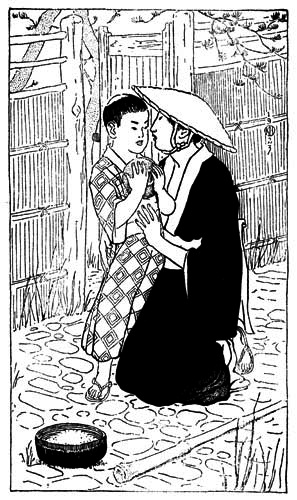
The child was her constant delight. He was three years old, and fond of
asking questions to which none but the gods knew the real answers. When
he wanted to play, she laid aside her work to play with him. When he
wanted to rest, she told him wonderful stories, or gave pretty pious
answers to his questions about those things which no man can ever
understand. At evening, when the little lamps had been lighted before
the holy tablets and the images, she taught his lips to shape the words
of filial prayer. When he had been laid to sleep, she brought her work
near him, and watched the still sweetness of his face. Sometimes he
would smile in his dreams; and she knew that Kwannon the divine was
playing shadowy play with him, and she would murmur the Buddhist
invocation to that Maid "who looketh forever down above the sound of
prayer."
Sometimes, in the season of very clear days, she would climb the
mountain of Dakeyama, carrying her little boy on her back. Such a trip
delighted him much, not only because of what his mother taught him to
see, but also of what she taught him to hear. The sloping way was
through groves and woods, and over grassed slopes, and around queer
rocks; and there were flowers with stories in their hearts, and trees
holding tree-spirits. Pigeons cried korup-korup; and doves
sobbed owaō, owaō; and cicadæ wheezed and fluted
and tinkled.
All those who wait for absent dear ones make, if they can, a pilgrimage
to the peak called Dakeyama. It is visible from any part of the city;
and from its summit several provinces can be seen. At the very top is a
stone of almost human height and shape, perpendicularly set up; and
little pebbles are heaped before it and upon it. And near by there is a
small Shintō shrine erected to the spirit of a princess of other
days. For she mourned the absence of one she loved, and used to watch
from this mountain for his coming until she pined away and was changed
into a stone. The people therefore built the shrine; and lovers of the
absent still pray there for the return of those dear to them; and each,
after so praying, takes home one of the little pebbles heaped there.
And when the beloved one returns, the pebble must be taken back to the
pebble-pile upon the mountain-top, and other pebbles with it, for a
thank-offering and commemoration.
Always ere O-Toyo and her son could reach their home after such a day,
the dusk would fall softly about them; for the way was long, and they
had to both go and return by boat through the wilderness of rice-fields
round the town—which is a slow manner of journeying. Sometimes stars
and fireflies lighted them; sometimes also the moon—and O-Toyo would
softly sing to her boy the Izumo child-song to the moon:
Nono-San,
Little Lady Moon,
How old are you?
"Thirteen days—
Thirteen and nine."
That is still young,
And the reason must be
For that bright red obi,
So nicely tied,
[4]
And that nice white girdle
About your hips.
Will you give it to the horse?
"Oh, no, no!"
Will you give it to the cow?
"Oh, no, no!"
[5]
And up to the blue night would rise from all those wet leagues of
labored field that great soft bubbling chorus which seems the very
voice of the soil itself—the chant of the frogs. And O-Toyo would
interpret its syllables to the child: Mé kayui! mé kayui! "Mine
eyes tickle; I want to sleep."
All those were happy hours.
II
Then twice, within the time of three days, those masters of life and
death whose ways belong to the eternal mysteries struck at her heart.
First she was taught that the gentle husband for whom she had so often
prayed never could return to her—having been returned unto that dust
out of which all forms are borrowed. And in another little while she
knew her boy slept so deep a sleep that the Chinese physician could not
waken him. These things she learned only as shapes are learned in
lightning flashes. Between and beyond the flashes was that absolute
darkness which is the pity of the gods.
It passed; and she rose to meet a foe whose name is Memory. Before all
others she could keep her face, as in other days, sweet and smiling.
But when alone with this visitant, she found herself less strong. She
would arrange little toys and spread out little dresses on the matting,
and look at them, and talk to them in whispers, and smile silently. But
the smile would ever end in a burst of wild, loud weeping; and she
would beat her head upon the floor, and ask foolish questions of the
gods.
One day she thought of a weird consolation—that rite the people name
"Toritsu-banashi"—the evocation of the dead. Could she not call back
her boy for one brief minute only? It would trouble the little soul;
but would he not gladly bear a moment's pain for her dear sake? Surely!
[To have the dead called back one must go to some priest—Buddhist or
Shintō—who knows the rite of incantation. And the mortuary tablet,
or ihai, of the dead must be brought to that priest.
Then ceremonies of purification are performed; candles are lighted and
incense is kindled before the ihai; and prayers or parts of sutras are
recited; and offerings of flowers and of rice are made. But, in this
case, the rice must not be cooked.
And when everything has been made ready, the priest, taking in his left
hand an instrument shaped like a bow, and striking it rapidly with his
right, calls upon the name of the dead, and cries out the words,
"Kitazo yo! kitazo yo! kitazo yo!" meaning, "I have come."
[6] And, as
he cries, the tone of his voice gradually changes until it becomes the
very voice of the dead person—for the ghost enters into him.
Then the dead will answer questions quickly asked, but will cry
continually: "Hasten, hasten! for this my coming back is painful, and I
have but a little time to stay!" And having answered, the ghost passes;
and the priest falls senseless upon his face.
Now to call back the dead is not good. For by calling them back their
condition is made worse. Returning to the underworld, they must take a
place lower than that which they held before.
To-day these rites are not allowed by law. They once consoled; but the
law is a good law, and just—since there exist men willing to mock the
divine which is in human hearts.]
So it came to pass that O-Toyo found herself one night in a lonely
little temple at the verge of the city—kneeling before the ihai of her
boy, and hearing the rite of incantation. And presently, out of the
lips of the officiant there came a voice she thought she knew,—a voice
loved above all others,—but faint and very thin, like a sobbing of
wind.
And the thin voice cried to her:
"Ask quickly, quickly, mother! Dark is the way and long; and I may not
linger."
Then tremblingly she questioned:
"Why must I sorrow for my child? What is the justice of the gods?"
And there was answer given:
"O mother, do not mourn me thus! That I died was only that you might
not die. For the year was a year of sickness and of sorrow—and it was
given me to know that you were to die; and I obtained by prayer that I
should take your place.
[7]
"O mother, never weep for me! It is not kindness to mourn for the dead.
Over the River of Tears
[8] their silent road is; and when mothers weep,
the flood of that river rises, and the soul cannot pass, but must
wander to and fro.
"Therefore, I pray you, do not grieve, O mother mine! Only give me a
little water sometimes."
III
From that hour she was not seen to weep. She performed, lightly and
silently, as in former days, the gentle duties of a daughter.
Seasons passed; and her father thought to find another husband for her.
To the mother, he said:
"If our daughter again have a son, it will be great joy for her, and
for all of us."
But the wiser mother made answer:
"Unhappy she is not. It is impossible that she marry again. She has
become as a little child, knowing nothing of trouble or sin."
It was true that she had ceased to know real pain. She had begun to
show a strange fondness for very small things. At first she had found
her bed too large—perhaps through the sense of emptiness left by the
loss of her child; then, day by day, other things seemed to grow too
large—the dwelling itself, the familiar rooms, the alcove and its
great flower-vases—even the household utensils. She wished to eat her
rice with miniature chopsticks out of a very small bowl such as
children use.
In these things she was lovingly humored; and in other matters she was
not fantastic. The old people consulted together about her constantly.
At last the father said:
"For our daughter to live with strangers might be painful. But as we
are aged, we may soon have to leave her. Perhaps we could provide for
her by making her a nun. We might build a little temple for her."
Next day the mother asked O-Toyo:
"Would you not like to become a holy nun, and to live in a very, very
small temple, with a very small altar, and little images of the
Buddhas? We should be always near you. If you wish this, we shall get a
priest to teach you the sutras."
O-Toyo wished it, and asked that an extremely small nun's dress be got
for her. But the mother said:
"Everything except the dress a good nun may have made small. But she
must wear a large dress—that is the law of Buddha."
So she was persuaded to wear the same dress as other nuns.
IV
They built for her a small An-dera, or Nun's-Temple, in an empty court
where another and larger temple, called Amida-ji, had once stood. The
An-dera was also called Amida-ji, and was dedicated to Amida-Nyōrai
and to other Buddhas. It was fitted up with a very small altar and with
miniature altar furniture. There was a tiny copy of the sutras on a
tiny reading-desk, and tiny screens and bells and kakemono. And she
dwelt there long after her parents had passed away. People called her
the Amida-ji no Bikuni—which means The Nun of the Temple of Amida.
A little outside the gate there was a statue of Jizō. This Jizō
was a special Jizō—the friend of sick children. There were nearly
always offerings of small rice-cakes to be seen before him. These
signified that some sick child was being prayed for; and the number of
the rice-cakes signified the number of the years of the child. Most
often there were but two or three cakes; rarely there were seven or
ten. The Amida-ji no Bikuni took care of the statue, and supplied it
with incense-offerings, and flowers from the temple garden; for there
was a small garden behind the An-dera.
After making her morning round with her alms-bowl, she would usually
seat herself before a very small loom, to weave cloth much too narrow
for serious use. But her webs were bought always by certain shopkeepers
who knew her story; and they made her presents of very small cups, tiny
flower-vases, and queer dwarf-trees for her garden.
Her greatest pleasure was the companionship of children; and this she
never lacked. Japanese child-life is mostly passed in temple courts;
and many happy childhoods were spent in the court of the Amida-ji. All
the mothers in that street liked to have their little ones play there,
but cautioned them never to laugh at the Bikuni-San. "Sometimes her
ways are strange," they would say; "but that is because she once had a
little son, who died, and the pain became too great for her mother's
heart. So you must be very good and respectful to her."
Good they were, but not quite respectful in the reverential sense. They
knew better than to be that. They called her "Bikuni-San" always, and
saluted her nicely; but otherwise they treated her like one of
themselves. They played games with her; and she gave them tea in
extremely small cups, and made for them heaps of rice-cakes not much
bigger than peas, and wove upon her loom cloth of cotton and cloth of
silk for the robes of their dolls. So she became to them as a
blood-sister.
They played with her daily till they grew too big to play, and left the
court of the temple of Amida to begin the bitter work of life, and to
become the fathers and mothers of children whom they sent to play in
their stead. These learned to love the Bikuni-San like their parents
had done. And the Bikuni-San lived to play with the children of the
children of the children of those who remembered when her temple was
built.
The people took good heed that she should not know want. There was
always given to her more than she needed for herself. So she was able
to be nearly as kind to the children as she wished, and to feed
extravagantly certain small animals. Birds nested in her temple, and
ate from her hand, and learned not to perch upon the heads of the
Buddhas.
Some days after her funeral, a crowd of children visited my house. A
little girl of nine years spoke for them all:
"Sir, we are asking for the sake of the Bikuni-San who is dead. A very
large haka
[9] has been set up for her. It is a nice haka. But we
want to give her also a very, very small haka, because in the time she
was with us she often said that she would like a very little haka. And
the stone-cutter has promised to cut it for us, and to make it very
pretty, if we can bring the money. Therefore perhaps you will honorably
give something."
"Assuredly," I said. "But now you will have nowhere to play."
She answered, smiling:
"We shall still play in the court of the temple of Amida. She is buried
there. She will hear our playing, and be glad."