'Oh ye who tread the Narrow Way
By Tophet-flare to Judgment Day,
Be gentle when the heathen pray
To Buddha at Kamakura!'
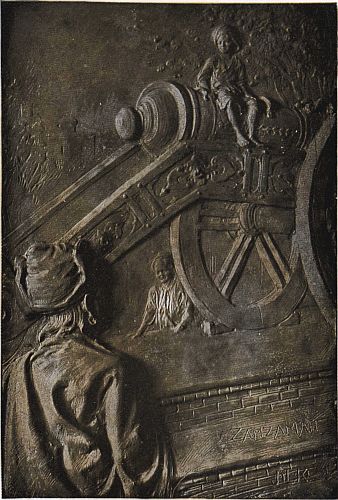
HE sat, in defiance of municipal orders, astride the
gun Zam-Zammah on her brick platform opposite
the old Ajaib-Gher—the Wonder House, as
the natives call the Lahore Museum. Who hold Zam-Zammah,
that 'fire-breathing dragon,' hold the Punjab,
for the great green-bronze piece is always first of the
conqueror's loot.
There was some justification for Kim,—he had kicked
Lala Dinanath's boy off the trunnions,—since the English
held the Punjab and Kim was English. Though he
was burned black as any native; though he spoke the
vernacular by preference, and his mother-tongue in a
clipped uncertain sing-song; though he consorted on
terms of perfect equality with the small boys of the
bazar; Kim was white—a poor white of the very poorest.
The half-caste woman who looked after him (she smoked
opium, and pretended to keep a second-hand furniture
shop by the square where the cheap cabs wait) told the
missionaries that she was Kim's mother's sister; but his
mother had been nursemaid in a colonel's family and
had married Kimball O'Hara, a young colour-sergeant
of the Mavericks, an Irish regiment. He afterwards
took a post on the Sind, Punjab, and Delhi railway, and
his regiment went home without him. The wife died of
cholera in Ferozepore, and O'Hara fell to drink and loafing
up and down the line with the keen-eyed three-year-old
baby. Societies and chaplains, anxious for the child,
tried to catch him, but O'Hara drifted away, till he
came across the woman who took opium and learned
the taste from her, and died as poor whites die in India.
His estate at death consisted of three papers—one he
called his 'ne varietur' because those words were written
below his signature thereon, and another his 'clearance-certificate.'
The third was Kim's birth-certificate.
Those things, he was used to say, in his glorious opium-hours,
would yet make little Kimball a man. On no
account was Kim to part with them, for they belonged
to a great piece of magic—such magic as men practised
over yonder behind the Museum, in the big blue and
white Jadoo-Gher—the Magic House, as we name the
Masonic Lodge. It would, he said, all come right some
day, and Kim's horn would be exalted between pillars—monstrous
pillars—of beauty and strength. The Colonel
himself, riding on a horse, at the head of the finest
regiment in the world, would attend to Kim,—little
Kim that should have been better off than his father.
Nine hundred first-class devils, whose god was a Red
Bull on a green field, would attend to Kim, if they had
not forgotten O'Hara—poor O'Hara that was gang-foreman
on the Ferozepore line. Then he would weep
bitterly in the broken rush chair on the veranda. So it
came about after his death that the woman sewed
parchment, paper, and birth-certificate into a leather
amulet-case which she strung round Kim's neck.
'And some day,' she said, confusedly remembering
O'Hara's prophecies, 'there will come for you a great
Red Bull on a green field, and the Colonel riding on his
tall horse, yes, and'—dropping into English—'nine
hundred devils.'
'Ah,' said Kim, 'I shall remember. A Red Bull and
a Colonel on a horse will come, but first, my father said,
will come the two men making ready the ground for
these matters. That is how, my father said, they
always did; and it is always so when men work magic.'
If the woman had sent Kim up to the local Jadoo-Gher
with those papers, he would, of course, have been
taken over by the Provincial Lodge and sent to the
Masonic Orphanage in the Hills; but what she had
heard of magic she distrusted. Kim, too, held views of
his own. As he reached the years of indiscretion, he
learned to avoid missionaries and white men of serious
aspect who asked who he was, and what he did. For
Kim did nothing with an immense success. True, he
knew the wonderful walled city of Lahore from the
Delhi Gate to the outer Fort Ditch; was hand in glove
with men who led lives stranger than anything Haroun
al Raschid dreamed of; and he lived in a life wild as that
of the Arabian Nights, but missionaries and secretaries
of charitable societies could not see the beauty of it.
His nickname through the wards was 'Little Friend of
all the World'; and very often, being lithe and inconspicuous,
he executed commissions by night on the
crowded housetops for sleek and shiny young men of
fashion. It was intrigue, of course,—he knew that
much, as he had known all evil since he could speak,—but
what he loved was the game for its own sake—the
stealthy prowl through the dark gullies and lanes, the
crawl up a water-pipe, the sights and sounds of the
women's world on the flat roofs, and the headlong flight
from housetop to housetop under cover of the hot dark.
Then there were holy men, ash-smeared faquirs by their
brick shrines under the trees at the riverside, with whom
he was quite familiar—greeting them as they returned
from begging-tours, and, when no one was by, eating
from the same dish. The woman who looked after him
insisted with tears that he should wear European clothes—trousers,
a shirt, and a battered hat. Kim found it
easier to slip into Hindu or Mohammedan garb when
engaged on certain businesses. One of the young men
of fashion—he who was found dead at the bottom of a
well on the night of the earthquake—had once given
him a complete suit of Hindu kit, the costume of a low-caste
street boy, and Kim stored it in a secret place
under some baulks in Nila Ram's timber-yard, beyond
the Punjab High Court, where the fragrant deodar logs
lie seasoning after they have driven down the Ravee.
When there was business or frolic afoot, Kim would use
his properties, returning at dawn to the veranda, all
tired out from shouting at the heels of a marriage procession,
or yelling at a Hindu festival. Sometimes
there was food in the house, more often there was not,
and then Kim went out again to eat with his native
friends.
As he drummed his heels against Zam-Zammah he
turned now and again from his king-of-the-castle game
with little Chota Lai, and Abdullah the sweetmeat-seller's
son, to make a rude remark to the native policeman
on guard over rows of shoes at the Museum door.
The big Punjabi grinned tolerantly: he knew Kim of old.
So did the water-carrier, sluicing water on the dry road
from his goat-skirt bag. So did Jawahir Singh, the
Museum carpenter, bent over new packing-cases. So
did everybody in sight except the peasants from the
country, hurrying up to the Wonder House to view the
things that men made in their own Province and elsewhere.
The Museum was given up to Indian arts and
manufactures, and anybody who sought wisdom could
ask the curator to explain.
'Off! Off! Let me up!' cried Abdullah, climbing up
Zam-Zammah's wheel.
'Thy father was a pastry-cook, Thy mother stole the
ghi,' sang Kim. 'All Mussalmans fell off Zam-Zammah
long ago!'
'Let me up!' shrilled little Chota Lal in his gilt-embroidered
cap. His father was worth perhaps half a
million sterling, but India is the only democratic land
in the world.
'The Hindus fell off Zam-Zammah too. The Mussalmans
pushed them off. Thy father was a pastry-cook—'
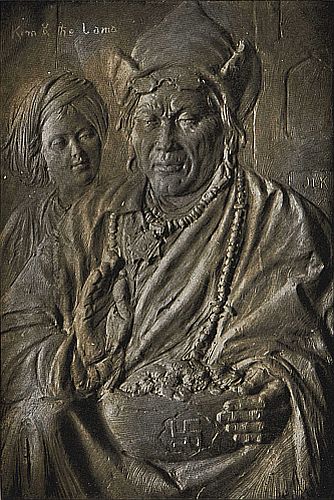
He stopped; for there shuffled round the corner, from
the roaring Motee Bazar, such a man as Kim, who
thought he knew all castes, had never seen. He was
nearly six feet high, dressed in fold upon fold of dingy
stuff like horse-blanketing, and not one fold of it could
Kim refer to any known trade or profession. At his
belt hung a long open-work iron pencase and a wooden
rosary such as holy men wear. On his head was a gigantic
sort of tam-o'-shanter. His face was yellow and
wrinkled, like that of Fook Shing, the Chinese boot-maker
in the bazar. His eyes turned up at the corners
and looked like little slits of onyx.
'Who is that?' said Kim to his companions.
'Perhaps it is a man,' said Abdullah, finger in mouth,
staring.
'Without doubt,' returned Kim; 'but he is no man of
India that I have ever seen.'
'A priest, perhaps,' said Chota Lal, spying the rosary.
'See! He goes into the Wonder House!'
'Nay, nay,' said the policeman, shaking his head. 'I
do not understand your talk.' The constable spoke
Punjabi. 'Oh, Friend of all the World, what does he
say?'
'Send him hither' said Kim, dropping from Zam-Zammah,
flourishing his bare heels. 'He is a foreigner,
and thou art a buffalo.'
The man turned helplessly and drifted towards the
boys. He was old, and his woollen gaberdine still
reeked of the stinking artemisia of the mountain passes.
'O Children, what is that big house?' he said in very
fair Urdu.
'The Ajaib-Gher, the Wonder House!' Kim gave him
no title—such as Lala or Mian. He could not divine
the man's creed.
'Ah! The Wonder House! Can any enter?'
'It is written above the door—all can enter.'
'Without payment?'
'I go in and out. I am no banker,' laughed Kim.
'Alas! I am an old man. I did not know.' Then,
fingering his rosary, he half turned to the Museum.
'What is your caste? Where is your house? Have
you come far?' Kim asked.
'I came by Kulu—from beyond the Kailas—but what
know you? From the hills where'—he sighed—'the air
and water are fresh and cool.'
'Aha! Khitai' (a Chinaman), said Abdullah proudly.
Fook Shing had once chased him out of his shop for spitting
at the joss above the boots.
'Pahari?' (a hillman), said little Chota Lal.
'Aye, child—a hillman from hills thou'lt never see.
Didst hear of Bhotiyal (Tibet)? I am no Khitai, but a
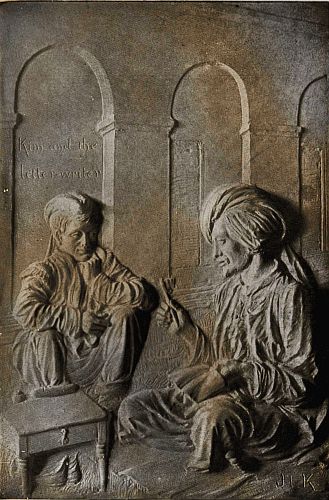
Bhotiya (Tibetan), since you must know—a lama—or,
say a guru in your tongue.'
'A guru from Tibet,' said Kim. 'I have not seen
such a man. They be Hindus in Tibet, then?'
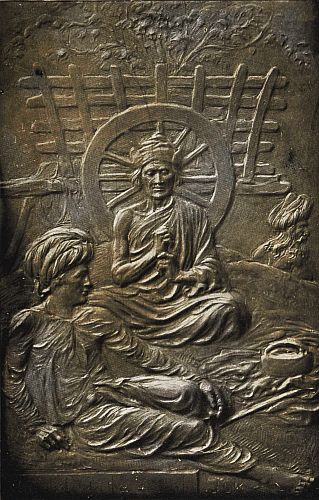
'We be followers of the Middle Way, living in peace
in our lamasseries, and I go to see the Four Holy Places
before I die. Now do you, who are children, know as
much as I do who am old.' He smiled benignantly on
the boys.
'Hast thou eaten?'
He fumbled in his bosom and drew forth a worn
wooden begging-bowl. The boys nodded. All priests
of their acquaintance begged.
'I do not wish to eat yet.' He turned his head like
an old tortoise in the sunlight. 'Is it true that there
are many images in the Wonder House of Lahore?'
He repeated the last words as one making sure of an
address.
'That is true,' said Abdullah. 'It is full of heathen
buts. Thou also art an idolater.'
'Never mind him,' said Kim. 'That is the Government's
house and there is no idolatry in it, but only a Sahib
with a white beard. Come with me and I will show.'
'Strange priests eat boys,' whispered Chota Lal.
'And he is a stranger and a but-parast' (idolater), said
Abdullah, the Mohammedan.
Kim laughed. 'He is new. Run to your mothers'
laps, and be safe. Come!'
Kim clicked round the self-registering turnstile; the
old man followed and halted amazed. In the entrance-hall
stood the larger figures of the Greco-Buddhist sculptures
done, savants know how long since, by forgotten
workmen whose hands were feeling, and not unskilfully,
for the mysteriously transmitted Grecian touch. There
were hundreds of pieces, friezes of figures in relief, fragments
of statues and slabs crowded with figures that had
encrusted the brick walls of the Buddhist stupas and
viharas of the North Country and now, dug up and
labelled, made the pride of the Museum. In open-mouthed
wonder the lama turned to this and that, and
finally checked in rapt attention before a large alto-relief
representing a coronation or apotheosis of the
Lord Buddha. The Master was represented seated on
a lotus the petals of which were so deeply undercut as
to show almost detached. Round Him was an adoring
hierarchy of kings, elders, and old-time Buddhas.
Below were lotus-covered waters with fishes and water-birds.
Two butterfly-winged dewas held a wreath over
His head; above them another pair supported an umbrella
surmounted by the jewelled headdress of the Bodhisat.
'The Lord! The Lord! It is Sakya Muni himself,'
the lama half sobbed; and under his breath began the
wonderful Buddhist invocation:—
'To Him the Way—the Law—Apart—
Whom Maya held beneath her heart
Ananda's Lord—the Bodhisat.'
'And He is here! The Most Excellent Law is here also!
My pilgrimage is well begun. And what work! What
work!'
'Yonder is the Sahib,' said Kim, and dodged sideways
among the cases of the arts and manufacture wing. A
white-bearded Englishman was looking at the lama,
who gravely turned and saluted him and after some
fumbling drew forth a note-book and a scrap of paper.
'Yes, that is my name,' smiling at the clumsy, childish
print.
'One of us who had made pilgrimage to the Holy
Places—he is now Abbot of the Lung-Cho Monastery—gave
it me,' stammered the lama. 'He spoke of these.'
His lean hand moved tremulously round.
'Welcome, then, O lama from Tibet. Here be the
images, and I am here'—he glanced at the lama's face—'to
gather knowledge. Come to my office awhile.'
The old man was trembling with excitement.
The office was but a little wooden cubicle partitioned off
from the sculpture-lined gallery. Kim laid himself down,
his ear against a crack in the heat-split cedar door, and,
following his instinct, stretched out to listen and watch.
Most of the talk was altogether above his head. The
lama, haltingly at first, spoke to the curator of his own
lamassery, the Suchzen, opposite the Painted Rocks,
four months' march away. The curator brought out a
huge book of photos and showed him that very place,
perched on its crag, overlooking the gigantic valley of
many-hued strata.
'Ay, ay!' The lama mounted a pair of horn-rimmed
spectacles of Chinese work. 'Here is the little door
through which we bring wood before winter. And thou—the
English know of these things? He who is now
Abbot of Lung-Cho told me, but I did not believe.
The Lord—the Excellent One—He has honour here too?
And His life is known?'
'It is all carven upon the stones. Come and see, if
thou art rested.'
Out shuffled the lama to the main hall, and, the curator
beside him, went through the collection with the
reverence of a devotee and the appreciative instinct of a
craftsman.
Incident by incident in the beautiful story he identified
on the blurred stone, puzzled here and there by the
unfamiliar Greek convention, but delighted as a child at
each new trove. Where the sequence failed, as in the
Annunciation, the curator supplied it from his mound of
books—French and German, with photographs and reproductions.
Here was the devout Asita, the pendant of Simeon in
the Christian story, holding the Holy Child on his knee
while mother and father listened; and here were incidents
in the legend of the cousin Devadatta. Here was
the wicked woman who accused the Master of impurity,
all confounded; here was the teaching in the Deer-park;
the miracle that stunned the fire-worshippers; here was
the Bodhisat in royal state as a prince; the miraculous
birth; the death at Kusinagara, where the weak disciple
fainted; while there were almost countless repetitions of
the meditation under the Bodhi tree; and the adoration
of the alms-bowl was everywhere. In a few minutes
the curator saw that his guest was no mere bead-telling
mendicant, but a scholar of parts. And they went at
it all over again, the lama taking snuff, wiping his spectacles,
and talking at railway speed in a bewildering
mixture of Urdu and Tibetan. He had heard of the
travels of the Chinese pilgrims, Fo-Hian and Hwen-Thiang,
and was anxious to know if there was any translation
of their record. He drew in his breath as he
turned helplessly over the pages of Beal and Stanislas
Julien. ''Tis all here. A treasure locked.' Then he
composed himself reverently to listen to fragments,
hastily rendered into Urdu. For the first time he heard
of the labours of European scholars, who by the help of
these and a hundred other documents have identified
the Holy Places of Buddhism. Then he was shown a
mighty map, spotted and traced with yellow. The
brown finger followed the curator's pencil from point to
point. Here was Kapilavastu, here the Middle Kingdom,
and here Mahabodi, the Mecca of Buddhism; and
here was Kusinagara, sad place of the Holy One's death.
The old man bowed his head over the sheets in silence
for a while, and the curator lit another pipe. Kim had
fallen asleep. When he waked, the talk, still in spate,
was more within his comprehension.
'And thus it was, O Fountain of Wisdom, that I
decided to go to the Holy Places which His foot had trod—to
the Birth-place, even to Kapila; then to Maha
Bodhi, which is Buddh Gaya—to the Monastery—to
the Deer-park—to the place of His death.'
The lama lowered his voice. 'And I come here alone.
For five—seven—eighteen—forty years it was in my
mind that the Old Law was not well followed; being
overlaid, as thou knowest, with devildom, charms, and
idolatry. Even as the child outside said but now. Ay,
even as the child said, with but-parasti.'
'So it comes with all faiths.'
'Thinkest thou? The books of my lamassery I read,
and they were dried pith; and the later ritual with which
we of the Reformed Law have cumbered ourselves—that,
too, had no worth to these old eyes. Even the followers
of the Excellent One are at feud on feud with one another.
It is all illusion. Ay, maya, illusion. But I
have another desire'—the seamed yellow face drew
within three inches of the curator, and the long forefinger
nail tapped on the table. 'Your scholars, by these
books, have followed the Blessed Feet in all their wanderings;
but there are things which they have not sought
out. I know nothing,—nothing do I know,—but I go
to free myself from the Wheel of Things by a broad and
open road.' He smiled with most simple triumph.
'As a pilgrim to the Holy Places I acquire merit. But
there is more. Listen to a true thing. When our gracious
Lord, being as yet a youth, sought a mate, men
said, in His father's court, that He was too tender for
marriage. Thou knowest?'
The curator nodded, wondering what would come
next.
'So they made the triple trial of strength against all
comers. And at the test of the Bow, our Lord first
breaking that which they gave Him, called for such a
bow as none might bend. Thou knowest?'
'It is written. I have read.'
'And, overshooting all other marks, the arrow passed
far and far beyond sight. At the last it fell; and, where
it touched earth, there broke out a stream which presently
became a River, whose nature, by our Lord's
beneficence, and that merit He acquired ere He freed
himself, is that whoso bathes in it washes away all taint
and speckle of sin.'
'So it is written,' said the curator sadly.
The lama drew a long breath. 'Where is that River?
Fountain of Wisdom, where fell the arrow?'
'Alas, my brother, I do not know,' said the curator.
'Nay, if it please thee to forget—the one thing only
that thou hast not told me. Surely thou must know?
See, I am an old man! I ask with my head between thy
feet, O Fountain of Wisdom. We know He drew the
bow! We know the arrow fell! We know the stream
gushed! Where, then, is the River? My dream told
me to find it. So I came. I am here. But where is
the River?'
'If I knew, think you I would not cry it aloud?'
'By it one attains freedom from the Wheel of Things,'
the lama went on, unheeding. 'The River of the Arrow!
Think again! Some little stream, may be—dried
in the heats? But the Holy One would never so cheat
an old man.'
'I do not know. I do not know.'
The lama brought his thousand-wrinkled face once
more a handsbreadth from the Englishman's. 'I see
thou dost not know. Not being of the Law, the matter
is hid from thee.'
'Ay—hidden—hidden.'
'We are both bound, thou and I, my brother. But
I'—he rose with a sweep of the soft thick drapery—'I go
to cut myself free. Come also!'
'I am bound,' said the curator. 'But whither goest
thou?'
'First to Kashi (Benares): where else? There I shall
meet one of the pure faith in a Jain temple of that city.
He also is a Seeker in secret, and from him haply I may
learn. May be he will go with me to Buddh Gaya.
Thence north and west to Kapilavastu, and there will I
seek for the River. Nay, I will seek everywhere as I go—for
the place is not known where the arrow fell.'
'And how wilt thou go? It is a far cry to Delhi, and
farther to Benares.'
'By road and the trains. From Pathankot, having
left the Hills, I came hither in a te-rain. It goes swiftly.
At first I was amazed to see those tall poles by the side
of the road snatching up and snatching up their threads,'—he
illustrated the stoop and whirl of a telegraph-pole
flashing past the train. 'But later, I was cramped and
desired to walk, as I am used.'
'And thou art sure of thy road?' said the curator.
'Oh, for that one but asks a question and pays money,
and the appointed persons despatch all to the appointed
place. That much I knew in my lamassery from sure
report,' said the lama proudly.
'And when dost thou go?' The curator smiled at the
mixture of old-world piety and modern progress that is
the note of India to-day.
'As soon as may be. I follow the places of His life till
I come to the River of the Arrow. There is, moreover,
a written paper of the hours of the trains that go south.'
'And for food?' Lamas, as a rule, have good store of
money somewhere about them, but the curator wished
to make sure.
'For the journey, I take up the Master's begging-bowl.
Yes. Even as He went so go I, forsaking the ease of my
monastery. There was with me when I left the hills a
chela (disciple) who begged for me as the Rule demands,
but halting in Kulu awhile a fever took him and he
died. I have now no chela, but I will take the alms-bowl
and thus enable the charitable to acquire merit.' He
nodded his head valiantly.
Learned doctors of a lamassery do not beg, but the
lama was an enthusiast in this quest.
'Be it so,' said the curator, smiling. 'Suffer me now
to acquire merit. We be craftsmen together, thou and
I. Here is a new book of white English paper: here be
sharpened pencils two and three—thick and thin, all
good for a scribe. Now lend me thy spectacles.'
The curator looked through them. They were heavily
scratched, but the power was almost exactly that of his
own pair, which he slid into the lama's hand, saying:
'Try these.'
'A feather! A very feather upon the face!' The old
man turned his head delightedly and wrinkled up his
nose. 'How scarcely do I feel them! How clearly do
I see!'
'They be bilaur—crystal and will never scratch.
May they help thee to thy River, for they are thine.'
'I will take them and the pencils and the white note-book,'
said the lama, 'as a sign of friendship between
priest and priest—and now'—he fumbled at his belt,
detached the open iron-work pencase, and laid it on the
curator's table. 'That is for a memory between thee
and me—my pencase. It is something old—even as I
am.'
It was a piece of ancient design, Chinese, of an iron
that is not smelted these days; and the collector's heart
in the curator's bosom had gone out to it from the first.
For no persuasion would the lama resume his gift.
'When I return, having found the River, I will bring
thee a written picture of the Padma Samthora—such as
I used to make on silk at the lamassery. Yes—and of
the Wheel of Life,' he chuckled, 'for we be craftsmen
together, thou and I.'
The curator would have detained him: they are few in
the world who still have the secret of the conventional
brush-pen Buddhist pictures which are, as it were, half
written and half drawn. But the lama strode out, head
high in air, and pausing an instant before the great
statue of a Bodhisat in meditation, brushed through the
turnstiles.
Kim followed like a shadow. What he had overheard
excited him wildly. This man was entirely new to all
his experience, and he meant to investigate further:
precisely as he would have investigated a new building
or a strange festival in Lahore city. The lama was his
trove, and he purposed to take possession. Kim's
mother had been Irish too.
The old man halted by Zam-Zammah and looked
round till his eye fell on Kim. The inspiration of his
pilgrimage had left him for a while, and he felt old,
forlorn, and very empty.
'Do not sit under that gun,' said the policeman loftily.
'Huh! Owl!' was Kim's retort on the lama's behalf.
'Sit under that gun if it please thee. When didst thou
steal the milk-woman's slippers, Dunnoo?'
That was an utterly unfounded charge sprung on the
spur of the moment, but it silenced Dunnoo, who knew
that Kim's clear yell could call up legions of bad bazar
boys if need arose.
'And whom didst thou worship within?' said Kim
affably, squatting in the shade beside the lama.
'I worshipped none, child. I bowed before the
Excellent Law.'
Kim accepted this new god without emotion. He
knew already a few score.
'And what dost thou do?'
'I beg. I remember now it is long since I have eaten
or drunk. What is the custom of charity in this town?
In silence, as we do of Tibet, or speaking aloud?'
'Those who beg in silence starve in silence,' said Kim,
quoting a native proverb. The lama tried to rise, but
sank back again, sighing for his disciple, dead in far-away
Kulu. Kim watched—head to one side, considering
and interested.
'Give me the bowl. I know the people of this city—all
who are charitable. Give, and I will bring it back
filled.'
Simply as a child the old man handed him the bowl.
'Rest thou. I know the people.'
He trotted off to the open shop of a kunjri, a low-caste
vegetable-seller, which lay opposite the belt-tramway
line down the Motee Bazar. She knew Kim of old.
'Oho, hast thou turned yogi with thy begging-bowl?'
she cried.
'Nay,' said Kim proudly. 'There is a new priest in
the city—a man such as I have never seen.'
'Old priest—young tiger,' said the woman angrily.
'I am tired of new priests! They settle on our wares
like flies. Is the father of my son a well of charity to
give to all who ask?'
'No,' said Kim. 'Thy man is rather yagi (bad-tempered)
than yogi (a holy man). But this priest is
new. The Sahib in the Wonder House has talked to
him like a brother. O my mother, fill me this bowl.
He waits.'
'That bowl indeed! That cow-bellied basket! Thou
hast as much grace as the holy bull of Shiv. He has
taken the best of a basket of onions already, this morn;
and forsooth, I must fill thy bowl. He comes here
again.'
The huge, mouse-coloured Brahminee bull of the
ward was shouldering his way through the many-coloured
crowd, a stolen plantain hanging out of his
mouth. He headed straight for the shop, well knowing
his privileges as a sacred beast, lowered his head, and
puffed heavily along the line of baskets ere making his
choice. Up flew Kim's hard little heel and caught him on
his moist blue nose. He snorted indignantly, and walked
away across the tram rails, his hump quivering with rage.
'See! I have saved more than the bowl will cost
thrice over. Now, mother, a little rice and some dried
fish atop—yes, and some vegetable curry.'
A growl came out of the back of the shop, where a man
lay.
'He drove away the bull,' said the woman in an undertone.
'It is good to give to the poor.' She took the
bowl and returned it full of hot rice.
'But my yogi is not a cow,' said Kim gravely, making
a hole with his fingers in the top of the mound. 'A
little curry is good, and a fried cake, and a morsel of
conserve would please him, I think.'
'It is a hole as big as thy head,' said the woman fretfully.
But she filled it, none the less, with good, steaming
vegetable curry, clapped a dried cake atop, and a
morsel of clarified butter on the cake, dabbed a lump of
sour tamarind conserve at the side; and Kim looked at
the load lovingly.
'That is good. When I am in the bazar the bull shall
not come to this house. He is a bold beggarman.'
'And thou?' laughed the woman. 'But speak well of
bulls. Hast thou not told me that some day a Red Bull
will come out of a field to help thee? Now hold all
straight and ask for the holy man's blessing upon me.
Perhaps, too, he knows a cure for my daughter's sore
eyes. Ask him that also, O thou Little Friend of all the
World.'
But Kim had danced off ere the end of the sentence,
dodging pariah dogs and hungry acquaintances.
'Thus do we beg who know the way of it,' said he
proudly to the lama, who opened his eyes at the
contents of the bowl. 'Eat now and—I will eat with thee.
Ohe bhistie!' he called to the water-carrier, sluicing the
crotons by the Museum. 'Give water here. We men
are thirsty.'
'We men!' said the bhistie, laughing. 'Is one skinful
enough for such a pair? Drink then, in the name of the
Compassionate.'
He loosed a thin stream into Kim's hands, who drank
native fashion; but the lama must needs pull out a cup
from his inexhaustible upper draperies and drink ceremonially.
'Pardesi' (a foreigner), Kim explained, as the old man
delivered in an unknown tongue what was evidently a
blessing.
They ate together in great content, clearing the
beggar's bowl. Then the lama took snuff from a portentous
wooden snuff-gourd, fingered his rosary awhile,
and so dropped into the easy sleep of age, as the shadow
of Zam-Zammah grew long.
Kim loafed over to the nearest tobacco-seller, a rather
lively young Mohammedan woman, and begged a rank
cigar of the brand that they sell to students of the Punjab
University who copy English customs. Then he
smoked and thought, knees to chin, under the belly of
the gun, and the outcome of his thoughts was a sudden
and stealthy departure in the direction of Nila Ram's
timber-yard.
The lama did not wake till the evening life of the city
had begun with lamp-lighting and the return of white-robed
clerks and subordinates from the Government
offices. He stared dizzily in all directions, but none
looked at him save a Hindu urchin in a dirty turban and
Isabella-coloured clothes. Suddenly he bowed his head
on his knees and wailed.
'What is this?' said the boy, standing before him.
'Hast thou been robbed?'
'It is my new chela (my disciple) that is gone away
from me, and I know not where he is.'
'And what like of man was thy disciple?'
'It was a boy who came to me in place of him who
died, on account of the merit which I had gained when
I bowed before the Law within there.' He pointed
towards the Museum. 'He came upon me to show me
a road which I had lost. He led me into the Wonder
House, and by his talk emboldened to speak to the
Keeper of the Images, so that I was cheered and made
strong. And when I was faint with hunger he begged
for me, as would a chela for his teacher. Suddenly was
he sent. Suddenly has he gone away. It was in my mind
to have taught him the Law upon the road to Benares.'
Kim stood amazed at this, because he had overheard
the talk in the Museum, and knew that the old man was
speaking the truth, which is a thing a native on the road
seldom presents to a stranger.
'But I see now that he was but sent for a purpose.
By this I know that I shall find a certain River for which
I seek.'
'The River of the Arrow?' said Kim, with a superior
smile.
'Is this yet another Sending?' cried the lama. 'To
none have I spoken of my search, save to the Priest of
the Images. Who art thou?'
'Thy chela,' said Kim simply, sitting on his heels. 'I
have never seen any one like to thee in all this my life.
I go with thee to Benares. And, too, I think that so
old a man as thou, speaking the truth to chance-met
people at dusk, is in great need of a disciple.'
'But the River—the River of the Arrow?'
'Oh, that I heard when thou wast speaking to the
Englishman. I lay against the door.'
The lama sighed. 'I thought thou hadst been a guide
permitted. Such things fall sometimes—but I am not
worthy. Thou dost not, then, know of the River?'
'Not I.' Kim laughed uneasily. 'I go to look for—for
a bull—a Red Bull on a green field who shall help
me.' Boylike, if an acquaintance had a scheme, Kim
was quite ready with one of his own; and, boylike, he
had really thought for as much as twenty minutes at a
time of his father's prophecy.
'To what, child?' said the lama.
'God knows, but so my father told me. I heard thy
talk in the Wonder House of all those new strange places
in the Hills, and if one so old and so little—so used to
truth-telling—may go out for the small matter of a river,
it seemed to me that I too must go a-travelling. If it is
our fate to find those things we shall find them—thou,
thy River; and I, my Bull, and the strong Pillars and
some other matters that I forget.'
'It is not pillars but a Wheel from which I would be
free,' said the lama.
'That is all one. Perhaps they will make me a king,'
said Kim, serenely prepared for anything.
'I will teach thee other and better desires upon the
road,' the lama replied in the voice of authority. 'Let
us go to Benares.'
'Not by night. Thieves are abroad. Wait till the day.'
'But there is no place to sleep.' The old man was
used to the order of his monastery, and though he slept
on the ground, as the Rule decrees, preferred a decency
in these things.
'We shall get good lodging at the Kashmir Serai,'
said Kim, laughing at his perplexity. 'I have a friend
there. Come!'
The hot and crowded bazars blazed with light as they
made their way through the press of all the races in
Upper India, and the lama mooned through it like a
man in a dream. It was his first experience of a large
manufacturing city, and the crowded tram-car with its
continually squealing brakes frightened him. Half
pushed, half towed, he arrived at the high gate of the
Kashmir Serai: that huge open square over against the
railway station, surrounded with arched cloisters where
the camel and horse caravans put up on their return
from Central Asia. Here were all manner of Northern
folk, tending tethered ponies and kneeling camels; loading
and unloading bales and bundles; drawing water for
the evening meal at the creaking well-windlasses; piling
grass before the shrieking, wild-eyed stallions; cuffing
the surly caravan dogs; paying off camel-drivers; taking
on new grooms; swearing, shouting, arguing, and chaffering
in the packed square. The cloisters, reached by
three or four masonry steps, made a haven of refuge
around this turbulent sea. Most of them were rented
to traders, as we rent the arches of a viaduct; the space
between pillar and pillar being bricked or boarded off
into rooms, which were guarded by heavy wooden doors
and cumbrous native padlocks. Locked doors showed
that the owner was away, and a few rude—sometimes
very rude—chalk or paint scratches told where he had
gone. Thus: 'Lutuf Ullah is gone to Kurdistan.'
Below, in coarse verse: 'O Allah, who sufferest lice to
live on the coat of a Kabuli, why hast thou allowed this
louse Lutuf to live so long?'
Kim, fending the lama between excited men and excited
beasts, sidled along the cloisters to the far end,
nearest the railway station, where Mahbub Ali, the
horsetrader, lived when he came in from that mysterious
land beyond the Passes of the North.
Kim had had many dealings with Mahbub in his little
life,—especially between his tenth and his thirteenth
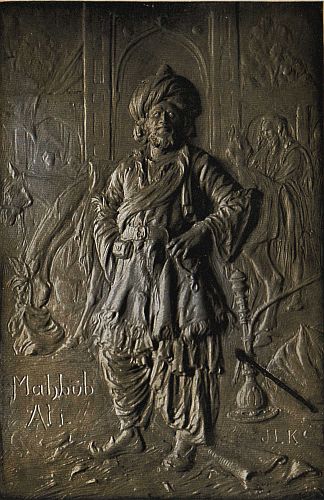
year,—and the big burly Afghan, his beard dyed scarlet
with lime (for he was elderly and did not wish his gray
hairs to show), knew the boy's value as a gossip. Sometimes
he would tell Kim to watch a man who had nothing
whatever to do with horses: to follow him for one
whole day and report every soul with whom he talked.
Kim would deliver himself of his tale at evening, and
Mahbub would listen without a word or gesture. It
was intrigue of some kind, Kim knew; but its worth lay
in saying nothing whatever to any one except Mahbub,
who gave him beautiful meals all hot from the cookshop
at the head of the serai, and once as much as eight annas
in money.
'He is here,' said Kim, hitting a bad-tempered camel
on the nose. 'Ohe, Mahbub Ali!' He halted at a dark
arch and slipped behind the bewildered lama.
The horse-trader, his deep, embroidered Bokhariot
belt unloosed, was lying on a pair of silk carpet saddle-bags,
pulling lazily at an immense silver hookah. He
turned his head very slightly at the cry; and seeing only
the tall silent figure, chuckled in his deep chest.
'Allah! A lama! A Red Lama! It is far from
Lahore to the Passes. What dost thou do here?'
The lama held out the begging-bowl mechanically.
'God's curse on all unbelievers!' said Mahbub. 'I
do not give to a lousy Tibetan; but ask my Baltis over
yonder behind the camels. They may value your blessings.
Oh, horse-boys, here is a countryman of yours.
See if he be hungry.'
A shaven, crouching Balti, who had come down with
the horses, and who was nominally some sort of degraded
Buddhist, fawned upon the priest, and in thick gutturals
besought the Holy One to sit at the horse-boys' fire.
'Go!' said Kim, pushing him lightly, and the lama
strode away, leaving Kim at the edge of the cloister.
'Go!' said Mahbub Ali, returning to his hookah.
'Little Hindu, run away. God's curse on all unbelievers!
Beg from those of my tail who are of thy faith.'
'Maharaj,' whined Kim, using the Hindu form of address,
and thoroughly enjoying the situation; 'my father
is dead—my mother is dead—my stomach is empty.'
'Beg from my men among the horses, I say. There
must be some Hindus in my tail.'
'Oh, Mahbub Ali, but am I a Hindu?' said Kim in
English.
The trader gave no sign of astonishment, but looked
under shaggy eyebrows.
'Little Friend of all the World,' said he, 'what is this?'
'Nothing. I am now that holy man's disciple; and
we go a pilgrimage together—to Benares, he says. He
is quite mad, and I am tired of Lahore city. I wish new
air and water.'
'But for whom, dost thou work? Why come to me?'
The voice was harsh with suspicion.
'To whom else should I come? I have no money. It
is not good to go about without money. Thou wilt sell
many horses to the officers. They are very fine horses,
these new ones: I have seen them. Give me a rupee,
Mahbub Ali, and when I come to my wealth I will give
thee a bond and pay.'
'Um,' said Mahbub Ali, thinking swiftly. 'Thou
hast never before lied to me. Call that lama—stand
back in the dark.'
'Oh, our tales will agree,' said Kim laughing.
'We go to Benares,' said the lama, as soon as he understood
the drift of Mahbub Ali's questions. 'The boy
and I. I go to seek for a certain River.'
'Maybe—but the boy?'
'He is my disciple. He was sent, I think, to guide
me to that River. Sitting under a gun was I when he
came suddenly. Such things have befallen the fortunate
to whom guidance was allowed. But I remember
now, he said he was of this world—a Hindu.'
'And his name?'
'That I did not ask. Is he not my disciple?'
'His country—his race—his village? Mussalman—Sikh—Hindu—Jain—low
caste or high?'
'Why should I ask? There is neither high nor low in
the Middle Way. If he is my chela—does—will—can
any one take him from me? for, look you, without him I
shall not find my River.' He wagged his head solemnly.
'None shall take him from thee. Go, sit among my
Baltis,' said Mahbub Ali, and the lama drifted off,
soothed by the promise.
'Is he not quite mad?' said Kim, coming forward to
the light again. 'Why should I lie to thee, Hajji?'
Mahbub puffed his hookah in silence. Then he began,
almost whispering: 'Umballa is on the road to
Benares—if indeed ye two go there.'
'Tck! Tck! I tell thee he does not know how to lie—as
we two know.'
'And if thou wilt carry a message for me as far as
Umballa, I will give thee money. It concerns a horse—a
white stallion which I have sold to an officer upon the
last time I returned from the Passes. But then—stand
nearer and hold up hands as begging—the pedigree of
the white stallion was not fully established, and that
officer, who is now at Umballa, bade me make it clear.'
(Mahbub here described the horse and the appearance
of the officer.) 'So the message to that officer will be:
"The pedigree of the white stallion is fully established."
By this will he know that thou comest from me. He
will then say "What proof hast thou?" and thou wilt
answer: "Mahbub Ali has given me the proof."'
'And all for the sake of a white stallion,' said Kim,
with a giggle, his eyes aflame.
'That pedigree I will give thee now—in my own
fashion—and some hard words as well.' A shadow
passed behind Kim, and a feeding camel. Mahbub Ali
raised his voice.
'Allah! Art thou the only beggar in the city? Thy
mother is dead. Thy father is dead. So is it with all
of them. Well, well—' he turned as feeling on the floor
beside him and tossed a flap of soft, greasy Mussalman
bread to the boy. 'Go and lie down among my horse-boys
for to-night—thou and the lama. To-morrow I
may give thee service.'
Kim slunk away, his teeth in the bread, and, as he
expected, he found a small wad of folded tissue-paper
wrapped in oil-skin, with three silver rupees—enormous
largesse. He smiled and thrust money and paper into
his leather amulet-case. The lama, sumptuously fed
by Mahbub's Baltis, was already asleep in a corner of
one of the stalls. Kim lay down beside him and laughed.
He knew he had rendered a service to Mahbub Ali, and
not for one little minute did he believe the tale of the
stallion's pedigree.
But Kim did not suspect that Mahbub Ali, known as
one of the best horse-dealers in the Punjab, a wealthy
and enterprising trader, whose caravans penetrated far
and far into the Back of Beyond, was registered in one
of the locked books of the Indian Survey Department
as C.25.1B. Twice or thrice yearly C.25 would send
in a little story, badly told but most interesting, and
generally—it was checked by the statements of R.17
and M.4—quite true. It concerned all manner of out-of-the-way
mountain principalities, explorers of nationalities
other than English, and the gun-trade—was, in
brief, a small portion of that vast mass of 'information
received' on which the Indian Government acts. But,
recently, five confederated Kings, who had no business
to confederate, had been informed by a kindly Northern
Power that there was a leakage of news from their territories
into British India. So those Kings' prime ministers
were seriously annoyed and took steps, after the
Oriental fashion. They suspected, among many others,
the bullying red-bearded horse-dealer whose caravans
ploughed through their fastnesses belly deep in snow.
At least, his caravan that season had been ambushed
and shot at twice on the way down, when Mahbub's
men accounted for three strange ruffians who might,
or might not, have been hired for the job. Therefore
Mahbub had avoided halting at the insalubrious city of
Peshawur, and had come through without stop to Lahore,
where, knowing his country-people, he anticipated
curious developments.
And there was that on Mahbub Ali which he did not
wish to keep an hour longer than was necessary—a wad
of closely folded tissue-paper, wrapped in oil-skin—an
impersonal, unaddressed statement, with five microscopic
pin-holes in one corner, that most scandalously
betrayed the five confederated Kings, the sympathetic
Northern Power, a Hindu banker in Peshawur, a firm
of gun-makers in Belgium, and an important, semi-independent
Mohammedan ruler to the south. This
last was R.17's work, which Mahbub had picked up
beyond the Dora Pass and was carrying in for R.17,
who, owing to circumstances over which he had no control,
could not leave his post of observation. Dynamite
was milky and innocuous beside that report of C.25;
and even an Oriental, with an Oriental's views of the
value of time, could see that the sooner it was in the
proper hands the better. Mahbub had no particular
desire to die by violence, because two or three family
blood-feuds across the border hung unfinished on his
hands, and when these scores were cleared he intended
to settle down as a more or less virtuous citizen. He
had never passed the serai gate since his arrival two
days ago, but had been ostentatious in sending telegrams
to Bombay, where he banked some of his money; to
Delhi, where a sub-partner of his own clan was selling
horses to the agent of a Rajputana state; and to Umballa,
where an Englishman was excitedly demanding
the pedigree of a white stallion. The public letter-writer,
who knew English, composed excellent telegrams,
such as:—'Creighton, Laurel Bank, Umballa.—Horse is
Arabian as already advised. Sorrowful delayed-pedigree
which am translating.' And later to the same
address: 'Much sorrowful delay. Will forward pedigree.'
To this sub-partner at Delhi he wired: 'Lutuf
Ullah.—Have wired two thousand rupees your credit
Luchman Narain's bank.' This was entirely in the
way of trade, but every one of those telegrams was discussed
and re-discussed, by parties who conceived themselves
to be interested, before they went over to the
railway station in charge of a foolish Balti, who allowed
all sorts of people to read them on the road.
When, in Mahbub's own picturesque language, he
had muddied the wells of inquiry with the stick of precaution,
Kim had dropped on him, sent from heaven;
and, being as prompt as he was unscrupulous, Mahbub
Ali, used to taking all sorts of gusty chances, pressed
him into service on the spot.
A wandering lama with a low-caste boy-servant
might attract a moment's interest as they wandered
about India, the land of pilgrims; but no one would
suspect them or, what was more to the point, rob.
He called for a new light-ball to his hookah, and considered
the case. If the worst came to the worst, and
the boy came to harm, the paper would incriminate
nobody. And he would go up to Umballa leisurely and—at
a certain risk of exciting fresh suspicion—repeat
his tale by word of mouth to the people concerned.
But R.17's report was the kernel of the whole affair,
and it would be distinctly inconvenient if that failed to
come to hand. However, God was great, and Mahbub
Ali felt he had done all he could for the time being.
Kim was the one soul in the world who had never told
him a lie. That would have been a fatal blot on Kim's
character if Mahbub had not known that to others, for
his own ends or Mahbub's business, Kim could lie like
an Oriental.
Then Mahbub Ali rolled across the serai to the Gate
of the Harpies who paint their eyes and trap the stranger,
and was at some pains to call on the one girl who, he had
reason to believe, was a particular friend of a smooth-faced
Kashmiri pundit who had waylaid his simple
Balti in the matter of the telegrams. It was an utterly
foolish thing to do; because they fell to drinking perfumed
brandy against the Law of the Prophet, and
Mahbub grew wonderfully drunk, and the gates of his
mouth were loosened, and he pursued the Flower of
Delight with the feet of intoxication till he fell flat
among the cushions, where the Flower of Delight, aided
by a smooth-faced Kashmiri pundit, searched him from
head to foot most thoroughly.
About the same hour Kim heard soft feet in Mahbub's
deserted stall. The horse-trader, curiously enough,
had left his door unlocked, and his men were busy celebrating
their return to India with a whole sheep of
Mahbub's bounty. A sleek young gentleman from
Delhi, armed with a bunch of keys which the Flower
had unshackled from the senseless one's belt, went
through every single box, bundle, mat, and saddle-bag
in Mahbub's possession even more systematically than
the Flower and the pundit were searching the owner.
'And I think,' said the Flower scornfully an hour
later, one rounded elbow on the snoring carcase, 'that
he is no more than a pig of an Afghan horse-dealer, with
no thought except women and horses. Moreover, he
may have sent it away by now—if ever there were such
a thing.'
'Nay—in a matter touching Five Kings it would be
next his black heart,' said the pundit. 'Was there
nothing?'
The Delhi man laughed and resettled his turban as he
entered. 'I searched between the soles of his slippers
as the Flower searched his clothes. This is not the man
but another. I leave little unseen.'
'They did not say he was the very man,' said the
pundit thoughtfully. 'They said, "Look if he be the
man, since our councils are troubled."'
'That North country is full of horse-dealers as an old
coat of lice. There is Sikandar Khan, Nur Ali Beg,
and Farrukh Shah—all heads of Kafilas—who deal
there,' said the Flower.
'They have not yet come in,' said the pundit. 'Thou
must ensnare them later.'
'Phew!' said the Flower with deep disgust, rolling
Mahbub's head from her lap. 'I earn my money.
Farrukh Shah is a bear, Ali Beg a swashbuckler, and old
Sikandar Khan—yaie! Go! I sleep now. This swine
will not stir till dawn.'
When Mahbub woke, the Flower talked to him
severely on the sin of drunkenness. Asiatics do not
wink when they have out-manœuvred an enemy, but
as Mahbub Ali cleared his throat, tightened his belt, and
staggered forth under the early morning stars, he came
very near to it.
'What a colt's trick,' said he to himself. 'As if every
girl in Peshawur did not use it! But 'twas prettily
done. Now God He knows how many more there be
upon the road who have orders to test me—perhaps
with the knife. So it stands that the boy must go to
Umballa—and by rail—for the writing is something
urgent. I abide here, following the Flower and drinking
wine as an Afghan coper should.'
He halted at the stall next but one to his own. His
men lay there heavy with sleep. There was no sign of
Kim or the lama.
'Up!' He stirred a sleeper. 'Whither went those
who lay here last even—the lama and the boy? Is
aught missing?'
'Nay,' grunted the man; 'the old madman rose at
second cockcrow saying he would go to Benares, and the
young one led him away.'
'The curse of Allah on all unbelievers,' said Mahbub
heartily, and climbed into his own stall, growling in his
beard.
But it was Kim who had wakened the lama—Kim
with one eye laid against a knot-hole in the planking,
who had seen the Delhi man's search through the boxes.
This was no common thief that turned over letters, bills,
and saddles—no mere burglar who ran a little knife
sideways into the soles of Mahbub's slippers, or picked
the seams of the saddle-bags so deftly. At first Kim
had been minded to give the alarm—the long-drawn
'cho-or—choor!' (thief! thief!) that sets the serai ablaze
of nights; but he looked more carefully, and, hand on
amulet, drew his own conclusions.
'It must be the pedigree of that made-up horse-lie,' said
he, 'the thing that I carry to Umballa. Better that we
go now. Those who search bags with knives may presently
search bellies with knives. Surely there is a woman
behind this. Hai! Hai!' in a whisper to the light-sleeping
old man. 'Come. It is time—time to go to Benares.'
The lama rose obediently, and they passed out of the
serai like shadows.
 Kim.
Kim.