The principal lakes of Killarney are three in
number—the Upper Lake is the smallest, but
often adjudged the most beautiful; it is two miles
and a half in length by half a mile in breadth,
the Middle (Torc or Muckross) Lake is two miles
long by one broad, while Lough Leane (“the
Lake of Learning”) is five miles and a half long
by two miles and a half in breadth.
These lakes are connected by channels, narrow,
though sufficiently wide to admit of the passing
of a boat, so in a sense they may be considered
as one, yet each lake possesses a character peculiar
to itself and very distinctive.
Killarney is easy of access in these days. In
less than sixteen hours the tourist may reach it
from London, via Holyhead, while Queenstown,
Liverpool and the newer route by Rosslare
12]
afford facilities for visitors from every land.
And once arrived they find all the comforts and
luxuries of modern civilization in the first class
hotels, which have sprung up to meet the ever
increasing need of accommodation; hotels from
some of which the visitor may view the beauty
of lake and mountain, the lights and shadows,
the glory of their colouring, without going
further afield.
Killarney itself is a small town of which there
is little to record. Adjoining is the Earl of
Kenmare’s demesne, with its fine gardens and
splendid golf links; the latter one of the best
inland courses in Ireland. Visitors can use it on
payment of a small green fee.
To proceed by land to the far-famed Gap of
Dunloe, and, traversing it, take the road to the
Upper Lake, is the general plan followed by the
stranger, for this best shows a great and varied
extent of country, with such contrasts of softness
and grandeur—nay, desolation—as no other
scenery presents.
In this land the past has graven deep its
records in ruined castle, tower and abbey, each
with its tale. And the first of these after leaving
Killarney, is to be found at Aghadoe (in Irish
13]
Acadh-da-ca, “the field of the two yew trees”).
It is about two miles from Killarney, and a slight
detour to the right must be made to visit it.
Aghadoe stands on an eminence commanding
most lovely views of the lakes and mountains.
It was an ancient bishopric, and here is the ruin
of its Cathedral church, which consists of two
chapels of distinct periods of antiquity. They
lie east and west of each other—that to the east,
probably dating from about 1158, is in the
Pointed style, and dedicated to the Holy Trinity;
the more ancient, in Hiberno-Romanesque style,
appears to have been built some centuries before
the coming of the Normans, and is far richer and
more beautiful. The western end contains a
doorway of recessed arches, covered with particularly
fine mouldings and decorations.
Not far from the western end are the remains
of what must have been a very fine Round tower,
judging from the style of its masonry, now, however,
only about 15 feet in height. Many of its
stones have been taken away and converted into
tombstones for neighbouring churchyards, or
some other need of the mason. The Castle is
another massive circular fragment of about 30
feet in height, sometimes called “The Bishop’s
14]
Chair,” sometimes “The Pulpit,” and believed to
have been the residence of the bishops of the
diocese.
Following the road to the north side of the
lake, several fine demesnes are passed, one of
them, Lakeview House, being the residence of
Sir Morgan Ross O’Connell, Bart., grand-nephew
of the Liberator. It is a beautiful drive, and
many a tale of the past will enliven the way, as,
crossing Beaufort Bridge over the Laune, you
reach Dunloe Castle at the west end of the lake,
about seven miles from Killarney town.
Dunloe Castle stands on a height from whence
the view is glorious. This Castle is the seat of
the Mahonys, and is very ancient. An old
history of Kerry mentions that its floors are
formed of very fine planks of the yew tree, a
wood which, when well wrought, has a more
beautiful grain and polish than mahogany. Bees
have taken up their residence for centuries in
this old fortress. They are in curious niches and
angles behind the massive walls and under the
floors. They disturb no one and refuse to be
evicted. A bee-keeper tried if he could tempt
them beyond their bounds by laying “sections”
in a place to which they had access, with a hope
15]
of securing some of the honey. They took no
notice. Through a cupboard in one of the walls,
you can see far back a host of these little people,
the self-constituted guests of Dunloe Castle, very
busy over their affairs.
There is a fishing lodge close to Dunloe Castle.
This is let during the season, and very fine sport
is to be had. The splendid lake and river fishing
about Killarney is no small attraction to the
angler, both being well stocked with the finest
trout and salmon.
A very remarkable cave near the Gap of
Dunloe was accidentally discovered in 1838, and
was then and subsequently explored with much
interest. Its roof has now fallen in. It was a
subterranean chamber of circular form, the walls
of uncemented stones inclining inwards, with a
roof also of long transverse stones, the angles of
which are covered with Ogham writing, “which
is to the Irish antiquary what the Runes are in
the north, the Arrow-headed or Wedge characters
in Babylonia or Persepolis. Archæological discoveries
in Ireland are of more general interest
than formerly, as the earth is laying bare her
secrets all over the world, and what is discovered
in one country is found to have its bearing on
16]
something brought to light in another.” The
discovery of Ogham characters in this cave was
additional evidence that the Irish had a literature
far in advance of the rest of Europe and long
before the Christian era.
Close to the entrance of the Gap stands Kate
Kearney’s cottage as, whether it contains a
“Kate” or not, it will always be called. There
is many a pretty girl in Kerry whose bright eyes,
clear colouring and beautiful hair attract the
passer by, but Kate will be remembered to the
end of time, because of the few lines which,
“lilting” from a poet’s heart, conferred upon her
the crown of immortal youth and beauty:
“From the glance of her eye, shun danger and fly,
For fatal’s the glance of Kate Kearney!”
It is the fashion to depreciate Moore as a poet,
to compare his lyrics to the notes of a musical-box,
sweet indeed, but devoid of true inspiration.
Yet he fulfilled a noble mission in his day,
rescuing and bringing to light the music of his
country, wedding it to words that tell its story or
reveal its beauties instead of the worthless jingle
which had so often degraded it. It was Moore’s
poetry which greatly helped to make Killarney
17]
known early in the last century to many in
England.
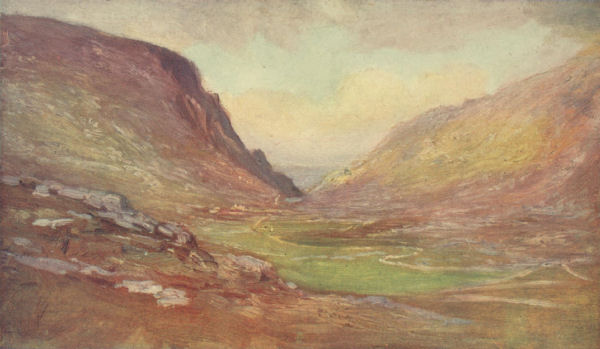
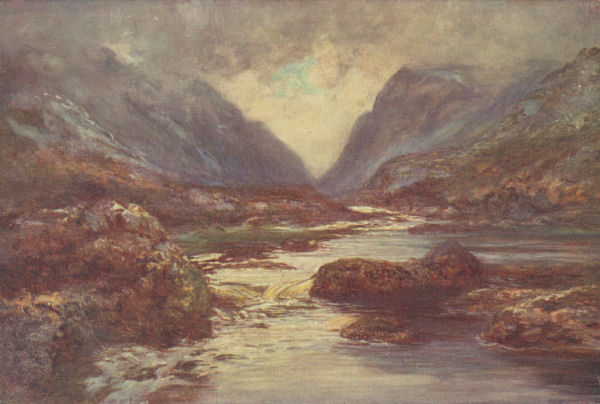
THE HEAD OF THE GAP OF DUNLOE.
Readers of the literature of that day will know
what an influence Moore was in its intellectual
circles—his wit, his geniality, his singing, “the
effect of which,” writes N. P. Willis, who met
him at Lady Blessington’s, “is only equalled by
the beauty of his own words.” His voice was
of small compass, but exquisitely modulated and
expressing every shade of feeling and sentiment,
so that women have been known to faint as they
listened to his singing, which awakened, perhaps,
a buried sorrow, a long past anguish.
Once enter the Gap of Dunloe and the scene
utterly changes; gone is the soft verdure, the
brilliant tinting, silent the song of birds. On
either side rise huge rocks, of strange, fantastic
shapes, often appearing half suspended over the
path, while never far from it rushes the dark Loe,
“a brawling and angry stream,” which traverses
the whole length of the Gap, about four miles,
often passing along heights, then tumbling into
depths with rush and roar, now near, now distant,
but ever voicing the wild emotions which seem
to lurk amid the gloom of this stern defile. It
expands into five lakes, called collectively the
18]
Cummeen Lakes, during its passage through the
Gap.
Tradition ascribes the origin of this wild pass
to a stroke from the sword of a mighty giant,
which separated the mountains and left them
apart for ever, MacGillicuddy’s Reeks on one
side, Toomies and the Purple Mountain on the
other. Very stern and grand look the Reeks, one
of their peaks, Carn-tual (“the inverted sickle”)
rising higher than any mountain in Ireland—3,414
feet above the level of the sea. There is softer
beauty on the mountains to the left, the Purple
Mountain in particular (2,739 feet in height).
The lovely hue which pervades this mountain is
generally ascribed to a purple heath, which
covers its sides, almost to the top, with perpetual
bloom. Its name, however, was originally derived
from an immense pile of loose stones and
slates of a purple tint, which becomes intense
when the sun shines upon them.
It is from the Gap of Dunloe that the Purple
Mountain should be ascended; it is not a formidable
climb, but ponies await those who fear the
fatigue. The view from the summit is magnificent.
The western base of this mountain descends
19]
into Augher Lake, and close to this spot is the
Woodwork Factory, where carved specimens of
arbutus and other woods can be obtained in
inlaid tables, chess and backgammon sets, card
cases, etc.
Chess is believed to have been played in prehistoric
times by the ancient Irish, and the
frequent mention of the game long before the
Norman invasion shows it was a favourite one.
“The chess board was called in Irish ‘fithcheall,’
and is described in the Glossary of Cormac of
Cashel, composed towards the close of the ninth
century, as quadrangular in shape, and having
straight spots of black and white. Some of these
were inlaid with gold and silver and adorned
with gems. No entire set of the ancient men is
now known to exist, though frequent mention is
made of the brigade or family of chessmen in
many old manuscripts. Kings of bone, seated in
sculptured chairs, about 2 inches in height, have
been found, and specimens of them engraved in
recent antiquarian publications” (D’Arcy Magee’s
History of Ireland).
The most striking part of the Gap is where
the valley contracts so as to bring the precipitous
sides very close together. The peasants have
20]
named this the Pike, and to the grotesquely
formed rocks along the pass they have also given
names—the Turnpike, O’Donoghue’s Heart, and
so on. The impression conveyed as you proceed,
is of gloom and of a certain aloofness from the
ordinary. The eagle soaring above is no uncommon
sight.
A little distance from the Pike is a lonely tarn
called the Black Lake (Loch Dubh), where St.
Patrick imprisoned the last Irish snake, which is
supposed to live in its depths. A little south of
the Pass the spot is pointed out where the last
Irish wolf was slain.
There is a stamp of wild force in all that
meets the eye while traversing the Gap, which
is not diminished as at Gap Cottage the end is
neared. At its commencement cars have had to
be abandoned. You must ride or walk. If you
have elected to walk you will probably now be
footsore and weary. Even the sure-footed ponies
generally used may not prevent fatigue from the
rough, precipitous road, but it is forgotten when,
on leaving the Gap, a turn in the path brings in
view one of the most famous glens of Killarney—the
Black Valley. This was formerly described
as so black, so desolate, that it might have been
21]
named the Valley of the Shadow of Death. It
owes this reputation merely to its English name—a
mistranslation from the Irish one—Cumin
Dubh (O’Duff’s Valley). No one knows who
this O’Duff was, however, and the Black Valley
is a more romantic name for a singularly wild
and beautiful scene.
The path now inclines to the left, bringing in
view the Upper Lake, its waters glowing like
burnished gold, if, as often happens, it approaches
the sunset hour when you reach it. How lovely
it looks, guarded on every side by those great
mountains which hold so many secrets!
Not without a passing regret do we leave the
Gap. It has its own charm, arousing wonder
and curiosity and a certain awe. One really feels
when the Pike is reached as though there was
nothing strange in its having emanated from the
giant’s sword.
The scene surveyed from here is very beautiful,
and tempts delay, but the Upper Lake must be
reached. By the side of the hill you descend is
the Logan stone, or “balanced rock,” long considered
a wonder of Druidical times. Some affirm
now that its rocking motion is from natural
causes, but, set as it is on the lonely hill, it looks
22]
as if it well might have been fashioned by those
stern old heathen.
Still descending, the road takes a sharp backward
curve to the foot of Fubrahy’s Crags; then,
turning again, it continues till, after crossing a
bridge, it passes through an opening in the wall
into Gurmaheen Demesne, within which are
tea and waiting rooms, called “Lord Brandon’s
Cottage.” From thence a short path descends
to the Upper Lake, where in some sheltered bay
your boat awaits you.
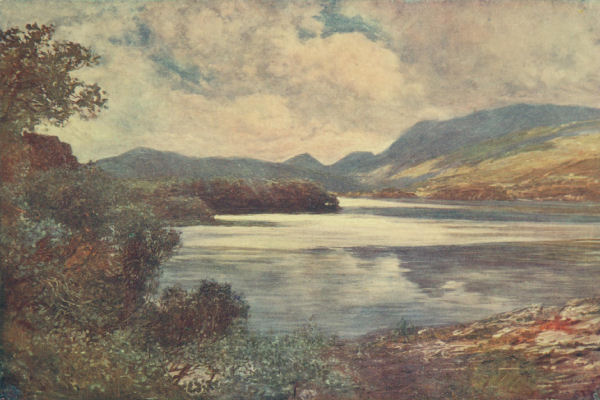
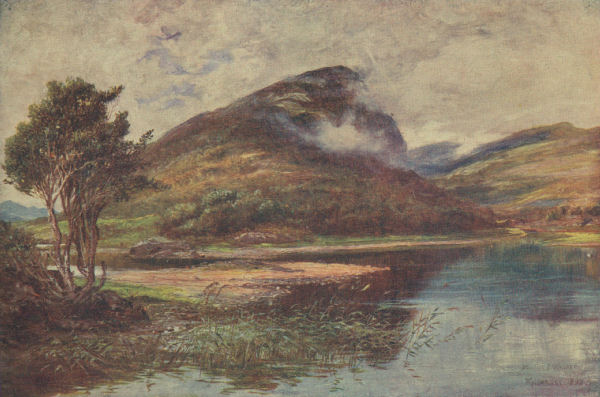
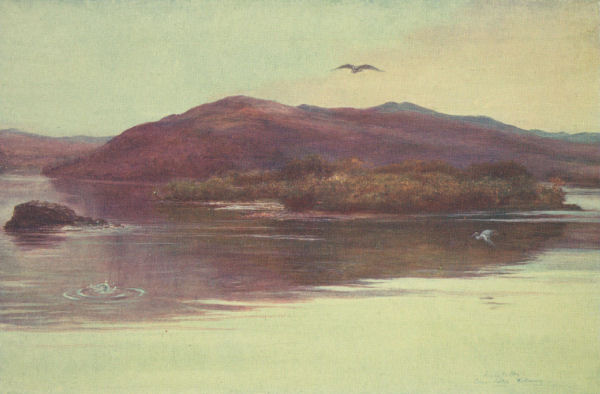
{THE EAGLE’S NEST, KILLARNEY.}
23]