“When Anger rushes unrestrained to action,
Like a hot steed, it stumbles in its way.
The Man of Thought strikes deepest and strikes safely.”
The reason why Tolta missed entrapping Juan
at the same time with Beatriz, was this. Early on
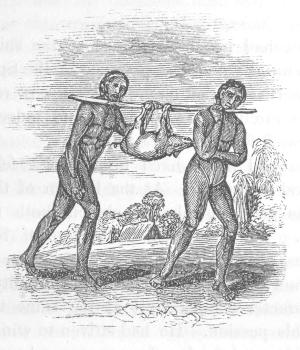
that very morning he had set out with Kiana to hunt
wild boars in a forest in the district, now known as
Puna, but which at that date was about equally
divided between the territories of Kiana and Pohaku.
It would be impossible for the traveller of the present
day to recognize the localities of the events of this
chapter, on account of the repeated changes in the
features of the country, occasioned by the successive
eruptions of Kilauea since that period. Even the
coast line has been greatly extended and altered.
When the Spaniards first arrived at Hawaii, the volcano
had for a long period been quiet in this direction.
Consequently, the country had become overgrown
with vegetation, which mantling the abrupt mountain
spurs, and numerous lava raised hills, and wide
extended plains gave it a highly picturesque appearance.
Cultivation was spread over its surface but
very slightly. In general, it was a fertile wilderness,
sparsely peopled, but prolific with the game of the
country. On this account it was much frequented
by the sporting warriors of both the chieftains,
whose followers, in pursuing the chase, not unseldom
met in deadly conflict. There was, therefore, a
double risk to the adventurer in exploring its wilds.
In escaping the tusks of an infuriated animal, he
might fall upon the spear of an ambushed foe.
The very dangers of this territory were the origin
of its most redeeming feature. Abounding in wild
forests, it naturally became a refuge to the escaped
slave, or oppressed tenant, and even the fugitive
from justice, who without the intervention of an
institution, which I will now describe, would, from
their common perils, have banded together, and
made themselves formidable as robbers or assassins.
I refer to the Pahonua, or to adopt the phraseology
of the Israelities, in a kindred institution, the
‘city of refuge.’ The analogy between the two is
very striking. With both, it was a necessity as a
check upon the prevalent laws of retaliation, the barbarous
character of their warfare, and their system
of justice, so liable to perversion from the caprices
or tyranny of their rulers. It affords also consoling
evidence of the disposition of mankind, even in the
least improved condition, to correct evil. It is true,
that like the sanctuaries of the Roman Catholic
Church, they were liable to abuse, and were available
to the criminal, as well as the innocent, but in
a rude society, they afforded a wholesome check
upon revenge, whether private, or under judicial
forms, and served in a considerable degree to mitigate
the otherwise unendurable ferocity of war.
A river, having its source in Mauna Kea, flowed
through this region. It was a rapid, impetuous
stream, much broken by rocks and whirlpools, and
fed by numerous cascades and torrents from the
neighboring hills. As it rained a great deal in this
vicinity, it was generally swollen. Near the sea
the river forced its way between precipitous banks,
with much roaring and many abrupt leaps, at times
quieted by the depth of its waters, as it reached
some rocky dell, and at others spreading out into a
quick, broad current, until it finally expanded itself
into the sea, amid the thundering of breakers, over
a treacherous bottom of moving sands. Only in
the calmest weather could canoes venture to cross
its bar. There were a few spots where sufficient
land had been gained from the river, higher up the
valley by dykings, so as to repay careful cultivation
with rich crops. Here the banana and taro grew
most luxuriantly, ripened into a luscious flavor by
the sun’s rays, caught and retained between the
steep, verdure-clad banks. Dams were partly
thrown across the river in several places near its
mouth, diverting portions of it into artificial ponds,
well stocked with fish, particularly the delicious
mullet, which being reared in brackish water, acquired
a flavor and fatness unknown to the species
bred elsewhere.
Besides these signs, there were many others of
peace and abundance in the immediate vicinity.
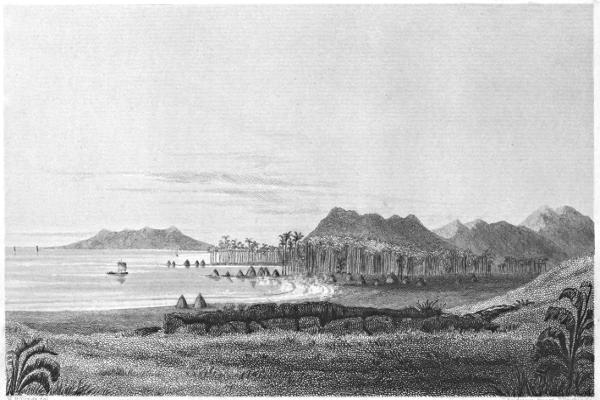
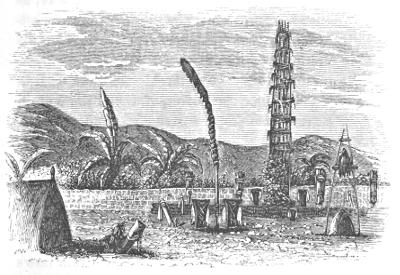
They were due to the presence of a spacious
Pahonua built of stone, situated upon the river’s
left bank, which there formed an easy precipice,
affording a pleasing contrast to the lofty and jetting
crag opposite. The juncture of the fresh water
with the salt tide of the ocean, took place almost
under the walls of the city of refuge, occasioning
eddies, admitting of a ford, though at no time safe,
because of quicksands.
The tutelar deity of this Pahonua was Keave,
now worshipped, or more properly speaking, sainted;
for the formula of the Roman Catholic Church
is in this respect as applicable to the paganism of
Hawaii, as to its own more enlightened ritual.
Keave was simply the benevolent founder of this
particular institution, the building of which was,
considering its purpose, solidity and extent, as creditable
to his sanctity and enterprise, as have been
any of the numerous monasteries of the papal
church, to their canonized founders. Canonization
is indeed but another form of heathen deification.
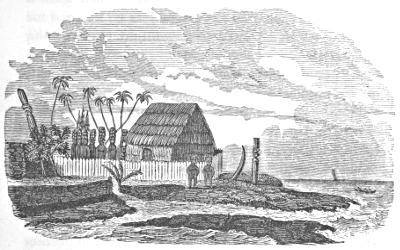
The creation of this Pahonua, the natives being
destitute of machinery for raising large masses of
stone, was in truth a prodigious feat. In its walls
were blocks weighing upwards of two tons, elevated
six feet or more above the ground. Around it were
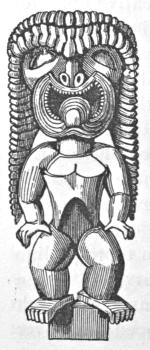
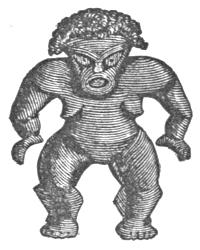
the sacred images, usually placed upon such structures.
Within, there were several pyramidal temples,
besides a sufficient number of houses for the
people likely to take refuge therein. The limits of
the sanctuary extended to a certain distance outside
the walls, marked by white flags, while its charge
devolved upon a class of priests,—monks they
might aptly be called, if we set aside the vow of
chastity—who with their servants were permitted
to slay any one that transgressed their privileges.
Like themselves, their property was sacred, which
accounts for the oasis they had created amid the
otherwise forbidding scenery and its pertinent perils.
Whoever once got safely within their precincts,
became inviolable. This personal security extended
to a certain time after the refugee had returned to
his home, as the protecting spirit was supposed to
still abide with him, though guilty of the foulest
crimes, or even of violating the most solemn tabus.
Before a fight, the women and children of both
the belligerents, assembled in the Pahonua for
security. After the battle was won, the vanquished
also fled to it to secure that mercy which the conqueror
rarely granted. All made offerings to the
deified founder, as does the Roman Catholic to his
patron saint, in gratitude for favors vouchsafed.
Olmedo and his party arrived soon after sunrise,
without interruption, at the base of a sharp mountain
ridge, which intervened between the river and
the more level ground over which they had passed.
It was not lofty, but, owing to its dense vegetation,
extremely difficult to scale, except at one point
where the natives had, by frequent traversing, worn
a rude passage. Path it could not be called, for
the jungle was so thick, and the branches of the
trees so interlocked, that it offered much of the
way a series of climbing and leaps, more suited
to the habits of a monkey than a human being.
There were other points of access to the river, but
Umi had selected this as much the shortest, though
it involved greater fatigue. For a considerable
distance the party was obliged to go in Indian
file up a rapid ascent, which formed the backbone
of the spur, and was so narrow, that to unpractised
feet it was safer to sit upon it, as on a saddle,
and to hitch themselves along by the help afforded
by the coarse grasses and ferns. On either side
was a steep precipice, covered with a slippery coating
of rank verdure. Before arriving at the summit
the path became so obstructed with trees of a
large growth, imbedded in a tangled network of
shrubs and vines, that the utmost caution was
required to prevent the weaker members of the
party from becoming inextricably involved therein.
Often they were obliged to find a foothold on
branches elevated twenty feet and even more, from
the soil, and clinging to the limbs above them,
slowly work their way through the vegetable barrier.
The sun’s rays never penetrated the leafy
canopy overhead, though to the almost constant rains
they were a slight obstacle. These had caused a
luxuriant growth of mosses which encircled every
limb, making them appear double their real size,
and frequently hiding their decay. In grasping the
seemingly stout branch it would prove to be a
flexible twig or a rotten stick, and giving way, precipitate
the climber into beds of oozy vegetation,
which, sponge-like, not only showered their chilling
contents upon the wayfarers at every step, but,
from their slimy coating, rendered both foothold
and grasp very uncertain. Nothing short of the
previous rough experiences of Beatriz, in the wild
campaigns of Mexico, could have prepared her for
an effort like the one she was now making. Her
companions were indefatigable in their exertions to
aid her. After two hours of excessive labor they
had the satisfaction to stand upon the summit, and
look down upon the river which separated them
from the territories of Kiana.
“Look,” said Umi, “our toils are almost at an
end. There is the Pahonua, and the priests will
give us food and rest while we send for Kiana.”
“But what comes there?” exclaimed Olmedo,
pointing to some objects moving along the narrow
ridge they had just traversed, and which were
hardly perceptible from their point of view.
All looked anxiously to the spot indicated, and
were not long in perceiving Tolta, followed by
several score of warriors, rapidly advancing towards
them. At the same instant the Mexican caught
sight of them, and they saw him pointing their
party out to his followers, and urging them forward
with impatient gestures. A wild shout of triumph
broke from his men at the discovery, and they
dashed forward in expectation of speedily seizing
the fugitives. The difficulties of the ascent, however,
so impeded their progress, as to give ample
time to Umi to put into execution his plan of
escape. Tolta had taken this difficult pass to the
river, thinking to arrive on its banks in advance of
those he pursued, and intercept them as they came
by the longer but more easy route. He was therefore
taken by surprise on discovering them ahead
of him. His hope now lay solely in the greater
speed of his men. With promises and threats he
excited them to redoubled exertions, himself leading
the way.
Fortunately for Beatriz and Olmedo, the descent
towards the river was comparatively facile. Sending
two of his men forward to aid the women,
Umi with the others took post just at the crest of
the mountain, where the path was so narrow that
they could easily hold it against great odds. With
their spears poised they awaited the onset of Tolta’s
men.
While these incidents were in progress, Kiana
and Juan, accompanied by a mixed train of not
above one hundred men, warriors and servants
included, were occupied in the chase. They were
unaware of the abduction of the Spaniards and
the subsequent events, having had no communication
with their homes for several days. Indeed, although
many of their people had missed their guests
of late, as they were accustomed to their retirement
at not unfrequent intervals, few besides their
immediate attendants had manifested either curiosity
or anxiety at their absence. But when three
days had gone by without news of them, their
retainers prepared to notify Kiana of the fact.
Some had gone in pursuit of him on the very
morning of the escape. But the hunters at early
daylight had crossed the river at some distance
above the Pahonua, and had been beating the
forest at the foot of the mountain in pursuit of
their game, with, however, but indifferent success.
Wearied with their exertions, they were reposing
in the shade of a grove about half way between
its base and the river, when their attention was
attracted by shouts proceeding apparently from the
mountain. Soon several women were seen issuing
from the forest, and running at full speed towards
the river, followed by armed men, a few of whom,
every now and then, faced about and stood on the
defensive against others who were pursuing them.
By this means the women made some progress, but
evidently their strength was failing, and they must
quickly be captured, especially as the foremost of
their pursuers had overthrown his antagonist, and
was gaining rapidly upon them.
It seems that Umi and his men had been unable
to retard the progress of Tolta for a much shorter
time than he anticipated. The followers of the
Mexican had rushed fiercely upon them, and although
beaten back, returned again and again to
the charge, throwing their spears, and yelling frightfully
to intimidate their foes. But Umi was too
well practised in native warfare to be driven from
his post by menaces, while he was sufficiently protected
as to avoid much risk from the missiles of
his assailants. Chafing at this delay, Tolta was
himself preparing to close with Umi, when his
quick eye caught sight of a vine overhanging
the rock which effectually screened his enemy.
With the spring of a wild cat he caught at it, and
almost as quick as the thought had been formed,
he had scrambled to the summit, whence he could
look down upon Umi. Another leap would have
brought him into his rear. Umi seeing this retreated,
but, as he turned, dealt a quick blow to a
careless assailant, which stretched him lifeless right
in the way of his companions, who stumbled over
him as they pursued him down the mountain. His
men, taking somewhat different directions, followed,
occasionally stopping to arrest the progress of their
pursuers, that the women might have a chance to
reach the river.
Kiana, surprised at this scene, called his men to
stand by their arms, saying to Juan, “We must be
on our guard. Pohaku, I suspect, is about to pay
us the compliment of a visit. If so we shall find
him fiercer game than we have yet seen this morning.”
Juan was too intently gazing upon the flying
group to heed the remark. Suddenly he exclaimed,
“That headmost warrior is Tolta. There is no mistaking
his tiger spring. But what is the Mexican
doing here? Jesus Maria! That robe belongs to
no Hawaiian. By the holy saints it is our worthy
priest. He must have strangely changed his nature
to be marauding with that wily Aztec. But, no!
the villain! he throws his javelin at him. There is
foul work going on here. At them, Kiana, or they
will slay the monk.” So saying, he rushed towards
the assailant, calling upon Olmedo to turn towards
him. Kiana and his men added their shouts to his,
and ran quickly after him.
Their apparition seemed to paralyze both the
pursuer and the pursued. With the latter, however,
the hesitation was but brief. Recognizing her
brother, Beatriz gave a cry of joyful surprise, and
hastily bidding Liliha follow her, turned towards
him. Juan knew her voice, though he could
scarcely credit his senses on finding his sister in
such a position. Both he and Kiana were immediately
at her side. Overcome by her exertions, she
fainted as she fell into Juan’s arms. Olmedo and
the rest of the party were soon surrounded by the
friendly warriors, eagerly inquiring the cause of
their appearance and flight. Their story was told in
a few words. A cry of vengeance upon the Mexican
rose from every throat as his men called upon
Kiana to lead them against the traitor.
Meantime Beatriz slowly came to. Both Juan
and Kiana, in their anxiety for her, thought of nothing
else, until she was able to confirm by her own
lips the narrative of her faithful friends. Her weakness
made her tale short, but the little she spoke,
stopping at each broken sentence to gain strength,
told much to her listeners. Olmedo was almost
as feeble as she. Juan gave a look of grateful surprise
at Liliha, as his sister, embracing her, presented
her as her rescuer. His thanks were hearty and
brief, but all other feeling was speedily lost in his
desire to revenge the treachery towards Beatriz.
Without stopping to count his foes, he sprang towards
them, calling upon Tolta to prove himself a
man by facing one.
Kiana was prompt to sustain him, but not before
he had charged a portion of his retinue to escort
the rescued party across the river, and place them
in safety in the Pahonua, while he with the remainder
would cover their passage. Less fiery than
Juan, his first impulse was to see to their safety, then
to look to their own, for he felt certain Tolta would
not have undertaken an enterprise of so much danger,
without being sustained by the whole power of
Pohaku. That chief, therefore, he believed, would
soon appear upon the field. As it was, Tolta had
the superiority in numbers, and it would not be
prudent to exhaust their strength before they knew
what fresh dangers might be in store.
The Mexican, calling his men about him, determined
to act solely on the defensive. It might
have fared ill with Juan, had Tolta with his whole
force made a rush upon him as he came towards
them. Several of the most eager of his men did
indeed sally from their ranks, to make a combined
assault upon the white man. Their commander
recalled them, but not before the foremost having
struck at Juan with his mace a blow which he
easily parried, was run through by his sword before
he could recover his guard. This experience of
the fatal skill and power of the weapon of the
Spaniard made them more cautious, and they kept
their ranks retreating slowly towards the rocky
promontory directly facing the Pahonua. It was
not far from this point that the road usually traversed
from Kilauea, and leading to the somewhat
dangerous ford before spoken of, joined the river.
Tolta knew too much of Juan’s prowess to venture
himself in combat with him, especially with inferior
weapons. He noticed the fewness of Kiana’s men,
and hoped before long Pohaku might join him,
when their combined force would easily slay or
capture their opponents.
Kiana and his men had now come up, and without
making a direct assault were gradually pressing
Tolta’s party back to the highest part of the precipice,
which here overlooked the deepest waters of
the river, though a little way below they became
shallower as they approached the ford. Olmedo
and his companions were already preparing to
cross, having availed themselves of some canoes
belonging to the priests of the Pahonua, which
Kiana had borrowed early in the day for his own
passage. The rising ground on which they now
found themselves, gave Tolta’s men a decided advantage
in resisting any attack. Their flank was
protected by a dense thicket, which bordered the
road that led from Kilauea, while the river effectually
sheltered them on the right. Thus they were
in a position either to retreat or to await a reinforcement.
A messenger had been despatched by Tolta
to Pohaku, as soon as he had made the discovery
of the presence of Juan and Kiana. In the meantime
he had determined to remain where he was.
Should Kiana attempt to recross the river, he could
sally down upon him at advantage.
Juan, irritated at Kiana’s prudence, demanded
that they should attack Tolta at once, and drive
his men into the river. But that chief would not
waver from his surer policy, for he had also sent to
summon his warriors to join him. By keeping his
foes in their present situation, they would, before
long, be enabled to assault them, certain of success;
whereas now, a defeat or even a repulse would
endanger the lives of those they had just rescued.
Until Beatriz and Olmedo were within the Pahonua,
it would be risking too much. Juan acquiesced
in these measures, but swore he would not
lose sight of Tolta while he lived.
Pohaku, as we know, had pursued Tolta, deceived
by the report of Hewahewa. But few of
his warriors had been able to keep up with him.
The messenger that Tolta had sent, and who
might have explained their position, had missed
him. The enraged chief came in sight on the main
road, soon after the hostile parties had assumed
their present positions. Perceiving Kiana and his
warriors, he was still more confirmed in his belief of
Tolta’s treachery; believing that he had fled to rejoin
that chief and surprise him. Without stopping
to parley or to ascertain the truth, he roared out to
Tolta’s men to make way, and sprang forward with
a ferocious look towards the Mexican. The warriors,
surprised and confused, for they had supposed
he had come to their assistance, parted before him
like water before a strong swimmer. Straight on
towards Tolta he came foaming and cursing, and
bidding him await his fate. The Mexican, at a
loss to account for his sudden hate, supposed him
gone mad and ordered his men to seize him, but
they would have sooner, unarmed, crossed the tusks
of the fiercest wild boar of the mountains, than
have now put themselves in his path. With his
spear poised, he stopped a few feet from Tolta,
glaring upon him with blood-shot eyes. In another
second he would have driven it clean through him,
but Tolta’s instinct of life was quicker than even
his rage. Seeing his hopeless position, he sprang
aside and the spear glanced on the turf, tearing
up the ground, and finally burying itself deep into
it, remained with its haft quivering in the air.
Pohaku, uttering a fearful howl of disappointed
rage, ran towards him, intending to seize him with
his naked arms, and to twist his spine. The Mexican,
whose movements were quick and subtle, again
dodged him, and sprang upon the cliff. As Pohaku
rushed after, he aimed a stroke at him with his
dagger, which would have reached his heart had it
not struck upon an ivory ornament, which he wore
upon his breast. The steel broke, and Tolta was
left defenceless. The river was now his only
chance. A precipice ninety feet high lay between
him and it. With one bound he cleared its edge.
So sudden was this movement and so desperate
the leap, that all for the moment supposed him
dashed to pieces on the rocks beneath. Striking
the water, however, with his feet pointed like a
wedge, and his arms clinging to his sides, he disappeared,
but soon rose and struck out towards the
Pahonua. The rapid current bore him towards the
shallower waters. Here his feet touching the sand,
he was obliged to walk now and then, sinking as
the water deepened and compelled him again to
swim. Suddenly he was seen to throw his arms
wildly in the air, and to shriek for help to the priests
who were watching him from the walls of the
Pahonua. They ran hastily towards the water’s
edge to rescue him, but perceiving his position they
dared not trust themselves on the treacherous sands.
His exertions to reach them were desperate, but
every struggle sank him deeper. He had touched a
quicksand, and its vortex was slowly sucking him
down. Inch by inch he disappeared, each moment
to him an eternity. His entire life of baffled ambition
and revenge, with all the deeds of horror he
had witnessed or participated in; all the better
desires he had cherished and affections he had indulged;
all of his dark and troublous career became
legible in letters of fire to his quickened memory,
and mingling with an obscure and despairing future,
the terrible mythology of his earliest belief
conflicting with the hated creed of the Spaniard,
harrowed his soul. Fiercely he struggled for a
while with his fate. The water became discolored
by the sand his frantic exertions to release himself
stirred up. But nothing could now save him.
Conscious of this he became more quiet. As the
waters covered his face its latest look was towards
a group of females just landing at no great distance
above him. One among them had seen the leap
and after struggle. Shuddering she covered her
head with her mantle, and was then praying for the
soul of her enemy, whose hands, even after his head
had sunk out of sight, were seen for an instant
turned imploringly towards her.
This sight sobered even the rage of Pohaku, and
arrested the attention of all. No sooner, however,
was it over, than Juan, unable longer to restrain
himself, called upon Kiana to avail himself of the
confusion of their enemy and attack him. Setting
the example, he sprung among them dealing fatal
wounds at every stroke. Kiana and his men
seconded him well, and the melée, it could scarcely
be called battle, soon became general and bloody.
Pohaku, who had regained his arms, rallied his men
and fought with courage, but in skill he was not a
match for his assailants, whose better discipline
compensated for their inferior number. Three
times, however, he foiled the desperate attack of
the bravest of Kiana’s men, slaying several of them,
and might at last have repulsed his foes had it not
been for the impetuosity of Juan, who, calling to
him to beware, closed upon the chief. Twice
Pohaku succeeded in casting his javelin at him.
The first blow he avoided by an active movement
of his body, but the weapon whizzed so near as to
bruise his left arm. The second javelin pierced his
helmet, as he fortunately stumbled over a corpse,
otherwise it would have brained him. Before he
could recover himself, Pohaku had sprung forward
with an uplifted war-club, which, with terrible force,
was about descending on his head, when Kiana
intercepted the blow by his mace. The warriors
on both side sprang to the rescue of their chiefs,
and in the rush Kiana’s men were borne back a
few paces. He, however, held his ground, beating
off his assailants, thus giving time to Juan to rise.
“Leave this chief to me, he is my foe,” he cried to
Kiana, and advancing once more upon him he
easily parried his furious blows, and at every thrust
drew blood, until watching a moment when Pohaku
from sheer exhaustion struck less quickly and
forcibly, Juan plunged his sword through his breast.
His fall disheartened his men, and they began to
recoil before the renewed efforts of their foes, when
loud shouts were heard from the road, and soon
after a regular body of warriors, outnumbering
greatly all on both sides engaged in the present
fray, marched upon the field.
It was Hewahewa with the warriors he had
assembled after the hasty departure of Pohaku,
whose soldiers recognizing them, re-formed in their
rear, and awaited the orders of the high-priest.
Kiana drew his men off from the pursuit and
arrayed them into a wedge-shaped phalanx, with
its rear towards the stream. Juan and himself occupied
the welau, or point which must receive the
brunt of the onset, should an attack be made. On
the other side of the river his followers who had
escorted Beatriz over, seeing his danger, came back
with the canoes and joined him. Thus he had it
in his power to retreat, presenting the while a
formidable front to his enemy.
Hewahewa, having learned the state of affairs,
was not desirous of pushing him to extremity. His
own immediate rivals, Tolta and Pohaku, were
dead,—no small gain to him,—but his daughter
was virtually in the power of Kiana. He was
therefore disposed to terms. Sending a herald
bearing a branch of the ti plant used as a flag of
truce, he proposed a parley. To this Kiana assented,
and it was finally agreed that Kiana should
return to his own territories unmolested, Liliha
remaining as a hostage, until he was on equal
terms with his antagonist, after which they would
treat for a general peace. Upon those terms,
Kiana withdrew to his own side, while Hewahewa
encamped where he was.