The chief memories of Kew are associated
with its royal master who, by his doings here,
earned the nickname of “Farmer George,”
in his unpopular days also belittled as the
“Buttonmaker,” a sneer at his turning-lathe,
and the taste for other mechanical pursuits
which he shared with Louis XVI. The
“Squire of Kew” is a title that would have
suited him better; and he might have lived
more happily and usefully had his station been
no higher than that which he here affected.
When he could get away from State functions
and cares, not indeed neglected by him, he liked
to live at Kew as a simple country gentleman,
keeping a pack of hounds, superintending a
model farm, improving his grounds, looking
after his children, walking out with his wife,
and not wasting his money. As the homely
and frugal ways of this royal couple gave
offence not only to dissipated courtiers, who
felt themselves rebuked, but to the mob,
always apt to be a snob, “meanly admiring
mean things,” the caricaturists and lampooners
of the reign found abundant encouragement to
make coarse fun of George’s and Charlotte’s
domestic virtues as well as of their public
offences. But one guesses that Gillray and
Peter Pindar were not applauded by the King’s
neighbours at Kew.
For some ten years, as we have seen,
Richmond Lodge made his favourite country-seat;
and for about the same period he was
most at home in Kew House. Then, after
taking up their residence at Windsor, the royal
family went on making longer or shorter visits
to Kew, kept as a villeggiatura where they
could be under less ceremony and restraint
than in their statelier palaces. Their winter
abode was usually Buckingham House. Not
till George had been nearly twenty years on
the throne did he care for living at Windsor.
The castle itself had fallen so much out of
repair, that a new “Queen’s Lodge” was built
where now are the royal stables; then this took
the place of Kew as chief summer residence.
When the Richmond people found they were
like to lose such distinguished and profitable
neighbours, they sorely repented their refusal
to sell the bit of land coveted by the King,
which was now pressed upon him, but too
late to change his intention. That Naboth’s
vineyard was eventually taken into the royal
grounds; then by an Act of Parliament closing
“Love Lane,” a public way between them,
George was able to unite the grounds of
Richmond and Kew, which long, however,
remained distinct enclosures.
So George and Charlotte settled down, had
a large family, and lived happily in private life,
till fresh troubles came upon them. We should
all know Thackeray’s sly account of that life:—
King George’s household was a model of an English
gentleman’s household. It was early; it was kindly; it
was charitable; it was frugal; it was orderly; it must
have been stupid to a degree which I shudder now to
contemplate. No wonder all the princes ran away from
the lap of that dreary domestic virtue. It always rose,
rode, dined at stated intervals. Day after day was the
same. At the same hour at night the King kissed
his daughters’ jolly cheeks; the princesses kissed their
mother’s hand; and Madame Thielke brought the royal
nightcap. At the same hour the equerries and women-in-waiting
had their little dinner and cackled over their
tea. The King had his backgammon or his evening
concert; the equerries yawned themselves to death in
the anteroom; or the King and his family walked on
Windsor slopes, the King holding his darling little
Princess Amelia by the hand; and the people crowded
round quite good-naturedly; and the Eton boys thrust
their chubby cheeks under the crowd’s elbows; and the
concert over, the King never failed to take his enormous
cocked-hat off, and salute his band, and say, “Thank you,
gentlemen!”
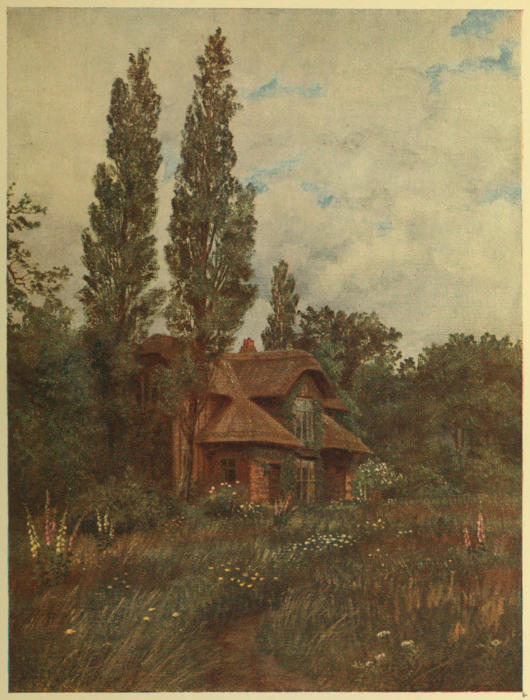
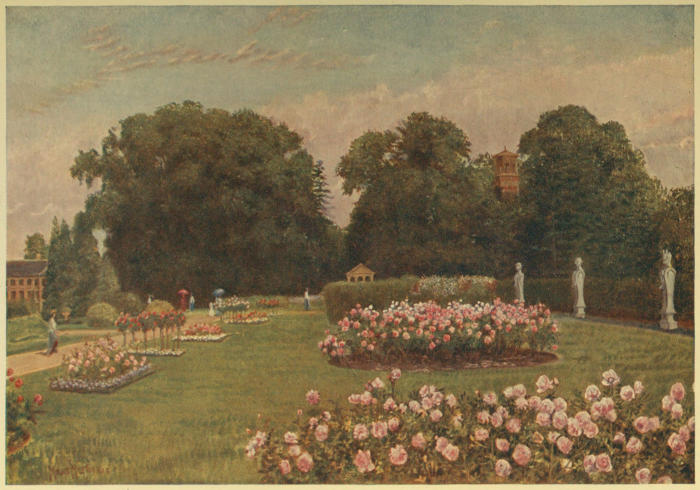
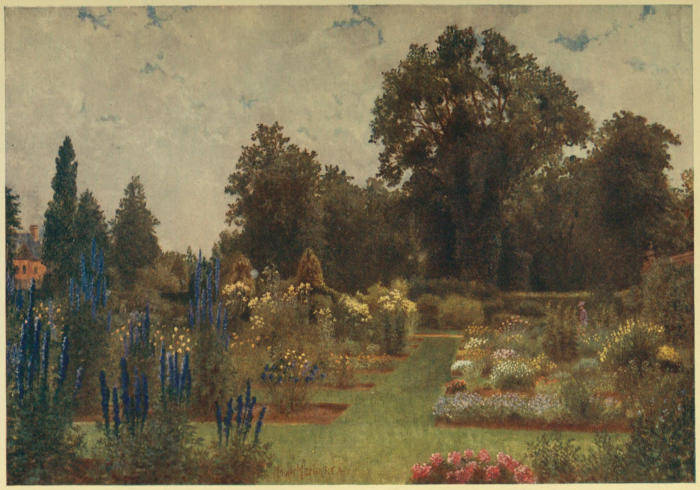
IN QUEEN’S COTTAGE GARDENS
In the Memoirs of Mrs. Papendiek, whose
husband and father were Court pages, and
who was brought up at Kew, it is mentioned
that during the “No Popery” riots the children
were sent away to Kew, while the King stayed
at his post in London, showing courage and
spirit, but would ride down between four and
seven in the morning for a peep at his darlings,
brought up to their parents’ early hours.
Other reminiscences give glimpses of the royal
domesticity and rusticity, not so dull to all
tastes as to those of a man about town like
Thackeray. One lad, John Rogers, who lived
into Victoria’s reign, remembered seeing the
young King, shut out of Richmond Lodge after
a morning walk, tapping at the window in vain,
till at last he contrived to open one and push
himself in head foremost. In the country,
George and Charlotte were up at six, and
breakfasted with their children about them.
They often dined with the children, too; later
on the King took to early dinners that
scandalised his guests by the simplicity of
mutton and turnips. His usual drink was a
sort of lemonade known in the household as
King’s cup. In an age of intemperance and
riots, he preferred sobriety, the morning dew,
and the open air, with plenty of exercise to
keep down his fat. The lucky children had
all Kew Gardens to play in; and once a week
the whole family made a regular promenade
through the Richmond grounds. When he
went further afield, George loved Paul-prying
into the cottages of his poorer neighbours,
showing an interest in their petty affairs, and
pouring out upon them more questions than
could be answered, such as that famous one,
how the apple got into the dumpling?
Though the London mob, at different times,
were insolent to both sovereigns, they never lost
popularity at Kew. When they next visited it
after the King’s escape from assassination by a
mad woman, the road over Kew Green was
found crowded by all the inhabitants, “lame,
old, sick, blind, and infants,” with a band of
musicians “who began God Save the King!
the moment they came on the Green, and
finished it with loud huzzas”—a neighbourly
demonstration that moved the Queen to tearfully
declaring, “I shall always love little Kew
for this.”
George succeeded to his mother’s interest in
Kew Gardens, now enlarged and improved as will
be told in another chapter. He also carried on
a large home-farm that extended into the parish
of Mortlake, while the Old Deer Park was
turned into pasture for a flock of merino sheep
which he imported into England. The young
princes were brought up to the same tastes.
Before getting into their teens, the two eldest
had a plot of ground given them, where, à la
Sandford and Merton, they planted a crop of
corn, weeded, reaped, thrashed and ground it
with their own hands, and saw it made into
bread, of which the whole family duly partook.
Up till our own time was standing in Kew
Gardens a miniature structure said to have
been built by the princes as part of their
apprenticeship to life. In the present Kew
Palace are preserved specimens of their early
writing, George’s copy being Conscious Innocence,
while Frederick traces very creditably the sentiment,
Aim at Improvement.
It was not through parental indulgence if
these boys grew to despise such innocent
pursuits. Queen Charlotte taught them herself
in their A B C stage: and when they
were given over to tutors, the order was that
they should be treated like ordinary scholars,
flogged if they deserved it, and so forth. The
rod seems not to have been spared on him who
was to become the Lord’s anointed; and his
education in the classics prospered better than
his father’s. The notorious Dr. Dodd, who
came to be hanged for forgery, was at one
time proposed as the Prince of Wales’s tutor.
He was brought up with his next brother
Frederick, who, till created Duke of York,
bore in boyhood the foreign title of Bishop of
Osnaburgh, and had been made a Knight of
the Bath in the nursery. The little Bishop did
not take kindly to books; but in later life
George IV. could pose as a scholar before the
courtly wits about him; even in his teens
he corrected his Governor, Lord Bruce, on
a false quantity, so mortifying the noble
pedagogue that he gave in his resignation.
There is another story, perhaps recorded by
Signor Ben Trovato, that in the Prince’s later
life an uncourtly Provost of Eton mentioned
Homer to him as “an author with whom
your Royal Highness is probably not much
acquainted,” to which H.R.H. suavely replied
that he had forgotten a good deal of his Homer,
but remembered one line, and went on to quote
Il. i. 225, which, for readers in the same case
as to Homer, may be rendered by Dryden’s
version, “Dastard and drunken, mean and
insolent”—epithets that too well fitted the
rebuked pedant in question.
The Eton boys of that day, for whom the
summum supplicium, according to Henry Angelo’s
Memoirs, was not over six cuts of a birch, would
appear to have been handled in less Spartan
fashion than were the King’s sons in their private
schoolroom. The Princess Sophia told Miss
Amelia Murray that she had seen her eldest
brothers, at thirteen and fourteen, held by the
arms to be flogged with a long whip. But once
the naughty boys are said to have turned
against one of their severe masters, using upon
him the rod he proposed for them. This story
may have suggested a scene in Thackeray’s
Virginians, as it might have been prompted by
one in Roderick Random, or a variant in The
Fool of Quality, a very long and edifying
romance of the Sandford and Merton school,
which had a vogue at this period. The Queen
held no high opinion of novel-reading; and if
her sons studied the works of Smollett, it would
perhaps be on the sly, as must have been a good
many doings in that family.
We know how these carefully educated princes
had more of Merton than of Sandford in their
disposition; then they soon found flatterers and
courtiers to set them against their strict training,
and to curry favour with a future sovereign.
Childish mischief may excuse the freak of the
boy Prince of Wales saluting his father with
the hated cry of “Wilkes and Liberty!” But
it was a serious matter when the second son
was precociously found playing the Don Juan
with a cottage beauty. That scapegrace Bishop
is accused of leading his elder brother into
wrong-doings for which he perhaps needed no
prompter. Their uncle, the Duke of Cumberland,
was another bad counsellor, who delighted
in debauching his nephews out of ill will to the
moral King. A worse companion, later on,
would be the notorious Duke de Chartres,
afterwards Égalité Orleans, who brought to
London French-polished vices to exchange for
English jockeyism.
The Prince of Wales, like his father, was
fond of music, and, if flattery may be trusted,
made no despicable performer. Mrs. Papendiek,
having the same tastes, can give us some
glimpse of his hobbledehoy recreations.
What with the goings on of the Prince of Wales at
the Lodge, the fun with Fischer, the celebrated oboe player,
and the various amusements in which I was engaged, the
season was one of gaiety, mirth, and enjoyment. The
well-known bet of five guineas between Bach and Fischer
was made in the presence of his Royal Highness and of us
all. The bet was that Fischer could not play his own
minuet. He was a very nervous man, and after allowing
him to get through a few bars, Bach stood before him
with a lemon in his hand, which he squeezed so that the
juice dropped slowly. Then he bit another so that the
juice ran out of his mouth freely. Fischer tried once or
twice to get rid of the water that must, on such a sight,
fill the mouth; but not being able to conquer the sensation,
he was obliged to own himself beaten.… Another joke
was played off upon poor Fischer this merrymaking season,
to this effect: After the concert, which Fischer attended
twice a week at Richmond or at Kew, wherever the King
and Queen were, he used eagerly to seize upon the supper
before he went to London. Upon one occasion, the
Prince came in and said, “I have ordered something that
I know you like,” a dish was brought in, and when the
cover was lifted, out jumped a rabbit. Germans have a
particular dislike to that animal in every shape and form;
therefore it is easy to conjecture poor Fischer’s state of
mind. This joke cost him only the loss of his supper,
but many nights succeeded before he could be prevailed
on to again enter the eating-room.
Making a butt of a dependent seems no
princely pastime; but this lady has worse to
tell us of the “First Gentleman in Europe’s”
amusements at the age of sixteen. “Much do
I lament to add that some of those about the
young princes swerved from principle, and introduced
improper company when their Majesties
supposed them to be at rest, and after the
divines had closed their day with prayer.”
The first open scandal about the Prince was
his intrigue with the unfortunate “Perdita”
Robinson, who turned many a head beside his
by her acting in The Winter’s Tale. We know
very little about that episode except what the
lady thinks fit to tell us in her Memoirs. The
boy lover, not yet eighteen, was so closely kept
at Kew that for some time he had to content
himself with ardent letters. At length an
interview was arranged under circumstances
which suggest that the tutorial turnkeys must
have been in the way of nodding over their port.
Lord Malden, who played Leporello in this
amour, brought Perdita to an inn on the island
between Kew and Brentford, to await the signal
that should invite them to cross.
The handkerchief was waved on the opposite shore;
but the signal was, by the dusk of the evening, rendered
almost imperceptible. Lord Malden took my hand, I
stepped into the boat, and in a few minutes we landed
before the iron gates of old Kew Palace. The interview
was but of a moment. The Prince of Wales and the Duke
of York (then Bishop of Osnaburg) were walking down
the avenue. A few words, and those scarcely articulate,
were uttered by the Prince, when a noise of people
approaching from the palace startled us. The moon was
now rising; and the idea of being overheard, or of his
Royal Highness being seen out at so unusual an hour,
terrified the whole group. After a few more words of a
most affectionate nature uttered by the Prince, we parted,
and Lord Malden and myself returned to the island.
The Prince never quitted the avenue, nor the presence of
the Duke of York, during the whole of this short meeting.
Alas! my friend, if my mind was before influenced by
esteem, it was now awakened to the most enthusiastic
admiration. The rank of the Prince no longer chilled
into awe that being who now considered him as the lover
and the friend. The graces of his person, the irresistible
sweetness of his smile, the tenderness of his melodious yet
manly voice, will be remembered by me till every vision
of this changing scene shall be forgotten.
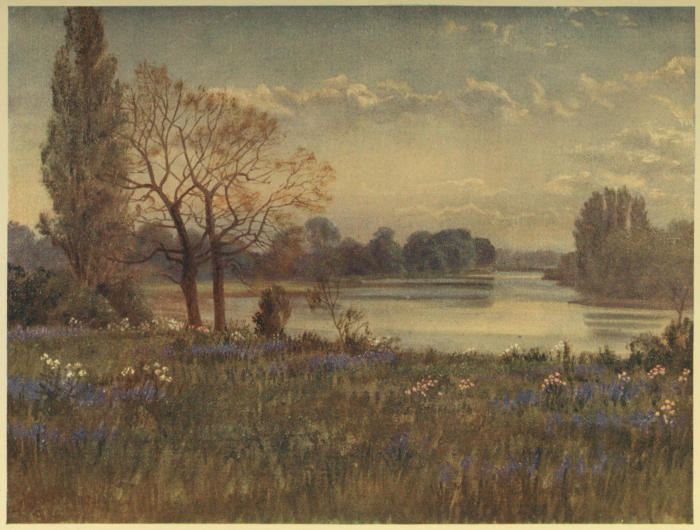
LOOKING UP THE THAMES
Repeated assignations, she says, followed “at
this romantic spot,” where now the party took
courage to continue their walks till past midnight.
Prince Frederick and Lord Malden, we
are to know, were always there to play gooseberry.
The lady wore a dark-coloured dress,
and the gentlemen were disguised in greatcoats,
except that harum-scarum Bishop, who
would make his companions uneasy by showing
himself in an unclerical buff coat, “the most
conspicuous colour he could have selected for
an adventure of this nature.” The tutors
having got into their nightcaps by midnight,
one supposes, these moonlight ramblers even
ventured on a little music as the food of love,
Frederick being the minstrel whose tones,
“breaking on the silence of the night, have
often appeared to my entranced senses like
more than mortal melody.” It is clear that
Perdita does not tell the whole story. Mrs.
Papendiek, well up in the gossip of the backstairs,
roundly asserts that two officials who
had been about these princes from childhood,
“privately overlooked the domestic vices and
irregularities of their young charge,” and that
they smuggled Mrs. Robinson through a back
gate to the Prince of Wales’s apartments.
The beautiful actress, who was a poetess,
too, à ses heures, might well be dazzled by those
shining personalities. The Prince vowed unalterable
love till death; and the most convincing
of his billets-doux was a bond promising
to pay Perdita £20,000 at his majority. Perhaps
he was sincere for the moment; but we know
what such callow vows come to. When, at
eighteen, he became to some extent his own
master, this unhappily married woman was
taken into keeping, and for a time cut a
notorious dash before the footlights of society.
After Florizel grew tired of her, Perdita’s
gushing sentimentality did not overlook businesslike
considerations. She let the King buy up
the Prince’s letters for £5000; and his bond
was commuted for a pension of £400. But,
these profits swallowed up by debts and extravagant
habits, the poor creature fell into bad
health and hasty authorship. Paralysed and
harassed, she died in 1800, buried by her own
desire, “for a particular reason,” in Old Windsor
Churchyard, where her tomb may be seen fenced
in with spiked railings to defend it from the
body-snatchers that infested those river-side
graveyards; and on it may be read an oft-quoted
epitaph idealising the painful facts of
her career.
At Richmond lived Mrs. Fitzherbert, the
Prince of Wales’s more lasting flame, to whom
he appears to have been honestly, if illegally,
married. When this Prince was launched upon
the wicked world, and the Bishop in partibus
had been sent off to finish his education abroad,
the royal pair still had their quiver full of
youngsters, who for twenty years came so fast
as to be cue for Horace Walpole’s jesting
prophecy that “London will be like the senate
of old Rome, an assembly of princes.” Besides
others who died young, there were the princes
afterwards known as Dukes of Clarence, Kent,
Cumberland, Sussex, and Cambridge, and the
Princesses Charlotte, Augusta, Mary, Elizabeth,
Sophia, and little Amelia, the darling of her
father. Where all these children were stowed
away, one cannot always make out clearly: we
hear of the Princes William and Edward living
with their tutors in what is now Cambridge
Cottage, and two of the younger boys in a
house at the top of the Green. Lady Charlotte
Finch, governess to the princesses, had a separate
house near the river; then another is spoken
of as the “Princess Elizabeth’s house.” Kew
House itself was a scrimply inconvenient
mansion, for which the royal household made
a tight fit even in its state of reduced ceremony.
Pictures of it when it was the Princess
Dowager’s villa, show a square, plain front with
two one-storied wings, from which in all
thirty-two windows look straight out upon the
lawn. At that time it bore the alias of “The
White House.” Miss Burney describes it as
a labyrinth of stairs and passages, where at first
she continually lost herself among the “small,
dark, and old-fashioned” rooms.
It is in 1786 that a search-light comes to be
turned upon this semi-private life by the diary
of a then most popular novelist. At the end
of the year before, Fanny Burney had been
staying with her venerable friend, Mrs. Delaney,
at Windsor, when one afternoon into the drawing-room
walked, unannounced, a burly man in
black with a star on his breast. Even the
short-sighted visitor hardly needed to be told
who he was. As every one in the room drew
back out of the way, she was for slipping off;
but the King asked in a loud whisper, “Is
that Miss Burney?” and after good-naturedly
giving her time to recover from her modest
confusion, entered upon a conversation of
questions, punctuated with what, whats, in
which he showed himself very inquisitive as to
how she had come to write and print Evelina.
The Queen soon followed, to whom George
introduced her by repeating their conversation;
and Miss Burney went to bed enraptured with
her new acquaintances. Further interviews
followed, which only increased her admiration,
though the satirist rather than the courtier
peeps out in her account of directions given her
for behaviour in the presence of royalty.
Her demeanour certainly gave satisfaction in
the royal circle, for a few months afterwards she
was offered the post of one of the Queen’s
dressers, which she accepted after some modest
misgiving. We remember Macaulay’s indignation,
“That with talents which had instructed
and delighted the highest living minds, she should
now be employed only in mixing snuff and in
sticking pins; that she should be summoned by
a waiting-woman’s bell to a waiting-woman’s
duties; that she should pass her whole life under
the restraints of a paltry etiquette, should sometimes
fast till she was ready to swoon for hunger,
should sometimes stand till her knees gave way
with fatigue, that she should not dare to speak or
move without considering how her mistress might
like her words and gestures.”
This engagement was certainly a mistake on
both sides: Miss Burney might have found more
congenial employment; and the Queen could
have had a better dresser. But Macaulay, after
his manner, has rather over-emphasised the evils
of her lot in the royal service. She certainly
took it as a rise in the world, and to her father it
seemed dazzling good fortune. The remuneration
offered her, with the chance of further
favour, might well have satisfied even successful
novelists of that day, few among whom would not
have jumped at such admission to the skirts of
Court life. Her year’s salary, £200, was almost
as much as she got from her second novel, and
far more than the proceeds of her first one; then
Macaulay slurs over the Queen’s generosity in
presents. To look at the matter in no mere terms
of pay, literature probably lost little by her
laying down the pen for a time; her best work
had been done in Evelina; Cecilia was a falling
off; and Camilla, written after her experience of
service, did not deserve the pecuniary success
won for it, in part, by royal patronage. In her
diary, Miss Burney herself makes little serious
complaint but of the ill-tempered tyranny of
her senior colleague, Mrs. Schwellenberg. Court
life soon ceased to be a little heaven below for
her; but she had distractions in royal journeys
to Oxford, Cheltenham, Weymouth, seats at the
trial of Warren Hastings, glimpses of great folks,
and even spells of moral flirtation with at least
one gentleman of the household, not to speak of
rather troublesome attentions from another who
was a married man. She cannot say too much
of the kindness of the King and the princesses;
and if her “sweet Queen” proved sometimes
an inconsiderate mistress, it was from want of
thought rather than a hard heart. The confinement
upon which Macaulay lays such stress was
no stricter than that of most domestic ladies,
who had not Windsor Park and Kew Gardens to
walk in. Had she been more robust, the novelist
might have lived on to become a second Mrs.
Delaney in the royal esteem. But her health
broke down, and after five years’ genteel servitude
she retired on a pension of a hundred pounds.
During these years the Court had its summer
head-quarters at Windsor. Every second week,
the “Royals” spent from Tuesday to Friday
at Kew, using this as a half-way house for
St. James’s, where on Thursdays the Queen held
her fortnightly drawing-rooms. This was Miss
Burney’s hardest job. She had to be up at six
on drawing-room days, with hardly time for
breakfast, to help in dressing the Queen, who
put on most of her finery at Kew, the “tippet
and long ruffles” being carried in paper to save
them from dust; then the final touches were
added at St. James’s, where, after the function,
the idol had to be undecked—in all, three
laborious attendances and two journeys, from
which the tired keeper of the robes got back
to dinner not till nearly seven o’clock, as then
seemed a very late hour.
In winter, when the Court moved to London,
there would be no going to Kew, which indeed
was not fitted up as a cold weather residence.
When it came to be occupied for months during
the King’s illness, strips of carpet and sandbags
had to be provided to make the princesses
tolerably comfortable. All the luxury of this
house was outside, in its spacious gardens. But
the want of state was made up for by the more
home-like life of Kew, though that had also its
disadvantages; the ladies and gentlemen were
not free to see their friends where the King and
his younger children might at any time come
wandering along the passages and poking into
the small rooms. There was not even a chapel
in the house; and when the Royal Family
happened to spend a Sunday here by some
chance, they heard prayers in a private room,
through the door of another, where the chief
attendants took their place, the servants being
edified in an outer apartment, which reminds us of
the complaint of one of Queen Anne’s chaplains
that he had “to whistle the Gospel through the
keyhole.” It was later that George III. fitted
Kew Church with a gallery to serve as royal pew.
Towards the end of 1788, this routine was
painfully broken upon by the King’s illness,
which began during one of his temporary stays
at Kew, prolonged then for more than a week, to
the great discomposure of the household, ill-provided
with clothes, or with books in Miss
Burney’s case. The cause of the attack was said
to be His Majesty’s sitting in wet stockings;
but for some time back signs of strangeness had
been noted in him, who had enough to disorder
his mind in the conduct of his eldest sons, and
in his brooding over the loss of the American
Colonies. Miss Burney’s diary gives a vivid
picture of those wretched days at Kew, when no
one felt sure what to say, and some, like herself,
hardly knew what to think of the rumours that
filled the house. The King was noisy and
voluble beyond his wont, talking himself hoarse
in his assurances that there was not much the
matter with him, mingled with complaints that
he could not sleep. More than once Miss Burney
found the Queen in tears. Charlotte had good
reason for anxiety: she must have been aware of
the character of a similar attack near the beginning
of the reign, which had passed off so quickly
that it could be hushed up.
By October 25, George seemed so much
better that he moved to Windsor, where his
restlessness and weakness grew worse again.
He obstinately insisted on going out to hunt
as usual in the November weather, yet he had
to confess that all at once he had become an
old man. A few days later there was a terrible
commotion in the family. It leaked out that
at dinner the King had broken into positive
delirium, seizing his eldest son by the collar
and pushing him against the wall. The Prince
is said to have burst into tears, while the Queen
had a fit of hysterics. Her husband could with
difficulty be persuaded to spend the night in a
separate room, from which all night long she
heard his ravings, now no secret to any one in
the house.
The King’s death being looked on as
imminent, the Prince of Wales at once took
command of the misery and confusion at
Windsor. His heartless conduct during his
father’s illness is matter of history, as also the
bitter struggle between his faction and Pitt’s
Ministry on the Regency question, the former
maintaining the very unwhiggish doctrine that
royal authority should pass, in the circumstances,
into the Heir Apparent’s hands, while the Tories
would make him Regent only with the sanction
of Parliament, and under restrictions. The
rabble was now on the King’s side; and all
respectable persons, not being partisans or
place-hunters, were disgusted by the profligate
Prince’s conduct. The doctors attending the
King had been threatened with popular violence
if his illness proved fatal. Their case was a
hard one, as not only would the royal patient
not always take their remedies nor even see
them, but they were treating a complaint then
ill understood even by physicians who professed
special experience in it. It is said that poor
George was put in a strait-waistcoat, chained
to the wall, and actually struck by one of
his keepers, which would be quite after the
practice of that day. But the stories of his
harsh treatment are somewhat dubious, for the
notion that he was being ill-used often figured
among his delusions.
At the end of November the doctors determined
on removing him to Kew, where he could
get exercise in the privacy of the Gardens. The
King angrily refused to leave Windsor, and had
to be coaxed away by a promise that he should
see his wife and children, gone on before him.
“Princes, equerries, physicians, pages—all conferring,
whispering, plotting and caballing, how
to induce the King to set off!” noted Miss
Burney, who accompanied her mistress on their
hasty flitting to Kew House, where the Prince
of Wales had written in chalk over each room
the name of its occupant. Everybody had to
put up with the discomfort of being crowded
together in that ill-furnished mansion. The
only good rooms were given up to the King,
those above being left empty that he might not
be disturbed. Part of the household overflowed
into the Prince of Wales’s house opposite; the
younger children being lodged in their usual
quarters on Kew Green. Pent up closely with
“the Schwellenberg,” Miss Burney had her full
share of troubles; but her womanly devotion
rose to the occasion, and she declares that “not
even the £20,000 prize in the lottery could, at
this time, draw me from this melancholy scene.”
She had the satisfaction of being employed,
every morning, to carry the physicians’ report
to the Queen, who, by her enemies, was accused
of doctoring those bulletins to give the most
favourable view of symptoms on which, for
once, doctors differed.
The Prince of Wales and his partisans
listened rather to those big-wigs of the profession
that were most gravely shaken over a case
they did not understand. They perhaps agreed
best in looking askance on an outsider called in
upon the removal to Kew. This was the Rev.
Mr. Willis, who at Lincoln, and in a private
asylum of his own, had shown the benefit of a
more rational treatment of the insane. Though
he had a medical degree, he was belittled as a
quack by many members of a guild apt to
suspect innovators; but his success had been
so notable that he was now employed, with his
sons, trained in his methods, to be constantly
about the King. From the first he took a
hopeful view of the case; and when, with
occasional interference, he was allowed to have
his way, it soon appeared that he was the right
man in the right place. His secret seems to
have been a mixture of kindness and firmness;
but perhaps he was not above using nostrums
of his own. Mrs. Papendiek, whose husband
was in attendance, says that one of the remedies
used was musk, the smell of which the King
could not bear, but the doctor insisted on it
as efficacious. He took the responsibility of
giving the King a razor to shave himself, for
which he was afterwards denounced almost
as compassing Lèse-majesté; but on all such
questions he stipulated for leave to go by his
own experience and judgment.
Had this been in the era of newspaper
kodaking, we should no doubt have fuller
details of the King’s madness, as to which
more or less doubtful stories leak out in the
memoirs and letters of the day. He is
described as wanting to climb the Pagoda, and
on being thwarted, throwing himself sulkily on
the ground, from which it took four or five
men three-quarters of an hour to raise him.
Another day he tried to throw himself out
of a window. The worst symptom was his
incessant garrulity: he would go on talking
for hours about everything or nothing. One
of the doctors once found him translating the
Court Calendar into doggerel Latin. The most
pathetic story is that of his being overheard
earnestly praying for his recovery. At times
he showed touches of humour and shrewdness.
He managed, though it had been forbidden, to
get hold of a copy of King Lear, Dr. Willis
not being strong in literature; and when his
elder daughters were first allowed to visit him,
he told them “I am like poor Lear; but thank
God! I have no Regan, no Goneril, but three
Cordelias.” Once he reproached Willis with
having given up his sacred calling for profit;
and when the reverend doctor excused himself
on the precedent of Christ healing demoniacs,
“Yes,” said the King, “but He did not get
seven hundred a year for it!”
The Willises, by the way, afterwards complained
of their remuneration, whatever it was;
but their treatment of George III. made an
excellent advertisement for the family, one of
whom was sent for to Lisbon in the case of a
mad Queen of Portugal. They seem to have
given some offence in the household by the
position they had to assume. Great was
flunkey indignation when four of Dr. Willis’s
keepers were raised to brevet-rank as pages,
that after his recovery they might remain beside
the King in case of a relapse. About that
time several of the regular pages seem to have
been dismissed or disgraced, it is said for carrying
tales to the Prince of Wales. These
“pages,” of course, had now grown into adult
servants above mere menial rank, such beardless
boys as figure in history and romance being
distinguished as “pages of honour.”
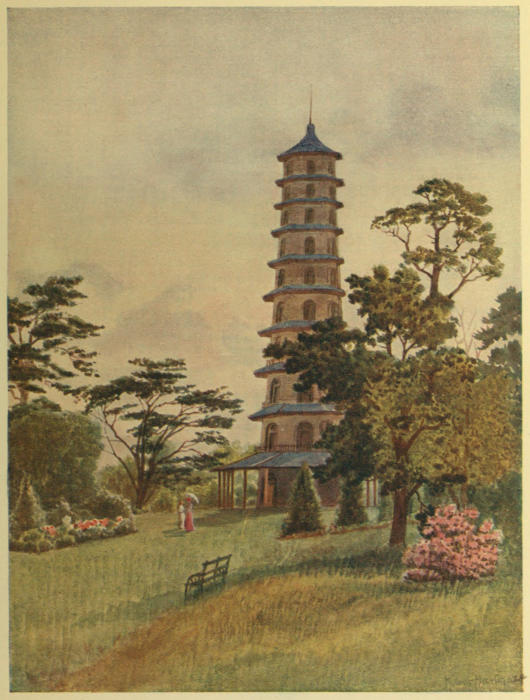
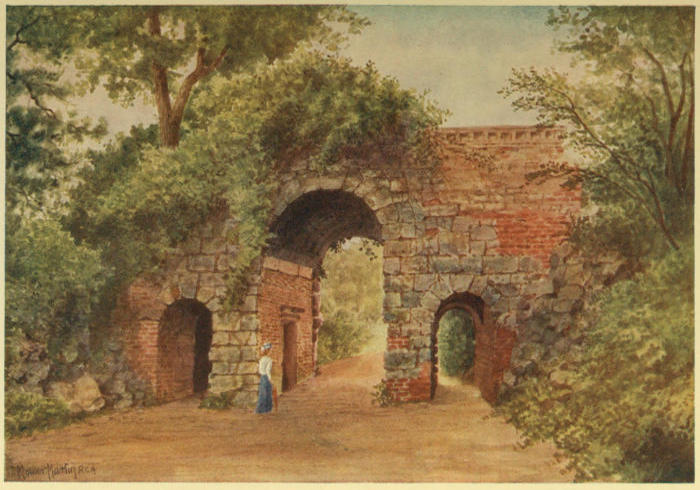
THE PAGODA
Poor Miss Burney was so worn out that
one of the doctors, noticing her wan looks,
insisted on her taking daily exercise, such as
was the prescription for the King. As the
orders were to keep every one out of his way,
she made a point of inquiring whether he
would be in the Kew or the Richmond grounds;
but once there was a misunderstanding that
led to the most violent agitation of her life.
While tramping her constitutional round of
Kew Gardens, through the trees she saw three
or four figures, whom at first her short-sighted
eyes took for workmen, till she was too late
aware of His Majesty’s person among them.
Alarmed past all possible expression, I waited not
to know more, but turning back, ran off with all
my might. But what was my terror to hear myself
pursued!—to hear the voice of the King himself loudly
and hoarsely calling after me, “Miss Burney! Miss
Burney!”
I protest I was ready to die. I knew not in what
state he might be at the time; I only knew the orders
to keep out of his way were universal; that the Queen
would highly disapprove any unauthorised meeting, and
that the very action of my running away might deeply,
in his present irritable state, offend him. Nevertheless,
on I ran, too terrified to stop, and in search of some
short passage, for the garden is full of little labyrinths,
by which I might escape.
The steps still pursued me, and still the poor hoarse
and altered voice rang in my ears—more and more footsteps
resounded frightfully behind me—the attendants
all running, to catch their eager master, and the voices
of the two Doctor Willises loudly exhorting him not to
heat himself so unmercifully.
Heavens, how I ran! I do not think I should have
felt the hot lava from Vesuvius—at least not the hot
cinders—had I so run during its eruption. My feet
were not sensible that they even touched the ground.
Soon after, I heard other voices, shriller, though less
nervous, call out “Stop! stop! stop!”
I could by no means consent; I knew not what was
purposed, but I recollected fully my agreement with
Dr. John that very morning, that I should decamp if
surprised, and not be named.
My own fears and repugnance, also, after a flight and
disobedience like this, were doubled in the thought of
not escaping. I knew not to what I might be exposed,
should the malady be then high, and take the turn of
resentment. Still, therefore, on I flew; and such was
my speed, so almost incredible to relate or recollect,
that I fairly believe no one of the whole party could
have overtaken me, if these words from one of the
attendants had not reached me, “Doctor Willis begs
you to stop!”
“I cannot! I cannot!” I answered, still flying on,
when he called out, “You must, ma’am; it hurts the
King to run.”
Then, indeed, I stopped—in a state of fear really
amounting to agony. I turned round, I saw the two
doctors had got the King between them, and three
attendants of Dr. Willis’s were hovering about. They
all slackened their pace, as they saw me stand still; but
such was the excess of my alarm, that I was wholly
insensible to the effects of a race which, at any other
time, would have required an hour’s recruit.
As they approached, some little presence of mind
happily came to my command; it occurred to me that,
to appease the wrath of my flight, I must now show
some confidence; I therefore faced them as undauntedly
as I was able, only charging the nearest of the attendants
to stand by my side.
When they were within a few yards of me the King
called out, “Why did you run away?”
Shocked at a question impossible to answer, yet a
little assured by the mild tone of his voice, I instantly
forced myself forward to meet him, though the internal
sensation which satisfied me this was a step the most
proper to appease his suspicions and displeasure, was so
violently combated by the tremor of my nerves, that I
fairly think I may reckon it the greatest effort of
personal courage I have ever made.
The effort answered: I looked up, and met all his
wonted benignity of countenance, though something still
of wildness in his eyes. Think, however, of my surprise,
to feel him put both his hands round my two shoulders
and then kiss my cheek!
I wonder I did not really sink, so exquisite was my
affright when I saw him spread out his arms! Involuntarily,
I concluded he meant to crush me; but the
Willises, who have never seen him till this fatal illness,
not knowing how very extraordinary an action this was
from him, simply smiled and looked pleased, supposing,
perhaps, it was his customary salutation.
She was soon relieved to find the King talking
reasonably enough, though with a certain
flightiness, not very different from his ordinary
manner. He insisted on prolonging the interview,
after the Willises in vain tried to cut
it short. He talked of Mrs. Schwellenberg,
seeming quite well aware of what Miss Burney
had to bear from her “Cerbera”; of the lady’s
own father, author of the History of Music; of
his favourite composer, Handel, snatches from
whose oratorios he tried to hum over with
painful effect. As they walked on together,
he asked endless questions about his friends,
expressed his intention of appointing new
officials, complained angrily of his pages. At
last he was persuaded to part from this reluctant
confidante, promising to be her friend as long as
he lived; then she went off to the Queen with
a report which ensured forgiveness for that
innocent adventure.
The favourable symptoms continued, little
to the satisfaction of the Prince and his friends,
who are credited with passing brutal jests on
the King’s condition. Just as power seemed
to be within their grasp, the Regency Bill was
shelved, after an audience given by the King
to the Lord Chancellor, Thurlow, though that
shifty Polonius is said to have remarked that
His Majesty had been “wound up” to talk to
him. Miss Burney, who now confined her
walks to the roadside, had the happiness of
thence seeing the royal pair walking arm-in-arm
in Richmond Gardens. Next day, the
King came to tea with his family in the drawing-room;
then, a few days later, meeting Miss
Burney in the Queen’s dressing-room, he said
that he had waited on purpose to tell her—“I
am quite well now—I was nearly so when I
saw you before—but I could overtake you
better now.” After four months of royal
misery and public excitement, the evergreen
sneerer, Horace Walpole, could note—“The
King has returned, not to what the courtiers
call his sense, but to his non-sense.”
The news called forth an outburst of public
joy, that hit the Prince’s party hard. A thanksgiving
prayer was read in every church; and
later on the King, to the dread of his advisers,
would not be satisfied without the excitement
of attending a solemn service at St. Paul’s,
where he and the princesses were moved to
tears, while his graceless sons attracted attention
by their irreverent chattering. There is some
slight palliation for the Prince of Wales’s conduct
throughout this trying time, in the fact
that the King had showed a dislike to him, and
even a want of fairness to his shortcomings;
but the Duke of York, always the father’s
favourite son, has no excuse for backing up
his undutiful brother. Soon after the recovery
was announced, London had hailed it with a
general illumination, from rushlights in the
humblest cottage window to blazing devices
on the clubs. It was witnessed by the Queen
and all her daughters except the youngest,
while, in their absence till the, for them, most
unwonted hour of 1 A.M., Kew House too was
lighted up and adorned with a transparency
displaying The King—Providence—Health—Britannia;
and on either side of the gates, in
gold letters on a purple ground, shone these
most loyal lines:—
Our prayers are heard, and Providence restores
A patriot King to bless Britannia’s shores.
Nor yet to Britain is this bliss confined,
All Europe hails the friend of human kind!
If such the general joy, what words can show
The change to transport from the depth of woe,
In those permitted to embrace again
The best of fathers, husbands, and of men?
Inside the house also the Muse was not
silent. His darling Princess Amelia came to
kneel before him, presenting her father with
verses in the Queen’s name, from the pen of her
novelist-attendant.
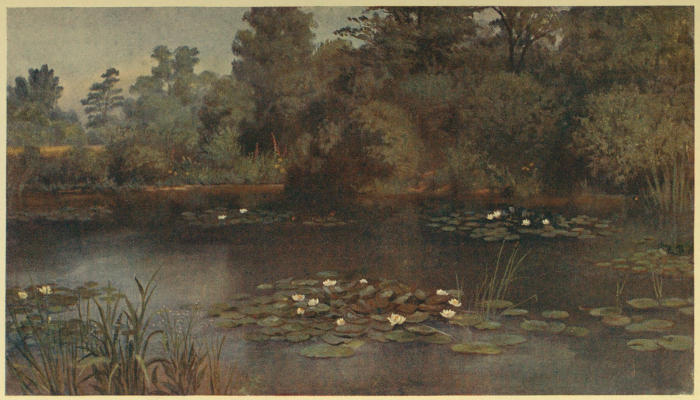
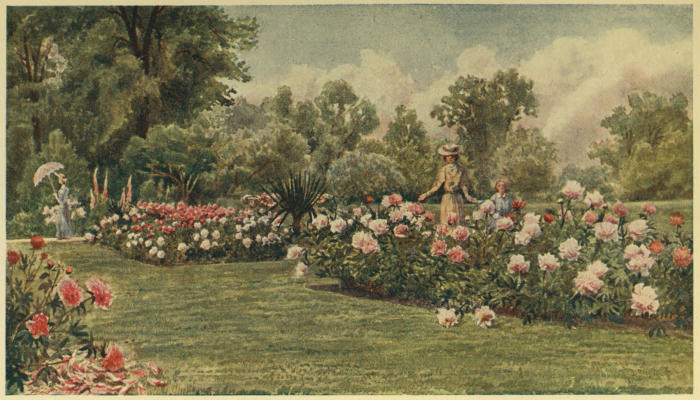
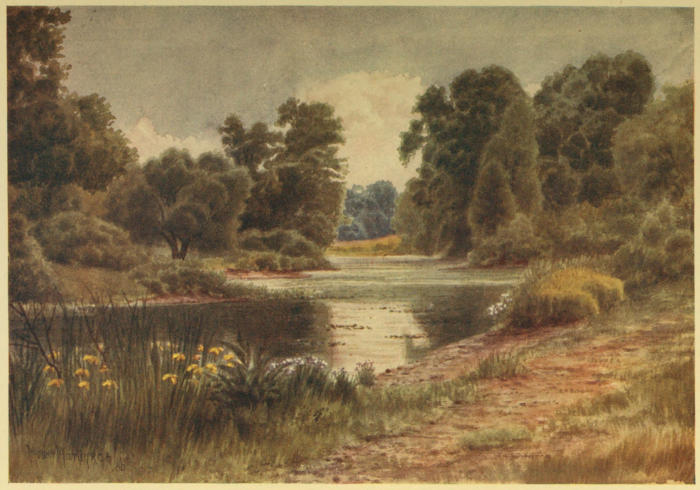
THE WATER LILY POND
Amid a rapturous Nation’s praise
That sees thee to their prayers restored,
Turn gently from the general blaze,—
Thy Charlotte woos her bosom’s lord.
Turn and behold where, bright and clear,
Depictured with transparent art,
The emblems of her thoughts appear,
The tribute of a grateful heart.
O! small the tribute, were it weigh’d
With all she feels—or half she knows!
But noble minds are best repaid
From the pure spring whence bounty flows.
P.S.—The little bearer begs a kiss
From dear papa, for bringing this.
In the middle of March, after their unusually
long stay at Kew, the royal family moved to
Windsor, the King riding on horseback, to be
received by the townsfolk with an ovation of
welcome. In June, to complete the cure, he
went to Weymouth for sea-bathing, everywhere
on the journey hailed with acclamations and
demonstrations that might well have turned a
weak head. At Weymouth, the exuberant
loyalty of the people was embarrassing. All the
shops and bathing-machines placarded God Save
the King, a device repeated on the bonnets and
waists of the bathing-women, as indeed on
dresses all over England. “All the children,”
reports Miss Burney, “wear it in their caps—all
the labourers in their hats, and all the sailors
in their voices; for they never approach the
house without shouting it aloud—nor see the
King, or his shadow, without beginning to
huzza, and going on to three cheers.… Nor
is this all. Think but of the surprise of His
Majesty when, the first time of his bathing, he
had no sooner popped his royal head under water
than a band of music concealed in a neighbouring
machine struck up ‘God save great George
our King!’” It was now that occurred the
ludicrous incident of the wooden-legged Mayor
presenting an address, and not being able to
kneel, to the scandal of the officials. And here,
the “Royals” having gone on a day’s visit to
Sherborne Castle, for the first time in three years
Miss Burney had a holiday, which she spent
with a friend in a “romantic and lovely excursion”
to the ruins of Sandsfoot Castle near
the neck of Portland Island, a peep into which
she might have found more romantic, had some
couple of miles not been a Georgian lady’s limit
on foot.
After a tour through the loyal West country,
the Court returned to its routine of London and
Windsor life, with halts at Kew in the summer.
But henceforth Miss Burney’s diary has little
to say about Kew; and after another year we
lose that peep-hole into royal domesticity. The
life of a glorified waiting-maid began to tell upon
her health and spirits: “Lost to all private
comfort, dead to all domestic endearment, I was
worn with want of rest and fatigued with
laborious watchfulness and attendance.” Her
chief comfort had been a sort of intermittent
philandering with the Queen’s Vice-Chamberlain,
Colonel Digby—the “Mr. Fairly” of her journals—a
favourite with the King, too, to whom he
could “say anything in his genteel roundabout
way.” This gentleman the lady clearly admired
none the less when he became a widower, though
to us she presents him rather too much in the
character of a priggish novel hero, full of edifying
reflections and opinions. But the sentimental
friend turned out not impeccable, for he married
Another, the “Miss Fuzilier,” about whom his
fellow-servant had often rallied him; and she
cannot conceal that this choice seemed unworthy
of him. Her health was so evidently
breaking down that her literary friends cried
out on the sacrifice; even the newspapers
gossiped about her condition; and the meddlesome
Mr. Boswell declared that he would set
the whole Club upon Dr. Burney, if she were
not allowed to resign.
This she was most loth to do. She tried taking
“the bark,” but that did little good. The Rev.
Dr. Willis volunteered a prescription which she
found “too violent” in its effect, while grateful
to him for his interest in her. “Why,” said
he, “to tell the truth, I don’t quite know how I
could have got on at Kew, in the King’s illness,
if it had not been for seeing you in a morning.
I assure you they worried me so, all round, one
way or other, that I was almost ready to go off.
But you used to keep me up prodigiously.
Though, I give you my word, I was afraid
sometimes to see you, with your good-humoured
face, for all it helped me to keep up, because I
did not know what to say to you, when things
went bad, on account of vexing you.”
Every one noticed her miserable plight, yet
the Queen showed herself too blind to the fact of
a life being wasted in her service. Even the ill-tempered
Mrs. Schwellenberg was kind in her
way, who seems to have found this subordinate
a pleasingly submissive victim, and occasionally
spoke well of her behind her back: “The Bernan
bin reely agribble!” This “Cerbera,” whatever
her faults, had the virtue of devotion to her lifelong
mistress, and could not understand living
by choice out of sunshine of Court favour. She
tempted Miss Burney with the dazzling prospect
of her own post in reversion. But the novelist
was sick of her gilded cage. With trembling
knees, after long hesitation, as if it were a
crime, in the form of a petition she offered her
resignation, not over-graciously received. The
Queen proposed a six weeks’ holiday, a change
of air. When this was declined, the Schwellenberg
raged against Miss Burney and her father
as almost guilty of treason. “I am sure she
would have gladly confined us both in the
Bastille, had England such a misery, as a fit
place to bring us to ourselves from a daring so
outrageous to imperial wishes.”
She held on some months longer to let the
Queen find a successor, secured in the person of
a Hanoverian pastor’s daughter, Mdlle. Jacobi,
who, for sign of family poverty, brought a niece
with her in the disguise of maid. Miss Burney’s
last King’s birthday ball under the royal roof was
marked by a visit to Mrs. Schwellenberg’s room
from the young Duke of Clarence, our future
sovereign, of which the diarist jotted down a long
and most amusing description, though she has to
apologise for not giving a full “idea of the
energy of His Royal Highness’s language.” He
insisted upon them all drinking the King’s health
in champagne so often that some of the courtly
attendants were a little shaky on their legs; and
as for the Sailor Prince, he got so drunk that,
as he told his sister next morning, “You may
think how far I was gone, for I kissed the
Schwellenberg’s hand”—and he might have
added, bid her “Hold your potato jaw, my dear!”
If this be a true sketch from high life, the
novelist need not be accused of exaggerating
the manners of her Braughtons and Captain
Mirvans.
Among her last duties was expounding to the
inquisitive King and Queen the allusions in
Boswell’s Dr. Johnson, in 1791 the book of the
day, which Miss Burney hardly approved of,
being one of the few who “by acquaintance with
the power of the moment over his unguarded
conversation, know how little of his solid opinion
was to be gathered from his accidental assertions.”
Now she was at pains to vindicate to her royal
patrons “the serious principles and various
excellences” of her famous friend. The year
before, when Boswell visited her at Windsor, he
had in vain pressed her to contribute “personal
details” to his work. “You must give me some
of your choice little notes of the Doctor’s; we
have seen him long enough upon stilts; I want
to show him in a new light. Grave Sam, and
great Sam, and solemn Sam, and learned Sam—all
these he has appeared over and over. Now I
want to entwine a wreath of the graces across
his brow; I want to show him as gay Sam,
agreeable Sam, pleasant Sam: so you must help
me with some of his beautiful billets to yourself.”
The last day of Miss Burney’s five years’
slavery dawned at Kew, from which she attended
Her Majesty to St. James’s, and there took leave
of her with deep emotion. Freedom, congenial
society, and country air soon restored the lady’s
health; and the faithless Colonel Digby’s place
in her heart became more than filled by General
D’Arblay, one of a colony of French émigrés
settled at Juniper Hill above Mickleham, near
her sister’s house, and her friends, the Lockes of
Norbury. Lessons in one another’s language
gave excuse for meetings, at which Cupid was
soon of the party. The not-over-young couple
married in haste and privately, but seem never to
have repented. With the proceeds of the bride’s
next novel, Camilla, they built Camilla Cottage,
still conspicuous, as Camilla Lacey, on the slopes
above Box Hill station; but at the peace General
D’Arblay went back to France, where his wife
became for years an involuntary exile.
Mrs. Papendiek has a mischievous statement
that Miss Burney was dismissed on account of
the Queen’s displeasure that she used her spare
hours for writing a novel in the palace; and that
the authoress was much mortified by the loss of
her post. But this seems mere scandal. Madame
D’Arblay owned to writing an unsuccessful
tragedy at Kew and Windsor; and some years
after, when Camilla was published, she confessed
to the King and Queen that the “skeleton”
of it had been jotted down under their roof,
at which they expressed no displeasure, but
graciously acknowledged the dedication with a
gift of a hundred guineas. The same gossiping
authority says that Miss Jacobi did not recommend
herself to the Queen, nor to “old
Schwelly,” who refused to allow that niece-maid
to dine at her table. A few years later Mrs.
Papendiek herself succeeded to the post once
held by the novelist, for which she was much
fitter, to judge by the space given to dress in her
journals. But these records end before she
entered upon her duties; and we know little
more of her Court life but that she gained promotion
in the royal household, from which she
retired to spend her old age at Kew.
In 1805, another literary lady came into
the service of Queen Charlotte, Miss Cornelia
Knight, afterwards companion to the Prince
Regent’s daughter. Her journals are much more
discreet about the royal family than Miss
Burney’s; and there is a hiatus in them for most
of the period of her living at Windsor, where she
gives little more than hints of dissensions and
grudges in the highest circles, and a general
impression that Kew had fallen out of its old
favour. All these three writers had a common
point, in being able to boast of Dr. Johnson’s
acquaintance, most intimate in the case of Miss
Burney.
Thorne, in his Environs of London, as also the
official guide, have it that the King was confined,
during his first illness, in the present palace,
apart from his family; and this statement is
followed by a mob of guide-books, servum pecus,
that often go tumbling after one another into the
same ditch. But Miss Burney and other witnesses
prove that it was not so; and Thorne has
misled himself in his reference to George Rose’s
Diary. Rose clearly refers to the next serious
attack in 1801. It was whispered that in 1795
there had been a recurrence of the symptoms,
passing off in a few days. But at the beginning
of the next century, when the King’s mind was
agitated by the resignation of Mr. Pitt on the
Catholic Emancipation question, he caught a bad
cold that ended as before. This time the illness
began at Buckingham House; then, after His
Majesty seemed fit to attend to business again,
on his going to Kew a severe relapse took place,
shown by his informing the Prince of Wales that
he proposed to abdicate the English Crown and
retire to Hanover or America.
It was now that he came to be separated from
his family, and confined in the “Dutch House”
under charge of the Willises, to whom he had
taken a strong dislike, and is said to have struck
one of them before his removal could be effected
by force. The father no longer appears as taking
the leading part in the King’s treatment; but
one of the sons for a time was the fly-wheel in
the State, since through him all papers had to be
presented for the royal signature. When the
Lord Chancellor was admitted to the King’s
sick-room, he vehemently declared, “as a gentleman
and a king,” that he would sign no document
nor perform any act of sovereignty unless
he were that very day restored to his wife and
daughters; and he was then taken back to the
house over the way, to be still more or less
closely watched by the Willises.
Dr. Thomas Willis,[1] writing at this time to
Mr. Rose in the King’s name, tells that his own
quarters are on Kew Green, “a few doors below
the Rose and Crown,” a tavern still standing in
less transmogrified state than its neighbour, the
King’s Arms, also mentioned in books of that
period. Kings reign and pass away; kingdoms
flourish and fade, mansions rise and fall, while
public-house signs often seem to have more
permanence in them than most human institutions.
Yet of them too transit gloria, if we may
believe the report that half the taverns of
England at one time took Wilkes’s head for their
sign, as to which evidence of popularity he himself
used to tell how he overheard a loyal old
lady’s remark, “Ah! he swings everywhere but
where he ought.”
The second avowed derangement lasted, by
fits and starts, till the summer of 1801. A
course of sea-bathing at Weymouth again completed
the patient’s recovery; but the dread of
fresh attacks remained. The next one came in
1804, when his repugnance to the Willises was
so marked that the doctor of Bedlam was employed.
It is, of course, a common symptom of
insanity, the turning against its best friends.
And now poor George showed intermittent
symptoms of dislike to the Queen herself, so that
they began to occupy separate apartments, and
are found not even dining together. The old
domestic happiness was gone, along with the
uncomfortable Kew House, that had so often
been its scene. Yet, had the King kept his
health, there seems reason to believe that Kew
might have become more of a home to him than
ever.
George III., returning to the plan set on foot
in the early years of his reign, took a fancy for
building a castle here, after plans prepared by
Wyatt, the then esteemed architect, in the bad
taste of the period. The design is to be seen in
one of the rooms of the present palace. The
other house was pulled down in 1802, to make
way for the new structure, which would have
stood nearer the river-side, looking over to the
not very royal town of Brentford, that “town of
mud,” so strangely admired by the Georges and
reviled by their poets. But the works were
interrupted by the King’s fresh attack in 1804,
and this building never got further than the state
of a pretentious shell, which stood idle for nearly
a quarter of a century, and was then demolished
by George IV. That monarch had no more
love for Kew than his father for Hampton Court.
He had spent freely upon his own whims, on
Carleton House, and on the Pavilion, the latter
gimcrack medley a laughing-stock even for
contemporary taste, and a byword with irreverent
writers like Byron—
Shut up,—no, not the King, but the Pavilion,
Or else ’twill cost us all another million!
His father, unless for saddling us with so many
expensive sons, had lived so carefully and
economically, that the nation need not have
grudged him a “Folly” for once in a way. It
was his spendthrift heir who began to restore
Windsor Castle, demolishing the Queen’s Lodge
there, and to rebuild Buckingham Palace in its
present form.
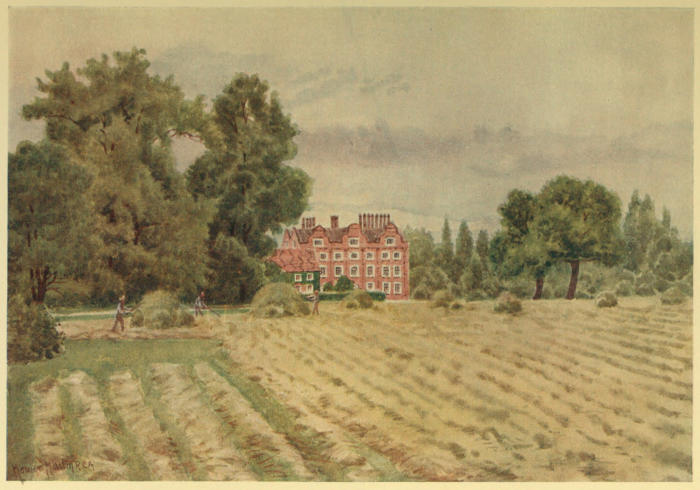
THE PALACE
When Kew House had disappeared, the sturdy
“Dutch House,” now known as Kew Palace,
became the occasional retreat of the royal
family, its scant accommodations, no doubt, eked
out by those other mansions held on Kew Green.
It was here that Addington found the King
dining rather before one o’clock on the simplest
fare. His mind continued to be rather cranky,
as shown by his strange freak of wearing a huge
powdered wig in conjunction with the mediæval
trappings of the Order of the Garter. Blindness
came gradually on to increase his afflictions. In
1809 the nation joyfully celebrated his Jubilee,
with much feasting of the poor—and the rich—relieving
of prisoners for debt, pardoning of
military culprits, illuminations, libations, and
such memorials as the statue on the Weymouth
Esplanade, that records the townsfolk’s gratitude
to the King, whose stay at his favourite bathing-place
had so often sent up the price of its
lodgings. We may be sure Kew, in its small
way, was not behindhand in such loyal doings.
But Kew was hardly again to welcome the
Father of his People. Repeated agitations went
to overthrow his reason for good—the triumphant
marches of Napoleon, the tarnishing of British
arms not yet brightened by Wellington’s victories,
the misconduct and unpopularity of his sons, the
death of his beloved youngest daughter, Amelia.
At the beginning of 1811, George had just wits
enough left to consent to the Prince’s Regency.
A few months later, Charles Knight was one of
the Windsor crowd that saw their aged Sovereign
in public for the last time. Henceforth he lived
confined in the Castle, prisoner of blindness, by
and by of deafness, cheered by music, by religious
exaltation, and by delusive memories of the past,
more than by flitting glimmers of melancholy
reason, in one of which he had the satisfaction of
learning Napoleon’s downfall and the recovery of
Hanover. A most pathetic figure was the blind
old King with his white beard, only now and
then visited by those nearest to him. It is said
that the selfish Regent was moved to tears when
one day he overheard his father murmuring the
complaint of Milton’s Samson:—
O dark, dark, dark! Amid the blaze of noon,
Irrecoverably dark! Total eclipse
Without all hope of day!
O first created Beam, and Thou, Great Word,
“Let there be light! and light was over all,”
Why am I thus bereaved Thy prime decree?
When George III. was laid with his fathers
in 1820, his stout-hearted and narrow-minded
Queen had gone before him. To the last she
tried to do her duty, according to her lights.
Reconciled, at least outwardly, to her eldest son—indeed
it appears that all along the strict
moralist had something of woman’s weakness for
that rake—she exerted herself to play the figurehead
of his Court, taking the place of his discarded
wife; and she shared his unpopularity to such an
extent as to be hissed by the mob on her way to
hold a Drawing-room; then, after the death of
the Princess Charlotte, she had to face an outburst
of popular resentment in the City. By the
autumn of 1818 she was hopelessly prostrated by
dropsy. On the way from London to Windsor
her state became so serious that a halt was made
at Kew Palace; and there she died in a chair, in
the room now marked by a brass tablet, her
last looks, it is said, fixed on a picture of The
Dropsical Woman.
A more moving loss in the preceding year
had been that of the Princess Charlotte, upon
whose young life so much seemed to hang,
while bitter hatred kept her parents apart. She
died in childbirth at Claremont, wife of Leopold
of Saxe-Coburg, future King of the Belgians,
who else might have taken in England the
part afterwards filled by Prince Albert. When
thus King George’s family of fifteen seemed
like to die out, unless through the detested
Ernest of Cumberland, three of the now elderly
princes were hastily married in the same month—the
Duke of Cambridge, the Duke of Clarence,
and the Duke of Kent. These weddings, that
might come close on funerals, were performed
privately in the drawing-room at Kew Palace,
the two latter on the same day, but at different
hours.
We know which of the branches took root.
Next year was born the Princess Victoria, whose
father died at Sidmouth about the same time
as the King. The cause of his death is said
to have been sitting in wet clothes after a
long walk; and similar carelessness seems to
have been usually the prelude to George III.’s
afflictions, but for which the place of Windsor
might have been usurped by Kew, through this
King’s favour.
To the same favour was mainly due the
rise and progress of the Gardens, that have been
hitherto left too much in shade upon pages that
bear their name. Now that nothing but the
present “Palace” remains to block them out of
our view, it is time to trace their development
from a princely hobby into a national institution.