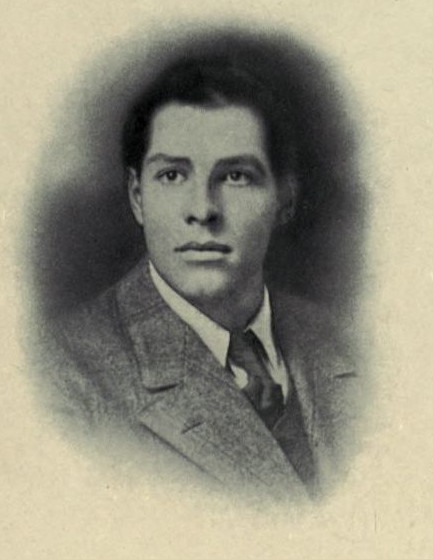
Dedicated
to the memory of that intrepid and valiant Frenchman,
whose bravery, love of liberty, generosity, and friendship
with Washington, made Americans, for all time,
his grateful and devoted admirers--
The first seven chapters of this book are
letters received from Russell A. Kelly,
age 21, volunteer in the Légion étrangère.
The letters, many of which were published in
the New York Evening Sun, were sent to his
parents in New York and have been retained
in exactly their original form except for the
omission of strictly personal matters.
The last communication from him was a
military post card mailed June 15th, 1915.
After the severe engagement around Souchez
on June 16th in which the Second Regiment
de Marche of the First Regiment of the Legion
suffered severely, he was officially recorded
by the French Minister of War as
“missing,” with the added statement that his
name would be carried on the list of missing
until a search could be made in the internment
camps of Germany.
Exhaustive efforts have been made to locate
him. All information that has been obtained
as to his fate is given in Chapter IX.
When it was learned in New York that he
had enlisted, he was informed that Germany
had, prior to the war, objected to the Foreign
Legion as a military body, and had stated that
Légionnaires who were not French citizens
would be considered as non-combatants and
not entitled to the rights of the other soldiers
of the French army.
He was accordingly advised that in the
event of his capture to give no information as
to his citizenship; but to communicate with
Ambassador Gerard. He answered that he
would follow those instructions.
Chapter 2534 of the laws passed by Congress
March 2nd, 1907, makes the taking of
an oath of allegiance to a foreign king or state
an act of expatriation for an American citizen.
But as Russell did not and was not required to
take an oath of allegiance to France, he continued,
after enlistment, to be a citizen of the
United States of America.
Acknowledgment is made to the New York
Evening Sun for permission to print those
letters which appeared in that paper.
J. E. K.
New York, May, 1917.
I VOYAGE TO BORDEAUX--ENLISTMENT
Bordeaux, France,
36 Rue Notre Dame,
Wednesday, Nov. 25, 1914.
On Election Day, Tuesday November
3rd, 1914, we left New York, from the
South Brooklyn basin, on “the good ship”
Orcadian with a cargo of six hundred and fifty
horses for the use of the French army. There
were twenty-five men, including my chum
Larney and myself, who had not previously
worked on ships nor around horses, and eight
experienced horsemen. We twenty-five consisted
of twelve Englishmen, seven Italians,
two Greeks, one Spaniard, and three Americans,
the third being a negro. The first day
the ship was out the English and Italians
started to fight, and this divided the party into
two messes; at every meal thereafter there
were hostilities. The third day out we ran into
very rough weather, which continued during
the following day: the vessel rolled and pitched
in a horrible fashion, and most of us suffered
severely from sea sickness.
The food furnished to us was very poor.
The first nine meals consisted of Irish stew,
and I believe it was made on the first day and
thereafter heated at meal time.
We went en masse to the chief steward and
demanded better food; there was a change, but
it was no better, it was only different.
The horses were fed twice a day, the first
time in the morning from half-past five to eight
o’clock. We then had breakfast followed by
hoisting feed from the hold, cleaning the stalls
and similar duties, and then dinner. At three
in the afternoon we gave the horses their second
feeding, which took until nearly six o’clock
when we had supper.
In rough weather life on the boat was fierce.
Watering the horses as the boat rolled usually
resulted in much of the water getting on the
men, and the deck was always wet and slippery.
A cabin meant to hold twelve seamen held
thirty-three cattlemen, so conditions can be
realized. The air was foul; in fact the whole
ship was foul. During the last week I slept
in the lowest deck on the hay. We could not
eat the food furnished, and even had it been
palatable, it lacked quantity, so my appetite
was not appeased once during the trip. I lost
about fifteen pounds during the voyage. I
could wash only twice and shave once during
the trip. English warships convoyed us for
the entire voyage, yet there was much uneasiness
among the men. We lost eighteen
horses en route.
On November 19th we were in that part of
the Atlantic called the Bay of Biscay, and entering
the broad Gironde river proceeded up
it for about thirty miles to Pauillac, off which
we laid two days, and then went up the river
another thirty miles to Bordeaux where we
docked at seven in the morning of Saturday
November 21st. It was snowing and the city
did not seem real--it looked so quaint and
picturesque.
At ten o’clock we were dressed and went
ashore and were stopped on the wharf by a
Customs official who looked in only one valise
and that was for tobacco and matches. The
party then proceeded to a wine shop, where
some bought wine, that they said was good, for
fifteen centimes a glass. We soon learned
that this was only three cents of American
money.
We left our hand baggage at this shop and
went to the British consul, from whom we received
our discharge. We then returned for
the bags and sought lodgings, which we obtained
on Rue Notre Dame.
Everything we see in the city is different
from anything my chum Larney or I have seen
in America: the sidewalks and roadways are
very narrow; the buildings quaint in appearance
and generally only two stories in height.
We had a good supper although the portions
served were small, but, as is usual, they
gave three kinds of meat at the meal. Coffee
was served in a small bowl with heated milk,
there being more milk than coffee. For dessert
nuts were served. The rooms were without
heat, and for light a small torch was used.
On Sunday Larney and I with the two
Greeks from the ship, went around town, one
of the Greeks being the only member who
could speak French.
Monday morning the four of us found the
station for recruiting for the army and made
application to join the Foreign Legion. The
officers were agreeable but evinced no desire
to urge us to enlist, and they informed us of
an old rule in the Legion, that an applicant
will not be examined or accepted until the day
following his application. So we returned
Tuesday morning at eight o’clock and took
the physical examination, which was very
thorough and the four of us were accepted.
Twenty other men who meant to join the
regular army were examined at the same time,
six of whom were rejected, some solely on account
of poor teeth.
At five o’clock in the afternoon of Tuesday,
November 24th, 1914, we signed articles
which made us soldiers in the Army of the
Republic of France, in the division la Légion
étrangère, for service during the war.
We were not asked to take any oath of allegiance
to France, nor to renounce our allegiance
to the United States; all that was
required of us was to be over eighteen years
of age and to pass the doctor.
We were given five francs (one dollar) as
spending money, and a railroad ticket to
Lyon, where one of the depots of the Foreign
Legion is located. It is to be our training
station for four or five months, they say,
before we can go to the front. No escort
was furnished or effort made to see that
we reported at Lyon and we learned it was
the custom even before the war to trust recruits
for the Legion to reach the depot of
their own accord.
We had time to take a further look around
Bordeaux. We met soldiers in large numbers
everywhere, and found they were of the
same belief as the people generally—that the
Germans would be defeated in two months.
All theatres were closed except some moving
picture shows, the receipts from them were
given to the Red Cross fund.
Lyon,
December 2, 1914.
We left Bordeaux Wednesday night at
nine o’clock, riding second class. The cars
are small and divided into compartments, each
holding eight persons. Most of the passengers
were soldiers returning to the front. It
was difficult to sleep as the train stopped every
half hour and the people getting off and on
made considerable noise.
Thursday was a clear day, and the bright
sunlight enabled us to enjoy the magnificent
scenery. The train was climbing mountains
and going at a moderate pace. The construction
of this railroad was a great engineering
feat. One minute we would be in a tunnel,
then suddenly emerge onto a frail bridge over
a magnificent valley.
Nearly all the land in sight was under cultivation,
it being divided into small plots of
about half an acre each. These plots were enclosed
by stone walls three feet high and two
feet thick and the walls extended as far as the
eye could see. The people were all very
friendly but the only one of our party who
could talk to them was our Greek interpreter.
From our hotel in Bordeaux we brought a
roast chicken, bread and wine, which we ate
at noon. The people here roast a chicken
with its head on. We took the wine not because
we were wine drinkers, but because the
landlord put it in as a regular part of every
lunch.
This is a great country for churches; from
the car window we saw many that were nearly
as imposing as cathedrals, and some had only
ten or fifteen cottages around them.
We arrived at Lyon at one in the afternoon
and went direct to the depot or station of the
Legion.
We were temporarily assigned to the Fifth
company of the Premier or First regiment.
Our barrack was a school house before the
war. We were located in a room about
twenty feet wide and of the same length, the
ceiling being about ten feet high. Maps and
cards were still on the walls, and the desks
and benches were piled in a corner.
When we arrived there were eight men in
the room and newcomers continued to come
until we had twenty-five men in the room.
Each man was given a straw mattress, a pillow
and two blankets.
We found nearly every nationality represented
in this Foreign Legion; there were,
however, no Chinese nor Japanese.
They have a system, when furnishing the
men’s outfit, that enables a man to realize
some money. Each man is given a complete
outfit but should he have some articles of
clothing that could be substituted for the military
ones he is allowed a fair price for them
and does not get equivalent articles from the
quartermaster. For example, I had two winter
union suits and a heavy sweater for which
I received seventeen francs (three dollars and
thirty-five cents) and got no underclothes from
the army. One man received ninety francs
(seventeen dollars and a half) that way.
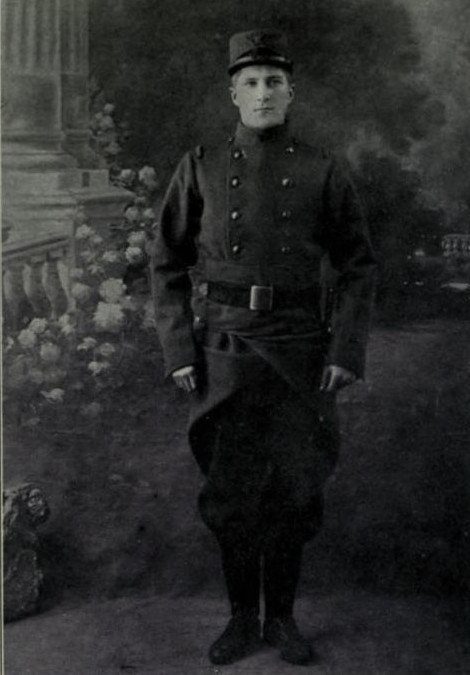
We got a complete outfit and Larney and
I had our pictures taken. I enclose one of
mine.
By looking closely at the cap in the picture
it will be seen that it has a cover on it. The
cap is made of red cloth, but that color being
too conspicuous a blue linen cover is worn over
it. The coat is blue and reaches to the knees;
it is buttoned back to allow free movement.
The trousers are bright red, but were found to
be such a good target at the beginning of the
war, that a sort of blue overall is issued at the
front to hide the red trousers. Patent leather
puttees are generally worn, but in this photo
I wear Douglas shoes. The regulation ones
are very heavy; by actual count each shoe has
one hundred and sixty-two hobs in the sole,
which is half an inch thick. I never thought
I would put my feet into things like them,
much less wear them.
A broad band will be noticed around my
waist. This is of blue linen and is fifteen feet
long. It is the positive insignia of our Legion,
and is not worn by any other division of the
French army. A broad leather belt with a
brass buckle supports the bayonet, the hilt of
which is visible at my left side. This is a
murderous weapon, and I do not blame the
Germans for being afraid of it. It is about
a foot and nine inches long and comes to a
needle point. It has four grooves, and each
edge is a quarter inch deep and one-eighth
inch wide at the hilt. It is half an inch in
diameter at the hilt. The gun has an eight
shell chamber and one shell in the barrel; it
is six inches longer than the present U. S.
army gun. With bayonet attached it is a
formidable weapon. This is our dress uniform,
the one we appear in when on the street.
The fatigue uniform has a cap or beret which
is comfortable and handy, a short blouse, dark
blue, no coat, the same pants and puttees.
The blue band insignia we always wear.
II TRAINING AT DEPOT DE LYON
Lyon,
December 12, 1914.
Reveille sounds at half-past five in
the morning; we are then served with
coffee, followed by drill till half-past ten when
we have dinner, consisting of rich soup, meat,
potatoes, etc. We get no sweets whatsoever.
After dinner we peel potatoes, and after that
drill till half-past four, at which time we have
supper, there being the same bill of fare as
dinner. We are free from five-thirty until
nine, when we have inspection and then sleep.
It is hard to get accustomed to the drill as the
commands are in French, and scarcely any of
the soldiers understand that language, even
slightly.
Last Sunday we walked through the city
in the company of an Englishman who came
from Ceylon to enlist. He is a “younger
son” and spends money lavishly when he has
it. At present he is not in funds.
To the east of Lyon is a range of mountains,
and on one of the highest mountains is
a church. We visited it while military service
was being held and the edifice was crowded.
It has the handsomest and most costly interior
decorations of any church I have ever seen.
It is called the Chapelle de Notre Dame de
Fourvière.
The view from the heights was magnificent.
Lyon is in a valley and has two rivers running
through it very swiftly. They say that Mt.
Blanc, in Switzerland, can be seen from this
church on a clear day. We saw many snow-capped
mountains in the distance, but as the
day was overcast we could not see the main
attraction.
Last Monday we were transferred to the
2nd company of the same First Régiment
étrangère. This is to be our permanent company
and it is in another barracks. The day
before we reached Lyon two Americans arrived
from La Rochelle where they had enlisted.
One had seen service in the Philippines,
in the cavalry, while the other had
served in the navy. So we were not so lonely
after all.
When we reached the new barracks we
found four more Americans, one of whom had
been in the army, another in the navy; one
was a doctor and the other a lawyer. The
doctor is forty-nine years old; he came over
at the beginning of the war to join the Red
Cross. The ex-army man fought in the insurrection
in Chili, and served in Mexico under
Villa and he works a machine gun. He has
since left us for the front.
These new barracks are located in a new
school house, not quite completed. Our room
is about ninety feet long and thirty feet wide;
it has a row of eight windows on each side,
and accommodates one hundred men.
At intervals of about a week volunteers who
desire to go to the front are called for from
the different companies. Of course we volunteered,
but were refused because there is a
severe form of typhoid in the trenches which,
it is said, kills a man in four hours. On this
account nobody is allowed to go until he has
been inoculated four times; we had not been
inoculated at all. The volunteers are put in
a special company and drilled separately.
Larney and I with the three other Americans
(the doctor not included) are in this company.
This Legion is the most cosmopolitan organization
in the world. In one corner of the
room you will hear Greek spoken, the next
group will be speaking Spanish, then German
spoken by the Swiss, Polish from another corner
and English from our crowd.
I saw a fight through interpreters. A
Greek got into an unintelligible argument
with a Pole and as neither could speak the
other’s language nor “parly” French, their
fellow countrymen were called, and they being
slightly acquainted with French, that was
the language resorted to. When all arrangements
were completed the combatants proceeded
to pommel each other, and before long
the interpreters were also engaged, and it was
a very lively party when the officers arrived.
There are many such happenings and they
afford much amusement.
We have had many sham battles and considerable
rifle practice. I now, five weeks
after reaching barracks, make an average of
four hits out of eight at a target of a man, life
size, at two hundred and fifty meters (298
yards). They call that fair shooting for the
time in practice.
The manual of arms is very different from
that of the Virginia Military Institute, but
the training I received there comes in handy.
I cannot understand the commands but generally
know what to expect.
All the men in our section have the same limited
knowledge of French, but they are able
to understand the orders. The weather is
warm; an overcoat is only necessary at night.
Lyon,
January 17, 1915.
I miss sweets very much. Many times I
have longed for a piece of pie, in fact for a
whole pie, but they do not know what pie is
over here. The pastry in the shops is wonderfully
light but ridiculously expensive, and our
pay of one cent a day does not permit investing
in it. Still we have indulged several times,
but it seemed like eating samples. I certainly
miss the sweets.
I also missed the Thanksgiving Day dinner;
we had nothing extra that day, so while eating
mine I thought of the folks at home and the
good things they were enjoying. But I missed
the Christmas dinner most; we received no extra
course here, so I contented myself with
philosophizing, and speculating on the next
Christmas dinner. Larney said he will have
his in Berlin, but I prefer mine at HOME.
We had the first fall of snow in Lyon this
morning. It lasted about two minutes. Instead
of cold and snow they have a rainy
winter. There have not been two successive
days without showers since I arrived in
France.
Trolley cars, with overhead wires, are used
in Lyon and they are run with a trailer. There
are many kinds; some are divided into three
compartments, one-third of the car being devoted
to standing room, and the other two
divisions being for first and second classes. I
have seen a car pass with the second class
packed as closely as they are in the New York
Subway, while the first class was empty. The
first class fare is double that of the second.
The car is started by a signal from a small
horn, and the conductor gives a receipt as he
collects the fare. Double deck trolleys have
been in use here for years.
I tried to learn the location at the front of
the First Régiment étrangère, but nobody
knows. There were six Americans here and
two have left for the front. We received letters
from them but they were not allowed to
give their location and the envelopes had a
number in place of the name of the post office.
Post offices near the front are no longer
named; they are numbered, and not in consecutive
order, for Secteur Postal 6 adjoins 109.
Soldier’s letters are sent free in France. Letters
of prisoners of war are forwarded free
(when they are forwarded) through all countries,
including the neutrals who are in the
postal union.
We learned that it is very cold where the
First Regiment is and that an Italian who left
here with the two Americans was given eight
days in prison for eating his reserve rations.
A shipment of volunteers from our company
left for the front three weeks ago and
last week we were assembled and a report read
stating that one of the men (giving his name)
was executed, having been caught in the act of
deserting. Considering these incidents, they
must be near the front.
We called at the American Consulate and
found the Vice Consul in charge. He had
served in the Philippines during the war. He
gave us New York newspapers and treated us
with great kindness. While there an American
doctor came in, who was disgusted with
travelling facilities. His passport had his
photograph attached. The paper was nearly
covered with official stamps and he came to the
Consul to get the U. S. stamp on while there
was still room, as every Tom, Dick and Harry,
he said, was desirous of spoiling the paper.
When he saw Larney and I and learned we
were from New York he became enthusiastic
and gave ten francs to each of us. Another
American gentleman and his wife came to the
barracks one evening with the Vice Consul,
and presented each of us with a package containing
pipe, cigarettes, tobacco and a neck
wrapper. We fully appreciated their acts.
The gentleman had given his auto to the Red
Cross and he drives it.
Great changes are taking place here. All
the Légionnaries who did not want to fight the
Germans were shipped to Algiers. Another
call for volunteers was made to all the companies.
Those who did not volunteer were
sent to Valbonne, a town about twenty miles
off. There are a great many men there and
they will remain, it is reported, until spring.
We cannot find out when we leave for the
front, but all of us hope that it will be soon.
On December 31st I was inoculated for the
third time against typhoid; it was the most
severe of the four inoculations. We were
treated at three p. m. and two hours after I
thought I would die. I was sick all of the
next day; at first I was troubled by a severe
headache, followed by chills and fever. The
fourth and last inoculation had no effect at all.
It may be interesting to describe how they
inoculate. First the doctor, who is called in
French, le médecin, asks you about the condition
of your throat, chest and bowels. If
they are O. K. he takes the flesh on the shoulder
blade (he used my left four times, the
right he rarely uses, and only then toward the
finish) between the thumb and forefinger of
his left hand, making a ridge of the flesh. The
hypodermic needle is forced into the flesh and
it felt to me as though it was pushed just under
the skin. The fluid is then injected; it leaves
a small lump on the blade until it begins to
work on the system. The quantity of serum
is gradually increased from the first treatment;
I should judge the first time about a
tablespoonful was used. Thank Heaven it is
over. I am ready to leave at a moment’s notice
now.
Larney likes the life. He was issued a good
overcoat, but was made to exchange it with a
man going to the front. He did not like the
first overcoat but was in raptures over the
exchange.
When we first reached Lyon the city was
alive with soldiers and it was surprising to
note the great number of different uniforms
the French army has. Of late, however, the
diminishing number of soldiers on the streets
is apparent. Most of the men were sent to
Valbonne or the front.
Everybody in Lyon seems to be working for
the army. Contracts are given to individual
families for uniforms and wherever you go
women and men are seen carrying military
clothing for the soldiers, while wagons
loaded with army clothes are very numerous.
All automobile works and machine shops,
even the smallest, are busily engaged manufacturing
shells and the arsenals are working
two shifts of men, one night and one day.
It seems to me that our army is feeling a
growing scarcity of rifles, as they are now
issuing to recruits an old model rifle of fifty
calibre. It is a single shot affair of 1867
model; rather awkward and crude. I have
seen large motor trucks returning from the
front laden down with rifles picked up from
the battle fields. After an overhauling the
guns will be used again.
I am struck very forcibly with the great
economy of the French. We did fatigue the
other day and it consisted of washing or rather
scrubbing with brush and water the shoes returned
from the front. I believe the bodies
are stripped of what can be used again.
Wood is scarce over here; it must cost more
than concrete. Concrete workers are very
expert and some finishing work I saw by them
was remarkable. These workmen, however,
would be useless in the States, as it takes them
too long to construct a building.
Everything is saved to the smallest item:
even pig skins are saved to grease with. They
are sold tied up in neat little rolls, and, I believe,
sold by weight. Everything is sold by
weight, even bread, which is excellent; no
bread in the States can equal it.
Last Sunday while we were walking along
the street a Frenchman stopped and talked to
us in English. He had spent seven years in
London. He was very pleasant and treated
us royally and escorted us back to barracks.
He invited us to call on him.
A party of four of us, three Americans and
a Spaniard, a few nights ago had a night
march, with manœuvres to take a fort. The
sergeant in command was a Frenchman with
no knowledge of any language except the
French, so he had great difficulty in explaining
the tactics to us. When we returned to
barracks we were given hot wine flavored with
lemon; it was good. To-morrow morning we
start at three o’clock for a long hike. They
believe in work here.
Lyon,
January 23, 1915.
We continue drilling hard; had a twenty-five
mile hike the other day. Started at half-past
six in the morning and returned at six in
the afternoon. We cooked our dinner and it
certainly was fine. We had wine, meat, fried
potatoes, cheese, bread and coffee. If we get
such meals at the front we will be well satisfied.
We are having night marches frequently,
and always get hot wine when we return.
Our section was put on fire duty Sunday
afternoon. At this duty we simply stack arms
in the court-yard and wait around. In case
of a fire in the city we are to keep the crowd
back. I think the main object of fire duty is
to keep the men in barracks.
When we arrived in Lyon I purchased an
English-French grammar but have had very
little time to study and the light in the barracks
at night is too poor to read by. But I
will do the best I can to learn as much French
as possible.
The censor does not seem to interfere with
our mail; none of the letters I received has
been tampered with.
We get all newspapers, magazines and other
printed matter, without any attempt by the
censor to examine them.
Our squad contains sixteen men and is divided
into two rooms. In my room are two
Americans (the Greek-American sailor is with
me), two Italians, one German-Swiss, who is
an excellent soldier, two Spaniards and an
Arab. One of the Spaniards has been in
prison twice and is now serving his third term,
fifteen days this time. One of the Italians is
a good soldier; the other is guilty of an unpardonable
sin, he snores. He wakes us every
night; last night the sailor threw a shoe at him;
when it struck him he woke with a jump, and
was going to take the sailor’s life, but his music
(?) had so provoked us that we were only
waiting for an excuse to rend him limb from
limb, so he wisely got under the covers. All
in all we have a pretty good room.
It is comical when it comes to conversation.
One day we talk English, the next Spanish,
the next Italian, but we all agree Divine Wisdom
was absent when the Arabic language was
constructed. When an Arab talks it sounds
as though he was choking to death. The language
consists of spits and coughs, and at
regular intervals a sneeze is employed to give
the proper accent.
Larney is in the next room with John Smith
(the fourth American), three Spaniards, a
Swiss corporal, a Russian and a Greek. These
three Spaniards are brothers and inseparable;
the youngest is about thirty-five years old.
They came from Argentina, having served in
the artillery there; they are three excellent
men. They were sent by the French consul at
Argentina.
One of the Greeks who came over on the
steamer with us and enlisted at Bordeaux, has
been reformed to-day, January 26th, and sent
back to Bordeaux as he has consumption.
This news completely nonplussed me as at the
physical examination he showed up the best of
us. He was well muscled and looked the picture
of a trained athlete. He intends to go to
Cape Town, South Africa, where he has a relative.
He is a good-hearted chap and I am
sorry for him.
Lyon,
January 30, 1915.
The number of Légionnaries training in
Lyon has been steadily diminished until only
one hundred remain. There are a great many
Frenchmen, however, training in Lyon. At
Valbonne, twenty miles from here, there are
about thirty thousand troops training, among
them several companies of the Legion.
Nearly all the public buildings are used as
hospitals, while the schools have been converted
into barracks.
The people are very pleasant and will go a
great distance out of their way to set a
stranger in the right direction. They are light
eaters; bread, wine and cheese are their mainstays.
A large amount of chocolate is eaten;
it is not as good as our milk chocolate.
The moving picture shows in Lyon are free
for soldiers. The people like the western cowboy
pieces. I saw a string of six push-carts
with advertisements of films in which John
Bunny appeared.
We are paid one sou, being the equivalent
of one cent, a day and pay-day every tenth
day. Our dissipation on half a franc can be
readily pictured. But we are furnished everything
we need, and there are no charges here.
Market days are Tuesdays and Fridays, and
on those days most of the public squares are
thrown open to the farmers who come to town
with long, narrow, two-wheeled carts, drawn
by everything from a dog to a horse. Small
donkeys, about three feet high, are numerous.
One frequently sees a dog harnessed with a
donkey; I saw an old woman teamed with a
dog drawing a fruit cart. There are some fine
draught horses; the animals work tandem, and
the driver walks.
Four-wheeled carts are very scarce. Auto-trucks
are used for transportation; many are
of the large, heavy type, but have steel tires.
Pleasure cars are numerous. The majority
have been taken for military purposes. They
are all built low and make considerable noise.
I have not as yet seen many asphalt covered
streets. Most of them are paved with stone
blocks, while in a great number of streets cobble
stones are used. Save in the main streets, the
sidewalks are narrow. As a rule the streets
are well lighted at night. A great many places
of business have signs “English spoken,” but
we have not yet come across one store wherein
English was spoken. The stores are open on
Sundays. Monday is the poorest business day
in the week.
The children have school, if soldiers are not
using the building, from nine to noon, and
from two to four p.m. School is in session
Saturdays but closed Thursdays.
III OFF TO THE FRONT
Lyon,
February 5, 1915.
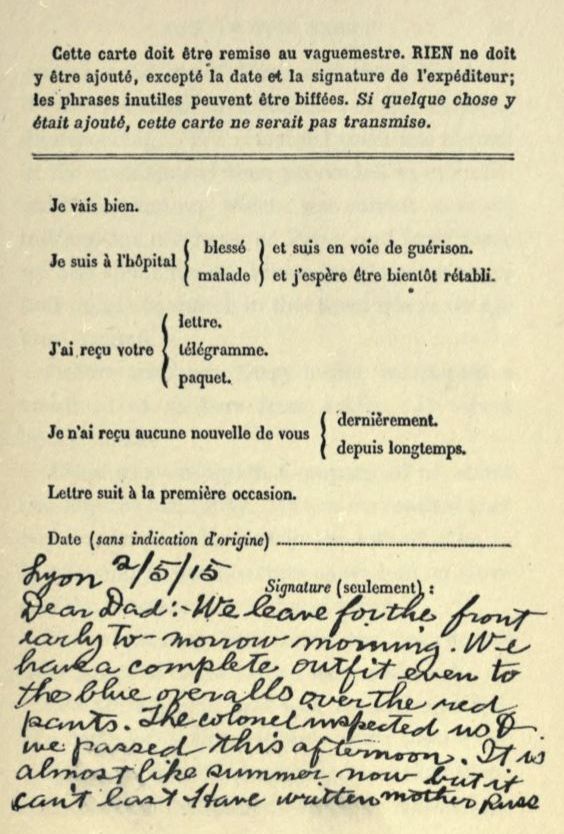
At last the order we have so anxiously
awaited has come; we leave early tomorrow
morning, February 6th, for the front.
We were given a complete outfit, which consisted
of one suit of underclothes, two pairs of
socks, a white cotton sleeping hat, two pairs
of shoes, a neck muffler and a jacket which
resembles a smoking jacket. These jackets
are all the same size, which is small, so that a
big fellow has a hard time getting into one.
There is no warmth in them, so most of the
fellows did not bother to pack them. I left
mine with the underclothes in Lyon, not having
room in the sack for them. We got blue
overalls to go over the red pants. We also got
a pair of mittens, but they are not much good.
We were given a loaf of bread, one can of
sardines, one and a half cans of fish paste, a
chunk of cheese and some chocolate for rations.
As a reserve ration we got two cans of bully
beef, hard tack, salt, pepper, tea, coffee and
sugar.
We also got one hundred and twenty rounds
of ammunition. We packed a blanket, and
half of a shelter tent with poles. The complete
pack weighed nearly seventy pounds; it was
very heavy.
The colonel inspected us thoroughly, and
we passed after close scrutiny.
The weather is mild and like summer.
Somewhere in France,
February 14, 1915.
We left barracks Saturday morning, February
6th, in a pouring rain, and our train left
Lyon at ten o’clock.
We arrived at Noisy-le-Sec, which is on the
eastern outskirts of Paris and about two hundred
miles north of Lyon, at ten o’clock Sunday
morning. We remained until ten o’clock
in the evening and then proceeded to our railroad
destination which was about seventy
miles to the northeast of Paris, and from there
we had about twenty kilometres (twelve and a
half miles) to march to this town where we are
now located.
Official Postal Card for Use of Soldiers
Before reaching Noisy-le-Sec we passed a
trainload of soldiers from India. It was a
husky outfit.
There was a complete Company of us, about
two hundred and fifty. When we reached here
our Section was located in the loft of a barn.
It was cold in our quarters as we had no stove
and the weather was cold and rainy.
Upon reaching this place, the reserve rations
given to us at Lyons were collected.
We are all well, and well treated and fed.
We have coffee three times a day; wine once.
We were divided according to nationalities.
Our Section contained, besides Americans,
Belgians, Swedes, Roumanians, Italians,
English and a pure-blooded Egyptian, who is
very dark.
This town is the quaintest place I have seen;
it has no sidewalks, and there was no idea of
regularity when it was laid out. There are
only about six stores, and I should judge the
place contains about three hundred people.
The butcher comes through here twice a week
with his stock of trade in a wagon. The principal
industry around here is grape growing;
farming is a side issue.
A short distance from the railroad station
there is a small river very near the canal. Over
the canal were once two bridges now both destroyed,
so we marched over temporary ones.
This was the first sign of destruction I have
seen since I reached France. They say the
French destroyed these bridges.
We drill here and the Colonel manœuvred
us the other day; he was well satisfied with us.
There is a high mountain range between us
and the firing line and from sunrise until night
we can hear the rumble of cannon; it sounds
like distant thunder.
The two Americans who left us in Lyon
have spent three weeks in the trenches. We
met them here during their rest which lasts
eight days. They have returned to the
trenches. The loss of life in the trenches has
been reduced to a minimum. There is a constant
rifle and cannon fire, but little damage is
done while the men remain in the trenches.
I miss all of my folks and often think of
New York. I am carrying a talisman in the
form of a Yale key which belongs to the front
door of our apartment. I have become attached
to it and would feel its loss keenly. On
the brace supporting the teeth is the word
“Security.” A person with a lively imagination
might find some hidden meaning in this.
Our sailor Pavelka formerly entertained us
every night with tales of his trip on the good
ship Dirigo from Seattle to England via Cape
Horn. Jack London made the same voyage
on its previous trip. It took our sailor one
hundred and fifty-nine days to make the trip.
After supper when stories are being exchanged
he usually starts with, “Now, fellows,
when I was on the Dirigo off——” He only
gets that far now, because, like most sailors,
he is very voluble and his tales of the sea have
become monotonous. However, we are a very
congenial quartette and get along well together.
Dad says he has a complete map of France,
giving small villages, but we are not allowed
to tell our location.
Dad was always good at puzzles: does he remember
this one?
1. The name of the place indicated by this puzzle is,
Bouzy.
We take long marches. The roads are excellent
and have a complete system of direction
signs. Just after we started on one of
these hikes I saw a sign reading “Rheims 24
Kilometres.” As a kilometre is five-eighths
of a mile, this was the equivalent of fifteen
miles.
Somewhere in France (Bouzy),
February 28, 1915.
Things are about the same here; the weather
is mild and we are having less rain. Ploughing
is almost finished and planting will soon
begin. From the outskirts of this place to the
summit of the mountain (about three miles)
the ground rises in a gentle slope which is completely
covered by vineyards. It is a great
wine country and from the heights a wonderful
view is obtained of this extensive and fertile
valley.
If Mr. Shortt’s son is anxious to join the
war, he can do so easily. I would advise him
to hurry up; by that I do not mean that the
war will soon be over; I know absolutely nothing
about that. If he is not ready to secure
passage immediately, he can slip over on a
horse boat, as I learn they are still importing
horses.
It is a matter of choice which Regiment he
joins, the First or Second. The Second contains
the most Americans and it recruits
through Paris; my Regiment recruits through
the southern ports.
I would strongly advise him to lose no time,
but sail immediately. It makes no difference
whether he knows French or not. I have often
told you of the great percentage here who do
not know the language. Let him bring as
much money as he cares to, because one cannot
do or see much on the salary they pay here
of one cent a day. Former military training
is not necessary, but on the other hand if he
has any glaring physical defects, he will not be
accepted. I was surprised at the rigidity with
which the examination was conducted.
He should bring two suits of good woollen
underclothes and about half a dozen pairs of
thick woollen socks. If he is going to bring a
shaving set it should be as small and compact
as possible. His comb and brush should be
small and he should bring a small mirror. He
should not bring many other clothes as they
will be useless when he gets into a uniform.
The army does not furnish a storeroom, so I
put mine in the Municipal Pawn Shop in
Lyon. They allow a very small loan, but it is
conducted by the government and is used by
many for storage of silver and other valuables.
Would advise him to bring a tooth brush in
some kind of a stiff cover to protect the
bristles.
Above all, impress him that he is not going
to be a tourist. He carries everything on his
back and believe me, after an entire day of
hiking, every ounce counts. The complete
pack with cartridges, rations, etc., weighs
nearly seventy pounds, so there is absolutely
no room for junk. I would advise him to
bring some sort of a leather portfolio (not too
big) to fit into his inside coat pocket to carry
personal papers, etc. He need not worry
about his outfit of clothes; the Army attends
to that. Show him in a philosophical way that
he had better come. He has a leave from college,
so he cannot lose anything by coming.
On the other hand he will gain a lot of knowledge
of the country, etc., and at his age it
should almost be compulsory. I tell you
candidly, if I was in his shoes I would get
over here if I had to ship on a cattle boat.
Well, here’s luck to him and I hope to see him
soon.[2]
2. The young man referred to is Allan Shortt, son of
Hon. William Allaire Shortt of Staten Island, New
York. He subsequently joined the Fifty-ninth Battalion,
Canadians, was attached to the machine gun section,
and became a lieutenant. He was missing following
an engagement December 10th, 1916, on the front
in France: he is now a prisoner.
Somewhere in France (Bouzy),
March 4, 1915.
I received the army hand-book to-day.
These books are given to each soldier and contain
an identification, list of crimes, penalties,
etc., and information about the bearer. In
case anything should happen to me, I give the
following information from the book. It will
simplify the searching of my records.
RUSSELL KELLY
ETAT CIVIL
Né le—13 Juin 1893.
á- New York.
Canton d- “ ”
Départément d- New York.
Residant á- Bordeaux.
Départément d- Gironde.
Profession d- Sans.
Fils de-
et de-
Domicilies á- Sans.
Canton d- “
Départément d- ”
Signalement.
Cheveux- Blonde.
Yeux- gris bleu.
Front-
Nez- rectiligne.
Visage- ovale.
Poids- 60 Kilos.
Taille- 1 mtr-75 centimetres.
Ou Engagé, Volontaire; durée guerre, le 24 n’bre 1914,
á Bordeaux, départément de Gironde.
Numéro de la Liste Mutrieule-997.
Translation.
RUSSELL KELLY.
SOCIAL STATE
Born the 13 June 1893,
at New York.
County of “ ”
Department of New York.
Resident at Bordeaux.
Department of Gironde.
Profession of—without.
Son of
and of
Dwelling at, without.
County of “
Department of ”
Description
Hair Blonde
Eyes gray-blue
Forehead
Nose straight
Face oval
Weight 132-1/2 pounds
Height 5 feet 9 inches
Where engaged; volunteer; duration of the war, 24 November
1914, at Bordeaux, department of Gironde.
Number on recruiting list—997.
A small aluminum tag is given us. I wear
mine on my left wrist fastened by the mess-can
chain. It is inscribed as follows:
Russell Kelly
EV 1914
Front side
Bordeaux
LM 997
Reverse side
The other day the Colonel inspected us and
grouped us according to nationalities: there
were eighteen groups. We were lined up and
the Colonel was giving instructions when an
aeroplane appeared, so we promptly sought
shelter. We all watch for an aeroplane and
when one comes we generally are marched to
quarters. Quite a number of 'planes are active
but it is almost impossible to tell to which
nation they belong. No chance is taken, however,
and we quickly get under cover. It frequently
happens that the sound of the motor
is heard before the 'plane is located. Last
Sunday night heavy canonading was heard.
It continued throughout the night, which was
remarkably moonlight, and kept us awake the
major part of the time. It must have been a
big battle; I never heard its equal before.
When small detachments are shipped from
here to join their battalions in the trenches
there is a great display of joyous feeling shown
by the men. They yell, sing, dance and rough-house
generally. One would imagine that
they are going to a festival. The New York
papers do not exaggerate when they say this
Legion is a fighting crowd. There are just
enough of each nationality so that one country
fights another. There has been a couple of
scraps here to date. The chief cook for our
section was an Italian and as he was dishing
up poor stuff, we four got sore and told him
he had better improve, but he did not take the
hint. The kitchen is located very near the loft
we sleep in, so one day when the meal was
particularly poor we reached out of the door
and heaved the whole business at him. It almost
completely demolished the kitchen. A
plate of meat and hot rice hit him on the head
and he jumped into the path of a bowl of soup.
He was a sorry looking dago when the avalanche
ceased. We are getting good meals
now. The other day we were nearly paralyzed
when he had fried potatoes for us.
A detachment of about eighty Greeks left
yesterday for the trenches. They were a very
wild crowd and when they marched out of
town they carried two Greek flags and were
singing Greek songs. They had Greek officers.
A number of the men had worked in the
States. One was a waiter in the Hotel Knickerbocker,
New York, but most of them had
worked in railroad gangs.
I went to mass the other Sunday: it was
served the same as in the States. The Church
is very old: the place for the altar is wider than
the pew space. The main altar is set back
from the others and it only is railed off. In
the space I mentioned as being wider than the
pew section are two rows of pews, one on each
side of the main aisle. They run at right
angles to the altar and, I take it, are reserved
for the élite of the town, as they are finely
made and comfortable, not to mention their
isolation. The regular pews are very uncomfortable,
being straight-backed, while the
board to kneel on is very narrow. The pews
are placed close together which cramps one
considerably. The organ is placed almost
among the rafters. The acoustic properties of
the building are poor. The structure is of
stone, the walls being very thick. Immense
stone columns, placed at short intervals, support
the roof. On the first column on the left
hand side of the aisle, about twelve feet from
the floor, a small pulpit is built and is reached
by a circular staircase. The floor is of marble.
Instead of tableaux, cheap pictures show the
Stations of the Cross. Lamps and candles
furnish the light: no provision is made for
heat. The windows are of stained glass and
rather artistic. There was only a scattering
of people, mostly women in mourning. A few
soldiers attended.
As I have said this is the Champagne country;
vineyards exist in abundance and at the
present time they need attention; the ground
around each vine must be loosened. Most of
the men are in the army, so nearly every one
in town turns out to work. Old men, old
women, middle-aged women, young women,
boys and girls and even children labor in the
yards. I have seen grey-haired women bent
almost double over the short three-foot hoe in
use here. Everybody works, they work hard
and with a will. From their appearance, the
grapes will not suffer from lack of attention.
A few nights ago just as I was on the point
of going to sleep a soldier came rushing
through our quarters yelling “Fire.” In two
shakes of a lamb’s tail we were all downstairs,
formed in ranks and on double time in the
direction of the fire, and as it was only a short
distance off, we were soon there. As is the
local custom, the house was set back and shut
off from the road by an eighteen-inch brick
and stone wall covered with cement. Next to,
and in fact part of the house was the hay shed;
some cavalry men were quartered here.
When we came into the courtyard the shed
and nearest half of the top or second floor of
the house were in flames. Already some of
the furniture had been carried out from the
ground floor rooms, and taking the hint, we
rushed through the doorway to bring out
more. It was one of the best houses in town
and well furnished. By this time nearly everybody
in town had arrived, but there was no
sign of any fire fighting apparatus, and the fire
was quickly destroying the house. Soon there
were many triumphant cries, and with much
gusto the Fire Department of Bouzy burst
upon the scene, and was greeted by the crowd
with many acclamations of joy. The Fire Department
was carried by eager hands, and seeing
a couple of vacant inches, I took hold.
Everybody was yelling and giving orders, so
the Department was carried all over the yard
and frequently came near being deposited on
the ground, when some one with an extra loud
voice would tell of a more advantageous spot,
so there the Department would go. This procedure
was kept up for about five minutes
before the machine was placed.
It consisted of a heavy iron tank four feet
long, three feet wide and two feet high with
two cylinders and a long two-handled bar for
the man-power. Soon the hose was arranged
and men formed for a bucket-brigade. Think
of it: a machine to which the water must be
brought and then pumped through the hose to
the blaze. It was a long time before the water
arrived and we frequently had to suspend for
lack of water. Smith mounted to the roof of the
building and Larney was conspicuous on an
adjoining roof. Just as Smith reached the roof
a stream from a nearby house started to play,
but lacked force enough to reach the flames; it
landed directly on Smith and continued playing
on him. In a short time he was drenched
and the spray also wet Larney through.
Well, to make a long story short, the building
was completely destroyed, but no damage
was done to any nearby structure. Smith
slept in his wet clothes and the next morning
when he unrolled from his blanket a cloud of
steam arose. He surely must have had an enjoyable
evening trying to sleep.
The helmets worn by the firemen were of
brass and resembled the German helmet, only
lacking the spike. They were highly polished
and quite showy.
IV IN THE FIRST LINE TRENCHES
Somewhere in France (Bouzy),
March 7, 1915.
We were outfitted unexpectedly this evening
and are busy packing and getting
rid of excess weight so as to start early to-morrow
morning for the trenches. The men are
glad at the prospect of getting into the game,
and are making considerable noise and having
a high old time.
(Place Unknown),
Wednesday, March 10.
At half-past five o’clock last Monday morning
we were up and ready to start. We left
Bouzy at a quarter to seven by the town clock.
After several rests we reached a fair-sized
town and had lunch: we were served hot coffee
here. After a spell in the trenches the men
return to repose in this town.
We were divided here to be placed in different
battalions, etc., and I was glad to learn
that we were lucky enough to be sent to a battalion
which was then occupying the trenches.
We left town together and proceeded on our
way which led through the greatest vineyards
I had yet seen. We paused in a barn for a
short time and started off again. There were
about ten of us; Smith and Larney were with
me; Pavelka we left in Bouzy as he is sick. I
do not know what is the matter with him, but
it does not amount to much, whatever it is.
We finally arrived in what was once a town.
I say once, because as a town it ceases to exist.
It had contained, I should say, about two or
three hundred houses. While in New York
I had read of the towns that were destroyed in
the war, but the realization exceeded my most
elaborate ideas. There was not a building in
the entire town which had not received its
share of destruction. We walked through
several streets looking for somebody to direct
us but could find no one. The place seemed
deserted; and what a scene of ruin. Here was
the church with gaping holes in the roof and
one side with four openings large enough to
drive a team through. The other sides were
battered and the steeple was blown off. It is
impossible to convey any idea of the ruin
which was everywhere seen. One row of four
houses had the connecting walls completely
destroyed. In the entire town there was not
a house with its roof left, nor a pane of unbroken
glass.
We finally located a sentinel who showed us
headquarters, where we were assigned to our
companies, etc. After lunch we were to proceed
to our trench. While waiting for the repast
an occasional shell whistled by and exploded
a short distance beyond. Very pleasant,
I assure you. We finished the meal and
were ready. A short distance from the
kitchen, to my great surprise, we entered the
famous trenches. Here we were at last. I
wish I could express my feelings when I
realized where I was.
It was simply the connecting trench which
allowed the men from the line trenches to proceed
to the kitchen and get the meals. The
Germans have a disagreeable habit of shelling
these trenches at meal time and quite a few
accidents have occurred in them. They are
about five feet deep and very narrow. The
earth is thrown up on both sides, so they are
quite deep. They curve in a horrible fashion
and it was not long before I was dizzy. Meanwhile
an occasional shell went merrily by.
The trenches are so narrow that it is difficult
for two men to pass. We continued on and
passed the entrance to the second line: after a
while we stopped. Where do you suppose we
were? We were at last actually in the first
line of trenches.
We were taken to the lieutenant, who assigned
us to our squads. The first thing we
did was to place our rifles in holes in the trench
facing the Germans. I looked over the top
of the trench in the direction of the enemy but
could not distinguish much, as it was beginning
to get dark. They were there, however,
there was no question as to that for an occasional
bullet whistled by. An intermittent fire
is kept up continually by both sides. Larney
and I were put into the 15th squad and Smith
in the 14th. We were assigned to our quarters.
The firing line faces the Germans in a zigzag
way. There is a trench running parallel
to and back of it. They are connected by
trenches in which are placed the living quarters
of the men. There are two caves or huts
opposite each other in an alley. Of course
they are underground. They are about three
and a half to four feet high and about twelve
feet deep. There are six men in ours. When
lying down it is impossible to stretch one’s legs
out, consequently you are pretty well cramped
after sleeping.
I was tired after our long march, so prepared
to turn in, but found that we were to be
on guard during the night. We turned out
presently and I was placed with another fellow
in a trench about twenty yards in advance of
the main one. We were in back of steel
shields with our rifles loaded and on the watch
for a German. The fellow I was with was an
Italian, so there was little conversation between
us. We were there two hours and it was
very cold. We saw nothing alarming. Both
sides exchanged shots occasionally. I was
very glad to be relieved, as a cold wind was
blowing. We went into the guard room and
it was not long before I wished I was on post
again. There was no fire in this cave and the
ledge upon which we sat was about four inches
wide. It was also cold in there. Finally we
went out on patrol. We put the bayonets on
our guns and laid down on the earth. I was
in this position two and a half hours. Let me
here state that I think I have enjoyed two and
a half hours more at other times during my
career. This sharp, cold wind continued, so
after a while I was naturally chilled. There
was no danger, however, as I estimated that
the nearest bullet which passed us was at least
twenty feet distant.
Nothing happened and at last we returned.
I was very sleepy and in due time turned in.
After sleeping about an hour and a half I was
awakened as the captain wished to inspect the
new men. After the inspection I had a good
sleep: slept most of the day and all the night.
It is rather uncomfortable in the cramped position
but it is possible to keep warm when under
the blanket.
The meals are good, but only lukewarm,
as they have to be carried quite a distance.
During the next day we left the trenches and
returned to the town to repose. We are here
now for eight days. It is very comfortable
here. Another American was put in our
squad; he is from Boston; has been in France
five years and the Legion five months; in the
trenches three months. He is a fine fellow.[3]
3. Kenneth Weeks of New Bedford, Mass. Killed
June 16th.
At present, things are very quiet. I think
we made quite a record; from a reserve training
station, put in the first line trenches and
the first night there put on patrol and two days
after that sent with the Battalion on repose.
After this letter I will not be allowed to send
any mail to any place for about a month.
Well, mother, I am nearly a full fledged soldier
now. You would be surprised to know
how glad I am to be where I am.
Somewhere in France,
March 12, 1915.
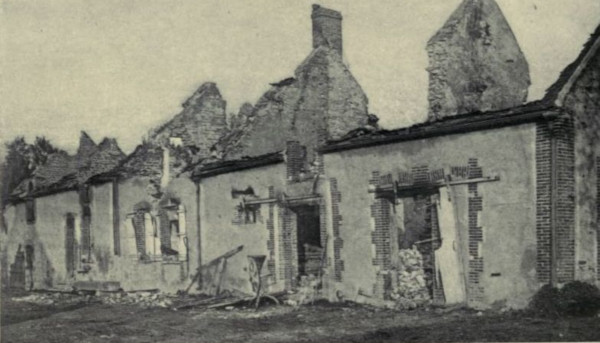
This is a good picture of the actual sights
where I am now. Whole towns are like that
shown on the other side. All well.
French Houses Burned by Germans
Russell.
Verzenay,
April 9, 1915.
On March 26th we returned to the trenches,
and the routine was the same as before, just
the continual rifle and artillery fire and very
close watching of the enemy. The trenches
are dry now and fairly comfortable. We are
all in tip-top shape and enjoying ourselves;
the only thing we want is some action.
We are located in a place called Verzenay,
which is about ten kilometres (six and a quarter
miles) north of Bouzy. The first line
trenches that we occupy are about five kilometres
(three miles) north of the town. Verzenay
is on the side of a high hill, the trenches
being in the valley; a grand view of the town
is had from the trenches.
I should judge the town has, normally, four
to five thousand inhabitants. The Germans
throw ten to fifteen shells into it daily, but
they do little damage, and more than half of
the civil population has remained here.
We were scheduled to leave town one night
for the third line of defence and had our packs
made up when in came a fellow who wanted
to see the Americans. He was an American
from the Second Régiment étrangère, and had
been transferred at his own request, and as
the authorities are following a plan of segregation
by nations, he was sent to our squad.
I was agreeably surprised to learn that he had
been at Virginia Military Institute; he is
Kniffin Y. Rockwell. His arrival brought our
number up to five.
Kniffin Yates Rockwell
In due time we left and during the night
reached our destination. They were the usual
huts dug into the side of a slight terrace supporting
the canal. They are about four feet
high and six feet wide and long enough to accommodate
a squad of fifteen men. They
have been in use since the beginning of the war
and fresh straw has been put into them at intervals.
The old straw, however, has not been
removed and when the men change quarters
they leave behind them all discarded junk, so
you can imagine the condition they are in.
When I first arrived I tried to clean up, but
the deeper I got into the straw the stronger
the philosophy impressed itself on me that
“what one doesn’t know won’t hurt one,” so I
put back the straw and let it go at that.
There are a great number of rats and mice
in the huts and the first night an energetic rat
loosened a mass of earth above my head and it
fell directly upon me. It gave me a great
start as my first thoughts pictured a company
of Germans on us. These rodents are a great
nuisance on account of their large numbers
and I have often wished there was a Pied
Piper amongst us.
There is one man in the company who does
not share my feelings. He is an Italian who
is used to a strange diet. Every morning
about nine o’clock he sits down and spreads
out his victims of the night: they generally
number five or six. He skins these and as he
is a friend of the cook they are roasted for him.
There is no question of his liking for them because
we always have more than enough to eat.
I have seen many strange things over here, but
the cold-bloodedness of this fairly turns one’s
stomach.
There is not any regular schedule pursued
here, but they always manage to keep us busy.
During the second day Pavelka joined us from
the hospital, which made the number six. This
fellow is very handy and volunteered to make
us a base ball. For the centre of the ball he
used the business end of a cartridge and on this
wound worsted and thread alternately. For a
cover he cut up a leather puttee and sewed it
on the ball. The complete article was really
very good and it rivalled Spalding’s Official
League Ball. Old A. G. would have given
considerable for it for exhibition purposes, but
he will never get it. Home-run Scanlan, the
heavy hitter, drove it into the canal and we
lost it. He also broke up the game, much to
the chagrin of the entire company who had
gathered around to see us play. We had fun
while it lasted, and we intend to make another
one when we go back to the canal.
Aeroplanes are very numerous. There are
so many that it became necessary to resume
the aeroplane guard. Each section takes turns
at this and it lasts from sunrise to sunset.
Every time a German aircraft flies within
range we fire at it. This occurs many times
and considerable ammunition is used but no
damage done. These machines warn us of
their approach before they are located as the
sound of the motor carries a great distance.
Both armies shoot at the 'planes with cannon
also.
It is quite interesting to follow the course
of an aeroplane. Take a German one, for instance.
We may be cleaning up when the
faint whir of a motor is heard. Work ceases
and all eyes try to locate the machine. It
proves to be an approaching German 'plane.
When the probable range is computed our
artillery opens fire. The report of the piece
is heard and we look in the vicinity of the aeroplane
for the result. In a couple of seconds a
puff of smoke is seen and shortly after the
noise of the bursting shell reaches us. It is
almost impossible to hit it. I have seen a great
number fired at, but as yet, with no results.
Another thing to be remarked upon is the
intrepidity of the aviators. They don’t seem
to pay any attention to the bombardment (if
we may call it such). One beautiful afternoon
while I was in the first line, a French aeroplane
made for the enemies’ lines. The Germans
saw it coming and opened fire, using
three pieces. The sky was cloudless, so I
counted the puffs of smoke: they appeared all
around the plane, but in spite of this the airman
continued on his mission and actually got
out of range behind the guns. All told there
were sixty-eight shells thrown. For fifteen
minutes after, it was possible to count the
puffs. I have often wondered when the shells
explode near an aeroplane and do not damage
it, how it is that the concussion does not in
some way injure the delicate parts of the machine.
We have not seen an aerial combat, but
all root for one.
On our first repose here in town we were
treated to a bath: it was a great event. A
soldier holds a hose with a sprinkler arrangement
on the end and two others man the pump.
First we are allowed a little water to get up a
lather, then the master of ceremonies at the
hose bellows a command and the boys at the
pump bend to their work with a will, with the
result that there is a free-for-all fight to get
into the spray. It is rather a crude method,
but as the water is hot we are very thankful
for it. I had my second yesterday and we
hope to bathe daily at the canal.
This canal reminds me greatly of the old
Erie, save for the locks. Changing levels is
accomplished by one single lock as against the
single and double locks used on the Erie.
Canal boat fleets are unknown in this country:
the boats travel singly and are towed by horses.
Considering the depth and width of the canal
and the general appearance of the banks, one
can almost imagine he is travelling through
New York state on the old waterway. The
type of boat used is practically the same as
ours, save that over here they are somewhat
larger and with a more pointed bow.
The other night Weeks took us out to dinner:
the meal was served in the home of one
of the native vineyard workers. We all filed
into the kitchen of the house. This room was
located on the ground floor and had a window
opening onto the street. It served also as the
pantry, dining room, and was also used for
minor purposes. It was about ten by twelve
feet. A common kitchen table occupied the
centre of the room under a hanging oil lamp.
There were eight chairs (the majority rickety)
scattered around, and the deep window
sill would accommodate three persons. Into
the corner opposite the main door was fitted a
triangular closet which accommodated odds
and ends; the wine supply was kept here.
Curtains decorated the window; the floor was
bare. They used a good range.
Weeks was acquainted with the family as
he had dined here throughout the winter when
on repose. They also did his and other soldiers’
washing and the clothes were hung in
this room on lines from the walls to dry; consequently
one was uncomfortable until seated.
After a while our host gave his order and the
woman went to purchase the food. Meanwhile
children of the family were constantly
coming and going. After the sixth had made
his appearance I grew confused and decided
not to try to keep track of them. They certainly
were numerous, and starting from four
feet six they descended in regular intervals of
six inches down to the young baby, making a
natural stairway for Father Time.
The food came at last; it was a chicken and
some incidentals. The next thing was to prepare
the chicken for the pot. The good housewife
searched high and low for a knife, and
failing to locate one borrowed Smith’s famous
weapon (he paid six sous for it in Lyon at a
bazaar). Ah! I forgot. She singed the fowl
first over the table around which we were
seated. This was accomplished by means of
burning newspapers, the ashes of which fell
into the wine. We did not mind this, only the
smell of burning hair was rather disagreeable.
I had recovered from this, when, picture my
chagrin, the good lady started to butcher the
bird right under our noses and placidly
strewed the table with the chicken’s guts. I
think grape picking trains the hands to quick,
vigorous action; anyhow, the way those giblets
and other parts of the chicken’s anatomy were
flying around caused us to dodge continually,
and with great foresight I placed my hand
over the glass to protect the wine.
The lady was not an expert butcher; when
she could not locate a joint the members were
torn apart by main strength. As for the flesh,
it was actually ripped off in shreds and the
whole business thrown into a pot. Smith’s
heart was almost broken as the blade of his
knife was bent all out of shape: it was ruined.
The meal consisted of rice, soup, fried chicken
and bread, with coffee at the end. It was very
tasty, indeed. What struck me forcibly was
the way the children ate. They came in just
long enough to swallow a few mouthfuls.
Through carelessness I think the young folks
are not receiving the proper amount of
nourishment. Anyway the children of France
do not shape up as being sturdy. We all enjoyed
the novel incident greatly.
We eventually got to the first line again and
occupied the same hut as on our previous stay.
There were seven of us in there, six Americans
and the corporal. It was not wide enough
to lie cross ways, so we slept at an angle. It
reminded me of the story of the six men in one
bed; when a man became tired lying on one
side and gave the signal to turn, all turned at
once and if any one failed to hear the signal it
broke up the party. This was the case here;
we were cramped to an uncomfortable degree.
The first night we were disturbed by a great
racket. It proved to be Smith forcing Larney
back into his proper location. It might be well
to remark here that Larney is a considerable
sleeper. He talks almost nightly and would
you believe me, back in Bouzy he actually sang
one verse of “My Country, ’Tis of Thee.” It
was in a far away, hollow voice, but he carried
the tune fairly well. Some nights we grow
alarmed over his welfare; he groans and
mumbles so.
At the first line we are on guard every other
night, and as the weather was cold it was not
very enjoyable. One night I was on guard
from one a. m. to three a. m. with Larney. We
were in a trench running at right angles from
the main one and about twenty feet from it.
It is so arranged that the earth is on a level
with our eyes. You would be surprised to
know how hard it is to keep awake. Even as
near the enemy as we are, an almost unconquerable
desire to sleep overcomes us. It must
be that the constant searching and the straining
of the eyes into the darkness hypnotizes
one, but be this as it may, it required a great
effort to keep awake. We all complain of
this.
On the night I speak about, I was struggling
to keep awake when all of a sudden my heart
almost stopped beating. I was thoroughly
wide awake instantly: I could have sworn that
there were two figures directly in front of me
about one hundred and fifty feet away. One
seemed to be standing and the other kneeling,
and as we maintain a trench running parallel
to the main one and about one hundred and
fifty feet beyond, my mind pictured all kinds
of things. I watched them intently and they
seemed to be working at something, but in the
uncertain light it was maddening. The large
figure appeared to be motionless but the small
one seemed to rise and bend like a man at a
pump. This continued for what seemed ages.
I am well aware that at night objects take
strange forms, but I could not account for
these. Our rifles are constantly loaded and
cocked while on guard and I was tempted to
take a shot at it, but I wanted to see them
actually move before I fired. I looked over
and saw Larney observing the same thing.
We talked it over and decided that it was
part of the landscape; the next morning we
went into the trench and came to the conclusion
that it was two trees.
Another time while on guard in the second
line position, I was looking out of a small port
hole in the trench. I had just come to the
conclusion that guard duty was a waste of
time when I saw what looked to be a figure
crawling slowly under the barbed wires in
front of the trench.
It was a wretched night, raining and very
dark. I could have sworn that this was really
a man. I almost pictured him freeing himself
from the barbs. I thought a better view would
be gained from over the trench, so I noiselessly
climbed up until my head was clear of
the earth, but it was impossible to see when my
eyes were above the surface of the earth, so
I got back again.
The object was still in the same position.
Would you believe I actually kept my eyes
glued on the thing for nearly two hours. A
number of lights were sent up by both sides,
but their positions were such they did not help
me. Finally, a German white light went up
in a direct line with my eyes and the object.
What do you think my creeping German was?
Nothing but a frame to roll wire on. I certainly
was disgusted when I made this discovery.
One cannot help imagining things. Everything
keys the imagination up; the steady rifle
fire, the occasional cannon, the bursting mines,
the flare of the night lights and distant bombardments
all tend to put one in a condition
to see anything.
It is interesting to observe the difference of
speed between sight and sound. For instance,
a cannon far in our rear will discharge a shell;
the flash is visible from the piece, the whir of
the shell as it passes is heard, and the flash as
it bursts is seen, then both reports sound almost
simultaneous, the discharge of the gun
and bursting of the shell. This, of course,
only happens when one’s position is almost in
the middle of the trajectory.
Another idea of mine which was shattered
by actual experience was the action of a bursting
shell. From war pictures I drew the inference
that at the moment a shell bursts it
was possible to see the fragments; not so. The
report of the piece is heard, then the whistle
of the shell, a puff of smoke is seen and finally
a loud report. That’s all, but believe me there
is a great deal of power in a shell.
In the second line the quarters were fair.
Wide enough for us to stretch out and about
five feet high. Each one accommodates a section.
The condition of the straw was the same
as described before. One night it began to
rain and in about half an hour the rain soaked
through the earth and dripped on us. We
hung our shelter-halves up under the roof to
catch the water. These covers performed their
duty O. K., but the water leaked in all around
them. The first night was not so bad, although
the place was wet in spots. It rained during
the second day and things became worse: the
trenches were in an awful condition, the water
being ankle deep in places and the mud beating
Cedarhurst’s best to a fare-you-well.
That night, however, was the worst of all.
The rain was dripping through pretty steadily
and it had begun to get the best of the tent
covers in spite of the fact that we emptied
them regularly. We eventually turned in and
as an almost steady stream was dropping on
my head I put my overcoat over it and grappled
with Morpheus. I had him flat on his
back and was about to rise to the cries of the
spectators when my subconscious mind differentiated
between the voice of applause and the
wail of dismay. Instantly I was awake and
poked my head out to see what the fuss was
about, but the steady stream forced my cranium
under the coat again.
Out of the confusion I gleamed that a tent
cover had fallen with the weight of the water
and drenched a Greek, two fellows down from
me. He was very active vocally: I’ll bet he
cursed a few. We were all very uncomfortable.
I was telling myself how good it was to
be dry when I realized that I was not as dry
as I might be. From my shoulders to my
feet I was awash in three inches of water. It
surely did feel fierce, but it was impossible to
better the condition as everything was wet.
It was only two a. m. and I prayed for day-light.
We managed to dry out pretty well
during the day.
I wish we had some of those new patented
trench digging machines the World’s Advance
tells about, because I have dug about one thousand
miles of trenches, or nearly that many.
We are constantly digging new and repairing
old trenches, so now we have an elaborate system
of underground streets.
I certainly do feel fine and enjoy the life,
but there is no question about it, war is an
asinine thing.
V REMOVED TO THE ARRAS SECTEUR
(Place Unknown),
May 6, 1915.
For many days we knew something was in
the wind, but what or when it would happen
was a puzzle to all. Some said we were
going back to Lyon for a repose, while others
maintained we were hound for the Dardanelles.
Finally we got orders to pack all our stuff
and be ready to move during the night. About
midnight, April 24th, a French regiment relieved
us and we marched out of Verzenay. It
was a very disagreeable night, and coupled
with a chilly, penetrating fog and the rather
forced march, we were more or less fatigued
when we reached a small town at about five
o’clock the next morning: our escouade
(squad), the 15th, was assigned to a sort of
cow shed. The ground was as hard as a rock
and as cold. We turned in, but tired as we
were, it was impossible to get much sleep, although
we tried to sleep during the day. At
five in the afternoon we went up town to see
what the place was like; it was a small place
with about six stores and overcrowded with
soldiers.
When we got back I started to read periodicals
received from New York. Outside there
was a small yard with a squad kitchen on one
side and our quarters on the other. I’ll stop
here a second to say a word about the men in
our squad.
The corporal could be most anything but
I think he is Arab-French; he is a quiet fellow
and O. K. There are four Légionnaires with
us; one of them has served fifteen years with
the Legion and another about ten. These two
are naturalized Frenchmen and fast friends.
The old-timer has a huge beard and is a very
quaint character. I enjoy watching him; he
reminds me so much of those gnomes who used
to interest me when I was small. The other
fellow is short and very brown. The way they
confide in each other is really ludicrous. When
one has an imaginary illness he takes the other
aside and they get their heads together and
sympathize with each other; it is laughable.
As they share their sorrows they also share
their joys. You buy their kind of joy by the
canteen full, and believe me they are a joyous
pair. The old fellow has been joyous for about
fifteen years.
The other two Légionnaires are Belgians
and unimportant. Then we have two Italians
who remind me of brigands. One is a big
husky fellow and the other is a typical dramatic
villain; good looking, dashing and all
that stuff. We have an Italian kid with us,
but he is only a nuisance. The two brigands
take an interest in him to the extent of continually
kicking and cuffing him around.
Well, as I was reading the magazine I heard
a noise in the yard and upon going out found
the six-foot corporal slugging the five-foot five
Légionnaire. I was glad to see it because the
little fellow needs a beating. He talks too
much. Weeks was out there and did not like
the unevenness of the fight so he interfered.
The big brigand then came up and hit the
little Légionnaire a “beaut,” knocking him
across the yard. The little fellow got up just
in time to be knocked back across the yard, and
the big fellow was going to repeat the performance
when Weeks interfered again.
By this time we were all out in the yard enjoying
the fun. The argument got pretty hot
and finally, as usual, the peacemaker got a
wallop in the jaw. The American section
acted as if they were all hit, and in fact they
were when one of them was hit. In a fraction
of a second it was the biggest free-for-all I
was ever in or hope to be in. We battled
around the yard to a fare-you-well and in no
time the guard was on the scene with fixed
bayonets, but we still kept on.
In a lull in the action I happened to look
around in time to see the villainous looking
bandit picking up a brick. I made a bee-line
for him and in no time had received a good
clout on my bean for my trouble. The guards
eventually separated us, but the Americans
carried the day. They started to take me to
the lock-up but I landed at the infirmary and
had my head bandaged. They locked Pavelka
up, but he should have come with me, as a
friend of the bandits hit him on the forehead
with a dish pan. He needed bandaging and
soon was sent back for treatment. We all
shook hands and called it square.
The next day we marched to the railroad
and came north. It was a wretched trip as we
were packed closely in freight cars and it took
twenty-four hours to come two hundred kilometres,
being about one hundred and twenty-five
miles. We left the cars at a town called
Aubigny, which is about six miles due west of
the village of La Targette, but we located in
a town nearer the front. At night we marched
to the trenches and worked there. It was very
dangerous: the outposts being about fifty
yards apart. One night the second fellow
from me was hit in the stomach. It is good
to work under such conditions, as work takes
the mind from the bullets; inaction under fire
is a terrible strain on the nerves.
We were in the trenches three days, worked
all day and at night we went out on the field
and laid down four hours at a stretch, to guard
against a surprise. To make matters worse it
rained and the mud was a foot deep in places.
We went back to a small town, arriving there
at ten a. m.
We have everything in abundance. I have
seen fellows throw shirts and other articles
away, rather than wash them, as new ones are
always given. There is actually more than
enough of everything. We are living like
princes.
I was glad to hear that my letter from
Bouzy was received. Allowance must be made
for the writing as it was done on a two-by-four-foot
plank, which I straddled, my feet
dangling. We Americans were all interested
in the statement in the letter to me, that it has
been said the Germans would treat Foreign
Légionnaires who were not citizens of France
as irregular soldiers; and the suggestions made
for us to observe in case of capture will be
followed.
VI BATTLE OF ARTOIS; AT LA TARGETTE AND NEUVILLE ST. VAAST
Somewhere near Aubigny
May 16, 1915.
On Sunday morning, May 9th, we were
routed out at one o’clock and marched
to the trenches, reaching the third line at sunrise,
and at five o’clock our artillery increased
its already very severe bombardment,—the
continual rumble and vibration being beyond
description. This lasted until ten o’clock and
as soon as it stopped, Battalion C in our section
left the trenches, charging with the bayonet.
They carried the trenches with great loss.
I understand the Germans were panic stricken
by the bombardment and one of their battalions
was buried as the trenches collapsed
under our heavy artillery fire.
Battalion A followed C and lost a great
many; there are two Americans in A, one
of them is O. K. while the other was shot
twice, in the shoulder and in the leg.
Our Battalion B left the trenches right
after A under a heavy rifle and machine gun
fire, the ground we crossed being well strewn
with dead and dying of Battalions C and A.
We charged across fields in a line of skirmishes,
and I will never be able to satisfy myself
how so many of us got through safely.
When we reached the first line of German
trenches we found them battered and destroyed
by our bombardment. Soon after crossing
them our first stop was in the shelter of a road.
Here the good looking bandit, the fellow who
hit me with the brick, got reckless and tried to
survey the landscape; he was killed instantly
by a bullet through the heart. No convulsive
tossing of the arms one reads about or sees in
the movies—he just sank down and it was all
over. Soon after we left this position, the
other bandit was shot through the leg. There
was absolutely no ill feeling between us on account
of our scrap.
We then laid down on the ground and soon
the Germans got our range; six men close to
me were hit; so we started on again.
The German artillery had opened on us,
and the suspense of lying there and waiting
to be hit is indescribable. The shells were
bursting all around me and one rushed by so
close that I actually think a chunk of solidified
air hit me on the forehead; anyway, something
bruised my forehead. I rushed over and got
into the hole, it was five feet deep. I happened
to be looking where four men were
lying, when a shell blew the four of them to
dust.
In my letter from Lyon I mentioned three
brothers from Argentina; they were inseparable
even in death; they were killed side by
side.
We finally took the crest of a hill, it was
dusk and we dug ourselves in.
I shall never forget the picture displayed as
I looked back across the field in the fading
light. It is a nightmare: during the entire
night the cries of the wounded rang out. I
had a pleasant bedfellow,—a corporal and he
lay in the trench, only two feet away. He
actually fascinated me. I could not help looking
at his brains which stuck out of the back
of his neck, exactly like two horns. During
the next day they gradually melted until at
nightfall they had slid entirely off his neck.
Grand, grand indeed, is this butchery they call
war!
During the night we were on the watch, and
at times the fire from the enemy, aided by the
German night-lights, was severe.
As day broke Monday we were ready for
the counter attack, which was sure to come and
it came early and fierce. Their artillery
shelled us in a most desperate manner, and
men were killed and wounded in large numbers
and very close to me; and again the suspense
of expecting to be hit by a shell was
horrible.
Bavarian troops were opposite and they
made a rush for us, and I am bound to acknowledge
that no human beings could have
shown more bravery and determination than
they did: but our artillery was most effective,
and we stood firm in our trenches and smeared
them. Their counter attacks all failed and
that night we still held the trenches we had
dug.
We were entirely out of water both Sunday
and Monday, and as a consequence suffered
very much.
Early the next morning, before daybreak,
reserves took our places and what was left of
our regiment returned to the rear for reorganization.
I laugh when I try to think of civilization.
But with all we must admit it is a great world
and I do not regret that I am here.
Somewhere near Aubigny,
May 20, 1915.
A sergeant was commanding our Company,
all the officers having been killed or wounded.
Our captain was a very game man; he led us
without a sword or any side arms, only using
his swagger stick. He was killed by a shell.
We advanced by sections. When the order
came we jumped up, and carrying a sack
as a shield, ran about one hundred feet,—and
talk about Ty Cobb sliding into second base,
it isn’t a circumstance to the way I hit the
ground. And what a strain it was on the
nerves waiting for our turn to advance again,
fellows all around being hit. In a couple of
cases I have seen men almost lifted from the
ground, so hard were they struck. One fellow
very near me was hit and began to squeal,
almost immediately a second bullet hit him and
he made for the rear on all fours crying like
a child. The field was full of such sights.
But compared to the shells the bullets are
nothing: give me most anything but an artillery
bombardment. I cannot figure out
how the five of us missed being hit.
The prisoners we took were well fed and
clothed, but are sick of the war.
After the attack we were quartered in Mont
St. Eloi, about two miles west of La Targette,
but as it was in range and the Germans shelled
us, we were sent ten miles to the rear to await
recruits.
Our regiment lost heavily in killed and
wounded, not half coming back. The little
Italian kid I previously mentioned was too
frightened to leave our trenches.
The six Americans of our squad, Larney,
Rockwell, Pavelka, Smith, Weeks and myself
passed through safely, except Rockwell who
was shot in the leg. We learned he was cared
for by our field ambulance.
VII TO THE REAR FOR RECRUITING
(Place Unknown),
June 10, 1915.
Soon after we were located at the rear to
await recruits the General commanding
our Division reviewed us and distributed five
military medals.
We have a new Captain in the place of the
one who was killed; he is a Swede and is very
military; he has us drilling a great deal, and
works us pretty hard, considering that we have
smelt powder in the true sense of the term.
We have just learned that Italy has entered
the war; also, that an American merchant-man
has been torpedoed. We would
like to see the United States keep out of the
war if it can.
On May 29th we returned to a location near
the front, and lately many German prisoners
have passed us. One day as many as eight
hundred went by; they looked well. By a
strange coincidence the same Bavarian troops
who faced us in Champagne are against us
here, and yesterday we recognized a man in
their ranks who deserted from us in Champagne.
I guess it is all over with him; it
should be.
It seems that our effort of May 9th was
more successful than that of the British. The
German prisoners say they cannot stand our
artillery fire. I don’t blame them, as the
French 75 centimeter field piece has proved to
be the wonder of the war.
We are all well; in fact I never felt better
in my life.
I have just received the packages from
New York and am thankful for them. Socks
are very desirable as we are on our feet a great
part of the time and I can rest easy now that
I am well stocked with them. The soup cubes
were fine: we make soup every night before
turning in. One of the tooth brushes was broken
in transit but the other comes in handy as
the one I brought from home is about used up.
I am keeping the combs, but do not use them,
as during the hot weather our hair is cut very
close with the machine. Some fellows have
their heads shaved, but I think that is going
too far. This idea of having the hair cut short
is a good one as it is very warm here now.
We spent four days in the trenches to the
left of the ones the Legion occupied prior to
the attack of May 9th. Skipper Pavelka and
I went all through the devastated German
trenches. I could find scarcely anything as
we were there nearly three weeks after the attack
and countless French soldiers had searched
before us. I found some envelopes and wrappers
for parcel post packages with the German
postage stamps attached, and I send these to
you; it will be seen the letters bear Bavarian
postage stamps, and are directed to Bavarian
infantry soldiers.
The German trenches were built much better
than ours. Some of the huts in which the
men lived were twenty feet under ground.
They used a great number of dirt sacks: there
must be a shortage of strong material in Germany,
as these sacks were made mostly from
cheap, light calico which was hardly strong
enough to hold the earth.
They had an extensive system of mines and
we made the attack just in time as Pavelka and
I investigated the saps with the aid of a candle.
They were all loaded and wired ready to be set
off. One of them had been exploded. The
Germans lost their bearings in digging, because
the hole was actually nearer their own
lines than it was to ours. They used a tremendous
charge and the explosion must have
been terrific for the result reminded me of the
crater of a volcano; it was easily thirty feet
deep.
Our bombardment before the attack of May
9th had played havoc with the German
trenches; a great number of the roofs on the
huts had fallen during the cannonading burying
alive all the occupants. Around these
places the stench was horrible. All through
these trenches was evidence of heavy losses on
the part of the Germans; at intervals, arms
and legs projected from the walls and floor of
the trenches, and all in all it was a pretty
gruesome journey.
As a result of May 9th our line is advanced
over two miles, but the Germans hold a dangerous
position on the side of a large hill and it
will be hard work chasing them off.
We have been out to dig trenches a couple
of times and believe me we sure do work. Imagine
getting up and working on the ground
about two hundred and fifty yards from the
German line with them shooting all the time.
Work! you bet the men work with a will and
it does not take long to get a good trench dug.
They have a poor system here. We walk
about seven miles from this town where we are
now to the first line, dig a trench and walk
back. We leave at six p. m. and get back at
five a. m.—the idea of walking seven miles to
work.
There is not much left of the Legion of May
9th; the Italians have been liberated to return
to their own army. Our company had fifty-five
men out of a full company of two hundred
and fifty, but we expect to be filled up again
with the men from Valbonne and Lyon. I
should judge one thousand have already been
sent up here from those places.
Well, this war is a great game. The next
person who mentions the glories of war should
be jumped on with both feet. Picture the
charge with the band playing and the men
singing—what tommy-rot. In the first place
the instruments never get near the actual
fighting, and in the second place the men at
that time don’t care a hang for a song.
We have some fun with the boxing gloves, a
new set having been sent to us from Paris. It
is surprising to know how many good boxers
there are around here. The other day two
Zouaves who weighed about one hundred and
eighty pounds each turned up and were very
clever. One had boxed for the amateur
championship of Tunis. They would give
many professional fighters a run for the
money. Two French cavalrymen had a bout
that resulted in a knockout.
Time surely does fly: here it is nearly eight
months since the old Goddess of Liberty disappeared
into the distance in New York bay.
It does not seem possible.
The ball that hit Rockwell’s leg just missed
the bone, so he is recovering rapidly and hopes
to be back with us soon.
We are all in the best of health and getting
plenty to eat. We are unanimous in wishing
for the war to end soon. Those who clamor
for war the most in the States are those who
know nothing about it. War is an asinine
waste and I take my hat off to President Wilson
for his level headedness.[4]
4. The above was the last letter received; the communication
on the following page was written on a military
postal card.
(Place Unknown)
June 15, 1915.
Dear Dad:
All well. Received your letter of May
30, 1915. We were there all right. Will
write later. Love to all.
Russell.
The First Regiment was cited in the official
Order of the Day, as follows:
“The First Foreign Regiment of the
Second régiment de Marche, ordered May
9th under the command of Lieutenant Colonel
Cot to make a bayonet charge on a
strong German position, went into the attack,
the officers leading in front of the
men, with a superb gallantry, gaining, with
only brief stops, several kilometres of
ground, in spite of an extremely strong resistance
of the enemy and a violent fire from
his machine guns.”
Le Figaro of Paris, May 18th, 1915, contains
an article from which the following translation
is an extract, under the heading, “Nos
succés du 9 mai dans le secteur, Carency-Neuville.”
“The attack on La Targette, led by a division
of the army corps from the neighborhood,
mentioned in the army order, was conducted
with a remarkable boldness and was
a complete success.
“The artillery had, by its fire, demolished
a large part of the barb-wire and other accessories
of the defence. A certain number
of mitrailleuses had escaped destruction,
and the enemy continued to hold them.
“At the first assault our infantry reached
the border of the woods, but it was stopped
there by fire on the flank. The infantry resumed
the attack immediately and took a
part of the trenches at ten o’clock; which it
held, and at a quarter past eleven took all of
La Targette and three hundred and fifty
prisoners, many pieces of seventy-seven and
a large number of mitrailleuses.
“Holding La Targette, they were masters
of the cross-roads of Arras-Béthune and
Mont Saint-Eloi-Neuville.
“They reformed rapidly, thanks to the heroic
work of the engineer corps, and advanced
upon Neuville.
“This village presents itself in the form
of a point. It was, as an officer expressed
it, 'a real bundle of mitrailleuses and of
lancebombs.’ The assault was, however,
made and about three o’clock we attacked
the church.
“From each loopholed house, from each
cellar organized into a covered trench, the
enemy fired on our men. They conquered,
however, house by house, half of the village,
and in spite of all counter-attacks we held
the captured ground. It was a tremendous
struggle amidst the wreckage and smoke.
“Every minute augmented the number of
prisoners. We saw them rush out from
their hiding places, reckless of safety, stupefied
by our bombardment, dumbfounded by
our dash, and in a moment, towards the
other side of the village some columns were
detached, and our cavalry conducted the
prisoners towards the rear, to the great joy
of the population.
“Behold the road of Béthune: a new attack.
The battalions in the lead scaled the
slope at the east and behind them, the others
arriving, killed and despatched all whom
they encountered.
“Our officers fell in great numbers. Of
four chiefs of battalions there was not more
than one left. One of the colonels is seriously
wounded. The general of the brigade
who led in advance of his troops, had
his chest pierced by a ball.
“It made no difference, they went on with
redoubled ardor. The men came at a gymnastic
pace, leaped over the trenches, attacked
the crest and the very crown of the
crest.
“The courier started, reached the telephonic
post and sent in an account. One
can hardly believe it. It was done; more
than four kilometres gained (two and a half
miles).
“Never before in this war of a siege which
has lasted for seven months, has a like success
been obtained either by the Germans or
by us. A German colonel was taken prisoner
at his post of command. Behind our
victorious battalions, our forces gathered up
and unearthed from their burrows hundreds
of Germans. We destroyed or captured,
substantially, a whole brigade.”
VIII SUPPLEMENTARY
Battle of Artois—Souchez—Hill No. 119.
No communication has been received from
Russell Kelly since his postal card of
June 15th, mentioned in the foregoing chapter.
He took part with his regiment in the battle
on the following day, and since then has been
missing, and his name is still carried on the
French War Office Official list of missing. As
the reader may be interested in the subsequent
occurrences, the following facts are given.
The battle of Waterloo occurred on June
18, 1815, and as its centenary approached the
public expected an unusual effort would be
made in commemoration of that momentous
event.
Whether or not the warring powers gave
any heed to this circumstance, is not known,
but preparations were made by the Allies before
that date, on a most extensive scale, for
a formidable effort to break through the German
lines in France.
On June 15th the soldiers of the Legion
were each given one hundred extra rounds of
ammunition; these they carried in their meusettes
or haversacks; their belts contained the
regular allowance of two hundred and fifty
rounds. New underclothing and shirts were
furnished to the troops that day, so that those
who might be wounded would be less liable
to contract the dreaded tetanus. A special
mass was celebrated that day and the Catholic
soldiers attended to their religious duties.
Many of the soldiers made provision for the
event of disaster. John Smith left an envelope
with instructions that it be opened if he
did not return from the attack. When it was
opened it was found to contain a statement that
his real name was John Earl Fike, and it gave
his mother’s name and address, with a request
that she be notified of his fate. Lawrence
Scanlan also left written directions for notifying
his mother and Russell Kelly sent the
postal card given on page 99.
The extreme northerly end of the French
line of battle was then at Souchez and that position
was held by one battalion of Zouaves,
about one thousand men; next to them was the
Second régiment de Marche of the First Foreign
Regiment, consisting of about four thousand
men. In this last regiment was of course
our five Americans, the sixth, Rockwell, being
then in hospital.
An Irish regiment was on the extreme
southerly end of the English line, and thus
joined with the French Zouaves.
Pieces of white muslin were pinned to the
backs of many of the Légionnaires (they advanced
without knapsacks) so they could be
distinguished from the enemy. This precaution
was taken for the reason that in the attack
on May 9th, a serious delay occurred because
the observers attached to the French 75
guns were unable to distinguish the French
from the Germans. A despatch bearer who
had messages from the officers at the front
stating that the Legion had made a great advance,
and directing that the range of the guns
be changed so as to pass over the French
troops, was killed and the messages undelivered.
When the soldiers of the Legion
reached this line of range of their own guns,
many ran into the fire, and the others were
compelled to hold back until another messenger
was despatched.
After a terrific bombardment of the German
trenches for several days, the French
troops left their trenches at eight o’clock in the
morning of June 16th, for the attack.
Ladders were in the front line trenches to
enable the soldiers to get out quickly; a ladder
being provided for every five men.
It will be remembered that on May 9th
Battalion C led the advance, followed by A,
and then B, but on June 16th it was Battalion
B, containing these five Americans, that was
first to leave in its sector. It faced a very
severe fire from machine guns, rifles and shrapnel.
The men ran forward in a line, at a distance
of about a yard apart, and many fell before
the first line of German trenches were
reached. These had been destroyed by the
French artillery and vacated by the enemy, and
little of the barbed wide defences remained.
However, the broken ground where those
trenches had been afforded some slight shelter
and advantage was taken of it to rest and rearrange
the line.
They then rushed for the second line of
trenches, which were strongly defended, having
many machine guns in action; the French
lost heavily before reaching these trenches,
those who did safely reach them had a hand to
hand fight with the Germans. It was here
that Paul Pavelka received a bayonet wound
in his leg and Lawrence Scanlan was severely
wounded in his leg and foot by rifle fire, Russell
Kelly received what a companion described
as “a clean wound in his left shoulder that did
not seem to be serious.” All trace of John
Smith and Kenneth Weeks was lost at this
point. Weeks carried the supply of hand
grenades for his section.
But in spite of all resistance the French
captured those trenches, and pushed on to the
next, where they had another desperate hand
to hand encounter but which they also captured.
This division of the French army then drove
its way through Cabaret Rouge, which has
been frequently mentioned in the despatches.
It is only a wine shop on the road to Arras and
on the southern outskirts of Souchez.
In spite of the German artillery and machine
gun fire they continued to advance, driving
the enemy before them, capturing many,
and taking Hill No. 119 to the southeast of
Souchez. Pavelka and Scanlan, who lay
wounded at the second line of trenches, could
plainly see their comrades, distinguished by the
pieces of white muslin on their backs, fighting
their way, step by step, up Hill 119.
The division pushed on towards Givenchy,
which is about a mile east of Souchez; but the
Germans were able to attack them on their left
flank, and the German artillery established a
curtain of fire and thus cut off reënforcements.
The rest of the line did not advance as fast nor
as far as the portion that included this Battalion,
so before the day was over the Germans
had surrounded the men who were so advanced,
and subjected them to a most severe artillery
and machine gun fire. The men so surrounded
numbered about five hundred and they held
out until the afternoon of the next day, when,
with every man remaining wounded and exhausted
from thirst, they were all captured
with the exception of some few who were able
to conceal themselves within the German lines,
it having been since reported that some of the
men avoided capture in that way.
Every officer in the regiment was killed.
The battle that day resulted in a net gain to
the Allies of about two miles in depth over a
front of about two miles; which gain was held
for about six months, when the Germans recovered
nearly one mile.
OFFICIAL WAR (night) COMMUNIQUÉ.
FRENCH
Paris,
Thursday, June 17, 10 p. m.
Great activity along the entire front during
the last two days is reported in to-day’s despatches.
The fighting to the north of Arras
has assumed an extremely violent character
since yesterday. Infantry actions have been
numerous and vigorous, while the artillery duel
has been exceptionally violent and uninterrupted.
We have achieved important gains
which were almost all maintained despite furious
counter attacks, which were repeated to-day
with renewed vigor.
Yesterday and to-day we advanced steadily
toward Souchez from the northwest, the south-west
and the west. Further to the south we
have gained a footing in the park of the
Carleul Château, where the enemy had been
making use of the moat around the Château
as a defensive base. We captured the Souchez
cemetery and gained some ground on the
slopes to the southeast of Souchez (Hill No.
119) following several brilliant charges. The
results achieved yesterday were extended to-day.
After our infantry had delivered some extremely
vigorous attacks, which were most efficaciously
supported by the firing of almost
three hundred thousand shells by our artillery,
it was compelled to face, during the night of
Wednesday, several violent counter attacks
made by important hostile forces. These attacks
were repulsed along the entire front, the
only point evacuated by us being a small wood
which we captured yesterday morning south
of Hill No. 119 and which the enemy’s artillery
made it impossible for us to hold.
In these engagements the Germans used
eleven divisions, which all suffered extremely
heavy losses. On our side the losses were also
serious.
The morale of our troops continues to be
perfect. The number of prisoners captured
by us exceeds six hundred, including more
than twenty officers.
GERMAN
Berlin,
Thursday, June 17.
The British and French continued yesterday
their attempts to break through our lines.
North of La Bassée Canal the British, overpowered
by Westphalians and Saxons, after
a hand-to-hand fight, were forced to beat a
speedy retreat into their positions. South of
Souchez the French succeeded in penetrating
into our positions over a width of about 600
metres, and obtained a foothold. Fighting
still continues. At all other points they were
repulsed with sanguinary losses.
FRENCH
Paris,
Saturday, June 19, 10 p. m.
In the sector to the north of Arras we have
continued our action and on several points
gathered the fruits of the favorable engagements
of the last few days....
We hold the slopes of Hill 119 where our
troops are maintaining themselves, clinging to
the ground beyond the last German trenches,
notwithstanding counter attacks by the enemy.
To the south of these slopes our front has
been carried forward to the northeast of the
Labyrinth.
GERMAN
Berlin,
Saturday, 3 p. m.
Several French attacks on the Lorette Hills,
on both sides of Neuville and northeast of Arras
broke down. We cleared a few trench
sections which we had previously lost, of all
enemies.
Account of battle from the New York
American, August 7, 1915.
THREE AMERICANS IN LEGION CAPTURED
Orderly Describes Brilliant Charge Against
Germans by Squad from U. S. in French
Ranks
By International News Service
Paris, August 6.
It now seems certain the three Americans of
the famous First Regiment of the Foreign
Legion who have been missing since the big
fight north of Arras on June 16th are prisoners
in Germany. They are Kenneth Weeks,
Russell Kelly, and John Smith.
The news was brought to Paris by an orderly
of the regiment’s colonel, who, while lying
in the field of battle with a shattered leg, was
picked up by the German Red Cross. His leg
was amputated in a field hospital and he was
recently repatriated.
According to the orderly, Battalion B, of
the Legion in which these Americans were
fighting on June 16th, broke far through the
German lines left of Cabaret Rouge. The
Germans reformed on both sides, attacking in
force, and by the curtain of shells and machine-gun
fire made reinforcements or retreat impossible.
The Légionnaires dug in and throughout the
night of the 16th until the afternoon following
resisted all attacks. Then, covered with
wounds and parched with thirst, the survivors
surrendered.
The American squad when the first regiment
moved north from the Champagne region
early in May included Kenneth Weeks,
of New Bedford; Paul Rockwell, of Atlanta;
Paul Pavelka, of Madison, Conn.; Russell
Kelly, of New York; Frank Musgrave, of
New Orleans; Jack Janz, of Boston; Lawrence
Scanlan, of Cedarhurst, L. I., John
Smith, of Los Angeles; Neamorin, of Calcutta,
a graduate of Oxford and a frequent
visitor to America, and Madji Zennis, of
Constantinople, formerly an interpreter for a
New York importing house.
The squad was led by Corporal Didier, a
gigantic Moor. All were volunteers for the
war except Janz. Janz was the only American
in the entire Legion that had seen African
service, having been seven years in Morocco.
He was shot through the forehead while
looking out of a trench toward the German
lines shortly after the arrival of the regiment
in the north.
During the fighting around La Targette and
Neuville-St. Vaast on May 9th Janz was shot
through the chest with a rifle ball. While he
lay on the battlefield a shell exploded near him
and badly lacerated his hips. Later he was
carried off the field to a hospital.
ONLY 700 OF 4,000 LEFT
After the fighting on May 9th, 10th and
11th the Legion was sent to the rear for re-organization.
Only 700 of the 4,000 who had
gone into action answered the roll call.
In the attack of June 16th, which preceded
by a terrific thirty-six-hour bombardment of
the German lines, the legion occupied a position
near Souchez and Cabaret Rouge.
The first line of German trenches was literally
knocked to pieces by shell fire and easily
taken. The advance on the second line was
met by a stream of lead from rifles and machine
guns. Whole sections of the attacking
party were mowed down. Corporal Didier fell,
his left arm literally shot off. Zennis’s lower
jaw was torn away. Neamorin fell with a ball
through his abdomen.
Pavelka was the first of the American squad
to reach the second line. He just got to the
edge of a trench held by Bavarians when he
was stabbed in the leg with a bayonet.
GERMANS THROW DOWN ARMS
By then the German trenches were filled
with a yelling mass of Légionnaires, zouaves
and tirailleurs. Such of the Germans as could
climbed out of the trenches and threw down
their arms. They ran for the rear, the French
in hot pursuit.
Pavelka took shelter in a German trench to
bandage his wound. He was joined there by
Kelly, who had been hit in the shoulder, and
Smith with a ball through his leg.
After a rest Pavelka suggested to his comrades
that they crawl to the rear. Kelly and
Smith were too weak. Pavelka made his way
alone to a first aid ambulance.
The only American positively known to have
been killed June 16th was Edwin Hall, of
Chicago, who arrived at the front a few days
before the battle and was placed in the machine
gun section. It was his first time under fire
and he exhibited great coolness and bravery.
Hall’s squad rushed up the machine guns to
hold a captured position. The Germans
counter attacked and killed the entire squad.
IX EPILOGUE
It may interest the reader to know how the
six Americans in the 15th escouade or
squad have since fared, so the following brief
statement is given.
Lawrence Scanlan, called Larney in the narrative,
was severely wounded in his leg and
foot June 16th. It was not until the following
December that the last of the pieces of
bullets were extracted from his leg. They
were forwarded to his family near New York.
The wounds were so deep that in November,
1916, he was still an invalid, being in a hospital
established by an American, Mrs. Fitzgerald,
at Passy-par-Véron, France. In the
summer of 1916 he was awarded the Croix de
Guerre or Military Cross, the citation stating
that it was awarded because he was a good
and brave soldier and had been badly wounded.
It was attached while he stood, aided by
crutches. In writing of the ceremony he
stated, “I could not help thinking as I stood
there that Russell should be standing beside
me, and that we should be receiving our decorations
together.”
Paul Pavelka referred to in the letters as the
“skipper,” recovered from the bayonet wound
he received June 16th, and returned to the
front. He was in many severe engagements,
and early in the year 1916 was transferred to
the All-American aviation section. He rendered
such brave service in this branch of the
army around Verdun that he was made sergeant
in September, 1916, and the following
month was awarded the Croix de Guerre with
its green and red ribbon.
Kniffin Yates Rockwell, who was in a hospital
June 16th, suffering from the wound received
May 9th, recovered and rejoined the Legion
at the front. He was transferred to the
All-American aviation section, and was so
daring and successful that he became known
as the Ace. General Joffre, in person, pinned
upon him the Médaille Militaire with its
yellow ribbon, for bringing down a Prussian
two-seat aeroplane near Hartmannsweillerkopf,
in May, 1916. On September 9th,
1916, he was officially credited with having
brought down four Prussian aeroplanes. He
was promoted to a lieutenancy. He was also
awarded the Croix de Guerre.
On September 24th, 1916, he was shot down
while defending a flotilla of bomb-dropping
aeroplanes returning to the Verdun lines from
an expedition into territories held by the Prussians.
He suffered his fatal wound while
above the town of Thann, and dropped into
Alsatian territory, retaken from the Prussians.
This was near the spot where he shot down his
first adversary about April, 1916. He was on
his way back to the air squadron’s base where
he would have been informed that he had been
promoted from first sergeant to lieutenant.
He was buried with full military honors, a
regiment of French territorials and a battalion
of Alpine chasseurs were the guard of honor.
Lieutenant Rockwell was from Atlanta,
Georgia. He had been a cadet at the Virginia
Military Institute, two classes ahead of Russell
Kelly. Both were members of the Kappa
Alpha fraternity.
Kenneth Weeks was reported as missing until
November 25th, 1915, when his body was
found between the lines of battle. It was
learned that he had been killed June 16th, or
17th, and that his body had lain there for five
months. He was buried in the military cemetery
at Pylones near Mont St. Eloi.
He was from Boston, and had attended Harvard.
He was an author of several books and
possessed unusual literary ability.
The first reference to him in the above letters
is in one from Verzenay in March, 1915,
it states:
“Another American was put in our squad;
he is from Boston, has been in France five
years, in the Legion five months and in the
trenches three months. He is a fine fellow.”
John Earl Fike
John Earl Fike of Wooster, Ohio, enlisted
under the name of his grandfather, Captain
John Smith, who had rendered distinguished
services in our civil war. He and Russell
Kelly disappeared during the battle, and have
not been since heard from.
Many notices have been in the newspapers,
tending to explain their absence, all of which
on investigation proved incorrect.
The only authoritative information regarding
either of them was that “Russell Kelly was
seen in the second line of German trenches
with a clean wound in his left shoulder that did
not seem serious.”
After some time the names of these two were
placed on the official list of “missing” and the
French Minister of War notified their families
that their names would be carried on that list
until a search could be made in the internment
camps of Germany.
The State Department at Washington had
special inquiries made by the American ambassador
at Berlin, and on January 3d, 1916,
Ambassador Gerard sent word from Berlin
that their names were not reported among the
prisoners of war in Germany.
The German War Office, the Imperial Foreign
Office, the German Red Cross, as well as
the International Red Cross at Geneva,
Switzerland, reported that their names were
not registered on any list in their possession.
On January 16th the New York Sun contained
the following cable:
“Paris, January 15th. Official news
reached the Lyon depot to-day that Kenneth
Weeks of Boston was killed on June
17th last year near Givenchy.
“Official announcement also is made that
John Earl Fike of Wooster, Ohio, was killed
the same day. The death of Henry Farnsworth,
another American in the Foreign
Legion, reported on October 16th last, is
officially confirmed.”
On January 17th all the New York dailies
contained the following cable:
“Paris, January 16th. Five Americans
attached to the Foreign Legion, whose
names were included in the list of casualties
at Givenchy on June 17th, are now officially
reported as having been killed in action.
They were Russell Kelly of New York,
Harman Edwin Hall of Chicago, John Earl
Fike of Wooster, Ohio, and Kenneth Weeks
and Henry Farnsworth both of Boston.”
In view of the discrepancy between these
despatches, as well as the fact that seven
months elapsed between the disappearance of
Kelly and Fike and the publication of these
so-called official notices, doubt was raised as to
their authenticity, and the death of these two
will not be conceded until the facts are disclosed
upon which the conclusion of death is
based. Besides, it is now known that the
French War Office has not transferred the two
names to the official list of dead.
The uncertainty of his death has been increased
in the case of Russell Kelly, by information
given by an English lady. She
communicated with his family, and stated that
in September of 1915 she received a letter from
a relative in which he said he and two other
English soldiers together with a French soldier,
had been in hiding since the middle of the
previous June, within the German lines, east
of Souchez; and that French peasants had supplied
them with clothing and food. It stated
that the French soldier was an American
named Kelly, and that he was badly wounded
in the head. The letter had been surreptitiously
passed through the lines.
The high character of the English lady, as
well as many corroborating circumstances, have
convinced the family of Russell Kelly of the
truth of the statements; and there being no
other American in the Foreign Legion named
Kelly, they believe it refers to him, and that he
is still alive.
An adjutant of the regiment sent word, in
January, 1916, to Lyon, that he had seen Russell
Kelly and two other prisoners in Belgium.
He reported that Kelly had lost one of his legs
and that he was careful not to disclose his
American citizenship. The circumstances connected
with this information show it to be consistent
with the story of his being in hiding the
previous September.
These rumors appear to be true but they
cannot be satisfactorily verified.
It is known that the French prisoners in
Belgium and northern France are not allowed
to communicate in any way with the outside
world, although prisoners in Germany are allowed
to send and receive communications
from relatives and friends.
It has been learned that these six Americans
after receiving the warning of the opposition
of Germany to Foreign Légionnaires who
were not citizens of a country at war with Germany,
discussed plans to be followed in the
event of being taken prisoners.
They determined, if captured, to destroy all
regimental marks on their uniforms, to throw
away their army-books, and to assume fictitious
names.
CHRONOLOGICAL MILITARY RECORD OF RUSSELL A. KELLY
1914
November 3, left New York on steamship Orcadian.
November 19, reached Pauillac, France.
November 21, Saturday, docked at Bordeaux.
November 23, applied at recruiting station.
November 24, enlisted in the Foreign Legion.
November 26, began military training at Dépôt de Lyon.
1915
February 6, left barracks for the front.
February 8, arrived at Bouzy, near the front.
March 8, left Bouzy and same day arrived at Verzenay and entered
first line trenches.
April 24, left Verzenay for region north of Arras.
April 28, reached Aubigny; again entered first line trenches.
May 9, Sunday, in the attack on La Targette and Neuville St. Vaast.
May 10, battle continued.
May 11, relieved from the captured position and returned with regiment
to rear for reorganization.
May 29, reëntered first line trenches.
June 16, in the attack on Cabaret Rouge near Souchez and at
the taking of Hill No. 119.
June 18, reported as missing.
1917
May Still missing.
Is this military record, like the record of
many another Legionary, forever closed; and
does that youthful
“Heart that once beat high for praise
Now feel that pulse no more?”
X LA LÉGION ÉTRANGÈRE
All the countries of the old world have
“crack” military organizations famous
for deeds of valor, many of which came into
existence long before the time of our revolutionary
war. In the United States, most large
cities have at least one regiment with a record
of which the civilians as well as the soldiers
are justly proud. But all their histories and
achievements pale before the extraordinary
record, ancient formation and remarkable
membership of France’s famous corps, la
Légion étrangère. That body is easily the
most ancient, unique and widest known military
organization in the world.
Here is a Legion numbering, before this
war, eight thousand men, all of whom, except
the officers, being aliens of the country for
which they give up their lives. Very few of
them are able to understand the language of
the country, and very few become citizens of
the country even after enlistment in its army.
They are not requested to enlist and when
they do apply for admission they are told of
the hardships to be encountered. If the applicant
still insists he must wait until the following
day before his application is considered.
Since the beginning of the present war many
enlisted, no doubt, from love of France; but it
is difficult to understand how this large membership
was maintained prior to the war.
None enlisted for protection of their homes
or families. Nor for glory as scarcely any
Legionary has even become a general. Not
for money; the pay is one cent a day, a wage
the meanest outcast in the street would spurn
with scorn. Not for comradeship; the ranks
being recruited from the whole world are too
cosmopolitan for lasting friendships.
Not for an easy life; for they were assigned,
before this war, to duty in the unhealthy waste
places of Africa and Asia.
Answers to this riddle would be almost as
diversified as the volunteers are numerous.
No weakling can be accepted, for it takes a
good physique to stand the training necessary
to develop a man to fight for his life and the
country. For example it is part of the routine
of the Legion for each company to march
once a week, in full marching equipment,
twenty-eight miles within ten hours.
Historians cannot agree as to when this
Legion was first organized, but it is conceded
that it was in existence in the time of Clovis
who stands out in history as the founder of a
new France, and with whose rule French history
begins. He employed this very organization
in the year 486 when he defeated the last
of the Roman power in northern Gaul, at Soissons,
which city is still in existence and stands
less than ten miles from the place where their
equally courageous successors gave up their
lives for that same France, but now a glorious
republic, fourteen hundred and twenty-nine
years later.
In our country we consider an institution
that is one hundred years old as ancient, our
government itself being in existence less than
a century and a half, yet here is an organization
that when Columbus discovered America,
was a thousand years old.
Mercenaries, or troops who serve alien countries
for pay, were used from the very earliest
times. Thirteen thousand Greeks fought in
the year 401 B. C. under Cyrus, the Persian,
against his brother Artaxerxes; and even the
all powerful Romans often availed themselves
of the services of foreign soldiers.
The French always employed large numbers
of mercenaries, and in the year 886 their
King, Charles le Gros had a bodyguard of foreigners:
an example followed by St. Louis in
the year 1226. In the protracted wars between
France and England in the thirteenth
and fourteenth centuries these mercenaries
formed the major part of both armies.
The last mercenaries used by England were
twenty-two thousand Hessians hired from the
landgrave Frederick II of Hesse-Casse, Prussia,
and for whom they paid about £3,191,000,
or $16,000,000, to assist in the war against the
American colonies. These were the troops
that Washington so decisively defeated at
Trenton on Christmas night, 1776.
The Foreign Legion continued under all the
French rulers, and Napoleon frequently acknowledged
their great worth to him.
After the Napoleonic wars the Legion was
known as The Royal Foreign Legion. In
1831 a new law was enacted reorganizing the
Legion and establishing its headquarters in
Algeria. In 1835 the Legion was the subject
of one of the most remarkable transactions in
history; it was sold by King Louis Philippe to
Queen Maria Christina of Spain for a sum
equal to about one hundred and seventeen
thousand dollars, being the estimated value of
its arms, uniforms and equipment.
The Legion proceeded to Spain landing at
Tarragona, four thousand strong; it fought
valiantly for four years in the first Carlist war,
and when that war ended in the early part of
1839 only five hundred Légionnaires survived.
Within a few weeks after the old Legion
landed in Spain, a new Legion was organized
by France and sent to Algeria, where it did
most effective work.
In the Crimea war the Legion was part of
Canrobert’s division at the battle of the Alma;
and during the siege of Sevastopol it was repeatedly
mentioned in reports for its brave and
successful efforts. In this campaign the
Legion lost eighteen hundred officers and men,
and as a reward for their gallantry the Emperor
gave the Légionnaires the right to become
French citizens should they desire to.
The Legion was part of Maximilian’s forces
in Mexico and on April 30th, 1863, near the
village of Camaron, a detachment of three officers
and sixty-five Légionnaires held at bay
two thousand Mexican cavalry for ten hours,
when the survivors numbering only twenty
were captured. As a reward the word “Camaron”
is inscribed on the colors of the First
Regiment.
Four thousand two hundred and thirty-seven
officers and men of the Legion died in Mexico.
In the Franco-Prussian war of 1870 the
Legion performed remarkable services as a
rear guard, to cover the retreat of the French
army.
The Legion in time of peace consists of two
regiments, the Premier or First, and Deuxième
or Second, they being kept separate and distinct.
The headquarters of the First Regiment
is at Sidi-Bel-Abbés which is in the northwestern
part of Algeria, forty-eight miles inland
by rail from Oran, a port on the Mediterranean.
The headquarters of the Second Regiment
is at Saida, also in Algeria.
The First Regiment has the great distinction
of having had its flag decorated with the Cross
of the Legion of Honor, only ten regiments of
the three hundred and odd composing all
branches of the French army having this great
honor. It is the boast of its soldiers that “the
Legion of Honor dwells with us.”
This regiment’s flag carries the motto
“Honneur et Discipline”;
the flags in the other regiments of the French
army hear the motto
“Honneur et Patrie.”
So these wanderers from all countries, after
enlistment are without a country.
At the beginning of the present war these
two regiments were mobilized, and there being
a large number of volunteers, each regiment
was divided into four regiments and
designated as régiments de Marche, or marching
regiments. Each régiment de Marche
was divided into four battalions, being known
as A, B, C and D; a battalion consisted of
four companies; each company of four sections;
each section of four squads, and there
were sixteen men to a squad. This arrangement
accounts for four thousand and ninety-six
men, and as there were additional officers
and attachés, a full Régiment de Marche was
frequently composed of as many as four thousand
four hundred men.
The four régiments de Marche of the First
Régiment étrangère were, therefore, about
seventeen thousand strong.
The Second Régiment étrangère was, in the
same way, divided into four régiments de
Marche, and was of the same numerical
strength as the First Régiment étrangère.
Hence, the Foreign Legion in April and May,
1915, when its ranks were full, consisted of
about thirty-four thousand troops.
The First Régiment de Marche of the First
Régiment étrangère was composed mostly of
Garibaldians, the second of Swedes, Spaniards,
Russians, Canadians, English, Americans, and
others, while the third and fourth were mostly
Greeks.
The designation of Russell A. Kelly was as
follows:
Soldat KELLY, Russell. No. 24641
1 Régiment étrangère
2 Régiment de Marche
Battalion B
2 Compagnie
4 Section
15 Escouade
The Légionnaires who survived the battle of
June 16th, 1915, being very few in number,
were assigned some weeks later to the Second
foreign regiment, then located in the Champagne
district, to the east of Rheims.
On September 25th, that regiment took
part in a very severe attack on the German
lines between Souain and Perthes-le-Hurlus,
about twenty-seven miles from Rheims. This
attack continued on the 26th, 27th and 28th
and was entirely successful, for they finally
captured the redoubt of Bois Sabot, but at the
cost of more than half of the regiment. This
engagement is now designated as the battle of
Champagne, and is considered one of the most
important battles of the war.
The Legion, after being recruited and generally
strengthened, next took part in the very
severe fighting in December at Hartmannsweilerkopf
in the Vosges.
It did exceptional work in the severe battles
around Verdun in February and March. The
following despatch was sent from Paris March
7th, 1916:
“The unanimous French military opinion
is that the recapture of Douaumont by the
French infantry line, the Foreign Legion
and chasseurs, on Feb. 26th, was one of the
finest feats in military annals and equal to
Gen. Galliéni’s famous charge at Sedan in
1870.”
In the summer of 1916 the French government
revived the ancient Fourragère decoration;
this consists of a braided cord about 34
inches long, terminating in an aiguillette; one
end is fastened on the soldier’s left shoulder,
and then extended under his left arm and fastened
on his left breast so that the aiguillette
hangs below this second fastening.
It is not awarded for individual merit, but
is conferred on a military unit, as a section,
company, battalion, or sometimes an entire
regiment; it is a reward for two distinct citations
for unusual bravery or heroism.
Almost the first award made was to the entire
Second Régiment de Marche of the First
Foreign Regiment. The two citations entitling
the regiment to this revived decoration
were, first, for its extraordinary work during
the battle of Artois, which began May 9th and
ended June 19th, 1915; and second, for equally
meritorious and successful action during the
battle of Champagne, which took place from
September 20th to October 17th, 1915.
For several years prior to the present war,
the Germans very bitterly attacked the French
Foreign Legion by articles in their newspapers
and magazines, as well as pictures in their moving
picture shows and songs in their café concerts.
One very violent attack was a play
entitled, “The Hypocrite,” which was first
produced February 24th, 1914, at the Künstler
Theatre, Berlin.
In a ray of green light a legionary advanced
toward the front of the stage with a sign inscribed
“We are the légionnaires of Africa”
written in French; it continued in German,
“All that you behold here is strictly true; we
show you what we suffer and how we die.”
The play was received with great applause,
although the critic of the Berliner Tageblatt
had the fairness to write, “This drama of the
Legion is a sluggish and untimely melody of
the boulevard.”
Germany’s arguments against the Legion
were summarized in the Spring of 1914 as
follows, viz.:
First. They deny the right of a modern
state to have recourse for its defence to the
services of foreign subjects and they say they
have been confirmed in this by the fact that all
states, except France, have successively renounced
the employment of foreign soldiers.
Second. That the contract on enlistment
is harsh as the duration of the services is too
long, the pay is insufficient and the service
imposed is excessive.
Third. That France takes advantage of
the wretchedness of the applicants and secures
their enlistment while they are in ignorance of
the severity of the service.
Fourth. That recruiting is carried on by
crimps who abuse their victims by getting
them drunk and by false promises, and it results
in forming a scandalous mixture of starving
men, adventurers and bandits, devoted to
drunkenness and the most infamous morals.
Fifth. That it is applicable to minors, recruits
being taken at the age of eighteen years.
Sixth. That Germany has, more than any
other country, the right to occupy itself with
that which is going on in the Legion, by reason
of the great number of its subjects who serve
there.
Mr. Gaston Moch issued a book in Paris in
1914, before the war, entitled “The Question
of the Foreign Legion,” in which he fully discusses
these arguments from the French side.
The Foreign Legion is, therefore, acknowledged
to be the last of the mercenaries, a connecting
link between the present day and the
days before the beginning of the Christian era.
Transcriber's Notes:
Missing or obscured punctuation was corrected.
Typographical errors were silently corrected.
Spelling and hyphenation were made consistent when a predominant
form was found in this book; otherwise it was not changed.