Pure-bred,
highly productive plants, well prepared fertile soil, thorough cultural methods and
proper picking, packing and marketing of the berries are the four essentials necessary to insure
big crops and big profits from strawberries.
Pure-bred, highly productive plants always can be depended upon to produce big crops of fancy
berries when the other essentials are present.
Well prepared fertile soil is very essential because plants are dependent upon the food elements
supplied by the soil and the more fertility the soil contains, the more material each plant has to draw
upon in building its crop.
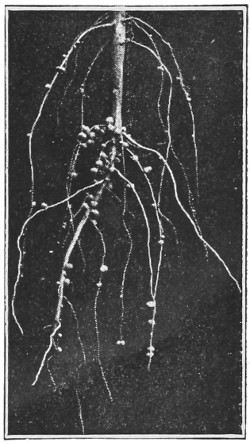
Thorough cultivation serves to retain moisture, increases the activity of the bacteria which convert
the plant food into available form, prevents weeds, and promotes heavy root development which in
turn increases the growth and productiveness of the plants.
The picking, packing and marketing of the berry crop is the last and one of the most important
steps in strawberry growing. Fancy berries can be made to appear more attractive and inviting by
proper picking and packing, and by adding to their beauty and attractiveness, you will create a greater
demand and the berries will command higher prices.
The most successful strawberry growers put these essentials into practice to the fullest extent.
The quality of the plants you set determines the quality and quantity of berries you will pick.
Pure-bred, true-to-name plants, selected from mother plants of the highest fruiting powers, are the
foundation of a profitable berry crop, but plants which are taken from fruiting beds, or which have been
propagated without any regard to selection and restriction, soon will deteriorate and become unprofitable.
Whether you grow strawberries for home-use or market, it is to your profit to set plants which will
respond readily to the intensive cultural methods described in this book.
Kellogg Pedigree Strawberry Plants are recognized as the world’s most productive and most profitable
strain. They can be secured only from R. M. Kellogg Company, Three Rivers, Mich.
Any soil that will produce vegetables or common farm crops also will produce strawberries. However,
old timothy sod should be avoided on account of white grubs. The kind of soil you have is not so
important as what is put into the soil, the manner in which it is prepared, and the cultural methods
followed. The soil is nothing more than the home where the plants live. It is the feeding and care
which they receive that encourages their growth and productiveness. Strawberries thrive in high and
low altitudes and in all soils and climates therefore instead of seeking better soil, improve your own soil
by following the instructions given in this book.
Whenever possible, it is advisable to plow or spade your field or garden in the fall and after plowing,
apply stable manure at the rate of about 250 pounds per square rod or 18 tons per acre. The following
spring replow the ground.
If it is impossible to plow in the fall, the ground should be manured during the winter and plowed
in the spring just as early as soil conditions will permit.
In either case the soil should be thoroughly pulverized and well mixed with the manure after plowing
by rolling and harrowing to insure a perfect seed bed the full depth of plowing. This should be done
immediately after plowing to retain moisture. In small gardens this may be done with garden rake.
If stable manure is not applied during the winter, it is advisable to apply it between the rows as
soon as possible after plants are set. Poultry manure is an ideal fertilizer but if this is used it should be
thoroughly composted with earth before applying on account of its heating tendencies. This is done
by forming a pile three or four feet in height and of any convenient size composed of alternate layers of
earth and manure, each layer from two to four inches deep. This pile should be allowed to stand until
the manure has decomposed. It should then be thoroughly forked over to mix the earth and manure.
Apply after plowing at the rate of 25 to 50 pounds per square rod or from two to four tons per acre and
incorporate thoroughly with the soil before planting.
Pulverized Sheep Manure also is an excellent strawberry fertilizer and offers several decided advantages,
viz:—
It is most economical because it contains a high per cent of refined, concentrated plant-food in properly balanced
proportions.
It is entirely free from all weed seeds and trash. It becomes almost immediately available for the plants’ use.
There is absolutely no danger, either to roots or foliage on account of using too freely.
Pulverized Sheep Manure may be applied either as a top dressing at intervals during the growing
season, by broadcasting or drilling, or in furrows. If used as a top dressing,
it should be applied three or four times during the growing season at regular
intervals directly over the plant rows, each application at the rate of 3 pounds per square rod or 500
pounds per acre. It will be worked into the soil by hoeing and cultivating.
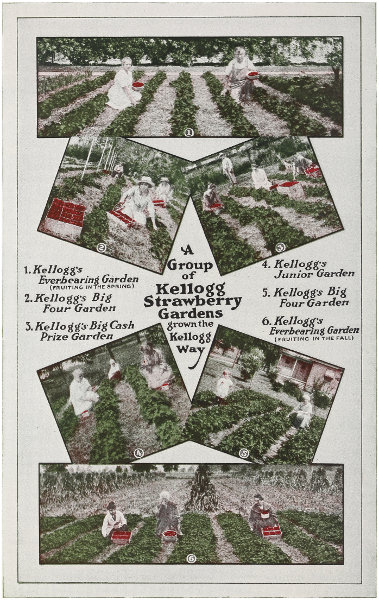
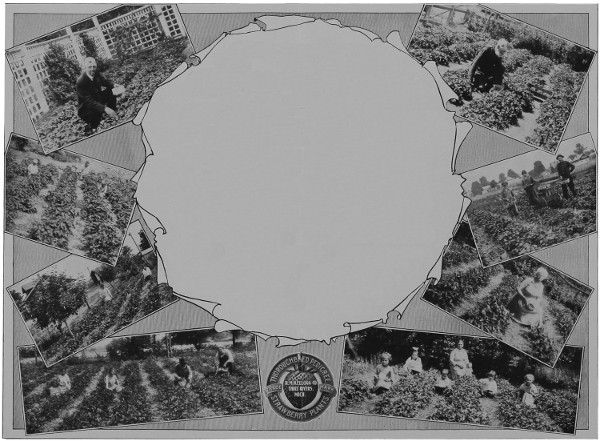
Larger illustration (480 kB)
| 1 |
| 2 |
3 |
1. Kellogg’s
Everbearing Garden
(FRUITING IN THE SPRING) |
A
Group
of
Kellogg
Strawberry
Gardens
grown the
Kellogg
Way |
4. Kellogg’s
Junior Garden |
2. Kellogg’s Big
Four Garden |
5. Kellogg’s Big
Four Garden |
3. Kellogg’s Big Cash
Prize Garden |
6. Kellogg’s
Everbearing Garden
(FRUITING IN THE FALL) |
| 4 |
5 |
| 6 |
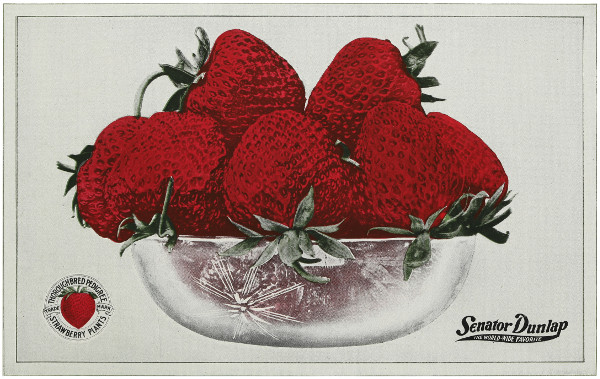
Senator Dunlap
THE WORLD-WIDE FAVORITE
For broadcasting or drilling, make one application per season after plowing and just before planting
at the rate of 10 to 15 pounds per square rod or one ton per acre.
For furrow fertilizing, a shallow furrow should be made where each row of plants is to be set and
the manure distributed evenly in these furrows at the rate of 3 pounds per square rod or 500 pounds
per acre. In closing the furrows, the soil and manure should be well mixed after which the ground is
ready for planting.
After extensive experiments in which we have become thoroughly convinced of its many merits, we
have completed arrangements which enable us to furnish our customers with Pulverized Sheep Manure.
For prices see page 63.
If fertilizing with manure is impractical, use any reliable brand of commercial fertilizer which is
recommended for fruit growing. This should be applied broadcast after plowing and thoroughly incorporated
with the soil before planting.
We are not recommending any formula of commercial fertilizer because the soil requirements in
different localities differ so widely. Practically every section of the country is represented by fertilizer
dealers or agencies who will be glad to consult with you in regard to your requirements. Your State
Agricultural College and Experiment Station also will advise you reliably on this subject.
Any of the above fertilizers, if applied according to our instructions, will give satisfactory results
and we suggest using the one best adapted to your particular conditions.
The proper time to set strawberry plants is in the early spring, from the latter part of March
until the middle of May, at which time they are in excellent condition for shipping and planting.
Later in the season they will not stand shipping as well nor respond as readily after setting. Therefore
it is to the grower’s interest to set plants just as early in the spring as soil conditions will permit.
If this cannot be done, plants should be shipped early and heeled-in until they are to be set.
Only in the extreme southern states can plants be set in the fall with any degree of success.
If conditions make it impossible for you to set your plants when they arrive, they should be heeled-in
or trenched to keep them in good condition until you can set them.
Select a location that is protected from the wind and sun and dig a “V” shaped trench about 8 inches
deep. After separating the different varieties, open the bunches and spread the plants along the side
of the trench, roots downward. Then draw loose soil over against the roots and press it down firmly,
being careful not to cover the crowns. Place another layer of plants and continue alternating plants
and soil, putting about one inch of soil between layers of plants. The varieties should be kept separate
in order that each variety may be readily located when setting the plants.
After the plants are heeled-in, water the ground until it is thoroughly soaked around the roots
and keep moist until they are set.
It is advisable to have plants shipped early and heel-in until you are ready to set them as this method
will keep them in excellent condition for several weeks.
There are many systems for planting and growing strawberries but the most profitable are the hill,
single-hedge and double-hedge row.
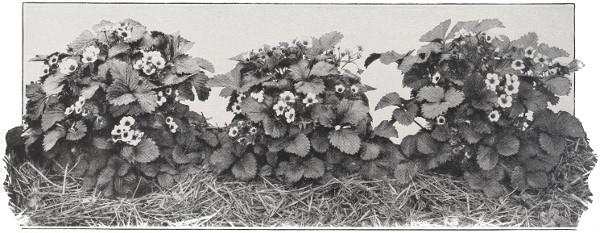
SIDE VIEW OF SECTION OF A ROW SHOWING PLANTS GROWN HILL SYSTEM
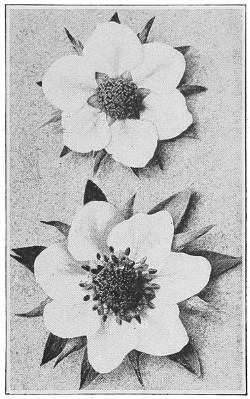
Sex in strawberry plants graphically
presented. Above; pistillate blossom.
Below; blossom of a bi-sexual plant.
For the hill system, rows should be made 30 inches apart, plants
set 15 inches apart in the row and all runners removed.
By setting in check rows the wide spaces can be cultivated with
single-horse cultivator and the narrow spaces with hand cultivator. This
leaves only a very small area around each plant to be hoed and reduces
considerably the cost of cultivation.
In small gardens the rows may be made two feet apart and plants
set one foot apart in the row and if crowded for room they may be set
15 inches apart each way.
Fourteen thousand plants may be set on a single acre when they
are set 30 x 15 inches.
(NOTE: By Hill System, we do not refer to hilling or ridging the ground. The plants
should be set with the crowns level with the surface the same as in either of the other systems.
Never ridge the ground unless there is slow and improper drainage.)
The single-hedge row is formed by setting plants two feet apart in
rows which are spaced three feet apart. Each original plant is allowed
to make two runner plants which are layered on opposite sides of the
mother plant directly in line with the row. All other runners should be
removed. Seven thousand plants are required for one acre.
For the double-hedge row, plants are set two feet apart in rows
which are spaced three and one-half feet apart. Each original plant is
allowed to make six runner plants, two of which are layered on opposite
sides of the mother plant directly in line with the row. The other
four are layered, two on each side of the mother plant, in the spaces
between the rows. This forms three distinct rows, the original row and
a row of runner plants on each side. After the rows are thus formed all
other runners should be removed. Six thousand plants are required for
one acre.
Strawberry varieties are divided into sexes, male, (staminate or bi-sexual), usually indicated by the
letter “B”; and female, (pistillate), by “P.”
The blossoms of the male varieties contain both male and female organs and are self-fertilizing
while the blossoms of the female varieties contain only female organs and are dependent upon the pollen
produced by the male varieties for fertilization. For this reason it is necessary to set plants of pistillate
varieties in rows between rows of bisexuals of the same fruiting season. The pollen is carried by the wind
and bees and in this manner, the blossoms of the pistillates become fertilized. Three or four rows
of pistillates may be set with only one row of bisexuals on each side of the group.
Even with male varieties the crop may be increased and the quality of the berries improved if
several bisexuals are set in the same patch as this provides an interchange of pollen which Nature intended.
Strawberry varieties do not mix or become crossed through the runners. Everbearers may be set
beside standard varieties, or any number of different varieties may be grown side by side in a garden or
field without mixing unless the runners of one variety are allowed to spread and take root in a row of
another variety. Prevent this by restricting runners of each variety to their respective rows.
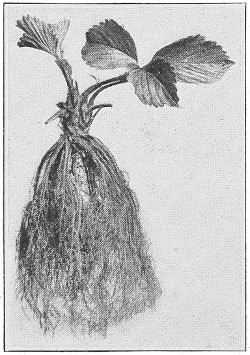
Plants should be pruned before they are set. This is done by cutting off the tip ends of the roots,
causing a callous to form where each root is cut off. From these callouses, myriads of fine feeding roots
start soon after plants are set.
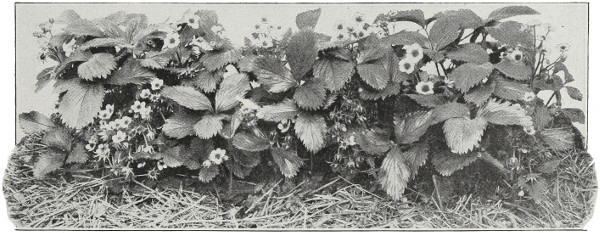
SIDE VIEW OF SECTION OF A ROW SHOWING PLANTS GROWN SINGLE-HEDGE SYSTEM
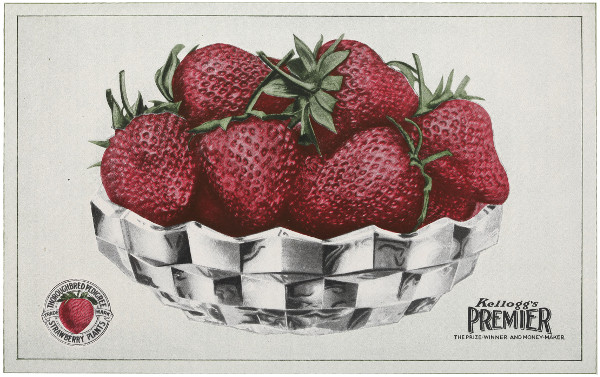
Kellogg’s
PREMIER
THE PRIZE-WINNER AND MONEY-MAKER
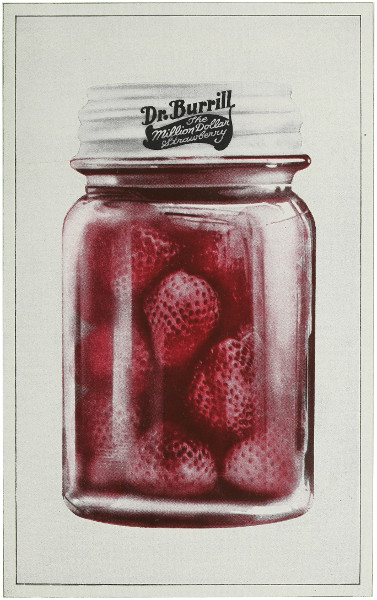
Dr. Burrill
The
Million Dollar
Strawberry
In setting plants, make a small “V” shaped opening in the soil, place the
roots straight down into this opening holding the crown slightly above ground level and press the soil
firmly against the roots.
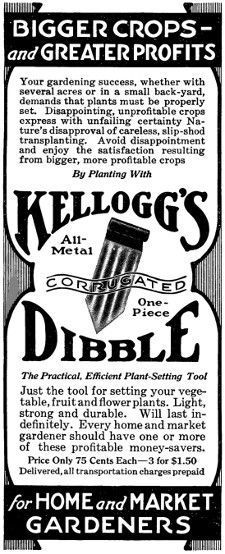
Kellogg’s All-Metal Corrugated One-Piece Dibble (see page 63) is an ideal tool for setting plants or
an ordinary spade will answer the purpose. With a dibble, the setting can be done by one person
while it requires two persons if a spade is used. One makes the opening with the spade and presses the
soil against the roots and the other places the plant into the opening.
It is a very simple matter to set strawberry plants. Simply use the same judgment as in setting
vegetable or flower plants.
Cultivation should begin as soon as plants are set and when soil conditions will permit, should be
continued every week or ten days throughout the entire growing season. Never cultivate when the
soil is wet but cultivate as soon as the ground can be worked after each rain. Stir the soil to a depth of
about two or three inches going as close to the rows as possible and complete the cultivation by hoeing
shallow directly around the plants and in the rows where the cultivator teeth do not reach.
Thorough cultivation prevents the formation of crust, keeps the ground free from weeds and promotes
plant growth. During dry periods repeated shallow cultivation will prevent the escape of moisture
and thereby bring the plants through a long period of drouth in good condition. You will experience
very little loss from drouth if you put these instructions into practice.
Every bare spot in your strawberry rows reduces your profits. If for any reason an occasional
plant should fail to grow, these vacant places should be filled in as soon as possible to form unbroken rows
thereby making every square foot of your ground contribute its full share toward the crop.
In spots where only one or two plants are missing, the vacancy may be filled by allowing the adjoining
plants to form the necessary runner plants and layering them in the proper place. If however, the spot
is of considerable length, it is advisable to allow several plants to develop runners and reset these runner
plants in filling the vacancies. The proper time for doing this work is in the early fall after a good shower.
In resetting the runner plants for this purpose, a clump of soil should be taken up with the roots and care
exercised not to disturb the roots so that there will be no check in the growth of the plant.
If these simple instructions are carefully followed, you will have perfectly filled rows.
Plants will begin to blossom soon after they are set. The blossoms or fruiting stalks of all standard
varieties should be pinched or cut off throughout the first year. This strengthens the plants by preventing
exhaustion which results from early pollen secretion and seed production. It is very important that
this be done as early as possible to relieve the plants of unnecessary strain. This work is easily and
quickly done and is usually necessary only once or twice. (See also “The Everbearers” Page 58.)
The runners also should be removed in accordance with the system you wish to follow.
For all insects which work upon the foliage either eating or folding the leaves, pour sufficient water
over three pounds powdered arsenate of lead to make a paste and continue adding water until it becomes
a creamy solution. Pour this into fifty gallons of water and mix thoroughly before spraying. For small
gardens use at the rate of one ounce of the powdered arsenate of lead to each gallon of water.
For rust or leaf-spot which may be detected by reddish, rusty-looking spots which destroy the leaf
cells, use Bordeaux mixture made as follows:
Suspend a coarsely woven sack containing four pounds blue vitriol into twenty-five gallons of water
so that the vitriol in the sack will float on the surface of the water. Put four pounds lump or hydrated
lime into a bucket and pour over it hot water, stirring until you have three gallons of creamy mixture.
Pour this into twelve gallons of water, then combine this lime solution with the vitriol solution and the
result is a Bordeaux mixture known as 4-4-40 solution. Mix thoroughly before spraying. This is a
preventive rather than a cure and should be used at the first appearance of any leaf-spot.
The presence of black ants indicates that aphides or root lice are working upon the roots. Repeated
cultivation and hoeing are the best remedies.
White grubs which eat off the roots of plants causing them to wilt and die can be destroyed only by
digging about the roots of the wilted plants and killing the grub. While this may not always save the
affected plant, it will prevent the grub from doing further damage. Late fall plowing is the best preventive
against root lice, white grubs, and all other underground insects.
For mildew which causes the leaves to cup or curl and the leaf-stems to become dark, use lime-sulphur
at the rate of three gallons to sufficient water to make fifty gallons. The lime-sulphur can be obtained
from any manufacturer of spray materials. It is put up in small cans and fifty gallon barrels, and as it
deteriorates with age or by freezing, enough for one season only should be purchased when ordering.
For smaller areas, prepare at the above rate in amounts determined by the area you have to spray.
These remedies may be applied with small hand-spray machines or large power sprayers.
(NOTE: Avoid spraying when plants are in blossom or while berries are ripening.)
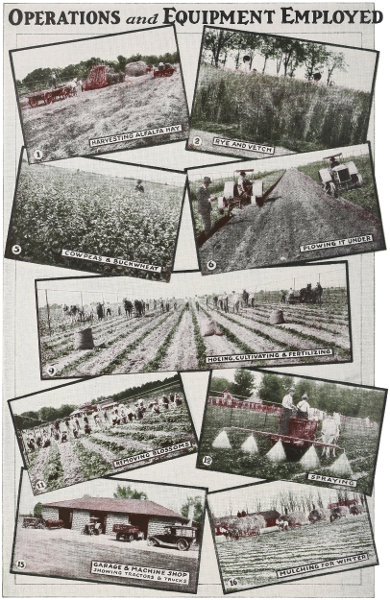
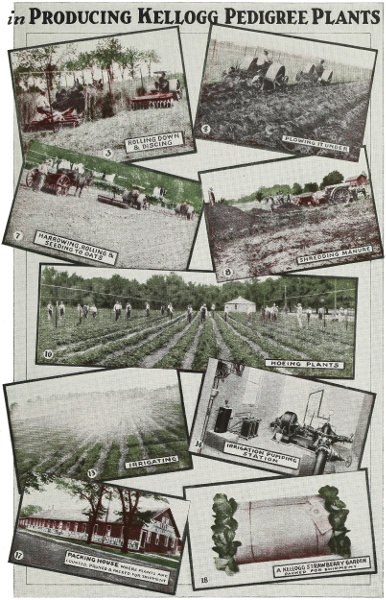
Kellogg Pedigree Plants are sprayed frequently throughout the entire growing season to insure absolute
freedom from all insects and plant diseases. Our plant fields are kept free from contamination
of this nature and every shipment which leaves our farm is likewise free from insects
and disease. We
are giving the foregoing instructions for spraying simply that
you may be familiar with the proper course to follow should
any pest find its way into your field after plants are set.
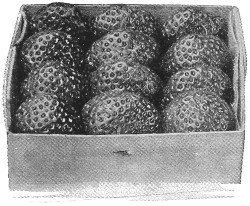
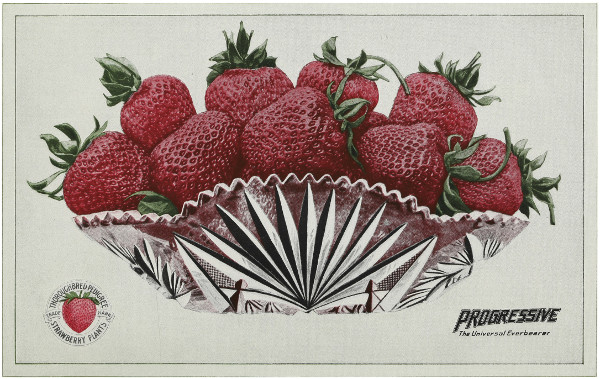
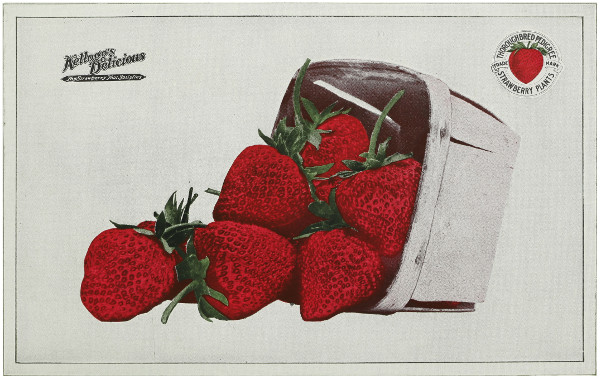
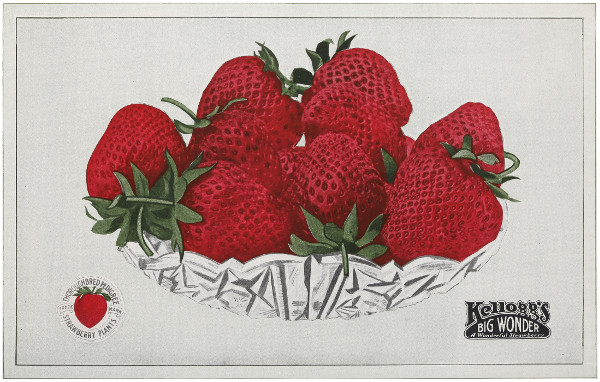
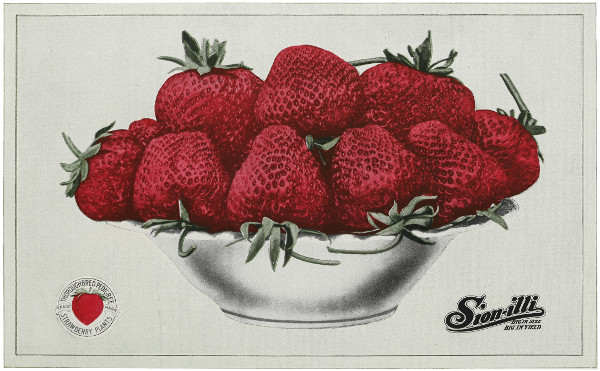
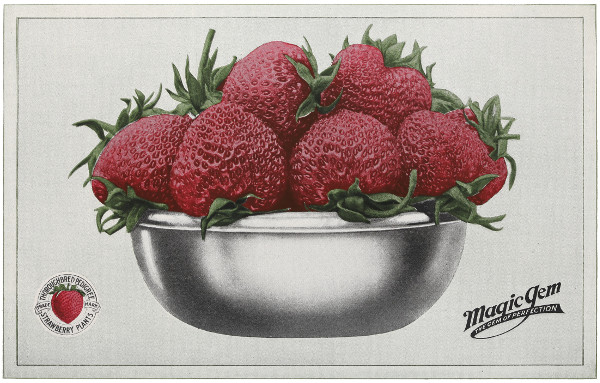
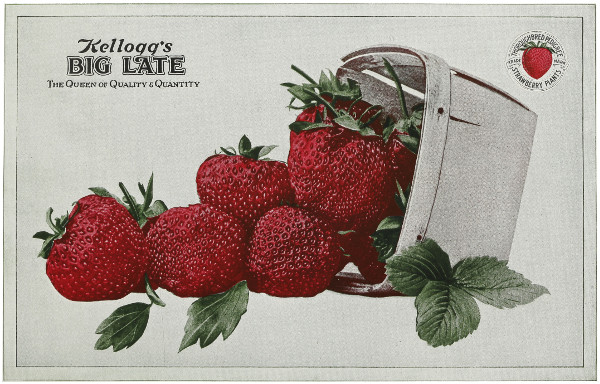
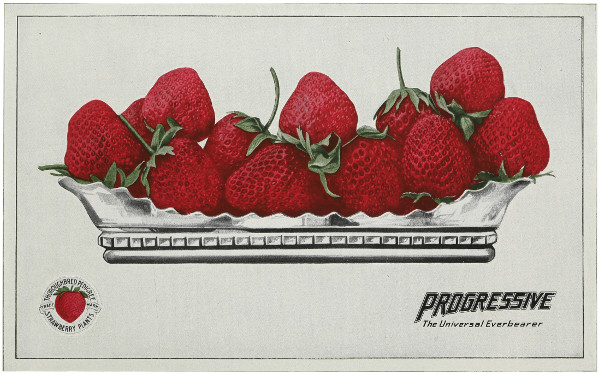
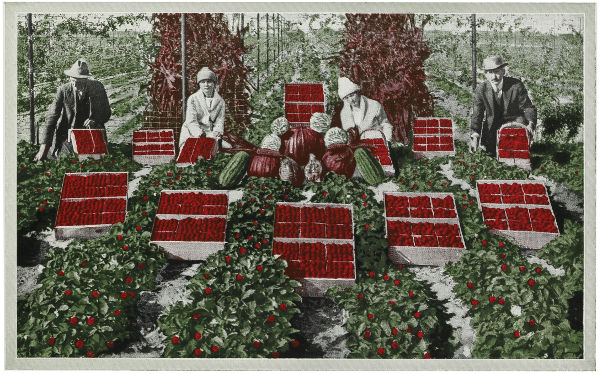
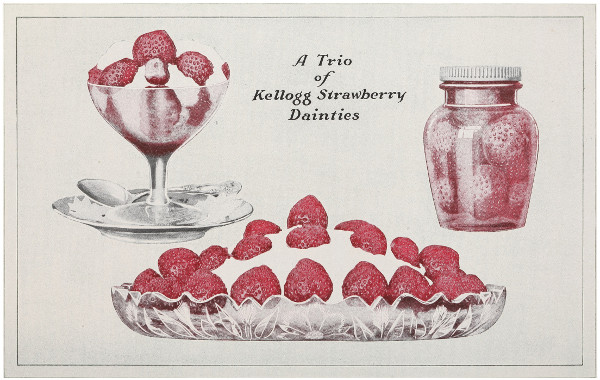
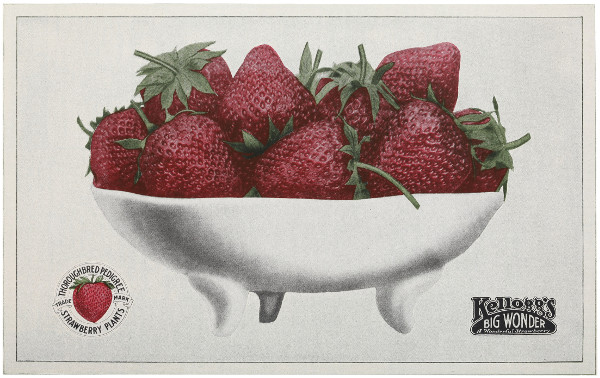
Strawberries, properly packed like those illustrated
above, sell at sight and at profitable prices.
Kellogg Pedigree Plants themselves furnish as strong insurance
as can be had against the possibility of having to spray
either for insects or diseases.
Mulching protects the plants during the winter, retains
moisture in the soil, keeps down weed growth during the fruiting
season and keeps the berries clean.
In cold climates mulching is necessary to protect the plants
during alternate freezing and thawing. If not mulched this
expansion and contraction breaks off the fine roots and greatly
weakens the plants.
Any material such as oat, wheat or rye straw, marsh hay,
shredded corn fodder, or coarse stable manure makes ideal
mulching, or leaves will serve the purpose. It should be spread over the field or garden in the early
winter soon after the first freeze, covering the plants and ground to a depth of about three inches. If
stable manure is used it should be applied thinner, spreading the strawy matter directly over the rows of
plants and the fine material between the rows.
In the spring as soon as the frost leaves the ground, remove the mulching which lies directly over the
rows to the spaces between the rows. This permits the plants to grow without any obstruction.
In warm climates where freezing is very light, it is unnecessary to cover the plants. Simply apply
the mulching between the rows and under the foliage, forming a bedding for the berries to ripen upon.
Mulching adds materially to the strawberry crop and gives the grower bright, clean berries which
are in big demand at fancy prices.
The proper method of picking strawberries is to leave about one inch of the stem attached to the
berry. This adds greatly to the appearance, shipping and keeping qualities of the berries thereby
making it possible to obtain higher prices.
Unless absolutely necessary, never pick berries when the plants are wet from dew or rain as berries
picked when the vines are dry remain fresh and retain their lustre much longer.
The berries should be graded by putting each grade into separate boxes when picking. This eliminates
the expense of re-handling and prevents unnecessary bruising when packing.
The top layer in each box should be arranged in rows so as to present an attractive appearance and
make the top as level as possible. This requires but little time and adds greatly to their appearance.
Long berries should be packed on their side while round or top-shaped berries present the best
appearance packed with the calyx and stem down. The boxes should then be carefully placed into the crates.

A UNIQUE AND EFFECTIVE WAY TO ADVERTISE STRAWBERRIES
Placards posted in garages and at gasoline filling stations will be read by hundreds
of automobile owners with the result that you will find it easy to dispose of your
entire strawberry crop right at the patch. Try this simple, inexpensive advertising.
Berries of high quality packed
in this manner will soon establish
a reputation for the grower which
will greatly increase his profits.
Your selling plan should be
governed by local conditions. If
you have a large acreage, it is advisable
to sell to grocers while if
your acreage is small and you can
devote time, it is more profitable to
sell direct to the consumer. In
either case you should adopt a
trade-name for your berries and
label your crates and boxes so that
the public will become acquainted
with your name and particular
brand of berries. Large placards
should be placed in stores where
your berries are for sale and by
also placarding garages and gasoline
filling stations, many buyers
can be brought direct to your
patch. Small advertisements in
local papers are also effective.
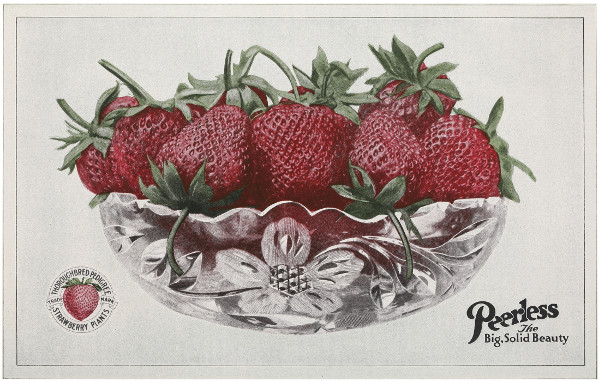
Peerless
The
Big, Solid Beauty
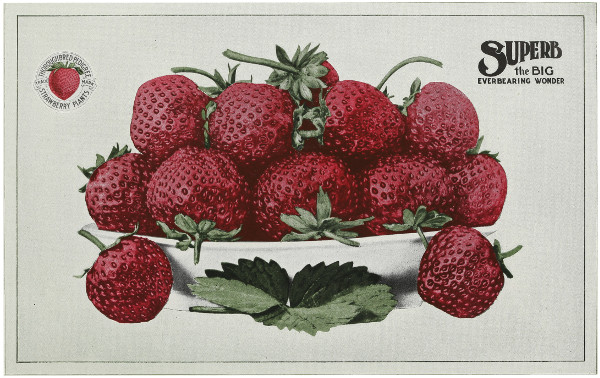
SUPERB
the BIG
EVERBEARING WONDER
Strawberry plants should not be permitted to fruit more than two years.
After the first crop has been picked, the foliage of standard varieties should be mowed off and removed
from the patch. The rows should then be narrowed down by plowing a furrow from each side of the row
leaving a ridge or back-furrow between the rows. This should be worked down with harrow and
cultivator until the furrows have been filled and the ground again made level. A spike-tooth harrow
may be used but the teeth should be set with a back slant so as not to tear out the plants when crossing
the rows. In small gardens this work may be done with spade and garden rake. Continue working the
ground until the surface is smooth. This will slightly cover the crowns and the plants which remain
in the rows will soon come up through the fine covering of soil. Apply a top-dressing of manure, continue
to cultivate the same as the first year, and your second crop will be fully as profitable as the first.
After fruiting the second year plow the plants under and plant the ground to some other crop
at least one year before again setting to strawberries.
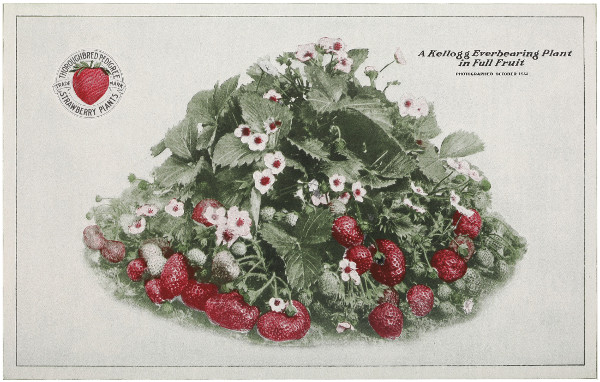
The everbearers are so exceedingly productive and their fruiting season covers such a long period
that it is absolutely necessary that the soil contain an abundance of plant-food and berry building material.
A heavy dressing of manure should be plowed under and thoroughly worked into the soil before plants
are set and a top dressing of manure applied soon after setting, spreading the coarse material close
around the plants under the foliage to serve as mulching when they begin fruiting.
The season the plants are set, all blossoms should be removed from Superb and Peerless until the
latter part of June and from Perfection and Progressive until the early part of July, after which they may
be allowed to fruit to full capacity. They should then fruit heavily until freezing weather. The following
year they will fruit abundantly from early summer until late fall with the exception of a short
rest period during July.
The everbearers may be grown either hill, single-hedge or double-hedge row system, but the hill
system has proved the most profitable. It is unnecessary to mow the foliage off the everbearers although
this may be done if desired the second year after the early summer crop has been picked, when
the plants enter their rest period. If this is done prepare the bed the same as for standard varieties.
If these simple instructions are followed, the everbearers will prove exceedingly profitable either for
home use or market.
Crop rotation is very essential in strawberry growing. After plants have fruited two years, they
should be plowed under and the ground planted to some other crop. This may be done as soon as they
have finished their second crop.
Cantaloupes make an ideal crop for rotation because they do not draw heavily upon the fertility of
the soil and their viny nature keeps the soil mellow. Two years in strawberries, one year in cantaloupes
then back to strawberries, with a legume crop to rest and replenish the soil once every five years, fertilizing
each year, makes the very best program of rotation for the strawberry grower.
Any of the legumes—clover, cow-peas, soy beans, velvet beans, vetch or alfalfa, are ideal crops for
rotation because they add great quantities of humus and nitrogen to the soil. Vegetables or farm crops
also may be used to advantage as rotation crops.
Irrigation is an insurance policy on the crop, therefore, if you are situated so that you can irrigate
you will find it highly profitable to do so. One can realize only through actual experience, the increased
profits which result from irrigation.
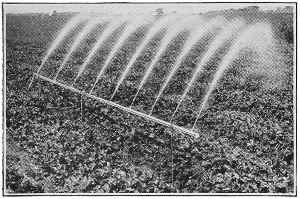
The two systems most generally used are the overhead or sprinkling system and the ditch or gravity
system. With the overhead system, the water is applied in the form of a fine rain. With the ditch
system, shallow furrows or corrugations are made between the rows into which water is run until the
entire ground is wet. The water may be obtained either from a well, lake, river or city supply. It may be
applied during the heat of the day if desired without any injury to the crop, however if applied at night
the evaporation is less. The ground should be cultivated as soon after irrigation as conditions will permit.
We have in operation on the Kellogg Farm, 120 acres of Skinner Overhead Irrigation which was
selected by us as the best after a thorough testing of several different systems. Our experience with
Skinner Irrigation has been so satisfactory that we recommend it to our customers with absolute confidence
that it will prove equally satisfactory and profitable both for the small home garden and the
large commercial strawberry grower. For irrigating the small strawberry or vegetable garden or the
lawn and shrubbery, Kellogg’s Rain-Maker, manufactured for us by the Skinner Irrigation Company,
is unequalled as it furnishes positive insurance against drouth. For description and price, see Page 63.
“In the
spring of 1920 I set 1,250 Kellogg Pedigree Plants. The varieties were Kellogg’s Premier, Dr. Burrill, Magic Gem, Kellogg’s
Prize and Kellogg’s Big Late. Plants made excellent growth until August, when a severe hail storm which caused over
$50,000.00 damage in our County, stripped their foliage giving them a serious set-back. In spite of this, they produced 600 quarts
of fine berries this season which brought 25 and 30 cents per quart with ready sale. I follow the Kellogg Way and find it most
profitable. I intend to order 1,200 more Kellogg Plants in time to be sure of getting them next spring.”
James C. Tarrance, Kansas.