CHAPTER II THE JOURNAL — Preface
29
To
My beloved sister, Mrs. India W. P. Logan,
This little History
Is Dedicated and Inscribed by Her
Very grateful and affectionate brother,
Frank.
This Journal of incidents and adventures,
written at your request, was never intended
to pass beyond the circle of tried and particular
friends. The particular situation in
which it was written, the character of the
writer, of his associates, and the Cause they
represented—all these peculiarities must be
known, felt, and understood before you can
enter into the spirit of the enclosed composition.
With this consideration, these simple
sketches are kindly submitted, and placed
under your protection, sincerely hoping they
will be appreciated and estimated according
to their merits. And furthermore, that the
honor of the Cause, as well as of its defenders,
30be kept sacred, and to the end of time
unsullied.
Glasgow Junction, Kentucky.
I received, some time since, a request that
I would write you an outline of my experience
in “the tented field” up to the date of
my capture. It will necessarily be very imperfect,
and a very brief one, and perhaps it
will be as uninteresting as it is brief. Yet I
can assure you that nothing less than a long
and continued interview could give you any
just conception or description of my experience
and many exploits as a member of
Morgan’s Cavalry.
However, I trust this sketch may both
please and interest you. To me, in the mean
time, it will only be a reminder of the long
years of hardship, exposure, and suffering in
a Lost Cause which was so gallantly and devotedly
battled for that one would almost
accuse the God of Battles of injustice and impartiality;
of using the Fates against a
people in such a sacred cause. That I have
been a soldier in the service of the Confederate
31States is not, and never will be, regretted.
I am proud that I was one who did
not hesitate to join the standard of those in
defense of their country’s rights. Had I not
done so I would now be chiding myself with
no little severity. Shame alone would cause
me to blush myself out of existence.
But pardon my digression. I will commence
my sketch.
You are already aware, perhaps, that I enlisted
in the cavalry service of the Confederate
States of America at Glasgow, Kentucky,
in October, 1861, and in a company
that was then being formed by Second Lieutenant
James W. Bowles, who had been duly
authorized by the Confederate Government
to recruit a company of cavalry.
At Glasgow forty men were enlisted, and
after some experience in drilling and a few
exciting engagements, such as scouting and
skirmishing, in which we were sometimes supported
by Capt. John H. Morgan and his
company,—a favor we often returned,—we
were ordered by General Buckner to Bowling
Green, Kentucky. On reporting to the General
we were instructed by him to report to
Captain Morgan, commanding Camp Burnham,
32one mile south of Bowling Green, where
we went into camp.
Here we found the Lexington Rifles, Captain
Morgan’s old company; Captain Allen’s
and Capt. John S. Churchill’s company,
partly completed, with which our company
was, by order of the commandant, soon afterward
consolidated. The two captains, by the
toss of a copper, decided who should become
the commander, and Lieutenant Bowles, our
then acting captain, being the successful one,
Captain Churchill justly fell heir to the
second in command, the first lieutenancy.
Our first lieutenant became the second lieutenant
of the new company, and the other
first lieutenant became our third, the very responsible
position of orderly sergeant falling
to your most humble servant, and so on down
the list.
At that time Captain Morgan had in camp
three full companies, amounting to about two
hundred and seventy-five men, all splendidly
mounted on Kentucky’s best: Morgan’s own
Company A, Capt. Thomas Allen’s Company
B, and Capt. Bowle’s Company C, forming
“Morgan’s Squadron,” as it was afterward
known, and being under the command of
Capt. John H. Morgan, with First Lieutenant
33Basil W. Duke, of Company A, as acting adjutant,
subject to the command of General
Buckner alone.
After remaining in camp near Bowling
Green for some time, drilling and making
other preparations necessary to meet the foe
successfully, we moved to an encampment
called “Camp Allen,” five miles south of
Bowling Green, between the L. and N. and
the Memphis Branch railroads, where we
drilled constantly until the latter part of
November, when we were ordered to the
front to form a portion of the advance-guard,
then near Green River, under the command
of General Hindman. Here we remained
on active duty until the withdrawal of our
forces from Bowling Green, which withdrawal
was caused by the enemy’s flank movement
and the fall of Fort Donelson, about the
first of February, 1862. On the retreat the
squadron was the rear-guard of our army,
that being the second time we had had charge
of the post of honor.
Leaving Camp Green on the 12th,—my
last sight of home until the 27th of June,
1865,—we passed through Bowling Green
and encamped four miles south of town. On
34the 13th our column reached Franklin, Kentucky,
and the evening of the 14th we were
encamped one mile south of Mitchellville,
Tennessee. Here General Breckinridge,
who was now in command, General Buckner
having gone to Fort Donelson, learned that
the enemy’s advance had reached Bowling
Green. I shall not soon forget the night we
camped near Mitchellville, for we shared the
fate of the reindeer in having our beds on the
snow.
On the 15th we reached Goodletsville, and
on the 16th we marched into Nashville. We
remained on special duty in that city several
days, and until the main army had reached
Huntsville, Alabama. On the arrival of the
enemy’s forces our little band steadily and
quite sullenly gave way before them until we
reached Lavergne, about midway between
Nashville and Murfreesboro, meanwhile inflicting
sudden and unexpected blows, causing
the enemy so much loss as to make him advance
slowly and with the utmost caution.
It was on this retreat that our commander
and the squadron, by their many daring deeds,
brought themselves first into notice and
gained such notoriety as to make them afterward
of no little terror to the enemy. And
35from this time forward, until July 19, 1863,
the date of our capture in Ohio, they earned
and gained more laurels, captured more
stores and provisions, and had less reverses
than any other command in either service.
Never was a commander so much admired, so
devotedly loved, or one in whom his soldiers
placed so much confidence as a leader, as was
our dashing and gallant chief. Any of us—all
of us—would gladly have died in his defense,
and each one would have envied the
man who lost his life defending him. So
much was he trusted that his men never
dreamed of failing him in anything that he
attempted. In all engagements he was our
guiding star and hero.
Doubtless you learned at the time they were
enacted of the many daring and spirited engagements
and scouts while we were encamped
at Lavergne and Murfreesboro, the
enemy near us, at the Asylum and Nashville.
I presume you heard particularly of the General’s
personal adventures, sometimes alone,
sometimes with a chosen few. It is exciting
and interesting to read such incidents, but to
be an actor in them is the only way to realize
“the heart’s exultant swell.” That can only
36be felt; it cannot be described even by those
who have been through it.
During our stay in Murfreesboro a portion
of the squadron went with the General, then
Captain, to Gallatin, very much to the surprise
of the enemy who were garrisoning the
town. On this occasion Columbus A. Peddicord,
having just come from Virginia, acted
as guide. His regiment had been disbanded
with orders to reorganize on the first of April,
1862.
It was here that I contracted the illness
which afterward resulted in typhoid pneumonia,
it being brought on by constant exposure
to the long cold rains during the first
two weeks of March while we were scouting
in the vicinity of the capital. We lived in the
saddle the most of the time, and our clothing
was continually wet.
Captain Morgan and sixty horse were stationed
in Murfreesboro, and they held the
town; the rest of the squadron, meantime,
encamped on the pike running from Shelbyville,
a pike intersecting the Franklin and
Nashville pike twelve miles from Nashville.
This disposition of our small force nonplussed
the enemy entirely and successfully.
They could not solve the mystery, or imagine
37what our number was, or where or who we
were.
Our leader, by his rapid blows and daredevil
encounters, caused them to believe his
entire force was with him at Murfreesboro,
while Captain Allen, Captain Bowles, and
Adjutant Duke drew their attention in the
opposite direction, attacking them at all
hours of the day and night. We would capture
an outpost, very often galloping in the
midst of their camp, thus causing the greatest
surprise and consternation imaginable.
After presenting the compliments of “Morgan’s
Men,” in the shape of a few broadsides
from our rifles, a sort of salute of respect and
esteem, we would doff our caps à la Morgan,
and, without difficulty, make our exit at a
brisk canter. Their curiosity was not sufficient
to make them pursue us for an introduction,
and they did not insist upon an explanation
for such intrusion.
When orders were received to fall back,
the squadron, after a short separation, was
again united at Shelbyville. At Shelbyville I
was compelled, for the first time, to leave the
ranks on account of illness. My comrades
urging me to do so, I went to a private house,
to remain there until the squadron should
38move to Huntsville, as previously instructed.
One of the boys escorted me to the residence
of a Mr. Desmukes, south of town a few
miles, where I was treated “southernly,” and
with great kindness by all the family, and
especially by the two young lady daughters.
On the departure of the troops, some time
afterward, a detachment was sent for me. I
had become so weak that when I rose to walk
I staggered, and would have fallen had not
the arms of the young ladies intercepted and
rescued me. They then assisted the invalid
to the gate, and also assisted me to mount my
“war steed,” Selim, who was to carry me a
short distance, to the pike, where an ambulance
was in waiting to take me to Fayettesville.
Escorted by a small guard of troopers
from our own company, and accompanied by
C. A. P., who arrived just in time to superintend
my transfer, we proceeded to Fayettesville.
From the time I was laid in the ambulance
until my arrival in the Huntsville hotel I was
entirely unconscious, and ignorant of all that
passed, like one dreaming his last long dream.
I have been told by C. A. P. that I remained
in Fayettesville several days, and was cared
for tenderly by the ladies, and especially by
39the landlady of the principal hotel, where I
stopped. I can’t remember. Nor have I
the remotest idea what occurred during my
stay; neither have I the least knowledge of
being carried to the depot in a carriage, thence
to Huntsville by rail, where, on my arrival, I
was conveyed to the hotel. I was carried in
by some of the boys, and on ascending the
stairway they allowed one of my feet to fall
against the steps, which awoke me from my
insensibility. But I soon again relapsed into
unconsciousness, and this time it lasted for
nearly two months.
During the two weeks that the squadron
stayed I was nightly visited by some of the
boys, but I was not made aware of it until
a long time afterward. However strange it
may appear, my best and dearest friends were
not recognized. I have only a very slight
recollection of the advent of the Yankees
under Mitchell, on the 11th day of April,
1862. The grand entree was made about 11
or 12 o’clock at night, and caused no little excitement
among the inhabitants, as well as
among our men.
Just before Captain Morgan left Huntsville
for Shiloh, he called to see me. After
standing some time by my bedside, and looking
40intently at me, he remarked, “Sergeant,
you will soon be well enough to be with us
again.” Then he shook my hand very affectionately,
and, bidding me farewell, went into
the entry, where he said to the landlady, Mrs.
Georgia Nowell, that I would not live
through the coming night, in which opinion
Mrs. Nowell acquiesced, as she told me afterward.
And indeed, she said for as much as
two weeks no one expected that I would recover,
not even the kind doctor attending me.
But, after all, my time had not arrived.
By the 22nd of May I was able to sit up in
bed, propped up by five or six pillows. It was
on that day, and while in that position, that
Rube, a true and faithful black boy whom
C. A. P. had left to take care of me, rushed
into my room, adjoining Mrs. Nowell’s, saying
that the Yankees were searching the hotel.
Though I was still very feeble, I knew well
what to do and say. I requested Rube to
leave the door, as it then was, a little open,
and to go about just as if he were one of the
hotel waiters. Having escaped detection so
often before, and being in one of the rooms
known as “the family suite,” I thought it
probable that I might escape again. But I
am now pretty sure that some one had reported
41me to the military, because two
Yankee officers came direct to my room,
walked in without knocking, and seated themselves
near my bedside. Very soon they introduced,
as cause for their presence and intrusion,
several inquiries, such as, “How long
have you been ill, sir?” or “What command
do you belong to?” and “When do you think
you will be able to report to the provost marshal?”
I answered their questions by saying that I
did not know when I would be able to report,
and they said, “But when do you think?” I
said, “You see my condition. When do you
think?” But neither of them could tell me.
These remarks and similar ones that passed
made me quite angry, and I said just what I
thought and pleased. Besides, I did not like
the style of their entrance. Each had a pair
of navy pistols, and each had his sabre drawn,
as if he expected to see the Devil, instead of
a sick Rebel. Then, leaving me for a moment,
they returned with a parole, which instructed
me to report, when I was well
enough, to the provost marshal, and this I
signed with a feeble hand. One of these
officers was a captain of the Third O. V. I.
42from Belmont County, the other was Sam
Piper, of Barnesville, his second lieutenant.
As soon as the Yankees were gone, Mrs.
Nowell made her appearance, weeping and
lamenting. Both she and Rube were very
much displeased with the new programme.
When the first of June came I was sufficiently
strong to venture to the provost marshal’s
office to show myself to Lieutenant Colonel
Burke of the Tenth Ohio Volunteer Infantry,
the provost marshal. My skeleton-like appearance
gained his sympathy, and all he requested
was for me to report myself daily at
9 o’clock A. M. This I did until the 5th of
August.
Then, on the 5th of August, I was started
out, under a heavy guard, and with three
other officers of our army, for some Northern
bastile.
All this time Mrs. Nowell was like a kind
mother to me, and Rube was attentive and
obedient at all times. I placed him under
Mrs. Nowell’s care when I left. The inhabitants—for
there was only one Union man,
Judge Lane, in the city—treated me with the
greatest kindness and attention, offering me
everything that one could wish for. I was
the only Confederate prisoner on parole then,
43all the others having been sent North, and
during my evening walks crowds of beautiful
girls and young ladies would accompany me,
much to the displeasure of the Yankees. And
I would return from my walks always ladened
with the richest, rarest flowers that ever grew
in any clime.
This was, indeed, a reward that made a
soldier’s heart swell with pride. How it
gladdens the heart to receive such marked
attentions from the hands of the beautiful
and fair! Long and happily may the fair
ones of Huntsville live!
On my route to Louisville, Kentucky, I
passed over the Tennessee and Alabama Railroad
to Nashville, thence over the Louisville
and Nashville, and in sight of home. Yet
not a muscle betrayed itself, nor was there a
sigh to show that the “Rebel” had any desire
to see loved ones. However, he felt it
deeply; but a proud spirit, still unconquered,
scorned the idea that his guard be permitted
the gratification of knowing that he suffered.
On arriving in Louisville I was exhibited
to a staring populace as one of “Morgan’s
men,” and this knowledge caused them to
show me a rope with a hangman’s knot in it.
This, they said, was for my special benefit.
44If I had enlisted in this war to be frightened
by scare-crows I might have been frightened,
but as I did not, the amusement was entirely
at their expense. But do not think that all
the people in the city were of this mind.
Assuredly not. I saw many bright eyes
beaming, many fair faces smiling on the old
gray, and I saw many snowy handkerchiefs
slyly flirted at the risk of prison walls, and—in
spite of them!
I was now entered, not “professionally,”
however, in that horrid prison, the Old Medical
College, and was confined there about one
week. I was then transferred, with, perhaps,
one hundred other prisoners of war (one of
them Dr. Hobson, afterward our brigade
chaplain), to Camp Chase, Ohio, by way of
Indianapolis, when one-half of our party was
sent to Camp Norton, Dr. Hobson included.
We remained in Camp Chase nearly two
weeks, where I wrote you, if you remember;
then, on the 26th of August we started for
exchange, by way of Cincinnati to Cairo. At
Cairo the prisoners embarked on a fleet of
eight or ten transports that was to carry them
down the Mississippi River. We were escorted
by two ironsides and a heavy guard,
all of which was quite unnecessary, for we
45were most anxious to get to Dixie, and for her
“to live and die.”
Before reaching that place of “world-wide
fame,” Vicksburg, many of the boys died,
and a large number, myself among them,
became sick, an illness caused by the crowded
boat, the inferior rations, and drinking the
river water. When we reached Vicksburg
we received a hearty reception from our
troops and from the inhabitants. It was even
then a place of interest, for before the war
it possessed much that was attractive; but
since it has become notorious for its heroic
defense, before which Grant’s heroic columns
melted like snow, it is singularly interesting.
Well, transportation to Jackson, Mississippi,
was immediately furnished us, and when we
arrived there we were ordered by General
Lloyd Tilghman, commander of the post,
into a camp of instruction until further orders.
I met here my old friend of civil engineer
notoriety, John W. Hayden, belonging now
to the Confederate Engineering Corps, with
the rank of colonel. He and the General
urged and insisted that I should receive, or
rather accept an appointment in the same
corps. Colonel Hayden said that he was
46very much surprised to find me in the cavalry
service, and more surprised that I had
been following the daring and dashing horseman,
John Morgan, when men of my profession
were needed to engage in the very fascinating
work of the Engineer Corps of the
Confederates States. They both pressed me
to accept a position; but I loved my old Commander
too well, and the service in which he
had enlisted too much, to think of leaving
him. So I could but decline respectfully;
which I did. And yet I believe I have since
almost regretted that I then rejected a post
of such advantage, for of advantage it certainly
would have been in the days to come.
After a short stay in Jackson, and on the
arrival of General Breckinridge’s forces from
Baton Rouge, in which we were glad to find
the old Kentucky Infantry Brigade, we started
under General Breckinridge for Knoxville,
Tennessee, by way of Mobile, Atlanta and
Chattanooga. We reached Knoxville about
the first of October. We were then mounted,
and, under the immediate command of Lieut.
Col. Bob Wood, of Mississippi, we started
for Kentucky to join General Bragg.
After two days’ march toward Cumberland
Gap we met Bragg’s advance, under General
47Kirby Smith, which caused a retrograde movement
of the forces under General Breckinridge.
On our return to Knoxville, where I
met C. A. P., Col. St. Leger Grenville, Morgan’s
Adjutant-General, and Lieutenant Colonel
Hoffman of the Third Kentucky Cavalry,
now took command of our detachment,
by order of General Morgan, and we began
our march across the Cumberland Mountains
to join our command, now a brigade, at
Black’s Shop. This position was eight miles
in advance of Murfreesboro, on the pike leading
from that place to Lebanon, and on the
extreme right of our main army, under General
Bragg, who had taken position there,
while the enemy, then under Rosecrans, were
stationed at Nashville.
We reached the command and reported to
the General about the last of October, after
a very interesting march over a country possessing
romantic and picturesque scenery.
All hearts were gladdened by the warm and
hearty reception we received from the boys.
The General, accompanied by his orderlies,
came to our camp to see us just as soon as he
heard of our arrival. Never did a mother
receive her foundlings more fondly than did
48our glorious commander. Long shall we remember
that meeting!
Knowing the fondness of the old squadron
boys for each other, and for himself, General
Morgan now proposed that they should be
consolidated and organized into one select
company, to act as scouts, subject to his personal
command and direction. A few days
after, accordingly, an order appeared to that
effect.
All were highly pleased with this arrangement,
and, as proof of it, scarce one day
elapsed before all had rallied at the scouts’
encampment. The feasting was enjoyed for
several days, and I imagine that the neighboring
barn-yards suffered a good deal. Of the
A, B, and C boys, some had been promoted,
and others were promoted immediately upon
our arrival. Yet the majority of those whom
the General wanted to advance respectfully
declined to accept appointments in “strange”
companies, so much were they attached to
each other. Our term of enlistment had expired,
but no one mentioned it to the General,
nor thought of quitting so long as the object
for which they enlisted had not been attained.
Neither did they re-enlist, but served faithfully
to the bitter end.
49With the exception of those promoted,
there were only eighty of the original members
to be found after twelve months’ service,
and there had been nearly three hundred at
first. War, death, and sickness had thinned
their numbers, so that now there were, upon
terra firma, to answer to roll call, scarcely one-third
their original number. The others—the
most of them—had answered their last
roll call, “the soldier’s last tattoo.” It was
oftentimes painful and sad to lose such brave
and dear companions, yet when I think of our
misfortunes, as I often do, I almost wish that
I, too, were one of “the departed heroes.”
At the time of the formation of our company,
called “Morgan’s Scouts,” we were
poorly mounted, our war steeds being old
veterans that had seen hard service, and,
because of their indisposition, had been turned
over to the quartermaster’s department at
Knoxville, from whom we drew them. The
members of the Scouts, as they knew General
Morgan personally and were quite frank with
him, complained at every interview of their
sorry horses. The General’s reply always
was, “You’ll have better ones in a short time.”
How he got those “better ones” will be related
hereafter.
50Meanwhile, the scouts began their exploits—exploits
so much talked of by the command,
and so eagerly anticipated. Oftentimes,
accompanied by the General, on such
occasions impersonating the character of a
scout, and to all appearances one of the company,
we would dash out on exciting and successful
adventures, expeditions carried on in
the vicinity of Gallatin and Nashville, and
also in the neighborhood of Lebanon and
Hartsville, where a brigade of Yankee infantry
and a regiment of cavalry were discovered
quietly encamped on the north bank
of the Cumberland, and near the latter place.
The cavalry was commanded by Colonel
Moore, and was supported by another brigade
of the enemy, six miles distant in the
direction of Gallatin.
As soon as this discovery was made, the
General put his wits to work to “take them in
out of the weather.” It was about the first
of December, 1862, and on the morning of
the 6th of December orders were received to
report to General Morgan’s headquarters immediately,
an order we as soon carried into
effect.
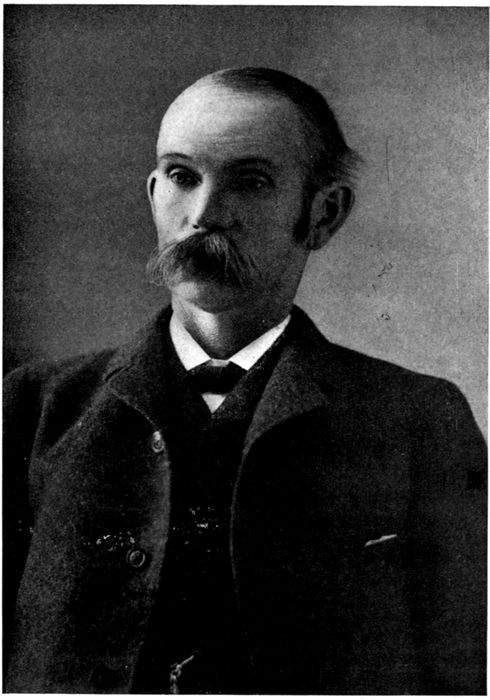
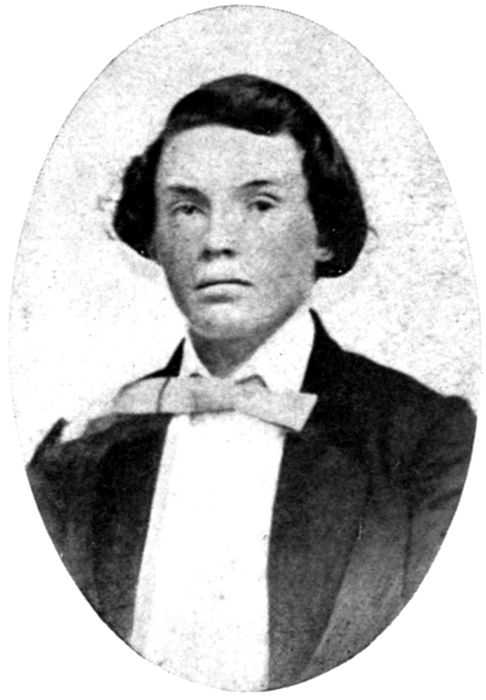
Kelion Franklin Peddicord
1888
FACING 50
51Having received from the General our
special instructions, we moved off in the direction
of Hartsville, to be followed, almost
immediately, by our brigade of cavalry, and
also by the Old Kentucky Infantry Brigade,
commanded by General Roger B. Hanson,
whose duty it was to hold possession of Lebanon
during our attack. The position of the
places closely resembled a Y: Nashville at
the top and left, Hartsville at the right top,
Lebanon at the junction, and Murfreesboro
at the bottom. So you will easily see that
Nashville, not forgetting Gallatin, is as near
to Lebanon as it is to Hartsville, and it would
be quite easy for the enemy to intercept our
line of retreat. This General Hanson was to
guard against.
When the scouts passed through Lebanon,
late in the evening, they were met by many
ladies, who, woman-like, had anticipated our
movements, and urged and implored us to
capture the Yankees at Hartsville. And they
added, “Be sure to bring them through town
so we can see them!” When you learn that
most of the boys had sweethearts there, for it
is a glorious old place in the estimation of
most of our command, you will not wonder
that they promised a prisoner on their return.
As we left the town behind us the darkness
fell, and our brigade, like a messenger of
52death, crept silently, cautiously along, in spite
of the intense cold. Near midnight we approached
the Cumberland. Our forces had
been divided into several detachments, preparatory
to fording the river, the scouts leading
the advance of the center detachment, at
whose head rode General Morgan, and
closely in the rear came the big guns, excepting
the two pieces called the “Bull Pups,”
that had so long accompanied the command
on its raids and marches.
These “Bull Pups” had been left in charge
of an officer commanding a battalion of cavalry,
with instructions to make a feint on the
enemy from the south bank of the river. He
was to take the direct road to Hartsville, and
the one leading to the good ford, which happened
to be just opposite to the Yankees and
within rifle range. The officer in charge of
the battalion was to get silently into position,
without the knowledge of the enemy, and
when the first gray streaks of morning made
their appearance he was to attract the enemy’s
attention by opening a spirited cannonading
from the now celebrated “Bull Pups.” “The
first gray streaks” was the signal, too, for the
brigade to move into position on the north
bank of the river.
53When the advance reached the river we
found a couple of ferry-boats which our
friends had secreted for us. All the other
detachments crossed by fording, and they had,
I afterward learned, a wretched cold bath.
Along with seven scouts I was the first to land.
Just before shoving off from the shore I received
my instructions from the General in
person. He desired me to be both cautious
and vigilant, so as not to alarm the enemy,
and we were to approach his encampment
silently, and to watch his actions until the
General’s arrival with the main force.
Crossing quietly and safely, it was not long
until we found the Yankee outpost, a cavalry
picket consisting of an officer and fifteen men,
posted not more than a quarter of a mile from
their camp. The picket was in an old carriage-house.
One of the doors was standing
open and there was a fire near the entrance of
the house, and between us and the door. We
were already within short range, and we
could see the Yankees distinctly as they
stepped out to look up the road. It was so
very cold, so intensely cold, that they did not
dream Morgan would come after them on
such a night. Had they not felt so confident
54surely they would not have dismounted while
on picket duty.
But there we sat, silent as the tomb, watching
our prey, without even the privilege of
shaking our feet in the stirrups to keep them
from freezing. I never came so near freezing
in my life. The rest of the scouts and the
detachment with the General arrived just
before day.
When the General saw the pickets, which
we pointed out to him, he said, turning to the
captain of the scouts, “Tom, do you see those
pickets?” The Captain answered promptly,
“I do, distinctly.” Then the General said,
“Lead your scouts down there, and take them
in, and if it can be avoided do not fire a gun.”
A moment after the boys were on all sides
of the picket, advancing from all sides, and in
less time than I can tell you, the Yankees
were captured, disarmed, placed under arrest,
and sent to the rear. It was done without a
word, without a shot to make our presence
known to the enemy. The General said
before this was done that it would be all he
would require of us. However, we escorted
him to the camp, which was in sight, and as
we galloped into line one of the sentries, on
camp duty, more watchful than the outpost,
55fired his gun into the air, and almost immediately
a reply from the “Bull Pups” came
across the river. This had a pleasing effect
in our favor, for, imagining the attack was
from that direction, the Yankee battery very
soon opened upon them in dead earnest.
Meanwhile, each of our regiments had gained
its position, and the line of battle was formed,
though the Yankees were running in every direction,
so complete was their surprise.
Believing, from our actions, we were about
to charge them mounted, the Yankees commenced
forming three distinct hollow squares;
and then again, seeing our men dismount to
fight, they formed into line parallel with ours.
By this time the battery we had with us was
placed in position in our line, and between the
Seventh and Eighth Kentucky Cavalry.
With the General at the head of the scouts,
and supporting the battery, two of our pieces
now opened fire on the Yankee battery, which
was still duelling with the “Bull Pups.”
This discharge caused the Yankees to see and
realize their real position. They were surrounded
completely. When our big guns
began firing they commanded a little more
respect and attention than the “Pups.” The
Yankees quickly reversed their guns, and the
56second shot hit one of our caissons, and there
was an explosion. The General, the artillery
and the scouts were enveloped in such a
dense cloud of smoke and shells that every
one, like myself, thought that he was the only
living one—the only one who had escaped
instant death. But on the disappearance of
the smoke our surprise was great to find that
no one was hurt except the drivers and the
horses attached to the caisson. The escape
of General Morgan seemed miraculous indeed.
Colonel Duke had led our line of battle
into action, and now the entire line entered
the conflict. Rebel and Yankee were at it,
hot and heavy, still the General would not
permit the scouts to advance, but held us
under fire of the artillery, in reserve, as he
said. But before long our time came.
When it came the two lines were frightfully
near each other. The Yankee cavalry
regiment was on the rise before us when the
General, calling the attention of the scouts,
said, “Boys, yonder are those horses I’ve been
promising you.” And he added, “Be very
particular how you take them, for you observe
that each horse has an armed man upon
him.” Then, giving Captain Tom some instructions,
57he ordered us to advance, which we
did at a brisk canter. Already the Yankee
lines, in many places broken, were reeling
and staggering like drunken men. We entered
the lists just in time to fire the ending
broadside and receive an unconditional surrender.
We likewise received the horses the
General had presented, besides a great variety
of “other things” that abound in Yankee
camps. The engagement had lasted only an
hour and ten minutes.
The forces surrendered by Colonel Moore
were the One Hundred and Fourth Illinois
Volunteer Infantry, One Hundred and Sixth
and One Hundred and Eighth Ohio Infantry,
and the Second Indiana Cavalry, making a
total of two thousand three hundred prisoners.
Sixty or seventy of the enemy were
killed, and twice that number wounded. Our
loss was nearly fifty killed and seventy or
eighty wounded. Our captured horses were
put in charge of some of the scouts, and the
rest of us were ordered to watch the movements
of the Yankee brigade that was in supporting
distance of the one just captured.
Though this brigade had heard our cannonading,
we had struck so quickly and rapidly
58that they could not, at least did not, come up
in time.
After marching over a mile we met the
enemy’s advance-guard, and the main force
was marching in line of battle a short distance
in the rear of his advance. We drove
the advance back in confusion upon the main
column. Then a portion of our company
held the ground, while the others withdrew
to the rear and went into ambush, there to
wait the moment to strike.
On this occasion, when hard pressed by the
main line, we suddenly gave way, as if we
were demoralized, and this enticed the advance
out to pursue us. Then the boys in
ambush opened fire on them so unexpectedly
that they retired in confusion. While this
was being enacted the scouts who first fell
back selected another place of ambuscade.
In this way, after receiving the Yankees
warmly once or twice, they learned caution,
and advanced slowly, being obliged to reform
their lines often, which detained them so
much the longer.
When we arrived at the ford we found the
prisoners, the horses and the artillery, as well
as the captured stores, all safe on the other
side of the river. The brigade with which
59we had been skirmishing took the same position
as the one captured had taken, and
shelled the ford while we were crossing. But
they showed no inclination to come over themselves.
Had they done so we certainly
would have had the pleasure of escorting
another Yankee brigade, under guard, to
headquarters; for we found when we gained
the south bank that our forces had been arranged
to give them a warm reception.
By this victory the scouts had the good
fortune to secure fine horses, pistols, blankets,
oil and rubber coats, and blankets, and many
small necessaries such as Uncle Sam’s
shoulder-straps carry. And, added to these
things, there was a variety of sutler’s stores.
We got back to our encampment about
midnight, cold, hungry, sleepy, and very
much fatigued. The next morning we were
ordered to headquarters to guard and protect
the captured spoils. The prisoners, after
being relieved of the overcoats and surplus
baggage, were turned over to General Bragg
to be disposed of. It was currently reported
afterward that Morgan drew them all up in
line and gave this command, “One Hundred
and Fourth Illinois, came out of them overcoats!”
and then followed a similar command
60concerning pocketbooks, and knives, and so
on, to each regiment. It is true the overcoats
were retained, but nothing else was. The
overcoats were dyed black and worn by our
men afterward.
It was at this time that President Davis
and Gen. Joseph E. Johnston arrived in Murfreesboro,
and were present to witness General
Morgan’s marriage ceremony, which
took place very soon after. Until his marriage
our leader was but a colonel, commanding
a brigade, and he received his lady—Miss
Mattie Ready, of Murfreesboro—and his
promotion at the same time, and received
them both from the hands of the “wise and
good, gentlemanly and Christian” President,
who gave the bride away to “Gen. John H.
Morgan,” upon whom he bestowed many
compliments for efficient and gallant service,
as well as upon the command.
The Yankees, though they had fought desperately
for an hour and ten minutes, were
sadly abused by the populace on their arrival
in Nashville after their exchange. Nightgowns,
and even night-caps, were offered
them, for the people said their conduct was
disgraceful. But let us give honor to whom
61honor is due. They fought as well as any
troops could while they were engaged.
Immediately after the Hartsville engagement
preparations were commenced for the
“Christmas Raid” through Kentucky. The
division marched to Alexandria, where the
forces soon arrived, and organized into two
brigades, the first under the command of Col.
Basil W. Duke, of the Second Regiment, and
the second under Colonel William C. Breckinridge,
of the Ninth Regiment.
This last appointment caused the resignation
of Col. G. St. Leger Grenville, General
Morgan’s adjutant-general. The adjutant-general
opposed the appointment of Colonel
Breckinridge for several just reasons. It is
true, Breckinridge was not the senior colonel,
and the appointment was made over the head
of the senior officer. After Colonel Grenville’s
resignation had been accepted, General
Bragg made him his inspector-general of cavalry.
He was afterward captured in Chicago
while attempting to effect the release of prisoners
from Camp Douglas. For this “crime”
he was sentenced to death by a court martial
held in Cincinnati, but his sentence was afterward
commuted by “our kind President” to
hard labor at Dry Tortugas for life. I feel
62very sorry for the Colonel. He is as brave
and gallant as the best.
The command left Alexandria on the morning
of the 22nd of December, 1862, with the
scouts in advance, a post of honor we retained
during the entire trip. I met at this town
both Columbus and Carolus, to whom the
General had entrusted some special duty.
We passed through New Middleton, approaching
the Cumberland opposite Carthage,
and crossing Kaney Fork in sight of Carthage,
and the Cumberland at Hardee’s Ford, about
five miles above, a ford named in honor of a
general by that name. General Bragg’s army
had used the same ford some time before,
when en route to Kentucky.
We went into camp on the north side of
the river, the scouts doing outpost duty all
night, and the next evening we went into
camp at Tomkinsonville, Kentucky. The
next evening at 9 o’clock the scouts entered
Glasgow. At the General’s request we
halted a few miles from town to feed, preparatory
to a night’s march, when another detachment
took the advance, reaching Glasgow
a little after dark.
It so happened that a Michigan cavalry
regiment was marching through town at the
63time our party entered, and a collision was
the results, then a skirmish, then—a stampede
of all parties! Couriers flew to the General,
and from each one he received a different account
as to the numbers of the enemy; from
one he learned that there was a brigade;
from another, a division. But by the courier
who claimed to be “the most reliable,” he
learned that the town was full of troops!
The action of this detachment, on this occasion,
did not please the General, neither did
it add any laurels to the troops engaged, nor
did the scouts regret it as they ought to have
done, simply because, when the detachment
passed us, they laughed at the boys, and
called out that they “had played out.” But
they did not know for what purpose they had
been halted by the General, else they would
not have rejoiced. Yet, when they returned
so quickly, and almost hors-de-combat, the
scouts could not help reminding them of their
boastful remarks.
One of the General’s aides brought us
orders to move on Glasgow immediately, so
as to ascertain what the difficulty was, and the
whereabouts and number of the enemy, and
report on the matter. On reaching Glasgow
without adventure the company was dismounted
64to fight near the outskirts of the
town, and we marched into the town in battle
line, under the supposition that the enemy
was still there. I had command, while Captain
Quirk went in advance, as a lookout.
Just as we entered the city square several
pistol shots, fired in rapid succession, were
heard, and we, thinking the “Model Tom”
was in danger, advanced to the rescue. But
before we could reach him he had captured
two Yankee cavalrymen, belonging to the
force that had passed through the town, and
known as “stragglers.” Finding “all quiet
along the Potomac” a courier was dispatched
to the General. We had received orders
some time before to advance by the upper
pike and strike the Yankee line of communication,
the Louisville and Nashville Railroad,
north of Green River bridge. The others
were to proceed on the same line south of the
bridge, and north of the Cave City. I was
a member of the latter party.
Leaving the sleeping inhabitants of Glasgow
guarded by Morpheus and Morgan, we
marched silently through the city. The brigades
arrived a little later, and we went into
camp for the rest of the night.
This was “the night before Christmas,”
65and during our march that night “Tom” and
I stopped at several parties long enough to
enjoy a dance with some of the girls, very
much to their surprise—and gratification,
they said. They had not the remotest idea
that Morgan was near. But we danced our
set, though the whole country was alive with
the enemy, and the object for which we had
been sent was handsomely accomplished.
Then taking a road leading from the lower
pike to the upper, near the Bear Wallow, we
reached it before the other party of scouts
came up, we having gone two sides of the
“angle” and they but one. This delay was
caused by the collision which they had, during
the night, with the forces marching through
Glasgow, as I have already related. Soon
after we reached the pike and placed our
pickets out, the other portion of scouts came
up and related their midnight adventures with
the Michigan cavalry. Then our entire force
was reformed, and we began our march forward.
Before we had proceeded far a courier
from the General, then several miles in our
rear, reached us, with orders for us to return
with the information we had gained; also
66orders for the scouts that had intercepted us
to go forward at a double-quick, if they had
not yet accomplished the object for which
they had been sent. As they had not accomplished
it, the Captain again detached them
and sent them forward.
When about a mile in advance of us they
ran into a picket of the Fifth Indiana Cavalry,
and one of them was sent back to inform
Tom. His response was decisive and to the
point. It was a command, “Attention, scouts!
Double quick! Forward!” The scouts
answered by clapping spurs to their horses,
and were off like a shot, flying up the pike at
a break-neck pace. Coming up with the rest
of the company just after they had captured
several pickets, and ordering them to fall in
our rear, on we went to the charge, for the
enemy was in sight, straight ahead, and in
line of battle.
It seemed almost a suicidal act for fifty men
to charge a regiment of five hundred men,
yet the scouts charged and engaged them
right gallantly. But there were, at the time,
four companies placed in ambush, two on
each side of the pike, and within rifle range.
We did not observe this, and forming our line
parallel to the line opposing, we commenced
67firing, hotly and rapidly. The force in ambush
then advanced, attacking us in the flank,
much to our surprise and discomfiture. As
soon as our position was discovered a counter-march
was ordered, and we withdrew out of
this trap, for it was nothing more. Reforming
our line, the command was given, “Right
wheel, double-quick! Forward, march!”
and on we flew.
Meanwhile, the Yanks had become excited.
The line in front had stood fast, while the
right and left flank, in trying to surround us,
had advanced to the pike, a hundred yards in
advance of the line, which had remained stationary.
This being their condition at the
time we charged them, right into their midst,
yelling like Comanches, we routed them, and
we stampeded and demoralized the first, or
main line, by literally running over them.
Turning short left, off of the pike in the direction
of Woodsonville, near Green River
Bridge, we pursued them, capturing, killing
and wounding some fifteen or more, and getting
spoils of all kinds. We pursued them
about three miles, and returned to the pike in
time to meet the General and take the advance.
In this encounter several scouts were
68wounded, though the wounds were not severe
enough to entice them from their saddles.
Captain Tom received two shots in the back
of his head, but he would not permit the
wounds to be dressed by a surgeon, though
the General requested it. Upon receiving the
praise and smiles of our commander for the
gallantry displayed in the skirmish, and turning
our prisoners over to the provost marshal,
we went rapidly to the advance, and reached
Green River at sun-down.
Crossing the river we proceeded up the
pike about six miles, then turned off “short
left.” It was dark and cloudy, and therefore
a disagreeable march over a country road to
Hammondsville, a distance of eight miles,
where we went into camp until the main body
came up. When General Morgan arrived
the company was divided into several detachments,
and sent in as many directions to hunt
the enemy. No trooper could have envied
us that pleasure, for it was now midnight,
very dark, and raining hard. But knowing
that “faint heart ne’er wins,” we struck boldly
out to make the necessary discoveries. When
daylight returned it found all the scouts at
headquarters, making their reports to the satisfaction
of the General.
69In the morning, as soon as we had fed, we
took the advance in the direction of the railroad,
near Upton’s. Just as we got in sight
of the railroad we saw on our left and front
some twenty or thirty Yankee infantrymen
acting, apparently, as a railroad guard. At
the time we discovered them we were marching
in a lane. Putting our horses at the
fence, those that did not go over rode it down,
and we all passed over the field at a sweeping
pace, charging the Yanks, who surrendered
without firing a shot, though we gave them a
round at short range. A small force, garrisoned
at Upton’s Station, was also captured
soon afterward.
“Lightning,” our telegraph operator,
tapped the wire, and his office opened in a
few minutes. Lieut.-Col. Hutchison, of the
Second, with a detachment, compelled the
surrender of the force in the stockade at
Bacon Creek bridge, the first station south of
Upton’s, then burnt the bridge. This made
the third time our command had destroyed
that bridge.
We were ordered to “Nolinn” bridge to
find the position of the stockade and the force
that garrisoned it. Approaching quite near
without their knowledge, we were about to
70open fire when an officer, with an escort, and
bearing a flag of truce from the General, rode
past us, to “demand an immediate and unconditional
surrender.” The officer in command
agreed if we could show him three
pieces of artillery. When he rode out to see
the three pieces he saw six instead, and he submitted
without a word. We proceeded then
to burn the bridge and the stockade.
As soon as this had been accomplished we
moved on Elizabethtown, found the outpost
just at dawn, and went into camp. The General
then ordered the scouts from the advance,
and instructed them to remain inside of the
lines during the night. This he did to insure
them some relief, since they had been on the
outpost for several days and nights in succession,
without sleep or rest.
We fared sumptuously that night on the
many delicacies we had captured the day previous
from the sutlers’ wagons, things intended
for the Christmas holidays. These
luxuries fell into unexpected hands, yet they
were none the less appreciated by us for being
unexpected. Possibly we enjoyed them all
the more.
Early the next morning we scouts went to
the front, and relieved the troops acting as
71advance. Within two or three miles we met
Federal pickets, and had a skirmish with
them, driving them back to within a mile of
town. A Yankee captain, under a flag of
truce, met us. He carried a message to the
General, demanding unconditional and immediate
surrender of the forces; further, the
message said that we were surrounded by an
overwhelming force, and that escape was impossible.
We detained the Yankee captain
while the message was forwarded to the General
by one of the scouts.
When the scout returned he carried, for reply
to the Yanks, the same message, except
that the General’s signature was attached.
For the General, believing that the enemy
were trying to gain time, demanded the same
thing of them that they had demanded of
us—unconditional surrender within fifteen
minutes; and if this demand was not acceded
to, they were ordered to move the non-combatants
out of town. Not receiving a response
within the given time we had orders
to advance, and we executed them with a will,
driving the Yankee outposts back upon their
main line with confusion. We then received
instructions to make our way around the town
and cut off their retreat. This we did, destroying
72the Louisville and Nashville Railroad
for over two miles, and capturing fifteen
or twenty infantrymen who were guarding
the road. The brigade encamped in and
near the town that night.
The next day we moved against the forces
guarding the trestle at Muldrough’s Hill,
composed of two regiments. The one just
captured at Elizabethtown was a very large
regiment, about eight hundred strong. As
there were two trestle works, both were attacked
at the same time, and after a pretty
warm fight of an hour’s duration they surrendered
unconditionally, after which all
their effects, stores of all kinds, stockades and
trestles were burned to the ground. The
prisoners were paroled before dark.
Regaining the pike we marched to the Rolling
Fork River, and all, excepting the scouts,
bivouacked on the south side. We crossed
the river and went on outpost duty, keeping a
vigilant watch all night. Early the next
morning all of the command crossed to the
north side, save one regiment, the Eighth,
which was attacked by a large force of
Yankees who had come up during the night.
Colonel Duke, being still on the south side,
superintending the crossing of the troops,
73took command of this regiment, and led them
in person against the enemy. Our men
charged the Yankees furiously and desperately,
hurling them back with great confusion,
and almost capturing their battery,
which had been throwing shells into the ford
and into our camp beyond. One shell alone
killed No. Three and the four horses he was
holding. The artillery would certainly have
been captured had not Colonel Duke fallen,
severely wounded by a piece of shell, and been
carried off the field unconscious. He was removed
by Captain Tom, who, with a detachment,
had been sent for him. The Eighth
was withdrawn, and crossed without any
further interference on the part of the
Yankees, who seemed not inclined to renew
the engagement.
When the entire command had succeeded
in crossing, and during the advance on the
little town of Boston, a town on the Lebanon
Branch Railroad about ten miles from Bardstown,
we were deployed on both flanks as
skirmishers until we drew near Boston, then
were ordered to Rolling Fork, to notice the
movement of the enemy; for they were in
line on the opposite bank of the river, and
showed no inclination to come over. Remaining
74some time within short rifle range
and within speaking distance, we finally returned
to the advance and reported the situation
to the General. When we entered
Bardstown we captured the small garrison stationed
there, besides a large and valuable
amount of army stores. We remained all
night, snugly and safely housed, and supplied
by the citizens with everything necessary to
the comfort and happiness of a soldier.
Early next morning we started in the direction
of Lebanon, by way of the Springfield
pike, and reached Springfield very late in the
evening. It was cold, and there was a storm
of driving rain and sleet. Then commenced
a night’s march long to be remembered by us
for its severity and the suffering it caused.
Finding that the enemy had concentrated a
large force in Lebanon and fortified it
strongly for the express purpose of intercepting
our march, the General thought too much
of his boys, and perhaps estimated his captured
stores too highly, to think of moving
against vastly superior numbers, and those
numbers equipped with a large amount of
ordnance, all strongly entrenched and fortified.
“Most assuredly not,” said our General.
75He did not for one moment intend to advance
on their front, as they thought he would do.
No, the programme for the night was quite
differently arranged, doubtless to their surprise
and disappointment. We fed our
stock in and around Springfield, and were on
the road a little after dark, headed toward
Lebanon. We had decided to pass around
Lebanon by taking a side road that passed
within two miles of that city, and intersected
with the pike on Muldrough’s Hill, a few
miles south of town. When within four
miles of Lebanon our forces bore off on the
side road in silence, with part of the scouts in
advance, while the others were ordered by the
General to make a feint upon the enemy by an
attack in front. This was done in gallant
style, and the pickets were driven back into
town in great disorder; we even charged
almost into their main line, then stationed
behind breastworks.
Before we left them I imagine they were
deeply impressed with the idea that Morgan
was advancing on the town in force, instead
of marching around it, as he was in reality.
The farce was handsomely executed. A few
men kept them under arms, and frightened
them so that it is not supposed that a man was
76put on extra duty for sleeping on his post
that night. And when daylight appeared we
disappeared, and soon after rejoined our command,
then six miles south of Lebanon, en
route to Campbellsville. After we had reported
to the General he sent us to the advance
to join the rest of the scouts.
Our accomplished operator, “Lightning”—Captain
Ellsworth—was sent with us
to tap the telegraph line a short distance
ahead. In due time “Lightning” opened his
office; that is, one of the boys climbed a telegraph
pole and separated a wire, and “Lightning”
attached his battery to it.
It was truly amusing to hear the “operator”
repeating the dispatches as they went
flying through his office. The operator at
Danville, for instance, informs Campbellsville
that the picket has just been run in by
“Morgan,” and that he has his traps fixed to
leave at a minute’s warning. Stanford says,
“Morgan is approaching with three thousand
cavalry and several pieces of artillery. Send
reinforcements.” Campbellsville wires to
Danville, “Morgan is now before Lebanon,
engaged in a hot skirmish”; and tells Stanford,
at the same time, “All the troops able
for duty have gone from Columbia stockade
77at Green River Bridge.” To Lebanon,
Campbellsville says, “Save a few companies
to protect the hospital and the army stores.”
From the many conflicting dispatches one
might have thought there were fifty Morgans,
each Morgan with a force before each
town, in ten counties square! In reality, the
boys seemed nonplussed, they were reported
in so many places at the same time, and doing
so many different things. They even doubted
their own identity. To satisfy themselves,
and to prove that they were not mistaken as
to their whereabouts, some of them were
found pinching themselves to discover
whether they were members of Morgan’s
Cavalry or not.
Having obtained all the news afloat we
mounted and double-quicked into Campbellsville,
reaching there a little before sunset, and
capturing two or three companies of infantry,
three hundred invalids in the hospital, whom
we paroled, and also capturing a large
amount of commissary and quartermaster
stores, and, I might add, a few dry-goods
stores, all of which, when the General arrived,
were in charge of the scouts.
Meanwhile, our horses had been housed in
the hotel and livery stables, and had everything
78they liked, and plenty of it, before
them. The boys, likewise, feasted on the
captured stores and the luxuries so bountifully
provided by the ladies. “Lightning” was in
his office the principal part of the night, being
located on a conspicuous woodpile in the
center of the street. Early the next morning
we were on our way to Columbia, which place
we reached about 4 o’clock in the evening,
and there we stayed till dark, feeding our
horses, as well as ourselves, resting, and shopping
at the several dry-goods stores. We
did our shopping here because we knew that
it was our last chance for some time to come.
And here, too, two hospitals, containing
about two hundred invalids, with a few well
Yankees, were captured and paroled.
At dark we mounted, and were soon on our
way to Burksville, on the Cumberland River.
This was the last night of the year 1862.
Many incidents occurred to remind me of the
fact, but they were so numerous that I have
not the patience to pen them. It was one of
the severest nights we had marched. Ten
miles from Burksville we descended into a
pleasant valley, through which runs a beautiful
creek. The creek was frozen hard.
There were many handsome farms and farmhouses
79along this stream, and most of these
were brilliantly lighted up when we passed
them, though it was past midnight. But
when we remember the people were sitting
up to give the New Year a fitting reception,
it was not strange.
We found as many as four houses in which
the young people had collected to “trip the
light fantastic,” and neither the night nor the
command will ever be effaced from the memory
of those same young people. For, fortunately
for the scouts, and unfortunately for
those attending the parties, “ladies not excepted,”
the horses which had carried them to
the party carried many of the boys away.
Such a temptation could not be resisted by the
scouts, especially as the horses were in such
good position for leading off.
Was it not almost a “blot” upon the characters
of the bold cavaliers, their leaving the
young ladies to “foot it home” next morning?
It may have been, but as “our” now excellent
President so often says, “Not if we know ourselves,
and we think we do.” I may mention,
by way of apology, perhaps, that the next day
we would be in Tennessee, and hence in our
own lines, and such acts would not be permitted
by the Confederate States. Besides
80that, when we started on this raid thirteen of
our company had been left behind because
they were not mounted, and they had our
promises that we would bring each a
“charger.”
Very many were the complaints made to
the General, when he passed half an hour
later, concerning the horses. He told the ladies,
who insisted that their horses must have
been taken by some of his men, that if his
scouts had really taken their fine riding-horses
he would have every one of the men
shot without the benefit of a court-martial.
It seemed as if many of the ladies believed the
General was in earnest, for they, the tenderhearted,
afterward begged him to spare our
lives, but please send their riding-horses.
This he promised to do, I have no doubt.
On the General’s reaching the town, about
4 o’clock in the morning, he found us in
quiet possession. We had taken it without a
struggle at 3 o’clock, when we commenced
to cross the river, on our way to Livingston,
Kentucky. Nothing of interest happened
during the march. The excitement of the
raid was fast expiring, and the boys were nodding
as they rode along. Tired nature must
81have rest, and nature certainly had been severely
tested during the past two weeks.
Livingston was gained before dark, and,
passing through the town, we camped several
miles on the road leading to Smithville,
which town was reached, without excitement,
on the succeeding day. Remaining near the
town over night, the scouts received orders
the following morning to march to Liberty,
a distance of fifteen miles, which place we
reached on the 7th of January, and we remained
there, on outpost duty, until April.
During this period, from January 7th to
the first of April, we had, for the better part
of the time, no support nearer than McMinnville,
thirty miles distant, where the General
had his headquarters, with a part of his command
camped near him, the most of it being
stationed at Woodbury and Readyville, and
on the enemy’s left flank. For the enemy
was in possession of Murfreesboro, and “Old
Rosey” was in command there. Our company
was on his left, and something like
twenty miles from Murfreesboro. General
Bragg’s forces were in Tullahoma.
The stirring incidents, daring scouts, hot
skirmishes, and spirited engagements in
82which we took part during the winter cannot
be related, as I would desire, on account of
space. But I will mention a few.
Seldom, if ever, were we idle while our
camp was in Liberty. The field which the
General had intrusted to our surveillance was
so extensive as to keep us almost constantly
in the saddle. We watched the movements
of the enemy night and day, and we skirmished
with him daily, sometimes near Murfreesboro,
or near Lavergne, Nashville, and
in the vicinity of Gallatin, Huntsville, Carthage,
and Lebanon. This was a mammoth
undertaking for one company, yet we succeeded
in gaining the approbation of our
General.
By our vigilance, our daring scouts and
rapid movements, we kept the General thoroughly
posted as to the whereabouts of the
enemy. Very often the report would reach
him, “The scouts are cut off!” but he would
always reply, “They will cut on again!”
Such a thing had so often happened without
our failing to report, or without in any way
causing us to be detained, that he had no
fears as to our success, and our safe return
at the proper time, together with all the necessary
intelligence. It did not matter how
83severe the struggle, how long it lasted, or
how desperately it was contested, it was
called then, and it will be called in the written
history of the great struggle, “only a
skirmish.” Yet in no part of the service is
daring gallantry and real pluck better illustrated
than in these hand-to-hand encounters.
There is in them a greater display of courage
than there is in a general engagement.
Besides all this, it is a deplorable fact that
the number of brave comrades killed in “only
a skirmish” is not few. Indeed, there are
often enough killed to startle those who have
had no experience in the “art of killing.”
This fact is not to be effaced or forgotten
when considering these so-called “skirmishes.”
Well, now for some of the incidents of
those months, incidents which may not be related
in their proper order, but which are
true.
“Once upon a time” General Morgan, with
a small escort, reached Liberty, and, taking
a part of the scouts who wore blue overcoats,
started in the direction of the City of Rocks.
Many were the surmises of the boys as to
the General’s intentions, but most of them
came to the conclusion that they were to pay
84Nashville a visit in person. But it was all
surmise, for he alone knew the purpose.
When we came to the river we saw a Yankee
scout on the opposite bank, within hailing.
In his quick way the General demanded,
“Whose command is that?” They replied,
“Morgan’s scouts from Nashville. What
command is that?” The General replied, in
a real New England tone, “Ninth Kentucky
Cavalry from Murfreesboro,” and added,
“Have you any late papers?” When the
Yankee officer, whose name was Morgan, replied
that he had, the General remarked that
he would send some of his men over for
them. As the Stone River was very high,
we crossed in a ferry-boat, some half a dozen
of us, in charge of “Captain Tom.” When
we gained the opposite bank we rode carelessly
up the slope, filed right and left, and
enclosed the captain and six of his men before
they suspected or had time to say us
nay. Of course the late papers were soon
in our hands.
There was one man a little distance off
whom we could not encircle, and on seeing
our action he took wing to flee away, but he
was not quicker than one of our scouts who
pursued him. It was a hot but short chase,
85for the scout’s second shot from his six-shooter
unhorsed him. He proved to be an
Indian, having long black hair. His steed
he rode like “a thing of life.”
The scout that shot him, and who was
warmly praised for his gallant conduct, while
disarming him of certain unnecessary articles,
espied, unpleasantly near, a line of battle.
This line had been formed and left there
by the captured officer, who had gone to the
ford to make some observations. On reporting
this information to the General he ordered
us to cross back, with our prisoners.
As the ferry-boat could not carry all, three
of the boys swam it on their horses. This
collision with the enemy probably foiled the
plans of the General, for he countermarched,
and, after scouting some, returned to camp.
On another occasion, when our company
was scouting in the direction of Lebanon, on
arriving at the “twelve-mile post” from that
place, intelligence reached us that the enemy
was in force in the little village of Statesville,
which was on our short left, six miles distant.
Being on the lookout for specimens of that
description, it was soon determined that we
would go and see for ourselves. It was a
well-known fact that scouts never reported
86“what others had seen,” but what they themselves
had actually seen “with their own
eyes.” Therefore, we filed off on the road
leading to Statesville, advancing at a double-quick
pace. The enemy’s rear-guard was in
sight when we reached the town, but was
marching in the direction of Auburn.
Several Rebels who had been badly
wounded by the Yankees, were in town, and
the female inhabitants were in a high state of
excitement, many women running out into the
street to intercept our march, and begging
and imploring us not to advance farther with
such a band, telling us the enemy’s force was
very large, and included infantry, cavalry,
and artillery. However, very little heed was
paid to their story, but with “fire-lit” eyes,
color in the cheeks, and a terrific yell, such
as only Rebels could give, we charged at a
pace by no means slow, irrespective of numbers,
driving the rear upon the first regiment
hurriedly and confusedly. The rear regiment
was compelled to face about and form
line to the rear in support of its guard.
This was the principal object for which we
charged, to cause them to show “an inferior
force” their entire number. Before we left
them we had the satisfaction of seeing the
87number of regiments of infantry, cavalry, and
pieces of artillery, all of which took position
to the rear in anticipation of a general attack.
Our purpose attained, with a parting salute
into their main line we disappeared on a left-hand
road leading to Alexandria and back to
the pike we so recently had left. We galloped
away much to their surprise and mortification.
It was five miles to Alexandria, seven to
Liberty, making twelve miles in all, and the
enemy when we left was within eight miles of
either Liberty or Auburn on a road that
struck the pike from Liberty to Murfreesboro
at right angles and half way between the
places, and this was the reason for our haste
to report to camp near Liberty, where most
of the brigade had arrived the previous day.
When two miles from Liberty we met General
Morgan and staff, who had just come
from McMinnville. His first question was:
“Boys, where are the Yanks?”
It was a surprise to him to receive for
reply:
“General, four thousand, composed of infantry,
cavalry and artillery, commanded by
General Hall, passed through Statesville
88scarce an hour and a half ago on the road intersecting
with this pike three miles distant.”
Thanking us for such prompt intelligence,
he dismissed us with instructions to go to our
quarters in town and report to him at daylight.
Armed cap-a-pie, not sooner did the first
gray streaks of morning appear in the east
than the company were “fronted into line”
at the General’s headquarters, for duty. On
receiving his instructions—ever brief and
pointed—we moved off rapidly in the direction
of Auburn to execute the orders, “Find
the enemy, attack and hold him in check until
you are relieved by the brigade which will
soon follow you.” This done, nothing more
would be required of us during the day.
Down the pike we flew at a frightful rate,
and soon came in sight of Auburn and, a little
farther on, the smoke of the enemy’s camp-fires.
Yet, without reining our horses, we
passed through the town, up the pike, and
into a dense cloud of smoke rising from the
deserted camp-fires. But, lo! the birds had
early flown in the direction of Murfreesboro.
Again that oft-repeated command, “Double
quick; forward, march!”
Rowels were used eagerly, and our
89chargers, with nostrils distended, answered
with increased speed. Arriving at farmhouses
on the way we were told that the
enemy was only a short distance ahead, and
that the officers were hurrying their men forward
by reminding them that “Morgan will
get you,” etc.
With videttes in the van we overtook them
at Milton, ten miles from Murfreesboro.
They discovered us almost as soon as we
espied them, informing us “gently” of the
fact, with a round of grape and canister shot,
and thereby wounding one of the vidette’s
horses severely. The second shot exploded
but a short distance above my head, while I
was leading the company, “Captain Tom”
being with the videttes.
We pressed steadily on, however, until the
advance opened on the cavalry guarding the
rear. Then right-obliquing and forwarding
into line, leaving our horses in charge of No.
Three, we dismounted to fight, deploying as
we advanced. The enemy’s main force could
be seen distinctly just beyond the edge of the
town, the rear-guard holding possession of
the village. On consolidating with the fire
of the advance the cavalry guarding the enemy’s
rear gave way; but soon after a squad
90of “Web-Foots” was seen hurrying up the
pike to the post which the cavalry had deserted.
The boys made the discovery quickly,
warning each other with, “Look out, boys;
here come the Webs!”
We had already gained a position in an
open field, protected by a large fence on our
left and front, and as the infantry advanced
in fours up the pike we opened so hot a fire
upon them that they retreated also. At the
same time their main force was in an open
field, with a regiment on each flank, field and
staff in the center, forming one of the grandest
“hollow squares” that we ever saw.
Their ordnance was stationed on the pike,
well supported. It was a magnificent sight
and admirably executed. They doubtless believed
that we were about to charge them,
but we had no such intention.
One of the General’s aids, Captain Williams,
of South Carolina, informed us the
command was near. Until they reached us
we were under a terrific fire of shot and shell,
with no alternative save to hold our position
until relieved. It was a glad sight to us to
see the Third Kentucky Cavalry take post immediately
on our left and rear, followed
91closely by the Second, which formed on our
right, and the Tenth, which took place on our
extreme left. We knew by this that the
General’s eye was upon us, and our anxieties
were over.
The column advanced, and we were relieved
with liberty to act as we pleased. Well,
we pleased to go around the enemy and strike
him between that place and Murfreesboro,
which we did successfully, capturing seventeen
flying cavalrymen, the Yankee general’s
horse fully equipped, exterminating a member
of the “Freedmen’s Bureau” who was found
in arms against his friends and country, and
then pursued a detachment of cavalry with a
few miles of their main encampment, which
perhaps had been sent for reinforcement.
On returning to the scene of action, the
firing, which had been very severe, had ceased
and we were in some doubt as to how the
battle had terminated. But while passing
near the enemy he took the liberty of throwing
a few shells, without injury to any one,
which was good evidence that he was in defiance
still. On finding and reporting to the
General, he was exceedingly angry; and well
might he be—the ammunition had been exhausted,
92many of his “bravest and best” had
fallen, and the enemy was still unconquered.
Our lines went forward with great spirit
and gallantry to their rear, but unfortunately
we compelled the Yankees to take refuge in
one of the best positions to be found anywhere.
This was on a hill in shape resembling
a pyramid, in the center of a valley, not
connected with the neighboring range, thickly
wooded and naturally fortified with immense
rocks, which afforded ample protection to the
enemy. We found it impossible to dislodge
him from this position, although our troops
fought desperately.
The General justly complained that there
was not concert of action, and seemed determined
to take them, ammunition or not.
But ere the assault began the Yankees were
heard loudly cheering, and we knew reinforcements
had arrived.
Quickly turning to the boys, the General
told them to halloa manfully, and such yells
filled the air as were never heard before, I am
sure. He then dispatched an aide to the
officer commanding his artillery, with instructions
to silence the Yankee battery.
In the short space of half an hour nine
men were killed and fifteen wounded—surely
93a great sacrifice of lives just to silence a battery.
But they hushed the Yankee and compelled
him to “limber up.” This was the
conclusion of the battle of Milton.
With sad and depressed hearts we sullenly
withdrew and began our march to camp.
Foiled, but not whipped, we always remembered
it as a blank page in our book of successes.
Although the enemy received heavy
reinforcements, he had not the impudence or
pluck to follow us. Our encampment was
reached late, and we all went to sleep without
being rocked.
To mention all of our actions would be to
write a voluminous history. Such a purpose
I have not the mind nor the time to undertake,
and if I had you would not, I fear, have
sufficient patience to follow my meanderings.
I will only “touch and go.”
At one time, being advised by a scout that
the garrison stationed at Carthage had crossed
a large foraging party to the south bank of
the Cumberland, we quickly mounted and
started in that direction. The outpost which
had been pushed forward in case of a surprise
was soon discovered on a distant hilltop.
A halt was ordered, preparatory to making
a charge on horse. This was contrary to our
94usual custom, as we generally dismounted to
fight. It was plainly seen that the enemy
outnumbered us, there being upward of thirty,
while our number was scarce twenty-five.
But in imagination we were much more.
Dismounting to tighten our saddle girths,
buttoning up our “faded grays,” and with
everything closely rigged, we again mounted
and advanced at a brisk canter. We were not
perceived until within gunshot. We hoped
to close on them before they could form, but
although they showed some confusion at our
rapid advance, the commanding officer was
an old veteran, keeping his men well in hand
and pretty steady, and much to our surprise
and without our consent gave the command
to fire when we were but ten yards distant.
And yet the greatest wonder to all was that
none received a hurt. They were infantry,
without a second shot unless they reloaded,
and it was not in our program to give them
that advantage, so they came to the position
of “charge bayonets,” while we reined our
horses at a respectful distance beyond their
reach. We presented “navies” with the command
“Surrender, and ground arms!” which
was instantly done, they perceiving our advantage
over them.
95Putting the prisoners under the protection
of some of the company en route to camp, we
thought a further little venture might be interesting
as well as profitable. On descending
into the valley leading into the river we
could see trains of wagons guarded by infantry
scattered over the various farms, gathering
forage.
Seeing some half a dozen wagons on the
nearest plantation with only a small guard,
we clapped spurs and went, helter skelter,
right into their midst, without saying so much
as “By your leave, gentlemen.” Not a shot
was fired, so much were they surprised and
frightened. Taking their guns and putting
the prisoners in the wagons with pistols unpleasantly
near to each driver’s head, we
moved off at a pace that would rival an express
train, before the “Webs” had time to
come to the rescue. We were very certain
they could not catch us; infantry never did.
Liberty was soon in view, and not long after
we had the pleasure of turning our spoils and
prisoners over to the General.
At another time, while scouting in the vicinity
of “old Rosey,” we charged a large
wagon-train out on a foraging expedition.
They had a guard much too numerous for us
96to capture, but we successfully ran twenty of
their wagons off in charge of their drivers,
who were pressed into service, and, though
hotly pursued by a larger force, carried them
safely to camp.
After no little hot skirmishing, sometimes
we could be found on the banks of the Cumberland
between Gallatin and Carthage attacking
gun-boats; at other times, chasing the
enemy down by the Hermitage; then at Murfreesboro
fighting with Rosecrans’s outpost,
or pursuing the enemy’s cavalry and frequently
being pursued ourselves by forces
more than our size. Very often we caused
trains to lay over at way stations by disconnecting
the rails, and thus secured a variety of
“Shoulder-strapped gentry” in connection
with other articles of value. When the brigade
accompanied us we had always the post
of honor—the van.
Not few were the skirmishes on such occasions,
for then we were a more saucy and
formidable band, knowing that our General
was in supporting distance. No slight barrier
turned us back when the boys were all
along. During the winter’s campaign we
twice gave up Liberty to the enemy so that we
could take position on Snow’s Hill, two and a
97half miles in our rear, which nature had
strongly fortified.
At the first engagement, after a severe contest,
we repulsed and drove them almost to
their main lines in great disorder. The
second ended not so handsomely for us. By
a flank movement, with superior numbers,
they compelled us to withdraw. But at
neither engagement was the General or Colonel
Duke with us, and to this our failure
may be laid.
We were commanded by Colonel Gano of
the Third and Colonel Breckinridge of the
Ninth, and it was by them arranged that
when the division under General Stanley
was advancing upon us that we were to fall
steadily back to Snow Hill and there give him
fight. We were to act the part of seeming to
skirmish with him and, if possible, draw him
into our position. When that was accomplished
we were to take post on our extreme
right and front and watch them to keep them
from flanking us.
We perceived, however, that their intention
was to flank our left, and we hastened to
our lines on top of the hill to report. Arriving
alongside of the battery, we dismounted
98and formed a line in advance of our
guns, all the time under a severe fire from the
enemy’s artillery.
Meanwhile, one regiment after another
was seen passing in the direction of our left,
we occupying the center. Very soon after
the officer guarding our left reported by a
courier that the enemy was at his front, the
next courier said they were hard pressed, and
the third courier from the officer reported
that he was compelled to give way before
such odds, and not until then was the Third
Regiment sent to his support, followed by the
Fifth.
It was too late, however, to render the
assistance needed or to regain the position
thus lost, though not too late to hold the
enemy in check until the withdrawal of our
forces, which we had commenced to do.
This was our only alternative, for we were
certainly outflanked.
The regiments withdrew in order, leaving
us deployed as skirmishers, in front of where
our battery had been stationed, which was
now on the way to the rear, where we were
soon ordered.
On reaching the road by which we were
flanked the guns of the Third and Fifth were
99opening sharply, and, not being under orders,
“Tom” led us in that direction for new adventures.
In a few moments we were in it
as hotly as the rest, but to no effect. They
had gained the position and it was impossible
to dislodge them.
Again, at all hazards, we were instructed
to hold the rear, so that the others could
move off; but we did not tarry long however,
though we stayed long enough to have seven
men badly wounded.
Retreating over a mile, we met Colonel
Duke, who took command, to the entire satisfaction
of all, and formed his line of battle.
This was done to no purpose, however, for
when the Yankees struck the main road they
took the Liberty end, expecting to capture at
least a portion of the command. In this they
were mistaken, for we had withdrawn in time.
They went back to Liberty and encamped,
while Duke kept the hill.
The scouts were sent out after dark to
watch the enemy’s movements. We had not
proceeded far before we engaged a force
which seemed to be equal to us in number.
We had a hot skirmish to drive them back.
This force was afterward discovered to be
General Morgan and escort, who had just
100arrived from McMinnville, and not knowing
what had occurred, had struck the road between
us and the enemy. He laughed
heartily the next morning as we were pursuing
the enemy through Liberty.
The enemy thought to hold his ground,
but we made it so hot that to save himself he
was compelled to give way. However, a
part of the rear-guard was captured before
they gained their lines. The enemy’s force
consisted of four brigades, two each of cavalry
and infantry, with artillery attached,
while we could muster but one brigade and a
limited amount of artillery. Such a large
force could not be handled successfully by us,
and all we could do was to work on their
edges.
Before the winter was over this same force
met the General and gained a decided victory
over him at McMinnville by driving “himself,
wife and staff, and one company of
couriers” out of town, the brigade being
stationed at several different points some distance
from his headquarters. Even then he
handled them so roughly that they pressed
him very timidly.
The General and Lieut.-Col. Martin of
the Tenth Regiment were the last to leave
101town. Passing down one street the Yankees
tried hard to intercept them; as it was, they
met the head of the Yankee column, into
which they emptied two rounds from their
pistols, unhorsing two of them. At the same
moment Colonel Martin was shot through
and through, near the center of his breast.
However, he paid little attention to his
wound, for he joined his regiment that evening,
ten miles distant.
With these and many more of such adventures
the winter wore away, and spring,
“more sweet, more gay,” returned. The
General’s brother, Maj. R. C. Morgan, late
of A. P. Hill’s staff, was ordered to take command
of a regiment under General Morgan,
which was then forming, and which was
afterward called the Fourteenth Kentucky
Cavalry. The scouts, by order of the General,
reported to the then Colonel, as our
chief said “only temporarily,” but we never
left him until captured. Our letter in the
Fourteenth was B, and we were the Colonel’s
pets. At the time we were attached to the
regiment it was encamped on Oby River,
not far from the State line, and about ten
miles from the town of Burksville, Kentucky.
There were several new companies in our
102regiment whose officers knew very little about
military tactics. Company B, because of its
long experience, was styled “Veterans.” We
were required by the Colonel to drill these
new companies, which was done daily for
several weeks in succession. The sergeants
of Company B were oftentimes in command
of the battalion on drill; others drilled companies,
our corporals commanded platoons,
and privates were in charge of sections, with
their own company officers in the ranks learning
the arts of war, alongside of their own
men. I am pretty sure they will never forget
the three drills daily during our days of instruction.
Company B certainly impressed
them with the belief that they were not only
veterans, but men of energy and of “long
wind.” When they had received their education
and their “sheepskins” in proof our attention
was called in other directions.
Scouting again became our duty, very often
making short raids into Kentucky, and patroling
the Cumberland generally. I will give
you only one of our many expeditions, and
that because you will probably take more interest
in it, a near relative of your family
having been in command.
A great many scouting parties had been
103detached to Albany so frequently that it had
become a disagreeable duty, the instructions
given them being nearly the same every time.
When the time arrived for Company B to go
on duty it happened that the Albany scout
was again the order of the day. The instructions
on reporting at headquarters were
not only short, but simple and easily understood.
They were, “Proceed to Albany with
thirty men, and find out where the enemy is.”
Determined to do so, we filed out on the
Albany road, but not before Captain “Tom”
remarked, “I hope that you will make the
necessary discoveries, for not until then will
these long marches cease.”
Vowing that we would never return save
with the intelligence required, we galloped
off. Crossing the Oby and Wolf rivers we
commenced to ascend the hills beyond, in the
severest fall of rain that man ever witnessed,
which continued till dark, and when the detachment
was within four miles of Albany.
The water ran down the sides of the mountain
in torrents, and it was with great difficulty
that we ascended. Our horses could
scarcely keep their feet with such a fall of
water against them.
Halting two miles from town and leaving
104all but three men and a guide to await our
return, we entered with caution the county-seat
of Clinton County. Not a light was visible
to cheer the wanderers, and all was still
as death. The noise made by the clattering
of our horses’ feet sounded hollow and “passing
strange.” It seemed as if we were hundreds
of feet below terra firma, passing
through and exploring some subterranean village.
Well might it have been appropriately
called “the Deserted Village,” from its
gloomy, desolate, and extremely sad appearance.
After an interview with an old Southerner
living near the town, who had nothing reliable
to communicate, and finding no enemy,
we returned to the place where the rest of the
scouts had been left. Having previously decided
to send all of the men with the exception
of six and the guide to camp under the
charge of a sergeant, we selected the best
scouts and horses.
Returning again to Albany, we took the
Monticello road, with the full and express determination
to find the enemy if there was
any on top of the ground. When daylight
appeared we had far advanced into Wayne
County, over which the notorious Yankee
105bushwhacker, “Tinker Dave Beatty,” ruled
with an iron will. Although the actions of
some of the inhabitants looked very suspicious,
yet our little band advanced without
any interruption, but on the alert.
Crossing Poplar Mountain and passing
into the valley, we halted to see a friendly
doctor; but not until our picket had been
sent forward in case of a surprise, for we suspected
that the enemy was not far off. Calling
to see the doctor we found him absent,
but his lady informed us that he had gone to
visit a patient near the “Yankee encampment,”
and would soon return. It was exciting
to one’s nerves to hear that the enemy
was so near.
Mounting our horses we advanced scarce
three miles, when we halted opposite a
widow’s house, whose son was in Wolford’s
Yankee Kentucky Cavalry. All of the surroundings
intimated that the enemy was near,
but nothing save a sight of him would do us.
Ordering two of the boys ahead for “lookouts,”
with the intention of soon following,
we dismounted to inspect the widow’s establishment
to see if there was anything about
that had Uncle Sam on it, but discovered
nothing worth carrying away. I am, however,
106convinced of the fact that the widow
sent a courier to camp to apprise them of our
whereabouts.
Just as we mounted there came the sharp
report of a Minie, then another, and still
another in quick succession. We soon
learned that there was something in that direction
that had “U. S.” upon it. As proof
of that fact, there came the videttes, flying
like the wind, from whom I learned that a
large force of Yankee cavalry was hotly pursuing
them. I quickly instructed the guide
and those with me to fall rapidly back to the
gap through which the road passes over
Poplar Mountain, then gave them orders to
dismount and fight upon reaching there and if
possible to hold the gap, and I would join
them in a short while.
The place selected was one that had been
closely observed while passing it, being a
position possessing advantages closely resembling
the Pass of Thermopylae, so often
quoted in history, and where a chosen few,
under Leonidas, defeated such multitudes.
Do not let my comparisons amuse you too
much. I will confess they are sometimes
used strangely and no doubt inappropriately;
yet there must be some likeness, you will
107admit. Nor do I wish you to think the commander
of this little band a Leonidas, or the
gap in the mountain Thermopylae. Most
assuredly not; but think you what it pleases,
for it is time to end this topic.
Here come the Yankee cavalry, full tilt,
the scouts being already out of sight. But
the “Black Horse,” which had so often
proven himself true, thereby gaining his
rider’s entire confidence, stood firm, with his
head to the foe, violently champing his bit,
eagerly and nervously watching the approach
of the then over-confident enemy, awaiting
the word to go. As they turned an angle in
the road, less than one hundred yards distant,
we took the liberty of counting them.
I counted seventeen, and still they came; and
as they came the cry was “Halt! Halt!”—a
word with no meaning in this case.
The “Black Horse” was still standing
deathly still. The enemy opened the firing
about sixty yards off, to which one of Colt’s—English—best
replied twice in quick succession,
and then the gallant “Black,” with his
rider’s permission, executed one of the most
brilliant feats in horse history. Rearing up
and posing gracefully, he changed his front
at one leap, and quick as thought was in a
108dead run, followed by the Yanks, firing and
yelling, but to no purpose, for the “Black”
had the heels on them.
Dropping reins and turning half around in
the saddle, several well-directed shots were
aimed back when occasion required it and opportunity
offered, and the shots seemed to
carry some little influence with them. We
noticed that those leading the column were
not so eager or so particular to use their
rowels too often, for fear of getting disagreeably
near.
When near the gap, where my men were
lying in ambush, I reined up, hoping to draw
the enemy on; but the situation of the country
looked so suspicious that they held up
also. Thinking they would pursue, I again
rode rapidly forward, passing through the
gap without seeing a man, yet knowing that
they were there and on the alert.
But the suspicious foe could not be prevailed
upon or enticed to follow a single
horseman through, imagining, doubtless, that
there was a larger force awaiting them in
ambuscade. We remained there for some
time, then perceiving that it was not their
intention to advance on us, and apprehending
109a flank movement, we slowly withdrew on the
road to Albany.
Two roads from beyond the gap led into
town, and by using one of them we could be
intercepted. Knowing this, it was thought
wise to leave town over night, and strike the
road a mile beyond, which we did with the
assistance of our guide.
On reaching Wolf River at midnight we
found its banks overflowed, which necessitated
our swimming across with our horses.
The same condition existed at Oby, and we
did not arrive at camp until a little after daylight,
when we at once reported all we knew
to the Colonel, and then went to our headquarters
to rest, having been in our saddles
nearly fifty hours. Much to the delight of
the scouts, this was the last foray in the direction
of Monticello.
Shortly after this occurrence the brigade
had a very severe engagement with the same
forces at Greasy Creek, near Monticello; but
we routed them and drove them across the
country so rapidly that quite a number were
drowned.
The General soon after this moved his
command down to Carthage, crossing the
river above at Hardee’s Ford. He quietly
110advanced on the town, which was garrisoned
by a brigade, including infantry, cavalry, and
artillery. With his plans for attack almost
in readiness, the General would have issued
orders for an assault had it not been for the
instructions that reached him from General
Bragg, ordering him to make his last great
raid, which ended so unpleasantly.
I should have first related that the brigade,
under the command of Colonel Duke, before
the fight at Greasy Creek, made a raid to
Alexandria and Lebanon, via Statesville and
Beards’ Mills, with the intention of cutting
Minty’s cavalry brigade off from Murfreesboro,
forcing him to fight. But he would
not stand, except to skirmish and retreat.
Company B continued the pursuit until within
their lines. It was afterward reported by a
Yankee correspondent and published in the
Louisville Journal, that Minty’s cavalry had
met and defeated John Morgan near Lebanon,
Tennessee, the article also telling of a
“gallant sabre charge” the Yankees had
made, and what they did not cut into pieces
was run out of the country, etc. It was described
in such glowing terms that on paper
it seemed most terrific. What a pity it was
false! All the charges made with their
111sabres on that day were not only few, but
“very far between” them and us, they using
their spurs to make it farther.
When General Morgan withdrew his
forces from Carthage to go to the south bank
of the river he ordered each regiment to move
by different roads in the direction of Burksville,
where the command was to be concentrated
preparatory to the “gallop” through
Kentucky, Indiana and Ohio. The “gay
Fourteenth” marched via Liberty, McMinnville,
Sparta, Cooksville, and Livingston,
reaching the encampment near the river opposite
Burksville on the last day of June, 1863.
As soon as all the preparations necessary to
a long march were made, such as issuing rations
and ammunition, and providing for the
“lame, sick, and lazy,” the crossing of the
Cumberland was begun on the evening of the
30th of June. The first and second companies—A
and B—of the Fourteenth Kentucky
succeeded in crossing, although the
river could not be contained within the limits
of its banks; but it was by a difficult swim.
On gaining the north bank we were sent on an
outpost that night. It was not much unlike
the crossing of the Delaware in the years gone
by, the difference being that “the Father of
112his Country” had to contend against large
masses of floating ice, with his enemy in the
rear, while the “horse thieves,” upon their
horses, and armed and equipped for fight,
with the enemy in front, had to swim a boisterous
river, covered with large drifts of
trees, a feat almost as difficult and far more
dangerous than crossing a river in boats, amid
the ice.
On the evening of the second day of July
our forces—twenty-two hundred strong—had
safely, with two exceptions, reached the
bank north of the river at three crossings near
Burksville. The Fourteenth, meanwhile,
had all crossed, and gone to the front in the
direction of Glasgow, Kentucky.
You will notice that so far I have, intentionally,
omitted to mention the loss of men.
Not that I do not remember, but because it
would be a sorrowful task, and a subject too
sacredly sad for me to handle, since many of
them were my intimate friends and loved
companions, and doubly endeared to me on
my finding them in the same line of battle
with myself.
Early in the morning of the second we
were withdrawn from the Glasgow road, and
passed through Burksville on the road to
113Columbia, taking charge of our front in that
direction. As our column was passing
through town General Morgan detained
about twenty members of Company B for
special duty. All of the members of the
company were eager and anxious to go with
their General, but he only had use for the
twenty. Soon after the regiment left town,
and the now “gay twenty,” with the General
in front, cantered out on the Glasgow road,
on which the enemy had been found in force
a few miles from the river, with the object
of making a feint in our favor.
Our true line of march was via Columbia,
but we wished to make a diversion to impress
the Yankees with the belief that our
march was to be via Glasgow. Going a few
miles, we were met by a Yankee cavalry regiment,
who changed front to rear immediately
upon the sight of our scout, using their rowels
with little mercy. Confusion and the twenty
scouts were soon among them, and what the
former did not do, the pistols of the latter
accomplished.
The actions of one of the boys strangely
and particularly impressed me. A few days
before the regiment that we were so hotly
114pressing had captured and killed this scout’s
brother. Learning this when pursuing, he
was one of the first among them, firing right
and left, oftentimes when his navy was
against “his man,” five of whom felt the
effects, while the tears were streaming down
his cheeks. I could not help thinking, “Vengeance
is mine, saith the Lord.”
When the enemy realized the smallness of
the force that was chasing them, they halted
in a strong position and showed fight; but
our General, who seemed more like our gallant
Captain of old than he had for some
time, was too shrewd for them. Quickly detaching
a single scout around to their left
flank secretly, with orders to fire his gun and
navies in rapid succession into their line,
proved, much to our amusement, to have the
desired effect. Back they flew again, using
their rowels as vigorously as before. But we
were soon in their rear, making good use of
time and pistols. Sabres were useless ornaments
in our service. The trooper that attempted
to carry one would be forever after
a laughing stock for the entire command.
All of the twenty were ahead of the General,
who was on his favorite “Glencoe,” with
hat in hand, cheering the boys with “Charge
115them, boys; charge them!”—and right handsomely
did they execute his orders.
Yet, on flew the Yankees, and after them
went the twenty, in a dense cloud of dust,
never halting until we had chased the Yankee
cavalry through a brigade of their own infantry
then in line of battle and supported by
artillery, which the immense cloud of dust
prevented us from seeing. We charged
them so near that they were afraid of opening
on us for fear of doing injury to their
own troops.
One of the boys, riding near the General,
saw the line first, and caught the reins of the
General’s horse, stopping him instantly. At
the same moment a line of bristling bayonets
were pointed out to the General. All saw it,
and quickly wheeling our horses, with spurs
in flanks, went out in true Indian style, lying
flat on our horses, perhaps a little under.
When we had cleared the line so they could
open fire, and not fire into their own line, the
whole line poured a volley at short range
right into us. But “fortune,” they say,
“favors the brave.” Only one man received
a wound, Captain Tom of Company B,
whose rein arm was broken, and who was
afterward, much to his regret, left at Burksville.
116With this exception we got back to
town safely.
At an early hour in the morning of the 3d,
we were again in the saddle, en route to
Columbia, Col. R. C. Morgan’s regiment,
the Fourteenth, in advance. This honor the
General entrusted to our charge to be kept
untarnished. How well the Fourteenth succeeded
had best be told by others than myself.
My object is to tell you “some” of the events
that occurred.
The column passed up the same valley
through which we marched the first of the
year on our return after the Christmas raid,
when a large number of horses disappeared,
and the General promised the ladies that he
would hang and shoot every one of his scouts,
without a court martial, etc., for such uncourtly,
ungallant, and unsoldierly actions
toward “good Union people.” It afforded
the members of Company B much sport as
they rode by these places of interest.
Gaining the upland, the command halted
long enough for the regimental commanders
to read “special orders,” which were to govern
the troops during the march.
The advance moved on to Columbia about
noon, where we found a squadron of the
117First Kentucky Yankee Cavalry in possession
of the town. Driving their pickets in we advanced
to the edge of the town, where we
rode into line and dismounted to fight.
In a few moments we were closely engaged
with the enemy, commanded by a Kentuckian,
Captain Carter, afterward killed or shot by
a member of Company B. Carter fought
his force well, being shielded by the houses;
but as soon as he was wounded they retreated.
He, with other wounded, fell in our hands.
As only a brave man can do, he talked with
the soldier who visited him a few minutes
before he died, telling the Confederate that
he was a gallant soldier and that he shot him
in self-defense and while in the service of his
country. The gallant Captain surely met his
fate soldierly.
Supplying our wants we left town and
marched within two miles of Green River
bridge (not the railroad bridge), which was
defended by a regiment of Yankee infantry
inside of a strong stockade. Placing our
picket out, we encamped for the night.
The next morning, the Fourth of July, by
some error of the A. A. G., two regiments
were put in advance of the Fourteenth, and
by a further misconstruction of orders they
118advanced against the stockade, which on this
side of the river was impregnable, and there
were obstacles of every description to impede
a charge. Nevertheless, our troops hurled
themselves against it with great gallantry and
fought desperately until the General had them
withdrawn. The troops were cut up badly,
and many of our “best and bravest” fell in
this engagement, among them being Colonel
Shenault of the Seventh Kentucky, Major
Brent of the Sixth, First Lieut. Chas. Kirtley
of the Thirteenth Kentucky, commanding his
company at the time, and many other gallant
men and officers.
I cannot say who was the author of this
movement, which was not a skilful move certainly,
for we had to flank it finally to gain
the pike beyond. By using our artillery on
the opposite side they could have been shelled
into submission, beyond reach of their rifles.
The brigade halted to feed at Campbellsville.
Mounting again at dark, we did not
halt until in front of Lebanon, about three
o’clock in the morning. At daylight we advanced
on the force garrisoning the town,
which was the Twentieth Kentucky Yankee
Infantry under Col. Chas. Hanson, a brother
of the colonel of the Second Kentucky Infantry,
119afterward a general in our service,
killed at Murfreesboro.
The garrison, as we advanced into town,
had posted themselves in brick houses, depot
buildings, and churches. But forming our
line in a circle enclosing the town we moved
to the attack. A street fight is one of the
most desperate modes of warfare known to a
soldier. The advantage is strongly against
the storming party.
The Fourteenth charged mounted to within
seventy-five yards of the railroad depot, and
dismounted under the most deadly fire that
we ever saw. The artillery took position on
our right, opening on the depot in dead
earnest. At every report the boys would
cheer, the building tumbling at every discharge.
Before the General commenced the
assault he sent in a flag of truce to Colonel
Hanson, demanding an immediate surrender;
but if he would not consent, a limited time
would be allowed to him to remove all non-combatants.
He would not permit the inhabitants
to leave, however, thinking they
might prove to be a protection to his force,
as we would probably not cannonade the town
while the women and children remained. In
that the Colonel was badly mistaken. His
120troops numbered about six hundred, and all
fought desperately to keep the boys out of the
houses. But the cavalry would go up and in.
Some of our troops would frequently run
their guns and pistols through the windows
and fire, while others would storm the doors
and gain their entrance.
The fight was raging terribly when Thos.
H. Morgan, first lieutenant of Company I,
Duke’s regiment, a brother of the General,
while acting aide-de-camp and gallantly bearing
orders, was shot through the head, causing
his instant death. This happened in
sight of the General, who became so enraged
at such inhuman fighting that he sent his aides
flying with orders to burn and destroy, which
soon brought our brutal foe to a sense of
feeling.
The whole town was quickly in a blaze and
getting disagreeably hot. The engagement
had lasted from morning until noon, and but
for the burning would have lasted longer, at
a great sacrifice of life. The white flag appeared
in many places at the same time.
Before it was discovered or acknowledged
they were nearly “rare done.” Everything
but hot stoves suffered that day. The troopers,
not without cause, were much enraged,
121and they could scarcely be controlled by their
officers.
During the taking of Lebanon two Yankee
regiments were within two miles of the town,
but would not and did not come to the rescue.
The officer in command was afterward relieved
for his timid and cowardly action. It
was proven that he was half a day marching
seven miles.
When the General was ready to march he
privately detached a piece of artillery out of
town, in charge of an officer, with instructions
to shell the town. The order to mount had
been given, but the boys fell slowly into line.
However, the explosion of the first shell was
sufficient to place all in line, ready for marching,
as the General expected.
We moved out on the Springfield road, arriving
at that place before night, with the
prisoners, who were paroled. The advance
halted to feed six miles beyond the town, on
the road to Bardstown. The brigade stopped
nearer the town. One of the officers of Company
B was killed at Lebanon, another captured
while en route to Bardstown the night
we left Springfield, so that when the advance
reached Bardstown I was the only officer in
Company B, in which there were seventy-five
122men, which kept me pretty active during the
trip.
The night’s march to Bardstown was one
of the darkest we ever experienced. It was
impossible to see even your fellow-soldier in
the same set riding by your side. We halted
near but not in sight of the city, and conferred
with Captain Sheldon of Company C,
Second Kentucky Cavalry, who had been the
morning previous detached on a scouting expedition
in the vicinity of Bardstown.
After meeting and skirmishing with, chasing,
and being chased by a detachment of the
regular Yankee cavalry, he had eluded and
followed them, without their knowledge, into
town, where, finding them quartered in a
livery stable, he formed his line around, and
barricaded the streets and alleys so strongly
and successfully that they could not get out
except at great sacrifice. Under Captain Sheldon’s
guidance Colonel Morgan dismounted
his regiment to go to the relief of Company
C, supporting him until morning, when an
immediate surrender was asked. The Major
commanding, however, refused to comply.
The brigade having arrived about daylight,
a piece of ordnance was brought to bear upon
the stable, the “expression” of which appeared
123so ferocious that the Major submitted
and hung out his white flag without further
hesitation. The Major, a lieutenant, and
fifty men surrendered, with as many horses,
splendidly equipped.
Feeding and breakfasting, we were soon
moving for the “Lew” and Nashville Railroad
south of Shepherdstown, and not more
than twenty miles distant from Louisville.
The head of the column reached the railroad
about the hour that the evening passenger
train north was due. The General, who was
riding with the advance, sent Company A of
the Fourteenth to the road on our left to obstruct
the cars after they passed. Company
B was ordered to intercept them in front.
We had just arrived at the crossing when
the train hove in sight. Quick as thought
the General had one of Burns’s field pieces
upon the track, and sent its contents booming
down the track, checking the train, and almost
instantly the engineer commenced reversing
his engine. But Company B, which was
rapidly advancing, put a stop to its wild
career. The guard on the train, consisting
of thirty or forty infantry, contested their
ground stubbornly. Getting out on the opposite
side from us, they used the train for
124breastworks. But, to use a soldier’s term,
“we went for them,” dislodging and driving
them into the woods.
After ordering the driver to move his engine
up to the crossing, Company B, already
formed, escorted her to the General’s
presence.
Her passengers were principally Yankee
officers, field and staff, from whom I fell heir
to several useful articles—without their consent,
I imagine, if their faces were a true
index to their feelings. Nor could I blame
them much, for the cavalry boots, No. 6,
were splendid, the navies handsome, and the
swords and rigging rich and beautiful.
Besides all of these, the boys appropriated
some valuable property, such as gold and
silver watches, meerschaum pipes, greenbacks
and specie, etc. The U. S. mail numbered
over a hundred sacks, which were turned over
to the brigade A. Q. M., with the exception
of a few sacks the boys reserved for their
own use. The General let all the passengers
retain their effects, save the military, and
without injury, and ordered the train to return
to Elizabethtown.
Burning a stockade and bridge, we continued
our march until three o’clock and then
125encamped until morning. Late as it was,
the boys built small fires to open and examine
their mail by.
Hardly a moment elapsed, “day or dreaming
night,” but what we were capturing the
enemy’s forces, sometimes in small and often
in large numbers. At daylight on the morning
of the 7th we were found in the saddle
en route to Brandenburg on the Ohio River,
and forty or fifty miles below Louisville,
Kentucky.
The advance, after a few exciting adventures,
marched into the above place just after
dark, and found two steamers lying at the
wharf, which Capt. Sam. B. Taylor, of the
Tenth, who had been sent on that service
early in the day, had captured without much
difficulty. The steamboat Alice Dean was
taken while lying at the landing, and soon
afterward the steamboat General Combs appeared
in view, coming up the river. Captain
Taylor, commanding the Alice Dean,
went out to meet and escort the General into
the wharf, very much to the astonishment of
the captain and the passengers.
I could mention, and yet it will be omitted,
much that happened during the night and the
next morning, or rather the next day, which
126was spent crossing over “Jordan” into the
“Promised Land.”
Upon our arrival we dismounted to form
line on the beach until the brigade came up.
We then returned to our horses to feed them
and to steal a little nod, if such were possible.
Some of the boys gave champagne parties
that night in the meadow, which doubtless
was taken from the stores of one of the
steamers; as also were a few other luxuries
that had so mysteriously come into their possession.
After satisfying their unnatural appetites
all took a sly snooze, dreaming of
home and of the fair fields beyond the waters.
Tired nature must have its requisite amount
of rest; it may be overtaxed for a long time,
but sooner or later exhaustion will come,
when the body, in spite of all we can do otherwise,
will repose. Many have been the times
when I would have given worlds, if I possessed
them, to lie down in a fence corner
with permission to sleep a few hours. But
the enemy was in front, and the watchword
was “forward, march.” After crossing the
Ohio we never halted except to feed, to fight,
and to destroy U. S. property.
Our balmy slumbers were very easily disturbed
by an explosion of a shell in our midst,
127thrown from a piece on the Hoosier State
side. Burns’s battery returned the fire, and
at the second shot dismounted the Yankee
gun, a splendid rifled cannon, that afterward
fell into our possession.
It occupied the entire day of the 8th to
effect the crossing, there being many interruptions.
Four or five gun-boats tried hard to
intercept us, but our rifle field-pieces of longer
range kept them at arm’s length, and finally
compelled them to take shelter behind a point
in the river.
Several U. S. transports, loaded with
troops, had accompanied the gun-boats down
from Louisville, and partly disembarked
them on the Indiana side. But Duke’s and
Ward’s regiments, who had first crossed, were
on hand to receive them, and drove them pell
mell on the boats again, which steamed up the
river hurriedly beyond their reach. The
General Combs and Alice Dean ferried all
over safely by sunset. One of them, the
latter I think, was a U. S. transport. She
was set on fire and burnt up. A poor reward
for her gallant and faithful service. The
General Combs, being private property, was
liberated with many thanks for her efficient
services.
128The command that night, which was intensely
dark, marched on Corydon. We appeared
before Corydon early in the morning
of the 9th. The advance, then in command
of Captain Hines, moved upon the enemy in
front, met their outpost, a company of cavalry,
and on exchanging a few shots drove
them back into town. Hines’ company was
the first and Company B the next in order
for that day’s march; therefore, when his
company engaged the enemy, Company B
supported him. Regiments when marching
have it so arranged that each company has
its respective days for marching at the head
of the column, it being easier to march at the
front than at the rear of a column, and thus
they change alternately.
While the advance was passing a farmhouse
the proprietor was suddenly seized with
a patriotic feeling, and taking down his old
fusee deliberately fired into our line, killing
one of Hines’s men. This enraged the boys,
and one of them, who had been riding by the
side of the one killed, threw himself from his
horse, cleared the enclosure at a bound, and
with a chunk of fire from out of the house, set
it on fire, leaving the patriotic gentleman in
the second story to take care of himself.
129I know you have heard many wonderful
stories about our burning private property on
that raid. If any other than this house was
burnt, I am not aware of it. All other property
that I saw burning was U. S. Government
property, and that we considered our
sacred duty to destroy whenever and wherever
we found it, especially if we did not have
transportation for it.
When almost in sight of town we turned
off of the main approach upon a side road,
leading to the right and the rear of the town,
with the intention of flanking and getting in
the enemy’s rear, while the brigade assaulted
in front.
We had not proceeded more than one-half
mile when we noticed three women standing
in a yard in front of a house, crying bitterly
and wringing their hands as though their
hearts would break. The column passed
silently and respectfully, but the silence lasted
only until they had passed the house, then you
might have heard them saying to each other,
“Look out, boys, the Yankees are near,” and
soon all were closely inspecting their arms,
capping their Enfields, and arranging navies
so as to be speedily handled. Those women,
130by their tears, informed us in a simple, but
reliable, way that the enemy was close by.
Soldiers do not know a truer sign. Anticipation
of a battle and the anxiety concerning the
safety of some loved one caused those tears
to flow. This we well knew by actual experience
and observation.
So it happened. We had gone scarce two
hundred yards before our line received a
terrific and well directed volley from nearly
three hundred stands of arms, wounding and
killing twelve of our column.
In an instant the line was dismounted, and
forwarding quickly into a line of battle
charged them with a yell and with great determination,
driving them with no little loss
from their ambuscade, with little loss to ourselves.
While pursuing them hotly, to within a
short distance of the road in the rear of the
town, our foe unexpectedly ran into the Third
Kentucky, who had flanked the town on the
left, and to them they surrendered without
conditions. But until the white flag was
hoisted we never ceased firing, neither could
the Third resist the temptation of giving a
broadside to bring them to a stand. The
prisoners were taken into town by the Third.
131We advanced out the Albany road, and it
was not long before we discovered a squad of
Yankees, although we remained unnoticed by
them. Company B received orders to attack
them. By advancing to the brow of the hill
we concealed ourselves behind a fence until
the enemy ascended quite near, then rising
and firing my navy, that being the signal for
B to open fire, we poured such a hot fire into
them that it caused a stampede unrivaled in
war, which I shall never forget if I should
live for a thousand years. I will wager that
“Harrison County Home Guards” can beat
the world running, get them frightened or
panic stricken.
Mounting our horses again we marched till
we arrived at the forks of the road, four miles
from town, where Hines concealed his force,
except Company B, in an orchard behind a
thick hedge. He then ordered my company
to take post in a large log stable, immediately
within the fork, with instructions to invite all
passersby in, as they arrived.
Upon concealing my men I took position
alongside of the road, and as the Yankees
came by in twos, fours, and up to companies,
hurrying to Corydon to reinforce Colonel
Jordan, the commandant, I would step out,
132as a representative of the “Home Guards,”
and take them in charge, or rather in the
stable, disarm them gently, and send them
under guard to Captain Hines.
This deception was successfully carried on
till the firing in town had ceased, when we
started to the town with over one hundred
prisoners, which, as we confidently supposed,
was in the possession of our men. Turning
our prisoners over to the provost guard, who
had nearly seven hundred to parole, we were
soon on the road to Salem, Colonel Dick commanding.
As we advanced every mile had to be
strongly contested for. Militia, home
guards, and regular troops were on every hill
top, bushwhackers and armed citizens behind
every tree, and hardly a moment elapsed but
you could hear the Minie’s sharp report.
Everything was in an uproar. Families deserted
their dwellings to hide in the woods.
Yet nothing stopped us. On we galloped,
driving all obstructions from our front, entering
the town of Salem some time before night,
and capturing nearly five hundred regular
soldiers, militia, home guards, bushwhackers,
and fighting citizens. It would be difficult to
say which was best represented.
133When the men had been supplied with a
variety of necessaries, such as boots, hats, etc.,
the advance left Salem, the county-seat of
Washington County, and moved out on the
road to Lexington, the county-seat of Scott
County. We stopped at a little village, four
miles from Salem, to feed and rest our
wearied horses, and to get something refreshing
for ourselves. The main force
halted long enough in Salem to feed, and destroy
all military supplies, together with the
large depot buildings.
During our stay in the little burg some of
the boys went into a Dutch shoe shop and purchased
a number of pairs of home-made boots,
paying for them in Confederate funds.
While a portion were buying, others were
securing suitable pairs without the Dutch
woman’s knowledge, who was the acting saleswoman.
She at last detected them in the act
of shoplifting, and such a cry arose as never
was heard before—the most distressing and
heartbreaking cries that mortal ever gave
vent to. Our commander, on hearing the
uproar, and thinking a murder was being committed,
came double-quick to the scene of
action to ascertain the cause of the sudden
alarm. On his learning what the difficulty
134was he attempted to pacify the Dutch woman
by settling the amount in current funds. But
with no success. She would not listen to anything;
she was “forever ruined.” It was one
of the most laughable scenes associated with
the raid, and one the actors will long remember.
As soon as our steeds were a little refreshed
we mounted and pressed on to Lexington,
followed closely by the brigade. As
we moved forward there was nothing but a
succession of charges. It seemed the entire
population was in arms, behind every bush the
enemy was to be found. Shots flew thick and
fast. Dogs howled, horses neighed, cattle
lowed, and every living creature was sending
forth some distressful and pitiful noise.
Still on we galloped, very often hotly
chasing detachments of the enemy and riding
them down without a sigh of regret. When
within seven or eight miles of the Jeffersonville
and Indianapolis Railroad we commenced
descending from the hills into the
valley, meeting parties of from ten to fifty
citizens with axes on their way to the highlands
to obstruct our line of march by blockading
the road with trees. Such orders had
been telegraphed to them by Governor Morton,
135which news “Lightning” had previously
intercepted, and was one reason for our rapid
marching. The poor citizens suffered that
day in mind, and also, I expect, in pocket,
their new axes being sadly treated, so much
so that I doubt if they ever found the edge
again. We got the edge off them without
any difficulty.
Company B formed the head of the column
on this day, and when within six miles of the
railroad was detached with orders to hasten
to Vienna. Putting spurs to our steeds we
passed the videttes at a brisk canter. En
route we met several parties of wood choppers,
hurrying to the blockading-ground.
Passing Company B off as Washington
County Home Guards, we urged them forward
by telling them that Morgan had passed
through Salem. In a very few moments we
had charged into Vienna, accompanied by our
operator. We found all the inhabitants in
the streets at two hundred yards distance.
This looked suspicious, for many of them
were in Yankee uniforms, which signified to
us that it was a solid line of battle. But this
was no time to hesitate. Our instructions
were to take the town, and into town we went,
pell mell, feeling very much like a man who
136expected to be shot at; but we were agreeably
disappointed, as it happened. There were
many soldiers, but all unarmed.
The women were soon crying, begging, and
imploring us to spare their children. The
boys heard this with amazement, and asked
the women if they thought we were barbarians
that they should think we could hurt
women and children. The men assured them
that not a hair of their heads would be injured,
nor would they wound their feelings in
any way. Quieting them as best we could,
we ordered all in their houses excepting the
men. These a sergeant with a guard took
charge of.
Another sergeant was sent after the U. S.
operator, who was found at the house by the
side of his Dulcinea, little dreaming that
Morgan’s men had possession of his office.
When Sergeant T. inquired for him he arose,
saying he was the gentleman asked for. The
sergeant informed him that he had business
for him to attend to in his office. On their
walk down to the depot he eyed the sergeant
closely. The sergeant noticed this, and asked
him if he did not think he knew him. He
replied, “I am not sure, but I think you are
one of Morgan’s men.”
137He was quite certain of that fact a little
later, after he had been turned over to “Rebel
Lightning,” who had some trouble in getting
the necessary signal known to the operators.
But on seeing a navy pistol presented he was
more communicative.
On “Lightning” receiving the necessary
news a courier was dispatched post haste to
the General, and soon after another. The
track was also destroyed on both sides of the
town, and when the General arrived all orders
had been executed, destroying what U. S.
stores had been found there, and burning the
depot and railroad bridges.
The command moved on to Lexington that
night, where, arriving about midnight, we fed
and rested until morning. The “home protection”
stationed there left on our approach.
At an early hour the next morning several
companies of the enemy’s forces marched into
town, without knowing who was there.
None of our troops was in the town at the
time, but General Morgan, with a small bodyguard,
the rest of his men being encamped
near by feeding. Both parties were struck
with surprise, and for some moments all was
confusion. However, the General did not
138long hesitate before he sent a courier to us to
come to his assistance.
Mounting our horses we soon galloped to
his relief, though too late to have a tilt with
the Northmen, for before we could report
they had suddenly disappeared. With such
an opportunity, what simpletons they were not
to attempt a capture and perhaps be able to
carry off our General. Had they been men
of nerve they might have accomplished that
which would have secured them a brilliant
place in Yankee history. Yet they lacked the
pluck.
Receiving our instructions the Fourteenth
moved off in the direction of Vernon, the
county-seat of Jennings County, through
which runs the Ohio and Mississippi Railroad,
and also a railroad running from Columbus,
a point on the Jeffersonville and Indianapolis
Railroad, to Madison on the Ohio.
Vernon was reached in the afternoon,
where a large force had collected. We
deeply impressed them with the idea that we
intended to give them battle, but this was
only done to draw their attention from certain
military supplies, railroad and railroad
bridges, the depot, etc., that we designed destroying.
139We then continued our march to Versailles,
making sad havoc with all railroads and
public property, and at the same time our
detachments were operating on each flank, by
which the Yankees were deceived as to our
whereabouts, reporting us very often at as
many as twenty towns almost at once.
When we reached Versailles the inhabitants
made a grand mistake in taking us for Federal
soldiers, and not until we were leaving did
they learn that we were Rebels. One old
lady declared she knew it, had known it all
the time. But I am afraid not, if I am to be
guided by her actions and from the bountiful
way she provided our men with such a variety
of nice edibles.
One mile from town a force in ambush
fired on the advance, and then ran, we after
them full-tilt, giving them fits every jump
until the road was entirely clear.
The many towns between Versailles and
Hamilton, Ohio, could not be mentioned
under several pages, and besides I cannot call
them all to mind. Yet I do remember that
every town, day, and hour had its stirring
adventures. The command was almost worn
out, and dead for want of sleep and rest.
Yet on and on we marched. Soon Hamilton,
140Big Miami River, the canal and railroad were
in sight, and while descending the hill a magnificent
view was before us. The valley
beyond possessed a great variety of beautiful
scenery; the town itself was very handsome
and beautiful; and the canal, river, and railroad
gave the finishing touch to as grand a
picture as nature affords. We remained but
a short time in Hamilton, yet long enough to
exchange some of our wearied horses for some
fresher ones. Then passing through we
halted to feed beyond the city limits.
Soon the column was moving, and during
the night’s march passed within seven miles
of the Queen City, where a detachment, previously
instructed, drove their outpost in,
causing unbounded excitement in “Porkopolis.”
It was without doubt the darkest
of all nights. The troops were almost exhausted
for want of sleep. Many of them
during the night, while asleep, wandered off
on some of the many side roads, notwithstanding
the officers’ vigilance to keep all
awake by riding from the head of their companies
to the rear and back again, and constantly
urging them, if they loved their country’s
cause, to keep each other awake.
Oftentimes I have seen on that raid both man
141and horse nodding together, and at such times
the horse staggering like one intoxicated.
The Little Miami and railroad to Columbus
were crossed before the day appeared.
During the next day Camp Dennison was
threatened but not attacked. Several hundred
wagons were found near by and burnt,
as well as a large quantity of other stores.
With the advance Company B was again the
first, and early in the morning was detached
to cut the railroad.
On reaching the scene of operations a detail
was advanced toward Dennison, who met
the enemy’s outpost near a bridge, and, after
a sharp and well-fought skirmish, drove the
Yankees away, capturing several of their
horses fully equipped.
We had scarcely time to put two large ties
into a cattle gap like the letter X and to cut
the telegraph wire, before we saw a train of
passenger cars coming like a whirlwind
around a curve. They certainly had seen
our main column and were trying to get away.
At the first intimation of her approach we
disappeared into a cornfield immediately
alongside. The train shot past like a blazing
meteor, and the next thing we saw was a
dense cloud of steam above which flew large
142timbers. Our next sight startled our nerves,
for there lay the monster floundering in the
field like a fish out of water, with nothing but
the tender attached. Her coupling must
have broken, for the passenger carriages and
express were still on the track, several yards
ahead. Over three hundred raw recruits
were on board, bound for Camp Dennison.
They came tumbling and rolling out in every
way imaginable.
Company B was in line ready for action,
when we discovered they were unarmed, except
for a few having side-arms. All submitted
without a single shot, and were sent
under guard to the General.
Examining and closely inspecting the prize,
orders were received to set her on fire. Just
before leaving a locomotive came down from
Dennison to see what had caused the train’s
delay; but when the engineer discovered our
men galloping to his rear to intercept his retreat,
he put his engine back at her utmost
speed and escaped capture.
There were but two persons hurt at the
above break up, and they were the engineer
and the fireman. The former was a little
scalded and the latter had a bone fractured.
Permission was given to several of his friends
143to carry him to the nearest house and liberty
granted them to take care of him.
Soon we were again at the head of the advance,
after an hour’s absence, perhaps. Our
main force passed to the left of Georgetown
several miles, but the advance, according to
instructions, made a flank march and went
to the county-seat of Brown County, where
we halted to dine, feed, and see the “Lion.”
We overtook the command at ten o’clock that
night and took our position in front.
The next day we crossed the canal leading
from Portsmouth to Cleveland, and the
Scioto River, marching through Jackson
about midday, dispersing a large force of
Ohio militia who were guarding the railroad
to Ironton and burning depot buildings, railroad
and other property belonging to the so-called
“Uncle Sam.”
At four in the evening we entered the town
of Chester in Meigs County, after great difficulty.
Every bridge had been destroyed
in our front, and at every pass and ravine the
road was blockaded and defended by troops
in concealment, but we never failed to dislodge
and drive them confusedly away. A
large number of “blockaders” were captured
and, accompanied by a guard, were compelled
144to clear away the obstructions that many of
them had assisted in making. Poor fellows,
they felt their time had come, so badly were
they frightened. They would no more halt
when we were after them than they could fly.
Oftentimes the boys would dismount and go
in pursuit of these bushwhackers and command
them to halt, but on they ran, like
some one that had escaped from the deaf and
dumb asylum, never stopping until the boys
laid violent hands upon them, holding them
fast by main force. Even then they would
strive hard to get away, just as some wild
animals would do. At times it was difficult
to keep the boys from shooting them down
for such actions.
Halting in Chester for the arrival of the
General and forces, we had a delightful time,
certain delicacies having been prepared by the
ladies for their gallant and patriotic defenders.
On General Morgan’s arrival we moved
on to the river at a double quick, never reining
our horses until dark, and then we were
on the bank of the Ohio. We soon captured
the picket of the forces guarding the ford,
which consisted of three hundred militia
from Marietta, with three field-pieces, and
145though strongly entrenched they left the country
as soon as they heard of our arrival, leaving
their guns in our charge.
Our brigade and artillery did not come up
until midnight. It was then extremely dark
and foggy, and knowing that we undoubtedly
would have to swim a part of the way, at
least, across the river, and that it would be
extremely difficult to get our battery over
it, it was thought advisable to delay until
daylight and fair play. I am now confident
that had we attempted it very many of our
men would have been drowned. Every one
was broken down with fatigue, and thus the
delay.
Twice during the night I was ordered with
twenty of Company B to cross the river in
search of flatboats, but failed to secure any.
If we had not been under orders, how easily
we could have escaped the coming disaster,
and yet we never suspected that such would
be our fate.
When daylight appeared couriers from
every part of the field were seen flying to
headquarters. One reported that the rear
was attacked, the next our right, and another,
our left, and soon the engagement was general
146and hotly contested. Duke, with two
regiments, drove General Judah’s forces
back, but being struck in the flank by another
force, he retreated. The enemy, so much
our superior in numbers, we being reduced to
not more than fifteen hundred, if that, had all
the advantages, assisted by small gun-boats
that had succeeded in getting above the shoals
by a rise in the river. Several Yankee officers
informed me afterward that over sixty
thousand regular troops, not mentioning
militia, home guards, bushwhackers, and
armed citizens, were opposed to us on that
day. However, until noon, we lost little of
our position; but it was very evident that we
would have to yield finally, or run for it.
Seeing this, the General knew he would
have to sacrifice a part of his force to save
the other. While a portion was holding the
Yankees in check, under a terrible fire of shot
and shell, our General made his escape up
the river with the remainder. And for the
first time a white flag, the sign of surrender,
was seen in charge of an officer going to the
enemy’s lines.
On sight of the flag the old scouts begged
me to lead them out; but this I could not do,
except by the permission of my superior officer,
147and when I asked the Colonel he refused
me that liberty, saying it would be impossible
or at a great sacrifice of men. I replied on
behalf of the scouts that all were ready and
willing to run that risk, particularly when
imprisonment with all its horrors was staring
us in the face. Still, the Colonel would not
consent. Had we attempted without his will,
and succeeded in cutting our way out, and he
been captured, it would have been called a
glorious deed. On the other hand, if he had,
through some mysterious way, been extricated,
our leaving without orders of our superior
would have been branded as desertion.
But the fight was over, and we prisoners of
war.
I will not continue my sketch further. You
are well posted as to events which have transpired
since the 19th day of July, 1863, the
day of our capture. I have written only a
very limited account of what happened, and
in a humble way; but if it pleases as well as
interests her for whom it was designed, I will
be richly and amply rewarded for this feeble
struggle.
I will say in conclusion, my dear sister, that
this unadorned outline was written and intended
for your eyes alone, free from comment,
148for the memory of comrades gone is
sacredly dear.
Very affectionately yours,
Frank.
N. B.—Not being with General Morgan
after the 19th of July, it would be impossible
to relate his further adventures.
Completed December 23d, 1865,
expressly
for a
Christmas Present.