NOW there was a troubadour
in the kingdom
of Arthur, who, strolling
through the land with only
his minstrelsy to win him a
way, found in every baron's
hall and cotter's hut a ready
welcome. And while the
boar's head sputtered on the
spit, or the ale sparkled in
the shining tankards, he told
such tales of joust and journey,
and feats of brave knight
errantry, that even the scullions
left their kitchen tasks,
and, creeping near, stood
round the door with mouths
agape to listen.
Then with his harp-strings
tuned to echoes of the wind
on winter moors, he sang of
death and valour on the field,
of love and fealty in the hall,
till those who listened forgot
all save his singing and the
noble knights whereof he
sang.
One winter night, as thus
he carolled in a great earl's
hall, a little page crept nearer
to his bench beside the fire,
and, with his blue eyes fixed
in wonderment upon the
graybeard's face, stood spellbound.
Now Ederyn was
the page's name, an orphan
lad whose lineage no man
knew, but that he came of
gentle blood all eyes could
see, although as vassal 'twas
his lot to wait upon the great
earl's squire.
It was the Yule-tide, and
the wassail-bowl passed
round till boisterous mirth
drowned oftentimes the minstrel's
song, but Ederyn
missed no word. Scarce
knowing what he did, he
crept so close he found himself
with upturned face
against the old man's knee.
"How now, thou flaxen-haired,"
the minstrel said,
with kindly smile. "Dost
like my song?"
"Oh, sire," the youth made
answer, "methinks on such
a wing the soul could well
take flight to Paradise. But
tell me, prithee, is it possible
for such as I to gain the
title of a knight? How doth
one win such honours and
acclaim and reach the high
estate that thou dost laud?"
The minstrel gazed a little
space into the Yule log's
flame, and stroked his long
hoar beard. Then made he
answer:
"Some win their spurs and
earn the royal accolade because
the blood of dragons
stains their hands. From
mighty combat with these
terrors they come victorious
to their king's reward. And
some there be sore scarred
with conquest of the giants
that ever prey upon the borders
of our fair domain.
Some, who have gone on far
crusades to alien lands, and
there with heart of gold and
iron hand have proved their
fealty to the Crown."
Then Ederyn sighed, for
well he knew his stripling
form could never wage fierce
combat with a dragon. His
hands could never meet the
brawny grip of giants. "Is
there no other way?" he
faltered.
"I wot not," was the answer.
"But take an old
man's counsel. Forget thy
dreams of glory, and be content
to serve thy squire. For
what hast such as thou to
do with great ambitions?
They'd prove but flames to
burn away thy daily peace."
With that he turned to
quaff the proffered bowl and
add his voice to those whose
mirth already shook the rafters.
Nor had he any further
speech with Ederyn. But
afterward the pretty lad was
often in his thoughts, and
in his wanderings about the
land he mused upon the
question he had asked.
Another twelvemonth sped
its way, and once again
the Yule log burned within
the hall, and once again the
troubadour knocked at the
gate, all in the night and
falling snow. And as before,
with merry jests they
led him in and made him
welcome. And as before,
was every mouth agape from
squire's to scullion's, as he
sang.
Once more he sang of
knights and ladyes fair, of
love and death and valour;
and Ederyn, the page, crept
nearer to him till the harp-strings
ceased to thrill. With
head upon his hands, he sat
and sighed. Not even when
the wassail-bowl was passed
with mirth and laughter did
he look up. And when the
graybeard minstrel saw his
grief, he thought upon his
question of the Yule-tide
gone.
"Ah, now, thou flaxen-haired,"
he whispered in his
ear. "I bear thee tidings
which should make thee sing
for joy. There is a way for
even such as thou to win the
honours thou dost covet. I
heard it in the royal court
when last I sang there at
the king's behest."
Then all aquiver with his
eagerness did Ederyn kneel,
with face alight, beside the
minstrel's knee to hear.
"Know this," began the
graybeard. "'Tis the king's
desire to 'stablish round him
at his court a chosen circle
whose fidelity hath stood the
utmost test. Not deeds of
prowess are required of these
true followers, with no great
conquests doth he tax them,
but they must prove themselves
trustworthy, until on
hand and heart it may be
graven large, 'In all things
faithful.'
"To Merlin, the enchanter,
he hath left the choice, who
by some strange spell I wot
not of will send an eerie call
through all the kingdom.
And only those will hear
who wake at dawn to listen
in high places. And only
those will heed who keep
the compass needles of their
souls true to the north star
of a great ambition. The
time of testing will be long,
the summons many. To
duty and to sorrow, to disappointment
and defeat, thou
may'st be called. No matter
what the tryst, there is but
one reply if thou wouldst
win thy knighthood. Give
heed and I will teach thee
now that answer."
Then smiting on his harp,
the minstrel sang, so softly
under cover of the noise,
that only Ederyn heard.
Through all the song ran
ever this refrain. It seemed
a brooklet winding in and out
through some fair meadow:
"'Tis the king's call. O list!
Thou heart and hand of mine, keep tryst—
Keep tryst or die!"
Then Ederyn, with his
hand upon his heart, made
solemn oath. "Awake at
dawn and listening in high
places will I await that call.
With the compass needle of
my soul true to the north
star of a great ambition will
I follow where it leads, and
though through fire and flood
it take me, I'll make but this
reply:
"''Tis the king's call. O list!
Thou heart and hand of mine, keep tryst—
Keep tryst or die!'"
Pressing the old man's
hand in gratitude (he could
say no word for the strange
fulness in his throat that
well-nigh choked him), he
rose from his knees and left
the hall to muse on what
had passed.
That night he climbed into
the tower, and, with his face
turned to the east, kept vigil
all alone. Below, the rioters
waxed louder in their mirth.
The knife was in the meat,
the drink was in the horn.
But he would not join their
revels, lest morning find him
sunk in sodden sleep, heavy
with feasting and witless
from wine.
As gray dawn trailed
across the hills, he started
to his feet, for far away
sounded the call for which
he had been waiting. It
was like the faint blowing of
an elfin horn, but the words
came clearly.
"Ederyn! Ederyn! One
awaits thee at nightfall in
the shade of the yew-tree
by the abbey tower! Keep
tryst!"
Now the abbey tower was
the space of forty furlongs
from the domain of the earl,
and full well Ederyn knew
that only by especial favour
of his squire could he gain
leave of absence for this
jaunt. So, from sunrise until
dusk, he worked with will,
to gain the wished-for leave.
Never before did buckles
shine as did the buckles of
the squire entrusted to his
polishing. Never did menial
tasks cease sooner to
be drudgery, because of the
good-will with which he
worked. And when the day
was done, so well had every
duty been performed, right
willingly the squire did grant
him grace, and forthwith
Ederyn sped upon his mission.
The way was long, and,
when he reached the abbey
tree, he fell a-trembling, for
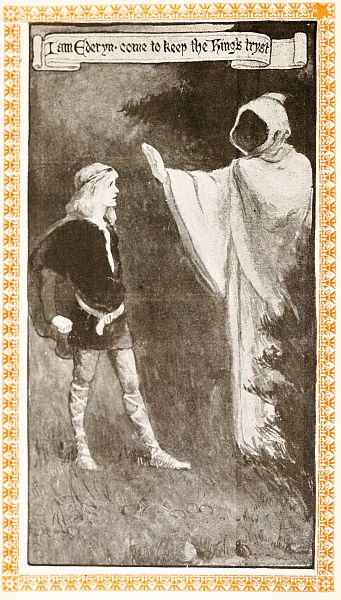
there a tall wraith stood
within the shadows of the
yew. No face had it that
he could see, its hands no
substance, but he met it
bravely, saying: "I am Ederyn,
come to keep the king's
tryst."
And then the spectre's
voice replied: "Well hast
thou kept it, for 'tis known
to me the many menial tasks
thou didst perform ere thou
couldst come upon thy quest.
In token that we two have
met, here is my pledge that
thou may'st keep to show
the king."
He felt a light touch on
the bosom of his inner vestment,
and suddenly he stood
alone beside the gruesome
abbey. Clammy with fear,
he knew not why, he drew
his mantle round him and
sped home as one speeds in
a fearsome dream. And that
it was a dream he half-believed,
when later, in the
hall, he served at meat those
gathered round the old earl's
board. But when he sought
his bed, and threw aside his
outer garment, there on his
coarse, rough shirt of hodden
gray a pearl gleamed white
above his heart, where the
wraith's cold hand had
touched him. It was the
token to the king that he
had answered faithfully his
call.
Again before the dawn he
climbed into the tower, and,
listening when the voices of
the world were still, heard
clear and sweet, like far-blown
elfin horn, another
summons.
"Ederyn! Ederyn! One
awaits thee at the midnight
hour beside black Kilgore's
water. Keep tryst!"
Again to gain his squire's
permission he toiled with
double care. This time his
task was counting all the
spears and halberds, the battle-axes
and the coats of mail
that filled the earl's great
armament. And o'er and
o'er he counted, keeping careful
tally with a bit of keel
upon the iron-banded door,
till the red lines that he
marked there made his eyes
ache and his head swim. At
last the task was finished,
and so well the squire praised
him, and for his faithfulness
again was fain to speed him
on his way.
It was a woful journey to
the waters of Kilgore. Sleep
weighed on Ederyn's eyelids,
and haltingly he went the
weary miles, footsore and
worn. But midnight found
him on the spot where one
awaited him, another wraith-like
envoy of the king, and
it, too, left a touch upon his
heart in token he had kept
the tryst. And when he
looked, another pearl gleamed
there beside the first.
So many a day went by,
and Ederyn failed not in his
homely tasks, but carried to
his common round of duties
all his might, as if they were
great feats of prowess. Thus
gained he liberty to keep the
tryst with every messenger
the king did send.
Once he fared forth along
a dangerous road that led he
knew not where, and, when
he found it crossed a loathly
swamp all filled with slime
and creeping things, fain
would he have fled. But,
pushing on for sake of his
brave oath, although with
fainting heart, he reached the
goal at last. This time his
token made him wonder
much. For when he wakened
from his swoon, a shining
star lay on his heart
above the pearls.
Now it fell out the squire
to whom this Ederyn was
page was killed in conflict
with a robber band, and Ederyn,
for his faithfulness, was
taken by the earl to fill that
squire's place. Soon after
that, they left the hall, and
journeyed on a visit to a distant
lord. 'Twas to the Castle
of Content they came,
where was a joyous garden.
And now no menial tasks
employed the new squire's
time. Here was he free to
wander all the day through
vistas of the joyous garden,
or loiter by the fountain in
the courtyard and watch the
maidens at their tasks, having
fair speech with them
among the flowers. And
one there was among them,
so lily-like in face, so gentle-voiced
and fair, that Ederyn
well-nigh forgot his oath,
and felt full glad when for a
space the king's call ceased
to sound. And gladder was
he still, when, later on, the
earl's long visit done, he left
young Ederyn behind to
serve the great lord of the
castle, for so the two friends
had agreed, since Ederyn had
pleased the old lord's fancy.
Yet was he faithful to his
vow, and failed not every
dawn to mount to some high
place, when all the voices of
the world were still, and listen
for the sound of Merlin's
horn. One morn it came:
"Ederyn! Ederyn! One
waits thee far away. By the
black cave of Atropos, when
the moon fulls, keep thy
tryst!"
Now 'twas a seven days'
journey to that cave, and
Ederyn, thinking of the lily
maid, was loath to leave the
garden. He lingered by the
fountain until nightfall, saying
to himself: "Why should
I go on longer in these foolish
quests, keeping tryst with
shadows that vanish at the
touch? No nearer am I to
a knight's estate than when,
a stripling page, I listened
to the minstrel's tales."
The fountain softly
splashed within the garden.
From out the banquet-hall
there stole the sound of tinkling
lutes, and then the lily
maiden sang. Her siren
voice filled all his heart, and
he forgot his oath to duty.
But presently a star reflected
in the fountain made him
look up into the jewelled
sky, where shone the polar
constellation. And there he
read the oath he had forgotten:
"With the compass needle
of my soul true to the
north star of my great ambition,
I will follow where it
leads."
Thrusting his fingers in
his ears to silence the beloved
voice of her who sang,
he madly rushed from out
the garden into the blackness
of the night. The Castle of
Content clanged its great
gate behind him. He shivered
as he felt the jar through
all his frame, but, never taking
out his fingers, on he
ran, till scores of furlongs
lay between him and the
tempting of that siren voice.
It was a strange and fearsome
wood that lay between
him and the cave. All things
seemed moaning and afraid.
He saw no forms, but everywhere
the shadows shuddered,
and moans and groans
pursued him till nameless
fears clutched at his heart
with icy chill. Then suddenly
the earth slipped way
beneath his feet, and cold
waves closed above his head.
He knew now he had fallen
in the pool that lies upon the
far edge of the fearsome
wood,—a pool so deep and
of such whirling motion that
only by the fiercest struggle
may one escape. Gladly he
would have allowed the waters
to close over him, such
cold pains smote his heart,
had he not seemed to hear
the old minstrel's song. It
aroused him to a final effort,
and he gasped between his
teeth:
"''Tis the king's call! O list!
Thou heart and hand of mine, keep tryst—
Keep tryst or die!'"
With that, in one mighty
struggle he dragged himself
to land. A bow-shot farther
on he saw the cave, and by
sheer force of will crept
toward it. What happened
then he knew not till the
moon rose full and high
above him. A form swathed
all in black bowed over him.
"Ederyn," she sighed,
"here is thy token that the
king may know that thou
hast met me face to face."
He thought it was a diamond
at first, that sparkled
there beside the star, but
when he looked again, lo,
nothing but a tear.
Then went he back unto
the joyous garden by slow
degrees, for he was now sore
spent. And after that the
summons came full often.
Whenever all the world
seemed loveliest and life
most sweet, then was the
call most sure to come. But
never once he faltered.
Never was he faithless to
the king's behest. Up weary
mountain steps he toiled to
find the sombre face of Disappointment
there in waiting,
and Suffering and Pain
were often at his journey's
end, and once a sore Defeat.
But bravely as the months
went by he learned to smile
into their eyes, no matter
which one handed out to him
the pledge of Duty well performed.
One day, when he no
longer was a beardless
youth, but grown to pleasing
stature and of great brawn,
he heard the hoped-for call
of which he long had
dreamed: "Ederyn! Ederyn!
The king himself awaits thee.
Midsummer morn at lark-song,
keep tryst beside the
palace gate."
As travellers on the desert,
spent and worn, see far
across the sand the palm-tree's
green that marks life-giving
wells, so Ederyn
hailed this summons to the
king. The soul-consuming
thirst that long had urged
him on grew fiercer as the
well of consummation came
in sight. Hope shod his
feet with wings, as thus
with every nerve a-strain he
pushed toward the final tryst.
So fearful was he some mishap
might snatch the cup
away ere it had touched his
thirsty lips, that three full
days before the time he
reached the Vale of Avalon,
and sat him down outside
the entrance to the palace.
Now there came prowling
through the wood that edged
the fair domain the gnarled
dwarfs that do the will of
Shudderwain. And Shudderwain,
of all the giants
thereabouts, most cruel was
and to be feared. Knowing
full well what pleasure it
would give the bloody monster,
these dwarfs laid evil
hands on Ederyn. Sleeping
they found him, and bound
him with hard leathern
thongs, and then with gibes
and impish laughter dragged
him into a dungeon past the
help of man.
Two days and nights he
lay there, raging at fate and
at his helplessness, till he
was well-nigh mad, bethinking
him of all his baffled
hopes. And like a madman
gnawed he on the leathern
thongs till he was free, and
beat his hands against the
stubborn rock that would
not yield, and threw himself
against the walls that held
him in.
The dwarfs from time to
time peered through the slatted
window overhead and
mocked him, pointing with
their crooked thumbs.
"Ha! ha! Thou'lt keep
no tryst," they chattered.
"But if thou'lt swear upon
thy oath to go back to the
joyous garden, and hark no
more for Merlin's call, we'll
let thee loose from out this
Dungeon of thy Disappointment."
Then was Ederyn tempted,
for the dungeon was foul indeed,
and his heart cried out
to go back to the lily maiden.
But once more in his ears he
thrust his fingers and cried:
"'To the king's call alone I'll list!
Oh, heart and hand of mine, keep tryst—
Keep tryst or die!'"
On the third night, with
the quiet of despair he threw
him prone upon the dungeon
floor and held his peace, no
longer gnawing on his thongs
or beating on the rock. A
single moonbeam straggled
through the slatted window,
and by its light he saw a
spider spinning out a web.
Then, looking dully around,
he saw the dungeon was
hung thick with other webs,
foul with the dust of years.
Great festoons of the cobweb
film shrouded his prison
walls. As up and down the
hairy creature swung itself
upon its thread, the hopeless
eyes of Ederyn followed it.
All in a twinkling he saw
how he might profit by the
spider's teaching, and clapped
his hand across his mouth
to keep from shouting out
his joy so that the dwarfs
could hear. Now once more
like a madman rushing at
the walls, he tore down all
the dusty webs, and twisted
them together in long
strands. These strands he
braided in thick ropes and
tied them, knotting them and
twisting and doubling once
again. All the while he kept
bewailing the stupid way
in which he wasted time.
"Three days ago I might
have quit this den," he
sighed, "had I but used the
means that lay at hand. Full
well I knew that heaven always
finds a way to help the
man who helps himself. No
creature lives too mean to
be of service, and even dungeon
walls must harbour
help for him who boldly
grasps the first thing that he
sees and makes it serve him."
So fast and furiously he
worked that, long before the
moonbeam faded, his cobweb
rope was strong enough to
bear his weight, and long
enough to reach twice over
to the slatted window overhead.
By many trials he at
last succeeded in throwing it
around a spike that barred
the window, and, climbing
up, he forced the slats apart
and clambered through.
Then tying the rope's end to
the window, he slid down
all the dizzy cliffside in
which the dwarfs had dug
the dungeon, and dropped
into the stream that ran below.
Lo, when he looked around
him it was dawn. Midsummer
morn it was, and, plunging
through the wood, he
heard the lark's song rise,
and reached the palace gate
just as it opened to the blare
of trumpets for the king's
train to ride forth. When
Ederyn saw the royal cavalcade,
he shrunk back into
the wayside bushes, so ill-befitting
did it seem that he
should come before the king
in tattered garments, with
blood upon his hands where
the sharp rocks had cut, and
with foul dungeon stains.
But that the king might
know he'd ever proven faithful,
he sank upon his knees
and bared his breast at his
approach. There all the
pledges glistened in the sunlight,
in rainbow hues. There
Pain had dropped her heart's
blood in a glittering ruby,
and Honour set her seal
upon him in a golden star.
A diamond gleamed where
Sorrow's tear had fallen, and
amethysts glowed now with
purple splendour to mark his
patient meeting with Defeat.
But mostly were the pledges
little pearls for little duties
faithfully performed; and
there they shone, and, as the
people gazed, they saw the
jewels take the shape of letters,
so that the king read
out before them all, "Semper
fidelis."
Then drew the king his
royal sword and lightly
smote on Ederyn's shoulder,
and cried: "Arise, Sir
Knight, Sir Ederyn the
Trusty. Since I may trust
thee to the utmost in little
things as well as great, since
thou of all men art most
worthy, henceforth by thy
king's heart thou shalt ride,
ever to be his faithful guard
and comrade."
So there before them all
he did him honour, and
ordered that a prancing
steed be brought and a
good sword buckled on his
side.
Thus Ederyn won his
sovereign's favour. Soon,
by his sovereign's grace
permitted, he went back to
the joyous garden to woo the
lily maiden. When he had
won his bride and borne her
to the palace, then was his
great reward complete for
all his years of fealty to his
vow. Then out into the
world he went to guard his
king. Henceforth blazoned
on his shield and helmet he
bore the crest—a heart with
hand that grasped a spear,
and, underneath, these words:
"I keep the tryst!"
THE END.