We have now, according to the last census, a population pressing
close upon fifty Millions. Every one of this vast number is
individually interested in the milk question. What is true of
perhaps no other element of food and nourishment, milk is
consumed in some form by all, old and young. It is because of
this necessarily universal personal interest in milk that the publishers
offer this volume which aims to show all how to obtain the
best milk, plenty of it, and at the cheapest rates. The book embraces
the experience and advice of able, well known writers—such,
for example, as Professor Slade, of Harvard College, and
Henry E. Alvord—elicited in response to propositions presented
by the Publishers for articles upon the subject. The editorial
supervision of the work has been in the hands of Col. Mason C.
Weld and Professor Manly Miles—recognized authorities on Dairy
Matters—who would have included many other valuable and interesting
papers submitted, were it not that they would have made
the volume too bulky. Mr. Orange Judd has added a leaf from
his personal experience.
The topics treated are only those legitimately connected with
the subject, yet they cover a wide field, and will prove of great
interest to all occupied in the culture of the soil, while as a
handbook and guide to those who keep one or more family cows
it must be of almost daily practical use. The prominent subjects,
such as soiling, stabling, care of manure, the tillage of the soil,
the cultivation of various crops, care of the cow and of the calf,
are each treated in detail, and yet there is so great a variety and
such genuine personal experience and sincere conviction on the
part of each writer, that his or her way is the best way—as indeed
it may be, under the circumstances—that there is little or nothing
of sameness or repetition in the book, but the reader’s interest
is sustained to the last.
INTRODUCTION.
Every farmer is ordinarily supposed to keep several cows, and
there is no reason why most families in villages and very many
in cities should not possess at least one. Good milk affords
the best of nourishment for young children, and goes a long way
in saving butchers’ bills, and in the preparation of palatable nourishing
food of many varieties. Two to five families, according to
age and number, can readily unite in having one cow kept, dividing
the milk and expenses, and thus always have good, pure,
rich milk at very moderate cost. The suitable refuse from the
kitchens of three or four families would very much reduce the
cost of purchased food. In rural villages, summer pasturage
can be obtained near at hand, which, with a daily feed of good
meal will furnish a large supply of rich milk at a low cost. A
boy can be secured at a small price to drive the cow to the pasture
in the morning, and return her at night to the stable. A stable or
stall can always be obtained at a trifling rent, and be kept clean.
There are plenty of gardeners or farmers who will gladly take the
manure away so frequently as to prevent it being a nuisance, or
disagreeable.
We have no doubt that all residents of villages, manufacturing
towns, etc., can, by arrangements like the above, secure an abundant
supply of pure, rich, fresh, healthful milk at less than three
cents per quart, and at the same time add greatly to their home
comforts, and preserve the health if not the lives of their little ones.
In February, 1880, the publishers of this volume offered prizes
for three essays on keeping one cow, indicating at the same time
their scope. Some extracts from the explanatory remarks accompanying
this offer may fitly outline an introduction to the work.
The number of persons who possess but one cow is far larger
than those who have ten or more. No doubt many others,
living outside of closely built cities, would gladly lessen the
cost of supporting their families, and at the same time add to
their comforts, and even luxuries, by keeping a cow, did they
know how to keep one. There is a general notion that keeping a
cow requires a pasture. If a pasture is not necessary, they do not
know how to get along without one. Dairymen and farmers
learn how to treat herds as a part of general farm management, or
in books on the subject. There are books on cows, but none on
one cow. It is not a question of dairy farming, but of dairy gardening.
The offer was made to elicit information to enable one
to keep a single cow with the best possible results. The main
points to be considered are: the stabling or housing of the cow;
the yard room she requires, and the storage or disposal of her manure;
the least area of land that can be safely set apart for the
support of the cow, and how can that land be best managed. It
is to be assumed that the land will be made to produce all that it
will profitably yield, which will bring up the question of manure
and fertilizers, of course considering that produced by the cow
herself. What proportion of the produce of the land is to be
cured for winter? How much food must be bought, and what?
How is the cow to be fed, and in every respect how treated so as
to give the best returns to her owner? What should be done at
calving time and afterwards? milking, etc. In short, the problem
is—given a good cow, how to get the best possible returns
from the least possible portion of the land through the agency of
the cow.
This, we think, is satisfactorily answered, if not by any one
writer, certainly by several combined.
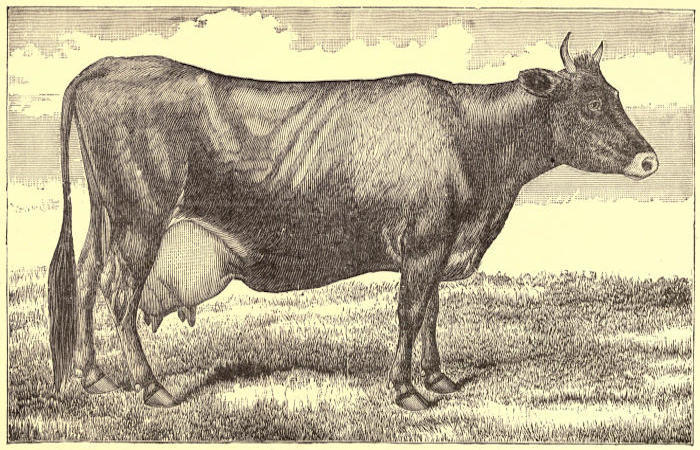
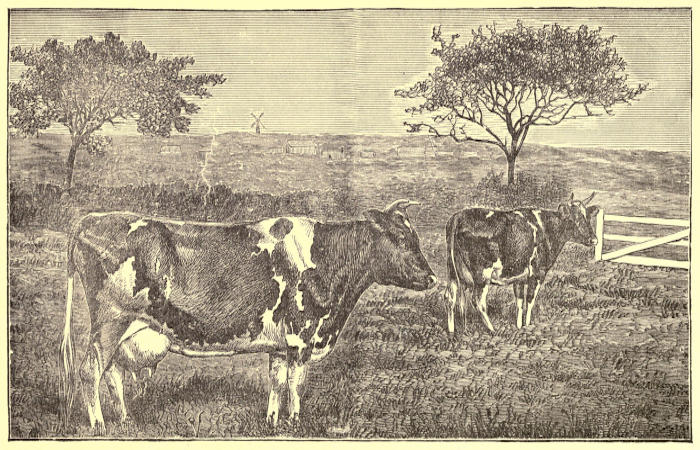
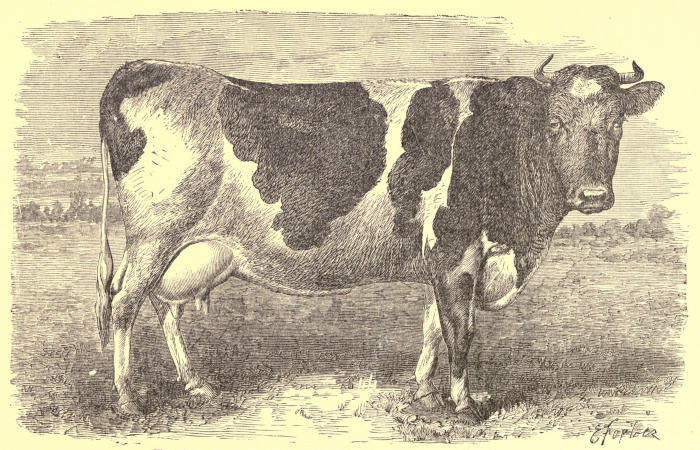
We place as a frontispiece the portrait of a most famous and
excellent cow—not so much for her beauty or on account of her
breed, but as a model of a dairy cow, and one which may be carried
in the mind when purchasing.
KEEPING ONE COW. — THE FAMILY COW AT THE NORTH. — YARD, STABLE, AND RATIONS. — LAND AND CROPS. — WEANING THE CALF. — A FEW WORDS AS TO GENERAL MANAGEMENT.
BY MRS. G. BOURINOT, OTTAWA, CANADA.
She’s broad in her hips and long in her rump,
A straight and flat back without ever a hump,
She’s wide in her lips and calm in her eyes,
She’s fine in her shoulders and thin in her thighs,
She’s sleight in her neck and small in her tail,
She’s wide in her breast and good at the pail;
She’s fine in her bone and silky of skin,
She’s a grazier without and a butcher within.
—Milburn.
There are several ways of providing for the wants of a cow,
but in all cases it is absolutely necessary, in order to obtain the
best results, that certain rules be followed with regard to the
treatment the cow receives. She must be fed and milked at regular
times, be kept thoroughly clean, have plenty of fresh air and
water, and her food composed of those substances that will keep her
always in good condition, do away with the milk bill, reduce the
grocer’s account, and contribute greatly to the health and comfort
of the family. I have tried various things, and have found fresh
grass or fodder, provender, bran, oil-cake, mangels, and hay, the
best bill of fare for “Daisy” or “Buttercup.” Avoid brewer’s
slops or grains as you would poison, for although they increase
the flow of milk, it is thin and blue, the butter white and tasteless,
and after a time the cow’s teeth will blacken and decay. I was
told the other day by a very intelligent dairyman that after feeding
his cows one season on brewer’s grains he was obliged to sell
his whole herd.
Mr. Geo. E. Waring, Jr., in his “Ogden Farm Papers,” says he
expects to be able to feed a cow from May fifteenth to November
fifteenth from half an acre of ground, but the average citizen had
better not attempt it, but keep his half acre to raise vegetables
and fruit, buying the food required to keep his cow. A cow can be
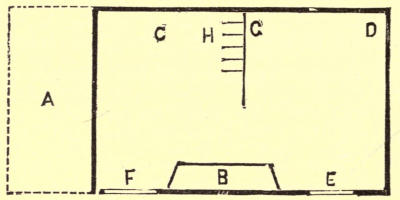
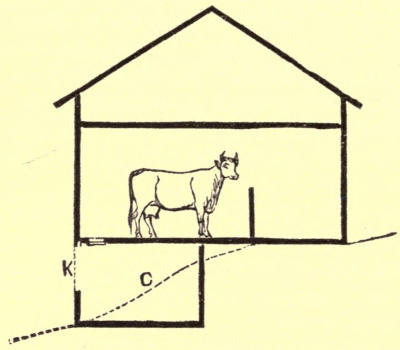
made very profitable if kept in the following way; First, as to the
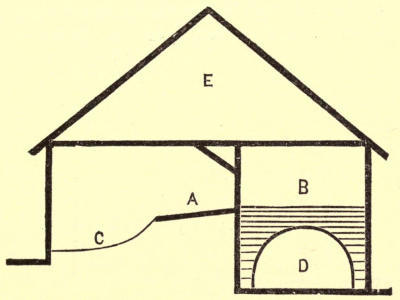
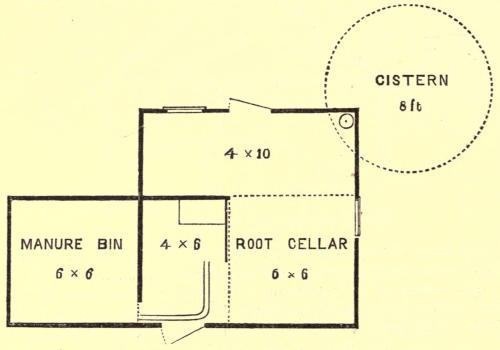
accommodation required, a yard fifteen feet by fifteen, and a stable
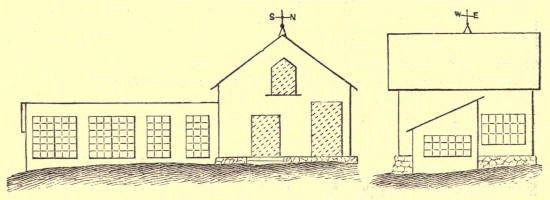
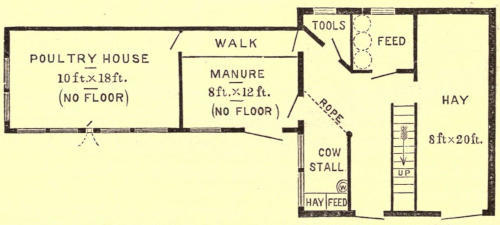
or cow-shed arranged as in the following plan. A, manure shed;
B, bin for dried earth; C, cow; D, store-room; E, window for putting
in hay; F, door; G, trap to loft; H, feeding trough. Have her
food provided as follows: into a common pail put one quart
of provender (“provender” is oats and peas ground together,
and can be purchased at any feed store), one-quarter pound of oil-cake,
then fill the pail nearly full of bran and pour boiling water
over the whole; stir well with a stick, and put it away covered with
an old bit of carpet until feeding time; give her that mess twice a
day. Have her dinner from June to November consist of grass or
fodder cut and brought in twice a week by some farmer or market
gardener in exchange for her manure and sour milk. In Montreal,
grass and fodder are brought to market by the “Habatants,” and
sold in bundles. As to quantity, a good big armful will be
sufficient, and it is more healthful for the cow if it is a little
wilted. In the winter hay and mangels are to be fed in place of
the grass and fodder. She should also have salt where she can
take a lick when so minded, and fresh water three times a day.
The yard should be kept clean by scraping up the manure every
morning into the little shed at the end of the stable.
Fig. 1.—STABLE AND YARD.
The following table shows the food required to keep one cow
through the entire year:
Hay, the best, two tons, at $10 per ton
$20.00
200 pounds of Oil-cake, at $4 per 100 pounds
8.00
800 pounds of Provender, at $1 per 100 pounds
8.00
Half a ton of Bran, at $12 per ton
6.00
One ton of Mangels
5.00
$47.00
Your cow will require the following “trousseau”:
One five-gallon stone churn
$1.25
One and a half dozen milk pans, at $2
3.00
One milk pail and strainer
.60
One butter bowl (wooden)
.50
One paddle and print
.20
Two wooden pails for feed
.40
One card
.25
$6.20
Cost of a good cow
40.00
Interest at 6 per cent
$3.69
Any ordinary family will take from a milkman at least one
quart a day. We in Ottawa pay eight cents per quart, making per
year (365 × 8,) $29.20.
It is a very poor cow that will not average five pounds of butter
a week for forty weeks, and that at twenty-five cents per pound,
that is 40 (weeks) × 5 (pounds), × 25 (cents), equals 50 (dollars).
So the account stands thus:
Butter
$50.00
Milk
29.20
$79.20
Cost of food for one year
$47.00
}
Interest on cow and trousseau
3.69
}
50.69
Profit
$28.51
I have found that two acres of land is the least possible area
that will provide cow-food for the entire year, and that should be
divided thus: One acre for hay, the other for fodder and mangels.
If you have no land already seeded down, plow up your acre, sow
clover and timothy, six pounds, of each. In May, when the grass
has fairly started, top-dress it with two bushels of land plaster;
if you can apply it just before a rain it is the best time. The first
year you will have all clover hay, and it must be cut before the
second blossom comes; if not cut early enough, the stalks become
tough and woody, and are wasted by the cow. The second year,
if top-dressed in the fall with the manure collected during the
summer, you will have a fine crop of timothy, and if the land
was good for anything you can cut hay from it for three years by
giving it a little manure every fall. As early as the ground will
admit, sow some peas and oats; one bushel of each will plant
one-third of an acre. Peas do well on old sod, and are the best
crop to plant on new ground. In about six weeks you can commence
cutting it for fodder, and it should give the cow two good
meals a day until corn comes in. L. B. Arnold, in “American
Dairying,” says of corn: “When too thickly planted its stems and
leaves are soft and pale, its juices thin and poor. If sown thin or
in drills, so that the air and light and heat of the sun can reach it,
and not fed until nearly its full size, it is a valuable soiling plant.”
Now Mr. Waring, in “Farming for Profit,” says: “It is a common
mistake when the corn is planted in drills to put in so little seed
that the stalks grow large and strong, when they are neglected by
the cattle, the leaves only being consumed. There should be forty
grains at least to the foot of row, which will take from four to six
bushels to the acre, but the result will fully justify the outlay, as
the corn standing so close in the row will grow fine and thick.”
My experience tells me that Mr. Waring is right; any way, my
cow will not eat the coarse stalks which will grow when the corn
is planted too thin.
The one-third acre reserved for mangels, must be the perfection
of richness, well drained, and manured. If the soil is deep, you
can plant them on the flat, but if the soil is shallow, plant them on
ridges, the ridges thirty inches apart (I always plant them in that
way); then thin out the plants to fifteen inches apart. Ten to
twelve hundred bushels may be grown on an acre, but the ground
must be properly prepared. In storing them, they require to be
very carefully handled, as the least bruise hastens decay, and we
want to keep them fresh and good until April, when our cow
ought to give us a calf.
I thought I had tried almost everything relating to the care of
cows, but when I undertook to wean a five-weeks’-old calf, I found
my education in that respect sadly neglected. I asked a farmer’s
wife how I was to manage. “Oh,” she said, “just dip your fingers
in the milk, and let the calf suck them a few times, and it will
soon learn to put its nose in the pail and drink.” It sounded
simple enough, so I took my pail and started for the barn, where
that wretched animal slopped me all over with milk, bunted me
round and round the pen, until I was black and blue, sucked the
skin off my finger, and wouldn’t drink. After trying at intervals
for two days, the calf was getting thin, and so was I. In despair,
I left the pail of milk, giving that calf a few words of wholesome
advice. When I went back two hours after, the calf was standing
over the empty pail, with an expression on its face, that I translated
into an inquiry, as to why I hadn’t left that pail there before.
I have weaned several calves since then, but have never had any
trouble. Leave them with the cow three or four days, then take
a little milk and hold the calf’s nose in the pail; it must open its
mouth or smother, and when once it tastes the milk, will soon learn
to drink.[1] When it is a week old, commence feeding with oil-cake,
skim-milk and molasses. Into an old two-pound peach can,
I put one tablespoonful of oil-cake and one of molasses, fill up the
can with boiling water, and set it on the stove until thoroughly
cooked. That quantity will be its allowance for one day, mixed
with skim-milk. The next week, give it that quantity at each meal,
and the next week, twice that. The calf will then be four weeks
old, and the butcher ought to give you a price for it that will pay
for all trouble and the family milk bill while the cow was dry. It
does not pay to raise calves where you only keep one cow. (Mr.
Cochrane, the owner of the celebrated cow “Duchess of Airdrie,”
told me the other morning that last year he sold a calf of her’s to
an English gentleman for four thousand guineas (twenty thousand
dollars). I think it would pay to have a wet nurse if one had a
calf like that). A tablespoonful of lime-water put in the milk now
and then will prevent the calf from “scouring,” a complaint very
common among calves brought up by hand. I believe that winter
rye makes a valuable soiling plant, but I have never tried it.
[1] It is better, as a rule, not to allow the calf to suck at all. Aptness in learning
to drink is influenced by heredity. Calves from ancestors that have not
been allowed to suck, learn to drink more readily than those which have been
allowed to run with the dam.
I think it cruel to keep cows tied up all summer. They do not
require much exercise, but fresh air they must have, and it is a
great comfort to them to lick themselves, although they ought to
be well curried every day. It is better to milk after feeding, as
they stand more quietly. Don’t allow your milk-maid to wash
the cow’s teats in the milk pail, a filthy habit much in vogue.
Insist on her taking a wet cloth and wiping the cow’s bag thoroughly
before she commences to milk. A cow ought to be milked
in ten minutes, although the first time I undertook to milk alone,
I tugged away for an hour. I knew how much milk I ought to
have, and I was bound to get it. An old cow will eat more than
a young one, but will give richer milk. If you can get a cow
with her second calf, you can keep her profitably for five years,
when she should be sold to the butcher. There is nothing that
will keep your cow-shed so neat, and add so much to the value of
your manure pile, as a few shovelfuls of dry earth or muck thrown
under the cow. It will absorb the liquid manure better than anything
else. Don’t allow your milk pans to be appropriated for
all sorts of household uses; you cannot make sweet, firm butter
if the milk is put into rusty old tin. Skim the milk twice a day
into the stone churn; add a little salt, and stir it well every time
you put in fresh cream. Use spring water, but don’t allow ice
to come in contact with the butter; it destroys both color
and flavor. If your cream is too warm, the butter will come more
quickly, but it will be white and soft. When the cream is so cold
that it takes me half an hour to churn, I always have the best
butter. Don’t put your hands to it, work out the buttermilk with
a wooden paddle, and work in the salt with the same thing.
There is an old saying that one quart of milk a day gives one pound
of butter a week, and I think it’s a pretty fair rule, but don’t expect
to buy a cow that will give you thirty quarts of milk a day. There
are such cows I know, but they are not for sale. Be quite satisfied
if your cow gives half that quantity. Place the cow’s food where
she cannot step on it, but don’t put it high up; It is natural for
them to eat with their heads down. I think it is better that the
family cow should have a calf every year, provided you can have
them come early in the spring or late in the autumn. As to the
time that a cow should be dry, that depends much upon the way
the cow was brought up. If she was allowed to go dry early in
the season with her first calf, she will always do it. A cow being
a very conservative animal, she should be milked as long as her
milk is good. When she is dry, stop feeding the provender, bran,
and oil-cake, and give her plenty of good hay, with some roots,
until after she calves. The provender and oil-cake being strong
food, are apt to produce inflammation and other troubles at calving
time. You can feed turnips when she is dry, at the rate of two
pails a day, cut up fine, of course, but don’t feed turnips when she
is milking. I have tried every way to destroy the flavor of turnips
in milk, but without success. I have boiled it, put soda in it,
fed the cow after milking, but it was all the same—turnip flavor
unmistakable—and as we don’t like our butter so flavored, I only
feed turnips when the cow is dry.
The Rev. E. P. Roe in his delightful book called “Play and
Profit in My Garden,” says: “If a family in ordinary good circumstances,
kept a separate account of the fruit and vegetables
bought and used during the year, they would, doubtless, be surprised
at the sum total. But if they could see the amount they
could and would consume if they didn’t have to buy, surprise
would be a very mild way of putting it.” The same rule applies
to the keeping of a cow. We buy one quart a day and manage
to get along with it. Our cow gives us ten to twenty quarts a
day and we make way with the greater part of it. I think with a
cow and a garden, one may manage to live, but life without either,
according to my ways of thinking, would be shorn of many of
its pleasures.
THE COW IN THE MIDDLE STATES. — THE BARN. — SYSTEM OF FEEDING. — MANURE. — CROPS AND TILLAGE. — CALVING.
BY W. L. BATTLES, GIRARD, PA.
Instead of writing on how a cow might be kept, I propose
simply to tell just how we manage our cow, what we feed her,
how we procure that food; in fact everything relating to her care,
so that any one can go and do likewise.
“Spot,” we call her, for she has a beautiful white spot in her
forehead, is not a Jersey, for we can not afford to buy one at the
prices at which they are held with us; nor is she a thorough-bred
of any kind; yet she is a good cow, of medium size, fills a twelve-quart
pail each night and morning, when her milk is in good flow,
that raises a thick coat of rich cream, which, after been churned,
furnishes all the butter needed for a family of six, and some to
spare. Our place is small, only two acres, and a portion of this
is covered by the dwelling, barn, poultry-house, etc. The fruit
garden occupies about one-fourth of an acre, and from this portion
nothing is grown to furnish food for “Spot.” Adjoining
the barn there is half an acre of the land in good grass, or
mostly clover, and every spring a quart of clover seed is sown,
so as fast as the old plants die out, young ones take their places.
A bushel of land plaster is sown on this when the grass begins to
start in the spring. This plot produces a very heavy growth of
grass and clover, enabling us to cut it three times each season;
about the first of June, August, and of October. A coat of fine
manure is always spread over the ground immediately after each
mowing. The grass is mostly cured, and makes fine hay for winter
feeding. Occasionally a small portion of the crop is used
green for soiling. Besides the land occupied by buildings, fruit
garden, and clover plot, there remains about one acre, which
we call the garden. Here are grown all the vegetables for the
family’s use, besides some to sell. About one-fourth of it is
planted to Early Rose potatoes, and as soon as these are sufficiently
ripe for use or market, they are dug, and sweet corn, in drills, for
fodder, is sown upon the land. Another fourth of an acre is
planted to sugar beets; the ground being very rich, the yield is
always large; this last season (1879), though very dry, I harvested
one hundred and seventy-eight bushels. Our cow is very fond
of the beets, and I think there is nothing better to keep up a
flow of milk, and they give it no bad flavor, as do turnips. An
additional fourth of an acre is planted to sweet, or evergreen,
corn; as fast as the corn is picked for use or market, the green
stalks are cut up, run through the cutting-box, and every particle
of them consumed. As soon as the corn is all harvested, the
ground it occupied is thoroughly fitted and manured, and then
sown to winter rye, to be used for soiling the next spring, after
which the ground is again prepared for corn. The remaining
fourth acre is devoted to early peas, beans, cabbages and other
garden vegetables. As soon as one crop is off, the ground is prepared,
and something else is almost always planted or sown;
consequently, on the most of this acre, two crops are produced
each season, except where sugar-beets are grown, or late cabbages,
which require the whole season to mature. With the clover on
the half acre, and the forage crop and roots on the acre, we have
not only had sufficient food for the cow the entire season, but
have also kept our family horse, with the exception of one load
of oat-straw purchased for three dollars, to mix in with the fodder
corn; this is hard to cure sufficiently to keep bright and
sweet through the winter, but by mixing a layer of corn-fodder,
and a layer of straw, it all comes out nice and bright. Besides
keeping both horse and cow, we have marketed from this little
farm, in berries, vegetables, butter, eggs, poultry, and one fat hog,
weighing, dressed, over three hundred pounds, four hundred and
sixty-eight dollars’ worth of the above produce, keeping enough
for our own use, and salting down one barrel of pork.
The barn is twenty-five by thirty feet, with the stable on the
south side. The stall for “Spot” is five feet wide, and the
floor on which she stands is five feet long, with a manger two
feet wide in front, one and a half high next to the cow, and
three feet next to the barn floor. She is fastened with a wide
strap around her neck, attached to a chain eighteen inches long,
which is fastened to a staple driven into a post at the corner of
the stall adjoining the manger; this gives her room to turn her
head so as to lick any portion of her body. The floor is made
of two-inch plank, battened on the under side with thin boards,
raised from the ground ten inches in rear and one foot in
front; all the droppings and urine fall into the four-foot alley
behind. This alley has a clay floor beaten perfectly solid and
level. Next to the stable door is a large bin, ten by seven feet,
for storing road-dust or muck; at the other end of the stable is
another bin, ten by eleven feet, for storing leaves for bedding.
My great object is not only to make “Spot” comfortable, and
have her stable free from all bad odors, but to save all the
manure, both liquid and solid. The best absorbent is dried muck,
pulverized, or road-dust from clayey roads. As it is easier to
procure the latter, I generally make use of that, and always
keep from two to three inches of it in the alley; this effectually
absorbs all the liquid portions and all offensive odors. Twice each
day, this is thrown out through a window closed by a sliding shutter
in the rear of the stall, under a shed, where it remains until
wanted for use. In the fall, I go to the woods and procure a
sufficient quantity of leaves to last until spring; a liberal use of
these not only makes a nice, soft, clean bed, but largely increases
the quantity of manure. The stable opens into a small yard,
across one corner of which runs a small brook. Each morning,
the cow is permitted to go out and drink; if the weather is pleasant,
she is allowed to remain out an hour for exercise. She is let
out the same at night, after sunset in warm weather, so that she will
not be annoyed by flies. The barn is well-battened, and is warm
in winter; it is well ventilated by two windows, but these, in
summer, are darkened by blinds, with wide slats, to keep out flies.
Each morning, while “Spot” is eating her breakfast, she is
well curried with a curry comb or card, and if any filth is observed
on her bag or teats (which is very seldom), they are carefully
washed off, if in winter, with warm water. She is never scolded
nor whipped; consequently she never kicks over the pail, or holds
up her milk. She is fed in winter with a peck of sugar-beets cut
up, both morning, noon, and night; also, a bushel of cut feed,
either corn-stalks or clover hay, wet with a pailful of hot water,
with two quarts of “sugar meal,” or bran, thoroughly mixed together,
with a little salt sprinkled over it. I generally use what is
known here as “sugar meal” to mix with her feed; it is corn
meal from the factory after the sugar or glucose has been extracted;
it costs from ten cents to twelve and a half cents per
bushel, and I prefer it to bran, and “Spot” likes it very much.
We consider her a machine for converting the food we give her
into milk, and the more we can get her to eat and digest, the more
milk is obtained, and the greater the profit. It is a good plan to
change the food occasionally, substituting carrots for beets, clover
hay for corn fodder, for brutes, like mankind, are fond of a
variety. There are root-cutters that can be procured for cutting
up roots, but I have always used a common spade, ground sharp,
and an empty flour barrel to hold the beets. It takes but a few
minutes to cut up a mess of beets in that way.
With a bin of road-dust, and one of leaves, a winter’s supply of litter
is secured, and it is surprising what a pile of manure we have in
the spring. Another valuable source of manure is the pigsty, with
plenty of leaves for a warm bed, and sufficient road-dust to absorb
all the liquids, it is astonishing how clean our pigs are, and
the sty is free from all bad odors; the big potatoes and mammoth
beets, show the richness of the pig-pen fertilizer. I think our
fifty hens pay for all their food with the droppings the poultry-house
furnishes. The roosts are over a slanting platform, which
is kept covered with road-dust both summer and winter; the
droppings fall on this floor, and roll down into a large box twelve
feet long, three feet wide, and three feet deep. The dust the
chickens work down with the droppings is sufficient to absorb all
the ammonia and preserve all the fertilizing qualities of this most
valuable guano. A large box of road-dust is always kept in the
water-closet, a liberal use of which furnishes a quantity of most
valuable fertilizer, besides freeing the closets from all noxious
smells. The wash water and slops from the kitchen are utilized
by being thrown on a pile of sods and other rubbish, which are
forked over, and as soon as decayed, carted to the manure
pile. From so many sources we are enabled to give our small
farm a most liberal supply of manure each spring and fall,
so that even with the double cropping most of it gets, it
continues to improve, and yields more bountifully each succeeding
season.
In the cultivation of sugar beets, the ground is first manured
heavily, plowed deep, and thoroughly pulverized with the
cultivator, then marked out in rows with a garden plow, two feet
apart. Manure from the poultry-house is scattered in each furrow,
which should be lightly covered with soil, so the seed will
not come in contact with it; drop the seeds about six inches apart,
covering lightly with the garden rake. When the leaves are about
four inches long, thin out to one plant in a place, and fill any
vacancies with the plants pulled out. Hoe them thoroughly, destroying
all weeds, which can easily be done by cultivating each
time before hoeing, with an arrow cultivator. Keep the ground
mellow, and cultivate three or four times, after which they will
take care of themselves and soon cover the ground. With ground
in good condition, and a fair season, six hundred to eight hundred
bushels per acre can be easily produced. Let them grow until
frost comes, when they should be dug with a garden fork, the tops
cut off, and stored for winter. Those to be used before the first of
March, are stored in the cellar, the others are buried in a long pit,
digging out a shallow place, piling up the roots about three feet
high, and three feet wide, covering well with straw and sufficient
soil to keep them from freezing, putting in a drain-tile about every
four feet in the top of the pile, with one end to project a little
through the covering, for ventilation. If the weather becomes
very cold, lay a turf over the tile, and remove when pleasant. I
grow carrots after the same plan, and store in like manner. I
prefer beets, as they are so much larger, it is less trouble to gather
and take care of them, and the crop is generally larger, still I
always grow some carrots for a change. I plant sweet corn in
drills, always put some fertilizer along the furrow, dropping the
kernels about eight inches apart, with the rows three feet wide, I
commence planting soon after May first, and continue at intervals
until about July first, so I can have a fresh supply for use, and
market, all the season. The sweet corn being grown on the plot
sown to winter rye, for soiling, enables us to cut some portions of
it twice, before the ground is needed for corn. When sowing corn
for fodder, which is done as soon as we commence digging the
early potatoes, I sow it in drills two feet apart, and drop the
kernels about one inch apart in the drills, manure from the pigsty
is first dropped in the furrow, and covered with soil at least two
inches deep, or the corn will not come up. This fertilizer is so
strong, if properly used it causes a most extraordinary growth of
stalks. While the corn is small, cultivate it two or three times
with a narrow cultivator, when it will take care of itself, and there
will be a surprising growth of stalks; I have them often six feet
high. Just before time for frosts, cut with a scythe, and set up in
small bunches bound around the top, and leave to cure until cold
weather. When it is to be put in the mow, spread alternately a
layer of stalks, and a layer of straw, and it will keep bright
and sweet until wanted. The rye for spring soiling is sown
when the sweet corn is picked, and stalks removed, in drills
about ten inches apart. Fine manure is spread on the ground
after plowing, and thoroughly mixed with the surface soil;
one or two hoeings being given to keep the ground mellow;
to destroy any weeds that may make their appearance. By May
first, the early sown rye will cover the ground with a dense
growth, at least four feet high, furnishing a large quantity of most
nutritious green food. On those portions of the plot where the
latest corn is to be planted, two or three cuttings are made; this
gives most excellent food for the cow, and the quantity grown
on this fourth of an acre will surprise any one who has never tried
it. There is quite a plot of early peas, and as soon as the last
picking occurs, while the vines are green, they are pulled and fed
to “Spot,” who relishes them very much. Turnips, or corn, are
at once sown on the ground where the peas were.
When our early cabbages are taken up, all the leaves, and much
of the stalks, are turned into milk by taking them to the cow’s
manger, and the ground at once planted, or sown, to something
that will make more food. The beet, carrot, and turnip tops, and
late cabbage leaves, make quite a quantity of feed late in the fall,
if care is taken in saving and preserving them. Possibly there may
be some better forage crop than “evergreen,” or sugar corn; I
think another fall I will try the Minnesota Amber Sugar Cane, in
a small way. I tried Pearl Millet, in one row, this season; it
tillered, or spread wonderfully, but did not do so well as the corn,
as the stalks were small, and the millet makes such a feeble growth,
at first, it requires the whole season to produce as much fodder as
I get from corn sowed the fourth of July.
I generally manage to have the cow come in about the first of
September; by that means the six weeks time she is allowed to
go dry, occurs during the warmest portion of the summer, viz., in
July and August, when, with the facilities the person who keeps
but one cow possesses, it is difficult to make good butter. This
is also the season when butter most generally sells the lowest.
The calf is taught to drink after it is a week or ten days old,
and fed on a porridge made from skim-milk and wheat middlings,
or shorts; by the time it is six weeks or two months old it will be
well fattened, and can be sold to the butcher for veal, at a good
price, for at that season of the year veal is scarce and in demand.
The cow being in full flow of milk all winter, when butter is most
always high, will pay a good profit for her feed and care. A
couple of weeks prior to the time the calf should be born, I
make a box stall on the barn floor, and permit the cow to run
loose in it until the calf is taken away to learn to drink. During
this time she should have a good bed of leaves, and the stall be
cleaned each night and morning. So far at such times I have experienced
no difficulty, or trouble; should any occur, it is better
to apply to an experienced person, than to try and “doctor” her
yourself. After the calf is born, I feed the cow on warm slops a
day or two, permitting the calf to suck until the swelling has gone
from her bag, and it has assumed its natural condition. Then, as
before stated, teach it to drink, which can easily be done by inserting
the finger in its mouth, and putting its head in the dish,
cautiously withdrawing the finger a few times, and in a short time
you will have no difficulty, as it will help itself.
In conclusion, I can say I have tried to state just how our cow
is managed and kept. I presume there can be improvements
made on our system. I shall be glad to take advantage of the
experience of others, at any and all times. No record is kept of
the milk obtained, or of the butter made. We know we always
have plenty for the family’s use, and considerable to spare.
Bread and milk furnish the children half their food a portion of
the time. Pure milk and plenty of fresh fruits, in abundance, we
consider afford one of the principal reasons why our family is so
healthy, and we have so few doctor’s bills to pay.
From our acre and a half, all the food has been grown for both
cow and horse, except the three dollars expended for straw. The
“sugar meal” given the cow has not cost five dollars during the
past year. It is safe to say, that one half, and probably more, of
the clover, corn fodder, green rye, etc., has been fed to the
horse. Consequently the keeping of the cow can all be credited
to the small area of about three-fourths of an acre of land,
in addition to an outlay of not exceeding seven dollars for
meal, bran, and straw. This land, about one half of it, has
also produced, in addition, full crops for the use of the family, or
market, while the sour milk and buttermilk have largely assisted
in making six hundred pounds of pork. The calf, at less than
two months of age, was sold for eight dollars, which more than
paid for the extra feed bought for the cow. The family which has
never kept a cow can hardly realize the satisfaction and benefits
derived from such a source. Children, whose appetites are often
capricious, will almost always relish a cup of cool milk. Cream,
for our coffee at breakfast, is much enjoyed by all, but realized by
few, and what can be more delicious than a nice dish of strawberries
smothered in rich yellow cream. When we consider the
small expense, the little trouble and care, contrasted with the
great benefits derived, it is, so to speak, surprising that any family
should rest satisfied without possessing a cow.
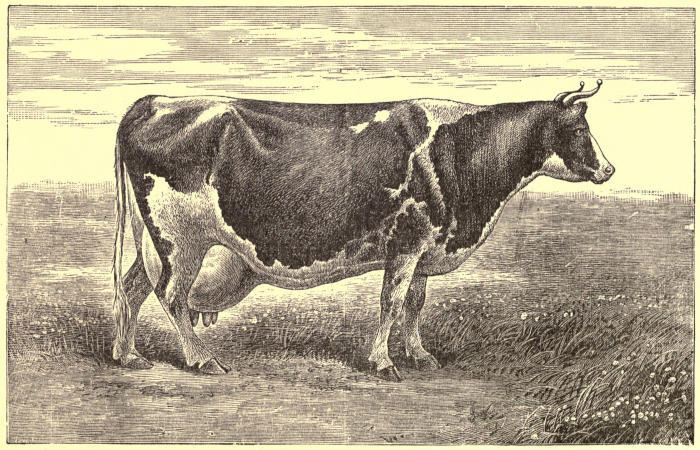
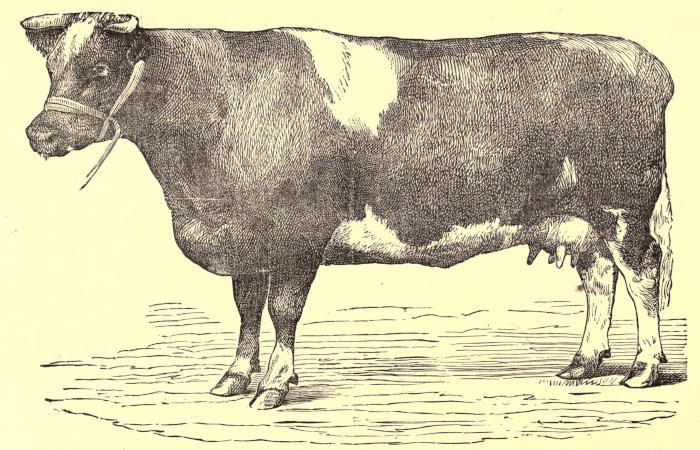
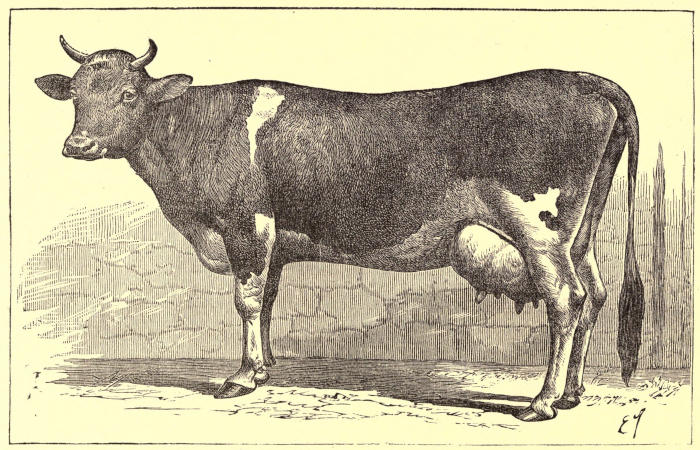
Fig. 2.—THE AYRSHIRE COW “OLD CREAMER.”
THE COW IN THE GULF STATES. — TEACHING THE CALF TO DRINK. — FOOD OF THE COW.
BY GEORGE G. DUFFEE, MOBILE, ALA.
For several years I had been experimenting on a small scale in
soiling cattle. My area of land, however, was exceedingly limited,
being only a portion of the kitchen garden of a city residence,
but my success was, even in this small way, so satisfactory,
that I determined at some future day to try it on
a more extensive scale. My reading and experience convinced
me, that in our favored southern climate, a half acre of land,
intelligently cultivated, would produce a supply of food amply
sufficient to support one cow through the year, and circumstances
favoring, I determined to try the experiment. In April,
1876, I became owner of a lot two hundred and fifty feet long
by one hundred and twenty wide in the rear of my premises—the
greater portion having been used as a grass plot for a
horse. I immediately began by fencing off a portion one hundred
and twenty feet by two hundred, running a wagon-way
eight feet wide down the center, which, with the space occupied
by the stable (say twenty by thirty feet), left nearly twenty-two
thousand feet, or within a fraction of half an acre, for
actual cultivation. The land was a sandy loam, covered with
a thick sod of Bermuda and other grasses. Years before it
had been cultivated as a market garden, but latterly given
up to grass; it sloped to the south sufficiently to favor good drainage.
In and around the stable was a goodly lot of manure, which,
during April, was spread upon the land—some forty cart loads.
On April twentieth the land was thoroughly plowed with a two-horse
turning-plow, and harrowed until finely pulverized. On
May first, I planted one half of the land in Southern field corn,
in drills two feet apart, with the grains about one inch apart.
The rows were lengthwise, to render after cultivation more convenient.
On May fourth, sugar corn was put in one half of the
remainder, planting at the same distance as the larger variety.
May sixth, the remaining fourth was sown heavily with German or
“Golden” Millet, in drills twelve inches apart. Seasonable showers,
followed by warm sunny days, soon produced a vigorous and
rapid growth. On May fifteenth, a Thomas’ harrow was run over
the first planted corn, and six days later over the second planting,
and over the millet. On May thirtieth, the corn was plowed, followed
by a good hoeing. A fortnight later, a second and last hoeing
was given. The millet was also hoed twice, after which the growth
effectually shaded the ground, and thus prevented the growth
of weeds. In the meantime I had repaired the stable, and had a
large door cut into the side next to the original lot, and made a stall
for our pet Jersey cow. The floor was cypress, three inches thick,
and sloped slightly from the manger. By actual measurement of
the space occupied by the cow—giving just room for her hind
feet to clear the same, a trough, eight inches deep, and fifteen
wide, was made to receive the urine and droppings. The
stall was four and one half feet wide, the sides coming only
half the length of the cow, and just her hight. The manger
extended entirely across the stall, was twelve inches wide at the
bottom, and eighteen at the top, and twelve deep, the bottom
being twelve inches above the floor. The fastening consisted of a
five-eighths iron rod, passing from one side of the stall to the other,
along the center of the manger, and one inch from it. On this
rod was a ring, to which was attached a short chain that ended in
a snap-catch, to attach to a ring fastened to the head-stall—the
head-stall being made of good, broad leather. Usually, in turning
the cow out in the morning, the head-stall was unbuckled and left
in the stable; to fasten again was but a moment’s work. By this
arrangement the cow had full liberty to move her head, without
any possibility of getting fastened by the halter. The bottom of
this manger was made of slats, one half inch apart, so that no dirt
could collect. For feeding wet messes, there was a box made to fit
one end of the manger, which could be removed to be washed without
trouble. With plenty of sawdust, costing only the hauling, perfect
comfort and perfect cleanliness were matters of course.
Attached to the stable was a lot fifty by fifty feet, where, in pleasant
weather, the cow was turned, but free to go in and out of her
stall at pleasure. In this lot was a trough, connected with the pump,
where a supply of clean and fresh water was always kept. Daily
this trough was emptied and thoroughly cleaned. A cow may
eat dirty feed occasionally, but see to it that the water she drinks is
pure. Unless this is attended to her milk is unfit for human food.
The manure trough being supplied with sawdust, the urine,
as well as the droppings, were saved and removed daily to a
covered shed located in one corner of the lot, where it was kept
moist, and worked over occasionally. Our Jersey was due with
her second calf about June twentieth, but was still giving milk
in April and May. Her feed from May first to June fifteenth,
was the run of a common pasture, with a mess twice daily of
wheat bran and corn meal, with hay. On June first she was
dried up for a brief resting spell. June fifteenth we began
cutting the sugar corn, now waist high. This was run through
a cutter (making cuts three-quarters of an inch), and fed to
her three times a day, first sprinkling two quarts of wheat
bran over the corn, and continuing the hay feed twice a day.
At the same time she was taken from the pasture, not to
go on again until this experiment was finished. June twenty-second
her udder was so distended, it was deemed prudent
to relieve it by milking. This was done twice a day for three
days. Here, at the South, there is a foolish prejudice against doing
this, the belief being strong among the ignorant classes that it
will cause the death of the coming calf. In some instances I have
found it necessary to relieve the udder daily for a week before
calving; I never knew any evil to result. At dawn June twenty-fifth
there was a fine heifer calf beside her. As soon as convenient
the cow was thoroughly milked, and a bucket of water,
with one quart each of corn meal and wheat bran stirred in, and
a pinch of salt, was given her, and nothing else except water for
twenty-four hours. At evening she was again milked to the last
drop, and the calf left with her during the night. Next morning
a small feed of three quarts of wheat bran, and one quart of corn
meal, made pretty wet, was given her, and her udder again thoroughly
emptied. After milking, a small feed of hay was given,
and a pail of water placed near. The calf was separated from
her, but within sight. At mid-day the calf was allowed to take
her fill, and afterwards the udder stripped. At evening, as the
cow seemed to be free from any indications of fever, or inflamed
bag, she was given a full mess of corn meal, wheat bran, cotton-seed
meal, and hay. Her calf took her supper, and the udder
was again stripped; that night the calf was taken from her,
never to suck again, as fresh milk in a city was too valuable
to feed to even a registered Jersey. Having, in years past, lost
several very fine cows from over-feeding and under-milking,
at calving time, I cannot urge too strongly what Col. Geo. E.
Waring calls “high starvation” at this critical period in a cow’s
life. If a cow has been decently cared for up to the day of calving,
she needs nothing but rest, quiet, and a light mash,—warm in
cold weather—for twenty-four hours, and then but light feeding for
two or three days. But be sure to empty her udder completely at
least twice every twenty-four hours, and if the cow is a deep milker,
then three times; with this treatment, the feed can be gradually
increased to all that she will eat up clean.
It is a very easy matter to teach a calf to drink milk, when one
has seen the thing done. Next morning this calf was impatient
for her mess of warm milk, so, after milking her dam, I took a
shallow pan, and putting two quarts of milk into it proceeded to
give the first lesson in a calf’s life, of doing without a mother.
The process is very simple; you merely wet the first and second
fingers of the left hand with milk, and place them in the calf’s
mouth, to give her a taste of what is in store. Repeat this a few
times, then gradually draw the pan near her mouth with the right
hand, using your left as above. When the calf permits your two
fingers to enter her mouth, raise the pan so that your left hand
will be immersed, and the calf, by suction, will draw the milk up
between the fingers. At mid-day, another mess of milk, and a
second lesson was given; at evening a third. Next morning the
process was repeated, but in this instance she did not need the
fingers to guide her to what was good for her; she readily accepted
the situation, and stuck her pretty nose into the warm milk, which
rapidly disappeared to where it would do the most good. But
with milk worth ten cents per quart, and cream seven times as
much, it did not “pay” to use six quarts daily of rich Jersey milk
in this way, so, after a fortnight’s supply of the raw material,
the feed was gradually changed to sweet skim-milk for two weeks,
and then substituting hay-tea, the milk ration was cut down to
two quarts daily. Beginning with a tablespoonful of cotton-seed
meal, thoroughly mixed with the feed, the quantity was increased
in ten days to one pint daily. At one month old, she was gradually
taught to eat bran by stirring it into her food.
The preparation of hay-tea is very simple. Nice hay is run
through a cutter, and taking an ordinary two-gallon pailful, boiling
water is poured upon it; it is then covered and allowed to
steep for twelve hours. This makes a most excellent food, and
calves thrive upon it. The most stylish and vigorous calf I ever
saw, was raised upon hay-tea, with bran and cotton-seed meal as
here described. I enter thus fully into the best manner of raising
a calf without its mother, for the especial benefit of my southern
readers, where the thriftless habit of allowing the calf to suck its
dam, oftentimes until a year old, so generally prevails. In this
instance the little heifer got along nicely until two months old,
when an aggravated attack of scours set in, but by timely doses of
laudanum in a mess of warm gruel, poured down her throat twice
a day, for three days, a cure was effected. In ordinary cases of
scours, a change to dry food will correct it, but it is well to watch
and not to permit the disease to become seated. A few years ago,
a very valuable young Jersey heifer, received from the vicinity of
Philadelphia, was taken in this way, while undergoing the usual
course of acclimation incident to northern cattle brought south,
and the simpler treatment proving of no effect, I gave injections
twice a day of rice-water and laudanum, besides drenching her
with corn-gruel and laudanum. This was kept up for ten days;
we carried her safely through, and her present value amply compensates
for the time and trouble expended.
But let us return to the cow. On the morning of June twenty-ninth,
we began giving her a fair feed of green corn, adding
to it wheat bran, and cotton-seed meal. July second we fed
her all the corn stalks she would eat, continuing to add bran
and cotton meal, giving four quarts of the former and two of the
latter; and this was her daily food, including the German Millet,
treated in the same way, until September. The green food was
given three times a day, but the bran and cotton meal added only
morning and night. Occasionally a day’s supply was cut early in
the morning, and allowed to wilt before feeding, but in this, as
well as in many other matters, my man-of-all-work did as circumstances
permitted. His various duties about the place gave him
but little time to reduce to an exact system the care and feed
of a cow. She had a good stable, and plenty to eat, received
daily a good brushing, and was treated kindly. Yet, she was our
servant (and a most faithful one she was), and we were not her’s,
or slaves to any arbitrary clock-work regularity. She was fed and
milked at regular intervals, but beyond this it was not always convenient
to have regular hours at her stable. We did not keep her
as an exhibition of a model cow in a model stable, and to exemplify
a model system of care and keep. Like thousands all over
the land, we kept her simply for the profit she yielded, in
the way of milk and butter. It has often struck me, in reading
the many suggestions and hints about how to keep a cow,
to be found in some agricultural and live-stock journals, that
were they all carried into practical operation, it would take the
entire time of two able-bodied men to attend one animal—one to
be always on hand during the day, the other to serve at night.
Now common sense is a good thing, even when applied to the
management of cows, and my experience convinces me that the
average man wishes only to know the cheapest and easiest way to
have an abundant supply of rich, wholesome, and clean milk, and
with pride enough in the possession of a good cow to furnish a
good shelter and comfortable quarters. Beyond these, breeders of
fancy and high-priced stock may go to any extreme, and find a
paying business in doing so, but the village or city owner of one
or two cows, kept solely for his own use, can not afford to indulge
in any of this “upper-tendom” style of cow life; it won’t pay
him. As a row of corn was cut and fed, the land was plowed,
manured, and more corn (common field) drilled in thick, so that
the ground for the whole summer presented the appearance of an
experimental corn field, with corn at every stage of its growth.
This was kept up through the months of July, August, September,
and October. Indeed, the half of this yield was more
than sufficient for keeping the cow in superb condition, so that
much the greater portion was cut in the tasselling stage and cured
for winter feed. After September begins, it will not do to sow
corn; the worms destroy it, but in our southern Bean, or “cow
pea,” we have one of the very best of soiling crops. Sown either
broadcast, or in drills, it does equally well, makes a rapid growth,
and affords a tempting and nutritious food for cattle. It grows
until checked by frost, and I know of no plant, save Indian corn,
that produces more weight to a given quantity of land. In this
instance we fed it daily during October and late into November,
before a frost put an end to its use in its green state. Anticipating
a frost, it was cut and cured for winter feed. Properly cured, no
hay equals it for cattle.
November twenty-fourth our cow went into winter quarters, and
for her winter feed there were over four thousand eight hundred
pounds of well cured corn-fodder, and one thousand five hundred
pounds of good pea-vine hay—far more than she could consume.
Early in December, after spreading over the land all the manure
on hand, it was plowed again with a two-horse turning plow, and
sowed thickly to oats, harrowing them in. A seasonable rain
gave them a good start, so they were well prepared for the vicissitudes
of winter—a good stand and vigorous growth. The cow
now received a daily ration of corn fodder and pea hay,
run through the cutter, and after mixing thoroughly three
quarts of wheat bran and one quart of cotton-seed meal, were
wet with water (warm in cold weather). This was given her
in the morning, and the same quantity at evening. The corn
fodder and pea-hay for a day’s feed were fifteen pounds of each,
more or less. On this food she was kept through the winter,
giving milk of excellent quality, and in good quantity.
In February, she was tethered every fair day in the oats, and in
March, we fed her a good mess of fresh cut oats, still, however,
keeping up the winter feed of corn fodder, pea-hay,
wheat bran, and cotton meal. About April first, the feed of
green oats was increased to all she would eat, feeding three
times daily, and the excellence of this diet was shown by a
marked increase in the quantity of her milk. Though due to
calve again in July, she continued to supply a family of ten persons
with an abundance of milk. Late in April, when the oats
were in the milk state, they were cut and cured for hay, making a
little over a ton of good food.
Upon summing up the result, the following dollar and cents
view of the experiment of sustaining a cow on a half acre is submitted.
The labor expended in cultivation is not put down as an
item of expense, as the carriage horse was used in plowing, and
the hired man did the rest.
Dr.
To
1,500
pounds Wheat Bran, at 90c.
$13.50
”
200
pounds Corn Meal, at 70c.
1.40
”
800
pounds Cotton-seed Meal, at $1
8.00
”
300
pounds Hay, at 75c.
2.25
Total
$25.15
Cr.
By sale of
2,200
pounds of Corn-fodder, at 60c.
$13.20
”
2,100
pounds of Oats, at 75c.
15.75
$28.95
Profit
$ 3.80
But the profit above shown does not express the real profit. A
year’s continuous supply of rich milk in abundance, for a large
household, cream for special occasions, and that best of luxuries,
delicious home-made butter, and one hundred dollars for the little
heifer when six months old, aggregate the chief results of the
experiment.
For the best results in soiling, no crop compares, as far as my
experience goes, with our Southern variety of Indian corn; on
rich land it produces marvellously. I have raised it at the rate of
one hundred thousand pounds (or fifty tons) per acre. There is
no difficulty in producing three crops in one season on the same
land. But cattle need a variety of food in soiling, as in other
forms of feeding. Oats are excellent, and come in early. Cat-tail
Millet (“Pearl Millet”) is a rapid grower, but cattle are not
specially fond of it; they like German Millet better. Garden (or
English) Peas make an excellent food, coming into use in March,
and lasting to June. I remember one year I produced five crops
for soiling, on the same land, in one year, namely: oats, three of
corn, and one of cow-peas. The last named is a superb food late
in the year, after corn has gone. I have never experimented with
roots, nor am I aware of any being cultivated in the South as a
soiling crop. Cabbages set out in September and October will be
ready for feeding in December, and will, next to corn, produce the
largest weight of green food. One year I fed them to a considerable
extent, and found my cows were very partial to them. By
beginning with cabbages in December, to be succeeded by oats in
March, then peas, corn, and millet, to wind up in November with
cow-pea, a cow in our climate can be soiled every day in the year.
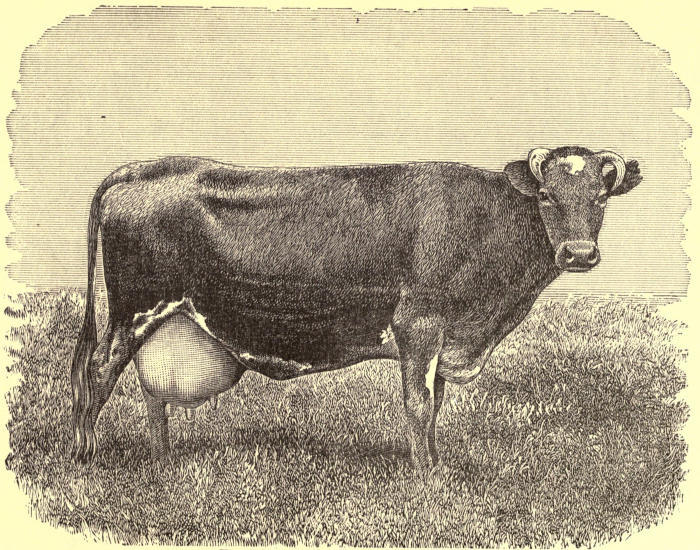
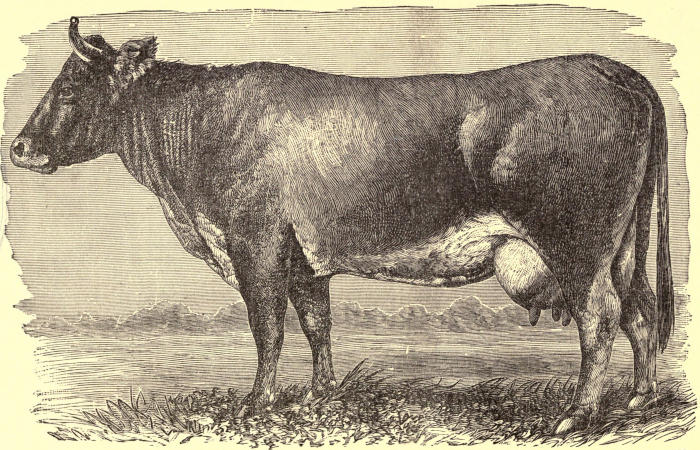
Fig. 3.—THE JERSEY COW “ROSALEE.”
THE VILLAGE COW IN NEW ENGLAND. BEING THE JOURNAL OF THE KEEPER. — CALVING AND AFTER-TREATMENT. — THE METHOD OF FEEDING
BY HENRY E. ALVORD, EASTHAMPTON, MASS.
In writing upon this subject the narrative form is convenient,
and while it cannot be claimed that this is entirely a “true story,”
it may be said to be founded on fact. Personal experience is my
basis, and whatever of fancy may be interwoven with the facts
would have been quite practicable, and all ought to have occurred
as narrated, if all did not.
Let me premise by saying that I own a comfortable little home
in a village of a few thousand inhabitants, not a thousand miles
from New York, supporting my family by a moderate income
earned from day to day, and my occupation is such as to enable
me to spend an average of three hours of daylight on my place,
from the middle of March to the middle of October, and occasionally
a whole day besides. Thus I can make and care for my
garden, which for some years has uniformly been an excellent one,
quite a model, though I say it. Of this sort of work I have
always been very fond, as well as of domestic animals, all kinds
of which were familiar to me when a boy.
May 1st, 1875.—For several years I have kept more or less
poultry, and sometimes a pig; there is so much from a good garden
that is otherwise wasted. The ambition of the family is to own a
horse and a cow. It has been talked about a good deal, but we
are agreed that the horse would be a pure luxury, in our circumstances,
and must wait. The cow I have felt would be a luxury
too, that is, cost more than it would produce, but on this point
the good wife has differed with me, claiming that it would be a
real economy. It has been a part of our domestic policy to use
milk and butter liberally, thereby keeping down the butcher’s bill
and buying very little lard. Of the value of milk as an article of
food, in its natural state, and in the many ways which it can be
used in cooking, there can be no doubt, especially where there are
young and growing members of the family. Still, I have been
skeptical on the economy of keeping a cow, and to convince me,
the help-meet recently proved, from well kept accounts, that during
the last two years there have been consumed by our family of
five persons, one thousand five hundred and forty-five quarts of
milk, averaging seven cents a quart, and three hundred and sixty-one
pounds of butter, average price thirty-three cents a pound.
These have amounted to a cash expenditure of one hundred and
thirteen dollars and sixty-four cents a year, which was a decided
surprise to me, and feeling pretty sure the expense need not exceed
two dollars a week, I yielded to the argument; am the owner of
a cow, and here record the result of my experiment. One of the
pleasant spring days of last week, we took a drive among the farms
of the vicinity, and selected a good looking cow which had just
dropped her second calf. The price paid was sixty-five dollars, to
be delivered to me to-day, without the calf. The man I bought of
called her “pure Alderney,” but she looks large of her age for
that race, weighing somewhat over seven hundred pounds, and if,
two or three generations back there was a cross of Ayrshire, or of
Guernsey, it is all the better. My belief is that she has a streak of
Ayrshire blood, and that she will make a fine cow. Being three
years old next month (exact date unknown), it has been decided
that our cow is to be known as “June.”
May 1st, 1876.—When “June” was bought, it was in the full
expectation that pasturage could be hired in a small lot adjoining
the rear of mine. I supposed it was fixed, but the spring had
been favorable, the grass on the meadow promised well, and the
owner concluded he would mow it, so that arrangement fell
through. By that time I was too late to secure room in the only
pasture convenient to the village, and I have been forced to keep
her in the stable and a small stable yard, the whole year. The
result is more than satisfactory, considering the disadvantageous
circumstances.
A year ago to-day “June” arrived, in fair condition, save that
her coat looked a little rough, and with a good bag of milk; her
daily yield that month was about twelve quarts. In a day or two
I noticed that when in the yard, she rubbed her neck vigorously
against the corner of the stable and sometimes backed up to a building
or fence for the purpose. An examination proved that she
had vermin upon her; so I made a pail full of strong suds, with
soft soap, and put into it an ounce of sulphuric acid, and with this
I sponged the parts infested, twice daily, for a few days. This
seemed efficient and there has been no such trouble since.
For long forage “June” had only dry food, good fine hay, until
late in May, and then I began to give her a green bite whenever I
could, clippings from the yard, trimmings of early vegetables and
whatever there was to spare from the garden. Besides this, everything
she ate had to be bought, except a few roots used since
February. A little bran was fed for the first few days, and gradually
increased, so that during the summer she received four pounds
daily, fed in two parts, morning and night. Later in the season
corn-meal was added to the ration, and at times oats were substituted
for the bran. In the winter, eight pounds of meal and bran,
half and half, mixed, was the daily allowance. Buying hay in
small quantities I managed to keep both rowen and clover hay on
hand, some of it very fresh, and could thus vary the dry food.
Also, for variety, I frequently gave one cut feed a day, moistened.
Besides this, I obtained and worked in, during the summer, a lot of
half-ripe oats, in the straw, which had lodged and were cured like
hay. The food, although thus often changed, was changed carefully.
In my garden I made a large parsnip bed, and followed my
earliest peas with carrots, so that in the fall there were several
bushels of these roots. The carrots were buried in the garden, a
mellow loam, and the parsnips left in the ground. The former
were opened during a thaw in February, and a few fed to “June”
each day, lasting until the end of March; by that time I could get
the parsnips and they have just given out. When I began the roots
the grain was gradually withheld and she has had none since February.
These roots have had a most apparent effect, giving her
coat a bright, thrifty look, and she is in fine condition for calving,
which is expected in ten days. But the roots made it hard to
dry off the cow. She was shrinking in milk fast when we began
on the carrots, then started up again and was giving about three
quarts a day in March, when the milk (and especially the cream)
began to have a sharp, unpleasant, bitter taste, and we soon had
to give up using it. It then took a fortnight to dry her off, which
was done by lessening the roots, milking not quite dry, then only
once a day, and once in two days. Water has been offered three
times a day, through the year, all she would drink, salt has always
been within her reach. All summer, and every mild, dry day in
winter, “June” has passed some hours in the stable yard. A large
amount of bedding has been necessary, and for this I have used
the waste hay, the rakings of the yard last autumn, the scrapings
of the garden walks, garden litter, and the leaves from a row of
maple trees in front of the house, carefully saved for the purpose.
So much in the stall, “June” has required more personal care, and
it has been made a rule to rub and brush her body enough to keep
it clean and free from dead skin. But I never use a harsh card;
nothing is better for rubbing than a piece of old seine or very coarse
bagging. Everything about the cow, too, is kept clean and sweet.
The result of this continuous stabling has been a rapid accumulation
of manure, and this having been mixed with all the suitable
refuse of the place, and forked over several times, I this spring
have on hand a huge pile of rich compost. It is more than can
be used on the garden, and the newer part has been corded up
under a temporary shed for sale or future use. This alone well
pays for all my extra work in keeping the cow, as I have yearly
been obliged to buy for the garden.
Our plan during the year has been to sell a little milk to neighbors,
set aside two quarts daily for family use, cream and all.
The cream from the remainder has been made into butter, and an
accurate account kept of the butter produced.
The following is the result of this first year keeping one cow:
EXPENSES:
Interest 7 per cent on cost of cow
$ 4.55
4 tons of Hay, av. $20
80.00
500 lbs Oats in straw
4.25
960 lbs. Wheat Bran, @ $1.20
11.52
350 lbs. Corn-Meal @ $1.10
3.85
4 bus. Oats @ 55c.
2.20
Expended
$106.37
Less 400 lbs. Hay on hand
3.00
Year’s expense
103.37
RETURNS:
155 qts. Milk sold @ 7c.
$ 10.85
311 qts. Skim-milk, @ 3c.
9.33
Sales
$ 20.18
620 qts. Milk for family, @ 7c.
43.40
123 lbs. Butter made, @ 35c.
43.05
Year’s return
$106.63
Memorandum—Cost
$103.37
Less sales
20.18
83.19
Plus purchases—
88 qts. Milk
6.16
52 lbs. Butter
16.64
Cow products cost family
$105.99
Here is a net balance of three dollars and twenty-six cents in
favor of the cow, without allowing anything for the abundant
supply of skim-milk and butter-milk which has been profitably
used in the poultry yard as well as at the house—or for the big
compost heap, which could readily be sold.
The figures also show that the family has had a better supply of
cow products than last year, at seven dollars and sixty-five cents
less expense. No labor is charged, for I am not so much keeping
an exact account of the maintenance of the cow, as of the profit
of my keeping one, taking care of her myself. And no credit is
given for manure, as I mean to apply that to reducing the cost of
keeping in the future. The cow might have been fed at less cost,
but I intended to have her improve on my hands, and she has done
so. “June” now weighs seven hundred and sixty-two pounds, is
about to have her third calf, and is certainly worth more than was
paid for her.
Altogether, in spite of unfavorable conditions there is no occasion
to complain of the result of the year.
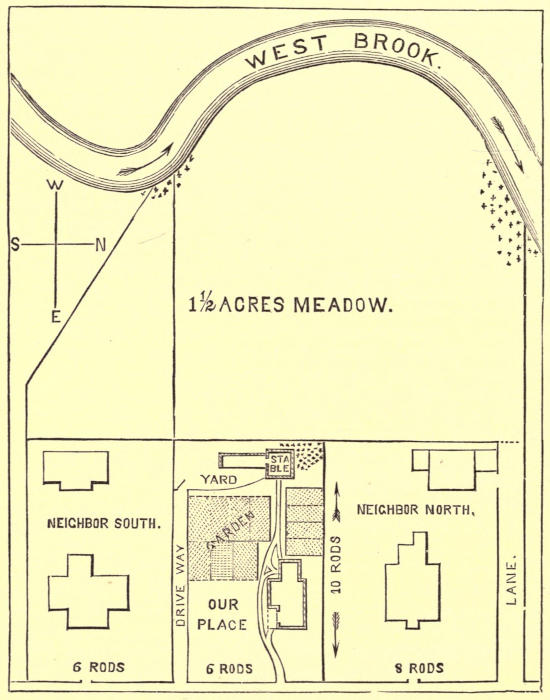
May 1st, 1877.—Last spring, my neighbor, north, was willing to
let me have his acre and a half of meadow for pasturage, but
wanted thirty-five dollars for the season. I would not pay that,
and, instead, hired a place for “June” in a large pasture half a
mile or more distant, paying twenty dollars for the season, May
fifteenth, to October fifteenth, and four dollars to a boy for driving.
On the ninth of May, the cow dropped a bull calf without
difficulty, and I gave it away the next day. No special care was
needed or given, except a little caution as to feeding, and on the fifteenth
the cow went to pasture. She did remarkably well until
early in July, being in pasture during the day, and at the stable at
night. Then the weather grew very hot, the pasture dry, and “June”
began to fail rapidly in her milk; so I commenced feeding a little
bran, and offered hay when she came up at night. Later, a friend
recommended cotton-seed meal, and a hundred weight of that was
obtained and fed with good results, two or three pounds a day.
August was a month of intense dry heat, and the pasture became
of little use except for the exercise, shade, and water. In spite of
meal and hay fed at night, “June’s” yield of milk shrank to three
quarts a day, and we feared she would go dry. August fifth,
I made the change of sending her to pasture just before six
o’clock in the evening, as the boy went after the other cows, and
bringing her up to the stable in the morning, where I kept her
during the day. This was an improvement, and also gave better
opportunity of feeding sweet corn stalks, vegetable trimmings and
the like, fresh from the garden. The grain was continued through
August, and she ate more or less hay. At the end of the month
she was giving over a gallon of milk a day. Rains came early in
September, the pasturage soon became good again, and the daily
mess of milk steadily increased until November. By that time
she was in the stable for the winter, and the treatment since has
been practically a repetition of last year. My root patch in the
garden was enlarged, as the result of last year’s experience, and
accordingly I put eight or ten bushels of carrots into my cellar in
October, covering them with sand, and left a fine lot of parsnips
in the ground. I began feeding the carrots in January, two or
three a day, just for a relish; gradually increased them, until in
February the cow received half a peck or more, and thus they
lasted into March. Then I dried her off, getting the last milk to
use March twenty-eighth. Grain feeding was stopped the first of
March, and she has had none since. After the cow was fully dry,
I began on the parsnips, and she is now getting half a peck daily,
with all the hay she will eat. “June” will be fresh again on the
twentieth of this month.
The season has not satisfied me. Not only has the weather been
unfavorable, (we must expect severe summers occasionally,) but I
don’t like sending the cow to a distant pasture which I can know
very little about, and where nobody knows how the other animals
treat her. I shall never do this again if any other arrangement
can be made.
The account for the year is as follows:
Expenses.
Interest at 7 per cent. on cost of cow
$4.55
Hay from last year
3.00
2½ tons Timothy Hay @ $18
45.00
Pasturage and driving
24.00
750 lbs. Wheat Bran @ $1.10
8.25
450 lbs. Corn-Meal @ $1
4.50
100 lbs. Cotton-seed Meal
2.00
Expended
$91.30
Less hay on hand
2.00
Year’s expense
$89.30
Returns.
42 qts Milk sold at 6½c.
$2.73
286 qts. Skim-milk sold at 3c.
8.58
Sales
$11.31
640 qts. Milk for family, at 6½c.
41.60
109 lbs. Butter made @ 32c.
34.88
Year’s returns
$87.79
Memorandum—Cost
$89.30
Less sales
11.31
77.99
Plus purchases—
86 qts. Milk @ 6½c.
$ 5.59
70 lbs. Butter @ 30c.
21.00
Cow products cost family
$104.58
Comparing this with last year’s statement, it will be seen that
although there is a small balance against the cow, she is still, all
things considered, a profitable part of the domestic establishment.
May 1st, 1878.—Dissatisfied with the last year’s management,
and seeing that there would last spring be a large surplus of fine
compost on hand, more profitable to use than to sell, I planned a
new arrangement in the autumn of 1876 for keeping my one cow.
First, I secured the meadow west of my lot, renting it from the
owner from October first, 1876, until April first, this year, for thirty
dollars. The acre and a half yielded about two tons of hay in
1876, but no rowen; the aftermath was good, however, when I
came in possession. The south end of it, although in good heart,
was weedy and uneven. I drove some strong stakes, and ran a
wire fence across, in continuation of my southern boundary, thus
cutting off just about a quarter of an acre in rear of my neighbor,
south. This piece I dressed with compost made the summer just
preceding, and had it plowed and cross-plowed before the ground
froze, in preparation for a root crop. The soil is a deep, mellow,
sandy loam, but rich. Last spring the new root patch was plowed
once, well dressed from the compost pile of 1875-6, and that harrowed
in. (There was enough of the same compost for my garden,
and to spare, so last June there was still on hand the manure
of about a year’s collection put up in good shape.) The rest of
the work I was able to do myself. My root-garden, laid out in
rows running north and south, was divided as follows: eight
square rods of parsnips next to neighbor, south, on the slope,
where they caught the wash from his garden; twelve square rods
of carrots and ten rods of mangolds; in the point west to the
stream I put sweet corn at first, and followed it with strap-leafed
turnips, ten square rods. Without going into the details of root-culture,
which any one who has made a good garden knows all
about, I put into my house cellar last fall fifty-two bushels of
Long Orange Carrots, and over forty bushels of Long Yellow
Mangel Wurzels (these monstrous, twisted, forked roots are awkward
things to measure, but there must have been a ton or more
in weight), left in the ground from twenty to twenty-five bushels
of Hollow-crowned Parsnips, and harvested thirty-six bushels of
English Turnips. This was more than I had bargained for. I see
now that roots enough might have been raised in my old garden,
and the parsnips would have done much better there, but I sold
twenty bushels each of carrots and turnips for more than enough
to cover all expenditures for seed and hired labor.
A year ago to-day, I turned “June” into her new pasture of an
acre and a quarter; the grass was then starting well, and I preferred
to have the change gradual. She ate more or less hay until
the end of the month. Doors and gates were so fixed that she
could be in stall, yard, or pasture at pleasure, and could drink at
the stream bordering the meadow.
On the eighteenth of May, her bag began to swell, and became
feverish. A quart or two of watery milk was drawn at intervals of
eight hours for the next three days, and the udder was bathed as
often in tepid water, and gently but thoroughly rubbed with goose
oil, in which camphor-gum had been dissolved. Each day, also,
she was given a quarter of a pound of Epsom Salts, dissolved in a
quart of “tea” made from poke-weed root (Phytolacca decandra),
which all druggists now keep in store; this was administered as a
“drench,” from a bottle, her head being held up while she swallowed
it. On the morning of the twenty-second, being two days overdue,
she calved, having a hard time, but producing without help a
fine large heifer. Very soon after, I gave her a bucket of cool (not
cold) water, in which was stirred a quart of wheat bran, a half
pound of linseed-meal, previously scalded, and a handful of pulverized
poke or garget root. This mess was repeated at noon, and
the bag milked dry. A little later, the after-birth naturally passed
off and was removed. The udder remained hot, knotty, and so
tender that when the calf sucked I had to protect it from the
mother’s kicks, and also to prevent it from taking one teat which
was extremely sore. From this quarter I carefully drew the milk
with one of a set of four “milking-tubes,” which I bought two
years ago to do my milking, but soon discarded; here they came
in use, just the thing wanted, but one as good as four. At night I
milked dry, gave a dose of half a pound of Salts, with one ounce of
Nitre, and a warm Bran-mash. The bag was well rubbed as before.
The cow ate some hay during the night, and a few cabbage sprouts
in the morning. That day (twenty-third), she was on the pasture a
little while, and had a full bag of milk, but still hot and tender.
The calf was separated from the cow at daylight, and allowed to
suck four times during the day, the bag being milked dry, and
then oiled and well rubbed every time. The bowels appearing to
be in a sufficiently active state, appetite improving, and her eyes
natural, the physic was discontinued, the cow allowed to eat grass
and hay at will, and for several days the calf sucked at daylight,
noon, and dark, the milk left by it being all drawn. The bag was
rubbed and anointed two or three times a day, and a little extract
of Belladonna added to the oil used. Under this treatment the inflammation
gradually subsided. As soon as the cow would allow
her calf to take the tenderest teat, I kept it on that side as much
as possible while sucking. At the end of a week after calving, the
udder was again in sound condition. The calf was kept until the
first of June, and then the owner of its sire took it in full for service
of bull three seasons. We then began to get the full flow of
milk, and the pasture being good, it was a fine mess daily. At
that time, I began to measure the milk, and have done so ever
since. “June” gave four hundred and eighty-two quarts the
month she was five years old, an average of sixteen quarts a day.
Until the last of July, the cow got all her food from the pasture,
and one acre would have done as well as one and a quarter. For
the next five or six weeks, the grass was hardly sufficient; it was,
for this period, based upon the experience of August, 1876, that
the corn had been provided. The ten rods of Mammoth Sweet,
three hundred and fifty to four hundred hills, had been put in at five
different plantings, a week apart, and the earliest was just forming
ears the last of July when I began using it, at first once a day,
then twice. For each feed, the whole plants of three or four hills
were taken, and chopped in a straw-cutter, ears and all, into two-inch
lengths. This was eaten with great relish, and during August
the cow spent most of the daytime standing in the stream where
shaded by trees and grazed at night. The pasturage improved
again before the corn gave out, so quite a nice piece of winter
fodder was saved from the piece. Then all through September
there was every day more or less of green-corn husks, carrot and
beet tops, other vegetable and fruit trimmings, clean refuse from
house and garden, good food for the cow, so that again one acre
of pasture would have sufficed. During October, the carrots and
mangolds were harvested, and their tops gave the cow more than
she could manage. I also began feeding turnips the last of October,
a few with mangel tops at first, increasing until she ate more
than half a bushel a day, tops and all. Before the ground froze,
the turnips were piled in the barn, without trimming, and covered
with hay; were kept safely until the last were fed, November
twenty-eighth. The problem of winter feeding really came up the
first of November. I had a large supply of roots on hand of my
own raising, and the hay and grain to buy. So I went to the books,
and after studying both practice and science, decided upon the
following daily rations for the next six months: November first to
May first, fifteen pounds of meadow rowen and clover hay, in about
equal parts; one pound each of coarse wheat bran and corn-meal,
mixed. During November, one-half bushel turnips and two
pounds cotton-seed meal; December and January, one-half bushel
carrots and one and one-half pound cotton-seed meal; February and
March, one-half bushel (or more) of mangels and one pound cotton-seed
meal; April, one-half bushel parsnips and one and one-half
pounds cotton-seed meal; also, one hundred pounds additional
hay, and my corn-stalks, for February and March.
This plan has been carried out with little variation. Of course
the food has not been accurately weighed daily. The grain portions,
kept in barrels, have been dipped out with tin cups, but have
held out just about as expected; the quantity of hay and roots
has been guessed at.
and other work at the stable during the winter has been this:
Between six and seven o’clock A. M. stall cleaned, cow brushed off,
bedding and absorbents fixed, the milking done, and then a feed
of six or seven pounds of chaffed hay, slightly moistened, and the
bran and meal mixed with it. After this, a bucket of water left
in the stall, except in the coldest weather. The bucket is fixed near
the feed-box, so it can not be tipped over, and it has generally been
found empty at noon. At that hour, the regular watering, two or
three pailfuls, and then a small bunch of hay thrown in the box;
the stall cleaned also. Between six and seven at night, the milking
done and bedding fixed, the roots fed, chopped up pretty fine
with a spade, and the cotton-seed meal sprinkled over them. Hay
then given, and the cow left for the night.
It was my intention to feed the roots in two parts, morning and
night, and I should have preferred this, but my time in the morning
was limited. Preparing the roots over night, they sometimes
froze, but I could cut the hay at evening, ready for the morning
chop-feed. As one kind of root was about to give out, some of
the next to be fed were mixed in, and thus sudden changes
avoided. The extra hay and stalks calculated for February and
March were not used exactly in those months, but consumed
during severely cold and windy spells, being added to the usual
noon and night portions. At all times, the cow had, under this
plan, full as much as she was ready to eat up clean. The hay
left on hand a year ago was all used last summer, and before November
a full load each of the best rowen and clover hay were
put into the barn, one thousand six hundred and one thousand
four hundred pounds respectively, and there is a little left.
It ought also to be mentioned that while the cow was mainly
fed on sweet corn, last July and August, I was obliged to add
about two pounds of cotton-seed meal a day, to give quality to
the milk; it was fed dry, at noon. As soon as the feeding of carrot
tops began, this meal was omitted, but it was again needed
when turnips were substituted for carrot and beet tops. The ration
of mangolds was increased to about two bushels in three
days, because there were plenty of them, and my house cellar
being rather warm, they commenced to rot. I was very careful
to give the cow only sound roots. This extra food in February
and March resulted in a better milk record by “June” than in the
two months next preceding. I shall feed more roots the coming
year. There were more parsnips than could be well used; they
were not needed until April, and I sold five dollars’ worth, as an
offset to what the cow got from last year’s kitchen garden. The
cow goes on to pasture to-day.
Therefore, in review, the cow has been carried through the year
with the one and one-half acres rented for thirty dollars, and
forty-five dollars expended for hay and grain. Against the manure
taken for my garden may be placed the cleanings of the
poultry house, the contents of the earth-closet, and the garden
refuse and bedding, all of which go into the compost heap. The
item of labor alone remains, and as all that has been hired (including
the plowing of the garden) was paid from sales of surplus
roots, no further account is taken of that; my own time was well
spent, as the balance sheet shows. Last August, we fully determined
that it would be better for the family cow to be fresh in
September than in the spring. The heat of summer is the time
when it is most difficult to keep a cow properly fed for a good
flow of rich milk on a little place like this. It is the time when
milk is plenty and cheap, if one wants to buy, and most difficult
to manage or dispose of if one has much on hand. It is almost
impossible to make good butter in dog-days, living as we do, with
no special appliances, and it is not worth while for us to get a
patent creamer and a supply of ice. In the spring, we don’t want
a dry cow, but are willing to have one in August. July, with its
increasing heat and decreasing pasturage, is a favorable time to
dry off a cow. The keeper of one cow can not afford to have her
dry more than six weeks in the year, and may manage to have
this period four weeks, or even less. Accordingly, I have arranged
for “June” to come in next September, and shall in future practice
“winter-dairying.” Indeed, we have done so the past season, for
with liberal feeding of a succulent character, the cow has held out
well in her milk. She is now giving between five and six quarts
a day, while not yet on grass, and her total yield for eleven
months, since June first (or rather for the year), is found to be two
thousand seven hundred and forty-six quarts. Here is my third
year’s annual account with “June:”
Expenses.
Interest at 7 per cent. on cost of cow
$ 4.55
Rent of 1½ acres of land
30.00
Hay left from last year
2.00
1½ tons of Hay bought
28.50
350 lbs. of Cotton-seed Meal and freight
6.80
159 lbs. Corn-Meal
1.50
200 lbs. Bran @ $1.15 per cwt
2.30
Year’s expense
$75.65
Returns.
685 qts. Milk sold at 6c.
$41.10
464 qts. Skim-milk sold at 2½c.
11.60
Sales
$52.70
670 qts. Milk used @ 6c.
40.20
127 lbs. Butter made @ 30c.
38.10
Year’s return
$131.00
Memorandum—Cost keeping
$75.65
Less sales
52.70
$22.95
Plus purchases—
55 qts. Milk @ 6c.
3.30
53 lbs. Butter @ 30c.
15.90
Cow products cost family
$42.15
An absolute profit of fifty-five dollars from the cow is shown,
and a still larger saving in family expenses, besides nine hundred
quarts of skim-milk and butter-milk used in the house and poultry-yard
and given away. The yield of the cow shows “June” to be
a superior animal, and that is what the keeper of one cow should
have, for it costs little more in food and care than an ordinary
one. But if the cow had been only of medium quality and no new
milk could be sold, it would have been a profitable operation.
And if, instead of selling new milk, as much butter had been made
as possible, there would still have resulted a balance of over
twenty dollars in favor of the cow.
Fig. 4.—PLAN OF VILLAGE LOT AND SURROUNDINGS.
May 1st, 1880.—(To come within the required limits of this
paper the journal of the last two years must be condensed.
Therefore, omitting detailed descriptions, the general facts are
given, and some opinions
derived from the five years
recorded.) For the year
ending May, 1879, the
method of keeping “June”
was much the same as in
that last described, but
more roots were raised and
fed; some hay was made,
and only straw and grain
food purchased. The result
was even better than
that shown by the last
account. During the year
just ended, the fifth since
“June” was bought, I tried soiling, keeping the cow in stall and
yard almost all the time, and have actually got through without
buying hay or straw, using only one acre and a quarter to produce
all the long forage needed. There is so much left over that I am
satisfied one acre well managed, the preparation beginning the
previous fall, can be made to support my cow, with the exception
of the grain food and part of the roots. But this requires more
time for labor than I can
give, and more manure
than one cow makes. I
have had to buy fertilizers
during the last two years,
and although they were
good, I prefer hereafter
to buy food and make
manure, rather than buy
manures to make food.
For one situated as I am,
a semi-soiling system, or
limited pasturage helped
out with other food, is better, even if more food is bought. I
can be surer of what I purchase, and thus use the one cow to
better advantage.
Fig. 5.—EAST END OF STABLE IN 1870.
Fig. 6.—PLAN OF STABLE IN 1870.
Fig. 7.—SOUTH SIDE OF STABLE AS
ADAPTED FOR POULTRY IN 1871-5.
Fig. 8.—PLAN OF STABLE, 1871-5.
Figs. 9 and 10.—EAST AND SOUTH
ELEVATIONS OF STABLE, AS CHANGED FOR POULTRY AND COW IN 1875.
Fig. 11.—MAIN FLOOR PLAN AS CHANGED FOR COW IN 1875.
The only secret of home-made manure is to save everything, especially
all liquids, mix everything as already explained, fork over
and keep compact, to make a homogenous compost, and keep all
under cover until used. A very slight and cheap protecting shed
will suffice.
Fig. 12.—FRONT ELEVATION AS CHANGED IN 1878.
Fig. 13.—PLAN OF BARN BASEMENT WITH NEW STONE FOUNDATIONS, 1878.
As to housing, I began with a plain frame stable found upon
the place, made originally for one horse and a buggy, and have
gradually changed and added to it, doing most of the work myself,
until a very satisfactory building has resulted. It contains room
enough for a year’s forage, including root-cellar, a warm, dry
stall, conveniently arranged for saving labor, ample shed-room for
compost, and a sheltered yard containing five or six square rods,
which is as good as more. There is running water in the yard.
The plans accompanying this article, figs. 5 to 13 inclusive, show
these arrangements better than any description in writing.
“June” had her fifth calf September sixth, 1878, and her sixth
exactly a year later. At the fifth calving there was a “false presentation,”
and a very serious time. No competent veterinarian was
within reach, or else one would have been called. As it was, I
looked up the subject in back volumes of agricultural papers
and other publications, went to work myself, and getting the calf
into proper position, succeeded in effecting a delivery without
serious consequences. Last September’s calf was a heifer, and
by a fine sire, so, as “June” has reached her prime, if not passed
it, I am raising this calf to make a new cow to succeed the worthy
dam. Most keepers of one cow, however, are so situated that they
had better dispose of calves at once. Making veal is not as profitable
as making butter, and feeding skim-milk to children and
chickens.
In order to have the products of the cow perfectly satisfactory,
I lay great stress upon the utmost care and cleanliness in milking.
First, see that the stall and all about it is in order, pure air, and
no dust flying, and the udder and flank of the cow quite clean.
Except in the coldest weather, the udder is sponged off with tepid
water, and wiped dry, just before milking. Then I trust no one
to milk for me, but do it myself, quietly, quickly, and completely,
milking into a funnel, which carries the fluid to a covered pail,
which serves also a seat. This new and truly “Perfect” milking-pail,
which I first saw described in the American Agriculturist,
is a great improvement on all open vessels. I prefer not
to have the cow eating while I milk; she should give her whole
attention to the operation, as well as the milker. This certainty
that my milk reaches the house absolutely pure, not only satisfies
us as to our own cream and butter, but makes “June’s” milk in great
demand in the neighborhood. Our neighbors so much prefer it to
milkmen’s milk that they are willing to send to the house for it,
and pay more than the usual village price. This adds materially
to the profit of keeping one cow.
Fig. 14.—THE GUERNSEY COW “LADY JANE” AND HEIFER.
JOSEPH EARNEST AND HIS COW “COMFORT.” A STORY OF THE WESTERN RESERVE. — CORN FODDER. — SUMMER QUARTERS. — CONCLUSIONS.
BY S. B. MORRIS, CHARLESTOWN, PORTAGE CO., O.
The luxury of having fresh milk, cream, and butter, may be
enjoyed by every family in city, town, or hamlet, that can provide
a cow with the necessaries expressed in one word—comfort. To
show what may be done in this respect, allow me to give somewhat
of the history of Joseph Earnest. Joseph’s father was a
carpenter, and never kept a horse or cow. After giving his son
the best education he could receive at the common school, he kept
him at work with himself until Joseph also became a master carpenter.
At the time our story commences, he is married and has
a family of three children, a girl of eight, a boy of six years, and a
baby. By industry, economy, and good habits, he had accumulated
sufficient means to purchase a half-acre lot in the outskirts of a
flourishing manufacturing town. Upon this lot he had built a
small but comfortable house. His wife, the daughter of a well-to-do
farmer, having a little property of her own, invested it in the
vacant lot adjoining them. The winter previous Joseph had put
up a building which was to serve the double purpose of barn and
workshop. The barn for his visiting friends, the workshop for
himself. Back of this building, and adjacent to it, was a small hennery
in which were kept a few fowls; at one side was a shed for
his gardening implements. Everything about the premises showed
the owner was neat and orderly, as well as thrifty, while within
the snug cottage the same virtues reigned supreme. Many a time
did Mary look back to the old home-life on the farm, and think
of the plentiful products of the dairy. Then she would say to
Joseph, “How I wish we could keep a cow. It seems as
though I cannot half cook with only one quart of milk a
day, and the children would be so much healthier if they could
have what milk they want.” Joseph agreed with her, and would
add, “But you know Mary we cannot raise our own vegetables
and fruit, and keep a cow, with only one acre of land.” Imagine
her surprise, when, after a short absence one morning, Joseph
returned leading a cow. He was soon surrounded by his family
and plied with questions, such as: Whose is she? Where did you
get her? What will you do with her? In answer to these questions
Joseph replied, “I went over to Mr. Durham’s this morning,
to see if he could pay me what was back on the work I did for him
last fall. I found him feeding his cattle and made known my
errand. He said he had no money at present, but was wanting to
sell a cow, and as soon as he could would pay me. I asked him
which cow he wanted to sell; he pointed out this one, which was
smaller than the others and seemed driven by them. Not a very
large cow, he said, but young, with some Jersey blood in her—better
for a family cow than for a factory cow. I say Earnest, she
is just what you need, with your family. But I’ve no place to put
her, said I, and I don’t know how to take care of a cow. Nonsense,
said he, put her in your stable for the present, and you’ll
learn how to take care of her fast enough. But what shall I feed
her? Why the money you pay Churchill for milk, with what you
can raise on your lot, will keep your cow right along, and instead
of one quart a day, you’ll have all the milk and cream and butter
you want to use, and some to spare, and, Mary, I thought it
wouldn’t break us up if it didn’t prove a success, so I took the cow
on what he was owing me—twenty five dollars—and here she is.”
“Oh, Joseph, I am so glad you bought her, I do believe we can
keep her,” said Mary, “how gentle she seems,”—for during the
talk the children had been petting the cow, who appeared well
pleased with her new acquaintances. The baby partaking of the
general animation, crowed with delight, as though already anticipating
the good time coming.
“She has behaved like a baby coming over here,” said Joseph,
“and I declare I begin to love her already. I have always wished
we could live where we could have animals around us, and perhaps
we will some day.” Mary said she hoped they could, for
she felt lonesome for them. “But what shall we name our
cow? For my part I would like to call her ‘Comfort,’ and while
she contributes to our comfort we will endeavor to do the
same for her.” Joseph agreed to the name, saying he needed
plenty to eat and drink, a good bed and pleasant home, and he believed
that animals did too, so he would give her one of his nice
roomy stalls in his barn, make her a bed of shavings from the
shop until he could do better. “We have pure water for her to
drink, with hay and vegetables to eat, and that will keep her alive
until we learn what she will thrive on best.” As this was a
“broken” day, he thought they had better get neighbor Manning’s
horse and carry-all, and drive out to father Granger’s. He had
always been a good farmer and could tell him just how to care
for the cow. All were delighted with this plan and were soon
enjoying a six-mile drive into the country.
He learned that a cow would eat almost anything that grows,
but that judgment and experience was needed in feeding to produce
the best results. Father Granger said they could keep a cow
as well as not, and better too, and Joseph began to believe it. At
the suggestion of father G. he borrowed a bag, and on his way
home stopped at the grist mill and had it filled with bran, which
the old gentleman said was about the best feed for a cow just before
coming in. After arriving home “Comfort” received a feed of
hay and a quart of bran—had a drink of fresh water, her stable
cleaned, some fresh shavings given her for a bedding, and with
kind pats and words was left for the night. In the evening bedding
was talked over. Joseph thought he would get the privilege
of gathering leaves from a wood lot about one half mile
distant, but Mary thought they would be too wet at this
season, then sawdust was suggested, but that was not quite the
thing they concluded, that is, if they could think of anything better.
To be perfect it must be comfortable for the cow to stand or
lie upon, it must be an absorbent of liquid manure, and something
that would add to the value of the compost heap, and would easily
decompose. Suddenly Joseph exclaimed, “I have it, just the
thing. You remember I went out to N. last fall to do a job of
work for Charlie Curtiss’s brother, and when he came to bring me
home, with my tools, he put a large top box on his wagon box,
and also put in a number of sacks. I asked him what he was
going to bring home and he said ‘oat shucks’ to bed his cows
with—that the shucks were dry and bulky, and for fifty cents you
could get all you could draw at a load. He said it was the best
and cheapest bedding he could get, and much more than paid for
itself in the value of the manure. That is just what we want, and
I will get Charlie to draw me a load to-morrow.” So the next
night “Comfort” laid down for the first time in her life on a “first-class”
bed of oat shucks, while the adjoining stall was filled full
for future use.
“Joseph, what are you going to do with that lumber Charlie left
here to-day?” said Mary, a few evenings later. “Well I have
been thinking ‘Comfort’ ought to have a little yard where she
can walk around and enjoy the sunshine and fresh air. I am
going to build a fence from the farther corner of the hennery
to the fence on the back side of the lot, and one from the corner of
the shed back, and that will make her a good yard. Those two
English cherry trees will come in it and furnish shade for her in
the hottest weather.”
Another evening, as Joseph came home from work, Mary asked,
“What in the world are you going to do with these,” as she
drew from the bundle a card and brush. “Which of the
family are you going to use these on?”—“Oh, I thought
they would be good things to have in the house,” said Joseph,
laughing. “You know I started out early this morning to go
around by Mason’s, to see about repairing his house this next summer.
He is one of the best of farmers, all his stock look thrifty—everything
is up in order, and he makes farming pay. I found
him in the stable carding and brushing his cows. That was a new
idea to me, and I asked him if he thought it really paid him to
spend so much time and labor on his cows. Well, said he, I’ve
had the care of cattle nigh on to thirty years, and I think my carding
and brushing pay as well as anything I can do, and there is
nothing an animal enjoys more than having its coat combed.”
“What did Mr. Mason say about the work.”—“He is going to
have his house thoroughly repaired, and I am glad to say your
husband has the job, and he is going to keep his eyes and ears open
and learn what he can about farming.”
Joseph had bought a load of fine hay a farmer was taking into
town to market, and “Comfort” was now fed hay three times a day,
with two quarts of bran night and morning. At noon there was
something from the house also, like potato and apple peelings,
small potatoes, wilted turnips or beets, cut up cabbage leaves, etc.
The children thought it nice fun to feed her at noon. Some loose
bars had been put up to her stall which was quite roomy, and she
did not have to be driven into it by some of the men and all of
the boys in the neighborhood, but when the gate of the yard was
opened she walked briskly to her stall, knowing she would find a
good supper waiting for her. Humane care, the plenty of food
and drink, given regularly, have wrought in a month’s time a
great change in the appearance of “Comfort.” From being a poorly
fed “whipped” cow in a dairy, suffering all the discomfort of
stanchions for eighteen out of twenty-four hours, with no bed but
a bare floor—she has come to be a thrifty, happy animal, giving
good promise of rewarding her owners well for their care. One
morning the first week in April, Joseph came in from the barn
looking pleased, but a little anxious. “Children,” he said, “what
do you think I found at the barn this morning?”—“Oh, a bossy,”
they said, delighted with the idea.—“Yes, ‘Comfort’ has a little
‘comfort,’ and she is very proud of it; but now comes the rub,
who is to milk, and what is to be done with the calf?”—“Oh,”
said Mary, “I guess I have not quite forgotten how to milk yet,
and you can soon learn—‘never too old to learn,’ you know. I
will go out after breakfast and milk out what the calf does not
take, and you can go around by Mr. Mason’s and ask him what
we had better do with the calf.” Joseph felt these were good suggestions,
and after standing by Mary, in more than one sense,
while she performed her part of the programme—which was successfully
accomplished—he started for work by way of farmer
Mason’s. Arriving there he made known his errand. “Well,”
said Mr. M., “you can ‘deacon’ it or veal it. Don’t many but
dairymen follow the first way, and I should advise you to let it
have all the milk it wants for four or five weeks, and the butcher
will take it and pay you five or six dollars. Put the calf by itself,
and night and morning let it go to the cow and get its own milk.”
When Joseph arrived home that evening, he partitioned off a corner
of the barn with some barrels and boxes, put in some bedding,
and put the calf in his new quarters. Then he tried his hand at
milking, Mary standing by him this time, telling him what to do,
and laughing a little at his awkward efforts, yet encouraging him
by saying he did splendidly for the first trial. “Comfort” rewarded
him for his kindness to her, by being very patient with his awkwardness,
and he daily improved in the art of milking, so that
while vealy was getting his fill, he would get about two or three
quarts as his share.
The latter part of April Joseph commenced work for Mr. Mason,
and as his work-bench was at one end of the barn floor, he had a
good opportunity for observation. He noticed Mr. M. fed his
cows corn meal, and asked him what feed he considered best for
cows giving milk at this time of the year. Mr. M. said, in his experience
he had found there were three things to be considered in
the care of cows. Health of the cow, quantity and quality of the
milk. Plenty of wholesome food and pure water (also a little salt
each day), given regularly, out of door exercise in pleasant weather,
and general good care will give the first. “Clover hay, corn fodder,
wheat bran or ground oats, with some roots, will keep up the
flow of milk,” said he, “but if you want thick cream, and
plenty of golden butter, feed your cow corn meal. When my
cows are in milk and kept on dry feed, I give each cow
daily, morning and evening, four quarts of mixed feed, one part,
by weight, of wheat bran and two parts of corn meal, with about
one tablespoonful of salt. We make more and better butter on
this feed than when the cows have grass only.”
Joseph, having no experience of his own, was glad to use that
of others in regard to his cow, so from this time he began feeding
“Comfort” corn meal, beginning with a pint and increasing gradually
to one quart; the result being plainly seen in the improved
quality of the milk and condition of the calf. When this was five
weeks old the butcher took it away giving five dollars for it, and
seemed much pleased with his bargain.
That evening Joseph figured a little. He found his bran and
corn meal had cost three dollars and fifty-five cents, so there was a
balance of one dollar and forty-five cents from the calf to pay on the
hay. They had had from three to four quarts of milk per day, of
better quality than that they could have bought for six cents a quart.
Thirty days, three and one-half quarts a day, at six cents a quart,
is six dollars and thirty cents. By stabling and bedding the cow,
quite a quantity of good manure had accumulated, and Joseph felt
very well satisfied, so far, with his experiment, and most of all for
the luxury of having good sweet milk for the family use. It was
now the middle of May, grass was well started, and as there were
farms near them, it was thought best to hire pasture for the summer.
By inquiry they found she could be pastured one-fourth
mile from home. This seemed too far to carry the milk, and
would take too much time to drive back and forth twice a day.
“Why not keep her at home nights, and feed her something as
we do now,” said Mary; “she will be glad to come home then.
Father always feeds his cows bran in the summer; he says it pays
in their ‘coming up’ if in nothing else. He goes to the gate and
calls ‘come boss,’ and they all start as quickly as if he had said,
‘come to supper,’ and it is that to them.” So it was decided to
keep “Comfort” home nights. In a few days “Comfort” was introduced
to her summer range, and quickly learned the way to and
from the pasture, and the children thought it a great pleasure to
drive her to and fro.
“Joseph,” said Mary, about this time, “what shall we do with
the sour milk? The neighbors will take some of it at two cents a
quart, but the demand is irregular, and it don’t seem right
to throw it away. Don’t you think we better get a pig?”—“Perhaps
so; as we are in for experiments this year we might try
that also. Mason has some nice pigs—two kinds. One kind
make large growthy animals, the other kind are smaller but finer,
and would be best for us, I think.” Soon a pig was added to their
farm stock. Joseph declared he would not try to live without a
cow again if it cost twice as much to take care of her. “Why we
didn’t know what good living was until ‘Comfort’ came to live
with us, did we, children?”—“No, indeed, only when we went to
grand-pa’s.”—“Look at this baby,” said Mary, “she never was
so well before, and she is getting as rosy and round as a Maidenblush
apple. You can’t think what a help the milk is to me in
cooking. I can always have something fresh and nice now, and it
will lessen our meat bill too.”
Some of the neighbors wanted to buy milk; “Comfort” was giving
sixteen quarts a day. So four neighboring families were supplied
each with one quart of milk a day, and after a week’s trial Mary
reported she had made five pounds of butter that was worth twenty
cents per pound, grocery price. They had sold twenty-eight
quarts of milk at six cents a quart, butter and milk amounting to
two dollars and sixty-eight cents, and they had used all the
sweet milk, cream, sour milk and butter-milk they needed,
and the pig had been kept on the surplus of the last two.
Joseph was now feeding “Comfort” as Mr. Mason advised,
with corn meal and bran, two-thirds of the former and
one-third of the latter by weight, giving three quarts of the
mixture night and morning. Corn meal cost one cent per
pound, bran cost two-thirds of a cent a pound, the cost of the feed
per day being a fraction over seven cents. He also gave her a little
hay—to the value of say ten cents a week—pasture cost twenty-five
cents a week, so the expense of her keeping was eighty-five
cents a week, the work offsetting the milk used, left a profit of one
dollar and eighty-three cents. There was another item not to be
overlooked. The manure that was accumulating, the value of
which was largely increased by the ground feed given the cow,
and the oat shuck bedding. Of the acre of land about one-quarter
was occupied with buildings, walks, shrubbery, a small
lawn in front, and flower garden at the side of the house,
but every foot of intervening space was well seeded to grass, so
it really made quite a little mowing. Another quarter had been
set out to fruit trees five years, and was now well stocked with
red clover, the remaining one-half acre had been used as a garden
and potato patch. With the exception of a few loads of manure,
obtained at different places, no fertilizer had been used on this
acre of land. But now having gone into the stock business, Joseph
began to read and think about such things. He frequently
brought home an agricultural paper from Mr. Mason’s to read in
the evening, and began also to feel he must have one of his own.
He found considerable in the papers about commercial fertilizers,
so he asked Mr. Mason if he had ever used any of them. He
said he had experimented with them considerably, and thought
them excellent helps. “I have never,” said he, “paid out money
for anything that came back as quickly with as good profit, as superphosphates.
These and other fertilizers must be used with
judgment to get the best returns, but on gravelly soil, with a clay
subsoil like ours here, it pays well.” Joseph also asked Mr. M.
what he could raise on his lot to the best advantage for his cow.
“I should say sowed corn and mangel wurzels. You see this
little lot at the back of the barn, it is ten square rods, and very
rich ground.
“I sow this to corn in drills about this time (the last of May), so
that it gets well tasseled by the time pastures begin to get rather
dry, as they usually do after the middle of summer, then I begin
to feed, and it helps keep up the flow of milk amazingly. It is a
sweet, juicy and nutritious feed, just the thing for cows. Let me
calculate a little. Why Earnest, if your land could be made to
produce like this piece, you can raise coarse fodder enough for
your cow for six months, on thirty square rods of ground. I like
some roots for cows—we like a variety of food, so do animals.
The best roots I know of to raise for stock are sugar beets or
the mangels.”
Very soon after this conversation Joseph had his half acre of
land plowed deep and in narrow furrows, as he had seen recommended
in agricultural papers. The manure that had accumulated
from the cow was used for a top-dressing for one half of the
plowed portion. This was well harrowed, and three-fourths of it
lightly furrowed with the plow, two and one half feet apart. The
remaining one-fourth was turned into ridges as close as the furrows
could be turned together. His team work was now done for
the present on this part of his lot especially set apart for his cow.
(The other half of the plowed lot was to be used for his main
family garden, he having spaded up some beds for early vegetables.)
He had provided himself with seed corn from farmer
Mason’s, some mangel wurzel seed from the seed store, and also
a bag of two hundred pounds of phosphate, of a brand recommended
by Mr. M. The phosphate was sprinkled in the plow
marks, at the rate of three hundred pounds to the acre, as near
as could be judged, the soil in the bottom of the furrow was
lightly stirred with a four pronged potato hook, the corn was
sprinkled in, about eight kernels to the foot [sixteen to twenty is
better—Ed.,] and covered about two inches deep. One half of
the piece designed for corn was planted, and the other half left to
be treated in the same way some two weeks later. The top
was raked off the ridges designed for the mangels. A furrow
was made on each with a hand hoe, and phosphate sprinkled
in rather more liberally than for the corn. This was thoroughly
mixed with the soil, the furrow becoming nearly level
with the surface. A line was drawn by which a light mark was
made with the end of the hoe handle, in which the mangel seeds
were sown and covered about one inch deep, the soil being pressed
down lightly with the hoe. After saving enough phosphate for the
balance of the corn, and a little to experiment with on some late
potatoes, the remainder was sown broadcast on the clover. It fell
a little short of covering the whole, and Joseph thought that
would make a good opportunity to test its virtues. His seeds
came up well, and, as he had all he could attend to nights and
mornings, he hired a neighbor to do his farm work, and he determined
no weeds should have the benefit of his fertilizers or soil;
and this part of his programme was thoroughly carried out during
the growing season.
In “Comfort’s” yard was a corner formed by the barn on one side,
the hennery on another, and the board fence on a third side. Joseph
put a roof over this corner, and about a foot deep of oatshucks on
the ground, and fastened a box to the side of the barn for her to
eat out of; and here were her summer quarters. Every morning
before milking the droppings were cleaned up and piled in one
corner of the yard. As soon as the clover began to blossom, an
armful was cut each evening and fed to “Comfort” after her ration
of dry feed, and the morning feed was discontinued. After the
corn was large enough, that took the place of clover until frost
threatened; then it was cut up and bound in small bundles, which
were set up in large stooks, to cure for winter use.
No difference was observed in the first crop of clover in favor
of the phosphate, but the second cutting was largely benefited by
its use. Over one-half of the first and second cuttings were cured
and stored in the barn, with all of the grass around the yard,
which, with fully two-thirds of the stalks, would be nearly, if not
quite enough coarse feed to last “Comfort” through the winter. The
mangels yielded about twenty-five bushels, not a very large yield,
but quite satisfactory, considering the soil had not really been
farmed but one year. The roots were pitted near the barn for
spring use. Some of the corn stalks were set so as to form a
slanting roof over them; three or four inches of dirt thrown over
this; afterwards enough to keep them from freezing.
About the first of November, “Comfort” was established in winter
quarters in the stall, at night and during stormy days, and in the
yard on pleasant days. She continued in milk until the middle
of February, and was in fresh milk March eighteenth, was hearty
and contented—a comfort to look at as well as to own. Joseph
Earnest was well pleased with his year’s experiment.
It is now three years since he brought comfort to his home in
more ways than one. His little farm is improving every year in
fertility and value, and even now blossoms like a thing of beauty.
Some of his neighbors have followed his example, for he tells
them:
“Any one who has a place to put a cow can keep one with
profit, if he will make her comfortable; that it matters not
whether protection from the weather is secured by logs, straw,
sods, rough boards, or planed boards well painted. She must have
exercise, sunshine, and fresh air. These can be obtained in a small
dry yard, kept clean, as well as in ‘Uncle Sam’s’ pasture, the
open prairie. She must have something of a variety of wholesome
food, and a plentiful supply of pure water. No domestic
animal, in proportion to its weight, needs as much water as a
milch cow. She must be kept clean by litter, card, and brush. If
these rules are observed with judgment and kindness, very seldom
will any help be needed at time of calving. If anything goes
wrong there is no better rule than to use one’s common sense,
taking the advice of experienced neighbors.
“To economize manure, an abundance of good litter should be
used, and the compost heap kept under cover, if possible; at any
rate, not under the eaves of the barn. If, with this home-made
manure, your land does not produce all it can, and you wish to
buy some fertilizing material, your first choice should be good
stable manure; if you cannot get that reasonably, use some reliable
brand of commercial fertilizer. Have your cow ‘come in’
when it will be most for your profit or convenience, avoiding hot
weather. The calf may be killed when one to three days old,
saving its hide and rennet; it may be kept until five or six weeks
old, fed on new milk, and ‘vealed,’ or sold for that purpose, or it
may be raised on skim-milk (after it is three or four weeks old),
and sold in the fall to some farmer.
“Milking should be done gently but quickly, as near twelve
hours apart as possible. Milk clean but do not “strip;” use the
whole hand, and not the thumb and finger only; sing or whistle,
if you want to while milking; if you are good friends with your
cow, she will enjoy it.
“Since the first year I have not bought any coarse feed, and only
a little fertilizer for grass and clover, the cow and pig furnishing
all that is needed for the plowed ground, and this last year I have
a surplus of feed. I tell you, friends, my cow is the best savings
bank I ever knew.”
This and much more said Joseph Earnest to his neighbors.
A GOOD STABLE “TIE.”
Mr. D. C. Kenyon, of Carbondale, Pa., describes
a convenient home-made Stable Tie as follows:
Our tie, of which we send you a miniature sample,
is made of three-eighths inch rope, which is braided
into an iron ring sliding freely up and down a post
set close to the manger or feed-box. There is a
knot or frog on one end, and a loop on the other.
The ends pass on each side of the cow’s neck, and
the knot is slipped through the loop which may
be made tighter by twisting. Similar fastenings
made of chains with snap hooks may be bought at
the hardware stores, but such an one as is here
described will last a long time and answer every
purpose.
Fig. 15.
JERUSALEM ARTICHOKES AS COW-FEED. — VALUE OF ARTICHOKES. — FEEDING ARTICHOKES. — HARVESTING ARTICHOKES. — THE STALKS — THE CALF AND THE CARE OF IT. — CALVING. — MAKING AND SAVING MANURE. — CONCLUSIONS ABOUT ARTICHOKES. — RURAL ECONOMY.
BY CHRISTOPHER SHEARER, TUCKERTON, PA.
Butter and milk are not only luxuries, but in many families they
are indispensable necessaries of life. In this article my principal
purpose is to show how a cow can be kept with the greatest economy
of land and labor. I consider these the essential points
in the discussion. Where hay is dear and pasture scarce, a man
who lives by the labor of his hands, cannot ordinarily afford to
purchase the necessary food for a cow; and if he has only an acre
or two of land at his disposal, he finds it more profitable to raise
other products. Ordinarily it requires the yield of several acres
of land to support a cow. But I propose to show that this can
be done on less than one acre, by raising the proper crops, and
treating the soil to the best advantage. A cow of ordinary size will
consume about eleven thousand pounds of hay, or its equivalent,
in a year. The equivalent of this amount of hay is—in potatoes,
thirty thousand eight hundred pounds, or five hundred and thirteen
bushels, and in Indian corn, seven thousand seven hundred
pounds, or one hundred and thirty-seven bushels. These quantities
cannot be raised on one acre, and if we examine the tables
of equivalents of food, we find that most of the grasses, grains,
and roots, are objectionable on account of unproductiveness, want
of sufficient nutritive qualities, or of the labor that the cultivation
of them requires.
There is, however, a root, or tuber, an acre of which affords
enough nourishment to sustain two cows, with less labor than is
employed in raising an acre of potatoes—and that root is the
Jerusalem Artichoke (Helianthus tuberosus). We can depend upon
an average yield of from one thousand to one thousand two hundred
bushels of these tubers from an acre of land rich enough to
produce fifty bushels of corn. Pound for pound they are equal
in nutritive qualities to potatoes. One cow can therefore be subsisted
a year on five hundred or six hundred bushels of the tubers,
a quantity that can be raised on half an acre of land. But since
these roots do not keep over summer, and as the cow will not
thrive on them alone, it is necessary to supplement them with dry
fodder during winter, and to subsist her on other forage during
summer. With the aid of this plant, three-quarters of an acre of
land under high cultivation, will nourish a cow during the whole
year, and the soil will become rich without any other manure than
that derived from the cow. This can be done with little expense,
and with no more labor than is involved in ordinary farm culture.
It is necessary to begin operations on the farm in most sections
of the Middle States, a little earlier than the first of May.
A cow can be subsisted to the best advantage on a small patch
of land, by feeding her Jerusalem Artichokes and a little hay or
other dry fodder through the winter and part of spring, and soiling
her with green rye, clover, and green-corn fodder, the rest of
the year. Three-quarters of an acre will, under judicious treatment,
yield enough of these products to maintain a cow during the
year. If the soil be not in good condition to begin with, that
quantity of land may, for a year or two, be insufficient for the
purpose, and it will then be necessary to supply the deficiency
from other sources; but by proper management the land will, in
a few years, be converted into a garden that will afford abundant
nourishment for the cow, without pasture or outside aid either in
food or manure.
Suppose that a man owns a cow of medium size, or a little
larger, that he has three-quarters of an acre of land, that one-third
of it, namely, one-quarter of an acre, is in clover, that the
remainder is ready for the plow, and that it is early spring-time
of the year, he should go to work at once and manure the land
liberally, for he will be well repaid for the expense, in the superior
productiveness of the soil. All the land, excepting the clover,
should be plowed, and one-sixth of the land, that is one-eighth of
an acre, should be sowed with oats, with about one-half bushel of
seed. One quart of clover seed, and one pint of timothy seed
should be sown on the oats. The oats are raised only during the
first year, rye being substituted in after years, and the timothy is
added for the purpose of increasing the hay-crop in the second
year. One-third of the land (one-quarter of an acre) should be
planted in Jerusalem Artichokes, early in the season. This root
should be planted in hills, three feet apart each way, and cultivated
flat, both ways. As the land increases in fertility in future years,
the hills may be set a little farther apart. The patch should be
stirred two or three times with the cultivator while the plants are
young, and afterwards kept clear of weeds with the hoe. The
weeds require but little attention after the plant has attained a
fair growth. One tuber, or piece of tuber, of about the size of a
hen’s egg, is sufficient for a hill, the seed being covered to the
depth of two or three inches with earth.
As soon as the season is far enough advanced, one-sixth of the
plot (one-eighth of an acre) should be planted in sweet corn. One
half of the corn should be set out very early, and the rest about
four weeks later, so as to extend its growth, and consequently its
availability as green fodder, over a longer period. The furrows
should be three feet apart, and the corn planted in drills, [sixteen
to twenty kernels to the foot—Ed.] Afterwards the corn should
be cultivated two or three times, and kept clear of weeds. When
the corn fodder is all disposed of, the corn patch should be plowed,
and seeded with about a peck of rye, and a pint of timothy seed,
and in the following spring a quart of clover seed should be sown
upon the rye. These crops will give the land a complete rotation
every six years. The following diagram indicates the proper succession
of the crops and shows the plot of land divided into six
equal parts, containing one-eighth of an acre each:
Clover occupies two parts, rye one part, and Jerusalem Artichokes
two parts every year. Clover follows rye; rye follows
corn; corn follows artichokes; and artichokes follow clover.
Every year one-half of the clover, namely, the two-year-old clover
patch, is plowed, and planted in artichokes. The latter must be
planted anew, and not be allowed to grow as a “volunteer crop,”
but must be regularly cultivated, and all the plants that come up
between the hills destroyed.
The manure derived from the cow during the winter, should be
spread in spring on the land intended for corn and artichokes, and
plowed down, and that made in summer should be applied to the
rye and clover patches in fall. Ashes and a moderate quantity
of lime, spread on the clover patch early in spring, will be beneficial,
and a peck of gypsum scattered on the young and growing
clover, will answer an excellent purpose as a healthy stimulant of
its growth.
Fig. 16.—SWISS COW “GENEVA.”
The spring time of the first year must be tided over with hay
until the clover is large enough for soiling. Green clover is then
fed to the cow until the oats are sufficiently advanced. The oats
are then used as long as they are fit for the purpose, cutting them
a second time as far as practicable, and the residue, if any, is
cured for hay before it gets too ripe for that purpose. The
same course is pursued with the rye in the following years. The
clover should be cut for hay rather early, in order to get it in
the best possible condition, and to insure a good second, and perhaps
a third crop. All the aftermath not used in soiling, should
be converted into hay. When the oats are exhausted, clover is fed
until the corn fodder is large enough for use. This is fed until the
ears make their appearance, and what is then left is cut and cured
for dry fodder during winter. After the green corn fodder is all
consumed, there will be a growth of new clover in the oats
stubble the first year, and in the rye stubble in after years, with
which the cow is soiled until the artichokes are ready to feed, and
if any of the new clover is left by that time, it is made into hay.
The artichokes are fed raw; in winter, with hay and other dry
fodder, and as long as they last in spring.
In the second year soiling begins with rye, and continues afterwards
through the season the same as the first year, and a like
course is followed in succeeding years.
The artichokes will grow until frost kills the stalks, and a
patch of one-quarter of an acre, when the soil is in good condition,
will yield a yearly average of between two hundred and fifty
and three hundred bushels of them. They can be fed before
they are quite ripe, in which case the cow will eat up the whole
plant—root, stalk, and branch. She must not have access to a
heap of the tubers, lest she surfeit and seriously injure herself.
As long as the whole plant is fed, she should not be allowed more
at a time than she will eat up clean, for if she gets more she will
eat the tubers, and refuse the stalks. In fact she will prefer these
tubers at all times to any other food. She should therefore receive
a certain allowance, say a peck or a little more, three times a day,
so that she will eat up the stalks, and also a small portion of other
forage with them. In winter and spring she will consume a
bushel or more of the raw tubers a day, together with eight or ten
pounds of hay or other dry food. Her ration of artichokes should
never be so large that she will reject other food.
Artichokes can be fed for about eight months of the year, say
from the first of October to the first of June, during which time
the cow will consume two hundred and forty bushels, or more, of
them. These, with the hay and other dry fodder, will keep her
in excellent condition, and produce an abundance of good milk
without additional food. One ton of hay or other dry fodder, in
connection with the artichokes, will last during the said eight
months, affording the cow eight or nine pounds a day. Three
quarters of a ton may suffice, but she should not have less than
this. If the crop of hay and other dry fodder exceeds a ton, it
may all be fed during the first year, or a part of it may be kept
over for the ensuing year. In stowing away the hay, ten or
twelve quarts of salt should be scattered through a ton of it, to
impart a relish. In addition to this, the cow should receive two
or three ounces of salt daily, and plenty of pure fresh water.
The artichokes should remain in the ground in autumn as long
as the weather permits, and be fed out of the field during that
time, and just before the earth is permanently frost-bound, enough
of them should be dug up to last over winter; and, since frost
does not injure them, the rest should be left in the ground until
the following spring. A good way to keep them in winter, is to
place them on the ground in the field in shallow layers, covering
them lightly with the stalks of the artichoke, or with straw, and
then with a little earth. If the rain wets them it will not injure
them. It is advisable always to keep a considerable quantity of
them in the stable or cellar for convenience of feeding. In the
ensuing spring, they are again fed out of the field until it is time
to plow the land, when all the tubers not yet disposed of, are
taken up and kept in the cellar or stable.
of the Jerusalem Artichoke furnish excellent material for litter
for the cow. They grow to a hight of from eight to ten feet, are
composed almost entirely of pith, and are so fragile that they can
easily be broken into fragments. As many of them should be
stowed in the stable as it will contain, and the rest, if any, should
be stacked outside. Before bedding the cow with them, it is
advisable to crush them with a mallet on a block prepared for the
purpose. This labor will require but a few minutes daily to provide
sufficient litter, and will make a comfortable bed for the cow,
absorbing and retaining the liquid manure. The stalks cannot be
used for fodder after being frost-killed.
If the food of the cow should at any time run short the deficiency
must be supplied, for it will not do to stint her, and if it
is ever found necessary to change or modify her diet, it should
be done.
I have allowed three-quarters of an acre for the sustenance of
the cow, and this will be sufficient, but only on condition that
the land is in good heart. If the land is poor at the start, it will
be safer to begin with more, and afterwards to reduce the quantity
to three-quarters of an acre, as the soil increases in fertility. The
value of clover as a renovator of the soil is well known, but the
Jerusalem Artichoke is equally efficacious, if fed on the farm, for
it attracts its nitrogen to a great extent from the atmosphere. The
dairy-farm now under discussion possesses all the advantages that
can be derived from these plants as fertilizers, and as the other
crops raised on it do not injuriously exhaust the soil, being cut
before they produce their seed, the land will improve indefinitely
in fertility.
Since the plants here recommended for the nourishment of the
cow, afford the best milk-producing food the whole year round,
the time of calving may be left to the option of the owner, for it
will not affect the quantity of milk that the cow gives. If the
milk is mostly needed in summer, the cow should calve in spring,
and if it be desirable to have more milk in winter, she should calve
in autumn. I might add, that if the butter, or a part of it, is to
be sold, it will be more profitable to have the calf in fall than in
any other season, because butter brings the highest prices in
winter.
The disposal of the calf depends on circumstances, of which
the owner is the best judge. If he concludes to keep it on account
of the value of the breed, or for any other reason, he should raise it
by hand, not allowing it to suck more than three days at furthest.
For the first few days it should receive only the fresh milk of the
cow; afterwards it may be fed on warm fresh milk, skim-milk,
buttermilk, whey, and hay-tea, until it is old enough to subsist on
solid food. Fresh milk should be the leading diet in the beginning,
and should be gradually diminished in quantity as the calf
increases in strength. Hay-tea is made by pouring boiling water
on hay, and letting it steep for about two hours. If the calf is
not to be raised, it ought to be sold before it is a week old, because
the milk that it drinks before it is ready for the shambles,
is worth more than the price it will bring. If a purchaser for the
calf cannot be found while it is so young, it is most profitable to
kill it, and bury it in the compost heap, as soon as the milk of the
cow is fit to use. I simply state this as a fact, without recommending
it to be done, for it is cruel work; but so is any butchering,
and if the calf is to be killed, it really matters not how soon
it is done. The sooner it is removed from the cow the less she will
grieve for its loss.
The cow should be milked as long as her milk is good, or until
she runs dry, which may in some cases be six or eight weeks of
calving (in others not at all.) Her rations should be curtailed a
little for a short time before that period, in order to carry her
safely through the crisis. After she has the calf, she may receive
warm bran-mashes for a day or two, containing a little of her own
milk, and should not be fully fed for the first few days. This
treatment is all that is required before and after the period of
calving. The cow will generally pass through this event in safety,
without assistance. Should there, however, be a false presentation,
or other difficulty of parturition, the best thing the owner
can do, if he has no experience in the matter, is to call to his aid
a veterinary surgeon, or a neighbor who knows what course to
pursue in such cases.
As long as the cow is fresh, and yields a large flow of milk, she
should be milked three times a day, early in the morning, at noon,
and late in the evening; afterwards two milkings daily, will be
sufficient. She should be fed, watered, milked, carded, and led
out of and into the stable, at the same hours every day. She
should not be beaten, or pelted, or harshly spoken to or dealt with
in any manner. Kind and considerate treatment inspires her with
confidence and contentment, makes her the pet and delight of the
household, and is rewarded by an abundance of wholesome milk.
But there are many matters of detail in keeping a cow, which it is
impossible to notice in a limited essay like this. If the owner desires
to be fully informed on the subject, he will do well to purchase
a few books that treat upon the subject.
The stable for the cow should be warm, dry, well ventilated,
and large enough to contain two or three tons of hay and litter,
together with other material to be described hereafter, besides a
stall for the cow, and room for the calf. If the owner of the cow
has a stable that fulfils these requirements, it will answer his purpose
if he makes a proper stall in it. If he has no stable, and cannot
afford the expense of building a good one, he must at least
have a proper stall to save the manure of the cow, and to shelter
her from the inclemency of the weather. A stable that will fully
answer this purpose, should be at least fourteen feet square, and
about twelve feet high to the eaves, and should have a loft for
storing hay. The annexed figures represent such a structure in
outline:
Fig. 17.
Fig. 18.
Figure 17 is a ground plan, and shows that the lower story is divided
into two parts, S, representing the stall, and R, all the
remaining portion below. The stall is ten feet long, and should
be five, or nearly five feet wide; M, represents the manger, which
is about two feet deep, eighteen inches wide, and in length equal
to the width of the stall. The cow is tied to the manger with a
halter or chain; T, is a trough in the manger for feeding roots,
salt, etc., and is about one foot wide, eight inches deep, and in
length equal to the width of the manger. The floor of the stall
should slope a little to the rear, and must be water-tight, so as to
conduct the urine of the cow into the brine-pit, B. The floor may
be composed of cement, or of two-inch plank closely fitted together.
The brine-pit, B, consists of a water-tight box made of plank, and
should be about one foot wide, six inches deep, and in length equal
to the width of the stall. This pit is sunk into the ground so that
its top is on a level with the floor, in order that it may receive all
the liquid discharges of the cow that are not absorbed by the litter.
If the floor is laid in cement the pit may be made of the same
material. The object of the brine-pit is to save the liquid manure;
to accomplish which the latter must be retained by some absorbent.
Dry earth is used for this purpose. At first the bottom of the pit
is covered with dry earth, and as soon as this is moist, more earth
is added until the pit is full of the saturated substance, when the
latter is thrown upon the compost heap, and the same process
repeated. A door is placed at e, for admitting the cow, and carrying
away the manure. The partition between S and R may be
made of boards or rails, and need not be over four feet high.
The division, R, is used for keeping litter, dry earth, artichoke
roots, green fodder, and the calf. It should have a door at some
convenient place for entrance from the outside, and a window with
a glass-frame, preferably on the south side. It is in communication
with the stall by means of a gate at d.
Figure 18 is a view of the gable-end, L, representing the loft for
storing hay and other dry fodder. The loft has a shutter in one
of the gable-ends or sides, and a ladder or steps running up to it
from within, for convenience of feeding. P, is a post in the corner
of the manger. The other letters in figure 18 indicate the same
parts as in figure 17.
The cow-yard will be large enough if it contains an area of two
square rods; but it can be made somewhat larger with advantage.
It ought to adjoin the stable so as to give the cow direct access to
the stall; and ought to be shaded by trees in order to afford shelter
to the cow from the direct rays of the sun in summer. The cow
should be kept in the yard only a part of the day, and the rest of
the time she should be in the stall. The stall-door should be left
open when she is in the yard, so that she can enter the stable at
will. Some manure will be lost by suffering her to run in the
yard; but the benefit that she will derive from it, in health and
contentment, will more than compensate for the loss.
The compost heap may be kept in the cow-yard, and must be in
the shade. It should, therefore, be placed on the north side of the
stable, and trees should be planted east and west of it. It must not
be under cover nor washed by running water, nor receive the
water from the roof of the stable; but the rain should fall on it
directly from the skies to promote decomposition, and to prevent
the escape of its volatile constituents. The manure of the stall,
and the saturated earth of the brine pit, are mixed together to form
the compost heap, and all the refuse material of the farm, garden,
and yard, should be thrown on it. It ought to be kept in a compact
body, level on top, and protected by boards on the sides to
prevent it from spreading. No ashes or lime should ever be
applied to it.
Regarding the material for absorbing the liquid excretions of the
cow, nothing better can be found than prepared muck; but as this
is seldom obtainable, the scrapings of the streets of a city, or even
of a public road, may be used instead. If these cannot be had,
the surface soil of the dairy farm answer the purpose. Whatever
substance is employed must be thoroughly dried. The middle
of summer is the proper time to prepare it. About four cart loads
of it, as dry as they can be made, should be kept in the stable, or
in some other place where it is not liable to attract moisture; and
that amount will last the year round.
I have now given my instructions for keeping a cow, and it is
evident from what I have written, that the Jerusalem Artichoke is
my main dependence for her support. The other points that I
have touched upon, are of minor importance, when compared
with the value that I have attached to this plant. My own experience
with the plant satisfies me that I have not overstated its
merits. On rich land a single stalk will produce from a peck to
half a bushel of the tubers. Last year was an exceptionably unfavorable
one in this locality, on account of drouth in summer
and fall; and yet the artichokes that I planted between the trees
in my peach orchard yielded abundantly. I have fattened cattle
on them without any additional food excepting a little hay, until
they were fit for the butcher; and my horses thrive on them when
fed in connection with hay, doing full work without grain. A
brother of mine planted artichokes in a field that had been in
cultivation for more than a century, and yet in spite of the drouth,
of indifferent culture without manure, and of an early frost that
prematurely killed the plants, the yield amounted to between five
hundred and six hundred bushels to the acre.
Boussingault in his “Rural Economy,” pp. 159-160 says: “The
Jerusalem Artichoke rises to a hight of from nine to ten feet;
it flowers late, and I have not yet seen it ripen its seeds. It is
propagated by the tubers which it produces, and which are regarded,
for good reason, a most excellent food for cattle.... There
are few plants more hardy and so little nice about the soil as the
Jerusalem Artichoke; it succeeds everywhere with the single condition
that the ground be not wet.... Of all the plants that engage
the husbandman, the Jerusalem Artichoke is that which produces
the most at the least expense of manure and manual labor. Kade
states that a square patch of Jerusalem Artichokes in a garden was
still in full productive vigor at the end of thirty-three years,
throwing out stems from seven to ten feet in length, although for a
very long time the plant had neither received any care or any
manure. I could quote many examples of the great reproductive
power of the Helianthus; I can affirm, nevertheless, that in order
to obtain abundant crops, it is necessary to afford a little manure....
Schwertz estimates the mean quantity of dry leaves and stems
at three tons, one cwt., one quarter and fifteen pounds per acre.”
Again, p. 401—“Experiment with horses.—Jerusalem potatoes
are held excellent food for the horse; they are eaten greedily, and
he thrives on them. In this second experiment 30.8 pounds of
Jerusalems cut into slices were substituted for eleven pounds of
hay, the same theoretical equivalents being assumed for them as
for the common potato. The ration now consisted of hay, eleven
pounds; straw, five and a half pounds; oats, seven and a half
pounds, and Jerusalem potatoes, 30.8 pounds. Having been accustomed
to this regimen for some days, the teams were weighed,
and having gone on for eleven days, they were weighed again:
Team No. 1.
No. 2.
Both Teams.
Mean per horse.
In eleven days,
gain 55
loss 33
gain 22
gain .9
“A result which leads to the conclusion that the equivalent
assumed for the Jerusalem potato was correct; the animals had
done their work, and gained one with another nine-tenths of a
pound in weight.”
Again, p. 406.—“One hundred pounds of good meadow-hay
may be taken, as ascertained by experiment, to be equivalent to
280
of Potatoes,
by analysis
equal to
315
280
of Jerusalems,
”
”
311
400
of Beets,
”
”
548
400
of Swedes (too little),
”
”
676
400
of Carrots,
”
”
382
Again, p. 415.—“One thousand parts (by weight) of the forage
gathered at Bechelbroun in its ordinary state contained:
Mineral Substances.
Azote.
Phos. Acid.
Lime.
Bone Earth.
Potatoes,
9.64
3.70
1.09
.17
.33
Beet,
7.70
2.10
.46
.54
.95
Turnip,
5.70
1.30
.35
.62
.72
Jerusalems,
12.47
3.75
1.35
.29
.53
Again, p. 449.—“Seventh experiment—with a cow two hundred
and ninety days after calving.—In this trial the ration consisted
of Jerusalem potatoes equivalent to thirty-three pounds of hay,
under which the milk may be said to have remained stationary,
though it was above rather than under the six pints per diem, as
in the sixth experiment,” (with Irish potatoes).
I consider, therefore, that, according to experiment and analysis,
the Jerusalem Artichoke is fully equal to the potato as food for
stock, and greatly superior to beets, turnips, and carrots. In the
regimen that I have prescribed for the cow, I have given the Jerusalem
Artichoke the preference over all other roots, because I
deem it superior to them in all respects. It contains more nutriment
than any of them, excepting the potato; it is less exhaustive
of the soil, and more efficacious in improving it; it produces a
larger crop; it is less liable to failure in adverse weather; it keeps
better and with less care; it is eaten with a greater relish by stock;
and it requires less labor in cultivating, harvesting, and feeding it.
Analysis has shown that it contains its carbonaceous principles in
the form of sugar instead of starch, 14.8 parts of uncrystallizable
sugar having been found in one hundred parts of the tuber. It
has no starch cells to be broken up by boiling, in order to make it
a digestible aliment; and how large soever the tubers may be, they
can be fed without being cut into slices, on account of their fragility
and brittleness, being masticated by the cow without difficulty
or danger of choking.
The Jerusalem Artichoke is little known and cultivated in this
country, and its merits are not fully appreciated anywhere. The
reason probably is because there is but a limited demand for it in
the market. But it should not be neglected on that account; for
it is not the less valuable, because the profits derived from it are
indirect. It should never be raised as a volunteer crop, as is too
often the case, but should be regularly planted and worked like
other products. I have discussed this plant as advantageous food
for “one” cow, and I may add that it is equally meritorious for
any number of cows. But its advantages do not stop here.
Horses, cattle, sheep, and swine, thrive and fatten on it, and the
millions of acres of exhausted and deteriorated lands, that descend
as a profitless inheritance from generation to generation in the
Eastern and Southern States, can be improved and kept fertile,
with profit to the farmer during the process of renovation, without
the aid of artificial fertilizers or imported manures, by feeding
the tubers of the Jerusalem Artichoke to stock on the farm.
VIEWS AND PRACTICE OF A PRACTICAL FARMER. — PROFIT IN BUYING PART OF THE FEED. — MANAGING THE MANURE PILE. — YARD ROOM AND EXERCISE. — HAY. — DAILY FEEDING. — WINTER FEED AND TREATMENT. — CALVING. — ACCIDENTS AND FAILURES. — ONE YEAR’S RESULTS.
BY F. E. GOTT, SPENCERPORT, N. Y.
Having been a practical farmer all my life, with considerable
experience in the care of stock and dairying, I give you the result
of my experience. The system of management which would be
profitably adopted by one would be utterly impracticable for
another. In my own case I have about one acre of land, one
half of which I set apart for production of food for my cow,
while the remainder is occupied by the buildings in part, and the
rest is devoted to the culture of small fruits. Without this land
I should be obliged to hire my cow pastured through the summer,
at a cost of about fifty cents per week, which I am now able to
save by practising a system of soiling. The advantages of which
are numerous.
I am aware that the amount of land which I have devoted to
this purpose is inadequate. One acre would be none too much to
supply a cow with food through the year, but I can realize more
profit by purchasing a portion of the necessary food and devoting
part of my land to the culture of small fruits, the amount of
money received from the sales of which, will more than pay for
the feed that I could raise on the same land.
Fig. 19.—PLAN OF COW-SHED, ETC.
Fig. 20.—PERSPECTIVE VIEW.
My barn (figs. 19 and 20) is inexpensive, yet it answers every
purpose. It consists of a box-pen for the cow, an open shed and a
pig-sty, the whole covered by one roof, and occupying a space
twenty feet in length by fourteen feet in breadth. It is constructed
of hemlock lumber. The posts on the front are twelve feet in
hight, while those on the back side are eight. It is boarded vertically
and battened on the sides, and the roof is also covered with
rough boards, laid on double, breaking joints so that no water can
leak through. The box for the cow is eight feet by ten, and is six
feet and four inches high in the clear. Adjoining this is a feeding
passage four feet by eight. The arrangement of doors is shown in
the accompanying sketch. The middle portion of the building is
an open shed, and is seven feet wide by fourteen feet long. It is
used principally for storing dry muck and also as a cover for the
manure pile. Adjoining the open shed is the pig-pen. While the
partition between the cow-stall and shed is carried up to the floor
above, making a tight box stall, that between the pig-sty and shed
is only built four feet from the ground, leaving the upper part
open. A floor is laid at a hight of six feet ten inches from the
ground, which provides storage room for hay above. I would
suggest, as an improvement to this plan, that the whole be built
two feet higher, making the long posts fourteen feet instead of
twelve, and the short ones ten instead of eight, thereby securing
more room above. There would then be sufficient room for the
storage of over two thousand pounds of clover hay. Of course the
provision I have made for a pig is outside of the question under
consideration, but in view of the fact that wherever a cow is kept,
a pig may also be profitably raised and fattened on the skim-milk
and much that would otherwise be wasted, and at the same time
increase greatly the value of the manure heap, I think such provision
should be made, especially as the cost of such an addition
to the cow’s shed is but little. In case it is not desirable to keep
a pig, the space may be used as a calf-pen or for the storage of
straw. The cost of the building which I have described should
not exceed fifty dollars.
The only way to secure a good cow, is to keep trying until we
get such a cow as we want and then hold on to her. We may
have to change several times before we can bring this about, but
there is no infallible rule for selecting a good cow. Were I to
select one for myself, I should select one not over five years old,
of gentle, quiet disposition, with a large barrel; one whose udder
is large and well formed, with teats set well apart, of good size,
and projecting slightly outward from each other, and with large
milk veins.
The method which I have adopted in the management of my
cow, has this in its favor, that it has been highly and uniformly
profitable to me.
I shall first present my mode of making manure, and of applying
the same. The prevalent idea among those who keep
a single cow or other domestic animal is, that the manure,
instead of being saved and protected from loss with the greatest
care, is a nuisance, which should be summarily disposed of. It is
an established fact that the liquid portion of the excrement nearly,
if not quite, equals in value the solid portion, and in order to save
both we must provide some means by which the liquid and volatile
portions of the manure may be prevented from going to waste.
This is best accomplished by means of absorbents, and there is
nothing better or cheaper for this purpose than dried muck or
earth, a good supply of which should be constantly kept under
cover where it is easily accessible. Fortunately I am so situated
that I can obtain a supply quite easily. There is within half a
mile from my place a large tract of swamp land, from which I can
obtain, for a low price, all the “muck” I need. Every fall, I store
away under my shed a sufficient quantity to last me through the
winter. This had previously been thrown into piles and dried. It
is quite essential that it should be thoroughly dried, so that it will
readily absorb the liquid manure, and this may be accomplished
by piling and allowing it to be exposed to sun and air for six
months or a year before wanted for use. The bottom of the stall
is covered with ten or twelve inches of the dry muck, over which
I scatter a light covering of cut straw or sawdust, so as to secure a
clean bed, and prevent the particles of dirt and muck from sticking
to the cow and dropping from thence into the pail. The dry earth
readily absorbs the liquid droppings and whenever it becomes saturated
with the same, may be removed, together with the manure and
soiled straw, to a pile beneath the covered shed, when a fresh supply
of dry muck, enough to replace that which was removed is carried
in and the whole is again covered with the cut straw. An occasional
sprinkling of plaster (gypsum) is applied both to the litter
in the stall and to the manure heap, which prevents any loss of
ammonia, and hence all unpleasant odors are avoided. Whenever
a forkful of manure is put on the pile, it is immediately covered
with muck. Twice each year this is hauled on to the land.
Manure thus treated will not waste, either by the leaching out
of soluble matter, by the escape of ammonia, or by fire-fanging.
And as there is no coarse material, such as long straw or corn
stalks mingled with it, it is always in a suitable condition to use.
If dry earth or muck cannot be obtained, cut straw or sawdust
may be substituted. But earth, being an excellent deodorizer
itself, and containing, as it does, much valuable fertilizing matter,
is much to be preferred.
If artificial fertilizers are used, they may at any time be mixed
with the compost heap. Also, when a pig is kept, its pen should
be cleaned daily and the litter, mingled with the general pile,
will add greatly to its value. Common salt may occasionally be
added to the compost heap with advantage, but ashes never, as
they tend to liberate the ammonia and thereby cause waste.
It is not necessary to have a large yard connected with the
stable, as a cow is seldom inclined to exercise her locomotive powers
more than is required to secure her food, and if this is
placed before her at suitable times and in sufficient quantity to
supply her demands, she will remain perfectly contented in an
enclosure twenty feet square. In planning our buildings let us
bear in mind that sunlight is essential to perfect health. Therefore
we should have the yard on the sunny side of the building.
At the same time we should see that there is a shady corner,
where the cow may take herself during intense heat. A hint
in this direction is sufficient. Nothing can be more cruel than
to force any dumb animal to stand exposed to the rays of an
August mid-day sun, or where she is tormented nearly to death by
flies. Yet we often see just such inhuman neglect on the part
of those who should know better.
Although in many respects desirable, a pasture lot is not absolutely
essential, and in the case of the villager, whose land is
measured by feet instead of acres, it must be dispensed with.
Hence we have recourse to what is termed the soiling system,
which is simply cultivating such crops as will produce a succession
of green food throughout the season, and placing the same before
the cow in such quantities and at such times as she may require,
instead of allowing her to tramp around after her feed, and
thereby waste more than she eats. It requires some skill and
judgment to carry out this plan successfully, but wherever it has
bean practised judiciously and intelligently, the results have been
uniformly satisfactory. As to what amount of land is required in
order to keep a cow through the year, I will not pretend to say;
nor do I think it advisable to try to produce the entire amount of
food required for a full year’s sustenance.
I know that for me it is far better to purchase what hay will be
needed to feed through the winter than to attempt to grow it.
Besides, our village lots are much too small to be profitably converted
into hay fields, and even if there should be more land than
is necessary to furnish the soiling crops for summer feeding,
it is usually much better economy to employ the same in the cultivation
of small fruits, which, as I have before stated, more than
pays for what hay is required, besides supplying us with many
luxuries.
In my own case, I have set apart one-half of an acre from which
to supply the cow with food during a period extending from May
first to November first. Now this will be entirely insufficient,
except under the very best cultivation and management, which, of
course, I am bound to bestow upon it. That it is sufficient, with
proper care, I have repeatedly proved. Such results could hardly
be expected, however, from land which has received no previous
preparation, and is worn, wormy, and weedy. Let us assume, then,
that our half acre is in a good, fair state of productiveness. To
produce a continuous supply of wholesome fodder, I find a system
of rotation must be practised, and have subdivided my half acre
into four equal parts, containing each one-eighth of an acre, or
twenty square rods. These I shall designate as plots one, two,
three, and four. Plot one is at the present time in clover, having
been seeded one year ago, and will be ready for use about June.
Plot two was sown to winter rye last October, and will be
seeded down with clover this spring. From this patch of rye I
shall obtain the earliest feed, and will begin using it about May
first. Plot three will be sown with corn, drilled thickly in rows
two and a half feet apart, which, if sown as soon as danger from
frost is past, will be ready for use about August first. Plot four
will be sown to mangels or sugar beets. I prefer the latter, and
this is the only crop cultivated for winter use. Both this crop and
the corn are planted with a garden seed drill, while the rye is sown
broadcast. On the first of May I begin cutting the rye. Up to
this time the cow has been fed on clover, hay, and grain.
I calculate to have the cow drop her calf at about April first. To
this end I have her served about June twenty-fifth. Of course,
we cannot always have our own way in this matter, but, accident
excepted, we can usually manage so as to approximate the time.
During a period of a few days subsequent to parturition, I feed
quite sparingly—however, allowing her all the long hay she will
eat, together with a peck of beets twice a day, but no grain of
any kind, this reduced ration being necessary to avoid the danger
which might result from the too abundant secretion of milk at
this time, which high feeding would tend to produce. If at the
end of the fifth day after calving, no bad results have occurred,
such as milk fever, and there is little or no caking of the bag, I
begin to gradually increase the feed, until, at the tenth day, I
reach the normal standard, which is as follows:
At half-past five A. M. I feed her four quarts of a mixture consisting
of one part each of corn meal and oat meal, and two parts
of bran. Four quarts of this is mixed with a heaping half bushel
of cut (chaffed) hay, moistened but not soaked. While she is
occupied in eating, I clean the manure from the stable, remove all
dirt from her udder, and any that would be likely to drop into
the pail while milking. Sometimes a sponge and water are required
to accomplish this, but usually an old piece of a blanket
kept for the purpose is all that is necessary. I then milk and
carry the milk directly to the house before it has time to cool or
absorb odors, which, even with the utmost care and cleanliness
cannot be entirely avoided. After breakfast, I give the cow a
peck of sliced beets, on which has been sprinkled about a dessert
spoonful of salt, which completes her breakfast. At this time it
is a very good plan to use the curry comb or card for ten or fifteen
minutes, though I must confess that I sometimes neglect this part
of the programme: still I think that my cow gets far more indulgence
in this direction than most cows in the neighborhood. After
she has finished eating, if the weather is not too unfavorable, I
allow her to run out in the yard, where, at noon, I give her just
as much long hay as she will eat up clean, and no more.
There is at all times plenty of fresh water in the yard, to which
she can help herself whenever she so desires; otherwise she would
need to have it supplied to her at least twice a day, but not immediately
before or after a feed of grain. At half-past five in the
afternoon she receives the same amount of food, and prepared in
the same manner as in the morning. This method is continued
until the crop of rye is large enough for use. All changes
from dry to green feed must be made gradually, if we would
avoid loss. By this time our supply of roots will be exhausted,
but the green food, in a measure, takes the place of them. I continue
to give the same amount of grain throughout the summer
as I did through the month of April, and also to mix it with
chaffed hay slightly moistened, as this insures the complete mastication
and thorough intermingling with the saliva, which is so
essential to perfect digestion and assimilation. As the supply of
green food increases, I diminish the quantity of chaffed hay until
but one-half the former amount is used, which quantity is continued
through the soiling season. The one-eighth acre of rye
will last until about June fifteenth, at which time the red clover
will be large enough to feed. We should not change abruptly
from one kind of green food to another, but increase the one and
diminish the other gradually until the change is complete. To
ascertain the exact amount needed for a feed of this kind, as well
as of the other green crops, requires some judgment on the part of
the feeder; but a very safe rule is to feed just such an amount as
the cow will eat clean, and no more. We cannot specify exactly
what would be a proper amount in every case, neither can we
spend time to weigh each ration, but, by observing carefully, we
are enabled to determine very closely. I find that my cow will
eat, besides her other feed, a good armful of green fodder three
times a day. I always cut a day’s supply on the afternoon preceding,
and allow it to remain in the swath, where it will wilt,
and a portion of the water evaporate, thereby rendering it more
wholesome than when fed immediately after cutting, and I think
my cow relishes it better. By the fifteenth or twentieth of July
the clover will have become so ripe as to necessitate the cutting
and curing of any that may be left at that time. It may still be
fed, however, for a few days, or until the sowed corn becomes
large enough to take its place, which is generally about the first of
August. This crop, and the second cutting of the clover, will complete
the course, and will furnish feed until well along into October,
or the first of November, after which I depend on purchased food.
If not previously done, I now procure three thousand pounds of
the best early cut clover hay. As my shed is not sufficiently large
to store away this amount, I am obliged to stack part of it. I also
procure bran and meal. The amount of these which I require for
a year’s supply is: of bran, one thousand pounds; of corn meal,
one thousand pounds; and of oat meal, seven hundred and fifty
pounds. These amounts, well mixed together, will furnish a feed
of eight quarts per day, which amount is diminished during the
period in which the cow is dry, and is sometimes increased, if by
any means other food is short. It is not advisable to procure all
this feed at once, for, if stored, it would be quite likely to heat and
mould before it could be used, besides being subject to loss from
rats and other vermin. I therefore procure one-sixth of this
amount, or two months’ supply at a time, and I have often found
it convenient and profitable to buy the corn and oats and have
them ground myself. The course pursued in feeding from November
first until February fifteenth, at which time the cow
becomes dry, is similar to that which I have described for the
month of April. It is better to dry off the cow four, five, or even
six weeks prior to calving. Sometimes, in order to do this, it will
be necessary to omit the grain and diminish the quantity of roots
for a few days, but after she becomes quite dry I resume feeding
as before, except perhaps to lessen the amount of grain until
within a few days of calving, when I omit the grain entirely until,
as I have before stated, the danger from milk fever, etc., is past.
Some people continue to milk their cows until within a very
short time of calving. This is very poor economy. The milk
at such times is thin and insipid, and unfit for food. I have
never found any “preparatory treatment” of the cow prior to parturition,
such as physicing, etc., to be necessary; but place her
on short rations for a few days—administering, as one writer
terms it, “judicious starvation.” The feed of roots is continued,
as they exert a laxative effect on the bowels and tissues, thereby
obviating the necessity of giving a huge dose of Epsom Salts.
In an experience of fifteen years, by following this plan of
restricting the diet, I have not had a case of milk fever, apoplexy,
or retention of placenta, and but one case which called for
assistance, and this was due wholly to an accident. When a single
cow is kept, she is, of course, exempt from the ill consequences
which so often result from crowding and fighting with other cows,
and, if kindly treated and provided with comfortable accommodations
for feeding and shelter, she will seldom have any trouble.
But cases where assistance is indispensable do sometimes occur,
even under the best management, the most frequent of which is
the retention of the placenta or after-birth. If, at the end of
twenty-four hours, the cow has not “cleaned,” it is then time to
undertake the removal of the placenta. This can be accomplished
by carefully introducing the right arm of a man having a small
hand, which should previously be well greased, into the cavity of
the uterus, when the connecting attachments will readily be found
and may be separated, after which the whole may be brought
away. These attachments are often quite numerous, and care
should be taken that all are detached, and that the whole of the
after-birth is removed, as serious results sometimes occur when a
portion of it is retained.
If, from any cause, the fœtus has got into an unnatural position,
or shows any other presentation than that of the two fore feet and
muzzle, natural labor may be rendered impossible, and assistance
will be required in order to set matters right. There are several
abnormal positions in which the calf may be presented, while
there are but two positions in which delivery is practicable. In
the natural position the two fore feet and nose are the parts
which make their first appearance. When this is the case we may
generally conclude that our services will not be required. If, on
the other hand, there is any alteration of this position, either by
the absence of the head or of one or both feet, or if, when labor
pains have continued for some time, there is no presentation at all,
it will be necessary to investigate the cause. The owner’s duty, in
cases of this nature, will be to restore it, by judicious manipulation,
to its normal position, or to such a position as will render
delivery practicable. If, from the nature of the case, the fore legs
and nose of the fœtus cannot be brought into such a position, we
must endeavor to bring up the hind legs and deliver it in that
position. It frequently occurs in this position, as well as sometimes
in the natural one, that traction will have to be applied. In
such cases it should be applied simultaneously with the throes of
the cow. In rare cases it becomes necessary to amputate portions
of the fœtus and bring them away separately, which operation
should be left to the veterinary surgeon. In fact, whenever assistance
is required, it is better to employ the services of a competent
surgeon, if such can be obtained. But where professional
assistance cannot be obtained, it is much better to use one’s own
judgment than to depend on the village cow doctor, who is usually
one of the most ignorant persons in the community. Happily,
cases requiring any assistance, where a single cow is kept, are rare.
For Mamitis or garget I have given successfully the following
powder twice daily: Pulverized Digitalis, one drahm; Nitre, one
ounce; Cream of Tartar, one-half ounce; mix and give in the feed.
If the bag is caked and hard, let the calf run with the cow for a
few days.
I do not consider it profitable to raise the calf, therefore I dispose
of it as soon as possible. There are always plenty of farmers
or farmers’ boys who are glad to buy a good calf to raise, and
will willingly pay one or two dollars for the same, and take it
right away. I prefer to raise and fatten a pig instead.
It is no more than fair for me to say concerning my plan of feeding,
that I have occasionally been obliged to modify some of the
details, on account of unfavorable circumstances. For instance, I
have been forced to cut grass from the highway in front of my
house, to supply a deficiency in some crop, caused by unfavorable
weather, or some accident or other. In the spring of 1878, my
clover failed to catch, leaving me to make up for the loss of that
crop as well as I could. It was certainly most unfortunate, inasmuch
as it seriously interfered with the whole system of rotation.
To carry out the plan of soiling successfully requires considerable
time and labor. And on the whole, unless one has plenty of the
former at his disposal, and a good wholesome inclination for the
latter, he could do full as well to adopt the old time practice of
having his cow pastured by the week, in which case no other labor
than milking would be required, while, if she were allowed a feed
of meal or bran at the time of milking, night and morning, very
satisfactory results would be obtained.
To show what I have accomplished by it, I will give an account
of the products of my cow “Polly,” for the year ending
April first, 1880, together with a statement of the actual expenses
of her keeping. Besides what was used in a family of four,
I have sold one hundred and sixty-nine pounds of butter, at an
average of twenty cents per pound, which amounts to thirty-three
dollars and eighty cents; eight hundred and twenty-eight quarts
of milk, at six cents per quart, forty-nine dollars and sixty-eight
cents; eighteen quarts of butter-milk, at three cents per quart,
fifty-four cents; eleven quarts of sour milk, at two cents, twenty-two
cents; one calf, four days old, one dollar and seventy-five
cents; total, eighty-five dollars and ninety-nine cents. To this
I may add one hundred and twenty pounds of butter consumed
at home, twenty-four dollars, and about two hundred and thirty
quarts of milk, worth thirteen dollars and eighty cents; making in
all, one hundred and twenty-three dollars and seventy-nine cents.
The cost of feed was as follows: One thousand pounds bran, nine
dollars and sixty cents; one thousand pounds corn meal, eleven
dollars and fifty cents; seven hundred and fifty pounds of oatmeal,
nine dollars and eighty five cents; three thousand pounds
clover hay, thirteen dollars and fifty cents; two hundred pounds
rye straw, one dollar and fifty cents; muck, two dollars; total,
forty-seven dollars and ninety-five cents; leaving a balance of
seventy-five dollars and eighty-four cents. As I keep a horse, I
have the necessary tools for cultivating the land myself, I have
not added the cost of cultivation as an item in the expense column,
and perhaps it may be said that I should also have added
interest on land and buildings. As an offset to these, I would call
attention to the valuable pile of manure, and furthermore I have
made no account of a large amount of skim-milk, on which I
raised a pig. This pig was fed nothing but sour milk, and a
very few small potatoes, until about four weeks prior to butchering,
when he was “finished off” on corn meal. He weighed, after
being dressed, December twenty-eighth, two hundred and seventy-eight
pounds. The profits from this cow would undoubtedly have
been larger had I sold all the milk, instead of making butter out
of a part of it, but I did not make mere profit my sole object in
the matter. I wished to supply my family with those necessary
luxuries which, I believe, are rendered even sweeter by the consciousness
of their being the products of our own labor. The
pleasure which I have taken in caring for my pet cow, and in providing
for her wants, and the pride I feel in exhibiting both my
cow and the delicious rich milk and yellow butter, with which she
so bountifully supplies us, amply repays me for my part of the
labor. I have made no account of using concentrated food, such
as oil-cake and cotton-seed meal, for the reason that I have had
very little experience in the use of them. Whenever an animal
has become thin and poor, these articles of food may be used to
advantage to increase the flesh and bring the animal into good
condition. But I never let my cow get poor, and I find that good
hay, with corn, oats, and bran, answers every purpose, and is fully
adequate to all her requirements. My system of rotation is as
follows: The one-eighth acre of clover sod of the preceding year
is well manured either during the winter or in the spring, and
well fitted up and sown to beets or mangels. This crop occupies
the land during the whole season. The same plot is again plowed
the next spring for sowed corn. After this crop is off it is again
manured and sown to rye, and the following spring is again seeded
to clover. It is kept in clover one year, yielding two crops during
the season, after which it is treated as before. Each of the four
plots undergoes the same treatment; thus a complete rotation is
established.
KEEPING A COW ON CAPE COD. — COW KEPT ON HALF AN ACRE. — THE STABLE AND THE MANURE CELLAR — BARRELS FOR KEEPING ROOTS.
BY M. T. T. NICKERSON, SOUTH DENNIS, MASS.
We live in a section of country where nature has not been lavish
with her gifts. Our soil is sandy and only produces paying crops
by high cultivation. Farming with us comes near to being one
of the lost arts. We are not tillers of the soil. Living, as we do,
within sound of the Atlantic surf, as it beats its everlasting measure
upon our coast, we, from associations of birth and early training,
plow the Ocean for a living, the furrows frequently stretching
from pole to pole, or to the opposite side of the globe. Few, very
few, keep cows. A large proportion of our people do not keep
any, and it is not common to find many that have more than one.
We keep a good grade Jersey, and will give our way of keeping
one cow, having learned long ago, that stock of any kind paid
for good care. Keeping a lot of cattle or hogs, or poultry, and
simply feeding what we happen to have, or what we can buy
cheap, leaving them to shift for themselves in cold and stormy
weather, or giving them wet uncomfortable stables, always results
in disease to the stock and loss to the owner.
We sow as early in the spring as the ground is in condition to
work, forty rods with a mixture of oats and peas, and forty rods
in spring rye. We commence cutting our oats and peas as soon
as the peas begin to bloom. Where we have a good stand, a rod
per day, divided in three feeds, morning, noon, and night, is generally
enough. As soon as we have cut about ten rods we plow
under the stubble, and plant Early Minnesota Sweet Corn—rows
two and one half feet apart—hills two feet in the rows, leaving two
and three stalks in a hill. The next ten rods we serve in the same
manner. If our rye is now grown enough to cut with profit we
commence feeding it, and cut the balance of our oats and peas,
and cure them for winter.
If our rye is not fit to cut for soiling, we continue to use our
oats and peas until it is, and then cure for winter what is left. As
soon as the last of our oats are off, we plant about four rods with
beets (mangel wurzel). We prefer the Globe varieties, as the
yield is better on our soil. The balance of our oat-and-pea ground
we sow with Hungarian grass.
As soon as we have cut ten rods of our rye, we manage as with
our oats, turn under the stubble and again plant sweet corn. The
earlier the variety the better. We prefer the Early Minnesota. As
soon as we have cleared off the next ten rods of our rye, we plant
from two to four rods with turnips. The balance we sow with a
mixture of Hungarian and the earliest “Canada Gray” pea. We
now feed our rye until our first planting of corn and Hungarian
will do to feed, when we turn under the rest of the rye stubble
(curing what is left of the rye for winter), sow half with Hungarian
and the balance we sow (not plant) with sweet corn. As soon
as our first planting of corn is cut up, we sow two or three rows
broadcast with flat turnips, some of the strap-leaved varieties,
hoeing or raking them in by hand. We continue to plant or sow
some quick-growing variety of corn, peas, grass, grain, or roots,
even when it is very doubtful if we shall receive any return for our
time and work; but we frequently get a fair yield from our third
planting. I presume a great many will be sceptical in regard to
this “third crop business.” It must be remembered that our first
sowing is made very early in the spring, and that we do not wait
until any of our forage crops mature, but we cut them long before
they would be ripe, thereby shortening the time of their growth
and leaving the ground to be planted with something else.
The above is no iron rule, but subject to great variations. Our
plan is to sow as early as possible in the spring with the earliest
maturing grass or grain we can get, and from the time we commence
cutting until there is no possibility of getting any return.
We sow and plant wherever we have a few rods of bare ground,
as soon as any of our crops are maturing or there is something
coming forward to take its place. We cut and cure what is left
for winter. We advise close seeding in all cases, roots, of course,
excepted.
If the season is favorable, we manage to keep our one cow
nicely on half an acre, or rather on the fodder grown on half an
acre. But sometimes, on account of drouth or late frost, we are
obliged to buy a little hay in the spring.
It is impossible for us to say how much feed must be bought.
We generally have a bag of corn (two bushels), and a bag of oats
(two and a half bushels), ground together, feeding from two to
four quarts a day, according to the amount of roots used, and the
season of the year, feeding meal very sparingly in summer. We
frequently reserve two or three rods in the spring for early turnips,
to be fed when large enough for profit, but always feed turnips
immediately after milking to prevent flavoring the milk. We
generally have a few cabbage plants started to set where the corn
misses, or the beets or turnips fail to come up, or in any corner or
by-place where there is room for a cabbage to grow. Sometimes
we reserve a few rods for cabbages late in the season, as we find
them excellent for a change of feed either winter or summer. We
advise, in all cases, the use of the earliest varieties of grass, grain,
or vegetables, as we cannot afford the time and ground occupied
by some of the larger and taller growing varieties, being convinced,
from actual experience, that two and three crops of early varieties,
although small, are more profitable than one crop of the larger
late varieties.
The stable for our cow is a shed nine by sixteen, built on the
south side of our carriage and wagon house. One-half of the shed
is partitioned off and enclosed for winter use or stormy weather;
the other half of the shed is open on the south side, and our yard
is about sixteen by thirty, including the shed. We think it would
be better to have it larger, but we get along with it nicely. We
find the best way to dispose of her manure is to have a small cellar
underneath the stable, with cemented bottom and sides, so as
to be water tight, the stable to have a tight floor with a gutter
behind the cow to receive the droppings and urine, with a scuttle
or trap door in the gutter to let it all go into the cellar. For
bedding, we use forest leaves, and use them liberally. Where forest
leaves cannot be obtained, any refuse hay or straw will answer,
but the cow as well as the horse should have plenty of good
dry bedding. To mix with the urine and droppings of the cow,
we put into the cellar, sea-weed, muck, turf, slops from the house,
and soap suds, or anything we think will make good compost. We
gather up the droppings from the yard and throw them into the
cellar. We keep our yard well laid with forest leaves. If those
are not available, we use the next best thing we can get. In the
fall, when we cart the manure out of the cellar, we gather up what
has accumulated in the yard and put it into the cellar. In this
way we save all of the manure, and in excellent condition. Now,
to make it better and save the labor of pitching it over, we keep a
pig where he can have access to the cellar, and if not disposed to
work, we keep him on short feed and scatter corn in the cellar, so
that in order to get it, he will have to root the whole mass over in
good shape.
We cart our manure out in the fall, distributing it over our land
as evenly as possible, and plow it under as deep as we can. We
do not sow anything for next year’s use, as we think we get a better
return from our land to sow early in the spring and continue
it through the summer. It is a mistaken idea, or rather a grave
blunder, to undertake to grow good crops of anything without the
liberal use of manures. As soon as our land will do to work in
the spring, we sow our oats, peas, and rye, giving a top dressing of
guano, superphosphates, or bone meal, which we repeat with each
successive sowing, also giving each hill of corn and rows of beets
and turnips a small quantity. We alternate the top dressings,
that is, if we use superphosphate the first sowing, we use ground
bone or guano the second, and vice versa, as we find the continuous
use of any one kind of manure or fertilizer is as injurious as
continuous planting of corn or potatoes, without rotating with
something else.
We have a way of our own for keeping our roots in the absence
of a vegetable cellar, or when we do not want them in the
house cellar. We take any old barrels and set them in the ground,
the chiner just coming to the top of the ground (we do not
want a head in either end of the barrels). Into these headless barrels
we put our beets, turnips, cabbage, etc. As the weather grows
cold we cover the barrels with some loose boards. Whenever it
is cold enough to freeze hard, we throw over them enough hay or
straw to keep out the wet. By this method we can, with very little
trouble at any time, get out a barrel or part of a barrel
of roots. In this way the roots keep in fine condition. Late
in the spring, turnips and beets will be as brittle and good as
when pulled in the fall. Our subject is “keeping one cow,” but
any one that feels disposed to try it, will find the above a very
fine way to keep turnips, beets, cabbage, or celery, for family use.
We prefer to have our cow calve about the first of April, as we
then have time to make veal of the calf before we begin to make
grass butter. There is generally, in any place, a better demand
for milk through the winter, and better prices, hence if one wishes
to sell milk and buy butter, it would perhaps be better to have her
calve in the fall.
We hardly feel competent to advise, if help is needed in calving.
As her time of calving draws nigh, we give our cow extra care and
attention. If the bowels are kept in a healthy condition, we apprehend
there is rarely trouble, from the fact that our cows have
always calved without the need of help.
If there is ready sale for milk at paying prices, we would dispose
of the calf in some way, when it is a few days old, but if milk is
not salable at good prices, it is better to let the calf have the milk
until from four to six weeks old, and then if the butcher will not
give us a fair price for it, we get some one to dress it for us, and
sell it among our neighbors, who are generally glad to buy it. In
that way we get from eight to twelve dollars for our calf. We
think it as well for the cow to keep the calf for that length of
time. It seems to satisfy a necessity of her nature to have her
baby suck and draw its nourishment from her. We know of no
better picture of contentment than to see an old cow suckling her
calf after being away from it all day.
We advise regular hours of milking night and morning, and
kind, gentle treatment, carding in winter, cleanliness and thorough
ventilation of stable at all times. In summertime, if confined in a
yard, a thin sheet to keep off the flies will be found very comfortable
for the cow, and profitable to the owner. I presume some will
ridicule the idea of blanketing the cow, but why not as well as
the horse? Again, if confined in a yard, she should have plenty
of clean pure water, and plenty of shade. Keeping a cow, with
us, is not altogether a matter of fancy or pleasure, but of convenience,
economy, comfort, profit, and health, in having pure sweet
milk and fresh butter.
ALFALFA OR LUCERN.
BY SAM’L C. HAMMER, DOWNEY CITY, CAL.
I have lived in Tennessee, in Texas, and now reside in California.
I have been using Alfalfa for some eight or ten years, and
from my own personal care of and attention to this article, I
maintain one can obtain more milk the year round from it, without
change to other food, than from any one thing grown. Besides,
Alfalfa can be grown at less expense, and is attended with
less labor, whether fed green or cured, than any other feed.
Alfalfa can be grown in Canada, it is said. If so, then any one
has the chance to try this wonderful friend to the farmer. Once
sown on deeply cultivated land, free of weeds, it is good for ten
years, or even more, with us. Twenty pounds is abundant seed for
an acre—some think too much; but it should be sown thickly. Let
it stand thick, and it is finer and more tender. Where sown
sparsely it becomes woody and coarse. It can be cut here as early
as March, where mowing and not grazing is adhered to, and it
should never be grazed or “staked” (fed off by tethered cattle).
From seven to nine cuttings can be obtained from it, and from
fifteen to twenty tons of cured hay a year made to the acre; that
is, if on good land and if the crop fully occupies the ground, and
is cut just as a few scattering blooms are observed. This hay
must be cured as rapidly as possible, raked in windrows and
bunched the second day, rather letting it cure in bunches than
in any other manner, to prevent leaves falling off; then housing
or “shedding” it soon as possible, sprinkling salt through it as
stacked, to prevent mould.
Alfalfa needs no top-dressing with fertilizers and manure, but
simply a severe cross-harrowing with a very sharp-toothed harrow,
bearing the weight of a man. The more the Alfalfa is torn
and split up the better it will grow. This harrowing should be
done in spring before it commences its first growth. After growing
a few years, the stools project, in many places, above the surface
of the ground. If an implement could be devised for the
purpose of cutting off all these old stalks just below the surface,
then seed lightly, giving a good harrowing, the plants would be
renewed, and would thicken up rapidly, for wherever a stalk or
root is cut off, dozens of new shoots spring up in its place.
However, I advocate a change of diet for brutes as well as mankind,
and therefore take for the family cow a half acre of most
excellent ground. I will suppose that one half of it—that is a
quarter acre—is well set in Alfalfa. The rest I would have
plowed twice, very deep, smoothed and laid off in drills for carrots,
which, at the proper season (with us in February or March), I
would enrich in the furrows with any well-rotted manure. For
Alfalfa almost any good soil suits, for I find it adapts itself to
various soils and endures a great deal of rough treatment, but in
order to get the best results it should be well treated. I prefer a
moderately sandy soil, which is naturally moist. On dry, mellow
ground, it will send down a tap-root ten feet. I have drawn
roots out of very sandy soil when digging post holes that would
measure six feet. They seek moisture during dry weather, and
although I have had Alfalfa die down, the ground being parched
and cracked, yet when the fall or winter rains begin, it springs
up in a few days.
As soon as the Alfalfa comes in, feed it alone, salting as suits
one’s own idea. When the first scattering blooms appear I would
cut the remainder—namely, that which had not been cut each day
for the cow. I would then cure it as rapidly as possible, and
put it under cover, sprinkling salt over it. I now advocate and
practice feeding the cured hay in preference to the green. By
the latter you obtain a greater flow of milk, but with the former I
consider the milk richer, and this is the experience of dairymen
with whom I have conversed.
A cow learns to eat the cured fodder almost as readily as the
green, and all danger of bloat is obviated. Some may think because
I am in California that irrigation makes some difference, but
my Alfalfa grows without it. I cut mine six times last summer,
1879, and it was an exceptionally dry and hot season. Our rains
fall mostly in winter, and that has to do us until the next winter.
Now, as to the cow, I would place her in a corral or lot, we’ll
say, of one-fourth to half an acre in size, giving her a comfortable
house or shed for winter, in which I think she should be fastened
by a closed door in cold rainy weather. At other times she
should be allowed the run of the lot, having access to good fresh
water at least twice a day. Shade trees for summer’s hot sun are
indispensable. In this lot or corral you have all the manure
where it can be gathered up daily or weekly, and composted
or housed, ready to be spread on the ground for future crops.
Some would say a cow should be curried every morning. They
certainly do enjoy it, but many California farmers never saw
such a thing done. I think it should be done just before the animals
begin to shed their old coats; afterwards I see little use of it.
PERMANENT GRASS AS SOILING CROP. — BEST KINDS OF GRASSES. — MILKING THREE TIMES A DAY.
BY P. S. NORRIS, ANGELICA, N. Y.
The keeping of one cow seems to be generally regarded as a
matter of so little importance, and one so simple in its nature,
that even persons of low intelligence can scarcely fail of success.
But to keep a cow in such a manner as to receive the greatest return
for the least possible expense in labor and money, requires
the most careful study of the nature and habits, endurance, needs,
and the productive capabilities of the animal, and involves
scientific principles which are deeper and broader than those
generally applied to the keeping of stock of any kind.
If the average quantity of milk be ten quarts per day during
the year, and the expense twenty cents per day, the milk will cost
two cents per quart, and if the milk is worth three cents per
quart, there is a net profit of fifty per cent upon the cost of keeping,
or ten cents per day. But if the quantity of milk be eight
quarts per day, and the expense twelve cents, the milk will cost
only one and a half cents per quart, or twelve cents per day. Then
three cents per quart for the milk will leave an actual profit of
one hundred per cent upon the cost of keeping, or twelve cents
per day.
One acre, and even something less, put in good condition, well
fertilized and properly seeded, will be ample for a pasture, and
will furnish plenty of nutritious feed, upon which, with proper
care, the cow will yield an abundant flow of rich and delicious
milk; while one-third of an acre of similar soil will produce sufficient
hay for the winter. The pasture should be divided into two
parts, the cow to be kept a few days in each alternately, with
plenty of pure water and shade. Where land is high, as it always
is in towns and villages of any size, the practice of “soiling,” as it is
usually termed, is the most profitable way to keep a cow. For this
purpose, a small yard, some twenty to thirty feet square, perhaps,
or of such size as can be afforded, may be provided, containing
an open shed—the more open the better for the summer—only so
that it will shelter the animal from the heat of the sun and the
storms. The yard and shed should be kept as clean and dry as
possible, or the cow will become ill. Plenty of pure water is indispensable
at all times. A comfortable place for the cow to lie
down is very important. Sawdust, forest leaves, old straw, or other
convenient and cheap litter will answer for bedding; or, if the
ground be smooth, clean and dry, that may be sufficient. The
manure is to be carefully collected and placed under another shed,
or other convenient place under shelter provided for the purpose,
and, to prevent bad odors, the heap should receive, once in two or
three days, a light covering of muck, leaves, sods, weeds dug up
in the garden or elsewhere, or fine earth—almost anything that
will rot—and thus not only prevent the unpleasantness and unhealthfulness
of such odors, and the loss that would result from
their escape, but add largely to the size and value of the manure
heap. Now, have about two-thirds of an acre of land, highly
manured, and, with the exception of about fourteen square rods,
well seeded with a variety of nutritious grasses. This quantity of
land, if properly enriched and cultivated, will keep a cow the
year round, and keep her well, without purchasing any feed. A
good rack or other arrangement in the shade is necessary, in which
to feed, so that nothing shall be wasted. Then, quite early in the
season, the grass upon this rich soil will be large enough to be cut
and fed to the cow. While the ground is sufficiently moist, in the
fore part of the season, the grass will grow very rapidly, and,
when the soil becomes a little too dry, about half a bushel of
plaster, or twice as much lime, or two or three bushels of wood
ashes, scattered upon it, will usually renew the vigor and freshness
of the crop, which may be repeated with benefit two or three
times before the end of the growing season. Another excellent
fertilizer, which may be applied during the summer, is the waste
water from the house, such as soap suds, dish water, and any
other slops that are to be thrown away. These should all be
saved and scattered upon the grass from pails, if no better method
is ordinarily practicable, and it will pay a person many times over
for the trouble. A light top-dressing of manure from the cow-yard
or shed will be necessary every year, or every second year
certainly, applied in the fall, or early in the spring.
As soon as the grass has fairly got into blossom, it should be
immediately cut and well-cured for winter use, unless it may be
necessary to save a small quantity to feed until that portion which
was first cut for the cow shall be ready to cut again. Grass should
never be allowed to stand until the seed has formed, as just previous
to that time it is more nutritious than at any other period.
Hay cut thus early will make much more and better milk, and
keep a cow in better condition than that which is cut later. A
portion of the grass can be mown a second time for hay, and still
leave enough for green feed until foddering time. The exact proportion
of the crop to be made into hay must, of course, depend
upon circumstances. All that is not needed for summer use
should be cured for winter, and the quantity will, generally, be
sufficient, if, indeed, there is not an overplus, as will quite likely
occur in many cases.
Fig. 22.—SHORTHORN COW “COLD CREAM.”
It is important to know what kinds of grasses are best adapted
to the production of milk and butter, for both summer and winter
feeding; and upon this depends, in a great measure, the profits to
be realized. The practice of seeding with a single kind of grass,
or even with a mixture of clover and timothy, is not a good one.
Four of the most nutritious and productive kinds of grass, including
timothy, white clover, and such other varieties as are well
adapted to the particular nature and condition of the soil, are none
too many to be sown together, for pasture or meadow. Five
quarts of timothy, three of white clover, six of orchard grass, and
three of red-top (if the ground is quite moist), or other grass suited
to the soil, are about the proper quantities and proportions for
general use, on an acre of land. Such a mixture, upon a rich soil,
will produce fully twice as much feed as any one kind upon the
same soil. White clover produces a greater quantity and better
quality of milk and butter than any of the other varieties of grass,
and the quantity of feed produced by such a mixture, will astonish
any person not acquainted with the facts. Besides producing
much more abundantly, they furnish something of a variety of
feed, which is greatly beneficial in the manufacture of both milk
and flesh. Weeds injure the flavor of milk and butter, and should
never be in the food for cows. An acre of rich soil, well seeded
with a good selection and variety of perennial grasses, will produce
six tons of well-cured hay in one season; by mowing twice,
and, by early cutting, this can be done without difficulty. In my
own experience, the first mowing has given at the rate of full four
tons per acre, and the second, somewhat injured by drouth, two
tons. Some writers recommend the sowing of one or more of the
rank growing annuals, as being more productive; but a careful
consideration of the subject, accompanied by experiments, discloses
the fact that the extra expense of preparing the ground and seeding
annually, overbalances any increased quantity of feed produced,
especially when the coarser and less nutritious nature of
the feed is taken into the account. There is nothing suited to this
climate and latitude, that will answer a better purpose as food for
stock, than such perennials as timothy, red-top, orchard-grass,
blue-grass, the clovers, etc., when sown upon a rich soil, thick
enough to completely cover the ground and to insure fine, soft hay,
when cut at the proper time and well cured. I have omitted red
clover in the mixture of grasses, because soils adapted to that variety
will produce white clover equally as well, and in about the
same quantity, while the white gives a much better flavor to milk
and butter, and an increased quantity. Blue-grass, either green
or cured, is excellent feed for cattle, but is unprofitable on account
of the small product, and that coming only in the fore part of the
season, falling, as it does, just at the time when fresh feed is most
needed. Red and white clover may be advantageously mixed with
the true grasses, in many localities where the soil is suitable, though
the clovers are likely to “run out” in a couple of years, and leave
their places to be filled with inferior fodder plants.
During the heat of summer, the cow should be milked three
times a day, at regular intervals—about five o’clock in the morning,
one in the afternoon, and at nine in the evening. The quantity
of milk and butter is considerably increased, and the quality improved,
by this practice. The milk is injured by remaining in the
udder through the heat of the day, and the cow is made uncomfortable,
which, of necessity, diminishes her usefulness. When
cows are milked but twice a day in hot weather, the udder becomes
too much heated and feverish, and the milk is in a similar
condition—the cream seems to be melted, the milk soon becomes
sour, the cream does not rise well, and the butter is soft and oily.
These difficulties, almost universally attending butter-making at
this time of the year, are mostly overcome by the practice of milking
three times a day, and the cow being near at hand, it is a small
matter.
The length of time a cow should be milked, will depend on her
capabilities for giving milk a longer or shorter time. Some will
give milk the year round, while others will “go dry” three or four
months, or longer, in spite of all efforts to keep them in milk a
longer period. But, as a rule, it is better for a cow to go dry
some eight weeks, giving time for fleshing up a little, and gaining
strength for another season. The cow will be more vigorous, and
the flow of milk more abundant afterward.
THE ELLSWORTH OR “BARRE” SYSTEM OF FEEDING. — COW STABLED IN THE TOWN.
BY D. D. SLADE, CHESTNUT HILL, MASS.
My own experience, as well as that of others, has taught me that
a cow properly fed twice a day, will give more milk, and be in better
condition than when fed three times, or more frequently.
This plan, which is known as the “Barre” system of feeding, may
be adopted throughout the year, although it has been chiefly applied
to the winter months, in the region where it has been most
extensively pursued.
The poorest quality of fodder is given first, at the commencement
of each meal, and before this is entirely consumed, another
foddering of a better quality is placed before the cow, and finally
a third, of the best hay. After this is consumed, roots, grain, etc.,
may be given immediately. In this way, the animal employs on
an average about two hours at a meal—which occurs only twice
during the day, with an interval of from six to seven hours between
the morning and evening. Water, always slightly warmed,
in cold weather, is offered at once, and it will be found that the
cow will not drink so freely after she has begun to chew the cud.
No food should be given between the meals, which should be at
regular hours, and served with punctuality. So long as she chews
her cud, which in the well-fed cow is about six hours, we can rest
assured that her digestive organs have work enough before them,
and that we cannot reasonably call upon them to do more.
The why and the wherefore of this system of feeding, which
we heartily advocate, are well told in the words of Mr. Ellsworth,
the originator. “The idea that a cow needs only two meals a day
during the winter season, as long as she is kept upon hay or other
dried fodder, notwithstanding the fact that she will eat much
oftener, when obtaining her living from the pasture, may appear
to the casual observer, to be contradictory to itself; but on a closer
investigation we shall notice a rational, and I believe satisfactory
reason for it. Of all the elements of which grass is composed, by
far the larger part is water, which must render it much more bulky
than an equal amount of hay, and for this reason, more is required
to supply the wants of the system. During the season, therefore,
when the cow must live by her own exertions, she must labor
most of the time to obtain the requisite amount of nourishment,
which she is not required to do while in the barn. We must not
forget, also, that pastures in general are kept down so close during
the greater part of the summer, that only by continual labor can
her wants be satisfied.”
The same rules are applicable to the soiling of the cow during
the summer months, the only difference being that green food is
given in the place of dry. This may consist of rye, oats, barley,
millet, or Hungarian grass, corn, English grass, etc., cut while in
the milk. It will frequently be found that a proportion of dried
hay will also at times be highly relished, and may be essential to
allay any excessive looseness of the bowels, which may be produced
by the succulent food.
During the time of eating, the milking and other necessary work
may be done about the cow house, so that time may be thus economized.
As to the requisite amount of food, it may be taken as a safe
rule, that a milch cow demands in food, three per cent of her
weight. An average cow, then, will require from eighteen to
twenty pounds of hay, in addition to a peck or two of roots per
day, or the equivalent of this amount in green food during the
summer months.
If the hay is good, and has been properly cured, or if rowen can
be given, then there will be little or no demand for grain in any
form. If otherwise, from one to two quarts of Indian meal, with
two quarts of shorts per day, should be fed out, if we are to expect
a good flow of milk. We have found excellent results to follow
the practice of stirring the meal and shorts, or a portion of
these, into a bucket of warm water, and offering this mixture immediately
after the animal has consumed her dry food, and before
any roots are eaten. This extra amount of fluid will be greedily
taken, in this way, without any interference with a liberal supply
of water at the end of the meal. Salt, at all times, should be accessible
to the cow, and perhaps this article may be best supplied
by placing a large lump of rock salt in the manger, to be licked as
her wants may require.
Taking Central New England, as before remarked, as the latitude
of experimentation, it will be found that one square rod of
oats, Hungarian grass, barley, rye, and similar grasses, in proper
condition, growing on land in a high state of cultivation, is amply
sufficient for a cow for one day. Or in other words, to be within
perfectly safe bounds, and considering the chances of partial failure,
we may say, that under the conditions above mentioned, forty
square rods, or one quarter of an acre, will produce ample food
for one cow for thirty-five days. On this basis, upon one acre
can be grown soiling material sufficient to keep a cow through the
year, allowing also, a liberal amount of roots. How is this to be
done?
We may assume that a man takes possession of a place on the
first of April, which is the customary time in New England. Let
him select an acre of the land most suitable to the purpose in view.
Let him set apart forty square rods, or one quarter of it, for summer
soiling, twenty square rods for the growth of roots, and the
remaining one hundred square rods for crops, to be properly cured
for winter use. The land having been thoroughly prepared, that
is, in high tilth, sow as early in April as possible, on ten square
rods, oats, or spring rye, at the rate of four bushels to the acre.
This will be fit to cut, for summer soiling, in the first week of
July.
On the fifteenth to twentieth of April, sow the next ten rods in
a similar manner. This will be ready to cut about the fifteenth of
July. On the first of May, sow oats or barley on the next ten
rods, which will be fit for cropping August first.
On the tenth to the fifteenth of May put in the next five rods in
drills, flat corn at the rate of three bushels to the acre, and a week
later the remaining five rods are to be treated in a similar manner.
This will give succulent food up to September.
As soon as the first ten rods of land, which were cleared of oats
by the tenth of July, has been again prepared properly, sow Hungarian
grass at the same rate as before stated. Do the same also
with the next lot, cleared of oats by the first of August, putting in
barley, however, in place of millet, as this is not injured by the
early frosts. Barley may also be sown on the lot which was
cropped about the tenth of August, or if this grain has already
occupied the land, we may substitute corn, using a stimulating
fertilizer to give it a rapid growth. In this way, we shall have a
succession of green food up to November, augmented also by the
tops of the roots when thinned out or when harvested. The
larger varieties of the sweet corn may be substituted for the flat,
and is perhaps better relished, although not affording perhaps so
large a yield.
The twenty square rods devoted to root culture must receive
attention as early in the season as possible—certainly by the first
of May. The ground having been deeply plowed or spaded, and
thoroughly manured, should be made perfectly level. The large
sugar beet and the mangold wurzel are the most valuable for the
milch cow, and may be sown at the rate of about six pounds to
the acre. During their growth, careful attention should be given
to them by keeping them free from weeds, and the surface of the
ground loose and fresh. A good yield would give an average of
about six hundred and fifty bushels to the acre, which will be
eighty bushels for the plot of twenty square rods, and allowing
the cow one-third of a bushel per day for the eight months of dry
food. The roots should be secured from frost by placing them in
the cellar or in deep pits well protected. The hundred rods which
is to be devoted to the winter feeding, must be put down to oats
at the same time, and exactly in the same manner as the first ten
rods for summer soiling. Cut these when in their most succulent
condition, which will be probably from the fifth to the tenth of
July. Cure them well, and house or stack them in a suitable
manner. The land having been again suitably prepared, the preceding
crop must be at once followed by Hungarian grass, a
bushel and a half to the acre, which will be fit for cutting as
soon as the head is formed, which will be in about six weeks from
the time of sowing. Cure it as far as possible in the cock, which
will render it more nutritious.
The one hundred square rods being again cleared and put in
order during the autumn, sow winter rye at the rate of three
bushels to the acre. This will be ready to cut in the spring, and
will afford green food much earlier than in any other way for
soiling. If there is a surplus of any of the green crops, convert
it into hay for winter use.
From the two croppings of the one hundred square rods, treated
in the above manner, a fair yield will be a ton and a quarter of
oats cured as hay, with an equal amount of Hungarian grass.
Thus we have two and one-half tons of fodder, which will be
amply sufficient for one cow through the eight months in
which she is not receiving the green crops, allowing her the
amount of hay per day which we have stated as necessary in conjunction
with the roots and grain, in the quantities before mentioned.
Of course, where the feeding commences in April, if the place
be taken in that month, food must be bought by the owner to last
until the summer soiling in July. In the succeeding year, however,
the crop of winter rye will come in early, to be used in conjunction
with the dried fodder of the previous summer.
Again, there are cases where a single cow may be kept with
profit and advantage, and that, too, in perfect health, without the
agency of land, in the immediate suburbs of a town or city, or
even within the very precincts of a city. It is requisite, for these
conditions, that provision should be made to allow the animal to
breathe fresh air, and to enjoy a certain amount of sunlight daily.
Without these none should be kept. Exercise is not essential to
the well-being of the milch cow; she is an animal of repose, and
if she is offered every effort to ruminate, will be perfectly contented,
and will do her duty. Attention to the best possible condition
of the skin, as regards cleanliness, is very important when
so closely housed.
The food which, under these circumstances, must be purchased,
can be obtained with much economy, on account of the propinquity
to the places of sale; and although we do not advocate the
use of brewers’ grain, or of any other cheap articles which are too
often substituted for the natural food of the cow, viz., grass,
green or dry—a small quantity, especially when supplemented by
the vegetable refuse from the house table, may be advantageously
employed conjointly with good hay.
Finally, it may be said that no animal better repays care and
attention, and can with more truth be called the poor man’s friend,
than the cow.
FACTS REFUTE PREJUDICE. — ONE YEAR’S EXPENSES AND RETURNS. — GARGET. — TETHERING. — PEARL MILLET. — AN EXCELLENT COMPOST.
BY D. B. CHAPMAN, NEW LONDON, CT.
When I was a boy it was the prevailing opinion in the section of
country where I was raised, that it was better that a cow should
be rather thin in flesh at the time of calving than otherwise.
There was but very little grain fed in winter, to any stock in that
section, except to working oxen. Cows in milk were fed hay,
while dry cows, and young stock, were fed on straw or corn stalks.
The result was that at the time of calving, cows were generally
thin enough to conform to the popular idea of a proper condition.
Cows giving a large yield of milk were scarce enough in those
days, and it was very seldom that you would meet one that would
yield ten quarts of milk per day (beer measure), during the flush
of feed. My faith in the theory, that a cow should be thin in flesh
at the time of calving, received a very severe shock, very soon
after I became the owner of one, and experience and observation
have only served to confirm my doubts of its correctness.
In the spring of 1848, I purchased my first cow. I came across
her some twenty miles from home. She had just calved, and displayed
a very large udder. Her owner warranted her to give
twelve quarts of milk per day, and to be, in every respect, a good
family cow. The cow suited my fancy in every particular, save
one, she was too fat. But having nine points in her favor,
I did not feel disposed to forego her purchase for the want of the
tenth. When I drove her home, the adverse criticism on her was
immense, solely on account of her condition. Said an old farmer
to me: “That is a fancy cow, just suited for some rich man, who
can afford to indulge his fancy, and expend for her keeping, twice
as much as the value of her milk. You will find that you have
got to keep her in just the condition that she is now in, or you
will get no milk. If you do not keep her in this condition,
you will find she will shrink in milk, before she shrinks in flesh,
and she won’t give half as much, on the same keeping, as she
would if she was no fatter than my cows.”
I must own, that after listening to this and that criticism in the
same strain, I felt a little sick of my bargain, and would have willingly
sold her at a discount, but no purchaser appearing, I concluded
to make the best of a bad bargain.
My purchase was made April second. Twelve hundred pounds
of hay furnished her with feed until the eighteenth of May. I
then hired a pasture, for fifteen dollars, where I kept her until November,
when I sold her.
I found that, although the cow lost flesh under my keeping, and
a good deal of it too, she gave quite as much milk as she was recommended
to give, and at the time she was sold, her account
stood as follows, no account having been made of the milk used in
the family, then consisting of three persons:
Cr.
By sale of
Milk, at 6 cents per quart
$74.20
do.
Calf
5.00
do.
Cow, November 1
18.00
$97.20
Dr.
To purchase,
April 2d
$35.00
do.
Hay
12.00
do.
Service
0.50
do.
Pasture
15.00
$62.50
Net Profit
$34.70
I was so well pleased with this result, notwithstanding the unfavorable
circumstance of having started with a fat cow, that the
next spring I repurchased her at the same price paid the spring previous.
But instead of a fat cow then, she was thin enough to
afford a good study of animal anatomy. She had had no other
feed than corn stalks, for the two months that she had been dry,
and was as much thinner than when I sold her; as she was at that
time thinner than when I first bought her. In fact, she had been
subjected to a gradual system of depletion for a year.
I sold her on the first of October, following, when her account
stood as follows, no account having been made of the milk used in
the family, numbering three persons, as before:
Dr.
To
purchase
$35.00
Hay
12.00
Service
0.50
Meal
6.00
Pasture, the same as the previous year
15.00
$68.50
Cr.
By sale of
Milk, at 6 cents per quart
$51.30
do.
Calf, two weeks old
3.00
do.
Cow, October 1
12.00
$66.30
Loss
$2.20
This difference in profit was occasioned solely by the difference
of the yield of her milk in the two seasons. The yield for the second
season averaged full three quarts per day less than the first,
and, at the same time, the quality of the milk was deteriorated in
the same proportion as the quantity.
This was my first lesson, acquired by experience. At the same
time, I learned another by observation. The two combined added
materially to my stock of knowledge.
A neighbor of mine, a German, in the month of January, 1849,
purchased a heifer, three years of age the coming spring. She had
been kept poor from the time she was weaned. At two years of
age she had dropped her first calf, and through her first season
of milk had given but little promise as a milker. She had just
been dried when he purchased her, and he, without any previous
knowledge of the care of cows, commenced feeding her according
to his instincts. He fed her six quarts of meal per day, in addition
to all the hay she would eat. This system of feeding continued
until about the twenty-fifth of March, when she calved.
At the time of calving she was in better condition than much of
the beef sold in our markets.
About the same time that his cow calved I repurchased mine.
The feed of the two, thereafter, was very nearly alike, except that
his cow had a feed of six quarts of meal per day, while mine
had only two. His fat cow doubled on the quantity of milk that
she had given the year before, when she came in poor, while my
poor cow, with extra feed, fell short more than a third of her
yield of the year before, when she came in, in good condition.
At that time I do not remember to have ever seen a work on
chemistry, and knew nothing of its application; but the knowledge
acquired, led to the formation of a theory in my mind, on
which I have since acted, and which, I believe, has a scientific
basis, to wit: “The fat laid on the body of an in-calf cow, is a
store from which nature draws a large portion of the material
which increases and enriches the subsequent flow of milk—a store
from which she, by legitimate processes, produces oleo-stearine in
the shape of butter.”
Acting upon this theory, I have endeavored to apportion to my
cows a uniform daily ration, occasionally varying the material,
which, although it may not sustain the cow in full flesh during
the greatest flow of milk, seems to renew it during the period
of the lesser flow, and render them in good condition at the time
of calving. This system of uniform feeding, to my mind, pays
better than it does to feed heavily while in milk, and then lightly
when dry, because it furnishes a large resource of fat, on which to
draw at a time when to consume sufficient food to sustain the entire
flow of milk capable of being produced, might imperil health;
and I feel quite sure that a certain richness is thereby imparted to
the milk, that no amount of feeding will draw from a poor cow.
In the autumn of 1877 I purchased a grade heifer reputed to be
seven-eighths Jersey and one-eighth Ayrshire. She had dropped
her first calf the spring previous, when only two years old. She
was then represented as yielding three quarts of milk per day, and
due to calve April the sixth. To account for the small yield of
milk, her owner said she had been kept on poor pasture and milked
by careless boys, who had not been particular to milk her clean.
That she had been kept on poor pasture her appearance abundantly
confirmed. She came into my possession during the root
harvest, in November. I commenced by feeding to her three
bushels of rutabaga tops, or of beet tops, three pounds of corn
meal, together with all the dry hay she would eat each day.
The cost of keeping the cow from November first,
1877, to June first, 1878, was as follows:
150
pounds
of Indian Meal, at $1.40
$ 2.10
380
”
Ship Stuff, at $1.35
5.13
110
”
Oil Meal, at $1.30
1.82
4140
”
Roots, at $8.00 per ton
16.56
3392
”
Hay, at $20
33.92
1
peck
Salt
0.25
$59.78
The cost from June first to November first, 1878,
was as follows:
1530
pounds
of Hay, at $20
$15.30
225
”
Oil meal, at $1.30
2.92
470
”
Bran, at $1.35
6.35
Salt
0.25
Service
2.00
$26.82
Making a total cost of
$86.60
for the year, counting nothing for the garden truck consumed
during the summer and autumn. This, with the exception of the
corn stalks, would have been consigned to the compost heap, had
she not eaten it, so that its only value to me was its value for compost.
But allowing that for the purpose of feed it was equal in
value to its equivalent in hay, and that my winter ration of hay had
been continued through the year, her total cost of keeping would
have been, in round numbers, one hundred and four dollars.
In the roots fed to her during the winter, were included the
waste and parings of vegetables used in a family of ten persons,
which was sometimes no inconsiderable item. These were always
thrown into the feed basket, and just enough fresh roots sliced to
make the required weight. After the roots stored in the cellar
were exhausted no account was made of this item. I make this
statement simply to show that every item of feed was entered at
its full value, into the cost of the keeping.
Now for the other side. Although the cow was quite thin when
I bought her, yet under this system of care and feeding, she was
estimated to have gained two hundred pounds in weight by the
time she calved, on the fifteenth of April, 1878, and of this weight
she had not lost more than seventy-five pounds at the end of the
year, November first. When I bought her she was represented as
yielding three quarts of milk per day. Her yield of milk weighed
on the first day exactly five and three-quarter pounds. At the
end of three weeks, it had increased to eleven pounds per day, and
continued at this figure with scarcely any interruption until the
first of February. It then rapidly fell off, until by the twenty-fifth
of that month, she yielded only seven pounds per day. I then
commenced milking her once a day, and the milking on the fourth
day after weighed only four and a half pounds. I continued
milking her until the fifteenth of March, when I stopped, the
weight of the last milking being only one and three-quarter pounds.
On the tenth or April she calved. I let her calf suckle her until it
was four weeks old, when it was sold for veal. On the seventh of
May her yield of milk was twenty-two pounds. It averaged about
that figure until she got a full feed of pea vines in June, when it
ran up as high as twenty-seven pounds. In July it fell off some,
and continued to run from twenty to twenty-three pounds until
the middle of August. It then gradually diminished to the first of
November, at which time she was yielding thirteen pounds of
milk per day. I find, by referring to my diary, that her total
yield of milk from the time I purchased her until she calved, was
one thousand and sixty-seven pounds, equal to four hundred and
eighty-four quarts, reckoning thirty-four ounces to the quart.
Milk was then selling, in this vicinity, at six cents per quart, making
a value of twenty-six dollars and four cents.
From the time she calved until the first of November, her total
yield of milk was three thousand seven hundred and seventy-seven
pounds, equal to one thousand seven hundred and seventy-seven
quarts, at five cents, eighty-eight dollars and eighty-five cents;
sale of calf, six dollars and fifty-cents; making a net profit of
seventeen dollars and thirty-nine cents, to say nothing of the
growth of the cow, or the value of her manure, which was an ample
compensation for the care of keeping.
Had I estimated the value of her milk at the retail price, I
should add one cent per quart for summer, and two cents per
quart for winter. The next year this same cow, with the increase
of the equivalent of one and a half pounds of meal per day, to
allow for her increased growth, and a slight deviation in the matter
of feed during the summer, whereby she obtained more green
food, of which I shall speak hereafter, increased her profit almost
forty per cent.
Of one thing I am very careful, and that is, not to allow the inflowing
milk, previous to calving, to harden in the udder, and in
all my long experience, in owning cows, I have never had a case of
garget. When I was a boy about twelve years of age, my father
purchased a very large milker for those days. I noticed that the
right hind quarter of her udder was much smaller than the other,
and yielded a correspondingly less quantity of milk. After she
had been dried off, and the time approached for her to calve, I
observed that this same quarter of her udder became very much
more distended than the others. Her whole udder was very much
distended, but this quarter excessively so. As her period of calving
was delayed, and her udder became more inflamed, producing,
evidently, great pain to the cow, I asked the privilege of milking
her, and was denied. At the same time I was given to
understand that it was the worst possible thing that could be
done for the cow; that it was necessary that her udder should
become thus distended, in order to give it the capacity to contain
the flow of milk after calving; that should she be milked before
calving, the yield after calving would be very much lessened, etc.
By the time she calved, her udder was one indurated mass, and
that particular quarter of it so much inflamed that she could not
bear to have the calf touch it. In the course of time, however, by
copious applications of cold water, and various liniments, the inflammation
was reduced, but that particular section of the udder,
which had been sufficiently distended to hold her whole yield, was
shrunken to its old dimensions, and was no larger than when I
first saw her. When the time approached for her to drop her next
calf, I took the responsibility of clandestinely milking her, so that
when she calved there was no inflamed udder, there was no fussing
with liniments. Its four quarters were now evenly developed; the
only difference was the former shrunken quarter was larger, if
anything, than the others, and, throughout the season, the yield of
milk, from the same keeping, was essentially increased over the
yield of the previous year. I never disclosed the secret, however,
until I was grown up. But I acquired a very useful lesson which
I applied in my practice long before the theory that it was best to
milk a cow previous to calving was generally adopted by owners
around me.
A professional friend of mine is the owner of three horses and
two imported cows, all of which are kept in very high condition.
He informs me that for several years, with the exception of one
year, two and one half acres of land have furnished all the hay
consumed by the five animals, together with pasturage for one
cow; the other cow being dry during the summer, is pastured in
the country. His land is naturally good grass land, being moist,
well drained, and perfectly smooth. The apparatus for tethering
his cow, when at pasture, consists of a pole or joist, the short end
of which is weighted, swiveled on an iron upright, standing, when
in position, about four feet above the ground, giving the apparatus
the appearance of a model of an old-fashioned well sweep. The
halter being attached to the upper end, is always above her back
while feeding. This arrangement allows the cow the range of a
circuit thirty feet in diameter. The upright is removed to the arc
of the circle at morning and noon. In this manner she traverses
the length of the lot, four hundred feet, in fourteen days, when
she is brought back to the starting point, to repeat the journey
again. In this manner, twelve thousand feet of land is made to
furnish pasturage for one cow during the entire summer, and besides
this, she has no feed whatever. The cow is always in good
condition, and the ground never appears very closely cropped, and
I have no doubt that were she restricted to one quarter of an acre,
or ten thousand eight hundred and ninety feet, she would still be
better fed than most cows that are at pasture. The droppings of
the cow are daily removed from this range, so that she always
has a clean feeding ground. All the manure made by the five
animals is annually returned to this lot, and, in addition, the owner
informs me, once in three years he gives it a dressing of a ton of
ground bone.
After reading of Mr. Peter Henderson’s experiment with Pearl
Millet, as described in the “American Agriculturist,” I determined
to make a trial with it myself. Accordingly, last year, I
sowed an area of eighteen square rods with it, in drills, fourteen
inches apart; six rods were set apart to be cut and dried for fodder.
The product of the other twelve rods was fed green. On the
twentieth of June, a month after sowing, the growth measured
about three feet in hight. On this date we commenced cutting
it, and feeding to the cow all she would eat. She ate it with a
greater apparent relish than any other green feed that had been
given her. The cutting was finished on the twenty-fifth of July,
on which day the last cutting measured about four feet in hight.
The second cutting was commenced on the twenty-seventh of
July, and finished on the twenty-second of August, the growth
averaging nearly three and a half feet. The third cutting was
commenced on the twenty-third and finished on the thirty-first of
August. The growth was about two feet at the beginning of the
cutting, but not more than ten inches at the finish. The fourth
and last cutting was commenced on the sixteenth, and finished on
the twenty-first of September, after which the ground appeared
exhausted, and no further growth was made. The twelve rods
cut and fed green yielded feed sufficient for seventy-five days,
aside from her usual ration of bran or oil meal, while the product
from the six rods, cut and fed dry, only two cuttings being made,
was sufficient to feed her for thirty-four days, making a total feed
for one hundred and nine days, from eighteen rods of ground; at
which rate it would require sixty and one-quarter rods of ground
to furnish forage for a year.
The only stable manure I use on my crops is that made by my
cow. All my other fertilizers are artificially produced. In the
course of the year, in prosecuting my regular business, I render some
two hundred thousand pounds of tallow. This is all done by boiling
it with sulphuric acid. The acid attacks and decomposes the animal
tissue, leaving the rendered tallow floating on its surface. A
part of the dissolved animal tissue, together with the bones that
are sometimes smuggled in with the rough fat, settles to the bottom
of the tanks, and a part remains dissolved in the acid. This spent
acid, together with the deposit in the bottom of the tanks, is the
source of all my nitrogen, except what may be in the manure from
the cow, as well as a portion of my phosphorous. I have occasion
to use considerable of the potash of commerce in some of my
manufactures. For my land, I make of this a saturated solution,
and then dry it, by stirring into it a mixture of equal parts of
ground plaster and sifted coal ashes. This, in a few days, becomes
sulphate of potash, lime, and coal ashes, at least I judge that it
does, for it loses all its causticity.
In preparing my fertilizers, I mix the product of my tanks with
loam, near the place to be planted; this, in the spring, is dug over
and mixed with the manure from the stable. The effect of this
mixing is to make the manure very fine in a very short time.
After plowing, this compost is spread upon the land, and harrowed
in. I then follow with ground bone, which costs me, delivered at
my place, bolted, twenty-five dollars per ton, at the rate of twelve
hundred pounds to the acre, and with the potash mixture, at the
rate of two hundred and forty pounds to the acre, which is also
harrowed in. In distributing the potash, I distribute more of it
where I intend to plant peas or potatoes, and less where I intend to
plant corn, squashes, and turnips. In distributing the bone, I reverse
this. It is on a light, sandy loam, fertilized in this manner,
with an excess of nitrogen, no doubt, that I expect, the coming
summer, to raise enough feed for a cow on less than half an acre
of ground. The land on which my experiment was tried last year
was a turned sod that had had no manure of any kind for more
than ten years. This year it will be tried on land that was manured
as above last year.
A WOMAN’S SUCCESS AND EXPERIENCE. — HOW WE MANAGED THE CALF. — SUMMER MANAGEMENT. — A WINTER SHELTER. — ABOUT SALTING.
BY MRS. MARY L. TAYLOR, NORTH VERNON, INDIANA.
My success in keeping the family cow is mainly due to the
superior sense of that animal in coming into being in a latitude
where a cow can live with as little care and protection, and where
the face of unplowed and unharrowed nature furnishes as much
food for her as any other; latitude thirty-nine.
My cow is a scrub—cost twenty dollars; had her calf on the
fourteenth of February, 1879, and we complimented the saint on
whose day she came by calling her Valentine.
I put the calf in a pen made in the fence corner and covered
with a few old boards, and let the cow in to her every night—first
taking from the cow what milk we needed for our family of four
persons. I left her with the calf all night, and in the morning
milked what the calf had left for me. This was not much after
the first two weeks, and after two more weeks I only wasted my
time at milking in the morning. I parted with the calf at three
months old for eight dollars, and laid this sum by as my capital to
draw against for the cow’s winter keeping.
My farm is half an acre in extent, and all of it, except the space
occupied by the cottage and a small garden, is lawn, and is well set
in Blue-grass, with a sprinkling of Orchard-grass.
I sold my lawn mower and put a short rope around my cow’s
horns. To this I fastened the chain of an old chain-pump. The
pump had served its day, and was now laid aside. This old
pump-chain was about sixteen feet long, and through the end of
it I stuck an old iron garden stake into the ground, and staked
my cow out on the lawn. In the chain I put rings one yard apart,
and by running my garden stake through a ring nearer or farther
from the rope around the cow’s horns, I could give her a larger
or smaller circle to graze on, and so let her eat very near to evergreens
and other shrubbery without danger of having them injured.
She pulled up the stake several times at first, but the
remedy for this came of itself. In my desire to make her very
secure, I had tied the rope around her horns too tightly and made
her head sore. She ceased pulling, and though her head soon got
well, she has never since pulled up the stake; so that my mistake
in fastening the rope, though it caused me self-reproaches at the
time, really proved a blessing in the end, for had she formed the
habit of pulling the stake up, I should have been forced to discontinue
staking her out for fear of her destroying the shrubbery.
My cow seems to have a spite at shrubbery proportioned to its
beauty, and this spite seems intensified against such plants as she
cannot eat. A young cedar, for instance, she will never pass without
trying to demolish it with her horns. By means of the rings
in my chain, I could stake her so that she could eat up to the edge
of an evergreen without being able to touch it with her horns, and
I found the horns the only part that the shrubbery had to fear, for
she never yet has tried to destroy anything with her heels.
My lawn, under the care of this new one-cow lawn-mower, became
the admiration and envy of the whole neighborhood. The
chickens followed her and scattered her droppings, so that the
lawn was always clean. I found it a great improvement on the
old hand lawn-mower, and much less labor, for the staking out
was far less trouble than running the mower. Besides, I sold the
old machine for almost half the price I paid for the cow. But,
strange as it seems to me now, I at first felt a little ashamed of my
new mower, for I got in the practice of staking the cow on the
front lawn at night, and moving her to the back lawn early in the
morning.
She did her work so silently in the darkness that my neighbors
wondered much that in so well-kept a lawn they never heard the
click of the lawn-mower.
We have no storms in the summer in this latitude from which
a cow needs any more protection than a tree affords. When it
rained I milked her under the shelter of a beech.
In June, I rented a one-quarter acre lot for two dollars, and for
one dollar hired it plowed and laid off in furrows a little over two
feet apart. In these furrows I dropped corn, the grains two to
four inches apart. I hired it plowed once with a shovel plow.
This cost seventy-five cents. At the first frost, I had it cut and
put up in small shocks. A woman that does washing for me, and
occasionally chores about the house, did this at forty cents a day.
She was several days at it, but during the time performed other
work about the house. I think she spent about two solid days on
it. This corn-fodder, with few large ears on it, but a great many
nubbins, made my fodder and grain for the cow for the winter.
Later in the fall, when the corn-stalks were thoroughly cured, I
had them placed against poles set on crotches around the place
where the cow was sheltered during the winter. The stalks were
leaned against the poles from both sides, and made a sloping roof
both ways, so as to shed snow and rain. From these poles I gave
the cow an armful of this corn and fodder night and morning, and
though the snow did sometimes lodge on them, and make my
mittens cold, I could generally find a spot on one side or the other
that was clear of snow. This work of putting up the fodder for
winter use cost about two dollars.
My cow had been used to “slops” and meal, and did not take
kindly to whole corn at first. I was advised to husk the corn, and
get it ground; but by feeding her a few small or broken, or soft
ears from my hand, she soon became eager for it, and has learned
to grind it as well as the mill, and at less cost of going to and
from, to say nothing of the toll. But even if she was not as good
a corn crusher as the mill-stones, there would be no loss, for my
fowls follow her faithfully, and pick up every broken grain that
is dropped; so the miller’s toll that I save keeps me in chickens
and eggs. Now that the cow had come to eat whole corn, I was
told that she would muss over the fodder, hunting for the nubbins,
and waste the stalks; but by sprinkling a little brine on the stalks
when she became dainty, I found I could make her eat them as
closely as was desirable.
I had no stable. The cow stood out in all the storms until late
in December. The hair grew very thick, almost like a buffalo
robe, and she did not seem to mind the cold. There was an old
chicken house on the place, standing on posts about five feet high.
It was in a hollow, and was sheltered by evergreens on the north
and west. As I pulled up her stake one night in a drizzle to let
her go under the tree where I milked her, she started on the gallop
for this house, and from that time it was her winter couch. There
I milked and fed her. I tied the chain around one of the corner
posts, so as to leave her the choice of the shelter of the building
or of exposure to the storm at her discretion, and I must say that
she often surprised me by seeming as fond as a child of standing
out in the rain. Under this coop I fed her fodder; the stalks she
left, littered down her bed, and I had more manure in the spring
than I had ever had before. A boy spread it from a wheelbarrow
at twenty-five cents a day. The spring before I paid fifty cents a
load for the manure, and two dollars and fifty cents a day for the
hauling.
I never fed the cow any salt for health during the summer, but
she kept healthy, and the butter came. In the fall, I began feeding
her the house slops, night and morning, and when she did not
eat them freely I put a little salt in. When I thought she was not
eating her fodder up clean enough, I would sprinkle on a little
brine with an old broom. I never fed salt for her good, but sometimes
for mine. In the fall, when I wanted her to eat up weeds
before they went to seed, I used occasionally to sprinkle with
brine such spots as I wanted eaten off closely. I never could
make my old lawn-mower cut off weeds any closer than grass, but
this new lawn-mower would eat these weed patches to the collars
of the roots.
My cow became used to this kind of life, makes me no trouble,
has furnished the milk and butter for our family of four the whole
year, and some butter to send to my friends, and a little to sell. I
have fodder enough from my quarter acre to keep her until grass is
abundant, and have one dollar and twenty cents of the price of my
calf still on hand.
I might go on and tell you how I used to buy hay at a high
price for wintering my cow, and quantities of bran, brewers’ grains
and corn-meal; how the hay always made her costive and hide-bound,
and how she never ate it with half the relish which she
does the corn fodder; how I found it an unladylike act to raise my
foot and force the garden stake into the ground, and so contrived
a smaller iron that I could more gracefully plant, and that no unruly
cow ever could pull up; how with this new stake I can safely
leave her on the lawn all night with the fullest confidence of finding
her in the morning just where I left her, how when at first
the cow got loose and wandered to the garden, I discovered that
the taste of the butter was disagreeably affected by her eating
certain herbs, and how it was very pleasantly flavored by others;
how I am cultivating these herbs to make the sweetest and most
golden butter; how—but dear me! for a one-cow story it is already
too long.
Fig. 23.—THE JERSEY COW “ABBIE.”
UNDERDRAINING AND CARE OF MANURE. — THE DUNG HEAP.
BY H. H. HALL, NEW ORLEANS, LA.
Let us locate one acre of land on the thirty-eighth degree of
north latitude, midway across the continent, say near the City of
St. Louis. While under the intensive system of cultivation which
will be pursued, less land than one acre will ultimately be found
sufficient to supply the wants of one cow, it would not be advisable
to begin with a less quantity. That one acre is sufficient is
opposed to the general opinion, as witness the assertion of Mr.
Schull, of Little Falls, N. Y., that the land in pasturage and hay,
requisite for the support of one cow, is three acres, and this accords
with the estimate of Mr. Carrington for moderately good dairy
farms in England. Colman says: Three acres are required for a
cow in Berkshire Co., Mass. Mr. Farrington, in the Report
of the American Dairymen’s Association says, four; while
Mr. X. A. Willard thinks that in Herkimer Co., N. Y., one and a
half to two acres will pasture one cow, and that in some exceptional
cases one acre will suffice.
True it is that these estimates take into consideration grass and
hay solely, and the treatment of the land is presumed to be that
usually pursued, viz.: scant allowance of manure, absence of subsoil
drainage, and consequently shallow cultivation.
But high manuring and deep cultivation are indispensable in
view, viz.: the obtaining the greatest quantity of dairy food from
the least land. And high cultivation, implying depth of soil, tilth,
porosity and aeration is impossible without subsoil drainage; nor
in its absence does manure produce its best effects. It is foreign
to the purpose of this article to elucidate the action of tile draining
upon crops and soil. The lasting and great benefit of the
system is, to-day, a matter of such plain fact, that no intelligent
agriculturist will question it.
Therefore we begin by selecting an acre of land which affords the
best facilities for laying tile-drainage pipes. An easy slope with a
good, open outlet into ditch, run, or gulch, is all that is required.
The advantages of a sunny exposure are so obvious that, if
possible, we should choose land which trends to the south and
east. The tile-draining of one acre will necessitate an outlay of
about twenty-five dollars; but this expenditure is indispensable
to the obtaining of the best results.
Truly did the German agriculturist, Schwerz, in seeing the fertile
streamlets oozing and trickling away from the exposed manure
piles of his opinionated countrymen, denominate the dung heap
the “Fountainhead of Benediction.” This, like other blessings,
may but too readily be perverted in its uses.
Impressed with the necessity of husbanding every part and
portion of this substratum of good agriculture, we choose between
two distinct methods of saving and utilizing the fluid and solid
dejecta, viz.: the dry and wet. In the former the dejecta are commingled
with such absorbents as dry earth, leaves, straw, sawdust,
etc.; in the latter, they are received in a tank where they are
mixed with sufficient water to stay loss by too rapid fermentation.
The application of the manure under either method is respectively
in its dry or in its liquid condition.
Fig. 24.—A COW STABLE WITH MANURE CELLAR.
If the dry or absorbent method be adopted, it will be found advantageous
to locate the stable on a little declivity, so as to secure
a manure cellar with the least excavation.
Thus, in fig. 24, C represents a manure cellar under the cow,
with a door at K for removal of manure. The floor and walls, to a
hight of two feet, of this cellar should be cemented. The floor,
on which the cow stands, should be of two-inch oak plank, with a
gutter behind, and a trap to empty the contents of the gutter into
the cellar. On level tracts of ground the Flemish stable, as used
in parts of the Brabant, and as described in the following plan fig.
25, by Felix Villeroy (Manuel de l’Eleveur de Bètes, â Comes, 6
Ed., p. 63), could be advantageously used for one cow. In figure
25, A is the place where the cow stands; B, Passage for distributing
food, etc.; C, Depression where the manure is allowed to
accumulate behind the cow; D, Cellar for roots; E, Hay loft.
In this plan the floor A and C would require to be finished in
brick and cement, or concrete.
The warmth of the stable might, at times, develop a too rapid
fermentation of the manure. This would be checked by working
the pile and by forking it over.
Fig. 25.—SECTIONAL VIEW OF STABLE.
But to secure perfect cleanliness, purity of air, and freedom of the
hay stored above from the odors of fermentation going on in the
dung heap, the manure would be better placed outside of the
stable walls, as suggested in figure 26 (see next page).
The bottom of the manure bin is only twenty-four inches below
the surface, as on level ground the labor of raising the manure
from a deep cellar would be disproportionate to the advantages
of the depth. The floor of the stall should be laid in brick and
cement, or in concrete, as should be the floor and lower walls of
the manure bin. The floor of the stall should be kept covered
with dry earth, leaves, sawdust, or spent tan-bark; and the bottom
of the bin should be covered to the depth of several inches, with
similar absorbents. In the absence of these to-be-preferred materials,
weeds, straw, or other dry vegetable refuse, may be used.
With the gutter sufficiently inclined, the excessive urine will of
itself flow readily to the bin; the solid matter should be removed
twice daily, just before the cow is milked. The gutter should be
washed down with a pail of water daily, and sprinkled with gypsum
(sulphate of lime). The manure pile, as it increases, should
be constantly commingled with fresh absorbents. This is most
readily and economically done by baiting a pig with a handful of
maize cast on the manure in the bin. The lusty porker will go
to the bottom of the pile, if need be, for each grain, and by his
energetic rooting and trampling, will daily incorporate the materials
in the most thorough manner.
Fig. 26.—PLAN OF STABLE WITH CISTERN AND MANURE BIN.
On page 260 of Boussingault’s Rural Economy (Law’s translation)
are some very urgent warnings against the frequent turning
of dung heaps. His objection, Mr. Law thinks, should be limited
to more than three turnings of the dung. But this objection and
limitation apply to horse manure, the more active fermentation of
which rapidly develops the highly volatile salt known as carbonate
of ammonia. There can hardly be too thorough a working
together of cow-manure, with its organic absorbents, particularly
when the working is accompanied by the compacting tread of
animals.
The pile should be watched, and the slightest perception of the
pungent ammoniacal odor should be the signal for more absorbents,
bearing in mind that all organic matter thus composted
becomes a valuable fertilizer, and remembering that nothing
should be left undone to increase to the greatest extent possible
the source of your anticipated blessings.
The manure bin should, of course, be so covered as to exclude
rain and sunshine.
If the liquid or dilute method be employed, in place of the
manure bin in the plan, it will be necessary to construct an underground
cemented tank or cistern, say of a depth of eight feet
and diameter of six to seven feet at the bottom. This tank must
be provided with a pump for raising the fluid, the tube of which
should terminate in a strainer at about twelve inches from the
bottom of the tank. An opening should be left in the top of the
cistern for inspection, and for the insertion of a proper implement
to stir the sediment. The pump should rise sufficiently high to
permit the pumping of the fluid directly into a tank on wheels
used for the distribution thereof in the fields. A condemned
watering cart, which could probably be purchased cheaply,
would be an excellent instrument for this distribution. Sulphate
of iron, green vitriol, should be freely used to change the carbonate
of ammonia into the sulphate, thereby obtaining a fixed,
instead of a highly volatile salt.
KEEPING A COW IN A VILLAGE STABLE. — THE COW’S DEBIT AND CREDIT FOR ONE HUNDRED DAYS.
BY ORANGE JUDD, FLUSHING, L. I.
A business man of New York, living in one of the neighboring
villages, being troubled to get good milk for young children in his
family, took our advice the latter part of the winter and, so to
speak, went into the dairy business on his own account. The result
will be instructive to tens of thousands of families in cities
and villages. He has no pasture grounds, the only convenience
being a roomy stall in a carriage barn, with opportunity for the
cow to sun herself and take limited exercise in a small area, say
fifteen by twenty feet, at the side of the barn, and this was seldom
used. The stall is kept clean and neat, with fresh straw litter,
and the cow has remained in excellent health and vigor. Chewing
her cud and manufacturing milk seem to give all the exercise
needed. Her feed has been bale hay, cut in a small hay-cutter,
and mixed wet with corn-meal, bran, and shorts, with some uncooked
potato parings, cabbage leaves, left over rice, oatmeal, etc.,
from the kitchen.
A laborer is paid one dollar a week to milk and feed and brush
her night and morning, and take care of the stable, and he is allowed
any excess of milk she gives over twelve quarts a day. He
prepares a mess for her noon feed, which is given by one of the
boys at school when he comes home to lunch. The cow is a grade,
probably three-fourths Jersey and one-fourth common blood. Her
milk is rich, yields abundant cream, and, as the owner’s family
say, “Is worth fully double any milk we ever got from the best
milk dealers.” One neighboring family gladly takes six quarts a
day at seven cents a quart, and would willingly pay much more if
it were asked, and other families would be happy to get some of it
at ten cents a quart; but six quarts are kept for home use, and it
is valued far above seven cents a quart, and worth more than that
amount in the saving of butter in cooking, making puddings, etc.
So it is a very low estimate to call the whole milk worth seven
cents a quart. No one could deprive our business friend or his
family of their good, home produced milk, if it cost ten or twelve
cents a quart. An accurate account is kept of the feed; the man
in charge orders at the feed store anything he desires for the cow,
and it is all down on a “pass-book.” Here are the figures for one
hundred days past:
Dr.
850
lbs. bale Hay, at $22 per ton
$9.35
1,000
lbs. Corn Meal, at $1.35 per 100 lbs
13.50
400
lbs. Bran, at $1.30 per 100 lbs
5.20
200
lbs. Fine Feed, “Shorts,” at $1.55 per 100 lbs
3.10
20
bundles of bedding Straw, at 10c.
2.00
Paid man for care and milking, $1 per week
14.30
Total expenses for 100 days
$47.45
Cr.
1,200
Quarts of best milk (12 quarts per day) at 7c.
$84.00
Money profit in 100 days
$36.55
Or, to put it in another way, the six hundred quarts sold actually
brought in forty-two dollars cash, and the entire six hundred
quarts used at home cost five dollars and forty-five cents. The
cow cost, say, sixty-five dollars. The entire care, which was not
paid in the surplus of milk above twelve quarts per day, is charged
in the expenses above. The manure produced, if sold, would
more than meet interest on the cost of cow, and any depreciation in
value by increasing age. Allow the above average to be kept up
only two hundred days in a year, and at the end of that time suppose
the cow is sold for half price (thirty-two dollars and fifty
cents), and a fresh one substituted, there would still be a gain of
forty dollars and sixty cents for two hundred days, or for a year a
profit of seventy-four dollars and ten cents.
With good feed the sixty-five dollar cow will keep up a full
supply of milk at least twenty-six weeks, and then be worth forty
dollars for continued milking and breeding. Sell her then and buy
another fresh cow for sixty-five dollars—a loss of fifty dollars a
year. The above liberal allowance of forty-seven dollars and
forty-five cents for feed and care one hundred days, amounts to
one hundred and seventy-three dollars and nineteen cents a year.
Adding the loss of fifty dollars for purchasing two fresh cows,
makes the total annual expense two hundred and twenty-three
dollars and nineteen cents. This would make the supply of milk,
twelve quarts a day (four thousand three hundred and eighty
quarts), cost about five cents a quart, or not quite fifty-one cents
for ten quarts. This is not an exaggerated estimate for a sixty-five
dollar cow, renewed every twenty-six weeks. The feed and
care may be very much less than the above forty-seven dollars
and forty-five cents per hundred days, by saving all waste foods
suitable for a cow, and by securing pasturage seven or eight
months, and especially when a cow can be cared for by members
of the family, thus saving fifty-two dollars a year. Taking the
country as a whole, probably fifty dollars will ordinarily buy a
cow that will, on fair feed, average ten to twelve quarts per day
for the first six months after calving.
PORTRAITS OF FAMOUS DAIRY COWS.
I.—Jersey Cow “Eurotas,” 2454 (Frontispiece), owned by A. B.
Darling, Ramsey’s, N. J. She yielded during one week in June,
1879, twenty-two pounds six ounces of butter.
II.—Ayrshire cow “Old Creamer” (page 23), owned by S. D.
Hungerford, Adams, N. Y. Weight one thousand and eighty
pounds. She has yielded one hundred and two-third pounds a
day for three days, and ninety-four pounds a day for the month.
III.—Jersey cow “Rosalee,” 1215 (page 34), owned by S. G.
Livermore, Cedar Rapids, Iowa. She has given twenty quarts of
milk a day. In ten days in June, 1874, she made twenty-five
pounds three ounces of butter.
IV.—Guernsey cow and heifer (page 51), owned by Mr. Rendle,
of Catel Parish, Island of Guernsey.
V.—Swiss cow “Geneva” (page 67), imported by D. G. Aldrich,
of Worcester, Mass. She gave from November first, 1877, to
December thirty-first, 1878, ten thousand nine hundred and five
pounds of milk, which yielded five hundred and seventy-three
pounds of butter.
VI.—Dutch (Holstein) cow “Crown Princess” (page 85), imported
by Gerrit S. Miller, of Peterboro’, N. Y. She has yielded
thirty-four quarts of milk a day, and averaged twenty-three quarts
a day for six months.
VII.—Shorthorn dairy cow “Cold Cream 4th” (page 101),
owned by H. M. Queen Victoria. She is kept at the Shaw Farm,
Windsor Home Park.
VIII.—Jersey cow “Abbie” (page 123), owned by Mr. Harvey
Newton, of Southville, Mass. She yielded from April, 1876, to
March, 1877, ten thousand seven hundred pounds of milk, from
which four hundred and eighty-six pounds of butter were made.