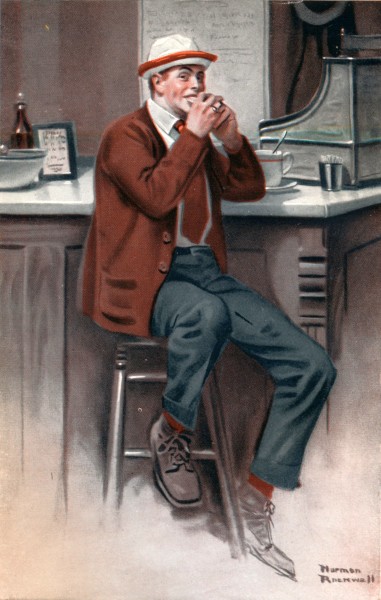
A boy with light blue eyes that just about
matched the slightly hazy June sky sat on
the float below the town landing at Greenhaven,
L. I., and stared thoughtfully across harbor
and bay to where, two miles northward, the
village of Johnstown stretched along the farther
shore. He had a round, healthy, and deeply
tanned face of which a short nose, many freckles,
the aforementioned blue eyes, and a somewhat
square chin were prominent features. There was,
of course, a mouth, as well, and that, too, was
prominent just now, for it was puckered with the
little tune that the boy was softly whistling. Under
a sailor’s hat of white canvas the hair was
brown, but a brown that only escaped being red
by the narrowest of margins. That fact was a
sore subject with Toby Tucker.
Perhaps had his hair been really and truly red,
beyond all question, he wouldn’t have minded
being called “Ginger” and “Carrots” and “Sorrel
Top” and “Red Head” and all the other
names frequently—but usually from a safe distance—bestowed
on him. Perhaps it was the injustice
of it that hurt. That as may be, a hint
that Toby’s hair was red—or even reddish—was
equivalent to a declaration of war, and entailed
similar consequences! He wore, besides the duck
hat, a sailor’s jacket of like material, a pair of
khaki trousers, and brown canvas “sneakers.”
You wouldn’t have called him “smartly dressed,”
perhaps, but what he wore seemed to suit him
and was, at least, clean.
From where he sat, perched on a box labeled
“Sunny South Brand Tomatoes,” he had a clear
view of Spanish Harbor, and beyond its mouth a
wide expanse of Great Peconic Bay. Beyond that
again lay the green fields and low, wooded hills of
the north shore. A coal barge, which had lately
discharged her cargo at Rollinson’s Wharf, was
anchored in the middle channel, awaiting a tug.
Nearer at hand were a half-dozen pleasure sailboats,
a blunt-nosed, drab-hued fishing sloop, and
a black launch, all tugging gently at their moorings
on the incoming tide. On either side of the
float a little company of rowboats and small
launches rubbed sides. Behind him, the rusted
iron wheels of the gangplank, leading to the
wharf above, creaked as the float swung to the
rising water.
Toby had the landing to himself. The box on
which he sat held provisions for the yacht Penguin,
and some time around nine o’clock a tender
was to call for them. Toby, when school wasn’t
in session, did such odd jobs as fell to his hand,
and just now, it being Saturday morning, he was
earning a whole quarter of a dollar from Perkins
& Howe, the grocers. Having propelled the box
to the gangplank in a wheelbarrow, and slid it
down to its present resting place, all that remained
was to continue sitting right there until some
one claimed it, a task which suited Toby perfectly.
Not that he was especially lazy or disliked
work, for he wasn’t and didn’t, but it was pleasantly
hot today, and Toby was in a contemplative
frame of mind, and sitting there in the sun, with
the water lapping beneath him and the good smell
of the sea in his nostrils, was very satisfying to
Toby’s soul. The visions he saw with those blue
eyes of his, squinted a bit because of the glare on
the dancing water, must have been enthralling,
since he didn’t observe the white launch that entered
the harbor until it was almost up to the
landing.
Then the chug-chug of her exhaust caught his
attention, and he shaded his eyes and observed
her intently. She wasn’t very big, perhaps eighteen
feet over all, and she had a spray hood in
lieu of cabin. At present the hood was down,
and Toby could see much mahogany and polished
brass as the launch sped, head on, for the landing.
There was only one passenger in sight, a boy of
about Toby’s age, who stood at the wheel in the
bow. Toby, who knew most of the craft that entered
Spanish Harbor, failed to recognize this
one. Nor did the name, in gilt letters on her nose,
make him any wiser.
“Frolic,” muttered Toby. “Never heard of
her before. Must be a new one. Wonder where
that lubber thinks he’s going to? He’ll be on the
float in a minute if he doesn’t look out!”
When about forty feet away the boy in the
launch threw the clutch into reverse. There was
much churning of green water under the stern,
and the boat’s speed lessened, but what with the
impetus given her and the incoming tide she
seemed bound to either land high and dry on the
float or to considerably damage her immaculate
white and gold bow. The skipper dropped the
wheel and looked excitedly around for a boat-hook.
“Sheer off, you idiot!” cried Toby, nimbly
scrambling out of the way. “Put your wheel
over!”
“Grab her!” responded the boy in the launch.
“Fend her off!”
Toby grunted. Then there was a crash, the
float bobbed and shivered, and the white launch,
finding further progress barred, rebounded from
the obstacle in her path, and, leaving much fresh
white paint on the canvas fender, churned merrily
backward. Simultaneously two boys, one on the
float and one in the launch, scrambled to their feet
again and broke into speech.
“Hey, you boob!” yelled Toby. “Look where
you’re going! You’ll have her stern into that
dory in a minute. Shut off your engine!”
“Why didn’t you grab her?” demanded the boy
in the launch angrily. “Couldn’t you see she was
going to hit?”
“I’d look nice trying to stop her, wouldn’t I?”
countered Toby contemptuously. “Why don’t
you learn to run a launch before you come around
here destroying property? What were you trying
to do, anyhow? Climb the gangplank in
her?”
“I couldn’t come in any way but straight on,
could I? Look at all those boats along the sides!
Why don’t they give a fellow a chance to get up
here?”
“Well, you’re not expected to make your landing
at sixty miles an hour, you silly lubber. Here,
hold that out and I’ll pull you in.”
Somewhat disgruntled, the amateur navigator
proffered the end of the boat-hook and in a jiffy
the Frolic was alongside. Toby returned to his
seat on the box and watched the other make fast.
Conscious of Toby’s ironical regard, the skipper
of the Frolic was flustered and awkward, and
twice got the line tangled around his feet. When
he stood up from his task, he was red of face and
out of temper. “That suit your highness?” he
inquired.
Toby grinned. “Well, it ain’t customary in
these parts to make a boat fast with a square knot,
but I guess she’ll hold.”
“You think you’re smart, don’t you?” sneered
the other.
Toby made no reply to that, merely smiling in a
most exasperating manner. Presently, when the
skipper of the Frolic had laboriously shoved the
launch out of the way, he looked questioningly
about the landing.
“Where can I get gasoline?” he asked more
affably.
Toby was maddeningly deliberate. “Gasoline?”
“Yes.”
“How much do you want?”
“What’s that got to do with it?” demanded the
other impatiently.
“Well, if you want as much as ten gallons it
would pay me to get it for you.”
“I can get it myself if you’ll tell me where they
keep it. Don’t they have it here at this landing?
Isn’t this the town landing?”
“Yes.” Toby looked around the float. “I
don’t see any gasoline, though; do you?”
“Well, then, where——”
“You can get all you want at Tucker’s wharf
over there.”
The other followed the direction of Toby’s
pointing finger. “At the boat yard you mean?”
Toby nodded. “Yes; just chug over there to the
float where you see the red tank.”
“Why couldn’t you tell me that before I tied
up?”
“You didn’t ask me.” The other grunted and
set about casting off again, during which operation
Toby studied him speculatively.
He saw a boy of perhaps a year his senior, and
Toby was fifteen, fairly tall, slim, and undeniably
good looking. He had brown eyes and brown
hair, the latter slicked back in a way that was
strange and awe-inspiring to the observer, and his
face, with its straight nose and somewhat pointed
chin, lacked the healthy coat of tan that Toby’s
possessed. Yes, he was a good looking chap,
Toby decided, but a most unpleasant and unlikable
one. That fact, however, was not going to prevent
Toby from making a sale, and when the visitor
had sprung aboard, Toby glanced doubtfully
at his box of groceries, swept the harbor without
seeing anything that looked like the tender from
the Penguin, and jumped lightly to the Frolic.
“I’ll go over with you and get it,” he said.
“Where’s your boat-hook? All right. Start her
up!”
The other viewed him doubtfully. “What have
you got to do with it?” he asked, suspiciously.
“That’s my father’s wharf, and he’s busy up in
the shed. If it’s gasoline you want, I’m your man.
Take her across easy now.”
The engine started at half-speed, and the Frolic
slid quietly away from the town landing, past the
end of the coal wharf, and across the Cove to the
boat-yard landing. This time the launch’s operator
performed his task more creditably and
nestled up against the small float with no more
damage to her paint. While he made her fast
Toby sprang out and ran up the gangplank to the
big red tank at the end of the wharf.
“How much do you want?” he called back.
“About nine, I guess. My tank holds ten, and
I think there’s almost a gallon in it.”
“All right.” Toby held a five-gallon can under
the faucet and when it was full climbed down
again and swung it to the bow of the launch.
“Look out for the paint,” requested the other boy.
“Wait till I get the funnel. Go ahead now.”
Toby poured the contents of the can into the
tank and returned again to the wharf. When the
final four gallons had been added he set the can
back on the float and observed: “One ninety-eight,
please.”
“One ninety—— Say, how much do you charge
a gallon?” exclaimed the other, incredulously.
“Twenty-two cents. This is the best there is.”
“Twenty-two! Why, I only paid twenty in
New York the other day!”
“You were lucky,” drawled Toby. “It’s twenty-two
here. What you got was low-grade, I
guess.”
“Well, I don’t intend to pay any twenty-two
cents. I’ll pay just what I paid in New York.
Here’s two dollars, and I want twenty cents
change.”
Toby, hands in pockets, paid no heed to the
proffered bill. Instead he looked speculatively at
the little round hole through which the gasoline
had disappeared. “It’s going to be hard to get
it out of there,” he mused. “Maybe we can do it
with a pump, though.”
“Get it out? What for? Look here, twenty
cents is enough and——”
“Not when the price is twenty-two,” replied
Toby decidedly. “We charge the same as everywhere
else here. You’d have paid twenty-two at
the town landing just the same.”
“At the town landing! You said they didn’t
keep it there!”
“No, sir, I didn’t. I said I didn’t see any.”
Toby grinned. “And I didn’t, either. You can’t,
from the float.”
“You’re a smart guy, aren’t you?” said the
other angrily. “You make me come away over
here and then try to hold me up! Well, you can’t
do it! You fork over twenty cents and you’ll get
this two dollars, you—you red-headed cheat!”
Toby’s grin faded instantly. “What did you
call me?” he asked very quietly after a moment’s
silence.
“You heard it! Now you find twenty cents
and——”
They were standing on the canvas-covered deck
at the bow, a precarious place at the best, with
the launch rolling a bit, and not at all the sort of
place the Frolic’s skipper would have selected for
battle had he been allowed a choice. But he
wasn’t, for his naughty remarks were rudely interrupted,
rudely and unexpectedly! With something
between a grunt and a snarl, Toby threw himself
upon him.
“Take it back!” he panted. “’Tain’t red, and
you know it!”
The older boy gave way before the sudden assault,
tried to wrest his arms free from Toby’s
grip, failed at that, and, bringing his greater
weight to bear, forced the other back across the
tiny decking. They struggled and panted, only the
rubber soles they wore keeping them from going
overboard.
“Let me alone, you silly ass!” grunted the older
youth. “We’ll both be in the water in a
second.”
“Take it back, then!” panted Toby. “’Tain’t
red, is it?”
“Yes, it is! It’s red as—as fire!” He
wrenched an arm free and struck out angrily. The
blow missed, and Toby caught at the arm, trying
now to trip his opponent up. But the law of gravity
cannot be trifled with forever, and what was
bound to happen sooner or later happened right
then. Toby’s leg worked behind the other; he
bore back and—over they went, still tightly
clasped together, with a splash that awoke the
echoes of the Cove!
CHAPTER II THE Turnover
They came up separately, Toby first.
Fortunately for the boy of the launch, a
good eight feet separated him from
Toby at the moment of his emergence, for Toby
was by no means satisfied and proved it by an
earnest endeavor to reach his adversary before
the latter could splash and flounder his way
around the bow of the launch and throw himself,
breathless and half-drowned, across the edge of
the float. From that position he squirmed not an
instant too soon and half-leaped and half-fell
across the gunwale of the launch and seized the
boat-hook.
“Now, you wild idiot,” he gasped, “you keep
away from me!”
Toby viewed the situation, pulled himself to
the float and grinned. “All right,” he said. “You
got the best of it now, but it ain’t red, and I’ll
make you say so sooner or later. Now you pay
what you owe me.”
An expression of blank dismay came to the
other’s face, and he gazed anxiously about deck
and water. “I dropped it! You made me do it,
too! Now you find it!”
Toby shrugged. “I guess it’s at the bottom
now. Let me look.”
“You stay where you are,” commanded the
other, threatening again with his weapon.
“I won’t do anything—honest,” assured Toby.
“Not now, that is. Put that thing down and let
me see if I can see your money.”
In a moment the two were leaning over the
side of the launch and peering into the water.
But the surface was ruffled and it was impossible
to see much below it. “When did you let go
of it?” inquired Toby.
“How do I know? When you grabbed me, I
suppose.”
“Haven’t you got any more money with you?”
“No, I haven’t, and if I had I wouldn’t give it
to you,” was the ungracious reply. Toby considered.
Finally:
“Well, I’ll take half the blame,” he decided,
“but that’s all. You pay me ninety-nine cents and
we’ll call it square.”
“That’s twenty-two cents a gallon, though.”
Toby nodded. “Sure. That’s the price.”
After a moment’s consideration the other consented.
“But you’ll have to trust me for it,” he
said. “That two dollars was all I had.”
“All right. What’s your name?”
“Deering, Arnold Deering. I live on the
Head.”
“Spanish Head? Whose house have you got?”
“We live in our own house. It’s called ‘Cedarcroft,’
and it’s the big one right at the end——”
“Oh, the new one that was built last winter?
All right. Arnold Deering, eh? I’ll remember.
You’re the fellow who owes me ninety-nine cents—and
an apology.”
“You’ll get the ninety-nine cents, all right; I’ll
bring it over tomorrow. But you’ll have to
whistle for any apology from me!”
“I can whistle,” answered Toby undisturbedly.
“You’ll have to!” Arnold was having difficulty
with the knot he had tied. Toby looked on
quizzically.
“Those square knots——” he began.
“Oh, shut up!” Arnold finally cast loose and
climbed aboard. “You get off now.”
“I was thinking maybe you’d drop me at the
town landing,” replied Toby calmly. “I’ve got a
box of groceries over there.”
“Well, all right, but you’ll have to jump. I
don’t intend to stop for you.”
“Sure. Reverse her when you start and back
out. Put your wheel hard over and——”
“Say,” inquired Arnold belligerently, “who’s
running this thing?”
“You are. How long have you had her?”
“About a week.”
“She’s a nice boat. If I was you I’d learn to
run her. Don’t do a boat any good to ram her into
things.”
“Is that so? I’ll bet I can run a launch as well
as you can, you——”
“Careful!” warned Toby.
“You fresh kid!”
“All right. Look out for the coal wharf. Mr.
Rollinson would be awfully mad if you carried
away the end of it! Just slow her up and I’ll
jump for it.”
“I hope you fall in,” said the other vindictively.
Toby laughed.
“I wouldn’t be much wetter if I did! All right
now. Thanks!” He made a flying leap over the
four feet of water between launch and float and
landed safely. Simultaneously Arnold twirled the
wheel and the Frolic pointed her nose down the
harbor and chugged indignantly away. Not, however,
until Toby had sent a gentle reminder floating
after her.
“Frolic, ahoy!” he shouted.
Arnold turned an inquiring head.
“Don’t forget that ninety-nine cents! And remember
I’m still whistling!”
There was no reply, and Toby, seating himself
on the box, chuckled wickedly and resumed his
onerous task.
Toby’s father wasn’t nearly as amused as Toby
had expected him to be when he was told the incident
of the last two-dollar bill at dinner that day.
Mr. Tucker was a tall, stooped man of forty-odd
years, with faded blue eyes in a weather-tanned
face. The Tuckers had been boat builders for
three generations, and Mr. Aaron Tucker’s skin
seemed to have borrowed the hue from the mahogany
that for so many years past had been
sawed and shaped and planed and sandpapered in
the big shed across the harbor road. In the old
days Tucker’s Boat Yard had turned out good-sized
fishing and pleasure craft, but business had
fallen away in the last dozen years, and now small
launches and sloops and rowboats constituted the
output. And, at that, business was far from brisk.
Perhaps Mr. Tucker had the fact in mind when
he inquired dryly who was to pay for that other
four and a half gallons of gasoline.
“I guess I’ll have to,” said Toby, ruefully.
“I calculate you will,” agreed his father.
“At the wholesale price, though,” added the
boy hastily; and Mr. Tucker’s eyes twinkled as he
nodded.
But if the story won small appreciation from
his father, there was one, at least, at the dinner
table who enjoyed it, and that was Toby’s sister,
Phebe. Phebe Tucker was thirteen, a slim, pretty
girl with hair that Toby called “yaller” and
Phebe’s mother termed golden. She had very
bright, brown eyes under long lashes and a skin
that, even though nearly as brown as Toby’s, was
clear and smooth. There were no other children
and so Toby and his sister had always been very
close companions, a fact which probably accounted
for a somewhat boyish quality in Phebe. She
could sail a boat nearly as well as Toby, catch quite
as many fish, was no mean hand at the oars, and
could perform almost as many “stunts” in the
water as he could. She asked no favors and was
always ready for adventure—a jolly, companionable
girl with a wealth of spirits, and good nature
and good health.
Neither of the children resembled their mother
in looks, for Mrs. Tucker was small, with dark
hair and eyes, and comfortably stout. Her children
called her “roly-poly,” a descriptive term
which Mrs. Tucker pretended to resent. For the
rest, she was a quiet, kind-hearted little woman,
who worshiped her big husband and her children,
and whose main ambition was to see that
they were happy.
Saturday afternoon was always a holiday for
Toby and Phebe, and after dinner was over they
went out to the front steps and pondered what
to do. The cottage was a neat, white-clapboarded
little house, perched on a slope above the harbor
road. From the gate a flight of six wooden steps
led to a tiny bricked walk which ran the length
of the cottage.
A wistaria vine, venerable with age, was in
full bloom at one side of the doorway, while between
house and walk narrow beds held a wealth
of old-fashioned flowers. From the steps one
looked across the cobbled, winding harbor road,
tree-shaded in summer, to the boat yard with its
weather-beaten shed and its old stone wharf, and
beyond that to the little harbor and to the nestling
village houses on the other side.
“We might go out in the launch,” suggested
Toby, “only I’d have to fix the wiring
first.”
“Would it take long?” asked his sister.
“I guess not. I couldn’t find the trouble yesterday,
though. We might take a run around to
Shinnecock if I can get her started.”
“Let’s,” said Phebe. “It’s too beautiful a day
to stay ashore. You go ahead and see if you
can’t fix it and I’ll be right along.”
So Toby crossed the road, passed around the
further side of the big shed, from which came
the tap-tap of hammers and the buzz of the bandsaw,
climbed down a slippery ladder and dropped
into the launch.
Toby had made most of that boat himself. It
wasn’t as grand as the Frolic and it boasted little
bright work and no gilt. But, in spite of its name,
it was at once safe, roomy and fast. Its name—you
had to look on the stern to find it—was
Turnover. In lowering the engine into it the summer
before Toby’s assistant had lost control of
the rope, with the result that the engine, at that
instant poised over the gunwale, had descended
very hurriedly. The boat, probably resenting the
indignity, had promptly turned its keel to the sky
and dumped the engine to the bottom of the slip
in six feet of water. The boat hadn’t actually
turned over, for having got rid of the engine and
shipped a good deal of water it had righted itself
very nicely, but Toby had dubbed it Turnover
there and then.
The Turnover was sixteen feet long, with a
four-and-a-half-foot beam, had a two-cylinder
engine—purchased second-hand but really as good
as new—capable of sending the launch through the
water at a good twelve-mile gait, and was painted
a rather depressing shade of gray. Toby favored
that color not so much for its attractiveness as
because it didn’t show dirt, and it must be owned
that the Turnover was seldom immaculate, inside
or out. But she suited Toby down to the ground—or
perhaps I should say down to the water—and
I doubt if any one else could have made her
go as he did. The Turnover had her own eccentricities
and it was necessary to humor her.
Toby began operations by pushing his duck hat
to the back of his head and reflectively scratching
the front of it, a trick caught from his father.
Then, having decided on a plan of action, he set to
work. Before he had discovered the trouble and
remedied it, with the aid of an odd bit of insulated
copper wire pulled from a locker, Phebe was
swinging her feet from the edge of the wharf and
watching. Experience had taught her the advisability
of keeping out of the way until the work
was done. At last, wiping a perspiring face in a
bunch of greasy waste, Toby threw the switch on
and turned the fly-wheel over.
A heartening chug-chug rewarded him, and,
tossing the tools back in the locker, he unscrewed
the cap of the gasoline tank, plunged a stick into
it, examined the result, did some mental calculation,
and at last declared himself ready to start.
Phebe lowered herself nimbly down the ladder
and seated herself at the wheel while Toby cast off
the lines from the bow and stern. The Turnover
backed out of the little slip rather noisily, swung
her pert nose toward the harbor mouth, and presently
was sliding past the moored craft at a fine
clip. Once around the point the breeze met them
and the Turnover began to nod to the quartering
waves. Toby slathered oil here and there, gave
her more gas, and seated himself across from his
sister.
“She’s going fine,” he said. “I guess we could
make Robins Island if we wanted to.”
“That’s too far, Toby. I’d rather go to Shinnecock.”
“All right. It’s going to be dandy after we
get around the Head. There’s a peach of a swell,
isn’t there?”
The launch dipped her way past Nobbs Island,
with its squatty lighthouse, and Phebe turned the
launch toward the Head.
“There’s the place that fellow lives,” said Toby,
nodding at a fine new stone-and-shingle house on
the point. “The fellow I had the scrap with, I
mean.”
“It’s a lovely house,” said Phebe. “I suppose
they have lots of money, don’t you?”
“Slathers, I guess. He’s a pill. Can’t run that
launch any more than Mr. Murphy can.” (Mr.
Murphy was Phebe’s parrot, and, while he had
been through some nautical experiences, he was
naturally no navigator!) “He didn’t do a thing
to her paint when he bumped into the float.” Toby
chuckled. “And wasn’t he peeved with me!”
“I guess you were horribly superior and nasty,”
said Phebe. “You can be, you know.”
“Oh, well, I hate fellows to put on a lot of
airs just because their folks have money,” grumbled
Toby. “The way he talked to me, you’d
have thought I was a hunk of dirt.”
“Was he nice looking?” asked Phebe.
“Oh, I suppose you’d call him that. Sort of
a pretty boy, with his hair all slicked back like
it was varnished. It didn’t look so fine when he
came out of the water, though!”
“That was a horrid thing to do, Toby.” But
she smiled as she said it.
“I didn’t do it, sis. He stumbled—sort of—and
went over backwards, and I went with him.
You ought to have seen the way he scrambled out
of there when he saw me coming after him! Say,
we might run in to their landing and collect that
ninety-nine cents, eh?”
“Indeed, we aren’t going to do anything of the
kind!” replied Phebe severely, and Toby laughed.
“I was just fooling. He’ll pay it, all right.
And he’ll apologize for calling me red-headed,
too.”
“I don’t see why you mind that so much,” said
Phebe. “I think red hair is lovely. I wish mine
was red, like Nellie Rollinson’s.”
“I don’t. I think it’s awful.”
“Why, Toby, you said once you thought Nellie’s
hair was very pretty!”
“Maybe it is, on her. It wouldn’t be on you,
though. And I don’t want any of it, thanks. Take
her in a little closer to shore. It’s flood tide.”
The Turnover was remarkably well behaved today
and they ran into the canal long before two
o’clock, and, at Phebe’s suggestion, disembarked
and walked over to the hills and, finally, to the
south shore. The summer season was well begun
and there was plenty to see and to interest
them. They had ice cream sodas at a little shop
and wandered back to the launch about three.
Instead of making straight home, Toby, who
claimed the wheel now, headed the Turnover
toward the middle of the bay, and, with a nice
breeze blowing Phebe’s hair about her face and
enough of a chop to set the launch advancing
merrily in the sunlight, they spent the next hour
in running leisurely across to the north shore and
back. It was when the Turnover was pointed
homeward again, about four, that Phebe, curled
up in the bow, called Toby’s attention to a small
launch a mile or so distant and some two miles
off Spanish Head.
“They are either fishing or have broken down.
I’ve been watching them for some time.”
“There aren’t any fish there,” replied Toby,
viewing the distant launch. “Guess their engine’s
gone back on them. They’ve got their anchor
over. We’ll soon find out.”
“They’re waving at us, I think,” said Phebe a
minute later. “Look, Toby.”
“That’s right.” Toby waved his hat in reply
and sent the Turnover along faster. “I wonder
what launch that is,” he added as the distance
lessened. “She looks a bit like——” his voice
dwindled. Then he laughed, and: “That’s just
who she is!” he cried gayly. “That’s the Frolic,
sis! And, unless I’m much mistaken, that’s Pretty
Boy waving!”
CHAPTER III ARNOLD PAYS HIS DEBTS
Toby was not mistaken, for presently the
Turnover was close enough to the disabled
white launch for him to identify
one of her two passengers as Arnold Deering.
Who the other boy was Toby didn’t know, nor
did he much care. He slipped the clutch into
neutral and let the Turnover run down alongside
the Frolic. As he did so he vastly enjoyed the
expression of surprise and annoyance that came
into Arnold’s face when the latter recognized
him.
“Hello,” said Toby as the boats bobbed side
by side. “Want some more gasoline?”
“Hello,” answered Arnold gruffly. “This
silly engine’s out of whack. We can’t start her.
If you’ll give us a tow I’ll pay you for it.”
Toby considered a moment, or appeared to.
Then, as the Turnover was floating past, he threw
in the clutch again and circled around to the other
side. At last: “I don’t know about towing,” he
said doubtfully. “The Frolic’s pretty heavy for
us, I guess. I might send some one out to you
when I get in.”
Phebe uttered a low-voiced protest. “Don’t
be horrid, Toby,” she said. “Of course we can
tow them.”
But the boys in the white launch didn’t hear
that, and Arnold looked dismayed. “But, look
here, whatever-your-name-is——”
“Well, you said it was Red-head this morning,”
replied Toby carelessly.
Arnold flushed. “We’ve been here since half-past
two, and we want to get home. I’ve a rope
here, and if you’ll tow us in I’ll give you a dollar.”
The second occupant of the Frolic, an older and
bigger boy with dark hair and eyes and a somewhat
sulky expression, chimed in impatiently.
“We’ll give him two dollars. I’ll pay half. I’ve
got to get back by five o’clock, Arn.”
“All right then, two,” amended Arnold anxiously.
“Get that half-inch rope out of the stern
locker, Frank, will you?”
“Oh, I’d do it for a dollar,” said Toby, “or I
might do it for nothing at all. It isn’t that.” He
ruminated again and again chugged the Turnover
into position. “Tell you what I will do,” he continued
then. “I’ll come aboard and see if I can
start her for you.”
“What’s the good of that?” demanded Frank.
“We’ve been trying for nearly two hours. And
we want to get in.”
“Maybe I might think of something you
haven’t,” answered Toby.
“All right, come ahead,” said Arnold.
Toby slid the Turnover close to the other launch
and shut off the engine. “You hold her, Phebe,”
he instructed. Then: “This is my sister, Phebe,”
he added by way of introduction. “Phebe, this is
Arnold Deering. You remember I spoke of him
this noon,” he added innocently.
Arnold colored as he murmured a response and
then introduced Frank Lamson. Phebe nodded
shyly and Toby clambered aboard the Frolic. The
two boys then followed him as he tested the
engine by throwing the spark on and turning the
wheel a few times. There was no response from
the cylinders and Toby disconnected the wires
from the spark-plugs and grounded them against
the engine one at a time. He got sparks from
three of the four, and, after he had cleaned the
fourth plug, from all of them. An examination of
the carbureter followed leisurely, Toby whistling
softly all the time. Presently he followed the
gasoline supply pipe back from engine to tank,
having to raise the locker covers to do so, and
at last, snapping the door of the forward locker
shut again, he faced Arnold with a satisfied nod.
“Got it,” he said.
“Really? What was the trouble?” asked the
Frolic’s skipper.
“Nothing much. I can fix it in a minute.”
“Go ahead, then,” said Frank Lamson, with a
scowl. “We’re in a hurry, I tell you.”
Toby observed him ruminatively for a moment,
and then turned his gaze to Arnold. “I’m still
whistling, you see,” he said, and to prove it went
on with his tune.
“Don’t be a fool,” begged Arnold. “If you can
fix it——”
“Won’t take me a minute—after I get started,”
was the untroubled reply. Toby reached up and
took off his hat. “You might just take another
look at my hair,” he continued pleasantly. “When
the sun isn’t on it’s quite a bit darker, I
think.”
“Toby!” exclaimed Phebe, in a shocked voice.
Arnold flushed and stammered. “What’s that
got to do with it?” he asked. Frank Lamson
looked bewildered.
“Well,” said Toby, “I thought maybe you’d
like to see if you weren’t mistaken about the color
of my hair.”
Arnold looked at Frank and at Phebe, and
finally at Toby’s gently smiling countenance and
swallowed hard. Finally: “Well, it isn’t as red
as I thought it was,” he muttered. “I suppose the
sun being on it——”
“Sure! But just you take another look; take a
good hard one now. Sort of brown, isn’t it?”
Arnold hesitated, cast a fleeting glance at the
exposed hair, and grinned in a sickly way. “I
guess that’s so,” he allowed. “I—I’d say it was
quite brown.”
“Not the least bit red, eh?”
Arnold shook his head: “Not a bit.”
“And, seeing you were mistaken this morning,
maybe you’d like to sort of apologize,” suggested
Toby. Phebe was observing Arnold with an expression
that seemed to convey to him an apology
for her brother’s conduct, and perhaps her look
helped him over his embarrassment. At all events,
when Frank Lamson, puzzled and resentful, broke
in with: “What’s the fuss about? Who cares
whether his hair’s brown or——” Arnold interrupted
quickly.
“Whoa, Frank! This chap’s right.” He
laughed good humoredly. “I take it back, Tucker,
and apologize. You’re all right! And—and you
can stop whistling!”
Toby smiled sunnily and clapped his hat on his
head. “Now we’ll start her,” he said. He went
back to the forward locker in which the gasoline
tank was located, thrust in a hand, withdrew it,
closed the door again and returned to the engine.
“Now try her,” he said.
Arnold did so and the engine woke promptly
to life.
“What was it?” he demanded, surprise and
admiration struggling for supremacy in his face.
Toby laughed. “I’ll tell you so it won’t be
likely to happen again,” he replied. “You’ve got
a globe cock on your gasoline supply pipe where
it leaves the tank. Usually that shut-off is down
here by the engine, and I don’t know why they
put it there. But they did, and when you pulled
your anchor out of your bow locker you managed
to get your cable fouled with the cock and
turned it almost square off. You weren’t getting
any gasoline, Deering.”
“But I tried the carbureter twice and it
flooded!”
“Of course it did, because there was gasoline
in the pipe. The cock wasn’t quite closed, and
enough kept running into the pipe to show in the
carbureter, but not to explode in the cylinders. If
I were you I’d take a piece of zinc and turn it over
that cock; make a sort of hood of it, you know,
so your line won’t get twisted in it.”
“I didn’t know there was any shut-off there,”
grumbled Frank Lamson, “or I’d have looked
at it.”
“There’s always one somewhere on the pipe,”
replied Toby dryly. “Well, you’re all right now,
I guess, eh?”
“Yes, thanks,” said Arnold gratefully. “And,
by the way, Tucker——” He pulled a dollar bill
from his coin purse and held it out with a smile.
“I guess I’ll pay my debt.”
Toby gravely fished up a penny and the transfer
was made.
“I don’t know,” continued Arnold doubtfully,
“but what I’d ought to pay for all that gas.” He
made a motion toward his pocket again, but Toby
waved the idea aside.
“No, we settled that,” he said. “I don’t mind
paying half. It was worth it!”
Arnold laughed. Then: “But, hold on! How
about this job?” he exclaimed. “Better let me
pay you something for it. I’d rather.”
“Oh, shucks, that’s all right. We don’t charge
for helping friends out of trouble around here,”
answered Toby as he climbed back to the Turnover.
“So long!”
“Well, I’m awfully much obliged,” responded
Arnold, and his thanks seemed to include Phebe
as well. “Good-by.” He took off his cap, something
which his companion neglected to do, and
waved a farewell as the Turnover moved away.
Frank Lamson only nodded, but, as the Turnover
circled around toward the harbor, he called across
the water: “Say, we’ll race you back!”
But Toby shook his head. “I’m not in racing
trim today,” he called back. “Some other
time!”
The Frolic passed them presently, doing a good
ten miles against the turning tide, and Arnold,
standing at the wheel in the bow, waved once
more.
“You ought to have been ashamed, Toby,” said
his sister severely, “to act like that!”
“Act like what?” inquired the boy innocently.
“You know perfectly well.”
“Oh, that! Why, you see, sis, I knew he’d
made a mistake, and I knew he’d want to—to
correct it. So I just gave him a chance.”
“But to refuse to fix the engine until he’d
apologized!”
“I didn’t refuse. I’d have fixed it if he hadn’t.
That was just a bluff—and it worked!” Toby
chuckled. “What did you think of him?”
“I thought he was very—very nice,” replied
Phebe, after a moment.
“He isn’t so bad, I guess,” agreed Toby carelessly.
“Some one ought to show him how to run
that boat, though.”
“And he is very good looking, too,” added
Phebe.
Toby grinned. “You wait till you see me with
my hair slicked down flat with vaseline, sis!”
“Vaseline! The idea! His hair is just naturally
shiny.”
“Must be. Anyway, you’ve taken a shine to
it! Wonder where he picked up that Lantern
chap?”
“Lamson, it was.”
“Lamson, then. He’s a surly beggar.” Toby
frowned. “He came mighty near getting into
trouble, too. He almost said my hair was red.
If Deering hadn’t stopped him just when he
did——”
“Toby, you’re too silly for words about the
color of your hair. You know very well that it
is—well, reddish, and I don’t see why you don’t
make up your mind to it.”
“You’ve got a pimple on the end of your nose,
but——”
“Toby! I haven’t!” Phebe investigated agitatedly.
“It’s just the tiniest bit of a one, then.
Does it show much?”
“Well, you couldn’t see it across the harbor,”
was the unfeeling reply. “Anyhow, it’s there, and
I’ll bet you wouldn’t want folks to tell you about
it. Well, it’s like that with my hair, sis. I know
it’s sort of reddish—in the sunlight, maybe—but
I don’t care to have fellows say so. When they
do they either have to fight or apologize.”
“I don’t see how fighting proves anything,” objected
Phebe.
“It doesn’t prove anything, no, but it sort of
makes you forget the insult! Here we are. Take
the wheel and I’ll fend her off. I hope there’s
something good for supper!”
CHAPTER IV FRIENDS AFLOAT
Toby saw no more of Arnold for a week,
for school kept him busy, but Mr.
Tucker reported that the Frolic had
twice been to the wharf for gasoline and that on
each occasion her skipper had inquired for him.
School came to end for the summer that Friday
and Toby brought his books home to his little
slanting-walled room with a sigh of relief. He
didn’t mind studying, for he wanted to learn
things, but since the really warm weather had set
in, lessons had been a task indeed. One thing,
though, that he could congratulate himself on was
that he was now through grammar school and
next fall would start in at high school over at
Johnstown. As long as the weather would allow
it, he meant to make the trip back and forth
in the Turnover, a matter of three miles from
landing to landing.
When the ice came he would have to walk to
Riverport, a good two miles, and take the train
there for Johnstown, and that wouldn’t be quite
so pleasant. Toby’s ambition, though it was as
yet not very strong, was to some day take hold
of Tucker’s Boat Yard and make it as big and
busy and successful as it once had been. But
Toby’s father didn’t give him much encouragement.
Boat-building at Greenhaven, he declared
pessimistically, had had its day. Launches had
taken the place of honest sailboats, and there were
too many launch-makers in that part of the world.
There was no money in it any longer; just a living,
and a bare one at that. Toby thought he
knew better, but he didn’t argue it. There was
time enough yet.
In another four years, when he had learned
all they had to teach him at the Johnstown High
School, and he was very, very wise, perhaps he
would take hold of the business and show his
father that there was still money to be made in it.
Of course, Toby had not figured out just how he
was to do it. There was time enough for that,
too!
He and Arnold had their next meeting Saturday
morning, a week almost to the minute after
their first. Toby had taken some provisions
around to a houseboat moored in Nobbs Bay, on
the other side of Spanish Harbor, and was chugging
lazily back in the Turnover, when from across
the water a faint hail reached him. A quarter of
a mile away a figure stood on the new steel pier
that extended into the bay at the end of Spanish
Head, and Toby, shading his eyes, recognized
Arnold Deering. Since his errand had been accomplished
and there was no more work in sight
just then, he turned the launch toward the landing
and was soon within talking distance. The
Frolic was lying beside the float there, in company
with a cedar skiff, and a brilliantly blue canoe
rested, keel up, on the planks.
“Hello, Tucker!” called Arnold in friendly
fashion. “Where are you going?”
“Nowhere much. I took some grub to that
houseboat in there. Going out in the launch?”
Toby slid the Turnover up to the end of the float
and Arnold came down the sloping gangplank.
“I don’t know. Maybe I will.” He held the
Turnover to the landing with one rubber-soled
shoe on the gunwale. “Say, I met your father
the other day.”
“He told me.”
“He’s awfully nice, isn’t he?”
Toby considered. Finally: “Yes,” he said.
“He takes after me.”
Arnold laughed. “Say, you must have thought
I was an awful fresh chump the other day,” he
said apologetically. “I’m sorry I was so peevish.”
He smiled reminiscently. “Fact is, you know, I
was mad because I’d made such a mess of that
landing.”
“I guess we were both sort of fresh,” answered
Toby. “Want to go out in a good boat?”
“Yes.” Arnold leaped aboard. “Your father
said you’d made this yourself.”
“Most of it. I made the hull, but dad and
Long Tim—he works for dad—helped me a lot
with the lockers and so on.”
“I should think you’d be mighty proud of it,”
said the other admiringly. “I would. How did
you happen to call her the Turnover?”
Toby explained as he started off, and Arnold
laughed appreciatively. “That would be a better
name for my canoe,” he said. “She turned over
with me the other day about a half-mile out there
and I had to swim all the way in with her. There’s
too much chop around here for canoeing.”
“Which way do you want to go?” asked Toby.
“Ever been over to Johnstown?”
“No, Frank and I started for there last Saturday,
the day we broke down.”
“How did you happen to stop the launch out
there, anyway? Were you going to fish?”
Arnold nodded. “Yes, Frank said there’d be
cod there. Then after we’d got the anchor over
we found we’d forgotten to bring any bait.”
“Cod!” laughed Toby. “I guess a sea robin
or a sculpin would have been about all you’d
have caught. Who is this fellow Lamson?”
“He lives on the other side over there. He goes
to school where I do.”
“Do you like him?”
“Like him?” Arnold had to consider that.
“N-no, not a lot, I guess. Do you?”
“Not so far. He looks all the time as if he’d
swallowed something that didn’t agree with him.
And he pretty nearly said I had red hair!”
“Say, I’m sorry I said anything about—about
your hair,” said Arnold contritely. “It was
beastly rude.”
“Well, I’m sort of touchy about that,” replied
Toby. “Of course my hair is—er—I mean when
you look at it a certain way it does seem a little
bit inclined to be reddish. It isn’t really red, you
know, but it—it has a sort of tinge! Lots of
fellows make mistakes about it. The first year
I was in grammar school I was all the time—er—showing
fellows how mistaken they were.”
“The same way you showed me?” inquired
Arnold slyly.
Toby nodded, and smiled gently. “About like
that. Of course, I don’t mind a joke, you know.
Folks I like can call me red-headed all they want
to. But I don’t seem to care for it from
strangers.”
“I see. I won’t ever say anything like that
again,” Arnold assured him.
Toby gazed intently toward the island sliding
past them to port. “I wouldn’t care if you did—now,”
he murmured. “If I like a fellow”—his
voice dwindled off into silence.
“All the more reason I shouldn’t,” said Arnold.
“If I like a fellow I don’t want to hurt his feelings.”
“No, but—when you like a fellow you don’t
mind what he says,” returned Toby. His eyes
sought Arnold’s face for an instant and then returned
to the island. “You can call me Red-head
if you want to. I wouldn’t care.”
“I guess I’d rather call you by your real name,”
laughed Arnold. “I would if I was sure of it.
Is it Toby?”
“Yes. Funny sort of a name, isn’t it? Tobias
it is when it’s all there. Dad got it out of the
Bible. All the male Tuckers have Bible names.
Dad’s is Aaron. When he was a kid the boys
used to call him ‘Big A, little a, r, o, n!’ His
father’s name was Jephthah; Captain Jeph, they
called him. I’m glad they didn’t tag me with
that name!”
“I think Toby’s a rather jolly name,” said
Arnold reflectively. “I like it better than Arnold.”
“I don’t. Arnold’s got a lot of style to it;
sounds like it was out of a story. What do the
fellows at school call you?”
“Arn, usually. Say, this boat can travel, can’t
she? How fast is she going?”
“About ten, I guess; maybe eleven.” Toby advanced
the throttle as far as it would go, listened
and pushed it back a little. “She misses if I give
her too much gas.”
“Seems to me she goes faster than the Frolic.”
“She’s smaller and you’re nearer the water.
That makes her seem to go faster. There’s the
landing ahead. Want to go in?”
“No, let’s just knock around, unless you’ve got
something to do.”
“I haven’t as long as I stay away from home,”
replied Toby dryly. “Say, what school do you go
to in winter?”
“Yardley Hall.”
“Where’s that?”
“Wissining, Connecticut.” Arnold waved a hand
vaguely toward the west. “Over there on the
other side of the Sound. Ever hear of it?”
Toby shook his head. “I don’t know much
about schools. It’s a boarding school, isn’t it?”
“Yes, and it’s a dandy. I wish you could see it.
Where do you go, Toby?”
“Me? Next year I’m going to high school here
at Johnstown. You can almost see the building.
It’s about a mile up from the landing there, near
where you see that white steeple. I’d rather go
to a boarding school, though. It must be lots of
fun. What do you do?”
So for the next half-hour, while the Turnover,
slowed down to a four-mile gait, rocked and
swayed over the sunlit waters of the bay, Arnold
recited the glories of Yardley Hall School and
told of football and baseball and hockey battles
and of jolly times in hall. Perhaps Arnold drew
rather a one-sided picture of life at Yardley, omitting
mention of such things as study and discipline
and the periodical examinations, but that was only
natural, for he was proud of Yardley and wanted
to make it as alluring as possible. Toby listened
intently, questioning now and then, because many
of Arnold’s references were quite unintelligible
to him, and, when Arnold had reached the end of
his subject, sighed wistfully.
“My, wouldn’t I like that!” he exclaimed.
“Are the other fellows nice? I suppose
they’re mostly all swells like you, aren’t they?”
“I’m not a ‘swell,’ thank you! There are all
sorts of fellows at Yardley, though. I guess the
kind you call ‘swells’ are pretty few. Lots of them
are just poor fellows——”
“Like me,” interpolated Toby.
“I didn’t mean that!”
“Oh, I don’t mind. I am poor, you know. I
mean dad is. We used to have a little money,
when the boat yard was more—more flourishing,
but nowadays we just sort of scrape along.
That’s why I couldn’t go to boarding school. It
would cost too much money. I’d like to, though.
Say, wouldn’t I just!” Toby’s face lighted. Then
he laughed. “I guess it wouldn’t do, though, because
I’d have to fight half the school for calling
me red-headed!”
“You’d have your hands full then. We’ve got
about three hundred fellows.”
Toby shook his head sadly. “I wouldn’t last,
then, would I? The only thing I could do would
be to dye my hair black. Do you have to study
very hard?”
“Yes, we do,” answered Arnold, frankly.
“Especially in fourth and third classes.”
“What’s your class?”
“I’ll be in third next year. Last year was my
first. Say, wouldn’t it be great if you could get
your father to let you come to Yardley?”
“Yes, it would be dandy,” answered Toby,
smiling wryly. “And I can see him doing it! How
much does it cost, anyway? Say it slow, will you,
so it won’t sound so much?”
“Well, the tuition’s only a hundred——”
“Is that all?” asked Toby carelessly. “Would
they take a check for it? Go ahead. What else
do you have to pay for?”
“Room and board, of course. That costs from
two hundred to three hundred and fifty, according
to your room.”
“Well, I’d want a nice room, of course; one
with a southern exposure and hard and soft water.
How much would I have to pay for storing my
automobile?”
“Don’t be an idiot,” laughed Arnold. “That
isn’t an awful lot of money, is it?”
“No, indeed! Oh, no! But I suppose there’d
be extras, wouldn’t there? Maybe I’d have to
tip the principal and the teachers, eh?”
“You’d have to pay five dollars a year as an
athletic assessment, and pay for your washing
and your books. Books don’t cost much. You
can get second-hand ones usually if you want to.”
“I guess not!” exclaimed Toby indignantly.
“Nothing cheap for Tobias Tucker! Well, I’ll
figure it up and think it over. But say, honest
now, do all boarding schools cost like this one
of yours?”
“I don’t know, but I guess they’re about the
same. Some cost you more, maybe.”
“Where could I find one of those? I’d hate to
get settled at your school and then find there was
a more expensive one! That would pretty nearly
break my heart, it would so! Well, maybe we’d
better be getting back. I suppose you’ve got to
polish your diamonds yet.”
“Shut up,” said Arnold, shortly. “If you talk
like that I’ll—I’ll call you ‘Carrots’!”
“Better not,” chuckled Toby. “The last time
you did it it cost you two dollars! Calling me
names is expensive!”
“What are you going to do until lunch time?”
asked the other, as Toby headed back toward the
Deerings’ landing.
“Me? Oh, I guess I’ll go back to Perkins &
Howe’s and see if they’ve got any more jobs. I
made a half-dollar taking that stuff to the houseboat.”
He pulled the coin from his pocket and
exhibited it. Arnold observed it interestedly.
“I suppose,” he said thoughtfully, “a half-dollar
seems a lot bigger if you make it yourself.”
“Oh, I didn’t make this,” said Toby innocently.
“I just earned it. It’s a regular half-dollar.” He
flipped it in the air to let it fall on the seat beside
him in proof of his assertion, and it did just as
he intended it should, up to the point when it
struck against the wood. After that it acted most
inconsiderately, for, having landed on its edge, it
flew up again and described a graceful curve over
the gunwale.
“Grab it!” yelled Arnold. Toby made a frantic
clutch for it, but his hand closed emptily and the
coin disappeared into the green water of Great
Peconic Bay!
There was a moment of deep silence during
which the occupants of the launch gazed at each
other in surprised consternation. Then:
“I’m awfully sorry,” murmured Arnold.
A slow smile spread over Toby’s face. “So
am I,” he replied, cheerfully. “But that’s what
I get for being foolish. I mean that’s what I
don’t get. Well, maybe I earned it too easily,
anyhow. I guess a quarter would have been
enough for that job. It puts me back fifty cents,
though, toward getting to Yardley Hall, doesn’t
it?”
“Look here,” began Arnold shyly, “I wish you’d
let me——” His hand moved tentatively toward
his pocket. “It was partly my fault, anyway——”
“Yes, you rocked the boat,” answered Toby
gravely. Then he broke into a hearty laugh.
“Say, Arnold, you and I will have this old bay
just choked up with money if we keep on! They’ll
have to begin and dredge it first thing we know.
There’s two and a half already, and here it is
only the first of July!”
CHAPTER V SHOTS IN THE DARK
That was the beginning of a fine friendship.
Toby and Arnold became well-nigh
inseparable. They spent hours and
hours together in the Frolic or the Turnover,
swam, fished, canoed occasionally, explored
by land and sea, and spent much time
curled up in a favorite corner of the boat-yard
building glorious plans for the future. Sometimes
Phebe was their companion, and sometimes,
though less frequently, Frank Lamson. Toby put
up with Frank for Arnold’s sake, but never got
to like him. For his part, Frank failed to see why
Arnold wanted to associate with a fellow whose
father worked “like a common laborer” and who
“slopped around in clothes you wouldn’t give to
the ashman!”
But Frank’s disapproval didn’t influence Arnold
to any great extent, and Frank soon learned to
keep it to himself. He viewed Phebe more tolerantly
because she was pretty and presentable,
even if her dresses would have failed to pass muster
over at the Head. But what Frank thought
of her bothered Phebe little, since she liked him
no better than Toby did, although she was a trifle
more careful to disguise the fact.
Once and only once Toby went home with
Arnold to luncheon. It happened that a trip
down the bay in the Turnover had taken more time
than they had foreseen, and when the launch
floated up to the Deerings’ pier to let Arnold off
it was long after Toby’s dinner hour. Toby had
resisted a while against Arnold’s pleading, but
he was horribly hungry and Arnold assured him
that what he had on wouldn’t matter a bit, and
finally he had yielded. What had happened was
not at all terrifying, for Arnold’s aunt, who, since
the death of the lad’s mother many years before,
had presided over the Deering establishment, was
very gracious indeed to the guest; while Mr.
Deering was in New York. And the wonderful
things that were placed before Toby tasted finely
and surely filled an aching void. But for all that
he wasn’t comfortable. He had never seen so
many dishes and glasses and forks and knives and
spoons, nor so many servants. Nor had he ever
had his table manners put to so severe a test.
Afterwards, although Arnold for a while frequently
extended invitations to luncheon, Toby
always found some excuse for declining. He
never gave the real reason, however, although possibly
Arnold guessed it. Eventually Arnold gave
it up as a bad job, but that didn’t keep him from
partaking of the Tucker hospitality, and he was a
frequent guest at the dinner table in the little
cottage above Harbor Street. Every one liked
Arnold, even Mr. Murphy; and Mr. Murphy
was constitutionally suspicious of strangers.
Mr. Murphy sat on a perch in the corner of the
dining-room, by the window that looked along the
winding street, an uncannily wise-appearing old
parrot with a draggled tail and a much-battered
beak. Phebe explained that he used to have a
perfectly gorgeous tail, but that he would insist
on pulling the feathers out no matter how she
scolded him. Like most parrots, Mr. Murphy
had his periods of inviolate silence and his periods
of invincible loquacity. During the former all
enticements failed to summon even a squawk from
him, and during the latter only banishment to a
certain dark closet under the hall stairs would
stop the flow of his eloquence. It wasn’t so much
that the parrot’s repertoire was extensive as that
he made the most of it. Unlike Shakespeare, he
repeated! Having spent several years of an
eventful life before the mast, he had learned a
number of remarks that brought embarrassed
apologies from Phebe. On the whole, though, and
in view of his early environment, his conversation
was remarkably polite.
His usual welcome was “Hello, dearie!” followed
by “Won’t you take off your bonnet?”
After that he usually laughed jeeringly, sidled
across his perch, lowered himself and gravely hung
by his beak. “All hands, stand by!” was generally
delivered in a peremptory shriek that, at
first, had had a devastating effect on Mrs. Tucker’s
nerves. As though realizing the fact, Mr. Murphy
thereupon chuckled wickedly and murmured
softly and crooningly: “Well, well, well! Did
you ever?” Phebe had taught him to say, “Come
to breakfast,” and he had grown very partial to
the remark, making use of it at all times of the
day with cheerful disregard for appropriateness.
For a while he had made the cat’s life a burden to
her by calling “Kitty, Kitty, Kitty! Come, pretty
Kitty!” and then going into peals of raucous laughter
the minute the poor cat’s head appeared around
the door. Arnold won Mr. Murphy’s undying
affection by feeding him pop-corn surreptitiously,
pop-corn being an article of diet strictly forbidden
by Phebe. He also spent much time during the
summer trying to induce the bird to say “Arnold,”
but it wasn’t until late in August that Toby, passing
the dining-room door one afternoon, heard
Mr. Murphy croaking experimentally in a low
voice: “Say Arnold, you chump!”
Toby still performed odd jobs and picked up
an occasional quarter or half-dollar, but it must
be acknowledged that he was far less earnest in
his endeavors to find employment than he had
been before Arnold’s advent on the scene. But
he was only fourteen—“going on fifteen,” as he
would have put it—and so it isn’t to be greatly
wondered at that he found his new friend’s companionship
more enjoyable than running errands
or delivering groceries in out-of-the-way places
for Perkins & Howe. Mr. Tucker at first viewed
Toby’s frivolity with displeasure, but Mrs. Tucker
declared that it would do him more good to play
and have a good time with a nice boy like Arnold
Deering than to loiter about Main Street on the
lookout for a job. I think that struck Toby’s
father as being good sense, for he never after that
taxed the boy with idleness. Sometimes Toby had
qualms of conscience and for a day or two resisted
all Arnold’s blandishments and gave himself
up sternly to commerce. Frequently at such
times Arnold likewise eschewed the life of pleasure
and threw in his lot with that of Toby, and together
they sat in the back room of the grocery
store awaiting orders; or canvassed the other
places of business on the chance of finding service.
It was at such a time, seated on boxes by Perkins
& Howe’s back entrance, with a strong odor of
spices and coffee and cucumbers enveloping them—it
happened that Arnold was seated on the crate
of cucumbers—that the plan of the baseball series
between the town boys and the summer visitors
was evolved. The sight of two youngsters
passing a ball on the side street that ran
down to the fish wharf put the idea into Arnold’s
head.
“Do you play baseball, Toby?” he asked.
Toby nodded. “Well, then, let’s have a game
some time.”
“You and me?” asked Toby, with a grin.
“No, silly! We’ll get up a couple of teams, of
course. There are plenty of fellows on the Head
and around there to make up one, and you could
find enough here in town for the other, couldn’t
you?”
Toby nodded again. “Most of the fellows on
the school team would play, I guess. What would
we do, draw lots?”
“Yes; or we could have it summer visitors
against town fellows. How would that do?”
Toby reflected. “I’d rather play on the team
with you, Arn,” he said at last.
“So would I with you, Toby, but it would be
more interesting the other way, wouldn’t it?
Where do you play?”
“Me? Oh, most anywhere. I played third
base this spring, and last year I played center field
part of the time, and part of the time I caught.
I’m what you call an all-round player, a sort of
general utility man!”
“Fine! I played first on my class team this
spring. Let’s do it, eh? Where could we play?”
“I guess we could use the school most any day
except Saturday. Does Frank play?”
“Yes, he’s a pretty good pitcher. I guess I’d
ask him to pitch for us. Who would you get?”
“Tim Chrystal, probably. He’s about the best
we have. I don’t know, though, if he’d have time.
He works for his father, you see. When would
we play?”
“Today’s Wednesday, isn’t it? How about
Saturday?”
“We mightn’t be able to get the field Saturday.
Besides, it’ll take me two or three days, I guess,
to find a team. Let’s say a week from today.”
“All right. It’ll be piles of fun. You call your
nine the ‘Towners’ and I’ll call mine the ‘Spaniards.’
Couldn’t you go after your fellows today?”
Toby hesitated. “Maybe. I guess there isn’t
anything to do here. I might start after dinner.”
“Good! And I’ll beat it around the Head this
afternoon and see who I can get hold of. There
are two or three fellows I don’t know very well,
but that doesn’t matter, I guess. I wish your folks
had a telephone so that I could call you up this
evening and see how you’d got along.”
“Dad says telephones waste too much time.
Why don’t you come over in the launch? It’s
moonlight now.”
“I suppose I could,” replied Arnold doubtfully.
“I’ve never run her at night, though.”
“Better begin, then. It’s no harder than running
in daylight. Easier, I guess, because there
aren’t so many boats about. Come over about
eight and I’ll meet you at the town landing. It’ll
be low tide at our pier, and you might get aground,
seeing you don’t know the cove very well.”
They talked it over further during the next half-hour,
and then, as it was dinner time, they abandoned
the search for labor and went their ways.
Toby wanted Arnold to have dinner with him,
but the latter was so filled with his new scheme
that he insisted on chugging back to the Head so
he might start right out after luncheon on his
quest for baseball talent. They parted with the
understanding that Arnold was to be at the town
landing about eight, and that they were to meet
there and report progress.
The moon was up, a big silver half-disk, when
Toby reached the float at a few minutes before
eight, and the harbor was almost as light as day.
He had to wait some time for the Frolic, and,
when it did appear, heralded by tiny red and green
lights, it was moving slowly and cautiously. Presently
Arnold’s hail floated across the water and
Toby answered.
“All clear at the end of the float, Arn! Come
on straight in!”
“All right, but it’s pretty dark where you are.
How far away am I?”
“Oh, nearly a hundred yards, I guess. Pull
her out and float in. Can you see those boats at
the moorings?”
“Yes; but I can’t see the float yet. They ought
to have a light there.” The chug-chug of the
Frolic exhaust lessened, and the white launch slid
silently into the shadows. Presently:
“Way enough,” called Toby. “Reverse her a
couple of turns, Arn.”
In a moment the Frolic thrust her bow into
Toby’s waiting hands, and he fended her off and
brought her side-to. “Want to tie up?” he asked.
“Or shall we run around awhile?”
“If you’ll take her,” replied Arnold. “I don’t
like this moonlight business. It’s awfully confusing
after you get into the harbor.”
“All right. Swing your wheel over hard and
I’ll push her off. That’s the ticket.” Toby sprang
aboard and took the wheel from Arnold and the
launch set off again. Once outside the harbor,
with the engine throttle down until it made almost
no sound, the two boys compared notes.
“I’ve got seven fellows,” Arnold reported, “and
I know where I can get four more. Frank will
pitch for us and a chap named Dodson is going
to catch. Frank says he’s a dandy. All I need
now is a good shortstop and another fielder. All
the fellows,” he added ruefully, “want to play
the bases—or pitch. It’s funny how many of
them are wonderful pitchers, when they tell it!
How did you get on?”
“Me? Not very well. Tim Chrystal has promised
to pitch if he doesn’t have to do any practicing,
and I got three other fellows to promise to
play. The trouble is, you see, most of them are
older than I am and they don’t like the idea of
my being captain. Tim said he thought Billy
Conners ought to be. What do you think?”
“Nothing doing! You’re getting up the team,
and you’re captain, of course. If they don’t like
it, get some one else.”
“Yes, but there aren’t so awfully many, you
see. I’ve still got to find five or six more. There’s
Tony George, but he has to be at the fruit
stand.”
“At the what?” asked Arnold.
“Fruit stand. His father’s the Italian man who
has the stand next to Chapin’s drug store. He’s a
mighty good third baseman, too, Tony is, and I
wish he could play.”
“Looks like this was going to be a sort of international
affair,” laughed Arnold. “Americans,
Spaniards, and an Italian!”
“And my second baseman’s a Portuguese,
Manuel Sousa. He’s pretty good, too. How old
will your fellows be?”
“They’ll average about sixteen, I guess. Dodson
must be seventeen, but most of them are
about my age. I hope you can find the rest of
the fellows you need, Toby.”
“I guess I can. I wish they didn’t all want to
be captain, though. I don’t mind not being, but
they can’t all have it.”
“You’re going to be captain,” replied Arnold,
decisively. “If you aren’t we won’t play you.
You can tell them that, too.”
Toby sighed. “All right. I’ll stick out for it.
I guess lots of the others would do it better,
though. You see, Billy Conners captained our
school team, and——”
Toby stopped abruptly, and the two boys turned
their heads and stared startledly across the moonlit
water of Nobbs’ Bay.
“What was that?” asked Toby.
“Sounded like a shot, didn’t it? Over that
way. There!”
Two tiny yellow flashes of light pricked the
darkness of the further shore, followed by as many
sharp reports, and then, more faintly, a shout. Instinctively
Toby swung the launch shoreward.
“Some one on that houseboat, I guess,” he
said. “Probably shooting at a bottle or something
in the water. That’s about where she’s moored.”
“Anyway, it was a pistol, all right,” murmured
Arnold. They listened, but heard no more shots,
and Toby was straightening the Frolic out again
for the run around the Head when the sound of a
muffled exhaust reached them. Toby looked intently
into the shadows of the Head.
“That’s funny,” he muttered. “There’s a
launch just kiting along over there and not a
light showing. Can you make her out, Arn? She’s
about half-way to the Head, from the sound.”
But nothing was visible in the darkness there.
Only the throb of an exhaust reached them. And
then, startlingly loud, came a cry across the bay:
“Thieves! Thieves! Stop them!”
Some one on the houseboat had seen the Frolic’s
lights and was shouting through a megaphone.
And at that moment a shadow seemed to detach
itself from the shore and slip away into the moonlight
beyond the point. The cry from the houseboat
was repeated.
“What shall we do?” cried Toby.
“Go after them!” Arnold jumped toward the
throttle and pulled it down, and the Frolic, responding
instantly, leaped forward as Toby unhesitatingly
swung the wheel over.
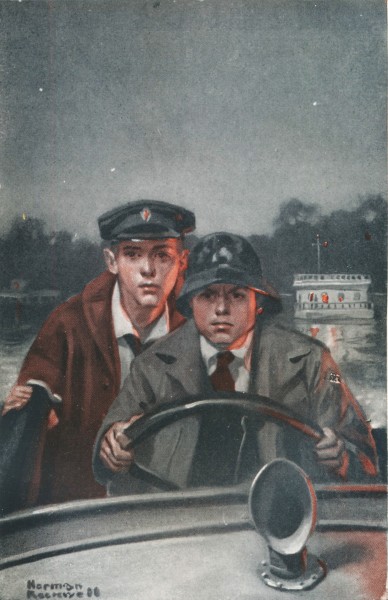
CHAPTER VI PURSUIT AND CAPTURE
“I don’t believe we can catch them,” Toby
muttered, his eyes on the tiny dark spot
half a mile away. “And if we do we’ll
probably get filled with bullets.”
“Who do you suppose they are?” asked Arnold,
excitedly. Toby shook his head.
“I don’t know, but that launch of theirs can
certainly go. What can the Frolic do at her best,
Arn?”
“Twelve, or a little better. How fast are they
going?”
“Can’t tell. Not more than that, I guess.
She’s smaller than this, and sits pretty low. Built
for speed, I’d say. I wonder if they really swiped
anything.”
“They must have tried to, anyway. Where’s
that oil can?” Arnold found it and doused the
engine liberally. Not being able to see very well,
he took no chances, and oiled everything at hand
and turned down the grease-cups.
“She’s changed her mind,” exclaimed Toby,
“and is going down around the Head. How
much gas have you got?”
“The tank’s almost three-quarters full.”
“How far will that take us?”
“’Most a hundred miles, I guess. She eats it
pretty fast at this pace, but seven gallons——”
“Well, we’re not going any hundred miles,”
responded Toby, “and I don’t believe those fellows
mean to, either. They’ll either make for
the canal and get out into Shinnecock Bay, or
they’ll run straight along toward Shelter Island.”
“Are we gaining any?” asked Arnold, anxiously.
“I don’t think so. It’s hard to tell. I guess
they’re not going to try the canal. If they were
they’d be turning by now. Maybe they think they
can shake us off.”
“Then they’ll have to go some,” said Arnold.
“Where is she?”
“Dead ahead. See that black spot?”
For a moment Arnold failed to detect the fleeing
launch, and when he did he uttered a grunt
of disappointment. “We’re certainly not gaining,
Toby. She looks further away than she did.”
“Yes, but she’s stern-to. I don’t think we’ve
lost any.” They were well past the Head now,
and Nobbs Island Light was falling away to port.
“What I’m wondering,” continued Toby, “is what
we’re to do if we should catch her!”
Arnold had no answer ready, and Toby went
on: “There’s probably at least a couple of men
in that launch, and they’ve got pistols——”
“How do you know?” demanded Arnold.
“We heard them.”
“I don’t think so. The shots we heard were
aimed away from the houseboat, Toby. If they
hadn’t been we wouldn’t have seen the flashes. I
guess it was the folks on the houseboat who did
the firing.”
“That’s so. Still, it’s mighty likely that there’s
a pistol on that launch, just the same, even if
they didn’t use it. And we haven’t any; and
wouldn’t know what to do with it if we had. So
what are we to do when we catch them?”
“They won’t know who we are or how many
there are of us,” replied Arnold. “And they
won’t know that we haven’t plenty of revolvers,
either. We’ll bluff them!”
Toby chuckled. “I’d rather have something
to back up my bluff, I guess. I’m game if you are,
though, Arn. Besides, I dare say we needn’t
trouble about what’s to happen when we get them,
for I don’t believe we’re going to.”
“Have they gained any?”
“No,” replied the other decisively. “They may
not be any closer, but I’m certain they haven’t
gained on us. There are the lights from Shinnecock
over there. We’ve done about six miles since
we left the landing.”
The fleeing launch was headed straight for the
passage between the southerly point of Robins
Island and Cow Neck, and was now about half-way
between Spanish Head and the mile-wide
passage. The lights of Shinnecock lay three miles
off to the southeast. The throb of the scurrying
Frolic alone broke the silence of the moonlit night
for several minutes, and then Toby, his gaze fixed
on the launch ahead, uttered an exclamation of
satisfaction.
“I’m not sure, Arn,” he said, “but I think we’re
closing up a little. Doesn’t she look nearer than
she did?”
Arnold agreed and once more seized his oil
can. A cruising launch sped past them a quarter-mile
to the north, her port light glowing wanly in
the moonlight. Toby’s eyes scarcely left the dark
spot ahead and presently he said, with conviction:
“We’re overhauling her fast now, Arn! You’d
better get that bluff in working order, I guess.”
“I—I’ll get the megaphone ready,” muttered
Arnold. “Then we can talk to them from a safe
distance.”
“The safer the better,” agreed Toby. “I
wouldn’t mind if we could talk to them by wireless.
What does it feel like to get a bullet in you,
Arn?”
“Don’t be a chump,” begged Arnold. “Just
keep your head down and they can’t hit you.”
“I’m going to,” answered the other dryly. “I’m
thinking about putting it in the gasoline tank.
Hello!”
The launch ahead lengthened slightly in the
uncertain light.
“She’s making in toward North Sea Harbor,”
muttered Toby. “Now what’s the idea, I wonder.
She can’t belong there. Maybe she’s just bluffing,
though. No, she isn’t! She’s headed right
in! And we’ve gained like anything, Arn! She
sees that, I guess, and is going to quit—or make
a fight for it! Call all hands, Arn, to man the
guns!”
Robins Island was off the Frolic’s port bow
now, but instead of holding her course in the
middle of the channel, the other launch had edged
in toward the shore and was presently running
straight along it, as though bent on dodging
through the narrow harbor entrance a mile or
so beyond the point. There was no longer any
doubt about it: the Frolic was gaining on the
enemy hand over hand. Her engine was working
like a charm, with never a skip, and for the past
forty-five minutes had churned the water at better
than a twelve-mile clip. Arnold, the megaphone
in one hand and the oil can in the other, watched
breathlessly. There were no shadows here to hide
the launch ahead and the two boys exulted as the
distance lessened between pursued and pursuer.
“Now, if she’s making for the harbor she’ll
have to turn,” muttered Toby, straining his gaze.
“There she goes!” There was a doubtful moment
and then: “She’s headed out again. She
missed it, Arn! See, there it is over there. I’ll
bet those fellows don’t know this shore at all.
Now, she’ll have to keep on, for there’s nothing
beyond except a cove until we get to Noyack!
And we’ll get them inside of ten minutes! Do
you know what I think? I think they’re short of
gas, Arn. You know they started out as if they
meant to cut straight across to Johnstown or
Franklinville or some place over there. That
would have been only two or three miles. Instead
we’ve chased them a good ten miles, and they’re
getting short of gas. There! She’s hitting it up a
bit again! Go it, Sal! But we’ll get you long
before you reach Jessup’s Neck. Only—only
when we do what are we going to do with you?”
“I wish my father was here,” murmured Arnold,
“with his revolver!”
“So do I! You don’t think we’d better turn
around and beat it back before they get to popping
at us, do you?”
Arnold hesitated. It seemed very much as
though he wanted to say “Yes,” but he didn’t.
Instead, he took a good deep breath and answered:
“I’d rather see it through, Toby, if you
aren’t scared.”
Toby laughed shortly. “Oh, I’m scared, all
right, but I’m with you, Arn. It would be a
shame to come all this way and use up all that gas
and then turn tail. No, we’ll try that bluff of
yours, Arn. If we have to run we can do it.
She’s slowing down again, isn’t she?”
She was, very perceptibly. More than that,
she had turned her nose straight for the shore!
“But there’s no water there!” exclaimed Toby.
“They’re going to run her aground and
escape!” cried Arnold.
“Perhaps; but I guess we’ll slow down a little.
I don’t want to get too near.”
Arnold throttled the Frolic down to half-speed.
The other launch worked cautiously in toward the
shore and floated quietly in the moonlight. It
was easy enough now to make her out and to
count her occupants.
“Three of them,” whispered Toby, as the
Frolic drew nearer and nearer. “Get your megaphone,
Arn, and hail them. Keep down, though.
Slide her into neutral and be ready to start up
again if they try to plug us.”
Some three hundred feet of water separated the
two launches as Arnold threw the clutch out. The
Frolic slid slowly on to pass well astern of the
other craft and Arnold raised the megaphone to
his lips.
“Launch, ahoy!” he shouted in his deepest
tones. There was silence for an instant, and then
the hail was answered:
“Hello! What do you want?” floated across.
“We want the stuff you stole from the houseboat.
Hand it over and we’ll let you go. If you
don’t, we’ll begin to fire!”
Another silence, longer this time, and then the
voice again:
“Who are you, anyway?”
“Never mind,” answered Arnold sternly.
“There are six of us here and we’ve got you all
covered.”
“We don’t know what you’re talking about.”
It was another voice this time, a deeper one.
“You start shooting and you’ll get the worst of it,
pardner! We never saw no houseboat.”
“Pick out your men, fellows,” said Arnold in a
loud aside, “and aim at their bodies.” Then, addressing
the launch again: “We’ll give you two
minutes to get out of that boat and beat it. If
you’re not on shore by that time we’ll fire on you.
And any one of you taking anything ashore will
get a bullet. Now, make up your minds,
quick!”
Toby left the wheel and scuttled astern, keeping
out of sight. Once there he raised himself so
that his head and shoulders showed above the
gunwale. Then he hurried back to the bow and
repeated the operation. He couldn’t be five men,
he decided, but he could manage to look like two
at least. Perhaps that ruse decided the matter,
for, after a moment or two, during which the
low voices of the three occupants of the other
launch muttered and growled, the first speaker
spoke again.
“I guess you’ve got us,” he said quite cheerfully,
“but you wouldn’t have caught us in a thousand
years if we hadn’t run out of gas.” Toby’s
sigh of relief mingled with Arnold’s. “Can we
run this tub on the beach so’s we can get off?”
Arnold hesitated and Toby prompted with a
whispered “No.”
“No, you can leave the launch where she is and
hustle out of her.”
“We can’t swim!” called a third voice.
“Then drown,” answered Arnold gruffly.
“Your time’s up. What’s it going to be?”
The answer from the launch was profane but
decisive. In substance it stated that they were
going to get out and that they earnestly hoped
the occupants of the white launch would meet with
a vast amount of misfortune!
“They’re taking some of the plunder with
them,” whispered Toby, watching across the gunwale.
“Tell them to drop it, Arn!”
“You heard what I said about taking stuff with
you,” threatened Arnold, his voice doubtless
sounding quite terrifying through the megaphone.
“Drop it quick or we’ll nab the lot of you!”
Mutters and some hesitation then, followed by a
splash as one of the men dropped into the water.
A second lowered himself very cautiously over the
stern, which had swung around nearest to the
shore, and the third, pausing long enough to voice
his disapproval of the whole proceeding and of
the pursuers especially, took a flying leap and cut
through the water with long, businesslike strokes,
passing his companions half-way to the beach and
tossing them a grim jest as he left them
astern.
“It worked!” exulted Arnold, jubilantly, to
Toby.
“Great! But give them time to get away from
shore. That big fellow had something in his
mouth, I think; the one who dropped over so
mighty carefully. Bring her around, Arn, and be
ready to take her in.”
Arnold threw in the clutch, advanced the throttle
and the Frolic swung slowly about in a wide circle,
while Toby, his hands on the wheel but his eyes
on the figures nearing the shore, watched cautiously.
Along the steep and narrow beach ran a fringe
of bushes and stunted trees, and when the three
men were free of the water they drew together
on the beach, seemed to confer for a moment, and
then, shouting something unintelligible but doubtless
far from complimentary, made their way leisurely
out of sight between the bushes.
“All right, now?” asked Arnold eagerly.
“Wait,” advised Toby. “I’m certain one of
them has a pistol, and for all we know may be
drawing a bead on us from those bushes. I tell
you what, Arn. Start her up and we’ll try to keep
their launch between us and them as we go in. But
wait another minute.”
“Shall we search the launch here or take her
further out?” asked Arnold.
“Get a line to her and tow her back with us,
of course,” was the reply. “She’s contraband of
war, or whatever you call it. I wouldn’t be surprised
if they’d stolen her somewhere, anyway.
Have you got a spare rope handy?”
“No, but we can use our painter.”
“All right. She may have one; she probably
has. If not, we’ll use the Frolic’s. Do you suppose
they’ve gone?”
“Of course! They were frightened to death.”
Arnold laughed softly. “I must have sounded
pretty fierce!”
“You did! You sounded as if you were about
six feet tall and weighed 200 pounds! Well, I
suppose we might as well take a chance. If they’re
still there, they’ll probably stay, and there’s no use
trying to tire them out. All right. Start her
easy. Here we go. Keep out of sight until we
get to the launch, and then I’ll grab her.”
“Better let me,” said Arnold. “You keep the
wheel.”
“All right, then; you grab her, and I’ll look
for her painter.”
The Frolic chugged slowly in toward the abandoned
launch, Toby doing his best to keep the
latter between them and the place where the burglars
had disappeared.
“Way enough,” he whispered presently. “Let
her run. Now, then, get her!”
Arnold reached across the gunwale and seized
the side of the other launch, and Toby, dropping
the wheel, sprawled across the Frolic’s decking.
“No line in sight,” he muttered, and with quick
hands he took the Frolic’s neatly coiled painter,
and slipped it over the cleat on the little forward
deck. Then, squirming back, he started aft. As
he did so a bullet sang overhead and the sound of
the shot awoke the silence.
CHAPTER VII THE STOLEN LAUNCH
“Duck!” cried Arnold.
But Toby had already dropped to
the hatching, and Arnold, releasing
his grasp of the smaller launch, tumbled down beside
him. Another shot rang out and somewhere
overhead a second bullet sped whistling past.
“Can you start her without showing your
head?” gasped Toby.
“Yes!”
“Then do it, and I’ll take the side wheel. Look
out for this line when she tightens. Let her go!”
Kneeling, his head still below the sides, Arnold
grasped the lever and pulled it back, and the Frolic
jumped away. Toby, crouched by the side wheel,
frantically lashed the free end of the painter about
the steering post.
Bang!
There was a sound of splintering wood, and
then shouts from the shore.
“Hit us somewhere!” panted Toby, tugging
at the small wheel in his effort to swing the
Frolic around. “Better lie flat, Arn!”
“Lie flat yourself, you silly fool! They’ll get
you if you sit up like that!”
Toby crouched lower. “This line’s choked
around the wheel and I can hardly turn her,” he
panted. “Is she coming, do you think?”
“Isn’t your line taut?”
“Yes, but——”
Two more shots sounded above the noise of the
engine. A bullet went harmlessly over the launch
and another struck the hull somewhere with a thud.
By this time the Frolic was doing her best and
after a moment Toby sent a cautious glance behind.
Even if the thieves had more cartridges,
and Toby didn’t think they had, the distance was
now too great for them. Behind the Frolic came
the captured launch.
“All right, Arn!” called Toby. “They couldn’t
get us now with a siege gun! Take that wheel
there while I change this line to the stern, will
you?”
Arnold stood up, surveyed the receding beach
and laughed gleefully as he took the wheel.
“I guess we’re bad, Toby!” he exulted. “Talk
about your revenue officers! What’s the matter
with us, eh?”
Toby, fixing the towing line at the stern,
laughed. “We’re a couple of marvelous bluffers,
Arn! Say, wouldn’t those chaps be peeved if they
ever found out they’d been fooled by a couple of
kids?”
“Wouldn’t they? Say, I hope they do find it
out some way. Do you know what I think, Toby?
I think they thought we were just going to search
their launch and leave her! And when they saw
us putting the line on her they tumbled and got
busy with that revolver. Well, we fooled them
good and plenty!”
“That’s what! Say, what time is it? It must
be near midnight.”
“Midnight! It’s only 9.27,” answered the
other, holding his watch to the starboard lantern.
“But doesn’t it seem later?”
“I should say so! Then if everything goes all
right we ought to be home by ten-thirty. We’ll
just hand this launch over to the Trainors and let
them see what’s in her.”
“You mean the houseboat folks? Well, but
they don’t get the launch, do they?”
“Not so you’d notice it,” answered Toby.
“We’ll call around tomorrow and get it. And
then we’ll see if anybody’s lost one. If they
haven’t, we’ll sell her, eh?”
“Or keep her ourselves. She looks pretty good,
doesn’t she?” Arnold peered back at the following
launch. “Wonder what her name is?”
“Maybe it’s painted out. She’s a jim-dandy
little launch, all right, and that makes me think
those fellows stole her. Look at the lines of her.
She can’t be much over four feet wide. If she
only had some gas in her tank we could get home
a lot quicker, because one of us could get in and
run her.”
“It would be you, then,” replied Arnold
promptly. “Is she holding us back much?”
“I guess we’re doing about nine. That’s fast
enough. Only dad will give me the dickens when
I get home!”
“He won’t when you tell him what you’ve been
doing,” said the other encouragingly.
“Won’t he?” Toby asked grimly. “You don’t
know my dad!”
The journey back was uneventful, which was
just as well, since the two boys were surfeited
with adventure for once, and a little bit tired as
well. Sleepy they were not, and Arnold declared
that he didn’t believe he would ever get to sleep
before morning. But by the time Nobbs Island
Light was showing well the conversation had begun
to dwindle and Toby was yawning frankly.
Ten o’clock struck over in Johnstown long before
the Head was reached, and it was fully a
quarter past before the Frolic pointed her bow
around the point and chugged past Arnold’s residence
on her way up the shore. “Give them your
whistle,” said Toby as they ran cautiously toward
the darkened houseboat. Arnold obeyed and the
echoes threw back the alarming screech. “Once
more,” Toby called, and again the shrill sound
went forth. Then a dim light showed aboard the
shadowy hulk and, as the Frolic slowed down, a
voice hailed them.
“What do you want?” inquired a sleepy voice.
“We’ve got your things,” answered Arnold.
“Got what? Oh! Well, all right! Come on!”
Voices sounded aboard, a light glimmered from a
window, a lantern appeared on deck, and the
houseboat awoke to activity as the launch sidled
up to her. Two men, hastily attired, deluged the
boys with questions.
“We caught them over near North Sea Harbor.
They ran out of gas. We made them leave
the launch and I guess everything’s in there.
We’ll pull her up and you can have a look. If
you don’t mind, we’ll leave her here until morning.
Did they steal much?”
“Not a great deal; just some blankets and a
lot of provisions,” answered one of the men as
Toby pulled the smaller launch up and handed the
painter over. “At least, that’s all we’ve missed.
We were on shore and got back before they’d
had much of a chance, I suppose. My brother
fired three shots at them, but it was too dark to
see much.”
“Just blankets and grub!” said Arnold disappointedly.
“Gee, I thought they’d got away with
your solid silver and jewels! Well, anyway, I
guess you’ll find the stuff there all right. We’ll
call for the launch in the morning.”
“We’re very much obliged to you,” replied one
of the men, raising the lantern and peering at the
boys. “Who was with you?”
“With us? No one.”
“What! You mean that you two kids chased
those chaps and made them give up the whole
shooting match? Why, there were four or five
of them, weren’t they?”
“Three,” answered Toby, with a yawn. “They
couldn’t see how many we had. Arn bluffed them
finely.”
“Well, what do you know about that?” gasped
the other man. “Say, you chaps are wonders!
What are your names?”
Arnold told him, and just then a woman’s voice
spoke from behind a darkened window. “Jim,
dear, ask them if they wouldn’t like a cup of
coffee or something. They must be tired
out.”
“No, ma’am; thanks,” replied Arnold. “We’re
all right. Only sleepy. If you’ll look after their
launch until morning——”
“We will. And, I say, how about—er——”
“Of course, Jack!” chimed in the woman.
“They ought to have something. I’ll find my
purse.”
“No, thanks,” said Arnold, hurriedly. “We
don’t want anything. We just did it for the
fun of it. And—and we’ve got the launch, anyway.
Toby thinks they stole it, and maybe the
owner’s offered a reward. I’m glad we got your
things back, ma’am.”
“It was awfully brave of you. And I do think
we ought to give you something besides just our
thanks. Why, they might have hurt you!”
“Yes’m,” said Toby. “They did try to. They
fired at us, but they didn’t hit anything but the
launch. Come on, Arn.”
“Well, all right, fellows,” said the man called
Jack. “It’s up to you. We’d be glad enough to
slip you a fiver. If you won’t take that, why, you
won’t. We’ll keep the launch safe for you. Much
obliged to you both. See you in the morning.
Good-night.”
“Good-night,” replied Arnold, and “G’night,”
muttered Toby, and the Frolic backed off and
headed across the bay.
“Blankets and grub!” said Arnold disappointedly
when they were out of hearing. “Isn’t that
the limit? No wonder those fellows were so
willing to give them up!”
“Where we fooled them,” said Toby, “was in
taking their boat. Look here, Arn, supposing
that launch is really theirs?”
“But you said you thought they’d——”
“Yes, and maybe they did. But supposing they
didn’t? Then what?”
“Then,” answered the other after a moment’s
consideration, “they’ll have to come and get
it!”
“They’d be likely to!” jeered Toby. “I don’t
see but what we may be thieves ourselves!”
“Well, that isn’t bothering me much,” answered
Arnold. “What is bothering me is that I’ve
got to come all the way back from town
alone.”
“If you like you can leave the Frolic at the landing
and I’ll take you back in the Turnover.”
“No, I guess not. After chasing robbers and
being fired at, I suppose I ought to have nerve
enough to run a launch! Much obliged, just the
same.”
An hour later two very tired boys were fast
asleep, and, although nearly three miles apart,
their dreams were strangely similar!
The next morning they were at the houseboat
bright and early. In fact, the owners were still
at breakfast on deck when the Turnover ranged
alongside.
Seen by daylight, the Trainors—Mr. and
Mrs. Trainor and Brother Jim—were very
nice, jolly-looking folks, and very hospitable
folks, too, for they insisted on the boys joining
them at breakfast, and wouldn’t take “No” for an
answer. And so, although they didn’t actually sit
at the table, which was a modest if well-laden
affair, they did partake of strawberries and cream
and some delicious hot rolls and some equally
delicious coffee. And while they ate, Arnold, occasionally
prompted by Toby, gave a detailed
account of the pursuit and bloodless defeat of the
thieves. Mrs. Trainor, who was small and pretty,
applauded delightedly and quite forgot her breakfast,
while her husband gravely arose and shook
Arnold and Toby by the hands.
“Boys,” he said. “You’re a brace of heroes!
I take off my hat to you! Or I will when I get
it on!”
Brother Jim echoed the sentiments, even if he
didn’t stop eating for a moment.
“And you chaps have got a real prize in that
launch, too,” said Mr. Trainor, reseating himself
at the little table. “She’s a wonder. I’ll give you
five hundred for her any time you say the
word.”
Toby and Arnold stared at each other in
amazed silence. Finally: “Five hundred!” stammered
Toby. “You’re fooling, I guess!”
“You take a look at her,” replied the man, nodding
his head toward the shoreward side of the
houseboat. “We tied her around there for safekeeping.
She’s somebody’s darling, that’s what
she is!”
The boys set down their plates and hurried
around the deck. There, nestling against the rail
of the houseboat, was as trim and pretty a speed
launch as either had ever seen. Mr. Trainor,
who had followed them, smiled at their amazement.
“I suppose you couldn’t see much of her
last night,” he said. “Look at that engine, will
you? A six-cylinder Thurston and as light as
a feather! If that launch can’t do her twenty-two
or -three miles I’m a goat! See the way she’s
cut down aft, eh? Some lines, boys! And just
cast your eyes over her fittings, will you? Everything
A-1, and just about as complete as they
make them. Why, some one paid a good round
thousand for that little sixteen feet of boat! She’s
dirty and her brass is tarnished, and some idiot
has daubed a coat of gray paint over a dandy
mahogany hull, but she’s a peach, just the same,
and it’s dollars to doughnuts that those thieving
rascals never owned her in their lives. They
swiped her somewhere around here, I’ll bet, and
I guess you’ve only to read the papers to find her
owner. When you do find him, fellows, you make
him hand over some real money.”
“Gee, she’s sweet, ain’t she?” murmured Toby.
“A beauty!” agreed Arnold, in awe.
“I guess some one will claim her, all right,”
mourned Toby.
And Mr. Trainor laughed.
“That’s the way I felt when I saw her, son. I
wanted awfully to hide her some place where you
couldn’t find her! If you shouldn’t hear from
the owner, and you want to sell her, why, my offer
stands for all time.”
“If she was really mine,” said Toby, simply,
“I wouldn’t sell her for anything, Mr.
Trainor!”
“Tucker, you have the soul of an artist!” replied
the man, patting him on the shoulder.
“Those are my sentiments exactly.”
“She—she’d be pretty unsteady, though,
wouldn’t she?” asked Arnold. “She isn’t very
wide across.”
“Well, she isn’t meant for rough seas, Deering.
She’s a racer, pure and simple, and I’ll wager anything
she’s won more than once. Still, maybe not,
for she can’t have been built more than a year.
Everything looks too new. Question now is, what
are you going to do with her, boys? If we had
some gasoline we might try her out.”
But Toby shook his head. “I’d rather not do
that, sir. I—I’d be afraid I wouldn’t ever want
to give her up again!”
“By Jove, I believe you’re right! You’d better
tow her home with you. If you leave her around
here I might steal her. She’d be a constant temptation
to dishonesty! Take her away! Take her
away!”
Mr. Trainor gestured dramatically.
“I’ll pull her around and get the line to the
launch,” said Toby soberly. “Wasn’t it a shame
to smear that old gray paint on her, sir? Will
it ever come off again all right?”
“Oh, yes, a painter can take that off. She’d
have to be revarnished, of course. I tried to see
her name under the paint, but couldn’t.”
Presently the boys said good-by to their hosts,
receiving three very hearty invitations to come
again, and, with the stolen launch swaying gracefully
behind the Turnover, set off for Greenhaven.
CHAPTER VIII THE HIDDEN NAME
Toby was very silent, but the fact that he
spent most of his time looking back at
the tow indicated where his thoughts
were. Arnold, less affected by the beauty of the
speed launch, was eager to get the morning papers
and see whether she was advertised.
“How much reward do you suppose we ought
to ask, Toby?” he inquired. Toby shook his
head.
“A hundred anyway, eh?” continued Arnold.
“Maybe there’s a sum offered. I know if I’d lost
a boat like that I’d be glad to pay almost anything
for her!”
“If she’s stolen property, though,” replied
Toby finally, “the owner wouldn’t really have to
pay any reward; unless he wanted to, I mean.”
“He will want to, you bet! Where’ll we take
her? To your wharf?”
“Yes, I think so. If we leave her at the town
landing some one will be messing around her
all the time. She can berth where I keep the
Turnover. This old tub”—Toby ran a disparaging
eye over his launch—“can stay out in the harbor.”
Once ashore, the two boys hurried up the street
and bought a copy of every morning paper that
the news store had. Then they scuttled back to
the boat yard, perched themselves in the lee of a
dismantled sloop, and began a systematic search
of the various “Lost and Found” columns. As
each paper was laid aside without results Toby
heaved a sigh of relief and Arnold one of disappointment.
When the last paper had been perused
Arnold observed his chum blankly.
“Not in any of those,” he said, regretfully.
“Gee, that’s mean, isn’t it?”
Toby nodded silently. After a moment he said,
“I suppose you—you wouldn’t want to keep her
if—if we didn’t find an owner, Arn?”
“Why, no, I don’t think so. Would you? She
wouldn’t do for rough weather, you know. Mr.
Trainor said so. I’d be scared to death to go out
of the harbor in her. If we don’t find her owner
it would be great to sell her to Mr. Trainor, I
think.”
Toby nodded again, but with no enthusiasm.
“I suppose it would be silly for us to keep her,” he
said, “only—only she’s the most beautiful launch
I ever saw, Arn.”
“Yes, she’s a beauty, all right, but what would
we do with her? She’d cost money, too.” After
a moment’s silence he said: “Look here, Toby,
maybe she was stolen a long while ago and they’ve
stopped advertising for her. Maybe if we looked
through some old papers we’d come across something.”
“Where would we find the old papers, though?”
“A library would have them. Is there a library
here?”
“No, but there’s one in Johnstown. What we
ought to do, I guess, is put an advertisement in
ourselves, Arn.”
“That’s so! I never thought of that! Let’s
go and write one.”
“All right.” Toby gathered the discarded papers
and arose. “You do it, though. I—I haven’t
got any heart for it!”
But that advertisement was never written, for
on the way past the shed Toby thought of his
father, and Mr. Tucker was invited to view the
prize.
“That’s a nice little boat, Tobe,” said Mr.
Tucker, as he looked down on her from the wharf.
“Made for quiet waters. Who built her?”
“I don’t know, sir,” answered Toby.
“That means you didn’t look,” replied his father,
descending the ladder and jumping into the
launch. “There’ll be a maker’s plate on her somewhere,
unless it’s been ripped off.” He went forward
and peered amongst the instruments there,
and presently gave a grunt of satisfaction. “Here
it is. ‘Built by Wells-Stotesbury Company, Moorcett,
Conn.’ Now, what’s her name, Tobe? Oh,
they painted that out, did they? Run up to the
paint closet and get that can of paint-remover and
a handful of waste.”
A few minutes later the gray paint began to
dissolve from a patch on the slanting stern and
her name appeared letter by letter, faint, but legible.
“Ollow M” read Toby. “That’s a queer
name.”
“You wait a bit,” advised Mr. Tucker, and
extended his operations with the evil-smelling concoction
in the can. “There it is,” he said at last.
“Follow Me. Now, all you’ve got to do is write
to the builders and ask who she belongs to. Where
was your gumption, Tobe?”
Toby shook his head sadly, but whether the
sadness was caused by an appreciation of his lamentable
lack of gumption or by something else
didn’t appear. At the boys’ request Mr. Tucker
indited a letter at the littered desk in one corner
of the boat shed and they bore it to the postoffice.
Toby watched it disappear through the letter slot
with emotions of despair! He spent all the rest
of the day, to Arnold’s disgust, in shining the brass
on the Follow Me and cleaning her up, and Arnold,
after toiling with him until noon, went off
in something very like a huff and didn’t come
back that day. Probably Toby missed him, but
he didn’t seem unhappy. He rubbed and scrubbed
until supper time, whistling a tune all the while,
and when Phebe, sent to fetch him, exclaimed admiringly
as she viewed the glistening brass and
immaculate varnish, Toby was fully rewarded.
After supper Phebe helped him stretch a tarpaulin
over the Follow Me and sympathetically listened
to Toby’s enraptured comments on her and agreed
with them all.
“Perhaps,” she said, hopefully, as they made
their way across the boat yard in the twilight,
“some day you’ll have one just like her.”
But Toby sighed and shook his head. “Probably
when that time came I wouldn’t want it so
much,” he said.
“Oh, I meant real soon,” said Phebe cheerfully.
“If I had enough money to buy me a launch
like that soon, I wouldn’t buy it,” replied her
brother. “I’d rather go to boarding school.”
Mr. Tucker had assured them they couldn’t
count on hearing from the launch builders until
the second day after they had written, and so
Arnold took up the task of forming the Spanish
Head Baseball Club where he had left off and was
able the next morning to inform Toby that the
“Spaniards” were ready for the fray. But Toby
hadn’t made any such progress and reported that
he was still shy two players, even if he provided
no substitutes. Arnold was severe with him.
“You haven’t been trying,” he charged.
“You’ve been monkeying around that silly launch.
You needn’t say you haven’t, for I know you
have. He has, hasn’t he, Phebe? Besides, look
at your hands all grimed with paint or something.”
Toby obediently observed his hands, and made
a grimace. “They’re as sore as anything. I got
some of that paint-remover stuff on them, and dad
says I oughtn’t to have. He says maybe the skin
will all be gone by tomorrow!”
“That’s lye,” said Arnold.
“What?” Toby stared. “You’d better not let
dad hear you say so!”
“Say what?” asked Arnold, in puzzlement,
while Phebe laughed and Mr. Murphy chimed in
with his absurd chuckle and then hung by his beak
from the end of the perch.
“Say what he said was a lie,” answered Toby.
“I didn’t!”
“What did you say, then? Didn’t you
say——?”
“He said the paint-remover was lye,” gurgled
Phebe. “L-y-e, lye; and so it is, and it’s no wonder
your hands are sore. I should think they would
be.”
“Ought to be, too,” grumbled Arnold. “Messing
around that boat all day long! When are you
going to get that nine together, I’d like to know?”
Toby looked penitent, and then, having attempted
to put his hands in his pockets with painful
results, annoyed. “I’ll find the rest of the
fellows today,” he answered. “There’s lots of
time.” Then he recovered his good humor and
smiled. “Besides, we can beat you fellows with
six men any day!”
Arnold jeered. “Yes, you can! We’ll make
you Towners look like a lot of pikers when we get
at you! You’d better come and see that game,
Phebe. It’s going to be some slaughter!”
“Yes, we’re going to treat you the way Admiral
Dewey treated those other Spaniards,” laughed
Toby. “You may fire when ready, Gridley!”
“I’m not worrying. Aren’t you fellows going
to practice any before you play us?”
“Oh, we might get together Tuesday. We
don’t want to be too good, you know.”
“Don’t be silly, Toby,” advised his sister. “You
ought to get the boys together and practice a lot.
You know very well that you won’t be able to play
a bit well if you don’t. Why, Arnold says they’re
going to practice every day.”
“Of course, they’ll need to,” answered Toby
calmly. “Anyway, we can’t practice until we get
a team, and we’ve only got six so far. How’d you
like to play with us, Phebe?”
“Love to!” laughed Phebe. “But I’m afraid
I’d get sort of dirty sliding to bases.”
“Who’ll we get to umpire?” asked Arnold.
“Mr. Murphy,” suggested Toby. “He’s quite
impartial, aren’t you, you old rascal?”
The parrot blinked thoughtfully and sidled
along his perch. Then he shrieked. “All hands,
stand by!” at the top of his raucous voice and
chuckled wickedly when Phebe put her hands to
her ears.
“There’s Mr. Gould,” said Toby. “He umpired
for us this spring. Only I don’t know if he
could leave his store on a Wednesday.”
“I was thinking that maybe Mr. Trainor would
do it for us,” said Arnold. “I mean the youngest
one.”
“Brother Jim?” Toby nodded. “He’d be all
right. We might ask him. I guess he could do
it, eh?”
“Yes. I asked Frank about him and the others,
you know, and Frank said Mr. Trainor, the one
that’s married to Mrs. Trainor, is a great swell.
He’s crazy for me to take him over there and
introduce him. He says the brother goes to Yale
and played on the varsity nine this spring. They
come from Philadelphia.”
“I wouldn’t hold that against him,” replied
Toby gravely, “if he did a good job and gave
the Towners all the close decisions. Let’s go over
and ask him now.”
Arnold agreed on the condition that Toby was
to come right back to town and look up the rest
of the members for his team, and so they all three
chugged around to the houseboat in the Frolic,
were warmly welcomed and obtained Brother
Jim’s consent to act as umpire. “I’ve never tried
it,” he said, “but I’ll do my best for you. I warn
you right now, though, that if I’m struck with
anything heavier than a bat I’ll throw up the
job!”
Toby told of the discovery of the name and
makers of the stolen launch and Mr. Trainor
sighed sympathetically. “I guess you’ll have to
give her up, Tucker. Unless—I say, here’s an
idea! How would it do if I went over to your
wharf some dark night and took her away? We’d
go halves on her and—but, there, I forgot. Deering’s
part owner, isn’t he? We might buy him
off, though; pay him hush money. Think it over,
Tucker!”
Mrs. Trainor took greatly to Phebe and showed
her through the houseboat while the others were
talking on deck. Then they embarked again
and went back to town, and Toby set off, with no
great gusto, to complete the roster of his nine,
Arnold consenting to remain for dinner.
Toby returned warm but triumphant at a little
after twelve and announced that he had filled the
vacant positions. “I’ve got ten fellows altogether,”
he said, “and it’s going to be mighty hard
to decide which is the tenth! I guess we’ll have to
draw lots to see which one of us is the substitute.
We’re going to practice tomorrow, if enough
fellows can get off. I guess that’s where you’ll
have the best of us, Arn. You can practice any
time you like.”
“Well, you said you didn’t need to practice.”
“Maybe an hour or so wouldn’t hurt. There
wasn’t any letter from those folks, was there,
Phebe?”
“No. You know father said it couldn’t come
before tomorrow, Toby. Arnold and I have
talked it all over. You’re to stand out for two
hundred dollars reward, Toby, and Arnold’s going
to put his share into a sailboat, and he’s going
to have father build it for him!”
“And then I’m going to get you to show me how
to sail her,” added Arnold.
“Get Phebe,” was the reply. “She can sail a
boat as well as I can. I guess, though, the fellow
who lost that launch isn’t going to pay any two
hundred dollars to us.”
“You can’t tell,” said Phebe. “She’s worth lots
more than that. Father said he wouldn’t build
her hull for less than four hundred dollars, and
that the engine——”
“What would you do with your share if we
did get that much?” asked Arnold.
Toby shook his head. “I’d—I don’t know,”
he acknowledged. “But I guess I could find a use
for it!”
The next morning Toby dashed out of the house
at a little after eight, pulling his hat on as he ran,
and hurried to the nearest telephone. Over at the
Head, Arnold listened to a confused message and
then, slamming the receiver on the hook, bolted
down to the landing and took a flying leap into the
Frolic.
CHAPTER IX “THREE HUNDRED DOLLARS REWARD!”
Toby and Phebe awaited him at the boat-yard
wharf and as soon as he had hastily
secured the Frolic to the stern of the
Follow Me and climbed the ladder they pulled
him in triumph to the shed.
“Here he is, dad!” called Toby. “Where
is it?”
Mr. Tucker laid down his mallet and led the
way to the desk very leisurely. Then, while Toby
and Phebe looked on with shining eyes, he placed
an envelope in Arnold’s hand. The postmark was
“Moorcett, Ct.,” and there was some printing in
one corner, but Arnold didn’t stop to read that.
Instead, amidst a deep silence, he opened the envelope
and drew forth not the folded sheet of
paper he expected but a roughly torn section of
newspaper. He viewed the others in bewilderment.
“Read it!” cried Toby and Phebe in chorus.
“‘Lost, on Fifth Avenue, between——’”
“No, no! Further down!” said Toby impatiently.
“Oh, further down! ‘Three hundred dollars
reward will be paid for the return of mahogany
launch Follow Me——’” Arnold gasped and
went back to the beginning again. “‘Three hundred
dollars’—Gee!”
“Isn’t that corking?” demanded Toby, gleefully.
“Just think of it!” exclaimed Phebe, dancing
on her toes amidst the shavings. “Three hundred
dollars, Arnold!”
“But—but are you sure this is the—the——”
“Read the whole of it, Arn!” prompted Toby,
trying to see over his shoulder. “Read it
aloud!”
“‘Three hundred dollars reward will be paid
for the return of mahogany launch Follow Me,
stolen from my landing at Hastings, N. Y., night
of April 27, and no questions asked. Built by
Wells & Stotesbury, sixteen feet long, four feet
four inches beam, engine six-cylinder Thurston,
brass trimmed, name on stern, but possibly painted
out. Communicate with Paul Langham Townsend,
Hastings-on-Hudson, or Eastern Launch
Club, New York City.’
“What do you know about that!” gasped
Arnold, and the piece of paper slipped from his
fingers to the littered floor.
“You boys are in luck,” said Mr. Tucker.
“Not that you don’t deserve it, though; for you
do. Now we’ll write to this man Townsend and
tell him to come and get her.”
“How long will that take?” asked Arnold
eagerly.
Mr. Tucker laughed. “Well, we’ll write this
minute, and I guess he’d ought to get it this afternoon.
Then, if he’s as anxious as you are, Arnold,
he’s likely to be around pretty early tomorrow.”
“Yes, sir! And—and could you say, ‘Bring
reward with you,’ or something like that?”
“I guess he’ll have a checkbook handy,” replied
Mr. Tucker. “Now, the question is where’ll we
send the letter to? New York or Hastings?”
“Hastings, dad,” advised Toby. “He mightn’t
be at that club today.”
“That’s so. All right. Elbow room, Phebe!
Where’s that pesky pen got to? Oh, here it is.
I wonder if there’s a piece of paper here. You
don’t happen to see—— Oh, thanks, daughter.
Now, then! ‘Mr. Paul——’ What’s the middle
part of it, Toby?”
“Paul Langham Townsend.”
“An awful lot of name, ’pears to me. ‘Mr.
Paul Langham Townsend, Hastings-on-Hudson,
N. Y. Dear sir: This is to inform you that your
launch the Follow Me is at Tucker’s boat yard,
Greenhaven, L. I., and same can be had by calling
and paying reward advertised in the——’ Hold
on! What paper’s that now?”
“You can’t tell, sir,” said Arnold. “Better just
say ‘in paper.’”
“All right. Got to scratch out ‘the’ though.
‘Reward advertised in paper. Respectfully yours,
Aaron Tucker.’ There we are. Now where’s an
envelope?”
They dropped the letter in the postoffice at
twenty minutes after nine, just in time for the
collection, and spent the succeeding half-hour
figuring how long it would take Uncle Sam to get
it across to New York and then up the Hudson to
Hastings. Arnold said they had been silly not to
telephone Mr. Townsend instead of writing to
him. “Then maybe he’d have come over here this
afternoon,” he added.
“It would cost a lot to telephone away up
there,” objected Toby.
“A lot! Shucks; it wouldn’t have been more
than a dollar, I guess! And what’s a dollar when
you’re going to get three hundred?”
“A dollar would be a lot if something happened
and we didn’t get the three hundred,” replied
Toby. “That launch was stolen a long while
ago—over two months ago now—and maybe he’s
given her up and has had another one built. If
he has he wouldn’t want the Follow Me, I guess.”
Toby’s voice sounded almost hopeful at the end,
and Arnold observed him in surprise.
“Toby, I really believe you’d rather have that
launch than the reward!” he exclaimed.
Toby’s gaze wandered. “I—I don’t know,” he
murmured. “She’s an awfully nice little boat!”
“But—but think of a hundred and fifty dollars!
Why, you can—you can do almost anything with
a hundred and fifty dollars, Toby!”
“I know. It’s a lot of money. I’m not saying
it wouldn’t be fine to have it, but——” his voice
dwindled away. Arnold looked incredulously at
Phebe as he held the gate open. “Anyway,” continued
Toby, “I’ll wait until I get my hands on it
before I think too much about it!”
Practice was not a great success that afternoon.
In the first place, the older boys of the town were
using the school diamond and Toby’s team had
to do the best they could in a distant corner of the
field; in the second place only eight of the ten
members showed up, and in the third place Toby’s
mind wandered so far from baseball that his companions
grew sarcastic and told him frankly that
if he didn’t pay more attention to the matter in
hand they’d quit. Add these drawbacks to the
fact that there was a scarcity of gloves and bats,
and that the only mask they possessed had a loose
wire that threatened to put the wearer’s eye out
every minute, and it will be seen that the Towners
labored under disadvantages that Saturday afternoon!
Arnold, although cordially invited to attend the
rival aggregation’s practice, had declined, stating
his reason to be that he didn’t want to learn the
Towners’ signals! Consequently Toby saw no
more of him until the next day. When the Tucker
family got back from church that noon they found
Arnold sitting on the front steps and holding a
rather one-sided conversation through the open
window with Mr. Murphy. “I’ve been trying to
teach him to say, ‘Arnold,’” he explained, “but
he just stares and chuckles. I’m going to have
dinner with you, if you’ll ask me, Mrs. Tucker.”
“Indeed I will, then! Come right in out of the
hot sun, Arnold. You might have gone in the
back door and been comfortable. We never lock
it from one year’s end to the other.”
“Heard anything yet?” whispered Arnold to
Toby as Mr. Tucker unlocked the door.
“Not exactly. Last night they sent for dad to
go to the drug store. They said he was wanted
on the telephone. But either he couldn’t understand,
or the wires were bad, or something. He
came stamping back as mad as anything. But
they told him it was New York calling, and so I
wouldn’t be surprised if it was he.”
“Must have been! I wish we knew whether he
was coming today or not. When is the next train,
Toby?”
“Gets to Riverport at 3.12. Then it takes
about half an hour to drive over. So he couldn’t
get here much before 3.45. Seems to me if he
was coming he’d have come this morning. I tried
to get dad to let me stay home from church, in
case he did, but he wouldn’t see it.”
“You don’t suppose he’s been and gone away
again?” gasped Arnold. “You don’t suppose he—you
don’t suppose he’s taken the launch?”
“Of course not! He wouldn’t do that,
and——”
But Arnold had flown down the steps and across
the road and was already hiking through the
boat yard! He returned presently, perspiring and
panting, but vastly relieved, to report the prize
still there. The boys, and Phebe too, for that
matter—and perhaps the older folks in spite of
their unnatural calm—were too excited to do justice
to Mrs. Tucker’s very hearty Sunday dinner.
Arnold kept glancing at the old mahogany-framed
clock on the mantel, while Toby, although he tried
not to appear impatient, turned his head toward
the window every time footsteps or carriage
wheels sounded in the road below.
But when Toby had proclaimed a quarter to
four as the earliest possible moment at which Paul
Langham Townsend could reach Greenhaven, he
had failed to take into account that magic chariot,
the automobile, and so when, just as Mrs. Tucker
was serving one of her biggest and juiciest rhubarb
pies, a big, dust-covered car came to a stop at the
gate, no one was prepared for it.
Less than an hour later the Follow Me was out
of sight around Spanish Head, the dust-covered
car was gone again, and Toby and Arnold and
Phebe were staring awedly at a marvelous slip of
blue paper, which bore the legend: “Pay to the
order of Tobias Tucker and Arnold Deering
Three Hundred Dollars!”
That little piece of paper looked far too tiny to
mean what it said!
“It’s a pile of money, isn’t it?” muttered Toby
thoughtfully. “But he seemed awfully glad to get
his launch back.”
“He’d have paid more than this, I guess,” responded
Arnold. “I dare say he’d have given us
five hundred if we’d said we had to have it!”
“Why, you’re a regular Shylock, Arnold!” exclaimed
Phebe.
“I’m not either,” answered the accused indignantly.
“But we had a right to ask more if we’d
wanted to. That’s business.”
“I don’t think it’s business,” said Toby quietly,
“to make money from people’s misfortunes. I
sort of wish we’d just let him have his boat and not
said anything about the reward.”
“That’s nonsense,” replied Arnold vigorously.
“Mr. Townsend has lots of money and it was
worth three hundred dollars to him to have his
launch back. And if it hadn’t been for us he
wouldn’t have got it again. He’s satisfied, Toby.
Don’t you worry.”
“What’ll we do with this?” asked Toby. “We
have to put it into a bank or something, eh?”
“Of course. I’ll get father to cash it, if you
like. Then we’ll each take half. We have to sign
our names on the back, though. Let’s do it now.
You sign first, because he put you first.”
But Mr. Tucker, overhearing from the window,
vetoed that plan. “You boys had better give that
check to me now,” he said. “Tomorrow’s plenty
of time for indorsing it. Remember this is the
Lord’s day, Toby.”
So they yielded up the fascinating slip of engraved
paper, but that didn’t stop them from talking
about it or discussing their plans, although, to
be exact, it was Arnold only who dwelt on the
matter of expenditure. “I am going to have your
father build me a twenty-one-footer, Toby, like
the Sea Snail he built for Mr. Cushing. She’s a
dandy! I suppose it would cost more than a hundred
and fifty dollars, but father said yesterday
he’d help me pay for it. Then you’re going to
show me how to sail it.”
“Mr. Cushing’s Sea Snail is a knockabout,” said
Toby. “Wouldn’t you rather have a boat with a
cabin house?”
“It would cost a lot more, Toby. No, I don’t
think so. I guess father wouldn’t let me do any
cruising, and just for sailing around here a boat
like the Sea Snail would be fine. Maybe next year
I’ll have the Frolic housed in forward. I could,
you know. It wouldn’t be any trick at all. I suppose
your father wouldn’t like me to ask him about
the boat today?”
“I’m sure he wouldn’t.” This from Phebe, and
very decidedly. “He never likes to talk business on
Sunday. You’d better wait until tomorrow.”
“All right. Say, Toby, you haven’t said what
you’re going to do with your half of the money.
You could fix up the Turnover and get a new
engine for her, if you wanted to.”
But Toby shook his head. “I haven’t decided—yet,”
he answered slowly, “but I think I’ll just—just
keep it.”
“Now who’s the Shylock?” demanded Arnold
triumphantly.
“That’s very different,” said Phebe. “That’s
just being saving.”
“I don’t mean that I’m going to keep it forever,”
explained Toby defensively. “But I’m going
to keep it until I find out what I really want
to spend it for. If you put money in a bank they’ll
pay you interest, won’t they?”
“Yes, but you won’t get much on a hundred and
fifty dollars,” replied Arnold carelessly. “They
pay three or four per cent., and that would only
be about five or six dollars a year.”
“Six dollars a year,” remarked Toby thoughtfully,
“would be a dollar and a half for three
months, wouldn’t it? Well, a dollar and a half
will take you fifty miles on the railroad.”
“But who wants to go fifty miles on an old railroad?”
asked Arnold.
“Well, I was thinking I might. Would you
mind asking your father to take my hundred and
fifty and put it in a bank for me? He’d be likely
to know of one that was perfectly safe, wouldn’t
he?”
“Sure! He knows dozens of banks. Why, he
has accounts in two or three himself!”
“Then you might ask him to pick out the one
he knows best,” said Toby anxiously. “I wouldn’t
want to lose that money!”
CHAPTER X TOBY BLOCKS THE PLATE
The baseball game between the Towners
and the Spanish Head boys came off on
the following Wednesday, strictly according
to schedule. By that time Toby and Arnold
had somewhat recovered from the excitement
incident to coming into possession of
so much money and were able to give their
minds to the event. Toby was the satisfied
owner of a passbook on a New York bank
which showed him to have on deposit the sum of
one hundred and fifty dollars, subject to interest
at four per cent., while Arnold had that morning
witnessed the laying of the keel of his knockabout
in Mr. Tucker’s shed. Of the two, perhaps it was
Toby who was able to give the most thought to
playing ball that afternoon.
Long before the contest began it became evident
that they were not to lack an audience.
Mothers, brothers, sisters, and friends of the
Spanish Head fellows came to the number of
nearly one hundred, and the road along the field
was well lined with automobiles and traps. The
townsfolk turned out in far fewer numbers, but
some of them came, among them Phebe, looking
very pretty in a new muslin dress and accompanied
by two girl friends. The accommodations for
spectators being limited to one small tier of seats,
the visitors from the Head watched the game
from their carriages and cars. Mr. Trainor, appropriately
attired in an ancient Yale sweater, officiated
to every one’s satisfaction and got, as it appeared,
a whole lot of fun out of his job!
There was a marked contrast between the rival
nines when, at a few minutes past three, they faced
each other on the somewhat dusty field of battle.
The “Spaniards” to a boy wore uniforms, and
although only two of their number were dressed
alike—the two being Arnold and Frank Lamson
in Yardley Hall attire,—they presented a rather
more neat and pleasing appearance than their opponents.
Of the Towners fully a third met the
demands of the occasion by removing their coats,
rolling up their sleeves and turning up their trousers,
another third compromised by wearing portions
of uniforms, and the rest were appropriately
attired in baseball togs of a sort. Toby, I regret
to say, was of the second class, appearing in a
grammar school shirt and his everyday khaki trousers.
He had fully intended dressing the lower
portion of him in baseball pants and blue stockings,
but the search for the stockings had been only
half successful. That is, he had found only one
of the pair. The idea of presenting himself before
the public with one bare leg had occurred to him,
but had not appealed.
All being in readiness, and one of six new balls
philanthropically supplied by the umpire having
been shorn of its tissue and glistening foil, Frank
Lamson walked to the pitcher’s box, his team
mates arranged themselves over the field, and Mr.
William Conners, better known as Billy, stepped
to the plate. And after Frank Lamson had
whizzed a few balls across by way of warming-up
and George Dodson had pegged the last in the
general direction of second base, and Arnold
Deering and Hal Mason had sprinted half-way to
center field to get it, Mr. Trainor called “Play
ball!” in a very umpirical voice. And, lest you
look for that word “umpirical” in the dictionary,
I’ll tell you right now that you won’t find it. I
just made it up!
I have no intention of following that very notable
contest inning by inning. You’d find it tiresome,
and so would I. Besides, only four of the
nine sessions supplied real interest. The others
often supplied runs and errors—plenty of errors—but
no great excitement. The Spanish Head
contingent of spectators were well-bred enough to
only smile discreetly at the sight of “Tubby”
Knowles sliding to second base in that first inning,
but I’m certain that they really wanted to laugh
outright. Tubby was, as his nickname suggests,
rotund, and he wore a pair of trousers of an interesting
black and brown plaid that were very
much too large for him around the waist and almost
as much too long for him in the legs. Picture
Tubby, then, when, having reached first by
an error, subsequent to Billy Conners’s retirement,
he saw his chance to win glory and another base
by a steal. Tubby’s run was a series of convulsions
in which every portion of his anatomy took
part. It wasn’t a fast performance, but it was
earnest and whole-hearted—and whole-bodied!
Tubby’s strange plaid-attired limbs fairly twinkled
along the path, Tubby’s mouth opened itself wide,
Tubby’s eyes fixed themselves almost agonizingly
on the middle sack, and Tubby stole!
Down sped the ball from Dodson’s hand.
Arnold blocked the bag. Tubby threw his hundred
and forty pounds of body recklessly forward—and
confusion ensued! Over and over rolled
Tubby, in the manner and with all the grace of a
rolling barrel. Plaid trousers filled the air for an
instant; plaid trousers and dust together, that is.
And then Mr. Trainor, trotting up, spread his
hands and cried “Safe!” very loudly indeed, but
with a strange break in the middle of it, and
Arnold gazed as one stricken with bewilderment
while Tubby, breathing loudly, pulled himself to
the bag and sat upon it in triumph!
I’m not accusing Mr. Trainor of partiality or
blindness or any other fault undesirable in an
umpire, but it did look as though that ball met
one of Tubby’s wildly waving legs before Tubby
reached his goal. Still, Mr. Trainor was where
he could see! And Mr. Trainor had a nice sense
of justice! And, out or not out, Tubby certainly
deserved that base!
And yet, in spite of Tubby Knowles’s heroic
act, the Towners failed to score in their half of
the first. Tubby got no farther than that hard-won
second sack, for Tony George struck out miserably
and Gus Whelan only popped a weak fly to
shortstop. Nor, for that matter, could the Spaniards
do any better. Tim Chrystal’s slants were
by no means crystal when it came to seeing through
them, and both Tracey Gay, who led off for the
visitors, and Arnold himself, who followed at the
plate, fanned very promptly, and when Sam Cushing
had been easily tossed out at first the inning
ended.
In the second the Towners scored their first
run on an infield error, a hit, and a sacrifice fly,
Manuel Sousa crossing the plate with the initial
tally of the game. The Head came back a few
minutes later with two runs, however, and so the
Towners had but a brief enjoyment of their lead.
Two to one the score stood until the fourth.
Then things happened.
Frank Lamson had pitched a very creditable
game so far. He had a couple of curves that
broke nicely for him and he had a canny way of
mixing them in with his straight ball that made
them more serviceable. Something that he called
his “fade-away” was less successful and usually
“faded away” several feet in front of the plate.
But he got to the fourth inning with only some
six hits set down against him in the scorebook,
and as those six had been well scattered he had
been in no danger. But in that memorable fourth,
Tony George, coming to bat for the second time,
took a sudden and unexpected liking to Frank’s
very first offering and sent it screaming away into
deep right field about three yards beyond the point
that Tracey Gay reached in his frantic effort to get
to it. That hit yielded two bases on its merits
and a third when Tracey threw in wildly and the
ball rolled past first base. Tony got to third with
seconds to spare.
Toby stationed himself at first, hitched up his
trousers at the knees, and coached loudly and incessantly,
while Billy Conners, back of third, followed
his example to the best of his ability.
Harry Glass stepped to the plate and seemingly
dared Frank to “put ’em over!” Just what did
happen during the next ten minutes is not for me
to attempt without the scorebook to refer to. I
know that Harry Glass tried to bunt and was
thrown out at first and that “Snub” Mooney took
his place. You’re to bear in mind that during
these proceedings Toby’s voice was cannoning
across the diamond and that Billy Conners’s voice
was flying back like a startling echo! And this
had its effect on Frank Lamson. Snub tried hard
to find something to his liking, but Frank only put
one good one over and Snub walked. Whereupon
Toby’s voice arose to greater heights.
“All right, fellows! We’re on our way! He
hasn’t a thing! Watch that, will you? Take a
lead, Tony! Take a good one! Oh, more’n that!
He won’t throw it! He wouldn’t dare to! He’s
tired out. O-oh, what a bluff! Come on again,
Tony! Now then, Tim, whale it! If you don’t
want to hit, wait him out! He’ll give you the base
if you wait! Here we go! Here we go! Here
we go!”
Tim, being a pitcher, was not supposed to hit,
but this time he did, and the ball went straight between
Arnold, playing second, and the shortstop,
and Tony trotted home. Tim went to first and
might almost have reached second. Then Toby,
batting last, whacked out a two-bagger that scored
Tim. Billy Conners put Toby on third with a
scratch hit down third base line, and Jim Lord
dropped a foul and Toby scored. After that, well
things got confused. Errors multiplied and Frank
gave some two more passes and there were some
more hits, one, by Gus Whelan, a three-bagger.
When the inning was at last over the Towners
had accumulated a nice lead of five runs, and the
score stood 7 to 2!
Tim Chrystal had his bad innings as well, and
Toby, who was catching him, and doing a very
good job, too, spent some anxious moments. The
sixth was especially trying to Tim and the Towners,
for in that inning the visitors got to Tim for
four hits with a total of six that sent three more
runs over. Meanwhile Frank Lamson had settled
down again and the Towners made no more circuits
until the eighth. Then, when Harry Glass
got to first base on the third baseman’s fumbling
of an easy ball and was sacrificed to second by
Snub Mooney, Tim Chrystal took it into his head
to bunt and laid the ball down in front of base.
George Dodson faked a throw to first and then
wheeled and pegged down to third to get Harry
Glass. Harry, seeing a world of trouble ahead,
doubled back to second again, found Tim speeding
along from first, changed his mind as the ball
passed him into Arnold’s hands, and streaked once
more for the corner sack.
By that time about half the Spaniards had
gathered along the base line to take a hand in the
festivities. Back and forth sped the ball and back
and forth dodged Harry, always escaping by a
hair’s breadth. Now and then, by way of adding
an extra thrill, some one would fumble and Harry
would get a new chance of life. But in the end
they got him, though goodness knows how the
official scorers scored that play, and George Dodson,
somewhat relieved, tossed the ball along the
ground to the pitcher’s box. As it happened,
Frank Lamson had been taking part in the pursuit
and was as far from the ball as any one, a
fact which struck Tim Chrystal, on second now, at
that instant. Tim promptly legged it for third.
Three or four dismayed Spaniards hustled for the
ball. George Dodson got to it first, scooped it up
and hurled it to third. But, as the third baseman
was several yards from the bag, the ball continued
busily into the outfield and Tim continued
on his way rejoicing, bringing home the eighth
run for the Towners and joy and hilarity to his
friends.
Again, in their half of the eighth, the visitors
decreased the lead. It was Arnold who was directly
responsible, for he got a two-bagger off Tim
and stole third standing up a minute later. Then
Pete Lord smashed one at Manuel Sousa that that
youth couldn’t handle cleanly and Arnold beat the
throw to the plate by inches only. After that another
hit, and an error by Tony George, gave the
Spaniards one more tally. And the ninth began
with the score 8 to 7, the visitors but one run
behind.
The Towners tried desperately to add to their
margin of safety, but Frank Lamson, although
he passed the first man up, struck out the next,
made the third fly out to center fielder and himself
tossed the ball to first for the final out. Toby
was very glad that the opponents were down to
the tail-end of their batting list when that last half
of the ninth inning commenced, for Toby felt that
it would be rather too bad to lose the game after
securing the lead they had secured in the fourth.
Many of the spectators from the Head had trundled
away by now, for it was close on 5 o’clock,
but the townsfolk stayed loyally on.
Frank Lamson was first up, and Frank, who
had not distinguished himself greatly with the
stick, was bent on getting at least one good whack.
Besides, he had the feeling that, on the whole, Tim
Chrystal had out-pitched him, and he wanted to
do his bit to spoil that youth’s record. And after
Tim had got two nice strikes across and had only
wasted one ball in the operation Frank saw something
coming that looked good and let go at it.
Toby, watching the ball streak safely into short
left field, remorsefully told himself that that was
his fault, for he had called on Tim to “sneak one
over,” and Frank had outguessed him.
Then Hal Mason, center fielder, bunted and
Tim threw wide and Hal was safe. Toby knew
he would steal and watched him closely. But with
Frank Lamson on third he didn’t dare throw down
to second. Instead, he pegged hard to Tim and
Tim very neatly relayed the ball to third and
Frank was caught a yard off the base. After that
Toby breathed easier, for with one out and two
strikes on Catcher Dodson things looked brighter.
But Tim fell down badly and Dodson walked
to first and the head of the visitors’ batting list
came up. That was Tracey Gay, and Tracey had
at least two hits to his credit to the best of Toby’s
recollection. Tracey was evidently bent on sending
a fly to the outfield, for he dropped two fouls
outside the base lines before Tim had had a ball
called on him. Then, with the Spaniards’ coaches
howling at him, Tim got nervous and the first thing
Toby knew the bases were full with only one out!
“Here’s where we run away from you,” said
Arnold as he stepped up and tapped the plate with
his bat. “Sorry, Toby.”
“That’s all right, Arn.” Toby smiled, although
it was an awful effort. “I’m not worrying any.
You’ve got to hit out of the infield to get a run,
so go ahead and let’s see you do it.”
“Oh, I might stand here and let him pass me,”
laughed Arnold. “I won’t, though, if he will give
me a chance to hit.”
“You’ll get plenty of chances. Just be sure you
don’t miss them, Arn! Play for the plate, fellows!
Next man now! Let’s have ’em, Tim!
Right over, you know!”
A wide one that Mr. Trainor very properly
called a ball, a drop that went as a strike by the
narrowest of margins, a high one that floated past
above Arnold’s shoulder and then——
Whack!
Toby’s hands dropped emptily. Down at second
Harry Glass was leaping into the air. From
third raced Hal Mason. Every one was shouting
at once. There was a slap as Harry’s upraised
hand speared the ball. Then the sphere was
speeding back to the plate. Toby straddled the
base, tossing aside his mask, and held out eager
hands. On came the runner, fast and hard, threw
himself off his feet and slid in a cloud of dust.
Smack came the ball into Toby’s mitten. Toby,
plucking it out with his right hand, dropped to his
knees, blocking the plate, and jabbed forward with
it. Then Toby and the runner were tossed apart,
the dust arose in a yellow cloud and somewhere
above it a voice cried “He’s out!”
CHAPTER XI TOBY MAKES UP HIS MIND
“We’ll play you again next Wednesday,”
said Arnold as the two nines,
victor and vanquished, trailed back
to the village.
“Yes, and beat you, too,” growled Frank Lamson.
“You fellows had all the luck today and
most of the decisions!”
“We may have had some luck,” responded
Toby, “but you can’t say Mr. Trainor didn’t umpire
fairly. And I guess our fellows will be all
ready for you any time you say. If you want to
play again Wednesday——”
“Make it a week from Wednesday,” advised
George Dodson, nursing a hurt finger solicitously.
“We need more practice than we’ve had, Deering.”
“A week from Wednesday, then,” agreed Toby.
“We’re always glad to show you chaps how to
play.” And he smiled provokingly at Frank.
Frank only growled.
Arnold was on hand bright and early Monday
morning to watch the interesting operation of fixing
the ribs to the curving keel of the new knockabout.
It was all Toby could do to persuade him
to leave the shed and go fishing, and when Arnold
did finally allow himself to be dragged away he
was so full of his sailboat that he fell over every
obstacle in the yard and talked incessantly about
it until the Turnover was well out of the harbor.
They chugged across to the flats above Johnstown
and cast their lines over. It was a good day for
fishing, with a cloudy sky and a favorable tide,
but for some reason doubtless known only to them
the fish refused the invitations extended. Arnold
didn’t mind much, for he preferred talking to fishing
today. With the launch tugging at her anchor
they whiled away the most of the forenoon, Arnold
at last fairly talking himself out on the subject
of the knockabout.
“What would you name her?” he asked. “How
do you like Sea Swallow or Sea Lark?”
“I like Sea Cow better,” replied Toby, pulling
up his line to look disgustedly at the untouched
bait. “Get something with more zip to it. Like
Dart or Scud—or—or Slap-Bang. Slap-Bang
would be a good name for a knockabout, for that’s
just the way they go, slapping the water and banging
down on the waves.”
But Arnold wasn’t very enthusiastic about that
suggestion. He said something “more—more romantic”
would be better, and Toby, anxious to
oblige, suggested in rapid succession Polly, Mary,
Moonlight, Lillian, Corsair, Pirate, and Mayflower.
But Arnold was hard to please, and
turned up his nose at all of those. After that the
subject was momentarily abandoned and Arnold
reverted to the question of Toby’s expenditure of
that one hundred and fifty dollars. It seemed to
hurt Arnold to think of that magnificent sum lying
idle in the bank, and he was all for action. He
had more schemes for getting rid of it than Toby
could remember.
“How much did you say it would take to go
to Yardley Hall for a year?” Toby asked finally,
putting fresh bait on his hook and absent-mindedly
wiping his hands on his trousers.
“Yardley? I don’t remember what we figured
it. Why?”
“I was just thinking,” murmured Toby.
“Seems to me we said it would be about three hundred
and fifty dollars for everything.”
“I guess so. Let’s see. A hundred and fifty
for tuition, say two hundred for room and board,
and about ten or fifteen for other things. How
much is that?”
“Three hundred and sixty-five,” replied Toby
promptly. “I’d have to have two hundred and
fifteen more, wouldn’t I?”
“Say!” Arnold sat up very suddenly. “You’re
not thinking of—of——”
Toby nodded. “Yes, I am thinking of it, but
I guess it won’t get beyond the thinking, Arn.
Where’d I get two hundred and fifteen more?
Maybe dad could spare me fifty; say twenty-five
at first and another twenty-five in the winter, but
that would leave a hundred and sixty-five to be
got somewhere. I don’t suppose a fellow could—could
earn anything there, could he?”
“I don’t believe so,” answered Arnold dejectedly.
“I didn’t know. You read about fellows at college
cutting grass and shoveling snow and—and
things like that, you know, and helping themselves
a whole lot. I thought maybe a fellow could do
something of that sort at Yardley.”
“Well, maybe he could,” said Arnold cautiously.
“I wouldn’t say he couldn’t, Toby. Wouldn’t
your father come across with more than fifty?”
“I don’t say he’d come across with any,” answered
Toby. “He isn’t making much money
nowadays, although things look better this summer.
He’s got four orders so far, counting yours,
and one of them’s a pretty big one. But I
wouldn’t want to ask him to let me have more
than fifty, anyhow. If there was only some way
to earn some money around here!” Toby gazed
thoughtfully across at the near-by shore. “Running
errands doesn’t get you much. I’ve thought
of about everything. Sometimes you can do pretty
well fishing and selling to the summer folks, but
when the fish don’t bite any better than they’re
biting today——”
His voice dwindled away into silence and for
a minute only the lap-lap of the water was heard.
Then it was Arnold who began again, prefacing
his remark with a long sigh. “Gee, Toby, it
would certainly be great if you could come to
Yardley,” he said wistfully. “Think of the dandy
times we could have! And playing ball like you
did Saturday, I wouldn’t be surprised if you’d
make your class team right off! And then there’s
football and hockey——!”
Toby nodded agreement. “I’d sure like it,” he
muttered.
“Isn’t there any way to earn that much?” pursued
Arnold. “Look here, couldn’t you do anything
with this launch? Couldn’t you sell her for
something?”
Toby looked startled. “I hadn’t thought of
that,” he said slowly. “She wouldn’t fetch much,
though. Besides, you can buy plenty of second-hand
launches around here. They are as thick as
blackberries. Maybe—maybe I’ll think of some
way, though. I—I’ve sort of made up my mind
to go to that Yardley Hall place, Arn, and when
I make up my mind I most always get what I’m
after. It’s funny, but that’s the way it is.”
“Well, then, you make up your mind hard!”
laughed Arnold. “And I’ll make up mine hard,
too. And—and maybe it’ll really happen!”
“Maybe. Sometimes it seems to me as if when
you want a thing you’ve just got to set your mind
on it and—and steer right straight for it, and
you’ll get it. I don’t suppose it always happens
like that, but pretty often it does. You’ve got to
sort of concentrate, Arn; forget other things and
pick up your marks and—and keep your course
mighty steady.” Toby drew up his empty hook
and began reeling the line. “Anyway, I’m going
to try it.”
For the next several days Toby had queer periods
of thoughtfulness, going off into trances
without warning and quite alarming Arnold, who
feared, or professed to fear, that his chum’s mind
was giving way. “It’s having all that money to
think about,” declared Arnold. “If you’d only
spend it for something it wouldn’t worry you.”
“As long as that bank doesn’t bust,” answered
the other, “I’m not troubling about the money.
Your father said it was a very safe bank, didn’t
he?”
“Safe as any of them,” teased Arnold, “but, of
course, you never can tell when the cashier or—or
some one will take it into his head to start off
to Canada!”
“Huh! They fetch ’em back now,” said Toby.
“That doesn’t scare me. Dad says I might have
put it in the postoffice, though.”
“Buy stamps with it?” asked Arnold in a puzzled
voice.
“No, put it in the Postal Savings Bank. The
government looks after it for you then, and I
guess the government would be pretty safe, eh?”
“So’s that bank you’ve got it in. If it wasn’t
safe do you suppose father would keep money in
it?”
“N-no, I guess not. I wouldn’t want to lose
that hundred and fifty though. I—I’ve got a use
for that!”
“Have you asked your father about Yardley
yet?”
Toby shook his head. “I thought I’d better
wait until I had some more. Only thing is”—he
frowned deeply—“I don’t know how to get any
more! I’ve been thinking and thinking!”
“Oh, well, there’s lots of time yet. Come on
down to the shed and see how the boat’s getting
along.”
The knockabout was coming fast and Arnold
never tired of watching Mr. Tucker and “Long
Tim” and “Shorty” at work. Long Tim’s full
name was Timothy Tenney. He stood fully six
feet three inches tall when he straightened up, but
that was seldom since the bending over to his work
for some forty-odd years had put a perceptible
stoop to his shoulders. Long Tim was thin and
angular and weather beaten, with a fringe of grizzled
whiskers from ear to ear, and very little in
the way of hair above the whiskers. He loved to
talk, and was a mine of strange, even unbelievable
information which he was quite ready to impart
in his nasal drawl. “Shorty” was Joe Cross, a
small, square chunk of a man who had come ashore
years before from a Newfoundland lumber
schooner and had forgotten to return until the
schooner had sailed again. Shorty had a family
somewhere in Canada, and was forever threatening
to go back to it, but never got further than
New York. Long Tim came from a family of
boat-builders, but Shorty had learned the trade
under Mr. Tucker. Both were capable workmen,
although Long Tim looked on Shorty as still
merely an apprentice, and shook his head dolefully
when he was entrusted with any more particular
task than driving a nail.
If Arnold could have had his way he would
have spent most of his waking hours sitting in the
boat shed with his feet in sawdust and shavings
and auger chips watching the knockabout grow and
listening to the ceaseless drawling of Long Tim.
But Toby wasn’t satisfied to dawdle like that and
hailed Arnold off to various more lively occupations.
Several afternoons during the next ten days
were spent by Arnold, none too enthusiastically,
in practicing ball with the Spanish Head team in
preparation for that approaching game.
Toby, too, put in a little time in a similar way,
but the trouble with Toby’s team was that it was
impossible to get all the fellows together at the
same time. Usually they were shy from one to
four players and were forced to fill up the ranks
with such volunteers as were on hand. Arnold
brought stirring tales of practice over at the Head
and predicted overwhelming victory for his nine.
But Toby refused to become alarmed. The Towners
had won once, and he believed they could do
it again. Even if they couldn’t there was still no
harm done. Baseball was only baseball and some
one had to lose!
It was on a Wednesday, just a week after that
first contest, that Toby stood on the town landing
float and waited for Arnold to come over from
the Head in the Frolic. At low tide it was finicky
work getting up to the boat-yard pier, and Arnold
tied up at the town float instead. The hour was
still early, for in the Tucker cottage breakfast was
at six-thirty in summer, and Toby had cleaned the
spark-plug on the Turnover, mended a window
screen, walked to the grocery store and back on
an errand, and reached the landing, and, behind
him, the clock in the church tower showed the time
to be still well short of eight. Arnold had promised
to come across early, however, since they had
planned to run up to Riverport and get some
hardware for the knockabout which was waiting
for them at the freight depot. Save that Toby
was seated across the bow of a dory instead of on
a box, he presented much the same appearance as
at our first meeting with him. Perhaps his skin
was a little deeper brown, and perhaps, as he
gazed again across the harbor and bay, his face
was a trifle more thoughtful—or his thoughtfulness
a bit more earnest. And he was whistling
a new tune under his breath, something that Phebe
had of late been playing incessantly on the old-fashioned
square piano in the cottage parlor. The
harbor was quiet and almost deserted. On a
black sloop, moored well off the landing, a man
was busy with pail and swab, but, excepting for
the gulls, he was the only moving thing in sight
until footsteps sounded on the pier above and a
man descended the gangplank.
He was a middle-aged man in a suit of blue
serge and square-toed shoes, and he carried a
brown leather satchel. He looked like a person in
a hurry, Toby concluded, although there was no
apparent reason for his hurry. He looked impatiently
about the float and then at Toby.
“Isn’t there a ferry here?” he demanded.
“No, sir. Where do you want to go?”
“Johnstown. I thought there was a ferry over
there. I was told there was.” He viewed Toby
accusingly.
Toby shook his head. “There used to be, sir,
about six years ago, but the man who ran it died,
and——”
“Great Scott! Do you mean to tell me that
I’ve got to go way around by Riverport? Why,
that’ll take me two hours! And I’ve got an appointment
there at nine! What sort of a place
is this, anyway? No ferry! No place to get
any breakfast! No—no——!” he sputtered
angrily.
“I guess it’ll take most of two hours by carriage,”
agreed Toby, “but I can put you over
there by eight-thirty, sir.”
“You’ve got a boat?”
“Yes, sir, but——”
“Where is it?” The stranger’s gaze swept
over the bobbing craft. “I suppose it’s a sailboat
and we’ll drift around out there half the morning.
Well, I’ll try it. Good gracious, only seventy
miles from the city and no—no accommodations
of any sort! No place to eat, no ferry——”
“Yes, sir, we’re sort of slow around here,”
agreed Toby, calmly.
“Slow! I should say you were slow! Well,
where’s the boat? Bring it along! There’s no
time to waste, young fellow!”
“Well, if you don’t have to be there before
nine”—Toby looked over his shoulder at the
church clock—“you’ve got plenty of time to have
some breakfast before we start. It’s only three
miles across and I’ve got a launch that’ll do it in
twenty minutes easy.”
“Launch, eh? That’s better! Show me where
I can get a cup of coffee then. I haven’t had anything
to eat since last night. I left Southampton
at six and there wasn’t time. Got a restaurant here
somewhere, have you?”
“Not exactly a restaurant,” replied Toby, “but
if you’ll come with me I’ll show you where you
can get some coffee and bread and butter. The
launch is over there, anyway, so it won’t take
much longer.”
“Look ahead, then,” said the man. “I’ll go
most anywhere for a cup of coffee!” The prospect
of food seemed to better his humor, for all
the way up the landing and around the road to the
cottage he asked questions and conversed quite
jovially. When, however, he discovered that the
boy had led him to his home he was all for backing
down.
“It’s very kind of you,” he said, “but I wouldn’t
want to bother any one to make coffee for me.
I’ll wait till I get to Johnstown.”
“It won’t be any trouble, sir, and my mother
will be glad to do it. Gee, she’d like it if I’d bring
some one around to be fed every day! Please,
come right in, sir, and sit down, and mother’ll
have something ready for you in no time.”
Hesitatingly, the stranger allowed himself to
be conducted up the steps and into the sitting room,
and Toby went to the kitchen and acquainted his
mother with the needs of the occasion, producing
in Mrs. Tucker a fine flurry of excitement and an
enthusiastic delight. Ten minutes later, refreshed
and grateful, the stranger—he had introduced
himself as Mr. Whitney of New York—followed
Toby through the yard, down the slippery ladder,
and into the Turnover. If he felt dubious about
trusting himself to that craft and to Toby’s seamanship,
he made no sign. Toby cast off and then
faced his passenger.
“I guess,” he announced, “we’d ought to agree
on a price before we start, sir.”
“Eh? Oh, yes! Well, you’ve got me where I
can’t say much, young fellow. Just be easy and
there won’t be any kick from me. What’s the
damage going to be?”
“Well, sir, it’s three miles over there, and gasoline’s
worth twenty-three cents this week,
and——”
“Don’t frighten me to death!” laughed the
man. “Will five dollars do the trick?”
“Five dollars!” Toby gasped.
“Not enough? Call it seven-fifty then.”
“It’s too much! Why, a dollar—or maybe, a
dollar and a half——”
The stranger laughed loudly. “Go ahead,
then! But you’ll never be a millionaire if you do
business that way. When any one offers you five
dollars, young fellow, it’s poor business to take
less.”
Toby smiled as he put the handle in the fly-wheel.
“Seems to me, sir,” he said, “it’s just as
poor business to offer five dollars when the job’s
only worth a dollar and a half!”
“Well, that’s right, too!” The man chuckled.
“Maybe that’s why I’m not a millionaire yet.
Want me to do anything in the way of steering?”
“No, sir, thanks. I’ll steer from here.”
The Turnover backed away from the pier,
turned and crept out of the narrow channel, across
the cove and into the harbor. Half-way to the
entrance they passed a surprised Arnold at the
wheel of the Frolic and Toby called across to him
that he would be back about a quarter past nine.
Arnold nodded and waved and the white launch
and the gray swept past each other. The passenger
came forward and made himself comfortable
opposite Toby as the Turnover pointed her
nose across the bay. In the course of the conversation
that ensued above the clatter of the little
engine Toby learned that Mr. Whitney was a
contractor and that he was going to Johnstown
to consult with a man about building a cottage
there.
“I’m doing some work at Southampton,” he explained,
“and it’s going to be awkward for a while
getting from one place to the other. Guess I’ll
have to buy me one of these things, eh? Unless—look
here, want to arrange to take me back and
forth now and then? I’ll pay you three dollars
the round trip.”
“Yes, sir, I’d be glad to,” agreed Toby eagerly.
“When would you want to go again?”
“I don’t know that yet. This little tub seems
pretty seaworthy. Run her a good deal, have
you?”
“Yes, sir, and others before her. She isn’t
much to look at, but she’s a good boat.”
“What do you call her?”
“The Turnover.”
“The which?”
“Turnover, sir,” repeated Toby, smiling.
“Well, that’s a pleasant, reassuring sort of
name for a launch! Does she—does she do it—often?”
“No, sir, she’s never done it yet,” laughed
Toby. “You can’t tell much by names, Mr. Whitney.”
“H’m; well, I’m glad to hear it. I was thinking
that maybe we’d better call that bargain off!
Is that the landing ahead there?”
“Yes, sir. We’ll be in in a minute or two.”
“I suppose you get mail in Greenhaven? Well,
I’ll drop you a line some day soon and tell you
when I’ll be along next. Let me see, what’s your
name?”
“Tucker, sir; T. Tucker.”
“T? For Thomas?”
“N-no, sir; for Tobias; Toby for short.”
“I see! Toby Tucker, Greenhaven, Long Island.”
Mr. Whitney set the address down in a
memorandum book. “All right, Toby, you’ll hear
from me.” He replaced the little book in a vest
pocket and pulled out a wallet. “Now, we’ll settle
up for the present trip and start fair the next
time.” He took a five-dollar bill from the purse
and handed it across.
“I—I can’t change that, sir,” said Toby. “You
can let it go until next time.”
“I don’t want you to change it, Toby. I guess
five isn’t too much for that breakfast and this
trip. It’s worth it to me, anyway.”
“There isn’t any charge for breakfast,” Toby
protested.
“Well, then, we’ll call it a bonus on the contract.
Stick it in your pocket, young fellow, and
don’t look as if it was poison.”
“But it’s a lot more than it ought to be,” stammered
Toby.
“Don’t you worry about that,” laughed the
man. “It’s worth ten times five dollars to me to
get here on time. Here we are! Much obliged
to you, Tobias. See you again. Good-by!”
Mr. Whitney, bag in hand, jumped nimbly to
the float, waved a hand, and hurried away, leaving
Toby the happy possessor of the magnificent
sum of five dollars, a beatific prospect of more,
and a wonderful idea!
CHAPTER XII “T. TUCKER, PROP.”
The wonderful idea he explained to Arnold
as, half an hour later, they started
off in the Frolic for Riverport.
“What he said about the ferry put it in my
head,” said Toby. “There used to be a ferry
across to Johnstown five or six years ago. I guess
there weren’t many passengers then, but it must
have paid or else old Captain Gould wouldn’t
have run it so long. And it seems to me there’d
be more folks wanting to get across now than
there was then. Why, six years ago there wasn’t
a half dozen summer cottages around Greenhaven.
And the hotel at Johnstown wasn’t built, either.
I guess if folks knew there was a regular ferry
across they’d use it. Don’t it seem so to you,
Arn?”
“Sure! But would the Turnover be big enough,
Toby?”
“She’ll hold eight without crowding, and I
guess if I ever get eight folks at once I’ll be pretty
lucky.”
“How much would you charge?”
“Fifty cents,” replied Toby promptly. “Do
you think that’s too much? I could make a round
trip rate of seventy-five, maybe.”
“No, fifty cents isn’t much for a three-mile trip.
How often would you make it?”
“Four times a day, twice in the morning and
twice in the afternoon. I could leave here at nine,
say, and come back at ten. Then I could go over
again at eleven, two, and four. Even if I carried
only four passengers a day it would be two dollars,
and that would make twelve dollars a week.
And there’s twelve weeks yet, and that would be
a hundred and forty-four dollars!”
“You’ve got to think about gas and oil, though,
Toby.”
“That’s so! Well, gas would cost me about
twenty cents a day, and oil—say, five, although it
wouldn’t come to so much. That would make it
a dollar and seventy-five cents instead of two,
wouldn’t it? How much would I have at the
end of the summer?”
Arnold did some mental arithmetic and announced
the result as a hundred and twenty-six
dollars. “But you’d ought to get more than four
passengers a day, Toby, after folks heard about
it. You could put up notices, couldn’t you?”
“Yes, and I’d have a sign on the landing,
and——” he paused and frowned. “I wonder if
they’d make me pay for using the town landing.
They might, you know.”
“I don’t see why. It would be a—a public
accommodation!”
“I can find out. Anyway, they couldn’t ask
much, I guess.”
“If I were you I’d change the name of your
launch, though,” Arnold advised. “Ladies might
feel sort of—of nervous about going in a boat
with a name like that.”
“What would you call her?” asked Toby, dubiously.
“Changing the name might change the
luck, and my luck’s been pretty good lately.”
“I don’t know. You could find another name
all right. Say, Toby, why couldn’t I come in on
it? I wouldn’t want any of the money, of course,
but we could use the Frolic any time we had a lot
of passengers. Would you mind if I helped?”
“No, I’d be awfully glad to have you, only—do
you think your father would want you to?”
“He wouldn’t mind. I’ll ask him tonight. I
could bring this boat over in the morning and then
we could use whichever one we wanted to.
Maybe if there were ladies going over they’d
rather go in the Frolic.”
“I guess maybe they would,” laughed Toby.
“But there wouldn’t be many ladies, probably. I
suppose if I took other folks over to Johnstown
for fifty cents I couldn’t ask Mr. Whitney to pay
any more, could I?”
“Why not? He made a bargain with you, didn’t
he? If you got a dollar and a half from him,
besides what you made from other people——”
But Toby shook his head. “It wouldn’t be fair.
I’d ask him the same as the rest. Only, maybe
there won’t be any rest. It wouldn’t do any harm
to try it for a couple of weeks, though, eh? And
it might turn out fine!”
“It will! I’ll bet there’s lots of folks over at
the Head who’d be mighty glad to get over to
Johnstown if they didn’t have to go all around
by road. Why, it must be ten or twelve miles by
the road!”
All the way up the river to the landing at Riverport,
all the way to the freight house, all the
way back, laden with a forty-pound box of yacht
hardware, and all the way home again they talked
over the ferry scheme, Arnold becoming even
more enthusiastic than Toby. They developed
the plan until, in their imaginations, they could see
a whole flotilla of ferryboats crossing the bay to
Johnstown and Riverport and around to Shinnecock
and even as far as Mattituck! And real
ferryboats, too; fine white and gold cabin launches
holding as many as thirty persons! And Toby
was to stand at the wheel and navigate while Arnold,
in a resplendent white duck suit and cap
with crossed anchors on it was to collect the fares!
The only thing that worried Arnold was that
he would be so busy helping Toby operate the
ferry line that he wouldn’t have time to use the
new knockabout. But Toby brought partial consolation
by pointing out that there’d be time, between
trips, maybe, and that, anyway, they’d have
the evenings. Even baseball went to the discard
for the rest of that week, so busy were they planning
and perfecting the new ferry service. Frank
Lamson, whose one desire just then was to wreak
vengeance on the town ball team, threatened mutiny,
declaring that if Arnold didn’t call practice
and attend it he and the other members of the
Spanish Head team would take affairs into their
own hands and elect a new captain. Arnold managed
to put him off until Monday, however, and
by that time “Tucker’s Ferry Line” was about
ready for business. Toby had decided to wait
until Thursday before starting the service in order
to play that ball game on Wednesday. Arnold
would have canceled it willingly, but Toby declared
that it wouldn’t be fair to the fellows who
had joined his team, and practiced more or less
faithfully, to disband without at least one more
game.
“After Wednesday I’ll tell them I can’t play
any more and then they can choose another captain
and keep on if they want to. Maybe if the
ferry doesn’t succeed we can have some more
games. It wouldn’t interfere with your playing,
Arn, because we wouldn’t both have to attend to
the ferry.”
But Arnold denied that vigorously. “I’m going
to do my full share of the work,” he declared.
“Besides, I can play baseball most any time.
Those fellows can find a new captain, if they like,
and go on playing. I guess Frank will be glad to
take the job. He doesn’t much like the way I’m
doing it, anyway,” he concluded with a laugh.
On Friday, Long Tim, painter as well as carpenter,
planed down a four-foot pine plank after
hours, sandpapered it, braided a small half-round
along the edges, and covered the whole with a
priming coat of white paint. And then, the following
evening, while Toby and Arnold stood over
him, breathless and admiring, he traced out the
inscription “Johnstown Ferry,” filled in the letters
with black, put another coat of white on the remainder
of the surface, and finally finished up by
placing a black border around all. The boys
viewed the result with enthusiastic approval and
sighed with regret when Long Tim turned it to
the wall to dry. They found a new name for the
Turnover that evening by the simple expedient of
chopping off the first and last letters, and the
launch became, for the summer at least, the
Urnove.
On Monday morning Toby parted with two
dollars and a half of that precious five in exchange
for fifty cardboard placards which announced
startlingly:
GREENHAVEN-JOHNSTOWN FERRY
Commencing Thursday, July 17, launches Frolic
and Urnove will leave the town landing for Johnstown
daily except Sunday at 9 and 11 A. M. and 2
and 4 P. M. Returning, leave Johnstown one-half
hour later. Fare, one way, 50 cents. Round trip,
75 cents.
T. Tucker, Prop.
Armed with the placards, Toby and Arnold
made the round of the principal stores in Greenhaven
and Johnstown and saw them obligingly
placed in the windows. The hotel at Johnstown
was similarly honored, as was the postoffice there
and in their own town. And after that they tacked
the notices wherever they thought they would attract
attention without entailing a penalty. The
final placard—no, not the final one, either, for
Arnold kept that to go up in his room at school,
but the next to the last one was tacked to the side
of Hawkins’ leather store at the corner of the
alley that led to the landing, and, lest some one
might be in doubt as to the location of the town
landing, Arnold added a hand, which pointed quite
dramatically down the little lane.
Long Tim put the sign in place that evening.
Mr. Hawkins was very complaisant, perhaps
thinking that some of the patrons of the ferry
might be attracted to his stock, and gave ready
permission to attach the sign to the alley side of
the store so that it jutted out well over the sidewalk
and was visible a block away. The boys
were certain of that, because they hurried along
the street to a position in front of the postoffice
and looked! They spent most a quarter of an
hour viewing Long Tim’s handiwork from various
places at various angles, and would have stayed
longer if it hadn’t got dark.
The question of paying for the privilege of
using the landing was still unsettled. It had been
left to Mr. Tucker, who was himself one of the
selectmen, and Mr. Tucker reported that the other
members of the board were unable to reach any
conclusion in the matter and proposed postponing
a decision until the next town meeting, which was
scheduled for November. Meanwhile he advised
Toby to go ahead as long as no one interfered
with him, which Toby did.
Mr. Tucker, rather to Toby’s surprise, approved
of the ferry enterprise warmly. “Likely,”
he said, “you won’t make a pile of money, Toby,
but it’ll keep you out of mischief and give you
something to do. And I’m not saying it won’t pay,
either. I guess there’s folks that’ll be glad to run
over to Johnstown that way instead of driving to
the Port and taking the train. What you going
to do with all your wealth, Toby, anyhow?
Maybe you’d like to buy into the business, eh?”
Toby hesitated a minute, but it seemed a very
good opportunity to tell his father of his ambition
to go to Yardley Hall School, and he did so. Mr.
Tucker listened without comment until Toby had
somewhat breathlessly finished. Then he did what
was very characteristic. He pushed back an imaginary
hat—the conversation took place in the cottage
one evening just before bedtime—and
scratched his head thoughtfully. At last:
“That’s a pile of money, son, to spend for a
year’s schooling. What are you going to get out
of it that you can’t get over at Johnstown?
Do they teach you more things at this school you’re
telling of?”
“N-no, sir, not more, exactly. Maybe they do,
though, too. But it’s being at a place like that
that’s the fun, Dad.”
“Fun, eh? Sure it isn’t just the fun you’re
thinking of? Three or four hundred dollars is a
sight of money to spend for fun!”
“I’m not thinking of only that, Dad. I—I guess
I can’t explain very well, but it’s meeting other fellows
and—and making friendships and learning
how to—to look after myself that I’m thinking
of.”
“Seems to me you could do all that at high
school, Toby. And high school won’t cost more’n
a fifth as much, fares and all. It’s your money and
I suppose you ought to have the spending of it, so
long’s you don’t spend it plumb foolishly. But
what occurs to me is that this Yardley Hall place
is a mighty poor place for a boy who hasn’t plenty
of money. Mostly rich boys, ain’t they; those that
go to it?”
“No, sir, Arnold says there are lots of fellows
who aren’t rich; fellows about like me,
Dad.”
“H’m, well, I don’t know. We’ll think it over.
What you going to do next year for money? One
year won’t do you much good, I guess.”
“I don’t know. Only, somehow, I’ve got a
hunch that if I can get through the first year I’ll
manage the others, Dad.”
Mr. Tucker shook his head. “I wouldn’t put
too much faith on ‘hunches,’ as you call ’em, Toby.
I’ll talk to Arnold about this school some day.
If it’s going to give you something the high school
can’t give you, son, and you’ve got the money to
pay for it, why, I don’t know as I’m going to interfere
none. But you’ll have to get your ma’s
consent.”
Toby agreed, feeling fairly certain that he could
obtain that without much difficulty, although he
knew that his mother would view his absence from
home with alarm and sorrow. When Phebe was
told of the plan she disappointed Toby by her lack
of enthusiasm at first.
“You mean that you’ll be away from home for
months at a time?” she asked dolorously. “Won’t
you be coming home ever, Toby?”
“Maybe, but I guess I couldn’t afford to come
home very often even if they’d let me. Of course,
I’d be home at Christmas and—and Easter.”
“Christmas is a long time from September. I
suppose it’ll be perfectly dandy for you, Toby,
but—but I’ll be awfully lonesome!”
“You wouldn’t be after awhile. I guess I’d be,
too, at first. But we don’t have to worry about
that, because maybe there won’t anything come
of it.”
But Phebe refused to be consoled so easily.
She assured him that she “just felt that he would
go!”
And Toby, although pretending to have no
faith in her premonition, secretly hoped it would
prove correct.
CHAPTER XIII TRICK FOR TRICK
Wednesday didn’t promise very well
at first for the baseball game, for the
morning dawned dark and lowery, with
a thick fog rolling in from the bay. But
by noon the fog-horns had ceased bellowing,
the mist had burned off and the sun was out
again. The audience was flatteringly large
when the game began at half-past three, the Head
being represented by an impressive array of cars
and carriages which, after climbing the hill by a
stony and devious lane, parked along the edge
of the field. Mr. Trainor was again on hand to
umpire, and his brother and Mrs. Trainor sat on
the grass back of first base under a vividly green
sunshade and poked fun at him and “rooted” enthusiastically
for the Towners. Toby’s team contained
a new player in the person of “Chuck”
Morgan, who took Harry Glass’s place at shortstop,
Harry being confined at home with the
mumps. The Spaniards, too, presented a stranger
in their line-up, a large youth named Phillips, who
held down third base. Toby and the other Towners
viewed Phillips with misgiving and some indignation,
for he must have been nineteen years old
if he was a day. Toby sought Arnold and registered
an objection vigorously.
“We didn’t agree to play with grown-ups, Arn,”
he said. “We haven’t a fellow over sixteen on
our team.”
Arnold was apologetic. “It’s Frank’s doing,
Toby,” he explained. “Sam Cushing’s away and
Frank said he knew of a fellow to take his place,
and I told him to get him. I didn’t know he was
so old. If I had I wouldn’t have let him on. But
there isn’t any one else we can get now. Still, if
you say you won’t play against him, all right.
Maybe we can borrow a fellow from you.”
“He looks like a pretty good player,” murmured
Toby, mollified, but still dubious. “Is he?”
“I don’t know much about him. I’ll ask
Frank.”
Frank Lamson was summoned to the conference
and the question put to him. “Phillips?” replied
Frank, carelessly. “No, I guess he isn’t
much at baseball. He played football at Townsend
School last year, but I never heard he was
much of a baseball shark. Anyway, we’re only
playing for fun, Toby, so what does it matter?”
“Well, he’s a heap older than us fellows,” Toby
objected. “It doesn’t seem quite fair, that’s all.”
“You’re afraid of getting licked,” laughed
Frank. “Be a sport, Toby!”
“If Toby doesn’t want us to play Phillips,” began
Arnold.
“We haven’t any one else, though,” said Frank
impatiently. “We can’t play them with only
eight men!”
“All right,” said Toby. “Go ahead. Maybe
it won’t make any difference.”
But it did make a difference, as was soon apparent.
For when Tracey Gay had reached first on
Tony George’s poor peg to Billy Conners, and
Arnold had sacrificed him neatly to second, Phillips
stepped to the plate in a knowing way, swung
at Tim Chrystal’s first offering, and slammed it
into deep right for two bases, scoring Gay. One
more tally was added before the Towners succeeded
in disposing of the third Spaniard, and
that two-run lead held until the fourth inning.
Then Tony George, first man up for the home
team, got a scratch hit past shortstop and Gus
Whelan sent him to second on a bunt, being thrown
out at first. The next two men went out, and it
was up to “Snub” Mooney to rescue the runner
on second. This Snub did by dropping a “Texas
Leaguer” behind third, Tony George getting to
third on the hit and racing home when the fielder
unwisely threw to second to get Snub. Snub slid
into the bag unchallenged, and Tony got to the
plate before the ball from second baseman reached
the catcher.
But the Spaniards came back in their inning and
added two more tallies, making the score 4 to 1.
In the fifth the Towners went down in one, two,
three style, for Frank Lamson was pitching a much
better game than a fortnight before and the whole
team from the Head was playing together in very
snappy form. There was some improvement in
the Towners as well, but they displayed an unfortunate
disposition to make errors at critical
times. Tim Chrystal was slanting them over in
good shape, but both Phillips and George Dodson
found him for long hits every time they came up.
The game held more excitement than had the first
contest, and Mr. Trainor, very warm and perspiring,
was forced to make a number of close decisions
at bases. Whenever he did so loud hoots
of derision came from under the green sunshade!
Mr. Trainor’s office was no sinecure that hot
afternoon!
It was the seventh that saw things happen.
Manuel Sousa waited and got his base. Morgan
laid down a bunt half-way to the pitcher’s box,
and Frank juggled the ball and both runners were
safe. “Snub” Mooney went out, third baseman to
first, advancing the runners. Tim Chrystal, who
had so far failed to connect, smashed a line drive
into short center. Sousa and Morgan tallied, but
Tim was out in an attempt to reach second on the
throw-in. With two gone, the inning looked about
over, but Toby, next up, took advantage of
Frank’s momentary let-down and pushed the ball
down the third base line just out of reach of the
accomplished Phillips, who had so far fielded his
position like a veteran—which he probably was.
After that, although Frank threw to first repeatedly
in an effort to catch him, Toby stole second
on the third delivery, beating the throw by inches
only,—but beating it. Billy Conners fouled off two
strikes, watched two balls go past him, fouled another
for good measure, and then landed on a
drop and raised it high and far into center field.
Hal Mason had scarcely to move out of his
tracks to take it, but somehow he let it get away
from him after it had settled into his hands, and
Toby, legging it like a jack rabbit, raced around
third and slid the last ten feet to the plate in a
cloud of yellow dust and scored without question.
Then Tubby Knowles, desperate and determined,
tried his very best to bring Billy Conners in from
second but only succeeded in popping a fly to
shortstop. But the score had changed to 4 to 4,
and the Towners had bright visions of another
victory.
Tim Chrystal began badly, though, by passing
Frank Lamson. Then Mason singled to left and
George Dodson sent a long fly to Tubby Knowles,
which that rotund youth captured after a breath-taking
sprint, almost to the foul line. Frank took
third and Mason reached second.
Tracey Gay rolled one toward third. Frank
scored and Tracey was safe at first on a wide peg
by Tony George. Tracey stole and a moment
later Arnold worked Tim for a pass and filled
the bases with but one down. Things looked bad
then for the Towners, and no better when the
renowned Phillips, after a conference between
Toby and Tim, was purposely passed, forcing in
another tally. Then, however, Pete Lord struck
out and the Spaniard’s shortstop, after knocking
two screeching fouls in among the carriages and
automobiles and almost producing heart failure
in the Towners, popped a weak fly to Billy Conners
at first, and Toby drew a deep breath of relief.
The Towners came back in the eighth with another
tally, making the score 6 to 5, when Manuel
Sousa, with one down and Gus Whelan on second,
landed on one of Frank’s fast ones and drove
it far out into right field. Tracey Gay got under
it and made a spectacular catch, but his throw-in
was short, and by the time Arnold had got it and
relayed it to the plate Gus Whelan had tallied.
Try as they might, however, the Towners could
not even up the score, for Chuck Morgan, after
beating out a slow bunt, was caught going down
to second.
The Spaniards went to bat with the evident
intention of putting the game on ice there and
then, for First Baseman Lord connected with the
first ball Tim offered him and slammed it so hard
at Chuck Morgan that Chuck had to drop it and
hunt around before he could get his stinging
hands on it once more. Then Frank tried to bunt
twice and failed, and, with two strikes and one ball
on him, rolled one down to third.
Tony George threw to second too late and
both runners were safe. Then, however, Tim
struck out Hal Mason and Dodson, and, swinging
fearsomely, only succeeded in sending a foul to
Tony George which that youth juggled but eventually
saved. Tracy Gay got a safety past third,
but Lord decided not to try for the plate, since
Tubby Knowles had come in fast and had scooped
up the ball before Lord was well around third.
With the bases full, Arnold went to bat looking
very determined. But there were two down and,
as Tim refused to send him anything he could line
out, he finally brought the inning to an end by
flying out to center fielder.
Snub Mooney, first up for the Towners in the
ninth, drew a base on balls, but was out when
Tim Chrystal hit to shortstop. Tim went on second
when Toby placed a short fly behind first
base that no one could reach. Then Billy Conners
hit down the alley between shortstop and
third, and suddenly the bases were full with only
one out, and the Towners on the bench and their
friends in the stand were shouting joyfully. Perhaps
it was the noise and the vociferous coaching
of the opponents that affected Frank Lamson’s
command of the ball. At all events, after pitching
two into the dirt and one over Tubby Knowles’s
head, he worked a drop over for a strike and
then plugged Tubby in the ribs. Tubby very
promptly sat down on the plate and stared speechlessly,
breathlessly, and accusingly at the pitcher
until Tim trotted in from third and prodded him
into activity with his toe.
“Beat it, Tubby!” said Tim. “Go ahead
down! You’ve tied the score!”
Tubby, amidst laughter and wild acclaim, got
to his feet groaning loudly and, a hand pressed
anxiously to his side, limped to first. The Towners
whooped joyously. The score was 6–6, the
bases were still full, and there was but one out!
Frank Lamson and Catcher Dodson met and
talked it over, and then Arnold walked in from
second and they talked it over some more. And
the enemy hooted and gibed and demanded action.
Frank went back to the mound and Arnold to his
position. On the bases the runners, encouraged
by shrill shouts from the coachers, took long leads.
Toby, at third, ran half-way to the plate on
Frank’s first wind-up, with the result that the delivery
was wild and Dodson only prevented a tally
by blocking the ball with his body. Then Frank
threw to third quickly and unexpectedly and Toby
had a narrow escape. Once more Frank tried it,
but this time Toby was watchful. Then Frank
walked out of the box and signaled to Phillips,
and the third baseman advanced some ten feet
from base to meet him. Frank kept an eye on
Toby while he and Phillips conferred, and although
Snub Mooney raised a wonderful racket
back of base and Toby threatened dashes to the
plate, the latter had no chance to get home. Frank
and Phillips whispered with heads very close and
then Phillips returned to the bag, Frank walked
back to the box, apparently rubbing the ball with
his hands, and Toby danced along the path again.
And then—well, then Phillips took the ball from
under his arm, stepped after Toby and dug him
none too gently in the ribs with it! And Mr.
Trainor waved his hand and said, “Out at third!”
in a rather disgusted tone of voice. And Toby,
surprised, dismayed and, it must be confessed, decidedly
peeved, dropped his head and joined Snub
on the coaching line.
“That’s a kid trick,” he said to Phillips, contemptuously.
“Bush league stuff,” supplemented Snub. “Why
don’t you play the game fairly?”
The big third baseman grinned mockingly as
he turned after throwing the ball back to Frank.
“Keep your eyes open, fellows,” he replied.
“You’re easy!”
By that time the Towners had flocked across
from the bench, protesting angrily. “Hiding the
ball’s forbidden,” declared Gus Whelan. “How
about that, Mr. Umpire?”
“He’s out,” replied Mr. Trainor, calmly. Gus
and the others sputtered, but Toby sent them back.
“There’s no rule against the hidden-ball trick,”
he told them. “It was my fault. I ought to have
seen it. It’s all right, though, fellows. We only
want one run. Let’s have it. Hit it out,
Tony!”
But Tony swung helplessly under one of Frank’s
fast ones and let the third delivery go by and
heard it called a strike.
“Gee, I wish he could hit it,” muttered Toby to
Snub. “If we can only get Billy to third we can
get him in. I’ll coach here. You beat it down to
first, Snub, and take it there. Manuel’s up after
Gus.”
Frank tried the batter with a wide one that
didn’t fool him, and it was two and two.
“It only takes one, Tony!” called Toby. “Pick
out a good one!”
And Tony did that very thing the next instant
when Frank tried to sneak one over in the groove.
Tony met it not quite squarely, but he met it and
the ball shot across the infield and for the first moment
looked like a safe hit. But Arnold dashed
to the right and, although he couldn’t make the
catch, knocked the ball down. Billy Conners was
turning third, but Toby seized him and shoved
him back by main force, for Arnold had recovered
the ball and finding that he was too late to
get the runner at second or first, was pegging to
the plate.
“I could have made it!” gasped Billy, disappointedly.
“You didn’t have a chance,” answered Toby.
“Now listen. Hug your base until I shout ‘GO!’
and then don’t stop to look or anything. Just beat
it! Understand?”
“All right.” Billy got his foot on the base while
Frank received the ball back from the catcher and
glanced around the field. The bases were filled
once more and at the plate Gus Whelan was tapping
his bat eagerly.
“Two gone, fellows!” called Arnold. “Play
for the batter!”
Frank folded his fingers around the ball and
settled for the wind-up. And at that instant Toby
stepped across the base path and held up his hand.
“Hi, Frank!” he called. “That ball’s ripped!
We want another one!”
Frank looked the ball over. “No, it isn’t. It’s
perfectly all right.”
“I tell you it is ripped! Let’s see it!”
“Go on and play the game,” shouted Phillips.
“I want to see that ball,” demanded Toby, advancing
into the diamond.
“It’s all right, I tell you,” replied Frank impatiently.
“Get off the field, Toby.”
“If it’s all right show it to me then.”
Frank muttered, stepped out of the box and
tossed the ball to Toby. “Have a look, then, and
hurry up,” he growled.
“Go!” yelled Toby. Instantly Billy Conners
streaked for the plate, Toby stepped to one side
and the ball went bounding across the base line.
Pandemonium reigned. From second came
Tubby, galloping for all he was worth, from first
raced Tony. Phillips, after an instant of surprise,
scurried after the ball. Billy swept across the
plate. Toby waved Tubby on. Over near the
fringe of the autos and traps Phillips was scooping
up the ball. But by the time he had rescued
it Tubby was rolling over and over in a cloud of
dust across the plate and Tony was sliding, more
scientifically but no less effectually, into third!
The entire infield flocked about the umpire.
Six voices shouted together. At first Toby smiled
gently and winked at Tony George. And Tony,
breathless but delighted, sat on the bag and winked
back.
“One trick,” murmured Toby pleasantly, “calls
for another.”
All the protests failed to aid the Spaniards and
Mr. Trainor patiently explained that as time had
not been asked for or called, the ball was still in
play. “Your pitcher,” he said, “threw the ball
out of the field and the runners scored, as they
had a perfect right to do.”
“But Tucker called for the ball!” exclaimed
Frank. “It was a trick! He hadn’t any
right——”
“There’s nothing in the rules forbidding that,”
answered the umpire gently. “You didn’t have
to throw it to him, you know.”
“You call that fair playing?” demanded Phillips
bitterly.
“According to the rules of the game it’s fair,”
was the response. “I can’t go back of the rules.”
“It’s a low-down, measley trick!” declared
Frank hotly. “Those runners ought to be sent
back, Mr. Trainor.”
“It was a trick, of course,” was the reply. “But
so is hiding the ball, don’t you think? One isn’t
any worse than the other and the rules don’t prohibit
either, Lamson. Play ball, please.”
But it was several minutes later before the Spaniards
accepted the inevitable with bad grace and
went back to their positions. As for Arnold,
though, it is only fair to say that he made little
protest, for he was possessed both of a sense of
humor and a sense of justice. Phillips, however,
scowled darkly at Toby and Tony as he returned
to his base.
“Cheating,” he said grumpily, “is the only
way you fellows could win.”
“Keep your eyes open,” replied Toby sweetly.
Then the game went on. But the Spaniards had
lost their grip, and Frank Lamson, too angry to
care much what happened, passed Gus Whelan
and allowed Manuel Sousa to land against a
straight ball and send it speeding over shortstop’s
head. Tony trotted home unhurriedly and Gus
took second. Chuck Morgan brought the inning
to an end by fouling out to the catcher.
After that, with the score 9 to 6, the Towners
had only to hold their opponents for the last of
the ninth, and, although Tim Chrystal threatened
to make trouble for himself by passing the first
man up, he soon settled down again, and by the
time the runner had stolen second and reached
third on a put-out at first there were two down,
and Frank Lamson ended the contest by ignominiously
striking out.
The Spaniards’ cheer for the victors was noticeably
faint.
CHAPTER XIV TOBY IS DOWNHEARTED
The next morning the Johnstown ferry began
operations, at least theoretically.
As a matter of fact, no one had appeared
by nine o’clock, and, after pondering the matter,
the boys decided to omit the first trip,
arguing that if there were no passengers at
this end there’d be none at the other, or, if
there were, it wouldn’t hurt them to wait until
11.30! Toby was disappointed and showed
it. He hadn’t expected that the capacity of the
Urnove would be taxed on its maiden voyage as
a ferryboat, but he had looked forward to having
at least one passenger. Sitting idly there in the
hot sun on the hard seats of the little gray launch
made one feel decidedly flat! Arnold, though,
was not in the least downcast. He had more perfectly
plausible reasons for the lack of patronage
than Toby, in an unnaturally pessimistic frame of
mind, could counter. “You wait until eleven,”
said Arnold cheerfully. “Bet you we’ll have three
or four then!”
When it was evident that there was to be no
excuse for making the nine o’clock trip they went
up the gangplank and found seats in the shade of
a shed at the end of the wharf, and presently Toby
forgot his disappointment. They talked of yesterday’s
ball game and Arnold, who had gone off
the field a little bit peeved, today laughed at his
grouch. “You surely turned the trick on us, Toby!
Frank was as mad as—as——”
“As mustard,” interjected Toby helpfully.
Arnold accepted the simile doubtfully. “Well,
he was some peeved, anyhow. He says you didn’t
play fair, but I told him——”
“I didn’t,” responded Toby.
“Well, no more did we.”
“That wasn’t any reason for my pulling that
raw trick, though. The trouble was that I got
mad at being caught off third like that, and wanted
to get square.”
“Well, I don’t blame you. That hide-the-ball
business was got up by Frank and Phillips. I
didn’t know anything about it until they pulled it.
I don’t like that sort of piffle. Toby, I say if
you’re going to play ball, why, play ball!”
“Yes, we both—both teams, I mean—played
baby. I wished afterward I hadn’t done it. Even
when you win like that you don’t really feel right
about it. Anyway, I don’t.”
“Shucks, what’s the odds! I’ll own I was sort
of sore yesterday, but now I’m glad you did it.
It was only what we deserved. Besides, it’s made
Frank so grouchy he can’t see straight. He’s going
to keep the team going and try to get you
fellows to play again. He called me a quitter
and got quite nasty about it.”
“If he keeps at it long enough,” observed Toby
dryly, “he’s bound to beat us. What time is it?”
“Twenty-five to ten,” answered Arnold. “We
don’t have to sit here, so let’s go over and see how
the boat’s getting on. Say, I wish we could think
of a name for her.”
“All names I like you don’t,” said Toby as they
ascended the lane to Harbor Street. “Why don’t
you do the way we did with the Turnover? Knock
off the first and last letters, I mean.”
Arnold stared blankly. “Knock off—— But
we haven’t got any letters yet, you idiot!”
“That’s so,” replied Toby demurely. “Let’s
go to the postoffice.”
Arnold swung about obediently before he
thought to ask, “What for?”
“To get some letters,” said Toby.
Arnold tried to reach him with the toe of one
water-stained white buckskin shoe, but was foiled
by Toby’s agility, and they went on again. “There
was a yawl I knew once called Saucy Sal,” observed
Arnold presently.
“How well did you know her?” asked Toby.
“You’re too bright for anything today!” said
the other, in a grieved tone. “If you’re so smart
why don’t you think of a name for me?”
“I didn’t know you wanted one. I can think
of several,” said Toby significantly, “but you
mightn’t like them.”
“I mean for the boat, you chump! It’ll be
ready to launch before we know it, and you just
can’t launch a boat without a name!”
“All right, Arn, I’ll put my giant intellect at
work tonight. I always think better after I’m in
bed, don’t you?”
“No, I don’t. When I get to bed I go to sleep.”
“So do I after a while, but I always think things
over first.”
“Now don’t forget that we ought to be back at
the landing at a quarter to eleven. The trouble
with you is that when you get in there looking at
that knockabout you forget everything.”
“There’s one thing I don’t forget,” chuckled
Arnold, “and that’s dinner!”
They were back on the float at a little past the
half-hour and Toby seized a rag and performed
a lot of quite unnecessary polishing during the ensuing
wait. Perhaps it relieved his nervousness.
At a quarter to eleven Chuck Morgan and Snub
Mooney descended the gangplank. Chuck had
thirty-five cents and Snub twenty-two, and they
tried to engineer a deal whereby they were to be
taken across to Johnstown and back for fifty-seven
cents in cash and a promise of eighteen cents more
at some future date. Snub said he thought Toby
ought to make a special rate to his friends.
“I will,” said Toby. “I’ll take one of you over
and back for fifty-seven or I’ll take you both one
way for it. Which do you choose?”
“Oh, go on, Toby! Have a heart! Honest,
we’ll pay you the other eighteen, won’t we, Chuck?
I’ll give it to you tomorrow, or maybe next
day.”
“This is business, Snub,” answered Toby emphatically.
“If you fellows want to make the trip
over and back I’ll take you this once for nothing.
But the next time you’ll have to pay full fare,
friends or no friends.”
“All right,” agreed Snub cheerfully. “I guess
we won’t ever want to go again! Anybody else
coming?”
Toby looked at the town clock and shook his
head, trying not to appear disappointed. “I guess
not this trip,” he replied.
“Better wait five minutes more,” said Arnold,
“in case some one’s late, you know.”
But Toby shook his head resolutely. “They’ve
got to be on time if they’re coming with me. This
ferry sails right on the hour. Cast off that line,
Arn, will you?”
And so, after all, the Urnove made its first trip,
if not without passengers, at least without profit.
But when she was out of the harbor, with the
waves slapping at her bow and the fresh breeze
ruffling damp hair, both boys forgot to be downcast
and they had a very merry sail across the
smiling blue water. They tied up at the little
spindly pier at Johnstown promptly at eleven-twenty
and waited. Now and then, ostensibly to
get the cooler breeze above, Toby climbed to the
pier. The approach to it was in sight for a couple
of hundred yards and always, before returning to
the float, Toby’s gaze wandered anxiously and
longingly up the road. But eleven-thirty came
without a passenger and the Urnove cast off again
and began her homeward voyage. By that time
Toby was frankly despondent, and he had little
to say on the way back. It was becoming painfully
evident that the Johnstown ferry was not to
be a financial success!
But when he got home for dinner—Arnold had
resisted the temptation to accept Toby’s invitation
and had chugged back to the Head in the Frolic—the
gloom was slightly illumined by a letter
which Phebe put in his hand. Toby had almost
forgotten Mr. Whitney, but the letter corrected
that, for it announced that the contractor would
be at the landing the next morning at eight to be
carried over to Johnstown. Toby’s face brightened.
Mr. Whitney would pay three dollars!
Then he recalled the fact that he had decided that
Mr. Whitney was to pay the same as others, and
his countenance fell again. Still, if the contractor
arrived at eight it would mean a special trip, and
a special trip was a different matter! He determined
to lay the question before Arnold after
dinner, being, of course, quite certain of Arnold’s
decision! But that letter cheered him up and he
had no difficulty in eating a very satisfactory meal,
and felt a whole lot better after it.
Phebe made the trip across with them at two,
and again at four, and if it hadn’t been that Toby
was horribly disappointed over the absence of
patronage they’d have had a pretty good time.
Even as it was they enjoyed it. Between trips they
sat, the three of them, in a shady and breezy corner
of the boat yard, from where, by craning their
necks a bit, they could see the town landing, and
tried to decide on a name for the knockabout.
They canvassed every name they had ever heard
of or could think of, but none seemed to please
Arnold. Toby at last told him he was too hard
to suit.
“There aren’t any more names, I guess,” he
said. “Not unless you get a city directory and
go through it. I think Slap-Dash is the best.
Don’t you, Phebe?”
“I like Foam better. It’s prettier.”
“Girls,” said Toby sententiously, “always want
something pretty. Gee, I’ll bet there are eighty-eleven
million boats called Foam!”
“That doesn’t matter, does it?” asked Phebe.
“I suppose there are lots of boats called Slap-Dash,
too.”
“Not near so many. Besides——”
“I don’t like either of those names much,” said
Arnold apologetically. There was a discouraged
silence then until Phebe observed:
“I don’t see why you don’t call it the Arnold.
Arnold’s a pretty name——”
“Wow!” jeered Toby. “There’s one for you,
Arn. A pretty name for a pretty boy, eh?”
Arnold threw a chip at him. “A fellow
wouldn’t want to name a boat after himself,” he
demurred.
“There was a man around here a couple of
years ago,” said Toby, “who had a sloop he called
the A. L. We used to say it stood for always
last, but it was really just his initials. You might
call yours the A. D.”
Arnold considered. “A. D.,” he murmured.
“Say, that isn’t so bad, is it? It—it’s sort of short
and—and neat, eh?”
“Yes, and you could call it Anno Domini for
long,” laughed Toby.
Arnold’s face clouded. “Yes, I suppose fellows
would get up all sorts of silly meanings for
it. If it wasn’t for that——”
Phebe clapped her hands. “I’ve got it!” she
cried. “Call it the Aydee!”
“That’s what we said,” began Toby.
“No, not the letters, Toby,” explained Phebe.
“‘A-y-d-e-e,’ Aydee! I think that would be
lovely!”
“That’s not so worse,” commented Arnold,
reaching for a chip and his pencil. “Let’s see what
it would look like.” He printed it in capital letters,
viewed it, and passed it around. “I think
it’s clever, Toby. Folks wouldn’t know it stood
for anything, would they? It sounds like—like
a name out of the ‘Arabian Nights,’ or—or something.”
“Aydee it is, then,” declared Toby. “Funny,
but I was just going to suggest that myself!”
“Yes, you were!” Arnold jeered. “Like fun!
That’s Phebe’s name, and Phebe will have to
christen her! We’ll have a regular christening
ceremony, folks, and break a bottle of—of——”
“Root beer,” suggested Toby.
“Well, something over her bow as she glides—glides——”
“And I’ll recite ‘The Launching of the Ship,’”
said Toby, “and you’ll wave a couple of flags
and——”
“And Mr. Murphy will scream ‘All hands!’”
laughed Phebe. “It will be a perfectly wonderful
affair, Arnold!”
“Well, it will. You wait and see.” Arnold
jumped up. “Come on and we’ll go and tell Long
Tim what her name is. Would you have it painted
on in gold, Toby, or would you put brass letters
on?”
“Brass letters. Gold-leaf comes off too easily.
You two go ahead. I’m going back to the landing.
It’s almost four.”
After the Urnove had returned from her last
trip and was tied to the boat-yard pier again, and
Arnold had slipped out of sight in the Frolic,
Toby and Phebe walked across the yard and the
road and perched themselves on the stone steps
of the cottage. “I guess,” said Toby after a little
silence, “it isn’t going to go.”
“I’m awfully sorry,” murmured Phebe. “But
you won’t give up after just one day, will you?”
“N-no, I guess I’ll finish out the week. There’s
just tomorrow and Saturday. If something
doesn’t happen by then I’ll call it off. It’s funny,
too, sis, for I’ll just bet you anything lots of folks
went over to Johnstown today by road. Why
couldn’t they let me take ’em over? It wouldn’t
have cost any more. Not so much!”
“Maybe they don’t know about it yet,” said
Phebe encouragingly. “It takes time to—to get
things started, you know.”
“Some one ought to know about it by this time,”
replied the boy disconsolately. “If we’d only had
one passenger it wouldn’t have been so bad, but
not to have had any——”
“Toby, I’m just as sure as anything that you’ll
do better tomorrow!”
“Well, I couldn’t do much worse,” Toby answered
ruefully. “Let’s go in.”
CHAPTER XV PHEBE CHRISTENS THE KNOCKABOUT
Mr. Whitney was prompt the next
morning, and the trip across was made
in record time, the little Urnove doing
a good twelve miles an hour. On the
way Toby told about the ferry line, and Mr.
Whitney was interested and sympathetic. “Better
give it a fair trial before you decide that
you’re beaten,” he advised. “Holding on is a
wonderful thing, my boy. I know, for I’ve tried
it. If I’d given up every time I seemed to have
been beaten I’d be—well, I guess I’d be back at
the bench where I started. Lots of times I
wanted to let go, but didn’t, and won through
just holding on. Remember the story of the two
flies—or was it frogs?—that fell in the pan of
milk? One gave up and drowned—couldn’t have
been a frog, I guess!—and the other kept on swimming
and churned the milk into butter and climbed
out! You’d better keep on swimming a bit longer,
T. Tucker!”
Mr. Whitney refused to compromise on the
price of the fare. Toby, conferring with Arnold,
had decided that a dollar would be about right for
passage one way and a dollar and a half for the
round trip. But the passenger insisted on sticking
to the agreement. “If I go over with you on a
regularly scheduled sailing,” he said, smiling, “I’ll
pay the regular ferry price, but if it’s a special
trip you’ll have to take a dollar and a half each
way. Sorry to have to refuse you, son!”
Toby grinned. “It doesn’t seem quite fair,
though. When will you be coming back, sir?”
“Let me see, now. When’s the last regular
sailing?”
“Four-thirty, sir, from this side.”
“Too early. How about five-fifteen or five-thirty?
Can you come over for me then?”
“Oh, yes, sir. Only, of course, if you could
get the four-thirty it would be cheaper.”
“T. Tucker, I can do enough work in that hour
to make up the difference!” Mr. Whitney’s eyes
twinkled. “There are two kinds of economy, my
boy, good and bad. When you lose twenty dollars
to save one it’s bad. Five-thirty, then!”
Arnold was waiting at the town landing when
the Urnove nosed up to it again, a good twenty
minutes before nine. He was all excitement.
“Say, Toby, what do you think? There was a
man down here a bit ago asking about the ferry!
He—he wanted to know what boat ran over there
and I showed him the Frolic. He said he’d be
back.”
Toby laughed. “That means we’ll have to run
the Frolic then. He might not go if we asked
him into this tub! Are you—do you think he will
come back?”
“Yes, he said he was just going up to the store
and would be back before nine. I tried to get him
to stay, but he edged off.”
“Well, then we’ll tie this old lady up and use
the Frolic. Got plenty of gas?”
“Full up! Gee, Toby, I hope he comes back!”
“So do I,” agreed Toby.
And he did! He came shuffling down the gangplank
at five minutes to nine, carrying so
many bundles that Toby wondered whether he
ought to charge him freight! No one else appeared
and the Frolic cast off and headed for
Johnstown. The passenger seemed greatly delighted
with the Frolic and the method of transportation,
and vowed he was going to tell his
neighbors about them. “I generally come over
here a couple of times a month,” he explained.
“I traded a horse last winter to Job Trasker, the
feller that has the store up near the church, and
I’m takin’ it out in groceries and things. I’m right
pleased to get over and back this way, boys, because
it used to take me most half the day to make
the trip by train. I ain’t got any horse now, so I
can’t drive over. Why, I had to get up close to
five o’clock this mornin’ to get the early train and
be back by ten!”
“The next time,” said Toby, “you could take the
nine-thirty ferry from Johnstown and get the
eleven o’clock back, I guess. You’d have more
than an hour in Greenhaven.”
“That’s what I’ll do. I ain’t so fond of pilin’
out o’ bed at five o’clock as I used to be. I’m getting
on now.”
Perhaps he was, but he didn’t look it, for
he was straight and tall and wiry, and, save for
the wrinkles on his leathery face and the grizzled
hair above, he might have been mistaken for a
man of not over fifty. But he owned proudly to
seventy-one! “Sensible livin’ did it,” he declared.
“Plenty o’ work in the fresh air, good victuals and
not too much of ’em, and bed every night at nine
o’clock.”
Arnold said he didn’t think he’d like the last
feature, which set Mr. Griscom—Artemus Griscom
was his whole name, he told them—off on a
homily regarding the benefits of “early to bed and
early to rise” that brought them to the landing.
Toby bade Mr. Griscom good-by with sentiments
of gratitude, and the old gentleman went off assuring
them that he had had “a right nice ride in your
boat.”
No one appeared to go back on the Frolic,
although they watched the road anxiously until the
last moment. But Mr. Griscom had, as it proved,
broken the ice, for two passengers were on hand
for the eleven o’clock trip, a lady and a little girl
of about eight. Toby was so pleased that he readily
acceded to the lady’s request that the little girl
be charged only half-price! “That’s what I pay
on the railroad for her,” she explained, “and on
the trolley I don’t pay anything, but I guess you
wouldn’t want to carry her for nothing,” she
added apologetically. Toby acknowledged that he
wouldn’t and declared himself satisfied with half-fare.
The lady was rather nervous during the
trip, but the child had a fine time and would undoubtedly
have been over the side into the water
if Arnold hadn’t detailed himself to restrain her
antics!
There were no more passengers that day, but
Toby was encouraged. “We took in a dollar and
a quarter,” he said, “and if we did that every day
it would be—it would be seven dollars and a half
a week! And then there’s the three dollars from
Mr. Whitney!”
“It’s too bad he doesn’t have to go across every
day,” said Phebe, who had joined the boys on the
wharf in time for the final trip. “I should think
he’d need to.”
“You might suggest it to him,” laughed Toby as
he prepared to return to Johnstown to keep his
five-thirty appointment. “You get in and come
over with me, and you can tell him about it on the
way back.”
But Phebe shook her head, and she and Arnold
got into the Frolic, and the two launches raced out
of the harbor and half-way across the bay. But
Toby’s little boat was no match for the Frolic, and
after a while the white launch came around, Phebe
and Arnold waving their hands as they passed the
Urnove on their way back. Mr. Whitney was
waiting at the landing, and as he seated himself in
the boat he took his hat off and laid it beside him.
“It’s been a hot day, T. Tucker,” he said with a
sigh. “Take all the time you want going back.
This breeze is fine!”
So Toby not only let the engine idle but stood
straight across to the Head and then turned back
along the shore, lengthening the trip, to Mr. Whitney’s
pleasure and his own satisfaction, for he felt
that he was coming nearer to earning that three
dollars! “I ought to pay more this time,” said the
passenger, as he disembarked at the town float.
“You didn’t bargain to take me on a pleasure
cruise!”
But Toby smiled and said that part was a present,
and Mr. Whitney went off to find a carriage
to take him over to the railroad after arranging
for another trip to Johnstown on Monday morning.
Toby chugged across the cove and tied up
at the home dock and then hurried to supper, jingling
the coins in his pocket in time to the tune he
was whistling. Four dollars and a quarter! Toby
had visions of opulence! And, better still, he had
visions of Yardley Hall School!
The next day he realized that he should have
added the words “Weather permitting” to his notice,
for there was a south-east gale blowing and,
although Toby would willingly have made the trip
if necessary, he knew that no one would think of
trusting themselves to the launch today. He begrudged
the possible loss of income, but was well
enough satisfied to stay on land. It rained at
times, but never enough to flatten out the waves
that piled themselves up outside the harbor.
Arnold came over on foot after dinner, clothed in
oilskins, and they spent the rest of the day watching
Long Tim put the first coat of paint on the
Aydee, now almost ready to take the water, and
in putting away most of a pan of fudge which
Phebe made. They also tried to add to Mr. Murphy’s
education, but with no success. The parrot
was in a most unreceptive mood today and only
eyed them morosely from his perch. Arnold’s
attempts to make him say “Toby is a chump”
met with no response except sober winks.
The gale held most of Sunday, but Monday was
fair again, the wind having shifted around to the
west over night. Mr. Whitney went over to
Johnstown at eight and returned again at two-thirty.
Toby brought his first passenger from the
other side on that trip, a wizened little man who
explained that Art Griscom had told him about the
ferry. Apparently, like the stranger at the funeral,
he “only just went for the ride,” for after
getting to Greenhaven he remained safely in the
launch and went back in it at four, paying his seventy-five
cents quite enthusiastically and promising
to come again soon and bring his wife with him.
But no one else took advantage of the ferry
that day, and Toby began to have doubts again.
On Tuesday, however, business looked up with a
vengeance, for Arnold had been talking of the
ferry to his friends at the Head, and at nine
o’clock the Frolic set sail with eight passengers,
most of them members of the ball team. Frank
Lamson was with them, and Frank, just at first,
was inclined to be stand-offish with Toby. But by
the time that last game had been talked over and
threshed out, and George Dodson and Tracey Gay
and Arnold had declared that Toby’s trick had
been no more than they deserved, and others had
agreed, amity was restored, and Frank thawed
out. The crowd explored Johnstown and returned
again at eleven-thirty and Toby pocketed the munificent
sum of six dollars!
That, as it proved, was the turning point.
From that time on the success of the ferry line
was never in doubt. You couldn’t have called its
success phenomenal, for there were plenty of days
when two passengers were all that patronized the
launch, and when, as infrequently happened, a
storm kicked up the waters of the bay there
weren’t any! But at the end of a fortnight of
operation Toby discovered that he had actually
averaged the four passengers a day that, when
planning the project, had seemed quite fabulous.
Now, though, he was far less satisfied with that
scanty number and set his heart on seeing it
doubled. He never did, but there was a gradual
increase of patronage as the summer advanced
and folks learned that they could visit the neighboring
town quickly, comfortably and safely.
There is no denying that many a passenger viewed
Toby doubtfully on the first trip, but never afterward,
for the boy, in spite of his youthfulness,
could manage a motorboat as well as any man in
Greenhaven. Arnold usually made the trips with
his chum, but now and then, as the novelty wore
off, he “turned up missing.” The Frolic was used
only infrequently for the reason that Toby held
himself to strict account for gasoline and oil and
it was something of a bother measuring out pints
and ounces to replace what had been used.
Meanwhile the ball games between Towners
and Spaniards went on and the boys from the
Head at last achieved a victory, defeating the team
captained by Billy Conners by the, to them, satisfactory
score of 12 to 4. After that, in the four
contests that occurred, the two teams split even.
But it was an ironical circumstance that the particular
one of those later contests in which Arnold
took part, playing his old position at second base,
was the one in which the Spaniards were most conclusively
worsted! After it was over Arnold confided
to Toby that he guessed he would stick to
being a ferryman!
However, he didn’t, because at about that time
the Aydee was launched with much pomp and ceremony
and Arnold bought himself a very nautical
outfit of white duck and whistled “A Life on the
Ocean Wave,” much out of tune but with a fine
persistence!
The launching took place bright and early one
Friday morning. Long Tim declared that “a boat
launched on a Friday would never have no luck,”
but Arnold was too impatient to wait another day.
Phebe, standing on a board—it lacked an hour
of high tide and the mud at the foot of the
little railway was particularly soft and black and
clinging—broke a bottle of spring water against
the bow and declaimed “I christen thee Aydee!”
Whereupon Mr. Tucker eased on the tackle, the
knockabout slid down the ways, and, amidst the
cheers of Toby and Arnold and Long Tim and
Shorty, floated out on the cove. The reason that
Phebe didn’t join her voice with the others in
exultant acclaim was that the Aydee, on its way to
the water, had impolitely pushed against her and
for the ensuing minute she was very busy waving
the neck of a broken bottle, adorned with a light
blue hair ribbon, in an effort to maintain her balance
on the plank.
The rest of that day and all of the next was
devoted to stepping the mast and adjusting the
rigging. And then Long Tim got busy with his
paint-pots again, and so it was Monday before
the proud skipper could slip his mooring and put
to sea on the trial trip.
CHAPTER XVI LOST IN THE FOG
The Aydee conformed to the limitations
of the nearby yacht clubs and was
along the lines of many similar boats
that Mr. Tucker had built. She was twenty-one
feet load water-line by seven feet and
three inches beam, with a free board of twenty-two
inches. She was half-decked, had no bowsprit,
and carried some five hundred square feet of
canvas in her mainsail and working jib. She was
painted white, with a single gold line, and bore
her name on the stern in brass letters. When,
that Monday morning, Arnold and Toby hoisted
the creamy-white mainsail and jib and the knockabout,
catching the little puffs of air that wandered
down over the village hill, moved slowly out of the
cove, she presented a sight to gladden the heart
of even the veriest landlubber.
Arnold had his first lesson in seamanship that
morning. Toby started him at the bottom and
made him learn every part of the yacht by name—hull,
sails, spars, and rigging—and not until Arnold
could tell him instantly which was the peak
and which was the clew, and so on, would he advance
his pupil. Then Arnold committed to memory
the names and purposes of halyards and stays
and tackles and sheet, or tried to, very impatient
all the time to graduate from such kindergarten
lore to the more advanced courses of beating and
reaching and tacking. But Toby was a stern master
and that morning all the Aydee did in the hour
that they were out in her was to float slowly out
of the harbor, bob around for a time outside, and
then demurely return to moorings at the boat yard.
Arnold stayed aboard while Toby made the first
trip over to Johnstown with an Armenian peddler
as passenger and, sprawled across the stern,
rubbed the brass letters to a condition of painful
brilliancy.
The lessons continued that day between ferry
trips and for many days after, until Arnold could
be trusted to sail the Aydee in and out of the harbor
without bumping anchored craft or running
ashore at the point. I’m not going to tell you that
Arnold was an apt pupil, for he wasn’t. Sailing a
boat isn’t the most difficult science in the world, but
it is a science, and one that Arnold found it hard
to master. There were several narrow escapes
during that first week, one from capsizing out
beyond the Head when a sudden flurry of wind, a
squall in miniature, found Arnold, to use his own
phrase, “asleep at the switch”! And it was always
an interesting moment when Arnold picked
up his moorings. Sometimes he did it the first try,
but more often he spent five or ten minutes jockeying
around, with a hard-hearted and critical
Toby sitting idly by with the boat-hook. Once the
Aydee ran plumb on top of the town float, and
Arnold, gazing disgustedly about and wiping the
perspiration from his streaming face, gave it as
his opinion that the knockabout was trying to get
up to the drug store for a glass of soda! Save
that a little lead was scraped from her stem, the
Aydee was not damaged. Phebe frequently accompanied
them on their short voyages, which so
far never extended beyond the inner bay, but she
refused, politely enough but very firmly, to set foot
on the boat when Toby was absent. The Frolic
was only used to take Arnold back and forth from
the Head, except when Toby infrequently took
her to Johnstown in place of the Urnove. That
was only when the passengers were numerous, and
happened far too seldom!
It was on a Sunday afternoon, some three weeks
after the Aydee went into commission, by which
time she boasted a silk yacht ensign and an owner’s
pennant and flew them gaudily irrespective of all
rules and regulations, that the knockabout met
with her first adventure. Perhaps, though, misadventure
would be better. Arnold, Toby and Phebe
embarked about half-past four for a sail down the
bay before supper. The breeze was fair but fluky
and Toby counseled the skipper to stay near port
in case they were becalmed. But Arnold was too
fond of sailing the boat to be satisfied with tacking
about the harbor mouth, and so set off on a long
reach toward the north shore of the bay. It was
a fine afternoon with the glare of the sun intensified
by haze. The Aydee slipped along nicely
under mainsail and jib and the three occupants
of the shallow cockpit made themselves comfortable.
There were a good many boats out and
Arnold, at the tiller, had just enough to do to keep
him busy. The breeze lessened when they were off
Franklinville and, at Toby’s suggestion, they came
about and stood away toward the end of Robins
Island. Five minutes later the breeze died down
completely and the sails hung limp.
“It’ll be wooden sails for us, I guess,” said
Toby, “if we want to get in before midnight. The
tide’s coming and that’ll help some, but if the
breeze doesn’t freshen again pretty quick you and
I’d better get the oars out, Arn.”
Arnold viewed the flat sea anxiously. “What
did it do that for?” he asked. “Just when we
were going along so nicely. You don’t mean that
we’ll have to row all the way back, Toby?”
“Looks like it, doesn’t it? It’s only about seven
miles.”
“Seven mi—say, are you fooling?”
“Not a bit. You needn’t look at me as if it was
my fault, Arn. I didn’t swipe the breeze, you
know.”
“Of course you didn’t, but say, seven miles—we
couldn’t do it!”
“Oh, yes, we could if we took it easy. We’ll
have the tide with us. Maybe we can find a tow.
If a motorboat comes around we’ll try to get them
to pull us a bit. Of course, the breeze may come
back. It often does about sunset. But with this
haze, I don’t think——” Toby paused and stared
across the water toward the south shore. “That’s
nice,” he muttered softly.
“What is it?” asked Phebe.
Toby pointed. “Fog,” he said.
The south shore of the bay was fading from
sight as a fog bank crept in from the ocean. Even
as they looked the last glimpse of land disappeared
and, although westward the sun was shining
warmly through the haze in the southeast, the
world was cut off from vision by a gray pall.
“Get those oars out,” said Toby briskly. “We’d
better start along home, I guess. We were idiots
to come so far, anyway.”
“A little fog won’t hurt us,” said Arnold cheerfully,
as he pulled the two long sweeps from under
the seat. “Besides, there’s a breeze, isn’t
there?”
Toby glanced at the mainsail and nodded. “A
little one, but it won’t amount to much. Put your
boom over, Arn, and we’ll try to get what there is
of it. You take that side and I’ll take this. Slow
and easy, now. Don’t try to do it all at first or
you’ll get tired for fair.”
“I’ll take a turn, too,” Phebe volunteered.
“Well, I guess not!” said Arnold indignantly.
“If Toby and I can’t get this boat in we’ll stay
out all night!”
“Yes, but I don’t want to stay out all night,”
laughed Phebe. “And you needn’t think I can’t
row. I’ve done it plenty of times. Once Toby
and I had to row all the way home from Riverport
Neck, and the boat was lots heavier than this
one, too.”
“Yes, Phebe can swing an oar all right,” agreed
Toby. “Wonder what’s become of all the
launches that were in sight half an hour ago.
They’ve all cleaned out for home, I guess. Well,
they wouldn’t want to tow us much anyway. There
comes the fog. We’ll be in it in a minute. I hate
fog. It makes you feel so damp and soggy.
How’s it coming, Arn?”
“Oh, fine,” grunted the other, pushing heroically
at his oar. “How far do you suppose we’ve
gone?”
Toby laughed. “About two hundred yards, I
guess,” he answered. “We haven’t begun yet.”
“Is that all? Look here, that breeze is pushing
us a little. So why not wait until the breeze stops
before rowing? Maybe we won’t have to row
at all!”
“That breeze,” answered Toby, “isn’t strong
enough to move us a mile an hour, Arn. Keep
her the way she heads, Phebe.”
Then the fog rolled over them and the last
glimpse of the land was lost to view. For a few
minutes the sunlight crept through the bank of
haze, tinging it amber. Then the amber turned
to gray as the fog thickened. From here and
there, at intervals, fog-horns sounded and, at
Toby’s suggestion, Phebe got the Aydee’s horn
out and, turning the handle now and then, evoked
a most excruciatingly horrible wail.
“There isn’t much danger of being run into,”
said Toby, “for the launches have all hiked for
port, but the law says you’ve got to sound your
horn. Say, Arn, did you ever get that compass you
sent for?”
“No, and we ought to have it, too, eh?”
“Well, it might help, but I guess we won’t need
it. Those folks in New York take their time, don’t
they? You’d better have bought one here. That
breeze is a goner, folks.”
It was. The sails hung motionless. The deck
and the oars were damp and slippery now and
their clothing was beaded with moisture. Arnold
was breathing heavily as he labored at his sweep.
The trying feature of it was that, with nothing
to measure progress by, they seemed not to be
moving at all! The boys became silent at their
task. Now and then Phebe, between lugubrious
winds of the patent fog-horn, offered a comment,
but she seldom got a reply. A quarter of an hour
passed, during which time the fog grew thicker,
heavier and more depressing, and then there was a
sudden exclamation of dismay from Arnold, his
feet pattered on the wet planks and they saw him
throw himself across the gunwale and clutch desperately
for his disappearing oar!
Toby tossed his own oar down and, seizing the
boat-hook, jumped to Arnold’s assistance. But
already the escaped oar had floated away into the
surrounding grayness. Toby silently returned the
boat-hook to its place. Then, catching sight of
Arnold’s despairing countenance, he broke into a
laugh. “Never mind, Arn,” he said comfortingly,
“we’ve still got one left, and there’s the boat-hook,
too. How did you happen to lose it?”
“It was wet and slippery and—and I guess I
was tired,” replied Arnold contritely. “The first
thing I knew it was sliding over the side. Gee,
but I’m a chump!”
“Oh, shucks, that’s nothing. Cheer up!”
“Couldn’t you scull over the stern, Toby?”
asked his sister. “I believe we’d go just as fast.”
“I’ll try it,” answered Toby. “Find a length
of rope, Arnold, and I’ll make a lashing. I’ve
got to rest a bit first, though.” He sank to the
wet seat with a tired sigh. “Running a launch is
too easy, sis. It makes you soft.”
“There’s a puff of wind,” said Phebe hopefully.
“Perhaps the breeze is coming up again.”
“I wish it would,” said Arnold. “What is it
you do when you want a breeze? Whistle, isn’t
it?”
“Sure,” laughed Toby. “Try it!”
“I don’t know what to whistle, though.”
“Oh, anything light and breezy,” was the facetious
retort. “You might whistle, ‘Where, oh
where, is my little oar gone?’ Say, Arn, I’ve just
thought!”
“What?”
“Why, how you happened to lose it. You were
tired and thought that if you could get rid of it
you wouldn’t have to row any more! Didn’t it
look to you, sis, as if he sort of pushed it overboard?”
But Arnold was too sore to joke about it yet.
The breeze puffed half-heartedly at the sails now
and then and swirled the gray fog-wraiths about
them, but Toby had little faith in it and soon
rigged a lashing for his oar across the stern and
tried sculling. It was a difficult and awkward task,
for the deck was slippery to even rubber soles,
and there wasn’t room to work in. Every time
Toby pushed the handle of the oar Phebe, at the
tiller, had to duck her head. Finally Toby was
forced to give up.
“I’m sorry,” he said, “but that’s too much like
work, and it isn’t doing any good, anyhow. You
take this, Arn, and I’ll try the boat-hook.”
“If you do that you’ll swing the boat off her
course,” warned Phebe. “We’ll just have to let
the tide and what breeze there is look after us,
Toby. I guess we’ll get in, finally.”
“That’s about the size of it,” agreed Toby, sitting
down again with a grimace at the dampness
of the seat. “We’re at the mercy of the elements,
folks.”
“Well, I’m glad it isn’t a storm,” said Phebe
philosophically. “A fog is horrid enough, but
we’re not in any danger.”
“We’re in danger of starving to death,” muttered
Arnold dispiritedly. “I don’t see what I
ever wanted a sailboat for, anyhow.”
The others laughed. “Oh, you’ll be as much in
love with her as ever tomorrow morning,” Phebe
assured him. Then, after a moment’s silence, she
asked wistfully: “What time is it, please?”
“Ten minutes to six,” answered Arnold.
“How’ll you have your steak, Toby? Rare or
just medium?”
“Medium, please. I’m glad it’s Sunday, folks.
If it wasn’t we’d be hungrier than we are.”
“That’s all well enough for you,” replied Arnold
sadly. “You two had a fine big dinner at
two o’clock, but we just have a skimpy little lunch
at my house on Sundays, and dinner at seven. I’m—I’m
starved!”
“You might try to catch a fish,” said Phebe.
“I don’t like them raw, thanks. What’s that
row over there, Toby?”
“Fog-horn over at Ponquogue, I guess. I can’t
tell, though, for this boat’s turned around for all
we know. That may be Robins Island in that
direction.”
“But the breeze is coming from the same direction,”
protested Phebe, “and I haven’t moved the
tiller a bit.”
“Yes, but the breeze feels different to me. It
was dry before and now it’s damp. I wouldn’t
risk a nickel on the points of the compass at this
moment.”
“Then—then how do we know we’re sailing—I
mean drifting toward home?” demanded Arnold
anxiously.
“We don’t know it. Only thing we know is
that the tide is running toward the head of the
bay and that we’re going with it. We may fetch
up anywhere between Johnstown and the Head.
Or we may fetch up on the outer shore of the
Head. We’ll get somewhere, though, for the tide
isn’t full until nearly ten o’clock tonight. Don’t
forget that horn, Phebe. Here, give me a whack
at it.”
“I’m getting wet to the skin,” grumbled Arnold
when Toby’s effort on the fog-horn had died away.
“After this I’m going to be prepared, I can tell
you that. I’m going to have a compass, and half a
dozen extra oars, and three oilskins, and——”
“How about a gasoline engine with a cunning
little propeller stuck out behind?” asked Toby.
“Huh! I wish I had one!”
“If you could wish for just one thing, Arnold,
what would it be?” asked Phebe.
Arnold considered for a long moment. Then
he answered decisively and with feeling.
“A steak and a baked potato!” said Arnold.
CHAPTER XVII THE LIGHTED WINDOW
It was after eight o’clock, as dark as Egypt
and a great deal damper on board the Aydee.
Phebe’s teeth insisted on chattering whenever
she spoke, in spite of her efforts. Arnold had
draped the one spare sail the boat afforded, a
storm jib, about her, but it didn’t seem to keep the
dampness out very well. Arnold and Toby were
chilled through. The lanterns were lighted, although
they couldn’t have seen a boat’s length
away. Arnold had long since stopped talking
about food, or about anything else, for that matter.
Conversation had died away more than an
hour since, save for a hopeful prediction from
Toby a minute or two ago to the effect that he
thought he heard surf. The others, however, had
failed to hear anything except the dismal tooting
of the fog-horns, one somewhere within a few
miles, as it seemed, and one far off in the distance.
They were, in short, three very damp, chilly and
depressed persons, and didn’t care who knew it.
Arnold broke the silence that ensued after he
had turned the handle of the horn for the fiftieth
time. (He declared that it was just a waste of
labor to bother with the old thing, but Toby insisted.)
“If the tide is high at ten,” he said, “and
we don’t hit land before that, what’ll happen
then?”
“We’re pretty likely to start back again,” said
Toby listlessly. “If only the fog would lift——”
“I wouldn’t mind a bit if only I wasn’t so cold,”
said Phebe, with an attempt at cheerfulness. They
had abandoned the tiller long ago, and all three
were huddled on the floor of the cockpit as close
together as they could get. “Wouldn’t it be beautiful
if we could have a fire?”
“I’ve got plenty of matches,” said Arnold.
“We might cut down the mast and burn it,” he
added with an effort at humor. “Only I dare say
it would be too damp. That’s another thing I’m
going to have on board after this.”
“What?” asked Toby.
“Well, either steam heat or open fireplaces. If
we only had a radiator back of us now——”
“Listen!” Toby sat up suddenly and put his
head above the coaming. They listened as hard
as they could. “Hear it?” Toby demanded intensely.
“Waves on the shore!”
“Right you are,” agreed Arnold joyfully. “But
which way is it?”
“Over there, I think.” Toby pointed in the
darkness. “I’m not sure, though. Listen
again.”
It wasn’t a very loud sound that came to them,
just a soft, lazy swi-i-ish such as the tiniest of
waves might make against a pebbled beach. “It
must be the head,” muttered Toby, scrambling to
his feet. “Or else——”
But he didn’t continue just then. Instead he
sat down more quickly than he had got up, and
sat down in Arnold’s lap, too, a proceeding which
elicited a howl of surprise and pain from that
youth. The Aydee had reached land!
“Struck something!” cried Toby, finding his feet
again and disappearing toward the bow. The others
jumped up too and listened and stared all ways
into the gloom of fog and darkness.
“See anything?” called Arnold.
“No, but there’s surf right ahead here. Bring
the oar along and we’ll see how deep it is. I
guess we’ve run smack up on a beach.”
The knockabout jarred again, and Arnold
clutched the boom as he groped about for the oar.
Then the boat performed a number of little courtesies,
the boom swung slowly to port and the
Aydee settled down for the night with her port
rail just out of water!
For the next ten minutes they were extremely
busy. The oar showed some three feet of water at
the bow and they decided with an enthusiastic unanimity
that three feet of salt water would leave
them no wetter than they already were. The anchor
cable was made fast at the bow and Toby,
dropping breast high into the water, bore the
anchor ashore.
“It isn’t a beach,” he announced presently.
“Not exactly a beach, anyhow. There are some
rocks here and—Ouch! That was one of them!”
He laughed and the others on the yacht joined
him. No one had laughed before for a good three
hours!
“Is it real, sure-enough dry land?” asked
Arnold.
“It’s real, all right, but it doesn’t feel awfully
dry,” was the answer. “I’m coming back. The
water’s as warm as anything!”
“I’ll bet it’s a lot warmer than I am,” said Arnold.
“Say, I’m going to hold my match-box in
my mouth so it won’t get wet. Maybe we can
have a fire and get dry. Where do you think we
are, Toby?”
“I’m sure I don’t know.” Toby’s voice was
plainly puzzled as he waded back to the boat. “I
don’t recognize the place at all. If there was a
sand beach I’d think it was the Head, but I don’t
remember these rocks. Where are you? Oh, all
right! You come on in, Arn, and we’ll lug Phebe
across. There’s no use in her getting soaked.”
Two minutes later, having furled the sails, the
three shipwrecked mariners stood huddled together
beyond the lapping waves on a tiny stretch
of coarse sand and pebbles in a darkness that they
could almost feel. For sound there was the swish
and trickle of the surf, the lapping of the water
against the Aydee, the regular, monotonous wail
of the fog-horns, and, once, the far-off shriek of a
locomotive. Unfortunately that locomotive was
in one direction, according to Toby, and in two
entirely different directions, according to Arnold
and Phebe, and therefore didn’t help much in determining
their whereabouts. Two paces to the
left was a low ledge that apparently ran well into
the water at high tide and some three paces to the
right were a number of huge rocks, weather-smoothed
boulders, bedded in the steep beach.
Doubtless it was possible to climb over them, but
Toby’s experiment had not been successful. Behind
them the sand and pebbles shelved abruptly
to a bed of shingle, and beyond that beach-grass
and a tangle of weeds and bushes climbed the side
of a high bank. Although Toby thought and
thought, he could not for the life of him recall
any such place in the neighborhood of Greenhaven.
Nor, when called on for aid, could Phebe.
“I don’t know where we are,” acknowledged
Toby at last. “Light one of your matches, Arn,
and let’s see if we can tell.”
“I hope they’re dry,” muttered Arnold. They
heard him fumbling at the little silver box and then
came an exclamation of disappointment. “Gee,”
said Arnold. “I’ve only got three! I thought I
had a lot of ’em!”
“Hold on, then,” said Toby sharply. “Don’t
waste any. Let’s see if we can find some twigs
and driftwood to start a blaze. Got any paper?”
Arnold hadn’t, but Toby himself finally came
across a tiny piece crumpled up in the bottom of a
pocket. It wasn’t exactly wet, but it certainly
wasn’t dry, and he had doubts of its usefulness.
Meanwhile they felt and fumbled about on the
shingle and among the bushes for dry twigs and
of wood, Phebe adding to the joy of the occasion
by reminding them that there was probably
poison ivy there. However, as no one was poisoned,
she was undoubtedly unnecessarily pessimistic.
At the end of five minutes or so they had a collection
of fairly dry sticks and chips and wave-worn
bits of wood piled on the shelf of smooth,
round stones, and very carefully Toby introduced
his precious bit of paper at the base of the little
pile and Arnold anxiously scraped a match on the
box. Nothing happened, for the box was damp,
and one of the three matches was put out of commission.
“Give me one,” said Toby. When he had it he
poked around among the stones until he found one
that seemed dry on the under side and then lightly
scraped the match against it. There was a tiny
yellow flare in the darkness and, after another moment,
a breath-seizing, anxious moment, the scrap
of paper burst into flame, the dry twigs caught and
a little red glare lighted the immediate scene.
They scurried for more fuel, aided in their search
by the flickering light, and Toby fed the fire with
care and science. There was one doubtful moment
when the flames died away to glowing embers,
but Toby dropped to his hands and puffed
his cheeks and blew mightily and the fire started
afresh. Once well under way they were obliged to
use less care in the selection of fuel, and larger
pieces of driftwood, dampened by water or fog,
soon dried out and took fire. And presently they
were able to look about them.
Some ten yards out lay the Aydee, side-on,
barely visible in the enveloping fog. Right and
left, boulders and low ledges showed, and shoreward,
the radius of orange light reached half-way
up a sandy bluff. The fog made everything
look spectral and unreal. Toby again shook his
head.
“You can search me,” he muttered helplessly.
“Perhaps if we climbed that bluff,” suggested
Arnold, “we might find a road or something.”
“Yes, we could try that, or we could keep along
the shore. First of all, though, I’m for getting
sort of dried out.”
Phebe had already seated herself as near the
fire as she dared, and, shielding her face with her
hands, was sighing luxuriously. The boys followed
her example, but although the flames gave
out a pleasant heat and their damp garments
steamed in it, the warmth didn’t seem to penetrate
to their chilled bodies, and, as Arnold said, while
you were toasting on one side you were shivering
on the other. But by dint of revolving, like a roast
on a spit, they did finally get some of the chill
out of their bodies, and while they did it they discussed
ways and means.
“Climbing that bluff in the dark doesn’t look
good to me,” said Toby. “I guess it would be
hard enough to do it in the daytime. The best
thing we can do is hike along the shore. We’re
bound to find a house or a road or something after
a while.”
“Well, which way shall we hike?” asked
Arnold.
Toby pointed to the left—he had his back to
the bluff then—and replied: “That way, of
course, if we want to get home. The other way
would take us down the island toward Shinnecock.”
But Arnold had got completely turned around
and couldn’t see it, at all, and it took Toby and
Phebe many minutes to convince him. Even then
he was not so much convinced as he was silenced
by numbers.
“Will the boat be all right, do you think?” he
asked.
“Yes, she can’t get away, and we’ll come around
at high tide tomorrow with the Frolic and pull her
off. I guess she’ll come easily enough if she
doesn’t settle in the sand any more, and she won’t
unless a sea gets up.”
“What do you suppose our folks are thinking?”
asked Phebe in a troubled voice.
“That’s so!” cried Arnold. “Gee, I’ll bet
father is fit to be tied by now!”
“I don’t believe they’ll be very much worried,”
said Toby. “Dad will figure it out we got lost in
the fog and that we’ve had to land wherever we
could. What time is it, now, I wonder?”
“Nearly half-past nine,” answered Arnold holding
the dial of his watch to the light of the dying
fire. “We’d better make a start, eh?”
“I think so. We can probably get back by
midnight. All ready, sis?”
They turned their backs on the fire and began
a difficult scramble over or between the piled-up
boulders. It was hard going, for, once away from
the radiance, the darkness seemed blacker than
ever and they had to feel their way with hands
and feet. Presently, though, they gained another
stretch of coarse sand and this proved of some
extent. They kept just above the water’s edge, or
tried to, for they had only the sense of hearing
to depend on, and the surf was too gentle to make
much sound. Once Toby found to his surprise
that he was ankle deep in the water and, when he
turned to get back to the beach, plunged down to
his knees in a hole. His involuntary cry of dismay
brought Arnold hurrying blindly to his assistance,
with the result that both got nicely soaked
again before they found their way back to the
land.
They went slowly and cautiously after that,
Toby leading with hands outstretched in front of
him, Arnold following with a hand on his shoulder
and Phebe bringing up the rear holding to Arnold’s
coat-tail! They climbed a smooth ledge,
crossed some uncomfortably quaky sand, scrambled
up and down another ledge, and then, having
unconsciously borne inland, discovered themselves
in a thicket of waist-high bushes. Toby stopped
disgustedly.
“Now what?” he asked.
“Let’s keep on,” said Arnold. “If we can get
through the bushes we may find a road. Anyhow,
we won’t walk into the bay again!”
“All right—here we go then!”
So they rustled and tripped and crashed their
way through the vegetation, their hands suffering
in the conflict, and finally won through and found
their steps leading them up a steep ascent carpeted
with coarse grass and blackberry brambles.
The brambles caught at their feet and scratched
their ankles, but they kept on until Phebe declared
breathlessly that she just had to stop and rest a
minute. So they all sat down on the ground—and,
incidentally, the blackberry vines—and got their
breath back.
“I’d give a hundred dollars if I had it,” said
Toby, “to know where the dickens we are. This
is a pretty steep hill, and the only one I can think
of is the Head, and we know it can’t be the Head
because the shore isn’t right.”
“Things look different at night,” said Phebe
wisely. “Maybe it is the Head, after all,
Toby.”
“I don’t believe it. If it is, though, we’ll soon
find out, because there’s a road runs along this
side. But it can’t be, sis. Where are there any
rocks, like those back there, on the outer shore of
the Head? It’s all clean beach except at the
point.”
“I know,” acknowledged Phebe. “It is awfully
puzzling, isn’t it? There are some rocks like those
on the other side, though, Toby.”
“Of course there are, but we couldn’t be on the
other side. At least——” He paused.
“We might possibly have drifted around the
Head and into Nobbs’ Bay,” suggested Phebe.
“That’s likely!” derided Toby. “Well, come
on and let’s find out. We must be somewhere!”
They went on again, still climbing steadily upwards.
After a few minutes there was a cry from
Toby and the procession came to a sudden stop.
“What is it?” demanded Arnold anxiously.
“Tree! I ran smash into it and nearly broke
my nose! Here’s another one. Look out for it.
This way. Gee, that hurt!”
“Listen!” said Phebe. Obediently they stopped
and were silent. From somewhere in the distance
came the faint sound of a voice singing.
They couldn’t make out the words, nor even the
tune; that the man was singing was evidenced
merely by the rise and fall of the far-away voice.
But it was a voice, and it cheered them immensely,
and they went on up the hill through the darkness
and the fog, picking their way between the trees,
with new courage. And quite suddenly their feet
crunched on the gravel of a roadway!
“Hooray!” yelled Arnold. “Now we know
where we are!”
“Fine!” laughed Toby. “Where are we?”
“Well, I mean we know that—that we’re—somewhere!”
“That’s about all we do know! Which way
shall we go?”
“Right,” said Arnold.
“Left,” said Phebe.
“Much obliged! Suppose, though, we cross this
road and keep on. That fellow who was singing——”
“It is!” exclaimed Phebe joyfully. “Isn’t it?”
she added less certainly. “I don’t see it now.”
“Yes, it is,” agreed Toby, and sighed with vast
relief. “Come on!”
The light proved surprisingly near at hand, for
a dozen strides brought them to it. It shone from
a square window and illumined a gravel drive
lined with trees and shrubs, a drive that evidently
connected with the road they had just left. The
window was too high up to be seen through and
the light that came from it was faint, but it was
at once apparent that the building was not a residence.
Toby stared perplexedly at the gray
stucco wall visible through the fog.
“I never saw this place before,” he muttered.
“It must be——!”
But Arnold interrupted him with a chuckle. “I
have!” he said. “It’s our garage!”
CHAPTER XVIII MR. TUCKER CONSENTS
Their troubles were soon over, and,
seated in front of a fine, big fire in
the Deerings’ living room, they recounted
their adventures while they sipped
from steaming cups of beef tea and voraciously
devoured bread and butter sandwiches.
Later the car was brought around and Toby and
Phebe, warm and sleepy, were whisked away to
the little house in Harbor Street, to the accompaniment
of incessant shrill warnings, which, in
their somnolent state, became confused with fog-horns.
After that came slumber, deep and undisturbed.
The fog vanished in the morning, and shortly
before noon the two boys stretched a line from
the Frolic to the Aydee and pulled the latter easily
enough into deep water. Then Toby produced a
chart, and they tried to trace their wanderings of
the evening before. The knockabout had, it appeared,
covered some three and a half miles with
the tide and what little breeze had aided, and,
instead of grounding on the outer shore of the
Head, had drifted around the point, and then, by
some freak of the currents, turned into Nobbs’
Bay and settled her nose in the sand a half-mile
beyond the Deerings’ landing. She must have
passed within a hundred feet of the Trainors’
houseboat, they concluded, on the way. Arnold
somewhat triumphantly pointed out that he had,
after all, been right as to direction, and that if
they had set off along the shore as he had advised
they’d have reached home much sooner and without
struggling through thickets and briers. All
of which Toby was forced to acknowledge.
“I thought we were along here somewhere,”
he defended, putting a finger on the outer shore.
“And if we’d gone to the right we’d have traveled
toward Shinnecock. How that boat ever got
around the point and turned in here I can’t see!”
“Huh!” returned Arnold in superior tones.
“That boat knows enough to go home, Toby. I’ve
got it trained!”
Arnold spent most of that afternoon stocking
the yacht with things which, he predicted, would
make shipwreck a positive pleasure! He replaced
the lost oar, tucked two suits of oilskins into a
cubby, invested in a square of canvas which, if
necessity required, could be pulled across the cockpit,
and would, doubtless have installed that heating
system had it been in any way possible. The
compass, a very elaborate one in a mahogany box,
arrived that day from New York, and was put in
place. And then Arnold set out to find a tender.
“If we’d had a tender,” he explained, “we could
have dropped anchor most anywhere and rowed
ourselves ashore. Besides, every yacht ought to
have a tender.”
They looked at three or four the next morning,
but none was in good enough condition to please
Arnold. “I want a tender,” he said, “but I don’t
want it so tender it’ll fall to pieces!” In the end
Mr. Tucker was commissioned to build one, a tiny
cedar affair that would barely hold four persons
without sinking. When it was finished, which was
not until the middle of August, since Mr. Tucker
was busy on another order, Arnold viewed it delightedly.
“That’s fine,” he declared. “In the
winter we can bring it into the house and put it on
the mantel for an ornament!”
There were no more shipwrecks, now that the
Aydee was prepared for them, and I think that her
skipper was slightly disappointed. But the knockabout
provided a lot of fun and by the time the
summer was nearing its end Arnold had become
quite a proficient navigator and had acquired a
coat of tan that was the envy of his friends at the
Head. Toby said it was more than a coat, it was
a regular ulster! The Aydee sailed in two races
in August, one a handicap affair in which her time
allowance of a minute and forty seconds enabled
her to almost but not quite win, and the other a
contest for twenty-one-footers in which she was
badly outdistanced. Perhaps the fact that Toby
sailed the Aydee in the first race and that Arnold
and Frank Lamson manned her in the second may
have had something to do with the results. Once
imbued with the racing mania, Arnold liked nothing
better than putting out into the bay and trying
conclusions with any sailing craft that hove in
sight. He didn’t much care how big the opponent
might be or how much sail she carried. He was
always ready and eager for a brush. Usually he
was outsailed or outmaneuvered, but now and then
he came home victor and was extremely proud
until some craft unkindly beat him the next day.
But life wasn’t all racing, for the Aydee was
frequently put to more humdrum uses, as when,
one fine day toward the last of the month, Arnold,
Toby, Frank and Phebe embarked with many baskets
and bundles and sailed away to a pleasant
spot far down on the south shore of the bay and
picnicked. Confidentially, both Toby and Frank
favored using the Frolic for the expedition, but
Arnold nowadays considered motorboating poor
sport and wouldn’t listen to any such proposal.
Fortunately, they had a good breeze all day and
the Aydee performed beautifully. The boys took
bathing suits along and as soon as the anchor was
dropped they rowed ashore, converted a clump of
bushes into a bath-house, and got ready for the
water. Then they returned to the yacht and dived
off the deck to their hearts’ content, while Phebe,
more practical, placed the baskets in the tender
and went ashore to “set the table.” They lunched
on a grassy knoll between the bay and a winding
inlet. Every one had provided a share of the
provender and, while there was some duplication,
the result included a marvelous variety of viands.
Frank pretended to think picnics a great bore, but
it was observed by the others that he did his full
share of eating. On the whole, Frank was fairly
good company that day, and Toby and Phebe liked
him better than they ever had before. Possibly
Arnold, whose guest he was, had cautioned him to
make himself agreeable.
They tried bathing in the inlet after their repast,
but voted the water too warm, and so went for a
long walk up the shore, in the course of which
Arnold managed to cut his foot rather deeply on a
shell. Phebe applied first-aid by sacrificing a handkerchief
and they returned to the scene of the
luncheon, packed up and embarked once more.
They sailed home with the sun slanting at them
across the quiet water and reached harbor just as
twilight was stealing down through the little village.
They all voted the excursion a huge success
and promised themselves another, but it didn’t
take place that summer for the season was fast
nearing its close and there were so many, many
other things to be done.
About that time Toby balanced his books, so
to speak, and found himself in possession of a
sum of money slightly in excess of two hundred
and seventy-five dollars, or, to be more exact, in
possession of a bank book crediting him with that
amount. He could reckon on another three weeks
or so of ferrying, and that, he believed ought to
add some forty-five dollars more to his fund, leaving
him with a final grand total of three hundred
and twenty dollars. He and Arnold had figured
that three hundred and fifty would see him through
the first year at Yardley Hall School, but Toby
realized that an expenditure of something like
forty dollars would be necessary for clothes.
What he had was all well enough for Greenhaven,
but not quite good enough for Yardley. A new
suit of clothes would cost him twenty-five dollars,
he supposed, leaving fifteen for other supplies.
Consequently, he would be about seventy dollars
shy of the required sum by the middle of September,
and where to get that seventy dollars worried
Toby considerably.
Of course it wasn’t absolutely settled that he
was to go to Yardley, even if he found the necessary
amount of money, but he was pretty sure that
his father meant to consent finally, and as for his
mother, why she had already promised her support,
although that was still a secret between her
and the boy. It was time, Toby told himself, to
have the question settled, and so that evening he
broached the matter again to his father, with the
result that the next evening Arnold was on hand
with the school catalogue and a large fund of
enthusiasm, both of which doubtless influenced
Mr. Tucker in his ultimate decision. The catalogue
was gone through very thoroughly, Arnold
explaining. The pictures were viewed, the study
courses discussed, and the matter of expense
gravely considered. Toby let his father and
Arnold do the talking, maintaining for the most
part a discreet and anxious silence.
“Well, I don’t know,” said Mr. Tucker at last.
“I suppose if Toby wants to try it for a year
there’s no harm done except the spending of a
considerable amount of money. You say he’s got
to go there three years anyway, and maybe four,
to finish up, eh?”
“Probably four, sir,” answered Arnold. “He
might get into the fourth class, but I guess it would
be the third. Of course, some fellows do the four
years in three, and maybe Toby could.”
“H’m. Well, Toby, one year will use all your
money up. What’ll you do next year?”
“I’ll make more before that,” replied Toby with
a fine assurance. “There’s the ferry, dad, you
know. I ought to do better with that next summer,
don’t you think?”
“Likely you ought. But where do you expect
to get the seventy dollars you need for this year,
son? If you’re counting on me—!” Mr. Tucker
shook his head. “I might be able to help you a
little: say twenty-five or thirty; but seventy’s too
much for me.”
“If you’ll let me have twenty-five I’ll get hold
of the rest somewhere, sir. You see I don’t have
to pay it all now. I can pay it in three lots if I
like, fifty dollars now, fifty dollars in January and
twenty-five in April. Arnold doesn’t seem to think
there’d be much chance of earning a little at school,
but you—you read about fellows doing it.”
“I guess you read a lot in stories that ain’t just
so,” replied his father, dryly. “Well, all right,
son. It’s your money. If you want to spend it
this way I’m willing. I hope you’ll get enough
learning to come out even, though. If I was you
I’d make up my mind to get my money’s worth,
I think. Money ain’t so easy come by these days!”
“Hooray!” shouted Arnold. “That’s fine, Mr.
Tucker! Toby, you sit down there this minute
and write your application!”
“What application?” asked Toby.
“Why, you’ve got to apply for admission, of
course! And the sooner you do it the better
chance you’ll have. For all we know the enrollment
may be already filled for this fall.”
“Oh!” said Toby blankly. “I didn’t know that.
I thought all I had to do was just—just go! Suppose
they’ve got all they want! Wouldn’t that
be the dickens? Here, where’s the pen and ink,
sis? Why didn’t you tell me about this application
business, Arn? I’d have done it two months
ago!”
“Goodness me,” sighed Mrs. Tucker, “I do
hope you ain’t too late, Toby! That would be an
awful disappointment, now, wouldn’t it? You
don’t think he is, do you, Arnold?”
“No, ma’am, I don’t think so. Lots of fellows
have joined school just before it has opened. But
I guess it’ll be safer to write now.”
“What’ll I say?” demanded Toby. “Who do I
write to? Hadn’t dad ought to do it instead of
me?”
“Just as you like, Toby. I guess it doesn’t matter
who writes it. You’ll have to give your parents’
names and the names of two other residents
of your town. It’s a good idea to have one of
them your minister. They like that,” added
Arnold, wisely.
That application was posted inside of an hour,
Toby dropping it into the box at the postoffice
after saying good-night to Arnold at the landing,
and for the next week he was on tenter-hooks of
anxiety. But the answer came in due time, and
Toby slit the envelope with trembling fingers.
The school secretary acknowledged the receipt
of Mr. Tobias Tucker’s letter, enclosed a form
for him to fill out and sign and instructed him to
mail form and remittance for fifty-five dollars before
the beginning of the Fall Term. Toby
clapped his cap on his head and tore out of the
house in search of Arnold.
CHAPTER XIX TOBY ACCEPTS A CHALLENGE
Of course Arnold was quite as pleased as
Toby, and they spent the rest of that
forenoon in laying glorious plans for
the school year and in discussing the manners
and customs of Yardley Hall. Arnold proudly
reiterated that it was the best school in the
country, and Toby gravely and unhesitatingly
agreed. He already felt a certain proprietorship
in that institution and was every bit
as ready as his chum to fight in defense of its
honor and fame! Fortunately for them, the ferry
business was slack today, otherwise they would
never have been able to talk all they wanted to on
such an engrossing subject.
Passengers were “queer birds, anyway,” to
quote Arnold. One day they would appear in
numbers, and the next day, as like as not, only
two or three would turn up. But, passengers or
no passengers, the trip across to Johnstown was a
pleasant diversion, saving when the weather was
bad, and both boys enjoyed it. And so did Phebe
as often as she went with them, which was likely
to be at least once a day. They never failed to
enjoy the leisurely journey back and forth, for
there was always plenty to talk about and always
plenty to see. Launches and sailboats dotted the
bay in fair weather, and now and then a rusty-sided
oilboat or collier was passed, or a fussy, whistling
tug rolled by with a tandem of scows in tow. Several
times Frank Lamson joined them, and, since
he invariably insisted on paying his way, could not
very well be refused a seat in the launch. Frank,
however, was less objectionable to Toby by now,
whether he really strove to behave himself or because
Toby was growing used to him. In any
case, Frank could be very good company when he
chose, just as he could be most intolerably offensive
when in the mood.
He was in the mood one fine, crisp afternoon
when, having loitered down to the landing, hands
in pockets and a somewhat discontented look on
his face, he decided at the last instant to make
the trip. Toby gravely accepted the passage
money and silently wished Frank anywhere but in
the launch. On the way across Arnold railed
Frank on a defeat suffered a few days before by
the Spanish Head baseball team, which did not in
the least improve the latter’s disposition. However,
the Johnstown landing was made without unpleasantness
and the lone passenger, a little dark-visaged
peddler who in some miraculous manner
carried two huge, bursting valises, was set ashore.
No one appeared for the return trip and the launch
presently turned her nose homeward with Toby
at the engine and Arnold and Frank in the stern,
the former steering. It was Arnold who introduced
the subject of bathing with a careless remark
to the effect that the water looked dandy and he
wished he had his bathing-suit along.
“You don’t need a bathing-suit out here,” said
Toby, testing the commutator with the point of a
screw-driver and mentally deciding to put a new
spring on before the next trip. “Go ahead in if
you like. I’ll slow down and tow you.”
“You don’t need to slow down,” answered
Arnold. “I can swim as fast as you’re going
now.” Which, as the launch was making a fair
six miles, was a slight exaggeration.
“What’s the fastest any one ever swam a mile,
anyway?” inquired Toby.
“About twenty-four minutes, I think,” answered
Arnold.
“Twenty-three and about sixteen seconds,” corrected
Frank in a superior tone. “That’s professional,
I guess. Some Australian chap. It takes
those fellows to swim. We don’t know anything
about it in this country.”
“Don’t we? What’s the matter with that
Honolulu chap, Duke Somebody? He’s a
corker.”
“He’s a Hawaiian. I said in this country.”
“Well, he’s an American, just the same,” insisted
Arnold. “And there was a chap who swam
from the Battery in New York to Sandy Hook
just the other day in just over seven hours. That’s
about twenty miles. So he made almost three
miles an hour. Lots of the fancy records you hear
about are made in tanks. Swimming in open
water, with waves and tides and—and——”
“Sharks,” offered Toby.
“And wind is another thing entirely.”
“I know that,” granted Frank. “I’ve swum
two hundred and twenty yards in a tank in three
minutes myself. It isn’t hard.”
“Three minutes!” exclaimed Arnold. “Why,
you couldn’t have! That would mean twenty-four
minutes for a mile, and——”
“No, it wouldn’t,” denied Frank. “You can do
a short distance without getting tired. It’s like
sprinting. According to your talk, any one who
could do the two-twenty in twenty-two and three-fifths
could run the mile in about three minutes!
And the best time for the mile is four minutes and
something.”
“Well, just the same,” demurred Arnold,
“three minutes is mighty fast time for two hundred
and twenty yards, even in still water. I
guess your watch must have been wrong.”
“It wasn’t my watch and it wasn’t wrong,” answered
Frank, huffily. “Besides, lots of fellows
have done two-twenty in a good deal less than
three minutes.”
“All right. I don’t say they haven’t. All I
know is that I never saw you swim in any such
style, Frank. You’ll have to show us, won’t he,
Toby?”
“Well, seeing’s believing,” said Toby. “How
big are these tanks you fellows talk about? Seems
to me if they’re an eighth of a mile long they
must look like rivers. Where do you find them?”
“They aren’t an eighth of a mile long,” grunted
Frank. “You swim the length of the tank enough
times to make the distance. You could do it
quicker if you didn’t have to turn all the time. If
you don’t believe I can do it in three minutes I’ll
show you when we get back to school.”
“Well, I wouldn’t care so much about being able
to make time in a tank,” said Toby, judicially.
“What a fellow wants to do is to be able to swim
like the dickens in real water, I guess. And swimming
fast isn’t half so necessary as being able to
swim far. If you fell off a steamer away out
to sea——”
“If you were silly enough to fall off a steamer
you’d deserve to drown,” growled Frank.
“And I guess I should,” laughed Toby, “unless
I had a life-belt on. Anyway, you might find yourself
in the water without exactly falling off the
boat. You might be shipwrecked or blown up by
a torpedo or the ship might get on fire. In a case
like that you want to be able to keep afloat a good,
long while. Being a fast swimmer wouldn’t count
much. How far have you ever swum, Arn?”
“Me? Oh, not far. Maybe a half-mile. And
I guess I rested plenty of times doing it. I’m a
punk swimmer.”
“You can dive finely, though,” said Toby.
“Not so well as you can. Say, let’s go in this
afternoon over at the beach.”
“What’s the matter with going in now?” asked
Frank. “You fellows afraid of deep water?”
“I’m not,” answered Toby. “I can drown just
as easily in six feet as sixty. If you like we’ll
drop anchor off the end of the island and have a
swim. I wouldn’t object a bit. How about you,
Arn?”
“I don’t know. Isn’t the water awfully cold
out here?”
“Not so very. About sixty, I guess. That isn’t
bad. I suppose these tanks you tell about are nice
and warm, eh?”
“Too warm,” said Arnold. “I’ll go in if you
fellows will. Maybe Frank will give us an exhibition.”
“I’ll race either of you any distance you like,”
replied Frank, nettled. “And I’ll give you a
start.”
“You give Toby a start,” laughed Arnold,
“and you’ll never catch him.”
“Bet you I can give you a quarter of the way
to the lighthouse landing and beat you to it,” said
Frank to Toby.
Toby, who had already disengaged the clutch,
looked musingly toward the island which lay
nearly a quarter-mile away to starboard. “Maybe
you can,” he replied finally, “and then again maybe
you can’t. I don’t believe I ever swam an eighth
of a mile in three minutes, but I guess I can reach
the landing ahead of you, Frank. And I don’t
need any start, either.”
Frank was pulling off his clothes and folding
them neatly on the seat. “You fellows who live
along the water always think you can swim and
sail boats and all that,” he sneered, “but I notice
that the city fellows can generally beat you at it
when they come along.”
“Oh, sometimes,” agreed Toby. “Throw that
anchor over, Arn, will you?” Toby shut off the
engine and began to disrobe. “Wish we had a
couple of towels aboard. This breeze is going
to be sort of cold when we get back.”
“I’m not in this race,” said Arnold, as he kicked
off his shoes. “You two fellows would leave me
away behind. I’ll meet you at the landing.”
“How shall we start?” asked Frank. “Dive
from the rail or——”
“Yes, I guess so. Arn can give us the word
if he isn’t going to race himself. All ready?”
“All ready,” answered Frank.
The two boys stood on the seat, side by side,
and poised themselves for the plunge. Arnold,
only half undressed, gave the signal and over they
went.
Toby reappeared a good two yards ahead of
Frank and then began a battle royal. Frank was
a far prettier swimmer, as Arnold, watching from
the launch, readily saw, but there was something
extremely businesslike in the way in which Toby
dug his head in and shot his arms forward in swift,
powerful strokes. While both boys used the
crawl, Frank’s performance was far more finished,
and his strokes longer and slower. He
breathed after every stroke, while Toby used the
more obsolete method of holding his breath and
keeping his head down until endurance was exhausted
and then throwing his head up for another
long inhalation. For a time the contestants
held the same relative positions as at the start
when Toby’s shallower dive had gained him the
advantage of a full length, but as the half-way
distance was reached, Arnold, discarding the last
of his attire without taking his eyes from the race,
saw that Frank had practically pulled himself
even. From that time on the boys were too far
away for him to judge their progress, but he
waited in the launch until, after many minutes,
they reached the end of the lighthouse landing.
To him it seemed that Toby flung an arm over
the edge of the float at least a second before
Frank, but he was too far away to be certain.
He saw the contestants clamber out and fling themselves
down in the sunlight and then he, too,
sprang over the side into the green depths.
Toby had predicted that the temperature of the
water would be about sixty, but Arnold, coming
to the surface with a gasp, was certain that fifty
was far nearer the fact. The water was most decidedly
cold, and he swam hard for a few minutes
to get warm. Then, looking back at the
launch to find that he had made far less progress
than he had supposed, he turned over on his
back and went leisurely on toward the distant
landing.
On the float meanwhile Toby and Frank were
pantingly arguing over the result of their contest.
Toby declared warmly that he had finished a full
length ahead of his opponent, while Frank with
equal warmth proclaimed the race a tie. “You
may have got hold of the float before I did,” he
said, “but I was right there. You finished
your stroke ahead of me, that’s all. I couldn’t
grab the float until my stroke was finished,
could I?”
“When I touched the float you were a length
behind me,” replied the other positively. “I had
my arm over the edge there before you got where
you could touch it.”
“You did not! You flung your hand out at the
finish and I didn’t. It was a dead-heat, that’s
what it was, and if the water hadn’t been so cold
I’d have beaten you easily.”
“The water wasn’t any colder where you were
than it was where I was, was it?” asked Toby indignantly.
“I don’t say it was, but you’re more used to sea
bathing than I am. In the tanks——”
“Oh, bother your tanks!” said Toby in disgust.
“You said you could beat me to this landing, and
you didn’t, and that’s all there is to it.”
“You said the water would be sixty, and it isn’t
more than forty-six or -eight, I’ll bet! If I’d
known it was so cold——”
“Well, great Scott, I can’t fix the water for you,
can I? It was just as fair for you as it was for
me, and there’s no use in making a fuss about
it.”
“I’m not making any fuss; it’s you. I say it
was a tie——”
“And I say it wasn’t. I won by more than a
yard.”
“Your saying so doesn’t make it so,” sneered
Frank. “I wish there had been some one here to
prove it.”
“Sure! So do I. But there wasn’t.”
“If you’ll come in nearer shore I’ll race you
again and show you,” said Frank. “Cold water
always slows me up.”
“You ought to do your swimming in a bath-tub,”
replied Toby ungraciously. “What’s the
good of knowing how to swim if you have to have
the water fixed just right for you beforehand?”
“That’s all right, Mr. Smart Aleck, but any
one will tell you that forty-four——”
“You said forty-six a minute ago!”
“Or forty-six, is too cold for fast swimming.
You ask any one.”
“How about the fellow that Arn told about who
swam to Sandy Hook? I suppose some one went
ahead of him in a boat and dragged a hot water
bag, eh? Like fun! Look here, Frank, I’ll race
you back to the launch and settle it. What do you
say to that?”
“I say no. I’m tuckered out, and the water’s
too cold——”
A cry of appeal interrupted him. Toby scrambled
to his feet and gazed toward the launch.
“What is it?” asked Frank.
“Some one yelled. I thought it might be
Arn.”
Toby gazed frowningly across the sunlit water,
his eyes for the moment defeated by the dancing
rays. Frank climbed to his feet and joined him
at the edge of the float.
“I don’t see him on the launch,” he muttered
uneasily. “And I don’t see——”
“I do! There he is!” Toby shot a swift arm
outward, pointing, just as a second cry came across
the water. “He’s in trouble! Come on now!
Here’s you chance to show what you can do! If
you don’t like to take my wash, swim!”
The last words were spoken in mid-air, for
Toby’s gleaming body was plunging outward and
downward in a long shallow dive. The fraction
of a second later, Frank, too, clove the green
water.
CHAPTER XX A CLOSE CALL
“Talk about your ice-water,” said Arnold
to himself, as he paddled slowly
along on his back. “This has it beat
a mile. I guess I stood around on the launch too
long and got chilled.”
He rolled over and threw an anxious look at the
far-distant island, and then, after a brief moment
of indecision, turned back toward the launch.
“It’s too cold for me,” he murmured. “I’m
going to beat it!”
For a few dozen strokes he managed to fight
off the numbness that had seized on his limbs.
His teeth chattered unless he held them tightly
shut and a fear began to clutch at his rapidly beating
heart. He had never felt just like this in the
water, never felt so numb and weak. He recalled
stories he had heard of folks who had been seized
with cramp and had drowned before help could
reach them, and fear became panic. He forgot all
skill and science and thrashed arms and legs
wildly in the endeavor to reach the launch, a good
hundred yards away. Of course he got his head
under water and swallowed more than was pleasant,
and of course he made little progress. A
sudden swift, sharp pain in one thigh brought a
cry from him. It seemed to pull the muscles taut,
and, in obedience, his left leg doubled up helplessly.
Strangely enough, the sudden knowledge that
what he had feared had actually come to pass
calmed him. Instead of the unreasoning panic,
a grim determination to fight took possession of
him. The pain was intolerable if he so much as
moved that up-bent leg, but fortunately one could
swim without legs if one had to. “Keep your
head! Swim slow!” said Arnold to himself.
“You’re all right if you don’t get rattled! I
guess it’s getting rattled that makes folks drown.
Maybe if you turn over on your back you can do
better.” But the attempt to turn produced such
a horrible pain in thigh and leg that he gave it
up and, faint with agony, was content for the moment
to keep himself barely afloat. When the
faintness had passed he remembered Toby and
Frank and, calling on his tired lungs for all the
breath that was in them, sent that first hail.
“He-e-elp!” he shouted.
If any one answered him he didn’t hear. Only
the swish-swash of the dancing waves and the slap
of his wearied arms reached him. He sent an agonized
glance ahead. The launch was gone! No,
there it was, but he was swimming off his course.
Carefully, trailing that useless, pain-racked leg
behind him, he changed his direction. His goal
looked leagues away and discouragement fell on
him. He would never make it, he groaned. Despair
drove out determination. He wondered
what it was like to drown. Perhaps it wasn’t so
dreadful. He prayed incoherently, unconsciously
slackening his efforts. The water closed over his
head and there was a queer rushing sound in his
ears. The next moment, with wide-open eyes
looking into a yellow-green void, he was struggling
frantically, up and up——
The sunlight burst on him again. Choking,
gasping, he drew a long breath of air into his
bursting lungs and sent a second wild appeal to the
cloudless blue sky above. Fighting against fear,
he swam doggedly, urging his tired arms forward
and back, using as best he could his right leg, even
though every movement of it brought a gasp of
pain. He had the horrid, haunting impression that
clutching arms were dragging at him from the
green depths below him. He tried to tell himself
that it was only imagination, but he was beyond
conviction. The pain grew. It reached to his left
foot now, to the uttermost tips of his toes, dragging
and pulling, pinching and twisting excruciatingly.
He had lost all sense of direction. His
sole effort was to keep afloat, and that was by now
half unconscious. Time and again he found himself
going under and, opening closed eyes, fought
in terror to the surface. At such times he cried
out, or thought he did, for the sounds he made
were scarcely to be heard above the lap of the
waves. He no longer realized either where he
was or what he was doing. He struggled instinctively.
A dozen yards distant the launch swayed
lazily and tugged at her anchor rope, but he didn’t
see it. Or, if he saw it, it meant nothing to him.
To keep his head above water was all.
And when his futile struggles were interrupted
and fingers closed tightly about his wrist he was
too far gone to realize it. A few minutes before
Toby might have found him, in his fright, a difficult
bargain, but now, when the rescuer had
drawn one arm over his shoulder, Arnold dragged
supinely behind, an easy burden. Allowing himself
the luxury of a dozen long-drawn breaths,
Toby swam slowly toward the launch, using right
arm and legs, his left hand firmly grasping Arnold’s
wrist. He had so far outdistanced Frank
that the latter was still a good dozen yards away,
and it wasn’t until Toby and his unconscious burden
were under the shadow of the Urnove that
Frank reached them.
“Is he—all right?” he gasped.
“Guess so. About half drowned, though.
Climb in and give me a hand with him.”
A minute later Arnold was stretched, face
downward, on the seat of the launch and Toby
was using all the knowledge he possessed of resuscitation.
Fortunately, Arnold’s trouble was
exhaustion rather than suffocation, and he was
breathing naturally if painfully. Pressure relieved
him of a good deal of salt water, and
after that his eyelids flickered and he sighed heavily
and groaned. And Toby, who, since he had
first sighted Arnold’s predicament, had been in a
condition of anxiety that was just short of panic,
echoed the sigh. His troubled frown cleared
away and, hastily covering Arnold with all the
clothing he could lay hands on, much of it his own
and Frank’s, he turned quickly to the fly-wheel.
“Yank up that anchor, Frank,” he said. “We’ll
beat it for the Head. I guess he’s all right now,
but he won’t feel much like running races for
awhile.” He turned the switch on, fixed his throttle
and swung the fly-wheel over, and the Urnove
responded with a gasp and a choke and, finally, a
nice, steady chug, chug-a-chug. With the dripping
anchor inboard, Toby swung the wheel and
pointed the bow for the Deerings’ landing; a good
two miles away across the sparkling water. That
done, he requisitioned his clothing, piece by piece,
from Arnold and pulled it on his still damp body,
and Frank, whose teeth were chattering like castanets,
followed his example. A square of sail-cloth
that Toby used to cover the engine at night
took the place of their garments. By the time
they were presentable again Arnold’s cheeks held
a faint flush of color and he showed symptoms
of reawakened interest in existence. Finally he
raised his head from the improvised pillow and
gazed across at Toby in faint surprise.
“Hello,” he said.
“How do you do?” responded the other.
Arnold considered that for a long moment.
Then a perplexed frown gathered on his forehead
and he asked, weakly and irritated: “But—but
what am I doing here?”
“You’re lying on your back asking silly questions,”
answered Toby a trifle gruffly. “Shut up
and go to sleep.”
“Don’t you remember what happened?” asked
Frank.
Arnold scowled deeply and then an expression
of mingled comprehension and fear came over
his face, and he started up from the seat. But
Toby reached across and thrust him back.
“Don’t do that!” he commanded. “Lie still.
We’re taking you home.”
“How—how did I get here?” asked Arnold in
a low voice.
“Frank and I pulled you in, of course. How
do you feel?”
“All right—I guess.” He seemed to gain reassurance
from the feel of the gunwale on which
one hand was clasped tightly, and the look of
alarm left his face. “I don’t remember much
after I called to you fellows,” he said with a shudder.
“I thought I was a goner.”
“What was the trouble?” asked Toby. “Did
you get tired?”
“Cramp.” Arnold stretched a leg experimentally
and winced. “It’s pretty nearly gone now.
It was fierce, though. I couldn’t use my left leg
at all. And I guess I got frightened. I tried not
to, but I couldn’t help it. I was trying to get back
to the launch.”
“You were headed out to sea when I—when we
got to you,” said Toby dryly. “Feel strong
enough to get some clothes on if we help you?”
“Of course. I’m all right now.” To prove it
he swung his legs from the seat and sat up a trifle
unsteadily—and was instantly very sick at his
stomach. But after the nausea had passed the
color came back to his cheeks and he managed to
get into his clothes with very little help from
Frank. “I suppose I’d have drowned if you fellows
hadn’t come along when you did,” he said
presently. “I guess I was just about all in.”
“Yes, you were,” agreed Toby. “You had me
scared good and plenty.”
“Me, too,” said Frank. “Toby beat me to you
by a long ways. I swam as hard as I knew how,
too. He fairly flew through the water. He had
you alongside the launch here when I came up.”
“Thanks.” Arnold looked briefly at Toby and
then gave all his attention to a shoe lace. “I
don’t know,” he grunted, pulling with unnecessary
violence at the lace, “how you thank a fellow
for—saving your life, but—I guess you fellows
understand——”
“Of course you’ll bust the lace if you pull at it
like that,” said Toby indignantly. “What do you
think it is? An anchor cable?”
Arnold laughed, relieved. “Anyway, I hope
I’ll be able to do something for you some
time——”
“You can do it right now,” interrupted Toby
gruffly. “You can shut up!”
“Who won the race?” inquired Arnold, glad to
change the subject.
“It was a tie,” answered Toby promptly.
“Toby did,” said Frank with as little hesitation.
“By about a yard.”
Toby glanced up in surprise and then turned his
gaze toward the landing, now but a short distance
away. “The water was too cold for Frank,” he
said. “It must have been about forty-four, I
guess. Too cold for swimming, anyway.”
“It didn’t seem to trouble you much,” remarked
Arnold.
“Oh, I’m used to it. Frank isn’t. Some one
be ready with the boat-hook. We’re almost in.”
Arnold patted his damp hair down and drew on
his cap. “I say, you fellows,” he began awkwardly,
“there isn’t any reason for—for mentioning
this, I guess. It would only give my aunt hysterics,
you know. And dad might feel sort of—sort
of uneasy, too. There’s no use in troubling
folks about things they can’t help, is there? See
what I mean?”
“We won’t say anything about it,” replied
Toby, laughing. “It’s bully of you, Arn, not to
want to worry your folks.”
Arnold smiled sheepishly. “Well, you know
how it is,” he muttered. “Grown folks are awfully
nervous about such things. Dad might forbid
me from sailing, you know. And that would
be the very dickens.”
“If I were you,” said Frank, with a return to
his pompous manner once more, “I’d stay out of
the water unless it was pretty warm. I guess if a
fellow has cramps once he might have them any
time. I’d be afraid to take chances if I were
you.”
“I never had a cramp before in my life,” responded
Arnold. “And I’ve been in water colder
than that, too. What I did, I guess, was get cold
watching you fellows race to the landing. Anyway,
I’ll be mighty careful the rest of the summer,
you can bet! Pass me that boat-hook, Frank.”
Toby watched Arnold and Frank disappear up
the bluff and then chugged his way thoughtfully
back to the town landing. Now that it was over,
he found that the morning’s misadventure had
left him feeling a little bit like a rag. He had
swum very nearly a half-mile at top speed, although,
to be sure, a brief rest had halved the performance,
and that was no slight task for a boy
of his years. But the result of the exertion had
told on him less, perhaps, than those minutes of
fear and anxiety when, plunging from the lighthouse
landing, he had raced to Arnold’s rescue.
He didn’t feel the least bit in the world like making
that eleven o’clock trip to Johnstown.
When he had tied up at the landing he had still
more than fifteen minutes to wait, and, after a reference
to the contents of his pocket and a minute
of consideration, he climbed the lane and made
his way to a little lunch room nearby. There,
seated on a high stool at the counter, he consumed
a large piece of apple pie and drank a cup of hot
coffee. Pie and coffee as a remedy for physical
and nervous exhaustion may sound queer, but they
did the trick in Toby’s case, for he went whistling
back to the launch and a few minutes later ferried
two passengers across the bay in the best of spirits.
Two days later Arnold came over from the
Head in the morning wearing an expression that
informed Toby that something of moment had occurred.
He looked at once subdued and important.
When they were in the launch he asked: “I
suppose you didn’t say anything to any one, did
you, Toby?”
“About what?” asked the other.
“About my trying to drown myself the other
day.”
“No, I didn’t. Why?”
“Well, some one must have. Dad found out
about it.”
“Gee! Did he? What did he say?”
“Not much. I mean—oh, he read me a lecture,
of course. Said I was old enough to know better
than to do such things. I thought maybe you’d
told Phebe.”
“I didn’t. Even if I had, though, no one else
would have heard. Phebe’s a wonder at keeping
a secret. She’s almost like a boy. If you tell her
not to tell you can’t drag it out of her!”
“Then it must have been Frank,” said Arnold,
“but he swears he hasn’t opened his mouth about
it.”
“Maybe some one saw us from the Head.
They might have, you know. With a pair of
glasses——”
“There weren’t any boats around, were there?”
“Nowhere near. Did your father tell you not
to sail the Aydee any more?”
“No, but I was scared he was going to. He
said I must not go in the water again this summer,
though.”
“Well, you should worry,” laughed Toby.
“Who wants to bathe much now, anyway?”
“Aunt was the worst,” said Arnold. “She got
all worked up about it and I was afraid she’d
make dad forbid my sailing any more. It’s funny
how he found out.”
“Frank might have told some one in confidence,”
Toby suggested. “Still, if he says he
didn’t——”
“I don’t believe he did.” Arnold stepped out
and held the launch to the float while Toby found
the line. “He wants to see you, Toby.”
“Frank? What for?”
“No, dad. He said I was to ask you to come
over this evening. I guess he wants to thank you
for pulling me out of the water. I’m sorry,” he
added apologetically.
“You can tell him you forgot to give me the
message,” said Toby with a laugh.
“What doing?”
“Oh, lots of things. I ought to study, I guess.”
Arnold grinned. “That’s sort of sudden, isn’t
it? I haven’t heard you mention studying all summer.
You’d better come and have it over with.
He will just insist on doing it, Toby. Dad always
does what he makes up his mind to do. He’s
like you that way. Besides, I wouldn’t want to
tell him I’d forgotten to tell you.”
“I don’t want any thanks,” grumbled Toby.
“I didn’t do anything to make a fuss over. Gee,
I almost wish I’d left you there!”
“I’m sorry,” said Arnold again, “but you know
the way fathers and relatives are. They think
they have to make a speech about such things. It’s
a beastly bore, I know, but I rather wish you’d
come, Toby.”
“Oh, all right. I suppose I’ll have to. But
the next time you try to drown yourself you’ll
have to find some one else to pull you out!”
The ordeal wasn’t very bad, however, after all.
Mr. Deering was very earnest, and shook hands
with Toby twice and patted him once on the back,
but he evidently appreciated the fact that the boy
was unhappily embarrassed and so made his expression
of gratitude mercifully brief. But later,
when Toby was toasting his shins in front of the
library fire, he traitorously returned to the subject
in a roundabout way.
“Toby,” he said, “Arnold tells me you are going
to Yardley Hall School this fall.”
“Yes, sir.”
“That’s fine. It will be nice for Arnold, too.
You boys will have a very jolly time there, I’ll
wager. Neither of you should forget, though,
that having a good time isn’t the sole reason for
being there. Last year Arnold rather—ah—rather
neglected work, I fear. You must set him
a good example of diligence, Toby.”
“I studied a lot more than I needed to,” said
Arnold defensively. “Gee, you ought to see how
some of the fellows loaf!”
“Well, perhaps you didn’t do so badly, son. I
wouldn’t want you to hurt yourself studying.” He
winked gravely at Toby. “Any time you feel
brain-fever coming on you’d better let up awhile,
eh? Now, Toby, what I started out to say is this:
Arnold says you haven’t really got enough money
to take you through the school year. How about
that?”
“No, sir, not quite enough, but I guess I’ll make
it somehow. I don’t have to pay it all at once,
sir.”
“Still, you’d feel easier in your mind, I suppose,
if you had it all in sight. It would give me a
great deal of pleasure, my boy, if you would let
me help you just a little. I don’t want you to consider
that I am paying you for saving my son’s
life. I couldn’t put a valuation on that, anyway.
What happened two days ago doesn’t enter into
this little affair, except that, naturally, it has made
me feel a good deal more—more kindly toward
you, Toby. To be quite frank, it’s probable that
the idea of investing a small sum in your education
wouldn’t have occurred to me if you hadn’t made
a draft on my gratitude. But I’d rather you
viewed my contribution as merely a token of admiration
and—ah—affection. Now how much
money do you lack, Toby?”
“Why—why, I figure that I’ll be shy about
forty-five dollars, sir, but——”
“Is that all? But surely, you’ll need more than
that! Well, never mind. I’m going to hand you
a check for two hundred, Toby. That ought to
provide for everything, eh?”
“Yes, sir, it would,” answered Toby, shuffling
his feet on the thick rug and staring hard at the
fire. “But—but I’d rather not, Mr. Deering.
I’m awfully much obliged to you, sir, but I guess
I won’t.”
“What? But why not? Now don’t be proud,
my boy. This isn’t charity I’m offering. I—look
here, then. We’ll make it a loan. How’s
that?”
Toby shook his head, smiling a little. “It
wouldn’t be a loan, sir, because I wouldn’t ever
be able to pay it back, I guess. Anyway, not for
years. I don’t want you to think I ain’t—am not—appreciating
it, sir, but I’ll come out all right.
I’ve got almost enough now, and I can make the
rest before I need it. I’m awfully much obliged——”
“Oh, go on, Toby!” begged Arnold. “Take it,
won’t you? Dad’s got lots of money. He won’t
mind if you don’t pay him back for a long, long
time, will you, Dad? But I don’t see why he
need ever pay it back, do you?”
“But I don’t need it, you see,” protested Toby,
embarrassed. “I—I’d so much rather not take
it, Arn! I would really!”
“Oh, shucks! There’s no sense in being so
touchy!”
“I’m not touchy, Arn. I—I guess I can’t just
explain how I feel about it. If—if there was real
need of the money——”
“All right, Toby,” said Mr. Deering, coming
to his rescue. “You know best, perhaps. There’s
no doubt that money you earn yourself goes a lot
farther than money that’s come by easily. But
just remember that if you ever need it it’s here
waiting for you, and it’s yours as a loan or a gift
as you please. That will do, Arnold. Toby is
quite right about it. We won’t say any more.”
Mr. Deering, who had arisen from his armchair
a minute before, stepped forward and shook
Toby’s hand again. “I’ve got some letters to
write, and so I’ll say good-night to you. And
good luck, too, Toby.”
Later, on the landing, Toby asked: “Did you
find out how your father knew about it, Arn?”
“Yes, the lighthouse keeper saw it and he told
the man who brings us fish. And he told the cook
and——”
“Well, that lets Frank out, doesn’t it? I’m sort
of glad. He—he was pretty decent the other day,
Frank was. About owning up that I beat him,
you know. And say, Arn, I guess he can swim as
fast as he said. I know I never had to work so
hard before in my life!”
CHAPTER XXI THE DISTRESS SIGNAL
One Sunday morning, a few days later,
Toby, dressed for church, sauntered
across the road and, skirting the boat
shed, went on down to the wharf where the
Urnove lay snuggled against the spiles. It
was a sparkling-blue morning with a perceptible
tinge of autumn in the crisp air, and from
the end of the stone pier he could see quite plainly
the shore for miles to the northward. But he
didn’t look abroad very long, for a sound below
caused him to drop his eyes to the boat. In the
stern, leaning over with his gaze seemingly intent
on the muddy bottom of the shallow cove, puffing
lazily at his old briar pipe, sat Long Tim.
Long Tim was attired in his Sunday best, which
included a very high collar—which he called a
“choker”—and a flaming red tie. Also, Sunday
meant a pair of shiny and extremely tight boots
to Long Tim, boots which, as Toby well knew,
squeaked remonstrance all the way down the
church aisle. Long Tim was so intent on his task
of apparently studying the water that he had no
knowledge of Toby’s presence until a chip struck
lightly on the brim of his carefully brushed, but
ancient derby. Then he looked up slowly and
winked.
“What are you looking for?” asked Toby.
Long Tim shifted his position, felt solicitously
of one boot and smiled. “Money,” he answered.
“Money? In the water?”
“Well, I’ll tell you, Toby. I calculate it looks
funny to you, because you wouldn’t ordinarily expect
to find money floating around in this cove,
now would you?”
“I never have,” replied the boy.
“Well, now I have.” Long Tim watched for
Toby’s expression of surprise and then went on
with a chuckle. “Yes, sir, ’long about two months
ago, or maybe a little more, I was standin’ just
about where you be now, and I looked down in
the water and see something green a-floatin’ round.
Well, sir, it looked mighty like a piece o’ money;
paper, o’ course. Says I, ‘It can’t be an’ so it
ain’t, but if it is you might as well have it as the
fishes.’ So I reached me a pole and pulled it out.
And what do you suppose it was?”
“A two-dollar bill,” said Toby rather faintly.
Long Tim nodded. “Ezactly, though I don’t
know how you guessed at the de-nom-ination o’
it. Yes, sir, a nice, new two-dollar bill. Queer,
wa’n’t it? So since then I sometimes comes down
and takes a look. If there’s one two-dollar bill
a-floatin’ around this here cove, like enough there’s
another, and like enough some day I’ll find it!
Anyway, it ain’t what you’d call hard work, now,
is it?”
To Long Tim’s surprise, Toby burst into laughter.
His first impulse to claim the money for Arnold
lasted only a second. It would be a great
pity to spoil Long Tim’s romance for the sake of
two dollars! But the funny side of it struck him
forcibly. Neither he nor Arnold had thought to
look for the lost bill. They had both taken it for
granted that it had sunk, whereas, had they reasoned
a little, they would have known that a piece
of paper would float until saturated with water.
They had really deserved to lose it!
“I calculate you don’t believe it,” said Long
Tim mildly.
“Oh, yes, I do,” answered Toby, conquering
his laughter.
“Oh! Then what was you laughin’ at, may I
ask?”
“Just—just something I remembered,” chuckled
Toby. “I—I hope you find some more, Tim!”
“Well, I ain’t yet, but there’s no tellin’ when
I will. I’m sort of hopin’ that the next time it’ll
be a five or a ten. I calculate there ain’t no law
limitin’ the de-nom-ination of flotsam money!”
When Toby told Arnold about Long Tim’s find,
later in the day, Arnold was as much amused as
Toby had been. “Say,” he gasped, “wouldn’t it
be funny to drop a dollar over the side of the
wharf some day when he was looking? Wouldn’t
he be surprised?”
“I guess he would,” Tony agreed, “but I guess
it would be pretty funny. When do you want to
do it?”
Arnold sobered. “Huh,” he answered, “I guess
it wouldn’t be so funny after all! Dollars are sort
of scarce these days.”
The last fortnight of vacation time fairly rushed
by. All sorts of things which they had planned
to do and had never done arose to haunt them,
and they made heroic efforts to bring them to pass
with but scant success. Toby’s ferry business,
which had begun to dwindle perceptibly, kept him
busy so much of the time that there was little opportunity
for large adventures. The Deerings
were to return to the city on the twelfth of September,
about a week before Arnold’s school began,
and that date was drawing perilously near.
Already Toby experienced qualms of loneliness
when Arnold was not with him, and he hated to
think what it would be like when the other had
actually departed from Greenhaven. Of course,
if all went well they would meet again at Yardley
Hall the last of the month, but there were times
when Toby feared that that radiant dream would
never come true. So many things might happen
in a fortnight or three weeks! Suppose that bank
where his money was should be robbed! One was
always reading of such things! Frequently Toby
wished he had spurned the slight interest offered
by the trust company and hoarded his wealth in the
bottom of the old sea-chest in his room. Toward
the last he feared to look in the newspaper lest he
read that robbers had blown up the safe of the
bank or that a dishonest official had decamped for
South America or some such inaccessible place with
his savings!
The two boys managed to see a trifle more than
ever of each other during those last two weeks,
and that’s saying a good deal. Arnold seldom
lunched at home, preferring to have dinner at
Toby’s, since the trip back and forth to the Head
ate up a lot of time which could be used to better
advantage. Their conversations nowadays dwelt
largely with Yardley Hall School and with the
wonderful things they were to do there. They
never tired of those subjects. Generally Phebe
shared the confidences, saying little, but, like Mr.
Murphy, speaking to the point when moved to
speech. Once when the two boys, seated on the
stone steps in front of the cottage between ferry
trips, had expatiated long and enthusiastically on
the fun that awaited them at Yardley Hall, Phebe
observed wisely:
“You mustn’t forget, Toby, what father said
about getting your money’s worth at school. It
will be nice to have such a good time, but you
ought to learn a great deal, I think, because you’re
going to pay a great deal of money, aren’t you?”
“Oh, he’ll learn,” said Arnold carelessly. But
Toby was silent a moment. Then he said soberly:
“You’re right, sis. It won’t do to think too
much about play. A fellow ought to get his
money’s worth, whatever he goes into. And I intend
to. You wait and see if I don’t, sis.”
“I think you will,” she answered, smiling.
“Folks who waste money are very silly, and you’re
not silly, Toby.”
“I’ll see that he doesn’t, Phebe,” Arnold assured
her gravely.
“I’m afraid you don’t know much about it,”
laughed the girl.
“Arn doesn’t know what a dollar is,” said Toby.
“Oh, don’t I? You throw one down there on
the grass and I’ll show you!”
“Well, you don’t know the value of a dollar,
then. You’ve always had all you wanted
and——”
“Oh, that’s so, I suppose,” Arnold granted. “I
guess I have wasted a good deal of perfectly good
money on silly things, Toby, but I’m getting onto
myself now. What you say about getting the
worth of your money is just about right. After
this I’m going to, too. You keep your eye on your
Uncle Dudley. Some of the fellows at school
think it’s smart to throw money away, but I guess
it’s just silly, like Phebe says. Gee, if I know you
much longer I’ll be as wise as—as Solomon—or
Mr. Murphy!”
The Frolic was hauled out one morning and set
up on a cradle in the boat yard and nicely canvassed
over for the winter, and that ceremony
somehow seemed to bring the summer to an official
close even though three days still intervened
before Arnold’s departure. The Aydee was to
remain in commission until the last, for Arnold
couldn’t bear to give her up. Frequently he sailed
across to Johnstown in the knockabout when Toby
made the trip in the launch, but toward the last
he abandoned the yacht and joined his chum in the
Urnove.
Arnold was to leave for the city on Thursday,
and on Tuesday he attached himself to Toby early
in the morning and remained at his side all the day.
It was when they were on their way across to
Johnstown at four o’clock, minus passengers this
trip, that he became reminiscent. “Funny about
us, isn’t it, Toby?” he began, smiling across at the
other as the boat dipped and rocked in a choppy
sea. It had been cloudy and squally all day, and
within the last half-hour the wind had been steadily
rising. Toby had questioned the advisability
of that last trip but Arnold had laughed at his
temerity.
“How do you mean?” asked Toby, leaving the
engine and seating himself beside the other.
“Oh, the way we happened to meet, you know,
and all. If I hadn’t gone over for gasoline that
morning just when I did we wouldn’t have had
the row and got acquainted.”
“And lost that money,” added Toby, grinning.
“We might have run across each other some other
time, though, I guess.”
Arnold shook his head. “I don’t believe so. I
guess it was—was fated! Well, say, we’ve had a
dandy time, haven’t we? And we’re going to have
lots more. Say, honest, Toby, if you weren’t coming
to Yardley I’d—I’d hate like anything to go
back!”
“Uh-huh,” responded Toby, glancing away.
“So would I. I mean——”
Arnold laughed. “I know! It’s jolly having
a real chum!”
Toby only nodded, but Arnold seemed satisfied,
and by actual consent the subject was abandoned.
Fortunately for them, they had donned the oilskins
before starting across, for the spray was
showering in at every dip of the boat’s bow and
things were getting pretty moist. Now and then,
as she quartered the waves, the Urnove playfully
put her nose under one and deposited a good share
of it inside. By the time they had covered half
the distance the well was full and the water was
splashing up between the gratings.
“We’ll have to bail her out before we come
back,” said Arnold.
“Yes, and I guess we’d better come back pretty
quick,” was the reply. “I don’t like the weather
much. This wind’s swinging around into the
southeast and there’ll be quite a sea before long.”
“It won’t bother this little boat,” laughed Arnold.
“And I guess we don’t mind getting wet,
do we?”
“I don’t if you don’t. Just the same, I guess
we’ll beat it back without waiting until half-past.”
“There’s a launch over there,” said Arnold,
peering under his hand to keep the spray from his
eyes, “that seems to be making hard weather of it.
Look at the way she’s tossing! She’s a big one,
too, isn’t she? A trunk-cabin boat. What’s the
signal she’s flying, Toby?”
“I can’t see. Looks to me as though she were
anchored. Queer place to drop her mud-hook,
though. Look out for this sea, Arn! It’s coming
in!”
It did come in and with a vengeance, and although
they ducked their heads to it it managed
to get down their necks and up their sleeves and
left them drenched and laughing. They forgot
the cabin cruiser then and brought the Urnove’s
head around a bit and scuttled for the landing.
The wind was whistling loudly by that time and a
sullen wrack of clouds was scudding fast overhead.
They made the lee side of the little landing
and found themselves partly out of the wind
and in fairly calm water. They dried their faces
as best they could with their handkerchiefs and
then set about bailing the water from the bottom
of the launch. By the time they had finished it
was so nearly the half-hour that Toby felt no hesitancy
in starting back. No one was in sight on
the road to the landing and so, starting the engine
again and casting off, they slipped out of their
haven and faced the elements once more. At the
worst, as Toby said, there was no danger, but they
could ship a good deal of water and get pretty
wet, and since the motor was exposed the water
frequently caused a short-circuit and slowed down
the engine. To obviate those drawbacks, they
headed the launch out so that she took the seas
on her port bow, meaning to presently swing
around and run before them. That the latter intention
was not carried out was due to the fact that
their first course took them in the direction of the
big cruising launch which they had noticed on the
way over, and that Toby, discerning something
queer in the way in which she tumbled and wallowed
about, looked more closely and gave vent
to a grunt of surprise.
“She’s not anchored at all,” he shouted across
to Arnold. “She’s drifting side-on. And—hello!”
“What?” asked the other.
“What do you make of those pennants she’s
flying?”
Arnold, crouching at the side wheel, screened
his eyes and gazed at the bits of colored bunting
flapping from the little signal mast. “One’s white
and the other’s—the other’s blue-and-white, isn’t
it?”
“Yes, that’s J. But can you see if the white
pennant’s got a red disk?”
“I think so. Yes, it has! What’s it mean?”
“C. J.; disabled and need assistance,” answered
Toby. “Run over, and see what’s up. Engine’s
broken down, I suspect. There’s some one waving
to us.”
The Urnove turned her length to the seas and,
rocking and pitching, headed for the launch in distress.
CHAPTER XXII INTO PORT
As they drew closer to the other boat
the boys saw that she was a fine big
cruiser with a lot of beam and a
length of probably forty feet. Her cabin extended
almost the length of the hull and in
the small cockpit at the stern two men were to
be seen. One was apparently engaged in some
task that hid all but his head and shoulders, and
the other, clinging to a railing, held a megaphone
to his mouth as the Urnove came up to leeward.
“We’ve broken our shaft,” came the voice
across the water. “Can you give us a tow?”
“Yes,” called Toby in answer, “if you’ve got
a line that’ll hold. I’ll come about and run in close
to you. Have your line ready.”
The other waved his megaphone in assent and
the Urnove, plunging past, made a wide turn and
once more approached. “Stand by with the boat-hook,
Arn,” said Toby, “in case we don’t catch
it. Don’t fall overboard, though! Ready, now!”
The little launch again drew close to the cruiser,
Toby steering her to the leeward and as near as
he dared venture. The second occupant of the big
boat had given up his task and was bracing himself
in the cockpit with a coil of rope in his hands.
“Heave it!” called Toby.
The coil shot across the few yards of water
straight for the Urnove’s bow, but the wind seized
and deflected it and, although Arnold did his best
with the boat-hook, they missed it.
Coming around again was wet business, and
plugging back in the teeth of the wind and water
was none too easy. Those on the cruiser were
ready for another attempt and as the Urnove
plunged slowly past the coil was again thrown and
this time Arnold got it and in a moment had made
it fast to the stern cleat. On the other boat—the
name on the bow was Sinbad—one of the crew
crept forward along the heaving, slippery deck
and secured the cable at the bow. Meanwhile the
second occupant of the boat was speaking through
cupped hands.
“Much obliged, you fellows! Can you make
Cutchogue Harbor?”
“No,” called Toby. “We’ll tow you to Johnstown,
over there, or into Greenhaven. Which do
you say?”
“That won’t do, thanks. We’ve got to get to
Cutchogue. This boat’ll tow easily,” insisted the
man. “Name your own price, like a good fellow.
It’s mighty important that we get to Cutchogue.
Come on now! Can’t you do it for us? Any figure
you say and we’ll pay you the minute we get
there!”
Toby, keeping the Urnove’s bows to the sea, reflected
a moment. Then he turned questioningly
to Arnold.
“What do you say?” he asked.
“Let’s try it!” said Arnold eagerly. “It’ll be
a lark!”
“If we don’t founder doing it,” replied Toby
grimly. “All right. I’m game.” He shouted
across to the cruiser then. “Glad to take you to
Greenhaven or anywhere down here for nothing,”
he called. “But if you want to go to Cutchogue
I’ll have to charge you something. I won’t
promise to get you there, either, but I’ll do my
best.”
“Good boy!” was the response. “What’s your
figure?”
Toby turned quickly to Arnold. “What’s
twenty-five from seventy?” he demanded.
“What?” gasped Arnold blankly.
But Toby had solved the problem himself.
“Forty-five dollars,” he shouted.
“Go to it, feller!” The man waved his hand
gayly. “You’re a sportsman!”
“All right,” answered Toby. “Give me plenty
of cable. Here goes!”
Toby speeded up the engine, the cable tightened,
the Urnove’s propeller thrashed and churned as
the weight of the bigger boat was felt, and for a
moment, while the stout rope strained and dripped
water, the outcome appeared in doubt. Then,
however, the Sinbad’s bow swung slowly around,
the line slackened a little, tautened again and the
Urnove, with her engine chugging madly and the
waves tossing her about, moved ahead.
Once under way, Toby slowed the engine down
and headed straight into the seas. With that
load astern the little launch shipped water at every
plunge and Toby knew that his safest course was
to make dead into the weather until he had reached
the lee of Robins Island. There he could run
northwest and, once around the end of the island,
find smoother seas off New Suffolk where Nassau
Point would break the force of wind and tide. But
it was a good five miles to the southernmost end
of the island and his course took him down the
very middle of the bay. There was no longer any
question of keeping dry, for the spray flew over
the bows at every dip and now and then a full-sized
wave rushed in, cascading over the seat and
running astern to where Arnold was busy, bailer
in hand. Toby steered with the starboard wheel,
where he had the engine within arm’s reach, but
steering the Urnove with tons of weight holding
her stern down was a different matter from steering
her under ordinary conditions, and Toby had
his hands full. Behind them, at the end of the
dipping line, came the Sinbad, swaying and plunging
about, and looking, in the fast-gathering dusk,
like some wounded and helpless sea-monster. Arnold,
abandoning his bailer for a moment, crept
forward to Toby’s side.
“What are we making?” he asked.
Toby looked back at the running water.
“About four miles, I guess,” he answered.
“It’ll take us two hours, then. How about
lights?”
“Better try, Arn. Maybe if you squeeze down
and get your match inside the locker you can do
it. If you can’t we’ll just have to risk it. They’ll
light up on the cruiser pretty quick, I guess. Got
matches?”
Arnold nodded and set about his task. Lying
flat on the wet flooring, lantern and matches held
under a seat locker, he finally met with success.
Darkness came early that September evening, and
long before the lights on Robins Island appeared
ahead the Sinbad was lost to sight save for her
lanterns. Arnold, too, had to fight, for water entered
the Urnove not only over the gunwale but
up through opening seams in her hull, and from
the time darkness fell and the distant lights on
shore twinkled through the night he had to bail
incessantly to keep the water from gaining. Both
boys were wet to their skins now and the searching
wind, straight from the northeast, set them
shivering. Arnold envied the occupants of the
Sinbad, who, at least, had the protection of their
cabin. He and Toby swapped jobs after awhile,
Arnold taking the wheel and Toby the wooden
bailer. They set the roughest seas about a half-hour
after their start, by which time the bay had
widened out and the wind, sweeping wildly down
from Little Peconic, tumbled the water into a sea
that might have daunted the skipper of a larger
craft than the tiny Urnove. More than once, if
truth is told, Arnold’s heart scampered up into his
throat as some more than ordinarily ugly wave
smashed at the launch, lifted it sickeningly, dropped
it with a contemptuous bang and rushed madly
astern. He was secretly relieved when darkness
settled down. Probably conditions were just as
bad, but they were hidden from sight.
It was about six o’clock when Toby’s longing
gaze was rewarded by the flicker of a distant light
which told him that they were drawing near to
Robins Island. A few minutes later there was a
barely perceptible decrease in the pitching of the
launch and the wind blew with less force. Toby
ran on until within what he believed to be a quarter
of a mile from the shore and then swung the
Urnove to port and, in calmer water now, ran toward
the northern end of the island. Presently
Arnold, who had gone back to bailing at the approach
to land, shouted from the stern.
“Lights, Toby! Is that Cutchogue?”
“New Suffolk. Cutchogue’s beyond.”
“How much further is it?”
“The harbor’s about a mile around this point.
I’m swinging around now.”
“Hooray!” yelled Arnold. “Oh, you harbor!”
Nassau Point, which stretches far into Little Peconic
Bay beyond the harbor south, broke the force
of wind and tide and after they left the lights along
the water-front at New Suffolk behind they had
smooth sailing. They towed the Sinbad well up
into the harbor and at last Toby took the megaphone
and hailed the cruiser.
“All right here?” he asked. “I don’t know this
place very well.”
“All right, thanks,” came the answer. “Cast
off when you’re ready.”
Simultaneously the boys heard the splash of the
Sinbad’s anchor. Toby threw off the line from the
stern and, picking his way carefully, swung around
and approached the anchored boat.
“Pass us a line,” called one of the men, “and
come aboard, boys.”
A moment later, murmuring apologies for their
dripping clothes and blinking at the light, they stepped
down into the snug cabin.
“Throw your oilskins off and get warmed up,”
instructed one of their hosts. “I’d offer you some
dry things if I had them. We’ll have some hot
coffee ready in a shake, and that’ll do you a lot
of good, I guess.”
Toby viewed the magnificence of that cabin
with awed interest, but Arnold was gazing at the
younger of the two men before them. He was
not more than twenty-one, it appeared, while his
companion was probably three years older. Both
were fine, gentlemanly looking chaps in spite of
their old sweaters and khaki trousers and generally
dilapidated appearance. The older one was
already busying himself at the little stove up forward,
but it was he who took up the tale again.
“We’re awfully grateful to you chaps,” he said
earnestly. “And you did a mighty plucky stunt.
Frankly, I didn’t believe we’d get here. We broke
our propeller shaft about three o’clock and drifted
all the way down from Franklinville to where you
found us. We thought for a while we’d be able
to collar around the break and limp home, but it
was no go. I dare say you thought we were a bit
fussy in insisting on getting up here, but the fact
is we’ve got to light out the first thing in the morning
and there’s a chap we know who’ll tinker us
up tonight. You fellows won’t want to go back,
I guess, until the traveling’s better. We can bunk
you down here just as well as not.”
“I guess we’d better go home, thanks,” said
Toby. “Our folks don’t know where we are, you
see.”
“How about telephoning from the village?”
asked the other man. “You live in Greenhaven,
don’t you?”
“I do,” replied Toby. “Deering lives on Spanish
Head. I guess we’d better go back. It won’t
be bad with the wind astern.”
“Well, you’re a plucky pair,” replied the other
admiringly. “I wouldn’t make that trip again in
that boat of yours for a lot of money. That reminds
me, by the way.” He went to a locker and
brought forth a purse. “We’d better settle while
we think of it. There’s one thing, though, I would
like to know,” he went on, smiling at Toby as he
counted out the money. “Why did you ask forty-five
dollars instead of fifty? Just how did you arrive
at that figure? It’s puzzled me ever since.”
Toby hesitated. Then: “I needed forty-five,
sir, and I thought it wouldn’t be too much to ask.”
“It wasn’t! Not a cent! All right. Here you
are then, but I’d just as leave make it fifty—er—what’s
your name, by the way?”
“Mine’s Tucker, and his is Deering.”
“Good names, both. My friend’s name there is
Loring, and mine——”
“Is Pennimore,” supplied Arnold.
“Yes, but how did you know?” asked the other
in surprise.
“I’ve seen you a good many times, sir, around
Yardley.”
“Oh, you’re a Yardley Hall fellow, eh? Well
met, Deering! So am I. That is, I used to be.
Loring’s another. Funny to meet you chaps like
this. Hear that, Alf? These fellows are Yardley
chaps! Or one of them is. How about you,
Tucker?”
“I’m entering this year, sir.”
“Good stuff! Now listen, you fellows. You
know where I live, Deering. Come and see me
when you get there. I’ll be back pretty nearly
as soon as you are. Bring Tucker with you.
Don’t forget, eh?”
“No, thanks, I’ll be glad to,” said Arnold.
“Is—is Mr. Loring the one who used to play
quarterback on the team?”
“I am,” laughed Mr. Loring. “Don’t tell me
that my fame still survives, Deering!”
“Yes, sir. Besides, I’ve seen your picture in the
gym lots of times.”
“And you’ve been gone—how long is it, Alf?
Six years, eh? That’s fame as is fame!”
“Shut up,” replied the other, laughing, “and
drink this. Find another cup, Gerald, will you?
Sorry we can’t offer you anything better than
canned cow, fellows. Dig into those biscuits, will
you? If you’re half as hungry as I am, you’re
starved! I wish to goodness we had some dry
clothes for you. Look here, why not get those
things off and wrap a couple of blankets around
you? There are towels in there and you can rub
yourselves dry, you know. Great scheme! Why
didn’t you think of that, Gerald? What good are
you, anyway, in a crisis?”
“I don’t mind wet clothes,” answered Toby.
“And it wouldn’t be much good to get dry and
then put our clothes on again.”
“All right, but pull this blanket around you until
you get ready to start back. It’ll keep you warm
meanwhile. Have some more sugar, Deering?”
In spite of their wet garments that was a very
jolly half-hour that the two boys spent in the cabin
of the Sinbad. They each had two cups of really
excellent coffee and as many biscuits as they could
eat. And they had a fine time talking about Yardley
Hall, and listening to the reminiscences of
their hosts. They learned that the Sinbad belonged
to Mr. Loring and that the two had spent
a month cruising along the coast from Maine to
Long Island without a mishap until that afternoon.
It was nearly nine when they donned their
oilskins again and climbed back into the Urnove.
The Sinbad’s crew once more expressed their gratitude,
shook hands and wished them a safe voyage,
Mr. Pennimore reminding them that they
were to come and see him when they got to Yardley.
Then the Urnove chugged off again in the
darkness, picking her way between anchored craft,
and the lights on the cruiser dwindled away astern.
Arnold found plenty of bailing to do for awhile,
but it didn’t keep him from talking a streak until
they were out of the protection of the land and
the wind drowned his voice. The return trip was
far less strenuous. Free of her tow, the little
launch held her head well out of water and, since
the sea was following instead of charging at their
bow, they kept fairly dry. It was well short of
ten when, at last, the launch reached the smoother
water of Greenhaven Harbor and still lacked five
minutes of the hour when, tired and wet but happy,
they entered Toby’s house to the great relief of
his folks. Arnold had stopped at the drug store
and telephoned to the Head and before they had
ended their story of the rescue of the Sinbad the
automobile was waiting to whisk him home. Toby
went to the car with him and after Arnold had
said good-night and was moving off he called to
the driver.
“Wait a minute, Peter! I say, Toby, why did
you ask him forty-five dollars instead of fifty? I
didn’t get that any more than he did!”
“Why, because I was shy seventy dollars of
enough to go to school,” answered Toby calmly.
“Dad promised me twenty-five, you know, and
that left forty-five. Now I’ve got enough. Good-night!”
Two days later Toby and Phebe stood on the
station platform at Riverport saying good-by to
Arnold. Arnold’s father had left for New York
earlier in the day in the automobile, Arnold’s aunt
was safely ensconced in the parlor car and Arnold
himself was waving from the last platform as the
bell clanged and the train slowly moved away.
“Good-by, Phebe! I’ve had a fine old time!
Say good-by to your father and mother again for
me. Good-by, Toby, old scout! See you in a
week or so. Don’t forget to write.” Arnold had
to shout now at the top of his lungs. “And don’t—forget—to
come!”
“I’ll be there!” called Toby. “I’ll be there if
I have to walk!”
Transcriber’s Notes:
Except for the frontispiece, illustrations have been moved to
follow the text that they illustrate, so the page number of the
illustration may not match the page number in the List of
Illustrations.
Obvious printer’s, punctuation and spelling inaccuracies were
silently corrected.
Archaic and variable spelling has been preserved.
Variations in hyphenation and compound words have been preserved.