PUT TO THE TEST.
The days were so long and pleasant now that
Uncle Robert thought they would not start for
Middleville until after dinner, especially as there
would be a bright moon in the evening. Kathie had
written a little note to Sarah, and now the two
started in high satisfaction. For since the good news
about Mr. Morrison Kathie seemed full of happiness
and content.
The place looked less dreary than in winter, though
the houses appeared rather more shabby by contrast.
One or two were being painted, which would shame
the rest sadly. But the hillsides were taking on an
emerald tint, and groups of cows were wandering
about as if patiently waiting for the grass to grow
into nibbling length.
Sarah was standing by the gate, watching for them.
A very decided change had come over her. She was
taller and looked less stout, her complexion was not
so rough and red, her dress, a striped green and white
gingham, fitted nicely, and was finished at the throat
by a linen collar. She had eschewed waterfalls and
rolls, though she laughingly admitted to Kathie afterwards
that it was because she couldn't get her hair
up to look like anything. But the great thick coil
was really beautiful, and the green ribbon very becoming.
She had changed somewhat in manners as well,
being less boisterous and effusive. Indeed, Kathie
thought her very lady-like as she ushered them into
the house.
"Is your brother anywhere about?" asked Uncle
Robert. "If so, I will go and find him while you
girls have a talk."
"He is up in the lot. Steve will show you, or, better
yet, call him."
Then she led Kathie into the parlor. There were
green paper shades at the windows, which softened
the light in the room, and Kathie's first glance took
in a world of improvements.
Sarah colored with a little conscious pride as she
led her to a veritable modern sofa, instead of the old
stiff one, worn at the edges.
"Take off your hat and sack," she said, with a
touch of bashfulness.
Kathie complied.
"I am so glad to see you. I have such a host of
things to tell you."
"And you have been out gathering violets. How
pretty and spring-like they are!"
"Yes, Jim helped me. We thought you would
like them so much. And I have been trying to—to
get fixed up a little. It cannot be anything like
your house, but somehow I want it as nice as I can
make it. Jim is so good too, and Cousin Nelly;
and I am so happy sometimes that I really wonder
if I be I, like the old woman."
"I am very glad"; and Kathie gave the hand a
squeeze in her own tender little fashion.
"I want to tell you all before any one comes in.
Isn't it delightful to have this sofa? I made father
half a dozen shirts all by myself, and he was so
pleased,—you can hardly think! He gave me
twelve dollars to spend just as I pleased; but I told
mother I would rather let it go towards a new sofa
than to buy the finest dress. Nelly said it would be
so much more comfortable than that hard, shabby
thing, that looked as if it might have come out of
Noah's Ark. So mother gave me fifteen,—she has
all the money for the milk and butter and eggs,—and
when father heard of it he added three more. I
was afraid he would think I wanted to be too fine,
but he only laughed a little. Mother and Nelly
went to the city and bought it. I was so glad that I
could have cried for joy, and I know father is very
proud of it, though he does not say it in so many
words."
"It is a very nice one, and furnishes the room
quite prettily, beside the comfort of it."
"Jim made me this table, and Cousin Nelly and I
covered it with paper and then varnished it over,
and we have a pretty chintz one up stairs. Nelly
and I have a room together now. I can keep everything
so much more tidy than when the children
pulled all the rubbish about. And look at my two
new pictures!"
They were large colored engravings,—one, "The
Wood-Gatherers," and the other the interior of a
German peasant's cottage, where the mother was
putting a babe to sleep in its odd wicker cradle.
"Jim bought them at a newspaper-stand one day,
and only paid twelve cents apiece for them. He's
powerful—no, I mean very fond of them. I am
trying to leave off all those old-fashioned words and
expressions. Then he made the frames, and Nelly
and I covered them with pine-cones."
They certainly were very creditable.
"But how industrious you must be!" exclaimed
Kathie. "You still go to school?"
"Yes. I wouldn't give that up for half the world.
You see Cousin Nelly helps mother a good deal, and
she helps me too. I have been telling her ever so
much about you, how good and lovely you were.
But O, wasn't I a clown and an ignoramus when
you first saw me! I don't wonder that girl laughed,
though it was hateful in her; but I shall never, never
forget how kind you were. O Miss Kathie, it seems
to me if the real nice people in the world would
only help the others a bit, we should get along so
much faster. I feel as if I'd had it in me all the
time,—a great hungry longing for something,—and
I find now that it is beauty and order and
knowledge."
Sarah's face was in a glow, and her steady, ardent
eyes held in them a soft and tender light. It seemed
to Kathie that she was really pretty, or something
more than that,—electrified with soul beauty.
"Father pretends that he is afraid I shall get too
proud and not be good for anything, though he was
ever so much pleased when he saw the parlor in such
nice order. And he thought the shirts a wonder. I
shall not be sixteen until November, and there are
girls older than I who could not do it. In vacation I
am going to make Jim a whole new set of nice ones
with linen bosoms."
It seemed to Kathie that there was very little danger
of Sarah's being spoiled by acquiring knowledge.
"You deserve the utmost credit," she returned, in
her simple manner, that had in it no shade of patronage
or condescension.
"I ought to do something for the pains and trouble
you have taken."
"It is a pleasure too."
"Miss Kathie, you are so different from some rich
people. I wonder what makes it?"
A soft color stole up into her face. She would
fain have kept silence, but she saw that Sarah was
waiting for an answer. "I think it is because mamma
and Uncle Robert believe that wealth was not
given for purely personal or selfish purposes. It is
God's treasure, and we are to put it out at usury, like
the parable of the talents, and the usury means making
other people happy if we can."
"Then I suppose I ought to try and make some
one happy?"
"Do you not?" asked Kathie, simply.
"Yes, I do occasionally when it is quite a trouble.
The children beg me to read to them,—they are
so fond of stories; and now father always wants me
to read our paper to him. It comes on Saturday and
he is always so tired that night. Still, that isn't—" and
Sarah paused as if she despaired of rendering her
meaning clear to her young listener.
"I think Uncle Robert would say that is it surely.
Once in a while we can do larger things; but isn't
it the little deeds that require the most patience? It
is the steps that make up the whole path."
"So it is. I never thought of it before"; and she
smiled, relieved. "You believe, Miss Kathie, that
what we do at home is just as good in God's eyes as
if we did it for a stranger? It almost seemed to me
as if I ought to go out and look for some poor ignorant
person instead."
"Both are doing good in different ways. Maybe it
is best to learn to do the good at home first"; and
Kathie remembered her early efforts in assisting her
mother.
"I want father to see that all my knowledge and
my queer likes, as he calls them, will not really spoil
me. Grandmother Strong has just such old-fashioned
notions. She thinks my going to school perfectly
absurd. But Cousin Ellen says the world has
changed a good deal since grandmother was young."
"And I have brought your books," said Kathie,
when there was a pause of sufficient length. "The
three are half of a pretty set; some time you may
like to get the others."
"You are so kind. I hated to bother you, but I
knew you could make the best choice."
"It was no trouble at all,—Uncle Robert did it,
and he bought them for half a dollar less than their
usual price."
"I am so much obliged!" and Sarah's face was in
a grateful glow.
Kathie had wanted very much to supply the other
three.
"If Sarah were poor," replied Uncle Robert, "I
should not object; but when such a person asks you
to do a favor, it is best to keep simply to the letter
of the request. If you gave her so much more, she
would hesitate about asking you to do such a thing a
second time, that is, if she possessed any real delicacy."
Kathie saw the force of the reasoning.
Presently Cousin Ellen came down. She was a
neat, commonplace-looking woman of about thirty,
but with a good deal of shrewd sense in her dark
gray eyes. Her black calico dress was the perfection
of tidiness, and the merest little ruff of book-muslin
edged it round the neck.
Kathie liked her very much. She had been in the
midst of the war operations for the last three years,
and to please Sarah she related numberless incidents
that interested Kathie exceedingly. Then she had
to go up stairs and see their room, take a tour around,
and have all the flower-beds explained to her, to go
to the barn and inspect several new articles Jim was
making. Uncle Robert and the boys joined them
here, and Kathie was introduced to Mr. Strong.
"Don't you have a little too much in-doors and
study?" he asked, pleasantly. "I shouldn't like to
see one of my gals look as white as you do."
"O, she is always white, father," said Sarah, admiringly.
"And she has plenty of roses too, for the most
part," explained Uncle Robert, "only for the last few
weeks she has been rather overtaxed, I think. We
have had a returned soldier, a very dear friend, ill,
and been in great anxiety about another."
"Thank the Lord for all who've come home safe,"
said Mr. Strong, in his clear, forcible tone, and every
one of them felt like adding an "Amen" to it.
Martha ran out to call them to tea.
There was the great table spread, and all the children
around it, even to fatherless Willie, who would
never need a friend while Jotham Strong lived.
It was a very enjoyable supper. The new influence
was perceptible even in sturdy Mrs. Strong,
who took a little pains that she might not shame
Sarah before her company.
Kathie asked Mrs. Strong to let Sarah come down
some Saturday and make her a visit.
"I can't exactly explain, Miss Kathie, and I hate
to be ungrateful for your kindness, but I feel as if
you and your friends were above Sarah. Folks ain't
all alike, and I s'pose the Lord didn't mean 'em to
be, but I don't want Sarah laughed at, and I don't
want any one to think she's trying to crowd in
We're plain, old-fashioned people"—
Mrs. Strong paused, very red in the face.
"No one will think that at Cedarwood," answered
Kathie, softly.
So presently the promise was given. In a fortnight
Cousin Ellen and Sarah were to go down to
Brookside to do some shopping. Ellen wanted to
call on several of the relatives, but Sarah might go
at once to Cedarwood.
"I expect it will be like a little bit of heaven," the
girl whispered. "I never was in a real elegant house
in all my life."
Kathie described her visit to Aunt Ruth in glowing
terms. "I think it is delightful to be rich, after
all," she said, contentedly. "You can make so many
people happy."
"And while you study the happiness of others and
your duty towards them the riches will hardly prove
a snare," returned Aunt Ruth.
Before another week had ended they had a new
joy for which to be very thankful,—the return of
Mr. Morrison. He still looked a little pale and thin,
but had improved wonderfully since the day when
General Mackenzie found him in the forlorn negro
quarters. Glad enough he was to get home to his
little Ethel, who hardly let him go out of her sight.
Nothing would do but that the whole family must
come down to the cottage and drink tea.
"I must express my obligations once more to
you," said Uncle Robert, in the evening; "and I
am most grateful to God for your return, and that
he did not require so costly a sacrifice at my hands."
"He knows that I am glad enough to come back;
but if you'll believe me, sir, it was a great comfort,
when I thought myself dying, that it was in your
stead, and that your life, so much more valuable than
mine, had been spared. I believe you would have
sorrowed for me truly,—and Miss Kathie here,—as
well as my own."
Kathie took his hand. "I've been thinking of
this ever since the night you offered to go: 'Greater
love hath no man than this, that a man lay down his
life for his friends.'"
The sweet voice trembled a little. It would always
have a tender strand in it when it came to that
verse.
"Ah, Miss Kathie, those precious words were for
the Saviour of us all. What can we ever do to merit
them?" and the soldier drew the back of his hand
across his eyes.
"God gives the grace to weak human nature,"
Uncle Robert said, with solemn sweetness.
Walking home, Kathie started from her revery.
"Now if Rob could only come back," she exclaimed,
"our soldiers would all be together. You remember
the day he was so elated about the draft?"
"Yes. Dear Rob! I hope he has done good service.
I am very anxious to see him again."
Then Kathie began to count on the promised visit.
"It is not because I am so proud of Cedarwood, or
the handsome things in it," she explained to Uncle
Robert, "though I do think them all very lovely;
but it will be such a pleasure to her,—just as my
going to Miss Jessie's when we were so poor."
"I understand"; and he smiled.
There had been quite a discussion about having
a second girl. Uncle Robert fancied that Kathie's
further knowledge of household details had better
be postponed until she had less upon her hands.
Jane Maybin, who had been a good deal out of
health lately, and unable to work in the factory, as
the dust irritated her lungs and made her cough, was
quite anxious to take the situation. What with
company and increasing social duties, Mrs. Alston
found her time much interrupted.
Hannah did all the sweeping on Friday, but it was
a heavy tax; so Kathie only dusted awhile on Saturday
morning, cut fresh flowers and arranged them,
and busied herself about little odds and ends. Mrs.
Alston decided to have Jane, and Aunt Ruth took a
walk over to the cottage.
Kathie waited in a peculiar state of anxiety, Lucy
and Annie Gardiner had proposed to come over that
very afternoon, but she preferred to have Sarah quite
alone, that she might feel free to enjoy everything.
It was almost twelve when she reached Cedarwood.
Kathie was haunting the cottage, where she
could have a good look down the street, but she
hardly recognized the figure at first. It seemed as
if Sarah grew every week. She looked quite like a
young lady, Kathie thought. Her light gray dress
was trimmed with several rows of blue ribbon, and
the sack, matching it, made a very neat suit. Her
white straw hat was trimmed with blue, and a cluster
of crisp, fresh flowers, that looked almost good
enough to be natural. There was nothing in that
outfit to be ashamed of.
"O," she exclaimed, with a long breath, "it's like
going into the Garden of Eden! The house and the
trees, and that lovely lake! I should want to be out
of doors forever."
"Uncle Robert has promised to row us around the
lake this afternoon. A month later it will be much
more beautiful. Did you finish your shopping?"
"O yes, though we were bothered a good deal, and
that made me later. Nelly wanted me to go to dinner
at Cousin Rachel's."
"I am glad that you did not."
Sarah could not be hurried into the house. She
wanted to view the fountain, the groups of evergreens,
the broad porch, and fancy just how the
roses and honeysuckle would look. But presently
they entered. Kathie led her up stairs to her room,
to lay aside her hat.
"O, I don't wonder Jim said it was a palace!"
she exclaimed, with breathless delight. "What a
lovely room! Why, it's pretty enough for any one's
parlor!"
Kathie smiled a little, remembering the day on
which she had thought it wonderful as well.
Sarah was hardly satisfied with her inspection
when the bell rang for dinner. In the hall they met
Aunt Ruth, and in the dining-room Kathie introduced
Sarah to her mother.
A girl with less natural adaptation or ambition
might have been very awkward. But Sarah had
watched Kathie to some purpose, and now gave herself
courage with the thought that she could not go
far astray if she copied Kathie. To be sure she
blushed and hesitated a little, and, as she afterward
confessed at home, "trembled all over"; but she did
acquit herself very creditably.
"I can scarcely realize that it is the same girl
who wrote you the Christmas letter," whispered Mrs.
Alston in a soft aside, and Kathie smiled gratefully
at her mother's commendation.
Then the two girls began a regular tour about the
house. The pictures, the statues, the furniture, Aunt
Ruth's beautiful bay-window still full of vines and
flowers, and the abundance of books, were so many
marvels to Sarah. And here, in the midst of all
this beauty, hung her lichen. The tears of delight
came to her eyes, in spite of her strong effort at repression.
"Now if you would only play and sing for me,"
she pleaded, bashfully. "You're so good that I hate
to ask anything."
"With pleasure."
It seemed as if Sarah could never get enough
music. She listened as if she was entranced, the
new spiritual light coming into her eyes, showing
the strong and earnest capabilities of her soul.
Uncle Robert looked in upon them.
"I think you had better go out on the lake now,"
he said. "The air is so delightfully soft."
Sarah sighed. "I cannot imagine which is the
best, everything is such a pleasure."
"We will have some music when we return. You
will like the sail, I know."
They found their hats and ran down the broad
steps. Quite a party were coming up the drive.
Charlie and Dick, Mr. and Mrs. Meredith, and O,
joy! this tall, soldierly man could be no other than
General Mackenzie!
"My dear, dear young friend"; and, stooping, he
kissed the forehead in his grave, tender fashion.
"So you see I have surprised you this time,"
laughed Mr. Meredith. "Where were you going
gypsy fashion?"
"To the lake, but it doesn't matter." There was
no Uncle Robert to help her, so she turned to where
Sarah stood blushing and abashed, drew her kindly
forward, and gave her an introduction to each one.
Dick connected her with the party and Belle Hadden
at once.
"Kathie was right to stand up for her," was his
mental verdict. "There are plenty of worse-looking
and worse-behaved girls in the world."
At this junction Uncle Robert joined them. The
whole party entered the parlor. Kathie seated Sarah
by herself, and General Mackenzie joined them.
Mrs. Alston and Aunt Ruth were summoned, and the
conversation became most genial. And when Sarah
ventured a remark, frightened half to death the
moment afterward, General Mackenzie smiled and
answered her. Dick Grayson, anxious to see "what
kind of stuff she was made of," came round to the
back of the tête-à-tête, and joined the talk.
But the wonders had not all come to an end. The
door-bell sounded again, and Hannah ushered two
young ladies into the hall. Kathie caught a glimpse
of the faces,—Sue Coleman and Emma Lauriston.
They saw Dick and Charlie and the grand soldier
beside this plain-looking girl,—some of the Darrells,
maybe,—and, accepting Kathie's cordial invitation,
joined the group.
"Miss Strong," Kathie said, with sweet, gracious
simplicity; and Sue for a moment was abashed.
Something in Dick's face announced the truth.
General Mackenzie did not seem to think her
beneath him. Just now she was speaking of her
cousin's husband and their having Mrs. Gilbert and
Willie at home.
"Miss Strong," he said, gravely, "I honor your
parents for the act. There will be so many widows
and orphans for whom the scanty pension will be as
nothing. But the generous-hearted men and women
who open their houses to these poor unfortunates
pay our dead soldiers a higher compliment, and
evince a truer appreciation of their gallant heroism,
than if they made grand processions and built marble
monuments."
Sarah blushed with embarrassment, and some deep,
delicate feeling that she could not have expressed.
She had not done it boastingly; indeed, until this
moment, she had hardly thought of any special kindliness
in the deed.
Actually complimented by General Mackenzie!
Lottie Thorne would have died of envy.
Somehow the time ran away very fast. They
went out on the lawn in the sunshine, when Sue
and Emma discovered that they must go, and the
two boys walked with them. Then it came Sarah's
turn, as she had promised to be at Cousin Rachel's by
five.
"I've had such a lovely, lovely time, Miss Kathie,
though I felt dreadfully frightened when your grand
company came; but they were all so—so nice that I
quite forgot about being an awkward country girl.
And isn't General Mackenzie plain and charming?—yes,
that is the very word. I don't believe General
Grant is a bit nicer. I shall tell mother just
what he said. It will help to make up for the girls
laughing about her bonnet."
Kathie had a simple gift to send to Baby Lily.
Then the girls said a lingering good-by to each other,
and Kathie went back to her hero.
"I must take the night return train," he declared,
"on account of important business in Washington;
but if you will allow me to visit you in the summer,
and bring my son, I will accept it as a great favor."
Uncle Robert gave him a most cordial invitation.
"And, my little friend, I must congratulate you
that your soldiers did their duty without flinching,
even in the most trying moments. It is not our lives
only, but our wills, our comforts and pleasures, that
we are required to give up. And I am thankful that
God watched over them every hour, and sent them
back safely at last."
"I think they were braver than I, sometimes,"
Kathie answered, in a low tone. "After all, I have
done so little; I do not deserve the praise." Her
voice seemed to lose itself in a tender humility.
"My dear child, I know what you thought of the
other warfare. It is a soldier's duty to bring in all
the recruits that he can. God will clothe them in
his righteousness, and make the path plain before
them as they go to do battle with the arch-enemy.
He only asks us to lead them to him. You are doing
this in a brave, steady manner."
There were tears in Kathie's downcast eyes; but
Mr. Meredith's hand stole over her shoulder, and
their fingers met with a clasp that was more expressive
than words.
"People often look too far off for duties," continued
the old soldier. "We are to take up the task that
lies before us, even if it does not seem to wear the
grace of the heroic. God knows when and where to
add the golden fruit. Some day, my little girl, we
will have a long talk about these matters."
The soft spring-twilight was falling as they said
good-by to General Mackenzie. The grave, kindly
eyes rested last of all on the child's simple, earnest
face.
Mr. and Mrs. Meredith went also when Uncle
Robert drove the General to the station. Kathie sat
by the window, peering out into the darkness, long
after the sound of the wheels had ceased. One star
came out presently.
Shining on and on. The old, old lesson, the child's
purpose growing stronger with the passing years, and
Kathie prayed that as her soldiers had been faithful,
she also might be faithful unto the end.
LITTLE RED HOUSE SERIES
By AMANDA M. DOUGLAS
Illustrated by Louise Wyman 12mo Cloth
Price, Net, $1.00 each Postpaid, $1.10
————————————
THE CHILDREN IN THE LITTLE
OLD RED HOUSE
THE very title of this book gives promise of
a good story, and when we know that there
are eight of these children, as loving as they are
lively, there can be no doubt of the good things
in store for the reader. Their efforts to help the
dearest of mothers, their merriment, which no
poverty can subdue, and the great and well-deserved
good fortune which comes to them,
move us in rapid succession to sympathy, amusement,
and delight.
"It is a sunshiny story of the best things in life.
Men and women today need such stories quite as much
as the children. It is as quaint as the "Pepper Books"
for little folks, but carries a deeper treasure for older
people."—Universalist Leader.
THE RED HOUSE CHILDREN
AT GRAFTON
| EIGHT bright children, with a kind and
loving mother, make up the Red House
family, and the change to better circumstances
through a new father, and a good one, does
not in the least "spoil" them. There is some
doubt on the part of a few of their new neighbors
as to whether these numerous brothers and
sisters will be good to know, but all who meet
them are speedily won to friendship. Fun and
frolic in plenty are a part of their wholesome
development, and the story does not drag for
a moment.
"It is filled with fun and frolic, and yet has a tendency
to carry the children's minds to higher and
better things."—Buffalo Commercial. |
————————————
For sale by all booksellers or sent postpaid on receipt of
price by the publishers
LOTHROP, LEE & SHEPARD CO., BOSTON
HELEN GRANT SERIES
By AMANDA M. DOUGLAS
Illustrated by AMY BROOKS. Cloth. Price per volume $.60
|
| Helen Grant's Schooldays |
| Helen Grant's Friends |
| Helen Grant at Aldred House |
| Helen Grant in College |
| Helen Grant, Senior |
| Helen Grant, Graduate |
| Helen Grant, Teacher |
| Helen Grant's Decision |
| Helen Grant's Harvest Year |
|
HELEN GRANT and her friends represent the best type of college
girls, those of the highest aims and ideals, and she herself
develops to admiration in each successive phase of her career.—Milwaukee
Free Press.
Helen Grant is a lovable and capable American girl, and the young
people who follow her experiences as depicted by Miss Douglas are sure
to be the better for it.—Herald and Presbyter.
Miss Douglas has had long experience in writing books for girls.
Into her stories she puts the influence of high ideals, remembering all the
time that girls are not to be deprived of their good times, but that play
and earnest endeavor contribute each a share to the making of womanly
character.—Christian Register.
In "Helen Grant," Miss Douglas has
created a splendid type of American girlhood,
strong, energetic, intelligent, and winsome.
Her progress under difficulties, and her unusual
power to win and keep friends, have delighted
her readers.—Chicago Advance. | 
|
——————
For sale by all booksellers or sent postpaid on
receipt of price by the publishers
LOTHROP, LEE & SHEPARD CO.,
BOSTON
Fifty Flower Friends
With Familiar Faces
By EDITH DUNHAM
A FIELD BOOK FOR BOYS AND GIRLS
With twelve full-page colored plates, decorations and fifty text
illustrations from nature by W. I. BEECROFT $1.35 net
————————————
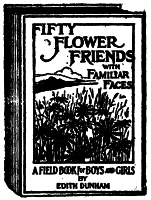
| CHILDREN cannot too soon begin to
know the wild flowers, and here they
are told in a charming way where and when
to look for each of fifty widely distributed
common flowering plants; also how they get
their names, and how to know them from the
remarkably accurate drawings of Mr. Beecroft,
a skilled botanist and superior artist. Each
of the fifty flowers has a page of accurate
botanical description in addition to its story.
Thus the book is suited for varying ages.
"The greatest praise can be bestowed upon and every mother and father should
have one and by it better educate their children in nature, which will prove not
only an enjoyable study, but an instructive one."—Providence News.
"Good brief descriptions, good clear pictures, portraits almost, of each flower
friend, a beautiful cover, convenient arrangement, and fine large print, make a
perfect book to own, or to give to any one, especially a child."—Universalist
Leader.
"If the children do not learn something new about flowers this summer it may
be because their unkind parents have not bought them Miss Edith Dunham's
Fifty Flower Friends."—New York Times.
"The boy or girl into whose hands this book is placed can hardly fail to acquire
a real and lasting interest in our every-day wild flowers."—The Dial.
"It has no rival in books of its kind, either in text or illustration."—Boston
Budget. |
————————————
For sale by all booksellers or sent postpaid on receipt of
price by the publishers
LOTHROP, LEE & SHEPARD CO., BOSTON
DOROTHY BROWN
By NINA RHOADES
Illustrated by Elizabeth Withington Large 12mo
Cloth $1.35 net
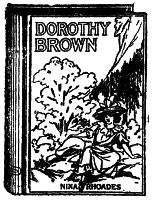
| THIS is considerably longer than the other
books by this favorite writer, and with a
more elaborate plot, but it has the same winsome
quality throughout. It introduces the
heroine in New York as a little girl of eight,
but soon passes over six years and finds her at
a select family boarding school in Connecticut.
An important part of the story also takes place
at the Profile House in the White Mountains.
The charm of school-girl friendship is finely
brought out, and the kindness of heart, good
sense and good taste which find constant expression
in the books by Miss Rhoades do not
lack for characters to show these best of
qualities by their lives. Other less admirable
persons of course appear to furnish the alluring mystery, which is not
all cleared up until the very last.
"There will be no better book than this to put into the hands of a girl in
her teens and none that will be better appreciated by her."—Kennebec Journal. |
MARION'S VACATION
By NINA RHOADES
Illustrated by Bertha G. Davidson 12mo $1.25 net
THIS book is for the older girls, Marion
being thirteen. She has for ten years
enjoyed a luxurious home in New York with
the kind lady who feels that the time has now
come for this aristocratic though lovable little
miss to know her own nearest kindred, who
are humble but most excellent farming people
in a pretty Vermont village. Thither Marion
is sent for a summer, which proves to be a
most important one to her in all its lessons.
"More wholesome reading for half grown girls
it would be hard to find; some of the same lessons
that proved so helpful in that classic of the last
generation 'An Old Fashioned Girl' are brought
home to the youthful readers of this sweet and
sensible story."—Milwaukee Free Press. | 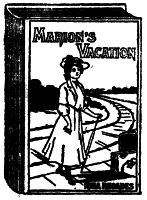
|
———————
For sale by all booksellers, or sent postpaid on receipt of
price by the publishers
LOTHROP, LEE & SHEPARD CO., Boston
BRAVE HEART SERIES
By Adele E. Thompson
Illustrated 12mo Cloth Net $1.25 each
——————————————
Betty Seldon, Patriot
A BOOK that is at the same time fascinating and noble. Historical
events are accurately traced leading up to the surrender of Cornwallis
at Yorktown, with reunion and happiness for all who deserve it.
Brave Heart Elizabeth
IT is a story of the making of the Ohio frontier, much of it taken from
life, and the heroine one of the famous Zane family after which Zanesville,
O., takes its name. An accurate, pleasing, and yet at times intensely
thrilling picture of the stirring period of border settlement.
A Lassie of the Isles
THIS is the romantic story of Flora Macdonald, the lassie of Skye, who
aided in the escape of Charles Stuart, otherwise known as the
"Young Pretender."
Polly of the Pines
THE events of the story occur in the years 1775-82. Polly was an
orphan living with her mother's family, who were Scotch Highlanders,
and for the most part intensely loyal to the Crown. Polly finds
the glamor of royal adherence hard to resist, but her heart turns towards
the patriots and she does much to aid and encourage them.
American Patty
A Story of 1812
PATTY is a brave, winsome girl of sixteen
whose family have settled across the Canadian
border and are living in peace and
prosperity, and on the best of terms with the
neighbors and friendly Indians. All this is
suddenly and entirely changed by the breaking
out of war, and unwillingness on the part of
her father and brother to serve against their
native land brings distress and deadly peril. | 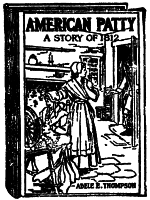
|
——————————————
For sale by all booksellers, or sent postpaid on receipt
of price by the publishers
LOTHROP, LEE & SHEPARD CO., BOSTON
HOME ENTERTAINING
What to Do, and How to Do It
Edited by WILLIAM E. CHENERY
12mo Cloth Price, Net, $.75 Postpaid, $.85

| THIS book is the product of years of study
and the practical trying-out of every conceivable
form of indoor entertainment. All the
games, tricks, puzzles, and rainy-day and social-evening
diversions have been practised by the
editor; many are original with him, and many
that are of course not original have been greatly
improved by his intelligence. All are told in the
plainest possible way, and with excellent taste.
The book is well arranged and finely printed. At
a low price it places within the reach of all the
very best of bright and jolly means of making
home what it ought to be—the best place for a good time by those of all
ages. |
"The book is bright and up to date, full of cheer and sunshine. A good
holiday book." Religious Telescope, Dayton, Ohio.
"For those who want new games for the home this book supplies the very best—good,
clean, hearty games, full of fun and the spirit of laughter."—N. Y. Times.
"Altogether the book is a perfect treasure-house for the young people's rainy
day or social evening."—New Bedford Standard.
"The arrangement is excellent and the instructions so simple that a child may
follow them. A book like this is just the thing for social evenings."—Christian
Endeavor World.
"A book giving the best, cleanest and brightest games and tricks for home
entertaining."—Syracuse Herald.
"The book is clearly written and should prove of value to every young man
who aspires to be the life of the party."—Baltimore Sun.
"Only good, bright, clean games and tricks appeal to Mr. Chenery, and he
has told in the simplest and most comprehensive manner how to get up 'amusements
for every one.'"—Hartford Courant.
——————————————
For sale by all booksellers or sent on receipt of postpaid
price by the publishers
LOTHROP, LEE & SHEPARD CO., BOSTON
FOUR GORDONS
By EDNA A. BROWN
Illustrated Large 12mo Decorated Cover $1.35 net
LOUISE and her three brothers are the "Four
Gordons," and the story relates their experiences
at home and school during the absence
of their parents for a winter in Italy. There
is plenty of fun and frolic, with skating, coasting,
dancing, and a jolly Christmas visit. The
conversation is bright and natural, the book
presents no improbable situations, its atmosphere
is one of refinement, and it has the merit
of depicting simple and wholesome comradeship
between boys and girls.
"The story and its telling are worthy of Miss Alcott.
Young folks of both sexes will enjoy it."—N. Y. Sun.
"It is a hearty, wholesome story of youthful life
in which the morals are never explained but simply
illustrated by logical results."—Christian Register. | 
|
UNCLE DAVID'S BOYS
By EDNA A. BROWN
Illustrated by John Goss 12mo Cloth
Price $1.35 net
| THIS tells how some young people whom circumstances
brought together in a little mountain
village spent a summer vacation, full of good
times, but with some unexpected and rather mysterious
occurrences. In the end, more than one
head was required to find out exactly what was
going on. The story is a wholesome one with a
pleasant, well-bred atmosphere, and though it
holds the interest, it never approaches the sensational
nor passes the bounds of the probable.
"A story which will hold the attention of youthful
readers from cover to cover and prove not without its
interest for older readers."—Evening Wisconsin.
"For those young people who like a lively story
with some unmistakably old fashioned characteristics,
'Uncle David's Boys,' will have a strong appeal."—Churchman. |
————————————
For sale by all booksellers or sent postpaid on receipt of
price by the publishers
LOTHROP, LEE & SHEPARD CO., BOSTON.
JEAN CABOT SERIES
By GERTRUDE FISHER SCOTT
Illustrated by Arthur O. Scott 12mo Cloth
Price, Net, $1.25 each
JEAN CABOT AT ASHTON
| HERE is the "real thing" in a girl's
college story. Older authors can invent
situations and supply excellently written
general delineations of character, but all
lack the vital touch of this work of a bright
young recent graduate of a well-known
college for women, who has lost none of the
enthusiasm felt as a student. Every activity
of a popular girl's first year is woven into a
narrative, photographic in its description of
a life that calls into play most attractive
qualities, while at the same time severely
testing both character and ability. |
JEAN CABOT IN THE BRITISH ISLES
THIS is a college story, although dealing with a summer vacation,
and full of college spirit. It begins with a Yale-Harvard boat
race at New London, but soon Jean and her room-mate sail for Great
Britain under the chaperonage of Miss Hooper, a favorite member of the
faculty at Ashton College. Their trip is full of the delight that comes
to the traveler first seeing the countries forming "our old home."
JEAN CABOT IN CAP AND GOWN
JEAN CABOT is a superb young woman, physically and mentally,
but thoroughly human and thus favored with many warm friendships.
Her final year at Ashton College is the culmination of a
course in which study, sport and exercise, and social matters have
been well balanced.
JEAN CABOT AT THE HOUSE WITH THE BLUE SHUTTERS
SUCH a group as Jean and her most intimate friends could not
scatter at once, as do most college companions after graduation,
and six of them under the chaperonage of a married older graduate
and member of the same sorority spend a most eventful summer in a
historic farm-house in Maine.
————————————
For sale by all booksellers, or sent postpaid on receipt
of price by the publishers
Lothrop, Lee & Shepard Co. Boston
American Heroes and Heroines
| By Pauline Carrington Bouvé Illustrated
12mo Cloth $1.25 net
THIS book, which will tend directly toward
the making of patriotism in young Americans,
contains some twenty brief, clever and attractive
sketches of famous men and women in American
history, among them Father Marquette, Anne
Hutchinson, Israel Putnam, Molly Pitcher, Paul
Jones, Dolly Madison, Daniel Boone, etc. Mrs.
Bouvé is well known as a writer both of fiction and
history, and her work in this case is admirable.
"The style of the book for simplicity and clearness
of expression could hardly be excelled."—Boston
Budget. |
The Scarlet Patch
The Story of a Patriot Boy in the Mohawk Valley
By Mary E. Q. Brush Illustrated $1.25 net
"THE Scarlet Patch" was the badge of a Tory organization, and a
loyal patriot boy, Donald Bastien, is dismayed at learning that his
uncle, with whom he is a "bound boy," is secretly connected with this
treacherous band. Thrilling scenes follow in which a faithful Indian
figures prominently, and there is a vivid presentation of the school and
home life as well as the public affairs of those times.
"A book that will be most valuable to the library of the young boy."—Providence
News.
Stories of Brave Old Times
Some Pen Pictures of Scenes Which
Took Place Previous to, or Connected
With, the American Revolution
By Helen M. Cleveland Profusely illustrated
Large 12mo Cloth $1.25 net
IT is a book for every library, a book for
adults, and a book for the young. Perhaps
no other book yet written sets the great
cost of freedom so clearly before the young,
consequently is such a spur to patriotism.
"It can unqualifiedly be commended as a book for
youthful readers; its great wealth of illustrations
adding to its value."—Chicago News. | 
|
———————
For sale by all booksellers or sent postpaid on receipt of price
by the publishers,
LOTHROP, LEE & SHEPARD CO., BOSTON
THE RANDY BOOKS
By AMY BROOKS
12mo Cloth Artistic Cover Design in Gold and Colors
Illustrated by the Author Price, Net, $1.00 Each

| The progress of the "Randy Books"
has been one continual triumph over the
hearts of girls of all ages, for dear little
fun-loving sister Prue is almost as much
a central figure as Randy, growing toward
womanhood with each book. The
sterling good sense and simple naturalness
of Randy, and the total absence of
slang and viciousness, make these books
in the highest degree commendable,
while abundant life is supplied by the
doings of merry friends, and there is rich
humor in the droll rural characters.
|
Randy's Summer Randy's Good Times
Randy's Winter Randy's Luck
Randy and Her Friends Randy's Loyalty
Randy and Prue Randy's Prince
"The Randy Books are among the very
choicest books for young people to make
a beginning with."—Boston Courier.
"The Randy Books of Amy Brooks
have had a deserved popularity among
young girls. They are wholesome and
moral without being goody-goody."—Chicago Post. | 
|
————————
LOTHROP, LEE & SHEPARD CO., BOSTON
Obvious punctuation errors were corrected.
Page 41, "commom" changed to "common" (a common soldier)
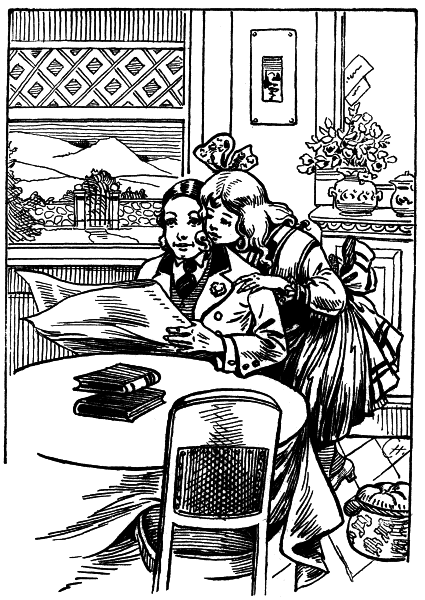 "I wish you and I could go out with the gifts."—Page 99.