Fröken Knudsgaard pretended to grumble a good deal
at having to leave Copenhagen and go to Norway with
Gerda and Ejnar. But there was no help for it. It
was a time-honoured custom that she spent the whole
summer with her nephew and niece. It was true that
they saw each other constantly all through the year,
for Tante lived opposite the Orstedpark, and the botanists,
who lived at Frederiksberg, passed that way every
time they went to the Botanic Museum and Library, and
would never have neglected to run in for a chat. Sometimes,
also, they lunched with her in her cosy little
home, where, in the spring, she saw the limes of the
Boulevard unfold their tender leaves, and where in
summer she watched the sun disappear in the north-west
behind the trees. It was indeed a pretty little
home, made, so she said, wickedly comfortable by her
Clifford's kindness.
But these fragments of companionship were not considered
enough by the botanists; and summer was the
time when they claimed Tante for their own, whether
she liked it or not. But of course she liked it; only
she felt it to be her duty as a healthy human being to
have a permanent grievance.
"Don't talk to me about giving up my grievances,"
she said. "All right-minded people ought to have them.
Rise above them, indeed! Thank you! I don't want
to rise above anything!"
However, after the usual formality of grumbling, Tante
was charmed at the prospect of having a change. Ejnar
had set his heart on going to the Gudbrandsdal to find a
particular kind of shrub which grew only in one district
of that great valley. He was a gentle fellow, except
where his botanical investigations were concerned. But
if any one thwarted him over his work, he became quite
violent. Tante Knudsgaard used to look at him sometimes
when he was angry, and say in her quaint way:
"Kjaere, one would think you were an anarchist
instead of a harmless botanist. One would think you
spent your days with dynamite instead of with innocent
flowers and mosses, which don't explode."
Gerda, also a botanist, and just as clever and distinguished
as her husband, wished specially to go up to
Tromsö, to find some particular kind of saxifrage, growing
nowhere in Europe except on the Tromsdalstind.
But Tante struck.
"No," she said. "You don't get me to go up there
within the Arctic circle. I've had quite enough of icebergs
this spring with my two poor icebergs in England.
Poor darlings! I suppose they have reached America
by now. I ought to be hearing soon."
"I cannot imagine why you made them go so far,"
Gerda said.
"When people are in trouble they must always go a
long way," said Tante. "Even if they come back the
next moment."
"You might have sent them to Tromsö," Gerda remarked,
with a grim smile. "That is almost as far.
And then we could all have gone and found the saxifrage.
You would have been willing enough to go if
you had had your Englishman with you."
"Perhaps; who knows?" replied Tante. "The
human heart is a wayward thing. I think you have
never heard me say otherwise. But why not go to
Tromsö by yourself, dear one? You won't feel at all
lonely if you have the companionship of the saxifrage.
You won't miss Ejnar and me in the least. You won't
want to come back the next moment after you have
left us. Oh, no! You won't miss us."
"No," answered Gerda, giving her a hug. "But you
would miss me. And Ejnar would be wretched if he
hadn't me to quarrel with."
"Yes, you must have your quarrels," said Tante
gravely. "All well-conducted botanists would go to
perdition without two or three quarrels a-week. You
must stay, Gerda, if only for the sake of science. Only,
give in without a mortal battle this time, and let us go
peacefully to the Gudbrandsdal. Ejnar has the dynamite-look
on his face. He has set his heart on that
shrub. Heaven and St Olaf help us! We must get it!—even
if we have to scale mountains. Imagine me
scaling mountains, dear one. Have pity on me, and
come and help!"
Gerda gave way; a mortal battle was avoided, the
dynamite-look disappeared from Ejnar's gentle face, and
all three started off for Norway in good spirits and admirable
tempers. Ejnar was a tall man, thin, and dark for
a Dane. He looked rather 'comatose,' as Tante called
him, except when his botanical emotions were aroused.
Then he sprang into life and became an inspired being,
with all the sublime beauty of intelligence on his face.
He only cared for botany, Gerda, and Tante Knudsgaard.
He did not positively dislike music, and did not always
go out of the room when Gerda sang. He was a silent
fellow, and scarcely ever laughed, except over his work,
and then sometimes he would give forth peals of hearty
laughter most refreshing to hear and quite boyish. That
was when he had done some satisfactory bit of difficult
classification. Gerda, being musical as well as botanical,
was rather more human. She was of middle height,
slight, and wonderfully fair, with an abundance of fair
hair, and a pair of glacier-blue eyes. She sang gloriously
in a wild, untrained manner which thrilled through every
one except Ejnar. He had, however, the greatest and
most generous admiration of her knowledge as a botanist,
and was most particular that every paper with which
she had helped him, should bear her name as well as his.
In fact, in his way he loved her dearly. Their quarrels
were entirely scientific, never human. In their simple
way they led an almost ideal life, for they were free to
work in an untrammelled fashion at the subjects they
loved, Ejnar holding no official position in connection
with his work, but being sleeping partner in his brother's
glove-factory in Christianhavn. They were very happy
together, and although Gerda had a restless theory that
it was ridiculous to be always together, she had been
utterly miserable on the one occasion when she had gone
off alone, and had returned the next day. Tante, remembering
this, teased her continually, of course; and when
the good ship brought them to Christiania, she said to her:
"Are you quite sure you are not wanting to go off to
Tromsö alone? You could come back the next minute,
you know, quite easily."
"Nå," answered Gerda gaily. "I prefer to stay and
be teased!"
They saw the sights of Christiania, spending most of the
time in the Botanical Department of the University; and
then took the train up to the Gudbrandsdal, the largest
and most fertile valley in Norway. They had engaged
rooms for themselves at a large Gaard (farmhouse) owned
by rich peasants of noble lineage, who in the summer
months took a few guests into their spacious dwelling-place.
The Gaard had a splendid situation, lying on the
mountain-side, about two thousand feet above sea-level,
and commanding a far-stretching view of the great valley,
which was spread out generously below, dotted with hundreds
of farms, and with two shining rivers flowing on
separately, meeting each other, and then passing on together.
Looking down on all those homesteads, one was
reminded all the time of the words of the Norwegian
poet, who sings of Norway, the land of a thousand homes.
Red Gaards, being new buildings added to the original
family-home of many generations: bright red, standing
out boldly and picturesquely against the grain fields and
the green of the firs and birches. Dark-brown, almost
black Gaards, burnt to their deep dye by the ever-working
hand of Time. Fine old Gaards, not built of puny
slices of wood with which builders content themselves in
these mean-spirited days; but fashioned of entire tree-trunks,
grand old fellows of the giant forests of the past.
Dense masses of firs and birches: down in the valley
and advancing boldly up the mountain-sides, and lining
the deep gorges of the side-valleys as well, and pressing
on to a quite unreasonable height, from a conventional
point of view, firs and birches contending all the time
as to which should climb the higher. Waterfalls here
and there, catching the sunlight and sending forth iridescent
jewels of rarest worth. Hundreds of grass-grown
roofs, some with flowers and some even with a fir or two
amidst the grass. White bell-towers to every storehouse,
with the bell to summon all the labourers to food
and rest. Countless fields of grain of every kind: some
of it cut and fixed on sticks at regular intervals, so that
a regiment would seem to be waiting the word of command:
ready and immovable: a peaceful region of
warfare. And a warfare in reality, too, a hard nature
being the enemy.
Then those wonderful rivers: one of them coming
straight from a glacier and therefore unmistakable, even
though the changing clouds might give to it varying
shades of colour. Grey and glacier, blue and glacier,
rose and glacier, black and glacier, white and glacier,
golden and glacier. And the other river, not less beautiful
because less complex. And the two together winding
through the valley: now hidden from sight, now
coming into view again, now glistening in the far distance,
and now disappearing finally—no—one more
glimpse if one strains the eye—one more greeting, and
then, farewell—they have gone their way!
And the snow mountains—not very near, and not very
snowy just now; but, for all that, the glory of the
country, the very desire of one's heart, the shrine of
one's secret and mysterious longings.
Both the botanists and Tante were delighted with the
place. Tante, who adored limitless space, had not quite
liked the idea of coming to a valley.
"You know I have always hated restraints of any
kind, dear ones," she said. "And even at the age of
seventy, I desire to continue in the straight path of
blessed uncontrol. Valleys make me shudder a little—like
conventions! Bah!"
But even she was content when she saw the immense
proportions of her prison.
"Well," she said, with a twinkle in her eye, "there is
space and freedom enough for me, for a little while. All
is well with me, dear ones. Go and find your shrubs and
be happy. It is true that you have brought your poor
stout relation to a place on the mountain-side where she
can neither go up nor down. Nothing could have been
more cruel. But no matter. She will look at the view
and try to feel chastened by patience and all the other
dull virtues. And she will go on knitting socks for the
dear English soldiers. They will never get them, of
course. Still, she will do her best for them, hoping that
King Red Tape will allow them to be delivered. Yes,
dear ones, hasten to your shrubs and have some stimulating
quarrels over them. Tante is content for a minute
or two."
And she really was happy, and deeply interested in
the owners of the Gaard, rich landowners, Bönder, aristocrats
of Norway, direct descendants of kings and chieftains—Vikinger,
in fact; proud and reserved: proud of
their noble lineage, and reserved of feeling and in manner,
and yet, when tactfully approached, capable of the greatest
kindness and appreciative understanding: dignified
in behaviour, and refined in form and feature, bearing on
them, indeed, the royal seal of good birth and good breeding.
The Solli family was one of the oldest and noblest
in the valley, and had the most important and most
highly decorated and carved pew in the old brown church.
There were three girls: stately Ragnhild, lovely Ingeborg,
and gentle little Helga, the pet of the family. And
there were two sons, Karl and Jens. Karl, being the
elder, would in time inherit the Gaard, paying his brothers
and sisters a share, and giving to his father and mother
mysterious dues called Föderaad. But as Solli and his
wife were strong and active, and Karl was not even
betrothed, there was no occasion for the older people to
retire; and meanwhile an older couple still, the grandparents,
were eking out their lives in the comfortable
old black dower-house in the court of the Gaard. Grandmother
(Bedstemor) had never wanted to retire, and bore
on her face a settled look of disappointment which had
been accentuated by the coming and going of twenty
years. Grandfather (Bedstefar) had been ailing for many
years. He lay in the big bedroom of the black house, and
waited for the caressing hand of Death.
Solli's wife, whose Christian name was Inga, and who
in accordance with custom was called Mor (mother) Inga,
was, in her stately way, greatly attracted to the old
Danish lady, and told her many interesting details about
the Gaard. Tante had such perfect tact, and was such
a comfortable easy creature to be with, that she found
herself soon en rapport with the family. A glass of
gooseberry-wine, followed on the next day by some corn-brandy,
seemed to indicate that a delightful acquaintanceship
was ripening; and when Mor Inga took her to
the Stabur (the storehouse), that most sacred precinct
of every self-respecting Norwegian Gaard, and showed her
the treasures and mysteries of Norwegian housekeeping,
every one felt that Fröken Knudsgaard "had arrived."
Even the disagreeable old magistrate (Sorenskriver)[D]
from S——, one of the eight or ten guests, admitted that.
"She has seen the Stabur," he said, with a grim smile,
and he actually forgot to help himself first to cheese, but
passed her a few delicate shavings; a sure sign from him
of even passing respect.
After an introduction to the Stabur, any other honour
on earth was easy of attainment; and no one was surprised
to learn that Ragnhild was going to put up her
loom and teach the Danish lady to weave. And Mor
Inga fetched great-grandmother's old painted spinning-wheel
from the top room of the Stabur and put it in
the little balcony which overlooked the courtyard; and
she brought some fresh wool from the wool-room—another
sacred spot—and sent for old Kari, who was
especially clever at carding the wool. And Tante sat and
knitted, whilst old Kari carded the wool and Mor Inga
span. This was Tante's first introduction to old Kari,
eighty years old, and full of fairy lore.
"Ah," whispered Mor Inga to Tante, "Kari can tell
thee many stories of the Gudbrandsdal if she likes. But
it must be in secret, when there is no young person near
to laugh and disbelieve. One day thou shalt give her a
little coffee in a packet—all for herself—and then thou
wilt hear all sorts of things."
But to-day Kari only carded the wool, smiling amusedly
at being in the company of the big Danish lady, who
spoke to her so kindly and treated her as though she
were a lady herself and not an old parish-woman who
had no home of her own. Ja, ja, that was very nice, and
Kari scratched her head, and smiled more and more, until
even the furrows on her grim old face were filled up
with smiles, and her eyes seemed almost young and very
bright.
"Ah," said Tante, with a friendly nod, "I know some
one who has been very pretty. Oh, I have eyes—sharp,
sharp eyes. I can see!"
And Mor Inga laughed and said:
"Kari was beautiful, and she could dance too. They
say that in the old days no one could dance the spring-dance
like Kari."
"Nei, nei!" said Kari, smiling more and more still.
And her thoughts wandered back to her Ole—dead these
twenty years and more. He had always said that no
one could dance like Kari.
All this kept Fröken Knudsgaard busy; and indeed
her distractions increased as the days went on. Sometimes
she sat in the balcony which looked over the splendid
view, and, seized by a sudden enthusiasm for nature,
watched the ever-changing colours of the rivers, and the
shadows on the hillsides, and listened to the music of the
waterfall down below in the Vinstra gorge. But she did
not pretend to be able to live on Nature's great wonders
alone. She was delightfully candid about it.
"No, my dear ones," she said to Ejnar and Gerda, "I
am the wicked product of a beautifully wicked world. I
need my fellow-sinners. It would never have contented
me to lie flat on my stomach looking for flowers and
grasses, and so forth. Nor would it have been desirable
for me. I should never have got up!"
Nevertheless, when her botanists came back from their
wanderings, with their green tin wallets full of mystic
treasures unguessed at by the uninitiated, she was eagerness
itself to know whether they had had "good hunting."
And when Gerda said:
"Wicked old Tante, you know you are interested in
these things," she answered gaily:
"No, no; but I have accepted my fate. Since my
best beloved ones are all scientific sillies, I have to appear
to be interested in what they do."
She felt it to be her duty to secure, on behalf of science,
a big study for her botanists, and Mor Inga let her have
a vast room in one of the out-buildings.
"They must have plenty of room to quarrel in," she
explained to Mor Inga. "Everything goes so much more
easily if there is generous space."
"And," she added to herself, "it is my experience that
scientific people are safer caged up in their laboratories
and studies. You know they are all right then. When
they are wandering about, they might get lost; but when
they are shut up, they are comparatively safe, barring
brain fever and explosions, of course."
So she caged her botanists, and felt herself free to
amuse herself with human nature whilst they were immersed
in the study of nature.
"Well, then, good-bye for the moment," she said, when
she shut them up for the first time. "I will now go and
have a few disagreeable words with that horrid Sorenskriver,
who dislikes my belovèd English. I will go and
sit quite near him, and knit my stockings for the dear
English soldiers. That annoys him beyond everything.
What a delight to see his irritation! Poor Sorenskriver!
He suffers, and I enjoy. That is the way in life, and very
amusing too. My poor dear ones, what a pity you cannot
have a little fun too. Well, I suppose you do get it
through your microscopes."
But they had a great deal of fun in a quiet way. No
one could be long with Tante without catching a little
of her gaiety; and even Ejnar was heard to laugh sometimes
over matters which had nothing to do with his work.
And Gerda left her cage and went singing in the birchwoods
above the Gaard, and along the mountain paths.
She was content, too, and had forgotten about the saxifrage.
And Tante attempted short little strolls along the
easiest road, and always stopped by the black hay-barn
near the group of mountain-ashes, which rejoiced her eyes.
Here she sat down and took out her opera-glasses, really
to observe the clouds, though she pretended always to
be looking at the numberless Gaards and barns which
covered the hillsides and mountain-slopes. But once she
forgot her rôle of indifference to nature, and cried
enthusiastically to Gerda:
"By St Olaf! I never saw such soft clouds in my
life, nor such colours! And just look at the reflection in
the rivers, Gerda. Sapristi, how beautiful!"
"What is this I hear?" cried Gerda. "Tante admiring
nature!"
"Oh, that's a big Gaard—that yonder," said Tante,
correcting herself with a twinkle in her eye. "I wonder
what the name is, and how many cotters they have, and
how many children, how many cows up at the Saeter, how
many goats, how many cheeses they make, how many
sheep they have; whether Bedstefar and Bedstemor are
alive, and whether they have as comfortable quarters as
our Bedstefar and Bedstemor. Ah, and that reminds me
that I am drinking coffee with Bedstemor this afternoon.
Help me up, Gerda, and don't stand staring at that cloud
as though you had never seen one in your life before."
So Tante drank coffee with picturesque old Bedstemor
in the old dower-house of the Gaard.
The principal dwelling-place of the Gaard had been
considerably added to in modern times. The old part
was in the middle, and new wings had been built on
either side, a whole new storey with a slate roof added,
and a new balcony and porch. So that the Gaard proper,
in which Mor Inga reigned, was a curious mixture of the
old and the new: the new part being painted pink, and
the old part keeping its ancient glory intact. But Bedstemor's
house was untouched by modern hands; in fact,
all the houses which formed part of the settlement were
just as they had been for two or three hundred years.
Bedstemor's house was the largest of them all. There
were about eight or nine others, all black or dark brown,
all with their roofs covered with long grass, amongst which
grew poppies, corn-flowers, and forget-me-nots. They
were grouped together round the courtyard, as quaint
and picturesque a sight as one might see anywhere. The
Stabur stood somewhat apart from the other buildings,
and was raised above the ground by tree-trunks which
looked like elephants' legs. The Stabur had a conceited,
self-contained look after the manner of all true Staburs.
It seemed to be saying all the time, "Behold me, I am
the Stabur!" The possession of a white bell-tower on
its grass-grown roof, and of an old carved door, encouraged
its self-importance, and gave it an air of distinction
not enjoyed by the other houses. Still, they had their
tall white chimneys; and it is obvious that one cannot
have everything in life. And some of them also had a
more picturesque situation than the Stabur: creeping
up the hill, indeed, as though they were thinking of
climbing up into the woods, but had stopped to rest by
a mountain-ash, or by a graceful birch; whilst others,
mounting higher, came to a standstill at last and were
used for storing wood. Then there were hay-barns of
various sizes and shapes, the most characteristic being
those with sloping bridges leading up to the top floor.
And last, not least, there was the great cowhouse, forsaken
now except for five or six cows which had not gone
up to the Saeter. And Ingaros, the most beautiful cow
of all, christened after Mor Inga, was sulking partly
because she had not gone up to the Saeter, but chiefly
because she, the belle of the Gaard and the authorised
leader of the herd, had been deprived of her noble collar
and bell. Some wretched upstart of a creature was
wearing it, so that she might be sure to come home to
her calves.
Ingaros had Tante's profound sympathy. She visited
her in the cowhouse at milking-time, and exchanged a
few understanding greetings with her. Old Kari was
milking her and singing a soothing little song, something
about a saeter-girl who lost all her cows, and she danced
and they all came back again, and then she sang and
sang till they ran away again! Tante stood and listened
delightedly to the clear, sweet voice of the old woman.
"Ja, ja, Kari," she said, "I believe I have some coffee-berries
in my pocket. Such a song deserves a good cup
of coffee."
"Stakkar!"[E] said Kari, smiling with delight. "Thou
art a kind one, although thou art not Norwegian. Thou
shalt hear all the tunes I know."
It was a hot afternoon. Ejnar and Gerda had had a
quarrel over "Salix." Ejnar's face wore the dynamite
expression, and Gerda was white with anger. Her
glacier eyes looked like the eyes of a polar bear, and
she was moving her head to and fro in a manner
which always meant rebellion. On these occasions she
longed for a divorce.
"Give me a divorce at once!" she cried tragically both
to Ejnar and Tante.
"My dear one," remarked Tante soothingly, "I don't
keep divorces ready in my pocket; and you know
Ejnar never has even a handkerchief in his pocket.
You should have a divorce at once if we had one handy.
Be reasonable. Have I ever denied you anything in
this world? Of course you should have one instantly."
Ejnar was silent; but his expression was quite enough
to blow up all the royal palaces and personages in the
universe. Tante herself did not feel too amiable that
afternoon. She had had an angry discussion with the
Sorenskriver and another man, a Norwegian fur-merchant,
about England; and she was shocked to hear
them say things against the English which she knew to
be not only untrue, but venomously unjust.
"Why," she said, flourishing her knitting-needles,
"even the greatest criminal has some redeeming features.
And as with criminals, so with countries. But you leave
England no virtues: not one."
The men shrugged their shoulders. It was so obvious
to them that England had no virtues. It was so obvious
to them that they, who had never been to that detestable
country, knew far more about the character of the people
than this ridiculous old Danish woman who had spent
about twenty years amongst the barbarians. Tante was
ruffled. And Ejnar, being in a disagreeable mood, had
chimed in too against this much-abused nation.
"Ja," he said in his quiet way, "it is a barbarous
country, this England. I know nothing about politics,
thank heaven, nothing about wars and so forth. But
this I can tell you: that England is the only country
which refused to exchange botanical specimens with our
Botanical Museum. The barbarian director wrote a rude
letter."
"I've told you a dozen times, Ejnar, that it was all
probably owing to Red Tape," replied Tante angrily.
She could have shaken Ejnar.
"And pray what is this Red Tape?" asked the Sorenskriver
contemptuously.
"It is an invisible thread which no one has been able
to cut, so far," said Tante. "Every one knows it is there
and deplores its presence. If it could once be cut, it
would shrivel away, and one of England's dangers would
be gone."
"Then you admit she has dangers?" asked the fur-merchant,
triumphantly rubbing his hands.
"Ja, ja," said Tante Knudsgaard; "but the greatest
of them is Red Tape. She suffers from it in everything—both
in war and in peace. But she will overcome all her
difficulties and emerge."
"Never, never!" said the Sorenskriver and fur-merchant
joyfully together. "Her day is gone."
"Then her twilight and her night will be like the
glorious midnight sunlight of your north," said Tante,
turning to the fur-merchant who came from the north.
"Pyt!" said the fur-merchant scornfully, and went
away.
"Sniksnak!" said the Sorenskriver impatiently.
Tante made no reply, but went on knitting; and in a
few minutes finished a sock, which she spread on her
knee, and then added it to a great pile beside her on
the seat of the courtyard verandah, where every one was
awaiting the arrival of the letters.
"That makes twelve pairs for those brave English
soldiers," she said, half to herself. And the Sorenskriver
moved nearer to the horrid spectacle, attracted to the
spot against his own wishes. Tante laughed silently;
but, all the same, she was ruffled. Every one was more
or less cross.
Solli was worried about the crops, for there had been
no rain for a long time, and both corn and potatoes
threatened to fail. Also, there was a shortage of water,
and that made him anxious about fire. Also, Bedstefar
was more ailing than usual, and the doctor had been
sent for. Bedstemor came over from her house, sat near
Tante, and grumbled a little because Bedstefar was so
obstinate about the doctor. But she cheered up when
a Swedish lady, an artist, one of the guests, praised her
quaint, old-fashioned head-gear, and wanted to take a
photograph of her pretty old face.
"Ah," said Bedstemor, "many people have wanted to
take a picture of me."
And then every one laughed, and said:
"Ja, Bedstemor, we can well believe it!"
That seemed to put every one in better spirits again;
and soon beautiful Ragnhild came out of the kitchen
with a bundle of letters and papers, and was the centre
of an eager circle. Ejnar stood apart, near the Stabur,
not being concerned with human affairs. But Ragnhild
had a letter even for him, and took it to him herself.
She and all the peasants had a great respect for scholarship.
"There is a letter for the professor. Will he care to
have it?" she said gently.
She handed it to him in her own charming way, and
even Ejnar was pleased; for Ragnhild was the object
of great admiration amongst the men, although she kept
them at a distance. And all the women, too, admired
her, and were glad when she came amongst them. Tante
gave her a good hug when she dropped several letters
and papers into her lap, and got in return an affectionate
pat of approval on the back.
"Thou hast more than thy share of letters to-day,"
she said. "I shall give thee none to-morrow."
"I don't want any more!" cried Tante, who had just
glanced at one of her letters. "Only think, Ragnhild,
some dear friends of mine are coming here. I should
like to dance the Halling dance. Help me up, kjaere.
I want to dance over to the Botaniker. No use calling
to him. He never hears human sounds."
Then gaily the pretty girl and the old Danish woman
went arm-in-arm to the Stabur, near which Ejnar and
Gerda were standing, their heads buried in a letter.
They looked up when they saw her, and cried:
"Such news! such news! It has come from America.
She will bring it to us at once. We have only to write
and say where we are."
"And I, too, have something coming from America,"
cried Tante. "My Clifford and his boy!"
"Only think, Tante, that valuable botanical parcel at
last!" cried Gerda wildly.
"Only think, my poor icebergs home again!" cried
Tante, putting her arm round each of them. "What
could be more delightful! Your dried-up flowers and
my frozen-up human beings! Let us all be friends
again and have some aqua vitæ. I feel at peace even
with that wretched old magistrate!"
"Oh, Gerda," said Ejnar, "what joys are before us!
Just think of it—the Mariposa lilies and the Romney
poppy at last!"
When they had all calmed down a little, Tante read
Katharine Frensham's letter, and learned that she
wished to bring the botanical parcel as soon as she
knew whether Herr and Frue Ebbesen could receive her.
She had heard from Professor Thornton that they were
perhaps going to Norway. If they had already gone,
she could just as easily come there. She added:
"It is curious that I, who knew nothing about Professor
Thornton a few weeks ago, should all the time
have been in communication with the nephew and niece
of his dear Danish friend."
"Ja," said Tante, "waves—waves—wireless telegraphy,
as always."
There was a sentence in Clifford's letter which struck
Tante as being a remarkable thing for him to have
written.
"I have become acquainted with a Miss Frensham,"
he wrote, "to whom I have given a letter of introduction
to you—though she will scarcely need it, being, as she
is, on a botanical errand to Ejnar and Gerda, and therefore
to you. But I desired not to be left out in the
cold where she is concerned."
"Well," reflected Tante, "that is a remarkable thing
for an iceberg to say."
And she read the sentence several times in order to
make sure that she had caught the meaning. The rest
of the letter ran thus:—
"Dear Old Knutty,—Alan and I are coming back,
and we shall come and find you somewhere and somehow.
We have not been happy together. There is a shadow
between us—that shadow which I always feared,—and
he has something against me in his young heart which
makes easy and close companionship impossible. We
have both suffered. There was a man of my own age
with his son, a boy of Alan's age, on board. I used to
look at them with hungry eyes. They had such a good
understanding between them; there were no shadows
there. He was a great traveller, an ornithologist. And
his boy thought he was the finest hero on earth, and
worshipped him. I would not wish that; but I would
only ask that Alan should believe in me again, as in the
old days before—before Marianne's death. It will be
good to hear your voice again, even if you do scold me
for throwing over Japan. But, under present conditions,
it is waste of money and waste of heart-fibre. Alan will
be happier without me. Perhaps you won't scold me
after all, Knutty. You are such a wise old Knutty;
and I still think you were wise to send us in spite of
everything."
"Of course I was wise to send you, my poor Clifford,"
Knutty said, as she read the letter over and over again
in the quiet of her beautiful big bedroom, with its lovely
views of the valley, the wood, and the grass-roofed
houses. "Of course I was wise to send you—even if
you came back the next moment. That doesn't matter.
It is the starting-off which counts. My poor boy, I
won't scold you. My good, gentle-hearted Clifford.
You ought to have had a heart as tough as Knutty's.
You would not have wanted to gnaw it then; no temptation
then. My poor boy!"
She rubbed two or three tears away from her cheeks,
and tapped the floor impatiently with her foot.
"Bah!" she said; "that Marianne, I never could
bear her!"
And then something prompted her to turn once more
to his letter, and she read the words, "But I desired
not to be left out in the cold where she is concerned."
A faint smile came over Knutty's face. It disappeared,
came again, stayed, deepened and deepened.
"By St Olaf, I believe I see daylight!" she cried.
So Katharine started off to Norway, taking the boat
from the London Docks. By a curious chance Mrs
Stanhope was on board too, and the presence of this
bigot, Marianne's friend, Clifford Thornton's enemy,
stirred Katharine to her depths. They had bowed
stiffly, and then had contented themselves with glaring
at each other.
It was a rough passage, and they were the only two
women who did not retreat to their cabins. They sat
side by side, in silence, in a sheltered part of the boat,
having no choice to go elsewhere.
But although no words were spoken between them, an
active warfare went on unceasingly: encounter after
encounter, and the victory to neither.
The voyage came to an end, Christiania was reached,
and the two women went, each her own way; each
thankful to be free of the other.
But Mrs Stanhope, without knowing it, had sown fresh
seeds of love and protection in Katharine's heart for
Clifford Thornton. More than ever her thoughts turned
to him. More than ever she found herself weaving a
fancy fabric of happiness and love. Then she rent it
in pieces and began it over again. She had to begin it
again each time she had destroyed it, and each time
some new beauty was added.
And thus busy with her work of destroying and restoring,
the train bore her past beautiful Lake Mjösen,
the biggest lake in Norway, and into the Gudbrandsdal,
where she at once made the acquaintance of the river
Laagen, the glacier river which Knutty, Ejnar, and
Gerda were learning to love in their upland Gaard. She
thought of them as old friends. It seemed to be quite
natural that she was coming to them. She longed to
see Knutty. She knew that she would not have one
minute's shyness with Clifford's old Dane.
But she had not any idea how eagerly she was awaited.
Tante was most impatient to see her, and kept on murmuring
to herself, "By St Olaf, I see daylight through
a leper's squint!" And when asked to explain these
mysterious words, she only said:
"Keep to your own department, botanists. Don't interfere
with the section marked human nature."
And Ejnar and Gerda were wild with delight, and
even spoke soft words together about "Salix." Of
course they only looked upon Katharine as the bringer
of the parcel: having no value in herself, being, as it
were, only a base instrument. It made no difference to
them whether she was fair or dark, tall or short, agreeable
or disagreeable, electric or soporific, with an attractive
aura or an antipathetic personality.
"What on earth does it matter so long as she brings
the parcel safely?" said Ejnar, in answer to Tante's
repeated, "I wonder whether."
"That sort of thing matters very much to people who
are alive," replied Tante sternly. "Of course to people
who are prematurely dead, like botanists, nothing matters
except the parcel. My belovèd Ejnar, I am delighted
to see you so happy; but I must entreat you not to
sing. You are frightening the horse; he looked round
then to see whether an ostrich was driving him. And
you observe we are on the most dangerous part of the
cliff. Don't let us have an accident until we have embraced
the parcel and received the bringer of it with indulgence.—And
do remember to thank her, Gerda. And
don't let Ejnar ask for the parcel the minute he sees her.
Let us show the English barbarian woman that we know
how to behave.—Ah, here we are on the level. Now,
Ejnar, you can sing as much as you please. What a
curious voice—not human! The sort of voice you would
expect a decaying plant to have. But how happy you
must be! You don't often sing, I think."
"Ja, I am very happy," said Ejnar, smiling radiantly.
"I only sang once before in my life, after Gerda accepted
me, when I was alone in the woods."
"A good thing she didn't hear you, or else she might
have changed her mind," remarked Tante.
"Dear ones, dear ones," said Gerda, "here is the
train. Oh, Ejnar, how I hope we shall not quarrel over
the parcel. I know we shall, though."
They hurried out of the carriage, all of them in a
state of great excitement, and Tante, very red and hot,
but her face beaming with kindness and pleasant expectancy.
She looked up and saw Katharine standing
at the window.
"That is Miss Frensham," she said.
"How do you know?" said Gerda and Ejnar. "You've
never seen her."
"Instinct, stupid ones!" answered Knutty breathlessly.
"Of course it is Miss Frensham. Come along
now, and remember to say nothing about the parcel,
Ejnar."
Then she pressed forward, and just as Katharine was
stepping out of the train, she put out her hand and
said: "Welcome, Miss Frensham. I am Fröken Knudsgaard,
and these are my botanists—your friends. We
are so glad to see you."
"Ja, ja!" cried Ejnar and Gerda.
"And I to see you," Katharine answered. "It is like
coming to see old friends. And I have the parcel quite
safely here in my little travelling-box. I put it there
so that there might not be one moment's delay. For,
of course, you must be feeling impatient. I am sure I
should."
With those simple but magic words Katharine immediately
won her way into the botanical hearts of the
botanists; and Knutty, looking at her dear frank face
and delightful appearance, felt a glow of pleasure such
as she had not been conscious of for many long years.
Then the clever Norwegian ponies, those yellow little
fellows, full of mountain-wisdom and resource, drew the
carriage slowly up the winding road which led to the
Solli Gaard. Like all true Norwegians, they did exactly
what they wished: rested when they wished, and went
on when they wished: went very near the edge when
they felt so inclined, or paused to drink of the brook
running into the hollow tree-trunk placed there for their
benefit. As Knutty said, they allowed plenty of time
to look at the graceful birches which crept up from the
valley, lined the hillside, were shimmering in the sunlight,
trembling in the breezes, and sending out their
own delicious fragrance laden with subtle sweetness.
"Ja, ja," said Knutty, "the birches are at their best
to-day, to welcome the Englishwoman to beautiful Norway!"
The contents of the parcel exceeded the botanists' wildest
expectations. They were radiantly happy over it, and
delighted with Katharine. She had stamped herself on
their minds as a woman of sense, who had understood
that the parcel had been the entity and herself the non-entity.
"Obviously a person of discernment," Ejnar remarked
several times to Tante, who laughed secretly when she
observed that the impersonal botanist was beginning to
show distinct signs of human appreciation as well. He
even left his study once or twice, and came to sit with
the ladies on the balcony, bringing his long pipe with
him. He did not speak much, of course, and when he
did he never touched on human affairs. But Katharine
had seen these flowers, and in an unscientific but vivid
way she could tell him a little about them, and a great
deal about the botanists who had sent the precious gift.
Gerda and he listened with rapt attention while she
described to them the Colorado botanists' herbarium.
She told them that they were rich, but that they did
not care for a grand house. They lived in a small
'frame house,' and had built a princely herbarium,
which, together with their wonderful botanic garden,
was the chief feature of their property.
"They do not care about human grandeur," Katharine
said, in conclusion.
"That is as it ought to be," exclaimed Ejnar and
Gerda approvingly.
"All the same," remarked Tante, "I would prefer to
inhabit that herbarium, and put the stupid dried plants
in the cottage. But then I know I have a base human
soul. Always have had—isn't it so, dear ones?"
"Yes, yes," said Ejnar and Gerda. "And you've
always liked comfort."
"Yes," replied Tante—"good English comfort. Give
me good English comfort and mange tak![F] Let me be
base and comfortable, like my darling, much-abused
English people."
"Are you really so fond of them, Fröken Knudsgaard?"
Katharine said warmly; for every one feels a
glow of pleasure at hearing one's country praised in a
foreign land.
"Ja, I love them," Knutty replied, smiling at her;
"and I spend half my time in fighting their battles.
Even here I have several deadly conflicts every day with
a Norwegian magistrate and a fur-merchant from the
north. But now you've come, you can defend your
own country much better than I can. But I shall
always be delighted to help."
"Ja, she loves them," said Gerda. "And that Englishman
of hers is the only person for whom she cares
in the whole world. Ejnar and I have been jealous of
that Englishman ever since I can remember."
"I have told you hundreds of times that it is absurd
to be jealous of an iceberg," Knutty said, with a twinkle
in her eye.—"You know, Miss Frensham, they are
speaking of my dear Clifford Thornton, whom I've known
and loved ever since he was seven years old. There is
no one like him on earth——"
"Ak," said Gerda, "if she begins to talk to you
about her Englishman, all is lost. Don't encourage her,
Fröken. Take my advice. Tell us something more about
the Colorado botanists and their garden. Moreover, the
Englishman is soon coming himself. That will make
her happy."
"He is coming," Katharine said eagerly, turning to
Tante; "he is coming here?"
"Yes," said Tante, nodding at her.
And the quick old Dane glanced at her and saw how
the light of a great happiness had come into her eyes.
"Yes," Tante said; "he has given up the journey to
Japan, and I suppose he and his boy will be here in a
week or so."
"In a week or so?" Katharine repeated, as though
she could scarcely believe it.
Then, with a gaiety which delighted them all, she
turned impulsively to the botanists and continued telling
them all the details she could remember of that
wonderful garden and the interesting collection of cactuses,
and the different kinds of pepper-trees. And Gerda
and Ejnar, entranced, kept on saying:
"Ja, and what more?" And Tante kept on thinking:
"Surely I see daylight! But, good heavens, what
can we do to get rid of these botanists? Wretched
creatures! Why don't they go back to their study
provided so thoughtfully by me? And what a darling
she is, and how delightful to look upon, and with a fine
temperament. Simple and easy as a child. Built on
a big scale, mind and body. Like the Gaard itself.
Ja, ja. And then to think of that Marianne! Ak,
what a brute I am! Never mind. Let me remain a
brute! Oh, those botanists! If only they would go
to their study and quarrel about the Mariposa lily, or
cactuses, or salix, or something. And just look at
Ejnar! He is becoming human. He is leaving the
vegetable and entering the animal kingdom. By St
Olaf, he has picked up her handkerchief! Ah, and here
is Ragnhild coming to the Stabur to ring the bell for
dinner. Nå, after dinner, we can have a talk about
my Clifford."
So after dinner Tante took entire possession of Katharine,
but much against the botanists' wishes. And
Gerda said privately:
"Well, at least, don't bore her by talking about your
Englishman all the time. You yourself saw how glad
she was to get away from a subject which could not
possibly interest her, and to continue to talk to us
about Arizona and Colorado."
In answer Tante had a mysterious attack of laughter,
and gave Gerda a specially affectionate hug; and, having
assured her that she would use moderation, walked off
with Katharine to show her, so she said, the principal
sights of the Gaard, and to introduce her to some of
her intimate friends, all of whom were interested in the
arrival of the Englishwoman, the first English person
they had ever seen. Knutty was proud that Katharine
had such a fine appearance and such a charming way
with every one. The Sollis, Johann himself, and Mor
Inga, in their grave, reserved fashion, were kindly to
her; and Karl, a most unemotional creature, was quite
excited when she spoke some German to him. Bedstemor
arrived on the scene, having heard that an English
guest had come to the Gaard; and when Katharine
was presented to her, she greeted her with great dignity,
and said to Tante:
"She is nice looking, this Englishwoman. But thou
shouldst have seen me when I was young."
This was translated to Katharine, who said to Tante:
"Tell her that I can see her in my mind's eye as a
beautiful young girl; but she has not forgotten how to
be beautiful in her old age."
Bedstemor was gratified, patted her on the back, and
told her that she might come one day and drink coffee
with her and see her wedding-cap.
Then she was introduced to old Kari, whom they
passed on their way to Tante's favourite resting-place,
an old black barn near a group of mountain-ashes.
Kari was standing outside the great cowhouse; she
looked at Katharine critically, seemed to approve of
her, and said:
"She is nice looking, and strong too. She could do a
good day's work in the fields. And how many children
has she got?"
"Well, I suppose she has not any," laughed wicked old
Tante. "She is not married."
"Perhaps she will find a husband here," said Kari
reflectively.
"Perhaps she will," laughed Tante; and she was
passing on when Kari came a little nearer to her and
said mysteriously:
"If thou wilt come into the cowhouse to-morrow, I
think I can tell thee something thou wilt like to hear—about
the Huldre,[G] the beautiful long-tailed one—but
thou must come alone. And I will sing to thee again
very willingly, for thou art a kind one. And to-morrow
Mette makes Fladbröd.[H] If thou dost wish to see her
make the Fladbröd, thou shalt most certainly. Ja, and
Mette can sing too. Thou shalt hear her also."
Then she nodded and disappeared into the cowhouse.
Tante and Katharine paused for a moment to look at the
picturesque winter-house of the seventy cows, and its
long, grass-grown roof, its two bridges leading up to
the top floor, where some of the hay was stored, and
its most curious gap in the centre of the upper floor,
through which one could see enclosed in a great oblong
frame the valley below, the rivers, and the distant mountains.
Tante pointed out this beautiful picture to Katharine
and said:
"You know, I really enjoy Nature very much, although
I pretend not to do so just to tease Ejnar and Gerda.
Ah, they are dears, both of them. It was good of you
to come and bring them their parcel. You do not know
how eagerly you have been looked for—by them and
by me. Of course they wanted their parcel; but I
had another reason for being eager to receive you. May
a wicked old woman tell you something some day?"
"Tell me now," Katharine said, turning to her.
"Well," said Tante recklessly, "it may be only an old
woman's fancy; but he said in his letter that you did
not really need a letter of introduction to me, since you
were coming to see Ejnar and Gerda, and therefore me."
"But he felt that he could not be left out in the cold
where you were concerned."
"Did he say that?" asked Katharine, with a tremor
in her voice.
"Yes," answered Tante; and they strolled on together
in silence until they came to the hay-barn on the hillside,
near the mountain-ashes, Tante's terminus. There they
sat, still in silence, but with their hearts and thoughts
charged with the remembrance of Clifford Thornton. It
was a long silence, probably the longest which Knutty
had ever endured without impatience; for an instinctive
comradeship had sprung up between her and this Englishwoman
in whose eyes the light of love had come
when Clifford Thornton's name was spoken. They were
both glad to be together, and they knew it. At last
Knutty said:
"My dear, since we are both thinking of him all the
time, shall we not speak of him?"
And Katharine looked up and answered simply:
"Yes, let us speak of him."
So they spoke of him: Knutty with warm affection
and pity; Katharine with sympathetic interest. That
was all. She spoke of him as one traveller might speak
of another traveller, both of them having met on some
mountain-path in a distant land, spoken some words of
greeting, and then passed on. That was all the personal
part she thought she put into it.
But Knutty listened, and heard distinct unspoken
words.
Katharine spoke a fair amount of German, and some
of the guests at the Gaard spoke a little English. The
fur-merchant from Tromsö spoke English well; but he
scorned at first to show any sign of friendliness to any
one from such an abominable country; and the Sorenskriver
was consistently careful not to be betrayed into
the most primitive form of politeness to this Englishwoman.
He knew, of course, that she spoke and understood
German; and he went out of his way on several
occasions to make in his aggressive voice disparaging
remarks about England, using for this purpose the language
of Germany. At first Katharine took no notice;
but after a day or two of quiet forbearance she said to
him at dinner, fearlessly but politely:
"Herr Sorenskriver, you insult my country every time
we sit down to dinner. I am sure you do not intend to
insult me personally. But you see, Englishwomen love
their country passionately, although they may know and
share its faults. May I ask you to use the Norwegian
language, which I do not understand, when you feel particularly
insulting? If, however, you want to discuss
England with me, then let us speak German together;
and I will tell you all I know, and listen to all you have
to say. That is quite another matter. Then you shall
say all you have to say against us; and I will answer
you if I can, and bear with your criticisms if I cannot."
Her words were so simple, her manner was so direct,
and her own temperamental charm was so irresistible,
that England, personified in her, went up twenty-five
per cent. in every one's estimation. There was quite a
stir amongst the guests; they all left off eating their
beloved cloudberries (multebaer), of which the Norwegians
think so much, and turned expectantly to the
Sorenskriver. The gruff old Norwegian did something
unexpected, both to himself and the whole company.
"Ah," he said, "you carry your flag better than I carry
mine, Fröken. You are right and I am wrong."
Then he lifted his half-filled glass and turned to her
with an almost shy smile on his face.
"Skaal!"[I] he said.
"Skaal!" she answered, raising her glass too, and
smiling at him.
"Bravo—skaal to them both!" said every one with
one accord; and no one was surprised afterwards to
see the Englishwoman and the Sorenskriver strolling off
together in the direction of the foss in the birch-woods
above the Gaard.
Katharine had conquered him, and the fur-merchant
was the next person to capitulate. He was heard saying
to the Swedish professor that, when all was said and
done, the English were people of spirit, and whatever
their politics might be, they were honourable people to
trade with. Ejnar, too, forgot for the moment about
the barbarian authorities at Kew Gardens, and gave such
remarkable signs of wanting Katharine's companionship,
not at all from botanical reasons, that Gerda began to
complain to Tante that he was neglecting his work and
not taking the least interest in the Romney poppy. And
once he came back from a short expedition which he
himself had planned, leaving poor Gerda to look for the
little rare plant which was the object of the expedition.
He said he was tired and wanted to go home; and he
fetched his long pipe and established himself in a corner
of the verandah where Tante and Katharine were sitting.
Gerda came back angry and wanted a divorce; but Tante
laughed and said to her:
"Don't be with him. It is only an aberration.
It won't do you or him any harm. He will soon be ready
to quarrel with you over the Romney poppy. And you
cannot possibly be angry with her. She knows nothing
about it. Every one likes her; she wins every one. It
is her nature; her temperament; her aura. If she has
won the Sorenskriver, she could win the most ferocious
Trold ever heard of in Norwegian lore. Don't be angry
with anybody. I think I ought to be the one to be
angry. He always interrupts our conversations. And
you always want her when you can get her. Everybody
wants her. Even Bedstemor likes to talk with
her. I can scarcely get a word in. Poor old Tante."
"You wicked old woman, you were talking to her for
hours yesterday," said Gerda, laughing.
"Nå," said Tante, "yesterday is not to-day."
"I cannot think what you want to talk to her about,"
said Gerda.
"There are other subjects besides the 'botanik,'"
remarked Tante sternly.
"And, after all, you are both strangers," said Gerda.
"Strangers very often have a great deal to say to
each other," answered Tante. "Ah, and here she comes.
Now I insist on you dragging your wretched Ejnar off
to your study and keeping him there. Have a quarrel.
I mean a real botanical quarrel. Do, kjaere. You
have not had one for quite two days. Talk about
Salix. That is always a safe subject for a quarrel.
And you need not be afraid that I will bore the barbarian
woman. I will speak only of subjects which
interest her."
No, Katharine was not bored. She drifted to Tante
on every possible occasion; and they spoke on many
different subjects, but always ended with Clifford Thornton.
It was curious how he came into everything. If
they began about the customs of the peasants, they finished
up with Clifford and his boy. If they started off
with Bedstefar's illness, which was becoming more and
more serious, they ended with Clifford Thornton. If
they spoke of England, it was natural enough that they
should speak of Tante's Englishman. If they spoke of
America, it was natural enough that Clifford and his
boy should slip into the conversation. And if they spoke
of Scandinavia, and especially of little Denmark, where
he and his boy would soon be arriving, it was natural
enough to refer to the two travellers now on their way
home to Europe.
"Ja, ja," said Tante, "he always loved the North. I,
who taught him, took care about that. And his father
before him had loved the North. That was why I was
chosen to be the little lad's governess; because I was
a Dane—and not a bad-looking one either in those
days, let me tell you! Yes, I was chosen out of
about ten Englishwomen. I shall never forget that
day."
"Tell me about it," Katharine said eagerly; and the
old Danish woman, nothing loth, put down her knitting
and gazed dreamily out on the great valley below. It
was about six in the afternoon. All the other guests had
finished their coffee and left the balcony, and Katharine
and Tante were in sole possession. There were no
sounds except the never-ceasing roar of the foss in the
Vinstra Valley.
"It was many years ago," Tante said,—"about thirty
eight, I think. He was seven years old when I was
called to look after him. I journeyed to a desolate house
in the country, in Surrey, and waited in a dismal drawing-room
with several other ladies, who were all on the
same errand. A tall, stern-looking man came into the
room, greeted us courteously, but scanned us closely.
And then he said, 'And which is the Danish lady?'
And I said, 'I am the Dane.' And he said, 'Do you
speak English very badly?' And I said, 'No, I speak
it remarkably well.' And he smiled and said, 'Ah,
you're a true Dane, I see. You have a good opinion
of your powers.' And I said, 'Yes, of course I have.'
Then I went with him alone into his study, another
depressing room, and we had an interview of about an
hour. I saw he loved the North. It was a passion
with him. He was a lonely impersonal sort of creature;
but his face lit up when he spoke of the North. He
asked me to wait whilst he spoke with the other ladies.
Lunch was served in the dining-room; and those of us
who were not being interviewed, tried to enjoy an excellent
meal. But every one was anxious, for the salary
was exceptionally high, indeed princely. When all the
interviewing was over, he did a curious thing; but I
thought it considerate and kind to the little person for
whose care he was providing. He went upstairs and
brought down to us a desolate-looking little boy, and
said:
"'Clifford, my little son, one of these ladies is going
to be good enough to come and take care of you. I
wonder which is the one you would like best of all.'
"The little fellow shrank back, for he was evidently
shy; but he looked up into his father's stern face, and
knew that he had to make an answer. Then very shyly
he glanced round, and his eye rested on me.
"'That one, father,' he said, almost in a whisper.
"So that was how I came to be his governess. He
knew what he wanted when he chose me. I have always
wished that he could have known just as cleverly what he
wanted when he chose his wife—that poor Marianne."
And here Tante paused, and gave that sort of pious
regulation-sigh which we are always supposed to offer
to the memory of all dead people, good, bad, or indifferent.
Katharine waited impatiently. She longed to know
something about that dead wife. She longed to know
something of Clifford's childhood, of his youth, his early
career—but chiefly of that dead wife: whether he had
loved her, whether she had loved him. She did not try
to conceal her eagerness. She bent forward and touched
Tante's hands.
"Tell me about her," she said. "I have only heard
what Mrs Stanhope said of her."
"Ah," said Knutty, "she was her friend. If you have
only heard what Mrs Stanhope said, you have heard only
unjust things about my Clifford."
"Yes," replied Katharine, "and believed them to be
impossible, and told her so."
"My dear," said Knutty warmly, "you have a mind
that understands. Well, about this Marianne. She has
gone her way, and I suppose custom demands that one
should speak of her respectfully. But I cannot help
saying that she had a Billingsgate temperament. That
was the whole trouble. She had a great deal of beauty,
and something of a heart. Indeed, she was not bad-hearted.
I always wished she had been a downright
devil; for then my poor Clifford would have known
how to decide on a definite course of action. I own
that I often wished she would run away with another
man. But of course he would have forgiven her. Bah!
It was so like her not to run away. Excuse me, my dear.
But I have never learnt not to be impatient, even with
her memory; for she preyed on his kindness and his
great sense of chivalry. I don't know where she originally
came from, and whether it was her original entourage
which gave her the Billingsgate temperament, or whether
it was just her natural possession independent of surroundings.
I did not see her until he had married her.
When I saw her, I knew of course that it was her physical
charm with which he had fallen in love. It could not
have been her mind. She had none."
Knutty paused a moment, took off her spectacles to
clean them, and then continued:
"He married her in Berlin, and took her to Aberystwith
College, where he was Professor of Chemistry for
two years. Alan was born there. Then his father died
and he gave up teaching. He settled down at 'Falun,'
his country-house, and devoted himself to research-work:
as far as she would let him. But she was jealous of his
work, and I believe did her best to thwart it. I saw
that as the time went on. He used to come over to
Denmark partly to see me, and partly on his way to
Sweden, which is a grand hunting-ground for mineralogists.
He had always been interested in mineralogy;
indeed, as a child he played with minerals as most children
play with soldiers. Well, one morning he walked
into my room unexpectedly and said, 'Knutty, I came
to tell you I've discovered a new mineral. You know
I've had a lot of disappointments over them; but this
one has not cheated me. He is a new fellow beyond all
doubt. And I felt I must have some one to be glad with
me.' That was all he said; but there was something so
pathetic about his obvious need of sympathy that I felt
sure things were not going well with him at home. When
I went over to stay with them, I understood. I had not
been three days at 'Falun' before I discovered that
Marianne had this unfortunate temperament, the very
worst in the world for his peculiar sensitiveness and his
curiously delicate brain. I knew his brain well. As a
child, if not harassed, he could do wonders at his studies.
But he needed an atmosphere of peace, in which to use
his mental machinery successfully. I learnt to know
this, and I gave him peace, dear little chap, and spared
him most of the petty tyrannies which the grown-up
impose on youngsters. But Marianne could give him
no peace. Peace was not in her; nor did she wish for
it; nor could she understand that any one wished for it.
Life to her meant scenes: scenes over anything and
everything. Day after day I saw the delicate balance
of his brain, so necessary for the success of his investigations,
cruelly disturbed. But to be just to Marianne,
she did not know. And if she had been told, she would
not have understood. I tried to hint at it once or twice;
and I might as well have spoken in the Timbuctoo
original dialect. I did not even offend her. She did not
even understand that much of this foreign language.
It was all hopeless. Her aura was impossible. So I
said 'Farvel,' and I never went to stay with them again
for any length of time. But occasionally I went for a
day or two to please him. I saw as time went on, that
he was getting some comfort out of the boy. That was
a comfort to me. But I also saw that the brilliant promises
of his early manhood were being unfulfilled. I heard
that his scientific friends wondered and mourned. They
did not know the disadvantages with which he had to
cope. Probably they would not have allowed themselves
to be thus harassed. But he was not they, and
they were not he. And, after all, a man can only be
himself. And if he is born with a heart as well as a
brain, and with an almost excessive chivalry for the
feelings of other people, then he is terribly at the mercy
of his surroundings.
"Yes," she repeated, "at the mercy of his surroundings.
And poor Marianne had no mercy on him: none."
"But if she had no understanding, then it was not
that she was unmerciful, but only ignorant," Katharine
said gently.
"Yes, yes; but it works out the same," Tante answered.
"Not quite," Katharine replied. "It makes one think
more mercifully of her."
"Why, that is precisely the sort of thing he says!"
Knutty exclaimed.
"Is it?" said Katharine, flushing up to her very eyes.
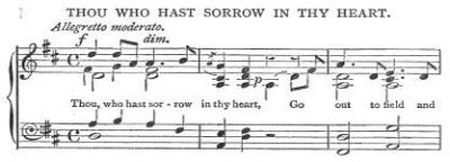
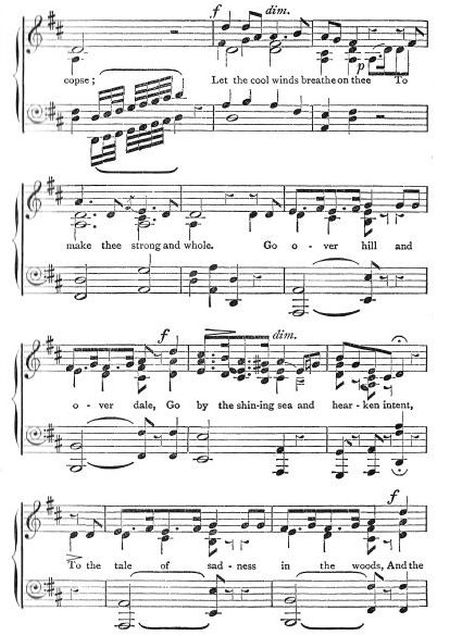
And at that moment there came a sound of sweet melancholy
music from the hillside.
"That is Gerda," whispered Tante. "That is one of
her favourite Swedish songs—how sweet and melancholy
it is."
They listened, arrested and entranced. The stillness
of the evening and the pureness of the air made a silent
accompaniment to Gerda's beautiful voice.
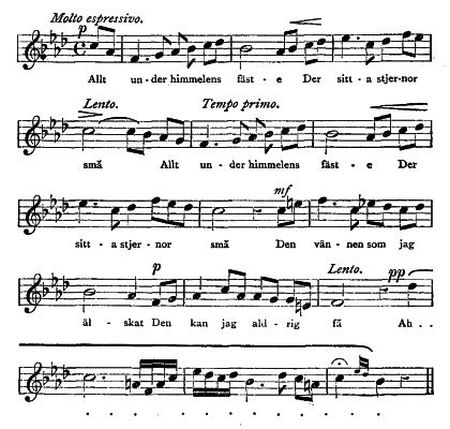
[Listen]
Allt under himmelens fäste
Der sitta stjernor små
Allt under himmelens fäste
Der sitta stjernor små
Den vännen som jag älskat
Den kan jag aldrig få Ah ...
And the wail of despair at the end of the verse was
almost heartrending.
They listened until the sad strains had died away, and
then Tante softly translated the words:
"High on the dome of heaven shine the bright stars;
The lover whom I love so well, I shall reach him never.
Ah me, ah me!...."
She turned impulsively to Katharine.
"But that is not for you, not for you," she said. "You
will reach him, I know you will reach him—I feel it. I
want you to reach him—something or other tells me that
it must and will be so—that——"
The door of the balcony opened hastily, and Ragnhild
came to Tante and held out both her hands to help
her up.
"Two Englishmen have come and are asking for thee,"
she said.
"Men du milde Himmel!"[J] cried Tante. "My icebergs,
of course!"
She almost ran to the hall, where she found Clifford and
Alan standing together like the two forlorn creatures
that they were.
"Velkommen, velkommen!" she cried. "I don't
know where you've come from, whether from the bottom
of the sea or the top of the air! Nor how you've got
here! But velkommen, velkommen!"
Their faces brightened up when they saw her and heard
her cheery voice with its slight foreign accent.
"Oh, Knutty, it is good to see you again," the man
said.
"Yes, by Jove! it is ripping," the boy said.
"Come out into the balcony, dear ones," she said,
taking them by the hand as she would have taken two
children. "And I'll inquire about your rooms and your
food. You look like tired and hungry ghosts."
Katharine was bending over the balcony, looking down
fixedly at those wonderful rivers, and with the sound and
words of that sad song echoing in her ears and heart.
Then she turned round and saw them both; saw the
look of shy pleasure on the boy's face, and of gladness
on the man's. The music died away, hushed by the
gladness of her own heart.
"Velkommen!" she said, coming forward to greet
them. "I've learnt that much Norwegian, you see!"
Knutty was overjoyed at the return of her icebergs, and
it was pathetic to see how glad they were to be with her
again. She thought that, on the whole, they were the
better for their journey; but when she questioned
Clifford, he told her that Alan had not cared to be with
him.
"He is much happier since he has returned and is not
alone with me," Clifford said.
"And you?" asked Knutty.
"I am much happier too, Knutty," he said thoughtfully.
And he looked in the direction of the foss, where
Katharine had just gone with the Sorenskriver.
"Ah," said Knutty, "you are a strange pair, you and
your boy."
He made no reply; but afterwards said in an absent
sort of way:
"I think I will take a stroll in the direction of the
foss."
"Yes, I should, if I were you," said Knutty, with a
twinkle in her eye. "The Sorenskriver will be so pleased
to see you, I'm sure."
He glanced at her a little suspiciously, but saw only a
grave, preoccupied expression on her naughty old face.
But when he had gone, she laughed to herself and
said:
"Yes, there is decidedly daylight, not through a leper's
squint, but through a rose-window! Only I must be
careful not to turn it into black darkness again. I must
see nothing and hear nothing, and I must talk frequently
of Marianne—or oughtn't I to talk of her? Nå, I wonder
which would be the best plan. If I do speak of her, it
will encourage him to remember her; and if I don't
speak of her it will encourage him to brood over her in
silence. She always was a difficulty, and always will be
until——And even then, there's the other iceberg to
deal with—ah, and here he comes—made friends with
Jens, I see, and no difficulty about the language—Jens
never speaking a word, and Alan only saying something
occasionally, like his father."
The two boys parted at the Stabur, where Ragnhild
was standing on the steps holding a pile of freshly made
Fladbröd. Alan looked up at her, took off his little
round cricketing-cap, blushed, made his way over to
the porch, and sat down by Knutty. And Ragnhild
thought:
"That nice English boy. He shall have plenty of
multebaer."
So she disappeared into the Stabur and brought out
a plateful of multebaer, which she handed him with a
friendly nod. He fell to without any hesitation, and
Knutty watched him and smiled.
"Well, kjaere," she said, "and what do you think of
this part of the world? Glad to be here?"
"Yes, Knutty," he answered. "And it is ripping to
see you again."
"Am I so very 'bully'?" she said, in her teasing
way.
"Yes," he said, smiling.
"Ah," she said, "I suppose I am!" And they both
laughed.
"Jens and I are going fishing this afternoon up to a
mountain lake over there," he said. "I wish you'd
come too. Do, Knutty."
"Dear one," she answered, "I'll come with pleasure
if you'll send over for one of the London cart-horses.
Nothing else on this earth could carry me, and then I
suppose he couldn't climb! You surely did not think
of hoisting me up on one of those yellow ponies? No, I
think I'll stop below and eat the fish you bring home.
All the same, thank you for the invitation. Many regrets
that age and weight, specially weight, prevent me from
accepting."
There was a pause, and Alan went on eating his
multebaer.
"Did you like your journey to America?" she asked,
without looking up from her work.
"Yes," he answered half-heartedly, and his face
clouded over. "But—but I was glad to come back."
"Well," she said, "that is what many people say. The
New World may be good enough in its way, but the Old
World is the Old World, when all is said and done. And
you got tired of the Americans, did you?"
"Oh no," he said, "it wasn't that. But——"
He hesitated, and then he blurted out:
"I wish you'd been with us, Knutty. It would have
been so different then."
"Nei, stakkar," she said. "You'll make old Knutty
too conceited if you go on saying these nice things to
her."
He had put down his plate of multebaer, and was now
fiddling nervously with a Swedish knife that Knutty had
given him. Knutty glanced at him with her sly little old
eyes. She knew she was in for confidences if she conducted
herself with discretion.
"Give it to me," she said, holding out her hand for the
knife. "This is the way it opens—so—and then you
stick it through the case—so—and then it's ready to
stick anybody you don't like—so—in true Swedish
fashion, with which I have great sympathy—there it
is!"
The boy went on fiddling with the knife, and then he
took his cap off and fiddled with that.
"Du milde Himmel!" thought Knutty. "These icebergs!
Why do I ever put up with them?"
"Knutty," the boy began nervously, "I want so
dreadfully to ask you something—about—mother. Was
she—very unhappy—do you think? I can't get out of
my head what Mrs Stanhope said. I tried to forget it—but——"
He looked up hopelessly at Knutty, and broke off.
Knutty gave no sign.
"Twice I nearly ran away from father," the boy
went on. "I—I wanted to be alone—not with father—once
at New York—and another time at Chicago.
There were two fellows going out West from there, and—I
wanted to be alone, not with father—and I thought
I could get along somehow—other fellows do—and then
I remembered how you said that he only had me—-and
I stayed—but——"
He looked up again at Knutty, and this time she
answered:
"I know," she said. "I understand."
"You don't think it beastly of me?" he said.
"No," she said, "not beastly at all; only very,
very sad."
"You won't let father know I—I nearly left him?"
Alan asked.
"No; you may rely on me," she answered gently.
And she knew that she was speaking the truth, and
that she would have no heart to tell Clifford. With
her quick insight she saw the whole thing in a flash
of light. She guessed that Mrs Stanhope had got hold
of the boy, and planted in his heart some evil seed which
had grown and grown. The difficulty was to find out
exactly what she had said to him; and Knutty knew
that Alan would be able to tell her only unconsciously,
as it were, involuntarily. Her kind old heart bled for
the lad when she thought how much he must have
suffered, alone and unhelped. His simple words about
wanting to get away from his father spoke volumes in
themselves. And he seemed to harp on this, for he
said almost at once:
"You see, I shall be going back to school, and then
to college, and then to work."
"And then out into the world to make your name
as a great architect," she said.
He smiled a ghost of a smile.
"Yes," he said; "but far away, Knutty, out in the
colonies somewhere."
"Alan," she said suddenly, "you asked me about
your mother—whether I thought she had been unhappy.
I don't know; I never knew her well enough
to be able to say. I thought she seemed happy when
I saw her last—about two years ago, I think—and
she was looking very beautiful. She was a beautiful
woman your mother, and well set-up, too, wasn't
she?"
"Yes," she boy said, and his lip quivered. He turned
away and leaned against the pillar of the porch.
"Oh, Knutty," he said, turning round to her impetuously,
"why did she die? Why isn't she here? There
wasn't any need for her to die. She never would have
died if father had been kinder to her, if we'd both
been kinder to her; but—she was unhappy. Mrs
Stanhope said she was unhappy: she told me all about
it before we left England. I can't forget what she said—what
she said about—about father being the cause
of mother's death; that's what she meant—I know
that's what she meant.... I can't get it out of my
head. I never thought of it like that until she told
me; but when she spoke as she did, then I knew all
at once that—that—that there was something wrong
somewhere about mother's death, and that I oughtn't
to forget it, being her son—and—and she was fond of
me—and——"
He broke off. Knutty had risen, and put her hand
on the boy's shoulder.
"Kjaere," she said in a strained voice, "I did not
know things were as bad as this with you. My poor
boy."
She slipped her arm through the boy's arm and led
him away from the courtyard, down past the cowhouse
and the hay-barns and through the white gate.
Old Kari was grubbing about, singing her favourite
refrain to call the cows back:—
"Sulla ma, Sulla ma, Sulla ma, aa kjy!
Sulla ma, Sulla ma, Sulla ma, aa kjy!
[K]Sullam, sullam, sy-y-y y-y-y!"
Bedstemor was in her garden, giving an eye to her
red-currant bushes, of which she was specially proud,
and casting a sly glance round to see what the Swedish
artist-lady was doing perched on that rock in the next
field. She was only looking towards the Gaard and
measuring the cowhouse in the air. Bedstemor thought
there was no harm in that; and any way, these people
had to do something.
The Sorenskriver was coming down from the birch-woods,
alone and apparently in a disagreeable mood, for
he pushed roughly on one side the little golden-haired
daughter of one of the cotters who was playing on the
hillside.
"These wretched Englishmen," he said, frowning.
"Uff, they are always in the way, all over the world.
And I was having such a pleasant time with her before
this fellow came."
Katharine and Clifford were lingering near the foss.
Katharine was making a little water-colour of the lovely
scene. Through the trees one could catch a glimpse of
the shining river and a bit of the bright blue sky.
"Yes," Clifford was saying, "my old Dane was wise
to send us, and we were wise to come back. We were
not happy together, Miss Frensham. But since we have
returned the boy is happier, and—I am happier too."
Katharine, bending over her work, whispered to
herself:
"And I—I am happier too."
But down by Knutty's mountain-ashes, near the black
hay-barn, an old woman and a young boy sat, with
pale, drawn faces.
Gerda had pretended to hope that when Tante's English
friends arrived on the scene, she would mend her strange
ways, and no longer haunt the cowhouse and seek the
companionship of old Kari and of Thea, who was so
clever at making Fladbröd, and Mette, who had three
fatherless babies and a dauntless demeanour which
seemed to be particularly attractive to wicked old
Knutty. But Tante was incorrigible, and would not
for any one's sake have missed her evening visit to that
august building. So after her sad talk with Alan, she
stood and waited as usual, whilst Mette, that bright
gay soul, called the cows down to the Gaard.
"Kom da, stakkar, kom da, stakkar!" ("Come then,
my poor little dears!"), she cried merrily.
And Gulkind (yellow cheek), Brungaas (brown goose),
Blomros (red rose), and Fjeldros (mountain rose) responded
with varying degrees of bellowing and dilatoriness.
When they were safely in their stalls, the singing
began. Thea had the softest voice, but Mette had a
dramatic delivery. Old Kari acted as prompter when
they forgot the words of the old folk-songs, and the
cows went on munching steadily and switching their
tails in the singers' faces, so that the music was mingled
with strange discords of scolding and Knutty's laughter.
And then Mette got up, and began to dance some old
peasant-dance; and very pretty and graceful she looked,
too, in her old cow-dress and torn bodice.
"Come, Thea!" she cried. "Let us dance the
Spring-dance for the good Danish lady to see. Fjeldros
and Brungaas can wait a few minutes."
"Nei, nei, nei!" cried old Kari. "It is not safe to
dance in the cowhouse, Mette. Thou know'st the Huldre
will come and throw stones in at the cows. Thou know'st
she will come. Ja, ja, I have seen her do it, and the
cows were killed. Ak, I am afraid. The Huldre will
come."
"Perhaps," said Mette, winking mischievously at
Tante—"perhaps it is better to be on the safe side.
All the same, I'm not afraid of the long-tailed Huldre."
"Have you seen her often, Kari?" asked Tante.
"Three times," said Kari, shuddering, "and each time
she worked me harm. She is mischievous and ugly,
not like the beautiful green-dressed Huldre. I saw her
once up at the Saeter, when I was alone and had made
a big fire. She came and danced and danced before
the fire. But I must not waste my time with thee.
I must milk Blomros."
"Kari has been taken away by the mountain people,"
Mette said, winking again at Tante. "Thou shouldst
tell the Danish lady."
But Kari buried herself under Blomros; and so Mette,
still anxious to entertain her visitor, struck up with the
pretty little folk-song, "Home from the Saeter."
[Listen]
We have done our many duties,
Cheese have made, have butter churned;
Now we'll lead our willing cattle,
Now we'll lock the saeter door;
Here no longer food can be found,
By the Hudre Folk or ourselves,
Glad are we that home we're going,
Gladder still the cows, I'm sure.
When they had finished, Knutty looked round and
saw Gerda standing listening.
"Now," said Knutty, "you will understand why I
come to the cowhouse. It is my concert-room. Well
then, my good friends, good-bye for the present."
"Come back to-morrow," cried Mette. "The milking
goes so merrily when thou art here."
"And mind, no dancing!" said Knutty, smiling and
putting up her hand in warning. "Remember the long-tailed
one!"
Mette's merry laughter sounded after them, and was
followed by her finale, the mountain-call to the goats:
"Kille bukken, kille bukken, kille bukken! lammet
mit!" with a final flourish which would have made a
real prima donna ill for a week from jealousy.
"Mette has got a temperament," said Knutty, still
smiling. "Thank Heaven for that! Anything is better
than your dead-alivers, your decaying vegetable world.
No disrespect to you, kjaere, for you look particularly
alive this evening; a nice flush on your face—whether
anger or joy, no matter—the effect is the same—life."
"Ejnar and I have found some dwarf-birch," said
Gerda, pointing to her green wallet.
"Ah, that is certainly a life-giving discovery," remarked
Knutty.
"We've had a lovely afternoon together," continued
Gerda, "and we've discussed 'Salix' to our hearts' content."
"Ah," said Knutty, "no wonder you look so animated."
"But just by the group of mountain-ashes we met
Fröken Frensham," said Gerda, "and Ejnar left me.
And I was angry. But as she had the Sorenskriver
and your Englishman with her, I didn't mind so much.
Oh, it isn't her fault. She doesn't encourage him; and
she cannot help being attractive. But Ejnar——"
"Why, my child," said Knutty, "who ever heard of
a live woman being jealous, generous, and just? You
can't possibly be an animal—nor even a vegetable—you
must be a mineral. I have it—gold!"
"Tante," said Gerda, "wait until you have a husband,
and then you won't laugh."
"No, I don't suppose I should!" replied Knutty.
"Other people would do the laughing for me."
"No," said Gerda. "They should not laugh at you
in my presence, I can tell you."
"Ah," said Knutty, "you're pure gold, kjaere. There,
don't fret about that wretch Ejnar. If he ran away
from you, we could easily overtake him. He'd be
stopping to look at all the plants on the wayside; and
the lady, no matter who she was, would leave him in
disgust. No self-respecting eloping female could stand
that, you know. Come. There's the bell ringing for
smoked salmon and cheese."
But although Knutty kept up her spirits that evening,
she was greatly disturbed by her talk with Alan, and
distressed to know how to help him. When she went to
her room, she sat for a long time at the window, thinking
and puzzling. Not a single helpful idea suggested
itself to her. Her heart was full of pity for the boy and
concern for the father. She reflected that it was in
keeping with Marianne's character to leave this unnecessary
trouble behind her: that all the troubles
Marianne ever made had always been perfectly unnecessary.
And she worked herself into a rage at the
mere thought of Mrs Stanhope, Marianne's friend.
"The beast," she said, "the metallic beast! I'd
like to see her whole machinery lynched."
After that she could not keep still, but walked up and
down her big room, turning everything over in her mind
until her brain was nearly distraught. Once she stood
rigid for a moment.
"Had Clifford anything to hide about his wife's
death?" she asked herself.
"No, no," she replied angrily. "That is ridiculous—I'm
a fool to think of it even for a moment."
Her mind wandered back to the time of Marianne's
death. She remembered the doctor had said that
Marianne had died from some shock.
"Had Clifford lost his self-control that last night
when, by his own telling, he and Marianne had some
unhappy words together, and had he perhaps terrified
her?" she asked herself.
"No, no," she said. "Why do I think of these
absurd things?"
But if she thought of them—she, an old woman with
years of judgment and experience to balance her—was
it surprising that the young boy, worked upon by Mrs
Stanhope's words, was thinking of them?
Knutty broke down.
"My poor icebergs," she cried. "I'm a silly, unhelpful
old fool, and no good to either of you. I never
could tackle Marianne—never could. She was always
too much for me; and although she's dead, she is just
the same now—too much for me."
She shook her head in despair, and the tears streamed
down her cheeks; but after a few minutes of profound
misery she brightened up.
"Nå," she said, brushing her tears away, "of course,
of course! Why was I forgetting that dear Katharine
Frensham? I was forgetting that I saw daylight. What
an old duffer I am! If I cannot help my icebergs, she
can—and will. If I cannot tackle Marianne, she can."
Her thoughts turned to Katharine with hope, affection,
admiration, and never a faintest touch of jealousy. She
had been drawn to her from the beginning; and each
new day's companionship had only served to show her
more of the Englishwoman's lovable temperament.
They all loved her at the Gaard. Her presence was a
joy to them; and she passed amongst them as one of
those privileged beings for whom barriers are broken
down and bridges are built, so that she might go her
way at her own pleasure into people's hearts and minds.
Yes, Knutty turned to her with hope and belief. And
as she was saying to herself that Katharine was the one
person in the world to help that lonely man and desolate
boy, to build her bridge to reach the man, and her
bridge to reach the boy, and a third bridge for the man
and the boy to reach each other—as she was saying all
this, with never one single jealous thought, there came
a soft knock at her door. She did not notice it at
first; but she heard it a few seconds later, and when
she opened her door, Katharine was standing there.
"My dear," Knutty exclaimed, and she led her visitor
into the room.
"I have been uneasy about you," Katharine said,
"and could not get to sleep. I felt I must come and see
if anything were wrong with you. Why, you haven't
been to bed yet. Do you know it is two o'clock?"
"It might be any time in a Norwegian summer night,
and I've been busy thinking," said Knutty—"thinking
of you, and longing for the morrow to come when I
might tell you of some trouble which lies heavy on my
heart."
"Most curious," said Katharine. "I had a strong
feeling that you wanted me. I thought I heard you
calling me."
"I did call you," Knutty said, "none the less loudly
because voicelessly. I wanted to tell you that Mrs
Stanhope did see Alan before he left England. Your
warning to my poor Clifford came too late. She took
the boy and made him drink of the poison of disbelief."
Then she gave Katharine an account of her painful
interview with Alan. Katharine had previously told
Knutty a few particulars of her own encounter with
Mrs Stanhope at the Tonedales, and she now, at Knutty's
request, repeated the story, adding more details in
answer to the old Dane's questionings. Long and
anxiously these two new friends, who were learning to
regard each other as old friends, discussed the situation.
"I cannot bear that the boy should be suffering in
this way," Knutty said. "And I cannot bear that
my poor Clifford should know. For he has come back
happier—ah, you know something about that, my dear.
And I am glad enough to see even the beginning of a
change in him. Only it is pathetic that he, without
knowing it, should be steering for some happiness in a
distant harbour, whilst the boy should be drifting out
to sea—alone."
"He shall not drift out to sea," Katharine said.
"He must and shall believe in his father again."
"But, my dear, how are you going to manage that?"
Knutty asked sadly.
"By my own belief," Katharine answered simply.
"You believe in him?" Knutty said, half to herself.
"Absolutely," Katharine answered, with a proud smile
on her face.
"How you comfort me!" said Knutty. "Here have
I been wrestling with plans and problems until all my
intelligence had gone—all of it except the very best bit
of it which called out to you for help. And you come
and give me courage at once, not because you have any
plans, but because you are yourself."
They were standing together by the window, and
Katharine put her arm through Knutty's. They looked
a strange pair: Knutty with her unwieldy presence of
uncompromising bulk, and Katharine with her own
special grace of build and bearing. She was clothed
in a blue dressing-gown. Her luxuriant hair fell down
far below her waist. The weird Norwegian moon
streamed into the room, and shone caressingly around
her. It was a wonderful night: without the darkness
of the south and without the brightness of the extreme
north; a night full of strange half-lights and curious
changes. At one moment dark-blue clouds hung over
the great valley, mingling with the mists in fantastic
fashion. Then the blue clouds would give place to
others, rosy-toned or sombre grey, and these two would
mingle with the mists. Then the next moment the
moon would reassert herself, and her rays would light
up the rivers and fill the mists with diamonds. Then
there would come a moment when mists and clouds
were entirely separated; and between this gap would
be seen, as in a dream, a vision of the valley beyond,
mysterious and haunting. Verily a land of sombre
wonder and mystic charm, this great Gudbrandsdal of
Norway, with its legends of mortal and spirit, fit scene for
weird happenings and strange beliefs, being a part of that
whole wonderful North, the voice of which calls aloud
to some of us, and which, once heard, can never be
lulled into silence.
The two women stood silently watching the beauty of
this Norwegian summer night, arrested in their own
personal feelings by Nature's magnetism.
"Behold!" cries Nature, and for the moment we are
hers and hers only. Then she releases us, and we turn
back to our ordinary life conscious of added strength
and richness.
Katharine turned impetuously to Knutty.
"He must and shall believe in his father again," she
said. "I know how helpless boys are in their troubles,
and how unreachable. But we will reach him—you
and I."
"With you as ally," said Knutty, "I believe we
could do anything."
"Poor little fellow, poor little fellow!" said Katharine
tenderly.
As she spoke she glanced out of the window and saw
some one coming down from the birch-woods. She
watched the figure approaching nearer and nearer to the
Gaard.
"There is some one coming down from the woods,"
she said. "How distinctly one can see in this strange
half-light!"
"One of the cotters, perhaps," suggested Knutty.
"No," said Katharine, "it is the boy—it's Alan."
They watched him, with tears of sympathy in their
eyes. They knew by instinct that he had been wandering
over the hills, fretting his young heart out. They
drew back, so that he might not see them as he passed
up the garden.
They heard him go into the back verandah and up the
outer stairs leading to his room.
They caught sight of his troubled face.
It was Katharine who proposed the expedition to a
group of Saeters. She came down one morning in a
determined frame of mind, and no obstacles could deter
her from carrying out her scheme. F—— was about
a day's journey distant from the Gaard, and Katharine
had heard of its beauties from several of the guests,
including the Sorenskriver. The difficulty was to get
horses at the Gaard, for they were wanted in the fields,
and when not required for work, they appeared to be
wanted for rest. Solli did not like his horses to go for
expeditions, and as a rule he was not to be persuaded
to change his views. When asked, he always answered:
"The horses cannot go." And there the matter
ended.
To-day also he said, "The horses cannot go;" and
Katharine, understanding that entreaty was vain, made
no sign of disappointment, and determined to walk.
She invited Alan specially to come with her, and the
boy, in his shy way, was delighted. Her manner to
him was so genial that, spite of his trouble, he cheered up.
"The others may come with us if they like," she said
to him; "but we are the leaders of this expedition.
It is true that we don't know the way; but born leaders
find the way, don't they?"
Ejnar declared he would go, and Gerda, still feeling
injured, said she would stay behind. But Tante advised
her to go and see that Ejnar did not run away with
Katharine. The Sorenskriver refused rather sulkily, but
was found on the way afterwards, having changed his
mind and discovered a short cut. The little Swedish
lady-artist accepted gladly, and the Swedish professor
accompanied her as a matter of course, being always in
close attendance on his pretty young compatriot. Clifford
said he would remain with Knutty, but Knutty
said:
"Many thanks. But I'm coming too. Do you suppose
I've come to Norway to let others see Saeters?
Not I."
"But, Knutty," he said, looking gravely at her, "you
know we'd love to have you, but——"
"But you think it is not humanly possible," she
answered, with a twinkle in her eye. "Well, I agree
with you. If I walked, I should die; and if I rode,
the horse would die! And as there is no horse——"
But just then Jens came into the courtyard leading
Svarten, the black Gudbrandsdal horse, and Blakken, a
sturdy little Nordfjording.[L] Jens hitched Svarten to the
gig. Another pony was brought from the field hard by.
"The horses can go," said Solli, looking rather pleased
with himself; and the little band of travellers, agreeably
surprised, called out:
"Tusend tak, Solli!"
"Well, now, there are horses," Clifford said, turning
to Knutty.
"Kjaere," she answered, "I may be a wicked old
wretch, but I'm not as bad as that yet! I'll stay at
home and read to Bedstemor out of the old Bible which
Bedstefar bought in exchange for a black cow! Could
anything be more exciting? But you go—and be
happy."
"Happiness is not for me, Knutty," he said.
"No, probably not," she answered gravely. "But go
and pretend. There's no harm in that."
"All the same," he said a little eagerly, "it is curious
how much brighter and happier I do feel since we came
here. It's the getting back to you, Knutty. That is
what it is."
"Yes, I can quite believe that," replied Knutty.
"There now. They are starting off."
But he still lingered in the porch.
"What sort of nonsense have you been telling Miss
Frensham about my researches?" he said, smiling shyly.
"Oh," said Knutty, "I only told her you were engaged
on some ridiculous stereo-something investigations. I
didn't think it was anything against your moral character."
He still lingered.
"Do you know," he said, "I've been thinking that I
shall enlarge my laboratory when I get back. I believe
I am going to do a lot of good new work, Knutty."
"I shouldn't wonder," she answered. "A man isn't
done for at forty-three."
"No, that's just it," he said brightly. "Well, goodbye
for the present."
She watched him hasten after the others. She
laughed a little, and congratulated herself on her beautiful
discretion. And then she went over to Bedstemor's,
and on her way met old Kari carrying a bundle
of wood. Old Kari, who always plunged without preliminaries
into a conversation, said:
"Perhaps that nice Englishwoman will find a husband
here after all, poor thing. Perhaps the Englishman will
marry her. What dost thou think?"
Meanwhile Clifford hurried after the Saeter pilgrims,
and caught up with Gerda and Ejnar. Katharine and
Alan were on in front, but he did not attempt to join
them. But he heard Alan laugh, and he was glad. A
great gladness seized him as he walked on and on. She
was there. That was enough for him. Ah, how he
had thought of her when he was away. She did not
know. No one knew. It was his own secret. No one
could guess even. No one would ever know that Alan's
unhappiness was only one of the reasons for their sudden
return. There was another reason too: his own unconquerable
yearning to see her. He had tried to conquer
it; and he had not tried to conquer it. He had
tried to ignore it; and he had not tried to ignore it.
He had said hundreds of times to himself, "I am not
free to love her;" and he had said hundreds of times
too, "I am free to love her." He had said of her, "She
is kind and pitiful; but she would never love me—a
broken-spirited man—never—never." And he had said,
"She loves me." He had said, "No, no, not for me
the joys of life and love—not for me. But if only in
earlier days—if only——" And he had said, "The past
is gone, and the future is before me. Why must I turn
from love and life?"
But he had ended with, "No, no, it is a selfish dream;
there is nothing in me worthy of her—nothing for me
to offer her—nothing except failure and a saddened
spirit."
But this morning Clifford was not saying or thinking
that. He remembered only that she was there—and
the world was beautiful. For the moment, all troubles
were in abeyance. He scarcely remembered that the
boy shirked being with him and went his own way in
proud reserve. He had, indeed, scarcely noticed it since
his return. If Alan went off with Jens, it was only
natural that the two lads should wish to be together.
And for the rest, the rest would come right in time. So
he strode on, full of life and vigour, and with a smile
on his grave face. And Gerda said:
"And why do you smile, Professor?"
He answered:
"The world is beautiful, Frue.[M] And the air is so
crisp and fine."
Gerda, who enjoyed being with Knutty's Englishman,
was glad that Ejnar was lingering behind picking some
flower which had arrested his attention. She did not
mind how far he lingered behind alone. It was the
going on in front with Katharine which she wished to
prevent! She said to Clifford:
"Your countrywoman is very attractive. I like her
immensely. Do you like her?"
"Yes," said Clifford.
"She is not fond of chemistry, I think."
"No."
"Nor is she botanical."
"No," said Clifford.
"Nevertheless, she has a great charm," said Gerda.
"Tante calls it temperamental charm. It must be
delightful to have that mysterious gift. For it is a gift,
and it is mysterious."
Clifford was silent. Gerda thought he was not interested
in the Englishwoman.
"How blind he is!" she thought. "Even my Ejnar
uses his eyes better. He knows that woman is charming."
Katharine was indeed charming that morning, and
to every one. She had put little Fröken Eriksen, the
Swedish artist, and the Swedish mathematical Professor,
Herr Lindstedt, into the gig, so that they might enjoy
a comfortable flirtation together. They laughed and
greeted her pleasantly as they drove on in front.
"Tack!" they said, turning round and waving to her.
They felt she understood so well.
Soon afterwards the Sorenskriver was found sitting on
one of the great blocks of stone which formed the railing
of the steep road down from the Solli Gaard.
"Good-morning," he said. "May a disagreeable old
Norwegian join this party of nations?"
Katharine beamed on him, and spoke the one Norwegian
word of which she was sure, "Velkommen!"
But she did not let him displace Alan. She kept the
boy by her side, giving him the best of her kindness and
brightness. She drew him out, heard something about
his American journey, and listened to a long description
of the ship which took him out and brought him
home. He did not once speak of his father. And she
did not speak of him. But she had a strong belief
that if she could only manage to win the boy for herself,
she could hand him back to his father and say,
"Here is your boy. He is yours again. I have won
him for you."
It was a joy to her to feel that she was working for
Clifford Thornton. And with the pitiful tenderness that
was her own birthright, she was glad that she was trying
to help the boy. She knew she would succeed. No
thoughts of failure crossed her mind. No fears of that
poor Marianne possessed her. She made no plans, and
reckoned on no contingencies. She had never been afraid
of life. That was all she knew. And without realising
it, she had a remarkable equipment for success in her
self-imposed task. By instinct, by revelation, by reason
of her big, generous nature, she understood Marianne:
that poor Marianne, who, so she said to Knutty, could
not be called unmerciful if she was ignorant—since
mercy belonged only to true knowledge.
So she kept Alan by her side, and he was proud to
be her chosen companion. She said:
"This is our show, you know. The other people
are merely here on sufferance. And if the Sorenskriver
says anything disagreeable about England, we'll wollop
him and leave him tied up to a tree until we return."
"Or shove him down into the torrent," said Alan,
delighted. "Here it is, just handy."
"Yes; but he has not begun yet," she answered.
"We must give the poor man a chance."
"Don't you feel beastly angry when these foreigners
say anything against England?" he asked.
"Beastly angry!" she replied with gusto.
He smiled with quiet satisfaction. He loved her comradeship
of words as well as her comradeship of thoughts.
They passed over the bridge leading to the other side
of the Vinstra gorge, stopped to rest at the Landhandleri
(store-shop), and then began their long ascent to the
Saeters. Up they went past several fine old farms;
and as they mounted higher, they could see the Solli
Gaard perched on the opposite ridge. The road was a
rough carriage-road leading up to a large sanatorium,
which was situated about three-quarters of the way to
F——. As they mounted, the forest of Scotch firs and
spruces seemed thicker and darker, being unrelieved by
the presence of other trees, as in the valley below. Leafy
mosses formed the carpeting of the forest, and a wealth
of bilberries was accumulated in the spruce-woods;
whilst the red whortleberry showed itself farther on in
open dry spots amongst the pines which crept up higher
than the Scotch firs—"Grantraeer," as the Norwegians
call them. Then they, in their turn, thinned out, and
the lovely birches began to predominate; so that the
way through the forest became less gloomy, and the
spirits of the pilgrims rose immediately, and Gerda sang.
But, being Danish, she sang a song in praise of her
native beech-woods! And the Sorenskriver joined in
too, out of compliment to Denmark, but said that he
would like to recite to the English people the poem
about the beeches of Denmark, the birches of Sweden,
and the fir-trees of Norway. The beeches were as the
Danes themselves, comfortable, easy; the birches were
even as the Swedes, graceful, gracious, light-hearted;
and the grim firs were as the Norwegians, gloomy, self-contained,
and sad.
"Therefore, Fröken," he said, turning to Katharine,
"judge us gently. We are even as our country itself,
stern and uncompromising."
"But grand, Herr Sorenskriver," said Katharine,
"with nothing petty."
"Nei da!" he said, looking pleased. "It would be
nice to think that this was as true of ourselves as of our
mountains."
Then they glanced back at the snow-clad Rondane in
the distance; and they came out into the open country,
and saw the Jutenheim (the home of the giants) in front
of them. They had left the region of the firs, pines, and
birches, and reached the land of the dwarf-birch, the
willow, and the persistent juniper. And here the rough
carriage-road ended; for the sanatorium, where the
fashionable Scandinavians were taking their summer
mountain-holiday, was now only a few yards off. The
saeter pilgrims had thought of dining there; but no one
seemed inclined to face a crowd of two hundred guests.
So the little company drew up by the side of a brook,
and ate Mysost[N] sandwiches; the Sorenskriver, who
continued in the best of good humours, assuring Katharine
that this was an infallible way of learning Norwegian
quickly. Alan was disappointed that he was not rude.
"Then we could go for him," he said privately to
Katharine.
"Oh, perhaps he may even yet be rude!" whispered
Katharine, reassuring him.
When they had lunched and taken their ease, they
started once more on their journey, passing the precincts
of the sanatorium in order to hire boats for crossing the
beautiful mountain lake; for F—— was on the other
side, perched high up on the mountain-slope. By rowing
over, they would save themselves about two miles
of circuitous rough road. Jens said that he would take
the gig and the horses round by the road to meet the
boat. Alan went with him, but he looked back wistfully
at Katharine once or twice.
And now a curious thing happened. As Katharine
and Gerda were standing waiting for their boat, the
sound of English voices broke upon them.
"English," said Gerda. "That is a greeting for you."
"Well, it's very odd," said Katharine, listening;
"but I've heard that voice before."
"Perhaps you think it is familiar because it is
English," suggested Gerda.
"Perhaps," answered Katharine; but she was still
arrested by the sound.
"I thought the Sorenskriver said that no English
people came here?" she said.
"He said they came very rarely to these parts," Gerda
replied. "One or two Englishmen for fishing sometimes;
otherwise Swedes, Danes, Finns, Russians."
"I am sure I have heard that voice before," Katharine
said. She seemed troubled.
"There they go, you see," Gerda said, pointing to two
figures. "They were in the little copse yonder—two of
your tall Englishwomen. How distinctly one hears voices
at this height! Well, the Kemiker is waiting for us.
Du milde Gud! Look at my Ejnar handling the oars!
Bravo, Ejnar!"
"Come, ladies," called Clifford cheerily from the boat.
"Let us be off before the Botaniker upsets the boat. He
has been trying to reach a plant at the bottom of the
lake."
When they had taken their places, Katharine turned
to Clifford, who was looking radiantly happy, and she
said:
"Row quickly, row quickly, Professor Thornton. I
want to get away from here."
"Do you dislike the great caravanserai so much?"
he said. "Well, you have only to turn round, and
there you have the Jutenheim mountains in all their
glory. Are they not beautiful?"
She looked at the snow-capped mountains; but for
the moment their beauty scarcely reached her. She
was thinking of that voice. When had she heard it?
And where?
"The mountains, the mountains of Norway!" cried
Clifford. "Ah, I've always loved the North, and each
time I come I love it more passionately, and this
time——"
No one was listening to him. Gerda and Ejnar were
busy trying to see what was in the bottom of the lake,
and Katharine seemed lost in her own thoughts. Suddenly
she remembered where she had heard that voice.
It was Mrs Stanhope's. The words rushed to her lips;
she glanced at Clifford, saw and felt his happiness, and
was silent. But now she knew why the sound of that
voice had aroused feelings of apprehension and anxiety,
and an instinctive desire to ward off harm both from
the man and the boy.
For directly she heard it, she had been eager to hurry
Clifford away, and relieved that Alan had gone on with
Jens.
So they rowed across the lake, he remembering nothing
except the joy of being with her, and she trying to forget
that any discord of unrest had broken in upon the harmonies
of her heart. They landed on swampy ground,
and made their way over rare beautiful mosses, ling,
and low growth of bilberry and cloudberry. Ejnar and
Gerda became lost to all human emotions, and gave
themselves up to the joys of their profession. Long
after all the rest of the little company had met on the
rocky main road to the Saeters, the two botanists lingered
in that fairyland swamp. At last Jens and Alan
were sent back to find them, and in due time they reappeared,
with a rapt expression on their faces and many
treasures in their wallets. The country grew wilder and
grimmer as the pilgrims mounted higher. The road, or
track, was very rough, scarcely fit for a cariole or stol-kjaerre,
and the Swedish mathematical Professor felt
anxiously concerned about the comfort and safety of
the little Swedish artist, who was a bad walker, and
who therefore preferred to jolt along in the gig. But
she did not mind. She laughed at his fears, and whispered
to Katharine with her pretty English accent:
"My lover is afraid for my safeness!"
And Katharine laughed and whispered back:
"I hope you are having a really good flirtation with
him."
"Ja, ja," she answered softly, "like the English boy
says 'reeping good!'"
Grimmer and wilder still grew the mountainous country.
They had now passed the region of the dwarf-birch
and willow-bushes, and had come to what is called
the "lichen zone," where the reindeer-moss predominates,
and where the bushes are either creeping specimens,
growing in tussocks, or else hiding their branches among
the lichens so that only the leaves show above them.
It seemed almost impossible to believe that here, on
these more or less barren mountain-plateaus, good grazing
could be found for the cattle during the summer
months. Yet it was true enough that in this particular
district the cows and goats of about fifty Saeters found
their summer maintenance, about fifty of the great
Gaards down in the side valleys of the Gudbrandsdal
owning, since time immemorial, portions of the mountain
grazing-land. The Sollis' Saeter was not in this
region. It was fifty miles distant from the Solli Gaard,
and, as Jens told the pilgrims, took two whole days to
reach, over a much rougher country than that which
they had just traversed.
"This is nothing," said Jens smiling grimly, when
the Swedish lady was nearly thrown out of the gig on
to Svarten's back. "We call this a good road; and it
goes right up to the first Saeter. Then you can drive
no more. Now you see the smoke rising from the huts.
We are there now."
Jens, usually so reserved and silent, was quite animated.
The mountain-air, and the feeling of being in
the wild, free life he loved so much, excited him. He
was transformed from a quiet, rather surly lad into an
inspired human being fitted to his own natural environment.
Gerda, looking at him, thought immediately of
Björnson's Arne.
"You love the mountains, Jens?" she said to him.
"Yes," he answered simply. "I am always happy
up at the Saeter. One has thoughts."
They halted outside the first Saeter, and turned to
look at the beautiful scene. They were in the midst of
low mountains. In the distance, across the lake, they
could see the snow-peaks of the great Jutenheim range—the
home of the giants. Around them rose strange
weird mountain forms, each one suggestive of wayward
and grim fancy. And over to the right, towering above
a group of castle-mountains, peopled with strange phantoms
born of the loneliness and the imagination, they
saw the glistening peaks of the Rondane caught by the
glow of the sun setting somewhere—not there. And
below them was another mountain-lake, near which
nestled two or three Saeters apart from the rest, and in
which they could see the reflection of the great grey-blue
clouds edged with gold. And above them passed in
tumultuous procession the wonders of a Norwegian
mountain evening sky of summer-time: clouds of delicate
fabric, clouds of heavy texture: calm fairy visions,
changing imperceptibly to wild and angry spectacle:
sudden pictures of fierce and passionate joy, and lingering
impressions of deepest melancholy,—all of it faithfully
typical of the strange Norwegian temperament.
"One must have come up to the mountains," whispered
Clifford to Katharine, "to understand anything
at all of the Norwegian mind. This is the Norwegians,
and the Norwegians are this."
And the grim old Sorenskriver, standing on the other
side of Katharine, said in his half-gruff, half-friendly way:
"Fröken, you see a wild and uncompromising Nature,
without the gentler graces. It is ourselves."
"And again I say, with nothing petty in it," said
Katharine, spreading out her arms. "On a big scale—vast
and big—the graces lost in the greatness."
"Look," said Jens, "the goats and cows are beginning
to come back to the Saeters. They have heard the call.
You will see them come from all directions, slowly and
in their own time."
Slowly and solemnly they came over the fields, a
straggling company, each contingent led by a determined
leading lady, who wore a massive collar and bell.
She looked behind now and again to see if her crowd of
supernumeraries were following her at sufficiently respectful
distances, and then she bellowed, and waited
outside her own Saeter. The saeter pilgrims stood a
long time looking at this characteristic Norwegian scene:
the wild heath in front of them was literally dotted with
far-off specks, which gradually resolved themselves into
cows or goats strolling home in true Norwegian fashion—largissimo
lentissimo! Even as stars reveal themselves
in the sky, and ships on the sea, if one stares long and
steadily, so these cows and goats revealed themselves in
that great wild expanse. And just when there seemed
to be no more distant objects visible, suddenly something
would appear on the top of a hillock, and Jens would cry
with satisfaction:
"See, there is another one!" He looked on as eagerly
as all the strangers, very much as an old salt gazing
fixedly out to sea. Then some of the saeter-girls came
out to urge the lingering animals to hurry themselves,
and the air was filled with mysterious cries of coaxment
and impatience. At last the pilgrims went to inquire
about food and lodging for the night.
"You may get it perhaps," Jens remarked vaguely.
This, of course, was the Norwegian way of saying that
they would get it; and when they knocked at the door
of the particular Saeter which Jens pointed out to them,
a dear old woman welcomed them to her stue (hut) as
though it were a palace. She liked to have visitors, and
her only regret was that she had not known in time to
prepare the room for them in best saeter fashion. Meanwhile,
if they would rest, she would do her utmost; and
she suggested that the gentlemen should go down to the
Saeter by the lake and secure a lodging there, and then
they could return and have their meal in the stue here.
She was a pretty old woman. Pleasure and excitement
lit up her sweet face and made her eyes wonderfully
bright. She wanted to know all about her visitors, and
Gerda explained that they were Swedes, Danes, and
English, and one Norwegian only, the Sorenskriver. She
was deeply interested in Katharine, and asked Gerda
whether the English Herr and the boy were Katharine's
husband and son; and when Gerda said that they
were only friends, she seemed disappointed, and patted
Katharine on the shoulder in token of sympathy with
her. Gerda told Katharine, and Katharine laughed.
She was very happy and interested. She had forgotten
the sound of that jarring voice. All her gaiety and
bonhomie had come back to her. It was she who began
to help their pretty old hostess. It was she who sprinkled
the fresh juniper-leaves over the floor, throwing so many
that she had to be checked in her reckless generosity.
Then Gerda fetched the logs, and made a grand fire in
the old Peise (stone fireplace), and almost immediately
the warmth brought out the sweet fragrance of the
juniper-leaves. The old woman spread a fine woven
cloth over the one bed in the room. Then she bustled
into the dairy and brought out mysost—a great square
block of it, and fladbröd, and coffee-berries, which
Katharine roasted and then crushed in the machine.
When the table had been set, the old woman brought a
bowl of cream and sugar, and the "vaffle" irons, and
began to make vaffler (pancakes). She filled three large
plates with these delicious dainties, and her eager face
was something to behold. Finally she signed to Katharine,
who followed her into the dairy, and came back
carrying two wooden bowls of römmekolle—milk with
cream on the top turned sour.
"Now," she said triumphantly, "everything is ready.
And here come the Herrer. And now you will want
some fresh milk. The cows have just been milked."
"No, no, thou hast done enough. I will go and fetch
the milk," said the Sorenskriver, who was in great spirits
still, and almost like a young boy. "Why, thou dear
Heaven, I was a cotter's son and lived up at the Saeter
summer after summer. This is like my childhood again.
I am as happy as Jens!"
So off he went to the cowhouse at the other end of
the little saeter-enclosure. He began to sing a stev[O]
with the milkmaids. This was the stev:—
[Listen]
Astri, my Astri, who cared but for me,
time you were caring so warmly for me;
Weeping each Saturday night when I left,
Do you remember it, now that it's past?
That was the time when I out-shone them all,
Lawyer and priest in the valley were nought,
That was the time when I outshone them all,
Lawyer and priest in the valley were nought.
(The milkmaids answered)—
The time you were caring for Astri alone,
Was the time when that Svanaug you cared not to see;
The time when your steps were so active and brisk,
Hastening to greet me each Saturday eve.
That was the time when no riches on earth,
Fair could have seemed without my sweetheart's love.
That was the time when no riches on earth,
Fair could have seemed without my sweetheart's love.
He returned with two jugs of milk. A merry laugh
sounded after him, and he was smiling too. The saeter-door
was divided into two parts, and he shut the lower
half to keep out the draught; and when the old woman
tried to slip away, leaving her guests to enjoy themselves
in their own fashion, he said:
"No, no, mor, thou must stay." And every one cried
out:
"Thou must stay."
So she stayed. She tidied herself, folded a clean white
silk kerchief crosswise over her head, and took her place
at the table, dignified and charming in her simple ease of
manner. Many an ill-bred low-born, and ill-bred well-born
society dame might have learnt a profitable lesson from
this old saeter-woman—something about the unconscious
grace which springs from true unself-consciousness. And
she smiled with pride and pleasure to see them all doing
justice to the vaffler, the mysost, the fladbröd, and the
römmekolle. She was particularly anxious that the English
lady should enjoy the römmekolle.
"Stakkar!" she said. "Thou must eat the whole of
the top! Ja, saa, with sugar on it! It is good. Thou
canst not get it so good in thy country? Thou hast no
mountains there, no Saeters there? Ak, ak, that must
be a poor sort of country! Well, we cannot all be born
in Norway."
And she laughed to see Alan pegging away at the vaffler.
"The English boy shall have as many vaffler as he
likes," she said. "Wilt thou have some more, stakkar?
I will make thee another plateful."
It was a merry, merry meal. Every one was hungry
and happy. The Sorenskriver asked for some spaeke-kjöd
(smoked and dried mutton or reindeer) which was
hanging up in the Peise. He cut little slices out of it
and made every one eat them.
"Otherwise," he said, "you will know nothing about
a Norwegian Saeter. And now a big piece for myself!
Isn't it good, Botaniker? Ah, if you eat it up, you will
be inspired to find some rare plants here!"
Then they all drank the old saeter-woman's health.
"Skaal!" they said.
And then Clifford said:
"Skaal to Norway!"
And the Sorenskriver said:
"Skaal to England!"
And the botanists said:
"Skaal to Sweden!"
And the Swedish professor said:
"Skaal to Denmark!"
Then the Sorenskriver added:
"Would that all the nations could meet together up
at the Saeter and cry 'Skaal!'"
And at that moment there came a knock at the door,
and a little man in English knickerbockers and Norfolk
jacket asked for admittance.
"English, Danish, Swedish, Norwegian, German?"
asked the Sorenskriver.
"Monsieur, je suis un peintre français," said the little
man, somewhat astonished.
"Then Skaal to France!" cried the merry company,
draining their coffee-cups.
The Frenchman, with that perfect tact characteristic
of his nation, thanked them in the name of his country,
his hand on his heart; and took his place amongst these
strangers, at their invitation. And then they gathered
round the fire and heaped up the logs. Katharine never
forgot that evening: the five nations gathered together
in that quaint low room built of huge tree-trunks roughly
put together, with lichen and birch-leaves filling in the
crevices: the curious mixture of languages; the fun
of understanding and misunderstanding: the fragrance
of the juniper: the delightful sense of good fellowship:
the happiness of being in the presence of the man she
loved: the mysterious influence of the wild mountains:
the loosening of pent-up instincts and emotions. Years
afterwards she was able to recall every detail of the
surroundings: the Lur (horn) hanging on the wall, and
in those parts still used for calling to the cattle; the
Langeleik (an old kind of zither) in its own special recess,
seldom found missing in real old Norwegian houses, silent
now, but formerly playing an important part in the
saeter-life of bygone days; the old wooden balances,
which seemed to belong to the period of the Ark; the
sausages and smoked meat hanging in the Peise; the
branches of fir placed as mats before the door; the
saeter-woman passing to and fro, now stopping to speak
to one of her guests, now slipping away to attend to
some of her many saeter duties. Then at an opportune
moment the Sorenskriver said:
"Now, mor, if we heap on the logs, perhaps the green-dressed
Huldre will come and dance before the fire. Thou
hast seen the Huldre, thou? Tell us about her—wilt
thou not?"
But she shook her head mysteriously, and went away
as if she were frightened; but after a few minutes she
came back, and said in an awed tone of voice:
"Twice I have seen the green-dressed Huldre—ak,
and she was beautiful! I was up at the Saeter over by
my old home, and my sweetheart had come to see me;
and ak, ak, the Huldre came and danced before the fire—and
she bewitched him, and he went away into the
mountains and no one ever saw him again."
"And so," she added simply, "I had to get another
sweetheart."
"Aa ja," said the Sorenskriver. "I expect there was
no difficulty about that."
"No," she answered, "thou art right."
And she beat a sudden retreat, as though she had said
too much; but she returned of her own accord, and continued:
"And the second time I saw the Huldre it was on the
heath. I had gone out alone to look for some of the
cows who had not come home, and I saw her on horseback.
Her beautiful green dress covered the whole of
Blakken's back, and her tail swept the ground. And
Blakken flew, flew like lightning. And when I found
the cows, they were dying. The Huldre had willed them
ill. That was fifty years ago. But I see her now. No
one can ever forget the Huldre."
So the evening passed, with stories of the Huldre, and
the Trolds, and the mountain-people of Norwegian lore;
for here were the strangers in the very birthplace of many
of these weird legends, all, or most of them, part and
parcel of the saeter-life; all, or most of them, woven out
of the wild and lonely spirit of mountain-nature.
And then the little company passed by easy sequence
to the subject of visions and dreams. Some one asked
Katharine if she had ever had a vision.
"Yes," she answered; "once—once only."
"Tell it," they said.
But she shook her head.
"It would be out of place," she answered, "for, oddly
enough, it was about God."
"Surely, mademoiselle," said the Frenchman, "we are
far away enough from civilisation to be considered near
enough to God for the moment?"
But she could not be induced to tell it.
"You would think I was a religious fanatic," she said.
"And I am neither fanatical nor religious."
"Ah," said Ejnar, "I hope I may have a vision tonight
of what is in the bottom of that lake we crossed
over."
"You did your very best, Professor, to include us all
in that vision of the bottom of the lake," said Clifford
quaintly.
"My poor Ejnar, how they all tease you!" said
Gerda.
"I think," said Katharine, "the Kemiker ought to
know better, being himself a scientific man. Probably
if he were piloting us all down a mine, he would not
care what became of us if his eye lit on some unexpected
treasure of the earth-depths."
"Noble lady," said Ejnar, smiling; "I perceive I
have a friend in you, and the Kemiker has an enemy."
Clifford Thornton looked into the fire and laughed
happily.
Then Gerda said:
"Twice I have dreamed that I found a certain species
of fungus in a particular part of the wood; and guided
by the memory of my dream, the next day I have found
it. Have you ever found anything like that in a dream,
Professor Thornton?"
Clifford looked up with a painful expression on his
face.
"I always try my very hardest never to dream, Frue,"
he answered.
"And why?" she asked.
"Because up to the present we appear to have no
knowledge of how to control our dreams," he replied.
"But if we could control them, they would not be
dreams," said Katharine.
"So much the better then," answered Clifford; "they
would be mere continuations of self-guided consciousness
in another form."
"But it is their utter irresponsibility and wildness
which give them their magic!" cried the French artist.
"In my dreams, I am the prince of all painters born
since the world began. Mon Dieu, to be without that!
I tremble! Life would be impossible! In my dreams
I discover unseen, unthought-of colours! I cry with
rapture!"
"In my dreams," said the Swedish mathematician,
"I find the fourth dimension, the fifth dimension, the
hundredth dimension!"
"In my dreams," said the Sorenskriver, waving his
arms grandiosely, "I see Norway standing by herself,
strong, powerful, irresistible as the Vikinger themselves,
no union with a sister country—nei, nei, pardon me,
Mathematiker!"
"Why, you would take away the very inspiration of
the poet, the very life of the patriot's spirit," said Katharine,
turning to Clifford.
"You are all speaking of the dreams which are the
outcome of the best and highest part of ourselves," said
Clifford, speaking as if he were in a dream himself.
"But what about the dreams which are not the outcome
of our best selves?"
"Oh, surely they pass away as other dreams," she
answered.
"But do you not see," he said, "that if there is a
chance that the artist remembers the rapture with which
he discovered in his dream that marvellous colour, and
the patriot the joy which he felt on beholding in his
dreams his country strong and irresistible, there is also
a chance that less noble feelings experienced in a dream
may also be remembered?"
The Frenchman shrugged his shoulders.
"Mon Dieu!" he said. "We cannot always be noble—not
even in our dreams. I, for my part, would rather
take the chance of dreaming that I injured or murdered
some one and rejoiced over it, than lose the chance of
dreaming that I was the greatest artist in the world.
Why, I have murdered all my rivals in my dreams, and
they are still alive and painting with great éclat pictures
entirely inferior to mine! And I am no worse for having
assassinated them and rejoiced over my evil deeds in my
dream."
"Probably because there were no evil consequences,"
Clifford said. "But supposing there had been evil consequences,
what then?"
"But you do not seriously believe that there is any
such close relationship between dream-life and actual
life, between dream-cause and actual effect?" asked
Gerda.
"I do not know what I believe about it, Frue," he
answered. "Some day science will be able to explain
to us the mysterious working of the brain in normal
life, in dream-life, in so-called death: and the connecting
links."
He had risen as he spoke, as though he, even as the
old saeter-woman, had let himself go too much, and now
wished to slip away quietly. But they all rose too, and
the Sorenskriver said:
"We have spent a true saeter-evening, communing
with mysteries. The spirit of place has seized us, the
mountain-spirit. But if we do not soon get to rest and
sleep dreamlessly, we shall have no brains left us in
the morning for yet another mountain mystery—the
making of the Mysost!"
"Tak for maden" (thanks for the meal), he added,
turning to the old saeter-woman.
"Tak for maden!" cried every one in a pleasant
chorus.
"And tak for behageligt selskab!" (thanks for your
delightful company), he said, turning to all his comrades.
"Tak for behageligt selskab!" cried every one.
Then the men went off to the Saeter down by the
lake; and Katharine, Gerda, and the little Swedish
artist arranged themselves for rest as well as they could
in a rough saeter-stue. The two of them were soon
asleep; but Katharine lay on her bench in the corner
watching the fire, listening to the moaning of the wind,
and thinking of Clifford Thornton.
"Dreams, dreams," she thought. "Why should he
dread to dream? And his face was full of pain when
he said that he tried never to dream. Ah, if I could
only reach him—sometimes we seem so near—and
then——"
Katharine slept.
But in the morning she was up betimes, and out in
the early freshness and crispness. She was alone on
that wild expanse. There was deep stillness all around
her. Silently, softly the magic mists were caressing the
mountains. The stars were losing their own brightness
in the brightening skies. The sun was breaking over
the distant snow-peaks of the Giant range. She was
alone with Nature. And Nature set her free.
"My belovèd!" she cried. "My life was as grey as
this great dreary wild until your presence glorified it.
You broke in upon my loneliness—the bitterest loneliness
on earth—a woman's heart-loneliness,—you broke
in upon it so that now nothing of it remains—scarcely
the memory. Have no fear, my belovèd. I will gather
up your past life and your past love with reverential
tenderness. I have no fear. My love for you and my
belief in you shall conquer everything."
Clifford Thornton was mounting from the Saeter down
by the lake-side. He came out joyously into the freshness
and crispness of the early morning. He was alone
on that wild expanse. There was deep stillness all
around him. Silently, softly the magic mists were
caressing the mountains. The stars were losing their
own brightness in the brightening skies. The sun was
breaking over the distant snow-peaks of the Giant
range. He was alone with Nature. And Nature set
him free.
"My love!" he cried. "I fling the past behind me at
last. There are no barriers—none—none. Fool that I
was to think I was not free. Free! I am as free as
these vast stretches of wild country, free as this mountain
air. Do you know, will you ever know, oh, you
must know, my own belovèd, that I am yours—yours,
unutterably yours. Shall I ever clasp you in my arms
and know that you are mine?"
Then suddenly he saw Katharine in the distance, and
she saw him. She was moving towards him as he was
moving towards her. He hastened to meet her with a
tornado of wild gladness in his heart.
But when they came face to face they stood in silence,
as when they had first met on the evening of the quartette.
He was the first to find words.
"Don't let us go back," he said; "let us go on—let
us go on—the morning is still young—and there is no
gladness like the gladness of the early morning. What
do you think?"
"No gladness like the gladness of the early morning,"
she repeated joyously.
So they passed on together, over the wild and stony
heathland, in the direction of the Rondane mountains:
he with a song in his heart, she with the same song in
hers.
"Isn't it glorious to be up here?" he cried. "I feel
like the Sorenskriver himself—a silent, surly fellow suddenly
turned light-hearted and eloquent. Knutty always
said I ought to have been a Norwegian."
"And I feel like Jens," said Katharine, "an inspired
person, with grand, big thoughts in my mind, which I
shall lose on my way down to the valley again. Ak,
ak!"
"What was your vision?" he asked. "Will you not
tell me?"
"If you wish," she answered; "but it is not worth
telling, really. I have never told any one. I don't
know how I came to let those words slip out last night."
"Tell me," he said, turning to her.
"Well," she said, "I was going to have a slight operation
to my mouth, and some anæsthetic had been given
to me. I was trying my very hardest to keep my consciousness
to the last millionth of a minute, when I saw
a look of great mental suffering and tension on the
surgeon's face. And I said to myself, 'I will be merciful
to the man, and I will make a sacrifice to him of what
I value most on earth at this moment: the tiny remaining
fragment of my consciousness. He will never know,
and no one will ever know; all the same, from my point
of view, it is a deed of infinite mercy.' So I let myself
pass into unconsciousness an infinitesimal instant of time
sooner than I need have done. I heard him say, 'Now!'
Suddenly I found myself in a vast region, which seemed
limitless, which seemed to consist of infinite infinities
which one nevertheless could see were finities blending
with each other imperceptibly."
Katharine stood still a moment.
"And I realised," she continued, "how little I had
ever known about the proportion of things, how little
my mind had ever grasped the true significance of finities,
which here were certainly infinities. I felt entirely
bewildered, and yet wildly excited. Ever since I can
remember, great space has always excited me. And
suddenly, whilst I was wondering where to go, what to
do, whom to reach, I saw a woman near me—a beautiful
woman of so-called ill-fame. And she cried out to
me:
"'This is heaven, and I am straining upwards, upwards,
upwards through all the infinities until I reach
God. For it takes the highest to understand the lowest.'
"And I went with her, and a dim vision of God broke
upon me, and I knew no more. But I came back to
consciousness, saying, 'For it takes the highest to understand
the lowest.'"
She paused a moment, and then said:
"If I had been thinking of God, I could better understand
why I had that vision."
"You had been thinking of God," he answered. "You
had thought of mercy and sacrifice, of an inappreciable
quantity and quality from a finite point of view; and
that led you to think unconsciously of the different aspect
and value of things when seen and understood by an
infinite mind unbounded by horizons. If there is a God,
that must be God—the greatest and highest mind which
understands the lowest grade of everything: religion,
morals, morals, religion."
"But it is not you who should have a vision of that
kind," he added. "You do not need it. It should come
to those who cannot see beyond their prison wall. It
might make them wish to break through it and see the
open space, and still more open space, and still more
open space. But you, who have the free spirit, you
were surely born in the open space; no petty narrow
horizon for you, but a wide and generous expanse."
"Alas!" she said, "you are imputing to me virtues
which I have not!"
"They are not virtues," he answered. "They are
part of your temperament; born with you, not acquired."
She smiled at his praise. It was very sweet to her.
He smiled too. He was proud that he, a prisoner of
silence, had had the courage to say those words to her.
And on they went together, he with a song in his heart,
and she with the same song in hers. Once she thought
to ask him why he tried never to dream; but she glanced
at his grave face lit up with happiness, and she grudged
that even a passing shadow of pain should mar the
brightness of the morning. And once, perhaps at that
same moment, he himself thought of his dreams, and
felt, by sudden inspiration, that one day, one day he
would be able to open his heart to her—the woman born
in the open space—and tell her the history of his burdened
mind. The thought flashed through him, and
brought, not memories of the past, but hopes for the
future.
At last they turned back to the Saeter, and realised
they had come a long way: far away from the beat of
the cows and goats. But after a spell of solitude, they
met a few of the wandering creatures, who stopped to
look at them and inquire in loud chorus what right they
had to venture on these private pastures. And after a
time they came upon more stragglers; and then they
made out a black cow in the distance, immovable and
contemplative; but, on closer inspection, it proved to
be Ejnar examining some new-found treasure! As they
approached he called out to them:
"What have you brought back from your long
walk?"
"Nothing, nothing," they cried together.
"Well," he answered, looking at them pityingly,
"how foolish to go for a long walk, then!"
They laughed, passed on, and found Gerda standing
scanning the distance.
"Did you see my Ejnar?" she inquired. "It is time
for breakfast, and the Sorenskriver has been singing in
the Lur to call every one in. Listen, there it is again!
The Sorenskriver is in great good spirits again this
morning. He is like a big boy."
He was like a big, good-natured boy at breakfast too.
Alan confided to Katharine that he thought the old
chap was behaving awfully disappointingly well.
"He hasn't been disagreeable one single moment,"
Alan whispered. "And look here, he has given me this
Lap knife. Isn't it jolly of him?"
"I think that we shall all have to give him a vote of
thanks instead of wolloping him and tying him to a
tree," whispered Katharine.
"Oh, but there's all the way back yet," said Alan
quaintly. And then he added, "I say, you'll let me
come along with you again, won't you?"
"Of course," she answered, her heart going out to the
boy. "Of course; we are the leaders of this expedition,
and must take our followers safely home."
He blushed in his boyish way, and slipped away with
a happy smile on his young face. He did not know it,
but he admired and liked Katharine tremendously. He
did not realise it, but he always felt, after he had been
with Katharine, that his old love and longing for his
father began to tug at his heart. He went and stood
by him now in front of the Saeter, and slipped his arm
through his father's.
"It's splendid up here, isn't it, father?" he said.
"Yes, Alan," answered the man joyfully, as he felt
the touch of his boy's arm.
It was the first time for many months that the boy
had crept up to his father in his old chum-like fashion.
Katharine watched him, and knew that for the moment
they were happy together, and that she had begun and
was carrying on successfully her work of love and healing
for the boy as well as for the man.
"It is a morning of happiness," she said to herself;
and when the merry little Swedish artist came into the
saeter-hut and showed her the sketch which she had
been making of the interior, she found the Englishwoman
as gay as herself.
"Why," she said to Katharine, "you look as if you
was having the flirts as well as me! What do you think
of my sketch? Not bad? I give it perhaps to my
lover." Then she danced round the room singing a gay
Swedish melody.
The old saeter-woman laughed, clapped her hands,
and cried:
"Ja vel, it is good to dance when one is young and
happy!"
And then the Sorenskriver blew the Lur again to
summon every one to the cheese-making.
"Mor," he said, "thou must show us everything, so
that all these foreign people may remember the only
right way to make the best cheese in the world."
So they went into the dairy, and saw all the different
kinds of bowls and pans, and rows of square blocks of
Mysost kept there to settle into solidarity. Each block
weighed about ten pounds, and Katharine was amazed
to hear that it took the milk of forty goats to make one
of these cheeses a-day. Then they saw the infernal
machine which separates the milk from the cream, and
the Sorenskriver, still acting as general showman, poured
a vessel of fresh rich milk into the iron ogre, whilst
Katharine, under directions, turned the handle, and
made the mighty beast to roar and screech. Every one's
nerves were set on edge. Ejnar dashed wildly from the
hut; but was collared by Alan and Jens, for the Sorenskriver
cried out:
"Don't let the Botaniker go off by himself. We shall
never find him, and our time is getting short."
And then they went to the other little hut where
the cheese was being made. There were two large open
caldrons over the great stone-oven, and two pretty young
saeter-girls (saeter-jenter) were busily stirring the contents
of the caldrons. They told Gerda that one caldron
contained cream and the other milk, from which the
cheese had first been taken by mixing it with yeast.
And the pigs got the rejected cheese. Then the two
liquids were heated slowly for about four hours, being
stirred unceasingly, and when they were on the verge of
boiling, they were mixed together. Meantime they both
looked and tasted like toffee, and smelt like toffee too.
"And now you have seen the true and only Mysost,
mine Damer og Herrer," said the Sorenskriver dramatically.
"Now you know the two secrets of Norwegian
greatness—the Mountains and the Mysost!"
And he half meant it, too, although he laughed. And
the old saeter-woman quite meant it.
"Ja, ja," she said proudly, and inclined her head with
true Norwegian dignity.
Then they packed up and paid. The paying was not
quite an easy matter. The old saeter-woman made no
fixed charge, and appeared not to want to take any
money. The Sorenskriver had a twinkle in his eye when
he settled up. He knew that, in accordance with Norwegian
peasant etiquette, she would appear to be indifferent
to the money, accept it reluctantly, and then
probably not consider it enough! However, he managed
this delicate task with great skill, and began to arrange
for returning to the Solli Gaard. But none of the company
were anxious to be off. They lingered about,
strolling, talking, laughing. The French artist was
making a small water-colour of the picturesque interior
of the stue. And he wanted to come with them too, if
they could wait a little. The old saeter-woman gave
Katharine a large cow-bell.
"It has rung on these mountains a hundred years and
more," she said. "Thou shalt have it. It is for thee,
stakkar. I like thee. Thou art beautiful and kind. It
is a pity thou art not that Englishman's wife."
She beckoned to Gerda to come and translate her
words, and the three women laughed together. Gerda
said in a whisper:
"It is a good thing that the Kemiker is out of the
way. He would be astonished, wouldn't he? I don't
think love is much in his line, is it? Why, he is less
human even than my poor Ejnar—if indeed such a thing
is possible!"
But Katharine stooped down and kissed the old saeter-woman.
"Tusend, tusend tak!" she said. She rang the bell,
and then pointed to the old woman and then to her
own heart. She attempted some Norwegian words of
explanation, too, most of them wrong—which added to
the merriment. The Sorenskriver translated them.
"When I ring the bell, I shall think of you."
A few minutes later Katharine, Alan, and Clifford were
sitting on the great blocks of stone outside the saeter-enclosure,
when Alan said:
"Hullo! Here are two people coming up the road—two
ladies. They have alpenstocks. What bosh! Any
baby could get up here."
"Probably they are on their way to some real climbing,"
Clifford said. "You know the Norwegian women
walk and climb a great deal in the summer. I always
think of little Hilda Wangel in Ibsen's 'Master-builder'
when I see them with their stocks and knapsacks. You
remember she came straight from the mountains to the
Master-builder's office—'the young generation knocking,
knocking at the door.' Ah, and that reminds me
about Ibsen's 'Peer Gynt.' We must not leave the
Gudbrandsdal without making a pilgrimage to Peer
Gynt's home. Jens has been telling me about it. That
ought to be our next outing. Will you come?"
"I am ready for anything," Katharine answered.
"Hullo!" said Alan; "English voices. We ought to
get up and wave a Union-Jack."
The voices came nearer and nearer. Katharine heard
that same hard, metallic tone which had distressed her
on the previous evening. She was distressed now. She
looked from father to son and son to father. They had
not yet recognised that voice. But they understood instinctively
that some disturbing element had come into
their atmosphere. They stood up. Katharine rose.
They were on either side of her. The next moment
Mrs Stanhope and her companion appeared on the top
of the ridge, and stood face to face with them. For
one brief moment they were all too much astonished to
utter even an exclamation of surprise. They merely
looked at each other.
Then Mrs Stanhope stepped forward, and held out her
hand to Alan. She ignored the presence of Clifford and
Katharine, and made straight for the boy.
"Alan," she said in her kindest way, "who would
have thought to find you up here?"
"This is my dear friend's son," she said, turning to her
companion. "You know how often I have spoken of
Marianne to you."
Slowly, reluctantly the boy left Katharine's side, and
took the hand held out to him.
"I thought you were far away in America," Mrs
Stanhope said.
"We have come back," the boy answered simply.
"Ah me," she said, with a glance at Clifford and
Katharine. "The dead are soon forgotten."
And she added:
"Well, dear boy, some other time we must have
another long talk together. And remember I am
always waiting for you—for your dear mother's
sake."
And she passed on, but they heard her saying aloud
to her friend:
"And that is the woman I told you about. She
amuses herself with men and throws them over, just as
she threw over Willy Tonedale, my poor infatuated
cousin. And now she is amusing herself with this
widower. She might have had the decency to wait a
little longer until poor Marianne——"
Katharine hurried after the two women.
"How dare you, how dare you speak of me in that
way?" she said in a voice which trembled with passion.
"Some day you shall answer to me for it. If we were
not in a foreign country, you should answer to me for it
now."
"It is good of you to put it off until we are in our own
country," said Mrs Stanhope, with a forced laugh. But
she looked uneasy, for Katharine's flushed and angry face
was not reassuring.
At that moment the Sorenskriver, the Swedish mathematical
Professor, the little Swedish artist, and the
Frenchman came out of the stue.
"Well," asked the Sorenskriver, "are we all ready?
Thou art not glad to leave the Saeter, Jens. Nor am I.
But all good times must come to an end. Nei, da, Fröken
Frensham! Are we leaving just when you have found
compatriots? That is too bad."
"Oh, I think I can do without them for the present,"
Katharine said, with a laugh. She had composed herself
outwardly, but inwardly she was consumed with
anger and mortified pride. But her moral courage did
not forsake her, although she knew that Mrs Stanhope
had deliberately tried to put her at a disadvantage with
that man and that boy. But she trusted them. She
returned to them, and said, with a wistful smile on her
face:
"I heard her voice down by the lake-side. That was
why I felt distressed. I knew she would spoil our happiness—yours—the
boy's—mine."
"She has always spoilt our happiness," the boy said.
"Always," said the man—"always."
Then Alan did an unexpected thing.
"Come along," he said impulsively, putting his arm
through Katharine's. "Never mind what she says. Let's
get away from her. Come along, father."
Clifford looked at his boy wistfully.
"You two go on ahead," he said. "I don't want you
ever to see her, Alan. She has never been a friend to
us. But I must see her—for our own pride's sake."
"Father," cried the boy, "I have seen her once since—since
mother died; you didn't know it, but I have
seen her—just before we left for America."
"I might have known it," said Clifford.
They watched him walk back to the stue. He turned
and waved to them to move on. Gerda and Ejnar joined
them, and the Sorenskriver called out:
"Do not wait for the Kemiker. He has gone back to
help his compatriots, who cannot speak any Norwegian.
Farvel, mor, and tak for alt!" (Thanks for everything).
"Farvel, farvel!" the old saeter-woman cried, waving
to them all; and then she followed Clifford into her stue,
where Mrs Stanhope and her friend were seated on the
bench. She sank down in her chair, tired.
Clifford took off his hat, and stood, a tall proud figure.
"I have come back to tell you, Mrs Stanhope," he said
very slowly, "that I have never even thought it worth
my while to attempt to shield myself against your malignant
tongue. But I shall shield my friend whom you
have just insulted. And I shall shield my boy. You
shall not get hold of him and attempt to influence him
against me. If you attempt to see him again, I warn
you that I will make direct inquiry concerning all the
damaging words you have said against me, and I will
prosecute you to the bitter end for defamation of character;
to the bitter end, Mrs Stanhope; at the cost of
all the suffering to my pride."
She had never before confronted him, and a feeling of
vague uneasiness about some of her indiscreet words
seized her. For once in her life her ready tongue failed
her.
"You have always been our evil genius," he went on.
"Time after time my poor Marianne and I could have
got nearer to each other but for you. But you shall not
be my boy's evil genius. You shall not come between
him and me."
Mrs Stanhope still did not speak. She was tired,
bewildered.
"And," he said, "I would warn you, too, that it is
unwise of you to try to belittle Miss Frensham in the
presence of her friends."
Mrs Stanhope still gave no sign. His quiet, deliberate
manner intimidated her. For one moment there was a
painful silence, to which the saeter-woman put an
end.
"Be so good as to tell them to go," she said to Clifford.
"I do not want any more guests now. I am tired. Tell
them to go to the third Saeter away from here."
He told them, with a ghost of a grim smile on his
drawn face; and they could see for themselves that the
old saeter-woman wished to be rid of them. She was
pointing dramatically in the direction of the third Saeter.
They rose to go.
"You do not appear to have much belief in your son's
belief in you," Mrs Stanhope was able to say as they
passed out of the stue.
"My dear Julia," her friend said, "I really advise you
to remain speechless for the rest of our visit to a Norwegian
Saeter! Surely you don't want two libel-suits!
You know, my dear, I've always said your indiscretion——"
They passed out of hearing. Clifford took leave of the
old saeter-woman, and went to join his companions.
"Alas!" he thought, "she was able to find the right
weapon with which to wound me."
Meantime Katharine and Alan were waiting for him.
The boy had thrown himself down on the ground, and
seemed lost in his own thoughts. Suddenly he said to
her:
"How did you know it was her voice? You have
never seen her—have you?"
"Yes," Katharine answered. "I have seen her once
before, Alan, when she said cruel and slanderous things
against your father. Every one was shocked. No one
believed."
"No one believed," Alan repeated to himself.
"No one could believe such things of a man like your
father," Katharine answered without looking at him.
"Even I, a stranger to him, knew they must be untrue.
I thought to myself at the time what a curse it must be
to be born with a tongue and a mind like Mrs Stanhope's.
Much better to be a sweet old saeter-woman like the old
woman up there."
"What was it she said about father?" the boy asked
with painful eagerness.
"I think you know," Katharine replied gently.
And just then Clifford came towards them. Alan got
up and ran to meet him.
"Father," he cried, "I want to tell you everything she
said to me. I've tried dozens of times, but——"
"I know, Alan," Clifford said tenderly. "You are
even as I have been all my life—a prisoner of silence.
We will have a long talk when we get home."
It was a glorious day: with bright warm sunshine,
cold, crisp air, and a sky of unbroken blue. And all
around stretched the great and wonderful distances, less
mysterious in the frankness of the morning, but always
possessed of mystic influence and eloquent bidding. But
the harmony of the day was gone for Clifford, Katharine,
and Alan; the gladness of the expedition was over for
them. Still, they took their part with the others, and
did their best to hide their own sad feelings. The returning
pilgrims passed over the wild heathland, through the
low and luxuriant growth of brush, juniper, and stunted
willow, through the birch-woods and pine-forests, and so
downwards, downwards, their faces set towards the Rondane
mountains and their backs to the great Jutenheim
range. Gerda sang, Ejnar was rescued from swamps,
the French artist sketched, and the little Swedish lady
flirted with him, for a "changeling," so she told Katharine!
The Mathematiker sulked, Katharine comforted
him, and Alan kept close to her, whilst Clifford strolled
along, sometimes with them, sometimes alone, and sometimes
with Gerda, who loved to get him to herself. The
Sorenskriver had left his geniality behind at the Saeter.
He became quieter and quieter, until he reached his
normal condition of surliness. Jens, however, remained
in a state of mountain-exhilaration all the way home, and,
encouraged by sympathetic listeners, told stories of frightful
Trolds living in the mountains, and of the occasions
when he himself had seen apparitions of men, women,
and horses fading into nothing on near approach.
"Ja, vel," he said, "at this very water-trough where
Svarten is now drinking, I have seen half a dozen horses
standing and barring the road; but when I came near,
they have disappeared. Ja, ja, I've even heard them
being whipped, and heard the noise of their hoofs striking
the ground."
He told a story of a man he knew who had once seen
several men, all black and all wearing top-hats, "just like
church-people," standing on a stone-heap down in the
valley. He shouted to them, but they did not answer,
and then he was foolish enough to ask them to show him
their backs.
"Now," said Jens, "you know they have not any
backs, and he had scarcely pronounced the words when
he fell in a dead faint. This was about six o'clock in
the evening; and two hours later he regained consciousness
and found himself lying near his own home. As it
was in the valley that he met these people, they must
have carried him up home. He is very grave and quiet
now, and you will never hear him making fun of the
Huldre-folk."
It was late in the afternoon when the travellers reached
the Gaard. The flag had been hoisted and was flying at
half-mast. Knutty came out to meet them, and said,
"Velkommen tilbage" (Welcome back).
And then she added:
"Jens, Bedstefar is dead."
The silence of death rested on the Gaard, and every one
went about softly in courtyard and house. The visitors
had asked Mor Inga whether or not she wished them to
leave; but her message was that they might stay if they
pleased. Nevertheless, two or three of them, who resented
the presence of death, took themselves off at once;
but their places were filled up by a party of mountaineers
who had come down from the Dovrefjelde. One of them,
so Knutty told her dear ones, was a Finnish botanist, and
he had found some rare flowers which had much excited
him. Knutty had a great deal of news to give; and it
was obvious that she had not been having a dull
time.
"I began by reading the Scriptures to Bedstemor out
of that remarkable book bought in exchange for a black
cow," she said, with a twinkle in her eye. "That was
truly enlivening, wasn't it? Then a lone, weird man and
his dog came down from the mountains. He had been
fishing. He had been on two Polar expeditions and his
dog on one. The dog had just that superior look and
manner about him which would seem to proclaim that
he had been on the way to the North Pole. He seemed
to be saying the whole time, 'Don't dare to stroke me
in that familiar way. I have been on a Polar trip!'
The man was more human, and told me a great deal.
Then the old Foged (under-magistrate) from the valley
came to inquire about Bedstefar. I flirted with him, and
we drank aqua-vitæ in the arbour. Also I had my musical
entertainment in my usual concert-hall, the cowhouse.
Also, Mor Inga was good enough to tell the milkmaids
that they might dance for me in the fladbröd-room. And
beautifully they danced, too! Their feet scarcely touched
the floor! And then, dear ones, this morning I had a
great joy—a joy of joys—an English book to translate,
but not a novel, nor a problem play—nothing about the
sexes for once. Dear heaven, what a relief!—no—a book
defending and explaining the English people, written by
a just and patriotic man, and to be translated into all
the Continental languages. And I am to do it into Danish.
Ah, I am a happy old woman—kille bukken, kille
bukken, sullei, sulleima! Nå, I long to finish it at once,
and throw it at the Sorenskriver's head!"
"We must deal gently with the Sorenskriver," said
Katharine. "He has been an old dear. He has been
the life and soul of the Saeter expedition. And he has
not said one word against England."
"Because the old coward is afraid of the British lioness,"
Knutty said, smiling at her. "You should have
seen her, my Clifford, in the early days here, standing up
to the Sorenskriver and the fur-merchant from Tromsö
and overcoming them. And as for Ejnar, she has quite
quelled him too. We don't hear anything nowadays
against Kew Gardens."
They all laughed, and handled the book each by turn
almost lovingly. The author would have been touched
if he could have seen that little group in a foreign land
bending over his book, and thinking of him with pride
and gratitude.
"And if we feel grateful," Katharine said, "we, merely
temporary and willing exiles in a foreign country, imagine
what the feelings of enforced and permanent British exiles
will be. I always have a great sympathy with Britishers
who have burnt their boats and are obliged to live
under a foreign flag. I would like to ship them all home."
"You would ship home many broken hearts," Clifford
said.
"Well, the place for broken hearts is home," Katharine
answered.
"I cannot say that the Saeter expedition has exhilarated
any of you," remarked Knutty. "And you have
not told me anything about it yet."
"You have been talking so much yourself, Tante,"
Gerda remarked.
"Kjaere," returned Knutty; "surely thou dost not
wish me to be a prisoner of silence like my Clifford?"
Her words brought Alan's impulsive outburst to the
remembrance of both Clifford and Katharine. They looked
at each other. The boy was not there.
"Knutty," said Clifford, "we saw Mrs Stanhope up at
the Saeter."
"Well," she said, "you do say astounding things when
you do speak."
He smiled gravely.
"Yes," he replied, "we saw Mrs Stanhope up at the
Saeter."
But at that moment Ragnhild came into the verandah
and touched Knutty on the shoulder. She had not been
crying, but she had on her pretty face that awed expression
which the presence of death in a community
gives to even the most unemotional. For death is a
shock, and the mystery of it holds us under its influence
whether we be willing or not.
"Fröken," she said, "Bedstemor is asking for thee.
No one will do except only thee. And they have carried
Bedstefar into the other house. And Mor is very tired.
Thou wilt come, ja?"
Tante went off with Ragnhild, and she had no further
chance that evening of talking with Clifford. But Katharine
told her details of that strange encounter up at the
Saeter, and ended up by saying naïvely:
"And you know, Knutty, part of what Mrs Stanhope
said is true, for I have flirted tremendously in my time.
At least, my brother always says so."
"Well, my dear," Knutty said, embracing her, "and
a good thing too! A woman is not worth her salt if she
does not know how to flirt. But all women do know,
though they call it by different names—taking an interest
in—making slippers for—embroidering waistcoats
for—doing mission work for—and so on, in an ascending
scale of intensity, you know, from the slipper business
onwards and upwards to the postchaise, or, I suppose
we ought to say, motor-car in these advanced days.
Don't regret your flirtations! They have made you
what you are—a darling! Believe the word of a wicked
old woman."
"I don't regret them!" Katharine said, as she went
off to bed, laughing quietly.
But the next morning Clifford gave Tante an account
of the meeting with Mrs Stanhope; and in the gentlest
way possible Knutty confessed to him that she knew
Alan had been suffering and grieving over certain vague
ideas which Mrs Stanhope had planted in his mind when
she saw him a day or two before they sailed for America.
Knutty did not tell him what these ideas were; and he
did not ask. But she described to him how Katharine
and she had seen the boy coming down from the hills in
the middle of the night, and how they had yearned to
help him back to happiness and ease of spirit.
"Then you knew that Alan had been worked on by
Mrs Stanhope, and yet you never gave a hint to me?"
Clifford said.
"Ah," Knutty answered, "I had no heart to tell you.
You were happy. It is such a long time since I have
seen you happy. I had no heart to wound you."
"Alas!" said Clifford, "I have been thinking only of
myself."
And he turned away from Knutty.
"It was not so at first," he said, as he turned to her
again. "At first I thought only about my boy, whom I
had hurt and alienated by my selfish outbreak just before
his mother's death. I did all in my power to woo him
again. I grieved over his growing indifference to me. I
said in the bitterness of my heart, 'Marianne is between
us.' On our travels I tried to forget and ignore it. But
I longed to return; for there were no results of happiness
to him or me from our journey and our close companionship.
When we were on our way home, my heart grew
suddenly lighter. And since that moment, I have been
thinking only of myself—myself, Knutty. I have scarcely
noticed that the boy did not want to be with me. I have
not wanted to be with him. I have been forgetting him."
"But we have not been forgetting him, she and I,"
Knutty said gently. "Don't grieve. Every right-minded
human being ought to have a spasm of self occasionally."
He smiled and stooped down to kiss her kind old hand.
"And you saw the little fellow wandering about in the
silence of the night?" he asked sadly.
Knutty nodded.
"That stabs me more than anything," he said. "He
is like me, Knutty. I have taken most of my own sorrows
out into the stillness of the night."
"Yes, kjaere," Knutty answered. "He is like you.
It is a good thing for me that I am not going to live long
enough to know his grown-up son. Three of exactly the
same pattern—ak!—I couldn't stand that in one lifetime!"
They were sitting on Tante's verandah, where she had
established herself with her writing-materials, her English
dictionary, and the book which she was translating.
"Have I really been such a burden to you?" he said
a little wistfully, playing with her pen.
"Ja, kjaere," she said, with a charming old smile.
"You have been one of those heavy burdens which are
the true joy of silly old women like myself."
And then she added:
"But for you, my spirit would be like a piece of dried
fish in the Stabur. Things being as they are, it is much
more like one of those tender fresh mountain-trout which
Jens and Alan are going to catch for poor Bedstefar's
funeral. So be of good cheer, Clifford. You have done
me only good. All the same, three of you, no thank
you! But I have always yearned over the first—and
I find myself yearning over the second—yearning over
that little chap! Ak, that metallic beast of a woman!
I'd like to break up her mechanism."
Clifford rose.
"Knutty," he said, "I have not asked you what she
said, because I want Alan to tell me himself. I am going
to find him now."
When he reached the door of the verandah he paused.
"At least there is one thing that she could not have
put into his heart and head," he said, "because she did
not know it—no one knows it—not even you, Knutty,
although I have tried to tell you times without number.
But it didn't come; and so the weeks have worn into
months."
"Kjaere," she said, in real distress, "have you still
anything on your mind about poor Marianne?"
"Yes, Knutty," he answered, and he went away.
"Ak, ak," she said to herself, "It's just like that
wretched Marianne to be immortal."
She sat there puzzled and grave, but eventually made
a great effort to throw off worrying thoughts, and to
focus her mind on the translation-task.
Meanwhile Clifford passed up to his room thinking of
his boy. He saw him wandering on the hillside in the
silence of the night. The picture which thus rose before
his mind's eye, touched him to the quick.
"We must put it all right between us," he said, "once
and for all."
Then his door opened, and Alan came in.
"Father," he began shyly.
"My boy," Clifford said—and he put his hand on
Alan's shoulder—"I can't bear to think of you wandering
about in the night alone, unhappy and uncomforted.
What is it that you have against me? What is it that
has been rankling in your mind? What is it that has
made you drift farther and farther away from me—I,
alas! doing nothing to help you back to me? I know
Mrs Stanhope says unkind and unjust things against me;
but I never cared what she said, until I knew that my
boy had turned from me. Now I care."
"Oh, father," Alan cried, with a ring of distress in his
voice, "I've been so unhappy. I've tried to tell you
dozens of times. You don't know how I've longed to
come and tell you."
"Yes, I do know," Clifford answered. "For I have
tried to ask you time after time, and could not. One
night, before we started for America, I bent over your
bed, heard you sobbing in your dreams, and nearly woke
you to ask you what was troubling you—but I could not.
It is awfully hard for shut-up fellows like you and me
to reach each other, isn't it? But let's try now, this
very moment; let's break the ice somehow. Tell me
everything, without fear and reserve; tell me everything;
nothing can wound me so much as being without
our dear chumship."
Then the boy told him everything, bit by bit, in detached
fragments; now with painful effort, now with
sudden ease. Clifford listened, his heart grey. He had
not expected the story to be as bad as this. He heard
that the boy had been terribly upset by his mother's
death following immediately on their conversation that
day, when Clifford told him that he intended to separate
from Marianne. He had brooded over that. It was so
sad to think that his father had wanted to get rid of his
mother, and that she had died, alone, and no one caring.
He had brooded over that. Not at first, but after he had
seen and spoken with Mrs Stanhope. He had tried to
forget what Mrs Stanhope said about his father having
been unkind to his mother, about his father having been
the cause of his mother's death. He could not forget it.
He did not understand exactly what she meant; but he
had thought about it hours and hours, and he remembered
he had seen in the papers that his father had said
at the inquest that mother and he had had unhappy words
together that very evening; and then—and then all sorts
of dreadful thoughts had come into his mind, and he
could not drive them away, and——
He stopped and looked at his father, who had begun
to walk up and down the room.
"Go on, my boy," Clifford said gently.
And the boy went on pitilessly, with the ruthlessness
of youth, which is unconscious, involuntary. As he
gathered courage and confidence, he felt the wild relief
of freeing himself from his pent-up condition. And he
told his father he had begun to wonder more and more
how his mother had died—how she had died—and then
he had remembered what Mrs Stanhope had said to him
about his sonship; he couldn't forget that—his sonship—and
he did not feel he ought to go on loving his father
if there was any doubt about the manner of his mother's
death—no son could stand that—and yet he had always
loved his father so awfully, so awfully, and he could not
believe that he would have done anything to hurt his
mother; and yet he did not know—everything seemed
so strange and wrong—and he was so very unhappy,
and the journey did not make things better for him,
for these dreadful thoughts were at the back of everything
he saw and heard—even on the sea, on that bully
steamer; and twice he had nearly run away—he wanted
to get away by himself, away from his father—yes, away
from his father, because he could not bear to be with him
and feel——
He stopped again. Clifford stood still. His face was
ashen.
"Go on," he said, almost inaudibly.
And Alan went on, and told his father how he had
tried to leave him and could not, and how he had tried
to come and pour out his heart to him and entreat him
to say that it was not true what Mrs Stanhope had said.
But he could not. And old Knutty had urged him to
come. But he could not. And then, he did not know
why, but lately he had been feeling happier again,
happier each day, and he had not been thinking so much
about—about his mother's death. And they had all been
so jolly up at the Saeter, until that beastly woman had
come and spoilt everything; she always had spoilt everything
for them, and he hated her when he saw her again,
just as much as he ever used to hate her—and he hated
her for saying those beastly things against Miss Frensham,
who was such a brick, and——
A pang of jealousy shot through the man's heart.
"Ah," he said to himself bitterly, "he is up in arms
for her."
"And, oh, father," cried the boy passionately, "I hate
myself for believing what she said against you—I don't
know how I could have thought anything bad of you;
but I have, nearly the whole time since she spoke to me
about—about mother's death; and, oh, I've been so
unhappy."
He had been sitting on the edge of his father's bed;
and now, as if he had suddenly come to an end of his
powers of telling, he flung himself lengthwise on the
bed and turned his face to the wall.
For one moment Clifford hesitated. He would have
given anything on earth to have eased his mind then
and there by telling the boy all the circumstances of poor
Marianne's tragic death. The old conviction that he was
responsible for Marianne's death assailed him once more.
The old battle between common-sense and morbid sensitiveness
raged within him. Was he responsible for
Marianne's death? Was he not responsible for Marianne's
death? Was it his duty to tell the boy? Was it
his duty to spare the boy? Would it not be cruel to
the boy to burden him with a knowledge which he could
not understand, and cruel to himself to risk being hated
and shunned by his own son? And for what—for what?—for
a fiction woven from the fine, frail threads of morbid
conscientiousness. But in spite of everything—oh, the
luxury of opening his locked-up heart—now—this moment!
Then a vision of the boy wandering alone on the hill-side
in the silence of the night rose before him.
He went and sat on the bed where the boy lay, with his
face turned to the wall. He put his hand on Alan's arm.
"Alan," he said, "be comforted. There was nothing
unnatural in your mother's death; nothing which I
humanly speaking, could have prevented. Her heart
was weak—weaker than she herself knew; but I knew—that
was why——"
He paused; for the dead are despots, and must not be
spoken against.
"That was why I had always tried to keep her tranquil,"
he said.
The boy did not stir.
"I know what you have been thinking," Clifford went
on. "I understand. It was only right for you to have
turned from me if such a terrible thought had taken
possession of you. If you had not done so, you would
not have been worthy to be called a mother's son. I
know well how the thought grew in your mind. It
grew imperceptibly until it reached this terrible size,
didn't it?"
The boy moved his head in silent assent.
"But now you must get rid of it," Clifford said quietly,
"because it is not true. Your mother and I were not
always happy together; things were not always easy for
her, nor sometimes quite easy for me, and I made many
mistakes, and I know I must have been very trying to
her—often—often—one thinks of all those mistakes when
it is too late. But, whatever I did do, or failed to do, I
swear to you solemnly, that I never meant to be unkind
to her."
Alan turned impulsively round, threw his arms round
his father's neck, and whispered:
"Oh, father, I know you never were unkind to her."
Clifford was deeply wounded. It was all so much
worse than he had expected. The injury to the boy,
the injury to himself wrought by Mrs Stanhope, surpassed
in reality his own vague anticipations of ill. But,
as usual, he hid his feelings under his impenetrable
manner, and to Knutty he only said:
"Knutty, Alan has been able to open his heart to me.
And I have been able to tell him that—that I did not
kill his mother."
"Oh, my dear one," she cried, "you have suffered,
both of you."
"It will be all right now for him," Clifford answered.
"And for you?" she asked anxiously.
"It will be all right for me later," he said. "I am
going for a long walk to think things over and pull
myself together. And, Knutty, I want you to tell Miss
Frensham that I thank her with my whole heart for
urging the boy to come to me this morning. I cannot
speak of it myself just now. But you will tell her."
Knutty watched him climb up the steep hillside, pass
the different barns, and disappear into the birch-woods.
"Nå," she said, "it is the best plan for him to go and
have it out by himself with Nature, which he loves, to
help and sustain him."
Later on she found Katharine, and gave Clifford's last
message.
"Those were his last words, kjaere," she said. "I
don't grudge them to you one little bit. If you had not
bewitched that boy, we should not be one single step
forrader. It was all too much for me. Seventeen stone
cannot bewitch any one. I know my limitations as well
as my weight."
"Seventeen stone can stand solidly by like a fine old
fortress," said Katharine, giving her a hug.
"That metallic beast!—that metallic beast!" Knutty
exclaimed. "She is fifty times worse than poor Marianne.
Marianne was merely an explosive substance.
She was a pretty bad explosive substance, I will own.
But she had some kind of a heart. Mrs Stanhope has
only some sort of artificial clockwork contrivance. But
I'd like to tear even that out. Ak, ak, how hot it is!
Fat people will go to heaven when they die, I feel sure;
for they've had all their roasting on earth!"
"There is thunder in the air," Katharine said, as she
fanned Tante with an English newspaper. "I am sure
we are in for a storm. I hope Professor Thornton will
not go far. Alan is out, too. He went off with Jens a
few minutes ago, down to the valley, to the Landhandleri.
He has been talking to me about his mother,
Knutty. We had a stroll together before breakfast, and
then it was I told him that——"
Katharine paused.
"That he would never forgive himself if he were to
lose his father before he had told him what his trouble
had been."
Knutty put down her knitting.
"Why did you say that?" she asked.
"I don't know," Katharine answered. "It came into
my head, and I felt something had to be done to help
the boy through the barrier of silence at once."
"Before it was too late, you meant?" Knutty said,
looking distressed.
"Yes," replied Katharine simply.
"Well," said Knutty, in her own generous way, "I
am glad he knew you did it."
But they were not to be allowed to have further private
conversation that afternoon; for Bedstemor, now recovered
from the first shock of Bedstefar's death, came
across from her own house to the Gaard. Ragnhild
hurried out to the porch, and begged Fröken Knudsgaard
to keep Bedstemor by her side and prevent her from
making a descent on the kitchen, where already great
preparations were going on for the funeral feast.
"Bedstemor is going to give trouble!" Ragnhild whispered.
"Thou knowest she likes to have everything
very, very grand. She wants us to do twice as much
as we are doing. Ak! There she comes now. Wilt
thou not keep her and talk with her? Let her tell thee
again about her marriage, and how she danced her shoes
through on her wedding-day."
Knutty captured Bedstemor, and the old lady sat in
the porch and talked of poor Bedstefar.
"A ja," she said quaintly, "he is dead at last, poor
man. He was two years dying. It seemed a long time."
Then she added mysteriously:
"God has been very good to me. And I feel very
happy."
"Aha, that is a good thing," said Knutty. "Nei, nei,
Bedstemor, don't go and make yourself hotter in the
kitchen. It is terribly hot this afternoon. Stay here
with me and tell me about your wedding. Tell me the
history of this old, old family. And is it true, Bedstemor,
that when you were fifteen, you were carried
off by the mountain-people? Tell me all about it. You
can trust me. I won't breathe a word to any one."
So in this way Bedstemor was kept quiet, entertained
and entertaining by speaking of herself and old days,
and old ways. She told Knutty about Föderaad, the
legal dues paid to the parents by the eldest son who
takes over the management of the Gaard. Knutty
learnt that Föderaad varied in different families; but
in the Solli family it meant the possession of five cows,
eight sheep, sixteen sacks of grain annually, a two-year-old
calf for killing each autumn; also a pig, and a
potato-field, or else the payment of 60 kroner a-year.
Bedstefar's death would deprive Bedstemor of rather
less than half this Föderaad; she would have three
cows, five sheep, half the quantity of grain, half the
value of the potato-field, and, of course, pig and calf
entire; and the dower-house with all its belongings undisturbed.
But the moment arrived when Bedstemor could no
longer be deterred from going into the Gaard which had
once been hers, and making straight for the kitchen, in
a masterful manner born of reawakened memories of
ownership. Then Mor Inga came out and had a cry;
but Tante patted her on the back and whispered cheering
words which brought a smile to Mor Inga's tearful face.
"Ja," said Mor Inga, "thou art right, thou. One can
never please one's relatives. It is stupid to expect to
do so. It was a wise remark. Thou good Danish friend
of mine!"
She told Tante that the old order of things was passing
away, even in the more remote parts of the valley; but
as Bedstefar belonged to the old order, he was to be
buried according to the "gammel skik" (the old custom).
But they intended to reduce the number of feast-days
to the lowest number compatible with the dignity
of the family and due honour to the dead—about four
days; only in that case it would be necessary to show
more than ordinarily lavish hospitality, so that none of
the guests might feel that the family had not the means
nor the desire to entertain them right royally. The
kitchen had already become the scene of increased industry;
and Ragnhild would soon be cooking countless
jellies and innumerable fancy biscuits. No cakes were
to be made; for, according to custom, the guests would
bring them on the day of the funeral, or send them the
day before. A sheep, an ox, and a calf were to be
killed that very evening, and some one would be sent
to bring back fresh Mysost from the Saeter. And two
days before the burial, Jens and a fair-haired cousin
Olaf would go up into the mountains to bring back a
good supply of trout from the lake. Mor Inga reckoned
that they would need about two hundred pounds. Then
the main dwelling-house and all the brown houses would
have to be thoroughly scoured and put in order.
"The guests must not see one speck of dust nor one
unpolished door-handle," Mor Inga said. "For they will
walk over the whole house and notice everything."
"Now remember," enjoined Knutty, as Mor Inga rose
to go back to domestic difficulties, "do your best, and
don't waste time trying to please any relation on earth;
for it is an impossibility."
Solli passed by afterwards, and paused to say a few
words to Tante. He did not often talk.
"We are in for a thunderstorm," he said. "I wish
we had more water. Rain has been so scarce that we
have no water with which to put the fire out, if the
Gaard should be struck by lightning. There has not
been such a dry season for years."
Old Kari paused a moment on her way to the house,
where Bedstefar lay in sublime unconsciousness of life,
the things of this world, and the bustling preparations
which were being carried on for his funeral feast. He
lay there decorated with scented geranium-leaves. The
entrance-door of his resting-place was guarded by two
young fir-trees, which Karl had cut down from the woods
above. He was visited from time to time by different
members of the family, and old Kari went in continually,
sprinkling the ground with water, and strewing
fresh sweet juniper-leaves on the floor which Bedstefar
would never tread again. She held some juniper in her
apron now.
"God morgen," she said, nodding to Tante. "Ak,
ja! I knew Bedstefar would die yesterday. Lisaros
was so restless. And there is still more trouble to come,
for Fjeldros has a very sore throat!"
Then Jens and Alan came back in the gig.
"We are going to have an awful storm, Knutty,"
Alan said. "It is suffocating down in the valley.
Where's father?"
"He went out," Knutty answered, pointing vaguely
in the direction of the birch-woods.
"I'll go and meet him," Alan said.
"Don't go, Alan," Knutty said a little anxiously.
"You don't know which way he will come back."
"Knutty," the boy asked shyly, "did he tell you we'd—we'd—we'd——"
"Yes," answered Knutty, with a comforting nod.
"I know all about it."
"I feel quite a different fellow now," Alan said. "And
father was so awfully good to me. He wasn't angry
or upset or anything. And he was just splendid about
mother, and—and, Knutty, I—I shall always hate myself."
"You may do that as much as you like, so long as you
love him," Knutty said. "Now help me up, stakkar.
I am going to take another lesson in the making of
fladbröd. And Mette is beckoning to me that she is
ready to begin."
As they strolled together across the courtyard to the
hut where Mette was making the fladbröd, Knutty said:
"I feel ten stone lighter to-day to think that my
darling icebergs have come together again. They must
never drift apart any more."
"Never," said Alan eagerly; and Knutty, glancing at
him out of the corner of her sharp little eyes, was satisfied
that Clifford had won or was winning his son back
to their old loving comradeship.
"Ah," she thought, "how unconscious the boy is of
the wound he has inflicted on his father. Well, that's
all right. It is only fair on the young that they should
not realise the limits of their own understanding."
So they went in and watched the bright and dramatic
Mette, with whom Tante had an affinity, making fladbröd
for the funeral guests. She explained that she was
making the best quality now: cooked potato, barley
and rye, finely powdered and mixed, without water.
Gaily she rolled this mystic compound until it was as
thin as a sheet of paper, and she whipped it off with a
flourish on to the top of the fladbröd-oven, known as a
"Takke," a round, flat iron oven placed for the time
being in the Peise. Then she turned it at the right
moment on to its other side, and whisked it off with
another flourish on to the top of a great pile of fladbröd,
which looked like a ruined pillar of classic
times.
"Certainly," said Tante, nodding approvingly, "thou
art a true artiste, Mette."
"I do it best when I'm watched," said Mette, laughing.
"Then I get excited."
"An artiste should get excited," said Knutty.
Then Knutty learnt that there were other kinds of
fladbröd, the coarsest quality being made of beans,
barley, and water. And she was still acquiring accurate
knowledge on this important subject, and listening delightedly
to Mette's animated explanations, when a clap
of thunder was heard.
"Nei da!" cried Mette, "we are in for a storm. I
must go and call my poor cows home. It is nearly
milking-time."
Tante found Gerda, Katharine, and Alan standing
together in the courtyard.
"Here comes my Ejnar," Gerda exclaimed, as a lone
figure came into view on the hillside. "I am thankful
he has not strayed far. Solli says we are in for an
awful storm."
"And I see some one yonder," Katharine said. "I
daresay that is Professor Thornton."
But it proved to be the Sorenskriver. He hastened
back to the Gaard, hurrying the loitering Ejnar on with
him. Every one had now returned except Clifford. The
sky grew blacker and more threatening. There was no
rain. Hesitating claps of thunder were heard. Knutty,
Katharine, and some of the others gathered together on
the verandah, which commanded the whole view of the
valley, and watched the awe-inspiring exhibition of
Nature's anger. The fury of the storm broke loose.
The lightning was blinding, the thunder terrific. Time
after time they all thought that the Gaard must have
been struck. At last the rain fell heavily and more
heavily. Every one was relieved to hear it; for the
turf on the roofs of all the black houses and barns was
as dry as matchwood. Every one in different corners
of the Gaard was keeping a look-out for Clifford.
Knutty pretended to be philosophic, and said at
intervals:
"He is quite safe, I am sure. He has taken shelter
somewhere. Besides, he loves a thunderstorm, the silly
fellow! Isn't it ridiculous? Now, I think the only
pleasant place in a thunderstorm is the coal-cellar.
I've found it a most consoling refuge."
And when Alan said:
"I'm getting awfully anxious about father, Knutty,"
she answered:
"Now, really, kjaere, don't be foolish. He can take
care of himself. He was not born yesterday."
They all tried to reassure and divert the boy, all of
them, including even Ejnar.
"If the Kemiker does not bring some treasure back
from his long expedition," he said, "I, for one, will have
nothing to say to such a contemptible wretch."
Mor Inga came to add her word of comfort.
"No doubt the Professor has taken shelter at that
little lonely Saeter in the direction of F——," she said.
"He will be comfortable there; and the old woman
makes an excellent cup of coffee."
The storm died down. The early evening passed into
the late evening; and still Clifford did not come. Ten
o'clock struck, and still he did not come. At twelve
o'clock the storm broke loose again and raged with redoubled
fury. Knutty, Katharine, and Alan watched
together, in Knutty's room. They could not induce the
boy to go to bed. He was in great distress.
"If father would only come back," he kept on saying;
"if he'd only come back. If he does not come soon, I
must go and look for him."
"He will not return to-night," Katharine said. "And
it would be useless to go out and look for him. As Mor
Inga says, he has probably taken shelter in some Saeter,
and there he will stay until the morning comes. Cheer
up, Alan dear. It will be all right to-morrow."
It was she who finally persuaded the boy to go to bed;
and when she looked into his room ten minutes later, he
was fast asleep, worn out with the emotions and anxieties
of that day. Then Knutty and she watched and waited.
"I should not be feeling so miserable about my poor
iceberg," Knutty said, "if he had gone off in a happier
mood. But he was quite knocked over by his interview
with the boy. It was all so much worse than he had
anticipated. That was what I had feared."
"But you see it is past now," Katharine said, reassuring
her,—"I mean, the telling of it. He will come
back, strengthened and soothed; while Alan's anxiety
for his father's safety will help to put things right."
"My dear, I never thought of that," Knutty exclaimed,
with a faint glimmer of cheerfulness on her old face.
"You leap out to those things. You're an illuminated
darling. That's what you are."
Gerda came to see them.
"Ejnar is fast asleep and dreaming of 'Salix,'" she
said; "but I could not sleep, Tante. I have been
thinking how dreadful it would be if the Professor had
been struck by lightning."
"That is what we have all been thinking, stupid one,"
answered Tante gravely, "but we've had the sense not
to say it. Go back to bed and dream of 'Salix' too.
Much better for you."
"But I came to comfort you," Gerda said "You
must not send me away. Do you know, I have been
thinking of that song you love so much, 'Thou who hast
sorrow in thy heart.' Shall I sing to you now?"
Knutty nodded.
Gerda sang, softly, softly this Danish song:—
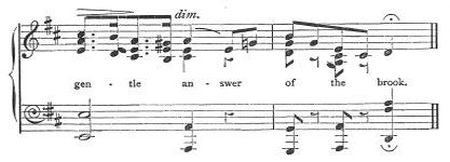
[Listen]
Thou, who hast sorrow in thy heart,
Go out to field and copse;
Let the cool winds breathe on thee
To make thee strong and whole.
Go over hill and over dale,
Go by the shining sea and hearken intent,
To the tale of sad-ness in the woods,
And the gentle answer of the brook.
Knutty slept.
But Katharine did not sleep. Hour after hour she
watched by the window, straining her eyes into the distance.
And as he still did not come, and the suspense
became intolerable, she went out to find him. It was
five o'clock when she left the Gaard, and nearly nine
when she returned.
"Has he come back?" she asked eagerly of Gerda,
who was standing in the porch. Gerda shook her head.
Just then Ole Persen, the mattress-maker, arrived at
the Gaard on his annual round to repair the mattresses
or make up new ones from the year's accumulation of
wool. Ole was the newsbringer of that part of the Gudbrandsdal,
and, for a mattress-maker, was considered to
be rather reliable. He would therefore have been quite
useless on the staff of an Anglo-Saxon evening newspaper.
He brought the news that over at Berg, about
ten miles away, an Englishman had been struck dead
by the lightning, and his body had been brought down
from the mountains to the nearest Skyds-station (posting-station).
Ole said that the people over there were
sure he was an Englishman, and the doctor had said that
the letters in his pocket were all from England. Ole had
not seen him; but they had told him that the dead
stranger was a tall thin man, with thin, clean-shaven
face.
Mor Inga and Solli looked grave.
"Art thou sure he was an Englishman, Ole?" Mor
Inga asked abruptly.
"I can only tell thee what they said," answered Ole.
"The doctor declared only an Englishman would have
so much money in his pocket."
Then Mor Inga told Knutty exactly what she had
heard, neither more nor less.
"It may not be our Englishman," Mor Inga said gently,
"but——"
And then Knutty told the others, first Gerda and
Katharine.
"It may not be our Englishman," Knutty said, looking
at them bravely, "but——"
She told Alan.
"Kjaere," she said, "it may not be your dear father,
but——"
In a few minutes Knutty, Katharine, and Alan were on
their way to Berg.
Solli whipped up the horses unsparingly, and admonished
them with weird Norwegian words. His voice and
the roar of the foss below were the only sounds heard;
for at the onset no one of that anxious little company
spoke a single syllable. They sat there with strained
faces; they glanced at each other with silent questionings,
and then as quickly turned away to look with sightless
eyes at the country which was growing sterner and
grimmer as the valley became narrower and shut them
in from all generous share of sky and space. Suddenly
there came a break in the valley, and a flood of light
broke upon the travellers; they breathed a sigh of
relief, and even smiled faintly, as though that unexpected
blessing had, for the moment, eased the overwhelming
burden of their hearts. They passed the
place where the church had stood before it was swept
away in the great avalanche of a hundred years ago;
and on they went, skirting a fine old Gaard built near
a great mound, said to be the resting-place of some
renowned chieftain; on they went, in their silence and
suspense. The two women glanced from time to time
at the drawn face opposite, and the boy felt the silent
comfort of their sympathy. When at last he spoke,
the relief to them was as great as if there had been
a second break in the valley. He bent forward and put
his hands on their knees.
"I don't know what I should do without you both,"
he said simply, and he drew back again.
"Stakkar," Knutty said, "two or three miles more,
and we shall know."
"Oh, Knutty," the boy cried in a sudden agony, "and
I've been saying such cruel things to him, and never
thinking about hurting him; and he went off all alone,
and I can't bear to think that——"
Alan broke off; and once more Knutty saw before
her the solitary figure of her beloved Englishman climbing
up the steep hillside and disappearing into the birch-woods.
She heard his words, "It will be all right for
me later." Her eyes became dim; and she would have
given way to her grief then and there, but for Katharine,
who, notwithstanding her own great need, lent
half her youthful courage, strength, and hopefulness to
the old Danish woman.
"Tante," she said in her impulsive way, "for pity's
sake don't forget that you are of Viking descent—a
heartless, remorseless pirate, in fact."
There came a faint smile on the old Dane's face.
"Thank you for reminding me of my ancestors, kjaere,"
she said.
"And besides," continued Katharine, "we may yet
find another break in the valley. We may find that all
our fears have been only the fears of love and anxiety."
"Do you really, really think that?" the boy cried,
turning to her with passionate eagerness.
"Yes, Alan," she answered, without flinching.
So she buoyed them up, and heartened herself as well,
although she was saying to herself all the time:
"Oh, my love, my love, if it be indeed you lying there
in the silence of death, then my womanhood lies buried
with my girlhood."
At last the horses drew up at the entrance of an old
Gaard which was also the Skyds-station of that district.
Solli had called out immediately, and a young woman
in the Gudbrandsdal dress stepped into the courtyard.
"Yes, yes, stakkar, he lies upstairs," she said, glancing
sympathetically at the three travellers. "Come, I
will lead the way."
They passed up the massive stairs outside the old
house, and reached the covered verandah. She pointed
to a door at the end of the passage.
"That is the room," she said gently; and with the
fine understanding of the true Norwegian peasant, she
left them.
Katharine put a detaining hand on Knutty and Alan.
"Shall I go in first and come and tell you?" she
asked. "I am the stranger. It should be easier for
me."
But they shook their heads, clung to her closer, and
so all three passed into the room together. The room
was not darkened; but sweet juniper-leaves had been
spread over the floor. Katharine led them like two
little stricken children to the bed of death: one of them
a child indeed, and the other an old woman of seventy,
childlike in her need of protecting help.
Then Katharine bent forward, and with trembling
hands reverently lifted the covering from the dead man's
face—and they looked.
A cry rose to their lips.
The dead man was not their beloved one.
Like children, too, Katharine led them from the room
and took them into the old Peise-stue below. Tante had
for the time being forgotten her Viking origin. Her nerve
completely forsook her; and she cried abundantly, from
the strain and the merciful loosening of the tension.
Once she smiled through her tears as she pressed Katharine's
hand and gave Alan a reassuring nod.
"Ak," she said, "this is not the correct behaviour of
an abandoned sea-robber, is it?" And to Alan she
added quaintly:
"Don't I make a beautiful comforter, kjaere? Ought
not I to be proud of myself?"
He made no answer, but came close to her, to show
that she was a comforting presence. He was painfully
quiet—indeed, he seemed half-bewildered; and Katharine,
glancing at his ashen face, knew that he was still
under the spell of death's mysterious majesty. She
wished that they had not suffered him to go into that
room of death; and yet he would never have been
satisfied to remain outside and take their word; it was
perhaps his own father lying there, and he had to see
for himself. But that part of it was over, and she felt
she must break the spell for him at once. She thought
of scores of things to say; but nothing seemed suitable.
Suddenly, without thinking, she said:
"I know it sounds dreadfully prosaic; but I believe
we should all be better for some food. I am famished.
Do go and ask that nice woman if we can have breakfast,
Alan."
The old Peise-stue in which they were sitting was a
typical old Norwegian room, with its quaint painted
furniture, its sideboard adorned with inscriptions, its
Peise in the corner, fitted up in true old fashion with a
shelf on the top, which was furnished with carved and
painted jugs and bowls. There was, of course, a recess
in the wall for the Langeleik, and a queer little cupboard
for the housewife's keys. Old carved and painted
mangles (manglebret), marriage gifts to several generations,
hung on the walls. The Kubbe-stul,[P] made from
a solid block of wood, stood in the corner. At any other
time Katharine and Knutty would have been deeply
interested in seeing this characteristic old place. But
now they scarcely noticed it. They sat together looking
at nothing, and awaiting in silence the boy's return.
He came back with a different expression on his face.
"It's all right," he said. "We can have breakfast.
I'm awfully hungry too."
"So am I," said Tante; and in a few minutes the
servant, in her pretty costume of red bodice, white sleeves,
and black skirt edged with green, served them a good
meal of trout, fladbröd, and admirable flödemelk (milk
with cream).
"Ripping, isn't it?" Katharine said, nodding approvingly
to Alan.
"Ripping," he answered, always so glad and proud of
her camaraderie.
"And now you'll go back to the Gaard," she went on,
"and I believe you will find your father waiting for you
there, Alan. This was a false alarm of danger, and I
cannot think there is any more trouble in store."
"Do you really think that?" they both said to her.
"Yes," she answered, touched beyond words by their
pathetic dependence on her. "I believe he will come
down from the mountains, and that you will find him
safe and sound."
"But you will be there too?" Alan said anxiously.
And Knutty also said:
"But you will be there too?"
"I shall be with you in spirit," Katharine said; "but,
you see, my place is here, upstairs, Knutty, with that
dead Englishman, lying lonely and uncared for in a
strange land. I could not go away until I, as an Englishwoman,
had done something on his behalf: watched
by him a little, written to his people, done something
to show him that our gratitude to him for not being—ours—had
passed into gentle concern for him and his."
Her voice faltered for the first time that morning when
she paused at the word "ours."
"So you will go back without me," she said; "but
you will tell Professor Thornton why I stayed behind.
He will understand."
"Ah," said Knutty, looking at her lovingly, "you
English people have the true secret of nationality."
So they left her there, sadly enough; yet knowing
that for the moment her place was not with them, to
whom she had already been so much, but with her dead
countryman upstairs. Knutty, with many tender instructions,
gave her into the charge of the people of
the house. Solli's last words as he drove off were:
"Take care of the English lady. Send her safely back
in your best cariole."
Katharine stood watching the carriage until it was out
of sight; and then a great longing and loneliness seized
her. The music and words of Gerda's Swedish song
suddenly came into her remembrance:
"The lover whom thou lov'st so well,
Thou shalt reach him never—ah ... ah ...!"
And the wail of despair at the end of the verse smote
as a piercing blast on her spirit.
"Yes," she said, "he will come down from the mountains,
and the joy of reunion will be theirs; and I shall
be outside of it—outside of it as always. Always outside
the heart of things."
She went slowly up the stairs; but when she reached
the threshold where the dead man was lying alone and
as yet unmourned, she had forgotten herself and her
own personal life.
She uncovered his face once more. There was the
burnt mark where the lightning had passed through his
brain. She tried to hide it with his hair. His eyes were
closed; but she laid her gentle hands on each of them,
so that his own countrywoman, and not a foreigner,
should be the one to put the last seal of sightlessness
on them. She drew a soft little handkerchief from her
satchel and spread it over his face. Then she glanced
through the letters and papers which had been found
on him, and she discovered his name and his home
address in Cornwall. He was a soldier, captain in one
of the line regiments. Probably he had been out in
South Africa. Yes, there was a letter addressed to him
at Bloemfontein. Katharine's sympathy deepened.
"Even more willingly do I watch by him," she said.
As there was no evidence of where he had come from
in Norway, and as the people of the Skyds-station had
not even begun to make active inquiries, she telegraphed
to his Cornish address, and also to two or three of the
sanatoria in the more mountainous part of the country.
No answer came; and meantime she watched by his
side, weaving from some forget-me-nots and berries a
garland, which she placed at his feet. It was no strain
to her to be giving her companionship to the dead.
Katharine was fearless of life and fearless of death, fearless
of the living, fearless of the dead. Her mind wandered
back to her own dead: her mother whom she had
loved passionately and lost as a young girl; her girlhood's
lover, whom she had lost when she was scarcely
twenty; her school-friend, whom she had laid to rest
ten years past. When each of them had died, she had
said, "This is the end of everything for me." But she
knew that those words had been no truer for her at
thirty than at thirteen, and that the only end of life
itself, and therefore of life's thrill, was death itself;
and then was that the end? Was there immortality?—and
what was immortality? Was it, as some one had
once told her, merely the natural persistence under
different conditions of the temperamentally strong?
Not necessarily the persistence of the good, but of the
masterful? She thought of all the forceful people she
had known, and she could not believe in their obliteration;
somehow, somewhere they would surely continue
their individual processes for good or for bad. She
thought of all the half-toned, colourless people she had
known, who scarcely seemed to have any life in them
in this life. Was it reasonable to suppose that there
could be any continuance of their feeble outlines?
She recalled a conversation she had had with an embittered
man in Arizona. He had scoffed at everything:
at life, at love, at patriotism, at death, at immortality.
"Belief in immortality!" he had cried. "Why, it is
just a typical bit of selfishness, that's all. We want
immortality for ourselves and for those we love. But
we do not want it for those we hate. We do not want it
for those who interfere with us. We may pretend to
have the principle of it implanted in our hearts; but all
we really care about is the offshoot—the personal application
of it to our own individual needs."
She remembered she had said to him:
"Yes, but the people hated by us are loved by other
people; so that all the thousands and thousands of personal
applications create the great principle, surely?"
She remembered his answer:
"That is not logical," he had said.
"Logical!" she had replied. "What a word to use
about the great mysteries of life and death! Learn to
love some one. Then you will not crave to be logical
about immortality; you will only crave to believe in it."
He had laughed at her; but two years later he wrote:
"Since seeing you, I have loved and have lost my
love. I buried her in the little canon not far from my
ranch. I find myself turning, spite of myself, to a belief
in immortality, whatever that may be."
Whatever that may be. That was the whole mystery
which the reasoning of all the finest brains in the world's
history had failed to unravel. Love, itself a great mystery,
had done more. Was it possible that love, itself a mystery,
and yet a key to many of life's perplexing problems,
might prove to be the only key to the problems
of death?
These thoughts passed through Katharine's mind as
she watched over the dead.
Once she turned in her impulsive way to that silent
companion.
"If you could only tell us what you have found!"
she cried.
And then she recalled to her mind something which
a great thinker had said in her presence.
"Some day," he had said, "we may stumble across
the natural means of communication with the dead, and,
like all other great discoveries, it will seem simple. The
difficulties are insuperable in the present state of knowledge
among the living; and the dead have to recover
from the shock of death, and to find readjustment to
altered conditions of existence. But there is all Time
in which to work out the discovery; and there is
always the chance that we may find out the great truth
by an accident of detail in our researches and reflections."
"But the dead have to recover from the shock of death."
What was it he meant? Death was a shock to the
nervous system of the living; but to the dead themselves
surely it was——Ah, that was just the whole
mystery; and the chemist, the philosopher, the poet,
the musician, the explorer, the priest, and herself, an
ordinary unilluminated person of average intelligence,—all
were mere surmisers—mere surmisers....
Then the door was gently opened, and Katharine,
leaving with a sigh of relief the regions of surmise, came
back to actual life; for, first and foremost, she was
human, and the earth was her territory. The woman
of the Gaard said something to her, and beckoned to
her. Katharine followed her out of the room, and tried
to understand what she was saying, but could only
gather the words, "To Engelske" (Two Englishmen).
The woman, who seemed greatly harassed, took her
straight to the "Peise-stue," pointed in a despairing
way to two men, said, "Engelsk," and hurried off, holding
her hands to her head, as though things were too
much for her. Katharine saw two Englishmen sitting
warming themselves before the fire. They turned round
as she came in, and she noticed at a glance that the
elder of the two was the exact image of the dead man
upstairs.
"Then you got my telegram," she said, thinking at
once of the telegram which she had sent off to three of
the mountain sanatoria.
"Telegram?" said the elder man, looking at her in a
puzzled way. "What telegram? I've had no telegram;
could have had no telegram. I, my friend, and my
brother have been out in the mountains fishing; but
my brother left us. The storm came on; he did not
return, and we made our way down here, hoping to find
him or get some news of him. Perhaps you can tell us
something; for the woman of the house does not understand
a word we say, and we don't understand her. We
are quite bewildered, and so is she."
Katharine looked at the two Englishmen, and saw
that they were worn out, wet through, and hopelessly
at a loss. Her protective instincts for those who were
in trouble leapt up within her. She was not going to
suffer these tired fellows to have any unnecessary shock,
and so she took the precaution of asking the elder man
his name.
It was the name of the dead man upstairs.
Then in the gentlest manner possible, as though she
had known this stranger years instead of minutes, Katharine
broke the sad news to him.
When Clifford said good-bye to Knutty and passed out
of sight into the birch-woods, he had no intention of
going in any definite direction. He wished to get on
to the heights somewhere and be alone with Nature,
that tender nurse who is ever waiting to hold out her
healing hands to the sick of body and of spirit. She
had never failed him, and he knew that she would not
fail him now; that she would minister to him in her
own beautiful, strengthening way, until she had made
him whole; putting balm on stinging wounds, and exchanging
his cup of bitterness for a phial of courage.
He had always loved her, always sought her out, always
laid everything before her, and learnt from her, over and
over again, the relative value and the actual size of the
difficulties which life presented to him. He had carried
out to her some burden which seemed enormous, and
brought it back from her so shrunk that he would scarcely
have known it for his burden; rather for some one
else's load, which is always deemed lighter. So he went
to seek her help. He strolled through the birch-woods,
scarcely noticing where he trod; gained the open slopes,
and then climbed slowly in the direction of a little
isolated Saeter which commanded a view of the fine
Rondane mountains. He paused now and then, and
dug his stick into the springy moss and the stunted
juniper-bushes.
"The boy always loved me," he said bitterly. "And
now?"
And Nature said:
"He will love you again."
"Ever since the little fellow could find his way about
he wanted to be with me," he said bitterly. "And
now?"
And Nature said:
"He will want to be with you again."
"It is all so much worse than I thought," the man
said bitterly. "At the very worst I thought that he
might have believed I had been unkind to Marianne.
But——"
And Nature said:
"He did not know what he did believe. The tiny cone
of disbelief had grown into one of my giant forest-trees.
But now we have hewn down that giant tree, used it to
defeat itself, and made a strong bridge of it, over which
the boy passes to reach you again."
"Passes back to me as he was before?" the man
asked.
And Nature said:
"No, no, passes forward, onward to meet you at
another point. For you, too, have passed on."
"Ah," cried the man, "I have been forgetting him.
All my thoughts have been for her—and this is my just
punishment, that in the midst of my selfish happiness
I should be wounded in my tenderest affections, and
reminded of the bitter past—reminded of the manner
of Marianne's death and my share in it."
"Morbid conscientiousness, morbid conscientiousness,"
Nature said. "Often have you and I fought out that
battle together—fought it out at midnight on the moors
and on the mountains, and along the lonely country
roads. And now we must fight it out again; here, this
very moment, with the Rondane in front of us, and the
snow-peaks in the distance, and the great Gudbrandsdal
spread out below us."
So they fought it out, and it was a hard battle, a
hand-to-hand fight; for the man was stubborn, and
prepared to defend his fortress of self-reproach and sadness
to the bitter end. But Nature gathered together
all her forces—and conquered.
And when the dire battle was over, she held out her
hands to him, and ministered to him; at her bidding
the bracing mountain air sent currents of fresh life into
the man's body; the great expanse sent a thrill of
freedom into his soul; the magnificence of earth and sky
sent a thrill of gratitude and gladness into his spirit.
"The earth is beautiful and life is splendid!" he cried,
as he lifted up his head and passed on his way.
"Ah," said Nature softly.
"The boy loves me!" he cried. "We shall have a
closer friendship than before."
"Ah," said Nature gently.
"I have the right to love her!" he cried. "I shall
seek her out and tell her everything."
"Ah," said Nature softly.
"Yes," the man cried. "I shall tell her everything
about my poor Marianne's death. She has a great heart
and a noble mind. She will understand. My beautiful
love——"
"Ah," said Nature tenderly. "I can safely leave him
now—conquered and renewed."
And yet she paused for a moment, fearful to leave his
side until she was certain that the child whom she had
always loved had reached a firm foothold of healthy
human instincts.
"My beautiful love!" he cried. "You understood
from the very beginning, and came to warn me of Mrs
Stanhope's slanderous tongue. I little guessed what she
was capable of saying to my boy; but you knew, and
did not shrink from me."
Then, as his thoughts turned to Mrs Stanhope, anger
and indignation took possession of him.
"I will go and find her now," he cried. "I will find
my way over the mountains somehow, and see her face
to face."
"Ah," said Nature, smiling, "I can leave him now in
the safe keeping of human love and healthy human
anger."
So she left his immediate presence, and he became
unconscious of his surroundings, and tramped across the
rough mountainous country determined to reach Mrs
Stanhope. He did not notice the signs in the heavens;
the gathering storm gave him no warning; or at least
no warning reached him. The storm broke loose at last,
and aroused him to the knowledge that he was miles
away from the Gaard, lost on the mountains, and alone
with Nature in her wildest mood. The heavens were in
raging tumult; the thunder was terrific; the lightning
appalling. At first there was no rain. The man leaned
against a rock and watched the awful splendour of the
scene; watched the opening of the clouds and the passing
of the lightning. It held him spellbound, entranced.
He had always loved to be out in a great storm. He
stood there, an unconscious target for its fury, and nothing
harmed him; the lightning played around him, tore
up the ground within a few yards of his feet, withered
up a stunted juniper-bush within reach of his arm.
Nature, working harm and bringing sorrow in other
directions, spared him to those who loved him and were
waiting for him.
So he stood, confronting the storm, with all personal
thoughts and emotions in abeyance. But when the rain
poured down in torrents, he began to think of finding
shelter, and remembered that he had passed a lonely
little Saeter. He had only a vague idea of his bearings;
and, indeed, without knowing it, as he tried to
retrace his steps he was wandering farther away, both
from that Saeter and from the Gaard.
He became distressed about the anxiety which his
prolonged absence would be causing to his friends: to
dear old Knutty, who had seen him start off so sadly:
to his boy: to Katharine. He knew that they were
waiting for him, and wanting him, and that they were
watching the storm, and watching the evening fading
into the night. He knew so well that Knutty would
pretend not to be troubled, and would scold every one
who even suggested that there might be cause for anxiety.
He almost heard her saying:
"He loves a thunderstorm. The silly fellow, I know
him well!"
He smiled as he thought of her.
"My dear old Dane!" he said. "My dear old brick
of a Dane!"
He wandered on and on trying to find the Saeter,
changing his direction several times, but in vain. But
at last he caught sight of a habitation at some distance,
and made straight for it, thankful to have found a haven.
There was a light in the hut. Clifford knocked, and the
door was instantly opened. There was a fire in the stove.
"Ak," said the old woman who opened the door, "I
thought it was my son. But you are welcome. It is a
fearful night. Many times I thought the hut was struck.
I am glad for company."
The son came in a few minutes afterwards, and she
made hot coffee for them both, whilst they dried themselves
before the crackling logs. And overcome by the
genial warmth and his long wanderings, Clifford slept.
And he dreamed of Katharine. He dreamed that he,
who had always found speech difficult, was able to tell
her the story of Marianne's death. He dreamed that he
went on telling her, and she went on listening; and it
was such an easy matter to tell, that he only wondered
he had been silent so long.
"And that is all," he said, and he waited for her to
speak as she turned her dear face towards him. But
when she was beginning to speak, he awoke.
He awoke, glad and strong. He who had come out
broken and embittered, was going back made whole and
sound. He thought of his last words to Knutty:
"I shall be better later."
They had come true. The long wrestle with morbid
conscientiousness, his defeat, his wanderings, the great
storm, the safe arrival at a haven, his dream, and now
his glad awakening had made him whole.
The storm had died down about two in the morning,
and it was nearly six before he awoke. He could scarcely
wait to drink the coffee which the old woman prepared
for him; scarcely wait to hear her directions for getting
back to the Gaard. He was off like some impatient boy
before she had finished telling him.
His step was brisk, his heart was light, his grave
face was smiling. He sang. He did not notice that the
way was long and rough. Everything in life seemed
easy to him. He trod on air. At last, after several
hours, he saw the smoke of the Solli Gaard. He hastened
through the birch-woods, down the hillside, and into the
courtyard. There was a group of people standing round
the carriage, which had evidently just come back from
a journey. Mor Inga and Gerda were helping Knutty
out of the carriage. Ejnar, Alan, and the Sorenskriver,
Solli, Ragnhild, and every one belonging to the Gaard,
including old Kari, crowded round her.
"Thank God, thank God, it was not he," she was
saying.
Then old Kari looked up and saw Clifford. She firmly
believed him to be dead and thought this was his
ghost.
"Aa Jösses!"[Q] she cried, falling down on her knees
and folding her hands in prayer.
They all turned and saw him. Alan rushed forward
to meet his father.
"Oh, father," the boy cried, "we thought you were
dead—killed by the lightning."
Then his pent-up feelings found their freedom in an
outburst of passionate, healing tears. Clifford folded
him in his arms and comforted him.
"And you cared so much?" the father asked, with a
thrill of gladness.
"Yes, yes!" the boy whispered, clinging close to him.
Then arm-in-arm they came to Knutty, who in her
unselfishness had stood back, wanting her two icebergs
to have their meeting to themselves.
"Dear one," she said, with tears in her eyes, "I have
done all my crying, and every one can tell you that I
have behaved disgracefully. And now I can do my
scolding. How dared you give us so much anxiety?
Ak, it is all too much for me. I'm going to cry after all."
He stooped and kissed her hand.
"Don't scold me, and don't cry, dear Knutty," he
said. "I have come back from the mountains strong
and glad."
They all pressed round him, greeting him warmly.
Every one belonging to the Gaard seemed to him to
be there, except Katharine. And he hungered for the
sight of her.
"Knutty," he asked, "where is she—where is Miss
Frensham?"
Knutty led him away and told him in broken words
the history of the morning, and their fearful anxiety,
and Katharine's tender kindness.
"And she stayed there with the dead Englishman,"
Knutty said gently. "She said she could not leave him
alone, and that you would understand. She said you
would come down safely from the mountains, and the
joy of reunion would be ours, and that she would be
with us in spirit. I know, kjaere, she suffered greatly
in staying behind."
The man's lip quivered.
"I will go to her," he said.
And the next moment he had prevailed on Solli to
change the horses and let Jens come with him. It was
all done so quickly that Solli had no time to relent.
Clifford sprang in, signed to Alan to follow him, and
they were off. Old Kari, rather sullen at having been
done out of the ghost, retired crestfallen to the cowhouse.
But Gerda and Tante, Mor Inga and Ragnhild, stood
watching the carriage until it had wound round the hill
and was out of sight.
"Nå," said Gerda, turning to Tante, "I begin to
think that your Englishman is going to fall in love with
Fröken Frensham. Who would have imagined such a
thing?"
"Every one except you," replied Tante, giving her a
hug.
"And why not myself?" asked Gerda.
"Because you are an unilluminated botanical duffer!"
answered Tante.
Katharine lingered a little while longer at the Skyds-station
to comfort, by her sympathetic presence, the
brother and friend of the dead Englishman. To the
end of their lives they remembered her ministration.
She gave out to them royally in generous fashion. It
was nothing to her that they were strangers; it was
everything to her that they were in trouble and needed
a little human kindness. They themselves had forgotten
that they were strangers to her. It was a pathetic
tribute to her powers of sympathy that they both spoke
of the dead man as if she had known him.
"You remember," the brother said, "he never did
care for fishing. It always bored him, didn't it?"
"Yes," said Katharine gently.
"Do you remember him saying a few years ago," the
friend said, "that he should love to die on the mountains?
He always loved the mountains."
"Yes," said Katharine gently.
She scarcely had the heart to leave them; but at last
she rose to go, telling them there was an Englishman
at the Solli Gaard who spoke Norwegian well, and who
would come to help them.
"He is the one for whom we came to seek here," she
said, looking away from them. "We are not yet sure
that he is safe; but if he comes down from the mountains,
I know he will hasten to help you about——"
They bowed their heads silently as she broke off.
"We shall take him home to England," the brother
said.
"I am glad he will rest in his own country," Katharine
answered.
The people of the Skyds-station fulfilled their promise
to Solli, and put Katharine in their best cariole. The
two strangers helped her to get in, and then stood watching
her. They could not speak. But when she held
out her hand in farewell greeting, each man took it and
reverently kissed it. She was touched by their silent
gratitude, and the tears came into her eyes.
"I am so thankful I stayed behind," she said.
Then the driver, a little fellow of about twelve years
old, whipped up the yellow pony, and the Skyds-station
was soon out of sight.
"And now, if indeed he has come back, I shall see
him," Katharine thought, with a thrill of happiness.
At the Skyds-station, when, by her own choice, she
was left alone, she had for the moment felt the bitterness
of being outside everything. She remembered her
own words:
"He will come down from the mountains, and the
joy of reunion will be theirs, and I shall be outside of it—outside
of it as always. Always outside the heart of
things."
That moment had been only one of the many times
of passing sadness and bitterness in Katharine's life,
when she had said and felt that she was outside everything:
outside the inner heart of friendship which never
fails, outside ambitious achievement, outside the region
of great gifts, great talents, outside the magic world
of imagination, outside love. Her friend had died, her
girlhood's lover had died, her brother had failed her.
She was alone, a solitary spectator of other people's close
friendships, passionate love, successful work, absorbing
careers; alone, outside the barrier which separates all
restless yearning spirits from that dim Land of Promise;
alone, outside. She, ever unconscious of her own genius
of giving, had no means of knowing that, by a mysterious
dispensation, those who give of themselves royally,
without measure, are destined to go out alone into the
darkness of the night; alone, outside everything in
life.
But no such sad reflections came to Katharine now,
as she sped along the narrow valley, by the side of the
glacier-river. Her thoughts turned to Clifford and
Knutty and Alan in loving unselfishness.
"The boy will have seen his dear father, and will now
be comforted," she said.
"Knutty will have seen her Englishman, and will now
raise her old head again," she said.
"Ah, how I hope and hope he was there to receive
them when they got back to the Gaard," she said.
"And now I shall see him, and the joy of reunion will
be mine," she said.
But in the midst of her happy thoughts and yearnings,
she did not forget those two lonely compatriots and that
silent companion in the bedroom of the Skyds-station.
"My poor strangers," she said, "we will not forsake
you."
They had come to the place where the sudden break
in the valley had cheered them during that terrible drive
of the morning.
"Yes," thought Katharine, "that gave us hope this
morning. I should recognise this spot anywhere on
earth. It was here I began to have a strong belief that
it could not be he lying dead at the Skyds-station."
"Oh," she thought, with a shudder, "if it had been
he!—if it had been he!"
And her own words echoed back to her as an answer:
"My womanhood would be buried with my girlhood."
Then she looked up and saw a carriage in the distance,
in the far distance. The boy also saw it. As it approached
nearer he said:
"It is from the Solli Gaard. That is Jens driving."
Katharine's heart gave a sudden bound.
"Haste, haste!" she said excitedly to the boy; and
he, moved by her eagerness, urged on the little yellow
pony, which rose to the occasion and flew over the ground.
Carriage and cariole drew up at the same moment,
and Katharine saw face to face the man whom she loved.
"We came to fetch you," he said.
Bedstefar had been dead for three days, and it had
been arranged that the funeral was to take place a week
after the night of his death. Preparations had been
going steadily forward, interrupted only by the anxiety
and excitement caused by Clifford's long absence in the
mountains and his supposed death. Bedstemor herself
had been much troubled about him, and had spent
a good deal of time watching for him. But when he
returned safely, she felt free to continue her persecutions
in the kitchen; and it took a great amount of
Knutty's craftiness to entice her into the porch and
keep her there. Bedstemor was astonishingly well,
seemed in excellent spirits, and in answer to questions
as to how she felt, she always said briskly:
"Bra', bra,' meget bra'" (Well, very well).
Indeed, she was not a little gratified to be once more
the central figure of circumstances, as in the old days,
before she and her husband had retired to the dower-house.
But, spite of her cheerfulness, she looked a
pathetic old figure wandering about, relieved from constant
attendance at her sick husband's bedside, and
thus thrown on the little outside world for distraction
and company. Tante was endlessly kind to her, but
had many a secret laugh over the old widow's unfunereal
attitude of mind, and over her stubborn determination
to go and bully every one in the kitchen. Tante herself
was in great form again. She had recovered from
her fears and tears, and had, so she told Katharine,
regained her usual Viking bearing.
"Never shall I forget your tenderness, dear one," she
said to Katharine. "If I loved him even a hundred
times more than I do, I should not grudge him to you.
He loves you, and you are the right aura for him. And
some day he will tell you so, although it will not be very
soon, stupid fellow! He will try and try many times,
and leave off suddenly. I know him well, my prisoner
of silence. These reserved people! What a nuisance
they are to themselves, and every one else! But to
themselves—ak, ak, poor devils!"
Katharine, who was standing at the time on Knutty's
bedroom-balcony, looked out into the distance. She herself
had been somewhat silent since that sad morning at
the Skyds-station.
"The end of it all will be, dear one," Knutty continued
recklessly, "that you will have to help him.
This sort of man always has to be helped, otherwise he
goes on beginning and leaving off suddenly until Doomsday.
I know the genus well."
Katharine went away.
"Aha," said Knutty to herself, "I have said too much.
And, after all, it is premature. Oh, these parish-clocks!
Why, Marianne has only been dead about a year. How
like her, only to have been dead about a year! Oh, oh,
what a wicked old woman I am!"
She called Katharine, and Katharine came.
"Kjaere," she said, as she stroked Katharine's hand
lovingly. "I have always been a free-lance with my
naughty old tongue. No one with any sense takes any
notice of me. And am I not funny and human too?
All this time I have only been thinking that you are the
right aura for my Clifford. Not once have I asked myself
whether my Clifford were the right aura for you! I
should have been an ideal mother, always on the alert
to snatch up all the best things for those I loved, regardless
of other people's feelings and interests. Ah, that is
right, you are smiling, and not angry with your Viking
friend. And, dear one, that reminds me again of how
you comforted me when I was not behaving like a Viking.
Do you remember assuring me that his absence, and
Alan's anxiety for him, were working for their complete
reconciliation? Your words have come beautifully true,
haven't they? Well, you have the great heart that
knows."
They were a small party at the Gaard now. Ejnar
had gone off to Kongsvold in the Dovre mountains, a
district specially interesting to botanists as the habitat
of certain plants not found elsewhere. Gerda would have
gone with him, but that she had sprained her ankle. She
fretted for her Ejnar, although she pretended that his
absence was a great relief.
"It is grand to be free at last!" she said to Tante.
"Free at last. I can now take a long breath."
"Yes," said Tante, smiling mischievously, "freedom
is delightful when it does not make your nose red and
your eyes moist!"
Alan had gone off with Jens to a mountain-lake to
catch trout for the funeral, and would not be back for a
day or two; and Clifford was away at the Skyds-station,
helping the two strangers to make the necessary arrangements
for taking their sad burden home to England. All
the other guests except the Sorenskriver had left, and he
was in a thoroughly disagreeable mood, grumbling about
the food, and annoyed because there was going to be a
funeral at the Gaard.
"Then why not go away?" Katharine suggested on
one occasion, when his martyrdom had reached an acute
stage.
"Thank you, I choose to stay," he answered in his
gruffest tone of voice.
Katharine laughed. She liked the Sorenskriver even
at his worst.
"Read this German newspaper, with a whole column
of abuse against England," Katharine said, teasing him.
"That will make you feel cheerful, Sorenskriver."
"Sniksnak!" said the Sorenskriver, a little less roughly.
"Or come out for a walk with me and help me pick
multebaer," she added. "Mor Inga was saying she had
not half enough as yet."
"Perhaps I will come," he answered, with a grim
smile on his face. He took pleasure in Katharine's
company, and was secretly delighted that Clifford was
busy helping those Englishmen over at the Skyds-station.
In this way he got Katharine to himself, and he sat
smoking his long pipe in the porch, grumbling and disagreeable,
but, in justice it must be owned, gentle to
Bedstemor. Tante declared that he was courting Katharine.
"I am given to understand, dear one," she said, with
a twinkle in her eye, "that the Norwegian way of courting
is to be extremely disagreeable, and almost rude to
the person whom you adore. In a day or two you will
have a proposal—and what then?"
"Tante thinks only about marriages," Gerda said
reproachfully.
"Well, what else in the world is there to think about?"
Tante asked defiantly.
"Oh, Tante, you know you do not think that," Gerda
said. "If you really thought that, why didn't you get
married yourself?"
"Because, kjaere, no one would have me, except a
sea-captain, and he was mad," Knutty answered. "And
he killed his mate soon afterwards. I was always glad
I was not his mate!"
"It is not true," Gerda said, turning indignantly to
Katharine. "She had lots of admirers and lovers. You
ask her Englishman. He knows."
"Ah," said Knutty, "perhaps I did have a few
admirers in my time! You may be sure no sane woman
would ever say she had never had any, unless there was
some one at hand to deny her statement."
When Clifford came home that evening, Knutty herself
broached the subject again.
"Kjaere," she said, "did I have a few admirers in
my time, or did I not? I have forgotten. Not that a
woman ever does forget, but tell me!"
"You had numbers, Knutty," Clifford answered, smiling
at her; "and I was jealous of them all. At nine
I was jealous of the sea-captain, and at ten I was jealous
of the clergyman in Jutland, and at twelve of the English
architect, and at thirteen of the Swedish officer, and so
on and so on."
Later in the evening, when he and Katharine were
sitting alone near the great hay-barn, Katharine spoke
of Knutty.
"She is the dearest old woman I have ever met," she
said warmly. "I don't wonder that you all love her."
"I can never tell you what she has been to me," he
answered. "It was always a great grief to me that——" He
broke off.
"It was a great grief to me that——"
Again he broke off. He was trying to speak of Knutty's
indifference to Marianne; and even this was too hard
for him to say. Up in the mountains, he had felt that
it would be easy for him to tell Katharine everything
that he had in his heart, beginning with the story of
Marianne and Marianne's death, and ending with himself
and his love for her. But now that he was near her,
he could say nothing about his own personal life and
inner feelings. He could only bend forward and scratch
a hole in the ground with his stick. Katharine remembered
how Knutty had spoken of his "beginnings" and
"breakings off," and she said:
"Knutty understands you through and through, Professor
Thornton. Doesn't she?"
"Yes," he answered simply. "But why should you
say that just now?"
"Oh, I don't know," Katharine answered. "I was
thinking of her, and it came into my head. And I was
so touched by her grief when she feared that she—we—had
lost you."
"I do not know what she and the boy would have
done without you," he said, still working with that stick.
Katharine was silent.
"And I cannot think what those men over at the
Skyds-station would have done without you," he said.
"Their last words to me this afternoon were, 'Tell her
we shall always be wishing to serve her.'"
Katharine remained silent.
"There was this little packet which I was to give
you," he said, after a pause. "It was the poor fellow's
South African service-medal. You were to have it."
He watched her as she opened the packet and touched
the medal. He watched her as she put it in the palm
of her hand and looked at it with dim eyes. It would
have been easy for him to have opened his heart to her
then and there, if he could only have known that she
was saying to him with speechless tongue:
"My own dear love, whilst I am looking at this soldier's
medal, my heart is giving thanks that the lightning
spared you to me."
But he could not guess that, and the moment passed.
The next day, when they were again alone, he attempted
to speak.
"Do you remember my saying up at the Saeter that
I tried never to dream?" he began.
"Yes," she said. "I have always wished to ask you
why you should feel so strongly about dreams."
"I should like to tell you," he said eagerly. "I want
to tell you. But——"
He broke off again, and turned to her with a pathetic
smile on his face.
"Speech has never been easy to me," he said.
The day before Bedstefar's funeral Jens and Alan came
down from the mountain-lake laden with nearly two
hundred pounds of trout, and the cotters' children finished
their task of bringing in all the multebaer they
could find; for no Norwegian entertainment, taking
place at this season of the year, would have been considered
complete without this much-loved fruit; and
certainly it would seem that multebaer had a softening
effect on the strange and somewhat hard Norwegian
temperament. As Tante said, from her own personal
observations of the previous days, multebaer spelt magic!
"Ibsen has not done justice to his country," she told
Gerda. "He ought at least once to have described
them as being under the influence of these berries.
Then a softer side of their nature would have been
made apparent to all. Why, the Sorenskriver himself
becomes a woolly lamb as he bends over his plate of
cloudberries-and-cream. He ought to have his photograph
taken. No one would recognise him, and that
is what photographs are for!"
They all helped to decorate the Gaard inside and out
with branches of firs and birches. Bedstefar's black
house was decorated too, and the whole courtyard was
covered with sprigs of juniper and fir. A beautiful arch
of fir and birch was raised over the white gate through
which he would pass for the last time on his way down
to the old church in the valley.
Katharine, together with Ragnhild and Ingeborg, spent
many hours making strips of wreathing from twigs of
the various berry-shrubs up in the woods. Karl used
these for lettering; so that stretched from side to side
of the arch ran the words, "Farvel, kjaere Bedstefar."
When he had finished, every one came out to see his
work, and Mor Inga, turning to Tante, said proudly:
"My Karl is clever, isn't he?"
And she whispered:
"Three years ago he did that for our eldest son, and
bitterly we were weeping then. I go about thinking of
that now."
Then Tante and Mor Inga took a little stroll away from
the others, outside the gate and down the road towards
the great cowhouse. Part of this road, too, had been
planted with tall fir-branches, so that Bedstefar would
pass under the archway and through an avenue of green
until he reached the outer white gate, which was the
entrance to the Gaard enclosure. And here Mor Inga
and Tante lingered, whilst the proud Norwegian heart
gave vent to its sadness, and the kindly Danish heart
beat in understanding sympathy, and the dead son's
dog Jeppe came and whined softly in token that he too
was mourning in remembrance of the past.
So the night, the bright Norwegian night, beginning to
realise that its brightness was being threatened, seeing
that the birches were counting their yellow leaves, even
as we, no longer young and not yet old, count our grey
hairs, this summer night passed almost imperceptibly
into morning, and the activities of the next day began
early.
Bedstemor, reinstated in her former rôle of leading lady
of the Gaard, was in a state of feverish excitement. She
was dressed in black, and wore over her bodice a fine
black silk shawl one hundred years old. Her head was
encased in a sort of black silk night-cap, edged with old
white lace: so that her pretty face was framed in white.
A slight flush on her cheeks made her look strangely
youthful. She sat in the porch waiting to receive the
guests; and by special request of Mor Inga and Solli
himself, Tante, Gerda, and Katharine sat there too.
They felt awkward at first, knowing themselves to be
there in the capacity of sightseers rather than that of
mourners; but Bedstemor's cheerful spirits put them
at their ease. She was much interested in Katharine's
dress-material, feeling the texture and comparing it with
her own.
"It is very good," she said thoughtfully, "but not so
good as mine!"
All the same, that dress-material worried her; she
fingered it several times, nodded mysteriously, and seemed
lost in thought; whether about Bedstefar or the dress-material,
no one could of course decide. But, later, she
spoke of some wreaths which had been sent, and she
said quaintly:
"Min mand did not want any flowers. But it does not
matter much what he wanted. He won't know, stakkar,
will he?"
At last the guests began to arrive, some in carioles,
some in stol-kjaerres, and some few in ordinary carriages.
They all brought funeral-cakes in large painted baskets.
As each conveyance drove up into the courtyard, one of
the daughters, either Ragnhild, or Ingeborg, or Helga,
went out to meet it, greeted the guests, and bore away
the cake into the kitchen. It seemed to be the etiquette
that the cake should be received in person by one of
the family. The horses, most of them the knowing little
Norwegian yellow Nordfjord pony, or else the somewhat
bigger Gudbrandsdal black horse, were unharnessed and
led away by the cotters. The guests advanced awkwardly
to the porch, greeted Bedstemor, and turned to
the strangers shyly, but were at once reassured by
Tante's genial bearing and Katharine's friendly smile.
Gerda, too, was at her best, and was feeling so cheerful
that Tante feared she was going to break into song.
Quaint, strange-looking people crossed that threshold,
shook hands with every one in the porch, and passed
into the house to find Bedstemor, who had disappeared
into the hall, and was seated in a corner drinking port
wine with an old friend. Wine and coffee were served
at once, as a sign of welcome to the Gaard. The flag,
which had been lowered to half-mast since Bedstefar's
death, was now hoisted full-mast to welcome the guests
to the proud Solli homestead. The women, some of
them beautiful in feature, were ungraceful in form and
bearing; they dressed no longer in the picturesque Gudbrandsdal
costume, but were all clothed in ill-fitting
black dresses, with no remnant of the picturesque anywhere:
queenly-looking women, some of them born, one
would think, to be mothers of Vikings; and most of
them with proud pedigrees which would excite envy in
many a royal breast: shy and awkward, most of them,
even with each other. The men had perhaps a little
more savoir faire, but it was easy to see that they all
led lonely lives, and were part and parcel of that lonely
land on which Nature has set a seal of mystic melancholy.
Some of the men were fine fellows, but none as handsome
as Solli, Karl, and Jens; but the Solli tribe had long
been celebrated for their good looks, and old Bedstefar
in his time had been voted the best-looking man in the
whole of the Gudbrandsdal. The guests were nearly all
Bönder (landowners), representing the best blood in the
valley; most of them having the largest Gaards, and
the best-decorated pews in the churches of the different
districts. Then there was the Lensmand (bailiff), a
weird old man, rather feeble of gait, but acute in wit.
He seemed much taken with Katharine, and came several
times to shake hands with her, pretending to be a newcomer
each time. But he had to keep more in the
background when his superior officer, the Foged (under-magistrate),
appeared on the scene. This gentleman
was, of course, a local personage, and he brought a very
large wreath and wore an important black satin waistcoat.
There was also the doctor, Distriktslaege[R] Larsen,
famous for his rough ways and disagreeable temper, but
also for his skill in mending broken arms and legs during
the "ski" season. He seemed rather scornful of the
whole scene, but not of the port wine. And there was a
Tandlaege[S] (dentist), from Christiania, a nephew of the
Sollis, who wore a very long black frock-coat and the
most fashionable pointed boots. He was their representative
man of the world and fashion, and they prized
him greatly. There were yet two other precious persons—a
member of the Storthing,[T] Bedstemor's nephew,
and his wife, rather a fine lady, who at first kept herself
in 'splendid isolation,' but soon forgot that she was a
Storthingsmand's wife with a Parisian dress, and threw
her lot in with her un-Parisian-clothed relations. She
was a little suspicious of the Englishwoman, perceiving
indeed a formidable rival in well-cut garments; but
directly Katharine and she began to speak to each other
in an ingenious mixture of German and broken English,
suspicions gave way to approbation, and she said to
her husband:
"Surely the English cannot be such brutes if this is a
specimen of them?"
"Pyt!" he said scornfully. "They are barbarians
and brutes, all of them."
Nevertheless he found his way over to the Englishwoman,
and was not at all eager to leave her company
to join the cheerful contingents of guests who were now
strolling over to the black house to take leave of poor
Bedstefar's face. When at last he was obliged to go,
he even asked her to come too; but as Tante bravely
said, they had all seen poor dead Bedstefar often enough
to satisfy the most punctilious Gaard etiquette. Soon
the Praest arrived, a short man, with a kindly, uninspired
countenance. He was accompanied by his wife and two
daughters and the Klokker (clerk), who carried in a
bag the Calvin ruff and gown still used by the Norwegian
and Danish clergymen. For it was due to the position and
dignity of the Sollis that most of the funeral service
should be conducted in the Gaard itself. If Bedstefar
had been of no special standing, he would have
been taken without any preliminaries to the churchyard,
and in the absence of the clergyman, the clerk
would have said the prayers and sung the hymns, and
when the clergyman had returned from his parochial
duties in some other quarter, he would have thrown the
earth and said the final words of committal over perhaps
five or six patiently waiting coffins. But Bedstefar
being who and what he was, had all possible honour
shown him in his death, as in his marriage and at his
birth.
The Praest took port wine, chatted with his friends,
and went with Bedstemor to say farewell to Bedstefar.
And then, at last, at last the coffin was closed and borne
through the great hall into the inner sitting-room, preceded
by the Praest, now in his vestments, and Bedstemor,
who walked bravely by his side. The nearest
relations were grouped round the coffin. The women-guests
sat in the outer room; the men stood together
in the hall. The cotters, their wives, and the servants
of the house stood, some on the stairs, and some in the
porch. Tante, Katharine, and Gerda, not remembering
the custom that the men and women should be separate,
sat in the hall, and were able to see through into the
inner room, where Bedstemor, still gallantly comporting
herself, joined in the dismal singing led by the clerk,
and Mor Inga, thinking of the last time that the clerk
led the singing in that very room, wept silently, and
drew little Helga closer to her side. When the singing
and prayers were over, the Praest gave a long funeral
discourse, dwelling on poor Bedstefar's virtues, which
he was known not to have possessed in overflowing
measure: nevertheless tears flowed, and grim old men
said, "Ja, ja," and the Praest was considered to have
preached appropriately, and Bedstemor seemed gratified.
Then the cotters raised the coffin, bore it out, and placed
it on the low cart which had been painted black for the
occasion; and Svarten, the clever black horse who never
slipped, never failed in duty or intelligence, and knew
every inch of that winding and awkward way down to
the valley, Svarten drew his burden through the decorated
gate.
"Farvel, Bedstefar," said every one.
Bedstemor stepped briskly into the carriage, together
with the Praest, Solli, and Mor Inga. The daughters
remained at home to preside over the final preparations
for the feasting. The sons followed in a cariole, and all
the other men-guests helped to harness their horses and
started off leisurely in the procession, a long, straggling,
dust-raising line of about fifty conveyances. The women
stayed behind, drank coffee, and strolled about the house,
examining everything, as Ragnhild predicted; peering
into the huge old painted and decorated chests full of
fine linen, looking at the old painted sledge and cradle,
dating back from 1450, precious Solli possessions, and
casting an eye on the old silver tankards, and on the
famous old carved door and sides of a pulpit, formerly
belonging to an old church which had been swept away
by the falling of an avalanche some hundred and fifty
years previously. Then there were the old painted cupboards
and the queer-shaped old Norwegian chairs and
stools, and the old-fashioned, richly-carved mangles, and
the old-world slit of a recess in the wall for the Langeleik,
and a fine old Hardanger violin which Bedstefar was
reported to have played with uncommon skill; having
been specially clever at giving descriptive improvisations
of Nature in her many moods, and of things mystic, such
as the song of the Huldre, and things human, such as the
ringing of marriage-bells. Alas, alas, that old-world ways
were dying out and old-world music too! Still there
was much of the old atmosphere in the Solli Gaard, and
no other homestead in the whole valley could boast of
so many old-time treasures curiously mixed up with
modern importations. So that the lady funeral-guests
had much with which to amuse themselves, and they
roamed into the different bedrooms, examined Tante's
possessions, and Katharine's belongings, and did not
seem at all abashed when Tante and Katharine discovered
them in the very act. Of course not, for it was a day
of entertainment; and as a sweet little old lady, a
pocket edition of Bedstemor, said, with a twinkle in
her eye:
"Thou knowest we are here to enjoy ourselves. We
have come a long way. And there have not been many
funerals or weddings in the valley lately."
Knutty of course understood perfectly, and exerted
herself heroically to amuse every one, drinking coffee
with every one in a reckless fashion, and even flirting
with the one man who was left behind, an aged Gaardmand
(landowner) of about ninety years. So the time
passed away cheerily for all; and when Bedstemor,
Solli, and the Praest arrived home from the churchyard,
followed in due time by the others, the feasting began.
It seemed to be the etiquette that the women should
eat separately from the men. They gathered together
in the parlour, where rich soup was served to them sitting;
and after this opening ceremony, they were expected
to stroll into the great dining-room, where a
huge table, beautifully decorated with leaves, was spread
with every kind of food acceptable to the Norwegian
palate: trout, cooked in various ways; beef, mutton,
veal, sauces, gravies, potatoes, even vegetables (a great
luxury in those parts), compots, and of course the usual
accompaniment of smoked mysteries. The plates, knives,
and forks were arranged in solid blocks, and the guests
were supposed to wait on themselves and take what they
wished. They walked round the table on a voyage of
inspection and reflection, carrying a plate and a fork;
and having into this one plate put everything that took
their fancy, they retired to their seats, and ate steadily
in a business-like fashion. There was scarcely any
talking. When the women were served, the men came
and helped themselves in the same way, retiring with
their booty either into the hall or the adjoining room.
All of them made many journeys to the generous table,
returning each time with a heaped-up plate in their
hands, and in their minds a distinct, though silent,
satisfaction that the Sollis were doing the thing in a
suitable style. Every one made a splendid square meal;
but Bedstemor took the prize for appetite. She was
very happy and excited. Hers was the only voice heard.
As Knutty said, it was refreshing to know that there
was at least one cheerful person amongst those solemn
one hundred and twenty guests! Knutty herself rose
to the occasion with characteristic readiness. She ate
nobly without intermission, as though she had been
attending Norwegian peasant-funerals all her life; and
she gave a mischievous wink to Gerda and Katharine
every time Bedstemor rose from her seat and strode
masterfully to the table in search of further fodder. No
one offered any courtesy to any one else. It seemed to
be the custom that each person should look after herself;
and there was a look of puzzled amusement on
some of the faces when Katharine attempted to wait on
one or two of the guests. Nevertheless, the attention,
once understood, was vaguely appreciated; and the
pretty little old lady whom Katharine had found in her
bedroom, soon allowed herself to be petted and spoiled
by the visitors. Indeed she abandoned all her relatives,
and always sat with Knutty.
This meal came to an end about four o'clock, when
there was another relay of coffee. Some of the guests
strolled about and picked red-currants off the bushes in
Bedstemor's garden. Knutty found her way to the cowhouse
and learnt from her favourite Mette that all the
servants and cotters were having a splendid meal too.
"Ja, ja," Mette said, "I have eaten enough to last for
two years. And the young ox tasted lovely! Didst
thou eat of him? Ak, there is old Kari crying her heart
out because the young ox had to be killed. Thou knowest
she was fond of him. Ak, nobody has cried for Bedstefar
as much as old Kari has cried for the young ox.
And she wouldn't eat an inch of him—only think of that,
Fröken, isn't it remarkable?"
"It certainly is," said Knutty, with a twinkle in her
eye. "For most of us generally do eat up the people
we love best—beginning with the tenderest part of
them."
For one moment Mette looked aghast, and then light
broke in upon her.
"Nei da," she said brightly, "but as long as we don't
really eat them, it doesn't matter, does it?"
"It is supposed not to matter," answered Knutty,
moving off to comfort old Kari, who was not only mourning
for the young black ox, but also continuing to feel
personally aggrieved over her disappointment about
Clifford's ghost.
"Ak, ak, the young black ox!" cried Kari, when she
saw her Danish friend. "Eat him? Not I, dear Fröken,
I was fond of him. Ak, ak!"
"Be comforted, Kari," said Knutty soothingly. "You
loved him and were good to him and didn't eat him up.
What more do you want?"
"Will you tell me whether he tasted good?" asked
Kari softly. "I should like to know that he was a
success."
"He was delicious," said Knutty, "and I heard the
Praest and the doctor speaking in praise of him. Of
course they must know."
Kari nodded as if reassured, and disappeared into the
cowhouse, Tante's concert-room, wiping her moist eyes
with her horny hands. She came back again, and stood
for a moment in the doorway.
"I cannot believe that it was not the Englishman's
ghost," she said, shaking her head mysteriously. "I
felt it was a ghost. I trembled all over, and my knees
gave way."
"But you surely believe now that my Englishman is
alive, don't you, Kari?" asked Tante, who was much
amused.
"I cannot be sure," replied Kari, and she disappeared
again; but Tante, knowing that she always carried on
a conversation in this weird manner, waited for her
sudden return.
"That is Ragnhild's sweetheart," she said in a
whisper, pointing to a tall fair young man who had
come down with another guest to take a look at the
horses. "Nei, nei, don't you tell her I told you. He
is a rich Gaardmand from the other side of the
valley."
"But I have seen them together, and they don't speak
a word to each other," Knutty said.
"Why should they?" asked old Kari. "There is
nothing to say."
And she disappeared finally.
"My goodness!" thought Knutty, "if all nations only
spoke when there was anything worth saying, what a
gay world it would be."
Then Tante took a look at the guests' horses, some
of them in the stable, and others tethered outside, and
all eating steadily of the Sollis' corn. For the hospitality
of the Gaard extended to the animals too; and it would
have been a breach of etiquette if any of the guests had
brought with them sacks of food for the horses; just as
it would have been a breach of etiquette not to have
contributed to the collection of funeral-cakes which were
now being arranged on the table in the dining-room,
together with jellies, fancy creams, and many kinds of
home-made wines. Alan was sent by Mor Inga to summon
Tante to a private view of this remarkable show.
Some of the cakes had crape attached to them and bore
Bedstefar's initials in icing. They were of all imaginable
shapes, and looked rich and tempting. Tante's mouth
watered.
"Ak," she cried, "if I could only eat them all at one
mouthful!"
Every right-minded guest had the same desire when
the room was thrown open to the public. And all set
to work stolidly to fulfil a portion of their original impulse.
Bedstemor again distinguished herself; but Alan
ran her very close. Katharine and Gerda did not do
badly. In fact, no one did badly at this most characteristic
part of the day's feasting. Then every one went
up and thanked Solli and Mor Inga, saying, "Tak for
Kagen" (Thanks for the cakes). Indeed, one had to
go up and say "Tak" for everything: after wine and
coffee, dinner, dessert, and supper, which began about
nine o'clock. No sooner was one meal finished than
preparations were immediately made for the next, etiquette
demanding that variety should be the order of
the day. The supper-table was decorated with fresh
leaves arranged after a fresh scheme, the centre being
occupied by all the funeral gifts of butter, some of them
in picturesque shapes of Saeters and Staburs.
Cold meats, dried meats of every kind, cold fish, dried
fish, smoked fish, and cheeses innumerable were the menu
of this evening meal. The guests did astonishing justice
to it in their usual business-like fashion; perhaps here
and there Knutty remarked 'an appetite that failed,'
but, on the whole, there was no falling off from the
excellent average. Bedstemor was tired, and was persuaded
to go to bed. But she said up to the very end
that she was bra', bra', and had had a happy day. Her
old face looked a little sad, and Knutty thought that
perhaps she was fretting for Bedstefar after all. Perhaps
she was.
So the first day's feasting in honour of Bedstefar came
to an end. The second day was a repetition of the first,
except that the guests began to be more cheerful. Those
who lived in the actual neighbourhood, had gone away
over night and returned in the morning; but most of
them had been quartered in the Gaard itself. Knutty
talked to every one, and continued her flirtation with the
ancient Gaardmand of ninety years, who, so she learnt,
had been noted as an adept at the Halling dance. She
had made him tell her of the good old times and ancient
customs, and once she succeeded in drawing him on to
speak of the Huldre. She had to use great tact in her
questionings; but, as she always said to herself, she
had been born with some tact, and had acquired a good
deal more in dealing with two generations of icebergs.
So she sat amongst these reserved Norwegians, and little
by little, with wonderful patience and perseverance, dug
a hole in their frozen heart-springs. They liked her.
They said to Mor Inga:
"The fat old Danish lady is bra', bra'."
And Mor Inga whispered to her:
"Thou art a good one. They all like thee. There
was a calf born last night. We have settled to call it
after thy name—Knuttyros."
"I am sure I do not deserve such an honour," Tante
said, trying to be humble.
"Yes, thou dost," Mor Inga answered with grave
dignity, as she went off to her duties as hostess.
But Tante did not understand until Clifford explained
to her that a great mark of Norwegian approval had
been bestowed on her.
"Then I suppose it is like your new order of merit
in England," she said; "'honour without insult.' Ah,
Clifford, I hope some day, in the years to come, that
your name will be found amongst the favoured few."
"Not very likely, Knutty," he said. "I belong only
to the rank and file of patient workers and gropers,
whose failures and mistakes prepare the way for the
triumph of brighter spirits."
"Sniksnak!" said Knutty contemptuously. "Don't
pretend to me that you are content with that. And
don't talk to me about patience. I hate the word. It
is almost as bad as balance and self-control. Balanced
people, self-controlled people, patient people indeed!
Get along with them! The only suitable place for them
is in a herbarium amongst the other dried plants."
"But, Tante," said Gerda, who always took Knutty
seriously, "there would and could be no science without
patience."
"And a good thing too!" replied Knutty recklessly,
winking at Katharine.
"Tante's head is turned by the unexpected honour of
being chosen as god-mother to a Norwegian cow," Clifford
said. "We must bear with her."
Knutty laughed. She was always glad when her Englishman
teased her. She watched him as he went back
into the hall and sat down near the doctor and clergyman.
"My Clifford begins to look younger again," she thought.
She watched him when Alan came and stood by him
for a moment, and then went off with Jens.
"Yes," she thought, "it is all right with my icebergs
now."
She glanced across to Katharine, who was doing her
best to make friends with the women in the parlour.
"Dear one," she thought, "will you remember, I
wonder, that I told you he will never be able to speak
unless you help him?"
She watched her when Alan came in his shy way and
sat down near her.
"Dear one," she thought, "the other iceberg is in love
with you too, and I am not jealous. What a wonderful
old woman I am! Or is it you who are wonderful,
bringing love and happiness to us all? Ah, that's it!"
So the second day's feasting in honour of Bedstefar
came to an end; and on the third day the men played
quoits in the courtyard, and smoked and drank more
lustily. The Sorenskriver, who had had various quiet
disputes on the previous days with the doctor, the Foged,
and the Storthingsmand, now broke forth into violent
discussions with the same opponents, and was pronounced
by Knutty to be at the zenith of happiness
because he was at the zenith of disagreeableness! All
the men were enjoying themselves in one way or another;
but the women sat in the big parlour looking a
little tired and bored. It was Katharine who suggested
that Gerda should sing to them.
"Sing to them their own songs," she said. "You
will make them so happy. If I could do anything to
amuse them, I would. But if one does not know the
language, what can one do?"
"You have your own language, kjaere," Gerda answered,
"the language of kindness, and they have all
understood it. If Tante was not so conceited, she would
know that you have really been sharing with her the
approval of the company."
"Nonsense," laughed Katharine. "Why, they think
I am a barbarian woman from a country where there
are no mountains and no Saeters! Come now, sing to
them and to me. I love to hear your voice."
"So does my Ejnar," said Gerda. "Ak, I wish he
were here! He would pretend not to care; but he
would listen on the sly. Well, well, it is good to be
without him. One has one's freedom."
So she sat down and sang. She began with a little
Swedish song:
"Om dagen vid mitt arbete" ("At daytime when I'm
working").
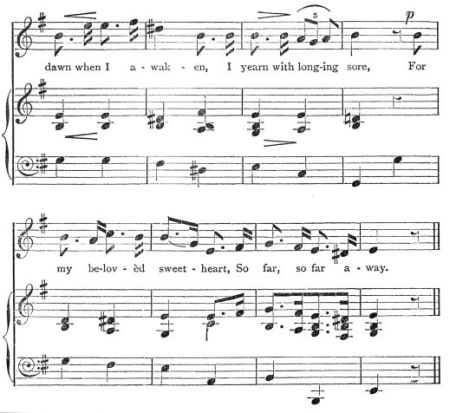
[Listen]
At the day-time when I'm working,
Thou reignest in my thoughts;
At night when I am sleeping,
Thou reignest in my dreams;
At dawn when I a-wak-en,
I yearn with long-ing sore,
For my be-lov-ed sweet-heart,
So far, so far a-way.
"That is one of my Ejnar's favourites," she said,
turning to Katharine.
The company began to be mildly interested. It was
not the Norwegian habit of mind to be interested at
once. Still, one or two faces betrayed a faint sign of
pleasure; and one of the men peeped in from the hall.
Then she sang another Swedish song, "Oh, hear, thou
young Dora." It was so like Gerda to feel in a Swedish
mood when she ought to have been feeling Norwegian.
The company seemed pleased. They nodded at each
other.
Another man peeped in from the hall. Bedstemor
strode masterfully into the room, and sat down near the
little pocket edition of herself.
"That is another of my Ejnar's favourites," Gerda
whispered, turning to Katharine again.
She paused for a moment, thinking. No one spoke.
Then she chose a Norwegian song—Aagot's mountain-song.
This was it:
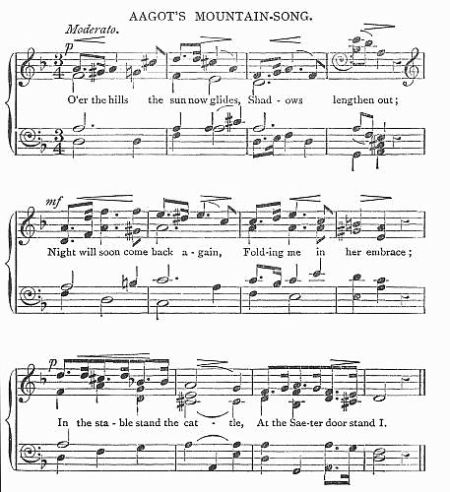
[Listen]
"O'er the hills the sun now glides,
Shadows lengthen out;
Night will soon come back again,
Folding me in her embrace;
In the stable stand the cattle,
At the Saeter door stand I.
There was a stir of pleasure in the company. Mor
Inga and Solli slipped in. Then she sang one of Kjerulf's
songs, "Over de höje Fjelde."[U]
"Fain would I know what the world may be
Over the mountains high.
Mine eyes can nought but the white snow see,
And up the steep sides the dark fir-tree,
That climbs as if yearning to know.
Ah! what if one ventured to go!"
"Up, heart, up! and away!
Over the mountains high.
For my courage is young and my soul will be gay,
If no longer bound straitly and fettered I stay,
But seeking yon summit to gain,
No more beat my wings here in vain."
The Sorenskriver came in and sat down by Katharine.
"Yes," he said, more to himself than to her, "I remember
having those thoughts when I was a young
boy. What should I find over the mountains? Ak,
and what does one find in exchange for all one's yearning?"
Gerda had sung this beautifully. The natural melancholy
of her voice suited to perfection the weird sadness
of Norwegian music. The company was gratified. They
knew and loved that song well, and some of them joined
in timidly at the end of the last verse. The old Gaardmand
crept into the room and sat near Knutty.
"I could sing as finely as I could dance the Halling,"
he said to Knutty, with a grim smile.
"Thou shouldst have heard me sing," said Bedstemor
to Knutty. "I had a beautiful voice."
"And so had I," said the pocket edition of Bedstemor,
clutching at Knutty's dress.
"Yes," answered Knutty sympathetically, "I can well
believe it."
And she added to herself:
"We all had a voice, or think we had. It amounts to
the same when the past is past. A most convenient
thing, that past—that kind of past which only crops up
when you want it!"
Then Gerda sang:
"Come haul the water, haul the wood."
This time the audience which, unbeknown to Gerda,
had grown to large proportions, joined in lustily, led
by Bedstemor's cracked old voice. She beat time, too,
still playing the rôle of leading lady. Katharine, sitting
by Gerda's side, but a little in front of the piano, saw
that the hall was full of eager listeners, and that at the
back of the guests were the servants of the Gaard, including
Thea and the dramatic Mette, and some of the
cotters, and old Kari. The music which they knew and
loved had gathered them all together from courtyard,
kitchen, and cowhouse. There was no listlessness on
any face now: an unwilling animation, born of real
pleasure, lit up the countenances of both men and women—an
animation all the more interesting, so Katharine
thought, because of its reluctance and shyness. It reminded
her of Alan's shyness, of Clifford's too; she
remembered that Clifford had said to her several times:
"I believe I am a Norwegian in spirit if not in body;
I have always loved the North and yearned after it."
She glanced at him and caught him looking fixedly at
her. He was thinking:
"To-morrow, when she and I go off to Peer Gynt's
home together, shall I be able to speak to her as I spoke
to her in my dream up at the Saeter?"
He turned away when he met her glance, and retired
at once into himself.
Then Gerda sang other Norwegian songs, every one
joining in with increasing enjoyment and decreasing shyness:
songs about cows, pastures, Saeters, sweethearts,
and Huldres, a curious mixture of quaint, even humorous
words, and melancholy music.
Finally the Sorenskriver, scarcely waiting until the
voices had died away, stood up, a commanding figure,
a typical rugged Norwegian, and started the national
song:
"Yes, we cherish this our country."
Long afterwards Katharine remembered that scene
and that singing.
No voice was silent, no heart was without its thrill,
no face without its sign of pride of race and country.
The next morning all the guests went away. They were
packed in their carioles, gigs, and carriages, and their
cake-baskets were returned to them, etiquette demanding
that each guest should take away a portion of another
guest's funeral-cake offering. Ragnhild's sweetheart
was the last to go. Knutty watched with lynx
eyes to see if there was going to be any outward and
visible sign of the interest which they felt in each other;
but she detected none.
"Well, they must be very much in love with each
other," she said to Gerda, "for there is not a single
flaw in their cloak of sulkiness. Ak, ak, kjaere, I am
glad the funeral is over. I have not borne up as bravely
as Bedstemor; but then, of course, I have not lost a
husband. That makes a difference. Now don't look
shocked. I know quite well I ought not to have said
that. All the same, Bedstemor's strength and spirits
and appetite have been something remarkable. I believe
she would like a perpetual funeral going on at the
Gaard. And how lustily she sang last evening! That
reminds me, you sang beautifully yesterday, and were
most kind and gracious to the whole company. I think
Mor Inga ought to have made you the godmother of
the calf. I was proud of my Gerda. I am proud of
my Gerda, although I do tease her."
"Never mind," said Gerda, "was sich liebt, sich
neckt. And I am not jealous about the calf. I am a
little jealous about the Englishwoman sometimes.
Tante loves her."
"Yes," said Tante simply, "I love her, but quite
differently from the way in which I love my botanical
specimens. My botanists have their own private herbarium
in my heart."
Gerda smiled.
"I like her too, Tante," she said. "You know I
was not very jealous of her when my Ejnar began to
pay her attentions."
"Because you knew they would not last," laughed
Knutty. "You need never be anxious about him.
He is not a sensible human being. He won't do anything
worse than elope with a plant. Any way, he
cannot elope with Miss Frensham just now, as he is
safe in the Dovre mountains making love to the Ranunculus
glacialis!"
"She told me she was going to Peer Gynt's stue with
the Kemiker," Gerda said after a pause. "I wish I
could have gone too. But my ankle is too bad."
"Ah, what a good thing!" remarked Knutty. "That
gives them a chance. How I wish he would elope with
her! But he won't, the silly fellow. I know him. If
you see him, tell him I said he was to elope with her
instantly. I am going off to the cowhouse to have a
talk with my dramatic Mette and to learn the cowhouse
gossip about the funeral-feast. So farewell for
the present."
"I cannot think why Mette is such a favourite with
you, Tante," Gerda said. "You know she isn't a
respectable girl at all."
"Kjaere, don't wave the banner; for pity's sake,
don't wave the banner," Tante said. "Who is respectable,
I should like to know? I am sure I am not, and
you are not. That is to say, we may be respectable in
one direction; but that does not make up the sum-total.
There, go and think that over, and be sure and
keep your ankle bad; and if you see Alan, tell him
to follow me to the cowhouse, for I want him to do
something for me."
And so it came to pass that Clifford and Katharine
were able to steal off alone to Peer Gynt's stue. They
had tried several times during the funeral-feasting to
escape from the company; but Mor Inga liked to have
all the guests around her, and it would have seemed
uncourteous if any of them had deliberately withdrawn
themselves. But now they were free to go where they
wished without breaking through the strict Norwegian
peasant etiquette. They had long since planned this
Peer Gynt expedition. It was Bedstemor who originally
suggested it to Clifford. She was always saying that
he must go to Peer Gynt's stue; and her persistence
led him to believe that there really was some old house
in the district which local tradition claimed to be Peer
Gynt's childhood's home; where, as in Ibsen's wonderful
poem, he, a wild, idle, selfish fellow from early years
upwards, lived with his mother Ãse. Clifford had not
been able to find out to his entire satisfaction whether
or not this particular stue had been known as Peer
Gynt's house before the publication of Ibsen's poem.
Bedstemor had always known it as such, and gave most
minute instructions for finding it. The old Gaardmand
with whom Knutty had flirted said he had always
known it as Peer Gynt's actual home; and even old
Kari, when questioned, said, "Ja, Peer Gynt lived up
over there." Bedstemor had a few vague stories to tell
about Peer Gynt, and she ended up with, "Ja, ja, he
was a wild fellow, who did wild things, and saw and
heard wonderful things."
So apparently Peer Gynt was a real person who had
had his home somewhere in this part of the great Gudbrandsdal;
and Ibsen had probably caught up some of
the stories about the real man, and woven them into the
network of his hero's character. But, as Knutty said,
the only thing which really mattered was the indisputable
fact that Ibsen had placed the scene of three
acts of his poem in the Gudbrandsdal and the mountains
round about, and that they—herself, Clifford, Katharine,
every one of them—were there in the very atmosphere,
mental and physical, of the great poem itself.
"And the stue stands for an idea if not for a fact,"
she said, "like Hamlet's grave in my belovèd Elsinore.
Go and enjoy; and forget, for once, to be accurate."
He thought of Knutty's words as he and Katharine
left the Gaard and began to climb down the steep hillside
on their way to the valley; for Peer Gynt's home was
perched on another mountain-ridge, and they had first
to descend from their own heights, gain the valley,
walk along by the glacier-river, and pass by the old
brown church before they came to the steep path which
would lead them up to their goal. He said to himself:
"Yes, Peer Gynt's stue stands for an idea in more
senses than one. Day after day, when I have not
been able to open my heart to her, I have thought that
perhaps I should be able to break through my silence on
our pilgrimage to Peer Gynt's stue."
The morning was fair and fresh; summer was passing;
there was a touch of crispness in the air which
suggested frost and 'iron nights,' dreaded by the
peasants before the harvest should have been gathered
in. Katharine and Clifford kept to the course of the
stream, which was a quick, though a steep, way down
to the saw-mill, beautifully situated near a foss of the
glacier-river, the roar and rush of which they heard up
at the Solli Gaard. There was a bridge across this
river, and they stood there watching the tumbling mass
of water, and recalling the morning when they had
passed over to the other side on their way to the Saeters.
The little Landhandleri across the bridge was being
besieged by no less than four customers. Their carioles
were fastened to a long rail outside the queer little
shop which contained everything mortal man could
want, from rough butter-boxes and long china pipes to
dried cod and overalls.
"I never see these places without thinking of the
isolated shops dumped down in lonely districts out in the
west of America," Katharine said. "Some of them were
kept by Norwegians too."
"They have had their training in isolation here, you
see," Clifford said, "and so go out knowing how to cater
for isolated people. And they make a small fortune
quickly and return. At least some of them return, those
in whom the love of country outweighs everything else
in life."
"I should be one of those," Katharine said. "I
should always yearn to return."
"I remember your saying you would like to bring all
the broken-hearted exiles home," he said.
"Yes," she said, "I would."
"You have a heart of pity," he said, turning to her.
"I am sorry for those who have lost their country,"
she said. "I have seen them suffer. If I were a
millionaire, I would find out some of the worst cases,
and give them back their country and the means to
enjoy it, or the opportunity of dying in it."
So they talked or were silent as the mood seized them.
They were happy, and frankly glad to be together alone.
They left the bridge, passed along the main road, through
fragrant fir-woods, and came to a most picturesque spot
where two rivers, one of them the glacier-river, met and
rushed on together as one. They crossed this long
bridge, and found themselves on the other side of the
main valley. Here they looked back and could discern
the big Solli Gaard, perched proudly on the opposite
mountain-ridge. Then their way lay along the easy road
by the winding river. It retreated from them, returned,
retreated. The sun jewelled the clear part of it with
diamonds, and the strange milky glacier part of it with
opals. Finally it left them, and they could scarcely
reconcile themselves to its departure, but strolled back
once more to enjoy its gracious company. But at last
they said farewell to it, and went on to the old brown
church, at the back of which they expected, from Bedstemor's
instructions, to find the steep path leading
up to Peer Gynt's stue. They halted, to see the sunburnt
old church, and to rest. Katharine was struck
by its beautiful proportions. Rough and without any
features of special architectural interest, it presented a
harmony in itself which was arresting. She made the
remark; and Clifford, who knew many things about
the North, was able to tell her that this was characteristic
of the Norwegian churches of the seventeenth
and eighteenth centuries. The date of this church was
the middle of the eighteenth century. It was rather
a rich, well-cared-for church from a Norwegian point of
view, and it was full of interest for strangers. The
painted and decorated pews, with the rich peasants'
names in floriated design, attracted Katharine. The
Sollis' pew was, of course, one of them. The pulpit
was elaborately carved, and was painted and gilded
in generous fashion. There was a rood-screen which
bore the arms of Norway, painted also in flamboyant
style; and a shelf on the top supported eight or ten
figures of personages in Scripture lore, with their symbols.
Some of these figures were almost grotesque. It was
difficult to believe that they were of the same recent
date as the church. The altarpiece, the Last Supper,
carved and painted, bore the date 1740; yet in conception
it looked like a piece of work from the Middle Ages,
and Dutch in character. Quainter still were the weird
pictures hanging on the walls, all of them gifts of pious
people. The subjects were of course religious ones:
Jacob wrestling with the Angel, the Passage of the Red
Sea, the Garden of Gethsemane. They all dated back
to the early part of the eighteenth century, and were
most primitive in idea and execution, testifying silently,
not only to the piety of the donors, but to the uninfluenced
isolation of the interior of Norway. One of
them had the inscription, "To the honour of God and
for the ornament of the church is this picture given by
a rich and pious girl at a cost of three dollars of the
realm!"
Katharine and Clifford examined these queer things,
and finally sat down in the Sollis' grand pew. The
world was beginning to be even as this old brown church—empty,
save for them. He was thinking, as he sat
by her side, how little she, with her free, open-hearted
nature, could guess at the grim and almost insurmountable
difficulties of a prisoner of silence like himself.
She would never know how many times he had tried
to begin the story which he wished passionately to tell
her. But each time that he had failed, he at least
knew that he was gaining courage. He did not realise
that Katharine had retreated into herself since that
anxious day at the Skyds-station; for Mrs Stanhope's
words up at the Saeter had been echoing in her ears.
She was not the woman to allow her own impulses to
be checked by the opinion of Mrs Stanhope. Her
most accentuated feeling about Mrs Stanhope was
indignation; nevertheless, the malignant words of that
bigot had engendered a vague shyness in Katharine's
mind, which held her back from helping Clifford. And
also, she was passing through a phase of emotional
passiveness, which Nature, in her wisdom, insists on,
after any great and generous giving out of sympathy,
love, and anxious concern. At such moments even the
most reckless spendthrifts of self can give nothing.
They wait. And if no one ministers to them, they
pass out into the darkness of the night to find recovery.
So Katharine waited; and they sat on together in the
Sollis' decorated pew, cut off from the outside world,
and silent. The moment of liberty did not come to the
prisoner then in the old brown church. It almost
came, but not quite.
When they left the church, they took the steep path
accurately described by Bedstemor. It was steep and
rough, and Clifford turned to help Katharine over some
of the difficult bits; but she was as active as he, and not
at all breathless. She was astonished that there should
be no easier road than this one up to several old Gaards
which they skirted in their ascent. It seemed impossible
for the farm-people to bring any heavy loads up
or down such a rough path. Clifford told her that it
was characteristic of the Norwegians of a previous
generation.
"In former days," he said, "they made a road, any
kind of road, straight to their goal, over and through
any difficulties. The Sorenskriver thinks it a bad sign
that they now make easy and circuitous ones. He
would like this uncompromising one. He would think
that there still remained some of the old rugged stubbornness
in the Norwegian character, and some of its simple
hardihood."
"We can tell him about it," Katharine said, smiling
at the thought of the Sorenskriver. She was thinking
what great good luck they had had in getting off without
him!
So they mounted higher and higher, pausing now and
then to look down at the valley, which on this side had
a different appearance from that to which they were now
affectionately accustomed from the Solli Gaard. Here
the valley was much narrower, and the view, though
beautiful, was less comprehensive, but more intimate.
From the Solli Gaard they saw the great Gudbrandsdal
as a vision. From the hillside behind the old brown
church they saw it as a human reality. They noticed,
too, that the land was more encumbered with rocks and
stones in this district than in the region round about the
Solli Gaard; although there also were outward and
visible signs of the patient labour with which the Norwegians
struggled against a hard nature to make their
country productive. But here the battle proclaimed
itself even more eloquently; and Katharine, who
noticed everything, spoke of it.
"No wonder they are a melancholy people, if they
have had to struggle so hard to get so little," she said.
"It is not that which has made them melancholy,"
Clifford replied. "It is the loneliness."
He was silent for a moment, and then went on:
"Certain nations seem set apart for loneliness, even
as certain people. Nature has willed it so. Have you
not seen how in active bustling communities there are
always several detached persons who prefer to go away
into the wilderness? They belong there. It is their
native soil, even if they have been born in crowded
cities. I believe my father was one of those persons."
"I have seen them out in Colorado," Katharine said.
And she added impulsively:
"But you are not one of them."
"No," he said without looking up at her; "I am not
one of them. I was forced into my wilderness."
And again she could not help him. For the very life
of her, she could not have said to him:
"Tell me about your wilderness, and I will tell you
about mine."
In a few minutes they came to a Gaard hanging over
the hillside, which Clifford thought, from Bedstemor's
description, must be Peer Gynt's homestead. He hurried
on to inquire, and soon came back to the great rock
where Katharine was resting.
"Yes," he said, "we have reached our destination.
And that is supposed to be Peer Gynt's house—that
old stue there. The other buildings making up the
Gaard are newer, as you can see. The Gaardmand's
wife says many people come to visit it."
So there they were, at last, at Peer Gynt's home,
perched up on high, looking straight down on the valley
and the river—a wild, isolated spot, fit abode for a
wild, restless spirit. The Gaardmand's wife showed
them over the old stue, which was very much like others
they had seen, built of great tree-trunks, and black
with age outside, and mouldy with age within; and
when they had looked and looked, each of them remembering
Knutty's injunction to enjoy, believe, and
to be seized by the "spirit of place," she took them
into the courtyard, and pointed out another old building
used as stables.
"Peer Gynt was buried here," she said. "He was
too wicked to be buried in the churchyard."
They lingered there for a long time, held in very
truth by the spirit of place. Clifford knew his 'Peer
Gynt' well, and Katharine, who had read it in English,
understood a little of its real significance. He, knowing
its whole scope from beginning to end, was able to
make the poem real to her. He told her that Peer
Gynt, brought up by his mother Ãse on legends and
fairy tales, was typical to Ibsen's mind of the Norwegian
nation, brought up on Sagas, and at the moment
when the poem was written, not able to put away phantasms,
and awake to the realities of life. He admired
the poem intensely, and seemed delighted that she was
interested in all he had to tell her about it. And he
was moved at being in its very atmosphere. He had
forgotten his doubts about the genuineness of the place.
"Cannot you see him coming down from the mountains
after one of his escapades," he said, "his mother
standing scolding him, and then listening entranced to
his fantastic stories? Can't you see him seizing his
mother when she was a nuisance to him, carrying her
over the river and putting her on the grass-roof of the
corn-house, where she could not interfere with him?
Was there ever such a fellow? And there is the river—the
very river!"
He pointed to it with almost a child's eagerness.
"He must have crossed there, you see, on his way
to the wedding at which he stole the bride and took her
away into the mountains," he said. "And where was
it, I wonder, that he used to lie in the woods, dreaming
his dreams of action and achievement which never
came to anything? Perhaps yonder, sometimes, in
that little copse over there."
Then he turned once more to the stue.
"And to think that there, actually there, poor Ãse
died," he said. "Don't you remember how, even at her
deathbed, he could not face the reality of the moment,
but buoyed her and himself up with pitiful romancing?
I can see the whole scene as I never saw it before."
It was a long time before they tore themselves away,
and then they did not go far. They sat down by some
stones outside the Gaard enclosure, still talking about
Peer Gynt.
"The poem always stirs me," said Clifford. "I know
nothing in literature which ever took a greater hold on
me. It may be partly because Knutty taught me to
know and understand the Northern mind. But the
more I read it, the more I see that it is not typical
of the Northern temperament only. Peer Gynt stands
for us all, whether we hail from the North, the South,
the East, the West; for all of us who cover up realities
with fantasies."
"But do we not all have to help ourselves with make-believe,
more or less?" Katharine said. "If we went
through life doing nothing but facing facts, we should
be intolerable to ourselves and other people. Surely
now and then we need to rest on fantasy?"
She was silent a moment, and then went on:
"We make a fantastic picture to ourselves that we
are wanted in the world, that we have work to do, a
call to answer, things and people needing us, and us
only. If we did not do that where should we be?"
He turned to her suddenly:
"Have you felt that too?" he said.
"Yes," she answered.
"So have I," he said.
"But you had, and have always had, your work,"
Katharine said, "your own definite career, which no
one, nothing, could take from you."
And as soon as the words had left her lips, she remembered
that Knutty was always saying that if ever
a man had had his career marred and checked by
others, that man was Clifford Thornton. She could have
bitten her tongue out. She did not know that she had
helped him by what she had said.
He drew a little nearer to her.
"There is a passage from 'Peer Gynt' which has
always haunted me," he said:
"'We are thoughts,
Thou shouldst have thought us....'
'We are a riddle,
Thou shouldst have solved us....'
'We are songs,
Thou shouldst have sung us....
A thousand times hast thou
Crushed and choked us.
In thy heart-depths
We have lain and waited
Vainly for thy summons....'
That is the true picture of my career."
"Every humble-hearted person with gifts would think
that," Katharine said impulsively.
It was as though she were defending him from some
accuser; as though she imperiously wished to sweep all
regrets and grievings out of his horizon. He felt her
tender sympathy enfolding him, and it gave him courage.
With one tremendous effort he broke down the wall of
reserve. The long-imprisoned thoughts came tumbling
out. At first they freed themselves with effort, and
then with natural ease. Katharine listened wonder-struck.
He spoke of the years which had gone, of
Marianne, of her strange attitude to his work, of the
battle which he had always been fighting between
bitterness and self-reproach, of the inroad which it had
made on his powers of thought and concentration, of
his contempt for himself that he had not been able
to deal more successfully with difficulties which spoilt
her life and his.
Katharine, knowing from Knutty something of the
daily difficulties which had beset him, was touched by
his gentle chivalry of heart and spirit; for he did not
say one single ungentle word of Marianne, nor give
expression to one single ungenerous criticism. His
criticism was of himself, not her. He said repeatedly
that if he had cared enough to find the key to a good
understanding, it could have been found.
"I can tell you all this so easily now that I have once
begun," he said. "I have been longing to lay it all
before you; time after time I have tried to speak to you
of my poor Marianne, of her death, of the boy's disbelief
in me, of my own disbelief in myself, of the secret
trouble which has gnawed at my heart, and which, in
spite of reason, will gnaw at my heart until I have
told it to you. You are the only one in all eternity
to whom I could tell it."
"Tell it," Katharine said gently.
Then he told her.
And as he told her Peer Gynt's stue faded from her
eyes—the river: the birch-wood: the distant mountains:
the valley: Norway. She was back in England
once more. She saw a lonely man sitting dreaming by
his fireside. She saw him go slowly up the staircase
and hasten his step as he heard Marianne's voice
calling to him in alarm. She saw the expression of
shock and pain on Marianne's face. She heard him
saying:
"It was only a dream—your dream and my dream—let
it go the way of all dreams."
She saw him go down to the stable and saddle his
horse. She saw him ride out into the darkness of the
night. She saw him throw himself on the bed, worn
out in body and spirit. She heard Alan calling to his
father. She saw Marianne leaning back, dead, and
with that terrible look of shock and pain on her poor
dead face.
The very simplicity and directness of the man's story
added to its significance. That he could tell it at all,
showed his terrible need of telling it. That he could
tell it thus unreservedly, showed his entire trust in her,
and his entire freedom from any desire to give the impression
that he had suffered without having inflicted
suffering.
The directness was almost more than Katharine could
bear. More than once she could have cried out to him
to stop. But she had not the heart to check him;
and on he went, his intensity, his frankness increasing
the whole time.
"Yes," he said, "she left me; she died in that terrible
way, and I was alive to fight with and face the possibility
that I had caused her death. Hundreds of times
I said that if I could have tuned myself to be more
in harmony with the best that was in her and in me,
my dreaming thoughts of her would never have broken
through the bounds of kindness, would never have
attained to that fierce acuteness which penetrated to
her so ruthlessly in her own defenceless state of dreaming.
By what force, by what process they reached her,
I, in my ignorance, cannot pretend to know. I only
know that our minds met each other then as they had
never met in normal life."
He paused a moment. Katharine thought that he
had come to the end of his power of telling. But before
she had finished thinking that brief thought, he had
begun again.
He said he had been tortured and puzzled by that
dream until his reason nearly left him. There was no
one to whom he could have confided it. He could not
have told it to Knutty, for he never had been able to
speak with her about Marianne. He could not talk it
out with any one who might have given time and serious
thought to such phenomena. Perhaps that might have
helped him more than anything at the time: to have
talked it out, analysed it, found the relative meaning of
it, and satisfied his intelligence about it by means of
some one else's intelligence. But that was an impossibility
to him; and so it remained locked in his heart,
gnawing at his heart whilst he battled with it alone.
"When the boy began to turn from me, it gnawed
more and more," he said. "When I learned that Marianne's
friend was openly condemning my conduct to her,
it gnawed more and more. For I said to myself, 'If
the boy knew the awful thought which is haunting me,
if Mrs Stanhope knew it, if they all knew it, what then?'
So I kept my secret to myself. I had the sense to know
that I was justified in doing that. And I turned to my
work and tried to forget. I turned to my work, which
had always been a haven when I was able to keep it
uninvaded by—by outside influences. It was invaded
now. I could not forget. I went as usual to my study
and laboratory, and I tried to continue my neglected
investigations; but I failed from the first. Time after
time I tried. You would scarcely believe how often—and
always in vain. For my mind was filled with the
one imperious thought from which there was no escape—not
even for a moment: Was I guilty of Marianne's
death? Time after time I found myself saying aloud,
'Have I killed Marianne, or have I not killed Marianne?'"
Katharine had been leaning forward gazing fixedly
into the distance, but she stood up now, and turned to
him.
"Don't go on," she said in a stifled voice. "I cannot
bear any more."
Then he saw the keen distress on her face.
"Oh," he cried in an agony of remorse, "I have been
thinking only of myself—forgive me——"
"No, no, it isn't that," she said. "But you have suffered
so much, and you are suffering now in telling me,
and I cannot bear it."
"Forgive me, forgive me," he pleaded almost inaudibly.
"It was my soul's necessity to tell you—to lay
it all before you—so that you might know me and judge
me."
"Judge you!" she cried.
And there was a world of love and understanding in
her eyes, in her voice, and on her face.
She turned to him with outstretched hands; but as
she turned, she saw a vision of Marianne leaning back
in the arm-chair, dead, and with that expression of alarm
on her poor dead face.
Katharine's hands fell.
"Let us go home," she said in a voice which was full
of pain.
So in silence they descended the steep hillside.
In silence they went along by the river, and over the
bridge, through the fir-woods, and up towards the Solli
Gaard.
Katharine went straight to her room and threw herself
on her bed. All her thoughts were of Clifford. Her heart
was flooded with love and pity for him, a hundredfold
intensified now that she knew his secret history. The
manner of Marianne's death and the long-continued silent
suffering of the man appalled her. She had known from
the beginning that he had suffered acutely; but when she
had called him the man with the broken spirit, she had
little realised the torture which his gentle and chivalrous
spirit was undergoing day by day, hour by hour. He
had fought and conquered. She knew that. She knew
that she, coming into his wilderness, had helped him to
do that; even as he, coming into her wilderness of
loneliness, had brought her a new life and a new outlook.
Judge him—judge him! The words rang in the air
and echoed back to her.
"My belovèd!" she cried, "I shall yet be able to tell
you all that is in my heart. You suffered—and she
suffered too—that poor Marianne—and I saw her face
before me when I turned to you—and, oh, my belovèd,
we could only go home in silence."
Her genius of sympathy did not leave that poor Marianne
out in the cold. Marianne's turbulent temperament,
Marianne's jealous rages, all the impossibilities
resulting from a wrong aura, were reverently garnered
into Katharine's tender understanding. For she knew
Marianne had suffered too; and that in that strange
dream, that heart-breaking final communication between
husband and wife, Marianne had learnt the truth, and
the truth had killed her. She had gone to her death
with a knowledge which was too much for her life. The
truth and not Clifford had killed her: the truth, spoken
in a defenceless moment.
In the midst of her serious musings there came a
knock at the door. Katharine answered, "Come in,"
and Alan appeared. His manner was, as usual, shy,
and he blushed a little. He was always greatly pleased
to see Katharine. He brought two English letters for
her. His young face and young presence broke in upon
her as a song of spring.
"Don't go," she said, holding out her hand to him.
"What have you got there?"
"Oh, it's only a drawing I've been doing of the cowhouse,"
he said in his shy way. "Knutty wanted it.
She says it isn't bad."
"It is very good, I think," Katharine said. "I wish
it were for me."
"Oh, I am going to do something ripping good for
you before I go back to school," he said. "I've begun
it."
She smiled her thanks to him.
"Shall you be glad to go back to school?" she asked,
as she broke open her letters.
"I shall not like to leave father," he said, without
looking up. "But he has promised to come and see
me."
"Ah, that's right," Katharine said, and she glanced at
one of the letters.
"Will you come and see me?" Alan said with a jerk.
"Of course I will," she said.
Then she turned to her letters. Alan did not go away.
He sat in the window recess cutting at a model of a
Laplander's pulk (sledge) which the Sorenskriver had
given him. Katharine forgot about him, forgot for the
moment about everything, except the contents of her
letters.
Ronald wrote in great trouble begging for her return.
As she had guessed, money matters had been going
wrong with him; he had been gambling on the Stock
Exchange, had lost heavily, had taken money from the
business, crippled it, compromised it, compromised himself,
compromised her, but he could and would retrieve
everything if she would stand by him.
"Stand by you; of course I'll stand by you," she
said staunchly.
In his hour of happiness he had shut her out; and
now in his hour of need he opened the door to her, and
she went in gladly, without a thought of bitterness in
her heart.
"Stand by you; of course I'll stand by you," she
repeated. "Poor old fellow! In trouble, and through
your own fault entirely—the worst kind of trouble to
bear, too, because there is no one to blame except your
own self."
The other letter was from Margaret Tonedale, Willy's
sister. She wrote that Willy had been very ill from
pneumonia, and they had nearly lost him. He was still
ill and dreadfully low, and asked repeatedly for Katharine.
His intense and unsatisfied yearning to see her was
retarding his recovery, and Margaret felt that she must
let Katharine know, so that if she were thinking of
returning soon, she might perhaps be inclined to hasten
her steps homewards.
And the letter ended with these words:
"Although you do not want to marry him, Kath, you
love and prize him, as we all do, and I know you would
wish to help him and us."
"Dear old Willy," she said. "Faithful old fellow.
Of course, I must go and see after you."
She had been living her own personal life, focusing on
the present and the sad and sweet circumstances of the
present, slipping away for the time from home affairs,
home ties, deliberately pushing aside any passing uneasy
thoughts about Ronald's extravagant mode of life, letting
herself go forward untrammelled into a new world of
hopes and fears.
But now voices from the old world of a few short
weeks ago, the old world grown strangely older in a few
swift days, loved voices, with all the irresistible, exacting
persuasion of the past, called to her.
She rose, determined to go home at once, and then
she saw Alan.
"Alan," she said, "I must go and find out about the
trains and the boat. I must return at once."
"Go away from us?" the boy asked. And he looked
as though he heard of some great calamity.
It was he who broke the news to his father.
"Father," he said, "she is going away. Can't we go
too?"
Clifford made no answer. He seemed stunned. His
face was ashen when he sought Katharine out, and said
in a voice that trembled:
"Is it I who am driving you away?"
"No, no," she answered. "I shall write to you. I
shall write to you. I cannot trust myself to speak. If
I began, I——"
It was she who broke off this time.
"I have so much I want to say to you," she went on.
"Up at Peer Gynt's stue, when I turned towards you,
I——"
She broke off again.
The news spread about that the Englishwoman was
returning to England the very next morning. It caused
general dissatisfaction.
"Going away!" said Bedstemor. "Why doesn't she
stay in Norway? That is the only place to live in."
"Going to leave the Gaard!" said Solli reproachfully;
"before the harvest is gathered in too."
"Going to England!" said the Sorenskriver sulkily;
"to that barbarous country, which scarcely exists on
the map."
"Going away!" exclaimed old Kari, "and before the
cows come down from the mountains."
"Going away!" said Gerda, "before my Ejnar brings
us 'the Ranunculus glacialis.'"
"Going to England!" said Knutty, "leaving us all
in the lurch here, alone, without you. Leaving me, my
icebergs, and my botanists—and for the sake of a brother
and a sick friend: people whom you've known all your
life! I never heard of anything so inhuman. Brothers
indeed; sick friends indeed! Let them take care of
themselves. Bah, these relations! They always choose
the wrong time for crises; and as for friends, they are
always sick when you want them to be well, and well
when you want them to be sick. Ignore them all,
kjaere, and stay with us."
But in spite of their loving protests, Katharine tore
herself away: from the beautiful Gudbrandsdal, from
the quaint and simple peasant life, from the surroundings
which were hallowed for ever in her memory.
Her departure took place so quietly that no one
realised that she had gone. Knutty sat on the verandah
trying to work at the Danish translation; but, discovering
that her nerves were out of order, she found it
a relief to pick a quarrel with the Sorenskriver, who
had sulkily refused to go to the station, and then was
angry with himself and consequently with the whole
world.
At last Clifford came back from the station. He sat
down by Knutty's side.
"Knutty, she has gone," he said forlornly.
"Kjaere," she said, comforting him as she put her
hand on his head. "My poor iceberg."
Alan came. He, too, sat down by Knutty's side.
"Knutty, she has gone," the boy said sadly.
"Kjaere," Knutty said, and she put her hand on his
head too. "My poor other iceberg."
Then she turned to them with a smile on her face.
"I see daylight!" she cried. "Go after her!"
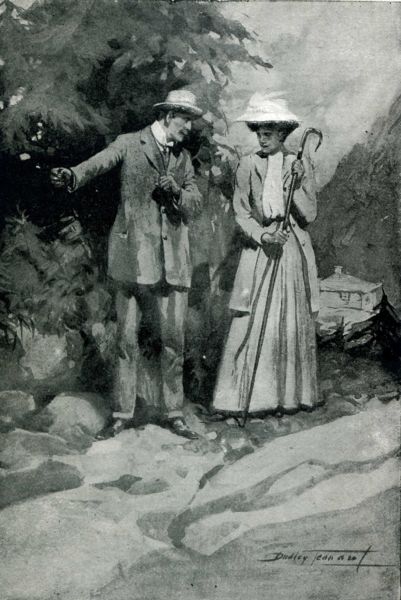 With one tremendous effort he broke down the wall of reserve.