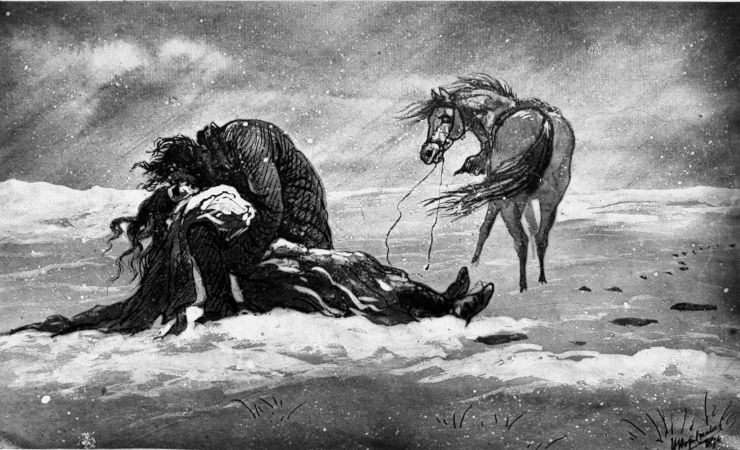
They left town together notwithstanding; and although
my lady altered her mind with every mile, now extolling her
own sense of wifely duty, now bewailing her want of firmness
and consistency, yet by the time she arrived at Hounslow,
where they were to sleep, she had become reconciled to the
society of her husband and her enforced journey to the
West.
Such impressionable natures, from which emotion so easily
passes away, enjoy at least this advantage—that one swallow
makes for them an immediate summer, one glimpse of sunshine
absorbs the memory of a month of storms.
Lord Bellinger, too, seemed in the highest spirits. Though
his back must be turned on London and all its pleasures, his
inconstant nature could nevertheless find enjoyment in the
mere act of change. Moreover, an hour before departure, he
had effected a loan of ready-money from the accommodating
Katerfelto, who waited on him at his residence in Leicester
Square, so completely disguised that Waif herself could
hardly have recognised the respectable-looking citizen, in a
brown suit and tie-wig, with ample cambric neckerchief
concealing his long beard, who was ushered into his lordship's
own apartment the moment he entered the house.
Lord Bellinger prided himself on the rapidity with which
he transacted affairs of moment. No doubt his method was
peculiar to himself.
"Katerfelto," said he, surveying the brown suit and tie-wig
with grave curiosity, "I must have five hundred guineas
in gold—now, in half an hour."
"Impossible, my lord," answered his visitor. "The time
is too short; but you can have it in three-quarters."
"I like doing business with you," rejoined his lordship.
"I never knew you make difficulties, nor found you unable
to overcome them. I want the money directly, because I
leave for the West this afternoon; but I consent to give you
another quarter of an hour."
"Your lordship is vastly obliging," replied Katerfelto, with
his peculiar smile. "I must trouble you to sign this little
acknowledgment of the debt."
He drew a sheet of paper from his pocket, filled in certain
blank spaces at the writing-table, and spread it before his
lordship, with an air of excusing himself for the liberty he
was obliged to take.
It was Lord Bellinger's boast that he never refused to
draw his sword, drink his bottle, stake his money, or sign
his name; yet he made a wry face, and threw his pen into
the inkstand with a curse, after it had performed its office.
"I'm in a corner," said he, "or you would never have had
me on such exorbitant terms. The king's business must not
stand to cool. Hang it, man! if it had been my own, not a
usurer in the town should have bit me like this!"
"Your lordship is in haste," answered Katerfelto; "and
his Majesty's commands cannot be too speedily obeyed.
I trust," he added, carelessly, "there is no fear of disaffection
in the West."
"State secrets!" answered Bellinger, with a laugh. "How
can I tell? I have not yet seen the minister. I go to him
in an hour for final instructions."
Though Katerfelto was pondering deeply, his tone seemed
lighter than usual, while he asked how the other had been
amused the night before at Ranelagh; observing, "It is
not your lordship's custom to leave an adventure half
accomplished."
"No more of that!" exclaimed Lord Bellinger. "These
are but the pastimes of a man who has little serious business
on hand. Ambition, you know, is a specific for love. If I
play my part well, Katerfelto, I have reason to believe that
the next time I borrow your money it will be for an earl!"
"Good luck attend your lordship," answered the other,
turning to depart. "As you are strong, be merciful."
My lord laughed, and snapped his fingers. "In half an
hour," said he, "I shall have the lives and estates of some
half-dozen gentlemen in my pocket. Intrigue, my good
friend, is all very well; but for real sport, give me the great
game. If your spiritual informants can travel so far, they
will shortly bring you stirring news from the West."
"The vicissitudes of this material world affect me but
little," answered Katerfelto, "save in so far as they aid my
researches among the boundless regions of science and
futurity. I am but a man of thought, while your lordship
is a man of action. If, in my humble capacity, I can serve
you, command me; and so I take my leave."
"He's an honest fellow enough, I protest," thought his
lordship, as the door closed, "though his terms are confoundedly
high! Money seems like everything else; if you
want it, you must pay for it—through the nose too! But
he's an honest fellow, no doubt."
The "honest fellow," meantime, plodding thoughtfully
home to Deadman's Alley, busied himself in elaborate calculations
of time, distance, expense, and other matters tending
to subvert the minister's intention, and render nugatory
Lord Bellinger's mission to the West.
He lost not a moment in visiting John Garnet, whom he
found sitting up in an easy-chair, half-dressed, but so
swathed in bandages that he could hardly move.
Dismissing Waif, who was in attendance as usual, he laid
a finger on his patient's wrist, and marked the strong full
beat of the pulse in grave approval.
"How much longer are you going to keep me here?"
exclaimed John Garnet, with some impatience. "I've been
telling Waif, for the last three days, I am as strong as I ever
was in my life."
"Get up," replied the doctor, "and lift that chair from
the floor. So. Do you feel as if a dog were licking a raw
place in your side?"
"I feel that I ought to be in the saddle," replied the
other, "a hundred miles from your close, smoky town. If
it wasn't for these cursed bandages, I should never know
that I had a side at all."
"Off with them, then!" said Katerfelto, suiting the action
to the word by unwinding their folds. "See now the fruits
of a little knowledge and a little patience. These wounds
have healed, as we call it, at the first intention. Do not be
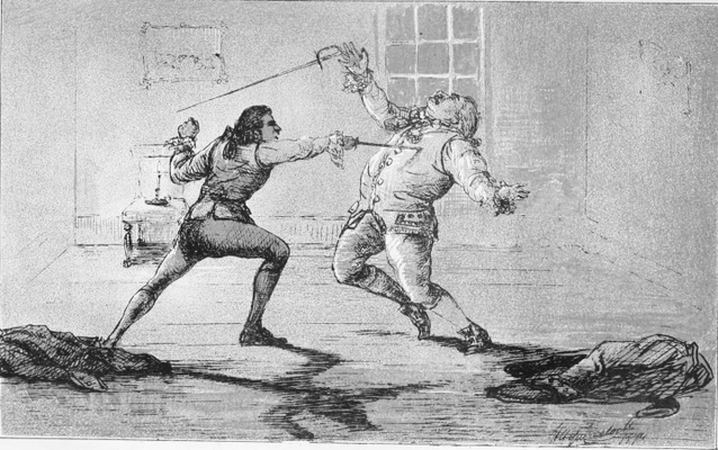
so ready with bare steel again; or, if you must needs brawl,
keep your sword-arm bent, and your point moving in a
narrower circle."
John Garnet's eyes brightened with pleasure, but his face
fell a moment afterwards.
"You have restored me to life," said he, "and I cannot
even pay you a surgeon's fee. I tell you plainly, I have not
ten guineas in the world."
"We are comrades in the same service," answered
the Doctor, quietly. "There is no question of guineas
between you and me. Will you ride a hundred miles on
an errand, in which we are equally interested, and cry
quits?"
"To the end of the world!" answered John Garnet;
"only I have not a horse to my name."
There was a simple earnestness in his tone that sufficiently
vouched for his fidelity. Katerfelto, scanning narrowly the
resolute countenance and strong active frame, smiled to
think that here was a tool shaped expressly for his purpose.
"I might find horseflesh," said he, "if you can find spurs.
Will you be ready to mount to-night on my errand, if it
should be necessary? My errand," he repeated, in a low, impressive
whisper, "and the king's!"
"God bless him!" answered Garnet, while each looked
meaningly in the other's face. "I have those in my interest,"
continued the Charlatan, "aye, at the very council table, who
keep me well informed from hour to hour. You will dine as
usual. You will crack a bottle of our best, to the king's health.
Before sunset, I will tell you when to pull on your boots."
While he spoke a knock was heard at the door, and Waif,
glancing softly at John Garnet, brought the Patron a letter
left by a man who looked like the light-porter of some city
warehouse. It contained these lines:
"The invoices are already forwarded. Prices ruling high;
hemp likely to rise. Realise at once, not a moment to be
lost."
Twice Katerfelto perused it with an anxious brow, then he
turned to John Garnet, and observed, carelessly:
"A stroll before dinner will do you no harm. Come with
me to the next street, I want your opinion of a horse I keep
there."
So congenial a request met with an eager affirmative. In
the flush of returning health, John Garnet longed keenly for
the fresh outward air. And to see a horse again, even in
another man's stable, was a return to life and all that made
life enjoyable once more.
The Doctor wrapped himself, though it was summer, in a
long black cloak and drew a square cap down to his very
eyebrows, before he crossed the threshold, precautions which
seemed scarcely necessary for purposes of concealment, inasmuch
as he led his visitor along two or three unfrequented
bye-lanes, to an old tumble-down building, that looked more
like a dilapidated pigeon-house, than the dwelling of so noble
an animal as the horse.
"Enter," said he, unlocking the door. "The husk looks of
the roughest, but there is a kernel within."
John Garnet was surprised to find the stable roomy, commodious,
well ventilated, and amply supplied with all
necessaries for the comfort of its inmate. "If the casket is
mean," said he, "at least it seems well lined, and water-tight.
Let us open that shutter, Doctor, for a glimpse at the jewel it
contains."
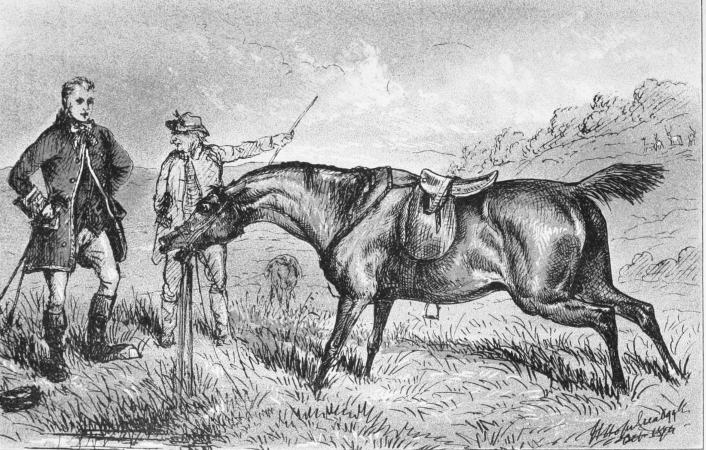
It was a jewel! An exclamation of wonder and admiration
escaped the visitor's lips, as daylight, thus admitted, revealed
to him the beauty and symmetry of the animal he came to
inspect. From boyhood he had spent much of his time
in the saddle, found a store of pleasure and legitimate excitement
in the companionship of his horse, and here seemed
the very flower and perfection of the whole equine race.
It was not that the sloping shoulders, the deep girth, the
flat legs, the round firm feet, the full, well-turned back, and
lengthy quarters denoted strength and speed unequalled, but
there was also that proportion and harmony of all the parts,
which Nature is careful to preserve when she means to turn
out some masterpiece of her craft. John Garnet said as
much; and Katerfelto, man of science though he was, could
not conceal a certain prim satisfaction, which every man
alive betrays when congratulated on the superiority of his
steed.
"I am a poor judge," observed the Charlatan, whom no
earthly consideration would have induced to bestride the
paragon before them; "but I imagine the creature is as good
as it looks."
"That I'll swear he is!" replied John Garnet, fairly putting
his arm round the taper muzzle, that nestled kindly to
his embrace. "If I had seen nothing but this beautiful little
head, with its full bright eyes, and fine transparent ears,
I would have backed him against any horse in England for
all I am worth in the world. Not much to be sure," he
added, with a laugh, "but you should have carried it for
me, old man; and I don't think the additional weight would
have caused you to falter at the post."
He patted the hard, smooth neck, and strong, firm crest
while he spoke; and the animal, though an entire horse, in
the full vigour of good food and high condition, responded
lovingly and gently to his caress.
"He knows you already," said Katerfelto; "he will know
you better before you have done with him. Listen, John
Garnet: what would you give me for that grey horse as he
stands?"
"Five hundred guineas!" answered John Garnet, laughing,
"if I had them. Ten years of my life, as I haven't five
hundred pence in the world!"
"He is yours!" replied the other. "You shall ride him
out of London to-night."
John Garnet's eyes brightened. "I do not know who and
what you are even now," said he, "but you seem the best
friend I ever had. Frankly, Doctor, I already owe you more
than I can hope to pay. In my opinion, you have bought
me, body and bones, at a high price; and I am ready to do
your bidding, be it what it will."
"You speak like a man of sense," answered Katerfelto.
"Come back to the house, Waif shall find us some dinner,
with a bottle of good old Burgundy, and I will give you
instructions at once."
They returned, therefore, to Deadman's Alley, threading
the bye-streets with the same secrecy as before. Katerfelto
informed his companion, as they walked, how he became the
owner of so matchless an animal—the last possession, it must
be admitted, with which John Garnet would have credited
his physician. "I obtained him," said the latter, "even as
I obtained Waif, and from the same people. Only, I paid
hard gold for the child; whereas, they let me have the horse
for nothing."
"And yet, they may have stolen both," observed his
listener.
The other shook his head. "Waif is a gipsy," said he,
"pure bred, or I should never have encumbered myself with
her. No; they are a strange people. Their honesty is not
like our honesty, neither, indeed, is their fraud; but they
have their notions of fair dealing too. They brought me the
horse to pay a debt of honour."
John Garnet opened his eyes. "A debt of honour!" repeated
the Charlatan.
"The rogues had robbed me of some valuable jewels while
I was sojourning in their tents during the illness of an old
reprobate, whom they called their duke, and whom I attended
without demanding a fee. Repenting of such ingratitude
too late, for the jewels were beyond recovery, they sent me
the highest-priced article they could lay hands on, and it
proved to be the very horse you are to ride out of London
to-night. How they came by him, it was useless to inquire;
but they assured me—and I have no reason to doubt their
word—that the owner would never cause inconvenience by
appearing to assert his claim."
"Do you think, then, they murdered him?" exclaimed
John Garnet, in an accent of dismay.
"Very probably!" replied the other. "But I had little
curiosity on the subject; it was no affair of mine."
The silence that ensued, lasted to the door of the surgery,
and, indeed, with small interruption during the progress of
dinner. When that meal was taken away, and Waif, with
many a backward glance, had departed and shut the door,
Katerfelto filled the glasses, smacked his lips over the Burgundy,
and thus delivered himself:
"They would hang you, my good sir, if they could catch
you; and this I consider a sufficient reason for your leaving
London to-night."
John Garnet gasped, and set his wine down untasted.
For some time he had entertained uncomfortable misgivings
to this effect. It was not reassuring to hear them corroborated
by so sagacious a person as his host. "Chance-medley
is not a hanging matter," said he, in a shaking voice.
"But murder is," answered Katerfelto; "and murder I
fear they would bring it in. Why, in the name of all that
is hasty, my young friend, did you not take a couple of
gentlemen into that dark room, and exchange a pass or two
in the presence of witnesses? See how the matter stands
as it would be submitted to a jury. An altercation, brooded
over for more than an hour; a quarrel, not in hot blood, but
on reflection; and the company gone. The lights out; the
younger man escapes, and the elder is found stabbed to death
on the floor! It looks ugly, you must confess."
"I have thought so more than once," replied John Garnet,
much disturbed. "Do you mean they will try me for—for—my
life?" He got the question out with difficulty, and
swallowing a mouthful of wine fancied it tasted like blood.
"I mean nothing of the kind," said the other. "I mean
you never to be placed in such a position. I mean you to be
a score of miles away to-night. I mean to rescue your name,
to save your life, and to make your fortune."
"How so?" asked John Garnet, taking comfort while he
emptied his glass.
For answer, Katerfelto made an almost imperceptible sign
with one of his fingers, to which the other responded by a
word, whispered so low that its import was to be gathered
less by the sound than the movement of his lips.
"I was sure of it!" exclaimed the Charlatan. "I could
have sworn from the first you were one of us. I may speak
freely now. John Garnet, I call upon you this day to ride
for the king!"
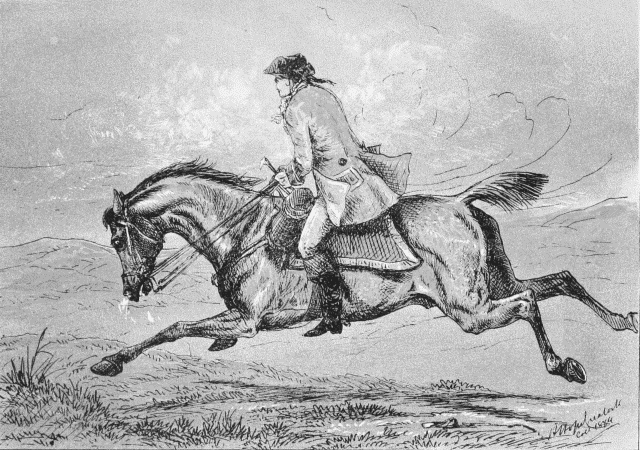
"To the gates of hell!" was the reckless answer. "And
as much farther as your good horse will carry me. I am
ready to start this minute."
"Softly," said the other. "I neither require so prompt a
departure, nor so long a journey. You need not mount for
another hour. You need not ride so far as the Land's End.
The business I shall entrust you with demands courage,
secrecy, and some little ingenuity. I believe you possess all.
To win, opens a path to rank, fortune, and the choicest
honours royal gratitude can bestow. To lose, leaves you
no worse than you are now, for at least you will have a fair
chance of escape."
"I ask for nothing better," replied the young man. "Only
tell me what to do, and how to do it."
Katerfelto pushed the bottle to his guest. "You will
need a good horse," said he, "and good pistols. These I can
supply. You have a good sword and a good mother-wit of
your own. It may be you will want them all to carry out
our plans. Success is a peerage at least. Failure means
high treason, so you know what you undertake."
"I never shrank from a large stake," replied John Garnet,
excitedly. "Deal out the cards, and leave me to play the
hand!"
"This then is the game," continued his host. "Lord
Bellinger took coach to-day for his lieutenancy in the West,
carrying with him certain warrants from the Secretary of
State, which must never reach their destination. You understand.
His lordship travels with his own horses, and can
scarce perform the journey in less than a week. Her ladyship
accompanies her husband, and they sleep to-night at
Hounslow, fourteen miles from here at the farthest. Such,
my young friend, is the alacrity with which his servants obey
the commands of King George. Without a boast, I think our
side could give them a lesson in promptitude. I myself
knew all about those warrants before the ink was dry. I
could tell you now every word that passed between Lord
Bellinger and the minister, far more accurately than my lord
himself, who, to do him justice, has a retentive memory
for trifles, but entertains the profoundest aversion to every
kind of business. Briefly, these warrants must be destroyed
before the end of the week, and I look to you for a speedy
completion of the job."
John Garnet pondered. Pledged as he had been from
boyhood, to the losing cause, compromised, by the fatal
termination of his late brawl, with the laws of his country,
and indebted for life, no less than the means of living, to this
strange practitioner of many mysterious arts, the thought of
shrinking from the task, thus thrust upon him, never entered
his mind; but he could not conceal from himself that the
undertaking was one of life and death, to be accepted
resolutely indeed, but not without every precaution to ensure
success.
"My lord travels in his own coach, you say," he observed,
thoughtfully. "How many servants does he take, and are
they well armed?"
"Three or four at most," replied Katerfelto, "without
counting her ladyship's waiting-maid, and one of these rides
on ahead to prepare for his reception, stage by stage, during
the journey. They carry a blunderbuss and two brace of
pistols among them, no more."
"How far will he proceed in a day?" asked the other.
"The roads are at their best just now and the nights at their
shortest."
"From twenty to thirty miles," answered Katerfelto.
"His lordship travels in a light coach with six good horses.
You had better not overtake him till to-morrow night. But
these details I confide to your own wisdom and discernment.
In this purse are a hundred guineas. In that cupboard a
saddle, bridle, and brace of pistols. Spend the money,
founder the horse, use the weapons at your discretion, but the
warrants must be in the fire before his lordship crosses the
borders of Somerset, and the gentlemen named in them must
be warned, at all risks of life and death."
"I understand," said John Garnet, "though I do not yet
see how to set about the job."
"It can be done in three ways," observed Katerfelto.
"The warrants will be carefully looked after. To put them in
your own pocket, you must corrupt the servants, make love
to my lady, or rob my lord."
John Garnet considered a moment before he answered.
"I think the best plan will be to rob my lord."