THE MISSIONARY'S STORY
THE LEWIS AND CLARK EXPEDITION; FOUR INDIANS
FROM THE NORTHWEST JOURNEY TO ST. LOUIS
IN SEARCH OF THE WHITE MAN'S RELIGION;
OPENING AND SETTLEMENT OF THE OREGON
COUNTRY; HISTORIC CHARACTERS—JASON LEE,
NATHANIEL J. WYETH, MARCUS AND NARCISSA
WHITMAN, AND OTHERS; WHITMAN'S RIDE;
MASSACRE AT THE WHITMAN MISSION; NOTABLE
INCIDENTS OF THE EARLY MIGRATION TO OREGON.
A little before sundown a few days after
the neighborhood party described in the first
chapter, a stranger rode leisurely up the road
toward the Mulhall farmhouse. Seeing the owner
of the place doing some chores in front of the barn,
he accosted him and asked if it were possible to
secure accommodations for himself and mount for
the night. The Squire answered, "Well, stranger,
you can see for yourself that our accommodations
are none too good; but if you are willing to put up
with such as they are, you are entirely welcome. We
will do the best we can under the circumstances."
"It is not necessary to put yourself to any extra
trouble on my account," said the stranger, "for I
have led a wayfaring life and am accustomed to
roughing it in the broadest meaning of that word."
Mulhall suggested that he dismount, go to the cabin
and rest while he would unsaddle the horse and take
it to the barn.
The stranger replied, "My good friend, I truly
appreciate your courtesy; but I have always made it
a point to bestow the first care and attention upon
the beast that carries me. Now if you will show me
where to stable him, I will do the rest myself. This
faithful animal has borne me many a long mile upon
his back, and it is only right that I should repay
him by devoting a little time to his comfort."
After hanging up the saddle and bridle, he took
from the saddle-bags a currycomb and brush, which
he said he never failed to take along, and gave the
noble animal a thorough cleaning. Then after seeing
that the horse had plenty of hay and grain for the
night, he accompanied Mulhall to the house.
By this time the owner of the place had surmised
that his guest was a clergyman; his language was too
precise and his delivery too easy and natural for
the ordinary man found in that part of the world.
This conclusion was verified beyond question when,
just before leaving the barn, he took a well worn
Testament from his saddle-bags.
It did not take Catherine and Kate long to prepare
a good and appetizing meal to which the reverend
stranger, after asking the blessing, did ample
justice. During the supper Mulhall informed the
guest that he and the family were about to leave their
little farm for the Oregon Country, where conditions
were said to be much more favorable for getting
along in the world than in Missouri.
At the mention of Oregon the stranger's face
brightened, plainly indicating that the news was
pleasing to him; and said, "You are doing a wise
thing, for that is a grand country with a wonderful
future. The journey ahead of you is long, difficult
and more or less dangerous; but if you get safely
through—as I hope and trust you will—you will be
amply repaid for all the hardships and sacrifices
endured. I tell you this advisedly, for I have spent
many years in that favored region, being among the
first of our nation to cross the Continent for the
purpose of carrying the light of the gospel to the
benighted savages who dwelt there."
After hearing this statement, every member of the
Mulhall family exhibited the greatest surprise and
pleasure at having under their roof one able to give
them first-hand information of the distant region
where they intended to cast their lot; and begged
him to tell them all about it. Heretofore all the
knowledge they had of Oregon was through one or
two letters received from parties who had gone out
there a year or two before; and these contained very
little information except that it was a good country
for industrious people, with a mild climate and good
market for farm produce.
That was more than they had in Missouri; so
they had already determined to make the venture.
But with an unexpected opportunity to acquire full
and accurate information regarding it, they wished—if
he would be kind enough to take the trouble—to
hear from his lips everything of consequence
concerning what was to them a practically unknown
country.
The clergyman replied, "My good friends, nothing
except expounding the word of God gives me greater
satisfaction and keener pleasure than to talk about
Oregon, and recount the difficulties, tribulations and
heroic actions of those who were in the vanguard of
its settlement; it is a subject of surpassing interest,
and has had a remarkable influence upon the rapid
development and material welfare of our country.
The narrative will take considerable time, and
perhaps tire your patience before I am through; but
I deem it to your advantage to have a correct outline
of the principal historical incidents relating to its
exploration and settlement.
"It certainly affords me greater satisfaction to go
into the subject thoroughly than to give merely a
short summary of those very important events. If
you are willing, when the meal is ended and everything
put away, we will gather around your cheerful
and cozy fireplace; and I will do my best to both
entertain and enlighten you."
Soon after supper, the younger children climbed
the ladder to their sleeping quarters while David
Mulhall, Catherine and Kate arranged seats in a
semi-circle before the glowing fireplace where the
large backlog furnished sufficient heat and light for
the little cabin. There is no place where a good
story can be as effectively told as before a blazing
fireplace on a chilly evening in the mellow light of
the crackling logs, with eager and attentive listeners.
In such a pleasant atmosphere the itinerant
missionary now began his recital:
Half a century ago[1] that vast region known as the
"Oregon Country" had never, as far as any one knows,
been penetrated by a white man. It is true that Captain
Robert Gray of Boston, in the good ship "Columbia"
entered the mouth of the great river in 1792, crossed
the dangerous bar and sailed upstream about a dozen
miles, naming it Columbia's River after his vessel.
A few months afterwards Lieutenant W. R. Broughton,
of the British Navy, also entered and proceeded up
the mighty river about 100 miles. But nothing more
was known of the "Far Northwest" until the celebrated
exploring expedition of Lewis and Clark crossed the
Continent in 1804-5, arriving at the mouth of the
Columbia in November of the latter year.
While it would be impossible in this recital to give
a detailed account of that memorable expedition, or do
justice to the dauntless courage and perseverance of
the remarkable men who conducted it, one surpassing
incident that happened on the journey was primarily the
cause of bringing all that extensive territory under the
American flag. I must crave your patience for devoting
some extra time to describing this most interesting event.
That exploring expedition, as you doubtless know, was
conceived by one of our greatest presidents years before
he came to that high office; but the opportunity for
carrying it out did not exist until he became President.
The men chosen to organize and lead the expedition were
selected with fine discrimination for the stupendous task
assigned them, and proved worthy of the trust and
confidence reposed in them by Thomas Jefferson.
After their departure from near St. Louis in the spring
of 1804, they spent about a year and a half ascending
the Missouri River, crossing the mighty "Stony Mountain"
range and later the yet more rugged and precipitous
"Bitter Root" Mountains, before reaching the beautiful
open and undulating country on the Clearwater
River. It was a joyful experience for the tired, half
famished explorers, descending from the rugged and
inhospitable mountains where game was scarce and
pasturage scant, to find ahead of them as far as the eye
could see, rolling hills carpeted with an abundant growth
of bunch-grass, and watercourses with groves of cottonwood
and quaking asp along the river bottoms. They
also found game quite plentiful, and excellent trout and
salmon fishing in the streams.
Before proceeding very far in this region, they
suddenly came upon a few native women and children
picking berries. Observing the party of strange looking
beings garbed in unusual attire and carrying weapons
never seen before, the simple-minded natives were
terrified. The women ran, and the children sought refuge
under bunch-grass and bushes, from what they imagined
to be supernatural intruders.
In a short time the men caught up with a couple of
the squaws, who expected nothing else than swift and
sure death at the hands of these fierce looking strangers,
and bowed their heads in anticipation of the fatal stroke.
By signs and kind words they soon dispelled the fears
of these women of the Nez Perces tribe, which then
occupied all that part of the country. They were
dismissed with many presents, and told by signs to have
some of their head men come out to the camp for an
interview.
In a few hours a party of Indians garbed in native
finery and armed with bows and arrows, arrived; but they
made no hostile demonstrations, and were evidently in a
friendly mood. Cordial relations were soon established
between the explorers and the Indians, the latter inviting
the white men to their village to partake of their crude
hospitalities.
The explorers were fortunate in having with them as
the wife of Toussaint Chaboneau, their French-Canadian
guide, a young and handsome Indian woman of the Snake
tribe—Sahcajahweah, meaning "bird-woman," commonly
known in later history by the shortened and simplified
name "Sacajawea." By her courage, fidelity, tact and
intimate knowledge of aboriginal habits, this remarkable
girl wife assisted materially in extricating the explorers
from the many almost insurmountable difficulties that
beset the journey over the Rocky Mountains and Bitter
Root range. It is no exaggeration to say that but for
her, Lewis and Clark might never have reached the shores
of the Pacific.
At the present juncture she was of great assistance.
Though not understanding the Nez Perces tongue, her
familiarity with the native sign language enabled her
to make known to the Indians whatever the white leaders
wished to communicate, and explain to her companions
what the former were desirous of expressing. She
completely removed from the minds of the red men any
lurking suspicions they might otherwise have entertained
as to the motives and purposes that brought the
white men hither.
The explorers learned from these Indians that the big
Chief of the tribe was encamped about two days' travel
down the river, and that a messenger had already been
dispatched to notify him of the arrival of these strange
men in his country. On the following morning the
party, accompanied by a Nez Perces guide, set out to
visit the Chief of this seemingly very friendly tribe. The
commanders issued orders that the men should polish up
their accoutrements and make the best possible appearance;
and that their behavior while sojourning in the
country of this tribe should be above reproach, as it
was essential for the success of the expedition to have
the friendly cooperation of these Indians.
On the evening of the second day the cavalcade of
thirty-odd travelers descending from a rolling plateau,
beheld the many lodges forming the main camp of the
Nez Perces tribe situated on a willow creek bottom, a
short distance above where the stream entered the
beautiful Clearwater River, along whose banks were many
small groves of cottonwood, interspersed with clumps of
large willows. The camp presented a picturesque
appearance of probably two hundred lodges, scattered up and
down along the little valley for perhaps a mile with very
little regularity in formation. On this occasion it
presented a very animated appearance, for the occupants
of each tepee were on the outside anxiously awaiting the
arrival of the wonderful strangers with bearded faces
and carrying loud-noise weapons.
In about the center of the string of lodges was one a
little larger than the rest, in which dwelt the great Chief
of the little nation, who was now standing in front of
the lodge entrance arrayed in an elaborate costume of
Indian finery surmounted by an immense head-dress of
eagle feather plumage. He wore a doublet of tanned
deerskin, fringed and decorated with elk teeth and agate
stones, and leggings of the same material; his feet were
encased in moccasins inwrought with the finest
embroidery done by Indian women. The Chief, probably
fifty years old, was a well proportioned man of medium
size with regular features and well shaped head; he stood
motionless, with his eyes intently fixed on the approaching
column of white men riding in single file down the
gently sloping hillside towards the row of lodges—a sight
never before witnessed by any of them.
The Indian guide pointed out the lodge of the Chief
to Lewis and Clark, who halted the column; and
dismounting a little distance off, approached it on foot.
The Chief did not move a muscle until Captain Lewis
held out his hand with the evident gesture of a friendly
purpose, whereupon he reached out, grasped the extended
hand of Captain Lewis and held it firmly for a little
while, muttering something in a guttural voice which,
though not understood, was evidently intended as a pledge
of friendship.
Each one of the party was then presented to the big
Chief, who gave every one a friendly greeting even to
the last, the negro man servant of Captain Lewis, though
the stoical Indian could not suppress a look of wonder
as he gazed from head to foot upon the gigantic black
man. The Indians were all filled with strong curiosity
at these strange men with bearded faces and wonderful
firearms that sent a leaden messenger of death faster
and more accurate than their most expert bowman; but
neither the white men nor their guns, strange and almost
incomprehensible as they seemed, created anything like
the astonishment aroused at beholding the African, who
was a continual object of their awe and admiration.
Little attention was paid to Sacajawea, for she was of
their own race and a member of a tribe with which they
were not too friendly.
The whole assembled concourse of savage tribesmen
vied with one another in offering hospitality to the
newcomers, and exhibited unfeigned pleasure when any of
them entered their lodges and partook of refreshments.
Friendly relations between the Americans and Nez Perces
established so long ago under these peculiar conditions,
have continued without a break up to the present time;
and let us hope may never be impaired.
Lewis and Clark acquired much useful information
during their sojourn with this tribe. They were informed
that it was yet a long distance to the "Big Water"—the
goal of the expedition; and also learned that almost
insurmountable obstacles would prevent continuing all
the way to their destination on horseback. It would
be possible, however, to reach it by waters all flowing in
that direction, finally uniting in one mighty river which
was swallowed up by the "Big Water" near the setting
sun.
Thereupon the explorers set their men to building boats
on the banks of the Clearwater; and it was determined
to complete the passage in that manner. They also made
arrangements to leave their horses with the Indians
until their return the following spring, when the journey
towards the "rising sun"—the land of the white
man—would be resumed.
While the Lewis and Clark expedition remained on
the Clearwater, the Indians held their annual rites to
placate the wrath of their false deity, lest he visit upon
them dire misfortunes in the form of famine and pestilence,
which at times fell upon their people with serious
consequences. The white men refrained from making
any comment upon these absurd and pagan ceremonies
until they were ended. Then having a council with
several of the leading men of the tribe, they endeavored
in the kindest and most inoffensive manner—through
the medium of Sacajawea, who by this time had acquired
a considerable knowledge of the Nez Perces tongue—to
point out to the Indians that the white people were in
possession of a much better method of worshipping the
Supreme Being who created the heavens, the earth and
all things therein; and it would be a great blessing if
they would learn to do likewise.
This kindly advice found deep lodgment in the minds
of those untutored children of the wilderness, and was
made still more effective by the earnestness and sincerity
of the "bird woman," who since becoming the wife of
Chaboneau had already received considerable instruction
in, the tenets of the Christian religion. Thus the seed
that bore such rich fruit a quarter of a century later, and
actually led to all that vast region becoming a part of
the United States, was planted in what is now our far
Northwest.
When the boats were finished the little band prepared
to continue its journey by water. Many presents were
distributed to the friendly Indians before leaving their
hospitable village; though trifling in value, these were
highly prized by the natives, and helped to cement firmly
the friendship already started between the two races. In
return the white men received a liberal supply of dried
venison and roots to sustain them during the arduous
undertaking still ahead of them. The Nez Perces also
furnished two guides to accompany the expedition; these
proved of invaluable assistance to Lewis and Clark,
particularly in their perilous descent of the Columbia.
That historic journey down the river to the Pacific
Ocean was successfully accomplished; and in the following
spring the party returned to the Indian encampment
on the Clearwater, finding all the horses that had been
left with the Indians in fine condition to re-cross the
mountain ranges over which they had come the preceding
summer. While stopping at the Indian village on this
homeward-bound route, the subject of the white man's
religion was again broached by the natives; and once
more the leaders of the expedition impressed upon them
the spiritual and temporal advantages of acquiring a
knowledge of the revealed word of God.
This good and salutary advice sank deep into the hearts
of the simple-minded red men, who realized that in many
ways the white strangers were superior to them. They
had more effective weapons, their utensils and
implements were beyond the power of any Indian to make,
they could find knowledge in books and talk on paper;
they had far better saddles and bridles, and could kill
a deer or a bear with their smoke-fire guns. Surely then,
it was more than probable that they possessed a better
knowledge of worshipping the Supreme Being than the
poor and ignorant Indians—thoughts about which
continued to agitate the minds of this truth-seeking tribe
long after the departure of their good friends, Lewis
and Clark.
After the lapse of many years the subject was again
brought into prominence by the arrival in that part of
the country of a small party of full-blooded Iroquois
and half-breed employes of the Northwestern Fur
Company from eastern Canada. All of these had acquired
a knowledge of the Christian religion, and lost no
opportunity to impress upon the pagan members of their race
its superiority over the crude and senseless forms still
practiced by the native Indians.
Coming from people of their own stock, this corroborative
testimony of what Lewis and Clark had told them
carried great weight, and aroused an intense desire for
instruction in the white man's faith; but they could see
no possible way to gratify it. How could the poor,
benighted Indians come into contact with the white
people, and acquire their way of worship, when there were
none in any region with which they were familiar? The
prospect was indeed gloomy for Indians seeking the
light.
But conditions soon began to change. The Hudson's
Bay Company was securing a firm hold upon the country,
bringing in white men, half-breeds and Indians from
Canada to carry on its extensive fur-hunting business.
Trading posts were established throughout the vast region
west of the Rocky Mountains and north of the Spanish
possessions. The Indians welcomed this great commercial
enterprise into their country, for it gave them a
market for what they had to sell, and opportunities to
acquire by trade many useful articles which had never
before been within their reach.
Some of these new trading posts were established close
to the Nez Perces country, and the tribesmen soon became
frequent visitors to them. Here again they were told
how superior the white man's religion was to their
outlandish and foolish ceremonies. They also learned that
one of the two leaders of the explorers who visited their
country many years before was still living and occupying
a high position, in that department of the Government
having the management and care of Indian affairs.
His home was in St. Louis, a city many miles beyond
the great mountains, a distance that would take many
moons to traverse.
These Indians pondered long and seriously what to do
under the circumstances; but no matter how great the
distance, formidable the obstacles or how threatening
the dangers of traveling through a vast region—peopled,
indeed, by men of their own dusky race but known to
be fierce, warlike and no respecters of persons—they were
determined to make the attempt. The desire to gain a
knowledge of the white man's religion had taken
complete possession of their minds, and they would not be
content until that object should be attained.
At a joint council of the Nez Perces and Flatheads,
one Indian of advanced age and a young brave of each
tribe were selected to go in search of the explorer they
had remembered during the quarter century since he
had been among them, and ascertain the truth of the
reported better religion than their own. During the
summer and early fall of 1831, these four delegates
traversed more than half of the Continent from the far
Northwest to the junction of the Mississippi and
Missouri rivers.
Arriving at St. Louis after a long, difficult and perilous
trip of which no account was ever made, they were
directed to the home of Gen.[2] William Clark, who received
them cordially and during their stay there often
entertained them in his own house. As may well be imagined,
the General was astonished when he learned the purpose
that brought them from such a distance; and although
outside his line of duty, he determined to do everything
possible to assist them.
Clark spent considerable time showing them the town
and its attractions; to those children of the wilderness,
St. Louis was of course a strange and wonderful place.
It was at that time the largest settlement in the middle
West, and the principal outfitting point for travel,
explorations or hunting expeditions to the Rocky Mountains
or beyond. But the greatest obstacle to the progress of
their mission was the inability of the Indians to speak or
understand our language.
Before they had been very long in St. Louis, one of the
old men became ill, doubtless from the fatigue of the long
journey, change of diet and impure water of the Mississippi;
he soon passed away, and was buried there. In
about two weeks the other old Indian followed him in
death, neither living to know the result of their mission.
The two younger men remained there during the winter,
and in the spring started up the river on their way back
to the far Northwest. One of them died in the Yellowstone
region, and the other proceeded to cross the Great
ountains alone, finally succeeding, after a long absence,
in reaching his home and kindred.
While they were at St. Louis an Indian agent, William
Walker, en route to the Osage and other tribes beyond the
Mississippi, arrived there with a letter from the Secretary
of War, and called upon Clark for special instructions
regarding the Indians he was about to visit. The General
informed him of the Nez Perces and Flatheads under his
roof at the time.
Anxious to see those aborigines from beyond the Rocky
Mountains, Mr. Walker interviewed them and gives an
interesting account of their appearance and the reason
for their coming. This was published after his return
from the trip already mentioned; and although he does
not give dates, it has been established from contemporary
records that the Indian delegation was in St. Louis
during the winter of 1831-32.
Mr. Walker's letter in the Christian Advocate of March
1, 1833, at once aroused the greatest interest and religious
fervor throughout the length and breadth of the land.
Missionary enthusiasm quickly arose to fever heat, due to
the fact that a party of Indians had voluntarily come
more than two thousand miles over mountain and desert
from near the waters of the Pacific, calling for Christian
enlightenment.
It aroused the apostolic spirit among the churches to a
height not seen in a generation; meetings were held,
subscriptions to defray the expenses came pouring in, and
devoted men offered their services to answer the call. The
first in the field were the Methodists, animated by the
evangelical spirit of John Wesley, founder of that great
denomination. Funds were raised, the personnel of the
party decided upon, and all preparations completed for
the journey to the far West in the spring of 1834.
Rev. Jason Lee was placed in charge of the expedition;
and I had abundant opportunity to personally observe
how well fitted he was mentally, physically and spiritually
for the serious task. Arrangements were made for the
missionaries to accompany Nathaniel J. Wyeth, of
Boston, who had organized a fur company to carry on that
business in the Oregon Country; and had some forty or
fifty men in his party.
The journey across the Continent was full of exciting
adventures—fording or swimming turbulent and treacherous
rivers, eluding or repelling small bands of predatory
Indians, fleeing for safety from the thunderous charges
of stampeding buffalo, and many incidents of lesser
import. But while neither my time nor your patience will
admit of giving a detailed recital of them, one event which
happened on that trip deserves more than passing mention.
After crossing the Rocky Mountain divide, their course
was northwest until they came to the Snake River. While
on an exploring trip the previous year, Mr. Wyeth had
decided to erect a trading post at a point on that stream
near where a considerable tributary, the Portneuf River,
enters it and in the midst of a good fur-producing
territory, well adapted for his purpose.
The party camped at this place and remained there a
few days. Besides the men Wyeth had brought from the
eastern States, who by this time had become genuine
frontiersmen at least in appearance, he had taken quite
a number of mountain men and independent trappers into
his employ at the Rendezvous on Green River, near the
site where Fort Bridger was located by James Bridger
in 1843, about nine years later. There were also some
nondescript characters with no visible occupation—altogether
a motley and extremely picturesque throng.
Many of the men had buckskin suits, embellished with
fringes and decorated with beads; others wore untanned
deer and bearskin garments of almost every conceivable
design. A few had coats and trousers of buffalo hide, and
one a complete suit of wildcat skins. All had beards,
some reaching to the belt line, while others were clipped
until they resembled bristles; but there was no evidence
that any man among them possessed a razor.
Though it was midsummer, many wore fur caps and
some went bareheaded. Various kinds and patterns of
rifles and muskets were in evidence, while a few carried
Spanish musketoons. Physically they were somewhat
above the average stature of men in "the States." While
encamped there the men spent most of the time playing
cards, shooting at targets or swapping yarns.
It was not the kind of a crowd you would expect to see
occupying church pews or attending Sunday School; but
Jason Lee made an announcement that he would hold
services on the Sabbath, and desired every one to be on
hand. They evidently thought it a good joke for any one
to attempt to preach Christianity to such a lawless crowd
of semi-wild and godless men; however, it was a diversion,
and all promised to be there and hear the reverend
visitor's message.
Jason Lee was six feet or more in height and slightly
stooped; his head was large and well-shaped, with an
undeniable expression of determination and courage. Yet
there was a kindly look in his eye; and when he smiled,
you instinctively knew that beneath his rugged outward
appearance was a genial spirit tempered with seriousness.
Shortly after breakfast he took his Bible and went
some distance from the camp to the shade of large trees,
and spent a couple of hours walking back and forth in
serious meditation. About 10 o'clock—the hour announced
for the services—he returned to the camp where the
throng had assembled.
Some were lolling on the grass, others squatting on
blankets, a few listlessly leaning against the trees and
others standing by the tent openings. There were no
benches, nor any roof to protect the audience from the
fierce rays of the summer sun; but that did not matter
to men who had lived for years in the open, and were
accustomed to sleep under the canopy of heaven.
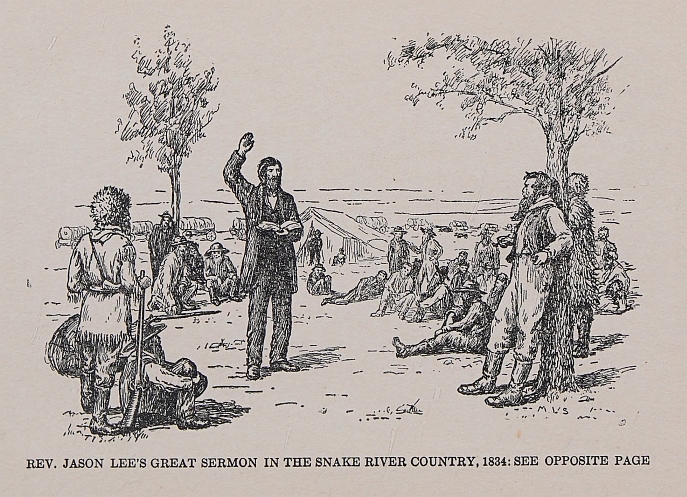
REV. JASON LEE'S GREAT SERMON IN THE SNAKE RIVER COUNTRY, 1834; SEE OPPOSITE PAGE
Lee took a stand where all might be within range of
his voice, cast his eyes over the unusual assemblage,
opened the Bible and read in a clear and penetrating
voice a text from the gospels about the crucifixion and
death of Christ. Then he requested all to join with him
in prayer. Some who had not entirely forgotten their
early training, did so as best they could, while the more
hardened sinners nudged each other in the ribs and
smiled—as if to say, "What nonsense!"
The clergyman was not an eloquent speaker, but forceful
and impressive; and his subject was well suited to
call forth all the earnestness of his nature and the
sincerity of his faith. He spoke for an hour, and before
half through had the complete attention of every one in
the audience; those who were at first inclined to scoff soon
lost their indifference and listened with profound attention
to every word. When at the close of his sermon, he
quoted dramatically the words, "Socrates died like a
philosopher but Jesus Christ died like a God," there was such
a stillness as if all within hearing were spellbound; and
they were.
I have listened to great orators in the political arena,
and on various occasions to brilliant ministers of the
gospel; but have never known one to so thoroughly magnetize
his hearers as Jason Lee did the trappers, hunters
and mountain men who composed that audience away off
in the wilds of the Snake River Country in 1834. It was
the first sermon ever preached west of the Rocky
Mountains; and has probably not been excelled to this day.
Wyeth put his full force at work erecting the rectangular
trading post, more generally known as Fort Hall, for
his contemplated fur-dealing activities. Although it
remained only a short time in the control of that
enterprising American, and passed into the hands of the
Hudson's Bay Company upon the collapse of Wyeth's original
enterprise the following year, that frontier
establishment was a very important factor in the great
emigration to the Oregon Country.
A day or so after the Jason Lee sermon, the missionary
company departed for its intended destination, the
Columbia River, where a favorable location for a Mission was
to be selected. The journey on horseback for several
hundred miles through rugged and broken country was
fraught with many difficulties and dangers, all
successfully overcome.
In September the tired and travel-stained little party
arrived at Fort Walla Walla on the Columbia, the chief
trading post and outfitting headquarters of the Hudson's
Bay Company east of the Cascade Mountains, where they
were kindly received and hospitably entertained by
Mr. C. P. Pambrun, the official in charge. Here it was
decided to leave the horses and complete the remainder of
the journey by water; and fortunately a party of
fur-hunters returning with a cargo of pelts taken along the
waters of the upper Columbia, was then on the way to
Fort Vancouver.
With these the missionaries were given passage, and
floated down the great river in their batteaux. The
French-Canadian crew were expert boatmen and a happy
lot to travel with, joking and singing almost without
intermission; their care-free and mercurial natures never
seemed to be ruffled, no matter what obstacles interfered
with their progress. The annual fur-hunting expedition
had been very successful; and they were looking forward
to a genuine celebration upon their arrival at Fort
Vancouver, a privilege given to them once a year.
I shall never forget the mingled feelings of wonder
and admiration as our little party approached the mighty
break in the upper levels of the Cascade Mountains made
by the river when, in prehistoric time, it forced a passage
through that gigantic range. The scenery was superb—nothing
grander can well be imagined—magnificent snow-capped
mountains, primeval forests clothed with foliage
of various hues reaching down to the water's edge, and
numerous sparkling waterfalls leaping over the sides of
perpendicular bluffs from elevations of two to six
hundred feet.
Occasionally immense basaltic pillars, rising from the
bank of the river to a great height, and some of most
grotesque outlines, would be encountered. There is
nothing of the kind in the United States to compare with
that scenery of the Columbia.
Upon reaching Fort Vancouver we met with a truly
cordial reception. That grand old autocrat Dr. John
McLoughlin had word of our arrival, came out to meet us
and in the most courtly manner but with unaffected ease
and dignity, ushered us into his private apartments where
he said we were to be his guests during our stay. We
greatly enjoyed the hospitality of the Doctor, especially
after our long and tiresome journey; and have always
looked back with sincere pleasure to the whole-hearted
welcome given us by the representative of another nation,
when we might reasonably have been considered in the
guise of intruders.
A day or so after our arrival, Jason Lee unfolded to
Dr. McLoughlin his plans for establishing a Mission
among the Flathead Indians. The Doctor listened patiently
as Rev. Mr. Lee related the details connected with
the project; and then while expressing the satisfaction
he felt at having a Mission located somewhere in the
country, he pointed out the stupendous task of conducting
it so far from a base of supplies.
Everything for the Mission must come by water around
the Horn, be unloaded somewhere on the lower Columbia,
and then carried by batteaux and pack animals a distance
of five hundred miles up-country—a very serious
handicap. Jason Lee saw it in the same light, but did
not know what else to do.
Dr. McLoughlin suggested founding a Mission in the
Willamette Valley near French Prairie, where a small
settlement of French-Canadians already existed and there
were Indians in the vicinity needing spiritual as well as
temporal enlightenment. Such a point would also be
reasonably accessible for receiving supplies by water.
So convincing were the facts presented by Dr. McLoughlin
in support of the Willamette Valley as compared
with the Flathead country for a Mission location,
that Jason Lee decided to accept his views and followed
his counsel. The Doctor also promised to assist it by
every means in his power compatible with his duties as
Chief Factor of the Hudson's Bay Company; and kept
his word.
The Mission established in the Willamette Valley was
conducted successfully until measles and other epidemic
diseases introduced by the whites almost completely
annihilated the native population, so that in ten or twelve
years after its founding there were no Indian children
to attend its school. During that time, however, the
white population increased rapidly by accessions to the
missionary force, many newcomers brought from "the
States" by glowing descriptions sent back by earlier
arrivals, and the even stronger corroboration of the
surpassing advantages of the new country by men returning
east for missionary reinforcements.
In this again, my friends, I cannot but see the
interposition of Divine Providence. Had our Mission been
established among the Flatheads as originally intended,
there would have been no such influx of American citizens
as afterwards followed into the disputed territory
to offset the prestige of the British claim, because that
remote interior region offered no such opportunities for
settlement as the salubrious climate and fertile valleys
west of the Cascade Mountains. So I may well say again,
"God moves in a mysterious way His wonders to perform."
While I have told you, and truthfully, that the Methodists
were the first to answer the call from the Indians
beyond the Rocky Mountains, the Presbyterians and
Congregationalists soon followed. In 1835 Rev. Samuel
Parker of Massachusetts, and Dr. Marcus Whitman of
New York State, were sent out by the Missionary Board
of that church to examine into the character and disposition
of the tribes residing in the region from which the
four Indians made the long journey to St. Louis in search
of the white man's religion, and report as to the
desirability of establishing a Mission among them.
With that purpose in view, Rev. Mr. Parker and
Dr. Whitman crossed the plains, and in the summer of 1835
arrived at a point in the Rocky Mountains known as the
"Rendezvous," a famous place for trappers and Indiana
to congregate for trading in furs and pelts. They found
encamped there several hundred Nez Perces and Flatheads
just returned from a successful buffalo hunt; and
through an interpreter learned that they were very anxious
to have white religious instructors sent out to them.
This convinced Rev. Mr. Parker that the field was a
very promising one. It was therefore agreed that he
should accompany the Indians to their homes and select a
suitable location for a Mission site, while Whitman would
return east and arrange for a missionary party to go
out there under his charge the following spring.
Parker impressed upon Whitman the necessity of
having the company well equipped with everything essential
for such an arduous undertaking, and above all else to
provide himself with a good wife. The Doctor laughed
and replied, "That is easier said than done; however, I
may make the attempt."
By their genial manners and evident sincerity of
purpose, these two advance missionary agents while at the
Rendezvous won the confidence of the assembled Indians
to such an extent that they permitted Whitman to select
two or three young boys to return with him to "the States,"
remain there for the winter, and accompany him back.
The Doctor knew that their presence would have the effect
of stimulating the Board to organize and equip a
missionary party with the least possible delay; and would be
tangible proof that the Indians were earnestly seeking
religious instruction. Whitman also realized that the
boys would be of great assistance to the missionaries in
crossing the plains and mountains in the spring.
The Doctor and his wards experienced no serious difficulties
on the journey back to civilization, and arrived
at his home in Rushville, Yates County, New York State,
early in the winter. He was dressed in the picturesque
garb of the mountain men—buckskin coat and trousers
decorated with fringes on the arms and legs, moccasins
and bearskin cap, and had not been shaved for several
months.
Reaching there late on a Saturday, Whitman did not
go all the way into the village or make his presence known
until Sunday, when he proceeded just as he was, and
accompanied by the young Indians, to the church where
services were being held; entered, walked up the aisle, and
became the cynosure of all eyes in the congregation. At
first everyone wondered where the uncouth and wild
looking individual came from, and why he should interrupt
the services. After gazing intently at him for a
moment or two his mother, who was in the audience at
the time, exclaimed, "Why if there isn't Marcus."
Services were immediately suspended, and all gathered
around to welcome the intrepid Doctor back from the
wilderness, where he had gone as a soldier of the Lord. He
was the hero of the hour, and every community in that
part of the State made an effort to honor him.
But there was one locality where he seemed to relish
the attentions paid him more than in any other, and a
house to which he made the most frequent visits. It was
not because of the genial hospitality of the host—which
was proverbial in the vicinity; nor altogether the fascination
of his conversation, though he was a man of culture
and refinement, to whom it was a treat to listen.
The admonition of Rev. Mr. Parker was uppermost in
the Doctor's mind, and beneath that roof dwelt the
charming daughter of the household he had known and admired
for a long time, and who he hoped entertained more
than a passing regard for him. He now determined to
press his suit with all the energy of his forceful nature.
But before telling you the results of his efforts in that
direction, I should give a brief sketch of the early life
of Narcissa Prentiss, a noble character whose life and
deeds will always occupy a very prominent place among
the pioneers of the Oregon Country—more so, indeed,
than any other woman.
She was the daughter of Judge Stephen Prentiss, a
highly respected and well-to-do citizen of the Lake Region
in New York State. Careful attention was bestowed upon
her early education and training, and every possible
advantage given her within reach of people in moderate
circumstances in that part of the country at the time.
In her early teens she is described as about the average
in height, the possessor of an unusually fine and
well-rounded form, with blonde hair and blue eyes. She had
winning manners and a remarkably sweet, well trained
voice which naturally made her a popular leader in the
church choir and singing circles.
A romantic incident in her early life greatly impaired
her happiness in after years, as will subsequently appear.
While attending the village school one of the pupils, a
boy her senior by a few years, became enamored of her
beauty and sprightly manners. He sang in the same
church choir, was a diligent scholar, had a good voice
and was generally acceptable; thrown together in this
way, they became very good friends. On her part this
meant nothing more than congenial companionship, but
with him it ripened into a master passion.
In this frame of mind, he asked her to make a solemn
promise to become his wife as soon as circumstances would
permit him to assume the responsibility of providing
suitably for her. She laughed heartily at his boyish
assurance, and said that she was entirely too young to
even think of such a thing; besides, when she did, he
would not appeal to her in that light. Even after this
rebuff, he still hoped that by making no further advances
for the present, and abiding his time, she would
gradually come to look more favorably upon him.
A few years later Narcissa Prentiss had become one of
the most attractive young women in that portion of the
State—not only beautiful in person, but with a sweet
and lovable disposition that endeared her to all. She also
had a serious turn of mind, and was foremost in every
activity connected with the church of which her family
were members.
Narcissa had almost forgotten the school boy proposal
when most unexpectedly the young man, then about
to be ordained for the ministry, again appeared upon the
scene. When he called at the Prentiss home, she received
him in the usual friendly manner and treated him with
the greatest cordiality, for they had been pleasantly
associated in the choir, Sunday School and religious
activities of various kinds, never having had any serious
disagreement—unless the incident already mentioned might
be so considered.
After conversing pleasantly for some time on general
topics, he said, "Narcissa, I have called upon you at this
time for a special purpose. You know that I am now
about to become a minister of the gospel, may be sent to
distant parts and separated from all my friends of
boyhood days. This is not a pleasant prospect; but I could
bear up under all those things, sustained by the knowledge
that it is in the service of the Master, were it not
that I would be leaving behind to me the most precious
thing on this earth—you, Narcissa, the idol of my
affections. Won't you accept the offer of my hand and heart,
and be my helpmate through life?"
Narcissa, who thought she had firmly squelched the
earlier fancy, and that he had long forgotten to think
seriously of ever winning her hand, was dumfounded.
But now in far more earnestness than ever, he had
renewed the effort, apparently under the delusion that he
might be successful. In an instant her mind was made
up what to say and how to act; she must let him know
once for all that such a proposal was unwarranted and
repugnant to her.
Arising and standing before him in all the dignity of
her womanhood, she asked, "Have I ever acted toward
you in a way you might construe that I entertained any
affection for you, or given any grounds for you to hope
that I might have anything more than just a friendly
feeling towards you? If I have so acted, I'm not aware of
it. Now bear this in mind—never under any circumstances
would you be considered in the light of a lover or
husband for me!"
A cloud passed over the brow of the young man as he
felt the sting of her reply, and it is generally believed
that a vow of eternal animosity against what he deemed
a haughty and insolent young woman who had repelled
his well-intentioned proposal was made by him. "Some
time you may regret this," he remarked, or words to that
effect, and took his departure.
Narcissa, kind hearted and reluctant to hurt the feelings
of anyone, regretted having wounded his vanity and
pride so deeply; but thought that was the only way his
persistent suit could be stopped for all time. This
happened some four years before the return of Dr. Whitman
from the Oregon Country to his home in New York State.
About a year after his rejection by Narcissa Prentiss,
Rev. Mr. Spalding was married to Miss Eliza Hart, a
very estimable young woman, and sent west to engage in
missionary work.
Marcus Whitman, although making frequent visits to
the Prentiss home, and received on every occasion by the
Judge and his family as a welcome guest and intimate
friend, did not attempt as yet to play the role of suitor
for the hand of Narcissa. He must first know that all
arrangements for the projected missionary expedition
were satisfactorily completed before committing himself
in any personal way that might later prove embarrassing.
It was a matter of considerable importance for the
Missionary Board to assemble and outfit a sufficient
number of persons for such an undertaking; and many
investigations and calculations had to be made before a
complete organization was effected. It was considered
necessary to have an ordained minister, and difficult to
find one willing to go. But in the early spring the
personnel of the party was decided upon, and the animals,
wagons and supplies purchased so that the westward
movement could begin as soon as the season was far enough
advanced.
Whitman now decided that the auspicious moment had
arrived to take the important step that had been
uppermost in his mind since his return from the Rocky
Mountains. He was of a sanguine temperament and optimistic
by nature, with supreme confidence in his ability to
overcome obstacles; in the vital matter now in hand he
felt confident of success, but was anxious to know what
the result would be.
With this purpose in view he mounted his horse and
rode hurriedly to the Prentiss home, finding the Judge out
but Narcissa there. Entering the sitting room, he took
a seat and without any preliminaries remarked, "Well,
Narcissa, everything is arranged and the party will start
for the great undertaking in just one month from now.
I said the party was complete, which is not quite correct;
there is yet one vacancy and I have come, Narcissa, to
ask you to fill it by becoming the wife of Marcus
Whitman, leader of the party.
"I need not tell you that you hold a higher place in
my estimation than any other living mortal; your
womanly intuition has long ago made you aware of that.
I also believe that you entertain for me a feeling of
uncommon friendship, at least—if not more. Am I right
or wrong? Answer me, Narcissa."
"Marcus, this is so abrupt you almost take my breath
away, but I will be just as frank," she replied. "I will
go with you."
Taking her hands in his and gazing into the depths of
her beaming blue eyes he exclaimed, "I felt in my soul
that you would." Drawing her nearer and enfolding her
in his arms, he imprinted a seal of affection on her lips.
* * *
Both were naturally well fitted for the task of
bringing the light of the gospel and the advantages of
civilization to the Indians. Marcus Whitman was strong
and rugged, with an unlimited capacity for work; and
although a physician, the missionary life appealed to him
much more than the practice of his profession, due
probably to natural inclination and his early training.
A knowledge of medicine was a valuable aid in a region
without professional men.
Narcissa Prentiss was in full health and vigor, capable
of enduring the privations and hardships incident to such
a life, and of an intensely religious temperament. She
left home, friends and every association dear to the
majority of womankind, and set forth on a tremendous
journey across deserts and over mountain ranges—the
way beset by difficulties and dangers—in order to lend a
helping hand in carrying the "tidings of great joy" to
the natives of the far Northwest.
A great deal of spoken and written eulogy has been
bestowed upon the devotion to duty, courage and fortitude
of Marcus Whitman—unquestionably in great part well
merited. So far, little has been said in praise of the
noble qualities of head and heart possessed by his wife
and coworker in the Lord's vineyard. But as time goes on
I have no doubt that historians and poets will exalt her
virtues and sing her praises.
The marriage ceremony in the Presbyterian Church at
Angelica, N.Y., in February, 1836, was very quiet and
simple, as both were opposed to any undue publicity. But
when the members of the congregation became aware
that the missionary party was about to start, it was
arranged to have a farewell party and services on the eve
of its departure. The little church was crowded to
capacity; not only was nearly every member present, but
many who were not affiliated came to bid farewell and
Godspeed to this universally beloved member of the
community, which had been the home of the Prentiss family
since 1834.
She took her usual place as leader of the choir, while
the eyes of all were riveted upon the pleasing countenance
and attractive form of the one who was about to leave
them—perhaps forever. After the services and singing
of appropriate hymns, a time for greetings was
announced; and the whole congregation surged forward,
each anxious to grasp the hand and say a personal word
to her whom they loved so well and were reluctant to let
go. Before being dismissed, all were asked to join in a
parting hymn selected for the occasion.
Narcissa led the singing, and when the last verse—beginning
with the words, "Yes, my native land, I love
thee"—was begun, audible sobs were heard through the
audience. Before it was finished the pent-up feelings of
the assemblage were unloosed, and the genuine feeling of
sorrow became contagious; handkerchiefs were pulled out,
and there was scarcely a dry eye in the audience. Only
the voice of Narcissa carried the words all the way
through; but she never faltered until it was finished,
when she also gave way to the prevailing emotion.
Rev. Henry H. Spalding and his wife were selected by
the American Board of Home Missions to accompany
Dr. and Mrs. Whitman. For some time past the Spaldings
had been engaged in missionary work in the State of Ohio
from where, upon the arrival of the Whitmans from New
York State, the four proceeded to Liberty, Missouri, the
point at which final arrangements for the western
journey were to be completed.
The Board of Commissioners probably did not take the
precaution of consulting Dr. Whitman as to his choice
of companions for the great task they were entering
upon; could Narcissa have had any voice in the matter,
the Spaldings would certainly not have gone with them.
It is to be regretted, for the good of the cause, that such
an appointment was made, as subsequent events will
explain. W. H. Gray, a mechanic, was also designated
by the Board to accompany the missionaries.
Rev. Mr. Spalding was a stockily built man of medium
height, with a large head and rather high forehead; and
was a voracious reader, especially of books on religious
and controversial topics. Although rated, even by his
admirers, as a "peculiar" man, he accomplished commendable
results in the mission field for nearly 40 years.
Mr. Spalding died August 3, 1874, in his 71st year, and is
buried in the Nez Perces country a few miles from
Lewiston, Idaho.
His wife, Eliza Hart Spalding, was rather tall and
angular, and though not possessing regular features, had
a kindly and intelligent expression that won many
friends. She had the gift of knowing how to gain the
respect and confidence of the Indians, and was conspicuously
successful as a teacher among them. Gray was a
self-important person, with quite a smattering of learning,
but inclined to be self-willed and even insubordinate.
These men and women established the first Indian
Missions in the vast region between the Rocky Mountains
and the Cascade Range, nearest the tribes who had
sent the delegation to St. Louis in 1831, seeking a
knowledge of the Christian faith. About the time the
missionaries arrived at Liberty, a number of hunters and
trappers in the employ of the American Fur Company,
under the leadership of two experienced frontiersmen,
Milton G. Sublette and Thomas Fitzpatrick, were
assembled there preparing to leave for the Rocky Mountain
region on a trading and fur-hunting expedition.
By this good fortune, the missionaries were able to
travel in the company of a well-equipped outfit, without
fear of molestation by roving bands of Indians on the
way. But not everything required for the long journey
had been secured in time to start with the larger party,
which set out two days in advance. Whitman determined
to catch up with the fur hunters before reaching
the most dangerous part of the route, which he did.
Many days were consumed in traversing the bad roads
of western Missouri, which in the spring in those pioneer
days were full of ruts and mud-holes; and the Doctor was
the only one of the party with any previous experiences
in that kind of travel. Early in May they were on the
west side of the Missouri River with their wagons, horses
and cattle all in fairly good shape, but on the south side
of the Platte near its mouth. The latter was nearly a
mile wide, and the crossing of it a very formidable
undertaking; but it had to be done, for the Trail continued
westward on the north side.
That might be termed the real starting point on the
expedition, as there every vestige of civilization was left
behind, and immense plains and great mountain ranges
inhabited only by Indians and wild animals, extended
far out before them. It was a perilous trip in those days,
even for men fond of adventure and thoroughly accustomed
to hardships.
But in the company were two refined and educated
women leaving friends, kindred and the comforts of
civilized life to undergo the discomforts and face the
hazards of the long journey. It was a noble courage, and
heroism of the rarest type. Their names should be held
in high veneration by the Christian people of this land
for all time to come; and I believe they will be.
The crossing of the Platte was difficult and wearing;
and the burden of it fell upon Dr. Whitman, as
Rev. Mr. Spalding was ill and unable to help. Mrs. Whitman
and Mrs. Spalding were taken over in a "bull boat," a
contrivance made by stretching a buffalo hide over small
willow growths. In the process of making, the larger
ends were stuck in the ground, and the smaller ones
interlapped, after which a fresh hide was fastened over them
and allowed to dry. Then the ends of the willows were
pulled out of the ground, it was turned upside
down—and called a "boat."
Though a very risky affair in which to cross a wide
river, there was no other available conveyance; so they
entered it, at least with a show of confidence, and were
carried safely over. An entire day was required to get
the outfit to the other side; Whitman was obliged to swim
back and forth several times, and by evening was
completely exhausted.
Early the next morning a start was made and the
animals were urged forward at the utmost speed under
the circumstances, to overtake the fur-hunters before
the Pawnee villages were passed, as unfriendly Indians
might be encountered beyond. I will not enter into a
detailed account of the many events of interest on their
way over the great plains, but cannot refrain from
mentioning a few outstanding features of the journey.
When they came within sight of the Elkhorn, a tributary
of the Platte, it presented a very menacing appearance
at the height of the flood-water season. Arriving
first at the river, the Indian boys Whitman had taken
back with him the preceding winter saw a skin canoe on
the farther side; completely stripping, they wound their
shirts around their heads and swam over, returning with
the canoe by the time the rest of the party came up to the
bank. A rope was then stretched across, and the goods
hauled over in the canoe without much difficulty.
Those Indian boys were very useful to the missionary
party in driving the loose stock, herding, guarding at
night and in many other ways. They seemed more than
willing to render assistance whenever the occasion called
for it; and in initiative were equal if not superior to
white youth of the same age.
About a hundred miles east of the "Rendezvous," the
party fell in with a large number of Indians belonging to
tribes west of the Rockies who came over the mountains
every year to hunt buffalo. Some of them had met the
Doctor on his previous trip, and remembered his intention
of bringing missionaries to instruct them in the white
man's way of worshipping; now they manifested great
pleasure at meeting the little party on the way to fulfill
the promise made the year before.
The ladies especially aroused the curiosity and wonder
of the savages, who now for the first time beheld a white
woman. No sooner had Mrs. Whitman alighted from
her horse than a number of the native matrons came
forward to welcome her; each one of them shook hands
with her, and at the same time placing the left hand
affectionately upon her shoulder, gave her a hearty kiss.
Mrs. Spalding was greeted in a similar manner.
Both were deeply moved by the cordiality and sincerity
of their welcome by those Indian women, and greatly
surprised to learn from this experience that they have about
the same manner of salutation as their civilized white
sisters. It goes to show that regardless of climate or
color, human nature is about the same the world over.
One of the chiefs present when the ladies arrived soon
took his departure, and returning in a short time with
his wife, introduced her to both of them—with a wave of
the right hand towards his squaw and the left towards the
white women, at the same time bowing politely. When
the tents were pitched and occupied by Mrs. Whitman and
Mrs. Spalding after the fatigue of the horseback ride,
some of the Indians, with unabated curiosity, remained in
the vicinity and were occasionally bold enough to peep in
and then grin with astonishment.
Arriving at the "Rendezvous," a long-to-be-remembered
sight was presented to their eyes. There were assembled
hundreds of trappers, hunters, traders and packers—in
fact all kinds of mountain men—some of whom had not
seen a white woman in more than twenty years; and there
must also have been some fifteen hundred or two thousand
Indians who had traveled there to trade with the American
Fur Company. All of them, white men and Indians
alike, were intent upon having a good look at the first
two white women who had ever penetrated that far into
the wilderness, and were to traverse another thousand
miles or so of rough country before reaching their
destination.
Mrs. Whitman thoroughly enjoyed the novelty and
excitement of the strange situation. Some of the
mountain men ventured to approach her and offer some kind
of a compliment, which amused her exceedingly; but she
always answered them with gracious and cordial bearing,
and thus became very popular with these semi-wild and
reckless frontiersmen.
Mrs. Spalding was more interested in the appearance of
the natives among whom she had come to teach, and
anxious to acquire a knowledge of the Nez Perces
language. Somewhat from anxiety to see how she would
act, the Indians gathered around her while she tried
as best she could to converse with them.
Before the departure of the missionary company for
the Columbia River, a grand reception and display was
planned in its honor. On the appointed day, the Indian
warriors formed a procession in gala dress at one end of
the plain, each of the four tribes being represented by a
company in fighting costume—which was breech-clout,
with plenty of paint and feathers. All were mounted on
well-shaped Indian horses, which though not large were
spirited and active.
These fighting braves carried their weapons, and in
addition many had drums, horns and other noise-making
instruments. When everything was in readiness the
command was given, and there burst forth from every
painted warrior such a wild and terrifying yell as only
aborigines can utter; then, joining in a mighty chorus
of barbarous song, the cavalcade charged down the valley
at frantic speed, brandishing their weapons and beating
drums.
Reaching the farther end of the valley, they whirled
around and dashed back with equal impetuosity, afterwards
performing skilful evolutions in front of the
missionary tents. The whole maneuver was conducted like a
preconcerted military movement, the force of six or seven
hundred Indians obeying the signals of the leaders with
machine-like precision.
All members of the missionary party had assembled
in front of their tents before this torrent of furious
savages approached and swept by them with wild gesticulations.
Their bronze bodies glistened in the summer sun
and quivered with the great excitement under which
they labored in this mimic attack upon an imaginary foe.
In front of the rushing columns rode a huge warrior
of the Snake tribe, known as "Big Foot," more than six
feet tall and well proportioned. His horse was much
larger than the ponies of the other Indians (most of whom
rode bareback); and he had a saddle of the Mexican
pattern, probably secured during a foray into the settlements
of New Mexico Territory.
He raised in his stirrups, whirling a Spanish musketoon
and yelling like a demon, his voice being heard above
all the din and uproar. The whole performance was so
realistic that before it ended the nerves of the women
were severely tried; and at its conclusion the Indians
crowded around the tents to further gratify their
curiosity.
The missionaries rested for a few days at the Rendezvous
on Green River and then set out for Fort Hall with
only one wagon, the other having been abandoned by
necessity farther east. At the fort, then owned by the
Hudson's Bay Company, they were very kindly received,
but told that it would be virtually impossible to travel any
farther with the wagon. However, on account of
Mrs. Spalding's delicate health, Whitman determined not to
give it up until absolutely necessary.
Owing to the deep sand and large sage-brush about
twenty miles below American Falls on the Snake River,
and the extremely rocky surface of the hills, he was
obliged to leave the box and rear wheels there, converting
the remainder into a cart which he managed to take as
far as Fort Boise, where that also was abandoned. With
the wagon-box was left something far more valuable to
Narcissa Whitman—a little trunk which she dearly prized
as a present from her sister Harriet. Here is the way
she laments the loss of it:
Friday evening
Dear Harriet:
The little trunk you gave me has come with me so far, and
now I must leave it alone. Poor little trunk! I am sorry to
leave you. Twenty miles below the Falls on Snake River shall
be thy place of rest, x x x x. Narcissa.
My good friends, before proceeding farther with my
story I must tell you that about three years ago I visited
the home of Judge Prentiss in New York State; and the
fine old gentleman accorded me the great privilege of
copying the voluminous correspondence written by his
daughter on the journey across the Continent and during
the years spent at the Mission station until her unhappy
death. I will at times quote her exact words describing
events intimately connected with her missionary labors.
She possessed the rare gift of expressing in the most
lucid language the condition of her feelings regarding the
many trials and afflictions it was her lot to bear during
their life at Waiilatpu. I have with me copies of all these
letters; and will now read her description of the crossing
of Snake River, as must be done more than once in your
own journey to the "Promised Land":
Preparing to cross Snake River. The river is divided by two
islands into three branches, and is fordable. The packs are
placed on the tallest horses, and in this way we crossed without
wetting. Husband had difficulty with the cart, which was
turned upside down in the river, and the mules entangled with
the harness. The mules would have been drowned but for a
desperate struggle to get them ashore. Then after putting two
of the horses before the cart, and two men swimming behind
to steady it, they succeeded in getting it over.
I once thought crossing streams would be the worst part of
the journey. I now do so without fear. There is one manner
of crossing—take an elk skin and stretch it over you, spreading
yourself out as much as possible. Let the Indian women put
you on the water, and with a cord in the mouth they swim and
draw you to the other side.
In four or five days more of travel they arrived at Fort
Boise, where the Snake River had to be recrossed. Again
I will quote Mrs. Whitman:
22nd.
Left the Fort yesterday, came a short distance to Snake
River; crossed and encamped for the night. The river has
three branches divided by islands. The first and second places
were deep but we had no difficulty in crossing on horseback.
The third was deeper still.
This being a fishing post of the Indians, we found a canoe
made of rushes and willows. Mrs. Spalding and myself placed
ourselves and our saddles in it, and two Indians on horseback
with a rope towed us over. The canoe is made of bunches
of rushes tied together and attached to a frame made of a few
sticks of small willows. It was large enough to hold us and
our saddles.
The cart which had been brought from the Falls of
Snake River especially for the accommodation of
Mrs. Spalding was abandoned here and the remainder of the
trip to Fort Walla Walla made on horseback. No serious
mishaps befell the little party on this part of the journey,
although it was an exceedingly rugged and difficult region
to traverse. They were tendered a very kindly reception
at the fort by the employees of the Hudson's Bay
Company, and a boat was secured to convey them down the
magnificent river to Fort Vancouver.
At forts Hall, Walla Walla and Vancouver, where the
missionaries were guests of the great fur company, all
were greatly interested in the two refined and educated
American women who had the pluck and hardihood to
undertake such a long and hazardous journey. Upon
reaching the head of the rapids above The Dalles of the
Columbia, Mrs. Whitman gives an interesting account
of what had to be done to pass safely that formidable
obstacle to their progress. She says:
8th.
Came last night to the Chute (above The Dalles), a fall in
the river not navigable. There we slept, and this morning
made the portage. All were obliged to land, unload, carry our
baggage and even the boat for half a mile.
I had frequently seen a picture of Indians carrying a canoe,
but now saw the reality. We found plenty of Indians here
to assist in making the portage. After loading several with
our baggage and sending them on, the boat was turned over
and placed upon the heads of about twenty of them, who easily
marched off with it.
September 9th.
We came to The Dalles just before noon. Here our boat
was stopped by two rocks of immense size and height, all the
water of the river passing with great rapidity between them
in a very narrow channel. We were obliged to land and make
a portage of two and a half miles, carrying the boat again.
The Dalles is a great fishing resort for Indians of several
tribes; we did not see many, however, for they had just left.
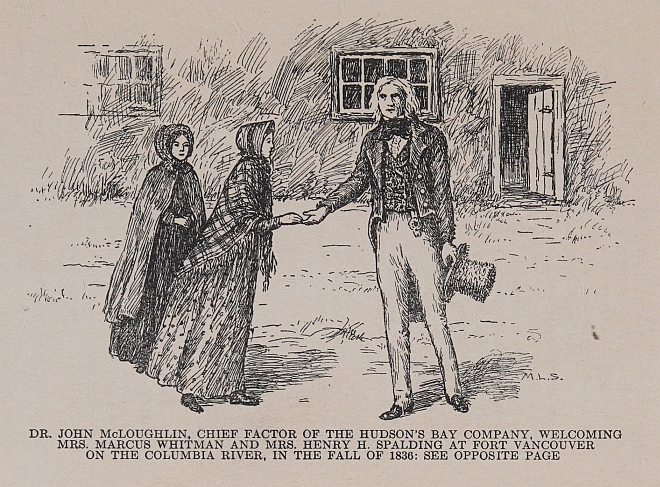
DR. JOHN McLOUGHLIN, CHIEF FACTOR OF THE HUDSON'S BAY COMPANY, WELCOMING
MRS. MARCUS WHITMAN AND MRS. HENRY H. SPALDING AT FORT VANCOUVER
ON THE COLUMBIA RIVER, IN THE FALL OF 1836: SEE OPPOSITE PAGE
At Vancouver they were also cordially received and
hospitably entertained by that grand old man, Dr. John
McLoughlin. It was a never to be forgotten sight for me
to observe this representative of the all-powerful English
fur company, of towering stature and knightly dignity,
standing with hat in hand at the portal of the fort
graciously bending to salute and welcome the two first white
women to set foot upon the immense territory over which
he then held undisputed sway. It was not a mere formal
greeting, but a genuine expression of satisfaction to see
devoted men and women coming into the territory to
improve both the spiritual and temporal condition of his
Indian wards, in whose welfare he was deeply
interested—for McLoughlin was by nature benevolent.
In consultation with Whitman, he advised the latter to
establish his Mission somewhere east of the Cascade
Mountains, for the reason that the Indians of the interior
were mentally and physically superior to those near the
coast, as well as more likely to adopt the rudiments of
civilization and accept Christianity from the missionaries.
Thereupon Whitman, Spalding and Gray returned up the
Columbia to the vicinity of Fort Walla Walla for the
purpose of selecting a site, while the women remained at
Fort Vancouver as Dr. McLoughlin's guests until a
Mission House could be erected.
After looking over the country for several days they
decided that a point called Waiilatpu, on the Walla Walla
River about thirty miles from its mouth, would be a
desirable location for a Mission, as it was convenient to
the habitat of the Cayuse and Walla Walla tribes and
reasonably near the headquarters of the Hudson's Bay
Company for that vicinity, in case trouble should arise.
Work was immediately begun upon the construction of a
comfortable log dwelling roofed with poles covered with
straw and dirt thrown upon the top, which very well
suited the purpose for which it was intended.
A site for another Mission to be in charge of
Rev. Mr. Spalding was located among the Nez Perces on the
Clearwater River about 100 miles northeast of Waiilatpu.
Mr. Spalding then returned to Fort Vancouver for the ladies,
while Dr. Whitman continued work on the dwelling. In
about three weeks Mrs. Whitman arrived at Waiilatpu,
and the Spaldings went on to the Clearwater.
At this isolated and unattractive Mission in the midst
of uncivilized and unappreciative aborigines, practically
shut off from people of her own race and tongue, Narcissa
Whitman spent eleven long weary years in the prime
of her young womanhood, endeavoring to enlighten the
minds and improve and elevate the morals of the savages,
with no hope or prospect of being rewarded in this life,
except by the consciousness of doing the utmost for her
fellow mortals, and that her work might be pleasing in
the eyes of God. The sacrifice of her own life was her
only visible reward.
In 1839 a great sorrow fell upon the Whitman household.
They had a beautiful little girl, an only child who
was suddenly snatched away from her loving parents,
without the slightest inkling of approaching danger or
cause for apprehension. The poignancy of Mrs. Whitman's
grief was intensified by the peculiar circumstances
surrounding them at the time.
She was in a wilderness inhabited by cruel and treacherous
Indians, cut off by nearly three thousand miles
from the old home and her own family, with only
Dr. Whitman to lend a helping hand or console her with a
loving voice; and he was overwhelmed with pressing
duties. Her anguish was beyond description, but with
true Christian courage and exalted faith she bowed to
the Divine will. What sublime resignation!
I have a copy of the characteristic letter she wrote to
her father on that sorrowful occasion, from which I will
now read:
Waiilatpu, Sept. 30, 1839.
MY DEAREST FATHER:
Doubtless before this you have heard through the Board of
the melancholy death of our most precious and only child,
Alice Clarissa. That we loved her most ardently is true, and
we feel keenly the severe pangs of a separation from her.
Yet it is the Lord that hath done it, and He has dealt with
us as a tender parent deals with the children He loves. O,
how often have I felt and thought what a privilege it would
be, if I could see and unburden to my dear parents the
sorrows of my broken and bleeding heart since we have been
bereft of our dear, sweet babe.
Although deprived of this inestimable consolation yet, dearest
father, I desire to ask you to unite with us in praise and
gratitude to God who has so mercifully sustained me, and that
when crushed to the earth because His hand lay heavily upon
me, His grace was manifest to preserve and sustain my soul
from murmuring or repining at His dealings with us.
This unspeakable consolation is ours, that our daughter is
at rest in the bosom of Him who said, "Suffer the little
children to come unto me, for of such in the kingdom of
heaven." Young as she was, we could plainly see a manifest relish and
enjoyment in singing and worship; the last month of her life
she commenced learning to read, and improved rapidly.
I would describe to you if I could her bright, lively
appearance on Sabbath morning, the day of her death. She had
always slept with me until just a week before then, and
that night she proposed, of her own accord, to sleep on the mat
on the floor. This gave me a very strange and singular
feeling, for I never before could persuade her to lie away from
me, not even in her father's arms * * *. It being very warm,
and because she preferred it, I let her sleep on the floor all
night—but did not sleep much myself. Ever after this I made
a bed for her by the side of mine, where I could lay my hand
upon her.
Her appearance at worship in the family was deeply interesting.
For some time she had been in the habit of selecting
the hymn she wished us to sing, and that morning her choice
was "Rock of Ages Cleft for Me." Oh, if dear father and
mother could have seen with what animation she sang, and
how her sweet voice soared above ours!
* * * * * * * * * * *
Dear father, when you sing this hymn think of me, for my
thoughts do not recur to it without almost overcoming me and
bringing fresh to my mind how she appeared when she last
sang it.
NARCISSA.
That letter bears the impress of having been written by
a superior woman suffering the keenest pangs of a mother's
grief, yet bearing it with all the fortitude and
resignation of the early Christian martyrs.
The tragedy happened on a Sabbath morning, while
Dr. and Mrs. Whitman were reading the scriptures. Alice
Clarissa went to bring some water from the river which
flowed near-by the Mission House, as she had done many
times before. She went from the house with a cup in
each hand, bounding down to the river bank to fulfill her
errand, and returned no more.
How it happened is simply conjecture, as there was no
witness when the cold waters of the Walla Walla River
fanned out the precious life of this first white American
child born west of the Rocky Mountains. The little mound
that marked her grave not far from the house was kept
green and bedecked with flowers until the day of the
massacre and destruction of the Mission.
The missionaries—particularly Rev. Mr. Spalding and
Dr. Whitman—never worked in harmony after their
arrival in the Indian country. It is said that the
bitterness of Mr. Spalding against Mrs. Whitman continued
from the time he was a suitor for her hand; and that the
rankling of it led at least to a lack of co-operation on his
part with his successful rival, the Doctor, in carrying on
the Mission work. I will read a letter of Mrs. Whitman
to her father, which throws a flood of light upon the
subject:
Waiilatpu, Walla Walla River,
Oregon Territory, Oct. 10, 1810.
MY DEAR FATHER:
The missionaries' greatest trials are but little known to the
churches. I have never ventured to write about them for fear
it might hurt. The man who came with us ought never to
have come. My dear husband has suffered more in consequence
of his wicked jealousy and great pique towards me than can
be known in this world. Not he alone but the whole Mission
suffers, which is most to be deplored. It has nearly broken up
the Mission.
The pretended settlement with father before we started was
only an excuse; and from all we have seen and heard, both
during the journey and since we have been here, the same
bitter feeling exists. * * *. I never did anything before I left
home to injure him, and nothing since; and my husband is
cautious in speaking and thinking evil of him or treating him
unkindly; yet he does not, nor has he received the same
kindness from him since we have been missionaries together.
Every mind in the Mission that he has had access to he has
tried to prejudice against us, and did succeed for awhile,
which was the cause of our being voted to remove and form a
new station. This was too much for my husband's feelings to
bear, and so many arrayed against him for no good reason.
He felt as if he must leave the Mission, and no doubt would
have done it had not the Lord removed from us our beloved
child. This affliction softened his feelings and made him willing
to submit to the will of the Lord, although we felt that we
were suffering wrongfully.
The death of our babe had a great effect upon all in the
Mission; it softened their hearts towards us, even Mr. S's for a
season. * * * The Lord in His providence has brought things
around in such a way that all see and feel where the evil lies.
Some of them are writing to the Board; and it may require his
removal or return to effect it, not so much for his treatment
towards us as some others also.
* * *. I have long desired to have some few judicious
friends know our trials, so that they may understand better
how to pray for us. If this Mission fails, it will be because
peace and harmony does not dwell among its members. Our
ardent desire and prayer is that it may not fail. It is this
state of things among us that discourage us. When we look
at the people and the providence of God, we are more and
more encouraged every year.
As ever, I remain, your affectionate daughter,
NARCISSA WHITMAN.
During the early days of the Mission the Whitmans
devoted themselves almost exclusively to the difficult task
of inducing the Indians to receive instruction in both
spiritual and temporal matters. The Doctor was rough
and ready in his manner, outspoken in his opinions and,
particularly, vigorous in his actions; when the Indians
did not do exactly as he thought they should, he openly
showed his disapproval and scolded them.
This helps to explain why the Mission was not as
successful as it might have been; but Whitman was
nevertheless a thoroughly sincere and honest man, always
prompted by high motives. Due somewhat to the lack of
harmony in the establishment there, the Board finally
concluded that Waiilatpu should be abandoned.
Very different indeed was the disposition of the
lovable and sweet-tempered woman, Narcissa Whitman, his
helpmate in the work. By kindly manner and tactful
methods she endeared herself to those in her special
charge, and was eminently successful in the care and
management of children.
WHITMAN'S RIDE AND THE MASSACRE
Having learned that the Board had ordered the abandonment
of two stations, including the one at Waiilatpu,
Whitman asked the missionaries to convene at that place
for consideration of what steps should be taken to have
the order rescinded. Upon arrival of some of them, he
called the meeting without awaiting the arrival of those
coming from a greater distance, as he deemed the matter
too urgent to be postponed even a day. It was decided
to have the Doctor proceed immediately to the East to
lay the whole matter before the Board.
Accordingly Whitman, accompanied by A. L. Lovejoy,
left Waiilatpu October 3, 1842, on the long and afterward
famous horseback ride over the Rocky Mountains and
through the vast prairie country during the winter. He
was the kind of man no dangers or difficulties could
deter; and although he underwent great privations,
successfully completed the trip.
His reception by the Board was by no means cordial;
but in a forceful way he showed the serious consequences
that would follow the abandonment of the Missions.
Finally convinced by his logic, the Board rescinded the
order, which action was the object for which the ride was
undertaken. After that he visited his old home in New
York State.
Westbound during May of the following year, Whitman
overtook the 1843 emigrants somewhere along the
Platte River and traveled with them as far as Fort Boise
on the Snake River. Worried about affairs at Waiilatpu
after so long absence, he then went on ahead.
From that time on the affairs of the Mission were still
more unsatisfactory; and the Indians gradually became
alarmed at the number of immigrants arriving in the
country, bringing the measles and other diseases generally
fatal to the natives. Whitman was very successful
in treating his own people, but the great majority of
affected Indians succumbed to the diseases contracted
from the whites.
The more superstitious ones began to imagine that the
Doctor was using "bad medicine" to kill them off so that
his white brothers could have their lands, an idea which
became an obsession with them. It did not bear fruit for
awhile; but as time went on and conditions showed no
signs of change, the foolish natives determined to destroy
the station and kill the missionaries. The latter had been
forewarned more than once by friendly Indians to be on
their guard, as something desperate might happen; but
they did not take it seriously.
On Monday, November 29th, the first of the fatal blows
fell. Whitman was in the sitting room talking with
Mrs. Osborne who lived in an adjoining room. An Indian
came to the door, knocked and asked to see the Doctor
about some medicine; he stepped into the outer room
where several were assembled, and talked with them about
their sick. While thus engaged one of them suddenly
drew a tomahawk from beneath his blanket and delivered
a crushing blow upon Whitman's head.
Then pandemonium broke loose, and with frightful
yells the savages began the slaughter of the defenseless
inmates. In only one instance was any resistance offered;
when attacked by an Indian with a knife, the school-teacher
grappled with his assailant and struggled for his
life until dispatched by another of the natives.
Mrs. Whitman was shot through the breast by a renegade
half-breed, Joe Lewis, and afterwards beaten over
the head and face with clubs until life was extinct. She
was the only woman slain, the others being made captive
and confined in one of the Mission houses. The reign of
terror continued through Tuesday, Wednesday and
Thursday, with several other murders of the white people.
Two seriously ill men were dragged out of their beds and
clubbed in a most barbarous manner until they expired.
It is surprising that, wrought up to such a high state
of frenzy against the Mission and its inmates, the
Indians did not also massacre the fifty or more women and
children who fell into their hands. Through the untiring
efforts of Peter Skene Ogden, Chief Factor of the
Hudson's Bay Company, the latter were ransomed after a
few weeks' captivity.
The Whitman Massacre was one of the saddest and most
revolting episodes in the annals of missionary effort in
North America. It cast a shadow over the land, and
caused those who were active in the movement for the
regeneration of the red men to almost abandon it in
despair.
No doubt you think it strange that in telling you
about the Oregon Country, its exploration and early
settlement, I should have devoted so much time to the
expeditions, labors and sufferings of the missionaries. But it
was owing primarily to the initiative from those sources
that the Pacific Northwest, with all of its wonderful
resources and possibilities, became known to the people of
"the States"; large numbers were thus encouraged to
emigrate to it, aiding materially in bringing all of that
vast region under the flag and within the dominion of our
beloved country.
Otherwise the choicest portion of that territory would
in all probability have passed into the possession of a
foreign power. Is not that a good reason for occupying
so much time in recounting their efforts and exploits?
I will now give briefly a few of the outstanding incidents
since the migration to the Oregon Country began in the
wake of the missionaries.
THE PROVISIONAL GOVERNMENT
In the spring of 1843, a kind of Provisional Government
for the Oregon Country was organized at a meeting
of settlers held at Champoeg in the Willamette Valley.
Previous attempts had been made for that purpose, but
owing to divergent views, they had ended in failure.
Now, however, at a gathering in March, 1843, called
ostensibly for the purpose of taking steps to protect the
settlement from predatory animals and known as the
"Wolf Organization," a resolution was introduced and
carried to appoint a committee of twelve to formulate a
plan. At the meeting held on May 2nd attended by both
British and American partisans, the vote was very close,
the advocates of a Provisional Government winning by a
slight margin.
It was so close that there was difficulty in determining
which side had the majority; so after one or two
unsuccessful attempts to decide by a viva voce vote, an
agreement was reached to have a division and count—those in
favor of the proposal going to the right, while those
opposed went to the left. Joseph L. Meek, a man of
splendid physique and the hero of many adventures in the
Rockies, clad in the garb of the mountaineers, with
sparkling eyes, a voice of command and the air of a
Major General, stepped to a niche in history as he strode
to his position crying out, "Who's for a divide! All in
favor of the report and organization follow me."
The hunters and trappers who were present followed his
lead, and so carried the day for the proponents of the
measure. More than half the Americans present voted
against it, because they (wrongfully) believed it a scheme
of the Mission party to secure control of the organization.
Were it not that quite a number of French-Canadians
favorable to self-government voted in the affirmative,
it would have lost.
On the following day, May 3rd, the Provisional Government
was duly organized—a date and event long to be
remembered. That government was ably and wisely carried
on for a term of six years, until the United States
assumed jurisdiction in 1849.
Dr. John McLoughlin recognized it, as he never would
have done were it not worthy of respect. It demonstrated
that the Oregon pioneers were capable, resourceful and
not mere imitators of other men. Their deeds should be
admired and their names venerated.
I might add that the entire white population of the
Oregon Country at that time was only a little more than
two hundred. But the tide had set in, and nearly five
times that number were already assembled at different
points on the Missouri River preparing to start overland.
THE 1843 MIGRATION
This was in many respects the most remarkable and
important migration that ever left the Missouri River
for the far Northwest. Although numerically far below
those of the following years, it was the first company
regularly organized to go out to that territory with the
sole object of making permanent settlements, and growing
up with it.
The people composing it were not influenced to any
considerable extent by the evangelical movement, but
mostly farmers, tradesmen and mechanics determined to
find and make the best of opportunities for improving
their material condition. It was the first migration to
succeed in taking wagons beyond Fort Hall to the banks
of the Columbia and down along the south side of that
river to The Dalles, thence by batteaux or rafts to Fort
Vancouver and the Willamette Valley, thus blazing a
trail for future thousands to follow.
Among those emigrants were several men of unusual
ability and forceful character, who were subsequently very
successful and attracted wide attention. Peter
H. Burnett—keen, alert and ambitious, the possessor of an
almost inexhaustible fund of information and anecdote—became
the first Governor of California, 1849-51.
Another one was J. W. Nesmith, witty and brilliant,
later United States Senator from Oregon. Jesse
Applegate, one of the men who came over the Oregon Trail
in 1843, was a versatile writer, forceful speaker and a
leading worker in the ranks of every progressive movement
in the Pacific Northwest during his long and useful
life there.
These men had the hardihood to attempt a feat
considered utterly impracticable by those who had passed
and repassed over that route on horseback for many years.
When asked for his opinion as to the feasibility of taking
the wagons to the Columbia, Richard Grant, the Chief
Factor of the Hudson's Bay Company at Fort Hall, made
this characteristic and undoubtedly honest reply, "I will
not say that Americans cannot do it, but for myself I
cannot see how it would be possible."
The news that a large company of home seekers had
succeeded in driving their teams and four-wheeled vehicles
all the way through by that route caused widespread
rejoicing throughout "the States," and virtually settled the
question as to which nation the region should belong.
THE UNFORTUNATE SAGER FAMILY
Of the many tragic and pathetic incidents along the
Trail during the early migration to Oregon, none
surpasses that of this most bereaved and sorely afflicted
family. Mr. Sager, a blacksmith, went in 1838 from Ohio
to Missouri; in the fall of 1843 he moved to St. Joseph
in that State, and in the spring of 1844 joined the
Gillman party bound for the Oregon Country. He was
accompanied by his wife and six children, the eldest a
boy of fourteen (a seventh was born on the road), making
five girls and two boys.
While crossing the Platte River one of his wagons in
which Mrs. Sager was riding, overturned and so seriously
injured her that she never entirely recovered from it.
Near Fort Laramie the oldest girl fell under the wheels of
the wagon and was rendered helpless during the remainder
of the journey. At Green River, Mr. Sager died leaving
an invalid wife, a crippled daughter and six children,
the youngest a baby only a few weeks old.
In the party was an unmarried German doctor of a
benevolent disposition who, seeing the straits to which
the family was reduced, volunteered to drive and care
for the oxen and assist the unfortunates to their destination.
Mrs. Shaw, a kind hearted woman of the train, took
the infant in charge. At Fort Bridger the greater part
of the property brought that far by the emigrants, among
them the Sagers, had to be abandoned, making their lot
still harder, for henceforth they must travel in a cart.
Notwithstanding all that could be done to alleviate the
sufferings of the ill and weak mother, she could no longer
endure the hardships of the journey; and gave up her
spirit in the wild and forbidding region of the Snake
River. Delirious at the time, she called upon her dead
husband to take good care of their little ones.
Mr. Shaw went to the Whitman Mission to see if Dr. and
Mrs. Whitman could be prevailed upon to assume the
care and custody of the orphans. Though prompted by
their natural inclinations to do so, the Whitmans
hesitated to assume the additional responsibility.
While in this uncertain frame of mind, the two-wheeled
vehicle with its cargo of six ragged and travel-stained
children appeared upon the scene. It was utterly
impossible for those kind-hearted people to resist that
appeal. When the question of the infant came up, the
Doctor could not see how it could be managed; but
Mrs. Whitman turned to him and said, "I would like to have
the baby most of all."
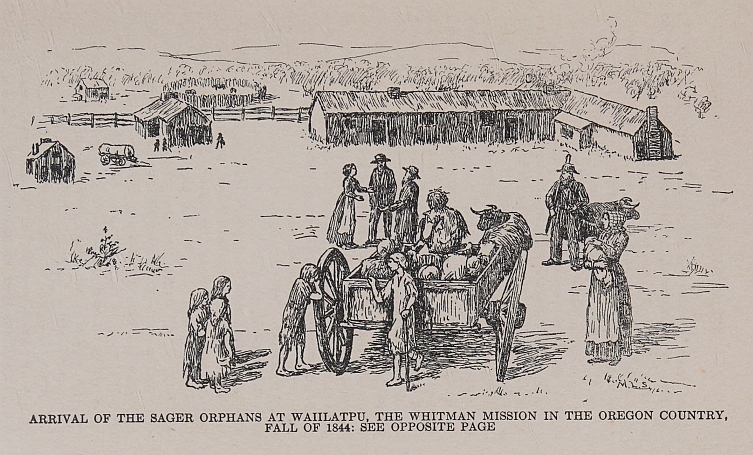
ARRIVAL OF THE SAGER ORPHANS AT WAIILATPU, THE WHITMAN MISSION
IN THE OREGON COUNTRY, FALL OF 1844: SEE OPPOSITE PAGE
The arrival of the cart load of orphans at Waiilatpu
presented a sight worthy of the brush of some great artist
to transfer it to canvas, for such a combination of
circumstances seldom occurs in real life. All that then
remained of their once complete outfit was in the foreground;
and the emaciated, nearly exhausted oxen dropped
down to rest as soon as they were unyoked. John, the
oldest boy, was seated in the front end of the cart, his
ragged garments covered with a heavy coating of grey
dust from the sagebrush plains, while his woe-begone
countenance and tear-stained cheeks clearly indicated his
supreme anguish.
Francis, the younger boy, was leaning on one wheel of
the cart, his head resting on his arm and sobbing audibly.
On the near side, the three little girls were huddled
together bareheaded and barefooted, looking at the boys
and then at the house, dreading whatever might happen.
Close to the oxen stood the German doctor with his whip
in hand and kindly eyes viewing the scene with suppressed
emotion.
The baby member of the family was in the care and
custody of Mrs. Shaw, whose husband somewhat
thoughtlessly asked Mrs. Whitman if she had any children of
her own. Stopping at the threshold, the good woman
pointed to the little grave on the side of a small mound
easily seen from that point, and replied, "The only child
I ever had sleeps yonder." In the tone of her voice and
the expression of her face there was unspeakable sadness.
Only a few years later John and Francis were brutally
murdered at the same Mission House by infuriated
Indians, and all the girls taken into captivity. That family
certainly was tried in the crucible; and never in my
experience have I found a parallel to it.
* * *
Up to the present time fully nine-tenths of the
emigrants going to the Oregon Country have settled in the
Willamette Valley—a very large and fertile valley, probably
seventy or eighty miles long by some ten or twelve in
width. It is flanked on either side by ranges of heavily
timbered hills, and traversed by the large Willamette River,
which is fed by numerous streams issuing from the adjacent
mountains on its course northward to join the mighty
Columbia. The climate is remarkably mild and entirely
free from extremes of temperature; and its very fertile
soil produces small grains such as wheat, oats and barley,
in great abundance. Vegetables of every kind grown in
the temperate zone do remarkably well, while fruits such
as apples, pears, plums and cherries are not only raised
in great quantities, but are generally superior to the
same varieties in the Atlantic States. Fish and game
are also quite plentiful. Since the discovery of gold in
California, that region has been an excellent market for
everything raised at fancy prices; if this condition
continues, the Oregon farmers will soon be more prosperous
than the California gold miners.
There is also a vast region north of the Columbia,
heavily timbered but interspersed here and there with
numerous fertile valleys, which in recent years have been
receiving many immigrants who claim to see a great
future ahead. Even in the eastern portion of the territory,
which is still occupied almost exclusively by Indians,
shrewd men see possibilities of large settlements
springing up within the next few years.
It is a wonderful country to which you are going, and
you will probably never have cause to regret the decision.
THE WORK BEGUN AND CARRIED ON FOR TWO
DECADES BY EZRA MEEKER TO BE
CONTINUED ON A LARGER SCALE BY THE
OREGON TRAIL MEMORIAL ASSOCIATION,
INC. OBJECTS: PLAN: MEMBERSHIPS:
More than twenty years have elapsed since the
author started, January 29, 1906, on a return
trip over the Oregon Trail, which he had traversed
with an ox-team when just past 21 years of
age, accompanied by a brave young wife and a babe,
nearly fifty-four years before. The first journey was
in search of a home in the Oregon Country, of which
he has now been a resident for over seventy-three
years; and the second one to rescue from impending
oblivion the memories of the Pioneers by rediscovering
the Trail they followed, and erecting permanent
monuments to honor their heroic achievements.
A third trip was made with the ox-team in 1910 to
continue and enlarge the effort; a fourth one with an
automobile in 1915 to enlist the co-operation of the
motoring public in the great work, and finally a fifth
by aeroplane in October, 1924, when he looked down
from the air at a speed of 100 miles per hour upon the
route previously followed at an average of about two
miles an hour by a migration of at least three hundred
thousand, of whom not less than twenty thousand gave
up their lives on the way. Although a total of nearly
two hundred monuments and markers have been
placed along or nearby the old tracks, the plan as a
whole is still incomplete; and the desirability of
carrying it forward beyond the limitations of a single life,
unquestionable.
On January 9, 1926, the OREGON TRAIL MEMORIAL
ASSOCIATION, INC. was organized under
the laws of the State of New York, for the following
specific purposes:
1. To search out, identify, suitably and permanently
mark the line of the Oregon Trail, in so far as possible
at this time, with or without visible marks of the old
tracks.
2. To erect suitable monuments or memorials on or
nearby the sites of historical forts, trading posts or
other important landmarks along the Trail, such as
Fort Kearney, Fort Laramie, Fort Hall, Fort Bridger
and others of distinct historical interest.
3. To restore the Whitman Mission in the County
of Walla Walla, State of Washington, as the same
existed at the date of the Massacre, November 29,
1847; to establish, or promote the establishment of, a
park or other memorial to appropriately commemorate
the sacrifice of Marcus and Narcissa Whitman, and
the other victims of that historic tragedy; also to
identify other localities where massacres are known to
have taken place, and to suitably mark them.
4. To promote, encourage or portray in moving
pictures, vividly recording the historic scenes on the
great emigration over the Oregon Trail, with a
reproduction of the characteristic scenery along the route,
for use in the schools of the Nation, teaching exact
and truthful history by such methods.
5. To collect and preserve written accounts, objects
of interest and other things pertaining to the history
of the winning of the Pacific Northwest; to deposit
same with the historical societies, preferably in the
States where found, or to designate a Museum or
museums to preserve such records, relics or objects
of interest as may be donated or otherwise acquired;
and erect a suitable memorial to the Pioneers, most
appropriately in the City of Washington.
Membership consists of two classes—Annual and
Life. Any citizen of the United States, of adult age,
shall be eligible for membership by the payment,
annually, of two dollars ($2); or for a Life
Membership by one payment of fifty dollars ($50). No
assessment of members shall be made; nor shall
membership involve any financial obligations beyond
the stated fees or dues to the Corporation.
The considerable number of men and women who
have already become identified with the organization
are devoting their time and money to perpetuate the
memory of the Pioneers, all but a few of whom have
gone to their reward, and to preserve the history of
the great overland migration which was the principal
factor in advancing the northwestern boundary of the
United States to the Pacific Coast. Work will be
started in the field as soon as sufficient funds are
secured to enable it to be carried forward on the high
standard outlined. Success in accomplishing these
objects depends upon public confidence and support;
and the reader of this volume is invited to become
a member.
OREGON TRAIL MEMORIAL ASSOCIATION, INC.
Ezra Meeker, Rev. David G. Wylie, D.D., LL.D.
President Secretary
18 Old Slip, New York City
WORKS BY EZRA MEEKER
LOVED BEFORE SEEN (1874), a Story of Pioneer Life.
WASHINGTON TERRITORY WEST OF THE CASCADE
MOUNTAINS (1870), a descriptive pamphlet, out of
print and rare; as high as $100 has been paid for single copies.
FARM AND HOME, an editorial series of 52 numbers,
1884-6; newspaper publication only.
HOP CULTURE IN THE UNITED STATES (1883);
rare and out of print.
PIONEER REMINISCENCES OF PUGET SOUND,
AND THE TRAGEDY OF LESCHI (1905); 550 pages in
two volumes under one cover, silk cloth binding, $15.00.
SHORT STORIES FOR CHILDREN, each with a moral.
THE LOST TRAIL (1911-12-15), a booklet of 32 pages,
of which several editions totaling a hundred thousand copies,
have been issued.
THE OREGON TRAIL, VENTURES AND ADVENTURES,
revised and republished under title of THE BUSY
LIFE OF EIGHTY-FIVE YEARS (1916); 400 pages, $1.65,
postpaid.
FIFTY YEARS OF PROGRESS IN WASHINGTON
(1915); 400 pages, $5.00 postpaid.
KATE MULHALL, a Romance of the Oregon Trail
(1926); this volume, $2 postpaid, with the usual discounts to
the trade.
In active preparation (1926): A CENTURY OF BUSY
LIFE—the biography, varied experiences as pioneer, farmer,
author and traveler, including four years in Europe, and the
"homespun" philosophy of Ezra Meeker, 1830-1930 (borrowing
a few years from the future, through which the author
confidently expects to live, and thus justify
the title chosen for this
work), amplifying and carrying forward THE BUSY LIFE
OF EIGHTY-FIVE YEARS in more definite historical
retrospect.