By MAJOR E. MOLYNEUX, D.S.O.
| |
PAGE |
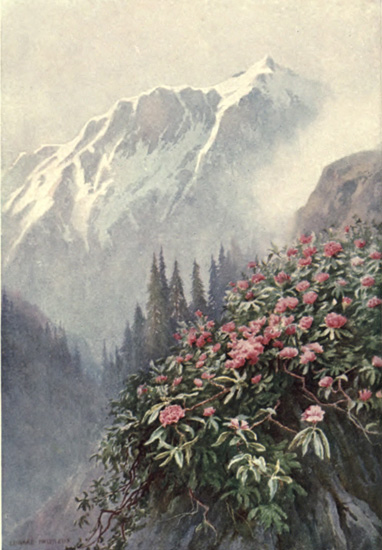
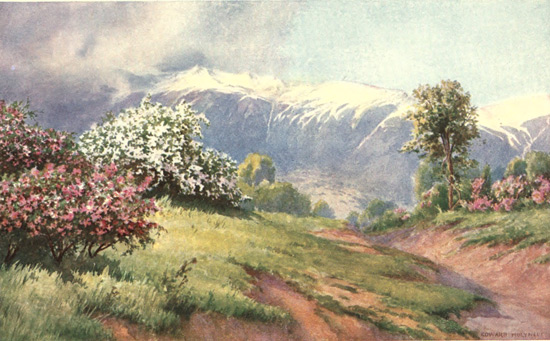
| 1. | Wild Rhododendrons |
Frontispiece |
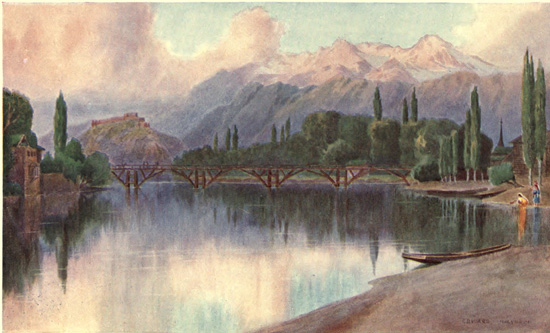
| 2. | Approach to Srinagar |
2 |
| 3. | The Land of Roses |
4 |
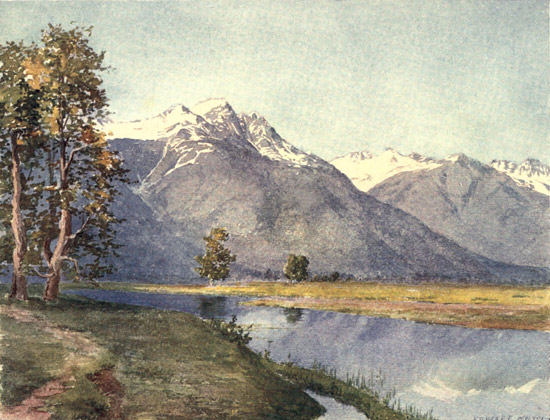
| 4. | Mouth of the Sind Valley |
6 |
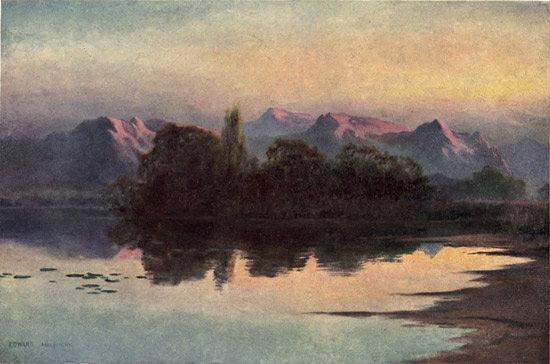
| 5. | Sunset on the Wular Lake |
8 |
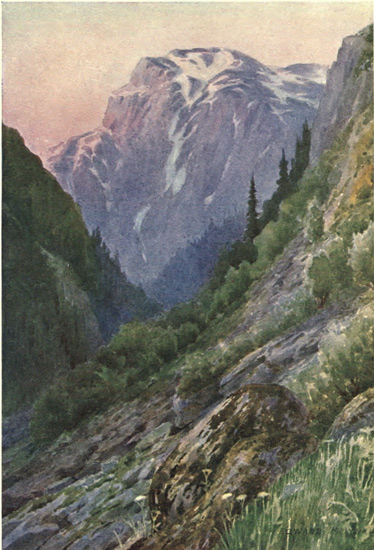
| 6. | Dawn in the Nulla |
10 |
| 7. | Kotwal from the Forest above Kangan, Sind Valley |
12 |
| 8. | Above the Camping-Ground, Sonamarg, Sind Valley |
14 |
| 9. | The Kajnag from Sopur, Early Spring |
16 |
| 10. | Kotwal from near the Dal Darwaza |
18 |
| 11. | The Lull before the Storm, Dal Lake |
20 |
| 12. | Above Lidarwat, Lidar Valley |
22 |
| 13. | Sunset on the Jhelum, above Srinagar |
24 |
| 14. | Spring in Kashmir |
26 |
| 15. | On the Dal Lake in Spring |
28 |
| 16. | Entrance to the Mar Canal |
32 |
| 17. | The Temple, Chenar Bagh |
34 |
| 18. | Ruins of Lalla Rookh's Gardens, Lake Manasbal |
36 |
| 19. | A Ladaki in Summer Costume |
52
|
| 20. | The Valley of Gurais |
62 |
| 21. | Market Boats on the Mar Canal, Srinagar |
64 |
| 22. | Above the Fifth Bridge, Srinagar |
66 |
| 23. | Shawl Merchants' Shops, Third Bridge, Srinagar |
68 |
| 24. | Mosque of Shah Hamadan, Srinagar |
70 |
| 25. | A Hindu Temple, Srinagar |
72 |
| 26. | In the Mar Canal, Srinagar |
74 |
| 27. | Guggribal Pointe on the Dal Lake |
76 |
| 28. | Lotus Lilies on the Dal Lake |
78 |
| 29. | Shalimar Gardens |
80 |
| 30. | The Nishat Bagh |
82 |
| 31. | A Terrace of the Nishat Bagh |
84 |
| 32. | The Residency and Club, Srinagar |
88 |
| 33. | The Takht-i-Suliman, from the Residency Garden |
94 |
| 34. | On the Circular Road, Gulmarg |
100 |
| 35. | In the Forest |
102 |
| 36. | From the Circular Road, Gulmarg |
104 |
| 37. | Gorge of the Sind Valley at Guggangir |
108 |
| 38. | The Frozen Lake, Gangabal |
110 |
| 39. | Early Morning near Pahlgam, Lidar Valley |
112 |
| 40. | The Ruins of Martand |
114 |
| 41. | A Srinagar Bazaar |
116 |
| 42. | A Corner of the Village of Pahlgam, Lidar Valley |
128 |
| 43. | A Mountain Farm-House |
130 |
| 44. | A Boatman and his Family |
132 |
| 45. | Ruins of Temples, Wangat, Sind Valley |
134 |
| 46. | Ruined Gateway of Martand |
136 |
| 47. | Ruined Temples of Avantipur |
138
|
| 48. | Gate of the Outer Wall, Hari Parbat Fort, Srinagar |
156 |
| 49. | At the River's Edge, Srinagar |
160 |
| 50. | Lalla Rookh's Tomb, Hassan Abdal |
162 |
| 51. | Bridge of Burbur Shah, Chenar Bagh, Srinagar |
164 |
| 52. | Spring Floods in the Kutical Canal, Srinagar |
166 |
| 53. | Looking down the Gurais Valley, from Dudhgai Village |
168 |
| 54. | Akbar's Bridge, Karallayar |
174 |
| 55. | The Camping-Ground at Lidarwat |
198 |
| 56. | A Wayside Shrine |
202 |
| 57. | Evening on the Dal Lake |
210 |
| 58. | Mount Haramokh, from the Erin Nullah |
238 |
| 59. | A Mountain Glen, before the Melting of the Snows |
240 |
| 60. | Lake Shisha Nag, Lidar Valley |
244 |
| 61. | Distant View of Nanga Parbat, from the Kamri Pass |
246 |
| 62. | Mount Kolahoi, Lidar Valley |
248 |
| 63. | Rampur, Jhelum Valley Road |
252 |
| 64. | In the Sind Valley |
254 |
| 65. | Lake Shisha Nag at Sunset |
258 |
| 66. | The Tannin Glen, Lidar Valley |
260 |
| 67. | Going to the Wedding, Upper Indus Valley |
262 |
| 68. | Mountain Mists |
264 |
| 69. | Near the Kolahoi Glacier, Lidar Valley |
266 |
| 70. | Lake Sinsa Nag, Lidar Valley |
270 |
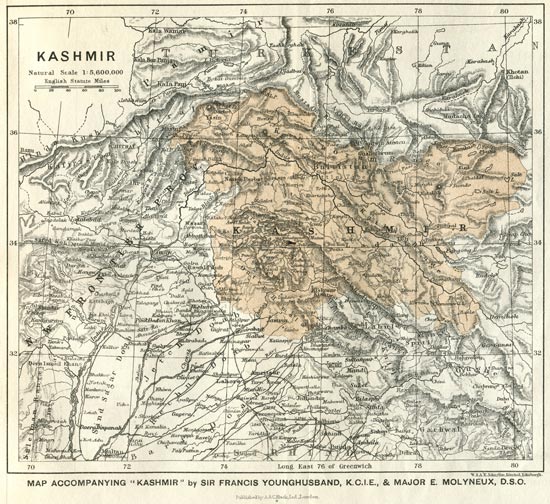
Sketch Map of Kashmir at end of Volume.
KASHMIR
SCENERY AND SEASONS
Bernier, the first European to enter Kashmir,
writing in 1665, says: "In truth, the kingdom surpasses
in beauty all that my warmest imagination
had anticipated." This impression is not universally
felt, for one of the very latest writers on
Kashmir speaks of it as overrated, and calls the
contour of the mountains commonplace and comparable
to a second-rate Tyrolean valley. And
fortunate it is that in this limited earth of ours
we every one of us do not think alike. But
I have seen many visitors to Kashmir, and my
experience is that the bulk of them are of the
same view as the above-mentioned Frenchman.
They have read in books, and they have heard
from friends, glowing descriptions of the country;
but the reality has, with most, exceeded the
expectation. Some have found the expenses of
living and the discomforts of travel greater than
they had expected. And some have arrived when
it was raining or cloudy, and the snows were not
visible; or in the middle of summer when the
valley is hazy, steamy, and filled with mosquitoes.
But when the clouds have rolled by, the haze
lifted, and a real Kashmir spring or autumn day
disclosed itself, the heart of the hardest visitor
melteth and he becomes as Bernier.
The present book will deal, not with the whole
Kashmir State, which includes many outlying
provinces, but with Kashmir Proper, with the
world-renowned valley of Kashmir, a saucer-shaped
vale with a length of 84 miles, a breadth of 20 to
25 miles, and a mean height of 5600 feet above
sea-level, set in the very heart of the Himalaya,
and corresponding in latitude to Damascus, to
Fez in Morocco, and to South Carolina.
APPROACH TO SRINAGAR
The country with which one is most apt to compare
it is, naturally, Switzerland. And Switzerland,
indeed, has many charms, and a combination of
lake and mountain in which, I think, it excels
Kashmir. But it is built on a smaller scale.
There is not the same wide sweep of snow-clad
mountains. There is no place where one
can see a complete circle of snowy mountains
surrounding a plain of anything like the length
and breadth of the Kashmir valley, for the main
valleys of Switzerland are like the side valleys of
Kashmir. And above everything there is not
behind Switzerland what there is at the back of
Kashmir, and visible in glimpses from the southern
side,—a region of stupendous mountains surpassing
every other in the world.
By these Himalayan regions only, by the
mountains of Baltistan and Hunza, and by those
unequalled mountains seen from Darjiling, can
Kashmir be excelled. There indeed one sees
mountain majesty and sublimity at their very
zenith. And with such as these Kashmir cannot
compare. But it possesses a combination of quiet
loveliness and mountain grandeur which has a
fascination all its own. If one could imagine the
smiling, peaceful Thames valley with a girdle of
snowy mountains, he would have the nearest
approach to a true idea of Kashmir it is possible
to give. He would not expect the stern ruggedness
and almost overwhelming majesty of the
mighty mountains beyond Kashmir. But he
would have the tranquil beauty and genial loveliness
which to some are even preferable.
Of this, my collaborator's pictures will give a
true and vivid impression, though every artist allows
that it is impossible to give in a single picture
the broad general effect of those wide-flung landscapes
and of the snowy ranges stretching from one
horizon to another. For that impression and for
the varying effect of spring and autumn, of winter
and summer, dependence must be on the pen alone.
Which is the most lovely season each must
decide for himself. In the spring we think the
spring the most exquisitely beautiful. In the
autumn we say that nothing could exceed the
charm of the brilliant autumn tints. But as it
is in the spring that most visitors first arrive, and
as it is the real beginning of the year, there will
be some advantage in commencing in that season
the delicate task of describing Kashmir.
In the first week in March I drove into Kashmir,—this
last year, fortunately, in fine weather. In
other years at this season I might not have
been so fortunate, and the reader must take this
possibility of drenching rain, of muddy roads,
and dangerous landslips into account. For that
purpose, however, there is no need to offer aid to
his imagination, as rainy days are much the same
all the world over.
THE LAND OF ROSES
The long drive from the Railway Station at
Rawal Pindi, 196 miles from Srinagar, was
nearly ended. We had steadily ascended the
valley of the Jhelum, with the river continually
dashing past us on the left, a strong impetuous
stream now being turned to useful ends, firstly,
in generating electric power near Rampur, and
secondly, in irrigating millions of acres in the
plains of the Punjab below. We had passed
through the peaceful deodar forest on either side
of Rampur, and the splendid limestone cliffs
which rise precipitously from them. Just beyond
we had passed massive ruins of the so-called
Buddhist, but really Hindu temple, dating about
700 a.d. All the country had been blanketed
with snow; the hill-sides forested with thousands
of Christmas trees glistening in the brilliant sunshine,
and the frozen road had been rattling under
the ponies' feet. When gradually the narrow valley
opened out. The enclosing hills widened apart.
The river from a rushing torrent became as placid
as the Thames, with numerous long-prowed boats
gliding smoothly downward. The little town of
Baramula, and the first distinctive chalet-like, but
dirty, shaky habitations of Kashmir; a graceful
Hindu temple; fine specimens of the famous
chenar trees; and a typical log bridge, came into
view; and then, as the hill-sides finally parted
asunder, the glorious valley itself—a valley on so
extensive a scale as really to be a plain amidst the
mountains—was disclosed; and faintly mingling
with the cloudless azure of the sky, on the far
side stretched the great range of snowy mountains
which bound Kashmir on the north, with the
Haramokh peak, 16,900 feet high, standing boldly
out 35 miles distant immediately in front; and
from just beyond Baramula even Nanga Parbat
itself, 26,600 feet, and 70 miles distant, towering
nobly over the lower ranges, the solitary
representative of the many mountain giants which
lay behind.
Then as we emerged into the open valley the
snow disappeared and the first faint signs of spring
were visible. All the trees were indeed still bare.
Neither on the massive chenar nor on the long lines
of poplars which bordered the road continuously
from Baramula to Srinagar was there a vestige of a
leaf; and all the grass was absolutely brown. But
in the willows there was just the suspicion of yellow-green.
The little leaf-buds were just preparing to
burst. On the ground were frequent masses of
yellow crocuses and familiar bluebells. Here and
there were clumps of violets. Occasionally a
tortoise-shell or cabbage-white butterfly would
flutter by. Above all, the glorious brilliant sunshine,
the open, clear blue sky, and the soft touch
and gentle feel which at noonday replaced the
crisp, frosty nip of the morning air gave certain
promise of the approach of spring.
MOUTH OF THE SIND VALLEY
Again, when at length Srinagar, the capital
of Kashmir, was reached, and I was back in my
much-loved garden, still other signs of spring's
arrival were evident. Violets, pansies, wallflowers,
narcissus, crocuses, and daisies were out. A few
green blades were showing through the brown
grass. Rose leaf-buds were bursting. In one
garden near a few apricot blossoms had actually
bloomed. And the whole garden was filled with
the spring song of the birds lightly turning to
thoughts of love—thrushes, minas, sparrows, blue-tits,
hoopoes, starlings; bold, familiar crows, and,
most delightful of them all, the charming little
bulbuls with their coquettish top-knots—the
friendly little beings who come confidingly in at
the windows and perch on the curtain rails or chairs,
and even on the table to peck sugar from the basin.
And so for many days the weather continued,
the temperature a degree or two below freezing-point
at night, and rising to a maximum of 55° in the
shade and 105° in the sun in the day-time. Day
after day cloudlessly clear. The snowy ranges
standing out sharp and distinct. The nearer
mountains still covered with snow to within a
thousand or two feet of the valley level. In the
early morning all the valley-bottom glistening
silvery-white with hoar frost. Then towards noon
a curious struggle between summer and winter.
The aspect of the country outside the garden
entirely winter—leafless trees and frost-withered
grass; but in the still air the sun's rays, with daily
increasing power, having all the warmth of an early
summer day in England; and under the noonday
sun the mountains fading in a dreamy haze.
Then, of a sudden, came one of those complete
and rapid changes which so enhance the charm of
Kashmir. Dark ominous clouds settled on the near
mountain-tops; here and there sweeping along
their summits whirling snowstorms were driven
along; the distant snows showed up with that
steel-grey definition which in storm-ridden days
replaces the dreamy indistinctness of more sunny
times; now and then a glinting sun-ray breaking
through the driving clouds would brighten up
some solitary peak; and in the valley bottom
periods of threatening stillness would alternate
with gusty bursts of wind.
SUNSET ON THE WULAR LAKE
Such signs are usually the presage of unpleasant
weather. But in the present case rain did not fall;
and this was fortunate, for I had gone into camp
to shoot a bara-singh, the famous Kashmir stag.
Rising at four on the following morning, and, as
soon as I had had a hurried breakfast, mounting a
shaggy, naughty little pony captured in the fighting
in Tibet, I followed the shadowy form of a shikari
bestriding a still more diminutive country pony.
Most of the clouds of the previous day had
disappeared. The wind had died down, and the
stars were shining out with that clear brilliance
only seen amidst the mountains and in the desert.
There was a sharp, bracing feeling in the air—not
the same stinging cold I had felt when riding along
this road at night in January, but strong and
invigorating. We stumbled along on our ponies
across fields and by paths which only a native could
detect. At each village dogs howled dismally at
us, but not a soul was astir. We gradually
approached the dark outlines of the mountains,
and near their base, while it was still pitch dark,
we were joined by other shikaris who, like stage
conspirators and with bated breath, explained
where a stag had been seen on the previous day.
I had then to dismount and walk; steadily and
silently we ascended the mountain-side, and by
sunrise were 3000 feet above the valley. The
shikaris were now visible, and like their class hard
and keen-looking, clearly used to living on mountain-sides
in cold and heat, and to be ever peering into
distances. The head shikari was a grey, grizzled,
old-looking man, though I daresay he was really
not over fifty; hard and tough, and very grave
and earnest—for to him all else in the world is play,
and shikar is man's real work in life. Residents,
no doubt, have some employments to amuse themselves
with in ordinary times; but when the real
business of life has to be done they come to him,
and he takes them gently in hand like little
children, and shows them the haunts of the
Kashmir stag, his habits, where he wanders, and
how to pursue him.
DAWN IN THE NULLA
So now I put myself humbly in charge of the
shikaris, for I make no pretence to be a sportsman.
They thereupon proceed to whisper together
with profound earnestness and dramatic action.
They point out the exact spot where, on the
previous afternoon, a stag was seen. They pick
up little tufts of his hair brushed off, as they
say, in fighting. They show his footsteps in the
soft soil and on patches of snow. And they are
full of marvellous conjectures as to where he can
have gone. But gone he has, and that was the
main fact which no amount of whispering could
get over.
So on we went along the mountain-side, and
now through deep snow, for we were on a northward-facing
slope of an outlying spur—and all
slopes which face northward are wooded, while
southward-facing slopes are bare. The explanation
was evident. For on the latter slopes the sun's
rays fell directly and almost at right angles, and
in consequence fallen snow quickly disappears:
while on the northern slopes the sun's rays only
slant across the surface; the snow remains much
longer; the moisture in the soil is retained;
vegetation flourishes; trees grow up; they in
their turn still further shade the snow, and with
their roots retain the moisture. And so as a
net result one side of a mountain is clothed in
dense forest, and on the other there may not be a
single tree. Thus it is that on the southern
side of Kashmir, that is, on the northward-facing
slopes of the Pir Panjal range, there is, as at
Gulmarg, dense and continuous forest, while on the
northern side of the valley, on the slope of the hill
that consequently faces southward, there is no
forest except on the slopes of those subsidiary
spurs which face northward.
We followed the tracks of the stag through this
patch of forest, mostly of hazels, the shikaris
pointing out where the stag had nibbled off the
young leaf-buds and bark which seem to form the
staple food of the deer at this time of year. At
last we came to another shikari who said he had
seen the stag that very morning. But I suspect this
was merely a form of politeness to reinspire my
lagging hope, for though I went down and up and
along the mountain-side, and spent the whole day
there, I saw no stag. Once we heard a rustling
among the leaves, and hope revived, but it was
merely a troop of monkeys. A little later a
boar shuffled out; and again, on a distant spur,
disporting himself in the sunshine, we saw a bear;
but no stag.
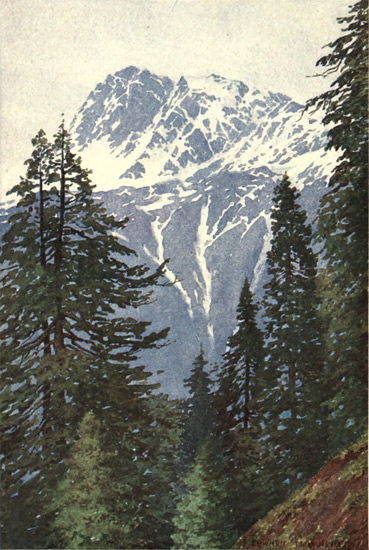
KOTWAL FROM THE FOREST ABOVE KANGAN, SIND VALLEY
Still, in spite of the exertion and in spite of the
disappointment, a day like this on the mountain-side
is felt as one of the days in which one lives.
The air was fresh and bracing. There was something
both soothing and inspiring in the quiet of
the mountains and the immense distances before
me. Far away to the south majestic clouds and
snowstorms were sweeping along the snowy range
of the Pir Panjal. Beneath was the placid river
wending its tortuous way through the peaceful
valley. On one hand would be seen angry storm-clouds
rolling threateningly across with numerous
sun-rays piercing through and lighting up the
serpentine course of the river. On the other,
emerging from the black masses, would appear the
sunlit snowy range, not hard, defined, and clear,
and rooted on earth, but to all appearances hung
from the heavens like an ethereal transparency.
Hour after hour I alternately feasted on the
changing scenes displayed across the valley, and
with my field-glasses searched the mountain-side
for bara-singh. When evening closed in I returned
to camp, where business kept me on the following
day, but on the day after I again rode out while it
was yet dark. As the first faint signs of dawn
appeared I began the ascent of the mountain with
the shikaris. The heavens were clear and cloudless.
The bluey-black of the sky imperceptibly faded
into grey. The mountain slowly turned from grey
to brown as we steadily worked upward. The
reposeful stillness which is the characteristic charm
of the mountains was only broken by the cheerful
chuckle of the chikor, or the occasional twitter of
a bird calling to its mate. Then as we reached
the summit of a ridge, and I looked out through
the greys and browns, a sudden thrill struck
through me as, all unexpectedly, my eye lit on the
long flush of rosy pink which the yet unrisen sun
had thrown upon the distant mountains, and which
was the more pronounced and striking because
their skyey background and their base was still the
grey of night. Not often does one see a range of
rosy mountains. And even now the effect lasted
for a short time only. For rapidly a faint blue
drowned the grey. The sky grew bluer and bluer.
The valley became filled with light. But, alas!
the rosy pink that had flushed the snowy summits
faded imperceptibly away to barren whiteness.
The whole long range of mountains showed themselves
out with admirable clearness, but distinctly
rooted in the unromantic brown of the valley.
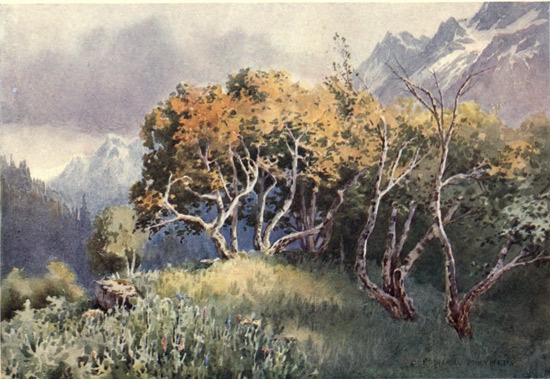
ABOVE THE CAMPING-GROUND, SONAMARG, SIND VALLEY
By seven we were at the summit of the
mountain with the sun now shining full upon us,
the air crisp and frosty-the very ideal of young
and vigorous day. We marched steadily along the
ridge searching the hollows on either side for stag,
but all we saw was a boar breaking the ice in a
pool on the ridge to get a morning drink. At
length we halted for refreshment and rest still on
the summit of the ridge with the most beautiful
valley on earth spread out in all its loveliness
3000 feet below, and the heavenly snowy range
bounding the horizon from end to end before us.
Just faintly the sounds from some village below
would be wafted to us through the clear still air.
But otherwise we seemed serenely apart from the
noisy turmoil of humanity; and bathed in the
warm noonday sunlight I was able to drink in all
the spirit of the loveliness around me.
And there came upon me this thought, which
doubtless has occurred to many another besides
myself—why the scene should so influence me and
yet make no impression on the men about me.
Here were men with far keener eyesight than my
own, and around me were animals with eyesight
keener still. Their eyes looked on the same scene
as mine did, and could distinguish each detail with
even greater accuracy. Yet while I lay entranced
with its exquisite beauty the keen-eyed shikaris,
the animals, and the soaring eagle above me, might
have been stone blind for all the impression of
beauty it left upon them. Clearly it is not the eye,
but the soul that sees. But then comes the still
further reflection—what may there not be staring
me straight in the face which I am as blind to
as the Kashmir stags are to the beauties amidst
which they spend their entire lives? The whole
panorama may be vibrating with beauties man
has not yet the soul to see. Some already living,
no doubt, see beauties that we ordinary men cannot
appreciate. It is only a century ago that
mountains were looked upon as hideous. And in
the long centuries to come may we not develop
a soul for beauties unthought of now? Undoubtedly
we must. And often in reverie on
the mountains I have tried to imagine what still
further loveliness they may yet possess for men.
From clambering over the high mountains in
search of a solitary stag to sitting in a boat in
the middle of a lake with thousands of ducks
incessantly swishing round, is only one other
example of the variety of scene and interest
which Kashmir affords. There was just time
before the end of the season for a final duck
shoot, and eight of us rode or drove out six miles
from Srinagar to the famous Hokrar Ghat, "jheel,"
which the Maharaja had so kindly placed at the
disposal of the Resident for the season.
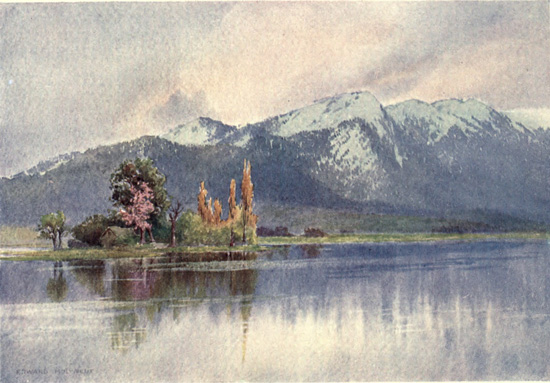
THE KAJNAG FROM SOPUR, EARLY SPRING
We meet at the edge of the lake and draw
lots for the numbered butts. The shikaris, boatmen,
and boats are awaiting us, and as soon as
we have decided where each is to go, and have
fixed a time to cease shooting as an interval for
lunch, and to give the ducks time to settle again
for the further shooting in the afternoon, we
embark each on a light shallow skiff with our
guns, cartridges, and tiffin, and glide out through
a narrow channel in the reeds to the open water
beyond.
Hokrar is right in the centre of the valley,
and from the lake a complete elliptical ring of
snowy mountains can be seen. The nearest and
most conspicuous peak is Haramokh, 16,903 feet,
and 24 miles distant. From this the eye ranges
from peak to peak to the Khagan range 70 miles
distant in the extreme west of the valley; then
along over the Kaj Nag mountains separated by
the gorge of the Jhelum River valley from the
Pir Panjal range, which forms the southern
boundary of the valley with Gulmarg, 24 miles
distant, on its southern slopes. Then traversing
the whole length of the Pir Panjal range from
the highest point, Tatakute, 15,524 feet, the eye
falls to the depression over which lies the Banihal
Pass, and rising again meets the Kishtwar range
65 miles distant, closing in the valley on the east,
from whence the eye wanders on snowy ranges
till Haramokh in the north again is met.
The day was another of glorious sunshine, and
in the noonday sun the southern range was
bathed in dazzling light, the northern showed up
sharp and clear with the sun's rays beating straight
upon it, while the distant ranges right and left faded
away in haze and dreamland. Soft woolly clouds
floated along the mountain-sides. A sharp, crisp
air freshened one up and broke the water into
dancing glittering ripples on which innumerable
duck were bobbing up and down.
Here we shot for a couple of hours before
tiffin, and afterwards till evening closed in. It
was not one of the great shoots like we have
in the autumn, and which I will describe later, but
was none the less enjoyable, and being the last
of the season each made the most of it.
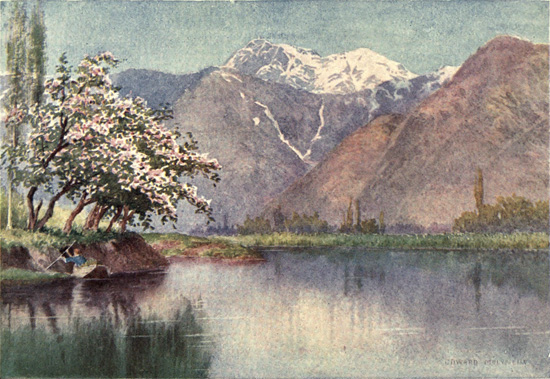
KOTWAL FROM NEAR THE DAL DARWAZA
At the end of March I visited Harwan, a
very favourite spot, once the abode of a famous
Buddhist saint, and now best known as the site
of the reservoir for the water-supply of Srinagar
and of the tanks for trout-breeding. Rain had
fallen in the night, and heavy clouds hung overhead
with only occasional glimpses of intensely clear
blue sky between them. But spring was now clearly
advancing. The great chenar trees, two and three
centuries old, were still bare, but the willows
were showing fresh young leaves; the apricot
trees were covered with clouds of blossom, pink
and white. The mountain-sides were dotted with
white wild cherry and pear and apple in full
bloom; the ground was often white like snow
with the fallen petals; the young hazel-nut leaves
gave freshness to the mountain-side; and near at
hand were violets, anemones, and cuckoo flowers.
The air was rich with the scent of the fruit trees.
Swarms of bees were humming around them;
butterflies—tortoise-shell, clouded yellow, and
cabbage-white—fluttered in the sunshine; and the
lively twittering of birds—bulbuls, goldfinches,
wagtails, and tits—gave yet one further evidence
of the awakening spring.
Each spot in Kashmir one is inclined to think
the most beautiful of all—perhaps because each
in some particular excels the rest. Certainly
Harwan has many fascinations of its own. Rising
sheer behind was a mountain crowned with dark
precipices overhung by heavy clouds through which
pierced the snowy summit. Clear crystal streams
rushed along the valley with a cheery rustling
sound. In the middle distance lay the placid Dal
Lake—on the far side overshadowed by the Hari
Parbat fort. The main valley was interspersed
with village clumps of fresh willow, clouds of
fruit blossom, and majestic chenars. In the far
distance lay the snowy ranges of the Pir Panjal,
the Kaj Nag, and Khagan; and facing round
again to the north rose the striking Mahadeo
peak—rocky, bold and precipitous, and pine-clad
to near the summit.
And one of the further attractions of Kashmir
is not only that each spot is so different from the
other, but that each spot has a different aspect
every day. Bright days are the more numerous,
but dull days also have no less striking attractions.
The day after our arrival at Harwan was still and
heavy; the whole sky was overhung with clouds,
though they were high above the mountains, and
even the most distant ranges showed up with
unusual clearness white and distinct against the
grey monotone sky. The stillness and the heavy
cloud evidently portended a storm, and in the
afternoon the distant horizon grew darker and
darker. The snowy mountains were gradually
obscured from view. Then the middle distance
became black and threatening. At the same time
on the mountain craigs behind heavy clouds imperceptibly
settled down, and the great cliff grew
darker and darker. Blackness seemed to grow all
round, and the mountain summits with the angry
clouds upon them looked more and more sombre
and threatening. Meanwhile all was still and
noiseless. Then suddenly out of the stillness came
a rush of air. The poplar trees bent like whips.
The long shoots of the willow trees lashed
backwards and forwards. Great drops of rain
came spitting down. A bright, quick flash darted
out from the mountain. Then crash came the
thunder—clap after clap—and torrents of rain.
Few things in Nature are more impressive than
a thunderstorm among the mountains.
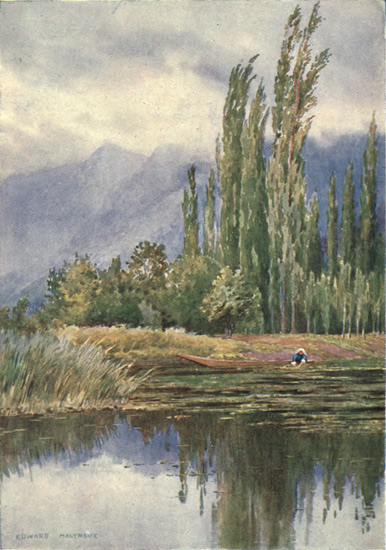
THE LULL BEFORE THE STORM, DAL LAKE
When next I visited Harwan in the middle
of May spring had given way to early summer.
The mountain-sides were dotted over with clumps
of yellow barberry and wild pink roses; clematis
was in bloom, and honeysuckle was trailing
from the trees. On the ground were large wild
geraniums, the big purple iris, white dead nettle,
yellow potentillas, strawberry blossom, tom-thumbs,
clover, ferns, speedwell, and primulas. The rocks
by the stream were often covered with ivy and
overhung by sprays of pink roses. While on the
mountain-sides, on the northward-facing slopes,
the wild apricot, cherry, and wych hazel, and in
the valley bottom willow, mulberry, and walnut
were in full leaf. And among the birds were now
golden orioles, wagtails (white and yellow), kingfishers,
herons, water-robins, buntings, grey tits,
wren warblers, paradise fly-catchers, bulbuls,
thrushes, redstarts, pigeons, doves, and shrikes.
The morning was cloudy and misty, but again
with special beauties of its own. Long streaks
of mist were drifting along the mountain-sides,
all at precisely the same level. Mahadeo, 15,000
feet, was at first quite clear and lighted by the sun.
Then a mist drifted towards it, and rapidly, but by
almost imperceptible increase, the cloud enveloped
it. Light misty clouds swirled about the mountain
as currents and counter-currents seized them.
Anon the mist in great part cleared away, and
Mahadeo was seen peering through the clouds, bold
and supernaturally high. Then the peak and all
the mountain-sides were enveloped in dark heavy
clouds, rain fell, and there seemed every prospect
of a wet and gloomy day. But all unexpectedly
rifts again appeared, and Mahadeo was once more
seen rising composedly above the clouds, the young
green foliage standing out distinct and bright, and
each rock sharp and well defined. And so, hour
after hour, the struggle between cloud and sunshine,
between good and evil continued, it being
impossible to tell at any moment which was more
likely to prevail. The clouds seemed settling down,
then a glint of sunshine was seen high on some
upland lighting the fresh green grass and some
stray shepherd hut. Finally wet prevailed, and the
mist settled lower and lower on the valley, the
rain poured down and a seemingly regular rainy
day set in. But there was fascination yet in
watching the mists floating along the mountains,
forming and dispersing, enshrouding and revealing
the mountain peaks; and the green of the little
valley showed up greener than ever. The mountain-sides,
usually so brown, were seen to be tinged with
a delicate shade of green. The poplars, mulberries,
and chenars at the mouth of the valley had each
their own especial tint. The rice-fields showed up
in brilliant emerald.
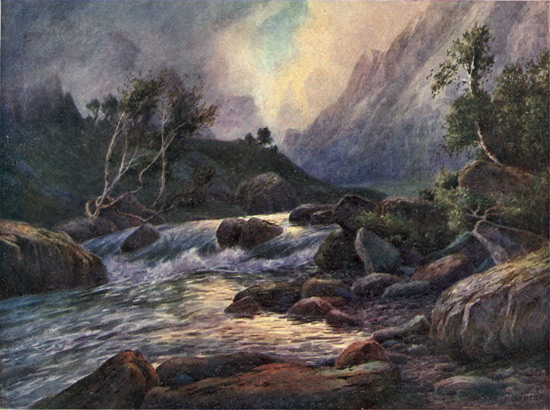
ABOVE LIDARWAT, LIDAR VALLEY
Yet after it had appeared to settle down for a
whole day's rain the mists suddenly cleared away
from the mountain. The sun broke through the
clouds and showed up the rounded higher spurs with
the soft, downy brown of an Oriental carpet, and
the higher peaks stood out sharp and clear. An
hour later long level lines of mist appeared and
swiftly grew thicker, the whole mountain from
one level upward was once more enveloped in cloud
which thus gained the final victory.
Harwan village itself at this time of year was
strikingly picturesque. It was enshrouded in
massive clumps of chenar foliage, below which
were the lighter shades of the willow, mulberry, and
walnut, and the straight, graceful, white-trunked
poplars piercing through. Here and there a
horse-chestnut in full flower lit up the foliage,
and most beautiful of all were the patches of tall
irises—dark purple, mauve, and white—which now
surrounded the village. Numerous water-courses
rushing through the village lands gave brightness,
cheeriness, and a sense of coolness; while the
crowing of cocks, the twittering of the birds, the
lowing of cattle, and the neighing of the ponies
grazing on the rich green grass in the valley bottom,
and the distant calls of the shepherd boy to the
flocks of sheep and goats on the mountain, gave
further animation to the scene. And whether it
was more entrancing now, or three weeks later
when the irises were over, but when it was wreathed
in white roses, it would be difficult to say. Irises
and roses are the two especial beauties of Kashmir
villages and Kashmir lanes and hedgerows. And
I would not like to positively state which was the
more beautiful—the rich clumps of mauve and
purple irises surrounding the village with warmth
and colour in the spring, or the clustering wreaths
of roses, white and pink, brightening the village
lands and hedgerows in the summer.
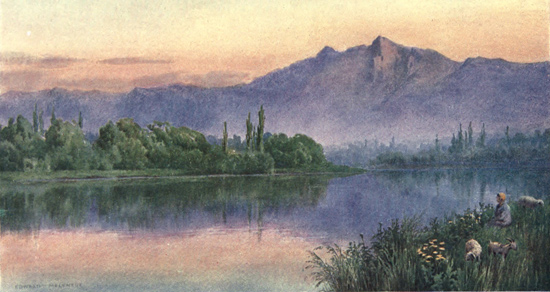
SUNSET ON THE JHELUM, ABOVE SRINAGAR
Only one desire we must feel in regard to these
villages—that all this natural beauty could not be
further enhanced by the trim little cottages of rural
England or the picturesque chalets of Switzerland.
Every time one sees a Kashmir village and succumbs
to the charm of all that Nature has done for
it, one longs to see the squalor, untidiness, and dirt
of house and man and clothing removed, and justice
done by man to what Nature has done for him.
Harwan is not only noted for its natural
beauty, and as having been the abode of a celebrated
Buddhist saint: it is also now remarkable as
possessing a hatchery of English trout, the ordinary
brown trout, and of Danube trout or huchon;
and here can be seen English trout of all sizes up
to 11 lbs.
These trout were first placed in the Dachigam
stream which runs through the valley opening out
at Harwan; and now all up this valley ideal
trout-fishing is given by H.H. the Maharaja to his
guests. And what more perfect spot for the
purpose could be found? Kept as a close preserve
for two purposes; firstly, for stag-shooting; and,
secondly, to insure the freshness of the water which
furnishes the water-supply of the whole city of
Srinagar, it is absolutely quiet and peaceful.
There are no inhabitants, and no life but wild life;
and, except for the superior grandeur of the mountains
on either side, it exactly resembles a Highland
valley. We see the same clear rushing river,
here dashing over boulders in a series of rapids,
and there lying in cool, peaceful pools alongside a
grassy bank or beneath some overshadowing trees.
On a cloudy day, when the high mountains are
shrouded in mist and a gentle rain is falling, you
might be in Scotland itself. On a fine day, with
Mahadeo towering 10,000 feet immediately above
you, and with glimpses of snowy ranges in the
distance, you have Scotland and something more.
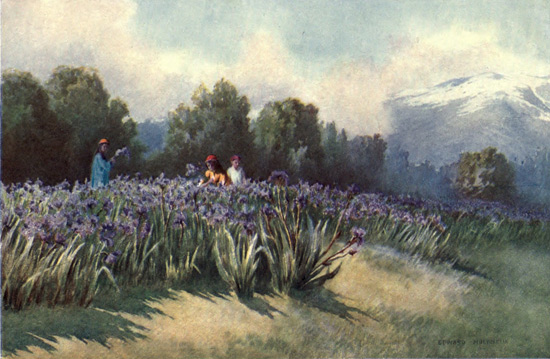
SPRING IN KASHMIR
This is the valley especially reserved for the
sport of Viceroys, and here it was that in the autumn
of 1906 the Maharaja entertained Lord Minto.
And well do I remember the intense relief of
the Viceroy as he turned into the valley and left all
ceremonials and State business behind, and felt that
here at least he was in a haven of rest and natural
enjoyment. The air was clear and bracing, the
sky cloudless, and the evening sun throwing long
soothing shadows up the valley. Who could feel a
care while he fished or hunted stag in a valley
with more than the beauty and with all the freshness
of his native land?
I have said so much about Harwan and the
Dachigam valley as they are typical of the prettiest
parts of rural Kashmir and the side-valleys, but I
must now return to the description of Srinagar and
the main valley itself and go back to where we
left it in the spring. On April 1st, the chief glory
of the Kashmir spring, peach trees were in full
blossom, and forming in the landscape little clouds
of the purest and most delicate pink, and giving it
an exquisite touch of light and colour. The taller
and larger pear trees were snow-white masses.
The pink-tinged apple blossoms, the chenar, and
walnut leaves were just appearing, and the poplar
and mulberry leaves showed faint symptoms of
bursting. We were in the first, most delicate flush
of early youthful spring.
A mile from Srinagar, on the way to Gupkar
and the Dal Lake, the road passes over a gap
between the Takht-i-Suliman and the range to the
north. This spot is well known as "The Gap";
and as it is perhaps a hundred feet above the valley
level an extensive view is obtained, on the one hand,
over the great vale of Kashmir to the snowy Pir
Panjal range in the background on the south, and
on the other hand to the Dal Lake, Haramokh,
and the mountain range, close by on the north.
There were very few days when either in the
morning or evening I did not visit this spot, and
hardly ever did I see the same view. Every
day there seemed some fresh beauty; and which
day in spring, and whether the days in spring were
more beautiful than the days in autumn, I could
never satisfy myself. On April 1st, looking southward,
there was first on the sloping foreground an
almond orchard with a sprinkling of trees in
white and pink blossom and the remainder in
young leaf. Then in the valley bottom were
clumps of willows in the freshest yellowy green;
light green wheat-fields; bunches of chenar trees
not yet in leaf; broad reaches of the placid river
glistening in the sunshine, with numerous boats
gliding gracefully on its surface; and away over the
valley were little clusters of villages, with the land
gradually rising to that range of snowy mountains
which forms the culminating touch of beauty in
every Kashmir scene.
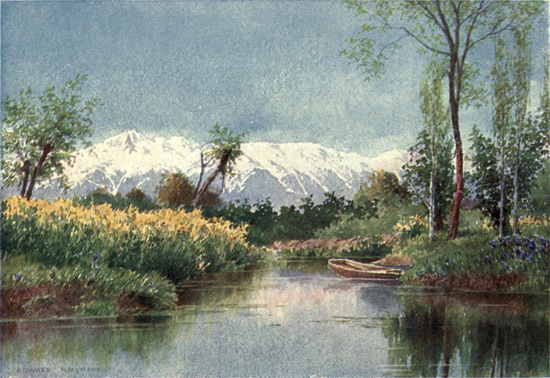
ON THE DAL LAKE IN SPRING
Looking in the opposite direction from the Gap
towards the Dal Lake was a less extensive, but
scarcely less attractive scene. On the foreground
of the gentle slopes towards the lake were tall pear
trees in fresh white bloom dotted prettily among the
fields of new green wheat. Away to the left was
an orchard of peach in the purest and lightest of
pink. Little hamlets nestled among the fruit trees;
and immediately beyond them stretched the still,
clear lake reflecting in its mirror surface the graceful
willows and chenar trees by its edge, and the mountain
ranges by which it was encircled. As it seemed
floating in its midst lay the famous Isle of Chenars
mirrored again in its glassy surface. By its shore
stretched the renowned Moghal gardens—the
Nishat Bagh and the Shalimar Bagh—with their
grand avenues of chenars sloping to the water's
edge. Above the far border rose a mountain ridge
still clothed in snow; above that again the lofty
Haramokh; and away in the extreme distance lay
the fairy Khagan snows, while on the whole scene
there swam a purple-bluey haze, growing more purple
and more blue the more distant it fell, and giving
to all a softening sense of peace and ease. For
tenderness of restful beauty this scene is not excelled.
So far the weather had been exceptionally fine
and warm for the season, and the rainfall to date
from the commencement of the year had been
three inches below the normal; but now a wet spell
set in such as one has to expect in the spring in
Kashmir, which is always very uncertain. On
April 12th there were 2¾ inches of rain. The total
for the year now exceeded the normal by four
inches. The river rapidly rose ten feet, flooded all
the low-lying fields, and seriously threatened the
European quarter; and, finally, snow fell in
Srinagar itself. The maximum temperature in the
shade rose to only 50° while the minimum at
night fell to 33°. It is always the exceptional
which happens—in weather at any rate. So this
must not be expected every year. But something
else exceptional will occur whatever year we choose,
and there is little use in describing a normal year,
for no such year ever comes in real life.
On the road into Kashmir very serious breaks
were made by the rain and by the melting snow and
the mud floods which it brought down. Whole
stretches of road were completely carried away and
wiped out of existence. Bridges were broken;
and so dangerous were the falling boulders, that
one European was knocked straight into the Jhelum
River and drowned, and several natives were
badly injured. The dak bungalows were crammed
with travellers rolling up from behind, and we
subsequently heard of the misery they suffered from
overcrowded rooms, from the never-ending rolling
of the thunder, and the incessant pelting of the rain.
The beauties of Kashmir cannot be attained without
suffering, and the suffering on the road up is
often considerable.
A hard-worked member of the Government
of India came from Calcutta to spend a ten-days'
holiday with us in the middle of this deluge, and as
day after day of his holiday went by with nothing
but rain, our pride in the glories of Kashmir sank
lower and lower, and we feared he would go back
to give the country but an evil reputation. But the
final day of his stay redeemed all, and for that
single day he was good enough to say he would have
come the whole way from Calcutta. We drove
out along the shores of the Dal Lake to the Nishat
Bagh, and anything more exquisitely lovely than
the combination of the freshness of the young spring
green, with the whiteness of the snow now low
down on the mountain-sides with the blue sky,
the brilliant sunshine, the dreamy purply haze, the
mirror lake, the yellow mustard fields, and the
clouds of pink and white fruit blossom now in its
perfection, this earth can surely nowhere show.
The lake was full from the recent rain, and
lapped up to the edge of the garden. On either
side of the gateway were masses of Kashmir lilac.
Stretching up the mountain-side, on either side
of the line of fountains and waterfalls which
flowed down from the upper end of the garden,
was a long avenue of massive chenar trees just
freshly tinted with budding foliage, and at the
sides and by the entrance were peach, and pear,
and cherry in brilliant bloom. Slowly we ascended
the avenue, and then from the top looked down
between the great chenar trees, over the cascades
falling to the lake, over the smooth green turf,
over the clumps of purple iris, over the white
cherry blossom and the mauve lilac; to the still
waters of the lake; to the willows and poplars along
its edge; to the fort of Hari Parbat; and then on to
the radiant snows now glistening more brightly,
and looking more ethereal and lovely than ever
before. Spring is beautiful everywhere. Spring
is more beautiful in Kashmir than anywhere else,
and in a Kashmir spring this was the most beautiful
day of all.
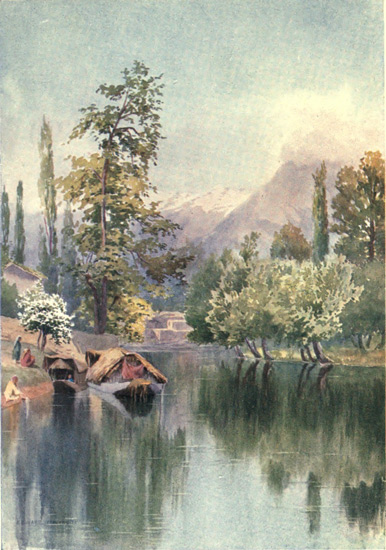
ENTRANCE TO THE MAR CANAL
Yet another attractive spot near Srinagar is
the site of the original city founded by Asoka at
Pandrathan, three miles distant on the Islamabad
road. Here at the end of a spur running down
from the mountains and jutting out to meet a
bend in the river, stands the remains of an immense
monolith lingam on the levelled edge of the spur,
eighty feet or so above the river. Immediately
beneath is a majestic bend of the river, and one
April evening when I visited the sight I looked
out from the raised plateau up two glistening
reaches, bordered by fresh green grass and overhung
by graceful willows and poplars in their
newest foliage. The wheat-fields on the opposite
bank were a brilliant emerald, and the fields of
glowing yellow mustard and young linseed interspersed
with scarlet poppies gave a relieving
touch of colour. All the valley was dotted over
with picturesque hamlets half-hidden in clumps of
willow and over-towering chenar trees. The
recent floods gave a lake-like appearance to the
middle distance. On the right the temple on the
Takht-i-Suliman formed a graceful feature in the
scene; and from there completely round the semicircle
to the distant left stretched the dreamy
snowy mountains, hazy immediately under the sun,
but white and distinct when the evening sun
struck full upon them. A more fitting site for
worship could hardly be found.
In full summer the Kashmir valley is, perhaps,
in its least interesting condition. The snow has
nearly melted from the mountains. They are often
hidden by heat-haze or dust. The fruit blossoms
are all over. The yellow mustard and the blue
linseed in the fields have gone to seed. The green
of the trees has lost its freshness; and the prevailing
tones are heavy greens and browns. The
weather too is sultry. The thermometer rises to
95° or 97° in the shade. A heavy, lethargic feeling
oppresses one. Mosquitoes appear in swarms.
And by the end of June every one who can flees
to Gulmarg, to Pahlgam in the Lidar valley, to
Sonamarg in the Sind, to Gurais and to the
numerous other cool mountain resorts.
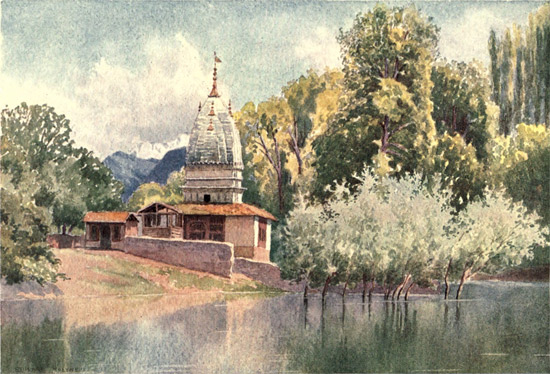
THE TEMPLE, CHENAR BAGH
But early in September the valley renews its
charms and visitors return. The atmosphere has
been freshened and cooled by the rains which,
though they fall lightly in the valley itself, are often
heavy on the surrounding mountains. The ripe
rice-fields show an expanse of green and yellow
often two or three miles in extent. The villages,
dirty and untidy at close quarters, it is true, but
nestling among the chenars, willows, poplars,
walnuts, and mulberries, show as entrancing islands
amidst the sea of rice. Ponies browse among the
marshes up to their knees in water; and groups of
cattle graze along the grassy edge of the streams
and water-ducts.
The sun is still powerful in the daytime, and the
sky usually bright and clear. But the monsoon
will often make a few final efforts. One such day
I note when voluminous masses of cloud rolled up
from behind the Pir Panjal to a height of twenty-five
or thirty thousand feet, their westward edges
aglow from the setting sun, and showing clear and
distinct against the background of pinky light blue
sky, while the great main volume remained dark,
heavy, and sombre, with now and then a spit of
lightning flashing out, and on the far side, away
from the setting sun, threatening tentacles stretched
out across the valley in unavailing effort to reach
the mountains on the northern side. Under these
mighty monsoon masses even the great mountains
looked dwarfed and puny. It was a great and
final effort of that stupendous natural phenomenon
which bears the waters of the Indian Ocean to
beat upon the Himalaya; and as an omen that
the monsoon was now over, the sky behind the
storm-clouds was intensely clear and tranquil, and
the moon slowly ascended in undisturbed serenity.
And the rainy season being finished there now
commenced almost the most charming time of all,
not, indeed, with the freshness of spring, but with
more certainty of continual brightness and light,
and more vigour and strength in the air, and above
all, with that warmth and richness of colour in the
foliage which makes an autumn in Kashmir unique.
Towards the end of October the green of the
immense masses of chenar slowly turns to purple,
red, and yellow, and every intervening shade. The
poplars, mulberries, and apricots add each their
quota of autumnal beauty. The valley and the
river edge are resplendent in the gorgeous colouring.
And beautiful as is the spring, I was tempted
to think that even more exquisitely lovely still
was the bright autumnal day when we drifted
down the river in our house-boat, when all the
chenars along the river bank were loaded with the
richest and most varied colouring, when the first
fresh fall of snow on the mountains was glistening
in the radiant sunshine, and there ran through the
air that restful sense of certainty that this was no
hurried pleasure snatched from a stormy season,
but that for day after day and week after week
one might count on the same brilliant sunshine,
the same clear, blue sky, and daily increasing
crispness, freshness, and vigour in the air.
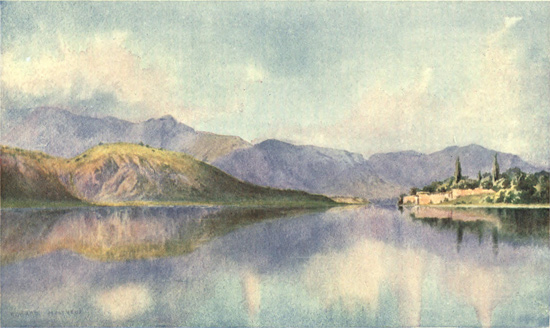
RUINS OF LALLA ROOKH'S GARDENS, LAKE MANASBAL
The great broad reaches in the river, glistening
in the sunlight and fringed with the rich autumnal
foliage, were superlatively beautiful. Shadipur, at
the junction of the Sind River, where there is a
little temple on an island and hoary old chenars
drooping over it to the water's surface, was a dream
of all that is most lovely. And the Manasbal
Lake, so fresh and deep and clear, set like a jewel
among the mountains, with clumps and avenues of
these same red and purple foliaged trees upon its
edge, and reflecting in its surface the white snowy
range of the distant Pir Panjal, was the supreme
gem of all Kashmir. All these are beauties which
one cannot describe, for whatever one may say,
the reality must ever remain more beautiful than
the picture. But perhaps by the unison of pen
and brush some faint impression of the loveliness
of a Kashmir autumn may yet have been conveyed.
This season to the sportsman also is the most
enjoyable. For now come in the duck and geese
from far-away Siberia, halting here for a time in
the lakes and marshes on their way to India. I
have already described a duck-shoot in spring. In
the autumn there is still finer shooting, for the
duck have come in fresh and are in greater
numbers than on their return journey. As I have
already said, the Maharaja most hospitably places
at the disposal of the Resident the shooting on
the Hokrar Lake and marsh, which affords some
of the best duck-shooting in the world, and it was
here that Lord Minto and party shot over 1500
duck in one day in 1906.
Last year we had our first shoot on October 4th.
We rode for six miles in the fresh morning air
and brilliant sunshine to the edge of the lake,
where the shikaris and boatmen were awaiting us.
Over the reeds and over the open expanse of water
beyond there was that glorious view of the distantly
encircling mountains which I have before described.
The lower slopes were at this season a reddish
pink which merged into the rich purply blue of
the higher and more distant portion of the range.
Soft fleecy clouds and a hazy blue in the sky gave
a dreamy tone to the scene. Many kinds of waterfowl
were lazily disporting themselves on the water
and among the reeds. The surface was often
covered with numerous flat, round leaves and pure
white waxy water-lilies with rich yellow centres.
Through these we were paddled swiftly to the
butts, which were skilfully hidden among the reeds,
and here amid clouds of mosquitoes, dragon-flies,
and gnats, we awaited the first shot to be fired by
the occupant of the farthest butt. The sun beat
powerfully down. All was still, and drowsy, and
silent, save for the drone of the flies and the
occasional "quack, quack!" of the ducks paddling
unsuspiciously on the lake.
At last a distant shot was heard, and then a
suppressed roar, as of breakers on a far-off shore.
Then from the direction of the shot a black cloud
arose and advanced rapidly upon us. The roar
increased, and in a few seconds the whole sky was
covered with a whirling, swishing, whizzing flight
of ducks. Thousands and thousands of them:
flashing past from right to left, from left to right,
backwards and forwards, forwards and backwards,
in bewildering multitudes. For the moment one's
breath was absolutely taken away. There was such
a swish and swirr it was impossible to aim. Then
as the first wild rush was over it became easier to
be deliberate, and duck after duck fell to my
companions' guns.
After a quarter of an hour or so a lull occurred.
In the distance, flights of duck were seen circling
high in the air, but none came near. A lazy
interval ensued. The sun beat down with unexpected
force. Perspiration poured down head and
neck. Dragon-flies, blue and red, large and small,
with gauze-like wings and brilliant bodies, floated
swiftly but noiselessly among the reeds. The
purring of the crickets, the occasional twitter of
birds, the swishing of high flights of duck far out
of reach, the call of a goose and the bang of a
distant gun at intervals broke the silence; but
otherwise all was wrapped in dreamy noonday stillness.
Then, of a sudden, another succession of
flights of duck came whizzing past, and as fast
as we could fire the gun was put to the shoulder.
Another lull followed, only to be succeeded by more
flights, and so on through the day. At 1.30, by
previous arrangement, we stopped for lunch and to
give the duck an opportunity of settling, then
renewed the shooting till nightfall. At the end of
the day Colonel Edwards, the Residency Surgeon,
had himself shot 203, and others had shot well
over the hundred.
From this time onward, on three or four days
in each month, the duck-shooting on this famous
lake continues. The weather now gets gradually
colder, till by December there are sixteen degrees
of frost. All the leaves have now left the trees.
The grass is quite brown. But the days are nearly
always fine and clear; and though there will be
thick ice and long icicles in the early morning, by
ten or eleven all the ice not in the shade has
disappeared, the air is pleasantly warm, and there
is seldom any wind.
Christmas brings a round of festivities, dances,
dinners, and children's parties, for even in the winter
as many as seventy or eighty will assemble at a
dance, and occasional outside travellers or sportsmen
drop in all through the winter. After Christmas
a change in weather sets in. Clouds bank up
and snow or rain falls. January and February are
the worst months in the year.
But just before leaving the valley this last year
I had one further attempt to shoot a Kashmir
stag. Six miles out from Srinagar, up the valley,
we had a little camp on the edge of the river—a
lovely spot in summer when the rich foliage overhangs
the water, and when the grassy banks are
green and fresh, and the river is full up to the
lip; but now when the trees were bare, the banks
brown and bleak, and the water at its lowest, an uninviting-looking
spot. Moreover, the sky was overcast
and threatening. Women who came to draw
water from the river were pale and shivering. Our
servants were huddled up with the cold. A raw
wind whistled down the valley, and snow threatened
on the higher mountain.
This latter was precisely what I wanted, for it
would drive the stag down to the lower ridges
when I would be stalking next day. At four in
the morning, therefore, I rose, and after a solid early
breakfast mounted my faithful but naughty Tibetan
pony, and, accompanied by a guide, rode for seven
miles through the darkness and frosty but invigorating
air to the foot of the hills, where the two
shikaris awaited me.
Like their class, they were hard, keen-looking
men, accustomed to live on the mountain-side, to
weather hardship and exposure, and live with Nature
and wild animals—an altogether different type from
the crafty townsman or indolent dwellers on boats.
Rahem Sheikh, the chief, was a grizzled old man,
with keen, far-seeing eyes, tough physique, and
a grave, earnest demeanour as if the business of
his life was of the most serious. This, indeed,
as I have already said, is a special trait of head
shikaris all India over; and during viceregal visits
to Native States I have never been able to decide
which takes himself most seriously—the head
shikari or the European caterer. Both look upon
the Viceroy, the Chief, and the Resident, in the
way of children who are to be indulged. They
have to be amused and fed. They no doubt have
unimportant business of their own. But the really
serious business in this life is—to the shikari to
find game, and to the caterer to provide food.
Things would rub along somehow or other without
a Viceroy; but how would life be without the head
shikari to show the stag, or the caterer to produce
meat and drink?
Knowing the point of view of head shikaris I
placed myself, therefore, with child-like but misplaced
confidence in his hand. But, alas! snow
had not fallen on the higher mountains. The
clouds had cleared away, and the stags must have
remained on the distant peaks—many miles
away and thousands of feet higher. Two days
of hard climbing and careful search produced no
result.
On the third day, rising early and looking out
of my tent, I saw a perfectly clear sky and the
ground covered thick with hoar frost; a sharp
crisp nip was in the air, the thermometer registered
16° Fahr., and away across the glistening reach
in the river appeared a rose-pink range of
mountains showing up sharply against the clear
blue sky. Let the reader imagine a frosty morning
in the Thames valley. Let him imagine, what we
never have in England, a really clear blue sky.
And then, filling up the distant end of one of its
most beautiful reaches, let him imagine a lofty
range of rose-coloured mountains; and he will
then have a picture of the view from my camp
at sunrise on the January morning.
Mounting my pony, I rode off in the now
radiant sunshine to another hill-side nine miles
distant. The frosty morning air at first nipped my
ears and fingers, but the hard galloping soon sent
the blood tingling through my veins, and in little
over an hour I again joined the shikaris. With bated
breath and significant glances at the mountain-side,
they informed me that they had seen seven hinds
and two stags, though the latter were both small.
I dismounted, and left the wicked little Tibetan
with his head well buried in a bundle of grass;
and then with a coolie to carry my tiffin, overcoat,
and rifle, started up the hill-side. One quickly
becomes fit in such a climate. This was my third
day out, and now I climbed the mountain almost
as easily as the shikaris themselves. What on the
first day was a decided effort was now a scarcely
perceptible strain. Perhaps, too, the greater
expectation of finding a stag had something to do
with the increased elasticity with which I ascended
the mountain. Anyhow, taking off my coat, as
with the exertion of climbing and in the brilliant
sunshine it was now really hot, I was on the
summit of the ridge 3000 feet above the valley,
almost without noticing the climb.
At our feet on the opposite side lay a cosy
little side-valley with villages nestling among the
chenar and mulberry trees. Behind us lay the
broad main valley with the great river gliding
through it; and away in the distance the rugged
Pir Panjal mountains were glistening in the noonday
sun.
The scenery was perfect. But again no stags
were seen. Till dark we scoured the mountain-side,
but all we saw were the tracks of stags—or
may be hinds—leading away to the higher
mountains.
Then I had to hurry back to camp, and the next
day to Srinagar, to prepare for a long journey down
to Calcutta for the very dull object of giving evidence
to a Royal Commission on Decentralisation.
The cycle of the seasons has been completed;
and the aspect of the valley under the varying
conditions of spring and summer, autumn and
winter, has been depicted. In another chapter I
will describe the means and methods of travel.
TRAVEL IN KASHMIR
I have known Kashmir for twenty-one years, and
ever since I have known it people have said it is
getting spoilt. "It is not now what it used to be"
is so often said. When the cart-road was being
built every one said it would be spoilt. And now,
when the construction of a railway is in contemplation,
exactly the same remark is made. The
impression conveyed is that the pleasures of travel
in Kashmir are surely and steadily deteriorating.
And this, no doubt, is true in certain aspects.
Supplies are dearer. Coolies demand higher
wages. The visitor disposed to solitude more
frequently encounters his fellow Britisher. These
are decided drawbacks, and the visitor who
telegraphs to Danjhibhoy for a tonga, to Nedou's
for a room in the hotel, and to Cockburn's for a
house-boat, and has simply to pay his fare and his
hotel bill, no doubt pines for the virgin time of
Kashmir travel before the rattle of the tongas or
the tooting of the motor car was heard in the
valley.
Yet I doubt if all was bliss in those "good old
days." Certainly Moorcroft, the first Englishman
to visit Kashmir, had no very comfortable time,
and must often in his turn have pined for a good
hotel, a clean room, and a decent dinner—and, who
knows, for a game of golf? Moorcroft visited
Kashmir in 1823, and first had enormous difficulty
in obtaining from Ranjit Singh, the ruler of the
Punjab, to whom Kashmir was then subject, leave
to come to Kashmir at all. He arrived there from
the north in the autumn, and had fresh difficulty
in obtaining permission to remain there for the
winter. At the quarters he occupied he was
"beset by crowds of people who not only filled
the garden, but also came in boats." He was
pursued wherever he went by inquisitive crowds,
by importunate beggars, and by suspicious officials.
When he wished to make short excursions from
Srinagar objections were at once raised. When he
was at length allowed to leave for the Lolab,
officials were appointed to accompany him "to
watch his proceedings and check inquisitiveness."
And when he finally left Kashmir for the Punjab
by the Jhelum valley he was stopped by a small
semi-independent chief near Uri, who demanded
Rs. 15,000 as customs duty on his caravan, and as
Moorcroft refused to pay more than Rs. 500 he
was compelled to return to Srinagar and reach the
Punjab by another route.
These certainly were not the halcyon days of
Kashmir travel. But I suppose there must have
been an intermediate time between then and now
when travelling in Kashmir was perfection to those
who had time enough at their disposal to "march"
in. In those delightful times the traveller pitched
his little camp wherever he wished. Grain was
ridiculously cheap. Fowls were considered dear at
twopence each. Coolies were thankful enough to
get any payment at all. There were no game
laws or game licences, so that the sportsman could
shoot to his heart's content. The number of
visitors for the year was restricted to 100, so that
each had 700 or 800 square miles to himself, and
there was no need of dress clothes, white shirts, or
Ascot dresses.
When I first visited Kashmir in the autumn of
1887 its glory had already begun to depart, though
as regards simplicity of travelling my methods
were of the simplest. I had no other clothes but
what I stood in, and only the under portion of
these were of European origin. All my outer
clothes, including my boots, were worn out long
before I reached Kashmir, and I was accordingly
clothed in a long Central Asian robe and high
native boots, for I was at the end of a journey of
nearly four thousand miles from Peking. I had
crossed—and was the first European to accomplish
the feat—the Mustagh Pass, 19,000 feet high, into
Baltistan; and the "Pass" being nothing else than
a hard ice slope and a rocky precipice, down which
I and my five servants and coolies had to let
ourselves by means of turbans and waist-clothes
tied together, I had been able to carry with me
little even of the scanty baggage I had brought up
to the other side of the Pass. I had indeed only
a roll of bedding, which was thrown down the
precipice, and a big kettle. I had no tent and no
money! I had slept in the open from one side of
the Himalayas to the other, and my funds were
entirely exhausted, so that when I landed in
Kashmir territory I had to borrow money from the
Governor of Baltistan, Pandit Rada Kishen Kol,
a very popular and respected official who is still in
the Maharaja's service, and is now Chief Judge.
Simplicity of travel was, then, at least possible
twenty years ago, and I managed, after crossing the
Pass, to get along with only one servant who
cooked, performed every function of the numerous
servants we employ in India, and carried a load
himself in emergency. But he was the most faithful,
and my favourite of all the servants I have
ever had. His name was Shukar Ali, and I must
ask my reader's indulgence for a digression to
describe him. I picked him up in Yarkand, in
Chinese Turkestan, but he was a native of Ladak.
He was the most cheery, happy-go-lucky, easy-going
man, who ever proved a good servant in
spite of his carelessness. Always laughing, always
chaffing with the pony-men or coolies, always
losing something vitally necessary, but always
ready to do the hardest and most dangerous piece
of work when the crucial moment arrived, he
was the only Ladaki who dared to cross the
Mustagh Pass with me, and but for one incident
I would have a most grateful recollection of his
services then. That incident I have often since
reminded him of. After crossing the Pass we had
to cross a very full and rapid stream flowing
straight out of a glacier. Immense blocks of ice
were breaking off the glacier and floating down
the stream. The bottom was also partly ice and
partly boulder. Shukar Ali, with his usual readiness,
volunteered to carry me across this stream on
his back. But in mid-stream he slipped. I was
precipitated into the icy water, while Shukar Ali,
in his frantic efforts to regain his own footing,
unknowingly kept pressing me under water. We
both eventually gained the opposite bank all right.
But I had no change of clothes, and every stitch
I had on was wringing wet with ice-cold water.
When, two years later, Government sent me to
explore all the northern frontier of Kashmir from
Ladak and the Karakoram Pass to the Pamirs and
Hunza, I again sought out Shukar Ali; and yet
a third time, when I was sent on a political
mission to Chinese Turkestan and the Pamirs in
1890-91. On each of these occasions he rendered
unfailing service, and once both he and I were
nearly drowned in an avalanche. We had been
hewing our way up the steep slopes of an ice pass
in a snowstorm, when suddenly out of the snow-clouds
above us we heard a roar like thunder
approaching nearer and nearer. We could not
run if we would, for we were on an ice slope. We
could only await our doom, for we knew it was
an avalanche. But with a mighty rush it crashed
past a few paces in front of us, and we were
safe.
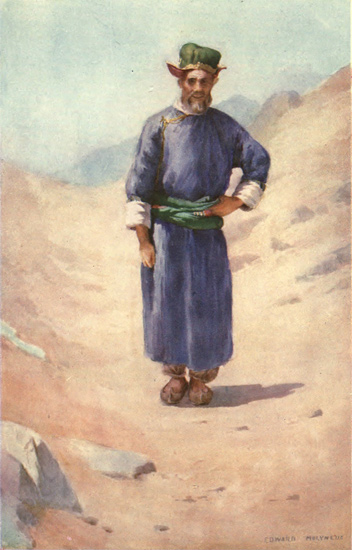
A LADAKI IN SUMMER COSTUME
After 1891 I did not see Shukar Ali for
seventeen years, for my travels never took me to
that frontier again. But I heard of him from
Dr. Sven Hedin who employed him in Tibet,
and who told me of the wonderful tales which the
imaginative Shukar Ali related of the journeys we
had made together. And last summer the dear
old man suddenly appeared at the Residency.
He had heard that I was now Resident, and had
walked 240 miles across the mountains to see me,
and he presented himself wearing the identical coat
I had given him seventeen years ago. He kept
jumping up and down, first kissing my feet, then
touching my coat, then salaaming, and all the time
ejaculating an unceasing flow of speech, calling
me by every affectionate term. Then from under
numerous folds of his clothing he produced a
wooden bowl, a bag full of sweets, a pair of goat
horns for my wife and myself, and a marvellous
collection of showy-looking stones which he had
picked up in Tibet for my little girl.
He remained with me for a few weeks.
I gave him something to keep him comfortable
at home, but which I am sure in his good
nature he will let his relations squeeze out of him,
and then I sent him off back to Ladak. But before
he left I asked the Maharaja to give him an order
exempting him from service in his village. His
Highness, with his usual kindness, readily acceded.
An order was made out with the Maharaja's own
signature attached, and at a garden-party at the
Residency Shukar Ali was had up and presented
with the order. His Highness addressed him in
a most kindly manner, and on the following
day presented him in Durbar with a shawl of
honour.
Poor Shukar Ali left with many tearful farewell
expressions, and a few weeks later I received
from him the following letter:—
Sir—I reached very well home, with very felt happy and
found all my poor family very well and showed the all
kindly of your they got very glad, and we all family
thankfully to you to remember us so much, to little people
and my all friends got very glad too, they said thank you,
and hope you would not be angry with this English written,
please you pardon for this, and could not write myself and
could not get other munshi write you, because and found
Rassul, he was my old friend and let him write this letter.
please give my salaam to Mem Sahib and Baby Baby Sahib.—Your
obedient servant Shukar Ali
from poor Rassul plenty salaam,
the mark of Shukar Ali O.
All this, however, is a digression, and I have
to describe the normal modes of travel of the
present day. Srinagar is 196 miles distant from
the railway at Rawal Pindi, and is connected with
it by a good cart-road—good, that is in its normal
condition, but excessively bad after heavy rain,
when at places the whole mountain-side slides
down with the road into the river. The usual
mode of conveyance is a tonga, a very common
form of vehicle in the Indian "hills." It has two
wheels, is drawn by a pair of ponies, has four seats
back to back, and carries a mountain of luggage
piled up on the splash-boards and on the roof.
The ponies, when the season is not crowded and
the road is good, gallop at full speed, and are
changed every five or six miles. In the full part
of the season, which generally coincides with the
heaviest fall of rain, with much beating, pulling,
and shouting they can scarcely be induced to reach
a trot, and may think themselves lucky if they find
a change at the end of their stage.
Other means of conveyance for which extra
charge is made are landaus and victorias. These,
though more comfortable, are heavier for the
ponies, and are more difficult to manipulate over
bad places in the rainy season.
Spare baggage and servants can be brought up
in the ordinary Indian ckka which, with one pony
without changes, takes six to eight days to reach
Srinagar; or in bullock carts which take fourteen
days.
Tongas will take two, three, four or more days
according to the length of the day, the nature of
the road, and the disposition of the traveller. The
tonga carrying the English mail, travelling almost
continuously, covers the distance in thirty-six
hours. In the long summer days travellers, starting
early, can accomplish the journey in two days.
Every fourteen miles or so is a dak bungalow,
where for the payment of one rupee a furnished
room is provided, and on further payment meals
may be obtained at any time, but "bedding" must
always be taken, as nothing but the bare bed is
provided.
The stages from Rawal Pindi (1790 feet) at
which these bungalows may be found, are:—
| Tret | 25½ miles | 25½ miles |
Sunnybank (6000 feet)
(for Murree, 2 miles distant) | 11¼ " | 36¾ " |
| Kohala (2000 feet) | 27½ " | 64¼ " |
| Dulai (2180 feet) | 12 " | 76¼ " |
| Domel (2320 feet) | 9 " | 85¼ " |
| Garhi (2750 feet) | 13½ " | 98¾ " |
| Chakoti (3780 feet) | 21 " | 119¾ " |
| Uri (4425 feet) | 13½ " | 133¼ " |
| Rampur (4825 feet) | 13 " | 146¼ " |
| Baramula (5150 feet) | 16 " | 162¼ " |
| Patan (5200 feet) | 16½ " | 178¾ " |
| Srinagar (5250 feet) | 17½ " | 196¼ " |
The road is usually open all the year round
except in January, February, and part of March,
when it is liable to be blocked by snow over the
Murree hill and between Rampur and Baramula.
In such emergencies the alternative route by
Abbotabad may be used, and the traveller must
make up his mind to walk the few miles of bad
road near Rampur.
Instead of going all the way by road, boat may
be taken at Baramula for Srinagar. This, though
longer, is much more comfortable and enjoyable.
The time occupied is from two to three days.
At Srinagar there is no dak bungalow, but an
hotel—Nedou's—which is open the whole year
round. Srinagar is the central starting-point for
all expeditions. Here house-boats, dunga-boats,
camp equipage, and all the paraphernalia of
Kashmir travel may be obtained, and shikaris and
servants engaged. House-boats are not indigenous
to Kashmir. They were introduced by Mr. M.
T. Kennard some twenty years ago, but now they
may be numbered by hundreds. Some are permanently
occupied by Europeans, who live in them
nearly the whole year round for years together,
but most are let out at from Rs. 70 to Rs. 100
per mensem for the season. In midsummer they
are hot abodes, but they form a most convenient
and luxurious mode of travel. Each would contain,
probably, a couple of sitting-rooms with fireplaces,
bedrooms, and bath-rooms, and with a cook-boat
attached for cooking and servants, the traveller
launches forth complete, and either drifts lazily
down the river to the many attractive spots along
its banks, and to the Wular Lake, or else is towed
upwards to Islamabad. The house-boat likewise
forms a very convenient base from which short
expeditions into the mountains can be made.
Dungas and dunga house-boats are not so
luxurious and commodious as the fully developed
house-boat; but they are lighter, they travel
quicker, and they go up shallow tributaries where
the larger boat would stick. They are also less
expensive. The former have only loose matting
for walls; the walls of the latter are wooden.
For getting about the river in Srinagar itself
the still lighter shikara or ordinary paddle-boat
is used, paddled by two to eight men according
to the size. House-boats and dunga house-boats
require a crew of six to twelve men. Dungas carry
a family in the stern who work the boat. Paddles,
poling, and hauling are the means of progression.
Quite good shops for European stores and
articles are now springing up in Srinagar. Cox
& Co. and the Punjab Banking Co. have branches
there, and Cockburn's Agency do every kind of
agency work, engage boats and servants, and let
out tents, camp furniture, etc. There are also
many respectable native firms who do the same—of
whom, perhaps, the best is Mohamed Jan, because
he does not pester and importune the visitor in the
way that most others do, and really render life in
Srinagar intolerable.
There is a large choice of expeditions from
Srinagar to points of interest, which will be
described in detail in a later chapter. First in the
immediate vicinity there are picnics to be made to
the Dal Lake, to the two Moghal gardens,—the
Nishat Bagh and the Shalimar Bagh,—and to the
beautiful camping ground of the Nasim Bagh.
These are expeditions which can be made in a
single afternoon if necessary.
Of more remote tours the favourites are:—up
the river to Islamabad and the beautiful Achibal
spring and garden; to the clear crystal springs of
Vernag, one of the many sources of the Jhelum; to
the famous ruins of Martand which occupy the
grandest site for a temple of any in the world; to
the Lidar valley, Pahlgam, the Kolahoi glacier, and
the caves of Amar Nath. Islamabad is the starting-point
for both the Lidar valley and Martand, and
here the house-boat may be left. Islamabad, thirty-four
miles distant, may also be reached by a road
which, though unmetalled, is in dry weather quite
good. I have left Srinagar in a motor car at 8.45,
have spent over an hour going round Islamabad,
have eaten lunch under the glorious chenar trees at
Bijbehara, and have been home again at Srinagar
by 3.15 the same afternoon.
Down the river are equally delightful tours
to be made. At Shadipur, at the junction of
the Sind River with the Jhelum River, there is a
charming grassy camping-ground under chenar
trees. Ganderbal is a few miles higher up the Sind
River, and forms the base for expeditions to (1) the
Wangat ruins and the Gangarbal Lake, an exquisite
torquoise-coloured sheet of water reposing immediately
beneath the great cliff and glaciers of the
Haramokh mountain; and (2) the beautiful Sind
valley with its grand mountain scenery, and the
charming camping-ground of Sonamarg (the golden
meadow) also under towering mountain masses
and close to glaciers. Up this valley also lies the
road to the Zoji-La Pass on the far side of which
branch off roads to Baltistan, on the one hand,
with its fine ibex-shooting ground, immense glacier
region, and K2, the second highest mountain in the
world; and on the other to Ladak with its Buddhist
monasteries perched on any inaccessible rocky
pinnacle that can be found, and Leh, the meeting-place
of caravans from Lhasa and from Central
Asia—a most quaint and picturesque little town
embedded among bare, sun-baked mountains which
has been the starting-point of two journeys I have
made across the dreary, lofty Karakoram Pass
(18,500 feet) to Turkestan and to the Pamirs.
From Shadipur, at the junction of the Sind
with the Jhelum, the next expedition to be made
is to the Wular Lake and Bandipur, from whence
ascends immediately the long and numerous zigzags
to Tragbal, a favourite camping-ground amid the
pines, and to the Tragbal Pass (12,600 feet), from
whence a magnificent view of Nanga Parbat
(26,600 feet) may be seen, though I am bound to
say that I have never seen it myself in spite of
having crossed the Pass six times on the way to, or
returning from, Gilgit and the Hunza frontier which
lies in this direction. It is by this route, too, that
sportsmen proceeding to shoot markhor in Astor, or
ibex and bear in Tilail and Gurais, make their way,
as also the few who obtain permission to shoot Ovis
Poli on the Pamirs. For myself the Tragbal and
Bandipur have many welcome associations, for it
is here that I have finished two great exploring
expeditions, and on a third occasion returned there
after a stay of two and a half years hard service on
the Hunza and Chitral frontier. It is impossible
to convey the delicious sense of relief the traveller
feels in descending from the Pass, in leaving behind
all the rigors of severe mountain travel and intense
cold, and with each easy step downward feeling the
air growing warmer and warmer, and at length
reaching the lake throwing himself into an armchair
in a comfortable house-boat, and then gliding
smoothly over the placid lake with the evening
sunlight flooding the beautiful valley, and a
soothing sense suffusing him at difficulties surmounted,
at hardships past, and at present relaxation
of body, mind, and purpose.
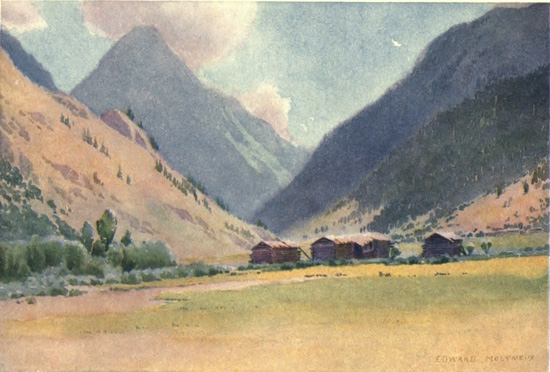
THE VALLEY OF GURAIS
SRINAGAR AND NEIGHBOURHOOD
Entering now into greater detail, first among the
places of interest to be described must be Srinagar,
the City of the Sun, the capital of the country,
and the dwelling-place of 120,000 inhabitants.
From both the sanitary and the æsthetic point of
view I am always disappointed that Srinagar was
not placed either on the plateau of Pariansipura
in the centre of the valley, or on the plateau just
above Pampur on the west. The former was
chosen by the great king Lalataditya for the site
of his capital, of which the ruins remain to this day.
It is a karewa just opposite the junction of the
Sind River with the Jhelum, high and dry above
all floods and marshes. And it stands well away
from the mountain ranges on either hand, right
out in the centre of the valley, so that all the
higher peaks and the complete circle of snowy
mountains may be seen. A nobler site could not
be found. The Pampur plateau has the like
advantage of being high and dry and healthy, and
of being sufficiently raised above the ordinary level
of the valley to command views right over the fields
and marshes and wooded hamlets; and it also
immediately overhangs the river, and commands a
view of the most picturesque reaches in its course.
Either of these sites would have been preferable
to the present low-lying situation amid the swamps,
so muggy in summer and so chill in winter. Yet
this site has attractions of its own, and built as it
is on either side of the river, with canals and
waterways everywhere intersecting it, and with
the snowy ranges filling the background of every
vista, the city of Srinagar must be ranked among
the most beautiful in the East, and in its peculiar
style unique.
The distinguishing feature is the combination of
picturesque but rickety wooden houses, of mosques
and Hindu temples, of balconied shops, of merchants'
houses and the royal palaces with the broad
sweeping river and the white mountain background.
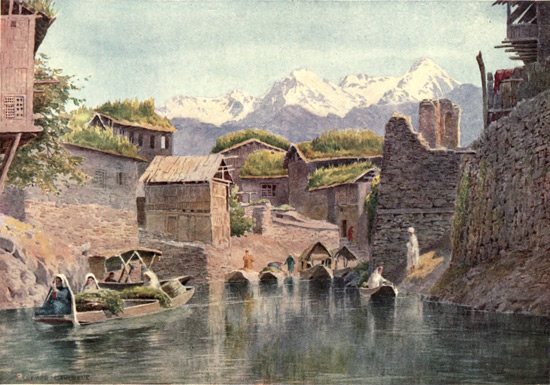
MARKET BOATS ON THE MAR CANAL, SRINAGAR
Perhaps Srinagar never looks more beautiful than
in the fulness of spring towards the end of April,
when the Maharaja arrives from Jammu and enters
his summer capital by boat. On such occasions
the Resident and his staff, all the State officials,
and many of the Europeans resident in Srinagar, go
by boat to meet His Highness some distance below
the city. The Maharaja arrived this year on the
most perfect day in spring. Before the time of
his arrival the river was alive with craft of every
description, from the Resident's state barge of
enormous length, and manned by about fifty rowers
dressed in scarlet, to light shikaras, and even two
motor boats. As we emerged from the town
the banks on either side were covered with fresh
green grass. The poplars and some magnificent
chenar trees overhanging the river were in their
freshest foliage. And coming up a long reach of
the broad glistening river was the Maharaja's
flotilla, with their long lines of red and of blue
oarsmen giving colour to the scene.
The two flotillas joined and slowly made their
way through the city. On either side were piled
up masses of wooden houses, some low, some high,
some leaning to one side, some to the other,—none
straight and no two alike. All were crowded with
people craning at the windows to see the procession.
From many hung shawls, the distinctive
decoration of the city for state occasions. And
most striking and most beautiful feature of all,
and only to be seen at this time of year and in
Kashmir, the earth-covered roofs were now covered
with fresh green grass, with delicate mauve irises,
and in some few cases with the gorgeous scarlet
Kashmir tulip. A more beautiful object than that
of a little mosque on the edge of the river with
its chalet-like roof covered with this blaze of
scarlet, its graceful spire tapering skywards, its
tassel-like bells of brass suspended from the corners
all set in a group of overshadowing chenar trees,
with the snowy ranges in the far distance, the
clear blue sky above and the spring sunshine bathing
all in warmth and light, it would be hard
indeed to find outside Kashmir.
Beyond the seventh bridge is the Yarkand
serai, filled with the Tartar-featured Yarkandis
from Central Asia, in whose garb I myself arrived
in Srinagar twenty-one years ago, and fully as
dark as they from many months' exposure to the
sun and snow.
Above this is the first neat, well-constructed
buildings—the Zenana hospital built and supported
by the State, and now lined by the medical and
nursing establishment come out to welcome the
Maharaja.
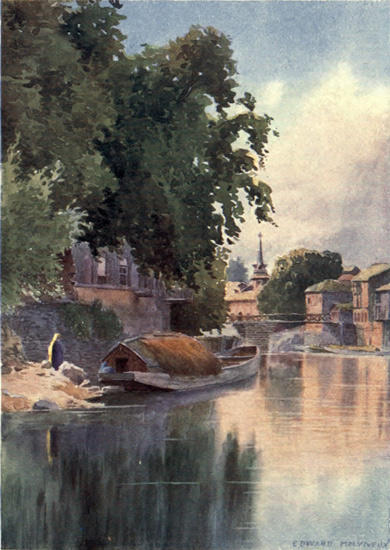
ABOVE THE FIFTH BRIDGE, SRINAGAR
The sixth and most of the other bridges of
Srinagar are built up on piers of crossed horizontal
logs of wood. They occupy much of the river
way, but are very distinctive, and harmonise most
picturesquely with the wooden houses of the city.
They were all crowded with people. And on the
banks near one were assembled many hundreds of
school-boys carrying small flags, which they waved
as the Maharaja passed, and shouted "Eep, eep, ra!
Eep, eep, ra!" continuously for many minutes in
imitation of the British cheer. Mottoes of welcome
were stretched across the houses in places, some
invoking long life for the King-Emperor, and others
expressing loyal wishes for the Maharaja. Between
the third and fourth bridges are the shops of most
of the chief bankers and merchants, big, handsome,
picturesque buildings of small bricks and woodwork,
with semicircular balconies jutting out over
the river and pretty carved and lattice-work
windows. Near the third bridge is the fine Shah
Hamadan mosque of an almost Norwegian type of
architecture, built of wood with a tall taper spire
and handsome hanging ornaments from the eaves.
Beyond the third bridge is the chief Hindu temple,
of quite a different order of architecture, built of
stone—and, as along the whole embankment of
the river, with the great stone blocks from the
temples and cities of ancient Hindu times.
And so the procession up the river continues,
through the avenue of houses, mosques, and
temples; past rows of grain barges and house-boats
tethered to the shores; past the curious
wooden bathing-boxes, under the old-style wooden
bridge; past flights of steps leading to the water's
edge and crowded with people mostly, it is sad to
say, in dull brown or the dirtiest white, but sometimes
in gay orange-green or purple; past the old
residence of the Governors and the new villa of
Sir Amar Singh till the Maharaja's palace is
reached, where the procession finally halts while
all the hundreds of little boats which had followed
in rear swarm round the palace steps. The
Resident then takes leave, the Maharaja ascends
into his palace, and the Resident and the European
community proceed still farther up the river to the
European settlement in the area known as the
Munshi Bagh.
The palace, though large, is disappointing. It is
not what one would have expected on such a site.
Even the native portion is not handsome, and on to
this has been tacked an ugly European edifice.
A great chance has been thrown away, and one
can only hope that time will either tone down the
present ungainliness or remove it altogether, and
erect a building more worthy of the rulers and of
the beautiful country which they rule.
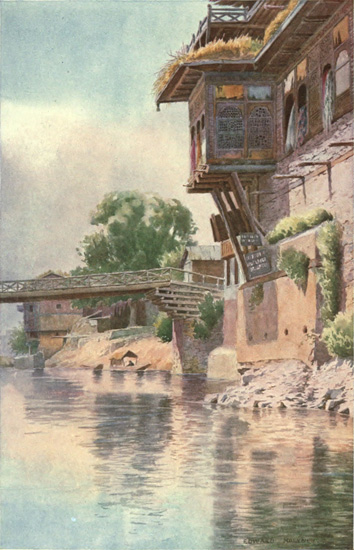
SHAWL MERCHANTS' SHOPS, THIRD BRIDGE, SRINAGAR
On either side are two handsome villas of brick
and wood such as are seen on the banks of the
Thames; the one belongs to the Maharaja's brother
Raja Sir Amar Singh, and the other is allotted
by His Highness to his chief spiritual adviser.
Beyond is the great flight of steps, at which Lord
Minto landed on his arrival in 1906, leading to the
main land entrance of the palace on the one hand,
and on the other to a new, well-built, fairly clean
and extremely picturesque bazaar.
Then the last, or rather, as it is commonly known,
the first bridge is passed, over which lies the main
road from Rawal Pindi and Baramula to Srinagar
and the Munshi Bagh; and beyond this are passed
more villas, then the State Hospital and the
Museum on the right and various State buildings on
the left, including the old Guest House in which were
entertained Sir Henry Lawrence and John Nicholson.
Beyond is clear of the town, and along the "Bund"
or embankment, which forms a lovely walk by
the water-edge, has now arisen a series of smart
European buildings—the missionaries' quarters, the
Punjab Bank, Parsi shops, the Post Office, the
Residency clerks' quarter and office, and then
the Residency itself, a regular English country-house;
and beyond it a tidy little Club, the second
Assistant Resident's quarters, the Parsonage, the
Church, and a line of houses each in its own snug
and pretty little garden, the residences of British
officials in the employ of the Kashmir State. The
whole Bund is overshadowed by great chenar trees
and willows, and both sides of the river are lined
with house-boats. A thousand feet immediately
behind rises the Takht-i-Suliman with the graceful
Hindu temple on its summit, and behind this again
the great ranges with snow still lying low upon them.
Behind the Bund lie many other modern houses,
including Nedou's hotel, and on the slopes of the
Takht and towards Gupkar many English villas are
springing up—all in much the same style, built of
brick and cross-beams of wood with gable roofs.
There are also tennis courts and a croquet and
badminton grounds round the Club, and on the open
plain golf links, a polo ground, and a cricket
ground. Srinagar is indeed a gay place for the
summer months, with games going on every day,
dances nearly every week, dinners, garden parties,
and picnics.
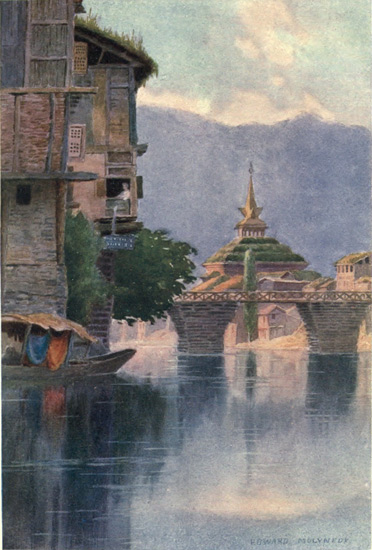
MOSQUE OF SHAH HAMADAN, SRINAGAR
The Jama Masjid
The largest and most striking, though not the
most beautiful, of the Mohamedan buildings in
Srinagar is the Jama Masjid, which was built by
the Emperor Shah Jehan. It is constructed of
wood throughout, and is in the form of a square
enclosing a courtyard. The main building, of
course, faces Mecca. Here there is a forest of
pillars all of single deodar trees, and remarkable
for their height and grace. A staircase leads on
to the roof, from which a good view over the sea
of mud-roofed houses of Srinagar may be obtained.
Taken as a whole the building is not very
remarkable. The graceful steeples, of the style
characteristic of Kashmir, in the centre of each
face are worthy of note. But all is in disrepair
and neglected, and is hardly worthy of a city of
over a hundred thousand Mohamedans.
Shah Hamadan Masjid
A more beautiful building than the Jama
Masjid is the graceful Mosque of Shah Hamadan,
situated close upon the river, and a very favourite
object for artists and photographers. It also is
built of wood with pointed steeple, beautifully
carved eaves and hanging bells, like most of the
Mohamedan structures in Kashmir.
Other Buildings
Scattered throughout the city are other
mosques of much the same style of architecture.
There are also several Hindu temples of the usual
type, and not especially characteristic of Kashmir.
Dr. Neve's Hospital
Conspicuous above the European quarter stand
the group of buildings known all over Kashmir
as Dr. Neve's Hospital, a mission hospital which,
with Mr. Biscoe's School, is the most sincerely
appreciated of all the efforts which Europeans
have made for the welfare of the Kashmir people.
Last year no less than 22,735 new out-patients
were treated, and the total number of visits
amounted to 56,280. 1764 in-patients, of whom
476 were females, were also treated; and 5038
surgical operations were performed. Sometimes
over 200 out-patients, and on a few days over 300
out-patients, were treated in a single day. These
figures speak for themselves. They show the
confidence the people now have in the wonderful
institution and the steady practical good it is
doing. The heads of the hospital are the brothers
Drs. Arthur and Ernest Neve; and they are
assisted by Dr. Rawlence, Miss Neve, Miss
Robinson, Mr. S. Wilson, and 54 native assistants
and servants.
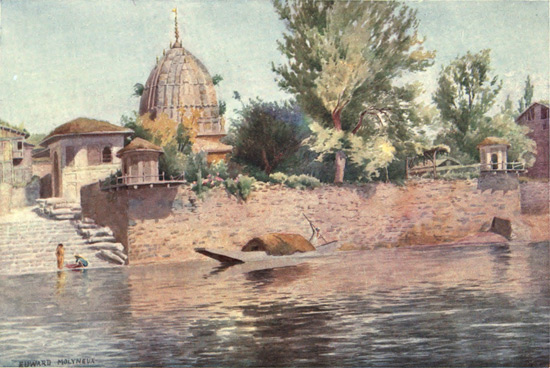
A HINDU TEMPLE, SRINAGAR
The hospital was founded in 1865 by Dr.
Elsmie, who for many years had uphill work in
starting the institution, but at length gained the
confidence of the people and of the late Maharaja.
Dr. Downes succeeded Dr. Elsmie, and carried
the work forward. In 1881 Dr. Neve took it up.
In that year 10,800 new patients were treated;
there were 23,393 visits, and 1418 operations
were performed. Year by year since then the
good work has progressed. The original mud-buildings
have gradually been replaced by the
present solid masonry structures. And the steady
growth of the number of in-patients, and the
readiness with which even upper-class women
remain in the hospital, testify to the confidence
with which the institution is now regarded. It
is now renowned through all the north of India,
and is a splendid testimony to the steady,
thorough, and persevering work of two self-sacrificing
men.
The Takht-i-Suliman
The most conspicuous object in the neighbourhood
of Srinagar is the Takht-i-Suliman, a hill
exactly a thousand feet above the valley plain, and
surmounted by an ancient Hindu temple. Both
for the sake of the view over the valley, up the
reaches of the Jhelum, and down on to the Dal
Lake and the city of Srinagar immediately at the
foot, and also to see the older temple even now
frequented by pilgrims from all over India, a climb
to the summit is well repaid.
The temple is believed to have been dedicated
to Jyesthesvara, a form of the god Siva. It was at
one time thought that it was built 220 b.c., but it
is now believed by the best authorities that while
the massive basement and stairs are remains of an
ancient building (possibly Gopaditya's, as Dr. Stein
thinks), the present superstructure may be of later
date. The roof is certainly modern, but the temple
as a whole probably belongs to the same period as
the other temples in Kashmir.
It is of the typical Hindu plan of a square
with recessed corners, and is built like all the
ancient Kashmir temples of massive blocks of
stones.
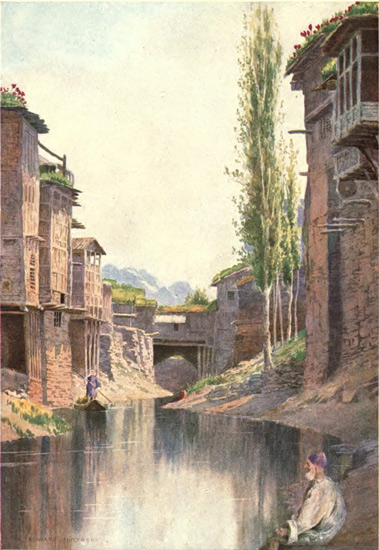
IN THE MAR CANAL, SRINAGAR
Pandrathan
Three miles up the river from Srinagar is the site
of what is very probably the original city of Srinagar
founded by Asoka. The name of Pandrathan now
given to the village is identified with the Puranadhisthana,
or "ancient capital" of the records, and
this has been presumed to be the same as Srinagar
founded by Asoka, the Buddhist king. But of this
city nothing now remains, and the picturesque
temple there is of later date. It was built by the
minister Meruvad-dhana in the beginning of the
tenth century, and dedicated to Vishnu.
The Dal Lake
The Dal Lake, with the canal leading into it,
and the various gardens on its shores, is one of the
chief attractions of the neighbourhood of Srinagar.
It is always lovely, but perhaps at no season more
beautiful than early in May. Passing through the
lock known as the Dal Darwaza, we glide through
channels of still, transparent water hedged in by
reeds and willows. On the right rises the Takht-i-Suliman
immediately out of the lake. In front
are the snowy ranges bordering the Sind valley.
Numerous side-channels branch off and intersect.
The shores are covered with market gardens.
Country boats laden with their produce continually
pass, usually propelled by some old man or woman
squatting at the extreme prow, and balancing him
or herself there with extraordinary confidence and
skill. Numerous kingfishers of brilliant sky-blue
plumage flash across the water; and gorgeous
yellow-golden orioles dart from tree to tree.
Clumps of noble chenar trees with the Kashmir
chalet houses are grouped along the banks, and
often overhang the mirror waters. Orchards of
quince trees with their delicate pink and white
blossom and fields of brilliant yellow mustard line
the shores. Cows and their calves, sheep and their
little lambs, graze on the fresh green grass; and
pretty but dirty little children, geese and goslings,
ducks and ducklings, dabble in the water, and all tell
of the rich abundant life now bursting into being.
Rounding a turn in the canal a graceful Hindu
temple is seen forming the end of a reach, and on its
steps leading to the edge of the water and reflected
in it are picturesque groups of women, most of
them indeed in the dull brown which they wear
with lamentable frequency, but some of them also
in bright greens and yellows which furnish the
needed touch of colour to the scene.
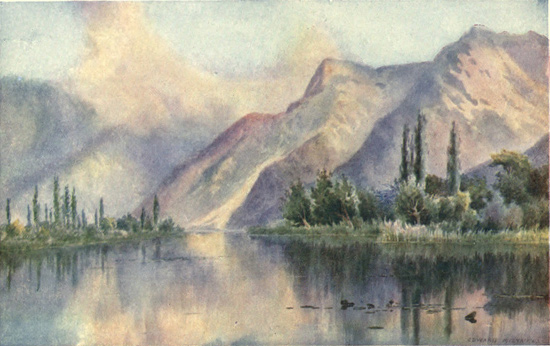
GUGGRIBAL POINTE ON THE DAL LAKE
Some hundreds of yards farther on we pass
under an old bridge with a pointed arch of quaint
artistic design of Moghal times. Numerous grain
boats of enormous size are congregated here; and
half a mile farther the channel gradually opens out,
and at length we emerge on to the open lake itself.
The water is so still and so clear that the
reflections of the surrounding mountains are seen
as in the most polished mirror. The reflected
mountain is as sharp and distinct as the mountain
itself. The luxuriant plant growth from the
bottom and the numerous fishes are seen as in
clear air. On the far shores of the lake the stately
avenues of the Nishat and Shalimar Baghs approach
the water's edge. Above them rise high mountain
cliffs. Graceful boats glide smoothly over the
glassy surface of the lake—some the bearers of
market produce, some occupied by fishermen, and a
few filled with holiday-makers enjoying thoroughly
the beauty of the scene, and giving expression to
the enjoyment in songs and music.
May is not the season for the lotus, so that one
additional attraction is lacking; but in July and
August, when the lotus is in full bloom, the lake
itself, though not the shores and setting, is at
perfection. The lotuses are as large as the two
hands joined together, of a delicate pink, and set on
the water in hundreds. In the midst of their graceful
leaves they add a beauty to the lake which
attracts multitudes from the city.
Gliding on beyond the lotuses we pass the
famous Isle of Chenars with its magnificent trees
and grassy velvet banks; we pass a little promontory
with another huge chenar tree growing
out right over the water, and giving shelter to a
house-boat comfortably ensconced beneath its shade;
and then we reach the widest and most open
portion of the lake. In the distance, towards the
Sind valley, well-wooded villages cover the lower
slopes of the mountains inclining towards the lake,
and away in the farthest westward distance the
Khagan snows are faintly traced.
From here to the Nishat or Shalimar Baghs we
would bear off to the right. To the Nasim Bagh
we bear to the left, and closing in to the southern
shore pass a picturesque village by the side of the
lake with chalet-like house, a handsome ziarat, a
background of chenar trees and long lines of
steps, generally crowded with people, leading to
the water's edge. In about an hour's row from
the start at the Dal Darwaza the Nasim Bagh is
reached.
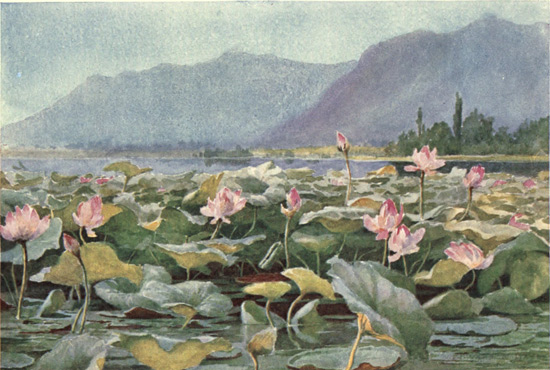
LOTUS LILIES ON THE DAL LAKE
Nasim Bagh
The Nasim Bagh is a series of avenues of
glorious chenar trees crossing one another at right
angles, and each avenue about three hundred yards
in length. Under these is soft, fresh green grass,
and the whole is raised twenty or thirty feet above
the water. There are no flower gardens, but the
site makes a perfect camping-ground, and many
house-boats anchor here in the summer.
Looking out from the shade of the chenars we
see straight across the lake the Shalimar Bagh with
the Dachigan valley behind it, and the snowy
Mahadeo Peak towering above. From the opposite
side of the Bagh, looking away from the lake, there
are views over the Kashmir valley to the snows of
the Pir Panjal and of the Khagan range. And
round the edges were clumps of large white and
purple irises.
In the autumn the Nasim Bagh is more beautiful
still, for then the chenars are in all the richness
of their autumn foliage, and a more perfect camping
or picnic spot man could hardly wish for.
The Shalimar Bagh
On the north-east corner of the Dal Lake, and
approached by a canal about a mile in length, with
banks of soft green turf, and running between an
avenue of chenars and willows, is the Shalimar
Bagh, or royal garden, the favourite resort of the
Moghal Emperor Jehangir and his wife, the
famous Nurmahal, for whom the Taj at Agra was
built as a tomb. The gardens can also be reached
by a beautiful road along the shores of the lake,
nine miles from the city of Srinagar.
The situation is not so beautiful as the site of
the Nishat Bagh, for it is almost on a level, and
is surrounded by a high wall. But it is only in
comparison with the Nishat Bagh that it can suffer
disparagement, and anywhere else than in Kashmir
it would be hard to find a more beautiful garden
than the Shalimar on an autumn evening, when the
great avenue of chenar trees is tinged with gold
and russet, when the lofty mountains which rise
behind it take on every shade of blue and purple,
and the long lines of fountains running through
the avenue sparkle in the sunshine.
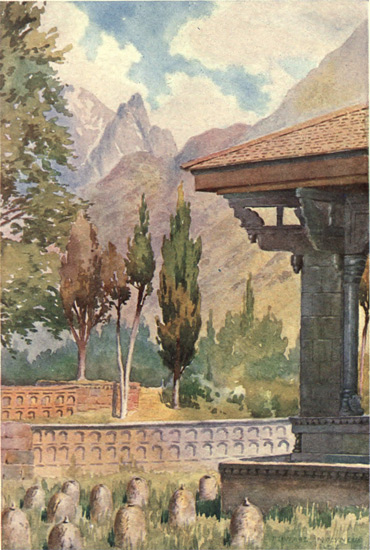
SHALIMAR GARDENS
The garden is remarkable too for a pavilion, with
exquisitely carved pillars of black marble. It is set
in a tank in which play numbers of fountains, and
round the borders of the tank are massive chenar
trees. The total length of the garden is 600 yards,
and it is arranged in four terraces, on three of which
are pavilions. Except for the pavilion with marble
pillars and the water channel, the garden is in a
state of ruin; but Mr. Nichols of the Archæological
Department Survey has attempted to reconstruct
its former outlines. There is a tradition that the
garden was originally larger than the present walled
enclosure, and there are found along the canal
which connects it with the Dal Lake the ruins of
masonry foundations, which mark either the beginning
of the old garden or the site of a pavilion
within it. Causeways and channels probably extended
across the garden with tanks and platforms.
The garden was in the strictest sense a formal
garden, and in making his recommendation for its
restoration, Mr. Nichols enlarges on the artificiality
which is the charm of a formal garden. Appreciation
of a formal garden requires, he thinks, an
acquired taste, but the Moghals certainly understood
such matters. They were quite right in
selecting trees of formal growth, and planting
them on geometrical lines, the essence of a
good garden being that it should form a pleasing
intermediate step between the free treatment
which Nature lavishes on hills and plains, field
and forest, and that necessarily artificial object—a
building made by the hand of men.
Such are Mr. Nichols' ideas, for which there is
a good deal to be said. But some may also think
that when a once formal garden and formal buildings
have already fallen into ruin and returned
as it were to nature, there may be less need to
restore the formality, and that to fall in with the
ways of Nature may be the best method of adding
to the existing beauty of the garden. In any
case the improvement of the turf, the removal of
modern hideosities of buildings, and the replacing
of the makeshift fountains by fountains of really
tasteful design, would greatly improve this beautiful
garden.
The Nishat Bagh
The Nishat Bagh is decidedly the favourite
garden in Kashmir, though it has no building so
fine as the pavilion with the black pillars in the
Shalimar Bagh. Its situation on the rising
ground sloping up from the Dal Lake, backed by
a range of mountains immediately behind, and
with views far over the water and over the valley
to the distant snowy mountains, gives it an advantage
over every other garden, and its beauty
in spring-time when the Kashmir lilac and the fruit
trees are in blossom, when the chenars are in young
leaf and the turf in its freshest green, I have
already described.[1] In the autumn it is scarcely
less beautiful in a different way. Then the
chenars are in a gorgeous foliage of gold and
purple. Day after day of brilliant sunshine and
cloudless sky give a sense of security of beauty,
and no more perfect pleasure-ground could be
imagined.
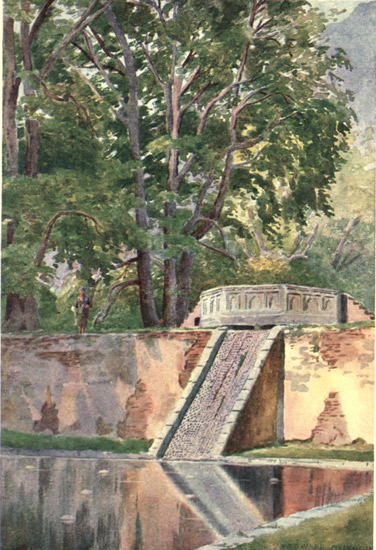
THE NISHAT BAGH
The garden was constructed by the Moghal
Emperor Jehangir. It can be reached either by
water or by road along the shores of the lake. It
is about 600 yards long and divided into seven
terraces, each rising well above the other. Down
the centre runs a water-channel broken into a
succession of waterfalls and fountains, and shaded
by an avenue of chenars.
The pavilion at the entrance, though affording
from its upper story a striking view of the garden
right up the line of waterfalls and fountains, and
on to the mountains which hang over the garden,
is a modern structure and is not beautiful in itself.
It is a thousand pities, indeed, that this most
superb site has not been made use of to construct
a really beautiful pavilion on the lines of that in
the Shalimar Bagh. On the higher terraces are
the foundations of other pavilions and massive
stone throne-like seats which indicate the fuller
beauties of the Moghal times.
On the topmost terrace is a beautiful clump
of magnificent chenar trees and a wide extent of
soft green turf—an ideal spot for picnics and
garden-parties. And it is from this point that
can be seen the most beautiful and extensive views
through the avenue of chenar trees, over the
fountains and waterfalls, on to the glassy lake and
the distant snowy ranges.
Parihasapura
A very little known but very accessible and
particularly interesting spot is the site of the
ancient city of Parihasapura, the modern Paraspur,
situated two and a half miles south-west of
Shadipur, and stretching from there on a karewa,
or raised plateau, to the Srinagar and Baramula
road. There is not much left now above ground,
for numbers of the massive blocks of stone of
which the city and temples were built have been
taken away ages ago to build the temples of Patan
close by, and, alas! also to metal the Baramula
road. But the outlines of the walls may still be
traced sufficiently well to attest the grand scale
on which the city was built; and we know from
records that it was built by the same great king
Lalataditya, who erected the temple of Martand
in the eighth century.
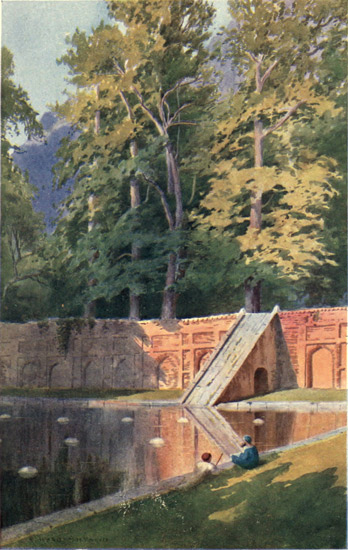
A TERRACE OF THE NISHAT BAGH
And Parihasapura, like Martand, has been set
off to the greatest advantage by natural scenery.
This Kashmir king must indeed have been worthy
of the beautiful country which he ruled. In his
time the Sind and Jhelum rivers met, not at
Shadipur as now, but at the edge of the karewa
on which Lalataditya built his city. And from
the plateau views could be obtained right up the
Sind valley to Haramukh and the craggy mountain
peaks which bound it on either side; far up and
down the main valley, over the fields of emerald
rice or golden mustard, and the numerous hamlets
hidden in clumps of chenar and willow, mulberry
and walnut; over also the glistening reaches of the
Jhelum River, to the snowy ranges which at a
distance far enough away not to dwarf or overpower
the city encircled it on every side. No
temple was ever built on a finer site than Martand,
and no city was ever set in more lovely surroundings
than Parihasapura.
According to a passage in the Rajatarangini
the king Lalataditya erected five large buildings:
(1) a temple of Vishnu Parihasakesava with a
silver image; (2) a temple of Vishnu Muktakesava
with a golden image; (3) a temple of Vishnu
Mahavaraha with an image clad in golden armour;
(4) a temple to the god Govardhanadhara with
a silver image; (5) the Rajavihara or monastery
with a large quadrangle and a colossal statue of
Buddha in copper, which indicate that in ancient
times there must have been a large and important
Buddhist settlement. The same king is also said
to have erected a stone pillar 54 cubits high with
an image of Garuda on the top.
THE RESIDENCY GARDEN
Among the beauties of Kashmir the Residency
Garden must surely not be omitted. The
Maharaja has provided for the Residency one of
the most charming houses in India—a regular
English country-house. And successive Residents,
in my case aided by Mr. Harrison and Major
Wigram, have striven to make the garden worthy
of the country and the house. Here grows in
perfection every English flower. The wide lawns
are as soft and green as any English lawn. All
the English fruits—pears, apples, peaches, apricots,
plums, greengages, cherries, walnuts, mulberries,
gooseberries, currants, raspberries, and strawberries—grow
to perfection and in prodigious quantities;
and the magnificent chenar and innumerable birds
add a special charm of their own.
Perhaps a record of the cycle of the birds
and flowers will give an idea not only of the
beauties of the garden, but of the climate of the
valley.
Early in March the garden beauties begin to
develop. The turf is then still quite brown and
the trees leafless, but on March 8th, when I
returned to Srinagar this year, violets, pansies,
wall-flowers, narcissus, crocuses, and daisies were
all in flower. Daffodils, hyacinths, stock and a
few carnations were in bud. Columbine and
larkspur leaves were sprouting. Peas and broad
beans sown in November were a few inches high.
And of the trees, willow leaf-buds were just
bursting and showing a tinge of fresh light yellow
green, and one apricot tree was nearly bursting into
blossom. Of birds there were thrushes, minas,
bulbuls, sparrows, crows, kites, blue-tits, hoopoes,
and starlings; and of butterflies, a few tortoise-shell
and cabbage-whites.
The maximum temperature in the shade was
55° and in the sun 104°, and the minimum
temperature was 31°.
On March 17th the willow trees had acquired
a distinct tinge of green, as also had the grass.
Wild hyacinths (blue-bells) and yellow crocuses
were well out. The maximum temperature was
68° in the shade and 110° in the sun, and the
minimum was 32°.
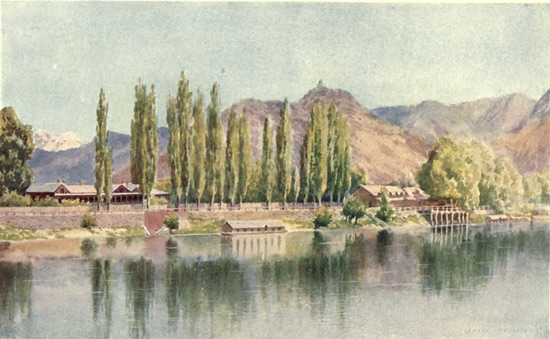
THE RESIDENCY AND CLUB, SRINAGAR
On the same day in the previous year the
maximum was 56° and the minimum 35°, and
four days later there was snow.
By March 20th the apricot blossoms were in
full bloom. Willow trees were in half-leaf.
Garden hyacinths, daffodils, Crown Imperials, and
English primroses were just beginning to bloom;
and greengages were in blossom.
By the end of March the maximum temperature
had reached 75° in the shade and 125° in the sun,
while the minimum stood at 40°. This, however,
was an exceptionally warm March.
By April 1st the garden was exquisitely
beautiful. The willows were now well out, and
in all the charm of fresh young spring foliage.
Apricots and peach trees formed little clouds of
delicate pink and white dotted lightly over the
garden, and not too dense to hide the glories of
the snowy mountains in the background. The tall
pear trees were nearly in full bloom. A few of
the pinky-white apple blossoms were just appearing.
The May leaves were showing a tinge of green.
Chenar leaves were just appearing. The mulberry
leaf-buds were beginning to burst. Catkins were
hanging from the poplars. Rose leaves were fully
out. The grass had nearly turned from brown to
green. Iris buds were showing a tinge of purple.
Hyacinths were well out, and Crown Imperials and
daffodils in full bloom.
On April 3rd the first of the pretty little wild
tulips striped white and pink appeared, and on
the following day the first of the large dark purple
irises and two or three large white irises came into
bloom. Heavy rain fell, and on the 5th the grass
was entirely green. On that day the pears were
in full blossom. Two of the magnificent scarlet
Kashmir tulips, which are a joy to any garden,
came into blossom, and two English tulips also
came out. Rose-buds were beginning to form.
The maximum temperature was 59° and the
minimum 42°. On April 7th the first columbine
came into bloom, and on the 9th the first shrike
appeared.
Now followed a deluge of rain. On the 12th
2½ inches fell. By the morning of the 13th 14·65
inches had fallen since January 1st, in comparison
with a normal fall of 10·6 inches. And, most unexpected
of all, on the night of 12th-13th snow
fell! The maximum temperature was only 50° and
the minimum 33°. In a single night all the lovely
delicate peach blossoms, the crowning glory of the
Kashmir spring, were withered up, and for the
moment we seemed plunged back once more to
winter.
But April 15th was one of Kashmir's most
lovely days. The poplars were now in fresh light
foliage. May was in full leaf. Irises were
plentiful. Several columbines were in bloom.
Both the Kashmir and English tulips were well
out; and the strawberries were in blossom. On
this day, too, I saw a flight of green parrots with
long yellow tails in the garden.
The first rose bloomed on April 17th, a white
climber whose name I do not know, growing on
the south verandah. Last year the first did not
appear till the 26th.
May came into bloom on April 24th, and on the
25th a scarlet poppy and a white peony blossomed.
For some days then the weather had been exceptionally
warm, the maximum rising to 80° in
the shade and 129° in the sun, and the minimum
to 51°.
The first golden oriole appeared on the 26th—exactly
the same date as that on which it appeared
last year. The golden orioles have a glorious
deep liquid note which thrills through the whole
garden. Two or three pairs always settle there,
and all day long their brilliant yellow plumage is
seen flashing from tree to tree.
Three days later another brilliant visitant
appears, the paradise fly-catcher. He has not
the beautiful note of the golden oriole, nor such
striking plumage. But he has exceedingly graceful
form and movements. He has a very long, wavy,
ribbony tail, like a paradise bird, and the two or
three pairs of them which yearly settle in the garden
may be seen at any hour undulating through the
foliage or darting swiftly out to catch their prey.
By May 1st the magnificent chenar trees were
in full leaf. Mulberry, horse-chestnut, and walnut
were also well in leaf. The roses were coming
into bloom—numerous Maréchal Neil, and a
beautiful single pink rose—the sinica anemone—a
few of Fortune's yellow, and many tea-roses.
The May trees were in full blossom. The bank
on the south side of the garden was a mass of
dark purple and white irises, and of an evening
when the sunlight glancing low along its length
caused each flower to stand out in separate state,
became a blaze of glory. Another beauty of this
season were bushes of what is generally known
as Indian May, with long slender stalks bent
gracefully downward like a waterfall of snowy
flowers. Stock was in full bloom. Pansies were
out in masses. Both the English and Kashmir
lilac were in blossom, and the columbines were in
perfection. I had had out from Barr & Sons a
number of varieties, and the success was remarkable.
The Kashmir soil and climate seem to suit
columbines, and varieties from every part of the
world, deep purple, light mauve, white, mauve and
white, pink and red of many different graceful
forms, came up luxuriantly. They were one of
the successes which gladden an amateur gardener's
heart.
The maximum in the shade was 60°, in the sun
122°, and the minimum 48°.
The first strawberries ripened a week later. The
first horse-chestnuts came into blossom on May
10th, and on that date the single pink rose, sinica
anemone, on the trellis at the end of the garden,
was in full bloom and of wondrous beauty; a
summer-house covered with Fortune's yellow was
a dream of golden loveliness; I picked the first
bloom of some English roses which a kind friend
had sent out, and which had been planted in a
special rose garden I had made for them—William
Shean, Mrs. Ed. Mauley, Mrs. W. J. Grant, and
Carmine Pillar; and we had our first plateful of
strawberries.
A light mauve iris, a native of Kashmir, now
came into bloom; geraniums and some lovely
varieties of Shirley poppy which I had obtained
from Mr. Luther Burbank, the famous plant-breeder
of California, began to blossom; and roses of every
variety came rapidly on till the garden became a
blaze of colour.
The first of some remarkably beautiful delphiniums—some
a deep blue, some sky blue, and
some opalescent—which I had also obtained from
Luther Burbank appeared in bloom on May 17th.
A spell of hot weather now set in, and on May
21st the maximum temperature rose to 84° in the
shade and 134° in the sun, and the minimum to 54°.
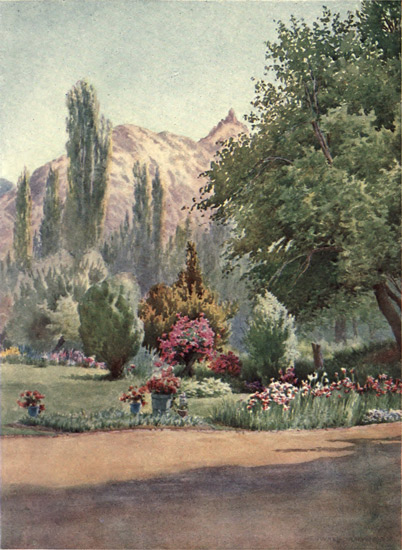
THE TAKHT-I-SULIMAN, FROM THE RESIDENCY GARDEN
By May 25th the roses were at their maximum
of beauty. The sweetly-scented and delicately-coloured
La France roses were at perfection. Rich
bushes of General Jacqueminot, of John Hopper, of
the pink rose of Kashmir, and of many other kinds
whose names I do not know, formed great masses of
colour against the soft green leaves and the plentiful
foliage of the chenar trees. William Alan
Richardson climbed over the trellises. The Shirley
poppies gave every deep or delicate shade of red
and pink. Sweet-peas were in full bloom, and of
them also I had had a marvellous variety from
England. Pinks and carnations were coming
rapidly on. A mauve and yellow iris had appeared.
Luther Burbank's delphiniums formed welcome
patches of real true blues in the herbaceous border
round the lawn. The light and graceful gypsophylis
and phlox were in bloom; gladioli were
just coming out; and the horse-chestnut trees
were all in gorgeous blossom.
Early in June the gladioli, Canterbury bells,
pinks, sweet-williams, and foxgloves were in full
bloom, and the sweet-william especially gave masses
of beautiful and varied colour. The temperature
now rose to 88° in the shade and 135° in the sun, and
the minimum to 54°. On June 10th, carnations,
phlox, and Eschscholtzia were in full bloom. And
by June 15th, though many of the best roses had
passed over two beautiful climbers which I had
obtained from home, Dorothy Perkins and Lady
Gay were in full blossom, and the delicate pink and
graceful form of the latter were especially lovely.
Geraniums and fuschias were now fully out, and
masses of tall hollyhocks in many different shades
of colour were most effective. A few cannas and
some lilies also came into bloom.
By the end of June apricots were ripe.
Petunias and dahlias were out, and a few columbines
still remained in bloom. The temperature
had now gone up to 94° in the shade and 142°
in the sun, and the minimum to 62°; and early in
July it rose to 97° in the shade, which is about as
hot as it ever becomes in the valley.
On returning to Srinagar on September 7th
I found the bed of scarlet salvias giving brilliant
patches of colour and most effectively lighting
up the garden. The autumn crop of roses was
beginning, though the blooms were not so fine as
the spring crop. Geraniums, fuschias, asters, cannas,
zinnias, gallardia, and verbena were in abundance;
stock and phlox were still out, and the hibiscus
bushes were in full bloom. Burbank's delphiniums
were also having a light second bloom. The
maximum in the shade was 81° and in the sun 128°,
and the minimum 52°. The rainfall to date from
January 1st was 27·4 inches in comparison with
a normal fall of 21·7 inches.
By the beginning of October last year cosmos
was blooming luxuriantly. Christmas roses were
in full blossom, and the first chrysanthemum
appeared. During the month these blossomed in
great beauty and became the chief attraction in the
garden. Towards the end of the month and beginning
of November the great chenar trees gradually
assumed the gorgeous autumn colouring. The
Virginian creeper on the porch turned to every rich
hue of red and purple. Then the glories of the
garden slowly vanished away. The leaves fell
from the trees. The frost turned the turf brown.
On December 1st there were still a few brave
remnants of the summer splendour—a few tea-roses,
stocks, phlox, wallflower, chrysanthemums,
carnations, petunias, gallardia, nasturtiums, salvia,
snapdragons, and one or two violets. But the
temperature was now 25° at night, and the
maximum in the day only 54°, and these too soon
disappeared, and the only consolation left was the
clearer view of the mountains of which the absence
of foliage on the trees allowed. Thus ends the
story of a garden's glory.
GULMARG
What will be one day known as the playground
of India, and what is known to the Kashmiris as
the "Meadow of Flowers," is situated twenty-six
miles from Srinagar, half-way up the northward-facing
slopes of the Pir Panjal. There is no other
place like Gulmarg. Originally a mere meadow to
which the Kashmiri shepherds used to bring their
sheep, cattle, and ponies for summer grazing, it is
now the resort of six or seven hundred European
visitors every summer. The Maharaja has a
palace there. There is a Residency, an hotel, with
a theatre and ball-room, post office, telegraph
office, club, and more than a hundred "huts"
built and owned by Europeans. There are also
golf links, two polo grounds, a cricket ground,
four tennis courts, and two croquet grounds.
There are level circular roads running all round it.
There is a pipe water-supply, and maybe soon there
will be electric light everywhere. And yet for
eight months in the year the place is entirely
deserted and under snow.
Like Kashmir generally, Gulmarg also is said
by those who knew it in the old days to be now
"spoilt." With the increasing numbers of visitors,
with the numerous huts springing up year by year
in every direction, with the dinners and dances, it
is said to have lost its former charms, and it is
believed that in a few years it will not be worth
living in. My own view is precisely the opposite.
I knew Gulmarg nineteen years ago, and it
certainly then had many charms. The walks and
scenery and the fresh bracing air were delightful.
Where now are roads there were then only
meandering paths. What is now the polo ground
was then a swamp. The "fore" of the golfer was
unknown. All was then Arcadian simplicity.
Nothing more thrilling than a walk in the woods,
or at most a luncheon party, was ever heard of.
And, doubtless, this simplicity of life has its
advantages. But it had also its drawbacks. Man
cannot live for ever on walks however charming
and however fascinating his companion may be.
His soul yearns for a ball of some kind whether it
be a polo ball, a cricket ball, a tennis ball, a golf
ball, or even a croquet ball. Until he has a ball
of some description to play with he is never really
happy.
So now that a sufficient number of visitors
come to Gulmarg to supply subscriptions enough
to make and keep up really good golf links, polo
grounds, etc., I for my part think Gulmarg is
greatly improved. I think, further, that it has not
yet reached the zenith of its attractions. It is the
Gulmarg of the future that will be the really
attractive Gulmarg, when there is money enough
to make the second links as good as the first, to
lay out good rides down and around the marg, to
make a lake at the end, to stock it with trout, and
to have electric light and water in all the "huts,"
and when a good hotel and a good club, with
quarters for casual bachelor visitors, have been
built.
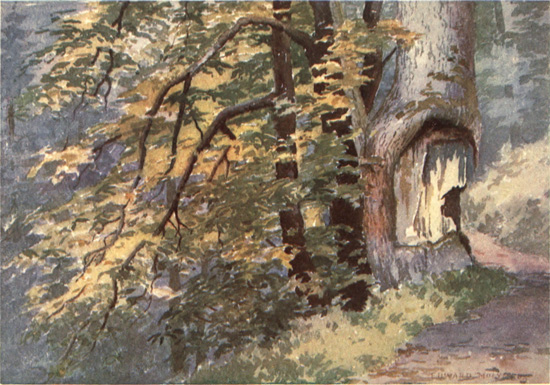
ON THE CIRCULAR ROAD, GULMARG
All this is straying far from the original
Arcadian simplicity, but those who wish for
simplicity can still have it in many another valley
in Kashmir—at Sonamarg, Pahlgam, or Tragbal,
and numerous other places, and the advantage of
Gulmarg is that the visitor can still if he choose
be very fairly simple. He can go about in a suit
of puttoo. He need not go to a single dance, or
theatrical performance, or dinner-party, or play a
single game. He need not speak to a soul unless
he wants to. He can pitch his tent in some
remote end of the marg, and he can take his
solitary walks in the woods; but, if after a while he
finds his own society is not after all so agreeable as
he had thought, if he feels a hankering for the
society of his fellows, male or female, and if he
finds the temptation to play with some ball is
irresistible, then just under his nose is every
attraction. He can indulge his misanthropic
inclinations at will, and at a turn in those inclinations
he can plunge into games and gaiety to his
heart's content.
The main charm of Gulmarg will, however,
always remain the beauty of its natural scenery
and the views of the great peak, Nanga Parbat,
26,260 feet above sea-level, and 80 miles distant
across the valley. The marg or meadow itself is
a flowery, saucer-shaped hollow under a mountain
13,000 feet high, and bounded by a ridge directly
overhanging the main valley of Kashmir. It is
8500 feet above sea-level, open and covered with
flowers and soft green turf, but on all sides it is
surrounded by forests of silver fir interspersed
with spruce, blue pine, maple, and a few horse-chestnuts,
and the great attraction is that through
this forest of stately graceful firs the most superb
views may be had, first over the whole length and
breadth of the vale of Kashmir, then along the
range of snowy mountains on the north, and as
a culminating pleasure, to the solitary Nanga
Parbat, which stands out clear and distinct above
and beyond all the lesser ranges, and belonging,
so it seems, to a separate and purer world of its
own. And there is the further attraction in the
Gulmarg scenery that it is ever changing—now
clear and suffused in brilliant sunlight, now the
battle-ground of monsoon storms, and now again
streaked with soft fleecy vapours and bathed in
haze and colour. No two days are alike, and each
point of view discloses some new loveliness.
Round the outside of the ridge runs what is
known as the circular road. It has the advantage
of being perfectly level, and is fit for riding as well
as walking. Except the road through the tropical
forests near Darjiling, along which I rode on my
way to and from Tibet, and which runs for miles
through glorious tropical vegetation, by immense
broad-leaved trees with unknown names, all
festooned with creepers and lighted with orchids;
by great tree ferns, wild bananas, and a host of other
treasures of plant life, and through which glimpses
of the mighty Kinchinjanga, 28,250 feet, could be
caught,—except that I know of no other more
beautiful road than this along the ridge of Gulmarg.
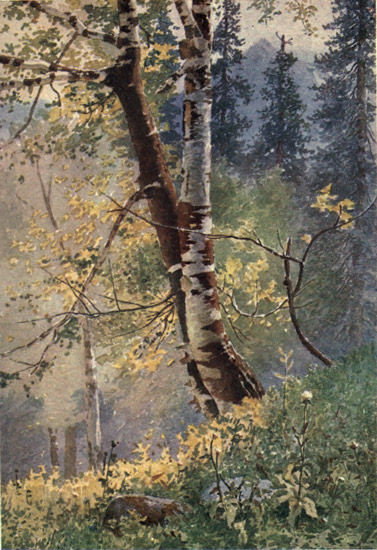
IN THE FOREST
From it one looks down through the wealth of
forest on to the valley below, intersected with
streams and water-channels, dotted over with
wooded villages, and covered with rice-fields of
emerald green; on to the great river winding along
the length of the valley to the Wular Lake at its
western end; on to the glinting roofs of Srinagar;
on to the snowy range on the far side-valley; and,
finally, on to Nanga Parbat itself.
And never for two days together is this glorious
panorama exactly the same. One day the valley
will be filled with a sea of rolling clouds through
which gleams of sunshine light up the brilliant
green of the rice-fields below. Above the billowy
sea of clouds long level lines of mist will float along
the opposite mountain-sides. Above these again
will rise the great mountains looking inconceivably
high. And above all will soar Nanga Parbat, looking
at sunset like a pearly island rising from an
ocean of ruddy light.
On another day there will be not a cloud in the
sky. The whole scene will be bathed in a bluey
haze. Through the many vistas cut in the forest
the eye will be carried to the foot-hills sloping
gradually towards the river, to the little clumps of
pine wood, the village clusters of walnut, pear, and
mulberry, the fields of rice and maize, to the silvery
reaches of the Jhelum, winding from the Wular
Lake to Baramula, to the purply blue of the
distant mountains, then on to the bluey white of
Nanga Parbat, sharply defined, yet in colour nearly
merging into the azure of the sky, and showing
out in all the greater beauty that we see it framed
by the dark and graceful pines in which we
stand.
And this forest has no mean attractions of its
own, of which to my little girl the chief were the
white columbines. Here also are found purple
columbines, delphiniums, what are known as white
slipper orchids, yellow violets, balsams, mauve and
yellow primulas, potentillas, anemones, Jacob's
ladder, monkshood, salvias, many graceful ferns,
and numerous other flowers of which I do not
pretend to know the name.
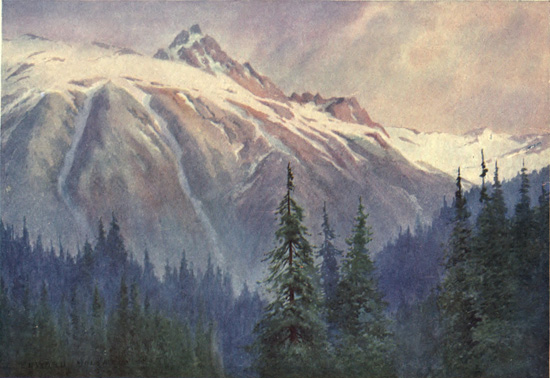
FROM THE CIRCULAR ROAD, GULMARG
The Residency is situated on the summit of the
ridge above the circular road, and from it can be
seen not only Nanga Parbat (through a vista cut
in the trees) and the main valley, but also a lovely
little side-valley known as the Ferozepur nulla.
Looking straight down two thousand feet through
the pine trees we see a mountain torrent whose
distant rumbling mingles soothingly with the sighing
of the pines. Brilliant green meadows, on
which a few detached pine trees stand gracefully
out here and there, line the river banks. Steep hill-sides,
mostly clad in gloomy forest, rise on either
hand, but relieved by many patches of grassy
sun-lit slope. The spurs become a deeper and
deeper purple as they recede. The openings in
the forests become wider higher on the mountain-side
where the avalanches have scoured them
more frequently. Higher still the forest-line is
passed, and the little stream is seen issuing from
its source among the snow-fields and flowing
over enticing grassy meadows. Above the glistening
snow-fields rises a rugged peak of the Pir
Panjal which, when it is not set against a background
of intense blue sky, is the butt of raging
storm-clouds.
The most beautiful time in Gulmarg is in
September, when the rains are over and the first
fresh autumn nip is in the air. Then from the
summer-house in our garden, in the early morning,
to feast my eyes on Nanga Parbat was a perpetual
delight. It was the very emblem of purity, dignity,
and repose. Day after day it would appear as a
vision of soft pure white in a gauze-like haze of
delicate blue. Too light and too ethereal for
earth, but seemingly a part of heaven; a vision
which was a religion in itself, which diffused its
beauty throughout one's being, and evoked from
it all that was most pure and lovely.
The foreground in this autumn month was also
worthy of the supreme subject of the picture.
Through the pines the touches of sunlit meadow,
fresh and green, with long shadows of the trees
thrown here and there across them and intensifying
the effect of the sunlight; the groups of cattle;
the horizontal streaks of mist floating on the edge
of the woods; the cheerful twittering of the birds;
the soothing hum of the bees and insects; the crowing
of cocks; the rippling sound of running water;
and then, looking towards Aparwat, the brilliant
sunshine brightening the emerald grass of the marg;
the patches of yellow flowers; the little meandering
stream; the pretty chalet huts peeping out
from the edge of the trees; the background of
dark firs and pines getting lighter as they merge
into the bluey haze of the distance; the fresh green
meadows over the limit of the pines; the snow-fields;
the rocky peaks, and above all the clear blue
liquid sky,—all this gave a setting and an atmosphere
which fitly served as an accompaniment to
this most impressive of Nature's works.
THE VALLEYS AND PLACES OF INTEREST
The Sind Valley
The most bold and striking of the side-valleys is
undoubtedly the Sind valley. A fourteen-miles'
ride, or a night in a boat, takes the traveller to
Ganderbal at its mouth, from which Sonamarg, the
favourite camping-ground near the head of the
valley, is four marches distant. The lower portion
is not particularly interesting, though even here
the pine woods, the rushing river, and the village
clusters are beautiful. But at Sonamarg—"the
golden meadow"—the great peaks close round,
glaciers pour down from them almost on to the
camping-ground, and the scenery has all the
grandeur of the Alps.
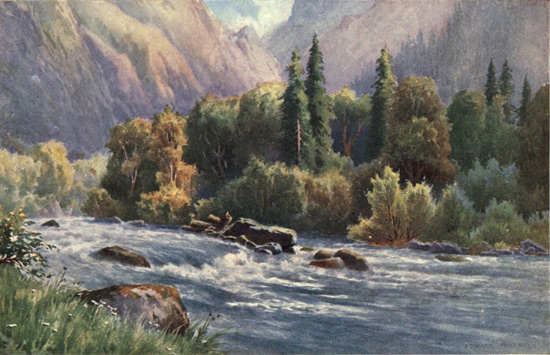
GORGE OF THE SIND VALLEY AT GUGGANGIR
Sonamarg itself is a narrow grassy flat, 8650 feet
above sea-level, extending for some two miles
between the hill-side and the river bank where
another beautiful valley joins in from the south-west.
All the slopes and meadows are covered
with alpine flowers. Rich forests of silver fir,
intermingled with sycamore and fringed on their
upper borders with silver birch, clothe the mountain-sides.
From each valley flows a rich white glacier.
Grand rocky cliffs encircle the forests and meadows,
and culminate in bold snowy peaks which give a
crowning beauty to the whole. It is an ideal
camping-ground and a strong rival to Gulmarg.
Some fifteen miles beyond Sonamarg is the
Zoji-la Pass leading to Ladak and Baltistan. It was
by this pass that I first entered Kashmir in 1887,
and coming thus from the opposite direction, the
change in scenery was most remarkable. For
hundreds of miles from the northern side I had
traversed country which though of the grandest
description, was absolutely devoid of forest. The
great mountains, sublime in their ruggedness and in
the purity of their snowy mantle, were yet completely
barren. Then, of a sudden, as I crossed
the Zoji-la all was changed in a moment, and I
burst into one of the loveliest valleys in the world
with glorious forests clothing every slope. It was
a refreshing and delightful change, a relaxation
from a sublimity too stern to bear for long, to the
homely geniality of earthly life, and the remembrance
of it still lies fresh upon my memory.
Gangabal Lake
About forty miles from Srinagar, and lying at
the foot of the great peak Haramokh, is the
remarkable Gangabal Lake. It is reached by a
steep pull of 4000 feet from the Sind valley. By
the side of the path rushes a clear, ice-cold
stream. From the top of the rise are superb views
precipitously down to the Wangat valley leading
up from the Sind and beyond it to a jagged range
of spires and pinnacles. The path then leads over
rolling downs, covered in summer with ranunculus
and primulas, to a chain of torquoise and ice-green
lakes, above which grimly towers the massive
Haramokh six thousand feet above the water, and
giving birth to voluminous glistening glaciers which
roll down to the water's edge.
It is a silent, solitary, and impressive spot, and is
held in some reverence by the Hindus.
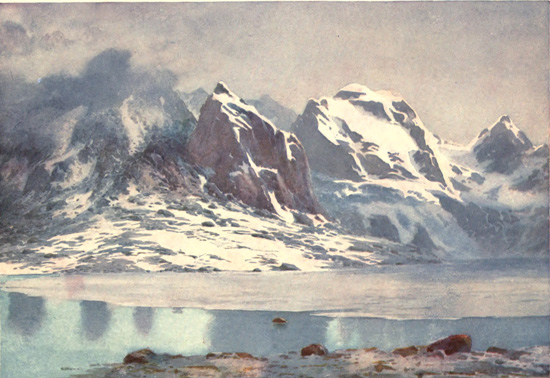
THE FROZEN LAKE, GANGABAL
The Lolab
The Lolab is the western end of the vale of
Kashmir, and is remarkable rather for the homely
picturesqueness of its woodland and village beauty
than for the grandeur of its scenery. It is usually
reached by boat up the Pohru River three miles
below Sopur. In two days the limit of navigation
at Awatkula is reached. From thence the road
leads to Kofwara, eight miles, and Lalpura, the
chief place, twelve miles farther. The hill-sides
are entirely clothed with thick forests of deodar and
pine. In the valley bottom are beautiful stretches
of soft green turf. Dotted over it are villages
buried in park-like clumps of walnut, apple, and
pear trees; and numerous streams ripple through
on every side. For forest and village scenery it is
nowhere excelled. It is like a series of English
woodland glades, with the additional beauty of
snowy peaks in the background.
The Lidar Valley
A favourite side-valley is the Lidar, for which
the road takes off from the main valley at
Bijbehara. It is not of such wild rocky grandeur
as the Sind valley, but has milder beauties of its
own, charming woodland walks, and in summer a
wealth of roses pink and white, jasmine, forget-me-nots,
a handsome spiræa, strawberry, honeysuckle,
etc. By the side of the road runs the cool,
foaming Lidar stream, and everywhere are villages
hidden amongst masses of chenar, walnut, and
mulberry.
On the left bank one and a half miles from
Islamabad is the famous spring of Bawan—a great
tank under cool chenar trees. The spring is sacred
to Vishnu, and is in the charge of Brahmins, who
keep a book in which visitors have inscribed their
names since 1827. The tank is full of fishes fed
by the Brahmins, and thousands dash to catch the
bread when thrown into the water. Altogether the
village and the cool spring welling out of the
mountain-side, and the whole shaded by magnificent
old chenar trees, form a most attractive spot well
worth a visit.
Twenty-four miles from Bijbehara, or twenty-eight
from Islamabad, is Pahlgam, always the camping-ground
of several visitors during the summer.
Here, too, Colonel Ward for many years has resided
in the summer in a small house built by himself,
but now taken over by the State. I fancy life
here is dull compared with life at Gulmarg, but for
those who wish to vegetate and lead an absolutely
quiet existence Pahlgam is admirably suited. It
is two thousand feet higher than Srinagar. The
camping-ground is in a wood of blue pines, and the
fresh, clear, pine-scented air is refreshing after the
stuffy main valley in midsummer.
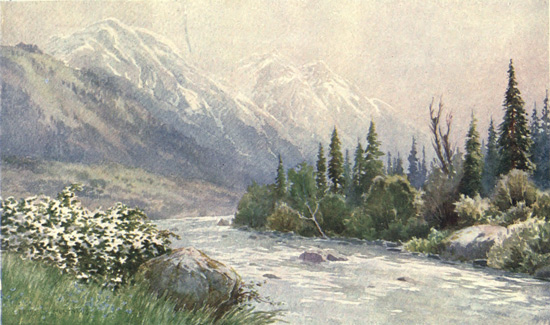
EARLY MORNING NEAR PAHLGAM, LIDAR VALLEY
Above Pahlgam the valley bifurcates, one
branch going to Aru, by which a road leads over
a troublesome pass into the Sind valley; and the
other leading to Shisha Nag and to the famous
caves of Amarnath, the resort of many hundreds of
pilgrims in July and August. Immediately beyond
Pahlgam, on this latter route, the path leads
through beautiful woods with fine views of rocky
heights and snowy peaks. Numerous maiden-hair
and other ferns, primulas, crane's bill, gentians, and
many other well-known flowers line the road-side.
Above the wood line are fine grassy uplands
frequented by Gujars with their cattle, ponies,
buffaloes, sheep, and goats. Lidarwat is a lovely
camping-ground in a green lawn fringed by a deep
belt of trees. Beyond is the Kolahoi glacier, the
road to which leads over a wide and treeless valley,
and in places crosses snow bridges. The camping-ground
is 11,000 feet above sea-level, and is set in
a circle of stately peaks. The end of the glacier is
of grey ice, and so strewn over with fragments of
grey rock as hardly to be recognisable as ice, though
the ice is, in fact, two hundred feet thick. Above
it rises the bold peak of Kolahoi, so conspicuous
in its sharp needle form from Gulmarg, and six
thousand feet above the glacier.
The cave of Amarnath is about 41 miles from
Pahlgam, and is about 13,000 feet above sea-level.
It is therefore above all tree vegetation, and
is set in wild and impressive scenery. The cave
itself is of gypsum, and is fifty yards long by fifty
broad at the mouth, and thirty at the centre.
Inside is a frozen spring which is the object of
worship, and beside it is a noble glacier and bold
and rugged cliffs.
Martand
Of all the ruins in Kashmir the Martand ruins
are both the most remarkable and the most
characteristic. No temple was ever built on a
finer site. It stands on an open plain, where it
can be seen to full advantage. Behind it rises
a range of snowy mountains. And away in the
distance before it, first lies the smiling Kashmir
valley, and then the whole length of the Pir Panjal
range, their snowy summits mingling softly with
the azure of the sky. It is one of the most
heavenly spots on earth, not too grand to be
overpowering, nor too paltry to be lacking in
strength and dignity, and it is easy to understand
the impulse which led a people to here raise a
temple to heaven.
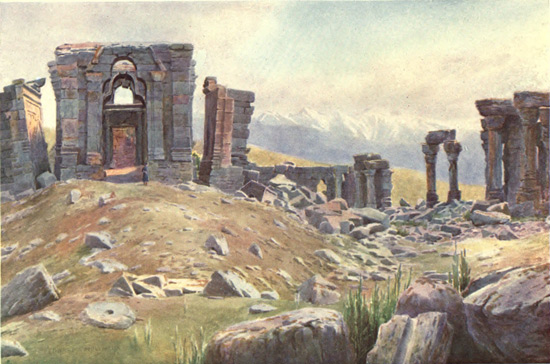
THE RUINS OF MARTAND
The temple of Martand is the finest example
of what is known as the Kashmirian style of
architecture, and was built by the most noted
of the Kashmir kings, Lalataditya, who reigned
between the years 699 and 736 a.d.
Apart from its site it cannot be considered
one of the really great ruins of the world; but
yet there is about it a combination of massiveness
and simplicity, and of solidity combined with grace,
which have earned it fame for a thousand years.
There is something of the rigidity and strength
of the Egyptian temples, and something of the
grace of the buildings of Greece. Yet it is neither
so Egyptian nor so Grecian as the one or the
other. Though Hindu, it differs from the usual
Hindu types; and is known distinctively as Kashmirian.
It is, however, decidedly Hindu, and not
either Buddhist or Jain, and owes much to the
influence of Gandhara, while the sculptures show,
according to Marshal, a close connection with the
typical Hindu work of the late Gupta period.
Achibal
At the eastern end of the valley is another of
the Moghal gardens, at the spot where quite a
little river comes gushing straight out of the
mountain-side. Leaving the house-boat at
Kanibal, near Islamabad, we ride through a
charming country, not so flat and swampy as the
lower portion of the valley. We approach the
semicircle of mountains which bound the valley
on the east. Numerous streams rush down from
the mountains. The valley is divided up into rice-fields,
and is everywhere dotted over with hamlets
hidden among chenar, mulberry, walnut, and pear
or apple trees. Passing through one of these
villages, which is alive with running water, and
completely overshadowed by massive chenar trees,
we enter a garden of the usual Moghal type,
with a straight line of fountains and waterfalls,
and an avenue of chenars. At the head of the
garden is the mountain-side covered with deodar
forest, and welling out of the mountain is a
rushing stream of clean, clear water. It is a
delicious and remarkable sight; but I think the
spot would be more beautiful if the natural conditions
had been preserved, and the artificial garden
and unsightly buildings had not been constructed
round it. For they only serve to hide the magnificent
prospect right down the length of the Kashmir
valley and the snowy mountains on either hand.
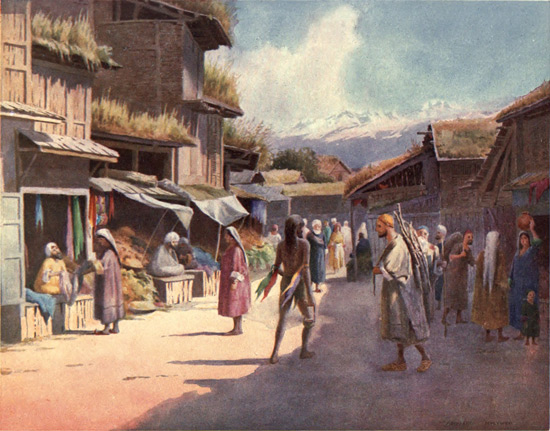
A SRINAGAR BAZAAR
It is, however, in spite of this a fascinating
spot, and the camp which the Maharaja pitched
here for the entertainment of Lord Minto was
the prettiest I have ever seen, for the lines of
the tents accorded with the formality of the
garden, and the running water, the fountains,
and the waterfalls gave a special charm to the
encampment.
SPORT
Sport is, as is well known, one of the chief attractions
of Kashmir. Every year, like the swallows,
with the coming of spring, tonga loads of ardent
sportsmen begin swarming into the country. Nowadays
they cannot, as formerly, shoot wherever
they like and as much as they like; and in their
own interests it is well they cannot, for if they still
had the freedom of former days no game would now
be left. For some years past a Game Preservation
Department has been formed by the Maharaja, and
placed under the charge of a retired British officer,
that keen sportsman Major Wigram. Licences to
shoot have now to be taken out, and regulations for
sportsmen are published annually. Certain localities
are strictly preserved for the Maharaja's own
use and for the entertainment of his guests. Others
are reserved for Raja Sir Amar Singh. Others
again as sanctuaries. The number of head of the
various kind of game which a sportsman may
shoot is laid down. The number of sportsmen
which may be permitted to visit each locality in
the year is fixed. And regulations determine
how the places are allotted among the numerous
applicants. Major Wigram has also under him an
establishment to prevent poaching by the natives,
and he himself is incessantly touring and keeping
a watch on the due preservation of the game.
He obtains an income of about Rs. 25,000 per
annum from the sale of licences, and spends about
Rs. 20,000.
Under these conditions sport in Kashmir will
always remain. The total bags of big game for
the last two years are:—
| | 1907 | 1906 |
| Ibex | 219 | 260 |
| Markhor | 51 | 52 |
| Stags | 49 | 51 |
| Black bears | 223 | 226 |
| Brown bears | 62 | 59 |
| Leopards | 22 | 27 |
| Shapoo | 100 | 85 |
| Burhel | 64 | 57 |
| Goa | 57 | 57 |
| Ovis ammon | 16 | 15 |
These figures do not include what was shot in
the Maharaja's preserve, but they were not all
shot within the limits of the Kashmir Province.
They include also what was shot in the high
mountains at the back of Kashmir proper—in
Ladak, Baltistan, and Astor.
In this last year it so happens that magnificent
trophies were obtained. Captain Barstow shot a
markhor of 61 inches, which is the largest "shot
head" ever obtained, though a head measuring 63
inches was once picked up. In the Kajnag mountains,
which tower over the Jhelum River on the
drive into Kashmir, one sportsman shot a markhor
of 57½ inches, and several other heads of 50 were
obtained last year. And as showing the pure luck
which attends sport, it may be mentioned that
Captain Barstow had never shot a markhor before
he shot the record head.
Three good ibex heads, measuring close on 50
inches, were shot last year, and the other trophies
shot were good. The reputation of Kashmir for
sport is therefore being well maintained, though
sportsmen have, in their own interest, to conform
to more restriction than of old.
Last year the record ibex was also obtained by
a well-known Kashmir sportsman, though not in
Kashmir. Mr. Frank Hadow shot a 59½-inch
head, but had the bad luck to lose it in a stream
while having it cleaned.
In duck-shooting, too, last season was a record
year. Mr. T. Kennard shot 325 duck in one day
by himself. And Colonel Edwards twice shot
over 200 to his own gun while shooting with
others. But it would be a mistake to suppose that
Mr. Kennard secured this record bag merely by
good shooting, and by being placed down amidst a
crowd of ducks as in a big ceremonial state shoot.
Mr. Kennard is among the most scientific sportsmen
who have ever visited Kashmir. I first met
him twenty years ago when he built the first
house-boat ever seen in Kashmir. He used then
to come out to Kashmir regularly every cold
weather, and spend many happy months shooting
small game in the Kashmir valley, markhor and
ibex in Baltistan, the Gilgit district, and Astor, and
stag in the Kashmir mountains. No man had a
more glorious time, when Major Wigram and the
whole Game Preservation Department were still
unthought of, and at a time of year when game
was most easily obtained, and all the sportsmen in
India were bound down to their official duties.
After an interval of several years Mr. Kennard
returned last year to Kashmir for yet another
shoot. He set to work in a most methodical and
business-like way. He studied his ground well.
He found out exactly when most ducks came.
He studied their habits. He spared himself no
labour and neglected no detail. And he devoted
the entire cold weather to this single sport.
Besides duck and goose shooting there is
excellent chikore shooting on the hill-sides, and a
few manaul pheasants may also be shot.
The Maharaja's preserves have for many years
been under the management of that old and experienced
sportsman and naturalist, Colonel Ward,
to whose book, the Sportsman's Guide to Kashmir
and Ladak, all those who want full information on
shooting in Kashmir should refer.
And in addition to shooting, trout-fishing will
soon be established as a further attraction to the
sportsman.
Some years ago a number of keen fishermen
banded together, and after some failure and much
trouble, and with the assistance of the State
authorities in Kashmir and of the Duke of Bedford
in England, succeeded in introducing the ova of
the English brown trout into the valley. Under
the special charge of Mr. Frank Mitchell a hatchery
has been established at Harwan, nine miles out of
Srinagar, just beyond the Shalimar garden, and at
the outlet of the Dachigam—a perfect trout stream—the
valley of which is preserved for the Maharaja's
shooting.
From these stock ponds a trout weighing twelve
and a half pounds was taken on Lord Minto's
visit in 1908. The Dachigam stream itself is now
well stocked, and affords some excellent fishing to
those who have obtained His Highness' permission.
In addition aged ova and yearling trout have been
sent to other streams in Kashmir—to the Achibal,
Beoru, Wangat, Vishu, Kishenganga at Badwan,
the Liddar at Aru and Tannin, Marwar, Erin.
Yearlings have also been let out in the Burzil
stream, the Gorai (on the north side of the Tragbal
Pass), in the Gangarbal Lake, and in the Punch
River.
It has been proved satisfactorily that when the
snow-water has run off, the biggest trout will take
a fly put to them at the right moment, though
when the snow-water is coming down there are
few flies rising and the fish do not take. A
constant enemy of the trout is the poacher.
English trout are, unfortunately, becoming very
popular among the Kashmirs, and it is difficult to
protect the fishing. The biggest trout caught so
far is a nine-pounder caught in the Dachigam
stream when the trout have been let out some
years. In the summer of 1908 a fish weighing
two and a half pounds, which must have been one
of the yearlings turned out in 1906, was caught in
the Vishu stream. By both Major Wigram and
Mr. Frank Mitchell great attention is being paid
to the development of trout-fishing.
Seeing the success which has attended the
introduction of trout the Maharaja on the occasion
of Lord Minto's visit ordered the importation of
the ova of the huchon (Salmo Hucho), or so-called
Danube salmon. Mr. Frank Mitchell in the
spring of 1908 successfully introduced them, and
about 2000 hatched out in the Harwan hatcheries.
They will probably be put out in the rapids of the
Jhelum River below Baramula, and as they run to
some 26 lbs. in weight, and are known to be one
of the most sporting as well as the largest of the
Salmonidæ, they should afford another welcome
attraction for the sportsman in Kashmir.
THE PEOPLE
Kashmir is very generally renowned for the
beauty of its women and the deftness and taste
of its shawl-weavers. And this reputation is, I
think, well deserved. Sir Walter Lawrence indeed
says that he has seen thousands of women in
the villages, and cannot remember, save one or
two exceptions, ever seeing a really beautiful
face. But whether it is that Sir Walter was
unfortunate, or that he is particularly hard to
please, or that villages are not the abodes of
Kashmir beauties, certain it is that the visitor,
with an ordinary standard of beauty, as he passes
along the river or the roads and streets, does see a
great many more than one or two really beautiful
women. He will often see strikingly handsome
women, with clear-cut features, large dark eyes,
well-marked eyebrows, and a general Jewish appearance.
As to the deftness and taste of the weavers
the shawls themselves are the best testimony.
The population of the whole Kashmir State is
2,905,578, and of the Kashmir Province 1,157,394.
Of these 93 per cent of the Kashmir Province and
74 per cent of the whole State are Mohamedan, and
the remainder chiefly Hindu. But the rulers are
Hindus, and consequently the Mohamedans are as
much in the shade as Hindus are in States ruled
by Mohamedans. The ruling family is also alien,
coming not from the valley itself, but from Jammu,
on the far side of the mountain to the south.
The inhabitants were not, however, always
Mohamedans. Originally they were Hindus. It
was only in the fourteenth century that they
were converted—mostly by force—to become
Mohamedans. The present indigenous Hindus
of the valley are generally known as Pundits, and
Kashmir Pundits are well known over India for
their acuteness and subtlety of mind, their intelligence
and quick-wittedness. They prefer
priestly, literary, and clerical occupation, but in
the severe competition of life many have been
compelled to make more use of their hands
than their brains, and have had to take up agriculture,
and become cooks, bakers, confectioners,
and tailors, and, indeed, to follow any trade except
the following which, according to Lawrence, are
barred to them—cobbler, potter, corn-frier, porter,
boatman, carpenter, mason, or fruit-seller. It is
hard for us occidentals to understand why the line
should have been drawn at these apparently
harmless occupations, but those of us who have
lived in India know that the Hindu does fix his
lines with extraordinary sharpness and rigidity, and
a Kashmir Pundit would as much think of working
as a boatman as an English gentleman would think
of wearing a black tie at a formal dinner-party.
The Kashmir Pundits are essentially townspeople,
and out of the total number about half
live in the city of Srinagar. But they are also
scattered sparsely through the villages, where the
visitor will easily distinguish them by the caste
mark on the forehead. On the whole they have
a cultured look about them and a superior bearing.
The Mohamedans, forming the large majority
of the population, strictly speaking having no caste,
are engaged in various occupations, and found in
every grade of social life. And the Mohamedan
gentleman of good position has something singularly
attractive about him. He combines dignity with
deference to a noteworthy degree, and between
him and the European there is not that gulf of
caste fixed which makes such a bar to intercourse
with Hindus. Not that the Mohamedans of
India have not absorbed to a certain degree the
atmosphere of caste with which they are surrounded.
They are not so entirely free in their customs
and behaviour as their co-religionists in purely
Mohamedan countries. When travelling in
Turkestan I lived with Mohamedans, slept in
their houses and tents, ate with them, and
generally consorted with them with a freedom
that Mohamedans in India would think prejudicial
to some vague sense of caste which, theoretically,
they are not supposed to have, but which in
practice they have absorbed from the atmosphere
of Hinduism which they breathe. The Mohamedan,
even of Kashmir, is not quite so unrestricted as the
Mohamedan of Central Asia. Still, he is a very
attractive gentleman, and though not easily found,
for nowadays he lives in some pride of seclusion,
and in the pestering importunate merchant the
visitor sees but a sorry representative of the class,
yet he is occasionally met with—grave, sedate,
polite, and full of interesting conversation, and
bearing with him a sense of former greatness when
his religion was in the ascendant in the seats of
power. These old-fashioned Mohamedan gentlemen
have little or no English education, but they
have a culture of their own; and among the mullas
may be found men of great learning.
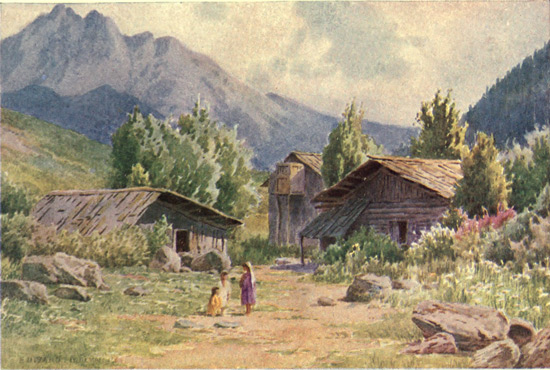
A CORNER OF THE VILLAGE OF PAHLGAM, LIDAR VALLEY
Other interesting types of Kashmir Mohamedans
are found among the headmen of the picturesque
little hamlets along the foot-hills. Here may be
seen fine old patriarchal types, just as we picture
to ourselves the Israelitish heroes of old. Some,
indeed, say, though I must admit without much
authority, that these Kashmiris are of the lost
tribes of Israel. Only this year there died in the
Punjab the founder of a curious sect, who
maintained that he was both the Messiah of the
Jews and the Mahdi of the Mohamedans; that
Christ had never really died upon the Cross, but
had been let down and had disappeared, as He
had foretold, to seek that which was lost, by which
He meant the lost tribes of Israel; and that He
had come to Kashmir and was buried in Srinagar.
It is a curious theory, and was worked out by this
founder of the Quadiani sect in much detail. There
resided in Kashmir some 1900 years ago a saint of
the name of Yus Asaf, who preached in parables
and used many of the same parables as Christ used,
as, for instance, the parable of the sower. His
tomb is in Srinagar, and the theory of this founder
of the Quadiani sect is that Yus Asaf and Jesus
are one and the same person.
When the people are in appearance of such a
decided Jewish cast it is curious that such a theory
should exist; and certainly, as I have said, there
are real Biblical types to be seen everywhere in
Kashmir, and especially among the upland villages.
Here the Israelitish shepherd tending his flocks
and herds may any day be seen.
Yet apart from this, the ordinary Kashmiri
villager is not an attractive being. Like his house
he is dirty, untidy, and slipshod, and both men and
women wear the most unbecoming clothing, without
either shape, grace, or colour. But the physique of
both men and women is excellent. They are of
medium height, but compared with the people of
India of exceptional muscular strength. The men
carry enormous loads. In the days before the
cart-road was constructed, they might be seen
carrying loads of apples sometimes up to and over
200 lbs. in weight; and the labour they do in the
rice-fields is excessively severe.
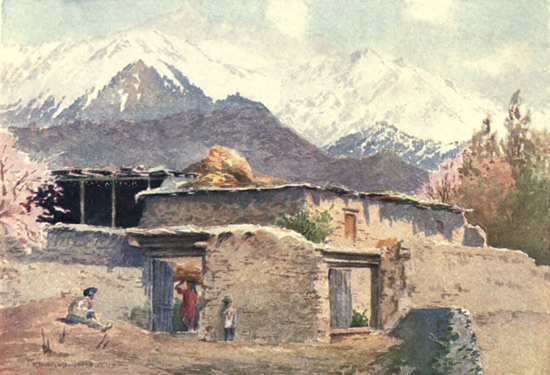
A MOUNTAIN FARM-HOUSE
Good as is their physique, the Kashmiris are, however,
for some quite unaccountable reason lamentably
lacking in personal courage. A Kashmiri soldier
is almost a contradiction in terms. There is not
such a thing. They will patiently endure and suffer,
but they will not fight. And they are very careful of
the truth. As an American once said to me, they set
such value on the truth that they very seldom use it.
Their good points are, that they are intelligent
and can turn their hands to most things. They
are, says Lawrence, excellent cultivators when
they are working for themselves. A Kashmiri
can weave good woollen cloth, make first-rate
baskets, build himself a house, make his own
sandals, his own ropes, and a good bargain. He is
kind to his wife and children, and divorce scandals
or immorality among villagers are rarely heard of.
He is not a cheery individual, like many hillmen
in the Himalayas, but he seems to be fond of
singing; and dirty as he, his wife, his house and
all that belongs to him is, he has one redeeming
touch of the æsthetic—all round the village he
plants his graves with iris and narcissus. The final
conclusion one has, then, is that if only he would
wash, if only he would dress his wife in some
brighter and cleaner clothes, and if only he would
make his house stand upright, then with the good
points he already has, and with all Nature to back
him, he would make Kashmir literally perfection.
The boatmen, who are the class with whom
visitors to Kashmir come most intimately into
contact, are a separate tribe from the villagers.
They are said to claim Noah as their ancestor, and
certain it is that if they did not borrow the pattern
of their boats from Noah's ark, Noah must have
borrowed the pattern from them. They are known
as Hanji or Manjis, and live permanently on
their boats with their families complete. Some of
these boats will carry between six and seven
thousand pounds of grain. Others are light
passenger boats. They all have their little cooking
place on board, and a gigantic wooden pestle and
mortar in which the women pound the rice. Both
men and women have extremely fluent and sharp
tongues, and have not so far earned the reputation
for truthfulness. But they are quick-witted, and
can turn their hands to most things, and make
themselves useful in a variety of ways.
Besides carrying goods and passengers among the
numerous waterways of Kashmir, some gather the
singháre (water nuts) on the Wular Lake, others
work market gardens on the Dal Lake, others fish,
and others dredge for driftwood in the rivers.
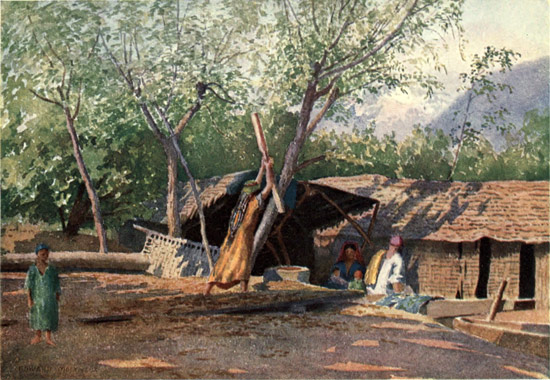
A BOATMAN AND HIS FAMILY
THE HISTORY OF KASHMIR
A country of such striking natural beauty must,
surely, at some period of its history have produced
a refined and noble people? Amid these glorious
mountains, breathing their free and bracing air, and
brightened by the constant sunshine, there must
have sprung a strong virile and yet æsthetic
race? The beautiful Greece, with its purple hills
and varied contour, its dancing seas and clear blue
sky, produced the graceful Greeks. But Kashmir
is more beautiful than Greece. It has the same
blue sky and brilliant sunshine, but its purple hills
are on a far grander scale, and if it has no sea, it has
lake and river, and the still more impressive snowy
mountains. It has, too, greater variety of natural
scenery, of field and forest, of rugged mountain
and open valley. And to me who have seen both
countries, Kashmir seems much the more likely to
impress a race by its natural beauty. Has it ever
made any such impression?
The shawls for which the country is noted are
some indication that its inhabitants have a sense of
form and colour, and some delicacy and refinement.
But a great people would have produced
something more impressive than shawls. Are there
no remains of buildings, roads, aqueducts, canals,
statues, or any other such mark by which a people
leaves its impress on a country? And is there any
literature or history?
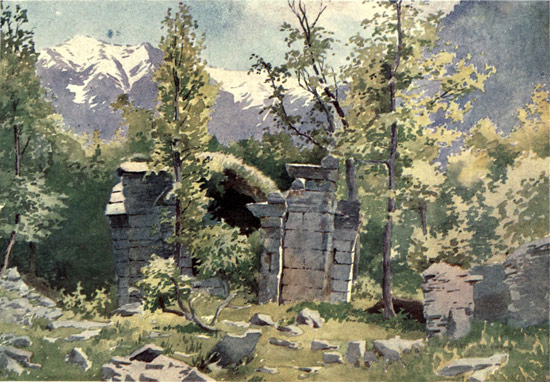
RUINS OF TEMPLES, WANGAT, SIND VALLEY
All over the Kashmir valley there are remains
of temples remarkable for their almost Egyptian
solidity, simplicity, and durability, as well as for
what Cunningham describes as the graceful elegance
of their outlines, the massive boldness of their
parts, and the happy propriety of their outlines.
The ancient Kashmirian architecture, with its
noble fluted pillars, its vast colonnades, its lofty
pediments, and its elegant trefoiled arches, is,
he thinks, entitled to be classed as a distinct style;
and we may take it as implying the existence of
just such a people as this mountain country might
be expected to produce. Three miles beyond Uri,
on the road into Kashmir, are the ruins of a temple
of extremely pleasing execution. Near Buniar,
just beyond Rampur, is another right on the road.
At Patan, 13 miles before reaching Srinagar, are
two more ruined temples of massive construction.
Two and a half miles southward of Shadipur, the
present junction of the Sind River with the
Jhelum, are the remains of a town, the extent and
nature of which show conclusively that it must
once have been a large and important centre. On
the summit of the hill, rising above the European
quarter in Srinagar, is a dome-shaped temple
erroneously known as the Takht-i-Suliman. At
Pandrathan, three miles from Srinagar, is a
graceful little temple and the remains of a statue
of Buddha, and of a column of immense strength
and size. At Pampur and Avantipur, on the
road to Islamabad at Payech, on the southern
side of the valley, where there is the best preserved
specimen temple, and at many other places in the
main valley, and in the Sind and Lidar valleys,
there are remains of temples of much the same
style. But it is at Martand that there is the
finest, and as it is not only typical of Kashmir
architecture at its best, but is built on the most
sublime site occupied by any building in the
world,—finer far than the site of the Parthenon,
or of the Taj, or of St. Peters, or of the Escurial,—we
may take it as the representative, or rather
the culmination of all the rest, and by it we must
judge the people of Kashmir at their best.
On a perfectly open and even plain, gently
sloping away from a background of snowy
mountains, looking directly out on the entire
length both of the smiling Kashmir valley and of
the snowy ranges which bound it—so situated, in
fact, as to be encircled by, yet not overwhelmed
by, snowy mountains—stand the ruins of a temple
second only to the Egyptians in massiveness and
strength, and to the Greek in elegance and grace.
It is built of immense rectilinear blocks of limestone,
betokening strength and durability. Its
outline and its detail are bold, simple, and impressive.
And any over-weighing sense of massiveness
is relieved by the elegance of the surrounding
colonnade of graceful Greek-like pillars. It is
but a ruin now, but yet, with the other ruins so
numerous in the valley, and so similar in their main
characteristics, it denotes the former presence in
Kashmir of a people worthy of study. No one
without an eye for natural beauty would have
chosen that special site for the construction of a
temple, and no one with an inclination to the
ephemeral and transient would have built it on
so massive and enduring a scale. We cannot,
for instance, imagine present-day Kashmiris building
anything so noble, so simple, so true, and
so enduring. The people that built the ancient
temples of Kashmir must have been religious,
for the remains are all of temples or of sacred
emblems, and not of palaces, commercial offices,
or hotels; they must have held, at least, one large
idea to have built on so enduring a scale, and
they must have been men of strong and simple
tastes, averse to the paltry and the florid. What
was their history? Were they a purely indigenous
race? Were they foreigners and conquerors settled
in the land, or were they a native race, much
influenced from outside, and with sufficient
pliability to assimilate that influence and turn it
to profitable use for their own ends?
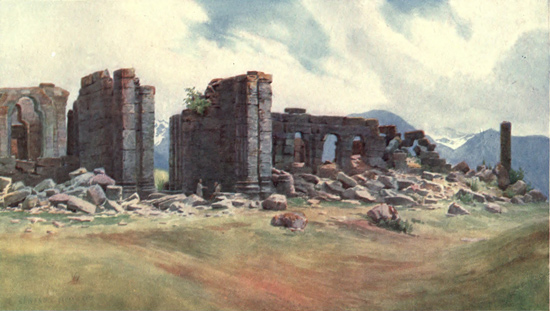
RUINED GATEWAY OF MARTAND
Fortunately one of their native historians has
left us a record, and Dr. Stein's skill and industry
in translating and annotating this record makes it
possible to obtain a fairly clear idea of ancient
Kashmir. From this and from the style of the
ruins themselves, we gather that the main impulses
came from outside rather than from within, from
India and from Greece. And perhaps, if in place
of their mountains, which tend to seclusion and
cut a people off from the full effects of that
important factor in the development of a race,
easy intercourse and strenuous rivalry with
other peoples, the Kashmirians had, like the
Greeks, been in contact with the sea, with ready
access to other peoples and other civilisations,
they might have made a greater mark in the
world's history. But they had this advantage,
that the beauty of their country must always, as
now, in itself have been an attraction to outsiders,
and so from the very commencement of its
authentic history we find strong outside influences
at work in the country.
Thus among the first authentic facts we can
safely lay hold of from among the misty and elusive
statements of exuberant Oriental historians, is
the fact that Asoka's sovereign power extended
to Kashmir-Asoka, the contemporary of Hannibal,
and the enthusiastic Buddhist ruler of India, whose
kingdom extended from Bengal to the Deccan,
to Afghanistan and to the Punjab, and the results
of whose influence may be seen to this day in
Kashmir, in the remains of Buddhist temples
and statues, and in the ruins of cities founded
by him 250 years before Christ, 200 years before
the Romans landed in Britain, and 700 years before
what is now known as England had yet been
trodden by truly English feet.
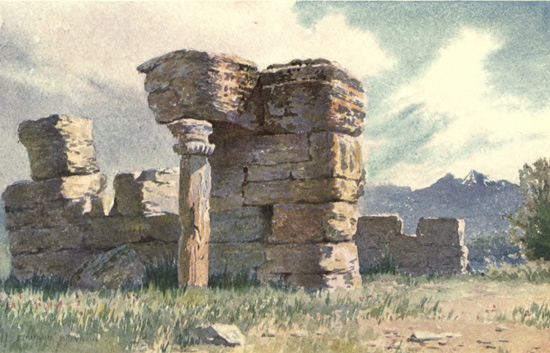
RUINED TEMPLES OF AVANTIPUR
At this time Buddhism was the dominating
religion in northern India, and perhaps received
an additional impulse from the Greek kingdoms
in the Punjab, planted by Alexander the Great
as the result of his invasion in 327 b.c. Asoka
had organised it on the basis of a state religion,
he had spread the religion with immense enthusiasm,
and in Kashmir he caused stupas and
temples to be erected, and founded the original
city of Srinagar, then situated on the site of the
present village of Pandrathan, three miles above
the existing capital. He had broken through
the fetters of Brahminism and established a
friendly intercourse with Greece and Egypt, and
it is to this connection that the introduction of
stone architecture and sculpture is due. The
Punjab contains many examples of Græco-Buddhist
art, and Kashmir history dawns at the time when
Greek influence was most prominent in India.
The first great impulse which has left its
mark on the ages came, then, not from within, but
from without—not from within Kashmir, but from
India, Greece, and Egypt. Little, indeed, now
remains of that initial movement. The religion
which was its mainspring has now not a single
votary among the inhabitants of the valley. The
city Asoka founded has long since disappeared.
But the great record remains; and on a site
beautiful even for Kashmir, where the river sweeps
gracefully round to kiss the spur on which the
city was built, and from whose sloping terraces the
inhabitants could look out over the smiling fields,
the purple hills, and snowy mountain summits of
their lovely country, there still exist the remnants
of the ancient glory as the last, but everlasting
sign that once great men ruled the land.
The next great landmark in Kashmir history
is the reign of the king Kanishka, the Indo-Scythian
ruler of upper India. He reigned about
40 a.d., when the Romans were conquering Britain
and Buddhism was just beginning to spread to
China. He was of Turki descent, and was part of
that wave of Scythian immigration which for two
or three hundred years came pouring down from
Central Asia. And he was renowned throughout
the Buddhist world as the pious Buddhist
king, who held in Kashmir the famous Third
Great Council of the Church which drew up the
Northern Canon or "Greater Vehicle of the Law."
In his time, too, there lived at a site which is
still traceable at Harwan, nestling under the higher
mountains at the entrance of one of the attractive
side-valleys of Kashmir, and overlooking the placid
waters of the Dal Lake, a famous Bodhisattva,
Nagarjuna, who from this peaceful retreat exercised
a spiritual lordship over the land.
Buddhism was, in fact, at the zenith of its power
in Kashmir. But a reaction against it was soon to
follow, and from this time onward the orthodox
Brahministic Hinduism, from which Buddhism was
a revolt, reasserted itself, and Buddhism steadily
waned. When the Chinese Buddhist pilgrim
Hiuen Tsiang visited Kashmir, about a.d. 631, he
said, "This kingdom is not much given to the faith,
and the temples of the heretics are their sole
thought."
Passing now over a period of six centuries, the
only authentically recorded event in which is the
reign, a.d. 515, of Mihirakula, the "White Hun,"
a persecutor of the Buddhist faith, "a man of
violent acts and resembling Death," whose approach
the people knew "by noticing the vultures, crows,
and other birds which were flying ahead eager to
feed on those who were to be slain," and who
succeeded to a kingdom which extended to Kabul
and Central India, we come to the reign of the
most famous king in Kashmir history, and the first
really indigenous ruler of note—Lalitaditya. And
of his reign we must take especial notice as
Kashmir was then at its best.
Whether Lalitaditya was a pure Kashmiri it
is impossible to discover. His grandfather, the
founder of the dynasty to which he belonged, was
a man of humble origin—whether Kashmiri or
foreign the historian does not relate—who was
connected by marriage with the preceding ruling
family. His mother was the mistress of a merchant
settled in Srinagar. The dynasty which his grandfather
succeeded was foreign, and it is impossible,
therefore, to say how much foreign blood Lalitaditya
had in his veins; but his family had at any rate been
settled in Kashmir for a couple of generations, and
Kashmir was not in his time the mere appanage
of a greater kingdom, but was a distinct and isolated
kingdom in itself. From this time for many
centuries onwards, till the time of Akbar, the tide
of conquest and political influence was to turn, and
instead of more advanced and masterful races from
the direction of India spreading their influence
over Kashmir, it was from Kashmir that conquerors
were to go forth to extend their sway over neighbouring
districts in the Punjab.
Lalitaditya's reign extended from about 699
to 736. He was therefore a contemporary of
Charlemagne, and preceded our own King Alfred
by more than a century. Mohamed was already
dead a hundred years, but his religion had not
yet spread to India. The Kashmiri historians
speak of Lalitaditya's "conquering the world," and
mix up much fable with fact. But what certainly
is true is that he asserted his authority over the
hilly tracts of the northern Punjab, that he
attacked and reduced the King of Kanauj to submission,
that he conquered the Tibetans, successfully
invaded Badakhshan in Central Asia, and
sent embassies to Peking.
Though, then, he was not the "universal
'monarch' that the historian described him, and did
not move round the earth like the sun," or "putting
his foot on the islands as if they were stepping-stones,
move quickly and without difficulty over the
ocean," he is yet the most conspicuous figure in
Kashmir history, and raised his country to a pitch
of glory it had never reached before or attained
to since. It was he who erected the temple at
Martand; and the ruins of the city Parihasapura,
near the present Shadipur, are an even fuller
testimony to his greatness. These, therefore, we
must regard as the most reliable indication we have
of the degree of culture and civilisation to which
Kashmir attained in its most palmy day twelve
hundred years ago.
Lalitaditya's rule was followed by a succession
of short and weak reigns, but his grandson was
almost as great a hero of popular legend as himself.
He too, "full of ambition, collected an army and
set out for the conquest of the world." He reached
the Ganges and defeated the King of Kanauj, but
had to return to Kashmir to subdue a usurper to
his throne. He encouraged scholars and poets
and founded cities. After him followed, first, "an
indolent and profligate prince"; then a child in
the hands of uncles, who as soon as he grew up
destroyed him and put another child on the throne.
He indeed maintained his position on the throne
for 37 years, but only on account of the rivalries
of the uncles, and as a mere puppet king, and was
eventually deposed by the victorious faction to
make place for yet another puppet king, who again
was killed by a treacherous relative. So the
record goes on till we come to the reign of
Avantivarman, 855-883, and this appears to have
brought a period of consolidation for the country,
which must have greatly suffered economically as
well as politically from the internal troubles during
the preceding reigns. There is no indication of
the reassertion of Kashmir sovereignty abroad,
but there is ample proof of the internal recovery
of the country, and the town of Avantipura, named
after the king, has survived to the present day. It
lies one march above Srinagar, and the ruins of
the ancient buildings, though not equal in size to
Lalitaditya's structures, yet rank, says Stein,
among the most imposing monuments of ancient
Kashmir architecture, and sufficiently attest the
resources of the builder.
This reign was, too, remarkable for the execution
of an engineering scheme to prevent floods and
drain the valley, a precisely similar idea to that on
which Major de Lotbinière is working under the
direction of the present Maharaja. The Kashmiri
engineer Suyya, after whom is named the present
town of Sopur, saw more than a thousand years
ago what modern engineers have also observed, that
floods in the valley are due to the waters of the
Jhelum not being able to get through the gorge
three miles below Baramula with sufficient rapidity.
The constricted passage gets blocked with boulders,
and both Suyya and our present engineers saw that
this obstruction must be removed. But while
Major de Lotbinière imported electrically-worked
dredgers from America and a dredging engineer
from Canada, Suyya adopted a much simpler
method: he threw money into the river where the
obstruction lay. His contemporaries, as perhaps we
also would have, looked upon him as a madman.
But there was method in his madness, for the
report had no sooner got about that there was money
at the bottom of the river than men dashed in to
find it, and rooted up all the obstructing boulders
in their search. So at least says the legend. In
any case the obstruction was removed by Suyya,
and the result was the regulation of the course of
the river, a large increase of land available for
cultivation, and increased protection against disastrous
floods. May the modern Suyya be equally
successful!
The successor of Avantivarman, after defeating
a cousin and other rivals to the throne, started on
a round of foreign expedition, in the historian's
words, "to revive the tradition of the conquest of
the world." The practical result does not appear to
have been much more than an invasion of Hazara,
an attack on Kangra and the subjugation of what
is now the town of Gujrat in the Punjab, since
remarkable as the spot where we finally overthrew
the power of the Sikhs. But the record is of
interest, as showing that the conquering tendency
was still from Kashmir outwards, and not from the
Punjab into Kashmir.
But this was the last outward effort, and from
this reign onward the record is one long succession
of struggles between the rulers and usurping uncles,
cousins, brothers, ministers, nobles, and soldiers.
The immediate successor was a child whose regent
mother was under the influence of her paramour
the Minister. After two years he was murdered
by the Minister. Another boy succeeded who
only lived ten days. Then the regent mother
herself ruled for a couple of years, but a military
faction overruled her councils, and by open rebellion
obtained the throne for a nominee of their
own, and the land became oppressed by exactions
of the soldiery backed by unscrupulous ministers.
The Queen was captured and executed, and a
disastrous flood and terrible famine increased the
general misery. After two years' reign the soldiers'
nominee was deposed and a child put in his place.
Then there was a fresh revolution and still another
nominee, who, as he could not pay a sufficient bribe
to the soldiery, was deposed and the crown sold to
the Minister.
And now another power makes itself felt, the
influence of the feudal landholders, whose interests
had suffered from the prolonged predominance of
the military party. They marched upon Srinagar,
defeated the soldiers, threw out the usurping
minister, and restored the legitimate king, who,
however, showed little gratitude, but abandoned
himself to vile cruelties and excesses, till the feudal
landholders became so exasperated that they
treacherously murdered him at night within the
arms of one of his low-caste queens. The successor
was no better. He surpassed his predecessor in
acts of senseless cruelty and wanton licence, and
was encouraged by his ambitious minister (who
was scheming to secure the throne for himself) to
destroy his own relatives. Some were murdered,
and others captured and allowed to starve to death.
He himself died after a reign of only two years,
and his successor had to flee after occupying the
throne for a few days. The commander-in-chief
tried to seize it, but on placing the election in the
hands of an assembly of Brahmins, they chose one
of their own number, who for nine years, by a wise
and mild rule, gained a respite from the constant
troubles of previous reigns. Only a short respite,
however, for on his death the aforementioned
scheming minister, after first putting his rivals out
of the way, forced an entrance to the palace, killed
the successor of the Brahmin, and threw him into
the Jhelum. He grossly oppressed the land for a
year and a half, and then died of dropsy, to be
succeeded by a youth grossly sensual and addicted
to many vices, who married a princess of the house
of Punch. This lady happened to have considerable
force of character, and when her son succeeded
as a child, exercised as his guardian full royal power.
She ruthlessly put down all rival parties, executing
captured rebels, exterminating their families.
She even, on her son's death, murdered two of
her own grandsons that she might herself retain
power. Finally, she fell in love with a letter-carrier
who had begun life as a herdsman; she appointed
him her Minister, and he retained undisputed
predominance over her for her reign of twenty-three
years, his valour supplementing her cunning
diplomacy and bribes in overcoming all opposition.
The following reign, which was prudent, but
weak, is noticeable from the fact that the famous
Mahmud of Ghazni, who forced Mohamedanism
upon upper India, made an attempt, a.d. 1015, to
invade Kashmir. It was unsuccessful, but it
marks the first sign of the returning flood of
invasion from the Punjab inwards to Kashmir.
The outward flow had ceased. The inward was
now to begin.
In the meanwhile, until the Moghals, five
hundred years later, finally established themselves
in Kashmir, the ceaseless round of intrigue,
treachery, and strife continued. The powerful
herdsman minister and his son were foully murdered,
and a succession of low favourites rose to power
and plundered the people. A reign of twenty-two
days which follows was terminated by the licentious
mother killing her own son. Then comes a
dangerous rising of the feudal landholders and
more short reigns, murders, suicides, till we arrive
at the reign of Harsa, 1089-1101, who is said to
have been "the most striking figure among the
later Hindu rulers of Kashmir." He was courageous
and fond of display, and well versed in various
sciences, and a lover of music and the arts, but
"cruelty and kindheartedness, liberality and greed,
violent self-willedness and reckless supineness,
cunning and want of thought, in turn displayed
themselves in his chequered life." He kept up a
splendid Court and was munificent to men of learning
and poets. He also succeeded in asserting his
authority in the hilly country outside Kashmir on
the south. But he eventually became the object
of conspiracies, and to put them down resorted to
the cruellest measures. He had his half-brother,
as well as his nephews, and some other relatives,
who had given no cause for suspicion, heartlessly
murdered. Extravagant expenditure on the troops
and senseless indulgence in costly pleasures
gradually involved Harsa in grave financial trouble,
from which he endeavoured to free himself by
ruthless spoliation of sacred shrines, and even by
confiscating divine images made of any valuable
metal. He was further reduced to the necessity
of imposing new and oppressive imposts. All this
misgovernment spread discontent and misery
among the people; and while the plague was
raging, and robbers everywhere infesting the land,
there occurred a disastrous flood which brought on a
famine. A rising against Harsa was the result. He
was slain in the fighting; his head was cut off and
burned, while his body, naked like that of a pauper,
was cremated by a compassionate wood-dealer.
The position of his successor, Vecula, was no
less precarious than that of the generality of
Kashmir rulers. His younger brother was ready
to rise against him, and the leaders of feudal landholders,
to whose rebellion he owed his throne,
behaved as the true rulers of the land. He protected
himself by fomenting jealousy and mutual
suspicion, and murdered or exiled their most
influential leaders, and then openly turned upon
the remainder and forced them to disarm and
submit. He also systematically persecuted the
officials. On the other hand he showed considerate
regard for the common people, and was on the
whole a liberal, capable, and fairly energetic ruler.
Nevertheless he, too, met with a violent end. The
city-prefect and his brothers attacked him at night
in the palace as, unarmed and attended only by a
few followers, he was proceeding to the seraglio.
He fought with desperate bravery, but was soon
overpowered by his numerous assailants and cruelly
murdered, December 1111.
His immediate successor reigned only a few
hours; his half-brother only four months. He
was then made prisoner by his brother, whose
reign of eight years was one succession of internal
troubles caused by rebellious and powerful landholders
whom he in vain tried to subdue. He
imprisoned his Minister and the Minister's three
sons, and finally had them all strangled. He
executed with revolting cruelty some hostages of
the landholders; and, finally, in face of a rebellion
caused by his cruelty and by his oppressive imposts,
he had to fly from Srinagar to Punch. A pretender
occupied the throne for a year, during
which the people were at the mercy of bands of
rebels, while rival ministers contended for what
was left of regal power. Trade was at a standstill
and money scarce. The rightful ruler returned
and again occupied the throne, and, owing to the
want of union among the feudal landholders, was
able to retain it for another five years. But
eventually he also met the usual fate of Kashmir
kings, and was murdered.
Jayashima, the successor, reigned for twenty-one
years, though he had found his country in a pitiable
state. The feudal landholders were like kings,
while the resources of the King and people alike
were well-nigh exhausted by the preceding
struggles. His predecessor had been unable by
force to permanently reduce the power and pretensions
of these petty nobles, and Jayashima tried
to effect the same object by cunning diplomacy
and unscrupulous intrigue. But he was no more
successful, and they continued to preserve a
rebellious, independent attitude for centuries later,
far into the Mohamedan period.
The accounts of this and the immediately preceding
reigns are of particular interest, because
Kalhana, the historian to whom the facts are due,
lived at this period. We get then a first-hand
account of the state of Kashmir eight hundred
years ago. It is a petty, melancholy, and sordid
history, but it is the record of a contemporary, and
I have no hesitation in adopting it as giving a true
impression of the state of the country, because I
have myself seen a precise counterpart of it in
independent states on this very frontier. When I
visited Hunza in 1889 the then chief—now in exile—had
murdered his father, poisoned his mother,
and thrown his two brothers over a precipice. The
chief of Chitral, when I was there in 1893, was one
of only four survivors of seventeen brothers who
were living when their father died, and he himself
was subsequently murdered by one of his three
surviving brothers—a brother whom he had
frequently asked my permission to murder, on the
ground that if he did not murder the brother, the
brother would murder him. In Chitral there was
also the same struggle with "nobles" as is recorded
of Kashmir, and murders of "nobles" were horribly
frequent.
We may accept, then, as authentic that the
normal state of Kashmir for many centuries, except
in the intervals when a strong, firm ruler came to
the front, was a state of perpetual intrigue and
assassination, of struggles with brothers, cousins,
uncles, before a chief even came to the throne; of
fights for power with ministers, with the military,
with the "nobles" when he was on it; of constant
fear; of poisoning and assassination; of wearying,
petty internecine "wars," and of general discomfort,
uncertainty, and unrest.
For two centuries more Hindu rule maintained
itself, but it was steadily decaying. In the meanwhile
Mohamedanism had, especially in consequence
of the invasion of Mahmud of Ghazni in
1000 a.d., made great advances in the adjoining
kingdoms of the Punjab; and, in 1339, a
Mohamedan ruler, Shah Mir, deposed the widow
of the last Hindu ruler and founded a Mohamedan
dynasty. The influx of foreign adventurers from
Central Asia as well as from India had prepared
the ground for Mohamedan rule, and when Shah
Mir appeared there was little change in the system
of administration, which remained as before in the
hands of the traditional official class, the Brahmins.
From this time till the Moghal emperors finally
conquered Kashmir in 1586, there was, with one exception,
the usual succession of weak rulers and constant
struggles between rival factions of territorial
magnates. But this one exception is worthy of
notice, as his reign is even now quoted by Kashmiris
as the happiest of their history. Zain-ul-ab-ul-din
(1420-70) was virtuous in his private life and liberal.
He was the staunch friend of the cultivators, and
built many bridges and constructed many canals.
He was fond of sport, and was tolerant towards
Brahmins, remitting the poll-tax on them, and
encouraging them by grants of land. He also
repaired some Hindu temples and revived Hindu
learning. Further, he introduced many art-manufactures
from foreign countries, and his Court was
thronged by poets, musicians, and singers.
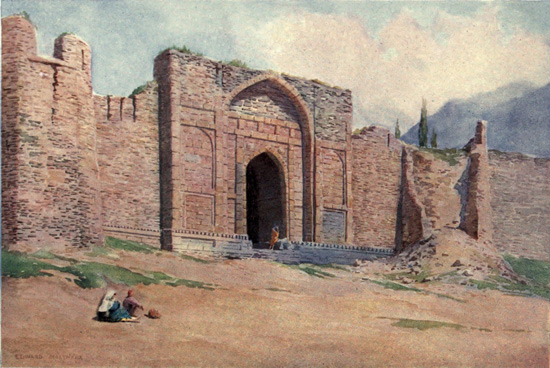
GATE OF THE OUTER WALL, HARI PARBAT FORT, SRINAGAR
But this reign seems to have been a mere oasis
in the dreary record, and it was followed by a
succession of weak reigns till 1532, when a direct
conquest of the country by a foreign invader was
effected. In that year Mirza Haider, with a following
which formed part of the last great wave of
Turkis (or Moghals) from the north, invaded
Kashmir and held it for some years. Then followed
one last short period, during which Kashmir became
once more the scene of long-continued strife among
the great feudal families, who set up and deposed
their puppet kings in rapid succession, till finally,
in 1586, Kashmir was incorporated in the dominions
of the great Akbar, the contemporary of Elizabeth,
and remained as a dependency of the Moghal
emperors for nearly two centuries.
Akbar himself visited the country three times,
made a land revenue settlement, and built the fort
of Hari Parbat, which from its situation on an
isolated hill, in a flat valley surrounded by mountains,
bears some resemblance to the Potala at
Lhasa. Akbar's successor, Jehangir, was devoted
to Kashmir and he it was who built the stately
pleasure gardens, the Shalimar and Nishat Baghs,
where we can imagine that he and his wife, the
famous Nurmahal, for whom he built the Taj at
Agra, must have spent many a pleasant summer
day.
The rule of the Moghals was fairly just and
enlightened, and their laws and ordinances were
excellent in spirit. Bernier, who visited Kashmir
in the train of Aurungzebe, makes no allusion, as
travellers of a subsequent date so frequently do, to
the misery of the people, but, on the contrary, says
of them that they are "celebrated for wit, and
considered much more intelligent and ingenious
than the Indians." "In poetry and the sciences,"
he continues, "they are not inferior to the Persians,
and they are also very active and industrious."
And he notes the "prodigious quantity of shawls
which they manufacture." Kashmir was indeed,
according to Bernier, "the terrestrial paradise of
the Indies." "The whole kingdom wears the
appearance," he says, "of a fertile and highly
cultivated garden. Villages and hamlets are
frequently seen through the luxuriant foliage.
Meadows and vineyards, fields of rice, wheat, hemp,
saffron, and many sorts of vegetables, among which
are mingled trenches filled with water, rivulets,
canals, and several small lakes, vary the enchanting
scene. The whole ground is enamelled with our
European flowers and plants, and covered with our
apple, pear, plum, apricot, and walnut trees, all
bearing fruit in great abundance."
All this and the absence of remarks on ruined
towns and deserted villages, such as we shall hear so
much of later on, implies prosperity. And of the
governors of Kashmir under the Moghals, we read
that many were enlightened, reduced taxation, and
put down the oppression of petty officials. But as
the Moghal Empire began to decay, the governors
became more independent and high-handed. The
Hindus were more oppressed. The officials fought
among themselves, and Kashmir fell once more into
wild disorder; and eventually, in 1750, came under
the cruellest and worst rule of all—the rule of the
Afghans, who to this day are of all the oppressive
rulers in the world the most tyrannical. The
period of Afghan rule was, says Lawrence, a time
of "brutal tyranny, unrelieved by good works,
chivalry, or honour." Men with interest were
appointed as governors, who wrung as much money
as they could out of the wretched people of the
valley. It was said of them that they thought no
more of cutting off heads than of plucking a flower.
One used to tie up the Hindus, two and two, in
grass sacks and sink them in the Dal Lake. The
poll-tax on Hindus was revived, and many either
fled the country, were killed, or converted to Islam.
At last the oppression became so unendurable
that the Kashmiris turned with hope to Ranjit
Singh, the powerful Sikh ruler of the Punjab, who,
after an unsuccessful attempt, finally in 1819,
accompanied by Raja Gulab Singh of Jammu,
defeated the Afghan governor and annexed Kashmir
to his dominions. It came then once again under
Hindu rulers, though in the meantime nine-tenths
of the population had been converted to
Mohamedanism.
But the unfortunate country had still to suffer
many ills. The Sikhs who succeeded the Afghans
were not so barbarically cruel, but they were hard
and rough masters. Moorcroft, who visited the
country in 1824, says that "everywhere the people
were in the most abject condition, exorbitantly
taxed by the Sikh Government, and subjected to
every kind of extortion and oppression by its
officers ... not one-sixteenth of the cultivable
surface is in cultivation, and the inhabitants, starving
at home, are driven in great numbers to the
plains of Hindustan." The cultivators were "in
a condition of extreme wretchedness," and the
Government, instead of taking only one-half of the
produce on the threshing-floor, had now advanced
its demands to three-quarters. Every shawl was
taxed 26 per cent upon the estimated value,
besides which there was an import duty on the
wool with which they were manufactured, and a
charge was made upon every shop or workman
connected with the manufacture. Every trade
was also taxed, "butchers, bakers, boatmen,
vendors of fuel, public notaries, scavengers,
prostitutes, all paid a sort of corporation tax, and
even the Kotwal, or chief officer of justice, paid a
large gratuity of thirty thousand rupees a year for
his appointment, being left to reimburse himself
as he might."
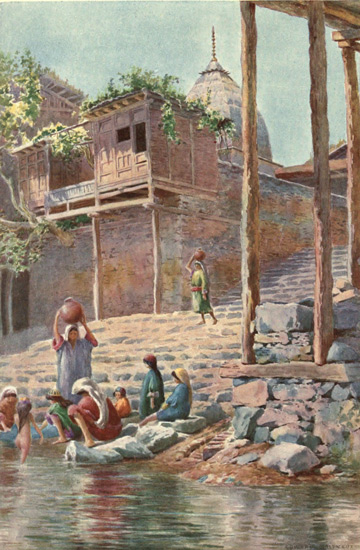
AT THE RIVER'S EDGE, SRINAGAR
Villages, where Moorcroft stopped in the Lolab
direction, were half-deserted, and the few inhabitants
that remained wore the semblance of extreme
wretchedness. Islamabad was "as filthy a place
as can well be imagined, and swarming with
beggars." Shupaiyon was not half-inhabited, and
the inhabitants of the country round, "half-naked
and miserably emaciated, presented a ghastly picture
of poverty and starvation." The Sikhs "seemed to
look upon the Kashmirians as little better than
cattle ... the murder of a native by a Sikh is
punished by a fine to the Government of from
sixteen to twenty rupees, of which four rupees are
paid to the family of the deceased if a Hindu, and
two rupees if a Mohamedan."
Vigne's description is hardly more favourable.
He visited Kashmir in 1835. Shupaiyon was "a
miserable place, bearing the impression of once
having been a thriving town. The houses were in
ruins." Islamabad was "but a shadow of its
former self." The houses "present a ruined and
neglected appearance, in wretched contrast with
their once gay and happy condition, and speak
volumes upon the light and joyous prosperity that
has long fled the country on account of the shameless
rapacity of the ruthless Sikhs." The villages
were fallen into decay. The rice-ground was
uncultivated for want of labour and irrigation.
Clearly the Kashmiris had not yet come to a
haven of rest, but they were nearing it.
The Raja Gulab Singh of Jammu has already
been mentioned as accompanying Ranjit Singh's
troops on their victorious march to Kashmir in
1819. On the death of Ranjit Singh there was
much violence and mutiny among the Sikh soldiery,
and the Governor of Kashmir was murdered by
them. Thereupon a body of about 5000 men,
nominally under the command of the son of Sher
Singh, Ranjit's successor, but really under the
charge of Gulab Singh, was sent to Kashmir to
restore authority. This was in the year 1841,
when the British were still behind the Sutlej,
but were engaged in the fruitless and disastrous
expedition to Kabul, which resulted in the murder
of the envoy. Gulab Singh quelled the mutiny
in Kashmir, placed there a governor of his own,
and from this time he became virtual master of
the valley, though till the year 1846 it nominally
belonged to the Sikh rulers at Lahore.
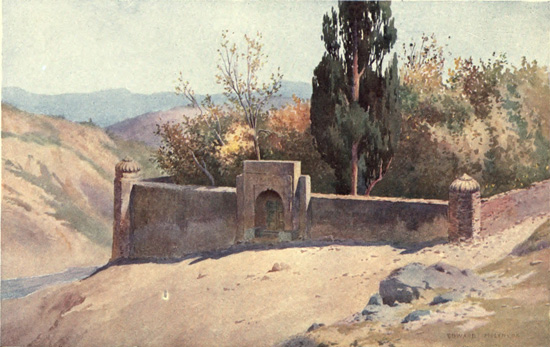
LALLA ROOKH'S TOMB, HASSAN ABDA
As he was the founder of the present ruling
dynasty, it will be well to pause here to describe
who he was and where he came from. He was
what is known as a Dogra Rajput, that is, a Rajput
inhabiting the Dogra country—the hilly country
stretching down to the plains of the Punjab from
the snowy range bounding Kashmir on the south.
His far-away ancestors were Rajputs who for
generations had followed warlike operations.
Originally settled in Oudh or in Rajputana they
eventually moved to the Punjab, and settled at
Mirpur in the Dogra country. One branch then
migrated to Chamba, another to Kangra, and the
one to which Gulab Singh belonged to Jammu,
where the great-great-grand-uncle of Gulab Singh—Throv
Deo—was during the middle of the
eighteenth century a man of importance. In 1775
the son of Throv Deo built the palace at Jammu,
and about 1788 Gulab Singh was born. In 1807,
when Ranjit Singh's troops were attacking Jammu,
Gulab Singh so distinguished himself that he gained
the favour of Ranjit Singh. He took service
under the Sikh ruler, and with the assistance of his
brother, Ranjit Singh's Dewan, acquired such
influence that when the principality of Jammu had
been annexed by the Sikhs, Ranjit Singh in 1818
conferred it upon Gulab Singh, with the title of
Raja. The brother, Dhyan Singh, was likewise
made Raja of Punch, and the third brother, Raja
of Ramnager.
In the course of the next 15 years the three
brothers subdued all the neighbouring principalities,
and Gulab Singh's troops under Zorawar Singh
had conquered Ladak and Baltistan, and even
invaded Tibet, though there Zorawar Singh himself
was killed and his army annihilated.
Thus when Ranjit Singh died in 1839 Gulab
Singh, though still feudatory to the Sikh Government,
had established his authority in Jammu and
neighbouring principalities, and in Ladak and
Baltistan, and he had a commanding influence in
Kashmir then still under a Sikh governor. The
traveller Vigne saw him in this year at Jammu,
and speaks of him as feared for his cruelty and
tyrannical exactions—very common and, it would
almost appear, necessary characteristics of strong
rulers in those unruly times—but he remarks on
his tolerance and liberality in religious matters.
He was never a popular ruler, and the people
feared and dreaded him; but he had courage and
energy, and above all was successful.
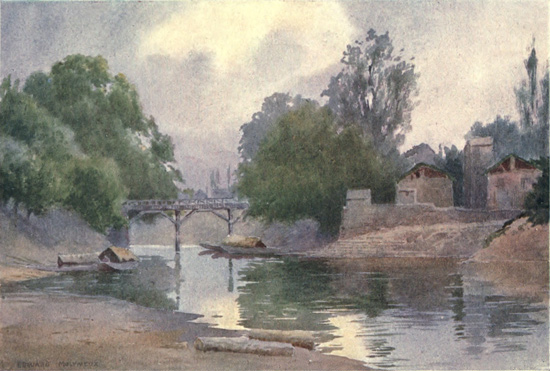
BRIDGE OF BURBUR SHAH, CHENAR BAGH, SRINAGAR
On Ranjit Singh's death all was once more in
the melting-pot, and for a time it looked as if
Gulab Singh would come crashing down even
faster than he had risen. His influence at the
Lahore Court was lost through the murder of his
brother. He himself was attacked by the Sikhs
and taken to Lahore. His fortunes were sinking
rapidly. Then suddenly there was a turn in the
wheel of fortune; and the man who had started
life as a courtier of Ranjit Singh, was confirmed
in the possession not only of all that he had
subsequently acquired by his own prowess, but
also of the rich and beautiful vale of Kashmir as
well. On the payment of three-quarters of a
million sterling down, and of an annual tribute of
one horse, twelve goats, and six pairs of shawls,
all this was confirmed by the strongest power in
Asia to himself and his heirs for ever. It was one
of those wonderful strokes of fortune which must
have lent such zest and interest to life in those
otherwise sordid days.
It was due to the advent of the British upon
the scene. On the death of the strong, stern ruler,
Ranjit Singh, the Punjab had fallen into a state
of hopeless anarchy. His successor died prematurely
of excess, and Ranjit's reputed son, Sher
Singh, once Governor of Kashmir, had marched
upon Lahore and seized the government in 1841.
The Punjab was now entirely in the hands of the
Sikh soldiery, whose movements were regulated
not by the will of the sovereign or of the minister,
but by the dictation of army committees. The
minister, Dhyan Singh (Gulab Singh's younger
brother) shot the ruler Sher Singh, and was in turn
murdered by a Sikh chieftain, Ajit Singh, who,
again, was murdered by the Sikh soldiers. Dhulip
Singh, so well known afterwards as an exile in
England, and then a child of five years of age, was
put on the throne, and from this time the army
became the absolute master of the State, though
Hira Singh, Dhyan Singh's son, and therefore
nephew of Gulab Singh, was nominally minister.
He tried to curb the army by distributing the
regiments, but the army committees would not
allow a single corps to leave the capital without
their permission. He had eventually to flee, but
he was overtaken and killed, and his head brought
back in triumph to Lahore.
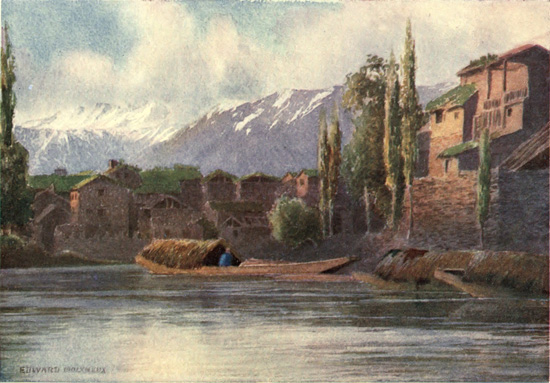
SPRING FLOODS IN THE KUTICAL CANAL, SRINAGAR
On Hira Singh's death the power fell into the
hands of the brother of the infant Dhulip Singh's
mother and her paramour, Lal Singh, a Brahmin.
They increased the pay of the soldiers, and in order
to keep them quiet turned them against Gulab
Singh at Jammu. He was brought to Lahore and
had to pay a crore (ten millions) of rupees. They
were then turned against Multan. Another son
of Ranjit Singh raised a revolt, but was suppressed
and murdered by the regnant maternal uncle of
the infant Dhulip Singh. Then this uncle was
himself murdered. The mother, with the aid of
the minister Lal Singh, and of Tej Singh, the
commander-in-chief of the army, assumed the
government and, as it is thought, with the object
of employing the army, which was a positive
danger to the throne, ordered an advance upon
British territory. In November 1845 the Sikh
army of 60,000 men with 150 guns crossed the
river Sutlej which was then our frontier, and by
the 16th of December was encamped by Ferozepore
fort held by only 10,000 British and British Indian
troops. A bloody and indecisive battle was fought
at Mudki, December 18, 1845. Another most
hard-won battle—"the most severe and critical
the British army had ever fought in India"—and
in which the Governor-General, Lord Hardinge,
himself took part, and lost five aides-de-camp
killed, and four wounded, was fought at Ferozeshah
on December 21. This just stemmed the tide of
invasion, but at such a cost of men and ammunition,
that the British could not follow up their
success till January 28, 1846, when the decisive
battle of Aliwal was fought, which utterly disheartened
the Government at Lahore. Lal Singh,
the minister, was deposed for his incapacity, and
Gulab Singh was invited from Jammu to negotiate
with the Governor-General.
Here was the wonderful turn in the wheel of
fortune, which, when his own brother and so many
of the leading men of the Punjab had been
murdered or debased, brought him alone and his
descendants after him to a position of security.
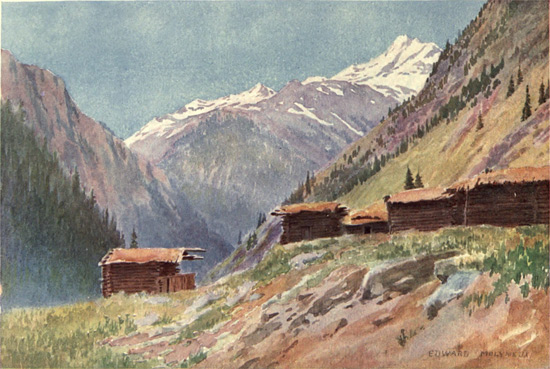
LOOKING DOWN THE GURAIS VALLEY, FROM DUDHGAI VILLAGE
Gulab Singh immediately made overtures to the
British Government, but the Sikh army was not
yet thoroughly defeated, and it was not till after
the battle of Sobraon, on February 10th, that the
way for negotiations was really clear. The British
troops occupied Lahore. The Sikh Government
submitted, and the treaty of Lahore was concluded
on March 9th. By this, amongst other things, the
Sikhs ceded to the British all the hill country
between the rivers Beas and Indus, "including the
provinces of Kashmir and Hazara"; and "in
consideration of the services rendered by Raja
Golab Singh, of Jummu, to the Lahore State,
towards procuring the restoration of the relations
of amity between the Lahore and British Governments,"
the British agreed to recognise "the
independent sovereignty of Raja Golab Singh in
such territories and districts in the hills as may be
made over to the said Raja Golab Singh, by
separate agreement between himself and the British
Government, with the dependencies thereof, which
may have been in the Raja's possession since the
time of the late Maharaja Khurruk Singh"; further,
the British Government, "in consideration of the
good conduct of Raja Golab Singh," agreed "to
recognise his independence in such territories, and
to admit him to the privileges of a separate treaty
with the British Government."
A week later, on 16th March 1846, was signed
this separate treaty with Gulab Singh, by which the
British Government "transferred and made over,
for ever, in independent possession, to Maharaja
Golab Singh and the heirs male of his body, all
the hilly and mountainous country, with its dependencies,
situated to the eastward of the river
Indus and westward of the river Ravi, including
Chamba and excluding Lahoul, being part of the
territories ceded to the British Government by the
Lahore State." In consideration of this transfer
Golab Singh was to pay the British Government
75 lakhs of rupees, and in token of the supremacy
of the British Government, was "to present annually
to the British Government one horse, twelve
perfect shawl-goats of approved breed (six male and
six female), and three pairs of Kashmir shawls."
He further engaged "to join with the whole of
his military force the British troops when employed
within the hills, or in the territories adjoining
his possessions"; and on their part the
British Government engaged to "give its aid to
Maharaja Golab Singh in protecting his territories
from external enemies."
Thus it was that Kashmir came under its
present rulers; and surprise has often been expressed
that when this lovely land had actually
been ceded us, after a hard and strenuous campaign,
we should ever have parted with it for the
paltry sum of three-quarters of a million sterling.
The reasons are to be found in a letter from Sir
Henry Hardinge to the Queen, published in The
Letters of Queen Victoria. The Governor-General,
writing from the neighbourhood of Lahore on 18th
of February 1846—that is nearly three weeks
before the treaty of Lahore was actually signed—says
it appeared to him desirable "to weaken the
Sikh State, which has proved itself too strong—and
to show to all Asia that although the British
Government has not deemed it expedient to
annex this immense country of the Punjab,
making the Indus the British boundary, it has
punished the treachery and violence of the Sikh
nation, and exhibited its powers in a manner which
cannot be misunderstood." "For the same political
and military reason," Sir Henry Hardinge continues,
"the Governor-General hopes to be able before
the negotiations are closed to make arrangements
by which Cashmere may be added to the possessions
of Golab Singh, declaring the Rajput Hill States
with Cashmere independent of the Sikhs of the
Plains." "There are difficulties in the way of
this arrangement," he adds, "but considering the
military power which the Sikh nation had exhibited
of bringing into the field 80,000 men and
300 pieces of field artillery, it appears to the
Governor-General most politic to diminish the
means of this warlike people to repeat a similar
aggression."
This was the reason we did not annex Kashmir.
We had not yet annexed the Punjab. We did not
finally conquer it till three years later, when the
continued unruliness of the Sikhs and the murder
of British officers had rendered a second campaign
necessary. In 1846 the East India Company had
no thoughts or inclinations whatever to extend
their possessions. All they wished was to curb
their powerful and aggressive neighbours, and they
thought they would best do this, and at the same
time reward a man who had shown his favourable
disposition towards them, by depriving the Sikhs
of the hilly country, and by handing it over to a
ruler of a different race.
So Gulab Singh became nominal ruler of
Kashmir. But he did not acquire actual possession
of his new province without difficulty. The
governor appointed under the Sikh Government
showed no disposition to hand over the province,
and with the aid of feudatories attacked Gulab
Singh's troops. Gulab Singh had to apply to the
British Government to aid him, and British troops
were accordingly sent to Jammu to enable Gulab
Singh to send his Jammu troops to Kashmir, and
two British officers, one of whom was the famous
Sir Henry Lawrence, accompanied Gulab Singh to
Srinagar. Owing to his character for oppression
and avarice he was not a popular ruler, and the
people did not welcome him. But with the
support of the British Government he was finally
able to establish his rule over Kashmir by the
end of 1846, and Sir Henry Lawrence returned to
Lahore.
The state of Kashmir when Gulab Singh took
it over was deplorable. The Government took
from two-thirds to three-quarters of the gross
produce of the land—about three times as much
as is now taken. The crops when cut by the
cultivators were collected in stacks. One-half was
taken as the regular Government share, and additional
amounts were taken as perquisites of various
kinds, leaving one-third or even only a quarter with
the cultivators. Of this some was taken in kind
and some in cash. The whole system of assessment
and collection was exceedingly complicated and
workable only in the interests of the corrupt
officials; and Government held a monopoly in
the sale of grain. Gulab Singh during his lifetime
did very little to ameliorate this state of things.
He took things as he found them and troubled
little to improve them. He died in 1857, and was
succeeded by his son Ranbir Singh, who rendered
valuable services to Government during the
Mutiny, and received, in recognition, the right to
adopt from collateral branches an heir to the
succession on the failure of heirs-male of Gulab
Singh on whom alone the country had been conferred
by the British. Maharaja Ranbir Singh
died in 1885.
During his reign there was a steady improvement,
but it was very slow, and an account of
the condition of Kashmir then reads curiously
ill beside the account of the province now after
nearly a quarter of a century of the present
Maharaja's reign. The Maharaja Ranbir Singh
himself was extremely popular both with his
people and with Europeans—in this respect being
a marked contrast to his father. He was manly,
fond of sport, affectionate in his family, and simple
and moral in his private life. And Mr. Drew
has given a pleasant picture of how this chief,
in the old-fashioned way so liked by the people
and so conducive of good relations between rulers
and subjects, used to sit daily in public Durbar
in full view of his people, receiving and answering
his people's petitions.
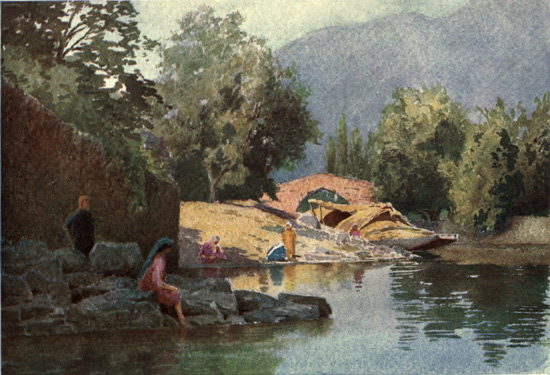
AKBAR'S BRIDGE, KARALLAYAR
With the vastly more complicated system of
administration of the present day it is practically
impossible for a ruler of Kashmir to conduct his
business on precisely these lines; but I have seen
the same system working in Chitral, and quite
realise the advantages it has for small states. If
it does nothing else it teaches the people good
manners, for they learn from observation of others
how to comport themselves in high society. But
these public Durbars are also an education of no
small value. Here the people discuss men and
events. They learn character and hear outside
news, and it is surprising to see how much more
native intelligence, dignity, and character men
brought up in these conditions have than the
school-bred men of to-day.
Ranbir Singh was then a typical ruler of a
type that is now almost gone. Unfortunately
he had not the officials capable of the immense
labour required to remove the terrible effects of
many centuries of misgovernment, and especially
of the harsh, cruel rules of the Afghans and Sikhs.
His officials were accustomed to the old style
of rule and knew no better. In the early 'sixties
cultivation was decreasing; the people were
wretchedly poor, and in any other country their
state would have been almost one of starvation
and famine; justice was such that those who could
pay could at any time get out of jail, while the
poor lived and died there almost without hope.
There were few men of respectable, and none of
wealthy appearance; and there were almost
prohibitive duties levied on all merchandise imported
or exported. By the early 'seventies some
slight improvement had taken place. The labouring
classes as a general rule were well fed and well
clothed, and fairly housed. Both men and women
were accustomed to do hard and continuous labour,
and it was obvious that they could not do this and
look well unless they were well nourished. Their
standard of living was not high, but they certainly
had enough to eat. And this is not surprising,
for a rupee would buy 80 to 100 lbs. of rice, or
12 lbs. of meat, or 60 lbs. of milk. Fruit was so
plentiful that mulberries, apples, and apricots near
the villages were left to rot on the ground. And
fish near the rivers could be bought for almost
nothing. Crime of all kinds was rare, chiefly
because of the remembrance of the terrible punishments
of Gulab Singh's time, and because of the
system of fixing responsibility for undetected
crime upon local officials. Drunkenness, too, was
almost unknown. About half a lakh of rupees
was spent upon education, and another half-lakh
on repairing the "paths." A slight attempt was
also made to assess the amount of land revenue
at a fixed amount This much was to the good,
but yet the country was still very far indeed from
what it ought to have been. The means of
communication were rough and rude in the
extreme, so that men instead of animals had to be
used as beasts of burden. Even the new assessment
of the land revenue was three times as
heavy as that of the amount demanded in British
districts in the Punjab. And there was still much
waste land which the people were unwilling to put
under cultivation, because under the existing
system of land revenue administration they could
not be sure that they would ever receive the
results of their labour. A cultivator would only
produce as much as would, after payment of his
revenue, provide for the actual wants of himself
and his family, because he knew by experience
that any surplus would be absorbed by rapacious
underling officials. In matters of trade there
were, too, still the impediments of former days.
Upon every branch of commerce there was a
multiplicity and weight of exactions. No product
was too insignificant, and no person too poor to
contribute to the State. The manufacture or
production of silk, saffron, paper, tobacco, wine,
and salt were all State monopolies. The sale of
grain was a State monopoly, and though the State
sold grain at an extraordinarily cheap rate, the
officials in charge did not always sell it to the
people who most required it, or in the quantity
they required. Favourite and influential persons
would get as much as they wanted, but often
to the public the stores would be closed for
weeks together, and at other times the grain was
sold to each family at a rate which was supposed
to be proportionate to the number of persons in the
family; but the judges of the said quantity were not
the persons most concerned, viz. the purchasers, but
the local authorities. Private grain trade could
not be openly conducted, and when the stocks in
the country fell short of requirements they could
not be replenished by private enterprise.
On the manufacture of shawls parallel restrictions
were placed. The wool was taxed as it
entered Kashmir; the manufacturer was taxed
for every workman he employed, and at various
stages of the process according to the value of
the fabric; and, lastly, the merchant was taxed,
before he could export the goods, the enormous
duty of 85 per cent ad valorem. Butchers, bakers,
carpenters, boatmen, and even prostitutes were
still taxed, and coolies who were engaged to carry
loads for travellers had to give up half their
earnings.
The whole country, in fact, was still in the grip
of a grinding officialdom; and the officials were the
remnants of a bygone, ignorant, and destructive
age, when dynasties and institutions and life itself
were in daily danger, when nothing was fixed and
lasting, when all was liable to change and at the
risk of chance, and each man had to make what he
could while he could; and when, in consequence,
a man of honesty and public spirit had no more
chance of surviving than a baby would have in a
battle.
No wonder that in 1877, when—through excess
of rain which destroyed the crops—famine came
on the land, neither were the people prepared to
meet the emergency, nor were the officials capable
of mitigating its effects, and direful calamity was
the consequence.
In the autumn of 1877 unusual rain fell, and
owing to the system of collecting the revenue in
kind and dilatoriness in collection, the crop was
allowed to remain in the open on the ground, and
then it rotted till half of it was lost. The wheat
and barley harvest of the summer of 1878 was
exceedingly poor. The fruit had also suffered
from long continual wet and cold, and the
autumn grains, such as maize and millet, were
partly destroyed by intense heat and partly
devoured by the starving peasants. The following
year was also unfavourable, and it was not till 1880
that normal conditions returned.
These were the causes of the scarcity of food-supply;
and when this calamity, which nowadays
could be confidently met, fell upon the country, it
was found that people had nothing in reserve to
fall back on; that the administrative machine was
incapable of meeting the excessive strain; that
even the will to meet it was wanting; and that
corruption and obstruction impeded all measures
of relief, and even forbade the starving inhabitants
migrating to parts where food could be had. In
addition, the communications were so bad that the
food, so plentiful in the neighbouring province,
could be imported only with the greatest difficulty.
As a result two-thirds of the population died; a
number of the chief valleys were entirely deserted;
whole villages lay in ruins, as beams, doors, etc., had
been extracted for sale; some suburbs of Srinagar
were tenantless, and the city itself was half-destroyed;
trade came almost to a standstill, and
consequently employment was difficult to obtain.
The test of this great calamity showed bare the
glaring defects of the system the present dynasty
had taken over from their uncultured predecessors,
and which in their thirty years' possession of the
valley they had not been able to eradicate.
During the five years which remained of the
late Maharaja's reign the first important steps were
taken to remedy this terrible state of affairs; the
assessment of the land revenue was revised, and the
cart-road into the valley was commenced. But
it has been during the twenty-three years of
the present Maharaja's reign that the most real
progress has been made. First and foremost the
land revenue has been properly assessed; it has
been fixed in cash for a definite number of years,
and the share claimed by the State has been greatly
reduced. Then a first-rate cart-road up the Jhelum
valley has been made. The heavy taxes on trade
have been reduced. A well-trained set of officials
have been introduced, and they have been well
paid. Increased, though not yet nearly sufficient
attention has been paid to education. Surveys for
a railroad have been made, and a great scheme for
draining the valley, reclaiming waste land, and
preventing floods has been commenced. As a
result, and in spite of the State taking a smaller
share of the cultivator's produce, the revenue has
more than doubled. More land is being taken
up. The population is steadily increasing. The
darkest days are over, and the future is assured.
The history of the people has shown that there
is latent in them much ability and taste, but that
they have always prospered most when most
subjected to the influences of the great world outside
Kashmir. Those influences are now strong
upon the country, and the future prosperity of
the people will very largely depend upon how
they meet and profit by them.
Needless to add, a weighty responsibility lies
also upon the British Government that it should
guide their destinies aright.
ADMINISTRATION
A more detailed account of the administration
may now be given. Kashmir Proper, that is, what
is known as the valley of Kashmir, is a province
of the Jammu and Kashmir State, which has a total
area of about 80,000 square miles, and a population
of 2,905,578, while the province, which includes
for administrative purposes the valley of the
Jhelum River from Baramula to Kohala, as well as
the district of Gurais on the far side of the North
Kashmir Range, has a population of 1,157,394.
Kashmir itself is administered by a Governor,
and the whole State is ruled over by a Maharaja.
It is one of what are known as the Native States
of India,—States which are ruled by their own
Chiefs, but feudatory to the British Government,
whose interests are represented by a British
Resident at the capital.
The present ruler, who succeeded his father
in 1885, is Maharaja Sir Pratap Singh, G.C.S.I.,
a major-general in the British Army, and a Chief
of strong religious tendencies, who is much respected
in India and loved by his own people. He is
advised by a chief minister, his very capable and
business-like brother, Raja Sir Amar Singh, K.C.S.I.,
and by three subordinate ministers—one in charge
of the foreign relations of the State, of the Public
Works, the Forests, and several minor departments;
another in charge of the Land Revenue administration;
and the third in charge of the Home
Department, including the Police, the Customs,
Medical and other branches. The Judiciary is
presided over by a Judge of the High Court.
All of these officials are natives of India, and,
except one, belong to the British service, and have
been trained in British provinces. None are
Kashmiris. They have been lent by the British
Government to the Maharaja for a specified
number of years, and draw salaries of from
Rs. 1200 to Rs. 1500 a month, or £720 to £800
a year.
Under them, again, are the governors of Kashmir
and of Jammu; and the wazir-i-wizarats of Ladak
(including Baltistan) and Gilgit, of whom all
except the latter are also Indian officials lent by
the Government of India.
Besides these, in the departments of the State
where special technical knowledge is required,
European and American specialists are employed
under the ministers. The finances of the State
are controlled by an Accountant-General from the
British service. The operations for assessing the
land revenue are under a Settlement Commissioner,
a member of the Indian Civil Service.
The public works are under the charge of a
retired engineer from the Public Works Department
of the Government of India. The forests
are controlled by a Conservator of Forests from
the Indian Forest Department. And under the
State Engineer is the Chief Engineer of the
Electrical Department, a Royal Engineer Officer,
who in his turn has under him a large staff of
Englishmen, Americans, Canadians, engaged in
carrying out the great schemes for converting
water power into electric power, and by means of
the latter draining the water-logged portions of
the valley, reclaiming land, and preventing floods.
This, in brief outlines, is the administrative
system in the State. At the head is an hereditary
ruler. Immediately responsible to him are a group
of Indian officials mostly born, educated, and trained
in the adjoining British province of the Punjab.
The local executive is likewise chiefly presided
over by Government of India native officials;
and in charge of technical departments are
European and American specialists.
What is chiefly remarkable is the very small
number of Kashmiris who are employed. Though
the majority of the inhabitants are Mohamedans,
very few Mohamedans are employed in high
positions. Though the Kashmiris are very intelligent,
extremely few have posts in the State
service; and this anomaly, though remarkable, is
paralleled in many other native States. They are
most of them dependent on officials trained or at
least educated in British provinces. The Maharaja
of Kashmir realises, however, the necessity of
educating and training his own subjects, and most
of the smaller officials and many of the clerks in
the offices are State subjects.
And these are the men with whom visitors to
Kashmir come mostly in contact. Immediately
under the Governor of Kashmir are officials known
as tehsildars, in charge of tehsils or small districts,
and under them again are naib-tehsildars in charge
of groups of villages; and, finally, we come to the
lumberdars, or head-men of the villages. These
officials with their attendants collect revenue, keep
order, and administer justice in small cases. But
for the administration of justice there is also in the
Kashmir provinces a Chief Judge holding his court
at Srinagar, and minor judges known as munsiffs.
The chief revenue is derived from the land, and
is assessed according to a system which will
presently be described. Out of a total revenue for
the whole State of one hundred lakhs of rupees, the
revenue from land amounts to over forty lakhs.
Customs is another principal source of revenue.
The receipts for the Kashmir province for the last
three years were—
| Rs. | 3,99,155 | = | £26,610 |
| Rs. | 4,84,235 | = | £32,282 |
| Rs. | 5,51,102 | = | £36,740 |
and for the whole Kashmir State—
| Rs. | 7,62,582 | = | £50,839 |
| Rs. | 8,93,438 | = | £59,562 |
| Rs. | 10,09,647 | = | £67,243 |
In describing the history of the people we have
seen that one of the greatest reforms effected in the
reign of the present Maharaja has been in the
system of assessing and collecting the land revenue—a
reform which was carried into effect mainly by
Sir Walter Lawrence, who in his work on Kashmir
has described at length both the old system and
the one which has given it place. Of every village,
with its village lands, a map was made on a scale
generally of 24 inches to the mile—that is large
enough to show every field accurately, and even the
trees on the fields. Then in the village registers
all necessary facts relating to each field were
recorded, such, for instance, as the area, the class
of soil, the source of irrigation, the number and
description of trees on it, the name of the owner,
the name of the person who cultivated it, and the
amount of rent payable by the tenant, if any.
Of these entries the most important, as regards
assessing the amount of land revenue to be paid,
was that regarding the class of soil. This is now
classified as A, irrigated land, (1) producing rice
regularly; (2) producing rice occasionally, but not
in every year; (3) producing other crops than rice;
and B, unirrigated land, (1) manured; (2) level
unmanured; (3) sloping unmanured.
The name of the "owner" was entered, but
"owner" is really an incorrect term, for all land in
the Kashmir valley is "owned" by the State. The
actual holders have a right of occupancy as against
the State as long as they pay its dues, and are
practically sub-proprietors; but they have no right
of alienation or mortgage.
At each harvest an official called a patwari,
made a field to field inspection, and recorded in a
Register the crops found in the fields. These proceedings
gave the assessing officer a record of crops
which formed an aid to assessment. The officer
then estimated by observation, inquiry, and experimental
cuttings, the yield of average fields of each
class. The following are examples of some of the
rates of yield:—
| | Per Acre. |
| a. Unhusked rice— |
lbs. | | lbs. |
| | 1. In villages affected by floods | 1240 | to | 1520 |
| | 2. In villages above the floods but not too near the mountains | 1760 | " | 2600 |
| | 3. In villages close to the mountains and affected by cold winds and cold water | 1360 | " | 1800 |
| b. Maize on unirrigated land— |
| | 1. By river | 1200 | " | 1600 |
| | 2. Between river and mountains | 1100 | " | 1500 |
| | 3. Near mountains | 800 | " | 1200 |
| c. Wheat on unirrigated land— |
| | 1. By river | 640 | " | 720 |
| | 2. Between river and mountains | 560 | " | 640 |
| | 3. Near mountains | 500 | " | 560 |
All this information furnished the basis on which
the amount of revenue could be fixed. In old days
the State claimed half the gross produce as it was
stacked on the field at harvest time, and various
perquisites of officials reduced the share left to the
cultivator to only about one-third. Moreover, in
collecting the revenue in kind there was much
room for abuse and loss to both the State and
the cultivator, and endless vexation. It was therefore
the object of the new settlement to have
the revenue paid as much as possible in cash rather
than in kind, so that the occupant of a field would
be able to know for certain what he would have to
pay, and would not have cormorant officials hanging
over his field at harvest time; and also so that the
State on its side might know precisely what amount
of revenue to expect in a year, and not have the
trouble of collecting in kind with all its attendant
risks and cost. What had to be fixed, then, was
the money value of the grain which the State would
otherwise have taken from the cultivator.
The settlement of this amount in the case of
every single field in the whole of Kashmir was,
necessarily, a gigantic operation and took six years
to carry out. But the information collected regarding
its area and bearing capacity showed, with
considerable degree of accuracy, what each field
could produce. The average cash value of this
amount of produce in an ordinary year was then
determined, and the State had then to say what
proportion—whether two-thirds as before, or an half
or a third—they would take. Lastly, had to be
decided for how many years they would agree with
the occupier to take this fixed amount of cash—whether
for ever, as in Lord Cornwallis' settlement
of Bengal, or for thirty, twenty, or ten years.
Mr. Lawrence, though making very great
changes, had naturally to also use caution. He
could not at once fix the whole revenue in cash.
Some had still to be taken in kind. And he could not
safely make his settlement for more than ten years,
for his calculations of the produce of a field and of
the money value of that produce might at this first
settlement often be unfair, either to the State or
the occupier.
At first even the villagers, who were most to be
benefited, distrusted the settlement and hampered
the operations, and the old style petty official, now
happily extinct, encouraged them in their distrust.
But gradually, under Mr. Lawrence's influence,
the attitude of the villagers changed. When they
saw that for ten years to come the amount the State
was to take was to be fixed and at a diminished
rate, that only a small part was to be taken in
kind, and enough was to be left to them for
food, and that thereby the ever-present sepoy
was to be removed from the villages, the people
began to realise that some good was to come of
these operations for settling the revenue. Ruined
houses and desolate gardens were restored, absentees
returned, and applications for waste land
came in faster than was for the time convenient.
At the end of the ten years a second settlement
was made, and this time with much diminished
troubling, for not only were people and officials
better disposed, but there were now available much
more reliable statistics as to the produce of the
fields. The yield of each field and the money value
of the yield could now be fairly accurately known;
and the proportion of this money value of the
yield which the State should take had now to
be fixed. Formerly, exclusive of perquisites for
local officials, the State would take half the yield.
But it was now decided to take only 30 per cent of
the gross yield, and to take the money value of it
instead of the actual produce in kind as in old days.
Each occupier was then given a small book
containing a copy of the entries in which he was
interested, the area of the field, the rate he had to
pay, and so on.
The all-round incidence of the new land revenue
proper is Rs. 3. As. 2. (or 4s. 2d) per acre cultivated;
and the rates varied from Rs. 12 (16s.) per acre
on some of the less irrigated (market garden)
land, to ten annas (tenpence) per acre on the
poorest unirrigated land in the coldest part of
the province.
The period of the settlement was fixed at
fifteen years.
PRODUCTS AND MANUFACTURES
What Kashmir is principally known for to the
outside world is its shawls; but the wool from
which they are manufactured is not produced in
Kashmir itself: it comes from Tibet and Chinese
Turkestan. It is the soft down lying under the
long hair of the Tibetan goat. Kashmir does, however,
produce a coarser wool of its own. Kashmir
villagers keep immense numbers of sheep, for round
their villages and on the mountain uplands there
is an abundance of rich grass, the leaves of the
willow trees and of irises furnish winter fodder, and
these animals are not only thus easily fed, but also
furnish their owner with clothing, with food and
with manure, and by crowding in the lower portion
of his house keep him warm in winter. They are
shorn twice in the year, once in early summer and
again in the autumn. The wool is of good quality,
and in the winter months the women spin it, and
the men weave it into blankets and into the well-known
"puttoo" cloth, in which sportsmen in
Kashmir clothe themselves, and for which, since
the Swadeshi movement, there has been a great
demand in India.
Silk is another and increasingly important product.
The whole of the valley is covered with
mulberry trees, and for many centuries sericulture
has been practised in the country. But it is only
recently that it has been placed on a really business-like
footing. Now good "seed," i.e. silk-worms'
eggs, are imported fresh every year from France and
Italy—about six-sevenths from France and one-seventh
from Italy—and in the spring are given out
to the cultivators free of charge. The villagers
hatch out the eggs, feed the silk-worms on the
mulberry leaves, and then bring the cocoons to the
State silk factory at Srinagar for sale. 1720 lbs. of
eggs were given out last year, and 1,712,000 lbs. of
cocoons were bought in by the State. In the
present year the figures were 1762 lbs. of eggs and
2,273,760 lbs. of cocoons. The amount paid for
these cocoons to 17,433 rearers was Rs. 4,25,848,
so that the Kashmiri villagers at very little trouble
and no cost are able to put a nice little sum of
money into their pockets every summer, and are
consequently now clamouring to be given seed.
The mulberry trees are carefully watched by the
State, and an inspector of mulberry trees goes
round the valley, seeing that the trees are not
damaged and are properly pruned. Young mulberry
trees are distributed by the State to the
villagers to the number of from 30,000 to 40,000
a year.
Fruit is another of Kashmir's important products
which may be expected to largely increase
in the future. Kashmir apples are renowned all
over India. They are large, red, and attractive
looking, and sell well as far down as Calcutta and
Bombay. But they are not of really good flavour,
and the apples from European stock now being
grown are sure to have a large sale in the future.
In the autumn months thousands of cart-loads are
carried down the roads to the railway at Rawal
Pindi. The apple grows wild in Kashmir, and the
villagers uproot the wild trees and plant them in
their orchards. But the State also now supplies
them with young trees. Near Srinagar there are
large State nurseries stocked with the best kinds
from Europe, and every year thousands of young
trees are given out free to the villagers, so that the
valley may gradually be filled with the best available
trees. The State also to a small extent grows
apples for sale, and their trees are extraordinarily
prolific. In the autumn one sees these apple trees
weighed down to the ground with fruit, and M.
Peychaud, the director in charge, says that he has
taken as many as 30,000 from one tree. The apples
also grow to an enormous size. And when the railway
comes to Kashmir, and carriage is easier and
cheaper, the export of apples and other fruit should
increase to striking dimensions, and not only be one
of the best means of making the railway pay, but
bring great profits to the cultivators. The apple
of Kashmir has a great future before him.
So has the pear. He is not so much to the
fore at present, because he does not stand carriage
as well; but the railway will remove that drawback,
and he will run the apple hard. Like the
apple, the pear also is found wild and transplanted
into orchards. But good stock is now being
grown in the State orchard and distributed from
there. Some of these, and some that have been
imported by European residents, have taken so
kindly to Kashmir, that I believe their present
products are not surpassed anywhere. From
Major Wigram's garden comes a famous pear,
so large, and soft, and luscious, as scarcely to
support its own weight. Other winter pears keep
right through to the early summer.
Quinces also are grown in considerable
quantities. They make excellent jam, but are
chiefly grown for their seed, which is exported
to the Punjab.
Grapes have been tried, and on the shores
of the Dal Lake there is a vineyard under the
charge of a Frenchman, from which what is known
as Kashmir wine is made. But this branch of
fruit culture has not so far been so successful as
the culture of pears and apples. It is said that
the rain falls at the wrong time. But probably
the most suitable descriptions of grapes have not
yet been tried or the most suitable site yet selected.
In the time of the Moghals they were plentiful,
and wild vines are often seen. So it is hard to
believe that grapes cannot be grown in Kashmir
as well as the other fruits for which it is famous.
Walnut trees are found all over the valley,
and quantities of the nuts are now exported,
though formerly they were only used for oil.
They are an excellent fruit, and one kind known
as the kagazi has such a thin shell that it is easily
cracked between the fingers, and the kernel is
excellent. The villages on the lower slopes are
often surrounded with walnut trees, some of
enormous size, and adding greatly to the beauty
of the village.
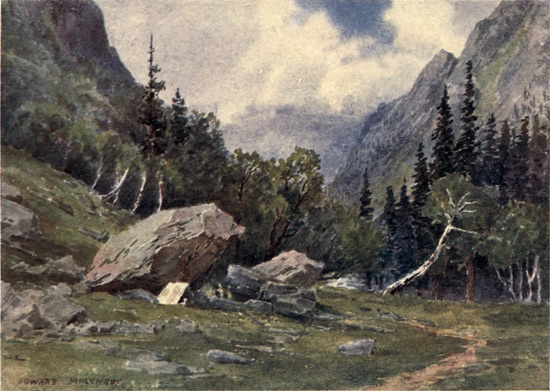
THE CAMPING-GROUND AT LIDARWA
Mulberries, as has been remarked in regard
to sericulture, are plentifully grown. They are
eaten in immense quantities by the people as well
as by their animals.
Almonds are grown in considerable quantities
in large orchards. Apricots are grown, but not
very plentifully, and principally for oil. Peaches,
cherries, pomegranates, and plums are also cultivated,
but have not yet received much attention
from the villagers. Strawberries grow abundantly
in the gardens of Europeans, and gooseberries
and currants also succeed. There is, indeed,
scarcely a limit to what the fruit production of
Kashmir might be if it received attention and
care.
Of the food grains rice is the principal. With
all the streams running down from the mountains
ample water for the copious irrigation it requires
is available. The Kashmiris are exceptionally
clever in its cultivation, and they grow it up to
an altitude of 7000 feet. The fields are terraced
carefully to hold the irrigation, and are incessantly
watered and anxiously weeded. Lawrence says
that in one district alone he has found fifty-three
varieties, and certain villages are famous for their
peculiar rices. But they may be roughly divided
into two classes, the white and the red, of which
the former is the more esteemed by epicures,
though the cultivators prefer the latter as it is
less delicate, suffers less from changes of climate,
and gives a larger out-turn. Lawrence gives the
average crop of unhusked rice per acre as 17
maunds, or 1220 lbs. Large quantities of rice
are exported to the Punjab.
Maize is the next most important crop. In
the black peaty land lying along the Jhelum, and
in the high villages where numbers of cattle graze
and manure is plentiful, very fine crops are grown.
As a rule it is grown on dry land, and is seldom
irrigated. The stalk forms excellent fodder for
cattle. The average yield in irrigated and dry
swamp land is 11 maunds, or 880 lbs., and on dry
land 8 maunds, or 640 lbs. per acre. As a diet
maize ranks after rice, but the villagers, when money
is scarce, will sell their rice and subsist on maize.
Barley is largely grown, but it is not of good
quality, and no pains are taken in its cultivation.
Wheat receives better treatment, but the
wheat flour of Kashmir is not esteemed. The
average production on dry land is 7 maunds, or
560 lbs. per acre.
Millet is another food grain grown in Kashmir,
but not very generally.
Buckwheat is cultivated in the higher villages.
Pulses are not much grown. Mung (Phaseolus
Mungo) is the best, and is often sown in rice lands
which require a rest. Others are raáh (Phaseolus
radiatus) and mothi (Phaseolus aconitifolius). Peas
and white beans are occasionally cultivated; in
the gardens of European residents they give
excellent results.
Oil-seeds are largely grown, and now that a
company for oil-pressing is being started, still
more attention is likely to be paid to them. The
Kashmiris do not use ghi (clarified butter) in their
food. They consequently require vegetable oils
for that purpose, and as mineral oils are too expensive,
they use them also for lighting. The
principal oil-seed grown is the rape, of which there
are three varieties. An average crop is 3 maunds,
or 240 lbs. per acre. Large quantities of linseed
are also produced, of which an average crop would
be 1½ to 2 maunds, 120 to 160 lbs. per acre. Til
(Sesamum indicum) is a very common crop. It
yields 1½ maunds, or 120 lbs. per acre. Til is also
extracted from the walnut and apricot. Rape
seed gives the best oil for lighting purposes, and
linseed for eating.
Cotton is grown to a small extent all over the
valley, and both the fibre is used for home-manufactured
cotton cloth, and the seed is used as
food for cattle.
Tobacco is cultivated in many parts. And
two very beautiful crops are amaranth and saffron.
The former is grown in many places along the
edges of the fields, and gives a purply crimson
touch to the landscape. Its minute grains are
first parched, and then ground and eaten with
milk or water. It is especially used by the Hindu
on festival days. The latter is grown on the
plateau above Pampur, and when in blossom
forms one of the sights of Kashmir. The plant
is like a crocus, and the flower mauve and purple.
A large space of the plateau is covered with it,
and this sheet of colour adds a strikingly beautiful
effect to an already beautiful landscape. The
saffron of Kashmir is famous for its bouquet, and
is used as a condiment and as a pigment for
the forehead marks of the Hindus. The flowers
are dried in the sun, and the pollen is extracted
by hand. It is this pollen and the pollen-bearing
portion of the flower which form the saffron.
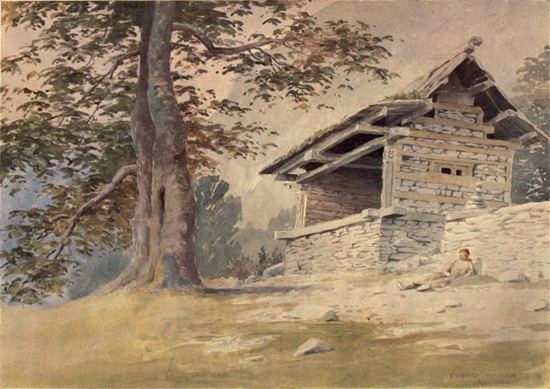
A WAYSIDE SHRINE
Mustard is also grown—mostly for oil; and
round the town, especially round Srinagar, in the
vicinity of the Dal Lake, vegetables are cultivated
in market gardens. The cultivation of potatoes,
indeed, is now increasing so rapidly that many
scores of cart-loads are annually exported to the
Punjab.
Hops are grown by the State at Dabgarh near
Sopur, and their cultivation could doubtless be
extended, but so far the cultivators, who are very
conservative, have not taken to it.
Such are the chief vegetable products of Kashmir,
and the State is making endeavours to improve
existing staples and introduce anything new which
may prove productive in the country. For this
purpose the Maharaja has established a model
farm, known as the Pratab Model Farm, and
situated near the Shalimar garden to experiment
with different varieties of grain and different
methods of cultivation, and it is hoped that if
new varieties prove specially productive they will
be taken up by the cultivators. The farm was
opened by Lord Minto in the autumn of 1906.
Long rows of accurately measured plots of
ground, one-sixteenth of an acre each, are planted
with the different varieties, and their yield carefully
measured. As one passes up the line he
sees at a glance the relative qualities of each
variety of wheat or maize or rice, and if the farm
is carefully worked for a series of years it ought to
give some valuable results. Already the cultivators
have been attracted by the enormous size of
some maize from Canada grown on the farm.
Some very straight Russian flax recommended
by the Dundee Chamber of Commerce seems to
promise good results. And perhaps beetroot for
sugar may also have a success, for almost any
vegetable product that grows in a temperate
climate will grow in Kashmir.
The crops reaped in the spring in Kashmir are
wheat, barley, rape, flax, pea, and bean. Those
reaped in the autumn are rice, maize, cotton,
saffron, millet, tobacco, hop, amaranth, buckwheat,
pulse, sesame.
The alluvial soil of the valley is of great fertility,
and every year is renewed by rich silt from the
mountain streams. The soil of the higher parts is
not so rich, though it, too, will give good returns.
Irrigation is largely used for water is abundant, as
the snow on the mountains forms a natural reservoir
stored up for the hot weather, when it melts and runs
down to the valley at the time when it is most
wanted. The Kashmiri is very clever at making
his little water channels and leading the water on
to his field.
The agricultural implements used are simple
and primitive. The plough is light, for the cattle
which are yoked to it are small. It is made of
wood, and the ploughshare is tipped with iron.
The spade likewise is made of wood, has a long
handle and a narrow face, and is tipped with iron.
A hand hoe is also used for weeding.
Ploughing for rice, maize, and other autumn
crops commences in the middle of March. In April
and May these crops are sown. In June and July
wheat and barley, sown in the previous autumn,
are harvested. In July and August linseed is
harvested. In August and September cotton-picking
commences. In September and October
rice, maize, and other autumn crops are harvested.
In November and December ploughing for wheat
and barley takes place. And during the winter rice
and maize and other autumn crops are threshed.
Forests
Besides agricultural products the yield of the
forests of Kashmir is also of great value. All
the northward-facing slopes are covered with dense
forests, a considerable part of which is of the
valuable deodar. This is cut into sleepers, launched
into the streams which find their way into the
Jhelum, and so allowed to float down the river to
the plains of the Punjab. Here the sleepers are
caught where the river is slow and shallow, and
sold at considerable profit to the State. The
deodar is a very handsome tree, and is a variety of
the cedar of Lebanon. It will be noticed by visitors
to the valley along the road between Uri and
Baramula, especially near Rampur. Less beautiful
and less valuable as timber is the Blue pine (Pinus
excelsa). It grows to a greater height than the
deodar, which does not flourish above 6000 feet,
and it may be seen at Gulmarg. The Himalayan
spruce (Picea morinda) is very common, and also
grows round Gulmarg, but its timber is of little
value. Birches grow high up above the pines and
next the snows; their timber is of no use, but the
bark is much employed for roofing. In the forests
are also found silver fir, horse-chestnut, and maple.
All these forests are owned by the State, and
are now under the charge of a Forest Department,
with a conservator from the Government service at
its head. The boundaries of forests are being laid
down, and the State is determining under what
conditions neighbouring villagers and others may
be granted the customary concessions for felling
timber, grazing, and gathering grass and fuel. It
is usual for the State to let fuel and fodder be
gathered free, and to charge for grazing and for
cutting timber for building and agricultural purposes.
But the areas in which these operations
can be permitted, and the rates to be charged,
have to be fixed, and the operations regulated.
The trees are counted, marked for felling according
to their age, and in regular succession, so as to
allow of young trees growing up to fill their place.
And in many other ways the forests are watched
so as to prevent their denudation, and all the
damage that would be caused through the rainfall
rushing off at once instead of being held up by the
trees. By the proper regulation of the forests
the State raises a handsome income; it secures the
soil being retained on the hill-sides; and it has
the water held up in springs as a reservoir; while
the authorities in the Punjab know that the rain
which falls in Kashmir will be held up by the
forests till the cold weather, when it is wanted
for the canals which are taken off from the
Jhelum and Chenab rivers flowing out of Kashmir
territory.
Of the trees which grow in the level portions
of the valley the chenar is by far the most striking.
As it grows in Kashmir it is a king among trees,
and in its autumn foliage is one of the many
attractions which go to make Kashmir one of the
supremely beautiful spots in the world. Its official
botanical name is the Platanus orientalis, and it is
one of the varieties of the plane tree. The chief
characteristic is the massiveness of its foliage—its
umbrageousness. It grows to a considerable height;
it has long outstanding branches and great girth—one
which Mr. Lawrence measured was 63 feet
round the base. And as the leaves are broad and
flat, the whole mass of foliage is immense, and so
thick that both sun and rain are practically excluded
from any one sitting in its shade. Under
the chenar trees in the Residency garden one can
sit through a summer day without a hat, and
through a summer shower without getting wet.
All this mass of foliage turned purple, claret, red,
and yellow in the autumn tinting, backed against
a clear blue sky and overhanging the glittering,
placid waters of the Dal Lake or the Jhelum River,
forms a picture which can be seen in no other
country than Kashmir.
The elm tree of Kashmir, though not so striking
as the chenar, is still a very graceful object. One
in the Lolab valley has been measured as 43 feet
in girth, and in the Residency garden are some fine
specimens.
The walnut is more common, and round the
villages many handsome trees are often seen.
The poplar is now very common, and is planted
alongside the road to what is now a quite distressing
extent, for though these trees give shade
they also cut out the view. The timber is used a
good deal for building, though it is of poor quality.
The willow is a more really useful tree, and is
much planted in moist places. Its leaves are used
for fodder. Its shoots are to some extent, though
not sufficiently, used for basket-making.
Mineral Products
The mineral products of the Kashmir valley are
small. In other districts of the Kashmir State
there are indications of a moderate amount of
mineral wealth. In the Jammu province there is
a considerable quantity of coal of a rather poor
quality, and there is good iron and bauxite.
Sapphires also are found there. And in Ladak,
in the Indus and its tributaries, there are gold-washings.
But in the Kashmir valley, with which
we are at present dealing, only a small amount of
iron has been worked so far, though it is believed
that large quantities exist near Sopor and about
Islamabad and Pampur; and copper has also been
found near Aishmakam in the Liddar valley.
Peat is extracted from the low-lying lands on
the Jhelum River, and can be used as a cheap fuel.
Several strong sulphur springs are found in the
valley, and limestone exists in many places, notably
about Rampur, and on the Manasbal Lake.
Arts and Manufactures
Of manufactures the shawl is the best known,
but the production has sadly fallen off of late
years. In accordance with the treaty between
the Kashmir State and the British Government,
six pairs of shawls of fine quality have to be yearly
paid to the latter, and but for this the industry
would almost disappear. Kashmir shawls in the
middle of the last century used to be very fashionable
in Europe, but the Franco-Prussian War seems
to have sealed the fate of the industry. After
1870 the fashion went out and has never revived;
and the famine of 1877-79 carried off numbers of
the weavers, so that now very few carry on the
industry. According to M. Dauvergne, who was
for many years connected with the shawl and
carpet industry in Kashmir, the Kashmir shawl
dates back to the times of the Emperor Baber.
The first shawls which reached Europe were
brought by Napoleon at the time of his campaign
in Egypt as a present to the Empress Josephine.
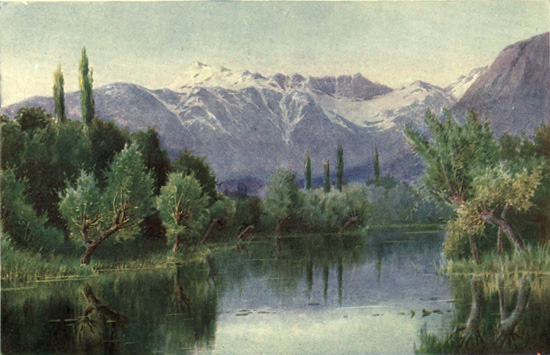
EVENING ON THE DAL LAKE
The best shawls are made from the very fine
wool, known as pashm, underlying the long hair
of the Tibetan goat, which is woven into a delicate
material called pashmina on which the shawl
patterns are worked. Some of this pashm, and
some of the best, is also imported from Chinese
Turkestan from the neighbourhood of Ush Turfan.
It so happens that I have been in this particular
region, and I well remember the rolling grassy
downs among the Tian Shan mountains on which
the nomad Kirghiz kept immense flocks of sheep
and goats. It was an ideal country for the growth
of wool, and I believe much of this beautiful wool
of which the finest shawls were made is now
allowed to run to waste.
From 1862 to 1870 the export of shawls averaged
25 to 28 lakhs of rupees per annum, or over a
quarter of a million sterling, and when the trade
was at its zenith 25,000 to 28,000 persons were
engaged in their manufacture.
Some of the best of the old shawls are preserved
in the museum at Srinagar. They show much
tasteful arrangement of colour and fineness of
workmanship; but one does not wonder that they
have gone out of fashion, and even at their best
one misses that extreme delicacy of finish denoting
strength and character in the worker which one
sees in Japanese, and more still in Chinese workmanship.
Carpets have now surpassed shawls in order of
importance, and two European firms, Messrs.
Mitchell and Co., and Mr. Hadow, have quite as
much as they can do to keep pace with the orders
they receive, of which a very large number come
from America. Many of the old weavers have
taken to carpet-making, and the pashm used
formerly for shawls is now being increasingly used
for the finer kind of carpets. The dyes are good in
Kashmir, and as the finest wool is to be had the
carpet industry ought to have a good future
before it.
Silk is another most thriving industry with
great future possibilities. The State have now
in Srinagar the largest silk factory in the world,
employing about 3300 men, and turning out
191,000 lbs. of silk last year, and in the present
year 230,939 lbs., most of which is sold as yarn
in the European market at prices varying from
14s. 10d. to 18s. 2d. per lb., and bringing in a very
handsome profit to the State. A small amount of
silk weaving is also carried on in the same factory,
and 212 handlooms have been set up, but at
present the factory is only capable of turning out
a comparatively light cloth in what is called the
green state. For throwing, dyeing, and finishing,
other machinery would be necessary, which the
State will set up in time as funds become available.
The rough cloth already made is admittedly
superior to Japanese cloth of the same weight, and
has sold in London at somewhat higher prices.
When it can be turned out dyed and finished it
should have a great sale in India, though the State
are not likely to derive the same high profits from
the woven cloth that they do from selling the yarn.
Electric power has now been supplied to the
silk factory from the great electric installation
on the Jhelum River, and is used for heating the
water in the basins in which the cocoons are
immersed for reeling. It will also be used for
turning some of the reeling machinery, and possibly
also for electrocuting the grubs in the cocoons.
Papier-mâché is a favourite artistic product of
Kashmir, and some very handsome candlesticks,
bowls, and vases, well adapted for English country
houses, may be purchased. The old designs are
especially beautiful. But nowadays very little is
made from real pulp of paper, and most of what is
sold as papier-mâché is made of smooth wood.
The silver work is poor, as it lacks finish, and
the modern designs are not especially beautiful.
But the Kashmiri workmen used to be able to
produce a peculiar sheen on the silver work which
gave it a striking and unusual appearance.
Some handsome copper work is also produced
in Srinagar, and some pretty enamel work.
But at present the fashion rather turns to wood-carving,
which has certainly much improved since
I first knew it. Very handsome screens, tables,
panels, boxes, etc., are made, and the Kashmiri
carpenter is getting to finish his work much better.
Whether the work is worth the prices asked is, I
think, doubtful. Better wood-carving can be had
in Europe for the same price.
Turning from art industries to more practical
manufactures the first to notice is basket-work.
Most villages have their artisan who makes baskets
for agricultural purposes, for carrying loads and for
rough village work. Willow trees are plentiful
and might be much more extensively grown; and
Raja Sir Amar Singh has always been keenly
interested in establishing a really important basket
industry in Kashmir, and supplying the needs not
merely of Kashmir villagers, but of India generally.
Puttoo cloth and blankets are well-known
manufactures of Kashmir. Since the Swadeshi
movement has extended in India, and the demand
for goods made in India has increased, there has
been a regular run on the rough woollen "puttoo"
of Kashmir, and the price has gone up. Formerly
a sportsman could get a good shikar suit for
eight rupees. Now he has to pay ten or twelve.
It is excellent wearing material, but is too loosely
woven and liable to get out of shape. Proposals
are on foot for establishing woollen factories in
Kashmir, and with suitable machinery and proper
supervision, good useful cloth should be made from
the excellent wool with which the country abounds.
Cotton cloth is also manufactured in the
villages, of a rough, homely description. But
whether this manufacture will ever increase to a
great extent is doubtful. A French gentleman
who has lived for many years in Bokhara, and who
visited Kashmir, told me that he considered that as
cotton was grown so successfully in Bokhara and
Russian Turkestan, it ought to grow equally well
in Kashmir. This may be so, and the State
is making experiments in cotton growing to find
a variety suitable to the country. But so far the
future of cotton manufacture cannot be considered
so assured as that of silk and wool.
Finally, among the industries of Kashmir must
be mentioned boat-building, which is indeed one of
the most important in the country. The Kashmiri
is an intelligent and clever carpenter, though in
accordance with his character he lacks accuracy
and finish. His boats are of all sizes, from the
great grain barges, carrying cargoes of thirty tons,
to State "parindas" or fliers propelled by forty
or fifty rowers, and to light skiffs for a couple of
paddlers. House-boats of quite elaborate design
are also made. And if properly supervised and
instructed, the Kashmiri should be capable of constructing
any kind of craft.
There is little iron-work in Kashmir, for iron is
not plentiful. But the Kashmiri has such natural
skill that he can turn out quite good guns and
rifles, and will make all the ordinary surgical
instruments required in the hospital.
Trade
Of these products and manufactures considerable
quantities are exported to India, and will help to
make the proposed railway pay, while this railway
on its part will help to increase the exports, for
much that cannot be taken out of the country, now
that everything has to be carried 196 miles by
road, would be exported if railway carriage were
available. Apples and pears to the extent of 90,000
maunds, or 3210 tons, are exported annually,
besides from 10,000 to 20,000 maunds of other fruit.
Rice and maize exports vary greatly according to
the demand in the Punjab. The present year was
one of scarcity in the adjoining British province,
and, consequently, the export of grain was quite
unusual—amounting to 100,000 maunds, or more
than three thousand tons; but ordinarily it does not
exceed more than about a thousand tons. The export
of ghi or clarified butter amounts to 720 tons.
Potatoes are an increasingly important export, and
the demand for them is certain to rise. Last year
750 tons were exported. Hides and skins to the
amount of some 350 tons are annually exported.
Linseed was in special demand last year owing to
the failure of crops in the Punjab, and in consequence
1740 tons, to the value of Rs. 2,61,000,
were exported; but the usual amount is only about
one-fifth of this. Silk to the value of Rs. 18,44,205
was exported last year, and this may be taken as
the normal amount. And wool and woollen goods,
to the value of about two lakhs of rupees, are also
exported, besides a few miscellaneous articles, and
some 4000 live animals, mostly sheep and goats.
In addition, from ten to twelve lakhs of rupees
worth of timber are floated down the river.
Altogether the exports from the Kashmir valley,
including timber, during the last two years have
amounted to—
| 8,83,141 maunds | = | 31,540 tons |
| 9,77,305 maunds | = | 34,957 tons |
and their value has been—
| Rs. 55,18,508 | = | £367,900 |
| Rs. 49,64,800 | = | £330,986 |
Of this amount, deducting the timber which
was floated down the river, there was exported
by road—
| 1,78,355 maunds | = | 6,370 tons |
| 3,28,027 maunds | = | 11,715 tons |
Cotton piece-goods are the chief imports into
Kashmir. Twenty-five to thirty thousand maunds
of piece-goods (895 to 1070 tons) are imported
annually, to the value of fifteen to nineteen lakhs
of rupees (£100,000 to £126,000). Some are the
coarse, but rough and well-wearing products of the
Punjab peasants, but most are the products of
Manchester, and are worn by the Srinagar and
other townspeople.
Salt is the next most important import, and now
that the Government of India has decreased the
duty on it, the quantity imported into Kashmir
is likely to steadily increase. In the last three
years the amounts imported have been 112,710,
119,803, and 201,451 maunds respectively (4025,
4280, 7194 tons), with a value of Rs. 2,81,680,
Rs. 4,83,698, and Rs. 5,01,485, or £18,778, £32,246,
and £33,432. It is sadly needed by the poorer
classes, both for themselves and for their animals,
and as yet not half enough for their real requirements
comes into the country. What is
imported comes from the salt districts of the
Punjab.
Tea is now being largely imported, which shows
that the people are acquiring a larger purchasing
power. One and a quarter million pounds of tea,
with a value of seven and a half lakhs of rupees,
or £50,000, are now imported annually.
Sugar is being imported in increasing quantities,
the amounts for the last three years being 57,931,
62,907, and 75,817 maunds respectively, or 2070,
2246, 2709 tons, with a value of Rs. 4,58,183,
Rs. 4,24,495, and Rs. 4,95,895, or £30,545, £28,305,
£33,059. The Kashmiris are very fond of sugar,
and as their condition improves the demand for
sugar and the amount of imports is sure to
increase.
Metals are another import of increasing value
and importance. 20,000 maunds are annually
imported, with a value of three lakhs of rupees, or
£20,000. At present the Kashmiris use earthenware
cooking pots, but when in time they take
to metal the import of copper must increase.
Other imports of minor importance are wearing
apparel, twist and yarns (of a value of nearly
three lakhs, or £20,000), drugs and medicines (half
a lakh of rupees), turmeric, gunny bags, leather,
liquors, petroleum, provisions, seeds (half a lakh),
manufactured silk, spices (three-quarters of a lakh),
stationery, tobacco (three lakhs), and raw wool.
The total weight of imports during the last
three years respectively has been—
| 3,35,889 maunds | = | 11,996 tons |
| 3,99,892 maunds | = | 14,281 tons |
| 4,53,202 maunds | = | 16,185 tons |
and their value has been—
| Rs. 53,88,315 | = | £359,221 |
| Rs. 57,99,785 | = | £386,652 |
| Rs. 66,08,422 | = | £440,561 |
THE ELECTRICAL SCHEME
In such a country as Kashmir, with a great river
flowing through it, and with numerous mountain
torrents and subsidiary streams running into that
river, there is obviously an immense amount of
water-power at hand. The difficulty is to make
it available for practical purposes. But this
difficulty is now being overcome by converting
the water-power into electric power, which can
then be transmitted to considerable distances and
applied in a variety of ways. The idea of thus
converting this vast amount of water-power in
Kashmir into electric power had of recent years,
since the development of electrical appliances,
naturally occurred to many; but it did not take
definite shape till the Maharaja engaged the
services of Major Alain de Lotbinière, R.E., to
carry out a scheme of harnessing the waters of
the Jhelum River which that officer had formulated,
and which has just been completed.
Major de Lotbinière, a Canadian by birth, and
endowed with a full measure of the energy,
resource and hopefulness of his countrymen, had
already executed a very successful scheme by
which the water-power in the Cauvery Falls in
Madras had been converted into electric energy,
and transmitted to a distance of a hundred miles,
to supply the Kolar gold-fields in Mysore with
motive power, at a cost 50 per cent lower than
that which they were paying for steam-power.
He had also inspected many electrical projects on
the Continent and in Canada and America. He
therefore came to the work in Kashmir in
September 1904 fully primed with the knowledge
of all the latest developments of electrical science,
and at once conceived the idea of harnessing, not
any of the minor rivers of Kashmir, but the river
Jhelum itself, and selected a spot a few miles
above Rampur where he might entrap some of
the water, lead it along the mountain-side at
practically a uniform level, till he could drop it
through pipes on to turbines—very much in the
same manner as a mill-stream is led along and
then dropped on to a water-wheel—and so by
setting in motion various machines generate
electrical energy.
The theory of the electric installation is then
very simple. The valley falls rapidly. At the part
selected it falls about 400 feet in 6½ miles. Some of
the water is taken out and kept at about the same
level so that at the end of the 6½ miles it has a fall
of 401 feet. Consequently when it is dropped those
400 feet it falls with immense force and velocity.
By most ingenious machinery this force is turned
into electrical energy, and then transmitted by wires
to wherever wanted—it is hoped even to the plains
of the Punjab, to Rawal Pindi at least.
Meanwhile the water, after fulfilling its mission,
returns into the river, and might, if need be, be
taken out again, led along the mountain-side, and
a few miles lower down dropped once more on to
another electrical installation, and generate still
more electrical energy. The same lot of water
might, in fact, go on performing the same duty
time after time till the plains of India were
reached. Then when it got on to the level, and
there was no further fall, it would be impossible
to utilise it for generating electrical energy. But
it would promptly be seized for another equally
important purpose. For it would be caught in
the great new canal which is being constructed at
the point where the Jhelum River emerges from
its mountain barriers and enters the plain; and
from that point it would be led over some hundreds
of miles to irrigate rich, but as yet uncultivated
lands, only needing the touch of life-giving water
to burst forth into luxuriant vegetation and attract
great populations to them.
The latent capacity for good of these waters of
the Jhelum, now tossing heedlessly about as they
rush along beside the road into Kashmir, is then
for practical purposes almost unlimited. Even
the present installation only takes out a small
proportion, and that portion is utilised only once.
In the driest season the Jhelum River runs with a
volume of about 5000 cubic feet per second—what
are known for short as "cusecs." But of this
amount only 500 cusecs are taken, and these 500
cusecs are utilised only once, and not several times,
as they might well be in their fall between the
valley of Kashmir and the plains of India.
With these 500 cusecs electrical energy to the
extent of 20,000 horse-power will be generated;
but Major de Lotbinière thinks that it would be
possible to economically develop an aggregate of at
least 250,000 horse-power of electrical energy from
the Jhelum River. It is not possible to take out
water and conduct it along the mountain-side at
any point. It is indeed a matter of some difficulty
to choose a site where safe headworks can be constructed
to entrap the water of the river, where
the water can be taken along the hill-side, and
where a forebay or tank can be built from which
to lead off the pipes to the generating station
below. In many parts the river runs between precipitous
banks so that it is impossible to get it out.
In others, even when it had been got out, the hill-sides
would be found so loose and unsafe it would
be impracticable to take a water-course along
them. Still, in spite of the many difficulties in the
way of making practical use of the water-power in
the Jhelum River, Major de Lotbinière still thinks
that, as above mentioned, electrical energy to the
extent of a quarter of a million horse-power could
be economically developed.
Water for the present project has been taken
out a couple of miles above Rampur at a most
charming spot, where the river comes foaming down
over innumerable boulders, and the banks are
overshadowed by the same graceful deodar trees
which clothe the mountain-sides. Here very
strong and solid masonry headworks and regulating
sluices have been built under the lee of some friendly
boulders; and elaborate precautions have been
taken to protect these headworks from the impact
of the thousands of logs which are annually floated
down the river by the Forest Department to be
caught and sold in the plains below.
From these headworks what is called a flume
has been constructed in which the water will run
along the mountain-side to the forebay or tank
immediately above the generating station. This
flume, answering to the channel which conducts
the water to a flour-mill, is to the eye absolutely
level, but it has in reality the very small drop of
1·05 feet in 1000 feet—just sufficient to make the
water run easily along it. Its length is about
6½ miles; and the main difficulty in the whole
project was found in constructing it. A road or
even a railway when it comes to an obstacle can
very likely, by a change in the gradient, rise over
it or under it. But this flume had to go straight
at any obstacle in its way, for it obviously could
not rise, and if it were lowered it could not rise
again, and so much horse-power would have been
lost at the far end. The flume, in fact, once it was
started off had to take things as it found them and
make the best of them. The first obstacle was a
great spur of boulder conglomerate. This had to
be cut down into to a depth of forty feet. An
arched masonry passage had then to be made, and
the whole covered over again. Five torrents were
negotiated by passing them clean over the flume.
Over six other torrents the flume—here made of
wood—had to be carried on strong iron bridges.
And six tunnels were made through projecting
rocky spurs. Only one-third of the 6½ miles'
length of flume could be built of masonry, and
the remainder had necessarily to be built of timber.
This portion had an internal section of 8-1/3 feet
by 8½ feet, and was constructed of tongued and
grooved, machine-planed, deodar planking 2¾ inches
thick, supported on cross frames 3½ feet apart.
The chief danger to guard against in constructing
this flume for carrying the water to the
generating station was the risk of the hill-sides
either bodily slipping downward, as they are very
apt to do in heavy rain, or falling in heavy masses
on to the wooden flume and breaking through it,
and thus completely breaking off the source of
power, and bringing all machinery to a standstill.
These risks cannot be entirely counteracted. In
heavy rain a portion of the wooden flume may be
carried away or broken. An alternative supply
of water on occasions of exceptional rain has
therefore been tapped close up to the generating
station, where a strong dam has been thrown across
the bed of a mountain torrent, and its waters
impounded to lead through a tunnel in a rocky
spur almost immediately on to the forebay. In
ordinary weather there is little water in this torrent,
but in heavy rain, when the flume is most likely
to be damaged, it has ample water.
And although there is this alternative supply,
great precautions have, nevertheless, been taken
to ensure the flume against damage, and where
slips are to be expected immensely solid timber
shoots have been erected over it for rocks or snow
and mud floods to shoot over.
On emerging from the flume the water enters
the brick-lined tank or reservoir called the forebay,
where it settles for a moment before descending
the great iron pipe which conducts it on to the
machinery in the power-house below. In this
forebay there are, of course, sluice gates to regulate
the flow, and shut it off altogether at one or all
the pipes. And there is also a spill channel for
the water to flow away to waste when it is not
wanted.
Then four hundred feet below we come to the
power-house, with all the most modern electrical
plant transported from America, and much of it
from the farthest western coast of America, across
the Atlantic and the Indian Oceans, right across
India, and then for 150 miles by road over a range
6000 feet high. The water-power made available
by the flume is capable of generating 20,000 horse-power;
but as that amount of power is not at
present required, electrical machinery to develop
not more than 5000 h.-p. has as yet been put
in, though space and all arrangements have been
provided in the power-house for machinery to
develop 15,000 h.-p. more whenever that is required.
The machinery is by the General Electric Co. of
New York, and the generators supplied are of the
three-phase 25-cycle type. The water-wheels upon
which the water from the forebay, led down the
pipes and contracted through a nozzle, impinges
with such tremendous velocity that a hatchet could
not cut the spout, are made of specially toughened
steel, and are so cunningly designed that the
utmost effect is obtained from the fall of the
water, and that immediately the water has done its
work it is allowed to pass away at once through
a waste channel back again into the river without
further impeding the machinery. These wheels
were supplied by Abner Doble of San Francisco.
They are sent revolving with immense rapidity—five
hundred revolutions per minute, or eight
every second—and they cause to revolve the
electrical generators which are placed on the same
axis, and thereby electric energy is generated. By
a series of very ingenious machines this electric
energy is regulated and conducted to the transmission
wires which are at present carried through
Baramula to Srinagar, and which will transmit
the power at the extremely high voltage of 60,000
volts from the generating station to the spot where
the power is required.
The carrying out of such an undertaking in a
remote mountainous country, where no railway has
yet penetrated and where no great industrial enterprises
have yet been established, required no small
amount of organising capacity, driving power, and
foresight. In the spring the melting snow combined
with rain, and in the summer the heavy rain
brings down the mountain-sides, impedes construction
progress, often filling up what has already been
done, and sometimes, alas! burying workmen with
it. In winter, snow and frost stopped all work.
Labour difficulties were another source of trouble.
Enough was not available on the spot, and many
hundreds were engaged from distant Baltistan and
Ladak, and even Afghanistan. Skilled labour had
to be imported from the Punjab. With contractors
other difficulties arose. They would not work
without an advance of money, and when they got
an advance many would decamp. Again cholera
created still other difficulties, and drove labour away
when it had with much persuasion been collected.
All these are no mean difficulties. They have,
however, now been overcome, and this autumn
the Maharaja, in the presence of many guests,
opened the installation and transmitted the power
to Baramula and Srinagar.
The 5000 horse-power at present available will
be utilised for carrying out Mr. Field's and Major de
Lotbinière's great scheme for dredging the bed of
the Jhelum River and neighbouring marshes, and
thus preventing floods, and for reclaiming some
60,000 acres of cultivable land. It will also be
used for heating the water basins in the silk factory
and turning the reeling machinery, as well as for
lighting Srinagar.
When the railway which has so long been contemplated
is at last constructed, more electric
power will be needed. And if the Durbar in any
way encourage outside enterprise, there will be
demand for electric power for oil-crushing, for
saw-mills, for wool factories, match factories, and
many other purposes. In any European country
or American State the whole amount of electric
power would have been already sold. Similar
rapidity of progress cannot be expected in Kashmir.
But still we may hope that now every one can see
that the electric power is there, and that it is an
eminently useful product, the demand will gradually
arise, and the financial success of the project be
worthy of the skill and enterprise displayed by the
engineers.
THE PEAKS AND MOUNTAIN RANGES
Not, indeed, from the valley itself, but from the
mountains which bound it, can be seen the second
highest mountain in the world, and a number of
peaks of 25,000 feet and over. Kashmir is cradled
amidst the very loftiest mountains, and only Nepal
can claim still higher peaks.
By a fortunate coincidence the Government of
India have this year published a remarkably interesting
scientific treatise on the high peaks and
principal mountain ranges of Asia, by Colonel
Burrard, R.E., F.R.S., the officiating Surveyor-General
of India, and H. H. Hayden, Superintendent
in the Geological Survey of India. Both
these officers have unique qualifications for the task.
Colonel Burrard has for years made a special study
of the Himalayas, and Mr. Hayden has for a great
part of his service been engaged in investigating
the geology of various districts of the Himalayas,
and he accompanied me to Tibet.
The highest peak in the world is Mount Everest,
which is taken to be 29,002 feet above sea-level,
and is situated at the back of Nepal. The second
highest is the peak K2 situated on the boundary
between the Kashmir State and Turkestan, and on
the main watershed dividing the rivers of India
from the rivers of Central Asia. It is 28,250 feet
above the sea, and is visible from Haramokh on the
northern range of Kashmir.
It may be wondered why so high a peak has no
name. The reason is that, though high, it is not
visible from any inhabited place. It is hidden
away in a remote mountain region behind other
peaks of almost as great magnitude, which being
nearer overshadow it—as Mount Everest itself is
overshadowed from Darjiling by the Kinchinjunga
range. There is no village within six days' travel
of K2 on either side, and, consequently, until it was
fixed by observation of the Survey, it was unknown.
Colonel Montgomerie, when making the survey of
Kashmir, discovered K2. It was among a series of
peaks on what is known as the Karakoram range,
and each of these he designated by the capital
letter K, after Karakoram, and by a number,
K1, K2, K3, etc. So it came about that what
proved to be the second highest mountain in the
world became known, not by any name, but by
merely a letter and a number.
In 1887, on my way from Peking to India, I
passed close under K2 on its northern side, and in
a paper read before the Royal Geographical Society
in the following year made some reference to
it. At the conclusion of my lecture, the late
General Walker and Sir Henry Rawlinson proposed
the name of Godwin Austin, after the survey officer
who made the topographical survey of the southern
portion of the Karakoram range. This name was
adopted by the Geographical Society, and now
appears on many maps. But it has never been
accepted by the Government of India, and
Colonel Burrard in his above-mentioned treatise
now writes:—"Of all the designations suggested
for the supreme peak of the Karakoram that of K2
has now the widest vogue, and it will be in the
interests of uniformity if this symbol be adopted
in future to the exclusion of all others. The
permanent adoption of the symbol K2 will serve to
record the interesting facts that a mountain exceeding
28,000 feet in height had not been deemed
worthy of a name by the people living under its
shades, and that its pre-eminent altitude was
unsuspected until it was brought to light by
trigonometrical observation."
With these observations I entirely agree.
K2 was, as I have said, discovered by Colonel
Montgomerie in 1858. He took the first observation
to it from Haramokh, the conspicuous peak
on the north side of the valley of Kashmir, at a
distance of 137 miles. I saw it first from the north
from the Aghil range which I discovered in 1887,
and I subsequently passed close under it both
then and in 1889, and never shall I forget the
impression it left on me as I rounded a spur, and
looking up a valley saw, quite unexpectedly, this
real mountain monarch towering almost immediately
above me, very abrupt and upstanding, and
with immense masses of ice accumulated at its base.
I have also seen Mount Everest from the north, and
it is remarkable that both these peaks, which are so
inconspicuous from the southern side, should stand
out so boldly from the north. K2 is not so massive
a mountain as Kinchinjunga and Nanga Parbat.
It is rather the bold culminating peak of a range.
The height of K2 is put down as 28,250 feet
above the sea. How can we be certain that this is
right? The reply is that we cannot. The observations
have been made from immense distances, and
are consequently liable to certain errors which have
been discussed by Colonel Burrard.
It was observed from the following stations:—
| Station. | Height above Sea. | Distance. |
| Shangruti | 17,531 | 78·9 |
| Biachuthusa | 16,746 | 99·0 |
| Marshala | 16,906 | 58·6 |
| Kastor | 15,983 | 66·0 |
| Thurigo | 17,246 | 61·8 |
| Haramokh | 16,001 | 136·5 |
| Kanuri-Nar | 15,437 | 114·3 |
| Barwai | 16,304 | 88 |
| Thalanka | 16,830 | 74·7 |
And apart from the errors due to distance there
are others which must always be counted on. As
he remarks, no telescope is absolutely perfect; no
level is entirely trustworthy; no instrumental
graduations are strictly exact; and no observer is
infallible. Then, again, the peaks themselves do
not always have clearly defined summits, though
K2 happens in this respect to be a model for
observation, and as it has been observed on several
occasions from different stations, the errors in the
mean value of height due to faults of observation
are, probably, in Colonel Burrard's opinion, less
than ten feet. Another source of error is the
adoption of possibly erroneous altitudes for the
stations of observation. The altitude of K2 was
observed from Haramokh and other stations, but
the altitude of Haramokh itself may be a few
feet wrong, and the altitude of K2 on this account
may be thirty feet in error. Another element of
uncertainty in determining the height of a peak is
caused by the variation in the amount of snow on
its summit. There is clearly more snow on the
summit of a peak in winter than in summer, and in
a hot, dry summer there may be less than in a
generally cloudy, snowy summer. A more complicated
description of error is introduced by the
deviation of gravity from the normal in great mountain
ranges. The attraction of the great mass of
the Himalaya mountains and of Tibet pulls all
liquids towards itself as the moon attracts the ocean.
The liquid in levels on the theodolites with which
observations of the peaks are made is similarly
affected: the plates to the theodolites in consequence
cannot be exactly adjusted, and when
apparently truly levelled are in reality tilted
upwards towards the mountains. At Kurseong,
near Darjiling, they would be as much as 51" out
of true level and at Mussouri about 37".
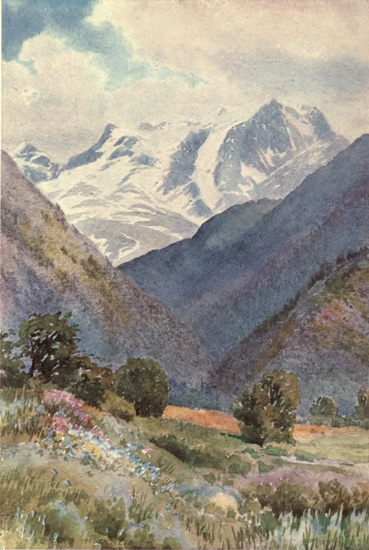
MOUNT HARAMOKH, FROM THE ERIN NULLAH
But the most serious source of uncertainty in
the measurement of the altitude of a peak is the
refraction of the atmosphere. A ray of light from
a peak to an observer's eye does not travel along
a straight line, but assumes a curved path concave
to the earth. The ray enters the observer's eye—I
quote from Colonel Burrard—in a direction
tangential to the curve at that point, and this is
the direction in which the observer sees the peak.
It makes the peak appear too high. This refraction
is greatest in the morning and evening, and least
in the middle of the day; it is different in summer
from what it is in winter. One of the great
Himalayan peaks visible from the plains of India
would appear, from observations with a theodolite
made to it from the plains, to fall 500 feet between
sunrise and the afternoon, and to rise again 300
feet before sunset; and even in the afternoon,
when it would appear lowest, it would still be too
high by perhaps 700 feet. This is obviously a
very fruitful source of error, and the difficulty of
determining the error is increased by the fact that
the curvature of the ray varies with the rarefaction
of the atmosphere. In the higher altitude, when
the rarefaction of the atmosphere increases, the ray
assumes a less curved path. All these possible
sources of error due to the rarefaction of the
atmosphere have been most carefully studied, but
even now we must allow 10 to 30 feet as possible
error due to the rarefaction of the atmosphere.
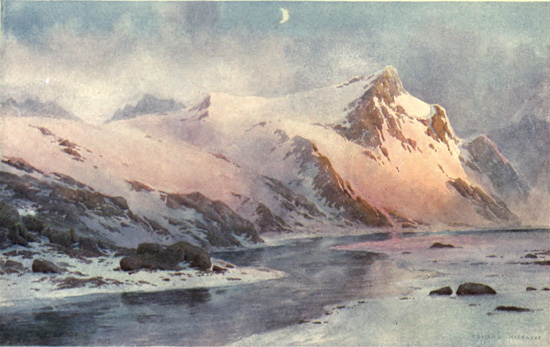
A MOUNTAIN GLEN, BEFORE THE MELTING OF THE SNOWS
Summarising the possible sources of error in
fixing the height of K2 we may say the error may
be from—
| Errors of observation | 20 ft. |
| Adoption of erroneous height for observing station | 30 ft. |
| Variation of snow-level from the mean | Unknown |
| Deviation of gravity | Unknown |
| Atmospheric refraction | 10 to 30 ft. |
K2, as I have said, though on the borders of the
Kashmir State, and visible from the range which
bounds the Kashmir valley, is not visible from the
valley itself. But Nanga Parbat can be seen
from near Baramula and from a few other parts of
the valley, and is the most striking object in the
view from Gulmarg and other points of the northward-facing
slope of the Pir Panjal. It ranks
eighth among the mountains of the world, except
K2 all the others being in the Nepal Himalayas.
The order of the mountains is:—
| | Feet. |
| Mount Everest | 29,002 |
| K2 | 28,250 |
| Kinchinjunga | 28,146 |
| Makalu | 27,790 |
| T15 | 26,867 |
| Dhaulagiri | 26,795 |
| XXX | 26,658 |
| Nanga Parbat | 26,620 |
Being more accessible than the remote K2 the
observations for its height were made at much
closer quarters, the nearest observation point being
43 miles distant instead of 61 as in the case of K2.
It was observed in all from eleven different points,
of which the most remote was 133 miles. But
until it had been measured by the Survey it had
been marked on maps as only 19,000 feet.
Colonel Burrard says it is "the most isolated
and perhaps the most imposing of all the peaks
of Asia." It certainly is remarkable for its isolation.
With the exception of subordinate pinnacles
rising from its own buttresses, no peak within 60
miles of it attains an altitude of more than 17,000
feet. Throughout a circle of 120 miles' diameter
Nanga Parbat surpasses all other summits by more
than 9000 feet. And its upper 5000 feet are precipitous.
It stands out therefore in solitary nobleness,
and it can be seen on its northern side rising
23,000 feet from the Indus, there only 3500 above
the sea. But whether it is of all mountains the
really most imposing it is not easy to say, and
personally I almost cling to Kinchinjunga.
Rakaposhi in Hunza, which is 25,550 feet in
altitude, and can be seen rising sheer up from the
Hunza River 5000 feet above sea-level, is also
wonderfully impressive. There is a peak on the
Pamirs 25,146 feet high which can be seen rising
abruptly from the plains of Turkestan, which are
but a little over 3000 feet; and there is the Musherbrum
Peak near K2 which is 25,660 feet—all of
which I have seen, and which I find it hard to place
exactly in order of relative impressiveness. But if
Nanga Parbat cannot be placed in unquestionably
the first position, it will in most men's estimation
approximate to it, and must in any case be reckoned
among the few most striking sights in the world.
Of what are these great peaks built up? No
one has yet ascended their summits, and as Mr.
Hayden points out, the geologist has to do his
work at close quarters, and not like the surveyor
from a distance. So the composition of the highest
peaks is rarely known in any detail, though the
general character of the rocks can be ascertained
with a fair approximation to certainty, from observation
of material on the flanks, and from a distant
view of the weathering character and apparent
structure of the peaks themselves. From such
observations it has been found that almost all the
peaks of 25,000 feet or more in height are composed
of granite, gneiss, and associated crystalline rocks.
It had long be supposed that some of the granites
found on the flanks of the great peaks which
presented a foliated appearance were of sedimentary
origin, and had therefore been once deposited
beneath the sea. But their truly intrusive nature
was recognised by the late Lieutenant-General
M'Mahon, who proved conclusively that the great
central gneissose rock of the Himalayas was in
reality a granite crushed and foliated by pressure.
It may certainly be taken that both K2 and Nanga
Parbat are composed of granite, and have been
intruded or compressed upward from beneath the
earth's crust.
Mr. Hayden further concludes that the exceptional
height of these great peaks is due to their
being composed of granite, for either the superior
power of the granite to resist the atmospheric
forces tending to their degradation has caused
them to stand as isolated masses above surrounding
areas of more easily eroded rocks, or they are areas
of special elevation.
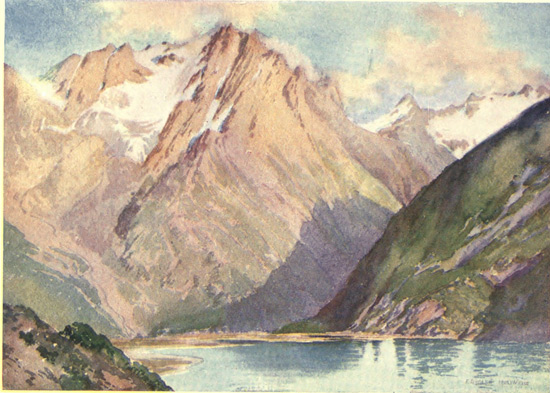
LAKE SHISHA NAG, LIDAR VALLEY
Now it is found that the axes of the great
mountain ranges are also composed of granite, and
it seems probable that special elevating forces have
been at work to raise certain parts of their ranges
above the general level of the whole. And when
once such elevation has been brought about, the
disparity between the higher peaks and the intervening
less elevated area would undoubtedly be
intensified by the destructive forces at work, for
the mantle of snow and ice, while slowly carrying
on its work of abrasion, would serve as a protection
for the peaks against the disintegrating forces of
the atmosphere, while the lower unprotected areas
would be more rapidly eroded.
So argues Mr. Hayden, who further demonstrates
that when, during the development of the
Himalayas as a mighty mountain range vast masses
of granite welled up from below, forcing their
way through and lifting up the pre-existing rocks
superimposed upon them, it is probable that, owing
to dissimilarity of composition and to structural
weaknesses in certain portions of the earth's crust,
movement was more intense at some points than
at others, and that the granite was raised into
more or less dome-like masses standing above
the general level of the growing range, and
subsequently carved by the process of erosion into
clusters of peaks.
The great peaks being thus of intrusive origin,
the question naturally arises whether they are still
being intruded upward; whether those great forces
at work beneath the surface of the earth are still
impelling them upward; and if so, whether they
are being forced upward more rapidly than the
atmospheric forces are wearing down their summits.
From the geological standpoint Mr. Hayden says
that it is not at present possible to say whether the
elevatory movement is still in progress, but he adds
that many phenomena observable in the Himalayas
lead us to infer that local elevation has until quite
recently been operative, and the numerous earthquakes
still occurring with such frequency and
violence forcibly remind us that the Himalayas
have by no means reached a period of even comparative
rest. The surveyor can as yet give us no
more certain answer. Colonel Burrard says the
original observations of the great peaks made
between 1850 and 1860 were not sufficiently prolonged
at any one station to enable us to rely with
certainty on the values of the height then obtained.
When a slow variation in height has to be determined
it is better to carry out a long series of
observations from one station only, rather than to
take a number of observations from different
stations, as is necessary and as was done in
determining the absolute height of peaks. But in
1905 the Survey of India commenced a series of
observations from one station, and it is proposed to
observe the heights of several peaks for some years
and at different seasons in each year. Then if a
reliable series of results be once obtained, a similar
set of observations can be repeated at a subsequent
date, and any actual change of height that has
occurred in the interval may be discovered.
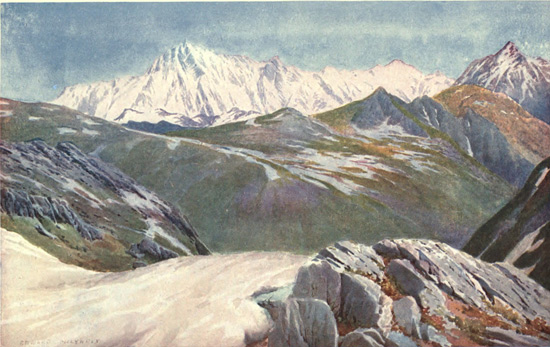
DISTANT VIEW OF NANGA PARBAT FROM THE KAMRI PASS
Until these observations are made we cannot
say for certain whether the great peaks are still
rising.
The Mountain Ranges
So far we have considered the isolated peaks
rather than the ranges themselves. It remains to
study these latter. All of them are popularly
regarded as forming part of the "Himalayas."
But Himalaya—pronounced with the stress on the
second syllable—simply means the "abode of
snow"; and geographers have had to define the
separate ranges into which this great Himalayan
region is divided. The name of the Great
Himalaya is consequently reserved for the supreme
range which extends from the western borders of
China, carries the great peaks, Mount Everest and
Kinchinjunga, and runs through Kumaon and
Kashmir to Nanga Parbat, and possibly farther.
This is the culminating range of the earth's surface.
The range to the north, on which stands K2 and
some satellite peaks of 26,000 feet, is neither so
long nor has it quite such lofty peaks. It is
known as the Karakoram range because a pass
called the Karakoram Pass crosses it. But a pass
called the Mustagh also crosses it, and Mustagh
means Ice Mountain, whereas Karakoram means
black gravel. Mustagh, therefore, appears to me
a much more appropriate name for this gigantic
range of ice-clad mountains. It so happens that I
am the only European who has crossed both passes.
Each of them is close upon 19,000 feet in altitude,
but the Karakoram, very curiously, has in summer
no snow upon it, and the route leads over black
gravel. It is a better known pass than the former,
and, consequently, the name of black gravel got the
start, and now this superb range of mountains is
doomed for all time to suffer from this absurd
nomenclature.
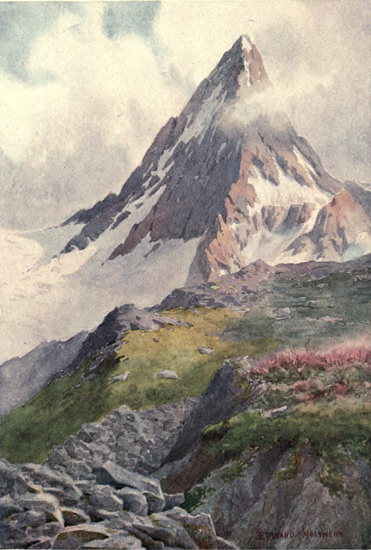
MOUNT KOLAHOI, LIDAR VALLEY
The range, however, lies far at the back of
Kashmir, and it is not so much with it as with the
true Himalaya range that we are here concerned.
The mountain ranges which encircle the valley of
Kashmir are the final prolongations of that mighty
range which runs from the borders of Burma
thirteen hundred miles away, and bifurcating at
the Sutlej River, forms with its subsidiary spurs
the cradle in which the Kashmir valley is set.
The southern branch of this bifurcation is
known as the Pir Panjal range, and is that which
bounds Kashmir on the south. It is the largest
of all the lesser Himalayan ranges, and even at its
extremity in Kashmir it carries many peaks exceeding
15,000 feet; the Tatakuti Peak, 30 miles
south-west of Srinagar, 15,524 feet in height, being
the most conspicuous.
The northern branch of the bifurcation at the
Sutlej River of the great Himalayan range culminates
in the Nun Kun peaks (23,410 feet and 23,250
feet), which stand conspicuously 3000 feet above
the general crest of the range, and can be seen on
clear days from Gulmarg. From near them, not far
from the Zoji-la, an oblique range branches from the
great Himalayan range, and constitutes the parting
between the Jhelum River and the Kishenganga,
the latter river draining the angle formed by the
bifurcation. The height of this North Kashmir
range, as Colonel Burrard calls it, is greatest near
the point of bifurcation, one of its peaks, Haramokh
(16,890 feet), reaching above the snow-line, and being
the most conspicuous object which meets the eye
of a traveller entering the valley from the south.
Farther westward the range ramifies and declines.
The main line of the great range of the
Himalayas has meanwhile continued from the
remarkable depression at the Zoji Pass along by
the Kamri Pass, to the immense mountain buttress
of Nanga Parbat which, overhanging the deep
defiles of the Indus, seems to form a fitting end to
the mighty range which started on the confines of
China. But there are great mountains beyond the
Indus also, and whether these form a continuation
of the great Himalayan axis which the river Indus
would in that case have merely cut through in
the gorges below Nanga Parbat, or whether the
mountains west of the Indus are part of a separate
range, we shall not know till these latter have been
geologically examined.
THE STORY OF THE MOUNTAINS
How these peaks and mountain ranges arose is a
fascinating and impressive study. It has been
made by Mr. Hayden, who, in the fourth part
of the scientific memoir quoted in the previous
chapter, has compiled their history from his own
personal investigations and the accounts of his
fellow-observers in the Geological Survey of India.
And surely a scientific man could have no more
inspiring task than the unravelling of the past
history of the mighty Himalaya. Here we have
clue after clue traced down, the meaning of each
extracted, and the broad general outline of the
mountain's story told in all its grand impressiveness,
till one sees the earth pulsating like a living
being, rising and subsiding, and rising again, now
sinking inward till the sea flows over the depression,
then rising into continental areas, anon subsiding
again beneath the waters, and finally, under
titanic lateral pressure and crustal compression,
corrugating into mighty folds, while vast masses
of granite well up from below, force their way
through, lift up the pre-existing rocks and toss
themselves upward into the final climax of the
great peaks which distinguish the Himalaya from
every other range of mountains in the world.
For millions of years a perpetual struggle has
been going on between the inherent earth forces
pressing upward and the opposing forces of denudation
wearing away the surface. Sometimes the
internal forces are in commotion, or the contracting
crust of the earth finds some weak spot and
crumples upward, and the mountains win. A
period of internal quiescence follows, and the rain
and snow, the frost and heat, gain the victory, and
wear down the proudest mountains—as they have
worn away the snowy glacier mountains which
once stood in Rajputana.
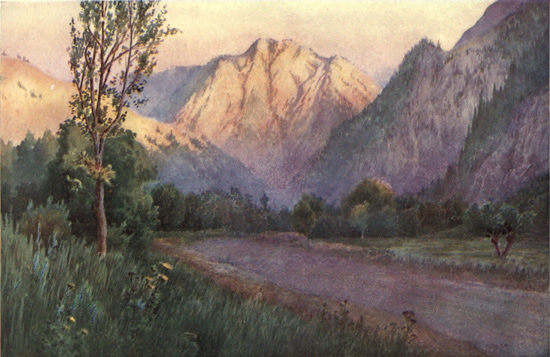
RAMPUR, JHELUM VALLEY ROAD
Of all this wonderful past the mountains themselves
bear irrefutable evidence. Near Rampur,
on the road into Kashmir, are bold cliffs of limestone,
a rock which is merely the accumulation of
the relics of generations of minute marine shell-fishes.
These cliffs, now upturned to almost the
perpendicular, must once have lain flat beneath the
surface of the ocean. High up in the Sind valley,
embedded in the rocks, are fossil oysters, showing
that they too must once have lain beneath the sea.
More telling still at Zewan, a few miles east of
Srinagar, are fossils of land plants immediately
below strata of rocks containing fossils of marine
animals and plants, from which may be concluded
that the land subsided under the sea, and was
afterwards thrust up again. Again, an examination
of the rocks on the Takht-i-Suliman shows that
they are merely dried lava, and must have had a
volcanic origin—perhaps beneath the sea. And an
investigation of the rocks on the flanks of Nanga
Parbat has shown that they are of granite which
must have been intruded from the interior of the
earth.
Everywhere there is evidence that even K2 and
Nanga Parbat lay beneath the sea, and that where
now are mountains once rolled the ocean; that
some once lay in soft, flat layers of mud or sand,
or plant and shell deposit on the ocean bottom,
while others, as the ocean bottom was upraised
above the waters, were obtruded through them;
and that everywhere there has been an immense
pressing and crumpling of the earth's crust—a
rising and subsiding, a throbbing and pulsation,
which at one time has brought Kashmir in direct
contact by land with Madagascar and South
Africa, and at another has brought it into through
communication by sea with both America and
Europe; and which, finally, has projected it upward
thousands of feet into the air. The evidence,
moreover, shows that millions of years have passed
while these titanic movements have been working
out their marvellous results.
Who can but be impressed by such ages and
such forces? Who that looks on those lovely
Kashmir mountains, and on the mighty peaks
which rise behind, and has learnt their long eventful
history, can help being impressed by the immensity
of time their structure betokens, by the
magnitude of the movements unceasingly at work
within, and by the dignity with which they yet
present a front so impassive and so sublime?
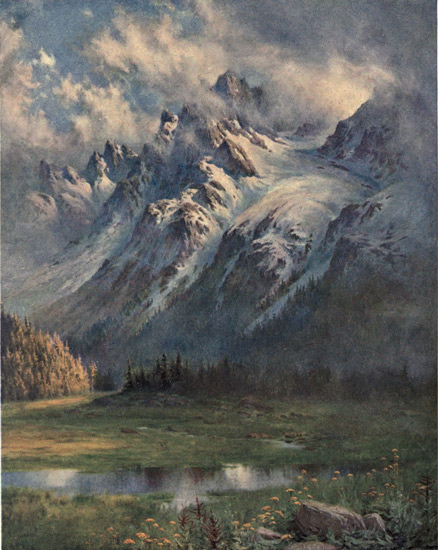
IN THE SIND VALLEY
To realise the full, long-measured roll of their
majestic evolution we should have to go back to
the time when the swift revolving sun—itself one
only among a hundred million other stars of no
less magnitude—swished off from its circumference
the wreath of fiery mist now called the Earth;
and we should have to trace that mist, cooling
and consolidating, first to a molten mass with a
plastic crust enveloped in a dense and watery
atmosphere, and then to a hardened surface of
dry land with cavities in which the ocean settled.
But the story, as it is with more detailed accuracy
known, commences at the time when a shallow
sea covered central and northern India, and extended
over the site of the present Himalaya,
including Kashmir and the region of the mighty
peaks behind. This, then, is the first essential fact
to lay hold of, that at the commencement of the
authentic history of Kashmir, the whole—vale and
mountain peak alike—lay unborn beneath the sea.
How long ago this was it is not possible to say
within a million years or so. But this much may
be said with certainty, that the period is to be
reckoned not in thousands, nor yet in hundreds
of thousands, but in millions of years. Geologists
have names for different geological epochs, and do
not usually speak of them by definite numbers of
years, for there is still much controversy as to the
precise length of time occupied by each. But to
fix in the mind of the general reader a rough idea
of the immense periods of time with which we are
dealing in tracing the history of the mountains, it
is useful to speak in terms of numbers, even
though they may be only very approximately
correct. We may then assume that the oldest
rocks in Kashmir were deposited in sediment at
the bottom of the afore-mentioned shallow sea a
hundred million years ago. Some geologists and
biologists think that a still longer time must have
elapsed. Some physicists would maintain that
even so much is not allowable. But as an average
opinion, we may take a hundred million years ago
as the commencement of Kashmir history.
What were the limits of the sea which then
rolled over the site of Kashmir is not yet precisely
known. But the lower portion of the Indian
peninsula was then dry land, and connected by
land with Africa; and the sea probably extended
westward to Europe and eastward to China.
Into it the rivers bore down the debris and detritus
worked off by the rain from the dry land; and
thus were slowly deposited, in the long course
of many million years, sediments hundreds and
thousands of feet in thickness which, subsequently
upheaved and hardened, form the Kashmir mountains
of the present day.
The first great movement of which authentic
record has yet been traced took place at the close
of the Jaunsar period. The bosom of the earth
heaved restlessly, and what had already been
deposited in the depths of the sea now emerged
above the surface. Volcanoes burst through the
crust, and the sedimentary deposits, hardened into
rock, were covered with sheets of lava and volcanic
ash, which now form the hills at the back of
Srinagar, including the Takht-i-Suliman.
This was Kashmir's first appearance—not, however,
in the form of a beautiful valley surrounded by
forests and snow-capped mountains, but rather in
the form of an archipelago of bare volcanic islands.
And even these were not permanent, for a period
of general subsidence followed and they slowly
sank beneath the sea which was then probably
connected with America.
During the Devonian period Kashmir was still
submerged; but in a subsequent portion of the time
when the Carbonaceous system was being deposited
there was a second period of great volcanic activity,
when the southern portion of Kashmir again formed
an archipelago of volcanic islands.
Eventually all Kashmir emerged, and became
part of the mainland of India at that time joined
with Africa; so that Kashmir which had before
been joined by sea with America was now joined
by land with Africa. Such are the mighty movements
of this seemingly immovable earth.
But it was only for a brief space that Kashmir
was visible. Then once again, in mid-Carboniferous
times, it subsided beneath the sea, there to remain
for some millions of years till the early Tertiary
period, four million years ago, when it again
emerged, and the sea was gradually pushed back
from Tibet and the adjacent Himalaya, till by the
end of the Eocene period both Tibet and the whole
Himalaya had finally become dry land. Kashmir
was now a portion of the continental area and the
culminating effort of the earth forces was at hand.
For yet another period of great volcanic activity
ensued, connected, perhaps, with the crustal disturbances
to which the origin of the Himalaya is
attributed. Masses of molten granite were extruded
from beneath the earth's surface through the sedimentary
deposit. And these granitic masses,
issuing from the fiery interior of the earth, pushing
ever upward, reached and passed the level of
eternal snow till they finally settled into the line
of matchless peaks now known as the Himalaya.
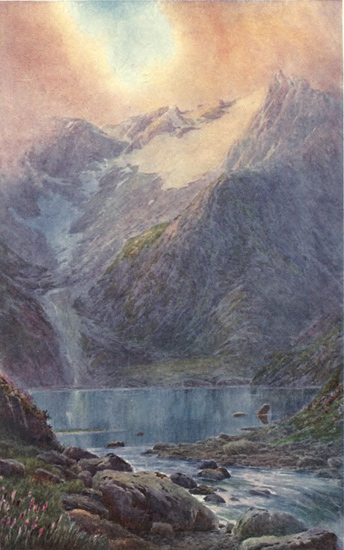
LAKE SHISHA NAG AT SUNSET
This then, briefly, is a record of the successive
phases of upheaval and subsidence through which
Kashmir has passed. Through by far the greater
portion of the earth's history—through perhaps
ninety out of the hundred million years—Kashmir
has lain beneath the sea. And it is only within
the last four million years that it has finally
emerged.
What has actually caused the final upheaval;
from whence came the force which raised the
mountains is not yet entirely known. One well-known
theory is that the earth's crust in cooling
has to accommodate itself to a constantly decreasing
diameter, and so gets crinkled and crumpled into
folds. Anyhow from whatever cause, and quite
apart from the ordinary up-and-down movements of
the crust, there has evidently been immense lateral
pressure, and on the drive into Kashmir many instances
may be observed of the once level strata
being crumpled into folds as the leaves of a book
might be on being laterally pressed. There has
been, says Mr. Middlemiss, "a steadily acting lateral
pressure of the earth's crust tending to bank it up
against the central crystalline zone [that is the core
of intrusive granite of which the line of great peaks
is formed] by a movement and a resistance in two
opposite directions." And besides this pressure, the
effect of tangential stresses tending to compress the
earth's surface laterally and so form corrugations on
it, there was from some remote internal cause this
welling up from below of vast masses of granite
which forced their way through the pre-existing
rocks and formed the high peaks, the core of the
Himalayan ranges.
These were the approximate causes—though the
ultimate causes are not known—from which the
Kashmir mountains originated. And tremendous
though the forces must have been to cause such
mighty effects, there is no evidence that they were
violent. The stupendous result may have been
imperceptibly attained. If Nanga Parbat rose not
more than one inch in a month, it would have taken
only 26,600 years to rise from the sea-level, and this
is but a moment in the vast epochs with which we
are dealing. Nature has worked without haste and
without violence. Slowly, relentlessly, and uninterruptedly
her work has progressed till the great
final result stands before us in all its impressive
majesty.
Such was the origin and history of the Kashmir
mountains. It remains to trace the course of life
upon them, and picture their appearance in the
various stages of their history.
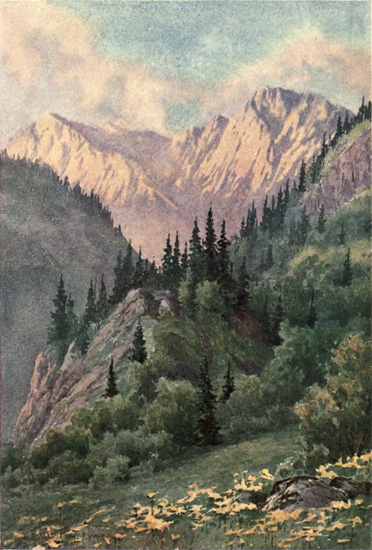
THE TANNIN GLEN, LIDAR VALLEY
In that remote time, which we have roughly
taken as a hundred million years ago, when the
oldest rocks, those for instance at Gulmarg, were
first laid down in level soft deposit on the ocean
bottom, there was no life on land or sea. In no
part of the world have the rocks of this period
given the slightest trace of any form of life. But
in the course of time, in some warm climate and in
some quarter where sea and land meet, and where,
through the action of the tides, a portion of the
land is alternately covered and laid open to the
sunshine—that is, in some spot where earth and air,
light, heat and water might all have their effect—it
has been surmised that minute microscopic specks
of slime must have appeared imbued with just that
mysterious element which distinguishes life from
all chemical combinations however complex.
Of this initial stage, which would not have been
perceptible to the naked eye, no trace could
possibly be left, but in the pre-Cambrian rocks in
Europe there have been detected very minute
specimens of the simplest known forms of life—the
Protozoa—and obscure tracks and markings
indicating the existence of life of some kind. And
in the next geological period—the Cambrian and
Silurian, say between thirty and fifty million years
ago—there is not indeed in the Kashmir rocks yet
any sign of life, but in the neighbouring district
of Spiti there has been found in corresponding
rocks fossils of corals, trilobites, shell-fish, worms,
brachiopods (lamp-shells), and gastropods.
When Kashmir made its first brief emergence
from the waters, in an archipelago of volcanic
islands, though there was life of low and simple
kind in the sea, on land there was none, and the
islands must have been absolutely bare. Neither
on hill-side nor on plain was there a speck of
vegetation, not even the humblest moss or
lichen, and not a sign of animal life. No bird
or insect floated in the air. And over all there
must have reigned a silence such as I remember
in the Gobi Desert, and which was so felt that
when after many weeks I arrived at an oasis, the
twittering of the birds and the humming of the
insects appeared as an incessant roar.
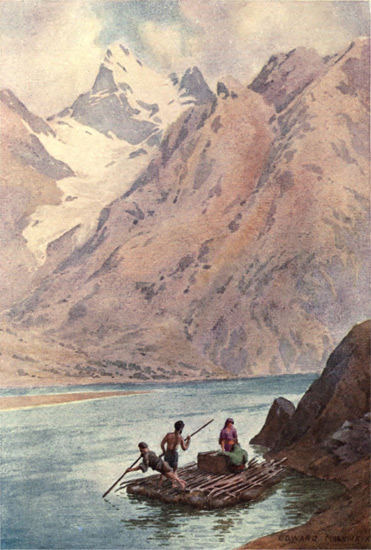
GOING TO THE WEDDING, UPPER INDUS VALLEY
It does not, however, follow from its bareness
that the scenery of this archipelago may not have
been beautiful, for those who have frequently
passed up the Gulf of Suez know that the early
morning and evening effects on bare deserts and
rocky hills are often the most perfect in the
delicacy and brilliance of their opalescent hues,
and that the combination of this colouring with the
bluey-green and the life and sparkle of the sea
makes up a beauty which wooded mountain-sides
may often lack. And as from the islands
the summits of snowy ranges in India and Central
Asia might be discerned, Kashmir even in its
primitive and most barren stage must yet have
had many a charm of its own.
But the bareness of the islands must have
shortened the term of their existence, for it meant
that the hills and plains were easily scoured out by
the torrential rains which then fell upon them. It
seems difficult in these days to imagine that when
tropical rains fall on barren land they will not at
once bring up a luxuriant crop of vegetation which
would do much to keep the soil in its position;
but in those days there was on land no plant life of
any description. The hills and plains must, in consequence,
have been deeply scoured, and rushing
rivers have rapidly carried, in sand and boulders
and muddy and chemical solution, the disintegrated
surface of the land to the bottom of the sea, and
laid down there the sediments and deposits which,
subsequently upheaved, form the Kashmir rocks
of the present day.
It is not until we come to the almost mediæval
period corresponding to the Coal Measures, about
twenty million years ago, that the record of land
life in Kashmir begins.
In the hill-sides behind Khunmu, a little village
about ten miles east of Srinagar, there is a series of
rocks lying in layers over the older "trap" rocks of
volcanic origin which form the great bulk of the
neighbouring mountains, and in these sedimentary
rocks, in what are called carbonaceous shales, are
found some ferns named gangamopteris. They
were discovered in 1906 by Mr. Hayden, and they
are estimated by him to be "not younger than
Upper Carboniferous," and they "may belong
to the basis of that subdivision, or even to the
Middle Carboniferous," that is, they may be
about fifteen to eighteen million years old. At
the same place, but on a layer of later date,
have also been found fossil brachiopods—marine
shell-fish resembling cockles—also of Upper
Carboniferous times.
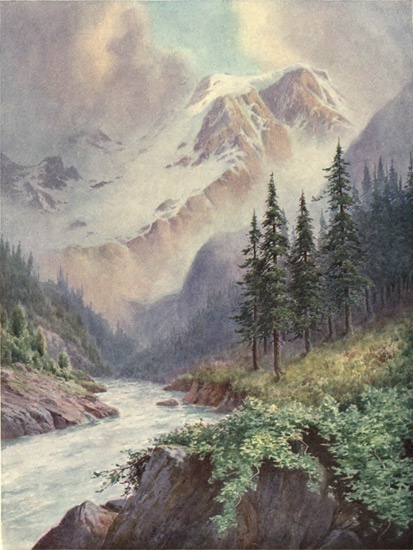
MOUNTAIN MISTS
This, as it happens, was an interesting period in
the earth's history. For there occurred about then,
or somewhat earlier, an extensive upheaval in
many parts of the world, and mountains which
have been now removed were upheaved to an
altitude comparable with that of the highest ranges
of the present day, and in the Punjab there then
existed a snowy range with glaciers.
It was at this period that Kashmir was joined
with the mainland of the Indian peninsula, which
in its turn was joined with Africa, and now, at
least, there must have been some vegetation and
animal life. At this time of the Coal Measures—the
remnants of forests growing in shallow
sea-water—life was well advanced. Birds and
mammals and flowers, and the more highly developed
animals and plants had not yet appeared,
but in the sea lived such things as star-fishes,
shell-fishes, corals, sea-urchins, sea-lilies, sea-cucumbers,
feather stars, sea-worms, sea-snails,
cuttlefish, water-fleas and mussels, shrimps, and
lobsters and fishes. In the coal swamps were
ferns, "horse-tails" similar to the horse-tails of the
present day, but of gigantic size, club mosses more
than fifty feet high, lycopods, trees with trunks
fifty feet high, and which bore catkins ripening into
berries not unlike those of yews. In the fresh water
were some shell-fishes, crustaceans, and fishes. On
land were spiders, scorpions, some of gigantic size,
and centipedes. Through the air flew hundreds of
different kinds of insects, May flies, cockroaches,
crickets, and beetles. The magnate of the vertebrate
world was the labyrinthodont (traces of which have
been found in Kashmir), which had a salamander-like
body, a long tail, bony plates to protect his head,
and armour of integumentary scales to protect his
body. Of land trees and plants there were lepidodendrons
with huge stems clad with linear leaves
and bearing cones; huge club mosses, climbing
palms, such as grow in tropical forests of the
present day, great funguses, and numerous ferns.
Such was the type of vegetation and of land
and sea animal life of the Coal period, and although
not many remains of this age have yet been found
in Kashmir, enough traces have been discovered to
satisfy us that in the shallow estuarial water and
on the islands of the inland sea there lived an
animal and vegetable life which must have been
very similar to what we know existed elsewhere.
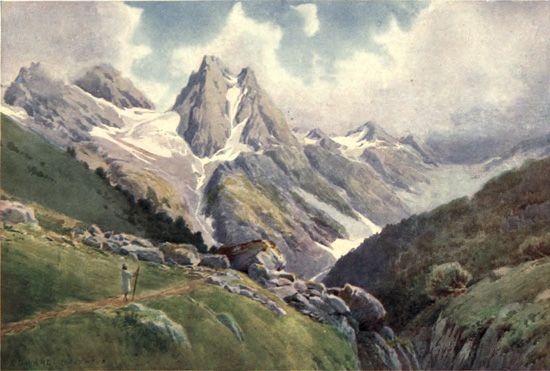
NEAR THE KOLAHOI GLACIER, LIDAR VALLEY
For another fourteen million years or so after
the Coal period there is nothing special to record
in the history of Kashmir. There may have been
a line of islands along the core of the present
ranges, but the greater part of Kashmir had sunk
once more beneath the waters, in which new
sediments to enormous thickness were being
accumulated, till in the late Cretaceous period, or
about four million years ago, the great crustal
compression began which finally upheaved these
deposits from the ocean bottom, and formed the
Kashmir of the present day. This upheaval was,
however, neither sudden nor continuous. It was
very gradual, it had three distinct phases, and
was not complete till a million years ago when
the dividing ocean entirely disappeared, and the
Himalaya reached its maximum height.
And now at this period of upheaval—the
Tertiary period of geologists—a great change had
come in the animal and vegetable worlds. Man
had not arisen even yet, but birds and mammals
and flowers, and all kinds of trees were now
developed; and this marked the threshold of the
modern type of life. The ages when the great
ferns and palms and yew-like conifers were the
leading forms of vegetation had passed away,
and the period of the hard-wood trees and evergreens
had commenced. The great reptiles, too,
which in such wonderful variety of type were the
dominant animals of the earth's surface in the
period following the Carboniferous now waned
before the increase of the mammals.
At the commencement of the Tertiary period
there grew cypress, sequoiæ (Wellingtonia and
redwood trees), chestnuts, beeches, elms, poplars,
hornbeam, willows, figs, planes, maples, aloes,
magnolia, eucalyptus, plums, almonds and alders,
laurels, yews, palms, cactus, smilax, lotus, lilies,
ferns, etc. Later on appeared cedars, spurge
laurel, evergreen oak, buckthorn, walnut, sumachs,
myrtle, mimosa and acacia, birch, hickory, bamboos,
rose laurel, tulip trees; and among flowers buttercups,
marsh marigolds, chick-weed, mare's tail, dock,
sorrel, pond-weed, cotton-grass, and royal ferns.
Traces of all these trees and plants have not been
found in Kashmir, but remains of a great many
of them have been discovered, and, as it was linked
on with Europe where they have been found, there
is no doubt that they and the animals now to be
described must have grown in the varying altitudes
of the now upraised mountains.
This period, as we have seen, is particularly
remarkable for the advent of mammals, and there
now appeared the earliest representative of the
tribe of monkeys; the ancestors of the horse, about
the size of small ponies with three toes on each
foot; herds of ancestral hornless deer and antelope;
animals allied to our wolves; foxes; numerous
hog-like and large tapir-like animals, some the
size of elephants with the habit of a rhinoceros;
opossums; and representatives of hedgehogs,
squirrels, and bats. The reptiles included tortoises
and turtles, crocodiles and serpents. Birds had
also for some time past developed from reptiles,
and now included a kind of albatross and birds
allied to the buzzard, osprey, hawk, nuthatch,
quail, pelican, ibis, and flamingo.
Later in the same period appeared parroquets,
trogons, cranes, eagles, and grouse. And now was
the reign of the hippopotamus, while there followed
rhinoceros, shrew, moles, and musk rats. Later
still the huge animals with probosces held the
first place—the colossal mastodons and troops of
elephants. The forests were also tenanted with
apes. Other animals were sabre-toothed tigers
and the earliest form of bear. Altogether Kashmir
would at the time have been a paradise for sportsmen.
But man had not yet appeared.
After the mountains had been finally upheaved
it is evident, from the existence of those level
plateaux of recent alluvial deposit called karewas,
that the Kashmir valley must have been filled
with a lake to some hundreds of feet higher than
the present valley bottom. Where the Jhelum
River at present escapes from the valley was then
blocked up, and the whole valley filled with what
must have been the most lovely lake in the world—twice
the length and three times the width of
the Lake of Geneva, and completely encircled by
snowy mountains as high and higher than
Mont Blanc; while in the immediately following
glacial period mighty glaciers came wending down
the Sind, Lidar, and other valleys, even to the
very edge of the water.
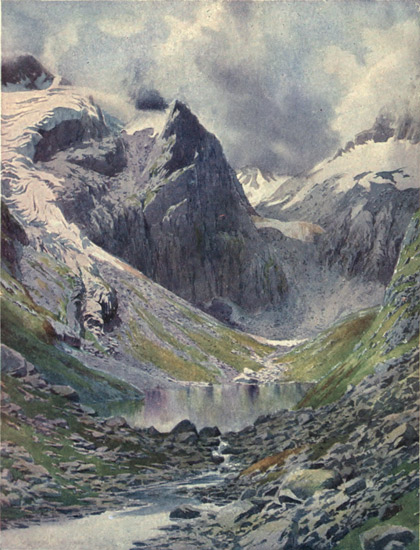
LAKE SINSA NAG, LIDAR VALLEY
Whether man ever saw this lovely lake it is
not yet possible to say. The Glacial period commenced
rather more than a quarter of a million
years ago, and it was about then that man first
appeared, among other places, in the great river
valleys of central and southern India, where the
climate is not extreme, and wild fruits, berries,
etc., were procurable at every season of the year.
But when he spread up the valley of the Jhelum
to Kashmir we have not yet the means of saying.
What appear to be some remains of the handiwork
of man were recently found by Mr. Radcliffe in a
cave in the Lolab, near the borders of the Wular
Lake, and seem to indicate the presence of man
long anterior to the first dawn of Kashmir history.
But the dawn of Kashmir history is only 2200
years ago, and man must have appeared 250,000
years before that. For thousands of years he must
have been bravely battling against Nature and
against the numerous and powerful animals which
then lorded the earth. Slowly he must have made
his way from the warm valleys of the Nerbudda
and the Ganges to the rivers of the Punjab, and
up the Jhelum valley into Kashmir. But he
eventually established himself there as the beautiful
lake was almost drained away and the Kashmir of
the present day was finally evolved.
So we bring up the history of the mountains till
it joins with the history of the people; and as the
story finishes, does not one great thought emerge—the
thought of the youth, the recentness of man
alongside the hoary mountains? During the one
hundred million years of the mountains' history
mankind has existed only a quarter of a million;
and his recorded history extends over not even a
hundredth part of a single million years. And if
we reflect on this, and consider, too, that the sun's
heat will last to render life possible for many
millions of years yet, does it not seem almost
criminally childish for us—Hindus, Christians, and
Mohamedans alike—to be so continually and incessantly
looking backward to great and holy men
of the past, as if all the best were necessarily
behind, instead of sometimes looking forward to
the even greater men to come—to the higher
species of men who will yet evolve; of whom our
holiest and our greatest are only the forerunners;
and for the production of whom it should be our
highest duty to consciously and of purpose pave
the way, as the poor primitive men, though unconsciously,
prepared the ground for the civilised men
of to-day? Ought we not to more accurately
adjust our sense of proportion; to rise above the
ant-like attitude of mind, and attune our thoughts
to the breadth and height of the mountains, to the
purity of their snowy summits, and to the depth
and clearness of the liquid skies they almost touch?
To some the sight of these mountain masses,
the thought of the tremendous forces which gave
them rise, and the idea of the aeons of time their
moulding has involved, brings no other feeling
than depression. The size, the titanic nature of
the forces and the vastness of the time impress
them only with a sense of the littleness of man in
comparison. But why should the mountains thus
depress? Why should not their history bring us
the more worthy thought of the mighty possibilities
of the race? For man, small in stature though he
may be, is after all the flower and finish of the
evolutionary process so far; he is century by century
acquiring a completer mastery over Nature;
and when we see how young and recent he is beside
the aged mountains, when we realise how they
have only evolved by minute gradations accumulating
over vast periods of time, and when we reflect
that nearly similar periods may yet lie before mankind,
should not our thoughts dwell rather on
man's future greatness and on the mighty destiny
which he himself may shape?
With our imagination tethered to the hard-rock
fact that man has developed from a savage to a
Plato and a Shakespeare, from the inventor of the
stone-axe to the inventor of telegraphy in the
paltry quarter million years of his existence, may
we not safely give it rope to wander out into the
boundless future? We are still but children. We
may be only as young bees, crawling over the
combs of a hive, who have not yet found their
wings to fly out into the sun-lit world beyond.
Even now we suspect ourselves of possessing wing-like
faculties of the mind whose use we do not
know, and to which we are as yet afraid to trust.
But the period of our infancy is over. The time to
let ourselves go is approaching. Should we not
look confidently out into the future and nerve ourselves
for bold, unfettered flight?
And may we not still further hope that in the
many million years the earth may yet exist we
may master the depressing fate which lies before
us when the sun's heat is expended; and look
forward to evolving from ourselves beings of a
higher order who will be independent of the used-up
planet which gave them birth, and may be
swarm away to some far, other sun-lit home?
- Abbotabad, 57
- Achibal, 60, 116, 123
- Administration, 183
- Afghanistan, 138, 232
- Afghans, 159, 176
- Africa, 258, 265
- Aghil range, 237
- Agra, Taj at, 157
- Aishmakam, 210
- Ajit Singh, 166
- Akbar, 142, 157
- Alexander the Great, 139
- Alfred, King, 143
- Aliwal, 168
- Almonds, 199
- Amar Singh, Raja Sir, 68, 69, 118, 184, 215
- Amaranth, 202
- Amarnath, caves of, 60, 113, 114
- America, 257, 258
- Aparwat, 106
- Apples, 196, 217
- Apricots, 96, 176, 199, 202
- Archæological Department Survey, 81
- Arts, 210
- Aru, 113, 123
- Asia, Central, 61, 143, 263
- Asoka, the Buddhist king, 33, 75, 138, 139, 140
- Astor, 62, 120, 121
- Austin, Godwin, 236
- Autumn in Kashmir, 36, 38
- Avantipur, 135
- Avantipura, 145
- Avantivarman, 145, 146
- Awatkula, 111
- Baber, Emperor, 211
- Badakhshan, 143
- Badwan, 123
- Baltistan, 3, 50, 61, 109, 120, 121, 164, 184, 232
- Bandipur, 61, 62
- Banihal Pass, 17
- Baramula, 5, 6, 57, 69, 104, 124, 146, 183, 206, 231, 232, 241
- Bara-singh. See "Kashmir stag."
- Barley, 200, 205
- Barstow, Captain, 120
- Basket work, 215
- Bauxite, 210
- Bawan, 112
- Beans, white, 201
- Beas river, 169
- Bedford, Duke of, 122
- Bengal, 138
- Beoru, 123
- Bernier, 1, 2, 158
- Bijbehara, 60, 111, 112
- Birches, 206
- Biscoe's School, Mr., 72
- Blue pine, 206
- Boat-building, 216
- Boatmen, 132
- Bodhisattva, 141
- Bokhara, 216
- Bombay, 196
- Brahminism, 139
- Brahministic Hinduism, 141
- Brahmins, 112, 149, 156
- British Government, 168, 169, 170, 173, 182, 183, 184, 210
- Buckwheat, 201
- Buddha, 135
- Buddhism, 139, 140, 141
- Buddhist monasteries, 61
- Bulbuls, 7
- Bullock carts, 56
- "Bund," 69, 70
- Buniar, 134
- Burbank, Mr. Luther, 94
- Burma, 249
- Burrard, Colonel, 234, 236, 238, 240, 242, 246, 250
- Burzil, 123
- Butter, clarified, 201, 218
- Calcutta, 31, 44, 196
- Cambrian period, 262
- Carbonaceous system, 257
- Carboniferous period, 268
- Carpets, 212
- Cashmere, 171
- Cauvery Falls, 223
- Chamba, 163, 170
- Charlemagne, 143
- Chenab river, 208
- Chenar, trees, 6, 19, 20, 23, 27, 28, 29, 32, 34, 36, 37, 43, 60, 65, 66, 70, 76, 79, 80, 82, 83, 84, 85, 87, 89, 92, 97, 112, 116, 208, 209
- Chenars, Isle of, 29, 78
- China, 250
- Chitral, 164, 155, 175
- Cholera, 232
- Christians, 272
- Clarified butter. See "Butter"
- Coal Measures, 264, 265
- Coal period, 266
- Columbines, 93
- Copper, 210, 220
- Cornwallis, Lord, 191
- Cotton, 202, 205
- Cretaceous period, late, 267
- Customs, the (source of revenue), 184, 187
- Dabgarh, 203
- Dachigam stream, 26, 123, 124
- Dak bungalows, 31, 56, 57
- Dal Darwaza lock, the, 75, 78
- Dal Lake, 20, 28, 29, 32, 59, 74, 75, 79, 81, 82, 132, 141, 159, 198, 203, 209
- Danjhibhoy, 47
- Darjiling, 3, 102, 235, 239
- Dauvergne, M., 211
- Deccan, 138
- Decentralisation, Royal Commission on, 46
- Deodar forest, 116, 206
- Devonian period, 257
- Dhulip Singh, 166, 167
- Dhyan Singh, 164, 166
- Dogra country, 163
- Downes, Dr., 73
- Dragon-flies, 39, 40
- Drew, Mr., 174
- Duck shooting, 16, 39, 41, 121
- Dundee Chamber of Commerce, 204
- Dunga-boats, 57, 58
- Durbar, 54, 175, 233
- East India Company, 172
- Edwards, Colonel, 41, 121
- Egypt, 139
- Egyptian temples, 115
- Electric installation, 214
- Electrical Department, 185
- Elizabeth, Queen, 157
- Elm tree, 209
- Elsmie, Dr., 73
- Enamel work, 214
- Engineer, Chief, 185
- Eocene period, 258
- Erin, 123
- Everest, Mount, 235, 237, 248
- Ferozepur nulla, 105
- Ferozepore fort, 167
- Ferozeshah, 168
- Field, Mr., 232
- Fir, silver, 206
- Flax, Russian, 204
- Forest Department, 184, 207, 227
- Forests, 206
- Forests, Conservator of, 185
- Food grains, 199
- Fowls, 49
- Fruit, 196
- Game Preservation Department, 118, 121
- Ganderbal, 60, 108
- Gandhara, 115
- Gangabal Lake, 60, 110, 123
- Ganges, the, 144, 271
- Gap, the, 28, 29
- Garuda, 86
- Ghi, 201, 218
- Gilgit, 62, 184
- Gobi Desert, 262
- Gold-washings, 210
- Gopaditya, 74
- Gorai, 123
- Govardhanadhara, temple to the god, 86
- Græco-Buddhist art, 139
- Grain, 49, 199
- Grapes, 198
- "Greater Vehicle of the Law," 141
- Greece, 133, 137, 139
- Gujars, 113
- Gulab Singh, Raja, 160, 162, 163, 164, 166, 167, 168, 169, 170, 171, 172, 173, 174, 177
- Gulmarg, 12, 17, 34, 98, 109, 114, 206, 241, 249, 260
- Gupkar, 28, 70
- Gupta period, 115
- Gurais, 34, 62, 183
- Hanji (boatmen), 132
- Haramokh peak, 6, 17, 18, 28, 30, 61, 85, 110, 235, 237, 239, 250
- Hardinge, Governor-General, Lord, 168, 171
- Hari Parbat fort, 20, 32, 157
- Harsa, King, 150, 151
- Harwan, 18, 19, 20, 21, 24, 25, 26, 27, 141
- Hayden, H. H., 234, 243, 244, 245, 246, 251, 264
- Hazara, 147, 169
- Hedin, Dr. Sven, 53
- Hemp, 158
- Hides, 218
- Himalaya, 2, 36, 50, 131, 234, 239, 241, 244, 245, 246, 247, 248, 249, 250, 251, 255, 258, 260
- Hindu, the, 126, 128, 159, 161, 202, 272
- Hindustan, plains of, 160
- Hira Singh, 166
- Hiuen Tsiang, Chinese Buddhist pilgrim, 141
- Hokrar, 17
- Ghat, "jheel," 16
- marsh, 38
- Lake, 38
- Home Department, 184
- Horse chestnut, 24, 92, 102, 206
- House-boats, 57, 70, 216
- Hunza, 3, 52, 154, 243
- Ibex, 120, 121
- Ice mountain, 248
- Imports, 219
- India, 38, 137, 139, 215, 236, 257, 263, 270
- Central, 142
- Geological Survey of, 235, 247, 251
- Government of, 185, 186, 219, 234, 236
- Native States of, 183
- plains of, 224, 225, 240
- Superintendent in the Geological Survey of, 234
- Surveyor-General of, 234
- Indian Civil Service, 185
- Forest Department, 185
- Ocean, 36
- Peninsula, 265
- Indus river, 169, 170, 171, 210, 250
- Industries, 216
- Iris, 21, 24, 25, 32, 91
- Iron, 210, 217
- Islam, 159
- Islamabad, 33, 58, 60, 112, 116, 135, 161, 162, 210
- Iyesthesvara, 74
- Jama Masjid, the, 71
- Jammu, 126, 163, 164, 167, 168, 169, 173, 210
- Jaunsar period, 257
- Javasimha, King, 153
- Jehangir, Moghal Emperor, 80, 83, 157
- Jhelum, the, 5, 17, 31, 49, 60, 61, 63, 74, 85, 104, 120, 124, 135, 145, 149, 182, 183, 200, 206, 208, 209, 210, 214, 223, 225, 226, 232, 249, 270, 271
- Josephine, Empress, 211
- Judiciary, The, 184
- Judge of the High Court, 184
- Judge, Chief, 50, 187
- K2 peak, 235, 236, 237, 238, 239, 241, 243, 244, 248
- Kabul, 142, 163
- Kagazi, 198
- Kaj Nag mountains, 17, 20, 120
- Kalhana, 154
- Kamri Pass, 250
- Kanauj, king of, 143, 144
- Kangra, 147, 163
- Kanibal, 116
- Kanishka, King, 140
- Karakoram Pass, 52, 61
- Karewa, a, 84, 270
- Kashmir, Governor of, 184, 186
- history of, 133
- the people, 125
- Proper, 2, 183
- Province, 126
- range, North, 183, 250
- stag, 9, 10, 13, 41
- State, 70, 126, 183, 209, 210, 235, 240
- tulips, 66, 90
- valley of, 2, 3, 6, 28, 34, 79, 114, 117, 121, 134, 136, 165, 183, 225, 237, 241
- village, 25
- Kashmirian architecture, 134, 145
- Kashmiris, 98, 130, 137, 138, 186, 199, 201, 205, 216, 217, 220
- Kennard, Mr. M. T., 58, 121
- Khagan range, 17, 20, 70
- Khagan snows, 30, 78
- Khunnu, 264
- Khurruk Singh, Maharaja, 169
- Kinchinjunga peak, 103, 237, 243, 248
- King-Emperor, 67
- Kirghiz, 211
- Kishenganga, 123, 249
- Kishtwar range, 18
- Kofwara, 111
- Kohala, 183
- Kolahoi glacier, 60, 113
- Kolar gold-fields, 223
- Kotwal, 161
- Kumaon, 248
- Kurseong, 239
- Ladak, 51, 52, 54, 61, 109, 120, 164, 184, 210, 232
- Lahore, 163, 165, 166, 167, 169, 171, 173
- Lahoul, 170
- Lalitaditya, King, 63, 85, 115, 142, 143
- Lalpura, 111
- Lal Singh, 167, 168
- Land Revenue administration, 184
- Lawrence, Mr., 159, 191, 200, 208
- Lawrence, Sir Henry, 69, 173
- Lawrence, Sir Walter, 125, 127, 131, 188
- Leh, 61
- Letters of Queen Victoria, The, 171
- Lhasa, 61
- Lidar stream, 112
- Lidarwat, 113
- Liddar, the, 123
- Liddar valley, 210
- Lilac, 93
- Limestone, 210
- Linseed, 33, 34, 201, 218
- Log bridge, 6
- Lolab, the, 48, 110, 161
- Lotbinière, Major Alain de, R.E., 145, 146, 222, 223, 225, 226, 232
- Lotus, the, 77
- Lumberdars, 187
- M'Mahon, Lieutenant-General, 244
- Madagascar, 254
- Madras, 223
- Mahadeo peak, 20, 22, 23, 79
- Maharaja, H.H. See Pratab Singh
- Maharaja's preserves, 122
- Mahdi of the Mohamedans, 129
- Mahmud of Ghazni, 150, 155
- Maize, 200, 205, 217
- Manasbal Lake, 37, 210
- Manchester, cotton goods, 219
- Manjis, 132
- Manufactures, 194, 210
- Maple, 206
- Markhor, a, 120, 121
- Marshal, Mr., 115
- Martand, 60, 85, 114, 115, 135, 144
- Marwar, 123
- "Meadow of Flowers," 98
- Mecca, 71
- Meruvad-dhana, minister, 75
- Messiah of the Jews, 129
- Metals, 220
- Middlemiss, Mr., 259
- Mihirakula, the "White Hun," 141
- Millet, 201
- Mineral products, 209
- Minto, Lord, 27, 38, 69, 117, 123, 124, 204
- Mirza Haider, 156
- Mirpur, 163
- Mitchell, Mr. Frank, 122, 124
- Moghal emperors, 156
- Moghals, the, 81, 150, 157, 159, 198
- Mohamed, 143
- Mohamed Jan, 59
- Mohamedan buildings, 71
- Mohamedanism, 150, 155, 160
- Mohamedans, 126, 128, 129, 161, 186, 272
- Monsoon, the, 35
- Montgomerie, Colonel, 235, 237
- Moorcroft, Mr., 48, 49, 160, 161
- Mosquitoes, 39
- Mothi, 201
- Mount Everest, 235, 237, 248
- Mountain ranges, 234, 247
- Mudki, 168
- Mulberry, 22, 24, 28, 35, 36, 43, 85, 89, 92, 116, 176, 199
- Multan, 167
- Mung, 201
- Munshi Bagh, 68, 69
- Munsiff, 187
- Murree hill, 57, 232
- Musherbrum Peak, 243
- Mussouri, 239
- Mustagh Pass, 50, 51, 248
- Mustard, 203
- Mutiny, the, 174
- Mysore, 223
- Nagarjuna, 141
- Naib-tehsildars, 186
- Nanga Parbat peak, 6, 61, 101, 103, 104, 106, 237, 241, 243, 244, 248, 250, 253, 260
- Nasim Bagh, 59, 78, 79
- Nedou's hotel, 47, 57, 70
- Nepal, 234, 235
- Nerbudda, 271
- Neve, Dr. Arthur, 73
- Neve, Dr. Ernest, 73
- Neve, Miss, 73
- Neve's Hospital, Dr., 72
- Nichols, Dr., 81
- Nicholson, John, 69
- Nishat Bagh, 29, 32, 59, 77, 78, 80, 82, 157
- Northern Canon, The, 141
- Nun Kun peaks, 249
- Nurmahal, 80, 157
- Pahlgam, 34, 60, 100, 112, 113, 114
- Pamirs, the, 52, 61, 62, 243
- Pampur, 63, 135, 202, 210
- Pandit Rada Kishen Kol, 50
- Pandrathan, 33, 75, 135, 139
- Papier-mâché, 214
- Paraspur, 84
- Pariansipura, plateau of, 63
- Parihasapura, 84, 85, 144
- Parsi shops, 70
- Pashm, 211, 212
- Patan, 135
- Patwari, 189
- Payech, 135
- Peaks, the, 234
- Pears, 197, 217
- Peas, 201
- Peat, 210
- Peking, 50, 143, 236
- Peychaud, M., 197
- Phaseolus aconitifolius, 201
- Phaseolus Mungo, 201
- Phaseolus radiatus, 201
- Picea morinda, 206
- Pinus excelsa, 206
- Pir Panjal range, 11, 13, 17, 20, 28, 35, 37, 43, 79, 98, 105, 114, 241, 249
- Platanus orientalis, 208
- Pohru river, 111
- Police, the, 184
- Poplar trees, 21, 24, 32, 33, 35, 36, 65, 90, 91, 209
- Post Office, 70
- Potala at Lhasa, 157
- Potatoes, 203, 218
- Pratab Model Farm, 203
- Pratab Singh, Maharaja Sir, G.C.S.I., 16, 26, 27, 38, 50, 54, 65, 66, 67, 87, 98, 117, 118, 123, 124, 145, 181, 184, 186, 187, 203, 222, 232
- Products, 194
- Protozoa, 261
- Public Works Department, 184, 185
- Punch, 153
- Pundits, 126
- Punjab, the, 5, 48, 49, 129, 138, 139, 143, 147, 150, 155, 159, 163, 166, 168, 171, 172, 177, 186, 198, 200, 203, 206, 207, 217, 218, 220, 224, 232
- Puranadhisthana, 75
- "Puttoo" cloth, 195, 215
- Raah, 201
- Radcliffe, Mr., 270
- Rahem Sheikh, 43
- Rajatarangini, the, 85
- Rajavihara, the, 86
- Rajput Hill States, 171
- Rajputana, 163, 252
- Rakaposhi peak, 243
- Ramnager, Raja of, 164
- Rampur, 5, 57, 135, 206, 210, 223, 226, 252
- Ranbir Singh, Maharaja, 174, 175
- Ranjit Singh, 48, 159, 162, 164, 166, 167
- Ranjit Singh's Dewan, 164
- Rape, 201, 202
- Ravi river, 170
- Rawal Pindi, 5, 55, 56, 69, 196, 224
- Rawlence, Dr., 73
- Rawlinson, Sir Henry, 236
- Residency, the, 53, 54, 70
- Resident, the, 16, 38, 43, 53, 65, 68
- Revenue from land, 187, 193
- Rice, 199, 205, 217
- Robinson, Miss, 73
- Roses, 25, 92, 94
- Royal Engineer Officer, 185
- Royal Geographical Society, 236
- Saffron, 158, 202
- Salt, 219
- Sapphires, 210
- Sesamum indicum, 202
- Settlement Commissioner, 185
- Shadipur, 37, 60, 61, 84, 85, 135, 144
- Shah Hamadan, Mosque of, 67, 71
- Shah Jahan, Emperor, 71
- Shah Mir, 155, 156
- Shalimar Bagh, 29, 59, 77, 78, 79, 80, 82, 83, 157
- Shalimar garden, 123, 203
- Shawls, 134, 170, 194, 210, 211
- Sher Singh, 162, 166
- Shikar suit, a, 215
- Shikara, 58, 65
- Shikari, 9, 10, 12, 15, 17, 38, 41, 43, 57
- Shisha Nag, 113
- Shukar Ali, 51, 52, 53, 54
- Shupaiyon, 161, 162
- Siberian duck, 38
- Sikh army, 167, 168
- Sikh rulers, 163
- Sikhs, 147, 161, 164, 165, 169, 176
- Silk, 213, 218
- Silurian period, 262
- Silver fir, 206
- Sind river, 34, 37, 60, 61, 63, 75, 78, 85, 108, 111, 113, 135, 253, 270
- Singháre, 132
- Siva, the god, 74
- Skins, 218
- Sobraon, 168
- Sonamarg, 34, 61, 100, 108, 109
- Sopur, 111, 145, 203, 210
- Spiti, 262
- Sport, 118
- Spring in Kashmir, 27, 30, 33
- Spruce, Himalayan, 206
- Srinagar, 5, 6, 7, 16, 18, 26, 27, 28, 30, 33, 41, 44, 48, 49, 55, 56, 57, 59, 63, 65, 69, 70, 71, 74, 75, 80, 88, 98, 103, 110, 112, 123, 127, 129, 130, 135, 139, 142, 145, 148, 153, 173, 181, 187, 195, 196, 203, 213, 214, 219, 231, 232, 249, 253, 257, 264
- City of the Sun, 63
- Guest House, 69
- Museum, 69, 212
- road, 84
- State, the, 178, 184, 185, 192, 196, 213, 216
- State Hospital, 69
- Stein, Dr., 74, 137, 145
- Sugar, 220
- Sulphur springs, 210
- Summer in Kashmir, 34
- Sutlej river, 163, 167, 249
- Suyya, 145, 146
- Swadeshi movement, 195, 215
- Taj at Agra, 80, 135
- Takht-i-Suliman, 28, 34, 70, 74, 75, 135, 253, 257
- Tannin, 123
- Tatakuti peak, 17, 249
- Tea, 220
- Tehsildars, 186
- Tej Singh, 167
- Tertiary period, 258, 267, 268
- Third Great Council of the Church, 140
- Throv Deo, 163
- Tian Shan mountains, 211
- Tibet, 102, 164, 194, 235, 239, 258
- Tibetan goat, 194, 211
- Til, 201, 202
- Tilail, 62
- Timber, 218
- Tobacco, 202
- Tonga, 47, 55, 56
- Trade, 217
- Tragbal, 61, 62, 100, 123
- Travel in Kashmir, 47
- Turkestan, 61, 128, 235
- Turkis. See Moghals
- Vaishu stream, 124
- Vecula, King, 152
- Vernag, springs of, 60
- Viceroy, 43
- Viceroys, sport of, 27
- Victoria, Queen, Letters of, 171
- Vigne, 161, 164
- Vishnu, 75, 112
- Mahavaraha, temple of, 86
- Muktakesava, temple of, 86
- Parihasakesave, temple of, 85
- Vishu, 123
- Volcanoes, 257
- Walker, General, 236
- Walnut, 22, 24, 27, 35, 85, 92, 111, 116, 158, 198, 202, 209
- Wangat, river, 123
- Wangat ruins, 60
- Ward, Colonel, 112, 122
- Water-lilies, 39
- Water nuts, 132
- Wheat, 158, 201, 205
- Wigram, Major, 87, 118, 121, 124, 197
- Willow, 22, 24, 32, 33, 34, 35, 70, 85, 88, 89, 209, 215
- Wilson, Mr. S., 73
- Wood-carving, 214
- Wool, 218
- Wular Lake, 58, 61, 103, 104, 132, 271
- Zain-ul-ab-ul-din, King, 156
- Zenana hospital, 66
- Zewan, 253
- Zoji Pass, 250
- Zoji-la-Pass, 61, 109, 249
- Zorawar Singh, 164
Printed by R. & R. Clark, Limited, Edinburgh.
Transcriber's Note:
Obvious typographical errors have been corrected.
Inconsistent spelling and hyphenation in the original
document have been preserved.
Page 56: "ckka" is possibly a typographical error.