“I believe,” said the right shoe, “that I am
the first individual of my race whose history has
ever been thought worth asking for. I hope to improve
my opportunity. I consider it to be a duty
in all classes for each member of the class——”
“You may skip about that,” said Carl. “I
don’t care about it.”
“I am afraid,” said the right shoe, “I am
uninteresting. My excuse is, that I never was
fitted to be anything else. Not to press upon
people’s notice is the very lesson we are especially
learned; we were never intended to occupy a
high position in society, and it is reckoned an
unbearable fault in us to make much noise in the
world.”
“I say,” said Carl, “you may skip that.”
“I beg pardon,” said the shoe, “I was coming
to the point. ‘Step by step’ is our family motto.
However, I know young people like to get over
the ground at a leap. I will do it at once.
“My brother and I are twins, and as much
alike as it is possible perhaps for twins to be
Mr. Peg, the cobbler, thought we were exactly
alike; and our upper leathers did indeed run
about on the same calf (as perchance they may
another time), but our soles were once further
apart than they are ever like to be for the future;
one having roamed the green fields of Ohio on
the back of a sturdy ox, while the other was
raised in Vermont. However, we are mates
now; and having been, as they say, ‘cut out for
each other,’ I have no doubt we shall jog on together
perfectly well.
“We are rather an old pair of shoes. In
fact we have been on hand almost a year. I
should judge from the remarks of our friend Mr.
Peg when he was beginning upon us, that he was
very unaccustomed to the trade of shoe-making—shoe-mending
was what he had before lived by;
or, perhaps, I should rather say, tried to live by;
I am afraid it was hard work; and I suppose Mr.
Peg acted upon the excellent saying, which is also
a motto in our family, that ‘It is good to have
two strings to one’s bow.’ It was in a little light
front room, looking upon the street, which was
Mr. Peg’s parlour, and shop, and workroom, that
he cut out the leather and prepared the soles for
this his first manufacture. I think he hadn’t
stuff enough but for one pair, for I heard him
sigh once or twice as he was fidgeting with his
pattern over my brother’s upper leather, till it
was made out. Mr. Peg was a little oldish man,
with a crown of grey hairs all round the back part
of his head; and he sat to work in his shirt sleeves,
and with a thick, short leather apron before him.
There was a little fire-place in the room, with
sometimes fire in it, and sometimes not; and the
only furniture was Mr. Peg’s little bit of a counter,
the low rush-bottomed chair in which he sat to
work, and a better one for a customer; his tools,
and his chips—by which I mean the scraps of
leather which he scattered about.
“Hardly had Mr. Peg got the soles and the
upper leathers and the vamps to his mind, and
sat down on his chair to begin work, when a little
girl came in. She came from a door that opened
upon a staircase leading to the upper room, and
walked up to the cobbler. It was a little brown-haired
girl, about nine or ten years old, in an
old calico frock and pantalettes; she was not
becomingly dressed, and she did not look very
well.
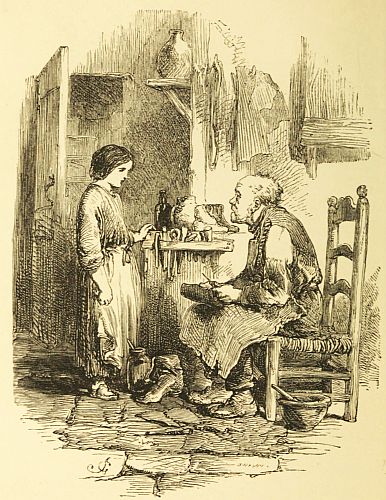
“Hardly had Mr. Peg got the soles and the upper leathers and
the vamps to his mind, and sat down on his chair to begin work,
when a little girl came in.”—P. 115.
“‘Father,’ she said,—‘mother’s head aches
again.’
“The cobbler paused in his work, and looked
up at her.
“‘And she wants you to come up and rub it—she
says I can’t do it hard enough.’
“Rather slowly Mr. Peg laid his upper leather
and tools down.
“‘Will you close this shoe for me, Sue, while
I am gone?’
“He spoke half pleasantly, and half, to judge
by his tone and manner, with some sorrowful
meaning. So the little girl took it, for she answered
a little sadly,—
“‘I wish I could, father.’
“‘I’m glad you can’t, dear.’
“He laid his work down, and mounted the
stairs. She went to the window, and stood with her
elbows leaning on the sill, looking into the street.
“It is only a small town, that Beachhead; but
still, being a sea-coast town, there is a good deal
of stir about it. The fishermen from the one
side, and the farmers from the other, with their
various merchandise; the busy boys, and odd
forms of women for ever bustling up and down,
make it quite a lively place. There is always a
good deal to see in the street. Yet the little
girl stood very still and quiet by the window;
her head did not turn this way and that; she
stood like a stupid person, who did not know
what was going on. A woman passing up the
street stopped a moment at the window.
“‘How’s your mother to-day, Sue?’
“‘She’s getting along slowly, Mrs. Binch.’
“‘Does the doctor say she is dangerous any?’
“‘The doctor don’t come any more.’
“‘Has he giv’ her up?’
“‘Yes; he says there is nothing to do but to
let her get well.’
“‘O!—she’s so smart, is she?’
“‘No, ma’am,—she’s not smart at all: he
says——’
“But Mrs. Binch had passed on, and was out
of hearing; and the little brown head stood still
at the window again, leaning now on one hand.
It was a smooth-brushed, round little head, seen
against the open window. By and by another
stopped, a lady this time; a lady dressed in black,
with a grave, sweet, delicate face.
“‘How’s your mother, Sue?’
“‘She’s just the same way, Mrs. Lucy.’
“‘No better?’
“‘Not much, ma’am. It’ll take a long time,
the doctor says.’
“‘And are you, poor little tot, all alone in the
house to do everything?’
“‘No, ma’am;—there’s father.’
“The sweet face gave her a sort of long,
wistful look, and passed on. Sue stood there yet
at the window, with her head leaning on her
hand; and whatever was the reason, so dull of
hearing that her father had come down, seated
himself in his work-chair, and taken up his shoe,
several minutes before she found it out. Then
she left the window and came to him.
“‘What shall I do, father?’
“‘She’ll want you directly,’ said the cobbler.
‘She’s asleep now.’
“Sue stood still.
“‘Don’t you want some dinner, Sue?’
“She hesitated a little, and then said ‘yes.’
“‘Well, see, dear, and make some more of
that porridge. Can you?’
“‘Yes, father; there’s some meal yet. And
there’s some bread, too.’
“‘You may have that,’ said the cobbler. ‘And
I’ll go out by and by, and see if I can get a
little money. Mr. Shipham had a pair of boots
new soled a month ago; and Mr. Binch owes
me for some jobs—if I ever could get hold of
them.’
“And the cobbler sighed.
“‘If people only knew, they would pay you,
father, wouldn’t they?’
“‘There is one that knows,’ said the cobbler.
‘And why they don’t pay me he knows. Maybe
it’s to teach you and me, Sue, that man does
not live by bread alone.’
“‘But by every word that proceedeth out
of the mouth of God doth man live,’ his little
daughter went on softly, as if she were filling up
the words for her own satisfaction. ‘But didn’t
we know that before, father?’
“‘Maybe we didn’t know it enough,’ said the
cobbler. ‘I’m afraid I don’t now.’
“And as her back was turned, he hastily
brought his hand to his eyes.
“‘But father, can one help feeling a little
bad when—when things are so now?’
“‘‘A little bad’—perhaps one might feel ‘a
little bad,’’ said the cobbler; ‘but if I believed
all that I know, I don’t see how I could feel very
bad. I don’t see how I could; and I oughtn’t
to.’
“His little daughter had been raking the fire
together, and setting on the coals a little iron
skillet of water. She turned and looked at him
when he said this, as if she had not known before
that he did feel ‘very bad.’ He did not see the
look, which was a startled and sorrowful one; he
was bending over his shoe-leather. She left the
room then and went after the meal, which she
brought in a yellow earthen dish, and began
silently to mix for the porridge.
“‘The Bible says, father——’ she began, stirring
away.
“‘Yes, dear,—what does it say?’ said Mr. Peg.
“‘It says, ‘Trust in the Lord and do good;
so shall thou dwell in the land, and verily——’’
“Susan’s voice broke. She stirred her porridge
vehemently, and turned her back to her
father.
“‘‘Verily thou shalt be fed,’’ said the cobbler.
‘Yes—I know it. The thing is, to believe it.’
“‘You do believe it, father,’ Susan said,
softly.
“‘Ay, but I haven’t trusted the Lord, nor
done good, any to speak of. It’ll stand good
for you, daughter, if it doesn’t for me.’
“She had stirred her meal into the skillet;
and now, setting down her dish, she came to his
side, and putting her two arms round his neck,
she kissed him all over his face. The cobbler let
fall leather and ends, and hugged her up to his
breast.
“‘That’s done me more good than dinner
now,’ said he, when he had, albeit tearfully, given
her two or three sound kisses by way of finishing.
‘You may have all the porridge, Susie.’
“‘There’s enough, father; and there’s some
bread, too.’
“‘Eat it all up,’ said the cobbler, turning to
his work again, maybe to hide his eyes. She
stood leaning on his shoulder, just so as not to
hinder the play of his arm.
“‘Shall I keep the bread for supper, father?’
“‘No, dear; maybe I’ll get some money before
supper.’
“‘Whose shoes are those, father?’
“‘They aren’t anybody’s yet.’
“‘Whose are they going to be?’
“‘I don’t know.—The first pair of feet that
come along that will fit ’em. If I sell these I’ll
get some leather and make more.’
“‘Is that the last of your leather, father?’
“‘Ay—the last big enough; the rest is all
pieces.’
“She stood a little while longer, laying her
head on his shoulder; then came a knocking up
stairs, and she ran away. The cobbler wrought
at his shoe for a space, when turning his head, he
dropped everything to go and see after the porridge;
and he squatted over the fire, stirring it,
till such time as he thought it was done, and he
drew back the skillet. He went to the foot of
the stairs, and looked up and listened for a
minute, and then left it and came back without
calling anybody. It was plain he must eat his
dinner alone.
“His dinner was nothing but porridge and salt,
eaten with what would have been a good appetite
if it had had good thoughts to back it. And the cobbler
did not seem uncheerful; only once or twice
he stopped and looked a good while with a grave
face into the fire or on the hearth. But a porridge
dinner after all could not last long. Mr.
Peg set away his plate and spoon, placed the
skillet carefully in the corner of the fire-place,
took off his leather apron, and put on his coat;
and, taking his hat from the counter, he went
out.
“There were no more stitches set in the shoe
that afternoon, for Mr. Peg did not get home till
dark. The first thing that happened after he
went away, a gust of wind blew round the house
and came down the chimney, bringing with it a
shower of soot, which must have sprinkled pretty
thick upon the open skillet. Then the wind
seemed to go up chimney again, and could be
heard whistling off among the neighbouring
housetops. A while after, little Susie came
down, and made for her skillet. She pulled it
out, and fetched her plate and spoon, and began
to skim out the soot. But I suppose she found
it pretty bad, or else that it would lose her a
good deal of the porridge; for one time she set
her plate and spoon down on the hearth beside
her, and laid her face in her apron. She soon
took it up again; but she didn’t make a large
meal of the porridge.
“She went up-stairs then immediately, and
when she came down the second time it was near
evening. She stood and looked about to see that
her father was not come in; then she built up
the fire, and when it was burning stood and
looked into it, just in the same way that she had
stood and looked out of the window. Suddenly
she wheeled about, and coming behind the
counter took her father’s Bible from a heap of
bits of leather where it lay, and went and sat
down on the hearth with it; and as long as there
was light to see, she was bending over it. Then,
when the light faded, she clasped her hands upon
the shut Bible, and leaning back against the jamb
fell fast asleep in an instant, with her head
against the stone.
“There she was when her father came home.
Her feet were stretched out upon the hearth, and
he stumbled over them. That waked her. By
the glimmering light of the embers something
could be seen hanging from Mr. Peg’s hand.
“‘Have you got home, father?—I believe I
got asleep waiting for you. What have you got
in your hand?—Fish!—Oh, father!—’
“You should have heard the change of little
Sue’s voice when she spoke that. Generally
her way of speaking was low and gentle like the
twilight, but those two words were like a burst
of sunshine.
“‘Yes, dear—Blow up the fire, so you can
see them—I’ve been to Mrs. Binch’s—I’ve been
all over town, a’most—and Mrs. Binch’s boy had
just come in with some, and she gave me a fine
string of ’em—nice blue fish—there.’
“Susan had made a light blaze, and then she
and the cobbler admired and turned and almost
smelt of the fish, for joy.
“‘And shall we have one for supper, father?’
“‘Yes dear—You have some coals and I’ll
get the fish ready right off. Has mother had all
she wanted to-day?’
“‘Yes, father—Mrs. Lucy sent her some
soup, and she had plenty. And I saved the
bread from dinner, father, isn’t it good; and
there’s more porridge too.’
“What a bed of coals Sue had made, by the
time her father came back with the fish, nicely
cleaned and washed. She put it down, and then
the two sat over it in the firelight and watched
it broil. It was done as nicely as a fish could be
done; and Susan fetched the plates, and the salt,
and the bread; and then the cobbler gave thanks
to God for their supper. And then the two made
such a meal! there wasn’t a bone of that fish
but was clean picked, nor a grain of salt but what
did duty on a sweet morsel. There was not a
scrap of bread left from that supper; and I was
as glad as anything of my tough nature can be, to
know that there were several more fish beside the
one eaten. Sue cleared away the things when
they had done, ran up to see if her mother was
comfortable, and soon ran down again. Her step
had changed too.
“‘Now darling,’ said her father, ‘come and
let us have our talk by this good firelight.’
“She came to his arms and kissed him; and
his arms were wrapped round her, and she sat on
his knee.
“‘It’s one good thing, you haven’t lights to
work, so we can talk,’ said Sue, stroking his face.
‘If you had, we couldn’t.’
“‘Maybe we would,’ said the cobbler. ‘Let
us talk to-night of the things we have to be
thankful for.’
“‘There’s a great many of them, father,’ said
Sue, with her twilight voice.
“‘The first thing is, that we know we have a
Friend in heaven; and that we do love and trust
him.’
“‘O father!’ said Sue,—‘if you begin with
that, all the other things will not seem anything
at all.’
“‘That’s true,’ said Mr. Peg. ‘Well, Sue,
let’s have ’em all. You begin.’
“‘I don’t know what to begin with,’ said Sue,
looking into the fire.
“‘I have you,’ said her father, softly kissing
her.
“‘O father!—and I have you;—but now you
are taking the next best things.’
“‘I shouldn’t care for all the rest without this
one,’ said the cobbler;—‘nor I shouldn’t mind
anything but for this,’ he added, in a somewhat
changed tone.
“‘But father, you mustn’t talk of that to-night;—we
are only going to talk of the things
we have to be thankful for.’
“‘Well, we’ll take the others to-morrow night,
maybe, and see what we can make of them. Go
on, Susie,’ said the cobbler, putting his head
down to her cheek,—‘I have my dear little child,
and she has her father. That’s something to
thank God and to be glad for,—every day.’
“‘So I do, every day, father,’ said Susan very
softly.
“‘And so do I,’ said the cobbler; ‘and while
I can take care of thee, my dearest, I will take
trouble for nothing else.’
“‘Now you are getting upon the other things,
father,’ said Sue. ‘Father, it is something to be
thankful for that we can have such a nice fire
every night,—and every day, if we want it.’
“‘You don’t know what a blessing ’tis, Sue,’
said her father. ‘If we lived where we couldn’t
get drift-wood,—if we lived as some of the poor
people do in the great cities, without anything
but a few handfuls of stuff to burn in the hardest
weather, and that wretched stuff for making a fire,—I
am glad you don’t know how good it is, Sue!’
said he, hugging his arms round her. ‘There
isn’t a morning of my life but I thank God for
giving us wood, when I go about kindling it.’
“‘How do they do in those places, without
wood?’ said Sue, sticking out her feet towards the
warm, ruddy blaze.
“‘He who knows all only knows,’ said the
cobbler, gravely. ‘They do without! It seems
to me I would rather go without eating, and have
a fire.’
“‘I don’t know,’ said Sue thoughtfully,
‘which I would rather. But those poor people
haven’t either, have they?’
“‘Not enough,’ said the cobbler. ‘They
manage to pick up enough to keep them alive
somehow.’—And he sighed, for the subject came
near home.
“‘Father,’ said Sue, ‘I don’t believe God will
let us starve.’
“‘I do not think he will, my dear,’ said the
cobbler.
“‘Then why do you sigh?’
“‘Because I deserve that he should, I believe,’
said the cobbler, hanging his head. ‘I deserve
it, for not trusting him better. ‘Casting all your
care upon him, for he careth for you.’ Ah, my
dear, we can’t get along without running to our
upper storehouse pretty often.’
“‘Father, I guess God don’t mean we should.’
“‘That’s just it!’ said the cobbler. ‘That is
just, no doubt, what he means. Well dear, let’s
learn the lesson he sets us.’
“‘Then, father,’ said Sue, ‘don’t you think we
have a good little house? It’s large enough, and
it’s warm.’
“‘Yes dear,’ said the cobbler; ‘some of those
poor people we were talking about would think
themselves as well off as kings if they had such a
house to live in as this.’
“‘And it is in a pleasant place, father, where
there are a great many kind people.’
“‘I hope there are,’ said the cobbler, who was
thinking at the moment how Mr. Shipham had
put him off, and Mr. Dill had dodged him, and
Mr. Binch had fought every one of his moderate
charges.
“‘Why, father!’ said Sue, ‘there’s Mrs.
Lucy every day sends things to mother; and
Mrs. Binch gave you the fish; and Mrs. Jackson
came and washed ever so many times; and—and
Mrs. Gelatin sent the pudding and other things
for mother, you know.’
“‘Well, dear,’ said the cobbler,—‘yes,—it
seems that woman-kind is more plenty here, at
any rate, than man-kind.’
“‘Why, father?’ said Sue.
“‘I hope you’ll never know, dear,’ he answered.
‘It was a foolish speech of mine.’
“‘And I’m sure it’s a blessing, father, that we
have so many things sent us for mother,—she has
almost as much as she wants, and things we
couldn’t get. Now, Mrs. Lucy’s soup,—you
don’t know how nice it was. I tasted just the
least drop in the spoon; and mother had enough
of it for to-day and to-morrow. And then the
doctor says she’ll get well by and by; and that
will be a blessing.’
“It was a blessing so far off, that both the
cobbler and his little daughter looked grave as
they thought about it.
“‘And I’m well, father, and you’re well,’ said
Sue, pleasantly.
“‘Thank God!’ said the cobbler.
“‘And father, don’t you think it’s a little
blessing to live near the sea? and to have the
beautiful beach to walk upon, and see the waves
come tumbling in, and smell the fresh wind? We
used to go so often, and maybe by and by we
shall again. Don’t you think it is a great deal
pleasanter than it would be if Beachhead was
away off in the country, out of sight of the
water?’
“‘Ah, Sue,’ said her father,—‘I don’t know;—I’ve
lived a good piece of my life in one of those
in-shore places, and I didn’t want to hear the sea
roar then-a-days, and I could get along without
the smell of salt water. No,—you don’t know
what you are talking about exactly; every sort of
place that the Lord has made has its own prettiness
and pleasantness; and so the sea has; but I
love the green pasture-fields as well as I do the
green field of water, to this day.’
“‘But one might be in a place where there
wasn’t the sea nor the pasture-fields either,
father.’
“‘So one might,’ said the cobbler. ‘Yes,
there are plenty such places. The sea is a blessing.
I was thinking of my old home in Connecticut;
but the world isn’t all green hills and sea-shore,—there’s
something else in it—something
else. Yes, dear, I love those big waves, too.’
“‘And then, father,’ said Sue, laying her
hand on his breast, ‘we come back to the best
things,—that you were beginning with.’
“‘Ay,’ said the cobbler, clasping his arm round
her; and for a little space they sat silent and
looked into the fire,—and then he went on.
“‘Poor as we sit here, and weak and dying as
we know we are, we know that we have a tabernacle
on high,—a house not made with hands,
eternal in the heavens. It won’t matter much,
Sue, when we get there—’
“What would not matter the cobbler did not
say; there was something came in his throat that
stopped him.
“‘It won’t matter, father,’ said Sue, softly.
“They sat still a good little while; the flame
of the bits of brands in the chimney leaped up
and down, burned strong and then fell outright;
and the red coals glowed and glimmered in the
place of it, but with less and less power.
“‘Now, Sue, let’s read,’ said the cobbler on a
sudden.
“She got up, and he put on the coals two or
three pieces of light stuff, which soon blazed up.
While he was doing this, Sue brought the Bible.
Then she took her former place in her father’s
arms; and he opened the book and read by the
firelight, pausing at almost every sentence,—
“‘‘Praise ye the Lord’—We will do that,
Sue,’ said the cobbler,—‘for ever.’
“‘‘Blessed is the man that feareth the Lord
that delighteth greatly in his commandments.’’
“‘You do that, father,’ said Sue, softly.
“‘I do fear him; I do delight in his commandments,’
said the poor cobbler. ‘I might a
great deal more. But see how it goes on.’
“‘‘His seed shall be mighty upon earth; the
generation of the upright shall be blessed.’ No
doubt of it: only let us see that we are upright,
my child.’
“‘‘Wealth and riches shall be in his house.’
So they are, Sue; aren’t we rich?’
“‘Yes father. But don’t you think that
means the other kind of riches, too?’
“‘I don’t know,’ said the cobbler; ‘if it
does, we shall have them. But I don’t know,
daughter; see,—
“‘‘Wealth and riches shall be in his house;
and his righteousness endureth for ever.’ It seems
as if that riches had to do with that righteousness.
You know what Jesus says,—‘I counsel thee to
buy of me gold tried in the fire, that thou mayest be
rich.’ I guess it is the kind of riches of that man
who is described ‘as having nothing, and yet
possessing all things.’’
“‘Well, so we do, father: don’t we?’
“‘Let us praise him,’ said the cobbler.
“‘Unto the upright there ariseth light in the
darkness.’ What a promise!’
“‘Unto the upright, again,’ said Sue.
“‘Mind it, dear Sue,’ said her father; ‘for
we may see darker times than we have seen yet.’
“Sue looked up at him gravely, but did not
speak.
“‘‘Unto the upright there ariseth light in the
darkness: he is gracious, and full of compassion,
and righteous.’’
“‘That is, the upright man,’ said Sue.
“‘‘A good man showeth favour and lendeth:
he will guide his affairs with discretion. Surely he
shall not be moved for ever: the righteous shall be
in everlasting remembrance.’ You remember who
says, ‘I have graven thee upon the palms of my
hands; thy walls are continually before me.’’
“‘That is Zion, father, isn’t it?’ said Sue.
“‘And just before that,—‘Can a woman forget
her sucking child, that she should not have compassion
on the son of her womb? Yea, they may
forget, yet will I not forget thee.’’
“‘We oughtn’t to be afraid, father,’ said Sue,
softly.
“‘I am not afraid,’ said the cobbler.
“‘‘The righteous shall be in everlasting remembrance.
He shall not be afraid of evil tidings; his
heart is fixed, trusting in the Lord.’—There it is,
Sue.’
“‘‘His heart is established; he shall not be
afraid, until he see his desire upon his enemies. He
hath dispersed, he hath given to the poor; his righteousness
endureth for ever; his horn shall be exalted
with honour. The wicked shall see it, and be
grieved; he shall gnash with his teeth and melt
away; the desire of the wicked shall perish.’’
“The cobbler closed the book; and he and his
little daughter knelt down, and he prayed for a
few minutes; then they covered up the fire, and
they went away up-stairs together. And the night
was as quiet in that house as in any house in the
land.
“The next morning the cobbler and his daughter
broiled another fish; but the breakfast was a
shorter and less talkative affair than the supper
had been. After breakfast the cobbler sat down
to his work; but before the shoe was half an hour
nearer to being done, Sue appeared at the bottom
of the stairs with,—
“‘Father, mother says she wants a piece of
one of those fish.’
“The cobbler’s needle stood still.
“‘I don’t believe it is good for her,’ said he.
“‘She says she wants it.’
“‘Well, can’t you put it down, my daughter?’
“‘Yes, father; but she says she wants me to
put her room up, and she’s in a great hurry for
the fish.’
“Mr. Peg slowly laid his work down. Sue ran
up-stairs again, and the cobbler spent another half-hour
over the coals and a quarter of a blue fish.
Sue came for it, and the cobbler returned to his
work again.
“It was a pretty cold day; the wind whistled
about and brought the cold in; and every now
and then Sue came down and stood at the fire a
minute to warm herself. Every time the cobbler
stayed his hand and looked up, and looked wistfully
at her.
“‘Never mind, father,’ said Sue. ‘It’s only
that I am a little cold.’
“‘You’re blue,’ said he.
“And at last Mr. Peg couldn’t stand it. Down
went the leather one side of him, and the tools
the other; and he went and lugged an armful or
two of sticks up-stairs, and built a fire there, in
spite of Sue’s begging him to keep on with his
work and not mind her.
“‘But we sha’n’t have wood enough, father,’
she said at last gently.
“‘I’ll go o’nights to the beach, and fetch a
double quantity,’ said the cobbler;—‘till your mother
is able to come down-stairs. That I can do.
I can’t bear the other thing, if you can.’
“And Sue stayed up-stairs, and the cobbler
wrought after that pretty steadily for some hours.
But in the middle of the afternoon came a new
interruption. Two men came into the shop, and
gave an order or two to the cobbler, who served
them with unusual gravity.
“‘When is Court-day, Sheriff?’ he asked, in
the course of business.
“‘To-morrow itself, Mr. Peg.’
“‘To-morrow!’ said the cobbler.
“‘What’s the matter? Comes the wrong day?
It always does.’
“‘I had forgot all about it,’ said the cobbler.
‘Can’t I be let off, sir?’
“‘From what?’ said the other man.
“‘Why, it’s rather an ugly job, some think,’
returned the sheriff. ‘He’s got to sit on the
jury that is to try Simon Ruffin.’
“‘I must beg to be let off,’ said the cobbler,
‘I am not at all able to leave home.’
“‘You must tell the court, then,’ said he who
was called the sheriff; ‘but it won’t do any good,
I don’t believe. Everybody says the same thing,
pretty much; they don’t any of ’em like the job;
but you see, this is a very difficult and important
case; a great many have been thrown out; it is
hard to get just the right men, those that are
altogether unobjectionable; and every one knows
you, Mr. Peg.’
“‘But my family want me,’ said the cobbler;
’they can’t do without me at home. Can’t you
let me go, Mr. Packum?’
“‘Not I,’ said the sheriff; ‘that’s no part of my
privilege: you must ask the court, Mr. Peg.’
“‘To-morrow?’ said the cobbler.
“‘Yes, to-morrow; but I tell you beforehand
it won’t do any good. What excuse can you
make?’
“‘My family want my care,’ said the poor cobbler.
“‘So does every man’s family,’ said the sheriff,
with a laugh; ‘he’s a happy man that don’t find
it so. You haven’t much of a family, Mr. Peg,
have you?—if you had my seven daughters to
look after—— Well, Mr. Jibbs,—shall we
go?’
“They went; and sitting down again in his
chair the poor cobbler neglected his work, and
bent over it with his head in his hand. At length
he got up, put his work away, and left the room.
For a while his saw might be heard going at the
back of the house; then it ceased, and nothing at
all was to be heard for a long time; only a light
footstep overhead now and then. The afternoon
passed, and the evening came.
“The cobbler was the first to make his appearance.
He came in, lighted the fire which had
quite died out, and sat down as he had sat before,
with his head in his hand. So his little daughter
found him. She stepped lightly and he did not
hear her till her hand was on his shoulder. Then
she asked him what was the matter?
“‘Oh!—nothing that should make me sit so,’
said the cobbler, rousing himself.
“‘We’ve got more fish left yet,’ said Sue.
“‘Yes, dear,—’tisn’t that; but I’ve got to go
away to-morrow.’
“‘Away!’ said Sue.
“‘Yes, away to court.’
“‘What for, father?’
“‘Why, they’ve got me down for a juryman,
and I’m afraid there’ll be no getting off. The
sheriff says there won’t.’
“‘What have you got to do, father?’
“‘Sit on a jury, dear, to decide whether Simon
Ruffin is guilty or no.’
“‘Simon Ruffin!—that shot that man!—Oh,
father!’
“‘It’s pretty bad,’ said the cobbler.
“‘How long will you be gone?’
“‘I can’t tell at all,’ said the cobbler; ‘maybe
a day—a day! they can’t take the evidence in
two days. I don’t know whether it will be two
or three days, or a week, dear.’
“‘A week—And what shall we do?’ Sue
could not help saying.
“‘If I can get off, I will,’ said the cobbler;
‘but in case I can’t, I have or I will have by morning,
as much wood as will do till I come back. I
have two-and-sixpence besides, which I can leave
you, darling; and I can do nothing more but
trust.’
“‘Father, isn’t it hard to trust sometimes?’
Sue said with her eyes full of tears. The poor
cobbler wrapped her in his arms and kissed them
away, but he did not try to answer.
“‘Maybe it won’t do us any harm after all,’
said Sue more brightly;—‘or maybe you will be
able to come back, father. Father, you know we
are to talk over to-night the things that we have
that we can’t be thankful for.’
“‘‘In everything give thanks,’’ said the cobbler.
“‘Yes, father, but it doesn’t say for everything.’
“‘Perhaps not,’ said the cobbler. ‘Well,
darling, we’ll see. Let’s have our supper first.’
“‘We’ll have the biggest fish to-night, father.’
“The fish wasn’t just out of the water now, but
it was eaten with a good will; not quite so cheerily
as the first one the night before; and Sue
sighed once or twice as she was putting the dishes
away, and didn’t step quite so lightly. Then she
came to her former place in her father’s arms,
and her head stooped upon his shoulder, and his
cheek was laid to her forehead, and so they sat
some minutes without speaking.
“‘Come, father,’ said Sue,—‘will you talk?’
“‘Yes, dear. Let us tell over what we have
to bear, and see how we can bear it.’
“‘We must go to our ‘upper storehouse’
again for that, father.’
“‘Ay, dear,—always.’
“‘The first thing, I suppose,’ said Sue, ‘is that
we haven’t quite money enough.’
“‘We have just what God gives us,’ said the
cobbler. ‘I’ll never complain of that.’
“‘Why you never complain of anything, father.
But it isn’t pleasant.’
“‘No, dear,’ said the cobbler;—‘and yet if we
had money enough, could we trust God as we do?
It is a sweet thing to live at his hand directly;
to feel that it is feeding us to-day, and to know
that it will to-morrow; for, ‘was he ever a wilderness
to Israel?’ No, dear; I don’t mean to
say that poverty is not hard to bear sometimes;
nor I don’t mean to say that I wouldn’t give you
plenty of everything if I had it to give; but I do
say that there is a sweet side even to this.’
“‘Father, our blue fish wouldn’t have tasted
as good if we had always had plenty of them.’
“‘I suppose not,’ said the cobbler, with a
little bit of a stifled sigh;—‘and maybe we
shouldn’t know how to love each other quite so
well, Sue.’
“‘O, yes we should!’ said Sue.
“‘I don’t know,’ said the cobbler. ‘I
shouldn’t know what my little daughter can do,
and bear, if she had not had a chance to shew
me.’
“‘Why I don’t have much to bear, father,’
said Sue.
“‘Mother wouldn’t know what a good nurse
you can be.’
“‘I wish she hadn’t a chance to know that,
father.’
“‘Yes,’ said the cobbler,—‘your mother’s sickness—that
seems the hardest evil we have had to
do with. It’s not easy to find any present comfort
of that; nor any present good; for I am
afraid it makes me more impatient than patient.
Maybe that’s why I have it. But if we can’t see
the reason of a great many things now, we shall
by and by. We shall know, Sue, what the reason
was. ‘Thou shalt remember all the way
which the Lord thy God led thee these forty years
in the wilderness, to humble thee and to prove thee,
to know what was in thine heart, whether thou
wouldest keep his commandments or no.’’
“Sue lifted up her head, and her little face
was beautiful for the strong patience, and bright
trust, and love that was in it. Her eyes were
swimming and her lips were speaking, though
they only moved to tremble.
“‘We can wait, Sue,’ said the cobbler, gently.
Sue laid down her head again.
“‘So it seems we have got the reason of it
already,’ Mr. Peg went on, ‘if not the good.’
“‘Maybe we’ve got some of the good too,
without knowing it,’ said his little daughter.
“‘Still, well be very glad to have mother get
well.’
“‘Oh, won’t we!’ said Sue.
“‘And it will teach us how to be thankful for
the common things we forget.’
“There was a little pause.
“‘Then you would like to have me go to
school,’ said Sue; ‘and I can’t.’
“‘And if you could I shouldn’t have the pleasure
of teaching you myself,’ said the cobbler.
‘I can bear that.’
“‘But then I can’t learn so many things,’
said Sue.
“‘Of one kind you can’t, and of another kind
you can,’ said her father. ‘I don’t believe there’s
a school-girl in Beachhead that can broil a blue
fish as you can.’
“‘O father!—but then you shewed me
how.’
“‘Do you think broiling blue fish comes by
nature?’ said the cobbler. ‘I can tell you there
are many people that can’t learn it at all. And
that’s only one of your accomplishments.’
“‘O father!’ said Sue again, smiling a
little.
“‘You can nurse a sick mother, and mend a
hole in your father’s coat, and put up a room,
and make a bed, with anybody.’
“‘Still, father, you’d like to have me go?’
“‘Yes, I would,’ said the cobbler. ‘Maybe I
shall never be sorry, by and by, that I couldn’t.’
“‘And then, father,’ said Sue, ‘you can’t get
work enough.’
“‘Yes!’ said the cobbler. ‘If I could do that,
it would be all smooth. But God could give it to
me if it pleased him, and if it don’t please him
there must be some reason; can’t we trust him
and wait?’
“Sue looked up again, not so brightly as once
before; meekly, and rather tearfully.
“‘And then I must leave you to-morrow,’ said
her father, kissing her brow;—‘that seems just
now the worst of all.’
“‘Maybe you’ll come back again, father,’ said
Sue.
“‘I am afraid I shall not—till this trial is
over.’
“‘It’s a disagreeable business; isn’t it, father?’
“‘Very disagreeable—as ugly as can be to
look at.’
“They were silent awhile.
“‘Maybe there’ll some good come of it, somehow,
after all,’ said Sue, in her twilight voice.
“‘Good will be the end of it,’ said the cobbler.
‘There’s a kind hand doing it, and an almighty arm
upholding us in it; we shall not be utterly cast
down: so we must bear to be poor, and to be sick,
and to be separated; and just leave it all with
God.’
“‘Father, it’s pleasant to do that,’ said Sue;
but you could know by the tone of her words that
she was crying a little.
“‘Why, darling, if we are poor, and sick, and
in trouble, we have our dear Saviour, and we
know that the Lord is our God. We are not poor
people,—not we. ‘Having nothing, and yet
possessing all things.’ Who would we change
with, Sue?’
“She had to wait a little while before she
spoke, but then she said,—
“‘I wouldn’t change with anybody.’
“‘No more would I,’ said the cobbler, giving
her another kiss.
“And so they went to bed, a couple of very
rich poor people.
“But the house looked poor the next day;
empty and cold. The cobbler was off betimes;
the little breakfast-fire died out; dust lay on
the counter; the tools and the unfinished work
were here and there; the wind slipped in and
slipped out again; and nothing else paid us a
visit, except Sue, who once or twice looked in
and looked round, as if to see whether her father
were there. Once she came into the room and
stood a few minutes, with her little brown head
and quiet grave face, looking at the ashes in the
fire-place, and the neglected work, and her father’s
chair, with a wistful sort of eye. It said, or
seemed to say, that however she felt last night,
she would be very glad to-day if they were not
poor, nor sick, nor separated. She looked pale
and weary, too; but she did not stay long to rest
or think. Her feet could be heard now and
then up-stairs. The cobbler did not come home;
the night darkened upon just such an afternoon
as the morning had been.
“The next day began in the same manner.
Towards noon, however, the outer door opened,
and in came a puff of fresh cold air, and another
visiter, who looked fresh, but not cold at all. It
was a boy about thirteen or fourteen; healthy,
ruddy, bright-eyed, well-dressed, and exceeding
neat in his dress. He came in like one familiar
with the place, and took note of all the unusual
tokens about, as if he knew well what was usual
and what was unusual. He looked at the cold
chimney and scattered work; he went to the foot
of the stairs and stood listening a moment; and
then coming away from there, he loitered about
the room, now going to the window and now to
the chimney, evidently waiting. He had to wait
a good while, but he waited. At last he had
what he wanted; for, tired with being up-stairs,
or wanting to gather some news from the outer
world, Sue slowly came down the stairs and
shewed her little face at the stairway door. And
almost before it had time to change, the newcomer
had called out,—
“‘Sue!’—
“And with an unknown light breaking all over
her face, Sue exclaimed, joyously, ‘Roswald!—’
and springing across to him, laid her sweet lips
to his with right good will.
“‘O you’ve got back!’ said Sue, with a gladsomeness
it did, or would have done, any one’s
heart good to hear.
“‘Here I am. Haven’t I been a long while
away?’
“‘O so long!’ said Sue.
“‘But what’s the matter here, Sue? what’s
become of you all?’
“‘Why mother’s sick, you know,—she hasn’t
got well yet; and father’s away.’
“‘Where is he?’
“‘He had to go to court—he had to be a juryman,
to try Simon Ruffin.’
“‘When?’
“‘Yesterday morning. And we hoped he would
be able to get leave to come away, we wanted him
so much; but he hasn’t been able to come.”
“‘He’s been away since yesterday morning.
Who’s taking care of you?’
“‘Why, nobody,’ said Sue.
“‘Is there nobody in the house with you?’
“‘Nobody but mother. Father left wood
enough all ready.’
“‘Wood enough for how long?’
“‘O for a good many days.’
“‘Aren’t you afraid?’
“‘Why, no, Roswald!’
“‘Who goes to market for you, Sue?’
“‘Nobody.’
“‘What do you live on?’
“‘Oh, people send mother nice things—Mrs.
Lucy sent her a whole pail of soup the other
day.’
“‘How big a pail?’
“‘Why, Roswald!—I mean a nice little tin
pail, so big.’
“‘And do you live on soup too?’
“‘No,’ said Sue.
“‘On what, then?’
“‘O on what there is.’
“‘Exactly. And what is there?’
“‘Mrs. Binch gave father a string of blue fish
the other night; and since then I have made
porridge.’
“‘What sort of porridge?’
“‘Corn-meal porridge.’
“‘Why, Sue!—do you live on that?’
“‘Why, porridge is very good,’ said Sue, looking
at him. But there was a change in his eye,
and there came a glistening in hers; and then
she threw suddenly her two arms round his neck
and burst into a great fit of crying.
“If Roswald had been a man, his arm could
not have been put round her with an air of more
manly and grave support and protection; and
there were even one or two furtive kisses, as if
between boyish pride and affection: but affection
carried it.
“‘I don’t know what made me cry,’ said Sue
at last, rousing herself; after she had had her cry
out.
“‘Don’t you?’ said Roswald.
“‘No. It couldn’t have been these things;
because father and I were talking about them the
other night, and we agreed that we didn’t feel
poor at all; at least, of course we felt poor, but
we felt rich, too.’
“‘How long have you been living on porridge?’
“‘I don’t know. Have you had a fine time,
Roswald?’
“‘Yes, very. I’ll tell you all about it some
time, but not now.’
“‘Is Merrytown as pleasant as Beachhead?’
“‘It is more pleasant.’
“‘More pleasant!’ said Sue. ‘Without the
beach, and the waves, Roswald!’
“‘Yes, it is; and you’d say so, too. You’d
like it better than anybody. There are other
things there instead of beach and waves. You
shall go down there some time, Sue, and see it.’
“‘I can’t go,’ said Sue meekly.
“‘Not now, but some day. Sue, haven’t you
any money?’
“‘I’ve two-and-sixpence, that father gave me;
but I was afraid to spend any of it, for fear he or
mother might want it for something. I must,
though, for I haven’t got but a very little Indian
meal.’
“‘Sue, have you had dinner to-day?’
“‘Not yet. I was just coming down to see
about it.’
“‘Your mother don’t eat porridge, does she?’
“‘O no. She’s had her dinner.’
“‘Well, will you let me come and eat dinner
with you?’
“Sue brought her hands together, with again
a flush of great joy upon her face; and then put
them in both his.
“‘How good it is you have got back!’ she
said.
“‘It will take that porridge a little while to
get ready, won’t it?’ said he, beating her hands
gently together, and looking as bright as a button.
“‘O yes—it’ll take a little while,’ said Sue.
‘I haven’t got the water boiling yet.’
“‘Have you got meal enough for both of us?’
“‘Yes, I guess so;—plenty.’
“Just then Mrs. Lucy opened the front door
and brought her sweet face into the room. She
looked a little hard at the two children, and
asked Sue how her mother was. Roswald bowed,
and Sue answered.
“‘May I go up and see her?’
“Sue gave permission. Mrs. Lucy went up
the stairs. Roswald stopped Sue as she was
following.
“‘Sue, I’ll go to market for you to-day. Give
me twopence of your money, and I’ll get the
meal you want.’
“‘O thank you, Roswald!’ said Sue;—‘that
will be such a help,—’ and she ran for the pennies,
and gave them into his hand.
“‘I’ll be back presently,’ said he; ‘and then
I’ll tell you about things. Run up now after Mrs.
Lucy.’
“‘I don’t believe I need,’ said Sue; ‘they
don’t want anything of me.’
“‘Run up, though,’ said Roswald; ‘maybe
Mrs. Lucy will ask your mother too many questions.’
“‘Why, that won’t hurt her,’ said Sue, laughing;
but Roswald seemed in earnest, and she
went up.
“Immediately Roswald set himself to build a
fire. He knew where to go for wood, and he
knew how to manage it; he soon had the hearth
in order and a fine fire made ready; and it was
done without a soil on his nice clothes and white
linen. He was gone before Mrs. Lucy and Sue
came down, but the snapping and sparkling in
the chimney told tales of him.
“‘Why, he has made the fire for me!’ cried
Sue, with a very pleased face.
“‘Who made it?’ said the lady.
“‘Roswald.’
“‘That boy that was here when I came?’
“‘Yes, ma’am; he has made it for me.’
“‘Who is he?’
“‘He is Roswald Halifax.’
“‘What, the son of the widow, Mrs. Halifax?’
“‘Yes, ma’am.’
“‘And how came you to know him so well?’
“‘Why, I have always known him,’ said Sue;
‘that is, almost always. I used to know him a
great many years ago, when I went to school;
and he always used to take care of me, and give
me rides on his sleigh, and go on the beach with
me; and he always comes here.’
“‘Is he a good boy?’
“‘Yes, ma’am; he’s the best boy in the whole
place,’ Sue said, with kindling eyes.
“‘I hope he is,’ said Mrs. Lucy, ‘for he has
nobody to manage him but his mother. I fancy
he has pretty much his own way.’
“‘It’s a good way,’ said Sue, decidedly. ‘He
is good, Mrs. Lucy.’
“‘Does your mother want anything in particular,
Sue?’
“Sue hesitated, and looked a little troubled.
“‘Tell me, dear; now, while your father is
away, you have no one to manage for you. Let
me know what I can do.’
“‘O Roswald would manage for us,’ said Sue;—‘but——’
“‘But what?’
“The lady’s manner and tone were very kind.
Sue looked up.
“‘She has nothing to eat, ma’am.’
“‘Nothing to eat!’
“‘No, ma’am; and I’ve only two shillings and
sixpence,—two shillings and fourpence, I mean,—to
get anything with; and I don’t know what to
get. She can’t eat what we can.’
“‘Have you nothing more to depend on but
that, my child?’
“‘That’s all the money we have, ma’am.’
“‘And what have you in the house besides?
tell me, dear. We are all only stewards of what
God gives us; and what you want, perhaps, I can
supply.’
“Sue hesitated again.
“‘We haven’t anything, Mrs. Lucy, but a
little Indian meal. Roswald is going to buy me
some more.’
“‘Are your father’s affairs in so bad a condition,
my child?’
“‘He can’t get work, ma’am; if he could,
there would be no trouble. And what he does
he can’t always get paid for.’
“‘And how long has this been the case, dear?’
“‘A long time,’ said Sue, her tears starting
again,—‘ever since a good while before mother
fell sick;—a good while before;—and then that
made it worse.’
“Mrs. Lucy looked at Sue a minute, and then
stooped forward and kissed the little meek forehead
that was raised to her; and without another
word quitted the house.
“Sue, with a very much brightened face, set
about getting her porridge ready; evidently enjoying
the fire that had been made for her. She
set on her skillet, and stirred in her meal; and
when it was bubbling up properly, Sue turned
her back to the fire and stood looking and meditating
about something. Presently away she
went, as if she had made up her mind. There
was soon a great scraping and shuffling in the
back room, and then in came Sue, pulling after
her with much ado a big empty wooden chest,
big enough to give her some trouble. With an
air of business she dragged it into the middle
of the room, where it was established solid and
square, after the fashion of a table. Sue next
dusted it carefully, and after it the counter and
chairs, and mantel-shelf; the floor was clean
swept always; and Sue herself, though in a faded
calico, was as nice in her ways as her friend
Roswald. Never was her little brown head anything
but smooth-brushed; her frock clean; her
hands and face as fair and pure as Nature had
meant them to be. Roswald looked as if soil
could not stick to him.
“When the room was in due state of nicety,
Sue brought out and placed the two plates, the
salt-cellar, with a little wooden spoon in it, the
tumblers of blown glass, a pitcher of water, and
the spoons. She had done then all she could,
and she turned to watch her porridge and the
front door both at once; for she did not forget
to keep the porridge from burning, while her eye
was upon the big brown door at every other
minute.
“The porridge had been ready some time
before the door at last opened, and in came Roswald
bearing a large market-basket on his arm.
“‘It is astonishing,’ said he, as he set it down,
’what a heavy thing Indian meal is!’
“‘Why Roswald!’ said Sue;—‘did you get all
that with two cents?’
“‘No,’ said Roswald; ‘the basket I borrowed.
It is my mother’s.’
“‘But have you got it full?’ said Sue.
“‘Pretty full,’ said Roswald, complacently.
“‘I never thought two cents would buy so
much!’ said Sue.
“‘Didn’t you?’ said Roswald. ‘Ah, you’re
not much of a market-woman yet, Sue. My arm
is tired.’
“‘I’m sorry!’ said Sue. ‘But I am so glad
you have got it for me.’
“‘So am I. Now is that porridge ready?’
“‘Ready this great while,’ said the little housekeeper,
carefully dishing it out. ‘It’s been only
waiting for you.’
Roswald looked at her with a curious, gentle,
sorrowful expression, which was as becoming as
it was rare in a boy of his years.
“‘Are you hungry, Sue?’
“‘Yes,’ said Sue, looking up from her dish
with a face that spoke her perfectly satisfied with
the dinner and the company. ‘Aren’t you?’
“‘Why, I ought to be. The air is sharp enough
to give one an appetite. Sue——’
“‘What?’
“‘Do you eat your porridge alone?’
“‘Not to-day,’ said Sue, smiling, while an arch
look came across her gentle eye.
“‘Does that mean that you are going to eat
me with it? I shall beg leave to interpose a
stay of proceedings upon that.’
“And sitting down, with an air of determination,
he drew the porridge dish quite to his
end of the chest-table, and looked at Sue as much
as to say, ‘You don’t touch it.’
“‘What does that mean? Aren’t you going
to let me have any?’ said Sue, laughing.
“‘No.’
“‘Why not?’
“‘I shall want all the porridge myself. You’ll
have to take something else, Sue!’
“‘But I haven’t got anything else,’ said Sue,
looking puzzled and amused.
“‘Well, if you give me my dinner, it’s fair I
should give you yours,’ said Roswald; and rising,
he brought his market-basket to the side of the
table, and sat down again.
“‘It’s a pity I can’t serve things in their right
order,’ he said, as he pulled out a quantity of
apples from one end of the basket,—‘but you
see the dinner has gone in here head foremost. I
never saw anything so troublesome to pack.
There’s a loaf of bread, now, that has no business
to show itself so forward in the world; but
here it comes—— Sue, you’ll want a knife and
fork.’
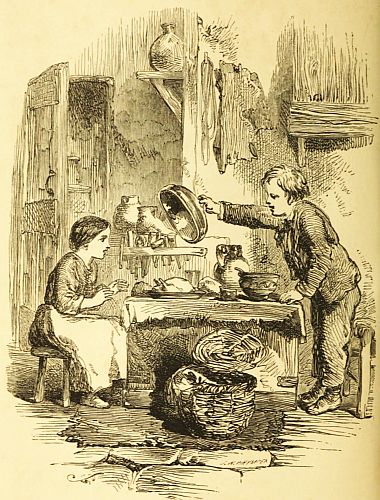
“And he set a deep, longish dish, with a cover,
on the table, and then a flat round dish with a
cover. Sue looked stupefied. Roswald glanced
at her.
“‘Your appetite hasn’t gone, Sue, has it?’
“But she got up and came round to him,
and put her face in her two hands down on his
shoulder, and cried very hard indeed.
“‘Why, Sue!’ said Roswald, gently,—‘I
never expected to see you cry for your dinner.’
“But Sue’s tears didn’t stop.
“‘I’ll put all the things back in the basket if
you say so,’ said Roswald, smiling.
“‘I don’t say any such thing,’ said Sue, lifting
up her tearful face and kissing his cheek; and then
she went round to her seat and sat down with
her head in her hands. Roswald, in his turn, got
up and went to her, and took hold of her hands.
“‘Come, Sue,—what’s the matter? that
isn’t fair. Look here, my porridge is growing
cold.’
“And Sue laughed and cried together.
“‘Dear Roswald! what made you do so?’
“‘Do how?’
“‘Why,—do so. You shouldn’t. It was too
good of you.’
“Roswald gave a merry little bit of a laugh,
and began to take off the covers and put them
on the counter.
“‘Come, Sue,—look up; I want my porridge,
and I am waiting for you. Where shall I get
a knife and fork?—in the pantry in the back
room?’
“Sue jumped up, wiping away her tears, and
run for the knife and fork; and from that time,
throughout the rest of the meal, her face was a
constant region of smiles.
“‘A roast chicken!—Oh, Roswald!—How
mother will like a piece of that! How good it
smells!’
“‘She’s had her dinner,’ said Roswald, who
was carving: ‘you must take a piece of it first.
I ought in conscience to have had a separate dish
for the potatoes, but my market-basket was resolved
not to take it. Some salt, Sue?’
“Sue ran for another knife and fork, and then
began upon her piece of chicken; and Roswald
helped himself out of his dish and eat, glancing
over now and then at her.
“‘You can’t think how good it is, Roswald,
after eating porridge so long,’ said Sue, with a
perfectly new colour of pleasure in her face.
“‘This is capital porridge!’ said Roswald.
‘I’ll trouble you for a piece of bread, Sue.’
“‘Why, Roswald!—are you eating nothing but
porridge?’
“‘Yes, and I tell you I should like a piece of
bread with it.’
“‘Ah, do take something else!’ said Sue,
giving him the bread. ‘The porridge will keep
till another time.’
“‘I don’t mean it shall, much of it,’ said
Roswald. ‘It’s the best dinner I’ve had in a
great while.’
“Sue laid down her knife and fork to laugh
at him, though the doing so had very near made
her cry again.
“‘Please take some chicken, Roswald!’
“‘I’d rather not. I’ll take a piece of pie with
you presently.’
“‘I should think chicken was enough,’ said
Sue; ‘you needn’t have brought me pie.’
“‘I wanted some. It’s a mince pie, Sue. Do
you remember that day after to-morrow is Christmas?’
“‘Christmas!—the day after to-morrow!’—said
Sue. ‘No, I had forgot all about Christmas.’
“‘What shall we do to keep it?’
“‘Why nothing, I sha’n’t,’ said Sue, meekly.
‘I shall not eat porridge, Roswald. O if father
could only come home—that would be enough
keeping of Christmas! We shouldn’t want any
thing else.’
“‘I’ll tell you how it’s going to be kept out of
doors,’ said Roswald; ‘it is fixing for a fine fall
of snow. The air is beginning to soften and
grow hazy already. I like a snowy Christmas.’
“‘With snow on the ground; but not snowing?’
said Sue.
“‘Yes, both ways. Now, Sue,—have you another
plate? or will you take it in your fingers?’
“Sue ran off for plates.
“‘How I wish I could give some of this to
father!’ she said, as she tasted her first bit of
the pie. ‘How will he get anything to eat, Roswald?’
“‘They will take care of that,’ said Roswald.
‘He will have a good dinner, Sue; you needn’t
be concerned about it. If they didn’t feed
their jurymen, you know, they might have no
jury by the time the cause was got through, and
that would be inconvenient. Hasn’t he been
home at all?’
“‘No.’
“‘They do sometimes let them come home,’
said Roswald; ‘but in this case I suppose they
are keeping everybody tight to the mark.’
“‘Why shouldn’t they let them come home at
night?’ said Sue; ‘what would be the harm?
They must sleep somewhere.’
“‘They are afraid, Sue, that if they let them
out of sight, somebody may talk to them about
the cause, and put wrong notions into their heads;
so that they won’t give a true verdict.’
“‘What is a verdict?’ said Sue.
“‘It’s the jury’s decision. You see, Sue, all
the people—all the lawyers, on both sides,—will
bring all the proof they can to show whether
Simon Ruffin did or didn’t shoot Mr. Bonnycastle.
One side will try to prove he did, and
the other side will try to prove he didn’t. The
jury will hear all that is to be said, and then
they will make up their minds what is the truth.
When they are ready, the judge will ask them,
‘Gentlemen, are you agreed upon a verdict?’
and the foreman will say, ‘Yes.’ Then the judge
will ask, ‘Is the prisoner at the bar guilty, or not
guilty?’ and the foreman will say, according as
they have decided, ‘Guilty,’ or ‘Not guilty;’ and
that answer is the verdict.’
“‘And then he will be hung!’ said Sue.
“‘If they find he is guilty, he will; but they
don’t condemn him; that’s the judge’s business.
The jury only decide what is the truth.’
“‘Why must they have so many men to do
that? why wouldn’t one do as well?’
“‘It would, if they could be always sure of
having a man who couldn’t and wouldn’t make a
mistake. It isn’t likely that twelve men will all
make the same mistake.’
“‘And must they all be agreed?’ said Sue.
“‘They must all be agreed.’
“‘And if they are not, the man can’t be
hanged?’
“‘No, nor set free.’
“‘I’m glad of that,’ said Sue.
“‘Why, Sue?’
“‘Because, if father isn’t sure that man is
guilty,—I mean, that he shot Mr. Bonnycastle,—he
won’t let them do anything to him.’
“‘It’s well you can’t be a juryman, Sue; you
would never let any rogue have his rights.’
“‘Yes, I would,’ said Sue, gravely; ‘if I
thought he deserved them.’
“‘I wouldn’t trust you,’ said Roswald. ‘I
should like to have you on the jury if I was
standing a trial for my life. You’d be challenged,
though.’
“‘Challenged!’ said Sue.
“‘Yes.’
“‘What is that?’
“‘Why, Simon Ruffin, for instance, might
say, ‘Mr. Peg is an old enemy of mine—he has
a spite against me; he would not be a fair judge
in my case.’ That would be challenging your
father as an improper juryman, and he would he
put out of the jury.’
“‘But father isn’t anybody’s enemy,’ said Sue.
“‘No, I know he isn’t,’ said Roswald, smiling;
‘but that’s an instance. Will you have some
more pie, Sue?’
“‘No, thank you. I’ll put these things away,
and see if mother wants anything; and then, if
she don’t, I’ll come down, and we’ll talk.’
“While Sue cleared away the dishes, Roswald
mended the fire.
“‘You may as well let the table stand, Sue,’
said he; ‘we shall want it again.’
“‘Why, are you coming to eat with me again?’
said Sue, laughing.
“‘I dare say I shall, if your father don’t come
home,’ said Roswald.
“Sue soon came down-stairs, for her mother
luckily did not want her; and the two drew their
chairs together and had a very long conversation,
in the course of which Roswald gave many details
of his stay at Merrytown, and enlightened Sue as
to the charms and beauties of a country village.
Sue looked and listened, and questioned and
laughed; till there came a knocking up-stairs, and
then they separated. Sue went up to her mother
again, and Roswald left the house.
“The room did not look desolate any more,
though it was left again without anybody in it.
There was the chest-table, and the contented-looking
fire, and the two chairs. All this while
we shoes lay in the corner, and nobody looked at
us. It seemed as if we were never to get done.
“The fire had died, the afternoon had not
quite, when Mrs. Lucy came again. Her knock
brought Sue down. She had come to bring
another little pail of soup, and a basket with some
bread and tea and sugar.
“‘Don’t spend your money, my child,’ she
said; ‘keep it till you want it more. This will
last your mother to-morrow, and I will see that
you have something stronger than porridge.’
“‘O I have, Mrs. Lucy,’ said Sue, with a
grateful little face, which thanked the lady better
than words; ‘I’ve got plenty for I don’t know
how long.’
“‘You don’t look as if you were out of heart,’
said Mrs. Lucy. ‘You know who can send
better times?’
“‘O yes, ma’am,’ said Sue. ‘He has already.’
“‘Trust him, dear; and let me know all you
want.’
“Sue stood, sober and silent, while Mrs.
Lucy went out at the door; and then she fell
down on her knees before one of the chairs, and
sunk her head on her hands; and was quite still
for a minute or two, till the knocking sounded
again. It was not a gentle tap on the floor, just
to let Sue know she was wanted; it was an impatient,
quarrelsome, vexatious, ‘rat-tat-tat-tat-tat-tat!’
’rat-tat!’ ’rat-tat!’ Sue ran up.
“The cobbler did not come home that night,
and Roswald would stay in the house. Sue did
all she could to hinder him; for indeed there
was nothing for him to sleep on but the pile of
leather scraps; but he would not be hindered.
“‘But your mother, Roswald?’ Sue gently
urged.
“‘What of my mother?’
“‘She will want you.’
“‘How do you know that?’
“‘I should think she would,’ said Sue.
“‘Should you? Well, she thinks, and so do
I, that you want me more.’
“‘How good you are, dear Roswald!’
“‘Not very, Sue,’ said Roswald, calmly.
“‘Do you know what Mrs. Lucy says?’ said
Sue. ‘She says that you have your own way in
everything.’
“‘Mrs. Lucy might have gone wider of the
mark, I suppose,’ said Roswald, blowing up the
fire.
“‘Mrs. Lucy is very good,’ said Sue. ‘She
brought us some tea and sugar this afternoon.’
“‘Did she?’ said Roswald. ‘Then what will
you do with what Mrs. Halifax sent?’
“‘Did she send us some?’ said Sue. ‘Oh,
Roswald!’
“Roswald laughed at her; and Sue did not
know what to do with herself; she went and
fetched down a quantity of coverlids and things
for Roswald to wrap himself in, and be warm
during the night; and begged him to keep a good
fire.
“The next day still the cobbler did not come
home. It passed with no visiters except Roswald
and Mrs. Lucy, who stepped in for a minute.
Sue’s mother wanted her up-stairs pretty much
the whole day; so there could be little fun going.
Christmas-eve Roswald stayed in the house again.
But he went off very early in the morning, without
seeing Sue, after he had made the fire for
her.
“The snow had not come so soon as Roswald
thought it would. There was none on the ground
Christmas-eve. But when Christmas-morning rose,
the whole of Beachhead was softly and smoothly
covered with white. It had fallen very fast and
quietly during the night; the window-sills were
piled up, the door-knob was six inches high, and
the snow hung like thatch over the eaves of the
houses. The streets were a soft, pure, printless
spread of white.
“So they were early, when Roswald first went
out. And whatever kept people’s feet within
doors—whether the dark morning, for the snow
still fell, or happy Christmas delays—there was
yet hardly a foot-print but his to be seen in that
part of the street when, some hours later, a sled
drawn by a horse and carrying two men and a
barrel, drew up before Mr. Peg’s door. Sue had
heard the tinkle of the three bells which the
horse bore on his neck; and, as it told of the
first sleighing that year, she went to the window
to see. There was the sled and one man and
the barrel; the other man had jumped off, and
was knocking at the front door.
“‘Very queer!’ thought Sue;—‘what can
they want here?’—but she ran down-stairs and
opened the door. The barrel was rolling up over
the snow to the house, and the two men were
behind pushing it. The cold air, and the yet
falling snow, and the white street, the men, and
the barrel rolling up towards Sue! Sue was
bewildered. But that barrel must go somewhere,
and she held the door open.
“‘What is it?’ said Sue. ‘It doesn’t belong
here, does it?’
“‘There’s ‘Mr. Peg’ on it,’ said one of the
men; ‘and this is Mr. Peg’s house, ain’t it?’
“‘What is it?’ said Sue, in astonishment, as
the barrel now stood up on end at the end of her
chest-table.
“‘It’s a barrel of flour, I guess,’ said the man.
‘Looks like it; and it come from Mr. Hoonuman’s.’
“‘Flour!’ said Sue.
“But the men with their heavy snow shoes
clumped out again, and shut the door behind
them with a bang. Sue stood and looked.
“There was the barrel, full-sized, standing on
end, one side of it still lightly coated with snow;
and there were the snow-marks on the floor of
the feet that had been there. It wasn’t a dream.
It was a real barrel, and even the snow wasn’t in
a hurry to melt away.
“Suddenly it flashed into Sue’s little mind
that it might be a Christmas!—and then whoever
sent it ought to have been there, when the
unwonted rosy colour sprang to her cheeks and
made her for a minute look like a well-to-do child.
And whoever sent it ought to have seen, a minute
after, the bended head, and heard the thanksgiving
that was not spoken, and the prayer,
earnest and deep, for a blessing on the friend that
had sent it.
“Sue had lifted her head, but had not moved
from a foothold, when Roswald opened the door.
“‘O Roswald! do you see this?’
“‘Merry Christmas, Sue!’ said Roswald,
gaily.
“‘O Roswald, do you know what this is?”
“‘It is very like a barrel of flour,’ said Roswald.
‘I should be surprised if it was anything
else!’
“‘But, Roswald, who sent it?’
“‘Why, Sue!—Santa Claus, to be sure. Don’t
you know what day it is?’
“‘It didn’t come down chimney,’ said Sue;
‘that I know. Dear Roswald, don’t you know
who sent it?’
“‘If Santa Clans had taken me into his confidence,
you know, Sue, it would not be an honest
thing to betray. I wonder what you can do with
a barrel of flour, now you have got it.’
“‘Do?’ said Sue;—but just then there was
another knock at the door. Roswald opened it.
In came a boy with a long string of fine black
and blue fish, which Mrs. Binch had sent to
Sue.
“‘Beachhead is waking up,’ said Roswald.
“‘O Roswald!’ said Sue, beginning to get
into the spirit of the thing,—‘did you ever see
anything like those fish? O tell Mrs. Binch
I thank her a great many times, please,—a great
many times; I am very much obliged to her, and
so is father.—O Roswald!—do see!—’
“‘There’s your mother knocking, Sue,’ said
Roswald. ‘Run off, and I’ll take care of these
fish. You get ready for breakfast.’
“Sue went off in one direction, and Roswald
in another. He was the first to come back, with
a beautifully cleaned fish, which he soon had upon
the coals. He went on to set the table, and get
the bread and the tea; and by that time Sue
came, as happy and as humble as possible, to
enjoy her breakfast. Whether or not Roswald had
had another breakfast before, he at any rate kept
her company in hers, both talking and eating.
The fish was declared to be the finest that could
come out of the sea, and Roswald was probably
adjudged to be the best cook on land; if he had
been, his work could not have given better satisfaction.
“Roswald had to go away after breakfast, and
told Sue his mother would want him at dinner,
and he could not be there again before evening;
but then he would come. Sue was satisfied with
everything.
“Her day was spent for the most part up stairs.
But there were some breaks to it. A servant
came in the course of the morning, bringing some
bottles of wine for her mother, from Mrs. Halifax.
Sue was already in a state of happiness that could
hardly be heightened, and was in fact endeavouring
to bear it with the help of her Bible, for it
was in her hand whenever she came down stairs.
But her eyes sparkled afresh at this gift, because
it came from Mrs. Halifax, and because it was
what her mother wanted. Sue could not wait.
She begged the man to open one of the bottles
for her; which with no little difficulty was done,
without a corkscrew; and then, when he had
gone, Sue poured out a little into a teacup, and
went up stairs with such a face—joy and love
were dancing a waltz in it.
“A little before noon there came another
knock at the door. A modest knock this was, so
gentle that Sue probably did not hear it. The
knocker had not patience, or was not scrupulous;
he opened the door halfway, and pushed in a
square wooden box, nailed up and directed; after
which he went away again, leaving it to tell its
own tale.
“It seemed to tell nothing that Sue could
understand. She looked at it, when next she
came down, with all her eyes, and on all sides;
but it was fast nailed up; she could not by any
means open it, and she could not tell what was
inside. She easily guessed that it was another
‘Christmas;’ but in what form? She sat and
looked at it, with a face of infinite delight. She
walked round it. Nothing was to be made of
it but a pine-box, tolerably heavy, with her own
name and her father’s in large black letters on
the upper side. Those letters did look lovely.
Sue read them a great many times that day, and
sat and gazed at the wooden box; but she could
do nothing with it till Roswald came. He came
at last, towards the edge of the evening. Sue
was watching for him.
“‘O Roswald, there you are!—here’s another!’
“‘Another what?’ said Roswald, gravely.
“‘Another Christmas—look here.’
“‘Looks very like Christmas,’ said Roswald.
“‘Dear Roswald, won’t you get a hammer!’
“‘A hammer,’ said Roswald. ‘I suppose
Mr. Joist will lend me one.’
“He went to borrow it, and opened the box.
Sue watched with breathless interest while the
hammer did its work, and the pieces of the cover
came up one by one.
“‘Now, Sue!’—said Roswald, as he stepped
back and began to draw the nails out of the
wood.
“Sue drew the things out of the box with slow
and cautious fingers, that seemed almost afraid of
what they found. She did not say a word, but
one or two half-breathed ‘oh’s!’ There was a
nice and complete outfit of clothes for her. On
the top lay a paper written with,
“‘For little Susan Peg, from some friends that
love her.’
“When she got to the bottom, Sue looked up.
“‘Oh, Roswald!’
“‘Who sent me these?’
“‘Some friends of little Susan Peg, that love
her,’ said Roswald.
“‘Did you know about it?’
“‘I heard my mother speak about it, Sue.’
“‘Did she do it?’
“‘Not she alone. Mrs. Lucy and some other
ladies all had a hand in it.’
“‘O how good they are!—’
“It was long before Sue could get up from the
box. Roswald stood, hammer in hand, looking at
her and smiling. At last Sue packed the box
again.
“‘I don’t deserve it all,’ she said; ‘but then
I don’t deserve anything. Now I guess we’ll
have some tea.’
“‘I’ll go and carry back this hammer,’ said
Roswald, ‘and then I’m ready. I’m very
thirsty.’
“‘O dear Roswald!’ said Sue, ‘won’t you
just open that barrel of flour first?—it will save
going for the hammer again; and mother thinks
she wants some pop-robin.’
“‘But what’s pop-robin good for without milk?’
said Roswald, as they went to the barrel, which he
had rolled into the pantry.
“‘O now I might get a halfpenny’s worth of
milk,’ said Sue;—‘it’s for mother; and now we
have so many things, we might afford it.’
“‘See you don’t,’ said Roswald. ‘Mother
sends you word—there are enough nails in this
barrel-head!—she says you may have as much
milk as you want from her cow, whenever you
will come for it or I will bring it; so between us
I guess it’ll be safe to count upon it.’
“He was hammering at the barrel-head, and
Sue standing by looking very pleased, her little
hand gratefully resting on his shoulder, when
another hand was laid on hers. Sue turned.
“‘Father!’ she exclaimed. ‘O father!—are
you home?—O I’m so glad!—’
“The cobbler’s grey head was stooped almost
to the barrel-top, and Sue’s arms were round his
neck; and how many times they kissed each other
I don’t believe either of them knew. It seemed
impossible for Sue to loose her hold.
“‘And you are here, my boy,’ said the cobbler,
turning to Roswald,—‘doing my work!’
“‘No, sir, I have been doing mine,’ said
Roswald.
“‘O father, he has taken such care of me!’
said Sue.
“‘I warrant him,’ said the cobbler. ‘If I
could only have known that Roswald Halifax was
in town, I could have minded my business with
some quietness.’
“‘And is it done, father?’ said Sue.
“‘It is done, my child.’
“‘And what have you done with that man?’
“‘We have declared him upon our judgment,
Not Guilty.’
“‘O I’m so glad!’ said Sue.
“They came back to their tea, all three; and
more black fish was broiled; and all the Christmas
was told over; and well-nigh all the trial.
The jury had been kept in all Christmas-day to
agree upon their verdict.
“From that day the cobbler’s affairs improved.
Whether his friends exerted themselves to better
his condition, now that they knew it; or whether
Mr. Ruffin’s friends did; or whether neither did,
but other causes came into work, certain it is
that from that time the cobbler’s hands had
something to do; and more and more till they had
plenty. So it came to pass that this poor pair
of shoes didn’t get finished till about a month
ago; and then Mr. Krinken must take it into
his head that we would fit his little boy, and
bought us;—for which we owe him a grudge, as
we wanted decidedly to spend our lives with Mr.
Peg and his little brown-headed daughter.”
“Did Mrs. Peg get well?” said Carl.
“Yes, long ago, and came down-stairs; but she
was no improvement to her family, though her
getting well was.”
“I am very sorry that story is done,” said
Carl. “I want to hear some more about Roswald
Halifax.”
“There is no more to tell,” said the shoe.
If Carl had been puzzled on Friday as to what
story he would hear, he was yet more doubtful on
Saturday. There lay the pine-cone, the hymn-book,
and the stocking, on the old chest, and
there sat Carl on the floor beside them,—sometimes
pulling his fingers, and sometimes turning
over the three remaining story-tellers, by way of
helping him to make up his mind. As a last
resort he was taking a meditative survey of the
ends of his toes, when a little shrill voice from
the chest startled him; and the pine-cone began
without more ado.