BY S. W. WILLISTON AND E. C. CASE.
PART I, CLIDASTES, WITH PLATES II-VI.
The group of extinct Cretaceous reptiles known as the Mosasaurs or
Pythonomorpha was defined by Cope, “to whom Science is so largely
indebted for its present knowledge of this interesting order of
reptiles” (Marsh), in 1869.[4]
Although some of the characters assigned by him to the order have
since been shown to be inapplicable, and the group to have less value,
yet his name, Pythonomorpha, has been generally retained. Lydekker
and Zittel have assigned to the group a subordinal value, as has also
Marsh, though under a different name. Owen rejected it entirely, and
Baur, more recently,[5]
has united it with the Varanidae to form a super-family, as follows:
- Suborder Platynota.
- Super-family Varanoidea.
- Families Mosasauridae, Varanidae.
- Super-family Helodermatoidea.
- Family Helodermatidae.
The group, whatever may be its rank or position, includes, so far, the
following genera: Mosasaurus Conyb., Liodon Owen, Platecarpus
Cope, Clidastes Cope, Baptosaurus Marsh, Sironectes Cope,
Plioplatecarpus Dollo and Hainosaurus Dollo. Pterycollasaurus
Dollo, founded upon Mosasaurus maximilianus Goldf., is omitted
as doubtful. All of these genera, save Plioplatecarpus and
Hainosaurus, have been recorded from North America, Clidastes,
Baptosaurus and Sironectes being peculiar to this country. Of these
latter three genera, however, Clidastes alone is well known; but this
genus is suspected by Lydekker of being the same as the imperfectly
known European Geosaurus Cuvier. Thus it seems that the genera, or
at least the most of them, have a wide distribution; Platecarpus, in
fact, is said to occur in New Zealand.
In America, members of the group have been discovered in the Cretaceous
deposits of New Jersey, Alabama, North Carolina, the upper Missouri
region, Nebraska, Kansas and New Mexico. Probably nineteen-twentieths
of all the known specimens, however, have been obtained in western
Kansas. The material now in the University Museum, all from Kansas,
comprises several hundred specimens of these animals, including,
probably, the best ones known. It is upon this material that the
following preliminary studies are chiefly based.
The genus Clidastes, as first described by Cope, was based upon
two dorsal vertebrae of C. iguanavus, the type species, from New
Jersey. Shortly afterward, however, he gave a full and careful generic
description, as derived from an unusually good specimen of an allied
species, C. propython, from Alabama. Only a little later, Marsh
described a genus, which he called Edestosaurus, from Kansas, but
without giving any real, distinctive differences from Clidastes,
following the very reprehensible practice of naming supposed new forms
in the hopes that future distinctive characters might be found. The
genus Edestosaurus has been rejected by nearly all save the authors
of the American text-books in Geology. It seems hardly necessary to
point out the identity. The only distinctive character the author
gave for his genus was the insertion of the pterygoid teeth, and even
this character he modified later—“Palatine (sic) teeth more or less
pleurodont.”[6]
This character, even were it real, is of very slight value; indeed it
cannot be used to distinguish the species even.
Clidastes is, without doubt, one of the most highly specialized
genera in the group, and, what is very interesting, is one of the
latest. It occurs in Kansas in the uppermost part of the Niobrara beds,
in the horizon so markedly characterized by the toothed birds. Both
Platecarpus and Liodon occur, though in diminished numbers, almost
to the very lowest portion, but Clidastes has never been found except
towards the top. From measurements made the past season, the thickness
of the beds in which these saurians occur cannot be less than six
hundred feet.
The following species have been found in Kansas: none of them are known
to occur elsewhere.
Mosasauridae Conybeare, in Cuvier, Ossem. Foss., 2nd ed.,
p. 338, 1824.
Clidastidae Cope, Extinct Batr. Rept. and Aves of N.
Amer., Trans. Amer. Phil. Soc. xiv, p. 50, 1870.
Edestosauridae Marsh, Amer. Journ. Sci. xxi, p. 59, July 1878.
? Geosaurus Cuvier, Ossem. Foss. 2nd ed.,
328, 1824, (fide Lydekker.)
Clidastes Cope, Proc. Acad. Nat. Sci. Phil. 1868, p. 233;
Ext. Batr. etc., p. 21, 1870.
Edestosaurus Marsh, Amer. Journ. Sci. i, p. 417, June, 1871.
Clidastes cineriarum Cope, Proc. Amer. Phil.
Soc., 1870, p. 583; Cret. Vert. etc. pp. 137, 266, pl. xxi, ff. 14-17;
Bullet. U. S. Geol. Surv. Hayden, iii, p. 583.
Edestosaurus dispar Marsh, op. cit. i, p. 447,
June 1871; iii, pl. xi., June, 1872.
Edestosaurus velox Marsh, Amer. Journ. Sci. i.
p. 450, June, 1871.
Edestosaurus pumilus Marsh, ibid. p. 452.
? Clidastes affinis Leidy, Proc. Acad. Nat. Sci., 1870,
p. 4; Rep. U. S. Geol. Surv., Hayden, vol. i, p. 283, 1873.
? Edestosaurus dispar Marsh, op. cit. xix, pl. i, f. 1, Jan., 1880.
Clidastes Wymani Marsh, Amer. Journ. Sci. i,
p. 451, June, 1871; iii, p. 202, April, 1872.
Edestosaurus Wymani Marsh, op. cit. iii, p.
464, June, 1872.
Edestosaurus tortor Cope, Proc. Amer. Phil.
Soc. Dec., 1871; Marsh, op. cit. iii, p. 464, June, 1872.
Clidastes tortor Cope, Cret. Vert. Rep. U. S.
Geol. Surv., Hayden, vol. ii, pp. 48, 131, 265, pls. iv, f. i; xiv, f.
i; xvi, ff. 2, 3; xvii, f. 1; xix, ff. 1-10; xxxvi, f. 3; xxxvii, f. 2;
Bullet. U. S. Geol. Surv. Hayden, vol. iii, p. 583.
Edestosaurus stenops Cope, Proc. Amer. Phil.
Soc. p. 330, 1871: Marsh, Amer. Journ. Sci. iii, p. 464, June, 1872.
Clidastes stenops Cope, Cret. Vert. etc. pp.
133, 266, pls. xiv, ff. 4, 5; xvii, f. 7, 8; xviii, ff. 1-5; xxxvi, f.
4; xxxvii, f. 3; xxxviii, f. 3.
Edestosaurus rex Marsh, op. cit. iii, p. 462, pl. xxii, f. 1, June,
1872.
Clidastes planifrons Cope, Bullet. U. S. Geol.
Surv. No. 2, p. 31, 1874; Cret. Vert. etc. pp. 135, 265, pls. xxii,
xxiii.
C. Westii Williston, n. sp. infra.
A remarkably complete specimen, referred with considerable certainty
to this species, was obtained by ourselves in western Kansas, (Butte
Creek) in the summer of 1891. A brief preliminary description of the
specimen was given by the senior author in Science, December 8, 1891.
A more complete description is here given, which, it is believed, will
be of service. The specimen is an unusually perfect one, being very
nearly complete, and, as now mounted, shows the bones nearly all in the
position in which they were found. The vertebral column is continuous,
except in one place, where the tail had been bent up over the back; and
complete, save at the very tip of the tail. The skull is complete, or
very nearly complete, and has been restored nearly to the condition in
life. Figures have been made of this portion of the skeleton, and will
be given in a future communication. At present, it may be mentioned
that the lacrymals are small, roughly irregular bones, and pointed at
either extremity. There are no indications of transverse bones, as
there are none in any other skull in the collection.
Atlas. The intercentrum is a small bone with three
sides of nearly equal extent. The two upper, articular surfaces are gently
concave, and meet in a rounded margin; the inferior surface is convex,
both antero-posteriorly and transversely, with a roughened prominence
in the middle. The lateral pieces have indistinctly separated facets
for articulation with the odontoid, the intercentrum and the occipital
condyle. The rather short, flattened lamina extends upward, backward
and inward, approaching, but not reaching its fellow of the opposite
side; it is somewhat dilated distally. Directed outwards and forwards,
there is a stout styliform process.
Axis. The neural spine of the axis is elongated
antero-posteriorly. It is thin on the anterior portion, but stouter
and longer at the posterior part. The large, stout odontoid process is
united suturally, as is also the well-developed atlantar hypapophysis,
which forms the anterior, inferior portion of the bone. The diapophyses
are the smallest of the costiferous series, with only a small articular
facet for the rib. The ball is strongly and evenly convex, with its
greater diameter transversely. The hypapophysis is the largest of the
series; it is suturally united with the stout, exogenous process of the
centrum, and projects downward and backward; its distal extremity is
roughened for ligamentous attachments.
The third cervical vertebra shows a well-developed zygosphenal
articulation, and stout articular processes. The transverse process is
small, only a little larger than that of the axis, though, unlike that,
it is strengthened by a ridge continued from the anterior zygapophyses.
The hypapophysis is smaller than that of the axis, but, like that,
is directed downward and backward. The spine may be distinguished
from that of any other vertebra by its stout, trihedral shape; it is
directed rather more obliquely backward than in the following vertebrae.
The fourth cervical vertebra differs from the third in having stouter
transverse processes; in the hypapophysis being directed more nearly
downward, and in its smaller size; and in the spine being flattened
antero-posteriorly toward the base.
The fifth cervical vertebra differs from the fourth in the broader
spine, in the stouter transverse processes, and the smaller hypapophysis.
In the sixth cervical vertebra, the hypapophysis is reduced to a small
ossification, scarcely longer than broad, directed downward. The spine
has reached nearly the full width of those of the following vertebrae,
though somewhat stouter above. The transverse processes are yet stouter.
In the seventh, or last, cervical vertebra the hypapophysis is wanting,
or very rudimentary. The under part of the centrum shows a rounded ridge
or carina, with a slight projection corresponding to the hypapophysis.
MEASUREMENTS OF THE CERVICAL VERTEBRAE.
| 1. |
Antero-posterior diameter of intercentrum of atlas |
14 millim. |
| |
Transverse diameter of intercentrum |
25 |
| |
Antero-posterior diameter of lateral piece |
20 |
| |
Vertical extent of articular surface |
17 |
| |
Extent of lateral piece |
35 |
| |
Width of lamina above |
16 |
| 2. |
Length of axis |
43 |
| |
Transverse diameter of ball |
18 |
| |
Vertical diameter of ball |
17 |
| |
Expanse of transverse processes |
28 |
| |
Elevation of spine above floor of neural canal |
34 |
| |
Antero-posterior extent of spine |
50 |
| 3. |
Length of third cervical vertebra |
37 |
| |
Height of spine above floor of neural canal |
36 |
| |
Depth of hypapophysis below floor of neural canal |
34 |
| 4. |
Length of fourth cervical vertebra |
37 |
| |
Height of spine above floor of neural canal |
39 |
| |
Depth of hypapophysis below floor of neural canal |
35 |
| 5. |
Length of fifth cervical vertebra |
37 |
| |
Height of spine above floor of neural canal |
42 |
| |
Depth of hypapophysis below floor of neural canal |
33 |
| |
Transverse diameter of ball |
17 |
|
Vertical diameter of ball |
18 |
| 6. |
Length of sixth cervical vertebra |
37 |
| |
Height of spine above floor of neural canal |
42 |
| |
Depth of hypapophysis below floor of neural canal |
30 |
| |
Width of spinous process |
26 |
| 7. |
Length of seventh cervical vertebra |
37 |
| |
Height of spine above floor of neural canal |
46 |
| |
Transverse diameter of ball |
19 |
| |
Vertical diameter of ball |
20 |
| |
Width of spinous process |
27 |
There are thirty-five vertebrae between the cervicals and the first
non-rib-bearing vertebra, to which the pelvis was, evidently, attached.
The distinction between the cervicals and thoracics cannot be made from
any characters they possess, as the seventh vertebra does not bear a
distinct hypapophysis. Neither can it be said with certainty from this
specimen which is the first thoracic vertebra, as the cervical ribs
had, unfortunately, been displaced in the collection and preparation
of the specimen. In another specimen, referred to C. pumilus, and
which, as will be seen later, cannot be specifically distinguished
from the present species, short cervical ribs were found attached to
six vertebrae posterior to the atlas. That the eighth vertebra is a
thoracic one is shown by the relation of the ribs in this specimen.
Posteriorly there is no distinction, also, between the true thoracic
vertebrae and those of the lumbar region. All the vertebrae anterior to
the pelvis bear ribs, and will all be considered as dorsal vertebrae,
the true thoracic vertebrae being restricted to those of which the ribs
are elongated, and, probably, connected with the sternum.
In the anterior vertebrae of the series, the centra are subcarinate
below, the obtuse, rounded ridge becoming less and less apparent
until no indications of the keel can be seen, before the middle
of the series. The transverse processes are stoutest, with a more
elongated, sigmoid articular surface, with little or no constriction,
and projecting only slightly beyond the stout articulating processes,
in the anterior vertebrae. In the tenth or eleventh, the articular
surface has become markedly smaller, more vertical, and less sigmoid in
outline. Thence to the last, the articular surface for the ribs remains
nearly the same. The process itself, however, becomes gradually more
prominent and constricted, as the zygapophyses becomes smaller. The
spinous processes increase slightly in length and breadth, and are only
slightly oblique throughout. In length, the centra increase gradually.
The vertical diameter of the ball increases gradually, while the
transverse diameter remains more nearly the same.
MEASUREMENTS OF THE DORSAL VERTEBRAE.
| 1. |
Length of centrum to rim of ball |
38 millim. |
| |
Transverse diameter of ball |
20 |
| |
Vertical diameter of ball |
19 |
| |
Height of spine above floor of neural canal |
48 |
| |
Extent of articular surface of transverse process |
30 |
| |
Width of spine |
28 |
| 4. |
Length of centrum to rim of ball |
41 |
| |
Transverse diameter of ball |
20 |
| |
Vertical diameter of ball |
20 |
| |
Height of spine above floor of neural canal |
48 |
| 11. |
Length of centrum to rim of ball |
41 |
| |
Vertical diameter of ball |
22 |
| |
Extent of articular surface of transverse process |
16 |
| |
Width of spine |
32 |
| 15. |
Length of centrum to rim of ball |
41 |
| |
Transverse diameter of ball |
21 |
| |
Vertical diameter of ball |
24 |
| 20. |
Length of centrum to rim of ball |
42 |
| |
Vertical diameter of ball |
25 |
| |
Height of spine above floor of neural canal |
58 |
| 24. |
Length to rim of ball |
41 |
| |
Transverse diameter of ball |
22 |
| |
Vertical diameter of ball |
23 |
| |
Height of spine |
49 |
| 28. |
Length to rim of ball |
40 |
| |
Vertical diameter of ball |
24 |
| |
Transverse diameter of ball |
23 |
| |
Height of spine |
54 |
| 32. |
Length to rim of ball |
38 |
| |
Vertical diameter of ball |
25 |
| |
Transverse diameter of ball |
24 |
| 35. |
Length to rim of ball |
37 |
Immediately following the thirty-fifth rib-bearing vertebra there is
an abrupt change, the tubercular process for the rib giving place to
an elongated transverse process. From the position of the pelvis, it
is evident that the ilia were attached to the first pair of these.
Precisely this relation of pelvis to the vertebrae is found in such
lizards as the Monitor and Iguana, and it is probable that such is the
relation in all the Pythonomorpha. It will thus be seen that there
are no distinctively lumbar vertebrae, if by such are meant free,
non-costiferous, pre-sacral vertebrae. The vertebrae of these animals
that have been so designated by writers are in reality basal caudal.
A distinctive term for them—those with transverse, non-costiferous
processes and without chevrons—is needed, and we propose,
provisionally, the term pygial. There are seven in the present
series, all characterized by elongated transverse processes, and not
differing much from each other. The vertebrae lie in the matrix with
the ventral aspect uppermost, concealing the spine and upper parts.
The under surface is somewhat flattened, and, as in the preceding
vertebrae, is gently concave antero-posteriorly. The transverse
processes are elongate, stout towards the base, apparently all of
nearly equal length, and directed gently backwards and downwards. In
the anterior vertebrae the processes spring from near the front part:
as the centra become shorter they arise from near the middle. In the
last one of the series there are minute indications of chevrons.
MEASUREMENTS OF THE PYGIAL CAUDAL VERTEBRAE.
| 1. |
Length to rim of ball |
36 millim. |
| |
Width of ball |
25 |
| |
Expanse of transverse processes |
130 |
| |
Width of transverse process near base |
17 |
| 2. |
Length to rim of ball |
33 |
| 3. |
Length to rim of ball |
31 |
| 4. |
Length to rim of ball |
29 |
| 5. |
Length to rim of ball |
28 |
| 6. |
Length to rim of ball |
27 |
| |
Expanse of transverse processes |
130 |
| |
Width of ball |
24 |
| 7. |
Length to rim of ball |
27 |
The centra of those caudal vertebrae which have chevrons do not differ
much in shape. They become less constricted, and, back of the middle of
the series, are smoothly cylindrical in shape. The transverse processes
decrease gradually in length, disappearing entirely in the twenty-fifth
or twenty-sixth. The spinous processes are more or less incompletely
preserved in the anterior vertebrae. They increase only gradually in
length for the first twenty of the series, and are markedly oblique,
with the posterior border stout, and the anterior border alate. With
the twenty-sixth they begin to increase more rapidly in length, and
have become more nearly vertical in position, and are thinner at each
margin. In the thirty-fifth or thirty-sixth they attain their greatest
length, and are here directed slightly forwards. Thence to the end of
the tail, the length decreases gradually, and, in position, they are
directed more and more obliquely backward. The chevrons are strongly
oblique throughout the series and are firmly co-ossified with the centrum.
The tail, it is thus seen, has a broad, vertical, fin-like extremity, which,
doubtless, aided much in the propulsion of the animal through the water.
There are sixty-seven vertebrae with chevrons present in the specimen,
all continuous, except in one place. The last one is less than
one-fourth of an inch in diameter, and shows that there had been yet
another, possibly several more. Toward the base of the series the tail
has been bent forwards over the back, and it is possible that, where
the break occurs, there has been a vertebra lost. The measurements,
however, do not seem to indicate any loss. The entire series of
vertebrae was not less than sixty-eight, and probably not more than
seventy, making for the entire vertebral series one hundred and
seventeen to twenty.
MEASUREMENTS OF THE CHEVRON-BEARING CAUDAL VERTEBRAE.
| 1. |
Length to rim of ball |
26 millim. |
| 5. |
Length to rim of ball |
24 |
| |
Vertical diameter of ball |
21 |
| |
Transverse diameter of ball |
24 |
| 10. |
Length to rim of ball |
24 |
| 15. |
Length to rim of ball |
24 |
| |
Height of spine above floor of neural canal |
40 |
| |
Length of chevron |
45 |
| 20. |
Length to rim of ball |
23 |
| |
Vertical diameter of ball |
21 |
| |
Transverse diameter of ball |
22 |
| 25. |
Length to rim of ball |
20 |
| |
Height of spine |
44 |
| |
Width of spine at base |
19 |
| |
Width of spine at distal end |
10 |
| |
Length of chevron |
85 |
| |
Altitude of tail |
112 |
| 30. |
Length to rim of ball |
18 |
| |
Vertical diameter of ball |
17 |
| |
Height of spine |
57 |
| |
Width of spine at base |
19 |
| |
Width of spine at distal end |
9 |
| |
Length of chevron |
99 |
| |
Altitude of tail |
20 |
| 35. |
Length to rim of ball |
16 |
|
Vertical diameter of ball |
16 |
| |
Height of spine |
61 |
| |
Length of chevron |
97 |
| |
Altitude of tail |
122 |
| 40. |
Length to rim of ball |
15 |
| |
Vertical diameter of ball |
15 |
| |
Height of spine |
54 |
| |
Length of chevron |
70 |
| |
Altitude of tail |
110 |
| 45. |
Length to rim of ball |
14 |
| |
Vertical diameter of ball |
14 |
| |
Height of spine |
40 |
| |
Length of spine |
50 |
| |
Length of chevron |
58 |
| |
Altitude of tail |
93 |
| 50. |
Length to rim of ball |
13 |
| |
Length of spine |
43 |
| |
Length of chevron |
55 |
| |
Altitude of tail |
73 |
| 55. |
Length to rim of ball |
12 |
| |
Length of spine |
38 |
| |
Length of chevron |
42 |
| |
Altitude of tail |
63 |
| 60. |
Length to rim of ball |
9 |
| |
Length of spine |
46 |
| |
Length of chevron |
25 |
| |
Altitude of tail |
50 |
| 66. |
Length to rim of ball |
7 |
| |
Length of chevron |
10 |
| |
Altitude of tail |
20 |
| 67. |
Length |
6 |
As has already been stated, the cervical ribs were displaced in the
present specimen, and measurements of them cannot be given. In a
smaller specimen, specifically indistinguishable from the present one,
the entire cervical series is preserved with the ribs attached. The
first, that articulating with the axis, is very short. The following
ones are stouter, but increase only moderately in length, that of the
sixth measuring only thirty-five millimeters, while that of the seventh
is but a little longer. In the specimen of C. velox described,
there is a detached cervical rib sixty-five millimeters in length; it
probably belongs with the seventh.
The thoracic ribs are simple, somewhat flattened rods, moderately
expanded at the proximal end. The greatest convexity is shown about the
middle of the series, where the versedsine of the curvature is forty
millimeters, the chord being one hundred and sixty. Posteriorly, the
short ribs are only gently curved.
Lying by the side of the vertebral column, and between the ribs,
as they have been pressed down, are a number of flattened, soft,
punctulate bones, which are evidently the costal cartilages.
Posteriorly four rows of them are seen, lying closely side by side,
some of them eight or ten inches in length. The sternum, composed
of the same material, has been so crushed and crumpled that its
shape cannot be made out. The whole structure here, whether of ribs,
cartilages or sternum, reminds one very strongly of such lizards as the
Iguana or Monitor. There is no indication, however, in any specimen, of
an episternum.
MEASUREMENTS OF RIBS.
| Length, first thoracic rib, (chord) |
200 |
millim. |
| Length, eleventh thoracic rib, (chord) |
145 |
|
| Length, thirteenth dorsal rib |
68 |
|
| Length, eighteenth dorsal rib |
64 |
|
| Length, thirty-fourth dorsal rib |
52 |
|
The lengths of the different regions, as they lie in their natural
relations, are as follows:
| Skull |
|
0.420 |
meters. |
|
| Neck |
|
0.225 |
|
|
| Trunk |
|
1.360 |
|
|
| Tail |
|
1.460 |
|
|
| |
Total |
3.465 |
|
11 ft. 7 in. |
The measurements of an excellent specimen of C. tortor are as follows:
| Skull |
0.630 |
meters. |
| Neck |
0.360 |
|
| Trunk, (thirty-three vertebrae preserved) |
2.370 |
|
A very complete specimen of a Liodon in the Museum, in which the
complete vertebral column is present, numbering one hundred and
seventeen vertebrae, gives the following measurements. The skull is
complete, save the most anterior portion.
| Skull (approximated within narrow limits) |
0.700 |
meters. |
|
| Neck |
0.430 |
|
|
| Trunk |
1.760 |
|
|
| Tail |
3.420 |
|
|
| Total |
6.310 |
|
20 ft. 8 in. |
The vertebral series in this specimen is composed of seven cervicals,
twenty-three dorsals, seven pygials, and eighty chevron-caudals.
The relative proportions of the different regions in the two genera,
as shown by the two specimens of Clidastes and Liodon, may be
represented as follows. The first column is for Clidastes.
| Skull |
12.1 |
11.1 |
| Neck |
6.5 |
6.8 |
| Trunk |
39.2 |
28.0 |
| Tail |
42.3 |
54.1 |
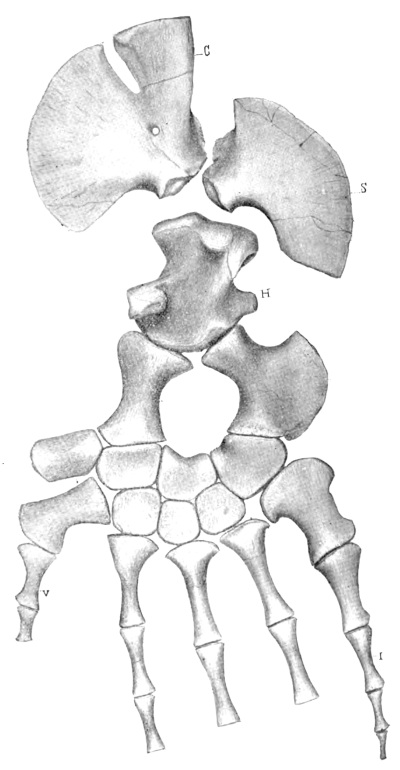
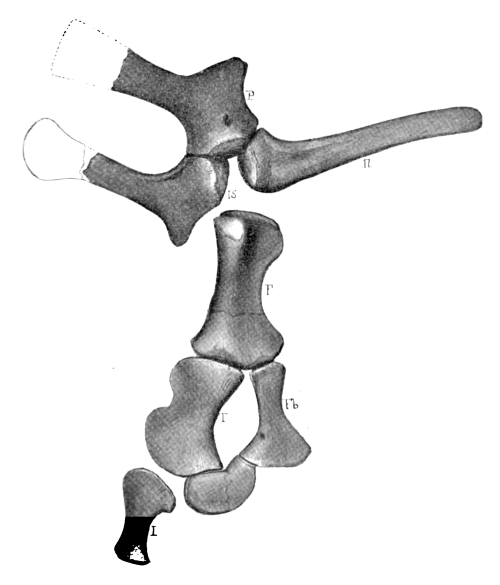
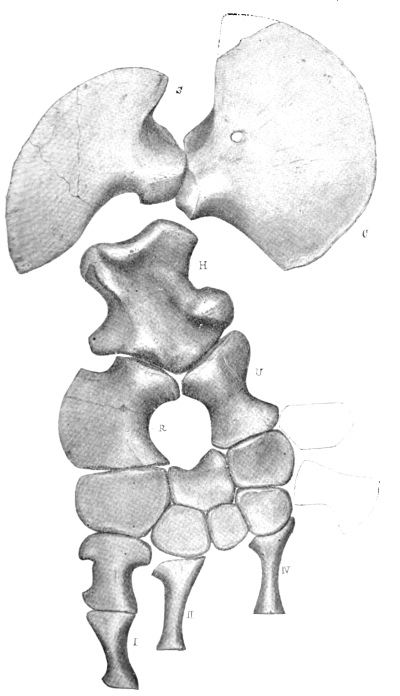
The figures in plates II and III will give a sufficiently good idea
of the limbs in this specimen. They are figured as they were lying,
showing the outer sides of the coracoid, scapula and pelvic bones, and
the palmar or plantar surface of the remaining bones.
It will be observed in plates II and IV that there are two very
different types of coracoid, one with a deep emargination, the other
without the slightest indication of such. The same non-emarginate
form occurs in C. tortor, as specimens in our Museum show, in
C. propython Cope (Ext. Batr. etc. pl. xii, f. 16,) and in C. dispar,
as figured by Marsh[7],
and as stated by him in the same paper (“There is certainly no
emargination in the coracoid of Clidastes, Edestosaurus and
Baptosaurus, as specimens in the Yale Museum conclusively prove.”) It
is true that Marsh in a later paper[8]
figured a specimen with emarginate coracoid under the name of
Edestosaurus dispar, but it is certain that his identification of his
own species was wrong, as will be seen by comparing his figures. From
the senior author’s memory of the specimen with the emarginate coracoid
figured, and from the figure itself he feels confident that the second
specimen is C. velox.
That the emargination was overlooked by the author seems strange, as
in the same paper in which this figure is given occurs the description
of Holosaurus, founded upon that very character. If the emargination
is sufficiently important to base a genus in the one case, then it
should be in the other, and the character could not be applied to
Edestosaurus, based upon characters which it hardly seems possible
that the author himself could seriously consider, for E. dispar was
the type of Edestosaurus.
It will be observed, further, that the figured coracoids differ very
materially in size, those with the emargination pertaining to a small
species, while C. dispar is one of the largest. In our Museum there
are three specimens with the emarginate coracoid, all of them small or
very small, the described specimen of C. velox being the largest.
The point of chief interest in this relation is the value that can be
given to this character. Is it individual, specific or generic? Marsh
has called it generic, but we think an examination of the two very
complete specimens of C. tortor and C. velox in our Museum will
convince any unprejudiced student that he is in error.
A comparison of the figures herewith given of the paddles will show
their great resemblance, and these two forms of paddles have been
figured because the species are the most unlike of any that we know in
the genus. As all the small specimens seem to possess this character,
and as they cannot be called immature specimens, we believe the
character is a specific one. As Marsh says, typically both Clidastes
and Edestosaurus have a non-emarginate coracoid, so that neither name
could apply to the emarginate form, were it generically distinct.
Our Museum also contains both forms of the coracoid pertaining to the
genus Platecarpus, of which Holosaurus is a synonym.
While studying the specimen above described, a striking similarity was
observed to several other specimens already determined with confidence
as C. pumilus Marsh. A more careful comparison failed to bring out
any real differences beyond size, and even this was shown to be very inconstant.
The following comparison of the descriptions given by Marsh will be of interest.
| C. pumilus. |
C. velox. |
Teeth. Nearly round at base somewhat curved
and with smooth enamel. |
Premaxillary and maxillary teeth smooth and subcompressed. |
Quadrate. The rugose knob near the distal
end of the quadrate is similar to that in C. Wymani (just below
the posterior superior process is a prominent rugose knob with a deep pit
under it), but has no articular pit under it. The hook is comparatively
short and has a free compressed extremity. The articular margin is not
deflected toward the meatus. |
The great ala less curved than in E. dispar, concave transversely on
both surfaces. The alar process has its articular process very narrow
in its extension over the great ala. No notch in posterior margin of
external angle. On the ridge below the angle and nearly opposite the
meatal pit is a strong rugosity which is rudimentary or wanting in
C. dispar. The posterior margin of the hook is only a narrow tongue
projecting towards the meatal pit, instead of a broad articular surface. |
Cervical Vertebrae. Articular face nearly
vertical, and having a broad transverse outline with faint superior
emargination. The hypapophysis stout and transversely triangular. |
Articular face transverse.
|
The description, otherwise, shows no discrepancies of importance. The
chief difference given by the author is the size, and this character
we think our specimens show to be of little specific value. “It
is a question of some importance how far difference in size among
the Mosasauroids may be a test of difference in species. Among the
numerous remains of these animals which have been discovered I have
never yet observed any which presented any evidence relative to age.
* * * In this view of the case, some of the many described species of
Mosasauroids may have been founded on different sizes of the same.”[9]
The length of the cervical vertebrae in the specimen above described
is thirty-seven or thirty-eight millimeters. The cervical vertebrae in
two specimens referred to C. pumilus have lengths respectively of
twenty-two and thirty millimeters. In the type specimen of C. velox
they must have had a length of at least forty-two millimeters.
It thus appears that, between the smallest specimen, which, in life,
could have hardly exceeded eight feet in length, our specimens,
indistinguishable anatomically, represent forms of ten and twelve feet,
while the type itself was about fifteen feet in length.
Of the material originally referred to C. pumilus, there are in the
collection five or more specimens, which, altogether, furnish nearly
every part of the skeleton. They present no tangible differences from
the skeleton of C. velox described above. There can be, hence, little
or no doubt but that the name C. pumilus is a synonym.
It is hardly possible to say with certainty that C. affinis Leidy
is or is not the same as C. velox, but, so far as the description
goes, we can find few differences. The type is of about the same size
as the type of C. velox, and the figures agree well with the bones
of the skeleton described. Although the description was not published
till 1873, the author makes no mention of the species of Marsh’s. Leidy
describes the back teeth as having the enamel strongly striated, with
the surface presenting evidences of subdivision into narrow planes. In
this respect, only, it disagrees with the specimen.
Plioplatecarpus Dollo is described by its author as having a sacrum
of two conjoined vertebrae,[10]
by reason of which it is placed in a separate family from the rest of
the Pythonomorpha. It may be presumptuous to express a doubt of the
genuineness of the sacrum, and yet, save from the fact that the author
found two specimens quite alike, one might doubt it strongly. It is
not very rare that two, or even three vertebrae are found united from
injury in these animals, and such would readily account for the
consolidation as figured and described by Dollo, except for the
coincidence of the second specimen. A stronger reason for doubt is
the statement that the consolidated vertebrae belong to the posterior
“lumbar” region, and that the last vertebrae had small tubercles
indicative of chevrons. In the reptiles which we have examined, the
chevrons do not begin immediately behind the pelvis, but are separated
by a longer or shorter region in which the vertebrae bear elongated
diapophyses alone. If the conjoined vertebrae figured by Dollo are in
reality sacral, it would appear that the animal is an exception to
Clidastes and such lizards as we have examined. Furthermore, the
pelvis must have been of a different structure from that in the Kansas
genera of the Pythonomorpha, for, in these, it is evident that the
ilium had an oblique position, and could have been attached to but a
single diapophysis.
A specimen of much interest in the University collection differs so
markedly from the other forms represented by specimens, as also from
the descriptions of the known species, that we are constrained to
regard it as new. It was collected by Mr. C. H. Sternberg from the
uppermost of the Niobrara beds, in the vicinity of the old town of
Sheridan. The character of the associated invertebrate fossils seems
to indicate a different geological horizon, either the Fox Hills
group, or transition beds to that group. The specimen consists of a
complete lower jaw, quadrate, portions of the skull, the larger part
of the vertebral column, and the incomplete hind and fore paddles. The
vertebrae preserved are in two series, the one, numbering thirty-three,
continuous with the skull; the other, sixty-three in number, all
chevron caudals. The terminal caudals preserved indicate that there
were several more in life, perhaps five or ten; the first of the series
was evidently among the first of those which bore chevrons. Altogether
the tail may have had seventy-five chevron caudals. The lengths of
the two series are respectively seventy-one and seventy-two inches.
Assuming that there was the same number of precaudal vertebrae as in
C. velox, the entire vertebral column would have measured in life
fifteen feet and four inches. The lower jaw shows the skull to have
been very nearly twenty-four inches in length, making, for the animal
when alive, a length of seventeen and one-half feet. This is one of
the largest species, and it is interesting to observe that the real
size here, as usually elsewhere among fossil vertebrates, is less than
supposed. It is doubtful whether there is a Clidastes known that
exceeded twenty feet in length.
While the skeleton was only about one half longer than the specimen
of C. velox described in the foregoing pages, or of about the same
length as a very complete specimen of C. tortor in the museum, the
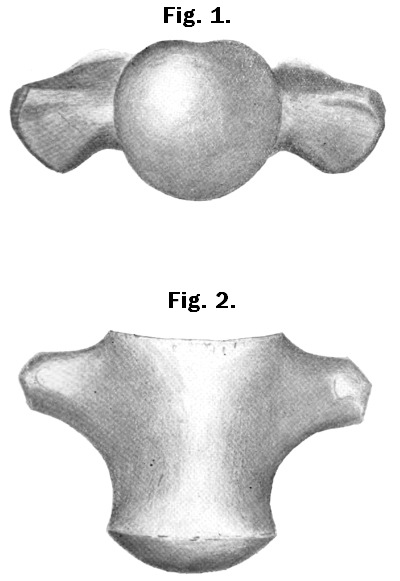
proportions of the animal were very much stouter. The figures given in
plate VI of the twenty-fifth, or eighteenth dorsal, vertebra will show
the relations between length and breadth: it is upon these remarkably
stout proportions, and the shape of the articular faces, as indicated
by the figures and by the measurements appended, that the species is
chiefly based. The articular surfaces of the basal caudal vertebrae are
remarkably triangular in shape, with the angles rounded, and the sides
of nearly equal length. This triangular shape is persistent for the
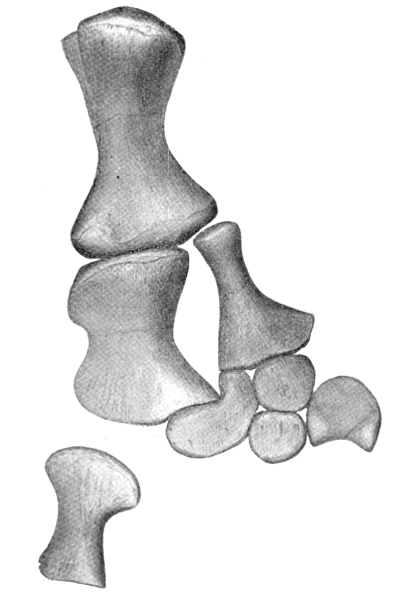
first twenty of the series as they are preserved. The paddles, as shown
in plates IV and V, show much stouter proportions than in either C.
velox or C. tortor.
The species comes nearest to C. stenops Cope, but it seems hardly the
same. It is, also, evidently allied to C. dispar Marsh. From these
and other described species, the following, extracted from the original
descriptions, will serve to show the differences, in comparison with
the specimen of C. Westii.
The articular faces in the cervicals are a broad transverse oval,
faintly emarginated above for the neural canal. In the dorsals and
lumbars the cup continues transverse, and the emargination is deeper,
but in the anterior caudals the outline becomes a vertical oval. There
appears to have been thirteen mandibular teeth.
| Length of axis with odontoid process |
32 lines |
100 |
| Width between diapophyses |
26.8 |
103 |
| Length from edge of cup to end of ball in eleventh vertebra |
25 |
100 |
| Width of ball |
14 |
56 |
| Depth of ball |
12 |
43 |
In the cervical vertebrae, the outline of the articular faces is
transversely cordate. The centra of the anterior dorsals are elongate,
and much constricted behind the diapophyses. In the anterior caudals,
the articular faces are a broad vertical oval.
| Length of axis with odontoid process |
19 lines |
100 |
| Width between diapophyses |
17 |
89.4 |
| Width of ball |
8 |
42.1 |
| Depth of ball |
7 |
36.7 |
| Length of sixth cervical, without ball |
13 |
100 |
| Width of cup |
9 |
69.1
|
The cervical vertebrae have very broad, transversely oval faces, with
indications of emargination. The dorsals are elongated, with transverse
faces, and a distinct superior excavation for neural canal. The
articular ends of the anterior caudals are vertically oval.
| Length of posterior cervical vertebrae |
44 mm |
100 |
| Vertical diameter of ball |
24 |
54.5 |
| Transverse diameter |
29.5 |
67 |
| Length of a dorsal vertebra |
52 |
|
The anterior caudals possess wide diapophyses. Their articular faces
are a vertical oval, a little contracted above, sometimes a straight
outline. They present a peculiarly elongate form.
| Length of axis (alone) |
60 mm |
100 |
| Vertical diameter of ball |
27 |
45 |
| Transverse diameter of ball |
27 |
45 |
| Length of the mandible |
720 |
100 |
| Depth at coronoid process |
150 |
20.9 |
MEASUREMENTS OF CLIDASTES WESTII.
| |
Length of dentary |
400 millim. |
| |
Depth opposite the first tooth |
20 |
| |
Depth opposite last tooth |
62 |
| |
Entire extent of mandible |
630 |
| |
Greatest depth at coronoid process |
95 |
| 2. |
Length of axis with odontoid process |
80 |
| |
Length of axis without odontoid process |
70 |
| |
Vertical diameter of ball |
24 |
| |
Transverse diameter of ball |
33 |
| 4. |
Length of fourth cervical vertebra to rim of ball |
49 |
| |
Expanse of diapophyses |
82 |
| 5. |
Length of fifth cervical to rim of ball |
49 |
| |
Transverse diameter of ball |
35 |
| |
Vertical diameter of ball |
28 |
| |
Expanse of diapophyses |
90 |
| 8. |
Length of eighth vertebra to rim of ball |
53 |
| |
Expanse of diapophyses |
90 |
| 14. |
Length to rim of ball |
54 |
| |
Transverse diameter of ball |
40 |
| |
Vertical diameter of ball |
33 |
| |
Expanse of diapophyses |
100 |
| 18. |
Length to rim of ball |
50 |
| |
Transverse diameter of ball |
40 |
| |
Vertical diameter of ball |
36 |
| |
Expanse of diapophyses |
100
|
| 23. |
Length to rim of ball |
50 |
| |
Transverse diameter of ball |
41 |
| |
Expanse of diapophyses |
100 |
| 25. |
Length to rim of ball |
52 |
| |
Transverse diameter of ball |
43 |
| |
Vertical diameter of ball |
43 |
| |
Expanse of diapophyses |
100 |
| 30. |
Length to rim of ball |
54 |
| |
Transverse diameter of ball |
46 |
This species is named in memory of Judge E. P. West, lately deceased,
to whom our Museum owes so much for his long, diligent and faithful
labors in the collection and preparation of the geological material.
Erratum: P. 17, line 15, for “Edestosaurus,” read
Clidastes, and in next line, strike out “Proc. Acad.” etc.