As the photograph wagon was halted at the gate which led to the ranch
house grounds Lucy Davison spoke to Justin, from the rear of the
wagon. Her tones were solicitous, and anxious:
“Justin,” she said, “it’s too bad to have to ask you to do it in this
storm, but I wish you would go back to Mr. Jasper’s and get Ben’s
pony, which he left there in the stable. I have a horse there, too,
which I rode out from town. Get both of them, and put them in the
stable here. You won’t mind the extra trip? I ought to have spoken to
you of it before.”
Justin was about to assure her that he would go willingly; when she
continued, in lower tones:
“And Justin! Don’t say anything about getting the horses from there,
please. I will tell you why later. And I will explain everything to
Uncle Philip.”
She had lifted the closed flap that protected the rear end of the
wagon, and in the flame of the lightning which still burned across the
skies he saw her pale and anxious face. She had always been beautiful
in his eyes, but never more so than at that moment, while making this
distressed appeal, even though her clothing exuded moisture and her
hair was plastered to her head by the rain. Her pleading look haunted
him for hours afterward.
“I’ll go,” he said promptly, “and I will have the horses here in a
little while.”
“Thank you, Justin,” she said, in a way she had never spoken to him
before. “And say nothing to anybody! I think you will not find Mr.
Jasper at home; but you know where the stable is, and how to get into
it.”
The wagon rolled on into the ranch house grounds, where Ben was helped
out and into the house; and Justin galloped back along the trail to
Sloan Jasper’s, having been given another surprise and further food
for thought.
When he returned with Ben’s pony and the horse Lucy had hired in the
town, and had put them in the stable with his own dripping animal, he
entered the ranch house. Pearl opened the door for him; and as he
removed his wet slicker he heard Philip Davison explaining to Steve
Harkness that the farmers’ dam had been torn out by the storm. Then
Fogg came toward him, and in the light at the farther end of the long
hall he saw Lucy, who had changed her clothing and descended from her
room. Ben Davison was not to be seen.
“I reckon you’re as wet as they make ’em,” said Fogg, “but, just the
same, if you’ll step in here we’ll see what I’ve got on this plate.”
He was on his way to the dark room he had fitted up in the house for
his photographic work.
Lucy came up to Justin, as Fogg walked on to this room. She looked him
anxiously in the face.
“Yes, I brought the horses?” he said, interpreting the look.
“And said nothing to any one?”
“I have spoken to no one.”
She thanked him with her eyes.
“You are just soaked,” she said, “and you ought to go out to the bunk
rooms and get dry clothing at once. I don’t want to have you get sick
because of that.”
“A little wetting won’t hurt me, and I’m going in here before I change
my clothes. Fogg wants to show me his picture, if he got one.”
He followed Fogg, and she went with him, without invitation.
“What sort of picture did he take? I heard him saying something about
it.”
“He was trying to photograph a flash of lightning. I don’t know how he
succeeded.”
He stopped at the doorway and might have said more, if Fogg had not
requested him to come on in and close the door.
“This is the last plate I exposed, and I’m going to try it first,”
said Fogg, as he made his preparations.
Fogg was an enthusiast on the subject of photography, and had long
desired to catch a lightning flash with his camera.
“If I haven’t got it now I’ll never have a better chance. That flash,
just before the dam broke—wasn’t it great? The whole sky flamed in a
way to blind a fellow. For a second or so I couldn’t see a thing. I
had the camera focussed and pointed just right to get that in great
shape, it seems to me. Now we’ll see the result.”
He placed the plate in the tray and turned the developer on it. Justin
and Lucy were standing together, with heads almost touching, watching
with interest to see the picture appear.
“I’ve got something, anyhow,” said Fogg, when he saw the streak which
the lightning had printed stand out, as it were, on the plate. “I
think I’ve got a picture of the dam, too. The camera was trained on
the mountain, right across the top of the dam; I thought if I got the
lightning I might have a great combination, with the dam and other
things showing.”
“You’ve got the lightning flash all right,” said Justin, bending
forward.
“Yes, that’s coming out great; see the image develop!”
He stopped, with a whistle of astonishment.
“Hello!” he exclaimed. “What’s this?”
A remarkable picture was coming—had come—into view. Fogg stared,
with rounded eyes; Lucy uttered a little cry of dismay and fright;
Justin caught his breath with a gasp of astonishment.
Small wonder. On the end of the dam nearest the trail two human
figures were shown—a man standing on the dam with axe descending and
a woman rushing toward him over the slippery logs. The figures were
not large, but they were portrayed clearly. They were the figures of
Ben and Lucy Davison, caught there by the camera, in the mad turmoil
of the lashing storm.
For a moment not a word was spoken, while the figures seemed to swim
more clearly into view. Lucy broke the dead silence.
“May I see that plate, Mr. Fogg?”
Her voice was repressed and hard, as if she struggled with some
violent emotion.
“I—don’t—why, yes, of course, look at it all you want to. But I
don’t—”
The sentence was broken by a crash of falling glass. Lucy had either
dashed the plate to the floor, or had let it fall in her agitation.
Justin almost leaped when he heard that sound. Lucy looked at him, and
for a moment he thought she was going to cry out. But again she spoke,
turning to Fogg.
“Well, I’m glad it’s broken!” she declared, nervously. “You saw what
you saw, Mr. Fogg; but there is no reason why you should remember it.
I hope you won’t. Perhaps one of the other plates will show a
lightning flash. You couldn’t have used this, anyway.”
“Well, may I be—” Fogg caught himself. “Lucy, you broke that
intentionally!”
She turned on him with flashing eyes.
“Mr. Fogg, I did. You saw what was in that picture. You know what it
told, or you will know when you think it over. I broke it so that it
could never be used or seen by anybody. I’m glad I saw it just when I
did. I beg your pardon, but I had to do it.”
Was this the Lucy Justin fancied he knew so well? He was astonished
beyond measure.
“Yes, I guess you’re right,” Fogg admitted, as soon as he was able to
say anything. “That dam went out, and—yes, I guess you’re right! It
wouldn’t do for that picture to be seen. I’ve been wondering how you
happened to be where we found you, and what you and Ben were doing
there.”
“Mr. Fogg,” her tones were sharp, “don’t accuse me even in your mind;
I had nothing to do with it, but tried to stop it.” She hesitated.
“And—whatever you think, please don’t say anything to Uncle Philip;
not now, at any rate; and don’t tell him about the picture.”
She turned to the door.
“Justin,” she said, and her tones altered, “I’ll see you to-morrow; or
this evening, if you like.”
“This evening,” he begged; and following her from the room, he hurried
out to the bunk house to shift into dry clothing.
When he saw her again, in the little parlor, she was pale, and he
thought she had been crying, but her agitation and her strange manner
were both gone. He came to the window where she stood, and with her
looked out into the stormy night. The white glare of the lightning
illuminated the whole valley at times. About the top of the mountain
it burned continually. The cottonwoods and willows were writhing by
the stream. On the roof and the sides of the house the dashing rain
pounded furiously.
“Justin,” she said, as he stood beside her, “I must explain that to
you. You know what that picture meant?”
He wanted to fold her in his arms and comfort her, when he heard her
voice break, but he checked the desire.
“I could guess,” he said.
“I came down from Denver on the late train, having missed the earlier
one.”
“I was in town when the earlier one came in,” he informed her,
regretting for the moment that his too speedy return had kept him from
meeting her there. “If I had known you were coming!”
She looked at him fondly, as in the old days. How beautiful she was,
though now very pale! He felt that he had not been mistaken in
thinking her the most beautiful girl in the world. The East had
certainly been kind to her.
“It was to be a surprise for you—you great boy, and for Uncle Philip.
I had no idea how it would turn out. In the town I got a horse. The
storm was threatening, but I thought I could get home. Just before I
reached Jasper’s I overtook Ben on his pony. I’m telling you this,
Justin, because I know you will never mention it!”
“I will never speak of it,” he promised.
“I knew you wouldn’t. Now, you must never mention this, either—but
Ben had been drinking.”
Justin understood now the meaning of Ben’s white face and glittering
eyes.
“I never knew him to drink before,” she went on, “and I shouldn’t have
known it this evening but for the way he talked. Politics, and that
man Arkwright, caused it, I’m sure. He was raging, Justin—that is the
word, raging—against you and the farmers, and particularly against
Mr. Jasper and Mr. Sanders. He claimed they had tried to get you to
run against him for the legislature. He talked like a crazy man, and
made such wild threats that he frightened me.”
Justin wanted to express his mind somewhat emphatically. It seemed
best to say nothing; yet that picture of Ben Davison raging against
him and frightening Lucy gave him a suffocating sense of wrath.
“The storm struck us just before we reached Mr. Jasper’s house, and we
turned in there for shelter. Jasper wasn’t at home, but the door
wasn’t locked and we went in.”
“Jasper was in town,” said Justin.
“Ben put the horses in the stable,” she went on, without noticing the
interruption. “When he had done that, and had come into the house out
of the rain, he began to rave again. After awhile he said he would go
out and see how the horses were doing and give them some hay; but I
saw him pick up an axe in the yard and start toward the dam. Though
the storm was so bad, I followed him, for he had been swearing
vengeance against the farmers, and from some things he had said I
guessed what he meant to do. When I reached him he was on the dam,
chopping at one of the key logs, and had cut it almost in two.”
She trembled, as that memory swept over her.
“I rushed out upon the dam, when I saw what he was doing, and begged
him to stop. He tried to push me away, and I came near falling into
the water; but I clung to him, and then the axe slipped out of his
hands and fell into the stream. The logs began to crack; and that,
with the loss of the axe, made him willing to go back with me. We ran,
and had just reached the shore when the dam gave way. The ground was
slippery, and he fell as we ran toward the house through the storm;
and when he lay there like a log, and I couldn’t get him up, my nerves
gave way, and I screamed. Then you heard me. That is all; except the
photograph.”
The calm she had maintained with difficulty forsook her as she
finished, her voice broke, and her tears fell like rain.
Justin slipped his arm about her.
“You were brave, Lucy!” was all he could find to say.
He had never realized how brave she could be.
“And, Justin, nothing must ever be said about it! It would ruin Ben;
it might even put him in prison. I needn’t have told you; but I wanted
to, and I know you won’t say anything about it.”
Justin did not stop to think whether this were right or wrong. He gave
the promise instantly.
They began to talk of other things. She seemed not to want to say
anything more on the disagreeable subject; and Justin was glad to have
her talk of herself, of her school life, and her Eastern experiences.
Somehow the old sense of intimacy had in a measure departed. He
withdrew his hand from about her waist, that was still slender and
girlish. She had been removed to a great distance from him, it seemed.
Yet, outwardly, she had not changed, except for the better. She was
more womanly, more gracious, now that her tears had been shed and her
thoughts had turned into other channels, even than in the old days.
Nevertheless, Justin could not at once summon courage to say to her
the old sweet nothings in which both had delighted.
“You are still my sweetheart?” he ventured timidly, by and by. “The
East hasn’t changed you any in that respect, I hope?”
She looked at him earnestly, and her eyes grew luminous.
“No, Justin, not in the least; but there is one thing, which has come
to me while I was away. We aren’t children any longer.”
“I am well aware of that fact,” he said; “I have been painfully aware
of it, all evening.”
She knew what he meant.
“We aren’t children any longer; you are a man now, and I am a woman. I
heard a sermon the other Sunday, from those verses in which Paul said
he had put away childish things and no longer acted or thought as a
child. Long ago I told you that I loved you, and promised to marry you
some time; I haven’t forgot that.”
“I shall never forget it!”
“But now that we’re no longer children, I think it is your duty to
speak to Uncle Philip.”
The thought of facing Philip Davison on such a mission flushed
Justin’s face. Yet he did not hesitate.
“I will do so,” he promised; “I ought to have been courageous enough
to do it long ago, and without you telling me to.”
Instantly he felt taller, stronger, more manly. He knew he was
deliriously happy. To feel the soft pressure of her body against his,
the electric touch of her hand, and to hear her say that she loved
him, and would some time marry him, thrilled him. He looked down into
her face, with the love light strong in his eyes. He recalled how he
had loved her during her long absence.
“You didn’t see any one while you were gone that you thought you could
love better?”
He believed he knew what the answer would be, but he awaited it
breathlessly.
“I oughtn’t to say so, Justin, until after you have spoken to Uncle
Philip; but I saw no one I could love half as much as you—no one.”
“Yet you saw many men?”
She laughed lightly; it was like sunshine after rain.
“Not so very many as you might think. Mrs. Lassell’s Finishing School
for Young Ladies is a very exclusive and select place, you must
remember. She holds a very tight rein over the girls placed in her
charge.”
“Is it so bad as that? It’s a good thing for me, I guess, that she is
so careful; you might get to see someone you could like better than
me.”
She laughed again, seeing the anxiety he strove to cover.
“If you’ve been accumulating wrinkles and gray hairs on account of
that you’ve been very foolish.”
“Your last letter didn’t seem quite as genial as some others!”
“I didn’t underscore the important words, or write them in red ink?”
She became suddenly grave. The events of the evening haunted her like
a bad dream.
He stooped low above her bended head.
“I love you,” he whispered; “and I’m going to ask you again if you
love me, just to hear you say it!”
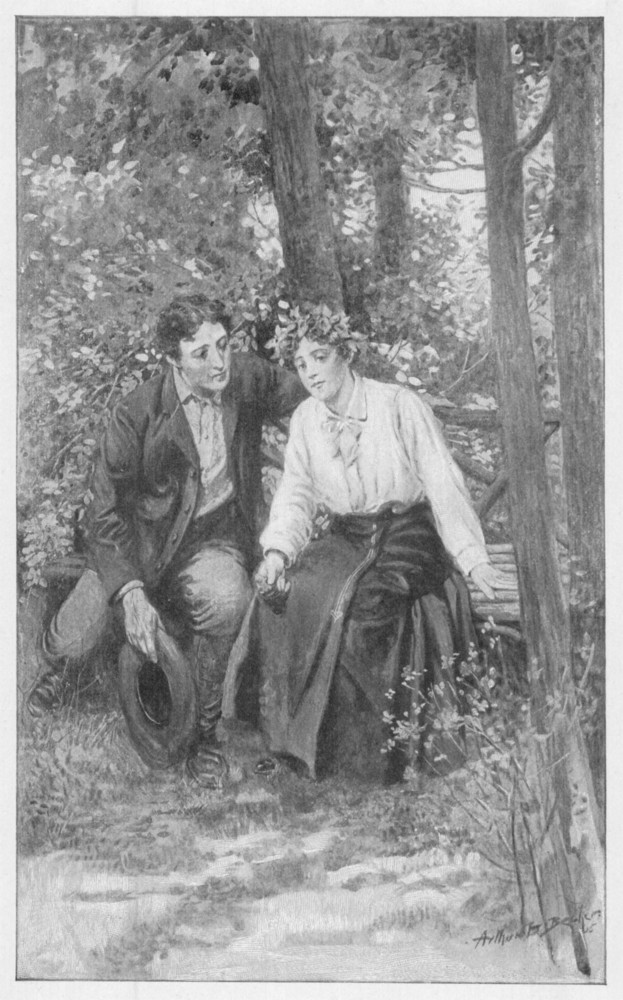
She looked up at him, tremulously.
“Justin, I love you, and I love you! There, don’t ask me again, until
after you have spoken to Uncle Philip.”
His blue eyes were shining into the depths of her brown ones; and with
a quick motion he stooped and kissed her.
“No one was looking, and no one could see us in here,” he said, as she
gave a start and her pale face flushed rosy red.
“I will speak to Mr. Davison to-morrow,” he promised, as if to make
amends.