Then one day the sun rose clear and bright, the waters
sank and the mountains showed clean-cut against the
fleckless sky—but no bees buzzed, no sweet odors filled
the air, no wild flowers carpeted the woods, no butterflies
fluttered, no birds sang.
Vermont tasted that year the bitter cup of desolation.
A dire scourge of spotted fever, or “plague,” the doctors
called it, broke out, severest in Montpelier. Consternation
was great among the Sabbath-abiding folk
who claimed solemnly that the affliction was due to the
worldly ways and “flunk and flummux” of the “foreigners”
who came from other states to pass the summer in
the Green Mountains. Even the women of Vermont,
themselves, had taken to wearing laces, ribbands, frills
and furbelows—most unbecoming in God-fearing females!
Stagnant water stood in pools, here and there, houses
were damp, there were no crops, and all food was mouldy
and unwholesome, for lack of sunshine.
In Montpelier men went from house to house, carrying
long bathing vessels, and such of the women as had not
yet been attacked with the “plague” bathed the stricken
ones in an infusion of hemlock boughs. Doctors bled
them and dosed them with teas more or less harmful
made of ginseng, pleurisy-root and marshmallow. Fresh
air, sunshine and pure water with proper nourishment
would have been better, but in those days bleeding and
herb-teas were the two panaceas for all ills.
In Williston, Dame Susannah Wells, who had reached
the ripe age of one hundred and four years and seen her
descendants die year after year of old age—without
warning fell ill with the plague and died. Had it not
been for this her acquaintances had long since come to
the conclusion she would have lived forever. Children
and babies were mowed down with equal impartiality by
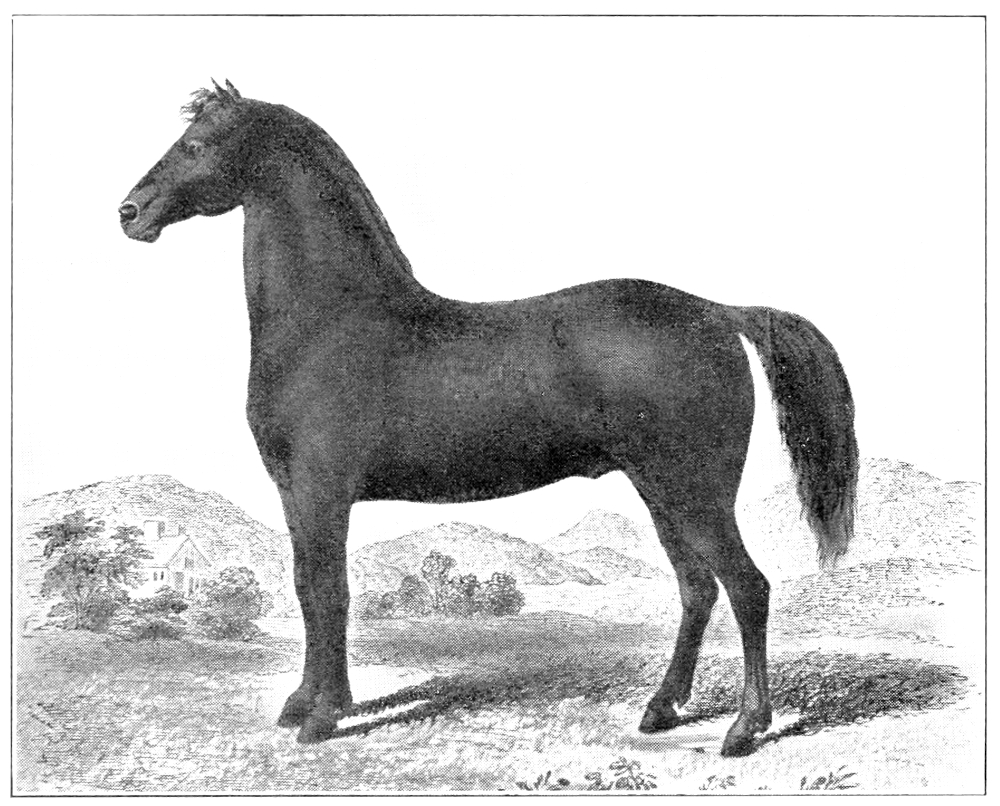
the Reaper; men and women succumbed; but Morgan’s
hardihood saved him from any ill effects of the long, wet
season.
Events in his life, following 1811, were not of great
importance and may be passed over until Stone put him
up for sale in Burlington, at the stable of the Rev. Daniel
Clark Sanders, President of the fine College on the hill.
There he stayed for a long time, as he was growing old,
they said, and no one wanted to buy him. President Sanders
was quite willing, for he had the use and care of
him all that while. Now and then Stone came to the
stable with a prospective buyer, but a trade was never
consummated.
As a convenient dooryard Ira Allen had given a space
of fifty acres around the College, called The Green. It
was still full of stumps and piles of brush, but made a
delightful place for the cows and horses of the town to
graze, and here Morgan had many agreeable experiences.
The merry students, passing by, gave him friendly
greeting always and a dainty of some kind from their
lunches; he learned to know the whistle of many and
whinneyed to them as they ran toward him.
Often, as he stood nibbling grass he saw a strange
looking youth limp across the Green with never a nod or
greeting for him or any one else. Absorbed, stern of
expression, and morose, this lad was destined to rise to
prominence, the like of which could not be foreseen in
one without influence, the son of a poor, hard working
widow. This lame boy was none other than young
Thaddeus Stevens, who, by industry and perseverance,
gained his book-learning in Burlington and later graduated
at Dartmouth College.
Burlington was now a very different place from the
logging camp Morgan first remembered. The old
wharf, made of a few logs fastened together, at the foot
of King’s Street, had given way to a fine new one;
houses had taken the place of camps and were scattered
as far as the Winooski.
The College on the Hill, commanding the lake, gave
distinction to the town, seeming to crown it with a cap
of learning; Ira Allen’s iron foundries, mills and forges
gave work to many, and linen, woolen and cotton mills
had been built; an immense quantity of liquor was distilled.
It was a busy and prosperous town, having
grown greatly in importance since Ira Allen launched
his first schooner, “Liberty,” a long while before.
One day Stone brought to the stable an army officer.
The military hat was set well upon the handsome head
of the stranger, a cloak was flung with careless grace
about his shoulder; spurs shone on his heels and a sword
clanked, musically, at his side.
Intuitively, Morgan liked this man. It was easy to see
he was a fine, brave American soldier, with a cool and
level head. His uniform was grand and inspiring to the
horse, who still looked upon soldiers and the idea of war
with quivering anticipation.
“So this is the horse, eh?” the officer asked Stone, and
Morgan knew by his soft tone and speech that he came
from the same state as Mistress Lloyd—there was no
mistaking a Marylander! As the stranger caught the
halter his touch was so firm and friendly the horse knew
instantly that here was his master. He arched his crest,
pawed the ground prettily, and thrust his large, sensitive
nostrils forward.
Stone led him out into the bright sunshine; the officer
examined him thoroughly—an operation Morgan had
long since grown accustomed to, as he had changed
owners so often.
A flame of friendship sprang up between the two.
“I can scarce credit his age to be twenty-two!” said
the stranger. “He has such suppleness of joint, he
moves with the action of a five-year-old!”
Stone was pleased and proud of his horse; he said:
“Those are his characteristics, Captain Dulaney!”
Dulaney? Morgan’s memory awoke, vaguely.
“And from what stock, did you say?” the officer enquired.
Stone let him know all that was said concerning Morgan’s
parentage. Then he continued:
“He has worked hard at the plow, most of his life, and
he is not known in horse-books, but we Vermonters don’t
take much interest in pedigrees. We say, ‘pretty is as
pretty does’ and present merit is what we go by, Captain—not
what his ancestors did!”
The Maryland gentleman laughed, seeing the point.
“Blood speaks for itself, right here,” Captain Dulaney
said. “I will wager my new sword that this horse has
thoroughbred blood! So you see your argument about
pedigree does not hold!”
Morgan waved his tail slightly, in acknowledgment.
“I like the animal,” added the Captain, in his quiet,
pleasant way. “I would mount him, sir.”
In ten minutes Morgan was accoutred in the military
trappings and saddle of an officer of the United States
Army. It was with a thrill that he felt the Captain
throw his fine-dressed leg across his back and slip his
cavalry-booted feet into the stirrups—all the while holding
the reins in his masterful hand. A mutual confidence
was awakened between the two that was to last
always.
Morgan, feeling as young as he did ten years before,
cantered smoothly off, side-stepping just enough to give
his rider something to do.
Down the hill they went, the horse as sure-footed as
a goat, feeling that he had never carried so dashing and
gallant a rider nor so congenial a spirit, and right glad
was he to respond to every gentle pressure of the bit
or motion of the rein.
At the turn of the trail they came to a stone fence. At
his rider’s suggestion Morgan paused slightly, pulled
himself together, rose in the air and cleared it. Over a
rushing little stream he went in the same confident, bird-like
way, galloping easily off as he touched the ground
on the other side.
The blue sky was reflected in the lake, and the mountains
in New York pierced it, in reality, or reflection,
with peaks of green and brown. The air was still and
pure and the cool scent of the pines was strong in their
nostrils. The haze of the morning had given place to a
crystal clearness and Juniper Island was like a spot of
precious jade set in a field of turquoise.
They were on the way to the Falls at a smart gallop
now, and what his rider intimated to the horse along
the bridle-rein gave him courage and love combined with
perfect understanding. At a convenient spot they
stopped, and Captain Dulaney spoke aloud.
“Ah, my fine fellow!” Morgan flicked his tail in reply,
and tossed his mane slightly—with an up and down motion
once or twice of his crest as was his habit when
spoken to, directly—“Ah, my fine fellow, this air makes
one breathe deeply. There’s no climate like it. No
wonder these Vermonters are giants morally and physically.
No wonder the Green Mountain Boys could take
Ticonderoga! A handful of men bred in this air are
worth all the city-bred officers in the British Army.
And forsooth, they proved it! Ha! Ha! If it comes
to an attack by water from Canada on the lake, here, we
have a superabundance of trained officers and men.”
He dismounted and spread a map on the ground,
weighting the corners with pink and red fragments of
stones picked up at random. Had he known it, these
were pieces of marble, later to make that locality famous,
when the quarries were discovered.
In silence he studied the map, the bridle rein hanging
across his arm. Then he folded it, sprang suddenly into
the saddle and continued his thinking aloud as they
started off:
“Now if we could be sure of the Vermonters in this
war, but they seem to think fighting foolish—and in this
they may be right, eh, Morgan? New England is in a
ferment, but we’ve got to stick by the President and
fight it out. Although they call it ‘Mr. Madison’s War,’
that poor man is the most unwilling participant in it!
The thing is to find which way the cat will jump here;
that’s my business. These secret emissaries from England
and Canada may be right here now, rousing the
Vermonters to join Canada. But may be the sight of
a good old Continental uniform—God bless it!—may
bring them our way!”
The lake glinted blue in the sunshine, the birds twittered
in the forest, as they passed on slowly.
Suddenly Captain Dulaney addressed the horse gaily:
“Look at that view, Morgan. Shall we let a king
wrest it from us? No, I swear it! This air is like
wine. Who would live in towns, say I, with houses
crowding, one upon the other, peeping over each other’s
heads to see the narrow streets that lie between? Not
I, for one. Give me trees and sky, rivers and fields, and
the green country down in Maryland, ‘Where the Great
Lloyd sets his Hall.’”
Morgan started. He turned his straight, intelligent
face full round and looked at his rider. A smile, quick
and magnetic, met his dark, prominent eye. Then a light
flooded his horse mind. No wonder he loved this officer!
Had he not won him for Mistress Lloyd so long ago?
He remembered all now. From the tip of his tail to his
fine, sharp ears he quivered with happiness. Maybe after
a life-time of waiting he would see her again!
Overhead the sky was cloudless, but suddenly across
its face came sweeping into view, over-shadowing the
woods for a moment, a dense flock of wild pigeons. The
Captain leaned forward and patted Morgan’s neck.
“Just pigeons, old man! Is that why you shivered?
Or is there something you want to say?”
But Morgan could not answer in words, he could only
hope and serve. He did wish, however, that Captain
Dulaney would not call him “old”! He had years of
usefulness before him yet!
“I wish my sweet wife were here now to enjoy this
view with us!”
Morgan replied with a toss of his head.
“But she is coming!”
Morgan whinneyed, softly, and trembled all over.
“God bless her!” went on the Captain, his blue eyes
deepening to a light, wholly tender, “She would scarce
consent to my coming up here without her. She argued
with me, the witch, that Mistress Washington had passed
the winter at Valley Forge, and she did not love her
General any more than my wife loved her Captain! It
was a clinching argument, Morgan, my friend, and I had
to promise that she should come when all was ready—and
there she is waiting in Boston until I send for her.”
Morgan tossed his head, and his tail waved slightly.
“She shall ride you, little horse, for, by my sword,
there never was a more delightful, under the saddle.
My mind is made up, I shall buy you, old as you are!”
There it was again—“As old as you are.” Age! what
has age to do with it if the heart and spirit are young?
“As for these Vermonters,” the Captain continued,
thinking aloud, and riding on, “they are brave, fine men
and they will stand by Ethan Allen’s ideals; if war
comes they will be with us. I’ve felt the pulse of Vermont
from North to South, and I believe in them in
spite of their reserve and non-committal attitude.”
They galloped on over rocky, new-cleared spaces,
across streams and fences, and pushed their way slowly
through underbrush. When they stopped, Dulaney
pulled Morgan’s lean head round and caught his bright,
pleasant eye. The Captain winked at him with a
chuckle.
“We’ll win this war yet——”
So there was to be a war! Morgan’s pupils dilated,
his nostrils spread.
“Yes, we’ll win this war, as we did the other,” and
the officer nodded his head with conviction. “I was but
a lad of ten, Morgan, when we heard of Cornwallis’ surrender,
in 1781. ’Twas a crisp autumn day and I well
recall the shouting and hurrahing, the patriotic acclamations
and glowing ardor of the Americans.
“To-day we have no Washington, no Hamilton, no
La Fayette. We can but wait and see. But to me it
seems a foregone conclusion. We have the larger ships,
the heavier ordnance, and we are superior in seamanship
and gunnery. Our vessels are few, but equipped
thoroughly. Right will prevail—and we are right,
aren’t we, Morgan?”
Having finished his somewhat whimsical remarks, he
wheeled his horse once more, and galloped toward Rocky
Point where he stopped long—taking further observations
of lake and country, turning in his saddle and gazing
with thoughtful brow in every direction, scanning
the horizon line, the lake, the streams, the roads.
Before the day was done they had skirted the rugged
coast and crossed the sand-bar to La Grande Isle. So
great was the number of salmon in those days that, as
Morgan waded knee-deep in the water among them, they
splashed away from his feet, as if in play.
Squirrels ran over the ground on the island and chattered
down at them from the boughs. Clear and deep
the blue lake lay, the woods coming to the very edge
where poplars trembled in the clear light and tall,
straight white-pines towered like sentinels.
From Island Point they could see Plattsburg Harbor,
and here Captain Dulaney again sat for a long time
buried in thought, looking across the wild, dark forest
and lake.
At dusk they bent their faces homeward, both horse
and rider absorbed in his own meditations until they
reached College Hill.
Early next morning Samuel Stone came to bid the
Morgan good-bye, telling him he had been bought by
Captain Dulaney, and that he “was a very lucky horse!”
Morgan knew this far better than Stone—wasn’t Mistress
Dulaney coming, and would he not have the happiness
of cantering under her saddle once more?
But she did not come at once. During the fall and
winter of 1812 and 1813, the United States troops arrived
and were settled in the College buildings, now
called United States Barracks for the winter.
Captain Dulaney rode Morgan daily and taught him
to be a true cavalry horse and to obey bugle calls. So
obedient did he become and so conscientious was he,
that, one day when he was attached to a “shay” at the
foot of the hill, he heard the bugle sound “Charge.”
He obeyed instantly on the impulse, snapping his hitch
rein sharply. Up the hill he “charged” at full speed, the
shay rattling on behind! ’Twas not his fault that it
was not shaken into bits! From a colt it had been his
instinct to obey without question, and certainly, at last,
in the service of his country he did not hesitate!
Soldiers, off duty, lounging idly in the shade, roused
themselves with a great roar of laughter as the old horse
charged toward them. An orderly sprang forward and
caught the bit. Not a strap, not a tug was broken!
Every one cheered heartily, for “Old Justin Morgan”
had come to be a character at the post and was loved
by all, men as well as officers.
Time passed and still Mistress Dulaney did not come,
though every day Morgan looked for the one great, human
love of his life. He wondered if she remembered
him—if she recalled the part he had played in freeing
her from the Coxcomb, and winning her the man she
loved.
In the spring of 1813, when the ice broke up, a fleet
was fitted out. Oak timbers, cut on the Winooski, were
sawed at the mills, nails and bolts were fashioned out of
hot iron at the forges where even the bellows breathed
patriotism. Masts and spars were tapered and sails
made. Liberty poles were set up on eminences—the
higher the pole the stronger the patriotism. Everything
indicated war.
Commodore Macdonough took command of the lake
and naval stores and ammunition arrived from the
South. All seemed waiting for the call to arms when
an epidemic of lung-fever broke out among the troops
stationed at the barracks.
Captain Dulaney was stricken, and lay ill unto death
at his quarters. Morgan missed him and pined for his
company.
A letter was dispatched to Mistress Dulaney, but the
distance to Boston was so great that a man might die
before the stage went and returned to Burlington. At
last when the coach rattled up, with a great noise and
hurly-burly, to the officer’s quarters and stopped, all
knew that Mistress Dulaney was inside, and it chanced
that Morgan stood hitched near-by. The steps were
quickly let down and right quickly did she descend.
Morgan recognized her at once; he whinneyed a note
of welcome, but she neither saw nor heard him; she was
in such stress of anxiety.
She was all his memory held her: not so young, but
more sweet, more beautiful and a light as of a halo surrounded
her face as they told her the Captain was better.
Morgan saw all before she put her little foot to
the ground.
But as she hurried into the house the horse felt old,
a sudden darkness fell upon the world, as if a cloud had
obscured the sun.
She had not even seen him!
He hung his head and tears filled his dear, longing
eyes. After all these years of waiting and loving—and
she had not even seen him!