A Visit to Mount Mellaray
MANY persons whom I met in Ireland
told me that I ought to go to
Mount Mellaray "for my sins." Mount
Mellaray (to those who don't know) is a
Trappist monastery, set among hills that
would be at once the temptation and
despair of a colorist in landscape.
To it go the brain and heart weary
from all countries, and the good monks
(there's no doubt that they are good)
welcome them whether they have money
or not.
They tell of a man who went to
Mount Mellaray and accepted the hospitality
of the inmates and on his going
away he did no more than bid them
good by. Not a penny did he leave behind
him, although he had sat at table
with the other guests several days.
Next year he came again for his soul's
rest, and the monks received him as an
old friend. Those who were not under
vows of silence spoke to him, the others
nodded to him, and once more he rested
on the side of the purple hills and partook
of their hospitality.
When it came time for him to go away
he left behind him—a pleasant impression,
but not a cent did he give to the
cause of charity.
Another year passed by, and he came
again. Hundreds had come in the meantime, and none so poor but had left something
in return for the restfulness and
peace that are to be had there.
Quite as an old friend he was now received
and was made to feel welcome.
No one knew who he was—perhaps he
was nobody—but on his going away for
the third time he showed that he had been
but acting the part of an ingrate, for he
gave the father who acts as keeper of the
gate a hundred pounds.
This story I told to the jarvey who took
me up the hilly road to the monastery, and
he listened with interest, and when I had
finished he said, "It's quite true."
As I did not expect to visit it again I
made up my mind to do my giving on
leaving the place, but my hundred pound
notes are all in the future, and therefore
no one can ever tell a similar tale of me.
I must confess that, being a Protestant,
I felt a little compunction about going to
the place, but I had been assured that my
sect would make no difference, that the
fathers were glad to receive all who came,
and that I would be as well treated as
though I were a saint.
On my way up my jarvey told me of the
amount of good that the monks do, not
only in a spiritual, but in a material way,
by providing work for the able-bodied
men of the vicinity.
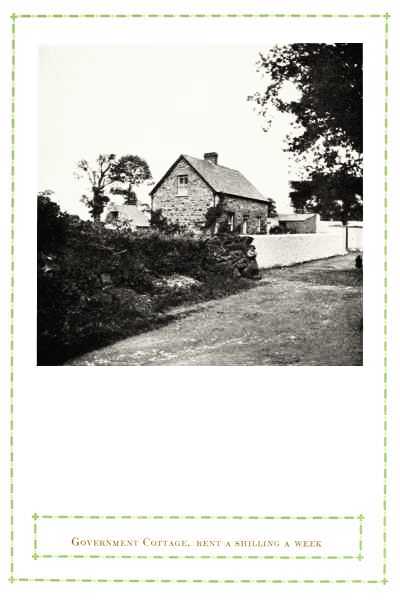
We passed a neat stone cottage with
ivy growing on it, and a vigorous fuchsia
tree blooming in the garden, and he told
me that it was a government cottage and
rented for the absurd sum of a shilling a
week.
"And how much can a man earn in the
fields?" said I.
"A matter of ten shillings a week,"
was his reply.
Query: If a man gets ten dollars a
week in New York and lives in a crowded
Harlem flat for which he pays at least five
dollars a week, is he as well off as this
Irishman, in his native land, with all the
fresh air in the world, fowls and fresh
eggs, and butter of his wife's making, and
one of the loveliest views imaginable
before him?
But you'll find the man in the neat little
government cottage anxious to fly to the
land of dollars—and when he's there
he'll hand out more dollars to his landlord
for inadequate accommodations than
he could earn at home in a month of
Sundays.
Human nature is human nature, and
the daisies in the field over the pond are
always more beautiful than the ones that
lie at your feet.
I was received at the monastery by a
monk, who on learning that I wished to
become a guest, took me over to the guest
house, and there a white-robed father
took my surname, and I began to feel that
I had renounced the world, and that perhaps
I was trying something that I would
regret, and wouldn't mamma come and
get me.
But the bearded man before me was
kindly, and when I told him (not wishing
to sail under false colors) that I was a
Protestant, he told me that it was a fast
day, and had I dined.
Fortunately I had eaten heartily at
noon. "If ye have not dined we can give
you something substantial," said he, but
I decided that it would be better to be
treated as the other guests were to be
treated, and so I told him, and he said
that at six o'clock there would be tea, and
that at eight I would retire to my room,
and at ten all lights must be out.
It was raining dismally, but he said
that I could go for a walk in the garden,
or stay in my room, or go to the "smoke
shed," to smoke a pipe or a cigar.
I chose the smoke shed as I understood
there were other human beings there, and
although I had only been in the monastery
five minutes, I felt the need of companionship.
After a brother had taken my traps to
my room, I went out to the smoke shed,
and found there some ten or twelve guests,
five or six of them priests, and all Catholics
but myself.
They were very quiet as I came up,
and I feared to speak above a whisper
myself, but a jolly-looking priest, seeing a
newspaper sticking out of my raincoat
pocket, said: "Is that to-day's paper?"
and on my saying it was, he asked me if
he might borrow it, and then he stood up
in front of them all and said:
"The news of the day.... 'Irish
Ireland. A Leaguer's Point of View.'
'The French Trunk Horror.' 'The
Bachelor Tax,' discussed by Mr. Dooley."
"Rade that, father," said a young chap
with a twinkling eye.
"Sure it's in dialect," said the priest
with a smile, and his own brogue.
"Never mind. Go ahead. 'Tis a
dreary day."
The paper was the Dublin Independent,
and in a moment more I was listening
to the familiar humor of the funniest man
in America, and that in a monastery, of
all places.
"'This here pa-aper says,' said Mr.
Hennessy, 'that they're goin' to put a
tax on bachelors. That's r-right. Why
shudden't there be a tax on bachelors?
There's one on dogs.'"
Loud was the laughter in the smoke
shed at this sally, and none laughed louder
than those professional bachelors, the
priests.
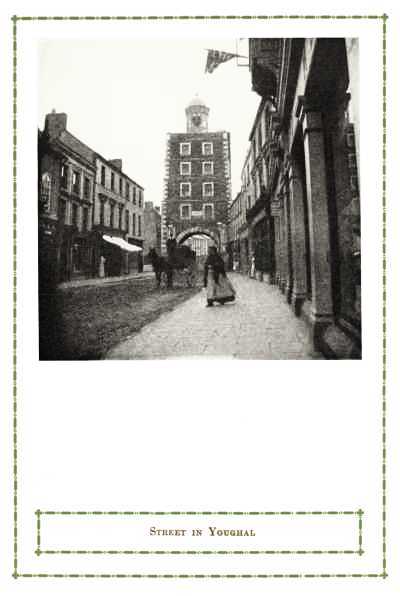
Street in Youghal
"'I suppose,' said Mr. Dooley, 'that
next year ye expect to see me throttin'
around with a leather collar an' a brass
tag on me neck. If me tax isn't paid
th' bachelor wagon'll come around, an'
th' bachelor catcher'll lasso me an' take
me to the pound, an' I'll be kept there
three days, an' thin, if still unclaimed,
I'll be dhrowned, onless th' pound keeper
takes a fancy to me.'" (Loud laughter
by priests and laymen.)
The ice thus broken by my friend
Dunne, I was soon in conversation with
the group, and discovered two compatriots
from Indiana, one a native of Ireland returning
to visit it once more before he departed,
the other his son.
Vesper bells broke up the talk, and I
went with the rest to chapel.
After vespers came "tea," which I had
supposed would be literally nothing else,
but there was the most delicious graham
bread I have had since I came to Ireland,
and unlimited milk. There was no butter,
as it was a fast day. This I regretted
keenly.
Talk went on among us all until a
bearded monk in white came in and began
to read passages from Thomas à Kempis.
His enunciation was peculiarly pure, and
I doubt not that he was a gentleman born.
It was a pleasure to hear such English.
While he read we were all silent.
After supper we went out to the garden,
and in a sheltered place (although we did
not need a shelter, as the fickle rain had
stopped) those who wished played a
spirited game that consisted of tossing
stones into a little pocket of earth. One
of the priests was an adept, and he carried
all before him.
In such simple pleasures, or in walking,
the evening was spent until it came time
to go to chapel again.
One of my companions (and they were
there from all parts of Ireland, and you
might hear the Scotch accent of the north,
the pure Dublin and Wicklow Elizabethan
English, the slightly thickened Waterford
variety, and the hurried talk of the Corkonian,
as well as other styles I could not
place—probably west coast dialects,
mournful and slow) asked me what I
thought of Ireland, and I told him my
impressions had been tremendously favorable
so far. He said that a man who
had returned not long since told him that
Ireland was hopelessly behind the times,
and I told him, for his comfort, that to
take one instance in which Ireland was
up to date, the tram service in Dublin was
far ahead of that of New York, both in
the elegance of its rolling stock, its cheapness,
and the civility of its employes. He
was much amused at the idea of horse cars
in New York. (Electric cars play an important
part in all the large Irish cities,
and a ride on the top of one to Howth, a
lovely suburb of Dublin, is worth every
bit of the eight cents it costs).
They have yet to introduce the transfer
system, but in other particulars, like Mr.
O'Reilly, "they're doin' dam' well."
All this I told him.
At eight I sought my room, where
there was reading matter suitable to
the place, but the candle was not conducive
to extended reading unless I held
it close to the book, and then it dazzled
me, and at nine o'clock I was in my bed,
and until two in the morning the house
was quiet, save for a snore here and there.
But at two the bells began to ring, and
kept it up at intervals all through the
night. I was told this, but "tired nature's
sweet restorer, balmy sleep," came
to my aid, and I dreamed it was a feast
day and that all the monks were sitting at
the breakfast table, singing at each other
joyfully.
Next day was a feast day (to my relief).
I was up at six, but it was some time after
that that I heard steps in the hall. I had
looked out of the window from time to
time, hoping to see some one in the garden.
The table of the duties of the day
hung in my room, and I noticed that
breakfast was at nine. Luckily I had
some chocolate, or I might have felt I was
likely to faint by the wayside.
I did not go to early devotion, and when
I heard the footsteps in the hall I opened
my door and found that it was Father
David, the keeper of the gate, going
around to see if any were still in bed.
When he saw me, he said to the brother
who accompanied him, "Oh, it doesn't
make any difference with him." Then
to me, "Would you like to walk in the
garden?" I said that I would, and
walked round and round its lonely paths
for over an hour, now and then eating a
square of chocolate to keep off death.
But before eight the good father came
and asked me if I'd like to see the interior
of the monastery, and he showed
me the bakeshop with its most up to date
ovens, and oh, how hungry the smell of
baking made me, and the steam-saw, and
the creamery, and the library with its old
newspaper telling to Irishmen that Cromwell
had departed to his rest the day
before. Not very sorrowful news, that,
I imagine, to the Irishman of that day.
And Father David showed me and the
other Americans an incubator, and explained
the process, with an innocent circumstantiality
that we respected. Why
tell him that the woods were full of incubators
in America? The things that
appealed most to him, however, was the
big circular saw that would saw up a log
of wood in a "minyit."
With his permission I took a photograph
of a beautiful Irish cross in the
graveyard, but when I suggested my taking
him, he averted his palms at me.
Such vanities were not for him.
At breakfast there were eggs and milk
and tea, and delicious butter in abundance,
and the reading of some holy book by
Father David, which did not stop all
conversation. Being a feast day, there
was one priest who felt his tongue could
be loosened, and he kept up an undercurrent
of conversation, to Father David's
annoyance, but it was a human touch that
was not out of place.
The monks are themselves vegetarians,
but a school is run in connection with the
monastery, and the students are allowed
meats.
At nine my jarvey called for me and
took me to the boat for Youghal, and I
made my offering and shook hands with
Father David, and felt that I had been
benefited by my stay in the retreat. I
even felt that had I more time at my disposal,
I would stay on for several days,
talking with the guests, pitching stones
into the hole, and looking at the rolling
landscape and the awe-inspiring hills
behind the chapel spire.
One thing in America had interested
Father David—the Thaw trial—and
he wanted to know if Thaw would be
hanged.
One day the only American news in the
'Derry papers was to the effect that Evelyn
Thaw thought of going on the stage.
Not our art, or our literature, or our
suppression of the boss, but the Thaw
trial, is the thing that has made a deep
impress on Great Britain and Ireland,
and everywhere I am asked to give an
opinion.
The Thaw trial was a matter of moment
to the good old man, with his incubators
and his steam saw and his
absence of personal vanity.
As half way down the mountain I
turned and looked back at the spire
against the somber hills (for it had begun
to rain) I wished that my camera would
take them for me, but I knew that snapshots
of hills are like literary snapshots—inadequate.