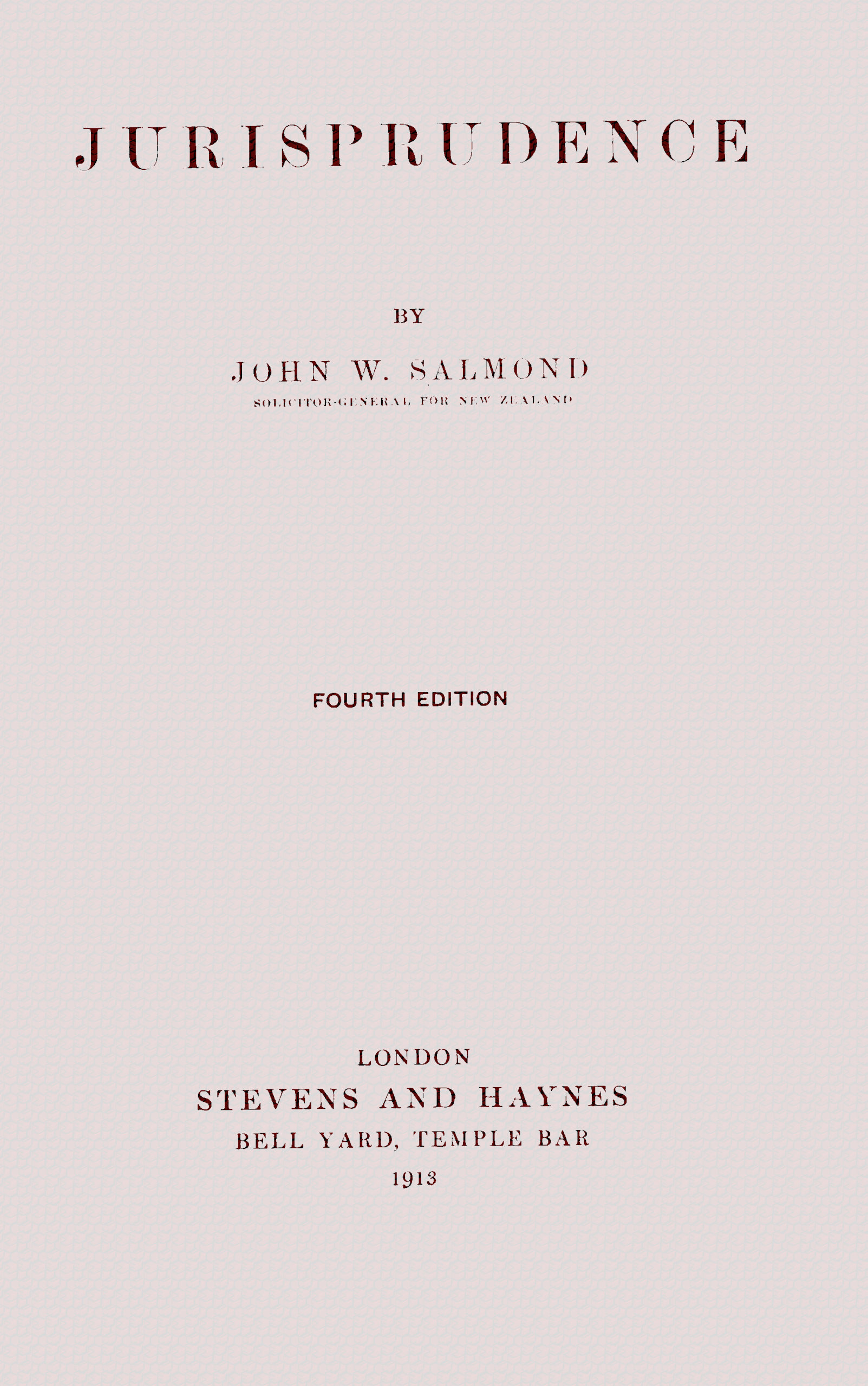
Jurisprudence
by Sir John W. Salmond
★★★★★No ratings yet
Language: English
Sign in to rate this book.
Sign in to shelve this book.
About this eBook
- Author
- Salmond, John W. (John William), Sir, 1862-1924
- Original Publication
- United Kingdom: Stevens and Haynes, 1913.
- Credits
- Richard Tonsing and the Online Distributed Proofreading Team at www.pgdp.net (This file was produced from images generously made available by The Internet Archive)
- Language
- English
- LoC Class
- K: Law in general, Comparative and uniform law, Jurisprudence
- Subject
- Jurisprudence
- Category
- Text
- Project Gutenberg
- eBook-No. 71297
- Release Date
- July 30, 2023
- Copyright
- Public domain in the USA.
Contents
- 1.JURISPRUDENCE
- 2.PREFACE TO THE FIRST EDITION
- 3.PREFACE TO THE FOURTH EDITION
- 4.CONTENTS — CHAPTER I. THE SCIENCE OF JURISPRUDENCE. — § 1. Jurisprudence as the Science of Law. — § 2. Jurisprudence as the Science of Civil Law. — § 3. Theoretical Jurisprudence. — § 4. English and Foreign Jurisprudence.
- 5.CHAPTER II. CIVIL LAW. — § 5. The Definition of Law. — § 6. The Administration of Justice. — § 7. Law Logically Subsequent to the Administration of Justice. — § 8. Law and Fact. — § 9. The Justification of the Law. — § 10. The Defects of the Law. — § 11. General and Special Law. — § 12. Common Law. — § 13. Law and Equity.
- 6.CHAPTER III. OTHER KINDS OF LAW. — § 14. Law in General—A Rule of Action. — § 15. Physical or Scientific Law. — § 16. Natural or Moral Law. — The Jus Gentium of the Roman Lawyers. — § 17. Imperative Law. — § 18. Conventional Law. — § 19. Customary Law. — § 20. Practical Law. — § 21. International Law. — § 22. The Law of Nations as Natural Law. — § 23. The Law of Nations as Customary Law. — § 24. The Law of Nations as Imperative Law.
- 7.CHAPTER IV. THE ADMINISTRATION OF JUSTICE — § 25. Necessity of the Administration of Justice. — § 26. Origin of the Administration of Justice. — § 27. Civil and Criminal Justice. — § 28. The Purposes of Criminal Justice; Deterrent Punishment. — § 29. Preventive Punishment. — § 30. Reformative Punishment. — § 31. Retributive Punishment. — § 32. Civil Justice; Primary and Sanctioning Rights. — § 33. A Table of Legal Remedies. — § 34. Penal and Remedial Proceedings. — § 35. Secondary Functions of Courts of Law. — SUMMARY.
- 8.CHAPTER V. THE STATE. — § 36. The Nature and Essential Functions of the State. — § 37. Secondary Functions of the State. — § 38. The Territory of the State. — § 39. The Membership of the State. — § 40. The Constitution of the State. — § 41. The Government of the State. — § 42. Independent and Dependent States. — § 43. Unitary and Composite States. — SUMMARY
- 9.CHAPTER VI. THE SOURCES OF LAW. — § 44. Formal and Material Sources. — § 45. Legal and Historical Sources. — § 46. A List of Legal Sources. — § 47. The Sources of Law as Constitutive and Abrogative. — § 48. Sources of Law and Sources of Rights. — § 49. Ultimate Legal Principles. — SUMMARY.
- 10.CHAPTER VII. LEGISLATION. — § 50. The Nature of Legislation. — § 51. Supreme and Subordinate Legislation. — § 52. Relation of Legislation to other Sources. — § 53. Codification. — § 54. The Interpretation of Enacted Law. — SUMMARY.
- 11.CHAPTER VIII. CUSTOM. — § 55. The Early Importance of Customary Law. — § 56. Reasons for the Reception of Customary Law. — § 57. The Requisites of a Valid Custom. — § 58. Conventional Custom. — § 59. Theories of Customary Law. — § 60. Custom and Prescription. — SUMMARY.
- 12.CHAPTER IX. PRECEDENT. — § 61. The Authority of Precedents. — § 62. Declaratory and Original Precedents. — § 63. Authoritative and Persuasive Precedents. — § 64. The Absolute and Conditional Authority of Precedents. — § 65. The Disregard of a Precedent. — § 66. Precedents Constitutive, not Abrogative. — § 67. Grounds of the Authority of Precedents. — § 68. The Sources of Judicial Principles. — § 69. Respective Functions of Judges and Juries. — SUMMARY.
- 13.CHAPTER X. LEGAL RIGHTS. — § 70. Wrongs. — § 71. Duties. — § 72. Rights. — § 73. The Elements of a Legal Right. — § 74. Legal Rights in a wider sense of the term. — § 75. Liberties. — § 76. Powers. — § 77. Duties, Disabilities, and Liabilities. — SUMMARY.
- 14.CHAPTER XI. THE KINDS OF LEGAL RIGHTS. — § 78. Perfect and Imperfect Rights. — § 79. The Legal Nature of Rights against the State. — § 80. Positive and Negative Rights. — § 81. Real and Personal Rights. — § 82. Proprietary and Personal Rights. — § 83. Rights in re propria and Rights in re aliena . — § 84. Principal and Accessory Rights. — § 85. Legal and Equitable Rights. — SUMMARY.
- 15.CHAPTER XII. OWNERSHIP. — § 86. The Definition of Ownership. — § 87. Corporeal and Incorporeal Ownership. — § 88. Corporeal and Incorporeal Things. — § 89. Sole Ownership and Co-ownership. — § 90. Trust and Beneficial Ownership. — § 91. Legal and Equitable Ownership. — § 92. Vested and Contingent Ownership. — SUMMARY.
- 16.CHAPTER XIII. POSSESSION. — § 93. Introduction. — § 94. Possession in Fact and in Law. — § 95. Corporeal and Incorporeal Possession. — § 96. Corporeal Possession. — § 97. The Animus Possidendi. — § 98. The Corpus of Possession. — § 99. The Relation of the Possessor to other Persons. — § 100. Relation of the Possessor to the Thing Possessed.
- 17.CHAPTER XIV. POSSESSION ( Continued ). — § 101. Immediate and Mediate Possession. — § 102. Concurrent Possession. — § 103. The Acquisition of Possession. — § 104. Possession not essentially the Physical Power of Exclusion. — § 105. Incorporeal Possession. — § 106. Relation between Possession and Ownership. — § 107. Possessory Remedies. — SUMMARY OF CHAPTERS XIII. AND XIV.
- 18.CHAPTER XV. PERSONS. — § 108. The Nature of Personality. — § 109. The Legal Status of the Lower Animals. — § 110. The Legal Status of Dead Men. — § 111. The Legal Status of Unborn Persons. — § 112. Double Personality. — § 113. Legal Persons. — § 114. Corporations. — § 115. The Agents, Beneficiaries, and Members of a Corporation. — § 110 The Acts and Liabilities of a Corporation. — § 117. The Uses and Purposes of Incorporation. — § 118. The Creation and Extinction of Corporations. — § 119. The State as a Corporation. — SUMMARY.
- 19.CHAPTER XVI. TITLES. — § 120. Vestitive Facts. — § 121. Acts in the Law. — § 122. Agreements. — § 123. The Classes of Agreements. — § 124. Void and Voidable Agreements. — SUMMARY
- 20.CHAPTER XVII. LIABILITY. — § 125. The Nature and Kinds of Liability. — § 126. The Theory of Remedial Liability. — § 127. The Theory of Penal Liability. — § 128. Acts. — § 129. Two Classes of Wrongful Acts. — § 130. Damnum sine Injuria. — § 131. The Place and Time of an Act. — § 132. Mens Rea. — SUMMARY.
- 21.CHAPTER XVIII INTENTION AND NEGLIGENCE. — § 133. The Nature of Intention. — § 134. Intention and Motive. — § 135. Malice. — § 136. Relevance and Irrelevance of Motives. — § 137. Criminal Attempts. — § 138. Other Exceptions to the Irrelevance of Motives. — § 139. Jus necessitatis. — § 140. Negligence. — § 141. Objection Considered. — § 142. The Standard of Care. — § 143. Degrees of Negligence. — § 144. Other Theories of Negligence. — SUMMARY.
- 22.CHAPTER XIX. LIABILITY ( Continued ). — § 145. Wrongs of Absolute Liability. — § 146. Mistake of Law. — § 147. Mistake of Fact. — § 148. Accident. — § 149. Vicarious Responsibility. — § 150. The Measure of Criminal Liability. — § 151. The Measure of Civil Liability. — SUMMARY.
- 23.CHAPTER XX. THE LAW OF PROPERTY. — § 152. Meanings of the Term Property. — § 153. Kinds of Property. — § 154. The Ownership of Material Things. — § 155. Movable and Immovable Property. — § 156. Real and Personal Property. — § 157. Rights in re propria in Immaterial Things. — § 158. Leases. — § 159. Servitudes. — § 160. Securities. — § 161. Modes of Acquisition: Possession. — § 162. Prescription. — § 163. Agreement. — § 164. Inheritance. — SUMMARY.
- 24.CHAPTER XXI. THE LAW OF OBLIGATIONS. — § 165. The Nature of Obligations. — § 166. Solidary Obligations. — § 167. The Sources of Obligations. — § 168. Obligations arising from Contracts. — § 169. Obligations arising from Torts. — § 170. Obligations arising from Quasi-Contracts. — § 171. Innominate Obligations. — SUMMARY.
- 25.CHAPTER XXII. THE LAW OF PROCEDURE. — § 172. Substantive Law and the Law of Procedure. — § 173. Evidence. — § 174. The Valuation of Evidence. — § 175. The Production of Evidence. — § 176. Criticism of the Law of Evidence. — SUMMARY.
- 26.APPENDICES
- 27.APPENDIX I. THE NAMES OF THE LAW.
- 28.APPENDIX II. THE THEORY OF SOVEREIGNTY.
- 29.APPENDIX III. THE MAXIMS OF THE LAW. — 1. Actus non facit reum nisi mens sit rea. — 2. Adversus extraneos vitiosa possessio prodesse solet. — 3. Apices juris non sunt jura. — 4. Cessante ratione legis cessat lex ipsa. — 5. Cogitationis poenam nemo patitur. — 6. Communis error facit jus. — 7. Cuius est solum eius est usque ad coelum. — 8. De minimis non curat lex. — 9. Ex nudo pacto non oritur actio. — 10. Ex turpi causa non oritur actio. — 11. Ignorantia facti excusat, ignorantia juris non excusat. — 12. Impossibilium nulla obligatio est. — 13. In jure non remota causa sed proxima spectatur. — 14. In pari causa potior est conditio possidentis. — 15. In pari delicto potior est conditio defendentis. — 16. Inter arma leges silent. — 17. Invito beneficium non datur. — 18. Juris praecepta sunt haec: honeste vivere, alterum non laedere, suum cuique tribuere. — 19. Jus publicum privatorum pactis mutari non potest. — 20. Modus et conventio vincunt legem. — 21. Necessitas non habet legem. — 22. Neminem oportet legibus esse sapientiorem. — 23. Nemo plus juris ad alium transferre potest, quam ipse haberet. — 24. Nemo tenetur se ipsum accusare. — 25. Nemo dat qui non habet. — 26. Non omne quod licet honestum est. — 27. Nullus videtur dolo facere, qui suo jure utitur. — 28. Qui facit per alium, facit per se. — 29. Qui prior est tempore potior est jure. — 30. Quod fieri non debet, factum valet. — 31. Res judicata pro veritate accipitur. — 32. Respondeat superior. — 33. Sic utere tuo ut alienum non laedas. — 34. Summum jus summa injuria. — 35. Superficies solo cedit. — 36. Ubi eadem ratio, ibi idem jus. — 37. Ubi jus ibi remedium. — 38. Vigilantibus non dormientibus jura subveniunt. — 39. Volenti non fit injuria.
- 30.APPENDIX IV. THE DIVISIONS OF THE LAW. — 1. The Introductory Portion of the Law. — 2. Private and Public Law. — 3. Civil and Criminal Law. — 4. Substantive Law and the Law of Procedure. — 5. Divisions of the Substantive Civil Law. — 6. The Law of Property. — 7. The Law of Obligations. — 8. The Law of Status. — SUMMARY. THE DIVISIONS OF THE LAW.
- 31.APPENDIX V. THE LITERATURE OF JURISPRUDENCE.
- 32.INDEX
Community reviews
Sign in to write a review.
No reviews yet.