Sunday, 8.30 p.m. (1833).
Before beginning to copy or count words,[59] I must write you one line
of love, my dear little lunatic. I love you—do you understand, I love
you! This is a profession of faith which comprises all my duty and
integrity. I love you, ergo, I am faithful to you, I see only you,
think only of you, speak only to you, touch only you, breathe you,
desire you, dream of you; in a word, I love you! that means everything.
Do not therefore give way any more to melancholy; permit yourself to be
loved and to be happy. Fear nothing from me, never doubt me, and we
shall be blissful beyond words.
I am expecting you shortly, and am ready with warm and tender caresses
which, I hope, will cheer you.
Your Juju.
(1833).
Since you left me I carry death in my heart. If you go to the ball
to-night, it must be at the cost of a definite rupture between us. The
pain I suffer at imagining you moving among that throng of fascinating,
careless women, is too great for you to be able to inflict it without
incurring guilt towards me. Write to me “Care of Madame K....” If I do
not hear from you before midnight, I shall understand that you care very
little for me ... that all is over between us ... and for ever.
J.
Wednesday, 2.30 p.m. (1833).
I cannot refrain, dearly beloved, from commenting upon the profound
melancholy you were in this morning, and upon the doubt you manifest on
every occasion as to the sincerity of my love. This unjustifiable
suspicion on your part disheartens me beyond all expression. It
intimidates me and makes me fear to confide to you the incidents my
dubious position exposes me to. To-day, for instance, I concealed from
you the visit of a creditor, who presented himself to the porter, but
was not shown up. I paid him out of my own resources, without your
knowledge, because you are always telling me I do not love you. This
expression from you makes me feel that you hold a shameful opinion of me
and my character, rendered possible perhaps by my situation, but none
the less false, unjust, and cruel.
I love you because I love you, because it would be impossible for me
not to love you. I love you without question, without calculation,
without reason good or bad, faithfully, with all my heart and soul, and
every faculty. Believe it, for it is true. If you cannot believe, I
being at your side, I will make a drastic effort to force you to do so.
I shall have the mournful satisfaction of sacrificing myself utterly to
a distrust as absurd as it is unfounded.
Meanwhile, I ask your pardon for the guilty thought that came to me this
morning, and which may possibly recur, if you continue to see in my love
only a mean-spirited compliance and an unworthy speculation. This letter
is very lengthy, and very sad to write. I trust with all my soul, that I
may never have to reiterate its sentiments.
I love you. Indeed I love you. Believe in me.
Juliette.
Wednesday, 8.15 p.m. (1833).
Here is a second letter. Forgive my epistolary extravagance. Honestly, I
imagine you must soon tire, to put it as mildly as possible, of this
superabundance of letters.
The reason of my writing again is no novel one: it is merely to repeat
that I love you every day and every instant more and more; that I feel
convinced you are only too eager to return my sentiments, but that
between your desire and your capacity there stands a wall a hundred feet
high, entitled “suspicion.” Suspicion leads to contempt, and when that
exists, no real love is possible. There is no answer to what I have just
stated. I feel it, and am crushed by my sorrow. I know not what to do,
where to go, what plans to make. I can only suffer, just as I can only
love you.
Juliette.
If ever this letter is found, it will be seen that my love was
insufficient in your eyes to atone for my past.
2 a.m. (1833).
My Victor,
I love you truly, and neither know, nor can conceive, any personality
more deserving of devotion than yourself.
I look up to you as a faithful, reliable friend, as the noblest and most
estimable of men.
It hurts me to feel that my past life must be an obstacle to your
confidence. Before I cared for you, I felt no shame for it, I made no
attempt to conceal or alter it; but, since I have known you, this
attitude of mind has changed in every respect. I blush for myself, and
dread lest my love have not the strength to erase the stains of the
past. I fear it even more, when you suspect me unjustly.
My Victor, it is for your love to sanctify me, for your esteem to renew
in me all that once was good and pure.
I care for you so much that all this is possible. I will become worthy
of you, if you will only help me.
Farewell. You are my soul, my life, my religion; I love you.
Juliette.
Your appreciation of my letters is one of the best proofs of love you
have yet given me. I will set to work to reconstruct them. Nothing has
happened since you left me yesterday, except that my love for you has
increased.
(1833.)
Before reading this letter, look upon me once more with affection.
My poor friend, I am about to grieve and surprise you greatly. Yet it
has to be done. I no longer have the courage to bear up against your
unjust and suspicious jealousy, and your continued mistrust of a
sentiment as pure and true as that which one cherishes towards God. They
wear me out and make me wretched to the last degree. I would rather
leave you, than expose myself to fresh grief, which might end in
destroying either my reason or my love. This resolve is dictated by the
excess of my affection. Even if you suffer, forgive me, and bless me
before you leave me for ever. I love you.
J.
(1833.)
Since you insist upon a denial of offences which exist only in your
imagination, I owe it to you to make it comprehensive and without
restriction. It is not true that I have tried to offend you by
reproaches unworthy of yourself and of me. It is not true that I have
ever held any opinion of you, but this one, that I esteem you above all
men.
The real and irrevocable cause of our estrangement, is the certainty
that your love for me is incomplete. I am more persuaded of it every
day, and particularly to-day, when you have actually told me that you
thought I had misled you as to the state of my affections.
This is a grave offence towards a woman who has never deceived you on
the subject of her heart, and whose only fault is to love you too much;
for her very excess in this respect, has given her the sad courage to
risk losing your esteem, in order to preserve your love one day longer.
But I am unwilling to think you intended to hurt me by allowing me to
see the canker in your heart. I prefer to believe that we are equally
the victims of a calamity, under which our only resource, is to separate
from one another. Possibly our wounds will heal when they are no longer
exposed to the continual friction of carping suspicion.
Good-bye. Forgive me if I have offended you. I am loath to hurt you.
J.
I beg you not to attempt to see me again. This is the last sacrifice I
will ask of you.[60]
(June 1833.)
My dear Victor, my Beloved,
Do not be anxious! I am as well as a poor woman, who has lost her
happiness and the sole joy of her existence, can expect to be. If I
could let you know my place of refuge without exposing us both, but more
particularly myself, to useless wretchedness, I would do so. Confidence,
the indispensable ingredient in a union such as ours, no longer exists
in your mind. God is my witness that I have never once deceived you in
matters of love, during the past four months. Any concealment I have
been guilty of, has only been with the intention of sparing us both
unnecessary worry, in view of the attitude of mind we have been in
lately.
I may have been wrong; the purity of my intention must be my excuse.

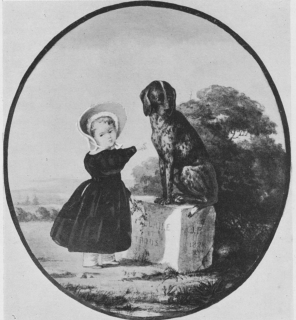
CLAIRE PRADIER.
From an unpublished drawing by Pradier.
9.45 p.m. Saturday, August 13th (1833).
While you are on your travels, dearest, my thoughts follow you in all
love. Though I still feel somewhat sore, I will strive to control
myself, and speak only those gentle words you like to hear.
It was dear of you to allow me to come to your house.[61] It was far
more than a satisfaction to my curiosity, and I thank you for having
admitted me to the spot where you live, love, and work. Yet, to be
entirely frank with you, my adored, I must tell you that the visit
filled me with sadness and dejection. I realise more than ever, the
depth of the chasm that gapes between your life and mine. It is no fault
of yours, beloved, nor of mine; but so it is. It would be unreasonable
of me to call you to account for more than you are responsible for, yet
I may surely tell you, dearly beloved, that I am the most miserable of
women.
If you have any pity for me, dear love, you will assist me to rise
superior to the lowly and humble position which tortures my spirit as
well as my body.
Help me, my good angel, that I may believe in you and in the future.
I beg and implore you.
J.
(1833.)
It is not quite six o’clock in the evening. I have just finished copying
the verses you gave me yesterday. I am not very familiar with the forms
of compliment in usage in fashionable society. All I can tell you is
that I wept and admired when I heard you read them, that I wept and
admired when I read them to myself, and that once more I weep and admire
in recalling them. I thank you from the bottom of my heart for having
thought of me when you were writing them. Thank you, my beloved, for the
benign sentiments that inspired you. Your beautiful lines have had the
effect you anticipated, for they have acted both as a cordial and a
sedative to my sick spirit. Thank you! thank you! and again, thank you!
You are not only sublime—you are kind, and, what is better still, you
are indulgent, you who have so much right to be severe.
I love you. My heart melts in admiration and adoration. There is more
rapture of love in my poor bosom than it is capable of containing. Come
then, and receive the superabundance of my ecstasy.
If you only knew how I long for you, and desire you! If you knew more
still, you would come, I am very sure! Come, come, I beg you, come! You
shall have a kiss for every step, a recompense for every effort, more
smiles, and more joy, than you will encounter fog and cold.
Juliette.
I am writing this a little later because, before turning to business, I
had to unburthen my heart. I came home yesterday, read your poetry,
dined, did my accounts, and went to bed. I read the newspapers you sent,
went to sleep, dreamed of you, and woke up this morning at 8 o’clock. I
rose almost immediately, did some housework, and mended yesterday’s
frock. In the middle of breakfast Lanvin arrived, bringing the
newspapers and a letter from M. Pradier and some of Mademoiselle
Watteville’s luggage. He asked whether we should want him to see us off.
He left again at 1 p.m., taking Claire’s things with him and some of his
wife’s. When he had gone, I washed and did my hair, did the same for
Claire, and at 2.30 I sat down to copy, and now I am writing to you.
This, Colonel, is my report. Are you satisfied? Then, so is the Corporal
of the Guard! After dinner I shall hear the children their lessons, and
count the lines of Feuilles d’Automne.
After dinner.
I have heard the children’s lessons, and been obliged to punish your
protégée, Claire, who is the laziest and idlest of all the pupils. I
have just read your poem to Madame Lanvin; she was deeply moved. The
poor thing understands you, therefore I need not explain that she loves
you. Good-night, until to-morrow, I hope.
I suppose you did not come to-day because you had arrangements to make
for our journey; that is why I am able to possess my soul in patience.
J.
Sunday, 4 p.m. (1833).
I have just come in sad and depressed. I suffer, I weep, I wail aloud
and moan under my breath, to God and to you. I long to die, that I might
put an end once and for all, to this misery and disappointment and
sorrow. It really seems as if my happiness had disappeared with the fine
weather. It would be folly to expect to see either again. The season is
too far advanced for fine weather or for happy days. You poor silly,
who wonder that I should deplore so bitterly the loss of one day’s
happiness, it is easy to see that you had not to wait for the privilege
of loving and being loved till you were twenty-six years old! You poet,
who wrote Les Feuilles d’Automne in an atmosphere of love, laughter of
children, eyes azure and black, locks brown and gold, happiness in full
measure! You have had no cause to notice how one day of gloom and rain,
like this, can make the greenest of leaves wither and fall to the
ground. You cannot therefore know how twenty-four hours robbed of bliss
can undermine one’s self-confidence and strength for the future. It is
evident that you do not, for you wonder when I weep; you are almost
annoyed at my grief. You see, therefore, that you do not realise the
measure of my devotion. Surely I have good reason for regretting that I
love you so ardently, when I see that love uncalled for and unwelcome!
Oh, yes, I love you, it is true! I love you in spite of myself, in spite
of you, in spite of the whole world, in spite of God, in spite even of
the Devil, who mixes himself up in it.
I love you, I love you, I love you, happy or unhappy, merry or sad. I
love you! Do with me what you will, I still shall love you.
J.
Monday, 1.50 a.m., 1833.
I have been standing at the window all this time, my soul stretched
towards you, my ear attentive to every sound, fearing always lest your
courage should fail you before the end of your weary walk. It is half an
hour since you left; I have listened hard, but no sound has reached me
that could make me apprehend you had not the strength to reach your own
house. I trust that while I am penning these lines, you are already
experiencing the relief that bed and repose will bring to your
suffering. No words of mine can suffice to express to you my regret, my
sorrow, my despair, for what happened to-night. I do not acquit you
altogether of guilt, but I ask you to pardon your own, as well as mine.
Forgive me for having yielded to you after what had passed between us. I
ought to have foreseen what would happen, and what did happen. God
knows, I had resisted as long as I could, and had given way only upon
the solemn promise you made me, never to refer to the stains of my
former life, so long as my conduct towards you should remain honest and
pure.
The last seven months of my life have been absolutely honest and pure!
Yet, have you kept your word?
If I were the only one to suffer I should be more resigned, but you are
as unhappy as I; you are as ashamed of the insults you heap upon me, as
I am, of receiving them.
Now that I perceive fully the canker that lies at the root of our
position, it is my part to arrest the progress of the evil by cutting
out my soul and my life, to preserve what can still be saved of yours
and mine.
Listen, Victor, I urge you not to refuse me your assistance in carrying
out the plan I think indispensable for the honour of us both.
If anything can give you courage it must be the knowledge that I have
been faithful to you alone, these seven months. Ah, truly I have never
deceived you! Truly! truly! Yet in the course of these same months, how
many mortifying scenes such as that of to-night have taken place!
Surely you can see that we must no longer hesitate! I will go away by
the first Saumur omnibus. The health of my little girl can serve as a
pretext. When I am with her, I shall be able to reflect upon my
position, and see what I can do in order to render it tolerable. If, as
probably may be necessary, I were to leave the theatre, the furniture
would cover my debt to Jourdain, and if you were unwilling to be
worried, I could request any man of business to sell it, up to the
amount of my bill to Jourdain, which is the only one for which you are
responsible.
I shall go abroad. Such as I am, I am still capable of earning my
living, which is all that is necessary.
But all this is beside the question. The important point is that I ought
to start as soon as possible, to-day even, in order to protect us both
from ourselves.
Before going, I hope to see you once more, unless your condition should
become worse—which is a horrifying thought when I consider that I am
the cause of it.
But whether I see you or not, whether you are the victim of my temper or
not, I leave with you all my love and all my happiness. I do not reserve
even hope; I give into your keeping my soul, my thoughts, my life. I
take only with me my body, which you have no cause to regret.
Juliette.
(December 20th, 1833.)
My beloved Victor,
I have been very unjust to you. You have had cause to call me ungrateful
and unworthy. You will soon hate me—soon also, you will have forgotten
me. I feel it. You see, there can be no thought or sentiment of yours
that I do not understand and apprehend. At this moment, even while I am
writing to you, you are blaming me for suffering. You are annoyed with
me for idolising you with an extravagance which renders me mad and
jealous. You are tired of my love. It cramps you, fatigues you. You
meditate flying from me. My bad luck frightens you; you fear to share it
longer. You dread the responsibility—say, rather, you love me less,
perhaps not at all. Oh, what suffering that fear gives me! My head is
aching. I wish I could die. It must be my fault. I have been wrong to
show you the hideous wound in my heart, the jealousy which lacerates and
destroys it. Yes, I ought to have concealed my sufferings from you. I
ought never to fly into those rages that betray the depth of my love and
grief.
My Victor, do not leave me! I beg you on my knees, not to be daunted
before a public responsibility. Who has the right to demand from you an
account of the measure of the sacrifices you have made for me? What does
it matter if you are denied the justice you deserve? What matter that
you should be held responsible in part for my troubles? The point to be
considered before all others, is your private relations with me. The
responsibility you must accept is towards me only; it concerns only our
two selves. If you repudiate it, it will kill me, for my whole life is
wrapped up in you and your presence. I breathe only through your lips,
see only with your eyes, live only in your heart. If you withdraw
yourself from me, I must die.
Reflect! This is not a threat, to keep you near me. I am not
exaggerating the extent to which you are necessary to my very
existence—I am only telling you what I feel. It is the truth, but the
truth under restriction, for I hardly dare acknowledge it in its
entirety, even to myself. I need you! Only you! I cannot exist without
you. Think of it. Try to love me enough to accept the charge of my
life, with all its attendant bad luck.
Juliette.
2 a.m., January 1st, 1834.
To Thee, my Victor!
I dare not say anything. Guess what I am feeling and do with me what you
will!
I love you ... the memory of what has gone before, and my fears for the
future, prevent me from describing my emotions as freely as formerly.
Forget the past, take the future into your own hands, and I shall regain
the faculty of saying “I love you,” as earnestly as I mean it.
I love you.... Juliette.
Saturday morning, 1834.
To Monsieur Victor Hugo,
In Town.
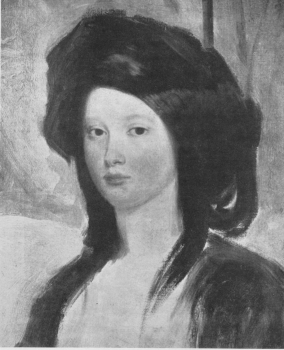
JULIETTE DROUET ABOUT 1830.
From Champmartin’s picture (Victor Hugo Museum).
It is a quarter to one. I have been to your printing-works, numbers 16
and 19; you had not been seen. I went on to your house; you had not come
in. I wrote you a line; I waited for you.... At last I came home hoping
to find you; but you had not been here. My thanks to you for treating me
like a vagrant dog. You had informed me that you were going to the
printing-works, that you might go back to your house, that you would
certainly go to mine.
You forgot your promises at once, and you apparently hold my love very
cheap.
If you, indifferent though you may be, could see me in imagination, as I
sit writing to you, you would be horrified at the condition your
injustice and disdain have reduced me to.
It is evident that you no longer love me, and that you are only bound to
me by the fear of causing some great calamity if you desert me. It is
indeed grievous that this should be the only sentiment which links you
to me, and I am unwilling to accept a devotion so hollow and
humiliating. I give you back your freedom. From this moment you have no
responsibility towards me, although my heart is broken, although my soul
is still fuller of love than it is able to contain, although my eyes, as
I write, are drenched with bitter tears. I shall still have the courage
necessary to bear my life as it will be, when bereft of happiness and
laughter.
You have been very cruel to me. I forgive you. Forgive also my tempests
of rage. I am ashamed of them, and thoroughly wretched. I swear to you
by that which I hold most sacred in life, namely my child, that I am
unable to explain how I can have been guilty yesterday of a thing I
utterly disapprove of, and which seems to me the acme of effrontery. I
swear I never saw those men. I am innocent of any crime. I can say no
more. You have crushed me by referring again to my past life, and even
while I am assuring you of my love and repentance, and while I still
hope for a reconciliation, I tremble to feel that you can suspect me so
unjustly. My heart shrinks from the sorrow still in store for it ... my
pen fails me ...
Farewell! May you enjoy greater tranquillity and happiness than will
fall to my lot. Do not forget that, for a whole year, we were happy
solely by means of our love.
Good-bye! I have indeed received my full meed of punishment for the
imaginary crime of yesterday.
Farewell. Think of me without bitterness.
Juliette.
Monday, 2 a.m. (1834).
I returned from the Place Royale about two hours ago. It was ten o’clock
when I arrived there, and I left at about midnight. I had hoped to bring
you back with me, or, failing to do so, to catch at least a glimpse of
you. I waited patiently all that time, hoping that you would become
aware of my presence, and reward me for it by one glance. But everything
remained dark and gloomy for me, though it was easy to see the lights
through the drawn blinds, and the shadows of many people moving about.
It will not be the last time, in all probability, that I shall have the
opportunity of seeing that, while I suffer and weep, you make merry.
Forgive me, my Victor, forgive me for this comparison of our respective
lots. It is the last time I shall make it, perhaps even the last time I
shall write to you, for you have said that you will not read any more of
my letters for a long time ... a long time signifies “for ever,” for you
will forget me and I shall die. Your love was my whole life. To-night I
feel as miserable as I should be if you no longer loved me. God, how
sorely I need pity!
I have just obeyed your wishes by putting all your works away carefully.
As for my own relics of you, I have collected them in an English desk,
under lock and key, and hidden them under my bolster, where they shall
always remain.
Farewell, the performance of this duty has been a mournful satisfaction
to me.
Saturday, 6 p.m., 1834.
To Thee, my Beloved.
You promised that as soon as your work was finished, you would devote
all your time to me; you also said, when you were leaving me yesterday,
that you would come early this morning. Neither of these promises have
you kept; yet I have never longed for your presence and your love more
than at this moment, when anxiety seems to have taken up its abode with
me. I have been so worried that I do not know whether I could endure
another day like this.
I am thankful to leave this house; it is so haunted by ill-luck and
sadness, that to be quit of it will be a relief.
My Victor, what is going to become of us? What can we do to avert the
misfortune that threatens us?[62] Can you think of any way out of the
trouble? Do you love me? I love you so! in prosperity, and still more in
adversity. Oh, God be merciful to me! Without your help I am done.
Juliette.
I have no other refuge or I should not go to Madame K. I cannot wander
about alone, for that would make you anxious; yet I cannot stay here, I
am too miserable. I will wait for you at Madame K.’s house until nine
o’clock. I hardly know what I am writing, or have written. My reason and
will are in abeyance this morning.
I write because I am wretched, because I must make moan to someone or
something. I write because I shall soon be dead. These lines will be the
cold remains of my soul and thoughts and love, as my body will be the
corpse of my warm flesh and blood.
I write to declare my faith, to obtain pardon of my sins, to weep,
because my tears strangle me and will put an end to me.
I shall be in the street to-night. I shall remain there as long as my
strength holds out, without hope, but still, near you....
Midnight, Saturday, August 2nd, 1834.
To Victor.
Farewell for ever. You have decreed it thus. Farewell then, and may you
be as happy and admired as I shall be hapless and forlorn.
Farewell! This word comprises my whole life, and joy, and happiness.
Juliette.
I am going away with my child. I am just going out to fetch her and take
our places. The Comédie Française management has no claim on my services
until it has assigned me my parts. My maid has orders to open my
letters. If there should be one from the Comédie Française she would let
me know at once and everything could be arranged. I need not, therefore,
worry about it at present.
(1834.)
Mademoiselle Marie,
C/o Madame Drouet,
No. 4 bis, Rue de Paradis au Marais, Paris.
Enclosed is a letter for Monsieur Victor Hugo. If he should not come to
the house, try and manage to let him know that there is one awaiting him
at No. 4, Rue de Paradis au Marais, from Madame Kraftt. If he is still
in Paris I expect he will understand what you mean, and will either send
for it or fetch it himself. In any case, write to me by every post and
tell me about Monsieur Victor Hugo: whether you have seen him, what he
has said to you, whether he is still in Paris, or whether he has left;
in fact, tell me everything you can find out concerning him.
I am writing from Rennes, where I arrived very ill, with my child. I
hope, however, to be able to leave to-morrow and go to my sister. Write
to me there and address thus:
Madame Drouet,
C/o M. Louis Kock,
Saint Renan,
By Brest.
Please take good care of the house.
J. Drouet.
(Enclosure)
Rennes,
2.30 p.m., Monday (1834).
My Dear Victor,
I am writing this letter on the chance of its reaching you, but with the
sad premonition that you will never read it.
My beloved, I love you more than ever. I cannot do without you. I would
willingly die for you, but I cannot consent to accept a devotion which
might endanger your health and your life. I was forced to fly from you.
It cost me much to resist your supplications and your wrathful glances.
I suffered frightfully; and now, alas, I know that, were you with me, I
could no longer withstand either your gentle pleading or your terrible
anger. I am very wretched. I love and bless you. Be happy!
Juliette.
One portion of your curse has already come to pass. My soul and body
have suffered severely. In addition, I have been harried to death by the
idiotic authorities, who are suspicious of every woman without a
passport. I have been at Rennes about half an hour. It is half-past two.
I leave again for Brest to-morrow morning at four o’clock; I expect to
arrive on Thursday at five in the evening. My Victor, I love you. I
could do anything for you. Have pity upon me. I love you better than
anything in life.
August 5th, 1834.
Mademoiselle Marie,
Care of Madame Drouet,
No. 4 bis, Rue de Paradis au Marais, Paris.
Here is another letter for Monsieur Victor Hugo. Try to get it to him.
If he is in the country near Paris, let him know that there is something
at my house in the name of Madame Kraftt that will interest him.
I have spent a sad and sleepless night. I am afraid of falling really
ill. Answer this at once.
J. Drouet.
(Enclosure)
Rennes,
4 a.m., August 5th (1834).
Victor, I love you. Victor, I shall die of this separation. I need you,
to be able to live. Since I told you everything, since the moment when
my eyes could no longer rest upon yours, I have felt as if all my veins
were being opened, and my life’s blood slowly drained away. I feel
myself dying, and I know that I love you the better for every pang. My
Victor, can you forgive me? Do you still love me? Is it really true that
you hate me, that I am odious in your sight, that you despise me, that
you would grind my face to the pavement if I pressed my lips to your
feet, pleading for forgiveness? Oh, if you still love me, if you still
respect me, if you can forgive everything, only tell me so, and I will
do all you wish! Everything, I swear! Will you take me back?
I am very ill.
J.
3 a.m. (1834).
For my Victor.
While I was expecting to see you I could not sleep. Now that the hope is
dead I still cannot sleep because I am unhappy. I grieve not to have
seen you; I grieve because I was cross and ill-tempered when you were
gentle and charming. I rehearse in imagination all the incidents of the
evening, and the pain at my heart grows unbearable. It is wicked of me
to torment you, yet I cannot help myself. My offence goes by the name of
“jealousy.” Much as I dread displeasing you, I yet cannot avoid giving
way to that hideous passion. I make you miserable when I should like to
saturate you with happiness. Oh, it is horribly wrong of me! I am much
to be pitied, for I am jealous, and of whom? The most beautiful, the
most gentle, the most perfect of women ... your wife! Heaven forgive me!
My torment is surely sufficient expiation for my fault!
God, how I love you! how I love my Victor! All is contained in these
words. You do forgive me, do you not? and you love me as much as ever? I
hope so ... else, I should prefer to die.
Juliette.
Sunday, 3 p.m. (1834).
I have abandoned hope ... yet love remains. I no longer believe that any
happiness is possible for me in the future, but you I love more every
day; better than the first day, better than yesterday, better than this
morning, better than a moment ago; and still I am not happy.
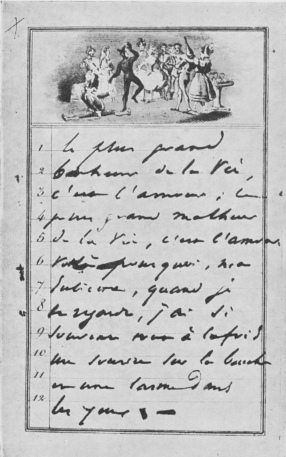
A PAGE OF JULIETTE DROUET’S NOTE-BOOK IN 1834.
The note-book belongs to M. Louis Barthou.
You remember what I used to say to you when Marie Tudor was in
rehearsal? “Those wretches have robbed me of my self-confidence; I dare
not, cannot rehearse any more; I feel paralysed.”
To-day, it is not a theatrical part that is in question—it is my life.
Now that calumny has crushed me, now that my mode of life has been
condemned without my having a chance of self-defence, now that my health
and reason have been expended in this struggle without profit or glory,
now that I have been held up before the public as a woman without a
future, I dare not, cannot live longer ... this is absolutely true ... I
dare not live. This fear has brought me to the verge of suicide ... a
peculiar suicide. I do not propose to kill myself like other people. I
mean to sever myself from you, and, to me, such a severance signifies
death. Death certainly. I have already made one experiment of the kind,
therefore I am sure.
I am confirmed in this project by the reflection that you will thereby
be restored to liberty; that you will be free to direct your life and
your genius in the way best suited to your happiness; that I shall no
longer be an obstacle in your path, but an object of pity and
indulgence—pity for what I shall suffer, indulgence and forgiveness for
such of my faults as have made you suffer.
If the excess of my love and grief should bring me back to your side, do
not notice me ... shut your eyes, stop your ears, remain in your own
house ... thus you may learn to forget, while I ... I ... shall die. I
shall not suffer long. I shall soon be at rest.
It is raining hard at this moment, and I am in a raging fever. No
matter, I shall go out. I do not know whether you propose coming to
fetch me. If you do not, I cannot tell what time I shall return home. I
don’t care, I am mad! I am in torture such as I have never yet endured!
yet I love you even more than I suffer. My love dominates my whole
being. I love you!
Juliette.
5.30 (1834).
You wish me to write to you in your absence. I am always unwilling to
accede to this desire, for when we are separated, my thoughts are so sad
and painful that I should prefer to hide them from you if possible.
You see, my Victor, this sedentary, solitary life is killing me. I wear
my soul out with longing. My days are spent in a room twelve feet
square. What I desire is not the world, not empty pleasures, but
liberty—liberty to act, liberty to employ my time and strength in
household duties. What I want is a respite from suffering, for I endure
a thousand deaths every moment. I ask for life—life like yours, like
other people’s. If you cannot understand this, and if I seem foolish or
unjust in your eyes, leave me, do not worry about me any more. I hardly
know what I am writing; my eyes are inflamed, my heart heavy. I want
air, I am suffocating! Oh, Heaven, have pity upon me! What have I done
to deserve such wretchedness? I love you, I adore you, my Victor; have
pity upon me. Kill me with one blow, but do not let me suffer as many
eternities as there are minutes in every one of your absences.
What am I saying? I am delirious, feverish. Oh God, have mercy on me!
Juliette.
November 4th, 8.30 p.m. (1834).
Yes, you are my support, the stable earth beneath my feet, my hope, my
joy, my happiness, my all! I do not know how these halting words of mine
can be expected to convey my thoughts to your mind, but this indeed is
truly and sincerely meant: that you are to me the noblest, most sincere,
most generous of men. I believe this, and have absolute confidence in
your power to frustrate the evil fate which holds me in its grip.
My dearly beloved, you were quite charming just now, and you are
perfectly right when you say that there is an element of vanity in your
nobility of conduct; for nothing could be more becoming than the elegant
and dignified manner in which you raised me just now from my knees. You
were really great. You were a king!
My darling little Toto, chéri! I am going to bed now, because I am not
certain that you will come early enough to take me out; and, after all,
you are not the sort of man to be scandalised by finding a woman in bed,
especially ...
Juliette.
1834.
My dearly Beloved,
I am always wishing I were a great actress, because, if my soul and
intellect were equal to yours, another link would be forged between us;
but I wish it still more at such a time as this, for I should then be
able to relieve you of the annoyance of being at the mercy of an old
woman, whose conceit has made her aggressive.[63]
I need not finish this letter, for here you are!
1835.
It is long after 11 o’clock. I am no longer expecting you for a walk,
but I still hope to see you this evening. I write you these few lines as
an apology for the disappointment I feel each time you fail me. I am
miserable, but not angry; I shed tears, but do not reproach you; I am
often much to be pitied, but I never cease loving you to distraction. If
only you would believe this, I think I could bear my invidious position
with more resignation. I am afraid you misapprehend my love, and this
anxiety often makes the days seem long and sad.
But I must not forget that you are working and worn out, and that you
have neither strength nor leisure to listen, that is to say, to read of
my worries.
11.30 p.m.
Here you are! I am finishing this letter more untidily even than usual.
Luckily one’s character, and, more important still, one’s heart, are not
exclusively interpreted by one’s handwriting.
Juliette.
Saturday, 3.15 p.m. (1835).
My poor, dear, beloved Toto,
When I see you so preoccupied with important business I am ashamed to
add to your fatigues by the reiteration of my devotion, which you
already know by heart. Did I not fear that you would misunderstand my
silence, I should put an end to these letters, which, after all, are
only a cold skeleton, a dull narrative of the generous, tender,
passionate feelings which fill my heart. I should stop them, I say,
until after the production of your play, reserving to myself the
privilege of taking my revenge afterwards by multiplying my words and
caresses. This is what I should do if you felt only a quarter as much
solicitude for your dear little person as I do.
It is nearly three o’clock. I hope by this time everything has gone off
well at rehearsal. It is high time, my admired, beloved, adored poet,
you left that wretched den they call the Théâtre Français. You will
leave it with full credit to yourself, notwithstanding the ill-will of
that jealous old wretch, and the stupidity, hatred, and malice of the
cabal against you.
You will see, my splendid lion, whether those hideous crows will dare
croak in face of your roaring. As for me, if anything could make me
prouder and happier, it would be that I alone understand you.
Juliette.
Saturday, 1.30 p.m., April 11th (1835).
Why were you so smart just now? It makes me dreadfully anxious,
especially in conjunction with your early morning walks to the Arsenal.
Toto ... Toto ... you do not know what I am capable of; take care! I do
not love you for nothing. If you deceived me the least bit in the world
I should kill you. But no, seriously, I am jealous when I see you so
fascinating. I do not feel as reassured as you would wish me to be. In
fact, I insist upon attending these rehearsals. I do not choose to
confide my dear lover to the discretion of nobody knows who. I wish to
keep my lover to myself, in the face of the nation and of all French
actresses.
That is my politic and literary resolve: I shall put it into execution,
from to-morrow.
By the way, this is my birthday. You did not even know it—or, rather, I
dare say you do not care whether I was ever born or not. Is it true that
you do not mind one little bit? That is all the importance you attach to
my love! And yet one thing is very certain: that I was created and put
into the world solely to love you, and God knows with what ardour I
fulfil my mission.
I love you—ah, yes, indeed, I love you—I love my Victor!
Juliette.
Saturday, 8 p.m. (1835).
I am more than ever resolved to separate our lives one from the other.
What you say about Mlle. Mars’s increasing age and the impossibility of
obtaining a double success through her, literary as well as financial,
and about the necessity of securing the services of Madame Dorval or
some equally handsome and celebrated actress, makes me determined to
sever our connection as speedily as possible, no matter where I may have
to go, or under what pecuniary conditions. Your words to-night prove
that you have had private intelligence about Mlle. Mars, Madame Dorval,
and the theatre generally, that you have concealed from me, although it
must completely revolutionise the plans made by you for the first play
you were to give at this theatre. The secrecy you have maintained on the
subject, contrary to all your promises to conceal nothing from me,
grieves me more than the treachery of Monsieur Harel and Mlle. George,
more even than the wicked animosity of your enemies and the perfidy of
your intimate friends against myself. This silence is proof positive
that I am a hindrance to your interests; you dread my ambition and my
jealousy; you had already seen the propriety of giving a part to Madame
Dorval, but you did not dare tell me so, for fear of encountering
resistance and tears from me at this new distribution. You have only
partially averted these. I will not attempt to thwart you, on the
contrary; as for my tears, they are not worth wiping away, nor even
restraining.[64] From this very night we cease our communion of dramatic
interests. I go back to the position I ought never to have left: that of
a hack actress, who is given any part, and badly paid at that. You
resume your liberty without any impediment.
Let us hope this new resolution will conduce to our greater happiness.
Juliette.
Tuesday, April 28th, 1835.
Four hours before the production of “Angélo.”
This is just to remind you of my love, and that it will only be purified
and augmented by the ill-luck and perfidy to which you are more exposed
than others, my noble poet, my king—king, indeed, of us all, though
lover only of me: is that not so? I have nothing to fear from you, have
I, my darling? You will take care of yourself and resist the advances of
that shameless woman. Promise me this. I would not allude to it to-day,
only I feel so uneasy at the thought of your spending the whole evening
in her society, that I would give my life to prevent it. If you
understood the greatness and quality of my love, you would appreciate my
alarm.
Think of poor me, sitting at the back of a box to-night, enduring all
the anguish of jealousy and love.
Juliette.
Madame Pierceau came at one o’clock, leaving Monsieur Verdier in a cab
below. He was desperate at the loss of his stall, which, he hears, was
taken from him by your orders. As I did not know what to say about it, I
advised Madame Pierceau to send him to you. Monsieur Pasquier, as I
anticipated, has not taken Madame Récamier’s box. I wonder what you have
done with it. Did it reach you in time?
Midnight, Tuesday, April 28th, 1835.
An hour after the triumph of “Angélo.”
My cup is full. Bravo! bravo!! bravo!!! bravo!!!! bravo!!!!! For the
first time I have been able to applaud you as much as I wished, for you
were not there to prevent it.
Thank you, my beloved! Thank you for myself, whose happiness you
increase with every second of my life, and thank you also for the crowd
that was there, admiring, listening, and appreciating you.
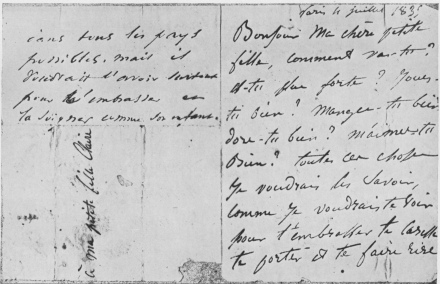
AUTOGRAPH LETTER FROM JULIETTE DROUET TO HER DAUGHTER
CLAIRE.
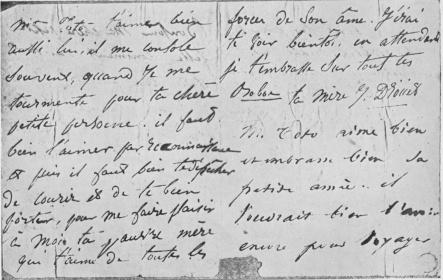
AUTOGRAPH LETTER FROM JULIETTE DROUET TO HER DAUGHTER
CLAIRE (continued).
I saw and heard everything, and will tell you all about it; although if
the applause, enthusiasm, and delirium could be measured by sheer
weight, my load would indeed be heavy. I will give you full details of
the performance, to-morrow, for I dare not hope to see you to-night; it
would be too much happiness for one day, and you do not want me to go
mad with joy!
Till to-morrow, then. If you knew how conscientiously I clapped Madame
Dorval, you would hesitate to say or do anything to add to the soreness
I already feel at the thought that another than I has been selected to
interpret your noble sentiments. There, now I am giving way to sadness
again, because you are with that woman!
Good-night, my beloved. Sleep well, my poet, if the sound of the great
chorus of praise does not prevent it. To your laurels I add my tender
caresses and thousands of kisses.
Juliette.
Friday, 8 p.m. (1835).
If I were a clever woman, my gorgeous bird, I could describe to you how
you unite in yourself the beauties of form, plumage, and song! I would
tell you that you are the greatest marvel of all ages, and I should only
be speaking the simple truth. But to put all this into suitable words,
my superb one, I should require a voice far more harmonious than that
which is bestowed upon my species—for I am the humble owl that you
mocked at only lately. Therefore, it cannot be. I will not tell you to
what degree you are dazzling and resplendent. I leave that to the birds
of sweet song who, as you know, are none the less beautiful and
appreciative.
I am content to delegate to them the duty of watching, listening and
admiring, while to myself I reserve the right of loving; this may be
less attractive to the ear, but it is sweeter far to the heart. I love
you, I love you, my Victor; I cannot reiterate it too often; I can never
express it as much as I feel it.
I recognise you in all the beauty that surrounds me—in form, in
colour, in perfume, in harmonious sound: all of these mean you to me.
You are superior to them all. You are not only the solar spectrum with
the seven luminous colours, but the sun himself, that illumines, warms,
and revivifies the whole world! That is what you are, and I am the lowly
woman who adores you.
Juliette.
If you are coming to fetch me, as you led me to expect, I shall see you
very soon now. I have never longed more ardently for you. Lanvin has
just come. I will tell you about it when I see you.
Thursday, 7.30 p.m. (1835).
To my dear absent One.
I hardly saw you this morning. I have not seen you this evening, and God
knows what time it will be before you come to take me to Angélo—for I
do not admit the possibility of a single performance taking place
without my presence: besides, I am not sorry to know exactly how much
time you spend with these actresses of the sixteenth century, and those
of the nineteenth, who are no less dangerous. There, I am nearly as
cross as I am sad. I had vowed I would not write at length to-day, just
to teach you not to throw my letters aside without reading them.
Myself, my letters, forgotten! You certainly manage to be the most
worshipped and the least attentive of lovers. Oh, you do not care!
Never mind, I am sad. I am longing for you to-night, as the poor
prisoner hungers for his pittance at the hour he is accustomed to
receive it.
But you are indifferent—you can calmly let my soul die of inanition—do
you not love me, then? Tell me!
Well, I love you. I love you my Victor. I forgive you, because I hope
it is not your fault, and also, because I cannot prevent myself from
loving you.
Juliette.
Tuesday, 8 p.m., 1835.
You hurt me a little bit just now, my Toto. While I was sacrificing the
happiness of being with you one moment longer, to your need of repose,
you were worrying about trifles, and not giving me a thought or a
farewell. In moments like these I am forced to realise that you do not
care for me as I care for you, and I feel wretched in consequence.
Another thing I have observed is that you never allude to my letters.
You neither notice the complaints I make nor the love I shower upon you
with every word. You have turned my happiness and content into sadness.
My Toto, you do not love me as I love you. You have exhausted your
faculty of loving. I tell myself that the enthusiastic and passionate
devotion you once cherished for me has degenerated into mere
partiality—then I mourn and mope, like a woman betrayed.
If you knew how I love you, my Toto, you would understand the anguish of
my eagerness, you would pity me, and, instead of leaving my letters
unanswered, you would fly to me the moment you have read them, to
reassure and comfort me if my fears are unfounded.
Never mind, I give you a thousand kisses. How many will you waste?
Juliette.
Tuesday, 12.30 p.m. (1835).
My dear little Toto,
You have written me a very charming letter. I cannot send you one as
fascinating; all I can do is to give you my whole heart and thoughts and
life.
You are quite right when you say that I shall soon give myself to you
again, regardless of the sorrows that may follow. It is true, for I
could sooner dispense with life than with your love.
But let me tell you again the joy, surprise, and happiness, your letter
caused me. You are better than I, and you are right when you think me an
old idiot. I am in the seventh heaven this morning. You have never given
me so much happiness, my dear little Toto. I am so grateful! I cannot
love you more in return, for that were impossible; but I can appreciate
in a higher degree your worth and the depth of your affection for me.
You are my dear little man, my lover, my god, my adored tyrant! I love
you, adore you, think of you, desire you, call upon you!
Juliette.
Which do you like best, quality or quantity?
Monday, 8.20 p.m. (1835).
I adore your jealousy when it gives me the pleasure of seeing you at an
unaccustomed hour; but when it simply consists in suspecting me without
advantage to ourselves, oh, how I detest it!
You were rather cross to-day, but you atoned so amply by coming as you
did, that I would willingly see you a little bit unjust to me every day,
if it entailed the pleasure of having you one minute longer in the
evening.
If you only knew how true it is that I love you, you could never be
jealous, or admit the possibility of my being unfaithful to you; and
again, if you knew how much I love you, you would come every moment of
the day and of the night, to surprise me in that occupation, and you
would ever be welcomed with transports of joy.
Yes, yes, I love you! I do not say so to force you to believe it, but
because I crave to repeat it with every breath, with every word, in
every tone. I adore you much more than you can ever wish. I love you
above all things.
Juliette.
You attach too little importance to my letters as a rule. You forget
that fine unguents are contained in small boxes, great love in trivial
words.
Friday, 2 p.m. (1835).
You want a huge long letter ... and yet another huge long letter ... you
are not very modest in your requirements. What would you say if I asked
as much?—you, who write to every one in the world except me. I have a
great mind to treat you according to your deserts, and write only as
much as you write, love you only as much as you love me. You would be
nicely punished if I did this. But do not fear; I should never play you
such a scurvy trick. I am too much in need of an outlet for the
superabundance of my heart, to venture to close the issue. I am too
anxious to tell you every day how much I adore you, to condemn myself to
silence. I long too much to get near you, in thought at all events, to
afford to cut off the way of communication. Now that you know why I
write so often, I will begin my letter.
My dear little Toto, although it is not long since I left you, I desire
you with all the impatience and all the inclination that comes of a long
separation. I should like to know where you are and what you are doing.
I should like to be wherever you are, and, above all, I should like to
be in your heart and thoughts, as you are in mine. I should like to be
you and you me, in respect of love. The rest becomes you and you only.
You are admired; I need to be loved. Are you capable, I ask you, of
loving me as much as I love you, or half as much? even that would be
immeasurable. If you only knew the extent of my love, you would treasure
me, only for that.
I love you, love you, love you, love you, love you!
This short little word, issuing from my heart, has impetus enough to
mount right up to the heavens. I love you!
Juliette.
I have received a letter from my daughter. This, combined with the
horrible weather, makes me quite happy.
Friday, 9 p.m. (1835).
You gave me a delicious afternoon. How delightfully you talked! I am not
alluding to your wit; a fly does not seek to raise an ingot of gold!
Neither do I speak of the happiness of leaning upon your arm, listening
to your voice, gazing into your eyes, breathing your breath, measuring
my steps by yours, feeling my heart beat in unison with yours.
There can be no happiness greater than that I enjoyed this afternoon
with you, clasped in your arms, your voice mingling with mine, your eyes
in mine, your heart upon my heart, our very souls welded together. For
me, there is no man on this earth but you. The others I perceive only
through your love. I enjoy nothing without you. You are the prism
through which the sunshine, the green landscape, and life itself, appear
to me. That is why I am idle, dejected, and indifferent, when you are
not by my side. I do not know how to employ either my body or my soul,
away from you. I only come to life again in your presence. I need your
kisses upon my lips, your love in my soul.
Juliette.
Saturday, 11 a.m. (1835).
Good morning, my Victor!
Let me first kiss you. Of all the promises I made you yesterday, when we
separated, only one has been broken. I promised to love you as I loved
you at that moment—that is to say, more than all the world; but I do
not know how it happened, I have come to love you much more! and I feel
it will be so as long as I shall live. I beg you, my dear little Toto,
to make up your mind to this, as I have already done.
Do you know, my blessed Toto, you are a second little Tom Thumb, far
more marvellous than your prototype; for, not merely with pebbles or
crumbs of bread do you mark the roads along which you travel, but
actually with jewels and precious stones. I shall always recognise the
spot where you dropped an enormous ruby as big as a flint, yesterday,
with as much indifference as if it had been a piece of grit from
Fontainebleau.
What do you suppose must happen to an insignificant creature like myself
in the presence of so much wealth, in the midst of the enchantments of
your mind? Will she lose her reason? That is already done. As to her
heart, you stole it from her very easily, and therefore nothing remains
to the poor wight but what is already yours.
Her love, her admiration, her life, belong to you! My glances, words,
caresses, kisses, all, are yours!
Juliette.
(1835.)
It seems to be always my turn to write to you now. In the old days your
letters called forth my letters, your love mine—and it was meet that it
should be so, for, as you have often said, the man should be the pursuer
of the woman. It is always awkward when a change of rôles occurs, and
I am acutely conscious of it. I feel that a caress from you gives me far
more happiness and security than thousands of those elicited by me.
It is already half-past eleven and you have not arrived. Perhaps you are
not coming, and the prohibition you laid upon me yesterday against
seeking you at the printing works redoubles my anxiety and jealousy. I
fear lest some untoward thing may have befallen you, or, worse still,
some agreeable invitation reached you. My heart is crushed as in a vice;
I think there is no greater suffering in this world than that of loving
yet fearing. We arrange our lives very badly. Since you are not a free
agent, and may be prevented from seeing me by thousands of circumstances
we cannot foresee, you should at least allow me the opportunity of
knowing what you are doing and where you are. It would satisfy me and
keep me content. Instead of this, I have to wait for you, a prey to
fears that tear at my heartstrings. Alas, I am to be pitied for loving
you so intensely. It is a superabundance that will surely kill the body
which bears it.
If you love me only moderately, I pray God to deprive me of one of two
things: either my life, or my love.
Juliette.
Nearly midnight. What a night I have before me! God pity me!
At Metz,
September 17th, Thursday, 8.15 a.m., 1835.
Good-morning, my Toto, good morning. It is magnificently fine, and we
are going to be enormously happy. We are about to resume our bird-life,
our life of love and freedom in the woods. I am enchanted. If only you
were here, I should kiss you with all my might and main, as a reminder.
What sort of a night did you have? Did you love me? Have you been
writing to me under the old chestnut-tree? I am sure you have not. You
scamp, I am afraid I go on loving you in proportion to the decrease of
your affection.
I was not able to read last night. I went to bed at a quarter past ten,
and had horrid dreams. I trust they will not come true, but I confess I
should be glad to get news of my poor little girl, whom we neglect far
too much. If two more days go by without a letter, I shall write to
Saumur, for I am really worried about her.
My dear little Toto, I am going to dress now, so as to get to you
earlier. I love you, I love you with all my strength and all my soul. I
kiss you! I adore you! Till this afternoon.
Your Juliette.
At Metz,
September 24th, Thursday, 8.45 a.m.
Good-morning, my darling Victor. I love you and am happy, for we are
going to be more absolutely together than was possible yesterday, or the
day before, when an inconvenient third disturbed our privacy. Also the
weather is glorious, and I am madly in love with you; so everything
around me glows radiant and beautiful.
I stayed in bed until 8.30, although I woke up at seven o’clock; but I
just rolled lazily about, thinking of you, and reading yesterday’s
newspapers. I reached home exactly at seven o’clock last night,
undressed, tidied my things, dined, wrote to you, did my accounts, and
read Claude Gueux till half-past ten. Then I put my hair into
curl-papers, and got into bed at eleven o’clock. I went to you in
spirit, and dreamt that I was kissing Baby Toto, and making big Toto
jealous. This is the complete history of my morning up to date; now I
shall dress, breakfast, and go for a walk in the meadows with the maid.
Farewell, dearest, until this afternoon’s happiness. Always yours in
love and longing.
I love you with all my heart, I embrace you in spirit, I adore you with
my whole soul, I admire you with every faculty of my mind. Think of me,
come to me, come to me as soon as possible. My arms, my cheek, my whole
being, await you.
J.
At Metz,
Thursday, 8.45 p.m.
My dear, good Toto,
I should have got back without adventure, had I not met an enormous and
horrific toad in the road, which sent me flying home, shrieking as if
the devil was at my heels. I was here by ten minutes past seven, began
my dinner at five minutes past eight, and am now sitting writing to you,
to thank you for all the bliss you lavish upon me. This day, drenched
with rain though it was, has been one of the most beautiful and happiest
of my whole life. If there had been rainbows in the sky, they would be
reflected in our hearts, linking our souls together in thought and
emotion.
I thank you for drawing my attention to so many lovely things I should
never notice without your assistance and the touch of your dear white
hand upon my brow; but there is one beauty greater and nobler than all
the combined ones of heaven and earth, for the recognition of which I
require no help—and that is yourself, my best beloved, your personality
that I adore, your intellect that enchants and dazzles me. Would that I
possessed the pen of a poet, to describe all I think and feel! But,
alas, I am only a poor woman in love, and such a condition is not
conducive to brilliancy of expression!
Good-night, my adored one; good-night, my darling. Sleep well. I send
you a thousand kisses.
J.
Metz,
Monday, 11.5 a.m., September 24th, 1835.
Great indeed was our misfortune yesterday! I agree with you in that, my
Victor, because I love you. For over a year I have suffered much;
oftener than not, without complaint. I always trusted that my love and
fidelity would engender in you feelings of esteem and confidence, but
now that hope is for ever at an end; for, far from diminishing, your
suspicion and contempt have grown to terrible dimensions. You love me, I
know, and I worship you with all the strength of my being. You are the
only man I have ever loved, the only one to whom I have ever given this
assurance. Yet I now implore you on my knees to let me go. I cannot
urge this too strongly. You see, my dear, I am so wretched, so
humiliated, and I suffer so acutely, that I shall have to leave you,
even against your will; so it would be kinder of you to give your
consent, that I may at least have the sad satisfaction, if I must
forsake you, of knowing that I have not disobeyed you.
Farewell, my joy; farewell, my life; farewell, my soul! I leave you,
for the very sake of our love—I offer this sacrifice on behalf of us
both. Later, you will understand. But before bidding you a last
good-bye, I swear to you that, during the last year, I have not
committed one single action I need blush for, nor harboured one guilty
thought. I tell you this from the bottom of my heart. You may believe
it.
I shall go to my child, for I am anxious about her since she has been at
Saumur. Perhaps I may bring her back with me. I think I was very wrong
to send her away. I mean to repair my fault if there is yet time. The
pretext of her health will be sufficient before the world. My heart
shall be dumb upon all that concerns you. I will keep everything to
myself. I must get work. If you can do anything to help me find some, it
will be good of you. I mention this for the first and last time, for, if
you were to forget me, you know very well that I should be the last to
venture to recall myself to you.
Good-bye again, my friend; good-bye, for ever! I have been copying your
little book, hoping you would be generous enough to leave it with me.
Good-bye! good-bye! Do not suffer, do not weep, do not think, do not
accuse yourself! I love and forgive you.
Juliette.
Metz,
Saturday, 7.30 p.m. (October 1835).
You were in a great hurry to leave me to-night, my best-beloved. If
consideration for me was your motive, it was high-handed and blundering
of you, for I never enjoyed myself more than this evening, and, until
the moment you left me so abruptly, I had never so savoured the
happiness of being with you in the highways and byways.
I therefore returned home sadly and thoughtfully. I have begun my letter
to-night with diminished joy and confidence in the future, for your
hurry to leave me weighs upon me, and I cannot explain it satisfactorily
to myself.
I came in at a quarter past six, suffering greatly from indigestion. The
maid told me some one had called for the dog—two gentlemen, who seemed
much attached to it. Poor brute, it was a wrong instinct that led it to
follow us. I have no doubt it is expiating its offence in hunger and
cold at this very moment. I am somehow unduly interested in the fate of
the poor thing. I feel something beyond ordinary pity for it; it makes
me think of the fate and future in store for a poor girl we both know.
She also follows step by step a master who will have no scruple in
casting her adrift when his duty to society proves as pressing and
sacred as that which called him away to-night.
I am depressed, my dear friend, and unwell. The oppression on my chest
is increasing. I hope your sore throat will diminish in proportion to
what I am enduring. Providence is too just to allow such cumulation of
suffering. Good-night—sleep well and think of me if you can. As for
loving me, that is another question; one’s emotions cannot grow to
order. I love you.
J.
Sunday, 8 p.m., 1835.
My dear darling, I cannot describe to you the rapture with which I
listened to the two sublime poems you recited to me, one on the first
Revolution and the other on the two Napoleons.
But where can your equal be found on earth!... My dear little Toto, do
not laugh at me. I feel so many things I cannot express, much less
write. I love and revere you, and when I reflect upon what you are, I
marvel! Since you left me, I have read again Napoleon the Second. I
shall never tire of it. It is going to bed with me now.
You told me to wait for you till 9.30; after that hour I shall go to
bed. If you should happen to come later, I will open the door to you
myself, as you have forgotten the key. I want to do so, that I may not
lose one second of the happiness of having you with me. Sleep
well—good-night—do not suffer—do not work—sleep!
Juliette.
Wednesday, 8.30 p.m., 1835.
I am half afraid of taking too literally your request for a daily
letter. Tell me seriously how I am to interpret it, so that I may not
make myself ridiculous, by overwhelming you with letters you do not
want. Tell me the truth once for all, so that I may know where I am, and
may give myself up without restraint to the pleasure of telling you, and
writing to you, that I love you with all my heart, and that you alone
constitute my sole joy, my sole happiness, and my sole future. If you
can experience only one quarter of the bliss in reading, that I shall
feel in inditing my scribble, you shall receive some of my prose every
day, but in limited quantities, calculated not to wear out your
patience.
And, in order to demonstrate my powers of self-restraint, I will limit
myself to six trillions of kisses for your beautiful mouth. Besides,
here you come! I love you.
Juliette.
Wednesday, 8 p.m., December 2nd, 1835.
My Beloved,
When one is ill and feverish, everything tastes bitter to the lips and
palate. I am in that position. I am abominably miserable, and all the
sweet words you lavish upon me seem tainted. But I have enough sense
left to realise that it is my condition that prevents me from relishing
the full meed of happiness you are able to give me in one moment.
Forgive me for suffering, and for not having the strength or generosity
to conceal it from you; it is only because I suffer too much, and love
you too much, which is the same thing.
I promise to be very cheerful to-night, and to disguise my feelings. I
have read everything concerning you in the papers, and I cannot help
suspecting that a passage about you and your work has been purposely cut
out. If this is so, you had much better tell me, for I am quite equal to
bearing the truth, and even to hearing lies; so I beg you to tell me
what was in that newspaper, and thus spare me the trouble of procuring
another copy. You must indeed be happy and proud on behalf of the person
to whom you are supposed to have dedicated your sublime poem.
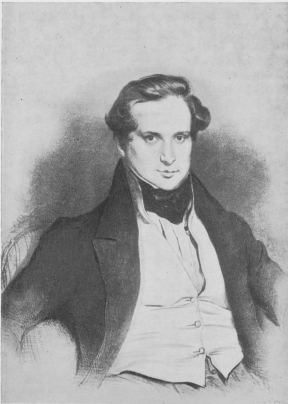
VICTOR HUGO.
The article by Monsieur F. Dugué seems singularly well-informed about
your restoration to the domestic hearth. I am apparently not the only
one who notices that for the last year you have been changing your
habits and feelings, though I am probably the only one who will die of
grief in consequence—but what matter, so long as the domestic hearth
remains cheerful and the family, happy.
I hope you will do your best to come and see me to-morrow, during the
intervals of the performance unless the salutations you have to make,
and the compliments and admiration you must acknowledge should detain
you against your will; in which case I hope I may be brave enough not to
worry about such a trifle, and reasonable enough not to let the
magnitude of my love depend upon so slight a pleasure.
You see, my dear angel, I bow to the arguments you impress on me. I am
no longer sad, neither do I suffer. I love you; that is the truest word
of all.
Juliette.
Tuesday, 8.45 p.m., December 15th, 1835.
Of course, my darling, you did right to come back, whatever your reason
might be; but the pleasure of your visit was quite spoilt by your
inquiry as to how I spend my time, when it is self-evident that my
conduct is irreproachable.
It may surprise you that I should have borne the inquisition you
habitually subject me to, with less equanimity to-day than usual. I own,
my poor angel, that I do not know why it should be so. Perhaps I am like
the cripple, who feels pain in the leg which has been cut off, long
after he has lost it. I often suffer over my past life, though the
present is so widely different. I suffer, not from variations of
temperature, but from the variations of your love, which seems to grow
daily colder and more gloomy. If I am mistaken, forgive and pity me; but
if, as I fear, I make no error, tell me so frankly, and I shall be
grateful for your sincerity. You see, my poor friend, I cannot believe
that your jealousy is other than an insulting mistrust of us both. I
have watched you carefully for the last six months, and I can see quite
well that, although your love is gradually waning, your supervision
becomes ever more active and more fidgety. If I were absolutely sure of
what I suspect, I should not say this to you—I should go away at once,
and you would never hear of me again; but if by chance I were wrong, and
you still care for me, such a course would entail frightful sorrow upon
us both. Therefore I remain, preferring to incur your hatred and
contempt, rather than run the risk of grieving you.
There, my poor angel, is the attitude of mind and heart in which you
found me this evening; it will explain why I received your question so
badly, although I was grateful for your presence. You see, my head and
heart are weary. If you are not careful, some calamity, resulting from
this condition, will overtake and crush you, at a moment when neither
you nor I will be able to prevent it. I give you this warning in all
sincerity, but with the intimate conviction that it will not affect you.
As long as you feel I belong to you wholly and entirely, you are as
indifferent to my sufferings as to my happiness.
J.
Wednesday, 8.30, February 3rd, 1836.
If I have grieved you, my beloved, I beg you to forgive me, for I know
your position is awkward and demands much consideration, especially from
me. Besides, why should I complain of my mode of life more to-day, than
yesterday? I accept my position without regret; therefore there is no
reason for questioning an arrangement which only you can alter.
I cannot help noticing that your love is not what it was. I may say I am
sure of it, if I may judge by the impatient words you occasionally
utter, half against your will, and by other signs it would take too long
to commit to paper. I certainly possess a devoted Victor, but no
longer the lover Victor of former days. If it is as I fear, it becomes
your duty to leave me at once; for I have never wished to live with you
otherwise than as an adored mistress—certainly not as a woman dependent
upon a man whose passion is spent. I want no pension. I demand my place
in your heart, apart from any feeling of duty or gratitude. That is what
I desire, as earnestly as I long to be a faithful woman, submissive to
your every whim, whether just or unjust.
If I have hurt your feelings, my dearly beloved, I plead for pardon from
the bottom of my heart. If you have to acknowledge a decrease in your
love, be brave enough to do so frankly, and do not leave to me the
frightful task of guessing it; but if you care for me as much as ever,
say it again and again, for I doubt it, alas, and, in love, doubt is
more painful a thousand times than the most heartbreaking certainty.
Farewell, I worship you.
J.
Wednesday, 8.15 p.m., February 17th, 1836.
You must think me either very cruel or very blind, my beloved. I think,
perhaps, it would be best for you to accept the latter hypothesis. I
love you, which means that I am jealous; but, as my jealousy is in
proportion to my love, my doubts and frenzy are more vivid, more bitter,
than those of ordinary women, who are only capable of an ordinary
affection. Very well—I am cruel! So be it! I detest every woman upon
whom your glances rest. I feel capable of hating all women, young or
old, plain or handsome, if I suspect that they have dared raise their
eyes to your splendid and noble features. I am jealous of the very
pavement upon which you tread, and the air you breathe. The stars and
sun alone are beyond my jealousy, because their radiance can be eclipsed
by one single flash from your eyes.
I love you as the lioness loves her mate. I love you as a passionate
woman, ready to yield up her life at your slightest gesture. I love you
with the soul and intelligence God has lent His creatures to enable them
to appreciate exceptional men like yourself. That is why, my glorious
Victor, at one and the same moment, I can rage, weep, crawl, or stand
erect; I bow my head and venerate you!
There are days when one can fix one’s gaze upon the sun itself without
being blinded: thus it is with me now. I see you, I am dazzled,
entranced, and I grasp your beauty in all its splendour.
Juliette.
Thursday, 8 p.m., August 15th, 1836.
Since you leave me here all by myself, my beloved, I shall think only of
you, and in proof of this, I will scribble all over this virgin sheet
of white paper. It is barbarous of you to let me grow fatter than I
already am, by leaving me to dawdle at my fireside, instead of taking me
out to walk and get thin.
I am in love with you, but you do not care a bit. I am very sad not to
have you with me, doubly so, when I think that it is on account of a
play in which I am to have no part, after all the time I have waited and
endured. When I reflect seriously upon this, my despair makes me long to
fly to the uttermost ends of the world. It is so necessary that I should
think of my future. I have wasted so much time waiting, that it almost
spells ruin to me that you should produce a piece in which I may not
play. You see, my dearest, I am not as generous as you thought. I am
afraid I can no longer disguise from you the injury it does me to be
three years out of the theatrical world, while you are bringing out
plays. Forgive me, but I have a horror of poverty, and would do anything
in reason to evade it. I love you.
Juliette.
Friday, 8.30 p.m., March 11th, 1836.
Dear little Soul,
You are quite happy, I hope, now that you possess the keys of Paradise.
I had a few more difficulties to encounter after you went away, but they
were of no consequence. Now that our little palace is nearly finished,
my soul, I hope we shall celebrate the event in the usual way; but I
must first rest a little, and nurse myself up, for I am really quite
worn out with the dirt and litter. I am afraid to look at you or touch
you in your beauty and purity and charm, while I am so ugly and untidy
and exhausted that I hardly know myself as your Juju. But it will not
last. My foulness will fall from me, and reveal me dressed, as in the
fairy-tale, in garments of blue, bordered with golden stars, and a
prince will marry me after tasting of my cooking. Splendid! But
meanwhile you must graciously permit me to go on loving you, stains and
all! Shut your eyes to the common lamp that guards the flame. If you
will wait, you shall see that when we reach the heaven above us, I shall
be as resplendent as yourself. Meanwhile, I drop a kiss upon your shoes,
even if it entails your having them blacked again.
J.
Wednesday, 7.45 p.m., March 23rd, 1836.
No doubt, dear angel, I ought to disguise in your presence the sadness
that overwhelms me when I have to wait too long for you; but the late
hour at which you generally come, makes it difficult for me to forget
the weary suspense I have already been through, and am to endure again
shortly. I love you, my dear—indeed, I love you too much. We often say
this lightly, but I assure you that this time I state it in full gravity
and knowledge, for I feel it to the very marrow of my bones. I love you.
I am jealous. I hate being poor and devoid of talent, for I fear that
these deficiencies will cost me your love. Still, I am conscious of
something within me, greater than either wealth or intellect; but is it
powerful enough to rivet you to me for ever? I ask myself this question
night and day, and you are not at hand to soothe my unrest; hence the
sadness that wounds you, the jealousy that amazes you, the mental
torment you are incapable of understanding.
But I love you all the same, and am happy in the midst of my pain. I
smile through my tears, for I love you.
Juliette.
Saturday, 8 a.m., March 26th, 1836.
Good-morning, my little darling Toto.
I am up at cock-crow, though very tired; but I want to be ready to
witness your new triumph—for, beloved Toto of mine, you are the great
Toto, the greatest man on earth.
How I love you, my Victor! I am jealous. Even your success makes me
uneasy with the dread that, amongst so much adulation, you may overlook
the humble homage of your poor Juju. I fear that these universal
acclamations may drown my lowly cry of—I love you! This apprehension
becomes an obsession on such a day as this, when everything is at your
feet, caresses, adoration, frenzy. Ah, why are you not insignificant and
unknown like myself! I should then have no need to fear that the torch
of my love will be eclipsed by that immense illumination.
Try, beloved, to keep a little place in your heart for the love and
admiration of your poor mistress, who has loved you from the day she
first set eyes upon you, and who will worship you as long as the breath
remains in her body.
Juliette.
Saturday, 6.15 p.m., March 26th, 1836.
Let me tell you once again that I love you, my Victor. Presently,
thousands of voices will be raised in a chorus of praise. I alone
say: I love you. You are my joy, the light of my eyes, the treasure of
my life, you are YOU. This evening, my adored one, whatever you say or
do, I must be jealous and wretched. Be merciful to me; do not let me
suffer too cruelly. If you think of me when you are absent, I shall be
conscious of it—if you love me, I shall feel it upon my heart like
beneficent balm upon a raw wound.
Farewell, dear soul; it is impossible to wish an increase of beauty to
the man, or more glory to the genius; so, if you are happy, so am I.
Farewell, then, dearest; I cannot refrain from sending a word of love to
the lover, before going to applaud the poet. The heart must have its due
share.
Good-bye till later. For ever, for life and until death, love, nothing
but love!
J.
Sunday, 7.45 p.m., March 27th, 1836.
I hardly dare speak to you to-night of love. I feel humiliated by my
devotion, for all those women seem to be rivals, preferred before me. I
suffer, but I do not hold you responsible. I feel worse even than usual
this evening. I did not venture to ask what you had written to Madame
Dorval, for I was afraid to discover some fresh reason for bitterness
and jealousy; so I remained silent.
My dear treasure, you are very lucky not to be jealous: you have no
competition to fear with any other celebrity, for there is none besides
yourself, and you know that I love you with my whole heart, whereas
all I can be sure of is, that I love you far too much to hope to be
loved in proportion. In addition, I feel I shall never be capable of
raising the heavy stone under which my intellect slumbers.
Forgive me, I am sad. I am worse than sad—I am ashamed, because I am
jealous. I am an idiot, and consequently, I am in love!
Juliette.
Thursday, 8.30 p.m., April 14th, 1836.
I love you, my dear Victor, and you make me very unhappy when you seem
to doubt it. It is still harder for me when you put your want of
confidence into words, for I can only attribute it to the sacrifices you
constantly make for me, and which probably cause you to think that an
ignoble motive constrains me to remain under your protection. In
addition to thus wounding me in the most sensitive part of my love, you
exasperate me to a point I cannot describe, because it is true that I
have not the wherewithal to live independently of you and your
influence. Therefore, my poor angel, when you show your suspicions of my
sincerity, I read into them more than jealousy and ill-will: I imagine a
reproach against my dependent position. I feel an overwhelming need to
prove to you, by any means, that you are mistaken in the woman and her
love. Remember your burnt letters! You know what a doubt on your part
led me to do on one occasion. Well, angel, I tell you honestly that when
you question, not only my fidelity, but also my love, I long to fly to
the other side of the world, there to exist as best I can, and never
pronounce your name again for the rest of my life. This will be the last
proof of love I can give you, and at least you will not be able to
accuse me, then, of self-interest and self-love. You hurt me terribly
to-night; you often do, and generally when I am most tender and
demonstrative towards you.
Yet I love you.
J.
Tuesday, 8 p.m., April 19th, 1836.
Beloved, I am perfectly certain you will not come to fetch me to see
Lucrèce, and I am already resigned. There is only one thing I shall
never submit to, and that is, the loss of your love. I know you are
devoted, that you lavish friendship upon me; but I feel that you have no
more love to give me, and I cannot bear it. During the four months I
have been alone, ill for the most part, I never knew whether the time
would come when you would be impelled to say to me: Take courage, for I
love you. I would have given life to find those words in your
handwriting at my bedside in the morning, or on my pillow at night. I
waited in vain, they never came; my sorrow grew, and now I am certain
that you have ceased to care for me.
I know what you will say, Victor—you will tell me that you are hard at
work, that you do everything for me, and do not let me want for
anything. To that I reply that I have been just as busy or busier than
you, yet have always found time to show you the outward signs of my
inward love. I may also tell you that, without your love, I do want
for everything, and that my life is utterly wretched without it.
Lastly, I declare to you that if you continue to be so reasonably kind
and attentive, I will release you from your self-imposed burden, at some
moment when you least expect it, and for evermore. I must have true
love or nothing.
Juliette.
Monday, 7.45 p.m., May 2nd, 1836.
My dear little Beloved,
I am sorry to find that you are not as convinced as I am, of the
propriety of giving me your portrait.
I confess I feel the greatest disappointment when I realise, from your
daily evasion of my request, that I shall probably never become the
possessor of the picture which is so like you, nor even, perhaps, of a
copy of the original. I am sad and dejected. I think you do not care
enough for me, a poor disinherited creature, to do me the favour you
have already bestowed upon another, who already has her full meed of the
gifts of life. I am therefore greatly disappointed. I had counted upon
having the portrait, and had anticipated much happiness from its
possession. The contemplation of it would have so greatly contributed to
my courage and resignation, that it is very grievous to have to renounce
it thus suddenly, without any compensation.
If I wanted to speak of other things now, I could not; my heart is
heavy, my eyes overflow with tears. I can only find bitter words for the
expression of my wounded love.
I love you more to-day than I have ever done before, yet I am not happy.
Juliette.
Friday, 7.45 a.m., May 20th, 1836.
Good morning, my dear little Toto.
You failed me again last night, so I shall never count upon you again. I
loved you with all my strength, and thought of you even in my sleep.
This morning I love you with my whole soul, and heartily long for you,
but I know you will not come, so I am cross and sad.
How fine the weather is, my Toto, and how happy we could be in the fresh
air, on the high road, in a nice little carriage, with a month of
happiness in prospect: it would be Paradise, but ... but ... I dare not
set my heart upon it, for I should go crazy with grief if the treat were
withheld. At all events, I am ready to start; my foot is well again, and
we can set off to-night, or to-morrow morning, at whatever time suits
you. I am quite ready, let us, therefore, seize our chance of the fine
weather.
My adored one, I am dying to make this expedition.... Do try to get free
at the earliest moment possible. I shall be so happy. I still love you,
ever so much. I need you terribly. My heart is more than ready for the
happiness you will give me during the whole time we shall be together.
Juliette.
Thursday, 12.45 p.m., July 21st, 1836.
Once more I am reduced to writing all that is in my heart, my adored
one. It is but a slender satisfaction after the bliss we have been
enjoying. Nevertheless, we must take life as we find it, and it would be
ungracious of me to complain. A month like the one we have just spent
would compensate for a whole life-time of misfortune and worry. Poor
angel, since you left me I feel lost and alone in the world. You cannot
imagine the utter void, surrounded as you are at this moment by the
affection of charming children and devoted friends, while I am alone
with my love—that is to say alone in space—for my love has no limits.
I seek what consolation I can, by speaking to you, and writing to you.
Your handkerchief, breathing of you, lies by my side, with your adored
name embroidered in the corner. I caress and talk to it, and we
understand each other perfectly. For every kiss I press upon it, it
exhales your sweet aroma; it is as if I scented your very soul. Then I
weep, as one does in a beautiful dream from which one fears to awake.
Heavens, how I love you! You are my life, my joy! I adore you!
Juliette.
Friday, 2.15 p.m., September 2nd, 1836.
My poor, beloved angel. The nearer the moment approaches, the more I
dread the inevitable parting which must follow the few days of happiness
you have just given me. I long for delay, but I know very well that,
however Providence may interpose in my favour, the day must come when
you will have to go to St. Prix. Lucky for me if it is not to-day. But,
putting aside all considerations of love and Juju, it would really not
be prudent for you to go to the country in this cold, foggy weather;
even this morning, in the warmth and repose of home, you felt a warning
twinge of rheumatism, which prescribes prudence on your part. I fear
your natural desire to kiss Toto on his donkey, and watch the other
little rogues at their holiday occupations, may draw you, in spite of
rain, wind, and the good counsel of your old Juju, to St. Prix. At any
rate, if you do this foolish thing, try to avoid chills, to think of me,
and to come back to my care and caresses as quickly as possible.
Juliette.
Saturday, 6 p.m., 29th, 1836.
You torment me unjustly, as usual, my darling beloved. Yet you ought to
begin to know me, and not suspect my every action, down to the drinking
of a cup of coffee. The awkwardness of my position, the absolute
solitude in which I am compelled to live, and the many insults I have to
tolerate daily from you, exasperate me so, that I feel I would rather go
out of your life, than continue to exist like a woman condemned and
accursed.
It is your fault that I am so unhappy. Nobody else will ever love you so
well, or be so entirely devoted to you. But one is not bound to put up
with impossibilities, and I cannot live longer under a yoke which you
make more crushing every day. What am I to do, beloved? Run away from
you? I have scarcely enough money for my quiet Paris routine. Remain
here? If you have not the courage to abstain from visiting me, I
certainly shall never have enough to prevent you from coming.
The wound in my heart is raw and bleeding, thanks to the care you take
to keep it in that condition. The slightest additional twinge becomes
unbearable torture. I do not know what moral operation I would not
consent to, to be cured of it.
For the last three years you have really given me too much pain. I
implore you, from the bottom of my heart, to be less offensive with me,
or else to leave me for good and all. You may guess from this what I am
enduring.
Juliette.
Sunday, 2 p.m., January 1st, 1837.
Your darling, adorable letter has reached me. I have devoured it with
caresses. Oh, how I love you! I have just sent my child out of the room,
so that I might read it on my knees in front of your picture. These
little pranks may seem foolish, but they contain a deeper, more sacred
significance, like the devotion that inspires them.
When you come, you will find me joyous and radiant, as I was on that
glorious day when you first revealed your love. My beloved, my heart, I
am very happy. I am in heaven, for you love me, my Toto ... your dear
letter has said it. Your eyes, your mouth, your soul, will tell me so
still better, presently. Yes, indeed I am happy, I am surfeited. There
is nothing left for me to desire or require—I have your love, a love
which God Himself might envy were He a woman.
Thank you, adored one, thank you from my heart and soul. I am as good as
gold, believe me.
Juju.
Tuesday, 7.30 p.m., February 21st, 1837.
Do not grieve, my precious, do not lament. I will not attempt
consolation, for you have better and more efficacious resources within
your own self; but I share your affliction. Whatever saddens you
saddens me: where you love, I love; when you mourn, I mourn. If I
conjure you not to give way to your grief, it is not because I hesitate
to bear my portion of it, but because I believe that your poor brother
himself would not now desire a return to this life.[65] I look upon his
death more as a blessing than a misfortune. Poor brother!
I love you, my adored Victor. In moments such as these, when sorrow
brings you nearer to my level, I feel that my affection for you is
absolutely true and purified from all dross. Try to come early this
evening. I will lavish caresses upon you silently, with my eyes and my
innermost self, without worrying you. You shall rest by my fireside, and
lean your dear head upon my shoulder, and read, and I shall be glad.
I am jealous of that woman who has dared to steal your verses; such
things are not lost. It was a two-fold wickedness on her part, for she
caused you the trouble of rewriting them, and me the torment of
jealousy. I will not have you see her again, ever! Do you hear?
Oh, I love you, I love you far too much.
Juliette.
Monday, 7.15 p.m., April 2nd, 1837.
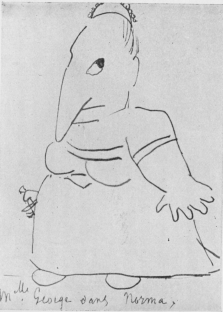
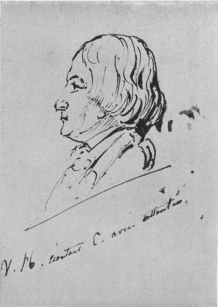
CARICATURE OF MLLE. GEORGE, BY VICTOR HUGO.
Victor Hugo Museum. | |
PORTRAIT OF VICTOR HUGO BY HIMSELF. |
I have decided to get up, after all, thanks to the laundry-man; but for
him, I should have remained in bed, nursing my depression. I am sad
beyond everything, yet I cannot tell why—you are kind and affectionate,
and I love you with my whole soul; but that does not seem enough.
Esteem, the keystone of happiness, is lacking. I have worn myself out in
the endeavour to gain it during the last four years, yet it cometh not,
nor ever will come, now. I must turn my efforts in another direction. I
must try to break with you, tactfully, as you say, by quitting Paris,
and perhaps France. Will that be sufficient to stop the tongue of
scandal? I wish to leave you before you abandon me, because I do not
admit your right to inflict such a fearful blow upon me. There are
people, capable of committing suicide, who yet recoil at the thought of
being murdered—I am one. I can and will kill myself, but I shrink from
the injury you might possibly inflict upon me before long. My courage
does not outstrip your cruelty. I love you too much for happiness.
Juliette.
Tuesday, 10.15 a.m., May 2nd, 1837.
Good morning, my well-beloved. Did you have a good night? You looked
overstrained and tired yesterday, and indeed there was enough to make
you so, you poor dear. I do not know how you can put up with it all.
Forgive me for adding to your burthen the exactions of a woman who
loves, and fears to recognise in lassitude an evidence of coldness.
Forgive me; if I did not occasionally doubt your love I should torment
you less, and would show more consideration for your occupations and
repose.
You hurt me very much last night by speaking as you did, yet I wanted to
know your true opinion of me. I have long been tormented by a mournful
curiosity on that point. Last night you satisfied it in full. I know
now that you pity without despising me. I accept your compassion, for I
need it, and ought to have it; but I should indignantly repudiate a
contempt I do not deserve. My past history is sad, but not disgraceful.
My life until I met you was the melancholy outcome of a poor girl’s
first fault; but at least it was never soiled by those hideous vices
that deface the soul still more than the body. Even at the worst moments
of my trouble, I cherished within me an inner sanctuary, whither I could
betake myself, as to some hallowed spot. Since then, that sanctuary has
been open to you only, and you can testify whether you have found it
worthy of you; you know whether, since you have occupied its throne and
altar, I have ever failed, one single day or minute, to prostrate myself
on my knees before you in adoration, or have ever turned my gaze or my
soul away from you. This proves, my beloved, that my former backsliding
was only superficial, not inherently vicious; that my wound was
accidental, not a loathsome, devouring canker; that I love you now, and
am thereby made whole.
Juliette.
Tuesday, 10.45 a.m., May 2nd, 1837.
I am following up my letter immediately with another, because I am
alone, and the moment is propitious for me to open my heart to you from
the very bottom. Racket and pleasure are a hindrance to meditation, and
at this moment I am rapt in contemplation of you and your beloved image.
I see you as you are, that is to say, a God-made man to redeem and
rescue me from the infamous life to which I had so long been enslaved.
What Christ did for the world you have done for me: like Him, you saved
my soul at the expense of your repose and life. May you be as blessed
for this generous action as you are adored by me for it. I should have
loved you, devil or angel, bad or good, selfish or devoted, cruel or
generous—I must have loved you, for at the mere sight of you my whole
being cries out: I love you! Would that I might proclaim it on my
knees, with hands clasped and heart on lips: I love you! I love you!
The talk we had last night kept me from sleeping, but I do not complain;
there are moments when sleep is a misfortune. I needed to rehearse one
by one all your words, to collect carefully those which must remain for
ever enshrined in my bosom as treasures of consolation and love; the
less generous ones you uttered, I have consumed in the flame of my soul;
nothing remains of them but ashes, dead as the ashes of my past.
Do not turn away in disgust from the scratches I have sustained in
falling from my pedestal, as you might from hideous and incurable
wounds. I repeat again, my beloved, because it is the truth: misfortune
there has been in my life, but neither debauchery nor moral turpitude.
Henceforth there can be nothing but a sacred, pure love for you. I am
worthy of pardon and affection. Love me; I crave it of you.
Juliette.
Thursday, 11.15 a.m., May 11th, 1837.
Good morning, my dear little man; I have bad weather to announce: rain,
snow, hail, wind, and, in addition, an abominable cold in my head which
does not help to resign me to a day already filled with clouds. I love
you—do you know that? and I admire you for your beautiful soul. It is
splendid of you, my great Toto, to have raised your voice so powerfully
in defence of the poor, dead King.[66] You alone had the right, for you
only are above suspicion; you only are influential enough to compel the
impious, pitiless world to listen to your indulgent and religious voice.
If it were possible for me to love you more, I should do so for this;
but from the first day I saw you I have given my whole heart and
thoughts and soul unreservedly into your keeping.
How I love you, my adored Victor, how I love you! In that short and
much-misused word is contained all my soul, all the bloom of a devotion
that has opened out under the sun of your gaze. Good-bye, my own.
Juliette.
Friday, 8.30 p.m., June 2nd, 1837.
My little Man,
You must make up your mind to take my love or leave it. Compare my life
with yours, and see whether I do not deserve that you should pity and
love me with all your might. I am all alone, I have neither family nor
fame, nor the thousand and one distractions that surround you. As I say,
I am alone, always alone; it even seems probable that I shall not see
you to-night, while you will be spending your evening in feasting,
talking, and visiting your uncle, whom may the devil fly away with.
Everybody can get you except me; the exception is flattering and well
chosen. I am so unhappy that I am going to bed and shall probably cry my
eyes out—I am more inclined for that than for laughing. If you succeed
in cheering me up to-night, I shall know you for a great man, and a
still greater sorcerer; but you will not attempt it. I may be as sad and
miserable as I like, and I am certain you will never interfere.
Good-night, Toto; I am going to bed. Good-night, be happy and gay and
content; your poor Juju will be unhappy enough for both. I love you,
Toto.
Juliette.
Wednesday, 1.30 p.m., June 10th.
I love you before all things, and after all things. I love you, love
you, love you! I have just written to Mother Pierceau that I shall send
Suzanne to her to-morrow. I forgot to ask you exactly how much money you
brought me yesterday, and also for cash, for yesterday’s expenses. I
will do so to-night. I try hard to keep my accounts accurately, yet I am
always in a muddle at the end of the month, and always either above or
below what I ought to have. I do my best, but nothing seems to bring my
sums out right.
I think there is going to be a big storm. The sky is lowering like
yesterday, and the weather still more oppressive. Try not to get wet,
and come and fetch your umbrella before it begins to pour.
What a delightful afternoon we spent yesterday! I wish we could have it
over again, even if we had to be soaked to the skin. I shall never
forget the Bassin du Titan.[67] The pretty turtledove that came to
slake its thirst in it seemed to recognise us, and wait for its drink,
until you scattered drops of poetry into the mossy, flowery grooves,
surrounding its edges.
Heavens! what precious pearls you squandered yesterday in that
magnificent garden, at the feet of those peerless goddesses, which seem
to come to life when your glance rests upon them—what flowers upon
those lawns, peopled with joyous children! How all those gods and
goddesses, heroes, kings, queens, women, nymphs, and children, must have
quarrelled over the treasure you lavished upon them! I was sorry to go
away. I should have liked to go back in the moonlight and gather up all
those jewels upon which you set so little store. Oh, I must return there
very soon, and we will at the same time revisit our Metz, where we have
enjoyed so much bliss. That journey will bring us happiness, and I long
to make it. I love you, my great Toto. Forgive this scribble; it looks
absurd now, and indeed it must needs be so, for I was inebriated with
love when I wrote it. My thoughts stagger and fall upon the paper,
because they have drunk too deeply of my soul, and know not where they
are.
Juliette.
Thursday, 3.45 p.m., July 27th, 1837.
I must contribute my scribble in acknowledgment for the delightful lines
you have just written in my little book.[68] My voice will sound like
the cackle of a hen after the song of a nightingale; but that is the law
of nature, so I do not see why I should be silent, because I have heard
you. It was rash of you, my dear little man, to put down the date you
suppose was that of my birth; but, as I am too honest to contradict you,
I accept it and affirm that, since those days when you were a little boy
studying Quintus Curtius, you have developed, and far outstripped all
those you revered and admired when you were an urchin of seven—while I
have remained the poor, uncultured girl you know. It is pretty certain
that education could have added but little to my barren nature; the
weeds of the sea-shore do not gain much from cultivation. On that point,
thank Heaven, I have nothing to complain of. No one worried much about
me until you appeared upon the scene; but you came, my great and sublime
poet, and you did not disdain to cull the little scentless flower
prinking itself at your feet, to attract the sunshine of your glance. I
bless you for your goodness. I know that a father and mother look down
upon you from the realms above, and love you for the happiness you have
given to the poor little daughter they left solitary on earth. I weep as
I write, for it is the first time I have really looked into my innocent
past, and my loving heart. I bless you, my generous man, on earth, as
you will be blest in heaven. May all those dear to you participate in
this benediction, and in the joys and riches of this world and the next!
Juliette.
Thursday, 9 a.m., September 21st, 1837.
Good morning, my Beloved.
The anniversary of our return to Paris has been sadder still than the
day itself, since you have not been with me at all, either last night
or this morning. I am upset in consequence. I have not yet taken off my
nightcap. I am cross. Shall you be at Auteuil all day? What a
disappointment for poor Juju, not to speak of Claire, who has to take
her chance of my temper when I am cross, and that idiot Madame Guérard,
who has put me to the expense of a stamp merely to say that she thinks
she is getting fat, and that she wishes you good morning. How thrilling!
I love you, dearest Toto; I love you too much, for I am miserable when
you are away. I wish I could care comfortably, like you, for instance,
who feel neither better nor worse, whether I am near or far. You are
always the same; love never makes you miss the point of a joke, or a
hearty laugh, nor fail to notice a grey cloud, the Great Bear, a frog, a
sunset, the earth, water, gale, or zephyr. You see everything, enjoy
everything, without a thought for poor old Juju, who is being bored to
desperation in her solitary corner. Which of us two is the best lover,
eh? Answer that it is I, Juju, and you will be speaking the truth. Yes,
I love you. Try not to stay away from me all day. Love me for being sad
in your absence.
Juliette.
Saturday, 6.30 p.m., September 23rd, 1837.
You are making yourself more and more of a rarity, my beautiful star, so
that I become chilled, and gloomy as an antique, moss-grown statue,
abandoned in the wilds of some deserted garden. I am not angry with you,
but I do wish you were less busy and more lover-like. You have quickly
resumed your fine Paris appearance, my beloved little man, whilst I
still cling to my travelling disguise. You ought surely to have waited
for me to take the initiative, if only for the sake of manners. Whom are
you so anxious to please, my bright boy? Who is the favoured one you
aspire to put in my place? In any case, I warn you that I shall not be
sly like Granier,[69] but that I shall fall upon your respective
carcases with frank blows of a cudgel, mind that! Now you may go in
search of your charmer, if you are prepared to see your bones ground to
powder for my use.
If you come early this evening I shall be so happy, so cheery, so
content and good, that you will never wish to leave me again; but, if
you delay, I shall be exactly the reverse, and you will have to coax and
love me with all your might to comfort me.
You are letting your letter-box get over-full again. Toto, Toto, I shall
make a bonfire of its contents if you do not come quick and secure them.
Mind what you are about!
Juliette.
Wednesday, 12.45 p.m., November 22nd, 1837.
I really believe you do it on purpose; but you may be certain that I
shall pay you back in the same kind: indifference for indifference;
donnant donnant is my motto.
Now let us talk of other things. What do you think of the taking of
Constantine? I cannot believe the present Ministry will survive long as
at present constituted; Thiers and Barot may be called upon at any
moment to form a new cabinet. What is your opinion? The commercial
crisis is still making itself felt in the markets; oils of every
description have gone down; for instance, rape oil which was at 47 is
now only at 45. A recovery is looked for next year, but I have my doubts
about it, haven’t you?[70]
. . . . .
. . . . .
. . . . .
. . . . .
. . . . .
. . . . .
. . . . .
Do you not agree with me that all this points to a revolution in the
near future, which will entail sinister results for Wailly’s Government?
For my part, I view with consternation the removal of the Carlists from
St. Jean Pied de Port to Paimbœuf, after a sojourn at St. Ménéhould.
I am already sick of the recital of the horrors which disturb the
digestion and the tranquillity of the citizens, of whom you are the
chief ornament. Pray accept the expression of my distinguished
consideration.
Juliette.
December 5th, 5 p.m., 1837.
How kind you are, my Toto, to have come and relieved the suspense I was
in as to what had happened in Court.[71] Heavens, how well you spoke! I
was so moved and so convinced while I listened, that I forgot even to
admire you, yet I have never known you finer or more eloquent. Why must
the case be adjourned for a week? Is it to allow time for intrigues
against the incorruptible consciences of my lords the judges? I should
have given worlds for the verdict to have been delivered to-day; first
because it would relieve you of an anxiety as annoying as it is
fatiguing, secondly because I myself crave repose, and since this devil
of a lawsuit has come on the scene I cannot sleep at night, and lastly
because I shall then see you oftener, or at least so I hope.
While I was waiting for you just now I copied a few passages from the
letters of Mdlle. de Lespinasse about the C. D.[72] and the S.[73] of
her period. Her opinions then, fit our own times absolutely: the same
absurdities, the same platitudes, and the same petty triumphs! It would
be pitiable were it not so grotesque. Nothing seems to have altered in
the last sixty years; there are the identical bourgeois in the
identical Rue Saint Denis, the same men and women of the world—nothing
is missing. They have not grown old, they are still in good health.
Stupidity and bad taste are the best agents for the maintenance of
society in all its pristine foolishness. Here am I drivelling on just as
if I knew what I was talking about. It would be a nice set-out if I
attempted to write! I might just as well present myself as a candidate
for the Senate. Please forgive me. Your lawsuit is the cause of my
chatter, but I will not transgress again. I love you far too much to go
out of my way to make a fool of myself.
Juliette.
| Receipts for the Month of December 1837 |
| Dec. | Frs. | Sous. | Liards. |
| Cash in hand | 4 | 0 | 3 |
| 1. Money earned by my Toto | 51 | 4 | 0 |
| 4. Cash from my darling | 5 | 10 | 0 |
| 6. Money earned by my dear one | 44 | 0 | 0 |
| 9. Cash from my Toto’s purse | 10 | 0 | 0 |
| 12. ” ” ” ” ” ” | 5 | 0 | 0 |
| 13. ” ” ” ” ” ” | 7 | 0 | 0 |
| 14. Money earned by my darling | 45 | 0 | 0 |
| 17. Cash from my adored one | 10 | 2 | 0 |
| 18. ” ” ” ” ” ” | 4 | 2 | 0 |
| 19. Money earned by my beloved | 60 | 0 | 0 |
| 22. Cash from my Toto | 2 | 0 | 0 |
| 24. ” ” ” ” ” | 10 | 0 | 0 |
| 26. ” ” ” ” ” | 3 | 0 | 0 |
| 28. Money earned by my Toto | 102 | 12 | 0 |
| 30. Money earned by my darling | 100 | 9 | 0 |
| Plus the money for the earring and ring | 2 | 0 | 0 |
| Total | 466 | 19 | 3 |
| Expenditure for the Month of December 1837 |
| | Frs. | Sous. | Liards. |
| Food and wine | 99 | 2 | 3 |
| Coal | 1 | 1 | 0 |
| Lighting | 21 | 6 | 0 |
| Household expenses and postage | 16 | 0 | 0 |
| Baths, illness | 8 | 1 | 0 | ½ |
| General expenditure | 29 | 8 | 0 |
| Incidental expenses and pocket-money | 5 | 8 | 0 | ½ |
| Dress | 41 | 5 | 0 |
| Incidental expenses and pocket-money | 5 | 8 | 0 | ½ |
| Dress | 41 | 5 | 0 |
| Washing | 16 | 5 | 0 |
| Debts and pawnbroker | 151 | 6 | 0 | ½ |
| Wages | 20 | 13 | 0 |
| To the Lanvins | 4 | 2 | 0 | ½ |
| Total | 413 | 19 | 5 |
| Cash in hand | 53 | 0 | 0 |
| | 466 | 19 | 5 | [74] |
To Toto: 9 luncheons.
Dinners to 10 persons.
In all, about 19.
Sunday, 1.45 p.m., January 21st, 1838.
Good-morning, my dear one, good-morning, my big Toto. How did you manage
to fit into your bed? You must have curled yourself up into five or six
hundred curves. One grows at such a pace in the space of an evening like
last night[75] that you must have become gigantic by this morning,
though you were already greater than any one else in the world. I have
grown, too, for my love equals your beauty, equals the praises and
admiration lavished upon you; so, unless one is prepared to state,
against all logic, that the container is smaller than the contents, I
must have grown and even surpassed you—without vanity. Love exalts as
much as glory does, and I love you more than you are great. Yes my Toto,
yes my dear Victor, I dare affirm it because it is true. I love you more
than you are great.
How did you spend the night, adored one? I hope you did not work, tired
out as you were, and in that horrible little icehouse. I cannot think
of that room without shivering from head to foot. I shall be very glad
when I hear that it is closed and warmed. Unfortunately that does not
promise to be soon, and meanwhile you suffer and freeze, and I torment
myself about you.
I adore you, my beloved Toto. I would die for you if you would promise
always to think lovingly of me; even without that condition I adore you,
my Victor.
Juliette.
Sunday, 5.45 p.m., January 21st, 1838.
Must it always be my lot to wait, dearly beloved? I thought I had given
proofs sufficient of courage and resignation all this time, to have
earned my reward now. Of course I know you must have had the whole of
Paris in your house to-day, but if you cared for me as I do for you, you
would leave all Paris, and the world itself, for me. What good is the
back door, if not to enable you to evade importunate people, and fly to
the poor love who awaits you with so much longing and affection? Why
carry four keys in your pocket, like the gaoler in a comic opera, if
you do not make use of them on the proper occasion? I am very sad, my
Toto. I do not think you care for me any more. You are as splendidly
kind and generous as ever, but you are no longer the ardent lover of old
days. It is quite true although you will not admit it out of compassion
for me. I am very unhappy. Some day I shall do something desperate to
rid you of me, for I cannot bear to realise the coldness of your heart,
and at the same time to accept your generous self-sacrifice.
You know I have always told you that I will accept nothing from you if
you do not love me! I love you so much that if I could inspire you with
my feelings, there would be nothing left for me to desire in this world.
Juliette.
Monday, Noon, February 12th, 1838.
Good-morning, my dear little man. How are you this morning? I am very
well, but I should be still better if I had seen you and breakfasted
with you.... I am arranging to go to Hernani to-night. I hope there
will be no hitch, and that the promise of the bills will at last be
fulfilled. I am longing for the moment. It is such ages since I have
seen my Hernani, and it is such a beautiful creation! I wish it were
already night, and I were in my little box, with dear little Toto
sitting at the back, where I might reward him with eyes and lips for
every beautiful line. You are not jealous? Yes, I want you to be
jealous! I want you to be jealous, even of yourself, or else I shall not
believe that you love me.
Good-morning, Toto. All this nonsense simply means that I dote on you
and think you beautiful and great and adorable. You did not come last
night—probably because there was to be a rehearsal this morning. Try
and behave properly at it, for I have Argus eyes and shall come down
upon you myself, like a thunderbolt, in the midst of your antics.
Meanwhile, take care of yourself; do not get cold feet or a headache
like mine; it would be a great nuisance.
Dear soul, if you had the least regard for your health, you would have
your flannel underclothing made at once. I assure you you would find it
very comfortable. I am sorry now that I let you take the stuff away, for
if I had it still, I should force you to do all this. It is not that I
want to worry you, my adored one, for I know how many other important
things you have to think of, but this is one of the most pressing; that
is why I should like it done. I love you, my Toto, with all my strength,
and more yet. I press my lips in spirit upon your eyes and hair.
Juliette.
Wednesday, 12.15 p.m., March 7th, 1838.
Good-morning, my dear little beloved. How are your eyes, my Toto? It
torments me to know that you are suffering so much, for however brave
and uncomplaining you may be, I can see quite well that you are in pain.
If you knew how I love you, my dear one, you would understand my trouble
and grief when you suffer. I suppose you are going to the rehearsal this
morning. I wish the first performance[76] was to be this evening, for I
am trembling already. Generally, I only begin to shiver on the day
itself, but this time my terrors have set in twenty-four hours in
advance. I hope my fears will have been vain, like so often before, and
that your beautiful poetry will prove all-conquering as ever. To-morrow
my soul will animate the spectators. I shall inspire enthusiasm in the
discriminating, and strangle, by sheer force of love, the hatred and
envy of the scum who would dare criticise your magnificent Marion, for
whom I have so special a partiality.
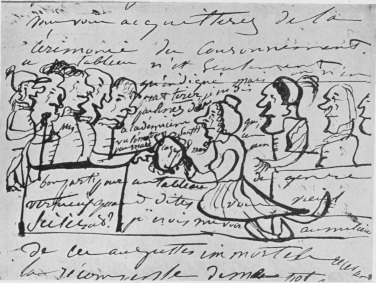
AUTOGRAPH AND DRAWING BY JULIETTE DROUET.
I express myself awkwardly, but I feel all this acutely.
Juliette.
Wednesday, 7.30 p.m., March 7th, 1838.
My Darling,
I see you very seldom, but it is not your fault, I know. I look
constantly into my heart, whence you are never absent, and there I see
you growing daily nobler, greater, and dearer. So to-morrow is the
great day! Ardently as I have desired its advent, I now dread it more
than I can say. However, up till now I have always been very frightened,
and nothing has happened, so I hope it may be the same this time.
Besides, how could the disapproval of a few miserable wretches and
idiots affect the magnificent verses of Marion? It will only prompt
the sincere and intelligent portion of the audience to do you instant
and brilliant justice. I am no longer afraid. I am as brave and strong
as love itself. Put me where you like—I do not care—all places are
equally good to applaud from, just as all moments are suitable for
adoring you. Good-bye, my love.
Juliette.
Thursday, 12.45 p.m., March 8th, 1838.
Good-morning, blessed one. I am quite upset. If your success to-night is
in proportion to my fright, you will have the most magnificent triumph
of your life. I hardly know what I am doing; I am shaking like a leaf, I
cannot grasp my pen. I must try to pull myself together for this
evening. It is absurd of me to be such a little craven; besides, what
harm can a cabal do you? None! It can only enhance your greatness, if
such a thing be possible; so, I am ashamed of my cowardice. I am
horribly stupid to dread a thing which certainly will not happen, and if
it did, would not injure you. Now that is enough! I will not fear again,
and I will admire and applaud my Marion in the very face of the cabal.
I will give them a hot time to-night! Bravo! bravo!! bravo!!! I feel as
if I were there already, and the happiest of women.
My little darling man, are you not soon coming to me? I do so long for
you. I feel as if you had been very cold to me lately. In the old days,
a first performance did not prevent your coming to make love to me.
Heavens, what torture it is to have to doubt you at a moment when I am
so desperately in need of you! I love you!
Juliette.
Friday, 1.45 p.m., March 9th, 1838.
You are adorable, my great Victor. I wish I could express myself as
earnestly as I feel, but that is impossible; I am tongue-tied. So the
great performance is over! What a fool I was to be frightened, and how
rightly I placed my confidence in that great noodle the public, which is
so slow and so hard to work up, but when once started, boils over so
satisfactorily. What a magnificent success, and how thoroughly
justified! What a beautiful piece, what lovely verses! and the
fascinating poet! Everything was understood, applauded, admired. It was
delightful. My soul was raised heavenward with the Play. Dear God, how
magnificent it was!!!!!!!!!!! I must be there again to-morrow, and every
night. Surely I have the right!
I love you, my Toto, I adore you with all the strength of my soul. I
wish I could go out—it is such a fine day. I kiss your beloved hands.
Juliette.
Sunday, 12.15 a.m., March 11th, 1838.
Good-morning, my beloved one, good-morning, handsomest and greatest of
men. I cannot speak as well as some of the people who pay you such
beautiful and sincere homage, but I feel from the bottom of my soul that
I admire and love you more than any one in the world. All the same, I am
sad and discouraged. I can see that you place no reliance on my
intelligence, that my last years are flying by without earning what they
easily might: a position, and a provision for the future. I am not angry
with you. It is not your fault if you are prejudiced against me to the
point of allowing me, without regret, to waste the last few years of my
youth. Possibly my desire to create for myself an independent position,
and to remain ever at your side, has given birth to the delusion that I
possess a great talent which only requires scope. However that may be, I
am in despair, and I love you more than ever. You are good to look at,
my adored one, you are great in intellect, my Victor, and yet I dare
proffer my devotion, for it is as genuine as your beauty and as deep as
your genius. I adore you.
Juliette.
Tuesday, 11.30 a.m., April 10th, 1838.
Good-morning, my soul, my joy, my life. How are your adored eyes, my
Toto? I cannot refrain from asking, because it interests me to hear,
more than anything in the world. I am always thinking about them. I long
for the 15th of this month, for then I shall have the right to insist
upon your resting, and I shall certainly exercise it. My dear love, what
joy it will be for me to feel your dear head leaning against mine, to
kiss your beautiful eyes, and to make certain that you do not work. The
weather is lovely this morning. It carries my thoughts back to our dear
little annual trip, when we were so happy and so cosy together. We are
not to have that felicity this year, and really I do not know how I
shall endure it when the time comes at which we used to start. It will
be very hard and difficult, and I doubt whether my courage and reason
will suffice to enable me to bear the greatest sacrifice I have ever
made in my life. My dear one, it will be sad indeed; I wonder whether I
shall be equal to it.
I love you, adore you, admire you, and again I love and adore you.
Juliette.
Tuesday, 7.45 p.m., April 10th, 1838.
My love, I am writing to you with joy and worship in my heart. You were
so kind and tender and fascinating to me to-day that I seemed to feel
again the savour and rapture of the days of old. My Toto, my adored
one, fancy if your love were to flower again like some brilliant,
sweet-scented spring blossom! With what ecstasy and reverence I would
preserve it fresh and rosy in my breast. Poor beloved, your work has
done to our idyll what the winter does to the trees and flowers—the sap
has retired deep into the bottom of your heart, and often I have feared
it was quite dead; but now I see it was not: it was only lulled to sleep
and I shall possess my Toto once more, beautiful, blooming, and perfumed
as in those glorious days of our first love.
I who am not a sensitive plant of the sun like you, have yet come better
through the trial, and if I bear no blossom, I have at least the
advantage of preserving my leaves ever green and alive; that is to say,
I have never ceased to love and adore you. Indeed that is true, my own,
I love you as much as the first day.
Juliette.
Sunday, 11 a.m., April 22nd, 1838.
You see, darling, by the dimensions of my paper, that I am preparing to
go and applaud my Marion this evening. I will not reproach you for not
having come this morning. In fact, in future I shall not allude to it
again, for nothing is more unsuitable or ridiculous than the
solicitations of a woman who vainly appeals for the favours of her
lover. Therefore, beloved, as I am to live with you as a sister with a
brother, you will approve of my refraining from reminding you in any way
of the time when we were husband and wife.
It is still very cold, my maid says; although the sun is shining in at
my windows, it has left its warmth in the sky. It resembles the fine
phrases of a suitor who no longer loves; his words may be the same, his
expressions as tender, his language as impassioned, but love is lacking
and those words which scintillate as the sun upon my windows, fail to
warm the heart of the poor woman who had dreamt of love eternal.
You will probably see Granier this morning.[77] I hope so, so that you
may not be worried any more about that business. I also hope Jourdain
will come to-morrow about the chimney. It is unbearable that one should
have to wait upon the whim of a workman for a job which might be
finished in a few minutes, and that would please you so much. I have
read with pleasure the verses that came to you in the newspaper from
Guadaloupe; they show that you are admired over there as much as here,
and that you have fewer enemies abroad than at the Académie Française. I
am furious with that little imp called Thiers, who although he is not a
quarter of a man as far as size goes, yet permits himself to cherish the
rancour of a giant. Miserable little wretch! If only I were not a woman,
I might castigate you as you deserve!
And you, my Toto, so great and so wonderful, I adore you!
Juliette.
Thursday, 10.15 a.m., August 2nd, 1838.
Good-morning, my little beloved. Do you still need a secretary? I am
quite ready. Come; it is so delightful to dip my pen into your glorious
poetry, and watch the shining and coruscating of those precious gems
which take the shape of your thoughts. Dédé could not be more delighted
and dazzled than I am, if she were given the diamonds and jewels of the
crown of England to play with for an hour. Oh, if I could only have
spent the night with my Cæsar and his noble companions, I would have
followed him without fatigue wherever he wanted to go, even as far
as.... But you would not allow it, you jealous boy; you feared
comparison, and you were perfectly right, for I like well-dressed men.
Good-morning, my Toto. My left eye is very bad; it is swollen and
painful. If this continues I shall no longer be in the position of
regretting that I cannot lend you my eyes in exchange for your own. I
love you, I adore you. Do not be too long before coming to me.
I am longing for you with all my might.
Juliette.
Wednesday, 9.45 p.m., August 15th, 1838.
My dear little man, I love you. You are the treasure of my heart. I wish
we were already in our carriage galloping, galloping far, and farther
still, so that it might take us ever so long to get back.
Since you have hinted at the possibility of my playing in your beautiful
piece,[78] I am like a somnambulist who has been made to drink too much
champagne. I see everything magnified: I see glory, happiness, love,
adoration, in gigantic and impossible dimensions—impossible, because I
feel you can never love me as I love you, and that my talent, however
considerable, can never reach to the level of your sublime poetry. I do
not say this from modesty, but because I do not think there exists in
this world man or woman capable of interpreting the parts as you
conceived them in your master mind.
I love you, my Toto, I adore you, my little man, you are my sun and my
life, my love and my soul.
All that, and more.
Juliette.
Monday, 8 p.m., September.
Are you proposing to cut out all the dandies and bloods of the capital?
My congratulations to you. I was only waiting for some such sign to give
myself up to an orgy of wild and eccentric toilette. Heaven only knows
the extravagances I mean to commit in the way of shoes, silk stockings,
gowns, hats, light gloves, and bows for my hair! You will, I suppose,
retaliate with an assortment of skin-tight trousers, strings of orders,
and more or less absurd hair arrangements. Delightful indeed! There only
remains for one of us to live at the Barrière de l’Étoile and the other
at the Barrière du Trône, to dazzle the dwellers of the town and
suburbs, as well as strangers from abroad. Capital!!!
My sore throat has come on again and you are not here to cure it. If you
think this pleasant you are quite wrong, and if I followed my own bent I
should deprive you of your functions as doctor-in-chief of the great
Juju. I am determined to forgive you only if you come to supper with me
presently. Seriously, I cannot understand why you keep away, seeing
that your Play is in rehearsal, that this is our holiday time, and that
I adore you. I am almost tempted to be a little jealous, only
unfortunately, when I mean to be only slightly jealous, I become very
seriously so; therefore I try as much as possible to spare myself that
discomfort. You would be sweet and kind, my Toto, if you would come and
eat my frugal dinner with me to-night and ... I am going to concentrate
my thoughts upon you, so as to magnetise you and bring you back in the
shortest possible time to your faithful old Juju who loves and adores
you. My first proceeding is to kiss your eyes, your mouth, and your dear
little feet.
Juliette.
Tuesday, 12 noon, October 30th, 1838.
My beloved little man, you are so good and sweet when you see me that it
is a pity you should see me so seldom, and that you should forget me as
soon as your back is turned. To punish you, I am not going to write you
two letters to-day; partly in consideration for your dear little eyes,
and partly because it would be unfair to reward indifference and
coldness in the same degree as affection and assiduity. Pray do not take
the above expression, “dear little eyes,” in an ironical sense—I mean
it on the contrary as an endearing diminutive; your “dear little eyes”
signify to me my adored, beautiful eyes, the mirrors of my soul, the
stars of my heaven, everything that is most beautiful and fascinating,
gentlest, noblest, and highest.
I love you, my Toto. I kiss your ripe red lips, your dazzling teeth,
your little hands, and your twinkling feet. I am writing only your
little daily bulletin, because your eyes are bad, and you have no time
to waste; neither do I wish to tire or bore you, but only to make you
love me a little bit.
Juliette.
Thursday, 8.30 p.m., November 22nd, 1838.
My little treasure of a man, you were sweet to select my hovel for a
resting-place from which to write your laudatory remarks upon Mlle.
Atala Beauchêne,[79] commonly called Beaudouin. It gave me a chance to
admire your charming profile and kiss your beautiful shining locks. I
thank you for that happiness, and I consent to your inditing daily
effusions concerning that lady, if only you do so in my room and under
my eyes.
As you promised to come back presently, the chances are that you will
not return. I have half a mind to undress, light my fire, and set to
work to bruise poppy-heads; for my provision is almost at an end, and
later on I may be busy at the theatre, if Joly[80] persists in his crazy
idea of giving us a whole week’s rehearsals of a piece which is only to
be played four months hence. It is an inducement to use the time at my
disposal now, to prepare your little daily remedy.
I love you, Victor, I love you, my darling Toto.
Juliette.
Monday, 6 p.m., April 15th, 1839.
Why is it, my little beloved, that you always seem so jealous? You take
the bloom off all those scraps of happiness your dear presence would
otherwise give me, for nothing chills one’s embraces so much as the
vexed, uneasy mien you usually wear. It would not even be so bad if you
did not accuse me of that same constrained, annoyed look; but the more
suspicious you are, the more you think it is I who am cross, although
this is simply the effect of the glasses through which your jealousy
views me. Never mind, I love you and forgive you, and if only you will
come and take me out a little this evening and show me part of Lucrèce
I shall be happy and content. What a beautiful day! I would have given
days and even months for the chance of strolling by your side wherever
your rêverie led you. Alas, it is I who am sad, and with excellent
reason! As for you, you old lunatic, what have you to complain of? You
are adored, and you are free to accept and make use of that sentiment as
much and as often as you desire; perhaps that is why you desire it so
seldom.... But let us talk of other things. Please love me a little,
while I give you my whole soul.
Juliette.
Sunday, 6.30 p.m., October 27th, 1839.
Here I am at my scribbling again, my Toto. It is a sad pleasure, if any,
after the two months of love and intimacy which have just elapsed. Here
I sit again with my ink and paper, my faults of spelling, my stupidity
and my love. When we were travelling I did not need all this
paraphernalia to be happy. It was enough for me to worship you, and God
knows whether I did that! Here I do not love you less—on the
contrary—but I live far from you, I long for you, I worry about you, I
am unhappy—that is all. Still, I am not ungrateful or forgetful; I
fully appreciate that you have just given me nearly two months of bliss.
I still feel upon my lips the touch of your kisses, and upon my hand the
pressure of yours. But the felicity I have experienced only throws into
greater relief the void your absence leaves in my life. When you are no
longer by my side, I cease to exist, to think, to hope. I desire you and
I suffer. Therefore I dread as much as death itself the return to that
hideous Paris, where there is naught for lovers who love as we
love—neither sunshine, nor that confidence which is the sunshine of
love—nothing but rain, suspicion, jealousy, the three blackest,
saddest, iciest of the scourges which can afflict body and heart. Oh, I
am wretched, my Toto, in proportion to my love; it is true, my adored
one, and it will ever be thus, when you are not with me.
Juliette.
Friday, 10 a.m., November 1st, 1839.
Good-morning, my dear little beloved, my darling little man. You told me
so definitely yesterday that my handwriting was hideous, and my scrawl
nothing but a horrible maze in which you lose both patience and love,
that I hardly dare write to you to-day, and it would take very little to
make me cease our correspondence altogether. We must have an explanation
on this subject, for it is cruel of you to force me to make myself
ridiculous night and morning, simply because I love you and am the
saddest and loneliest of women. If my love must be drowned in my
ignorance and stupidity, at least do not force me to make the plunge
myself. There was a time when you would not have noticed the ugliness of
my writing; you would only have read my meaning and been happy and
grateful. Now you laugh, which is shabby and wicked of you. This seems
to be the fate of all the Quasimodo of this world, moral and physical;
they are jeered at: form is everything, spirit nothing. Even if I could
constrain my crabbed scrawl to say, “My soul is beautiful,” you would
not be any the less amused. Therefore, my dear little man, pending the
moment when I can join in the laugh against myself, I think it would be
as well to suspend these daily lucubrations. Besides, the moment has
come when I must turn all my time and energies towards making my
position secure. Nothing in this world can turn me from my purpose, for
it is to me a question of life and death, and Heaven knows that in all
these seven years I have never failed to tell you so whenever there has
been an opportunity. I count upon you to help me, my beloved. I am
asking you for more than life—for the moral consummation of our
marriage of love. Let me go with you wherever my happiness is
threatened, let me be the wife of your mind and heart, if I cannot be
yours in law. If I express myself badly, do not scoff, but understand
that I have a right to put into words what you yourself have felt, and
that I insist upon defending my own against all those women who get at
you under pretext of serving you. I will have my turn, for I love you
and am jealous.
J.
Friday, 6.30 p.m., November 1st, 1839.
You are good, my adored one, and I am a wretch; but I love you while you
only permit yourself to be loved; that is what makes you so tranquil and
me so bitter. My heart is weighed down by jealousy this evening and
nothing less than your adored presence will suffice to calm me, for I
carry hell and all the furies within my soul. I wish I could be sewn to
the lining of your coat to-night, for I feel I am about to encounter
some great danger that I can only defeat by not leaving your side. If my
fears are well-grounded, I shall probably fail in averting the doom that
threatens me, for you will not be able to stay with me all the evening.
The compliments and flattery you will receive will take you from me. I
cannot deny that I am unhappy and jealous, and would much rather be with
you at Fontainebleau, at the Hôtel de France, than in Box C. of the
Théâtre Français, even when Marion de Lorme is being played. Kiss me,
my little man; you are very sweet in your new greatcoat, but you had not
told me you had been to your tailor. I shall keep up with you by sending
for my dressmaker. I do not mean to surrender to you the palm for
smartness and dandyism. Ha! who is caught? Toto! Toto!
Résilieux is beaming, Claire is happy, Suzanne is an idiot; such is the
condition of the household. I am all three at the same time, plus the
adoration I profess energetically for your imperial and sacred person.
Kiss me and be careful of yourself this evening.
Juliette.
Monday, 12 noon, November 4th, 1839.
Good-morning, treasure. It is twelve by my clock, which is several hours
fast, but I have been up some little time. I have dressed my child, and
she is now practising on the piano. I spent the night thinking over what
you said, my adored one. One luminous phrase especially stands out and
scorches my soul. Perhaps you only said it idly as one of the
compliments one is constrained to make to the woman who loves one? I
know not, but I do know, that I have taken the assurance you gave me
that you have never really loved any woman but me, as a sacred thing,
unalterably true. I adore you and had never felt even the semblance of
love until I met you. I love and adore you, and shall love and adore you
for ever, for love is the essence of my body, my heart, my life, and my
soul. Believe this, my treasure, for it is God’s own truth. Your dread
of seeing me re-enter theatrical life will quickly be dissipated by the
probity and steadiness of my conduct. I hope, and am certain of this.
You have nothing to fear from me wherever I may be. I adore you, I
venerate you. If I could do as you wish and renounce the theatre, that
is to say my sole chance of securing my future, I would do so without
hesitation and without your having to urge it, simply to please you.
But, my beloved, I feel that it were easier to relinquish life itself
than the hope of paying my creditors and making myself independent by
earning my own living. If I were to make this sacrifice I am sure my
despair would bring about some irreparable catastrophe that would weigh
upon you all your days.
My adored one, do not try to turn me from the only thing that can bring
me peace and make me believe in your love. Help me and do not forsake
me unless I give you just cause to do so. Spend your whole life in
loving me, in exchange for my unswerving loyalty and adoration.
Kiss me, my little man.
I love you.
Juliette.
Friday, 4.45 p.m., November 15th, 1839.
I wrote the date and hour on this half-sheet of paper, thinking it was
blank. I explain this, in order that your suspicious mind may not again
draw a flood of insulting deductions from a thing that has happened so
simply and naturally. You upset me just now when you said good-bye,
because you said cruel things. It was a bad moment to choose. Your
manner to me is enough to discourage an angel, and I have begun to ask
myself whether it is possible to love a woman one does not esteem. If
you esteemed me you would not for ever suspect my words, my silence, my
actions, my conduct; if you loved me you would know how to appreciate my
honesty and fidelity, whereas even in the tenderest moments of our most
intimate communion, you never fail to say something cruel and
disheartening. I often say one might almost imagine you were under a
promise to someone to tire out my love by inflicting pain upon me on
every occasion; but I hope you will never succeed in doing this.
I suffer, I despair at heart, but I love you so far, and I hope for both
our sakes that I always shall. I cling to my love even more than to your
esteem, for the latter is a poor blind thing that cannot distinguish
night from day, candle-light from sunshine, or an honest woman from a
harlot.
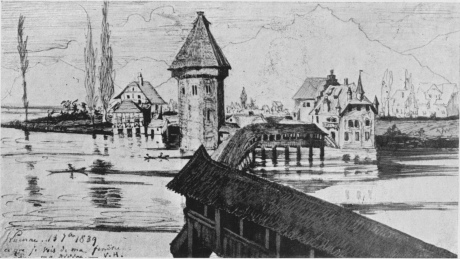
THE BRIDGE OF MARNE.
Drawing by Victor Hugo (Victor Hugo Museum).
My love is more clear-sighted. It was attracted at once by your physical
and spiritual perfection, and has never confused you with any other of
the human species. I love you, Toto. Torment me, drive me to desperation
if you will, but you shall never succeed in diminishing my affection. My
head aches, little man, and the thoughts that fill it at this moment are
not calculated to cure its pain. I press my hand upon my brow to crush
thought, and I open my heart to all that is good and tender in my love
for you. Good-bye, Toto. I adore you. Good-bye. We were very happy this
morning; let us try to be so again very soon.
In the meantime I adore you.
Juliette.
Wednesday, 8.45, November 20th, 1839.
I am in despair. I wish I were dead and everything at an end! The more
precautions I take, the more I purge my life, the less happiness I
achieve. It is as if I were accursed, and I often feel a wild desire to
behave as if I were, and crush my love underfoot. I am so unhappy that I
lose all courage and hope for the future. You were very good to me when
you were going away, but that does not prove that when you come back
presently you may not be the most offensive and unjust of men. I
sacrifice to you one by one all my actions, even the most insignificant;
I am careful inwardly and outwardly to cause you no sort of offence, and
yet I am unsuccessful! My struggles only fatigue and dishearten me. On
the eve of taking the great step which would bind us to each other even
closer than we already are, would it not be better for us to break off
our relations, and put a stop to the whole thing instead? I can
understand now the generosity of Didier, who elects to die upon the
scaffold forgiving Marion with his last breath, rather than live
persecuting and torturing her with the recollection of her past, and
with suspicions a thousand times more painful than death and oblivion.
Ah, yes, I can understand a Didier like that.... I suffer! Ah, God,
people who do not love are very fortunate! I love you, and I know that
failing some violent remedy I shall continue to suffer and care for you.
I admit that all these things I write are absurd, and that it would be
wiser to throw this letter into the fire, and keep to myself the
thousand and one follies inspired by my despair.
Juliette.
Monday, 5.30 p.m., December 16th, 1839.
You did well, my adored one, to come back after the painful incident we
had just gone through. If you had not, I should have been wretched all
the evening. Thank you, my beloved Toto, thank you, my love. You looked
very preoccupied, my treasure, when you came up the first time. I
gathered that Guirault’s letter had something to do with this, and that
you were meditating your answer. Beyond that, I did not take much
notice, for I was too furious with you to be able to think of anything.
If you knew how much I love you, and how faithful I am to you, my adored
one, you would be less suspicious. Suspicion is an insult that makes me
frantic, because, it proves to me that you do not believe in either my
honesty or my love. Jealousy is another thing: one can be jealous of a
face or of a person, because however sure one may be of one’s own
superiority, one may still fear that some beast or monster may be
preferred to oneself; but jealousy, I repeat, is different from
everlasting suspicion of one’s actions and even of one’s negative
conduct and inaction. Finally, I differentiate between jealousy and
suspicion; I feel there is a great gulf between my jealousy and yours,
and yet I love you more than you love me—you cannot gainsay that—if
you admit it, I will pardon all your misdeeds and adore you and kiss
your dear little feet. Hurrah! I am to have my wardrobe! Hurrah!
You will not be an Academician, but you will always be my dear little
lover.
Juliette.
Thursday, 5 p.m., January 16th, 1840.
I love you, my Toto, and am sad at seeing you so seldom. But I know how
much you have to do, my little man, so am not angry with you—still that
does not prevent me from being horribly sad.
Money melts in my pocket. I was reading yesterday a description of
Monsieur de Sévigné, the son, which applies wonderfully to me. “He had
no hobbies, did not entertain, gave no presents, wore plain attire,
gambled not at all, had only one servant and not a single horse on which
to ride out with the King or the Dauphin; yet his hand was like a
crucible wherein gold is melted.” I am rather like that. I do not give
many presents, I wear the same dress for a year at a time, I only do
expensive cooking when you are coming to dine with me, I have only one
servant, and yet money disappears in my establishment like snow under
the rays of the sun. With me, it is not my hand that is the crucible,
but my past life, which is like an abyss that all the money in the world
would find it difficult to fill. That is why I am sad. Love me, my Toto,
and above all do not kill yourself with working for everybody as you do
without respite. I can sell something I do not want, whereas your health
and repose are indispensable to my welfare and tranquillity. Remember
that, my dear one, and do not be over scrupulous at the expense of the
real consideration which makes my happiness. When shall I see you again,
treasure?
Juliette.
Sunday, 1.15 p.m., March 22nd, 1840.
Good-morning, my beloved Toto. I read the manuscript of “Didine” over
again last night, and I shed all the tears I had restrained in your
presence. I am more convinced than ever that you committed an act of
unfaithfulness against our love when you composed those lines. I do not
see how you can hope to persuade me to the contrary, or wonder that I am
wounded to the quick by such a mental and spiritual lapse. Jealousy is
not excited only by infidelities of the senses, but primarily by such an
infidelity as that which you have committed in writing these verses and
concentrating your gaze and your thoughts upon that young girl, while my
whole heart and soul were raised in prayer for you in that church at
Strasbourg. I will never go back there, either to the church or to the
town. There is an end of that. Would to God we had never gone there at
all! I should have preserved one illusion more, and suffered one sorrow
less. Well, well, it is not your fault. You wished to carry away the
memory of that woman, as you could not possess her person, and you have
written some very beautiful lines which prove, in the same degree as my
pain, what a profound and striking impression she produced upon you. I
hope you may never experience a jealousy so well-justified as mine about
any woman you may love in the future; for myself I desire a speedy
recovery from the most miserable infatuation in all this world.
Juliette.
Monday, 6.45 p.m., June 1st, 1840.
I am writing to you in the company of Résilieux, my love, but that does
not restore to me the gaiety I have lost since this morning. That woman
and her persistence annoy me more than I can say. When I think of the
close confinement in which I live and realise the depth and devotion of
the love I bear you, I am indignant to the bottom of my heart that a
wretched woman of the street should dare to cast the eye of envy upon a
passion which constitutes the religion and adoration of my whole life.
If I listened to my own inclination, I should make a terrible example of
the hussy and her low caprice, and no other would venture an attempt to
capture your affections for many a long day. I am wretched since this
morning. I think myself plain, old, stupid, badly dressed—and all
because I tremble for the safety of my love, because I am afraid for my
poor little slice of happiness. Alas! alas! my Toto, I care too much
for you; it is crazy of me. I did so hope that when your family was
settled in the country, you would sometimes come and take me out with
you—but, on the contrary, in a whole month I have only been out once
with you; for I do not count those two evenings at the theatre, when I
drove there and back in a carriage. It would be a cruel jest if you
considered those as going out with you. I am not well. I have rushes of
blood to the head and heart, but you do not care. I shall not do my
monthly accounts to-night; my head aches too badly. Perhaps I may try
to-morrow. The laundress has been here and I have paid her; I shall
probably get the grocer’s bill to-morrow, but I shall certainly not pay
it unless you have plundered some passer-by to-night. Meanwhile, I love
you, my Toto. Dinner has just been announced; I shall not be as happy as
yesterday, for you are not dining with me; but perhaps as I am alone I
shall be able to ruminate over my good fortune, for I was hardly able to
realise it at all yesterday with all those females about.
Juliette.
January 7th, 9.30 a.m., 1841.
Good-morning, my darling Toto, to whom I dare not yet give his
prospective title, for I am very doubtful of the integrity of old
Dupaty. I hope you will not keep me waiting too long for the result of
the rabid voting of the opposing parties.[81] The contest becomes more
and more curious and interesting. I wish it were already four o’clock.
The weather is not very propitious for that moribund scoundrel. It would
be difficult to let him down through the window, and still more so to
transport him to the place where we do not wish him to be. If the
computation is correct, the mortal illness of the old wretch should give
you the place by a majority of one vote at the first scrutiny; but what
about a black-ball? Perhaps this time it will come from the ignoble
creature who walks under the filthy, greasy, hideous hat of that beast
Dupaty. I wish we were already at this afternoon, that I might know what
the foul old man has dared to do. Until then I shall look at my clock
many and many a time. Try, my love, to come at once and tell me the
result whatever it may be. I shall at least have the pleasure of seeing
you, which will add to the joy of your nomination or console you for
your defeat.
By the way, you were so shabby last night that one might suppose you
were preparing to contest the palm of bad dressing with that old
pickpocket Dupaty. I shall forgive you your untidiness if you are
successful. I love you.
Juliette.
Thursday, 6 p.m., January 7th, 1841.
I am enchanted for everybody’s sake, my dear Academician, that at last
you are elected. There you are at last, thanks to the seventeen votes of
your friends, and in spite of your fifteen adversaries. You are an
Academician. Hurrah!
I wish I could have witnessed with my own eyes the grimaces of all
those contemptible old things, and heard the profession of faith of that
horrible Dupaty; you ought to indemnify me by showing me your own
beautiful countenance for a little more than a paltry five minutes as
you did just now. I love you, Toto, as much as the first day and more
than ever. But, alas, I dare not believe the same of you, for I do not
see much proof of it, as my maid would say. The fact is that whether as
an Academician, or a candidate, or nothing at all, I hardly see you more
than an hour a day. This is neither novel nor consoling; it becomes more
and more sad and painful. Think of that, my love, and come very soon
after you have read my letter.
I love you.
Juliette.
Sunday, 10.45 a.m., April 11th, 1841.
Good morning, my beloved Toto, my adored little man. How are you, my
darling? I am afraid you may have tired yourself last night reading your
splendid speech to me. Poor beloved, it would be a calamity that my
pleasure should cost you so dear; it would be unjust and cruel. I hope
it is not so, my adored one, and that you have not been punished for
your kindness.
What a magnificent address! and how stupid it is of me only to
appreciate it inwardly, and to be incapable of expressing my feelings
better than by inarticulate grunts. It is not my fault, yet since I have
learned to love you I have not been able to resign myself to my
limitations. Every time the opportunity presents itself to admire you I
am furious with myself and should like to slap and kick myself—though
my poor body would have no time to recover between the assaults, for
every single thing you say and do is as admirable and striking as your
written works. So I should be kept busy. Fortunately you do not object
to my want of intellect; you realise the quality and proportions of my
love. All my intelligence and being have turned to spirit, to idolise
you. I may be only a goose outwardly, but inwardly I am sublime with
devotion. Which is best? I cannot tell, it is for you to decide.
Meanwhile I am the most fortunate of women to have heard the beginning
of your beautiful speech, and I love you with all my strength.
Juliette.
Thursday, 4.30 a.m., June 3rd, 1841.
Good morning, my adored little man, my beloved Monsieur l’Académicien!
How are you, my Toto? I am very much afraid you will be horribly tired
before this afternoon, poor treasure![82] I think you should have had
the speech printed a day earlier, and have kept this night free for
resting.
I really do not know how you will manage to deliver your address after
these several days of grinding fatigue, and a night spent in correcting
the proofs at the printing-works. Nobody but you can accomplish these
feats of endurance. Still, my beloved, it is time you changed a mode of
living which must kill you in the long run. I hope you are going to
spend the remaining few hours in your bed.
I already feel as agitated as if I were going to make the speech myself.
I shall be in a desperate state of mind until you have finished and
Salvandy begins to speak. I shall have this fearful lump on my chest
until then.
Whatever happens I adore you.
Juliette.
June 3rd, 5.30 p.m., 1841.
Where shall I begin, my love? At your divine feet or your celestial
brow? What shall I express first? My admiration? Or the adoration that
overflows my heart like your sublime genius surpasses the mediocre
creatures who listened to you without understanding, and gazed at you
without falling upon their knees! Ah, let me mingle those two sentiments
that dazzle my brain and burn up my heart. I love you! I admire you! I
adore you! You are truly splendid, noble, and sublime, my poet, my
beloved, light of my eyes, flame of my heart, life of my life! Poor
adored beloved; when I saw you enter, so pale and shaken, I felt myself
swooning, and but for the support of Madame Démousseaux and Madame
Pierceau, I should have fallen to the floor. Happily nobody noticed my
emotion, and when I came to myself and saw your sweet smile answering
mine and encouraging me, I felt as if I were awaking from a long,
painful dream, though only a second of time had elapsed.
Thank you, my adored one, for sparing a thought to the poor woman who
loves you, at that solemn moment—I should have said, that supreme
moment, if the assemblage had not consisted for the greater part of
tiresome blockheads and vile scoundrels.
Thank you, my good angel, my sublime Victor, my illustrious child. I
saw all your dear little family;[83] lovely Didine, charming Charlot,
and dear little Toto who looked pale and delicate. I kissed them all in
spirit as I did their divine father.
I love you.
Juliette.
Thursday, 2.30 p.m., July 8th, 1841.
While you are lording it at the Académie[84] I am weeping and suffering
at home. You might have spared me this pain by inviting me to attend the
sitting, or else staying away yourself. I must warn you, my Toto, that
this sort of sacrifice and torment is unendurable, and if it happens
again I do not know what I may do rather than resign myself to it.
We are not living in the East, and you have not bought me, thank
Heaven! I am free to cast off the yoke of proceedings which are neither
just, nor kind, nor affectionate. I swear by all I hold most sacred in
this world, namely my love, that I will not submit a third time to be
thus flouted. If you knew how furious and miserable I am feeling at this
moment of writing, you would not venture to inflict a third trial of the
kind upon me. In any case pray keep my letter as a definite
announcement of what I am capable of doing if you are so cruel as to
persist in your present line of conduct. Meanwhile I am doing my best to
avoid taking any definitely fatal step, but I warn you that I cannot
much longer remain mistress of myself.
Juliette.
1 a.m.
Hell in my heart at noon, Paradise at midnight, my Toto. I love you and
have full confidence in you.
Friday, 7.45 p.m., November 19th, 1841.
I have it! hurrah!! Fancy, it has been here all the morning, yet nothing
warned me! My heart did not beat faster than usual, the earth did not
tremble, the skies did not fall, in fact everything remained in its
humdrum, normal condition, as if nothing unusual had happened—and it
was here all the time! I possessed it in my room, under my eyes! Verily
it can hardly be credited, and if anybody but myself said so I should
not believe it. But what you must believe, my love, for indeed it is
true, is that I love you and that you are the kindest, most charming,
best, handsomest, most generous, most noble, and most adored of men.
That is what you have got to believe, because it is God’s own truth. The
cabinet is fascinating, but what is still nicer is the way you gave it
to me. “The manner of the gift is better than the gift itself,” was once
said by some one whose name I have forgotten. When you are the donor,
the proverb is still more applicable. If you had all the treasures of
the universe to bestow, you would do it with a grace that would enhance
the value of the gift a thousandfold. As for me I am mad with delight,
for I believe you love me. I may tell you now that last night I cried
helplessly at the thought of how much younger and handsomer you are than
I. I anticipated the moment when you will no longer be able to love me,
and my heart contracted so that I should have suffocated without the
relief of tears. I feel I shall certainly die the day you cease to care
for me, and I know that no other woman can ever worship you as I do. But
I trust that day will never dawn, will it, my angel? There are no
wrinkles in the heart, and you will see my face only in the reflection
of your attachment, eh, Victor, my beloved? The while I wept and
mourned, you were thinking of me, my poor sweet, and bringing me the
cabinet. We were both performing an act of love, mine gloomy, yours,
charming and considerate like everything you do. I hope your present
will bring us both happiness, and that you will adore me as long as I
shall admire my dear little cabinet—that is, for ever.
I have it! what happiness! I should like to put it in the middle of the
room on a golden table, or in my bed, or carry it in my arms, on my
heart, anywhere in fact where it could be seen and touched. Meanwhile I
will give it a good cleaning to-morrow. It is rather too late to-night.
I must do some copying, and dine, and send you back the scribble you
entrusted to me yesterday, so I will put off till to-morrow—principally
because I shall have a better light then. I will clean it in bed, drawer
by drawer. It will be a delightful occupation.
I love you, I love you, Toto, I kiss you and adore you, Toto.
Juliette.
Wednesday evening, 6.30, February 9th, 1842.
Do you really want me to write Toto, even when my heart is breaking, and
my soul brimful of discouragement? I obey, but if you would only listen
to me, you would allow me to discontinue these daily scrawls, which have
never served any purpose but that of betraying the measure of my
stupidity and making you tire of a love become absurd by dint of
reiteration. I feel you only insist out of kindness, but it seems futile
to continue this childish babble, which deceives neither you nor me, and
gives me no indication of what is passing in your mind. It would be
better, my beloved, to inure me gradually to a catastrophe which may be
nearer than I guess, than to make efforts to leave me an illusion which
neither of us really shares nowadays. A sad ending to all our past
happiness! God grant it may not be altogether buried. This does not
prevent me from doing you full justice, my friend. You are kind with a
kindness full of pity and divine indulgence, but you no longer cherish
for me the love of a man for a woman. Do not pretend otherwise, for you
cannot delude me. I bear you no grudge my Victor, neither should you
bear me any, for it is no more your fault than mine, that you do not
love me while I still love you—not our fault, but God’s, Who
distributes unequally the amount of love we may each expend during our
lives. Happy he or she to whom the smaller sum is apportioned—so much
the worse for him or her whose heart is inexhaustible. Now, my beloved
Toto, I will torment you no longer. I will even try to make myself
agreeable, though, alas, what woman can be agreeable when she is no
longer loved! But I shall do my best, and that, coupled with your
natural generosity, may still retard for a few days the greatest
misfortune of my life. Fear nothing from me, my Victor. You have to-day
received the last expression of my choler. One may strike, and even
kill, while one feels oneself beloved, but one must spare the man who no
longer cherishes one.
You see, my Victor, that you have nothing to be afraid of, but I beseech
you to let me off these daily scribbles about things that have neither
point nor reason.
I demand this of your goodness.
Juliette.
Thursday, 2.30 p.m., February 10th, 1842.
My beloved, my adored Victor, thank you! You remove hell from my heart,
and replace it with paradise. Thank you! My life, my spirit, my soul,
bless and adore you. What a letter, my God! I wanted to read it
kneeling; happy tears poured down my cheeks. You love me, my dear one!
It must be true, for you declare it in the loveliest, sweetest language
of the whole world. You love me although I am ill-tempered, violent,
stupid; you love me my good angel, because you know that your love is
the breath of life to me, and that without it I could no longer exist. I
also love you, but only God and myself know how deeply. Yesterday when
you left me, I was on my knees praying and kissing with tears the
footsteps I could hear fading away in the street. I could have flung
myself out of the window and died at your feet. My despair, then, was as
poignant as the bliss I felt just now when I read your adored letter.
My Victor, my love, my life, my joy, I love you more than ever! I
implore your forgiveness, I throw myself at your feet and embrace them.
Thank you, my treasure. You must be very happy, for you have done a
lovely thing in writing me the most charming, the kindest, the most
wonderful and most adorable letter that ever issued from your heart.
Juliette.
Thursday, 9.30, April 30th, 1842.
Good morning, my adored Toto. How did the little invalid sleep last
night? As for you, I do not even ask, my poor dear, for I know you spend
all your nights working. I love you, my poor angel. I do not know what
else to say, because that is the only thought in my heart and soul; to
love you always and for ever. Here comes the bright sunshine that is
going to cure our poor little man at once.[85] I have not seen a finer
spring since the one we spent strolling about the heights of Montmartre
together. I cannot think of it without tears of regret for the days that
are gone, and of gratitude to Providence for those few moments of most
perfect felicity. I would give half my life to have it again, my beloved
Toto; and it depends only upon you—if you wished it, we could easily
recover the happiness of those days. Why do you no longer desire it? I
know you have to work, but so you did then—Claude Gueux, Philosophie
Mêlée, Les Voix Intérieures, Les Chants du Crépuscule, Angélo,
Les Rayons et Les Ombres and Ruy Blas, are there to prove it. In
those days you loved me better than you do at present. Alas, I love you
more than ever, or rather, as much as the first day!—that is, with
all my soul.
Juliette.
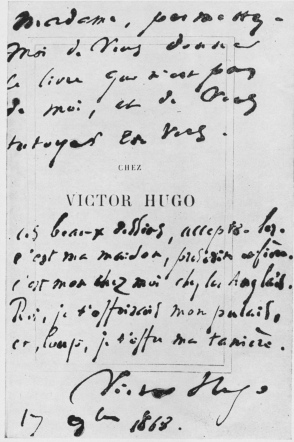
A DEDICATION BY VICTOR HUGO TO JULIETTE DROUET.
The original belongs to M. Louis Barthou.
Saturday, 6.30 p.m., August 20th, 1842.
I am a strange creature—at least you think so, do you not, beloved? But
what you take for eccentricity, caprice, bad-temper, is really love, but
an unhappy love, mistrustful and anxious. Everything is to me a subject
of dread almost amounting to despair. Thus this visit to the Duchesse
d’Orléans, whither I quite admit you were kind enough to take me, was
simply a torment on account of the hour and the circumstances: I, badly
dressed, barely clean, and that woman under the prestige of a great
sorrow[86] which, next to physical beauty, is the surest way to your
heart. I frankly confess that however gallant my love may be, and
whatever reliance I may place upon your loyalty, I am not easy when I
have to fight and struggle without weapons. This result of a surprise
and a hurried rush through Paris in a cab may seem excessive to you, and
verging on hysteria; but the fact is, my adored one, that my love, so
long repressed, is verily degenerating into a disease, almost into
frenzy. Everything hurts me. I am afraid of everything. I am a poor
thing needing much compassion for loving you so. If these incoherent
expressions do not force upon you the realisation of the depth of my
devotion, it must be that you no longer care for me, or indeed have
never done so; but if on the contrary you do understand, you will pity
and pardon me, and love me all the better, and I am the happiest of
women.
Juliette.
February 14th, 11.15 a.m., 1843.
Good morning beloved Toto, good morning adored one. I love you. When I
heard you describing last night the impression produced upon you by the
rehearsal of Lucrèce and more especially by the singing of the guests,
I seemed to feel it all myself. The fact that my love has not grown a
day older, that my admiration is still on the increase, that I think you
as handsome and as young as ever, makes it easier for me to go back to
the feelings of those days. Looking into my heart, I seem to feel that
all this adulation and joy and feast of glory and love began yesterday.
Alas, those ten years have left traces only upon my poor countenance,
and have been as harsh to it as they have been indulgent to your
charming features.
I express this somewhat crudely, as I always manage to do, but it is not
my fault, my love, nor any one else’s. I love you. Therein consist my
intelligence, my wit, my superiority; beyond that I am as stupid as any
other animal.
You must be very busy to-day with the two rehearsals,[87] and the
Maxime[88] worry which falls upon your devoted head, not to speak of the
great business! I dare not expect you to-night till very late. Well,
my dearly beloved, I know you do not belong to me, so I will resign
myself as cheerfully as may be, and put a good face upon your absence.
Try to think of me, my dear little man; that is all I venture to ask at
this moment. As for me, there is no more merit in thinking of you and
loving you than in breathing.
I love you, Toto, as much as life.
Juliette.
Wednesday, 4.30 p.m., September 13th, 1843.
Where are you? What are you about, my adored one?[89] In what condition
is your family? What state are you in yourself? what will happen to us
all in our despair, if God be not merciful to us! Since you left me I
can think only of your arrival at home. I imagine the scene: the
despairing sobs of your children, the expression of your own frightful
grief, so long and sternly repressed. All those tears and sufferings
fall back upon my heart and rend it. I cannot bear more. My poor head is
on fire and my hands burn like live coals. I want to pray and cannot;
all my faculties, all my being, turn to you. I would give my life to
spare you a single pang. I would have sacrificed myself in this world,
and the next to save your adored child. My God, what will become of me
if you stay away much longer, when I have refrained with such difficulty
from sending to get news of you? I have begged Madame Lanvin to come to
me this afternoon and bring her husband, so that if, as I fear, I have
not seen you before then, he can go and ask for news of you under the
name of Monsieur St. Hilaire. My heart aches, my poor treasure, when I
think of all you are enduring. I feel I cannot much longer bear not
seeing you. I shall commit some act of folly if you do not come to my
assistance. I exhausted my strength and courage on that awful journey,
and during last night and to-day. I have none left now to endure your
absence. I picture to myself your wife ill, and you also; in fact, I am
like a mad thing in the extremity of my anxiety and grief. I am trying
to occupy myself mechanically, in order to bring nearer the moment when
I shall see you, but my efforts only make every minute of waiting seem
like a century, and all the fears my heart anticipates, become frightful
realities against which I cannot struggle. My adored Victor, whatever be
your despair, mine is greater still; for I feel it through my love,
which makes it a hundred times worse and multiplies it beyond all human
calculation. Never has man been so idolised by woman as you are by me,
and the poor angel we mourn knows it and sees it now, as God knows and
sees it, and she will forgive, as He does, I am certain. I think of her,
poor beloved, as an angel of heaven. To her I shall direct my prayers,
that she may give you the strength and courage you need. To her also I
shall address myself in the hour of death, that the good God may take me
with all of you into His Paradise.
My adored Victor, it is more than five o’clock, and you have not yet
come. What shall I do! What can I think, or rather what am I to fear? We
are in a terrible cycle of misfortune, and God only knows when it will
end. My Victor, before giving way to despair, think of mine, remember
that I love you more than life.
Juliette.
Sunday, 5.45 p.m., October 8th, 1843.
I have been working all the morning my beloved, or rather scribbling on
paper—only to please you, for I doubt whether my labour will be of any
use to you; still, I am trying hard, and if I cannot do better, I am
doing my best. I cannot do more. I am trying more especially to forget
no detail, which makes me occasionally note down trivialities, little
futile, insignificant things. My search among our memories is like the
botanising of a child who is as apt to collect couch grass as the more
useful and rarer plants. However, I am doing my best, and better still,
I am obeying you. Would you believe that, although I have been writing
the whole day, I have not yet reached Auch.[90] My mind and pen rather
resemble the fantastic equipage we drove thither, but there is less risk
in the present venture. The worst that can happen is that we should
tumble promiscuously into a muck heap of absurdities and nonsense which
leave no bruises, whereas we risked our necks several times in the
course of the thirty-three miles between Tarbes and Auch.
I should love to see you, my Toto. The day, though filled with joyous
recollections of our journey, has seemed long and sad to me. Nothing can
take the place of one of your embraces. The remembrance of the greatest
happiness cannot weigh against one glance from you. I realise it more
to-day than ever before; therefore, do try and come, my beloved Toto. It
will give me courage and patience to get through the evening. I love you
too much, you see, but I cannot help it; it is no fault of mine.
Juliette.
Sunday, 7.15 p.m., November, 1843.
I think of you my beloved, I desire you, I love you. Ah yes, I love you
my adored Toto, you may be sure of it, for it is God’s truth. My little
Claire and I talk of you and nothing but you. We love you and bless you.
The poor little child will not be with me much longer, and I can already
see her poor little face wrinkling up with sorrow; but I try to be
cheerful and to remind her of the fortnight’s holiday which will soon
come. We love the pictures of your dear little Toto, and his pretty
home. We gaze at them with eagerness and affection, we are all eyes and
heart. At this moment Claire is reading Ulric’s poems,[91] while I am
writing to my beloved Toto with a heart full of gratitude and devotion.
May the happiness you bestow upon me, be yours also, my love! May a just
pride sustain you, for you have saved two souls, the mother’s and the
daughter’s! I feel ineffable things I dare not express, for fear of
vulgarising them by the mere fact of putting them into words. Do not
delay long ere you come, my darling Toto. If you knew the joy and
radiance you diffuse in this house, you would indeed hasten your steps.
Alas, I am foolish, for have you not children of your own whom you must
also make glad! I am envious of them, but not cruel enough to deprive
them of their bliss—only I beg of them to hurry with their enjoyment,
so that my turn may come.
Did you give Dédé the sachet? Did Toto take back his quince jelly?
Meanwhile, I am giving Suzanne a whole evening to herself, and making my
little rogue read Le Musée des Familles. I should love to give you a
good kiss, but I know you will not come for it. You have not the sense
to do so.
Juliette.
Monday, 11.15 a.m., July 22nd, 1844.
Good morning my beloved, my sweet, my darling little Toto. How are you?
Are you less sad and painfully pre-occupied than yesterday, my adored
one? Alas, it is unlikely ... your grief and sorrow are not of those
that time can soften. You have the painful faculty of feeling things far
more acutely than do other men. Genius does not only pertain to the
brain, it belongs above all to the heart. My poor dear one, I love you;
I suffer when you suffer; be merciful to us both, I implore you.
My little Claire went away this morning. She was more resigned than
usual, for she has a holiday of three days in prospect, beginning next
Saturday. The poor little thing is very devoted to us; her sole
happiness is to be with us. She complains of not seeing you often
enough, and I back her up in that. You must try to give us at least one
evening out of the three she will spend at home. Verily I am not very
cheerful company for the poor child when I am alone with her. I am so
absorbed in my love that sometimes I do not speak to her twice in the
day, however much I try to bring myself to do so.
I have copied Méry’s verses, because I do not wish to deprive
Mademoiselle Dédé of his autograph. I can understand her setting store
by it, poor darling, so I shall make a point of returning it to her.
Only (and it is you I am addressing now) you must give me just as many
as you give her. You must not lose your good habits, my darling, for I
am sure it would bring us bad luck. Therefore you must bring me all your
letters as you used to do. I promise to divide them conscientiously with
dear little Dédé, and you know quite well that I am a woman of my word.
I adore you.
Juliette.
Thursday, 4.45 p.m., October 20th, 1844.
I have sent to Barbedienne, my adored one, but Suzanne has not yet
returned. I am writing to you meanwhile to make the time hang less
heavy. I hope to goodness I may be able to procure that lovely
medal![92] Since I have glimpsed the chance of possessing it, I feel my
disappointment would be greater than I could bear, if I failed to get
it. Good God, how slowly that girl walks! Fancy having to trust to legs
like those on such an occasion! I could have gone there and back ten
times, since she went. May the devil fly away with her, or rather,
precipitate her right into the middle of my room with his cloven foot,
providing only that she brings the longed-for medal!
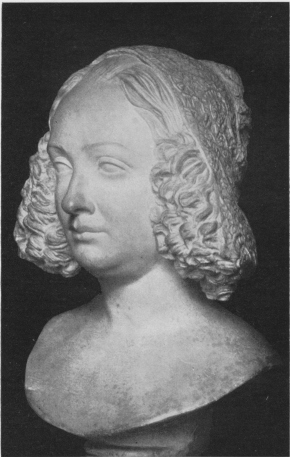
JULIETTE DROUET IN 1846.
Bust by Victor Vilain (Victor Hugo Museum).
Here she is! Ah! Victor, do not be angry! Victor, I am at your
feet—Victor, I will be reasonable for the whole of the rest of my life
if only you will let me add 15 fr. to the sum you promised me. Oh,
Victor, I have not time to wait for your answer and yet I fear to annoy
you. Ah, no, you are too kind to be angry with your poor Juju who loves
you with such absolute admiring, devoted love! You will look at her with
your gentle, ineffable smile, and say I was right—surely, yes, you
will. Three cheers for Toto! Juju is a clever woman ... at heart. Yes,
it is quite true and I am the happiest of women.
Juliette.
Tuesday, 9.30 a.m., September, 1845.
I have just been gardening, beloved. I am soaked with dew and all muddy,
but I have spent three hours thinking of you without any bitterness. My
eyes were as moist as my flowers, but I was not weeping. While I busied
myself with the garden, I reviewed in thought the lovely flowers of my
past happiness. I saw them again fresh and blooming as the first day,
and I felt close to you, separated only by a breath. As long as the
illusion lasted I was almost happy. I should have liked to pluck my soul
and send it to you as a nosegay. Perhaps what I am saying is silly, yet
it is the sort of nonsense that can only issue direct from the
tenderest, most passionate heart that ever lived. For nearly thirteen
years past, I have never once written to you without feeling my hand
tremble and my eyes fill. When I speak of you, no matter to whom, my
heart swells as if it would burst through my lips. When I am dead, I am
certain that the imprint of my love will be found on my heart. It is
impossible to worship as I do without leaving some visible trace behind
when life is over.
My beloved Victor, let your thoughts dwell with me, so that my days may
seem shorter and less dreary; and do try to surprise me by coming
to-night. Oh, how happy I shall be if you do that!
Meanwhile, I love you more than I can say.
Juliette.
Saturday, 8 a.m., September 27th, 1845.
Good morning my beloved, my soul, my life, my adored Victor. How are
you? I hope yesterday did not tire you too much. I forgot until you
reminded me that you have been forbidden to walk much, but I do trust it
did you no harm; did it, Victor darling? As for me I felt no fatigue, I
seemed to have wings. I should have liked to place my feet on all the
paths we traversed together eleven years ago, to kiss the very stones of
the roads and the leaves on the trees, and to pick all the flowers in
the woods, so keenly did I fancy they were the very same that watched us
pass together all those years ago. I gazed at you my adored Victor, and
in my eyes you were as young and handsome, nay handsomer even, than
eleven years ago. I looked into my heart and found it full of the same
ecstasy and adoration that animated it the first day I loved you.
Nothing was changed in us or about us. The same ardent, devoted, sad and
sweet affection in our hearts, the same autumn sun and sky above our
heads, the same picture in the same frame; nothing had changed in eleven
years. I would have given a decade of my life to stand alone for ten
minutes in that house that has sheltered our memories for so long. I
should like to have carried away ashes from the fireplace, dust from
the floors. I should have liked to pray and weep, where once I prayed
and wept, to have died of love on the spot where once I accepted your
soul in a kiss. I had to exercise superhuman self-control not to
perpetrate some act of folly in the presence of that girl who showed us
so indifferently over a house I could have purchased at the price of
half the rest of my life. Fortunately, thanks to her profound ignorance
of our identity, she noticed nothing, and we were each able to bring
away a tiny relic of our former happiness. Mine must be buried with me
when I die.
Beloved, did you work late last night? It was very imprudent of you if
you did, after the fatigue you underwent during the day. To-day, you
must be very careful and not walk much. I shall be extremely stern with
you. My antiquarian propensities shall not make me forget, like
yesterday, that you are still convalescent and must hardly walk at all.
And you will obey me, because little Totos must always obey little
Jujus, as you know.
Kiss me, my adored Victor, and may God bless you for all the happiness
you give me.
Juliette.
Saturday, 9 p.m., May 2nd, 1846.
I cannot nerve myself to the realisation that I shall not see you this
evening my sweet adored beloved; yet it is all too true. This is the
first time in fourteen years that I have not slept in a room belonging
to you.[93] Consequently I am feeling quite forlorn. Everything
conspires to harrow me. Just now when I left you I longed for death, and
the tears I drove from my eyes trickled inwardly to my sad heart. If
this anxiety about my child, and the separation from you, are to last
long, I do not think I shall have strength to endure them. I am vexed
and disgusted at the tone of those about me. I am ashamed and indignant
at my inability to remove myself from it, however I may try; then when I
remember you, so generous, so loyal, so noble, so kind and indulgent, my
bitterness evaporates and nothing remains in my heart but admiration,
gratitude, and love for your divine and fascinating self.
When I got back, I found my child in a raging fever. I gave her fresh
compresses, and now she is sleeping. God grant she may do so all night,
and that the change of ideas and surroundings and air may have a good
effect upon her health. I shall in that case have less cause to grudge
the sacrifices I am voluntarily making to that end. Meanwhile, I am a
prey to fearful anxiety, and am suffering the uttermost from the absence
of what I love best in this world, above life, above duty, above
everything. Good-night, beloved. Think of me. Sleep well, and love me.
Juliette.
Tuesday, 3.45 p.m., 1846.
I love you, my Victor. Between every letter of those five sweet words
there lurk depths of maternal anguish and sorrow. Gloomy reflections
mingle with my tenderest thoughts. My life at this moment is divided
between my poor little daughter whom I already mourn in anticipation,
(for I feel that these few days of illness are but snatched from
Eternity), and my adoration for you, from which no preoccupation, even
of the most terrible and sinister character, can long distract me. On
the contrary, my love is all the greater for the trials and sufferings
God sends me. I love you selflessly, as if I myself were already over
the border. My heart is racked, yet I adore you.
Claire’s condition is the same as yesterday; only the weakness, which,
but for the doctor’s plain warning I might have attributed to the heat,
has increased. The night was not very bad; the poor little thing suffers
hardly at all. She seems to have no firmer hold on life than life has
upon her. Apathy and profound indifference characterise her illness.
Only her father has the power to rouse her for the few moments he is
with her. He came this morning and happened to meet the doctor,[94] who,
it appears, is not quite so despondent as Monsieur Triger;[95] but what
does that prove?
I have not been able to get her up at all to-day. She lay in bed in a
state of profuse and constant perspiration. The various tonics she takes
fail to produce any effect whatever. The exhaustion increases hour by
hour, which means that death is coming nearer. I pray, but I obtain
neither solace nor confidence. The good God disdains my prayers and
rejects them, I know—yet I love and admire Him in His beneficent,
lofty, noble, generous and beautiful works.
I love Him as His saints and angels in Heaven love Him. What more can I
do to find favour in His eyes? He deprived me of my mother at my birth;
now He is about to snatch my child from me. Is that His justice? I do
not want to blaspheme, but I am very miserable, and if I do not see you,
if you cannot come to-day, I do not know what will become of me. Despair
fills my soul, but I love you. God may crush my heart if He so wills,
but the last breath from it shall be a cry of love for you, my sublime
beloved.
Juliette.
April 29th, 9 a.m., 1847.
Good morning, my adored Victor. My thoughts and soul and heart go out to
you in this greeting. I hope I shall see you before you go to the
rehearsal, for if I do not, I shall have to wait till this evening,
which would increase my depression. From now until the anniversary of
the terrible day on which I lost my poor child, every hour and minute is
punctuated by the recollection of the sufferings of that poor little
thing, and of the anguish I went through. They are painful memories,
impossible to exclude from my thoughts. Last night while I lay sleepless
I seemed to hear her, and in my dreams I saw her again as she looked at
the close of her illness. I am worn out this morning. All the pangs and
fatigues of the last moments of her life weigh down my heart and limbs.
It may be that I shall find comfort in prayer, and I shall pray better
by her side, buoyed up by the hope that she will hear me and obtain for
me resignation enough to bear her absence without murmur or bitterness.
It was you who gave me the courage to live. All that a heart can gain
from consolation, I found in your love; but there is a grief surpassing
all others and beyond human aid, for which only God can provide, and to
Him I must address myself to-day.
Juliette.
Thursday, 8 a.m., May 6th, 1847.
Good morning, my all, my greatly loved Toto. How are you this morning?
Did you gather in a good harvest of glances, smiles and flattery
yesterday from the women you met? Were you the cause of many incipient
passions, or were you yourself ensnared by those females, like any
beardless student or bald-headed peer of the realm? Tell me, how are you
after your evening at Court? For my part, I have a very sore throat and
am feeling fearfully cross. I have a longing to scratch which I should
love to vent upon the face of some woman or even upon yours—or better
still, upon both. I am sick of playing the gentle, sheep-like woman. I
intend to become as fierce as a hyena, and to make your life and
everything depending upon it a burthen to you. I mean to make a terrible
example of you, so that people shall say as you pass by, that it is a
woman who has been outraged, but a Juju who has avenged herself!
Meanwhile, to begin with, I am going to wrest from you somehow, two silk
dresses, a lovely hat, two pairs of smart shoes; and if you do not
confess your crime, I will punish you to the tune of torrents of
tea-gowns, pocket-handkerchiefs, and silk stockings. I am capable of
anything if you drive me too far.
Juliette.
Tuesday, 12.45 p.m., June 6th, 1848.
The more I think of all that is going on in Paris at this moment, my
beloved, the less do I desire the success of your election.[96] We must
let this frenzy of the populace which knows not what it wants and is in
no condition to distinguish the true from the false, or evil from good,
exhaust itself first. When it is worn out with turning in its own
vicious circle of disorder, violence, and misery, it will come to heel
and humbly crave the assistance of incorruptible, strong, sane
politicians, among whom you are the most incorruptible, the strongest,
and the sanest. I say this in the simplicity of my heart, without any
pretension to be other than a mere woman who loves you above all things,
and trembles lest you should enter upon some undertaking that might
jeopardise your life without saving your country. Therefore I pray that
this candidature, to which you have been driven in self-sacrifice and
generosity, may not succeed. If I am unpatriotic, I accept the blame,
but I do think that in this instance my feeling is in accord with the
best interests of France. It would not be the first time that the heart
has proved cleverer than the brain. It has happened too often in my case
for me to marvel. Pending our next meeting, I kiss you from my soul, I
adore you with all my strength.
Juliette.
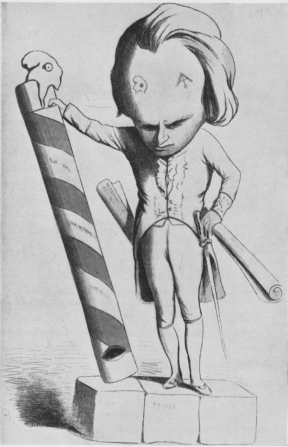
VICTOR HUGO, RÉPUBLICAIN.
Political caricature, 1848.
Monday, 9 a.m., July 9th, 1849.
I am hurrying, my love, for I wish to be at the door of the Assemblée at
noon precisely, in order to secure a good place.[97] I wish the great
moment had arrived, for I am already feeling stage-fright, and it will
go on increasing until I see you descend from the tribune. I thought
this morning that I could not experience any other sensation than
happiness at seeing you, but now I begin to understand what fear is. Yet
when I say fear, I am hardly correct; for I mean something more
indefinite, which is rather the suspense before a great joy, than the
stupid emotion of cowardice or funk. In any case, I am very agitated; I
wander aimlessly about the house, and feel as if the longed-for moment
would never arrive. My blessed love, my great Victor, my sublime
beloved, I kiss in spirit your noble forehead with its generous
thoughts, your beautiful eyes so gentle and powerful, your fascinating
mouth, which has the happiness of speaking all your divine thoughts. I
prostrate myself before the most beautiful and most sublime thing in the
whole world, namely, your dear little person and your profound genius.
I do not ask you to think of me before your speech, adored one, but
afterwards I entreat you to spare me one glance to complete my
happiness.
Juliette.
Wednesday, 12.30, February 6th, 1850.
Think of me, my adored one, and do not permit yourself to be ensnared by
the mercenary blandishments of that woman.[98] I am in the throes of a
jealousy so terrible, that the hardest heart would be moved to pity,
and the most intrepid would fear me; for I am suffering, and I am
capable of anything to avenge a despicable treachery. Alas, my poor
adored one, this is not what I should like to say, or what I ought to
say. I realise that threats are powerless to hold you. I believe if the
statistics of infidelity could be drawn up like those of crime, it would
be shown that the severe penalties of the code of love are more apt to
drive lovers into breaches of its laws than to bind them together. I am
sure of it, and I wish I could convert my natural ferocity into bland
indifference, in order to remove from you the stimulant of a forbidden
Rachel; but it is no good—I shall never manage it. Therefore, I implore
you for the sake of your personal safety and mine, to be honourable and
prudent in your dramatic relations with that dangerous and perfidious
Jewess. Try not to prolong your literary and theatrical consultation
beyond the strictly necessary limits, and to come and fetch me before
three o’clock.
I should be so grateful to you, my adored little man, for you would thus
abridge the moments of my torment. Meanwhile I am very unhappy and
anxious and worried. I try to hearten myself up by remembering the last
promises you made me. When do you intend to keep them, I wonder? God
knows!
Juliette.
Saturday, 8 a.m., April 6th, 1850.
Good morning, my adored one, my sublime beloved. How are you? Did you
have a better night, or did fatigue and excitement prevent you from
sleeping? When I think of the admirable speech, so religious in
character, so noble, self-abnegating, and conciliating, that you
delivered yesterday[99] at the risk of your health, and then reflect
upon the senseless uproar, and idiotic and violent interruptions it
provoked, I feel only hatred, contempt, and disgust, for political life.
It is revolting that a man like you should be the butt of the
irresponsibility of all the parties. It is hateful, abominable,
infamous, that scoundrels without talent, wit, or feeling should dare
argue with you and should be accorded an attentive hearing where you
only meet with insults. Really, my treasure, the more I see of political
life, the more I regret the time when you were simply the poet Victor
Hugo, my sublime love, my radiant lover. I revere your courage and
devotion, but I am hurt in my tenderest feelings when I see you
delivered over to the beasts of an arena a thousand times less
discriminating than that of ancient Rome. Therefore, my beloved Victor,
I have conceived a loathing, not only for your antagonists, but also for
the form of government which imposes this Sisyphus life upon you. If I
had the power to change it, I can assure you I should not hesitate, even
if I had to deprive you for ever of your rights of citizenship.
Unfortunately, I can do nothing beyond cordially detesting those who
obstruct your work. I pity you, bless you, admire you, and love you with
all my soul.
Juliette.
Saturday, 3 p.m., June 29th, 1850.
I have just watched you go with inexpressible sadness, my sweet and
beautiful beloved. With you have departed the sunshine, the flowers,
the pleasant thoughts, the hopes that link past happiness with future
bliss. Nought remains to me but my love, a poor hermit whose regrets
have been her sole bedfellows this long time. When you turned the corner
of the street, something luminous, soft, and sweet, seemed to die within
me. From that moment I have been as depressed and desolate as if a great
misfortune had befallen me. Alas, it is in fact the misfortune that
weighs down my whole life, namely, your absence. Since politics have
monopolised your time, happiness has eluded my grasp. Will it ever
return? I doubt it, hence my despair. I am greatly to be commiserated,
my beloved, in that I have constituted your eyes my illumination, your
smile my joy, your words my bliss, your love my life—so that when you
are away, all these are simultaneously snatched from me. I am not
certain of seeing you to-night, still less to-morrow. What is to become
of me? What am I to do with this poor body bereft of its soul when you
are not by? Tell me if you can. Explain if you dare. Meanwhile, I adore
you.
Juliette.
Monday, 10 p.m., July 7th, 1851.
What I had foreseen has happened, my beloved, even sooner and more
painfully than I had feared. Does this fresh crisis foreshadow my speedy
recovery? I dare not hope it, for I feel that my disease is incurable. I
tell you so in the frankness of my despair. I neither can nor will
deceive you, beloved, and my anxiety, far from diminishing, augments
with every minute. I am suffering the torment of the most humiliating
and poignant jealousy. I know that for seven years you have adored a
woman you think beautiful, witty and accomplished.[100] I know that but
for her sudden treachery,[101] she would still be your preferred
mistress. I know that you introduced her into your family-circle, that
she is of your world, that you can meet her at any moment, that you
promised her you would continue your intimacy with her, at all events
outwardly. All this I know—yet you expect me to feel my own position
secure! Surely I should need to be idiotic or insane to do that. Alas, I
happen to be instead a very clear-sighted, miserable woman.
Midnight.
Beloved, thanks to you and thanks to your tender perseverance and
inexhaustible kindness, I am once more, and this time for ever I hope,
the sensible, sanguine, happy Juju of the good old days. But if I am to
be quite as I was then, you must suffer no longer, my little man—you
must be as strong as three Turks, and love me as much as a hundred
Swiss-guards. On those conditions I shall be happy! happy!! happy!!!,
but pending that great day, try to sleep soundly to-night, not to be
unwell to-morrow, and to forgive me for loving you too much.
Juliette.
Saturday, 8 p.m., July 26th, 1851.
I trust you, my beloved, and believe everything you say. I yield my soul
to the hopes of happiness you have held out to me. My heart is full of
love and security. I love you, I am happy, I am at peace, I forget all I
have suffered. I remember only the tender, loyal, encouraging words you
uttered just now. Felicity has succeeded despair—I quit hell and enter
Paradise. I love you and you love me, nothing can be sad any more. You
will see how I shall resume my interest in life, how I shall smile, how
happy I shall be, and what confidence I shall have in you. I do not know
whether we shall be able to carry out all the adorable plans you
sketched just now, but I experienced great happiness in anticipation
while I watched you making them, and knew myself so closely associated
with them. I felt as if all my past sorrows were transfigured into
happiness to come. I listened, and my heart was filled with joy. Thank
you, my Victor, thank you, my beloved. Do not be anxious about me any
more; now that you love me I shall get well. I shall be happy again, you
will see. I am beginning already, so as to lose no time in rewarding you
for your goodness and gentleness and patience. I am awaiting you with my
sweetest smiles, my tenderest caresses.
Juliette.
Monday, 12.45 p.m., July 28th, 1851.
This is the hour I begin to expect you, my Victor; each second that lags
past with the slowness of eternity crushes my hopes as quickly as I
conceive them. What is to become of me all this wretched day if I may
not see you? Oh, I thought myself stronger, braver, more resigned; but
now I see I have used up all my strength in the horrible struggle I
have been going through this last month. What will happen to me, shut up
here, all alone with that terrible anniversary, the 28th June, 1851? How
can I evade its ghastly grip, how keep myself from suicide, from the
desperate hankering after death? Oh, God, how I suffer! I implore you,
do not leave me alone here to-d....[102]
Midnight.
This letter, which was begun in delirium and mad jealousy has ended,
thanks to you my ineffable beloved, in the happy calm of confidence and
the sacred joy of love shared. May you be blest, my Victor, as much as
you are respected, venerated, adored, and admired by me—then you will
have nothing further to desire in this world or the next.
Juliette.
Saturday, 8 a.m., August 2nd, 1851.
Good morning, man that I love; good morning, with all my joy and smiles
and soul and happiness and love, if you had a good night and are well. I
felt sure your dear Charles’ depression could not stand against an hour
of your gentle and persuasive philosophy. You have the marvellous art of
extracting good from evil, and consolation from despair, and there is
irresistible magic in your eyes and smile; your every word is full of
seduction. I, who only linger in this life in the hope of seeing you
every day, should know something of that. What the joys of eternity in
Paradise may be I cannot tell, but I would sacrifice them all for one
minute of your true love. My Victor, my Victor, I love you. You will see
how sensible I am going to be, and how I shall give way to all the
exigencies of your work, and the consideration required by your position
as a political personage. I am ready, my Victor; dispose of me how you
will; whether happy or unhappy, I shall bless you. I trust the bad
atmosphere you were compelled to breathe for several hours yesterday did
not injure your throat. I am eagerly awaiting this afternoon to learn
this, and to see you. Until then, I love you, I love you, I love you.
Juliette.
Friday morning, September 12th, 1851.
Good morning, and forgive me my poor sweet beloved, for nothing was
further from my thoughts than to torment you as I involuntarily did
yesterday. My foolishness does not include malice, and I respect you
even in my most violent bouts of despair. Besides, you had just been
telling me something that ought to increase my clinging to life, namely,
my responsibility for your tranquillity, your fortune, your genius and
existence. Without accepting in its entirety this exaggerated view of my
own importance in the grave situation you find yourself in, my
persecuted love, I have grasped that I should be unworthy of the
position, were I to allow my troubles to weigh in the balance, against
your safety. Therefore, my Victor, you have nothing to fear from me, so
long as my poor brain retains a glimmer of reason, and my wretched heart
a scrap of confidence in your loyalty.
I spent part of the night reading over your old letters, especially
those of May 1844,[103] and I shed more tears over your desecrated
tenderness and sullied affection, than you can have squandered kisses
upon that woman, during the seven years of your treachery to me. If life
could escape through the eyes, my sufferings would long ere this be
terminated; but like sorrow, the soul is not so quickly exhausted,
though God only knows where it finds sustenance. As for me, my adored
one, I love you without being able either to live or to be healed. I am
ashamed of my incurability, and I gratefully compassionate the
superhuman efforts you make to restore me to courage.
Juliette.
Thursday, 10.45 p.m., October 23rd, 1851.
You know my dear little man, that I need no encouragement to give way to
epistolary intemperance. When time permits, I am always ready to fling
myself unrestrainedly into a sea of lucubrations without sense or end.
But this time I have more than a mere pretext for giving rein to my
harmless mania; I have two days full of the most radiant joy and
happiness that could befall a woman who lives only by and for her love.
Whole volumes would not suffice to enumerate and describe them, and even
your sublime genius would not be too great to express the splendid
poetry of them. I felt as if a little winged soul sprang from each one
of our embraces and flew heavenward with cries of jubilation and joy.
Your love penetrated my soul and warmed it, as the rays of the sun
pierce through the fogs and melancholy of autumn, and reach the earth
to console it and lay the blessed seed of hope within her womb. I
rejoiced in the bliss, watered by tears, that precedes and follows love
and sunshine, in that season of life and nature. Though my heart is
bestrewn with the dead leaves of past illusions, I feel new sap rising
within it, which awaits only your vivifying breath to bring forth the
flowers and fruits of love.
My adored Victor, my soul overflows with the accumulated joys of those
two days of life by your side under the eye of God. I relieve myself as
best I can by pouring out the surplus of my enchantment upon this paper.
Sleep well, my adored one, I love you and bless you.
Juliette.
Thursday, 8 a.m., November 6th, 1851.
Good morning, my sweetheart, my adored one. I wish my kisses had wings,
that you might find them on your pillow at your awakening. If you only
knew how much I love you, you would understand that for me there is
life, heart, and soul, only in you, by you, and for you. Yesterday when
I passed your old house in the Place Royale, all the memories of our
love and happiness awoke again within me. I stood awhile before it,
caressing its threshold with my eyes, fingering the knocker, pushing the
door ajar to peer in, as I should look at the inside of a reliquary, or
touch some sacred object. Then I went into the garden to gaze up at the
windows whence you sometimes looked down upon me. I wandered all about
the district in the same sweet, sad tremor I experience when I read over
your old love-letters. I traced our past happiness upon every stone of
the pavement, at every street-corner, on the shop-signs—everywhere I
found memories of our kisses among those surroundings where I enjoyed
happiness for so long, where you loved me and I adored you—where, eight
years ago, I would gladly have lain me down to die if God had left me
the choice.
Juliette.
Brussels,
Wednesday, 1 p.m., December 17th, 1851.
Beloved one, I wish the first sheet of paper I use, the first word I
write, in this hospitable country, to be a message of love from me to
you. It is surely the least I can do, since my every thought, my life
and heart and soul, pass through you before reaching the common objects
of this world and returning to me. Is it indeed possible that you are
safe, my poor treasure, and that I have nothing further to fear for your
life or liberty? Is it true that you love me, and that you deign to rely
upon me in the difficult passages of life? Is it conceivable that I am
henceforth happy and blest among women, and that I have the right to
raise my head and bask openly in the sunlight of love and
self-sacrifice! Ah, God, I thank Thee for all the gifts and joys and
blessings Thou dost bestow upon me to-day, in the revered and adored
person of my sublime beloved! All my efforts shall be directed towards
deserving them more and more. All my gratitude is for Thee, my God!
Juliette.
Brussels,
Wednesday, 3.30 p.m., December 17th, 1851.
Do not worry about me, my beloved, for I never love you better or more
tranquilly than when I know you are attending to your family duties and
busying yourself with securing the peace and comfort of your wife and
children. Pray devote yourself entirely to the service of your noble
wife for the time of her sojourn here. Do not deny her any of the little
pleasures that may divert her mind from the heavy trials she has just
undergone. Let my resignation and courage, my consideration and
devotion, help to smooth the rough places of life for her as long as she
remains with you. Give her all the consolation and joy in your power.
Lavish upon her the respect and affection she deserves, and do not fear
ever to wear out my patience and trust in you.
I see you coming my adored one. Bless you.
Juliette.
Brussels,
Monday, 3.30 p.m., January 19th, 1852.
I had set myself a task, beloved, before writing to you, in order to
earn that sweet reward. I have just completed it, and without further
delay I proceed with my insignificant vapourings, in the intervals of
copying two most interesting stories. I am not writing for your benefit,
but for the pleasure it gives me to babble a few tender words to you in
default of the kisses and caresses I cannot give you at this distance.
My Victor, as you do not wish me to be sad, and hate to feel that I am
unhappy, and dread the sight of my pain, you must adopt the habit of
telling me everything frankly and under all circumstances. Your
deceptions, however trivial and kindly meant, hurt me far more than the
harshest of truths (if you were capable of harshness towards any
creature). I declare this without bitterness and in the form of an
appeal, my beloved. Do not hide anything from me. Try to manage that
your answers to the admiring letters certain women address to you,
should be written at my house rather than elsewhere. Do not delay
telling me things until I have guessed them for myself, or circumstances
have betrayed them. No hints can be unimportant where jealousy is
concerned, and there is no happiness without complete confidence.
Therefore, my beloved, I implore you with all the urgency my soul is
capable of, to tell me everything—even the ownership of those opera
glasses, and about the Hügelmann notes, of which I have several here,
forwarded from Belle-Île, and certain names and addresses; and about
those actresses you protect with so much solicitude, and the
machinations of the bluestockings who apply to you for mysterious
nocturnal interviews, under pretext of enlisting your pity or your
literary sympathy—about Mdlle. Constance, too, in spite of her
significant name and reassuring age. I want to know everything—I must
know everything, if you are really concerned for my peace of mind, and
health, and happiness. Then I shall become calm, patient, happy; my
pulse will beat evenly, I shall grow fat and smiling. Does not all that
make it worth while for you to be frank, loyal, and ever faithful
towards me?
Juliette.
Brussels,
Monday, 1 p.m., March 22nd, 1852.
You may give me something to copy for you now if you like. I have nearly
finished that foolish scrawl, so if you want to utilise my time, you can
send me anything you like. I am quite at your disposal. Meanwhile, I am
mending your underlinen and my own, and watching the clouds sail above
my narrow horizon. I envy them without having the courage to follow
their example and allow myself to be driven by chance winds or caprice.
I am too lazy, bodily and mentally, to move. I recline in my chimney
corner, cosily humped up, and my soul lies torpid within me. I am not
exactly unhappy, neither am I sad in the true meaning of the word—but I
am uneasy and depressed. I feel a threatening influence in the
atmosphere about me. What it is, I cannot precisely say, but I am under
some evil thrall. I am sure there is a mystery between us that you are
trying to conceal, and that fate will force me to discover sooner or
later. Perhaps it would be safer not to try to hide things from me—it
would certainly be more loyal and generous; but as neither prayers nor
tears can induce you to give me your full confidence, I will await my
fate with resignation. After all, as long as you arrange your life to
suit your own feelings and tastes, I have no right to complain. I have
never meant to force myself upon you in any case; therefore, my Victor,
whatever happens, you may be sure I shall place no obstacle in the way
of your happiness and glory. I love you with all the pride of my
inferiority.
Juliette.
Brussels,
Sunday morning, July 18th, 1852.
Good-morning, my Victor. I will do exactly as you like. So long as my
love is not called into question, what does it matter how, and when, my
body changes its habitat and moves from Brussels to Jersey? Therefore,
my Victor, I make no objection to starting at the same time as you.
Between the pain of a twenty-four hours’ separation, and the
mortification of travelling with you as a total stranger, my poor heart
would find it hard to choose. It is quite natural that I should
sacrifice myself to appearances, and respect the presence of your sons
by this painful incognito, but it seems cruelly unjust and ironical that
it should be required of my devotion and fidelity and love, when it was
never thought of in the case of that other woman, whose sole virtue
consisted in possessing none. For her, the family doors were always
open, the deference and courteous protection of your sons exacted; your
wife extended to her the cloak of her consideration, and accepted her as
a friend, a sister, and more. For her, indulgence, sympathy,
affection—for me, the rigorous application of all the penalties
contained in the code of prejudice, hypocrisy, and immorality. Honours
for the shameless vices of the society lady—only indignities for the
poor creature who sins through honest devotion and love. It is quite
simple. Society must be considered. I will leave for Jersey when and how
you will.
I am quite ready to copy for Charles. I fear he may find my bad writing
more tiresome than useful, but I shall do my best, and I will get some
better pens. He had better send me the manuscript as soon as possible.
From now till then I am, my Victor, at your absolute disposal.
Juliette.
Jersey,
Thursday, 9 a.m., December 2nd, 1852.
Good morning, my divine, adored love. When one considers what the
infamous trap laid for you on December 2nd has inspired you to write,
one is tempted to give thanks to Providence. It almost seems as if that
dastardly crime had been committed for the aggrandisement of your
renown, and the better instruction of the nations. I do not think any
scoundrel will ever be found bold enough to repeat the offence, after
reading your fulminating poems. Just a year ago, on this day and at this
hour, I learnt the news of the Coup d’état through poor Dillon.
Knowing how closely it concerned me, the worthy creature rushed to my
house from the Faubourg St. Germain to warn me, and place her services
at my disposal, which meant at yours, for she is a brave, noble woman.
From that moment until the day I received your dear letter from Brussels
announcing your safety, I lived in a state of nightmare. I only woke
again to life and happiness when I found myself in your arms on the
morning of December 14th in the Customs shed at Brussels. Since then, my
beloved Victor, my sublime Victor, I have never let a day pass without
thanking God for rescuing you so miraculously, nor have I ceased for one
minute to admire and adore you.
Juliette.
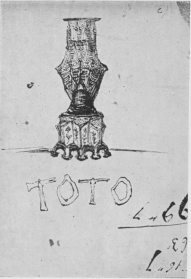
DRAWING BY VICTOR HUGO, SIGNED “TOTO.”
Unpublished, belonging to the Author. |
THE FLOWER AND THE BUTTERFLY.
Drawing by Victor Hugo for Juliette (Victor Hugo Museum). |
Jersey,
Friday, 9 a.m., December 3rd, 1852.
Good morning, my life, my soul, my joy, my happiness.
Dear adored one, from yesterday until the 14th of this month, there is
not a moment that does not recall to me the dangers you were exposed to
a year ago,[104] and the terrors and inexpressible anguish I endured all
through those awful ten days. A year ago, at this very hour of the
morning, you stood in the Faubourg St. Antoine, alone, holding and
challenging a frantic mob lost to all sense of reason and restraint. I
can see you now, my poor beloved, calling upon the soldiers to remember
their duty and their honour, threatening the generals, withering them
with your contempt. You were terrible and sublime. You might have been
the Genius of France witnessing in an agony of bitter despair, the
accomplishment of the most cowardly and despicable of crimes. It is an
absolute miracle that you escaped alive from that spot which echoed with
the solitary force of your heroic fury. When I think of it I still feel
terrified and dazzled.
Juliette.
Jersey,
Saturday, 8 a.m., November 27th, 1852.
Good morning, my poor flayed, mutilated darling. How I pitied you
yesterday during the long-drawn-out massacre of your masterpiece,[105]
which however, like an Immortal, emerged from the ordeal finer and in
better fettle than ever. As for me, my treasure, I could only admire and
envy your heroic impassivity in the face of that frightful profanation.
I could hardly sit still, so vexed and irritated did I feel at the
audacity of those wretched strolling mountebanks. Yet Heaven knows how
hard they must have worked to be even as ridiculous as they were. One
cannot be really angry with them, but it is impossible to recall them
individually without laughing till the tears run down one’s cheeks. That
is what I have been doing ever since I came out of that horrible little
theatre, for I did not sleep very much. My thoughts were busy with you,
my adored one; I was seeing you again in imagination, handsome, young,
triumphant, as you were at the original performance of your Angélo. I
felt all the tenderness and adoration of those old days surging up again
in my heart.
Juliette.
Jersey,
Monday, 8 a.m., December 29th, 1852.
Good morning, my too-dearly loved little man. I am cleverer than you,
for I do not need lenses, paper, chemicals, and sunshine, to reproduce
you in every form within my heart. Love is a splendid stereoscope; it
throws all the photographs and daguerreotypes in the world, into the
shade. It can even, if the need exist, convert black jealousy into white
confidence, and force into relief the smallest modicum of happiness,
the slightest mark of love. That being so, I hardly know why I desire so
ardently to multiply your dear little pictures around me, unless it is
that I wish to compare them with those of my inner shrine. Whatever be
the reason, I do implore you, my dear little man, to give me one as soon
as possible; it will be such a pleasure to me. Meanwhile my poor
persecuted hero, I cannot tell what trials the future may have in store
for you, but as long as a breath of life remains within me, I mean to
expend it in defending, guarding, and serving you. My faith in the power
of my love amounts to superstition; I feel that so long as I care for
you, nothing irretrievably bad can happen to you. This is neither pride
nor fatuousness on my part; it is a sort of intuition that comes to me,
I think, from Heaven above.
Juliette.
Jersey,
9 p.m., Thursday, January 6th, 1853.
If the soul could take visible shape, you would perceive mine at this
moment, my sweet adored one, bending over you and smiling. If kisses had
wings, you would feel them swooping about your dear little person in
clouds, like joyous birds upon a beautiful flowering bush.
Unfortunately, my soul and kisses have to pass and repass before you
invisible, and perhaps even unsuspected by you. But that does not deter
me, and I am drawn irresistibly to you by the need of living in your
atmosphere. My thoughts sit boldly at your side wherever you are.
However my chastened personality may bend under the contempt and
disdain of the world, my love rears itself proudly in the consciousness
of its superiority. While you leave my body standing outside, it enters
hardily with you and leaves you not. This may not be very tactful of me,
but it is the mark of an ardent and loyal heart. And after all we are
living “on an Island.” I can see you, making eyes at your neighbour on
the left, and signalling to the one opposite. I want you to be mine
absolutely, body and soul, and I do not mean to share one little bit of
you with anybody. You must make up your mind to that, and content
yourself with enjoying the cosmopolitan cookery of that Hungarian
Lucullus.[106] I will allow you to gorge like four Englishmen and drink
like one Pole, but I shall not take my eyes off you and shall watch your
every movement. I think you laugh a great deal for a grave man with a
handsome mouth, and your hands are enough to bring a blush of envy to
the paws of all those exiled females! They suffer by comparison—so much
the better! Hold your tongue, drink, turn your head my way at once, and
keep it there.
Juliette.
Jersey,
Tuesday, 12.30 p.m., February 1st, 1853.
I really mean what I said just now, my dear little boy. Instead of
posing interminably in front of the daguerreotype,[107] you could quite
well have taken me for a walk if you had wanted to. Anyhow, pretexts for
keeping away from me will never fail you, and the fine weather will now
add many to those already on your list. Therefore I ask you in all good
faith, what use am I to you in this island, apart from my functions of
copyist? I do not wish to reopen this eternal discussion in which you
never tell me the truth, yet I shall never cease to protest against a
state of things so foreign to true love, and so little conducive to my
happiness. And now, my dear little man, you may amuse yourself, and make
daguerreotypes, and enjoy the glorious sunshine in your own way. I, for
my part, shall make use of solitude, desertion, and shadow, to bring to
a head an attack of depression which will easily develop into a great
big sorrow. I shall study how to make the most of it. Meanwhile I smile
prettily at you, after the fashion of a stage dancer executing the final
pirouette which has exhausted her strength and left her breathless.
Brrrr.... Long live Toto! Long live worries and all their kith and kin!
Long live love!
Juliette.
Jersey,
Thursday, 9 p.m., April 28th, 1853.
I come to you, my beloved, as you are unable to return to me this
evening. I come to tell you I love you without regret for the past or
fear for the future. I come to you with a smile on my lips and a
blessing in my bosom, with my hand upon my mutilated heart and my eyes
full of pardon, with my purity restored and my soul redeemed by twenty
years of fidelity and love, with my delusions swept away and my faith
shining. I come to you without rancour, sustained by divine hope. I
come with the maternal devotion and the passionate tenderness of a
lover, with a mind instinct with reverence and admiration, a resignation
and piety like to those of God’s martyrs, and I constitute you the
supreme arbiter of my fate. Do with me what you will in this life, so
long as you take me with you in the next. I sacrifice my feelings to the
virtue of your wife and the innocence of your daughter, as a homage and
a safeguard, and I reserve my prayers and tears for poor fallen women
like myself. Lastly, my adored one, I give you my share of Paradise in
exchange for your chances of hell, considering myself fortunate to have
purchased your eternal bliss with my eternal love.
Juliette.
Jersey,
Thursday, 5 p.m., July 7th, 1853.
Whatever you may say, my sweet one, to retard the gradual cessation of
my daily yarns, you cannot stay the progress of the natural law, even
when assisted by my passive submission to your will. Why continue this
custom of writing to you twice a day, when the pretext for doing so has
faded from our joint lives? If I were a woman of parts, I could
substitute imagination and shrewd observation for love-making; but as
these are entirely lacking in me, I have nothing to record in those
bulletins where kisses and caresses once occupied the chief place. Now,
when I have said good morning and alluded to the state of the weather, I
have nothing more to say, because I am stupid. Your influence alone can
extract what is in my heart. For this reason, my dear one, these
scribbles became blank and aimless, from the moment the happiness that
once dictated them began to die away and degenerate into a friendship
despoiled of all pleasure and voluptuousness. I do not reproach you, my
adored one, any more than I reproach myself for not being still the
woman you loved beyond everything—still it might be better to
discontinue this daily record of the change, and to give up the piteous
babblings which no longer have even the excuse of wit.
Juliette.
Jersey,
Saturday, 2.30 p.m., September 24th.
How one’s brain scintillates from living for ever within four walls!
What sparkling and varied incidents one experiences in this existence of
a squirrel in a cage! For my part I am so inspired by it that I hardly
know where to commence. Let us, therefore, proceed in due sequence; my
cat, which has been slumbering for the last two hours on its right ear,
has just turned over on to its left.
Père Nicotte, abandoning the ploughshare, announces for Thursday,
September 29th, the sale by auction of three fat hogs, a sow with her
eight sucking pigs, three yearling bulls, another rising two, and other
items too numerous and too peculiar to enumerate.
Births: August 5th. Blanche Laura, daughter of Mr. Harper Richard Hugo.
The annual dinner of the Society will take place on the above-mentioned
day. Those intending to be present, and those proposing to furnish fruit
for the same, are urgently requested to send in their names on or
before the preceding Saturday.
What more do you want? Eleven pigs, not including the sow, three
yearling bulls, not including the one rising two, a daughter of your
own, and permission to invite yourself to a dinner of the Society, and
even to furnish the fruit for it. If all this does not attract you and
stir the very marrow of your bones, and tempt your appetite, you must be
dead to the promptings of sensibility, paternity, and sensuality. In
that case, go to bed and to sleep, and leave me to myself—the more so,
as I do not happen to possess an accommodating table,[108] to furnish me
with ready-made apparitions. Remember, I have to be my own Dante, Æsop,
and Shakspere, whereas you catch the dead fish that the spirits of the
other world attach to your lines—a proceeding practised in the
Mediterranean long before those tittle-tattling tables were thought of.
Pray accept my most tender sentiments.
Juliette.
Jersey,
Sunday, 10 a.m., January 1st, 1854.
I love you so much, my darling, that I cannot find anything else to say
to you. My poor spirit is ready to give way under the weight of too much
love, like a bough bending under an abnormal show of fruit; but my heart
has strength enough to bear without flinching the infinite tenderness,
admiration, and adoration I feel for you.
What a letter, my adored one! I read it with my heart in my eyes. It
seemed to penetrate word by word like sun-rays into the very marrow of
my bones. My Victor, your hopes are mine, your will, mine, your faith,
mine; I am what you deserve that I should be; I live only for you and in
you. To love you, serve you, reverence you, adore you, are my only
aspirations in this world. Where you are, I shall be; where you
struggle, I shall watch; when you suffer I shall pray, when you are
threatened I will defend you, save you, or die. I tell you all this
pell-mell and anyhow, my adored Victor, for it is impossible for me to
discipline my thoughts when they fly in your direction—they are less
amenable to common sense than to my heart and soul, which are in ecstasy
since this morning. I know not what trials may still be in store for
you, my sublime, persecuted love, but I can answer for my own courage
and devotion to you. Like you I associate our two angels with all my
prayers and hopes and joys and love. I constitute them your guardian
angels and to them I confide your life, that is, mine, your heart, that
is, my happiness. I send you enough kisses to make a connecting-rod from
my mouth to yours.
Juliette.
Guernsey,
Monday, 7.30 p.m., July 21st, 1856.
It shall not be said that your adored name ever appeared before me in
its dazzling nimbus without being saluted by my heart with a triple
salvo of love, oh, my dearly beloved, and without the outpouring of all
the perfume of my soul at your divine feet. Although I am very tired,
almost ill, I cannot let this day pass without giving you my tenderest,
sweetest, most love-laden greetings. Others may bring you flowers and
pay you handsome compliments, but I offer you twenty-three years of
tried fidelity free of human stain. It is all I have to bestow—it may
be insignificant, but it is my all. Such a thing cannot be bought; it is
accounted among the treasures of God. In His keeping you will find it,
when the gifts of Heaven shall replace those of Earth. Meanwhile, to
show you that I still belong to this sphere, I send you my beautiful
violet robe brocaded with gold; but I specially stipulate that it should
form part of the decoration of your own room, rather than that you
should hang it in the gallery. Still, if you prefer to use it elsewhere
I leave you free to do as you like, for your pleasure is my sole desire.
You must not imagine that my generosity is entirely disinterested,
because that would be a great mistake. I am sure you would not wish to
remain in my debt, and that you will therefore give me a little drawing
for your birthday. This is my request—now bring me your cheeks that I
may kiss them without stint, and do be discreet to-night with the women
who will come to offer you birthday greetings! Keep your heart entire
and intact for me.
Juliette.
Guernsey,
Friday, 1.45 p.m., December 12th, 1856.
Adored one, I am sending Suzanne to get news of your dear little sick
child.[109] Although night is coming on, I hope I may get a good report;
this weather is enough to give an attack of nerves to anybody at all
disposed that way. You saw Suzanne yourself, my darling, yet someone is
knocking—fancy if it should be you! It is! What happiness!
How good, how ineffably good you are, dear kind father, to have come
yourself to reassure me about the little feverish symptoms that are
beginning to show themselves to-night in your little girl’s condition.
Let us hope they will yield to remedies this time, and that the night
may prove more calm and satisfactory than the day just passed. Meanwhile
thank you with all my heart, thank you with all my soul, for allowing me
to share your family hopes and fears and joys and troubles. Thank you.
If God hears and grants my prayers, as I trust with sacred confidence He
will, your adored child will soon be restored to health and happiness.
Juliette.
Guernsey,
Monday, 7.30 p.m., April 13th, 1857.
If you say another word I shall seize them all,[110] so there! I shall
certainly not place my house, my rooms, my old age, my tables, chairs,
carpets, water, ink, my virtue, great and small, at your disposal, to be
rewarded by seeing masterpieces pass under my very nose on their way to
Teleki, Mademoiselle Alix, and other trollops of her calibre. I must
have some too; castles, moonlight scenes, sunrises, and fog effects. If
you are not prepared for a quarrel, you must give me at least my share.
Ah, here you come! I am not sorry to see you....
Juliette.
Jersey,
Saturday, 4 p.m., July 1st, 1857.
Darling beloved, I begin my letter in the hope of its being interrupted
shortly, and completed this evening with a lighter heart; but I so need
to love you that I must take the initiative, my adored one. I have just
read the sad, tender poems you gave me to copy. I see you coming....
8.45 p.m.
I have just finished copying those adorable verses, so poignant through
their very restraint,[111] and I weep for my own grief as well as yours,
my poor afflicted friends. The shadow which has fallen across your lives
is black night in my case, for all the radiant joys of family life were
wiped out with the death of my only child. When I think of my forlorn
infancy bereft of father and mother, and of what my deathbed will be,
without the loving tears of a child of my own, I feel as if a curse were
laid upon me for the expiation of some hideous crime. Yet, oh God, I am
not ungrateful to Thee, far from it; I feel indeed with the deepest
gratitude of heart and soul how good Thou art! May you be as greatly
blest as you are loved by me, my Victor. You are divinely grand and
sublime. I kiss your dear little feet and your angel’s wings. I worship
you on my knees.
Juliette.
Jersey,
Tuesday, 2.30 p.m., July 2nd, 1857.
Yes, since you wish to hear it, I love you, my little man; but I could
demonstrate it much more intelligently by working something for you on
canvas, than by daubing this poor little sheet of paper with
hieroglyphics. If perchance death should surprise us before you have
destroyed these crude ebullitions of my heart, inquisitive folk will
experience keen disappointment; they will find it difficult to
distinguish the traces of an overmastering passion in such a petty mind
as mine. I hope you will be provident enough and generous enough to
spare me this humiliation beyond the grave, by burning gradually all
those poor letters that are so ineffective the moment they have crossed
the threshold of my soul. Meanwhile I continue to obey you with entire
submission, and my love for you is greater than your genius—that is to
say, I love you, love you, love you, without being able to find anything
to compare with the magnitude of my infatuation.
Juliette.
Guernsey,
Saturday, 8 p.m., December 19th, 1857.
Although unwell and fatigued, my beloved Victor, I cannot leave this
little home where we have loved each other, without penning a grateful
farewell for all the felicity it has sheltered during the year I have
lived in it. I trust I may be as happy in my beautiful new house as I
have been here in my hovel. The sadness I feel to-day is nearer akin to
nerves than to real sorrow. Please forgive it, my adored Victor, if you
have misunderstood and thought for a single instant that you were to
blame for it. Far from reproaching you for the difficulties of my
situation, I admire your ineffable kindness and bless you from the
bottom of my heart for all the trouble you are taking to house me
handsomely. It was difficult, but of what are you not capable when you
set your mind to a thing? I think without affecting the false modesty of
a collector, that you have succeeded, and I thank you with all the
strength of my loving soul, which asks no better than to be happy in the
new paradise you have just prepared for me.
Juliette.
Guernsey,
Friday, 11 a.m., July 16th, 1858.
My beloved, my beloved, my beloved, what sin have we committed that God
should strike us so cruelly in your health and my love! Unless it be a
crime to love you too much, I do not feel guilty of aught. What shall I
do, my God, what will become of me! Victor ill and away from me! I dread
lest, as I write, you should almost hear my sobs and guess at my
despair, from these reckless words.
I had anticipated this trouble and thought myself able to face it. I
know it is imperatively necessary that you should remain at home, yet my
whole being rebels at this separation as at a cruel injustice, and the
greatest misfortune of my life. Why, why, why am I like this, oh, my
God? Yet I possess courage, Thou knowest! Thou knowest also that I
desire his speedy recovery and love him with a devoted, illimitable
love. My adored Victor! Why then, is the reason of this gloomy and
profound despair which robs me of strength and reason? Oh, God, dost
Thou hate me? Have my offences been graver than those of other women
like me, that Thou shouldst chastise me so mercilessly! Oh, I suffer,
Victor, I love you, I am wretched!
Juliette.
Guernsey,
Saturday, Noon, July 24th, 1858.
Another short spell of courage and patience, my poor gentle martyr, and
your deliverance will be complete. The doctor has just assured me so. I
shall soon be able to rejoice at your convalescence without the poignant
dread of a frightful disaster mingling itself with my joy. In the
delirious delight this good news gave me, I kissed the doctor’s kindly
hands, which have become sacred to me since they have ministered to you.
The poor man was surprised and moved by my emotion, and looked quite
embarrassed—almost shy of my gratitude—but I was proud of it. Why
should not a woman kiss the hands that have saved the life of the man
she adores, when so many men kiss the idle fingers of the women who
betray them.
Rosalie arrived a few minutes after the doctor, to fetch your egg, and
found me weeping and smiling. I explained the reason to her. The girl
has surprised me in tears so often that I fear she will take me for a
cry-baby by temperament, though God knows, I do not lay claim to
hyper-sensitiveness. But how could I have remained calm during your
long, painful illness. For, my beloved, one can afford to admit now,
that you have been in grave danger the last twelve days. Happily all is
over, you are saved and I thank God on my knees and adore you.
Juliette.
Guernsey,
Wednesday morning, August 4th, 1858.
At last, at last, at last, beloved, I have reached the blessed moment
when I shall see you again! I am so happy that words and breath fail me.
Oh, my adored one, how have I managed to live so far away and separated
from you for so long! Three weeks ago I should have thought such a
sacrifice beyond my strength, yet to-day I am almost afraid I am seeing
you too soon; for my solicitude takes fright at the idea of any
imprudence that might augment or prolong the sufferings you have only
just overcome. The worthy doctor assures me there is no risk for you in
the short walk from your house to mine, but I have been so wretched
during your illness, and I love you so much, that my heart knows not to
whom to hearken. My beloved, my joy, my life, my happiness, be prudent!
I adore you, I await you, my love.
Juliette.
Guernsey,
Monday, 8 a.m., June 13th, 1859.
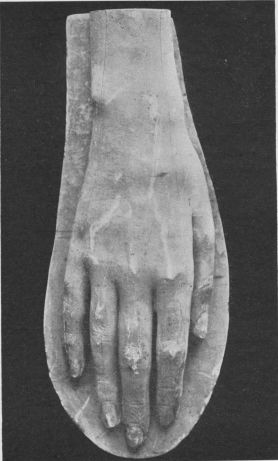
JULIETTE DROUET’S HAND.
Good morning, my adored one. I say it with all the tenderness which had
to be disguised owing to the presence of your kind and charming son,
during the lovely fortnight we have spent at Sark. Everything there was
a feast for mind and heart. One thing only was lacking for my complete
happiness; freedom to love you aloud and in all frankness. Now there
need be no obstacle to the passionate expansion of my soul, but it is in
the silence and solitude of my house, without the joys, smiles,
sparkling wit, and poetical atmosphere you and your son spread before
my dazzled eyes, during the splendid fortnight I spent with you both; so
true is it that one cannot have everything at the same time here below,
and that perfect happiness is attained only in Heaven. But while our two
souls are travelling thither, the one assisting the other, I am grateful
to God for the radiant fortnight He has just given me. I thank Him with
a full heart, and beseech Him to repay you and your dear Charles with as
many fruitful and glorious years as you have given me days of happiness
in the tender intimacy of Sark. As usual, my words are inadequate to
express my feelings, but you will understand, my beloved, and restore
the balance between the two.
I hope you spent a good night, my sweet love. I am waiting for you to
give you as many kisses as you are able to carry. Until then I adore you
with all my soul.
Tuesday, June 14th.
May God preserve you from all evil, my beloved, and permit my love and
blessing to constitute the whole happiness of your life.
Juliette.
Guernsey,
Thursday, 4.30 p.m., February 16th, 1860.
You sat at this very spot just now, my sweet love, writing in my little
red book, (record of our love), the very things my own heart feels and
would have dictated to you, could it have spoken aloud—so certain is it
that my life belongs absolutely to you, and that my thoughts take birth
from your glances. Like you, I have faith in our radiant future in the
life beyond; like you, I pray to die as near you as possible, cradled in
your arms, whenever it please Heaven. If I hearkened only to the voice
of my selfishness, I should plead that it might be now, but I am too
conscious of the sublime mission you are called upon to accomplish
towards humanity in this world, to dare put up such an impious petition.
I will wait bravely, patiently, reverently, in prayer and adoration,
until it please God to call us unto Himself.
Thursday evening, 7.30.
I resume my scribble where I left it when you came back this afternoon,
my darling beloved—not to add anything of value, but to continue for my
own pleasure the sweet dialogue between my heart and my love. I thank
you for our dear twenty-seventh anniversary, which you made memorable by
words so luminous and a tenderness so penetrating and sacred. I thank
you for myself, whose pride and joy and veneration you are; I thank you
on behalf of my nephew and his family, for the immense honour you have
conferred upon them by writing to their son. Lastly, my beloved, I kiss
your feet, your hands, your lips, your eyes, your brow, and I only cease
through fear of wearying you by this over-flow of caresses.
I love you.
Juliette.
Mont St. Jean,
Monday, 8 p.m., June 17th, 1861.
Dearly beloved. Whilst you are expanding among the tender delights of
family life, I am invoking all my physical and moral strength to
prevent myself giving way under the sadness of your absence. As long as
my eyes could distinguish the omnibus, that is to say, as far as the
Betterave Renaissante, I watched your progress along the Gronendael
road. Beyond that point, I was forced to relinquish the sweet illusion
that I could still see the dear little black speck on the horizon, and
to acknowledge that nothing lay before me but the endless void of your
twenty-four hours’ absence. So, as I did not know what to do with myself
or how to kill time, I walked by a fairly easy field-path as far as the
church at Waterloo, and came back by way of the village, without however
visiting the church, notwithstanding the pressing invitation of an old
woman who called me her dear friend. I got back to the hotel at six
o’clock precisely, and spent the half hour before dinner freshening
myself up by washing from head to foot; then I put on a dressing-gown
and went down to our little dining-room, where I ate without hunger and
drank without thirst, so dismal and forlorn am I when you are no longer
present. I must have been pretty fully convinced of the impossibility of
accompanying you to Brussels without exposing your movements to
undesirable criticism, to accept the sad alternative of remaining here
alone. But that certainty is no comfort whatever, and I am just as
miserable as if it had been in my power to make the expedition with you.
Certainly, human respect is a horrid beast, more malevolent and worrying
than even midges and their poisonous sting, and all the ammonia in the
world is powerless against it.
I am well fitted to make the comparison seeing that my arm is already
healed, while my heart suffers more and more. Dear adored one, do try,
on your part, to spend profitably this interval which is costing me so
dear. Be happy; I love you, bless you, and adore you.
Juliette.
Guernsey,
Tuesday, 8 a.m., February 17th, 1863.
Good morning, my beloved. In full daylight and glorious sunshine, in
love and happiness, good morning. Again I greet you, like that first day
thirty years ago, when my eyes followed you along the Boulevard after
you left me. My soul winged flights of kisses to you when you looked
round for one more glance at my window before turning into the Rue du
Temple. That picture remains for ever graven upon my mind; I can assert
with truth that everything remains the same in my heart as the night I
first became yours. These thirty years of love have passed like one day
of uninterrupted adoration, and I feel now younger, more virile, and
more capable of loving you, than ever before—heart, body, soul, all are
yours, and live only by you and through you. I smile upon you, bless
you, adore you.
Juliette.
Guernsey,
Sunday, 10.30 a.m., April 26th, 1863.
Good morning, unutterably dear one. May all the blessings of heaven and
earth rest upon you and those you love. I slept very well and hope you
did the same. My headache has gone and I feel as sturdy as an oak-tree.
I do not in the least desire a great house whence I shall not be able to
see you in the mornings, and I should much prefer to keep my own little
perch upon which my heart poises so happily while I watch you moving
about your home. Having made my protest, beloved, you shall dictate to
me the letter I must write to notify the landlord that he need not move
out to-morrow. We can settle when you come, what time I must be ready,
so as not to lose one second of our little walk up the hill. I am so
happy at the thought of remaining near you, that I feel as if I had
already substituted youthful wings for my old legs. Even my garden is
gay, and cries out to me by the mouths of its lovely flowers: don’t go
away! Health is where happiness is, and happiness means loving each
other, side by side, eyes upon eyes, soul with soul. Therefore, I shall
stay here. That is quite settled.
Guernsey,
Friday, 7.30 a.m., October 30th, 1863.
Good morning, good morning, and again, good morning, my dear, wide-awake
person. You must be very well to-day, judging by the energy with which
you are shaking your rugs to the four winds. I hope that signifies a
good night, good health, lively love, and all the rest of it. As for
myself, I slept little, but soundly. I got up before gun-fire this
morning, and had already finished my dressing when I saw you on your
balcony. What a privation it will be for me, my adored man, when I can
no longer watch you in the mornings, moving about your house. I do not
feel as if I should ever get accustomed to it, and I think of it with
apprehension, for there is a proverb that says, “Out of sight, out of
mind.” If you gave up loving me, or worse, loved me less, what should I
make of life in that great empty drawing-room?
At this moment, I am trying to numb these reflections by the
contemplation of the marvels you are creating in that future house of
mine; but at the bottom of my heart, I know I shall always mourn this
poor little lodging, where my eyes could watch over you, caress you,
guard you, preserve you, and adore you. The more I think of it, the more
oppressed I feel, and the more I blame myself for having exchanged the
happiness of every moment, for a comfort I shall hardly have leisure to
appreciate, and for health which did not require amelioration. My poor
beloved, forgive these regrets which are only dictated by love, and this
anxiety which also means love. Try not to let the separation of our
houses entail that of our hearts; try to love me as heartily there as
here, and do not let yourself be enticed away from me by anybody. On
those conditions I promise to live happily in the splendid rooms you
have prepared for me.
J.
Guernsey,
Wednesday, 1.30 p.m., June 15th, 1864.
Dearly beloved, I cannot forsake this little home where we have loved
each other for eight years, without imprinting a kiss of gratitude upon
its threshold. I have just gazed my supreme farewell at your beautiful
house, which has so long been to me the polar star of my heart’s
wanderings. Alas, I am lengthening out the moments as much as possible;
I cannot bring myself to leave this dear little house, which I had made
the shrine of my cult for you. I should like to carry away the walls
against which you have leaned, the floors you have trodden, and even the
dust your feet have spurned. I fear lest my sadness be observed by those
who cannot understand it, and the efforts I make to seem unconcerned
increase the constriction of my heart, and drench my eyes with tears.
Oh, my adored beloved, how you will have to love me and give me all the
time at your disposal, to console me for the immense grief I am
experiencing to-day in quitting your neighbourhood, that is to say, in
losing sight of it! How you will have to double and treble and quadruple
your love, to replace the dear memories I leave behind me! May God
protect me and may the dear souls of our angels follow us to the new
home, and bless us till our last hour!
I adore you.
J.
Guernsey,
Thursday, 5.30 a.m., June 16th, 1864.
Where are you, my beloved? My eyes seek you vainly, you are no longer
there to smile upon me; it is all over—I shall never again see the
little roost whence you used to blow kisses and wave your hand so
tenderly. I am alone now in my fine house, alone for ever; for there is
no further chance in this life of having you near me. I shall never
again live in your immediate intimacy, as I have done for the past eight
years.
Loyally as you may endeavour to bridge over the distance between our
abodes by coming to me oftener in the day-time, the separation of our
two existences must ever endure. I know it by the blank depression I am
feeling this morning. I would give a hundred thousand houses and
palaces, and the universe itself, for that little slice of horizon where
my heart projected itself night and day. I am ashamed of having been so
mean-spirited as to barter my daily happiness against a chimerical
amelioration of health. I am punished for my transgression, my dearest.
I carry death in my heart. Forgive me! I would gladly smile at you, but
at this moment I feel incapable of doing so. Forgive me for loving you
too much. I hope you had a good night. I hope you gazed upon my dark,
empty house and gave it one sigh of regret. I hope you love me and are
conscious of my absence. May God preserve you from all evil, dearly
beloved, and may your love remain whole and intact in severance as in
propinquity. I bless you, and adore you. A kiss to all our dear
memories.
J.
Guernsey,
Sunday, 8.30 a.m., June 11th, 1865.
It would take very little to make me stay in bed till noon. I am ashamed
of myself and well punished, for I have not seen you this morning, and
have not yet heard whether you had a good or a bad night. I hope you
were clever enough to sleep uninterruptedly from the moment you laid
your head on the pillow, till that of your uprising. I shall be very
glad if I have guessed right. Meanwhile, my sweet treasure, I send you
a smile and a blessing. I am listening at this moment to the joyous
cheeping of my tiny chicks over a saucer of milk that has just been put
before them. I am also watching two white butterflies darting after each
other among my roses, like twin souls in Eden. The flowers are blooming,
love-making is going on all around, and my heart is overflowing with
tenderness and adoration for you. The further I progress in life, the
more I love you; you are the beginning and end of my being. I hope
everything of you, and my soul trusts you, all in all. You are my
radiant and divine beloved.
J.
Guernsey,
Sunday, 7.30 a.m., December 2nd, 1866.
Good-morning, my adored one, bless you. I can afford to smile on this
date, abhorred of all worthy folk: December 2nd.—because it is, for me
alone, a joyful anniversary. If my gratitude is an offence towards
humanity, I humbly ask pardon of God and man. I am tormented at the
thought that you may have slept badly. If I could be reassured on that
point, I should be quite happy this morning. Unfortunately, I can only
find out much later when you come here to bathe your dear eyes. The
mention of your eyes reminds me of your poor wife’s sight. Surely, if
the doctors were not certain of curing her, they would not keep her so
long in Paris, away from all her belongings, in winter weather? My
desire for her complete recovery of a sense of which she has made such
noble use in her beautiful book Victor Hugo, raconté, makes me look
upon her delay in returning, as a happy presage of future recovery. I
ask it of Heaven, with love.
J.
Guernsey,
Wednesday, 8 a.m., January 1st, 1868.
I thank you, dearest, for letting me have a share in your prayers, when
you plead to God not to separate us in life or in death. It is what I
pray all day long; it is the aspiration of my heart and the faith of my
soul. I am not a devout woman, my sublime beloved, I am only the woman
who loves and admires and reverences you. To live near you is paradise;
to die with you is the consecration of our love for all eternity. I want
to live and die with you. I, like you, crave it of God. May He grant our
joint prayers!
I feel as you do, my beloved, that those two dear souls hover above us
and watch over us and bless us. I associate them with all my thoughts
and sorrows and joys, and I place my prayers under their protection,
that they may convey them direct to the foot of the Great White Throne.
I bless them as they bless me, with all that is loftiest and holiest and
most sacred in my soul. I am stopping at almost every line of this
letter to read your adorable one over again, although I already know it
by heart. I kiss it, talk to it, listen to it, and then begin all over
again. I love you.
J.
Guernsey,
Thursday, 7 a.m., May 7th, 1868.
Dearly beloved, I am rather less worried since I have seen you and
exchanged a kiss with you; yet I know you slept badly. I can feel that
you are ailing and sad. I pray God to give you happiness again as soon
as possible, in the form of a second little Georges all smiling and
beautiful; meanwhile, I beg Him to let my love be the balm that will
heal your wounds, until the day of resurrection of the sweet child for
whom you weep.[112]
I hope He will hear and grant my petitions on your behalf, and that you
will be restored to some degree of calmness and consolation. When you
write to your two dear sons, Charles and Victor, do not forget, I beg,
to thank them from me for the little portrait. Tell them I love them and
mingle my tears with theirs.
I adore you, my great one, my venerated one, my sublime mourner.
J.
Brussels,
Sunday, 7.30 a.m., August 2nd, 1868.
Again I have slept better than ever, beloved. I trust it has been the
same with you. I was very proud and pleased at my walk with you and your
family last night, but I felt somewhat shy and ill at ease. Please
permit me to decline any further invitations of the kind. Should the
occasion arise again, which is improbable, I think good taste and
discretion demand that I should hold myself aloof from your family
affections, and only associate myself with them at a distance, or in my
own home. As this feeling, or scruple, whichever you may like to call
it, could not be expressed in the presence of your dear children
yesterday, I consented to go with you, while intending to call your
attention privately to the embarrassment such an incident would cause
me, if it should happen again. I think you will probably agree with me,
and approve of my sacrificing my pleasure to your tender family
intercourse.
J.
Brussels,
Wednesday, 8.30 a.m., August 26th, 1868.
My poor beloved, I pray God to spare you and your dear children the
misfortune which threatens you at this moment in the loss of your
angelic and adorable wife. I hope, I hope, I hope. I pray, I love you, I
summon all our dear angels above to her assistance and yours. I pray God
to make two equal shares of the days remaining to me, and add one to the
life of your saintly and noble wife. My beloved, my heart is wrung, I
suffer all you suffer twice over, through my love for you. I do not know
what to do. I long to go to you, I should love to take my share of the
nursing of your poor invalid, but human respect holds me back, and my
heart is heavier than ever. Suzanne has only just come from your house,
and I already want to send her back again, in the hope that she may
bring me less disquieting news than that which I have just received. Oh,
God have mercy upon us and change our anguish into joy!
Brussels,
Thursday, August 27th, 1868.
My beloved, in the presence of that soul which now sees into my
own,[113] I renew the sacred vow I made the first time I gave myself to
you; to love you in this world and in the next, so long as my soul shall
exist, in the certainty of being sanctioned and blessed in my devotion
by the great heart and noble mind which has just preceded us, alas, into
eternity.
Brussels,
Friday, 8 a.m., August 28th, 1868.
I placed your sleep last night under the protection of your dear one, my
beloved, and implored her to remove from your dreams all painful
memories of the sad day just past. I hope she heard me and that you
slept well. Henceforth, it is to this gentle and glorious witness of
your life in this world, now your radiant protectress in Heaven, that I
will appeal for the peace and happiness you require, to finish the great
humanitarian task to which you have pledged yourself. May God bless her
and you, as I bless her and you.
The more I think over to-night’s mournful journey, the more convinced I
feel that I ought not to take part in it. The pious homage of my heart
to that great and generous woman must not be exposed to a wrong
interpretation by indifferent or ill-natured critics. We must make this
last sacrifice to human malignity, in order to have the right to love
each other openly afterwards; do you not agree, my beloved? Afterwards,
may nothing ever come between us here below, nor above—such is my
ardent desire!
J.
Brussels,
Friday, 5.30 p.m., August 28th.
My heart and thoughts are with you and your beloved dead. I am sad and
heart-broken, not for the angelic and sublime woman who now shines out
in the world of spirits while we here below regret her, but for you, my
poor sad man, to whom she was a holy and meek companion; for your dear
children whose joy and pride she was; for myself, to whom she was ever a
discreet and considerate protectress.
My heart is torn by your grief, my poor afflicted ones; my eyes rain all
the tears you are shedding. Dear treasure, I beg your wife to obtain for
you the courage you need. May her memory remain with you, sweet and
gentle and benign as was her exquisite person in life. I entrust you to
her as I confide myself to you, and I bless you both.
J.
Guernsey,
Tuesday, 2 p.m., February 1st, 1870.
Since I have seen you, my great beloved, I am feeling much better. Your
smile has completed my cure. It may be an illusion of my eyes and heart,
but at this moment I seem to feel the breath of spring. Perhaps it
proceeds from the nearness of the anniversary of the first performance
of Lucrèce Borgia, which is to be acclaimed and applauded by an
enthusiastic public to-morrow night, just as it was thirty-seven long
years ago. Bonaparte may do his best to-morrow against this magnificent
play, he will get no good out of his police-engineered cabal. I think he
will hardly dare risk such an infamous attempt, but I wish it was
already Saturday, that we might be quite easy. Meanwhile, I love you
after the fashion of Princesse Négroni.
Juliette.
Guernsey,
Monday, 8.30 a.m., February 14th, 1870.
Good morning, my dearest. Did you sleep better last night, my great,
little man? Were you warmer? How are you this morning? It is indeed
tedious to have to wait until this afternoon to hear all this. I am
trying to moderate my impatience by doing things for you. I have already
selected your two eggs, put fresh water into your finger-bowl, and a
snow-white napkin on your plate. Suzanne is making your coffee, which
perfumes the whole house, while I trace these gouty old
“pattes-de-mouche,” which are to lay all the tender nonsense of my heart
at your feet. I am beginning early, as you see, to be certain that they
arrive in time. The thaw has begun. I was quite hot in the night, though
I must admit I had taken measures to that end; so I slept excellently,
as you can judge by the state of my spirits. But what I really want you
to take note of is, that I adore you.
J.
Guernsey,
Saturday, 7.45 a.m., May 21st, 1870.
My heart, my eyes, my soul, are bewildered, my beloved, so overwhelmed
are they with tenderness, admiration, and happiness! What an adorable
letter, and what a marvellous surprise! How good you are to me! How
generous and charming! Words fail me, and the best I can say is: I love
you! I love you! I threw my arms around old Mariette’s neck, and almost
embraced Marquand himself in the delirium of my delight. What a splendid
frame for that lovely little mirror! It contains everything: flowers,
birds, a shelf, little Georges’ sweet face above, and your beautiful
verses for wings. How can I thank you adequately, or describe my
gratitude? Fortunate am I to have eternity before me in which to bless
you. I kissed my dear little letter before everybody, but I would not
read it until just now when I was able to bolt my door. I always read
you thus, my adored one. My soul demands privacy for the better
understanding of your sublime words, and I never finish the reading of
them without feeling transported with love and almost prepared for the
next world. I love you!!
Mariette told me you had spent a very good night. Is it really true? I
slept capitally, too, and am feeling more than well. I have been looking
about for a place for my new treasure, but have not yet decided on one.
I shall leave it to you to choose its proper place in my museum of
souvenirs. Meanwhile, I have covered it away from the dust and put it
in the shady drawing-room. As soon as I have read your adorable little
letter again, I shall go back and have another look at it.
J.
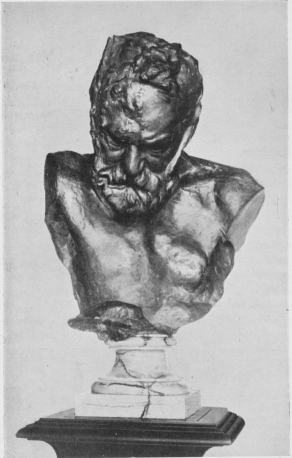
VICTOR HUGO, BY RODIN.
Guernsey,
Friday, 5 a.m., August 18th, 1870.
At all hazards I must send you my morning greeting, though I trust you
are sleeping too soundly to hear it. You have slept so little and so
badly for many nights, that it would be only fair that this night
should be long and good. As for me, I hardly slept at all, but I do not
mind and am hardly surprised, as it is a habit of mine. But the thing I
feel I cannot become inured to, is the apprehension of the perils you
are about to encounter on your journey to Paris, ranging from the loss
of your wealth to the death of your love for me—either would finish me.
I think with terror of the tortures of all kinds I shall undergo there;
my courage fails me and craves mercy in anticipation. I have fought all
night against the wicked temptation to desert my post in a cowardly
manner before even meeting the enemy—not an enemy that can be fought
with fire and blood, but one that stabs you smiling. But I have not even
the courage of cowardice; I am ready to suffer a thousand deaths if only
I can preserve you from a single danger. You must live at any cost, that
you may be enabled to complete your glorious task, and be happy, no
matter how or with whom. My duty is to devote myself to that end,
whatever betide. If I go under in the execution of it, so much the worse
for me, or possibly, so much the better. To serve you and love you is my
mission in this world—the rest does not concern me.
J.
Thursday morning, July 20th, 1871.
This is your patron-saint’s day, my great beloved. Others will
congratulate you with flowers and music and expressions of admiring
gratitude and emotion, but nobody will love you more than I do, or bless
and adore you as you deserve to be loved, blessed and adored!
I hope this anniversary may be the beginning of a new year less sinister
and sad than the last, and that your dear grandchildren will give you as
much joy and happiness as you have had sadness and misfortune in the
past. I say this hastily, as best I can, with emotion in my old heart
and thrills of joy in my soul. As I sit scribbling, I hear your voice
calling me and I rush towards you just as in the early days of our love.
I kiss your hair, your eyes, your lips, your hands, your feet. I adore
you.
Juliette.
Paris,
Thursday, 10.15, January 18th, 1872.
Good morning, my great and venerated one. I kiss one by one the wounds
of your heart, praying God to heal those that ache worst. I beg Him to
give me strength to help you carry your heavy cross to the end. I ask
Him, above all, to give me that which, alas, is lacking in my nature,
namely, that infinite gentleness without which the most perfect devotion
is unavailing. Since the day before yesterday, my poor, sublime martyr,
my heart has been wrung by the new blow that has fallen upon you,[114]
and I weep helplessly, without power to check my tears. God Who gave you
genius makes you pay heavy toll for that favour, by overwhelming your
life with the pangs of sorrow. My beloved, I beg you to tell me how I
may serve you. I will do anything you desire. I will use my whole heart
and strength in your service.
I love you.
J.
Paris,
8 a.m., Monday, February 26th, 1872.
This is your birthday, beloved—the anniversary of anniversaries,
acclaimed in Heaven by the great men of genius who preceded you upon
earth, and blessed by me ever since the day I first gave myself to you.
We used to celebrate it with all the sweetest instruments of love;
kisses, words of endearment, letters, all were pressed into service to
make this date, February 26th, a perfume, an ecstasy, a ray of sunshine.
To-day these winged caresses have flown to other realms, but there
remains to us the solemn devotion that better becomes the sacred
marriage of two souls for all eternity. In the name of that devotion I
send you my tenderest greetings and beg you to let me know how you spent
the night. I hope your little breach of regulations yesterday did not
prevent you from sleeping. As for me, I slept little, but I am quite
well this morning, thanks to the influence of this radiant date. I ask
little Georges and little Jeanne to kiss you for me as many times as you
have lived minutes in this world. My dearly beloved, I bless you.
J.
Paris,
Saturday, 2 p.m., April 13th, 1872.
This is a day of sunshine: God, in His Heaven above, and little Jeanne
under my roof. I hardly know—or rather, perhaps I do know which is the
brighter of the two, but I am not going to tell you, for fear of making
you too proud. What a beautiful day, and what an adorable little girl!
But what a pity we cannot all enjoy these spring-time delights together,
walking and driving, in town and country-meadows. I am really afraid the
good God will weary of us and pronounce the fatal dictum: “IT IS TOO
LATE” when at last we make up our minds to take our share of life,
sunshine, and happiness. The terrible part is that whether innocent or
guilty we shall all suffer alike for your transgression, for divine
justice is very like that of man. As for me, I enter my protest from my
little retreat, but it serves no purpose except that of an idle pastime;
it does not even keep me from adoring you.
J.
Paris,
Tuesday, 12 noon, November 18th, 1873.
My beloved, I do not desire to turn your successes into a scourge for
your back, but I cannot help feeling that my old-fashioned devotion cuts
a sorry figure amongst the overdressed cocottes who assail you
incessantly with their blandishments and invitations. This fantastic
chase has gone on for a long time without extorting from you any sign of
weariness or satiety. As for me, I long only for repose—if not in this
life (which seems difficult in my case to obtain), then in the
immobility of death, which cannot long be delayed at the pace I am
going. I ask your permission to begin preparing for it by giving up my
daily letters. That will be something gained; the rest will come
gradually, little by little, till one fine day we shall find ourselves
quite naturally on the platform of indifference, or of reason, as you
will prefer to call it. From to-day on, therefore, I place the key of my
heart on your doorstep, and will wander away alone in the direction of
God.
J.
Paris,
Friday, 11.15 a.m., December 26th, 1873.
Dear adored one. All your desires in life, as well as mine, are granted
to-day if your dear Victor has spent a good night, as I hope. I am
anxiously waiting for Mariette’s return to know how the dear invalid
is....
My poor beloved, I am in despair—I have just seen Mariette, who tells
me that your poor son is in high fever at this moment.[115] I do not
know how to tell you; I do not think I shall have the strength to do so.
Dr. Sée has been sent for and Mariette has just gone back to hear what
he thinks of this relapse. Oh, Heaven have mercy on us! I hardly dare
breathe or even weep, so greatly do I dread betraying to you the
misfortune which threatens you, my beloved. How can I ward off the fate
that is hanging over you? What can I say or do? My brain reels! Ought I
to tell you everything—would it be wrong to conceal from you the
imminent sorrow that is going to wring your heart once more? I know not,
but I lack the courage either to speak or to be silent; I am in despair,
yet I dare not make moan. I suffer, I adore you. Pity me, as I pity you.
Let us love each other under this cruel trial, as we should if Heaven
were opening its gates to us.
J.
Paris,
Monday, 5 o’clock p.m., December 29th, 1873.
Go, dearest, try to find in a solitary walk, which may prove fruitful to
the world, some solace for the painful agitation of your heart. My
thoughts follow you lovingly and bless every one of your steps. Do not
worry about me in the new arrangements of your life. Whatever you settle
shall be accepted by me. For forty-one years I have followed that
programme, and I will do so now, more than ever. Provided you love me as
I love you, I desire nothing more from God or you. The advice I give
you, apart from my own personal concerns, is always practical and in
your own interest and that of your dear grandchildren. I should feel I
had failed in my duty if I kept the least of my ideas from you, whether
good or bad, insignificant or stupid. I love you and adore you, body,
heart and soul.
J.
Paris,
Tuesday, 12.30 p.m., February 17th, 1874.
Dear one, there is rather more bustle about us than usual on this our
sweet and sacred anniversary. We have the little excitement of your two
adorable grandchildren, which we had not expected, but which is all the
more delightful for that. The perfection of happiness would have been to
take them ourselves to that famous circus which little Georges already
knows, and little Jeanne dreams of; but the bad weather and the remains
of my influenza counsel a pusillanimous prudence. It is not without
regret, beloved, that I impose this sacrifice of one of our most
precious joys upon you, but I feel I cannot do otherwise to-day. As for
the dear little things, their pleasure will, fortunately, not be marred
in any way. So long as they can revel in the antics of Mr. and Mrs.
Punch and their august family, they will not mind whom they go with.
That being the case, Mariette is a sufficient escort to the promised
land of Auriol and Punch.
As for ourselves, dearest, I trust that our two souls, communing
together, will not miss those fascinating little witnesses of our love
over much.
J.
Paris,
Wednesday, 7 p.m., March 11th, 1874.
He whose heart is younger than his years suffers all the sorrows of his
age. This aphorism contains in a few words the secret of the turmoil I
involuntarily bring into your life, while I myself suffer like a soul in
damnation. Still, I must not allow this ridiculous folly to be an
annoyance to you; I must and will get the better of it, and leave you
your liberty, every liberty, especially that of being happy whenever and
however you like. Otherwise, my poor beloved, you will very shortly come
to hate the sight of me. I know it, and it terrifies me in anticipation.
So I am determined to crush my heart at all costs, that I may restore
peace and happiness to yours.
J.
Paris,
Saturday, 1.45 p.m., April 4th, 1874.
I thank you dear one, for having been loyal enough to tell me this
morning that you had written another poem to Madame M. I thank you also
for having offered to read it to me, and not to send it to her till
afterwards. I accepted this respite in the first instance, but I
realised later that what is delayed is not lost, and that I should
gain nothing by struggling against being bracketed with this statue
inhabited by a star, and that I was simply putting myself in the absurd
position of the ostrich that tries to avert danger by hiding his head in
the sand. Therefore beloved, I beg you to act quite freely, and to send
the verses dedicated to your beautiful muse whenever you like. Once the
poetry has been written, it is quite natural that you should intoxicate
each other without consideration for me. Besides, in my opinion,
infidelity does not consist in action only; I consider it already
accomplished by the sole fact of desire. That being settled, my dear
friend, I beg you to behave exactly as you like, and as if I were no
longer in the way. I shall then have leisure to rest from the fatigues
of life before taking my departure for eternity. Try and be happy if you
can.
J.
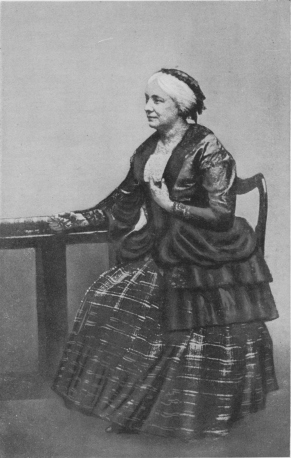
JULIETTE DROUET ABOUT 1877.
Paris,
Thursday, 7 a.m., April 11th, 1874.
Permit me, my great beloved, to offer you my three-score years and ten,
freshly completed this morning. Give the poor old things a friendly
reception, for they are as blazing with love for you now, as if they had
only been born yesterday. I commission little Jeanne to give you
seventy million kisses for me to-day, not one less, but a few more if
she likes. I hope little Georges’ nose has not bled since yesterday, and
that he slept well like the rest of you. I slept like a top, and am
splendid this morning. I feel a degree of youthfulness that must proceed
from the seventy springs I have absorbed so freely. The sky itself
contributes its birthday greeting by pouring its measure of sunshine
upon us. Therefore, long live love, for us in the first place, (for a
little selfishness will not harm happiness,) and in the second, long
live love for all whom we love. May you be blest, my beloved, in all
those you care for. I adore you.
J.
Paris,
Thursday, 10.45 p.m., May 7th, 1874.
Dear, dear one, the separation I dreaded as a veritable calamity is now
an accomplished fact. God grant it may not be the beginning of the end
of my happiness. My heart is full of sad presentiment. The distance that
separates us is like a broken bridge between our hearts, over which
neither joy nor hope may pass henceforth. I cherish no illusion; from
this evening forward, all intimacy between us is over, and my sweet
horizon of love is for ever clouded. I try to give myself courage by
reflecting that the happiness I lose is gained by you in the affection
of your two dear grandchildren. I tell myself that this compensation
should be sufficient for me; still I am in despair, and I can hardly
help shedding floods of tears, as if some irreparable misfortune had
befallen me when you walked away just now. I accustomed myself far too
speedily to a happiness that was only lent to me for a little while.
But however short-lived it proved, I bless you, and pray God to turn my
regrets and sorrow into a future of joy and kisses and ecstasy for you
and your two little angels.
J.
Paris,
9.30 a.m., Sunday, June 21st, 1874.
I had hoped that nothing would happen to disturb the sanctity of this
sad anniversary,[116] and had counted on the assistance of the angels of
death to defend me from the aggressions of the devils of life. Alas, I
was sadly at fault, for never was a more audacious or more cynical
attempt made against my peace of mind. One might think that the mangled
remains of my poor heart were a target for the arrows of those
emissaries of vice! I declare myself vanquished without a fight, and ere
my reason finally succumbs, I mean to place my bruised heart in shelter,
far from the flattering intrigues of which you are the fortunate hero.
3 p.m.
You wish me not to be anxious, not to relinquish a tussle in which I am
unarmed? It is more generous than wise on your part, for what happened
to-day, happened yesterday, and will again to-morrow, and I have no
strength left, either physical or moral. This martyrdom of Sisyphus, who
daily raises his love heavenward only to see it fall back with all its
weight upon his heart, inspires me with horror, and I prefer death a
thousand times over, to such torture. Have mercy upon me! Let me go! It
shall be wherever you will. Do not run the risk for yourself and me of
my committing some frightful act of folly. I ask you this in the name of
your daughter and mine—in the name of little Georges and your dear
little Jeanne. Give me a chance to recover from these reiterated
attacks. I assure you it is the only remedy possible, or capable of
effecting my cure. You will hardly notice my absence; the children of
your blood, and those of your genius, and the rest, will easily fill the
void of my absence, and meanwhile I shall regain calmness. I shall
become resigned and perhaps be cured, and in any case it will be a
respite for you as well as for me. I assure you my treasure, that it
will be a good thing for you. I beg you to let me try it. The abuse of
love, like the abuse of health, brings suffering and death in its train.
The soul may have a plethora, as well as the body. Mine suffocates under
its own weight. Let me try to lighten it in solitude and the
contemplation of our past happiness. I beg and implore it of you—I ask
it in the name of those you mourn and love.
J.
Paris,
Monday, 6 p.m., February 16th, 1875.
My dearest, your letter burns and dazzles me, and I feel humbled by it,
because physically I know myself to be so far beneath your ideal; but
morally, when I look inward and see my soul as your love has transformed
it, I am arrogant enough to think myself above it, and to have no fear
of the moment when I may reveal to you its resplendent purity in the
eyes of God. Pending this, sublime and divine treasure of mine, you
must shut your eyes to the sad reality of my old, sickly body, and await
with patience the rejuvenation promised in Heaven. I pray God to allow
me to live as long as you, because I do not know how I could exist a
single minute without you, even in Paradise with our holy angels. I hope
He will grant my ardent prayer, and that we shall die and rise again
together on the same day and at the same hour. To ensure this, I must
put my health on a level with yours, which will be difficult, for I am
very feeble. I try to, every day, without much success so far, but I am
counting on the spring to give me a push up the hill, so that I may
continue to pace the road at your side. This evening, if nobody comes,
and if Madame Charles leaves us early, I shall beg you to let me do Le
Passus with you. I should like to celebrate the day by something brave
and wholesome. I hope I shall manage it. I love you, bless you, and
adore you.
J.
Guernsey,
Tuesday, 7.45 a.m., April 21st, 1875.
Good morning my great, good, ineffable, adorable beloved. I pray Heaven
to bless you in Heaven as I bless you here below. I hope you slept as
well as I did, that you bear me no grudge for the irritability born of
excessive fatigue, and that you do not love me less on account of it. My
confidence in your inexhaustible indulgence lends me courage to proceed
with the sad business that brought me here.[117] The thought that we
shall never return to these houses of ours, where we loved and suffered
and were happy together, makes my heart as heavy as if we were already
attending our funerals. This fresh break between the sweet past of our
love and the short future that remains to us in this life, makes the
present very painful. But I am not unthankful for the compensations that
await us in Paris in the society of your dear grandchildren—far from
it! I shall smile upon them and bless them with my last breath, as the
tangible angels of your happiness and mine. I am doing my best to be
ready to start on Tuesday morning. I regret not being able to carry away
every relic of our love, from the soil of the garden, to the air you
breathe. By the way I have a petition to make to you, but am ready to
submit to a refusal if you do not approve of granting it. I want you to
allow me to give Louis the two splendid drawings of St. Paul and the
Cock, which are really mine to dispose of, since you gave them to me
long ago. Some mementoes are more prized by an heir than mere money, and
I should like to leave these from you to my kind and worthy nephew, if
you consent. Meanwhile, as I said before, I will bow to a refusal, even
if you give me no reason, for I adore you.
J.
Paris,
Tuesday, 7.45 a.m., October 5th, 1875.
Good news from your dear little travellers. The top of the morning to
you, and long live love! The telegram, which came after I was in bed,
that is to say after eleven o’clock, is dated from Genoa, and says they
arrive the day after to-morrow at Madame Ménard’s, and will write at
once from there. Meanwhile they send you thousands of kisses, of which
I make bold to reserve a share, before being quite certain that I am
meant to do so. This long delayed arrival in France heralds their speedy
return home, which is not at all displeasing to me—on the contrary!
My gaze, night and morning, at their dear little portraits in no degree
replaces their kisses, their sweet faces, and the joyous little shrieks
one hears all day long. At last we are touching the end of our long
abstinence and shall soon be able to devour them whole. Meanwhile I
continue to feed upon your heart, to whet my appetite.
J.
Paris,
Sunday, 5 p.m., November 21st, 1875.
Dear beloved, your promise to take me every day to Versailles, if you
are obliged to return to the Assemblée, fills my heart with such joy
that I have been humming all the merry songs I used to sing. It is long
since I have done such a thing. What would it be if some lucky event
sent us all back to Guernsey, never to leave it again ... or at least,
not for a very long time! What enchantment, what a starlit dream, if God
were to give us that bliss a second time! I think I should promptly
return to the age I was when I received your first kiss. Fortunately for
France, God will not grant this selfish wish, but He will forgive me for
entertaining it I hope, for I cannot help loving you beyond everything
in this world, and it does not hinder me from being satisfied with
whatever happiness He is pleased to vouchsafe, so long as you are
content, and love only me, who adore you.
J.
Paris,
Tuesday, 8 a.m., April 25th, 1876.
My treasure, I pray God not to separate us in this life or the next.
That is why I am anxious to be with you in the crowd that will rush to
see and hear you at the cemetery to-day.[118] I know by experience that
your enthusiasm borders on imprudence, so I want to press my body to
yours as closely as our souls are riveted, so that whatever befalls you
on this sad occasion, may include me. As the love animating our hearts
is identical, it is only fair that our fate should be the same. I wish
this evening were safely over, that I might be satisfied that everything
has gone off well; for I am afraid if poor Louis Blanc attends the
mournful ceremony in his present state of ill-health and weakness, he
may not be able to get through it. I shall not be easy until we are at
home again. Meanwhile I pray Heaven and our angels above to watch over
you and preserve you from all danger. I bless, love, and adore you, for
all eternity.
J.
Paris,
Wednesday, 7.30 a.m., April 26th, 1876.
I thank you with sacred emotion, my dear one, for your inclusion of me
in the sublime and magnificent exordium you pronounced yesterday on the
noble wife of Louis Blanc. I accept it without false modesty, because I
feel I deserve it, and I am proud and grateful for this ante-apotheosis
you made of me, a living woman, standing at the open grave of the
devoted deceased. I am sure her spirit will not have grudged it, and
that she blesses you from above, as I do from below, joining her prayers
to mine, that God may grant all grace and divine consolation to those we
love. I have already re-read your splendid oration many times to-day,
and although I know it by heart, each repetition discloses some fresh
beauty in it. My one cry is: I love you! I love you!! I love you!!! All
my heart and soul are contained in those words: I love you.
J.
Monday, 10 a.m., November 11th, 1878.
No, my beloved, you have no right to endanger your precious health and
risk your glorious life for nothing. “Art for art’s sake” is not
permissible in your case, and we shall oppose it strenuously, even at
the risk of curtailing your liberty. I am sorry, but there it is—you
must make up your mind to it. There are plenty of useless men in this
world who may waste their lives as they like, but you must guard and
preserve yours for as long as it pleases God to grant it to you for the
honour and happiness of humanity. So, my dear little man, I implore you
not to repeat yesterday’s imprudence, or any other, for all our sakes,
including your adorable grandchildren’s and mine whose health and life
and soul you are. When I see you so careless of yourself I cannot help
feeling you no longer love me, and that my continued presence is so
wearisome to you that you want to be rid of it at any price. Then I
am seized with a desperate longing to deliver you of me for ever, rather
than be the involuntary accomplice of your repeated suicidal acts, which
have been ineffectual so far, not through your fault, but because God
intends you to go on living, for His greater glory and your own. May His
will be done. Amen.
J.
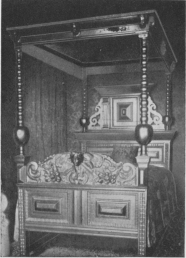
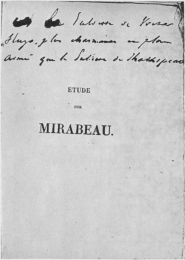
THE DEATHBED OF VICTOR HUGO.
Victor Hugo Museum.
|
A DEDICATION BY VICTOR HUGO TO JULIETTE DROUET.
The writing reads thus: “A la Juliette de Victor Hugo, plus charmante et
plus aimée que la Juliette de Shakespeare.”
The original belongs to M. Louis Barthou. |
Villequier,
Friday and Saturday mornings, September 12th and 13th, 1879.
A double letter, my beloved; to-day’s and yesterday’s, which, for want
of paper, pens and ink, I was not able to send you at the proper time,
in spite of the inexhaustible fount of my love. This morning being
better provided, I can let myself go in the happiness of being with you
in the house of your respected friends,[119] enjoying their tender and
devoted hospitality. I am proud and yet shy of sharing it with you;
proud, because I think myself worthy, shy because I do not know how to
thank them or to prove my gratitude. Fortunately the honour and pleasure
of your presence is reward enough for those you esteem, and from whom
you accept this filial friendship, admiration, and devotion. I express
myself badly, but you are accustomed to grasp my meaning, in spite of
the lapses of my pen; so I never worry about the confusion of my
scribbles, and I end them imperturbably, as I begin them, by the sacred
words: I love you. I did not venture to ask your permission yesterday to
accompany you on your pious pilgrimage,[120] but I add the prayers I
addressed to God and your dear dead, to the sacrifice I was forced to
make to appearances. If you allow me, I shall go before we leave
Villequier, and kneel beside those venerated tombs, to offer under the
open sky my profound respect and eternal benediction. I shall only do it
if you consent, for I should not like to offend against good taste by
the outward manifestation of the sentiment I cherish in my heart for
your dear dead relations. I know you slept well—thanks evidently to the
calm and happy life your friends provide for you in their circle, for
which I thank and bless them from the bottom of my heart. I do not know
whether the weather will be favourable to-day for the excursion we
planned; it is foggy so far, but whatever be the state of the barometer,
I am disposed to be quite happy if you are, and to adore you without
conditions of any kind. By the way, how are you going to evade the
attentions of the mayor and corporation of Le Hâvre without hurting the
feelings of the poor workmen who implore you to go amongst them while
you are in their neighbourhood? It is not an easy problem to solve.
Luckily nothing is a difficulty to you—nor to me either when there is
any question of loving you with all my might from one end of life to the
other!
J.
Paris,
Monday, 7 a.m., May 30th, 1880.
How beautiful, how grand, how divine!!! I have just finished that
glorious reading, and am electrified by the elixir of your ardent
poetry; my fainting soul clings to your mighty wings, to arrest its fall
from the starry heights in which you plane, to the profound abyss of my
ignorance. I was afraid I might disturb your sleep by the rustling of
the leaves as I cut and devoured them greedily, never noticing that
night was turning into day. Finally, fearing to be caught by you, I
dragged myself unwillingly to bed at three o’clock, and have now already
been up an hour, in triumphant health, rejuvenated by the virility of
the thoughts your inexhaustible genius pours forth without intermission
before a dazzled and grateful humanity. My hand shakes from my inward
tremor, and it is with difficulty that I finish this poor little cry of
admiration. Even my voice, if I tried to speak at this moment, could
hardly stammer out my adoration. I am in the throes of a kind of
delirium which would be painful, were it not as exquisite as the divine
love which overflows from my heart.
J.
Paris,
Tuesday, 8 a.m., November 2nd, 1880.
Beloved, Heaven decrees that in the absence of your dear departed souls,
your sweet angels here below should be restored to you to-day. Let us
bless Him with all reverence, and be solemnly happy with the memory of
those who once made our felicity, and the kisses of your adorable
grand-children, who constitute your present and future content. What joy
it is to see them once more, lovelier than ever if possible, and in
still better health. All night I listened to every sound, that I might
be the first to welcome them on the threshold. I succeeded, and was
repaid by their hugs. The sun shot forth its brightest beams in their
honour. As for you, divine grandpapa, I trust your horrid cold will
yield to the tender caresses that await you, and that we shall have you
with us in our enjoyment. The least we can hope for is an indulgence in
unlimited caresses, after these three months of separation. I make a
start by flinging myself into your arms.
J.
Paris,
Tuesday, 9 a.m., December 14th, 1881.
I come to fetch my heart where I left it, that is to say in yours. I
return it to you, praying you not to bruise it over much by unjust and
wounding tyrannies. My independent, proud nature has always borne them
ill, and is now in revolt. I beg you beloved, not to constitute yourself
the critic of my little personal needs. Whatever I may ask, I assure you
I shall never exceed the bounds of necessity, and never will I take
unfair advantage of your trust and generosity. The position you have
given me in your household precludes me from placing myself at a
disadvantage in the eyes of your guests by an appearance not in
consonance with your means. Therefore, please, dear great man, leave it
to my discretion to do honour to you as well as to myself. Besides, the
little time I have to spend on earth is not worth haggling about. So, my
great little man, let us be good to each other for the rest of the time
God grants us to live side by side, and heart to heart.
J.
Paris,
Sunday, Noon, July 10th, 1881.
My dear beloved, I must first of all confess the fault (if it be one) I
committed yesterday under the influence of the universal enthusiasm
occasioned by the glorious ovation offered to you, so that you may
forgive it, even if you see fit to punish me. This is my crime. Whilst
you, still in the full flood of your emotion, were thanking the
enthusiastic crowd, the councillors of our district approached to
congratulate you and at the same time to beg for money for their
schools. Madame Lockroy sent them forty francs by Georges. Failing to
attract your attention, though they stood behind you, intent upon
presenting their money-boxes themselves, they turned to me. In my
agitated surprise, I handed them the hundred-franc note I was saving up
for my birthday. I gave the note in your name, at the same time
reminding them they had already received five hundred from you the day
before, through their mayor. He, happening to be present, confirmed my
statement. This is my transgression; if you deem it deserving of
severity you need not refund the money. If you take into account the
delirium and excitement of the occasion you will smile and give me back
my poor little mite of which I have great need. In any case you must not
scold me too much, for I am very sensitive.
J.
Wednesday, 8 a.m., June 21st, 1882.
Beloved, thank you for taking me to-day to the mournful and sweet
rendez-vous of St. Mandé. I feel as if my sorrow would be less bitter,
kneeling at my child’s grave than when I am at a distance ... as if my
soul could get closer to that of my little beloved, through the earth of
her tomb, than anywhere else. I hope you will find your dear daughter
in good health, and that we shall both return from this sacred errand
resigned to the will of God, though not consoled, for that is no longer
possible in this world. Thank you again, my adored one, for sharing with
me the sad anniversary that recalls to you the many sorrows of your own
life. I am very grateful to you, and I bless you as I love you, with all
the strength of my soul.
J.
Monday, January 1st, 1883.
Dear adored one, I do not know where I may be this time next year, but I
am proud and happy to sign my life-certificate for 1883 with this one
word: I love you.
Juliette.[121]
BOOK-PLATE DESIGNED FOR JULIETTE DROUET BY VICTOR HUGO.
The original belongs to M. Louis Barthou.
I. LIST OF THOSE OF VICTOR HUGO’S POEMS
WHICH WERE INSPIRED BY JULIETTE
DROUET.[122] |
| A. LES CHANTS DU CRÉPUSCULE |
| XIV. | Oh! n’insultez jamais (September 6th, 1835). |
| XXI. | Hier la nuit d’été (May 21st, 1835). |
| XXII. | Nouvelle chanson sur un vieil air (February 28th, 1834). |
| XXIII. | Autre chanson. |
| XXIV. | Oh! pour remplir de moi (September 19th, 1834). |
| XXV. | Puisque j’ai mis ma lèvre (January 1st, 1835). |
| XXVI. | Or Mademoiselle J. (March 1st, 1835). |
| XXVII. | La pauvre fleur (December 7th, 1834). |
| XXVIII. | Au bord de la mer (October 7th, 1834). |
| XXIX. | Puisque nos heures sont remplies (February 19th, 1835). |
| XXXIII. | Dans l’église de.... (October 25th, 1834). |
| XXXVI. | Puisque Mai tout en fleurs (May 21st, 1835). |
| |
| B. LES VOIX INTÉRIEURES |
| VI. | Oh! vivons disent-ils (March 4th, 1837). |
| VIII. | Venez que je vous parle (April 21st, 1837). |
| IX. | Pendant que la fenêtre était ouverte (February 26th, 1837). |
| XI. | Puisqu’ici-bas toute âme (May 19th, 1836). |
| XVI. | Passé (April 1st, 1835). |
| XVII. | Soirée en mer (November 9th, 1836). |
| XII. | Or Ol ... (May 26th, 1837). |
| XXX. | Or Olympio (October 15th, 1835). |
| XXXI. | La tombe dit à la rose (June 3rd, 1837). |
| |
| C. LES RAYONS ET LES OMBRES |
| XXII. | Guitare (March 14th, 1837). |
| XXIII. | Autre guitare (July 18th, 1838). |
| XXIV. | Quand tu me parles de gloire (October 12th, 1837). |
| XXVII. | Oh! quand je dors, viens auprès de ma couche (June 19th, 1839). |
| XXVIII. | A une jeune femme (May 16th, 1837). |
| XXV. | Or cette terre où l’on ploie (May 20th, 1838). |
| XXXIII. | L’Ombre (March 1839). |
| XXXIV. | Tristesse d’Olympio (October 21st, 1837). |
| XLI. | Dieu qui sourit et qui donne (January 1st, 1840). |
BOOK-PLATE DESIGNED FOR JULIETTE DROUET BY VICTOR HUGO.
The original belongs to M. Louis Barthou.
|
| D. LES CONTEMPLATIONS |
| Book II |
| II. | Mes vers faisaient doux et frêles.... |
| V. | Hier au soir |
| XIII. | Viens, une flute invisible |
| XV. | Parole dans l’ombre |
| XVII. | Sous les arbres |
| XX. | Il fait froid |
| XXI. | Il lui disait: Vois-tu, si tous deux nous pouvions |
| XXIII. | Après l’hiver |
| XXIV. | Que le sort quel qu’il soit vous trouve toujours grande |
| XXV. | Je respire où tu palpites |
| XXVII. | Oui, va prier à l’église |
| XXVIII. | Un soir que je regardais le ciel |
| Book V |
| XIV. | Claire P.... |
| XXIV. | J’ai cueilli cette fleur pour toi sur la colline |
| Book VI |
| VIII. | Claire |
| |
| E. TOUTE LA LYRE |
| Book VI. L’amour |
| I. | Lorsque ma main frémit |
| II. | Oh, si vous existez, mon ange, mon génie (March 10th, 1833). |
| III. | Vois-tu, mon ange, il faut accepter nos douleurs (January 1st, 1835). |
| IV. | Vous m’avez éprouvé (June 23rd, 1843). |
| XV. | Étapes du cœur. |
| VII. | A J—— et |
| IX. | Qu’est-ce que cette année emporte |
| XVII. | N’est-ce pas mon amour |
| XXXI. | Oh dis, te souviens-tu de cet heureux dimanche |
| XXXIV. | Garde à jamais dans ta mémoire |
| XXXVI. | A une immortelle |
| XLVII. | Quand deux cœurs en s’aimant |
II. BOOKS CONCERNING JULIETTE DROUET
Les Belles femmes de Paris, par une société de gens de lettres et de
gens du monde, Paris, 1839.
Edmond Biré: Victor Hugo après 1830. Paris, 1879.
Alfred Asseline: Victor Hugo intime. Paris, 1885.
Richard Levelide: Propos de table de Victor Hugo. Paris, 1885.
Gustave Rivet: Victor Hugo chez lui. Paris, 1885.
Tristan Legay: Les amours de Victor Hugo. Paris, 1901.
Louis Guimbaud: Victor Hugo et Juliette Drouet in La Contemporaine
of February 25th and March 10th, 1902.
Léon Séché: Juliette Drouet in the Revue de Paris of February 1st,
1903.
Wellington Wack: The Story of Juliette and Victor Hugo. London and
Paris (no date, about 1906).
Juana Richard Levelide: Victor Hugo intime. Paris, 1907.
Hector Fleischmann: Une Maîtresse de Victor Hugo. Paris, 1912.
Jean Pierre Barbier: Juliette Drouet, Sa Vie, son Oeuvre. Paris, 1913.
III. WORKS OF ART REPRESENTING JULIETTE DROUET
“Juliette Drouet in 1827.” Statuette by Chaponnière. Only one proof is
known to us; it belongs to M. Daniel Baux Bovy, ex-curator of the Musée
de Genève.
“Juliette Drouet in 1830.” Portrait in oils by Champmartin (Musée Victor
Hugo).
“Juliette Drouet as Princesse Négronie.” Coloured engraving in the
Martini series.
“Juliette Drouet.” Engraving by Léon Maël, in L’Artiste, 1832.
“Juliette Drouet in 1846.” Plaster bust by Victor Vilain (Musée Victor
Hugo).
“Juliette Drouet at Jersey and Guernsey.” Numerous photographs belonging
to Messrs. Blaizot and Planès.
“Juliette Drouet in 1882.” Drawing by Vuillaume in Le Monde Illustré
of December 15th, 1882.
“Juliette Drouet in 1883.” Portrait in oils by Bastien Lepage; exhibited
in the Salon, 1883; now included in the Pereira Collection.
A,
B,
C,
D,
F,
G,
H,
J,
K,
L,
M,
O,
P,
Q,
R,
T,
V,
W.
Académie Française, 60-61
Alix, Mademoiselle, 267
Anges, Mother des, 5
Barthès, Monsieur de, 74
Bernardines, Bénédictines of Perpetual Adoration, 3
Bertin, Monsieur, 33
Biard, Madame, 245
Blanc, Madame Louis, 303
Chenay, Madame Julie, 98
Constance, Mademoiselle, 253
Dédé, Mademoiselle, 232
Démousseaux, Madame, 218
Dorval, Madame, 12, 49, 142
Drouet, Juliette:
Her birthplace, 1
Childhood, 3
Becomes Pradier’s mistress, 8
Gives birth to a daughter, 8
Enters theatrical world, 9
Meets Victor Hugo, 13
Plays Princesse Negroni, 17
Falls in love with Victor Hugo, 23
Denial of imaginary offences, 119
After her first visit to 6, Place Royale, 121
Works on Les Feuilles d’Automne, 123
Suggests leaving Victor Hugo, 125
Her fears for the future, 127
Her landlord threatens to evict her, 131
Farewell for ever, 132
Leaves Victor Hugo, 30
Asks for forgiveness, 135
Four hours before the production of Angélo, 143
An hour after the triumph of Angélo, 144
The house at Metz, 36
Letters from Metz, 155
Her request for a portrait, 171
Lawsuit of Victor Hugo against the Comédie Française, 186
Cash accounts, 188
Removes to Rue St. Anastase, 46
Alluding to the revival of Hernani, 189
Revival of Marion de Lorme, 192
Cast for the Queen in Ruy Blas, 199
Comments on Didine, 212
Letter written after the catastrophe in which Victor Hugo’s eldest daughter and his son-in-law perished, 227
Comments on a speech on deportation, 243
Letters from Brussels, 251-283
Residence in Jersey and Guernsey, 84
Letters from Jersey, 256
Letters from Guernsey, 265-286
Letters from Paris, 290
Death 114
Her last letter, 310
Drouet, René Henri, 2
Ferrier, Mademoiselle Ida, 28
Fougères, 1
Gautier, Théophile, his description of Juliette, 19
Gauvain, Julienne Joséphine. See Drouet, Juliette
Georges, Mademoiselle, 11, 12, 143
Granier de Cassagnac, 198
Guérard, Madame, 184
Harel, Félix, 9, 143
Hilaire, Monsieur St., 228
Hugo, Charles, 92;
death, 105
Hugo, François, 92, 293
Hugo, Victor (see also Drouet, Juliette)
Meets Juliette, 13
Revival of Hernani, 57
Becomes an Academician, 62, 216
His opening speech, 65
Lives at Jersey and Guernsey, 94
Elected a member of the Assemblée Nationale, 105
Hugo, Madame Victor, 16
Joly, Anténor, 202
Juliette, Mademoiselle. See Drouet, Juliette
Kock, Madame, 30
Kraftt, Madame, 133
Lanvin, Madame, 123, 227
Lespinasse, Mademoiselle de, 187
Lockroy, Madame, 309
Luthereau, Madame, 86
Luxembourg, 67
Mars, Mademoiselle, 142
Maxime, Mademoiselle, 226
Mechtilde, Mother Ste., 5
Ménard, Madame, 301
Meurice, Paul, 104
Orléans, Duc d’, 225
Pasquier, Monsieur, 144
Pierceau, Madame, 144, 218
Pradier, Claire, 69;
death, 82
Pradier, James, 7;
makes Juliette his mistress, 8;
writes to Juliette, 73, 123
Quelen, Monsignor, Archbishop of Paris, 7
Récamier, Madame, 144
Teleki, 267
Tudor, Marie, 137
Verdier, Monsieur, 144
Watteville, Madame, 73, 123
Printed by Hazell, Watson & Viney, Ld., London and Aylesbury.
THE PRINCESS MATHILDE BONAPARTE
By Philip W. Sergeant, Author of “The Last Empress of the French,”
etc.
Demy 8vo, cloth gilt, fully illustrated, 16/-net.
Princess Mathilde Bonaparte, the niece of the great Emperor, died only
ten years ago. She was the first serious passion of her cousin, the
Emperor Napoleon III, and she might have been, if she had wished,
Empress of the French. Instead, she preferred to rule for half a century
over a salon in Paris, where, although not without fault, she was
known as “the good princess.”
FROM JUNGLE TO ZOO
By Ellen Velvin, F.Z.S., Author of “Behind the Scenes with Wild
Animals,” etc.
Large crown 8vo, cloth gilt, with many remarkable photographs,
6/-net.
A fascinating record of the many adventures to which wild animals and
their keepers are subject from the time the animals are captured until
their final lodgment in Zoo or menagerie. The author has studied wild
animals for sixteen years, and writes from personal knowledge. The book
is full of exciting stories and good descriptions of the methods of
capture, transportation and caging of savage animals, together with
accounts of their tricks, training, and escapes from captivity.
THE ADMIRABLE PAINTER: A study of Leonardo da Vinci
By A. J. Anderson, Author of “The Romance of Fra Filippo Lippi,”
“His Magnificence,” etc.
Demy 8vo, cloth gilt, fully illustrated, 10/6 net.
In this book we find Leonardo da Vinci to have been no absorbed,
religious painter, but a man closely allied to every movement of the
brilliant age in which he lived. Leonardo jotted down his thoughts in
his notebooks and elaborated them with his brush, in the modelling of
clay, or in the planning of canals, earthworks and flying-machines.
These notebooks form the groundwork of Mr. Anderson’s fascinating study,
which gives us a better understanding of Leonardo, the man, as well as
the painter, than was possible before.
WOMEN OF THE REVOLUTIONARY ERA
By Lieut.-Col. Andrew C. P. Haggard, D.S.O., Author of “Remarkable
Women of France, 1431-1749,” etc.
Demy 8vo, cloth gilt, fully illustrated, 16/-net.
Lieut.-Col. Haggard has many times proved that history can be made as
fascinating as fiction. Here he deals with the women whose more or less
erratic careers influenced, by their love of display, the outbreak which
culminated in the Reign of Terror. Most of them lived till after the
beginning of the Revolution, and some, like Marie Antoinette, Théroigne
de Méricourt and Madame Roland, were sucked down in the maelstrom which
their own actions had intensified.
THE MEMOIRS OF THE DUKE de ST. SIMON
Newly translated and edited by Francis Arkwright.
In six volumes, demy 8vo, handsomely bound in cloth gilt, with
illustrations in photogravure, 10/6 net each volume. (Volumes I.
and II. are now ready.)
No historian has ever succeeded in placing scenes and persons so vividly
before the eyes of his readers as did the Duke de St. Simon. He was a
born observer; his curiosity was insatiable; he had a keen insight into
character; he knew everybody, and has a hundred anecdotes to relate of
the men and women he describes. He had a singular knack of acquiring the
confidential friendship of men in high office, from whom he learnt
details of important state affairs. For a brief while he served as a
soldier. Afterwards his life was passed at the Court of Louis XIV, where
he won the affectionate intimacy of the Duke of Orleans and the Duke of
Burgundy. St. Simon’s famous Memoirs have recently been much neglected
in England, owing to the mass of unnecessary detail overshadowing the
marvellously fascinating chronicle beneath. In this edition, however,
they have been carefully edited and should have an extraordinarily wide
reception.
BY THE WATERS OF GERMANY
By Norma Lorimer, Author of “A Wife out of Egypt,” etc. With a
Preface by Douglas Sladen.
Demy 8vo, cloth gilt, with a coloured frontispiece and 16 other
illustrations by Margaret Thomas and Erna Michel, 12/6 net.
This fascinating travel-book describes the land of the Rhine and the
Black Forest, at the present time so much the centre of public interest.
The natural and architectural beauties of Germany are too supreme for
even the sternest German-hater to deny; and this book describes them and
the land around them well. But apart from the love-story which Miss
Lorimer has weaved into the book, a particularly great interest attaches
to her description of the home life of the men who, since she saw them,
have deserved and received the condemnation of the whole civilized
world.
BY THE WATERS OF SICILY
By Norma Lorimer, Author of “By the Waters of Germany,” etc.
New and Cheaper Edition, reset from new type, Large Crown 8vo,
cloth gilt, with a coloured frontispiece and 16 other
illustrations, 6/-.
This book, the predecessor of “By the Waters of Germany,” was called at
the time of its original publication “one of the most original books of
travel ever published.” It had at once a big success, but for some time
it has been quite out of print. Full of the vivid colour of Sicilian
life, it is a delightfully picturesque volume, half travel-book, half
story; and there is a sparkle in it, for the author writes as if glad to
be alive in her gorgeously beautiful surroundings.


