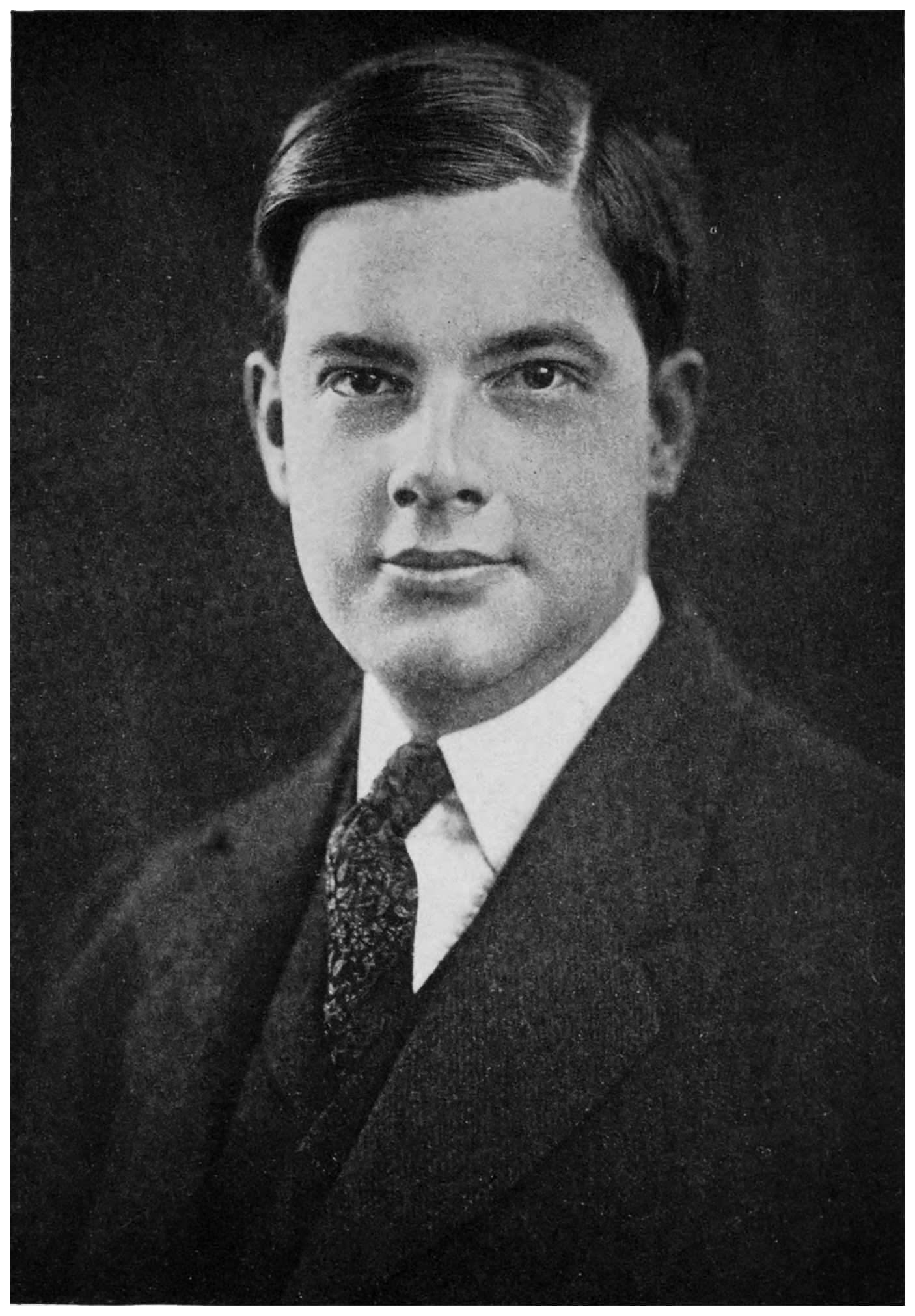
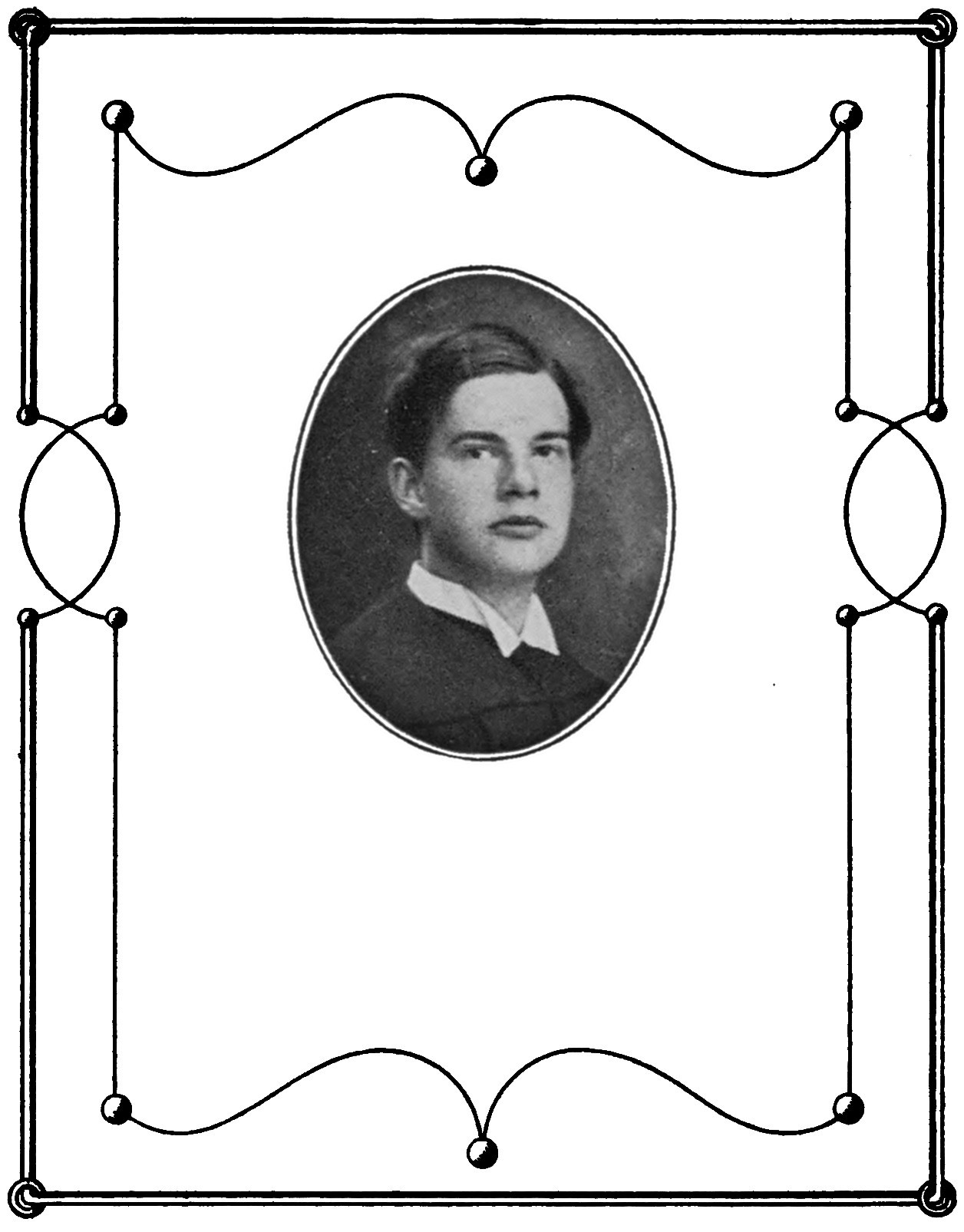
MEMOIR — I — II — III — IV — V — VI — VII — VIII
It is the felicity of these pages that they cannot
be dull. It is their merit, peculiar in such a
memoir, that they cannot be sad. It is their novelty
that they can be restricted in appeal only by the
varieties of the human species. It is their good
fortune that they can be extraordinarily frank. It
is their virtue that they cannot fail to do unmeasurable
good. And it is their luck to abide many days.
With their subject how could it be otherwise?
They make not a wreath, but a chronicle, and in
their assembled facts tell a bright chapter in the history
of our time. If there is one word which more
than any other should be linked with the name of
this gallant figure now claimed (and rightly) by so
many elements of the nation, that word certainly is
“American.” A character and a career so racy,
typical of all that everybody likes to believe that at
our best we are, can hardly be matched, I think, outside
of stories.
Joyce Kilmer was reported in the papers as having
said, just before he sailed for France, that he
was “half Irish,” and that was why he belonged with
the boys of the Sixty-ninth. His birth was not exactly
eloquent of this fact. Though, indeed, he was,
as will appear, a much more ardent Irishman than
many an Irishman born—that is, in the sense of
keenly savouring those things which are fine in the
Irish character, and with characteristic gusto feeling
within himself an affinity with them. Later, in
a letter from France to his wife, he was more explicit
on this point:
As to the matter of my own blood (you mentioned
this in a previous letter) I did indeed tell a
good friend of mine who edits the book-review page
of a Chicago paper that I was “half Irish.” But I
have never been a mathematician. The point I
wished to make was that a large percentage—which
I have a perfect right to call half—of my ancestry
was Irish. For proof of this, you have only to refer
to the volumes containing the histories of my mother’s
and my father’s families. Of course I am
American, but one cannot be pure American in
blood unless one is an Indian. And I have the good
fortune to be able to claim, largely because of the
wise matrimonial selections of my progenitors on
both sides, Irish blood. And don’t let anyone publish
a statement contrary to this.
He also, in a letter from France, quoted with
much relish the remark of Father Francis P. Duffy
that he was “half German and half human.”
English and Scotch strains made up another half
or three quarters. The English goes straight back
to one Thomas Kilburne, church warden at Wooddilton,
near Newmarket, in Cambridgeshire, who
came to Connecticut in 1638. The “e” was lost
apparently in Massachusetts, and the word became,
as in his mother’s maiden name, Kilburn.
Soldier blood, too, flowed in his veins—though it
is likely that this fact for the first time occurred to
him, if at all, when his nature rose white-hot to
arms. He was, so to say, a Colonial Dame on both
sides, as members of both his father’s and his mother’s
family fought in the American Revolution; and
members of his father’s family in the French and
Indian wars.
Alfred Joyce Kilmer (as he was christened) was
born at New Brunswick, New Jersey, December 6,
1886, son of Annie Kilburn and Frederick Kilmer.
Though he seems always to have been, in familiar
address and allusion, called Joyce, the Alfred did
not disappear from his address and signature until
he began, as more or less of a professional writer,
to publish his work, when it went the way of the
Newton in Mr. Tarkington’s name, and the Enoch
in Mr. Bennett’s. Then “Joyce Kilmer” acquired a
fine humorous disdain for what he regarded as the
florid note in literary signatures of three words (or,
worse still to his mind, the A. Joyce kind of thing);
and he enjoyed handing down, with much relish of
the final and judicial character of his utterance, the
opinion that the proper sort of a trademark, so to
say, for success in letters was something short,
pointed, easy to say and to remember, such as Rudyard
Kipling, Mark Twain, O. Henry, Joseph
Conrad, and so on through illustrations carried, at
length, to intentionally infuriating numbers.
As a small boy, Kilmer is described by those who
knew him then as the “funniest” small boy they
ever saw, by which is meant, apparently, that he was
an odd spectacle. And this, of course, is so altogether
in line with literary tradition that it would
have been odd if he had not been an oddity in the
way of a spectacle. He wore queer clothes, it seems,
ordinary stockings with bicycle breeches, and that
sort of thing. He didn’t altogether fit in somehow,
couldn’t find himself, was somewhat of an outsider
among the juvenile clans; he was required to fight
other boys a good deal; he evidenced a pronounced
inability to comprehend anything at all of arithmetic;
and somewhere between eight and twelve (so
the report goes) he contracted a violent passion for
a lady, of about thirty-five, who was his teacher at
school; a passion which endured for a considerable
time, and became a hilarious legend among the
youth about him of jocose humour.
It is told that at “Prep” school, when this goal
seemed rather unlikely of his attainment, he made
up his mind to stand at the head of his class; and
with something like the later Kilmerian exercise of
will he accomplished his purpose.
Kilmer was graduated from Rutgers College in
1904, and received his A. B. from Columbia in 1906.
His University life seems to have been, in outward
effect, fairly normal. There is no ready evidence
that he “shone” particularly, and none that he failed
to “shine.” He was not deported by the authorities,
and he was not unanimously hailed the idol of his
classmates. He became a member of Delta Upsilon
fraternity: and he was, of course, active in college
journalism. Then as always he appears to have
been zestful in living well, to have counted sufficient
to the day the excellence thereof, and to have been
too warm with life to be calculating in expenditures.
He retained in the years that followed—and it
seems to have been the college memory he retained
most distinctly—a humorous recollection of his consuming
his allowance on an abundance of rich
viands during the first few days of each month, and
being reduced to the necessity of living precariously
on a meagre ration of crackers and sandwiches
thereafter—until next income day.
Characteristic of the vehement manner in which
he went after life, as a Sophomore Kilmer became
engaged to Miss Aline Murray, of New Jersey, a
step-daughter of Henry Mills Alden, editor of
Harper’s Magazine. Upon leaving Columbia he
took up the business of making a living in the way
of an elder American intellectual tradition, by
teaching school in a (more or less) rural community.
He returned to New Jersey and began his career as
instructor of Latin at Morristown High School.
So slight a lad he was, even several years after this
time, that it is difficult to picture him in the disciplinary
adventures of the classic figure of this calling.
His problems at Morristown doubtless were
dissimilar to those of his early, Hoosier, prototype.
He married and became a householder. His son,
Kenton, was born. In religion he had been bred an
Episcopalian, and during this period in New Jersey
(it is told) he acted as a lay reader in this church.
He soon concluded, apparently, that pedagogy
was, so to say, no life for a boy. At the conclusion
of a year’s teaching he tore up the roots he had
planted, and, together with the young lady he had
married, and the son born to them, and with a few
youthful poems in his pocket, he advanced upon the
metropolis, even in the classic way, on the ancient
quest of conscious talent.
The rapidity and brilliance of Joyce Kilmer’s
success has altogether obscured his very democratic
beginnings. As his initial occupation in New York,
he obtained, by a lucky chance, employment as
editor of a journal for horsemen, though of horses
he had no particular knowledge—to be exact, no
such knowledge whatever. Here finding little to
do, and discovering one day in a desk drawer a
bulky manuscript, he decided—as he was editor—to
edit it. This, apparently, he did with youthful energy.
The little job he mentioned with some satisfaction
to his employer, a fine portly sportsman
with a crimson face and an irascible temper. The
young editor explained that the manuscript evidently
had been written by a man familiar with
horses, but one apparently innocent of the art of
literary composition. “Young man,” bellowed his
employer, “I would have you understand I have
been through the best veterinary college in the
world, and I have been a veterinary myself for over
forty years.” His wife, he added, was his amanuensis,
and he guessed she knew something about
writing. The editorship came to an abrupt termination.
Then followed a brief sojourn, at a salary of (I
think) eight dollars a week, as retail salesman in the
book store of Charles Scribner’s Sons, a dignity
which the young littérateur wore with humorous
dignity for exactly two weeks. A distinct mental
impression of him of this time presents him as decidedly
like an Eton boy in general effect, and it seems
that a large white collar and a small-size high hat
should have gone with him to make the picture quite
right. One who met him then felt at once a gracious,
slightly courtly, young presence. He gave
forth an aroma of excellent, gentlemanly manners.
He frequently pronounced, as an indication that he
had not heard you clearly, the word “Pardon?”—with
a slight forward inclination of his head, which,
altogether, was adorable. His smile, never far
away, when it came was winning, charming. It
broke like spring sunshine, it was so fresh and warm
and clear. And there was noticeable then in his eyes
a light, a quiet glow which marked him as a spirit
not to be forgotten. So tenderly boyish was he in
effect that his confreres among the book clerks accepted
with difficulty the story that he was married.
When it was told that he had a son they gasped their
incredulity. And when one day this extraordinary
elfin sprite remarked that at the time of his honeymoon
he had had a beard they felt (I remember)
that the world was without power to astonish them
further.
As a retail salesman, however, this exceedingly
interesting young man did not make a high mark.
One’s general impression of him “on the floor” is a
picture of a happy student, standing, entranced,
frequently with his back to the door (which theoretically
he should have been watching for incoming
customers), day after day engrossed in perusing a
rare edition of “Madame Bovary.” One sensational
feat of business he did as a clerk perform. Misreading,
in his newness to these hieroglyphics, the
cypher in which in stores the prices of books are
marked on the fly leaves of the volumes, he sold to a
lady a hundred-and-fifty-dollar book for a dollar
and a half. This transaction being what is termed a
“charge sale,” not a “cash sale,” and amid some excitement
the matter being immediately rectified, disaster
for the amateur salesman was averted.
At Scribner’s a close friendship was, almost at
once, formed between the youthful poet and another
then unpublished writer acting at that time in the
same capacity of clerk—a friendship which was
never diminished by the numerous shiftings of Kilmer’s
fields of activity, the multitudinous, diverse
and ardent interests which he acquired in an ever-mounting
measure, and the steady addition of numberless
friends of all classes who eagerly yielded him
their devotion. It was rather a friendship which
was continually cemented by increasing and closer
bonds. It was a part of Kilmer’s spirit to make his
first friend in his literary life a sharer as far as was
possible in each new success of his own. One among
many, innumerable, instances of this was his contriving,
by his influence with the editor (at that time
another intimate, Louis H. Wetmore), to work his
friend into a position somewhat rivaling his own at
the period (1912–1913) when he was the bright and
shining star reviewer for the New York Times Review
of Books. The regular Tuesday lunching together
of these two friends when their offices were
widely separated became, at least in their own
fancy, an American literary institution. The two
were united in all the symbols of affection between
men. And at seasons of rejoicing and adversity the
Kilmer house was to his friend as his own. It is to
this one who among all of Joyce Kilmer’s friends
owes him the greatest debt of friendship has come
the supreme trust of writing, within the power of his
many and conscious limitations, this Memoir, and
editing these volumes.
Dropping the very small bird which he held in his
hand in the way of a secure salary, the spectacular
bookseller, somewhat to twist the figure, plunged
again into uncharted seas, and became a lexicographer,
as an editorial assistant in the work of preparing
a new edition of the Standard Dictionary.
He blithely began his Johnsonian labours by defining
ordinary words assigned to him, at a pay of five
cents for each word defined. This is a very different
thing indeed from receiving a rate of five cents
a word for writing. It is a task at which you can
obtain an average of perhaps ten or twelve dollars
a week, though some weeks “stickers” will hold you
back. It soon became apparent, evidently, that it
was advisable to put this very capable pieceworker
on a salary; and he was rapidly promoted, with corresponding
increases in remuneration (reaching an
amount of something like four times his initial earnings),
to more advanced phases of the work: research
into dates of birth (involving correspondence
with living celebrities); research into the inception
of inventions (as, for example, the introduction of
the barrier into horse racing); together with the
defining of words of contemporary origin, in, for instance,
the nomenclature of aviation. In this last
mentioned department, it was his office to call upon
authorities, such as the Wright brothers, and upon
presentation of his credentials to receive precise information.
He interviewed famous tobacco importers,
and coffee merchants; compiled in the New
York Public Library material about fans; unearthed
for use as an illustration a picture of a
strange bird; or was assigned to collect for this purpose
designs of ancient mouldings.
If lexicography was Kilmer’s venerable occupation,
by political faith he was at the time, this very
young, young man, a socialist. He subscribed for
and frequently contributed to the Call newspaper.
And the height of his effervescence was in addressing
meetings of the proletariat. He was, it must
be said, a burning “young radical.” He frequented,
to some extent, a club of that name. And
with a joyous consciousness of being in the character
of his surroundings he ate meals at the Rand
School of Social Science. He rapidly acquired
a wonderful string of queer acquaintances, in
whose idiosyncrasies he took immense delight.
Some, not of the persuasion, fancied that as an adherent
of the socialist party he was merely enamoured
of an intellectual idea. At any rate, whenever
in conversation he spoke of socialism, as he
frequently did, his graceful, amiable young features
assumed a very firm and earnest aspect.
Exactly the point of transition, if there was any
decided point, I cannot recall, but from the proletariat
he passed to the literati. A “man of letters” became
a great word with him. And he looked rather
proudly about as he said it, as a Scot might speak
of the doughty deeds of the Scotch. He was wont
to refer, too, to the “intellectual aristocracy.” His
luncheon engagements were now mostly with this
order of humanity, and his anecdotes featured such
figures as Richard Le Gallienne and Bliss Carman—men
whose personalities delighted his heart beyond
measure.
How absurdly juvenile he looked. But you would
have noted, as you observed him, that he had a very
fine head, something like that of Arthur Symons
(without the moustache), I thought; or, according
to Mr. Le Gallienne’s sympathetic picture in The
Bookman: “Though the resemblance was perhaps
only a spiritual expression, his then thin, austere
young face, with those strangely strong and gentle
eyes (eyes that seemed to have an independent,
dominating existence), reminded me of Lionel
Johnson, for whom he had already a great admiration,
and whose religion he was afterwards to embrace.”
Or, again, he seemed as if he might be a
comely youth out of ancient Greece. I think that
what I mean is that he was so unlike all other young
men anyone had ever seen walking about, so much
brighter and purer, or some indescribable thing,
that he did not seem altogether real. A feeling
which I think was shared by many, and which I
have never quite been able to make articulate, Mr.
Le Gallienne has most happily expressed with his
own easy charm; that is the “hint of destiny” in this
“very concentrated, intense young presence—masculine
intense, not feminine:”
We have all met young people who give us that—beautiful,
brilliant, lovely natured, so superabundant
in all their qualities (and particularly perhaps
in some quality of emanating light)—as to make
them suggest the supernatural, and touched, too,
with the finger of a moonlight that has written
“fated” upon their brows. Probably our feeling is
nothing more mysterious than our realisation that
temperaments so vital and intense must inevitably
tempt richer and swifter fates than those less wild
winged.
Above all, this young gentleman was the portrait
of a poet, even (in those days) of the type of literary
sophistication which is (or was) called decadent!
There was about him a perceptible aroma of
literary self-consciousness. He had begun to contribute
to magazines and newspapers the verses
which he soon gathered into a first volume, “A
Summer of Love” (an “author’s book,” as the trade
term has it), verses patently derivative in character
(as whose early verses are not?), showing the influences
of various masters.
He had already become a bit of a celebrity, arriving
at twenty-five in Who’s Who. In conversation
he spoke with striking fluency and precision,
and a rather amusing effect of authority; all of
which, together with a ready command, rather incongruous
for his years, of very apt words little employed
in speech, gave a general impression, I
fancy, of something of an infant prodigy. He
wrote in a letter of this time of the poems of Coventry
Patmore:
I have come to regard them with intense admiration.
Have you read them? Patmore seems to me
to be a greater poet than Francis Thompson. (Kilmer,
had by the way, just given a lecture at Columbia
University on Francis Thompson.) He has
not the rich vocabulary, the decorative erudition,
the Shelleyan enthusiasm, which distinguish the
“Sister Songs” and the “Hound of Heaven,” but
he has a classical simplicity, a restraint and sincerity
which make his poems satisfying. Some of his
shorter poems, such as “Alexander and Lycon” and
“The Toys,” approach Landor in their Greek economy.
Of course, the “Angel in the House,” and
many other of his poems, are marred by Tennysonian
influences. But the “Unknown Eros” is a work
of stupendous beauty. It is certainly supreme
among modern religious poems. That part of it
devoted to Eros and Psyche is remarkably daring
and remarkably fine. Psyche symbolizes the soul,
and Eros the love of God. Their amour is described
with realistic minuteness, even with humorous
flippancy, and yet the whole poem is alive with
religious feeling.
The finding of Patmore, by the way, was what
might be called a finger-post in Kilmer’s life. The
fortunate introduction was performed by, it is my
impression, Kilmer’s friend Thomas Walsh.
If in cold print to-day there is a slightly preposterous
didactic quality in these remarks of this
youthful character, it should be instantly noted as
a tribute to the charm that was his that in the presence
of so much handsomeness and grace, combined
with so much flexibility of mind and agile humour,
even this was an engaging thing.
There was to Kilmer nothing whatever dry-as-dust
about the erudite business of lexicography;
instead his impressionable nature found among his
co-workers a rich, a colourful, an exciting school of
humanity. He glowed continually with affectionate
amusement at the motley band of literary adventurers,
intellectual soldiers of fortune, who apparently
were his colleagues. One, the most motley
perhaps of all (the long cherished dream of whose
ancient bachelor life it was one day to write a popular
song), touched, for the first time, I think, the
deepest spring of his song—his profound and wide-ranging
humanity.
Some people ask: “What cruel chance
Made Martin’s life so sad a story?”
Martin? Why, he exhaled romance,
And wore an overcoat of glory.
And then, lo! the aesthete became a churchman.
After a couple of years or so of lexicographic employment,
work on the dictionary was completed,
and Kilmer entered what, with immense gusto, he
described as “religious journalism.” He became
literary editor of The Churchman.
He had completed a very thorough course in uptown
New York apartment house life (living, I
think, in rapid succession in some half dozen specimens
of “the great stone box cruelly displayed
severe against the pleasant arc of sky”); and now
removing to the suburban village of Mahwah, New
Jersey, in the Ramapo foothills, he entered upon his
career as one of the world’s most accomplished commuters.
He used to say, with a spacious gesture of
the arm and a haughty inflation of the chest, that it
was no life at all, no life at all, for a man not to
swing around an orbit of at least sixty miles a day
between his office and his home. His home, even so!
I never have seen a vagabond who really liked to roam
All up and down the streets of the world and not to have a home.
What more exhilarating experience than the
owning of a home! And one paid one’s installments
on the building loan with the fine pride of a man
exercising a noble prerogative. Yes, he often
walked to Suffern along the Erie track, and meditated
on “what a house should do, a house that has
sheltered life,”
That has put its loving wooden arms around a man and his wife,
A house that has echoed a baby’s laugh and held up his stumbling feet.
As became a churchman, he began to hold forth to
his companion on the train to and from the city on
the fascinations of the Anglican poets. Either his
enthusiasm for the subject resulted in a series of
articles on the theme, or an assignment for such a
series of articles resulted in his enthusiasm, I don’t
know which. The significant point is that it was
just as like to have been either way about. “Passon
Hawker”—Robert Stephen Hawker—Vicar of
Morwenstow, a coast life-guard in a cassock—who
can recite off hand the deeds of his piety and his
valour? Well, on the Erie smoker he became one of
the most romantic figures of story. Robert Herrick,
in a manner of speaking, went home many a
night on the Twelve-Forty-Five (Robert Herrick,
that is, with his “Unbaptized Rhimes” left out),
and Bishop Coxe returned on the Seven-Fifty-Six
in the morning.
Kilmer had already done a few book reviews for
The Nation and for the New York Times; but at
The Churchman he acquired such a proficiency at
this exercise that he was able, jocularly, to regard
Arnold Bennett, as a literary journalist, as a “mere
amateur.” The real reward of “religious journalism,”
however, it soon developed, was the opportunity
of writing a feature which the secular might
call an editorial, but the proper name of which this
editor pronounced, in the tone and with the manner
of one who was consciously engaged in something
grand, gloomy and peculiar, as a “meditation.”
The real meditations of Joyce Kilmer, however,
were not “meditations” so called, and partook in no
wise of the nature of editorials. He had been, in the
main, a graceful troubadour who thrummed pleasant
things to his lady-love, and had a bright eye to
his singing robes. He had thought it rather fine,
too, that refrain in imitation of Richepin:
May booze be plenty, bulls be few,
The poet is the beggars’ king.
He had even been much taken, artistically, with the
thought of absinthe:
O little green god in your crystal shrine,
Your heavenly dream-shower shed!
It was when his business took him near to God,
when his exploring spirit, upon a peak in Darien,
beheld that:
Poems are made by fools like me,
But only God can make a tree,
that he began to be a poet. “Trees,” which more
than all the rest he had written put together made
his reputation, appeared in Poetry. A Magazine of
Verse in August, 1913.
At about this period it was that he was altogether
born again. Then, doubtless in castigatory reaction
against his own aesthetic and “decadent” wild oats,
entered into his fibre that sovereign disdain for the
intellectual flub-dub which later gave such a delightful
note of “horse-sense” to all his humorous
thought—the Johnsonian sting (“and don’t you
think you were an ass?”) which found its earliest
biting expression in the verses “To a Young Poet
Who Killed Himself.”
“I’ve been leading a rather active life, for several
days,” was with a gay salute of the hand, a frequent
Kilmerian remark. In 1912 the direction of
the New York Times Review of Books fell into the
hands of a high-spirited young man, a Max-Beerbohmian
character, with a decided taste for gaiety in
reviews, Mr. Wetmore, who conducted that organ
through what is known in New York journalistic
tradition as its “meteoric period.” Mr. Wetmore’s
wit perceived in Kilmer his happiest rocket. Not
only given his head but egged on by his editor to
strive for sublime heights of fantasy, this fairly unknown
contributor shot in a series of reviews which
for readability was, the applause now indicated, an
altogether new thing in the book pages of an American
newspaper. “This is a bad book, a very bad
book, indeed,” so ran the style. “It is bad because
it makes this reviewer feel old and fat and bald.”
If, together with their humorous assumption of a
jovial cocksureness of manner, the literary judgments
expressed were, of necessity, snap-shot judgments,
there was nothing snap-shot nor assumed
about a certain quality in them which in general
effect was the most striking of all, namely, the reflection
in a very positive way of a radiantly clean
and wholesome young nature, abounding in mental
and spiritual health.
As one of the general prime movers in, and for a
number of years Corresponding Secretary of The
Poetry Society of America, Kilmer engaged on the
side in activities which for many another would have
been in themselves almost a whole job. A fervent
Dickensonian, he was for a long period president
and (one felt) the animating principle of the American
Dickens Fellowship. He accumulated offices
to such an extent that I am doubtful if anyone but
himself knew exactly how many employments he
had altogether, or at any one moment. He conducted
the Poetry department of The Literary Digest
for something like nine years, an obligation
which he continued to fulfill even from Camp Mills,
Long Island, to the time when he sailed for France.
For a time he conducted a similar department in
Current Literature, and also did a quarterly article
on poetry for, I think, the Review of Reviews.
Among his earlier essays in the lecture field was a
paper on “The Drama as an Instrument of Sex
Education,” read before a regular meeting of the
Society of Sanitary and Moral Prophylaxis held
at the New York Academy of Medicine, in December,
1913. The society with the playful name,
I recollect, got seriously interested in the matter of
sex education as then expounded. Their views on
the drama in this connection were enlarged by
acquisition of the idea that though “‘The Great
Love’ is, in my opinion, one of the most skilfully
constructed plays presented on the New York stage
for many a year, I am quite serious in saying that as
a factor in sex education, it is a thousand times inferior
to ‘Bertha the Beautiful Cloak Model.’”
As Kilmer was always decidedly what is termed
a ready writer, what I should attempt to describe
as a natural writer (a startling exception to the rule
that easy writing makes hard reading), so he appeared
to have the gift of speaking readily in public.
On frequent occasions, at any rate in his early talks,
he neglected altogether to prepare any outline beforehand,
and even sometimes to choose a subject.
Every now and then, I have known him repeatedly
to say to his companion at dinner, without, however,
any trace at all of nervousness: “Now, look here:
Put your mind on this. Stop all that gossip. Tell
me what I’m to talk about. I have to begin” (looking
at his watch) “in twenty-five minutes.”
He was particularly active in the affairs of the
Authors’ Club, and was a member of the Vagabonds,
the Columbia University Club and the
Alianza Puertorriguena. In 1913 he ceased, officially,
to be a churchman. For a brief period he
contemplated the prospect of a professorship, lecturing
on English Literature at the University of
the South, Sewanee, Tennessee. Then, to his great
delight, he became a newspaper man—as he continually
put it, with much relish in the part, “a hard
newspaper man.” He became a special writer for
the New York Times Sunday Magazine. I am sure
he saw himself in fancy as one of those weather-beaten
characters bred in the old-time newspaper
school of booze, profanity and hard knocks, his only
text-book the police-court blotter and the moulder
of his youth a particularly brutal night city-editor.
He maintained, with humorous arrogance against
opposing argument, the thesis that every great
writer had got his “training” as a newspaper man.
He delighted to point, as illustrations of this, to
Dickens, to Thackeray, and to a lot more, who, in
any strict sense of the word, were not “newspaper
men” at all. Hard pressed, he even stood ready to
make some such hilariously sweeping assertion as
that George Eliot, Shakespeare, Tennyson and
Robert Browning were, properly perceived, “newspaper
men.”
At any rate, this hard newspaper man had to
begin with a comical equipment for his task: he
would never learn to typewrite and he knew nothing
of shorthand. Or rather, he was remarkably well
equipped, as one of the outstanding traits of his
character was the fearless zest with which, so to say,
he took the hurdles of life, and a peculiar faculty in
triumphing over such obstacles as his own limitations.
He rapidly invented a curious system of
abbreviations and marks to remind him of points,
which served him as an interviewer as effectively as
any knowledge of stenography could have done.
He energetically entered upon his occupation as a
feature writer with the customary themes of the
“Sunday story.” He interviewed, figuratively
speaking, the man who had discovered the missing
link, and he got from the latest inventor of perpetual
motion all the arresting details of his machine.
And a lively part of the early Sunday morning
ritual at his home was the advance calculating with
a tape measure of the week’s income from space
writing.
It was later that he created his own highly successful
type of literary interview. An intelligent
perception of the business, a perception which is not
general, perhaps is required fully to appreciate the
fact that in this department of newspaper work he
was an exceedingly skillful journalist. The secret
of his really brilliant success in this field lay in large
part in his instinct for luring the distinguished subject
of his interview into provocative statements,
enabling him to employ such heads as: “Is O. Henry
a Pernicious Literary Influence?” “Godlessness
Mars Most Contemporary Poetry,” “Americans
Lack Loyalty To Their Writers,” “Shackled
Magazine Editors Harm Literature,” “Declares
Our Rich Authors Make Cheap Literature” and
“Says American Literature Is Going To the
Dogs.”
At the time of the death of James Whitcomb
Riley, Kilmer hurried to the Catskills for his interview
with Bliss Carman. On his way back to the
city, by way of his home at Mahwah, he dashed with
his usual impetuosity in front of the moving train
he was seeking to board, was knocked down and
hurled or dragged a considerable distance, and
taken to the Good Samaritan Hospital at Suffern,
New York, with three ribs fractured and other injuries;
where, wiring immediately to New York for
his secretary, he dictated an interview as engaging
and as full of journalistic craft as any he ever
wrote. He seemed much more intent on his Sunday
story, it is reported by H. Christopher Watts,
who was acting as his secretary at that time, than
on his predicament.
I did not see Kilmer at this time myself, but I
have an idea that, when he had relieved his mind of
the anxiety concerning his article, he entered into
the spirit of his experience with much relish. It
isn’t every day that one gets hit by a train, nor
everybody that has three ribs broken. Exhilarating
kind of thing, when you see it that way! I remember
one time when I was practically in hospital
myself he went to a good deal of trouble to come
to see me. He seemed to admire my predicament
very much, and, beaming upon me, remarked in
high good humour that it must be an entertaining
thing to be so completely at the mercy of circumstances
over which you had no control. When shall
we look upon his like again!
I really doubt very much whether anybody ever
enjoyed food more than Kilmer. The slender
youth had become a decidedly stocky young man,
who ate mammoth meals with prodigious satisfaction.
He delighted upon sitting down to breakfast
to maintain, with almost savage earnestness (such
was the amusing effect), that the most fitting dish
for that meal was steak. As a matter of fact, however,
his habit was to miss his breakfast altogether
through haste to catch his train, except for a cup of
coffee and a piece of buttered toast which, when he
missed the ’bus, he ate, a mouthful every dozen or
so leaps, on his way down the hill (almost a mountain)
to the station. Sundays, however, with the
whole day at home, he apparently regarded among
other things as a sort of barbecue. Looking over
the morning table it was his custom to inquire with
the air of a man making a fairly satisfactory beginning,
what was scheduled for dinner.
Kilmer never ate any lunch, as the ordinary world
understands the word—about the first hour of the
afternoon he went (when his means had become
such that he could afford it) to a sort of Thanksgiving
or Christmas dinner every day. How proceeding
directly to his office he did any work afterward,
was always considerable of a mystery to me. And
lunching alone he doubtless regarded as a misanthropic
perversion. His luncheons and his frequent
dinners in town alone represented what many would
regard as a rather arduous social life, which however
arduous, however, never failed to include the weekly
luncheon with his mother, Mrs. Kilburn-Kilmer.
As an epilogue, so to say, to his meal it was his wont
to have, speaking his order slowly so as to suck the
full flavour of the idea, “a large black cigar.”
One time being in the city with his family for a
period after the birth of one of his children, he gave
a series of Sunday morning breakfasts at a fashionable
restaurant (it was a pleasant crotchet with him
that he was “a fashionable young man”), entertainments
which were distinguished by, first, the fact
the guests so abundantly represented the world of
journalism that they filled a good portion of the
room, and, secondly, by the circumstance of their
lingering at the board until mid-day diners began
to arrive.
How a poet could not be a glorious eater, it was
one of Kilmer’s whims to say, he could not see; for
the poet was happier than other men by reason of
his acuter senses, and as his eyes delighted in the
beauty of the world, so should his palate thrill with
pleasure in the taste of the earth’s bounteous yield
for the sustenance of men. The romance, too, of
the things we eat he felt lustily.
Rich spices from the Orient,
And fruit that knew Italian skies.
He had another, and a decidedly quaint, notion of
food. He firmly believed that hearty eating was an
adequate physical compensation for loss of sleep.
He was fond of declaring his faith in this fantastic
idea by means of a story of some “ancient receptive
child” (friend of his) who managed to bring up a
family of seven (or so) children by ill-paid hack-work
occupying most of the day and night—a noble
success due entirely to noble meals.
* * * * *
This man has home and child and wife
And battle set for every day.
This man has God and love and life;
These stand, all else shall pass away.
And “this man’s” days were long, long days:
Kilmer’s home, a place of boundless week-end hospitality
and almost equally boundless domesticity
(guests being obliged to exercise much agility in
clambering about toys with which the stairs were
laden), was also year after year a place of almost
unbelievable literary industry. The trying idiosyncrasies
of the artistic temperament were about as
discernible in Kilmer as kleptomania. He was, as
you may say, social and domestic in his habits of
writing to an amazing degree. Night after night
he would radiantly walk up and down the floor singing
a lullaby to one of his children whom he carried
screaming in his arms while he dictated between
vociferous sounds to his secretary or wife—his wife
frequently driven by the drowsiness of two in the
morning to take short naps with her head upon the
typewriter while the literally tireless journalist
filled and lighted his pipe.
This, however, was an atmosphere of cloistral seclusion
compared with Kilmer’s office at the New
York Times. Here, where he regularly got
through each week enough hard work to hold down
three or four fairly capable young men, he maintained
a sort of salon for a ludicrous variety of picturesque
characters with nothing in particular to
do and no place else to go, ranging from types of
patrician leisure to stray dogs of the literary world
visibly out of a job.
The latter class, indeed, apparently regarded him
as a kind of a clearing house for employment. A
singularly convincing commentary on the radiating
humanity of this brilliant young man was one rather
grotesque feature of his mail. In addition to a constant
and copious stream of requests from persons
but slightly known, or quite unknown to him, for
advice as to how to succeed in letters, and for his
personal imprimatur on their enclosed manuscripts,
he was apparently constantly in receipt of innumerable
epistolary stories of extraordinary distress, suffered
(generally) by elderly characters defeated in
the lists of literature. Though there was in Kilmer’s
robust nature a decided distaste, somewhat
analogous to the innate aversion of the clean in
spirit to moral obliquity, for what he termed “ineffectual
people,” there was too an amusing strain of
paternal feeling toward most of those of all ages
with whom he was in contact. And this feeling he
did not neglect, whenever the occasion arose, to
translate into practical effect.
He had a comical manner of terming his elders
“young” So-and-So. I was six years his senior,
which at the period of life at which we met represented
a considerable difference in experience.
And yet, throughout our association, in spiritual
force he was the oak, I the clinging vine. And I
know of cases where this was quite as much so when
the other man was something like fifteen years the
elder. One such instance, ludicrous in its contrast
between the two men, was confessed to me with
deep feeling just the other day.
“So-long” or “good-bye” was seldom Kilmer’s
parting word. It was rather a word he continually
used which will be thought of as peculiarly his as
long as his memory endures, the closing word of
“Rouge Bouquet.” The last time I saw him at his
home, then at Larchmont Manor, New York, my
companion (in marriage) and I upon leaving almost
missed our car, which started a block or so
from the Kilmer house. As the three of us dashed
after it, Kilmer stopped this car by what seemed to
me something like sheer force of his willing it to
stop. Then, as he dropped away from the race,
there came from him high and clear out of the
night (and always shall I hear it ring) his benediction:
“Farewell! Children.” Yes, it is even so;
as the spirit is measured and the frailties of the soul
are numbered, how many who knew this wondrous
boy were his “children”!
The wisdom of the maxim “A busy man is never
too busy to do one thing more” was indisputable in
the spectacle of Kilmer. Though this was not, so
far as I recollect, a maxim he employed, he had one
of his own something like it, which admirably
summed up his practical philosophy. When confronted
by some financial dilemma, he was fond of
declaring: “The demand creates the supply. A
sound economic principle.” He seemed to crave
serious responsibilities and insistent obligations as
some men crave liquor; and he grew more rosy as
these increased.
Thank God for the mighty tide of fears
Against me always hurled!
Thank God for the bitter and ceaseless strife,
And the sting of His chastening rod!
There was nothing incongruous to Kilmer about the
incongruity expressed in a communication written
in 1916 to the Reverend Edward F. Garesché,
S. J.; a letter which began by saying, “I am sorry
that your letter of October 11 has been so long unanswered,
but this has been the busiest month of my
life”; which then told of his looping the loop of the
country in lecture engagements; proceeded to discuss
a matter which had made a strong appeal to his
heart, the founding of an Academy of Catholic
Letters to be called the Marian Institute; and concluded
with the remark, “I will gladly take on the
work of acting secretary until the members make
their own selection.”
In 1913, Kilmer’s daughter Rose, nine months of
age, was stricken with infantile paralysis. It was
then, upon his bringing his family to town to give
his daughter the treatment of a specialist, when he
came to my house to tell me of this, that I first distinctly
realised that this young man was remarkable—in
a manner far beyond mere talent. The idea
which he kept firmly before his mind was that it
had been declared there was no occasion to fear her
death as a result of her affliction. During the course
of his stay with me that day he said several times,
“Well, there are lots of people worse off than I
am.” This idea, too, it was apparent, he felt he
must hold before him. And then, with his amazing
and unconquerable flair for life, he launched upon
the theme that this was a “very interesting disease,”
and he elaborated the thought that an infirmity of
the body frequently resulted in an increased vitality
of the mind.
“I like to feel that I have always been a Catholic,”
was a sentiment frequently expressed by Kilmer.
It has repeatedly been declared by friends
very close to him that his minute knowledge of pious
customs and practices of which a life-long Catholic
might easily be ignorant was a constant surprise to
them, but that with respect to religion as particularised
in himself he kept silent, would never discuss
the steps that led to his conversion, and it was only
by chance they discovered he was a daily communicant.
It was late in 1918 that Kilmer astonished
the little world that then comprised his family, his
friends and acquaintances by entering, with his
wife, the Roman Catholic Church. One afternoon
not long after this occurrence he not so much invited
as directed me over the telephone to meet him
that night for dinner at the Columbia Club. His
purpose soon became clear. This was the only
solemn hour I ever spent with Kilmer. I think it
well to record here what he deeply impressed upon
me: that it was this searing test of his spirit which
had come upon him in the affliction of his daughter
that fixed his religion.
Kilmer did not become a great patriot when his
country entered the world war. He was, of course,
the same in fibre then as before. Only then was
known to him and visible to others what was latent
in his heart. And in this sense it was, I think, that
it was clear to him that he did not become, but had
always been a Catholic, though he had not earlier
realised it. He tried all things and held fast to that
which he found good. He was inwardly driven to
seek until his spirit found its home. That only the
time of his conversion was, in a sense, accidental,
and that the conversion itself was inevitable, must
be evident in the fact that he was never really himself
before he became, as we say, a convert. Then
his fluid spirituality, his yearning sense of religion,
was stabilized. What is the “secret,” as we say, of
all that has been told of his ability? His courage,
his mental and physical energy, were, manifestly,
unusual. But his character, in the faith that he
embraced, found its tempered spring. His talent
was a wingéd seed which in the rich soil which had
mothered so much art found fructification.
It is not an unsupported assertion to say that he
was in his time and place the laureate of the Catholic
Church. His sentiments as to the function of a
Catholic poet he has expressed very positively in
his essays and lectures. He joyed in the new proof
given by Helen Parry Eden “that piety and mirth
may comfortably dwell together.” “A convert to
Catholicism,” he wrote of Mr. Yeats on Lionel
Johnson, “is not a person who wanders about weeping
over autumn winds and dead leaves, mumbling
Latin and sniffing incense.” Nor is it necessary to
lay æsthetic hands on the church’s treasures, “and
decorate rhymes with rich ecclesiastical imagery and
the fragrant names of the saints.” But in Faith
one may find “that purity and strength which are
the guarantees of immortality.”
And, once a Catholic, there never was any possibility
of mistaking Kilmer’s point of view: in all
matters of religion, art, economics and politics, as
well as in all matters of faith and morals, his point
of view was obviously and unhesitatingly Catholic.
Considerable as were his gifts and skill as a politician
in the business of his career, the veriest zealot
could not say that he did not do the most unpolitic
things in the service of his faith. A very positive
figure, he laboured tirelessly, alternating from one
field to another, for the Catholic Church.
As a brilliant interpretative critic of Catholic
writers, such as Crashaw, Patmore, Francis
Thompson, Lionel Johnson and Belloc, he brought,
I think I may venture to say, an altogether new
touch into Catholic journalism in America, a striking
and distinguished blend of “piety and mirth,”
which had the rare and highly effective quality of
being both engaging and highly illuminating even
to, as Kilmer would amiably have said, the Pagan.
Impetus, of course, was given to his style in this by
his admiration for the brilliant school of English
Catholic journalists, an impetus doubtless accelerated
by the personal acquaintance with Belloc, the
Chestertons and the Meynells he gained in a flying
visit to England in 1914 to rescue his mother from
war difficulties in London; when, during a few odd
moments before his return, he established a lively
connection with the Northcliffe papers and T. P.’s
Weekly. Even so, Kilmer almost, or quite, alone
transplanted this particular spark; and his note of
witty common sense and spiritual sensibility was
particularly Kilmerian, too.
One day about four years ago the village Post
Office at Mahwah did a totally unprecedented and
most extraordinary business in outgoing mail, and
Kilmer was again multiplied manifold. The neat
circulars which he had printed and with which he
stuffed the mail box announced that the author of
“Trees,” a member of the staff of the New York
Times, etc., etc., “offered the following lectures for
the coming season.” The result may best be epitomised
in the parable of the gentleman who cast
his bread upon the waters to have it come back to
him in the form of sardine sandwiches. The rapid
development of Kilmer’s lecture business, which
soon assumed the proportions of no mean career in
itself, immensely extended his force as a quickening
influence in the Catholic world. Before societies
and educational institutions in many places,
frequently travelling as far as Notre Dame, Indiana,
and Prairie du Chien, Wisconsin, he flung his
bright portraits of “seekers after that real but elusive
thing called beauty, a thing which they found
in their submission to her who is the mother of all
learning, all culture, and all the arts, the Catholic
Church.”
As a literary lecturer and a reader of his own
poems before secular audiences his success was no
less abundant. In “the only combination of its kind
since Bill Nye and James Whitcomb Riley,” as the
circular of the J. B. Pond Lyceum Bureau stated
it, “the young American Poet” and the author of
“Pigs is Pigs” contributed considerably to the lightening
of the rigours of existence by an extended
repetition of “a joint evening of readings from their
works.” Ellis Parker Butler, in a letter before me,
writes of his partner on the programme:
He was a most charming travelling companion
and an ideal team-mate for the purpose we had in
mind. I would not have thought of going “on tour”
if I had not met Kilmer. My idea was never to
“go on tour” but, after I had met Kilmer, to “go on
tour with Kilmer.” He was altogether lovable and
loved.
It would be a decidedly false estimate of Kilmer
which failed to note, even with some emphasis, that
he was an excellent man of business. He “played
the game,” in the exceedingly difficult job of earning
a thoroughly competent living at the literary
profession, with a dexterity which, it was frequently
apparent, was at once an inspiration and a despair
to those who sought to rival him. The Kilmer cult
which grew apace was considerably accelerated by a
rich Kilmerian strategy. And he delivered to the
little world of intensely intense literary societies and
blue-nosed salons which hung upon his lips the pure
milk of the word with a strongly humorous consciousness
of the feat as a part of the immense sport
of living.
Kilmer’s “act” as it was observed from behind the
scenes is excellently presented by an associate in the
office of the New York Times. This writer says in
the Philadelphia Press:
Our editor analysed him into three distinct
manners: Kilmer, the literary man; Kilmer, the
lecturer; and Kilmer, himself. His first appearance
in the office would give you the cue to him for
the day. If he came in grinning with his pipe drawing
well, we would know that nothing was to be
feared; he was himself. When he got his “literary”
manner on, the symptom was a tapping of his eyeglass,
with his right hand on the fingers of his left.
When he appeared in his cutaway coat and a particularly
pastoral necktie, we knew that on that day
the elderly ladies of This Literary Club or the
young ladies of That Academy were to be treated to
a discourse on certain aspects of Victorian verse.
One day he came in, obviously decked out for a
lecture. Without his having said a word about it,
the assistant Sunday editor spoke up: “Let’s cut
out work this afternoon and hear Kilmer lecture.”
A look of horror overspread his face. “For
heaven’s sake, don’t,” he said. “I couldn’t go
through with it.” I don’t believe any of us ever did
hear him.
A thing which I found very singular was that, in
manner Kilmer was apt, in the two or three later
years of his life, to give strangers on their first meeting
the impression of being somewhat too dignified
for so young a man, of being, as his office associate
John Bunker in an admirable, even a remarkable,
portrait of him at this period published in America,
says, “in fact just a trifle pompous.” Mr. Bunker
continues: “This was due partly to his physical appearance,
and also, insofar as it had any basis in
reality, to that protective instinct which quickly
teaches a sensitive and imaginative spirit to cast a
veil between itself and the outer world.”
I myself think this effect had its origin in the
same perverse instinct which causes you, immediately
after talking with a deaf person, to speak very
loud to your next auditor whom you very well know
can hear perfectly; that is, it was the result of being
keyed up to appearing on an elevated platform before
a curious throng. He one time astonished me
by the declaration that it was only by, quite early in
his life, drastically schooling himself to the task,
one then exceedingly trying and hateful to him, that
he became able to rise and “speak” at all. The most
entertaining recollection, by the way, that I have of
the Kilmerian pontifical manner is of a time when
he generously invited me to have my shoes polished
with him, thrust his hand deep into his pocket to pay
the boy, paused, and with a very large gesture
directed him to call in again later in the day.
There is first-rate perspicacity in the remark of
one of Kilmer’s friends, Laurence J. Gomme, that
at one score and ten he was, in the amount that he
had lived, about seventy years old. Something of
the force and sharpness of Mr. Bunker’s evocation
of the man as he was at last resides, I think, in the
circumstance that here is no blending in the mind of
the flower and the bud. He says: “When I first
met Kilmer he had just passed his thirtieth year, but
he gave me the impression of being somewhat older.
I afterwards spoke of this to him, and it was his
theory that newspaper work had served to age him.
The truth was that it was due not merely to his
newspaper work, but generally to the incessant and
intense mental activity, the extraordinary and flaming
energy, whereby he crowded into ten years the
experiences of several ordinary lifetimes.” And
this touch of the slight Bunker portrait is, I feel,
essential to any fuller picture:
As to his physical aspect, he was stockily built
and about medium height, and his habit of body was
what I should call plump, though later, under the
stress of military drill, he changed somewhat in this
last respect. I noted at once that he had a remarkable
head—well rounded, with broad and high forehead
and a very pronounced bulge at the back, covered
thickly with dark, reddish-brown hair. But his
eyes were his most remarkable feature. They were
of the unusual colour of red, and they had a most
peculiar quality which I can only inadequately suggest
by saying that they literally glowed. It actually
seemed as if there were a fire behind them, not a
leaping and blazing fire, but a steady and unquenchable
flame which appeared to suffuse the whole eyeball
with a brooding light. This characteristic was
so striking that I cannot help dilating on it. And
I observed later on that this glow, this brooding and
somewhat sombre light, never left his eyes even in
his most weary or most care-free moments, so that
they gave the impression of what I believe was the
fact—the impression of a brain behind them which
was working intensely and perhaps even feverishly
every hour of the waking day.
The better poet Kilmer became, as his friend
Richardson Wright says in his admirable “Appreciation”
in The Bellman, the less like a poet he
acted. And after he grew up, he would about as
soon have æstheticised, off the platform, as he would
have forged a check. Whenever he did refer to
poetry as related to himself he, as the slang term
has it, took it smiling. One of Kilmer’s most pronounced
pet aversions was the phrase, utterly
mawkish to him, about “prostituting” one’s talent.
He one time explained to me, with considerable apparent
pride, that he used every idea three times: in
a poem, in an article, and in a lecture.
Charles Willis Thompson, an editorial writer of
the New York Times, and to whom belongs the
credit of first taking, as editor of the Sunday Magazine
and Book Review, Kilmer’s “stuff” in any
amount, inspired, so to say, the poem “Delicatessen,”
in this way. Mr. Thompson happened to remark
to Kilmer that of course there were a lot of
things which couldn’t be treated in poetry. Kilmer
declared he would like to know what they were.
Mr. Thompson cast about in his mind for the most
ridiculous theme for a poem he could think of, and
finally proclaimed that no one could possibly write
a poem about such a thing as a delicatessen shop.
“I’ll write a poem about a delicatessen shop,” Kilmer
promptly replied. “It will be a long poem.
I’ll sell it to a high-brow magazine. It will be much
admired. And it will be a good poem.” He insisted
on betting on this the sum of several dollars.
The origin of “The Twelve-Forty-Five” I do not
exactly know. But I remember shortly before that
poem was written, sitting disgusted and miserable
with Kilmer in that horrible “Jersey City shed”
waiting for the midnight train. Taking out of his
mouth that villainously large, fifty-cent pipe (mentioned
in all genuine appreciations) Kilmer, with
a fervour almost violent, suddenly exclaimed: “I
certainly do like railroad stations! They are fine
places!” The very famous poem “The White
Ships and The Red” (a poem so wonderfully effective
that it was at once reprinted all over the country
and in Europe) was a newspaper assignment.
He rather liked the poem when he saw it in the
paper; though, with his feet cocked up on his desk,
he spoke apologetically of what he felt to be the failure
of the latter stanzas to link up perfectly with the
first, explaining that a luncheon appointment, at
which he chatted for an hour or two, had split the
writing of it into two sittings. That the author of
this “Lusitania” poem thoroughly felt and meant
what he said, is, I fancy, sufficiently proven by the
event to permit of this being told.
The point is, that Kilmer was a poet, an artist of
a high order, a perfectly conscious master of what
he was doing. The febrile gush of emotion he
loathed. He knew finely that:
It is stern work, it is perilous work, to thrust your hand in the sun
And pull out a spark of immortal flame to warm the hearts of men.
There was nothing accidental about the effect of his
own verse, any more than there was “luck” in his
worldly success. He achieved the one as he did the
other by a masculine heart and mind. And while
all things were necessary and joyous, it was impossible
not to feel that, after all, throughout his day
“the rhymer’s honest trade” was his primary concern.
He was sufficiently grounded in literature to feel,
as Mr. Le Gallienne says, no “weariness with those
literary methods which had sufficed for Chaucer and
Shakespeare and Milton, or Catullus or Bion, or
François Villon—content, with reverent ambition,
to tread that immortal path.”
In his religious mysticism a trace, and more than
a trace, has been found of Crashaw, of Vaughan, of
Herbert, and of Belloc and Chesterton. And there
is no difficulty at all about finding in Kilmer hints
of Patmore, and there may be easily recognised
something of the accents of A. E. Housman and of
Edwin Arlington Robinson. He did, indeed, to
put it in a racy phrase, have the drop on those who
do not know that all art that endures must have its
roots in a constant interrogation of the “unimpeachable
testimony” of the ages. His song was as old
as the hills, and as fresh as the morning. Precisely
in this, in fact, is his remarkableness, his originality,
as a contemporary poet; and in this will be, I think,
his abiding quality. “Simple and direct, yet not
without subtle magic,” wrote Father James J.
Daly, S.J., in a review of “Trees and Other
Poems,” printed in America, his verse “seems artlessly
naïve, yet it possesses deep undercurrents of
masculine and forceful thought; it is ethical in its
seriousness, and yet as playful and light-hearted as
sunlight and shadows under summer oaks.” And
this admirable summing up of Kilmer’s talent
leaves little more in the way of direct criticism to be
said.
Mr. Le Gallienne with felicitous tact of phrase
has touched upon this, that “no young poet of our
time has so reverently, on so many pages, in so
many different ways, so playfully at times, as in
that masterpiece of playful reverence, ‘A Blue
Valentine,’ woven through the texture of his song
the love of his lady—that lady ‘Aline,’ whose name
will be gently twined about his as long as the
printed word endures.” A misquotation in the
Ladies’ Home Journal led to an interesting tribute
to the author of “Trees.” Many readers of the
Journal were somewhat startled to find the editor
attributing to John Masefield the lines:
A tree that looks at God all day
And lifts her leafy arms to pray.
The following issue of the magazine contained this
correction and acknowledgment by Mr. Bok:
I am free to confess that I did not know the correct
author. I had been reading John Masefield
that morning and unconsciously wrote his name as
the author of these lines. A number of friends have
pointed to the error and supplied the knowledge.
The author is Joyce Kilmer, and to him I owe, and
here express, my sense of deep apology. The exquisite
lines were worthy of John Masefield, but
that does not make them less worthy of their rightful
author, as all will agree who read his beautiful
work in his book “Trees and Other Poems.”
As one, somewhat effusive commentator has remarked,
“Trees” just could not be confined within
the covers of a book. At once reprinted in newspapers
throughout the United States (and still being
so reprinted) it was crowned in that warmest
of all ways in which a work of literature can be
honoured, by being cut out by the world and pasted
in its hat. In one version it reads, in part, in this
way:
Cuando contemplo un arbol pienso: nunca vere un poema tan bello y tan intenso.
Un arbol silencioso que con ansia se aferra a la dulce y jugosa entrans de la tierra.
Un arbol que mirando los cielos se extansia y en oracion levanta los brazos noche y dia.
Many of Kilmer’s poems have been translated into
Spanish by Salomon de la Selva, Enriquez Urenia
and others, and have appeared in a number of prominent
South American papers.
In a letter from France to Edward W. Cook,
who in quest of material for a book on contemporary
poets had written Kilmer asking several questions,
Kilmer commented, among other things, on
his “earlier efforts in poetry” (as the questionnaire
apparently had put it), in a manner which is evidence
again of how perfectly well he knew what he
was about. “If what I nowadays write is considered
poetry,” he announced, “then I became a poet
in November, 1913.” Admirable for hard-headedness,
directness and precision, it is a statement
which leaves the critic no point upon which to take
issue. His early poems “were only the exercises of
an amateur, imitations, useful only as technical
training.” The peculiar thing about these highly
skilful experiments in various forms of craftsmanship
is that they were so very much better as poems
than the derivative efforts usually written at this
period of apprenticeship, “so free,” as Mr. Le Gallienne
notes, “from those artistic immaturities which
have made many old great poets angrily denounce
unlicensed reprinters of their ‘first editions.’” And
in this fact they have a decided, and a perfectly legitimate,
interest for the observer of the development
of his talent—though Kilmer declared “they
were worthless, that is, all of them which preceded
a poem called ‘Pennies,’ which you will find in my
book ‘Trees and Other Poems.’” He added, “I
want all of my poems written before that to be forgotten.”
He was writing, one remembers, to a gentleman
with whom he was so slightly acquainted that he
addressed him as “Dear Mr. Cook,” with the measure
of whose sympathy and critical acumen, it is
to be inferred, he was not conversant, and who presumably
was about to estimate (with what perspective
he could not perceive) his earliest productions.
It were better to head off any uncertainty in the
matter. Also, we all know, one’s hot impatience
with one’s strivings of yesterday is mellowed by
time into an amiable and appreciative tolerance of
one’s earnest efforts of twenty years ago. It is difficult
to think that Kilmer at fifty would have had an
unjust scorn of those charming exercises on the
poetic scales he wrote at twenty-one.
Anyhow, no man can, by decree or otherwise, obliterate
his past; both the good and the bad that he
has done continue to pursue him. Ten times thrice
happy is he, rarest of men, who, like Kilmer, never
penned a line or said a word or did a deed that can
arise to bring confusion to those that love him. The
world does not willingly let die those verses on which
glistens the dew of his tender youth. They are
brought forth for praise by no mean critics in tribute
to his memory. And in conformity with the
wishes of those most jealous of his good name as a
poet a representative selection of his early poems
is reprinted in these volumes.
He that lives by the pen shall perish by the pen,
saith the wisdom of James Huneker. For a sapling
poet, within a few short years and by the hard business
of words, to attain to a secretary and a butler
and a family of, at length, four children, is a modern
Arabian Nights Tale. Equally impossible is it,
seemingly, to accomplish another thing, which is a
remarkable part of Kilmer’s distinction. From
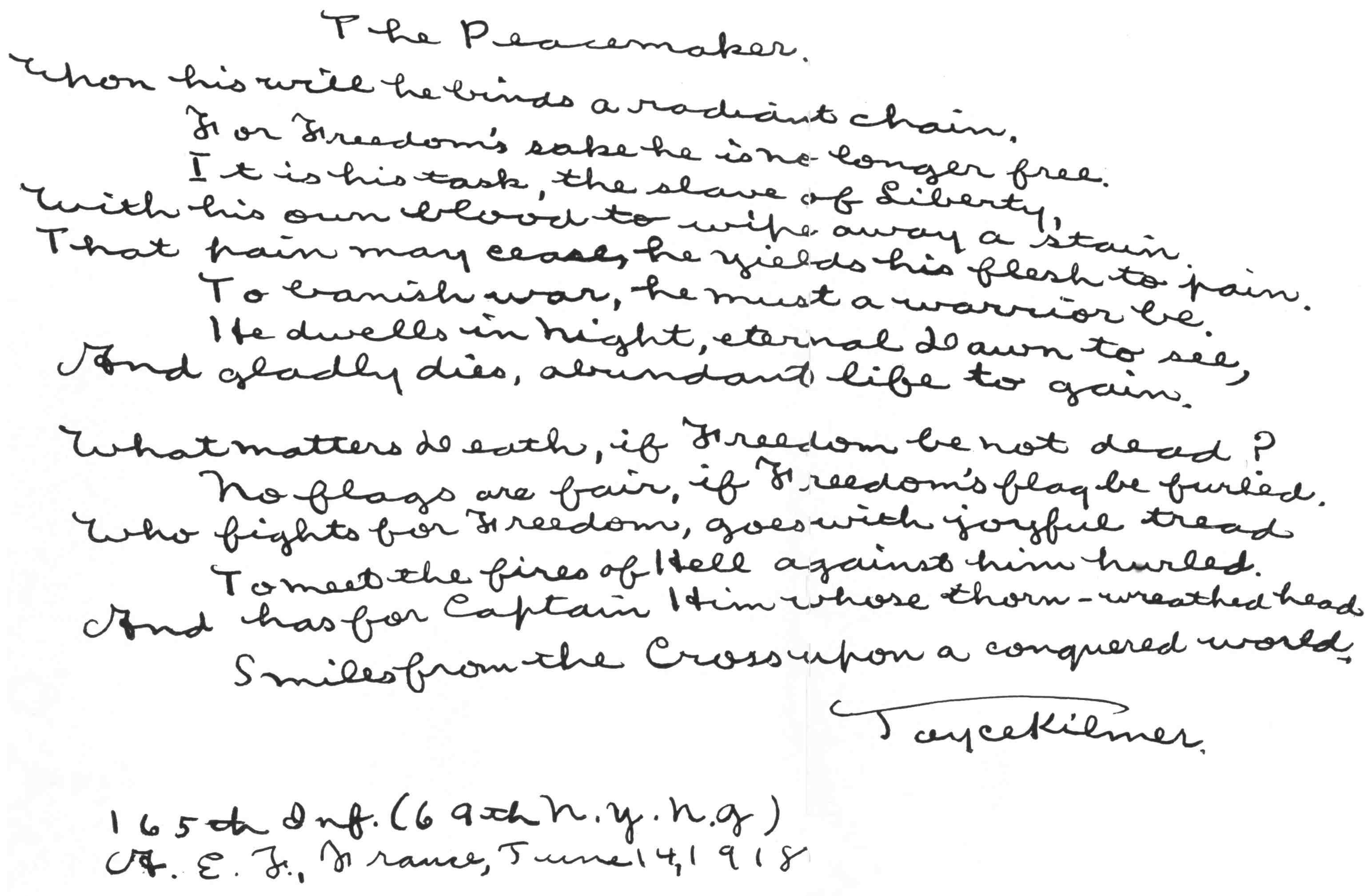
first to last, from the verses contributed to Moods in
1909 to the last poem he wrote, “The Peacemaker,”
printed in the Saturday Evening Post in October,
1918, Kilmer was a poet’s poet. “A pretty good
poet,” said such a poet (shaking his head at his conviction
of the truth of this) as Bliss Carman. His
poems were repeatedly adjudged high places
among the best poems read before the Poetry Society.
Among competitive honours, under the name
of “John Langdon” he won easily enough with his
poem, “The Annunciation,” first prize in the
Marian Poetry contest conducted by The Queen’s
Work, in July, 1917, an award competed for by a
great number of poets, including many in other
countries. He was a poet’s poet who declared (with
considerable vehemence, I remember) that he certainly
wished he had written “Casey At The Bat.”
He one time said in praise of a book of essays that it
was “that kind of glorified reporting which is
poetry.” As a singer of the simpler annals of humanity
his place will draw closer and closer, I think,
to that of the most widely loved poet of our own era.
Only the name of James Whitcomb Riley expresses
in greater measure the rich gift of speaking with
authentic song to the simplest hearts. A man who
believes that churches are devices of the devil and
literature a syrup for crack-brained females can enjoy,
with profit to his soul, “The House With Nobody
In it,” “Dave Lilly” and “The Servant Girl
and the Grocer’s Boy” equally with “The Old
Swimmin’-Hole” and “Little Orphant Annie.”
If Colonel Roosevelt had never done anything
other than what he has done in writing, he would
undoubtedly be highly esteemed as an American
man of letters. And people have made very creditable
reputations as humourists who never wrote
anything like as humorous essays as those of Joyce
Kilmer. They fairly reek with the joy of life.
They explode with intellectual robustness. They
are fragrant in fancy, richly erudite in substance,
touch-and-go in manner, poetic in feeling, rocking
with mirth, and display an extraordinary flair for
style. If it should seem that I am not here measuring
my words I suggest a reference to a piece of
documentary evidence called “The Gentle Art of
Christmas Giving,” a “Sunday story” in the New
York Times, here reprinted. Writing at top-notch
speed, never looking again at what he had written,
intentionally producing a readily marketable commodity,
from which profit must be realised quickly,
Kilmer was an exceedingly rare bird in America;
that is, a belletristic journalist. There is always the
touch to his work of a man of letters. Decidedly
Bellocian, Chestertonian, certainly his humorous
essays are. But that it was a good deal more an
affinity of mind with, than an imitation of, those
splendidly humorous English philosophers is borne
out by this: Joyce Kilmer did not talk poetry, but
he did talk exactly like his essays, which admirably
present the brave humorous wisdom of the man as
his intimate friends knew him.
Official critical authority did not dampen his
verve. As a contributing editor of “Warner’s
Library of the World’s Best Literature,” he supplied
the articles on Madison Cawein, John Masefield,
William Vaughn Moody and Francis Thompson.
He contributed prefaces to various volumes
of standard authors. Excellent examples of this
department of his activity are his Introduction to
Thomas Hardy’s “The Mayor of Casterbridge” in
the Modern Library, his introduction to the American
edition of the “Verses” of Hilaire Belloc, and
the introduction to the volume “Dreams and Images,”
his anthology of Catholic poets. The Introduction
to this Anthology is dated 165th Regiment,
Camp Mills, Mineola, N. Y., August, 1917, just a
year before Sergeant Kilmer’s death in battle.
Doubtless few know that at one time Kilmer had
drawn a contract to write a “Life” of Father Tabb.
Because of peculiar complications in the situation
this enterprise, most unfortunately, fell through.
In 1916 Kilmer was called to the faculty of the
School of Journalism of New York University, in
succession to Arthur Guiterman, to lecture on
“Magazine and Newspaper Verse.” The object of
the course, which was open to outsiders as well as
to those enrolled in the School of Journalism, was
to familiarise the students with the practical side of
writing verse for publication.
It seems rather a misnomer, and something of
an absurdity, to say that Kilmer was ever neutral
in anything. But in the political sense he was a
neutral, and, if it may be put that way, neutral to
a pronounced degree, preceding the entrance of the
United States into the war. His keen feeling for
the sturdy virtues and robust customs of Old England,
Merrie England, was of course, patent. His
delight in London, and the English countryside,
which he knew from a child, was manifest. The
pillars of his fairly large literature were, of course,
English. His profound sense of integrity was violently
jolted by the violation of Belgium. As the
war went on, however, he developed an attitude
which was quite capable of being interpreted as
Pro-German, by anyone interested in so interpreting
it. The explanation of this attitude is simple
enough. Instinctively a combative character intellectually,
his humorous essays, which expressed him
so intimately, almost without exception found their
spring in his running counter to some current idea.
As he one time remarked, he was “bored by feminism,
futurism, free love;” and, too, he was invariably
for the under dog. It may seem rather grotesque
to present Germany by implication as an
under dog in the early years of the war; the point is,
the force of the argument was so overwhelmingly
against Germany that Kilmer reacted to this in a
characteristic fashion, stood boldly against the current,
and was, in fact, a neutral—until the sinking
of the Lusitania. All reports agree, including even
reports from sources of strong anti-English feeling
where Kilmer’s inclination to see what could be said
for Germany was coveted, that from this point on
his manner was altogether hostile to Germany.
Outside of his Lusitania poem he did not, so far as
I know, denounce the deed; but the unanimity and
the precision with which the change in him is fixed
by all who observed him is striking.
Kilmer’s successive literary passions were a curious
medley. He seemed to have been born with a
great love for Scott, and he held stoutly to Sir
Walter throughout the years. In his burly days he
found a humorous sport in defending, with jovial
emphasis, the old-fashioned chivalrous romance
against the scientific modern novel. In his æsthetic
period he had a touch, hardly more, of Oscar Wilde,
though early in his literary career he experienced a
rather severe case of Swinburneitus. Some time
shortly after this he was very much intrigued by the
Celtic revival. Shaemas O’Sheel, a friend dating
back to Columbia days, bears testimony that an
early boast of Kilmer’s was that an ancestor of his
had been hanged for taking a rebel’s part in ’ninety-eight.
And though as we know, Kilmer’s immediate
ancestry was not Irish, a Gaelic enthusiast
who has made a specialty of the Irish language, suggests
in his ardour, that the name Kilmer is a derivation
of Mac Gilla Mor. At any rate, an affection
for Ireland—her literature, her lore, her traditions,
and her people—was indeed natural with him.
In his Yeats period Kilmer had about chosen
“Nine Bean Rows” as the name of his house then in
the course of construction, though it was not altogether
“of clay and wattles made.” The thing
which deterred him from this decision was that persons
unacquainted with the poem “Innisfree,” to
whom he spoke of the matter, conceived his address
as Number Nine Beanrose Avenue. What a funny
street, they said, that is. Literary merely, of
course, that; and though a part of the whole, remote
from later, deeper and graver things. Something
inherently Irish in Kilmer undoubtedly was
felt by many, Irish themselves and very much so,
who, in some cases, are “quite certain” that the fact
of their being Irish was the reason why he regarded
them and their work as writers with friendship.
He did, indeed, like all manner of Irish. He liked
the Irish fairies, he liked Lady Gregory, he liked
most decidedly the poor Irish people who went to
the Catholic church, and (as he later showed), of
all soldiers, Irish soldiers he liked best.
Romantic Ireland is not old;
For years untold her youth will shine,
Her heart is fed on Heavenly bread,
The blood of martyrs is her wine.
Everything chivalrous and sacrificial appealing
to his deepest instincts, he felt noble “delight in
hopes that were vain.” It is not at all improbable
that had he been an Irishman born and resident in
Ireland he would have been among the martyrs of
Easter Week. In certain qualities of his soul a kinship
with these spirits may readily be traced.
Some of them, I have been told, he knew personally;
and his reverence for Plunkett he has written.
There is no rope can strangle song,
And not for long death takes his toll;
No prison bars can dim the stars,
Nor quicklime eat the living soul.
And all that Kilmer wrote, every line of it, he wrote
in two ways; he wrote it in words, and he wrote it in
his acts. When the idea of the Poets’ Meeting to
express the sympathy of American poets with the
three Irish martyred poets of Easter Week, Pearse,
MacDonough and Plunkett, first occurred to
Eleanor Rogers Cox, she asked Kilmer’s advice
about it over the telephone. And he said, “Go
ahead, I’ll back you up,” with the result that the
meeting, a success, took place in Central Park, with
Edwin Markham presiding, Kilmer, Margaret
Widdemer, Miss Cox, Louis Untermeyer, and
many other representative poets taking part.
When you say of the making of ballads and songs that it is a woman’s work,
You forget all the fighting poets that have been in every land.
There was Byron, who left all his lady-loves, to fight against the Turk,
And David, the singing king of the Jews, who was born with a sword in his hand.
It was yesterday that Rupert Brooke went out to the Wars and died,
And Sir Philip Sidney’s lyric voice was as sweet as his arm was strong;
And Sir Walter Raleigh met the axe as a lover meets his bride,
Because he carried in his soul the courage of his song.
Indeed, in the logical scheme of things (or, at any
rate, in Joyce Kilmer’s scheme of things) the poet
is a soldier, an idealist with the courage of his song;
and, in a manner of speaking, all soldiers are poets,
whether or not they ever pen a line, for they give
supreme expression to the conviction of their soul.
And then, as Christopher Morley has finely written
in his tribute to Kilmer, “the poet must go where
the greatest songs are singing.” To anyone who
knew Kilmer it would have been perfectly dumfounding
if, when war was declared between his
country and Germany, he had not done exactly as
he did. It is inconceivable—to picture him moving
about here, from restaurant to office, in this hour.
Flatly, the thing can’t be done. With him, when
he joined the army, it was only one fight more, the
best, and as it proved, the last.
He hated many things, but I believe that of all
things he hated most a pacifist—a pacifist in anything.
He was a fighter. He fought for his home,
stone by stone; he fought for his renown. His conception
of the church was the Church Militant. His
thoughts dwelt continually on warrior-saints. He
believed in the nobility of war and the warrior’s calling,
so long as the cause was holy, or believed to be
holy. As he saw it, there was no question as to his
duty. This I know, you might as well have asked
Niagara Falls why it pours over its ledge, as have
discussed with Kilmer the matter of his going to
war. That was, in its way, just such another force
of nature. As to what might happen to him, it is
hardly necessary to remark that his faith told him
that that would be all right, too. John Bunker was
among the last to bid him farewell. There is the
Kilmerian splendour in what he wrote:
You didn’t pose, self-conscious of your lot,
Or speak of what might be or might have been;
You always thought heroics simply rot,
And so you merely wore your old-time grin.
Kilmer had first joined the Officers’ Reserve
Training corps. He soon resigned from this. In
less than three weeks after the United States entered
the war he enlisted as a private in the Seventh
Regiment, National Guard, New York. His own
statement was: “I haven’t time for Plattsburg: had
too much work to finish, but I had to get in.” The
Regiment was mustered into the Federal Service on
July 15, 1917; and Kilmer expected to go to training
camp somewhere in the South for a couple of
months, then to be sent to “France, or Russia, or
Cuba, or Mexico or somewhere else.” He had a
great distaste for going to Russia, because he disliked
cold climates. He one time expressed a decided
aversion to a book commonly held to be quite
good. When asked what was the matter with it, he
denounced it as being about “one of those cold
countries.” It would not, of course, have been Kilmer
had he not found elation in the distinguished
and picturesque character of the crack regiment to
which he belonged. “We are the oldest outfit in the
Guard—Lafayette reviewed us in 1824 and Joffre
two weeks ago.” If you had not seen the dress uniform
of “the Seventh” you heard all about it at
lunch. And “hard newspaper man” as he was, he
became even “harder” now. “Can’t hurt my feelings,”
he wrote requesting a friend to be quite frank
with him. “Hard military character, seriously considering
acquisition of habit of chewing tobacco.”
Shortly before the Seventh left New York for
Spartanburg, South Carolina, Kilmer was transferred,
at his own request, to the 165th Infantry,
U. S. A., formerly the famous old “Fighting Sixty-ninth,”
New York, a unit of the Rainbow Division,
assembled at Camp Mills, Mineola, Long Island.
He was most particular to impress upon his friends
the point that he had been transferred at his own
volition. I do not know that he ever said so, in so
many words, but I gathered from him the impression
that a considerable part of his motive in having
himself transferred was occasioned by his belief that
the 165th would go sooner than the Seventh to the
battlefield. Then, too, as we know, he was “half
Irish”; and an Irish-American regiment doubtless
was a powerful magnet to him. In the 165th the
people he liked best of all were “the wild Irish boys
who left Ireland a few years ago, some of them to
escape threatened conscription, and travelled about
the country in gangs, generally working on the railroads.
They have delightful songs that have never
been written down, but sung in vagabonds’ camps
and country jails. I have got some of the songs
down and hope to get more—‘The Boston Burglar’—‘Sitting
in My Cell All Alone’—they are a fine,
a veritable Irish-American folk-lore.”
Kilmer at this time was the father of four children,
named respectively Kenton Sinclair, Rose,
Deborah Clanton and Michael Barry. One day he
appeared in my office on an errand of business relating
to the handling of his literary property. He
was, in outward effect, perfectly composed, an admirable
picture of a young soldier. It was then, in
what followed, that he displayed the most extraordinary,
the most amazing, measure of spiritual stature
that I ever observed in any man or ever read
of in any human book. Settled, with his customary
air, in my chair, he demanded some pipe tobacco.
I had none. And for this he heartily damned me
out. Then he said: “Bob, my affairs are somewhat
in disarray.” Thinking that perhaps he wanted to
borrow two dollars, or something like that, I asked:
“What’s the matter, Joyce?” “Well,” he answered,
quite in his ordinary way, “several days ago Rose
died; yesterday my son, Christopher, was born;
Kenton is with my wife at her mother’s; my family
is, in fact, very much scattered; I’m expecting to
go to France within a few days—and I have many
other difficulties.” That was all he said as to this.
He then talked excellent business. I went to the
elevator with him. We shook hands more quietly
than usual; he said, “Good-bye, Bob;” and the door
of the car closed upon him, standing erect in his military
overcoat, looking somewhat serious. That
was all.
From Company H. Kilmer was transferred,
within a short time, to Headquarters Company, and
exchanged his eight hours a day of violent physical
exercise (“most deadening to the brain, a useful
anodyne for one, coming as it did after my grief,”
he wrote in an intimate letter) for exacting but “interesting”
statistical work. Though called Senior
Regimental Statistician he continued to rank as a
private. His work was under the direction of the
Regimental Chaplain, Father Francis Patrick
Duffy. He was thankful, he wrote from Mineola
in a letter at this time, that he was not with the
Seventh at Spartanburg, as from Mineola he could
telephone to his wife every night, and he said: “I’ll
be an accomplished cuss when I get back from the
wars—I’ll know how to typewrite and to serve Mass
and to sing the ‘Boston Burglar.’”
It was “the pleasantest war he had ever attended,”
so he wrote back from France. “Nice war,
nice people, nice country, nice everything,” he said
on the back of a postcard. To the Reverend James
J. Daly he wrote, “When I next visit Campion,
I’ll teach you (in addition to ‘The Boston Burglar’)
an admirable song called ‘Down in the Heart of
the Gas-House District.’ I sing it beautifully.”
And “as a common soldier, I have the privilege of
intimacy with the French peasants—and I find
them edifyingly good Catholics.” But his pleasures
in war he has told, as none but the author of
“Trees” and “Main Street” could tell them, in his
letters. What he never told must be read between
the lines. When the war was over, he said, he never
wanted again to go far away from Browne’s Chop
House and Shanley’s Bar. Though it is firmly held
in the background, there is in all that he wrote from
France, it seems to me, a reflection that his life was,
so to say, somewhat in disarray. And clearly
enough, though proudly, too, in the few poems
that he sent back he spoke his body’s pain:
Upon his will he binds a radiant chain,
For Freedom’s sake he is no longer free.
It is his task, the slave of liberty,
With his own blood to wipe away a stain.
That pain may cease, he yields his flesh to pain,
To banish war, he must a warrior be;
He dwells in Night, eternal Dawn to see,
And gladly dies, abundant life to gain.
And:
My shoulders ache beneath my pack
(Lie easier, Cross, upon His back).
I march with feet that burn and smart
(Tread, Holy feet, upon my heart).
Men shout at me who may not speak
(They scourged Thy back and smote Thy cheek).
I may not lift a hand to clear
My eyes of salty drops that sear.
(Then shall my fickle soul forget
Thy Agony of Bloody Sweat?)
My rifle hand is stiff and numb
(From Thy pierced palm red rivers come).
And in the closing lines of this poem certainly is
given, as fully as anything can be told in this world,
the answer to the question, How did the war most
affect Joyce Kilmer?—
Lord, Thou didst suffer more for me
Than all the hosts of land and sea.
So let me render back again
This millionth of Thy gift. Amen.
Though he said, “I have very little chance to read
contemporary poetry out here,” he did read, as he
says, “what do you suppose? The ‘Oxford Book of
English Verse.’” And he hoped that contemporary
poetry was
reflecting the virtues which are blossoming on the
blood-soaked soil of this land—courage, and self-abnegation,
and love, and faith—this last not faith
in some abstract goodness, but faith which God
Himself founded and still rules. France has turned
to her ancient faith with more passionate devotion
than she has shown for centuries. I believe that
America is learning the same lesson from war, and
is cleansing herself of cynicism and pessimism and
materialism and the lust for novelty which has
hampered our national development. I hope that
our poets already see this tendency and rejoice in
it—if they do not they are unworthy of their craft.
“Just what effect the war would have had on Kilmer
had he been spared is of course an entirely elusive
topic,” has said one very able and on the whole
most valuable commentator, speaking from the
testimony then in hand, and voicing, I fancy, an
idea still rather general. It is not now, I think, an
elusive topic at all, but a matter as plain as a pikestaff.
And the matter is, by the way, the second of
the two most indispensable pages in Kilmer’s story.
It is a page in which his character underwent another
metamorphosis as consequential in its effect
on his talent even, if that could be possible, as his
conversion to the Catholic faith.
Kilmer left the United States a professional
writer from his twenty-third year, and one of the
most accomplished, prolific and industrious journalists
of his day. Writing with him had become a
habit almost as natural as speech. It was his intention
when he left New York to write a war book.
He discussed this project with his publishers even
so definitely as to have settled upon a title: “Here
and There With the Fighting Sixty-Ninth.” As
time passed it became puzzling why no “copy” of
any kind came from him. And as still more time
passed this matter assumed for me an element of
more than considerable mystery. It was incomprehensible
because none of the reasons which would
ordinarily apply in such a situation explained Kilmer’s
case to me. If it had been anyone else I
should have concluded that he was unable to find
time to write anything. But precisely the point
about Kilmer was that he did the impossible: it was
quite his habit to, in the racy phrase, “get away
with” situations which would have floored anyone
else. It was to my mind an illogical hypothesis that
he could be frustrated by obstacles. And I felt
that, inexplicable as it was for Kilmer to fail in
anything or to neglect any opportunity, he was
here failing in justice to his career. How was it in
fact? As it had always been. He was receiving the
light opened to him. There could not be, I submit,
any more telling proof that he had genius, the capacity
to become an absolutely great writer, than
this: that in this war which has prompted more people
to write, and has produced more “copy” than
nearly all the other events of history put together,
he ceased altogether to be a journalist of any kind;
that is, even the instinct of the journalist dropped
from him, when he touched it.
He had had no thought, he says, of attempting to
report the war: “If I had, I’d have come over as a
correspondent instead of as a soldier.” All his days
he had been trying to get closer and closer to the
heart of life. In the war his profound instinct for
humanity found fulfilment. Of his close comrades
he writes: “Say a prayer for them all, they’re brave
men and good, and splendid company. Danger
shared together and hardships mutually borne develops
in us a sort of friendship I never knew in
civilian life, a friendship clean of jealousy and
gossip and envy and suspicion—a fine, hearty, roaring,
mirthful sort of thing, like an open fire of whole
pine-trees in a giant’s castle.”
He was at present “a poet trying to be a soldier.”
“To tell the truth, I am not at all interested in writing
nowadays, except in so far as writing is the expression
of something beautiful. And I see daily
and nightly the expression of beauty in action instead
of words, and I find it more satisfactory.”
“My days of hack writing are over, for a time at
least.” Upon his return to civilian life his civilian
work “may be straight reporting.” As for “that
mob of war writers (thank God—let me pharisaically
say—that I am not one of them).” The book?
“The only sort of book I care to write about the war
is the sort people will read after the war is over—a
century after it is over!”
Kilmer’s “Holy Ireland,” a sketch of a lodging
for the night enjoyed by a little group of Irish-American
soldiers at a farmhouse in France, is the
only piece of prose writing of any extent at all that
came from him overseas. He himself wrote of it to
his publishers: “I sent you a prose sketch ‘Holy
Ireland,’ which represents the best prose writing I
can do nowadays.” It is unmistakably a piece of
literature, that is to say, though slight enough in
substance, a work of firm and exquisite and enduring
art.
In a letter to the Reverend Edward F. Garesché,
S.J., one of the last he wrote, the following paragraphs
occur:
I have written very little—two prose sketches and
two poems—since I left the States, but I have a
rich store of memories. Not that what I write
matters—I have discovered, since some unforgettable
experiences, that writing is not the tremendously
important thing I once considered it. You
will find me less a bookman when you next see me,
and more, I hope, a man.
And he ends with these words: “Pray for me, my
dear Father, that I may love God more and that I
may be unceasingly conscious of Him—that is the
greatest desire I have.”
Though he gloried in being a private soldier, it is
quite evident, too, that he was charmed with his promotion.
“I am now a sergeant,” appears on the
back of every copy of the well-known “tin-hat”
post-card, and in every letter near this date. In
more than one intimate letter he says: “I’ll never be
anything higher. To get a commission I’d have to
go away for three months to school, and then
whether or not I was made an officer—I’d be sent to
some outfit other than this, and I don’t want to leave
this crowd. I’d rather be a sergeant in the 69th
than a lieutenant in any other regiment in the
world.” “A volunteer regiment, the bravest and
best regiment in the army.” “I have a new stripe—an
inverted chevron of bright gold on the left cuff
for six months’ service ... let my children be
proud of it.” And, “a long moustache I have.”
For a while he had worked in the Adjutant’s
Office, having special charge of recording and reporting
statistics. Then he was no longer (“thank
God!”) doing statistics. Someone over here had
said that he had “a bullet-proof job.” “I had one,
but succeeded, after two months intriguing, in getting
rid of it.” “At that time I was just an office
hack—now I am a soldier, in the most fascinating
branch of the service there is—sheer romance, night
and day—especially night.” He had become attached
to the Regimental Intelligence Section,
working as an observer—“very amusing work,”
“wonderful life!”—“the finest job in the army!”
But “I don’t know what I’ll be able to do in civilian
life—unless I become a fireman!” “I am having
a delightful time, but it won’t break my heart
for the war to end.”
“Rouge Bouquet” was his “first attempt at versification
in a dug-out.” He had lived in “billets,
dug-outs, trenches, observatories and all sorts of
queer places.” And at length, he was “(after a
most violent and amusing month) resting (six hours
out of every twenty-four!) in a beautiful place,
among the firs and pines on a lovely mountain top,
from which I can see strange things.” “I sleep on a
couch made soft with deftly laid young spruce
boughs and eat at a table set under good, kind
trees.” And with that inimitable, irrepressible and
incomparable Kilmerian pleasure he contemplated
what he called “my senility”:
I picture myself at sixty, with a long white
moustache, a pale gray tweed suit, a very large
panama hat, I can see my gnarled but beautifully
groomed hands as they tremblingly pour out the
glass of dry sherry which belongs to every old man’s
breakfast. I cannot think of myself at seventy or
eighty—I grow hysterical with applause—I am
lost in a delirium of massive ebony canes, golden
snuff-boxes, and dainty silk hats.
“When we first met over here,” wrote Kilmer’s
friend Charles L. O’Donnell, Chaplain 332d Infantry,
in a letter to Thomas Walsh which should be
written into the record, “he was in the personnel
department of his regiment, having had his time
of service in the field and done some particularly
good work in the intelligence line. He was then
about to go into the intelligence permanently and so
avid of it was he as to be ready to relinquish his
hard-earned sergeant’s chevrons. In the event,
however, that sacrifice was not demanded. After
this change in his work he was much more agreeably
placed, in particular he had more freedom and more
time to see his friends. He was worshipped by the
men about him. I have heard them speak with awe
of his coolness and his nerve in scouting patrols in
No Man’s Land. As an intelligence man he made
personally a few very valuable discoveries: this was
when I was with him in our comparatively quiet
sector. I can only conceive that he distinguished
himself later in the larger opportunities that came
his way.” The letter continues:
We were both in the army but he was also of it.
I was amazed to find him so quickly become a soldier
with the soldier’s point of view. But he had
seen so much more than I, even then, and each day
in this war is equivalent to long campaigns of other
times. I felt, and was a rookie beside him. He had
got a perspective on his life at home that made him
smile with indulgent pity on some literary aspects
of it. I spoke of what must have been his earlier
views, the good he was doing and the need of doing
it. But he was not ready to relinquish a position he
had bought at the price of suffering, cold, hunger,
fatigue, with the hourly self denials that military
discipline means. Not that he spoke of these things
in this way, but I knew they had gone into the creation
of his new stand and I knew in my heart it was
higher ground.
A closer witness is Sergeant-Major Lemist
Esler, who served side by side with Kilmer in the
Marne advance. Shortly afterward returned to the
United States for service as an instructor at an
army cantonment, he said in an interview in the
New York Times: “The front was his goal and no
sooner had the regiment reached France than he
made every possible effort to be transferred.”
He finally had himself moved to the Intelligence
Department. It was in that department that he
was elevated to the rank of Sergeant. I was supply
sergeant at the time and Joyce Kilmer was a perfect
trial to me. He would always be doing more
than his orders called for—that is, getting much
nearer to the enemy’s positions than any officer
would ever be inclined to send him. Night after
night he would lie out in No Man’s Land, crawling
through barbed wires, in an effort to locate enemy
positions, and enemy guns, and tearing his clothes
to shreds. On the following day he would come to
me for a new uniform.
“There was something of what the Scots call ‘fey’
about him as a soldier,” is the testimony of the
chaplain of the 165th Infantry, Father Duffy.
“He was absolutely the coolest and most indifferent
man in the face of danger I have ever seen. It was
not for lack of love of life, for he enjoyed his life as
a soldier—his only cross was distance from home.
It was partly from his inborn courage and devotion—he
would not stint his sacrifice—partly his deep
and real belief that what God wills is best.”
Once Marshal Foch’s advance began, Kilmer
seems to have been constantly in the thick of the
fighting. In the New York Evening Sun of August
8 a correspondent told how a party composed
of Major Donovan, Joyce Kilmer and John Kayes
advanced to the edge of a wood and captured a
German dressed in an American uniform.
“Joyce was one of those soldiers who had a romantic
love of death in battle,” Father Duffy has
added, “and it could not have missed him in time.”
No, the stars move in their appointed courses; and
there are certain things written aforetime. While
he had life there was a defiant hope among us who
knew his great gift for triumph that somehow this
would see him through, that even over the inevitable
he would prevail. But Destiny would not have been
her immemorial self had she stayed her tragic hand
from this shining figure, type and symbol in his taking
of her unscrutable ways with man. And, somehow,
in his death his life was all of a piece, and one
cannot but admire the poetic justice of his end.
Never fear but in the skies
Saints and angels stand
Smiling with their holy eyes
On this new-come band
* * * * *
Your souls shall be where the heroes are
And your memory shine like the morning-star.
Sergeant Kilmer was killed in action near the
Ourcq, July 30, 1918. “He had,” runs the report
in The Stars and Stripes, the newspaper of the
American Expeditionary Force, “volunteered his
services to the major of the foremost battalion because
his own battalion would not be in the lead that
day.” From the report of Sergeant Esler and a
letter (printed in the New York Times) to a friend
in New York by Alexander Woollcott, dramatic
critic of the Times before his service abroad, the
facts are established.
At the dawn of a misty Sunday, July 28, the
165th had made a gallant and irresistible charge
across the river and up the hill. In the height of
the great five days battle for the mastery of the
heights which followed Kilmer was killed. It so
happened that he was close to the Major when the
battalion adjutant fell and, in the emergency of the
battle, without commission or appointment, he was
serving as a sort of aid to the battalion commander.
Discovering that the woods ahead harboured some
machine guns, he had reported this fact, and was
sent in the lead of a patrol to establish their exact location.
When a couple of hours later the battalion
advanced into the woods to clear the spot of the enemy,
several of Kilmer’s comrades caught sight of
him lying, as if still scouting, with his eyes bent over
a little ridge. So like his living self he was, they
called to him, then ran up—to find him dead with a
bullet through his brain. He lies buried, we read,
beside Lieutenant Oliver Ames at the edge of a
little copse that is known as the Wood of the
Burned Bridge, so close to the purling Ourcq that,
standing by the graveside, one could throw a pebble
into its waters. Perhaps ten minutes walk to the
north lies the half obliterated village Seringes, captured
by American troops the night before Kilmer
was killed. Eloquent of affection in the making of
it, the grave is of course, marked by a wooden cross,
on which is written, “Sergeant Joyce Kilmer.”
Then, after the inscription of his company and regiment,
is the line: “Killed in Action—July 30, 1918.”
It is not a rule to bury enlisted men with officers,
but Kilmer had won so much admiration and respect
not only from the enlisted men in his company
but also from the officers, that the commander of
the regiment authorised that his grave be dug on the
spot and that he be buried next to the grave of the
heroic Lieutenant who had just lost his life.
Sergeant Woollcott was with the regiment in the
woods the day they came out of the line to catch
their breaths, and the news of Kilmer’s death, he
says, “greeted me on every turn. The Captain
under whom he had been serving for several months,
the Major at whose side he fell, stray cooks, doughboys,
runners—all shook their heads sorrowfully
and talked among themselves of what a good soldier
he had been and what an infinite pity it was that the
bullet had had to single him out. And in such days
as these, there are no platitudes of polite regret.
When men, good men and close pals, are falling
about you by hundreds, when every man in the regiment
has come out of the fight the poorer for the
loss of not one but many friends, there is no time
to say pretty things about a man just because he
exists no longer. Death is too common to distinguish
anyone. So the glowing praise and admiration
I heard for Joyce was real—every word of it.”
It is, I think, fitting to preserve in a form more
durable than its newspaper publication more of this
letter. It continues:
I gathered that his stock among men of all ranks
had been climbing steadily from the first days when
many of them, including myself, felt that he was out
of his own element in a rip-roaring regiment. As
the regiment’s laureate, they all knew him and they
knew, too, that he was at work on a history of the
regiment. He had become quite an institution, with
his arms full of maps as they used to be full of minor
poetry, and his mouth full of that imperishable pipe.
They all knew his verse. I found any number of
men who had only to fish around in their tattered
blouses to bring out the copy of a poem Kilmer
wrote in memory of some of their number who were
killed by a shell in March. You see that there is a
refrain which calls for bugle notes, and I am told
that at the funeral services, where the lines were first
read, the desperately sad notes of “Taps” sounded
faintly from a distant grave when the refrain invoked
them. The lines were read by Joyce’s own
beloved Father Duffy, and those who were there
told me the tears streamed down the face of every
boy in the regiment. They just blubbered.
Indeed, such was the power of his spirit over
other men that even now he has become a legend,
his excellence a popular heritage, benefiting and
enriching human life. Writing with the pen of all
those who knew him in his overcoat of glory and
debonair hat, his friend Charles Willis Thompson
says: “I had a great affection and a deep admiration
and respect for him, different from that which
I had for anybody else I knew.” And expressing,
I think, the heart of innumerable ones who did not
chance his way, Booth Tarkington says: “But I had
a sense of him as of something fine and of fine
promise. I haven’t read much that he wrote; but
it was like knowing that there was a good picture
somewhere in a gallery that I hadn’t visited, but
might, some day.”
The full beauty of his life is known only to God.
As religion was the first thing in his life let it be the
last thing said of him. In one of his last letters,
he wrote to Sister M. Emerentia of St. Joseph’s
College, Toronto, Ontario: “Pray that I may love
God more. It seems to me that if I can learn to love
God more passionately, more constantly, without
distractions, that absolutely nothing else can matter.
Except while we are in the trenches I receive Holy
Communion every morning, so it ought to be all the
easier for me to attain this object of my prayers.
I got Faith, you know, by praying for it. I hope to
get Love the same way.”