Note.—This account of Tom and Maggie Tulliver is taken from the
early chapters of George Eliot’s The Mill on the Floss. The book
follows the fortunes of Tom and Maggie, whom at the opening of the
story we find living with their parents at the old mill house on
the Floss River, until they meet their death, in their early
manhood and womanhood. We give here, however, only a part of the
story of their childhood.
It was a heavy disappointment to Maggie that she was not allowed to go
with her father in the gig when he went to fetch Tom home from the
academy; but the morning was too wet, Mrs. Tulliver said, for a little
girl to go out in her best bonnet. Maggie took the opposite view very
strongly, and it was a direct consequence of this difference of opinion
that when her mother was in the act of brushing out the reluctant black
crop Maggie suddenly rushed from under her hands and dipped her head in
a basin of water standing near, in the vindictive determination that
there should be no more chance of curls that day.
“Maggie, Maggie!” exclaimed Mrs. Tulliver, sitting stout and helpless
with the brushes on her lap, “what is to become of you if you’re so
naughty? I’ll tell your aunt Glegg and your aunt Pullet when they come
next week, and they’ll never love you any more. Oh dear, oh dear! look
at your clean pinafore, wet from top to bottom. Folks ’ull think it’s a
judgment on me as I’ve got such a child,—they’ll think I’ve done summat
wicked.”
Before this remonstrance was finished, Maggie was already out of
hearing, making her way toward the great attic that run under the old
high-pitched roof, shaking the water from her black locks as she ran,
like a Skye terrier escaped from his bath. This attic was Maggie’s
favorite retreat on a wet day, when the weather was not too cold; here
she fretted out all her ill humors, and talked aloud to the worm-eaten
floors and the worm-eaten shelves, and the dark rafters festooned with
cobwebs; and here she kept a Fetish which she punished for all her
misfortunes. This was the trunk of a large wooden doll, which once
stared with the roundest of eyes above the reddest of cheeks; but was
now entirely defaced by a long career of vicarious suffering. Three
nails driven into the head commemorated as many crises in Maggie’s nine
years of earthly struggle; that luxury of vengeance having been
suggested to her by the picture of Jael destroying Sisera in the old
Bible. The last nail had been driven in with a fiercer stroke than
usual, for the Fetish on that occasion represented aunt Glegg. But
immediately afterward Maggie had reflected that if she drove many nails
in she would not be so well able to fancy that the head was hurt when
she knocked it against the wall, nor to comfort it, and make believe to
poultice it, when her fury was abated; for even aunt Glegg would be
pitiable when she had been hurt very much, and thoroughly humiliated, so
as to beg her niece’s pardon. Since then she had driven no more nails
in, but had soothed herself by alternately grinding and beating the
wooden head against the rough brick of the great chimneys that made two
square pillars supporting the roof. That was what she did this morning
on reaching the attic, sobbing all the while with a passion that
expelled every other form of consciousness,—even the memory of the
grievance that had caused it.
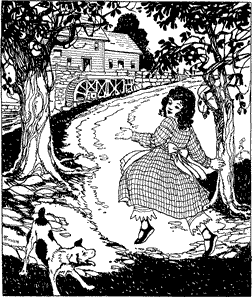 TOM’S COMING HOME!
As at last the sobs were getting quieter, and the grinding less fierce,
a sudden beam of sunshine, falling through the wire lattice across the
worm-eaten shelves, made her throw away the Fetish and run to the
window. The sun was really breaking out; the sound of the mill seemed
cheerful again; the granary doors were open; and there was Yap, the
queer white-and-brown terrier, with one ear turned back, trotting about
and sniffing vaguely, as if he were in search of a companion. It was
irresistible.
Maggie tossed her hair back and ran downstairs, seized her bonnet
without putting it on, peeped, and then dashed along the passage lest
she should encounter her mother, and was quickly out in the yard,
whirling around like a Pythoness, and singing as she whirled, “Yap, Yap,
Tom’s coming home!” while Yap danced and barked round her, as much as to
say, if there was any noise wanted he was the dog for it.
“Hegh, hegh, Miss! you’ll make yourself giddy, an’ tumble down i’ the
dirt,” said Luke, the head miller, a tall, broad-shouldered man of
forty, black-haired, subdued by a general mealiness, like an auricula.
Maggie paused in her whirling and said, staggering a little, “Oh no, it
doesn’t make me giddy, Luke; may I go into the mill with you?”
Maggie loved to linger in the great spaces of the mill, and often came
out with her black hair powdered to a soft whiteness that made her dark
eyes flash out with new fire. The resolute din, the unresting motion of
the great stones, giving her a dim, delicious awe as at the presence of
an uncontrollable force; the meal forever pouring, pouring; the fine
white powder softening all surfaces, and making the very spider-nets
look like a fairy lace-work; the sweet, pure scent of the meal,—all
helped to make Maggie feel that the mill was a little world apart from
her outside everyday life. She was in the habit of taking this
recreation as she conversed with Luke, to whom she was very
communicative, wishing him to think well of her understanding, as her
father did.
Perhaps she felt it necessary to recover her position with him on the
present occasion, for, as she sat sliding on the heap of grain near
which he was busying himself, she said, at that shrill pitch which was
requisite in mill-society,—
“I think you never read any book but the Bible, did you, Luke?”
“Nay, Miss, an’ not much o’ that,” said Luke, with great frankness. “I’m
no reader, I aren’t.”
“But if I lent you one of my books, Luke? I’ve got many very pretty
books that would be easy for you to read; but there’s ‘Pug’s Tour of
Europe,’—that would tell you all about the different sorts of people in
the world, and if you didn’t understand the reading, the pictures would
help you; they show the looks and ways of the people and what they do.
There are the Dutchmen, very fat, and smoking, you know, and one sitting
on a barrel.”
“Nay, Miss, I’n no opinion o’ Dutchmen. There ben’t much good i’ knowin’
about them.”
“But they’re our fellow-creatures, Luke; we ought to know about
our fellow-creatures.”
“Not much o’ fellow-creatures, I think, Miss; all I know—my old master,
as war a knowin’ man, used to say, says he, ‘If e’er I sow my wheat
wi’out brinin’, I’m a Dutchman,’ says he; an’ that war as much as to say
a Dutchman war a fool, or next door.
“Nay, nay, I aren’t goin’ to bother mysen about Dutchmen. There’s fools
enoo, an’ rogues enoo, wi’out lookin’ i’ books for ’em.”
“Oh, well,” said Maggie, rather foiled by Luke’s unexpectedly decided
views about Dutchmen, “perhaps you would like ‘Animated Nature’ better;
that’s not Dutchmen, you know, but elephants and kangaroos, and the
civet cat, and the sunfish, and a bird sitting on its tail,—I forgot
its name. There are countries full of those creatures, instead of horses
and cows, you know. Shouldn’t you like to know about them, Luke?”
“Nay, Miss, I’n got to keep count o’ the flour an’ corn; I can’t do wi’
knowin’ so many things beside my work. That’s what brings folks to the
gallows,—knowin’ everything but what they’n got to get their bread by.
An’ they’re mostly lies, I think, what’s printed i’ the books: them
printed sheets are, anyhow, as the men cry i’ the streets.”
“Why, you’re like my brother Tom, Luke,” said Maggie, wishing to turn
the conversation agreeably; “Tom’s not fond of reading. I love Tom so
dearly, Luke,—better than anybody else in the world. When he grows up I
shall keep his house, and we shall always live together. I can tell him
everything he doesn’t know. But I think Tom’s clever, for all he doesn’t
like books; he makes beautiful whipcord and rabbit pens.”
“Ah,” said Luke, “but he’ll be fine an’ vexed, as the rabbits are all
dead.”
“Dead!” screamed Maggie, jumping up from her sliding seat on the corn.
“Oh dear, Luke! What! the lop-eared one, and the spotted doe that Tom
spent all his money to buy?”
“As dead as moles,” said Luke, fetching his comparison from the
unmistakable corpses nailed to the stable wall.
“Oh, Luke,” said Maggie in a piteous tone, “Tom told me to be sure and
remember the rabbits every day; but how could I, when they didn’t come
into my head, you know? Oh, he will be so angry with me, I know he will,
and so sorry about his rabbits, and so am I sorry. Oh, what shall I
do?”
“Don’t you fret, Miss,” said Luke, soothingly; “they’re nash things,
them lop-eared rabbits; they’d happen ha’ died, if they’d been fed.
Things out o’ natur niver thrive: God A’mighty doesn’t like ’em. He made
the rabbits’ ears to lie back, an’ it’s nothin’ but contrairiness to
make ’em hing down like a mastiff dog’s. Master Tom ’ull know better nor
buy such things another time. Don’t you fret, Miss. Will you come along
home wi’ me, and see my wife? I’m a-goin’ this minute.”
The invitation offered an agreeable distraction to Maggie’s grief, and
her tears gradually subsided as she trotted along by Luke’s side to his
pleasant cottage, which stood with its apple and pear trees, and with
the added dignity of a lean-to pigsty, at the other end of the Mill
fields.
Tom was to arrive early in the afternoon, and there was another
fluttering heart besides Maggie’s when it was late enough for the sound
of the gig wheels to be expected; for if Mrs. Tulliver had a strong
feeling, it was fondness for her boy. At last the sound came,—that
quick light bowling of the gig wheels,—and in spite of the wind, which
was blowing the clouds about, and was not likely to respect Mrs.
Tulliver’s curls and cap-strings, she came outside the door and even
held her hand on Maggie’s offending head, forgetting all the griefs of
the morning.
“There he is, my sweet lad! But, Lord ha’ mercy! he’s got never a collar
on; it’s been lost on the road, I’ll be bound, and spoilt the set.”
Mrs. Tulliver stood with her arms open; Maggie jumped first on one leg
and then on the other; while Tom descended from the gig, and said, with
masculine reticence as to the tender emotions. “Hallo! Yap—what! are
you there?”
Nevertheless he submitted to be kissed willingly enough, though Maggie
hung on his neck in rather a strangling fashion, while his blue-gray
eyes wandered toward the croft and the lambs and the river, where he
promised himself that he would begin to fish the first thing tomorrow
morning. He was one of those lads that grow everywhere in England, and
at twelve or thirteen years of age look as much alike as goslings,—a
lad with light-brown hair, cheeks of cream and roses, full lips,
indeterminate nose and eyebrows,—face in which it seems impossible to
see anything but boyhood; as different as possible from poor Maggie’s
phiz, which Nature seemed to have moulded and colored with the most
decided intention. But that same Nature has the deep cunning which hides
itself under the appearance of openness, so that simple people think
they can see through her quite well, and all the while she is secretly
preparing a refutation of their confident prophecies. Under these
average boyish physiognomies that she seems to turn off by the gross,
she conceals some of her most unmodified characters; and the dark-eyed,
demonstrative, rebellious girl may after all turn out to be a passive
being compared with this pink-and-white bit of masculinity with the
indeterminate features.
“Maggie,” said Tom, confidentially, taking her into a corner, as soon as
his mother was gone out to examine his box, and the warm parlor had
taken off the chill he had felt from the long drive, “you don’t know
what I’ve got in my pockets,” nodding his head up and down as a means
of rousing her sense of mystery.
“No,” said Maggie. “How stodgy they look, Tom! Is it marls (marbles) or
cobnuts?” Maggie’s heart sank a little, because Tom always said it was
“no good” playing with her at those games, she played so badly.
“Marls! no; I’ve swopped all my marls with the little fellows, and
cobnuts are no fun, you silly, only when the nuts are green. But see
here!” He drew something half out of his righthand pocket.
“What is it?” said Maggie, in a whisper. “I can see nothing but a bit of
yellow.”
“Why, it’s—a—new—guess, Maggie!”
“Oh, I can’t guess, Tom,” said Maggie, impatiently.
“Don’t be a spitfire, else I won’t tell you,” said Tom, thrusting his
hand back into his pocket and looking determined.
“No, Tom,” said Maggie, imploringly, laying hold of the arm that was
held stiffly in the pocket. “I’m not cross, Tom; it was only because I
can’t bear guessing. Please be good to me.”
Tom’s arm slowly relaxed, and he said, “Well, then, it’s a new fish
line—two new uns,—one for you, Maggie, all to yourself. And here’s
hooks; see here—I say, won’t we go and fish to-morrow down by the
Round Pool? And you shall catch your own fish, Maggie, and put the worms
on, and everything; won’t it be fun?”
Maggie’s answer was to throw her arms round Tom’s neck and hug him, and
hold her cheek against his without speaking, while he slowly unwound
some of the line, saying, after a pause,—
“Wasn’t I a good brother, now, to buy you a line all to yourself? You
know, I needn’t have bought it, if I hadn’t liked.”
“Yes, very, very good—I do love you, Tom.” Tom had put the line back
in his pocket, and was looking at the hooks one by one, before he spoke
again.
“And the fellows fought me, because I wouldn’t give in about the
toffee.”
“Oh, dear! I wish they wouldn’t fight at your school, Tom. Didn’t it
hurt you?”
“Hurt me? no,” said Tom, putting up the hooks again, taking out a large
pocketknife, and slowly opening the largest blade, which he looked at
meditatively as he rubbed his finger along it. Then he added,—
“I gave Spouncer a black eye, I know; that’s what he got by wanting to
leather me; I wasn’t going to go halves because anybody leathered me.”
“Oh, how brave you are, Tom! I think you’re like Samson. If there came a
lion roaring at me, I think you’d fight him, wouldn’t you, Tom?”
“How can a lion come roaring at you, you silly thing? There’s no lions,
only in the shows.”
“No, but if we were in the lion countries—I mean Africa, where it’s
very hot; the lions eat people there. I can show it you in the book
where I read it.”
“Well, I should get a gun and shoot him.”
“But if you hadn’t got a gun,—we might have gone out, you know, not
thinking, just as we go fishing; and then a great lion might run toward
us roaring, and we couldn’t get away from him. What should you do, Tom?”
Tom paused, and at last turned away contemptuously, saying, “But the
lion isn’t coming. What’s the use of talking?”
“But I like to fancy how it would be,” said Maggie, following him, “Just
think what you would do, Tom.”
“Oh, don’t bother, Maggie! you’re such a silly. I shall go and see my
rabbits.”
Maggie’s heart began to flutter with fear. She dared not tell the sad
truth at once, but she walked after Tom in trembling silence as he went
out, thinking how she could tell him the news so as to soften at once
his sorrow and his anger; for Maggie dreaded Tom’s anger of all things;
it was quite different anger from her own.
“Tom,” she said, timidly, when they were out of doors, “how much money
did you give for your rabbits?”
“Two half-crowns and a sixpence,” said Tom, promptly.
“I think I’ve got a great deal more than that in my steel purse
upstairs. I’ll ask mother to give it you.”
“What for?” said Tom. “I don’t want your money, you silly thing. I’ve
got a great deal more money than you, because I’m a boy. I always have
half-sovereigns and sovereigns for my Christmas boxes because I shall be
a man, and you have only five-shilling pieces, because you’re only a
girl.”
“Well, but, Tom—if mother would let me give you two half-crowns and a
sixpence out of my purse to put into your pocket and spend, you know,
and buy some more rabbits with it?”
“More rabbits? I don’t want any more.”
“Oh, but, Tom, they’re all dead.”
Tom stopped in his walk and turned round toward Maggie. “You forgot to
feed ’em, then?” he said, his color heightening for a moment, but soon
subsiding. “I don’t love you, Maggie. You shan’t go fishing with me
tomorrow. I told you to go and see the rabbits every day.” He walked on
again.
“Yes, but I forgot—and I couldn’t help it, indeed, Tom. I’m so very
sorry,” said Maggie, while the tears rushed fast.
“You’re a naughty girl,” said Tom, severely, “and I’m sorry I bought you
the fish line. I don’t love you.”
“Oh, Tom, it’s very cruel,” sobbed Maggie. “I’d forgive you, if you
forgot anything—I wouldn’t mind what you did—I’d forgive you and love
you.”
“Yes, you’re a silly; but I never do forget things, I don’t.”
“Oh, please forgive me, Tom; my heart will break,” said Maggie, shaking
with sobs, clinging to Tom’s arm, and laying her wet cheek on his
shoulder.
Tom shook her off, and stopped again, saying in a peremptory tone, “Now,
Maggie, you just listen. Aren’t I a good brother to you?”
“Ye-ye-es,” sobbed Maggie, her chin rising and falling convulsedly.
“Didn’t I think about your fish line all this quarter, and mean to buy
it, and saved my money o’ purpose, and wouldn’t go halves in the toffee,
and Spouncer fought me because I wouldn’t?”
“Ye-ye-es—and I—lo-lo-love you so, Tom.”
“But you’re a naughty girl. Last holidays you licked the paint off my
lozenge box, and the holidays before that you let the boat drag my fish
line down when I’d set you to watch it, and you pushed your head through
my kite, all for nothing.”
“But I didn’t mean,” said Maggie; “I couldn’t help it.”
“Yes, you could,” said Tom, “if you’d minded what you were doing. And
you’re a naughty girl, and you sha’n’t go fishing with me to-morrow.”
With this terrible conclusion, Tom ran away from Maggie toward the mill.
Maggie stood motionless, except from her sobs, for a minute or two; then
she turned round and ran into the house, and up to her attic, where she
sat on the floor and laid her head against the worm-eaten shelf, with a
crushing sense of misery. Tom was come home, and she had thought how
happy she should be; and now he was cruel to her. What use was anything
if Tom didn’t love her? Oh, he was very cruel! Hadn’t she wanted to give
him the money, and said how very sorry she was? She knew she was naughty
to her mother, but she had never been naughty to Tom—had never meant
to be naughty to him.
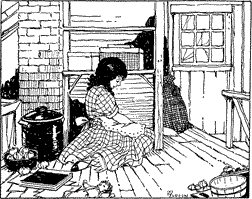 “OH, HE IS CRUEL!”
“Oh, he is cruel!” Maggie sobbed aloud, finding a wretched pleasure in
the hollow resonance that came through the long empty space of the
attic. She never thought of beating or grinding her Fetish; she was too
miserable to be angry.
These bitter sorrows of childhood! when sorrow is all new and strange,
when hope has not yet got wings to fly beyond the days and weeks, and
the space from summer to summer seems measureless.
Maggie soon thought she had been hours in the attic, and it must be tea
time, and they were all having their tea, and not thinking of her. Well,
then, she would stay up there and starve herself,—hide herself behind
the tub, and stay there all night,—and then they would all be
frightened, and Tom would be sorry. Thus Maggie thought in the pride of
her heart, as she crept behind the tub; but presently she began to cry
again at the idea that they didn’t mind her being there. If she went
down again to Tom now—would he forgive her? Perhaps her father would be
there, and he would take her part. But then she wanted Tom to forgive
her because he loved her, not because his father told him. No, she would
never go down if Tom didn’t come to fetch her. This resolution lasted in
great intensity for five dark minutes behind the tub; but then the need
of being loved—the strongest need in poor Maggie’s nature—began to
wrestle with her pride, and soon threw it. She crept from behind the tub
into the twilight of the long attic, but just then she heard a quick
footstep on the stairs.
Tom had been too much interested in his talk with Luke, in going the
round of the premises, walking in and out where he pleased, and
whittling sticks without any particular reason,—except that he didn’t
whittle sticks at school,—to think of Maggie and the effect his anger
had produced on her. He meant to punish her, and that business having
been performed, he occupied himself with other matters, like a practical
person. But when he had been called in to tea, his father said, “Why,
where’s the little wench?” and Mrs. Tulliver, almost at the same
moment, said, “Where’s your little sister?”—both of them having
supposed that Maggie and Tom had been together all the afternoon.
“I don’t know,” said Tom. He didn’t want to “tell” of Maggie, though he
was angry with her; for Tom Tulliver was a lad of honor.
“What! hasn’t she been playing with you all this while?” said the
father. “She’d been thinking o’ nothing but your coming home.”
“I haven’t seen her this two hours,” says Tom, commencing on the
plumcake.
“Goodness heart! she’s got drownded!” exclaimed Mrs. Tulliver, rising
from her seat and running to the window. “How could you let her do so?”
she added, as became a fearful woman, accusing she didn’t know whom of
she didn’t know what.
“Nay, nay, she’s none drownded,” said Mr. Tulliver. “You’ve been naughty
to her, I doubt, Tom?”
“I’m sure I haven’t, father,” said Tom indignantly. “I think she’s in
the house.”
“Perhaps up in that attic,” said Mrs. Tulliver, “a-singing and talking
to herself, and forgetting all about meal times.”
“You go and fetch her down, Tom,” said Mr. Tulliver, rather
sharply,—his perspicacity or his fatherly fondness for Maggie making
him suspect that the lad had been hard upon “the little un,” else she
would never have left his side. “And be good to her, do you hear? Else
I’ll let you know better.”
Tom never disobeyed his father, for Mr. Tulliver was a peremptory man,
and, as he said, would never let anybody get hold of his whip hand; but
he went out rather sullenly, carrying his piece of plumcake, and not
intending to reprieve Maggie’s punishment, which was no more than she
deserved. Tom was only thirteen, and had no decided views in grammar and
arithmetic, regarding them for the most part as open questions, but he
was particularly clear and positive on one point,—namely, that he would
punish everybody who deserved it. Why, he wouldn’t have minded being
punished himself if he deserved it; but, then, he never did deserve
it.
It was Tom’s step, then, that Maggie heard on the stairs, when her need
of love had triumphed over her pride, and she was going down with her
swollen eyes and dishevelled hair to beg for pity. At least her father
would stroke her head and say, “Never mind, my wench.” It is a wonderful
subduer, this need of love,—this hunger of the heart,—as peremptory as
that other hunger by which Nature forces us to submit to the yoke, and
change the face of the world.
But she knew Tom’s step, and her heart began to beat violently with the
sudden shock of hope. He only stood still at the top of the stairs and
said, “Maggie, you’re to come down.” But she rushed to him and clung
around his neck, sobbing, “Oh, Tom, please forgive me—I can’t bear
it—I will always be good—always remember things—do love me—please,
dear Tom!”
We learn to restrain ourselves as we get older. We keep apart when we
have quarreled, express ourselves in well-bred phrases, and in this way
preserve a dignified alienation, showing much firmness on one side, and
swallowing much grief on the other. We no longer approximate in our
behavior to the mere impulsiveness of the lower animals, but conduct
ourselves in every respect like members of a highly civilized society.
Maggie and Tom were still very much like young animals, and so she could
rub her cheek against his, and kiss his ear in a random sobbing way; and
there were tender fibres in the lad that had been used to answer to
Maggie’s fondling, so that he behaved with a weakness quite inconsistent
with his resolution to punish her as much as she deserved. He actually
began to kiss her in return, and say,—
“Don’t cry, then, Magsie; here, eat a bit o’ cake.”
Maggie’s sobs began to subside, and she put out her mouth for the cake
and bit a piece; and then Tom bit a piece, just for company, and they
ate together and rubbed each other’s cheeks and brows and noses
together, while they ate, with a humiliating resemblance to two friendly
ponies.
“Come along, Magsie, and have tea,” said Tom at last, when there was no
more cake except what was downstairs.
So ended the sorrows of this day, and the next morning Maggie was
trotting with her own fishing rod in one hand and a handle of the basket
in the other, stepping always, by a peculiar gift, in the muddiest
places, and looking darkly radiant from under her beaver-bonnet because
Tom was good to her. She had told Tom, however, that she should like him
to put the worms on the hook for her, although she accepted his word
when he assured her that worms couldn’t feel (it was Tom’s private
opinion that it didn’t much matter if they did). He knew all about
worms, and fish, and those things; and what birds were mischievous, and
how padlocks opened, and which way the handles of the gates were to be
lifted. Maggie thought this sort of knowledge was very wonderful,—much
more difficult than remembering what was in the books; and she was
rather in awe of Tom’s superiority, for he was the only person who
called her knowledge “stuff,” and did not feel surprised at her
cleverness. Tom, indeed, was of opinion that Maggie was a silly little
thing; all girls were silly,—they couldn’t throw a stone so as to hit
anything, couldn’t do anything with a pocketknife, and were frightened
at frogs. Still, he was very fond of his sister, and meant always to
take care of her, make her his housekeeper, and punish her when she did
wrong.
They were on their way to the Round Pool,—that wonderful pool, which
the floods had made a long while ago. No one knew how deep it was; and
it was mysterious, too, that it should be almost a perfect round, framed
in with willows and tall reeds, so that the water was only to be seen
when you got close to the brink. The sight of the old favorite spot
always heightened Tom’s good humor, and he spoke to Maggie in the most
amicable whispers, as he opened the precious basket and prepared their
tackle. He threw her line for her, and put the rod into her hand. Maggie
thought it probable that the small fish would come to her hook, and the
large ones to Tom’s. But she had forgotten all about the fish, and was
looking dreamily at the glassy water, when Tom said, in a loud whisper,
“Look, look, Maggie!” and came running to prevent her from snatching her
line away.
Maggie was frightened lest she had been doing something wrong, as usual,
but presently Tom drew out her line and brought a large tench bouncing
on the grass.
Tom was excited.
“O Maggie, you little duck! Empty the basket.”
Maggie was not conscious of unusual merit, but it was enough that Tom
called her Magsie, and was pleased with her. There was nothing to mar
her delight in the whispers and the dreamy silences, when she listened
to the light dipping sounds of the rising fish, and the gentle rustling,
as if the willows and the reeds and the water had their happy whispering
also. Maggie thought it would make a very nice heaven to sit by the pool
in that way, and never be scolded. She never knew she had a bite till
Tom told her; but she liked fishing very much.
On Wednesday, the day before the aunts and uncles were coming, there
were such various and suggestive scents, as of plumcakes in the oven and
jellies in the hot state, mingled with the aroma of gravy, that it was
impossible to feel altogether gloomy; there was hope in the air. Tom and
Maggie made several inroads into the kitchen, and, like other marauders,
were induced to keep aloof for a time only by being allowed to carry
away a sufficient load of booty.
“Tom,” said Maggie, as they sat on the boughs of the elder-tree, eating
their jam-puffs, “shall you run away to-morrow?”
“No,” said Tom, slowly, when he had finished his puff, and was eyeing
the third, which was to be divided between them,—“no, I sha’n’t.”
“Why, Tom? Because Lucy’s coming?”
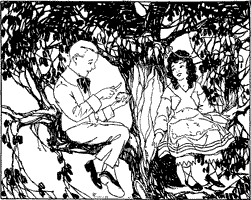 “IS IT THE TIPSY-CAKE, THEN?”
“No,” said Tom, opening his pocketknife and holding it over the puff,
with his head on one side in a dubitative manner. (It was a difficult
problem to divide that very irregular polygon into two equal parts.)
“What do I care about Lucy? She’s only a girl,—she can’t play at
bandy.”
“Is it the tipsy-cake, then?” said Maggie, exerting her hypothetic
powers, while she leaned forward toward Tom with her eyes fixed on the
hovering knife. “No, you silly, that’ll be good the day after. It’s the
pudden. I know what’s the pudden’s to be,—apricot roll-up—O my
buttons!”
With this interjection, the knife descended on the puff, and it was in
two, but the result was not satisfactory to Tom, for he still eyed the
halves doubtfully. At last he said,—
“Shut your eyes, Maggie.”
“What for?”
“You never mind what for. Shut ’em when I tell you.”
Maggie obeyed.
“Now, which’ll you have, Maggie,—right hand or left?
“I’ll have that with the jam run out,” said Maggie, keeping her eyes
shut to please Tom.
“Why, you don’t like that, you silly. You may have it if it comes to you
fair, but I sha’n’t give it you without. Right or left,—you choose,
now. Ha-a-a!” said Tom, in a tone of exasperation, as Maggie peeped.
“You keep your eyes shut, now, else you sha’n’t have any.”
Maggie’s power of sacrifice did not extend so far; indeed, I fear she
cared less that Tom should enjoy the utmost possible amount of puff,
than that he should be pleased with her for giving him the best bit. So
she shut her eyes close, till Tom told her to “say which,” and then she
said, “Left hand.”
“You’ve got it,” said Tom, in rather a bitter tone.
“What! the bit with the jam run out?”
“No; here, take it,” said Tom, firmly, handing decidedly the best piece
to Maggie.
“Oh, please, Tom, have it; I don’t mind—I like the other; please take
this.”
“No, I sha’n’t,” said Tom, almost crossly, beginning on his own inferior
piece.
Maggie, thinking it was no use to contend further, began too, and ate up
her half puff with considerable relish as well as rapidity. But Tom had
finished first, and had to look on while Maggie ate her last morsel or
two, feeling in himself a capacity for more. Maggie didn’t know Tom was
looking at her; she was see-sawing on the elder bough, lost to almost
everything but a vague sense of jam and idleness.
“Oh, you greedy thing!” said Tom, when she had swallowed the last
morsel. He was conscious of having acted very fairly, and thought she
ought to have considered this, and made up to him for it. He would have
refused a bit of hers beforehand, but one is naturally at a different
point of view before and after one’s own share of puff is swallowed.
Maggie turned quite pale. “Oh, Tom, why didn’t you ask me?”
“I wasn’t going to ask you for a bit, you greedy. You might have thought
of it without, when you knew I gave you the best bit.”
“But I wanted you to have it; you know I did,” said Maggie, in an
injured tone.
“Yes, but I wasn’t going to do what wasn’t fair. If I go halves, I’ll go
’em fair; only I wouldn’t be a greedy.”
With this cutting innuendo, Tom jumped down from his bough, and threw a
stone with a “hoigh!” as a friendly attention to Yap, who had also been
looking on while the eatables vanished, with an agitation of his ears
and feelings which could hardly have been without bitterness. Yet the
excellent dog accepted Tom’s attention with as much alacrity as if he
had been treated quite generously.
But Maggie, gifted with that superior power of misery which
distinguishes the human being, and places him at a proud distance from
the most melancholy chimpanzee, sat still on her bough, and gave herself
up to the keen sense of unmerited reproach. She would have given the
world not to have eaten all her puff, and to have saved some of it for
Tom. Not but that the puff was very nice, for Maggie’s palate was not at
all obtuse, but she would have gone without it many times over, sooner
than Tom should call her greedy and be cross with her. And he had said
he wouldn’t have it, and she ate it without thinking; how could she help
it? The tears flowed so plentifully that Maggie saw nothing around her
for the next ten minutes; but by that time resentment began to give way
to the desire of reconciliation, and she jumped from her bough to look
for Tom. He was no longer in the paddock behind the rickyard; where was
he likely to be gone, and Yap with him? Maggie ran to the high bank
against the great holly tree, where she could see far away toward the
Floss.
There was Tom; but her heart sank again as she saw how far he was on his
way to the great river, and that he had another companion besides
Yap,—naughty Bob Jakin, whose official, if not natural, function of
frightening the birds was just now at a standstill.
Well! there was no hope for it; he was gone now, and Maggie could think
of no comfort but to sit down by the hollow, or wander by the hedgerow,
and fancy it was all different, refashioning her little world into just
what she should like it to be.
Maggie had thrown her bonnet off very carelessly, and coming in with her
hair rough as well as out of curl, rushed at once to Lucy, who was
standing by her mother’s knee. Certainly the contrast between the
cousins was conspicuous. It was like the contrast between a rough, dark,
overgrown puppy and a white kitten. Lucy put up the neatest little
rosebud mouth to be kissed; everything about her was neat—her little
round neck, with the row of coral beads; her little straight nose, not
at all snubby; her little clear eyebrows, rather darker than her curls,
to match her hazel eyes, which looked up with shy pleasure at Maggie,
taller by the head, though scarcely a year older. Maggie always looked
at Lucy with delight. She was fond of fancying a world where the people
never got any larger than children of their own age, and she made the
queen of it just like Lucy, with a little crown on her head, and a
little sceptre in her hand—only the queen was Maggie herself in Lucy’s
form.
“Oh, Lucy,” she burst out, after kissing her, “you’ll stay with Tom and
me, won’t you? Oh, kiss her, Tom.”
Tom, too, had come up to Lucy, but he was not going to kiss her—no; he
came up to her with Maggie, because it seemed easier, on the whole, than
saying, “How do you do?” to all those aunts and uncles. He stood looking
at nothing in particular, with the blushing, awkward air and semi-smile
which are common to shy boys when in company,—very much as if they had
come into the world by mistake, and found it in a degree of undress that
was quite embarrassing.
“Maggie,” said Mrs. Tulliver, beckoning Maggie to her, and whispering in
her ear, as soon as this point of Lucy’s staying was settled, “go and
get your hair brushed. I told you not to come in without going to Martha
first; you know I did.”
“Tom, come out with me,” whispered Maggie, pulling his sleeve as she
passed him; and Tom followed willingly enough.
“Come upstairs with me, Tom,” she whispered, when they were outside the
door. “There’s something I want to do before dinner.”
“There’s no time to play at anything before dinner,” said Tom, whose
imagination was impatient of any intermediate prospect.
“Oh yes, there is time for this; do come, Tom.”
Tom followed Maggie upstairs into her mother’s room, and saw her go at
once to a drawer, from which she took out a large pair of scissors.
“What are they for, Maggie?” said Tom, feeling his curiosity awakened.
Maggie answered by seizing her front locks and cutting them straight
across the middle of her forehead.
“Oh, my buttons! Maggie, you’ll catch it!” exclaimed Tom; “you’d better
not cut any more off.”
Snip! went the great scissors again while Tom was speaking, and he
couldn’t help feeling it was rather good fun; Maggie would look so
queer.
“Here, Tom, cut it behind for me,” said Maggie, excited by her own
daring, and anxious to finish the deed.
“You’ll catch it, you know,” said Tom, nodding his head in an admonitory
manner, and hesitating a little as he took the scissors.
“Never mind, make haste!” said Maggie, giving a little stamp with her
foot. Her cheeks were quite flushed.
The black locks were so thick, nothing could be more tempting to a lad
who had already tasted the forbidden pleasure of cutting the pony’s
mane. I speak to those who know the satisfaction of making a pair of
shears meet through a duly resisting mass of hair. One delicious
grinding snip, and then another and another, and the hinder locks fell
heavily on the floor, and Maggie stood cropped in a jagged, uneven
manner, but with a sense of clearness and freedom, as if she had emerged
from a wood into the open plain.
“Oh, Maggie,” said Tom, jumping round her, and slapping his knees as he
laughed, “Oh, my buttons! what a queer thing you look! Look at yourself
in the glass; you look like the idiot we throw out nutshells to at
school.”
Maggie felt an unexpected pang. She had thought beforehand chiefly of
her own deliverance from her teasing hair and teasing remarks about it,
and something also of the triumph she should have over her mother and
her aunts by this very decided course of action; she didn’t want her
hair to look pretty,—that was out of the question,—she only wanted
people to think her a clever little girl, and not to find fault with
her. But now, when Tom began to laugh at her, and say she was like the
idiot, the affair had quite a new aspect. She looked in the glass, and
still Tom laughed and clapped his hands, and Maggie’s flushed cheeks
began to pale, and her lips to tremble a little.
“Oh, Maggie, you’ll have to go down to dinner directly,” said Tom. “Oh,
my!”
“Don’t laugh at me, Tom,” said Maggie, in a passionate tone, with an
outburst of angry tears, stamping, and giving him a push.
“Now, then, spitfire!” said Tom. “What did you cut it off for, then? I
shall go down: I can smell the dinner going in.”
He hurried downstairs and left poor Maggie to that bitter sense of the
irrevocable which was almost an everyday experience of her small soul.
She could see clearly enough, now the thing was done, that it was very
foolish, and that she should have to hear and think more about her hair
than ever; for Maggie rushed to her deeds with passionate impulse, and
then saw not only their consequences, but what would have happened if
they had not been done, with all the detail and exaggerated
circumstances of an active imagination.
“Miss Maggie, you’re to come down this minute,” said Kezia, entering the
room hurriedly. “Lawks! what have you been a-doing? I niver see such a
fright!”
“Don’t, Kezia,” said Maggie, angrily. “Go away!”
“But I tell you you’re to come down, Miss, this minute; your mother says
so,” said Kezia, going up to Maggie and taking her by the hand to raise
her from the floor.
“Get away, Kezia; I don’t want any dinner,” said Maggie, resisting
Kezia’s arm. “I sha’n’t come.”
“Oh, well, I can’t stay. I’ve got to wait at dinner,” said Kezia, going
out again.
“Maggie, you little silly,” said Tom, peeping into the room ten minutes
after, “why don’t you come and have your dinner? There’s lots o’
goodies, and mother says you’re to come. What are you crying for, you
little spooney?”
Oh, it was dreadful! Tom was so hard and unconcerned; if he had been
crying on the floor, Maggie would have cried, too. And there was the
dinner, so nice; and she was so hungry. It was very bitter.
But Tom was not altogether hard. He was not inclined to cry, and did not
feel that Maggie’s grief spoiled his prospect of the sweets; but he went
and put his head near her, and said in a lower, comforting tone,—
“Won’t you come, then, Magsie? Shall I bring you a bit o’ pudding when
I’ve had mine, and a custard and things?”
“Ye-e-es,” said Maggie, beginning to feel life a little more tolerable.
“Very well,” said Tom, going away. But he turned again at the door and
said, “But you’d better come, you know. There’s the dessert,—nuts, you
know, and cowslip wine.”
Maggie’s tears had ceased, and she looked reflective as Tom left her.
His good nature had taken off the keenest edge of her sufferings, and
nuts with cowslip wine began to assert their legitimate influence.
Slowly she rose from amongst her scattered locks, and slowly she made
her way downstairs. Then she stood leaning with one shoulder against
the frame of the dining-parlor door, peeping in when it was ajar. She
saw Tom and Lucy with an empty chair between them, and there were the
custards on a side table; it was too much. She slipped in and went
toward the empty chair. But she had no sooner sat down than she repented
and wished herself back again.
Mrs. Tulliver gave a little scream as she saw her, and felt such a
“turn” that she dropped the large gravy-spoon into the dish, with the
most serious results to the tablecloth. For Kezia had not betrayed the
reason of Maggie’s refusal to come down, not liking to give her mistress
a shock in the moment of carving, and Mrs. Tulliver thought there was
nothing worse in question than a fit of perverseness, which was
inflicting its own punishment by depriving Maggie of half her dinner.
Mrs. Tulliver’s scream made all eyes turn toward the same point as her
own, and Maggie’s cheeks and ears began to burn, while uncle Glegg, a
kind-looking, white-haired old gentleman, said,—
“Heyday! what little gell’s this? Why, I don’t know her. Is it some
little gell you’ve picked up in the road, Kezia?”
“Why, she’s gone and cut her hair herself,” said Mr. Tulliver in an
undertone to Mr. Deane, laughing with much enjoyment. “Did you ever know
such a little hussy as it is?”
“Why, little miss, you’ve made yourself look very funny,” said uncle
Pullet, and perhaps he never in his life made an observation which was
felt to be so lacerating.
“Fie, for shame!” said aunt Glegg, in her loudest, severest tone of
reproof. “Little gells as cut their own hair should be whipped and fed
on bread and water,—not come and sit down with their aunts and uncles.”
“Ay, ay,” said uncle Glegg, meaning to give a playful turn to this
denunciation, “she must be sent to jail, I think, and they’ll cut the
rest of her hair off there, and make it all even.”
“She’s more like a gypsy nor ever,” said aunt Pullet, in a pitying tone;
“it’s very bad luck, sister, as the gell should be so brown; the boy’s
fair enough. I doubt it’ll stand in her way i’ life to be so brown.”
“She’s a naughty child, as’ll break her mother’s heart,” said Mrs.
Tulliver, with the tears in her eyes.
Maggie seemed to be listening to a chorus of reproach and derision. Her
first flush came from anger, which gave her a transient power of
defiance, and Tom thought she was braving it out, supported by the
recent appearance of the pudding and custard. Under this impression, he
whispered, “Oh, my! Maggie, I told you you’d catch it.” He meant to be
friendly, but Maggie felt convinced that Tom was rejoicing in her
ignominy. Her feeble power of defiance left her in an instant, her heart
swelled, and getting up from her chair, she ran to her father, hid her
face on his shoulder, and burst out into loud sobbing.
“Come, come, my wench,” said her father, soothingly, putting his arm
round her, “never mind; you was i’ the right to cut it off if it
plagued you; give over crying; father’ll take your part.”
Delicious words of tenderness! Maggie never forgot any of these moments
when her father “took her part”; she kept them in her heart, and
thought of them long years after, when every one else said that her
father had done very ill by his children.
With the dessert there came entire deliverance for Maggie, for the
children were told they might have their nuts and wine in the
summerhouse, since the day was so mild; and they scampered out among the
building bushes of the garden with the alacrity of small animals getting
from under a burning glass.
While the possible troubles of Maggie’s future were occupying her
father’s mind, she herself was tasting only bitterness of the present.
Childhood has not forebodings; but then, it is soothed by no memories of
out-lived sorrow.
The fact was, the day had begun ill with Maggie. The pleasure of having
Lucy to look at, and the prospect of the afternoon visit to Garum Firs,
where she would hear uncle Pullet’s musical box, had been marred as
early as eleven o’clock by the advent of the hairdresser from Saint
Ogg’s, who had spoken in the severest terms of the condition in which he
had found her hair, holding up one jagged lock after another and saying,
“see here! tut, tut, tut!” in a tone of mingled disgust and pity, which
to Maggie’s imagination was equivalent to the strongest expression of
public opinion. Mr. Rappit, the hairdresser, with his well-anointed
coronal locks tending wavily upward, like the simulated pyramid of flame
on a monumental urn, seemed to her at that moment the most formidable
of her contemporaries, into whose street at Saint Ogg’s she would
carefully refrain from entering through the rest of her life.
Already, at twelve o’clock, Mrs. Tulliver had on her visiting costume,
with a protective apparatus of brown holland, as if she had been a piece
of satin furniture in danger of flies; Maggie was frowning and twisting
her shoulders, that she might if possible shrink away from the
prickliest of tuckers, while her mother was remonstrating, “Don’t,
Maggie, my dear; don’t make yourself so ugly!” and Tom’s cheeks were
looking particularly brilliant as a relief to his best blue suit, which
he wore with becoming calmness, having, after a little wrangling,
effected what was always the one point of interest to him in his toilet:
he had transferred all the contents of his everyday pockets to those
actually in wear.
As for Lucy, she was just as pretty and neat as she had been yesterday;
no accidents ever happened to her clothes, and she was never
uncomfortable in them, so that she looked with wondering pity at Maggie,
pouting and writhing under the exasperating tucker. Maggie would
certainly have torn it off, if she had not been checked by the
remembrance of her recent humiliation about her hair; as it was, she
confined herself to fretting and twisting, and behaving peevishly about
the card houses which they were allowed to build till dinner, as a
suitable amusement for boys and girls in their best clothes. Tom could
build perfect pyramids of houses; but Maggie’s would never bear the
laying on the roof. It was always so with the things that Maggie made;
and Tom had deduced the conclusion that no girls could ever make
anything. But it happened that Lucy proved wonderfully clever at
building; she handled the cards so lightly, and moved so gently, that
Tom condescended to admire her houses as well as his own, the more
readily because she had asked him to teach her. Maggie, too, would have
admired Lucy’s houses, and would have given up her own unsuccessful
building to contemplate them, without ill temper, if her tucker had not
made her peevish, and if Tom had not inconsiderately laughed when her
houses fell, and told her she was “a stupid.”
“Don’t laugh at me, Tom!” she burst out angrily; “I’m not a stupid. I
know a great many things you don’t.”
“Oh, I dare say, Miss Spitfire! I’d never be such a cross thing as you,
making faces like that. Lucy doesn’t do so. I like Lucy better than you;
I wish Lucy was my sister.”
“Then it’s very wicked and cruel of you to wish so,” said Maggie,
starting up hurriedly from her place on the floor, and upsetting Tom’s
wonderful pagoda.
She really did not mean it, but the circumstantial evidence was against
her, and Tom turned white with anger, but said nothing; he would have
struck her, only he knew it was cowardly to strike a girl, and Tom
Tulliver was quite determined he would never do anything cowardly.
Maggie stood in dismay and terror, while Tom got up from the floor and
walked away, pale, from the scattered ruins of his pagoda, and Lucy
looked on mutely, like a kitten pausing from its lapping.
“Oh, Tom,” said Maggie, at last, going halfway toward him, “I didn’t
mean to knock it down,—indeed, indeed I didn’t.”
Tom took no notice of her, but took, instead, two or three hard peas out
of his pocket, and shot them with his thumb-nail against the window,
vaguely at first, but presently with the distinct aim of hitting a
superannuated blue bottle which was exposing its imbecility in the
spring sunshine, clearly against the views of Nature, who had provided
Tom and the peas for the speedy destruction of this weak individual.
Thus the morning had been made heavy to Maggie, and Tom’s persistent
coldness to her all through their walk spoiled the fresh air and
sunshine for her. He called Lucy to look at the half-built bird’s nest
without caring to show it to Maggie, and peeled a willow switch for Lucy
and himself, without offering one to Maggie. Lucy had said, “Maggie,
shouldn’t you like one?” but Tom was deaf.
Still, the sight of the peacock opportunely spreading his tail on the
stackyard wall, just as they reached Garum Firs, was enough to divert
the mind temporarily from personal grievances. And this was only the
beginning of beautiful sights at Garum Firs. All the farmyard life was
wonderful there,—bantams, speckled and topknotted; Friesland hens, with
their feathers all turned the wrong way; Guinea fowls that flew and
screamed and dropped their pretty spotted feathers; pouter pigeons and a
tame magpie; nay, a goat, and a wonderful brindled dog, half mastiff,
half bulldog, as large as a lion. Then there were white railings and
white gates all about, and glittering weathercocks of various design,
and garden walks paved with pebbles in beautiful patterns,—nothing was
quite common at Garum Firs; and Tom thought that the unusual size of the
toads there was simply due to the general unusualness which
characterized uncle Pullet’s possessions as a gentleman farmer. Toads
who paid rent were naturally leaner. As for the house, it was not less
remarkable; it had a receding centre, and two wings with battlemented
turrets, and was covered with glittering white stucco.
The small demons who had taken possession of Maggie’s soul at an earlier
period of the day had returned in all the greater force after a
temporary absence. All the disagreeable recollections of the morning
were thick upon her, when Tom said, “Here, Lucy, you come along with
me,” and walked off to the area where the toads were, as if there were
no Maggie in existence. Seeing this, Maggie lingered at a distance,
looking like a small Medusa with her snakes cropped. Lucy was naturally
pleased that cousin Tom was so good to her, and it was very amusing to
see him tickling a fat toad with a piece of string when the toad was
safe down the area, with an iron grating over him. Still Lucy wished
Maggie to enjoy the spectacle also, especially as she would doubtless
find a name for the toad, and say what had been his past history; for
Lucy had a delighted semi-belief in Maggie’s stories about the live
things they came upon by accident,—how Mrs. Earwig had a wash at home,
and one of her children had fallen into the hot copper, for which reason
she was running so fast to fetch the doctor. Tom had a profound contempt
for this nonsense of Maggie’s, smashing the earwig at once as a
superfluous yet easy means of proving the entire unreality of such a
story; but Lucy, for the life of her, could not help fancying there was
something in it, and at all events thought it was very pretty
make-believe. So now the desire to know the history of a very portly
toad, added to her habitual affectionateness, made her run to Maggie and
say, “Oh, there is such a big, funny toad, Maggie! Do come and see!”
Maggie said nothing, but turned away from her with a deeper frown. As
long as Tom seemed to prefer Lucy to her, Lucy made part of his
unkindness. Maggie would have thought a little while ago that she could
never be cross with pretty little Lucy, any more than she could be cruel
to a little white mouse; but then, Tom had always been quite indifferent
to Lucy before, and it had been left to Maggie to pet and make much of
her. As it was, she was actually beginning to think that she should like
to make Lucy cry by slapping or pinching her, especially as it might vex
Tom, whom it was of no use to slap, even if she dared, because he didn’t
mind it. And if Lucy hadn’t been there, Maggie was sure he would have
got friends with her sooner.
Tickling a fat toad who is not highly sensitive is an amusement that it
is possible to exhaust, and Tom by and by began to look round for some
other mode of passing the time. But in so prim a garden, where they were
not to go off the paved walks, there was not a great choice of sport.
The only great pleasure such a restriction suggested was the pleasure of
breaking it, and Tom began to meditate an insurrectionary visit to the
pond, about a field’s length beyond the garden.
“I say, Lucy,” he began, nodding his head up and down with great
significance, as he coiled up his string again, “what do you think I
mean to do?”
“What, Tom?” said Lucy, with curiosity.
“I mean to go to the pond and look at the pike. You may go with me if
you like,” said the young sultan.
“Oh, Tom, dare you?” said Lucy. “Aunt said we mustn’t go out of the
garden.”
“Oh, I shall go out at the other end of the garden,” said Tom. “Nobody
’ull see us. Besides, I don’t care if they do,—I’ll run off home.”
“But I couldn’t run,” said Lucy, who had never before been exposed to
such severe temptation.
“Oh, never mind; they won’t be cross with you,” said Tom. “You say I
took you.”
Tom walked along, and Lucy trotted by his side, timidly enjoying the
rare treat of doing something naughty,—excited also by the mention of
that celebrity, the pike, about which she was quite uncertain whether it
was a fish or a fowl. Maggie saw them leaving the garden, and could not
resist the impulse to follow. Anger and jealousy can no more bear to
lose sight of their objects than love, and that Tom and Lucy should do
or see anything of which she was ignorant would have been an intolerable
idea to Maggie. So she kept a few yards behind them, unobserved by Tom,
who was presently absorbed in watching for the pike,—a highly
interesting monster; he was said to be so very old, so very large, and
to have such a remarkable appetite. The pike, like other celebrities,
did not show when he was watched for, but Tom caught sight of something
in rapid movement in the water, which attracted him to another spot on
the brink of the pond.
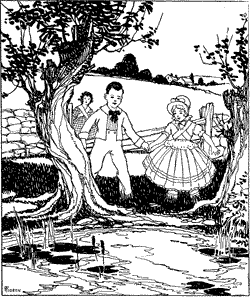 “HERE, LUCY!”
“Here, Lucy!” he said in a loud whisper, “come here! take care! keep on
the grass!—don’t step where the cows have been!” he added, pointing to
a peninsula of dry grass, with trodden mud on each side of it; for
Tom’s contemptuous conception of a girl included the attribute of being
unfit to walk in dirty places.
Lucy came carefully as she was bidden, and bent down to look at what
seemed a golden arrowhead darting through the water. It was a water
snake, Tom told her; and Lucy at last could see the serpentine wave of
its body, very much wondering that a snake could swim. Maggie had drawn
nearer and nearer; she must see it too, though it was bitter to her,
like everything else, since Tom did not care about her seeing it. At
last she was close by Lucy; and Tom, who had been aware of her approach,
but would not notice it till he was obliged, turned round and said,—
“Now, get away, Maggie; there’s no room for you on the grass here.
Nobody asked you to come.”
There were passions at war in Maggie at that moment to have made a
tragedy, if tragedies were made by passion only; the utmost Maggie could
do, with a fierce thrust of her small brown arm, was to push poor little
pink-and-white Lucy into the cow-trodden mud.
Then Tom could not restrain himself, and gave Maggie two smart slaps on
the arm as he ran to pick up Lucy, who lay crying helplessly. Maggie
retreated to the roots of a tree a few yards off, and looked on
impenitently. Usually her repentance came quickly after one rash deed,
but now Tom and Lucy had made her so miserable, she was glad to spoil
their happiness,—glad to make everybody uncomfortable. Why should she
be sorry? Tom was very slow to forgive her, however sorry she might
have been.
“I shall tell mother, you know, Miss Mag,” said Tom, loudly and
emphatically, as soon as Lucy was up and ready to walk away. Lucy was
too entirely absorbed by the evil that had befallen her,—the spoiling
of her pretty best clothes, and the discomfort of being wet and
dirty,—to think much of the cause, which was entirely mysterious to
her. She could never have guessed what she had done to make Maggie angry
with her; but she felt that Maggie was very unkind and disagreeable, and
made no magnanimous entreaties to Tom that he would not “tell,” only
running along by his side and crying piteously, while Maggie sat on the
roots of the tree and looked after them with her small Medusa face.
“Sally,” said Tom, when they reached the kitchen door, and Sally looked
at them in speechless amaze, with a piece of bread-and-butter in her
mouth and a toasting-fork in her hand,—“Sally, tell mother it was
Maggie pushed Lucy into the mud.”
“But Lors ha’ massy, how did you get near such mud as that?” said Sally,
making a wry face, as she stooped down and examined the corpus
delicti.
Tom’s imagination had not been rapid and capacious enough to include
this question among the foreseen consequences, but it was no sooner put
than he foresaw whither it tended, and that Maggie would not be
considered the only culprit in the case. He walked quietly away from the
kitchen door, leaving Sally to that pleasure of guessing which active
minds notoriously prefer to ready-made knowledge.
Sally lost no time in presenting Lucy at the parlor door, for to have so
dirty an object introduced into the house at Garum Firs was too great a
weight to be sustained by a single mind.
“Goodness gracious!” aunt Pullet exclaimed, after preluding by an
inarticulate scream; “keep her at the door, Sally! Don’t bring her off
the oilcloth, whatever you do.”
“Why, she’s tumbled into some nasty mud,” said Mrs. Tulliver, going up
to Lucy to examine into the amount of damage to clothes for which she
felt herself responsible to her sister Deane.
“If you please, ’um, it was Miss Maggie as pushed her in,” said Sally;
“Master Tom’s been and said so, and they must ha’ been to the pond, for
it’s only there they could ha’ got into such dirt.”
“There it is, Bessy; it’s what I’ve been telling you,” said Mrs. Pullet,
in a tone of prophetic sadness; “it’s your children,—there’s no knowing
what they’ll come to.”
Mrs. Tulliver was mute, feeling herself a truly wretched mother. As
usual, the thought pressed upon her that people would think she had done
something wicked to deserve her maternal troubles, while Mrs. Pullet
began to give elaborate directions to Sally how to guard the premises
from serious injury in the course of removing the dirt. Meantime tea was
to be brought in by the cook, and the two naughty children were to have
theirs in an ignominious manner in the kitchen. Mrs. Tulliver went out
to speak to these naughty children, supposing them to be close at hand;
but it was not until after some search that she found Tom leaning with a
careless air against the white paling of the poultry yard, and lowering
his piece of string on the other side as a means of exasperating the
turkey cock.
“Tom, you naughty boy, where’s your sister?” said Mrs. Tulliver, in a
distressed voice.
“I don’t know,” said Tom; his eagerness for justice on Maggie had
diminished since he had seen clearly that it could hardly be brought
about without the injustice of some blame on his own conduct.
“Why, where did you leave her?” said the mother, looking round.
“Sitting under the tree, against the pond,” said Tom, apparently
indifferent to everything but the string and the turkey cock.
“Then go and fetch her in this minute, you naughty boy. And how could
you think o’ going to the pond, and taking your sister where there was
dirt? You know she’ll do mischief if there’s mischief to be done.”
It was Mrs. Tulliver’s way, if she blamed Tom, to refer his misdemeanor,
somehow or other, to Maggie.
The idea of Maggie sitting alone by the pond roused an habitual fear in
Mrs. Tulliver’s mind, and she mounted the horse block to satisfy herself
by a sight of that fatal child, while Tom walked—not very quickly—on
his way toward her.
“They’re such children for the water, mine are,” she said aloud, without
reflecting that there was no one to hear her; “they’ll be brought in
dead and drownded some day. I wish that river was far enough.”
But when she not only failed to discern Maggie, but presently saw Tom
returning from the pool alone, this hovering fear entered and took
complete possession of her, and she hurried to meet him.
“Maggie’s nowhere about the pond, mother,” said Tom; “she’s gone away.”
You may conceive the terrified search for Maggie, and the difficulty of
convincing her mother that she was not in the pond. Mrs. Pullet observed
that the child might come to a worse end if she lived, there was no
knowing; and Mr. Pullet reached down a key to the goose-pen as a likely
place for Maggie to lie concealed in.
Tom, after a while, started the idea that Maggie was gone home, and the
suggestion was seized as a comfort by his mother.
“Sister, for goodness’ sake let ’em put the horse in the carriage and
take me home; we shall perhaps find her on the road. Lucy can’t walk in
her dirty clothes,” she said, looking at that innocent victim, who was
wrapped up in a shawl, and sitting with naked feet on the sofa.
Aunt Pullet was quite willing to take the shortest means of restoring
her premises to order and quiet, and it was not long before Mrs.
Tulliver was in the chaise, looking anxiously at the most distant point
before her. What the father would say if Maggie was lost, was a question
that predominated over every other.
Maggie’s intentions, as usual, were on a larger scale than Tom had
imagined. The resolution that gathered in her mind, after Tom and Lucy
had walked away, was not so simple as that of going home. No! she would
run away and go to the gypsies, and Tom should never see her any more.
That was by no means a new idea to Maggie; she had been so often told
she was like a gypsy, and “half wild,” that when she was miserable it
seemed to her the only way of escaping opprobrium, and being entirely in
harmony with circumstances, would be to live in a little brown tent on
the commons; the gypsies, she considered, would gladly receive her and
pay her much respect on account of her superior knowledge. She had once
mentioned her views on this point to Tom, and suggested that he should
stain his face brown, and they should run away together; but Tom
rejected the scheme with contempt, observing that gypsies were thieves,
and hardly got anything to eat, and had nothing to drive but a donkey.
To-day, however, Maggie thought her misery had reached a pitch at which
gypsydom was her only refuge, and she rose from her seat on the roots of
the tree with the sense that this was a great crisis in her life; she
would run straight away till she came to Dunlow Common, where there
would certainly be gypsies; and cruel Tom, and the rest of her relations
who found fault with her, should never see her any more. She thought of
her father as she ran along, but she reconciled herself to the idea of
parting with him, by determining that she would secretly send him a
letter by a small gypsy, who would run away without telling where she
was, and just let him know that she was well and happy, and always loved
him very much.
Maggie soon got out of breath with running, but by the time Tom got to
the pond again she was at the distance of three long fields, and was on
the edge of the lane leading to the highroad. She stopped to pant a
little, reflecting that running away was not a pleasant thing until one
had got quite to the common where the gypsies were, but her resolution
had not abated; she presently passed through the gate into the lane, not
knowing where it would lead her; for it was not this way that they came
from Dorlcote Mill to Garum Firs, and she felt all the safer for that,
because there was no chance of her being overtaken. But she was soon
aware, not without trembling, that there were two men coming along the
lane in front of her; she had not thought of meeting strangers, she had
been too much occupied with the idea of her friends coming after her.
The formidable strangers were two shabby-looking men with flushed faces,
one of them carrying a bundle on a stick over his shoulder; but to her
surprise, while she was dreading their disapprobation as a runaway, the
man with the bundle stopped, and in a half-whining, half-coaxing tone
asked her if she had a copper to give a poor man. Maggie had a sixpence
in her pocket, which she immediately drew out and gave this poor man
with a polite smile, hoping that he would feel very kindly toward her as
a generous person. “That’s the only money I’ve got,” she said
apologetically. “Thank you, little miss,” said the man, in a less
respectful and grateful tone than Maggie anticipated, and she even
observed that he smiled and winked at his companion. She walked on
hurriedly, but was aware that the two men were standing still, probably
to look after her, and she presently heard them laughing loudly.
Suddenly it occurred to her that they might think she was an idiot; Tom
had said that her cropped hair made her look like an idiot, and it was
too painful an idea to be readily forgotten. Besides, she had no
sleeves on—only a cape and a bonnet. It was clear that she was not
likely to make a favorable impression on passengers, and she thought she
would turn into the fields again.
She turned through the first gate that was not locked, and felt a
delightful sense of privacy in creeping along by the hedgerows, after
her recent humiliating encounter. She was used to wandering about the
fields by herself, and was less timid there than on the highroad.
Sometimes she had to climb over high gates, but that was a small evil;
she was getting out of reach very fast, and she would probably soon come
within sight of Dunlow Common, or at least of some other common, for she
had heard her father say that she couldn’t go very far without coming to
a common. She hoped so, for she was getting rather tired and hungry, and
until she reached the gypsies there was no definite prospect of bread
and butter. It was still broad daylight; so though it was nearly an hour
since Maggie started, there was no gathering gloom on the fields to
remind her that the night would come. Still, it seemed to her that she
had been walking a very great distance indeed, and it was really
surprising that the common did not come within sight.
At last, however, the green fields came to an end, and Maggie found
herself looking through the bars of a gate into a lane with a wide
margin of grass on each side of it. She had never seen such a wide lane
before, and, without her knowing why, it gave her the impression that
the common could not be far off; perhaps it was because she saw a donkey
with a log to his foot feeding on the grassy margin, for she had seen a
donkey with that pitiable encumbrance on Dunlow Common when she had
been across it in her father’s gig. She crept through the bars of the
gate and walked on with new spirit, though not without haunting images
of Apollyon, and a highwayman with a pistol, and a blinking dwarf in
yellow with a mouth from ear to ear, and other miscellaneous dangers.
For poor little Maggie had at once the timidity of an active
imagination, and the daring that comes from over-mastering impulse. She
had rushed into the adventure of seeking her unknown kindred, the
gypsies; and now she was in this strange lane, she hardly dared look on
one side of her, lest she should see the diabolical blacksmith in his
leathern apron grinning at her with arms akimbo. It was not without a
leaping of the heart that she caught sight of a small pair of bare legs
sticking up, feet uppermost, by the side of a hillock; they seemed
something hideously preternatural,—a diabolical kind of fungus; for she
was too much agitated at the first glance to see the ragged clothes and
the dark shaggy head attached to them. It was a boy asleep, and Maggie
trotted along faster and more lightly, lest she should wake him; it did
not occur to her that he was one of her friends the gypsies, who in all
probability would have very genial manners. But the fact was so, for at
the next bend in the lane Maggie actually saw the little semi-circular
black tent with the blue smoke rising before it, which was to be her
refuge from all the blighting obloquy that had pursued her in civilized
life. She even saw a tall female figure by the column of smoke,
doubtless the gypsy-mother, who provided the tea and other groceries; it
was astonishing to herself that she did not feel more delight. But it
was startling to find the gypsies in a lane, after all, and not on a
common; indeed, it was rather disappointing; for a mysterious
illimitable common, where there were sand pits to hide in, and one was
out of everybody’s reach, had always made part of Maggie’s picture of
gypsy life. She went on, however, and thought with some comfort that
gypsies most likely knew nothing about idiots, so there was no danger of
their falling into the mistake of setting her down at the first glance
as an idiot.
It was plain she had attracted attention; for the tall figure, who
proved to be a young woman with a baby on her arm, walked slowly to meet
her. Maggie looked up in the new face rather tremblingly as it
approached, and was reassured by the thought that her aunt Pullet and
the rest were right when they called her a gypsy; for this face, with
the bright dark eyes and the long hair, was really something like what
she used to see in the glass before she cut her hair off.
“My little lady, where are you going to?” the gypsy said, in a tone of
coaxing deference.
It was delightful, and just what Maggie expected; the gypsies saw at
once that she was a little lady, and were prepared to treat her
accordingly.
“Not any farther,” said Maggie, feeling as if she were saying what she
had rehearsed in a dream. “I’m come to stay with you, please.”
“That’s pretty; come, then. Why, what a nice little lady you are, to be
sure!” said the gypsy, taking her by the hand. Maggie thought her very
agreeable, but wished she had not been so dirty.
There was quite a group round the fire when they reached it. An old
gypsy woman was seated on the ground nursing her knees, and occasionally
poking a skewer into the round kettle that sent forth an odorous steam;
two small shock-headed children were lying prone and resting on their
elbows something like small sphinxes; and a placid donkey was bending
his head over a tall girl, who, lying on her back, was scratching his
nose and indulging him with a bite of excellent stolen hay. The slanting
sunlight fell kindly upon them, and the scene was really very pretty and
comfortable, Maggie thought, only she hoped they would soon set out the
teacups. Everything would be quite charming when she had taught the
gypsies to use a washing basin, and to feel an interest in books. It was
a little confusing, though, that the young woman began to speak to the
old one in a language which Maggie did not understand, while the tall
girl, who was feeding the donkey, sat up and stared at her without
offering any salutation. At last the old woman said,—
“What! my pretty lady, are you come to stay with us? Sit ye down and
tell us where you come from.”
It was just like a story; Maggie liked to be called pretty lady and
treated in this way. She sat down and said,—
“I’m come from home because I’m unhappy, and I mean to be a gypsy. I’ll
live with you if you like, and I can teach you a great many things.”
“Such a clever little lady,” said the woman with the baby, sitting down
by Maggie, and allowing baby to crawl; “and such a pretty bonnet and
frock,” she added, taking off Maggie’s bonnet and looking at it while
she made an observation to the old woman, in the unknown language. The
tall girl snatched the bonnet and put it on her own head hind-foremost
with a grin; but Maggie was determined not to show any weakness on this
subject, as if she were susceptible about her bonnet.
“I don’t want to wear a bonnet,” she said; “I’d rather wear a red
handkerchief, like yours” (looking at her friend by her side). “My hair
was quite long till yesterday, when I cut it off; but I dare say it will
grow again very soon,” she added apologetically, thinking it probable
the gypsies had a strong prejudice in favor of long hair. And Maggie had
forgotten even her hunger at that moment in the desire to conciliate
gypsy opinion.
“Oh, what a nice little lady!—and rich, I’m sure,” said the old woman.
“Didn’t you live in a beautiful house at home?”
“Yes, my home is pretty, and I’m very fond of the river, where we go
fishing, but I’m often very unhappy. I should have liked to bring my
books with me, but I came away in a hurry, you know. But I can tell you
almost everything there is in my books, I’ve read them so many times,
and that will amuse you. And I can tell you something about Geography
too—that’s about the world we live in—very useful and interesting. Did
you ever hear about Columbus?”
Maggie’s eyes had begun to sparkle and her cheeks to flush—she was
really beginning to instruct the gypsies, and gaining great influence
over them. The gypsies themselves were not without amazement at this
talk, though their attention was divided by the contents of Maggie’s
pocket, which the friend at her right hand had by this time emptied
without attracting her notice.
“Is that where you live, my little lady?” said the old woman, at the
mention of Columbus.
“Oh, no!” said Maggie, with some pity; “Columbus was a very wonderful
man, who found out half the world, and they put chains on him and
treated him very badly, you know; it’s in my Catechism of Geography, but
perhaps it’s rather too long to tell before tea—I want my tea so.”
The last words burst from Maggie, in spite of herself, with a sudden
drop from patronizing instruction to simple peevishness.
“Why she’s hungry, poor little lady,” said the younger woman. “Give her
some o’ the cold victual. You’re been walking a good way, I’ll be bound,
my dear. Where’s your home?”
“It’s Dorlcote Mill, a good way off,” said Maggie. “My father is Mr.
Tulliver, but we mustn’t let him know where I am, else he’ll fetch me
home again. Where does the queen of the gypsies live?”
“What! do you want to go to her, my little lady?” said the younger
woman. The tall girl meanwhile was constantly staring at Maggie and
grinning. Her manners were certainly not agreeable.
“No,” said Maggie, “I’m only thinking that if she isn’t a very good
queen you might be glad when she died, and you could choose another. If
I was a queen, I’d be a very good queen, and kind to everybody.”
“Here’s a bit o’ nice victual, then,” said the old woman, handing to
Maggie a lump of dry bread, and a piece of cold bacon.
“Thank you,” said Maggie, looking at the food without taking it; “but
will you give me some bread-and-butter and tea instead? I don’t like
bacon.”
“We’ve got no tea nor butter,” said the old woman, with something like a
scowl, as if she were getting tired of coaxing.
“Oh, a little bread and treacle would do,” said Maggie.
“We han’t got no treacle,” said the old woman, crossly, whereupon there
followed a sharp dialogue between the two women in their unknown tongue,
and one of the small sphinxes snatched at the bread and bacon, and began
to eat it. At this moment the tall girl, who had gone a few yards off,
came back, and said something which produced a strong effect. The old
woman, seeming to forget Maggie’s hunger, poked the skewer into the pot
with new vigor, and the younger crept under the tent, and reached out
some platters and spoons. Maggie trembled a little, and was afraid the
tears would come into her eyes. Meanwhile the tall girl gave a shrill
cry, and presently came running up the boy whom Maggie had passed as he
was sleeping,—a rough urchin about the age of Tom. He stared at Maggie,
and there ensued much incomprehensible chattering. She felt very lonely,
and was quite sure she should begin to cry before long; the gypsies
didn’t seem to mind her at all, and she felt quite weak among them. But
the springing tears were checked by new terror, when two men came up,
whose approach had been the cause of the sudden excitement. The elder of
the two carried a bag, which he flung down, addressing the women in a
loud and scolding tone, which they answered by a shower of treble
sauciness; while a black cur ran barking up to Maggie, and threw her
into a tremor that only found a new cause in the curses with which the
younger man called the dog off, and gave him a rap with a great stick he
held in his hand.
Maggie felt that it was impossible she should ever be queen of these
people, or ever communicate to them amusing and useful knowledge.
Both the men now seemed to be inquiring about Maggie, for they looked at
her, and the tone of the conversation became of that pacific kind which
implies curiosity on one side and the power of satisfying it on the
other. At last the younger woman said in her previous deferential,
coaxing tone,—
“This nice little lady’s come to live with us; aren’t you glad?”
“Ay, very glad,” said the younger man, who was looking at Maggie’s
silver thimble and other small matters that had been taken from her
pocket. He returned them all except the thimble to the younger woman,
with some observation, and she immediately restored them to Maggie’s
pocket, while the men seated themselves, and began to attack the
contents of the kettle,—a stew of meat and potatoes,—which had been
taken off the fire and turned out into a yellow platter.
Maggie began to think that Tom must be right about the gypsies; they
must certainly be thieves, unless the man meant to return her thimble by
and by. She would willingly have given it to him, for she was not at all
attached to her thimble; but the idea that she was among thieves
prevented her from feeling any comfort in the revival of deference and
attention toward her; all thieves, except Robin Hood, were wicked
people. The women saw she was frightened.
“We’ve got nothing nice for a lady to eat,” said the old woman, in her
coaxing tone. “And she’s so hungry, sweet little lady.”
“Here, my dear, try if you can eat a bit o’ this,” said the younger
woman, handing some of the stew on a brown dish with an iron spoon to
Maggie, who, remembering that the old woman had seemed angry with her
for not liking the bread and bacon, dared not refuse the stew, though
fear had chased away her appetite. If her father would but come by in
the gig and take her up! Or even if Jack the Giantkiller, or Mr.
Greatheart, or Saint George who slew the dragon on the half-pennies,
would happen to pass that way! But Maggie thought with a sinking heart
that these heroes were never seen in the neighborhood of Saint Ogg’s;
nothing very wonderful ever came there.
Maggie Tulliver, you perceive, was by no means that well-trained,
well-informed young person that a small female of eight or nine
necessarily is in these days; she had only been to school a year at
Saint Ogg’s, and had so few books that she sometimes read the
dictionary; so that in traveling over her small mind you would have
found the most unexpected ignorance as well as unexpected knowledge. She
could have informed you that there was such a word as “polygamy,” and
being also acquainted with “polysyllable,” she had deduced the
conclusion that “poly” meant “many”; but she had had no idea that
gypsies were not well supplied with groceries, and her thoughts were the
oddest mixture of clear-eyed acumen and blind dreams.
Her ideas about the gypsies had undergone a rapid modification in the
last five minutes. From having considered them very respectful
companions, amenable to instruction, she had begun to think that they
meant perhaps to kill her as soon as it was dark, and cut up her body
for gradual cooking; the suspicion crossed her that the fierce-eyed old
man was in fact the Devil, who might drop that transparent disguise at
any moment, and turn either into a grinning blacksmith, or else a
fiery-eyed monster with dragon’s wings. It was no use trying to eat the
stew, and yet the thing she most dreaded was to offend the gypsies, by
betraying her extremely unfavorable opinion of them; and she wondered,
with a keenness of interest that no theologian could have exceeded,
whether, if the Devil were really present, he would know her thoughts.
“What! you don’t like the smell of it, my dear,” said the young woman,
observing that Maggie did not even take a spoonful of the stew. “Try a
bit, come.”
“No, thank you,” said Maggie, summoning all her force for a desperate
effort, and trying to smile in a friendly way. “I haven’t time, I think;
it seems getting darker. I think I must go home now, and come again
another day, and then I can bring you a basket with some jam-tarts and
things.”
Maggie rose from her seat as she threw out this illusory prospect,
devoutly hoping that Apollyon was gullible; but her hope sank when the
old gypsy woman said, “Stop a bit, stop a bit, little lady; we’ll take
you home, all safe, when we’ve done supper; you shall ride home, like a
lady.”
Maggie sat down again, with little faith in this promise, though she
presently saw the tall girl putting a bridle on the donkey, and throwing
a couple of bags on his back.
“Now, then, little missis,” said the younger man, rising, and leading
the donkey forward, “tell us where you live; what’s the name of the
place?”
“Dorlcote Mill is my home,” said Maggie, eagerly. “My father is Mr.
Tulliver; he lives there.”
“What! a big mill a little way this side o’ Saint Ogg’s?”
“Yes,” said Maggie. “Is it far off? I think I should like to walk there,
if you please.”
“No, no, it’ll be getting dark, we must make haste. And the donkey’ll
carry you as nice as can be; you’ll see.”
He lifted Maggie as he spoke, and set her on the donkey. She felt
relieved that it was not the old man who seemed to be going with her,
but she had only a trembling hope that she was really going home.
“Here’s your pretty bonnet,” said the younger woman, putting that
recently despised but now welcome article of costume on Maggie’s head;
“and you’ll say we’ve been very good to you, won’t you? and what a nice
little lady we said you was.”
“Oh yes, thank you,” said Maggie, “I’m very much obliged to you. But I
wish you’d go with me too.” She thought anything was better than going
with one of the dreadful men alone; it would be more cheerful to be
murdered by a larger party.
“Ah, you’re fondest o’ me, aren’t you?” said the woman. “But I can’t
go; you’ll go too fast for me.”
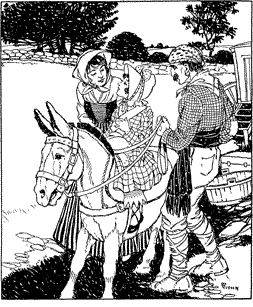 “AH, YOU’RE FONDEST O’ ME, AREN’T YOU?”
It now appeared that the man also was to be seated on the donkey,
holding Maggie before him, and she was as incapable of remonstrating
against this arrangement as the donkey himself, though no nightmare had
ever seemed to her more horrible. When the woman had patted her on the
back and said “Good-bye,” the donkey, at a strong hint from the man’s
stick, set off at a rapid walk along the lane toward the point Maggie
had come from an hour ago, while the tall girl and the rough urchin,
also furnished with sticks, obligingly escorted them for the first
hundred yards, with much screaming and thwacking.
Not Leonore, in that preternatural midnight excursion with her phantom
lover, was more terrified than poor Maggie in this entirely natural ride
on a short-paced donkey, with a gypsy behind her, who considered that he
was earning half-a-crown. The red light of the setting sun seemed to
have a portentous meaning, with which the alarming bray of the second
donkey with the log on its foot must surely have some connection. Two
low thatched cottages—the only houses they passed in this lane—seemed
to add to its dreariness; they had no windows to speak of, and the doors
were closed; it was probable that they were inhabited by witches, and it
was a relief to find that the donkey did not stop there.
At last—oh, sight of joy!—this lane, the longest in the world, was
coming to an end, was opening on a broad highroad, where there was
actually a coach passing! And there was a finger-post at the
corner,—she had surely seen that finger-post before,—“To Saint Ogg’s,
2 miles.” The gypsy really meant to take her home, then; he was probably
a good man, after all, and might have been rather hurt at the thought
that she didn’t like coming with him alone. This idea became stronger as
she felt more and more certain that she knew the road quite well, and
she was considering how she might open a conversation with the injured
gypsy, and not only gratify his feelings, but efface the impression of
her cowardice, when, as they reached a crossroad, Maggie caught sight of
some one coming on a white-faced horse.
“Oh, stop, stop!” she cried out. “There’s my father! Oh, father,
father!”
The sudden joy was almost painful, and before her father reached her,
she was sobbing. Great was Mr. Tulliver’s wonder, for he had made a
round from Basset, and had not yet been home.
“Why, what’s the meaning o’ this?” he said, checking his horse, while
Maggie slipped from the donkey and ran to her father’s stirrup.
“The little miss lost herself, I reckon,” said the gypsy. “She’d come to
our tent at the far end o’ Dunlow Lane, and I was bringing her where she
said her home was. It’s a good way to come after being on the tramp all
day.”
“Oh yes, father, he’s been very good to bring me home,” said Maggie,—“a
very kind, good man!”
“Here, then, my man,” said Mr. Tulliver, taking out five shillings.
“It’s the best day’s work you ever did. I couldn’t afford to lose the
little wench; here, lift her up before me.”
“Why, Maggie, how’s this, how’s this?” he said, as they rode along,
while she laid her head against her father and sobbed. “How came you to
be rambling about and lose yourself?”
“Oh, father,” sobbed Maggie, “I ran away because I was so unhappy; Tom
was so angry with me. I couldn’t bear it.”
“Pooh, pooh,” said Mr. Tulliver, soothingly, “you mustn’t think o’
running away from father. What ’ud father do without his little wench?”
“Oh, no, I never will again, father—never.”
Mr. Tulliver spoke his mind very strongly when he reached home that
evening; and the effect was seen in the remarkable fact that Maggie
never heard one reproach from her mother, or one taunt from Tom, about
this foolish business of her running away to the gypsies. Maggie was
rather awe-stricken by this unusual treatment, and sometimes thought
that her conduct had been too wicked to be alluded to.
Of the three children who are presented to us in these chapters,
Tom, Maggie and little Lucy, which is the most attractive to you?
Do you think the author meant us to receive this impression?
Is Maggie proud? Is she impetuous? Is she highly sensitive? Find as
many passages as you can which prove your answers to these
questions. Do these qualities usually make a person attractive?
What is the mainspring of Maggie’s character—the motive for most
of her actions? Does Tom seem to you worthy of the intense
affection she bestows upon him? Do you think a person with Maggie’s
nature would be likely to live a happy or an unhappy life?
Few writers have ever been able to draw as distinct, lifelike a
picture of a child as we have of Maggie Tulliver in The Mill on
the Floss. This is to be in part accounted for by the fact that it
is herself as a child that George Eliot is describing.