If there were but one kind of literature, it would be an easy matter to
give the few directions that would be necessary to make good readers. In
reality there are, however, several types, so different in their
purpose, style and content that the reader must study them in many
different ways if he would get the varied and inspiring messages. To
appreciate what this means, let us look over the field.
For our purposes, as has been said, true literature, as distinguished
from the practical literature of fact, may be grouped under the two
general heads of poetry and prose. At first thought the difference
between the two seems wide and unmistakable. Poetry differs from prose
not only in form, but also in rhythm, music, beauty and sentiment. The
former is usually more figurative, and aims to stimulate the imagination
more keenly and to enthral the feelings more completely. Upon a closer
consideration it is seen that poetry and good prose have much in common,
and that often it is really but a question of form, for lyric beauty
glows in the phrases of our finest prose, and both heart and soul are
moved by its powerful appeals.
There are narratives and arguments in both poetry and prose, and essays
in the form of both. For this reason our general method of study may be
the same for both, except when form alone is considered.
The simplest and most universal form of literature is found in the
catchy little nursery rhymes which the children of the nation learn at
their cradles from the lips of their elders. In these, if careful search
be made, may be found most of the elements which in broader and more
complex forms appear in the favorite selections of maturer years.
Following the nursery rhymes appear the fables, fairy tales, myths and
legends that have formed the literature of earlier races and have come
down to us to be amplified and placed in modern form for the children of
this age.
It has been said that in every child is seen the history of the race,
and that from infancy to manhood he typifies every stage of progress the
race has seen. In early years he loves the fables where animals speak,
feel and act like human beings; for in former times mankind believed the
fables to be truth. A child peoples his world with fairies, good and
bad, and believes in the limitless power of magic. A little later he
loves the deeds of the legendary heroes and revels in the marvelous acts
of the more than human beings in whom the ancients believed. Later the
stirring adventures of the real heroes of discovery and exploration, the
heroic exploits of warriors on land and sea, and the courageous acts of
noble men and women in every walk in life appeal to him; while still
later, real history seizes the imagination of the youth, who now looks
for the causes of things and learns to trace out their effects. He
learns to reason and to separate truth from falsehood. Casting aside
the wild tales of boyhood, he gathers up instead the facts of life and
experience, and draws his inspiration from the noble works of the
world’s greatest writers.
In the development of literary taste, fiction plays as prominent a part
as fact, and to fiction, considered in its broadest sense, every child
is deeply indebted. Many err in thinking that a stern diet of facts is
the only nutriment the child mind needs, and still others err only in a
less degree when they look upon fiction as perhaps a necessary evil, but
one which must be avoided as much as possible and set aside at the
earliest possible moment. All fiction has in it some elements of truth,
and they are the sources of the inspiration which comes to children
when, in their world of make-believe, they live with their beautiful and
heroic friends of the story books.
To read fiction properly is to get from it the truth, which, however, is
often liable to be lost by the reader in the excitement of the tale, or
to pass undetected in the easy-running sentences. As fictitious
narratives in prose and poetry in the great majority of cases form the
larger part of children’s reading, it is to them we should turn our
attention. Before we begin their specific study a few principles claim
our attention:
Good stories are the most helpful things a child can read.
The more intelligently and sympathetically a story is read, the more
powerful for good it is.
The imagination of a child is the most powerful agent in the development
of his mind.
The imagination acts only to combine, enlarge, or diminish ideas that
enter the mind. It never creates.
On the nature of the ideas presented will depend the character of the
imagination.
A vivid imagination fed with bad ideas is most destructive to human
character. Good stories with high ideals can do no harm: but evil
stories, particularly if attractive and entertaining, will undo the
careful teaching of years.
As evil must appear in life, it may appear in stories, but it must be
brought in in such a way that it is known as evil, and children must be
taught to recognize it as evil.
The motives which govern the words and actions of the persons who appear
in a well-written story are more easily discerned than the motives which
actuate the human beings around us. Thus a child who reads intelligently
is helped to discover in the words and deeds of the people whom he meets
the elements of real character. A study of the heroes of fiction is a
study in human life.
Improbable stories and those presenting impossible or unreal things are
not necessarily bad; in fact they are often good and distinctly
serviceable. No matter how true they appear to a child, the time comes
when he rejects them as impossible, although he may always be indebted
to them for keen pleasure and the awakening of his imagination. Belief
in the myth of Santa Claus never destroyed a child’s love and respect
for his parents; faith in the unlimited power of good fairies never
made a child less able to recognize the laws of nature. It is the
halfway truths that are troublesome; it is the little misrepresentations
not liable to be detected that may permanently deceive.
To understand the good and the true, to discriminate between the bad and
the false, to find pleasure that shall awaken, enliven and inspire, to
arouse curiosity and interest in wider, more thoughtful and helpful
study, are some of the important aims of story-reading.
Purposeful reading on the part of children may be brought about by
direct instruction from parent or teacher or it may be acquired by the
child through his own efforts. Manifestly the former is the really
efficient way and its efficiency may be increased if it is carried on
systematically. The following outline will assist those who have
children in charge to do their part easily and in the best manner.
In reading any story there are several things to be considered if one is
to get the most out of it. These things are mentioned in natural order
in the outline, each item of which will be treated at length in the
pages immediately following.
In reading stories consider:
- Primarily,
- A. The Plot.
- B. The Persons.
- C. The Scenes.
- Secondarily,
- D. The Lesson.
- E. The Author’s Purpose.
- F. The Method and Style of the Author.
- G. Emotional Power.
In the volumes of Journeys Through Bookland, intended as they are for
reading by children, it was not thought wise to make the studies
extensive nor to attach much comment to the selections, lest the young
readers weary of the task or neglect it entirely. In this volume a
different case confronts us and we put the discussions on a higher
plane. If these suggestions are used in the instruction of children,
some care in adaptation will be necessary. The age and sex of the
children, their advancement in their studies, their surroundings at home
and in school, will all need to be taken into account in determining
what selections to use and how far to carry the method. A good general
principle to follow is to present to the children only so much as will
hold their interest; present it in the manner that will best retain
their interest, and change the subject or the method when interest
flags.
Speaking in general terms, children are most interested in that of which
they already know something, and prefer to study intensively something
which is “easy to read.” The familiar selections of old readers often
are found to be alive with interest, if studied by a new method. A
method is understood most easily when it is applied to a simple subject;
in this case, to a story in which the youngest children will be
interested. A word of caution may be worth while: Especially with young
children,—“Do not let the method be seen; it is the story that is to
be brought out.”
It is evident that the Plot, the Persons and the Scenes of the story
will interest children of all ages; that all will be benefited by the
Lesson if it is judiciously presented; but that only the older
children can be interested to any great extent in the Author’s
Purpose, Method or Style or in the study of the Emotional Power of the
selection, however much it may be felt.
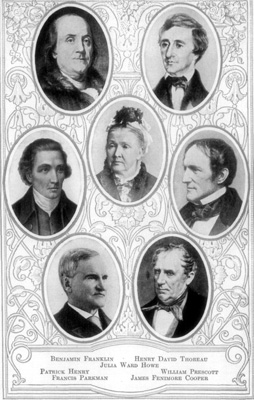 Benjamin Franklin Henry David Thoreau
Julia Ward Howe
Patrick Henry William Prescott
Francis Parkman James Fenimore Cooper
The main line of events leading up to the climax of interest in the
story may be called the plot.
It is the plot that furnishes excitement, and for perhaps the majority
of readers constitutes the chief interest. In some stories the plot lies
upon the surface all the time, and everything is made subservient to the
purpose of holding interest, keeping up excitement and mystifying the
reader until the climax is reached. Thrilling detective stories of the
poorer class, exciting love stories and the cheap juvenile tales of
Indian fighting, with heroines in dire distress and heroes struggling to
rescue them, are illustrations of this type. No effort is made by the
author to make real human beings of his characters, and little or no
profit comes to the reader, while infinite harm may be done to minds
craving excitement and finding in it nothing to stimulate an interest in
better things.
In the better stories of greater writers the plot still plays an
important part, but while it sustains interest unflaggingly, it carries
with it other things which are of vastly greater importance. In such
stories the persons are living, breathing realities, and the reader
feels that he has added permanently to his list of tried and true
friends. Tom Brown and Tiny Tim, who live only in stories, are as much
our friends as Henry Thompson and Rudolph De Peyster who live in the
next block. The great writer, moreover, takes us with him into new
places, among new scenes, so that Rugby becomes for a time our own
school, and from Tim’s poor hearth there enters a warm Christmas glow
into our doubting hearts. Although the plot is important, yet all
stories that enthral the mind with exciting incidents must be regarded
with suspicion until they prove their right to be considered real
literature by furnishing higher interests or greater inspiration.
To analyze the plot of a story, however, is always helpful; to arrange
the incidents in order, to determine which are necessary to the
development of the story, and which are merely contributory to the
general interest, is an interesting and stimulating thing. The plot of
short stories may quite often be told in few words, and unless very
complicated, the plot of a novel may be given in a few sentences. In
some stories, however, the plot is so loosely constructed and of so
little real importance that it is hardly more than a train of apparently
equally important incidents. Again, the plot is oftentimes so
complicated by secondary plots and incidents that even a careful reader
becomes confused and loses his interest.
Let us consider the plot in such a story as Cinderella (Volume I, page
224). The main incidents of the plot arrange themselves as follows:
1. Cinderella’s mother dies.
2. Her father marries a widow, who has two daughters.
3. The stepmother sends Cinderella to the kitchen to work and to the
garret to sleep.
4. The king’s son gives a great ball to which he invites Cinderella’s
stepsisters.
5. The stepsisters require Cinderella to assist them to dress, and abuse
her shamefully.
6. The sisters go to the ball, and Cinderella sits by the kitchen fire
wishing she might accompany them.
7. Her fairy godmother appears and sends her to the ball in fine style.
8. Cinderella, beautiful as a picture, dances with the prince, who falls
in love with her.
9. The clock strikes twelve, and Cinderella goes back to the kitchen.
10. The stepsisters again mistreat Cinderella.
11. She goes to the ball the second day.
12. She forgets her godmother’s warning, and after midnight rushes back
home, leaving a single slipper behind her.
13. The prince finds the slipper and searches for its owner.
14. The sisters fail in trying on the slipper, which is then fitted to
Cinderella’s foot.
15. The fairy godmother restores to Cinderella the appearance of a
princess.
16. The prince marries Cinderella, and she forgives her stepsisters.
A summary of these main incidents may be given in a few words, which
will contain the skeleton of the plot. To say that a certain little girl
who is shamefully treated by her stepsisters is aided by her fairy
godmother to attend a ball given by a prince, who finally marries the
little drudge, is to give the plot and really to tell all that the lax
and superficial reader gets from the story he peruses.
There are in this little story, however, a large number of minor
incidents which contribute to the interest, and if sought and placed in
their relation to the main events will be found to have added materially
to the charm of the narrative.
For instance, when the fairy godmother sends Cinderella to the ball for
the first time, children are led to a vivid interest in the event by a
series of fascinating incidents, as follows:
1. The fairy sends her into the garden for a pumpkin.
2. The godmother, scooping out the inside of the pumpkin, leaves the
rind, which she taps three times, and immediately it becomes a golden
coach.
3. The fairy spies six mice alive in a trap.
4. Cinderella lets the mice out gently, and as the fairy touches them
with her wand, each becomes a fine, dapple-gray horse.
5. Cinderella brings the rats, the largest of which the fairy converts
into a handsome postilion with a fine pair of whiskers.
6. Cinderella finds the six lizards behind the watering pot, which
become the six sedate and dignified footmen clothed in livery.
7. Cinderella’s rags are changed to wonderful clothing bedecked with
costly jewels.
8. The beautiful glass slippers are provided.
How real these incidents all seem! What art is shown in bringing in real
things to give food to the imagination and to stimulate the interest
that carries the little reader away from herself where she may riot in
the wonders her active mind can so readily conceive. Some time when she
has grown much older, and cares have wrinkled her smooth cheeks, she
may see that the only fairy godmother who can clothe a Cinderella is
hard work, and that mice become dapple-grays, and footmen are made from
lizards behind watering pots only when she has earned the right to them
herself. Just now it is enough for her to see that fairy godmothers come
to good children only, and that good princes do not care if their wives
have worked in the cinders, provided they are beautiful in gentleness
and service to others.
Children like to understand what they read, and are never so happy as
when talking over their favorite stories with those of their elders who
have the power to enter sympathetically into the child world. By no
means do all boys and girls like to be taught; in fact there are not
many more certain ways of prejudicing a child against anything than by
making it the subject of a formal lesson. Still, every child loves to
learn, and is seeking at every moment to add to his information and to
exercise his mind. Yet he must do it in his own way and with the things
in which he is interested. If those facts are borne in mind, no parent
will have difficulty in interesting his child or in leading the juvenile
mind where it ought to go.
To apply these ideas to teaching the plot of such a story as
Cinderella, let the parent who loves his children, and who wishes to
be no stranger to their interests, joys and sorrows, seat himself among
them some time and begin to read to them. Pausing now and then to
explain some word whose meaning may be obscure to them, or to comment on
some phase of the story that may be of special interest, let him read
on to the end without attempting to do much more than to make the story
a vivid tale where the interest centers in the incident.
When the story has ended, the pleasure has but just begun. Children like
to ask questions, but they are no less ready to answer them if the
questions are on things of interest, are related to the things which
children know and are put in such a way that the genuine interest of the
questioner is always evident. The I-know-it-all-and-you-know-nothing
style of questioning; the I’m-the-master-and-you’re-the-pupil style; the
because-I-ask-you-must-answer style are all fatal to interest, and will
soon prevent that hearty sympathy and living spirit of coöperation that
the parent wishes to secure.
If we suppose it is Cinderella that has been read, we may begin our
questioning in this manner:
“That’s a good story. I like it, don’t you?—It is rather long, though;
I’ve almost forgotten how it began.—O, was that the first thing that
happened?—Was the father a rich man?—Did the story say he was rich or
did you just think he was?—If he had not married a widow could things
have happened as they did?—How did the widow and her daughters treat
Cinderella?—If Cinderella had not been mistreated would her fairy
godmother have come to her aid?—If the fairy had not appeared could the
story have been the same?—How did the fairy make the golden
coach?—Could she have made it out of anything else?—If she had made
one just as good out of something else, could Cinderella have gone to
the ball just as well?—If Cinderella went to the ball in good style did
it matter how she went?—If Cinderella had not gone to the ball, could
she have met the prince?—Was it as important then that she should have
a coach made from a pumpkin as that she should go to the ball and meet
the prince?—Can you think of something else just as necessary to make
the story come out right as that Cinderella should go to the ball?—Can
you think of other things that must have happened just as they did to
make the story come out right and just as it did?—Can you think of some
things that might have happened differently and still not have hurt the
story at all?—Let us put together all the things that must have
happened to make the story right and leave out the things that could be
changed. Now, what are they?—Now let us find a few things we could
leave out or change. What are some of them?—If we left them out the
story would come out the same, but would it be as good, as
interesting?—Would you like Cinderella as well if these little things
had been left out?—Would you think as much of the prince if he had
found Cinderella right away as you do when he has to do so many hard
things before he finds her?”
Every one must realize the impossibility of providing a scheme of
questioning that would fit exactly any given case, but will not the
above suggest a method that may lead to many a happy and profitable
evening at the family round table? Even if there are older children in
the group they will renew their interest in the old stories and get more
good from them when it is seen that father and mother do not deem it
beneath their dignity, nor outside the range of their interests, to read
and study a fairy tale.
In Journeys Through Bookland are here and there outlines and questions
designed to lead the children to see for themselves what it is hoped
others will take pleasure in showing them. Examples of the selections
which contain outlines, questions and comments designed to help in the
study of the plot may be found as follows:
| Volume I, |
page 264. |
The Twin Brothers. |
| Volume I, |
page 395. |
Something. |
| Volume II, |
page 124. |
The Snow Queen. |
| Volume IV, |
page 174. |
Incident of the French Camp. |
| Volume VIII, |
page 364. |
The Tempest. |
| Volume IX, |
page 232. |
The Gold-Bug. |
In most stories, be they brief and simple or as long and complicated as
the two-volume novel, the interest centers in one or more persons whose
character the reader learns to understand, and whose success or failure,
joy or grief gives him pleasure or excites his sympathy. All events
center about the hero or heroes, and while other persons may be
mentioned, and even win the reader’s attention for a time, they finally
subside into the background and are remembered only as they contribute
to greater interest in the principal characters.
Every author tries to make his heroes and heroines speak and act like
real human beings and show their characters by their actions and their
words. Sometimes, however, he tells the reader just how his people look,
feel and think, and describes their characters to give an interest in
what happens to them. A more interesting method and a more artistic one
is to leave the persons to disclose themselves as the story progresses,
making them show by the way they act and by what they say under certain
circumstances the strong and weak qualities in their natures. Nothing is
more interesting than to watch the development of character in the hero
of a story, particularly when it is accomplished under conditions which
are themselves interesting.
In studying the persons in a story, then, the chief things to keep in
mind are the following:
1. The principal person, or hero—the one, or perhaps the ones, in whose
fortunes the reader is most vitally interested.
2. The secondary persons who are introduced merely to add variety or to
throw light upon the character of the hero, or to assist to bring about
the events which center about him.
3. The appearance, dress and manners of the persons.
4. The ways in which the author makes his persons lifelike and shows the
reader what they really are.
5. The characters of the persons as they appear or as they are developed
in the progress of the story. This is the really important part of the
study, the one which becomes increasingly interesting as readers grow
older and the stories they study become more and more complex and
difficult. The study of the characters of Shakespeare’s heroes and
heroines is more than interesting pastime for men and women—it is good,
hard work.
For a simple example of what is meant, let us undertake briefly the
study of The Hardy Tin Soldier (Volume I, page 148).
- 1. The hero is the Hardy Tin Soldier himself.
- 2. Persons of secondary importance are:
- a. The twenty-four brothers.
- b. The little boy.
- c. The Dancing Lady.
- d. The Goblin.
- e. The servant-maid.
- f. The two street boys.
- g. The Water Rat.
- h. The fish.
- i. The cook.
Of these the Dancing Lady is second only to the lame Soldier; the
Goblin, the two street boys, the little boy and the Water Rat are given
considerable prominence, while the twenty-four brothers, the
servant-maid, the fish and the cook are introduced merely to effect a
certain incident or to give an air of truthfulness to the events. This
is a fairy tale, and in it we must be faithful to our juvenile friends,
considering the Goblin, the Water Rat and the fish as real persons, and
the Tin Soldier as a very human being.
3. In appearance the Tin Soldier was tall and erect, but alas! he had
only one leg! His uniform was red and blue and very splendid. He carried
his musket across his shoulder as a marching soldier should, kept his
eyes straight to the front, and stood very firmly upon his one foot. In
the fire he lost the tinsel and the color from his uniform, and when the
Dancer joined him he melted into a little tin heart.
4. While Andersen tells outright some of the characteristics of the
little Soldier, he leaves others to be inferred from acts. The Soldier
thinks, and sometimes the reader is told just what he thinks, but never
once does he speak—to him silence is golden. Yet not once do we miss
his voice, and it is only when we have finished that we suddenly think
what a silent little body he is. That is part of the author’s art. The
Soldier never once moves his eyes, or changes his attitude; the author
never forgets that he is a tin soldier, but makes his every act
consistent with his stiffness and rigidity. That is more of the author’s
skill. There were other soldiers, twenty-four of them, and all were
brothers. A less skilful author would have stopped in the telling of the
fact, but Andersen adds in his whimsical, charming manner, “for they
were all born of one tin spoon.” All the other brothers were perfect;
our Soldier had but one leg, yet “it was just this soldier who became
remarkable.” Even the missing leg creates an interest, and Andersen uses
it to center our attention upon his little hero.
5. Andersen tells us the following things about the Tin Soldier’s
character:
a. He stood firmly even with but one leg to balance himself upon.
b. He thought his box was not a place for a lady-wife who lived in a
castle. This showed his humility.
c. Yet he was very human—“I must make her acquaintance.”
d. When he fell from the window, he put his leg straight up, stuck his
helmet downward and his bayonet between the paving stones.
e. He would not call loudly to the servant-maid because he was in the
uniform of a soldier.
f. While in the boat rushing down the gutter, he trembled, but he never
changed countenance, and still looked straight before him.
g. He sighed for the little Lady’s company, while passing through the
drain.
h. He would not answer the Water Rat.
i. He stiffened himself and would not move an eyelid when the paper boat
sank.
j. He lay unmoved even in the darkness of the fish’s body.
k. He was not at all proud when he was rescued.
l. When he saw the Dancer again he very nearly wept tin tears, but he
thought how improper that would be, and kept them back.
m. He stood firm and shouldered his musket although the fire, or grief,
made all the colors leave him.
n. When the Dancer joined him in the flames he melted into a
heart-shaped lump of tin.
What a fine little Tin Soldier he proves to be! Could any one be more
loyal to his profession? Body erect, eyes to the front, musket
shouldered, every muscle at attention all the time, no matter if he had
but one leg to stand upon. He was brave as a lion, although once in the
presence of the direst danger he trembled a little, but he drove every
sign of fear from his face and stood his ground manfully. After he had
once seen the Dancer and realized how similar her trials must be to his,
how constant he was in his devotion! At his death what could be more
fitting than to see him melt into a little heart-shaped mass, the
symbol of his courage and constancy! Why should we call him the hardy
Tin Soldier; would it not have been better if the translator had called
him the constant Tin Soldier?
Now, when we give the hero of this pretty little story so much
attention, does it not seem worth while? Will not we, grown men and
women, find so much in the hero that we may gather our young friends
about us and lead them to see how admirable a character he has and how
beautifully Andersen has shown it? If we talk not to the boys and
girls, but with them, if we invite their questions as to the Tin
Soldier’s character, and by our informal questions lead them to
appreciate the strength, courage, and devotion of the little toy, will
they not get some taste for a good story well written, and perhaps,
learn some little lessons that will help them to be better men and
women?
Journeys furnishes you with many another fine story, equally
interesting. There are a number of the tales, too, which may call for
your own best efforts in the study of character, and from which even you
may derive some genuine help in the heavy problems life thrusts upon
you.
In many places, too, the present writer has appended outlines and
questions which the young people themselves may like to pore over and
which may assist the inquiring parent even more than the brief study
above. The following are particularly suggestive:
| Volume I, |
page 224. |
Cinderella. |
| Volume IV, |
page 93. |
A Dog of Flanders. |
| Volume VIII, |
page 335. |
Dream Children. |
| Volume VIII, |
page 364. |
The Tempest. |
One of the benefits of good reading is that it fills the mind with
beautiful pictures of places that we cannot visit or that live only in
the eyes of the imagination. A powerful descriptive writer takes his
reader with him, and by graphic words makes visible and almost real the
scenes among which they wander. One may sit in the light of his study
lamp during a black northern winter and read himself away from the chill
and dreariness into some warm, sunny clime where flowers of new and rare
forms flaunt their gorgeous colors and perfume the air with strange
delicious odors; great trees with tufts of far-reaching leaves cast
their welcome shade, and long vines trail gracefully from their living
supports. Wonderful birds with brilliant plumage flit about, as through
the openings in the trees glimpses are given of long waves rolling
gently upon the glistening beach. It is only necessary to give free rein
to the imagination and to visualize the scenes that the skilful writer
describes.
There are people of such literal minds that descriptive writing fails to
appeal to them. It is their misfortune. To others every word brings a
picture that appears almost as vivid and as full of detail as those upon
which the material eye gazes. Like any other power of the mind, this may
be cultivated, even among the mature. Children are highly gifted with
this power, to begin with, and only a little training is necessary to
make them use the faculty freely for their own delight. Suggest to them
the outlines of a picture, and see how rapidly they will fill in the
details.
No two can see precisely the same imaginary picture; in fact, no two
people looking at the same landscape will see precisely the same things,
and if they are asked to describe what they see, it will appear that
things which are most vivid to one may have made little impression upon
the other. It is not to be expected, then, that two children reading a
description of some scene will get the same picture of it. Each will
color his own from the previous impressions and experiences he has had.
Yet to each the picture may be very real and very pleasing. Good
teachers of reading spend much time and effort in teaching the young to
visualize the scenes of which they read, not only because of the
pleasure it will afford the young when they are mature, but because the
power to see vividly is of greatest assistance in every department of
study.
In some stories little attention is given to the scene; in fact, the
persons might appear anywhere and not be in the least affected by their
surroundings, and the events might have happened in China as well as in
England. Even then, however, there will be found mention of many things
that seem to give locality to the story. At the other extreme are
writers who lose themselves in descriptive flights and pause to describe
a sunset while the heroine is perishing, and the hero must stand
helpless until the author has painted the last color in the sky. In the
best literature for children, description is so mingled with narrative
that while there are fine pictures to see, they do not fall in the way
of the events which the young reader follows with such breathless
interest. In fact, the pictures aid the narrative.
There is of course in every story much descriptive writing that does not
apply to the scenes among which the plot is laid, yet it is well to make
a study of description from the scenes, for it is here that the author
has his greatest opportunity for pictorial writing.
If the story is brief there may be but one scene. Everything may happen
in one place, and none of the surroundings may change. For instance, in
the fable of The Dog and His Shadow (Volume I, page 63) there is but
one incident, which happens in one place. Such a simple story, however,
furnishes the material for a good picture, and in bringing it out to a
child who reads or hears the fable for the first time, the parent is
giving good service that will lead to keener appreciation and higher
power of interpretation in his child’s later years. What can be made out
of this picture, and how should it be done? Let us see:
The fable is told in simple words, and only plain facts are stated. What
are the elements of our picture? We can find only six, viz.: a big dog;
a big piece of meat; day; a river; a narrow bridge; the dog’s image. Now
if we were to draw a picture to illustrate this fable we would begin
with a general sketch. Should we show a level country, or are there
hills about? Is it barren and desolate, or are there trees? Are there
houses near? Where did the dog get his meat? Is it a large river, or
only a small one? The bridge is narrow; has it a railing along the side?
Would the dog be liable to see his image if it was a wagon bridge? Was
it then a mere foot bridge? Would a single plank across a small stream
answer the purpose? The dog is big; is it a dog that knows and likes the
water? Would you think it could be a Newfoundland dog? What kind of a
dog is it? It is day time; is the sun shining? Do you imagine it is
morning or noon, or that it is toward evening? In making your pictures
would you draw the trees to show the leaves blown by the wind? If the
dog sees his image, is the water smooth or rough? Is the stream rapid
and rough, or smooth and placid?
While such questioning is going on both speaker and listener are seeing
more clearly every minute. Besides, in order to see accurately they are
drawing on their own previous knowledge and experience, and are
reasoning just as truly as though they were solving a problem in
arithmetic.
In every picture we form in our reading there are certain elements that
we must accept and include because the writer gives them to us. Other
elements suggest themselves, and we accept them and put them in place or
reject them entirely. In the fable just discussed we are told that the
dog is big, the piece of meat is big, and the bridge is narrow. We may
not see a small dog with a little piece of meat on a big, wide bridge.
Houses, trees, sedges on the river bank, children playing by the side of
the path, spring, summer or autumn foliage, or even snowclad shores with
black water between—any of these we may put into our picture, for the
fable is silent on these points. We must be accurate, and the parent can
do no better service in reading than to make his child see accurately
whatever he sees at all.
The artist studies the selection he means to illustrate in just this
way, and then draws his picture. When we see his picture we may accept
it as good and true to the conditions, or call it poor and inapplicable.
We should not be hasty, but should try to get his point of view before
we criticise. If he violates any of the fixed conditions of the story
his work is bad; if he gives us his interpretation and violates no fixed
conditions, his work may be good or bad according to the standards we
set up: are we always certain that our standards are correct?
In the fable The Fox and the Stork (Volume I, page 73) the artist has
given us two beautiful pictures which in themselves tell almost the
entire story, and his pictures are almost wholly from his own
imagination, for there was given him to work with very little more than
a fox, a stork, a wide dish and a vase. Such a pictorial imagination as
he possessed is what should be cultivated in children. If they can be
encouraged to draw what they see, they not only fix their own
impressions, but they learn to see more vividly and more accurately.
In long stories there are many scenes; it may be that no two incidents
happen in the same place. In the drama, which contains all the elements
of the story, the scenes are limited in number, are fixed and unchanging
and after the reader has arranged his scenery he may give his attention
exclusively to the dialogue because he knows there will be no change in
the scene. In the story the reader may need to be constantly alert, as
when his hero takes a long and perilous journey the scenes may change
with the quickness of a kaleidoscope, and yet all be important to the
narrative. The more complex the story, the greater the variety in
scene, and consequently the greater the opportunities for study. It is
interesting work for children to pick out the scenes, to count them and
then to compare them. Some of them are more vividly portrayed than
others. Why? Some are more important as descriptions, and some because
of the incidents occurring in them.
Sometimes, especially in speaking of the drama, the word scene is
applied not only in its literal sense, but also to include not merely
the place but the incidents that happen in the place, as well.
For instance, we may say, “The quarrel between Brutus and Cassius is a
wonderful scene in Julius Cæsar.” Again, the word is used sometimes to
mark the division of a play, as when we speak of the second scene in the
first act of Macbeth. For our purposes, however, in our early reading
with children, let us use it to signify only the place where events
happen.
An author may tell us at the beginning of a story that the scene is laid
in London, or in Calcutta, or in the Black Forest; but unless he employs
some method of giving a vivid impression of the setting of the story, we
soon lose sight of locality. Sometimes, of course, it is not necessary
that we should remember the place—the story moves on independent of
scene; but other stories depend in part for their interest and even for
their plot upon their setting. In such cases, the author, by reference
to the natural features characteristic of a region, or to the peculiar
traits or mannerisms or turns of speech of his characters, keeps before
us the place in which the scene is laid. Such peculiarities of a place
or its inhabitants, when introduced into a story, are given the name of
local coloring.
In A Christmas Carol (Volume VI, page 244), Dickens meant that we
should be conscious throughout not only of a Christmas atmosphere, but
of an English Christmas atmosphere. The references to the Christmas
feeling are too obvious to require pointing out, but the methods by
which the author makes us conscious that we are in London do not show so
clearly at first sight. By a study of the paragraph which begins in the
middle of page 253, and of the one immediately following it, we may get
some idea of these methods.
“Meanwhile the fog and darkness thickened so, that the people ran
about with flaring links.” A London boy would not need a footnote to
tell him that the fogs of London are famous; that they are at times so
thick that all traffic is obliged to cease. Nor would he need to be told
that links are torches of tow and pitch, which enterprising London boys
provided themselves with at foggy times, that they might earn money by
piloting people about. The word brazier, too, is in commoner use in
England than it is in the United States. The poulterers’ trade is
another English touch.
Every one knows that the Lord Mayor is the chief official of the city
of London, but perhaps we do not all know that Mansion House, with its
great banqueting-hall where the state dinners are held, is the residence
of the Lord Mayor.
Now-a-days we all know what English plum pudding is—it is served at
many American tables on Christmas day. But nothing is more
characteristically English, unless, indeed, it is the roast beef, not
turkey, which the tailor was planning to have for his Christmas dinner.
Probably no one but an English writer, writing of an English subject,
would refer in Dickens’s off-hand manner to Dunstan, the English
statesman and archbishop who accomplished so much for religion that he
came to be known as Saint Dunstan.
One of the most characteristically English touches in the two paragraphs
is the reference to the carol sung by the boy at Scrooge’s keyhole.
Other countries have Christmas carols, but the custom of singing them
before people’s houses is peculiarly common in England. The carol of
which the first two lines are quoted is perhaps the one most frequently
sung.
These instances will give some idea of what is meant by local color, and
of the methods used in securing it. It will be an interesting study to
find other words and phrases in the remainder of the story which
strengthen our feeling of the “Englishness” of A Christmas Carol.
Journeys Through Bookland furnishes an abundance of good stories of
fine descriptive power. A few of the best are the following:
| Volume II, |
page 405. |
The King of the Golden River. |
| Volume IV, |
page 174. |
Incident of the French Camp. |
| Volume IV, |
page 322. |
The Attack on the Castle. |
| Volume VI, |
page 173. |
Sohrab and Rustum. |
The stories of the present day are many of them written with the avowed
purpose of mere entertainment. The author is satisfied if his work
sells, and cares nothing for the lesson he may teach, although by means
of false views of life he may do ineffaceable harm to the minds of his
readers. Many of the popular magazines and other periodicals, not even
excepting some of those published especially for children, are full of
light reading which vitiates the taste and may even undermine character
by its seductive influence. In the effort to be entertaining the recent
writers for children have only too frequently sacrificed strength and
virility to a fascinating brilliancy that seizes the imagination of
youthful readers and gives no material for subsequent growth. The
earlier writers, those who produced the great classics which still are
the most inspiring things in our language, were actuated by nobler
motives. To them literature was not a trade, but a high calling, to
which the writer came as a priest approaches his altar. Such a writer
held a high purpose and kept it in view, often giving hours of thought
and the best of his genius to work that the modern story writer neglects
entirely or passes over with hasty evasion.
The purpose of the author is always a subject of interesting inquiry,
and whenever it appears a serious one it is worthy our careful study.
The novel is often the medium of conveying the results of deep study
into human character, and a few of the greatest stories have been
epoch-making in their effect upon the human race.
As the fiction which children read has a profound influence in the
formation of character, it should always be examined with greatest care
to see that the author’s purpose is a laudable one and that he carries
it out in such a way that the lesson is wholesome and salutary. Some
stories may be entertaining merely—they are for the play-spells of the
imagination; others should be instructive—they are for hours of study
and reflection; a third class should be invigorating and inspiring, full
of good lessons of high moral import—they are for times of stress, or
the still hours when character is made.
If, however, the purpose of the author is too evident, if his lesson is
too obvious, none are so quick to catch the fact as wide-awake childish
readers. The author who lugs instruction and information into his
stories will find the boys and girls skipping all that he values, or
laying down his books with laughter and derision. The writer who
moralizes may find his work to be immoral in its effect on his juvenile
readers, or may see his stories relegated to the overloaded bargain
counters.
In the same sense, it is often unwise to dwell long upon the moral of a
story or even to point it out if it be at all evident. There is no phase
of teaching reading that requires such careful thought or such fine
discrimination from the parent as that which relates to the lesson of
the story. It is often better to let the selection do its own work than
to try to elaborate its purpose. Yet a skilful and sympathetic leader,
one quick to read the feelings of his young listeners, may often render
his greatest service in free conversations about what the story teaches.
It would seem that no one could do this quite as well as the parent who
has known his boys and girls from infancy and can see in his offspring
those very traits of character which have been to his own advantage or
detriment.
More will be accomplished by questioning with occasional comments than
by preaching, more by showing the help the story gives to the questioner
than by trying to foist its assistance upon the hearer. “Now there is a
fine lesson for you, my boy. I want you to remember it,” is not half so
effective as “That idea seems good to me. I’ve often thought about it
but never seemed to realize it so much. I shall try to remember it.”
Wouldn’t you, dear parent, rather learn with your friend than to have
him always instructing you? “What do you think of that, John?” is much
more apt to help the boy than “You must see it this way, John.” Are you
not, dear parent, rather proud of your own judgment, and do you not
suppose your son has inherited your feeling to some extent at least?
We heard the old fables in our babyhood and read them in Latin as we
grew older, and we still are fond of them, though the “morals” have long
since been forgotten. Those wise lessons so graphically presented have
helped to form our characters, but not through the formal “moral” at the
end. Beware of “Haec fabula docet.”189-1
As a further suggestion of method we may consider for a few moments that
beautiful but sad little story of Andersen’s, The Fir Tree (Volume II,
page 68). Every good story is worth reading more than once, and every
good method of teaching involves more than one reading. In this instance
as children read or listen, they are first interested in the story as a
story; that is, in the plot. They enjoy the adventures of the Fir Tree
and may feel for it in its misfortunes, but their interest is in the
tale. When they have read to the end, however, they will be interested
in the appearance of the tree, their hero, and in the other characters
which give vitality to the story. Then the scenes may be talked over,
and varied enough they are to excite real interest as the story is read
now with the definite purpose of seeing the pictures Andersen has
sketched. With all this in mind the children are ready to think over it
again and learn the lesson the great prose-poet meant to give. If the
character of the Fir Tree is well understood, the lesson almost tells
itself, for ambition, arrogance and discontent are seen as the traits
that make for unhappiness. The Fir Tree might have been happy many times
if it had only been content. At the worst it gave happiness to others,
and therein, perhaps, filled its place in the world. Human beings must
often find their pleasure in giving happiness to others and must be
content to know that they are of service to others. Some of the lessons
of The Fir Tree are rather hard for little folks to understand, and
there is something in the charming story for those older readers that
have hearts young enough to see the meaning.
Study the purpose in the following:
| Volume I, |
page 414. |
The Ugly Duckling. |
| Volume II, |
page 124. |
The Snow Queen. |
Small children are not interested in considering the way in which an
author tells his story, nor the methods he employs to secure attention
and excite interest. Yet there comes a time when such a study is highly
pleasing to inquiring youth. It is desirable always that children should
early begin to appreciate the difference in the way plots are handled,
to discriminate between a tale that is well told and one that is poorly
told. At an early age boys delight in stories that are full of the
excitement of adventure, conflict and mystery. Their craving is natural
enough and must be satisfied. At such time they will read little or
nothing else unless they are driven to it, and to compel them to read
what they do not want is to make them hate reading for the time being
and perhaps permanently. In time they will outgrow the taste—it is
nothing to be feared if properly guided. The danger lies in the fact
that they may find the excitement they wish in stories that are really
immoral, or that are so poorly written that they destroy all taste for
fine literature. The right course is to supply plenty of reading in
which excitement abounds, where Indians stalk the woods, pirates rove
the seas, and knights fight for their lady-loves, but always in stories
that are so well told that the taste for good reading is cultivated
unconsciously as the boy reads. Treasure Island is bloody enough for
the most exacting boy, and it bears many a reading, for it is so
charmingly told that long after the cry, “Pieces of eight, pieces of
eight,” has ceased to make the welcome chills run up and down the boy’s
back, he returns to the story for the pleasure he finds in the style of
Stevenson. In later years the boy will write better and speak better for
having read the story.
However, the parent may do much to help his child along by calling
attention to vivid figures of speech, to happy expressions of all kinds,
and to those graceful touches of humor and pathos that are so
characteristic of Andersen, Stevenson, Ruskin, Kingsley, and other great
writers for boys and girls. No child who can read well for himself is
too young to appreciate a good figure of speech if the comparison is
based upon something falling within his own experience. Who is so young,
or so old, for that matter, that he will not thrill a little at
Longfellow’s lines:
“Silently, one by one, in the infinite meadows of heaven,
Blossomed the lovely stars, the forget-me-nots of the angels.”
What does the poet say? “The stars appeared in the sky.” In saying it
what does he make us feel? As we repeat the lines we see the immense
expanse of the heavens, and as we gaze, the sparkling dots of light
appear silently, slowly, one after another, just as beautiful flowers
appear as the early morning light gilds the green meadows. We think,
too, in the poet’s fanciful way, that these are no common flowers, but
exquisite tokens of the loving care the angels have over us, and a
gentle reminder that always should we trust in them.
Often the highest sentiment is clothed in lines whose figures, most
beautiful in themselves, exalt the spirit as ordinary expressions could
never do. At the close of The Chambered Nautilus, Oliver Wendell
Holmes sings:
“Build thee more stately mansions, O my soul,
As the swift seasons roll!
Leave thy low-vaulted past!
Let each new temple, nobler than the last,
Shut thee from Heaven with a dome more vast,
Till thou at length art free,
Leaving thine outgrown shell by life’s unresting sea!”
Is it not well for the parent to lead his child to see such things in
literature, to search for them, and when they are found to treasure them
and bring them for mutual enjoyment into the family circle?
Fiction appeals strongly to feeling and stimulates the growth of that
series of great emotions that make so large a part of character. It may
excite ambition and a thirst for power or wealth or give an impulse to
labor and self-denial; it may teach us sympathy and love for our
fellow-men, or arouse anger, hatred and defiance; it may give us a
keener discrimination of right from wrong and lead us far on our search
for truth, even into the calm of religious beliefs.
We see the play of emotions in the imaginary persons that pass before
us, and as we learn to love our new friends, their influence passes out
to us through the words of the gifted author. Bob Cratchit’s tender love
(Volume VI, page 304) makes us more considerate of the sick and
helpless; Tom Brown’s manly defense of his praying schoolboy friend
(Volume V, page 472) leads us to new respect and admiration for the boy
who lives up to his principles, and drives us, perhaps, to begin again
upon the duties we have neglected.
By studying with the children the feelings the characters in a story
exhibit, the parent may give the best of moral lessons without the
appearance of so doing and more effectively than by countless reprimands
and formal orders.
As a suggestion of method we offer an outline based upon Rab and His
Friends (Volume VI, page 99), one of the most touching stories ever
written, a series of incidents that appeal to every holy emotion.
Rab, the great mastiff, claims first place in our minds, dog though he
is; but James and Ailie are such lovable beings that we never can forget
them.
The story has been read through; we have followed the simple incidents
to their pathetic climax; we have learned to know Rab by sight and to
recognize his sterling character; James the honest, tender-hearted
carrier, and gentle, suffering Ailie, his wife, have taken their places
among the dear friends our imagination has created; we have noted the
power of the author, his humor, his scholarly English and his
sympathetic touch. We may have read the story more than once—at any
rate we have read portions of it several times, so we can trace the
emotions that are felt by the noble dog.
Page 100: When the little white bull terrier fastens himself upon Rab’s
throat and the strong muzzle prevents the big fellow from defending
himself, “his whole frame stiffens with indignation and surprise.”
“He looked a statue of anger and astonishment.”
After Rab had been released from his muzzle and had killed the little
terrier, “he looked down at his victim appeased, ashamed and
amazed.”
Page 103: When his master aimed a kick at him, he “drew cringing up”
and “slunk dismayed under the cart.”
When his master spoke kindly, “‘Rab, ma man, puir Rabbie,’” “the stump
of a tail rose up, the ears were cocked, the eyes filled, and were
comforted”; Rab showed pride and happiness again.
Page 104: He was pleased when the medical student scratched his huge
head, and anxious, when no notice was taken of him.
When he first came to the hospital he felt pride and condescension,
“like the Duke of Wellington entering a subdued city.”
Page 106: When James handed Ailie from the cart, “Rab looked on
concerned and puzzled.”
Page 106: In the consulting room Rab was filled with suspicion and
uneasiness; he was “grim and comic,” and eyed all three.
When Ailie was put to bed and Rab was permitted to enter the room he
“slunk in,” half-ashamed, but fully determined.
Page 107: Rab valued himself highly, but felt no conceit: he “had the
dignity and simplicity of great size,” and the “gravity of all
great fighters.”
Page 109: Rab felt perplexity and anger, “forever cocking his ear
and dropping it as fast,” when Ailie entered the operating room.
During the operation he felt sympathy for the suffering of his
mistress, anger and revengefulness at her tormentors; “his ragged
ear was up, and importunate; he growled and gave now and then a sharp,
impatient yelp; he would have liked to have done something to that man.”
Afterward in Ailie’s room he felt fear, anxiety and a desire to
help, and showed “how meek and gentle he could be, occasionally, in his
sleep, letting us know he was demolishing some adversary.”
Page 110: Rab continued to feel a sense of depression, sadness and
anxiety; during his walks with the medical student he was “sombre and
mild; declined doing battle—submitted to sundry indignities.”
While Ailie seemed to be recovering Rab felt kindliness and subdued
joy, though resentment lay close beneath the surface; he was
“reconciled, and even cordial,” had “made up his mind that as yet nobody
required worrying,” but was always prepared for it.
Page 111: As Ailie grew worse, grief and fear began to take
possession of Rab; he “subsided under the table into a dark place, and
was motionless.”
Page 112: When Ailie called in delirium, her strained voice filled Rab
with surprise, astonishment and a sense of guilt; he started up
“surprised, and slinking off as if he were to blame somehow, or had
been dreaming he heard.”
Page 114: At Ailie’s death Rab was overwhelmed with grief; he licked
her hand which was hanging down “all over carefully, looked at her, and
returned to his place under the table.”
The dog’s feeling of duty, obligation and devotion was shown when
he leaped upon the bottom of the bed “and settled himself, his head and
eye to the dead face.”
Page 115: Rab remained in statu quo till the carrier returned; love
and devotion filled his heart.
Page 115: His grief wholly absorbed him; he did not notice his medical
friend when the cart left the hospital.
Page 117: After the carrier’s death, grief wore down the dog’s brave
spirit; he became discouraged, impatient, resentful; “he was aye
gur gurrin’, and grup gruppin’.” Yet he was faithful to his trust, for
he was only impatient and resentful when a stranger came and interfered
in the business of the dead carrier.
It is evident that the study of emotions is to a great extent a study of
character, and that in this instance, we have given a tabulation of
Rab’s traits of character. It is through the showing of his feelings
that Rab influences us. A little introspection shows that we are feeling
just what the dog feels, or that some emotion is aroused in us that
responds to the feeling of the dog. We are not exactly surprised when
the bulldog grips Rab, but we are indignant that he should have no
chance to defend himself—we would be among the first to slit the
muzzle. We may not be pleased that Rab killed the bulldog, but we are
glad that Rab defended himself. We realize the strength of the mastiff’s
powerful jaws, and are not amazed at what he did—we are now rather
inclined to feel sympathy for the helpless little terrier.
So we might go on incident by incident and compare our feelings with
those of Rab, but that would require much space and perhaps it would not
be of great benefit to the reader, for our feelings may not be his
feelings, and the things which arouse him may have little effect upon
another. It is sufficient to call attention to the value of analysis,
and show that self-study is a valuable adjunct to reading.
It is well that most children are not likely to indulge to any great
extent in introspection, for too much is injurious. However, it can do
the young no harm for them to study the feelings of others, and now and
then examine their own emotions. By so doing, they may learn that some
reading, which is destructive to peace and productive of unpleasant or
evil feelings, should be avoided.
The studies so far given are comprehensive, and are suited to all forms
of fictitious narrative. Most of the illustrations have been drawn from
the simpler tales in the earlier volumes, but the studies are equally
applicable to the more difficult selections of the later volumes, and
may be easily adapted by the parent to children of any age. The
restrictions of space have compelled us to offer but one set of studies
here, but there are many simpler and many more difficult ones scattered
through the books where the juvenile readers will find them, and it is
hoped become interested in them. In another place we have shown parents
how these may be found easily and used consecutively if they wish so to
use them.
The studies here given serve to systematize the work and enable parents
to see the logic of the plans. Children are not interested in the
studies as such, nor in the plan, and, in fact, are liable to be
repelled if the machinery of instruction is evident.
Fortunately, children like to read many times the things they enjoy, and
should always be encouraged to do so. But they are likely to read
stories over and over again, for the plot only, and to become so
fascinated by it as never to notice the more valuable and intrinsically
more interesting things the narrative contains.
Yet every person who reads or tells stories to young children has
without doubt often noticed how insistent they are upon verbal accuracy.
The story must be told the third time just as it was the first and
second times. This means that they are sensitive to the thing as a
perfect whole, and feel that any change mars the beauty of the story as
a scratch mars the face of a favorite doll, or a broken seat spoils the
toy buggy.
There comes a time when, if you give a boy a mechanical toy, he is more
interested in how it is made than in the running of it. He wants to
“take to pieces” everything he has. Then he will enjoy analytical work
on a story if he is led to it intelligently. Then the old stories come
in for new readings, “to see how they are made,” to find something in
them that he never found before.
The style of reading which a child does when he is “looking for
something” is very different from his reading when he is absorbed in the
story. Suppose he is trying to find out what kind of a man is James, in
Rab and His Friends. He forgets for a time the story, and reads
rapidly along, merely running his eye over the pages, watching intently
for the word James, or the word carrier. When either of the words
appears he stops to read carefully. He may have to go back a few words,
perhaps to the beginning of a paragraph, all the time with his attention
fixed exclusively upon what is said about James. When he has read it on
the first page, he skims along to the next one and stops again. This is
reading intelligently for a purpose, and is really one of the most
valuable kinds of reading, the kind he will use most frequently when he
is a man, the one that will save time for him when in later years he
most needs it. It is the style of reading, too, that is much neglected
in the schools.
To analyze the character of the hero of a story is as practical a lesson
in life as any child can gain. In trying to discern the springs of
action, in seeing how words and acts show character, and how dress and
appearance indicate what a person really is, he is learning to
understand his acquaintances and to judge whether they merit his trust
and confidence, or are to be regarded with suspicion and disdain. This
is the practical wisdom without which many a man has found himself the
victim of misplaced confidence, or allowed himself to be led into
temptations he could not resist by those who professed friendship for
him.
Again, when studying the scenes, a child is learning to picture vividly
and exactly, and is training his mind to close discrimination. He is
training himself to avoid the mistakes that the careless reader makes.
Many a man has found himself paying for careless reading, because he did
not see a thing exactly as it was described to him.
At the risk of repetition we have argued again for the reading of
stories in the different ways and for the different purposes suggested,
for we know that the parent who will follow these plans will interest
his children, will see them improve, and will find them growing nearer
to him, while he will be more of a companion, less of a ruler. In so
doing he may forget some of the cares of the day and find himself
growing younger, more contented and happier as his family reaches the
age when it can take care of itself. Then, later, when the long years of
old age have come, it may be that the parents will discover that while
they read and worked with their children they taught themselves to find
in reading a solace for their loneliness.
It is scarcely necessary to say that many of these latter comments and
suggestions are as applicable to reading other kinds of literature as
they are to the reading of stories, but stories form so large a part of
a child’s reading that it has seemed best to place them in this
connection. Many essays contain something of narration, and not
infrequently an incident forms the basis of a beautiful lyric. In print
these studies may appear formal and forbidding, but where they are
presented in a conversational manner, they become attractive and
inspiring.
(Volume I, page 71)
A. The Plot. The slow Tortoise and the speedy Hare ran a race. The
Hare, full of conceit, loitered and slept by the way, while the Tortoise
won in his plodding fashion.
Incidents:
- 1. The Hare derides the Tortoise.
- 2. The Tortoise challenges the Hare.
- 3. The Fox becomes judge and holds the stakes.
- 4. The race begins in heat and dust.
- 5. The Hare takes a rest and a nap.
- 6. The Tortoise in comfort passes the Hare.
- 7. The Hare awakes, thinks the Tortoise behind, and stops to eat.
- 8. The Hare discovers that the Tortoise has passed and begins his
pursuit.
- 9. The Hare finds the Tortoise at the brook.
- 10. The Fox awards the money to the Tortoise.
B. The Persons. There are three characters in the story: the Hare, the
Tortoise and the Fox.
1. The Hare. He is a small, long-legged animal, who can leap long
distances and run like the wind. In character he is unkind, impudent,
proud and lazy.
2. The Tortoise. He is a clumsy, short-legged turtle, who carries a
heavy box-shell around his body. He cannot jump at all, and he moves
very slowly, flat on the ground, even his tail dragging in the dust.
But he is wise, steady, not easily discouraged, and sticks to his task
till it is done.
3. The Fox. He is a wise old judge, who cannot let the loser go without
a word of advice.
C. The Scene. The race takes place along a dusty road on a hot day.
There is a big clover patch, where the Hare rests, and at the end of the
course is a cool and delightful brook or river.
D. The Author’s Purpose and the Lesson. The author of this old fable
intended to teach the lesson that he puts into the last sentence,
“Steady-going wins the race.”
E. The Method and Style of the Author. His method is to teach a truth
by means of an interesting story. His style is graphic and dramatic. He
gives three animals the power to talk, and he makes them talk so that
they seem almost like real human beings. At any rate, he makes us see
the character of each very clearly.
F. Emotions. We see in the Hare the feelings of conceit, contempt, and
laziness; of surprise, fear, and excitement; of chagrin and
disappointment. In the Tortoise we see a little of resentment and some
self-confidence; then courage, determination, and persistence; at last,
calm enjoyment and joy at winning. The Fox looks on as we do, and has
confidence in the Tortoise and a little spice of contempt for the Hare.
Then he is pleased that the Tortoise should win, and enjoys giving the
Hare a stinging bit of advice.
G. Conclusion. It is because the little fable has so much in it that
it has lived for centuries, and you have only to speak to any cultivated
person about the Hare and the Tortoise to remind him that “Steady-going
wins the race.”
The preceding analysis shows what a parent should expect to bring out
from a little child, reading the fable for the first time, or from an
older boy or girl making a careful study of fables. In both cases,
however, the facts should be brought out by questions, with the
expectation that the juveniles would not express themselves in anything
like the words given above.
(Volume I, page 64)
The following analysis of The Fox and the Crow shows the method as it
might appear in actual use with small children. It should be remembered,
however, that no two persons will ask the same questions and that no two
children will answer them in the same manner. Bring out the thoughts and
keep the children interested while it is being done. Rapid, clearcut
questions which do not suggest the answer are the kind to use. Whenever
there is hesitation or doubt, refer to the story. The story, plus the
child’s imagination and reason, must give the answers. If other facts
are needed, the questioner should supply them or show where they may be
learned.
A. The Plot.
Question. What was the first thing that happened in this little story?
Answer. The Fox saw a Crow fly off with a piece of cheese in its mouth.
Q. What next?
A. The Crow lit on a branch of a tree.
Q. Next?
A. The Fox made up his mind to get the cheese.
Q. What did he do then?
A. He walked to the foot of the tree.
Q. What next did he do?
A. He flattered the Crow and asked her to sing.
Q. What did the Crow do?
A. She cawed and dropped the cheese.
Q. What did the Fox do?
A. He snapped up the cheese and ran off.
Q. Did he do anything more?
A. Yes. He gave the Crow some advice.
Q. Now tell me the story in as few words as possible.
A. A Fox saw a Crow with some cheese in her mouth. He flattered her and
asked her to sing. When she cawed she dropped the cheese and the Fox ran
away with it.
B. The Persons.
Question. Can a Fox talk, or a Crow sing?
Answer. No.
Q. Do they seem like persons in this story?
A. Yes.
Q. Let us think of them as persons, and see what kind of people they
are. We will talk about the Fox, first. What do you think he looked
like?
A. Like a saucy little dog with bright eyes, a long sharp nose, and a
bushy tail.
Q. When he said, “That’s for me,” what did you learn about him?
A. That he was hungry; that he was greedy; that he meant to get the
cheese.
Q. When he began to flatter the Crow, what did you think of him?
A. That he was sharp; that he was trying to fool the Crow.
Q. What did you think of him when he said that her voice was finer than
the voices of the other birds, just as her coat was?
A. He was really flattering. Before, he was telling some truth, for her
feathers were glossy and her eyes were bright.
Q. Did he really think she could sing?
A. No. He knew she could only caw. He was lying, then.
Q. What did he say after she had dropped the cheese?
A. “That was all I wanted.”
Q. And then?
A. “Do not trust flatterers.”
Q. Did the Fox mean it?
A. Yes. But he was plaguing her, sneering at her. He wasn’t really
sincere.
Q. Now tell me what you’ve learned about the Fox.
A. He was a lively animal that looked like a dog, with a long nose and
bushy tail. He was smart, wise, knew how to flatter and get what he
wanted. But he was a liar and a mean fellow all around.
Q. Now, let us study the Crow. What did she look like?
A. She was a big black bird with glossy feathers and a bright eye. She
had a big black bill and black wings.
Q. Did she have a good voice for singing?
A. No. She could only say “caw, caw, caw,” in a hoarse, croaking voice.
Q. Where was she?
A. On the limb of a tree.
Q. Could the Fox reach her?
A. No. She was safe.
Q. What did she think of herself?
A. She thought she was pretty and smart and could sing.
Q. What would you say of her manners?
A. She was proud and conceited and foolish, silly.
Q. Now, tell me what you have learned of the Crow.
A. She was a big black bird with glossy feathers and a bright eye. She
thought she could sing, but she was silly and proud and conceited. She
was too easily fooled by the lies and flattery of the fox.
C. The Scene.
Question. Where were the Fox and the Crow?
Answer. Outdoors, somewhere.
Q. Were they near a house?
A. I think so, because the Crow had cheese in her mouth.
Q. Was it a prairie country?
A. Perhaps, but there was one tree near.
Q. Was it day, or night?
A. Daytime, I think. Crows do not hunt at night, but foxes do.
Q. Tell me all you know or can guess about the place where the bird and
fox were.
A. I think they were on the edge of the woods, not very far away from a
farmhouse. One tree stood out by itself, and the Crow flew from the
farmhouse to the lone tree.
D. and E. The Lesson and the Author’s Purpose.
Question. This is an old, old story, and it has been told in many
languages. We cannot be sure who first wrote it. But what do you suppose
the writer meant the story to do?
Answer. He meant it to teach a good lesson, I think.
Q. What is the lesson?
A. That foxes are tricky animals; that crows are silly birds; that
flattery and lying are bad; that it is foolish to trust anyone who
flatters you.
Q. Does that mean you do not trust people who praise you?
A. Oh, no. Praise is all right. Everybody likes to be praised.
Q. What is the difference between praise and flattery?
A. When a person praises you he tells the truth, and tells it because he
likes you, and wants to help you; but when he flatters you, he lies and
deceives you, and does it to fool you, because he wants you to do
something for him, or to get something you have.
Q. How can we tell whether we are being praised or flattered?
A. We must be sharp and know ourselves and what we really can do. Then
we will know whether others are speaking the truth about us.
F. The Method and Style of the Author.
Question. What do you call a story like this?
Answer. A fable.
Q. Why is it a fable?
A. Because it’s short; because animals talk and act like human beings;
because it teaches a good lesson.
Q. Do you call this story “slow”?
A. No. It’s a quick, lively one.
Q. What do you think makes it so?
A. There are not too many words; the Fox and the Crow are interesting;
there is a lot of talking; we can see the Fox and the Crow; they act
like human beings.
Q. Are there any good sentences you would like to remember?
A. Yes: “Do not trust flatterers.”
G. Emotional Power.
Question. How did the Fox feel when he saw the Crow with the cheese in
her mouth?
Answer. He was hungry; he wanted the cheese; he made up his mind to get
it.
Q. How did he feel when he was flattering the Crow?
A. He felt jolly; he thought it was fun to fool the Crow.
Q. How did he feel when he got the cheese?
A. He was pleased; he was happy; he did not pity the Crow; he laughed at
the Crow when he gave her advice.
Q. How did the Crow feel when she flew off with the cheese?
A. She was happy.
Q. How did she feel while the Fox was flattering her?
A. She was proud and vain and felt sure she could sing.
Q. When she dropped the cheese?
A. She was disappointed; she was sorry she had tried to sing; she knew
she had been fooled, and was ashamed.
Q. Did she like the advice the Fox gave her?
A. No, but she thought it was good advice.
Q. Do you think the Fox could fool her again?
H. Conclusion.
Now, read the fable all through just as well as you can. (It is read.)
Now, Harry, you be the Fox, and read just what he says. Clara, be the
Crow, and read just what she says. Tom may be the story teller, and read
just the descriptions. Now, watch your parts so there will be no delay,
and try to speak just as though you are really what you are
representing. Tom may read the first paragraph, and the fourth, but may
omit entirely those words that are not spoken in the other paragraphs.
Begin, Tom.
(Volume I, page 303)
The fairy stories of the brothers Grimm are inferior to those of
Andersen in plot, lesson and style. The plots are more monotonous and
sometimes unnecessarily coarse and rough; the lessons are more obscure
and sometimes are of doubtful value; and the style is much less
forcible, in fact is often labored and inelegant. Yet many of the
stories are attractive and harmless. They may be used to make the
transition from fairy tales to more elevated literature. Their very
imperfections can be utilized to discourage the reading of fairy tales
and by criticism and gentle ridicule a child can be led away from that
type of stories which though harmless when read in moderation have been
made so attractive by modern writers that children fancy them too much
and cling to them long after they should be reading things of much
greater value. If children are led to study fairy stories, absurdities
in them soon become tiresome. Ordinarily they read merely for the
excitement in the tale, for the effect it has upon their naturally vivid
imaginations. If they are led to think, to analyze, their intelligence
will quickly call for something more substantial, more nearly true to
life.
The Drummer is one of the best of the Grimm stories and yet some of
their weaknesses are evident. It is inadvisable to talk to small
children of studying a story. They are always delighted to see their
parents interested and will be very glad to “talk over” the story. In
this particular tale there are many points of interest that may be
brought up by skilful questioning and many places where comments may be
made, comments that will show the attitude of the adult mind without
raising opposition on the part of the juvenile reader. Some of the
subjects suggested by a reading of The Drummer are the following:
I. Characters. Taken in the order of their appearance in the story the
characters are:
- 1. The Drummer
- 2. The King’s Daughter
- 3. The First Giant
- 4. The Second Giant
- 5. The Third Giant
- 6. The Two Men Quarreling
- 7. The Witch
- 8. The Drummer’s Parents
- 9. The Maiden
II. What the Characters Do.
1. The Drummer finds the piece of cloth, goes to the mountain of glass,
deceives the two quarreling men, flies to the top of the mountain,
visits the witch, performs the three tasks, throws the witch in the
fire, goes to his home, kisses his parents on their right cheeks,
forgets the princess, gives her jewels away, gets ready to marry the
maiden, remembers the princess, rewards the maiden and marries the
princess.
2. The King’s Daughter asks for her dress, tells the Drummer where she
is confined, helps the Drummer in his three tasks, advises the Drummer
how to destroy the witch, takes the Drummer to his parents, waits in the
field for the Drummer, sings her song three times, forgives and marries
the Drummer.
3. The First Giant talks with the Drummer and carries him through the
woods on his back.
4. The Second Giant carries the Drummer in his button hole.
5. The Third Giant carries the Drummer on his hat.
6. The Two Men quarrel, talk with the Drummer, race to the white staff
and lose the saddle.
7. The Witch gives the Drummer food and shelter, assigns three tasks,
requires the log to be brought from the fire, tries to carry off the
King’s Daughter, and dies in the flames.
8. The Drummer’s Parents welcome their son, accept the jewels of the
King’s Daughter, build a palace, choose a maiden for their son’s wife,
but receive the princess in her place.
9. The Maiden is willing to marry the Drummer but is satisfied with his
presents instead.
III. The Good and the Bad Characters.
1. The Drummer was brave, kind to his parents and loved the princess,
but he tricked the two quarreling men, and disobeyed and forgot the
princess.
2. The King’s Daughter was always helpful, faithful and lovable.
3, 4 and 5. The Three Giants were usually cruel but were afraid of the
Drummer and so behaved very well.
6. The Two Men were very unwise to quarrel and perhaps deserved to lose
their saddle.
7. The Witch was cruel, deceitful and always bad, deserving her awful
fate.
8. The Drummer’s Parents were good people, for they knew nothing of the
princess when they tried to marry their son to another.
9. The Maiden was a commonplace person who did not really love the
Drummer.
IV. The Unreal and Magical Things.
1. There are no glass mountains, but an iceberg resembles one.
2. There never were giants as big as fir trees.
3. There never was a saddle that could itself carry anyone anywhere.
4. There never was an old woman who could enchant a maiden.
5. There never was a magic ring that could grant wishes. Fish never
jumped from water and sorted themselves, wood never cut itself nor piled
itself.
6. Never was a princess enchanted into a log and no log ever became a
king’s beautiful daughter.
7. It never made any difference in a young man’s fortunes if he did kiss
his parents on the right instead of the left cheek.
8. No castle such as this was ever built in a day.
V. Things that Happen in Threes.
How absurd it is that in fairy stories things so often happen in sets of
three! In this one short story we find:
1. The Drummer saw three pieces of white linen.
2. The Drummer met three giants.
3. The mountain looked as high as if three mountains had been placed
one upon another.
4. On the plain are three things, an old stone house, a large fish
pond and a dark, dreary forest.
5. The Witch did not appear till the Drummer had knocked three times.
6. The Drummer wanted three things, admission, food and a night’s
lodging.
7. The Witch assigned three tasks.
8. There were three conditions to the first task, to scoop out the
water, sort the fish, and finish by night.
9. There were three parts to the second task, to cut the trees, to
split them into logs and to stack them.
10. The Witch gave the Drummer three tools with which to accomplish
the second task, an ax, a chopper and a wedge.
11. In the third task there were three steps, to place the wood in a
heap, to set fire to it and to burn it.
12. The Drummer supposed he had been gone three days but it was
three years.
13. The wedding was to take place in three days.
14. The princess sang her song three times.
(Volume II, page 215)
“This is all a fairy tale, and only fun and pretense; and therefore, you
are not to believe a word of it, even if it is true.”
But what a wonderful tale it is; so interesting a story, such a mixture
of fact and fancy, so brimming full of fun and laughter, so touching in
pathos, and so rife with good lessons. Though “you are not to believe a
word of it, even if it is true,” there is so much truth in it that you
really cannot keep from believing a great deal of it.
A better comprehension of Tom, the Water Baby among parents will mean
a greater popularity for it among children. The tale is too long for a
full interpretation, but we can offer an analysis which will help to
keep the story in mind, and some illustrations of different meritorious
features.
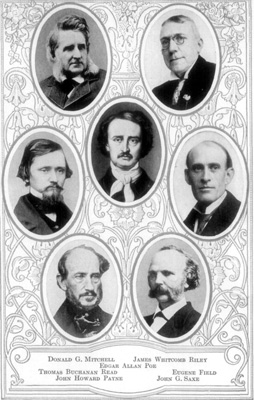 Donald G. Mitchell James Whitcomb Riley
Edgar Allan Poe
Thomas Buchanan Read Eugene Field
John Howard Payne John G. Saxe
I. Analysis. At first Tom is a real boy, a little grimy, ignorant
chimney sweep, next a water baby or eft, in which character, under the
tutelage of the fairies, he gains his education. Briefly at the end he
is a man, an engineer, but all that is delightfully vague, for he has
ceased to be the little Tom we like so thoroughly.
Chapters I and II.
- Tom, the Chimney Sweep,
- Works for Mr. Grimes;
- Summoned to sweep the chimney at Hartover Place;
- Overtakes the poor Irishwoman, who
- Walks with Tom;
- Asks about his prayers and makes him sad;
- Tells about the sea and makes him wish to be clean;
- Helps him pick flowers;
- Frightens Grimes for beating Tom,
- Warns them both to be clean;
- Promises to see them again;
- Disappears.
- Meets the keeper who warns Grimes against poaching;
- Walks up the avenue;
- Sees the deer, trees, bees, and makes friends with the keeper;
- Enters the house and sweeps chimneys;
- Comes out in a beautiful room and sees the little white lady;
- Sees himself for the first time and cries;
- Escapes from the nurse by window and tree;
- Is chased by everybody;
- Is lost in the woods;
- Scales a wall;
- Is followed by the Irishwoman, who throws the pursuers off the scent;
- Crosses the river, climbs a mountain;
- Descends Lewthwaite Crag;
- Drags himself to the cottage;
- Begs for water of the dame;
- Is given milk, and put in an outhouse;
- Is feverish and out of his mind;
- Thinks he must be clean;
- Drags himself to the stream, looks into the clear water, and undresses;
- Does not see the Irishwoman transform herself to the queen of the
fairies;
- Tumbles himself into the stream;
- Falls asleep in the water;
- Is turned into a water-baby by the fairies;
- Is mourned as dead by the people who find his poor dirty body.
Chapters III and IV.
- Tom, the Water Baby,
- Watches the caddis-flies build their homes (page 262) and go into the
chrysalis state (page 262);
- Sees the metamorphosis of the dragon-fly (pages 263-264);
- Meets and makes friends with the otters (pages 270-274);
- Travels towards the sea after the storm;
- Finds the salmon and witnesses the death of Grimes (pages 278-286);
- Passes the sleeping villages and reaches the sea;
- Greets the seal and looks for water babies;
- Plays with the lobsters (pages 292-294);
- Is caught by Professor Ptthmllnsprts and shown to Ellie, the little
white lady, who flies away (pages 296-299). (Can you make out what
Kingsley had in mind, by filling in the vowels of the Professor’s
name?)
Chapter V.
- Tom, the Water Baby,
- Has an adventure in the lobster pots (pages 300-303);
- Joins the water babies;
- Is met by Mrs. Bedonebyasyoudid, who
- Examines Tom;
- Rewards the good children;
- Punishes those who know no better, viz.:
- Tom,
- The doctors,
- The foolish ladies,
- The careless nurserymaids,
- The cruel school teachers,
- Tells Tom about those who knew better.
- Sees Mrs. Doasyouwouldbedoneby, who
- Mothers Tom;
- Tells him the story.
Chapter VI.
- Tom, the Water Baby,
- Steals the candy from the cabinet;
- Becomes prickly and ugly from sin;
- Confesses to Mrs. Bedonebyasyoudid;
- Goes to school to rid himself of his ugliness;
- Is taught by the beautiful little girl;
- Gains his own smooth, clean skin;
- Recognizes the little white lady, Ellie;
- Learns how to join Ellie in the beautiful place;
- Loses her by being unkind;
- Hears the history of the Doasyoulikes;
Chapter VII.
- Tom, the Water Baby,
- Starts to go where he does not like, to find Mr. Grimes;
- Inquires of the King of the Herrings;
- Visits the last of the Gairfowl on the Allalonestone;
- Follows Mother Carey’s chickens;
- Struggles with the water dog;
- Is carried by the mollymocks from Jan Mayen’s land to Shiny Wall;
- Dives under the great white gate that never was opened yet;
- Reaches Peace-pool with the dog;
- Finds Mother Carey at work making new creatures from sea water;
- Is given passport to the Other-End-of-No-where;
- Goes backward in safety.
Chapter VIII.
- Tom, the Water Baby,
- Comes to the place called Stop;
- Is blown through the Sea;
- Finds himself in the claws of the bogy;
- Sees the metals made;
- Slides down the whirlpool;
- Swims to the shore of the Other-End-of-No-where;
- Finds Gotham;
- Comes to the isle of Tomtoddies;
- Hears of their great idol, Examination;
- Gives information to the nimblecomequick turnip;
- Stumbles over the respectable old stick;
- Faces Examiner-of-all-Examiners;
- Arrives at Oldwivesfabledom;
- Comes to the quiet place called Leaveheavenalone;
- Sees the prison;
- Offers the passport to the truncheon;
- Searches for chimney No. 345;
- Finds Grimes stuck in the chimney;
- Tries to light Grimes’ pipe and to release him;
- Learns that the old dame teacher was the mother of Grimes;
- Sees Grimes’ tears effect his release;
- Recognizes Mrs. Bedonebyasyoudid as the Irishwoman;
- Hears Grimes sentenced to sweep out Aetna;
- Is blindfolded and taken up the back stairs;
- Recognizes St. Brandon’s Isle and hears the song;
- Rejoices with Ellie and goes with her Sundays;
- Becomes a man of science and knows everything;
- And, it may be, marries Ellie.
II. Fact and Fancy. The story begins with a vivid description of the
little sweep and his master, and it is not till we have read several
pages that we have reason to suspect that we are reading a fairy story.
In fact the “poor Irishwoman” might be a veritable Irishwoman till we
have read page 247. From this point on, the work of the fairies is seen
occasionally to the end.
The facts of the natural history are mingled with the fancies of the
author’s brain in the most natural manner. The description of the
house-building of the caddis larvae (page 262) is accurate enough for a
scientist, who might, however, be shocked by the whimsical notion of the
rivalry told in the last sentence of the paragraph. The otters behave
like otters, the salmon like salmon, the lobster like the lobster he is.
The dragon “splits” at the call of nature, the ephemerae dance in the
sunlight, and game-keepers kill poachers in real life as in the story.
The great auk is extinct and the right whale is still hunted, but
Peace-pool is as fancifully portrayed as is the creation of world-pap.
It appears that as Kingsley proceeded with his story he let his
imagination play more freely and drew farther away from facts as his
fancies came plentifully. So the story furnishes food for thought by old
and young, and parts of it can be understood only by those who have had
considerable study and experience.
III. Fun and Humor. A more entertaining story is hard to find. There
are many amusing situations and funny doings, besides which, Kingsley’s
style of writing abounds in a rich humor that is not always evident to
the hasty and careless reader. Not a little of the humor is ironical and
sometimes we are inclined to think that the writer may be having a
little quiet fun at the expense of his readers.
Children are inclined to read Tom, the Water Baby as they do many
another tale, for the story only. They want to know what happens to Tom,
whether or no Grimes is punished, what becomes of Ellie, and how it “all
comes out.” But when attention is called to the fun in the tale children
will read it more than once, for they like to laugh even better than
their elders, and curiosity prompts them to watch to “see the joke.”
The humorous twist to things begins in the second sentence of the story
and it does not disappear permanently till the very last sentence of the
Moral. See how it shows in these few extracts: “His master was so
delighted at his new customer that he knocked Tom down out of hand”
(page 219).
After Tom’s pathetic discovery of his own dirtiness (page 232), comes
this: “With a noise as of ten thousand tin kettles tied to ten thousand
mad dogs’ tails.” Humor and pathos are both strengthened by the violent
contrast.
On page 232 begins the long humorous paragraph descriptive of the chase
after Tom.
“The birches birched him as soundly as if he had been a nobleman at
Eton, and over the face too (which is not fair swishing, as all brave
boys will agree)” (page 235).
What could you imagine more amusing in its way than the extremely absurd
“argument” the author makes for the existence of water babies (page
254): “You never heard of a water baby? Perhaps not. That is the very
reason why this story was written. There are a great many things in the
world which you never heard of; and a great many more which nobody ever
heard of; and a great many things, too, which nobody ever will hear of.
No water babies, indeed! Why, wise men of old said that everything on
earth had its double in the water; and you may see that that is, if not
quite true, still quite as true as most other theories which you are
likely to hear for many a day. There are land babies, then why not water
babies? Are there not water rats, water flies, water crickets, water
crabs, water tortoises, water scorpions, water tigers and so on without
end? To be sure, there must be water babies. Am I in earnest? Oh dear
no!”
Read the account of the policemen, beginning on page 306, for an example
of a broader humor.
Page 347: “And the sun acted policeman, and worked round outside every
day, peeping just over the top of the icewall, to see that all went
right; and now and then he played conjuring tricks, or had an exhibition
of fireworks, to amuse the sea fairies. For he would make himself into
four or five suns at once, or paint the sky with rings and crosses and
crescents of white fire and stick himself in the middle of them, and
wink at the fairies; and I dare say they were very much amused, for
anything’s fun in the country.”
Do not think of “skipping” the Moral. No more attractive “moral” was
ever written for fable or fairy tale!
IV. Pathos. Tom, the Chimney Sweep is always pathetic. He enlists our
sympathies wholly from the time we meet him where there was “plenty of
money for Tom to earn and his master to spend,” until he “pulled off all
his clothes in such haste that he tore some of them, which was easy
enough with such ragged old things,” “put his poor, hot, sore feet into
the water,” “tumbled himself as quick as he could into the clear, cool
stream” and in two minutes “fell fast asleep, into the quietest,
sunniest, coziest sleep that he had ever had in his life and—dreamt of
nothing at all.” It is only as Tom the Water Baby that he does not make
us sad.
Poor little, dirty, ignorant Tom! Little enough to climb up the sooty
chimney flues; so dirty that he knew not what cleanliness meant; so
ignorant that he “never had heard of God, or of Christ, except in words
which you never have heard,” and his idea of happiness was to “sit in a
public house with a quart of beer and a long pipe,” to play cards for
silver money, to “keep a white bull dog with one gray ear, and carry
her puppies in his pocket just like a man,” to have apprentices and to
bully them, to knock them about and make them carry soot sacks while he
“rode before them on his donkey, with a pipe in his mouth and a flower
in his button hole, like a king at the head of his army!” “Yes, when his
master let him have a pull at the leavings of his beer, Tom was the
jolliest boy in the whole town.”
To him who reads understandingly, there is pathos on nearly every page
of the first two chapters. Sometimes it is seen in hints and shown by
indirection but in other instances it is direct, positive, powerful.
Just read (page 231), how Tom learns that he is naught but a “little
black ape,” an “ugly, black, ragged figure with bleared eyes and
grinning white teeth.”
In his terrible race for life he “thought he heard church bells ringing
a long way off” and thought “where there is a church there will be
houses and people,” and perhaps someone will give him a “bit and a sup.”
So he follows the ringing in his ears till he comes to the top of the
great crag and sees “a mile off and a thousand feet down” the old dame
in her garden. We lose our own breath in following him down that awful
descent, find ourselves panting, and at last, suddenly, “b-e-a-t, beat!”
After the old dame has given him the old rug and bidden him sleep off
his weariness, comes the fever with the ringing of the church bells and
the persistent, agonizing thought, “I must be clean, I must be clean.”
It is this that drives him out to the “clear, clear limestone water,
with every pebble at the bottom bright and clean” the cool, cool, cool
water for his weary feet.
Then when it is too late, just to add to the pathos of the sad little
tale, comes the Squire, conscious of the terrible mistake and ready to
put Tom in the way of cleanliness, knowledge and happiness; Tom, of whom
there remained only the husk and shell which made the Squire think the
poor sweep was drowned.
To close the chapter and the sad part of the story, the dame sings the
old, old song which the children could not understand but which they
liked nevertheless, “for it was very sweet and very sad and that was
enough for them.” We know what it means.
“When all the world is old, lad,
And all the trees are brown;
And all the sport is stale, lad,
And all the wheels run down;
Creep home, and take your place there,
The spent and maimed among;
God grant you find one face there,
You loved when all was young.”
V. Beauty. Tom, the Water Baby has in it much more of real beauty both
in sentiment and expression than most prose and more than many a
charming poem. There is little of ugliness in the story, and what there
is, is so softened in the way in which it is presented that the
impression is neither repulsive nor lasting. Kingsley’s work is highly
artistic and this story is real literature.
Some of his descriptions are like beautiful pictures in color. Here is
one from page 220:
“But soon the road grew white, and the walls likewise; and at the wall’s
foot grew long grass and gay flowers, all drenched with dew; and instead
of the groaning of the pit engines, they heard the skylark saying his
matins high up in the air, and the pit bird warbling in the sedges as he
had warbled all night long.”
Beginning at the bottom of the same page (220): “For old Mrs. Earth was
still fast asleep; and, like many pretty people she looked still
prettier asleep than awake. The great elm trees in the gold-green
meadows were fast asleep above, and the cows fast asleep beneath them;
nay, the few clouds which were about were fast asleep likewise, and so
tired that they had lain down on the earth to rest, in long white flakes
and bars, among the stems of the elm trees, and along the tops of the
alders by the stream, waiting for the sun to bid them rise and go about
their day’s business in the clear blue overhead.” Was there ever more
attractive description of the mist patches that lie across the earth
waiting for the morning sun to dissipate them?
The poor Irishwoman followed Tom in this manner: “She went along quite
smoothly and gracefully, while her feet twinkled past each other so fast
that you could not see which was foremost.”
The dragon-fly is described in this way: “It grew strong and firm; the
most lovely colors began to show on its body—blue and yellow and black,
spots and bars and rings; out of its back rose four great wings of
bright brown gauze; and its eyes grew so large that they filled all its
head and shone like ten thousand diamonds.”
This is Mrs. Doasyouwouldbedoneby: “She was a very tall woman, as tall
as her sister; but instead of being gnarly, and horny, and scaly, and
prickly, like her, she was the most nice, soft, fat, smooth, pussy,
cuddly, delicious creature who ever nursed a baby—and all her delight
was to play with babies—and therefore when the children saw her, they
naturally caught hold of her, and pulled her till she sat down on a
stone, and climbed into her lap, and clung round her neck, and caught
hold of her hands, and then they all put their thumbs into their mouths
and began cuddling and purring like so many kittens.”
And this is a scene in Peace-pool: “There were moths with pink heads and
wings and opal bodies, that flapped about slowly; moths with brown wings
that flapped about quickly; yellow shrimps that hopped and skipped most
quickly of all; and jellies of all the colors in the world that neither
hopped nor skipped, but only dawdled and yawned.”
Here are a few descriptive phrases taken at random: “Two great, grand
blue eyes, as blue as the sea itself”; “his little whirl-about of a
head”; “long curls floating behind her like a golden cloud, and long
robes floating all round her like a silver one”; “came paddling and
wriggling back to her like so many tadpoles”; “the shadows of the clouds
ran races over the bright blue sky”; “the river widened to the shining
sea”; “such enormous trees that the blue sky rested on their heads.”
VI. Good Lessons. Through all the fun, the burlesque, the amusing
exaggerations and the bombastic humor runs a scheme of advice and
instruction. Sometimes it takes the form of a direct caution to the
reader, again it may be shown by inference, and lastly the events speak
for themselves and give their own lesson. The author meant to teach
adults as well as children. The graphic history of the Doasyoulikes is
rather a clear-cut study in degeneracy for older people, as well as a
lively warning for youngsters. But what is the author’s main theme? Is
his real text in the advice the poor Irishwoman gives to Grimes and Tom?
“Those that wish to be clean, clean they will be; and those that wish
to be foul, foul they will be. Remember.” (page 225). Perhaps a second
text or at least a corollary to this is expressed in the name of the
cuddly lady, Mrs. Doasyouwouldbedoneby. This may mean the same as the
advice she gives on page 328: “Those who go there must go first where
they do not like, and do what they do not like, and help somebody they
do not like.” Besides these leading ideas there are several others that
run through the story. Meanness and wickedness are made unattractive and
bring punishment. The punishment grows logically out of the offense and
has a direct relation to the misdeed. Persons are not rewarded for their
good deeds but they are happy in being good. It is not a credit to do
right, but wrongdoing is discreditable. Little meannesses stand in the
way of happiness though they may not bring any definite punishments.
Evil is ugliness, goodness is beauty. Friendship is made attractive and
filial love is strongly inculcated. The strong appeal made to the
sympathy of the reader by the very real and very human Tom, the chimney
sweep, is a strong influence for good, and progress toward character in
the clever little water baby is a continuous refining influence on the
reader.
The bits of advice, the little asides, are slipped into the text so
naturally that they are never repulsive or calculated to raise
antagonism in the minds of those who naturally dislike advice. Taken
from the text they seem more formal and less helpful, but here are a few
of them as illustrations:
“Let well alone, lad, and ill too at times.”
“You must expect to be beat a few times in your life, little man, if you
live such a life as a man ought to live.”
“Ah, first thoughts are best, and a body’s heart’ll guide them right, if
they will but hearken to it.”
“It was not quite well bred, no doubt; but you know, Tom had not
finished his education yet.”
“For salmon, like other true gentlemen, always choose their lady and
love her, and are true to her, and take care of her, and work for her,
and fight for her, as every true gentleman ought.”
“What has been once can never come over again.”
“No more to be bought for money than a good conscience or the Victoria
cross.”
“You see, experience is of very little good unless a man, or a lobster,
has wit enough to make use of it.”
“It is not good for little boys to be told everything, and never to be
forced to use their own wits.”
“And so if you do not know that things are wrong, that is no reason why
you should not be punished for them; though not as much, my little man
(and the lady looked very kindly, after all), as if you did know.”
“I am quite sure that she knows best. Perhaps she wishes people to learn
to keep their fingers out of the fire by having them burned.”
“I always forgive people the minute they tell me the truth of their own
accord.”
“But even they were no foolisher than some hundred scores of papas and
mamas; who fetch the rod when they ought to fetch a new toy, and send to
the dark cupboard instead of to a doctor.”
VII. Life-like Characters. The great storyteller makes his characters
seem like human beings. The reader can almost see them; at any rate, he
feels that he knows them and that they are real, not merely life-like.
It is hard to understand how the author accomplishes the wonderful feat
(for it is the most wonderful thing about story writing), and it is much
more difficult to tell how it is done. One word here, a clear
descriptive phrase there, and Tom, or the Squire, or the old
schoolmistress, or Mrs. Bedonebyasyoudid with her awkward name, has
become so much of a personality that you cannot forget if you would.
Certainly one of the fine things about Tom, the Water Baby is the
living reality of its characters, which appeals universally to young and
old, even in the first reading of the story.
VIII. The Writer’s Art. It will add something to a child’s interest in
the story if his attention is called to the skilful way in which
Kingsley handles his plot. It is high art to throw into the early part
of the story the conversation between the keeper and Grimes. It shows
that Grimes is a poacher and known to be one. The keeper is inclined to
wink at the offense, but still he feels that a warning is necessary.
Nothing more is said about poaching till much later, where Tom, the
Water Baby, sees Grimes meet a poacher’s death.
Again, it is early evident that Grimes has done other wicked things and
that the poor Irishwoman knows of one at least. She even mentions
Vendale, but the reader attaches no importance to it. Tom flees to
Vendale and is pitied and kindly treated by the old Schoolmistress, but
it is not until Tom finds Grimes suffering his punishment in the chimney
flues that the reader learns what the poor Irishwoman knew about Grimes,
and that the schoolmistress was Grimes’s poor ill-treated mother.
Once more, Kingsley’s art is seen in the selection of incidents and the
arrangement of influences which bring to Tom the conviction of his
dirtiness and create in him the overpowering desire to be clean.
But this interpretation of Tom, the Water Baby has already reached the
limits of space and we must forego the pleasure of pointing out other
examples of artistic treatment. Probably it is better to leave the story
to plead its own cause.
(Volume V, page 237)
While the outline differs in form from those we have been using, it is a
helpful variation, and shows that while a narrative poem must be studied
first in the same manner as a story, there are still other points that
need careful examination.
Tennyson’s The Passing of Arthur is one of the noble things in
literature, solemn, impressive, inspiring. In order to appreciate a
careful study of it, one should have read at least those selections
which appear in the fifth volume, beginning with page 113 and extending
to page 236. With this preliminary setting there should be no difficulty
in feeling a sufficient interest in King Arthur to be appreciative of
Tennyson’s work from the very beginning.
a. Characters. Three characters appear in this poem, viz: King Arthur;
Sir Bedivere, the knight first made and last surviving of all those who
sat about King Arthur’s table; Modred, Arthur’s traitorous nephew.
Besides these three human characters, the ghost of Gawain, the three
queens who came in the barge, and even Excalibur itself are of so much
interest that they may be considered as almost human.
King Arthur is shown in his old age, when wife and friend are traitor to
his peace, and all his realm has sunk back into disorder and is rapidly
approaching extinction.
Bedivere, oldest of the knights, now in the white winter of his age,
when he himself was really no more than a voice, is supposed to tell the
story to those with whom he dwelt, new faces, other minds.
Modred is seen retreating league by league before King Arthur. At
Lyonnesse, after a fierce battle in which confusion reigned and friends
and foes were shadows in the mist, he meets his king. The false knight
strikes Arthur hard upon the helmet, and gives the wound that finally
proves fatal; while the king, with the last stroke of Excalibur, slays
his traitorous nephew.
The dead Gawain appears, a ghost blown along a wandering wind, and on
the eve of the battle warns King Arthur of approaching death, but
intimates that somewhere is an isle of rest for him.
b. The Incidents.
- 1. Arthur mourns for his departed kingdom.
- 2. Gawain warns Arthur of his approaching death; Arthur is depressed
by the warning.
- 3. Bedivere warns Arthur that he must rise and conquer Modred;
Arthur hesitates to make war against his people.
- 4. He moves his host to Lyonnesse: the last weird battle is fought.
- 5. Arthur thinks himself king only among the dead.
- 6. Bedivere professes affection, and calls Arthur’s attention to the
traitor, Modred.
- 7. The king promises one last act of kinghood.
- 8. Modred wounds the king; the king kills Modred.
- 9. Bedivere carries the wounded Arthur to the ruined chapel.
- 10. The dying Arthur directs Bedivere to throw Excalibur into the
mere; Bedivere twice deceives Arthur and is twice reproved.
- 11. Bedivere throws Excalibur into the mere, and tells King Arthur
what happened.
- 12. Bedivere bears Arthur to the margin of the mere.
- 13. The three black-hooded queens with crowns of gold come in the
dusky barge.
- 14. Arthur is placed in the barge and speaks his last words to
Bedivere; the barge moves swan-like from the brink.
- 15. Bedivere watches the speck that bears the king move down the long
water opening on the deep.
c. Scenes.
- 1. Arthur in his tent among the slumbering host.
- 2. The march to the sunset bound of Lyonnesse, and the moving
pageant to the battlefield.
- 3. The dark strait of barren land with the ocean on one side and on
the other the great water; the ruined chapel with its broken
chancel and broken cross, and, near at hand, the place of tombs
with its bones of ancient mighty men; athwart all shines the
moon, and over all the chill wind with flakes of foam sings
shrilly. Zigzag paths lead around jutting points of rock down to
the shining levels of the lake, where the ripple washes softly in
the reeds, the wild water laps the crags, and many-knotted
water-flags whistle stiff and dry. Frozen hills, barren chasms
with icy caves, the bare black cliff and slippery crag wall, and
the level lake gleaming in the glories of the winter moon.
d. Descriptive Passages. Besides those passages which relate
especially to the scenes, there are other beautiful and powerful bits of
description that will well repay examination. For instance:
- 1. Of King Arthur’s dream the poet says,
“And fainter onward, like wild birds that change
Their season in the night and wail their way
From cloud to cloud, down the long wind the dream
Shrill’d.”
Note the figure of speech (simile), beginning with the word
like.
- 2. The description of the last, dim, weird battle in the west,
beginning at the bottom of page 240 with the line “A death-white
mist slept over land and sea,” is one of the most stirring things
in the poem, and deserves particularly close reading. The
pictures are crowded, the figures vivid, the phrases full of
force.
- 3. Tennyson has used his highest art in the composition, and makes
the sound of his lines imitate in no feeble way the noise of
battle. For instance:
“Shocks, and the splintering spear, the hard mail hewn,
Shield-breakings, and the clash of brands, the crash
Of battle-axes on shatter’d helms, and shrieks
After the Christ, of those who falling down
Look’d up for heaven, and only saw the mist.”
- 4. The brilliancy of description corresponds well with the
glittering marvel of Excalibur:
“For all the haft twinkled with diamond sparks,
Myriads of topaz-lights, and jacinth-work
Of subtlest jewelry.”
“.....the wonder of the hilt,
How curiously and strangely chased,”
“The great brand
Made lightnings in the splendor of the moon,
And flashing round and round, and whirl’d in an arch,
Shot like a streamer of the northern morn,
Seen where the moving isles of winter shock
By night, with noises of the Northern Sea.”
- 5. King Arthur, as he lay in the barge with his weary head upon the
lap of the fairest and tallest of the three queens, is described
as follows:
“a brow
Striped with dark blood: for all his face was white
And colorless, and like the wither’d moon
Smote by the fresh beam of the springing east;
And all his greaves and cuisses dash’d with drops
Of onset; and the light and lustrous curls—
That made his forehead like a rising sun
High from the dais-throne—were parch’d with dust,
Or, clotted into points and hanging loose,
Mix’d with the knightly growth that fringed his lips.
So like a shatter’d column lay the king;
Not like that Arthur, who, with lance in rest,
From spur to plume a star of tournament,
Shot thro’ the lists at Camelot, and charged
Before the eyes of ladies and of kings.”
e. Character Study—King Arthur. The best estimate of King Arthur’s
character is made from his own words and those of Bedivere, not from
Tennyson’s description.
- 1. He has been a devout man. He has fought for Christ and searched
for Christ and
“found Him in the shining of the stars,
Mark’d Him in the flowering of His fields.”
- 2. He is now discouraged. He has not found Him in His ways with men,
and now it seems to him,
“As if some lesser god had made the world,
But had not force to shape it as he would.”
“My God, thou hast forgotten me in my death.”
- 3. Yet he is hopeful, and he feels that perchance the world is
wholly fair, and that his doubts come because he has not the
power to see it as it is, and may not see it to the close.
- 4. He desires to be just, and feels that in the coming battle in the
west he may not have the right on his side:
“Ill doom is mine
To war against my people and my knights.
The king who fights his people fights himself.”
- 5. Yet courage and confidence are not all gone:
“Yet let us hence, and find or feel a way
Thro’ this blind haze.”
- 6. After the battle, he grows more confused:
“I know not what I am,
Nor whence I am, nor whether I be King.
Behold, I seem but King among the dead.”
- 7. He must be noble, kingly, to have inspired such devotion as
Bedivere shows. Hear what the latter says:
“My King,
King everywhere! and so the dead have kings,
There also will I worship thee as King.”
- 8. He is a warrior to the last. Listen to his reply to Bedivere:
“King am I, whatsoever be their cry;
And one last act of kinghood shalt thou see
Yet, ere I pass.”
- 9. He is resigned: “Let what will be, be.”
- 10. He is faithful to the trust imposed upon him when he acquired
Excalibur. Three times he sends Bedivere to cast the sword into
the mere. The last time he says:
“But, if thou spare to fling Excalibur,
I will arise and slay thee with my hands.”
- 11. He loves truth and reveres it:
“This is a shameful thing for men to lie.”
- 12. Though he appears to fear death, rather is his fear that he shall
die before he reaches the water where he expects something.
- 13. At the last his philosophy bears him up, though still he calls
for devotion from his faithful knight. The whole speech is
matchless. Note these fine passages:
“The old order changeth, yielding place to new,
And God fulfils himself in many ways.”
“And that which I have done
May He within himself make pure!”
“More things are wrought by prayer
Than this world dreams of. Wherefore, let thy voice
Rise like a fountain for me night and day.”
“The whole round earth is everyway
Bound by gold chains about the feet of God.”
- 14. His faith rises triumphant:
“I am going a long way ...
Where falls not hail, or rain, or any snow,
Nor ever wind blows loudly; but it lies
Deep-meadow’d, happy, fair with orchard lawns
And bowery hollows crown’d with summer sea,
Where I will heal me of my grievous wound.”
f. Beauty. All the elements of poetic beauty join to make The Passing
of Arthur a masterpiece. Sublime sentiment thrills through the stanzas.
A stately meter gives a solemn, rhythmic swing to the noble lines.
Sonorous words add to the grandeur. Apt phrases and beautiful figures of
speech seize the imagination and enchain the fancy. Rare and choice
diction gives artistic finish to every sentence.
Most beautiful are such phrases as the following:
“The phantom circle of a moaning sea.”
“Some whisper of the seething sea.”
“Clothed in white samite, mystic, wonderful.”
“Let thy voice
Rise like a fountain for me night and day.”
“And looking wistfully with wide blue eyes
As in a picture.”
“Clothed with his breath.”
“A cry that shiver’d to the tingling stars.”
Note how the following phrases give color to the poem:
“that day when the great light of heaven
Burn’d at his lowest in the rolling year.”
“Among the mountains by the winter sea.”
“The winter moon,
Brightening the skirts of a long cloud.”
Observe the pictorial power of these quotations:
“Make broad thy shoulders to receive my weight.”
“Straining his eyes beneath an arch of hand.”
“One black dot against the verge of dawn.”
Most forceful are the following phrases:
“And the days darken round me, and the years,
Among new men, strange faces, other minds.”
“From the great deep to the great deep he goes.”
“Authority forgets a dying king.”
“An agony
Of lamentation, like a wind that shrills
All night in a waste land, where no one comes,
Or hath come, since the making of the world.”
There never was a more beautiful comparison than the following:
“Like some full-breasted swan
That, fluting a wild carol ere her death,
Ruffles her pure cold plume, and takes the flood
With swarthy webs.”