Journeys and Explorations in the Cottom Kingdom of America, Volume 1
Whole book · 19 sections
JOURNEYS AND EXPLORATIONS IN THE COTTON KINGDOM OF AMERICA.
Transcriber’s Note:
Inconsistent hyphenation, capitalization, and spelling in the
original document have been preserved. Obvious typographical
errors have been corrected.
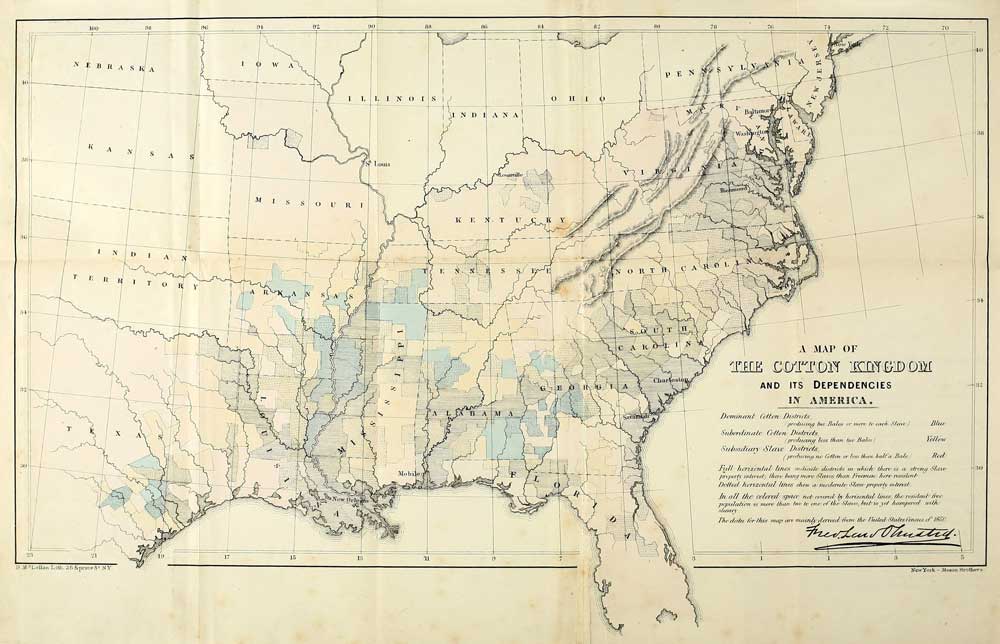
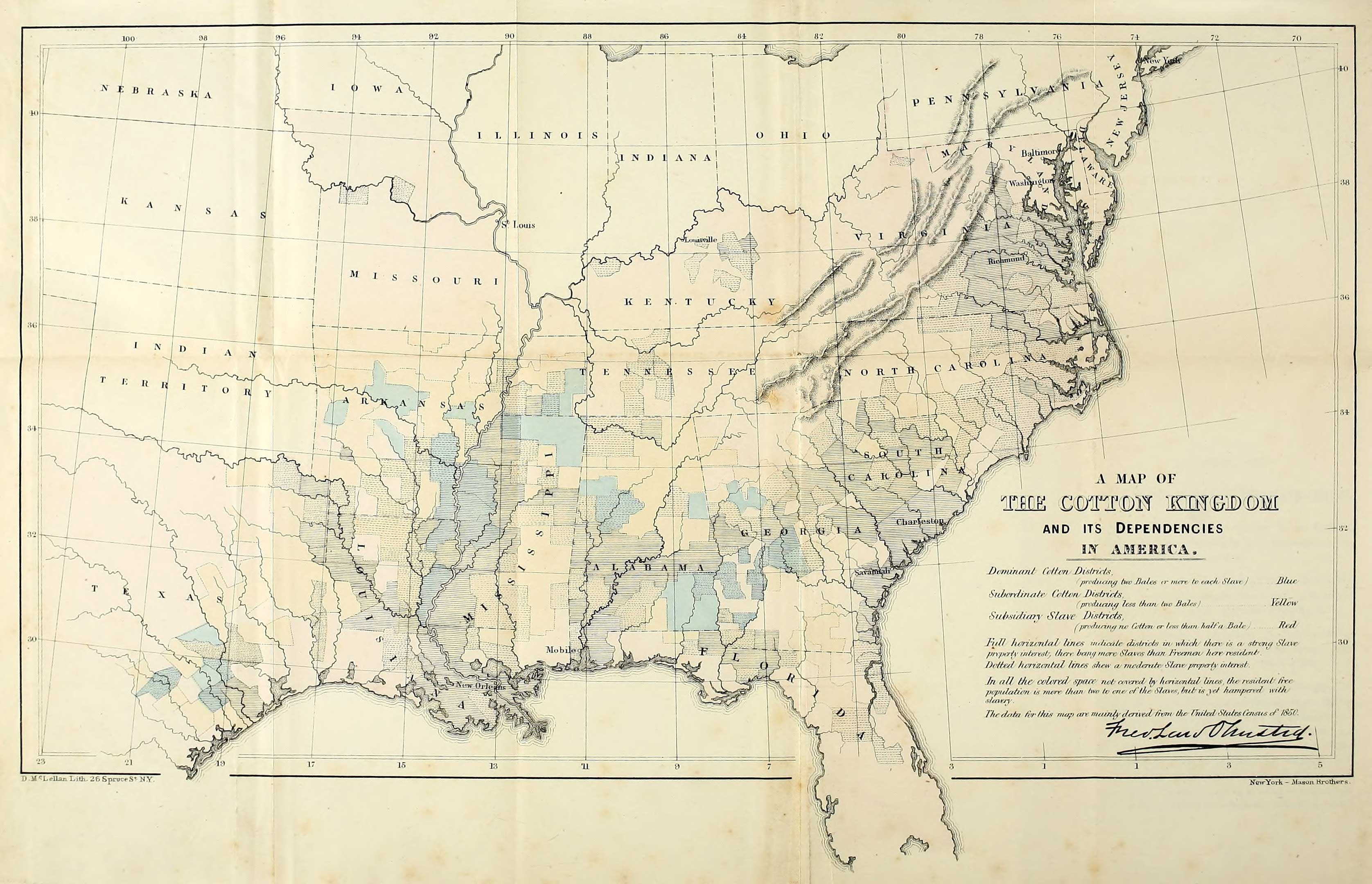
Map reproduction courtesy of the Norman B. Leventhal Map & Education Center
at the Boston Public Library.
Download Volume 2 at https://www.gutenberg.org/ebooks/72677.
MR. OLMSTED’S WORKS ON THE SLAVE STATES.
ADVERTISEMENT.
Seaboard Slave States. A Journey in the Seaboard
Slave States, with Remarks on their Economy. 1 vol.,
12mo. pp. 724. Price, $1.25.
Texas Journey. A Journey through Texas: or, a Saddle
Trip on the Southwestern Frontier; with a Statistical
Appendix. 1 vol., 12mo. pp. 516. Price, $1.25.
Journey in the Back Country. A Journey in the
Back Country; with a complete Index to the three
volumes. 1 vol., 12mo. pp. 492. Price, $1.25.
The Cotton Kingdom. A Traveller’s observations on
Cotton and Slavery in the American Slave States.
Based upon three former volumes of Journeys and
Investigations by the same author. 2 vols., 12mo. pp.
384 and 408. With a Colored Statistical Map of the
Cotton Kingdom and its Dependencies, mainly derived
from the United States Census. Price, $2.00.
This work was, by request, prepared by its author with especial reference
to English readers, and is simultaneously published in England
and in this country.
A MAP OF
THE COTTON KINGDOM
and its Dependencies
IN AMERICA.
Dominant Cotton Districts.
(producing two Bales or more to each Slave)
Blue
Subordinate Cotton Districts.
(producing less than two Bales)
Yellow
Subsidiary Slave Districts.
(producing no Cotton or less than half a Bale)
Red
Full horizontal lines indicate in which there is a strong Slave
property interest, there being more Slaves than Freemen here resident.
Dotted horizontal lines shew a moderate Slave property interest.
In all the colored space not covered by horizontal lines, the resident free
population is more than two to one of the Slaves, but is yet hampered with
slavery.
The data for this map are mainly derived from the United States Census of 1850.
A TRAVELLER’S OBSERVATIONS ON COTTON AND SLAVERY
IN THE AMERICAN SLAVE STATES.
BASED UPON THREE FORMER VOLUMES OF JOURNEYS AND INVESTIGATIONS
BY THE SAME AUTHOR.
BY
FREDERICK LAW OLMSTED.
IN TWO VOLUMES.
VOL. 1.
NEW YORK:
PUBLISHED BY MASON BROTHERS,
5 and 7 MERCER STREET.
LONDON: SAMPSON LOW, SON & CO., 47 LUDGATE HILL.
1861.
Entered, according to the Act of Congress, in the year 1861, by
MASON BROTHERS,
In the Clerk’s Office of the District Court of the United States for the Southern
District of New York.
PRINTED BY C. A. Alvord,
15 Vandewater-st.
DEDICATION.
TO
JOHN STUART MILL, ESQ.
Sir,
I beg you to accept the dedication of this
book as an indication of the honour in which your services
in the cause of moral and political freedom are held in
America, and as a grateful acknowledgment of the personal
obligations to them on the part of
The mountain ranges, the valleys, and the great waters of
America, all trend north and south, not east and west. An
arbitrary political line may divide the north part from the
south part, but there is no such line in nature: there can
be none, socially. While water runs downhill, the currents
and counter currents of trade, of love, of consanguinity, and
fellowship, will flow north and south. The unavoidable
comminglings of the people in a land like this, upon the conditions
which the slavery of a portion of the population impose,
make it necessary to peace that we should all live under
the same laws and respect the same flag. No government
could long control its own people, no government could long
exist, that would allow its citizens to be subject to such
indignities under a foreign government as those to which the
citizens of the United States heretofore have been required
to submit under their own, for the sake of the tranquillity of
the South. Nor could the South, with its present purposes,
live on terms of peace with any foreign nation, between
whose people and its own there was no division, except such
an one as might be maintained by means of forts, frontier-guards
and custom-houses, edicts, passports and spies. Scotland,
Wales, and Ireland are each much better adapted for an
independent government, and under an independent government
would be far more likely to live at peace with England,
than the South to remain peaceably separated from the North
of this country.
It is said that the South can never be subjugated. It must
be, or we must. It must be, or not only our American republic
is a failure, but our English justice and our English
law and our English freedom are failures. This Southern
repudiation of obligations upon the result of an election is but
a clearer warning than we have had before, that these cannot
be maintained in this land any longer in such intimate association
with slavery as we have hitherto tried to hope that
they might. We now know that we must give them up, or
give up trying to accommodate ourselves to what the South
has declared, and demonstrated, to be the necessities of its
state of society. Those necessities would not be less, but, on
the contrary, far more imperative, were the south an independent
people. If the South has reason to declare itself
independent of our long-honoured constitution, and of our
common court of our common laws, on account of a past
want of invariable tenderness on the part of each one of
our people towards its necessities, how long could we calculate
to be able to preserve ourselves from occurrences which
would be deemed to abrogate the obligations of a mere treaty
of peace? A treaty of peace with the South as a foreign
power, would be a cowardly armistice, a cruel aggravation
and prolongation of war.
Subjugation! I do not choose the word, but take it, and
use it in the only sense in which it can be applicable. This
is a Republic, and the South must come under the yoke of
freedom, not to work for us, but to work with us, on equal
terms; as a free people. To work with us, for the security of
a state of society, the ruling purpose and tendency of which,
spite of all its bendings heretofore, to the necessities of slavery;
spite of the incongruous foreign elements which it has had constantly
to absorb and incorporate; spite of a strong element
of excessive backwoods individualism, has, beyond all question,
been favourable to sound and safe progress in knowledge,
civilization, and Christianity. To this yoke the head of the
South must now be lifted, or we must bend our necks to that
of slavery, consenting and submitting, even more than we have
been willing to do heretofore, to labour and fight, and pay for
the dire needs of a small portion of our people living in an
exceptional state of society, in which Cowper’s poems must
not be read aloud without the precautions against the listening
of family servants; in which it may be treated as a crime
against the public safety to teach one of the labouring classes
to write; in which the names of Wilberforce and Buxton are
execrated; within which the slave trade is perpetuated, and at
the capital of whose rebellion, black seamen born free, taken
prisoners, in merchant ships, not in arms, are even already
sold into slavery with as little hesitation as even in Barbary.
One system or the other is to thrive and extend, and eventually
possess and govern this whole land.
This has been long felt and acted upon at the South; and
the purpose of the more prudent and conservative men, now
engaged in the attempt to establish a new government in the
South, was for a long time simply to obtain an advantage for
what was talked of as “reconstruction;” namely, a process of
change in the form and rules of our government that would
disqualify us of the Free States from offering any resistance to
whatever was demanded of our government, for the end in
view of the extension and eternal maintenance of slavery.
That men to whom the terms prudent and conservative can in
any way be applied, should not have foreseen that such a
scheme must be unsuccessful, only presents one more illustration
of that, of which the people of England have had many
in their own history, the moral Myopism, to which the habit
of almost constantly looking down and never up at mankind,
always predisposes. That the true people of the United
States could have allowed the mutiny to proceed so far, before
rising in their strength to resist it, is due chiefly to the instructive
reliance which every grumbler really gets to have
under our forms of society in the ultimate common-sense of
the great body of the people, and to the incredulity with which
the report has been regarded, that slavery had made such a
vast difference between the character of the South and that
of the country at large. Few were fully convinced that the
whole proceedings of the insurgents meant anything else than
a more than usually bold and scandalous way of playing the
game of brag, to which we had been so long used in our
politics, and of which the people of England had a little
experience shortly before the passage of a certain Reform Bill.
The instant effect of the first shotted-gun that was fired proves
this. We knew then that we had to subjugate slavery, or be
subjugated by it.
Peace is now not possible until the people of the South are
well convinced that the form of society, to fortify which is the
ostensible purpose of the war into which they have been
plunged, is not worthy fighting for, or until we think the
sovereignty of our convictions of Justice, Freedom, Law and
the conditions of Civilization in this land to be of less worth
than the lives and property of our generation.
From the St. Lawrence to the Mexican Gulf, freedom
must everywhere give way to the necessities of slavery, or
slavery must be accommodated to the necessary incidents of
freedom.
Where the hopes and sympathies of Englishmen will be,
we well know.
“The necessity to labour is incompatible with a high
civilization, and with heroic spirit in those subject to it.”
“The institution of African slavery is a means more
effective than any other yet devised, for relieving a large body
of men from the necessity of labour; consequently, states
which possess it must be stronger in statesmanship and in
war, than those which do not; especially must they be
stronger than states in which there is absolutely no privileged
class, but all men are held to be equal before the law.”
“The civilized world is dependent upon the Slave States
of America for a supply of cotton. The demand for this commodity
has, during many years, increased faster than the
supply. Sales are made of it, now, to the amount of two
hundred millions of dollars in a year, yet they have a vast
area of soil suitable for its production which has never been
broken. With an enormous income, then, upon a steadily
rising market, they hold a vast idle capital yet to be employed.
Such a monopoly under such circumstances must constitute
those who possess it the richest and most powerful people on
the earth. The world must have cotton, and the world
depends on them for it. Whatever they demand, that must
be conceded them; whatever they want, they have but to
stretch forth their hands and take it.”
These fallacies, lodged in certain minds, generated, long ago,
grand, ambitious, and bold schemes of conquest and wealth.
The people of the North stood in the way of these schemes.
In the minds of the schemers, labour had been associated with
servility, meekness, cowardice; and they were persuaded that
all men not degraded by labour at the North “kept aloof
from politics,” or held their judgment in entire subjection to
the daily wants of a working population, of no more spirit
and no more patriotism than their own working men—slaves.
They believed this whole people to be really in a state of dependence,
and that they controlled that upon which they
depended. So, to a hitherto vague and inert local partisanship,
they brought a purpose of determination to overcome
the North, and, as this could not be safely avowed, there was
the necessity for a conspiracy, and for the cloak of a conspiracy.
By means the most mendacious, the ignorant,
proud, jealous, and violent free population of the cotton
States and their dependencies, were persuaded that less consideration
was paid to their political demands than the importance
of their contentment entitled them to expect from
their government, and were at length decoyed into a state of
angry passion, in which they only needed leaders of sufficient
audacity to bring them into open rebellion. Assured that
their own power if used would be supreme, and that they had
but to offer sufficient evidence of a violent and dangerous
determination to overawe the sordid North, and make it
submit to a “reconstruction” of the nation in a form more
advantageous to themselves, they were artfully led along in
a constant advance, and constant failure of attempts at intimidation,
until at length they must needs take part in a
desperate rebellion, or accept a position which, after the
declarations they had made for the purpose of intimidation,
they could not do without humiliation.
The conspirators themselves have, until recently, been able,
either directly or by impositions upon patriotic, but too confiding
and generous instruments, to control the treasury of
the United States, its post-office, its army and navy, its
arsenals, workshops, dockyards and fortresses, and, by the
simple means of perjury, to either turn these agencies against
the government, or at least render them ineffectual to aid it,
and this at a time, when its very existence, if it were anything
but a democratic republican government, and, as we think
for all good purposes, by far the strongest that ever existed,
would have depended on a perfect instant and unquestionable
command of them. Yet I doubt not that the conspirators
themselves, trust at this moment, as they ever have trusted,
even less to the supposed helpless condition of the government
than to the supposed advantages of the cotton monopoly
to the Slave States, and to the supposed superiority of a
community of privileged classes over an actual democracy.
“No! you dare not make war upon cotton; no power on
earth dares to make war upon it. Cotton is king; until
lately the Bank of England was king; but she tried to put
her screws, as usual, the fall before the last, on the cotton
crop, and was utterly vanquished. The last power has been
conquered: who can doubt, that has looked at recent events,
that cotton is supreme?”
These are the defiant and triumphant words of Governor
Hammond, of South Carolina, addressed to the Senate of the
United States, March 4th, 1858. Almost every important
man of the South, has at one time or other, within a few
years, been betrayed into the utterance of similar exultant
anticipations; and the South would never have been led into
the great and terrible mistake it has made, had it not been
for this confident conviction in the minds of the men who
have been passing for its statesmen. Whatever moral strength
the rebellion has, abroad or at home, lies chiefly in the fact
that this conviction is also held, more or less distinctly, by
multitudes who know perfectly well that the commonly assigned
reasons for it are based on falsehoods.
Recently, a banker, who is and always has been a loyal
union man, said, commenting upon certain experiences of
mine narrated in this book: “The South cannot be poor.
Why their last crop alone was worth two hundred million.
They must be rich:” ergo, say the conspirators, adopting the
same careless conclusion, they must be powerful, and the
world must feel their power, and respect them and their institutions.
My own observation of the real condition of the people of
our Slave States, gave me, on the contrary, an impression that
the cotton monopoly in some way did them more harm than
good; and, although the written narration of what I saw was
not intended to set this forth, upon reviewing it for the present
publication, I find the impression has become a conviction.
I propose here, therefore, to show how the main body of the
observations of the book arrange themselves in my mind with
reference to this question, and also to inquire how far the conclusion
to which I think they tend is substantiated by the
Census returns of those States.[1]
Coming directly from my farm in New York to Eastern
Virginia, I was satisfied, after a few weeks’ observation, that
the most of the people lived very poorly; that the proportion
of men improving their condition was much less than in any
Northern community; and that the natural resources of the
land were strangely unused, or were used with poor economy.
It was “the hiring season,” and I had daily opportunities of
talking with farmers, manufacturers, miners, and labourers,
with whom the value of labour and of wages was then the
handiest subject of conversation. I soon perceived that labour
was much more readily classified and measured with reference
to its quality than at the North. The limit of measure I
found to be the ordinary day’s work of a “prime field-hand,”
and a prime field-hand, I found universally understood to mean,
not a man who would split two cords of wood, or cradle two
acres of grain in a day, but a man for whom a “trader”
would give a thousand dollars, or more, to take on South, for
sale to a cotton planter. I do not mean that the alternative
of a sale to a trader was always had in view in determining
how a man should be employed. To be just, this seldom
appeared to be the case—but that, in estimating the market
value of his labour, he was viewed, for the time, from the
trader’s point of view, or, as if the question were—What is he
worth for cotton?
I soon ascertained that a much larger number of hands, at
much larger aggregate wages, was commonly reckoned to be
required to accomplish certain results, than would have been
the case at the North. Not all results, but certain results,
of a kind in which it happened that I could most readily
make a confident comparison. I have been in the habit of
watching men at work, and of judging of their industry, their
skill, their spirit; in short, of whatever goes to make up their
value to their employers, or to the community, as instruments
of production; and from day to day I saw that, as a landowner,
or as a citizen, in a community largely composed, or
dependent upon the productive industry, of working people of
such habits and disposition as I constantly saw evinced in
those of Virginia, I should feel disheartened, and myself lose
courage, spirit, and industry. The close proximity of the
better and cheaper labour—labour seeking a field of labour—which
I had left behind me, added greatly to my interest in
the subject, and stimulated close inquiry. It seemed, indeed,
quite incredible that there really could be such a want of
better labour in this region as at first sight there appeared to
be, when a supply was so near at hand. I compared notes
with every Northern man I met who had been living for some
time in Virginia, and some I found able to give me quite
exact statements of personal experience, with which, in the
cases they mentioned, it could not be doubted that labourers
costing, all things considered, the same wages, had taken four
times as long to accomplish certain tasks of rude work in
Virginia as at the North, and that in house service, four
servants accomplished less, while they required vastly more
looking after, than one at the North.
I left Virginia, having remained much longer than I at first
intended, in trying to satisfy myself about this matter—quite
satisfied as to the general fact, not at all satisfied with any
theories of demand and supply which had been offered me,
or which had occurred to me, in the way of explanation of it.
My perplexity was increased by certain apparent exceptions
to the general rule; but they were, all things considered, unimportant,
and rather served as affording contrasts, on the
ground, to satisfy me of the correctness of my general conclusion.
I subsequently returned, and spent another month in
Virginia, after visiting the cotton States, and I also spent
three months in Kentucky and other parts of the Slave States
where the climate is unsuitable for the production of cotton,
and with the information which I had in the meantime
obtained, I continued to study both the question of fact, and
the question of cause. The following conclusions to which
my mind tended strongly in the first month, though I did
not then adopt them altogether with confidence, were established
at length in my convictions.
1. The cash value of a slave’s labour in Virginia is, practically,
the cash value of the same labour minus the
cost of its transportation, acclimatizing, and breaking
in to cotton-culture in Mississippi.
2. The cost of production, or the development of natural
wealth in Virginia, is regulated by the cost of slave-labour:
(that is to say) the competition of white
labour does not materially reduce it; though it doubtless
has some effect, at least in certain districts, and
with reference to certain productions or branches of industry.
3. Taking infants, aged, invalid, and vicious and knavish
slaves into account, the ordinary and average cost of
a certain task of labour is more than double in
Virginia what it is in the Free States adjoining.
4. The use of land and nearly all other resources of wealth
in Virginia is much less valuable than the use of
similar property in the adjoining Free States, these
resources having no real value until labour is applied
to them. (The Census returns of 1850 show that the
sale value of farm lands by the acre in Virginia is less
than one-third the value of farm lands in the adjoining
Free State of Pennsylvania, and less than
one-fifth than that of the farm lands of the neighbouring
Free State of New Jersey.)[2]
5. Beyond the bare necessities of existence, poor shelter,
poor clothing, and the crudest diet, the mass of the
citizen class of Virginia earn very little and are very
poor—immeasurably poorer than the mass of the
people of the adjoining Free States.
6. So far as this poverty is to be attributed to personal
constitution, character, and choice, it is not the result
of climate.
7. What is true of Virginia is measurably true of all the
border Slave States, though in special cases the resistance
of slavery to a competition of free labour is
more easily overcome. In proportion as this is the
case, the cost of production is less, the value of production
greater, the comfort of the people is greater;
they are advancing in wealth as they are in intelligence,
which is the best form or result of wealth.
I went on my way into the so-called cotton States, within
which I travelled over, first and last, at least three thousand
miles of roads, from which not a cotton plant was to be seen,
and the people living by the side of which certainly had not
been made rich by cotton or anything else. And for every
mile of road-side upon which I saw any evidence of cotton
production, I am sure that I saw a hundred of forest or waste
land, with only now and then an acre or two of poor corn half
smothered in weeds; for every rich man’s house, I am sure
that I passed a dozen shabby and half-furnished cottages, and
at least a hundred cabins—mere hovels, such as none but
a poor farmer would house his cattle in at the North. And
I think that, for every man of refinement and education with
whom I came in contact, there were a score or two superior
only in the virtue of silence, and in the manner of self-complacency,
to the sort of people we should expect to find
paying a large price for a place from which a sight could be
got at a gallows on an execution day at the North, and a
much larger number of what poor men at the North would
themselves describe as poor men: not that they were destitute
of certain things which are cheap at the South,—fuel for instance,—but
that they were almost wholly destitute of things
the possession of which, at the North, would indicate that a
man had begun to accumulate capital—more destitute of these,
on an average, than our day-labourers. In short, except in
certain limited districts, mere streaks by the side of rivers,
and in a few isolated spots of especially favoured soil away
from these, I found the same state of things which I had
seen in Virginia, but in a more aggravated form.
At least five hundred white men told me something of their
own lives and fortunes, across their own tables, and with the
means of measuring the weight of their words before my eyes;
and I know that white men seldom want an abundance of
coarse food in the cotton States: the proportion of the free
white men who live as well in any respect as our working
classes at the North, on an average, is small, and the citizens
of the cotton States, as a whole, are poor. They work little,
and that little, badly; they earn little, they sell little; they
buy little, and they have little—very little—of the common
comforts and consolations of civilized life. Their destitution
is not material only; it is intellectual and it is moral. I
know not what virtues they have that rude men everywhere
have not; but those which are commonly attributed to them,
I am sure that they lack: they are not generous or hospitable;
and, to be plain, I must say that their talk is not the
talk of even courageous men elsewhere. They boast and lack
self-restraint, yet, when not excited, are habitually reserved
and guarded in expressions of opinion very much like cowardly
men elsewhere.
But, much cotton is produced in the cotton States, and by
the labour of somebody; much cotton is sold and somebody
must be paid for it; there are rich people; there are good
markets; there is hospitality, refinement, virtue, courage, and
urbanity at the South. All this is proverbially true. Who
produces the cotton? who is paid for it? where are, and who
are, the rich and gentle people?
I can answer in part at least.
I have been on plantations on the Mississippi, the Red
River, and the Brazos bottoms, whereon I was assured that
ten bales of cotton to each average prime field-hand had been
raised. The soil was a perfect garden mould, well drained
and guarded by levees against the floods; it was admirably
tilled; I have seen but few Northern farms so well tilled: the
labourers were, to a large degree, tall, slender, sinewy, young
men, who worked from dawn to dusk, not with spirit, but
with steadiness and constancy. They had good tools; their
rations of bacon and corn were brought to them in the field,
and eaten with efficient despatch between the cotton plants.
They had the best sort of gins and presses, so situated that
from them cotton bales could be rolled in five minutes to steamboats,
bound direct to the ports on the gulf. They were
superintended by skilful and vigilant overseers. These plantations
were all large, so large as to yet contain much fresh
land, ready to be worked as soon as the cultivated fields gave
out in fertility. If it was true that ten bales of cotton to the
hand had been raised on them, then their net profit for the
year had been, not less than two hundred and fifty dollars for
each hand employed. Even at seven bales to the hand the
profits of cotton planting are enormous. Men who have
plantations producing at this rate, can well afford to buy fresh
hands at fourteen hundred dollars a head. They can even
afford to employ such hands for a year or two in clearing land,
ditching, leveeing, fencing, and other preparatory work,
buying, meantime, all the corn and bacon they need, and
getting the best kind of tools and cattle, and paying fifteen
per cent. per annum interest on all the capital required for
this, as many of them do. All this can be well afforded to
establish new plantations favourably situated, on fresh soil,
if there is a reasonable probability that they can after all be
made to produce half a dozen seven-bale crops. And a great
many large plantations do produce seven bales to the hand
for years in succession. A great many more produce seven
bales occasionally. A few produce even ten bales occasionally,
though by no means as often as is reported.
Now, it is not at a Roman lottery alone that one may see it,
but all over the world, where a few very large prizes are
promised and many very small ones, and the number of
tickets is limited; these are always speculated on, and men
will buy them at third and fourth hand at prices which, it is
useless to demonstrate to them, must be extravagant. They
go to the Jews and pledge the clothes on their back to get
another biacchi to invest; they beggar themselves; they ruin
their families; they risk damnation in their passionate eagerness
to have a chance, when they know perfectly well that
the average of chances is not worth a tithe of what they must
pay for it.
The area of land on which cotton may be raised with profit
is practically limitless; it is cheap; even the best land is
cheap; but to the large planter it is much more valuable
when held in large parcels, for obvious reasons, than when in
small; consequently the best land can hardly be obtained in
small tracts or without the use of a considerable capital. But
there are millions of acres of land yet untouched, which if
leveed and drained and fenced, and well cultivated, might be
made to produce with good luck seven or more bales to the
hand. It would cost comparatively little to accomplish it—one
lucky crop would repay all the outlay for land and improvements—if
it were not for “the hands.” The supply of hands
is limited. It does not increase in the ratio of the increase
of the cotton demand. If cotton should double in price next
year, or become worth its weight in gold, the number of
negroes in the United States would not increase four per
cent. unless the African slave-trade were re-established. Now
step into a dealer’s “jail” in Memphis, Montgomery, Vicksburg,
or New Orleans, and you will bear the Mezzano of the
cotton lottery crying his tickets in this way: “There’s a
cotton nigger for you! Genuine! Look at his toes! Look
at his fingers! There’s a pair of legs for you! If you have
got the right sile and the right sort of overseer, buy him, and
put your trust in Providence! He’s just as good for ten bales
as I am for a julep at eleven o’clock.” And this is just as
true as that any named horse is sure to win the Derby. And
so the price of good labourers is constantly gambled up to a
point, where, if they produce ten bales to the hand, the purchaser
will be as fortunate as he who draws the high prize of
the lottery; where, if they produce seven bales to the hand,
he will still be in luck; where, if rot, or worm, or floods, or
untimely rains or frosts occur, reducing the crop to one or two
bales to the hand, as is often the case, the purchaser will have
drawn a blank.
That, all things considered, the value of the labour of slaves
does not, on an average, by any means justify the price paid
for it, is constantly asserted by the planters, and it is true.
At least beyond question it is true, and I think that I have
shown why, that there is no difficulty in finding purchasers
for all the good slaves that can be got by traders, at prices
considerably more than they are worth for the production of
cotton under ordinary circumstances. The supply being
limited, those who grow cotton on the most productive soils,
and with the greatest advantages in all other respects, not
only can afford to pay more than others, for all the slaves
which can be brought into market, but they are driven to a
ruinous competition among themselves, and slaves thus get a
fictitious value like stocks “in a corner.” The buyers indeed
are often “cornered,” and it is only the rise which almost
annually has occurred in the value of cotton that has hitherto
saved them from general bankruptcy. Nearly all the large
planters carry a heavy load of debt from year to year, till a
lucky crop coincident with a rise in the price of cotton relieves
them.
The whole number of slaves engaged in cotton culture at the
Census of 1850 was reckoned by De Bow to be 1,800,000,[3] the
crops at 2,400,000 bales, which is a bale and a third to each
head of slaves. This was the largest crop between 1846 and
1852. Other things being equal, for reasons already indicated,
the smaller the estate of slaves, the less is their rate of production
per head; and, as a rule, the larger the slave estate the
larger is the production per head. The number of slaves in
cotton plantations held by owners of fifty and upwards is,
as nearly as it can be fixed by the Census returns, 420,000.
If these produce on an average only two and a half bales
per head (man, woman, and child), and double this is not
extraordinary on the large plantations of the South-west,[4] it
leaves an average for the smaller plantations of seven-eighths of
a bale per head. These plantations are mostly in the interior,
with long haulage and boatage to market. To the small
planter in the interior, his cotton crop does not realize, as an
average plantation price, more than seven cents a pound, or
thirty dollars the bale.[5] Those who plant cotton in this
small way usually raise a crop of corn, and some little else, not
enough, take the country through, one year with another, to
supply themselves and their slaves with food; certainly not
more than enough to do so, on an average. To this the
Southern agricultural periodicals frequently testify. They
generally raise nothing for sale, but cotton. And of cotton
their sale, as has been shown, amounted in 1849—a favourable
year—to less than the value of twenty-five dollars for each
slave, young and old, which they had kept through the year.[6]
Deducting those who hold slaves only as domestic servants
from the whole number of slaveholders returned by the
Census, more than half of all the slaveholders, and fully half of
all the cotton-sellers, own each, not more than one family, on
an average, of five slaves of all ages.[7] The ordinary total
cash income, then, in time of peace, of fully half our cotton-planters,
cannot be reckoned at more than one hundred and
twenty-five dollars, or, in extraordinary years, like the last, at,
say, one hundred and fifty dollars. From this they must
purchase whatever clothing and other necessaries they require
for the yearly supply of an average of more than ten persons
(five whites and five slaves), as well as obtain tools, mechanics’
work and materials, and whatever is necessary for carrying on
the work of a plantation, usually of some hundred acres,[8]
and must yet save enough to pay the fees of doctors, clergy,
and lawyers, if they have had occasion to employ them, and
their county and state taxes (we will say nothing of the
education of their children, or of accumulations for the war
expenses of the Confederation). My personal experience of
the style of living of the greater number of cotton-planters
leads me to think this not an unfair estimate. It is mainly
based upon the official returns and calculations of the United
States Census of 1850, as prepared by Mr. De Bow, a leading
secessionist, and it assumes nothing which is not conceded in
the article on cotton in his Resources of the South. A
majority of those who sell the cotton crop of the United
States must be miserably poor—poorer than the majority of
our day-labourers at the North.
A similar calculation will indicate that the planters who own
on an average two slave families each, can sell scarcely more
than three hundred dollars’ worth of cotton a year, on an
average; which also entirely agrees with my observations. I
have seen many a workman’s lodging at the North, and in
England too, where there was double the amount of luxury
that I ever saw in a regular cotton-planter’s house on plantations
of three cabins.
The next class of which the Census furnishes us means of
considering separately, are planters whose slaves occupy, on
an average, seven cabins, lodging five each on an average,
including the house servants, aged invalids, and children.
The average income of planters of this class, I reckon from
similar data, to be hardly more than that of a private of the
New York Metropolitan Police Force. It is doubtless true
that cotton is cultivated profitably, that is to say, so as to
produce a fair rate of interest on the capital of the planter, on
many plantations of this class; but this can hardly be the case
on an average, all things considered.
It is not so with many plantations of the next larger class
even, but it would appear to be so with these on an average;
that is to say, where the quarters of a cotton plantation
number half a score of cabins or more, which method of
classification I use that travellers may the more readily recall
their observations of the appearance of such plantations, when
I think that their recollections will confirm these calculations.
There are usually other advantages for the cultivation, cleaning,
pressing, shipping, and disposing of cotton, by the aid of
which the owner obtains a fair return for the capital invested,
and may be supposed to live, if he knows how, in a moderately
comfortable way. The whole number of slaveholders of this
large class in all the Slave States is, according to De Bow’s
Compendium of the Census, 7,929, among which are all the
great sugar, rice, and tobacco-planters. Less than seven
thousand, certainly, are cotton-planters.
A large majority of these live, when they live on their
plantations at all, in districts, almost the only white population
of which consists of owners and overseers of the same
class of plantations with their own. The nearest other whites
will be some sand-hill vagabonds, generally miles away,
between whom and these planters, intercourse is neither intimate
nor friendly.
It is hardly worth while to build much of a bridge for the
occasional use of two families, even if they are rich. It is
less worth while to go to much pains in making six miles of
good road for the use of these families. A school-house will
hardly be built for the children of six rich men who will all
live on an average six miles away from it, while private tutors
or governesses can be paid by the earnings of a single field-hand.
If zeal and fluency can be obtained in a preacher
coming occasionally within reach, the interest on the cost of
a tolerable education is not likely to be often paid by all who
would live within half a day’s journey of a house of worship,
which can be built anywhere in the midst of a district of
large plantations. It is not necessary to multiply illustrations
like these. In short, then, if all the wealth produced in a
certain district is concentrated in the hands of a few men
living remote from each other, it may possibly bring to the
district comfortable houses, good servants, fine wines, food
and furniture, tutors and governesses, horses and carriages,
for these few men, but it will not bring thither good roads
and bridges, it will not bring thither such means of education
and of civilized comfort as are to be drawn from libraries,
churches, museums, gardens, theatres, and assembly rooms;
it will not bring thither local newspapers, telegraphs, and so
on. It will not bring thither that subtle force and discipline
which comes of the myriad relations with and duties to a
well-constituted community which every member of it is
daily exercising, and which is the natural unseen compensation
and complement of its more obvious constraints and inconveniences.
There is, in fact, a vast range of advantages which
our civilization has made so common to us that they are
hardly thought of, of which the people of the South are
destitute. They chiefly come from or connect with acts of
co-operation, or exchanges of service; they are therefore
possessed only in communities, and in communities where a
large proportion of the people have profitable employment.
They grow, in fact, out of employments in which the people of
the community are associated, or which they constantly give
to and receive from one another, with profit. The slaves of
the South, though often living in communities upon plantations,
fail to give or receive these advantages because the
profits of their labour are not distributed to them; the
whites, from not engaging in profitable employment. The
whites are not engaged in profitable employment, because the
want of the advantages of capital in the application of their
labour, independently of the already rich, renders the prospective
result of their labour so small that it is inoperative in
most, as a motive for exerting themselves further than is
necessary to procure the bare means of a rude subsistence;
also because common labour is so poorly rewarded in the case
of the slaves as to assume in their minds, as it must in the
minds of the slaves themselves, a hateful aspect.
In the late act of treason of the usurpers of government in
Louisiana, the commercial demand which induces a man to go
to work is considered to be equivalent to slavery; and the fear
that the election of Lincoln, by its tendency to open a way
for the emancipation of the negroes, may lead on to a necessity
for the whites to go to work, is gravely set forth as a justification
for the surrender of the State to the conspiracy.
Thus:—
“Fully convinced as we are that slavery * * * * *
leaves to the black labourer a more considerable sum of
comfort, happiness, and liberty than the inexorable labour
required from the free servants of the whole universe, and
that each emancipation of an African, without being of any
benefit to him, would necessarily condemn to slavery one of
our own race, etc.”
To work industriously and steadily, especially under directions
from another man, is, in the Southern tongue, to “work
like a nigger;” and, from childhood, the one thing in their
condition which has made life valuable to the mass of whites
has been that the niggers are yet their inferiors. It is this
habit of considering themselves of a privileged class, and of
disdaining something which they think beneath them, that is
deemed to be the chief blessing of slavery. It is termed “high
tone,” “high spirit,” and is supposed to give great military
advantages to those who possess it. It should give advantages
of some sort, for its disadvantages are inexpressibly great.
But if the poor whites were ever so industriously disposed,
the rich planter has a natural distaste to exchange absolute
for partial authority over the instruments by which he
achieves his purpose; and the employment of free and slave
labour together, is almost as difficult as working, under the
same yoke, an unbroken horse and a docile ox. Again, however
repugnant it may be to the self-esteem, and contrary to
the habits of the rich man to treat his labourers with respect,
he has to do it when employing white men, from motives of
self-interest which lie below the surface, and he consequently
habitually avoids arranging his affairs in such a way as will
make it necessary for him to offer them employment.
It may be said that on the more profitable cotton plantations,
where little is raised except cotton, supplies for the
maintenance of the slaves, and for carrying on the work of
the plantation, are largely bought, which are raised elsewhere
at the South; and that those who supply the commodities,
thus required by the cotton-planter, draw from his profits
which are thus distributed throughout the South, even to the
non-cotton-producing States, the people of which are thus
enriched. As far as all articles are concerned, in the production
of which labour is a comparatively unimportant item
of cost,—mules for instance, and in certain circumstances,
within certain limits, swine,—this is true. But these are of
small consequence. It is constantly assumed by nearly all
writers on this subject, that the labour directed to the cultivation
of Indian corn for the necessary sustenance of slaves
engaged in cotton culture, must be just as profitably directed
as if it were devoted to the cultivation of cotton itself. This
is not true, although the Southern agricultural journals, and
to a large extent our national agriculture reports, have for
years been assuming it to be so. It is frequently spoken
of, indeed, as a mystery, that the cotton-planters cannot be
induced to raise the food required by their force. The reason
of it is a very simple one; namely, that in the cultivation of
corn their labour must come into competition with the free
labour of the Northern States, as it does not in the production
of cotton: and the corn-raisers of the Northern Slave States,
without enjoying any monopoly of production, like that of the
cotton-raisers, have to share with these, all the manifold
inconveniences which result from the scarcity of good workmen,
and the necessary concentration of all the effective
working force of the country, limited as it is, upon the one
purpose of getting cotton.
The interests of the owners of all soil in the Slave States
which is not adapted to cotton culture, and of all capital not
engaged in cotton culture, or in supplying slaves for it, are
thus injured by the demand for cotton, they being, in fact,
forced to be co-partners in an association in which they do not
share the profits.
And as to what are commonly called the Cotton States, if
we assume that cotton cultivation is profitable only where the
production is equal to two bales for each slave employed, it
will be seen that wherever the land will not yield as much as
this, the owner of it suffers all the disadvantages of the
difficulty of getting good labourers as much as the owner of
the land which produces seven or ten bales to the hand,
although none of the profits of supplying the cotton demand,
which gives this extraordinary price to labour, come to him.
According to the Census,[9] the whole crop of cotton is produced
on 5,000,000 acres. It could be produced, at the
rate common on good South-western plantations, on less than
half that area. The rest of the land of the Slave States,
which amounts to over 500,000,000 acres, is condemned, so
far as the tendencies I have indicated are not overweighed
here and there by some special advantages, to non-cultivation,
except for the hand-to-mouth supply of its people. And this
is true not only of its agricultural but of all other of its
resources.
That for all practical purposes this is not an exaggerated
statement is clearly enough shown by the difference in the
market value of land, which as officially given by De Bow,
is, notwithstanding the extraordinary demand of the world
upon the cotton land, between four and five hundred per cent.
higher in the Free than in the Slave States, the frontier and
unsettled districts, Texas, California, and the territories not
being considered.
One of the grand errors, out of which this rebellion has
grown, came from supposing that whatever nourishes wealth
and gives power to an ordinary civilized community, must
command as much for a slave-holding community. The truth
has been overlooked that the accumulation of wealth and the
power of a nation are contingent not merely upon the primary
value of the surplus of productions of which it has to dispose,
but very largely also upon the way in which the income from
its surplus is distributed and reinvested. Let a man be absent
from almost any part of the North twenty years, and he is
struck, on his return, by what we call the “improvements”
which have been made. Better buildings, churches, school-houses,
mills, railroads, etc. In New York city alone, for
instance, at least two hundred millions of dollars have been
reinvested merely in an improved housing of the people;
in labour-saving machinery, waterworks, gasworks, etc., as
much more. It is not difficult to see where the profits
of our manufacturers and merchants are. Again, go into
the country, and there is no end of substantial proof of
twenty years of agricultural prosperity, not alone in roads,
canals, bridges, dwellings, barns and fences, but in books and
furniture, and gardens, and pictures, and in the better dress
and evidently higher education of the people. But where will
the returning traveller see the accumulated cotton profits of
twenty years in Mississippi? Ask the cotton-planter for them,
and he will point in reply, not to dwellings, libraries, churches,
school-houses, mills, railroads, or anything of the kind; he
will point to his negroes—to almost nothing else. Negroes
such as stood for five hundred dollars once, now represent a
thousand dollars. We must look then in Virginia and those
Northern Slave States which have the monopoly of supplying
negroes, for the real wealth which the sale of cotton has
brought to the South. But where is the evidence of it?
where anything to compare with the evidence of accumulated
profits to be seen in any Free State? If certain portions of
Virginia have been a little improving, others unquestionably
have been deteriorating, growing shabbier, more comfortless,
less convenient. The total increase in wealth of the population
during the last twenty years shows for almost nothing.
One year’s improvements of a Free State exceed it all.
It is obvious that to the community at large, even in
Virginia, the profits of supplying negroes to meet the wants
occasioned by the cotton demand, have not compensated for the
bar which the high cost of all sorts of human service, which the
cotton demand has also occasioned, has placed upon all other
means of accumulating wealth; and this disadvantage of the
cotton monopoly is fully experienced by the negro-breeders
themselves, in respect to everything else they have to produce
or obtain.[10]
I say all sorts of human service. What the South will
have to pay for the service of true statesmanship, the world has
now to see.
Whither the profits of cotton go, it is not my purpose,
here, to undertake to show. I will barely notice the hypocritical
statement made for the English market as an apology
for this mad crime of the slaveholders, that they are greatly
absorbed in contributions made by the planting States to our
national treasury in payment of duties on importations.
The cotton-planters pay duties only on what they consume of
foreign goods. A very large part of all our duties are collected
on a class of goods for which there is almost no demand
at all from the South, either directly or indirectly—woollen
and fur goods, for instance: of the goods required for the
South not a few have been practically free. The whole slave
population of the South consumes almost nothing imported
(nor would it, while slave, under any circumstances). The
majority of the white population habitually makes use of no
foreign production except chickory, which, ground with peas,
they call coffee. I have never seen reason to believe that
with absolute free trade the cotton States would take a tenth
part of the value of our present importations. And as far as
I can judge from observation of the comparative use of foreign
goods at the South and at the North, not a tenth part of our
duties have been defrayed by the South in the last twenty
years. The most indefensible protective duty we have is one
called for by the South, and which has been maintained solely
to benefit the South. Our protective system had a Southern
origin; its most powerful advocates have been Southerners;
and there has not been a year in the last twenty, in which it
could have been maintained but for Southern votes.
CHAPTER II. THE JOURNEY FROM WASHINGTON.
Washington, Dec. 10th.—To accomplish the purposes which
brought me to Washington, it was necessary, on arriving
here, to make arrangements to secure food and shelter while
I remained. There are two thousand visitors now in Washington
under a similar necessity. There are a dozen or more
persons who, for a consideration, undertake to provide what
they want. Mr. Dexter is reported to be the best of them,
and really seems a very obliging and honestly-disposed person.
To Mr. Dexter, therefore, I commit myself.
I commit myself by inscribing my name in a Register.
Five minutes after I have done so, Clerk No. 4, whose attention
I have hitherto been unable to obtain, suddenly catches
the Register by the corner, swings it round with a jerk, and
throws a hieroglyph at it, which strikes near my name.
Henceforth, I figure as Boarder No. 201 (or whatever it
may be). Clerk No. 4 pipes “Boarder away!” and throws
key No. 201 upon the table. Turnkey No. 3 takes it, and
me, and my travelling bag, up several flights of stairs, along
corridors and galleries, and finally consigns me to this little
square cell.
I have faith that there is a tight roof above the much-cracked
ceiling; that the bed is clean; and that I shall, by-and-by,
be summoned, along with hundreds of other boarders,
to partake, in silent sobriety, of a “splendid” dinner.
Food and shelter. Therewith should a man be content.
But my perverse nature will not be content: will be wishing
things were otherwise. They say this uneasiness—this
passion for change—is a peculiarity of our diseased Northern
nature. The Southern man finds Providence in all that is:
Satan in all that might be. That is good; and, as I am
going South, when I have accomplished my purposes at
Washington, I will not here restrain the escape of my present
discontent.
In my perversity I wish the dinner were not going to be
so grand. My idea is that, if it were not, Mr. Dexter would
save moneys, which I would like to have him expend in other
ways. I wish he had more clerks, so that they would have
time to be as polite to an unknown man as I see they are to
John P. Hale; and, at least, answer civil questions, when
his boarders ask them. I don’t like such a fearful rush of
business as there is down stairs. I wish there were men
enough to do the work quietly.
I don’t like these cracked and variegated walls; and,
though the roof may be tight, I don’t like this threatening
aspect of the ceiling. It should be kept for boarders of
Damoclesian ambition: I am humble.
I am humble, and I am short, and soon curried; but I am
not satisfied with a quarter of a yard of towelling, having an
irregular vacancy in its centre, where I am liable to insert
my head. I am not proud; but I had rather have something
else, or nothing, than these three yards of ragged and faded
quarter-ply carpeting. I also would like a curtain to the
window, and I wish the glass were not so dusty, and that the
sashes did not rattle so in their casements; though, as
there is no other ventilation, I suppose I ought not to
complain. Of course not; but it is confoundedly cold, as well
as noisy.
I don’t like that broken latch; I don’t like this broken
chair; I would prefer that this table were not so greasy; I
would rather the ashes and cinders, and the tobacco juice
around the grate, had been removed before I was consigned
to the cell.
I wish that less of my two dollars and a half a day went to
pay for game at dinner, and interest on the cost of the mirrors
and mahogany for the public parlours, and of marble for the
halls, and more of it for providing me with a private room,
which should be more than a barely habitable cell, which
should also be a little bit tasteful, home-like, and comfortable.
I wish more of it could be expended in servants’ wages.
Six times I rang the bell; three several times came three
different Irish lads; entered, received my demand for a fire,
and retired. I was writing, shiveringly, a full hour before
the fire-man came. Now he has entered, bearing on his head
a hod of coal and kindling wood, without knocking. An aged
negro, more familiar and more indifferent to forms of subserviency
than the Irish lads, very much bent, seemingly with
infirmity; an expression of impotent anger in his face, and a
look of weakness, like a drunkard’s. He does not look at
me, but mutters unintelligibly.
“What’s that you say?”
“Tink I can make a hundred fires at once?”
“I don’t want to sit an hour waiting for a fire, after I have
ordered one, and you must not let me again.”
“Nebber let de old nigger have no ress—hundred gemmen
tink I kin mak dair fires all de same minit; all get mad at
an ole nigger; I ain’t a goin to stan it—nebber get no ress—up
all night—haint got nautin to eat nor drink dis blessed
mornin—hundred gemmen—”
“That’s not my business; Mr. Dexter should have more
servants.”
“So he ort ter, master, dat he had; one ole man ain’t
enough for all dis house, is it, master? hundred gemmen—”
“Stop—here’s a quarter for you: now I want you to
look out that I have a good fire, and keep the hearth clean
in my room as long as I stay here. And when I send
for you I want you to come immediately. Do you understand?”
“I’le try, master—you jus look roun and fine me when you
want yer fire; I’ll be roun somewhere. You got a newspaper,
sir, I ken take for a minit? I won’t hurt it.”
I gave him one; and wondered what use he could put it to,
that would not hurt it. He opened it to a folio, and spread
it before the grate, so the draft held it in place, and it acted
as a blower. I asked if there were no blowers? “No.”
“But haven’t you got any brush or shovel?” I inquired,
seeing him get down upon his knees again and sweep the
cinders and ashes he had thrown upon the floor with the
sleeve of his coat, and then take them up with his hands;—No,
he said, his master did not give him such things.
“Are you a slave?”
“Yes, sir.”
“Do you belong to Mr. Dexter?”
“No, sir—he hires me of de man dat owns me. Don’t you
tink I’se too ole a man for to be knock roun at dis kind of
work, massa?—hundred gemmen all want dair fires made de
same minute, and caus de old nigger can’t do it all de same
minute, ebbery one tinks dey’s boun to scold him all de time;
nebber no rest for him, no time.”
Washington, Dec. 14th.—I called to-day on Mr. C., whose
fine farm, from its vicinity to Washington, and its excellent
management, as well as from the hospitable habits of its
owner, has a national reputation. It is some two thousand
acres in extent, and situated just without the district, in
Maryland.
The residence is in the midst of the farm, a quarter of a
mile from the high road—the private approach being judiciously
carried through large pastures which are divided only
by slight, but close and well-secured wire fences. The kept
grounds are limited, and in simple but quiet taste; being
surrounded only by wires, they merge, in effect, into the
pastures. There is a fountain, an ornamental dove-cote, and
ice-house, and the approach road, nicely gravelled and rolled,
comes up to the door with a fine sweep.
I had dismounted and was standing before the door, when I
heard myself loudly hailed from a distance.
“Ef yer wants to see master, sah, he’s down thar—to the
new stable.”
I could see no one; and when tired of holding my horse,
I mounted, and rode on in search of the new stable. I found
it without difficulty; and in it Mr. and Mrs. C. With them
were a number of servants, one of whom now took my horse
with alacrity. I was taken at once to look at a very fine herd
of cows, and afterwards led upon a tramp over the farm, and
did not get back to the house till dinner-time.
Mr. C. is a large hereditary owner of slaves, which, for
ordinary field and stable work, constitute his labouring force.
He has employed several Irishmen for ditching; and for this
work, and this alone, he thought he could use them to better
advantage than negroes. He would not think of using
Irishmen for common farm-labour, and made light of their
coming in competition with slaves. Negroes at hoeing and
any steady field-work, he assured me, would “do two to their
one;” but his main objection to employing Irishmen was
derived from his experience of their unfaithfulness—they were
dishonest, would not obey explicit directions about their work,
and required more personal supervision than negroes. From
what he had heard and seen of Germans, he supposed they
did better than Irish. He mentioned that there were several
Germans who had come here as labouring men, and worked
for wages several years, who had now got possession of small
farms, and were reputed to be getting rich.[11] He was
disinclined to converse on the topic of slavery; and I therefore
made no inquiries about the condition and habits of his
negroes, or his management of them. They seemed to live in
small and rude log-cabins, scattered in different parts of the
farm. Those I saw at work appeared to me to move very
slowly and awkwardly, as did also those engaged in the
stable. These also were very stupid and dilatory in executing
any orders given to them, so that Mr. C. would
frequently take the duty off their hands into his own, rather
than wait for them, or make them correct their blunders:
they were much, in these respects, like what our farmers call
dumb Paddies, that is, Irishmen who do not readily understand
the English language, and who are still weak and stiff
from the effects of the emigrating voyage. At the entrance-gate
was a porter’s lodge, and as I approached, I saw a black
face peeping at me from it, but, both when I entered and
left, I was obliged to dismount and open the gate myself.
Altogether it struck me—slaves coming here as they
naturally did in direct comparison with free labourers, as
commonly employed on my own and my neighbours’ farms, in
exactly similar duties—that they must be difficult to direct
efficiently, and that it must be irksome and trying to one’s
patience to have to superintend their labour.
Washington, Dec. 16th.—Visiting the market-place, early
on Tuesday morning, I found myself in the midst of a throng
of a very different character from any I have ever seen at the
North. The majority of the people were negroes; and, taken
as a whole, they appeared inferior in the expression of their
face and less well-clothed than any collection of negroes I had
ever seen before. All the negro characteristics were more
clearly marked in each than they often are in any at the
North. In their dress, language, manner, motions—all were
distinguishable almost as much by their colour, from the white
people who were distributed among them, and engaged in the
same occupations—chiefly selling poultry, vegetables, and
small country produce. The white men were, generally, a
mean-looking people, and but meanly dressed, but differently
so from the negroes.
Most of the produce was in small, rickety carts, drawn by
the smallest, ugliest, leanest lot of oxen and horses that I ever
saw. There was but one pair of horses in over a hundred
that were tolerably good—a remarkable proportion of them
were maimed in some way. As for the oxen, I do not believe
New England and New York together could produce a single
yoke as poor as the best of them.
The very trifling quantity of articles brought in and exposed
for sale by most of the market-people was noticeable; a peck
of potatoes, three bunches of carrots, two cabbages, six eggs
and a chicken, would be about the average stock in trade of
all the dealers. Mr. F. said that an old negro woman once
came to his door with a single large turkey, which she pressed
him to buy. Struck with her fatigued appearance, he made
some inquiries of her, and ascertained that she had been
several days coming from home, had travelled mainly on foot,
and had brought the turkey and nothing else with her. “Ole
massa had to raise some money somehow, and he could not
sell anything else, so he tole me to catch the big gobbler, and
tote um down to Washington and see wot um would fotch.”
Land may be purchased, within twenty miles of Washington,
at from ten to twenty dollars an acre. Most of it has been
once in cultivation, and, having been exhausted in raising
tobacco, has been, for many years, abandoned, and is now
covered by a forest growth. Several New Yorkers have
lately speculated in the purchase of this sort of land, and, as
there is a good market for wood, and the soil, by the decay
of leaves upon it, and other natural causes, has been restored
to moderate fertility, have made money by clearing and improving
it. By deep ploughing and liming, and the judicious
use of manures, it is made quite productive; and, as equally
cheap farms can hardly be found in any free State, in such
proximity to as good markets for agricultural produce, there
are inducements for a considerable Northern immigration
hither. It may not be long before a majority of the inhabitants
will be opposed to slavery, and desire its abolition within
the district. Indeed, when Mr. Seward proposed in the
Senate to allow them to decide that matter, the advocates of
“popular sovereignty” made haste to vote down the motion.
There are, already, more Irish and German labourers and
servants than slaves; and, as many of the objections which
free labourers have to going further south, do not operate in
Washington, the proportion of white labourers is every year
increasing. The majority of servants, however, are now free
negroes, which class constitutes one-fifth of the entire population.
The slaves are one-fifteenth, but are mostly owned out
of the district, and hired annually to those who require their
services. In the assessment of taxable property, for 1853,
the slaves, owned or hired in the district, were valued at three
hundred thousand dollars.
The coloured population voluntarily sustain several churches,
schools, and mutual assistance and improvement societies, and
there are evidently persons among them of no inconsiderable
cultivation of mind. Among the police reports of the City
newspapers, there was lately (April, 1855), an account of the
apprehension of twenty-four “genteel coloured men” (so
they were described), who had been found by a watchman
assembling privately in the evening, and been lodged in the
watch-house. The object of their meeting appears to have
been purely benevolent, and, when they were examined before
a magistrate in the morning, no evidence was offered, nor
does there seem to have been any suspicion that they had any
criminal purpose. On searching their persons, there were
found a Bible; a volume of Seneca’s Morals; Life in Earnest;
the printed constitution of a society, the object of which
was said to be “to relieve the sick and bury the dead;” and
a subscription paper to purchase the freedom of Eliza
Howard, a young woman, whom her owner was willing to
sell at $650.
I can think of nothing that would speak higher for the
character of a body of poor men, servants and labourers, than
to find, by chance, in their pockets, just such things as these.
And I cannot value that man as a countryman, who does not
feel intense humiliation and indignation, when he learns that
such men may not be allowed to meet privately together, with
such laudable motives, in the capital city of the United States,
without being subject to disgraceful punishment. One of the
prisoners, a slave named Joseph Jones, was ordered to be
flogged; four others, called in the papers free men, and named
John E. Bennett, Chester Taylor, George Lee, and Aquila
Barton, were sent to the workhouse; and the remainder, on
paying costs of court, and fines, amounting, in the aggregate,
to one hundred and eleven dollars, were permitted to
range loose again.
CHAPTER III. VIRGINIA.—GLIMPSES BY RAILROAD.
Richmond, Dec. 16th.—From Washington to Richmond,
Virginia, by the regular great southern route—steamboat on
the Potomac to Acquia Creek, and thence direct by rail. The
boat makes 55 miles in 3½ hours, including two stoppages
(12½ miles an hour); fare $2 (3·6 cents a mile). Flat rail;
distance, 75 miles; time 5½ hours (13 miles an hour); fare,
$3 50 (4⅔ cents a mile).
Not more than a third of the country, visible on this route,
I should say, is cleared; the rest mainly a pine forest. Of
the cleared land, not more than one quarter seems to have
been lately in cultivation; the rest is grown over with briars
and bushes, and a long, coarse grass of no value. But two
crops seem to be grown upon the cultivated land—maize and
wheat. The last is frequently sown in narrow beds and
carefully surface-drained, and is looking remarkably well.
A good many old plantation mansions are to be seen;
generally standing in a grove of white oaks, upon some hilltop.
Most of them are constructed of wood, of two stories,
painted white, and have, perhaps, a dozen rude-looking little
log-cabins scattered around them, for the slaves. Now and
then, there is one of more pretension, with a large porch or
gallery in front, like that of Mount Vernon. These are
generally in a heavy, compact style; less often, perhaps, than
similar establishments at the North, in markedly bad, or
vulgar taste, but seem in sad need of repairs.
The more common sort of habitations of the white people
are either of logs or loosely boarded frames, a brick chimney
running up outside, at one end: everything very slovenly and
dirty about them. Swine, hounds, and black and white
children, are commonly lying very promiscuously together on
the ground about the doors.
I am struck with the close cohabitation and association of
black and white—negro women are carrying black and white
babies together in their arms; black and white children are
playing together (not going to school together); black and
white faces are constantly thrust together out of the doors, to
see the train go by.
A fine-looking, well-dressed, and well-behaved coloured
young man sat, together with a white man, on a seat in the
cars. I suppose the man was his master; but he was much
the less like a gentleman of the two. The railroad company
advertise to take coloured people only in second-class trains;
but servants seem to go with their masters everywhere. Once,
to-day, seeing a lady entering the car at a way-station, with a
family behind her, and that she was looking about to find a
place where they could be seated together, I rose, and offered
her my seat, which had several vacancies round it. She
accepted it, without thanking me, and immediately installed
in it a stout negro woman; took the adjoining seat herself,
and seated the rest of her party before her. It consisted of
a white girl, probably her daughter, and a bright and
very pretty mulatto girl. They all talked and laughed
together; and the girls munched confectionary out of the
same paper, with a familiarity and closeness of intimacy that
would have been noticed with astonishment, if not with manifest
displeasure, in almost any chance company at the North
When the negro is definitely a slave, it would seem that the
alleged natural antipathy of the white race to associate with
him is lost.
I am surprised at the number of fine-looking mulattoes, or
nearly white-coloured persons, that I see. The majority of
those with whom I have come personally in contact are such.
I fancy I see a peculiar expression among these—a contraction
of the eyebrows and tightening of the lips—a spying,
secretive, and counsel-keeping expression.
But the great mass, as they are seen at work, under overseers,
in the fields, appear very dull, idiotic, and brute-like;
and it requires an effort to appreciate that they are, very much
more than the beasts they drive, our brethren—a part of ourselves.
They are very ragged, and the women especially,
who work in the field with the men, with no apparent distinction
in their labour, disgustingly dirty. They seem to move
very awkwardly, slowly, and undecidedly, and almost invariably
stop their work while the train is passing.
One tannery and two or three saw-mills afforded the only
indications I saw, in seventy-five miles of this old country—settled
before any part of Massachusetts—of any industrial
occupation other than corn and wheat culture, and fire-wood
chopping. At Fredericksburg we passed through the streets
of a rather busy, poorly-built town; but altogether, the
country seen from the railroad, bore less signs of an active
and prospering people than any I ever travelled through before,
for an equal distance.
Richmond, at a glance from adjacent high ground, through
a dull cloud of bituminous smoke, upon a lowering winter’s
day, has a very picturesque appearance, and I was reminded
of the sensation produced by a similar coup d’œil of Edinburgh.
It is somewhat similarly situated upon and among some considerable
hills; but the moment it is examined at all in
detail, there is but one spot, in the whole picture, upon which
the eye is at all attracted to rest. This is the Capitol, a Grecian
edifice, standing alone, and finely placed on open and elevated
ground, in the centre of the town. It was built soon after the
Revolution, and the model was obtained by Mr. Jefferson, then
Minister to France, from the Maison Carrée.
A considerable part of the town, which contains a population
of 28,000, is compactly and somewhat substantially built, but is
without any pretensions to architectural merit, except in a few
modern private mansions. The streets are not paved, and but
few of them are provided with side walks other than of earth
or gravel. The town is lighted with gas, and furnished with
excellent water by an aqueduct.
On a closer view of the Capitol, a bold deviation from the
Grecian model is very noticeable. The southern portico is
sustained upon a very high blank wall, and is as inaccessible
from the exterior as if it had been intended to fortify the edifice
from all ingress other than by scaling-ladders. On coming
round to the west side, however, which is without a colonnade,
a grand entrance, reached by a heavy buttress of stone steps,
is found. This incongruity diminishes, in some degree, the
usual inconvenience of the Greek temple for modern public
purposes, for it gives speedy access to a small central rotunda,
out of which doors open into the legislative halls and offices.
If the walling up of the legitimate entrance has caused the
impression, in a stranger, that he is being led to a prison or
fortress, instead of the place for transacting the public business
of a Free State by its chosen paid agents, it is not removed when
on approaching this side door, he sees before it an armed
sentinel—a meek-looking man in a livery of many colours,
embarrassed with a bright-bayoneted firelock, which he hugs
gently, as though the cold iron, this frosty day, chilled his arm.
He belongs to the Public Guard of Virginia, I am told; a
company of a hundred men (more or less), enlisted under an
Act of the State, passed in 1801, after a rebellion of the
coloured people, who, under one “General Gabriel,” attempted
to take the town, in hopes to gain the means of securing
their freedom. Having been betrayed by a traitor, as insurgent
slaves almost always are, they were met, on their
approach, by a large body of well-armed militia, hastily called
out by the Governor. For this, being armed only with scythe-blades,
they were unprepared, and immediately dispersed.
“General Gabriel” and the other leaders, one after another,
were captured, tried, and hanged, the militia in strong force
guarding them to execution. Since then, a disciplined guard,
bearing the warning motto, “Sic semper tyrannis!” has
been kept constantly under arms in the Capitol, and no man
can enter the legislative temple of Virginia without being
reminded that “Eternal vigilance is the price of——.”
It was not till I had passed the guard, unchallenged, and
stood at the door-way, that I perceived that the imposing
edifice, as I had thought it at a distance, was nothing but a
cheap stuccoed building; nor would anything short of test by
touch have convinced me that the great State of Virginia
would have been so long content with such a parsimonious
pretence of dignity as is found in imitation granite and imitation
marble.
There is an instance of parsimony, without pretence, in
Richmond, which Ruskin himself, if he were a traveller,
could not be expected to applaud. The railroad company
which brings the traveller from Washington, so far from being
open to the criticism of having provided edifices of a style of
architecture only fitted for palaces, instead of a hall suited to
conflicts with hackney-coachmen, actually has no sort of
stationary accommodations for them at all, but sets them down,
rain or shine, in the middle of one of the main streets. The
adjoining hucksteries, barbers’ shops, and bar-rooms, are evidently
all the better patronized for this fine simplicity; but I
should doubt if the railroad stock advanced in value by it.
Richmond.—On a Sunday afternoon I met a negro funeral
procession, and followed after it to the place of burial. There
was a decent hearse, of the usual style, drawn by two horses;
six hackney coaches followed it, and six well-dressed men,
mounted on handsome saddle-horses, and riding them well,
rode in the rear of these. Twenty or thirty men and women
were also walking together with the procession, on the side
walk. Among all there was not a white person.
Passing out into the country, a little beyond the principal
cemetery of the city (a neat, rural ground, well filled with
monuments and evergreens), the hearse halted at a desolate
place, where a dozen coloured people were already engaged
heaping the earth over the grave of a child, and singing a
wild kind of chant. Another grave was already dug immediately
adjoining that of the child, both being near the foot of
a hill, in a crumbling bank—the ground below being already
occupied, and the graves advancing in irregular terraces up
the hill-side—an arrangement which facilitated labour.
The new comers, setting the coffin—which was neatly
made of stained pine—upon the ground, joined in the labour
and the singing, with the preceding party, until a small
mound of earth was made over the grave of the child. When
this was completed, one of those who had been handling a
spade, sighed deeply and said—
“Lord Jesus, have marcy on us—now! you Jim—you! see
yar! you jes lay dat yar shovel cross dat grave—so fash—dah—yes,
dat’s right.”
A shovel and a hoe-handle having been laid across the
unfilled grave, the coffin was brought and laid upon them, as
on a trestle; after which, lines were passed under it, by
which it was lowered to the bottom.
Most of the company were of a very poor appearance, rude
and unintelligent, but there were several neatly-dressed and
very good-looking men. One of these now stepped to the
head of the grave, and, after a few sentences of prayer, held a
handkerchief before him as if it were a book, and pronounced
a short exhortation, as if he were reading from it. His
manner was earnest, and the tone of his voice solemn and
impressive, except that, occasionally, it would break into a
shout or kind of howl at the close of a long sentence. I
noticed several women near him, weeping, and one sobbing
intensely. I was deeply influenced myself by the unaffected
feeling, in connection with the simplicity, natural, rude truthfulness,
and absence of all attempt at formal decorum in the
crowd.
I never in my life, however, heard such ludicrous language
as was sometimes uttered by the speaker. Frequently I could
not guess the idea he was intending to express. Sometimes
it was evident that he was trying to repeat phrases that he
had heard used before, on similar occasions, but which he
made absurd by some interpolation or distortion of a word,
thus: “We do not see the end here! oh no, my friends!
there will be a putrification of this body!” the context failing
to indicate whether he meant purification or putrefaction, and
leaving it doubtful if he attached any definite meaning to the
word himself. He quoted from the Bible several times,
several times from hymns, always introducing the latter with
“In the words of the poet, my brethren;” he once used the
same form, before a verse from the New Testament, and once
qualified his citation by saying, “I believe the Bible says that.”
He concluded by throwing a handful of earth on the coffin,
repeating the usual words, slightly disarranged, and then took
a shovel, and, with the aid of six or seven others, proceeded
very rapidly to fill the grave. Another man had in the mean
time, stepped into the place he had first occupied at the head
of the grave; an old negro, with a very singularly distorted
face, who raised a hymn, which soon became a confused chant—the
leader singing a few words alone, and the company
then either repeating them after him or making a response to
them, in the manner of sailors heaving at the windlass. I
could understand but very few of the words. The music was
wild and barbarous, but not without a plaintive melody. A
new leader took the place of the old man, when his breath
gave out (he had sung very hard, with much bending of the
body and gesticulation), and continued until the grave was
filled, and a mound raised over it.
A man had, in the mean time, gone into a ravine near
by, and now returned with two small branches, hung with
withered leaves, that he had broken off a beech tree: these
were placed upright, one at the head, the other at the foot
of the grave. A few sentences of prayer were then repeated
in a low voice by one of the company, and all dispersed. No
one seemed to notice my presence at all. There were about
fifty coloured people in the assembly, and but one other white
man besides myself. This man lounged against the fence,
outside the crowd, an apparently indifferent spectator, and I
judged he was a police officer, or some one procured to witness
the funeral, in compliance with the law which requires that a
white man shall always be present at any meeting, for religious
exercises, of the negroes.
The greater part of the coloured people, on Sunday, seemed
to be dressed in the cast-off fine clothes of the white people,
received, I suppose, as presents, or purchased of the Jews,
whose shops show that there must be considerable importation
of such articles, probably from the North, as there is from
England into Ireland. Indeed, the lowest class, especially
among the younger, remind me much, by their dress, of the
“lads” of Donnybrook; and when the funeral procession
came to its destination, there was a scene precisely like that
you may see every day in Sackville Street, Dublin,—a dozen
boys in ragged clothes, originally made for tall men, and
rather folded round their bodies than worn, striving who
should hold the horses of the gentlemen when they dismounted
to attend the interment of the body. Many, who had probably
come in from the farms near the town, wore clothing of coarse
gray “negro-cloth,” that appeared as if made by contract,
without regard to the size of the particular individual to whom
it had been allotted, like penitentiary uniforms. A few had a
better suit of coarse blue cloth, expressly made for them
evidently, for “Sunday clothes.”
Some were dressed with foppish extravagance, and many
in the latest style of fashion. In what I suppose to be the
fashionable streets, there were many more well-dressed and
highly-dressed coloured people than white; and among this
dark gentry the finest French cloths, embroidered waistcoats,
patent-leather shoes, resplendent brooches, silk hats, kid
gloves, and eau de mille fleurs, were quite common. Nor
was the fairer, or rather the softer sex, at all left in the shade
of this splendour. Many of the coloured ladies were dressed
not only expensively, but with good taste and effect, after the
latest Parisian mode. Some of them were very attractive in
appearance, and would have produced a decided sensation in
any European drawing-room. Their walk and carriage were
more often stylish and graceful. Nearly a fourth part seemed
to me to have lost all African peculiarity of feature, and to
have acquired, in place of it, a good deal of that voluptuousness
of expression which characterizes many of the women of
the South of Europe.
There was no indication of their belonging to a subject race,
except that they invariably gave the way to the white people
they met. Once, when two of them, engaged in conversation
and looking at each other, had not noticed his approach, I saw
a Virginian gentleman lift his walking-stick and push a woman
aside with it. In the evening I saw three rowdies, arm-in-arm,
taking the whole of the sidewalk, hustle a black man off
it, giving him a blow, as they passed, that sent him staggering
into the middle of the street. As he recovered himself he
began to call out to, and threaten them. Perhaps he saw me
stop, and thought I should support him, as I was certainly
inclined to: “Can’t you find anything else to do than to be
knockin’ quiet people round! You jus’ come back here, will
you? Here, you! don’t care if you is white. You jus’ come
back here, and I’ll teach you how to behave—knockin’ people
round!—don’t care if I does hab to go to der watch-house.”
They passed on without noticing him further, only laughing
jeeringly—and he continued: “You come back here, and I’ll
make you laugh; you is jus’ three white nigger cowards, dat’s
what you be.”
I observe, in the newspapers, complaints of growing insolence
and insubordination among the negroes, arising, it is
thought, from too many privileges being permitted them by
their masters, and from too merciful administration of the
police laws with regard to them. Except in this instance,
however, I have seen not the slightest evidence of any independent
manliness on the part of the negroes towards the
whites. As far as I have yet observed, they are treated
very kindly and even generously as servants, but their
manner to white people is invariably either sullen, jocose, or
fawning.
The pronunciation and dialect of the negroes, here, is generally
much more idiomatic and peculiar than with us. As I
write, I hear a man shouting, slowly and deliberately, meaning
to say there: “Dah! dah!DAH!”
Among the people you see in the streets, full half, I should
think, are more or less of negro blood, and a very decent, civil
people these seem, in general, to be; more so than the
labouring class of whites, among which there are many very
ruffianly-looking fellows. There is a considerable population
of foreign origin, generally of the least valuable class; very
dirty German Jews, especially, abound, and their characteristic
shops (with their characteristic smells, quite as bad as in
Cologne) are thickly set in the narrowest and meanest streets,
which seem to be otherwise inhabited mainly by negroes.
Immense waggons, drawn by six mules each, the teamster
always riding on the back of the near-wheeler, are a characteristic
feature of the streets. On the canal, a long, narrow-canoe-like
boat, perhaps fifty feet long and six wide, and
drawing but a foot or two of water, is nearly as common as
the ordinary large boats, such as are used on our canals.
They come out of some of the small, narrow, crooked streams,
connected with the canals, in which a difficult navigation is
effected by poleing. They are loaded with tobacco, flour, and
a great variety of raw country produce. The canal boatmen
seem rude, insolent, and riotous, and every facility is evidently
afforded them, at Richmond, for indulging their peculiar
appetites and tastes. A great many low eating, and, I should
think, drinking, shops are frequented chiefly by the negroes.
Dancing and other amusements are carried on in these at
night.
From reading the comments of Southern statesmen and
newspapers on the crime and misery which sometimes result
from the accumulation of poor and ignorant people, with no
intelligent masters to take care of them, in our Northern
towns, one might get the impression that Southern towns—especially
those not demoralized by foreign commerce—were
comparatively free from a low and licentious population.
From what I have seen, however, I am led to think that
there is at least as much vice, and of what we call rowdyism,
in Richmond, as in any Northern town of its size.
Richmond.—Yesterday morning, during a cold, sleety
storm, against which I was struggling, with my umbrella, to
the post-office, I met a comfortably-dressed negro leading
three others by a rope; the first was a middle-aged man;
the second a girl of, perhaps, twenty; and the last a boy,
considerably younger. The arms of all three were secured
before them with hand-cuffs, and the rope by which they
were led passed from one to another; being made fast at
each pair of hand-cuffs. They were thinly clad, the girl
especially so, having only an old ragged handkerchief around
her neck, over a common calico dress, and another handkerchief
twisted around her head. They were dripping wet,
and icicles were forming, at the time, on the awning bars.
The boy looked most dolefully, and the girl was turning
around, with a very angry face, and shouting, “O pshaw!
Shut up!”
“What are they?” said I, to a white man, who had also
stopped, for a moment, to look at them. “What’s he going
to do with them?”
“Come in a canal boat, I reckon: sent down here to be
sold.—That ar’s a likely gal.”
Our ways lay together, and I asked further explanation.
He informed me that the negro-dealers had confidential servants
always in attendance, on the arrival of the railroad
trains and canal packets, to take any negroes that might
have come consigned to them, and bring them to their marts.
Nearly opposite the post-office was another singular group
of negroes. They consisted of men and boys, and each carried
a coarse, white blanket, drawn together at the corners so as
to hold some articles; probably, extra clothes. They stood in
a row, in lounging attitudes, and some of them, again, were
quarrelling, or reproving one another. A villanous-looking
white man stood in front of them. Presently, a stout, respectable
man, dressed in black according to the custom, and
without any overcoat or umbrella, but with a large, golden-headed
walking-stick, came out of the door of an office, and,
without saying a word, walked briskly up the street; the
negroes immediately followed, in file; the other white man
bringing up the rear. They were slaves that had been sent
into the town to be hired out as servants or factory hands.
The gentleman in black was, probably, the broker in the
business.
Near the post-office, opposite a large livery and sale stable,
I turned into a short, broad street, in which were a number of
establishments, the signs on which indicated that they were
occupied by “Slave Dealers,” and that “Slaves, for Sale or to
Hire,” were to be found within them. They were much like
Intelligence Offices, being large rooms partly occupied by
ranges of forms, on which sat a few comfortably and neatly
clad negroes, who appeared perfectly cheerful, each grinning
obsequiously, but with a manifest interest or anxiety, when
I fixed my eye on them for a moment.
In Chambers’ Journal for October, 1853,[12] there is an account
of the Richmond slave marts, and the manner of conducting
business in them, to which I shall refer the reader,
in lieu of any further narration of my own observations on
this subject. (See Appendix B.) I did not myself happen
to witness, during fourteen months that I spent in the Slave
States, any sale of negroes by auction. This must not be
taken as an indication that negro auctions are not of frequent
occurrence (I did not, so far as I now recollect, witness the
sale of anything else, at auction, at the South). I saw
negroes advertised to be sold at auction, very frequently.
The hotel at which I am staying, “The American,” Milberger
Smith, from New York, proprietor, is an excellent one.
I have never, this side the Atlantic, had my comforts provided
for better, in my private room, with so little annoyance from
the servants. The chamber-servants are negroes, and are
accomplished in their business; (the dining-room servants are
Irish). A man and a woman attend together upon a few
assigned rooms, in the hall adjoining which they are constantly
in waiting; your bell is answered immediately, your
orders are quickly and quietly followed, and your particular
personal wants anticipated as much as possible, and provided
for, as well as the usual offices performed, when you are out.
The man becomes your servant while you are in your room;
he asks, at night, when he comes to request your boots, at
what time he shall come in the morning, and then, without
being very exactly punctual, he comes quietly in, makes your
fire, sets the boots before it, brushes and arranges your clothes,
lays out your linen, arranges your dressing gear, asks if you
want anything else of him before breakfast, opens the shutters,
and goes off to the next room. I took occasion to speak well
of him to my neighbour one day, that I might judge whether
I was particularly favoured.
“Oh, yes,” he said, “Henry was a very good boy, very—valuable
servant—quite so—would be worth two thousand
dollars, if he was a little younger—easy.”
At dinner, a venerable looking man asked another—
“Niggers are going high now, aint they?”
“Yes, sir.”
“What would you consider a fair price for a woman thirty
years old, with a young-one two years old?”
“Depends altogether on her physical condition, you know.—Has
she any other children?”
“Yes; four.”
“——Well—I reckon about seven to eight hundred.”
“I bought one yesterday—gave six hundred and fifty.”
“Well, sir, if she’s tolerable likely, you did well.”
This morning I visited a farm, situated on the bank of
James River, near Richmond.
The labour upon it was entirely performed by slaves. I
did not inquire their number, but I judged there were from
twenty to forty. Their “quarters” lined the approach-road
to the mansion, and were well-made and comfortable log
cabins, about thirty feet long by twenty wide, and eight feet
wall, with a high loft and shingle roof. Each divided in the
middle, and having a brick chimney outside the wall at either
end, was intended to be occupied by two families. There
were square windows, closed by wooden ports, having a single
pane of glass in the centre. The house-servants were neatly
dressed, but the field-hands wore very coarse and ragged
garments.
During the three hours, or more, in which I was in company
with the proprietor, I do not think ten consecutive
minutes passed uninterrupted by some of the slaves requiring
his personal direction or assistance. He was even obliged,
three times, to leave the dinner-table.
“You see,” said he, smiling, as he came in the last time,
“a farmer’s life, in this country, is no sinecure.” Then turning
the conversation to slavery, he observed, in answer to a
remark of mine, “I only wish your philanthropists would contrive
some satisfactory plan to relieve us of it; the trouble and
the responsibility of properly taking care of our negroes, you
may judge, from what you see yourself here, is anything but
enviable. But what can we do that is better? Our free
negroes—and I believe it is the same at the North as it is
here—are a miserable set of vagabonds, drunken, vicious,
worse off, it is my honest opinion, than those who are retained
in slavery. I am satisfied, too, that our slaves are better off,
as they are, than the majority of your free labouring classes
at the North.”
I expressed my doubts.
“Well, they certainly are better off than the English agricultural
labourers, or, I believe, those of any other Christian
country. Free labour might be more profitable to us: I am
inclined to think it would be. The slaves are excessively
careless and wasteful, and, in various ways—which, without
you lived among them, you could hardly be made to understand—subject
us to very annoying losses.
“To make anything by farming, here, a man has got to live
a hard life. You see how constantly I am called upon—and,
often, it is about as bad at night as by day. Last night I
did not sleep a wink till near morning; I am quite worn out
with it, and my wife’s health is failing. But I cannot rid
myself of it.”
I asked why he did not employ an overseer.
“Because I do not think it right to trust to such men as
we have to use, if we use any, for overseers.”
“Is the general character of overseers bad?”
“They are the curse of this country, sir; the worst men
in the community. * * * * But lately, I had another sort
of fellow offer—a fellow like a dancing-master, with kid gloves,
and wrist-bands turned up over his coat-sleeves, and all so
nice, that I was almost ashamed to talk to him in my old
coat and slouched hat. Half a bushel of recommendations he
had with him, too. Well, he was not the man for me—not
half the gentleman, with all his airs, that Ned here is”—(a
black servant, who was bursting with suppressed laughter,
behind his chair).
“Oh, they are interesting creatures, sir,” he continued,
“and, with all their faults, have many beautiful traits. I
can’t help being attached to them, and I am sure they love
us.” In his own case, at least, I did not doubt; his manner
towards them was paternal—familiar and kind; and they
came to him like children who have been given some task,
and constantly are wanting to be encouraged and guided,
simply and confidently. At dinner, he frequently addressed
the servant familiarly, and drew him into our conversation as
if he were a family friend, better informed, on some local and
domestic points, than himself.
I have been visiting a coal-pit: the majority of the mining
labourers are slaves, and uncommonly athletic and fine-looking
negroes; but a considerable number of white hands are
also employed, and they occupy all the responsible posts.
The slaves are, some of them, owned by the mining company;
but the most are hired of their owners, at from $120 to $200
a year, the company boarding and clothing them. (I understood
that it was customary to give them a certain allowance
of money and let them find their own board.)
The white hands are mostly English or Welsh. One
of them, with whom I conversed, told me that he had been
here several years; he had previously lived some years at the
North. He got better wages here than he earned at the
North, but he was not contented, and did not intend to
remain. On pressing him for the reason of his discontent, he
said, after some hesitation, he would rather live where he
could be more free; a man had to be too “discreet” here:
if one happened to say anything that gave offence, they
thought no more of drawing a pistol or a knife upon him,
than they would of kicking a dog that was in their way.
Not long since, a young English fellow came to the pit, and
was put to work along with a gang of negroes. One morning,
about a week afterwards, twenty or thirty men called on
him, and told him that they would allow him fifteen minutes
to get out of sight, and if they ever saw him in those parts
again they would “give him hell.” They were all armed,
and there was nothing for the young fellow to do but to move
“right off.”
“What reason did they give him for it?”
“They did not give him any reason.”
“But what had he done?”
“Why, I believe they thought he had been too free with the
niggers; he wasn’t used to them, you see, sir, and he talked
to ’em free like, and they thought he’d make ’em think too
much of themselves.”
He said the slaves were very well fed, and well treated—not
worked over hard. They were employed night and day,
in relays.
The coal from these beds is of special value for gas manufacture,
and is shipped, for that purpose, to all the large towns
on the Atlantic sea-board, even to beyond Boston. It is delivered
to shipping at Richmond, at fifteen cents a bushel:
about thirty bushels go to a ton.
Petersburg.—The train was advertised to leave at 3.30 P.M.
At that hour the cars were crowded with passengers, and the
engineer, punctually at the minute, gave notice that he was
at his post, by a long, loud whistle of the locomotive. Five
minutes afterwards he gave us an impatient jerk; ten minutes
afterwards we advanced three rods; twelve minutes afterwards,
returned to first position: continued, “backing and filling,”
upon the bridge over the rapids of the James river, for half an
hour. At precisely four o’clock, crossed the bridge and fairly
started for Petersburg.
Ran twenty miles in exactly an hour and thirty minutes,
(thirteen miles an hour; mail train, especially recommended
by advertisement as “fast”). Brakes on three times, for cattle
on the track; twenty minutes spent at way-stations. Flat
rail. Locomotive built at Philadelphia. I am informed that
most of those used on the road—perhaps all those of the slow
trains—are made at Petersburg.
At one of the stoppages, smoke was to be seen issuing from
the truck of a car. The conductor, on having his attention
called to it, nodded his head sagely, took a morsel of tobacco,
put his hands in his pocket, looked at the truck as if he would
mesmerize it, spat upon it, and then stept upon the platform
and shouted, “All right! Go ahead!” At the next stoppage,
the smoking was furious; conductor bent himself over it with
an evidently strong exercise of his will, but not succeeding to
tranquillize the subject at all, he suddenly relinquished the
attempt, and, deserting Mesmer for Preisnitz, shouted, “Ho!
boy! bring me some water here.” A negro soon brought a
quart of water in a tin vessel.
“Hain’t got no oil, Columbus?”
“No, sir.”
“Hum—go ask Mr. Smith for some: this yer’s a screaking
so, I durstn’t go on. You Scott! get some salt. And look
here, some of you boys, get me some more water. D’ye hear?”
Salt, oil, and water, were crowded into the box, and, after
five minutes’ longer delay, we went on, the truck still smoking,
and the water and oil boiling in the box, until we reached
Petersburg. The heat was the result, I suppose, of a neglect
of sufficient or timely oiling. While waiting, in a carriage,
for the driver to get my baggage, I saw a negro oiling all the
trucks of the train; as he proceeded from one to other, he did
not give himself the trouble to elevate the outlet of his oiler,
so that a stream of oil, costing probably a dollar and a half a
gallon, was poured out upon the ground the whole length of
the train.
There were, in the train, two first-class passenger cars, and
two freight cars. The latter were occupied by about forty
negroes, most of them belonging to traders, who were sending
them to the cotton States to be sold. Such kind of evidence
of activity in the slave trade of Virginia is to be seen every
day; but particulars and statistics of it are not to be obtained
by a stranger here. Most gentlemen of character seem to
have a special disinclination to converse on the subject; and it
is denied, with feeling, that slaves are often reared, as is
supposed by the Abolitionists, with the intention of selling
them to the traders. It appears to me evident, however, from
the manner in which I hear the traffic spoken of incidentally,
that the cash value of a slave for sale, above the cost of raising
it from infancy to the age at which it commands the highest
price, is generally considered among the surest elements of a
planter’s wealth. Such a nigger is worth such a price, and
such another is too old to learn to pick cotton, and such another
will bring so much, when it has grown a little more, I have
frequently heard people say, in the street, or the public-houses.
That a slave woman is commonly esteemed least for her working
qualities, most for those qualities which give value to a
brood-mare is, also, constantly made apparent.[13]
By comparing the average decennial ratio of slave increase
in all the States with the difference in the number of the actual
slave-population of the slave-breeding States, as ascertained by
the Census, it is apparent that the number of slaves exported
to the cotton States is considerably more than twenty thousand
a year.[14]
While calling on a gentleman occupying an honourable official
position at Richmond, I noticed upon his table a copy of
Professor Johnson’s Agricultural Tour in the United States.
Referring to a paragraph in it, where some statistics of the
value of the slaves raised and annually exported from Virginia
were given, I asked if he knew how these had been obtained,
and whether they were authentic. “No,” he replied, “I don’t
know anything about it; but if they are anything unfavourable
to the institution of slavery, you may be sure they are false.”
This is but an illustration, in extreme, of the manner in which
I find a desire to obtain more correct but definite information,
on the subject of slavery, is usually met, by gentlemen otherwise
of enlarged mind and generous qualities.
A gentleman, who was a member of the “Union Safety
Committee” of New York, during the excitement which attended
the discussion of the Fugitive Slave Act of 1850, told me that,
as he was passing through Virginia this winter, a man entered
the car in which he was seated, leading in a negro girl, whose
manner and expression of face indicated dread and grief.
Thinking she was a criminal, he asked the man what she had
done.
“Done? Nothing.”
“What are you going to do with her?”
“I’m taking her down to Richmond, to be sold.”
“Does she belong to you?”
“No; she belongs to ——; he raised her.”
“Why does he sell her—has she done anything wrong?”
“Done anything? No: she’s no fault, I reckon.”
“Then, what does he want to sell her for?”
“Sell her for! Why shouldn’t he sell her? He sells one
or two every year; wants the money for ’em, I reckon.”
The irritated tone and severe stare with which this was said,
my friend took as a caution not to pursue his investigation.
A gentleman with whom I was conversing on the subject of
the cost of slave labour, in answer to an inquiry—What proportion
of all the stock of slaves of an old plantation might
be reckoned upon to do full work?—answered, that he
owned ninety-six negroes; of these, only thirty-five were
field-hands, the rest being either too young or too old for
hard work. He reckoned his whole force as only equal to
twenty-one strong men, or “prime field-hands.” But this
proportion was somewhat smaller than usual, he added,
“because his women were uncommonly good breeders; he did
not suppose there was a lot of women anywhere that bred faster
than his; he never heard of babies coming so fast as they
did on his plantation; it was perfectly surprising; and every
one of them, in his estimation, was worth two hundred dollars,
as negroes were selling now, the moment it drew breath.”
I asked what he thought might be the usual proportion of
workers to slaves, supported on plantations, throughout the
South. On the large cotton and sugar plantations of the
more Southern States, it was very high, he replied; because
their hands were nearly all bought and picked for work; he
supposed, on these, it would be about one-half; but, on any
old plantation, where the stock of slaves had been an inheritance,
and none had been bought or sold, he thought the
working force would rarely be more than one-third, at most,
of the whole number.
This gentleman was out of health, and told me, with
frankness, that such was the trouble and annoyance his
negroes occasioned him—although he had an overseer—and
so wearisome did he find the lonely life he led on his plantation,
that he could not remain upon it; and as he knew
everything would go to the dogs if he did not, he was
seriously contemplating to sell out, retaining only his foster-mother
and a body servant. He thought of taking them to
Louisiana and Texas, for sale; but, if he should learn that
there was much probability that Lower California would be
made a Slave State, he supposed it would pay him to wait, as
probably, if that should occur, he could take them there and
sell them for twice as much as they would now bring in New
Orleans. He knew very well, he said, that, as they were,
raising corn and tobacco, they were paying nothing at all like
a fair interest on their value.[15]
Some of his best hands he now rented out, to work at a
furnace, and for the best of these he had been offered, for
next year, two hundred dollars. He did not know whether
he ought to let them go, though. They were worked hard,
and had too much liberty, and were acquiring bad habits.
They earned money by overwork, and spent it for whisky, and
got a habit of roaming about and taking care of themselves;
because when they were not at work in the furnace, nobody
looked out for them.
I begin to suspect that the great trouble and anxiety of
Southern gentlemen is:—How, without quite destroying the
capabilities of the negro for any work at all, to prevent him
from learning to take care of himself.
Petersburg, Dec. 28th.—It was early on a fine, mild, bright
morning, like the pleasantest we ever have in March, that I
alighted from a train of cars, at a country station. Besides
the shanty that stood for a station-house, there was a small,
comfortable farm-house on the right, and a country store on
the left, and around them, perhaps, fifty acres of clear land,
now much flooded with muddy water;—all framed in by thick
pine wood.
A few negro children, staring as fixedly and posed as lifelessly
as if they were really figures “carved in ebony,” stood,
lay, and lounged on the sunny side of the ranks of locomotive-firewood;
a white man, smoking a cigar, looked out of the
door of the store, and another, chewing tobacco, leaned
against a gate-post in front of the farm-house; I advanced to
the latter, and asked him if I could hire a horse in the neighbourhood.
“How d’ye do, sir?” he replied, spitting and bowing with
ceremony; “I have some horses—none on ’em very good
ones, though—rather hard riders; reckon, perhaps, they
wouldn’t suit you.”
“Thank you; do you think I could find anything better
about here?”
“Colonel Gillin, over here to the store, ’s got a right nice
saddle-horse, if he’ll let you take her. I’ll go over there with
you, and see if he will.... Mornin’, Colonel;—here’s a
gentleman that wants to go to Thomas W.’s: couldn’t you
let him have your saddle-horse?”
“How do you do, sir; I suppose you’d come back to-night?”
“That’s my intention; but I might be detained till to-morrow,
unless it would be inconvenient to you to spare your
horse.”
“Well, yes, sir, I reckon you can have her;—Tom!—Tom!—Tom!
Now, has that devilish nigger gone again?
Tom! Oh, Tom! saddle the filly for this gentleman.——Have
you ever been to Mr. W.’s, sir?”
“No, I have not.”
“It isn’t a very easy place for strangers to go to from here;
but I reckon I can direct you, so you’ll have no difficulty.”
He accordingly began to direct me; but the way appeared
so difficult to find, I asked him to let me make a written
memorandum, and, from this memorandum, I now repeat the
directions he gave me.
“You take this road here—you’ll see where it’s most
travelled, and it’s easy enough to keep on it for about a mile;
then there’s a fork, and you take the right; pretty soon,
you’ll cross a creek and turn to the right—the creek’s been up
a good deal lately, and there’s some big trees fallen along
there, and if they ha’n’t got them out of the way, you may
have some difficulty in finding where the road is; but you
keep bearing off to the right, where it’s the most open (i.e.,
the wood), and you’ll see it again pretty soon. Then you go
on, keeping along in the road—you’ll see where folks have
travelled before—for may be a quarter of a mile, and you’ll find
a cross road; you must take that to the left; pretty soon
you’ll pass two cabins; one of ’em’s old and all fallen in, the
other one’s new, and there’s a white man lives into it: you
can’t mistake it. About a hundred yards beyond it, there’s a
fork, and you take the left—it turns square off, and it’s fenced
for a good bit; keep along by the fence, and you can’t miss
it. It’s right straight beyond that till you come to a school-house,
there’s a gate opposite to it, and off there there’s a big
house—but I don’t reckon you’ll see it neither, for the woods.
But somewhere, about three hundred yards beyond the school-house,
you’ll find a little road running off to the left through
an old field; you take that, and in less than half a mile you’ll
find a path going square off to the right; you take that, and
keep on it till you pass a little cabin in the woods; ain’t
nobody lives there now: then it turns to the left, and when
you come to a fence and a gate, you’ll see a house there, that’s
Mr. George Rivers’ plantation—it breaks in two, and you
take the right, and when you come to the end of the fence,
turn the corner—don’t keep on, but turn there. Then it’s
straight, till you come to the creek again—there’s a bridge
there; don’t go over the bridge, but turn to the left, and keep
along nigh the creek, and pretty soon you’ll see a meeting-house
in the woods; you go to that, and you’ll see a path
bearing off to the right—it looks as if it was going right away
from the creek, but you take it, and pretty soon it’ll bring you
to a saw-mill on the creek, up higher a piece; you just cross
the creek there, and you’ll find some people at the mill, and
they’ll put you right straight on the road to Mr. W.’s.”
“How far is it all, sir?”
“I reckon it’s about two hours’ ride, when the roads are
good, to the saw-mill. Mr. W.’s gate is only a mile or so
beyond that, and then you’ve got another mile, or better,
after you get to the gate, but you’ll see some nigger-quarters—the
niggers belong to Mr. W., and I reckon ther’ll be some
of ’em round, and they’ll show you just where to go.”
After reading over my memorandum, and finding it correct,
and agreeing with him that I should pay two dollars a day
for the mare, we walked out, and found her saddled and
waiting for me.
I remarked that she was very good looking.
“Yes, sir; she ain’t a bad filly; out of a mare that came
of Lady Rackett by old Lord-knows-who, the best horse we
ever had in this part of the country: I expect you have heard
of him. Oh! she’s maybe a little playful, but you’ll find her
a pleasant riding-horse.”
The filly was just so pleasantly playful, and full of well-bred
life, as to create a joyful, healthy, sympathetic, frolicsome
heedlessness in her rider, and, in two hours, we had lost
our way, and I was trying to work up a dead reckoning.
First, we had picked our way from the store down to the
brook, through a deeply corrugated clay-road; then there
was the swamp, with the fallen trees and thick underwood,
beaten down and barked in the miry parts by waggons
making a road for themselves, no traces of which road could
we find in the harder, pebbly ground. At length, when we
came to drier land, and among pine trees, we discovered a
clear way cut through them, and a distinct road before us
again; and this brought us soon to an old clearing, just
beginning to be grown over with pines, in which was the old
cabin of rotten logs, one or two of them falling out of rank
on the door side, and the whole concern having a dangerous
lurch to one corner, as if too much whisky had been drunk in
it: then a more recent clearing, with a fenced field and
another cabin, the residence of the white man we were told
of, probably. No white people, however, were to be seen,
but two negroes sat in the mouth of a wigwam, husking
maize, and a couple of hungry hounds came bounding over
the zig-zag, gateless fence, as if they had agreed with each
other that they would wait no longer for the return of their
master, but would straightway pull down the first traveller
that passed, and have something to eat before they were quite
famished. They stopped short, however, when they had got
within a good cart-whip’s length of us, and contented themselves
with dolefully youping as long as we continued in sight.
We turned the corner, following some slight traces of a road,
and shortly afterwards met a curious vehicular establishment,
probably belonging to the master of the hounds. It consisted
of an axle-tree and wheels, and a pair of shafts made of unbarked
saplings, in which was harnessed, by attachments of
raw hide and rope, a single small black ox. There was a bit,
made of telegraph wire, in his mouth, by which he was
guided, through the mediation of a pair of much-knotted
rope reins, by a white man—a dignified sovereign, wearing a
brimless crown—who sat upon a two-bushel sack (of meal, I
trust, for the hounds’ sake), balanced upon the axle-tree, and
who saluted me with a frank “How are you?” as we came
opposite each other.
Soon after this, we reached a small grove of much older
and larger pines than we had seen before, with long and
horizontally stretching branches, and duller and thinner
foliage. In the middle of it was another log cabin, with a
door in one of the gable ends, a stove pipe, half rusted away,
protruding from the other, and, in the middle of one of the
sides, a small square port-hole, closed by a wooden shutter.
This must have been the school-house; but there were no
children then about it, and no appearance of there having been
any lately. Near it was a long string of fence, and a gate and
lane, which gave entrance, probably, to a large plantation,
though there was no cultivated land within sight of the
road.
I could remember hardly anything after this, except a continuation
of pine trees, big, little, and medium in size, and
hogs, and a black, crooked, burnt sapling, that we had made
believe was a snake springing at us and had jumped away
from, and then we had gone on at a trot—it must have been
some time ago, that—and then I was paying attentions to
Jane (the filly’s name was Jane Gillan), and finally my
thoughts had gone wool-gathering, and we must have travelled
some miles out of our way and—“Never mind,” said
Jane, lifting her head, and turning in the direction we had
been going, “I don’t think it’s any great matter if we are
lost; such a fine day—so long since I’ve been out; if you
don’t care, I’d just as lief be lost as not; let’s go on and see
what we shall come to.”
“Very well, my beauty; you know the country better than
I do. If you’ll risk your dinner, I’m quite ready to go anywhere
you choose to take me. It’s quite certain we have not
passed any meeting-house, or creek, or saw-mill, or negro-quarters,
and, as we have been two hours on the road, it’s
evident we are not going straight to Mr. W.’s; I must see
what we do pass after this,” and I stood up in the stirrups as
we walked on, to see what the country around us was like.
“Old fields”—a coarse, yellow, sandy soil, bearing scarcely
anything but pine trees and broom-sedge. In some places,
for acres, the pines would not be above five feet high—that
was land that had been in cultivation, used up and “turned
out,” not more than six or eight years before; then there
were patches of every age; sometimes the trees were a hundred
feet high. At long intervals, there were fields in which
the pine was just beginning to spring in beautiful green
plumes from the ground, and was yet hardly noticeable
among the dead brown grass and sassafras bushes and blackberry
vines, which nature first sends to hide the nakedness of
the impoverished earth.
Of living creatures, for miles, not one was to be seen (not
even a crow or a snow-bird), except hogs. These—long,
lank, bony, snake-headed, hairy, wild beasts—would come
dashing across our path, in packs of from three to a dozen,
with short, hasty grunts, almost always at a gallop, and looking
neither to right nor left, as if they were in pursuit of a
fox, and were quite certain to catch him in the next hundred
yards; or droves of little pigs would rise up suddenly in the
sedge, and scamper off squealing into cover, while their heroic
mothers would turn round and make a stand, looking fiercely
at us, as if they were quite ready to fight if we advanced any
further, but always breaking, as we came near, with a loud
boosch!
Once I saw a house, across a large, new old field, but it
was far off, and there was no distinct path leading towards it
out of the waggon-track we were following; so we did not go
to it, but continued walking steadily on through the old fields
and pine woods for more than an hour longer.
We then arrived at a grove of tall oak-trees, in the midst
of which ran a brook, giving motion to a small grist-mill.
Back of the mill were two log cabins, and near these a number
of negroes, in holiday clothes, were standing in groups
among the trees. When we stopped one of them came
towards us. He wore a battered old hat, stiffly starched shirt
collar, cutting his ears; a red cravat, and an old black dress
coat, threadbare and a little ragged, but adorned with new
brass buttons. He knew Mr. Thomas W., certainly he did,
and he reckoned I had come about four miles (he did not
know but it might be eight, if I thought so) off the road I
had been directed to follow. But that was of no consequence,
because he could show me where to go by a straight road—a
cross cut—from here, that would make it just as quick for me
as if I had gone the way I had intended.
“How far is it from here?” I asked.
“Oh, ’taint far, sar.”
“How far do you think?”
“Well, massa, I spec—I spec—(looking at my horse) I
spec, massa, ef you goes de way, sar, dat I show you, sar, I
reckon it’ll take you——”
“How far is it—how many miles?”
“How many miles, sar? ha! masser, I don ’zactly reckon
I ken tell ou—not ’cisely, sar—how many miles it is, not
’zactly, ’cisely, sar.”
“How is that?—you don’t what?”
“I don’t ’zactly reckon I can give you de drection excise
about de miles, sar.”
“Oh! but how many miles do you think it is; is it two
miles?”
“Yes, sar; as de roads is now, I tink it is just about two
miles. Dey’s long ones, dough, I reckon.”
“Long ones? you think it’s more than two miles, don’t
you, then?”
“Yes, sar, I reckon it’s four or five miles.”
“Four or five! four or five long ones or short ones, do you
mean?”
“I don ’zactly know, sar, wedder dey is short ones or long
ones, sar, but I reckon you find em middlin’ long; I spec
you’ll be about two hours ’fore you be done gone all the way
to Mass W.’s.”
He walked on with us a few rods upon a narrow path, until
we came to a crossing of the stream; pointing to where it
continued on the other side, he assured me that it went right
straight to Mr. W.’s plantation. “You juss keep de straight
road, massar,” he repeated several times, “and it’ll take you
right dar, sar.”
He had been grinning and bowing, and constantly touching
his hat, or holding it in his hand during our conversation,
which I understood to mean, that he would thank me for a
dime. I gave it to him, upon which he repeated his contortions
and his form of direction—“Keep de straight road.” I
rode through the brook, and he called out again—“You keep
dat road right straight, and it’ll take you right straight
dar.” I rode up the bank and entered the oak wood, and
still again heard him enjoining me to “keep dat road right
straight.”
Within less than a quarter of a mile there was a fork in
the road to the left, which seemed a good deal more travelled
than the straight one; nevertheless I kept the latter, and was
soon well satisfied that I had done so. It presently led me
up a slope out of the oak woods into a dark evergreen forest;
and though it was a mere bridle-path, it must have existed, I
thought, before the trees began to grow, for it was free of
stumps, and smooth and clean as a garden walk, and the
pines grew thickly up, about four feet apart, on each side of
it, their branches meeting, just clear of my head, and making
a dense shade. There was an agreeable, slightly balsamic
odour in the air; the path was covered with a deep, elastic
mat of pine leaves, so that our footstep could hardly be heard;
and for a time we greatly enjoyed going along at a lazy,
pacing walk of Jane’s. It was noon-day, and had been rather
warmer than was quite agreeable on the open road, and I
took my hat off, and let the living pine leaves brush my hair.
But, after a while, I felt slightly chilly; and when Jane, at
the same time, gave a little sympathizing caper, I bent my
head down, that the limbs might not hit me, until it nearly
rested on her neck, dropped my hands and pressed my knees
tightly against her. Away we bounded!
A glorious gallop Jane had inherited from her noble grandfather!
Out of the cool dark-green alley, at last, and soon, with a
more cautious step, down a steep, stony declivity, set with
deciduous trees—beech, ash, oak, gum—“gum,” beloved of
the “minstrels.” A brawling shallow brook at the bottom,
into which our path descended, though on the opposite shore
was a steep high bank, faced by an impenetrable brake of
bush and brier.
Have we been following a path only leading to a watering-place,
then? I see no continuance of it. Jane does not
hesitate at all; but, as if it was the commonest thing here to
take advantage of natures engineering in this way, walking
into the water, turns her head up stream.
For more than a mile we continued following up the brook,
which was all the time walled in by insurmountable banks,
overhung by large trees. Sometimes it swept strongly
through a deep channel, contracted by boulders; sometimes
purled and tinkled over a pebbly slope; and sometimes stood
in broad, silent pools, around the edges of which remained a
skirt of ice, held there by bushes and long broken water-grasses.
At length came pine woods again. Jane was now for
leaving the brook. I let her have her own way, and she soon
found a beaten track in the woods. It certainly was not the
“straight road” we had been directed to follow; but its
course was less crooked than that of the brook, and after
some time it led us out into a more open country, with young
pines and enclosed fields. Eventually we came to a gate and
lane, which we followed till we came to another cross-lane
leading straight to a farm-house.
As soon as we turned into the cross-lane, half a dozen little
negro boys and girls were seen running toward the house, to
give alarm. We passed a stable, with a cattle-pen by its side,
opposite which was a vegetable garden, enclosed with split
palings; then across a running stream of water; then by a
small cabin on the right; and a corn-crib and large pen, with
a number of fatting hogs in it, on the left; then into a large,
irregular yard, in the midst of which was the farm-house,
before which were now collected three white children, six
black ones, two negro women, and an old lady wearing
spectacles.
“How dy do, sir?” said the old lady, as we reined up,
lifted our hat, and put our black foot foremost.
“Thank you, madam, quite well; but I have lost my way
to Mr. Thomas W.’s, and will trouble you to tell me how to
go from here to get to his house.”
By this time a black man came cautiously walking in from
the field back of the house, bringing an axe; a woman, who
had been washing clothes in the brook, left her work and
came up on the other side, and two more girls climbed up on
to a heap of logs that had been thrown upon the ground,
near the porch, for fuel. The swine were making a great
noise in their pen, as if feeding-time had come; and a flock
of turkeys were gobbling so incessantly and loudly that
I was not heard. The old lady ordered the turkeys to
be driven away, but nobody stirred to do it, and I rode
nearer and repeated my request. No better success. “Can’t
you shew away them turkeys?” she asked again; but nobody
“shewed.” A third time I endeavoured to make
myself understood. “Will you please direct me how to go to
Mr. W.’s?”
“No, sir—not here.”
“Excuse me—I asked if you would direct me to Mr. W.’s.”
“If some of you niggers don’t shew them turkeys, I’ll have
you all whipped as soon as your mass John comes home,”
exclaimed the old lady, now quite excited. The man with
the axe, without moving towards them at all, picked up a
billet of wood, and threw it at the biggest cock-turkey, who
immediately collapsed; and the whole flock scattered, chased
by the two girls who had been on the log-heap.
“An’t dat Colonel Gillin’s mare, master?” asked the black
man, coming up on my left.
“You want to go to Thomas W.’s?” asked the old lady.
“Yes, madam.”
“It’s a good many years since I have been to Thomas W.’s,
and I reckon I can’t tell you how to go there now.”
“If master’ll go over to Missy Abler’s, I reckon dey ken
tell ’em dah, sar.”
“And how shall I go to Mrs. Abler’s?”
“You want to go to Missy Abler’s; you take dat path
right over ’yond dem bars, dar, by de hog-pen, dat runs
along by dat fence into de woods, and dat’ll take you right
straight dar.”
“Is you come from Colonel Gillin’s, massa?” asked the
wash-woman.
“Yes.”
“Did you see a black man dar, dey calls Tom, sar?”
“Yes.”
“Tom’s my husband, massa; if you’s gwine back dah, wish
you’d tell um, ef you please, sar, dat I wants to see him
partiklar; will ou, massa?”
“Yes.”
“Tank you, massa.”
I bowed to the old lady, and, in turning to ride off, saw
two other negro boys who had come out of the woods, and
were now leaning over the fence, and staring at us, as if I
were a giant and Jane was a dragoness.
We trotted away, found the path, and in course of a mile
had our choice of at least twenty forks to go “straight to
Mrs. Abler’s.” At length, cleared land again, fences, stubble-fields
and a lane, that took us to a little cabin, which fronted,
much to my surprise, upon a broad and well-travelled road.
Over the door of the cabin was a sign, done in black, upon a
hogshead stave, showing that it was a “Grosery,” which, in
Virginia, means the same thing as in Ireland—a dram-shop.
I hung the bridle over a rack before the door, and walked
in. At one end of the interior was a range of shelves, on
which were two decanters, some dirty tumblers, a box of
crackers, a canister, and several packages in paper; under the
shelves a table and a barrel. At the other end of the room
was a fire-place; near this, a chest, and another range of
shelves, on which stood plates and cooking utensils: between
these and the grocery end were a bed and a spinning-wheel.
Near the spinning-wheel sat a tall, bony, sickly, sullen young
woman, nursing a languishing infant. The faculty would
not have discouraged either of them from trying hydropathic
practice. In a corner of the fire-place sat a man, smoking a
pipe. He rose, as I entered, walked across to the grocery-shelves,
turned a chair round at the table, and asked me to
take a seat. I excused myself, and requested him to direct
me to Mr. W.’s. He had heard of such a man living somewhere
about there, but he did not know where. He repeated
this, with an oath, when I declined to “take” anything, and
added, that he had not lived here long, and he was sorry he
had ever come here. It was the worst job, for himself, ever
he did, when he came here, though all he wanted was to just
get a living.
I rode on till I came to another house, a very pleasant
little house, with a steep, gabled roof, curving at the bottom,
and extending over a little gallery, which was entered, by
steps, from the road; back of it were stables and negro-cabins,
and by its side was a small garden, and beyond that
a peach-orchard. As I approached it, a well-dressed young
man, with an intelligent and pleasant face, came out into the
gallery. I asked him if he could direct me to Mr. W.’s.
“Thomas W.’s?” he inquired.
“Yes, sir.”
“You are not going in the right direction to go to Mr. W.’s.
The shortest way you can take to go there is, to go right
back to the Court House.”
I told him I had just come out of the lane by the grocery
on to the road. “Ah! well, I’ll tell you; you had better
turn round, and keep right straight upon this road till you
get to the Court House, and anybody can tell you, there,
how to go.”
“How far is it, sir?”
“To the Court House?—not above a mile.”
“And to Mr. W.’s?”
“To Mr. W.’s, I should think it was as much as ten
miles, and long ones, too.”
I rode to the Court House, which was a plain brick building
in the centre of a small square, around which there were
twenty or thirty houses, two of them being occupied as stores,
one as a saddler’s shop, one had the sign of “Law Office”
upon it; one was a jail; two were occupied by physicians,
one other looked as if it might be a meeting-house or school-house,
or the shop of any mechanic needing much light for
his work, and two were “Hotels.” At one of these we
stopped to dine; Jane had “corn and fodder” (they had no
oats or hay in the stable), and I had ham and eggs (they
had no fresh meat in the house). I had several other things,
however, that were very good, besides the company of the
landlady, who sat alone with me, at the table, in a long,
dining hall, and was very pretty, amiable, and talkative.
In a course of apologies, which came in the place of soup,
she gave me the clue to the assemblage of negroes I had seen
at the mill. It was Christmas week; all the servants thought
they must go, for at least one day, to have a frolic, and to-day
(as luck would have it, when I was coming) her cook was
off with some others; she did not suppose they’d be back till
to-morrow, and then, likely as not, they’d be drunk. She
did not think this custom, of letting servants go so, at
Christmas, was a good one; niggers were not fit to be let to
take care of themselves, anyhow. It was very bad for them,
and she didn’t think it was right. Providence had put the
servants into our hands to be looked out for, and she didn’t
believe it was intended they should be let to do all sorts
of wickedness, even if Christmas did come but once a year.
She wished, for her part, it did not come but once in ten years.
(The negroes, that were husking maize near the cabin where
the white man lived, were, no doubt, slaves, who had hired
themselves out by the day, during the holiday-week, to earn
a little money on their own account.)
In regard to the size of the dining-hall, and the extent of
sheds in the stable-yard, the landlady told me that though at
other times they very often did not have a single guest in a
day, at “Court time” they always had more than they could
comfortably accommodate. I judged, also, from her manners
and the general appearance of the house, as well as from the
charges, that, at such times, the company might be of a
rather respectable character. The appearance of the other
public-house indicated that it expected a less select patronage.
When I left, my direction was to keep on the main road
until I came to a fork, about four miles distant, then take the
left, and keep the best-travelled road, until I came to a certain
house, which was so described that I should know it, where I
was advised to ask further directions.
The sky was now clouding over; it was growing cold; and
we went on, as fast as we conveniently could, until we reached
the fork in the road. The direction to keep the best-travelled
road, was unpleasantly prominent in my mind; it was near
sunset, I reflected, and however jolly it might be at twelve
o’clock at noon, it would be quite another thing to be knocking
about among those fierce hogs in the pine-forest, if I
should be lost, at twelve o’clock at night. Besides, as the
landlady said about her negroes, I did not think it was right
to expose Jane to this danger, unnecessarily. A little beyond
the fork, there was a large, gray, old house, with a grove of
tall poplars before it; a respectable, country-gentleman-of-the-old-school
look it had.—These old Virginians are proverbially
hospitable.—It’s rather impudent; but I hate to go
back to the Court House, and I am——I will ride on, and
look it in the face, at any rate.
Zigzag fences up to a large, square yard, growing full of
Lombardy poplar sprouts, from the roots of eight or ten old
trees, which were planted some fifty years ago, I suppose, in
a double row, on two sides of the house. At the further end
of this yard, beyond the house, a gate opened on the road, and
out of this was just then coming a black man.
I inquired of him if there was a house, near by, at which I
could get accommodation for the night. Reckoned his
master’d take me in, if I’d ask him. Where was his master?
In the house: I could go right in here (at a place where a
panel of the paling had fallen over) and see him if I wanted to.
I asked him to hold my horse, and went in.
It was a simple two-story house, very much like those built
by the wealthier class of people in New England villages,
from fifty to a hundred years ago, except that the chimneys
were carried up outside the walls. There was a porch at the
front door, and a small wing at one end, in the rear: from
this wing to the other end extended a broad gallery.
A dog had been barking at me after I had dismounted;
and just as I reached the steps of the gallery, a vigorous,
middle-aged man, with a rather sullen and suspicious expression
of face, came out without any coat on, to see what
had excited him.
Doubting if he were the master of the house, I told him
that I had come in to inquire if it would be convenient to
allow me to spend the night with them. He asked where I
came from, where I was going to, and various other questions,
until I had given him an epitome of my day’s wanderings
and adventures; at the conclusion of which he walked to the
end of the gallery to look at my horse; then, without giving
me any answer, but muttering indistinctly something about
servants, walked into the house, shutting the door behind him!
Well, thought I, this is not overwhelmingly hospitable.
What can it mean?
While I was considering whether he expected me to go
without any further talk—his curiosity being, I judged,
satisfied—he came out again, and said, “Reckon you can
stay, sir, if you’ll take what we’ll give you.” (The good man
had been in to consult his wife.) I replied that I would do
so thankfully, and hoped they would not give themselves any
unnecessary trouble, or alter their usual family arrangements.
I was then invited to come in, but I preferred to see my
horse taken care of first. My host called for “Sam,” two or
three times, and then said he reckoned all his “people” had
gone off, and he would attend to my horse himself. I offered
to assist him, and we walked out to the gate, where the
negro, not being inclined to wait for my return, had left
Jane fastened to a post. Our host conducted us to an old
square log-cabin which had formerly been used for curing
tobacco, there being no room for Jane, he said, in the stables
proper.
The floor of the tobacco-house was covered with lumber,
old ploughs, scythes and cradles, a part of which had to be
removed to make room for the filly to stand. She was then
induced, with some difficulty, to enter it through a low,
square doorway; saddle and bridle were removed, and she
was fastened in a corner by a piece of old plough-line. We
then went to a fodder-stack, and pulled out from it several
small bundles of maize leaves. Additional feed and water
were promised when “some of the niggers” came in; and,
after righting up an old door that had fallen from one hinge,
and setting a rail against it to keep it in its place, we returned
to the house.
My host (whom I will call Mr. Newman) observed that
his buildings and fences were a good deal out of order. He
had owned the place but a few years, and had not had time to
make much improvement about the house yet.
Entering the mansion, he took me to a large room on the
first floor, gave me a chair, went out and soon returned (now
wearing a coat) with two negro girls, one bringing wood and
the other some flaming brands. A fire was made with a
great deal of trouble, scolding of the girls, bringing in more
brands, and blowing with the mouth. When the room had
been suffocatingly filled with smoke, and at length a strong
bright blaze swept steadily up the chimney, Mr. Newman
again went out with the girls, and I was left alone for nearly
an hour, with one interruption, when he came in and threw
some more wood upon the fire, and said he hoped I would
make myself comfortable.
It was a square room, with a door from the hall on one side,
and two windows on each of the other sides. The lower part
of the walls was wainscoted, and the upper part, with the
ceiling, plastered and whitewashed. The fire-place and
mantel-piece were somewhat carved, and were painted black;
all the wood-work lead colour. Blue paper curtains covered
the windows; the floor was uncarpeted, and the only furniture
in the room was some strong plain chairs, painted yellow, and
a Connecticut clock, which did not run. The house had
evidently been built for a family of some wealth, and, after
having been deserted by them, had been bought at a bargain
by the present resident, who either had not the capital or the
inclination to furnish and occupy it appropriately.
When my entertainer called again, he merely opened the
door and said, “Come! get something to eat!” I followed
him out into the gallery, and thence through a door at its end
into a room in the wing—a family room, and a very comfortable
homely room. A bountifully spread supper-table
stood in the centre, at which was sitting a very neat, pretty
little woman, of as silent habits as her husband, but neither
bashful nor morose. A very nice little girl sat at her right
side, and a peevish, ill-behaved, whining glutton of a boy at
her left. I was requested to be seated adjoining the little
girl, and the master of the house sat opposite me. The fourth
side of the table was unoccupied, though a plate and chair
were placed there, as if some one else had been expected.
The two negro girls waited at table, and a negro boy was
in the room, who, when I asked for a glass of water, was sent
to get it. An old negro woman also frequently came in from
the kitchen, with hot biscuit and corn-cake. There was fried
fowl, and fried bacon and eggs, and cold ham; there were
preserved peaches, and preserved quinces and grapes; there
was hot wheaten biscuit, and hot short-cake, and hot corn-cake,
and hot griddle cakes, soaked in butter; there was
coffee, and there was milk, sour or sweet, whichever I preferred
to drink, I really ate more than I wanted, and extolled
the corn-cake and the peach preserve, and asked how
they were made; but I evidently disappointed my pretty
hostess, who said she was afraid there wasn’t anything that
suited me,—she feared there wasn’t anything on the table
I could eat; and she was sorry I couldn’t make out a supper.
And this was about all she would say. I tried to get a conversation
started, but could obtain little more than very laconic
answers to my questions.
Except from the little girl at my side, whose confidence I
gained by taking an opportunity, when her mother was
engaged with young Hopeful t’other side the coffee-pot, to
give her a great deal of quince and grape, and by several
times pouring molasses very freely on her cakes and bacon;
and finally by feeding Pink out of my hand. (Hopeful had
done this first, and then kicked him away, when he came
round to Martha and me.) She told me her name, and that
she had got a kitten, and that she hated Pink; and that she
went to a Sunday-school at the Court House, and that she
was going to go to an every-day school next winter—she
wasn’t big enough to walk so far now, but she would be then.
But Billy said he didn’t mean to go, because he didn’t like to,
though Billy was bigger nor she was, a heap. She reckoned
when Billy saw Wash. Baker going past every day, and heard
how much fun he had every day with the other boys at the
school, he would want to go too, wouldn’t he? etc. etc.
When supper was ended, I set back my chair to the wall,
and took her on my knee; but after she had been told twice
not to trouble the gentleman, and I had testified that she
didn’t do it, and after several mild hints that I would perhaps
find it pleasanter in the sitting-room—(the chairs in the
supper-room were the easiest, being country-made, low, and
seated with undressed calf-skin), she was called to, out of the
kitchen, and Mr. Newman said—going to the door and
opening it for me—“Reckon you’d better walk into the
sittin’-room, sir.”
I walked out at this, and said I would go and look at the
filly. Mr. Newman called “Sam” again, and Sam, having
at that moment arrived at the kitchen door, was ordered to go
and take care of this gentleman’s horse. I followed Sam to
the tobacco-house, and gave him to know that he would be
properly remembered for any attentions he could give to Jane.
He watered her, and brought her a large supply of oats in
straw, and some maize on the cob; but he could get no litter,
and declared there was no straw on the plantation, though
the next morning I saw a large quantity in a heap (not a
stack), at a little greater distance than he was willing to go
for it, I suppose, at a barn on the opposite side of the road.
Having seen her rubbed clean and apparently well contented
with her quarters and her supper, I bade her good-night, and
returned to the house.
I did not venture again into the supper-room, but went to
the sitting-room, where I found Miss Martha Ann and her
kitten; I was having a good time with her, when her father
came in and told her she was “troubling the gentleman.”
I denied it, and he took a seat by the fire with us, and I soon
succeeded in drawing him into a conversation on farming, and
the differences in our methods of work at the North and those
he was accustomed to.
I learned that there were no white labouring men here who
hired themselves out by the month. The poor white people
that had to labour for their living, never would work steadily
at any employment. “They generally followed boating”—hiring
as hands on the bateaus that navigate the small streams
and canals, but never for a longer term at once than a single
trip of a boat, whether that might be long or short. At the
end of the trip they were paid by the day. Their wages
were from fifty cents to a dollar, varying with the demand and
individual capacities. They hardly ever worked on farms
except in harvest, when they usually received a dollar a day,
sometimes more. In harvest-time, most of the rural mechanics
closed their shops and hired out to the farmers at a
dollar a day, which would indicate that their ordinary earnings
are considerably less than this. At other than harvest-time,
the poor white people, who had no trade, would
sometimes work for the farmers by the job; not often any
regular agricultural labour, but at getting rails or shingles,
or clearing land.
He did not know that they were particular about working
with negroes, but no white man would ever do certain kinds
of work (such as taking care of cattle, or getting water or
wood to be used in the house); and if you should ask a white
man you had hired, to do such things, he would get mad and tell
you he wasn’t a nigger. Poor white girls never hired out to
do servants’ work, but they would come and help another
white woman about her sewing and quilting, and take wages
for it. But these girls were not very respectable generally,
and it was not agreeable to have them in your house, though
there were some very respectable ladies that would go out to
sew. Farmers depended almost entirely upon their negroes; it
was only when they were hard pushed by their crops, that
they ever got white hands to help them.
Negroes had commanded such high wages lately, to work
on railroads and in tobacco-factories, that farmers were tempted
to hire out too many of their people, and to undertake to do
too much work with those they retained; and thus they were
often driven to employ white men, and to give them very high
wages by the day, when they found themselves getting much
behind-hand with their crops. He had been driven very hard in
this way this last season; he had been so unfortunate as to lose
one of his best women, who died in child-bed just before harvest.
The loss of the woman and her child, for the child had died
also, just at that time, came very hard upon him. He would
not have taken a thousand dollars of any man’s money for them.
He had had to hire white men to help him, but they were poor
sticks, and would be half the time drunk, and you never know
what to depend upon with them. One fellow that he had
hired, who had agreed to work for him all through harvest,
got him to pay him some wages in advance (he said it was to
buy him some clothes with, so that he could go to meeting on
Sunday, at the Court House), and went off the next day, right
in the middle of harvest, and he had never seen him since. He
had heard of him—he was on a boat—but he didn’t reckon he
should ever get his money again.
Of course, he did not see how white labourers were ever going
to come into competition with negroes here, at all. You never
could depend on white men, and you couldn’t drive them any;
they wouldn’t stand it. Slaves were the only reliable labourers—you
could command them and make them do what was right.
From the manner in which he talked of the white labouring
people, it was evident that, although he placed them in some
sort on an equality with himself, and that in his intercourse
with them he wouldn’t think of asserting for himself any
superior dignity, or even feel himself to be patronizing them
in not doing so, yet he, all the time, recognized them as a
distinct and a rather despicable class, and wanted to have as
little to do with them as he conveniently could.
I have been once or twice told that the poor white people,
meaning those, I suppose, who bring nothing to market to
exchange for money but their labour, although they may own
a cabin and a little furniture, and cultivate land enough to
supply themselves with (maize) bread, are worse off in almost
all respects than the slaves. They are said to be extremely
ignorant and immoral, as well as indolent and unambitious.
That their condition is not so unfortunate by any means as
that of negroes, however, is most obvious, since from among
them, men sometimes elevate themselves to positions and
habits of usefulness, and respectability. They are said to
“corrupt” the negroes, and to encourage them to steal, or to
work for them at night and on Sundays, and to pay them with
liquor, and also to constantly associate licentiously with them,
They seem, nevertheless, more than any other portion of the
community, to hate and despise the negroes.
In the midst of our conversation, one of the black girls had
come into the room and stood still with her head dropped forward,
staring at me from under her brows, without saying a
word. When she had waited, in this way, perhaps two minutes,
her master turned to her and asked what she wanted.
“Miss Matty says Marta Ann go to bed now.”
But Martha Ann refused to budge; after being told once or
twice by her father to go with Rose, she came to me and lifted
up her hands, I supposed to kiss me and go, but when I
reached down, she took hold of my shoulders and climbed up
on to my knees. Her father seemed to take no notice of this
proceeding, but continued talking about guano; Rose went to
a corner of the fire-place, dropped down upon the floor, and
presently was asleep, leaning her head against the wall. In
about half an hour the other negro girl came to the door,
when Mr. Newman abruptly called out, “Girl! take that child
to bed!” and immediately got up himself and walked out.
Rose roused herself, and lifted Martha Ann out of my arms,
and carried her off fast asleep. Mr. Newman returned holding
a small candle, and, without entering the room, stood at
the door and said, “I’ll show you your bed if you are ready,
sir.” As he evidently meant, “I am ready to show you to
bed if you will not refuse to go,” I followed him up stairs.
Into a large room, again, with six windows, with a fireplace,
in which a few brands were smoking, with some wool
spread thinly upon the floor in a corner; with a dozen small
bundles of tobacco leaves; with a lady’s saddle; with a deep
feather-bed, covered with a bright patch-work quilt, on a
maple bedstead, and without a single item of any other furniture
whatever. Mr. Newman asked if I wanted the candle to
undress by; I said yes, if he pleased, and waited a moment for
him to set it down: as he did not do so, I walked towards
him, lifting my hand to take it. “No—I’ll hold it,” said he,
and I then perceived that he had no candlestick, but held
the lean little dip in his hand: I remembered also that no
candle had been brought into the “sitting-room,” and that
while we were at supper only one candle had stood upon the
table, which had been immediately extinguished when we
rose, the room being lighted only from the fire.
I very quickly undressed and hung my clothes upon a bedpost:
Mr. Newman looked on in silence until I had got into
bed, when, with an abrupt “Good-night, sir,” he went out and
shut the door.
It was not until after I had consulted Sam the next morning
that I ventured to consider that my entertainment might be
taken as a mere business transaction, and not as “genuine
planters hospitality,” though this had become rather a ridiculous
view of it, after a repetition of the supper, in all
respects, had been eaten for breakfast, with equal moroseness
on the part of my host and equal quietness on the part of his
kind-looking little wife. I was, nevertheless, amused at the
promptness with which he replied to my rather hesitating
inquiry—what I might pay him for the trouble I had given
him—“I reckon a dollar and a quarter will be right, sir.”
I have described, perhaps with tedious prolixity, what
adventures befell me, and what scenes I passed through in my
first day’s random riding, for the purpose of giving an idea of
the uncultivated and unimproved—rather, sadly worn and
misused—condition of some parts, and I judge, of a very large
part, of all Eastern Virginia, and of the isolated, lonely, and
dissociable aspect of the dwelling-places of a large part of the
people. I subsequently rode for three weeks in Eastern and
Central Virginia, the country differing not very greatly in its
characteristics from that here described.
Much the same general characteristics pervade the Slave
States, everywhere, except in certain rich regions, or on the
banks of some rivers, or in the vicinity of some great routes
of travel and transportation, which have occasioned closer
settlement or stimulated public spirit. For hours and hours
one has to ride through the unlimited, continual, all-shadowing,
all-embracing forest, following roads, in the making of
which no more labour has been given than was necessary to
remove the timber which would obstruct the passage of waggons;
and even for days and days he may sometimes travel,
and see never two dwellings of mankind within sight of each
other; only, at long distances, often several miles asunder,
these isolated plantation patriarchates. If a traveller leaves
the main road to go any distance, it is not to be imagined
how difficult it is for him to find his way from one house to
any other in particular; his only safety is in the fact that,
unless there are mountains or swamps in the way, he is not
likely to go many miles upon any waggon or horse track
without coming to some white man’s habitation.
The country passed through, in the early part of my
second day’s ride, was very similar in general characteristics
to that I have already described; only that a rather larger
portion of it was cleared, and plantations were more frequent.
About eleven o’clock I crossed a bridge and came to the
meeting-house I had been expecting to reach by that hour
the previous day. It was in the midst of the woods, and the
small clearing around it was still dotted with the stumps of
the trees out of whose trunks it had been built; for it was a
log structure. In one end there was a single square port,
closed by a sliding shutter; in the other end were two doors,
both standing open. In front of the doors, a rude scaffolding
had been made of poles and saplings, extending out twenty
feet from the wall of the house, and this had been covered
with boughs of trees, the leaves now withered; a few benches,
made of split trunks of trees slightly hewn with the axe,
were arranged under this arbour, as if the religious service
was sometimes conducted on the outside in preference to the
interior of the edifice. Looking in, I saw that a gallery or
loft extended from over the doors, across about one-third the
length of the house, access to which was had by a ladder.
At the opposite end was a square unpainted pulpit, and on
the floor were rows of rude benches. The house was sufficiently
lighted by crevices between the upper logs.
Half an hour after this I arrived at the negro-quarters—a
little hamlet of ten or twelve small and dilapidated cabins.
Just beyond them was a plain farm-gate, at which several
negroes were standing: one of them, a well-made man, with
an intelligent countenance and prompt manner, directed me
how to find my way to his owner’s house. It was still nearly
a mile distant; and yet, until I arrived in its immediate
vicinity, I saw no cultivated field, and but one clearing. In
the edge of this clearing, a number of negroes, male and
female, lay stretched out upon the ground near a small
smoking charcoal pit. Their master afterwards informed me
that they were burning charcoal for the plantation blacksmith,
using the time allowed them for holidays—from Christmas to
New Year’s Day—to earn a little money for themselves in this
way. He paid them by the bushel for it. When I said that
I supposed he allowed them to take what wood they chose for
this purpose, he replied that he had five hundred acres
covered with wood, which he would be very glad to have any
one burn, or clear off in any way.
Mr. W.’s house was an old family mansion, which he had
himself remodelled “in the Grecian style,” and furnished
with a large wooden portico. An oak forest had originally
occupied the ground where it stood; but this having been
cleared and the soil worn out in cultivation by the previous
proprietors, pine woods now surrounded it in every direction,
a square of a few acres only being kept clear immediately
about it. A number of the old oaks still stood in the rear of
the house, and, until Mr. W. commenced “his improvements,”
there had been some in its front. But as he deemed
these to have an aspect of negligence and rudeness, not quite
proper to be associated with a fine house, he had cut them
away, and substituted formal rows of miserable little ailanthus
trees. I could not believe my ears till this explanation had
been twice repeated to me.
On three sides of the outer part of the cleared square,
which was called “the lawn,” but which was no more like a
lawn than it was like a sea-beach, there was a row of negro-cabins,
stables, tobacco-houses, and other offices, all built of
rough logs.
Mr. W. was one of the few large planters of his vicinity
who still made the culture of tobacco their principal business.
He said there was a general prejudice against tobacco, in all
the tide-water region of the State, because it was through the
culture of tobacco that the once fertile soils had been impoverished;
but he did not believe that, at the present value
of negroes, their labour could be applied to the culture of
grain, with any profit, except under peculiarly favourable circumstances.
Possibly, the use of guano might make wheat
a paying crop, but he still doubted. He had not used it,
himself. Tobacco required fresh land, and was rapidly exhausting,
but it returned more money, for the labour used
upon it, than anything else; enough more, in his opinion,
to pay for the wearing out of the land. If he was well paid
for it, he did not know why he should not wear out his land.
His tobacco-fields were nearly all in a distant and lower
part of his plantation; land which had been neglected before
his time, in a great measure, because it had been sometimes
flooded, and was, much of the year, too wet for cultivation.
He was draining and clearing it, and it now brought good crops.
He had had an Irish gang draining for him, by contract.
He thought a negro could do twice as much work, in a day,
as an Irishman. He had not stood over them and seen them
at work, but judged entirely from the amount they accomplished:
he thought a good gang of negroes would have got
on twice as fast. He was sure they must have “trifled” a
great deal, or they would have accomplished more than they
had. He complained much, also, of their sprees and quarrels.
I asked why he should employ Irishmen, in preference to
doing the work with his own hands. “Its dangerous work
[unhealthy?], and a negro’s life is too valuable to be risked
at it. If a negro dies, it’s a considerable loss, you know.”
He afterwards said that his negroes never worked so hard
as to tire themselves—always were lively, and ready to go off
on a frolic at night. He did not think they ever did half a
fair days work. They could not be made to work hard: they
never would lay out their strength freely, and it was impossible
to make them do it.
This is just what I have thought when I have seen slaves
at work—they seem to go through the motions of labour
without putting strength into them. They keep their powers
in reserve for their own use at night, perhaps.
Mr. W. also said that he cultivated only the coarser and
lower-priced sorts of tobacco, because the finer sorts required
more painstaking and discretion than it was possible to make
a large gang of negroes use. “You can make a nigger work,”
he said, “but you cannot make him think.”
Although Mr. W. was so wealthy (or, at least, would be
considered anywhere at the North), and had been at college,
his style of living was very farmer-like, and thoroughly
Southern. On their plantations, generally, the Virginia gentlemen
seem to drop their full dress and constrained town
habits, and to live a free, rustic, shooting-jacket life. We
dined in a room that extended out, rearwardly, from the
house, and which, in a Northern establishment, would have
been the kitchen. The cooking was done in a detached log-cabin,
and the dishes brought some distance, through the open
air, by the servants. The outer door was left constantly open,
though there was a fire in an enormous old fire-place, large
enough, if it could have been distributed sufficiently, to have
lasted a New York seamstress the best part of the winter.
By the door there was indiscriminate admittance to negro
children and fox-hounds, and, on an average, there were four
of these, grinning or licking their chops, on either side of
my chair, all the time I was at the table. A stout woman
acted as head waitress, employing two handsome little mulatto
boys as her aids in communicating with the kitchen, from
which relays of hot corn-bread, of an excellence quite new to
me, were brought at frequent intervals. There was no other
bread, and but one vegetable served—sweet potato, roasted in
ashes, and this, I thought, was the best sweet potato, also,
that I ever had eaten; but there were four preparations of
swine’s flesh, besides fried fowls, fried eggs, cold roast turkey,
and opossum, cooked, I know not how, but it somewhat
resembled baked sucking-pig. The only beverages on the
table were milk and whisky.
I was pressed to stay several days with Mr. W., and should
have been glad to do so, had not another engagement prevented.
When I was about to leave, an old servant was
directed to get a horse, and go with me, as guide, to the
railroad station at Col. Gillin’s. He followed behind me, and
I had great difficulty in inducing him to ride near enough to
converse with me. I wished to ascertain from him how old
the different stages of the old-field forest-growth, by the side
of our road, might be; but for a long time, he was, or pretended
to be, unable to comprehend my questions. When he
did so, the most accurate information he could give me was,
that he reckoned such a field (in which the pines were now
some sixty feet high) had been planted with tobacco the
year his old master bought him. He thought he was about
twenty years old then, and that now he was forty. He had
every appearance of being seventy.
He frequently told me there was no need for him to go
any further, and that it was a dead straight road to the
station, without any forks. As he appeared very eager to
return, I was at length foolish enough to allow myself to be
prevailed upon to dispense with his guidance; gave him a
quarter of a dollar for his time that I had employed, and
went on alone. The road, which for a short distance further
was plain enough, soon began to ramify, and, in half an hour,
we were stumbling along a dark wood-path, looking eagerly
for a house. At length, seeing one across a large clearing,
we went through a long lane, opening gates and letting down
bars, until we met two negroes, riding a mule, who were
going to the plantation near the school-house which we had
seen the day before. Following them thither, we knew the
rest of the way (Jane gave a bound and neighed, when we
struck the old road, showing that she had been lost, as well
as I, up to the moment).
It was twenty minutes after the hour given in the timetable
for the passage of the train, when I reached the station,
but it had not arrived; nor did it make its appearance for a
quarter of an hour longer; so I had plenty of time to deliver
Tom’s wife’s message and take leave of Jane. I am sorry to
say she appeared very indifferent, and seemed to think a
good deal more of Tom than of me. Mr. W. had told me
that the train would, probably, be half an hour behind its advertised
time, and that I had no need to ride with haste, to
reach it. I asked Col. Gillin if it would be safe to always
calculate on the train being half an hour late: he said it
would not; for, although usually that much behind the timetable,
it was sometimes half an hour ahead of it. So those,
who would be safe, had commonly to wait an hour. People,
therefore, who wished to go not more than twenty miles from
home, would find it more convenient, and equally expeditious,
taking all things into account, to go in their own conveyances—there
being but few who lived so near the station
that they would not have to employ a horse and servant to
get to it.
——. ——. I have been visiting a farm, cultivated
entirely by free labour. The proprietor told me that
he was first led to disuse slave-labour, not from any economical
considerations, but because he had become convinced
that there was an essential wrong in holding men in forced
servitude with any other purpose than to benefit them alone,
and because he was not willing to allow his own children to
be educated as slave-masters. His father had been a large
slaveholder, and he felt very strongly the bad influence it
had had on his own character. He wished me to be satisfied
that Jefferson uttered a great truth when he asserted that
slavery was more pernicious to the white race than the black.
Although, therefore, a chief part of his inheritance had been
in slaves, he had liberated them all.
Most of them had, by his advice, gone to Africa. These
he had frequently heard from. Except a child that had been
drowned, they were, at his last account, all alive, in general
good health, and satisfactorily prospering. He had lately
received a letter from one of them, who told him that he was
“trying to preach the Gospel,” and who had evidently
greatly improved, both intellectually and morally, since he left
here. With regard to those going North, and the common
opinion that they encountered much misery, and would be
much better off here, he said that it entirely depended on the
general character and habits of the individual: it was true of
those who were badly brought up, and who had acquired
indolent and vicious habits, especially if they were drunkards,
but, if of some intelligence and well trained, they generally
represented themselves to be successful and contented.
He mentioned two remarkable cases, that had come under
his own observation, of this kind. One was that of a man
who had been free, but, by some fraud and informality of his
papers, was re-enslaved. He ran away, and afterwards
negotiated, by correspondence, with his master, and purchased
his freedom. This man he had accidentally met, fifteen
years afterwards, in a Northern city; he was engaged in
profitable and increasing business, and showed him, by his
books, that he was possessed of property to the amount of
ten thousand dollars. He was living a great deal more
comfortably and wisely than ever his old master had done.
The other case was that of a coloured woman, who had
obtained her freedom, and who became apprehensive that she
also was about to be fraudulently made a slave again. She
fled to Philadelphia, where she was nearly starved, at first.
A little girl, who heard her begging in the streets to be
allowed to work for bread, told her that her mother was
wanting some washing done, and she followed her home.
The mother, not knowing her, was afraid to trust her with
the articles to be washed. She prayed so earnestly for the
job, however—suggesting that she might be locked into a
room until she had completed it—that it was given her.
So she commenced life in Philadelphia. Ten years afterwards
he had accidentally met her there; she recognized him
immediately, recalled herself to his recollection, manifested
the greatest joy at seeing him, and asked him to come to her
house, which he found a handsome three-story building,
furnished really with elegance; and she pointed out to him,
from the window, three houses in the vicinity that she owned
and rented. She showed great anxiety to have her children
well educated, and was employing the best instructors for
them which she could procure in Philadelphia.
He considered the condition of slaves to have much improved
since the Revolution, and very perceptibly during the
last twenty years. The original stock of slaves, the imported
Africans, he observed, probably required to be governed with
much greater severity, and very little humanity was exercised
or thought of with regard to them. The slaves of the present
day are of a higher character; in fact, he did not think more
than half of them were full-blooded Africans. Public sentiment
condemned the man who treated his slaves with cruelty.
The owners were mainly men of some cultivation, and felt a
family attachment to their slaves, many of whom had been
the playmates of their boyhood. Nevertheless, they were
frequently punished severely, under the impulse of temporary
passion, often without deliberation, and on unfounded suspicion.
This was especially the case where they were left to
overseers, who, though sometimes men of intelligence and
piety, were more often coarse, brutal, and licentious; drinking
men, wholly unfitted for the responsibility imposed on them.
With regard to the value of slave-labour, this gentleman is
confident that, at present, he has the advantage in employing
free men instead of it. It has not been so until of late, the
price of slaves having much advanced within ten years, while
immigration has made free white labourers more easy to be
procured.
He has heretofore had some difficulty in obtaining hands
when he needed them, and has suffered a good deal from the
demoralizing influence of adjacent slave-labour, the men, after
a few months’ residence, inclining to follow the customs of the
slaves with regard to the amount of work they should do in a
day, or their careless mode of operation. He has had white
and black Virginians, sometimes Germans, and latterly Irish.
Of all these, he has found the Irish on the whole the best.
The poorest have been the native white Virginians; next, the
free blacks: and though there have been exceptions, he has
not generally paid these as high as one hundred dollars a
year, and has thought them less worth their wages than any
he has had. At present, he has two white natives and two
free coloured men, but both the latter were brought up in his
family, and are worth twenty dollars a year more than the
average. The free black, he thinks, is generally worse than
the slave, and so is the poor white man. He also employs, at
present, four Irish hands, and is expecting two more to arrive,
who have been recommended to him, and sent for by those he
has. He pays the Irishmen $120 a year, and boards them.
He has had them for $100; but these are all excellent
men, and well worth their price. They are less given to
drinking than any men he has ever had; and one of them
first suggested improvements to him in his farm, that
he is now carrying out with prospects of considerable advantage.
Housemaids, Irish girls, he pays $3 and $6 a
month.
He does not apprehend that in future he shall have any
difficulty in obtaining steady men, who will accomplish much
more work than any slaves. There are some operations, such
as carting and spreading dung, and all work with the fork,
spade, or shovel, at which his Irishmen will do, he thinks,
over fifty per cent. more in a day than any negroes he has
ever known. On the whole, he is satisfied that at present
free-labour is more profitable than slave-labour, though his
success is not so evident that he would be willing to have
attention particularly called to it. His farm, moreover, is
now in a transition state from one system of husbandry to
another, and appearances are temporarily more unfavourable
on that account.
The wages paid for slaves, when they are hired for agricultural
labour, do not differ at present, he says, from those
which he pays for his free labourers. In both cases the
hiring party boards the labourer, but, in addition to money
and board, the slave-employer has to furnish clothing, and is
subject, without redress, to any losses which may result from
the carelessness or malevolence of the slave. He also has to
lose his time if he is unwell, or when from any cause he is
absent or unable to work.
The slave, if he is indisposed to work, and especially if he
is not treated well, or does not like the master who has hired
him, will sham sickness—even make himself sick or lame—that
he need not work. But a more serious loss frequently
arises, when the slave, thinking he is worked too hard, or
being angered by punishment or unkind treatment, “getting
the sulks,” takes to “the swamp,” and comes back when he
has a mind to. Often this will not be till the year is up for
which he is engaged, when he will return to his owner, who,
glad to find his property safe, and that it has not died in the
swamp, or gone to Canada, forgets to punish him, and immediately
sends him for another year to a new master.
“But, meanwhile, how does the negro support life in the
swamp?” I asked.
“Oh, he gets sheep and pigs and calves, and fowls and
turkeys; sometimes they will kill a small cow. We have
often seen the fires, where they were cooking them, through
the woods, in the swamp yonder. If it is cold, he will crawl
under a fodder-stack, or go into the cabins with some of the
other negroes, and in the same way, you see, he can get all
the corn, or almost anything else he wants.
“He steals them from his master?”
“From any one; frequently from me. I have had many
a sheep taken by them.”
“It is a common thing, then?”
“Certainly, it is, very common, and the loss is sometimes
exceedingly provoking. One of my neighbours here was
going to build, and hired two mechanics for a year. Just as
he was ready to put his house up, the two men, taking offence
at something, both ran away, and did not come back at all
till their year was out, and then their owner immediately
hired them out again to another man.”
These negroes “in the swamp,” he said, were often hunted
after, but it was very difficult to find them, and, if caught,
they would run again, and the other negroes would hide and
assist them. Dogs to track them he had never known to be
used in Virginia.
Saturday, Dec. 25th.—From Christmas to New-Year’s
Day, most of the slaves, except house servants, enjoy a
freedom from labour; and Christmas is especially holiday, or
Saturnalia, with them. The young ones began last night
firing crackers, and I do not observe that they are engaged in
any other amusement to-day; the older ones are generally
getting drunk, and making business for the police. I have seen
large gangs coming in from the country, and these contrast
much in their general appearance with the town negroes. The
latter are dressed expensively, and frequently more elegantly
than the whites. They seem to be spending money freely, and
I observe that they, and even the slaves that wait upon me at
the hotel, often have watches, and other articles of value.
The slaves have a good many ways of obtaining “spending
money,” which though in law belonging to their owner, as
the property of a son under age does to his father, they are
never dispossessed of, and use for their own gratification, with
even less restraint than a wholesome regard for their health
and moral condition may be thought to require. A Richmond
paper, complaining of the liberty allowed to slaves in
this respect, as calculated to foster an insubordinate spirit,
speaks of their “champagne suppers.” The police broke
into a gambling cellar a few nights since, and found about
twenty negroes at “high play,” with all the usual accessories
of a first-class “Hell.” It is mentioned that, among the
number taken to the watch-house, and treated with lashes
the next morning, there were some who had previously enjoyed
a high reputation for piety, and others of a very elegant
or foppish appearance.
Passing two negroes in the street, I heard the following:
“——Workin’ in a tobacco factory all de year roun’, an’
come Christmas only twenty dollars! Workin’ mighty hard,
too—up to twelve o’clock o’ night very often—an’ then to
hab a nigger oberseah!”
“A nigger!”
“Yes—dat’s it, yer see. Wouldn’t care if ’twarn’t for dat.
Nothin’ but a dirty nigger! orderin’ ’round, jes’ as if he was
a wite man!”
It is the custom of tobacco manufacturers to hire slaves
and free negroes at a certain rate of wages per year. A task
of 45 lbs. per day is given them to work up, and all that they
choose to do more than this they are paid for—payment
being made once a fortnight; and invariably this over-wages
is used by the slave for himself, and is usually spent in
drinking, licentiousness, and gambling. The man was grumbling
that he had saved but $20 to spend at the holidays.
Sitting with a company of smokers last night, one of them,
to show me the manner in which a slave of any ingenuity or
cunning would manage to avoid working for his master’s
profit, narrated the following anecdote. He was executor of
an estate in which, among other negroes, there was one very
smart man, who, he knew perfectly well, ought to be earning
for the estate $150 a year, and who could do it if he chose,
yet whose wages for a year, being let out by the day or
job, had amounted to but $18, while he had paid for medical
attendance upon him $45. Having failed in every
other way to make him earn anything, he proposed to him
that he should purchase his freedom and go to Philadelphia,
where he had a brother. He told him that if he would earn
a certain sum ($400 I believe), and pay it over to the
estate for himself, he would give him his free papers. The
man agreed to the arrangement, and by his overwork in a
tobacco factory, and some assistance from his free brother,
soon paid the sum agreed upon, and was sent to Philadelphia.
A few weeks afterwards he met him in the street, and asked
him why he had returned. “Oh, I don’t like dat Philadelphy,
massa; an’t no chance for coloured folks dere; spec’ if I’d
been a runaway, de wite folks dere take care o’ me; but I
couldn’t git anythin’ to do, so I jis borrow ten dollar of my
broder, and cum back to old Virginny.”
“But you know the law forbids your return. I wonder
that you are not afraid to be seen here; I should think
Mr. —— [an officer of police] would take you up.”
“Oh! I look out for dat, massa; I juss hire myself out
to Mr. —— himself, ha! ha! He tink I your boy.”
And so it proved; the officer, thinking that he was permitted
to hire himself out, and tempted by the low wages at
which he offered himself, had neglected to ask for his written
permission, and had engaged him for a year. He still lived
with the officer, and was an active, healthy, good servant to
him.
A well-informed capitalist and slave-holder remarked, that
negroes could not be employed in cotton factories. I said
that I understood they were so in Charleston, and some other
places at the South.
“It may be so, yet,” he answered, “but they will have to
give it up.”
The reason was, he said, that the negro could never be
trained to exercise judgment; he cannot be made to use his
mind; he always depends on machinery doing its own work,
and cannot be made to watch it. He neglects it until something
is broken or there is great waste. “We have tried
rewards and punishments, but it makes no difference. It’s
his nature and you cannot change it. All men are indolent
and have a disinclination to labour, but this is a great deal
stronger in the African race than in any other. In working
niggers, we must always calculate that they will not labour
at all except to avoid punishment, and they will never do
more than just enough to save themselves from being
punished, and no amount of punishment will prevent their
working carelessly and indifferently. It always seems on the
plantation as if they took pains to break all the tools and
spoil all the cattle that they possibly can, even when they
know they’ll be directly punished for it.”
As to rewards, he said, “They only want to support life:
they will not work for anything more; and in this country it
would be hard to prevent their getting that.” I thought this
opinion of the power of rewards was not exactly confirmed by
the narrative we had just heard, but I said nothing. “If
you could move,” he continued, “all the white people from
the whole seaboard district of Virginia and give it up to the
negroes that are on it now, just leave them to themselves,
in ten years’ time there would not be an acre of land cultivated,
and nothing would be produced, except what grew
spontaneously.”
[The Hon. Willoughby Newton, by the way, seems to think
that if it had not been for the introduction of guano, a similar
desolation would have soon occurred without the Africanization
of the country. He is reported to have said:—
[“I look upon the introduction of guano, and the success
attending its application to our barren lands, in the light
of a special interposition of Divine Providence, to save the
northern neck of Virginia from reverting entirely into its
former state of wilderness and utter desolation. Until the
discovery of guano—more valuable to us than the mines of
California—I looked upon the possibility of renovating our
soil, of ever bringing it to a point capable of producing remunerating
crops, as utterly hopeless. Our up-lands were
all worn out, and our bottom-lands fast failing, and if it had
not been for guano, to revive our last hope, a few years more
and the whole country must have been deserted by all who
desired to increase their own wealth, or advance the cause of
civilization by a proper cultivation of the earth.”]
I said I supposed that they were much better off, more
improved intellectually, and more kindly treated in Virginia
than further South. He said I was mistaken in both respects—that
in Louisiana, especially, they were more intelligent,
because the amalgamation of the races was much greater, and
they were treated with more familiarity by the whites; besides
which, the laws of Louisiana were much more favourable
to them. For instance, they required the planter to give
slaves 200 pounds of pork a year: and he gave a very apt
anecdote, showing the effect of this law, but which, at the
same time, made it evident that a Virginian may be accustomed
to neglect providing sufficient food for his force,
and that they sometimes suffer greatly for want of it. I was
assured, however, that this was very rare—that, generally,
the slaves were well provided for—always allowed a sufficient
quantity of meal, and, generally, of pork—were permitted to
raise pigs and poultry, and in summer could always grow as
many vegetables as they wanted. It was observed, however,
that they frequently neglect to provide for themselves in this
way, and live mainly on meal and bacon. If a man does not
provide well for his slaves, it soon becomes known; he gets
the name of a “nigger killer,” and loses the respect of the
community.
The general allowance of food was thought to be a peck
and a half of meal, and three pounds of bacon a week. This,
it was observed, is as much meal as they can eat, but they
would be glad to have more bacon; sometimes they receive
four pounds, but it is oftener that they get less than three.
It is distributed to them on Saturday nights; or, on the
better managed plantations, sometimes on Wednesday, to
prevent their using it extravagantly, or selling it for whisky
on Sunday. This distribution is called the “drawing,” and
is made by the overseer to all the heads of families or single
negroes. Except on the smallest plantations, where the
cooking is done in the house of the proprietor, there is a
cook-house, furnished with a large copper for boiling, and an
oven. Every night the negroes take their “mess,” for the
next day’s breakfast and dinner, to the cook, to be prepared
for the next day. Custom varies as to the time it is served
out to them; sometimes at morning and noon, at other times
at noon and night. Each negro marks his meat by cuts, so
that he shall know it from the rest, and they observe each
other’s rights with regard to this, punctiliously.
After breakfast has been eaten early in the cabins, at sunrise,
or a little before in winter, and perhaps a little later in
summer, they go to the field. At noon dinner is brought to
them, and, unless the work presses, they are allowed two
hours’ rest. Very punctually at sunset they stop work and
are at liberty, except that a squad is detached once a week
for shelling corn, to go to the mill for the next week’s
drawing of meal. Thus they work in the field about eleven
hours a day, on an average. Returning to the cabins, wood
“ought to have been” carted for them; but if it has not been,
they then go the woods and “tote” it home for themselves.
They then make a fire—a big, blazing fire at this season, for
the supply of fuel is unlimited—and cook their own supper,
which will be a bit of bacon fried, often with eggs, corn-bread
baked in the spider after the bacon, to absorb the fat, and
perhaps some sweet potatoes roasted in the ashes. Immediately
after supper they go to sleep, often lying on the floor
or a bench in preference to a bed. About two o’clock they
very generally rouse up and cook and eat, or eat cold, what
they call their “mornin’ bit;” then sleep again till breakfast.
They generally save from their ration of meal: commonly as
much as five bushels of meal was sent to town by my informant’s
hands every week, to be sold for them. Upon inquiry,
he almost always found that it belonged to only two or three
individuals, who had traded for it with the rest; he added,
that too often the exchange was for whisky, which, against his
rules, they obtained of some rascally white people in the
neighbourhood, and kept concealed. They were very fond of
whisky, and sometimes much injured themselves with it.
To show me how well they were supplied with eggs, he
said that once a vessel came to anchor, becalmed, off his
place, and the captain came to him and asked leave to purchase
some eggs of his people. He gave him permission,
and called the cook to collect them for him. The cook asked
how many she should bring. “Oh, all you can get,” he
answered—and she returned after a time, with several boys
assisting her, bringing nearly two bushels, all the property
of the slaves, and which they were willing to sell at four
cents a dozen.
One of the smokers explained to me that it is bad economy,
not to allow an abundant supply of food to “a man’s force.”
If not well provided for, the negroes will find a way to provide
for themselves. It is, also, but simple policy to have
them well lodged and clothed. If they do not have comfortable
cabins and sufficient clothing, they will take cold, and
be laid up. He lost a valuable negro, once, from having
neglected to provide him with shoes.
The houses of the slaves are usually log-cabins, of various
degrees of comfort and commodiousness. At one end there
is a great open fire-place, which is exterior to the wall of the
house, being made of clay in an inclosure, about eight feet
square and high, of logs. The chimney is sometimes of
brick, but more commonly of lath or split sticks, laid up like
log work and plastered with mud. They enjoy great roaring
fires, and, as the common fuel is pine, the cabin, at night
when the door is open, seen from a distance, appears like a
fierce furnace. The chimneys often catch fire, and the cabin
is destroyed. Very little precaution can be taken against
this danger.[16] Several cabins are placed near together, and
they are called “the quarters.” On a plantation of moderate
size there will be but one “quarters.” The situation chosen
for it has reference to convenience of obtaining water from
springs and fuel from the woods.
As to the clothing of the slaves on the plantations, they
are said to be usually furnished by their owners or masters,
every year, each with a coat and trousers, of a coarse woollen
or woollen and cotton stuff (mostly made, especially for this
purpose, in Providence, R. I.) for winter, trousers of cotton
osnaburghs for summer, sometimes with a jacket also of the
same; two pairs of strong shoes, or one pair of strong boots
and one of lighter shoes for harvest; three shirts, one
blanket, and one felt hat.
The women have two dresses of striped cotton, three shifts,
two pairs of shoes, etc. The women lying-in are kept at
knitting short sacks, from cotton, which, in Southern Virginia,
is usually raised for this purpose on the farm, and these are
also given to the negroes. They also purchase clothing for
themselves, and, I notice especially, are well supplied with
handkerchiefs, which the men frequently, and the women
nearly always, wear on their heads. On Sundays and holidays
they usually look very smart, but when at work, very
ragged and slovenly.
At the conclusion of our bar-room session, some time after
midnight, as we were retiring to our rooms, our progress up
stairs and along the corridors was several times impeded, by
negroes lying fast asleep, in their usual clothes only, upon
the floor. I asked why they were not abed, and was answered
by a gentleman, that negroes never wanted to go to
bed; they always preferred to sleep on the floor.
That “slaves are liars,” or, as they say here, “niggers
will lie,” always has been proverbial. “They will lie in
their very prayers to God,” said one, and I find illustrations
of the trouble that the vice occasions on every hand here. I
just heard this, from a lady. A housemaid, who had the
reputation of being especially devout, was suspected by her
mistress of having stolen from her bureau several trinkets.
She was charged with the theft, and vociferously denied it.
She was watched, and the articles discovered openly displayed
on her person as she went to church. She still, on
her return, denied having them—was searched, and they
were found in her pockets. When reproached by her mistress,
and lectured on the wickedness of lying and stealing,
she replied with the confident air of knowing the ground she
stood upon, “Law, mam, don’t say I’s wicked; ole Aunt
Ann says it allers right for us poor coloured people to ’popiate
whatever of de wite folk’s blessins de Lord puts in our
way;” old Aunt Ann being a sort of mother in the coloured
Israel of the town.
It is told me as a singular fact, that everywhere on the
plantations, the agrarian notion has become a fixed point of
the negro system of ethics: that the result of labour belongs
of right to the labourer, and on this ground, even the religious
feel justified in using “massa’s” property for their own
temporal benefit. This they term “taking,” and it is never
admitted to be a reproach to a man among them that he is
charged with it, though “stealing,” or taking from another
than their master, and particularly from one another, is so.
They almost universally pilfer from the household stores
when they have a safe opportunity.
Jefferson says of the slaves:
“Whether further observation will or will not verify the conjecture,
that nature has been less bountiful to them in the endowments of the
head, I believe that in those of the heart she will have done them justice.
That disposition to theft, with which they have been branded, must be
ascribed to their situation, and not to any depravity of the moral sense.
The man in whose favour no laws of property exist, probably feels himself
less bound to respect those made in favour of others. When arguing for
ourselves, we lay it down as fundamental, that laws, to be just, must give
a reciprocation of right; that without this, they are mere arbitrary rules,
founded in force, and not in conscience; and it is a problem which I give
to the master to solve, whether the religious precepts against the violation
of property were not framed for him as well as his slave? and whether the
slave may not as justifiably take a little from one who has taken all from
him, as he may slay one who would slay him? That a change of the
relations in which a man is placed should change his ideas of moral right
and wrong, is neither new, nor peculiar to the colour of the blacks.
Homer tells us it was so, 2,600 years ago:
“‘Jove fixed it certain, that whatever day
Makes man a slave, takes half his worth away.’”
CHAPTER IV. THE ECONOMY OF VIRGINIA.
An Englishman will cross three thousand miles of sea, and,
landing in our Free States, find, under a different sky and
climate, a people speaking the same language, influenced by
the same literature, giving allegiance to the same common
law, and with not very dissimilar tastes, manners, or opinions,
on the whole, to those of his own people. What most strikes
him is an apparent indifference to conditions of living which
he would at home call shabby. He will find men, however,
at whose homes he will hardly see anything, either of substance,
custom, or manner, by which he would know that he
was out of England, and if he asks how these manage to get
waiters who do not smell of the stable; and grooms who keep
stirrups bright; roofs which do not leak; lawns which are
better than stubble fields; walks which are not grassy; fences
which do not need shoreing up; staunch dogs; clean guns;
strong boots and clothes that will go whole through a thicket;
the true answer will be, by taking double the pains and
paying double as much as would be necessary to secure the
same results in England, and that few men are willing or able
to do this.
I make half a day’s journey southward here, and I find,
with an equal resemblance between the people and those I
left, an indifference to conditions of living, which Mrs. Stowe’s
Ophelia describes as “shiftless,” and which makes the same
sort of impression on my mind, as the state of things at the
North does upon an Englishman’s. But, in this case, there
has been no change in the skies; I wear the same clothing,
or if I come from the low sea-board and, going in-land, gain
elevation, I need some better protection against cold. I also
find exceptions; how are they to be accounted for? The
first step does not seem difficult. In this well-provided, hospitable,
and most agreeable household, for instance, there are
four times as many servants as in one which would otherwise
be as similar as possible to it at the North; to say nothing of
the governess, or of the New York plumber, who has been at
work here for a month; or of the doctor, who, having come
fifteen miles to lance the baby’s gums, stays of course to dine
with us; or of the German, who I am told—such is the value
of railroads even at a distance—left Richmond only at nine
o’clock last night, and having tuned the piano, will return in
time for his classes there to-morrow; or of the patent chain-pump
pedlar, whose horses have been knocked up in crossing
the swamp; or of the weekly mail-carrier, who cannot go on
till the logs which have floated off the bridge are restored.
Mr. T. means soon, he tells me, to build a substantial bridge
there, because his nearest respectable neighbors are in that
direction. His nearest neighbours on this side of the creek,
by the way, he seems to regard with suspicion. They live in
solitary cabins, and he don’t think they do a day’s work in a
year; but they somehow manage to always have corn enough
to keep themselves from starving, and as they certainly don’t
raise half enough for this, the supposition is that his negroes
steal it and supply it in exchange for whisky. Clearly the
negroes do get whisky, somewhere; for even their preacher,
who has been a capital blacksmith, and but for this vice
would be worth $2500, was taken with delirium tremens
last Sunday night, and set one of the outhouses on fire, so
that the energetic Mr. T., who will have things right about
his “place,” has determined to get rid of him, and will have
him sold for what he will fetch at the sheriff’s sale at the
County House to-morrow; and Prior, the overseer, must go to
Richmond immediately, to see about a new blacksmith, for
the plumber says that until one is got he must stand idle,
and the ploughs are all needing repair. A less energetic man
would keep old Joe, in spite of his vice, on account of his old
wife and many children, and out of regard to the spiritual
interests of his flock, for when not very drunk, old Joe is
reckoned the best preacher in five counties. But Mr. T. is
determined to live like a gentleman; he is not going to have
the hoofs of his thorough-breds spoiled; and he will have hot
and cold water laid on; and he tells Prior that if he can find
a first-rate shoer, young, healthy, active, and strong, and
handy at anything in the way of his trade, not to lose him, if
he has to go as high as $250, for the year; or, if necessary,
he will buy such an one outright, at any fair price, if he can
have him on trial for a month. If there is none in market,
he must try to induce that Scotchman who hung the bells to
come up again for a few days. “Treat him like a gentleman,”
he says, “and tell him he will be paid whatever he asks, and
make as if it were a frolic.”
$250 a year, and a man’s board and clothing, with iron,
coal, and, possibly, doctor’s bills to be added, is certainly a
high price to pay for the blacksmith’s work of a single farm.
This exceptional condition, then, it is obvious on the face of
things, is maintained at an enormous expense, not only of
money, but of nerve, time, temper, if not of humanity, or the
world’s judgment of humanity. There is much inherited
wealth, a cotton plantation or two in Mississippi and a few
slips of paper in a broker’s office in Wall Street, that account
for the comfort of this Virginia farmer, as, with something of
the pride which apes humility, he likes to style himself. And
after all he has no road on which he can drive his fine horses;
his physician supposes the use of chloric ether, as an anasthetic
agent, to be a novel and interesting subject of after-dinner
eloquence; he has no church within twenty miles, but
one of logs, attendance on which is sure to bring on an attack
of neuralgia with his wife, and where only an ignorant ranter
of a different faith from his own preaches at irregular intervals;
there is no school which he is willing that his children
should attend; his daily papers come weekly, and he sees no
books except such as he has especially ordered from Norton
or Stevens.
This being the exception, how is it with the community as
a whole?
As a whole, the community makes shift to live, some part
tolerably, the most part wretchedly enough, with arrangements
such as one might expect to find in a country in stress
of war. Nothing which can be postponed or overlooked, without
immediate serious inconvenience, gets attended to. One
soon neglects to inquire why this is not done or that; the
answer is so certain to be that there is no proper person to
be got to do it without more trouble (or expense) than it is
thought to be worth. Evidently habit reconciles the people
to do without much, the permanent want of which would
seem likely to be intolerable to those who had it in possession.
Nevertheless, they complain a good deal, showing that the
evil is an increasing one. Verbal statements to the same
effect as the following, written by a Virginian to the ‘Journal
of Commerce,’ are often heard.
“Hundreds of farmers and planters, mill owners, tobacconists, cotton
factories, iron works, steam-boat owners, master builders, contractors,
carpenters, stage proprietors, canal boat owners, railroad companies, and
others, are, and have been short of hands these five years past, in Maryland,
Virginia, and the Carolinas. They pay $150 or $200 a year each
hand, and his board, and stealing, and if that hand be present or absent,
sick or well, it is all the same. His clothes cost say $30 more, and in
many cases the hirer has to pay his policy of life insurance.”
For all that, labourers are being constantly sent away. I
have not been on or seen a railroad train, departing southward,
that it did not convey a considerable number of the best
class of negro labourers, in charge of a trader who was intending
to sell them to cotton-planters. Thus it is evident
that, great as is the need for more labourers here, there is a
still greater demand for them to raise cotton; and in order to
supply this demand, the Virginians suffer the most extreme
inconvenience. The wonder is, that their own demand for
labour is not supplied by free labourers. But it appears that
where negro slavery has long existed, certain occupations are,
by custom, assigned to the slaves, and a white man is not
only reluctant to engage himself in those occupations, but
is greatly disinclined to employ other whites in them. I have
often asked: “Why do you not employ white men?” (for
this or that purpose for which slaves could not be procured;)
and, almost always, the reply has been given in a tone
which indicated a little feeling, which, if I do not misapprehend
it, means that the employment of whites in duties
upon which slaves are ordinarily employed is felt to be not
only humiliating to the whites employed, but also to the
employer.
Nor is this difficulty merely a matter of sentiment. I have
been answered: “Our poor white men will not do such work
if they can very well help it, and they will do no more of it
than they are obliged to. They will do a few days’ work
when it is necessary to provide themselves with the necessaries
of life, but they are not used to steady labour; they
work reluctantly, and will not bear driving; they cannot be
worked to advantage with slaves, and it is inconvenient to
look after them, if you work them separately.” And then,
when I push the inquiries by asking, why not send North and
get some of our labourers? “Well—the truth is, I have been
used to driving niggers, and I don’t think I could drive white
men. I should not know how to manage them.” So far as I
understand the matter, then, Virginia is in this position: there
are slaves enough in most of the country to mainly exclude
white labourers from labouring men’s occupations and to make
the white people dependent on slave-labour for certain things;
but the slaves being drawn off almost as fast as they grow up
to grow cotton in the more Southern States, and those which
remain being managed with almost as much regard for this
demand as for the local demand for labour, this local demand
is not systematically provided for; and even if there were the
intention to provide for it, there are no sufficient means to
do so, as the white population increases in number much
more rapidly than the slave.[17] I do not mean that no whites
are employed in the ordinary occupations of slaves in
Virginia. In some parts there are few or no slaves, and the
white people who live in these parts, of course do not live
without having work done; but even in these districts it is
hardly possible to find men or women, who are willing and
able to serve others well and faithfully, on wages. In some
parts white working men also drift in slowly from the Free
States, but they are too few and scattered to perceptibly
affect the habits of the people and customs of the country,
while they rapidly adapt themselves to these habits and
customs. Thus it is questionable if as yet they do not add
more to the general demand for labour than they supply to
reduce it.
Still, it is where slaves remain in the greatest numbers,
proportionately to the whites, that the scarcity of labourers,
or what is practically the same thing, the cost of getting
desirable work done, is most obvious. Schools, churches,
roads, bridges, fences, houses, stables, are all more frequent,
and in better repair, where the proportion of whites to slaves
is large, than in the “negro counties,” as some are popularly
designated, from the preponderance of the slave population
in them. I find this observation confirmed by an examination
of the Census returns and other documents.
In the North-western counties, Cabell, Mason, Brooke, and
Tyler, in or adjoining which there are no large towns, but a
free labouring population, with slaves in ratio to the freemen
as one to fifteen only, the value of land is over seven dollars
and three quarters an acre.
In Southampton, Surrey, James Town and New Kent, in
which the slave population is as 1 to 2·2, the value of land is
but little more than half as much—$4.50 an acre.
The value of land of course rises with its availability to
contribute to the wants of men, and it can only be made
available as labour can be applied to it.
In Surrey, Prince George, Charles City, and James, adjoining
counties on James River, and originally having some of
the most productive soil in the State, and now supplied with
the public conveniences which have accrued in two hundred
years of occupation by a civilized and Christian community,
the number of slaves being at present, to that of whites as
1 to 1·9, the value of land is but $6 an acre.
In Fairfax, another of the first settled counties, and in
which, twenty-years ago, land was even less in value than in
the James River counties, it is now become worth twice as
much.
The slave population, once greater than that of whites, has
been reduced by emigration and sale, till there are now less
than half as many slaves as whites. In the place of slaves
has come another sort of people. The change which has
taken place, and the cause of it, is thus simply described in
the Agricultural Report of the County to the Commissioner
of Patents.[18]
“In appearance, the county is so changed in many parts, that a traveller
who passed over it ten years ago would not now recognize it. Thousands
and thousands of acres had been cultivated in tobacco by the former
proprietors, would not pay the cost, and were abandoned as worthless, and
became covered with a wilderness of pines. These lands have been purchased
by Northern emigrants; the large tracts divided and subdivided
and cleared of pines; and neat farm-houses and barns, with smiling fields
of grain and grass in the season, salute the delighted gaze of the beholder.
Ten years ago it was a mooted question whether Fairfax lands could be
made productive; and if so, would they pay the cost? This problem has
been satisfactorily solved by many, and in consequence of the above altered
state of things school-houses and churches have doubled in number.”
The following substantiates what I have said of the inavailability
of the native whites for supplying the place of the
negroes exported to the cotton plantations.
From the Patent Office Report for 1847.
“As to the price of labour, our mechanics charge from one to two
dollars a day. As to agricultural labour, we have none. Our poor are
poor because they will not work, therefore are seldom employed.
“Chas. Yancey,
“Buckingham Co., Virginia.”
The sentence, “As to agricultural labour, we have none,”
must mean no free labour, the number of slaves in this county
being according to the Census 8,161, or nearly 3,000 more
than the whole white population. There are also 250 free
negroes in the county.
From a Correspondent of the ‘American Agriculturist,’ Feb. 14, 1855.
“As to labourers, we work chiefly slaves, not because they are cheaper,
but rather because they are the only reliable labour we can get. The
whites here engage to work for less price than the blacks can be got for;
yet they will not work well, and rarely work out the time specified. If any
of your friends come here and wish to work whites, I would advise them
by all means to bring them with them; for our white labourers are far
inferior to our blacks, and our black labour is far inferior to what we read
and hear of your labourers.
“C. G. G.
“Albemarle Co., Virginia.”
In Albemarle there are over thirteen thousand slaves to
less than twelve thousand whites.
Among the native Virginians I find most intelligent men,
very ready to assert that slavery is no disadvantage to Virginia,
and, as necessary to the maintenance of this assertion,
that slave-labour is no clearer than free-labour, that is, than
free-labour would be, if slavery did not exist. It is even said—and,
as I have shown, it is practically true, at least wherever
slavery has not in a great measure withdrawn from the field—that
white labour cannot live in competition with slave-labour.
In other words, the holder of slave-labour controls the local
market for labour, and the cost of slave-labour fixes the cost
of everything which is produced by slave-labour. But it is a
mistake which the Virginians generally make, when they jump
from this to the conclusion that slave-labour is therefore
cheaper under all circumstances than free-labour. It is
evident that slaves are valuable for another purpose than
to supply the local demand for their labour, namely, to supply
the demand of the cotton planter; consequently those slaves
which are employed to supply the local demand, must be
employed either at a loss, or at what they are worth to the
cotton planter. Whether this is more or less than free-labour
would cost if the field were open, can only be ascertained
by comparing the cost of slave-labour in Virginia with
the cost of free-labour in the Free States.
An exact comparison on a large scale I cannot find the means
of making, but I have taken a great many notes which lead
me with confidence to a few important general conclusions.
Wages.—Many thousand slaves have been hired in Eastern
Virginia during the time of my visit. The wages paid for able
working men—sound, healthy, in good condition, and with no
especial vices, from twenty to thirty years old—are from $110
to $140; the average, as nearly as I can ascertain, from very
extended inquiry, being $120 per year, with board and lodging,
and certain other expenses. These wages must represent
exactly the cost of slave-labour, because any considerations
which would prevent the owner of a slave disposing of his
labour for those wages, when the labour for his own purposes
would not be worth as much, are so many hindrances upon
the free disposal of his property, and thereby deduct from its
actual value, as measured with money.
As the large majority of slaves are employed in agricultural
labour, and many of those, hired at the prices I have mentioned,
are taken directly from the labour of the farm, and are
skilled in no other, these wages represent the cost of agricultural
labour in Eastern Virginia.
In New York, the usual wages for similar men, if Americans,
white or black, are exactly the same in the money part;
for Irish or German labourers the most common wages are
$10 per month, for summer, and $8 per month, for winter,
or from $96 to $120 a year, the average being about
$108.
The hirer has, in addition to paying wages for the slave, to
feed and to clothe him; the free labourer requires also to be
boarded, but not to be clothed by his employer. The opinion
is universal in Virginia, that the slaves are better fed than the
Northern labourers. This is, however, a mistake, and we
must consider that the board of the Northern labourer would
cost at least as much more as the additional cost of clothing
to the slave. Comparing man with man, with reference simply
to equality of muscular power and endurance, my final judgment
is, that the wages for common labourers are twenty-five
per cent. higher in Virginia than in New York.
Loss from disability of the labourer.—This to the employer
of free labourers need be nothing. To the slave-master it
is of varying consequence: sometimes small, often excessively
embarrassing, and always a subject of anxiety and suspicion.
I have not yet made the inquiry on any plantation
where as many as twenty negroes are employed together, that
I have not found one or more of the field-hands not at work,
on account of some illness, strain, bruise, or wound, of which
he or she was complaining; and in such cases the proprietor
or overseer has, I think, never failed to express his suspicion
that the invalid was really as well able to work as anyone else
on the plantation. It is said to be nearly as difficult to form
a satisfactory diagnosis of negroes’ disorders as it is of infants’,
because their imagination of symptoms is so vivid, and because
not the smallest reliance is to be placed on their accounts of
what they have felt or done. If a man is really ill, he fears
lest he should be thought to be simulating, and therefore
exaggerates all his pains, and locates them in whatever he
supposes to be the most vital parts of his system.
Frequently the invalid slaves neglect or refuse to use the
remedies prescribed for their recovery. They conceal pills,
for instance, under their tongue, and declare that they have
swallowed them, when, from their producing no effect, it will
be afterwards evident that they have not. This general
custom I heard ascribed to habit, acquired when they were
not very ill, and were loth to be made quite well enough to
have to go to work again.
Amusing incidents, illustrating this difficulty, I have heard
narrated, showing that the slave rather enjoys getting a severe
wound that lays him up:—he has his hand crushed by the
fall of a piece of timber, and after the pain is alleviated, is
heard to exclaim, “Bress der Lord—der haan b’long to
masser—don’t reckon dis chile got no more corn to hoe dis
yaar, no how.”
Mr. H., of North Carolina, observed to me, in relation to
this difficulty, that a man who had had much experience with
negroes could generally tell, with a good deal of certainty, by
their tongue, and their pulse, and their general aspect, whether
they were really ill or not.
“Last year,” said he, “I hired out one of my negroes to a
railroad contractor. I suppose that he found he had to work
harder than he would on the plantation, and became discontented,
and one night he left the camp without asking leave.
The next day he stopped at a public-house, and told the
people he had fallen sick working on the railroad, and was
going home to his master. They suspected he had run away,
and, as he had no pass, they arrested him and sent him to
the jail. In the night the sheriff sent me word that there
was a boy, who said he belonged to me, in the jail, and he
was very sick indeed, and I had better come and take care of
him. I suspected how it was, and, as I was particularly
engaged, I did not go near him till towards night, the next
day. When I came to look at him, and heard his story, I
felt quite sure that he was not sick; but, as he pretended to
be suffering very much, I told the sheriff to give him plenty of
salts and senna, and to be careful that he did not get much
of anything to eat. The next day I got a letter from the
contractor, telling me that my nigger had run away, without
any cause. So I rode over to the jail again, and told them to
continue the same treatment until the boy got a good deal
worse or a good deal better. Well, the rascal kept it up for
a week, all the time groaning so, you’d think he couldn’t live
many hours longer; but, after he had been in seven days, he
all of a sudden said he’d got well, and wanted something to
eat. As soon as I heard of it, I sent them word to give him
a good paddling,[19] and handcuff him, and send him back to
the railroad. I had to pay them for taking up a runaway,
besides the sheriff’s fees, and a week’s board of the boy to the
county.”
But the same gentleman admitted that he had sometimes
been mistaken, and had made men go to work when they
afterwards proved to be really ill; therefore, when one of his
people told him he was not able to work, he usually thought,
“Very likely he’ll be all the better for a day’s rest, whether
he’s really ill or not,” and would let him off without being
particular in his examination. Lately he had been getting a
new overseer, and when he was engaging him, he told him
that this was his way. The overseer replied, “It’s my way,
too, now; it didn’t use to be, but I had a lesson. There was
a nigger one day at Mr. ——’s who was sulky and complaining;
he said he couldn’t work. I looked at his tongue, and
it was right clean, and I thought it was nothing but damned
sulkiness, so I paddled him, and made him go to work; but,
two days after, he was under ground. He was a good eight
hundred dollar nigger, and it was a lesson to me about taming
possums, that I ain’t agoing to forget in a hurry.”
The liability of women, especially, to disorders and irregularities
which cannot be detected by exterior symptoms, but
which may be easily aggravated into serious complaints,
renders many of them nearly valueless for work, because of the
ease with which they can impose upon their owners. “The
women on a plantation,” said one extensive Virginian slaveowner
to me, “will hardly earn their salt, after they come to
the breeding age: they don’t come to the field, and you go to
the quarters, and ask the old nurse what’s the matter, and she
says, ‘Oh, she’s not well, master; she not fit to work, sir;’
and what can you do? You have to take her word for it that
something or other is the matter with her, and you dare not
set her to work; and so she lay up till she feels like taking
the air again, and plays the lady at your expense.”
I was on a plantation where a woman had been excused
from any sort of labour for more than two years, on the supposition
that she was dying of phthisis. At last the overseer
discovered that she was employed as a milliner and dressmaker
by all the other coloured ladies of the vicinity; and
upon taking her to the house, it was found that she had
acquired a remarkable skill in these vocations. She was hired
out the next year to a fashionable dress-maker in town, at
handsome wages; and as, after that, she did not again “raise
blood,” it was supposed that when she had done so before, it
had been by artificial means. Such tricks every army and
navy surgeon is familiar with.
The interruption and disarrangement of operations of labour,
occasioned by slaves “running away,” frequently causes
great inconvenience and loss to those who employ them. It is
said to often occur when no immediate motive can be guessed
at for it—when the slave has been well treated, well fed, and
not over-worked; and when he will be sure to suffer hardship
from it, and be subject to severe punishment on his return, or
if he is caught.
This is often mentioned to illustrate the ingratitude and
especial depravity of the African race. I should suspect it to
be, if it cannot be otherwise accounted for, the natural instinct
of freedom in a man, working out capriciously, as the
wild instincts of domesticated beasts and birds sometimes do.
But the learned Dr. Cartwright, of the University of
Louisiana, believes that slaves are subject to a peculiar form
of mental disease, termed by him Drapetomania, which, like
a malady that cats are liable to, manifests itself by an irrestrainable
propensity to run away; and in a work on the
diseases of negroes, highly esteemed at the South for its
patriotism and erudition, he advises planters of the proper
preventive and curative measures to be taken for it.
He asserts that, “with the advantage of proper medical
advice, strictly followed, this troublesome practice of running
away, that many negroes have, can be almost entirely prevented.”
Its symptoms and the usual empirical practice on
the plantations are described: “Before negroes run away,
unless they are frightened or panic-struck, they become sulky
and dissatisfied. The cause of this sulkiness and dissatisfaction
should be inquired into and removed, or they are apt
to run away or fall into the negro consumption.” When sulky
or dissatisfied without cause, the experience of those having
most practice with drapetomania, the Doctor thinks, has been
in favour of “whipping them out of it.” It is vulgarly
called, “whipping the devil out of them,” he afterwards
informs us.
Another droll sort of “indisposition,” thought to be peculiar
to the slaves, and which must greatly affect their value,
as compared with free labourers, is described by Dr. Cartwright,
as follows:—
“Dysæsthesia Æthiopica, or Hebetude of Mind and Obtuse Sensibility
of Body. * * * From the careless movements of the individuals affected
with this complaint, they are apt to do much mischief, which appears as if
intentional, but is mostly owing to the stupidness of mind and insensibility
of the nerves induced by the disease. Thus they break, waste, and
destroy everything they handle—abuse horses and cattle—tear, burn, or
rend their own clothing, and, paying no attention to the rights of property,
steal others to replace what they have destroyed. They wander about at
night, and keep in a half-nodding state by day. They slight their work—cut
up corn, cane, cotton, and tobacco, when hoeing it, as if for pure mischief.
They raise disturbances with their overseers, and among their
fellow-servants, without cause or motive, and seem to be insensible to pain
when subjected to punishment. * * *
“When left to himself, the negro indulges in his natural disposition to
idleness and sloth, and does not take exercise enough to expand his lungs
and vitalize his blood, but dozes out a miserable existence in the midst of
filth and uncleanliness, being too indolent, and having too little energy of
mind, to provide for himself proper food and comfortable clothing and
lodging. The consequence is, that the blood becomes so highly carbonized
and deprived of oxygen that it not only becomes unfit to stimulate
the brain to energy, but unfit to stimulate the nerves of sensation distributed
to the body. * * *
“This is the disease called Dysæsthesia (a Greek term expressing the
dull or obtuse sensation that always attends the complaint). When roused
from sloth by the stimulus of hunger, he takes anything he can lay his
hands on, and tramples on the rights as well as on the property of others,
with perfect indifference. When driven to labour by the compulsive
power of the white man, he performs the task assigned to him in a headlong,
careless manner, treading down with his feet or cutting with his hoe
the plants he is put to cultivate—breaking the tools he works with, and
spoiling everything he touches that can be injured by careless handling.
Hence the overseers call it ‘rascality,’ supposing that the mischief is
intentionally done. * * *
“The term, ‘rascality,’ given to this disease by overseers, is founded on
an erroneous hypothesis, and leads to an incorrect empirical treatment,
which seldom or never cures it.”
There are many complaints described in Dr. Cartwright’s
treatise, to which the negroes, in slavery, seem to be peculiarly
subject.
“More fatal than any other is congestion of the lungs, peripneumonia
notha, often called cold plague, etc. * * *
“The Frambæsia, Piam, or Yaws, is a contagious disease, communicable
by contact among those who greatly neglect cleanliness. It is supposed
to be communicable, in a modified form, to the white race, among whom
it resembles pseudo syphilis, or some disease of the nose, throat, or
larynx. * * *
“Negro-consumption, a disease almost unknown to medical men of the
Northern States and of Europe, is also sometimes fearfully prevalent
among the slaves. ‘It is of importance,’ says the Doctor, ‘to know the
pathognomic signs in its early stages, not only in regard to its treatment,
but to detect impositions, as negroes afflicted with this complaint are
often for sale; the acceleration of the pulse, on exercise, incapacitates
them for labour, as they quickly give out, and have to leave their work.
This induces their owners to sell them, although they may not know the
cause of their inability to labour. Many of the negroes brought South, for
sale, are in the incipient stages of this disease; they are found to be
inefficient labourers, and are sold in consequence thereof. The effect of
superstition—a firm belief that he is poisoned or conjured—upon the
patient’s mind, already in a morbid state (dysæsthesia), and his health
affected from hard usage, over-tasking or exposure, want of wholesome
food, good clothing, warm, comfortable lodging, with the distressing idea
(sometimes) that he is an object of hatred or dislike, both to his master or
fellow-servants, and has no one to befriend him, tends directly to generate
that erythism of mind which is the essential cause of negro-consumption.’
* * * ‘Remedies should be assisted by removing the original cause of the
dissatisfaction or trouble of mind, and by using every means to make the
patient comfortable, satisfied, and happy.’”
Longing for home generates a distinct malady, known to
physicians as Nostalgia, and there is a suggestive analogy
between the treatment commonly employed to cure it and
that recommended in this last advice of Dr. Cartwright.
Discipline.—Under the slave system of labour, discipline
must always be maintained by physical power. A lady of
New York, spending a winter in a Southern city, had a hired
slave-servant, who, one day, refused outright to perform some
ordinary light domestic duty required of her. On the lady’s
gently remonstrating with her, she immediately replied:
“You can’t make me do it, and I won’t do it: I aint afeard
of you whippin’ me.” The servant was right; the lady could
not whip her, and was too tender-hearted to call in a man, or
to send her to the guard-house to be whipped, as is the
custom with Southern ladies, when their patience is exhausted,
under such circumstances. She endeavoured, by kindness
and by appeals to the girl’s good sense, to obtain a moral
control over her; but, after suffering continual annoyance
and inconvenience, and after an intense trial of her feelings,
for some time, she was at length obliged to go to her owner,
and beg him to come and take her away from the house, on
any terms. It was no better than having a lunatic or a mischievous
and pilfering monomaniac quartered on her.[20]
But often when courage and physical power, with the
strength of the militia force and the army of the United
States, if required, at the back of the master, are not wanting,
there are a great variety of circumstances that make a
resort to punishment inconvenient, if not impossible.
Really well-trained, accomplished, and docile house-servants
are seldom to be purchased or hired at the South, though
they are found in old wealthy families rather oftener than
first-rate English or French servants are at the North. It
is, doubtless, a convenience to have even moderately good
servants who cannot, at any time of their improved value or
your necessity, demand to have their pay increased, or who
cannot be drawn away from you by prospect of smaller
demands and kinder treatment at your neighbour’s; but I
believe few of those who are incessantly murmuring against
this healthy operation of God’s good law of supply and
demand would be willing to purchase exemption from it, at the
price with which the masters and mistresses of the South do.
They would pay, to get a certain amount of work done, three
or four times as much, to the owner of the best sort of hired
slaves, as they do to the commonest, stupidest Irish domestic
drudges at the North, though the nominal wages by the week
or year, in Virginia, are but little more than in New York.
The number of servants usually found in a Southern family,
of any pretension, always amazes a Northern lady. In one
that I have visited, there are exactly three negroes to each
white, the negroes being employed solely in the house.
(A Southern lady, of an old and wealthy family, who had
been for some time visiting a friend of mine in New York,
said to her, as she was preparing to return home: “I cannot
tell you how much, after being in your house so long, I dread
to go home, and to have to take care of our servants again.
We have a much smaller family of whites than you, but we
have twelve servants, and your two accomplish a great deal
more, and do their work a great deal better than our twelve.
You think your girls are very stupid, and that they give you
much trouble: but it is as nothing. There is hardly one of
our servants that can be trusted to do the simplest work
without being stood over. If I order a room to be cleaned,
or a fire to be made in a distant chamber, I never can be sure
I am obeyed unless I go there and see for myself. If I send
a girl out to get anything I want for preparing the dinner,
she is as likely as not to forget what is wanted, and not to
come back till after the time at which dinner should be ready.
A hand-organ in the street will draw all my girls out of the
house; and while it remains near us I have no more command
over them than over so many monkeys. The parade
of a military company has sometimes entirely prevented me
from having any dinner cooked; and when the servants,
standing in the square looking at the soldiers, see my husband
coming after them, they only laugh, and run away to the
other side, like playful children.[21] And, when I reprimand
them, they only say they don’t mean to do anything wrong,
or they won’t do it again, all the time laughing as though it
was all a joke. They don’t mind it at all. They are just as
playful and careless as any wilful child; and they never will
do any work if you don’t compel them.”)
The slave employer, if he finds he has been so unfortunate
as to hire a sulky servant, who cannot be made to work to his
advantage, has no remedy but to solicit from his owner a deduction
from the price he has agreed to pay for his labour, on
the same ground that one would from a livery-stable keeper,
if he had engaged a horse to go a journey, but found that he
was not strong or skilful enough to keep him upon the road.
But, if the slave is the property of his employer, and becomes
“rascally,” the usual remedy is that which the veterinary
surgeon recommended when he was called upon for advice
how to cure a jibing horse: “Sell him, my lord.” “Rascals”
are “sent South” from Virginia, for the cure or alleviation of
their complaint, in much greater numbers than consumptives
are from the more Northern States.
“How do you manage, then, when a man misbehaves, or
is sick?” I have been often asked by Southerners, in discussing
this question.
If he is sick, I simply charge against him every half day
of the time he is off work, and deduct it from his wages. If
he is careless, or refuses to do what in reason I demand of
him, I discharge him, paying him wages to the time he
leaves. With new men in whom I have not confidence, I
make a written agreement, before witnesses, on engaging
them, that will permit me to do this. As for “rascality,” I
never had but one case of anything approaching to what you
call so. A man insolently contradicted me in the field: I
told him to leave his job and go to the house, took hold and
finished it myself, then went to the house, made out a written
statement of account, counted out the balance in money due to
him, gave him the statement and the money, and told him he
must go. He knew that he had failed of his duty, and that
the law would sustain me, and we parted in a friendly manner,
he expressing regret that his temper had driven him from a
situation which had been agreeable and satisfactory to him.
The probability is, that this single experience educated him
so far that his next employer would have no occasion to complain
of his “rascality;” and I very much doubt if any
amount of corporeal punishment would have improved his
temper in the least.
“Sogering.”—That slaves have to be “humoured” a great
deal, and that they very frequently cannot be made to do their
master’s will, I have seen much evidence. Not that they often
directly refuse to obey an order, but when they are directed
to do anything for which they have a disinclination, they
undertake it in such a way that the desired result is sure
not to be accomplished. They cannot be driven by fear of
punishment to do that which the labourers in free communities
do cheerfully from their sense of duty, self-respect, or
regard for their reputation and standing with their employer.
A gentleman who had some free men in his employment in
Virginia, that he had procured in New York, told me that
he had been astonished, when a dam that he had been building
began to give way in a freshet, to see how much more
readily than negroes they would obey his orders, and do
their best without orders, running into the water waist-deep,
in mid-winter, without any hesitation or grumbling.
The manager of a large candle-factory in London, in which
the labourers are treated with an unusual degree of confidence
and generosity, writes thus in a report to his directors:—
“The present year promises to be a very good one as regards profit, in
consequence of the enormous increase in the demand for candles. No
mere driving of the men and boys, by ourselves and those in authority
under us, would have produced the sudden and very great increase of
manufacture, necessary for keeping pace with this demand. It has been
effected only by the hearty good-will with which the factory has worked,
the men and boys making the great extra exertion, which they saw to be
necessary to prevent our getting hopelessly in arrears with the orders, as
heartily as if the question had been, how to avert some difficulty threatening
themselves personally. One of the foremen remarked with truth, a
few days back: ‘To look on them, one would think each was engaged in
a little business of his own, so as to have only himself affected by the
results of his work.’”
A farmer in Lincolnshire, England, told me that once,
during an extraordinary harvest season, he had a number of
labourers at work without leaving the field or taking any
repose for sixty hours—he himself working with them, and
eating and drinking only with them during all the time. Such
services men may give voluntarily, from their own regard to
the value of property to be saved by it, or for the purpose of
establishing their credit as worth good wages; but to require
it of slaves would be intensely cruel, if not actually impossible.
A man can work excessively on his own impulse as
much easier than he can be driven to by another, as a
horse travels easier in going towards his accustomed stable
than in going from it. I mean—and every man who has ever
served as a sailor or a soldier will know that it is no imaginary
effect—that the actual fatigue, the waste of bodily energy,
the expenditure of the physical capacity, is greater in one
case than the other.
Sailors and soldiers both, are led by certain inducements to
place themselves within certain limits, and for a certain time,
both defined by contract, in a condition resembling, in many
particulars, that of slaves; and, although they are bound by
their voluntary contract and by legal and moral considerations
to obey orders, the fact that force is also used to
secure their obedience to their officers, scarcely ever fails to
produce in them the identical vices which are complained of
in slaves. They obey the letter, but defeat the intention of
orders that do not please them; they are improvident, wasteful,
reckless: they sham illness, and as Dr. Cartwright gives
specific medical appellations to discontent, laziness, and
rascality, so among sailors and soldiers, when men suddenly
find themselves ill and unable to do their duty in times of
peculiar danger, or when unusual labour is required, they are
humorously said to be suffering under an attack of the powder-fever,
the cape-fever, the ice-fever, the coast-fever, or the reefing-fever.
The counteracting influences to these vices, which
it is the first effort of every good officer to foster, are, first,
regard to duty; second, patriotism; third, esprit du corps,
or professional pride; fourth, self-respect, or personal pride;
fifth, self-interest, hope of promotion, or of bounty, or of
privileges in mitigation of their hard service, as reward for
excellence. Things are never quickly done at sea, unless
they are done with a will, or “cheerly,” as the sailor’s word
is—that is, cheerfully. An army is never effective in the field
when depressed in its morale.
None of these promptings to excellence can be operative,
except in a very low degree, to counteract the indolent and
vicious tendencies of the Slavery, much more pure than the
slavery of the army or the ship, by which the exertions of the
Virginia labourer are obtained for his employer.
Incidents, trifling in themselves, constantly betray to a
stranger what must be the necessary consequences. The catastrophe
of one such occurred since I began to write this letter.
I requested a fire to be made in my room, as I was going
out this morning. On my return, I found a grand fire—the
room door having been closed upon it, and, by the way, I had
to obtain assistance to open it, the lock being “out of order.”
Just now, while I was writing, down tumbled upon the floor,
and rolled away close to the valance of the bed, half a hodfull
of ignited coal, which had been so piled up on the grate,
and left without a fender or any guard, that this result was
almost inevitable. And such carelessness of servants you
have momentarily to notice.
But the constantly-occurring delays, and the waste of time
and labour that you encounter everywhere, are most annoying
and provoking to a stranger. At an hotel, for instance, you
go to your room and find no conveniences for washing; ring
and ring again, and hear the office-keeper ring again and
again. At length two servants appear together at your door,
get orders, and go away. A quarter of an hour afterwards,
perhaps, one returns with a pitcher of water, but no towels;
and so on. Yet as the servants seem anxious to please, it can
only result from want of system and order.
Until the negro is big enough for his labour to be plainly
profitable to his master, he has no training to application or
method, but only to idleness and carelessness. Before the
children arrive at a working age, they hardly come under the
notice of their owner. An inventory of them is taken on the
plantation at Christmas; and a planter told me that sometimes
they escaped the attention of the overseer and were not
returned at all, till twelve or thirteen years old. The only
whipping of slaves I have seen in Virginia, has been of these
wild, lazy children, as they are being broke in to work. They
cannot be depended upon a minute, out of sight.
You will see how difficult it would be, if it were attempted,
to eradicate the indolent, careless, incogitant habits so formed
in youth. But it is not systematically attempted, and the
influences that continue to act upon a slave in the same
direction, cultivating every quality at variance with industry,
precision, forethought, and providence, are innumerable.
It is not wonderful that the habits of the whole community
should be influenced by, and be made to accommodate to these
habits of its labourers. It irresistibly affects the whole industrial
character of the people. You may see it in the
habits and manners of the free white mechanics and trades-people.
All of these must have dealings or be in competition
with slaves, and so have their standard of excellence made
low, and become accustomed to, until they are content with
slight, false, unsound workmanship. You notice in all classes,
vagueness in ideas of cost and value, and injudicious and unnecessary
expenditure of labour by a thoughtless manner of
setting about work.[22] For instance, I noticed a rivet loose in
my umbrella, as I was going out from my hotel during a
shower, and stepped into an adjoining shop to have it repaired.
“I can’t do it in less than half an hour, sir, and it will be
worth a quarter,” said the locksmith, replying to inquiries.
“I shouldn’t think it need take you so long—it is merely
a rivet to be tightened.”
“I shall have to take it all to pieces, and it will take me
all of half an hour.”
“I don’t think you need take it to pieces.”
“Yes, I shall—there’s no other way to do it.”
“Then, as I can’t well wait so long, I will not trouble
you with it;” and I went back to the hotel, and with
the fire-poker did the work myself, in less than a minute, as
well as he could have done it in a week, and went on my
way, saving half an hour and quarter of a dollar, like a
“Yankee.”
Virginians laugh at us for such things: but it is because
they are indifferent to these fractions, or, as they say, above
regarding them, that they cannot do their own business with
the rest of the world; and all their commerce, as they are
absurdly complaining, only goes to enrich Northern men.
A man forced to labour under their system is morally driven
to indolence, carelessness, indifference to the results of skill,
heedlessness, inconstancy of purpose, improvidence, and
extravagance. Precisely the opposite qualities are those
which are encouraged, and inevitably developed in a man
who has to make his living, and earn all his comfort by his
voluntarily-directed labour.
“It is with dogs,” says an authority on the subject, “as
it is with horses; no work is so well done as that which is
done cheerfully.” And it is with men, both black and white,
as it is with horses and with clogs; it is even more so,
because the strength and cunning of a man is less adapted to
being “broken” to the will of another than that of either
dogs or horses.
Work accomplished in a given time.—Mr. T. R. Griscom,
of Petersburg, Virginia, stated to me, that he once took accurate
account of the labour expended in harvesting a large
field of wheat; and the result was that one quarter of an
acre a day was secured for each able hand engaged in cradling,
raking, and binding. The crop was light, yielding not
over six bushels to the acre. In New York a gang of fair
cradlers and binders would be expected, under ordinary
circumstances, to secure a crop of wheat, yielding from
twenty to thirty bushels to the acre, at the rate of about two
acres a day for each man.
Mr. Griscom formerly resided in New Jersey; and since
living in Virginia has had the superintendence of very large
agricultural operations, conducted with slave-labour. After
I had, in a letter, intended for publication, made use of this
testimony, I called upon him to ask if he would object to my
giving his name with it. He was so good as to permit me to
do so, and said that I might add that the ordinary waste in
harvesting wheat in Virginia, through the carelessness of the
negroes, beyond that which occurs in the hands of ordinary
Northern labourers, is equal in value to what a Northern
farmer would often consider a satisfactory profit on his crop.
He also wished me to say that it was his deliberate opinion,
formed not without much and accurate observation, that four
Virginia slaves do not, when engaged in ordinary agricultural
operations, accomplish as much, on an average, as one
ordinary free farm labourer in New Jersey.
Mr. Griscom is well known at Petersburg as a man remarkable
for accuracy and preciseness; and no man’s judgment
on this subject could be entitled to more respect.
Another man, who had superintended labour of the same
character at the North and in Virginia, whom I questioned
closely, agreed entirely with Mr. Griscom, believing that
four negroes had to be supported on every farm in the State
to accomplish the same work which was ordinarily done by one
free labourer in New York.
A clergyman from Connecticut, who had resided for many
years in Virginia, told me that what a slave expected to spend
a day upon, a Northern labourer would, he was confident,
usually accomplish by eleven o’clock in the morning.
In a letter on this subject, most of the facts given in which
have been already narrated in this volume, written from Virginia
to the New York Times, I expressed the conviction
that, at the most, not more than one-half as much labour was
ordinarily accomplished in Virginia by a certain number of
slaves, in a given time, as by an equal number of free labourers
in New York. The publication of this letter induced a number
of persons to make public the conclusions of their own
experience or observations on this subject. So far as I know,
these, in every case, sustained my conclusions, or, if any doubt
was expressed, it was that I had under-estimated the superior
economy of free-labour. As affording evidence more valuable
than my own on this important point, from the better opportunities
of forming sound judgment, which a residence at different
times, in both Virginia and a Free State had given the
writers, I have reprinted, in an Appendix, two of these letters,
together with a quantity of other testimony from Southern
witnesses on this subject, which I beg the reader, who has any
doubt of the correctness of my information, not to neglect.
“Driving.”—On mentioning to a gentleman in Virginia
(who believed that slave-labour was better and cheaper than
free-labour), Mr. Griscom’s observation, he replied: that without
doubting the correctness of the statement of that particular
instance, he was sure that if four men did not harvest more
than an acre of wheat a day, they could not have been well
“driven.” He knew that, if properly driven, threatened with
punishment, and punished if necessary, negroes would do as
much work as it was possible for any white man to do. The
same gentleman, however, at another time, told me that
negroes were seldom punished; not oftener, he presumed, than
apprentices were, at the North; that the driving of them was
generally left to overseers, who were the laziest and most
worthless dogs in the world, frequently not demanding higher
wages for their services than one of the negroes whom they
were given to manage might be hired for. Another gentleman
told me that he would rather, if the law would permit it,
have some of his negroes for overseers, than any white man
he had ever been able to obtain in that capacity.
Another planter, whom I requested to examine a letter on
the subject, that I had prepared for the Times, that he might,
if he could, refute my calculations, or give me any facts of an
opposite character, after reading it said: “The truth is, that,
in general, a slave does not do half the work he easily might;
and which, by being harsh enough with him, he can be made
to do. When I came into possession of my plantation, I soon
found the overseer then upon it was good for nothing, and
told him I had no further occasion for his services: I then
went to driving the negroes myself. In the morning, when I
went out, one of them came up to me and asked what work
he should go about. I told him to go into the swamp and
cut some wood. ‘Well, massa,’ said he, ‘s’pose you wants
me to do kordins we’s been use to doin’; ebery nigger cut
a cord a day.’ ‘A cord! that’s what you have been used to
doing, is it?’ said I. ‘Yes, massa, dat’s wot dey always
makes a nigger do roun’ heah—a cord a day, dat’s allers de
task.’ ‘Well, now, old man,’[23] said I, ‘you go and cut me
two cords to-day.’ ‘Oh, massa! two cords! Nobody couldn’
do dat. Oh! massa, dat’s too hard! Nebber heard o’
nobody’s cuttin’ more’n a cord o’ wood in a day, roun’ heah.
No nigger couldn’ do it.’ ‘Well, old man, you have two
cords of wood cut to-night, or to-morrow morning you will
have two hundred lashes—that’s all there is about it. So,
look sharp!’ Of course, he did it, and no negro has ever cut
less than two cords a day for me since, though my neighbours
still get but one cord. It was just so with a great
many other things—mauling rails: I always have two
hundred rails mauled in a day; just twice what it is the
custom, in our country, to expect of a negro, and just twice
as many as my negroes had been made to do before I managed
them myself.”
This only makes it more probable that the amount of labour
ordinarily and generally performed by slaves in Virginia is
very small, compared with that done by the labourers of the
Free States.
Of course, it does not follow that all articles produced by
such labour cost four times as much as in New York. There
are other elements of cost besides labour, as land and fuel.
I could not have a bushel of lime or salt or coal dug for me
on my farm at Staten Island at any price. There are farms
in Virginia where either could be obtained by an hour’s
labour.
Yet now, as I think of all the homes of which I have had a
glimpse, it does not seem to me that men who are reputed to
be worth $400,000 have equal advantages of wealth here
with those whose property is valued at a quarter that, in the
Eastern Free States; men with $40,000 live not as well here,
all things considered, as men worth $10,000 at the North;
and the farmer who owns half a dozen negroes, and who I
suppose must be called worth $4000, does not approach in
his possession of civilized comfort, the well-to-do working
man with us, who rents a small house, and whose property
consists in its furniture, his tools, skill, and strength, and who
has a few hundred dollars laid up in the Savings-Bank,
against a rainy day. I do not need to ask a farmer, then, any
longer why he lifts his stable door into its place, and fastens
it by leaning a log against it, as he evidently has been doing
for years. He cannot afford to buy or hire a blacksmith for
his little farm, and what with going and coming, and paying
in corn which must be carried a number of miles over scarcely
passable roads, our thriftiest farmers would wait for better
times, perhaps, before they would take half the trouble or
give a third as much corn as the blacksmith will want for the
job, to save a minute’s time whenever they needed to enter
and leave their stable. And so with everything. Any substantial
work costs so much, not alone in money or corn
directly, but in the time and trouble in effecting the exchange,
that the people make shift and do without it. And
this is evidently the case not only with the people as individuals
and families, but in their community. It is more
obvious, if possible, in the condition of the houses of worship,
the schools, the roads, the public conveyances; finally, it
accounts for what at first sight appears the marvellous
neglect or waste of the natural resources of the country, and
it no longer surprises me that a farmer points out a coal bed,
which has never been worked, in the bank of a stream which
has never been dammed, in the midst of a forest of fine timber
trees, with clay and lime and sand convenient, and who yet
lives in a miserable smoky cabin of logs on a diet almost
exclusively formed of pounded maize and bacon. Nor, when
I ask, if a little painstaking here and there would not save
much waste of fertility, that he should reply, that inasmuch
as land enough, equally good, can be bought for six dollars an
acre, the whole fertile matter can be better lost than a week’s
labour be spent to save all that will not go into this year’s
crop.
To this general rule of make shift, there is but rare exception
to the general rule of the difficulty or expense of accomplishing
any ordinary aim of civilized, in distinction from savage
society. I am inclined to think that there is none in Virginia.
There are, however, individuals and localities and communities
and enterprises, upon which the forces of wealth—including
both capital and talent, or energy—seem to have
concentrated, just as we sometimes observe to be the case at the
North. It is true also, as Virginians are fond of asserting, that
absolute destitution of the means of preserving life is more rare
than at the North, but then life is barely preserved with little
labour by a naked savage in the wilderness; and it must be
said that a great number, I almost think a majority, of the
Eastern Virginians live but one step removed from what we
should deem great destitution at the North. I am sure, upon
consideration, that this phrase would convey no unjust idea
of the life of the majority of the Virginians, whom I have seen,
to the people of a New England manufacturing town.
I have said that there are points where the forces of wealth
seem to have concentrated. As a rule the farm-labour of a
slave accomplishes not half as much in a day, as at the North;
that of a white man, probably, not a third; that of most
mechanics, because of their carelessness and unfaithfulness,
much less than of most at the North, although they are paid
more than there. But it is true, there are apparent exceptions,
and I have been at times a good deal puzzled by them.
Generally a patient study discovers a concealed force. Most
commonly, I think, the explanation is given in the converse
of the maxim that “high wages are the cheapest.” The
workman who commands much more than the ruling rate of
wages is hard to be got, and proverbially accomplishes much
more for his employer than the excess of his wages indicates.
The man who cannot command the current rates is the first
to be dropped off on a reduction, the last to be taken on at
an increase of force. As prime field-hand slaves furnish the
standard of labour in Virginia, and the vast majority of
labourers are far below that standard in quality, their labour
is paid much less, and it is of less value relative to its cost.
Most of the labouring class of Virginia are of a quality which
our farmers would call “dear at any price.” If, then, by
unusually skilful and energetic management, under favourable
circumstances, the labour of slaves, in certain instances, seems
to accomplish as much for its course as that of free labourers
at the North, it does not follow that results of labour of all
kinds in Virginia do not cost ordinarily, and on average,
twice or thrice as much as in the adjoining Free States.
Whenever I have found unusual efficiency apparent in any
enterprise in Virginia—as sometimes in railroad construction,
milling, and mining—I have thus far invariably found the negroes
employed to be picked men, and, when my inquiries
have been frankly answered, that they were working under
some unusual stimulus. For instance, a tobacco manufacturer
pays the owner of a valuable negro $140 a year for his services,
undertaking also to feed and clothe him and otherwise
care for his permanent value. He then offers to pay the negro
a certain rate per pound for all the tobacco he works up beyond
a certain quantity. One of the largest manufacturers
informed me that he paid seldom less than $60 a year, and
sometimes over $300, to each slave he used, in addition
to the rent paid their masters, which was from $100 to
$150 a year. I did not learn the averages, but suppose
that, while the nominal wages for the labour of these slaves
was but little more than the ruling market-rate of $120 a
year, their labour really cost the manufacturer at least double
that. Hardly any of the white labour employed in enterprises
which are pursued with energy and efficiency is native,
nor does it ever, so far as I have seen, seem to be established
and at home.
CHAPTER V. VIRGINIA AND ITS ECONOMY—CONTINUED.
Norfolk.—In order to be in time for the train of cars in
which I was to leave Petersburg for Norfolk, I was called up
at an unusual hour in the morning and provided with an
apology for breakfast, on the ground that there had not been
time to prepare anything better (though I was charged full
time on the bill), advised by the landlord to hurry when I
seated myself at the table, and two minutes afterwards
informed that, if I remained longer, I should be too late.
Thanks to these kind precautions, I reached the station
twenty minutes before the train left, and was afterwards
carried, with about fifty other people, at the rate of ten miles
an hour, to City-point, where all were discharged under a
dirty shed, from which a wharf projected into James River.
The train was advertised to connect here with a steamboat
for Norfolk. Finding no steamboat at the wharf, I feared, at
first, that the delay in leaving Petersburg and the slow speed
upon the road had detained us so long that the boat had
departed without us. But observing no disappointment or
concern expressed by the other passengers, I concluded the
boat was to call for us, and had yet to arrive. An hour
passed, during which I tried to keep warm by walking up and
down the wharf; rain then commenced falling, and I
returned to the crowded shed and asked a young man, who
was engaged in cutting the letters G. W. B., with a dirk-knife,
upon the head of a tobacco-cask, what was supposed to
have detained the steamboat.
“Detained her? there aint no detention to her, as I know
on; ’taint hardly time for her to be along yet.”
Another half-hour, in fact, passed, before the steamboat
arrived, nor was any impatience manifested by the passengers.
All seemed to take this hurrying and waiting process as the
regular thing. The women sat sullenly upon trunks and
packing-cases, and watched their baggage and restrained their
children; the men chewed tobacco and read newspapers;
lounged first on one side and then on the other; some smoked,
some walked away to a distant tavern; some reclined on the
heaps of freight and went to sleep, and a few conversed
quietly and intermittently with one another.
The shores of the James River are low and level—the
scenery uninteresting; but frequent planters’ mansions, often
of considerable size and of some elegance, stand upon the
bank, and sometimes these have very pretty and well-kept
grounds about them, and the plantations surrounding them are
cultivated with neatness and skill. Many men distinguished
in law and politics here have their homes.
I was pleased to see the appearance of enthusiasm with
which some passengers, who were landed from our boat at one
of these places, were received by two or three well-dressed
negro servants, who had come from the house to the wharf to
meet them. Black and white met with kisses; and the effort
of a long-haired sophomore to maintain his dignity, was quite
ineffectual to kill the kindness of a fat mulatto woman, who
joyfully and pathetically shouted, as she caught him off the
gang-plank, “Oh Massa George, is you come back!” Field
negroes, standing by, looked on with their usual besotted
expression, and neither offered nor received greetings.
Jan. 10th.—Norfolk is a dirty, low, ill-arranged town, nearly
divided by a morass. It has a single creditable public building,
a number of fine private residences, and the polite society
is reputed to be agreeable, refined, and cultivated, receiving a
character from the families of the resident naval officers. It
has all the immoral and disagreeable characteristics of a large
seaport, with very few of the advantages that we should expect
to find as relief to them. No lyceum or public libraries,
no public gardens, no galleries of art, and though there are
two “Bethels,” no “home” for its seamen; no public resorts
of healthful amusement; no place better than a filthy, tobacco-impregnated
bar-room or a licentious dance-cellar, so far as I
have been able to learn, for the stranger of high or low degree
to pass the hours unoccupied by business.
Lieut. Maury has lately very well shown what advantages
were originally possessed for profitable commerce at this
point, in a report, the intention of which is to advocate the
establishment of a line of steamers hence to Para, the port of
the mouth of the Amazon. He says—
“Norfolk is in a position to have commanded the business of the
Atlantic sea-board: it is midway the coast. It has a back country of
great facility and resources; and, as to approaches to the ocean, there is
no harbour from the St. John’s to the Rio Grande that has the same
facilities of ingress and egress at all times and in all weathers. * * * The
back country of Norfolk is all that which is drained by the Chesapeake
Bay—embracing a line drawn along the ridge between the Delaware and
the Chesapeake, thence northerly, including all of Pennsylvania that is in
the valley of the Susquehanna, all of Maryland this side of the mountains,
the valleys of the Potomac, Rappahannock, York, and James Rivers, with
the Valley of the Roanoke, and a great part of the State of North Carolina,
whose only outlet to the sea is by the way of Norfolk.”
In a letter to the National Intelligencer, Oct. 31, 1854,
after describing similar advantages which the town possesses,
to those enumerated above, Lieut. Maury, who is a Virginian,
again says—
“Its climate is delightful. It is of exactly that happy temperature
where the frosts of the North bite not, and the pestilence of the South
walks not. Its harbour is commodious and safe as safe can be. It is
never blocked up by ice. It has the double advantage of an inner and an
outer harbour. The inner harbour is as smooth as any mill-pond. In it
vessels lie with perfect security, where every imaginable facility is offered
for loading and unloading.” * * * “The back country, which without
portage is naturally tributary to Norfolk, not only surpasses that which is
tributary to New York in mildness of climate, in fertility of soil, and
variety of production, but in geographical extent by many square miles.
The proportion being as three to one in favour of the Virginia port.” * * *
“The natural advantages, then, in relation to the sea or the back country,
are superior, beyond comparison, to those of New York.”
There is little, if any exaggeration in this estimate; yet, if
a deadly, enervating pestilence had always raged here, this
Norfolk could not be a more miserable, sorry little seaport
town than it is. It was not possible to prevent the existence
of some agency here for the transhipment of goods, and for
supplying the needs of vessels, compelled by exterior circumstances
to take refuge in the harbour. Beyond this bare
supply of a necessitous demand, and what results from the
adjoining naval rendezvous of the nation, there is nothing.
Jan. 18th.—The “Great Dismal Swamp,” together with
the smaller “Dismals” (for so the term is used here), of the
same character, along the North Carolina coast, have hitherto
been of considerable commercial importance as furnishing a
large amount of lumber, and especially of shingles for our
Northern use, as well as for exportation. The district from
which this commerce proceeds is all a vast quagmire, the soil
being entirely composed of decayed vegetable fibre, saturated
and surcharged with water; yielding or quaking on the
surface to the tread of a man, and a large part of it, during
most of the year, half inundated with standing pools. It is
divided by creeks and water-veins, and in the centre is a
pond six miles long and three broad, the shores of which,
strange to, say, are at a higher elevation above the sea, than
any other part of the swamp, and yet are of the same miry
consistency. The Great Dismal is about thirty miles long
and ten miles wide, on an average; its area about 200,000
acres. And the little Dismal, Aligator, Catfish, Green, and
other smaller swamps, on the shores of Albemarle and Pamlico,
contain over 2,000,000 acres.
The swamp belongs to a great many proprietors. Most
of them own only a few acres, but some possess large tracts
and use a heavy capital in the business. One, whose acquaintance
I made, employed more than a hundred hands in
getting out shingles alone. The value of the swamp land
varies with the wood upon it, and the facility with which it
can be got off, from 12½ cents to $10 an acre. It is made
passable in any desired direction in which trees grow, by
laying logs, cut in lengths of eight or ten feet, parallel and
against each other on the surface of the soil, or “sponge,” as
it is called. Mules and oxen are used to some extent upon
these roads, but transportation is mainly by hand to the
creeks, or to ditches communicating with them or the canal.
Except by those log-roads, the swamp is scarcely passable
in many parts, owing not only to the softness of the sponge,
but to the obstruction caused by innumerable shrubs, vines,
creepers, and briars, which often take entire possession of the
surface, forming a dense brake or jungle. This, however, is
sometimes removed by fires, which of late years have been
frequent and very destructive to the standing timber. The
most common shrubs are various smooth-leafed evergreens,
and their dense, bright, glossy foliage was exceedingly beautiful
in the wintry season of my visit. There is a good deal
of game in the swamp—bears and wild cats are sometimes
shot, raccoons and opossums are plentiful, and deer are found
in the drier parts and on the outskirts. The fishing, in the
interior waters, is also said to be excellent.
Nearly all the valuable trees have now been cut off from the
swamp. The whole ground has been frequently gone over,
the best timber selected and removed at each time, leaving
the remainder standing thinly, so that the wind has more effect
upon it; and much of it, from the yielding of the soft soil, is
uprooted or broken off. The fires have also greatly injured it.
The principal stock, now worked into shingles, is obtained
from beneath the surface—old trunks that have been preserved
by the wetness of the soil, and that are found by “sounding”
with poles, and raised with hooks or pikes by the negroes.
The quarry is giving out, however; and except that lumber,
and especially shingles, have been in great demand at high
prices of late, the business would be almost at an end. As it is,
the principal men engaged in it are turning their attention to
other and more distant supplies. A very large purchase had
been made by one company in the Florida everglades, and a
schooner, with a gang of hands trained in the “Dismals,” was
about to sail from Deep Creek, for this new field of operations.
The labour in the swamp is almost entirely done by slaves;
and the way in which they are managed is interesting and
instructive. They are mostly hired by their employers at a
rent, perhaps of one hundred dollars a year for each, paid to
their owners. They spend one or two months of the winter—when
it is too wet to work in the swamp—at the residence
of their master. At this period little or no work is required
of them; their time is their own, and if they can get any
employment, they will generally keep for themselves what
they are paid for it. When it is sufficiently dry—usually
early in February—they go into the swamp in gangs, each
gang under a white overseer. Before leaving, they are all
examined and registered at the Court House; and “passes,”
good for a year, are given them, in which their features and
the marks upon their persons are minutely described. Each
man is furnished with a quantity of provisions and clothing,
of which, as well as of all that he afterwards draws from the
stock in the hands of the overseer, an exact account is kept.
Arrived at their destination, a rude camp is made; huts of
logs, poles, shingles, and boughs being built, usually, upon
some places where shingles have been worked before, and in
which the shavings have accumulated in small hillocks upon
the soft surface of the ground.
The slave lumberman then lives measurably as a free man;
hunts, fishes, eats, drinks, smokes and sleeps, plays and
works, each when and as much as he pleases. It is only
required of him that he shall have made, after half a year
has passed, such a quantity of shingles as shall be worth to
his master so much money as is paid to his owner for his
services, and shall refund the value of the clothing and provisions
he has required.
No “driving” at his work is attempted or needed. No
force is used to overcome the indolence peculiar to the negro.
The overseer merely takes a daily account of the number of
shingles each man adds to the general stock, and employs
another set of hands, with mules, to draw them to a point
from which they can be shipped, and where they are, from
time to time, called for by a schooner.
At the end of five months the gang returns to dry land,
and a statement of account from the overseer’s book is drawn
up, something like the following:—
Sam Bo to John Doe, Dr.
Feb. 1. To clothing (outfit)
$5 00
Mar. 10. To clothing, as per overseer’s account
2 25
Feb. 1. To bacon and meal (outfit)
19 00
July 1. To stores drawn in swamp, as per overseer’s account
4 75
July 1. To half-yearly hire, paid his owner.
50 00
$81 00
Per Contra, Cr.
July 1. By 10,000 shingles, as per overseer’s account, 10c
100 00
Balance due Sambo
$19 00
which is immediately paid him, and of which, together with
the proceeds of sale of peltry which he has got while in the
swamp, he is always allowed to make use as his own. No
liquor is sold or served to the negroes in the swamp, and, as
their first want when they come out of it is an excitement,
most of their money goes to the grog-shops.
After a short vacation, the whole gang is taken in the
schooner to spend another five months in the swamp as before.
If they are good hands and work steadily, they will commonly
be hired again, and so continuing, will spend most of
their lives at it. They almost invariably have excellent
health, as have also the white men engaged in the business.
They all consider the water of the “Dismals” to have a
medicinal virtue, and quite probably it is a mild tonic. It
is greenish in colour, and I thought I detected a slightly
resinous taste upon first drinking it. Upon entering the
swamp also, an agreeable resinous odour, resembling that of
a hemlock forest, was perceptible.
The negroes working in the swamp were more sprightly
and straightforward in their manner and conversation than
any field-hand plantation negroes that I saw at the South;
two or three of their employers with whom I conversed spoke
well of them, as compared with other slaves, and made no
complaints of “rascality” or laziness.
One of those gentlemen told me of a remarkable case of
providence and good sense in a negro that he had employed
in the swamp for many years. He was so trustworthy, that
he had once let him go to New York as cook of a lumber
schooner, when he could, if he had chosen to remain there,
have easily escaped from slavery.
Knowing that he must have accumulated considerable
money, his employer suggested to him that he might buy his
freedom, and he immediately determined to do so. But
when, on applying to his owner, he was asked $500 for himself,
a price which, considering he was an elderly man, he
thought too much, he declined the bargain; shortly afterwards,
however, he came to his employer again, and said
that although he thought his owner was mean to set so high
a price upon him, he had been thinking that if he was to be an
old man he would rather be his own master, and if he did not
live long, his money would not be of any use to him at any
rate, and so he had concluded he would make the purchase.
He did so, and upon collecting the various sums that he
had loaned to white people in the vicinity, he was found to
have several hundred dollars more than was necessary. With
the surplus, he paid for his passage to Liberia, and bought a
handsome outfit. When he was about to leave, my informant
had made him a present, and, in thanking him for it,
the free man had said that the first thing he should do, on
reaching Liberia, would be to learn to write, and, as soon as
he could, he would write to him how he liked the country:
he had been gone yet scarce a year, and had not been heard
from.
Deep River, Jan. 18th.—The shad and herring fisheries
upon the sounds and inlets of the North Carolina coast are
an important branch of industry, and a source of considerable
wealth. The men employed in them are mainly negroes,
slave and free; and the manner in which they are conducted
is interesting, and in some respects novel.
The largest sweep seines in the world are used. The
gentleman to whom I am indebted for the most of my information,
was the proprietor of a seine over two miles in length.
It was manned by a force of forty negroes, most of whom
were hired at a dollar a day, for the fishing season, which
usually commences between the tenth and fifteenth of March,
and lasts fifty days. In favourable years the profits are very
great. In extremely unfavourable years many of the proprietors
are made bankrupt.
Cleaning, curing, and packing houses are erected on the
shore, as near as they conveniently may be to a point on the
beach, suitable for drawing the seine. Six or eight windlasses,
worked by horses, are fixed along the shore, on each
side of this point. There are two large seine-boats, in each
of which there is one captain, two seine-tenders, and eight or
ten oarsmen. In making a cast of the net, one-half of it is
arranged on the stern of each of the boats, which, having
previously been placed in a suitable position—perhaps a mile
off shore, in front of the buildings—are rowed from each
other, the captains steering, and the seine-tenders throwing
off, until the seine is all cast between them. This is usually
done in such a way that it describes the arc of a circle, the
chord of which is diagonal with the shore. The hawsers
attached to the ends of the seine are brought first to the
outer windlasses, and are wound in by the horses. As the
operation of gathering in the seine occupies several hours, the
boat hands, as soon as they have brought the hawsers to the
shore, draw their boats up, and go to sleep.
As the wings approach the shore, the hawsers are from
time to time carried to the other windlasses, to contract the
sweep of the seine. After the gaff of the net reaches the
shore, lines attached toward the bunt are carried to the windlasses,
and the boats’ crews are awakened, and arrange the
wing of the seine, as fast as it comes in, upon the boat again.
Of course, as the cast was made diagonally with the shore,
one wing is beached before the other. By the time the fish
in the bunt have been secured, both boats are ready for
another cast, and the boatmen proceed to make it, while the
shore gang is engaged in sorting and gutting the “take.”
My informant, who had $50,000 invested in his fishing
establishment, among other items of expenditure, mentioned
that he had used seventy kegs of gunpowder the previous
year, and amused himself for a few moments with letting me
try to conjecture in what way villanous saltpetre could be
put to use in taking fish.
There is evidence of a subsidence of this coast, in many
places, at a comparatively recent period; many stumps of
trees, evidently standing where they grew, being found some
way below the present surface, in the swamps and salt
marshes. Where the formation of the shore and the surface,
or the strength of the currents of water, which have flowed
over the sunken land, has been such as to prevent a later
deposit, the stumps of great cypress trees, not in the least
decayed, protrude from the bottom of the sounds. These
would obstruct the passage of a net, and must be removed
from a fishing-ground.
The operation of removing them is carried on during the
summer, after the close of the fishing season. The position
of a stump having been ascertained by divers, two large seine-boats
are moored over it, alongside each other, and a log is
laid across them, to which is attached perpendicularly, between
the boats, a spar, fifteen feet long. The end of a chain is
hooked to the log, between the boats, the other end of which
is fastened by divers to the stump which it is wished to raise.
A double-purchase tackle leads from the end of the spar to a
ring-bolt in the bows of one of the boats, with the fall leading
aft, to be bowsed upon by the crews. The mechanical advantages
of the windlass, the lever, and the pulley being thus
combined, the chain is wound on to the log, until either the
stump yields, and is brought to the surface, or the boats’
gunwales are brought to the water’s edge.
When the latter is the case, and the stump still remains
firm, a new power must be applied. A spile, pointed with
iron, six inches in diameter, and twenty feet long, is set upon
the stump by a diver, who goes down with it, and gives
it that direction which, in his judgment, is best, and driven
into it by mauls and sledges, a scaffold being erected between
the boats for men to stand on while driving it. In very
large stumps, the spile is often driven till its top reaches the
water; so that when it is drawn out, a cavity is left in the
stump, ten feet in depth. A tube is now used, which is
made by welding together three musket-barrels, with a breech
at one end, in which is the tube of a percussion breech, with
the ordinary position of the nipple reversed, so that when it
is screwed on with a detonating cap, the latter will protrude
within the barrel. This breech is then inserted within a
cylindrical tin box, six inches in diameter, and varying in
length, according to the supposed strength of the stump; and
soap or tallow is smeared about the place of insertion to
make it water tight. The box contains several pounds of
gunpowder.
The long iron tube is elevated, and the diver goes down
again, and guides it into the hole in the stump, with the
canister in his arms. It has reached the bottom—the diver
has come up, and is drawn into one of the boats—an iron rod
is inserted in the mouth of the tube—all hands crouch low
and hold hard—the rod is let go—crack!—whoo—oosch!
The sea swells, boils, and breaks upward. If the boats do
not rise with it, they must sink; if they rise, and the chain
does not break, the stump must rise with them. At the same
moment the heart of cypress is riven; its furthest rootlets
quiver; the very earth trembles, and loses courage to hold it;
“up comes the stump, or down go the niggers!”
The success of the operation evidently depends mainly on
the discretion and skill of the diver. My informant, who
thought that he removed last summer over a thousand
stumps, using for the purpose seventy kegs of gunpowder,
employed several divers, all of them negroes. Some of them
could remain under water, and work there to better advantage
than others; but all were admirably skilful, and this, much
in proportion to the practice and experience they had had.
They wear, when diving, three or four pairs of flannel drawers
and shirts. Nothing is required of them when they are not
wanted to go to the bottom, and, while the other hands are
at work, they may lounge, or go to sleep in the boat, which
they do, in their wet garments. Whenever a diver displays
unusual hardihood, skill, or perseverance, he is rewarded with
whisky; or, as they are commonly allowed, while diving, as
much whisky as they want, with money. Each of them
would generally get every day from a quarter to half a dollar in
this way, above the wages paid for them, according to the
skill and industry with which they had worked. On this
account, said my informant, “the harder the work you give
them to do, the better they like it.” His divers very
frequently had intermittent fevers, but would very rarely let
this keep them out of their boats. Even in the midst of a
severe “shake,” they would generally insist that they were
“well enough to dive.”
What! slaves eager to work, and working cheerfully, earnestly,
and skilfully? Even so. Being for the time managed
as freemen, their ambition stimulated by wages, suddenly
they, too, reveal sterling manhood, and honour their Creator.
Norfolk, Jan. 19th.—The market gardens at Norfolk—which
have been profitably supplying New York markets with
poor early vegetables, and half-hardy luxuries for several years
past—do not differ at all from market gardens elsewhere.
They are situated in every direction for many miles from
the city, offering a striking contrast, in all respects, to the
large, old-fashioned Virginian farms, among which they are
scattered.
On one of the latter, of over a thousand acres, a friend told
me he had seen the negroes moving long, strawy manure
with shovels, and upon inquiry found there was not a dung-fork
on the place.
The soil is a poor sandy loam, and manure is brought by
shipping from Baltimore, as well as from the nearer towns, to
enrich it. The proprietors of the market gardens are nearly
all from New Jersey, and brought many of their old white
labourers with them. Except at picking-time, when everything
possessing fingers is in demand, they do not often employ
slaves.
The Norfolk Argus says that, from about the 20th June to
the 20th July, from 2,000 to 2,500 barrels of potatoes will
be shipped daily from that city to Philadelphia and New
York, together with 300 to 500 barrels of cucumbers, musk-melons,
etc.
Norfolk, Jan. 20th.—While driving a chaise from Portsmouth
to Deep River, I picked up on the road a jaded-looking
negro, who proved to be a very intelligent and good-natured
fellow. His account of the lumber business, and of the life
of the lumbermen in the swamps, in answer to my questions,
was clear and precise, and was afterwards verified by information
obtained from his master.
He told me that his name was Joseph, that he belonged
(as property) to a church in one of the inland counties, and
that he was hired from the trustees of the church by his
present master. He expressed contentment with his lot, but
great unwillingness to be sold to go on to a plantation. He
liked to “mind himself,” as he did in the swamps. Whether
he would still more prefer to be entirely his own master, I
did not ask.
The Dismal Swamps are noted places of refuge for runaway
negroes. They were formerly peopled in this way much
more than at present; a systematic hunting of them with
dogs and guns having been made by individuals who took it
up as a business about ten years ago. Children were born,
bred, lived, and died here. Joseph Church told me he had
seen skeletons, and had helped to bury bodies recently dead.
There were people in the swamps still, he thought, that were
the children of runaways, and who had been runaways themselves
“all their lives.” What a life it must be! born outlaws;
educated self-stealers; trained from infancy to be
constantly in dread of the approach of a white man as a
thing more fearful than wild cats or serpents, or even
starvation.
There can be but few, however, if any, of these “natives”
left. They cannot obtain the means of supporting life without
coming often either to the outskirts to steal from the
plantations, or to the neighbourhood of the camps of the
lumbermen. They depend much upon the charity or the
wages given them by the latter. The poorer white men,
owning small tracts of the swamps, will sometimes employ
them, and the negroes frequently. In the hands of either
they are liable to be betrayed to the negro-hunters. Joseph
said that they had huts in “back places,” hidden by bushes,
and difficult of access; he had, apparently, been himself
quite intimate with them. When the shingle negroes employed
them, he told me, they made them get up logs for
them, and would give them enough to eat, and some clothes,
and perhaps two dollars a month in money. But some,
when they owed them money, would betray them, instead of
paying them.
I asked if they were ever shot. “Oh, yes,” he said;
“when the hunters saw a runaway, if he tried to get from
them, they would call out to him, that if he did not stop
they would shoot, and if he did not, they would shoot, and
sometimes kill him.
“But some on ’em would rather be shot than be took, sir,”
he added, simply.
A farmer living near the swamp confirmed this account,
and said he knew of three or four being shot in one day.
No particular breed of dogs is needed for hunting negroes:
blood-hounds, fox-hounds, bull-dogs, and curs were used,[24]
and one white man told me how they were trained for it, as
if it were a common or notorious practice. They are shut
up when puppies, and never allowed to see a negro except
while training to catch him. A negro is made to run from
them, and they are encouraged to follow him until he gets
into a tree, when meat is given them. Afterwards they
learn to follow any particular negro by scent, and then a
shoe or a piece of clothing is taken off a negro, and they
learn to find by scent who it belongs to, and to tree him, etc.
All this the farmer told me. I don’t think dogs are employed
in the ordinary “driving” in the swamp, but only to
overtake some particular slave, as soon as possible, after it is
discovered that he has fled from a plantation. Joseph said
that it was easy for the drivers to tell a fugitive from a
regularly employed slave in the swamps.
“How do they know them?”
“How do you mean?”
“Oh, dey looks strange.”
“Skeared like, you know, sir, and kind o’ strange, cause
dey hasn’t much to eat, and ain’t decent [not decently
clothed], like we is.”
When the hunters take a negro who has not a pass, or
“free papers,” and they don’t know whose slave he is, they
confine him in jail, and advertise him. If no one claims him
within a year he is sold to the highest bidder, at a public
sale, and this sale gives title in law against any subsequent
claimant.
The form of the advertisements used in such cases is
shown by the following, which are cut from North Carolina
newspapers, published in counties adjoining the Dismals.
Such advertisements are quite as common in the papers of
many parts of the Slave States as those of horses or cattle
“Taken up” in those of the North:—
WAS TAKEN UP and committed to the Jail of Halifax County, on the
26th day of May, a dark coloured boy, who says his name is Jordan
Artis. Said boy says he was born free, and was bound out to William
Beale, near Murfreesboro, Hertford County, N.C., and is now 21 years of
age. The owner is requested to come forward, prove property, pay
charges, and take the said boy away, within the time prescribed by law;
otherwise he will be dealt with as the law directs.
O. P. SHELL, Jailer.
Halifax County, N.C., June 8,1855.
TAKEN UP,
AND COMMITTED to the Jail of New Hanover County, on the 5th of
March, 1855, a Negro Man, who says his name is EDWARD
LLOYD. Said negro is about 35 or 40 years old, light complected, 5 feet
9½ inches high, slim built, upper fore teeth out; says he is a Mason by
trade, that he is free, and belongs in Alexandria, Va., that he served his
time at the Mason business under Mr. Wm. Stuart, of Alexandria. He was
taken up and committed as a runaway. His owner is notified to come forward,
prove property, pay charges, and take him away, or he will be dealt
with as the law directs.
E. D. HALL, Sheriff.
In the same paper with the last are four advertisements of
Runaways: two of them, as specimens, I transcribe.
$200 REWARD.
RAN AWAY from the employ of Messrs. Holmes & Brown, on Sunday
night, 20th inst., a negro man named YATNEY or MEDICINE,
belonging to the undersigned. Said boy is stout built, about 5 feet 4 inches
high, 22 years old, and dark complected, and has the appearance, when
walking slow, of one leg being a little shorter than the other. He was
brought from Chapel Hill, and is probably lurking either in the neighbourhood
of that place, or Beatty’s Bridge, in Bladen County.
The above reward will be paid for evidence sufficient to convict any
white person of harbouring him, or a reward of $25 for his apprehension
and confinement in any Jail in the State, so that I can get him, or for his
delivery to me in Wilmington.
J. T. SCHONWALD.
RUNAWAY
FROM THE SUBSCRIBER, on the 27th of May, his negro boy ISOME.
Said boy is about 21 years of age; rather light complexion; very
coarse hair; weight about 150 lbs.; height about 5 feet 6 or 7 inches; rather
pleasing countenance; quick and easy spoken; rather a downcast look.
It is thought that he is trying to make his way to Franklin county, N.C.,
where he was hired in Jan. last, of Thomas J. Blackwell. A liberal
Reward will be given for his confinement in any Jail in North or South
Carolina, or to any one who will give information where he can be found.
W. H. PRIVETT,
Canwayboro’, S.C.
Handbills, written or printed, offering rewards for the
return of runaway slaves, are to be constantly seen at nearly
every court-house, tavern, and post-office. The frequency
with which these losses must occur, however, on large plantations,
is most strongly evidenced by the following paragraph
from the domestic-news columns of the Fayetteville Observer.
A man who would pay these prices must anticipate frequent
occasion to use his purchase.
“Mr. J. L. Bryan, of Moore county, sold at public auction, on the 20th
instant, a pack of ten hounds, trained for hunting runaways, for the sum of
$1,540. The highest price paid for any one dog was $301; lowest price,
$75; average for the ten, $154. The terms of sale were six months’
credit, with approved security, and interest from date.”
The newspapers of the South-western States frequently
contain advertisements similar to the following, which is
taken from the West Tennessee Democrat:—
BLOOD-HOUNDS.—I have TWO of the FINEST DOGS for CATCHING
NEGROES in the Southwest. They can take the trail
TWELVE HOURS after the NEGRO HAS PASSED, and catch him
with ease. I live just four miles southwest of Boliver, on the road leading
from Boliver to Whitesville. I am ready at all times to catch runaway
negroes.—March 2, 1853.
DAVID TURNER.
The largest and best “hotel” in Norfolk had been closed,
shortly before I was there, from want of sufficient patronage
to sustain it, and I was obliged to go to another house,
which, though quite pretending, was shamefully kept. The
landlord paid scarcely the smallest attention to the wants of
his guests, turned his back when inquiries were made of him,
and replied insolently to complaints and requests. His
slaves were far his superiors in manners and morals; but,
not being one quarter in number what were needed, and
consequently not being able to obey one quarter of the orders
that were given them, their only study was to disregard, as
far as they would be allowed to, all requisitions upon their
time and labour. The smallest service could only be obtained
by bullying or bribing. Every clean towel that I got
during my stay was a matter of special negotiation.
I was first put in a very small room, in a corner of the
house, next under the roof. The weather being stormy, and
the roof leaky, water was frequently dripping from the
ceiling upon the bed and driving in at the window, so as to
stand in pools upon the floor. There was no fire-place in
the room; the ladies’ parlour was usually crowded by ladies
and then friends, among whom I had no acquaintance, and,
as it was freezing cold, I was obliged to spend most of my
time in the stinking bar-room, where the landlord, all the
time, sat with his boon companions, smoking and chewing
and talking obscenely.
This crew of old reprobates frequently exercised their
indignation upon Mrs. Stowe, and other “Infidel abolitionists;”
and, on Sunday, having all attended church, afterwards
mingled with their ordinary ribaldry laudations of the
“evangelical” character of the sermons they had heard.
On the night I arrived, I was told that I would be provided,
the next morning, with a room in which I could have
a fire, and a similar promise was given me every twelve
hours, for five days, before I obtained it; then, at last, I
had to share it with two strangers.
When I left, the same petty sponging operation was
practised upon me as at Petersburg. The breakfast, for
which half a dollar had been paid, was not ready until an
hour after I had been called; and, when ready, consisted of
cold salt fish; dried slices of bread and tainted butter; coffee,
evidently made the day before and half re-warmed; no milk,
the milkman not arriving so early in the morning, the servant
said; and no sooner was I seated than the choice was
presented to me, by the agitated book-keeper, of going without
such as this, or of losing the train, and so being obliged
to stay in the house twenty-four hours longer.
Of course I dispensed with the breakfast, and hurried off
with the porter, who was to take my baggage on a wheelbarrow
to the station. The station was across the harbour,
in Portsmouth. Notwithstanding all the haste I could communicate
to him, we reached the ferry-landing just as the
boat left, too late by three seconds. I looked at my watch;
it lacked but twenty minutes of the time at which the landlord
and the book-keeper and the breakfast-table waiter and
the railroad company’s advertisements had informed me that
the train left. “Nebber mine, massa,” said the porter,
“dey won’t go widout ’ou—Baltimore boat haant ariv yet;
dey doan go till dat come in, sueh.”
Somewhat relieved by this assurance, and by the arrival of
others at the landing, who evidently expected to reach the
train, I went into the market and got a breakfast from the
cake and fruit stalls of the negro-women.
In twenty minutes the ferry-boat returned, and after waiting
some time at the landing, put out again; but when midway
across the harbour, the wheels ceased to revolve, and for
fifteen minutes we drifted with the tide. The fireman had
been asleep, the fires had got low, and the steam given out.
I observed that the crew, including the master or pilot, and
the engineer, were all negroes.
We reached the railroad station about half an hour after
the time at which the train should have left. There were
several persons, prepared for travelling, waiting about it, but
there was no sign of a departing train, and the ticket-office
was not open. I paid the porter, sent him back, and was
added to the number of the waiters.
The delay was for the Baltimore boat, which arrived in an
hour after the time the train was advertised, unconditionally,
to start, and the first forward movement was more than an
hour and a half behind time. A brakeman told me this
delay was not very unusual, and that an hour’s waiting
might be commonly calculated upon with safety.
The distance from Portsmouth to Welden, N.C., eighty
miles, was run in three hours and twenty minutes—twenty-five
miles an hour. The road, which was formerly a very
poor and unprofitable one, was bought up a few years ago,
mainly, I believe, by Boston capital, and reconstructed in a
substantial manner. The grades are light, and there are few
curves. Fare, 2¾ cents a mile.
At a way-station a trader had ready a company of negroes,
intended to be shipped South; but the “servants’ car” being
quite full already, they were obliged to be left for another
train. As we departed from the station, I stood upon the
platform of the rear car with two other men. One said to
the other:—
“That’s a good lot of niggers.”
“Damn’d good; I only wish they belonged to me.”
I entered the car, and took a seat, and presently they followed,
and sat near me. Continuing their conversation thus
commenced, they spoke of their bad luck in life. One
appeared to have been a bar-keeper; the other an overseer.
One said the highest wages he had ever been paid were two
hundred dollars a year, and that year he hadn’t laid up a
cent. Soon after, the other, speaking with much energy and
bitterness, said:—
“I wish to God, old Virginny was free of all the niggers.”
“It would be a good thing if she was.”
“Yes, sir; and, I tell you, it would be a damn’d good
thing for us poor fellows.”
“I reckon it would, myself.”
When we stopped at Weldon, a man was shouting from a
stage-coach, “Passengers for Gaston! Hurry up! Stage
is waiting!” As he repeated this the third time, I threw up
to him my two valises, and proceeded to climb to the box, to
take my seat.
“You are in a mighty hurry, aint ye?”
“Didn’t you say the stage was waiting?”
“If ye’r goin’ ter get any dinner to-day, better get it here;
won’t have much other chance. Be right smart about it, too.”
“Then you are not going yet?”
“You can get yer dinner, if ye want to.”
“You’ll call me, will you, when you are ready to go?”
“I shan’t go without ye, ye needn’t be afeard—go ’long
in, and get yer dinner; this is the place, if anywar;—don’t
want to go without yer dinner, do ye?”
Before arriving at Weldon, a handbill, distributed by the
proprietors of this inn, had been placed in my hands, from
which I make the following extracts:—
“We pledge our word of honour, as gentlemen, that if the fare at our
table be inferior to that on the table of our enterprising competitor, we
will not receive a cent from the traveller, but relinquish our claims to
pay, as a merited forfeit, for what we would regard as a wanton imposition
upon the rights and claims of the unsuspecting traveller.
“We have too much respect for the Ladies of our House, to make even
a remote allusion to their domestic duties in a public circular. It will not
however, be regarded indelicate in us to say, that the duties performed by
them have been, and are satisfactory to us, and, as far as we know, to the
public. And we will only add, in this connection, that we take much
pleasure in superintending both our “Cook-House” and Table in person,
and in administering in person to the wants of our guests.
“We have made considerable improvements in our House of late, and
those who wish to remain over at Weldon, will find, with us, airy rooms
clean beds, brisk fires, and attentive and orderly servants, with abundance
of FRESH OYSTERS during the season, and every necessary and
luxury that money can procure.
“It is not our wish to deceive strangers nor others; and if, on visiting
our House, they do not find things as here represented, they can publish
us to the world as impostors, and the ignominy will be ours.”
Going into the house, I found most of the passengers by
the train at dinner, and the few negro boys and girls in too
much of a hurry to pay attention to any one in particular.
The only palatable viand within my reach was some cold
sweet potatoes; of these I made a slight repast, paid the
landlord, who stood like a sentry in the doorway, half a dollar,
and in fifteen minutes, by my watch, from the time I had
entered, went out, anxious to make sure of my seat on the
box, for the coach was so small that but one passenger could
be conveniently carried outside. The coach was gone.
“O, yes, sir,” said the landlord, hardly disguising his
satisfaction; “gone—yes, sir, some time ago; you was in
to dinner, was you, sir—pity! you’ll have to stay over till
to-morrow now, won’t you?”
“I suppose so,” said I, hardly willing to give up my intention
to sleep in Raleigh that night, even to secure a clean
bed and fresh oysters. “Which road does the stage go upon?”
“Along the county road.”
“Which is that—this way through the woods?”
“Yes, sir.—Carried off your baggage did he?—Pity!
Suppose he forgot you. Pity!”
“Thank you—yes, I suppose he did. Is it a pretty good
road?”
“No, sir, ’taint first-rate—good many pretty bad slews.
You might go round by the Petersburg Railroad, to-morrow.
You’d overtake your baggage at Gaston.”
“Thank you. It was not a very fast team, I know. I’m
going to take a little run; and, if I shouldn’t come back
before night, you needn’t keep a bed for me. Good day, sir.”
In about half an hour I overhauled the coach: as I came
up, the driver hailed me—
“Hallo! that you?”
“Why did not you wait for me, or call me when you
wanted to go, as you promised?”
“Reckoned yer was inside—didn’t look in, coz I asked if
’twas all right, and somebody, this ’ere gentleman here”—[who
had got my seat]—“‘Yes,’ says he, ‘all right;’ so I
reckoned ’twas, and driv along. Mustn’t blame me. Ortn’t
to be so long swallerin’ yer dinner—mind, next time!”
The road was as bad as anything under the name of a
road can be conceived to be. Wherever the adjoining
swamps, fallen trees, stumps, and plantation fences would
admit of it, the coach was driven, with a great deal of dexterity,
out of the road. When the wheels sunk in the mud,
below the hubs, we were sometimes requested to get out and
walk. An upset seemed every moment inevitable. At length,
it came; and the driver, climbing on to the upper side,
opened the door, and asked—
“Got mixed up some in here then, didn’t ye? Ladies,
hurt any? Well, come, get out here; don’t want to stay
here all night I reckon, do ye?—Aint nothing broke, as I
see. We’ll right her right up. Nary durn’d rail within a
thousan’ mile, I don’t s’pose; better be lookin’ roun’; got
to get somethin’ for a pry.”
In four hours after I left the hotel at Weldon, the coach
reached the bank of the Roanoke, a distance of fourteen miles,
and stopped. “Here we are,” said the driver, opening the door.
“Where are we—not in Gaston?”
“Durned nigh it. That ere’s Gaston, over thar; and you
jast holler, and they’ll come over arter you in the boat.”
Gaston was a mile above us, and on the other side of the
river. Nearly opposite was a house, and a scow drawn up on
the beach; the distance across the river was, perhaps, a
quarter of a mile. When the driver had got the luggage off,
he gathered his reins, and said—
“Seems to me them ther gol-durned lazy niggers aint a
goin’ to come over arter you now; if they won’t you’d better
go up to the railroad bridge, some of ye, and get a boat, or
else go down here to Free Town; some of them cussed free
niggers ’ll be glad of the job, I no doubt.”
“But, confound it, driver! you are not going to leave us
here, are you? we paid to be carried to Gaston.”
“Can’t help it; you are clus to Gaston, any how, and if
any man thinks he’s goin’ to hev me drive him up to the
bridge to-night, he’s damnably mistaken, he is, and I aint a
goin’ to do it not for no man, I ain’t.”
And away he drove, leaving us, all strangers, in a strange
country, just at the edge of night, far from any house, to
“holler.”
The only way to stop him was to shoot him; and, as we
were all good citizens, and travelled with faith in the protection
of the law, and not like knights-errant, armed for
adventure, we could not do that.
Good citizens? No, we were not; for we have all, to this
day, neglected to prosecute the fellow, or his employers. It
would, to be sure, have cost us ten times any damages we
should have been awarded; but, if we had been really good
citizens, we should have been as willing to sacrifice the
necessary loss, as knights-errant of old were to risk life to
fight bloody giants. And, until many of us can have the
nobleness to give ourselves the trouble and expense of killing
off these impudent highwaymen of our time, at law, we have
all got to suffer in their traps and stratagems.
We soon saw the “gol-durned lazy niggers” come to
their scow, and after a scrutiny of our numbers, and a consultation
among themselves, which evidently resulted in the
conclusion that the job wouldn’t pay, go back.
When it began to grow dark, leaving me as a baggage-guard,
the rest of the coach’s company walked up the bank
of the river, and crossed by a railroad bridge to Gaston.
One of them afterwards returned with a gang of negroes,
whom he had hired, and a large freight-boat, into which,
across the snags which lined the shore, we passed all the
baggage. Among the rest, there were some very large and
heavy chests, belonging to two pretty women, who were
moving, with their effects; and, although they remained in
our company all the next day, they not only neglected to
pay their share of the boat and negro-hire, but forgot to
thank us, or even gratefully to smile upon us, for our long
toil in the darkness for them.
Working up the swollen stream of the Roanoke, with
setting-poles and oars, we at length reached Gaston. When
I bought my tickets at the station in Portsmouth, I said,
“I will take tickets to any place this side of Raleigh at
which I can arrive before night. I wish to avoid travelling
after dark.” “You can go straight through to Raleigh,
before dark,” said the clerk. “You are sure of that?”
“Yes, sir.” On reaching Gaston, I inquired at what time
the train for Raleigh had passed: “At three o’clock.”
According to the advertisement, it should have passed at
two o’clock; and, under the most favourable circumstances,
it could not have been possible for us, leaving Portsmouth at
the time we did, to reach Gaston before four o’clock, or
Raleigh in less than twenty-eight hours after the time promised.
The next day, I asked one of the railroad men how
often the connection occurred, which is advertised in the
Northern papers, as if it were a certain thing to take place at
Gaston. “Not very often, sir; it hain’t been once, in the
last two weeks.” Whenever the connection is not made, all
passengers whom these railroad freebooters have drawn into
their ambush, are obliged to remain over a day, at Gaston;
for, as is to be supposed, with such management, the business
of the road will support but one train a day.
The route by sea, from Baltimore to Portsmouth, and
thence by these lines, is advertised as the surest, cheapest,
and most expeditious route to Raleigh. Among my stage
companions, were some who lived beyond Raleigh. This
was Friday. They would now not reach Raleigh till Saturday
night, and such as could not conscientiously travel on
Sunday, would be detained from home two days longer than
if they had come the land route. One of them lived some
eighty miles beyond Raleigh, and intended to proceed by a
coach, which was to leave Saturday morning. He would
probably be now detained till the following Wednesday, as
the coach left Raleigh but twice a week.
The country from Portsmouth to Gaston, eighty miles,
partly in Virginia, and partly in North Carolina, is almost
all pine forest, or cypress swamp; and on the little land that
is cultivated, I saw no indication of any other crop than
maize. The soil is light and poor. Between Weldon and
Gaston there are heavier soils, and we passed several cotton
fields, and planters’ mansions. On the low, flat lands bordering
the banks of the Roanoke, the soil is of the character of
that of James River, fine, fertile, mellow loam; and the maize
crop seemed to have been heavy.
Gaston is a village of some twenty houses, shops, and
cabins, besides the railroad storehouses, the hotel, and a
nondescript building, which may be either a fancy barn, or a
little church, getting high. From the manner in which
passengers are forced, by the management of the trains
arriving here, to patronize it, the hotel, I presume, belongs
to the railroad companies. It is ill-kept, but affords some
entertainment from its travesty of certain metropolitan
vulgarities. I was chummed with a Southern gentleman, in
a very small room. Finding the sheets on both our beds
had been soiled by previous occupants, he made a row about
it with the servants, and, after a long delay, had them
changed; then observing that it was probably the mistress’s
fault, and not the servants’, he paid the negro, whom he had
been berating, for his trouble.
Among our inside passengers, in the stage-coach, was a
free coloured woman; she was treated in no way differently
from the white ladies. My room-mate said this was entirely
customary at the South, and no Southerner would ever think
of objecting to it. Notwithstanding which, I have known
young Southerners to get very angry because negroes were
not excluded from the public conveyances in which they had
taken passage themselves, at the North; and I have always
supposed that when they were so excluded, it was from fear
of offending Southern travellers, more than anything else.[25]
Sitting near some men lounging on the river-bank, I took
notes of the following interesting information, delivered in a
high-keyed, blatant drawl:—
“The best medicine there is, is this here Idee of Potasun.
It’s made out of two minerals; one on ’em they gets in the
mountains of Scotland—that’s the Idee; the other’s steel-filings,
and they mixes them eschemically until they works
altogether into a solid stuff like saltpetre. Now, I tell you
that’s the stuff for medicine. It’s the best thing a man can
ever put into his self. It searches out every narve in his
body.”
The train by which we were finally able to leave Gaston
arrived the next day an hour and a half after its advertised
time. The road was excellent and the speed good, a heavy U
rail having lately been substituted for a flat one. A new
equipment of the road, throughout, is nearly complete. The
cars of this train were very old, dirty, and with dilapidated
and moth-eaten furniture. They furnished me with a comfort,
however, which I have never been able to try before—a
full-length lounge, on which, with my overcoat for a
pillow, the car being warmed, and unintentionally well
ventilated, I slept soundly after dark. Why night-trains are
not furnished with sleeping apartments, has long been a wonder
to me. We have now smoking-rooms and water-closets on
our trains; why not sleeping, dressing, and refreshment
rooms? With these additions, and good ventilation, we
could go from New York to New Orleans, by rail, without
stopping: as it is, a man of ordinary constitution cannot go
a quarter that distance without suffering serious indisposition.
Surely such improvements could not fail to be remunerative,
particularly on lines competing with water communication.
The country passed through, so far as I observed, was
almost entirely covered with wood; and such of it as was
cultivated, very unproductive.
The city of Raleigh (old Sir Walter), the capital of North
Carolina, is a pleasing town—the streets wide, and lined with
trees, and many white wooden mansions, all having little
court-yards of flowers and shrubbery around them. The
State-house is, in every way, a noble building, constructed of
brownish-gray granite, in Grecian style. It stands on an
elevated position, near the centre of the city, in a square
field, which is shaded by some tall old oaks, and could
easily be made into an appropriate and beautiful little park;
but which, with singular negligence, or more singular economy
(while $500,000 has been spent upon the simple
edifice), remains in a rude state of undressed nature, and is
used as a hog-pasture. A trifle of the expense, employed
with doubtful advantage, to give a smooth exterior face to
the blocks of stone, if laid out in grading, smoothing, and
dressing its ground base, would have added indescribably to
the beauty of the edifice. An architect should always begin
his work upon the ground.
It is hard to admire what is common; and it is, perhaps,
asking too much of the citizens of Raleigh, that they should
plant for ornament, or even cause to be retained about such
institutions as their Lunatic Asylum, the beautiful evergreens
that crowd about the town; but can any man walk from the
Capitol oaks to the pine grove, a little beyond the Deaf and
Dumb Institution, and say that he would not far rather have
the latter than the former to curtain in his habitation? If he
can in summer, let him try it again, as I did, in a soft
winter’s day, when the evergreens fill the air with a balsamic
odour, and the green light comes quivering through them, and
the foot falls silently upon the elastic carpet they have spread,
deluding one with all the feelings of spring.
The country, for miles about Raleigh, is nearly all pine
forest, unfertile, and so little cultivated, that it is a mystery
how a town of 2,500 inhabitants can obtain sufficient supplies
from it to exist.
The public-house at which I stayed was, however, not only
well supplied, but was excellently well kept, for a house of
its class, in all other respects. The landlord superintended
his business personally, and was always attentive and obliging
to his guests; and the servants were sufficiently numerous,
intelligent, and well instructed. Though I had no acquaintances
in Raleigh, I remained, finding myself in such good
quarters, several days. I think the house was called “The
Burlinghame.”
After this stay, rendered also partly necessary for the
repair of damages to my clothing and baggage on the
Weldon stage, I engaged a seat one day on the coach,
advertised to leave at nine o’clock for Fayetteville. At half-past
nine, tired of waiting for its departure, I told the
agent, as it was not ready to start, I would walk on a bit,
and let them pick me up. I found a rough road—for several
miles a clayey surface and much water—and was obliged to
pick my way a good deal through the woods on either side.
Stopping frequently, when I came to cultivated land, to
examine the soil and the appearance of the stubble of the
maize—the only crop—in three different fields I made five
measurements at random, of fifty feet each, and found the
stalks had stood, on an average, five feet by two feet one inch
apart, and that, generally, they were not over an inch in
diameter at the butt. In one old-field, in process of clearing
for new cultivation, I examined a most absurd little plough,
with a share not more than six inches in depth, and eight in
length on the sole, fastened by a socket to a stake, to which
was fitted a short beam and stilts. It was drawn by one
mule, and its work among the stumps could only be called
scratching. A farmer told me that he considered twenty-five
bushels of corn a large crop, and that he generally got only as
much as fifteen. He said that no money was to be got by
raising corn, and very few farmers here “made” any more
than they needed for their own force. It cost too much to get
it to market, and yet sometimes they had to buy corn at a
dollar a bushel, and waggon it home from Raleigh, or further,
enough not having been raised in the country for home consumption.
Cotton was the only crop they got any money
for. I, nevertheless, did not see a single cotton-field during
the day. He said that the largest crop of corn that he knew
of, reckoned to be fifty bushels to the acre, had been raised on
some reclaimed swamp, while it was still so wet that horses
would mire on it all the summer, and most of it had been
tended entirely with hoes.
After walking a few miles, the country became more flat,
and was covered with old forests of yellow pine, and, at nine
miles south of Raleigh, there were occasionally young long-leaved
pines: exceedingly beautiful they are while young,
the colour being more agreeable than that of any other pine,
and the leaves, or “straw,” as its foliage is called here, long,
graceful, and lustrous. As the tree gets older, it becomes of
a stiffer character and darker colour.
I do not think I passed, in ten miles, more than half a
dozen homesteads, and of these but one was at all above the
character of a hut or cabin. The same remarkable appearance
of listlessness, which I had noticed so often in Virginia,
characterized the men who stood leaning against the logs of
the hovels. They blinked at me as I passed, as if unable to
withdraw their hands from their pockets to shade their eyes.
Every dwelling sent its pack of curs to meet me, and as often
as they opened cry, a woman, with a pipe in her mouth, would
come to the door and call me off; the men and boys blinking
on in rest and silence.
A little after one o’clock I reached “Banks’s,” a plantation
where the stage horses are changed, eleven miles from
Raleigh. Here I waited nearly an hour, till the coach
arrived, when, fresh horses having been put on, I took an
outside seat.
“There ain’t a man in North Car’lina could drive them
horses up the hills without a whip,” said the driver. “You
ought to get yesef a whip, massa,” said one of the negroes.
“Durnation! think I’m going to buy whips! the best whip
in North Car’lina wouldn’t last a week on this road.” “Dat’s
a fac—dat ar is a fac; but look yeah, massa, ye let me hab
yer stick, and I’ll make a whip for ye; ye nebber can make
Bawley go widout it, no how.” The stick was a sapling rod,
of which two or three lay on the coach top; the negro
fastened a long leather thong to it. “Dah! ye can fetch
old Bawley wi’ dat.” “Bawley” had been tackled in as the
leader of the “spike team;” but, upon attempting to start, it
was found that he couldn’t be driven in that way at all, and
the driver took him out and put him to the pole, within reach
of the butt of his stick, and another horse was put on the lead.
One negro now took the leader by the head, and applied a
stick lustily to his flanks; another, at the near wheeler, did
the same; and the driver belaboured Bawley from the box.
But as soon as they began to move forward, and the negro let
go the leader’s head, he would face about. After this had been
repeated many times, a new plan of operations was arranged
that proved successful. Leaving the two wheelers to the
care of the negroes, the driver was enabled to give all his
attention to the leader. When the wheelers started, of course
he was struck by the pole, upon which he would turn tail and
start for the stable. The negroes kept the wheelers from
following him, and the driver with his stick, and another
negro with the bough of a tree, thrashed his face; he would
then turn again, and, being hit by the pole, start ahead. So,
after ten minutes of fearful outcry, we got off.
“How far is it to Mrs. Barclay’s?” a passenger had asked.
“Thirteen miles,” answered a negro; “but I tell ’ou, massa,
dais a heap to be said and talk ’bout ’fore ’ou see Missy Barclay’s
wid dem hosses.” There was, indeed.
“Bawley—you! Bawley—Bawley! wha’ ’bout?—ah!”
“Rock! wha’ you doin’?—(durned sick horse—an’t fit to
be in a stage, nohow).”
“Bawley! you! g’up!”
“Oh! you dod-rotted Bob—Bob!—(he don’t draw a pound,
and he an’t a gwine to)—you, Bob!—(well, he can’t stop, can
he, as long as the wheelers keep movin’?) Bob! I’ll break
yer legs, you don’t git out the way.”
“Oh, Bawley!—(no business to put such a lame hoss into
the stage.) Blamnation, Bawley! Now, if you stop, I’ll
kill you.”
“Wha’ ’bout, Rock? Dod burn that Rock! You stop if
you dare! (I’ll be durned to Hux if that ’ere hoss arn’t
all used up.)”
“You, Bob! get out de way, or I’ll be——.”
“Oh! d’rot yer soul, Bawley—y’re gwine to stop! G’up!
G’up! Rock! You all-fired ole villain! Wha’ ’bout? (If
they jus’ git to stoppin’, all hell couldn’t git the mails through
to-night.)”
After about three miles of this, they did stop. The driver
threw the reins down in despair. After looking at the wheels,
and seeing that we were on a good piece of road, nothing
unusual to hinder progress, he put his hands in his pockets,
and sat quietly a minute, and then began, in a business-like
manner, to swear, no longer confining himself to the peculiar
idiomatic profanity of the country, but using real, outright,
old-fashioned, uncompromising English oaths, as loud as he
could yell. Then he stopped, and after another pause, began
to talk quietly to the horses:
“You, Bob, you won’t draw? Didn’t you git enough last
night? (I jabbed my knife into his face twice when we got
into that fix last night;” and the wounds on the horse’s head
showed that he spoke the truth.) “I swar, Bob, if I have to
come down thar, I’ll cut your throat.”
He stopped again, and then sat down on the foot-board,
and began to beat the wheelers as hard and as rapidly as
possible with the butt of his stick. They started, and, striking
Bob with the pole, he jumped and turned round; but a happy
stroke on “the raw” in his face brought him to his place;
and the stick being applied just in time to the wheelers, he
caught the pole and jumped ahead. We were off again.
“Turned over in that ’ere mire hole last night,” said the
driver. “Couldn’t do anythin’ with ’em—passengers camped
out—thar’s were they had their fire, under that tree; didn’t
get to Raleigh till nine o’clock this mornin’. That’s the
reason I wern’t along after you any sooner—hadn’t got my
breakfast; that’s the reason the hosses don’t draw no better
to-day, too, I s’pose. You, Rock!—Bawley!—Bob!”
After two miles more, the horses stopped once more. The
driver now quietly took the leader off (he had never drawn at
all), and tied him behind the coach. He then began beating
the near wheeler, a passenger did the same to Bawley—both
standing on the ground—while I threw off my overcoat and
walked on. For a time I could occasionally hear the cry,
“Bawl-Rock!” and knew that the coach was moving again;
gradually I outwalked the sound.
The road was a mere opening through a forest of the long-leafed
pine; the trees from eight to eighteen inches in
diameter, with straight trunks bare for nearly thirty feet, and
their evergreen foliage forming a dense dark canopy at that
height, the surface of the ground undulating with long swells,
occasionally low and wet. In the latter case, there was
generally a mingling of deciduous trees and a watercourse
crossing the road, with a thicket of shrubs. The soil sandy,
with occasionally veins of clay; the latter more commonly in
the low ground, or in the descent to it. Very little grass,
herbage, or underwood; and the ground covered, except in
the road, with the fallen pine-leaves. Every tree, on one,
two, or three sides, was scarified for turpentine. In ten miles,
I passed half a dozen cabins, one or two small clearings, in
which corn had been planted, and one turpentine distillery,
with a dozen sheds and cabins clustered about it.
In about an hour after I left the coach, the driver, mounted
on Bob, overtook me: he was going on to get fresh
horses.
After dark, I had some difficulty in keeping the road, there
being frequent forks, and my only guide the telegraph wire.
I had to cross three or four brooks, which were now high, and
had sometimes floated off the logs which, in this country, are
commonly placed, for the teamsters, along the side of the
road, where it runs through water. I could generally jump
from stump to stump; and, by wading a little at the edges in
my staunch Scotch shooting-boots, get across dry-shod.
Where, however, the water was too deep, I always found, by
going up or down stream, a short way, a fallen trunk across
it, by which I got over.
I met the driver returning with two fresh horses; and at
length, before eight o’clock, reached a long one-story cabin,
which I found to be Mrs. Barclay’s. It was right cheerful
and comforting to open the door, from the dark, damp, chilly
night, into a large room, filled with blazing light from a great
fire of turpentine pine, by which two stalwart men were reading
newspapers, a door opening into a background of supper-table
and kitchen, and a nice, stout, kindly-looking, Quaker-like
old lady coming forward to welcome me.
As soon as I was warm, I was taken out to supper: seven
preparations of swine’s flesh, two of maize, wheat cakes, broiled
quails, cold roast turkey, coffee, and tea.
My bed-room was a house by itself, the only connection between
it and the main building being a platform, or gallery,
in front. A great fire burned here also in a broad fire-place;
a stuffed easy-chair had been placed before it, and a tub of
hot water, which I had not thought to ask for, to bathe my
weary feet.
And this was a piny-woods stage-house! But genius will
find its development, no matter where its lot is cast; and
there is as much genius for inn-keeping as for poetry. Mrs.
Barclay is a Burns in her way, and with even more modesty;
for, after twenty-four hours of the best entertainment that
could be asked for, I was only charged one dollar. I paid
two dollars for my stage-coach privileges—to wit, riding five
miles and walking twenty-one.
At three o’clock in the morning, the three gentlemen that
I had left ten miles back at four o’clock the previous day,
were dragged, shivering in the stage-coach, to the door.
They had had no meal since breakfasting at Raleigh; and
one of them was now so tired that he could not eat, but dropt
prone on the floor before the fire and slept the half-hour they
were changing horses, or rather resting horses, for no relay
was left.
I afterwards met one of the company in Fayetteville.
Their night’s adventure after I left them, and the continued
cruelty to the horses, were most distressing. The driver
once got off the box, and struck the poor, miserable, sick
“Rock” with a rail, and actually knocked him down in the
road. At another time, after having got fresh horses, when
they, too, were “stalled,” he took them out of the harness
and turned them loose, and, refusing to give any answer to
the inquiries of the passengers, looked about for a dry place,
and laid down and went to sleep on the ground. One of the
passengers had then walked on to Mrs. Barclay’s, and
obtained a pair of mules, with which the coach was finally
brought to the house. The remainder kindled a fire, and tried
to rest themselves by it. They were sixteen hours in coming
thirty miles, suffering much from cold, and without food.
The next day I spent in visiting turpentine and rosin
works, piny-wood farms, etc., under the obliging guidance of
Mrs. Barclay’s son-in-law, and in the evening again took the
coach. The horses were better than on the previous stage:
upon my remarking this to the driver, he said that the
reason was, that they took care of this team themselves (the
drivers); on the last stage the horses were left to negroes,
who would not feed them regularly, nor take any decent care
of them. “Why, what do you think?” said he; “when I got
to Banks’s, this morning, I found my team hadn’t been fed
all day; they hadn’t been rubbed nor cleaned, nary durned
thing done to ’em, and thar the cussed darkey was, fast asleep.
Reckon I didn’t gin him a wakin’ up!”
“You don’t mean the horses that you drove up?”
“Yes, I do, and they hadn’t a cussed thing to eat till they
got back to Barclay’s!”
“How was it possible for you to drive them back?”
“Why, I don’t suppose I could ha’ done it if I’d had any
passengers: (you Suze!) shall lose a mail again to-night, if
this mare don’t travel better, (durn ye, yer ugly, I believe).
She’s a good mare—a heap of go in her, but it takes right
smart of work to get it out. Suze!”
So we toiled on, with incessant shouting, and many strange
piny-wood oaths, and horrid belabouring of the poor horses’
backs, with the butt-end of a hickory whip-stalk, till I really
thought their spinal-columns must break. The country, the
same undulating pine forest, the track tortuous among the trees,
which frequently stood so close that it required some care to
work between them. Often we made detours from the original
road, to avoid a fallen tree, or a mire-hole, and all the
time we were bouncing over protruding roots and small
stumps. There was but little mud, the soil being sand, but
now and then a deep slough. In one of these we found a
waggon, heavily laden, stuck fast, and six mules and five
negroes tugging at it. With our help it was got out of the
way, and we passed on. Soon afterwards we met the return
coach, apparently in a similar predicament; but one of the
passengers, whom I questioned, replied: “No, not stalled,
exactly, but somehow the horses won’t draw. We have been
more than three hours coming about four miles.”
“How is it you have so many balky horses?” I asked the
driver.
“The old man buys ’em up cheap, ’cause nobody else can
do anything with ’em.”
“I should not think you could do much with them, either—except
to kill them.”
“Well, that’s what the old man says he buys ’em for. He
was blowing me up for losing the mail t’other night; I told
him, says I, ‘You have to a’most kill them horses, ’fore you
can make ’em draw a bit,’ says I. ‘Kill ’em, damn ’em, kill
em, then; that’s what I buy ’em for,’ says he. ‘I buy ’em a
purpose to kill; that’s all they are good for, ain’t it?’ says he.
‘Don’t s’pose they’re going to last for ever, do ye?’ says he.”
We stopped once, nearly half an hour, for some unexplained
reason, before a house on the road. The door of the
house was open, an enormous fire was burning in it, and, at the
suggestion of the driver, I went in to warm myself. It was
a large log-cabin, of two rooms, with beds in each room, and
with an apartment overhead, to which access was had by a
ladder. Among the inmates were two women; one of them
sat in the chimney-corner smoking a pipe, and rocking a
cradle; the other sat directly before the fire, and full ten feet
distant. She was apparently young, but her face was as dry
and impassive as a dead man’s. She was doing nothing, and
said but little; but, once in about a minute, would suddenly
throw up her chin, and spit with perfect precision into the
hottest embers of the fire. The furniture of the house was
more scanty and rude than I ever saw before in any house,
with women living in it, in the United States. Yet these
people were not so poor but that they had a negro woman
cutting and bringing wood for their fire.
It must be remembered that this is a long-settled country,
having been occupied by Anglo-Saxons as early as any part
of the Free States, and that it is the main road between the
capital of North Carolina and its chief sea-port.
There is nothing that is more closely connected, both as
cause and effect, with the prosperity and wealth of a country,
than its means and modes of travelling, and of transportation
of the necessities and luxuries of life. I saw this day, as I
shall hereafter describe, three thousand barrels of resin, worth
a dollar and a half a barrel in New York, thrown away, a
mere heap of useless offal, because it would cost more to
transport it than it would be worth. There was a single waggon,
with a ton or two of sugar, and flour, and tea, and axes,
and cotton cloths, unable to move, with six mules, and five
negroes at work upon it. Raleigh is a large distributing
post-office, getting a very heavy mail from the North; here
was all that is sent by one of its main radii, travelling one
day two miles an hour, the next four miles, and on each occasion
failing to connect with the conveyances which we pay
to scatter further the intelligence and wealth transmitted
by it. Barbarous is too mild a term to apply to the
manner in which even this was done. The improvidence,
if not the cruelty, no sensible barbarian could have been
guilty of.
Afterwards, merely to satisfy my mind (for there is a
satisfaction in seeing even scoundrelism consistently carried
out, if attempted at all in a business), I called on the agent
of the line at Fayetteville, stated the case, and asked if any
part of what I had paid for my passage would be returned
me, on account of the disappointment and delay which I had
suffered from the inability of the proprietor to carry out his
contract with me. The impudence of the suggestion, of
course, only created amusement; and I was smilingly informed
that the business was not so “lucky” that the proprietor
could afford to pay back money that he had once got
into his hands. What I had seen was regarded by no one,
apparently, as at all unusual.
At one of the stations for changing horses, an old coloured
man was taken into the coach. I ascertained from him that
he was a blacksmith, and had been up the line to shoe the
horses at the different stables. Probably he belonged (poor
fellow!) to the man who bought horses to be killed in doing
his work. After answering my inquiries, he lay down
in the bottom of the coach, and slept until we reached
Fayetteville. The next time we changed, the new driver
inquired of the old one what passengers he had. “Only
one gentleman, and old man Ned.”
“Oh! is old man along—that’s good—if we should turn
over, or break down, or anything, reckon he could nigh
about pray us up—he’s right smart at prayin’.”
“Well, I tell you, now, ole man can trot out as smart a
prayer, when he’s a mind to go in for’t, as any man I ever
heerd, durned if he can’t.”
The last ten miles we came over rapidly, smoothly, and
quietly, by a plank-road, reaching Fayetteville about twelve,
of a fine, clear, frosty night.
Entering the office or bar-room of the stage-house, at
which I had been advised to stay while in Fayetteville, I
found it occupied by a group of old soakers, among whom
was one of perhaps sixteen years of age. This lad, without
removing the cigar which he had in his mouth, went to the
bar, whither I followed him, and, without saying a word,
placed an empty tumbler before me.
“I don’t wish anything to drink,” said I; “I am cold
and tired, and I would like to go to a room. I intend to
stay here some days, and I should be glad if you could give
me a private room with a fire in it.”
“Room with a fire in it?” he inquired, as he handed me
the registry-book.
“Yes; and I will thank you to have it made immediately,
and let my baggage be taken up.”
He closed the book, after I had written my name, and
returned to his seat at the stove, leaving me standing, and
immediately engaged in conversation, without paying any
attention to my request. I waited some time, during which
a negro came into the room, and went out again. I then
repeated my request, necessarily aloud, and in such a way as
to be understood, not only by the boy, but by all the
company. Immediately all conversation ceased, and every
head was turned to look at me. The lad paused a moment,
spit upon the stove, and then—
“Want a room to yourself?”
“Yes, if convenient.”
No answer and no movement, all the company staring at
me as if at a detected burglar.
“Perhaps you can’t accommodate me?”
“Want a fire made in your room?”
“Why, yes, if convenient; but I should like to go to my
room, at any rate; I am very tired.”
After puffing and spitting for a moment, he rose and pulled
a bell; then took his seat again. In about five minutes a
negro came in, and during all this time there was silence.
“What’ll you drink, Baker?” said the lad, rising and going to
the bar, and taking no notice of the negro’s entrance. A boozy
man followed him, and made some reply; the lad turned out two
glasses of spirits, added water to one, and drank it in a gulp.[26]
“Can this boy show me to my room?” I asked.
“Anybody in number eleven, Peter?”
“Not as I knows on, sar.”
“Take this man’s baggage up there.”
I followed the negro up to number eleven, which was a
large back room in the upper story, with four beds in it.
“Peter,” said I, “I want a fire made here.”
“Want a fire, sar?”
“Yes, I want you to make a fire.”
“Want a fire, master, this time o’ night?”
“Why, yes; I want a fire. Where are you going with
the lamp?”
“Want a lamp, massa?”
“Want a lamp? Certainly, I do.”
After about ten minutes, I heard a man splitting wood in
the yard, and, in ten more, Peter brought in three sticks of
green wood, and some chips; then, the little bed-lamp having
burned out, he went into an adjoining room, where I heard
him talking to some one, evidently awakened by his entrance
to get a match; that failing, he went for another. By one
o’clock, my fire was made.
“Peter,” said I, “are you going to wait on me, while I
stay here?”
“Yes, sar; I ’tends to dis room.”
“Very well; take this, and, when I leave, I’ll give you
another, if you take good care of me. Now, I want you to
get me some water.”
“I’ll get you some water in de morning, sar.”
“I want some to-night—some water and some towels;
don’t you think you can get them for me?”
“I reckon so, massa, if you wants ’em. Want ’em ’fore
you go to bed?”
“Yes; and get another lamp.”
“Want a lamp?”
“Yes, of course.”
“Won’t the fire do you?”
“No; bring a lamp. That one won’t burn without filling;
you need not try it.”
The water and the lamp came, after a long time.
In the morning, early, I was awakened by a knock at the
door.
“Who’s there?”
“Me, massa; I wants your boots to black.”
I got up, opened the door, and returned to bed. Falling
asleep, I was soon again awakened by Peter throwing down
an armful of wood upon the floor. Slept again, and was
again awakened, by Peter’s throwing up the window, to
empty out the contents of the wash bowl, etc. The room
was filled with smoke of the fat light wood: Peter had already
made a fire for me to dress by; but I again fell asleep,
and, when I next awoke, the breakfast bell was ringing.
Peter had gone off, and left the window and door open, and
the fire had burned out. My boots had been taken away,
and the bell-wire was broken. I dressed, and walking to the
bar-room, asked the bar-keeper—a complaisant, full-grown
man—for my boots. He did not know where they were, and
rang the bell for Peter. Peter came, was reprimanded for
his forgetfulness, and departed. Ten minutes elapsed, and
he did not return. I again requested that he should be
called; and this time he brought my boots. He had had to
stop to black them; having, he said, been too busy to do it
before breakfast.
The following evening, as it grew too cold to write in my
room, I went down, and found Peter, and told him I wanted
a fire again, and that he might get me a couple of candles.
When he came up, he brought one of the little bed-lamps,
with a capacity of oil for fifteen minutes’ use. I sent him
down again to the office, with a request to the proprietor that
I might be furnished with candles. He returned, and reported
that there were no candles in the house.
“Then, get me a larger lamp.”
“Aint no larger lamps, nuther, sar;—none to spare.”
“Then go out, and see if you can’t buy me some candles,
somewhere.”
“Aint no stores open, Sunday, massa, and I don’t know
where I can buy ’em.”
“Then go down, and tell the bar-keeper, with my compliments,
that I wish to write in my room, and I would be
obliged to him if he would send me a light, of some sort;
something that will last longer, and give more light, than
these little lamps.”
“He won’t give you none, massa—not if you hab a fire.
Can’t you see by da light of da fire? When a gentlemen
hab a fire in his room, dey don’t count he wants no more
light ’n dat.”
“Well, make the fire, and I’ll go down and see about
it.”
As I reached the foot of the stairs, the bell rang, and I
went in to tea. The tea table was moderately well lighted
with candles. I waited till the company had generally left
it, and then said to one of the waiters—
“Here are two dimes: I want you to bring me, as soon as
you can, two of these candles to number eleven; do you
understand?”
“Yes, sar; I’ll fotch ’em, sar.”
And he did.
About eight o’clock, there was an alarm of fire. Going
into the street, I was surprised to observe how leisurely the
people were walking toward the house in flames, standing
very prominently, as it did, upon a hill, at one end of the
town. As I passed a church, the congregation was coming
out; but very few quickened their step above a strolling pace.
Arrived near the house, I was still more astonished to see
how few, of the crowd assembled, were occupied in restraining
the progress of the fire, or in saving the furniture, and at the
prevailing stupidity, confusion, and want of system and concert
of action, in the labour for this purpose. A large majority
of those engaged were negroes. As I returned toward
the hotel, a gentleman, walking, with a lady, before me, on
the side walk, accosted a negro whom he met:
“What! Moses! That you? Why were you not here
sooner?”
“Why, Mass Richard, I was singing, an’ I didn’ her de
bells and——I see twant in our ward, sar, and so I didn’ see
as dar was zactly ’casion for me to hurry myself to def. Ef
eed a been in our ward, Mass Richard, I’d a rallied, you
knows I would. Mose would ha rallied, ef eed a been in our
ward—ha! ha! ha!—you knows it, Mass Richard!”
And he passed on, laughing comically, without farther reproof.
Fayetteville.—The negroes employed in the turpentine business,
to which during the last week I have been giving some
examination, seem to me to be unusually intelligent and cheerful,
decidedly more so than most of the white people inhabiting
the turpentine forest. Among the latter there is a large
number, I should think a majority, of entirely uneducated,
poverty-stricken vagabonds. I mean by vagabonds, simply,
people without habitual, definite occupation or reliable means
of livelihood. They are poor, having almost no property but
their own bodies; and the use of these, that is, their labour,
they are not accustomed to hire out statedly and regularly,
so as to obtain capital by wages, but only occasionally by the
day or job, when driven to it by necessity. A family of these
people will commonly hire, or “squat” and build, a little log
cabin, so made that it is only a shelter from rain, the sides not
being chinked, and having no more furniture or pretension to
comfort than is commonly provided a criminal in the cell of a
prison. They will cultivate a little corn, and possibly a few
roods of potatoes, cow-peas, and coleworts. They will own a
few swine, that find their living in the forest; and pretty certainly,
also, a rifle and dogs; and the men, ostensibly, occupy
most of their time in hunting. I am, mainly, repeating the
statements of one of the turpentine distillers, but it was confirmed
by others, and by my own observation, so far as it went.
A gentleman of Fayetteville told me that he had, several
times, appraised, under oath, the whole household property of
families of this class at less than $20. If they have need of
money to purchase clothing, etc., they obtain it by selling
their game or meal. If they have none of this to spare, or an
insufficiency, they will work for a neighbouring farmer for a
few days, and they usually get for their labour fifty cents a
day, finding themselves. The farmers and distillers say, that
they do not like to employ them, because they cannot be
relied upon to finish what they undertake, or to work according
to directions; and because, being white men, they cannot
“drive” them. That is to say, their labour is even more
inefficient and unmanageable than that of slaves.
That I have not formed an exaggerated estimate of the
proportion of such a class, will appear to the reader more
probable from the testimony of a pious colporteur, given
before a public meeting in Charleston, in February, 1855. I
quote from a Charleston paper’s report. The colporteur had
been stationed at —— county, N.C.:—“The larger portion of
the inhabitants seemed to be totally given up to a species of
mental hallucination, which carried them captive at its will.
They nearly all believed implicitly in witchcraft, and attributed
everything that happened, good or bad, to the agency
of persons whom they supposed possessed of evil spirits.”
The majority of what I have termed turpentine-farmers—meaning
the small proprietors of the long-leafed pine forest
land—are people but a grade superior, in character or condition,
to these vagabonds. They have habitations more like houses—log-cabins,
commonly, sometimes chinked, oftener not—without
windows of glass, but with a few pieces of substantial
old-fashioned heir-loom furniture; a vegetable garden, in
which, however, you will find no vegetable but what they
call “collards” (colewort) for “greens;” fewer dogs, more
swine, and larger clearings for maize, but no better crops than
the poorer class. Their property is, nevertheless, often of
considerable money value, consisting mainly of negroes, who,
associating intimately with their masters, are of superior intelligence
to the slaves of the wealthier classes.
Some of the larger proprietors, who are also often cotton
planters, cultivating the richer low lands, are said to be gentlemen
of good estate—intelligent, cultivated, and hospitable.
North Carolina has a proverbial reputation for the ignorance
and torpidity of her people; being, in this respect, at
the head of the Slave States. I do not find the reason of this
in any innate quality of the popular mind; but, rather, in the
circumstances under which it finds its development. Owing
to the general poverty of the soil in the Eastern part of the
State, and to the almost exclusive employment of slave labour
on the soils productive of cotton; owing, also, to the difficulty
and expense of reaching market with bulky produce from the
interior and western districts, population and wealth is more
divided than in the other Atlantic States; industry is almost
entirely rural, and there is but little communication or concert
of action among the small and scattered proprietors of
capital. For the same reason, the advantages of education
are more difficult to be enjoyed, the distance at which families
reside apart preventing children from coming together in
such numbers as to give remunerative employment to a
teacher. The teachers are, generally, totally unfitted for their
business; young men, as a clergyman informed me, themselves
not only unadvanced beyond the lowest knowledge of
the elements of primary school learning, but often coarse,
vulgar, and profane in their language and behaviour, who
take up teaching as a temporary business, to supply the demand
of a neighbourhood of people as ignorant and uncultivated
as themselves.
The native white population of North Carolina is
550,267
The whole white population under 20 years, is
301,106
Leaving white adults over 20
249,161
Of these there are natives who cannot read and write
Being more than one-fourth of the native white adults.
But the aspect of North Carolina with regard to slavery,
is, in some respects, less lamentable than that of Virginia.
There is not only less bigotry upon the subject, and more
freedom of conversation, but I saw here, in the institution,
more of patriarchal character than in any other State. The
slave more frequently appears as a family servant—a member
of his master’s family, interested with him in his fortune, good
or bad. This is a result of the less concentration of wealth
in families or individuals, occasioned by the circumstances I
have described. Slavery thus loses much of its inhumanity.
It is still questionable, however, if, as the subject race approaches
civilization, the dominant race is not proportionately
detained in its onward progress. One is forced often to question,
too, in viewing slavery in this aspect, whether humanity
and the accumulation of wealth, the prosperity of the master,
and the happiness and improvement of the subject, are not in
some degree incompatible.
These later observations are made after having twice again
passed through the State, once in a leisurely way on horseback.
In some of the Western and Northern central parts
of the State, there is much more enterprise, thrift, and comfort
than in the Eastern part, where I had my first impressions.
I left Fayetteville in a steamboat (advertised for 8 o’clock,
left at 8.45) bound down Cape Fear River to Wilmington. A
description of the river, with incidents of the passage, will
serve to show the character of most of the navigable streams
of the cotton States, flowing into the Atlantic and the Gulf,
and of the manner of their navigation.
The water was eighteen feet above its lowest summer stages;
the banks steep, thirty feet high from the present water surface—from
fifty to one hundred feet apart—and covered with
large trees and luxuriant vegetation; the course crooked; the
current very rapid; the trees overhanging the banks, and
frequently falling into the channel—making the navigation
hazardous. The river is subject to very rapid rising. The
master told me that he had sometimes left his boat aground
at night, and, on returning in the morning, found it floating
in twenty-five feet water, over the same spot. The difference
between the extremes of low stages and floods is as much as
seventy feet. In summer, there are sometimes but eighteen
inches of water on the bars: the boat I was in drew but
fourteen inches, light. She was a stern-wheel craft—the
boiler and engine (high pressure) being placed at opposite
ends, to balance weights. Her burden was three hundred
barrels, or sixty tons measurement. This is the character of
most of the boats navigating the river—of which there are
now twelve. Larger boats are almost useless in summer,
from their liability to ground; and even the smaller ones, at
low stages of water, carry no freight, but are employed to tow
up “flats” or shallow barges. At this season of the year,
however, the steamboats are loaded close to the water’s edge.
The bulk of our freight was turpentine; and the close proximity
of this to the furnaces suggested a danger fully equal
to that from snags or grounding. On calling the attention of a
fellow-passenger to it, he told me that a friend of his was once
awakened from sleep, while lying in a berth on one of these
boats, by a sudden, confused sound. Thinking the boiler had
burst, he drew the bed-clothing over his head, and laid quiet,
to avoid breathing the steam; until, feeling the boat ground,
he ran out, and discovered that she was on fire near the furnace.
Having some valuable freight near by, which he was
desirous to save, and seeing no immediate danger, though left
alone on the boat, he snatched a bucket, and, drawing water
from alongside, applied it with such skill and rapidity as soon
to quench the flames, and eventually to entirely extinguish
the fire. Upon the return of the crew, a few repairs were
made, steam was got up again, and the boat proceeded to her
destination in safety. He afterwards ascertained that three
hundred kegs of gunpowder were stowed beneath the deck
that had been on fire—a circumstance which sufficiently accounted
for the panic-flight of the crew.
Soon after leaving, we passed the Zephyr, wooding up: an
hour later, our own boat was run to the bank, men jumped
from her fore and aft, and fastened head and stern lines to the
trees, and we also commenced wooding.
The trees had been cut away so as to leave a clear space to
the top of the bank, which was some fifty feet from the boat,
and moderately steep. Wood, cut, split, and piled in ranks,
stood at the top of it, and a shoot of plank, two feet wide and
thirty long, conveyed it nearly to the water. The crew
rushed to the wood-piles—master, passengers, and all, but
the engineer and chambermaid, deserting the boat—and the
wood was first passed down, as many as could, throwing into
the shoot, and others forming a line, and tossing it, from one
to another, down the bank. From the water’s edge it was
passed, in the same way, to its place on board, with great
rapidity—the crew exciting themselves with yells. They were
all blacks, but one.
On a tree, near the top of the bank, a little box was
nailed, on which a piece of paper was tacked, with this inscription:
“Notic
“to all ‘persons takin wood from this
landin pleas to leav a ticket payable to
the subscriber, at $1,75 a cord as
heretofore.
“Amos Sikes.”
and the master—just before the wood was all on board—hastily
filled a blank order (torn from a book, like a check-book,
leaving a memorandum of the amount, etc.) on the
owner of the boat for payment, to Mr. Sikes, for two cords of
pine-wood, at $1 75, and two cords of light-wood, at $2—and
left it in the box. The wood used had been measured in
the ranks with a rod, carried for the purpose, by the master,
at the moment he reached the bank.
Before, with all possible haste, we had finished wooding,
the Zephyr passed us; and, during the rest of the day, she
kept out of our sight. As often as we met a steamboat, or
passed any flats or rafts, our men were calling out to know
how far ahead of us she was; and when the answer came
back each time, in an increasing number of miles, they told
us that our boat was more than usually sluggish, owing to an
uncommonly heavy freight; but still, for some time, they
were ready to make bets that we should get first to Wilmington.
Several times we were hailed from the shore, to take on a
passenger, or some light freight; and these requests, as long
as it was possible, were promptly complied with—the boat
being run up, so as to rest her bow upon the bank, and then
shouldered off by the men, as if she had been a skiff.
There were but three through-passengers, besides myself.
Among them, was a glue-manufacturer, of Baltimore—getting
orders from the turpentine-distillers,—and a turpentine-farmer
and distiller. The glue-manufacturer said that, in
his factory, they had formerly employed slaves; had since
used Irishmen, and now employed Germans. Their operations
were carried on night and day, and one gang of the
men had to relieve another. The slaves they had employed
never would be on hand, when the hour for relieving came.
It was also necessary to be careful that certain operations
should be performed at a certain time, and some judgment
and watchfulness was necessary, to fix this time: the slaves
never could be made to care enough for the matter, to be
depended upon for discretion, in this respect; and great
injury was frequently done in consequence. Some of the
operations were disagreeable, and they would put one another
up to thinking and saying that they ought not to be required
to do such dirty work—and try to have their owners get
them away from it.
Irishmen, he said, worked very well, and to a certain extent
faithfully, and, for a time, they liked them very much; but
they found that, in about a fortnight, an Irishman always
thought he knew more than his master, and would exercise
his discretion a little too much, as well as often directly disregard
his orders. Irishmen were, he said, “too faithful”—that
is, self-confident and officious.
At length, at a hurried time, they had employed one or
two Germans. The Irishmen, of course, soon quarrelled with
them, and threatened to leave, if they were kept. Whereupon,
they were, themselves, all discharged, and a full crew of
Germans, at much less wages, taken; and they proved excellent
hands—steady, plodding, reliable, though they never
pretended to know anything, and said nothing about what
they could do. They were easily instructed, obeyed orders
faithfully, and worked fairly for their wages, without boasting
or grumbling.
The turpentine-distiller gave a good account of some of his
men; but said he was sure they never performed half as
much work as he himself could; and they sometimes would,
of their own accord, do twice as much in a day, as could
usually be got out of them. He employed a Scotchman at
the “still;” but he never would have white people at ordinary
work, because he couldn’t drive them. He added, with
the utmost simplicity—and I do not think any one present
saw, at the time, how much the remark expressed more than
it was intended to—“I never can drive a white man, for
I know I could never bear to be driven, myself, by anybody.”
The other passenger was “a North of England man,” as
I suspected from the first words I heard from him—though
he had been in this country for about twenty years. He was
a mechanic, and employed several slaves; but testified
strongly of the expensive character of their labour; and
declared, without any reserve, that the system was ruinous in
its effects upon the character and value of all classes of
working men.
The country on the river-bank was nearly all wooded, with,
occasionally, a field of corn, which, even in the low alluvial
meadows, sometimes overflowed by the river, and enriched by
its deposit, had evidently yielded but a very meagre crop—the
stalks standing singly, at great distances, and very small.
The greater part, even of these once rich low lands, that had
been in cultivation, were now “turned out,” and covered
either with pines or broom-sedge and brushwood.
At some seventy or eighty miles, I should think, below
Fayetteville, the banks became lower, and there was much
swamp land, in which the ground was often covered with a
confusion of logs and sawn lumber, mingled with other rubbish,
left by floods of the river. The standing timber was
very large, and many of the trees were hung with the long,
waving drapery of the tylandria, or Spanish moss, which, as
well as the mistletoe, I here first saw in profusion. There
was also a thick network among the trees, of beautiful climbing
plants. I observed some very large grape-vines, and
many trees of greater size than I ever saw of their species
before. I infer that this soil, properly reclaimed, and protected
from floods of the river, might be most profitably used
in the culture of the various half-tropical trees and shrubs, of
whose fruits we now import so large and costly an amount.
The fig, I have been informed, grows and bears luxuriantly at
Wilmington, seldom or never suffering in its wood, though a
crop of fruit may be occasionally injured by a severe late
spring frost. The almond, doubtless, would succeed equally
well, so also the olive; but of none of these is there the
slightest commercial value produced in North Carolina, or in
all our country.
In the evening we passed many boats and rafts, blazing
with great fires, made upon a thick bed of clay, and their
crews singing at their sweeps. Twenty miles above Wilmington,
the shores became marshy, the river wide, and the
woody screen that had hitherto, in a great degree, hid the
nakedness of the land, was withdrawn, leaving open to view
only broad, reedy savannahs, on either side.
We reached Wilmington, the port at the mouth of the
river, at half-past nine. Taking a carriage, I was driven first
to one hotel and afterwards to another. They were both so
crowded with guests, and excessive business duties so prevented
the clerks from being tolerably civil to me, that I
feared if I remained in either of them I should have another
Norfolk experience. While I was endeavouring to ascertain
if there was a third public-house, in which I might, perhaps,
obtain a private room, my eye fell upon an advertisement of a
new railroad line of passage to Charleston. A boat, to take
passengers to the railroad, was to start every night, from
Wilmington, at ten-o’clock. It was already something past
ten; but being pretty sure that she would not get off punctually,
and having a strong resisting impulse to being packed
away in a close room, with any chance stranger the clerk of
the house might choose to couple me with, I shouldered my
baggage and ran for the wharves. At half-past ten I was
looking at Wilmington over the stern of another little wheel-barrow-steamboat,
pushing back up the river. When or how
I was to be taken to Charleston, I had not yet been able to
ascertain. The captain assured me it was all right, and
demanded twenty dollars. Being in his power I gave it
to him, and received in return a pocketful of tickets,
guaranteeing the bearer passage from place to place; of
not one of which places had I ever heard before, except
Charleston.
The cabin was small, dirty, crowded, close, and smoky.
Finding a warm spot in the deck, over the furnace, and to
leeward of the chimney, I pillowed myself on my luggage and
went to sleep.
The ringing of the boat’s bell awoke me, after no great
lapse of time, and I found we were in a small creek, heading
southward. Presently we reached a wharf, near which stood
a locomotive and train. A long, narrow plank having been
run out, half a dozen white men, including myself, went on
shore. Then followed as many negroes, who appeared to be
a recent purchase of their owner. Owing, probably, to an
unusually low tide, there was a steep ascent from the boat to
the wharf, and I was amused to see the anxiety of this gentleman
for the safe landing of his property, and especially to
hear him curse them for their carelessness, as if their lives
were of much greater value to him than to themselves.
One was a woman. All carried over their shoulders some
little baggage, probably all their personal effects, slung in a
blanket; and one had a dog, whose safe landing caused him
nearly as much anxiety as his own did his owner.
“Gib me da dog, now,” said the dog’s owner, standing
half way up the plank.
“Damn the dog,” said the negro’s owner; “give me your
hand up here. Let go of the dog; d’ye hear! Let him
take care of himself.”
But the negro hugged the dog and brought him safely on
shore.
After a short delay the train started: the single passenger
car was a fine one (made at Wilmington, Delaware), and just
sufficiently warmed. I should have slept again if it had not
been that two of the six inmates were drunk—one of them
uproariously.
Passing through long stretches of cypress swamps, with
occasional intervals of either pine-barrens, or clear water
ponds, in about two hours we came, in the midst of the woods,
to the end of the rails. In the vicinity could be seen a small
tent, a shanty of loose boards, and a large, subdued fire,
around which, upon the ground, a considerable number of men
were stretched out asleep. This was the camp of the hands
engaged in laying the rails, and who were thus daily extending
the distance which the locomotive could run.
The conductor told me that there was here a break of about
eighty miles in the rail, over which I should be transferred
by a stage coach, which would come as soon as possible after
the driver knew that the train had arrived. To inform him
of this, the locomotive trumpeted loud and long.
The negro property, which had been brought up in a
freight car, was immediately let out on the stoppage of the
train. As it stepped on to the platform, the owner asked,
“Are you all here?”
“Yes, massa, we is all heah,” answered one. “Do dysef
no harm, for we’s all heah,” added another, in an under
tone.
The negroes immediately gathered some wood, and taking
a brand from the railroad hands, made a fire for themselves;
then, all but the woman, opening their bundles, wrapped
themselves in their blankets and went to sleep. The woman,
bare-headed, and very inadequately clothed as she was, stood
for a long time alone, erect and statue-like, her head bowed,
gazing in the fire. She had taken no part in the light chat
of the others, and had given them no assistance in making
the fire. Her dress too was not the usual plantation apparel.
It was all sadly suggestive.
The principal other freight of the train was one hundred
and twenty bales of Northern hay. It belonged, as the conductor
told me, to a planter who lived some twenty miles
beyond here, and who had bought it in Wilmington at a
dollar and a half a hundred weight, to feed his mules. Including
the steamboat and railroad freight, and all the
labour of getting it to his stables, its entire cost to him
would not be much less than two dollars a hundred, or at
least four times as much as it would have cost to raise and
make it in the interior of New York or New England.
There are not only several forage crops which can be raised
in South Carolina, that cannot be grown on account of the
severity of the winter in the Free States, but, on a farm
near Fayetteville, a few days before, I had seen a crop of
natural grass growing in half-cultivated land, dead upon the
ground; which, I think, would have made, if it had been
cut and well treated in the summer, three tons of hay to
the acre. The owner of the land said that there was no
better hay than it would have made, but he hadn’t had time
to attend to it. He had as much as his hands could do of
other work at the period of the year when it should have been
made.
Probably the case was similar with the planter who had
bought this Northern hay at a price four times that which it
would have cost a Northern farmer to make it. He had preferred
to employ his slaves at other business.
The inference must be, either that there was most improbably-foolish,
bad management, or that the slaves were more
profitably employed in cultivating cotton, than they could
have been in cultivating maize, or other forage crops.
I put the case, some days afterwards, to an English
merchant, who had had good opportunities, and made it a
part of his business to study such matters.
“I have no doubt,” said he, “that if hay cannot be obtained
here, other valuable forage can, with less labour than
anywhere at the North; and all the Southern agricultural
journals sustain this opinion, and declare it to be purely bad
management that neglects these crops, and devotes labour to
cotton, so exclusively. Probably, it is so—at the present
cost of forage. Nevertheless, the fact is also true, as the
planters assert, that they cannot afford to apply their labour
to anything else but cotton. And yet, they complain that
the price of cotton is so low that there is no profit in growing
it, which is evidently false. You see that they prefer
buying hay to raising it at, to say the least, three times what
it costs your Northern farmers to raise it. Of course, if cotton
could be grown in New York and Ohio, it could be afforded
at one-third the cost it is here—say at three cents per pound.
And that is my solution of the slavery question. Bring
cotton down to three cents a pound, and there would be more
abolitionists in South Carolina than in Massachusetts. If
that can be brought about, in any way—and it is not impossible
that we may live to see it, as our railways are extended
in India, and the French enlarge their free-labour plantations
in Algiers—there will be an end of slavery.”
It was just one o’clock when the stage-coach came for us.
There was but one passenger beside myself—a Philadelphia
gentleman, going to Columbia. We proceeded very slowly
for about three miles, across a swamp, upon a “corduroy
road;” then more rapidly, over rough ground, being tossed
about in the coach most severely, for six or eight miles
further. Besides the driver, there was on the box the agent
or superintendent of the coach line, who now opened the
doors, and we found ourselves before a log stable, in the
midst of a forest of large pines. The driver took out a
horse, and, mounting him, rode off, and we collected wood,
splitting it with a hatchet that was carried on the coach, and,
lighting it from the coach lamp, made a fire. It was very
cold, ice half an inch thick, and a heavy hoar frost. We
complained to the agent that there was no straw in the
coach bottom, while there were large holes bored in it, that
kept our feet excessively cold. He said there was no straw
to be had in the country. They were obliged to bed their
horses with pine leaves, which were damp, and would be of
no service to us. The necessity for the holes he did not
immediately explain, and we, in the exercise of our Yankee
privilege, resolved that they were made with reference to the
habit of expectoration, which we had observed in the car to
be very general and excessive.
In about half an hour the driver of the new stage came to
us on the horse that the first had ridden away. A new set
of horses was brought out and attached to the coach, and we
were driven on again. An hour later, the sun rose; we
were still in pine-barrens, once in several miles passing
through a clearing, with a log farm-house, and a few negro
huts about it; often through cypress swamps, and long pools
of water. At the end of ten miles we breakfasted, and
changed horses and drivers at a steam saw-mill. A few miles
further on, we were asked to get on the top of the coach,
while it was driven through a swamp, in which the water was
over the road, for a quarter of a mile, to such a depth that it
covered the foot-board. The horses really groaned, as they
pushed the thin ice away with their necks, and were very
near swimming. The holes in the coach bottom, the agent
now told us, were to allow the water that would here enter
the body to flow out. At the end of these ten miles we
changed again, at a cotton planter’s house—a very neat, well-built
house, having pine trees about it, but very poor, old,
negro quarters.
Since the long ford we had kept the top, the inside of the
coach being wet, and I had been greatly pleased with the driving—the
coachman, a steady-going sort of a fellow, saying but
little to his horses, and doing what swearing he thought
necessary in English; driving, too, with great judgment and
skill. The coach was a fine, roomy, old-fashioned, fragrant,
leathery affair, and the horses the best I had seen this side
of Virginia. I could not resist expressing my pleasure
with the whole establishment. The new team was admirable;
four sleek, well-governed, eager, sorrel cobs, and
the driver, a staid, bronzed-faced man, keeping them tight
in hand, drove quietly and neatly, his whip in the socket.
After about fifteen minutes, during which he had been engaged
in hushing down their too great impetuosity, he took
out a large silver hunting-watch, and asked what time it
was.
“Quarter past eleven,” said the agent.
“Twelve minutes past,” said the Philadelphian.
“Well, fourteen, only, I am,” said the agent.
“Thirteen,” said I.
“Just thirteen, I am,” said the driver, slipping back his
watch to its place, and then, to the agent, “ha’an’t touched
a hand of her since I left old Lancaster.”
Suddenly guessing the meaning of what had been for
some time astonishing me—“You are from the North?” I
asked.
“Yes, sir.”
“And you, too, Mr. Agent?”
“Yes, sir.”
“And the coach, and the cattle, and all?”
“All from Pennsylvania.”
“How long have you been here?”
“We have been here about a fortnight, stocking the road.
We commenced regular trips yesterday. You are the first
passenger through, sir.”
It was, in fact, merely a transfer from one of the old
National Road lines, complete. After a little further
conversation, I asked, “How do you like the country,
here?”
“Very nice country,” said the agent.
“It’s the cussedest poor country God ever created,”
napped out the driver.
The character of the scenery was novel to me, the surface
very flat, the soil a fine-grained, silvery white sand, shaded
by a continuous forest of large pines, which had shed their
lower branches, so that we could see from the coach-top, to
the distance of a quarter of a mile, everything upon the
ground. In the swamps, which were frequent and extensive,
and on their borders, the pines gave place to cypresses, with
great pedestal trunks, and protuberant roots, throwing up an
awkward dwarf progeny of shrub, cypress, and curious bulbous-like
stumps, called “cypress-knees.” Mingled with
these were a few of our common deciduous trees, the white-shafted
sycamore, the gray beech, and the shrubby black-jack
oak, with broad leaves, brown and dead, yet glossy, and
reflecting the sunbeams. Somewhat rarely, the red cedar,
and more frequently than any other except the cypress, the
beautiful American holly. Added to these, there was often
a thick undergrowth of evergreen shrubs. Vines and
creepers of various kinds grew to the tops of the tallest trees
and dangled beneath and between their branches, in intricate
net-work. The tylandria hung in festoons, sometimes
several feet in length, and often completely clothed the
trunks, and every branch of the trees in the low ground. It
is like a fringe of tangled hair, of a light gray pearly colour,
and sometimes produces exquisite effects when slightly veiling
the dark green, purple, and scarlet of the cedar, and the
holly with their berries. The mistletoe also grew in large,
vivid, green tufts, on the ends of the branches of the oldest
and largest trees. A small fine and wiry dead grass, hardly
perceptible, even in the most open ground, from the coach-tops,
was the only sign of herbage. Large black buzzards
were constantly in sight, sailing slowly, high above the tree-tops.
Flocks of larks, quails, and robins were common, as
were also doves, swiftly flying in small companies. The red-headed
woodpecker could at any time be heard hammering
the old tree-trunks, and would sometimes show himself, after
his rat-tat, cocking his head archly, and listening to hear if
the worm moved under the bark. The drivers told me that
they had on previous days, as they went over the road, seen
deer, turkeys, and wild hogs.
At every tenth mile, or thereabout, we changed horses;
and, generally, were allowed half an hour to stroll in the
neighbourhood of the stable—the agent observing that we
could reach the end of the staging some hours before the cars
should leave to take us further; and, as there were no good
accommodations for sleeping there, we would pass the time
quite as pleasantly on the road. We dined at “Marion
County House,” a pleasant little village (and the only village
we saw during the day), with a fine pine-grove, a broad street,
a court-house, a church or two, a school-house, and a dozen
or twenty dwellings. Towards night, we crossed the Great
Pedee of the maps, the Big Pedee of the natives, in a flat
boat. A large quantity of cotton, in bales, was upon the
bank, ready for loading into a steamboat—when one should
arrive—for Charleston.
The country was very thinly peopled; lone houses often
being several miles apart. The large majority of the dwellings
were of logs, and even those of the white people were
often without glass windows. In the better class of cabins,
the roof is usually built with a curve, so as to project eight
or ten feet beyond the log-wall; and a part of this space, exterior
to the logs, is enclosed with boards, making an additional
small room—the remainder forms an open porch. The
whole cabin is often elevated on four corner-posts, two or
three feet from the ground, so that the air may circulate
under it. The fire-place is built at the end of the house, of
sticks and clay, and the chimney is carried up outside, and
often detached from the log-walls; but the roof is extended at
the gable, until in a line with its outer side. The porch has
a railing in front, and a wide shelf at the end, on which a
bucket of water, a gourd, and hand-basin, are usually placed.
There are chairs, or benches, in the porch, and you often see
women sitting at work in it, as in Germany.
The logs are usually hewn but little; and, of course, as
they are laid up, there will be wide interstices between them—which
are increased by subsequent shrinking. These, very
commonly, are not “chinked,” or filled up in any way; nor
is the wall lined on the inside. Through the chinks, as you
pass along the road, you may often see all that is going on in
the house; and, at night, the light of the fire shines brightly
out on all sides.
Cabins, of this class, would almost always be flanked by
two or three negro huts. The cabins of the poor whites,
much the largest in number, were of a meaner sort—being
mere square pens of logs, roofed over, provided with a chimney,
and usually with a shed of boards, supported by rough
posts, before the door.
Occasionally, where, near the banks of a water-course, the
silvery sand was darkened by a considerable intermixture of
mould, there would be a large plantation, with negro-quarters,
and a cotton-press and gin-house. We passed half a dozen of
these, perhaps, during the day. Where the owners resided
in them, they would have comfortable-looking residences, not
unlike the better class of New England farm-houses. On the
largest, however, there was no residence for the owner, at all,
only a small cottage, or whitewashed cabin, for the overseer.
The negro-cabins, here, were the smallest I had seen—I
thought not more than twelve feet square, inside. They stood
in two rows, with a wide street between them. They were
built of logs, with no windows—no opening at all, except
the doorway, with a chimney of sticks and mud; with
no trees about them, no porches, or shades, of any kind.
Except for the chimney—the purpose of which I should not
readily have guessed if I had seen one of them in New
England—I should have conjectured that it had been built
for a powder-house, or perhaps an ice-house—never for an
animal to sleep in.
We stopped, for some time, on this plantation, near where
some thirty men and women were at work, repairing the road.
The women were in majority, and were engaged at exactly
the same labour as the men; driving the carts, loading them
with dirt, and dumping them upon the road; cutting down
trees, and drawing wood by hand, to lay across the miry
places; hoeing, and shovelling. They were dressed in coarse
gray gowns, generally very much burned, and very dirty;
which, for greater convenience of working in the mud, were
reefed up with a cord drawn tightly around the body, a little
above the hips—the spare amount of skirt bagging out between
this and the waist-proper. On their legs were loose
leggins, or pieces of blanket or bagging wrapped about, and
lashed with thongs; and they wore very heavy shoes. Most
of them had handkerchiefs, only, tied around their heads,
some wore men’s caps, or old slouched hats, and several were
bareheaded.
The overseer rode about among them, on a horse, carrying
in his hand a raw-hide whip, constantly directing and encouraging
them; but, as my companion and I, both, several
times noticed, as often as he visited one end of the line of
operations, the hands at the other end would discontinue
their labour, until he turned to ride towards them again.
Clumsy, awkward, gross, elephantine in all their movements;
pouting, grinning, and leering at us; sly, sensual, and shameless,
in all their expressions and demeanour; I never before
had witnessed, I thought, anything more revolting than the
whole scene.
At length, the overseer dismounted from his horse, and,
giving him to a boy to take to the stables, got upon the
coach, and rode with us several miles. From the conversation
I had with him, as well as from what I saw of his conduct in
the field, I judged that he was an uncommonly fit man for
his duties; at least ordinarily amiable in disposition, and not
passionate; but deliberate, watchful, and efficient. I thought
he would be not only a good economist, but a firm and considerate
officer or master.
If these women, and their children after them, were always
naturally and necessarily to remain of the character and
capacity stamped on their faces—as is probably the opinion of
their owner, in common with most wealthy South Carolina
planters—I don’t know that they could be much less miserably
situated, or guided more for their own good and that of the
world, than they were. They were fat enough, and didn’t
look as if they were at all overworked, or harassed by cares,
or oppressed by a consciousness of their degradation. If that
is all—as some think.
Afterwards, while we were changing at a house near a
crossing of roads, strolling off in the woods for a short distance,
I came upon two small white-topped waggons, each
with a pair of horses feeding at its pole; near them was a dull
camp fire, with a bake-kettle and coffee-pot, some blankets
and a chest upon the ground, and an old negro sitting with
his head bowed down over a meal sack, while a negro boy
was combing his wool with a common horse-card. “Good
evening, uncle,” said I, approaching them. “Good evening,
sar,” he answered, without looking up.
“Where are you going?”
“Well, we ain’t gwine nower, master; we’s peddlin’ tobacco
roun.”
“Where did you come from?”
“From Rockingham County, Norf Car’lina, master.”
“How long have you been coming from there?”
“’Twill be seven weeks, to-morrow, sar, sin we leff home.”
“Have you most sold out?”
“We had a hundred and seventy-five boxes in both waggons,
and we’s sold all but sixty. Want to buy some tobacco,
master?” (Looking up.)
“No, thank you; I am only waiting here, while the coach
changes. How much tobacco is there in a box?”
“Seventy-five pound.”
“Are these the boxes?”
“No, them is our provision boxes, master. Show de
gemman some of der tobacco, dah.” (To the boy.)
A couple of negroes here passed along near us; the old
man hailed them:
“Ho dah, boys! Doan you want to buy some backey?”
“No.” (Decidedly.)
“Well, I’m sorry for it.” (Reproachfully.)
“Are you bound homeward, now?” I asked.
“No, master; wish me was; got to sell all our backey
fuss; you don’t want none, master, does you? Doan you
tink it pretty fair tobacco, sar? Juss try it: it’s right sweet,
reckon you’ll find.”
“I don’t wish any, thank you; I never use it. Is your
master with you?”
“No, sar; he’s gone across to Marion, to-day.”
“Do you like to be travelling about, in this way?”
“Yes, master; I likes it very well.”
“Better than staying at home, eh?”
“Well, I likes my country better dan dis; must say dat,
master; likes my country better dan dis. I’se a free nigger
in my country, master.”
“Oh, you are a free man, are you! North Carolina is a
better country than this, for free men, I suppose.”
“Yes, master, I likes my country de best; I gets five
dollar a month for dat boy.” (Hastily, to change the
subject.)
“He is your son, is he?”
“Yes, sar; he drives dat waggon, I drives dis; and I haant
seen him fore, master, for six weeks, till dis mornin’.”
“How were you separated?”
“We separated six weeks ago, sar, and we agreed to meet
here, last night. We didn’, dough, till dis mornin’.”
The old man’s tone softened, and he regarded his son with
earnestness.
“’Pears, dough, we was bofe heah, last night; but I
couldn’t find um till dis mornin’. Dis mornin’ some niggars
tole me dar war a niggar camped off yander in de wood; and
I knew ’twas him, and I went an’ found him right off.”
“And what wages do you get for yourself?”
“Ten dollars a month, master.”
“That’s pretty good wages.”
“Yes, master, any niggar can get good wages if he’s a
mind to be industrious, no matter wedder he’s slave or free.”
“So you don’t like this country as well as North Carolina?”
“No, master. Fac is, master, ’pears like wite folks doan’
ginerally like niggars in dis country; day doan’ ginerally
talk so to niggars like as do in my country; de niggars ain’t
so happy heah; ’pears like de wite folks was kind o’ different,
somehow. I doan’ like dis country so well; my country suits
me very well.”
“Well, I’ve been thinking, myself, the niggars did not
look so well here as they did in North Carolina and Virginia;
they are not so well clothed, and they don’t appear so bright
as they do there.”
“Well, master, Sundays dey is mighty well clothed, dis
country; ’pears like dere an’t nobody looks better Sundays
dan dey do. But Lord! workin’ days, seems like dey haden
no close dey could keep on ’um at all, master. Dey is a’mos’
naked, wen deys at work, some on ’em. Why, master, up in
our country, de wite folks—why, some on ’em has ten or
twelve niggars; dey doan’ hev no real big plantation, like
dey has heah, but some on ’em has ten or twelve niggars, may
be, and dey juss lives and talks along wid ’em; and dey
treats ’um most as if dem was dar own chile. Dey doan’
keep no niggars dey can’t treat so; dey won’t keep ’em, won’t
be bodered wid ’em. If dey gets a niggar and he doan
behave himself, day won’t keep him; dey juss tell him, sar,
he must look up anudder master, and if he doan’ find hisself
one, I tell ’ou, when de trader cum along, dey sells him, and
he totes him away. Dey allers sell off all de bad niggars out
of our country; dat’s de way all de bad niggar and all dem
no-account niggar keep a cumin’ down heah; dat’s de way
on’t, master.”
“Yes, that’s the way of it, I suppose; these big plantations
are not just the best thing for niggers, I see that
plainly.”
“Master, you wan’t raise in dis country, was ’ou?”
“No; I came from the North.”
“I tort so, sar; I knew ’ou wan’t one of dis country people;
’peared like ’ou was one o’ my country people, way ’ou talks;
and I loves dem kine of people. Won’t you take some
whisky, sar? Heah, you boy! bring dat jug of whisky dah,
out o’ my waggon; in dah,—in dat box under dem foddar.”
“No, don’t trouble yourself, I am very much obliged to
you; but I don’t like to drink whisky.”
“Like to have you drink some, master, if you’d like it.
You’s right welcome to it. ’Pears like I knew you was one
of my country people. Ever been in Greensboro,’ master?
dat’s in Guilford.”
“No, I never was there. I came from New York, further
North than your country.”
“New York, did ’ou, master? I heerd New York was what
dey calls a Free State; all de niggars free dah.”
“Yes, that is so.”
“Not no slaves at all; well, I expec dat’s a good ting, for
all de niggars to be free. Greensboro’ is a right comely
town; tain’t like dese heah Souf Car’lina towns.”
“I have heard it spoken of as a beautiful town, and there
are some fine people there.”
“Yes, dere’s Mr. —— ——, I knows him—he’s a mighty
good man.”
“Do you know Mr. ——?”
“O yes, sar, he’s a mighty fine man, he is, master; ain’t no
better kind of man dan him.”
“Well, I must go, or the coach will be kept waiting for me.
Good-bye to you.”
“Far’well, master, far’well; ’pears like it’s done me good
to see a man dat’s cum out of my country again. Far’well,
master.”
We took supper at a neat log-cabin, standing a short
distance off the road, with a beautiful evergreen oak, the first
I had observed, in front of it. There was no glass in the
windows, but drapery of white muslin restrained the currents
of air, and during the day would let in sufficient light, while a
blazing wood-fire both warmed and lighted the room by night.
A rifle and powder-horn hung near the fire-place, and the
master of the house, a fine, hearty, companionable fellow, said
that he had lately shot three deer, and that there were plenty
of cats, and foxes, as well as turkeys, hares, squirrels, and
other small game in the vicinity. It was a perfectly charming
little backwoods farm-house—good wife, supper, and all;
but one disagreeable blot darkened the otherwise most agreeable
picture of rustic civilization—we were waited upon at
table by two excessively dirty, slovenly-dressed, negro girls.
In the rear of the cabin were two hovels, each lighted by large
fires, and apparently crowded with other slaves belonging to
the family.
Between nine and ten at night, we reached the end of the
completed railroad, coming up in search for that we had left
the previous night. There was another camp and fire of the
workmen, and in a little white frame-house we found a company
of engineers. There were two trains and locomotives on
the track, and a gang of negroes was loading cotton into one
of them.
I strolled off until I reached an opening in the woods, in
which was a cotton-field and some negro-cabins, and beyond
it large girdled trees, among which were two negroes with
dogs, barking, yelping, hacking, shouting, and whistling,
after ’coons and ’possums. Returning to the railroad, I
found a comfortable, warm passenger-car, and, wrapped in
my blanket, went to sleep. At midnight I was awakened by
loud laughter, and, looking out, saw that the gang of negroes
had made a fire, and were enjoying a right merry repast.
Suddenly, one raised such a sound as I never heard before; a
long, loud, musical shout, rising and falling, and breaking
into falsetto, his voice ringing through the woods in the clear,
frosty night air, like a bugle-call. As he finished, the melody
was caught up by another, and then another, and then by
several in chorus. When there was silence again, one of
them cried out, as if bursting with amusement: “Did yer
see de dog?—when I began eeohing, he turn roun’ an’ look
me straight into der face; ha! ha! ha!” and the whole party
broke into the loudest peals of laughter, as if it was the very
best joke they had ever heard.
After a few minutes I could hear one urging the rest to
come to work again, and soon he stepped towards the cotton
bales, saying, “Come, brederen, come; let’s go at it; come
now, eoho! roll away! eeoho-eeoho-weeioho-i!”—and the rest
taking it up as before, in a few moments they all had their
shoulders to a bale of cotton, and were rolling it up the embankment.
About half-past three, I was awakened again by the whistle
of the locomotive, answering, I suppose, the horn of a stagecoach,
which in a few minutes drove up, bringing a mail. A
negro man and woman who had been sleeping near me,
replenished the fire; two other passengers came in, and we
started.
In the woods I saw a negro by a fire, while it was still
night, shaving shingles very industriously. He did not even
stop to look at the train. No doubt he was a slave, working
by task, and of his own accord at night, that he might have
the more daylight for his own purposes.
The negroes enjoy fine blazing fires in the open air, and
make them at every opportunity. The train on this road was
provided with a man and maid-servant to attend to the fire
and wait on the passengers—a very good arrangement, by the
way, yet to be adopted on our own long passenger trains.
When we arrived at a junction where we were to change cars,
as soon as all the passengers had left the train, they also left;
but instead of going into the station-house with us, they immediately
collected some pine branches and chips, and getting
a brand from the locomotive, made a fire upon the ground,
and seated themselves by it. Other negroes soon began to
join them, and as they approached were called to: “Doan’ yer
cum widout som’ wood! Doan’ yer cum widout som’ wood!”
and every one had to make his contribution. At another
place, near a cotton plantation, I found a woman collecting
pine leaves into heaps, to be carted to the cattle-pens. She,
too, had a fire near her. “What are you doing with a fire,
aunty?” “Oh, jus’ to warm my hans wen dey gits cold,
massa.” The weather was then almost uncomfortably warm.
We were running during the forenoon, for a hundred miles,
or more, in a southerly direction, on nearly a straight course,
through about the middle of the State of South Carolina.
The greater part of this distance, the flat, sandy pine barrens
continued, scarcely a foot of grading, for many miles at a time,
having been required in the construction of the railroad. As
the swamps, which were still frequent, were crossed on piles
and tressel-work, the roads must have been built very cheaply—the
land damages being nothing. We passed from the
track of one company to that of another, several times during
the day—the speed was from fifteen to twenty miles an hour,
with long stoppages at the stations. A conductor said they
could easily run forty miles, and had done it, including stoppages;
but they were forbidden now to make fast time, from
the injury it did the road—the superstructure being much
more shaken and liable to displacement in these light sands
than on our Northern roads. The locomotives that I saw
were all made in Philadelphia; the cars were all from the
Hartford, Conn., and Worcester, Mass., manufactories, and
invariably, elegant and comfortable. The roads seemed to
be doing a heavy freighting business with cotton. We passed
at the turn-outs half a dozen trains, with nearly a thousand
bales on each, but the number of passengers was always small.
A slave country can never, it is evident, furnish a passenger
traffic of much value. A majority of the passenger trains,
which I saw used in the South, were not paying for the fuel
and wages expended in running them.
For an hour or two we got above the sandy zone, and into
the second, middle, or “wave” region of the State. The
surface here was extremely undulating, gracefully swelling and
dipping in bluffs and dells—the soil a mellow brown loam,
with some indications of fertility, especially in the valleys.
Yet most of the ground was occupied by pine woods (probably
old-field pines, on exhausted cotton-fields). For a few
miles, on a gently sloping surface of the same sort of soil,
there were some enormously large cotton-fields.
I saw women working again, in large gangs with men. In
one case they were distributing manure—ditch scrapings it
appeared to be—and the mode of operation was this: the
manure had been already carted into heaps upon the ground;
a number of the women were carrying it in from the heap in
baskets, on their heads, and one in her apron, and spreading
it with their hands between the ridges on which the cotton
grew last year; the rest followed with great, long-handled,
heavy, clumsy hoes, and pulled down the ridges over the
manure, and so made new ridges for the next planting. I
asked a young planter who continued with me a good part of
the day, why they did not use ploughs. He said this was
rather rough land, and a plough wouldn’t work in it very
well. It was light soil, and smooth enough for a parade
ground. The fact is, in certain parts of South Carolina, a
plough is yet an almost unknown instrument of tillage.
About noon we turned east, on a track running direct to
Charleston. Pine barrens continued alternating with swamp,
with some cotton and corn fields on the edges of the latter.
A few of the pines were “boxed” for turpentine; and I understood
that one or two companies from North Carolina had
been operating here for several years. Plantations were not
very often seen along the road through the sand; but stations,
at which cotton was stored and loading, were comparatively
frequent.
At one of the stations an empty car had been attached to
the train; I had gone into it, and was standing at one end of
it, when an elderly countryman with a young woman and
three little children entered and took seats at the other. The
old man took out a roll of deerskin, in which were bank-bills,
and some small change.
“How much did he say ’twould be?” he inquired.
“Seventy cents.”
“For both on us?”
“For each on us.”
“Both on us, I reckon.”
“Reckon it’s each.”
“I’ve got jess seventy-five cents in hard money.”
“Give it to him, and tell him it’s all yer got; reckon he’ll
let us go.”
At this I moved, to attract their attention; the old man
started, and looked towards me for a moment, and said no
more. I soon afterwards walked out on the platform, passing
him, and the conductor came in, and collected their fare; I
then returned, and stood near them, looking out of the
window of the door. The old man had a good-humoured,
thin, withered, very brown face, and there was a speaking
twinkle in his eye. He was dressed in clothes much of the
Quaker cut—a broad-brimmed, low hat; white cotton shirt,
open in front, and without cravat, showing his hairy breast;
a long-skirted, snuff-coloured coat, of very coarse homespun;
short trousers, of brown drilling; red woollen stockings, and
heavy cow-hide shoes. He presently asked the time of
day; I gave it to him, and we continued in conversation, as
follows:—
“Right cold weather.”
“Yes.”
“G’wine to Branchville?”
“I am going beyond there—to Charleston.”
“Ah—come from Hamburg this mornin’?”
“No—from beyond there.”
“Did ye?—where’d you come from?”
“From Wilmington.”
“How long yer ben comin’?”
“I left Wilmington night before last, about ten o’clock.
I have been ever since on the road.”
“Reckon yer a night-bird.”
“What?”
“Reckon you are a night-bird—what we calls a night-hawk;
keeps a goin’ at night, you know.”
“Yes—I’ve been going most of two nights.”
“Reckon so; kinder red your eyes is. Live in Charleston,
do ye?”
“No, I live in New York.”
“New York—that’s a good ways, yet, ain’t it?”
“Yes.”
“Reckon yer arter a chicken, up here.”
“No.”
“Ah, ha—reckon ye are.”
The young woman laughed, lifted her shoulder, and looked
out of the window.
“Reckon ye’ll get somebody’s chicken.”
“I’m afraid not.”
The young woman laughed again, and tossed her head.
“Oh, reckon ye will—ah, ha! But yer mustn’t mind my
fun.”
“Not at all, not at all. Where did you come from?”
“Up here to ——; g’wine hum; g’wine to stop down
here, next deeper. How do you go, w’en you get to
Charleston?”
“I am going on to New Orleans.”
“Is New York beyond New Orleans?”
“Beyond New Orleans? Oh, no.”
“In New Orleans, is’t?
“What?”
“New York is somewhere in New Orleans, ain’t it?”
“No; it’s the other way—beyond Wilmington.”
“Oh! Been pretty cold thar?”
“Yes; there was a foot and a half of snow there, last
week, I hear.”
“Lord o’massy! why! have to feed all the cattle!—whew!—ha!—whew!
don’t wonner ye com’ away.”
“You are a farmer.”
“Yes.”
“Well, I am a farmer, too.”
“Be ye—to New York?”
“Yes; how much land have you got?”
“A hundred and twenty-five acres; how much have you?”
“Just about the same. What’s your land worth, here?”
“Some on’t—what we call swamp-land—kinder low and
wet like, you know—that’s worth five dollars an acre; and
mainly it’s worth a dollar and a half or two dollars—that’s
takin’ a common trac’ of upland. What’s yours worth?”
“A hundred and fifty to two hundred dollars.”
“What!”
“A hundred and fifty to two hundred.”
“Dollars?”
“Yes.”
“Not an acre?”
“Yes.”
“Good Lord! yer might as well buy niggers to onst. Do
you work any niggers?”
“No.”
“May be they don’t have niggers—that is, slaves—to New
York.”
“No, we do not. It’s against the law.”
“Yes, I heerd ’twas, some place. How do yer get yer
work done?”
“I hire white men—Irishmen generally.”
“Do they work good?”
“Yes, better than negroes, I think, and don’t cost nearly
as much.”
“What do yer have to give ’em?”
“Eight or nine dollars a month, and board, for common
hands, by the year.”
“Hi, Lordy! and they work up right smart, do they?
Why, yer can’t get any kind of a good nigger less’n twelve
dollars a month.”
“And board?”
“And board em? yes; and clothe, and blank, and shoe
’em, too.”
He owned no negroes himself and did not hire any.
“They,” his family, “made their own crap.” They raised
maize, and sweet potatoes, and cow-peas. He reckoned, in
general, they made about three barrels of maize to the acre;
sometimes, as much as five. He described to me, as a novelty,
a plough, with “a sort of a wing, like, on one side,” that
pushed off, and turned over a slice of the ground; from
which it appeared that he had, until recently, never seen a
mould-board; the common ploughs of this country being constructed
on the same principles as those of the Chinese, and
only rooting the ground, like a hog or a mole—not cleaving
and turning. He had never heard of working a plough with
more than one horse. He was frank and good-natured; embarrassed
his daughter by coarse jokes about herself and her
babies, and asked me if I would not go home with him, and,
when I declined, pressed me to come and see them when I
returned. That I might do so, he gave me directions how to
get to his farm; observing that I must start pretty early in
the day—because it would not be safe for a stranger to try to
cross the swamp after dark. The moment the train began to
check its speed, before stopping at the place at which he was
to leave, he said to his daughter, “Come, gal! quick now;
gather up yer young ones!” and stepped out, pulling her after
him, on to the platform. As they walked off, I noticed that
he strode ahead, like an Indian or a gipsy man, and she carried
in her arms two of the children and a bundle, while the
third child held to her skirts.
A party of fashionably-dressed people took the train for
Charleston—two families, apparently, returning from a visit
to their plantations. They came to the station in handsome
coaches. Some minutes before the rest, there entered the car,
in which I was then again alone, and reclining on a bench in
the corner, an old nurse, with a baby, and two young negro
women, having care of half a dozen children, mostly girls,
from three to fifteen years of age. As they closed the door,
the negro girls seemed to resume a conversation, or quarrel.
Their language was loud and obscene, such as I never heard
before from any but the most depraved and beastly women of
the streets. Upon observing me, they dropped their voices,
but not with any appearance of shame, and continued their
altercation, until their mistresses entered. The white children,
in the mean time, had listened, without any appearance
of wonder or annoyance. The moment the ladies opened the
door, they became silent.[29]
CHAPTER VI. SOUTH CAROLINA AND GEORGIA, SURVEYED.
Savannah.—While riding, aimlessly, in the suburbs, I came
upon a square field, in the midst of an open pine-wood, partially
inclosed with a dilapidated wooden paling. It proved
to be a grave-yard for negroes. Dismounting, and fastening
my horse to a gate-post, I walked in, and found much in the
monuments to interest me. Some of these were mere billets
of wood, others were of brick and marble, and some were
pieces of plank, cut in the ordinary form of tomb-stones.
Many family-lots were inclosed with railings, and a few
flowers or evergreen shrubs had sometimes been planted on
the graves; but these were generally broken down and withered,
and the ground was overgrown with weeds and briars.
I spent some time in examining the inscriptions, the greater
number of which were evidently painted by self-taught negroes,
and were curiously illustrative both of their condition and
character. I transcribed a few of them, as literally as possible,
as follow:
“SACRED
TO THE MEMORY
OF HENRY. Gleve, ho
Dide January 19 1849
Age 44.”
“BALDWING
In men of Charles
who died NOV
20. The 1846
aged 62 years Blessed are the
dead who dieth
in the Lord
Even so said
the SPerit. For
the Rest From
Thair”
[The remainder rotted off.]
“DEAR
WIFE OF
JAMES DELBUG
BORN 1814 DIED 1852.”
In Memr
y, of,
M a
gare
-t. Born
August
29 and
died oc
tober 29 1852
[The following on marble.]
“To record the worth fidelity and virtue of Reynolda Watts, (who died on
the 2d day of May 1829 at the age of 24 years, in giving birth to her 3d
child).
“Reared from infancy by an affectionate mistress and trained by her in
the paths of virtue, She was strictly moral in her deportment, faithful and
devoted in her duty and heart and soul a”
[Sand drifted over the remainder.]
There were a few others, of similar character to the above,
erected by whites to the memory of favourite servants. The
following was on a large brick tomb:—
“This tablet is erected to record the demise of Rev. HENRY
CUNNINGHAM, Founder and subsequent pastor of the 2d African
Church for 39 years, who yielded his spirit to its master the 29 of March
1842, aged 83 years.”
[Followed by an inscription to the memory of Mrs. Cunningham.]
“This vault is erected by the 2d African Church, as a token of
respect.”
The following is upon a large stone table. The reader will
observe its date; but I must add that, while in North Carolina,
I heard of two recent occasions, in which public religious
services had been interrupted, and the preachers—very estimable
coloured men—publicly whipped.
“Sacred to the memory of Andrew Brian pastor of 1st colored Baptist
church in Savannah. God was Pleased to lay his honour near his heart
and impress the worth and weight of souls upon his mind that he was constrained
to Preach the Gospel to dieng world, particularly to the sable
sons of africa. though he labored under many disadvantage yet thought
in the school of Christ, he was able to bring out new and old out of the
treasury And he has done more good among the poor slaves than all the
learned Doctors in America, He was im prisoned for the Gospel without
any ceremony was severely whipped. But while under the lash he told
his prosecutor he rejoiced not only to be whipped but he was willing for
to suffer death for the cause of CHRIST.
“He continued preaching the Gospel until Oct. 6 1812. He was
supposed to be 96 years of age, his remains were interd with peculiar
respect an address was delivered by the Rev. Mr Johnston Dr. Kolluck
Thomas Williams and Henry Cunningham He was an honour to human
nature an ornament to religion and a friend to mankind. His memory is
still precious in the (hearts) of the living.
“Afflicted long he bore the rod
With calm submission to his maker God.
His mind was tranquil and serene
No terrors in his looks was seen
A Saviours smile dispelled the gloom
And smoothed the passage to the tomb.
“I heard a voice from Heaven saying unto me, Write, Blessed are the
dead which die in the Lord from henceforth! Yea saith the Spirit that
they may rest from the labours.
“This stone is erected by the First Colored Church as a token of love
for their most faithful pastor. A. D. 1821.”
Plantation, February—. I left town yesterday morning,
on horseback, with a letter in my pocket to Mr. X., under whose
roof I am now writing. The weather was fine, and, indeed,
since I left Virginia, the weather for out-of-door purposes
has been as fine as can be imagined. The exercise of walking
or of riding warms one, at any time between sunrise and
sunset, sufficiently to allow an overcoat to be dispensed with,
while the air is yet brisk and stimulating. The public-houses
are overcrowded with Northerners, who congratulate
themselves on having escaped from the severe cold, of which
they hear from home.
All, however, who know the country, out of the large
towns, say that they have suffered more from cold here than
ever at the North; because, except at a few first-class hotels,
and in the better sort of mansions and plantation residences,
any provision for keeping houses warm is so entirely neglected.
It is, indeed, too cool to sit quietly, even at midday, out of
sunshine, and at night it is often frosty. As a general rule,
with such exceptions as I have indicated, it will be full two
hours after one has asked for a fire in his room before the
servants can be got to make it. The expedient of closing a
door or window to exclude a draught of cold air seems really
to be unknown to the negroes. From the time I left Richmond,
until I arrived at Charleston, I never but once knew a
servant to close the door on leaving a room, unless he was
requested at the moment to do so.
The public houses of the smaller towns, and the country
houses generally, are so loosely built, and so rarely have unbroken
glass windows, that to sit by a fire, and to avoid remaining
in a draught at the same time, is not to be expected.
As the number of Northerners, and especially of invalids,
who come hither in winter, is every year increasing, more comfortable
accommodations along the line of travel must soon be
provided; if not by native, then by Northern enterprise.
Some of the hotels in Florida, indeed, are already, I understand,
under the management of Northerners; and this
winter, cooks and waiters have been procured for them from
the North. I observe, also, that one of them advertises that
meats and vegetables are received by every steamer from New
York.
Whenever comfortable quarters, and means of conveyance
are extensively provided, at not immoderately great expense,
there must be a great migration here every winter. The
climate and the scenery, as well as the society of the more
wealthy planters’ families, are attractive, not to invalids alone,
but even more to men and women who are able to enjoy invigorating
recreations. Nowhere in the world could a man,
with a sound body and a quiet conscience, live more pleasantly,
at least as a guest, it seems to me, than here where I
am. I was awakened this morning by a servant making a
fire in my chamber. Opening the window, I found a clear,
brisk air, but without frost—the mercury standing at 35° F.
There was not a sign of winter, except that a few cypress trees,
hung with seed attached to pretty pendulous tassels, were leafless.
A grove which surrounded the house was all in dark verdure;
there were green oranges on trees nearer the window;
the buds were swelling on a jessamine-vine, and a number of
camelia-japonicas were in full bloom; one of them, at least
seven feet high, and a large compact shrub, must have had
several hundred blossoms on it. Sparrows were chirping,
doves cooing, and a mocking-bird whistling loudly. I walked
to the stable, and saw clean and neatly-dressed negroes grooming
thorough-bred horses, which pawed the ground, and tossed
their heads, and drew deep inspirations, and danced as they
were led out, in exuberance of animal spirits; and I felt as they
did. We drove ten miles to church, in the forenoon, with the
carriage-top thrown back, and with our overcoats laid aside;
nevertheless, when we returned, and came into the house, we
found a crackling wood fire, as comfortable as it was cheerful.
Two lads, the sons of my host, had returned the night before
from a “marooning party,” with a boat-load of venison, wild
fowl, and fish; and at dinner this evening there were delicacies
which are to be had in perfection, it is said, nowhere else than
on this coast. The woods and waters around us abound, not
only with game, but with most interesting subjects of observation
to the naturalist and the artist. Everything encourages
cheerfulness, and invites to healthful life.
Now to think how people are baking in their oven-houses
at home, or waddling out in the deep snow or mud, or across
the frozen ruts, wrapped up to a Falstaffian rotundity in
flannels and furs, one can but wonder that those, who have
means, stay there, any more than these stay here in summer;
and that my host would no more think of doing than the
wild-goose.
But I must tell how I got here, and what I saw by the way.
A narrow belt of cleared land—“vacant lots”—only
separated the town from the pine-forest—that great broad
forest which extends uninterruptedly, and merely dotted
with a few small corn and cotton fields, from Delaware to
Louisiana.
Having some doubt about the road, I asked a direction of a
man on horseback, who overtook and was passing me. In
reply, he said it was a straight road, and we should go in
company for a mile or two. He inquired if I was a stranger;
and, when he heard that I was from the North, and now first
visiting the South, he remarked that there was “no better
place for me to go to than that for which I had inquired.
Mr. X. was a very fine man—rich, got a splendid plantation,
lived well, had plenty of company always, and there were a
number of other show plantations near his. He reckoned I
would visit some of them.”
I asked what he meant by “show plantations.” “Plantations
belonging to rich people,” he said, “where they had
everything fixed up nice. There were several places that had
that name; their owners always went out and lived on them
part of the year, and kept a kind of open house, and were
always ready to receive company. He reckoned I might go
and stay a month round on them kind of places on ——
river, and it would not cost me a cent. They always had a
great many Northerners going to see them, those gentlemen
had. Almost every Northerner that came here was invited
right out to visit some of them; and, in summer, a good many
of them went to the North themselves.”
(It was not till long afterwards, long after the above paragraph
was first printed, that I fully comprehended the significance
of the statement, that on the show plantations it would
not cost me a cent.)
During the forenoon my road continued broad and straight,
and I was told that it was the chief outlet and thoroughfare
of a very extensive agricultural district. There was very
little land in cultivation within sight of the road, however;
not a mile of it fenced, in twenty, and the only houses were
log-cabins. The soil varied from a coarse, clean, yellow sand,
to a dark, brown, sandy loam. There were indications that
much of the land had, at some time, been under cultivation—had
been worn out, and deserted.
Long teams of mules, driven by negroes, toiled slowly
towards the town, with loads of rice or cotton. A stagecoach,
with six horses to drag it through the heavy road,
covered me, as it passed, with dust; and once or twice, I met
a stylish carriage with fashionably-clad gentlemen and ladies
and primly-liveried negro-servants; but much the greatest
traffic of the road was done by small one-horse carts, driven by
white men, or women.
These carts, all but their wheels, which come from the
North, look as if they were made by their owners, in the
woods, with no better tools than axes and jack-knives. Very
little iron is used in their construction; the different parts
being held together by wooden pins, and lashings of hide.
The harness is made chiefly of ropes and undressed hide;
but there is always a high-peaked riding-saddle, in which the
driver prefers to sit, rather than on his cart. Once, I met a
woman riding in this way, with a load of children in the cart
behind her. From the axle-tree often hung a gourd, or an
iron kettle. One man carried a rifle on his pommel. Sometimes,
these carts would contain a single bale of cotton, more
commonly, an assorted cargo of maize, sweet potatoes, poultry,
game, hides, and peltry, with, always, some bundles of corn-leaves,
to be fed to the horse. Women and children were
often passengers, or travelled on foot, in company with the
carts, which were usually furnished with a low tilt. Many of
them, I found, had been two or three days on the road,
bringing down a little crop to market; whole families coming
with it, to get reclothed with the proceeds.
The men with the carts were generally slight, with high
cheek-bones and sunken eyes, and were of less than the usual
stature of the Anglo-Saxon race. They were dressed in
long-skirted homespun coats, wore slouched hats, and heavy
boots, outside their trousers. As they met me, they usually
bowed, and often offered a remark upon the weather, or the
roads, in a bold, but not uncourteous manner—showing themselves
to be, at least, in one respect, better off than the
majority of European peasants, whose educated servility of
character rarely fails to manifest itself, when they meet a
well-dressed stranger.
The household markets of most of the Southern towns seem
to be mainly supplied by the poor country people, who,
driving in this style, bring all sorts of produce to exchange
for such small stores and articles of apparel as they must
needs obtain from the shops. Sometimes, owing to the great
extent of the back country from which the supplies are
gathered, they are offered in great abundance and variety: at
other times, from the want of regular market-men, there will
be a scarcity, and prices will be very high.
A stranger cannot but express surprise and amusement at
the appearance and manners of these country traffickers in the
market-place. The “wild Irish” hardly differ more from
the English gentry than these rustics from the better class
of planters and towns-people, with whom the traveller more
commonly comes in contact. Their language even is almost
incomprehensible, and seems exceedingly droll, to a Northern
man. I have found it quite impossible to report it. I shall
not soon forget the figure of a little old white woman, wearing
a man’s hat, smoking a pipe, driving a little black bull
with reins; sitting herself bolt upright, upon the axle-tree
of a little truck, on which she was returning from market. I
was riding with a gentleman of the town at the time, and, as
she bowed to him with an expression of ineffable self-satisfaction,
I asked if he knew her. He had known her for twenty
years, he said, and until lately she had always come into town
about once a week, on foot, bringing fowls, eggs, potatoes, or
herbs, for sale in a basket. The bull she had probably picked
up astray, when a calf, and reared and broken it herself; and
the cart and harness she had made herself; but he did not
think anybody in the land felt richer than she did now, or
prouder of her establishment.
In the afternoon, I left the main road, and, towards night,
reached a much more cultivated district. The forest of pines
still extended uninterruptedly on one side of the way, but on
the other was a continued succession of very large fields, of
rich dark soil—evidently reclaimed swamp-land—which had
been cultivated the previous year, in Sea Island cotton. Beyond
them, a flat surface of still lower land, with a silver
thread of water curling through it, extended, Holland-like, to
the horizon. Usually at as great a distance as a quarter of a
mile from the road, and from half a mile to a mile apart, were
the residences of the planters—white houses, with groves of
evergreen trees about them; and between these and the road
were little villages of slave-cabins.
My directions not having been sufficiently explicit, I rode
in, by a private lane, to one of these. It consisted of some
thirty neatly-whitewashed cottages, with a broad avenue,
planted with Pride-of-China trees between them.
The cottages were framed buildings, boarded on the outside,
with shingle roofs and brick chimneys; they stood fifty feet
apart, with gardens and pig-yards, enclosed by palings,
between them. At one, which was evidently the “sick
house,” or hospital, there were several negroes of both sexes,
wrapped in blankets, and reclining on the door steps or on
the ground, basking in the sunshine. Some of them looked
ill, but all were chatting and laughing as I rode up to make
an inquiry. I learned that it was not the plantation I was
intending to visit, and received a direction, as usual, so indistinct
and incorrect that it led me wrong.
At another plantation which I soon afterwards reached, I
found the “settlement” arranged in the same way, the cabins
only being of a slightly different form. In the middle of one
row was a well-house, and opposite it, on the other row, was a
mill-house, with stones, at which the negroes grind their corn.
It is a kind of pestle and mortar; and I was informed afterwards
that the negroes prefer to take their allowance of corn and
crack it for themselves, rather than to receive meal, because they
think the mill-ground meal does not make as sweet bread.
At the head of the settlement, in a garden looking down the
street, was an overseer’s house, and here the road divided,
running each way at right angles; on one side to barns and
a landing on the river, on the other toward the mansion of
the proprietor. A negro boy opened the gate of the latter,
and I entered.
On either side, at fifty feet distant, were rows of old live oak
trees, their branches and twigs slightly hung with a delicate
fringe of gray moss, and their dark, shining, green foliage,
meeting and intermingling naturally but densely overhead.
The sunlight streamed through, and played aslant the lustrous
leaves, and fluttering pendulous moss; the arch was low and
broad; the trunks were huge and gnarled, and there was a
heavy groining of strong, rough, knotty, branches. I stopped
my horse and held my breath; I thought of old Kit North’s
rhapsody on trees; and it was no rhapsody—it was all here,
and real: “Light, shade, shelter, coolness, freshness, music,
dew, and dreams dropping through their umbrageous twilight—dropping
direct, soft, sweet, soothing, and restorative from
heaven.”
Alas! no angels; only little black babies, toddling about
with an older child or two to watch them, occupied the aisle.
At the upper end was the owner’s mansion, with a circular
court-yard around it, and an irregular plantation of great
trees; one of the oaks, as I afterwards learned, seven feet in
diameter of trunk, and covering with its branches a circle of
one hundred and twenty feet in diameter. As I approached
it, a smart servant came out to take my horse. I obtained
from him a direction to the residence of the gentleman I was
searching for, and rode away, glad that I had stumbled into
so charming a place.
After riding a few miles further I reached my destination.
Mr. X. has two plantations on the river, besides a large
tract of poor pine forest land, extending some miles back
upon the upland, and reaching above the malarious region.
In the upper part of this pine land is a house, occupied by
his overseer during the malarious season, when it is dangerous
for any but negroes to remain during the night in the vicinity
of the swamps or rice-fields. Even those few who have been
born in the region, and have grown up subject to the malaria,
are said to be generally weakly and short-lived. The negroes
do not enjoy as good health on rice plantations as elsewhere;
and the greater difficulty with which their lives are preserved,
through infancy especially, shows that the subtle poison of
the miasma is not innocuous to them; but Mr. X. boasts a
steady increase of his negro stock, of five per cent, per annum,
which is better than is averaged on the plantations of the
interior.
The plantation which contains Mr. X.’s winter residence has
but a small extent of rice land, the greater part of it being
reclaimed upland swamp soil, suitable for the culture of Sea
Island cotton. The other plantation contains over five
hundred acres of rice-land, fitted for irrigation; the remainder
is unusually fertile reclaimed upland swamp, and
some hundred acres of it are cultivated for maize and Sea
Island cotton.
There is a “negro settlement” on each; but both plantations,
although a mile or two apart, are worked together as
one, under one overseer—the hands being drafted from one
to another as their labour is required. Somewhat over seven
hundred acres are at the present time under the plough in the
two plantations: the whole number of negroes is two
hundred, and they are reckoned to be equal to about one
hundred prime hands—an unusual strength for that number
of all classes. The overseer lives, in winter, near the settlement
of the larger plantation, Mr. X. near that of the smaller.
It is an old family estate, inherited by Mr. X.’s wife, who,
with her children, were born and brought up upon it in close
intimacy with the negroes, a large proportion of whom were
also included in her inheritance, or have been since born upon
the estate. Mr. X. himself is a New England farmer’s son,
and has been a successful merchant and manufacturer.
The patriarchal institution should be seen here under its
most favourable aspects; not only from the ties of long
family association, common traditions, common memories,
and, if ever, common interests, between the slaves and their
rulers, but, also, from the practical talent for organization
and administration, gained among the rugged fields, the complicated
looms, and the exact and comprehensive counting-houses
of New England, which directs the labour.
The house-servants are more intelligent, understand and
perform their duties better, and are more appropriately
dressed, than any I have seen before. The labour required
of them is light, and they are treated with much more consideration
for their health and comfort than is usually given
to that of free domestics. They live in brick cabins, adjoining
the house and stables, and one of these, into which I have
looked, is neatly and comfortably furnished. Several of the
house-servants, as is usual, are mulattoes, and good-looking.
The mulattoes are generally preferred for in-door occupations.
Slaves brought up to house-work dread to be employed at
field-labour; and those accustomed to the comparatively unconstrained
life of the negro-settlement, detest the close
control and careful movements required of the house-servants.
It is a punishment for a lazy field-hand, to employ him in
menial duties at the house, as it is to set a sneaking sailor to
do the work of a cabin-servant; and it is equally a punishment
to a neglectful house-servant, to banish him to the field-gangs.
All the household economy is, of course, carried on
in a style appropriate to a wealthy gentleman’s residence—not
more so, nor less so, that I observe, than in an establishment
of similar grade at the North.
It is a custom with Mr. X., when on the estate, to look
each day at all the work going on, inspect the buildings,
boats, embankments, and sluice-ways, and examine the sick.
Yesterday I accompanied him in one of these daily rounds.
After a ride of several miles through the woods, in the rear
of the plantations we came to his largest negro-settlement.
There was a street, or common, two hundred feet wide, on
which the cabins of the negroes fronted. Each cabin was a
framed building, the walls boarded and whitewashed on the
outside, lathed and plastered within, the roof shingled;
forty-two feet long, twenty-one feet wide, divided into two
family tenements, each twenty-one by twenty-one; each tenement
divided into three rooms—one, the common household
apartment, twenty-one by ten; each of the others (bedrooms),
ten by ten. There was a brick fire-place in the
middle of the long side of each living room, the chimneys
rising in one, in the middle of the roof. Besides these
rooms, each tenement had a cock-loft, entered by steps from
the household room. Each tenement is occupied, on an
average, by five persons. There were in them closets, with
locks and keys, and a varying quantity of rude furniture. Each
cabin stood two hundred feet from the next, and the street in
front of them being two hundred feet wide, they were just
that distance apart each way. The people were nearly all
absent at work, and had locked their outer doors, taking the
keys with them. Each cabin has a front and back door, and
each room a window, closed by a wooden shutter, swinging
outward, on hinges. Between each tenement and the next
house, is a small piece of ground, inclosed with palings, in
which are coops of fowl with chickens, hovels for nests, and
for sows with pig. There were a great many fowls in the
street. The negroes’ swine are allowed to run in the woods,
each owner having his own distinguished by a peculiar mark.
In the rear of the yards were gardens—a half-acre to each
family. Internally the cabins appeared dirty and disordered,
which was rather a pleasant indication that their home-life
was not much interfered with, though I found certain police
regulations were enforced.
The cabin nearest the overseer’s house was used as a
nursery. Having driven up to this, Mr. X. inquired first of
an old nurse how the children were; whether there had been
any births since his last visit; spoke to two convalescent
young mothers, who were lounging on the floor of the
portico, with the children, and then asked if there were any
sick people.
“Nobody, oney dat boy, Sam, sar.”
“What Sam is that?”
“Dat little Sam, sar; Tom’s Sue’s Sam, sar.”
“What’s the matter with him?”
“Don’ ’spec dere’s noting much de matter wid him now,
sar. He came in Sa’dy, complainin’ he had de stomach-ache,
an’ I gin him some ile, sar; ’spec he mus’ be well, dis time,
but he din go out dis mornin’.”
“Well, I’ll see to him.”
Mr. X. went to Tom’s Sue’s cabin, looked at the boy, and,
concluding that he was well, though he lay abed, and pretended
to cry with pain, ordered him to go out to work.
Then, meeting the overseer, who was just riding away, on
some business of the plantation, he remained some time in
conversation with him, while I occupied myself in making a
sketch of the nursery and street of the settlement in my
note-book. On the verandah and the steps of the nursery,
there were twenty-seven children, most of them infants, that
had been left there by their mothers, while they were working
their tasks in the fields. They probably make a visit to them
once or twice during the day, to nurse them, and receive
them to take to their cabins, or where they like, when they
have finished their tasks—generally in the middle of the
afternoon. The older children were fed with porridge, by the
general nurse. A number of girls, eight or ten years old,
were occupied in holding and tending the youngest infants.
Those a little older—the crawlers—were in the pen, and
those big enough to toddle were playing on the steps, or
before the house. Some of these, with two or three bigger
ones, were singing and dancing about a fire that they had
made on the ground. They were not at all disturbed or interrupted
in their amusement by the presence of their owner
and myself. At twelve years of age, the children are first put
to regular field-work; until then no labour is required of
them, except, perhaps, occasionally they are charged with
some light kind of duty, such as frightening birds from corn.
When first sent to the field, one quarter of an able-bodied
hand’s days work is ordinarily allotted to them, as their task.
From the settlement, we drove to the “mill”—not a
flouring mill, though I believe there is a run of stones in it—but
a monster barn, with more extensive and better machinery
for threshing and storing rice, driven by a steam-engine, than
I have ever seen used for grain before. Adjoining the mill-house
were shops and sheds, in which blacksmiths, carpenters,
and other mechanics—all slaves, belonging to Mr. X.—were
at work. He called my attention to the excellence
of their workmanship, and said that they exercised as much
ingenuity and skill as the ordinary mechanics that he was
used to employ in New England. He pointed out to me
some carpenter’s work, a part of which had been executed by
a New England mechanic, and a part by one of his own
hands, which indicated that the latter was much the better
workman.
I was gratified by this, for I had been so often told, in
Virginia, by gentlemen anxious to convince me that the negro
was incapable of being educated or improved to a condition in
which it would be safe to trust him with himself—that no
negro-mechanic could ever be taught, or induced to work
carefully or nicely—that I had begun to believe it might be so.
We were attended through the mill-house by a respectable-looking,
orderly, and quiet-mannered mulatto, who was
called, by his master, “the watchman.” His duties, however,
as they were described to me, were those of a steward,
or intendant. He carried, by a strap at his waist, a very
large number of keys, and had charge of all the stores of provisions,
tools, and materials of the plantations, as well as of
all their produce, before it was shipped to market. He
weighed and measured out all the rations of the slaves and
the cattle; superintended the mechanics, and made and
repaired, as was necessary, all the machinery, including the
steam-engine.
In all these departments, his authority was superior to that
of the overseer. The overseer received his private allowance
of family provisions from him, as did also the head-servant at
the mansion, who was his brother. His responsibility was
much greater than that of the overseer; and Mr. X. said he
would trust him with much more than he would any overseer
he had ever known.
Anxious to learn how this trustworthiness and intelligence,
so unusual in a slave, had been developed or ascertained, I
inquired of his history, which was briefly as follows.
Being the son of a favourite house-servant, he had been, as
a child, associated with the white family, and received by
chance something of the early education of the white children.
When old enough, he had been employed, for some years, as
a waiter; but, at his own request, was eventually allowed to
learn the blacksmith’s trade, in the plantation shop. Showing
ingenuity and talent, he was afterwards employed to make
and repair the plantation cotton-gins. Finally, his owner
took him to a steam-engine builder, and paid $500 to have
him instructed as a machinist. After he had become a skilful
workman, he obtained employment as an engineer; and
for some years continued in this occupation, and was allowed
to spend his wages for himself. Finding, however, that he
was acquiring dissipated habits, and wasting his earnings,
Mr. X. eventually brought him, much against his inclinations,
back to the plantations. Being allowed peculiar privileges,
and given duties wholly flattering to his self-respect, he soon
became contented; and, of course, was able to be extremely
valuable to his owner.
I have seen another slave-engineer. The gentleman who
employed him told me that he was a man of talent, and of
great worth of character. He had desired to make him free,
but his owner, who was a member of the Board of Brokers,
and of Dr. ——’s Church, in New York, believed that
Providence designed the negro race for slavery, and refused
to sell him for that purpose. He thought it better that he
(his owner) should continue to receive two hundred dollars a
year for his services, while he continued able to work, because
then, as he said, he should feel responsible that he did not
starve, or come upon the public for a support, in his old age.
The man himself, having light and agreeable duties, well provided
for, furnished with plenty of spending money by his
employer, patronized and flattered by the white people, honoured
and looked up to by those of his own colour, was rather
indifferent in the matter; or even, perhaps, preferred to remain
a slave, to being transported for life to Africa.
The watchman was a fine-looking fellow: as we were returning
from church, on Sunday, he had passed us, well
dressed and well mounted, and as he raised his hat, to salute
us, there was nothing in his manner or appearance, except
his colour, to distinguish him from a gentleman of good
breeding and fortune.
When we were leaving the house, to go to church, on
Sunday, after all the white family had entered their carriages,
or mounted their horses, the head house-servant also mounted
a horse—as he did so, slipping a coin into the hands of the
boy who had been holding him. Afterwards, we passed a
family of negroes, in a light waggon, the oldest among them
driving the horse. On my inquiring if the slaves were
allowed to take horses to drive to church, I was informed that
in each of these three cases, the horses belonged to the negroes
who were driving or riding them. The old man was
infirm, and Mr. X. had given him a horse, to enable him to
move about. He was probably employed to look after the
cattle at pasture, or at something in which it was necessary,
for his usefulness, that he should have a horse: I say this,
because I afterwards found, in similar cases on other plantations,
that it was so. But the watchman and the house servant
had bought their horses with money. The watchman
was believed to own three horses; and, to account for his
wealth, Mr. X.’s son told me that his father considered him
a very valuable servant, and frequently encouraged his good
behaviour with handsome gratuities. He receives, probably,
considerably higher wages, in fact (in the form of presents),
than the white overseer. He knew his father gave him two
hundred dollars at once, a short time ago. The watchman has
a private house, and, no doubt, lives in considerable luxury.
Will it be said, “therefore, Slavery is neither necessarily
degrading nor inhumane?” On the other hand, so far as it
is not, there is no apology for it. It is possible, though not
probable, that this fine fellow, if he had been born a free man,
would be no better employed than he is here; but, in that
case, where is the advantage? Certainly not in the economy
of the arrangement. And if he were self-dependent, if, especially,
he had to provide for the present and future of those
he loved, and was able to do so, would he not necessarily
live a happier, stronger, better, and more respectable man?
After passing through tool-rooms, corn-rooms, mule-stables,
store-rooms, and a large garden, in which vegetables to be
distributed among the negroes, as well as for the family, are
grown, we walked to the rice-land. It is divided by embankments
into fields of about twenty acres each, but varying
somewhat in size, according to the course of the river. The
arrangements are such that each field may be flooded independently
of the rest, and they are subdivided by open ditches
into rectangular plats of a quarter acre each. We first proceeded
to where twenty or thirty women and girls were engaged
in raking together, in heaps and winrows, the stubble
and rubbish left on the field after the last crop, and burning
it. The main object of this operation is to kill all the seeds
of weeds, or of rice, on the ground. Ordinarily it is done by
tasks—a certain number of the small divisions of the field
being given to each hand to burn in a day; but owing to a
more than usual amount of rain having fallen lately, and
some other causes, making the work harder in some places
than others, the women were now working by the day, under
the direction of a “driver,” a negro man, who walked about
among them, taking care that they left nothing unburned.
Mr. X. inspected the ground they had gone over, to see
whether the driver had done his duty. It had been sufficiently
well burned, but not more than a quarter as much ground
had been gone over, he said, as was usually burned in task-work,—and
he thought they had been very lazy, and reprimanded
them. The driver made some little apology, but the
women offered no reply, keeping steadily and, it seemed, sullenly,
on at their work.
In the next field, twenty men, or boys, for none of them
looked as if they were full-grown, were ploughing, each with
a single mule, and a light, New-York-made plough. The soil
was friable, the ploughing easy, and the mules proceeded at a
smart pace; the furrows were straight, regular, and well
turned. Their task was nominally an acre and a quarter a
day; somewhat less actually, as the measure includes the
space occupied by the ditches, which are two to three feet
wide, running around each quarter of an acre. The ploughing
gang was superintended by a driver, who was provided
with a watch; and while we were looking at them he called
out that it was twelve o’clock. The mules were immediately
taken from the ploughs, and the plough-boys mounting them,
leapt the ditches, and cantered off to the stables, to feed them.
One or two were ordered to take their ploughs to the blacksmith,
for repairs.
The ploughmen got their dinner at this time: those not
using horses do not usually dine till they have finished their
tasks; but this, I believe, is optional with them. They commence
work, I was told, at sunrise, and at about eight o’clock
have breakfast brought to them in the field, each hand having
left a bucket with the cook for that purpose. All who are
working in connection, leave their work together, and gather
about a fire, where they generally spend about half an hour.
The provisions furnished, consist mainly of meal, rice, and
vegetables, with salt and molasses, and occasionally bacon,
fish, and coffee. The allowance is a peck of meal, or an
equivalent quantity of rice per week, to each working hand,
old or young, besides small stores. Mr. X. says that he has
lately given a less amount of meat than is now usual on plantations,
having observed that the general health of the negroes
is not as good as formerly, when no meat at all was customarily
given them. (The general impression among
planters is, that the negroes work much better for being
supplied with three or four pounds of bacon a week.)
Leaving the rice-land, we went next to some of the upland
fields, where we found several other gangs of negroes at work;
one entirely of men engaged in ditching; another of women,
and another of boys and girls, “listing” an old corn-field
with hoes. All of them were working by tasks, and were
overlooked by negro drivers. They all laboured with greater
rapidity and cheerfulness than any slaves I have before seen;
and the women struck their hoes as if they were strong, and
well able to engage in muscular labour. The expression of
then faces was generally repulsive, and their ensemble anything
but agreeable. The dress of most was uncouth and
cumbrous, dirty and ragged; reefed up, as I have once
before described, at the hips, so as to show their heavy legs,
wrapped round with a piece of old blanket, in lieu of leggings
or stockings. Most of them worked with bare arms,
but wore strong shoes on their feet, and handkerchiefs on
their heads; some of them were smoking, and each gang had
a fire burning on the ground, near where they were at work,
by which to light their pipes and warm their breakfast. Mr. X.
said this was always their custom, even in summer. To
each gang a boy or girl was also attached, whose business it
was to bring water for them to drink, and to go for anything
required by the driver. The drivers would frequently call
back a hand to go over again some piece of his or her task
that had not been worked to his satisfaction, and were constantly
calling to one or another, with a harsh and peremptory
voice, to strike harder, or hoe deeper, and otherwise taking
care that the work was well done. Mr. X. asked if Little
Sam (“Tom’s Sue’s Sam”) worked yet with the “three-quarter”
hands, and learning that he did, ordered him to be
put with the full hands, observing that though rather short,
he was strong and stout, and, being twenty years old, well
able to do a man’s work.
The field-hands are all divided into four classes, according
to their physical capacities. The children beginning as
“quarter hands,” advancing to “half-hands,” and then to
“three-quarter hands;” and, finally, when mature, and able-bodied,
healthy, and strong, to “full hands.” As they decline
in strength, from age, sickness, or other cause, they
retrograde in the scale, and proportionately less labour is required
of them. Many, of naturally weak frame, never are
put among the full hands. Finally, the aged are left out at
the annual classification, and no more regular field-work is
required of them, although they are generally provided with
some light, sedentary occupation. I saw one old woman
picking “tailings” of rice out of a heap of chaff, an occupation
at which she was probably not earning her salt. Mr. X.
told me she was a native African, having been brought when
a girl from the Guinea coast. She spoke almost unintelligibly;
but after some other conversation, in which I had
not been able to understand a word she said, he jokingly
proposed to send her back to Africa. She expressed her preference
to remain where she was, very emphatically. “Why?”
She did not answer readily, but being pressed, threw up her
palsied hands, and said furiously, “I lubs ’ou, mas’r, oh, I
lubs ’ou. I don’t want go ’way from ’ou.”
The field-hands are nearly always worked in gangs, the
strength of a gang varying according to the work that engages
it; usually it numbers twenty or more, and is directed
by a driver. As on most large plantations, whether of rice
or cotton, in Eastern Georgia and South Carolina, nearly all
ordinary and regular work is performed by tasks: that is to
say, each hand has his labour for the day marked out before
him, and can take his own time to do it in. For instance, in
making drains in light, clean meadow land, each man or
woman of the full hands is required to dig one thousand cubic
feet; in swamp-land that is being prepared for rice culture,
where there are not many stumps, the task for a ditcher is five
hundred feet: while in a very strong cypress swamp, only
two hundred feet is required; in hoeing rice, a certain number
of rows, equal to one-half or two-thirds of an acre, according
to the condition of the land; in sowing rice (strewing in
drills), two acres; in reaping rice (if it stands well), three-quarters
of an acre; or, sometimes a gang will be required
to reap, tie in sheaves, and carry to the stack-yard the produce
of a certain area, commonly equal to one fourth the
number of acres that there are hands working together.
Hoeing cotton, corn, or potatoes; one half to one acre.
Threshing; five to six hundred sheaves. In ploughing rice-land
(light, clean, mellow soil) with a yoke of oxen, one acre
a day, including the ground lost in and near the drains—the
oxen being changed at noon. A cooper, also, for instance, is
required to make barrels at the rate of eighteen a week.
Drawing staves, 500 a day. Hoop poles, 120. Squaring
timber, 100 ft. Laying worm-fence, 50 panels per hand.
Post and rail do., posts set 2½ to 3 ft. deep, 9 ft. apart, nine
or ten panels per hand. In getting fuel from the woods,
(pine, to be cut and split,) one cord is the task for a day.
In “mauling rails,” the taskman selecting the trees (pine)
that he judges will split easiest, one hundred a day, ends not
sharpened.
These are the tasks for first-class able-bodied men; they are
lessened by one quarter for three quarter hands, and proportionately
for the lighter classes. In allotting the tasks, the
drivers are expected to put the weaker hands where (if there
is any choice in the appearance of the ground, as where
certain rows in hoeing corn would be less weedy than others,)
they will be favoured.
These tasks certainly would not be considered excessively
hard, by a Northern labourer; and, in point of fact, the more
industrious and active hands finish them often by two o’clock.
I saw one or two leaving the field soon after one o’clock,
several about two; and between three and four, I met a dozen
women and several men coming home to their cabins, having
finished their day’s work.
Under this “Organization of Labour,” most of the slaves
work rapidly and well. In nearly all ordinary work, custom
has settled the extent of the task, and it is difficult to increase
it. The driver who marks it out, has to remain on the
ground until it is finished, and has no interest in over-measuring
it; and if it should be systematically increased
very much, there is danger of a general stampede to the
“swamp”—a danger the slave can always hold before his
master’s cupidity. In fact, it is looked upon in this region
as a proscriptive right of the negroes to have this incitement
to diligence offered them; and the man who denied it, or who
attempted to lessen it, would, it is said, suffer in his reputation,
as well as experience much annoyance from the obstinate
“rascality” of his negroes. Notwithstanding this, I have
heard a man assert, boastingly, that he made his negroes
habitually perform double the customary tasks. Thus we get
a glimpse again of the black side. If he is allowed the power
to do this, what may not a man do?
It is the driver’s duty to make the tasked hands do their
work well. If, in their haste to finish it, they neglect to do
it properly, he “sets them back,” so that carelessness will
hinder more than it will hasten the completion of their
tasks.
In the selection of drivers, regard seems to be had to size
and strength—at least, nearly all the drivers I have seen are
tall and strong men—but a great deal of judgment, requiring
greater capacity of mind than the ordinary slave is often supposed
to be possessed of, is certainly needed in them. A good
driver is very valuable and usually holds office for life. His
authority is not limited to the direction of labour in the field,
but extends to the general deportment of the negroes. He is
made to do the duties of policeman, and even of police magistrate.
It is his duty, for instance, on Mr. X.’s estate, to keep
order in the settlement; and, if two persons, men or women,
are fighting, it is his duty to immediately separate them, and
then to “whip them both.”
Before any field of work is entered upon by a gang, the
driver who is to superintend them has to measure and stake
off the tasks. To do this at all accurately, in irregular-shaped
fields, must require considerable powers of calculation. A
driver, with a boy to set the stakes, I was told, would accurately
lay out forty acres a day, in half-acre tasks. The only
instrument used is a five-foot measuring rod. When the
gang comes to the field, he points out to each person his or
her duty for the day, and then walks about among them, looking
out that each proceeds properly. If, after a hard day’s
labour, he sees that the gang has been overtasked, owing to a
miscalculation of the difficulty of the work, he may excuse the
completion of the tasks; but he is not allowed to extend
them. In the case of uncompleted tasks, the body of the gang
begin new tasks the next day, and only a sufficient number
are detailed from it to complete, during the day, the unfinished
tasks of the day before. The relation of the driver
to the working hands seems to be similar to that of the boatswain
to the seamen in the navy, or of the sergeant to the privates
in the army.
Having generally had long experience on the plantation,
the advice of the drivers is commonly taken in nearly all the
administration, and frequently they are, de facto, the managers.
Orders on important points of the plantation economy,
I have heard given by the proprietor directly to them, without
the overseer’s being consulted or informed of them; and
it is often left with them to decide when and how long to flow
the rice-grounds—the proprietor and overseer deferring to
their more experienced judgment. Where the drivers are discreet,
experienced, and trusty, the overseer is frequently employed
merely as a matter of form, to comply with the laws
requiring the superintendence or presence of a white man
among every body of slaves; and his duty is rather to inspect
and report than to govern. Mr. X. considers his overseer an
uncommonly efficient and faithful one, but he would not employ
him, even during the summer, when he is absent for
several months, if the law did not require it. He has sometimes
left his plantation in care of one of the drivers for a
considerable length of time, after having discharged an overseer;
and he thinks it has then been quite as well conducted
as ever. His overseer consults the drivers on all important
points, and is governed by their advice.
Mr. X. said, that though overseers sometimes punished the
negroes severely, and otherwise ill-treated them, it is their
more common fault to indulge them foolishly in their disposition
to idleness, or in other ways to curry favour with them,
so they may not inform the proprietor of their own misconduct
or neglect. He has his overseer bound to certain rules, by
written contract; and it is stipulated that he can discharge
him at any moment, without remuneration for his loss of time
and inconvenience, if he should at any time be dissatisfied
with him. One of the rules is, that he shall never punish a
negro with his own hands, and that corporeal punishment,
when necessary, shall be inflicted by the drivers. The advantage
of this is, that it secures time for deliberation, and prevents
punishment being made in sudden passion. His drivers
are not allowed to carry their whips with them in the field;
so that if the overseer wishes a hand punished, it is necessary
to call a driver; and the driver has then to go to his cabin,
which is, perhaps, a mile or two distant, to get his whip, before
it can be applied.
I asked how often the necessity of punishment occurred?
“Sometimes, perhaps, not once for two or three weeks;
then it will seem as if the devil had got into them all, and
there is a good deal of it.”
As the negroes finish the labour required of them by Mr. X.,
at three or four o’clock in the afternoon, they can employ
the remainder of the day in labouring for themselves, if they
choose. Each family has a half-acre of land allotted to it,
for a garden; besides which, there is a large vegetable garden,
cultivated by a gardener for the plantation, from which they
are supplied, to a greater or less extent. They are at liberty
to sell whatever they choose from the products of their own
garden, and to make what they can by keeping swine and
fowls. Mr. X.’s family have no other supply of poultry and
eggs than what is obtained by purchase from his own negroes;
they frequently, also, purchase game from them. The
only restriction upon their traffic is a “liquor law.” They
are not allowed to buy or sell ardent spirits. This prohibition,
like liquor laws elsewhere, unfortunately, cannot be
enforced; and, of late years, grog shops, at which stolen
goods are bought from the slaves, and poisonous liquors—chiefly
the worst whisky, much watered and made stupefying
by an infusion of tobacco—are clandestinely sold to them,
have become an established evil, and the planters find themselves
almost powerless to cope with it. They have, here,
lately organized an association for this purpose, and have
brought several offenders to trial; but, as it is a penitentiary
offence, the culprit spares no pains or expense to avoid conviction—and
it is almost impossible, in a community of which
so large a proportion is poor and degraded, to have a jury
sufficiently honest and intelligent to permit the law to be
executed.
A remarkable illustration of this evil has lately occurred.
A planter, discovering that a considerable quantity of cotton
had been stolen from him, informed the patrol of the neighbouring
planters of it. A stratagem was made use of, to detect
the thief, and, what was of much more importance—there
being no question but that this was a slave—to discover for
whom the thief worked. A lot of cotton was prepared, by
mixing hair with it, and put in a tempting place. A negro
was seen to take it, and was followed by scouts to a grog-shop,
several miles distant, where he sold it—its real value
being nearly ten dollars—for ten cents, taking his pay in
liquor. The man was arrested, and, the theft being made to
appear, by the hair, before a justice, obtained bail in $2,000,
to answer at the higher court. Some of the best legal
counsel of the State has been engaged, to obtain, if possible,
his conviction.
This difficulty in the management of slaves is a great and
very rapidly increasing one. Everywhere that I have been, I
have found the planters provoked and angry about it. A
swarm of Jews, within the last ten years, has settled in nearly
every Southern town, many of them men of no character,
opening cheap clothing and trinket shops; ruining, or driving
out of business, many of the old retailers, and engaging in an
unlawful trade with the simple negroes, which is found very
profitable.[30]
The law which prevents the reception of the evidence of a
negro in courts, here strikes back, with a most annoying
force, upon the dominant power itself. In the mischief thus
arising, we see a striking illustration of the danger which
stands before the South, whenever its prosperity shall invite
extensive immigration, and lead what would otherwise be a
healthy competition to flow through its channels of industry.
This injury to slave property, from grog-shops, furnishes
the grand argument for the Maine Law at the South.[31]
Mr. X. remarks that his arrangements allow his servants
no excuse for dealing with these fellows. He has a rule to
purchase everything they desire to sell, and to give them a
high price for it himself. Eggs constitute a circulating
medium on the plantation. Their par value is considered to
be twelve for a dime, at which they may always be exchanged
for cash, or left on deposit, without interest, at his kitchen.
Whatever he takes of them that he cannot use in his own
family, or has not occasion to give to others of his servants,
is sent to town to be resold. The negroes do not commonly
take money for the articles he has of them, but the value of
them is put to their credit, and a regular account kept with
them. He has a store, usually well supplied with articles
that they most want, which are purchased in large quantities,
and sold to them at wholesale prices; thus giving them a
great advantage in dealing with him rather than with the
grog-shops. His slaves are sometimes his creditors to large
amounts; at the present time he says he owes them about
five hundred dollars. A woman has charge of the store, and
when there is anything called for that she cannot supply, it is
usually ordered, by the next conveyance, of his factors in town.
The ascertained practicability of thus dealing with slaves,
together with the obvious advantages of the method of working
them by tasks, which I have described, seem to me to
indicate that it is not so impracticable as is generally supposed,
if only it was desired by those having the power, to rapidly
extinguish Slavery, and while doing so, to educate the negro
for taking care of himself, in freedom. Let, for instance, any
slave be provided with all things he will demand, as far as
practicable, and charge him for them at certain prices—honest,
market prices for his necessities, higher prices for
harmless luxuries, and excessive, but not absolutely prohibitory,
prices for everything likely to do him harm. Credit
him, at a fixed price, for every day’s work he does, and for
all above a certain easily accomplished task in a day, at an
increased price, so that his reward will be in an increasing
ratio to his perseverance. Let the prices of provisions be so
proportioned to the price of task-work, that it will be about
as easy as it is now for him to obtain a bare subsistence.
When he has no food and shelter due to him, let him be confined
in solitude, or otherwise punished, until he asks for
opportunity to earn exemption from punishment by labour.
When he desires to marry, and can persuade any woman to
marry him, let the two be dealt with as in partnership.
Thus, a young man or young woman will be attractive
somewhat in proportion to his or her reputation for industry
and providence. Thus industry and providence will become
fashionable. Oblige them to purchase food for their children,
and let them have the benefit of their children’s labour, and
they will be careful to teach their children to avoid waste,
and to honour labour. Let those who have not gained credit
while hale and young, sufficient to support themselves in
comfort when prevented by age or infirmity from further
labour, be supported by a tax upon all the negroes of the plantation,
or of a community. Improvidence, and pretence of
inability to labour, will then be disgraceful.
When any man has a balance to his credit equal to his
value as a slave, let that constitute him a free man. It will
be optional with him and his employer whether he shall
continue longer in the relation of servant. If desirable for both
that he should, it is probable that he will; for unless he is
honest, prudent, industrious, and discreet, he will not have
acquired the means of purchasing his freedom.
If he is so, he will remain where he is, unless he is more
wanted elsewhere; a fact that will be established by his being
called away by higher wages, or the prospect of greater ease
and comfort elsewhere. If he is so drawn off, it is better for all
parties concerned that he should go. Better for his old master;
for he would not refuse him sufficient wages to induce
him to stay, unless he could get the work he wanted him to
do done cheaper than he would justly do it. Poor wages
would certainly, in the long run, buy but poor work; fair
wages, fair work.
Of course there will be exceptional cases, but they will
always operate as cautions for the future, not only to the
parties suffering, but to all who observe them. And be sure
they will not be suffered, among ignorant people, to be lost.
This is the beneficent function of gossip, with which wise and
broad-working minds have nothing to do, such not being
benefitted by the iteration of the lessons of life.
Married persons, of course, can only become free together.
In the appraisement of their value, let that of their young
children be included, so that they cannot be parted from them;
but with regard to children old enough to earn something
more than their living, let it be optional what they do
for them.
Such a system would simply combine the commendable
elements of the emancipation law of Cuba,[32] and those of the
reformatory punishment system, now in successful operation
in some of the British penal colonies, with a few practical
modifications. Further modifications would, doubtless, be
needed, which any man who has had much practical experience
in dealing with slaves might readily suggest. Much
might be learned from the experience of the system pursued
in the penal colonies, some account of which may be seen in
the report of the Prisoners’ Aid Society of New York, for
1854, or in a previous little work of my own. I have here
only desired to suggest, apropos to my friend’s experience,
the practicability of providing the negroes an education in
essential social morality, while they are drawing towards
personal freedom; a desideratum with those who do not consider
Slavery a purely and eternally desirable thing for both
slave and slave-master, which the present system is calculated,
as far as possible, in every direction to oppose.
Education in theology and letters could be easily combined
with such a plan as I have hinted at; or, if a State should
wish to encourage the improvement of its negro constituent—as,
in the progress of enlightenment and Christianity, may be
hoped to eventually occur—a simple provision of the law,
making a certain standard of proficiency the condition of
political freedom, would probably create a natural demand
for education, which commerce, under its inexorable higher-laws,
would be obliged to satisfy.
I do not think, after all I have heard to favour it, that
there is any good reason to consider the negro, naturally and
essentially, the moral inferior of the white; or, that if he is
so, it is in those elements of character which should for ever
prevent us from trusting him with equal social munities with
ourselves.
So far as I have observed, slaves show themselves worthy
of trust most, where their masters are most considerate and
liberal towards them. Far more so, for instance, on the
small farms of North Carolina than on the plantations of
Virginia and South Carolina. Mr. X.’s slaves are permitted
to purchase fire-arms and ammunition, and to keep them in
their cabins; and his wife and daughters reside with him,
among them, the doors of the house never locked, or windows
closed, perfectly defenceless, and miles distant from any other
white family.
Another evidence that negroes, even in slavery, when
trusted, may prove wonderfully reliable, I will subjoin, in a
letter written by Mr. Alexander Smets, of Savannah, to a
friend in New York, in 1853. It is hardly necessary to say,
that the “servants” spoken of were negroes, and the “suspicious
characters,” providentially removed, were whites. The
letter was not written for publication:—
“The epidemic which spread destruction and desolation through our
city, and many other places in most of the Southern States, was, with the
exception of that of 1820, the most deadly that was ever known here. Its
appearance being sudden, the inhabitants were seized with a panic, which
caused an immediate sauve qui peut seldom witnessed before. I left, or
rather fled, for the sake of my daughters, to Sparta, Hancock county.
They were dreadfully frightened.
“Of a population of fifteen thousand, six thousand, who could not get
away, remained, nearly all of whom were more or less seized with the prevailing
disease. The negroes, with very few exceptions, escaped.
“Amidst the desolation and gloom pervading the deserted streets, there
was a feature that showed our slaves in a favourable light. There were
entire blocks of houses, which were either entirely deserted—the owners in
many instances having, in their flight, forgotten to lock them up—or left in
charge of the servants. A finer opportunity for plunder could not be
desired by thieves; and yet the city was remarkable, during the time, for
order and quietness. There were scarcely any robberies committed, and
as regards fires, so common in the winter, none! Every householder,
whose premises had escaped the fury of the late terrific storm, found them
in the same condition he had left them. Had not the yellow fever scared
away or killed those suspicious characters, whose existence is a problem,
and who prowl about every city, I fear that our city might have been laid
waste. Of the whole board of directors of five banks, three or four
remained, and these at one time were sick. Several of the clerks were
left, each in the possession of a single one. For several weeks it was
difficult to get anything to eat; the bakers were either sick or dead. The
markets closed, no countryman dared venture himself into the city with
the usual supplies for the table, and the packets had discontinued their
trips. I shall stop, otherwise I could fill a volume with the occurrences
and incidents of the dismal period of the epidemic.”
On most of the large rice plantations which I have seen in
this vicinity, there is a small chapel, which the negroes call
their prayer-house. The owner of one of these told me that,
having furnished the prayer-house with seats having a back-rail,
his negroes petitioned him to remove it, because it did
not leave them room enough to pray. It was explained to
me that it is their custom, in social worship, to work themselves
up to a great pitch of excitement, in which they yell
and cry aloud, and finally, shriek and leap up, clapping their
hands and dancing, as it is done at heathen festivals. The
back-rail they found to seriously impede this exercise.
Mr. X. told me that he had endeavoured, with but little
success, to prevent this shouting and jumping of the negroes
at their meetings on his plantation, from a conviction that
there was not the slightest element of religious sentiment in
it. He considered it to be engaged in more as an exciting
amusement than from any really religious impulse. In the
town churches, except, perhaps, those managed and conducted
almost exclusively by negroes, the slaves are said to commonly
engage in religious exercises in a sober and decorous manner;
yet, a member of a Presbyterian church in a Southern city
told me, that he had seen the negroes in his own house of
worship, during “a season of revival,” leap from their seats,
throw then arms wildly in the air, shout vehemently and unintelligibly,
cry, groan, rend their clothes, and fall into cataleptic
trances.
On almost every large plantation, and in every neighbourhood
of small ones, there is one man who has come to be
considered the head or pastor of the local church. The office
among the negroes, as among all other people, confers a
certain importance and power. A part of the reverence
attaching to the duties is given to the person; vanity and
self-confidence are cultivated, and a higher ambition aroused
than can usually enter the mind of a slave. The self-respect of
the preacher is also often increased by the consideration in
which he is held by his master, as well as by his fellows;
thus, the preachers generally have an air of superiority to
other negroes; they acquire a remarkable memory of words,
phrases, and forms; a curious sort of poetic talent is developed,
and a habit is obtained of rhapsodizing and exciting
furious emotions, to a great degree spurious and temporary,
in themselves and others, through the imagination. I was
introduced, the other day, to a preacher, who was represented
to be quite distinguished among them. I took his hand,
respectfully, and said I was happy to meet him. He seemed
to take this for a joke, and laughed heartily. He was a
“driver,” and my friend said—
“He drives the negroes at the cotton all the week, and
Sundays he drives them at the Gospel—don’t you, Ned?”
He commenced to reply in some scriptural phrase, soberly;
but before he could say three words, began to laugh again,
and reeled off like a drunken man—entirely overcome with
merriment. He recovered himself in a moment, and returned
to us.
“They say he preaches very powerfully, too.”
“Yes, massa! ’kordin’ to der grace—yah! yah!”
And he staggered off again, with the peculiar hearty negro
guffaw. My friend’s tone was, I suppose, slightly humorous,
but I was grave, and really meant to treat him respectfully,
wishing to draw him into conversation; but he had got the
impression that it was intended to make fun of him, and
generously assuming a merry humour, I found it impossible
to get a serious reply.
A majority of the public houses of worship at the South
are small, rude structures of logs, or rough boards, built by
the united labour or contributions of the people of a large
neighbourhood or district of country, and are used as places
of assembly for all public purposes. Few of them have any
regular clergymen, but preachers of different denominations
go from one to another, sometimes in a defined rotation, or
“circuit,” so that they may be expected at each of their
stations at regular intervals. A late report of the Southern
Aid Society states that hardly one-fifth of the preachers are
regularly educated for their business, and that “you would
starve a host of them if you debarred them from seeking
additional support for their families by worldly occupation.”
In one presbytery of the Presbyterian Church, which is,
perhaps, the richest, and includes the most educated body of
people of all the Southern Churches, there are twenty-one
ministers whose wages are not over two hundred and fifty
dollars each. The proportion of ministers, of all sorts, to
people, is estimated at one to thirteen hundred. (In the Free
States it is estimated at one to nine hundred.) The report
of this Society also states, that “within the limits of the
United States religious destitution lies comparatively at the
South and South-west; and that from the first settlement of
the country the North has preserved a decided religious
superiority over the South, especially in three important
particulars: in ample supply of Christian institutions; extensive
supply of Christian truth; and thorough Christian
regimen, both in the Church and in the community.” It is
added that, “while the South-western States have always
needed a stronger arm of the Christian ministry to raise them
up toward a Christian equality with their Northern brethren,
their supply in this respect has always been decidedly inferior.”
The reason of this is the same with that which explains
the general ignorance of the people of the South: The
effect of Slavery in preventing social association of the whites,
and in encouraging vagabond and improvident habits of life
among the poor.
The two largest denominations of Christians at the South
are the Methodists and Baptists—the last having a numerical
superiority. There are some subdivisions of each, and of the
Baptists especially, the nature of which I do not understand.
Two grand divisions of the Baptists are known as the Hard
Shells and the Soft Shells. There is an intense rivalry and
jealousy among these various sects and sub-sects, and the
controversy between them is carried on with a bitterness and
persistence exceeding anything which I have known at the
North, and in a manner which curiously indicates how the
terms Christianity, piety, etc., are misapplied to partisanship
and conditions of the imagination.
A general want of essential reverence of character seems to
be evidenced in the frequent familiar and public use of expressions
of rare reverence, and in high-coloured descriptions of
personal feelings and sentiments, which, if actual, can only be
among a man’s dearest, most interior and secret, stillest, and
most uncommunicable experiences. Men talk in public places,
in the churches, and in bar-rooms, in the stage-coach, and at
the fireside, of their personal communions with the Deity, and
of the mutations of their harmony with His Spirit, just as they
do about their family and business matters. The familiar use
of Scripture expressions by the negroes, I have already indicated.
This is not confined to them. A dram-seller advertises
thus:—
“‘FAITH WITHOUT WORKS IS DEAD.’
IN order to engage in a more ‘honorable’ business, I offer for sale, cheap
for cash, my stock of
LIQUORS, BAR-FIXTURES, BILLIARD TABLE, &c., &c.
If not sold privately, by the 20th day of May, I will sell the same at public
auction. ‘Shew me thy faith without thy works, and I will shew thee my
faith by my works.’
E. KEYSER.”
At a Sunday dinner-table, at a village inn in Virginia, two
or three men had taken seats with me, who had, as they said,
“been to the preachin’.” A child had been baptized, and the
discourse had been a defence of infant baptism.
“I’m damned,” said one, “ef he teched on the primary
significance of baptism, at all—buryin’ with Jesus.”
“They wus the weakest arguments for sprinklin’ that ever
I heerd,” said another—a hot, red-faced, corpulent man—“and
his sermon was two hours long, for when he stopped I
looked at my watch. I thought it should be a lesson to me,
for I couldn’t help going to sleep. Says I to Uncle John,
says I—he sot next to me, and I whispered to him—says I,
‘When he gits to Bunker Hill, you wake me up,’ for I see he
was bound to go clean back to the beginnin’ of things.”
“Uncle John is an Episcopalian, aint he?”
“Yes.”
“Well, there aint no religion in that, no how.”
“No, there aint.”
“Well now, you wouldn’t think it, but I’ve studied into
religion a heap in my life.”
“Don’t seem to have done you much good.”
“No it aint, not yet, but I’ve studied into it, and I know
what it is.”
“There aint but one way, Benny.”
“I know it.”
“Repent of your sins, and believe in Christ, and be
immersed—that’s all.”
“I know it.”
“Well, I hope the Lord’ll bring you to it, ’fore you die.”
“Reckon he will—hope so, sure.”
“You wouldn’t hardly think that fat man was a preacher
himself, would you?” said the landlady to me, after they left.
“Certainly not.”
“He is, though, but I don’t think much of that sort;” and
the landlady immediately began to describe to me the religious
history of the neighbourhood. It was some different here, she
said she reckoned, in reply to a remark of mine, from what it
was at the North. Most respectable people became pious
here before they got to be very old, especially ladies. Young
ladies were always gay and went to balls till they were near
twenty years old, but from eighteen to twenty-five they generally
got religion, and then they stopped right short, and
never danced or carried on any after that. Sometimes it
wasn’t till after they were married, but there weren’t many
ladies who had children that warn’t pious. She herself was an
exception, for she had three children and had not got religion
yet; sometimes she was frightened to think how old she was—her
children growing up about her; but she did so like
dancing—she hoped her turn would come—she knew it would—she
had a pious and praying mother, and she reckoned her
prayers must be heard, and so on.
The religious service which I am about to describe, was
held in a less than usually rude meeting-house, the boards by
which it was enclosed being planed, the windows glazed, and
the seats for the white people provided with backs. It stood
in a small clearing of the woods, and there was no habitation
within two miles of it. When I reached it with my friends,
the services had already commenced. Fastened to trees, in a
circle about the house, there were many saddled horses and
mules, and a few attached to carts or waggons. There were
two smouldering camp-fires, around which sat circles of
negroes and white boys, roasting potatoes in the ashes.
In the house were some fifty white people, generally
dressed in homespun, and of the class called “crackers,”
though I was told that some of them owned a good many
negroes, and were by no means so poor as their appearance
indicated. About one-third of the house, at the end opposite
the desk, was covered by a gallery or cock-loft, under and in
which, distinctly separated from the whites, was a dense body
of negroes; the men on one side, the women on another.
The whites were seated promiscuously in the body of the
house. The negroes present outnumbered the whites, but
the exercises at this time seemed to have no reference to
them; there were many more waiting about the doors outside,
and they were expecting to enjoy a meeting to themselves,
after the whites had left the house. They were generally
neatly dressed, more so than the majority of the whites
present, but in a distinctly plantation or slave style. A few
of them wore somewhat expensive articles, evidently of their
own selection and purchase; but I observed, with some surprise,
that not one of the women had a bonnet upon her head,
all wearing handkerchiefs, generally of gay patterns, and
becomingly arranged. I inquired if this was entirely a
matter of taste, and was told that it, no doubt, was generally
so, though the masters would not probably allow them to
wear bonnets, if they should be disposed to, and should purchase
them themselves, as it would be thought presuming.
In the towns, the coloured women often, but not generally,
wear bonnets.
During all the exercises, people of both classes were
frequently going out and coming in; the women had brought
their babies with them, and these made much disturbance.
A negro girl would sometimes come forward to take a child
out; perhaps the child would prefer not to be taken out, and
would make loud and angry objections; it would then be fed.
Several were allowed to crawl about the floor, carrying handfuls
of corn-bread and roasted potatoes about with them; one
had a fancy to enter the pulpit; which it succeeded in climbing
into three times, and was as often taken away, in spite of
loud and tearful expostulations, by its father. Dogs were not
excluded; and outside, the doors and windows all being open,
there was much neighing and braying, unused as were the
mules and horses to see so many of their kind assembled.
The preliminary devotional exercises—a Scripture reading,
singing, and painfully irreverential and meaningless harangues
nominally addressed to the Deity, but really to the audience—being
concluded, the sermon was commenced by reading a
text, with which, however, it had, so far as I could discover,
no further association. Without often being violent in his
manner, the speaker nearly all the time cried aloud at the
utmost stretch of his voice, as if calling to some one a long
distance off; as his discourse was extemporaneous, however,
he sometimes returned with curious effect to his natural conversational
tone; and as he was gifted with a strong imagination,
and possessed of a good deal of dramatic power, he
kept the attention of the people very well. There was no
argument upon any point that the congregation were likely
to have much difference of opinion upon, nor any special connection
between one sentence and another; yet there was a
constant, sly, sectarian skirmishing, and a frequently recurring
cannonade upon French infidelity and socialism, and
several crushing charges upon Fourier, the Pope of Rome,
Tom Paine, Voltaire, “Roosu,” and Joe Smith. The audience
were frequently reminded that the preacher did not want their
attention for any purpose of his own; but that he demanded
a respectful hearing as “the ambassador of Christ.” He had
the habit of frequently repeating a phrase, or of bringing forward
the same idea in a slightly different form, a great many
times. The following passage, of which I took notes, presents
an example of this, followed by one of the best instances of
his dramatic talent that occurred. He was leaning far over
the desk, with his arm stretched forward, gesticulating violently,
yelling at the highest key, and catching breath with an
effort:—
“A—ah! why don’t you come to Christ? ah! what’s the
reason? ah! Is it because he was of lowly birth? ah! Is
that it? Is it because he was born in a manger? ah! Is it
because he was of a humble origin? ah! Is it because he was
lowly born? a-ha! Is it because, ah!—is it because, ah!—because
he was called a Nazarene? Is it because he was born
in a stable?—or is it because—because he was of humble
origin? Or is it—is it because”——He drew back, and after a
moment’s silence put his hand to his chin, and began walking
up and down the platform of the pulpit, soliloquizing. “It
can’t be—it can’t be—?” Then lifting his eyes and gradually
turning towards the audience, while he continued to speak in
a low, thoughtful tone: “Perhaps you don’t like the messenger—is
that the reason? I’m the ambassador of the great
and glorious King; it’s his invitation, ’taint mine. You
musn’t mind me. I ain’t no account. Suppose a ragged,
insignificant little boy should come running in here and tell
you, ‘Mister, your house’s a-fire!’ would you mind the ragged,
insignificant little boy, and refuse to listen to him, because he
didn’t look respectable?”
At the end of the sermon he stepped down from the pulpit,
and, crossing the house towards the negroes, said, quietly, as
he walked, “I take great interest in the poor blacks; and
this evening I am going to hold a meeting specially for you.”
With this he turned back, and without re-entering the pulpit,
but strolling up and down before it, read a hymn, at the conclusion
of which, he laid his book down, and speaking for a
moment with natural emphasis, said—
“I don’t want to create a tumultuous scene, now;—that
isn’t my intention. I don’t want to make an excitement,—that
aint what I want,—but I feel that there’s some here that
I may never see again, ah! and, as I may never have another
opportunity, I feel it my duty as an ambassador of Jesus
Christ, ah! before I go——” By this time he had returned
to the high key and whining yell. Exactly what he felt it
his duty to do, I did not understand; but evidently to employ
some more powerful agency of awakening than arguments
and appeals to the understanding; and, before I could conjecture,
in the least, of what sort this was to be, while he was
yet speaking calmly, deprecating excitement, my attention
was attracted to several men, who had previously appeared
sleepy and indifferent, but who now suddenly began to sigh,
raise their heads, and shed tears—some standing up, so that
they might be observed in doing this by the whole congregation—the
tears running down their noses without any
interruption. The speaker, presently, was crying aloud, with a
mournful, distressed, beseeching shriek, as if he were himself
suffering torture: “Oh, any of you fond parents, who know
that any of your dear, sweet, little ones may be, oh! at any
moment snatched right away from your bosom, and cast into
hell fire, oh! there to suffer torment for ever and ever, and
ever and ever—Oh! come out here and help us pray for them!
Oh, any of you wives that has got an unconverted husband,
that won’t go along with you to eternal glory, but is set upon
being separated from you, oh! and taking up his bed in hell—Oh!
I call upon you, if you love him, now to come out
here and jine us in praying for him. Oh, if there’s a husband
here, whose wife is still in the bond of iniquity,” etc., through
a long category.
It was immediately evident that a large part of the audience
understood his wish to be the reverse of what he had declared,
and considered themselves called upon to assist him; and it
was astonishing to see with what readiness the faces of those
who, up to the moment he gave the signal, had appeared
drowsy and stupid, were made to express distressing excitement,
sighing, groaning, and weeping. Rising in their seats,
and walking up to the pulpit, they grasped each other’s hands
agonizingly, and remained, some kneeling, others standing,
with their faces towards the remainder of the assembly.
There was great confusion and tumult, and the poor children,
evidently impressed by the terrified tone of the howling
preacher, with the expectation of some immediately impending
calamity, shrieked, and ran hither and thither, till negro
girls came forward, laughing at the imposition, and carried
them out.
At length, when some twenty had gathered around the
preacher, and it became evident that no more could be drawn
out, he stopped a moment for breath, and then repeated a
verse of a hymn, which being sung, he again commenced to
cry aloud, calling now upon all the unconverted, who were
willing to be saved, to kneel. A few did so, and another
verse was sung, followed by another more fervent exhortation.
So it went on; at each verse his entreaties, warnings, and
threats, and the responsive groans, sobs, and ejaculations of
his coterie grew louder and stronger. Those who refused to
kneel were addressed as standing on the brink of the infernal
pit, into which a diabolical divinity was momentarily on the
point of satisfying the necessities of his character by hurling
them off.
All this time about a dozen of the audience remained
standing, many were kneeling, and the larger part had taken
their seats—all having risen at the commencement of the
singing. Those who continued standing were mainly wild-looking
young fellows, who glanced with smiles at one
another, as if they needed encouragement to brazen it out.
A few young women were evidently fearfully excited, and
perceptibly trembled, but for some reason dared not kneel, or
compromise, by sitting. One of these, a good-looking and
gaily-dressed girl, stood near, and directly before the preacher,
her lips compressed, and her eyes fixed fiercely and defiantly
upon him. He for some time concentrated his force upon
her; but she was too strong for him, he could not bring her
down. At length, shaking his finger toward her, with a
terrible expression, as if he had the power, and did not lack
the inclination, to damn her for her resistance to his will, he
said: “I tell you this is the last call!” She bit her lips,
and turned paler, but still stood erect, and defiant of the
immense magnetism concentrated upon her; and he gave it
up himself, quite exhausted with the effort.
The last verse of the hymn was sung. A comparatively
quiet and sober repetition of Scripture phrases, strung together
heterogeneously and without meaning, in the form of
prayer, followed, a benediction was pronounced, and in five
minutes all the people were out of the door, with no trace of
the previous excitement left, but most of the men talking
eagerly of the price of cotton, and negroes, and other
news.
The negroes kept their place during all of the tumult;
there may have been a sympathetic groan or exclamation
uttered by one or two of them, but generally they expressed
only the interest of curiosity in the proceedings, such as
Europeans might at a performance of the dancing dervishes,
an Indian pow-wow, or an exhibition of “psychological” or
“spiritual” phenomena, making it very evident that the
emotion of the performers was optionally engaged in, as an
appropriate part of divine service. There was generally a
self-satisfied smile upon their faces; and I have no doubt
they felt that they could do it with a good deal more energy
and abandon, if they were called upon. I did not wish to
detain my companion to witness how they succeeded, when
their turn came; and I can only judge from the fact, that
those I saw the next morning were so hoarse that they could
scarcely speak, that the religious exercises they most enjoy
are rather hard upon the lungs, whatever their effect may be
upon the soul.
CHAPTER VII. THE SOUTH-WEST, ALABAMA AND MISSISSIPPI.
Mobile.—I left Savannah for the West, by the Macon
road; the train started punctually to a second, at its advertised
time; the speed was not great, but regular, and less
time was lost unnecessarily, at way-stations, than usually on
our Northern roads.
I have travelled more than five hundred miles on the
Georgia roads, and I am glad to say that all of them seem
to be exceedingly well managed. The speed upon them is
not generally more than from fifteen to twenty miles an
hour; but it is made, as advertised, with considerable punctuality.
The roads are admirably engineered and constructed,
and their equipment will compare favourably with that of any
other roads on the continent. There are now upwards
of twelve hundred miles of railroad in the State, and more
building. The Savannah and Macon line—the first built—was
commenced in 1834. The increased commerce
of the city of Savannah, which followed its completion,
stimulated many other railroad enterprises, not only within
the State, but elsewhere at the South, particularly in South
Carolina. Many of these were rashly pushed forward by men
of no experience, and but little commercial judgment; the
roads were injudiciously laid out, and have been badly
managed, and, of course, have occasioned disastrous losses.
The Savannah and Macon road has, however, been very successful.
The receipts are now over $1,000,000 annually;
the road is well stocked, is out of debt, and its business is
constantly increasing; the stock is above par, and the stockholders
are receiving eight per cent dividends, with a handsome
surplus on hand. It has been always, in a great
degree, under the management of Northern men—was
engineered, and is still worked chiefly by Northern men, and
a large amount of its stock is owned at the North. I am told
that most of the mechanics, and of the successful merchants
and tradesmen of Savannah came originally from the North,
or are the sons of Northern men.
Partly by rail and partly by rapid stage-coaching (the
coaches, horses, and drivers again from the North), I crossed
the State in about twenty-four hours. The railroad is since
entirely completed from Savannah to Montgomery, in Alabama,
and is being extended slowly towards the Mississippi;
of course with the expectation that it will eventually reach
the Pacific, and thus make Savannah “the gate to the commerce
of the world.” Ship-masters will hope that, when
either it or its rival in South Carolina has secured that honour,
they will succeed, better than they yet have done, in removing
the bars, physical and legal, by which commerce is now
annoyed in its endeavours to serve them.
At Columbus, I spent several days. It is the largest manufacturing
town, south of Richmond, in the Slave States. It
is situated at the Falls, and the head of steamboat navigation
of the Chatahooche, the western boundary of Georgia. The
water-power is sufficient to drive two hundred thousand
spindles, with a proportionate number of looms. There are,
probably, at present from fifteen to twenty thousand spindles
running. The operatives in the cotton-mills are said to be
mainly “Cracker girls” (poor whites from the country), who
earn, in good times, by piece-work, from $8 to $12 a month.
There are, besides the cotton-mills, one woollen-mill, one
paper-mill, a foundry, a cotton-gin factory, a machine-shop,
etc. The labourers in all these are mainly whites, and they
are in such a condition that, if temporarily thrown out of
employment, great numbers of them are at once reduced to a
state of destitution, and are dependent upon credit or charity
for their daily food. Public entertainments were being
held at the time of my visit, the profits to be applied
to the relief of operatives in mills which had been stopped
by the effects of a late flood of the river. Yet Slavery is
constantly boasted to be a perfect safeguard against such
distress.
I had seen in no place, since I left Washington, so much
gambling, intoxication, and cruel treatment of servants in
public, as in Columbus. This, possibly, was accidental; but
I must caution persons, travelling for health or pleasure, to
avoid stopping in the town. The hotel in which I lodged
was disgustingly dirty; the table revolting; the waiters
stupid, inattentive, and annoying. It was the stage-house;
but I was informed that the other public-house was no better.
There are very good inns at Macon, and at Montgomery, Alabama;
and it will be best for an invalid proceeding from
Savannah westward, if possible, not to spend a night between
these towns.
A day’s journey took me from Columbus, through a hilly
wilderness, with a few dreary villages, and many isolated
cotton farms, with comfortless habitations for black and white
upon them, to Montgomery, the capital of Alabama.
Montgomery is a prosperous town, with pleasant suburbs,
and a remarkably enterprising population, among which there
is a considerable proportion of Northern and foreign-born
business-men and mechanics.
I spent a week here, and then left for Mobile, on the
steamboat Fashion, a clean and well-ordered boat, with
polite and obliging officers. We were two days and a half
making the passage, the boat stopping at almost every bluff
and landing to take on cotton, until she had a freight of
nineteen hundred bales, which was built up on the guards,
seven or eight tiers in height, and until it reached the hurricane
deck. The boat was thus brought so deep that her
guards were in the water, and the ripple of the river constantly
washed over them. There are two hundred landings
on the Alabama river, and three hundred on the Bigby
(Tombeckbee of the geographers), at which the boats advertise
to call, if required, for passengers or freight. This,
of course, makes the passage exceedingly tedious. The so-called
landings, however, have not in many cases the slightest
artificial accommodations for the purpose of a landing. The
boat’s hawser, if used, is made fast to a living tree; there is
not a sign of a wharf, often no house in sight, and sometimes
no distinct road.
The principal town at which we landed was Selma, a pleasant
village, in one corner of which I came upon a tall, ill-proportioned,
broken-windowed brick barrack; it had no grounds
about it, was close upon the highway, was in every way dirty,
neglected, and forlorn in expression. I inquired what it was,
and was answered, the “Young Ladies’ College.” There
were a number of pretty private gardens in the town, in
which I noticed several evergreen oaks, the first I had seen
since leaving Savannah.
At Claiborne, another village upon the river, we landed at
nine o’clock on a Sunday night. It is situated upon a bluff,
a hundred and fifty feet high, with a nearly perpendicular
bank, upon the river. The boat came to the shore at the
foot of a plank slide-way, down which cotton was sent to it,
from a warehouse at the top.
There was something truly Western in the direct, reckless
way in which the boat was loaded. A strong gang-plank
being placed at right angles to the slide-way, a bale of cotton
was let slide from the top, and, coming down with fearful
velocity, on striking the gang-plank, it would rebound up and
out on to the boat, against a barricade of bales previously arranged
to receive it. The moment it struck this barricade,
it would be dashed at by two or three men, and jerked out of
the way, and others would roll it to its place for the voyage,
on the tiers aft. The mate, standing near the bottom of the
slide, as soon as the men had removed one bale to what he
thought a safe distance, would shout to those aloft, and down
would come another. Not unfrequently, a bale would not
strike fairly on its end, and would rebound off, diagonally,
overboard; or would be thrown up with such force as to
go over the barricade, breaking stanchions and railings, and
scattering the passengers on the berth deck. Negro hands
were sent to the top of the bank, to roll the bales to the side,
and Irishmen were kept below to remove them, and stow
them. On asking the mate (with some surmisings) the reason
of this arrangement, he said—
“The niggers are worth too much to be risked here; if
the Paddies are knocked overboard, or get their backs broke,
nobody loses anything!”
There were about one hundred passengers on the Fashion,
besides a number of poor people and negroes on the lower
deck. They were, generally, cotton-planters, going to
Mobile on business, or emigrants bound to Texas or
Arkansas. They were usually well dressed, but were a
rough, coarse style of people, drinking a great deal, and
most of the time under a little alcoholic excitement. Not
sociable, except when the topics of cotton, land, and negroes,
were started; interested, however, in talk about theatres and
the turf; very profane; often showing the handles of concealed
weapons about their persons, but not quarrelsome,
avoiding disputes and altercations, and respectful to one
another in forms of words; very ill-informed, except on plantation
business; their language ungrammatical, idiomatic,
and extravagant. Their grand characteristics—simplicity of
motives, vague, shallow, and purely objective habits of
thought; and bold, self-reliant movement.
With all their individual independence, I soon could perceive
a very great homogeneousness of character, by which
they were distinguishable from any other people with whom
I had before been thrown in contact; and I began to study
it with interest, as the Anglo-Saxon development of the
South-west.
I found that, more than any people I had ever seen, they
were unrateable by dress, taste, forms, and expenditures. I
was perplexed by finding, apparently united in the same individual,
the self-possession, confidence, and the use of expressions
of deference, of the well-equipped gentleman, and
the coarseness and low tastes of the uncivilized boor—frankness
and reserve, recklessness and self-restraint, extravagance,
and penuriousness.
There was one man, who “lived, when he was to home,”
as he told me, “in the Red River Country,” in the north-eastern
part of Texas, having emigrated thither from
Alabama, some years before. He was a tall, thin, awkward
person, and wore a suit of clothes (probably bought “ready-made”)
which would have better suited a short, fat figure.
Under his waistcoat he carried a large knife, with the hilt
generally protruding at the breast. He had been with his
family to his former home, for a business purpose, and was
now returning to his plantation. His wife was a pale and
harassed-looking woman; and he scarce ever paid her the
smallest attention, not even sitting near her at the public
table. Of his children, however, he seemed very fond; and
they had a negro servant in attendance upon them, whom he
was constantly scolding and threatening. Having been from
home for six weeks, his impatience to return was very great,
and was constantly aggravated by the frequent and long-continued
stoppages of the boat. “Time’s money, time’s
money!” he would be constantly saying, while we were
taking on cotton—“time’s worth more’n money to me now;
a hundred per cent. more, ’cause I left my niggers all alone;
not a dam white man within four mile on ’em.”
I asked how many negroes he had.
“I’ve got twenty on ’em to home, and thar they ar! and
thar they ar! and thar aint a dam soul of a white fellow
within four mile on ’em.”
“They are picking cotton, I suppose?”
“No, I got through pickin ’fore I left.”
“What work have they to do, then, now?”
“I set ’em to clairin’, but they aint doin’ a dam thing—not
a dam thing, they aint; that’s wat they are doin’, that
is—not a dam thing. I know that, as well as you do.
That’s the reason time’s an object. I told the capting so,
wen I came aboard: says I, ’capting,’ says I, ‘time is in
the objective case with me.’ No, sir, they aint doin’ a dam
solitary thing; that’s what they are up to. I know that as
well as anybody; I do. But I’ll make it up, I’ll make it
up, when I get thar, now you’d better believe.”
Once, when a lot of cotton, baled with unusual neatness,
was coming on board, and some doubt had been expressed as
to the economy of the method of baling, he said very loudly:
“Well, now, I’d be willin’ to bet my salvation, that them
thar’s the heaviest bales that’s come on to this boat.”
“I’ll bet you a hundred dollars of it,” answered one.
“Well, if I was in the habit of bettin’, I’d do it. I aint a
bettin’ man. But I am a cotton man, I am, and I don’t car
who knows it. I know cotton, I do. I’m dam if I know
anythin’ but cotton. I ought to know cotton, I had. I’ve
been at it ever sin’ I was a chile.”
“Stranger,” he asked me once, “did you ever come up on
the Leweezay? She’s a right smart pretty boat, she is, the
Leweezay; the best I ever see on the Alabamy river. They
wanted me to wait and come down on her, but I told ’em
time was in the objective case to me. She is a right pretty
boat, and her capting’s a high-tone gentleman; haint no
objections to find with him—he’s a high-tone gentleman,
that’s what he is. But the pilot—well, damn him! He
run her right out of the river, up into the woods—didn’t run
her in the river, at all. When I go aboard a steamboat, I like
to keep in the river, somewar; but that pilot, he took her
right up into the woods. It was just clairin’ land. Clairin’
land, and playin’ hell ginerally, all night; not follering the
river at all. I believe he was drunk. He must have been
drunk, for I could keep a boat in the river myself. I’ll never
go in a boat where the pilot’s drunk all the time. I take a
glass too much myself, sometimes; but I don’t hold two
hundred lives in the holler of my hand. I was in my berth,
and he run her straight out of the river, slap up into the
furest. It threw me clean out of my berth, out onter the
floor; I didn’t sleep any more while I was aboard. The
Leweezay’s a right smart pretty little boat, and her capting’s
a high-tone gentleman. They hev good livin’ aboard of her,
too. Haan’t no objections on that score; weddin’ fixins all
the time; but I won’t go in a boat war the pilot’s drunk. I
set some vally on the life of two hundred souls. They
wanted to hev me come down on her, but I told ’em time was
in the objective case.”
There were three young negroes, carried by another Texan,
on the deck, outside the cabin. I don’t know why they were
not allowed to be with the other emigrant slaves, carried on
the lower deck, unless the owner was afraid of their trying
to get away, and had no handcuffs small enough for them.
They were boys; the oldest twelve or fourteen years old, the
youngest not more than seven. They had evidently been
bought lately by their present owner, and probably had just
been taken from their parents. They lay on the deck and
slept, with no bed but the passengers’ luggage, and no
cover but a single blanket for each. Early one morning,
after a very stormy night, when they must have suffered
much from the driving rain and cold, I saw their owner with
a glass of spirits, giving each a few swallows from it. The
older ones smacked their lips, and said, “Tank ’ou massa;”
but the little one couldn’t drink it, and cried aloud, when he
was forced to. The older ones were very playful and quarrelsome,
and continually teasing the younger, who seemed very
sad, or homesick and sulky. He would get very angry at
their mischievous fun, and sometimes strike them. He would
then be driven into a corner, where he would lie on his back,
and kick at them in a perfect frenzy of anger and grief. The
two boys would continue to laugh at him, and frequently the
passengers would stand about, and be amused by it. Once,
when they had plagued him in this way for some time, he
jumped up on to the cotton-bales, and made as if he would
have plunged overboard. One of the older boys caught him
by the ankle, and held him till his master came and hauled
him in, and gave him a severe flogging with a rope’s end.
A number of passengers collected about them, and I heard
several say, “That’s what he wants.” Red River said to me,
“I’ve been a watchin’ that ar boy, and I see what’s the matter
with him; he’s got the devil in him right bad, and he’ll
hev to take a right many of them warmins before it’ll be got
out.”
The crew of the boat, as I have intimated, was composed
partly of Irishmen, and partly of negroes; the latter were
slaves, and were hired of their owners at $40 a month—the
same wages paid to the Irishmen. A dollar of their wages
was given to the negroes themselves, for each Sunday they
were on the passage. So far as convenient, they were kept
at work separately from the white hands; they were also
messed separately. On Sunday I observed them dining in a
group, on the cotton-bales. The food which was given to
them in tubs, from the kitchen, was various and abundant,
consisting of bean-porridge, bacon, corn bread, ship’s biscuit,
potatoes, duff (pudding), and gravy. There was one knife
used only, among ten of them; the bacon was cut and torn
into shares; splinters of the bone and of fire-wood were used
for forks; the porridge was passed from one to another, and
drank out of the tub; but though excessively dirty and beast-like
in their appearance and manners, they were good-natured
and jocose as usual.
“Heah! you Bill,” said one to another, who was on a
higher tier of cotton, “pass down de dessart. You! up dar
on de hill; de dessart! Augh! don’t you know what de dessart
be? De duff, you fool.”
“Does any of de gemmen want some o’ dese potatum?”
asked another; and no answer being given, he turned the
tub full of potatoes overboard, without any hesitation. It
was evident he had never had to think on one day how he
should be able to live the next.
Whenever we landed at night or on Sunday, for wood or
cotton, there would be many negroes come on board
from the neighbouring plantations, to sell eggs to the
steward.
Sunday was observed by the discontinuance of public gambling
in the cabin, and in no other way. At midnight
gambling was resumed, and during the whole passage was
never at any other time discontinued, night or day, so far as
I saw. There were three men that seemed to be professional
sharpers, and who probably played into each other’s hands.
One young man lost all the money he had with him—several
hundred dollars.
Mobile, in its central, business part, is very compactly
built, dirty, and noisy, with little elegance, or evidence of
taste or public spirit, in its people. A small, central, open
square—the only public ground that I saw—was used as a
horse and hog pasture, and clothes drying-yard. Out of the
busier quarter, there is a good deal of the appearance of a
thriving New England village—almost all the dwelling-houses
having plots of ground enclosed around them, planted
with trees and shrubs. The finest trees are the magnolia
and live oak; and the most valuable shrub is the Cherokee
rose, which is much used for hedges and screens. It is evergreen,
and its leaves are glossy and beautiful at all seasons,
and in March it blooms profusely. There is an abundance,
also, of the Cape jessamine. It is as beautiful as a camelia;
and, when in blossom, scents the whole air with a most delicate
and delicious fragrance. At a market-garden, near the
town which I visited, I found most of the best Northern and
Belgian pears fruiting well, and apparently healthy, and
well suited in climate, on quince-stocks. Figs are abundant,
and bananas and oranges are said to be grown with some
care, and slight winter protection.
The Battle House, kept by Boston men, with Irish servants,
I found an excellent hotel; but with higher charge
than I had ever paid before. Prices, generally, in Mobile,
range very high. There are large numbers of foreign merchants
in the population; but a great deficiency of tradesmen
and mechanics.
While I was at Montgomery, my hat was one day taken
from the dining-room, at dinner-time, by some one who left
in its place for me a very battered and greasy substitute,
which I could not wear, if I had chosen to. I asked the
landlord what I should do. “Be before him, to-morrow.”
Following this cool advice, and, in the mean time, wearing a
cap, I obtained my hat the next day; but so ill used, that I
should not have known it, but for the maker’s name, stamped
within it. Not succeeding in fitting myself with a new hat,
I desired to have my old one pressed, when in Mobile; but
I could not find a working hatter in the place, though it has
a population of thirty thousand souls. Finally, a hat-dealer,
a German Jew, I think he was, with whom I had left it
while looking further, returned it to me, with a charge of
one dollar, for brushing it—the benefit of which brushing I
was unable, in the least, to perceive. A friend informed me
that he found it cheaper to have all his furniture and clothing
made for him, in New York, to order, when he needed any,
and sent on by express, than to get it in Mobile.
The great abundance of the best timber for the purpose, in
the United States, growing in the vicinity of the town, has
lately induced some persons to attempt ship-building at Mobile.
The mechanics employed are all from the North.
The great business of the town is the transfer of cotton,
from the producer to the manufacturer, from the waggon and
the steamboat to the sea-going ship. Like all the other
cotton-ports, Mobile labours under the disadvantage of a
shallow harbour. At the wharves, there were only a few
small craft and steamboats. All large sea-going vessels lie
some thirty miles below, and their freights are transhipped
in lighters.
There appears to be a good deal of wealth and luxury, as
well as senseless extravagance in the town. English merchants
affect the character of the society, considerably; some
very favourably—some, very much otherwise. Many of them
own slaves, and, probably, all employ them; but Slavery
seems to be of more value to them from the amusement it
affords, than in any other way. “So-and-so advertises ’a
valuable drayman, and a good blacksmith and horse-shoer, for
sale, on reasonable terms;’ an acclimated double-entry bookkeeper,
kind in harness, is what I want,” said one; “those
Virginia patriarchs haven’t any enterprise, or they’d send on
a stock of such goods every spring, to be kept over through
the fever, so they could warrant them.”
“I don’t know where you’ll find one,” replied another;
“but if you are wanting a private chaplain, there’s one I
have heard, in —— street, several times, that could probably
be bought for a fair price; and I will warrant him
sound enough in wind, if not in doctrine.”
“I wouldn’t care for his doctrine, if I bought him; I don’t
care how black he is; feed him right, and in a month he
will be as orthodox as an archbishop.”
CHAPTER VIII. MISSISSIPPI AND LOUISIANA.
New Orleans.—The steamboat by which I made the passage
along the north shore of the Mexican Gulf to New Orleans,
was New York built, and owned by a New-Yorker; and the
Northern usage of selling passage tickets, to be returned on
leaving the boat, was retained upon it. I was sitting near a
group of Texans and emigrating planters, when a waiter
passed along, crying the usual request, that passengers who
had not obtained tickets would call at the captain’s office for
that purpose. “What’s that? What’s that?” they shouted;
“What did he mean? What is it?” “Why, it’s a dun,”
said one. “He is dunnin’ on us, sure,” continued one and
another; and some started from the seats, as if they thought
it insulting. “Well, it’s the first time I ever was dunned by
a nigger, I’ll swar,” said one. This seemed to place it in a
humorous aspect; and, after a hearty laugh, they resumed
their discussion of the advantages offered to emigrants in
different parts of Texas, and elsewhere.
There was a young man on the boat who had been a
passenger with me on the boat from Montgomery. He was
bound for Texas; and while on board the Fashion I had
heard him saying that he had met with “a right smart bad
streak of luck” on his way, having lost a valuable negro.
“I thought you were going on with those men to Texas,
the other day,” said I.
“No,” he replied; “I left my sister in Mobile, when I
went back after my nigger, and when I came down again, I
found that she had found an old acquaintance there, and
they had concluded to get married; so I stayed to see the
wedding.”
“Rather quick work.”
“Well, I reckon they’d both thought about it when they
knew each other before; but I didn’t know it, and it kind o’
took me by surprise. So my other sister, she concluded Ann
had done so well stopping in Mobile, she’d stop and keep
company with her a spell; and so I’ve got to go ’long alone.
Makes me feel kind o’ lonesome—losing that nigger too.”
“Did you say that you went back after the nigger? I
thought he died?”
“Well, you see I had brought him along as far as Mobile,
and he got away from me there, and slipped aboard a steamboat
going back, and hid himself. I found out that he was
aboard of her pretty soon after she got off, and I sent telegraphic
despatches to several places along up the river, to
the captain, to put him in a jail, ashore, for me. I know he
got one of them at Cahawba, but he didn’t mind it till he
got to Montgomery. Well, the nigger didn’t have any
attention paid to him. They just put him in irons; likely
enough he didn’t get much to eat, or have anything to cover
himself, and he took cold, and got sick—got pneumonia—and
when they got to Montgomery, they made him walk up
to the jail, and there wan’t no fire, and nothin’ to lie on, nor
nothin’ for him in the jail, and it made quick work with him.
Before I could get up there he was dead. I see an attorney
here to Mobile, and he offered to take the case, and prosecute
the captain; and he says if he don’t recover every red cent
the man was worth, he won’t ask me for a fee. It comes
kinder hard on me. I bought the nigger up, counting I
should make a speculation on him; reckoned I’d take him to
Texas if I couldn’t turn him to good advantage at Mobile.
As niggers is goin’ here now, I expect ’twas a dead loss of
eight hundred dollars, right out of pocket.”
There were a large number of steerage passengers occupying
the main deck, forward of the shaft. Many of them
were Irish, late immigrants, but the large majority were
slaves, going on to New Orleans to be sold, or moving with
their masters to Texas. There was a fiddle or two among
them, and they were very merry, dancing and singing. A
few, however, refused to join in the amusement, and looked
very disconsolate. A large proportion of them were boys
and girls, under twenty years of age.
On the forecastle-deck there was a party of emigrants,
moving with waggons. There were three men, a father and
his two sons, or sons-in-law, with their families, including a
dozen or more women and children. They had two waggons,
covered with calico and bed-ticks, supported by hoops, in
which they carried their furniture and stores, and in which
they also slept at night, the women in one, and the men in
the other. They had six horses, two mules, and two pair of
cattle with them. I asked the old man why he had taken
his cattle along with him, when he was going so far by sea,
and found that he had informed himself accurately of what it
would cost him to hire or buy cattle at Galveston; and that
taking into account the probable delay he would experience
in looking for them there, he had calculated that he could
afford to pay the freight on them, to have them with him, to
go on at once into the country on his arrival, rather than to
sell them at Mobile.
“But,” said he, “there was one thing I didn’t cakulate
on, and I don’t understand it; the capting cherged me two
dollars and a half for ‘wherfage.’ I don’t know what that
means, do you? I want to know, because I don’t car’ to be
imposed upon by nobody. I payed it without sayin’ a word,
‘cause I never travelled on the water before; next time I do,
I shall be more sassy.” I asked where he was going.
“Didn’t know much about it,” he said, “but reckoned he
could find a place where there was a good range, and plenty
of game. If ’twas as good a range (pasture) as ’twas to
Alabama when he first came there, he’d be satisfied.” After
he’d got his family safe through acclimating this time, he
reckoned he shouldn’t move again. He had moved about a
good deal in his life. There was his littlest boy, he said,
looking kindly at a poor, thin, blue-faced little child—he
reckoned they’d be apt to leave him; he had got tropsical,
and was of mighty weak constitution, nat’rally; ’twouldn’t
take much to carry him off, and, of course, a family must be
exposed a good deal, moving so this time of year. They
should try to find some heavy timbered land—good land, and
go to clearing; didn’t calculate to make any crops the first
year—didn’t calculate on it, though perhaps they might if
they had good luck. They had come from an eastern county
of Alabama. Had sold out his farm for two dollars an acre;
best land in the district was worth four; land was naturally
kind of thin, and now ’twas pretty much all worn out there.
He had moved first from North Carolina, with his father.
They never made anything to sell but cotton; made corn for
their own use. Never had any negroes; reckoned he’d done
about as well as if he had had them; reckoned a little better
on the whole. No, he should not work negroes in Texas.
“Niggers is so kerless, and want so much lookin’ arter; they
is so monstrous lazy; they won’t do no work, you know, less
you are clus to ’em all the time, and I don’t feel like it. I
couldn’t, at my time of life, begin a-using the lash; and you
know they do have to take that, all on ’em—and a heap on’t,
sometimes.”
“I don’t know much about it; they don’t have slaves
where I live.”
“Then you come from a Free State; well, they’ve talked
some of makin’ Alabamy a Free State.”
“I didn’t know that.”
“O, yes, there was a good deal of talk one time, as if they
was goin’ to do it right off. O, yes; there was two or three
of the States this way, one time, come pretty nigh freein’ the
niggers—lettin’ ’em all go free.”
“And what do you think of it?”
“Well, I’ll tell you what I think on it; I’d like it if we
could get rid on ’em to yonst. I wouldn’t like to hev ’em
freed, if they was gwine to hang ‘round. They ought to get
some country, and put ’em war they could be by themselves.
It wouldn’t do no good to free ’em, and let ’em hang round,
because they is so monstrous lazy; if they hadn’t got nobody
to take keer on ’em, you see they wouldn’t do nothin’ but
juss nat’rally laze round, and steal, and pilfer, and no man
couldn’t live, you see, war they was—if they was free, no
man couldn’t live. And then, I’ve two objections; that’s
one on ’em—no man couldn’t live—and this ere’s the other:
Now suppose they was free, you see they’d all think themselves
just as good as we; of course they would, if they was
free. Now, just suppose you had a family of children: how
would you like to hev a niggar feelin’ just as good as a white
man? how’d you like to hev a niggar steppin’ up to your
darter? Of course you wouldn’t; and that’s the reason I
wouldn’t like to hev ’em free; but I tell you, I don’t think
it’s right to hev ’em slaves so; that’s the fac—taant right to
keep ’em as they is.”
I was awakened, in the morning, by the loud ringing of a
hand-bell; and, turning out of my berth, dressed by dim
lamp-light. The waiters were serving coffee and collecting
baggage; and, upon stepping out of the cabin, I found that
the boat was made fast to a long wooden jetty, and the passengers
were going ashore. A passage-ticket for New Orleans
was handed me, as I crossed the gang-plank. There was a
rail-track and a train of cars upon the wharf, but no locomotive;
and I got my baggage checked, and walked on
toward the shore.
It was early daylight—a fog rested on the water, and only
the nearest point could be discerned. There were many small
buildings near the jetty, erected on piles over the water—bathing-houses,
bowling-alleys, and billiard-rooms, with other
indications of a place of holiday resort—and, on reaching the
shore, I found a slumbering village. The first house from
the wharf had a garden about it, with complex alleys, and
tables, and arbours, and rustic seats, and cut shrubs, and shells,
and statues, and vases, and a lamp was feebly burning in a
large lantern over the entrance gate. I was thinking how
like it was to a rural restaurant in France or Germany, when
a locomotive backed, screaming hoarsely, down the jetty; and
I returned to get my seat.
Off we puffed, past the restaurant, into the village—the
name of which I did not inquire, everybody near me seemed
so cold and cross,—through the little village of white houses—whatever
it was—and away into a dense, gray cypress
forest. For three or four rods, each side of the track, the
trees had all been felled and removed, leaving a dreary strip
of swamp, covered with stumps. This was bounded and intersected
by broad ditches, or narrow and shallow canals, with a
great number of very small punts in them. So it continued,
for two or three miles; then the ground became dryer, there
was an abrupt termination of the gray wood; the fog was lifting
and drifting off, in ragged, rosy clouds, disclosing a flat
country, skirted still, and finally bounded, in the background,
with the swamp-forest. A few low houses, one story high, all
having verandahs before them, were scattered thinly over it.
At length, a broad road struck in by the side of the track;
the houses became more frequent; soon forming a village street,
with smoke ascending from breakfast fires; windows and doors
opening, maids sweeping steps, bakers’ waggons passing, and
broad streets, little built upon, breaking off at right angles.
At the corners of these streets, were high poles, connected
at the top by a rope, and furnished with blocks and halyards,
by which great square lanterns were slung over the middle of
the carriage-way. I thought again of France, (“à la lanterne!”)
and turning to one of my cold and cross companions—a
man wrapped in a loose coat, with a cowl over his head—I
asked the name of the village, for my geography was at
fault. I had expected to be landed at New Orleans by the
boat, and had not been informed of the railroad arrangement,
and had no idea in what part of Louisiana we might be.
“Note Anglische, sare,” was the gruff reply.
There was a sign, “Café du Faubourg,” and, putting my
head out of the window, I saw that we must have arrived at
New Orleans. We reached the terminus, which was surrounded
with fiacres, in the style of Paris. “To the Hotel
St. Charles,” I said to a driver, confused with the loud French
and quiet English of the crowd about me. “Oui, yer ‘onor,”
was the reply of my Irish-born fellow-citizen: another passenger
was got, and away we rattled through narrow dirty
streets, among grimy old stuccoed walls; high arched windows
and doors, balconies and entresols, and French noises
and French smells, French signs, ten to one of English, but
with funny polygomatic arrangements, sometimes, from which
less influential families were not excluded.
The other fare to whom I had not ventured to speak was
set down at a salle pour la vente des somethings, and soon
after the fiacre turned out upon a broad place, covered with
bales of cotton, and casks of sugar, and weighing scales, and
disclosing an astonishing number of steamboats, lying all
close together in a line, the ends of which were lost in the
mist, which still hung upon the river.
Now the signs became English, and the new brick buildings
American. We turned into a broad street, in which shutters
were being taken from great glass store-fronts, and clerks
were exercising their ingenuity in the display of muslin, and
silks, and shawls. In the middle of the broad street there
was an open space of waste ground, looking as if the corporation
had not been able to pave the whole of it at once, and
had left this interval to be attended to when the treasury was
better filled. Crossing through a gap in this waste, we
entered a narrow street of high buildings, French, Spanish,
and English signs, the latter predominating; and at the second
block, I was landed before the great Grecian portico of the
stupendous, tasteless, ill-contrived, and inconvenient St.
Charles Hotel.
After a bath and breakfast, I returned, with great interest,
to wander in the old French town, the characteristics of
which I have sufficiently indicated. Among the houses, one
occasionally sees a relic of ancient Spanish builders, while all
the newer edifices have the characteristics of the dollar-pursuing
Yankees.
I was delighted when I reached the old Place d’Armes,
now a public garden, bright with the orange and lemon trees,
and roses, and myrtles, and laurels, and jessamines of the
south of France. Fronting upon it is the ancient Hotel de
Ville, still the city court-house, a quaint old French structure,
with scaly and vermiculated surface, and deep-worn
door-sills, and smooth-rubbed corners; the most picturesque
and historic-looking public building, except the highly preserved,
little old court-house at Newport, that I can now
think of in the United States.
Adjoining it is an old Spanish cathedral, damaged by
paint, and late alterations and repairs, but still a fine thing
in our desert of the reverend in architecture. Enough, that
while it is not new, it is not shabby, and is not tricked out
with much frippery,[33] gingerbread and confectionery work.
The door is open; coaches and crippled beggars are near it.
A priest, with a face the expression of which first makes one
think of an ape and then of an owl, is coming out. If he
were not otherwise to be heartily welcomed to fresh air and
sunlight, he should be so, for the sake of the Sister of Charity
who is following him, probably to some death-bed, with a
corpse-like face herself, haggard but composed, pensive and
absorbed, and with the eyes of a broken heart. I think that
I may yet meet them looking down compassionately and
soothingly, in some far distant pestilent or war-hospital. In
lieu of holy-water, then, here is money for the poor-box,
though the devil share it with good angels.
Dark shadows, and dusky light, and deep, subdued, low
organ strains pervade the interior; and, on the bare floor,
here are the kneeling women—“good” and “bad” women—and,
ah! yes, white and black women, bowed in equality
before their common Father. “Ridiculously absurd idea,”
say democratic Governors Mc Duffie and Hammond; “Self-evident,”
said our ancestors, and so must say the voice of conscience,
in all free, humble hearts.
In the crowded market-place, there were not only the pure
old Indian Americans, and the Spanish, French, English,
Celtic, and African, but nearly all possible mixed varieties of
these, and no doubt of some other breeds of mankind.
The various grades of the coloured people are designated by
the French as follows, according to the greater or less predominance
of negro blood:—
Sacatra
griffe and negress.
Griffe
negro and mulatto.
Marabon
mulatto and griffe.
Mulatto
white and negro.
Quarteron
white and mulatto.
Metif
white and quarteron.
Meamelouc
white and metif.
Quarteron
white and meamelouc.
Sang-mele
white and quarteron.
And all these, with the sub-varieties of them, French, Spanish,
English, and Indian, and the sub-sub-varieties, such as
Anglo-Indian-mulatto, I believe experts pretend to be able to
distinguish. Whether distinguishable or not, it is certain
they all exist in New Orleans.
They say that the cross of the French and Spanish with
the African produces a finer and a healthier result than that
of the more Northern European races. Certainly, the French
quadroons are very handsome and healthy in appearance; and
I should not be surprised if really thorough and sufficient scientific
observation should show them to be—contrary to the
common assertion—more vigorous than either of the parent
races.
Some of the coloured women spoke French, Spanish, and
English, as their customers demanded.[34]
Three taverns, bearing the sign of “The Pig and Whistle,”
indicated the recent English, a cabaret to the Universal Republic,
with a red flag, the French, and the Gasthaus zum
Rheinplatz, the Teutonic contributions to the strength of our
nation. A policeman, with the richest Irish brogue, directed
me back to the St. Charles.
In front of a large New York clothing store, twenty-two
negroes were standing in a row. Each wore a blue suit,
and a black hat, and each held a bundle of additional
clothing, and a pair of shoes, in his hands. They were
all, but one, who was probably a driver having charge of them,
young men, not over twenty-five, and the majority, I should
think, between eighteen and twenty-two years of age. Their
owner was probably in the clothing store, settling for the outfit
he had purchased for them, and they were waiting to be
led to the steamboat, which should convey them to his plantation.
They were silent and sober, like a file of soldiers
standing at ease; and, perhaps, were gratified by the admiration
their fine manly figures and uniform dress obtained
from the passers by.
“Well, now, that ar’s the likeliest lot of niggers I ever see,”
said one, to me. “Some feller’s bin roun’, and just made his
pick out o’ all the jails[35] in Orleens. Must ha’ cost him a heap
o’ rocks. I don’t reckon thar’s a nigger in that crowd that
wouldn’t fetch twelve hundred dollars, at a vandue. Twenty
thousand dollars wouldn’ be no banter for ’em. Dam’d if they
aint just the best gang o’ cotton-hands ever I see. Give me
half on ’em, and I’d sign off—wouldn’ ask nothing more.”
Louisiana or Texas, thought I, pays Virginia twenty odd
thousand dollars for that lot of bone and muscle. Virginia’s
interest in continuing the business may be imagined, especially
if, in their place, could come free labourers, to help her people
at the work she needs to have done; but where is the advantage
of it to Louisiana, and especially to Texas? Yonder is
a steamboat load of the same material—bone and muscle—which,
at the same sort of valuation, is worth two hundred and
odd thousand dollars; and off it goes, past Texas, through
Louisiana—far away yet, up the river, and Wisconsin or Iowa
will get it, two hundred thousand dollars’ worth, to say
nothing of the thalers and silver groschen, in those strong
chests—all for nothing.
In ten years’ time, how many mills, and bridges, and school-houses,
and miles of railroad, will the Germans have built?
And how much cloth and fish will they want from Massachusetts,
iron from Pennsylvania, and tin from Banca, hemp from
Russia, tea from China, and coffee from Brazil, fruit from
Spain, wine from Ohio, and oil and gold from the Pacific, silk
from France, sugar from Louisiana, cotton from Texas, and
rags from Italy, lead from Illinois, notions from Connecticut,
and machines from New Jersey, and intelligence from everywhere?
And how much of all these things will the best two hundred
Virginians that Louisiana can buy, at any price, demand of
commerce, in ten years?
A mechanic, English by birth, who had lived in New
Orleans for several years, always going up the river in the
summer, to escape the danger of fever in the city, told me
that he could lay up money much more rapidly than in New
York. The expenses of living were not necessarily greater
than in New York. If a man kept house, and provided for
himself, he could live much cheaper than at boarding-houses.
Many unmarried mechanics, therefore, lived with coloured
mistresses, who were commonly vile and dishonest. He was
at a boarding-house, where he paid four dollars a week. In
New York he had paid three dollars, but the board was not as
good as in New Orleans. “The reason,” said he, “that people
say it costs so much more to live here than in New York is,
that what they think treats in New York, they consider necessaries
here. Everybody lives freer, and spends their money
more willingly here.” When he first came to New Orleans, a
New England mechanic came with him. He supposed him to
have been previously a man of sober habits; but almost immediately
after he got to New Orleans, he got into bad ways, and
in a few months he was so often drunk, and brought so much
scandal on their boarding-house, that he was turned out of it.
Soon after this, he called on him, and borrowed two dollars.
He said he could not live in New Orleans, it was too expensive,
and he was going to Texas. This was several years
before, and he had not heard from him since. And this he
said was a very common course with New England boys, who
had been “too carefully brought up at home,” when they came
to New Orleans. The master mechanics, who bought up
slaves, and took contracts for work, he said, made more money
than any others. They did so because they did very poor
work—poorer than white mechanics could generally be got to
do. But nearly all work was done in New Orleans more hastily
and carelessly than in New York, though he thought it
was bad enough there. The slave-holding bosses could get no
white men to work with their slaves, except Irishmen or Germans—no
man who had any regard for his position among
his fellow-craftsmen would ever let himself be seen working
with a negro. He said I could see any day in Canal Street,
“a most revolting sight”—Irishmen waiting on negro masons.
He had seen, one morning as he was going to his work, a
negro carrying some mortar, when another negro hailed him
with a loud laugh: “Hallo! you is turned Irishman, is ‘ou?”
White working men were rapidly displacing the slaves in all
sorts of work, and he hoped and believed it would not be many
years before every negro would be driven out of the town.
He thought acclimated white men could do more hard work
than negroes, even in the hottest weather, if they were temperate,
and avoided too stimulating food. That, he said, was
the general opinion among those of them who stayed over summer.
Those who drank much whisky and cordials, and kept
up old habits of eating, just as if they were in England, were
the ones who complained most of the climate, and who thought
white men were not made to work in it. He had stayed as late
as July, and returned in September, and he never saw the
day in which he could not do as much work as he did in
London.
A New-Yorker, whom I questioned about this, said: “I
have worked through the very hottest weather, steadily, day
after day, and done more work than any three niggers in the
State, and been no worse for it. A man has only to take some
care of himself.”
Going to Lafayette, on the top of an omnibus, I heard an
Irishman, somewhat over-stimulated, as Irishmen are apt to
be, loudly declare himself an abolitionist: a companion endeavoured
in vain to stop him, or make him recant, and finally
declared he would not ride any further with him if he could
not be more discreet.
The Morehouse (Louisiana) Advocate, in an article abusive
of foreigners, thus describes what, if foreign born working men
were not generally so ignorant and easily imposed upon as they
are, would undoubtedly be (although they certainly have not
yet generally been) their sentiments with regard to Slavery:
“The great mass of foreigners who come to our shores are labourers,
and consequently come in competition with slave labour. It is to their
interest to abolish Slavery; and we know full well the disposition of man
to promote all things which advance his own interests. These men come
from nations where Slavery is not allowed, and they drink in abolition
sentiments from their mothers’ breasts; they (all the white race) entertain
an utter abhorrence of being put on a level with blacks, whether in the
field or in the workshop. Could Slavery be abolished, there would be a
greater demand for labourers, and the prices of labour must be greatly
enhanced. These may be termed the internal evidences of the abolitionism
of foreigners.
“But we may find near home facts to corroborate these ’internal’
evidences: It is well known that there exists a great antipathy among
the draymen and rivermen of New Orleans (who are almost to a man
foreigners) to the participation of slaves in these branches of industry.”
It is obvious that free men have very much gained the field
of labour in New Orleans to themselves. The majority of the
cartmen, hackney-coach men, porters, railroad hands, public
waiters, and common labourers, as well as of skilled mechanics,
appear to be white men; and of the negroes employed in those
avocations a considerable proportion are free.
This is the case here more than in any other town in the
South, although the climate is torrid, and inconvenient or dangerous
to strangers; because New Orleans is more extensively
engaged in commerce than they are, and because there is, by
the passing and sojourning immigration from Europe, constantly
in the city a sufficient number of free labourers to
sustain, by competition and association with each other, the
habits of free-labour communities. It is plainly perceptible
that the white working men in New Orleans have more business-like
manners, and more assured self-respect, than those
of smaller towns. They are even not without some esprit du
corps.
As Commerce, or any high form of industry requires intelligence
in its labourers, slaves can never be brought together
in dense communities, but their intelligence will increase to a
degree dangerous to those who enjoy the benefit of their
labour. The slave must be kept dependent, day by day, upon
his master for his daily bread, or he will find, and will declare
his independence, in all respects, of him. This condition disqualifies
the slave for any but the simplest and rudest forms of
labour; and every attempt to bring his labour into competition
with free labour can only be successful at the hazard of insurrection.
Hundreds of slaves in New Orleans must be constantly
reflecting and saying to one another, “I am as capable
of taking care of myself as this Irish hod-carrier, or this German
market-gardener; why can’t I have the enjoyment of my
labour as well as they? I am as capable of taking care of my
own family as much as they of theirs; why should I be subject
to have them taken from me by those other men who call
themselves our owners? Our children have as much brains
as the children of these white neighbours of ours, who not long
ago were cooks and waiters at the hotels; why should they be
spurned from the school-rooms? I helped to build the school-house,
and have not been paid for it. One thing I know, if I
can’t have my rights, I can have my pleasures; and if they
won’t give me wages I can take them.”
That this influence of association in labour with free-men
cannot fail to be appreciated by intelligent observers, will be
evident from the following paragraph from the New Orleans
Crescent, although it was probably written to show only the
amusing and picturesque aspect of the slave community:—
“Guinea-like.—Passing along Baronne street, between Perdido and
Poydras streets, any Sunday afternoon, the white passer-by might easily
suppose himself in Guinea, Caffraria, or any other thickly-peopled region
in the land of Ham. Where the darkies all come from, what they do
there, or where they go to, constitute a problem somewhat beyond our
algebra. It seems to be a sort of nigger exchange. We know there are in
that vicinity a coloured church, coloured ice-cream saloon, coloured restaurant,
coloured coffee-houses, and a coloured barber-shop, which, we
have heard say, has a back communication with one of the groggeries, for the
benefit of slaves; but as the police haven’t found it out yet, we suppose it
ain’t so. However, if the ebony dandies who attend Sunday evening ‘change,
would keep within their various retreats, or leave a path about three feet wide
on the side-walk, for the free passage of people who are so unlucky as to
be white, we wouldn’t complain; but to have to elbow one’s way through
a crowd of woolly-heads on such a day as yesterday, their natural muskiness
made more villanous by the fumes of whisky, is too much for
delicate olfactories like ours. A fight, last evening, between two white
men at one of the groggeries, afforded much edification to the darkies
standing around, and seemed to confirm them in their opinion, that white
folks, after all, ain’t much.”
Similar complaints to the following, which I take from the
New Orleans Crescent, I have heard, or seen in the journals,
at Richmond, Savannah, Louisville, and most other large
manufacturing, or commercial towns of the South.
“Passes to Negroes.—Something must be done to regulate and prescribe
the manner in which passes shall be given to slaves. This is a
matter that should no longer be shirked or avoided. The Common Council
should act promptly. The slave population of this city is already demoralized
to a deplorable extent, all owing to the indiscriminate licence and
indulgence extended them by masters, mistresses, and guardians, and to
the practice of forging passes, which has now become a regular business in
New Orleans. The greater portion of the evil flows from forged passes.
As things now stand, any negro can obtain a pass for four bits or a dollar,
from miserable wretches who obtain a living by such infamous practices.
The consequence is that hundreds spend their nights drinking, carousing,
gambling, and contracting the worst of habits, which not only make them
useless to their owners, but dangerous pests to society. We know of many
negroes, completely ruined, morally and physically, by such causes. The
inherent vice in the negro character always comes out when unrestrained,
and there is no degradation too low for him to descend.
“Well, for the remedy to cure this crying evil. Prosecuting the forgers
is out of the question; for where one conviction could be obtained, thousands
of fraudulent passes would be written. Slave evidence weighs nothing
against white forgers and scoundrels. Hence the necessity of adopting some
other mode of prevention. It has been suggested to us, that if the Council
would adopt a form for passes, different each month, to be obtained by
masters from the Chief of Police, exclusively, that a great deal of good
would be at once accomplished. We have no doubt of it. Further, we
believe that all owners and guardians would cheerfully submit to the
inconvenience in order to obtain so desirable an end. We trust the Common
Council will pay some little attention to these suggestions.”
How many men, accustomed to the close calculations necessary
to successful enterprises, can listen to these suggestions,
without asking themselves whether a system, that requires to
be sustained by such inconvenient defences, had not better be
thrown up altogether?
First and last, I spent some weeks in New Orleans and its
vicinity. I doubt if there is a city in the world, where the
resident population has been so divided in its origin, or where
there is such a variety in the tastes, habits, manners, and
moral codes of the citizens. Although this injures civic enterprise—which
the peculiar situation of the city greatly demands
to be directed to means of cleanliness, convenience, comfort,
and health—it also gives a greater scope to the working of
individual enterprise, taste, genius, and conscience; so that
nowhere are the higher qualities of man—as displayed in
generosity, hospitality, benevolence, and courage—better developed,
or the lower qualities, likening him to a beast, less
interfered with, by law or the action of public opinion.
There is one, among the multitudinous classifications of
society in New Orleans, which is a very peculiar and characteristic
result of the prejudices, vices, and customs of the
various elements of colour, class, and nation, which have been
there brought together.
I refer to a class composed of the illegitimate offspring of
white men and coloured women (mulattoes or quadroons), who,
from habits of early life, the advantages of education, and the
use of wealth, are too much superior to the negroes, in general,
to associate with them, and are not allowed by law, or the
popular prejudice, to marry white people. The girls are frequently
sent to Paris to be educated, and are very accomplished.
They are generally pretty, often handsome. I have
rarely, if ever, met more beautiful women than one or two
whom I saw by chance, in the streets. They are better
formed, and have a more graceful and elegant carriage than
Americans in general, while they seem to have commonly inherited
or acquired much of the taste and skill, in the selection
and arrangement, and the way of wearing dresses and ornaments,
that is the especial distinction of the women of Paris.
Their beauty and attractiveness being their fortune, they cultivate
and cherish with diligence every charm or accomplishment
they are possessed of.
Of course, men are attracted by them, associate with them,
are captivated, and become attached to them, and, not being
able to marry them legally, and with the usual forms and
securities for constancy, make such arrangements “as can be
agreed upon.” When a man makes a declaration of love to a
girl of this class, she will admit or deny, as the case may be,
her happiness in receiving it; but, supposing she is favourably
disposed, she will usually refer the applicant to her mother.
The mother inquires, like the “Countess of Kew,” into the
circumstances of the suitor; ascertains whether he is able to
maintain a family, and, if satisfied with him, in these and
other respects, requires from him security that he will
support her daughter in a style suitable to the habits in
which she has been bred, and that, if he should ever leave
her, he will give her a certain sum for her future support,
and a certain additional sum for each of the children she shall
then have.
The wealth, thus secured, will, of course, vary—as in
society with higher assumptions of morality—with the value
of the lady in the market; that is, with her attractiveness,
and the number and value of other suitors she may have,
or may reasonably expect. Of course, I do not mean that
love has nothing at all to do with it; but love is sedulously
restrained, and held firmly in hand, until the road of competency
is seen to be clear, with less humbug than our English
custom requires about it. Everything being satisfactorily
arranged, a tenement in a certain quarter of the town is usually
taken, and the couple move into it and go to housekeeping—living
as if they were married. The woman is not, of
course, to be wholly deprived of the society of others—her
former acquaintances are continued, and she sustains her
relations as daughter, sister, and friend. Of course, too, her
husband (she calls him so) will be likely to continue, also,
more or less in, and form a part of, this kind of society.
There are parties and balls—bals masqués—and all the movements
and customs of other fashionable society, which they
can enjoy in it, if they wish.[36] The women of this sort are
represented to be exceedingly affectionate in disposition, and
constant beyond reproach.
During all the time a man sustains this relation, he will
commonly be moving, also, in reputable society on the other
side of the town; not improbably, eventually he marries, and
has a family establishment elsewhere. Before doing this, he
may separate from his placée (so she is termed). If so, he
pays her according to agreement, and as much more, perhaps,
as his affection for her, or his sense of the cruelty of the proceeding,
may lead him to; and she has the world before her
again, in the position of a widow. Many men continue for a
long time, to support both establishments—particularly if
their legal marriage is one de convenance. But many others
form so strong attachments, that the relation is never discontinued,
but becomes, indeed, that of marriage, except that it
is not legalized or solemnized. These men leave their estate,
at death, to their children, to whom they may have previously
given every advantage of education they could command.
What becomes of the boys, I am not informed; the girls, sometimes,
are removed to other countries, where their colour does
not prevent their living reputable lives; but, of course,
mainly continue in the same society, and are fated to a life
similar to that of their mothers.
I have described this custom as it was described to me; I
need hardly say, in only its best aspects. The crime and
heart-breaking sorrow that must frequently result from it, must
be evident to every reflective reader.
A gentleman, of New England education, gave me the
following account of his acquaintance with the quadroon
society. On first coming to New Orleans, he was drawn into
the social circles usually frequented by New England people,
and some time afterwards was introduced by a friend to a
quadroon family, in which there were three pretty and accomplished
young women. They were intelligent and well
informed; their musical taste was especially well cultivated;
they were well read in the literature of the day, and their
conversation upon it was characterized by good sense and
refined discrimination. He never saw any indication of a
want of purity of character or delicacy of feeling. He was
much attracted by them, and for some time visited them very
frequently. Having then discontinued his intimacy, at length
one of the girls asked him why he did not come to see them
as often as he had formerly done. He frankly replied, that he
had found their society so fascinating, that he had thought it
best to restrict himself in the enjoyment of it, lest it should
become necessary to his happiness; and out of regard to his
general plans of life, and the feelings of his friends, he could
not permit himself to indulge the purpose to be united to one
of them, according to the usual custom with their class. The
young woman was evidently much pained, but not at all
offended, and immediately acknowledged and commended the
propriety and good sense of his resolution.
One reason which leads this way of living to be frequently
adopted by unmarried men, who come to New Orleans to
carry on business, is, that it is much cheaper than living at
hotels and boarding-houses. As no young man ordinarily
dare think of marrying, until he has made a fortune to support
the extravagant style of housekeeping, and gratify the
expensive tastes of young women, as fashion is now educating
them, many are obliged to make up their minds never to
marry. Such a one undertook to show me that it was
cheaper for him to placer than to live in any other way which
could be expected of him in New Orleans. He hired, at a low
rent, two apartments in the older part of the town; his placée
did not, except occasionally, require a servant; she did the
marketing, and performed all the ordinary duties of housekeeping
herself; she took care of his clothes, and in every
way was economical and saving in her habits; it being her
interest, if her affection for him were not sufficient, to make
him as much comfort and as little expense as possible, that he
might be the more strongly attached to her, and have the
less occasion to leave her. He concluded by assuring me
that whatever might be said against it, it certainly was better
than the way in which most young men lived who depended
on salaries in New York.
It is asserted by Southerners who have lived at the North,
and Northerners who lived at the South, that although the
facilities for licentiousness are much greater at the South, the
evil of licentiousness is much greater at the North. Not
because the average standard of “respectable position” requires
a less expenditure at the South, for the contrary is the
case.[37] But it is said licentiousness at the North is far more
captivating, irresistible, and ruinous than at the South. Its
very intrigues, cloaks, hazards, and expenses, instead of repressing
the passions of young men, exasperate them, and
increase its degrading effect upon their character, producing
hypocrisy, interfering with high ambitions, destroying self-respect,
causing the worst possible results to their health, and
giving them habits which are inimical to future domestic
contentment and virtue.
Possibly there is some ground for this assertion with regard
to young men in towns, though in rural life the advantage of
the North, I believe, is incomparable.
Mrs. Douglass, a Virginia woman, who was tried, convicted,
and punished, a year or two since, for teaching a
number of slaves to read, contrary to law, says in a letter
from her jail—
“This subject demands the attention, not only of the religious population,
but of statesmen and law-makers. It is one great evil hanging over
the Southern Slave States, destroying domestic happiness and the peace
of thousands. It is summed up in the single word—amalgamation. This,
and this only, causes the vast extent of ignorance, degradation, and crime
that lies like a black cloud over the whole South. And the practice is
more general than even the Southerners are willing to allow.
“Neither is it to be found only in the lower order of the white population.
It pervades the entire society. Its followers are to be found among
all ranks, occupations, and professions. The white mothers and daughters
of the South have suffered under it for years—have seen their dearest
affections trampled upon—their hopes of domestic happiness destroyed, and
their future lives embittered, even to agony, by those who should be all in
all to them, as husbands, sons, and brothers. I cannot use too strong
language in reference to this subject, for I know that it will meet with a
heartfelt response from every Southern woman.”
A negress was hung this year in Alabama, for the murder
of her child. At her trial she confessed her guilt. She said
her owner was the father of the child, and that her mistress
knew it, and treated it so cruelly in consequence, that she had
killed it to save it from further suffering, and also to remove a
provocation to her own ill-treatment.
A large planter told, as a reason for sending his boys to the
North to be educated, that there was no possibility of their
being brought up in decency at home. Another planter told
me that he was intending to move to a free country on this
account. He said that the practice was not occasional or
general, it was universal. “There is not,” he said, “a likely-looking
black girl in this State that is not the concubine of a
white man. There is not an old plantation in which the
grandchildren of the owner are not whipped in the field by his
overseer. I cannot bear that the blood of the —— should
run in the veins of slaves.” He was of an old Scotch family.
New Orleans, Sunday.—Walking this morning through
a rather mean neighbourhood I was attracted, by a loud
chorus singing, to the open door of a chapel or small church.
I found a large congregation of negroes assembled within, and
the singing being just then concluded, and a negro preacher
commencing a sermon, I entered an empty pew near the
entrance. I had no sooner taken a seat than a negro usher
came to me, and, in the most polite manner, whispered—
“Won’t you please to let me give you a seat higher up,
master, ‘long o’ tudder white folks?”
I followed him to the uppermost seat, facing the pulpit,
where there were three other white persons. One of them
was a woman—old, very plain, and not as well dressed as
many of the negroes; another looked like a ship’s officer, and
was probably a member of the police force in undress—what
we call a spy, when we detect it in Europe; both of these
remained diligently and gravely attentive during the service;
the third was a foreign-looking person, very flashily dressed
and sporting a yellow-headed walking-stick, and much cheap
jewelry.
The remainder of the congregation consisted entirely of
coloured persons, many of them, however, with light hair and
hardly any perceptible indications of having African blood.
On the step of the chancel were a number of children, and
among these one of the loveliest young girls that I ever saw.
She was a light mulatto, and had an expression of unusual
intelligence and vivacity. During the service she frequently
smiled, I thought derisively, at the emotions and excitement
betrayed by the older people about her. She was elegantly
dressed, and was accompanied by a younger sister, who was also
dressed expensively and in good taste, but who was a shade
darker, though much removed from the blackness of the true
negro, and of very good features and pleasant expression.
The preacher was nearly black, with close woolly hair.
His figure was slight, he seemed to be about thirty years of
age, and the expression of his face indicated a refined and
delicately sensitive nature. His eye was very fine; bright,
deep, and clear; his voice and manner generally quiet and
impressive.
The text was, “I have fought the good fight, I have kept
the faith; henceforth there is laid up for me a crown of
glory;” and the sermon was an appropriate and generally
correct explanation of the customs of the Olympian games, and
a proper and often eloquent application of the figure to the
Christian course of life. Much of the language was highly
metaphorical; the figures long, strange, and complicated, yet
sometimes, however, beautiful. Words were frequently misplaced,
and their meaning evidently misapprehended, while
the grammar and pronunciation were sometimes such as to
make the idea intended to be conveyed by the speaker incomprehensible
to me. Vulgarisms and slang phrases occasionally
occurred, but evidently without any consciousness
of impropriety on the part of the speaker or his congregation.
As soon as I had taken my seat, my attention was attracted
by an old negro near me, whom I supposed for some time to be
suffering under some nervous complaint; he trembled, his
teeth chattered, and his face, at intervals, was convulsed.
He soon began to respond aloud to the sentiments of the
preacher, in such words as these: “Oh, yes!” “That’s it,
that’s it!” “Yes, yes—glory—yes!” and similar expressions
could be heard from all parts of the house whenever the
speaker’s voice was unusually solemn, or his language and
manner eloquent or excited.
Sometimes the outcries and responses were not confined to
ejaculations of this kind, but shouts, and groans, terrific
shrieks, and indescribable expressions of ecstacy—of pleasure
or agony—and even stamping, jumping, and clapping of
hands were added. The tumult often resembled that of an
excited political meeting; and I was once surprised to find my
own muscles all stretched, as if ready for a struggle—my face
glowing, and my feet stamping—having been infected unconsciously,
as men often are, with instinctive bodily sympathy
with the excitement of the crowd. So wholly unintellectual
was the basis of this excitement, however, that I could not,
when my mind retroverted to itself, find any connection or
meaning in the phrases of the speaker that remained in my
memory; and I have no doubt it was his “action” rather
than his sentiments, that had given rise to the excitement of
the congregation.
I took notes as well as I could of a single passage of the
sermon. The preacher having said that among the games of
the arena, were “raaslin” (wrestling) and boxing, and described
how a combatant, determined to win the prize, would
come boldly up to his adversary and stand square before him,
looking him straight in the eyes, and while he guarded himself
with one hand, would give him a “lick” with the other,
continued in these words: “Then would he stop, and turn
away his face, and let the adversary hit back? No, my
brethren, no, no! he’d follow up his advantage, and give him
another lick; and if he fell back, he’d keep close after him,
and not stop!—and not faint!—not be content with merely
driving him back!—but he’d persevere! (yes, glory!) and
hit him again! (that’s it, hit him again! hit him again!
oh, glory! hi! hi! glory!) drive him into the corner! and
never, never stop till he had him down! (glory, glory, glory!)
and he had got his foot on his neck, and the crown of wild
olive leaves was placed upon his head by the lord of the
games. (Ha! ha! glory to the Lord! etc.) It was the
custom of the Olympian games, my brethren, for the victor to
be crowned with a crown of wild olive leaves; but sometimes,
after all, it wouldn’t be awarded right, because the lord of the
games was a poor, frail, erroneous man, and maybe he couldn’t
see right, or maybe he wasn’t an honest man, and would have
his favourites among the combatants, and if his favourite was
beaten, he would not allow it, but would declare that he was
the victor, and the crown would descend on his head (glory!)
But there ain’t no danger of that with our fight with the
world, for our Lord is throned in justice. (Glory!—oh, yes!
yes!—sweet Lord! sweet Lord!) He seeth in secret, and
he knoweth all things, and there’s no chance for a mistake,
and if we only will just persevere and conquer, and conquer
and persevere (yes, sir! oh, Lord, yes!) and persevere—not
for a year, or for two year, or ten year; nor for seventy year,
perhaps; but if we persevere—(yes! yes!)—if we persevere—(oh!
Lord! help us!)—if we persevere unto the end—(oh!
oh! glory! glory! glory!)—until he calls us home!
(Frantic shouting.) Henceforth there is laid up for us a
crown of immortal glory—(Ha! ha! HA!)—not a crown
of wild olive leaves that begin to droop as soon as they touch
our brow, (oh! oh! oh!) but a crown of immortal glory!
That fadeth not away! Never begins to droop! But is
immortal in the heavens!” (Tremendous uproar, many of
the congregation on their feet, and uttering cries and shrieks
impossible to be expressed in letters.) The shabby gentleman
by my side, who had been asleep, suddenly awakened, dropped
his stick, and shouted with all his might, “Glory to the
Lord!”
The body of the house was filled by the audience; there
were galleries, but few persons were in them; on one side,
two or three boys, and on the other, on the seat nearest the
pulpit, about a dozen women.
The preacher was drawing his sermon to a close, and offering
some sensible and pertinent advice, soberly and calmly,
and the congregation was attentive and comparatively quiet,
when a small old woman, perfectly black, among those in the
gallery, suddenly rose, and began dancing and clapping her
hands; at first with a slow and measured movement, and then
with increasing rapidity, at the same time beginning to shout
“ha! ha!” The women about her arose also, and tried to
hold her, as there appeared great danger that she would fall
out of the gallery, and those below left their pews that she
might not fall upon them.
The preacher continued his remarks—much the best part
of his sermon—but it was plain that they were wasted; every
one was looking at the dancing woman in the gallery, and
many were shouting and laughing aloud (in joyful sympathy,
I suppose). His eye flashed as he glanced anxiously from
the woman to the people, and then stopping in the middle of
a sentence, a sad smile came over his face; he closed the book
and bowed his head upon his hands to the desk. A voice in
the congregation struck into a tune, and the whole congregation
rose and joined in a roaring song. The woman was still
shouting and dancing, her head thrown back and rolling from
one side to the other. Gradually her shout became indistinct,
she threw her arms wildly about instead of clapping her
hands, fell back into the arms of her companions, then threw
herself forward and embraced those before her, then tossed
herself from side to side, gasping, and finally sunk to the floor,
where she remained at the end of the song, kicking, as if
acting a death struggle.
Another man now rose in the pulpit, and gave out a hymn,
naming number and page, and holding a book before him,
though I thought he did not read from it, and I did not see
another book in the house. Having recited seven verses,
and repeated the number and page of the hymn, he closed the
book and commenced to address the congregation. He was a
tall, full-blooded negro, very black, and with a disgusting expression
of sensuality, cunning, and vanity in his countenance,
and a pompous, patronizing manner—a striking contrast, in
all respects, to the prepossessing, quiet, and modest young
preacher who had preceded him. He was dressed in the
loosest form of the fashionable sack overcoat, which he threw
off presently, showing a white vest, gaudy cravat, and a tight
cut-away coat, linked together at the breast with jet buttons.
He commenced by proposing to further elucidate the meaning
of the apostle’s words; they had an important bearing, he
said, which his brother had not had time to bring out adequately
before the congregation. At first he leaned carelessly
on the pulpit cushion, laughing cunningly, and spoke in a
low, deep, hoarse, indistinct, and confidential tone; but soon he
struck a higher key, drawling his sentences like a street salesman,
occasionally breaking out into a yell with all the strength
of extraordinarily powerful lungs, at the same time taking a
striking attitude and gesturing in an extraordinary manner.
This would create a frightful excitement in the people, and be
responded to with the loudest and most terrific shouts. I can
compare them to nothing else human I ever heard. Sometimes
he would turn from the audience and assume a personal
opponent to be standing by his side in the pulpit. Then,
after battling for a few minutes in an awful and majestic manner
with this man of Belial, whom he addressed constantly as
“sir!” he would turn again to the admiring congregation,
and in a familiar, gratulatory, and conversational tone explain
the difficulty into which he had got him, and then again suddenly
turn back upon him, and in a boxing attitude give another
knock-down reply to his heretical propositions.
His language was in a great part unintelligible to me, but
the congregation seemed to enjoy it highly, and encouraged
and assisted him in his combat with “Sir” Knight of his
imagination most tumultuously; and I soon found that this
poor gentleman, over whom he rode his high horse so fiercely,
was one of those “who take unto themselves the name of
Baptist,” and that the name of his own charger was “Perseverance-of-the-Saints.”
The only intelligible argument that I could discover, was
presented under the following circumstances. Having made
his supposed adversary assert that “if a man would only just
believe, and let him bury him under de water, he would be
saved,”—he caught up the big pulpit Bible, and using it as a
catapult, pretended to hurl from it the reply—“Except ye
persevere and fight de good fight unto de end, ye shall be
damned!” “That’s it, that’s it!” shouted the delighted audience.
“Yes! you shall be damned! Ah! you’ve got it
now, have ye! Pooh!—Wha’s de use o’ his tellin’ us dat
ar?” he continued, turning to the congregation with a laugh;
“wha’s de use on’t, when we know dat a month arter he’s
buried ’em under de water—whar do we find ’em? Ha? ah
ha! Whar? In de grog-shop! (ha! ha! ha! ha!) Yes
we do, don’t we? (Yes! yes!) In de rum-hole! (Ha! ha!
ha! Yes! yes! oh Lord!) and we know de spirit of rum and
de Spirit of God hasn’t got no ‘finities. (Yah! ha! ha! yes!
yes! dat’s it! dat’s it! oh, my Jesus! Oh! oh! glory!
glory!) Sut’nly, sah! You may launch out upon de ocean a
drop of oil way up to Virginny, and we’ll launch annudder
one heah to Lusiana, and when dey meets—no matter how
far dey been gone—dey’ll unite! Why, sah? Because dey’s
got de ‘finities, sah! But de spirit of rum haint got nary
sort o’ ‘finity with de Spirit,” etc.
Three of the congregation threw themselves into hysterics
during this harangue, though none were so violent as that of
the woman in the gallery. The man I had noticed first from
his strange convulsive motions, was shaking as if in a violent
ague, and frequently snatched the sleeve of his coat in his
teeth as if he would rend it. The speaker at length returned
to the hymn, repeated the number and page and the first two
lines. These were sung, and he repeated the next, and so on,
as in the Scotch Presbyterian service. The congregation
sang; I think every one joined, even the children, and the
collective sound was wonderful. The voices of one or two
women rose above the rest, and one of these soon began to
introduce variations, which consisted mainly of shouts of Oh!
oh! at a piercing height. Many of the singers kept time
with their feet, balancing themselves on each alternately, and
swinging their bodies accordingly. The reading of the lines
would be accompanied also by shouts, as during the previous
discourse.
When the preacher had concluded reading the last two
lines, as the singing again proceeded, he raised his own voice
above all, turned around, clapped his hands, and commenced
to dance, and laughed aloud—first with his back, and then with
his face to the audience.
The singing ceased, but he continued his movements, leaping,
with increasing agility, from one side of the pulpit to the
other. The people below laughed and shouted, and the two
other preachers who were shut in the pulpit with the dancer,
tried hard to keep out of his way, and threw forward their
arms or shoulders, to fend off his powerful buffets as he surged
about between them. Swinging out his arms at random, with
a blow of his fist he knocked the great Bible spinning off the
desk, to the great danger of the children below; then threw
himself back, jamming the old man, who was trying to restrain
him, against the wall.
At the next heave, he pitched headforemost into the young
preacher, driving him through the door and falling with him
half down the stairs, and after bouncing about a few moments,
jerking his arms and legs violently, like a supple jack, in
every direction, and all the time driving his breath with all
the noise possible between his set teeth, and trying to foam at
the mouth and act an epileptic fit, there he lay as if dead, the
young preacher, with the same sad smile, and something of
shame on his face, sitting on the stair holding his head on his
shoulder, and grasping one of his hands, while his feet were
extended up into the pulpit.
The third man in the pulpit, a short, aged negro, with a
smiling face, and a pleasing manner, took the Bible, which
was handed up to him by one of the congregation, laid it upon
the desk, and, leaning over it, told the people, in a gentle,
conversational tone, that the “love feast” would be held at
four o’clock; gave some instructions about the tickets of admission,
and severely reproved those, who were in the habit of
coming late, and insisted upon being let in after the doors
were locked. He then announced that the doxology would be
sung, which accordingly followed, another woman going into
hysterics at the close. The prostrate man rose, and released
the young preacher, who pronounced the Apostles’ blessing,
and the congregation slowly passed out, chatting and saluting
one another politely as they went, and bearing not the slightest
mark of the previous excitement.
I came to Mr. R.’s plantation by a steamboat, late at
night. As the boat approached the shore, near his house,
her big bell having been rung some ten minutes previously,
a negro came out with a lantern to meet her. The boat’s
bow was run boldly against the bank; I leaped ashore, the
clerk threw out a newspaper and a package, saying to the
negro, “That’s for your master, and that’s for so-and-so, tell
your master, and ask him to give it to him.” The boat
bounded off at once, by her own elasticity, the starboard
wheel was backed for a turn or two, and the next minute the
great edifice was driving up the stream again—not a rope
having been lifted, nor any other movement having been
made on board, except by the pilot and engineer.
“Do you belong to Mr. R.?” I asked the negro. “Yes,
sir; is you going to our house, master?” “Yes.” “I’ll
show you the way, then, sir;” and he conducted me in,
leaving the parcels the clerk had thrown out, where they had
fallen, on the bank.
A negro woman prepared a bed for me, waited at the door
till I had put out my light, and then returned to tuck in the
musquito-bar tightly about the bed. This was merely from
custom, as there were no musquitoes at that season. In the
morning the same woman awakened me, opened the curtains,
and asked me to take the money which she had found in the
pockets of my clothing, while she took it out to be brushed.
Mr. R. is a Southerner by birth, but was educated at the
North, where, also, and in foreign countries, he has spent a
large part of his life. He is a man of more than usual precision
of mind, energetic and humane; and while his negroes
seemed to be better disciplined than any others I had seen,
they evidently regarded him with affection, respect, and
pride.
He had been ill for some weeks previous to my visit, and
when he walked out with me, on the second day, it was the
first time since the commencement of his illness that his
field-hands had seen him.
The first negroes we met were half a dozen women, who
were going up to the nursery to suckle their children—the
overseer’s bell having been just rung (at eleven o’clock), to
call them in from work for that purpose. Mr. R. said that
he allowed them two hours to be with their children while
nursing at noon, and to leave work an hour earlier at night
than the other field-hands. The women all stopped as we
met them, and asked, with much animation:
“Oh, master! how is ou?”
“Well, I’m getting up. How are you, girls?”
“Oh, we’s well, sir.”
“The children all well?”
“Yes, master, all but Sukey’s, sir.”
“Sukey’s? What, isn’t that well yet?”
“No, master.”
“But it’s getting well, is it not?”
“Yes, master.”
Soon after we met a boy, driving a cart. He pulled up as
he came against us, and, taking off his hat, asked, “How is
‘ou, master?”
“I’m getting well, you see. If I don’t get about, and
look after you, I’m afraid we shan’t have much of a crop. I
don’t know what you niggers will do for Christmas money.”
“Ha!—look heah, massa!—you jus’ go right straight on
de ways you’s goin’; see suthin’ make you laugh, ha! ha!”
(meaning the work that had been done while he was ill, and
the good promise of a crop).
The plantation contained about nine hundred acres of
tillage land, and a large tract of “swamp,” or woodland, was
attached to it. The tillage land was inclosed all in one field
by a strong cypress post and rail fence, and was drained by
two canals, five feet deep, running about twenty feet apart,
and parallel—the earth from both being thrown together, so
as to make a high, dry road between them, straight through
the middle of the plantation.
Fronting upon the river, and but six or eight rods from
the public road, which everywhere runs close along the shore
inside the levee, was the mansion of the proprietor: an old
Creole house, the lower story of brick and the second of
wood, with a broad gallery, shaded by the extended roof,
running all around it; the roof steep, and shedding water on
four sides, with ornaments of turned wood where lines met,
and broken by several small dormer windows. The gallery
was supported by round brick columns, and arches. The
parlours, library, and sleeping rooms of the white family were
all on the second floor. Between the house and the street
was a yard, planted formally with orange-trees and other
evergreens. A little on one side of the house stood a large
two-story, square dove-cot, which is a universal appendage of
a sugar-planter’s house. In the rear of the house was another
large yard, in which, irregularly placed, were houses for
the family servants, a kitchen, stable, carriage-house, smoke-house,
etc. Behind this rear-yard there was a vegetable
garden, of an acre or more, in the charge of a negro gardener;
a line of fig-trees were planted along the fence, but
all the ground inclosed was intended to be cropped with
vegetables for the family, and for the supply of “the people.”
I was pleased to notice, however, that the negro-gardener
had, of his own accord, planted some violets and other
flowering plants. From a corner of the court a road ran to
the sugar-works and the negro settlement, which were five or
six hundred yards from the house.
The negro houses were exactly like those I have described
on the Georgia Rice Plantation, except that they were provided
with broad galleries in front. They were as neat and
well-made externally as the cottages usually provided by large
manufacturing companies in New England, to be rented to
their workmen. The clothing furnished the negroes, and the
rations of bacon and meal, were the same as on other good
plantations. During the grinding season extra rations of
flour were served, and hot coffee was kept constantly in the
sugar-house, and the hands on duty were allowed to drink it
almost ad libitum. They were also allowed to drink freely
of the hot sirop, of which they were extremely fond. A
generous allowance of sirop, or molasses, was also given out
to them, with their other rations, every week during the
winter and early summer. In extremely hot weather it was
thought to be unfavourable to health, and was discontinued.
Rations of tobacco were also served. At Christmas, a sum of
money, equal to one dollar for each hogshead of sugar made
on the plantation, was divided among the negroes. The last
year this had amounted to over two dollars a head. It was
usually given to the heads of families. If any had been particularly
careless or lazy, it was remembered at this Christmas
dole. Of course, the effect of this arrangement, small as was
the amount received by each person, was to give the labourers
a direct interest in the economical direction of their labour:
the advantage of it was said to be evident.
Mr. R. had purchased the plantation but three years before,
and had afterwards somewhat increased its area by buying
out several poor people, who had owned small farms adjoining.
He had greatly extended and improved the drainage,
and had nearly doubled the force of negroes employed upon
it, adding to the number that he purchased with the land,
nearly as many more whom he had inherited, and whom he
transferred to it from an old cotton plantation that he had
formerly lived upon.
He had considerably more than doubled the stock of mules
and oxen; had built entirely new cabins for all the negroes,
and new sugar-works and stables. His whole capital, he said,
when he first bought the plantation, would not have paid half
the price of it and of the cost of stocking it as he had done.
Most men when they buy a plantation, he informed me, go
very heavily in debt; frequently the purchase is made three
quarters on credit.
“Buying a plantation,” were his words, “whether a sugar
or cotton plantation, in this country, is usually essentially a
gambling operation. The capital invested in a sugar plantation
of the size of mine ought not to be less than $150,000.
The purchaser pays down what he can, and usually gives
security for the payment of the balance in six annual instalments,
with interest (10 per cent. per annum) from the date
of the purchase. Success in sugar, as well as cotton planting,
is dependent on so many circumstances, that it is as much
trusting to luck as betting on a throw of dice. If his first
crop proves a bad one, he must borrow money of the Jews in
New Orleans to pay his first note; they will sell him this on
the best terms they can—often at not less than 25 per cent.
per annum. If three or four bad crops follow one another, he
is ruined. But this is seldom the case, and he lives on, one
year gaining a little on his debts, but almost as often enlarging
them. Three or four years ago there was hardly a
planter in Louisiana or Mississippi who was not in very embarrassed
circumstances, nearly every one having his crops
pledged to his creditors long before they were secured. The
good prices and good crops of the last few years have set them
all on their legs again; and this year all the jewellers’ shops,
and stores of rich furniture and dry goods, in New Orleans,
were cleared out by the middle of the season, and everybody
feels strong and cheerful. I have myself been particularly
fortunate; I have made three good crops in succession. Last
year I made six hundred and fifty hogsheads of sugar, and
twelve hundred barrels of molasses. The molasses alone
brought me a sum sufficient to pay all my plantation
expenses; and the sugar yields me a clear profit of twenty-five
per cent. on my whole investment. If I make another
crop this year as good as that, I shall be able to discount my
outstanding notes, and shall be clear of debt at the end of
four years, instead of six, which was all I had hoped for.”
On another plantation, which I have since visited, which
had a slave population of over two hundred—counted as one
hundred field-hands—the sugar works cost $40,000, and
seven hundred barrels of sugar were made last year. On this
plantation there is a steam-pump, which drains the rear of the
plantation over a levee, when the back-water from the swamp
would otherwise prevent perfect drainage.
Mr. R. modestly credited his extraordinary success to
“luck;” but I was satisfied, upon examining his improvements,
and considering the reasons, which he readily gave for
every operation which he showed, or described to me, that
intelligence, study, and enterprise had seldom better claims to
reward. Adjoining his plantation there was another of nearly
twice the size, on which an equal number of negroes and only
half the number of cattle were employed; and the proprietor,
I was told, had had rather bad luck: he had, in fact, made but
little more than half as much sugar as Mr. R. I inquired of the
latter if there was any advantage in his soil over that of his
neighbour’s. “I think not,” he replied; “my best cane was
made on a piece of land adjoining his, which, before I bought
it, was thought unfit for cultivation. The great advantage I
had over him last year, mainly arose from my having secured
a more complete drainage of all my land.”
The soil of the greater part of the plantation was a fine,
dark, sandy loam; some of it, at the greatest distance from
the river, was lighter in colour, and more clayey; and in one
part, where there was a very slight depression of the surface
over about fifty acres, there was a dark, stiffish soil. It was
this to which Mr. R. alluded as having produced his best
cane. It had been considered too low, wet, tenacious, and
unfertile to be worthy of cultivation by the former owner, and
was covered with bushes and weeds when he took it. The
improvement had been effected entirely by draining and fall-ploughing.
In fall-ploughing, as a remedy for tenacity of
soil, this gentleman’s experience had given him great faith.
At various points, on my tour, I found most conflicting
opinions upon this point, many (among them the President
of a State Agricultural Society) having invariably observed
pernicious effects result from it.
The sugar-cane is a perennial-rooted plant, and the stalk
does not attain its full size, under favourable circumstances,
in less growing time than twelve months; and seed does not
usually form upon it until the thirteenth or fourteenth month.
This function (termed arrowing) it only performs in a very
hot and steadily hot climate, somewhat rarely even in the
West Indies. The plant is, at all stages, extremely susceptible
to cold, a moderate frost not only suspending its growth,
but disorganizing it so that the chemical qualities of its sap
are changed, and it is rendered valueless for sugar making.
As frosts of considerable severity are common in all parts of
Louisiana, during three months of the year, of course the
sugar-cane is there never permitted to attain its full growth.
To so much greater perfection does it arrive in the West
Indies, that the cane produced on one acre will yield from
3,000 to 6,000 lbs. of sugar, while in Louisiana 1,000 is considered
the average obtained. “I could make sugar in the
climate of Cuba,” said a Louisiana planter to me, “for half
the price that, under the most favourable circumstances, it
must cost here.” In addition to the natural uncongeniality
of the climate, the ground on which it grows in Louisiana,
being lower than the surface of the river, is much of the time
made cold by the infiltration of moisture. It is, therefore,
only by reason of the extreme fertility of this alluvial deposit,
assisted by a careful method of cultivation, that the cane is
forced to a state of maturity which enables it to yield an
amount of sugar which, with the assistance of a governmental
protection against foreign competition, will be remunerative
to the planter.
I must confess that there seems to me room for grave
doubt if the capital, labour, and especially the human life,
which have been and which continue to be spent in converting
the swamps of Louisiana into sugar plantations, and in
defending them against the annual assaults of the river, and
the fever and the cholera, could not have been better employed
somewhere else. It is claimed as a great advantage of
Slavery, as well as of Protection, that what has been done for
this purpose never would have been done without it. If it would
not, the obvious reason is, that the wages, or prospect of profit
would not have been sufficient to induce free men to undergo
the inconveniences and the danger incident to the enterprise.
There is now great wealth in Louisiana; but I question if
greater wealth would not have been obtained by the same expenditure
of human labour, and happiness, and life, in very
many other directions.
Planting commences immediately after the sugar-manufacturing
season is concluded—usually in January. New or
fallow land is prepared by ploughing the whole surface: on this
plantation the plough used was made in Kentucky, and was of
a very good model, ploughing seven to nine inches deep, with a
single pair of mules. The ground being then harrowed, drills
are opened with a double mould-board plough, seven feet apart.
Cuttings of cane for seed are to be planted in them. These are
reserved from the crop in the autumn, when some of the best
cane on the plantation is selected for this purpose, while still
standing.[38] This is cut off at the roots, and laid up in heaps
or stacks, in such a manner that the leaves and tops protect
the stalks from frost. The heaps are called mattresses; they
are two or three feet high, and as many yards across. At the
planting season they are opened, and the cane comes out moist
and green, and sweet, with the buds or eyes, which protrude
at the joints, swelling. The immature top parts of the stalk
are cut off, and they are loaded into carts, and carried to the
ground prepared for planting. The carts used are large, with
high side-boards, and are drawn by three mules—one large
one being in the shafts, and two lighter ones abreast, before
her. The drivers are boys, who use the whip a great deal,
and drive rapidly.
In the field I found the labourers working in three divisions—the
first, consisting of light hands, brought the cane by
arms-full from the cart, and laid it by the side of the furrows;
the second planted it, and the third covered it. Planting
is done by laying the cuttings at the bottom of the furrow,
in such a way that there shall be three always together, with
the eyes of each a little removed from those of the others—that
is, all “breaking joints.” They are thinly covered
with earth, drawn over them with hoes. The other tools
were so well selected on this plantation, that I expressed
surprise at the clumsiness of the hoes, particularly as the
soil was light, and entirely free from stones. “Such hoes
as you use at the North would not last a negro a day,” said
the planter.
Cane will grow for several years from the roots of the old
plants, and, when it is allowed to do so, a very considerable
part of the expense is avoided; but the vigour of the plant is
less when growing from this source than when starting from
cuttings, and the crop, when thus obtained, is annually less and
less productive, until, after a number of years, depending upon
the rigour of the seasons, fresh shoots cease to spring from the
stubble. This sprouting of cane from the stools of the last
crop is termed “ratooning.” In the West India plantations
the cane is frequently allowed to ratoon for eight successive
crops. In Louisiana it is usual to plant once in three years,
trusting to the ratooning for two crops only, and this was the
practice on Mr. R.’s plantation. The cost of sugar growing
would be very greatly increased if the crop needed planting
every year; for all the cane grown upon an acre will not furnish
seed for more than four acres—consequently one-twelfth of
the whole of each crop has to be reserved for the planting of
the following crop, even when two-thirds of this is to be of
ratoon cane.
Planting is finished in a favourable season—early in March.
Tillage is commenced immediately afterwards, by ploughing
from the rows of young cane, and subsequently continued very
much after the usual plans of tillage for potatoes, when planted
in drills, with us. By or before the first of July, the crop is all
well earthed up, the rows of cane growing from the crest of a
rounded bed, seven feet wide, with deep water-furrows between
each. The cane is at this time five or six feet high;
and that growing from each bed forms arches with that of the
next, so as to completely shade the ground. The furrows between
the beds are carefully cleaned out; so that in the most
drenching torrents of rain, the water is rapidly carried off into
the drains, and thence to the swamp; and the crop then requires
no further labour upon it until frost is apprehended, or
the season for grinding arrives.
The nearly three months’ interval, commencing at the
intensest heat of summer, corresponds in the allotment of
labour to the period of winter in Northern agriculture,
because the winter itself, on the sugar-plantations, is the
planting-season. The negroes are employed in cutting and
carting wood for boiling the cane-juice, in making necessary
repairs or additions to the sugar-house, and otherwise preparing
for the grinding-season.
The grinding-season is the harvest of the sugar-planter; it
commences in October, and continues for two or three months,
during which time, the greatest possible activity and the
utmost labour of which the hands are capable, are required to
secure the product of the previous labour of the year. Mr. R.
assured me that during the last grinding-season nearly every
man, woman, and child on his plantation, including the overseer
and himself, were on duty fully eighteen hours a day.
From the moment grinding first commences, until the end of
the season, it is never discontinued: the fires under the boiler
never go out, and the negroes only rest for six hours in the
twenty-four, by relays—three-quarters of them being constantly
at work.
Notwithstanding the severity of the labour required of
them at this time, Mr. R. said that his negroes were as glad
as he was himself to have the time for grinding arrive, and they
worked with greater cheerfulness than at any other season.
How can those persons who are always so ready to maintain
that the slaves work less than free labourers in free countries,
and that for that reason they are to be envied by them,
account for this? That at Mr. R.’s plantation it was the case
that the slaves enjoyed most that season of the year when
the hardest labour was required of them, I have, in addition
to Mr. R.’s own evidence, good reason to believe, which I
shall presently report. And the reason of it evidently is, that
they are then better paid; they have better and more varied
food and stimulants than usual, but especially they have a
degree of freedom, and of social pleasure, and a variety of
occupation which brings a recreation of the mind, and to a certain
degree gives them strength for, and pleasure in, their
labour. Men of sense have discovered that when they desire
to get extraordinary exertions from their slaves, it is better to
offer them rewards than to whip them; to encourage them,
rather than to drive them.
If the season has been favourable, so that the cane is
strong, and well matured, it will endure a smart early frost
without injury, particularly if the ground is well drained;
but as rapidly as possible, after the season has arrived at
which frosts are to be expected, the whole crop is cut, and
put in mattresses, from which it is taken to the grinding-mill
as fast as it can be made to use it.
The business of manufacturing sugar is everywhere carried
on in connection with the planting of the cane. The shortness
of the season during which the cane can be used is the
reason assigned for this: the proprietors would not be willing
to trust to custom-mills to manufacture their produce with
the necessary rapidity. If cane should be cultivated in connection
with other crops—that is, on small farms, instead of
great “sugar only” plantations—neighbourhood custom-mills
would probably be employed. The profit of a sugar-plantation
is now large, much in proportion to its size (if it
be proportionately stocked); because only a very large
supply of cane will warrant the proprietor in providing the
most economical manufacturing apparatus. In 1849 there
were 1,474 sugar estates in Louisiana, producing 236,547
hhds. of sugar; but it is thought that half of this quantity
was produced on less than 200 estates—that is, that one-eighth
of the plantations produced one-half the sugar. The
sugar-works on some of the large estates cost over $100,000,
and many of them manufacture over 1,000,000 lbs. per
annum. The profits of these, under our present tariff, in a
favourable season, are immense.
The apparatus used upon the better class of plantations is
very admirable, and improvements are yearly being made,
which indicate high scientific acquirements, and much mechanical
ingenuity on the part of the inventors. The whole
process of sugar manufacturing, although chemical analysis
proves that a large amount of saccharine is still wasted, has
been within a few years greatly improved, principally by
reason of the experiments and discoveries of the French
chemists, whose labours have been directed by the purpose to
lessen the cost of beet-sugar. Apparatus for various processes
in the manufacture, which they have invented or recommended,
has been improved, and brought into practical
operation on a large scale on some of the Louisiana plantations,
the owners of which are among the most intelligent,
enterprising, and wealthy men of business in the United
States. Forty-three plantations in the State are now furnished
with apparatus constructed in accordance with the best
scientific knowledge on the subject; and 914 are driven by
steam-engines—leaving but 560 to be worked by horse-power.
Mr. R.’s sugar-house, for making brown sugar, was
furnished with the best kind of apparatus, at a cost of
$20,000. Preparations were making for the addition of
works for the manufacture of white loaf sugar, which would
cost $20,000 more. I have visited one plantation on which
the sugar-works are said to have cost over $100,000.
At one corner of Mr. R.’s plantation, there was a hamlet
consisting of about a dozen small houses or huts, built of
wood or clay, in the old French peasant style. The residents
owned small farms, on which they raised a little corn and
rice; but Mr. R. described them as lazy vagabonds, doing
but little work, and spending much time in shooting, fishing,
and play. He wanted much to buy all their land, and get
them to move away. He had already bought out some of
them, and had made arrangements by which he hoped soon
to get hold of the land of some of the rest. He was willing
to pay two or three times as much as the property was actually
worth, to get them to move off. As fast as he got possession,
he destroyed their houses and gardens, removed their fences
and trees, and brought all their land into his cane-plantation.
Some of them were mechanics. One was a very good
mason, and he employed him in building his sugar-works and
refinery; but he would be glad to get rid of them all, and
depend entirely on slave mechanics—of these he had several
already, and he could buy more when he needed them.
Why did he so dislike to have these poor people living
near him, I asked? Because, he straightway answered, they
demoralized his negroes. Seeing them living in apparent
comfort, without much property and without steady labour,
the slaves could not help thinking that it was unnecessary for
men to work so hard as they themselves were obliged to, and
that if they were free they would not work. Besides, the
intercourse of these people with the negroes was not favourable
to good discipline. They would get the negroes to do them
little services, and would pay with luxuries which he did not
wish his slaves to have. It was better that they never saw
anybody off their own plantation; they should, if possible,
have no intercourse with any other white men than their
owner or overseer; especially, it was desirable that they
should not see white men who did not command their respect,
and whom they did not always feel to be superior to themselves,
and able to command them.
The nuisance of petty traders dealing with the negroes,
and encouraging them to pilfer, which I found everywhere a
great annoyance to planters, seems to be greater on the banks
of the Mississippi than elsewhere. The traders generally
come on boats, which they moor at night on the shore,
adjoining the negro-quarters, and float away whenever they
have obtained any booty, with very small chance of detection.
One day, during my visit at Mr. R.’s, a neighbour called to
apprise him that one of these trading-boats was in the vicinity,
that he might take precautions to prevent his negroes dealing
with it. “The law,” he observed, with much feeling, “is
entirely inadequate to protect us against these rascals; it
rather protects them than us. They easily evade detection
in breaking it; and we can never get them punished, except
we go beyond or against the law ourselves.” To show me
how vexatious the evil was, he mentioned that a large brass
cock and some pipe had been lately stolen from his sugar-works,
and that he had ascertained that one of his negroes
had taken it and sold it on board one of these boats for
seventy-five cents, and had immediately spent the money,
chiefly for whisky, on the same boat. It had cost him thirty
dollars to replace it. Mr. R. said that he had lately caught
one of his own negroes going towards one of the “chicken
thieves” (so the traders’ boats are locally called) with a piece
of machinery, unscrewed from his sugar-works, which had
cost him eighty dollars, but which would, very likely, have
been sold for a drink. If the negro had succeeded in reaching
the boat, as he would, if a watch had not been kept, he could
never have recovered it. There would have been no witnesses
to the sale; the stolen goods would have been hid on board
until the boat reached New Orleans; or, if an officer came to
search the boat, they would have been dropped into the river,
before he got on board.
This neighbour of Mr. R.’s had been educated in France.
Conversing on the inconveniences of Slavery, he acknowledged
that it was not only an uneconomical system, but a
morally wrong one; “but,” he said, “it was not instituted
by us—we are not responsible for it. It is unfortunately
fixed upon us; we could not do away with it if we wished;
our duty is only to make the best of a bad thing; to lessen
its evils as much as we can, so far as we have to do with it
individually.”
Mr. R. himself also acknowledged Slavery to be a very
great evil, morally and economically. It was a curse upon
the South; he had no doubt at all about it: nothing would
be more desirable than its removal, if it were possible to be
accomplished. But he did not think it could be abolished
without instituting greater evils than those sought to be
remedied. Its influence on the character of the whites was
what was most deplorable. He was sorry to think that his
children would have to be subject to it. He thought that
eventually, if he were able to afford it, he should free his
slaves and send them to Africa.
When I left Mr. R.’s, I was driven about twenty miles in
a buggy, by one of his house servants. He was inclined to
be talkative and communicative; and as he expressed great
affection and respect for his owner, I felt at liberty to question
him on some points upon which I had always previously
avoided conversing with slaves. He spoke rapidly, garrulously;
and it was only necessary for me to give a direction
to his thoughts, by my inquiries. I was careful to avoid
leading questions, and not to show such an interest as would
lead him to reply guardedly. I charged my memory as
much as possible with his very words, when this was of consequence,
and made the following record of the conversation
within half an hour after I left him.
He first said that he supposed that I would see that he
was not a “Creole nigger;” he came from Virginia. He
reckoned the Virginia negroes were better looking than those
who were raised here; there were no black people anywhere
in the world who were so “well made” as those who were
born in Virginia. He asked if I lived in New Orleans; and
where? I told him that I lived at the North. He asked:
“Da’s a great many brack folks dah, massa?”
“No; very few.”
“Da’s a great many in Virginny; more’n da is heah?”
“But I came from beyond Virginia—from New York.”
He had heard there were a great many black folk in New
York. I said there were a good many in the city; but few
in the country. Did I live in the country? What people
did I have for servants? Thought, if I hired all my labour,
it must be very dear. He inquired further about negroes
there. I told him they were all free, and described their
general condition; told him what led them to congregate in
cities, and what the effect was. He said the negroes, both
slave and free, who lived in New Orleans, were better off than
those who lived in the country. Why? Because they make
more money, and it is “gayer” there, and there is more
“society.” He then drew a contrast between Virginia, as he
recollected it, and Louisiana. There is but one road in this
country. In Virginia, there are roads running in every direction,
and often crossing each other. You could see so much
more “society,” and there was so much more “variety” than
here. He would not like now to go back to Virginia to live,
because he had got used to this country, and had all his acquaintances
here, and knew the ways of the people. He
could speak French. He would like to go to New Orleans,
though; would rather live in New Orleans than any other
place in the world.
After a silence of some minutes, he said, abruptly—
“If I was free, I would go to Virginia, and see my old
mudder.” He had left her when he was thirteen years old.
He reckoned he was now thirty-three. “I don’t well know,
dough, exactly, how old I is; but, I rec’lect, de day I was
taken away, my ole mudder she tell me I was tirteen year
old.” He did not like to come away at all; he “felt dreadful
bad;” but, now he was used to it, he liked living here.
He came across the Blue Ridge, and he recollected that, when
he first saw it, he thought it was a dark piece of sky, and he
wondered what it would be like when they came close to it.
He was brought, with a great many other negroes, in waggons,
to Louisville; and then they were put on board a steamboat,
and brought down here. He was sold, and put on this
plantation, and had been on it ever since. He had been twice
sold, along with it. Folks didn’t very often sell their servants
away here, as they did in Virginia. They were selling
their servants, in Virginia, all the time; but, here, they did
not very often sell them, except they run away. When a
man would run away, and they could not do anything with
him, they always sold him off. The people were almost all
French. “Were there any French in New York?” he asked.
I told him there were; but not as many as in Louisiana. “I
s’pose dah is more of French people in Lusiana, dan dah is
anywhar else in all de world—a’nt dah, massa?”
“Except in France.”
“Wa’s dat, sar?”
“France is the country where all the Frenchmen came
from, in the first place.”
“Wa’s dat France, massa?”
“France is a country across the ocean, the big water, beyond
Virginia, where all the Frenchmen first came from;
just as the black people all came first from Africa, you know.”
“I’ve heered, massa, dat dey sell one anoder dah, in de
fus place. Does you know, sar, was dat so?” This was said
very gravely.
I explained the savage custom of making slaves of prisoners
of war, and described the constant wars of the native Africans.
I told him that they were better off here than they would be
to be the slaves of cruel savages, in Africa. He turned, and
looking me anxiously in the face, like a child, asked:
“Is de brack folks better off to be here, massa?”
I answered that I thought so; and described the heathenish
barbarism of the people of Africa. I made exception of
Liberia, knowing that his master thought of some time sending
him there, and described it as a place that was settled by
negroes who went back there from this country. He said he
had heard of it, and that they had sent a great many free
negroes from New Orleans there.
After a moment’s pause, he inquired—very gravely, again:
“Why is it, massa, when de brack people is free, dey
wants to send ’em away out of dis country?”
The question took me aback. After bungling a little—for
I did not like to tell him the white people were afraid to have
them stay here—I said that it was thought to be a better
place for them there. He replied, he should think, that, when
they had got used to this country, it was much better that they
should be allowed to stay here. He would not like to go out
of this country. He wouldn’t like even to go to Virginia now,
though Virginia was such a pleasant country; he had been
here so long, seemed like this was the best place for him to
live. To avoid discussion of the point, I asked what he would
do, if he were free?
“If I was free, massa; if I was free (with great animation),
I would——well, sar, de fus thing I would do, if I was
free, I would go to work for a year, and get some money for
myself,—den—den—den, massa, dis is what I do—I buy me,
fus place, a little house, and little lot land, and den—no;
den—den—I would go to old Virginny, and see my old mudder.
Yes, sar, I would like to do dat fus thing; den, when I
com back, de fus thing I’d do, I’d get me a wife; den, I’d
take her to my house, and I would live with her dar; and I
would raise things in my garden, and take ’em to New Orleans,
and sell ’em dar, in de market. Dat’s de way I would live, if
I was free.”
He said, in answer to further inquiries, that there were
many free negroes all about this region. Some were very
rich. He pointed out to me three plantations, within twenty
miles, owned by coloured men. These bought black folks, he
said, and had servants of their own. They were very bad
masters, very hard and cruel—hadn’t any feeling. “You
might think master, dat dey would be good to dar own nation;
but dey is not. I will tell you de truth, massa; I know I’se
got to answer; and it’s a fact, dey is very bad masters, sar.
I’d rather be a servant to any man in de world, dan to a brack
man. If I was sold to a brack man, I’d drown myself. I
would dat—I’d drown myself! dough I shouldn’t like to do
dat nudder; but I wouldn’t be sold to a coloured master for
anyting.”
If he had got to be sold, he would like best to have an
American master buy him. The French people did not clothe
their servants well; though now they did much better than
when he first came to Louisiana. The French masters were
very severe, and “dey whip dar niggers most to deff—dey
whip de flesh off of ’em.”
Nor did they feed them as well as the Americans. “Why,
sometimes, massa, dey only gives ’em dry corn—don’t give
out no meat at all.” I told him this could not be so, for the
law required that every master should serve out meat to his
negroes. “Oh, but some on ’em don’t mind Law, if he does
say so, massa. Law never here; don’t know anything about
him. Very often, dey only gives ’em dry corn—I knows dat;
I sees de niggers. Didn’t you see de niggers on our plantation,
sar? Well, you nebber see such a good-looking lot of
niggers as ours on any of de French plantations, did you,
massa? Why, dey all looks fat, and dey’s all got good clothes,
and dey look as if dey all had plenty to eat, and hadn’t got
no work to do, ha! ha! ha! Don’t dey? But dey does work,
dough. Dey does a heap o’ work. But dey don’t work so
hard as dey does on some ob de French plantations. Oh, dey
does work too hard on dem, sometimes.”
“You work hard in the grinding season, don’t you?”
“O, yes; den we works hard; we has to work hard den:
harder dan any oder time of year. But, I tell ‘ou, massa, I
likes to hab de grinding season come; yes, I does—rader
dan any oder time of year, dough we work so hard den. I
wish it was grinding season all de year roun’—only Sundays.”
“Why?”
“Because—oh, because it’s merry and lively. All de brack
people like it when we begin to grind.”
“You have to keep grinding Sundays?”
“Yes, can’t stop, when we begin to grind, till we get tru.”
“You don’t often work Sundays, except then?”
“No, massa! nebber works Sundays, except when der
crap’s weedy, and we want to get tru ’fore rain comes; den,
wen we work a Sunday, massa gives us some oder day for
holiday—Monday, if we get tru.”
He said that, on the French plantations, they oftener work
Sundays than on the American. They used to work almost
always on Sundays, on the French plantations, when he was
first brought to Louisiana; but they did not so much now.
We were passing a hamlet of cottages, occupied by Acadians,
or what the planters call habitans, poor white French Creoles.
The negroes had always been represented to me to despise the
habitans, and to look upon them as their own inferiors; but
William spoke of them respectfully; and, when I tempted
him to sneer at their indolence and vagabond habits, refused
to do so, but insisted very strenuously that they were “very
good people,” orderly and industrious. He assured me that
I was mistaken in supposing that the Creoles, who did not
own slaves, did not live comfortably, or that they did not work
as hard as they ought for their living. There were no better
sort of people than they were, he thought.
He again recurred to the fortunate condition of the negroes
on his master’s plantation. He thought it was the best plantation
in the State, and he did not believe there was a better
lot of negroes in the State; some few of them, whom his
master had brought from his former plantation, were old; but
altogether, they were “as right good a lot of niggers” as
could be found anywhere. They could do all the work that
was necessary to be done on the plantation. On some old
plantations they had not nearly as many negroes as they
needed to make the crop, and they “drove ’em awful hard;”
but it wasn’t so on his master’s: they could do all the work,
and do it well, and it was the best worked plantation, and
made the most sugar to the hand of any plantation he knew
of. All the niggers had enough to eat, and were well
clothed; their quarters were good, and they got a good many
presents. He was going on enthusiastically, when I asked:
“Well, now, wouldn’t you rather live on such a plantation
than to be free, William?”
“Oh! no, sir, I’d rather be free! Oh, yes, sir, I’d like it
better to be free; I would dat, master.”
“Why would you?”
“Why, you see, master, if I was free—if I was free, I’d
have all my time to myself. I’d rather work for myself.
Yes. I’d like dat better.”
“But then, you know, you’d have to take care of yourself,
and you’d get poor.”
“No, sir, I would not get poor, I would get rich; for you
see, master, then I’d work all the time for myself.”
“Suppose all the black people on your plantation, or all the
black people in the country were made free at once, what do
you think would become of them?—what would they do, do
you think? You don’t suppose there would be much sugar
raised, do you?”
“Why, yes, master, I do. Why not, sir? What would
de brack people do? Wouldn’t dey hab to work for dar
libben? and de wite people own all de land—war dey goin’ to
work? Dey hire demself right out again, and work all de
same as before. And den, wen dey work for demself, dey
work harder dan dey do now to get more wages—a heap
harder. I tink so, sir. I would do so, sir. I would work
for hire. I don’t own any land; I hab to work right away
again for massa, to get some money.”
Perceiving from the readiness of these answers that the subject
had been a familiar one with him, I immediately asked:
“The black people talk among themselves about this, do they;
and they think so generally?”
“Oh! yes, sir; dey talk so; dat’s wat dey tink.”
“Then they talk about being free a good deal, do they?”
“Yes, sir. Dey—dat is, dey say dey wish it was so; dat’s
all dey talk, master—dat’s all, sir.”
His caution was evidently excited, and I inquired no
further. We were passing a large old plantation, the cabins
of the negroes upon which were wretched hovels—small,
without windows, and dilapidated. A large gang of negroes
were at work by the road-side, planting cane. Two white
men were sitting on horseback, looking at them, and a negro-driver
was walking among them, with a whip in his hand.
William said that this was an old Creole plantation, and the
negroes on it were worked very hard. There was three times
as much land in it as in his master’s, and only about the same
number of negroes to work it. I observed, however, that a
good deal of land had been left uncultivated the previous year.
The slaves appeared to be working hard; they were shabbily
clothed, and had a cowed expression, looking on the ground,
not even glancing at us, as we passed, and were perfectly
silent.
“Dem’s all Creole niggers,” said William: “ain’t no Virginny
niggers dah. I reckon you didn’t see no such looking
niggers as dem on our plantation, did you, master?”
After answering some inquiries about the levee, close inside
of which the road continually ran, he asked me about the
levee at New York; and when informed that we had not any
levee, asked me with a good deal of surprise, how we kept the
water out? I explained to him that the land was higher
than the water, and was not liable, as it was in Louisiana,
to be overflowed. I could not make him understand this.
He seemed never to have considered that it was not the
natural order of things that land should be lower than water,
or that men should be able to live on land, except by excluding
water artificially. At length, he said:—
“I s’pose dis heah State is de lowest State dar is in de
world. Dar ain’t no odder State dat is low so as dis is. I
s’pose it is five thousand five hundred feet lower dan any odder
State.”
“What?”
“I spose, master, dat dis heah State is five thousand five
hundred feet lower down dan any odder, ain’t it, sir?”
“I don’t understand you.”
“I say dis heah is de lowest ob de States, master. I s’pose
it’s five thousand five hundred feet lower dan any odder;
lower down, ain’t it, master?”
“Yes, it’s very low.”
This is a good illustration of the child-like quality common
in the negroes, and which in him was particularly noticeable,
notwithstanding the shrewdness of some of his observations.
Such an apparent mingling of simplicity and cunning, ingenuousness
and slyness, detracted much from the weight of
his opinions and purposes in regard to freedom. I could not
but have a strong doubt if he would keep to his word, if the
opportunity were allowed him to try his ability to take care
of himself.
CHAPTER IX. FROM LOUISIANA THROUGH TEXAS.
The largest part of the cotton crop of the United States is
now produced in the Mississippi valley, including the lands
contiguous to its great Southern tributary streams, the Red
River and others. The proportion of the whole crop which is
produced in this region is constantly and very rapidly increasing.
This increase is chiefly gained by the forming of new
plantations and the transfer of slave-labour westward. The
common planter of this region lives very differently to those
whose plantations I have hitherto described. What a very
different person he is, and what a very different thing his
plantation is from the class usually visited by travellers in the
South, I learned by an extended experience. I presume
myself to have been ordinarily well-informed when I started
from home, but up to this point in my first journey had no
correct idea of the condition and character of the common cotton-planters.
I use the word common in reference to the whole
region: there are some small districts in which the common
planter is a rich man—really rich. But over the whole district
there are comparatively few of these, and in this chapter
I wish to show what the many are—as I found them. I
shall draw for this purpose upon a record of experience extending
through nearly twelve months, but obtained in different
journeys and in two different years.
My first observation of the common cotton-planters was
had on the steamboat, between Montgomery and Mobile, and
has already been described. My second experience among
them was on a steamboat bound up Red River.
On a certain Saturday morning, when I had determined
upon the trip, I found that two boats, the Swamp Fox and
the St. Charles, were advertised to leave the same evening,
for the Red River. I went to the levee, and, finding the
Saint Charles to be the better of the two, I asked her clerk
if I could engage a state-room. There was just one state-room
berth left unengaged; I was requested to place my
name against its number on the passenger-book; and did so,
understanding that it was thus secured for me.
Having taken leave of my friends, I had my luggage
brought down, and went on board at half-past three—the
boat being advertised to sail at four. Four o’clock passed,
and freight was still being taken on—a fire had been made in
the furnace, and the boat’s big bell was rung. I noticed that
the Swamp Fox was also firing up, and that her bell rang
whenever ours did—though she was not advertised to sail till
five. At length, when five o’clock came, the clerk told me
he thought, perhaps, they would not be able to get off at all
that night—there was so much freight still to come on board.
Six o’clock arrived, and he felt certain that, if they did get off
that night, it would not be till very late. At half-past six,
he said the captain had not come on board yet, and he was
quite sure they would not be able to get off that night.
I prepared to return to the hotel, and asked if they would
leave in the morning. He thought not. He was confident
they would not. He was positive they could not leave now,
before Monday—Monday noon. Monday at twelve o’clock—I
might rely upon it.
Monday morning, The Picayune stated, editorially, that
the floating palace, the St. Charles, would leave for Shreveport,
at five o’clock, and if anybody wanted to make a quick
and luxurious trip up Red River, with a jolly good soul, Captain
Lickup was in command. It also stated, in another
paragraph, that, if any of its friends had any business up Red
River, Captain Pitchup was a whole-souled veteran in that
trade, and was going up with that remarkably low draft-favourite,
the Swamp Fox, to leave at four o’clock that
evening. Both boats were also announced, in the advertising
columns, to leave at four o’clock.
As the clerk had said noon, however, I thought there might
have been a misprint in the newspaper announcements, and
so went on board the St. Charles again before twelve. The
clerk informed me that the newspaper was right—they had
finally concluded not to sail till four o’clock. Before four, I
returned again, and the boat again fired up, and rang her
bell. So did the Swamp Fox. Neither, however, was quite
ready to leave at four o’clock. Not quite ready at five. Even
at six—not yet quite ready. At seven, the fires having
burned out in the furnace, and the stevedores having gone
away, leaving a quantity of freight yet on the dock, without
advising this time with the clerk, I had my baggage re-transferred
to the hotel.
A similar performance was repeated on Tuesday.
On Wednesday, I found the berth I had engaged occupied
by a very strong man, who was not very polite, when I informed
him that I believed there was some mistake—that the
berth he was using had been engaged to me. I went to the
clerk, who said that he was sorry, but that, as I had not stayed
on board at night, and had not paid for the berth, he had not
been sure that I should go, and he had, therefore, given it to
the gentleman who now had it in possession, and whom, he
thought, it would not be best to try to reason out of it. He
was very busy, he observed, because the boat was going to
start at four o’clock; if I would now pay him the price of
passage, he would do the best he could for me. When he had
time to examine, he could probably put me in some other
state-room, perhaps quite as good a one as that I had lost.
Meanwhile he kindly offered me the temporary use of his
private state-room. I inquired if it was quite certain that
the boat would get off at four; for I had been asked to dine
with a friend, at three o’clock. There was not the smallest
doubt of it—at four they would leave. They were all ready,
at that moment, and only waited till four, because the agent
had advertised that they would—merely a technical point of
honour.
But, by some error of calculation, I suppose, she didn’t go
at four. Nor at five. Nor at six.
At seven o’clock, the Swamp Fox and the St. Charles were
both discharging dense smoke from their chimneys, blowing
steam, and ringing bells. It was obvious that each was
making every exertion to get off before the other. The captains
of both boats stood at the break of the hurricane deck,
apparently waiting in great impatience for the mails to come
on board.
The St. Charles was crowded with passengers, and her
decks were piled high with freight. Bumboatmen, about the
bows, were offering shells, and oranges, and bananas; and
newsboys, and peddlers, and tract distributors, were squeezing
about with their wares among the passengers. I had confidence
in their instinct; there had been no such numbers of
them the previous evenings, and I made up my mind, although
past seven o’clock, that the St. Charles would not let her fires
go down again.
Among the peddlers there were two of “cheap literature,”
and among their yellow covers, each had two or three copies
of the cheap edition (pamphlet) of “Uncle Tom’s Cabin.” They
did not cry it out as they did the other books they had, but
held it forth among others, so its title could be seen. One of
them told me he carried it because gentlemen often inquired
for it, and he sold a good many; at least three copies were
sold to passengers on the boat. Another young man, who
looked like a beneficiary of the Education Society, endeavouring
to pass a college vacation in a useful and profitable manner,
was peddling a Bible Defence of Slavery, which he made
eloquent appeals, in the manner of a pastoral visit, to us,
each personally, to purchase. He said it was prepared by a
clergyman of Kentucky, and every slaveholder ought to possess
it. When he came to me, I told him that I owned no
slaves, and therefore had no occasion for it. He answered
that the world was before me, and I perhaps yet might own
many of them. I replied so decidedly that I should not, that
he appeared to be satisfied that my conscience would not need
the book, and turned back again to a man sitting beside me,
who had before refused to look at it. He now urged again
that he should do so, and forced it into his hands, open at the
title-page, on which was a vignette, representing a circle of
coloured gentlemen and ladies, sitting around a fire-place with
a white person standing behind them, like a servant, reading
from a book. “Here we see the African race as it is in
America, under the blessed——”
“Now you go to hell! I’ve told you three times I didn’t
want your book. If you bring it here again I’ll throw it
overboard. I own niggers; and I calculate to own more of
’em, if I can get ’em, but I don’t want any damn’d preachin’
about it.”
That was the last I saw of the book-peddler.
It was twenty minutes after seven when the captain observed—scanning
the levee in every direction, to see if there
was another cart or carriage coming towards us—“No use
waiting any longer, I reckon: throw off, Mr. Heady.” (The
Swamp Fox did not leave, I afterwards heard, till the following
Saturday.)
We backed out, winded round head up, and as we began to
breast the current a dozen of the negro boat-hands, standing
on the freight, piled up on the low forecastle, began to sing,
waving hats and handkerchiefs, and shirts lashed to poles,
towards the people who stood on the sterns of the steamboats
at the levee. After losing a few lines, I copied literally into
my note-book:
“Ye see dem boat way dah ahead.
Chorus.—Oahoiohieu.
De San Charles is arter ’em, dey mus go behine.
Cho.—Oahoiohieu,
So stir up dah, my livelies, stir her up; (pointing to the furnaces).
Cho.—Oahoiohieu.
Dey’s burnin’ not’n but fat and rosum.
Cho.—Oahoiohieu.
Oh, we is gwine up de Red River, oh!
Cho.—Oahoiohieu.
Oh, we mus part from you dah asho’.
Cho.—Oahoiohieu.
Give my lub to Dinah, oh!
Cho.—Oahoiohieu.
For we is gwine up de Red River.
Cho.—Oahoiohieu.
Yes, we is gwine up de Red River.
Cho.—Oahoiohieu.
Oh, we must part from you dah, oh.
Cho.—Oahoiohieu.”
The wit introduced into these songs has, I suspect, been
rather over estimated.
As soon as the song was ended, I went into the cabin to
remind the clerk to obtain a berth for me. I found two
brilliant supper-tables reaching the whole length of the long
cabin, and a file of men standing on each side of both of them,
ready to take seats as soon as the signal was given.
The clerk was in his room, with two other men, and appeared
to be more occupied than ever. His manner was, I
thought, now rather cool, not to say rude; and he very
distinctly informed me that every berth was occupied, and he
didn’t know where I was to sleep. He judged I was able to
take care of myself; and if I was not, he was quite sure that
he had too much to do to give all his time to my surveillance.
I then went to the commander, and told him that I thought
myself entitled to a berth. I had paid for one, and should
not have taken passage in the boat, if it had not been promised
me. I was not disposed to fight for it, particularly as
the gentleman occupying the berth engaged to me was a deal
bigger fellow than I, and also carried a bigger knife; but I
thought the clerk was accountable to me for a berth, and I
begged that he would inform him so. He replied that the
clerk probably knew his business; he had nothing to do with
it; and walked away from me. I then addressed myself to a
second clerk, or sub-officer of some denomination, who more
good-naturedly informed me that half the company were in
the same condition as myself, and I needn’t be alarmed, cots
would be provided for us.
As I saw that the supper-table was likely to be crowded, I
asked if there would be a second table. “Yes, they’ll keep
on eatin’ till they all get through.” I walked the deck till I
saw those who had been first seated at the table coming out;
then going in, I found the table still crowded, while many
stood waiting to take seats as fast as any were vacated. I
obtained one for myself at length, and had no sooner occupied
it than two half-intoxicated and garrulous men took the adjoining
stools.
It was near nine o’clock before the tables were cleared
away, and immediately afterwards the waiters began to rig a
framework for sleeping-cots in their place. These cots were
simply canvas shelves, five feet and a half long, two wide,
and less than two feet apart, perpendicularly. A waiter,
whose good will I had purchased at the supper-table, gave
me a hint to secure one of them for myself, as soon as they
were erected, by putting my hat in it. I did so, and saw
that others did the same. I chose a cot as near as possible
to the midship doors of the cabin, perceiving that there was
not likely to be the best possible air, after all the passengers
were laid up for the night, in this compact manner.
Nearly as fast as the cots were ready they were occupied.
To make sure that mine was not stolen from me, I also,
without much undressing, laid myself away. A single blanket
was the only bed-clothing provided. I had not lain long,
before I was driven, by an exceedingly offensive smell, to
search for a cleaner neighbourhood; but I found all the cots,
fore and aft were either occupied or engaged. I immediately
returned, and that I might have a dernier ressort, left my
shawl in that I had first obtained.
In the forward part of the cabin there was a bar, a stove, a
table, and a placard of rules, forbidding smoking, gambling,
and swearing in the cabin, and a close company of drinkers,
smokers, card-players, and constant swearers. I went out,
and stepped down to the boiler-deck. The boat had been
provided with very poor wood, and the firemen were crowding
it into the furnaces whenever they could find room for it,
driving smaller sticks between the larger ones at the top, by
a battering-ram method.
Most of the firemen were Irish born; one with whom I
conversed was English. He said they were divided into three
watches, each working four hours at a time, and all hands
liable to be called, when wooding, or landing, or taking on
freight, to assist the deck hands. They were paid now but
thirty dollars a month—ordinarily forty, and sometimes sixty—and
board. He was a sailor bred. This boat-life was harder
than seafaring, but the pay was better, and the trips were
short. The regular thing was to make two trips, and then
lay up for a spree. It would be too hard upon a man, he
thought, to pursue it regularly; two trips “on end” was as
much as a man could stand. He must then take a “refreshment.”
Working this way for three weeks, and then refreshing
for about one, he did not think it was unhealthy, no more
so than ordinary seafaring. He concluded, by informing me
that the most striking peculiarity of the business was, that it
kept a man, notwithstanding wholesale periodical refreshment,
very dry. He was of opinion that after the information I
had obtained, if I gave him at least the price of a single
drink, and some tobacco, it would be characteristic of a
gentleman.
Going round behind the furnace, I found a large quantity
of freight: hogsheads, barrels, cases, bales, boxes, nail-rods,
rolls of leather, ploughs, cotton, bale-rope, and fire-wood, all
thrown together in the most confused manner, with hot
steam-pipes, and parts of the engine crossing through it.
As I explored further aft, I found negroes lying asleep, in all
postures, upon the freight. A single group only, of five or
six, appeared to be awake, and as I drew near they commenced
to sing a Methodist hymn, not loudly, as negroes
generally do, but, as it seemed to me, with a good deal of
tenderness and feeling; a few white people—men, women,
and children—were lying here and there, among the negroes.
Altogether, I learned we had two hundred of these deck
passengers, black and white. A stove, by which they could
fry bacon, was the only furniture provided for them by the
boat. They carried with them their provisions for the voyage,
and had their choice of the freight for beds.
As I came to the bows again, and was about to ascend to
the cabin, two men came down, one of whom I recognized to
have been my cot neighbour. “Where’s a bucket?” said
he. “By thunder! this fellow was so strong I could not
sleep by him, so I stumped him to come down and wash his
feet.” “I am much obliged to you,” said I; and I was, very
much; the man had been lying in the cot beneath mine, to
which I now returned and soon fell asleep.
I awoke about midnight. There was an unusual jar in the
boat, and an evident excitement among people whom I could
hear talking on deck. I rolled out of my cot, and stepped
out on the gallery. The steamboat Kimball was running
head-and-head with us, and so close that one might have
jumped easily from our paddle-box on to her guards. A few
other passengers had turned out beside myself, and most of
the waiters were leaning on the rail of the gallery. Occasionally
a few words of banter passed between them and the
waiters of the Kimball; below, the firemen were shouting as
they crowded the furnaces, and some one could be heard
cheering them: “Shove her up, boys! Shove her up! Give
her hell!” “She’s got to hold a conversation with us before
she gets by, anyhow,” said one of the negroes. “Ye har
that ar’ whistlin’?” said a white man; “tell ye thar an’t any
too much water in her bilers when ye har that.” I laughed
silently, but was not without a slight expectant sensation,
which Burke would perhaps have called sublime. At length
the Kimball slowly drew ahead, crossed our bow, and the
contest was given up. “De ole lady too heavy,” said a
waiter; “if I could pitch a few ton of dat ar freight off her
bow, I’d bet de Kimball would be askin’ her to show de way
mighty quick.”
At half-past four o’clock a hand-bell was rung in the cabin,
and soon afterwards I was informed that I must get up, that
the servants might remove the cot arrangement, and clear
the cabin for the breakfast-table.
Breakfast was not ready till half-past seven. The passengers,
one set after another, and then the pilots, clerks, mates,
and engineers, and then the free coloured people, and then the
waiters, chambermaids, and passengers’ body servants, having
breakfasted, the tables were cleared, and the cabin swept.
The tables were then again laid for dinner. Thus the greater
part of the cabin was constantly occupied, and the passengers
who had no state-rooms were driven to herd in the vicinity of
the card-tables and the bar, the lobby (Social Hall, I believe
it is called), in which most of the passengers’ baggage was
deposited, or to go outside. Every part of the boat, except
the bleak hurricane deck, was crowded; and so large a
number of equally uncomfortable and disagreeable people I
think I never saw elsewhere together. We made very slow
progress, landing, it seems to me, after we entered Red River,
at every “bend,” “bottom,” “bayou,” “point,” and “plantation”
that came in sight; often for no other object than to
roll out a barrel of flour, or a keg of nails; sometimes merely
to furnish newspapers to a wealthy planter, who had much
cotton to send to market, and whom it was therefore desirable
to please.
I was sitting one day on the forward gallery, watching a
pair of ducks, that were alternately floating on the river, and
flying further ahead as the steamer approached them. A
man standing near me drew a long barrelled and very finely-finished
pistol from his coat pocket, and, resting it against a
stanchion, took aim at them. They were, I judged, full the
boat’s own length—not less than two hundred feet—from us,
and were just raising their wings to fly, when he fired. One
of them only rose; the other flapped round and round, and
when within ten yards of the boat, dived. The bullet had
broken its wing. So remarkable a shot excited, of course,
not a little admiration and conversation. Half a dozen other
men standing near at once drew pistols or revolvers from
under their clothing, and several were fired at floating
chips, or objects on the shore. I saw no more remarkable
shooting, however; and that the duck should have
been hit at such a distance, was generally considered a piece
of luck. A man who had been “in the Rangers” said that
all his company could put a ball into a tree, the size of a
mans body, at sixty paces, at every shot, with Colt’s army
revolver, not taking steady aim, but firing at the jerk of the
arm.
This pistol episode was almost the only entertainment in
which the passengers engaged themselves, except eating,
drinking, smoking, conversation, and card-playing. Gambling
was constantly going on, day and night. I don’t think
there was an interruption to it of fifteen minutes in three
days. The conversation was almost exclusively confined to
the topics of steamboats, liquors, cards, black-land, red-land,
bottom-land, timber-land, warrants, and locations, sugar, cotton,
corn, and negroes.
After the first night, I preferred to sleep on the trunks in
the social hall, rather than among the cots in the crowded
cabin, and several others did the same. There were, in fact,
not cots enough for all the passengers excluded from the
state-rooms. I found that some, and I presume most of the
passengers, by making the clerk believe that they would
otherwise take the Swamp Fox, had obtained their passage at
considerably less price than I had paid.
On the third day, just after the dinner-bell had rung, and
most of the passengers had gone into the cabin, I was sitting
alone on the gallery, reading a pamphlet, when a well-dressed
middle-aged man accosted me.
“Is that the book they call Uncle Tom’s Cabin, you are
reading, sir?”
“No, sir.”
“I did not know but it was; I see that there are two or
three gentlemen on board that have got it. I suppose I
might have got it in New Orleans: I wish I had. Have you
ever seen it, sir?”
“Yes, sir.”
“I’m told it shows up Slavery in very high colours.”
“Yes, sir, it shows the evils of Slavery very strongly.”
He took a chair near me, and said that, if it represented
extreme cases as if they were general, it was not fair.
Perceiving that he was disposed to discuss the matter, I
said that I was a Northern man, and perhaps not well able to
judge; but that I thought that a certain degree of cruelty
was necessary to make slave-labour generally profitable, and
that not many were disposed to be more severe than they
thought necessary. I believed there was little wanton cruelty.
He answered, that Northern men were much mistaken in supposing
that slaves were generally ill-treated. He was a merchant,
but he owned a plantation, and he just wished I could
see his negroes. “Why, sir,” he continued, “my niggers’
children all go regularly to a Sunday-school, just the same as
my own, and learn verses, and catechism, and hymns. Every
one of my grown-up niggers are pious, every one of them,
and members of the church. I’ve got an old man that can
pray——well, sir, I only wish I had as good a gift at praying!
I wish you could just hear him pray. There are cases
in which niggers are badly used; but they are not common.
There are brutes everywhere. You have men, at the North,
who whip their wives—and they kill them sometimes.”
“Certainly, we have, sir; there are plenty of brutes at the
North; but our law, you must remember, does not compel
women to submit themselves to their power. A wife, cruelly
treated, can escape from her husband, and can compel him to
give her subsistence, and to cease from doing her harm. A
woman could defend herself against her husband’s cruelty,
and the law would sustain her.”
“It would not be safe to receive negroes’ testimony against
white people; they would be always plotting against their
masters, if you did.”
“Wives are not always plotting against their husbands.”
“Husband and wife is a very different thing from master
and slave.”
“Your remark, that a bad man might whip his wife, suggested
an analogy, sir.”
“If the law was to forbid whipping altogether, the authority
of the master would be at an end.”
“And if you allow bad men to own slaves, and allow them
to whip them, and deny the slave the privilege of resisting
cruelty, do you not show that you think it is necessary to
permit cruelty, in order to sustain the authority of masters,
in general, over their slaves? That is, you establish cruelty
as a necessity of Slavery—do you not?”
“No more than of marriage, because men may whip their
wives cruelly.”
“Excuse me, sir; the law does all it can, to prevent such
cruelty between husband and wife; between master and slave
it does not, because it cannot, without weakening the necessary
authority of the master—that is, without destroying
Slavery. It is, therefore, a fair argument against Slavery, to
show how cruelly this necessity, of sustaining the authority of
cruel and passionate men over their slaves, sometimes operates.”
He asked what it was Uncle Tom “tried to make out.”
I narrated the Red River episode, and asked if such things
could not possibly occur.
“Yes,” replied he, “but very rarely. I don’t know a
man, in my parish, that could do such a thing. There are
two men, though, in——, bad enough to do it, I believe;
but it isn’t a likely story, at all. In the first place, no coloured
woman would be likely to offer any resistance, if a white man
should want to seduce her.”
After further conversation, he said, that a planter had been
tried for injuring one of his negroes, at the court in his parish,
the preceding summer. He had had a favourite, among his
girls, and suspecting that she was unduly kind to one of his
men, in an anger of jealousy he mutilated him. There was
not sufficient testimony to convict him; “but,” he said,
“everybody believes he was guilty, and ought to have been
punished. Nobody thinks there was any good reason for his
being jealous of the boy.”
I remarked that this story corroborated “Uncle Tom’s
Cabin;” it showed that it was all possible.
“Ah!” he answered, “but then nobody would have any
respect for a man that treated his niggers cruelly.”
I wondered, as I went into dinner, and glanced at the long
rows of surly faces, how many men there were there whose
passions would be much restrained by the fear of losing the
respect of their neighbours.[39]
My original purpose had been to go high up Red River at
this time, but the long delay in the boat’s leaving New Orleans,
and her slow passage, obliged me to change my plans. The
following year, I returned, in company with my brother, as
narrated in “The Texas Journey.” Some portion of what
follows is taken from that volume.
At a place called Alexandria, our progress was arrested by
falls in the river which cannot be passed by boats at low stages
of the water. The village is every bit a Southern one—all
the houses being one story in height, and having an open
verandah before them, like the English towns in the West
Indies. It contains, usually, about 1,000 inhabitants, but
this summer had been entirely depopulated by the yellow
fever. Of 300 who remained, 120, we were told, died. Most
of the runaway citizens had returned, when we passed, though
the last case of fever was still in uncertain progress.
It has apparently not the least reputation for morality.
At Nachitoches, the next village above on the river, a couple
of men were waiting for their breakfast at the inn, when one,
who looked and spoke more like a New Englander than a
Southerner, said to the other, whom I presumed to be an
Alexandrian—possibly Elder Slocum himself:—
“I had a high old dream, last night.”
“What was it?”
“Dreamt I was in hell.”
“Rough country?”
“Boggy—sulphur bogs. By and by I cum to a great pair
of doors. Something kinder drew me right to ’em, and I had to
open ’em, and go in. As soon as I got in, the doors slammed
to, behind me, and there I see old boss devil lying asleep, on
a red-hot sofy. He woke up, and rubbed his eyes, and when
he see me, he says, ‘Halloo! that you?’ ‘Yes, sir,’ says I.
‘Where’d you come from?’ says he. ‘From Alexandria, sir,’
says I. ‘Thought so,’ says he, and he took down a big book,
and wrote something in to’t with a red-hot spike. ‘Well, sir,
what’s going on now in Alexandria?’ says he. ‘Having a
“protracted meeting” there, sir,’ says I. ‘Look here, my
friend,’ says he, ‘you may stop lyin’, now you’ve got here.’
‘I aint lyin’, sir,’ says I. ‘Oh!’ says he, ‘I beg your
pardon; I thought it was Alexandria on Red River, you
meant.’ ‘So it was,’ says I, ‘and they are having a protracted
meeting there, sure as you’re alive.’ ‘Hell they are!’
says he, jumpin’ right up; ‘boy, bring my boots!’ A little
black devil fetched him a pair of hot brass boots, and he began
to draw ’em on. ‘Whose doin’ is that?’ says he. ‘Elder
Slocum’s, sir,’ says I. ‘Elder Slocum’s! Why in hell
couldn’t you have said so, before?’ says he. ‘Here, boy, take
away these boots;’ and he kicked ’em off, and laid down again.”
French blood rather predominates in the population in the
vicinity of Nachitoches, but there is also a considerable amount
of the Spanish and Indian mongrel breed. These are often
handsome people, but vagabonds, almost to a man. Scarcely
any of them have any regular occupation, unless it be that of
herding cattle; but they raise a little maize, and fish a little,
and hunt a little, and smoke and lounge a great deal, and are
very regular in their attendance on divine worship, at the
cathedral.
In the public bar-room I heard a person, who I suppose
would claim the appellation of a gentleman, narrating how
he had overreached a political opponent, in securing the
“Spanish vote” at an election, and it appeared from the conversation
that it was considered entirely, and as a matter of
course, purchasable by the highest bidder. A man who
would purchase votes at the North, would, at least, be careful
not to mention it so publicly.
We spent several days in Nachitoches, purchasing horses
and completing the preparations for our vagrant life in Texas.
One mild day of our stay we made a trip of some ten or
fifteen miles out and back, at the invitation of a planter, whose
acquaintance we had made at the hotel. We started in good
season, but were not long in losing our way and getting upon
obscure roads through the woods. The planter’s residence we
did not find, but one day’s experience is worth a note.
We rode on from ten o’clock till three, without seeing a
house, except a deserted cabin, or meeting a human being.
We then came upon a ferry across a small stream or
“bayou,” near which was a collection of cabins. We asked
the old negro who tended the ferry if we could get something
to eat anywhere in the neighbourhood. He replied that his
master sometimes took in travellers, and we had better call
and try if the mistress wouldn’t let us have some dinner.
The house was a small square log cabin, with a broad open
shed or piazza in front, and a chimney, made of sticks and
mud, leaning against one end. A smaller detached cabin,
twenty feet in the rear, was used for a kitchen. A cistern
under a roof, and collecting water from three roofs, stood between.
The water from the bayou was not fit to drink, nor
is the water of the Red River, or of any springs in this region.
The people depend entirely on cisterns for drinking water.
It is very little white folks need, however—milk, whisky, and,
with the better class, Bordeaux wine, being the more common
beverages.
About the house was a large yard, in which were two or
three China trees, and two fine Cherokee roses; half a dozen
hounds; several negro babies; turkeys and chickens, and a
pet sow, teaching a fine litter of pigs how to root and wallow.
Three hundred yards from the house was a gin-house and
stable, and in the interval between were two rows of comfortable
negro cabins. Between the house and the cabins was a
large post, on which was a bell to call the negroes. A rack
for fastening horses stood near it. On the bell-post and on
each of the rack-posts were nailed the antlers of a buck, as
well as on a large oak-tree near by. On the logs of the
kitchen a fresh deer-skin was drying. On the railing of the
piazza lay a saddle. The house had but one door and no
window, nor was there a pane of glass on the plantation.
Entering the house, we found it to contain but a single
room, about twenty feet by sixteen. Of this space one quarter
was occupied by a bed—a great four-poster, with the curtains
open, made up in the French style, with a strong furniture-calico
day-coverlid. A smaller camp bed stood beside it.
These two articles of furniture nearly filled the house on one
side the door. At the other end was a great log fire-place,
with a fine fire. The outer door was left constantly open to
admit the light. On one side the fire, next the door, was a
table; a kind of dresser, with crockery, and a bureau stood
on the other side, and there were two deer-skin seated chairs
and one (Connecticut made) rocking chair.
A bold-faced, but otherwise good-enough-looking woman of
a youngish middle age, was ironing a shirt on the table. We
stated our circumstances, and asked if we could get some dinner
from her. She reckoned we could, she said, if we’d wait
till she was done ironing. So we waited, taking seats by the
fire, and examining the literature and knick-knacks on the
mantel-piece. These consisted of three Nachitoches Chronicles,
a Patent Office Agricultural Report, “Christie’s Galvanic
Almanac,” a Bible, “The Pirate of the Gulf,” a powder-horn,
the sheath of a bowie-knife, a whip-lash, and a tobacco-pipe.
Three of the hounds, a negro child, and a white child, had
followed us to the door of the cabin, three chickens had entered
before us, a cat and kittens were asleep in the corner of the
fire-place. By the time we had finished reading the queer
advertisements in French of runaway negroes in the Chronicle
two of the hounds and the black child had retired, and a tan-coloured
hound, very lean, and badly crippled in one leg, had
entered and stood asking permission with his tail to come to
the fire-place. The white child, a frowzy girl of ten, came
toward us. I turned and asked her name. She knitted her
brows, but made no verbal reply. I turned my chair towards
her, and asked her to come to me. She hung her head for
an instant, then turned, ran to the hound and struck him a
hard blow in the chops. The hound quailed. She struck
him again, and he turned half around; then she began with
her feet, and kicked him out, taking herself after him.
At length the woman finished her ironing, and went to the
kitchen, whence quickly returning, she placed upon the table
a plate of cold, salt, fat pork; a cup of what to both eye and
tongue seemed lard, but which she termed butter; a plate of
very stale, dry, flaky, micaceous corn-bread; a jug of molasses,
and a pitcher of milk.
“Well, now it’s ready, if you’ll eat it,” she said, turning to
us. “Best we’ve got. Sit up. Take some pone;” and she
sat down in the rocker at one end of the table. We took seats
at the other end.
“Jupiter! what’s the matter with this child?” A little
white child that had crawled up into the gallery, and now to
my side—flushed face, and wheezing like a high-pressure
steamboat.
“Got the croup, I reckon,” answered the woman. “Take
some ’lasses.”
The child crawled into the room. With the aid of a hand
it stood up and walked round to its mother.
“How long has it been going on that way?” asked we.
“Well, it’s been going on some days, now, and keeps
getting worse. ’Twas right bad last night, in the night.
Reckoned I should lose it, one spell. Take some butter.”
We were quite faint with hunger when we rode up, but
didn’t eat much of the corn-cake and pork. The woman and
the high-pressure child sat still and watched us, and we sat
still and did our best, making much of the milk.
“Have you had a physician to see that child?” asked my
brother, drawing back his chair.
She had not.
“Will you come to me, my dear?”
The child came to him, he felt its pulse and patted its
hot forehead, looked down its throat, and leaned his ear on
its chest.
“Are you a doctor, sir?”
“Yes, madam.”
“Got some fever; hasn’t it?”
“Yes.”
“Not nigh so much as’t had last night.”
“Have you done anything for it?”
“Well, thar was a gentleman here; he told me sweet ile
and sugar would be good for’t, and I gave it a good deal of
that: made it sick, it did. I thought, perhaps, that would
do it good.”
“Yes. You have had something like this in your family
before, haven’t you? You don’t seem much alarmed.”
“Oh yes, sir; that ar one (pointing to the frowzy girl,
whose name was Angelina) had it two or three times—onst
most as bad as this. All my children have had it. Is she
bad, doctor?”
“Yes. I should say this was a very serious thing.”
“Have you any medicine in the house?” he asked, after
the woman had returned from a journey to the kitchen. She
opened a drawer of the bureau, half full of patent medicines
and some common drugs. “There’s a whole heap o’ truck
in thar. I don’t know what it all is. Whatever you want
just help yourself. I can’t read writin’; you must pick it
out.”
Such as were available were taken out and given to the
mother, with directions about administering them, which she
promised to obey. “But the first and most important thing
for you to do is to shut the door, and make up the fire, and
put the child to bed, and try to keep this wind off her.”
“Lord! sir, you can’t keep her in bed—she’s too wild.”
“Well, you must put some more clothes on her. Wrap
her up, and try to keep her warm. The very best thing you
can do for her is to give her a warm bath. Have you not got
a washing tub?”
“Oh! yes, sir, I can do that. She’ll go to bed pretty
early; she’s used to going ’tween sundown and dark.”
“Well, give her the warm bath, then, and if she gets worse
send for a physician immediately. You must be very careful
of her, madam.”
We walked to the stable, and as the horses had not finished
eating their corn, I lounged about the quarters, and talked
with the negro.
There was not a single soul in the quarters or in sight of
the house except ourselves, the woman and her children, and
the old negro. The negro women must have taken their
sucklings with them, if they had any, to the field where they
were at work.
The old man said they had “ten or eleven field-hands,
such as they was,” and his master would sell sixty to seventy
bags of cotton: besides which they made all the corn and
pork they wanted, and something over, and raised some
cattle.
We found our way back to the town only late in the evening.
We had ridden most of the day over heavily-timbered,
nearly flat, rich bottom land. It is of very great fertility;
but, being subject to overflow, is not very attractive, in spite
of its proximity to a market.
But it must be remembered that they were having the first
use of a very fine alluvial soil, and were subject to floods and
fevers. The yellow fever or cholera another year might kill
half their negroes, or a flood of the Red River (such as
occurred August, 1849, and October, 1851) destroy their
whole crop, and so use up several years’ profits.
A slate hung in the piazza, with the names of all the
cotton-pickers, and the quantity picked the last picking day
by each, thus: Gorge, 152; David, 130; Polly, 98; Hanna,
96; Little Gorge, 52, etc. The whole number of hands noted
was fourteen. Probably there were over twenty slaves, big
and little, on the plantation.
When our horses were ready, we paid the negro for taking
care of them, and I went in and asked the woman what I
might pay her.
“What!” she asked, looking in my face as if angry.
I feared she was offended by my offering money for her
hospitality, and put the question again as delicately as I
could. She continued her sullen gaze at me for a moment,
and then answered as if the words had been bullied out of
her by a Tombs lawyer—
“Dollar, I reckon.”
“What!” thought I, but handed her the silver.
Riding out at the bars let down for us by the old negro, we
wondered if the child would be living twenty-four hours later,
and if it survived, what its moral chances were. Poor,
we thought. Five miles from a neighbour; ten, probably,
from a Louisiana[40] school; hound-pups and negroes for
playmates.
On the Emigrant Road into Texas.—Five minutes’ ride
took us deep into the pines. Nachitoches, and with it all the
tumult and bother of social civilization, had disappeared.
Under the pines and beyond them was a new, calm, free life,
upon which we entered with a glow of enthusiasm, which, however,
hardly sufficed to light up a whole day of pine shadows,
and many times afterwards glimmered very dull over days
on days of cold corn-bread and cheerless winter prairies.
For two days, we rode through these pines over a sandy
surface, having little rise and fall, watered here and there by
small creeks and ponds, within reach of whose overflow,
present or past, stand deciduous trees, such as, principally,
oaks and cotton-woods, in a firmer and richer soil. Wherever
the road crosses or approaches these spots, there is or has
been usually a plantation.
The road could hardly be called a road. It was only a way
where people had passed along before. Each man had taken
such a path as suited him, turning aside to avoid, on high
ground, the sand; on low ground, the mud. We chose, generally,
the untrodden elastic pavement of pine leaves, at a little
distance from the main track.
We overtook, several times in the course of each day, the
slow emigrant trains, for which this road, though less frequented
than years ago, is still a chief thoroughfare. Inexorable
destiny it seems that drags or drives on, always Westward,
these toilworn people. Several families were frequently
moving together, coming from the same district, or chance
met and joined, for company, on the long road from Alabama,
Georgia, or the Carolinas. Before you come upon them you
hear, ringing through the woods, the fierce cries and blows
with which they urge on their jaded cattle. Then the stragglers
appear, lean dogs or fainting negroes, ragged and spiritless.
An old granny, hauling on, by the hand, a weak boy—too
old to ride and too young to keep up. An old man,
heavily loaded, with a rifle. Then the white covers of the
waggons, jerking up and down as they mount over a root or
plunge into a rut, disappearing, one after another, where the
road descends. Then the active and cheery prime negroes,
not yet exhausted, with a joke and a suggestion about tobacco.
Then the black pickininnies, staring, in a confused heap, out
at the back of the waggon, more and more of their eyes to be
made out among the table legs and bedding, as you get near;
behind them, further in, the old people and young mothers,
whose turn it is to ride. As you get by, the white mother
and babies, and the tall, frequently ill-humoured master, on
horseback, or walking with his gun, urging up the black
driver and his oxen. As a scout ahead, is a brother, or an intelligent
slave, with the best gun, on the look-out for a deer
or a turkey. We passed in the day perhaps one hundred persons
attached to these trains, probably an unusual number;
but the immigration this year had been retarded and condensed
by the fear of yellow fever, the last case of which, at
Nachitoches, had indeed begun only the night before our
arrival. Our chances of danger were considered small, however,
as the hard frosts had already come. One of these trains
was made up of three large waggons, loaded with furniture,
babies, and invalids, two or three light waggons, and a gang
of twenty able field-hands. They travel ten or fifteen miles a
day, stopping wherever night overtakes them. The masters
are plainly dressed, often in home-spun, keeping their eyes
about them, noticing the soil, sometimes making a remark on
the crops by the roadside; but generally dogged, surly, and
silent. The women are silent too, frequently walking, to relieve
the teams; and weary, haggard, mud be-draggled, forlorn,
and disconsolate, yet hopeful and careful. The negroes,
mud-incrusted, wrapped in old blankets or gummy-bags,
suffering from cold, plod on, aimless, hopeless, thoughtless,
more indifferent, apparently, than the oxen, to all about
them.
We met, in course of the day, numerous cotton waggons,
two or three sometimes together, drawn by three or four pairs
of mules or oxen, going slowly on toward Nachitoches or
Grand Ecore, each managed by its negro-driver. The load
is commonly five bales (of 400 lbs. each), and the cotton
comes in this tedious way, over execrable roads, distances of
100 and even 150 miles. It is usually hauled from the
eastern tier of Texan counties to the Sabine; but this year
there had been no rise of water in the rivers, and from all this
region it must be carried to Red River. The distance from
the Sabine is here about fifty miles, and the cost of this transportation
about one cent a pound; the freight from Grand
Ecore to New Orleans from one to one and a quarter cents.
If hauled 150 miles in this way, as we were told, the profit
remaining, after paying the charges of transportation and
commission, all amounting to about five cents, must be exceedingly
small in ordinary years.
At night we met three or four of these teams half-mired in
a swamp, distant some quarter of a mile one from another,
and cheering themselves in the dark with prolonged and
musical “Yohoi’s,” sent ringing through the woods. We got
through this with considerable perplexity ourselves, and were
very glad to see the light of the cabin where we had been
recommended to stop.
This was “Mrs. Stokers’,” about half way to the Sabine.
We were received cordially, every house here expecting to do
inn-duty, but were allowed to strip and take care of our own
horses, the people by no means expecting to do landlord’s
duty, but taking guests on sufferance. The house was a
double log cabin—two log erections, that is, joined by one
long roof, leaving an open space between. A gallery, extending
across the whole front, serves for a pleasant sitting-room
in summer, and for a toilet-room at all seasons. A bright
fire was very welcome. Supper, consisting of pork, fresh and
salt, cold corn-bread, and boiled sweet potatoes, was served
in a little lean-to behind the house. After disposing of this
we were shown to our room, the other cabin, where we whiled
away our evening, studying, by the light of the great fire, a
book of bear stories, and conversing with the young man of
the family, and a third guest. The room was open to the
rafters, and had been built up only as high as the top of the
door upon the gallery side, leaving a huge open triangle to
the roof, through which the wind rushed at us with a fierce
swoop, both while we were sitting at the fire and after we
retreated to bed. Owing to this we slept little, and having
had a salt supper, lay very thirsty upon the deep feather bed.
About four o’clock an old negro came in to light the fire.
Asking him for water, we heard him breaking the ice for it
outside. When we washed in the piazza the water was thick
with frost, crusty, and half inclined not to be used as a fluid
at all.
After a breakfast, similar in all respects to the supper, we
saddled and rode on again. The horses had had a dozen ears
of corn, night and morning, with an allowance of fodder
(maize leaves). For this the charge was $1 25 each person.
This is a fair sample of roadside stopping-places in Western
Louisiana and Texas. The meals are absolutely invariable,
save that fresh pork and sweet potatoes are frequently wanting.
There is always, too, the black decoction of the South called
coffee, than which it is often difficult to imagine any beverage
more revolting. The bread is made of corn-meal, stirred with
water and salt, and baked in a kettle covered with coals.
The corn for breakfast is frequently unhusked at sunrise. A
negro, whose business it is, shells and grinds it in a hand-mill
for the cook. Should there be any of the loaf left after
breakfast, it is given to the traveller, if he wish it, with a bit
of pork, for a noon-“snack,” with no further charge. He is
conscious, though, in that case, that he is robbing the hounds,
always eagerly waiting, and should none remain, none can be
had without a new resort to the crib. Wheat bread, if I am
not mistaken, we met with but twice, out of Austin, in our
whole journey across the State.
The country was very similar to that passed over the day
before, with perhaps rather more of the cultivable loam. A
good part of the land had, at some time, been cleared, but much
was already turned over to the “old-field pines,” some of them
even fifteen years or more. In fact, a larger area had been abandoned,
we thought, than remained under cultivation. With
the land, many cabins have, of course, also been deserted, giving
the road a desolate air. If you ask, where are the people
that once occupied these, the universal reply is, “Gone to
Texas.”
The plantations occur, perhaps, at an average distance of
three or four miles. Most of the remaining inhabitants live
chiefly, to appearances, by fleecing emigrants. Every shanty
sells spirits, and takes in travellers. We passed through but
one village, which consisted of six dwellings. The families
obtained their livelihood by the following occupations: one by
shoeing the horses of emigrants; one by repairing the wheels
of their waggons; one by selling them groceries. The
smallest cabin contained a physician. It was not larger than
a good-sized medicine chest, but had the biggest sign. The
others advertised “corn and fodder.” The prices charged
for any article sold, or service performed, were enormous; full
one hundred per cent, over those of New Orleans.
We met Spaniards once or twice on the road, and the population
of this district is thought to be one half of Spanish
origin. They have no houses on the road, however, but live
in little hamlets in the forest, or in cabins contiguous to each
other, about a pond. They make no progress in acquiring
capital of their own, but engage in hunting and fishing, or in
herding cattle for larger proprietors of the land. For this
business they seem to have an hereditary adaptation, far excelling
negroes of equal experience.
The number of cattle raised here is now comparatively
small, most of the old herd proprietors having moved on to
pastures new in Western Texas. The cane, which is a natural
growth of most good soils at the South, is killed if closely fed
upon. The blue-joint grass (not the blue-grass of Kentucky)
takes its place, and is also indigenous upon a poorer class of
soils in this region. This is also good food for cattle, but is
killed in turn if closely pastured. The ground then becomes
bare or covered with shrubs, and the “range” is destroyed.
The better class of soils here bear tolerable crops of cotton,
but are by no means of value equal to the Red River bottoms
or the new soils of any part of Texas. The country is, therefore,
here in similar condition to that of the Eastern Slave
States. The improvements which the inhabitants have succeeded
in making in the way of clearing the forest, fencing
and tilling the land, building dwellings, barns, and machinery,
making roads and bridges, and introducing the institutions of
civilization, not compensating in value the deterioration in
the productiveness of the soil. The exhausted land reverts to
wilderness.
Eastern Texas.—Shortly after noon rain began to fall from
the chilly clouds that had been threatening us, and sleet and
snow were soon driving in our faces. Our animals were disposed
to flinch, but we were disposed to sleep in Texas, and
pushed on across the Sabine. We found use for all our wraps,
and when we reached the ferry-house our Mackintoshes were
like a coat of mail with the stiff ice, and trees and fields were
covered. In the broad river bottom we noticed many aquatic
birds, and the browsing line under the dense mass of trees
was almost as clean cut as that of Bushy Park. The river,
at its low stage, was only three or four rods across. The old
negro who ferried us over, told us he had taken many a man
to the other side, before annexation, who had ridden his horse
hard to get beyond the jurisdiction of the States.
If we were unfortunate in this stormy entrance into Texas,
we were very fortunate in the good quarters we lighted upon.
The ferry has long been known as Gaines’s Ferry, but is now
the property of Mr. Strather, an adjacent planter, originally
from Mississippi, but a settler of long standing. His log-house
had two stories, and being the first we had met having
glass windows, and the second, I think, with any windows at
all, takes high rank for comfort on the road. At supper we
had capital mallard-ducks from the river, as well as the usual
Texan diet.
We were detained by the severity of the weather during
the following day, and were well entertained with huntsman’s
stories of snakes, game, and crack shots. Mr. S. himself is
the best shot in the county. A rival, who had once a match
against him for two thousand dollars, called the day before
the trial, and paid five hundred dollars to withdraw. He
brought out his rifle for us, and placed a bullet, at one
hundred and twenty yards, plump in the spot agreed upon.
His piece is an old Kentucky rifle, weighing fourteen pounds,
barrel fourty-four inches in length, and throwing a ball
weighing forty-four to the pound.
A guest, who came in, helped us to pass the day by exciting
our anticipations of the West, and by his free and
good advice. He confirmed stories we had heard of the
danger to slavery in the West by the fraternizing of the
blacks with the Mexicans. They helped them in all their
bad habits, married them, stole a living from them, and ran
them off every day to Mexico. This man had driven stages
or herded cattle in every state of the Union, and had a notion
that he liked the people and the state of Alabama better than
any other. A man would get on faster, he thought, in Iowa,
than anywhere else. He had been stage-driver in Illinois
during the cold winter of 1851-2, and had driven a whole
day when the mercury was at its furthest below zero, but had
never suffered, so much from cold as on his present trip,
during a norther on a Western prairie. He was now returning
from Alexandria, where he had taken a small drove of
horses. He cautioned us, in travelling, always to see our
horses fed with our own eyes, and to “hang around” them
till they had made sure of a tolerable allowance, and never to
leave anything portable within sight of a negro. A stray
blanket was a sure loss.
Mr. S. has two plantations, both on upland, but one under
the care of an overseer, some miles from the river. The soil
he considers excellent. He averaged, last year, seven and a
half bales to the hand; this year, four and a half bales. The
usual crop of corn here is thirty bushels (shelled) to the acre.
Hearing him curse the neighbouring poor people for stealing
hogs, we inquired if thieves were as troublesome here as
in the older countries. “If there ever were any hog-thieves
anywhere,” said he, “it’s here.” In fact, no slave country,
new or old, is free from this exasperating pest of poor whites.
In his neighbourhood were several who ostensibly had a little
patch of land to attend to, but who really, he said, derived
their whole lazy subsistence from their richer neighbours’ hog
droves.
The negro-quarters here, scattered irregularly about the
house, were of the worst description, though as good as local
custom requires. They are but a rough inclosure of logs, ten
feet square, without windows, covered by slabs of hewn wood
four feet long. The great chinks are stopped with whatever
has come to hand—a wad of cotton here, and a corn-shuck
there. The suffering from cold within them in such weather
as we experienced, must be great. The day before, we had
seen a young black girl, of twelve or fourteen years, sitting
on a pile of logs before a house we passed, in a driving sleet,
having for her only garment a short chemise. It is impossible
to say whether such shiftlessness was the fault of the
master or of the girl. Probably of both, and a part of the
peculiar Southern and South-western system of “get along,”
till it comes better weather.
The storm continuing a third day, we rode through it
twenty-five miles further to San Augustine. For some
distance the country remains as in Louisiana. Then the
pines gradually disappear, and a heavy clay soil, stained by
an oxide of iron to a uniform brick red, begins. It makes
most disagreeable roads, sticking close, and giving an indelible
stain to every article that touches it. This tract is known as
the Red Lands of Eastern Texas.
On a plantation not far from the river, we learned they
had made eight bales to the hand. Mentioning it, afterwards,
to a man who knew the place, he said they had
planted earlier than their neighbours, and worked night and
day, and, he believed, had lied, besides. They had sent
cotton both by Galveston and by Grand Ecore, and had found
the cost the same, about $8 per bale of 500 lbs.
We called at a plantation offered for sale. It was described
in the hand-bills as having a fine house. We found
it a cabin without windows. The proprietor said he had
made ten bales to the hand, and would sell with all the improvements,
a new gin-house, press, etc., for $6 per acre.
The roadside, though free from the gloom of pines, did
not cheer up, the number of deserted wrecks of plantations
not at all diminishing. The occupied cabins were no better
than before. We had entered our promised land; but the
oil and honey of gladness and peace were nowhere visible.
The people we met were the most sturdily inquisitive I ever
saw. Nothing staggered them, and we found our account
in making a clean breast of it as soon as they approached.
We rode through the shire-town, Milam, without noticing
it. Its buildings, all told, are six in number.
We passed several immigrant trains in motion, in spite of
the weather. Their aspect was truly pitiful. Splashed with
a new coating of red mud, dripping, and staggering, beating
still the bones of their long worn-out cattle, they floundered
helplessly on.
San Augustine made no very charming impression as we
entered, nor did we find any striking improvement on longer
acquaintance. It is a town of perhaps fifty or sixty houses,
and half a dozen shops. Most of the last front upon a
central square acre of neglected mud. The dwellings are
clap-boarded, and of a much higher class than the plantation
dwellings. As to the people, a resident told us there was
but one man in the town that was not in the constant habit
of getting drunk, and that this gentleman relaxed his Puritanic
severity during our stay in view of the fact that Christmas
came but once that year.
Late on Christmas eve, we were invited to the window by
our landlady, to see the pleasant local custom of The Christmas
Serenade. A band of pleasant spirits started from the
square, blowing tin horns, and beating tin pans, and visited
in succession every house in the village, kicking in doors,
and pulling down fences, until every male member of the
family had appeared, with appropriate instruments, and
joined the merry party. They then marched to the square,
and ended the ceremony with a centupled tin row. In this
touching commemoration, as strangers, we were not urged to
participate.
A gentleman of the neighbourhood, addicted, as we knew,
to a partiality towards a Rip Van Winkle, tavern-lounging
style of living, told us he was himself regarded by many of
his neighbours with an evil eye, on account of his “stuck-up”
deportment, and his habit of minding too strictly his
own business. He had been candidate for representative,
and had, he thought, probably been defeated on this ground,
as he was sure his politics were right.
Not far from the village stands an edifice, which, having
three stories and sashed windows, at once attracted our
attention. On inquiry, we learned a story, curiously illustrative
of Texan and human life. It appeared that two
universities were chartered for San Augustine, the one under
the protection of the Methodists, the other of the Presbyterians.
The country being feebly settled, the supply of
students was short, and great was the consequent rivalry
between the institutions. The neighbouring people took
sides upon the subject so earnestly, that, one fine day, the
president of the Presbyterian University was shot down in
the street. After this, both dwindled, and seeing death by
starvation staring them in the face, they made an arrangement
by which both were taken under charge of the fraternity
of Masons. The buildings are now used under the
style of “The Masonic Institute,” the one for boys, the other
for girls. The boys occupy only the third story, and the
two lower stories are falling to ludicrous decay—the boarding
dropping off, and the windows on all sides dashed in.
The Mexican habitations of which San Augustine was
once composed, have all disappeared. We could not find
even a trace of them.
END OF VOL. I.
FOOTNOTES:
[1] I greatly regret, after visiting Washington for this purpose, to find that the
returns of the Census of 1860, are not yet sufficiently verified and digested to be
given to the public. I have therefore had to fall back upon those of 1850. The
rate of increase of the slave population in the meantime is stated at 25 per cent.
[4] Messrs. Neill Brothers, cotton merchants of New Orleans, the most painstaking
collectors of information about the cotton crop in the country, state, in a
recent circular, that many of the Mississippi cotton plantations last year, after an
extraordinary fertilizing flood, produced sixteen bales to the hand. The slaves on
these plantations being to a large extent picked hands, as I elsewhere show, the
production per head was fully eight bales.
[5] In a careful article in the Austin State Gazette, six and a quarter cents is
given as the average net price of cotton in Texas. The small planters, having no
gins or presses of their own, usually have their cotton prepared for market by
large planters, for which service they of course have to pay.
[6] There have been much larger aggregate crops since, and the price may be a
cent more to the planter, but the number of slaves drawn to the larger plantations
in the meantime has increased in quite equal proportion.
[8] The average size of plantations in the South-west, including the farms and
“patches” of the non-slaveholders, is 273 acres (p. 170, C. Compend.). Cotton
plantations are not generally of less than 400 acres.
[10] Evidence from Virginian witnesses is given in the Appendix, A.
[11] “There is a small settlement of Germans, about three miles from me, who, a
few years since (with little or nothing beyond their physical abilities to aid them),
seated themselves down in a poor, miserable, old field, and have, by their industry,
and means obtained by working round among the neighbours, effected a change
which is really surprising and pleasing to behold, and who will, I have no doubt,
become wealthy, provided they remain prudent, as they have hitherto been industrious.”—F.
A. Clopper (Montgomery Co.), Maryland, in Patent Of. Rept., 1851.
[12] William Chambers has published the article in a separate form, with some
others, under the title of ‘American Slavery and Colours.’ Mr. Russell, of the
Times, has given a later case at Montgomery.
[13] A slaveholder writing to me with regard to my cautious statements on this
subject, made in the Daily Times, says:—“In the States of Maryland, Virginia,
North Carolina, Kentucky, Tennessee, and Missouri, as much attention is paid
to the breeding and growth of negroes as to that of horses and mules. Further
South, we raise them both for use and for market. Planters command their girls
and women (married or unmarried) to have children; and I have known a great
many negro girls to be sold off, because they did not have children. A breeding
woman is worth from one-sixth to one-fourth more than one that does not breed.”
[14] Mr. Ellison, in his work, ‘Slavery and Secession,’ gives the annual importation
of negroes, for the ten years ending 1860, into seven of the Southern Slave
States, from the Slave-breeding States, as 26·301
[15] Mr. Wise is reported to have stated, in his electioneering tour, when candidate
for Governor, in 1855, that, if slavery were permitted in California, negroes
would sell for $5,000 apiece.
[16] “An Ingenious Negro.—In Lafayette, Miss., a few days ago, a negro,
who, with his wife and three children, occupied a hut upon the plantation of Col.
Peques, was very much annoyed by fleas. Believing that they congregated in
great numbers beneath the house, he resolved to destroy them by fire; and accordingly,
one night when his family were asleep, he raised a plank in the floor of the
cabin, and, procuring an armful of shucks, scattered them on the ground beneath,
and lighted them. The consequence was, that the cabin was consumed, and the
whole family, with the exception of the man who lighted the fire, was burned to
death.”—Journal of Commerce.
[17] From 1850 to 1860, the rate of increase of the free population has been
16·44 per cent; of the slave, 3·88. (From a recent official statement of the
Census Office.) A somewhat parallel case to that of the Virginia slaveholder is
that of a breeder of blooded stock. A Flying Dutchman is used upon occasion as
a charger, but under no pressure of the harvest will you find him put before the
cart. I have more than once heard the phrase used, “Niggers are worth too
much” to be used in such and such work. Instances of this are given hereafter.
[19] Not something to eat but punishment with an instrument like a ferule.
[20] The Richmond American has a letter from Raleigh, N.C., dated Sept. 18,
which says: “On yesterday morning, a beautiful young lady, Miss Virginia Frost,
daughter of Austin Frost, an engineer on the Petersburg and Weldon Railroad, and
residing in this city, was shot by a negro girl, and killed instantly. Cause—reproving
her for insolent language.”
[21] In the city of Columbia, S.C., the police are required to prevent the negroes
from running in this way after the military. Any negro neglecting to leave the
vicinity of a parade, when ordered by a policeman or any military officer, is required,
by the ordinance, to be whipped at the guard-house.
[22] A ship’s officer told me that he had noticed that it took just about three times
as long to have the same repairs made in Norfolk that it did in New York.
[23] “Old Man” is a common title of address to any middle-aged negro in Virginia
whose name is not known. “Boy” and “Old Man” may be applied to the
same person. Of course, in this case, the slave is not to be supposed to be beyond
his prime of strength.
[24] I have since seen a pack of negro-dogs, chained in couples, and probably going
to the field. They were all of a breed, and in appearance between a Scotch stag-hound
and a fox-hound.
[25]A South Carolina View of the Subject. (Correspondence of Willis’s Musical
World, New York.)—“Charlestown, Dec. 31.—I take advantage of the season
of compliments (being a subscriber to your invaluable sheet), to tender you this
scrap, as a reply to a piece in your paper of the 17th ult., with the caption: ‘Intolerance
of coloured persons in New York.’ The piece stated that up-town families
(in New York) objected to hiring coloured persons as servants, in consequence of
‘conductors and drivers refusing to let them ride in city cars and omnibuses,’ and
coloured boys, at most, may ride on the top. And after dwelling on this, you say,
‘Shame on such intolerant and outrageous prejudice and persecution of the coloured
race at the North!’ You then say, ‘Even the slaveholder would cry shame upon
us.’ You never made a truer assertion in your life. For you first stated that they
were even rejected when they had white children in their arms. My dear friend, if
this was the only persecution that your coloured people were compelled to yield submission
to, then I might say nothing. Are they allowed (if they pay) to sit at
the tables of your fashionable hotels? Are they allowed a seat in the ‘dress
circle’ at your operas? Are they not subject to all kinds of ill-treatment from
the whites? Are they not pointed at, and hooted at, by the whites (natives of the
city), when dressed up a little extra, and if they offer a reply, are immediately overpowered
by gangs of whites? You appear to be a reasonable writer, which is the
reason I put these queries, knowing they can only be answered in the affirmative.
“We at the South feel proud to allow them to occupy seats in our omnibuses
(public conveyances), while they, with the affection of mothers, embrace our white
children, and take them to ride. And in our most fashionable carriages, you will
see the slave sitting alongside of their owner. You will see the slave clothed in
the most comfortable of wearing apparel. And more. Touch that slave, if you
dare, and you will see the owner’s attachment. And thus, in a very few words,
you have the contrast between the situation of the coloured people at the North
and South. Do teach the detestable Abolitionist of the North his duty, and open
his eyes to the misery and starvation that surround his own home. Teach
him to love his brethren of the South, and teach him to let Slavery alone in
the South, while starvation and destitution surround him at the North; and
oblige,
“Baron.”
[26] The mother of this young man remonstrated with a friend of mine, for
permitting his son to join a company of civil engineers, engaged, at the time, in
surveying a route for a road—he would be subject to such fatiguing labour, and
so much exposure to the elements; and congratulated herself that her own child
was engaged in such an easy and gentleman-like employment as that of hotel-clerk
and bar keeper.
[29]From the Southern Cultivator, June, 1855.—“Children are fond of the
company of negroes, not only because the deference shown them makes them feel
perfectly at ease, but the subjects of conversation are on a level with their capacity;
while the simple tales, and the witch and ghost stories, so common among negroes,
excite the young imagination and enlist the feelings. If, in this association, the
child becomes familiar with indelicate, vulgar, and lascivious manners and conversation,
an impression is made upon the mind and heart, which lasts for years—perhaps
for life. Could we, in all cases, trace effects to their real causes, I doubt
not but many young men and women, of respectable parentage and bright prospects,
who have made shipwreck of all their earthly hopes, have been led to the fatal
step by the seeds of corruption which, in the days of childhood and youth, were
sown in their hearts by the indelicate and lascivious manners and conversation of
their father’s negroes.”
From an Address of Chancellor Harper, prepared for and read before the
Society for the Advancement of Learning, of South Carolina.—“I have said the
tendency of our institution is to elevate the female character, as well as that of the
other sex, for similar reasons.
“And, permit me to say, that this elevation of the female character is no less
important and essential to us, than the moral and intellectual cultivation of the
other sex. It would, indeed, be intolerable, if, when one class of society is necessarily
degraded in this respect, no compensation were made by the superior elevation
and purity of the other. Not only essential purity of conduct, but the
utmost purity of manners. And, I will add, though it may incur the formidable
charge of affectation or prudery, a greater severity of decorum than is required
elsewhere, is necessary among us. Always should be strenuously resisted the attempts,
which have sometimes been made, to introduce among us the freedom of
foreign European, and, especially, of continental manners. Let us say: we will
not have the manners of South Carolina changed.”
[30]From the Charleston Standard, Nov. 23rd, 1854.—“This abominable practice
of trading with slaves is not only taking our produce from us, but injuring
our slave property. It is true the owner of slaves may lock, watch, and whip, as
much as he pleases—the negroes will steal and trade as long as white persons hold
out to them temptations to steal and bring to them. Three-fourths of the persons
who are guilty, you can get no fine from; and, if they have some property,
all they have to do is to confess a judgment to a friend, go to jail, and swear out.
It is no uncommon thing for a man to be convicted of offences against the State,
and against the persons and property of individuals, and pay the fines, costs, and
damages, by swearing out of jail, and then go and commit similar offences. The
State, or the party injured, has the cost of all these prosecutions and suits to pay,
besides the trouble of attending Court: the guilty is convicted, the injured prosecutor
punished.”
[31]From an Address to the people of Georgia, by a Committee of the State
Temperance Society, prior to the election of 1855.—“We propose to turn the
2,200 foreign grog-shop keepers, in Georgia, out of office, and ask them to help us.
They (the Know-Nothings) reply, ‘We have no time for that now—we are trying
to turn foreigners out of office;’ and when we call upon the Democratic party for
aid, they excuse themselves, upon the ground that they have work enough to do in
keeping these foreigners in office.”
From the Penfield (Ga.) Temperance Banner, Sept. 29th, 1855.
“OUR SLAVE POPULATION.
“We take the following from the Savannah Journal and Courier, and would
ask every candid reader if the evils referred to ought not to be corrected. How
shall it be done?
“‘By reference to the recent homicide of a negro, in another column, some facts
will be seen suggestive of a state of things, in this part of our population, which
should not exist, and which cannot endure without danger, both to them and to us.
The collision, which terminated thus fatally, occurred at an hour past midnight—at
a time when none but the evil-disposed are stirring, unless driven by necessity;
and yet, at that hour, those negroes and others, as many as chose, were passing
about the country, with ample opportunity to commit any act which might happen
to enter their heads. In fact, they did engage, in the public highway, in a broil
terminating in homicide. It is not difficult to imagine that their evil passions
might have taken a very different direction, with as little danger of meeting control
or obstacle.
“‘But it is shown, too, that to the impunity thus given them by the darkness
of midnight, was added the incitement to crime drawn from the abuse of liquor.
They had just left one of those resorts where the negro is supplied with the most
villanously-poisonous compounds, fit only to excite him to deeds of blood and
violence. The part that this had in the slaughter of Saturday night, we are enabled
only to imagine; but experience would teach us that its share was by no means
small. Indeed, we have the declaration of the slayer, that the blow, by which he
was exasperated so as to return it by the fatal stab, was inflicted by a bottle
of brandy! In this fact, we fear, is a clue to the whole history of the transaction.’
“Here, evidently, are considerations deserving the grave notice of, not only
those who own negroes, but of all others who live in a society where they are
held.”
[32] In Cuba every slave has the privilege of emancipating himself, by paying a
price which does not depend upon the selfish exactions of the masters; but it is
either a fixed price, or else is fixed, in each case, by disinterested appraisers. The
consequence is, that emancipations are constantly going on, and the free people of
colour are becoming enlightened, cultivated, and wealthy. In no part of the
United States do they occupy the high social position which they enjoy in Cuba.
[33] Contemptible; from the root Fripper, to wear out.—Webster.
“Fifty Dollars Reward.—Ran away from the subscriber, about two months
ago, a bright mulatto girl, named Mary, about twenty-five years of age, almost
white, and reddish hair, front teeth out, a cut on her upper lip; about five feet
five inches high; has a scar on her forehead; she passes for free; talks French,
Italian, Dutch, English, and Spanish.
“Andre Grasso.
“Upper side of St. Mary’s Market.”
[35] The private establishments, in which stocks of slaves are kept for sale in New
Orleans, are called jails.
Corner of St. Claude and St. Peter Streets, abreast of the Old Basin,
WILL OPEN THIS EVENING, October 16, when a Society Ball will be
given.
No ladies admitted without masks.
Gentlemen, fifty cents—Ladies, gratis.
Doors open at 9½ o’clock. Ball to commence at 10 o’clock.
No person admitted with weapons, by order of the Council.
A superior orchestra has been engaged for the season.
The public may be assured of the most strict order, as there will be at all times
an efficient police in attendance.
Attached to the establishment is a superior Bar, well stocked with wines and
liquors; also, a Restaurant, where may be had all such delicacies as the market
affords.
All ladies are requested to procure free tickets in the Mask Room, as no lady
will be admitted into the ball-room without one.
A. WHITLOCK, Manager.”
[37] A gentleman in an inland Southern town said to me, “I have now but one
servant; if I should marry, I should be obliged to buy three more, and that alone
would withdraw from my capital at least three thousand dollars.”
[38] It is only on the best plantations that the seed-cane is selected with this care.
On another plantation that I visited during the planting season I noticed that the
best part of the stalk had been cut off for grinding, and only the less valuable part
saved for seed; and this, I apprehend, is the general practice. The best cuttings
probably produce the most vigorous plants.
[39] John Randolph, of Roanoke, himself a slaveholder, once said, on the floor
of Congress (touching the internal slave-trade): “What are the trophies of this
infernal traffic? The handcuff, the manacles, the blood-stained cowhide. What
man is worse received in society for being a hard master? Who denies the hand
of sister or daughter to such monsters?”
[40] The State Superintendent lately recommended that two out of three of the
Directors of Common Schools in Louisiana should be required to know how to read
and write; and mentioned that in one parish, instead of the signature the mark of
twelve different directors was affixed to a teacher’s certificate.