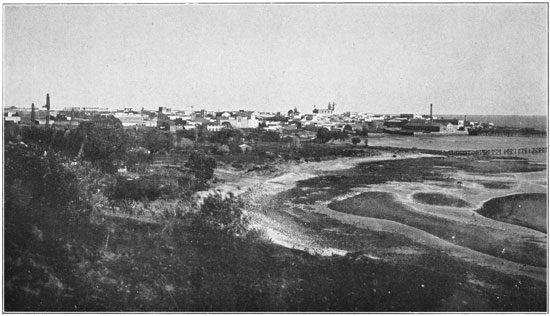
Arica is seven hours north of Pisagua. Its population
is 4886. It is the pleasantest port on the rainless coast
for in its neighborhood is verdure due to irrigation
from the Lluta River. It looks nice from the steamer's
deck, which appearance is not belied by a visit to the
lower town. The upper town, which extends to the
desert, is a compactly built place of low buildings, but is far
superior to the other coast towns of its size. In the lower
town are the banks, shipping offices, and government buildings.
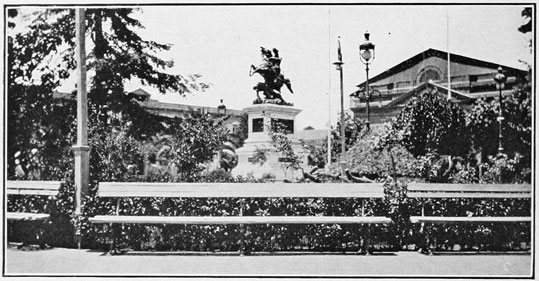
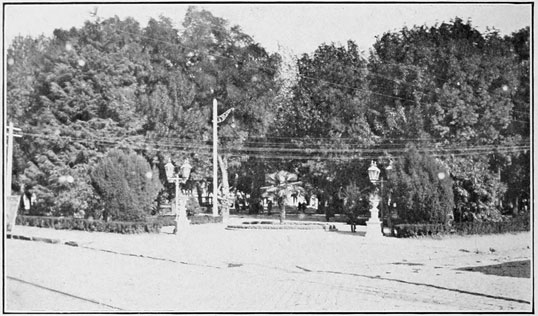
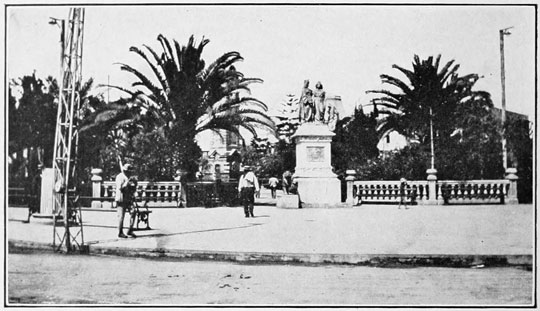
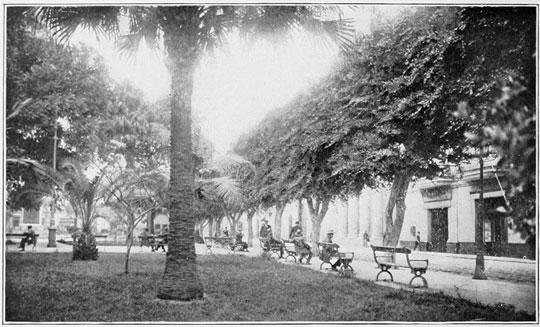
Its streets are bordered with pepper trees and it
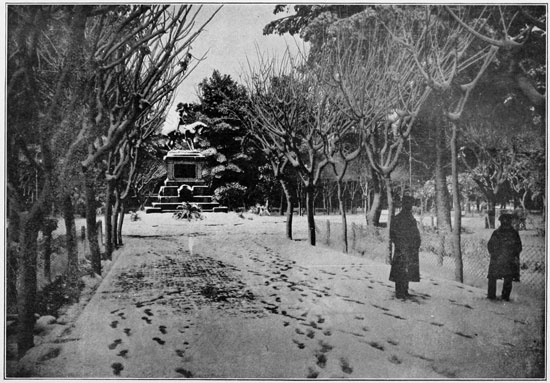
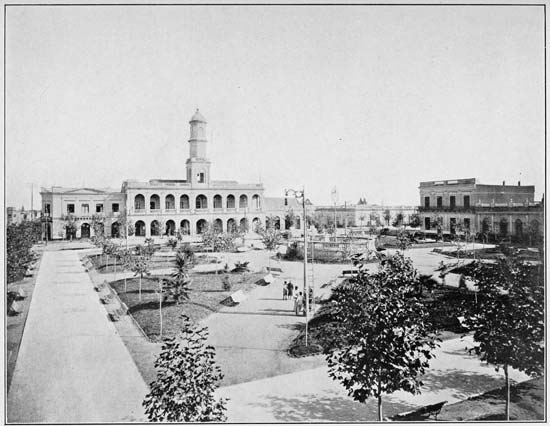
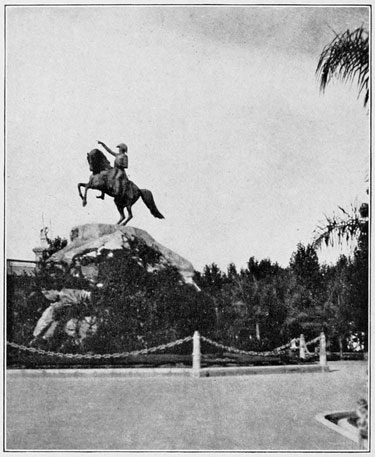
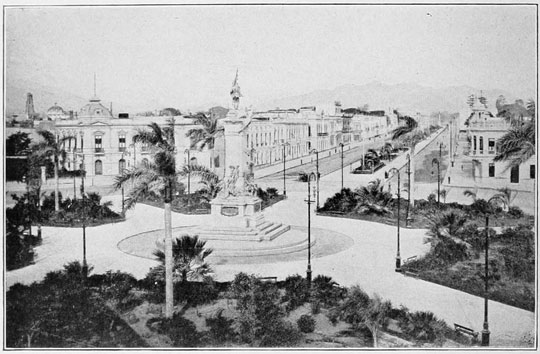
has two cool and pleasant plazas in one of which the
Italian residents have erected a bust to Columbus. Arica
is the port of the provincial capital, Tacna, but its present
importance is due to the opening in 1913 of a railroad to
La Paz, Bolivia, of which city it is also a port. A traveler
is carried to the Bolivian metropolis in twenty-four hours
over a pass thirteen thousand feet high.
One of the first things that I did when I arrived in Arica
was to go to the steamship office to find out about the
sailings of the ships on the Chilean Line and of the Pacific
Steam Navigation Company. The agent for both these
lines was the American consul, a man whose name I believe
was Smith. As I was waiting for information, Smith
himself appeared and he was in an ugly mood. He was a
thin blonde man about fifty years old, bespectacled, and
had red blotches on his face which showed that he was a
heavy drinker. In fact he stunk of liquor. He was an
Englishman and was acting as representative for the
United States.
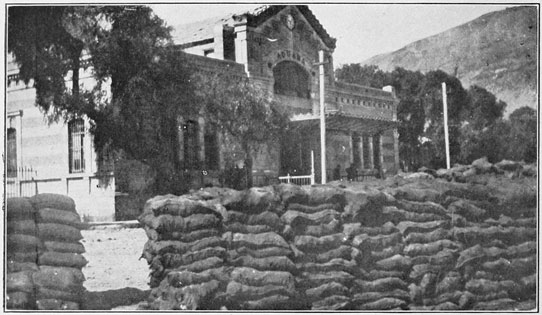
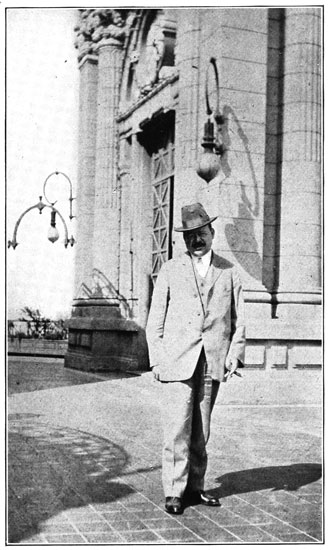
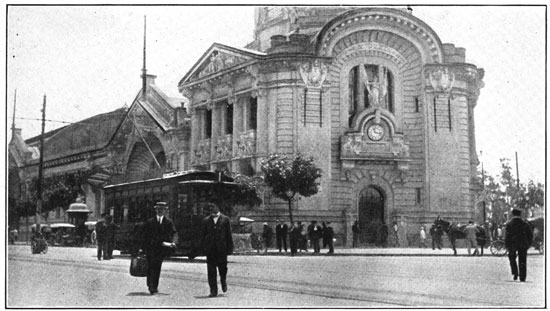
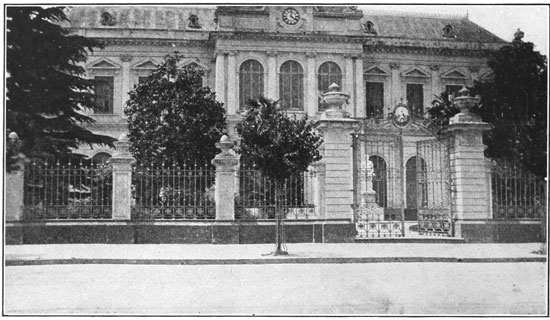
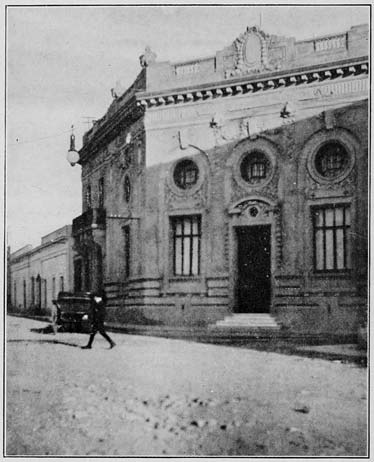
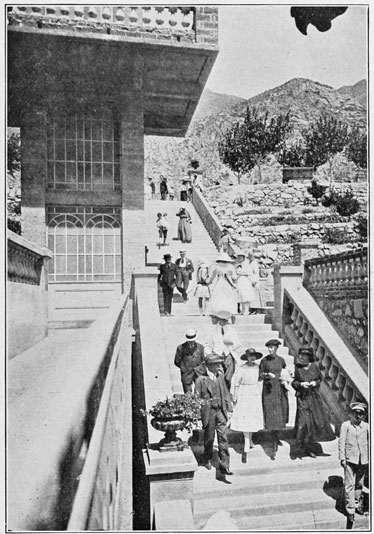
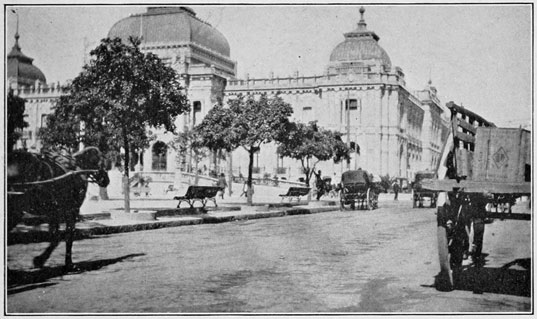
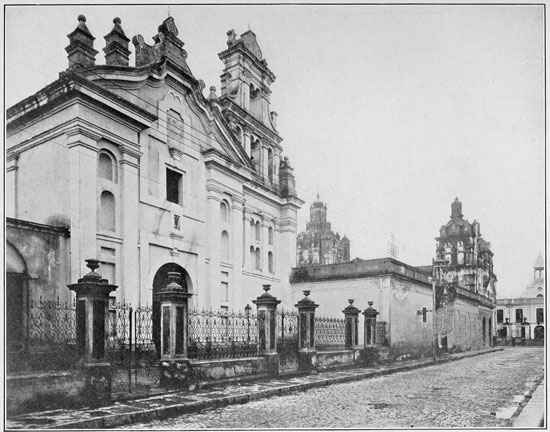
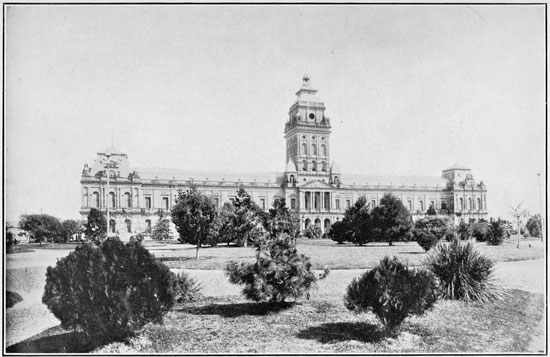
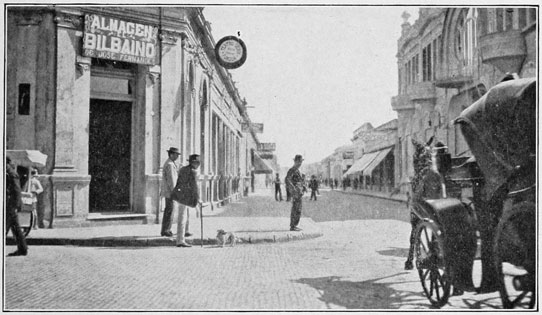
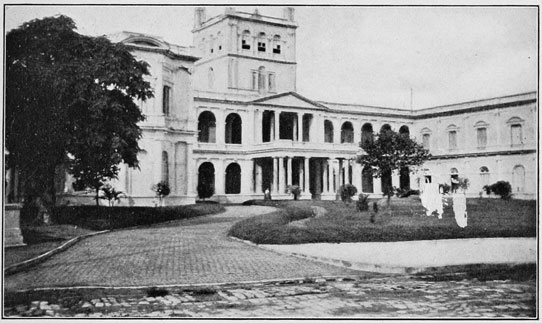
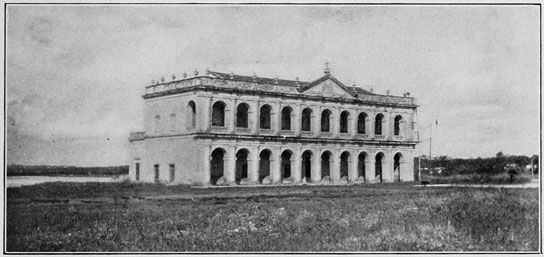
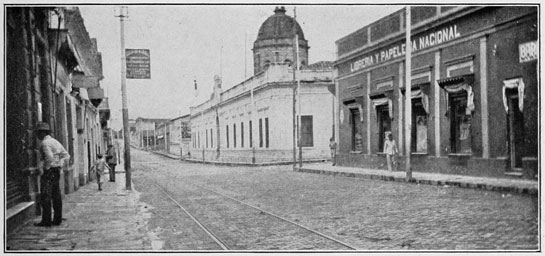
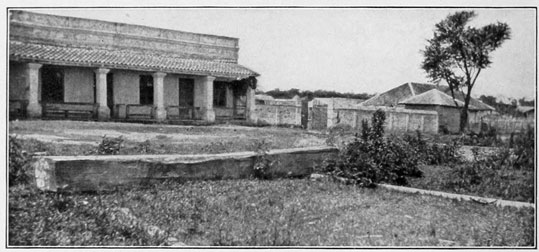
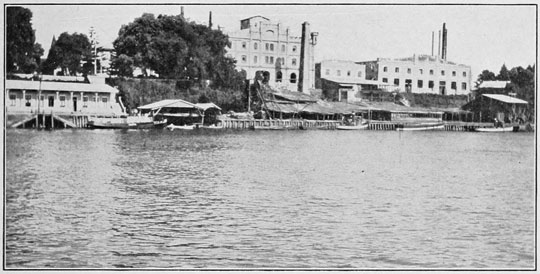
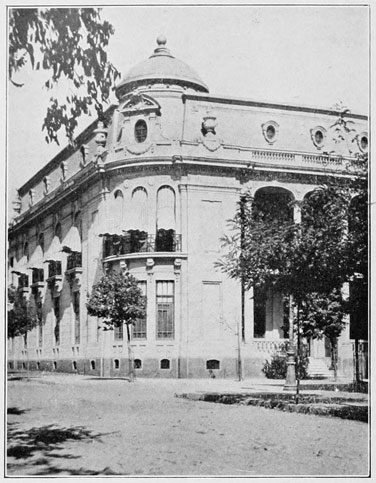
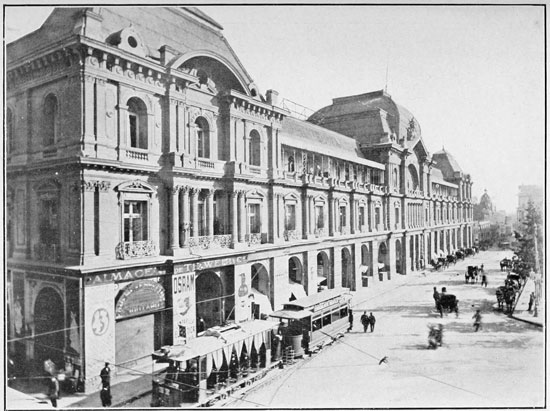
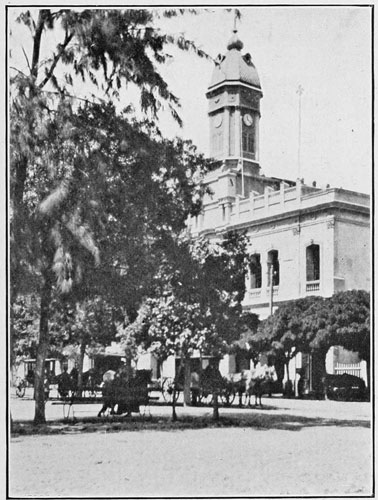
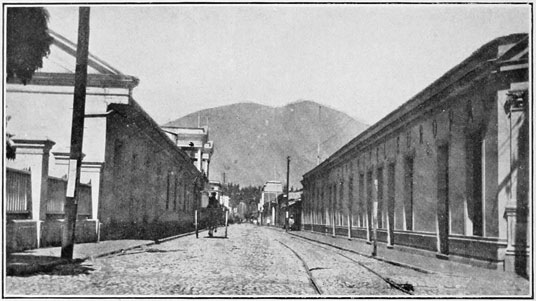
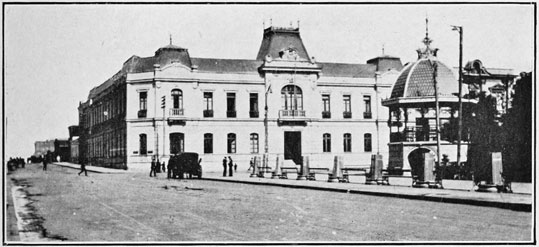
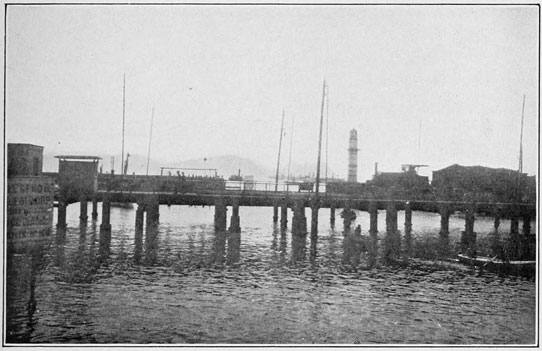
Custom House, Arica
This building was designed and built by Eiffel, who built the tower named after him
in Paris.
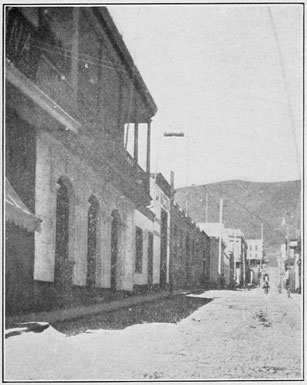
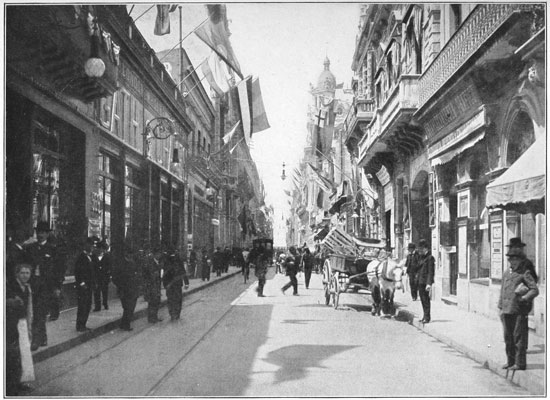
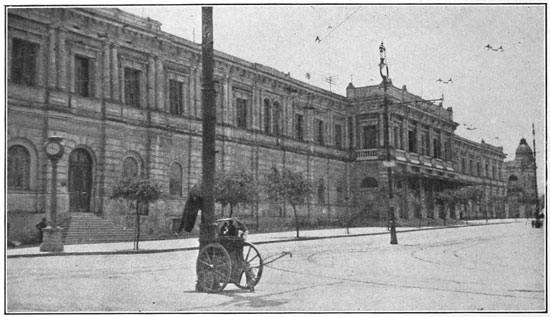
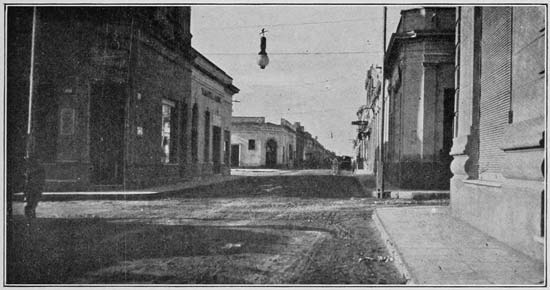
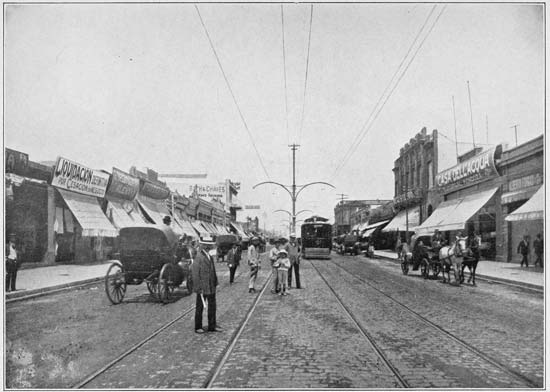
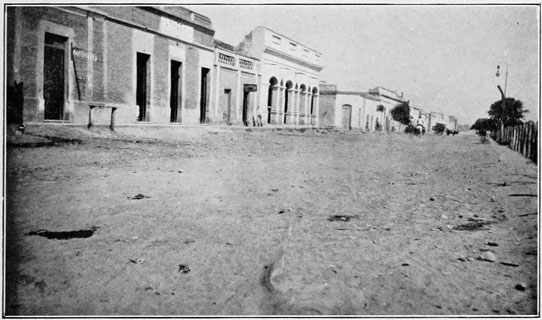
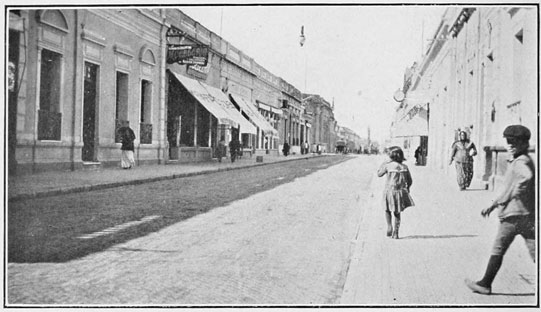
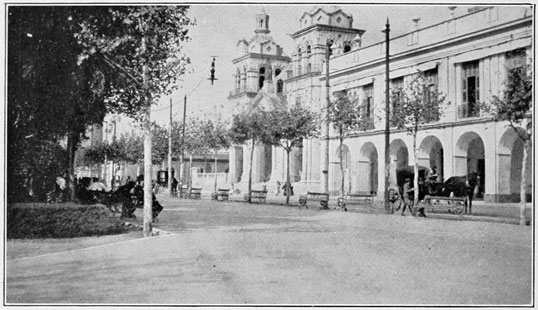
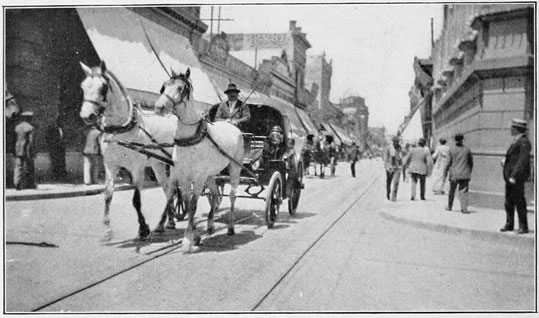
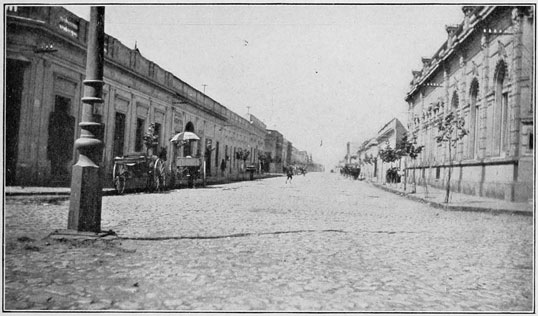
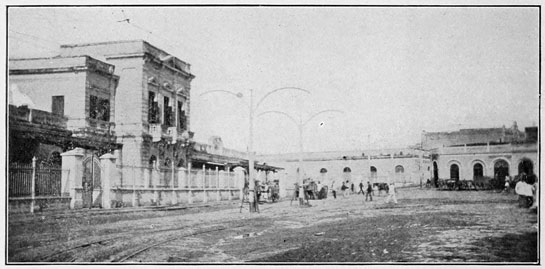
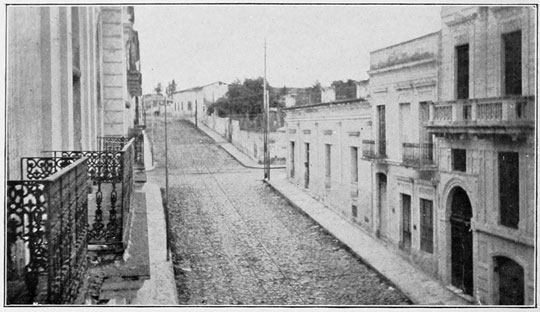
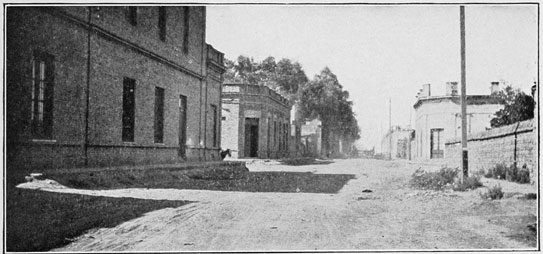
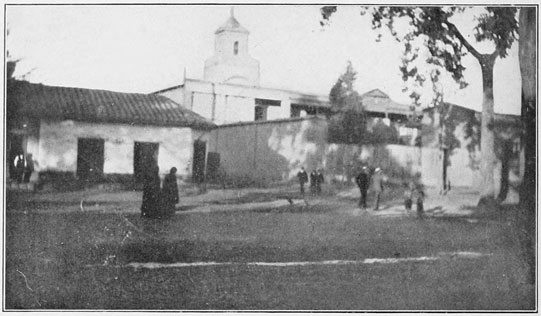
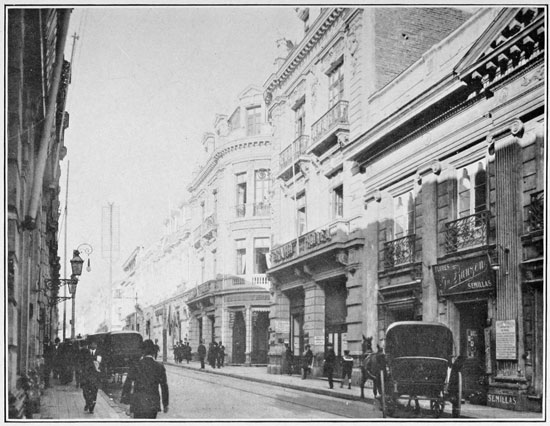
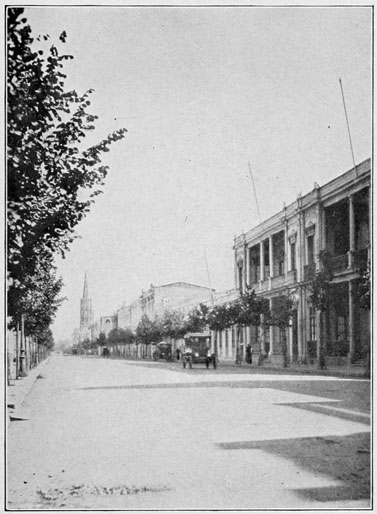
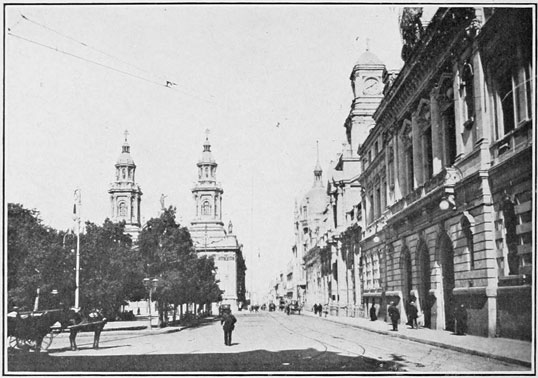
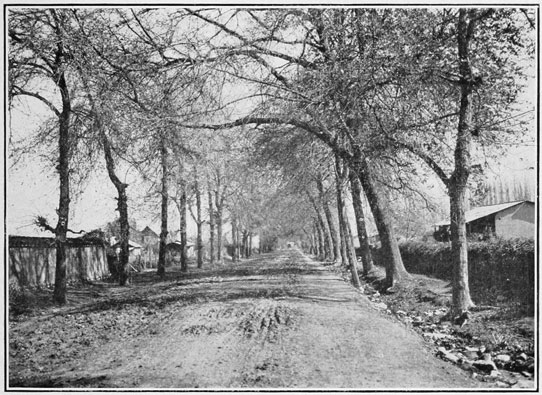
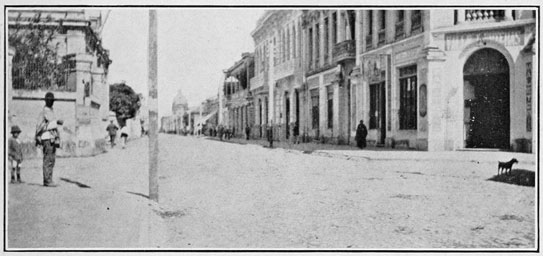
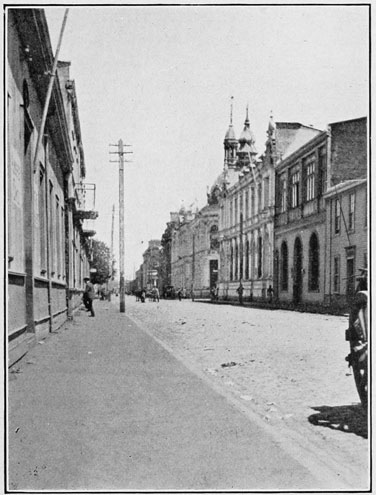
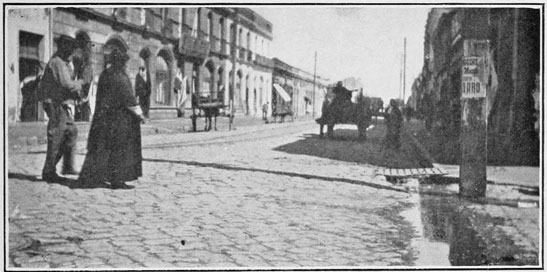
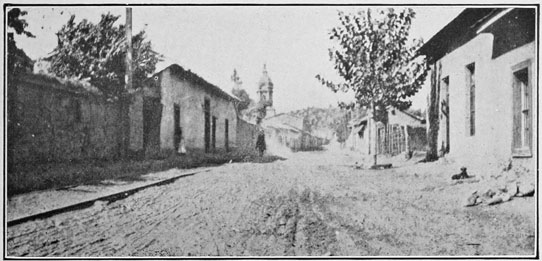
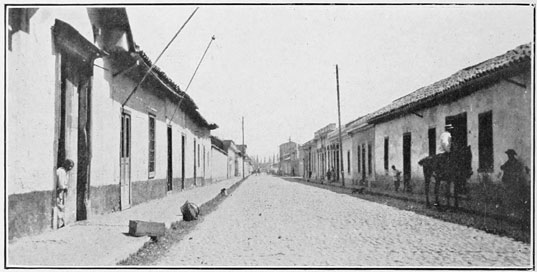
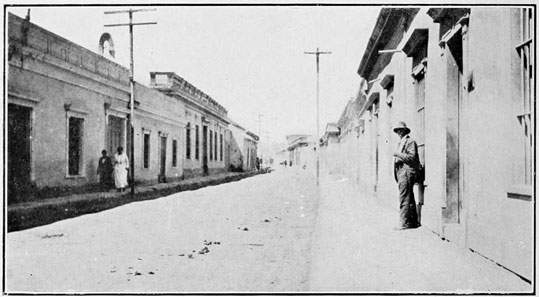
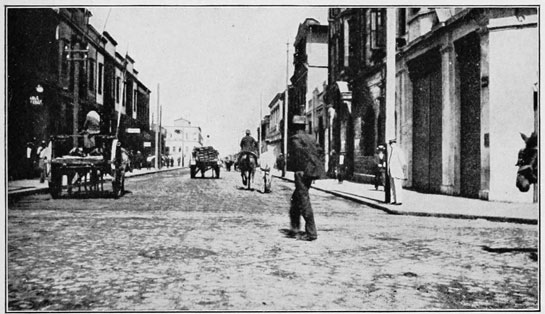
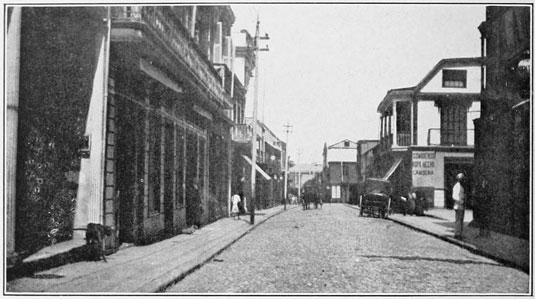
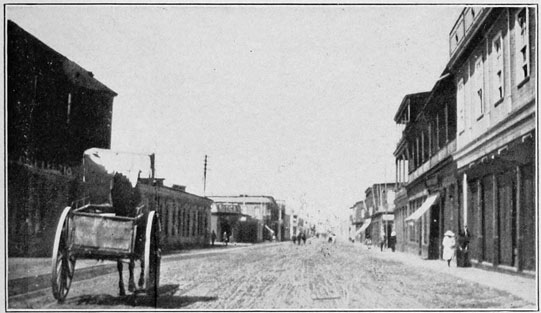
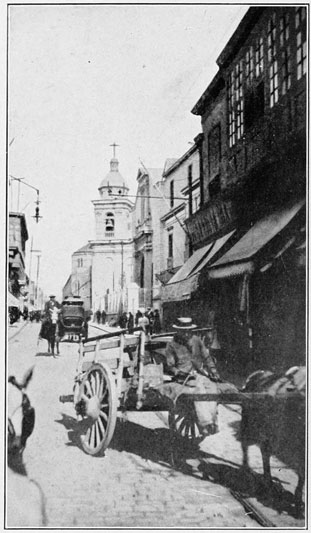
Street in Arica
This is in the upper town.
"Can't you read the schedule?" he inquired, indicating a
time card which hung on the wall of the outer office.
"Yes, but owing to the ships being overcrowded, I want
to make reservations."
"Wait until the ship arrives, then we will sell you a
ticket," he answered hastily and then left the room. This
was a nice fix because if I returned to Arica a few hours
before sailing, it might happen that there would be so
much loading and unloading of merchandise that it
would be too late for me to buy my ticket after getting
my passports viséd. There was no use of arguing with
such self-important and gin-soaked individuals as Smith
so I went away trusting to chance. It turned out that
I did not return to Arica to catch the steamer because
I traveled overland to Ilo, the port of Moquegua
in Peru. A half hour after leaving the shipping office I
saw Smith coming out of a cantina or saloon in the lower
town and after walking for about a block he entered
another one. Later on in the afternoon, happening to be
in the barroom of the Hotel Francia, I arrived in time to
see him gulp down a tumbler of gin and follow it up with a
brandy chaser. I stepped up to him and offered to treat
him, mainly to see what mood he would be in, and was surprised
to hear him acquiesce by ordering a half pint of
Guinness' stout. This performance he kept up all day and
I was told by the brother of the hotel proprietress that it
was a daily trick of his.
When the Guatemala anchored at Arica a French Calvinist
minister, Dr. Petit, came on board to visit one of
the passengers, the Reverend McLaughlin, a Methodist
Episcopal minister from Buenos Aires. McLaughlin introduced
me to Petit and during the following days at
both Arica and Tacna I became fairly well acquainted with
him. Petit had a degree as a physician but changed his
profession to that of minister of the gospel. He had done
considerable missionary work in South America and had a
church in Arica where he preached. He did not believe
in war but was a strong advocate for divorce; in fact he was
contemplating divorcing his wife whom he claimed was
unfaithful. He was at the present prevented from doing
so because there is no divorce law in South America excepting
Uruguay, and he did not have enough money to go to
Montevideo to start proceedings. He also informed me
that if the husband of the proprietress of the Hotel Francia
was onto his job he would divorce her because that
woman had driven him to distraction by her amours and
her extravagances, so that to avoid domestic scenes the
poor fellow had returned to France, hoping to be killed in
battle to relieve him of his mental anguish. The husband
I understand is an officer. Petit was a truly conscientious
man and was wrapped in his work as missionary; he did
not practice religion as a cloak to cover his sins. In build
he was an athlete.
None of Arica's hotels are highly recommendable although
the Hotel de France, or Francia as the natives call
it, is the best. It is run by an accommodating peroxide
or lemon juice blonde Frenchwoman about forty years
old who is heartily sick of Arica and is anxious to sell out.
This is the woman whom Dr. Petit had no respect for.
The real manager of the hotel is her brother, a good-for-nothing,
powerfully built creature about her age whose
chief pleasure is to emulate Smith's example by overindulgence
in alcoholic refreshments and to argue and
quarrel with the guests.
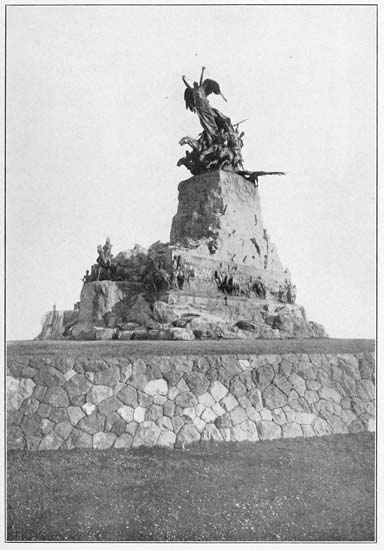
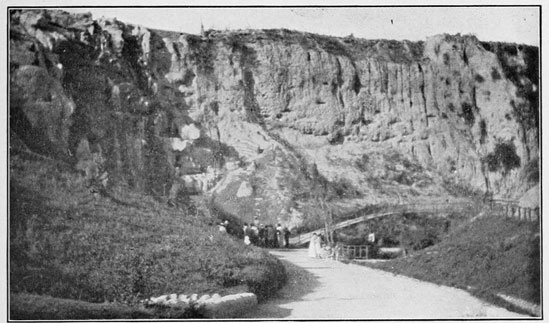
A landmark for miles around is the solitary rock named
the Morro de Arica which towers above the town. It is a
duplicate of Gibraltar, and was one of Peru's last strongholds
during the Pacific War. It was defended in 1880
by a regiment of Bolognesi's troops under Colonel Uguarte.
In the face of a violent storm of rifle bullets, the Chilenos
took the Morro by landing a short distance down the coast
and climbing it from behind. When Uguarte saw that he
had lost he spurred his horse to the brink of the precipice
and jumped to his death several hundred feet below.
Many of his followers did likewise because the Chilenos
had the reputation of taking no captives. The Morro
is now strongly fortified. People are forbidden to make
its ascent and the day before I arrived two men were
thrown into jail for attempting it. In front of the Morro
is a small, low guano island. It is used as a fort and is
honeycombed so that it can hold a force of five hundred
men.
The day after we arrived a northbound Chilean steamer
put into the harbor of Arica. On it was Kermit Roosevelt
returning to the United States after having spent some
time in the employ of the National City Bank at Buenos
Aires. We did not know he was on the ship until walking
down one of the streets a man breathlessly hurried towards
us and asked us if either one of us were Señor Roosevelt.
Thinking that some wag had told the gentleman
one of us was Teddy, Prat answered saying that he was
Colonel Roosevelt. Now Prat is a slender, medium-sized
man about thirty years old and clean shaven and I cannot
understand what kind of an ass that Arica gentleman was
when he accepted Prat's statement and believed him. He
stated that there was a delegation already to meet him and
that he himself would accompany him to the cabildo where
a banquet was being arranged. A crowd gathered around
Prat and would have carried him off by force if an Italian
blacksmith had not appeared on the scene who had seen
Colonel Roosevelt and told the natives that a joke was
being played on them.
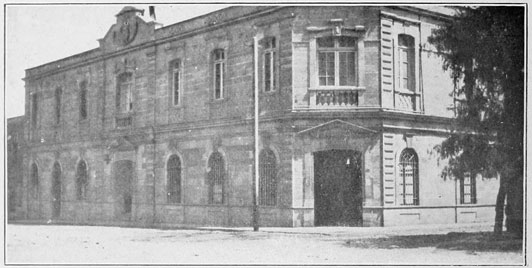
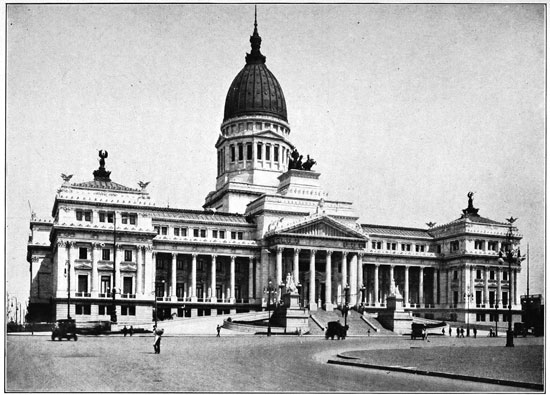
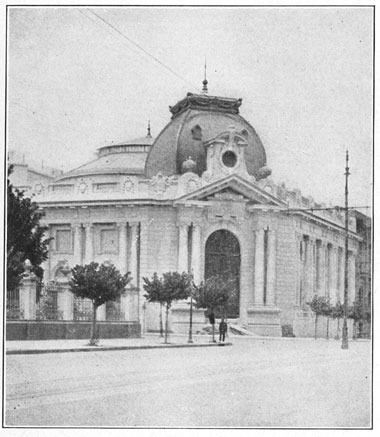
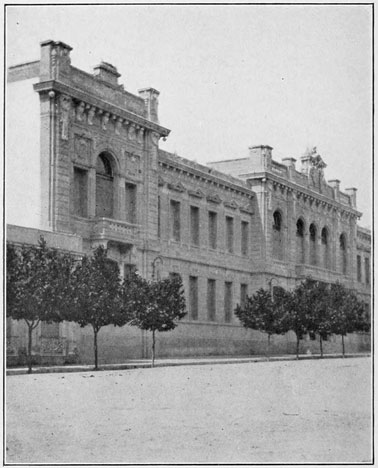
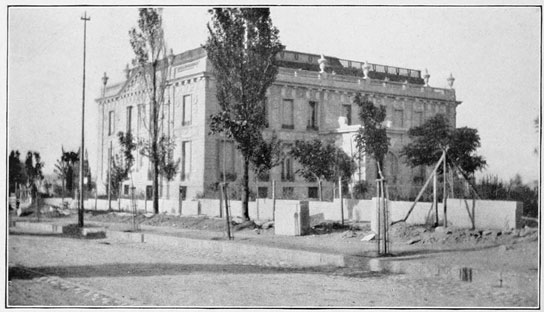
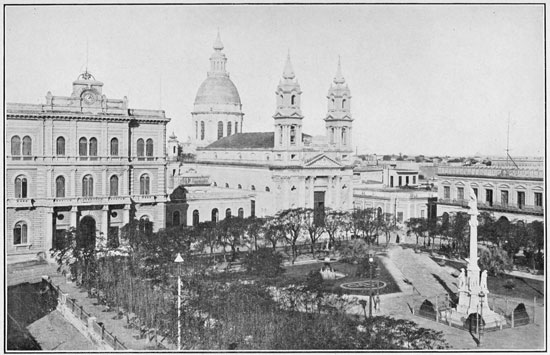
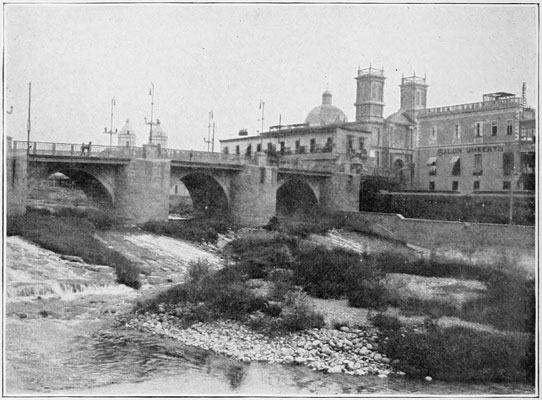
Capitol Building at Tacna
The province of Tacna, the most northern in Chile,
formerly belonged to Peru. At the close of the Pacific
War in 1880, Chile, the victor over Peru and Bolivia,
annexed to her already long seacoast the Bolivian province
Antofagasta and the Peruvian province Tarapaca;
Tacna it was only supposed to annex temporarily. Chile
was to occupy it for twenty years; a vote of the inhabitants
was then to be taken to determine which country it should
go to. Thirty-eight years have passed by and still no vote
has been taken. The chances are that it will always remain
Chilean. To keep it so, Chile has seven regiments
in the province, five of which are stationed at Tacna, the
capital city. The present government has tried to Chilenize
the province by planting within its confines men from
the south of the republic so that even in the event of a vote,
which is doubtful, the majority will be in favor of the present
ownership. It is another Alsace and Lorraine question
because Peru is always thinking of the day when it
will get it back and its inhabitants are Peruvian sympathizers.
Peru even goes through the sham of having
Tacna and Arica represented in its congress at Lima.
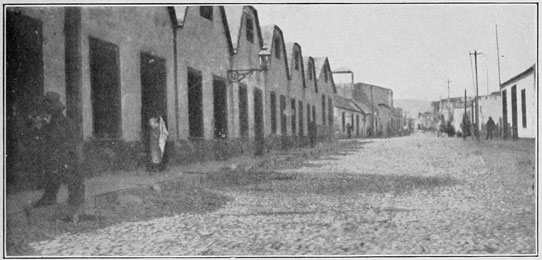
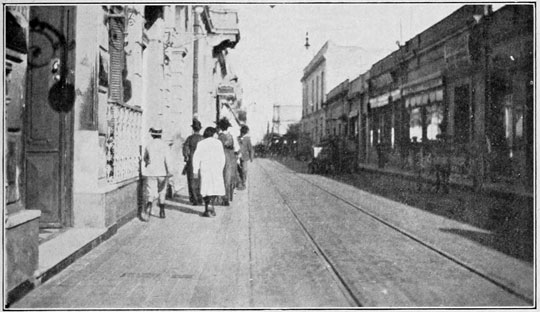
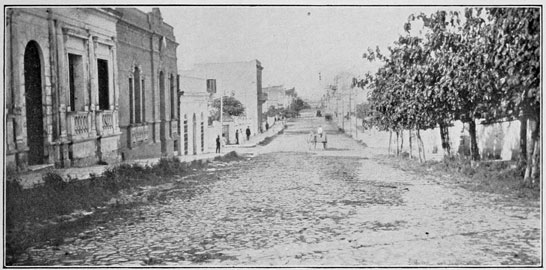
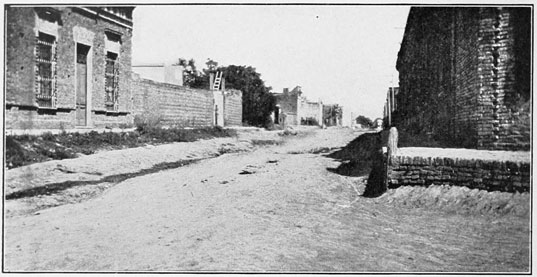
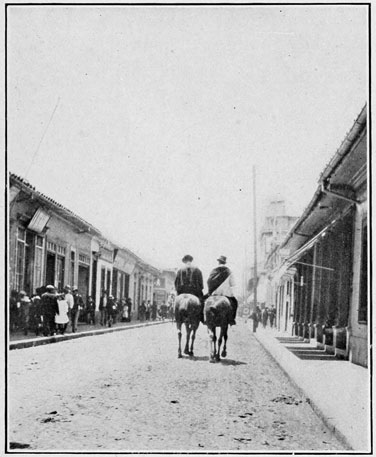
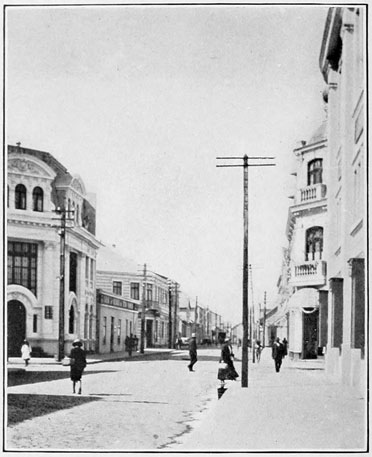
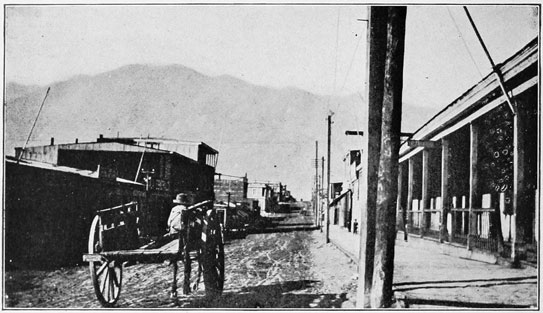
Street in Tacna Showing Earthquake Proof Houses
Tacna is thirty-eight miles north of Arica. The
connecting railroad is the oldest in South America having
been completed in 1844. The railroad at first skirts a
fertile fringe near the seashore and then crosses a sandy
desert until within a few kilometers of Tacna when it
enters an oasis caused by irrigation from the Caplina
River, all of whose water is drawn off for the gardens so
that none of it empties into the ocean.
Tacna lies at an altitude of 2820 feet above sea level but
so imperceptible is the rise that one can imagine it to be on
the same level plain as Arica. The population is 14,176,
including five thousand soldiers. The city appears much
larger. The ordinary transient would carry the impression
that it is a town of twenty-five thousand people. It
is a healthy place yet the death rate exceeds the birth
rate, which state of affairs is true in many old settled towns
all over the world.
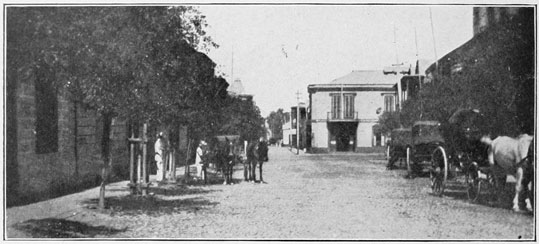
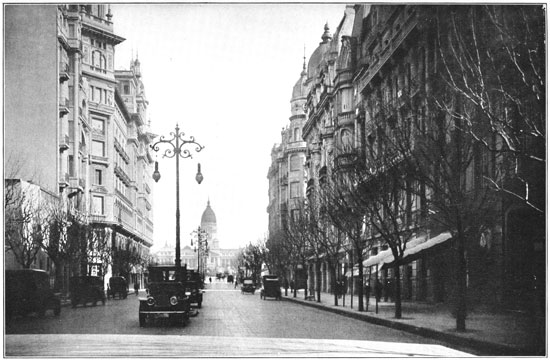
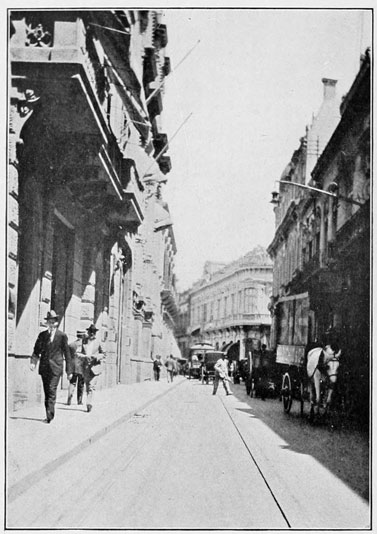
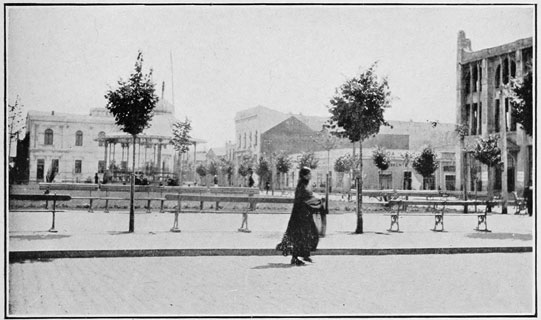
Calle Bolivar, Tacna
Tacna is a beautiful place and is well worth a visit. It is
the best built city in Chile and is the only one where the
buildings are of stone. It is opulent,—a rarity in Chile,—its
inhabitants are refined, educated, and wealthy. There
are handsome public buildings, large stores, and spacious
houses. In many respects Tacna has a European appearance.
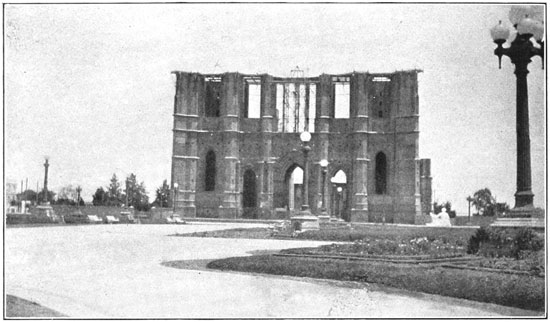
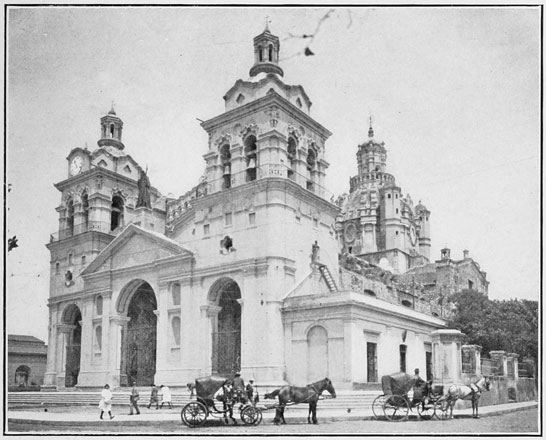
The most noticeable object that strikes one's vision
in the city is a large stone shell of an incompleted cathedral
with two massive stone towers. The square trimming
stones are of a pinkish hue while the ordinary ones are
the dun-colored ones of the country. This huge shell will
never be completed. It was built from the plans of the
French architect, Charles Pitaud, when Tacna was a Peruvian
city. Then came the Pacific War and the money for
its completion was turned into other channels. Monsieur
Pitaud returned to France; Chile took Tacna, and used
much of the iron for the framework of the cathedral for
military purposes. When everything again became normal,
the people wished again to complete the cathedral.
Pitaud in the meantime had died and his drawings were
never found so it was impossible to complete the building.
In design it was to be much like the Duomo in Florence.
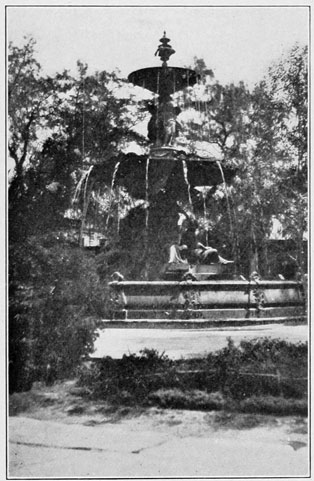
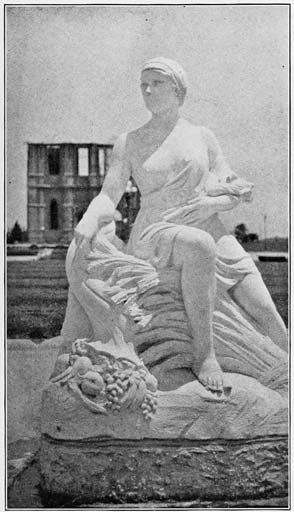
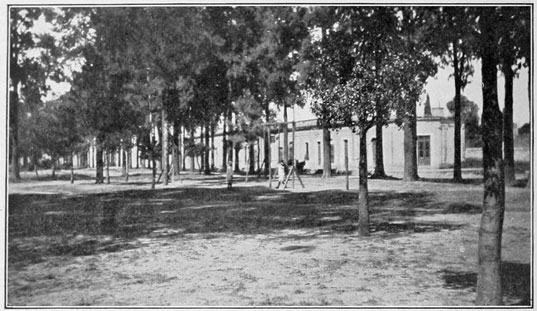
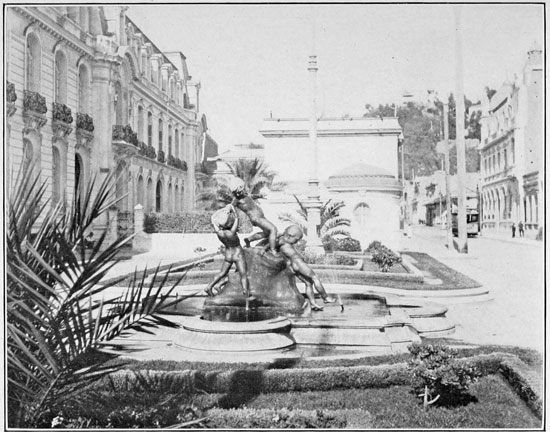
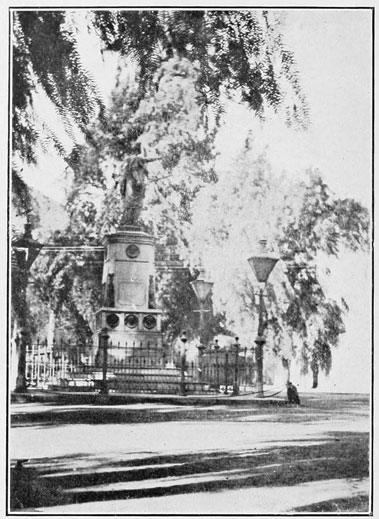
Fountain in Tacna
Built by Pitaud.
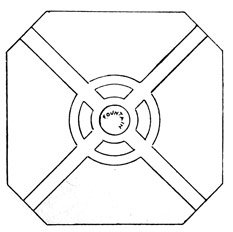
Another of Pitaud's works of art is the bronze fountain
in the Plaza Colon. It was cast in 1868 and is the finest
in the Western Hemisphere. There are more expensive
ones, elaborate sculptures of marble, but none its equal
artistically.
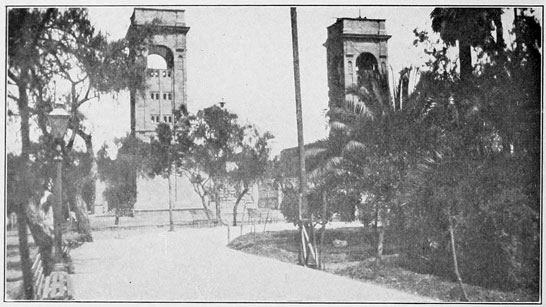
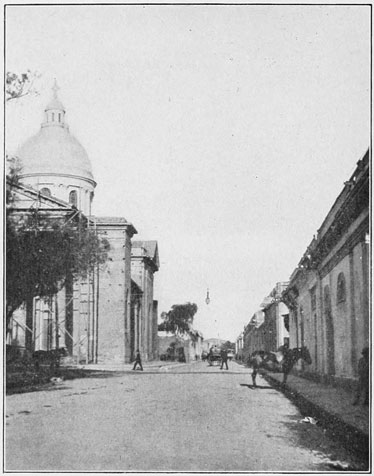
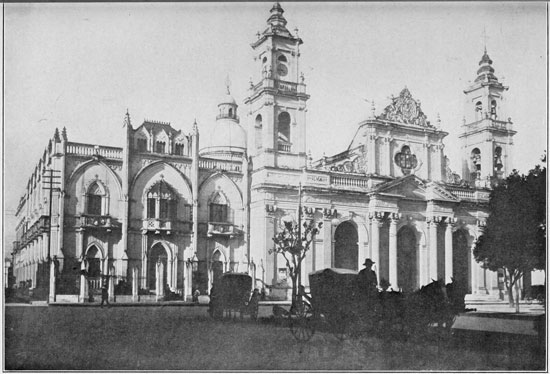
Unfinished Cathedral in Tacna
This building was designed by the French architect Pitaud, when Tacna was Peruvian.
The Chilean War came on, Pitaud died and the cathedral was never finished.
The streets of Tacna are paved, most of them with
round polished stones, and many are bordered with trees
planted along the curbs. There is much verdure and the
city has several shady plazas with statues. There is a
marble one to Columbus in the plaza of the same name.
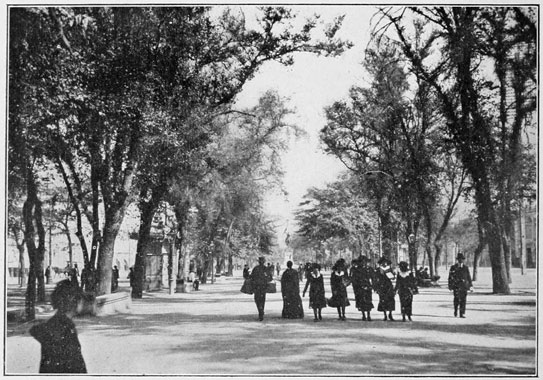
The Alameda Anibal Pinto is a garden spot. It is a well-kept-up
lovely parkway. A peculiarity of Tacna is the
architecture of many of its residences. These are gabled,
but by far the most have "sawed off" gables. In these the
sides slope upwards as if to form a gable, but about a yard
or more below the imaginary peak, they terminate in a
flat roof. This style is supposed to make them earthquake
resisting.
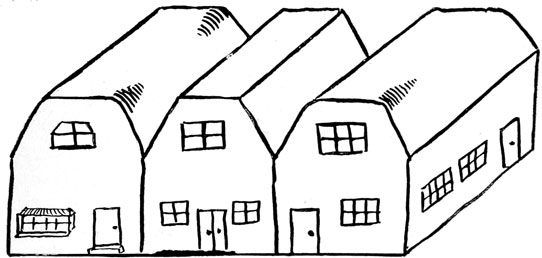
STYLE OF TACNA ARCHITECTURE.
HOUSES WITH SAWED OFF GABLES,
SUPPOSED TO BE EARTHQUAKE PROOF
Of the six Courts of Appeals in the republic, one is at
Tacna. Both Antofagasta and Iquique for a long time
have been trying to get it away for themselves, but so far
have been unsuccessful. Of the five regiments stationed
at Tacna, two are artillery, two are infantry, and one is
cavalry. There was an engineer corps but it has been
moved to Copiapó.
Tacna has a good hotel, the Raiteri, owned by an Italian
of the same name. His business, which has somewhat
fallen off since the Arica-La Paz railroad has been completed,
is large enough, however, for him to keep two
annexes running. His hotel is one of the best in rural
Chile. The coffee is the best I have had served to me in
South America. There is another hotel named the Tibios
Baños (Warm Baths). It is of the free and easy sort
where when you engage a room the landlord asks you,
"With or without?" and governs the price accordingly.
It has a cool grape arbor where it is pleasant to repair
hot Sunday afternoons for a schuper of beer.
In an obscure corner of the province not far from the
Peruvian line lies the high, broad mountain valley of the
Ticalco River, hemmed in on all sides by snow-capped
mountains, the lowest of which is higher than the highest
mountains of North America save McKinley, St. Elias,
and Popocatepetl. The Ticalco is joined by numerous
freshets from the melting snow and like a silver thread
flows through this valley and by great jumps cuts its way
through a gorge before it finally joins with the Salado at
Talapalco to form the Sama, the national boundary with
Peru. Although very high, of all the valleys of the Province
of Tacna, the Ticalco is the most fertile. It is cold;
no fruit excepting the apple thrives, but as a recompense it
is rich in oats and in alfalfa. In this valley and on a small
stream about a mile above where it flows into the Ticalco
River lies the town of Tarata, 9919 feet above sea level.
Its population probably numbers five hundred souls. It
is the third town in size in the Province of Tacna. It is
the capital of a department, newly created, has a court
house and a barracks.
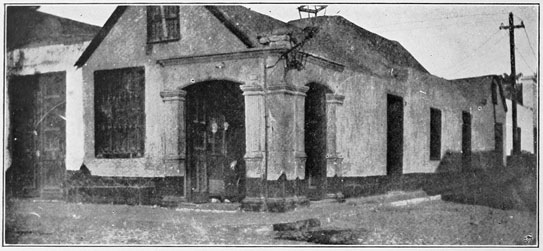
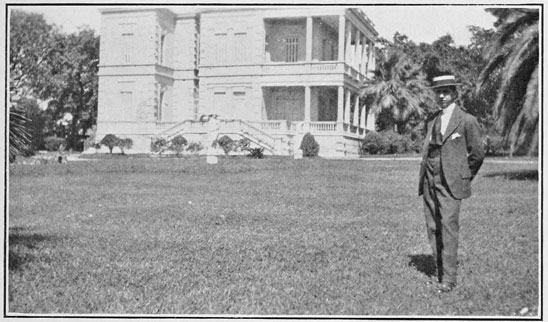
Old Residence, Tacna
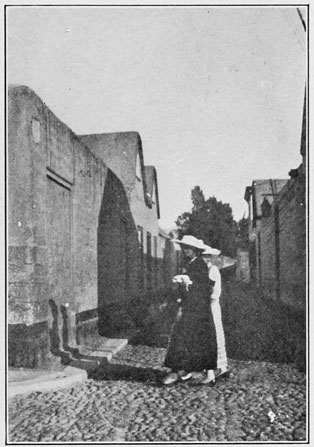
Street in Tacna
To Tarata I went. Don Santiago Carmona, a rich
haciendero of Tarata, was in Tacna with a caravan of
thirty-one mules and six horses. Accompanying him were
five muleteers. One of the horses he himself rode. Several
times a year he made these trips. He would drive a
herd of cattle the two days' trip into Tacna, sell them, and
return with his mules laden with flour, oil stoves, kerosene,
beans, onions, beds, and blankets. On the narrow streets of
Tacna his caravan made a picturesque sight. I expressed
a desire to see Tarata, and the man to whom I expressed
it, a resident of Tacna but a stranger to me whom I
stopped in front of his residence to inquire into the history
of the unfinished cathedral and with whom I entered into a
general conversation, said that he would speak to Señor
Carmona asking his permission for me to accompany him
on his return trip. He would let me know the result later
at my hotel. True to his word, late in the afternoon he
appeared at the hotel bar (the place where most business
is transacted in Chilean small towns) bringing with him a
tall, wind-tanned, thin man of about fifty-five years of age
who wore a straggling grayish beard and a moustache
of the Don Quixote type. This man was Don Santiago
Carmona. He said that he was returning home the next
morning and with great politeness and dignity invited me
to accompany him as his guest. This invitation I gladly
accepted and for their kindness I treated both gentlemen to
as much Fernet Branca and vermouth as they could handle,
and then some.
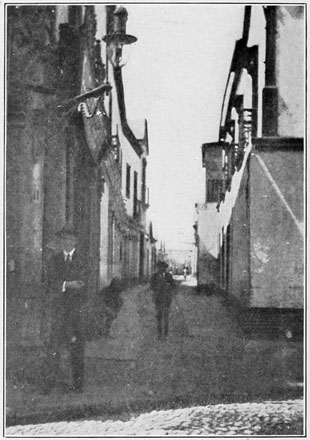
Calle Miller, Tacna
I made arrangements with Signor Raiteri for three
horses, a mozo, provisions, and blankets. It is certain that
Señor Carmona would have shared blankets with Prat and
myself, but since I did not care to impose upon him we
brought our own equipment which in reality belonged to
Raiteri. As it was Carmona refused to allow me to use
any of the provisions I brought along, but made me eat
from his larder, his mozos doing the cooking.
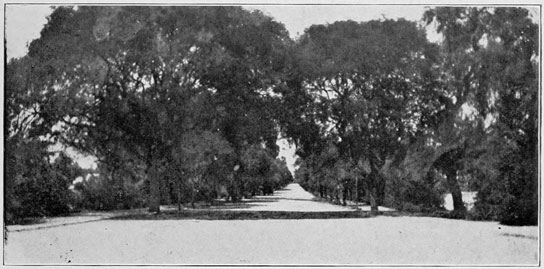
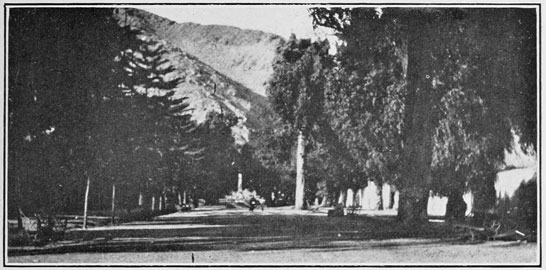
Alameda, Tacna
At eight o'clock in the morning we started from a courtyard
across the street from the market. Now the direct
way out of the city was to follow the Alameda, but Carmona
evidently wishing to inspire the inhabitants with a
reverence for his own importance had his caravan of mules
cross the Alameda and turn up the main street, which
indeed created a general diversion for all the clerks ran to
the sidewalk and the pedestrians halted to view this extraordinary
cavalcade. At the parochial church we again
turned into the Alameda and followed that avenue the
length of the extremely long town.
The valley of the Caplina is narrow, fertile, and is a veritable
garden. One thing I noticed as we left the city
behind. We would come to fields in the height of production
with irrigation ditches full of water. Adjoining
them we would see parched fields of bushes trying to eke
out a meager existence. The flow of water from the Caplina
is not sufficient to supply all the arable land in the
valley. A farmer will raise crops for several years in one
field; then when the soil has run out he will cultivate an
adjoining field, neglecting the first one, and will deviate the
water to the new one. After a few years he will give up
the new field and return to the first one which in the meantime
has been fertilized by nitrate. Since there are but
few cattle on the coastal plain, no manure is used to bring
up the land, but nitrates are easily imported from Pisagua.
On account of nitrates washing away they are put on the
uncultivated land during the period that the fields are not
in use. The road follows the right bank of the stony river
bed whose water has been turned aside to water the
quintas as the small gardens are called. In some spots
there is an intermission of the cultivation where the
sandy desert comes down to the river bed, but the trees
and green gardens always begin again. From this valley
Iquique receives most of its fruits and vegetables.
Calientes which we reached after six hours' travel but
which can be reached in one and a half hours by automobile
and in two and a half by carriage, is the place where
we left the road. On our way there we passed through
three hamlets—Calana, La Vilca, and Pachia. Each has
a cantina and thither Don Santiago, Prat, and myself repaired
to moisten our dusty throats with native red wine
while the mules took a breathing spell. The thirsty mozos
stood humbly at one end of the cantina drinking their
wine in silence while we stood at the counter which served
as a bar. Calientes is so named from some hot springs
which here gush forth from the sides of a barren mountain.
They are sulphurous and when the rivulet which springs
from them enters the Caplina, the water is turned black
caused by the precipitate the sulphur of the rivulet makes
with the copper properties of the Caplina. There are
at Calientes but a few huts. Here we unsaddled the
beasts and in the hour's rest the mozos cooked a stew
which served as a midday repast.
An hour after leaving Calientes we arrived at a couple of
huts which are called Tacuco and two hours later in the
dim light of the waning day reached the end of the first
day's ride at the hamlet of Challata deep down in the
valley at the foot of Mount Pallagua. The night was cool
and the bountiful meal of cazuela, stew, and vegetables
eaten before a roaring camp-fire with the murmuring of the
rapidly flowing stream at our feet made me rejoice that I
was far away from the sham and inane conventions of
modern city life. A peon offered us his only bed in his hut
but Don Santiago and myself spread our blankets on some
straw pallets in an open shed with the starlit sky for a
canopy, and there we slept until awakened by the sonorous
grunting of sows at dawn.
"We have a hard day ahead of us," remarked Señor
Carmona after we forded the Caplina and started the steep
ascent up the sandy side of Pallagua. A high mountain
range to the right had shut off a vista of the snow peaks of
the Cordillera, but upon reaching a stony plateau, suddenly
the high dome of the extinct volcano Tacora, 19,338
feet high reared its lofty summit above the whole eastern
mountain chain. To the northeast appeared Uchusuma,
18,023 feet high, while near at hand were the ice fields of
the Cordillera del Baroso. These high mountains are
visible from Arica, at which port the Andes come nearer
the ocean than at any other place on the South American
continent except Puerto Montt. After two hours' climb up
the barren ridge we reached a spine and then descended
by zigzags to the canyon formed by the Quebracho de
Chero in which grew a few mountain shrubs not unlike
chaparral. In Indian file we followed the narrow trail
between the mountains Pallagua (altitude 13,065 feet) on
the right and Palquilla (altitude 12,415 feet) on the left
and arrived at midday at the Pass of Caquilluca about
12,000 feet above the sea level where we rested a couple of
hours and had our dinner.
Behind us all was desert and as we looked westward past
the numerous creases of the earth's surface which were
arid canyons and valleys we could see the limitless expanse
of the blue Pacific Ocean. At our feet to the north and
west lay a valley as green as an emerald traversed by silvery
streams, and dotted with light blue farmhouses. In
the distance was a cluster of buildings which I was told was
Tarata. Hemming in the whole valley were the mountains
whose snowy bulwarks formed a circle leaving only one gap
that in the northwest through which the Ticalco flowed.
These mountains from west to east were Cumaile (altitude
17,095 feet), Vivini (altitude 17,733 feet), Chilicolpa
(altitude 18,303 feet), Chiliculco (altitude, 16,835 feet),
Barroso, and Uchusuma.
It was six o'clock in the evening when the caravan,
having clattered over the narrow pebbly streets of Tarata,
pulled up at the Casa de Huespedes (Guests' House) where
I was to spend the night. Señor Carmona made me
acquainted with the fat mixed-breed Vargas who owns the
tambo, and after admonishing him to take good care of me,
he galloped off to his three-league-distant ranch saying that
he would look me up the next afternoon.
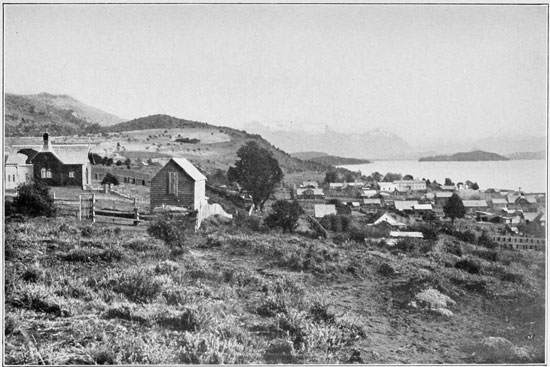
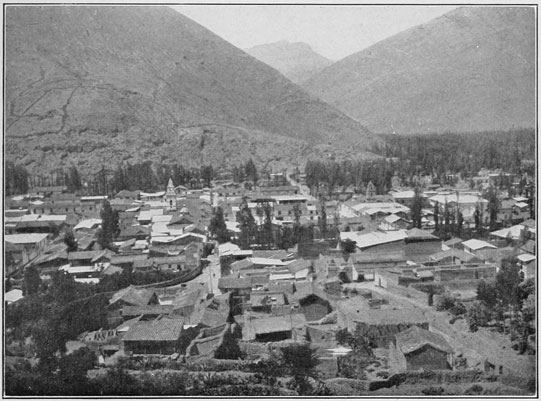
Tarata does not lie on level ground as it appears from
the mountains above the town. The streets slope steeply
down to the Ticalco which is no more than a creek. Near
its banks is a narrow level stretch of land where the plaza,
town hall, and church stand. This stream not only serves
for irrigating purposes but it is likewise the sole supply for
potable water and for washing purposes. Every morning
its banks are cluttered with half-breed and Indian women
who lay their laundry on the stony slopes of the stream
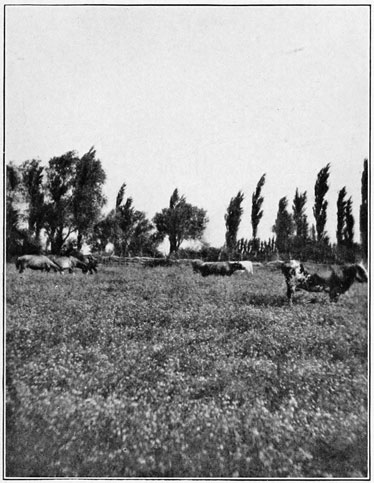
to dry. On the plaza which is bordered by Lombardy
poplars is a bandstand where twice a week a six-piece band
plays. Beneath these trees is a fringe of alfalfa where
the village cows graze. Like in Tacna the houses have
the same sawed-off gables, and like in that city they are
painted tones of salmon and blue. The town hall is the
only two-story building in the place and with the exception
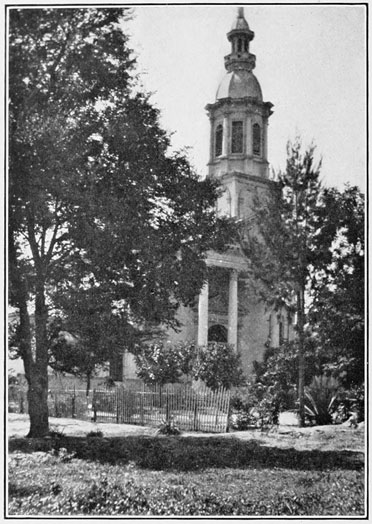
of the church belfry it is the tallest. The church is a
cream-colored affair with a domed steeple rising from the
center of its façade. On it painted in red is the inscription
"Anno 1808," the date of its founding.
Strolling about the village I was surprised to see, through
the windows of the residences, pianos, and one saloon had a
billiard table. It required much labor to bring them here
for all transportation of merchandise is done by mule
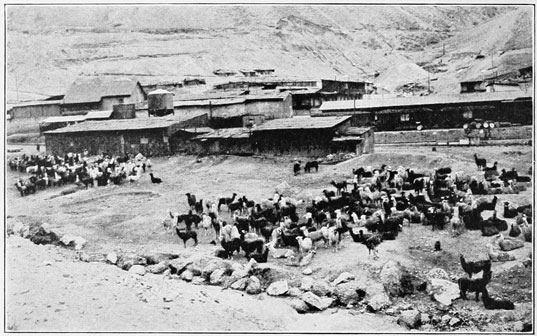
back. In the fields were many llamas. They are never
used in carrying burdens to the low altitudes because they
sicken while at work below six thousand feet elevation.
In the high altitudes both llamas and mules are used for
beasts of burden. Horses are employed only for pleasure
riding as they cannot stand the lightness of the atmosphere
to work in. Llamas refuse to carry more than one hundred
pounds burden, and no matter how much beating they
receive, are persistent in their refusal to be laden with
more. They are not so docile as they look. Their
method of fighting is to run up and strike one with their
forefeet; they also spit a nauseating substance at a stranger
if he approaches too close to one of them. One of them did
this trick on me and when I assailed it with my riding crop
it struck at me with its forefeet. A kick from me in its
belly only gave me the satisfaction of making it grunt.
Its disgusting saliva nearly ruined a suit of my clothes.
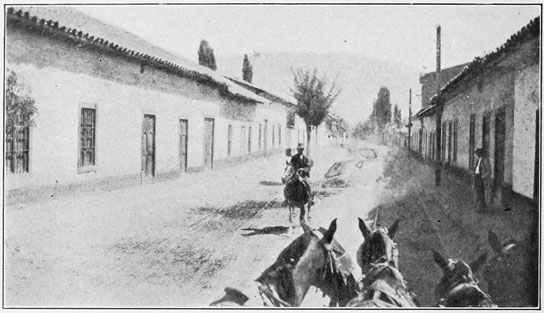
Street in Tarata
In the afternoon on the day after my arrival in Tarata,
Señor Carmona came to the Casa de Huespedes and asked
me to call on the priest with him. The latter, Padre
Albarracin lived in an adobe house which had a broad
verandah adjoining the cream-colored church. When we
entered he was sitting in the patio behind a morning-glory
vine talking with two officers of the Chilean army, Captain
Frias and Lieutenant Guzman. They had evidently been
"hitting it up" as was evidenced by several empty quart
bottles of chicha (grape cider) lying about, and also for the
fact that each of the trio held a glass half-filled. We were
invited to join with them in the libation and I discovered
that this drink, ordinarily a temperance beverage, had
fermented to such an extent as to make the imbiber feel
as if he were walking on wires. Shortly after we arrived
the two officers left and the priest invited us to remain
for dinner.
He clapped his hands to which a chola girl appeared.
"Kill the two game cocks that got whipped last week,
and throw them in the kettle," he commanded.
Our conversation turned to hidden treasure and antiquities
which the neighboring mountains are said to be
full of if we can believe legend. Tarata is in the heart of
what once was the great Inca Empire. Upon the advent
of the Spaniards the Incas hid from them the greater part
of their ornaments of silver and gold where they remain
undiscovered to this day. The Spaniards worked the
mines of Peru, Chile, and Bolivia, but they in turn for three
centuries were a prey to the pirates which ravaged the
coast and many of the inhabitants were obliged to bury
their wealth to keep it from them. The Catholic Church
in South America was always wealthy in its amount of
gold ornaments, so when the Inquisition was overthrown,
it was in vogue for the citizens to loot the churches. In
order to save its wealth from rapinous hands, the clergy
sequestered much of its treasure in the mountains. Priests
were murdered by pillaging bands of Indians and with
their death was lost the cue to the hiding-places. Enough
treasure has been found, practically stumbled upon, to give
authenticity that vast amounts have been hidden, but the
only person in modern times that made a fabulously rich
haul was Valverde in Ecuador, who was wise enough when
he found his treasure to return to Spain and die in opulence.
Padre Albarracin excused himself and soon returned
bringing with him two images several inches long which
he said were Inca idols of silver. He also stated that they
were in good hands because the pagans could not get them
as long as they were in his possession; the drunker he got
the oftener he would repeat this and utter quotations
from the Scripture such as this: "Their idols are of silver
and gold, the work of men's hands. Eyes have they, but
they see not," etc. When he finished he would ask me:
"It applies, does it not? These idols are of silver."
Then with a sweep he would send them flying from the
table. Once I ran to pick them up. "Do they please
you?" he asked. I answered in the affirmative. "Then
you may have them," he said. He then expounded on the
great sacrifice he was making saying that these two manikins
were the identical ones Holy Writ referred to and that
they were priceless on account of it.
After supper when I was examining one he grabbed it
away from me, climbed on a chair, and placed it on top of a
wardrobe. When I asked him why he did that he replied
that he was hiding it because he feared that I would worship
it. I told him that there was little chance, which
made him quote more Scripture such as: "Let the heathen
rage, and the people imagine a vain thing."
When he went to get another bottle of chicha, I removed
the idol from the wardrobe. The other one was lying on
the mantlepiece and I took them both because he gave
them to me. I have shown these idols to many people
and although I have had them stolen several times by
acquaintances, I have always got them back. Regarding
antiquities Señor Carmona made me a present of a plate of
solid silver hand wrought in Cuzco in the end of the sixteenth
century. On its face are the portraits of Pizarro
and of Atahulapa carved in silver. Although it was of no
value to Carmona, who would have been unable to sell
it for more than its intrinsic value of metal, I have been
offered three thousand dollars for it which I refused to
consider.
Padre Albarracin was getting so drunk that both Don
Santiago and myself excused ourselves soon after supper.
Coming out of the house, Prat stumbled over something
lying in the garden. It was Lieutenant Guzman in full
dress uniform, soused and dead to the world. Things
were just as bad at the Casa de Huespedes. Captain
Frias was asleep with his head on the dining room table,
and Vargas fell down the stairs trying to show Carmona
his room. The cause of the debauch was due to the fact
that Don Santiago brought up much wine, gin, vermouth,
and grape chicha with his mule caravan. The shaking the
chicha got en route augmented its fermentation which
made it as bad as hard cider. The night before when we
arrived he had left six cases to be distributed to the priest,
the alcalde, the intendente, Captain Frias, Vargas, and the
notary.
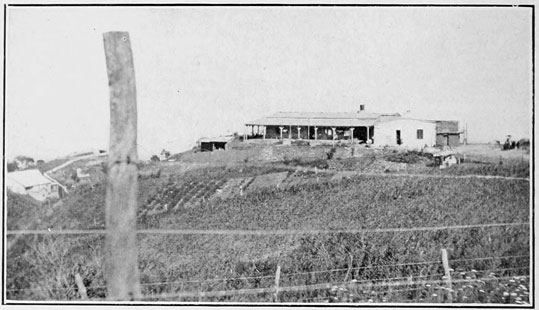
The next day I rode to Carmona's hacienda which is
located about nine miles up the Ticalco River on a level
expanse of land which stretches northward to the stony
slopes of the barren mountain Cumaile. The house itself
is a long, low, rambling affair of adobe which was once
whitewashed, but that so long ago that but little of the
white color is left on its sides. It rains in this region and
the broad tiles of the roof are the only things, I take it,
which prevented the building from being melted by the
rains. A compound originally enclosed the whole building,
flower garden, and adjacent peon and work sheds, but at
the present time only pieces of wall of this compound remain.
It was destroyed in 1881 by the Chilean soldiers
who here besieged the Peruvian landlord who had fortified
himself and held out behind the walls. Everywhere on
the landscape steers grazed in tall alfalfa, fattening themselves
for the butcher shops of the coast towns.
Most of the civil inhabitants of Tacna and Tarata are of
Peruvian origin having either been born there when the
Chilean Province of Tacna formed part of the Peruvian
Province of Moquegua, or are descendants of people born
before the Pacific War. Tacna is an old town of stone
buildings, not at all Chilean in character, but very much
like the larger towns of south central Peru. The natives
have strong Peruvian sympathies and are always living in
hope that some day or other Tacna and Arica will be
returned to Peru. Now this is ridiculous because Chile
has no intention of giving these places up, although the
resources of the Province of Tacna are small. The most
important feature is that Arica is the seaport of La Paz,
Bolivia, and it is well for Chile to retain possession of it.
Tacna was a poor town when it was Peruvian; the majority
of its inhabitants lived in poverty. Since it has become
Chilean, it has prospered and is to-day very wealthy. This
is largely due to live regiments which are stationed there
and which bring money into the town. For the past
thirty years Peru has passed through many changes of governments,
and revolutions have been frequent; it has been
misgoverned and unprogressive. Chile, although it cannot
be called progressive has aims that way but has been
handicapped from the want of money and immigration.
It has only had one revolution; that a small civil war
started by Balmaceda, but in government, progress, and
in everything else is so far ahead of Peru that it seems
incredible that the natives of the Province of Tacna are
desirous of again returning to Peru's revolutionary and
mediæval yoke.
Don Santiago Carmona was an exceptional haciendero
in so far that he is a native Chileno. He left his birthplace,
La Serena, forty years ago and never once has he returned.
His military service was spent not far from Temuco where
his regiment was quartered as a protection to the settlers
against the Araucanian invasions. For this reason he
took no part in the Pacific War. His father died when he
was in the service and he was left with a small fortune.
With this money he bought from the Chilean Government
the hacienda that he now resides upon. The latter had
originally confiscated it from the Peruvian landlord who
had fortified himself there against him. Carmona married
a Peruvian girl from Tacna who had long since died
after having borne two sons. One of these sons is a
haciendero in Ovalle and the other is a priest in Spain.
The latter is figuring on returning shortly to Chile because
he has been offered a sacerdotal office in Santiago. Carmona
has become wealthy and is thinking of making a
a trip for a half-year's duration to his birthplace, thence
to Ovalle, Santiago, and Araucania. He also has a desire
to see Punta Arenas.
Prat suggested that since we had come thus far towards
Peru by land that it would be as well to continue it this
way. He had a mortal fear of seasickness to which malady
he was a prey every time he put foot upon a ship no matter
how calm the water was. Now I had no maps with me and
did not know how to get to Peru, although I knew that
Tacna was the northernmost province of Chile and the
boundary line was no great distance away. To get information
on the subject I went to Don Santiago who told
me that Moquegua was the nearest Peruvian city, but that
it was a week distant over a hot, sandy desert, and that
the best way would be for me to return to Arica and go up
the coast by steamer. He said that in Tarata there were
people who had made the horseback ride to Moquegua
and that it would be possible for me to hire a cholo to
accompany us. I had heard about bandits in the interior
and asked him about it. He answered that highwaymen
existed only in the high mountains near the Bolivian frontier,
and that I would find the few inhabitants in the country
I was contemplating traveling through very docile.
Beyond the Sama River which was Peru, he knew nothing
about the inhabitants but imagined them to be much
the same as on the Chilean side of it. The Peruvian
boundary was not fifteen miles away, yet the hacienderos
of the neighborhood seldom crossed it, and it was as much
of a tierra incognita with them as is the interior of Chihuahua
to the ordinary citizen of El Paso, Texas.
At Tarata, through the services of the notary who was an
intimate of Don Santiago, we procured an overgrown boy
of the cholo variety who, after considerable haggling, proposed
to take us to Moquegua for the sum of one hundred
pesos Chileno (less than $20.00). He was to fetch back
the beasts that we were to procure as a loan from Don
Santiago. Having shipped my valise to Lima from Tacna,
I was unencumbered save for the blankets and a few edibles
which I carried. Prat was attired in a Palm Beach suit
and wore a straw sailor hat which looked as much out of
place in this part of the country, where everybody rode in
spurred boots, were clad in ponchos, and wore as head gear
broad-brimmed pointed felt hats, as a snowball in hell.
We descended the valley formed by the Ticalco, and
after riding for over an hour came to a place where a stream
from the north, named the Ticaco, joined the Ticalco and
formed the Pistala River. The valley narrowed in and
presently the mountains came down to the stream so
closely that one could with ease throw a stone across the
canyon. A rocky promontory on the left was rounded
and the green, fertile pocket in which Tarata nestles was
shut from view. A half-score of adobe huts with red-tile
roofs were arrived at. These constitute the hamlet
of Pistala, all of whose inhabitants are Indians. The
horse trail, instead of descending with the river, keeps on an
even altitude so that it is soon a sheer height of several
hundred feet about it, its way having been dug out of the
shaly rock that constitutes the side of the mountains.
Around a bend is a narrow canyon and down this it zigzags
for half a mile and finally crosses a tiny stream named
the Jaruma, which a mile farther down, jumps into the
Pistala forming a new river—the Tala. At the ford of the
Jaruma is a primitive mill with a huge water wheel. From
here on to the Sama River is a very steep descent by a
narrow bridle path and very dangerous on account of the
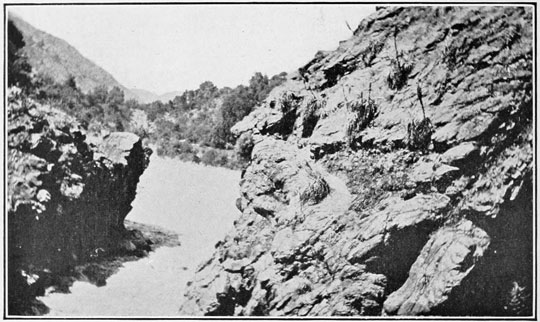
precipices which form a gorge through which the waters of
the Tala rush from shelf to shelf with a roar. On the
narrow mountain path we met a troop of llamas laden
with sugar cane and tubers in charge of three arrieros.
At our approach they leaped onto the rocks above as nimbly
as goats. The arrieros and ourselves had to dismount;
they backed their horses to a ledge and we led ours past
them before mounting again. Where the Tala joins the
Sama it must be two thousand feet lower than Tarata.
This is in a broad valley well cultivated to corn, potatoes,
and alfalfa in which are many mud huts of the natives and
an occasional chapel. The river bed is wide but the stream
itself is narrow and forks out in many channels which every
little way unite again. The Chilean or south side slopes
gently down to the stream in some places leaving a plain
of a mile wide at the water's edge, while the Peruvian
side is mountainous, precipitous, and uncultivated. The
mountains are absolutely destitute of any cultivation. We
continued all day down this river, following the Chilean
side, and camped at night beside a ruined stone wall across
the stream from the Peruvian hamlet of Sambalai Grande,
at an altitude of 3025 feet. During the afternoon the
mountains had receded and their places were taken by high
sandy hills the essence of lonesome desolation. The water
in the river had much diminished having been used largely
for irrigation. I was told that what little there is left is
used for the cane-fields which are plenty about twenty-five
miles farther down. This cane is not made into sugar but
into rum; also much of the cane is cut and is sent up on
mule back to the high country where the natives themselves
ferment it, using the pulp as fodder. Estevan, the
cholo guide, although polite and humble, would never talk
unless spoken to and then he would answer in monosyllables.
Prat and I had no idea how far Moquegua
was for we had no map; Carmona said it would take a week,
but he had never been there. I knew it could not be that
far because Ilo, its port, is only a half-day's steam north of
Arica, and we were now considerably north of that last-mentioned
place. I several times asked Estevan how
far Moquegua was, but to each query he would answer the
highly unintelligent reply of "muy lejo," which translated
into English means "very far," but fails to designate
whether the distance is two kilometers or two thousand
miles. This is an example of a conversation between
Estevan and myself.
"How far is Moquegua?" I asked him.
"Muy lejo" (very far), he answered.
"How far?"
"Lejo" (far), was his brilliant answer.
"Is it a week's journey?"
"Quien sabe" (who knows).
"Is it three days away?"
"Dios sabe" (God knows).
"Can we make it in one day?"
"No, señor."
"Can we make it in two days?"
"I do not know, señor."
"Can we make it in three days?"
"I do not know, señor."
"You have made the trip to Moquegua before?"
"Si, si, señor" (yes, yes, sir).
"And yet you don't remember how long it took you to
make it?"
"I have forgotten, señor."
The country across the river did not look very inviting
to us and it was decidedly exasperating to be met with
answers of such unintelligence especially as we had to
cross what appeared to be a duplicate of the Mohave
Desert. We forded the shallow Sama to some mud huts
in a field of alfalfa, from one of which waved the washed-out
and dirty cloth which once was the red, white, and red
flag of Peru. No sooner had we reached high ground
than a fat, dirty half-breed, barefooted and wearing filthy
linen trousers beneath a faded blue military coat on the
shoulders of which were red epaulettes, planted himself in
our way and assuming a grandiose air of mock dignity
inquired our business.
"We are travelers for Moquegua," I told him.
"What is your business there?" he asked insolently.
"To visit the town."
This reply took some time to penetrate his thick skull.
He pondered over it and then a gleam of intelligence spread
over his fat countenance which, by the way, was smeared
yellow with the yoke of an egg he had just been eating, as
he replied in an interrogative kind of a way:
"Ah, Ustedes son Judios!" (Ah, you are Jews!)
This fat guardian of the frontier had taken Prat and
myself for itinerant Jews. This gentry as well as Turks
and Armenians occasionally make the rounds of the remote
towns peddling their wares, such as cheap finery, pencils,
looking-glasses, buttons, and so forth. To be called a Jew
without an inflection of the voice is, in Catholic South
America, the height of insult, because it is considered the
vilest reproach one man can give another in the heat of an
argument. The manner in which this officer put the question
to us was meant in the form of a query. Prat, however,
being a Spaniard and a none too amiable one at that
when dealing with the cholos and other mixed breeds,
went into a towering rage and upbraided the official in the
purest and most blasphemous Castillian that he ever
before heard and which caused his overbearing, insolent,
and stupid countenance to change to one of servility.
"A thousand pardons, señor," he cringingly broke in,
"but you must understand that I have received my commands
to interrogate strangers entering Peru. Not that
I am in the least interested myself, but the government,
alas——"
"We will pardon you this time but not the next," interposed
Prat, curtly starting to ride off.
"Señor, señor," pleaded the official calling to him.
Prat paid no attention. I swung around in my saddle
asking him what he wanted.
"Your papers," answered the official. "I would lose
my position if I let you pass without seeing them. The
pay is very small and it is my sole income; the illustrious
señores would not be so ungracious as to wish to see me
lose that?" he entreated.
I showed him my passport which he looked at, then
turned upside down, frowningly trying to figure out what
it was.
"What nationality are you?" he inquired.
"North American."
"What language is this paper written in?"
"English," I replied.
A puzzled look spread over the stupid face of my interlocutor.
"How is it then that you have an English passport
since you are a North American?"
"English is the language of North America."
The official was astounded. "Pardon, señor, but I
thought Spanish was the language of entire America."
"You are mistaken," I replied.
"How is it then that you gentlemen speak such good
Castillian. You speak it much better than I do."
"I learned it in Spain," I answered. "The señor with
me is a Spaniard."
"Ah, I understand," answered the official. I could see
by his amazed and ignorant look that he did not understand
but was unwilling to have us know the extent of his
ignorance.
"We are in a hurry to be on our journey to Moquegua;
you had better return the passport," I said as I tendered
him two silver pieces of the one sol denomination, the
standard monetary unit of Peru. A sol is worth fifty
cents.
"Mil gracias, señor, mil gracias," answered the official
thanking me profoundly. Prat, who had ridden on, now
turned back and wanted to know what was delaying me.
He was on the point of letting off steam anew at the
cholo, but upon seeing me give him a tip, he threw a piece
of silver on the ground at the fat official's feet. It was
comical to see the latter grovel in the dust to pick it up.
"Adios, señores," he yelled after us as we spurred our
horses into a gallop and were soon lost to sight.
Upon our reaching the top of a high, barren hill, a vista
of a parched and sandy, barren imitation of the Sahara
unveiled itself before us. Everywhere lay the bones of
oxen and mules. This was the horrible desert of Pampa
Zorra about twenty miles wide, which it took us over four
hours to cross, in a hot, desiccating, blazing sun. The
thermometer must have been in excess of 120 degrees
Fahrenheit. With our eyes smarting with dust and our
throats parched (we partook sparingly of the water from
our canteens), we arrived shortly after midday at a dry
ravine named the Coari. Following this downwards
between high hills of shale rock we came in half an hour to
the Curibaya River at the cluster of mud huts and ranch
house of Coari. Here were some green fields of alfalfa
surrounded by eucalyptus trees.
The Curibaya River is much like the Sama, only its
river bed is narrower. It also has more water, there being
plenty to wet one's feet in. The reason for this is that
cultivation does not extend as high in its bottom as in the
Sama so less is drawn off for irrigation. About twenty
miles below Coari it widens out into a broad valley of great
fertility; most of its water is used at that point to supply
the large vineyards in that neighborhood. The small
remainder loses itself in the sand and never reaches the
ocean excepting during times of cloudbursts in the mountains.
In the fertile valley is the small city of Locumba,
which is famous for its grapes and wines said to be the best
in Peru. We forded Curibaya before we reached Coari
and then turned eastward again, ascending the valley.
This soon forked the Ilabaya joining it from the north.
The latter is a swiftly rushing and jumping rivulet; our
trail lay up its defile and we must have crossed it two dozen
times in the eight miles that it took us to reach the town of
the same name which is situated in a high open valley,
surrounded on all sides with hills not entirely devoid of
vegetation. The landscape instead of being sandy was
rocky and abounded with gray boulders. There were
several varieties of cactus and a plant not unlike the yucca.
Ilabaya is a typical town of the coastal region of Peru,
differing greatly from Andean cities in so far that the
houses were all built of adobe. The roofs instead of being
of mud, were tiled, because it rains several times a year in
the summer months and the mud roofs would be washed
away. In Copiapó, where it rains only once in a decade,
and in Tacna where it never rains, the roofs are of mud, but
in Tarata and here, tiles were in evidence. Ilabaya is a
larger place than Tarata, but is a dirtier, and more poverty-stricken
place. It is also a terribly hot place, and swarmed
with flies and vermin; mangy curs abounded and the odor
of the streets abounding with house slops and garbage was
disgusting. There were numerous street stands in front
of which Indian women sat offering for sale melons, oranges,
and pears, but not once during the part of the afternoon
that I was there, did I see any purchaser.
Arrived at Ilabaya, Estevan said that we had better
spend the night there because he thought there would be
no water the next stage. We dismounted at a primitive
blacksmith shop where the cholo boy was apparently
known, and carried our grips inside. Our arrival excited
considerable curiosity because much of the male populace
soon arrived on the scene, and at a respective distance
looked us over, and then began to become interested in
our grips and saddlebags. One urchin tried to undo the
straps of my suit case but a threatening blow with my stick
made him desist and seek shelter behind one of the grownup
half-breeds. The usual questions were asked to which
Prat and myself deigned to reply, but strange to say
Estevan found his tongue among those of his own breed
and there was let loose a volume of Babel in the Quichua
language which was surprising to me since I did not realize
that language had such a large vocabulary. I had forgotten
temporarily that the early padres had translated
the Bible in Quichua and had them printed in that language.
I saw one of these books among the church relics
in Cuzco.
I interrupted Estevan's garrulity with a prod of my
stick, and asked him where we were to find lodging.
"Quien sabe" (who knows), he whiningly replied in the
singsong tones used by all cholos in their conversation with
their superiors. If a stupid cholo or Indian does not know
what answer to give he invariably says "quien sabe" and
lets it go at that. I expostulated with him telling him
that he must procure for us lodging. This he translated
into his native language to the crowd of spectators. A
small boy in the group said that he thought that a certain
old woman who lived at the end of the town would take in
lodgers and offered to direct us there and carry our grips.
We set out down the long straggling street of adobe hovels
and arriving at our destination found the door was shut.
The boy knocked but no response came. I then banged
on the door with my stick. Presently the head of a withered
hag appeared at a shutter and asked what we wanted.
"We want lodging for the night," I answered.
"Ah, señores, but I am too old," she said. "At the
next street to the right in the second house lives Carmen
Vargas. She is young and makes a business of it!" The
old woman was on the point of closing the shutters when I
called to her again.
"You do not understand. We are travelers on our way
to Moquegua and wanted to pay for a room to sleep in
to-night." I then held up a couple of silver soles.
"I see. A thousand pardons, señores. I thought that
you were looking for some pleasure with the muchachas.
How much will you pay for a room?
"One sol apiece."
"It is not enough."
"We will make it two, if it includes meals."
"Ah, señores, but I am a poor woman and must live.
For three soles I can accommodate you."
"We agree, but it is expensive."
"Look at your room," she said, as she opened the door.
"It is fit for a king." She ushered us into a chamber
which was semi-storeroom and sleeping quarters. Boxes
and dusty bottles littered one side of the floorless apartment,
and spider webs hung from the rafters. There was
an iron cot in the corner on which was a straw pallet but
there were no sheets nor blankets. I spoke to her about
getting another cot and she said she would procure one.
As for blankets, she had none, but since the señores must
have their own, having come from some distance, we could
naturally spread ours on the cots. In the meantime if we
would return about seven she would have for us an excellent
comida.
The comida turned out to be a thin soup whose ingredients
were unknown to us and in which floated chicken
feathers. This was followed by a disgusting stew and
some meat of an unknown quality, highly seasoned, which
might have been a camouflage for one of the mangy curs
that abounded in the village.
There were plenty of cantinas in the small town and I
assume that they were well patronized from the number of
intoxicated Indians that I counted. Bottled beer from
the Cerveceria Alemana at Arequipa here sold for fifty centavos
(25 cents) a bottle and was drunk warm. Strong
liquor was much cheaper than beer and was likewise more
favored. There were quite a few young dudes in the village
and at evening they appeared togged up to what they
considered perfection, wearing carefully polished patent
leather shoes, high stiff collars, flowing black ties; all
carried canes. This stylish dressing among the males is in
vogue all over South America. It is a sign of caste or class
distinction. It is the ambition of all young men to be
dressed in the height of fashion no matter how remote their
village is from the beaten road of civilization. I have seen
this same class of dudes everywhere south of Panama, from
the isolated mountain towns of Colombia to the mosquito-infested
hamlets of Paraguay. There is also a class distinction
in traveling. A man who rides on horseback is
superior to one who rides on a mule; he who rides on a mule
is superior to the one who travels on the back of a donkey.
But beware not to travel on foot in the Andean countries,
even though it be a pleasure jaunt for a short distance
in the country. The pedestrian is looked down upon by
the lowliest peons and is held by them in greater odium
than the hobo is held by us at home. Good clothes and
high collars cease to show caste when applied to the person
who makes a foot tour. He will invariably be turned
down when asking for lodging or meals en route. It is
also wise not to travel on foot on account of the ferocious
dogs to be met with, which never run out and bark at the
equestrian.
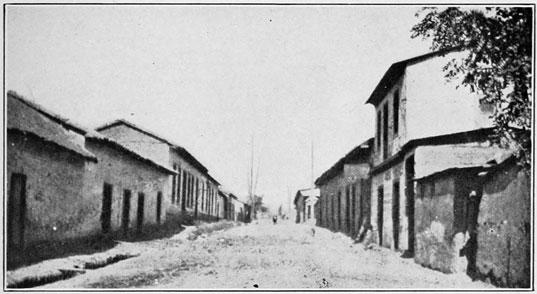
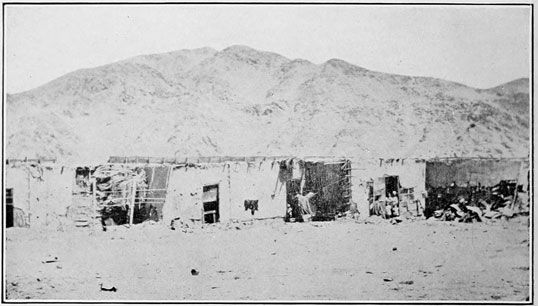
Street in Ilabaya, Peru
About nine o'clock that night while walking down the
only thoroughfare that could go by the name of street,
I met Prat at a corner conversing with a dandy, who like
Prat wore a straw hat and sported a slender cane. "This
is my compatriot," said he; "allow me to introduce you to
my friend, Señor Güell." The dude bowed and Prat
went on to explain that his new acquaintance was a Catalonian
from Gerona and had been in Peru for four years,
the last two of which he had spent in the employ of a wine
merchant of Locumba. Güell said that Moquegua was but
a short day's ride which was not at all tiresome. He had
made the trip dozens of times for his firm and was thinking
of doing so again in a few days. He was at present in Ilabaya
collecting some debts for his employer. I left the
Spaniards on the corner conversing and strode off to the
hut where I was rooming. I went into the room assigned
to us, and although there was another cot there, there were
no blankets. The cholo, Estevan, had evidently forgotten
to bring them although at six o'clock he had promised
faithfully to do so in "un momentito, señor." I walked
back to the blacksmith shop where we had unsaddled but
found that like all the other buildings closed for the night.
As it would have been impossible to find Estevan, I returned
to the dingy hut and throwing my coat on the cot
in the place of a pillow I lay down on the iron springs and
tried to sleep. This was impossible. At midnight Prat
had not returned nor had he come back by five o'clock
in the morning. There was no need worrying about him
because he was perfectly capable of taking care of himself,
but I was at the same time at a loss to conjecture where
he was. At six o'clock, finding that any attempt to slumber
would be futile, I went out into the street and walked
about.
I went to the blacksmith shop which was about to open
for the day to inquire about the horses. The blacksmith
was already there and when questioned about Estevan
merely answered, "Quien sabe," and then went on about
his work. Presently the same boy that had conducted me
to the house where I obtained lodging appeared and asked
me if I was looking for my arriero. I replied that I was,
whereupon the urchin said in his patois, "Se scapo,"
which in Castillian would be "e scapado," meaning "he
has escaped."
"What do you mean?" I asked.
"He has run away."
"He has run away? What do you mean by that?"
"He sold the horses and has run away."
At that encouraging piece of intelligence, several other
boys appeared and from their conversation I gathered that
Estevan the previous night had sold the horses with blankets
to a mountaineer and that he had then taken French
leave. You may imagine my anger, especially since the
horses were but a loan to us from Don Santiago Carmona
and were worth at least seventy-five dollars apiece in
North American money. When I asked if anybody knew
where Prat was, they volunteered the information that he
and a friend of his were visiting some young ladies. This
was a new one on me since Prat was absolutely unknown
in Ilabaya and no young ladies that I knew of would entertain
two guests so late as this.
"Which young ladies is he calling on?" I inquired,
mystified.
"On la Carmen; she lives near the end of the village."
It now dawned upon me that Prat was at the bagnio of
Carmen Vargas and that accounted for him not showing up
at the hut. I proceeded down the street to rout him out
but had not gone far before I ran into him and Güell, both
in a state of intoxication. Prat was just emerging from
the jovial stage and was entering upon an ugly mood.
Save for his bloodshot eyes and the reek of alcohol, he was
as immaculate as ever, but the dude was a sight to behold.
His side and back were covered with dust; only one flap of
his collar was buttoned, the other flying in the air; his hair
was unkempt, and his hat was awry. He could hardly
steady himself on his feet and was leaning on Prat to keep
his balance. At the same time he was trying to sing a
stanza from the Cid.
"Hail to the glorious Carmen, the light of Peru!" he
yelled upon espying me.
I told Prat immediately what had happened. At first
he did not understand, but when I repeated that Estevan
had sold our horses and run away, great was his rage. He
drew out his knife and shrieked what he would do to the
cholo when he caught him. The news sobered him up
considerably, so much so that when Güell burst out again
in another stanza, he told him to shut up and cease his
idiotic prattle in case he himself did not care to feel the
knife between his ribs instead of between Estevan's. We
went again to the blacksmith shop where Prat started
upbraiding the blacksmith, and then went to the alcalde's
residence. That official was asleep but Prat insisted on
having him wakened. Presently he appeared attired in
his pajamas. He wanted to know the meaning of this
disturbance and was on the point of telling us to go to the
infernal regions when he suddenly realized that we were
foreigners of distinction, due to the stiff collars and quality
of our wearing apparel. His demeanor changed and he
invited us inside, saying that he would dress and talk with
us directly. He ushered us into a well furnished apartment
and left us. We heard him ordering breakfast,
yelling to a servant to prepare three places as he had as
guests two "milords ingleses."
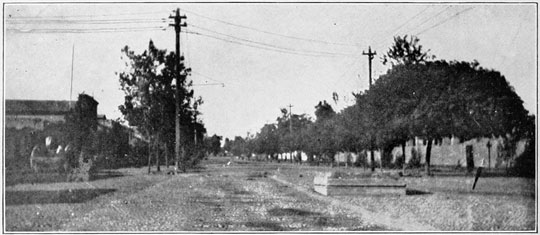
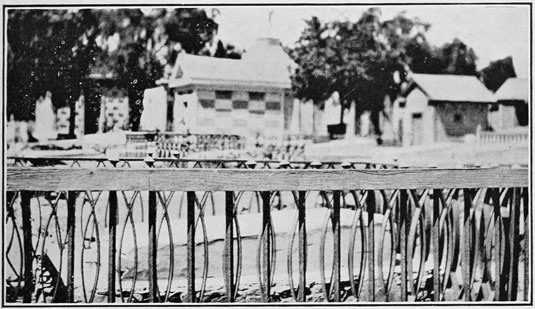
Alameda, Moquegua
During the meal, which was spread on a table beneath
a vine trellis in the patio, the alcalde, Don José Vergara,
asked us the nature of our visit, to which narrative he did
not reply, stating that he would take the matter up with us
again after breakfast. In the meantime he plied us with
many questions about North America, most of which Prat
answered—wrong. The latter had never been there nor
could he speak English well, the extent of his vocabulary
being "bulldog," "dollars," "all right," "good-night," etc.
He now converses fluently in English. His ignorance of
that language was not known to the mayor, who himself
spoke an execrable patois although he was a pure-blooded
white man. When we said that we wanted to start as soon
as possible for Moquegua, the alcalde implored us to remain
a few days in Ilabaya as his guests. When we told
him it was imperative for us to continue, he promised us
horses and a man from his stable who would accompany us.
He also said that he would apprehend Estevan and see
that he would be sent to prison if he had not already
escaped to Chile.
"What will he get?" I inquired.
"At least twenty years," he answered. "I shall see to
it."
"Is not that pretty severe?"
"Severe, nothing. One of my friends has an estancia
where labor is badly needed. You see that he will be put
to work profitably."
Don José ordered the blacksmith summoned to his
presence, and when that individual presently was brought
before him, the alcalde, threatening him with all sorts of
physical evils, elucidated from him that the previous night
Estevan had called for the horses which were corralled
behind the shop stating that the "señores ingleses" were
about to continue to Moquegua, saying they preferred to
travel at night instead of during the heat of the day. Not
long afterwards his boy had seen a mountaineer driving
them laden with goods up a road that leads into the Andes.
The boy asked him what he was doing with the horses since
they belonged to the "señores ingleses," whereupon the
mountaineer answered that he had bought them from the
mozo Estevan for fifteen soles each. The mountaineer the
blacksmith added was well known to him, was an honest
man, and frequently came to Ilabaya. The next time he
came he would inform Don José of his presence so that the
latter could deal with him. I have always believed that
the blacksmith had a hand in this deal and that he was hiding
Estevan who had mysteriously disappeared after the
transaction. At Moquegua I wrote Don Santiago Carmona
telling him what happened. Six months later I
received a reply when at home in the United States saying
that he had never heard a word about Estevan and the
horses, although he had heard rumors that the alcalde of
Ilabaya was riding one of them. Since Ilabaya was in
Peru it was useless to go there for he would receive no
justice.
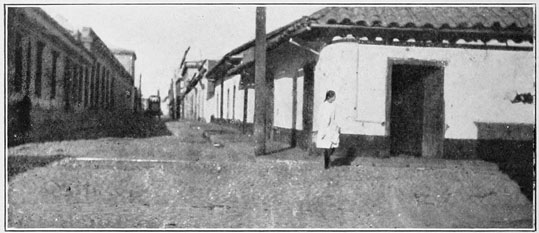
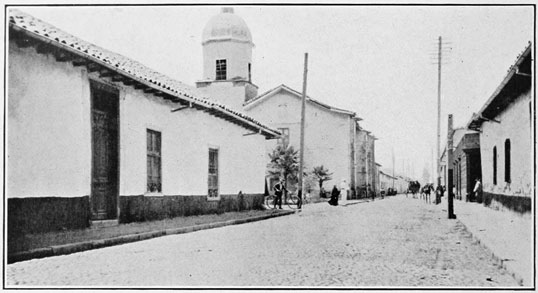
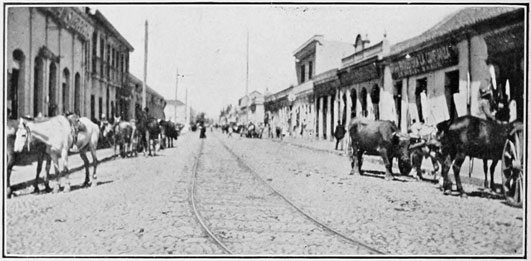
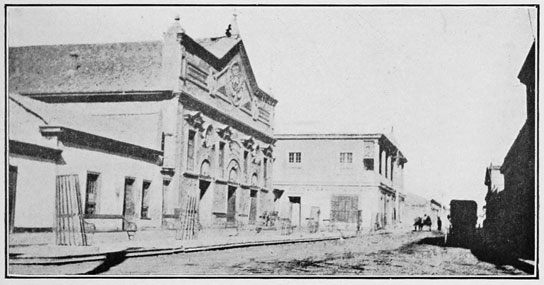
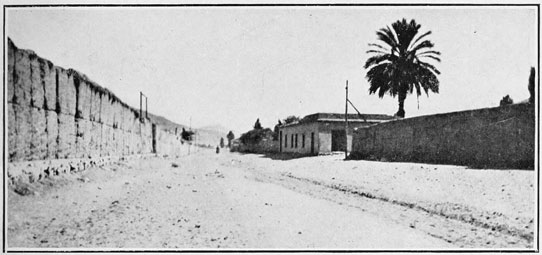
Street in Moquegua
Although Don José Vergara said that he would loan us
the horses, when we were about to depart he came to me
and said that it would cost us twenty-five soles ($12.50) for
their rent. This was reasonable enough according to the
standards of civilization but was exorbitant for that locality.
It was after ten o'clock in the morning before we
got away. For about ten miles the trail led over a rocky
plateau and then came to the edge of a precipice at the
bottom of which was the bed of the Cinto River, here dry.
Here were three mud huts and a cistern half full of water,
which was drawn from some springs a few miles up the
valley. We remained here about an hour during which we
cooked some meat and potatoes that we had brought with
us; we pushed on again across another plateau similar to
the one which we had just traversed excepting that it was
sandier and smoother riding. At nightfall we came out on
a nose of a hill and saw below us in the distance the lights
of a city which we knew was Moquegua. An hour later
we clattered over the flinty pavement of the narrow streets
and pulled up at the portals of the Hotel Lima, one of the
best in rural Peru. A large well-ventilated room, electric
lights, and the noise of locomotive whistles made us feel
that we had again reached civilization.
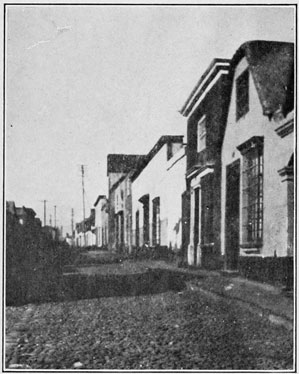
Street in Moquegua
Moquegua is a fine old town on a river of the same name
and capital of the province of Moquegua, lying at an altitude
of over four thousand feet above sea level in the
center of a rich agricultural district, abounding in olives.
These and raisins are the chief exports of the district.
The city has a population of nine thousand and
much resembles Tacna on account of the substantial
buildings; it is not as lively as Tacna, due to the former
place having stationed there five regiments, but otherwise
it is a pleasanter town. It is higher, cooler, and there is
more verdure. The valley itself is a long, broad ribbon of
cultivation, mostly devoted to the growing of grapes.
Moquegua is connected to its port, Ilo, by a railroad sixty-five
miles long.
Before the Pacific War, Moquegua was a wealthy town
and larger than at the present time; since then many of the
inhabitants emigrated, many going to Arequipa and to
Lima. The alameda, though much neglected, shows
signs of former grandeur, which is testified by the broken
statues and cracked stone benches which formerly were
the pride of the city. Moquegua has the name of being a
very religious place; it has many churches and its streets
swarm with priests, in this respect being much different
from the Chilean towns that I had just visited.
Ilo is a small port of about two thousand inhabitants,
very poor and squalid but not so much so as Mollendo.
In both these places bubonic plague is rife, but strange to
say that malady has never mounted as high as Arequipa
or Moquegua. At Ilo I boarded a small postal steamer
of the Peruvian Line and after a few hours' steam we
anchored off the cliffs of Mollendo, the most dangerous
landing place on the Pacific Ocean. The swell is so great
here that sometimes passengers have to wait two weeks
before it has subsided enough to permit them to embark
on the steamers. I had to transfer to another ship here
because the one I was on touched at all the small ports and
took a week to reach Callao.
Mollendo is one of the dirtiest towns that I have ever
visited and I have visited some "hot" ones. It is a
bubonic stricken place of about five thousand inhabitants,
according to the census reports, although I doubt
if its population is in excess of three thousand. A steep
incline up a cliff leads from the dock past the custom
house to the stinking Hotel Ferrocarril, the only hostelry
in the town. This ramshackle old building, painted
dark green, is situated on an eminence at the extreme
southwest corner of the town, at a street corner. A
veranda runs around the street sides of it, onto which
the rooms open. Beggars, hobos, cripples, bums, and
dogs bask on the sun-warped boards of its floor, and
sneak-thieves are ever watching for an opportunity of
entering the dirty holes which are the guests' rooms. The
dining room and the barroom are the only adjuncts of the
institution which are kept clean, and the latter is the most
lucrative enterprise to its owners of any business establishment
in the town. It has several billiard tables of doubtful
cues and cushions and to them at the noon hour repair
all the German clerks of the mercantile establishments.
There is much liquor sold and much drunkenness to be
observed. At one corner of the room sat a well-dressed
aged man. He had the palsy so badly that he could not
lift a glass to his mouth so he sat there imbibing whiskey
and soda through a rubber tube that extended from his
mouth to the glass. The Hotel Ferrocarril is owned by
a couple of Italians who are fast waxing wealthy. It is
hell to stay in Mollendo even for an hour and the travelers
are to be pitied who stop here days at a time waiting for
their steamers which run on uncertain schedules.
The place owes its importance to the fact that it is the
port of the large and prosperous city of Arequipa about
seventy-five miles inland, and that it is the outlet and port
of entry of the Lake Titicaca basin, and of the historic
and interesting old city of Cuzco, the pristine capital of
the Inca Empire, three days distant by rail. Formerly
Mollendo was the seaport of La Paz, Bolivia's quaint metropolis,
but now traffic has been changed from that city,
so that Arica and Antofagasta get the bulk of its trade.
There has been much talk of transferring the port of Arequipa
to Islay, a settlement a few miles north of Mollendo
in a sheltered location, but the merchants at Mollendo
made a strong kick about it, and bribed the politicians at
Lima, so that the scheme never matured. At Mollendo,
my Peruvian money ran out because I did not get enough
Chilean money changed at Arica, and I had a hard job
getting change here. Some Italian bankers to whom I
applied knew how badly I wanted Peruvian currency, so
accordingly discounted my Chilean money so much that I
must have lost twenty-five dollars by the transaction.
As I said before, Mollendo is a hotbed for bubonic
plague. Several people die daily of it here, but its mention
is suppressed by the health authorities so as not to
give a black eye to the town. When a person dies of it, it
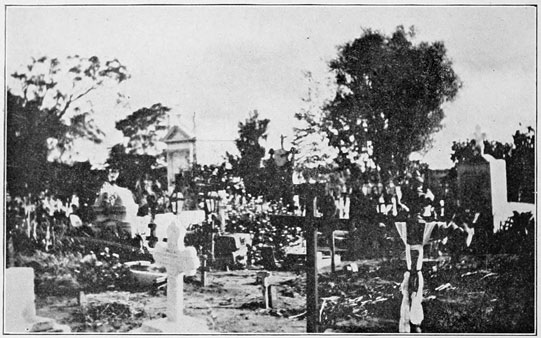
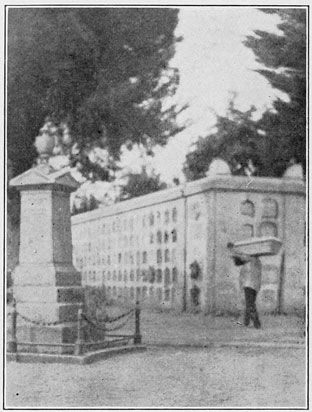
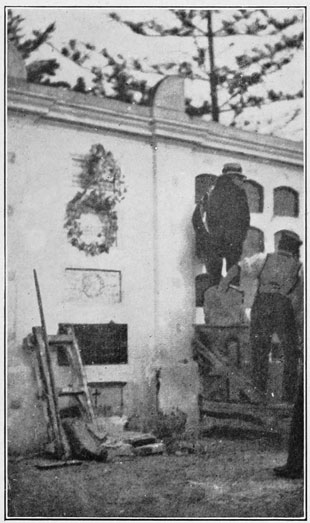
is kept quiet and the victim is buried at night. Northeast
of the town is the potter's field. Here graves eighteen
inches deep are dug. The cadaver is trussed up by having
its feet drawn back to its haunches by means of a cord tied
around the shoulders and is thrown into the impromptu
grave. I was told by several people that so poorly is the
job done that sometimes the toes protrude above the ground
and are nibbled at by buzzards and by starving dogs.
From Mollendo, I went to Callao on the Chilean steamship
Limari. It was a good ship but rolled considerably
even in a calm sea. It took three days to make Lima's
busy port, no stops being made, but from the deck I could
see the dim outlines of the towns Lobos, Chala, and Pisco.
An acquaintance of mine, Mr. Kurt Waldemar Linn, of
New York, a German by birth but a naturalized American
citizen, who is connected with the International Film
Company, told me in Santiago that he expected to be on
this boat and arrive in Lima at the same time I would.
I failed to find his name on the passenger list and when I
arrived in Lima, he had not yet shown up. The next day
he appeared, having disembarked from the Pacific Steam
Navigation Company's steamship Mexico. He said he
was sorry that he had not made the trip on the Limari,
and that never again would he make a trip on any ship of
the Pacific Steam Navigation Company if he could help it.
He said that the service and food on the Mexico were vile
but to crown his discomfiture one morning at breakfast
the first officer who sat next to him asked him how he
slept the previous night.
"I didn't sleep very well," answered Mr. Linn. "There
was too much noise going on."
"Oh, yes, there was a good bit of noise on board. We
caught a German spy last night and that caused the
racket." At this witty remark the officer looked at Linn
and winked. The latter did not relish this sort of pleasantry
even though it was meant in fun.
At Callao the custom house officials are careful to ransack
all one's belongings looking for things dutiable and
those non-dutiable as well; on the latter they levy private
duties for their own pockets. There is much red tape and
tipping to be done and nowhere else in my travels have I
been subjected to so much annoyance at a custom house
unless it was at Belgrade, Servia. Hotel couriers meet
the steamers and it is advisable for the traveler to give his
possessions in charge of one of these men who will relieve
him of the trouble connected with the custom house and
transferal of baggage to Lima. The courier expects a
large tip, but it is more convenient to give it in one lump
sum to him than to have to run the gauntlet.