4th, Thursday. It was now Christmas, according to the old style. It
had frozen very hard during the night. We went to church, in order to
hear Do. Niewenhuise preach, but more to give no offense to the
people, than either on his or our own account.
5th, Thursday [Friday]. We began writing.
6th, Friday [Saturday]. It continued to freeze hard, though during
the day the weather was more moderate. The ice was strong and mixed
with snow.
13th, Saturday. It felt like a change of weather. In all this time
nothing occurred worthy of note except the ships left the harbor in
front of the city, on Thursday, for Deutel Bay, a cove of Long Island
in the East River, about three miles east of the city, opposite
Hellgate, where they lie during the winter, to be out of the way of
the floating ice, which is sometimes very great.[285] On Friday, the
governor's yacht arrived from Virginia, having been twenty-two days on
the way. They had brought a sackemaker from there with whom the
governor had negotiated for peace between the Indians and English in
that quarter. In all this frost and cold we have discovered little
difference from the cold in Holland, except that when the sun is high,
that is, about nine o'clock in the morning, it is a little milder
here. It thawed every day until the
16th, Tuesday, when all the ice and snow disappeared. De la Grange
having a new small map of a portion of the South River, I copied it.
24th, Wednesday. Fred. Flipsen[286] met me, and told me the
governor had been at his house, and spoken to him about us, and that
he desired to see us and talk with us. We, therefore, determined to
call upon him, and at the expiration of three days of rain and stormy
weather, on the
25th [26th], Friday, we went to Fredryck Flipsen, that he might take
us to the governor, as he had promised, and as he did do. The governor
received us kindly, and told us he had wondered at our being so long
in the country without coming to see him. We replied, that we should
undoubtedly not have failed in doing so, if he had been in the city,
for when we arrived here he was at Penequik,[287] and afterwards when
he had been only a few days at home, with much business to occupy him,
he left for Fort Albany just as we were going to the South River. We
parted politely from each other.
30th [29th], Monday. A person who, they said, was the thief-catcher,
came to our house in the evening, and, by order of the governor,
summoned us to appear at eight o'clock the next morning at the house
of —— Rombouts,[288] the mayor of the city, and give our names and
further information as to our doings and condition, as all strangers
now and henceforth, whether men or women, must do. We were somewhat
astonished, since they had told us, as was certainly true, that such
had never been the custom. What induced them to adopt this course, we
do not know.
31st [30th], Tuesday. We went in company with the old woman where we
lodged, to Mayor Rombouts, at the appointed time. When we arrived,
there was a magistrate's officer or two in attendance, and some came
in while we were there. Addressing us, he said: "Friends, we have
summoned you here, not because we have anything to say to you, or have
any debt to claim, or because any one has sought of us to demand of
you any such thing, or to summon you." The reason, he said, was
because we had been so long in the country without having reported our
names, who we were, our profession, trade or business, condition and
purpose. We answered, we would by no means have been in default, if
there were any law or order which required us to do so, or if we had
been informed that it was customary, or had ever been done; and it
therefore surprised us that they complained and charged us with
neglect of duty, or found fault with us, or wished to convict us of a
matter where there was no law, obligation, custom, or even precedent;
that this treatment struck us as very strange, since there were
several foreigners who had come over in the ship with us, from whom
they had not required what they required of us. "You know well," he
said, "it is the custom in Europe." We replied, "it was not so in any
of the United Provinces or any other places except upon the
frontiers." "Well," he continued, "we are no frontier, but a capital,
and it must and shall be so in the future." He then inquired after our
names, trade or profession, and place of residence in Fatherland, all
of which we told him, namely, that my comrade was a theologian, and
had studied at Leyden;[289] that I was a wine-racker, and that we both
lived near Leeuwarden, in Friesland. He asked further what we came
there to do, or what was our purpose or intention. We told him it was
to look at the country. "How, look at the country?" he asked: "some
come here to look at the cities, others at the fortifications; some to
learn the mode of government and policy, others the manner of
regulating the militia; others again to learn the climate, and times,
and seasons, and you run and travel through the country without giving
us any notice why." We replied, we had come here and travelled through
the country in order to make ourselves acquainted generally with the
nature and fertility of the soil, as was convenient, or we might
perhaps go around mornings and evenings. He inquired further of us how
we wished to be regarded in the future, whether as citizens or
foreigners. We answered, as foreigners. "Well then," he proceeded,
"you are forbidden to carry on trade, particularly with the
inhabitants, that is, to sell anything to private persons, but you
may dispose of it to merchants who sell to private individuals." He
said the privilege, or burgher right cost —— beavers,[290] each
beaver reckoned at five guilders in Holland money, or twenty-five
guilders in zeewan, and was prohibited to all persons who reside out
of the city; and as we resided out of the city, we must be treated
like others. We replied to this, we would cheerfully obey the law. We
were also told to travel nowhere, particularly to Albany, without
special permission from the governor, which we said we would ask from
his Excellency, and thereupon we left.
On arriving at our house, we found there Simon of Gouanes,[291] who
had brought a boat-load of wood, and with whom my companion went to
Long Island, but I remained at home; the Lord exercising me somewhat,
I was rather quiet. We had been to the strand several days, watching
for Claes, the ferryman, or some other opportunity to cross over to
Gamoenepaen, but we found none; and as there was some difficulty
between this governor and the governor of New Jersey, we were
contented to wait and follow the providence of the Lord therein,
although our purpose in going over was not on that account.
February 1st [January 31], Wednesday. Gerrit, the son-in-law of our
host, having been a long time upon Long Island, came over with a cask
of tobacco, which he intended to ship in the ship Beaver; he
repacked it, and I helped him cooper it.[292] He said he had another
one to bring over from the island, and then he would take Simon's boat
and go with us to Ackquakenon. After he had finished packing this one,
the boat going to Gouanes after wood, I left along with him on the
3d [2nd], Friday, at nine o'clock in the morning. I heard that my
companion had gone from the Bay to Najack, where I proposed to follow
him, because we might not be able to obtain these people who, in order
to go to Ackqueqenon, resolve upon it half a year beforehand, for when
one can go, the other cannot, and we were not able to wait. Simon told
us now he could not accompany us. The other person was uncertain, and
Gerrit was not any more sure. I arrived at Najack in the evening, and
my comrade also arrived there from the bay, in company with
Jaques.[293] He concluded to return to the city with me in the
morning.
4th [3d], Saturday. Our resolution was defeated. We started on the
road, but were compelled to return, as it had rained hard the whole
night, and continued to do so all day.
5th [4th], Sunday. It snowed all night and until about nine o'clock
in the morning, when it cleared up, and we set out on our journey. We
reached the ferry at one o'clock, where we waited three hours to be
taken over by the lame brother-in-law of Jan the baker, or Jan
Theunissen.[294]
6th [5th], Monday evening. M. de la Grange came to call upon us,
being somewhat under concern of mind, and giving us some hope. His
wife, being touched also, has been to see us several times; and
certainly the Lord will comfort us about His people. I will take some
other occasion to speak more particularly in relation to this matter,
if the Lord continue it. Meanwhile, I had translated the Verheffinge
des Geestes tot God[295] into Dutch, for Elizabeth Rodenburgh, wife
of Ephraim Hermans, in order to send her a token of gratitude for the
acts of kindness enjoyed at her house, as she had evinced a great
inclination for it, and relished it much, when sometimes we read
portions of it to her while we were there. I also began a translation
of the last exercise of the Heylige Decades.[296] Nothing further
occurred worthy of mention, except that the snow, frost, rain and
inclement weather prevented us from going to Ackquequenon.[297]
11th, Sunday. We received letters from the South River, from Mr.
Ephraim Hermans, and Heer Johan Moll, which consoled us as to their
state, and gave us some hope at least of great progress, as appears by
the same. We answered them, and dispatched our letters by the same
person who brought theirs, and who was to return on the
14th, Wednesday, and with whom we sent the translation of the
Verheffinge des Geestes with a small package of knitted
baby-clothes. The ship Beaver came out of Deutel Bay, and was up for
Europe and Holland immediately. Therefore, on the
15th, Thursday, we began writing to our friends in the Fatherland.
The winter gradually passing away, the weather was during the last of
February, and first of March, as pleasant as it were the month of May.
I finished the translation of the Decades.
March 2d, Saturday. M. de la Grange has chartered a yacht to go to
the South River, with a lot of merchandise, and to take to his land
there the boor, whom he had brought for that purpose from the
Fatherland. This person came from near Sluis,[298] and had done
nothing here as yet, because De la Grange had not gone to Tinaconcq,
as he had first intended. He designed to take him now to the land he
had bought on Christina Kill, and have it put in order. He had
obtained exemption from tax on his merchandise, and was the first one
who had enjoyed this advantage, that is, from the second tax, he
having paid the first tax when the goods were unladen here. All
merchandise pays a second tax when it is sent to the South River, or
Albany. I gave him Les Paroles de Salut[299] for Heer Johan Moll,
who had urgently requested us to send him some religious book or
other, writing to him what was necessary on the subject.
We had waited till this time to go to Ackquekanon, either on account
of the weather, or because it was not convenient for the persons on
Long Island. We finally determined to go with Gerrit, who could speak
very good Indian, and who had sent word to us from Long Island, that
we must be at Simon's house in Gouanes for that purpose on Sunday
morning in order to go in his boat. We accordingly prepared ourselves.
3d, Sunday. We both went over to Long Island, at eight o'clock; and
as we were entering the ferry boat, Madame de la Grange came aboard
with her nephew, Kasparus Reinderman, who, when they had landed, took
a wagon and rode on to the bay. We went through Breukelen to Gouanes,
where we arrived about ten o'clock, and found Gerrit was not yet
there. Several families of Indians had erected their huts upon the
beach, whereby Simon's house was very accessible. This was done with
the consent of his wife, with whom he had left the profit from the
Indians. While we were engaged in obtaining some oysters, Gerrit with
Jaques and his son and daughter rode up in a wagon. Jaques had come
for the purpose of attending to a sick horse of Simon, which had a
certain disease, they call here the staggers, to which their horses
are subject, and with which the creatures whether going or standing
constantly stagger, and often fall; this increasing they fall down at
last, and so continue till they die. It is cured sometimes by cutting
the tip end of the tail, and letting the blood drip out; then opening
a vein, giving the animal a warm drink and making a puncture in the
forehead, from which a large quantity of matter runs out. The boat
being leaky, and a right calculation not having been made as to the
tide, we remained here to-day, intending to leave early in the
morning, and, therefore, made every preparation. We had expected
another person to go with us, but there were only us three.
4th, Monday. We left Gouanes Bay at high water, about eight o'clock,
with a southerly wind, but calm, and rowed with the current to Gheele
Hoeck,[300] where we made sail, and crossed the bay to Achter Kol,
where we knew there were some Indians lying behind Constables Hook. We
sailed there in order to request one of them, named Hans, to go with
us as a guide. Hans had long frequented among the Dutch, and spoke the
Dutch language tolerably well. He was a great nitap, that is, friend
of Gerrit. He refused at first to accompany us, saying he had just
come from there; and when we urged it upon him, he said, "would you
Christians do as much for us Indians? If you had just been there and
had come back tired and weary, and some Indians should come and ask
you in the midst of your children, in your own houses, while busied
with your occupation, would you be ready immediately to go back with
them?" We answered yes, upon proper terms. He said, "I do not think
so, I know well what you would do." We told him, we would fully
satisfy him. He wished to make a bargain beforehand, which we did not,
as we wanted to see whether he would earn anything. He allowed himself
to be persuaded; "but," he said, "I will lose so much time in making
zeewant," which is their money and consists only of little beads. "I
am very cold; you are all well clothed and do not feel the cold; I am
an old man (as he was), and have nothing but a little worn-out blanket
for my naked body." We must give him a blanket and then he would be
willing to go with us. We said we had none with us. "Well," he
replied, "I do not ask you to give it to me now, but when I come to
the city." We told him he should be satisfied, and have no cause of
complaint. After he had fitted himself out a little he went with us.
We had some of the flood tide left; but before we reached Schutters
Island the wind changed, and it was quite calm. We therefore struck
our sails and went to rowing in order to strike the current. By
scraping along we reached the Slangenbergh, on the west point of the
Northwest Kill,[301] where there is a very large piece of salt meadow,
and where the tide ran so strong against us we could not proceed any
further. We therefore lay to and went ashore, in order to walk about a
little. This was the largest, cleanest, and most level piece of salt
meadow that we had observed anywhere. After having been an hour or a
little more on shore, a light breeze sprang up out of the east, when
we took the boat again and putting off, came to Milfor,[302] an
English village, lying upon high land on the south side of the creek,
having left Santfort on the right hand, which is an English village
also, lying on the west side of Hackingsackse Kill. We then came to
high land; and the wind falling, we rowed up against the ebb tide to a
house on the northeast side belonging to one Captain Berry, where it
being evening and commencing to rain, we stopped, made the boat fast,
and took every thing out of her. We entered the house which was large
enough, but poorly furnished. We found nobody there except a negro
who could speak nothing but a little broken French. We warmed
ourselves, and ate from what we had brought with us, Hans, the Indian,
sharing with us. In the meanwhile we engaged in conversation with him,
and he told us certain things which we had never heard any Indian or
European mention, the opinion of the Indians in relation to the
Godhead, the creation, and the preservation and government of all
things.
We acknowledge, he said, a supreme first power, some cause of all
things, which is known by all the Indians of North America,
hereabouts, whether Mahatans, Sinnekes, Maquaas, Minquaas, southern or
northern Indians, not only by the name of Sackamacher or Sachamor
(which the Dutch for the sake of convenience will pervert into
Sackemacher), that is to say, lord, captain, or chief, which all
persons bear who have any power or authority among them, especially
any government or rule over other persons and affairs, and that name,
it appeared to him, was used by others to express God, more than by
themselves; but the true name by which they call this Supreme Being,
the first and great beginning of all things, was Kickeron,[303] who is
the origin of all, who has not only once produced or made all things,
but produces every day. All that we see daily that is good, is from
him; and every thing he makes and does is good. He governs all things,
and nothing is done without his aid and direction. "And," he
continued, "I, who am a captain and Sakemaker among the Indians, and
also a medicine-man (as was all true), and have performed many good
cures among them, experience every day that all medicines do not cure,
if it do not please him to cause them to work; that he will cure one
and not another thereby; that sickness is bad, but he sends it upon
whom he pleases, because those upon whom he visits it are bad; but we
did not have so much sickness and death before the Christians came
into the country, who have taught the people debauchery and excess;
they are therefore much more miserable than they were before. The
devil, who is wicked, instigates and urges them on, to all kinds of
evil, drunkenness and excess, to fighting and war, and to strife and
violence amongst themselves, by which many men are wounded and killed.
He thus does all kind of evil to them." I told him I had conversed
with Jasper or Tantaqué, another old Indian,[304] on the subject, from
whence all things had come, and he had told me they came from a
tortoise; that this tortoise had brought forth the world, or that all
things had come from it; that from the middle of the tortoise there
had sprung upon a tree, upon whose branches men had grown. That was
true, he replied, but Kickeron made the tortoise, and the tortoise had
a power and a nature to produce all things, such as earth, trees, and
the like, which God wished through it to produce, or have produced.
It was now time to see if we could not take some rest in a place not
very well protected against the cold, and where there was nothing to
lie upon except the naked floor; but the negro wishing to favor my
comrade and myself, showed us a bunk in which there was nothing save a
few leaves of maize, and those thin enough. We lay down there, but
suffered greatly from the cold. We slept very little, and lay
shivering all night, and the slave sometimes shaking us and waking us
up. We were so stiff we could not move; but the night passed on as
well as it could, and we rose early. It had rained, and we started at
daylight to the boat, and rowed into the stream. Gerrit grumbled very
much. He was a coarse, ignorant man, and had not well calculated the
tide. We went ashore about eight or half-past eight to breakfast, and
had great difficulty in making a fire, for all the brush was wet
through with the rain. We were fortunate enough, however, at last, to
succeed. We took a walk for a short distance into the woods, which
were not the poorest. In the meanwhile the ebb had ended; the water
was calm, and taking a little of the flood, we rowed on until we
arrived at Ackquekenon, about one o'clock in the afternoon.
Ackquekenon is a tract of land of about twelve thousand morgen,
which Jaques of Najack, with seven or eight associates, had purchased
from the Indians, the deed of which we have seen, and the entire price
of which amounted to one hundred or one hundred and fifty guilders in
Holland money, at the most. It is a fine piece of land, the best tract
of woodland that we have seen except one at the south. It is not very
abundant in wood, but it has enough for building purposes and fuel. On
one side of it is the Northwest Kill, which is navigable by large
boats and yachts thus far, but not beyond. On the other side, there is
a small creek by which it is almost entirely surrounded, affording
water sufficient, both summer and winter, to drive several mills.
When we reached here, we took our provisions and whatever was loose
out of the boat into a hut of the Indians, of whom there is only one
family on this whole tract. We ate our dinner by their fire, and
determined to go in the afternoon to the falls, although it had
already begun to rain. We started off accordingly under the guidance
of Hans, the Indian. The rain gradually increased, with snow, and did
not hold up the whole day. After we had travelled good three hours
over high hills, we came to a high rocky one, where we could hear the
noise of the water, and clambering up to the top, saw the falls below
us, a sight to be seen in order to observe the power and wonder of
God.[305] Behind this hill the land is much higher than on the other
side, and continues so as far as is known. A kill or river runs
through this high land between the hills, formed by several branches
coming down from still higher land. This river, running along the
valley to seek the sea, comes to this hill where it runs over a large
blue rock, which is broken in two, obliquely with the river. One part
is dry, which is the hill before mentioned; the other is where the
river, running over a crevice or fissure between both, appears to be
eight or ten feet wide, having on either side smooth precipices like
walls, but some parts broken between them. The river finding this
chasm pours all its water into it headlong from a height, according to
guess, of about eighty feet; and all this pouring water must break
upon the undermost piece of stone lying in the crevice, which causes a
great roaring and foaming, so that persons standing there, side by
side, have to call out loud before they can understand each other. By
reason of the breaking of the water, and the wind which the falling
water carries with it, there is constantly spray ascending like smoke,
which scatters itself like rain. In this spray, when the sun shines,
the figure of a rainbow is constantly to be seen trembling and
shaking, and even appearing to move the rock. The water in this
fissure runs out on the south; and there at the end of the rock or
point it finds a basin, which is the beginning of the lower kill.
This point is, I judge, about one hundred feet above the water, and is
steep like an upright wall. When the fish come up the river, this
basin is so full of all kinds of them, that you can catch them with
your hands, because they are stopped there, and collect together,
refreshing themselves, and sporting in and under the falling fresh
water, which brings with it, from above, bushes, green leaves, earth,
and mire, in which they find food. The water runs hence east and
northeast to Ackquekenon. The Indians come up this river in canoes to
fish, because it is one of the richest fisheries they have; but the
river is not navigable by larger boats, though in case the country
were settled the navigation could be improved. The falls lie among
high hills, especially on the south, so that the sun does not
penetrate there well except in summer. We found heavy ice there at
this time, although it had all thawed away below. When I saw this ice
at a distance, I supposed it was the foam. I took a sketch[306] as
well as I could, very hastily, for we had no time, and it rained and
snowed very much. What I did is not very happily done. I regret I
could not crayon it, for it is worth being portrayed. Night coming on,
we had to leave. We were very wet and cold, especially in the feet. It
was dark, and slippery walking on such precipices, and crossing little
streams. Tired and weary, wet and dirty, we reached the place which we
had started from, about eight o'clock in the evening, and went into
the hut of the Indians, having to-day rowed constantly from early dawn
until one or two o'clock, and then walked, through heavy weather,
twenty-four to twenty-eight miles.
We endeavored to warm and dry ourselves in this cabin as best we
could. We could not stand up on account of the smoke, and there were
no means of sitting down unless flat on the ground, which was very bad
for us, on account of our being so wet, but we did the best we could.
We took our supper, and distributed some of our bread among the
Indians, with which they were as much pleased as children with sweet
cake. We gave each man four fish-hooks, and the women and children
each two. We also gave them two small trumpets, and then they were
great nitaps or friends. We had to lie down there, and at first, as
long as it was warm, it went very well; but the fire being almost
burned out, and the hut rather airy, and the wind being no longer kept
out by the heat in the opening, through which the smoke escaped, we
became stiff in the knees, so that I could not, through weariness and
cold, move mine without great pain and difficulty. The longed-for day
came, and we went out in the snow to look through the woods, and along
the little stream, to see whether it would be worth the trouble to
erect a saw-mill there for the purpose of sawing timber for sale, as
Jaques had supposed. But although we found the stream suitable for
mills, we did not discover proper wood sufficient for the purpose. The
soil seemed to promise good, and the place is as well situated as it
can be, to make a village or city. The land on both sides of the
Northwest Kill is all taken up, and the prospect is that the whole
region will soon be inhabited. It is already taken up on the south
side as high up as the falls. Eating our breakfast about eight
o'clock, we went on board of the boat, it being now the
6th, Wednesday. We set off with a westerly wind, though light and
gusty. If the wind in this river do not come straight from behind, you
cannot derive much benefit from it, in consequence of the land on both
sides of it being so high, and the bay so winding. The river is the
pleasantest we have yet seen. It is gratifying to look upon the
continually changing views which present themselves in going either up
or down, with its evergreens of pine and cedar, and other species, the
names of which I do not know, and its clean bottom and clear fresh
water. We rowed and sailed as well as we could, until the flood tide
stopped us, when we went ashore to eat our dinner, and make a good
fire to warm ourselves. When the ebb began to make, we proceeded on
our way. Our poor Indian, who did nothing in the boat, sat all the
time benumbed with cold in his poor little blanket. But as the day
advanced it was better. The tide serving us, and the wind being
stronger as we came below the high land, we reached Achter Kol before
evening, and set the Indian ashore at his hut, who told us he would
come and see us on Monday. It was calm, with the wind more and more
favorable, and we crossed over the bay, and arrived Gouanes Bay about
eight o'clock.
I had asked Hans, our Indian, what Christians they, the Indians, had
first seen in these parts. He answered the first were Spaniards or
Portuguese, from whom they obtained the maize or Spanish or Turkish
wheat, but they did not remain here long. Afterwards the Dutch came
into the South River and here, on Noten Island,[307] a small island
lying directly opposite the fort at New York, and to Fort Orange or
Albany, and after them the English came for the first, who
nevertheless always disputed the first possession. But since the
country has been taken several times by the one and the other, the
dispute is ended in regard to the right of ownership, as it is now a
matter of conquest.
When we arrived at Gouanes, we heard a great noise, shouting and
singing in the huts of the Indians, who as we mentioned before, were
living there. They were all lustily drunk, raving, striking, shouting,
jumping, fighting each other, and foaming at the mouth like raging
wild beasts. Some who did not participate with them, had fled with
their wives and children to Simon's house, where the drunken brutes
followed, bawling in the house and before the door, which we finally
closed. And this was caused by Christians. It makes me blush to call
by that holy name those who live ten times worse than these most
barbarous Indians and heathen, not only in the eyes of those who can
discriminate, but according to the testimony of these poor Indians
themselves. What do I say, the testimony of the Indians! Yes, I have
not conversed with an European or a native born, the most godless and
the best, who has not fully and roundly acknowledged it, but they have
not acknowledged it salutarily, and much less desisted, disregarding
all convictions external and internal, notwithstanding all the injury
which springs therefrom, not only among the Indians, but others, as we
will show in its proper place. How will they escape the terrible
judgment of God; how evade the wrath and anger of the Lord and King,
Jesus, whom they have so dishonored and defamed, and caused to be
defamed among the heathen? Just judgment is their damnation. But I
must restrain myself, giving God all judgment and wrath, and keeping
only what he causes us to feel therefor. Such are the fruits of the
cursed cupidity of those who call themselves Christians for the very
little that these poor naked people have. Simon and his wife also do
their best in the same way, although we spoke to them severely on the
subject. They brought forward this excuse, that if they did not do it,
others would, and then they would have the trouble and others the
profit, but if they must have the trouble, they ought to have the
profit; and so they all said, and for the most part falsely, for they
all solicit the Indians as much as they can, and after begging their
money from them, compel them to leave their blankets, leggings, and
coverings of their bodies in pawn, yes, their guns and hatchets, the
very instruments by which they obtain their subsistence. This subject
is so painful and so abominable, that I will forbear saying anything
more for the present.
These Indians had canticoyed there to-day, that is, conjured the
devil, and liberated a woman among them, who was possessed by him, as
they said; and indeed, as they told us, it had that appearance, but I
have never seen it.[308]
We fared better this night than the last, and whether from fatigue or
other reasons, slept soundly.
7th, Thursday. We had intended to go to Najacq, to Jaques's, and
afterwards to Elbert's in the bay, in order to report to them how we
had found their land, but Gerrit having promised his father-in-law
some firewood, he had to take Simon's boat for the purpose, and
Simon's wife also had some errands in the city. We, therefore,
determined to go with them, as we did, leaving Gouanes at ten o'clock,
and seeing the Indians putting up their huts which they had entirely
thrown down during their intoxication, although it was not much
trouble, as it was not much to make them. With a tolerably fair wind
we reached the city at noon, where we gave ourselves up to rest.
We wished now to make a voyage to the Nevesinkx, Rentselaer's Hoeck,
and Sant Hoek, but we could find no opportunity, for the reason that
this route is very little navigated in the winter and spring, because
it is somewhat dangerous. Meanwhile, the weather continued very
variable; sometimes we had frost and severe cold, then rain and snow,
wind and squalls, until the time of the sun's crossing the line, when
it began to become warm, but continued still variable, though it
improved daily.
20th, Wednesday. While my comrade sat writing, he observed a change
in his vision, being able to see better than before, when he had to
look extremely close in writing. It happened thus: writing as he was
accustomed to do, his sight in an instant became entirely obscured, so
that he had to stop, not being able to write any more. Not knowing
what it was, he shut his eyes and rubbed them, as they usually do when
anything obstructs the sight, and then undertook to write as he had
done before, but yet he could not see well; when raising his head
higher from the paper, he saw much clearer than when he had to look
close to it. Had he kept his eyes up so high before, he would scarcely
have been able to see at all. You could also perceive that his writing
was different afterwards.
A yacht arrived down the river from the Hysopes,[309] from which they
learned that the navigation was open, though boats going up would have
to tug through the ice. It brought news of the death of the minister,
Domine Gaesbeck, a Cocceian, which had caused great sorrow.[310] They
had determined to call another minister from Holland, or Tessemaker
from the south. They had built a new church in the Hysopus, of which
the glass had been made and painted in the city, by the father of our
mate, Evert Duiker, whose other son, Gerrit, did most of the
work.[311] This Gerrit Duiker had to take the glass to the Hysopes,
and having heard we had a mind to go there, he requested our company,
which we would not refuse him when the time came. He promised to teach
me how to draw.
23d, Saturday. The first boat arrived from Fort Orange[312] to-day,
bringing scarcely any news except that a great number of Indians had
died in the early part of the winter of small pox, and a large party
of them had gone south to make war against the Indians of Carolina,
beyond Virginia, for which reason the hunting of beaver had not been
good, and there would be a great scarcity of peltries this year, which
was the chief trade of New Netherland, especially in this quarter.
There was something published and posted by this government to-day
against that of New Jersey or Achter Kol, but I do not know precisely
what it was.[313] We found to-day an opportunity to go to Nevesinck.
An Englishman who had a little boat, and small enough, was going on
Monday without fail, and he had, he said, about sixteen passengers.
24th, Sunday, and 25th, Monday. It stormed hard from the northwest,
and he could not go, but he came to tell us he would give us notice
when he would sail.
26th, Tuesday. He came and told us he would leave next day at
sunrise, and in passing by the house, he would come in and call us.
27th, Wednesday. We waited for him from an early hour, but it was
nearly ten o'clock before we saw him. We went to his boat which was
poor enough, very small, light, and lank, though it had been repaired
some; it had an old sail and piece of a foresail, and yet this captain
was as stern and arrogant with his boat, as if it were a ship-of-war.
We waited there for the passengers, but they had melted away to three,
my comrade, myself and one other person. We started about eleven
o'clock with a good wind and tide, though it was almost low water.
When we reached the Narrows, the wind veered round to the southeast,
which was against us. We discovered the boat to be so leaky that she
had a foot or two of water in her, which he sought to excuse, but
every word he said on the subject was untrue. The pump was stopped up,
and we had to help him clear it out, which was accomplished after much
trouble and bungling. We cleared it out, but we had that to do three
times, because in repairing the boat they had left all the chips and
pieces of wood lying in the hold between the planks, and when we
pumped, this stuff would continually obstruct the pump, though we
succeeded in getting out most of the water. Meanwhile the wind changed
to the south and southwest, with which there was every prospect of
getting outside. We tacked about and reached Coney Island, a low,
sandy island, lying on the east side of the entrance from the sea. We
came to anchor under its outermost point, when we should have gone
inside of Sandy Hook, in a creek, as we were able yet to do; but he
said, we must go outside of Sandy Hook, round by sea, and then make
for a creek there. I began now to have other thoughts. To put to sea
in such a light, low, decayed, and small boat, with rotten sails, and
an inexperienced skipper, and that at night, did not suit me very
well. The sea began already to roll round the point of Coney Island,
and I apprehended bad weather from pain in my breast and other
indications. He said the place where we were lying was entirely shoal,
and he therefore dared not go near the shore, as there was only eight
or ten feet water. But he was much mistaken, for when he let the
anchor fall, it ran out six fathoms of rope before it struck the
bottom. I had seated myself all the time at the helm, and observed he
was a miserable person. It was then about half flood, and having put
things somewhat in order, he asked us if we would go ashore with him.
I said yes, and I did so for the purpose of ascertaining how the
westerly point of this island was situated on the sea entrance. My
comrade and the other passenger, having no wish to go, remained on
board. Upon reaching the shore, we saw immediately a large ship coming
up the bay from Sandy Hook, which we supposed to be Margaret's ship,
which she had left to be repaired at Falmouth, as we have before
mentioned.[314] I wondered why our skipper did not return on board,
but he not only remained ashore and left his boat with two
inexperienced persons, but he had not hauled up on the beach his small
canoe in which we came ashore, or made it fast. I went with him along
the strand, on the sea side, and saw that, close by Coney Island, a
strong flood tide was running, which was pressed between the east bank
and the island, and that led us to think there was an opening there
through which you could sail out and in, which is the fact, as I was
afterwards informed by one who was very well acquainted with the
place; but it is only deep enough for boats, yachts, and other small
craft. This island, on the sea side, is a meadow or marsh intersected
by several kills or creeks. It is not large, being about half an hour
or three quarters long, and stretching nearly east and west. It is
sandy and uninhabited. They generally let their horses run upon it to
feed, as they cannot get off of it. We found good oysters in the creek
inside, and ate some of them, but seeing his carelessness, I could not
remain longer from the boat, as the canoe might be carried off, on the
rise of the water, by the tide or the wind, and my comrade and the
other passenger, who was sea-sick, not know what to do, the more so in
view of the inexperience and carelessness of the captain. I therefore
hurried to the boat, running across the island. On the inside of the
island I found a sandy elevation like a dune or high dyke which became
gradually lower towards Long Island, and that is all which shows
itself here. This elevation is on the land side, and is mostly covered
with hollies, which, according to my recollection, I have never seen
growing in this region except on dry and very fine sand. When we
reached the canoe it was not only afloat, but it had been thrown
across the beach by the sea, and was full of water. If it had moved
off, we certainly should have been at a loss. The water being high,
the sea came rolling in heavily around the point into the bay, and
caused the boat lying in the current, which ran strong here, to pitch
greatly. We were even fearful about getting on board again, for the
canoe could scarcely hold us both. I told him to go on board first,
and bring the boat nearer the shore, and then he could take me aboard,
but he would not do so, we must go on board together. We therefore
both went into it, and reached the boat, though it was very dangerous.
As soon as we came aboard, our skipper spoke about leaving there, as
we could not lie there well. I asked him where he would go to. He said
to the city, which I did not much oppose, and was secretly glad of,
seeing it was from the Lord. We therefore had to abandon our design of
going to the Nevesinckx at this time. The large ship which we had seen
sailed before us; and we found that we had not been mistaken in our
supposition, as it was the same vessel we had left in Falmouth. It
commenced blowing hard in the evening, and we had as much as we could
stand, but we reached the city while it was yet in the evening, very
much rejoiced.
28th, Thursday, and 29th, Friday. There was a severe storm,
accompanied with much rain, from the southeast, it being about new
moon. Certainly, if we did not see in this the continual care of the
Lord, in His providence, we were worse than beasts, for it was too
manifest not to be touched by it. He gives us grace only to lose
ourselves more and more in Him, and to offer ourselves up to His
service.
30th, Sunday [Saturday.] The storm continued the whole day.
31st, Monday [Sunday.] We determined to make a journey to Albany at
the first opportunity, but this could not be done without the special
permission of the governor. Though a regulation exists that no one
shall go up there unless he has been three years in the country, that
means for the purpose of carrying on trade; for a young man who came
over with us from Holland proceeded at once to Albany, and continues
to reside there. We went accordingly to request permission of the
governor. After we had waited two or three hours, his Excellency came
in and received us kindly. We made our request, which he neither
refused nor granted, but said he would take it into consideration.
Meanwhile we inquired after vessels, of which there were plenty going
up at this time of year.
April 2d [3d], Wednesday. We went again to the lord governor for
permission, who received us after he had dined. He inquired for what
purpose we wished to go above; to which we answered, we had come here
to see the country, its nature and fertility; and that we had heard
there were fine lands above, such as Schoonechten, Rentselaerswyck,
and the Hysopus.[315] "Those are all small places," he said, "and are
all taken possession of; but I am ashamed I did not think of this." He
then requested us to come some morning and dine with him, when he
would talk with us. We thanked him, and took our leave, reflecting
whether it would be advisable to trouble his Excellency any more about
the matter, as it was not of such great importance to us, and he,
perhaps, considered it of more moment than we did. We then felt
inclined to leave the country the very first opportunity, as we had
nothing more to do here, and it was the very best time of year to make
a voyage. As we had some of our goods left after we were forbidden to
sell any more, we went to see if we could get rid of what we had kept
for Ephraim. As there was no prospect of seeing him, we proposed to
do the best we could with one of our neighbors, named Cornelius van
Kleif, to whom my comrade had spoken, and who was inclined to trade.
He entered into negotiations, but was a little timorous. We offered to
let him examine the bills of the persons from whom we had bought the
goods, and also of the freight and custom-house duties, and he should
give us an advance of thirty per cent. on their amount; or, he might
see what they were worth, and could be sold for, and we would divide
the profits equally with him. After he had looked at them, he did not
dare to take them himself alone, but said he would bring another
person, in order that with the two of them they might make it safe. He
did not say he had no means of payment, though he did remark he had no
peltries, which we would willingly have taken in payment. The other
person had the means to pay. We told him we would wait until de La
Grange returned from the South River; that I had spoken to his wife on
the subject, and that he was expected back every day; at all events,
that we would wait until we had spoken to some other person. Van
Kleif's wife, however, took some fine thread, ribbons, pins, and what
she wanted for herself.
7th, Sunday. M. de La Grange arrived home from the South River, and
came with his wife in the afternoon to visit us, both being under
concern of mind. We addressed to them what we thought necessary. He
stated he had agreed with his nephew to go in partnership with him,
and could not withdraw therefrom, unless God did something special.
They both hoped that God would have pity upon them.
We spoke of the remnant of our little stock, and of the time advancing
when we must be rid of it, so as to be prepared to leave the country.
He said as soon as the boat, which he had chartered, returned from the
South River, in which he had some peltries, we would see what we could
do with each other.
8th, Monday. Van Kleif came to examine the goods again. He had the
disposition, but not the means to buy, and wished to bring still
another person to make the purchase, whom he named, and who was one of
the most miserly persons in the city, which was not agreeable to us.
We, therefore, told him we had already spoken to M. de La Grange.
10th, Wednesday. The boat of de La Grange arrived from the South
River, bringing a letter for us from Ephraim, in which he informed us
of his intention to come and visit us the last of April or the first
of May, which we much desired.
A certain governor from Harford [Hartford], a place situated to the
north, arrived in the city from the West Indies.[316] Our governor
entertained him nobly, and parted with him with great civility.
Two vessels sailed for Boston, where we much desired to go, but we
were not prepared. The governor investigated whether either of them
had taken anything on board below the city.
We left a small piece of brown serge, which stood us in rather dear,
but was very fine and strong, and which on account of its high price,
we had not been able to dispose of, to be cut up for a coat,
waistcoat, and breeches for both of us, with fur in front, so that
almost the whole piece was used, De la Grange taking the remnant, with
which he was much pleased, for a coat, because he did not know where
to obtain such goods in this country. Meanwhile, the barter of our few
goods was going on with him at the rate of fifty per cent. profit on
the invoices, upon which condition he took almost all of them.
13th, Saturday. We called upon the governor, and requested
permission to leave. He spoke to us kindly, and asked us to come the
next day after preaching, thus preventing our request.
14th, Sunday. About five o'clock in the afternoon, we went to the
lord governor, who was still engaged, at our arrival, in the Common
Prayer; but as soon as it was finished, he came and spoke to us, even
before we had spoken to him, and said of a person who was with him,
"This is Captain Deyer,[317] to whom I have given directions to write
a permit or passport for you to go to Albany." He again asked us where
we came from, and where we lived, which we told him. He also inquired
something about the prince of Friesland, and the princess, and also
about the differences of the people of Friesland and His Royal
Highness and Their High Mightinesses, which we told him.[318] We then
thanked him for his favor, and said the object of our visit was not
only to ask permission to go up the river, but also to leave the
country. He thereupon stated that there would be no boat going to
Boston for two or three weeks, but he intended to send one himself
soon to Pennequicq,[319] which was at our service, and we could easily
get to Boston from there by a fishing boat or some other vessel. We
thanked him for the honor and kindness he had shown us, and further
inquired of him whether it would be necessary to have a passport at
our departure. He replied no. We inquired also whether it would be
necessary to post up our names, as there is an established regulation
that it should be done six weeks before leaving. To this he replied,
if we were merchants, and owed anybody, it would be proper to do so,
and then asked if such was the case with either of us. We answered no;
then, he continued, it is not necessary. For all which we thanked his
Excellency, and took our leave.
Reflecting upon this matter, we thought whether it would not be more
respectful to make the voyage to Albany, than to leave, since we had
several times requested permission to do so, and he had now granted
it. Should we not go, it would perhaps not be well received by him,
the more so as there would not be any vessel going to Boston for some
weeks. Nevertheless, it was not bad that we had shown his Excellency
it was not so important to us that we could not let it pass.
15th, Monday. We went in search of a boat to go to Albany, and found
one ready to leave immediately. The name of the skipper was Meus[320]
Hooghboom, to whom we agreed to pay, for the passage up and down, one
beaver, that is, twenty-five guilders in zeewant, for each of us,
and find ourselves. We gave him our names, to have them inserted in
the passport.
Meanwhile we disposed of all our goods to M. de La Grange, upon the
terms before mentioned, and received in pay peltries of every
description. But, as we were not experienced in merchandise, and much
less in peltries, we deemed it proper to have what we received,
examined and valued against the goods sold, by Van Kleif, before
named. He valued some of the peltries much less than they had been
charged to us. But as there are few merchants who do not hatchel
each other a little, so standing near this merchant you could see he
was not free from this feeling, and you would believe, if he had owned
our goods and been free to receive payment for them, in such kind of
pay, he would have valued them much higher. However, there were three
beavers among them which were not current; these De la Grange
cheerfully took back, as they were not his, but had been borrowed by
him of his nephew, in consequence of his not having enough of his own.
He was about to return to the South River, in order to bring on more
goods, which he had there. His wife was going with him, to see if she
would live there; for she seemed to take the subject to heart of
separating herself from the sinful attachments of the world, giving up
trade, and going to live upon the land and out of the land. His nephew
was also going with them, for a pleasure trip, and to see the country,
and especially to learn the way of trading. They were to leave this
evening, having already dispatched the boat on Monday last.
16th, Tuesday. Before we proceed any further, I must here insert a
very remarkable circumstance, for the comfort and joy of God's
children, who rejoice with the holy and blessed angels over the
repentance of one poor great sinner, more than over ninety and nine
just men, who need no repentance. The old man and his wife with whom
we lodged had several children, the husband and wife each three by
former marriages, and one between themselves. The husband's children
by his former wife were two daughters and one son. One of the
daughters was married to Gerrit, the wheelwright, who had married her
in New Netherland, but upon the first change in the government[321]
she left for Holland, and he followed her there after a little time,
and kept house at Swol [Zwolle]; but not being able, after several
years, to succeed very well in the Netherlands, he came back in the
same ship with us, leaving his wife and children behind at Zwolle.
Finding matters go on here to his wishes, he sent for his family by
Captain Jacob, of the ship Beaver. This is Gerrit the wheelwright,
or carpenter, whom we have mentioned several times in our
journal.[322] Another daughter lived still at Amsterdam, for whom he
has given us several messages and a letter to take when we leave. His
son is a carpenter in the East Indies. The children of the old woman
were a daughter named Geesie, married here in New York to one Peter
Denis, weighmaster; another daughter, named Rebecca, was also married
here with one Arie, who gained his livelihood by cultivating land and
raising cattle, but kept a tavern, or drinking house, having a
situation therefor, and living upon a delightful spot at the Vers
Water (Fresh Water), a little out of town; and a son, named Theunis,
who was married and had six children, and who supported himself by
farming at Sapokanike. The old couple had one child between them,
named Willem, now about twenty-three years old, a carpenter by trade,
a little rough and coarse, but otherwise not an unjust kind of a
person, according to the world. He lived at home with his parents,
where we lodged.[323] He was somewhat wronged in his inheritance, as
the old people acknowledged, and we reproved them for it. They
promised amendment.
Now the before named Theunis had led a very godless life, and had
been wild and reckless, extraordinarily covetous, addicted to cursing
and swearing, and despising all religious things; but he was not a
drunkard, nor was he unchaste, though he previously had taken
something that did not belong to him. In a word, he was ignorant of
the truth and a godless man, yet his evil and wickedness were more in
the spirit than in the flesh. Nevertheless, it appears that God had
purposes of grace in regard to him, and the time was approaching when
God would touch him and draw him to Him. He had long since felt his
conscience gnawing him for his godless life, and that with a strength
which very much increased his chagrin. He became meagre in body, his
eyes were sunken in his head, he was sombre of speech, he sought
solitude in order to fly from the evil, but found it was augmented
manifold; and gradually began to long for deliverance and a better
life. The devil had been assailing him for six years past, and he was
therefore in a miserable state, of both soul and body. Thus he was
when, by God's providence, we arrived in the country, and went to
lodge at his mother's house, as we have related. We had been at the
house only two or three days, when he also came there. I was writing
in the front room, and my comrade was with me. He heard us talking
together about God, and the Christian life in general, which so
affected him that he said to himself, "O God! what men are these?
Where did they come from? Are there such people still in the world?"
This he told us afterwards. However, it took such hold of his heart,
that he more earnestly resolved to reform his life, while the devil,
being more displeased, assailed him the more violently. His wife was a
very ill-natured woman, scolding, growling, cursing and swearing at
him, as well as at their children, and constantly finding fault with
him, through her avarice, because he did not do more work, although he
wrought continually, and as much as three other men. Their children,
collectively, were very bad and saucy, and cursed and swore at each
other, except the oldest, a daughter, who appeared to be the best of
them. This man being in such a state was pressed on all sides. He
sometimes, but not often, came to our house, and as we knew nothing of
his condition, we only addressed to him occasionally a general remark.
However, his time and that of the Lord were approaching. He heard a
sermon upon the requisites of communicants of the Lord's supper, which
he had never as yet enjoyed; and was thrown very much aback, abhorring
himself and many others, who went to it, yet pursued as wicked lives
as he did. For himself, he saw no probability of his ever being able
to partake of it, conscious as he was of his being wicked and
unworthy. He saw no means of release, and found no help or consolation
wherever he went or came. To go to his minister would, he thought,
render him little good, as he knew by several examples. He kept his
condition concealed from us, and did not dare speak to us, so that he
was in distress for himself, his family, and his entire state, and
often wishing to die. This caused him to live in continual variance
and quarrelling with his neighbors. He lost several cows and other
cattle, by which he suffered great damage. A little daughter, about
fourteen years old, who lived with her grandmother, was so badly
ruptured, that there was no probability of her being cured, or ever
being fit to be married. He had bought a piece of land, in common with
Arie, his brother-in-law, to make tillable land out of the rough
woods. It was to him like dead fruit. He worked on it three times as
much as the other did, in felling and chopping trees, and making the
best of it into timber, which was carried to the city with little or
no profit to him, but to the people to whom Arie was indebted.
Differences arose between them as to the land and labor, and it was
therefore proposed to divide it, and separate; but, as has been before
mentioned, they had begun to clear off a part of it, and they could
not agree which should have the cleared land, where he had bestowed so
much labor. Great bitterness sprang out of it, when the mother and
friends interposed, and settled the difficulty as well as they could.
Theunis obtained the cleared land on condition he should make some
indemnity to the other; and a part of the land, where he had worked
like a mole, and bought and paid for, should be given up by him. He
had a very large and beautiful canoe, which was worth much to him, and
had been very serviceable to him; this was entirely dashed to pieces
by a northwest storm, as Sapocanikke, where he resided and the canoe
lay, makes with this wind a flat lee shore. Although his neighbors
could have prevented the breaking of the canoe, if they had done as
they ought to have done, they had not at least attempted to prevent
it. He had a fine large negro, a slave, whom he had long possessed,
and taught to work and speak good Dutch; who had done him great
service, and he had much love for him. The negro was riding on
horseback, when the horse ran away with him, and he fell and was
injured internally in the breast. He became sick, supposing it was a
cold, and died in a few days. This event caused great sorrow to him,
his wife, and his whole family, as also to all his friends; for it was
a severe blow and damage to him. He was once working in the field, and
his wife was called to help one of the cows which was sick and in a
bad condition. This happened eight or ten times at night as well as in
the day, whereby he and his wife had no rest night or day. He was on
one occasion attending her, when word came to them that one of their
little daughters had fallen dead in the barn, and indeed they knew no
better, for she lay in a swoon as if dead; at which they were all much
frightened and out of their senses. Thus he had one blow after
another. The child, who was about nine or ten years old, came to, when
they thought her arm was broken, or at least her shoulder out of
joint, for she had fallen from a great height. She was brought in that
condition to her grandmother's, at our lodgings, to be cured, which
was effected after some time. He has also had several mishaps in the
woods in chopping and felling trees; and had about this time an
accident which broke him down. Having felled a tree, it remained
hanging with its branches in the limbs of another one, and in
endeavoring to pull it out his whole hand was crushed so that all his
fingers festered. This happened shortly after the others. All these
misfortunes depressed this poor man very much, and daily increased his
anguish. He could not sleep, and found rest nowhere. He did nothing
but sigh and complain of inward trouble. When we heard all these
things, we said several times to each other, the Lord has certainly
some intention in regard to this man and this household: the Lord
visits this man; although we did not doubt there was something of the
evil one.
About this time he came to our house, and we embraced the opportunity
to speak to him, which we did with great earnestness and affection, by
which he was strengthened, and went home contented. But it did not
continue long. He became very much disturbed and troubled. He went in
the fields to plough, and the horses began to neigh and bellow, and
would not stand still an instant, springing and jumping, entangling
themselves together, foaming and fuming so that he did not know what
course to pursue. As to himself, he became so frightened and
perplexed, so confused that he did not knew what he did or where he
was; he was bewildered, and his whole understanding lost; he was like
one blind; he wanted to go to the house, and ran hither and thither,
through water and everywhere, his hat off his head, and across the
fields, and thus reached home. His wife and children were frightened
because he looked so horrible and disfigured. He demanded a rope and
wanted to harm himself, for he said he could live no longer. The wife
and children cried; neighbors were sent for; one of the children
brought the grandmother and Rebecca, his sister, from the city. This
was on Tuesday, the 16th of April, in the afternoon. My comrade was in
the front room when the news came, though there were no particulars.
He came to me in the back room sorrowful, and said to me, "Vous ne
savez que le malin a eu possession sur nostre pauvre homme."[324]
"What man?" I asked. "Our Theunis," he replied, "word came that he had
hanged himself, and afterwards that they did not know whether he was
alive." We were alarmed; the old woman, his mother, had gone to him;
and after waiting a little time, we also determined to go, and as we
were a little quicker on foot we reached Sapocanike almost as soon as
she did. As we approached the house we heard the lamentations of the
women and children; and on entering we found there no one except the
mother, the sister Rebecca, and a female neighbor who was a faus
pieuse.[325] As soon as we came in, he stood up and came to meet us,
holding out his hand, and calling out: "Friends, is there still grace
with God, is there still grace for me with God?" We grasped his hand
and said: "Yes, there is grace for you with God, and for all repentant
sinners." He exclaimed, "What wickedness have I committed! how have I
sinned! how have I stolen God's honor, His name profaned with vile
oaths, his sabbaths violated, his word despised! how godless have I
lived, and run from Him! But He has overtaken me. How has the devil
troubled and tempted me, how has he for six years assailed me, seeing
that I no longer wished to serve him! And now when God comes to touch
me and draw me, he seeks to devour me; but he shall not have me. God
who protects me is stronger than he," and much more of similar import.
We then spoke to him according to his state and condition, which did
him much good. This pieuse prated also after her manner, but we
tempered her down a little. She had urged him very strongly to go and
sit down and read I know not what kind of a book; for, she said, she
had also been in such a state, and that reading had done her much
good. She was much astonished at our saying he should not read, which
could be done afterwards, and would benefit him when he should be well
and quiet, and felt a desire and longing for it; that he should now,
if he could, go to work at what had to be done or he had an
inclination to do, whether in the barn among the grain or in the
stalls among the cattle, or any other necessary work. We exhorted him
to put his trust in God, to pray to Him and cleave to Him; the devil
would then have no more power over him, as this perhaps was his last
attack. He said, "I fear him no more, God will protect me; I feel more
tranquil, I will not yield." We told him what he must do in future. He
answered, "I hope and trust it will go well." He thanked us very much
and added, "Friends, you are the cause that I still live and of my
preservation." We told him it was God to whom he must give the honor
and thank for His grace and mercy; and that we would perhaps call the
next day, if we did not leave, at which he was glad. We wanted to give
a strong admonition to his wife and children, for they had great need
of it, and in order that a greater impression might be made upon them
by this circumstance. Returning home, we were affected by the grace of
God towards a poor sinner, who truly told us things from the bottom of
his heart which were from God and His Spirit, according to His word
and our experience. In leaving we told his wife how she must keep her
eye on him, and conduct herself towards him.
17th, Wednesday. We went to inquire whether the boat was going up
the river to-day, but it could not be got ready. In the afternoon we
went to visit Theunis again, whom we found at home quiet and calm. He
received us kindly, and we asked him how he was. "Very well," he said,
"I am as much relieved as if I had a great burden taken from my
shoulders." He had rested well during the night. We praised God, and
exhorted him to perseverance, and to trust in Him. "Trust in Him," he
said. "I know as well that I am a child of God as that I stand here,
and I have no fear of the devil any more. I know he can trouble me,
but he shall no longer have power over me." We told him he must take
care of his affairs, and work when he felt inclined. "Work," he said,
"I have no more work. It is as if it were Sunday. I know that the
cattle must be taken care of and other things must be done, but that
concerns me not. I have no work, and will not work again as I have
done before. God will take care of me." We admonished him that he
himself and his whole family ought to go learn and be reformed. "That
I will do," he replied, "if it please God, and if she will only listen
and learn; but if she will not I cannot help it." We read to him some
portions of scripture, as Matt. v. 6, John xvi. 17, Matt. vii. 8, of
the carefulness of the world, by which he found himself comforted, and
promised he would avoid the world as much as he could, and wished he
could fulfill his inclination and go and live alone in the woods, away
from wicked men, for it was impossible to live near them and not sin
as they do. "Could I only go up the river," said he, "with you and
everywhere you go! Oh, that I were a young man; I would not leave
you." You could see that he spoke with earnestness and from the
uprightness of his soul.
19th, Friday. We had been several times for our passport, which we
supposed would be a special one granted by his Excellency to us, but
in that we were mistaken. Our names were merely added to the common
passport to go up and down the river, as the names of all the
passengers were written on it. We left New York about three o'clock in
the afternoon with a southerly wind, in company with about twenty
passengers of all kinds, young and old, who made great noise and
bustle in a boat not so large as a common ferry-boat in Holland; and
as these people live in the interior of the country somewhat nearer
the Indians, they are more wild and untamed, reckless, unrestrained,
haughty, and more addicted to misusing the blessed name of God and to
cursing and swearing. However there was no help for it; you have to go
with those with whom you are shipped. We were scarcely in the North
River when we saw a ship coming through the Narrows, but as it was so
far off we could not discern what vessel it was. Each passenger had
his own opinion on the subject. After we had sailed along for half an
hour we heard five or six guns fired from the fort and otherwise,
which was a proof that she was from sea. As we were sailing along a
boat came up to us but lost her mast in boarding us. She was to the
leeward and we were sailing before the wind with a good headway. She
came too near our yard-arm, which carried away her mast, and it was
lucky she was not upset. They put on board some tons of oysters, which
are not to be found at Fort Albany or away from salt water. In passing
Sapocanike we saw Theunis standing upon an eminence where he was busy
ploughing, and observing us as long as he could. We made rapid
progress, but with the night the wind slackened, and we were compelled
to come to anchor in order to stem the tide.
20th, Saturday. When the day broke we saw how far we had advanced.
We were at the entrance of the Highlands, which are high and rocky,
and lie on both sides of the river. While waiting there for the tide
and wind another boat came alongside of us. They had a very fine fish,
a striped bass, as large as a codfish. The skipper was a son-in-law of
D. Schaets, the minister at Albany, a drunken, worthless person who
could not keep house with his wife, who was not much better than he,
nor was his father-in-law. He had been away from his wife five or six
years, and was now going after her.[326] The wind coming out of the
south about nine o'clock we weighed anchor, and got under sail. It
gradually increased until we had drifted through the Highlands, which
is regarded as no small advantage whenever they wish to sail up or
down the river; because, if they do not have a fresh breeze aft, they
cannot have much favorable wind, as in blowing crosswise over the
Highlands it blows above the vessel, and sometimes comes down in
whirlwinds which are dangerous. In the evening we sailed before the
Hysopus, where some of the passengers desired to be put ashore, but it
blew too hard and we had too much headway. It did not seem to be very
important. In consequence of the river above the Hysopus being
difficult to navigate, and beset with shoals and passages, and of the
weather being rainy with no moon, we could not proceed without
continual danger of running aground, and so came to anchor.
21st, Easter Sunday. The wind was against us and calm, but we
advanced as far as the Noorman's Kill,[327] where we were compelled to
come to anchor, on account of the strong current running down the
river. We went ashore here to walk about a little. There are two high
falls on this kill, where the beautiful green water comes falling over
incessantly, in a manner wonderful to behold, when you consider the
power, wisdom, and directions of God. The water was the greenest I had
observed, not only on the South River, but in all New Netherland.
Leaving the cause of it for further inquiry, I mention it merely in
passing. At the falls on this river stands a fine saw-mill which has
wood enough to saw. The man who lives there, although not the mildest,
treated us nevertheless reasonably well. He set before us shad which
had been caught the day before, and was very good, better, we thought,
than the same fish in Fatherland. I observed along the shore, trees
which they call in Holland the tree of life, such as we have in our
garden,[328] but they grow here beautiful and large, like firs. I
picked up a small stone in which there was some crystal, and you could
see how the crystal was formed in the stone.
A breeze springing up from the south caused us to hurry on board the
yacht, which we saw was making sail. We reached her after a good time
of hard rowing, and were quite tired before we did so. The breeze did
not continue a long time, and we came to anchor again. After several
stoppages we proceeded to-day as far as Kinderhook.
22d, Monday. We had again this morning a southerly breeze, which
carried us slowly along until noon, when we came to anchor before the
Fuyck, and Fort Albany or Orange.[329] Every one stepped ashore at
once, but we did not know where to go. We first thought of taking
lodgings with our skipper, but we had been warned that his house was
unregulated and poorly kept. M. van Cleif, wishing to do us a
kindness, had given us a letter of recommendation to Mr. Robert
Sanders,[330] and M. de la Grange had also presented us to the same
friend. We went ashore just as preaching was over, to deliver our
letter. This person, as soon as he saw us at his house, was pleased
and received us with every attention, and so did all his family,
giving us a chamber for our accommodation. We did not remain his
debtors in heartily serving him in what was necessary, whether by
instruction, admonition or reproof, which he always received kindly,
as it seemed, promising himself as well as all his family to reform,
which was quite necessary.
23d, Tuesday. Mr. Sanders having provided us with horses, we rode
out about nine o'clock to visit the Cahoos, which is the falls of the
great Maquaas Kill,[331] which are the greatest falls, not only in New
Netherland, but in North America, and perhaps, as far as is known, in
the whole New World.[332] We rode for two hours over beautiful, level,
tillable land along the river, when we obtained a guide who was better
acquainted with the road through the woods. He rode before us on
horseback. In approaching the Cahoos from this direction, the roads
are hilly, and in the course of half an hour you have steep hills,
deep valleys, and narrow paths, which run round the precipices, where
you must ride with care, in order to avoid the danger of falling over
them, as sometimes happens. As you come near the falls, you can hear
the roaring which makes everything tremble, but on reaching them and
looking at them you see something wonderful, a great manifestation of
God's power and sovereignty, of His wisdom and glory. We arrived there
about noon. They are on one of the two branches into which the North
River is divided up above, of almost equal size. This one turns to
the west out of the high land, and coming here finds a blue rock which
has a steep side, as long as the river is broad, which according to my
calculation is two hundred paces or more, and rather more than less,
and about one hundred feet high.[333] The river has more water at one
time than another; and was now about six or eight feet deep. All this
volume of water coming on this side fell headlong upon a stony bottom,
this distance of an hundred feet. Any one may judge whether that was
not a spectacle, and whether it would not make a noise. There is a
continual spray thrown up by the dashing of the water, and when the
sun shines the figure of a rainbow may be seen through it. Sometimes
there are two or three of them to be seen, one above the other,
according to the brightness of the sun and its parallax. There was now
more water than usual in consequence of its having rained hard for
several days, and the snow water having begun to run down from the
high land.
On our return we stopped at the house of our guide, whom we had taken
on the way up, where there were some families of Indians living.
Seeing us, they said to each other, "Look, these are certainly real
Dutchmen, actual Hollanders." Robert Sanders asked them how they knew
it. We see it, they said, in their faces and in their dress. "Yes,"
said one, "they have the clothes of real Hollanders; they look like
brothers." They brought us some ground-nuts, but although the Dutch
call them so, they were in fact potatoes, for of ground-nuts, or mice
with tails,[334] there are also plenty. They cooked them, and gave us
some to eat, which we did. There was a canoe made of the bark of
trees, and the Indians have many of them for the purpose of making
their journeys. It was fifteen or sixteen feet or more in length. It
was so light that two men could easily carry it, as the Indians do in
going from one stream or lake to another. They come in such canoes
from Canada, and from places so distant we know not where. Four or
five of them stepped into this one and rowed lustily through the water
with great speed, and when they came back with the current they seemed
to fly. They did this to amuse us at the request of Mr. Sanders.
Leaving there for home, we came again to the house of one Fredrick
Pieters,[335] where we had stopped in riding out. He is one of the
principal men of Albany, and this was his farm; he possesses good
information and judgment. My comrade had some conversation with him.
He expected us, and now entertained us well. My comrade was in pain
from eating the ground-nuts. On arriving home in the evening, the
house was full of people, attracted there out of curiosity, as is
usually the case in small towns, where every one in particular knows
what happens in the whole place.
24th, Wednesday. My comrade's pain continued through the night,
although he had taken his usual medicine, and he thought he would
become better by riding on horseback. The horses were got ready, and
we left about eight o'clock for Schoonechtendeel,[336] a place lying
about twenty-four miles west or northwest of Albany towards the
country of the Mohawks. We rode over a fine, sandy cart road through
woods of nothing but beautiful evergreens or fir trees, but a light
and barren soil. My companion grew worse instead of better. It was
noon when we reached there, and arrived at the house of a good friend
of Robert Sanders. As soon as we entered my comrade had to go and lie
down. He had a high fever, and was covered up warm. I went with
Sanders to one Adam,[337] and to examine the flats which are
exceedingly rich land. I spoke to several persons of the Christian
life, each one according to his state and as it was fit.
25th, Thursday. We had thought of riding a little further on, and so
back to Albany; but my comrade was too sick, and had the chills and
fever again. The weather, too, was windy and rainy. We concluded
therefore to postpone it till the following day; and in the meantime I
accompanied Sanders to the before mentioned Adam's. While we were
there, a certain Indian woman, or half-breed, that is, from a European
and an Indian woman, came with a little boy, her child, who was dumb,
or whose tongue had grown fast. It was about four years old; she had
heard we were there, and came to ask whether we knew of any advice for
her child, or whether we could not do a little something to cure it.
We informed her we were not doctors or surgeons, but we gave her our
opinion, just as we thought.[338] Sanders told me aside that she was a
Christian, that is, had left the Indians, and had been taught by the
Christians and baptized; that she had made profession of the reformed
religion, and was not of the unjust. Not contenting myself with this
account, and observing something in her that pleased me, I asked her
to relate to me herself how it had gone with her from the first of her
coming to Christendom, both outwardly and inwardly. Looking at me she
said, "How glad am I that I am so fortunate; that God should permit me
to behold such Christians, whom I have so long desired to see, and to
whom I may speak from the bottom of my heart without fear; and that
there are such Christians in the world. How often have I asked myself,
are there no other Christians than those amongst whom we live, who are
so godless and lead worse lives than the Indians, and yet have such a
pure and holy religion? Now I see God thinks of us, and has sent you
from the other end of the world to speak to us." She had heard me give
reasons to the others, and address them generally, before I made this
request of her. I answered, that all who professed the Christian
religion did not live as that religion required, that such were false
professors, and not Christians, bearing the name only, but denying the
truth. She had said all this with a tender and affectionate heart, and
with many tears, but tears which you felt proceeded from the heart,
and from love towards God. I was surprised to find so far in the
woods, and among Indians—but why say among Indians? among Christians
ten times worse than Indians—a person who should address me with such
affection and love of God; but I answered and comforted her. She then
related to me from the beginning her case, that is, how she had
embraced Christianity. She was born of a Christian father and an
Indian mother, of the Mohawk tribes. Her mother remained in the
country, and lived among the Mohawks, and she lived with her, the same
as Indians live together. Her mother would never listen to anything
about the Christians, or it was against her heart, from an inward,
unfounded hate. She lived then with her mother and brothers and
sisters; but sometimes she went with her mother among the Christians
to trade and make purchases, or the Christians came among them, and
thus it was that some Christians took a fancy to the girl, discovering
in her more resemblance to the Christians than the Indians, but
understand, more like the Dutch, and that she was not so wild as the
other children. They therefore wished to take the girl and bring her
up, which the mother would not hear to, and as this request was made
repeatedly, she said she would rather kill her. The little daughter
herself had no disposition at first to go; and the mother did nothing
more with the daughter than express continually her detestation and
abhorrence of the Christians. This happened several times, when the
daughter began to mistrust that the Christians were not such as the
mother told her; the more so, because she never went among them
without being well treated, and obtaining something or other. She
therefore began to hearken to them; but particularly she felt a great
inclination and love in her heart towards those Christians who spoke
to her about God, and of Christ Jesus and the Christian religion. Her
mother observed it, and began to hate her and not treat her as well as
she had done before. Her brothers and sisters despised and cursed her,
threw stones at her, and did her all the wrong they could; but the
more they abused and maltreated her, the more she felt something
growing in her that attracted and impelled her towards the Christians
and their doctrine, until her mother and the others could endure her
no longer; while she, feeling her love of the Christians, and
especially of their religion, which she called their doctrine, to
increase more and more, could no longer live with the Indians. They
ceased not seeking to wrong her, and compelled her to leave them, as
she did, and went to those who had so long solicited her. They gave
her the name of Eltie or Illetie.[339] She lived a long time with a
woman, with whom we conversed afterwards, who taught her to read and
write and do various handiwork, in which she advanced so greatly that
everybody was astonished. She had especially a great desire to learn
to read, and applied herself to that end day and night, and asked
others, who were near her, to the vexation and annoyance of the other
maids, who lived with her, who could sometimes with difficulty keep
her back. But that did not restrain her; she felt such an eagerness
and desire to learn that she could not be withheld, particularly when
she began to understand the Dutch language, and what was expressed in
the New Testament, where her whole heart was. In a short time,
therefore, she understood more about it than the other girls with whom
she conversed, and who had first instructed her, and, particularly,
was sensible in her heart of its truth. She had lived with different
people, and had very much improved; she spoke of it with heart-felt
delight. Finally, she made her profession, and was baptized.[340]
Since that time, she said, the love she felt in her heart had not
diminished, but had increased, and she sighed to live near Christians,
who were good and faithful, and lived up to their religion. Therefore
it was that she was so glad to see us, and that God, who had so loved
her before, still so loved her as to permit her to see and speak to
us, "me," she said, "who have been such a heathen." I told her that
God had showed her still more love, as she well knew. She believed it,
she said, melting into tears, but she could not express her heart.
"Might I only live with such people, how would my heart do good."
"Blessed are they who hunger and thirst after righteousness, for they
shall be satisfied," I repeated to her, and further expressed what was
necessary. "How many times," said she, "have I grieved over these
Christians, not daring to speak out my heart to any one, for when I
would sometimes rebuke them a little for their evil lives,
drunkenness, and foul and godless language, they would immediately
say: 'Well, how is this, there is a sow converted. Run, boys, to the
brewer's, and bring some swill for a converted sow,' words which went
through my heart, made me sorrowful and closed my mouth. But I see
that God still thinks of me and loves me, now that he causes me to see
and converse with such people as you." We told her she must so much
the more receive with love and affection what we said to her, out of
regard to God and her soul. "Oh!" said she, "what you have told me is
as dear to me as my heart," and she spoke with such feeling and
tenderness, such depth of love, that I cannot describe it, and it
affected me. Yes, she expressed to me more reality of the truth of
Christianity, through the emotions of her heart, although in language
according to the genius of the person, which nevertheless was nothing
but loving—more, I said, than any one, whether minister or other
person, in all New Netherland. She had a brother who was also a
half-breed, who had made profession of Christianity, and had been
baptized, and who was not by far as good as she, but on the contrary
very wicked; though, I believe, he has been better, and has been
corrupted by the conversation of impious Hollanders; for this place is
a godless one, being without a minister, and having only a homily read
on Sundays.[341] He was married, and so was she. She has some
children; her husband is not as good as she is, though he is not one
of the worst; she sets a good example before him, and knows how to
direct him.
She has a nephew, a full-blooded Mohawk, named Wouter. The Lord has
also touched him, through her instrumentality. Wouter speaks no Dutch,
or very little. He has abandoned all the Indians, and his Indian
friends and relations, and lives with his uncle, the brother of
Illetie. He has betaken himself entirely to the Christians and dresses
like them. He has suffered much from the other Indians and his
friends. He has such a love and comprehension of God, such reverence
and humility towards Him and what is godly, that it is a joy to hear
him speak. His thoughts are occupied night and day with God and Jesus
Christ, wondering about God and His mercy, that he should cause him to
know Him, to comprehend Him, and to serve Him. He is endeavoring to
learn the Dutch language, so as to be instructed in Christianity, and
to be among good Christians who live like Christians. That was all his
desire, thinking all the time about it, speaking always with Illetie
about it, who assisted and instructed him as much as she could, and
always with love, with which God much blessed her. His uncle, with
whom he lived, was covetous, and kept him only because he was
profitable to him in hunting beaver. He therefore would hardly speak a
word of Dutch to him, in order that he might not be able to leave him
too soon, and go among the Christians and under Christianity. He sent
him to the woods and among the Indians, for the sake of the devilish
profit of the world—these are the words of Robert Sanders, and
Illetie said not much less; yet this poor creature has, nevertheless,
such a great inclination and longing after Christianity.
Besides this inward desire, propensity and feeling, God, the Lord, has
given him outward proofs of His love and protection, and among other
instances I will relate these two which I well remember. It happened
once that his uncle went out a shooting with him in the woods, when
the uncle began to sneer at him, saying that he, a mere stupid Indian,
could not shoot, but a Christian was a different character and was
expert and handy: that he, Wouter, would not shoot anything that day,
but he himself would have a good hunt. To which Wouter replied, "It is
well, I cannot help it; I will have whatever God sends me." Upon this
they separated from each other in the woods, and each went where he
thought best. "Now when I was tired out," said Wouter, for we heard it
from himself, as well as from his aunt, "and had travelled and hunted
the whole day without finding any game, with the evening approaching,
grieved that I had shot nothing and troubled at the reproach of my
uncle, my heart looked up to God; I fell upon my knees and prayed to
Him, that although I was no Christian (he meant baptized), I loved
God, and only longed to learn the language in order to be instructed
in Christianity, and would receive it with my whole heart; that God
would be pleased to send to me a wild animal to shoot, so that the
slur, which my uncle had thrown upon me, might be wiped off." While
thus down on his knees, with his hat hanging upon a bough which was
bent down,[342] his prayer not finished, there comes and stands before
him a very young deer, not twenty paces off; it comes softly up to
him; his gun rests alongside of him loaded; he takes aim, shoots, and
hits the deer in the breast, and the creature drops before him on its
two fore feet and there remains. Without going to the deer, he thanks
God upon his knees that he had heard his prayer and had turned back
the reproach. "Oh," said he, "now do I know there is a God, who is in
the woods also, and hears, loves, and thinks of me there." He comes to
the deer, which is a young buck two or three years old, as fat and
beautiful as he had ever seen in his life, and takes it upon his
shoulders and goes with joy to his uncle, whom he found, and asked
where was his good hunt and the game he had shot. His uncle was angry
and spoke angrily, saying he had been going the whole day, tired and
weary, without seeing or shooting anything, and had come there to look
after chestnuts. "That is well, that is good," said Wouter, "reproach
the Indians no more for not being good shooters. Look at what God has
given me upon my prayer;" for he was very glad at what had occurred.
The uncle stood and looked, and knew not what to say, being ashamed at
what he heard and saw, and of himself. Wouter said further, "I know
there has been no wild animal round about here, for I have explored
the whole place, far and near, without being able to discover any; and
now in so short a time this one presented itself before me, and it is,
therefore, certain that God placed it there or caused it to come
there. I have no doubt of it." Although the uncle was ashamed, he was
not much affected by the circumstance, and still less humiliated or
improved. But Elletie had taken it strongly to heart, and when they
both told it to us, we were affected by it ourselves, and saw God in
it more than he had done.
Another occasion was during the last harvest, in the year 1679, while
he was out in the woods hunting beavers. He had then had a successful
time and had killed some beavers, the flesh of which he used for food,
and had nothing else to eat. The flesh of the beaver, although we
never relished it, is esteemed by others a great delicacy.
Nevertheless, as we have been told by those who are well acquainted
with it, it is a kind of food with which they soon become satiated. He
also became tired of it; and not having anything else became sad. He
felt his heart boil—this is his own expression—and fell down upon
his knees and prayed that God who had heard before, might be pleased
now again to hear him and give him other food, not so much to satisfy
him, as to show that he was God and loved him—a God whom the Indians
did not know, but for whom he felt he had a greater hunger than his
hunger for outward food, or for what the Indians usually were
satisfied with, which is beaver and beaver meat, that is, to hunt
successfully and trade the skins, which is all they go out hunting
for; but that he felt something else, a hunger which could not be
satisfied with this food and such like; that he felt more hunger after
other food than what the Indians satisfied themselves with; and sought
to be a Christian, and no longer to be an Indian.
While in the midst of his prayer, there stood a fine deer before him,
which he aimed at and felled at one shot. He quickly loaded his gun
again, and had scarcely done so, when he saw close to him a young
buffalo. He levelled his gun and brought it down; but on running up to
it, he came to himself, his heart was disturbed, and he became anxious
and ashamed in considering his covetousness, that he had not thanked
God for the first small animal; so that he could go no further from
joy and fear. He fell upon his knees before God, in great humility,
shame, and reverence, confessing his fault and his want of gratitude,
praying God to forgive him, and thanking Him now for both; saying that
through his unthankfulness for the first one, he was not worthy to
have the second and larger one.
This may be believed as the true meaning and almost the very words of
the Indian, for they were repeated to us from him in his presence,
Illetie, who first told us, interpreting after him in the presence of
five or six persons who were well versed in the Mohawk language, and
bore testimony that he said what she interpreted, and that it was not
enlarged.
Thus continuing to long after something which he did not have, and
being yet in the woods returning home, he came to a bush which was
growing in the shape of a man's hand, and which he stopped to look at
and speculate upon. He wondered at it, and his heart was disturbed and
began to boil. He fell down upon his knees by the bush, striking his
hands into it, and prayed: "Oh God! you cause to come before me a sign
or image of what I want and for which I hunger and long. It is true I
have two hands with which I hunt and shoot and do other things, but I
feel I still require a hand to help me, more serviceable than those I
have and use, and stronger and wiser than mine. I am in want of a
third hand. It is true I have forsaken the Indians and have come among
Christians, but this cannot help me unless a third power make me a
true Christian, and enable me to learn the language, that I may
inquire, read, and enter into the grounds of Christianity." This he
did with great tenderness and love; and being so much affected, he cut
off the bush and took it with him in remembrance of his feelings and
the outpouring of his heart to God, more than for the rarity of the
figure in which it had grown. This stick or bush we have seen
ourselves and had in our hands. He presented it to Robert Sanders, who
carried it to Albany.
His aunt, Illetie, had taught him as well as she could, how he must
pray, which she recommended to him to do every time he returned home,
morning or evening, or on any other occasion which might happen to
him, which he always did with concern and anxiety of heart. He always
rejoiced at the proofs of God's [care] over him, and was sorry that he
could not improve them, hoping and believing that God would yet give
him what he still wanted and hungered after. I asked Illetie, who
first told me all this, why they did not take him to some place where
he could learn the language, and some handiwork, with reading and
writing and the like, and especially where he might be brought to the
knowledge and practice of Christianity. She said there were two
impediments, first his uncle, whom we have mentioned, who only kept
him as a kind of servant, such as the English have, for the sake of
vile gain; and, although he was free, and bound to nobody, would never
speak a word of Dutch to him, so that he might not lose him. The other
difficulty was, that as he was of age, 24 or 26 years old, or
thereabouts, no one would receive him for his board and clothing,
fearful he would not learn the one or other handiwork, and would
therefore be a loss to them. Whereupon I said if he would go with us
we would give him board and clothing for all his life, and he should
never be our servant or slave, and would be free and clear of all
obligation; and if God should give him further the grace he would be
our brother and as free as we were. "Oh," said she, "how happy he
would be if he should be so fortunate, and God so honored him, as I
must shame myself for the honor and happiness He causes me in enabling
me to speak with you about these things." I spoke to her further what
I thought would serve for her edification and consolation; and told
her as my comrade was sick and not able to go out, and the weather was
too rainy, she must come to us in the evening, and bring Wouter with
her, that we might see him, and converse with him.
I thereupon went home and told my comrade my adventure, who was
rejoiced at it, and would expect her in the evening. Meanwhile he had
become stronger. The parish prelector,[343] who is the son of minister
Schaets, came to visit my comrade, and said he had heard of us, and
had been desirous to converse with us. He was a little conceited, but
my comrade having heard that he was the prelector, gave him a good
lesson, at which he was not badly content, and with which he went
away.
When evening came, so came Illetie with her husband, and Wouter, and
Adam and his wife, with two or three others besides. We conversed
together through Illetie, who interpreted to him from us, and to us
from him, and he himself repeated all that Illetie had told me, as
before related. We spoke to him from the bottom of our hearts, and he
to us from the bottom of his heart and out of love to us. We exhorted,
encouraged, and comforted him as much as he required, and his
condition would permit. He thanked us with tenderness, that God had
vouchsafed to cause him to see and speak with true Christians, with
people whom he had so longed for, and with whom he wished to spend his
life. "What would you be willing to give to do so?" my comrade asked.
"Oh," said he, "all that I have in the world, and more if I had it, or
it were in my power." We told him he must leave it to God's liberty,
who would do what he pleased, would hear him, and release him when his
time should come. After several episodes, we inquired of him what was
his greatest wish and desire, his greatest hunger and strongest
longing. "I know not justly what it is," he replied, "but I am like a
person who has three knives or some other articles which are valuable,
useful, and necessary, but has lost the one he has most need of, or
is the most serviceable and necessary, and without which the others
are of little service. Thus I have forsaken my relatives, and all my
friends, my nation and country, which is good, and that is one of the
articles. Moreover, I have come among Christians, and Dutch, and begun
to know something of God, and that also is good, and is the second
one. But I am wanting something more than these, and without which
they are of no service to me, namely, a knowledge of the Dutch
language, ability to enter into the grounds of Christianity, and
become a good Christian." We encouraged him, and assured him of the
way of the Lord, that God would hear his prayer, and fulfill his
desire, according to the words of the Lord Jesus: "Blessed are they
who hunger and thirst after righteousness, for they shall be
satisfied." "Oh," said he to Illetie, "how I love people who speak so
kindly and mildly, and know how to utter such sweet and beautiful
comparisons. Oh, what love I have for them!"
After we had addressed him and her, earnestly and in love, and also
the bystanders, to their shame and conviction, for their godless
lives, whereby they repelled the heathen and wronged such as began to
be drawn [to God] like these, and as having a terrible judgment to
expect which they could not escape, Illetie said, yes, there were many
Mohawk Indians, who, if they were taught, as they seek to be, and had
good examples set before them by the Christians, by their lives, and
were not so deceived and cheated by the Christians who ought to assist
them, would listen; but now they were repulsed, and the Jesuits who
were among them, and whom Wouter had heard preach several times in his
own language, corrupted them all. Having said all that was proper to
them at this time, we invoked upon them the blessing of God.
26th, Friday. Wouter was early at our house, in order to assist in
getting the horses ready. My comrade finding himself better, but still
weak, we determined to leave, two of us on horseback and he in a wagon
belonging at Albany, which we had the good fortune of meeting at
Schoonechten, and in which he could ride over a very comfortable road.
It had frozen quite hard during the night, but when the sun rose a
little, it became warm enough, especially in the woods, where the
wind, which was northwest, could not blow through. I went to take my
leave of several persons with whom I had conversed, and also of
Illetie, consoling and strengthening her once more and committing her
to God and His grace, and she leaving us with tenderness and many
tears. At a place where we were taking our leave, the uncle of Wouter
had come, who commenced saying in very good Dutch: "Well, gentlemen, I
understand Wouter is going to Holland with you." We answered, we did
not know it, nor had we thought of it, but nevertheless our hearts
were good and tender enough to help him, both body and soul, in
whatever the Lord had wrought in him, or should work in him, as far as
we could, which we considered to be our duty, and not only our duty,
but the duty of all Christians. If he wished to go to Holland, we
would not prevent him, because any person who is free may go there if
he chooses; and if he wished to go with us in the same ship in which
we should go over, he was free and might act his mind; yes, if he
wished to be in our company we should not be able to hinder him, and
while he was free no one could prevent him, or ought to, but on the
other hand should aid him; especially as all who bore the name of
Christians ought to assist in bringing to Christ any one who hungered
and thirsted after him as Wouter did. "Well," he asked, without any
feeling, "what trade would you teach him?" "Whatever God wished," we
answered. "And if he should be taken by the Turks," he continued, "who
would be his security, and who would redeem him?" "Well," we asked,
"if we were taken by the Turks who would be our security and redeem
us? God gives no security and makes no agreement. Whoever wishes to be
a Christian must believe and trust in Him, and follow Him in faith,
and so must you, and I, and every one, who wishes to be a Christian."
Some hard words passed also between Robert Sanders and him, about
something relating to himself, namely, that Sanders had said the uncle
only sought to keep Wouter on account of the profit to him. As the
time called us to depart, we took our leave and left him standing
there abashed. Having mounted our horses and entered the wagon, we
rode from there about ten o'clock, over a smooth sandy road, and
arrived at half-past three at Albany, or Fort Orange, where Sanders's
wife was glad to see us, and where we were well received by his whole
family.
This Schoonechtendeel is situated, as we have said, twenty-four miles
west of Fort Albany, toward the country of the Mohawks, upon a good
flat, high enough to be free from the overflowing of the water of the
river, which sometimes overflows their cultivated lands which lie much
lower. Their cultivated lands are not what they call in that country
valleyen, but large flats between the hills, on the margin or along
the side of the rivers, brooks or creeks, very flat and level, without
a single tree or bush upon them, of a black sandy soil which is four
and sometimes five or six feet deep, but sometimes less, which can
hardly be exhausted. They cultivate it year after year, without
manure, for many years. It yields large crops of wheat, but not so
good as that raised in the woodland around the city of [New] York and
elsewhere, nor so productively: the latter on the other hand produce a
smaller quantity, but a whiter flour. The wheat which comes from this
place, the Hysopus, and some other places is a little bluer. Much of
the plant called dragon's blood grows about here, and also yearly a
kind of small lemon or citron, of which a single one grows upon a
bush. This bush grows about five feet high, and the fruit cannot be
distinguished from any other citron in form, color, taste or quality.
It grows wild about the city of New York, but not well. I have not
heard of its growing in any other places.
The village proper of Schoon echten [Schenectady], is a square, set
off by palisades. There may be about thirty houses, and it is situated
on the side of the Maquas Kill [Mohawk River], a stream however they
cannot use for carrying goods up or down in yachts or boats.[344]
There are no fish in it except trout, sunfish, and other kinds
peculiar to rivers, because the Cohoes stops the ascent of others,
which is a great inconvenience for the menage and for bringing down
the produce.
As soon as we arrived in Albany we went to our skipper Meus Hoogboom,
to inquire when he was going to the city. He said to-morrow, but he
said he would come and notify us of the time. We saw it would run on a
much longer time, as it usually does in these parts.
27th, Saturday. We went to call upon a certain Madam Rentselaer,
widow of the Heer Rentselaer, son of the Heer Rentselaer of the colony
named the colony of Rentselaerswyck, comprising twelve miles square
from Fort Orange, that is, twenty-four miles square in all. She is
still in possession of the place, and still administers it as
patroonesse, until one Richard van Rentselaer, residing at
Amsterdam, shall arrive in the country, whom she expected in the
summer, when he would assume the management of it himself. This lady
was polite, quite well informed, and of good life and
disposition.[345] She had experienced several proofs of the Lord. The
breaking up of the ice had once carried away her entire mansion, and
every thing connected with it, of which place she had made too much
account. Also, in some visitations of her husband, death, and others
before. In her last child-bed, she became lame or weak in both of her
sides, so that she had to walk with two canes or crutches. In all
these trials, she had borne herself well, and God left not Himself
without witness in her. She treated us kindly, and we ate here
exceedingly good pike, perch, and other fish, which now began to come
and be caught in great numbers. We had several conversations with her
about the truth, and practical religion, mutually satisfactory. We
went to look at several of her mills at work, which she had there on
an ever-running stream, grist-mills, saw-mills, and others. One of the
grist-mills can grind 120 schepels[346] of meal in twenty-four hours,
that is, five an hour. Returning to the house, we politely took our
leave. Her residence is about a quarter of an hour from Albany up the
river. This day we went to visit still other farms and milling
establishments on the other side of the river, where there was a
water-fall but not large, sufficient to keep about three mills going.
This is indeed, I think, the highest that I have seen.
28th, Sunday. We went to church in the morning, and heard Domine
Schaets preach, who, although he is a poor, old, ignorant person, and
besides is not of good life, yet had to give utterance to his passion,
having taken his text largely upon us, at which many of his auditors,
who knew us better, were not well pleased, and blamed, condemned, and
derided him for it, which we corrected.[347]
In the afternoon, we took a walk to an island upon the end of which
there is a fort built, they say, by the Spaniards. That a fort has
been there is evident enough from the earth thrown up and strewn
around, but it is not to be supposed that the Spaniards came so far
inland to build forts, when there are no monuments of them to be seen
elsewhere and down on the sea coasts, where, however, they have been
according to the traditions of the Indians. This spot is a short
hour's distance below Albany, on the west side of the river.[348]
29th, Monday. We should have left to-day, but it was not yet to
happen, for our skipper, so he said, could not obtain his passport. We
called upon several persons, and among others, upon the woman who had
brought up Illetie, the Indian woman, and had first taken her from the
Indians, and to whom we have alluded before. This woman, although not
of openly godless life, is more wise than devout, although her
knowledge is not very extensive, and does not surpass that of the
women of New Netherland. She is a truly worldly woman, proud and
conceited, and sharp in trading with wild[349] people, as well as
tame ones, or what shall I call them, not to give them the name of
Christians, or if I do, it is only to distinguish them from the
others. This trading is not carried on without fraud, and she is not
free from it, as I have observed. She has a husband, which is her
second one, and he I believe is a Papist. He remains at home quietly,
while she travels over the country to carry on the trading. In fine
she is one of the Dutch female traders, who understand their business
so well. If these be the persons who are to make Christians of the
heathen, what will the latter be? But God employs such means as
pleases Him to accomplish His purposes. He had given Illetie more
grace than to her, we are very certain.
We were also invited to the fort by the Heer commandant, who wished to
see us, but left it to our convenience. We went there with Robert
Sanders, who interpreted for us. This gentleman received us politely.
He said he was pleased to receive us, and to learn how we liked the
lands up above, and made a few such common observations. He seemed to
be not unreasonable, and a reliable person. If he was not a Scotchman,
he seemed nevertheless to be a good Englishman, and, as we thought, a
Presbyterian. We soon took a friendly leave, and returned home.
We spoke seriously to Robert Sanders about his pride, arrogance,
temper, and passion, although according to the world's reputation he
is not of bad character. His wife is more simple and a better person;
we spoke to her also, as well as to their children, especially to the
oldest, named Elizabeth, who was tender-hearted and affectionate. He
and all of them promised to improve and reform themselves somewhat,
and we saw with consolation that they in some things commenced to do
so.
30th, Tuesday. We were ready to leave early, but it ran well on
towards noon, when with a head wind, but a strong current down, we
tacked over to Kinderhoeck, lying on the east shore sixteen miles
below Albany.
Before we quit Albany, we must say a word about the place. It was
formerly named the Fuyck by the Hollanders, who first settled there,
on account of two rows of houses standing there, opposite to each
other, which being wide enough apart in the beginning, finally ran
quite together like a fuyck,[350] and, therefore, they gave it this
name, which, although the place is built up, it still bears with many,
especially the Dutch and Indians living about there. It is nearly
square, and lies against the hill, with several good streets, on
which there may be about eighty or ninety houses. Fort Orange,
constructed by the Dutch, lies below on the bank of the river, and is
set off with palisades, filled in with earth on the inside. It is now
abandoned by the English, who have built a similar one behind the
town, high up on the declivity of the hill, from whence it can command
the place. From the other side of this fort the inhabitants have
brought a spring or fountain of water, under the fort, and under
ground into the town, where they now have in several places always
fountains of clear, fresh, cool water. The town is surrounded by
palisades, and has several gates corresponding with the streets. It
has a Dutch Reformed and a Lutheran church. The Lutheran minister
lives up here in the winter, and down in New York in the summer.[351]
There is no English church or place of meeting, to my knowledge. As
this is the principal trading-post with the Indians, and as also they
alone have the privilege of trading, which is only granted to certain
merchants there, as a special benefit, who know what each one must pay
therefor, there are houses or lodges erected on both sides of the
town, where the Indians, who come from the far interior to trade, live
during the time they are there. This time of trading with the Indians
is at its height in the months of June and July, and also in August,
when it falls off; because it is then the best time for them to make
their journeys there and back, as well as because the Hollanders then
have more time outside their farm duties.
We came to anchor at Kinderhook, in order to take in some grain, which
the female trader before mentioned[352] had there to be carried down
the river.
May 1st, Wednesday. We began early to load, but as it had to come
from some distance in the country, and we had to wait, we stepped
ashore to amuse ourselves. We came to a creek where, near the river,
lives the man whom they usually call the Child of Luxury,[353] because
he formerly had been such an one, but who now was not far from being
the Child of Poverty, for he was situated poorly enough. He had a
saw-mill on the creek, on a water-fall, which is a singular one, for
it is true that all falls have something special, and so had this one,
which was not less rare and pleasant than others. The water fell quite
steep, in one body, but it came down in steps, with a broad rest
sometimes between them. These steps were sixty feet or more high, and
were formed out of a single rock, which is unusual. I reached this
spot alone through the woods, and while I was sitting on the mill, my
comrade came up with the Child of Luxury, who, after he had shown us
the mill and falls, took us down a little to the right of the mill,
under a rock, on the margin of the creek, where we could behold how
wonderful God is even in the most hidden parts of the earth; for we
saw crystal lying in layers between the rocks, and when we rolled away
a piece of the rock, there was, at least on two sides of it, a crust
or bark, about as thick as the breadth of a straw, of a sparkling or
glassy substance, which looked like alabaster, and this crust was full
of points or gems, which were truly gems of crystal, or like
substance. They sparkled brightly, and were as clear as water, and so
close together that you could obtain hundreds of them from one piece
of the crust. We broke some pieces off, and brought them away with us
as curiosities. It is justly to be supposed that other precious stones
rest in the crevices of the rocks and mines as these do. I have seen
this sort of crystal as large and pointed as the joint of a finger. I
saw one, indeed, at the house of Robert Sanders as large as your fist,
though it was not clear, but white, like glassy alabaster. It had what
they call a table point. Robert Sanders has much of this mountain
crystal at his farm, about four miles from Albany, towards the Cahoos,
on the east side of the river, but we have not been there.
On returning to the boat, we saw that the woman-trader had sent a
quantity of bluish wheat on board, which the skipper would not
receive, or rather mix with the other wheat; but when she came she had
it done, in which her dishonesty appeared, for when the skipper
arrived at New York he could not deliver the wheat which was under
hers. We set sail in the evening, and came to Claver Rack,[354]
sixteen miles further down, where we also took in some grain in the
evening.
2d, Thursday. We were here laden full of grain, which had to be
brought in four miles from the country. The boors who brought it in
wagons asked us to ride out with them to their places, which we did.
We rode along a high ridge of blue rock on the right hand, the top of
which was grown over. This stone is suitable for burning lime, as the
people of the Hysopus, from the same kind, burn the best. Large, clear
fountains flow out of these cliffs or hills, the first real fountains
and only ones which we have met with in this country. We arrived at
the places which consist of fine farms; the tillable land is like that
of Schoonechtendeel, low, flat, and on the side of a creek, very
delightful and pleasant to look upon, especially at the present time,
when they were all green with the wheat coming up. The woodland also
is very good for tillable land, and it was one of the locations which
pleased me most, with its agreeable fountains. Coming back to the
shore, I made a sketch,[355] as well as I could, of the Catskill
mountains, which now showed themselves nakedly, which they did not do
to us when we went up the river. They lie on the west side of the
river, deep in the country, and I stood on the east side of it. In the
evening we obtained a still more distinct view of them.
3d, Friday. We took on board early the rest of our lading. Our
tradress left us here in order to go back to Albany, and we received
two other passengers in her stead, a young man of this place, named
Dirck, to whom we made mention of our crystal. He said they had at his
place a rock, in which there was a yellow, glittering substance like
gold, as they firmly believed it was; he did not know we were there,
otherwise he would have presented us with a specimen. We spoke to him,
as he was a good hearted youth, several times of God and Christ, and
of the Christian life, and each time he was much concerned. Truly we
discover gradually more and more there is here a hunger and thirst
after God, and no one to help them. They go everywhere wandering
without a shepherd, and know not where they shall turn. We also spoke
to the skipper's daughter, a worldly child, who was not affected by
what we said. The Lord will, in His own time, gather together those
who are of His elect.
We sailed from there about nine o'clock, but after going eight or
twelve miles got aground in consequence of our heavy lading, where we
were compelled to remain until four o'clock in the afternoon, waiting
for high water. But what was unfortunate, we missed a fine, fair wind,
which sprang up about eleven o'clock. Meanwhile the passengers went
ashore. I walked a small distance into the country, and came to a fall
of water, the basin of which was full of fish, two of which I caught
with my hands. They were young shad. I went immediately after the
other passengers for assistance to catch more, but when they came,
they made such an agitation of the water, that the fish all shot to
the bottom, and remained there under the rocks. We therefore could
obtain no more; but if we had had a small casting net, we could have
caught them in great numbers, or if I had remained there quiet alone.
But as it was, we had to abandon it. These fish come at high water
from the North River into these little streams, where they find clear,
fresh water, and weeds and herbs. They remain there eating and
sporting, and in the meantime at low water they are left in these
holes or basins, and they are thus caught in great numbers in many of
the streams by the Indians.
The water having risen, and the wind being favorable, we went on
board, and as soon as we were afloat, got under sail. We proceeded
rapidly ahead, and at sundown came to anchor before the Hysopus, where
we landed some passengers who lived there.
4th, Saturday. We went ashore early, and further inland to the
village. We found Gerrit the glass-maker there,[356] with his sister.
He it was who desired to come up here in company with us, and he was
now happy to see us. He was engaged putting the glass in their new
church, but left his work to go with us through the country, where he
was better acquainted than we were. We found here exceedingly large
flats, which are more than three hours' ride in length, very level,
with a black soil which yields grain abundantly. They lie like those
at Schoonecte and Claver Rack, between the hills and along the creek,
which sometimes overflows all the land, and drowns and washes out much
of the wheat. The place is square,[357] set off with palisades,
through which there are several gates; it consists of about fifty
houses within the stockade. They were engaged in a severe war with
the Indians during the administration of the Heer Stuyvesant, which is
therefore still called the Hysopus war, partly because it was
occasioned on account of the people of Hysopus, and because they have
had to bear there the largest burden of it.[358] In returning to the
village we observed a very large, clear fountain bubbling up from
under a rock. When we arrived there, we went to the house of the
person who was the head of the village, where some people had
assembled, who, having no minister, and hearing that my comrade was a
theologian, requested him to preach for them the next day. But our
skipper having finished what he had to do, we left there. Here and in
Albany they brew the heaviest beer we have tasted in all New
Netherland, and from wheat alone, because it is so abundant. The
glass-maker informed us that Willem, the son of our old people,[359]
was going to follow the sea, and had left for Barbados; that Evert
Duyckert, our late mate on our voyage out, who had gone as captain of
a ketch to Barbados and Jamaica, had arrived; that it was his ship we
had seen coming in, when we were leaving the city, and that perhaps he
would go with her to Holland. This place is about three-quarters of an
hour inland. At the mouth of the creek, on the shore of the river,
there are some houses and a redoubt, together with a general
storehouse, where the farmers bring in their grain, in order that it
may be conveniently shipped when the boats come up here, and wherein
their goods are discharged from the boats, as otherwise there would be
too much delay in going back and forth. The woodland around the
Hysopus is not of much value, and is nothing but sand and rock. We had
hardly reached the river, when a man came running up to us as hard as
he could, requesting to speak to us. We inquired of him what he
desired, when he complained of being sorely afflicted with an internal
disease, and said he had heard we well understood medicine, and knew
what to prescribe for him. We told him we were no doctors, and had
only brought a few medicines with us for our own use, and most of them
we had given away.[360] My comrade told him what he thought of his
disease, and that we could not help him: whereupon this poor wretched
man went sorrowfully back again, for he had spent much to be cured.
We told him, however, we would send him a brackish powder which had
done good in several cases, and which, if it pleased God to bless it,
would perhaps help him. We went on board the boat, and immediately got
under sail, with a favorable but light wind, and by evening arrived at
the entrance of the Highlands.
5th, Sunday. The wind was ahead, but it was calm. When the tide
began to fall, we tacked, or rather drifted along, but with little
progress. We passed through the Highlands however, and came to anchor
by the time the ebb was spent. The weather was very rainy.
6th, Monday. The wind was still contrary, and blew hard therefore we
tacked, but in consequence of our being very heavily laden we advanced
but little. We anchored again when we went ashore at a place on the
east side of the river where there was a meadow on fire. We saw there
a beautiful hard stone, as white and as clean as I have ever seen
either here or in Europe, very fine for building; and also many cedar
trees of beautiful color and strong perfume. Some Indians came
alongside of us in their canoes, whom we called on board, and bought
from them a very large striped bass, as large as a codfish in the
Fatherland, for a loaf of stale bread worth about three stivers,
Holland money, and some other fish for a little old salt meat.
7th, Tuesday. At daylight the tide served, but the wind was still
ahead, though steady. We continued tacking with considerable progress,
and at ten o'clock arrived before the city of New York, where we
struck upon a rock. The water was falling, and we therefore
immediately carried out an anchor, and wore the yacht off. A slight
breeze soon afterward sprang up, and took us to the city. The Lord be
praised and glorified for His grace. We delivered our letters, and
executed the orders which were committed to us. We inquired for
Ephraim and de la Grange, but they had not yet arrived.
8th, Wednesday. We had now nothing more to do, except to get ready
with all speed to leave for Boston. As we had ordered some clothes, as
we have said, to be made, we urged the tailor to finish them. We
inquired for a boat going to Boston, and found there were two, but the
time was up the next day for leaving, and we could not be ready so
soon. We went first to visit Theunis, concerning whom there had been
great talk during our absence. Even the minister Niewenhuyse dared to
say that we had misled him; and he intended to visit Theunis, for he
had been to our house. But Theunis anticipated him, and said he need
not give himself so much trouble, as he could go to him, which he did.
When the domine asked him about these things, he told the domine he
must not have such opinion; that we had not misled him, but had led
him straight; that he was not able to compensate us for the good we
had done him, since he was more edified, instructed, strengthened, and
comforted by us, than he had been by any one in his whole life. The
domine therefore had to be satisfied, and said, "'Tis well then, 'tis
well then, I did not know that." Our old woman told us Theunis had
been so sad and oppressed again, they did not know what to advise him.
We therefore went to see him, and found him at home, in as good a
frame of mind as could be wished for one in such a condition. We asked
him how he got along. He said very well; that God was good to him, and
then related to us about his going to the minister, and his standing
upon the eminence when we were sailing by, looking after us. We spoke
to him affectionately, exhorting him to faithfulness; that he must
instruct his wife and children, and set them a good example. He
informed us that his wife was as changed as day from night in many
respects, and he hoped she would improve still more; that he would
instruct his children as well as he could, if it pleased the Lord they
should be instructed, which comforted us, and we returned home.[361]
The North River is the most navigated and frequented river in these
parts, because the country about it is the most inhabited. Its larger
population as compared with other places is owing, for the most part,
first to the fact that the capital was originally established here,
and has ever since remained here, under whatever government has
prevailed, although the South River was first discovered; secondly,
because it is the most convenient place for the purposes of
navigation, I mean the capital, and is the middle and centre of the
whole of New Netherland; and thirdly, because this place, and indeed
the river, possess the most healthy and temperate climate. We will
hereafter speak of New York, and confine ourselves now to the North
River; which was so called for two reasons, and justly so: the first
of which is because, as regards the South River, it lies in a more
northerly latitude, the South River lying in 39°, and the North River
in 40° 25´, and being also thus distinguishable from the East River,
which although it is more easterly, as its name denotes, nevertheless
lies in the same parallel. The other reason is because it runs up
generally in a northerly direction, or between north by east and
north-northeast. It begins at the sea in a bay; for the sea coast,
between the North and South Rivers, stretches northeast by north and
northeast, and southwest and southwest by south; and from the North
River along Long Island for the most part east and west. Besides this
name, which is the most common and the best, it bears several others;
such as Maurits River, because it was discovered and taken possession
of in the time of Prince Maurice; Montagne River because one De la
Montagne was one of the first and principal settlers, and lastly,
Manhattans River, from the Manhattans Island, or the Manhattan
Indians, who lived hereabouts and on the island of Manhattans, now the
city of New York.[362] To be more exact, its beginning, it seems to
us, ought to be regarded as at the city of New York, where the East
River as well as Kill achter Kol separate from the North River. The
waters below the city are not commonly called the river, but the bay;
for although the river discharges itself into the sea at Sandy Hook,
or Rentselaer's Hook, this discharge is not peculiarly its own, but
also that of the East River, Achter Kol, Slangenbergh Bay, Hackingsack
Creek, Northwest Creek, Elizabeth Creek, Woodbridge Creek, Milstone
River, Raritan River, and Nevesinck Creek, all of which deserve the
name of rivers, and have nothing in common with the North River, but
with Long Island on one side and Staten Island on the other. The water
below the Narrows to Sandy Hook is usually called the Great Bay; and
that of the Narrows and above them as far as the city, and up to and
beyond Sapocanikke,[363] the Little Bay. Although the Great Bay is so
called, it is not by any means as large as that of the South River.
Above Sapocanikke the river is about two miles wide, and is very
uniformly of the same width as far up as the Hysopus and higher,
except in the Highlands, where there are here and there a narrow
strait and greater depth. Above the Hysopus, which is 90 to 96 miles
from the city, it still maintains a fair width, but with numerous
islands, shoals, and shallows, up to Fort Albany, where it is
narrower. It is easily navigable to the Hysopus with large vessels,
and thence to Fort Albany with smaller ones, although ketches and such
craft can go up there and load. It carries the ordinary flood tide
into the Highlands, but with much of a down flow of water, only up to
them; though with an extraordinary flow down and a dead neap-tide, the
water becomes brackish near the city. With a slight flow of water down
and a spring tide, accompanied by a southeast storm, the flood tide is
carried quite through the Highlands, and they said they had had a
change in the water even as far up as the Hysopus. The land on both
sides of the river is high and rocky, but higher in some places than
others, as at the Highlands, eminently so called because they are
higher than the others. In passing by the Hysopus you see the Katskil
Mountains, a little inland, which are the highest in this region, and
extend from there, in the form of a crescent, into the country of the
Maquaas. Although these mountains are from 112 to 120 miles distant
from the sea, there are skippers who in clear weather have seen them
while sailing along the coast. All the reaches, creeks, headlands, and
islands, bear the names which were accidentally given them in the
first instance: as Antonis Neus (Anthony's Nose) a headland and high
hill in the Highlands, because it has a sharp edge running up and down
in the form of a man's nose; Donderbergh (Thunder Hill), because it
thundered there frightfully at the time the first explorers of the
river passed it; Swadel Rack (Swath Reach), a short strait between
high hills, where in sailing through they encounter whirlwinds and
squalls, and meet sometimes with accidents, which they usually call
swadelen (swaths or mowing sweeps); Danskamer (Dancing
Chamber),[364] a spot where a party of men and women arrived in a
yacht in early times, and being stopped by the tide went ashore. Gay,
and perhaps intoxicated, they began to jump and dance, when the
Indians who had observed them fell upon them in the height of their
merriment and drove them away. In remembrance of this circumstance the
place has since been called the Dancing Chamber. It is on the west
side of the river, just through the Highlands. Boterberg (Butter
Hill), and Hoyberg (Hay Hill), the one because it is like the rolls of
butter which the farmers in Holland take to market, and the other
because it is like a haystack in Holland; 't Claver Rack (Clover
Reach), from three bare places which appear on the land;[365] and
Kinder Hoeck (Children's Point), Noten Hoeck (Nut Point), Potlepels
Eylant (Potladle Island), Kock Achie, etc.
Above Fort Albany there are occasionally good flats on both sides of
the river, at the foot of the hills, and also some fine islands up to
the Cahoos; which is where the colony of Rentselaerwyck is planted.
The river begins above Fort Albany to divide itself, first by islands,
and then by the main land, into two arms or branches, one of which
turns somewhat towards the west and afterwards entirely west through
Schoonechten, towards the country of the Maquaas, and this branch, on
which the Cahoos lies, is called the Maquaas Kill. The other preserves
the course of the main river for the most part, or a little more
easterly, and retains also the name of the North River. It runs far up
into the country, and has its source in a lake 120 to 160 miles in
length,[366] out of which a stream probably empties into the St.
Lawrence, a river of Canada; for not only do the Indians, but the
French also, pass over here in canoes from Canada. We ourselves have
conversed with persons who have thus come over, some by water, and
others by land and on foot. Of the Cahoos we have already spoken, in
relating our journey there. Those falls are a great and wonderful work
of God; but although they have so much water that the wind causes the
spray and moisture to rise continually in the air, so that spectators
who stand two hundred feet or so higher are made wet, especially when
there are any gusts of wind driving from one side, as happened to us,
yet we regard the falls on the Northwest Kill [the Passaic] as more
curious, though smaller, and having less water. Even on the North
River, there are several small creeks and falls more rare to see than
the Cahoos. Beyond the Cahoos the land is not so high above the water;
and no fish pass from below into the river above, in consequence of
the interruption caused by the falls, nor can any boats be carried
over the falls, up or down, which is a great inconvenience for those
who live above the Cahoos, at Schenectady and other places, although
when the country shall become more inhabited, and they shall have more
occasion, they will take means to remedy this difficulty. Through the
whole of that extensive country they have no fish, except some small
kinds peculiar to the streams, such as trout, sunfish, roach, pike,
etc.; and this is the case in all the creeks where there are falls.
The North River abounds with fish of all kinds, throughout from the
sea to the falls, and in the branch which runs up to the lake. To
relate a single instance: some persons near Albany caught in a single
haul of a common seine between five and six hundred fine shad, bass,
perch, and other fish, and there were, I believe, over five hundred of
one kind. It is not necessary for those who live in the city [of New
York], and other places near the sea, to go to the sea to fish, but
they can fish in the river and waters inside; or even to the Great
Bay, except such as live upon it, and they can by means of fuycks or
seines not only obtain fish enough for their daily consumption, but
also to salt, dry, and smoke, for commerce, and to export by shiploads
if they wish, all kinds of them, as the people of Boston do; but the
people here have better land than they have there, where they
therefore resort more for a living to the water.
There is much beautiful quarry stone of all kinds on this river, well
adapted for building purposes and for burning lime; and as fine cedar
wood as we have seen anywhere. Nevertheless, for suitableness of
navigation, and for rich land on both sides, all the way up, the South
River excels the North; but what gives the North River the preference,
and crowns it over the South River, is its salubrious climate; though
above Christina Creek the South River is healthy, and it is every day
becoming more so, along the whole of that river. On the North River,
however, one has not to wait and die before this improvement may take
place.
As soon as we arrived in the city, we resolved upon going to Long
Island, for the purpose of taking leave according to promise of the
kind acquaintances we had living there; and therefore on the
9th, Thursday, we started about ten o'clock. In crossing the ferry
we met Elbert, the father-in-law of Jan Theunissen,[367] who came over
with us and professed so much friendship towards us. Elbert was going
to the city and intended to return again soon; but we thought it would
not be before evening, which would be too long to wait for him. We
therefore proceeded on to his house at the bay, where we arrived at
noon. We found there Gerrit the wheelwright;[368] and Jan Theunissen
soon came in from the fields; but as the father-[in-law] was not at
home we had to tarry, although we had intended to go to Najack. While
we were sitting there Domine Van Zueren[369] came up, to whom the
boors called out as uncivilly and rudely as if he had been a boy. He
had a chatting time with all of them. As Jan Theunissen had said to us
in the house, that if the domine only had a chance once to speak to
us, Oh, how he would talk to us! that we avoided him, and therefore
could not be very good people; now, as we were there, we sat near him
and the boors and those with whom he was conversing. He spoke to us,
but not a word of that fell from him. Indeed, he sat prating and
gossiping with the boors, who talked foully and otherwise, not only
without giving them a single word of reproof, but even without
speaking a word about God or spiritual matters. It was all about
houses, and cattle, and swine, and grain; and then he went away.
10th, Friday. The morning was rainy, and we could not go out early;
but the weather became better after breakfast, about nine o'clock,
when we took our leave and left for Najack, where we arrived at eleven
o'clock at Jaques's. He had been sick with a large ulcer on his neck,
but that was now better. We were welcome. Among other matters, he told
us that he had heard the report about our Theunis, but he did not know
what to believe or think of it. We told him the whole truth about it,
as he was capable of believing it, for he was at the best a Socinian.
Theunis had formerly lived in that neighborhood[370] and Jaques at
that time missed a cow which was pasturing in the woods with the other
cattle, as they always do. They made a thorough search after her, but
could not find her. Although Jaques had some suspicion of Theunis, he
did not manifest it even to those who spoke to him about Theunis in
connection with the subject. It happened that Theunis came to Jaques's
house, when Jaques embraced the opportunity, and took him on the shore
near his house. After talking of various matters, Jaques spoke to him
about his cow, how she was carried off, and they never could hear
anything about her. He then began to push Theunis a little closer, who
laughed at it heartily at first; but by hard pressing and proofs which
Jaques gradually brought forward, and especially by appeals to his
conscience, whether he had not the fear of God before his eyes,
Theunis acknowledged he had done it, and falling on his knees prayed
for forgiveness. He had stolen the cow and killed her. Jaques, who is
one of the justices, said, "I forgive you from the bottom of my heart,
but I do this only to cause you to reflect and desist from your
wickedness, and to show you that you do not know or fear God, and that
you may fear Him more." Whereupon Theunis was much affected, and went
away entirely subdued, while Jaques was rejoiced that he had had the
opportunity of relieving his mind about Theunis. Jaques, who had known
him from his youth up, said he had been a very godless person, cursing
and swearing and, in a word, living in direct hostility to God. We
told Jaques that better things were now to be expected from him, at
which Jaques was pleased.
We dined with Jaques; and his little son came and presented us a
humming-bird he had shot. Jaques impressed us very much with his
sincerity and cordiality in everything we had to do with him, or
wherein he could be of any service to us. We left with him the little
book which we had lent to him, and which he said he had found much
pleasure in reading, Les Pensées de M. Pascal. We took our leave of
him, and went directly through the fields to Gouanes, where we arrived
at two o'clock. Simon[371] and his wife were out upon some newly
cleared land planting water-melons; for water-melons must always have
new ground, or the worms will destroy them. They went into the house
with us. They also spoke about Theunis, and we disabused them of
several things. They showed us some pieces of ambergris, which their
brother had brought from the Caribbean Islands, and which we thought
was good. We said to them what we deemed proper for them, and took our
leave, reaching the city in good time.
De la Grange and his wife arrived this evening from the South River by
land, leaving their nephew behind, who had made arrangements to come
over with Ephraim in eight days. Meanwhile we made inquiries about
going to Boston, and they informed us that a vessel had sailed during
our absence, but we were not ready, and there would be another one
going in eight or ten days.
11th, Saturday. We finished with our tailor, and paid him 77
guilders in zeewan, that is, 25 guilders and 8 stivers in Holland
money.[372]
13th, Monday. We settled with our old hosts and paid them. We
continued our inquiries for an opportunity to leave, but without
success.
15th, Wednesday. As we were crossing the street, the lord governor,
passing by, saw us and called to us. We went him, and he asked us what
we thought of the lands around Albany. We answered, they were very
good, but limited, being flats here and there, and that the woodland,
in particular, was not worth much. "But," he said, "you have not been
to Wappings Kill."[373] We replied, that we had not. "That is," he
rejoined, "a beautiful place, about three-quarters of an hour inland,
on a fine creek which you can navigate with yachts, and it lies just
through the Highlands, directly opposite the Dans Kamer." And with
that he left us.
16th, Thursday. As there was still a portion of our small stock of
goods remaining, we traded it with De la Grange, who expected his boat
from the South River with peltries and other articles, with which he
would pay us.
17th, Friday. The boat which they had said would sail to-morrow, was
posted to sail next Wednesday; but we think it will be postponed still
longer.
18th, Saturday. We prepared our letters for Patria.
19th, Sunday. A ship arrived from Barbados. One had also arrived
last week from London, which had been six weeks and three days on the
voyage; but we did not receive any letters, nor did De la Grange, and
we could learn nothing certain.
Meanwhile we conversed with several persons who came to visit us,
among others with a woman who had undergone, several years ago, some
remarkable experiences; of a light shining upon her while she was
reading in the New Testament about the sufferings of the Lord Jesus,
which frightened her very much. It did not continue long but soon
passed off; yet it left, nevertheless, such a joy and testimony in her
heart as she could not describe. She kept it to herself, without
making it known to any one except only one woman. Some years
afterwards, while lying abed in the morning, she heard a voice which
said to her, she must make this glory known, which she did do to
Domine Nieuwenhuise, who told her he did not know what to say. She had
also mentioned it to others, and to one man who played the part of a
wise man, but who was not a good man. He said to her, "You must not go
any more to church, for you are wise enough, and will become still
wiser. You must not go to the Lord's Supper, for the Lord has said,
'do that until I come,'" and many other such things, in order to
frighten the poor woman. He once came to her house and asked her very
harshly and roughly, why she continued to do so, and in whose hands
she would rather fall, into the hands of God, or the hands of men? She
said, poor woman, in the words of David, "Rather in God's hands." "And
I not," said he; "I would rather fall in the hands of men," and then
went away. This has so sorely disturbed this poor woman that for a
long time she has not known what to do; for not to go to church, and
to leave the Lord's Supper, she could not in her heart consent. We
told her that as regards what had happened to her, many things had
occurred to us, and further, what was serviceable therein, without
however condemning them in her; but that the person who had so spoken
to her was a false teacher, and she must be cautious of him; that for
herself in all these and the like matters she must seek for true
grace, for a new heart and power unto true repentance of life, and for
true humility of soul and renunciation of herself and the world. And
thereupon she left. Her name was Marie. She was a Frenchwoman; and her
husband, a Frenchman, who had also been to us twice. He was the son of
Pierre Jardinier of whom we have before spoken.[374] He had a book
with the title of Le Grand Héraut, etc., which he highly esteemed;
but he was a real reformed, of France, as they said. The other person,
who played the wise man, was also a Frenchman. His name was Nicolas de
la Pleyne, a relation of hers and professed to be of the
reformed.[375] He had not for a long time been to the Lord's Supper,
but had now gone to it again. He was a tobacco twister by trade.
We wrote up the river to Robert Sanders of Albany, and to the poor
sick man at the Hysopus, sending him a vomitorium by Meus Hoogboom.
We also went to see the Boston skipper, but he had not obtained any
freight.
22nd, Wednesday. Mr. Reinderman arrived overland from the South
River, leaving Ephraim still there. He started the same day that De la
Grange left there, but was not able to overtake him. He had been all
this time on the road, and had had a difficult journey, in consequence
of there being so much water upon the land.
23d, Thursday. We went again to inquire after our boat, and found
that the time was changed for the voyage, which made it a great
inconvenience to us to be here so long, without being able to
accomplish anything. But some other Boston vessels had arrived, which,
they said, would return the first opportunity.
24th, Friday. Ephraim arrived from the South River at noon to-day,
with his wife, and her sister's mother,[376] and other company,
overland.
25th, Saturday. We went this forenoon to welcome him. He was still
very much attached to us, and so was his wife, and both were persuaded
and touched with the love which we had shown them, and the wife
particularly, for the favor I had granted her, in sending her the
translation of the Verheffinge des Geestes, in reading which she had
experienced great enjoyment, and had been sometimes tenderly affected.
She thanked us for the little parcel of braided goods we had sent her,
which had been very agreeable to her. He promised moreover, if it
should please God to call us again into this country to live and to
establish His beloved church, we need not be at a loss to find a
place; that the land which belonged to him, namely, Bohemia in
Maryland, where his father lived, and of which we have before spoken,
should with his consent be applied to no other purpose; that it should
never go into English hands, hoping that God would give him this
grace.[377] He had brought with him a piece of spermaceti, a portion
of which he presented to us. He told us of the disposition of the
heart of the Heer Jan Moll towards us, who showed us so much
friendship, as we have before related, and will show us all possible
kindness in the future; that he had taken well to heart what we had
commended to him, and had even reformed several matters in his
household, and otherwise; and how it grieved him that Domine
Tessemaker had not grace or ability enough to accomplish anything
serious in the congregation there, of which he was the elder, as well
as president of the king's court. His wife was so far gone in
consumption, that they saw no hope of her recovery.
26th, Sunday. Domine Niewenhuyse being sick, there was no preaching
yet to-day.
27th, Monday. We went to call upon Ephraim again, in order to speak
to him particularly, but did not succeed in consequence of his being
visited so much, the more so because his wife's sister was soon to be
married.[378]
28th, Tuesday. The supercargo of the last arrived Boston vessel,
named Padechal,[379] was at M. van Clief's, who spoke to him about our
wishes, and he promised to give us every attention and accommodation,
and that he would leave in the coming week. This inspired us with new
hope of getting away finally after so much delay.
29th, Wednesday. The before mentioned Boston trader came to speak
with us himself, at the house of M. van Cleif. We talked with him, and
he promised us every thing fair. The fare from New York to Boston is
twenty shillings in English money for each person, which with the loss
of exchange is a pound sterling in the money of Old England, which
certainly is dear enough.
30th, Thursday. It was now Ascension Day, according to the old
style,[380] a day greatly observed by the English. It reminded us of
the day we left home on our travels, which was Ascension Day, old
style. We wrote to-day to Robert Sanders at Albany, in order that, as
we were so long in New York contrary to our intentions, he might
regulate himself in the matter of our poor Wouter, the Indian, who,
according to our mutual understanding, was to go to Boston by land,
with an address from Mr. Robert Sanders, to one John Pisgeon,
merchant, of that city,[381] so that we might find him, or he us, in
order to go to Europe with us, which he so earnestly desired, and we
endeavored with our whole heart to effect; and as this could not well
be done by the way of York, on account of the governor and other
hindrances, we had chosen that way, as it seemed to us the best.
M. de la Grange came with his wife to invite me to accompany them in
their boat to the Wale Bocht,[382] a place situated on Long Island,
almost an hour's distance below the city, directly opposite Correlaers
Hoeck, from whence I had several times observed the place, which
appeared to me very pleasant, although I had never been there. He had
an old aunt and other friends living there. We set off accordingly in
the boat, but the strong flood tide carried us beyond the bay, to a
place called the Burnt Mill, where we could let the tide run out.
Meanwhile we fished a little, but we caught nothing except a small
codfish. From there we landed on the Mahatans, a little north of the
Burnt Mill, on a beautiful farm, having two fine ponds of water before
the door, where a mill was standing. These ponds were full of sunfish,
and other fish, some of which we caught. The flood having run out at
noon, we left there and arrived about two o'clock at the Wale Bocht.
This is a bay tolerably wide where the water rises and falls much, and
at low water is very shallow and much of it dry. Inside of the
easterly point there was a ship aground, which had struck on the reef
of rocks which put out from Corlaer's Hook towards this bay, and had
floated over here and sunk. She was a French privateer, which had
taken some rich Dutch prizes in the bay of Campeachy and was going
through here to New England, in order to dispose of the goods which
would not bring money enough in New York. There were many goods still
in the sunken ship, and they have tried several times to raise her,
but to no purpose. We went ashore here, and observed several kinds of
fish, which I had not seen before in this country, such as flounders,
plaice, sole, etc. This aunt of de La Grange is an old Walloon woman
from Valenciennes, seventy-four years old. She is worldly-minded, with
mere bonte,[383] living with her whole heart, as well as body, among
her progeny, which now number 145, and will soon reach 150.
Nevertheless she lived alone by herself, a little apart from the
others, having her little garden, and other conveniences, with which
she helped herself.[384] The ebb tide left our boat aground, and we
were compelled to wait for the flood to set her afloat. De la Grange
having to train next week with all the rest of the people, at New
York, bespoke here a man to go as his substitute. The flood tide
having made, we arrived home by evening.
31st, Friday. We sold to the wife of Evert, the late mate of our
ship, a small looking-glass, a steel thimble, a pound and a half of
white darning yarn, and half a pound of brown thread, for which she
gave us a piece of eight.[385]
June 1st, Saturday. Nothing transpired to-day, except that several
persons came to converse with us, to each of whom we spoke according
to his state.[386]
2d, Sunday. There was no preaching in consequence of Domine
Niewenhuise's continued sickness. Ephraim and his wife, among others,
called upon us, and we had several conversations with them, and
satisfied them in regard to our departure.
3d, Monday. We went to inquire whether our voyage would take place,
as they said, on Wednesday. They now fixed the last of the week, which
did not please us a great deal, because there was so much fine weather
passing away without our being able to do anything; and also because
we discovered that we could depend as little upon the word of the
people of New England as of others, although they wished to pass for
more upright persons, which we have not been able to perceive.
4th, Tuesday. We were again visited by several persons, and also by
Ephraim, and one Pieter Beyaert,[387] a deacon of the Dutch church, a
very good sort of person whom God, the Lord, began to touch and
enlighten, both in regard to the destruction of the world in general
and of himself in particular. He had a good intention to perform,
through the grace of God, whatever God convicted him the truth of;
for, he said, he had for some time past felt that God had some purpose
concerning him, and to incite him to serve God with more earnestness;
but it was impossible to do so in the city, and in this city of
traders, where he lived; and as he observed the hand and providence of
God in this matter because there had fallen to him a good piece of
land and farm, without any effort of his, and as he felt that a
private life was better for him, and brought him nearer to God, he
intended to abandon the city and commerce and go and live upon his
farm, which is on the South River, a small distance below where Caspar
Hermans lives. We said to him on this subject what we believed he was
in need of, which he received kindly.
The large ship of Frederick Flipsen, of which Singleton was captain,
besides being lank of herself, was also very badly stowed and laden.
In attempting to run out to sea, she was compelled to put back to
Staten Island, in order to be restowed, which delays his voyage for
several weeks.
5th, Wednesday. We now learned that our voyage was postponed until
Monday, and perhaps longer, so little calculation can be made upon
voyages in these parts.
6th, Thursday. We visited Theunis, whom we found well, the Lord
confirming and strengthening him in the grace he had manifested
towards Him, which comforted us, and we wished him the blessing of the
Lord.
7th, Friday. We went to take our leave of the lord governor, who was
very much engaged with the officers of the burghers, who were to train
the next day, and also with the affair of Lord Carteret,[388] governor
of New Jersey. After we had been waiting a long time, he observed us
and called us. He asked us what we came to say, not with his
accustomed kindness, but a little peevishly, as if he were tired of us
and we annoyed him. We answered, we came to take our leave of him, as
we intended to leave for Boston, and to thank him for the favor and
kindness he had shown us. He enquired with whom we were going; and we
named the person. He then asked, when; and we said on Monday. "Well,"
said he, "you will undoubtedly find there in the east a better
opportunity than you have found here." We felt that he said this in
irony; and replied, we did not think so, as we had seen several good
situations within his government, and had been informed they were not
so good at the east. He cut off the conversation by wishing us a happy
voyage, for which we thanked him and left. We also went to take leave
of Frederick Flipsen,[389] whom we requested, in case any letters
addressed to us came into his hands, he would be so kind as to direct
them to us in the Fatherland, which order we afterwards changed, and
gave to M. de la Grange, because we were apprehensive, as he and the
governor were one, it might be that our letters, coming from the
Fatherland, had been withheld from us by them, as some persons had
absolutely declared, and others had half insinuated.
8th, Saturday. There was a training and muster to-day, which had not
taken place before in two years, because the small-pox had prevailed
so much the last year. Some were on horseback, and six small companies
were on foot. They were exercised in military tactics, but I have
never seen anything worse of the kind. They comprised all the force of
New York and the adjacent places. De la Grange, who supposed he could
put in a substitute, had to appear on horseback himself, although some
who were to come so did substitute others in their places.
This day was the anniversary of our departure from home, and we would
have now taken our departure from here, if it had not been postponed.
9th, Sunday. Pinxter (Whitsunday). Domine Niewenhuyse having
recovered from his sickness, we went to hear him preach, in order not
to give any cause of offense at the last. His text was the usual one.
10th, Monday. The second day of Pinxter. We had several visitors
whom we received with love and affection, each one according to his
circumstances.
11th, Tuesday. We called upon Ephraim, from whom we received in
charge some spermaceti, with orders to send him from Amsterdam a good
new Bible. He presented us on behalf of his wife, who was not at home,
two beautiful otter skins, which we dared not refuse, and accepted
with thanks.
The governor, attended by his whole retinue of ladies and gentlemen,
escorted Carteret, the governor of New Jersey, in great pomp home to
Achter Kol. As we are now about to leave New York, and the affair of
the Heer Carteret appears to be finished, which happening during our
stay here we should have noticed from time to time, only we thought it
was not well to write then what we saw, for various reasons, we do not
regard it improper now to state what we heard of it.
These two governors lived at first in friendship and concord. Carteret
came often to New York, and generally to church, when he usually went
to the governor's, in the fort. A difference afterwards arose between
them, but the cause of it I have not heard, or whether it was personal
or public. It is certain, however, that the governor of New York
wished to bring Carteret and his government, to some extent, into
subordination to him. Carteret claimed to be as perfectly governor of
his province as the other was of his, and to possess the same
prerogatives as the governor of New York, and even more than he, in
respect to trade and other privileges. The governor of New York
disputed with him all right of navigation, declaring the North River
was under his own jurisdiction, and therefore all persons who passed
in or out of it must acknowledge him, pay him duties, and even unlade
there, and actually commenced seizing some vessels. Carteret thereupon
complained to England, and the governor of New York sent Captain Dyer
over there as a commissioner, which he disavowed with an oath, as it
is said. This Dyer returned with skipper Jacob, or about that time,
but with what instructions I do not know. There also arrived with him
a collector for Boston, on behalf of the king, as they said, which was
contrary to their privileges of liberties, and he was therefore never
acknowledged as such by the merchants there.[390] From this time forth
the governor of New York began to act more stringently towards
Carteret, and also towards his own subjects. Carteret obtaining
information of what had been done in England by Captain Dyer, called
together all the principal men among his people, who represented under
their signatures the circumstances of the case, and sent the paper to
England. The governor of New York went to Staten Island, as to the
jurisdiction over which they disagreed, and sent for Carteret to come
there in order, as he said, to negotiate with him in peace and
friendship. Carteret, probably perceiving his purpose, refused to go,
and requested of him if he had anything necessary to communicate to
come to him, as he was now not far from his residence, and as he,
Carteret, had been so frequently at the fort in New York, he should
come once to his house, where he might be assured he would be welcome.
Hereupon the governor returned again to New York with his object
unaccomplished, and shortly afterwards, by proclamation, declared the
nullity of the government of Carteret; that at the most he was only
the head of a colony, namely, New Jersey; and that he was guilty of
misusing the king's name, power, and authority. He sent boats several
times to Achter Kol to demand the submission of the place to his
authority, which the people of Achter Kol jeered at and disregarded,
being ready to uphold the king and their own governor, whom they bound
themselves by an oath to maintain. This occurred repeatedly, and
Carteret said that so far from wishing himself to oppose it, he would,
on the contrary, immediately submit, if the governor of New York would
produce the least authority from the king for what he claimed or did.
He however never brought forward anything of the kind, but continued
his proceedings; and at night, and unseasonable hours, and by
surprise, took from New Jersey all the staves of the constables out of
their houses, which was as much as to deprive them of the power to
act. Seeing he could accomplish nothing by force, he declared the
inhabitants released from their oaths to the Heer Carteret; they
answered they could not acknowledge any release from their oaths,
unless by the same authority which had required it of them or the
exhibition of a higher one, that of the king. At length he corrupted
one of Carteret's domestics, for Carteret had no soldiers or
fortifications, but resided in a country house only. He then equipped
some yachts and a ketch with soldiers, arms, and ammunition, and
despatched them to Achter Kol in order to abduct Carteret in any
manner it could be done. They entered his house, I know not how, at
midnight, seized him naked, dragged him through the window, struck and
kicked him terribly, and even injured him internally. They threw him,
all naked as he was, into a canoe, without any cap or hat on his head,
and carried him in that condition to New York, where they furnished
him clothes and shoes and stockings, and then conducted him to the
fort and put him immediately in prison. When they seized him at Achter
Kol the armed boats had gone home, and the seizure was accomplished
through treachery. Two of the head men of Carteret immediately took
possession of his papers, such as were of importance to him, and
travelled, one to Maryland, and the other, crossing the upper part of
the North River, to Boston overland, and both to England, in order to
remonstrate. The governor sent immediately to Achter Kol, took
possession of the place, posted up orders, and caused inquiries to be
made for the man who had set Carteret over the river, but without
success.
While Carteret was in prison he was sick, very sick, they said, in
regard to which there were various surmises. Meanwhile a court of
assizes was convened, to which on every occasion the governor was
conducted by three trumpeters in advance of him. Carteret was brought
before the same court, after him. The governor had caused a seat to be
erected in the court room high up above all the others, and higher
than usual on which he sat. Governor Carteret, as a criminal, was in
the middle. The court being seated, the governor presented Carteret as
guilty of misusing the king's name, power, and authority, and usurping
the government of New Jersey; that he was only the head of a colony,
etc. Whereupon Carteret, having the right to speak, said it was far
from his intention to seek to defend his case before that court; he
did not acknowledge it as a court having power to decide his case,
because in the first place the question could not be determined in a
court of assizes, as it did not concern a private right, but the right
of the king; in the next place, if such a question could be disposed
of in such a court, this nevertheless could not act, because he was
not subject to its jurisdiction; and thirdly, because it was a court
of one party, and he said this without wishing to offend any of the
individual members of the court; yet notwithstanding all this he was
content that he and his case should be brought before them in order
that they might be witnesses of what was done and to be done. As to
what the governor of New York alleged, he said it was wonderful to him
that he should be thus treated, and that they should dispute a matter
which neither the governor of New York, nor his court, nor any one in
the world had ever disputed, or with reason could dispute. The
governor said he had never acknowledged him as governor of New Jersey.
"It is surprising," said Carteret, "that at one time there can be
disavowed before all the world, what has been assented to before all
the world at another;" and thereupon he took out of his pocket several
letters of the governor of New York, all addressed to the governor of
New Jersey. The governor did not know what to say to this except that
he had so directed them because Carteret was generally styled
governor, and not because he was so in fact; "for," said he,
"although I have done that, can I therefore make you governor?" "No,"
replied Carteret, "but the king has made me governor, and you as well
as all the world have acknowledged me as such." The acts of the king
in relation to the governorship were then produced, and it was found
that the one to Carteret was some time older than that to the governor
of New York, and therefore, said Carteret, it is to be preferred. The
governor of New York replied, "mine is more recent, and yours is
therefore annulled by it." "That is to be shown," rejoined Carteret.
Although the governor of New York had employed a lawyer, he could not
succeed. When at last the jury retired, in order to consult among
themselves, Carteret exhibited letters from the king himself, in which
he called him governor of New Jersey. The jury returned and declared
Carteret not guilty of what was charged against him. The governor made
them retire a second time, saying to them it would be well for them to
consider what they did, as more depended upon the matter than they
imagined. They came back a second time with the same verdict.
Whereupon the governor became very angry, and caused them to go out
again with threats that they should look to what they did, as there
was too much depended upon it, for themselves, their entire condition
and welfare. Whereupon Carteret told them they had nothing to fear in
committing themselves into the king's own hands who had given him
authority. Again the jury returned and gave in the same verdict: that
as Carteret was not under them and did not acknowledge them as his
judges, they could not do otherwise in the case; but they advised
Carteret to return to his house and business at Achter Kol as a
private individual until the case be decided by higher authority,
which Carteret was willing to do, not because it was a sentence of
theirs against him, or even their advice, but because he was compelled
to do so and could not at that time do otherwise. And thus the affair
stood at our departure, the governor taking him back to Achter Kol
with all the magnificence he could. Some think this was all a made-up
piece of work, and that the governor of New York only sought to
possess the government and had no design against the person of
Carteret; and having obtained what he wanted, had no other or better
means than to release him with some show. The principal persons who
have assisted the governor herein are Captain Dyer before mentioned,
Captain Nicols,[391] and some others. This matter transpired before
all the world. The principal speeches which were made in court were
related to us and as regards the other transactions we saw them. It is
fortunate we were there when the affair terminated, as we were thus
enabled to understand the nature of this government as well as of the
governor.[392]
As to what the governor has done in regard to his own subjects:
wherever they lived, they had the right to do whatever they considered
best for a livelihood; but as this country yields in abundance
everything most essential for life, if the inhabitants so apply it,
its shipping does not amount to much, for the reason that they have
everything at home, and have little occasion to borrow or buy from
their neighbors; and as the exports or imports were not much, and
produced few customs or duties, in which his profit consists, there
was little bought from the merchants of articles obtained from abroad.
There was therefore no profit from that source to them or him—for he
also is a merchant, and keeps a store publicly like the others, where
you can buy half a penny's worth of pins. They usually make at least a
hundred per cent. profit. And here it is to be remarked, that as
Fredrick Flipsen has the most shipping and does the largest trade, it
is said he is in partnership with the governor, which is credible and
inferable from the privileges which Frederick enjoys above the other
merchants in regard to his goods and ships. Now one of the principal
navigations of this place is that with Barbados, which formerly did
not amount to much, for the people could obtain the productions of
Barbados cheap enough from Boston, which had a great trade with that
island, and where its productions are cheap in consequence of their
exemptions from duties, for they paid scarcely any duty, customs, or
other charges. As no French brandies can come into the English
dominions, they can not be imported into New York, though they are
free at Boston; and as New Netherland is a country overflowing with
grain, much liquor was distilled there from grain, and therefore they
had no necessity of going elsewhere to buy strong liquors. This
brought no profit to the merchants, but on the contrary a loss, for in
the first place a large quantity of grain was consumed in
distillation, by which means the grain continued too dear, according
to the views of the merchants, who received it from the poor boors in
payment of their debts, there being no money in circulation; in the
second place, it prevented the importation of rum, a spirituous liquor
made from sugar in Barbados, and consequently any duties; and thirdly,
the merchants did not realize the double percentage of profit, namely,
upon the meal they might send to Barbados, and upon the rum which they
would sell here. The governor therefore prohibited the distilling of
spirituous liquors, whereby not only were many persons ruined who
supported themselves by that business, but the rum which had to be
procured from the merchants rose in price, and they sold it as high as
they pleased; on the other hand the price of grain fell very much,
because it could not be consumed, and the merchants gave no more for
it than they chose. And thus the poor farmers soon had to work for
nothing, all their sweat and labor going with usury into the pockets
of the tradesmen. The trade to Barbados now began to increase, and the
merchants and the governor to make more gains. The common people, who
could not trade to Barbados, but could buy what they wanted at Boston
as cheaply as they could order it from Barbados, sent their flour to
Boston, and obtained their goods much cheaper than their own merchants
sold them. But as this was contributing too much to Boston, although
the trade had always been free there, and was injuring the profits of
the merchants of New York, the governor forbade any further trading to
Boston; though the people of Boston should have the privilege to come
and buy at New York on their own account. This took away almost all
the trade with Boston, which had been very large, and straitened the
farmers and common people still more, while the merchants became, if
not re, at least great usurers and cheats. The grain by this means
fell still lower in price, and while we were there the people could
not obtain more than four or five guilders in zeewan for a schepel
of fine wheat, that is, sixteen stivers or one guilder of Holland
money.[393] On the other hand, the merchants charged so dreadfully
dear what the common man had to buy of them, that he could hardly ever
pay them off, and remained like a child in their debt, and
consequently their slave. It is considered at New York a great
treasure and liberty, not to be indebted to the merchants, for any one
who is will never be able to pay them. The richest of the farmers and
common people, however, in company or singly, sent their goods to
Barbados, on their own account, and ordered from there what they
thought proper; and although they had to pay duties, and freight to
the merchants for the goods which were carried in their ships, they
nevertheless saved to themselves the profits on the goods. The
governor at last has forbidden any flour to be bolted except in the
city, or to be exported, unless [the exporters] come and reside in the
city, and buy their burger or trader-right, which is five beaver
skins, and has forbidden all persons whomsoever from carrying on
trade, except those whom he licenses, and who know what they must pay
him yearly, according to the amount of their sales. All goods sold
outside of the city, in the country, must be bought in New York, and
not imported on private account from abroad. Madame Rentselaer had
even erected a new bolting mill before the last harvest by his advice,
which was not yet in operation, when he prohibited bolting. Such was
the situation of affairs when we left there. It is true that all goods
imported into the South River from abroad had to pay not only import
but also export duties, but those bought in New York, or from the
merchants there on their own account, pay little or no export duty.
And it would appear as if the whole of the proceedings with Carteret
and him were founded in this, if they have no higher cause.
They say now, as he has accomplished these objects in regard to his
own people and Carteret, he will turn his attention to the Quakers on
the South River, who assert that they are not subject to his
government, and also to the people on the Fresh River [Connecticut],
who claim to be members of the republic of Boston, and even to those
of Boston; but whether all this is designed by him is doubtful.[394]
The shoemakers, in consequence of the abundance of hides and bark in
the country, have prepared their own leather; but as it was not
necessary that every shoemaker should have his own tannery, some of
them have put up several tanneries jointly, and others who were not so
rich or had not so much to do, had their leather tanned by them, or
tanned it themselves in those tanneries, satisfying the owners for the
privilege. The proprietors of the tanneries began to exact too much
from those who had their leather tanned, whereupon the poorer ones
complained to the governor about it. He seized the opportunity to
forbid all tanning whatsoever, and to order that the hides should be
sent to Europe, and the leather ordered from there for the purpose of
making shoes, or else ready-made shoes imported. By this means the
farmers and others would be compelled to come and sell their hides to
the merchants, who would give for them what they chose, he would
derive taxes and duties from them, and the merchants their freight and
percentage of profit; leather which is dear in Europe would pay
perhaps taxes once or twice there, and freight and taxes or duties
again here; the merchants would have their profit, and then the
shoemaker would get the leather for the purpose of making shoes. A
pair of shoes now costs 16 or 20 guilders, that is, four guilders in
Holland money;[395] what would they cost then? And as labor in Europe
is cheaper than here, it is certain that shoes made there would be
cheaper than the leather would cost here, and thus all the shoemakers
here would be ruined, and all their means go to the governor and the
merchants. This subject was under discussion, and had not yet gone
into effect when we left. As they discovered that leather is
contraband, I think the order is stopped for that reason. The
intention however is evident.
He has taken away land from several country people, and given it to
others who applied to him for it, because it was not inclosed, and he
wishes, as he says, the land to be cultivated, and not remain waste.
But it is impossible that all the land bought in the first instance
for the purpose of being cultivated by the purchasers or their heirs,
as they generally buy a large tract with that object, can be put in
fence immediately and kept so, much less be cultivated. He has also
curtailed all the farms in the free colony of Rentselaerswyck, as well
as their privileges. Some persons being discouraged, and wishing to
leave for the purpose of going to live under Carteret, he threatened
to confiscate all their goods and effects. He said to others who came
to him and complained they could not live under these prohibitions:
"If they do not suit you, leave the country, and the sooner you do it
the better."
A certain poor carman had the misfortune to run over a child which
died. He fled, although the world pitied him, and excused him because
he could not have avoided it. The court, according to some law of
England, on account of his having seven sons, acquitted him, provided
his wife with her seven sons would go and prostrate themselves before
the governor, and ask pardon for their husband and father. The carman
was restored by the court to his business, which he began again to
exercise, when the governor, meeting him on his cart in the street,
asked him who had given him permission to ride again. The carman
replied: "My Lord, it is by permission and order of the court." "Come
down at once," the governor said, "and remember you do not attempt it
again during your life." Thus he violated the order of the court, and
the poor man had to seek some other employment to earn his bread.
A citizen of New York had a dog which was very useful to him. This dog
by accident went into the fort, where madam the governor's wife was
standing, and looked steadily at her, in expectation, perhaps, of
obtaining something from her, like a beggar. The lady was much
discomposed and disturbed, and related the circumstance to her
husband. The governor immediately caused inquiries to be made as to
the ownership of the dog, summoned his master before him, spoke to
him severely, and ordered him to kill the dog forthwith. The man was
very sorry for the dog, and endeavored to save him till the anger of
the governor was over. He placed him on board of a vessel sailing from
and to the city, so as to prevent his coming on land. The governor
being informed of this by some spy or informer, I know not whom, but
of such there is no lack, summoned the man again before him, and asked
him if he had killed his dog. The man answered he had not, but had
done thus and so, whereupon the governor reprimanded him severely,
imposed a heavy fine upon him, and required, I believe, two of his
sons to be security until he had killed the dog in the presence of
witnesses whom he would send for that purpose.
This will be enough, I think, to enable such as have understanding, to
comprehend him. As for us, we did not have much difficulty in
interpreting him from the first. Grace and power have been given us to
act so that neither he nor any one else should have any hold upon us.
For as we were openly before the world, he had not much to do with us,
the more so as you could trust no one, because he has people
everywhere to spy and listen to everything, and carry what they hear
to him; so every one endeavors to stand well with him. In a word he is
very politic; being governor and, changeably, a trader, he appears
friendly because he is both; severe because he is avaricious; and well
in neither capacity because they are commingled. The Lord be praised
who has delivered us safely, and the more, because we were in every
one's eye and yet nobody knew what to make of us; we were an enigma to
all. Some declared we were French emissaries going through the land to
spy it out; others, that we were Jesuits travelling over the country
for the same purpose; some that we were Recollets, designating the
places where we had held mass and confession; others that we were sent
out by the Prince of Orange or the States of Holland, and as the
country was so easily conquered, to see what kind of a place it was,
and whether it was worth the trouble to endeavor to recover it, and
how many soldiers it would require to hold it; others again that we
had been sent out as principals to establish a new colony, and were
therefore desirous of seeing and examining everything. And thus each
one drifted along according to his wishes. The Papists believed we
were priests and we could not get rid of them; they would have us
confess them, baptize their children, and perform mass; and they
continued in this opinion. The Quakers said we were Quakers, because
we were not expensively dressed, and did not curse and swear, that we
were not willing to avow ourselves as such; but they were jealous
because we had not associated with them. Some said we were Mennonists;
others that we were Brownists, and others again that we were David
Jorists.[396] Every one had his own opinion, and no one the truth.
Some accused us of holding conventicles or meetings, and even at the
magistrate's or burgomaster's, and named the place where and the
persons who attended them, some of whom were required to purge
themselves of the charge, and others were spoken to in a different
way. It was all finally found to be false, and that they were
mistaken, though few of them were cured of their opinion. The
ministers caused us to be suspected; the world and the godless hated
and shunned us; the hypocrites envied and slandered us; but the simple
and upright listened to us and loved us; and God counselled and
directed us. May He be praised and glorified by all His children to
all eternity, for all that He is, and all that He does, for all that
He is doing for them, and all that He may do for them, to all
eternity.
12th, Wednesday. Theunis came to our house and took leave of us with
great tenderness and with many tears, he committing us, and we him, to
God and His grace, recommending himself to our prayers and the prayers
of God's children—his beloved brothers and sisters, he said, to whom,
although he had never seen them, he requested us to make his
salutations.[397] In the evening Ephraim also came to take leave,
intending to go south in order to leave his wife there during her
confinement. We said to each of them what we deemed necessary.
13th, Thursday. It was first announced that we were to leave on
Wednesday, then the following Saturday, afterwards on Tuesday, and
again on Thursday without fail. Finally we spoke to the skipper or
supercargo, Paddechal, who told us he could not leave before the
governor returned, who had some letters of importance to send by him.
This evening Annetje Sluys, of whom we have spoken,[398] came to see
us. She had some ambergris which she wanted us to take, but we did not
know what to do in regard to the terms. Among others, we made three
different propositions; namely, we would fix the price at eight pieces
of eight the ounce here, and would endeavor to sell it in Holland as
high as we could, and would take one-half of what it brought over that
valuation for our trouble, provided we could take our portion of the
profit out in ambergris at the current price; or, we would take it all
ourselves at eight pieces of eight the ounce to be paid for in
Holland; or, she should give us one ounce for our trouble and we would
sell the rest of it for her and send back the proceeds to her in
goods. The second proposition seemed to be the most profitable, if we
had a correct knowledge of the ambergris, but we had none at all; and
if it were not good it would be a great loss. The first proposition
might, or might not, yield us a profit, but it seemed to us too
tradesmanlike. It therefore remained with the last one. There were
twelve ounces of it good, or what we considered good, and four ounces
bad. One ounce was weighed off for us, and the rest was taken upon
that condition. My comrade gave her a receipt, acknowledging it was
received from her on such conditions, and she gave a memorandum of the
goods which she wanted for the proceeds.[399]
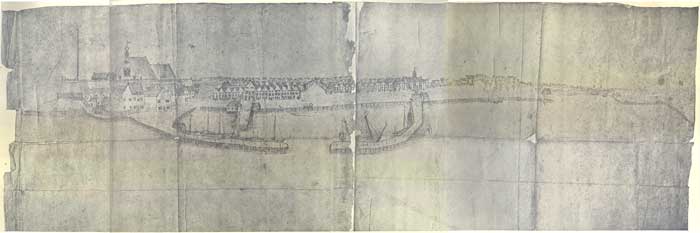
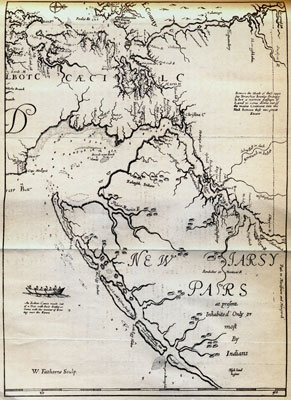
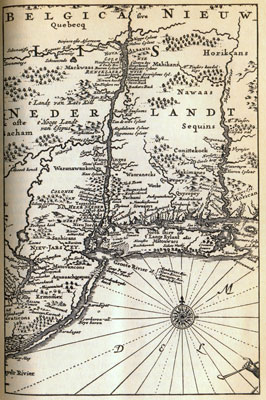
![[Enlarge]](images/front.jpg)
![[Enlarge]](images/map02lg.jpg)
![[Enlarge]](images/map03lg.jpg)