At about six o'clock in the evening of the 31st of July, 1821, after
having saluted His Majesty, George IV., who at that moment went on board
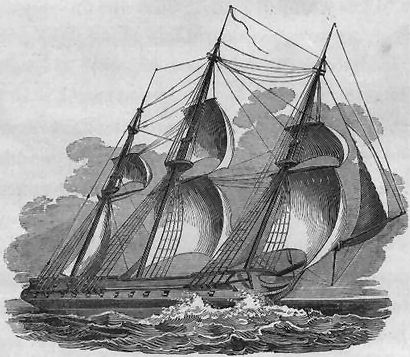
the Royal George yacht, to proceed to Dublin,—we sailed in the Doris, a
42 gun frigate, for South America. After touching at Plymouth, and
revisiting all the wonders of the break-water and new watering place, we
sailed afresh, but when off Ushant, were driven back to Falmouth by a
heavy gale of wind. There we remained till the 11th of August, when,
with colours half-mast high, on account of the death of Queen Caroline,
we finally left the channel, and on the 18th about noon came in sight of
Porto Santo.
We passed it on the side where the town founded by Don Henry of
Portugal, on the first discovery of the island, is situated, and
regretted much that it was too late in the day to go in very near it.
The land is high and rocky, but near the town there is a good deal of
verdure, and higher up on the land, extensive woods; a considerable
quantity of wine is made there, which, being a little manufactured at
Funchal, passes for true Madeira. As usual in Portuguese colonial towns,
the church and convent are very conspicuous. When we passed Porto Santo,
and the Desertas, and anchored in Funchal roads, I was disappointed at
the calmness of my own feelings, looking at these distant islands with
as little emotion as if I had passed a headland in the channel. Well do
I remember, when I first saw Funchal twelve years ago, the joyous
eagerness with which I feasted my eyes upon the first foreign country I
had ever approached, the curiosity to see every stone and tree of the
new land, which kept my spirits in a kind of happy fever.
"Sweet Memory, wafted by thy gentle gale,
Oft up the stream of time I turn my sail,
To view the fairy haunts of long lost hours,
Blest with far greener shades, far fresher flow'rs." Rogers.
Now I look on them tamely, or at best only as parts of the lovely
landscape, which, just at sunset, the time we anchored, was particularly
beautiful. Surely the few years added to my age have not done this? May
I not rather hope, that having seen lands whose monuments are all
history, and whose associations are all poetry, I have a higher taste,
and more discriminating eye? One object never palls—that ocean where
the Almighty "Glasses himself in tempests," or over which the gentle
wings of peace seem to brood. The feeling that there was a change,
however, either in the scene or in me, was so strong, that I ran to my
cabin and sought out a sketch I had made in 1809. I compared it with the
town. Every point of the hill, every house was the same, and again Nossa
Senhora da Monte, with her brilliant white towers shining from on high
through the evening cloud, seemed to sanctify the scene, while a few
rough voices from the shore and the neighbouring ships chaunted the Ave
Maria.
Early in the morning of the 19th, we took a large party of the
midshipmen on shore to enjoy the young pleasure of walking on a foreign
land. To them it was new to see the palm, the cypress, and the yucca,
together with the maize, banana, and sugar-cane, surrounded by
vineyards, while the pine and chesnut clothe the hills. We mounted the
boys on mules, and rode up to the little parish church, generally
mistaken for a convent, called Nossa Senhora da Monte. My maid and I
went in a bad sort of palankeen, though convenient for these roads,
which are the worst I have seen; however, the view made up for the
difficulty of getting to it. The sea with the Desertas bounded the
prospect: below us lay the roadstead and shipping, the town and gardens,
and the hill clothed with vineyards and trees of every climate, which
deck the ashy tufa, or compact basalt of which the whole island seems to
be composed. Purchas, who like Bowles, believes the story of the
discovery of Madeira by the Englishman Masham and his dying mistress,
says, that shortly after that event, the woods having taken fire burned
so fiercely, that the inhabitants were forced out to sea to escape from
the flames. The woods, however, are again pretty thick, and some
inferior mahogany among it is used for furniture. The pine is too soft
for most purposes. In the gardens we found a large blue hydrangea very
common: the fuschia is the usual hedge. Mixed with that splendid shrub,
aloes, prickly pear, euphorbia, and cactus, serve for the coarser
fences; and these strange vegetables, together with innumerable lizards
and insects, tell us we are nearing the tropics.
We spent a very happy day at the hospitable country house of Mr.
Wardrope, and our cavalcade to the town at night was delightful. The
boys, mounted as before, together with several gentlemen who had joined
us at Mr. W.'s, enjoyed the novelty of riding home by torch-light; and
as we wound down the hill, the voices of the muleteers answering each
other, or encouraging their beasts with a kind of rude song, completed
the scene. The evening was fine, and the star-light lovely: we embarked
in two shore boats at the custom-house gate, and, after being duly
hailed by the guard-boat, a strange machine mounting one old rusty 6
lb. carronade, we reached the ship in very good time.
20th. We walked a good deal about the town, and entered the cathedral
with some feelings of reverence, for a part of it at least was built by
Don Henry of Portugal, who founded and endowed the college adjoining.
The interior of the church is in some parts gaudy, and there is a silver
rail of some value. The ceiling is of cedar, richly carved, and reminds
me of some of the old churches at Venice, which present a style half
Gothic half Saracenic. Near the church a public garden has lately been
formed, and some curious exotic trees placed there with great success.
In rambling about the town, we naturally enquired for the chapel of
skulls, the ugliness of which had shocked us when here formerly, and
were not sorry to find that that hideous monument of bad taste is
falling fast to ruin. I cannot imagine how such fantastic horrors can
ever have been sanctified, but so it is; and the Indian fakir who
fastens a real skull round his neck, the Roman pilgrim who hangs a model
of one to his rosary, and the friar who decks his oratory with a
thousand of them, are one and all acted upon either by the same real
superstition, or spiritual vanity, craving to distinguish itself even by
disgusting peculiarities.
Of late years superstition has been used as an instrument of no small
power in revolutions of every kind. Even here it has played its part. A
small chapel, dedicated to St. Sebastian, had been removed by the
Portuguese government in order to erect a market-place, where all
articles of daily consumption were to be sold, a small tax being levied
on the holders of stands. This innovation was of course disagreeable to
the people, and on the night of the revolution, in November last, some
of their leading orators accused the market-place of having, by rudely
thrusting out St. Sebastian, occasioned the failure of the vineyards,
and threatened the ruin of the island. The market-place was instantly
devoted; it was down in a few seconds, and a chapel to St. Sebastian
begun. Men, women, and children worked all night, and the walls were
raised to at least two-thirds of the intended height; but day brought
weariness, and perhaps the morning breeze chilled the fever of
enthusiasm. The voluntary labourers worked no more, and no subscription
adequate to the hire of workmen to complete it has yet been raised: so
that the new St. Sebastian's stands roofless, and the officiating priest
performs his masses with no other canopy than the heavens.
Other and better consequences have, however, arisen from the revolution
of November. The grievances of the inhabitants of Madeira were severe.
The sons of the best families were seized arbitrarily, and sent to serve
in the armies of Europe or Brazil: scarcely any article, however
necessary, or however coarse, was permitted to be manufactured; the very
torches, made of twisted grass and resin, so necessary for travelling
these mountain roads after sunset, were all sent from Lisbon, and every
species of cultivation, but that of the grape, discountenanced. Thus
situated, every class joined heart and hand in the revolution: deputies
were sent to the Cortes; petitions respecting the state of agriculture,
manufactures, and commerce, were presented; and many, perhaps most, of
the grievances were redressed, or at least much lightened.
Till the year 1821, there had never been a printing-press in Madeira;
but the promoters of the revolution sent to England for one, which is
now set up in Funchal; and on the 2d of July, 1821, the first newspaper,
under the name of Patriota Funchalense, appeared. It contained a well
written patriotic preface; and the first article is a declaration of the
rights of citizens, and of the pretensions of the Portuguese nation, its
religion, government, and royal family, as adopted by the Cortes for the
basis of the constitution to be formed for its government. The paper has
continued to be published twice a week: it contains a few political
addresses and discourses; all foreign intelligence; some tolerable
papers on distilling, agriculture, manufactures, and similar topics;
some humorous pieces in prose and verse; poems on several occasions;
and, at the end of the month, a table of the receipts and expenditures
of government. Among the advertisements I observe one informing the
public where leeches may be bought at about two shillings and sixpence
a piece.
I thought it curious to observe this first dawning of literature and
interest in politics in this little island. There are certainly enough
anglicisms in the paper, to point out the probable country of some of
the writers; and there are, as might be looked for, some traces of the
residence of British troops in the colony; but on the whole, the paper
is creditable to the editors, and likely to be useful to the island. I
hear the articles on the making of wines and brandies very highly spoken
of. Madeira, lying in the finest climate in the world, beautiful and
fertile, and easy of access to foreigners, ought not to be a mere half
civilised colony.
23d.—We sailed yesterday from Funchal, and soon lost sight of the
"Filha do oceano
Do undoso campo flor, gentil Madeira." Diniz.
At night, I sat a long time on the deck, listening to the sea songs with
which the crew beguile the evening watch. Though the humorous songs were
applauded sufficiently, yet the plaintive and pathetic seemed the
favourites; and the chorus to the Death of Wolfe was swelled by many
voices. Oh, who shall say that fame is not a real good! It is twice
blessed—it blesses him who earns, and those who give, to parody the
words of Shakspeare. Here, on the wide ocean, far from the land of
Wolfe's birth, and that of his gallant death, his story was raising and
swelling the hearts of rough men, and exciting love of country and of
glory by the very sound of his name. Well may he be called a
benefactor to his country who, by increasing the list of patriotic
sailors' songs, has fostered those feelings and energies which have
placed Britain's "home upon the mountain wave, and her march upon the
deep."
The charms of night in a southern climate have been dwelt upon by
travelled poets (for I call Madame de Stael's writings poetry), and even
travelled prose writers; but Lord Byron alone has sketched with
knowledge and with love, the moonlight scenery of a frigate in full
sail. The life of a seaman is the essence of poetry; change, new
combinations, danger, situations from almost deathlike calm, to the
maddest combinations of horror—every romantic feeling called forth, and
every power of heart and intellect exercised. Man, weak as he is,
baffling the elements, and again seeing that miracle of his invention,
the tall ship he sails in, tossed to and fro, like the lightest feather
from the seabird's wing—while he can do nothing but resign himself to
the will of Him who alone can stay the proud waves, and on whom heart,
intellect, and feeling, all depend!
25th.—Nothing can be finer than the approach to Teneriffe[39],
especially on such a day as this; the peak now appearing through the
floating clouds, and now entirely veiled by them. As we drew near the
coast, the bay or rather roadstead of Oratava, surrounded by a singular
mixture of rocks, and woods, and scattered towns, started forth at once
from beneath the mists, which seemed to separate it from the peak, whose
cold blue colour formed a strong contrast to the glowing red and yellow
which autumn had already spread on the lower grounds.
We anchored in forty fathoms water with our chain-cable, as the bottom
is very rocky, excepting where a pretty wide river, which, though now
dry, rolls a considerable body of water to the sea in the rainy season,
has deposited a bed of black mud. There are many rocks in the bay, with
from one to three fathoms water, and within them from nine to ten. The
swell constantly setting in is very great, and renders the anchorage
uncomfortable.
26th.—- I went ashore with Mr. Dance, the second lieutenant, and two of
the young midshipmen, for the purpose of riding to the Villa di Oratava,
which is situated where the ancient Guanche capital stood. We landed at
the Puerto di Oratava, several miles from the villa: it is defended by
some small batteries, at one of which is the very difficult
landing-place, sheltered by a low reef of rocks that runs far out, and
occasions a heavy surf. I took my own saddle ashore: and being mounted
on a fine mule, we all began our journey towards the hill. The road is
rough, but has evidently once been made with some pains, and paved with
blocks of porous lava; but the winter rains have long ago destroyed it,
and it does not seem to be any body's business to put it in repair.
The first quarter of a mile on either hand presented a scene so black
and stony, that I was surprised to learn that we had been passing
through corn land; the harvest was over, and the stubble burned on the
ground. The produce here is scanty; but being so near the port, it
repays the labour and expense of cultivation. We saw the botanical
garden so much praised by Humboldt; but it is in sad disorder, having
been for some time entirely neglected. However, the very establishment
of such a thing brings in new plants, and perhaps naturalises them.
Here, the sago-palm, platanus, and tamarind, as well as the flowers and
vegetables of the north of Europe, flourish so well as to promise to add
permanently to the riches of this rich island. As we ascended towards
the villa the prospect improved; the vineyards appeared in greatest
beauty, every other crop still standing in the luxuriant valleys, the
rocky cliffs of the mountains clothed with wood, and every thing glowing
with life. Wheat, barley, a few oats, maize, potatoes, and caravansas,
all grow freely here. The food of the common people consists chiefly of
Polenta, or maize flour, used nearly as the Scotch peasants use their
oatmeal, in cakes, brose, or porridge, which last is suffered to grow
cold, and then most commonly cut in slices and toasted. After the maize,
potatoes are the favourite food, together with salt fish. The potatoe is
always in season, being planted every month, and consequently producing
a monthly crop. The fishery employs from forty-five to fifty vessels of
from seventy to ninety tons' burden, from the island of Teneriffe alone;
the fish are taken on the coast of Africa, and salted here.
To a stranger the sight of the long walls of black porous lava, built
terrace-wise to support the vegetable mould, is very striking; but the
walls cannot be called ugly, while the clustering vine and
broad-spreading gourd, climb and find support on them: these, however,
soon disappeared, and were replaced by field and garden enclosures.
After a pleasant but hot ride, we arrived at the villa about noon, and
went to the house of Señor Don Antonio de Monteverde, who accompanied us
to M. Franqui's garden, to see one of the wonders of the island, the
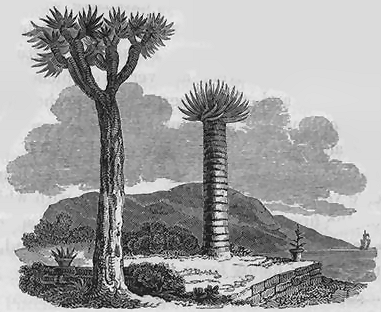
famous Dragon Tree. Humboldt has celebrated this tree in its vigour;
it is now a noble ruin. In July, 1819, one half of its enormous crown
fell: the wound is plaistered up, the date of the misfortune marked on
it, and as much care is taken of the venerable vegetable as will ensure
it for at least another century. I sat down to make a sketch of it; and
while I was drawing, learned from Mr. Galway the following history of
the family of its owner, which a little skill in language and a little
adorning with sentiment might convert into a modern novel.—About the
year 1760, the Marquis Franqui, upon some disgust, made over his estates
in trust to his brother, and emigrated to France, where he remained
until 1810, regularly receiving the proceeds from his estates in
Teneriffe. Meantime, during the early period of the revolution, he
married; and his only child, a daughter, was born. This marriage,
however, was only a civil contract, such being then the law of France,
and with a woman divorced from another, who was still living. But
neither the validity of the union nor the legitimacy of the child was
ever questioned; and the Marquis Franqui returning to his native
country, brought with him his daughter, introducing and treating her as
his heiress. She appeared to be received as such by his family; and at
his death he appointed trustworthy guardians to her and her estates, one
of whom is her husband's father. No sooner, however, was the Marquis
dead, than his brother claimed his property, alleging that the church
had never sanctioned the Marquis's marriage, and that the daughter
consequently, as an illegitimate child, could have no claim on his
estates. He therefore commenced a lawsuit against her and her guardians,
and the suit is still pending. Meantime the court receives the rents;
the garden, the chief ornament of the town, is running wild, and the
house is deserted.
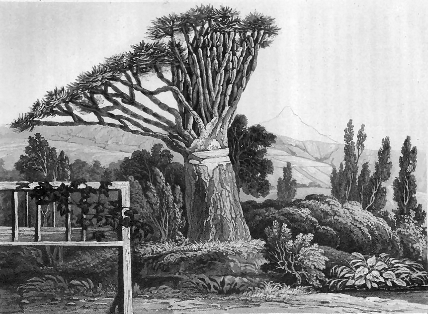
Dragon Tree and Peak of Teneriffe.
The dragon tree is the slowest of growth among vegetables; it seems also
to be slowest in decay. In the 15th century, that of Oratava had
attained the height and size which it boasted till 1819. It may have
been in its prime for centuries before; and scarcely less than a
thousand years must have elapsed, before it attained its full size.
Excepting the dragon trees at Madeira, the only many-headed palm I had
seen before was that at Mazagong in Bombay. It is crowned, however, with
a leaf like that of the palmetto; but the tufts of the dragon tree
resemble the yucca in growth. The palm tree at Mazagong, like the
adansonia in Salsette, is reported to have been carried thither by a
pilgrim from Africa, probably from Upper Egypt, where late travellers
mention this palm.
On our return from the garden to Don Antonio's house, we were most
kindly received by his wife and daughter, the latter of whom played a
long and difficult piece of music most excellently. It was, however,
English, in compliment to us, though we should have preferred some of
her own national airs. After the music, we were conducted to a table
spread in the gallery that surrounds the open court in the middle of the
house, and covered with fruits, sweetmeats, and wines, which were
pressed upon us most hospitably; till finding it time to return, the
ladies both embraced me, and we began our journey down the hill, having
first looked into the churches, which are spacious and handsome, a good
deal in the style of those of Madeira, but finer.
As we rode along, we observed a large Dominican convent, the only one
now on the island. The recent law passed by the Spanish Cortes for the
suppression of religious houses, has been strictly enforced here. No
more than one convent of each denomination is allowed to subsist, and
great checks are put on the profession of new members. As to the
revolution here, the inhabitants had known from authentic though not
official authority of what had taken place in the mother country, three
weeks before they received any notification from either court or cortes.
When notice did arrive, the magistrates assembled the people, read their
orders, and took their oaths to support the cortes; the people shouted,
and made a bonfire: next day the forms of law and justice were declared
to be changed, the tribunals proceeded accordingly, and all was over and
quiet.
The Canary Islands boast of two bishoprics, both of which are now
vacant, yet have not one newspaper. The only printing press has been so
long in disuse that there is nobody who can work it in the country. I
could not learn that there are any manufactures in Teneriffe; if there
are, I conclude they must be in the neighbourhood of Laguna or Santa
Cruz. Oratava appears to be the district of corn and wine.
We returned to the port by a longer road than that by which we left it.
In the hedges, the boys, with no small delight, gathered fine ripe
black-berries, which were growing among prickly pear and other tropical
plants. The fields, vineyards, and orchards we had seen from the former
road we now passed through; and as it was a fiesta, we saw the
peasants in their best attire, and their little mud huts cleanly swept
and garnished. They seem gentle and lively, not much darker than the
natives of the south of Europe; and if there be a mixture of Guanche
blood, it is said to be traced in the high cheek-bones, narrow chins,
and slender hands and feet which in a few districts seem to indicate a
different race of men. I regret that I had not time to see more of the
people and the country; but not being travellers from curiosity, and
belonging to a service that may not swerve from the strictest obedience,
we dared not even think of a farther excursion.
Halfway down the hill, we entered a ravine, the dry bed of a winter
torrent, where there were rue, lavender, prickly pear, hypericum, and
spurge; but not a blade of grass had survived the summer's drought. We
passed a heap of black ashes, which anywhere but at the base of the peak
would be called a respectable mountain. It has not been cold long enough
to be disguised by vegetation; and though on one side the vine is
beginning to clothe its rugged surface, yet the greater part is
frightfully barren. Shortly after we passed it, we arrived at Mr.
Galway's garden-house, and found his lady, a Spaniard of Irish
extraction, ready to receive us. As I had seen in some old Scotch
houses, the best bed-chamber served as drawing-room; but the
dressing-room is apart, and from the front there is an opening to a
pleasant terrace, commanding a charming view. Our dinner was a mixture
of English and Spanish cookery and customs: the Spanish part consisted
of part of a Darter, a very fine fish, white, but resembling a salmon
in taste, with sauce made of small lobsters, oil, vinegar, garlic, and
pimento; some excellent stews, and mixtures of vegetables and quails
roasted in vine leaves; the rest were all English; and the wines, the
growth of the island, and ices[40] were delicious. Neither the
pine-apple nor water-melon grow in Teneriffe, but abundance of the
latter are brought from Grand Canary. All the common garden fruits of
Europe flourish here; but too little attention is paid to horticulture.
This island, or at least the part I have seen, evidently belongs to a
state that has once been great; but is now too poor or too weak to
foster its foreign possessions. Some fine houses begun are in an
unfinished state, and appear to have been so for years; others, though
falling, are neither rebuilt nor repaired; and the only things like
present prosperity, are the neat English country-houses.
It was sunset before we reached the boats that were to convey us to the
ship; and we had some difficulty both in getting off and in going
alongside of the frigate, owing to the great swell. The night, however,
was fine, and the scene enlivened by the lights in the fishing boats,
which, like those in the Mediterranean, are used to attract the fish. On
shore, the lights of the ports and villa, and the fires of the charcoal
burners shining from amidst the dark hanging forests of pine, and those
of the limekilns in the direction of Laguna, appeared like a brilliant
illumination; and there being not a cloud, the outline of the peak was
well defined on the deep blue of the nocturnal sky.
27th August. To-day, some of our new friends, both Spanish and
English, came on board; but the swell was so great, that only one
escaped sea-sickness. Mrs. Galway was fearful of suffering, so did not
come, but she sent me some of the beads found in the sepulchres of the
Guanches: they are of hard baked clay. Mr. Humboldt, whose imagination
was naturally full of South America, has conjectured that they might
have been used for the same purpose as the Peruvian quipos, but they
are inconveniently large for that use. They are not unlike the beads
Belzoni found in the mummy pits in Egypt, and they closely resemble some
of the many kinds of beads with which the Bramins have counted their
muntras time immemorial. The Oriental custom of dropping a bead for
every prayer having been adopted by the Christians of the west, and
still continuing in Roman Catholic countries, appears, on that account,
too common to deserve the notice of a philosophical traveller; and
therefore the Guanche shepherds, or goatherd kings, are rather supposed,
like the polished Peruvians, to have recorded the annals of their reigns
with clay beads, than allowed to tell them with their orisons, like the
Bramins of the Ganges, the shepherds of Mesopotamia, or the anchorets of
Palestine and Egypt, because the modern monk does the same. The Guanche
mummies are now of very rare occurrence. During the early times of the
Spanish government of the island, their sepulchres were carefully
concealed by the natives; now, intermarriage with their conquerors, and
consequent change of religion and habits, have rendered them careless of
them, and they are, generally speaking, really forgotten, and only
discovered accidentally in planting a new vineyard, or ploughing a new
field.
28th. This morning left the "still vext" bay of Oratava, and before
sunset saw Palma and Gomera. The Canary Islands, supposed to be the
Fortunate Islands of the ancients, were discovered accidentally in 1405.
Betancour, a Frenchman, took possession of them for Spain; but the
natives were brave, and it cost both the Spaniards and Portuguese, who
possessed them by turns, much blood and treasure to conquer the country
and exterminate the people, for their wars ended in nothing less.
Purchas complains that he could not obtain the reading of some travels
by an Englishman who had visited the Peak; the good pilgrim's curiosity
had been strongly excited by the particulars he had learnt from books,
and the journals of some of his friends who had travelled, which he has
carefully related: they are such as to make me regret that he has not
recorded more, and that I cannot see more. We brought with us from
Oratava one of the finest goats I ever saw; I presume she was a
descendant of the original flock which the supreme deity of the Guanches
created to be the property of the kings alone: she is brown, with very
long twisted horns, a very remarkable white beard, and the largest udder
I ever saw.
29th. Passed the island of Hierro or Ferro, the old first meridian;
which honour, I presume, it enjoyed from having been considered as the
most western land in the world until the discovery of America. We were
very close to it, and all agreed that we never saw so hard-looking and
inaccessible a place. We saw some fine woods, a few scattered houses,
and one village perched upon a hill, at least 1500 feet above us. The
Peak of Teneriffe still visible above the clouds.
Sept. 1st. The flying-fish are become very numerous, and whole fleets
of medusæ have passed us; some we have picked up, besides a very
beautiful purple sea-snail. This fish has four horns, like a snail, the
shell is very beautifully tinted with purple, and there is a spongy
substance attached to the fish which I thought assisted it to swim: it
is larger in bulk than the whole fish. One of them gave out fully a
quarter of an ounce of purple fluid from the lower part of the fish. A
fine yellow locust and a swallow flew on board; and as we believe
ourselves to be four hundred miles from the nearest land, Cape Blanco,
we cannot enough admire the structure of the wings that have borne them
so far.
Our school for the ship's boys is now fairly established, and does Mr.
Hyslop, our school-master, great credit; that for the midshipmen is
going on very well, being kept in the fore-cabin under the captain's
eye. The boys have his presence, not only as a check to idleness or
noise, but as an encouragement to industry. He is most anxious to make
them fit to be officers and seamen in their profession, and good men and
gentlemen both at sea and on shore. Happily they are all promising; but
if G—— should disappoint us, I never will believe in youthful talent,
industry, or goodness more. Our days pass swiftly, because busily. The
regular business of the ship, the school, astronomical observations,
study of history and modern languages, and nothing permitted to pass
without observation, fill our time completely.
Lord Bacon says, "It is a strange thing that in sea voyages, where there
is nothing to be seen but sky and sea, men should make diaries; but in
land travel, wherein so much is to be observed, for the most part they
omit it, as if chance were fitter to be registered than observation."
However, for once, his lordship has only seen, or perhaps only spoken,
in part. Sea and sky must be observed before we can know the laws by
which their great changes or chances are regulated. Observations on the
works of man, as cities, courts, &c. may be omitted, for we know their
authors, and can have recourse to them, their motives, and their
history, whenever we please; but the great operations of nature are so
above us, that we must humbly mark them, and endeavour to make their
history a part of our experience, in order that we pass safely through
their vicissitudes. Hence it is, that the commonest details of the early
navigators, their sunrise and sunset, their daily portionings of food
and water, are read with a deeper interest than the liveliest tour
through civilised countries and populous cities; that Byron's passage
through Chiloe continues to excite the most profound sympathy; while
Moore's lively view of society and manners in France or Italy, are now
seldom or languidly read. The uncertainty, the mystery of nature, keep
up a perpetual curiosity; but I suspect that if we knew the progress and
dependance of her operations, as well as we do those of an architect or
brick-layer, the history of the building of a theatre or a
dwelling-house might vie in interest with that of a sea voyage.
The books we intend our boys to read are,—history, particularly that of
Greece, Rome, England, and France; an outline of general
history, voyages, and discoveries; some poetry, and general literature,
in French and English; Delolme, with the concluding chapter of
Blackstone on the history of the law and the constitution of England;
and afterwards the first volume of Blackstone, Bacon's Essays, and
Paley. We have only three years to work in; and as the business of
their life is to learn their profession, including mathematics,
algebra, nautical astronomy, theory and practice of seamanship, and duty
as officers, with all the technicalities belonging to it,—this is all
we dare propose.
5th. We have begun to look forward to that festival of the seamen, the
crossing the line. I know not whence the custom is derived, but the
Arabs observe it with ceremonies not very unlike those practised by our
own sailors. To-day a letter, containing a sketch of the intended
festival, with thanks for permission to keep it, was sent into the
cabin. I shall copy it with its answer. I find that some captains have
begun to give money at the next port, instead of permitting this day of
misrule. Perhaps they may be right, and perhaps in time it may be
forgotten; but will it be better that it should be so? It is the
sailors' only festival; and I like a festival: it gives the heart room
to play. The head in one class, and the limbs in another, work every
day, and in divers, if not opposite directions; but on a festival, the
hearts of all beat the same way: yet I would not have them too often,
for
"If every day were playing holiday,
To sport would be as tedious as to work;"
the converse of the proverb, "All work and no play, makes Jack a dull
boy." But to our letters.
"The sons of Neptune, of His Majesty's ship Doris, commanded by Captain
T.G., return their most grateful thanks for his kind condescension for
granting them the favour that has been allowed to them from time
immemorial, in crossing the Equinoctial, on our Old Father Neptune's
dominions, when we hope the characters will meet your Honour's
approbation, which will appear in the margin.
| Thomas Clark, quarter-master, | — | | Neptune. |
| J. Ware, forecastle, | — | | Amphitrite. |
| W. Knight, | — | | Amphitrite's Son. |
| W. Sullivan, 2d captain main-top, | — | | Triton. |
| C. Brisbane (negro), | — | | Triton's Horse. |
| J. Thompson, gunner's mate, | — | | High Sheriff. |
| J. White, forecastle, | — | | Sub Sheriff. |
| W. Sinclair, captain forecastle, | — | | Barber. |
| J. Smith, J. Forster, Michael Jaque, | — | | Barber's Mates. |
| J. Gaggin, | — | | Clerk. |
| W. Bird, captain fore-top, | — | | Chief Constable. |
| Nine assistants. |
| J. Duncan, boatswain's mate, | — | | Coachman. |
| J. Clark, | — | | Postilion. |
| J. Leath, | — | | Footman. |
| J. Speed, | — | | Painter. |
| W. Lundy, | — | | Bottle-holder. |
| W. Williamson, | — | | Satan. |
| J. Williams, | — | | Judge Advocate. |
| Eight Sea-horses. |
"So we have given you as good a relation as possibly our weak abilities
afford us; and, honoured Captain, believe us when we say, we wish you
every happiness this life can afford, and your honoured lady entirely
included, and believe us yours, &c. &c. &c.
"Britton's Sons."
Answer.
"I received your letter with the list of characters that are to appear
in Father Neptune's train on our crossing the line, of which I
completely approve. I have to thank you for your kind wishes both for
Mrs. G—— and myself, and to assure you, that the greatest pleasure I
can feel in the command of this ship, will be in promoting the happiness
and comfort of the whole of Britain's sons on board the Doris.
"Believe me your sincere friend,
Thos. G——,
"H.M.S. Doris, at Sea, Sept 5th, 1821.
To Britain's Sons, H.M.S. Doris."
It would be worth while to enquire into the origin of the merry-making
on crossing the line. As the Arabs, an astronomical people, have it, it
has probably some reference to their now-forgotten worship of the
heavenly bodies. Like us, they set on fire some combustible matter or
other, and let it float away, but they add some food to it, as if there
had once been a sacrifice accompanying the festival. Such, at least, I
have been assured by several gentleman well acquainted with the Arab
traders in the Eastern sea, is their practice.
18th. We have done nothing but sail on with very variable weather, for
the last thirteen days.
"From world to world our steady course we keep,
Swift as the winds along the waters sweep,
Mid the mute nations of the purple deep."
One night we observed that luminous appearance of the sea so often
described, but it was not so brilliant as I remember to have seen it
near the same latitude. The next morning we found the temperature of the
sea, at the surface, two degrees higher than that of the atmosphere.
Last night at 8 P. M. we crossed the line: to-day, accordingly, our
Saturnalian festival took place.
About six o'clock P. M. yesterday, the officer of the watch was informed
that there was a boat with lights alongside, and begged to shorten sail.
The captain immediately went on deck, and Neptune hailed from the fore
part of the rigging, "What ship?" "Doris." "Who commands?" "Captain T.
G." "Where from?" "Whitehall." "Where bound?" "A man of war's cruize."
Upon which Triton mounted upon a sea-horse, admirably represented,
appeared as bearer of a letter containing the names of all who had not
yet crossed the line, and who were consequently to be initiated into the
mysteries of the Water God. Triton having thus executed his commission,
rode off, and was seen no more till 8 o'clock this morning, when Neptune
being announced, the captain went on deck to receive him.
First came Triton mounted as before, then a company of sea-gods or
constables dressed in oakum and swabs, but having their arms and
shoulders bare, excepting the paint which bedaubed them. Neptune with
trident and crown, Amphitrite by his side, and their son at their feet,
appeared in a car drawn by eight sea-horses, and driven by a sea god:
the train followed in the persons of the lawyers, barbers, and painters.
The whole pageant was well dressed, and going in procession, fully as
picturesque as any antique triumphal or religious ceremony; the fine
forms of some of the actors struck me exceedingly. I never saw marble
more beautiful than some of the backs and shoulders displayed; and the
singular clothing to imitate fishes instead of legs, and seaweed skirts,
which they had all adopted, carried one back for centuries, to the time
when all this was religion.
After the progress round the decks, a conference with the captain, and a
libation in the form of a glass of brandy, to which the god and goddess
vied with each other in devotion, the merriment began. Mock-shaving, or
a fine paid, was necessary to admit the new comers to the good graces of
their watery father; and while he was superintending the business, all
the rest of the ship's company, officers and all, proceeded to duck each
other unmercifully. None but women escaped, and that only by staying in
my cabin. The officer of the watch, sentries, quartermasters, and such
as are absolutely necessary to look after the ship, are of course held
sacred; so that some order is still preserved. It seemed really that
"madness ruled the hour;" but at the appointed moment, half past eleven,
all ceased: by noon, every body was at his duty, the decks were dried,
and the ship restored to her wonted good order. The whole of our gunroom
officers dine with us, and we flatter ourselves that we shall end the
day as happily as we have begun it.[41]
20th. The long tiresome calms, and the beautiful moonlight nights near
the equator, have been talked of, and written of, till we know all about
them. Mention but passing the line, and you conjure up a wide,
apparently interminable, glassy dull sea: sails flapping, a solitary
bird sinking with heat, or a shark rising lazily to catch a bait; or, at
best, a calm warm night, with a soft moonlight silvering over the
treacherous deep, and rendering the beholders, who ought to be lovers
if they are not, insensible of the rocks that may lurk below.—But our's
was not the beau idéal of crossing the line: we had fresh breezes in
the day, and thunder and lightning at night; saw few tropic birds, and
those very vigorous, and fish more nimble than sharks, or even sun-fish,
of which, however, we met a due proportion. I had once been in a
tropical calm, and I really, after trying them both, prefer the breezes
and thunder-storms. The other night we had one, such as Milton talks of:
"Either tropic now
'Gan thunder, and both ends of heav'n: the clouds
From many a horrid rift abortive poured
Fierce rain with lightning mixt, water with fire
In ruin reconciled; nor slept the winds
Within their stoney caves, but rush'd abroad
From the four hinges of the world, and fell
On the vext wilderness."
I never see a thunder-storm at sea, but it reminds me of the vision of
Ezekiel:
"The sapphire blaze,
Where angels tremble while they gaze."
It is awful and grand every where: fearful in the plain, sublime among
the mountains; but here, on the ocean, with nothing to intercept its
bolt, the horrible is superadded, and he must be more or less than man
that does not at least take thought during its continuance.
Friday, September 21st. At length we are in sight of the coast of
Brazil, which here is low and green, about two degrees to the northward
of the point first discovered by Vincente Pinzon, in 1500.[42] The
weather is very squally, and there is a heavy swell: we are anchored
about eight miles from Olinda, the capital of Pernambuco, in fifteen
fathoms water, but though we have fired more than one gun for a pilot,
none seems to be coming off.
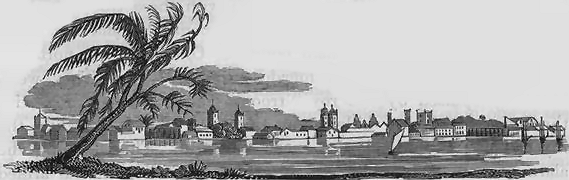
Pernambuco, September 22. 1821.—At nine o'clock the commodore of this
place, whose office is a combination of port-admiral and commissioner,
came on board with the harbour-master, and the ship was guided by the
latter to the anchorage, which is about three miles from the town, in
eight fathoms water. The roadstead is quite open, and we find here a
very heavy swell. It is not wonderful that our guns were neither
answered nor noticed last night. Mr. Dance, having been sent on shore
with official letters to the governor and the acting English consul,
found the place in a state of siege, and brought back with him Colonel
Patronhe, the governor's aide-de-camp, who gave us the following account
of the present state of Pernambuco:
Besides the disposition to revolution, which we were aware had long
existed in every part of Brazil, there was, also, a jealousy between the
Portuguese and Brazilians, which recent events had increased in no small
degree. On the 29th of August, about 600 men of the militia and other
native forces had taken possession of the Villa of Goyana, one of the
principal places in this captaincy, and had forcibly entered the
town-house, where they had declared the government of Luiz do Rego to be
at an end. They proceeded to elect a temporary provisional government
for Goyana, to act until the capital of the province should be in a
condition to establish a constitutional junta; and in order to
accelerate that event, they had collected forces of every kind, and
among them several companies of the Caçadores who had deserted from Luiz
do Rego; with these troops, such as they are, they had marched towards
Pernambuco, and last night they had attacked the two main points of
Olinda, to the north, in four different places, and Affogados to the
south. They were, however, repulsed by the royal troops, under the
governor, with the loss of fourteen killed and thirty-five prisoners,
while the royalists had two killed, and seven wounded. This morning the
alarm of the town's people was increased by finding several armed men
concealed in the belfreys of the churches, whither also they had
conveyed several stands of arms. Luiz do Rego is a soldier, and attached
to the royal cause. He served long with the English army in Portugal and
Spain, and, if I mistake not, distinguished himself at the siege of St.
Sebastian's. He is rather a severe man, and, especially among the
soldiers, more feared than loved.—Great part of the regiment of
Caçadores has left him to join the patriots, and formed the most
efficient corps in the attack last night. The towns-people have been
formed into a militia, tolerably armed and trained. The town is pretty
well supplied with mandioc flour, jerked beef, and salt fish; but the
besiegers prevent all fresh provisions from coming in. All shops are
shut, and all food scarce and dear. Most people who have property of
value, in plate or jewels, have packed it up, and lodged it in the
houses of the English merchants. Many persons with their wives and
families have left their homes in the out-skirts of the town, and have
taken refuge with the English. The latter, who, for the most part,
sleep, at least, in country houses in the neighbourhood, called sitios,
have left them, and remain altogether at their counting-houses in the
port: every thing, in short, is alarm and uncertainty.
23d.—The night passed quietly, and so indeed did the day. Many
messages have passed between us and the land, but I could not go on
shore: we have excellent oranges, and tolerable vegetables from the
town, and have been quite enough amused in observing the curious little
boats, canoes, catamarans and jangadas, that have been sailing, and
paddling, and rowing round the ship. The jangada resembles nothing I
have ever seen before; six or eight logs are made fast together by two
transverse beams; at one end there is a raised seat, on which a man
places himself to steer, for they are furnished with a sort of rudder;
sometimes the seat is large enough to admit of two sitters, another
bench at the foot of a mast, immense for the size of the raft, holds
clothes and provisions, or an upright pole is fixed in one of the logs,
to which these things are suspended, and a large triangular sail of
cotton cloth completes the jangada, in which the hardy Brazilian sailor
ventures to sea, the waves constantly washing over it, and carries
cargoes of cotton or other goods, or, in case of necessity, letters and
despatches, hundreds of miles in safety.
About three o'clock a large canoe with two patriot officers came along
side, to ascertain if we were really English; if we had come, as was
reported, to assist the royalists, or if we would assist them: so apt
are men, under the influence of strong feeling themselves, to doubt of
perfect indifference in others, that I question much whether they
believed in the strict neutrality we profess. They left us, however,
without betraying any particular anxiety, and made a very circuitous
passage home, in order to avoid the Recife cruizer, which was looking
out for straggling boats or vessels of any description belonging to the
patriots.
Monday the 24th.—Col. Patronhe arrived early this morning, to request
that the English packet might put into Lisbon with the Government
despatches. We felt glad that the strict rules of service prevented the
captain from giving any such order to the master of the packet. It would
be at once a breach of that neutrality we profess to observe, and, in my
opinion, an aiding of the worst cause. The colonel, adverting to the
town being in a state of siege, and the uncertainty of the next attack
as to time and place, advised me strongly to stay altogether on board;
but I had never seen a town in a state of siege, and therefore resolved
to go ashore. Accordingly, Mr. Dance, being the only officer on board
who speaks either Portuguese or French, was commissioned to accompany
me; and I took two midshipmen, Grey and Langford, also to call on Madame
do Rego.
The name of Pernambuco, which is that of the captainship, is now
generally applied to the capital, which consists of two parts; 1st, the
city of Olinda, which was founded by the Portuguese, under Duarte Coelho
Pedreiro, about 1530 or 1540, and, as its name implies, on a beautiful
spot, where moderate, but abrupt hills, a fine river, and thick wood,
combine to charm the eye; but the approach to it by sea must always have
been difficult, if not dangerous: and, 2nd, the town of Recife de
Pernambuco, or the Reef of Pernambuco, built by the Dutch, under Maurice
of Nassau, and by them called Maurice Town. It is a singular spot, well
fitted for trade; it is situated upon several sand banks, divided by
salt water creeks and the mouth of two fresh water rivers, connected by
three bridges, and divided into as many parts; Recife, properly so
called, where are the castles of defence, and the dock-yard, and the
traders; Sant Antonio, where are the government house, the two principal
churches, one for the white and one for the black population; and Boa
Vista, where the richer merchants, or more idle inhabitants, live among
their gardens, and where convents, churches, and the bishop's palace,
give an air of importance to the very neat town around them.
All this I knew before I landed, and thought I was pretty well prepared
for Pernambuco. But no previous knowledge could do away the wonder with
which one must enter that very extraordinary port. From the ship, which
is anchored three miles from the town, we see that vessels lie within a
reef on which the sea is perpetually breaking, but till I was actually
within that reef, I had not the least idea of the nature of the harbour:
the swell going ashore would have seemed tremendous, had we not been
prepared for it, and made our passage of three miles a very long one. We
approached the sandy beach between Recife and Olinda so nearly, that I
thought we were going to land there; when coming abreast of a tower on a
rock, where the sea was breaking violently, we turned short round, and
found ourselves within a marvellous natural break-water, heard the surf
dashing without, and saw the spray, but we ourselves were sailing along
smoothly and calmly, as if in a mill-pond. The rock of which the reef is
formed, is said to be coral; but it is so coated with barnacle and
limpet above barnacle and limpet, that I can see nothing but the
remainder of these shells for many feet down, and as deep into the rock
as our hammers will break. It extends from a good way to the northward
of Paraiba to Olinda, where it sinks under water, and then rises
abruptly at Recife, and runs on to Cape St. Augustine, where it is
interrupted by the bold granite head, that shoots through it into the
ocean: it then reappears, and continues, interruptedly, towards the
south. The breadth of the harbour here between the reef and the main
land varies from a few fathoms to three quarters of a mile; the water is
deep close to the rock, and there the vessels often moor. There is a bar
at the entrance of the harbour, over which there is, in ordinary tides,
sixteen feet water, so that ships of considerable burden lie here.[43]
His Majesty's brig Alacrity lay some time within the reef; and two feet
more water on the bar, would have enabled the Doris to have entered,
though, as far as I have seen, there would be no room to turn about if
she wished to go out again. The reef is certainly one of the wonders of
the world; it is scarcely sixteen feet broad at top. It slopes off more
rapidly than the Plymouth break-water, to a great depth on the outside,
and is perpendicular within, to many fathoms. Here and there, a few
inequalities at the top must formerly have annoyed the harbour in high
tides or strong winds, but Count Maurice remedied this, by laying huge
blocks of granite into the faulty places, and has thus rendered the top
level, and the harbour safe at all times. The Count had intended to
build warehouses along the reef, but his removal from the government
prevented his doing so. A small fort near the entrance defends it, and
indeed always must, so narrow and sudden is the passage. Near it, a
light-house is in a fair way of being soon finished, at the very
extremity of the reef, and these are the only two buildings on this
extraordinary line of rock. We rowed up the harbour among vessels of all
nations, with the town on one side, and the reef on the other, until we
came to one of the wide creeks, over which the Dutch built a fine stone
bridge, now in decay. We were a a good deal struck with the beauty of
the scene; the buildings are pretty large, and white; the land low and
sandy, spotted with bright green tufts of grass, and adorned with
palm-trees. A few years ago a violent flood nearly destroyed the greater
part of the centre of the bridge, yet the arches still serve to support
light wooden galleries on each side of it, and the houses and gateways
are still standing at either end. We landed pretty near the bridge, and
were received by Colonel Patronhe, who apologised for the governor, who
could not come to receive us, as he was in the council room.[44] The
colonel conducted us to the government house, a very handsome building,
with a square in front, and a tower, and we entered what had evidently
been a splendid hall. The gilding and painting still remained on some
parts of the ceiling and walls; but now it is occupied by horses
standing ready saddled; soldiers armed, and ready to mount at a moment's
warning; every thing on the alert; guns in front with lighted matches by
them, and an air of bustle and importance among the soldiers, that
excites a sort of sympathetic curiosity as to their possible and
immediate destination. On going up stairs we found almost as much
confusion: for the governor has hitherto lived in the very out-skirts of
the town, and has but just come to the house in Sant Antonio, which was
formerly the Jesuits' college, partly to be in the centre of business,
and partly to secure his family, in case of accident, as the besiegers'
out-posts are very near his former residence. I found Madame do Rego an
agreeable, rather pretty woman, and speaking English like a native: for
this she accounted, by informing me that her mother, the Viscondeça do
Rio Seco, was an Irish woman. Nothing could be kinder and more
flattering than her manner, and that of General do Rego's two daughters,
whose air and manner are those of really well-bred women, and one of
them is very handsome. After sitting some little time, refreshments were
brought in, and shortly after, the governor himself appeared; a fine
military-looking man. He appeared ill, being still suffering from the
effects of a wound, he received some months ago, while walking through
the town with a friend. It has since been ascertained, that the
instigator of the crime was a certain Ouvidor (judge) whom he had
displaced shortly after he assumed the government. The assassin fired
twice; Luiz do Rego received several shots and slugs in his body, but
the most severe wound was in his left arm. His friend's life was for
some time despaired of, but both are now nearly well. At the time the
crime was committed, the perpetrator was seized more than once by some
of the bye-standers; but as often, a baker's basket was pushed in
between him and whoever seized him; he threw away his pistols and
escaped.[45]
Having paid our visit, we proceeded to walk about the town. The streets
are paved partly with blueish pebbles from the beach, partly with red or
grey granite. The houses are three or four stories high, built of a
whitish stone, and all are white-washed, with door-posts and
window-frames of brown stone. The ground floor consists of shops, or
lodging for the negroes, and stables: the floor above is generally
appropriated to counting-houses and ware-rooms; and the dwelling-house
still higher, the kitchen being universally at the top, by which means
the lower part of the house is kept cool, I was surprised to find it so
possible to walk out without inconvenience from the heat, so near the
equator; but the constant sea-breeze, which sets in here every day at
ten o'clock, preserves a temperature, under which it is at all times
possible to take exercise. The hot time of day is from eight, when the
land breeze fails, to ten. As we were to pass the stone bridge on our
way back to the boat, which was ordered to meet us at the point of
Recife, because the receding tide would have left it dry in the creek
where we landed; we left it on one hand, and walked through Sant Antonio
towards Boa Vista. When we came to the wooden bridge, 350 paces long,
connecting it with Sant Antonio, we found that it had been cut through
the middle, and is only now passable by means of two planks easily
withdrawn, in case the besiegers should get possession of Boa Vista.
Nothing can be prettier of its kind than the fresh green landscape, with
its broad river winding through it, which is seen on each hand from the
bridge, and the white buildings of the treasury and mint, the convents,
and private houses, most of which have gardens. The verdure is
delightful to an English eye; and I doubt not that the flat meadows, and
slowly-flowing water, were particularly attractive to the Dutch founders
of Recife. We walked back by the stone bridge, 280 paces long, as we
intended; in vain did we look for shops; not one was open, the
shopkeepers being all on military duty. They form the militia, and, as
many of them are from Europe, and as they all expect to be plundered
should the country Brazilians take the town by force, they are most
zealous in their attendance as soldiers.
At each end of every street we found a light gun, and at the heads of
the bridges two, with lighted matches by them, and at each post we were
challenged by the guard. At the end of the stone bridge, at the ponte
dos tres pontes[46], next to Recife, the guards are more numerous and
strict. In this quarter, the chief riches of the place are lodged, and
that is the point most easily defended. It is very nearly surrounded
with water, the houses are high, strongly built, and close together, the
streets being very narrow, and the strong gateways at each end of the
bridge might secure time to demolish it entirely, and thus render that
part of the town secure, except by the sand bank communicating with
Olinda, and that is guarded by two considerable forts.
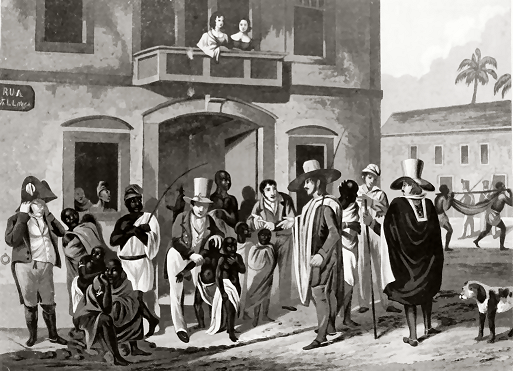
We had hardly gone fifty paces into Recife, when we were absolutely
sickened by the first sight of a slave-market. It was the first time
either the boys or I had been in a slave-country; and, however strong
and poignant the feelings may be at home, when imagination pictures
slavery, they are nothing compared to the staggering sight of a
slave-market. It was thinly stocked, owing to the circumstances of the
town; which cause most of the owners of new slaves to keep them closely
shut up in the depôts. Yet about fifty young creatures, boys and girls,
with all the appearance of disease and famine consequent upon scanty
food and long confinement in unwholesome places, were sitting and lying
about among the filthiest animals in the streets. The sight sent us home
to the ship with the heart-ache: and resolution, "not loud but deep,"
that nothing in our power should be considered too little, or too great,
that can tend to abolish or to alleviate slavery.
27th.—I went on shore to-day to spend a few days with Miss S., the
only English lady in the town. She is now living in her brother's
town-house, where the office and warehouses are, because the
country-house is within reach of the patriots. I do long to walk or ride
out to the tempting green hills beyond the town; but as that cannot be,
I must content myself with what is within the lines. To-day, as we were
coming in from Boa Vista, we met a family of Certanejos, who had brought
provisions into the town some days ago, returning home to the Certam, or
wild country of the interior. These Certanejos are a hardy, active set
of men, mostly agriculturists. They bring corn and pulse, bacon and
sweetmeats, to the sea-coast, hides and tallow also at times. But the
sugar, cotton, and coffee, which form the staple exports of Pernambuco,
require the warmer, richer lands, nearer the coast. Cotton is, however,
brought from the Certam, but it is a precarious crop, depending entirely
on the quantity of rain in the season; and it sometimes does not rain in
the Certam for two years. The party we met formed a very picturesque
groupe, the men clad in leather from head to foot, of which their light
jerkin and close pantaloons are fitted as closely as the clothing on the
Egina marbles, and have something of the same effect: the small round
hat is in the form of Mercury's petasus; and the shoes and gaiters of
the greater number are excellently adapted to defend the legs and feet
in riding through the thickets. The colour of all this is a fine tan
brown. I was vexed that the woman of the party wore a dress evidently of
French fashion: it spoiled the unity of the groupe. She was mounted
behind the principal man, on one of the small active horses of the
country; several sumpter horses followed, laden with household goods and
other things in exchange for their provisions: cloths, both woollen and
cotton, coarse crockery, and other manufactured articles, especially
knives, are what they chiefly take in barter; though I saw some
furniture, with pretensions to elegance, among the stuff of the family I
met. After the horses came a groupe of men, some walking and keeping
pace with the amble of the beasts; others riding and carrying the
children; the procession being closed by a very stout good-looking man,
smoking as he went along, and distinguished by a pair of green baize
trowsers.
In the evening we rode out; whether it was because we had been so many
weeks on board ship, and without horse-exercise, or because of the
peculiar sweetness and freshness of evening after the sultry tropical
day we had just passed, I know not, but I never enjoyed an hour in the
open air so much. We rode out of the town by some pretty country-houses,
called sitios, to one of the out-posts at Mondego, which was formerly
the governor's residence. The tamarind, the silk-cotton tree[47], and
the palm, shaded us, and a thousand elegant shrubs adorned the garden
walls. It is impossible to describe the fresh delicious feel of such an
evening, giving repose and health after the fiery day. We were very
sorry when obliged to return home; but the sun was gone, there was no
moon, and we were afraid that the guards at the various posts of defence
might stop us. As we came back, we were challenged at every station; but
the words, amigos ingresos were our passport, and we got to Recife
just as the evening hymn was singing, harshly and unmusically enough, by
the negroes and mulattoes in the streets; but yet every thing that
unites men in one common sentiment is interesting. The church doors were
open, the altars illuminated, and the very slave felt that he was
addressing the same Deity, by the same privilege with his master. It is
an evening I can never forget.
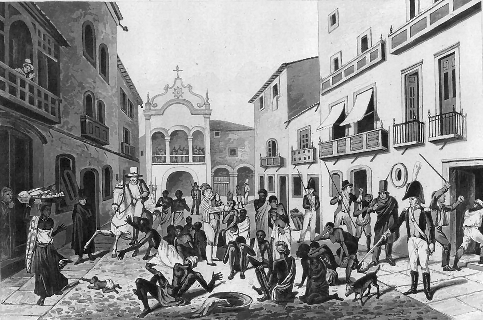
Gate and Slave Market at Pernabucoo.
28th.—This morning before breakfast, looking from the balcony of Mr.
S.'s house, I saw a white woman, or rather fiend, beating a young
negress, and twisting her arms cruelly while the poor creature screamed
in agony, till our gentlemen interfered. Good God! that such a traffic,
such a practice as that of slavery, should exist. Near the house there
are two or three depôts of slaves, all young; in one, I saw an infant of
about two years old, for sale. Provisions are now so scarce that no bit
of animal food ever seasons the paste of mandioc flour, which is the
sustenance of slaves: and even of this, these poor children, by their
projecting bones and hollow cheeks, show that they seldom get a
sufficiency. Now, money also is so scarce, that a purchaser is not
easily found, and one pang is added to slavery: the unavailing wish of
finding a master! Scores of these poor creatures are seen at different
corners of the streets, in all the listlessness of despair—and if an
infant attempts to crawl from among them, in search of infantile
amusement, a look of pity is all the sympathy he excites. Are the
patriots wrong? They have put arms into the hands of the new negroes,
while the recollection of their own country, and of the slave-ship, and
of the slave-market, is fresh in their memory.
I walked to-day to the market-place, where there is but little;—beef
scarce and dear, no mutton, a little poultry, and a few pigs,
disgusting, because they feed in the streets where every thing is
thrown, and where they and the dogs are the only scavengers. The
blockade is so strict, that even the vegetables from the gentlemen's
private gardens, two miles from the out-posts, are detained. No milk is
to be had, bread of American flour is at least twice as dear as in
England, and the cakes of mandioc baked with cocoa nut juice, too dear
for the common people to afford a sufficiency even of them. Fire-wood
is extravagantly high, charcoal scarce. The negroes keep the markets: a
few on their own account, more on that of their masters. The dress of
the free negroes is like that of the creole Portuguese; a linen jacket
and trowsers, or on days of ceremony one of cloth, and a straw hat,
furnish forth either a black or a white gentleman. The women, in-doors,
wear a kind of frock which leaves the bosom much exposed. When they walk
out they wear either a cloak or mantle; this cloak is often of the
gayest colours; shoes also, which are the mark of freedom, are to be
seen of every hue, but black. Gold chains for the neck and arms, and
gold ear-rings, with a flower in the hair, complete a Pernambucan
woman's dress. The new negroes, men and women, have nothing but a cloth
round their loins. When they are bought, it is usual to give the women a
shift and petticoat, and the men at least trowsers, but this is very
often omitted.
Yesterday the motley head-dresses of the Portuguese inhabitants were
seen to great advantage, in a sally through the streets, made by a kind
of supplementary militia to enforce the closing of all shop-doors, and
the shutting up of all slaves, on an alarm that the enemy was attacking
the town to the southward. The officer leading the party was indeed
dressed en militaire, with a drawn sword in one hand, and a pistol in
the other. Then followed a company that Falstaff would hardly have
enlisted, armed in a suitable manner, with such caps and hats as became
the variety of trades to which the wearers belonged, the rear being
brought up by a most singular figure, with a small drum-shaped black cap
on the very top of a stiff pale head, a long oil-skin cloak, and in his
left hand a huge Toledo ready drawn, which he carried upright. The
militia are better dressed, and are now employed in regular turn of duty
with the royal troops, who are going over to the patriots daily.
Calling at the palace this forenoon, we learned that a hundred Indians
are expected in the town, by way of assistance to the garrison. They
wear their aboriginal dress, and are armed with slings, bows, and
arrows. We are told their ideas of government consist in believing that
implicit obedience is due both to king and priests. Brandy is the bribe
for which they will do any thing; a dram of that liquor and a handful of
mandioc flour being all the food they require when they come down to the
port.
This evening, as there are no horses to be hired here, we borrowed some
from our English and French friends, and rode to Olinda by the long
sandy isthmus, which connects it with Recife. This is the isthmus
fortified with a palisade, by Sir John Lancaster, during his stay at
Recife, which he plundered.[48] The beach is defended by two castles,
sufficiently strong when their situation is considered; on one side a
furious surf breaking at their base, on the other a deep estuary and
flat ground beyond, so that they cannot be commanded. The sand is
partially covered by shrubs; one is very splendid with thick leaves and
purple bell-shaped flowers; many are like those of the eastern world;
many are quite new to me. I was surprised at the extreme beauty of
Olinda, or rather of its remains, for it is now in a melancholy state of
ruin. All the richer inhabitants have long settled in the lower town.
The revenues of the bishopric being now claimed by the crown, and the
monasteries suppressed for the most part, even the factitious splendour
caused by the ecclesiastical courts and inhabitants is no more. The very
college where the youths received some sort of education, however
imperfect, is nearly ruined[49], and there is scarcely a house of any
size standing.
Olinda is placed on a few small hills, whose sides are in some
directions broken down, so as to present the most abrupt and picturesque
rock-scenery. These are embosomed in dark woods that seem coeval with
the land itself: tufts of slender palms, here and there the broad head
of an ancient mango, or the gigantic arms of the wide spreading
silk-cotton tree, rise from out the rest in the near ground, and break
the line of forest: amidst these, the convents, the cathedral, the
bishop's palace, and the churches of noble, though not elegant
architecture, are placed in stations which a Claude or a Poussin might
have chosen for them; some stand on the steep sides of rocks, some on
lawns that slope gently to the sea-shore: their colour is grey or pale
yellow, with reddish tiles, except here and there where a dome is
adorned with porcelain tiles of white and blue. Just as we reached the
highest point of the town, looking across the woody bason round which
the hills are grouped, the smoke from one of the out-posts caught our
sight. The soldiers were standing or lying around, and their arms piled
by them: they were just shadowed by tall trees behind, between whose
trunks the scattered rays of the setting sun shed such a partial light
as Salvator Rosa himself would not have disdained. These same soldiers,
however, circumscribed our ride: we had intended to return by the inland
road, but were not allowed to pass into it, as part, at least, lies
without the posts, therefore we were obliged to return by the way we
came.
At the spot where the present guard is placed, and where indeed a strong
guard is peculiarly necessary, the river Bibiriba falls into the
æstuary, which was formerly the port of Olinda. A dam is built across
with flood-gates which are occasionally opened; and on the dam there is
a very pretty open arcade, where the neighbouring inhabitants were
accustomed in peaceable times to go in the evening, and eat, drink, and
dance. It is from this dam that all the good water used in Recife is
daily conveyed in water-canoes, which come under the dam called the
Varadouro, and are filled from twenty-three pipes, led so as to fill the
canoes at once, without farther trouble. We saw seven-and-twenty of
these little boats laden, paddle down the creek with the tide towards
the town. A single oar used rather as rudder than paddle guides the tank
to the middle of the stream, where it floats to its destination.
The sun was low, long before we reached even the first of the two
castles on our way back to the fort. The dogs had already begun their
work of abomination. I saw one drag the arm of a negro from beneath the
few inches of sand, which his master had caused to be thrown over his
remains. It is on this beach that the measure of the insults dealt to
the poor negroes is filled. When the negro dies, his fellow-slaves lay
him on a plank, carry him to the beach, where beneath high-water mark
they hoe a little sand over him; but to the new negro even this mark of
humanity is denied. He is tied to a pole, carried out in the evening and
dropped upon the beach, where it is just possible the surf may bear him
away. These things sent us home sad and spiritless, notwithstanding the
agreeable scenes we had been riding among.
29th. The feast of St. Michael's has drawn out the Portuguese
gentlewomen, of whom we had not yet seen one walking in the streets. The
favourite dress seems to be black, with white shoes and white or
coloured ribbons and flowers in the hair, with a mantle of lace or
gauze, either black or white. We have seen a few priests too for the
first time. I think the edict desiring them to keep within their convent
walls, is in consequence of their being among the fomentors of the
spirit of independence. The appropriation of so much of the church
revenue by the court of Lisbon is of course unpopular among the clergy
of the country; and it is not difficult for them to represent, what
indeed is truth, to the people, that the drawing of so much treasure
from the country to support Lisbon, which can neither govern nor protect
them now, is a rational ground of complaint. It is said, that the morals
of the clergy here are most depraved. This is probably true. Men cut off
by vows like those of the Roman clergy, from the active charities of
social life, have only the resources of science and literature against
their passions and vices. But here the very names of literature and
science are almost unknown. The college and library of Olinda are in
decay. There is not one bookseller in Pernambuco, and the population of
its different parishes amounts to 70,000 souls! A tolerably well written
newspaper, of which I have not been able to procure the first number,
was set up in March, under the title of "Aurora Pernambucana," with the
following motto from Camoens:
Depois da procellosa tempestade,
Nocturna sombra e sibilante vento,
Tras a manha serena e claridade,
Esperança de porto e salvamiente:
alluding to the arrival of the news of the revolution in Portugal, on
the 26th of that month, and the swearing of the governor, magistrates,
&c. to adhere to the constitution as established by the Cortes. I am
sorry to say that this only paper has been discontinued for the two last
months, the editor having, as it seems, become a secretary of
government, and having no longer time to superintend the press.[50]
30th.—Last night the patriot troops attacked the line of defence at
Olinda for four hours, but I do not believe there was any loss on either
side. This morning a Portuguese frigate, the Don Pedro, with troops from
Bahia, arrived. The reinforcement of 350 men, partly European, partly
Bahian, has put the inhabitants, from the governor downwards, into the
highest spirits; so that for once we see Pernambuco active, and
cheerful, and alive. Men and women are out in their gayest habits, and
the military are running and riding in all directions, not a little
pleased to have some to relieve them in their constant watch and ward.
Among other things which I learned by looking on, while the elders of
families were engaged in the streets with the new-comers, was that the
young Pernambucans are as dexterous in the use of signs as the Turkish
lovers themselves, and that often a courtship is carried on in this way,
and a marriage settled, without the parties having ever heard each
other's voices. However, the general mode is for parents to settle their
children's nuptials, without consulting any thing but pecuniary
convenience.
This day several of the officers and midshipmen of the Doris accompanied
us to dine at the governor's, at half-past four o'clock. Our welcome
was most cordial. His excellency took one end of the table, and an
aide-de-camp the other: I was seated between M. and Madame do Rego. He
seemed happy to talk of his old English friends of the Peninsula, with
many of whom I am acquainted; and she had a thousand enquiries to make
about England, whither she is very anxious to go. They apologised for
having so little plate, but their handsome services were packed up in an
English store-house, together with her excellency's jewels and other
precious things. The cookery was a mixture of Portuguese and French.
After the soup, a dish was handed round of boiled lean beef, slices of
fat salt pork, and sausages, and with this dish, rice boiled with oil
and sweet herbs. Roast beef was presented, in compliment to the English,
very little roasted. Salads, and fish of various kinds, were dressed in
a peculiar manner; poultry and other things in the French fashion.
The dessert was served on another table. Besides our European dessert of
fruit, cakes, and wine, all the puddings, pies, and tarts, formed part
of it. It was decorated with flowers, and there was a profusion of
sugar-plums of every kind. The company rose from the dining-table, and
adjourned to the other, which Madame do Rego told me should have been
spread in a separate apartment; but they have so recently taken
possession of their house, that they have not one yet fitted up for the
purpose. The governor and his guests proposed many toasts
alternately—The King of England, the King of Portugal, the navy of
England, the King of France[51], Luis do Rego, and the captaincy of
Pernambuco, &c.—When we all rose at once from table; some of the
company went on board ship, but most adjourned to the drawing-room, a
comfortable apartment, furnished with blue satin damask, where we were
joined by the French naval officers of His Most Christian Majesty's ship
Sappho, and several ladies and gentlemen of the city. We had some
excellent music. Madame do Rego has an admirable voice, and there were
several good singers and players on the piano. It was a more pleasant,
polished evening than I had expected to pass in Pernambuco, especially
now in a state of siege.
Wednesday, 3d October.—I went on board on Monday, and, provokingly
enough, the patriots chose that very night to make an attack upon the
out-post of the Affogadas, so I did not see the governor, at the head of
his troops, march out to meet them; nor did I hear the national hymn
sung by the regiments as they filed along on their return from a
successful sally.[52] Yesterday, nothing occurred worth noting; we had
the consul and British merchants on board to dinner, and the day passed
as such days usually do.
Having learned that the patriots have refused to allow the linen
belonging to the ship, which had been sent to the country to be washed,
to return to the town, it was determined that we should send to their
head-quarters, and remonstrate against this very inconvenient mode of
annoying the port. I obtained leave to accompany the messengers, and
accordingly we all went on shore immediately after breakfast. Our first
business was to procure passports, and to learn the countersigns; after
which Capt. Graham, with Col. Cottar, the governor's principal
aide-de-camp, rode with us to the out-posts, where we left them, with an
intention of returning to dine at Mr. Stewart's, to meet Luis do Rego's
family. Our party consisted of M. Caumont, to act as interpreter, Mr.
Dance, bearing the letter, my cousin Mr. Glennie as my cavalier, and
myself. It was the first time we had had an opportunity of passing the
lines, and we felt like school-boys who had stolen beyond bounds, and
well we might; the scenery was fresh and lovely, and the day as fine as
possible.
Pernambuco is not a walled town, but broad rapid rivers and æstuaries
surround it, and it is only approachable by the roads and causeways; the
banks thrown up across these, for present defence, are such as might
stop the Brazilian cavalry for a few minutes, or afford cover for
musketry; but their best defence is the swamp at the mouth of the
Capabaribe, which is flooded at high water, and which extends nearly to
the Bibiribi. At the edge of the swamp there is a wooden palisade, where
we left the last post of the royalists, and took leave of our friends,
who had accompanied us so far. After riding across the marsh, which by
the by is very fit for rice ground, and is surrounded by cocoa-nut and
tamarind trees, we came to the main stream of the Capabaribe, a deep,
broad, and very rapid river; its sides are steep, and the water
beautifully clear[53]: its banks are studded with country-houses, and
adorned with groves and gardens, for the present abandoned by their
owners, who have taken refuge in Recife.
The hedges on each side of the road are woven of palm-leaves, and where
not quite new, are covered with all splendid creeping plants; the common
and winged passion-flower, white, blue, and yellow clematis, jasmine,
china-rose, and many others, both gay and sweet. The ditches, too, were
full of colour, but we rode too fast to stay to collect plants; and I
could only promise myself, at some future time, to gather one that
appeared like a bog bean, but its colour bright purple.
About two miles from Do Rego's last out-post, we came to the first post
of the patriots, at a country-house on a rising ground, where arms piled
at the door, and a sort of ragged guard, consisting of a merry-looking
negro with a fowling-piece, a Brazilian with a blunderbuss, and two or
three of doubtful colour with sticks, swords pistols, &c., told us an
officer was to be found. After a few minutes parley, we found he was not
authorised to receive our letter, so we rode on under the direction of
the old Brazilian with his blunderbuss, who, being on foot, threatened
to shoot us if we attempted to ride faster than he walked. The slow pace
at which we advanced gave us leisure to remark the beauties of a
Brazilian spring. Gay plants, with birds still gayer hovering over them,
sweet smelling flowers, and ripe oranges and citrons, formed a beautiful
fore-ground to the very fine forest-trees that cover the plains, and
clothe the sides of the low hills in the neighbourhood of Pernambuco.
Here and there a little space is cleared for the growth of mandioc,
which at this season is perfectly green: the wooden huts of the
cultivators are generally on the road-side, and, for the most part, each
has its little grove of mango and orange-trees. At one of these little
homesteads, we found a pretty large guard-house, established where four
roads meet, and there our foot guide left us, and a gentlemanlike young
officer, of the Brazilian Caçadores, rode with us, and entertained us by
calling Luis do Rego a tyrant, and attributing the siege of Pernambuco
entirely to the governor's obstinacy, in not joining the people of the
province in throwing off the dominion of his master. Round the
guard-house a number of negro girls, with broad flat baskets on their
heads, were selling fruit and cold water: they had decked their woolly
hair, and the edges of their baskets, with garlands of the scarlet
althaea; their light blue or white cloaks were thrown gracefully across
their dusky shoulders, and white jackets, so that it was such a picture
as the early Spaniards might have drawn of their Eldorado.
After riding a few miles, we came suddenly to the foot of an abrupt
hill, on whose sides there were scattered groups of the most magnificent
trees I ever beheld. There we were met by a small military party, which,
after a parley with our guide, rather ordered, than invited us to ride
up. In a few seconds, we came to a steep yellow sandstone bank, shaded
on one side by tall trees, and open on the other to a lake surrounded
by woody hills, on the most distant of which, the white buildings of
Olinda sparkled like snow. On the top of the bank, and in the act of
descending, was a group of forty horsemen, one of the foremost of whom
bore a white banner; several were dressed in splendid military habits,
others in the plain costume of the landed proprietors. These were
deputies from Paraiba on their way to propose terms to Luis do Rego;
they had just left the head-quarters of the besieging army, where the
provisional government of Goyana is stationed, and were accompanied by a
guard of honour: after exchanging civilities, part of the guard turned
back with us, and the deputies went on their way. Having reached the top
of the hill, we found about a hundred men, tolerably well armed, but
strangely dressed, awaiting us; and there we were detained till our
guide rode forward to ask leave to bring us to head-quarters. I was
sorry I had no means of sketching any part of the beautiful landscape,
which, besides the striking features I have mentioned before, now
displayed a broad river, over which there is a white stone bridge of
several arches; at one end, a large house, more like a palace, with its
arches and corridors, and the encampment of the army and the horse
picquets, and, in short, a bustle and animation that seldom happen to
adorn so fine a scene. Our guide soon returned with eighteen or twenty
mounted soldiers, whose appearance was rather wild than military: the
guard presented arms as we parted from them, and we soon cantered down
the hill towards the main body of the troops. Not above two hundred had
the arms or accoutrements of soldiers; but there were dresses and
weapons of every kind, leather, cloth, and linen; short jackets and long
Scotch plaids, and every tint of colour in their faces, from the sallow
European to the ebony African. Military honours were paid us by these
ragged regiments, and we were conducted to the palace square, where Mr.
Dance and Mr. Caumont dismounted, and I determined to await the issue of
their conference, with my cousin in the court.
This, however, was not permitted. In a few minutes, a smart little man,
speaking tolerable French, came and told me the government desired my
company. I suspected a mistake of the word government for governor, and
endeavoured to decline the honour; but no denial could be taken, and the
little man, who told me he was secretary to government, accordingly
assisted me to dismount, and showed me the way to the palace. The hall
was filled with men and horses, like a barrack stable, excepting a
corner which served as an hospital for those wounded in the late
skirmishes, the groans of the latter mingling uncouthly with the
soldiers' cheerful noisy voices. The stairs were so crowded, that we got
up with difficulty, and then I found that I was indeed to be confronted
with the whole strength of the provisional government. At the end of a
long dirty room, that had once been handsome, as the form of the windows
and carving of the panels on which there were traces of colour and
gilding, indicated, there was an old black hair sofa, on the centre of
which I was placed, with Mr. Dance on one side, and Mr. Glennie on the
other; by Mr. Dance sat the little secretary, and next to him our
interpreter, in old-fashioned high-backed chairs; the rest of the
furniture of the room consisted of nine seats of different sizes and
forms, placed in a semicircle fronting the sofa, and on each of these
sat one of the members of the junta of the provisional government, who
act the part of senators or generals, as the occasion may require. To
each of these I was introduced; the names of Albuquerque, Cavalcante,
and Broderod, struck me, but I heard imperfectly, and forget most of
them: some wore handsome military coats, others the humbler dress of
farmers. They politely told me they would not read the letter while I
was waiting below, but as soon as we were seated, the secretary read it
aloud. Instead of taking any notice of its contents, the secretary began
a long discourse, setting forth the injustice of the Portuguese governor
and government towards Brazil in general, and the Pernambucans in
particular; that in order to resist that injustice, they had formed the
present respectable government, pointing to the junta, without intending
the least detriment to the rights of the king. That surely they could
not be called rebels, as they marched under the royal flag of Portugal;
but Luis do Rego might be reasonably stigmatised as such, for he had
fired on that banner. He then went off into a long harangue upon the
general principles of government; but as I understood little of the
language, much of it was lost upon me, as well as on my companions; but
I have no doubt that it served to impress the respectable junta with a
higher idea of their secretary's understanding and eloquence:
altogether, the speech reminded me of some of the best written of the
Carbonari addresses of Italy; and there was something in the air,
manner, and scene, not unlike what one imagines of the Barraca meetings
of those ill-guided, misused people.[54] We then talked a great deal in
French to the secretary, who repeated every word to the respectable
junta, and at length got him to attend to a proposal for releasing our
linen, and another for supplying the ship with fresh provisions. We had
been paying forty dollars per bullock in the town; they agreed that
their price should not exceed ten, if we sent boats to the Rio Doce, or
Paratije[55] for them. This is the mouth of a small stream on the
northside of Olinda. And I must not omit to mention, that they offered
to allow us to take off fresh provisions for our English or French
friends in the town.
The junta was extremely anxious to learn if there was a probability of
England's acknowledging the independence of Brazil, or if she took part
at all in the struggle; and many were the questions, and very variously
were they shaped, which the secretary addressed to us on that head. They
are of course violent in their language concerning Luis do Rego, in
proportion as he has done his military duty, in keeping them at bay
with his handful of men: and like all oppositions they can afford to
reason upon general principles, because they have not to feel the
hindrances of action, and the jarring of private interests in the
disposal and fulfilment of office.
I was sitting opposite to one of the windows of the council-room, and
had been remarking for some time, that the sun was getting very low,
and, therefore, rose to go, having received a note from the secretary,
ordering the officers at their advanced posts to offer no hindrance to
the passing of any thing belonging to His British Majesty's frigate,
Doris. But we were not suffered to depart without a hearty invitation to
sup and spend the night: and a stirrup-cup (a huge glass) was brought,
and a bottle of wine, with about half as much water, poured into it; it
was then handed to me to begin, and all fourteen received it in turn. By
this time the guard was drawn out, the band played the national hymn, to
which we all listened bare-headed, and so we mounted among those
wild-looking men, in that strange, yet lovely landscape, just as the
evening mist began to veil the lower land, and the bright red evening
sun to gild the topmost branches of the forest.
Our journey home was much more rapid than our journey out. The evening
was cool, and the horses eager to return; but we did not reach Mr. S.'s
till two hours after sunset, when we found that, after the party had
waited till six o'clock, Captain Graham had insisted on their dining.
The governor was uneasy, and offered to send a party of Caçadores in
search, as he kindly said, of me,—but this, of course, was refused; the
captain assuring his excellency, that if the patriots detained his
lieutenant, he would take him back with his own men, and that as to me,
while I was with my two companions, he had not the least fear concerning
me. We were accompanied by the same officer, who had been our companion
on the latter part of the ride to head-quarters, back almost to the town
lines; and when we told this to the governor, he was sorry we did not
know his name, that in case he should ever have it in his power to show
him kindness, he might do so. A pleasant chat on the adventures of our
ride, a hearty supper, and a little concert closed the day, which, upon
the whole, was to me a most agreeable one.
Thursday, 4th.—Received Madame do Rego, one of her daughters, Miss
S., and several gentlemen, on board. Most of the party were sea-sick,
from the rolling of the ship, caused by the heavy swell at the
anchorage. They were, however, highly charmed with their visit,
particularly with the fireworks with which we saluted the ladies, who
had never been on board a British frigate before, on their departure.
Friday, 5th.—According to the agreement made with the patriot
officers, on Wednesday, one launch and the second cutter went to Rio
Doce to receive bullocks and other provisions. The officers and men were
most kindly received, and returned with many presents of fresh stock and
vegetables, which the patriots forced upon them. A military band
attended them on landing, and conducted them to the place of meeting
with the chiefs.
Messrs. Biddle and Glennie, being on shore surveying, near Cabo de Sant
Augustin[56], were detained as prisoners for a few hours, by a patriot
detachment; but, as it appeared to be only for the purpose of obtaining
money, and done by some subaltern, no notice was taken of it.
Saturday, 6th.—The frigate got under weigh to take a cruize, and if
possible find a quieter anchorage. Mr. Dance with a party went for more
provisions, to Rio Doce. The surf at the landing place was so high, that
they were obliged to get into canoes, and leave the boats grappled at
some distance from the beach. A guard of honour and military band
attended them, as on the former day, and they were, moreover, pressed to
dine with the commander of the post, which they gladly did. The
dining-room was a long hut, built of wood and plaited palm leaves. In
the centre, was a long table spread with a clean and very handsome
cloth. The few chairs the place afforded were appropriated to the
strangers, and the rest of the company stood during the meal. To the
strangers, also, were given the spoons and forks, but the want of them
did not appear to incommode the Brazilians. To each person a small
basin of good beef broth, bien dorée, was served, and for the rest
every man put his hand in the dish. Two principal messes occupied the
centre of the table, one, a platter, containing a quantity of mandioc
flour, raw; and the other a pile of fish, dressed with oil, garlic, and
pimento. Each person began by stirring a quantity of the flour into his
broth, till it acquired the consistence of brose, and then helping
himself to the fish, which was cut up in convenient pieces, dipped it
into the brose, and eat it with his fingers. Around the two principal
dishes, were others of a most savoury nature,—eels fried with sweet
herbs, shellfish stewed with wine and pimento, and others of the same
kind. Into these also each man put his hand indiscriminately, and
dipping his morsel into his basin, set our officers the example of
eating that substitute for wheaten bread, and of swallowing, without
regard to neatness or order, all manner of messes, mixed together, and
touched by all hands. After dinner, a slave handed round a silver basin,
with water and towels, after which a number of toasts were given, and
the entertainment concluded with vivas, when the guard and band attended
the officers to the boats, where the bullocks were ready to embark, and
slaves to carry the English through the surf to the canoes, which
conveyed them to the boats. On their return, I saw for the first time,
the pitanga, a berry of which an excellent preserve is made; it grows
upon a beautiful shrub, scarcely to be distinguished, either in flower
or leaf, from the broad-leaved myrtle; the berry is as large as a
filbert, and divided and coloured like the large red love-apple. Mr.
Dance brought me, also, a beautiful green paroquet, the tamest,
loveliest thing, with his emerald coat, and sparkling eye, I ever
saw.[57]
Sunday, 7th.—We continued to cruize opposite to Olinda and Recife,
and alarmed some of our friends on shore, by sailing round the English
bank, a thing hitherto believed impossible, for so large a ship.
Monday, 8th.—We find to-day, on anchoring, that terms have been
entered into with the patriots, by which their deputies are to be in the
council, and take an equal share in the administration, and on the other
hand, they are to withdraw the investing troops, and leave Luis do Rego
at the head of the military department, until the arrival of the next
despatches from Lisbon. These pacific measures were brought about by the
Paraiban deputies whom we met on Wednesday.
Tuesday, 9th.—Mr. Dance, Mr. Glennie, and I, were deputed to take
charge of a large party of midshipmen, who had not been able before to
take a run on shore, to spend the day on Cocoa-nut Island, which lies a
good way up the harbour, and within the reef of Pernambuco. As we sailed
along the rock, we observed that it is covered with echini, polypii,
barnacles, limpets, and crusted with white bivalves less than oysters or
cockles, yet containing a fish not unlike the latter in appearance, and
the former in flavour. We had not exactly calculated the effect of the
tide so far up the harbour as Cocoa-nut Island, consequently we got
aground in the outer channel, at a considerable distance from the shore.
The sailors pushed me over one flat bank in the gig, and then carried me
to the beach; the midshipmen waded, and the officers and boats with the
crews, went in search of a deeper passage, where they might approach
with our provisions. Meantime the boys and I had full leisure to examine
the island. It is perfectly flat and covered with white sand; the shore
scattered with fragments of shells and coral. As its name imports, it is
one grove of cocoa-nut trees, excepting where the present occupant has
cleared space for a market-garden and fishponds. These last are very
extensive; and as they secure a supply of fish at times when the rough
seas of the outer roads prevent the canoes from going out, they have
answered extremely well to the speculator. The garden produces European
as well as Brazilian vegetables, in great perfection: Fruit-trees also
thrive very well.[58] In the cuts for the fishponds I observed below
the sand, a rich black earth, full of decayed vegetables, which probably
renders this apparently sandy land, so fertile. The ponds were half
covered with the white water-lily, and some other aquatic plants of the
country. The whole island abounds in gay shrubs and gaudy flowers[59],
where the humming-bird, here called the beja flor or kiss-flower, with
his sapphire wings and ruby crest, hovers continually, and the painted
butterflies vie with him and his flowers in tints and beauty. The very
reptiles are beautiful here. The snake and the lizard are singularly so,
at least in colour. We found a very large rough caterpillar, each hair
or prickle of which is divided into five or six branches; the rings of
its body are scarlet, yellow, and brown; and the country people believe
that it hurts the udders of cows, and prevents their giving milk, if it
does not actually suck them. They are therefore very unpopular here,
because the whole island that is not garden-ground is pasture, and
supplies a great deal of the milk for the market of Recife.
While we were endeavouring to forget our hunger by examining the island,
and drinking cocoa-nut juice, and wondering at many an ordinary thing,
though new to young untravelled eyes, and such were those of most of the
party, our boats were taking a circuitous track, and at length at ten
o'clock landed our provisions, when we made a hearty breakfast, sitting
on a sail spread under the palm shade. The elder boys with their guns,
then accompanied Mr. Dance and the captain of a merchant vessel, who
volunteered to act as Cicerone, to shoot; and the younger ones staid
with me to collect flowers, gather vegetables, and with the assistance
of the boats' crews, to superintend the preparations for dinner. At four
o'clock the sportsmen returned, bringing red-crested woodpeckers,
finches of various hues, humming-birds, black and yellow pies, and
others of gay plumage and delicate shape, quite new to us all. A merrier
party certainly never met, but the best of the expedition was to come.
The tide was now favourable; and we determined to do a spirited thing,
and instead of going all the way down the harbour, which would have
kept us out beyond the time allowed us, we ran through a passage in the
reef called Mother Cary's passage, because few things but the birds
think of swimming there. The merchant-boat went first, our gig next, and
as I sat in the stern of the large boat that was to follow, it was
beautiful, but something fearful, to see them dash through that boiling
surf between the rocks and rise over the wave secure beyond it, nor was
the sensation less mixed when we followed. There is at all times
something triumphant in the sensation of sailing over the waters; but
when they are roughened by storms, or rendered fearful by rocks or
shoals, the triumph approaches to the sublime, and in it there is a
secret dread, though not of ocean, and a raising of the soul to him who
made the ocean, and gave man mind to master it. I am not ashamed to own,
that as I looked round on my young charge, when Mr. Dance whispered "sit
still and say nothing," and then stepping to the bow of the boat called
aloud to the helmsman, "steady!" I had a moment, though but a moment, of
exquisite anxiety. But we were through in an instant, and soon alongside
of the frigate, where we were praised for doing what few had done
before, and having shown the possibility of doing that safely, which at
some future time it might be of importance to know could be done at all.
Wednesday, 10th.—We went on shore early for the first time since the
armistice. The guns are removed from the streets and a few of the shops
are re-opened; the negroes are no longer confined within doors, and the
priests have reappeared; their broad hats and ample cloaks give them an
importance among the crowd, which now is busy and active, and seemingly
intent on redeeming the time lost to trade by the siege. I was struck by
the great preponderance of the black population. By the last census, the
population of Pernambuco, including Olinda was seventy thousand, of
which not above one third are white: the rest are mulatto or negro. The
mulattoes are, generally speaking, more active, more industrious, and
more lively than either of the other classes. They have amassed great
fortunes, in many instances, and are far from being backward in
promoting the cause of independence in Brazil. Few even of the free
negroes have become very rich. A free negro, when his shop or garden has
repaid his care, by clothing him and his wife each in a handsome black
dress, with necklace and armlets for the lady, and knee and shoe buckles
of gold, to set off his own silk stockings, seldom toils much more, but
is quite contented with daily food. Many, of all colours, when they can
afford to purchase a negro, sit down exempt from further care. They make
the negro work for them, or beg for them, and so as they may eat their
bread in quiet, care little how it is obtained.
The European Portuguese, are extremely anxious to avoid intermarriage
with born Brazilians, and prefer giving their daughters and fortunes to
the meanest clerk of European birth, rather than to the richest and most
meritorious Brazilian. They have become aware of the prodigious
inconvenience, if not evil, they have brought on themselves by the
importation of Africans, and now no doubt, look forward with dread to
the event of a revolution, which will free their slaves from their
authority, and, by declaring them all men alike, will authorise them to
resent the injuries they have so long and patiently borne.
Thursday, 11th.—As every thing seems quietly settled between the
royalist and patriot chiefs, we are preparing to take leave of
Pernambuco, and it is not without regret, for we have been kindly
treated by the Portuguese, and hospitably received by our own
countrymen. We went on shore to provide necessaries and comforts for our
farther voyage. Among the latter I bought some excellent sweetmeats[60],
which are made in the interior, and brought to market in neat little
wooden kegs, each containing six or eight pounds. It is astonishing to
see the weight brought from two and three hundred miles' distance, by
the small and slight but very swift horses of the country. The baggage
horses are not shod any more than those for riding: the latter are
almost universally trained to a kind of running pace, easy in itself,
but not very agreeable at first, to those accustomed to English horses.
To-day I saw and tasted the jerked beef, charqui, of Spanish South
America. It appears, when hanging in bales at the shop-doors, like
bundles of thick ragged leather. It is prepared by cutting the flesh in
wide strips, clean off the bones, slightly salting, pressing, and drying
in the air. In this state it might well have served for saddle-cloths to
the Buccaneers, as tradition says they dressed their meat under their
saddles. However that may be, the beef is good. Here the common mode of
using it is to cut it in small squares, and boil it in the mandioc
pottage, which is the principal food of the poorer inhabitants and the
slaves.
After I had ended my marketing, I went to call on a Portuguese family,
and as it was the first private Portuguese house I had been in, I was
curious to notice the difference between it and the English houses here.
The building and general disposition of the apartments are the same, and
the drawing-room only differed in being better furnished, and with every
article English, even to a handsome piano of Broadwood's; but the
dining-room was completely foreign; the floor was covered with painted
cloth, and the walls hung round with English prints and Chinese
pictures, without distinction of subject or size. At one end of the room
was a long table, covered with a glass case, enclosing a large piece of
religious wax-work; the whole præsepia, ministering angels, three
kings, and all, with moss, artificial flowers, shells and beads,
smothered in gauze and tiffany, bespangled with gold and silver, San
Antonio and St. Christopher being in attendance on the right and left;
the rest of the furniture consisted of ordinary chairs and tables, and a
kind of beaufet or sideboard: from the ceiling, nine bird-cages were
hanging, each with its little inhabitant; canaries, grey finches with a
note almost as fine, and the beautiful widow-bird, were the favourites.
In larger cages in a passage room, there were more parrots and paroquets
than I should have thought agreeable in one house; but they are
well-bred birds, and seldom scream all together. We were no sooner
seated in the dining-room, than biscuit, cake, wine, and liqueurs, were
handed round, the latter in diminutive tumblers; a glass of water was
then offered to each, and we were pressed to taste it, as being the very
best in Recife; it proceeds from a spring in the garden of the convent
of Jerusalem, two miles from town, and the only conduit from that spring
leads to the garden of a sister convent here. From the lady, I learned,
that the porous jars for cooling water, that we find here, are all made
in the neighbourhood of Bahia, there being no manufactory here, except a
few coarse cottons for clothing for the slaves. The air and manners of
the family we visited, though neither English nor French, were perfectly
well bred, and the dress pretty much that of civilised Europe, only that
the men wore cotton jackets instead of cloth coats, and were without
neck-cloths; when they go out of doors, however, they dress like
Englishmen.
Returning from our visit, we met a monk, carried out to be buried by
several of his brethren, with candle, book, and bell, and all the
solemnities which human feeling has invented to solace its own fears and
griefs, under the pretence of honouring the dead, and to which the
Romish church has in such cases as these, added all her pageantry. I
could not help contrasting it with the burials on the beach of Olinda,
and smiling at the vanities that attach themselves even to corruption.
"But man, vain man, plays such fantastic tricks before high heaven, as
make the angels weep."
But our horses were awaiting us, and we left our indignation and our
pity for the follies of some, and the miseries of others, to enjoy, for
the first time since the posts were free, the country air. When we went
to Bibiriba, soldiers stopped us to question at every turn; piles of
arms, and horses ready accoutred at the door of every considerable
residence, showed that military posts had taken place of the pleasures
of the country-houses, and accounted for the solitariness of the roads.
Now the scene is changed—the paths are crowded with negroes, young and
old, in their picturesque, though gaudy dresses, with baskets of fruit,
fish, and other provisions, on their heads; little carts, of which we
had not before seen one, begin to appear, and the fine oxen which draw
them form no bad contrast to the half-starved bullocks of the town.
'Twas a cool evening, and the sun was just low enough to gild the edges
of the palms and other tall trees, which shot up with their deep black
shadows into the thin pure light, making an effect, that even Titian's
landscape pencil has not reached. Our ride extended to Mr. S.'s
country-house, which is, I believe, on the same plan with all the others
hereabouts, and which I can only compare to an Oriental bungalow; one
story very commodiously laid out, a veranda surrounding it, and standing
in the midst of a little paddock, part of which is garden ground, and
part pasture, generally hedged with limes and roses, and shaded with
fruit trees, is the general description of the country sitios about
Pernambuco; the difference arising from the taste of the inhabitant, or
the situation of the ground, being allowed for. The low rent of these
pleasant little gardens is surprising; but it arises in great measure
from the indolence and consequent poverty of the holders of original
grants of land here: as long as their negroes and estates maintained
them, they paid no attention to the particular parts that, being near
the town, might have been at all times productive. Now, that sugar and
cotton are no longer in such demand, nearly half the fazendas or
factories are ruined, and such is become the indolent temper of the
people, that rather than seek to redeem their estates, they will take
the smallest annuity for a portion.
On our way to the sitio, we stopped at a kind of public-house or venta;
it is like an English huckster's, and contains a little of every thing,
cloth and candles, fruit and lard, wine and pimento, which are retailed
at no very extravagant profit to the poor; the draught wine is really
good, being port of excellent quality, without the quantity of brandy
which the English market requires. By the time we repassed it on our way
home, many a negro was spending his day's savings, and becoming as happy
as wine could make him; and many a traveller was regaling himself with
bread, garlic, and salt, and preparing to spread his mat, and lie down
in the open air for the night. Night within the tropics is always a
gayer and more peopled time than with us; the heat of the day detains
many within doors all day, and evening and night become the favourite
hours for walking. As we returned through Boa Vista we passed many
groups enjoying like ourselves the pleasant air, and gazing idly on the
reflections of the white houses and waving trees in the water; while the
fire flies flitting from bush to bush, seemed like fragments of stars
come down to adorn the moonlight.
Friday, 12th.—- The Prince Royal of Portugal's birth-day. There is a
levee at the palace. The company bow first to the governor, then to the
Prince's picture, which is placed in the middle of the audience-room, to
receive its due honours; and then the beja mano, or kiss hands, takes
place. The forts and ships saluted; we of course did the same; and the
people all dressed and went to mass, as on a holiday. One thing
contributed, however, in no small degree to the enjoyment of the day.
The troops, which lately arrived from Bahia, re-embarked in order to
return. Their whole behaviour had been disorderly, and their drunkenness
and riot, during the ten days they were here, had quite disgusted the
people; while the disposition they manifested to join the patriots, had
rendered them but suspicious auxiliaries to the governor.
Saturday, 13th.—I took leave of my amiable friends at the palace.
Madame do Rego gave me several specimens of amethyst, and the stone
called minha nova (like aqua marine), and also a fine piece of gold ore
of the province. She told me that Luiz do Rego had sent home many fine
minerals from the captaincy, and also some fossils. She described some
enormous bones, which may have belonged to the elephant or the mammoth,
found at no great distance from Recife in digging a well, and, as far as
I could understand, in such soil as I had observed lay under the sand in
Cocoa-nut Island.[61]
A great dinner was given to-day, by the merchants, to the captain and
officers. The governor, and other persons of dignity in the town, met
them; I am told it was a very handsome dinner, that there was plenty of
every kind of wine, and that nothing could exceed the friendly
politeness of the governor and his party. I had remained at Mr. S.'s,
where most of the company visited me after tea; and then we took leave
of Pernambuco, where we had received much kindness, and had at least the
enjoyment of novelty. The scene at our embarking was very pretty. Our
friends went with us to the jetty, and our boats lying in the clear
moonshine beneath it, with sailors going up and down preparing for us,
the harbour and the shipping doubled by the clear reflection in the
still water, heightened and set off the sparkling of the breakers that
dashed against the outer fort and light-house. Through these we soon
made our way and reached the ship, where I have once more taken
possession of my cabin, and put it in order for sea.
We leave Pernambuco, with a firm persuasion that this part of Brazil at
least will never again tamely submit to Portugal. Where the firmness and
conduct of Do Rego have failed to hold the captaincy in obedience, it
will be in vain for other governors to attempt it, particularly so long
as the state of the mother country is such as that she can neither fight
with nor for her colonies; and while she considers them only as taxable
parts of her states, that are bound to support her in her weakness.[62]

Sunday, Oct. 14th.—We got under weigh after breakfast, and soon lost
sight of Pernambuco. All Sunday, Monday, and Tuesday, we coasted along
within sight of the shores of Brazil. They are hilly and very woody, the
green of the sloping banks being often interrupted by bright white
patches, which seem to be of sand. In the evening of Tuesday the 16th,
we anchored in the bay of All Saints, opposite to the town of St.
Salvador, commonly called Bahia. It was quite dark before we got in, so
that we lost the first entrance-view of that magnificent harbour; but
the scattered lights show us the great extent and high situation of the
town.
Wednesday, 17th.—This morning, at day-break, my eyes opened on one of
the finest scenes they ever beheld. A city, magnificent in appearance
from the sea, is placed along the ridge and on the declivity of a very
high and steep hill: the richest vegetation breaks through the white
houses at intervals, and beyond the city, reaches along to the outer
point of land on which the picturesque church and convent of Sant
Antonio da Barre is placed. Here and there the bright red soil shows
itself in harmony with the tiling of the houses. The tracery of forts,
the bustle of shipping, hills melting in the distance, and the very form
of the bay, with its promontories and islands, altogether finish this
charming picture; then the fresh sea-breeze gives spirit to enjoy it,
notwithstanding its tropical climate.
Early in the day we moved our anchorage closer in-shore; and then, on
the invitation of Mr. Pennell, the British consul, we went ashore to
spend the day with him. We landed at the arsenal, or rather dock-yard,
where there is nothing of the neatness observable in such establishments
at home. The first object we saw, however, was a fine 58-gun frigate on
the stocks, the model of which I hear connoisseurs praise as beautiful.
There is nothing besides the new ship, and some handsome pieces of old
brass cannon, worth looking at. Every thing is visibly either suspended
or on the decline, and there will probably be no improvement, until the
political state of Brazil is a little more settled. We find things here,
though not quite so unquiet as at Pernambuco, yet tending the same way.
The street into which we proceeded through the arsenal gate, forms, at
this place, the breadth of the whole lower town of Bahia, and is,
without any exception, the filthiest place I ever was in. It is
extremely narrow, yet all the working artificers bring their benches,
and tools into the street: in the interstices between them, along the
walls, are fruit-sellers, venders of sausages, black-puddings, fried
fish, oil and sugar cakes, negroes plaiting hats or mats, caderas, (a
kind of sedan chair,) with their bearers, dogs, pigs, and poultry,
without partition or distinction; and as the gutter runs in the middle
of the street, every thing is thrown there from the different stalls, as
well as from the windows; and there the animals live and feed! In this
street are the warehouses and counting-houses of the merchants, both
native and foreign. The buildings are high, but neither so handsome nor
so airy as those of Pernambuco.
It was raining when we landed; therefore, as the streets leading out of
the filthy lower town do not admit of the use of wheeled carriages, on
account of the steepness of the ascent, we hired caderas, and found
them, if not comfortable, at least commodious. They consist of a cane
arm-chair, with a foot-board and a canopy covered with leather;
curtains, generally of moreen, with gilt bordering and lined with cotton
or linen, are contrived to draw round, or open at pleasure; and the
whole is slung by the top to a single pole, by which two negroes carry
it at a quick pace upon their shoulders, changing occasionally from
right to left.[63]
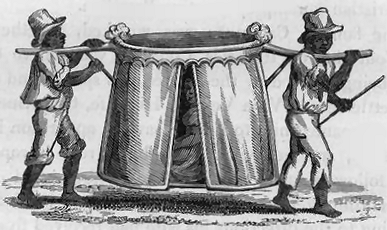
As we ascended from the street, every step brought us in sight of some
beautiful scene, generally terminated by the bay and shipping. There is
something in the landscape here peculiarly agreeable. The verdure, the
wood, the steep banks, and gently sloping lawns, generally opening to
the sea or the lake behind the town, have a freshness and amenity that I
scarcely remember seeing before. We saw but little of the upper city,
but that little was handsome, in our way to the consul's. His house,
like those of all the British merchants, is a little way out of town,
and is in the suburb Vittoria, which occupies the greater part of a long
narrow ridge extending from the town towards Sant Antonio: between it
and the town is Fort Pedro, built, I think, originally of mud, by the
Dutch. It was faced with stone, on the recovery of Bahia from the Dutch,
about the beginning of the last century. We found the Consul and his
daughter ready to receive us at their very pleasant garden-house, which
literally overhangs the bay,—flowers and fruits mingle their sweets
even down to the water's edge,—while
"Seaborn gales their gelid wings expand,
To winnow fragrance round the smiling land."
Eager to seize the opportunity of walking out after our voyage, we
accepted Miss Pennell's kind offer, to show us some of the surrounding
country before dinner, and accompanied her as far as the church
dedicated to N.S. da Graça. It was the first offering of piety, I
believe, to Christian worship by a native Brazilian.
When the famous Caramuru was wrecked, together with the Donatory
Coutinho, on Itaparica, Coutinho was put to death; but, Caramuru, being
beloved by the natives, was spared, and he returned to his old
settlement of Villa Velha. His wife, Catherine Paraguaza, who had
accompanied him to France, saw an apparition in the camp of the Indians,
and believing it to be a real European female, Caramuru followed in the
direction his wife pointed out: he discovered, accordingly, in one of
the huts, an image of N.S. da Graça; and according to the directions his
wife had received from the vision, built and dedicated the church, and
bestowed it, and a house by it, on the Benedictines. It was at first
of mud, but soon after was built of stone.
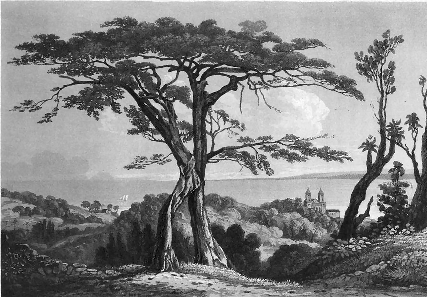
Tree in a Garden at Bahia.
Thursday, 18th.—We rode out before breakfast, through landscape so
fine, that I wished for a poet or a painter at every step. Sometimes we
went through thick wild wood into bushy hollows; then emerged on clear
lawns, sprinkled with palm trees, through which country-houses, farms,
and gardens were seen; and from every eminence, the bay, the sea, or the
lake, formed part of the scene. Here and there the huge gamela tree[64]
stands like a tower, adorned, besides its own leaves, with numberless
parasite plants, from the stiff cactus, to the swinging air plant[65];
and the frequent tower of church and monastery soften and improve the
features of the country.
.
Mr. Pennell has most kindly given our young men a general invitation to
his house; and accordingly, to-day several of them dined with him, and
we had a party in the evening, when some of the ladies played
quadrilles, while others danced.
Friday, 19th.—I accompanied Miss Pennell in a tour of visits to her
Portuguese friends. As it is not their custom to visit or be visited in
the forenoon, it was hardly fair to take a stranger to see them.
However, my curiosity, at least, was gratified. In the first place, the
houses, for the most part, are disgustingly dirty: the lower story
usually consists of cells for the slaves, stabling &c.; the staircases
are narrow and dark; and, at more than one house, we waited in a passage
while the servants ran to open the doors and windows of the
sitting-rooms, and to call their mistresses, who were enjoying their
undress in their own apartments. When they appeared, I could scarcely
believe that one half were gentlewomen. As they wear neither stay nor
bodice, the figure becomes almost indecently slovenly, after very early
youth; and this is the more disgusting, as they are very thinly clad,
wear no neck-handkerchiefs, and scarcely any sleeves. Then, in this hot
climate, it is unpleasant to see dark cottons and stuffs, without any
white linen, near the skin. Hair black, ill combed, and dishevelled, or
knotted unbecomingly, or still worse, en papillote, and the whole
person having an unwashed appearance. When at any of the houses the
bustle of opening the cobwebbed windows, and assembling the family was
over, in two or three instances, the servants had to remove dishes of
sugar, mandioc, and other provisions, which had been left in the best
rooms to dry. There is usually a sofa at each end of the room, and to
the right and left a long file of chairs, which look as if they never
could be moved out of their place. Between the two sets of seats is a
space, which, I am told, is often used for dancing; and, in every house,
I saw either a guitar or piano, and generally both. Prints and pictures,
the latter the worst daubs I ever saw, decorate the walls pretty
generally; and there are, besides, crucifixes and other things of the
kind. Some houses, however, are more neatly arranged; one, I think
belonging to a captain of the navy, was papered, the floors laid with
mat, and the tables ornamented with pretty porcelain, Indian and French:
the lady too was neatly dressed in a French wrapper. Another house
belonging to one of the judges was also clean, and of a more stately
appearance than the rest, though the inhabitant was neither richer nor
of higher rank. Glass chandeliers were suspended from the roof; handsome
mirrors were intermixed with the prints and pictures. A good deal of
handsome china was displayed round the room; but the jars, as well as
the chairs and tables, seemed to form an inseparable part of the walls.
We were every where invited, after sitting a few moments on the sofa, to
go to the balconies of the windows and enjoy the view and the breeze, or
at least amuse ourselves with what was passing in the street. And yet
they did not lack conversation: the principal topic, however, was praise
of the beauty of Bahia; dress, children, and diseases, I think, made up
the rest; and, to say the truth, their manner of talking on the latter
subject is as disgusting as their dress, that is, in a morning: I am
told they are different after dinner. They marry very early, and soon
lose their bloom. I did not see one tolerably pretty woman to-day. But
then who is there that can bear so total a disguise as filth and
untidiness spread over a woman?
Saturday, 20th.—As the charts of this coast hitherto published are
very incorrect, the captain asked permission from government to sound
and survey the bay: it is refused on the ground of policy; as if it
could be policy to keep hidden rocks and shoals, for one's own as well
as other people's ships.
I walked through the greater part of the town. The lower part extends
much farther than I could see the day I landed; it contains a few
churches, one of which, belonging to the monastery of A concepçaô, is
very handsome, but the smell within is disgusting; the flooring is laid
in squares with stone, and within each square there is a panelling of
wood of about nine feet by six; under each panel is a vault, into which
the dead are thrown naked, until they reach a certain number, when with
a little quick-lime thrown in, the wood is fastened down, and then
another square is opened, and so on in rotation. From that church,
passing the arsenal gate, we went along the low street, and found it
widen considerably at three quarters of a mile beyond: there are the
markets, which seem to be admirably supplied, especially with fish.
There also is the slave market, a sight I have not yet learned to see
without shame and indignation[66]: beyond are a set of arcades, where
goldsmiths, jewellers, and haberdashers display their small wares, and
there are the best-looking shops; but there is a want of neatness, of
that art of making things look well, that invites a buyer in England and
France. One bookseller's shop, where books are extravagantly dear,
exists in the low town, and one other in the ascent to the upper.
The upper town is most beautifully situated on the ridge between the sea
and the fresh water lake, and from its height, and the great slope of
most of the streets, it is incomparably cleaner than the port. The
cathedral dedicated to St. Salvador is a handsome building, and stands
on one side of a square, where the palace, prison, and other public
buildings are placed. The finest of these, the Jesuits' college, the
marble columns of which came from Europe ready cut, is now converted
into a barrack. The most useful is the hospital of Nossa Senhora da
Misericordia[67], founded by Juan de Matinhos, whose statue in white
marble, with a wig like Sir Cloudesley Shovel's in Westminster Abbey,
stands at the first landing-place, and is the ugliest piece of carving I
ever saw.
This hospital, besides its use as a refuge for the sick, of whom there
are generally about 120, maintains 50 young girls of decent parentage,
to whom a suitable education is given, and a dowry of 200 crowns
bestowed on them when they marry.[68] The building of the Misericordia
is a fair specimen of the style of the convents, public buildings, and
more noble houses,—rather handsome than elegant. It surrounds a large
area, subdivided into smaller courts; the staircase is of marble, inlaid
with coloured stucco, and the sides are lined with tiles of porcelain,
so as to form arabesques, often of very pretty design. This is both a
cool and a cleanly lining to a wall, particularly for an hospital. The
principal rooms are also decorated in the same manner; and many of the
fronts and cupolas of the churches are covered with similar tiles, the
effect of which is often exceedingly agreeable, when seen among the
trees and plainer buildings of the city. The chapel belonging to the
hospital is handsome, a little gaudy, however. The ceiling is
respectably painted, and was probably the work of an amateur monk of
the seventeenth century. The treatment of the sick is humane, and they
are well provided with food and other necessaries; but the medical
practice, though much improved of late years, is not the most
enlightened.
There is a great deal of jealousy of foreigners in the present
government, hence I was not able to enter many of the public buildings.
The government treasury was one I was desirous to see, but there were
objections. The treasury here was formerly considered as subordinate to
that of Rio de Janeiro, and accordingly paid a portion of its receipts
to bills drawn monthly by the treasurer in the capital, upon this, and
those of the other provinces. But since the revolution of the 10th of
February, the provisional government has taken upon itself to refuse
payment, on the grounds that it is entirely independent of Rio, until
the pleasure of the cortes at Lisbon shall be known. The revenue is
derived from direct taxes on land and provisions, excise upon exports
and imports, and harbour dues. Land is subject to a tax of one-tenth of
the whole of its produce, and since the revolution, church lands are
under the same law, and the clergy are paid by the government.
The taxes on provisions are annually farmed out to the highest bidder:
they are imposed on beef, fresh fish, farinha, and vegetables. Each
parish has its separate farmer, who pays the amount of his contract into
the treasury, and then makes the most he can of his dues.
The import and export duties are paid at the custom-house, between which
and the treasury a monthly settlement takes place.
The port dues for foreign ships are 2000 reals per day, a trifle for the
light house, and rather heavy charges for entering, clearing, &c.
Portuguese and Brazilian ships pay no anchorage, but are subject to a
tonnage.
We ended our perambulation of the town, by going to the opera at night.
The theatre[69] is placed on the highest part of the city, and the
platform before it commands the finest view imaginable. It is a handsome
building, and very commodious, both to spectators and actors. Within it
is very large and well laid out, but dirty and in great want of fresh
painting. The actors are very bad as such, and little better as singers;
but the orchestra is very tolerable. The piece was a very ill-acted
tragedy, founded on Voltaire's Mahomed. During the representation, the
Portuguese ladies and gentlemen seemed determined to forget the stage
altogether, and to laugh, eat sweetmeats, and drink coffee, as if at
home. When the musicians, however, began to play the overture to the
ballet, every eye and voice was directed to the stage, and a loud call
for the national hymn followed, and not till it had been played again
and again, was the ballet suffered to proceed. During the bustle
occasioned by this, a captain in the army was arrested and hurried out
of the pit; some say for picking pockets, others for using intemperate
language on politics, when the national hymn was called for. Meantime
one of the midshipmen of our party had his sword stolen, adroitly
enough, from the corner of the box, yet we perceived nobody enter; so
that we conclude a gentleman in regimentals in the next box thought it
would suit him, and so buckled it on to go home with.
The police here is in a wretched state. The use of the dagger is so
frequent, that the secret murders generally average two hundred yearly,
between the upper and lower towns. To this evil the darkness and
steepness of the streets mainly contribute, by furnishing almost a
certainty of escape. The nominal intendente da policia is also the
supreme judge in criminal cases. No law, however, has as yet determined
the limits or scope, either of his power, or that of the
lieutenant-colonel of police, who calls upon a few soldiers from any of
the garrisons whenever he has to act, and who appoints military patroles
also from among the soldiers on duty. It often happens that persons
accused before this formidable officer are seized and imprisoned for
years, without ever being brought to a trial; a malicious information,
whether true or false, subjects a man's private house to be broken open
by the colonel and his gang; and if the master escapes imprisonment it
is well, though the house scarcely ever escapes pillage. In cases of
riot and quarrels in the street, the colonel generally orders the
soldiers to fall on with canes, and beat people into their senses. Such
being the state of the police, it is, perhaps, more wonderful that
murders are so few, than that they are so many. Where there is little or
no public justice, private revenge will take its place.
Sunday, 21st.—We went to the English chapel, and were well pleased
with the decent manner in which the service was performed. The Rev.
Robert Synge is chaplain, a man of cheerful convivial manners, yet
exceedingly attentive both as chaplain, and as guardian of his poorer
countrymen. The chapel and clergymen are supported by the contribution
fund, as are also the hospital for English sailors and others, and its
surgeon, Mr. Dundas: both the hospital and chapel are under the same
roof. I was surprised, perhaps unreasonably, to hear Mr. Synge pray for
"Don John of Portugal, Sovereign of these realms, by whose gracious
permission we are enabled to meet and worship God according to our
conscience," or words to that effect. We were not so polite in Rome, I
remember, as to pray for His Holiness, though it would have been but
reasonable.
Returning from chapel, we saw great part of the troops drawn up in
inspecting order, on the little green between Buenos Ayres (the name
of the hospital) and Fort Pedro. Every Portuguese is, it seems, by birth
a soldier; and nothing exempts a man from military duty, but his holding
a place under government. There are six corps of militia in the city of
Bahia: 1st, one company of mounted gentlemen, forming the government
guard of honour; 2d, one squadron of flying artillery; 3d and 4th, two
regiments of whites, almost all tradespeople; 5th, one regiment of
mulatoes; and 6th, one of free blacks, amounting altogether to 4000 men,
well armed and equipped; but the black regiment is unquestionably the
best trained, and most serviceable, as a light infantry corps. The
regiments of country militia, as those of Cachoeira, Piraja, &c. are much
stronger, and with those of the city, amount to about 15,000 men. The
officers are chosen from among the most respectable families, and with
the exception of the majors and adjutants, who are of the line, receive
no pay.
The troops of the capital are generally reviewed or inspected on
Sundays, and sometimes the regular Portuguese are reviewed with them.
There is always something gay and inspiriting in martial sounds and
martial sights; and the fine weather, gay landscape, and above all, the
idea that in a day or two, nay, this very night, these same soldiers
might be called into action, did not render the scene less interesting.
The native artillery have long garrisoned some of the forts. It appears
that the royal troops of Portugal have claimed some superiority, and
above all, have demanded their guns and ammunition; and so there is a
dispute, in which the royalists and independents take part, and every
day hostilities are expected; but both parties seem so willing to be
peaceable, that I trust the matter will end without bloodshed.
Monday, 22d.—This evening there was a large party, both Portuguese
and English, at the consul's. In the well-dressed women I saw to-night,
I had great difficulty in recognising the slatterns of the other
morning. The senhoras were all dressed after the French fashion: corset,
fichu, garniture, all was proper, and even elegant, and there was a
great display of jewels. Our English ladies, though quite of the second
rate of even colonial gentility, however, bore away the prize of beauty
and grace; for after all, the clothes, however elegant, that are not
worn habitually, can only embarrass and cramp the native movements; and,
as Mademoiselle Clairon remarks, "she who would act a gentlewoman in
public, must be one in private life."
The Portuguese men have all a mean look; none appear to have any
education beyond counting-house forms, and their whole time is, I
believe, spent between trade and gambling: in the latter, the ladies
partake largely after they are married. Before that happy period, when
there is no evening dance, they surround the card tables, and with eager
eyes follow the game, and long for the time when they too may mingle in
it. I scarcely wonder at this propensity. Without education, and
consequently without the resources of mind, and in a climate where
exercise out of doors is all but impossible, a stimulus must be had; and
gambling, from the sage to the savage, has always been resorted to, to
quicken the current of life. On the present occasion, we feared the
young people would have been disappointed of their dance, because the
fiddlers, after waiting some time, went away, as they alleged, because
they had not their tea early enough; however, some of the ladies
volunteered to play the piano, and the ball lasted till past midnight.
Tuesday, 23d.—I rode with Mr. Dance and Mr. Ricken along the banks of
the lake, decidedly the most beautiful scenery in this beautiful
country; and then through wild groves, where all the splendours of
Brazilian animal and vegetable life were displayed. The gaudy plumage of
the birds, the brilliant hues of the insects, the size, and shape, and
colour, and fragrance, of the flowers and shrubs, seen mostly for the
first time, enchanted us, and rendered our little journey to the great
pepper gardens, whither we were going, delightful. Every hedge is at
this season gay with coffee blossom, but it is too early in the year for
the pepper or the cotton to be in beauty. It is not many years since
Francisco da Cunha and Menezes sent the pepper plant from Goa for these
gardens, which were afterwards enlarged by him, when he became governor
of Bahia. Plants were sent from hence to Pernambuco, which have
succeeded in the botanical garden.
From the pepper gardens we rode on to a convent at the farther extremity
of the town, and overlooking both the bays, above and below the
peninsula of Bon fin, or N.S. da Monserrat. It is called the Soledad,
and the nuns are famous for their delicate sweetmeats, and for the
manufacture of artificial flowers, formed of the feathers of the
many-coloured birds of their country. I admired the white water-lily
most, though the pomegranate flower, the carnation, and the rose are
imitated with the greatest exactness. The price of all these things is
exorbitant; but the convents having lost much of their property since
the revolution, the nuns are fain to make up by the produce of this
petty industry, for the privations imposed on them by the reduction of
their rents.
Wednesday, October 24th.—Mr. Pennell, his daughter, and a few other
friends, joined us in an expedition to Itaparica[70], a large island
that forms the western side of the Bay of All Saints. A shoal runs off
from it a long way to sea, and there are reefs of coral rocks on
different parts of its coast. The distance from the city to the nearest
landing place on the island is five miles and a half, which our boats'
crews rowed in less than two hours. We put in between two ledges of
rock, to a little jetty, belonging to the fazenda or factory of Aseoli,
or Filisberti, both of whom were partners in Jerome Buonaparte's
commercial establishment here. There is no town on Itaparica; but there
is a villa, or village, with a fort on the Punto de Itaparica, which
commands the passage between it and the main land, and also the mouth of
the river, on which stands Nazareth da Farinha, so called from the
abundance of that article which it produces. There are also a great many
fazendas, which, with their establishment of slaves and cattle, may be
considered as so many hamlets. Each sugar farm, or ingenho, as the
fazendas are oftener called here, has its little community of slaves
around it; and in their huts something like the blessings of freedom are
enjoyed, in the family ties and charities they are not forbidden to
enjoy. I went into several of the huts, and found them cleaner and more
comfortable than I expected; each contains four or five rooms, and each
room appeared to hold a family. These out-of-door slaves, belonging to
the great ingenhos, in general are better off than the slaves of masters
whose condition is nearer to their own, because, "The more the master is
removed from us, in place and rank, the greater the liberty we enjoy;
the less our actions are inspected and controuled; and the fainter that
cruel comparison becomes betwixt our own subjection, and the freedom, or
even dominion of another." But, at best, the comforts of slaves must be
precarious. Here it is not uncommon to give a slave his freedom, when he
is too old or too infirm to work; that is, to turn him out of doors to
beg or starve. A few days ago, as a party of gentlemen were returning
from a pic nic, they found a poor negro woman lying in a dying state,
by the side of the road. The English gentlemen applied to their
Portuguese companions to speak to her, and comfort her, as thinking she
would understand them better; but they said, "Oh, 'tis only a black: let
us ride on," and so they did without further notice. The poor creature,
who was a dismissed slave, was carried to the English hospital, where
she died in two days. Her diseases were age and hunger.[71] The slaves I
saw here working in the distillery, appear thin, and I should say
over-worked; but, I am told, that it is only in the distilling months
that they appear so, and that at other seasons they are as fat and
cheerful as those in the city, which is saying a great deal. They have a
little church and burying-ground here, and as they see their little lot
the lot of all, are more contented than I thought a slave could be.
Sugar is the principal product of Itaparica; but the greater part of the
poultry, vegetables, and fruit, consumed in Bahia, are also from the
island, and lime is made here in considerable quantities from the
madrepores and corals found on the beach. This island used to furnish
the neighbourhood with horses. When the English fleet and army stopped
here, on the way to the Cape of Good Hope, the horses for the cavalry
regiments were procured here. However, there is nothing remarkable in
Itaparica but its fertility; the landscape is the same in character with
that of Bahia, though in humbler style; but it is fresh and green, and
pleasing. After dining in a palm-grove, and walking about till we were
tired, we re-embarked to return; but the tide was unfavourable; we
drifted among the rocks, where Coutinho, the first founder of the colony
of Bahia, was wrecked and afterwards murdered by the natives, and we
were in consequence four hours in returning home.
26th, 27th, 28th, passed in pleasant enough intercourse with our
countrymen, though neither of us were well enough to go much on shore,
therefore our friends came to us. There are eighteen English mercantile
houses established at Bahia, two French, and two German. The English
trade is principally carried on with Liverpool, which supplies
manufactured goods and salt, in exchange for sugars, rums, tobaccos,
cottons, very little coffee, and molasses. Lately, sugars have been
shipped, on English account, for Hamburgh to a great extent, and I
believe part of the returns are in German or Prussian woollen-cloths.
The province of Bahia, by its neglect of manufactures, is quite
dependent on commerce. But the distance from the sea of the province of
Minas Geraes, has induced the inhabitants to weave not only enough
coarse cotton cloths for home consumption, but even to become an article
of trade with the other captaincies.
In the province of Esperitu Santo, cotton sail-cloth is made; but the
chief trade of this place is slaving. This year no less than
seventy-six slave-ships have sailed, without reckoning the smugglers in
that line.
Sunday, 28th.—Mr. Pennell had kindly fixed to-day for giving us a
party in the country, and accordingly some of our young people were to
go and assist in putting up tents, &c.; but a miscalculation of tide and
time, and a mistake as to the practicability of landing on part of the
beach beyond the light-house, occasioned a variety of adventures and
accidents, without which I have always heard no fête champêtre could be
perfect. However that may be, our party was a pleasant one. Instead of
the tents, we made use of a country-house called the Roça, where beauty
of situation, and neatness in itself and garden, made up for whatever we
might have thought romantic in the tents, had they been erected. It is
the fashion to pave the courts of the country-houses here with dark
pebbles, and to form in the pavement a sort of mosaic with milk-white
shells. The gardens are laid out in alleys, something in the oriental
taste. The millions of ants, which often in the course of a single night
leave the best-clothed orange-tree bare both of leaves and flowers,
render it necessary to surround each tree with a little stucco wall, or
rather canal, in which there is water, till they are strong enough to
recover if attacked by the ants. In the garden at Roça, every shrub of
value, either for fruit or beauty, was so fenced, and there were seats,
and water channels, and porcelain flower-pots, that made me almost think
myself in the East. But there is a newness in every thing here, a want
of interest on account of what has been, that is most sensibly felt. At
most, we can only go back to the naked savage who devoured his prisoner,
and adorned himself with bones and feathers here. In the East,
imagination is at liberty to expatiate on past grandeur, wisdom, and
politeness. Monuments of art and of science meet us at every step:
here, every thing, nature herself, wears an air of newness, and the
Europeans, so evidently foreign to the climate, and their African
slaves, repugnant to every wholesome feeling, show too plainly that they
are intruders, ever to be in harmony with the scene. However, Roça is
beautiful, and all those grave thoughts did not prevent us from
delighting in the fair prospect of
"Hill and valley, fountain and fresh shade;"
nor enjoying the scent of oleander, jasmine, tuberose, and rose,
although they are adopted, not native children of the soil.
Of the Portuguese society here I know so very little, that it would be
presumptuous to give an opinion of it. I have met with two or three
well-informed men of the world, and some lively conversable women; but
none of either sex that at all reminded me of the well-educated men and
women of Europe. Here the state of general education is so low, that
more than common talent and desire of knowledge is requisite to attain
any; therefore the clever men are acute, and sometimes a little vain,
feeling themselves so much above their fellow-citizens, and the portion
of book-learning is small. Of those who read on political subjects, most
are disciples of Voltaire, and they outgo his doctrines on politics, and
equal his indecency as to religion; hence to sober people who have seen
through the European revolutions, their discourses are sometimes
disgusting. The Portuguese seldom dine with each other; when they do, it
is on some great occasion, to justify a splendid feast: they meet every
evening either at the play, or in private houses, and in the last case
gamble very deeply. The English society is just such as one may expect.
A few merchants, not of the first order, whose thoughts are engrossed by
sugars and cottons, to the utter exclusion of all public; matters that
do not bear directly on their private trade, and of all matters of
general science or information. Not one knew the name of the plants
around his own door; not one is acquainted with the country ten miles
beyond St. Salvador's; not one could tell me even the situation of the
fine red clay, of which the only manufacture, pottery, here is made: in
short, I was completely out of patience with these incurious
money-makers. I was perhaps unjust to my countrymen: I dare say there
are many who could have told me these things, but I am sure none did
tell me, and equally sure that I asked information of all I met with.
But a woman is not, I believe, considered as privileged to know any
thing by these commercial personages. The English are, however,
hospitable and sociable among each other. They often dine together: the
ladies love music and dancing, and some of the men gamble as much as the
Portuguese. Upon the whole, society is at a low, very low scale here
among the English. Good eating and good drinking they contrive, to have,
for the flesh, fish, and fowl are good; fruits and vegetables various
and excellent, and bread of the finest. Their slaves, for the English
are all served by slaves, indeed, eat a sort of porridge of mandioc meal
with small squares of jerked beef stirred into it, or, as their greatest
luxury, stewed caravansas; and this is likewise the principal food of
the lower classes even of the free inhabitants. In the fruit season,
pumpkins, jackfruit, cocoa-nut, and melons, nearly take place of the
mandioc. The huts of the poor are formed of upright poles, with branches
of trees wattled between, and covered and lined either with cocoa-leaf
mats, or clay; the roofs are also thatched. The better houses are built
either of a fine blue stone, quarried on the beach of Victoria, or of
brick. They are all white-washed: where the floor is not laid with wood,
a fine red brick, six to nine inches square, and three in thickness, is
used, and they are roofed with round red tiles. The houses are generally
of one story high, with a room or two above by way of a look-out house.
Under the house is generally a sort of cellar, in which the slaves live;
and really I have sometimes wondered that human beings could exist in
such.
Friday, 2d November.—Several of our people having yielded to the
temptations of some worthless persons in the town, who induce sailors to
desert in order that they themselves may profit by the premium given for
the discovery of deserters, and having consequently swam on shore, the
frigate has been moved up the harbour as far as Bom Fim, and it is
intended to take her up still higher. I am glad of the opportunity of
seeing more of this beautiful bay, and shall endeavour to land on the
Ilha do Medo, or the point of Itaparica, where the first adventurers
from Europe underwent hardship that appear hardly credible in our modern
days. We also wish to examine the harbour within the funil or passage
between the two islands, and into which the river or creek of Nazareth,
which supplies Bahia with great part of the mandioc flour consumed
there, runs.
Saturday, 3d November.—Our plan of proceeding farther up the harbour
is suspended for the present. The disputes between the European
Portuguese and the Brazilians in the city, seem to be about to come to a
crisis. Early this morning, we learned that troops were assembling from
all quarters, and that therefore it was advisable, for the protection of
the British property and the persons of the merchants, that the ship
should return to her station opposite to the town. The first provisional
junta has lost several of its members, two of them being gone as
delegates to Lisbon, and others being absent on account of ill health or
disgust. The party opposing this junta talk loudly of independence, and
wish at least one-half of the members of the provisional government to
be native Brazilians. They also complain bitterly, that instead of
redressing the evils they before endured, the junta has increased them
by several arbitrary acts; and assert that one of the members who has a
great grazing estate, has procured a monopoly, by which no man can
supply the market with beef without his permission, so that the city is
ill supplied. Such a ground of complaint will always excite popular
indignation, and it appears now to be at its height. There has already
been some skirmishing, in which, however, I hear there have been only
three men killed. The Brazilian artillery occupies Fort San Pedro; the
governor, and the wreck of the junta, have the town and the palace. The
governor, indeed, has arrested several, I think seventeen persons, in an
arbitrary manner; among these, two of my acquaintance, Colonel
Salvador[72] and Mr. Soares, and have put them, some on board the Don
Pedro, some on board transports in the bay, for the purpose of
transporting them to Lisbon. Some of these persons are not permitted to
have any communication with their families; others, more favoured, are
allowed to carry them with them. These are not the means to conciliate.
We have sent on shore to offer shelter to the ladies, and Captain Graham
has agreed upon certain signals with the consul, in case of increased
danger to his family.
Sunday, November 4th.—On looking out at daylight this morning, we saw
artillery planted, and troops drawn up on the platform opposite to the
opera house. I went on shore to see if Miss Pennell, her sister, or any
of our other friends would come on board; but they naturally prefer
staying to the last with their fathers and husbands. Notwithstanding the
warlike movements of these last two days, it appears most likely that
the chiefs of the opposite parties will agree to await the decision of
the cortes at Lisbon, with respect to their grievances, and at least a
temporary peace will succeed to this little disturbance.
It appears, however, next to impossible that things should remain as
they are. The extreme inconvenience of having the supreme courts of
justice so far distant as Lisbon must be more and more felt as the
country increases in population and riches. The deputies to the cortes
are too far removed from their constituents to be guided in their
deliberations or votes by them; and the establishment of so many juntas
of government, each only accountable to the cortes, must be a cause of
internal disorder, if not of civil war, at no distant time.
Monday, 5th.—A day of heavy tropical rain, which has forced both
parties on shore to house their guns, and to desist for the present from
all farther hostility. The governor, however, continues his arbitrary
arrestations. It is curious how ancient authority awes men; for surely
it is the accustomed obedience to the name of the king, and the dread of
the name of rebellion, that prevents the Brazilians, armed as they are,
from resisting these things.
Tuesday, November 6th.—The Morgiana, Captain Finlaison, came in from
Rio de Janeiro. She belongs to the African station, and came to Brazil
about some prize business connected with the slave trade. Captain
Finlaison tells me tales that make my blood run cold, of horrors
committed in the French slave ships especially. Of young negresses,
headed up in casks and thrown overboard, when the ships are chased. Of
others, stowed in boxes when a ship was searched; with a bare chance of
surviving their confinement. But where the trade is once admitted, no
wonder the heart becomes callous to the individual sufferings of the
slaves. The other day I took up some old Bahia newspapers, numbers of
the Idade d'Ouro, and I find in the list of ships entered during three
months of this year,
| | | | Alive. | Dead. |
| 1 | slave ship | from Moyanbique, 25th March, with | 313 | 180 |
| 1 | do. | — 6th March | 378 | 61 |
| 1 | do. | — 30th May | 293 | 10 |
| 1 | do. | — 29th June from Molendo, | 357 | 102 |
| 1 | do. | — 26th June | 233 | 21 |
| | | | —— | —— |
| | | | 1574 | 374 |
| | | | —— | —— |
So that of the cargoes of these five ships reckoned thus accidentally,
more than one in five had died on the passage!
It seems the English ships of war on the African coast are allowed to
hire free blacks to make up their complements when deficient. There are
several now onboard the Morgiana, two of whom are petty officers, and
they are found most useful hands. They are paid and victualled like our
own seamen.[73]
Thursday, November 8.—We went on board Morgiana to call on Mrs.
Macgregor, a lively intelligent Spaniard, who with her husband, Colonel
Macgregor, is a passenger. She joined me in visits on shore, where the
only news is, that the governor continues to arrest all persons
suspected of favouring independence.
November 9.—The Brazilians who occupy the forts of San Pedro and
Santa Maria, had threatened to fire on the Don Pedro, if she attempted
to get under weigh with the state prisoners on board. Nevertheless
during the night she bent her sails, and sailed early this morning,
carrying, it is said, twenty-eight gentlemen, who have been taken up
without any ostensible reason. They are understood to have spoken in
favour of the independence of Brazil. Several of our officers went on
shore to dine with the gentlemen of the English club, who meet once a
month, to eat a very good dinner, and drink an immoderate quantity of
wine for the honour of their country.
Tuesday, November 13.—We have had, for ten days past, some of the
heaviest showers I remember to have seen, and in going to and from the
ship, we have generally been wet through; nevertheless some of our
friends ventured on board to-day to dine with us, among the rest Colonel
and Mrs. Macgregor; they were a little late, owing to a skirmish between
the Portuguese and Brazilians, that occurred close to their house, just
as they were setting off. Apparently it had not been premeditated, for
the parties were fighting with sticks and stones, as well as swords and
fire-arms. The combatants would not allow any officer in Portuguese
regimentals to pass, so that Colonel Macgregor was obliged to go back
and change his dress before he could come. All this appears to proceed
more from a want of police than any other cause.
16th.—Several of our young people and I myself have begun to feel the
bad effects of exposing ourselves too much to the sun and the rain.
Yesterday I was so unwell as to put on a blister for cough and pain in
my side, and several of the others have slight degrees of fever. But
generally speaking, the ship's company has been remarkably healthy.
Friday, 16th.—Captain Graham taken suddenly and alarmingly ill.
Towards evening he became better, and was able to attend to a most
painful business. Last night a man belonging to the Morgiana was killed,
and the corporal of marines belonging to the ship severely wounded, on
shore. It appears that neither of these men had so much as seen the
murderer before. He had been drinking in the inner room of a venda with
some sailors, and having quarrelled with one of them, he fancied the
rest were going to seize him, when he drew his knife to intimidate them,
and rushed furiously out of the room. The young man who was killed was
standing at the outer door, waiting for one of his companions who was
within, and the murderer seeing him there, imagined he also wished to
stop him, and therefore stabbed him to the heart. Our corporal, who was
passing by, saw the deed, and of course attempted to seize him, and in
the attempt received a severe wound. It is said, I know not with what
truth, that Captain Finlaison is so hated here, on account of his
activity against the slave trade, that none of his people are safe, and
the death of the unfortunate man is attributed to that cause; but it
appears to have been the result of a drunken quarrel. The town, however,
appears to be in a sad disorderly state: besides our two men, a
Brazilian officer was dangerously wounded in the dark, and three
Brazilian soldiers and their corporal were found murdered last night.
Captain Graham had sent one of his officers to act for him on the
occasion, and to apply through the British consul to the police
magistrate, Francisco Jose Perreira, for redress.[74] He himself is
sensibly worse since he exerted himself to attend to this painful
business.
The disorders of this climate are sadly enfeebling; they attack both
mind and body, producing a painful sensitiveness to the slightest
incident.
November 18th.—Our invalids have been sadly disturbed by the rockets
which have been fired, ever since sunrise, from the church of our Lady
of Conception[75], whose feast is on the 8th of December. But the three
Sundays previous to it the church and convent are adorned, sermons are
preached, rockets are fired, contributions are made, and the shipping in
the harbour fire salooes at sunrise, at noon, and at sunset. The annual
expense of rockets, and other fireworks, is enormous. Those used in
Brazil all come from the East Indies and China. Sometimes, when
manufactured goods are unsaleable here, the merchant ships them on board
a Portuguese East Indiaman, and gets in return fireworks, which never
fail to pay well. I have seen a set of cut-glass sent to Calcutta for
the purpose, or a girandole, too handsome for Brazilian purchasers.
Yesterday the ship's pinnace, which had been absent five days with the
master, my cousin Glennie, and young Grey, returned. They had gone to
examine the river of Cachoeira, and came back highly delighted with
their trip, though they had some very bad weather; however, with
tarpaulines, cloaks, and a blanket or two, which I insisted on their
taking, they managed so well as to have returned in good health.
Cachoeira, about fifty miles from Bahia, is a good town, where there is
one English merchant resident. It is populous[76] and busy; for it is
the place where the produce, chiefly cotton and tobacco, of a very
considerable district, is collected, in order to be shipped for Bahia.
It is divided into two unequal parts, by the river Paraguazu. Its parish
church is dedicated to our Lady of the Rosary. It has two convents, four
chapels, an hospital, a fountain, and three stone bridges over the small
rivers Pitanga and Caquende, on which there are very extensive
sugar-works. There are wharfs on both sides of the river. The streets
are well paved, and the houses built of stone, and tiled: the country is
flat, but agreeable. The river is not navigable more than two miles
above the town; it there narrows and becomes interrupted by rocks and
rapids, and there is a wooden bridge across it. About five miles from
Cachoeira, there is an insulated conical hill, called that of
Conception, whence there often proceed noises like explosions. These
noises are considered in this country as indicative of the existence of
metals. Near this place a piece of native copper was found, weighing
upwards of fifty-two arobas. It is now in the museum of Lisbon.
Our exploring party landed on several of the islands, on their way up
the river, and were every where received with great hospitality, and
delighted with the beauty and fertility of the country.
22d.—At length all the invalids, excepting myself, are better; but,
with another blister on, I can do little but write, or look from the
cabin windows; and when I do look, I am sure to see something
disagreeable. This very moment, there is a slave ship discharging her
cargo, and the slaves are singing as they go ashore. They have left the
ship, and they see they will be on the dry land; and so, at the command
of their keeper, they are singing one of their country songs, in a
strange land. Poor wretches! could they foresee the slave-market, and
the separations of friends and relations that will take place there, and
the march up the country, and the labour of the mines, and the
sugar-works, their singing would be a wailing cry. But that "blindness
to the future kindly given," allows them a few hours of sad enjoyment.
This is the principal slave port in Brazil; and the negroes appear to me
to be of a finer, stronger race, than any I have ever seen. One of the
provisional junta of government is the greatest slave merchant here.
Yet, I am happy to say, the Bahia press has lately actually printed a
pamphlet against the slave trade. Within the last year, seventy-six
ships have sailed from this port for the coast of Africa; and it is well
known that many of them will slave to the northward of the line, in
spite of all treaties to the contrary: but the system of false papers is
so cunningly and generally carried on, that detection is far from easy;
and the difficulties that lie in the way of condemning any slave ship,
render it a matter of hazard to detain them. An owner, however, is well
satisfied, if one cargo in three arrives safe; and eight or nine
successful voyages make a fortune. Many Brazilian Portuguese have no
occupation whatever: they lay out a sum of money in slaves; which slaves
are ordered out every day, and must bring in a certain sum each night;
and these are the boatmen, chairmen, porters, and weavers of mats and
hats that are to be hired in the streets and markets, and who thus
support their masters.
24th.—Yesterday the Morgiana sailed for Pernambuco, whence she will
return to the coast of Africa. To-day the Antigone French frigate,
commanded by Captain Villeneuve, nephew to the admiral of that name who
was at Trafalgar, came in. Whenever France and England are not at war,
the French and English certainly seek each other, and like each other
more than any other two nations: and yet they seem like two great heads
of parties, and the other nations take the French and English sides, as
if there were no cause of opposition but theirs. Others may account for
the fact, I am satisfied that it is so; and that whenever we meet a
Frenchman in time of peace, in a distant country, it is something akin
to the pleasure of seeing a countryman; and it is particularly the case
with French naval men. Frequent intercourse of any kind, even that of
war, begets a similarity of habits, manners, and ideas; so I suppose we
have grown alike by fighting, and are all the more likely to fight
again.
There is a report, but I believe not well founded, that placards are
stuck up about the city threatening that all Europeans, especially
Portuguese, who do not leave the place before the 24th of December,
shall be massacred. I listen to these things, because reports, even when
false, indicate something of the spirit of the times.
December 8th.—This place is now so quiet that the merchants feel
quite safe, and therefore we are leaving Bahia. I have taken leave of
many hospitable persons who have shown us much attention; but my health
is so indifferent, that but for the sake of that civility which I felt
due to them, I should not have gone ashore again: however, it is all
done, and we are in the act of getting under weigh.
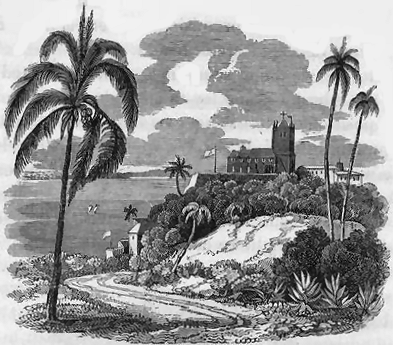
9th.—As we sailed out of the bay, we amused ourselves with
conjecturing the possible situation of Robinson Crusoe's plantation in
the bay of All Saints. Those who had been at Cachoeira chose that it
should be in that direction; while such as had been confined to the
neighbourhood of the city pitched on different sitios, all or any of
which might have answered the purpose. There is a charm in Defoe's works
that one hardly finds, excepting in the Pilgrim's Progress. The language
is so homely, that one is not aware of the poetical cast of the
thoughts; and both together form such a reality, that the parable and
the romance alike remain fixed on the mind like truth. And what is
truth? Surely not the mere outward acts of vulgar life; but rather the
moral and intellectual perceptions by which our judgment, and actions,
and motives, are directed. Then, are the wanderings of Christiana and
Mercy, and the sufferings of the shipwrecked mariner, true in the right
sense of the word truth? True as the lofty creations of Milton, and the
embodied visions of Michael Angelo; because they have their basis and
their home in the heart, and soul, and understanding of man.
But we are once more upon the ocean, and our young people are again
observing the stars, and measuring the distances of the planets. I
grieve that one of the most promising of them is now an inmate in my
cabin, in a very delicate state of health.
12th.—Yesterday we found soundings, which indicated the neighbourhood
of the Abrolhos, and lay-to all night, that we might ascertain the exact
position of those dangerous shoals; which, at the distance of three
leagues, bearing N. W. by W., appeared like one long ragged island to
the westward, and two smaller very low to the east.
The banks extend very far out to the eastward. There is a deep passage
between them and the mainland. With a little attention, a most
profitable fishery might be established here.
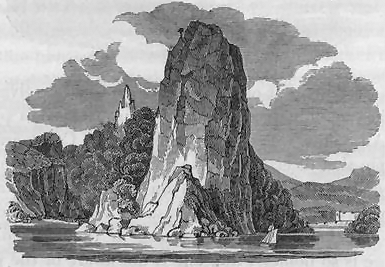
Rio de Janeiro, Saturday, December 15th, 1821.—Nothing that I have
ever seen is comparable in beauty to this bay. Naples, the Firth of
Forth, Bombay harbour, and Trincomalee, each of which I thought perfect
in their beauty, all must yield to this, which surpasses each in its
different way. Lofty mountains, rocks of clustered columns, luxuriant
wood, bright flowery islands, green banks, all mixed with white
buildings; each little eminence crowned with its church or fort; ships
at anchor or in motion; and innumerable boats flitting about in such a
delicious climate,—combine to render Rio de Janeiro the most enchanting
scene that imagination can conceive. We anchored first close to a small
island, called Villegagnon, about two miles from the entrance of the
harbour. That island, however small, was the site of the first colony
founded by the Frenchman Villegagnon, under the patronage of Coligny,
whom he betrayed. The admiral had intended it as a refuge for the
persecuted Hugonots; but when Villegagnon had, by his means, formed the
settlement, he began to persecute them also: the colony fell into decay,
and became an easy conquest to Mem de Sa, the Portuguese captain-general
of Brazil.[77]
We moved from this station to one more commodious nearer the town, and
higher up the harbour, towards the afternoon, which soon became so
rainy, that I gave up all hopes of getting ashore. I was really
disappointed to find that my excellent friend, the Hon. Capt. S. had
left the station with his frigate before we arrived; I had, however, the
pleasure of receiving a kind letter from him, and he had left me a copy
of the great Spanish dictionary. Nobody that has always lived at home,
can tell the value of a kindness like this in a foreign land.
Sunday, 16th.—I had the pleasure of seeing on board Mr. W. May, who
has long been a resident in Brazil, and with whom I had spent many happy
hours in early life. The pleasure such meetings give is of the purest
and wholesomest nature. It quiets the passions by its own tranquillity;
and, in recalling all the innocent and amiable feelings of youth, makes
us almost forget those harsher emotions which intercourse with the
world, and the operation of interest, passion, or suffering have raised.
Monday, 17th.—By the assistance of some friends ashore, we have
procured a comfortable house in one of the suburbs of Rio, called the
Catete, from the name of a little river which runs through it into the
sea. To this house I have brought my poor suffering midshipman,
Langford; and trust that free air, moderate exercise, and a milk diet,
will restore him. We have been visited by several persons, who all
appear hospitable and kind, particularly the acting consul-general, Col.
Cunningham, and his lady.
December 18th.—I have begun house-keeping on shore. We find
vegetables and poultry very good, but not cheap; fruit is very good and
cheap; butcher's meat cheap, but very bad: there is a monopolist
butcher, and no person may even kill an animal for his own use without
permission paid for from that person; consequently, as there is no
competition, he supplies the market as he pleases.[78] The beef is so
bad, that it can hardly be used even for soup meat, three days out of
four; and that supplied to the ships is at least as bad: mutton is
scarce and bad: pork very good and fine; it is fed principally on
mandioc and maize, near the town; that from a distance has the advantage
of sugar cane. Fish is not so plentiful as it ought to be, considering
the abundance that there is on the whole coast, but it is extremely
good; oysters, prawns, and crabs are as good as in any part of the
world. The wheaten bread used in Rio is chiefly made of American flour,
and is, generally speaking, exceedingly good. Neither the captaincy of
Rio, nor those to the north, produce wheat; but in the high lands of St.
Paul's, and the Minas Geraes, and in the southern provinces, a good deal
is cultivated, and with great success. The great article of food here is
the mandioc meal, or farinha; it is made into thin broad cakes as a
delicacy, but the usual mode of eating it is dry: when at the tables of
the rich, it is used with every dish of which they eat, as we take
bread; with the poor, it has every form—porridge, brose, bread; and no
meal is complete without it: next to mandioc, the feijoam or dry
kidney-bean, dressed in every possible way, but most frequently stewed
with a small bit of pork, garlic, salt, and pimento, is the favourite
food; and for dainties, from the noble to the slave, sweetmeats of every
description, from the most delicate preserves and candies to the
coarsest preparations of treacle, are swallowed wholesale.
We have hired a horse for our invalid, and I have borrowed one for
myself. These animals are rather pretty at Rio, but far from strong;
they are fed on maize and capim, or Guinea grass, which was introduced
of late years into Brazil, and thrives prodigiously: it is cultivated by
planting the joints; the stem and leaves are as large as those of
barley; it grows sometimes to the height of six or seven feet, and the
flower is a large loose pannicle. The quantity necessary for each horse
per day costs about eightpence, and his maize as much more. The common
horses here sell for from twenty to one hundred dollars; the fine Buenos
Ayres horses fetch a much higher price. Mules are generally used for
carriages, being much hardier, and more capable of bearing the summer
heat.
December 19th.—I walked by the side of Langford's horse up one of the
little valleys at the foot of the Corcorado: it is called the
Laranjeiros, from the numerous orange trees which grow on each side of
the little stream that beautifies and fertilises it. Just at the
entrance to that valley, a little green plain stretches itself on either
hand, through which the rivulet runs over its stony bed, and affords a
tempting spot to groups of washerwomen of all hues, though the greater
number are black; and they add not a little to the picturesque effect of
the scene: they generally wear a red or white handkerchief round the
head; and a full-plaited mantle tied over one shoulder, and passed under
the opposite arm, with a full petticoat, is a favourite dress. Some wrap
a long cloth round them, like the Hindoos; and some wear an ugly
European frock, with a most ungraceful sort of bib tied before them.
Round the washerwoman's plain, hedges of acacia and mimosa fence the
gardens of plantains, oranges, and other fruits which surround every
villa; and beyond these, the coffee plantations extend far up the
mountain, whose picturesque head closes the scene. The country-houses
here are neither large nor magnificent; but they are decorated with
verandas, and have often a handsome flight of steps up to the
dwelling-house of the master, beneath which are either store-houses, or
the habitations of the slaves: they have all a gateway, large and
handsome, whatever the house may be; and that gateway generally leads to
at least one walk where every kind of flower is cultivated. Brazil is
particularly rich in splendid creeping flowers and shrubs; and these are
mingled with the orange and lemon blossoms, and the jasmine and rose
from the East, till the whole is one thicket of beauty and fragrance. I
scarcely know whether my invalid or myself enjoyed the morning most. A
few more such, and I should think all sickness must disappear.
December 20th.—Spent in paying and receiving visits in the
neighbourhood. The houses are built a good deal like those of the south
of Europe: there is generally a court, on one side of which is the
dwelling-house, and the others are formed by the offices and garden.
Sometimes the garden is immediately close to the house, and in the
suburbs this is generally the case. In town, very few houses have the
luxury of a garden at all. These gardens are rather like oriental
flower-plots, but they assimilate well with the climate. The flowers of
the parterres of Europe grow by the side of the gayer plants and shrubs
of the country, shaded by the orange, banana, bread-fruit (now nearly
naturalised here,) and the palms, between straight alleys of limes, over
whose heads the African melia waves its lilac blossoms; and on the
raised water channels, china vases are placed, filled with aloes and
tuberoses, and here and there a statue intermixed. In these gardens
there are occasionally fountains and seats under the trees, forming
places of no undelightful rest in this hot climate.
Friday, December 21st.—Mr. Hayne, one of the commissioners of the
slave trade commission, and his sister, having proposed a party to see
the botanic gardens, we set off soon after daylight; and drove to
their house on the bay of Boto Fogo, perhaps the most beautiful spot in
the neighbourhood of Rio, rich as it is in natural beauty; and its
beauty is increased by the numerous and pretty country-houses which now
surround it. These have all grown up since the arrival of the court from
Lisbon; before that time, this lovely spot was only inhabited by a few
fishermen and gipsies, with, it might be, a villa or two on the sloping
banks by the fruit gardens. Beyond the bay, we drove through a beautiful
lane to the Lake of Rodrigo de Freitas: it is nearly circular, and about
five miles in circumference; it is surrounded by mountains and forests,
except where a short sandy bar affords an occasional outlet to the sea,
when the lake rises so high as to threaten inconvenience to the
surrounding plantations. It is impossible to conceive any thing richer
than the vegetation down to the very water's edge around the lake.
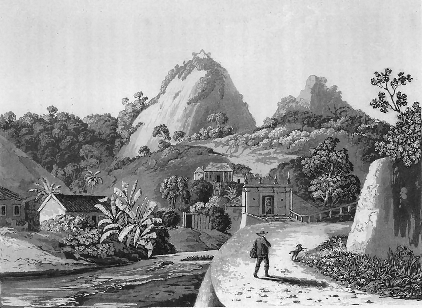
Larangeiros.
We were to breakfast at the gardens, but as the weather is now hot, we
resolved first to walk round them. They are laid out in convenient
squares, the alleys being planted on either side with a very
quick-growing nut tree, brought from Bencoolen originally, now
naturalised here. The nut is as good as the filbert, and larger than the
walnut, and yields abundance of oil; the leaf is about the size, and not
unlike the shape, of that of the sycamore. The timber also is useful.
The quick growth of this tree is unexampled among timber trees, and its
height and beauty distinguish it from all others. The hedges between the
compartments are of a shrub which I should have taken for myrtle, but
that the leaves though firm are not fragrant. This garden was destined
by the King for the cultivation of the oriental spices and fruits, and
above all, of the tea plant, which he obtained, together with several
families accustomed to its culture, from China. Nothing can be more
thriving than the whole of the plants. The cinnamon, camphor, nutmeg,
and clove, grow as well as in their native soil. The bread-fruit
produces its fruit in perfection, and such of the oriental fruits as
have been brought here ripen as well as in India. I particularly
remarked the jumbo malacca, from India, and the longona (Euphoria
Longona), a dark kind of lechee from China. I was disappointed to find
no collection of the indigenous plants. However, so much has been done
as to give reasonable hopes of farther improvement, when the political
state of the country shall be quiet enough to permit attention to these
things.
The stream that waters the garden flows through a lovely valley, where
the royal powder-mills are situated; but being fearful of too much
exertion for Langford we put off visiting them to another day, and
returned to the garden gate to breakfast. His Majesty John VI. built a
small house there, with three or four rooms, to accommodate the royal
party, when they visited the gardens. Our breakfast was prepared in the
veranda of that house, from whence we had a charming view of the lake,
with the mountains and woods,—the ocean, with three little islands that
lie off the lake; and in the fore-ground a small chapel[79] and village,
at the extremity of a little smooth green plain.
After waiting with our agreeable and well-informed friends till the
sea-breeze set in, we returned part of the way along the lake, and then
ascended to the parsonage of Nossa Senhora da Cabeça, where we were
joined by several other persons who had come to dine there with us. The
Padre Manoel Gomez received us very kindly, and our pic-nic was spread
in the ample veranda of his parsonage. Behind the veranda three small
rooms served for sleeping-room, kitchen, and pantry. Half a dozen small
cottages in the field behind contain the healthy-looking negroes who are
employed in his coffee-grounds, and a swarm of children of every shade,
between black and white. On a little eminence in the midst of these
stands the chapel of Our Lady, which is the parish church of a large
district. It is exceedingly small; but serves as the place where the
sacraments are administered, and the licences granted for marriages,
burials, and christenings. The owners of estates have generally private
chapels, where daily mass is performed for the benefit of their own
people; so that the parish church is only applied to on the
above-mentioned occasions. About a stone's throw behind the chapel, a
clear rivulet runs rapidly down the mountain, leaping from rock to rock,
in a thousand little cascades, and forming, here and there, delightful
baths. Nor is it without its inhabitants, which increase the simple
luxuries of the Padre's table. He tells me the crawfish in his stream
are better than any in the neighbourhood; the water itself is pure,
light, and delicate.
At length all our friends had assembled, and we returned to the veranda
to dine. To judge by the materials of the feast, so blended were the
productions of every climate that we could scarcely have pronounced in
what part of the world we were, had not the profusion of ananas and
plantains, compared with the small quantity of apples and peaches,
reminded us of it. As is usual on such occasions, the oldest inhabitants
of Brazil praised most what came from afar; while we all gave the
preference to the productions of the country.
I was soon drawn away from the table by the beauty of the prospect,
which I endeavoured to sketch. The coffee plantations are the only
cultivated grounds hereabouts; and they are so thickly set with orange
trees, lemons, and other tall shrubs, that they form in appearance
rather a variety in the woods, than that mixture of cultivated with wild
ground, which might be looked for so near a large city, where we expect
to see the labour of man encroaching in some degree on the wild beauties
of nature. But here vegetation is so luxuriant, that even the pruned and
grafted tree springs up like the native of the forest.
As every body was determined to be pleased, we all felt sorry when it
was time to separate; but Burns has made all the reflections one can
make on breaking up a pleasant party—
"Pleasures are like poppies spread,—
You seize the flower, the bloom is shed;
Or like the snow-falls in the river,—
A moment white, then lost for ever;
Or like the rainbow's fleeting form,
Evanishing amid the storm;
Or like the borealis race,
That flit ere you can point their place.
No man can tether time or tide:
The hour approaches,—we must ride."
And so we did.—We walked down to the foot of the hill, and each took
his or her several conveyance; Colonel and Mrs. Cunningham their
comfortable English chariot, Mr. and Miss Hayne their pretty curricle,
and I my Rio caleche or sege,—a commodious but ugly carriage, very
heavy, but well enough adapted to the rough roads between the garden and
the town. The gentlemen all rode, and most of us carried home something.
Fruit and flowers attracted some; Langford got a number of diamond
beetles, and a magnificent butterfly, and I a most inadequate sketch of
the scene from the Padre's house.
December 27th.—Since the jaunt to the botanical gardens, some of our
invalids have been gaining ground: others who were well have become
invalids, and I have done nothing but ride about or talk with them, and
look at the beautiful views of the neighbourhood, and get a little
better acquainted with the inhabitants; of whom the most amusing, so far
as I have yet seen, are certainly the negroes, who carry about the fruit
and vegetables for sale. The midshipmen have made friends with some of
them. One of them has become quite a friend in the house; and after he
has sold his master's fruit, earns a small gratuity for himself, by his
tales, his dances, and his songs. His tribe, it seems, was at war with a
neighbouring king, and he went out to fight when quite a boy, was taken
prisoner, and sold. This is probably the story of many: but our friend
tells it with action and emphasis, and shows his wounds, and dances his
war dance, and shouts his wild song, till the savage slave becomes
almost a sublime object. I have been for an hour to-night at a very
different scene, a ball given by Mr. B——, a respectable English
merchant. The Portuguese and Brazilian ladies are decidedly superior in
appearance to those of Bahia; they look of higher caste: perhaps the
residence of the court for so many years has polished them. I cannot
say the men partake of the advantage; but I cannot yet speak Portuguese
well enough to dare to pronounce what either men or women really are. As
to the English, what can I say? They are very like all one sees at home,
in their rank of life; and the ladies, very good persons doubtless,
would require Miss Austin's pen to make them interesting. However, as
they appear to make no pretensions to any thing but what they are, to me
they are good-humoured, hospitable, and therefore pleasing.
Monday, 31st Dec. 1822.—I went to town for the first time; our road
lay through the suburb of the Catete for about half a mile. Some
handsome houses are situated on either hand, and the spaces between are
filled with shops, and small houses inhabited by the families of the
shopkeepers in town. We then came to the hill called the Gloria, from
the name of the church dedicated to N.S. da Gloria, on the eminence
immediately overlooking the sea. The hill is green, and wooded and
studded with country-houses. It is nearly insulated; and the road passes
between it and another still higher, just where a most copious stream
issues from an aqueduct (built, I think, by the Conde de Lavradio), and
brings health and refreshment to this part of the town from the
neighbouring mountains. Farther on, after passing the beach of the
Gloria, we turned to the left, and entered the new part of that town
through the arches of the great aqueduct built in 1718 by the viceroy
Albuquerque. This supplies four copious fountains. The largest is the
Carioca[80], near the convent of Sant Antonio; it has twelve mouths, and
is most picturesque in itself: it is constantly surrounded by slaves,
with their water-barrels, and by animals drinking. Just beyond are
troughs of granite, where a crowd of washerwomen are constantly
employed; and over against these, benches are placed, on which there are
constantly seated new negroes for sale. The fountain of the Marecas is
opposite to the public gardens, and near the new barracks; and, besides
the spouts for water for the inhabitants, there are two troughs always
full for the animals. The third is a very handsome one, in the palace
square; and the fourth, called the Mouro, I did not see. The aqueduct
is of brick, and is supported on two ranges of arches across the valley
between two of the five hills of the city. The public buildings at Rio
have nothing very remarkable about them. Even the churches present no
architectural beauty, and owe the good effect they have in the general
view to their size and situation. There are seven parish churches, and
numerous chapels dependent on each. The first and eldest parish is that
of St. Sebastian; the church dedicated to whom is the royal chapel, the
only one I saw to-day. It is handsome within, richly gilt, and the
pictures on the ceiling are far from contemptible; but I cannot praise
that of the altar-piece, where Our Lady is covering with her cloak the
Queen Dona Maria, and all the royal family, on their arrival in Brazil.
The choir is served in a manner that would not disgrace Italy. I
attended at vespers, and have seldom been more gratified with the music
of the evening service. This the chapel owes to the residence of the
royal family, whose passion and talent for music are hereditary.
Adjoining to this chapel is the church and convent of the Carmelites,
which forms part of the palace; and within which is the royal library of
70,000 volumes, where on all days, except holidays, the public are
admitted to study from nine till one o'clock in the forenoon, and from
four o'clock till sunset. This part of the palace occupies one side of a
handsome square: the palace itself fills up another; a third has private
houses, built uniformly with the palace, besides the fish-market; and
the fourth is open to the sea. The water-edge is faced with a handsome
granite pier and steps, the blocks of which are bolted with copper. In
the centre of the pier there is a fountain, supplied from the aqueduct
of Albuquerque; and altogether the appearance of the palace square is
extremely handsome. We went thence into a street behind it, and saw the
front of the senate-house, which is connected with the palace, and the
cemetery of the Carmelite church, which is a prettier thing than
church-yards usually are. In the centre of a small quadrangle there is a
cross, and by it a young cypress tree: all around there are flowers, and
sweet herbs, and porcelain vases, containing roses and aloes placed on
little pedestals and on a broad low wall that surrounds the square. I
looked at first in vain for graves; at length I observed on these low
walls, and on the higher ones in the outer circle, indications of
arches, each being numbered. These are the places for the dead, who are
walled up there with quick-lime; and, at a certain period, the bones and
ashes are removed to make room for others. At the time of removal, if
the dead has a friend who wishes it, the remains are collected in urns
or other receptacles, and placed in a building appropriated for them, or
where the friend pleases; otherwise they go to the common receptacle,
and perish totally by the addition of more quick-lime. This is, I doubt
not, the wholesomest way of disposing of the dead; and, even to the
sense, is better than the horrid burials at Bahia, where they must
infect the air. But there seems to me so little feeling in thus getting
rid at once of the remains of that which has once been dear to us, that
I went away in disgust.
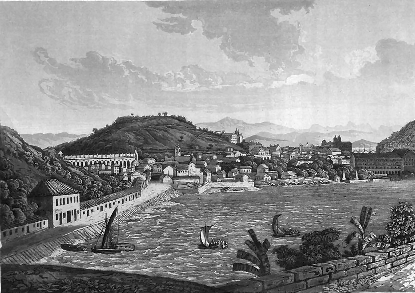
Rio from the Gloria Hill.
The city of Rio is more like an European city than either Bahia or
Pernambuco; the houses are three or four stories high, with projecting
roofs, and tolerably handsome. The streets are narrow, few being wider
than that of the Corso at Rome, to which one or two bear a resemblance
in their general air, and especially on days of festivals, when the
windows and balconies are decorated with crimson, yellow, or green
damask hangings. There are two very handsome squares, besides that of
the palace. One, formerly the Roça, is now that of the Constituçaõ, to
which the theatre, some handsome barracks and fine houses, behind which
the hills and mountains tower up on two sides, give a very noble
appearance. The other, the Campo de Santa Anna, is exceedingly
extensive[81], but unfinished. Two of the principal streets run across
it, from the sea-side to the extremity of the new town, nearly a league,
and new and wide streets are stretching out in every direction. But I
was too tired with going about in the heat of the day to do more than
take a cursory view of these things, and could not even persuade myself
to look at the new fountain which is supplied by a new aqueduct.
There is in the city an air of bustle and activity quite agreeable to
our European eyes; yet the Portuguese all take their siesta after
dinner. The negroes, whether free blacks or slaves, look cheerful and
happy at their labour. There is such a demand for them, that they find
full employment, and of course good pay, and remind one here as little
as possible of their sad condition, unless, indeed, one passes the
street of the Vallongo; then the slave-trade comes in all its horrors
before one's eyes. On either hand are magazines of new slaves, called
here peices; and there the wretched creatures are subject to all the
miseries of a new negro's life, scanty diet, brutal examination, and the
lash.
Tuesday, January 1st, 1823.—I went to pay a second visit to an
illustrious exile, Count Hogendorp, one of the Emperor Napoleon's
generals: my first had been accidental. One morning last week, riding
with two of our young midshipmen, we came to a pleasant-looking cottage,
high on the side of the Corcovado, and at the door we saw a very
striking figure, to whom I instantly apologized for intruding on his
grounds, saying that we were strangers, and had come there accidentally.
He instantly, with a manner that showed him to be no common person,
welcomed us; asked our names, and on being told them, said he had heard
of us; and, but for his infirmities, would have called on us. He
insisted on our dismounting, as a shower was coming on, and taking
shelter with him. By this time I perceived it was Count Hogendorp, and
asked him if I had guessed rightly. He answered, yes; and added a few
words, signifying that his master's servants, even in exile, carried
that with them which distinguished them from other men.
The Count is the wreck of a once handsome man: he has not lost his
martial air: he is tall, but not too thin; his grey eyes sparkle with
intelligence, and his pure and forcible language is still conveyed in a
clear well-toned voice, though a little the worse for age. He ushered us
into a spacious veranda, where he passes most of the day, and which is
furnished with sofas, chairs, and tables: he then ordered his servant to
bring breakfast; we had coffee, milk, and fresh butter, all the produce
of his own farm; and, as we sat, we saw the showers passing by and
under us across the valley, which leads the eye to the bay below. The
General entered frankly into conversation, and during breakfast, and
while the shower lasted, spoke almost incessantly of his imperial
master. Early in life the Count had entered the army, a soldier of
fortune, under Frederick of Prussia. On his return to his native
country, Holland, he was employed by the States, successively, as
governor of the eastern part of Java, and as envoy to one of the German
courts. During his residence in Java, he had visited many of the English
settlements on the main land of India, and had learned English, which he
spoke well.
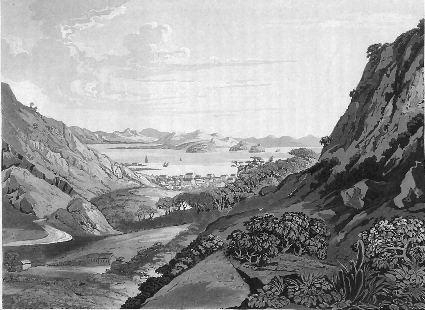
From Count Hoggendorps Cottage.
On the annexation of Holland to France, he entered the French service
with the rank of full colonel. He was always a great favourite with
Napoleon, to whom his honesty and disinterestedness in money matters
seem to have been valuable, in proportion as these qualities were scarce
among his followers. The Count's affection for him is excessive, I
should have said unaccountable, had he not shown me a letter written to
him by the emperor's own hand, on the death of his child, in which,
besides much general kindness, there is even a touch of tenderness I had
not looked for. During the disastrous expedition to Russia, Hogendorp
was entrusted with the government of Poland, and kept his court at
Wilna. His last public service was performed in the defence of Hamburgh,
where he was lieutenant governor. He would fain have attended the
emperor into exile; but that not being allowed, he came hither, where,
with the greatest economy, and, I believe, some assistance from the
prince, who has great respect for him, he lives chiefly on the produce
of his little farm.
Most of these particulars I learnt from himself, while resting and
sheltered from the rain, which lasted nearly an hour. He then showed me
his house, which is small indeed, consisting of only three rooms,
besides the veranda; his study, where a few books, two or three casts
from antique bas reliefs, and some maps and prints, indicate the
retirement of a gentleman; his bedroom, the walls of which, with a
capricious taste, are painted black, and on that sombre ground,
skeletons of the natural size, in every attitude of glee, remind one of
Holbein's Dance of Death; and a third room occupied by barrels of orange
wine, and jars of liqueur made of the grumaxama, at least as agreeable
as cherry brandy which it resembles, the produce of his farm; and the
sale of which, together with his coffee, helps out his slender income.
The General, as he loves to be called, led us round his garden, and
displayed with even fondness, his fruits and his flowers, extolled the
climate, and only blamed the people, for the neglect and want of
industry, which wastes half the advantages God has given them. On
returning to the house, he introduced to me his old Prussian servant,
who has seen many a campaign with him, and his negroes, whom he freed on
purchasing them: he has induced the woman to wear a nose jewel, after
the fashion of Java, which he seems to remember with particular
pleasure. I was sorry to leave the count, but was afraid some alarm
might be felt at home concerning us, and therefore bade him adieu.
This evening I paid him another visit, and found him resting after
dinner in his veranda. We had a good deal of conversation concerning the
state of this country, from which, with prudence, every thing good may
be hoped; and then the Count told me he was engaged in writing his
memoirs, of which he showed me a part, telling me he meant to publish
them in England. I have no doubt they will be written with fidelity, and
will furnish an interesting chapter in the history of Napoleon. I was
sorry to see the old gentleman suffering a good deal; and his age and
infirmities seem to threaten a speedy termination to his active
life.[82]
January 8th, 1822.—The only variety in my quiet life since the first,
was afforded by a large and pleasant party at Miss Hayne's. There I saw
abundance of jewels on the heads and necks of the elderly Portuguese
ladies, and a good deal of beauty, and some grace, among the younger
ones, whom I begin to understand pretty well. We had some good music,
and there was a great deal of dancing, and not a little card-playing.
To-day we left the house on shore, and are again at home on board the
Doris, with all our invalids much better. Having settled every body
comfortably, I went ashore to the opera, as it is the benefit night of a
favourite musician, Rosquellas, whose name is known on both sides of the
Atlantic. The theatre is very handsome; in size and proportion, some of
our officers think it as large as the Haymarket, but I differ from them.
It was opened on the 12th of October, 1813, the Prince Don Pedro's
birth-day. The boxes are commodious, and I hear, that the unseen part of
the theatre is comfortable for the actors, dressers, &c.; but the
machinery and decorations are deficient. The evening's amusements
consisted of a very stupid Portuguese comedy, relieved between the acts
by scenes from an opera of Rossini's by Rosquellas, after which, he
wasted a great deal of fine playing on some very ugly music.
Wednesday, January 9th.—To-day is expected to be a day of much
importance to the future fate of Brazil. But I must go back to the
arrival of a message from the cortes at Lisbon, intimating to the Prince
their pleasure, that he should forthwith repair to Europe, and begin his
education, and proceed to travel incognito through Spain, France, and
England. This message excited the most lively indignation not only in
His Royal Highness, but in the Brazilians from one end of the kingdom to
the other. The Prince is willing to obey the orders of his father and
the cortes, at the same time he cannot but feel as a man the want of
decency of the message, and being thus bid to go home; and especially
forbidden to carry any guards with him, as it should seem, lest they
might have contracted too much attachment for his person. The Brazilians
regard this step as preliminary to removing from this country the courts
of justice, which have for fourteen years been held here, and so
removing causes to Lisbon, by which means, Brazil would be again reduced
to the condition of a dependent colony instead of enjoying equal rights
and privileges with the mother country, a degradation they are by no
means inclined to submit to.
The feelings of the people are sufficiently shown, in the address sent
to the Prince, a few days ago, (24th of December,) from St. Paul's; as
follows:—
"Sir,
"We had already written to Your Royal Highness, before we received the
extraordinary gazette of the 11th instant, by the last courier: and we
had hardly fixed our eyes on the first decree of the Cortes concerning
the organization of the governments of the provinces of Brazil, when a
noble indignation fired our hearts: because we saw impressed on it a
system of anarchy and slavery. But the second, in conformity to which
Your Royal Highness is to go back to Portugal, in order to travel
incognito only through Spain, France, and England, inspired us with
horror.
"They aim at no less than disuniting us, weakening us, and in short,
leaving us like miserable orphans, tearing from the bosom of the great
family of Brazil the only common father who remained to us, after they
had deprived Brazil of the beneficent founder of the kingdom, Your Royal
Highness's august sire. They deceive themselves; we trust in God, who is
the avenger of injustice; He will give us courage, and wisdom.
"If, by the 21st article of the basis of the constitution, which we
approve and swear to because it is founded on universal and public
right, the deputies of Portugal were bound to agree that the
constitution made at Lisbon could then be obligatory on the Portuguese
resident in that kingdom; and, that, as for those in the other three
parts of the world, it should only be binding when their legitimate
representatives should have declared such to be their will: How dare
those deputies of Portugal, without waiting for those of Brazil,
legislate concerning the most sacred interest of each province, and of
the entire kingdom? How dare they split it into detached portions, each
insulated, and without leaving a common centre of strength and union?
How dare they rob Your Royal Highness of the lieutenancy, granted by
Your Royal Highness's august father, the King? How dare they deprive
Brazil of the privy council, the board of conscience, the court of
exchequer, the board of commerce, the court of requests, and so many
other recent establishments, which promised such future advantage? Where
now shall the wretched people resort in behalf of their civil and
judicial interests? Must they now again, after being for twelve years
accustomed to judgment at hand, go and suffer, like petty colonists, the
delays and chicanery of the tribunals of Lisbon, across two thousand
leagues of ocean, where the sighs of the oppressed lose all life and all
hope? Who would credit it, after so many bland, but deceitful
expressions of reciprocal equality and future happiness!!!
"In the session of the 6th of August last, the deputy of the Cortes,
Pereira do Carmo, said, (and he spoke the truth,) that the constitution
was the social compact, in which, were expressed and declared the
conditions on which a nation might wish to constitute itself a body
politic: and that the end of that constitution, is the general good of
each individual, who is to enter into that social compact. How then
dares a mere fraction of the great Portuguese nation, without waiting
for the conclusion of this solemn national compact, attack the general
good of the principal part of the same, and such is the vast and rich
kingdom of Brazil; dividing it into miserable fragments, and, in a word,
attempting to tear from its bosom the representative of the executive
power, and to annihilate by a stroke of the pen, all the tribunals and
establishments necessary to its existence and future prosperity? This
unheard-of despotism, this horrible political perjury, was certainly not
merited by the good and generous Brazil. But the enemies of order in the
Cortes of Lisbon deceive themselves if they imagine that they can thus,
by vain words and hollow professions, delude the good sense of the
worthy Portuguese of both worlds.
"Your Royal Highness will observe that, if the kingdom of Ireland,
which makes part of the United Kingdom of Great Britain, besides that it
is infinitely small compared to the vast kingdom of Brazil, and is
separated from England but by a narrow arm of the sea, which is passed
in a few hours, yet possesses a governor-general or viceroy, who
represents the executive power of the King of the United Kingdom, how
can it enter the head of any one who is not either profoundly ignorant,
or rashly inconsiderate, to pretend, that the vast kingdom of Brazil,
should remain without a centre of activity, and without a representative
of the executive power: and equally without a power to direct our
troops, so as that they may operate with celerity and effect, to defend
the state against any unforeseen attack of external enemies, or against
internal disorders and factions, which might threaten public safety, or
the reciprocal union of the provinces!
"Yes, august Sir! It is impossible that the inhabitants of Brazil, who
are honest, and who pride themselves on being men, particularly the
Paulistas, should ever consent to such absurdity and such despotism.
Yes, august Sir, Your Royal Highness must remain in Brazil, whatever may
be the projects of the constituent Cortes, not only for the sake of our
general good, but even for the sake of the future prosperity and
independence of Portugal itself. If Your Royal Highness, which is not to
be believed, were to obey the absurd and indecent decree of the 29th of
September, besides losing, in the world, the dignity of a man and of a
prince, by becoming the slave of a small number of factious men, you
would also have to answer before heaven for the rivers of blood which
would assuredly inundate Brazil on account of your absence: because its
inhabitants, like raging tigers, would surely remember the supine sloth
in which the ancient despotism kept them buried, and in which a new
constitutional Machiavelism aims even now to retain them.
"We therefore entreat Your Royal Highness with the greatest fervour,
tenderness, and respect to delay your return to Europe, where they wish
to make you travel as a pupil surrounded by, tutors and spies: We
entreat you to confide boldly in the love and fidelity of your
Brazilians, and especially of your Paulistas, who are all ready to shed
the last drop of their blood, and to sacrifice their fortunes, rather
than lose the adored Prince in whom they have placed their well-founded
hopes of national happiness and honour. Let Your Royal Highness wait at
least for the deputies named by this province, and for the magistracy of
this capital, who will as soon as possible present to Your Highness our
ardent desires and firm resolutions; and deign to receive them, and to
listen to them, with the affection and attention, which your Paulistas
deserve from you.
"May God preserve Your Royal Highness's august person many years.
"From the Government House of St. Paul's, 24th Dec. 1821.
John Carlos Augusto de Oeyenhausen, President.
Jose Bonifacio de Andrada e Sylva, V. President.
Martim Francisco de Andrada, Secretary.
Lazaro Jose Gonçalves, Secretary.
Miguel José de Oliveria Pinto, Secretary.
Manoel Rodrigues Jordaen.
Francisco Ignacio de Souza Guimaies.
Joao Ferreira de Oleveira Bueno.
Antonio Leite Pereira de Gama Lobo.
Daniel Pedro Muller.
Andre da Silva Gomes.
Francisco de Paulo e Oliveira.
Antonio Maria Quartini."[83]
This letter to the Prince expresses the sentiments of all the southern
part of Brazil, and to a certain degree those of the northern
captaincies also. The latter are certainly as averse as the former to
the removal of the courts of justice to Lisbon, but they would prefer a
more northern city for the capital; while here, there is a wish among a
considerable number of persons to remove the capital to St. Paul's, on
account of its safety, and its neighbourhood to the mines, where the
greatest proportion of the riches, industry, and population of Brazil is
situated. His Royal Highness has not yet expressed his determination.
The officers of the Lisbon troops talk loudly of his being obliged to do
his duty, and obey the mandate of the Cortes. The Brazilians are earnest
in their hopes that he may stay, and there are even some that look
forward to his declaring openly for the independence of this country.
Whatever his resolution may be, it is feared that there will be much
disturbance, if not a civil war. Our English merchants are calling
meetings, I believe for the purpose of requesting this ship to remain,
at least until one of equal force shall arrive, fearing that their
persons and property will not be safe, and every body looks a little
anxious.
10th.—Yesterday there was a meeting of the camara of Rio; and after a
short consultation the members went in procession, accompanied by a
great concourse of people, to the Prince, with a strong remonstrance
against his leaving the country, and an earnest entreaty that he would
remain among his faithful people. His Royal Highness received them
graciously, and replied, that since it appeared to be the wish of all,
and for the good of all, he would remain. This declaration was received
with shouts of enthusiasm, which were answered by the discharge of
artillery, and every mark of public rejoicing.
The day as usual, on any occasion of public interest, was ended at the
opera, but I unfortunately could not get ashore; however some of the
officers went. The house was illuminated. The Prince and Princess
appeared in full dress in the king's box, which is in the centre of the
house. They were received with enthusiasm by the people, the national
hymn was sung, and between the acts of the play the people called on
several of their favourite orators to address the Prince and people, on
the event of the day. This call was obeyed by several speakers, and some
of their addresses were printed and handed about the theatre; the best,
or at least the most applauded, was the following by Bernardo Carvalho.
"It is now only necessary to exhort you to Union and
Tranquillity!!![84] Expressions truly sublime, and which contain the
whole philosophy of politics. Without Union you cannot be strong,
without strength you cannot command Tranquillity. Portuguese! Citizens!
You have a Prince who speaks to you with kindness of your own work; who
invites you to rally with him round the constitution; who recommends to
you that moral force which embraces justice and is identified with
reason, and which can alone accomplish the great work we have begun.
To-day you burst the bonds which threatened you with suffocation. To-day
you assume the true attitude of free men. But yet all is not done.
Intrigue and discord, muttering furies, perhaps even now meditate fresh
plans, and still endeavour to sow division, and to overthrow the
trophies you have just raised to glory and to national honour. The same
enthusiasm, ill directed, might produce the greatest crimes. Fellow
citizens! Union and Tranquillity. The giddiness of party is unworthy of
free men. Fulfil your duties. Yield to the gentle exhortation of your
august Prince;... but in return say to him 'Sire! Energy and Vigilance.
Energy to promote good,—Vigilance to prevent evil. The whole world has
now its eyes fixed on you. The steps you are about to take, may place
you in the temple of memory, or confound you among the number of weak
princes, unworthy of the distinctions which adorn them. Perhaps you may
influence the destinies of the whole world. Perhaps even Europe,
anxiously and on tip-toe, reposes her hope upon you! Prince! Energy and
Vigilance. Glory is not incompatible with youth, and the hero of the
26th February may become the hero of the 9th January. Unite yourself
with a people which loves you, which offers you fortune, life,
everything. Prince! how sweet is it to behold the cordial expansion of
the feeling of free men! but how distressing to witness the withering in
the bud of hopes so justly founded! Banish, Sire, for ever from Brazil,
multiform flattery, hypocrisy of double face, discord with her viperous
tongue. Listen to truth, submit to reason, attend to justice. Be your
attributes frankness and loyalty. Let the constitution be the pole-star
to direct you: without it there can be no happiness for you nor for us.
Seek not to reign over slaves, who kiss the chains of ignominy. Rule
over free hearts. So shall you be the image of the divinity among
us;—so will you fulfil our hopes. Energy and Vigilance, and we will
follow your precept, Union and Tranquillity.'"
A priest, one of the favourites of the people, was called on to speak
repeatedly. The national hymn[85] was sung again and again, and the
Prince and Princess, who were observed to be chiefly surrounded by
Brazilian officers, were again loudly cheered. And everything in the
city, which was brilliantly illuminated, went off in the utmost harmony.
Nothing can be more beautiful of the kind than such an illumination seen
from the ship. The numerous forts at the entrance to the harbour, on the
islands, and in the town, have each their walls traced in light, so they
are like fairy fire-castles; and the scattered lights of the city and
villages, connect them by a hundred little brilliant chains.
To-day our friends the merchants are under fresh alarm, and have made a
formal request to the captain to stay. With that petty spirit which
passes for diplomatic, the deputy-consul and merchants, instead of
saying what they are afraid of, only say, "Sir, we are afraid,
circumstances make us so, and we hope you will stay till," &c. &c.; as
much as to say, "You are answerable for evil, if it happens," although
they are too much afraid of committing themselves to say why. I do not
trouble myself now about their official reports, which I perceive are
large sheets of paper, and large seals, without one word that might not
be published on every church wall, for their milk and water tenor, but
which I consider as absurd and mischievous, because they tend to excite
distrust and alarm where no danger is. The truth is now, that there
might be some cause of fear, if they would openly express it. The
language of the Portuguese officers is most violent. They talk of
carrying the Prince by main force to Lisbon, and so making him obey the
Cortes in spite of the Brazilians; and both parties are so violent, that
they will probably fight. In that fight there will doubtless be danger
to foreign property; but why not say so? why not say such is the case?
However, the wisest of the sons of men in modern times[86], has long ago
set in the second place those who could not afford to be open and candid
in matters of business; so I may leave them alone.
11th.—I went ashore last night to the opera, as it was again a gala
night, and hoped to have witnessed the reception of the Prince and
Princess. The Viscondeça do Rio Seco kindly invited me to her box, which
was close to theirs; but, after waiting some time, notice arrived that
the Prince was so busy writing to Lisbon, that he could not come. The
double guard was withdrawn, and the play went on. I had, however, the
pleasure of seeing the theatre illuminated, of hearing their national
hymn, and of seeing the ladies better dressed than I had yet had
occasion to do.
There is a great deal of uneasiness to-day. The Portuguese
commander-in-chief of the troops, General Avilez, has demanded and
received his discharge. It is said, perhaps untruly, that his
remonstrance to the Prince against his remaining here has been
ungentlemanlike and indecent. I hear the troops will not consent to his
removal, and they are particularly incensed that the choice of a
successor should fall on General Curado, a Brazilian, who, it is said,
will be called from St. Paul's to succeed Avilez. He is a veteran, who
has commanded with distinction in all the campaigns on the southern
frontier, and his actions are better known among his countrymen than
those distant battles in Europe, on which the Portuguese officers of
every rank are apt to pride themselves here, however slight the share
they had in them, to the annoyance of the Brazilians.
12th.—Yesterday the military commission for the government of the
army here was broke up, and Curada appointed commander-in-chief, and
minister of war. The Portuguese General Avilez made his appearance at
the barracks of the European soldiers to take leave of them; they were
under arms to receive him, and vowed not to part with him, or to obey
another commander, and were with difficulty reduced to such order as to
promise tolerable tranquillity for the day at least. It is said, that
as it had been understood that they had expressed some jealousy, because
the guard of honour at the opera-house had been for the two last
evenings composed of Brazilians, the Prince sent to the Portuguese
barracks for the guard of last night, but that they refused to go;
saying, that as His Royal Highness was so partial to the Brazilians, he
had better continue to be guarded by them. I am not sure this is true,
but from the circumstances of the day it is not improbable.
The opera-house was again brilliantly lighted. The Prince and Princess
were there, and had been received as well as on the ninth, when, at
about eleven o'clock, the Prince was called out of his box, and informed
that bodies of from twenty to thirty of the Portuguese soldiers were
parading the streets, breaking windows and insulting passengers in their
way from barrack to barrack, where everything wore the appearance of
determined mutiny. At the same time, a report of these circumstances
having reached the house, the spectators began to rise for the purpose
of going home; when the Prince, having given such orders as were
necessary, returned to the box, and going with the Princess, then near
her confinement, to the front, he addressed the people, assured them
that there was nothing serious, that he had already given orders to send
the riotous soldiers, who had been quarrelling with the blacks, back to
their barracks, and entreated them not to leave the theatre and increase
the tumult, by their presence in the street, but remain till the end of
the piece, as he meant to do, when he had no doubt all would be quiet.
The coolness and presence of mind of the Prince, no doubt, preserved the
city from much confusion and misery. By the time the opera was over the
streets were sufficiently clear to permit every one to go home in
safety.
Meantime the Portuguese troops, to the number of seven hundred, had
marched up to the Castle-hill, commanding the principal streets in the
town, and had taken with them four pieces of artillery, and threatened
to sack the town. The field-pieces belonging to the Brazilians, which
had remained in the town after the 26th of February, had been sent to
the usual station of the artillery, at the botanical gardens, no longer
ago than last week, so they entertained no fear of artillery. But they
were disappointed in their expectation of being joined by that part of
the Portuguese force which was stationed at San Cristovaŏ. This amounted
to about 500 men[87], who said the King had left them to attend on the
person of the Prince, and they had nothing to do with anything else; a
declaration that was looked on with suspicion by the Brazilians.
While the Portuguese were taking up their new and threatening position,
the Brazilians were not idle. Every horse and mule in the town was
pressed, and expresses despatched to all the militia regiments, and
other Brazilian troops, as well as to the head-quarters of the
artillery. The Prince was most active; so that by four o'clock this
morning (12th), he found himself at the head of a body of four thousand
men, in the Campo de Santa Anna, not only ready, but eager for action;
and though deficient in discipline, formidable from their numbers and
determination.
The Portuguese had by no means expected such promptness and decision;
they had besides not taken provision to the hill, and they were
convinced that it would be an easy matter to starve them, by means of
the immense superiority of numbers in the Campo. They therefore prepared
to obey an order which the Prince communicated to them early in the day,
to remove from the city to Praya Grande, on the other side of the
harbour, only conditioning to carry their arms with them. His Royal
Highness wished to have put them instantly on board of transports, to be
conveyed to Lisbon, but the port admiral reported that there was neither
shipping nor provision ready for the purpose; and therefore they are to
be quartered at Praya Grande, until such shall be provided.
I went ashore with an officer as early as I could, chiefly for the
purpose of seeing the troops in the Campo de Santa Anna. In consequence,
however, of the press of horses and mules, it was sometime before I
could get a chaise to convey me there, and it was much too hot to walk.
At length, however, I procured one, and determined to call on the
Viscondeça of Rio Seco in my way, to offer her refuge in the frigate. We
found her in a Brazilian dishabille, and looking harassed and anxious.
She had remained in the theatre as long as the Prince last night, and
had then hurried home to provide for the safety of her family and her
jewels: her family she had despatched to her estate in the country; for
the jewels, she had them all packed in small parcels, intending to
escape with them herself in disguise to us, in case of a serious attack
on the city; and she had left a quantity of valuable plate exposed in
different parts of the house to occupy the soldiers on their first
entrance. Everything, however, looks better now; and we assured her we
had seen the first part of one of the Lisbon regiments ready to embark
as we landed. We promised her, that on her making a signal from her
house, or sending a message, she should have protection. She appears
very apprehensive of evil from the liberation of the prisoners by the
Brazilians during the night, and says, that there are some fears that
the Portuguese will seize the forts on the other side, and hold them
till the arrival of the reinforcements daily expected from Lisbon. This
would, indeed, be disastrous; but I believe the apprehension to be ill
founded.
Having comforted my good friend as well as I could, we went on to the
Campo, and found the Brazilians housed for the most part in some
unfinished buildings. The men, though slight, looked healthy, active,
and full of spirit; their horses were the best I have seen in the
country; and, it might be fancy, but they gave me the idea of men
resolute in their purpose, and determined to guard their rights and
their homes.
The scene in the Campo presented all manner of varieties. Within the
enclosure where the artillery was placed, all was gravity and
business-like attention: the soldiers on the alert, and the officers in
groups, canvassing the events of the preceding night, and the
circumstances of the day; and here and there, both within and without
the circle, an orator was stationed with his group of auditors around
him, listening to his political discussions, or patriotic harangues. In
the open part of the Campo were straggling soldiers, or whole companies,
escaped from the heated crowd of the enclosure: horses, mules, and
asses, many of all lying down from sheer fatigue. In all directions,
negroes were coming, laden with capim or maize for the horses, or
bearing on their heads cool drink and sweetmeats for the men. In one
corner, a group of soldiers, exhausted with travel and watching, lay
asleep; in another, a circle of black boys were gambling: in short, all
ways of beguiling the time while waiting for a great event might be
seen; from those who silently and patiently expected the hour, in solemn
dread of what the event might be, to those who, merely longing for
action, filled up the interval with what might make it pass most
lightly. I was well pleased with the view I had of the people in the
Campo, and still better as the day wore away, for I staid sometime, to
feel assured that all was to pass without bloodshed, beyond the two or
three persons killed accidentally during the night.
On our return to the ship, we were stopped for some time in the palace
square, by a great concourse of people assembled to witness the entrance
of the first Brazilian guard into the palace, while the last Portuguese
guard marched out, amid the loud huzzas of the people; and on reaching
the stairs, where we were to embark, we found the last of one regiment,
and the first of another, about to sail for the Praya Grande, so that
the city may sleep in security to-night.
The inhabitants generally, but especially the foreign merchants, are
well pleased to see the Lisbon troops dismissed; for they have long been
most tyrannically brutal to strangers, to negroes, and not unfrequently
to Brazilians; and, for many weeks past, their arrogance has been
disgusting to both prince and people.[88]
The appearance of the city is melancholy enough: the shops are shut up,
guards are parading the streets, and every body looks anxious. The
shopkeepers are all employed as militia: they are walking about with
bands and belts of raw hides over their ordinary clothes, but their
arms and ammunition were all in good order, and excepting these and the
English, I saw nobody at all out of doors.
13th.—Every thing seems quiet to-day. From the ship we see the rest
of the troops going over to the Praya Grande. Yet there is necessarily a
great deal of anxiety among all classes of persons. Some persons have
sent some of their valuables on board the frigate, for safety; and a
message, I do not know on what authority, arrived to know if the Prince
and Princess, and family, could be received and protected on board.—The
answer, of course, is, that though the ship must observe the strictest
neutrality between the parties, yet that we are ready at once to receive
and protect the Princess and children, and also, whenever he has reason
to apprehend personal danger, the Prince himself. My cabin is therefore
ready. I hope they will not be forced to come afloat. The more they can
trust to the Brazilians the better for them, and for the cause of that
independence which is now so inevitable, that the only question is
whether it shall be obtained with or without bloodshed.
We have determined to have a ball on board, the day after to-morrow,
that the people may get acquainted with us,—and then if any thing
occurs to render it advisable to take refuge with us, they will know who
they are to come amongst.
14th.—The shops are open, and business going on as usual to-day. The
Prince is granting discharges to both officers and men of the Portuguese
regiments, who wish to remain in Brazil instead of returning to Europe.
This is stigmatised by the Portuguese as licensing desertion, from the
army of the King and Cortes; whatever they may call it, I am convinced
that the measure tends to the present tranquillity of the capital. The
Princess and children are gone to Santa Cruz, a country estate, formerly
belonging to the Jesuits, now to the crown, fourteen leagues on the road
towards St. Paul's.[89]
15th.—Our ball went off very well: we had more foreigners than
English; and as there was excellent music from the opera-orchestra, and
a great deal of dancing, the young people enjoyed it much. I should have
done so also, but that Captain Graham was suffering with the gout so
severely, that I could have wished to put off the dance. I had
commissioned the Viscondeça do Rio Seco and some other ladies to bring
their Portuguese friends, which they did, and we had a number of pretty
and agreeable women, and several gentlemanlike men, in addition to our
English friends.
A dance on ship-board is always agreeable and picturesque: there is
something in the very contrast afforded by the furniture of the deck of
a ship of war to the company and occupation of a ball that is striking.
"The little warlike world within,
The well-reeved guns and netted canopy,"
all dressed with evergreens and flowers, waving over the heads of gay
girls and their smiling partners, furnish forth combinations in which
poetry and romance delight, and which one must be stoical indeed to
contemplate without emotion. I never loved dancing myself, perhaps
because I never excelled in it; but yet, a ball-room is to me a
delightful place. There are happy faces, and hearts not the less happy
for the little anxious palpitations that arise now and then, and
curiosity, and hope, and all the amiable feelings of youth and nature;
and if among it a little elderly gaiety mingles, and excites a smile, I,
for my part, rather reverence the youth of heart which lives through the
cares and vexations of this life, and can mingle in, without disturbing,
the hilarity of youth.
17th.—Nothing remarkable yesterday or to-day, but the perfect quiet
of the town. The Prince goes on discharging the soldiers.
19th.—This day the new ministers arrived from St. Paul's; the chief
of whom in station, as in talent, is Jose Bonifacio de Andrada e Silva.
According to the opinion entertained of him by the people here, I should
say that Cowper had described him, when he wrote
Great offices will have
Great talents. And God gives to every man
The virtue, temper, understanding, taste,
That lift him into life, and lets him fall
Just in the niche he was ordained to fill.
To the deliverer of an injured land
He gives a tongue to enlarge upon, a heart
To feel, and courage to redress her wrongs.
He had been sent early from Brazil to study at Coimbra, where he lay
sick at the time of the King's departure from Lisbon; and afterwards,
during the time of the French, he could not find means to return to his
native country; but upon the first rising of the people in the districts
round Oporto and Coimbra, he put himself at the head of the students of
the university, in their successful resistance to Junot, and afterwards
served in the campaign against Soult. When he returned to Lisbon, I
believe, he there entered the regular army; for after bearing arms
against Massena, I find that at the end of the war he had the rank of
lieutenant-colonel, with which he returned to Brazil in 1819. But his
whole time in Europe was not spent in warfare: he had travelled, and had
become acquainted with several among the most distinguished characters
in England, France, and Italy, and had contracted a particular esteem
for Alfieri. The object of his travels was rather to see and learn what
might be useful to his own country, than the mere pleasure of visiting
different parts of the world; and I am told, that he has particularly
attended to those branches of science which may improve the agriculture
and the mining of Brazil.
One of his brothers, Martin Francisco, is possessed of scarcely less
talent than himself; and their family, their character, and the esteem
in which they are held, add weight not only to their own interest, but
to the government which employs them.
The guards and patroles were doubled along the road, by which they and
the veteran General Corado arrived, as it was feared the Portuguese, who
since the 12th have been completely distinct from the Brazilians, might
have impeded their progress. However, every thing was perfectly
tranquil.
20th.—The Aurora arrived from Pernambuco and Bahia, at both which
places it appears that every thing is quiet. But as the meeting of the
camara of Bahia is to take place early next month, for the purpose of
chusing a new provisional government, the English are apprehensive of
some disturbance, and therefore we are to return thither to protect our
friends in case of need.
21st.—I went ashore to shop with Glennie. There are a good many
English shops, such as saddlers, and stores, not unlike what we call in
England an Italian warehouse, for eatables and drinkables; but the
English here generally sell their goods wholesale to native or French
retailers. The latter have a great many shops of mercery, haberdashery,
and millinery. For tailors, I think, there are more English than French,
and but few of either. There are bakers' shops of both nations, and
plenty of English pot-houses, whose Union Jacks, Red Lions, Jolly Tars,
with their English inscriptions, vie with those of Greenwich or
Deptford. The goldsmiths all live in one street, called by their name
Rua dos Ourives, and their goods are exposed in hanging frames at each
side of the shop-door or window, in the fashion of two centuries back.
The workmanship of their chains, crosses, buttons, and other ornaments,
is exquisite, and the price of the labour, charged over the weight of
the metal, moderate.
Most of the streets are lined with English goods: at every door the
words London superfine meet the eye: printed cottons, broad cloths,
crockery, but above all, hardware from Birmingham, are to be had little
dearer than at home, in the Brazilian shops; besides silks, crapes, and
other articles from China. But any thing bought by retail in an English
or French shop is, usually speaking, very dear.
I am amused at the apparent apathy of the Brazilian shopkeepers. If they
are engaged, as now is not unfrequently the case, in talking politics,
or reading a newspaper, or perhaps only enjoying a cool seat in the back
of their shop, they will often say they have not the article enquired
for, rather than rise to fetch it; and if the customer persists and
points it out in the shop, he is coolly desired to get it for himself,
and lay down the money. This happened several times during the course
of our search for some tools for turning to-day along the Rua Direita,
where every second house is a hardware shop, furnished from Sheffield
and Birmingham.
22d.—The Princess's birth-day was celebrated by firing of cannon, a
review, and a drawing-room. Capt. Prescott, of the Aurora, and Capt.
Graham, attended it. It seems the Prince took little or no notice of
them, or any of the English. I think it probable that the Brazilians are
jealous of us, on account of our long alliance with Portugal; and
besides, they may take the converse of the maxim, "those that are not
against us are for us;" and think because we are not for them, we are
against them.[90]
24th.—We sailed at daylight for Bahia. It was one of the finest
mornings of this fine climate, and the remarkable land behind the
Sugar-loaf was seen to its best advantage in the early light. The
extreme beauty of this country is such, that it is impossible not to
talk and think of it for ever; not a turn but presents some scene both
beautiful and new; and if a mountainous and picturesque country have
really the power of attaching its inhabitants, above all others, the
Fluminenses ought to be as great patriots as any in the world.
February 8th, Bahia.—After a fortnight's sail, the two first days of
which were calm, followed by a gale of wind, which lasted nearly three
days, we anchored to-day in the bay of All Saints, which we found
looking as gaily beautiful as ever. The election of the new provisional
government took place yesterday, quite peaceably; and of the seven
members of the junta, only one is a native of Portugal.
I remark, that the language of the writers of gazettes here is much
bolder than at Rio; and I think that there is here a truly republican
spirit among a very considerable number of persons: whether it extends
throughout the province I cannot judge; but I am assured that a desire
for independence, and a resolution to possess it, is universal.
10th.—We went ashore yesterday. The advance of the season has ripened
the oranges and mangoes since we left Bahia, and has increased the
number of insects, so that the nights are no longer silent. The hissing,
chirping, and buzzing of crickets, beetles, and grasshoppers, continue
from sunset to sunrise; and all day long the trees and flowers are
surrounded by myriads of brilliant wings. The most destructive insects
are the ants, and every variety of them that can hurt vegetable life is
to be found here. Some form nests, like huge hanging cones, among the
branches of the trees, to which a covered gallery of clay from the
ground may be traced along the trunk: others surround the trunks and
larger branches with their nests; many more live under ground. I have
seen in a single night the most flourishing orange-tree stripped of
every leaf by this mischievous creature.
16th.—We sailed from Bahia, finding every thing, to all appearance,
quiet[91]; and no apprehension being entertained by the English, a ball
at the consul's, another at Mrs. N.'s, and a third at Mrs. R.'s, at each
of which, as many of our young men as could get ashore were present,
made them very happy, and we had some very pleasant rides into the
country. I had intended, if possible, visiting a huge mass, said to be
so similar to the meteoric stones that have fallen in different parts of
the world as to induce a belief that it is also one of them, although it
weighs many tons, and I hoped to get a piece of it; but I find it is
near Nazareth de Farinha, on the other side of the bay, and too far off
for this present visit to Bahia. The first time we were at Bahia, I
could not even learn where it was, so incurious are my countrymen here
about what brings no profit.
24th. Rio de Janeiro.—Nothing remarkable occurred on our passage here
from Bahia. The school-room proceeds exceedingly well, both with the
master and the scholars; and as we are all in tolerable health, we look
forward with no small pleasure to our voyage to Chile, for which we are
preparing.
During our absence, the Prince Don Pedro has been very active, and has
dismissed all the Portuguese troops. On the ships being provided to
transport them to Europe, they refused to embark, on which His Royal
Highness caused a heavy frigate to anchor opposite to their quarters,
and went on board himself the night before the morning appointed by him
for their sailing. The steam-vessel attended for the purpose of towing
the transports, in case of necessity; and several gun-vessels were
stationed so as to command the barracks of the refractory regiments,
while a body of Brazilian soldiers was stationed in the neighbourhood.
The Prince was, during the greater part of the night, in his barge,
going from vessel to vessel, and disposing every thing to make good his
threat, that if the Portuguese were not all on board by eight o'clock
the next morning, he would give them such a breakfast of Brazilian balls
as should make them glad to leave the country. This he had been provoked
to say, by a message from the officers and men, insolently delivered
that very night, desiring more time to prepare for their voyage. Seeing
His Royal Highness in earnest, which they could hardly be brought to
believe he was, they thought it most prudent to do as they were bid; and
accordingly embarked, to the no small joy of the Brazilians, who had
long cordially hated them.
Friday, March 1st.—The weather is now excessively hot, the
thermometer being seldom under 88°, and we have had it on board at 92°
Fahrenheit. Capt. Graham has had a slight attack of gout, for which
reason I have not been ashore since our return from Bahia; but as he is
a little better to-day he has insisted on my accompanying a party of our
young men in an expedition up the harbour to see a country estate and
factory.
At one o'clock, our friend, Mr. N. called for us, with a large boat of
the country, which is better for the purpose than our ship's boats.
These vessels have a standing awning, and two very large triangular
sails: they are managed according to their sizes by four, six, eight, or
more negroes, besides the man at the helm: when rowing, the rowers rise
at every stroke, and then throw themselves back on their seats. I think
I have heard that within the memory of persons now in the navy it was
the fashion to row the admiral's barges so in England. The boatmen are
here universally negroes; some free, and owners of their boats; others
slaves, who are obliged to take home a daily fixed sum to their masters,
who often pass a life of total indolence, being fed in this way by their
slaves.
The place we were going to is Nossa Senhora da Luz, about twelve miles
from Rio, up the harbour, near the mouth of the river Guaxindiba, which
river rises in the hills of Taypu; and though its straight course is
only five miles, its windings would measure twenty or more: it is
navigable, and its banks are astonishingly fertile.
The evening was charming, and we sailed past many a smiling island and
gay wooded promontory, where gardens and country-houses are thickly
scattered, and whence provisions in innumerable boats and canoes cross
the bay every morning for the city. Our first view of N.S. da Luz
presented such a high red bank, half covered with grass and trees,
overhanging the water in the evening sun, as Cuyp would have chosen for
a landscape; and just as I was wishing for something to animate it, the
oxen belonging to the factory came down to drink and cool themselves in
the bay, and completed the scene. The cattle here are large and
well-shaped, something like our own Lancashire breed, and mottled in
colour, though mostly red. On doubling the point of the bank, we came
upon a small white church, with some venerable trees near it; beyond
that was the house, with a long veranda, supported by white columns; and
still farther on, the sugar-house, and the pottery and brick-work. We
landed close to the house; but as the beach is shallow and muddy, we
were carried ashore by negroes. Nothing can be finer than the scenery
here. From the veranda, besides the picturesque and domestic
fore-ground, we see the bay, dotted with rocky islands; one of these,
called Itaoca, is remarkable as having, in the opinion of the Indians,
been the residence of some divine person: it is connected with the
traditions concerning their benefactor, Zome, who taught them the use of
the mandioc, and whom the first missionaries here contrived to convert
into St. Thomas the apostle. It consists of one immense stone cleft
throughout, and a little earth and sand gathered round it, on which are
trees and shrubs of the freshest verdure; some of the other islets are
bare, and some again have houses and villages on them: the whole scene
is terminated by the Organ Mountains, whose spiry and fantastic summits
attracting the passing clouds, secure an everlasting variety to the eye.
We found, that owing to our neglect in not sending beforehand to
announce our visit, neither the master of the house nor his housekeeper
were at home: however, Mr. N. being an old friend, went into the poultry
yard, and ordered thence an excellent supper; and while it was
preparing, we went to look at the pottery, which is only for the
coarsest red ware. The wheel used here is the clumsiest and rudest I
ever saw, and the potter is obliged to sit sideways by it. The clay,
both for the pottery and the bricks, is dug on the spot; it is coarse
and red: it is tempered by the trampling of mules; but all that we use
spades and shovels for is done by the bare hands of the negroes: the
furnaces for baking the bricks and jars are partly scooped out of the
hill, and faced with brick. Leaving the pottery, we climbed the hill
that marks the first approach to N.S. da Luz; and on the way up its
steep and rugged side, our dogs disturbed a flock of sheep, as
picturesque and as ragged as Paul Potter himself could have desired:
they had been lying round the root of a huge old acacia, decorated with
innumerable parasite plants, some of which cling like ivy to the trunk,
and others climbing to the topmost boughs, fall thence in grey silky
garlands, or, like the tillandsia, adorn them with hundreds of pink and
white flowers; among these, many an ant and bee had fixed his nest, and
every thing was teeming with life and beauty.
The moon was up long before we returned from our ramble, and long before
our host arrived. Had the Neapolitan ambassador, who told George the
Third that the moon of his country was worth the sun of England, ever
been in Brazil, I could almost forgive the hyperbole. The clear mild
light playing on such scenery, and the cool refreshing breeze of
evening, after a day of all but intolerable heat, render the night
indeed the season of pleasure in this climate: nor were the rude songs
of the negroes, as they loaded the boats to be ready to sail down the
harbour with the morning’s land-breeze, unpleasing.
As we were looking over the bay, a larger boat appeared: it neared the
shore; and our host, Mr. Lewis P., who superintends the fazenda, landed,
and kindly received our apology for coming without previous notice. The
visit had long been talked of; but now our time at Rio was likely to be
so short, that had we not come to-day, we might not have come at all. He
led the way to the garden, where we passed the time till supper was
ready. The midshipmen found more oranges, and better than they had yet
met with, and did full justice to them. The fruit and vegetables of
Europe and America, of the temperate and torrid zones, meet here; nor
are their flowers forgotten: over against the little parterre, an orange
and a tamarind tree shade a pleasant bench; close to which, in something
of oriental taste, the white stucco wall of the well is raised and
crowned with flower-pots, filled with roses and sweet herbs.
2d.—I rose at daylight, and rode with Mr. N. through the estate,
while Mr. Dance, my cousin Glennie, and the two boys, went to shoot in
the marsh by the river side.
Every turn in our ride brought a new and varied landscape into view:
beneath, the sugar-cane in luxuriant growth; above, the ripening orange
and the palm; around and scattered through the plain enlivened by the
windings of the Guazindiba, the lime, the guava, and a thousand odorous
and splendid shrubs, beautified the path.—But all is new here. The long
lines of fazenda houses, that now and then take from the solitariness of
nature, suggest no association with any advance either of old or present
time, in the arts that civilise or that ennoble man. The rudest
manufactures, carried on by African slaves, one half of whom are newly
imported, (that is, are still smarting under the separation from all
that endears the home, even of a savage,) are all the approaches to
improvement; and though nature is at least as fine as in India or in
Italy, the want of some reference to man, as an intellectual and moral
being, robs it of half its charms. However, I returned well pleased from
my ride, and found my young sportsmen not less pleased with their
morning's ramble. Not, indeed, that they had shot snipes, as they
intended, but they had gotten a huge lizard (Lacerta Marmorata), of a
kind they had not seen before. They had seen the large land-crab
(Ruricola), and they had brought down a boatswain bird, a sort of
pelican, (Pelicanus Lencocephalus), which they proposed to stuff.
Accordingly after breakfast, as the weather was too hot to walk farther,
the bird and the lizard were both skinned, the guns were cleaned, and I
made a sketch of the landscape.
In the evening I took a long walk to a point of view whence the whole
bay with the city in the distance is distinctly seen, and on the way
stopped at a cottage, where Mr. P. who is, literally, here "king,
priest, and prophet," had some enquiry to make, concerning the health of
the indwellers: these were two negroes, who have grown old in the
service of the estate, and are no longer useful. I have seen examples of
such being freed, that is, turned out of doors to starve. Here they
would be entitled, by the rules of the estate, if not by law, to come
every day for the same allowance as the working negroes: but they do not
choose it. They indeed live in a hut, and on the ground of their master;
but they maintain themselves by rearing a few fowls, and making baskets:
so dear is the feeling of independence, even in old age, sickness, and
slavery.
Sunday, 3d.—I went out before breakfast, with a negro carpenter for
my guide. This man, with little instruction, has learned his art so as
to be not only a good carpenter and joiner, but also a very tolerable
cabinet-maker, and in other respects displays a quickness of
understanding which gives no countenance to the pretended inferiority of
negro intellect. I was much pleased with the observations he made on
many things which I remarked as new, and with the perfect understanding
he seemed to have of all country works. After breakfast, I attended the
weekly muster of all the negroes of the fazenda; clean shirts and
trowsers were given the men, and shifts and skirts to the women, of very
coarse white cotton. Each, as he or she came in, kissed a hand, and then
bowed to Mr. P. saying, either "Father, give me blessing," or "The names
of Jesus and Mary be praised!" and were answered accordingly, either
"Bless you," or "Be they praised." This is the custom in old
establishments: it is repeated morning and evening, and seems to
acknowledge a kind of relationship between master and slave. It must
diminish the evils of slavery to one, the tyranny of mastership in the
other, to acknowledge thus a common superior Master on whom they both
depend.
As each slave passed in review, some questions were asked concerning
himself, his family, if he had one, or his work; and each received a
portion of snuff or tobacco, according to his taste. Mr. P. is one of
the few persons whom I have met conversant among slaves, who appears to
have made them an object of rational and humane attention. He tells me
that the creole negroes and mulattoes are far superior in industry to
the Portuguese and Brazilians; who, from causes not difficult to be
imagined, are for the most part indolent and ignorant. The negroes and
mulattoes have strong motives to exertion of every kind, and succeed in
what they undertake accordingly. They are the best artificers and
artists. The orchestra of the opera-house is composed of at least
one-third of mulattoes. All decorative painting, carving, and inlaying
is done by them; in short, they excel in all ingenious mechanical arts.
In the afternoon I attended Mr. P. to see the negroes receive their
daily allowance of food. It consisted of farinha, kidney-beans, and
dried beef, a fixed measure of each to every person. One man asked for
two portions, on account of the absence of his neighbour, whose wife had
desired it might be sent to her to make ready for him by the time he
returned. Some enquiries which Mr. P. made about this person, induced me
to ask his history. It seems he is a mulatto boatman, the most trusty
servant on the estate, and rich, because he is industrious enough to
have earned a good deal of private property, besides doing his duty to
his master. In his youth, and he is not now old, he had become attached
to a creole negress, born, like him, on the estate; but he did not marry
her till he had earned money enough to purchase her, in order that their
children, if they had any, might be born free. Since that time, he has
become rich enough to purchase himself, even at the high price which
such a slave might fetch; but his master will not sell him his freedom,
his services being too valuable to lose, notwithstanding his promise to
remain on the estate and work. Unfortunately these people have no
children; therefore on their death their property, now considerable,
will revert to the master. Had they children, as the woman is free, they
might inherit the mother’s property; and there is nothing to prevent the
father’s making over all he earns to her. I wish I had the talent of
novel writing, for the sake of this slave’s story; but my writing, like
my drawing, goes no farther than sketching from nature, and I make
better artists welcome to use the subject.
The evening was very stormy: deep clouds had covered the Organ
Mountains; and vivid lightning, sharp rain, and boisterous wind, had
threatened the fazenda with a night of terror. But it passed away,
leaving all the grand and gloomy beauty of a departed thunder-storm in a
mountainous country; when the moon broke through the clouds, and the
night seemed, from the contrast with the last few hours, even lovelier
than the last. Then just as the
"Sable clouds
Turned forth their silver lining on the night,
And cast a gleam over the tufted grove."
I heard the sounds of music; not such, indeed, as Milton’s echo, with
Henry Lawes’s notes, would have made,—of which the night and the scene
had made me dream; but the voice of the slaves on this their night of
holiday, beguiling their cares with uncouth airs, played on rude African
instruments. Taking one of my ship-mates with me, I immediately went to
the huts of the married slaves, where all merry-makings are held; and
found parties playing, singing, and dancing to the moonlight. A
superstitious veneration for that beautiful planet is said to be pretty
general in savage Africa, as that for the Pleiades was among the
Indians of Brazil; and probably the slaves, though baptized, dance to
the moon in memory of their homes. As for the instruments, they are the
most inartificial things that ever gave out musical sounds; yet they
have not an unpleasing effect. One is simply composed of a crooked
stick, a small hollow gourd, and a single string of brass wire. The
mouth of the gourd must be placed on the naked skin of the side; so that
the ribs of the player form the sounding-board, and the string is struck
with a short stick. A second has more the appearance of a guitar: the
hollow gourd is covered with skin; it has a bridge, and there are two
strings; it is played with the finger. Another of the same class is
played with a bow; it has but one string, but is fretted with the
fingers. All these are called Gourmis. There were, besides, drums made
of the hollow trunks of trees, four or five feet long, closed at one end
with wood, and covered with skin at the other. In playing these, the
drummer lays his instrument on the ground and gets astride on it, when
he beats time with his hands to his own songs, or the tunes of the
gourmis. The small marimba has a very sweet tone. On a flat piece of
sonorous wood a little bridge is fastened; and to this small slips of
iron, of different lengths, are attached, so as that both ends vibrate
on the board, one end being broader and more elevated than the other.
This broad end is played with the thumbs, the instrument being held with
both hands. All these are tuned in a peculiar manner, and with great
nicety, especially the marimba[92]; but, as I am no musician, I cannot
explain their methods.
4th.—I was very sorry indeed this morning at sunrise, when I saw the
boats ready to convey us from N.S. da Luz, where we had enjoyed our
three days as much as possible; a cheerful party, a kind host, free
disposal of our time, and no business but such as might beseem the
individuals of this castle of indolence, "where every man strolled off
his own glad way."
"There freedom reigned without the least alloy;
Nor gossip's tale, nor ancient maiden’s gall,
Nor saintly spleen, durst murmur at our joy,
And with envenomed tongue our pleasures pall.
For why? There was but one great rule for all;
To wit, that each should work his own desire."
We returned to the ship by a different way from that by which we went,
through the archipelago of beautiful islands on the eastern side of the
harbour; and I had the pleasure to find the Captain really better,
though still with tender feet.
6th.—His Majesty’s ship, Slaney, Capt. Stanhope, sailed from Rio.
7th.—The Superb arrived from Valparaiso, bringing no news of
importance. Indeed, if she had, we are scarcely in a state to attend to
it: we have sat up all night with B., one of our midshipmen, who is
dangerously ill.
8th.—Captain Graham not feeling well enough to leave the ship, I went
with Captain Prescott of the Aurora, to visit the French Commodore
Roussin on board the Amazone. I have seldom been better pleased. The
captains of the other French ships were there, to receive us. All the
urbanity of Frenchmen, joined with the delightful frankness of the
profession, assured us we were welcome. The ship itself, every part of
which we saw, is a model of all that can be done, either in the
dock-yard at home, or by officers afloat, for comfort, health, and
cleanliness, and is well as a man of war. Her captain, however, is a
superior man; and many ships of every and any nation might be visited
before his equal would be met with. I wish it were possible that we
should introduce into our ships the oven on the lower deck, which gives
fresh bread twice a week for the whole ship’s company, not only for the
sake of the bread, but the heating it must air and ventilate the ship.
9th.—The Portuguese squadron from Lisbon, with a reinforcement of
troops, arrived off the harbour. Troops are sent to reinforce the
garrisons in the forts, at the entrance; and the ships are forbidden to
enter, but promised victuals and water to carry them to Lisbon. I was on
shore all day on business, preparatory to our sailing for Valparaiso.
Captain Graham being too unwell to venture out of the ship himself, he
therefore undertook to nurse the invalid for me. I returned late. I
found B. dangerously ill, and Captain Graham very uneasy.
I received many persons on board, and took leave of many.
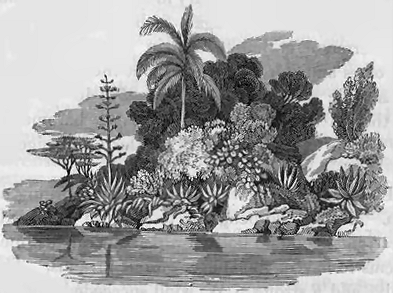
10th.—We sailed at daylight from Rio, in full hope that the cool
weather we shall find on going round Cape Horn, and the fine climate of
Chile, will do us all good. I have not been in bed for three nights; my
invalids are in that state, that night watching is necessary for them.
13th.—In addition to our other troubles, the first lieutenant is
taken dangerously ill: but Captain Graham appears better, though not yet
able to go on deck.
16th.—Yesterday afternoon the mercury in the barometer sunk in a
very short space of time a whole inch, and we had a gale of wind. The
cold is sensibly increased. Fahrenheit’s thermometer often stood at 92°
in Rio harbour; it is now 68°, and we have many sick. B. is getting
better.
17th.—Wind and sea abated, and the barometer rising once more; the
mercury stands at 30 inches and two-tenths. I have lain down at four
o'clock these two mornings, Glennie having kindly relieved my watching
at that hour. We have removed the dead-lights from the cabin windows.
18th.—Every thing better. The young people again at school. Some
lunars taken. We are in 36° 55´ S. latitude, and the thermometer is at
68°.; barometer 30–2.
On the 19th and 20th the mercury in the barometer sunk gradually
from 30 to 29–02, and rose again as before on the 21st. It blew hard;
the thermometer fell to 58°, in latitude 42° S. There are many
albatrosses and stormy petrels about the ship.
22d.—Latitude 46° 25' S., longitude 52° 40' W. The weather very cold,
though the thermometer is at 56°, barometer 29–08; a very heavy swell.
Great numbers of the Cape pigeon about the ship.
24th.—Latitude 50° 30'; thermometer 44° morning and evening, 47° at
noon. Seeing two penguins to-day, we supposed some land must be near,
but found no bottom with 100 fathoms line. The cold weather seems to
have a good effect on our invalids. The barometer fell suddenly, and a
strong S.W. wind succeeded, and we were glad to light a fire in the
cabin.
I am sorry we have passed so far out of sight of the Falkland Islands,
Sir John Hawkins’s maiden land. The idea of seeing a town left standing
as it was, by all its inhabitants at once, and of the tame animals
becoming wild, had something romantic. It seemed like a realisation of
the Arabian tale of the half-marble prince, and in real interest comes
near the discovery of the lost Greenland settlements. I do not know any
thing that gratifies the imagination, more than the situations and
incidents that by bringing distant periods of time together, places
them, as it were, at once within our own reach. I remember some years
ago spending a whole day with no companion but my guide at Pompeii, and
becoming so intimate with the ancients, their ways, and manners, that I
felt, when I went home to Naples, and its lazaroni, and its English
travellers, as I suppose, that one of the seven sleepers to have done,
who went to purchase bread with money five centuries old. As to the
marble cities of Moorish Africa, when we consider their exposure to the
sirocco, and read Dolomieu's Experiments on the Atmosphere, during the
prevalence of that wind at Malta, we shall find but too probable a
reason for their existence as reported.
25th.—Latitude 51° 58' S., longitude 51° W., thermometer 41°. Strong
south-westerly gales and heavy sea. Just as our friends in England are
looking forward to spring, its gay light days and early flowers, we are
sailing towards frozen regions, where avarice’ self has been forced to
give up half-formed settlements by the severity of the climate. We are
in the midst of a dark boisterous sea; over us, a dense, grey, cold sky.
The albatross, stormy petrel, and pintado are our companions; yet there
is a pleasure in stemming the apparently irresistible waves, and in
wrestling thus with the elements. I forget what writer it is who
observes, that the sublime and the ridiculous border on each other; I am
sure they approach very nearly at sea. If I look abroad, I see the
grandest and most sublime object in nature,—the ocean raging in its
might, and man, in all his honour, and dignity, and powers of mind and
body, wrestling with and commanding it: then I look within, round my
little home in the cabin, and every roll of the ship causes accidents
irresistibly ludicrous; and in spite of the inconveniences they bring
with them, one cannot choose but laugh. Sometimes, in spite of all usual
precautions, of cushions and clothes, the breakfast-table is suddenly
stripped of half its load, which is lodged in the lee scuppers, whither
the coal-scuttle and its contents had adjourned the instant before: then
succeed the school-room distresses of capsized ink-stands, broken
slates, torn books, and lost places; not to mention the loss of many a
painful calculation, and other evils exquisite in their kind, but
abundantly laughable, especially, as it happened just now, if the
school-master is induced to measure his length on the deck, when in the
act of reprimanding the carelessness which subjects the slates and books
to these untoward chances.
28th.—Latitude 55° 26' S., longitude 56° 11' W. Captain Graham and
the first lieutenant still both very ill. At one o'clock this morning
the mercury in the barometer sunk to 28-09; at seven it rose again to
29-01. The thermometer is at 38° of Fahrenheit, and we have had squalls
of snow and sleet, and a heavy sea. There are flocks of very small birds
about the ship, and we have seen a great many whales.
30th.—Latitude 56° 51' S., longitude 59° W.; the thermometer at 30°
this morning, and 32° at noon. A violent gale of wind from the
south-west; the only thing like a hard gale since we left England. I had
breakfast spread on the cabin deck, as it was not possible to secure any
thing on a table. Clarke, one of the quartermasters, had two ribs broken
by a fall on deck; and Sinclair, a very strong man, was taken ill after
being an hour at the wheel. We have made gloves for the men at the wheel
of canvass, lined with dreadnought; and for the people at night,
waistbands of canvass, with dreadnought linings. The snow and hail
squalls are very severe; ice forms in every fold of the sails. This is
hard upon the men, so soon after leaving Rio in the hottest part of the
year.
Yesterday morning, about an hour before sunrise, a bright meteor was
seen in the south-west. It was first taken for the signal lanterns of a
large ship; then the officer of the watch thought it was a blue light,
and we made no doubt of its being Sir T. Hardy in the Creole. It
remained a long time stationary; then it was lost behind the clouds, and
reappeared between them about 10° high, when it disappeared.[93]
April 1st.—Latitude 57° 46'; the weather much more mild and moderate.
Our young men have caught a number of birds, principally petrels; the P.
Pelagica, or Mother Cary's chicken, is the least; the P. Pintado is
gayest on the water; but the P. Glacialis, or fulmer, is most beautiful
when brought on board: I cannot enough admire the delicate beauty of the
snow-white plumage, unwet and unsoiled, amid the salt waves. The poets
have scandalised both the arctic and antarctic regions as
"A bleak expanse,
Shagg'd o'er with wavy rocks, cheerless and void
Of ev'ry life;"
yet, on Capt. Parry's approach to the north pole, he found the solitude
teeming with life; and the farther south we have sailed, the more
life we have found on the waters. Yesterday the sea was covered with
albatrosses, and four kinds of petrel: the penguin comes near us; shoals
of porpoises are constantly flitting by, and whales for ever rising to
the surface and blowing alongside of the ship.
With the thermometer not lower than 30°, we feel the cold excessive.
Yesterday morning the main rigging was cased in ice; and the ropes were
so frozen after the sleet in the night, that it was difficult to work
them. I never see these things but I think of Thomson's description of
Sir Hugh Willoughby's attempt to discover the northwest passage, when
"He with his hapless crew,
Each full exerted at his several task,
Froze into statues; to the cordage glued
The sailor, and the pilot to the helm."
I was glad to-day, when the dead-lights were removed, to see the bright,
blue, but still boisterous sea, spreading with ample waves curled with
snowy tops, in the sunshine; it is many days since we have seen the sun,
and the white birds flying and chattering, or wrestling on the water,
while the ship, like them, sometimes bravely mounts the very top of the
wave, and sometimes quietly subsides with it. These are the things we
behold "who go down to the sea in ships, "and occupy our business in the
great waters." No one can imagine, who has not felt, the exhilaration
of spirits produced by a dry clear day of sunshine at sea, after a week
of rain and snow.
April 2d.—A few minutes after noon, an iceberg was reported on the
lee-bow. As I had never seen one, I went on deck for the first time
since we left Rio to see it.[94] It appeared like a moderately high
conical hill, and looked very white upon the bleak grey sky; it might be
about twelve miles from us. The temperature of the water was 36° of
Fahrenheit's thermometer, that of the air 38°, when the ice was nearest.
For some few days the violent motion of the ship, occasioned by the
heavy sea, has rendered writing and drawing irksome; for, as Lord
Dorset's song has it,
"Our paper, pens, and ink, and we,
Roll up and down our ships, at sea."
Nevertheless we are not idle. As the cabin has always a good fire in it,
it is the general rendezvous for invalids; and the midshipmen come in
and out as they please, as it is the school-room. In one corner Glennie
has his apparatus for skinning and dissecting the birds we take; and we
have constantly occasion to admire the beautiful contrivances of nature
in providing for her creatures. These huge sea-birds, that we find so
far from any land, have on each side large air-vessels adapted for
floating them in the air, or on the water; they are placed below the
wings, and the liver, gizzard, and entrails rest on them. In each
gizzard of those we have yet opened, there have been two small pebbles,
of unequal size; and the gizzard is very rough within. We have found
more vegetable than animal food in their stomachs.
20th April, 1822.—To-day we made the coast of Chile. I had continued
to write my Journal regularly; but though nearly two years are past
since I wrote it, I cannot bring myself to copy it: from the 3d of April
it became a register of acute suffering; and, on my part, of alternate
hopes and fears through days and nights of darkness and storms, which
aggravated the wretchedness of those wretched hours. On the night of the
ninth of April, I regularly undressed and went to bed for the first time
since I left Rio de Janeiro. All was then over, and I slept long and
rested; but I awoke to the consciousness of being alone, and a widow,
with half the globe between me and my kindred.
Many things very painful occurred. But I had comfort too. I found
sympathy and brotherly help from some; and I was not insensible to the
affectionate behaviour of my boys, as the midshipmen were called. And
I had the comfort to feel that no stranger hand had closed his eyes, or
smoothed his pillow.
Mr. London and Mr. Kift, the surgeon and assistant surgeon, never left
the bed-side; and, when my strength failed, my cousin Mr. Glennie, and
Mr. Blatchly, two passed midshipmen, did all that friends could do.
Mr. Dance, the second lieutenant,—though, from the illness of the first
lieutenant, the whole business of the ship devolved on him,—found time
to be near his friend's death-bed; and, whether at noon or midnight, was
never absent where kindness could be shown.
But what could any human kindness do for me? My comfort must come from
him who in his own time will "wipe off all tears from our faces."