OF
ETC.
DEPARTURE OF THE ACTÆON.Saturday, 6th April, 1833.—Well! All seems
at length arranged, and the oft postponed departure
of H. M. S. Actæon for Constantinople,
will probably take place this evening. But is
there no chance of a further detention? Yes;
and many a palpitating heart watches anxiously
the state of the heavens.
The morning had been dark and stormy,
and heavy vapours rolled along from the north:
about noon, however, the weather brightened;
yet an occasional cloud, passing over and discharging
its liquid contents on the lovely Naples,
afforded some expectation that the evening might
prove unfavourable. If there were heaving
bosoms on shore, there were responding hearts
on board; where there were few, indeed, who
did not feel some pang at bidding the syren city
farewell.
The St. Lucia was thronged with numerous
groups of pedestrians, and a long line of carriages,
with "weeping beauty filled,"—all manifesting
a deep interest in the scene. Sailors have
generous hearts, which, like wax, are soon
warmed, and easily impressed; but as easily the
image may be effaced. Thus ladies assert, that
blue jackets
"In every port a true love find."
Reflections akin to these, probably, may have
tortured more than one of the fair spectators;
and mamma, perhaps, considered it extremely
mortifying that an opportunity was not given to
land the prize, as well as hook it; and that
sailors, like jacks, were exceedingly difficult to
catch.
Boats pass rapidly to and from the ship;—the
yards are manned; the ambassador's flag flies
at the main; and as the smoke from the salute
cleared away, the shore, with its precious and
weeping burthen, was seen fast receding from
the sight. The Actæon had actually sailed; and
the white handkerchiefs, with the ivory arms that
waved them, gradually became lost to the view,
till distance mingled the entire scene into one
grey mass, and
"All was mist, and Naples seen no more."
Such were the transactions that marked the
6th of April, 1833, when I became one of the
ship's company, and received an honourable
place in her log.
ISLAND OF CAPRI.We were compelled to pass close under Capri1,
and its bold perpendicular cliffs towered magnificently
above us, casting a deep shadow over
the vessel as she sailed along. There was little
wind outside the isle, and we were nearly becalmed;
but this delay was amply compensated
by the extreme beauty of the night. The
brilliant moon, shining with far greater lustre
than I ever remember to have witnessed, during
the height of summer, in less favoured climes,
lighted up with its silver beams the whole of
that beautiful coast extending along the bay of
Salerno, from Amalfi to Palinuro. Long did I
remain upon deck, gazing on
"Heaven's ebon vault,
Studded with stars unutterably bright;
Through which the moon's unclouded grandeur rolls."
MY FIRST NIGHT AT SEA.But at length, overcome by weariness, I hastened
to my cot.—My cot! how shall I describe thee?
thou oblong, narrow, swinging thing! rest still
a while, nor fly me thus each time I essay to
get within thy narrow precincts. Oh! for a chair,
a stool, a rope; or have they purposely swung
thee so high? hadst thou been o'er a gun, indeed,
one might have scaled thee by the breech.
So! In at last; yet, with that eternal sentinel
walking his rounds within a few paces of my ear,
how is it possible to sleep? Exhausted, however,
by the novelty and excitement of the past day,
at length wearied nature asserted her rights;
and I had just begun to sink into a refreshing
slumber, when "Quarter," rang in my ears:
again I start; ducks cackle, geese scream, pigs
grunt, cocks crow, men bawl; all the horrors of
the incantation scene in Der Freyschütz would
seem to accompany that same striking of the
bells.
"A ship is a thing you never can sleep quiet in,"
says an old song; and most feelingly did I subscribe
to the veracious assertion: at length,
towards morning, by dint, I think, of conning
over that very line, I once more fell asleep.
But my slumbers were of short duration, for
with daylight came the order, "Wash decks."
Then began slushing and swabbing, and bumping
my cot. All the live stock, too, were again
in motion, and in fact, I soon perceived it
would be better at once to turn out. This
was neither easy nor agreeable, the deck being
drenched with wet. However, I made up for
my night's restlessness by a hearty breakfast,
and appeared on the quarter-deck with a face
exhibiting no symptoms of squeamishness. We
are making for Stromboli, which was visible in
the horizon.
SUNDAY ON BOARD.Sunday, 7th.—This morning, after the crew
had appeared at quarters,—that is, every man
to his station,—the bell rang for divine service,
and all the chairs and benches above and below,
were put in requisition. The captain then read
prayers on the main deck, in a manner at once
solemn and impressive. It may here be remarked,
that, when the ship carries out an ambassador,
the youngsters are exempt from school
duties, and their holidays on the present occasion
are likely to be of considerable duration. The
schoolmaster of the Actæon is a Scotchman, and
his office cannot be an enviable one, if half the
tricks in store for him be ever put in practice;
while the fact of his hammock being swung
close alongside those of his pupils, by no
means diminishes the facility of their execution.
To-day being Sunday, we dined at three o'clock;
and our band, consisting of a drummer and
amateur fifer, played us to table with the well-known
enlivening air of "The roast beef of old
England."
MUSTER OF THE CREW.In the evening we had a general muster, and
I am confident very few ships ever possessed a
finer company than the Actæon. Really it was
a gallant sight to witness this assemblage of
stout, able, daring fellows, equipped with their
cutlasses and boarding pikes. Looking at them,
one no longer felt surprised at the vast naval
superiority which Great Britain has ever maintained
in her contests with foreign nations. The
boatswain's mates, and the quartermasters, are
really handsome men, weatherbeaten and bold.
Williams, one of the latter, seems a most eccentric
character. He is married, and constantly
receives letters from his absent rib: these, however,
he never takes the trouble to open, but
keeps them all neatly tied up. On his return,
he says, she can read them to him, all of a
lump!
STROMBOLI.are now close to Stromboli, which appears
to be the remaining half of a large conical
crater; the semicircle which is lost, having
fallen away into the sea. There is a small
cone in the very centre, from which the explosions
take place. They were but slight on
the present occasion; and two small apertures
emitted a continual cloud of white vapour.
The upper part of the old crater consists of
layers of rock rising regularly one above the
other; and the whole surface much resembles
that of Somma.2 The atmosphere was so clear
that the island appeared quite close to us, and
I could scarcely credit the master when he
asserted it was full fifteen miles distant.
My cot being moved forward, I am infinitely
more comfortable, having now only the geese to
disturb me. The vessel continued beating to
windward till mid-day, when she approached the
Faro; and the breeze strengthening, we had
every prospect of clearing it.
SCYLLA AND CHARYBDIS.Scylla now appeared in view,—the bold,
rocky, and much dreaded Scylla,—
"Where sing the syren maids,
Uttering such dulcet and harmonious sounds,
That raptured mortals cannot hear, and live."
Lycophron. Cassandra.
It exhibits itself in the form of a grey perpendicular
cliff; and as we sailed by, the town appeared
behind it, built on the face of a steep
slope, of the same colour as the surrounding
mass. This is a dangerous lee shore for a speranaro,
but not much to be dreaded by a skilful
seaman. However, we were not gratified with
the sight of any of those monsters with which
the imaginations of classic poets have peopled
this celebrated spot; we heard no barkings, nor
did the waves even roar as they lashed its
famous rocks. Out of one scrape, into another!—
"Close by, a rock of less tremendous height
Breaks the wild waves, and forms a dangerous strait:
Full on its crown a fig's green branches rise,
And shoot a leafy forest to the skies;
Beneath, Charybdis holds her boisterous reign,
Midst roaring whirlpools, and absorbs the main.
Thrice in her gulphs the boiling seas subside;
Thrice in dire thunders she refunds the tide.
9
Oh! if thy vessel plough the direful waves,
When seas, retreating, roar within her caves,
Ye perish all! though he who rules the main
Lend his strong aid, his aid he lends in vain."
Odyssey, B. 12.
PREPARATIONS TO LAND.We were now close upon Charybdis, where the
water is shallow, and the low sands exceedingly
dangerous, as at times it is difficult to discern
them. A most wretched village, and a miserable
lighthouse, represent this terror of the
ancient Greek mariners. A few Indian figs and
stunted olive trees are almost the only symptoms
of vegetation discernible; and two fat
priests, who were basking in the sun, upon the
sand, seemed the only inhabitants.
The coast on either side the Faro is very
beautiful; and the land, judging from the number
of houses, villages, and appearance of general
cultivation, must be fertile. The wind having
changed, we approached Messina rapidly, gallantly
nearing it, with all sail set. The heavens
threatened bad weather; and therefore the ambassador,
tempted by the neat and clean appearance
of the town, resolved to go ashore. Every
preparation was made accordingly; the chain
cable was clear, and the men at the best bower-anchor;
when, it being considered injudicious
to lose so fair a breeze, we again set sail, to the
disappointment of most persons on board; and
Messina, with all its gay attractions, was soon
far astern. The wind, though fair, was rising
into a gale as we got into the open sea off
Spartivento, and the ship rolled terribly. Dined
to-day with the captain, and found some difficulty
in stowing away his good fare, but got creditably
through, until the wine began to circulate at the
dessert, when I was compelled to make a precipitate
retreat, and arrived at the gangway only
just in time to save the honour of the quarter-deck.
However, I soon righted again, and at
night took my grog kindly in the pighole; which
was considered no bad sign for an incipient tar.
SEA SICKNESS.The following morning I was awakened at
daylight by a host of grievances,—a scraping
above and a scraping below, that set all my
nerves in commotion. Oh! that some other
means could be devised for cleaning decks, than
that of holy stoning them! It roused me from a
pleasant slumber, to the horrid consciousness of
the ship's pitching and rolling to such a degree
that I was unable to raise my head from the
pillow. Then the alarm I was in, lest I should
be compelled to get up, and have my cot stowed
away before eight o'clock. Yet it was some consolation
to know that we were scudding across
the Adriatic at the tremendous rate of ten, and
sometimes eleven, knots an hour; so that, if we
continue to proceed thus rapidly much longer,
the voyage will soon be at an end. I was allowed
to swing in my cot all day, and partook of
a good dinner into the bargain, which Master
Thew, one of the ship's boys, with whom I had
become a great favourite, brought and forced
me to partake of. Got up in the evening for half
an hour, and showed on deck. What a splendid
sight! The ship, with comparatively very little
canvas set, majestically ploughed her course
through the mighty billows, that seemed vainly
endeavouring to arrest her career; though, from
the way in which she rolled, she must occasionally
have been so unpolite as to display her
naked keel to the heavens.
MAN OVERBOARD.The mountains around Navarino are in sight:
'tis the land of Arcadia. The gale still continues,
the wind whistles shrilly through the
rigging, and the sea roars and tosses us about.
Perceiving a great stir on deck, I sang out to
inquire the cause: "A man overboard," was the
reply. I made instant preparations to hasten up,
in the hope of seeing him rescued. The cutter
and gig were down, and the life-buoy out, in an
instant, but, poor fellow! he could not swim;
and, though he rose near the buoy, he had not
strength to seize it; and after struggling for a
few moments, now deep in a trough of the sea,
now mounted aloft on the summit of the waves,
he sank to rise no more. The swell was so tremendous,
that the boats with difficulty reached
the buoy; and some fears were entertained lest
they should be unable to live in such a sea.
After considerable suspense, they returned in
safety to the ship, and we proceeded in our
rapid course, as if nothing extraordinary had
happened. The life-buoy is a most admirable
invention. It hangs astern the tafrail, and is
dropped by pulling a trigger, which is always
done by the person next at hand on the occurrence
of an accident. If it should happen at
night, a similar contrivance fires a train, which
lights a lamp in the buoy; and the poor drowning
man discerns, in an instant, the means of
preserving his life. The gale increasing from
the N.W., the storm sails were set; but, by noon,
we neared the coast, and ran into the bay of
Servia, where we found shelter and calm water.
The coast is extremely bold, but very barren.
THE LIFE-BUOY.—CERIGO.Thursday, 11th.—At eight o'clock A.M. we
were sailing, with a gentle breeze, between the
island of Cerigo and the mainland. The snow-capped
mountain of Taygetus rose behind the
lofty coast in the extreme distance. Cerigo is
also very barren: I could perceive very little
appearance of cultivation. There are two villages
in the upper part of the island; and there
is another, considerably larger, on the south side.
Two companies of British soldiers, with a resident,
are stationed here, and a state of perfect
banishment it must prove, the only amusement
being field sports, and the island is by no means
well stocked with game. Cerigo was famous,
in antiquity, for the worship of Venus; and the
goddess of beauty rose from the sea somewhere
near the spot where we now are. After getting
out of the strait, and weathering Cape St. Angelo,
the sea again became rough, and we beat
about the point all day, much to my regret, for
the quiet experienced in the bay of Servia was
quite delightful, after the tossing boisterous
weather we had in the Adriatic. A Greek
steamer passed us in the course of the day, but
did not come within hail.
PIPING UP THE WATCH.Among the various grievances which nightly
disturb my rest, the piping up of the different
watches must not be omitted. A long shrill
whistle first rouses me, followed by the hoarse cry
of "All the starboard watch." Another similar
prelude, is the forerunner of "Hands to shorten
sail," or, "Watch make sail:" and as if each
of these was not in itself sufficient to "murder
sleep," the purser's bantam cock invariably responds
with a long loud crow. From the first, I
have vowed the death of that hero; but he is so
great a favourite among the crew, that I can
tempt no one to be his executioner. However,
the captain's steward has been argued into the
propriety of killing the old gander, which is a
great victory. With it I am fain to be content
for the present; and the "Purser's Tom" must
still crow on in a solo, though the other has
ceased to sing second.
NAUPLIA DI MALVOISIE.This is a most lovely morning; a light breeze
wafts us up the gulf of Napoli, while far on the
eastern horizon, rise the islands of Spezzia and
Hydra; and further to the south, that of
Kaimena. We are now off the singular looking
town of Nauplia di Malvoisie, built on a square
island, having two platforms, each resembling a
gigantic stair. The lower town is walled on
three sides only, as the perpendicular face of
the cliff renders any defence unnecessary on
that side; and on the summit of the precipice
stands the upper town and castle. The rock
is of a red colour, and the whole has a very
picturesque appearance. A narrow isthmus and
a lofty bridge connect the island with the adjacent
continent. The mountains are barren;
but the valleys appeared green and beautiful.
CLASSIC REMINISCENCES.Early the following morning, we anchored
off Nauplia di Romania, and were saluted by
H. M. S. Barham, a French store-ship, and
two Russian brigs. From the delay occasioned
by the minister's coming on board, and by visits
from the authorities and captains of the men of
war, it was late ere we got on shore. I had
therefore time to gaze on the beautiful panorama
around, embracing the land of Argos, once so
celebrated, and still associated with the school-boy's
earliest recollections. In the distance, on
a pointed hill, stands its ruined city. Before
me, on the plain, I beheld all that remained of
Tirynth; in the mountains stood Mycenæ; and
to the north, Epidauras. How many interesting
fictions are connected with these scenes! Here
Hercules was born and passed his youthful days;
and here, too, he performed many of his most
illustrious labours; here stood the brazen tower
of the lovely Danäe; here Perseus reigned;
here the fifty daughters of Danäus murdered their
new-married husbands in a single night; here
Juno was born; and in Argos, too, Agamemnon
reigned. On the left of my position, looking
towards the sea, rises a lofty sombre cliff, whence
a chain of sloping rocks extend to the fortress
above Nauplia, the castellated Palamide. Within
its dungeons, Grievas and several other rebels,
with the pirates lately taken, are now confined.
At the base of the Palamide, rises a second hill,
on which is built the town, extending down to
the water's edge. I am told there are some
remains of ancient fortifications on the side
next to the citadel, but I could discover none
that boasted of very remote antiquity. Outside
the town, is a public walk beautifully embowered
in trees.
SHARKS.—NAUPLIA.
Several sharks made their appearance round
the Barham, and sometimes approached our
vessel. As they sailed rapidly up and down,
their sharp serrated fins rising above the surface
of the calm unruffled waves, reminded me of
the circular saw at Portsmouth dockyard, working
its way through some vast beam of timber,
verging neither to right or left, but keeping on its
steady course heedless of all impediments. The
rifles were quickly in requisition, and several of
the officers of the Barham repeatedly shot at
them, but did not manage to boat one.
Went on shore, and visited the modern town
of Nauplia; where I observed that many respectable
houses have been recently erected, several
good shops opened, and the streets are much
cleaner than might be expected. Its old palace
was an insignificant building, but they are adding
considerably to it. The Greeks being forbidden to
carry arms, their costume is less picturesque than
formerly; but, on some of the noble-looking
figures I saw, it still appeared handsome and becoming.
None of Græcia's beauteous daughters
were visible to-day, all the women being invariably
ugly, and by no means well dressed.
To-morrow is a festa, when perhaps I shall have
more reason to admire them.
CHARACTER OF KING OTHO.
Sunday, 14th.—Walked towards Argos, and
took a sketch of the bay, but observed no pretty
faces, and very few handsome dresses either
native or foreign. The Bavarian troops are
mean-looking men, and their light blue uniform
is far from imposing. On my return I saw the
king walk in procession to church. The Greeks,
no doubt, dislike his religion, they being much
more intolerant towards Roman Catholics than
the Protestants are; yet, as he visits the churches
on all festas, they do not openly murmur. His
personal appearance certainly wants dignity, and
his Tartar features appear to great disadvantage
when contrasted with those of true Grecian
mould, by which he is surrounded. However,
his prepossessing manners and perfect urbanity,
in some measure compensate for these personal
defects; and, upon the whole, the people appear
well pleased and contented with their
youthful monarch. It is said the palikari, or
soldiers of the late governments, do not unite
themselves with the regular army which is
forming, so readily as was expected, and that
recourse must again be had to Bavarian troops
to keep the country in a state of subjection,
and protect the industrious. Our Greek pilot
(he was once a pirate), with a large party of
his friends, met us in the town. We enquired
how they liked their king: their reply was,
they had no alternative, since the allies had
sent him; but added, that they were ready to
treat him as they had previously done Capo
d'Istrias, should he attempt any thing against
their liberties.
The king mixes a good deal with his new
subjects; he rides out every day without guards,
and almost unattended; and strolls upon the
public promenade at the hours when the beau
monde frequent it. His presence, however,
excites little attention; and, except by his uniform,
the star upon his breast, and the few aides-de-camp
who attend him, he would hardly be
recognised by a stranger.
HYDRA.—EGINAMonday, 15th.—The ambassador having received
despatches from Constantinople, announcing
the arrival of Russian troops, we
were unexpectedly compelled to set sail again
immediately, and our vessel passed between the
island of Spezzia and the main land this morning
with a fair wind. The town is pretty, the houses
being detached, and displaying an appearance of
great neatness. Spezzia, from its exceedingly
commodious harbour, has always engrossed much
of the carrying trade to and from the continent
of Greece; and the inhabitants are, consequently,
wealthy. In the afternoon we coasted along the
island of Hydra, which presents nothing but
lofty barren cliffs, until you arrive close to the
town that is built round the crater of an
extinct volcano, the centre of which forms the
harbour. Owing to the extreme depth of the
water, there is no anchorage, and all craft are
moored to the wharfs. The town very much
resembles Amalfi, and is protected by two forts,
one of which mounts twelve, and the other
sixteen, guns. From the proximity of either
shore, the entrance to the harbour is singularly
beautiful; and the surrounding country, though
barren, is very bold and picturesque. Passing
Poros in the distance, we now entered the Gulf
of Egina, the prospect hourly increasing in richness
and beauty. The Russian fleet lay at
anchor in Poros, and we plainly descried the
admiral's flag flying on shore. In the evening
we approached
"Egina's beauteous isle,"
and could distinguish, on the summit of a hill,
the ruins of its temple, of which there are, I
believe, twenty-three columns still remaining upright.
It is impossible for the imagination to conceive
any landscape more lovely than the one
now before us. The wooded isle,—the ruined
temple, rising above the dense masses of foliage,—Athens
and its Acropolis, just distinguishable
in the distance,—Pentelicus and Hymettus ranging
behind it, and, farther to the right, Cape
Colonna. The sky was clear and beautifully
blue, and a light breeze wafted us slowly over the
rippling waves. There was not the slightest
swell; all was calm, tranquil, and serene. Then,
when the sun sunk behind Morea's hills, and
shed a flood of gorgeous light over the whole
landscape, it produced a picture, the loveliness of
which will for ever remain impressed upon my
memory.
GULF OF SALAMIS.Tuesday, 16th.—The gulf, or bay, of Salamis,
into which we were now sailing, is a deep inlet,
surrounded by an amphitheatre of low semicircular
hills. Here the army of Xerxes was posted;
and the highest of these knolls is still pointed out
as the spot where stood the golden throne of
the Persian monarch, when he looked upon
that battle which so humbled his pride.
"A king sat on the rocky brow
Which looks o'er sea-born Salamis;
And ships, by thousands, lay below,
And men in nations:—all were his.
He counted them at break of day,
And when the sun set, where were they?"
ATHENS.Again weighing anchor, in a quarter of an
hour we entered Porto Leone,—the ancient
Piræus; which, though deep enough to float a
seventy-four, is so very narrow at the entrance,
that there is but sufficient space for a vessel
to pass, with a few feet on either side to spare.
We regretted the orders were, to be on board at
night, and that we should sail again at daylight.
The ambassador landed under a salute; but I
waved this ceremony, and hastened ashore with
a party of officers and youngsters. We walked
towards Athens, along the old road, and struck
into the olive grove, very little of which now
remains, it having been destroyed by both Greek
and Turk. At length the Acropolis burst upon
our anxious view; and, as we toiled up the hill
of the Areopagus, the Temple of Theseus presented
itself. Passing along the miserable
collection of mud and stones, here dignified with
the name of a wall, we entered this renowned
city, once the seat of civilization and the arts,
but which, at present, consists of little more
than an assemblage of wretched hovels, the
principal buildings having been nearly all destroyed.
Near the gate, one good house has
been rebuilt; and, a little farther on, a still
larger mansion on speculation.
ENGLISH RESIDENTS AT ATHENS.This being a
holyday, the bazaar was closed, and after examining
the remains of a building of Corinthian
architecture, supposed to have been Adrian's
Library, we passed on to the residence of Mr.
Bell, an English gentleman, who has lately
bought property near Athens, where he resides,
in a building which has suffered less than many
others. Mr. Finlay, who has lived upwards of
ten years among the Greeks, also possesses large
property in and about Athens. This gentleman
undertook to be our cicerone, and we proceeded
to the hotel in search of the Bavarian commandant,
from whom it is necessary to obtain an
order for admission, before we could visit the
interior of the Acropolis. On reaching the
hotel, which, by the by, is a most excellent and
commodious house, we found the colonel at
dinner, and the necessary permission was immediately
granted. The Acropolis had only been
surrendered to the new dynasty on Sunday last;
and, had we arrived one week earlier, we should
have seen the crescent still towering over this
"abode of the Gods," instead of the Greek
cross, by which it has been replaced.
DEATH OF THE CHIEFTAIN ULYSSES.Passing the ruins of the Temple of Victory,
involucris Victoria3, we soon arrived at the
gate of the fortress, and found the ambassador
and Lady Ponsonby, with the captain of the
Actæon, and other persons, endeavouring to gain
admission, which was resolutely refused by the
Bavarian guard. Luckily my order sufficed for
us all; and we hurried up,—a motley group
of officers, sailors, Greeks, donkeys, horses, and
idlers,—shouting, laughing, and dissipating all
the charm of the visit and the sanctity of the
spot. I therefore detached myself from the party
as soon as possible; and, in company with Mr.
Finlay, endeavoured to pay that attention to the
wonders of the place, which I could not otherwise
have done. From the lofty tower erected by
the Venetians, the brave chieftain Ulysses was
thrown down, and dashed to pieces. He was
confined there; and though his keepers assert
that he met his death from the breaking of a
rope, by which he attempted to escape, there is
little doubt he was cast from the giddy height
by design. The propylæa or vestibule is nearly
destroyed, and buried in ruins; but the columns,
still extant, are exceedingly beautiful: and the
stone, which formed the architrave of the door,
is of an enormous size, but it is cracked in the
centre. Hence we proceeded to the Erechtheon,
whose southern portico is still supported by five
caryatides, the sixth having been thrown down.
INSOLENCE OF THE TURKS.
The neighbouring temple, which was reserved
as a harem for the women, whilst Athens was
in possession of the Turks, suddenly fell in, and
crushed the whole of its unfortunate occupants
to death. In the centre of the temple of
Minerva stands a mosque, which is at present
occupied as a barrack by the Bavarian troops.
Whenever the Osmanlis take possession of a
Greek village, they invariably ride into its
Christian church, and endeavour to force their
horses to defile the altar. By way of retaliation,
when their mosque was delivered up last Sunday,
certain Englishmen imitated their example. As
may be readily supposed, this incensed the
Turks to a great degree; but, like the conquered
Christians, they were compelled to submit.
It were a needless task to expatiate on the
beauty of this temple, with its noble columns,
and its magnificent metopes; for the best still
remain, where Lord Elgin could not reach them.
The prospect from the summit of the building,
whither I mounted to inspect these interesting
relics, is most splendid; but then,
"Where'er we tread, 'tis haunted, holy ground;
No earth of thine is lost in vulgar mould;
But one vast realm of wonder spreads around,
And all the muse's tales seem truly told;
Till the sense aches with gazing, to behold
The scenes our earliest dreams have dwelt upon."
GRAVE OF TWEDDEL.We next visited what is called Demosthenes's
Lantern, situated close to a ruined house, formerly
the Franciscan convent. Mr. Finlay and
some others have cleared away the rubbish and
masses of fallen masonry from about the Lantern:
they have also dug a ditch around it, to prevent
the devastation committed by visiters who attempt
to break and carry away the ornaments:
they have not yet learnt
"To pass in peace along the magic waste;
To spare its relics:—let no busy hand
Deface the scenes, already how defaced!"
The Temple of Theseus, one of the most perfect
existing specimens of ancient architecture,
is an admirable combination of lightness and solidity.
Neither time, war, nor the hand of man,
often a more ruthless destroyer than either, has
yet invaded the sanctity of this splendid relic of
Grecian art. The bodies of the unfortunate
Tweddel, and of a person named Watson, are
buried within its precincts; and it struck me, at
the moment, that the remains of Byron might
here have found an appropriate resting-place.
AMERICAN MISSIONARIES.Having finished the round of antiquities, we
proceeded to Mr. Finlay's house, a very comfortable
mansion; in which he has collected
some interesting relics of antiquity, and among
them, many very curious inscriptions. In this
neighbourhood is a large house built by the
American missionaries, who have a school of
between 200 and 300 children, and do much
good. The pupils follow the religion of their
parents, whether Greek or Turk; the missionary
confining his exertions to instructing them in
reading, writing, and some mechanical art, as
well as in their duties to their parents and the
state. We returned to the hotel, and had an
excellent dinner; with an ample supply of good
wine and English porter, although there were
thirty individuals present. The charges, too,
were moderate; there was, of course, a little
attempt at imposition, à la Grecque; but that
matter was quickly arranged. Before we left
the town it was quite dark, and on passing the
Temple of Theseus, it was then illuminated by
the glare of a large fire, round which a party of
Greeks were dancing: it looked even more
beautiful than by daylight. On reaching the
vessel, I retired to my cot, and endeavoured to
recall the splendid objects of the day's ramble.
But a very confused and imperfect representation
remained, like the recollection of a dream, of
which some few prominent points had alone
been remembered.
METROPOLIS OF MODERN GREECE.
It is not improbable that Athens may be selected
as the seat of government: this choice,
however, will arise less from the advantages of
position, than from the associations connected
with its former history. Corinth is infinitely
more central; and Nauplia, from the excellence
of its harbour, and the facility of communication
with the principal towns and with the
isles, would be a desirable city for that purpose.
With this latter, the government ought to be
satisfied; and it is hardly to be conceived that
the king longs for fine palaces, and his ministers
for superb hotels, in the present depressed state
of the country. Should they leave Nauplia, and
migrate to Athens, one half of the revenue will
be expended in building, if the plans which have
been sketched out for the new town are adhered
to. One of these, proposes the Piræus as the port,
and that the necessary warehouses, counting-houses,
docks, &c. shall be erected there; and
from thence, a fine macadamised road is to lead
to the city. There, palaces, streets, public
buildings are to be built, and walks and gardens
laid out. With this arrangement, all the plans,
except one, coincide; but they differ as to the
exact site which the city ought to occupy.
MODERN IMPROVEMENTS.
One suggests that the palace and the principal buildings
shall be outside the present town; and that
a large and broad street should extend from the
temple of Theseus to these modern improvements.
I believe this is Gropuis's plan, who has
purchased all the property in the suburbs. Another
proposes that the palace shall be built on
the side of the Acropolis towards the sea, near
the Odeum. The author of this scheme owns
all the ground thereabouts; so that private interest,
and not patriotism, would seem to be the
primum mobile of their suggestions. In fact,
the whole of the land in and about Athens is
now the property of foreigners, who are speculating
on the immense prices to be obtained for
ground-rent, &c. The landed proprietors, and the
common people, who are all labourers, are well
contented with the new arrangements; but the
military chiefs and their followers will, for a long
time, be a stumbling-block in the way of the
government, even if they do not thwart and
render nugatory all its attempts at improvement.
VALUE OF LAND.
Sir Pulteney Malcolm has built a magnificent
house, about two miles from the town, at the
enormous cost of 3000l.; but at one time was
on the eve of selling it for half that sum, so discouraging
were appearances on the political
horizon of Greece. Now, however, he is exceedingly
glad that he did not; for, his being
the only house at all calculated for the king's
residence, should the court establish itself at
Athens, it will probably be advantageously let
to the government. The value of land was extremely
depreciated a few months back, but
it has since risen to such a height, that, for
the future, speculators arriving in Greece will
be unable to purchase with any prospect of advantage.
The system of farming is that of the
métayer; and those who bought property when
it was cheap, have realised a certain profit, but
far less than they expected. However, such as
own land within the walls will sell or let it again
at a considerable gain.
Wednesday, 17th.—We quitted the Piræus,
with great regret, early this morning, and continued
beating about in the Bay of Egina, near
Cape Colonna, the whole day, which was fine,
though excessively hot.
A light breeze carried us by Ipsara and Mitylene,
and every one on board was in high spirits
at the prospect of seeing the Asiatic coast next
day.
PLAIN OF TROY.
Saturday, 20th.—We passed close under the
shore of Asia, opposite Alexandria Troas, the
ruins of which were visible, and, at length, came
to anchor in Basike Bay, a little south of the
mouth of the Amnis Navigabilis, and opposite
to Æsachus's tomb. I landed after dinner, and,
having waded up to the middle through the river,
walked to a tumulus on the south side of Jene
Keni, the top of which affords a fine view of the
plain of Troy and the entrance to the Dardanelles.
Luckily, I had with me a tracing of Sir William
Gell's map, the exactness of which enabled me
to point out to my companions the principal
points of interest. The plain is extremely rich
and fertile, and, altogether, had quite an English
air. A considerable quantity of timber is scattered
about very picturesquely, and numerous
herds of goats and cattle grazing added to the
beauty of the scene. The ground was enamelled
with the bright colours of millions of
anemones; and storks, small tortoises, and brown-coloured
snakes were seen in vast numbers in
all directions.
Sunday, 21st.—The wind blew so hard to-day,
and there was such a swell on the beach,
that it was impossible to land. A French government
cutter passed us from Constantinople,
with despatches for the French admiral. The
captain came on board, and reported that the
Russian force was receiving daily accessions;
that Lord Ponsonby's arrival was anxiously expected;
and that peace had been concluded
between Ibrahim and the Porte.
SOURCES OF THE SCAMANDER.
Monday, 22nd.—Started this morning, with
the doctor, the master, and the tutor for Troy.
We ascended Æsachus's tomb, and proceeded
thence across undulating hills, covered with
stunted oaks and brambles, varied occasionally
by large tracts of cultivation, towards the sources
of the Scamander, indicated by the grove of
willows and poplars around them. Passing a
large swamp, where there were innumerable
storks and waterfowl, we at last arrived at the
famous spring, called the Cold Spring, in Gell's
map. It lies under a hill, and is surrounded
by oak, willow, fig, and poplar trees, having
brambles and wild vines hanging from them in
festoons. Here, the clear water of the golden
Xanthus flowing among the reeds, and over the
ochre-coloured stones, tempts the thirsty passer-by
with its cool and refreshing appearance.
We sat down on a green mound, between the
largest of the two springs, and tried the temperature
of them all. There are three principal
sources rising out of the base of the rock, which
is a limestone breccia; the fragments imbedded
being limestone and reddish sandstone, which
communicates to the water its golden hue. The
temperature of the air was 55-6/10, and that of the
springs, No. 1, 64°; 2, 65°; 3, 65°.4
TOMBS OF HECTOR AND PARIS.Thence we proceeded to the source called
the Hot Springs; the only difference in the
actual temperature being one degree, but on
immersing the hand there is a sensible warmth.
These are also under a grove of trees, situated near
the village of Bounarbashi.5 We ascended the
tombs of Hector and Paris, which command a
fine view of the Simois in its entire course, from
the point where it issues from the mountains, to
its junction with the Hellespont. There were
no antiquities, besides a remnant of a granite
column, neither did we observe any inhabitants,
except an old man and a few children; but
myriads of storks covered the fields in every
direction. Returning to the Scamander, we
lunched at its sources; and then reclining on a
beautiful piece of turf, under the shade of a
wide spreading oak, we enjoyed our pipes until
the declining sun warned us to bend our course
towards the ship.
ABYDOS.
Tuesday, 23d.—We sailed this morning, as the
wind proved fair for entering the Dardanelles.
In passing close to the Segean promontory,
which is covered with windmills, the view of
the Asiatic fort and the town, with the tombs of
Achilles and Patroclus, and, further on, that of
Ajax, opened upon us.6
PASSAGE OF THE DARDANELLES.The castles appeared well fortified on the side
exposed to the sea,
their enormous guns lying on a level with the
surface of the water; but, landward, they are
defenceless. The shores of the channel are by
no means so lofty as I was prepared to find
them, and of their much vaunted beauty I saw
nothing, saving now and then a green and cultivated
valley, which are indeed "few, and far
between." The cliffs appeared to be composed
of a coarse and soft sandstone, nearly white,
resembling chalk at a distance. We came to
anchor a few miles above the castles, with the
consolation that the north wind, now set in,
might perhaps continue to blow for weeks.
Contrary to our expectations, however, the
breeze having veered to the southward in the
course of the day, we weighed, and advanced a
short distance up the channel; but the wind
again dying away, the current bore us back,
and we anchored in our former position.
There are now seventy of the crew on the
sick list, including the first and third lieutenant,
the master, and several of the youngsters,
all like myself, suffering from the influenza. The
sailors have christened it the Dardanelles fever;
and the men who are well, swear the others
sham illness, in order to escape the working
through the Hellespont. Should the captain
get impatient and resolve to beat up, there will
be no end to the tacking, and the orders, "Her
helm's a lee, and mainsail haul," will be sufficiently
imprinted on my memory.
PRESENT TO THE AMBASSADOR.
Monday, 29th.—Heavy rain all day, accompanied
by cold, and a strong gale. In the
evening it cleared up, and I went on shore
for a short time. On either side of the channel
were a great number of vessels, waiting for the
southerly wind to carry them up to Constantinople;
and now, with their sails out to dry,
they presented the singular appearance of a fleet
in full sail—without advancing. A small cutter,
which serves as a packet between Smyrna and
Stamboul, worked by us before dark; she was
crowded with passengers, among whom were
several ladies. The news she brought was of
no great importance, saving the certainty that
the French fleet, consisting of four sail of the
line and two frigates, had arrived at Vourla.
A present of two sheep, with some poultry and
vegetables, arrived from the Pasha at the Upper
Castles, for the ambassador; which looked as
if the knowing ones on shore, expected we
should keep our present berth for some time.
FEAST OF THE BAIRAM.
Tuesday, April 30th.—At daylight this morning,
we were all attracted on deck by the loud
report of cannon, which came booming down
the Hellespont, announcing the commencement
of the Bairam, or grand religious festival of the
Turks, when they play the same "antics before
high Heaven," which Catholics do at their carnival.
The guns were shotted, and we could
distinctly see the splash of the marble balls as
they dropped into the water. To-day the Sultan
visits one of the principal mosques in state;
and, though latterly the pageant has lost much
of the oriental splendour that once distinguished
it, yet, from the number of fine horses,
and the richness of their caparisons, which are
covered with gold, diamonds, and precious
stones; and the splendid dresses of the officers
of state and their attendants, this procession has
still an air of great magnificence. In the evening,
strings of variegated lamps, with festoons of
flowers, swing from minaret to minaret, and
hang over the illuminated city like a faëry crown.
From the prevalence of an unlucky northern
wind this morning, we were prevented from
reaching Constantinople in time to witness these
festivities.
SESTOS.—TURKISH COLONEL.The breeze, however, suddenly veering
round to the south, swiftly went round the
capstan, and merrily did our band, the solitary
fiddler, rosin away to the tune of "drops of
brandy," while, with every stretch of canvass
set, we joyfully proceeded in our course, saluting
the Pasha, according to custom, as we came
abreast of the village of the Dardanelles, which
occupies a low situation, and its mean-looking
houses are huddled together in a very unpicturesque
manner. The celebrated castles
look formidable enough, with their enormous
guns lying upon the ground without carriages,
and sweeping the surface of the waves from
shore to shore. The entire population was
assembled upon the wharfs, or on the tops of
the houses, and the flags of the consuls were
displayed; so that, altogether, we saw the town
to the best advantage. They returned our salute,
and, immediately after, a mech-men-dar, or colonel,
appointed by the Sultan to accompany the
ambassador to Constantinople, came on board
with his pipe-bearer. He wore a splendid dress,
and was a remarkably well made man, of a dark
copper colour, probably a Nubian by birth. The
village on the European side of the Dardanelles
is not so large as that on the shore opposite;
but, being built on a declivity, and having gardens
and cypress trees intermingled with the
houses, it is far more beautiful. Sestos, the
European fort, is also very strong seaward, but
is commanded by a hill that rises behind it.
Were the guns well served, the vessel that
should attempt to force a passage between these
two castles could only escape being sunk by a
miracle.
BEAUTIFUL SCENE.
As we glided onwards to our destination,
the scene became exceedingly animated: the
sea was covered with innumerable vessels having
all their canvass spread; some were following
in our wake towards Constantinople even with
skysails, but the superior sailing of the Actæon
gradually left them far astern. As we passed
Gallipoli, two Russian men-of-war were lying off
the town, which is of considerable size; and in
the Bay of Lampsacus, on the opposite coast,
were also several Turkish ships. The landscape
on the European side of the Sea of Marmora,
in which we now were, is composed of
gently sloping hills, well cultivated, while on that
of Asia, it is bolder and more rugged.
There was now every probability of our arriving
at Constantinople to-morrow, and we enjoyed
the satisfaction of sailing past the Smyrna packet,
which, having hauled too close in shore, lost the
wind and lay there quite becalmed.
THE SEVEN TOWERS.
Wednesday, May 1st.—Off Cape St. Stefano
at day break. Three Turkish frigates lying at
anchor there, fired the usual salute in honour of
the festival of the Bairam, which is repeated at
sunrise and sunset from all the men-of-war and
batteries during the three days of its continuance.
The guns of the fort were shotted, like those of
the Dardanelles. As the darkness gave place
to light, Stamboul disclosed itself to our anxious
gaze, and we arrived opposite the Seven Towers,
just as the sun cast its morning tints over the
gilded cupolas and tall graceful minarets of this
"Queen of Cities."
Long, long ago, my anxious hope was to behold,
some day or other, the spot I was now approaching;
at that time with little chance of its
ever being accomplished, but now fulfilled to my
perfect satisfaction. The Seven Towers, and the
city walls, which are in many places thickly
covered with ivy, appear to be in a very ruinous
condition. These latter are trebled on the land-side,
having a ditch between each. From the
numerous fragments of marble and granite columns,
many of them bearing inscriptions, every
where intermingled with the masonry, it is evident
that the fortifications of Constantinople
were built of the remnants of the ancient capital.
This is peculiarly visible in the neighbourhood
of the seraglio, where Irene's palace is supposed
to have formerly stood. Facing the water is that
portion of the suburbs inhabited by the Armenians,
but presenting no attractions to the
stranger, being exceedingly crowded and dirty;
and along the shore are the stations for washing,
slaughtering cattle, and throwing into the sea
the filth collected by the scavengers.
THE PASHA'S GATE.
If these objects were calculated to excite
feelings of disgust, the scene which next presented
itself was beautiful as fairy land. The
ship sailed close under the lofty wall of the
seraglio garden, which is separated from the sea
by only a narrow wharf. Shady groves, bowers
of oranges, roses and jasmine, lofty cypresses,
and wide spreading plane trees, embosom the
elegant pagoda-shaped buildings, which comprise
the kiosks of the Sultan, and the women's
apartments; all of which, together with the
stables and other inferior offices, are richly gilt
and painted of various gaudy colours. Near
one of the seraglio gates is erected a large
wooden house, where many a disobedient Pasha
has awaited the decree of banishment issued
against him by his imperious master. There,
too, he was shipped on board the vessel destined
to carry him into exile; or, if condemned to
expiate his offences with his life, it was there the
bowstring was applied. Hence this entrance is
known by the appellation of the Pasha's gate.
A little further on, we observed a small low door
in the wall, scarcely high enough to admit an
ordinary sized man. Through this opening the
slaves newly purchased, for either the Sultan or
Sultana, are conveyed into the palace; through
it also, they make their exit, when barbarous
jealousy or revenge prompts their destruction;
and many a lovely Dudú or Lolah, and many
a fair Sultana sewn in the cruel sack, have
been borne through this fatal opening, and cast
into the
"Rolling waves, which hide
Already many a once love-beaten breast,
Deep in the caverns of the deadly tide."
BEAUTIES OF STAMBOUL.
We now sailed round the promontory of the
Golden Horn, when all the beauties of Stamboul,
Pera, the Bosphorus, and Scutari, burst suddenly
upon the view. Looking towards the seraglio
point is seen the richly gilded palace of the
Sultan, with a gate that glitters as if formed of
polished gold; and backed by a profusion of
foliage, and the buildings of the Serai. Farther
distant is St. Sophia and the other mosques, whose
golden domes and graceful, tapering minarets,
tower above the mass of painted buildings
interspersed with dark cypresses and beautiful
plane trees, which covers the surface of the
"seven hills." Thousands of roses hang clustering
on the trellis work which adorns the gardens
of the numerous villages, summer palaces,
and villas occupying the shores of the Bosphorus,
and the harbour between Constantinople and
Galata appears crowded with ships, and with
numberless caiques, gliding rapidly from shore
to shore.
PERA.—SCUTARI.Lastly, Pera, with its vast range of
cypresses, crowns the hill, and extends along
the whole length of the town. Looking in
another direction, appears the burying ground
of Scutari, also with its cypress grove, many
miles in extent; the mosque, and barracks of
Sultan Selim; Leander's tower in the channel
which we have just quitted; and, lastly, the
Turkish fleet of many sail lying at anchor, and
displaying all their colours in honour of the
Bairam.
Meanwhile, the Actæon held on her silent
majestic course towards the destined anchorage;
and as I stood upon the quarter deck, contemplating
the magnificent objects that presented
themselves wherever I turned my sight, I felt
all those thrilling emotions of rapture and delight
which such scenes are calculated to inspire,
and which constitute a sort of oäsis in the
memory of those who have experienced them.
Here nature and art have gone hand in hand,
assisting each other, and scattering roses; here
every thing that falls from the bosom of the
former is rich and luxuriant, and every thing
that proceeds from the latter is novel, extraordinary,
in a word, it is oriental; and faults,
which in more civilised communities would be
considered inconsistent with good taste, are here
ever pleasing, and seem necessary to the unity
of the whole.
TURKISH FLEET.
A royal salute was fired as we passed the
summer palace of Dolma Bashi, where the Sultan
at present resides. It was immediately returned
by the Mahmoudie, the Capitan Pasha's ship.
What splendid vessels! Among them two are
three-deckers, the largest ships in the world, one
carrying 140, the other 136 brass guns, and the
whole armament appeared to be in a condition
that would not discredit an English dockyard.
Considering how short a period has intervened
since the Sultan lost his entire fleet, it is really
miraculous to see him with another, amounting
to two three-deckers, four line of battle ships,
eight frigates, three corvettes, three sloops, and
a number of cutters, all completely equipped for
active service. The recently erected palace of
the Sultan on the Asiatic side of the channel, next
came in sight. It consists of a long range of
magnificent buildings, painted a rich colour, between
fawn and yellow, picked out with white,
and profusely ornamented with gilding. The interior,
I am told, displays a singular mixture of
European and oriental luxury. Parisian furniture,
mirrors, and ornaments from Germany, Persian
carpets, and hangings, in short every thing rare
or beautiful, from the east and west being collected
there.
CASTLE OF THE JANISSARIES.We now passed the old castle of the
janissaries, the first fortress the Turks possessed
in Europe. It lies opposite to the beautiful valley
of the sweet waters of Asia, where the Sultan
has a kiosk: and hither, in summer, the Turkish
ladies come on Sundays, Tuesdays, and Fridays,
to pic-nic. Formerly, when a janissary was
condemned to die, he was confined in this castle.
At the appointed hour, he was led through a
small arched doorway, which opens on the
Bosphorus, and there decapitated, and the body
was thrown into the sea; at the same instant
the firing of a long gun, which stands by the side
of the gate, announced the execution of his sentence.
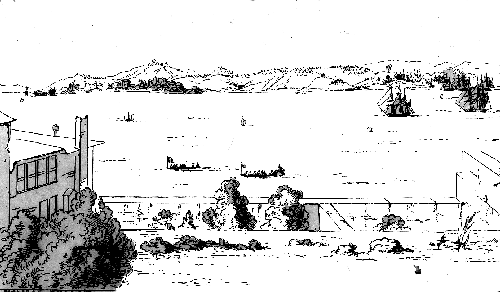
Drawn G. C. from a Sketch by the Author.
The Russian encampment on the Giant's Mountain from the English Palace Garden.
As I before observed, every portion of the
European and Asiatic coast is covered with
villas and gardens. The houses are painted of
various colours, and have verandas, with trellis
work, covered with roses, running round them.
Those situated near the water are built with an
arched entrance for the caiques, through which,
by means of a short canal, they glide into the
centre of the court-yard. The water here is very
deep, and we were sailing so close to the shore,
that the mainyard scarcely cleared the houses.
Indeed, instances have occurred, where the inhabitants
have been surprised by the visit of a
bowsprit pushing its way through the wood-work,
and carrying off the roof of their dwellings.
RUSSIAN CAMP.
We now came in sight of the Russian encampment,
and the tents which covered the
summit of an extensive range of hills, called the
Unkiar Skelessi, or Giant's Mountain7, resembled
so many snowy pinnacles. Their fleet, consisting
of ten ships of the line, a number of frigates,
and small craft, lay on the opposite side of the
channel.
Beyond the village of Jani Keni, and opposite
the Sultan's valley, we also found the Russian
head quarters established, and a Russian frigate
occupying the berth in which the Actæon had
anchored twice before. We therefore passed
on, and dropped anchor a little a-head of a
French frigate, opposite Terapia, and close to
the Russian camp. The usual firing immediately
commenced, but, by some oversight, the Russian
admiral's salute was returned with two guns less
than the usual number. In about an hour afterwards,
he sent his flag lieutenant, who spoke
English, on board the Actæon, to inquire why
we had only fired fifteen guns when he had paid
the compliment of seventeen. The omission
was immediately acknowledged, the two remaining
guns discharged, and the gallant lieutenant
rowed off again well satisfied. We soon ascertained
that this sensitiveness proceeded from
their anxiety to convince the Turks that no
ill-will existed between England and Russia,
and that no insult was meditated by our ship,
more particularly as the British ambassador to
the Porte, was known to be on board. I doubt
much, however, if the Turks, although quite
au fait to all matters of ceremony, understood
the firing of the two guns afterwards.
FRENCH AND ENGLISH EMBASSIES.
The town of Buyukdere, or the deep valley, off
which lies the Russian fleet, is also the residence
of the Russian, Austrian, and German ambassadors;
the very hotbed of plots and etiquette.
At Terapia the French and English embassies
reside alongside each other; indications of that
perfect unanimity which ought to subsist between
these two great powers; and, if they remain
true to each other, I would confidently back
Terapia politics and manœuvres against those
of Buyukdere. The French palace is a spacious
building, with beautiful and extensive gardens.
That inhabited by the English ambassador, on
the contrary, is small, comfortless, and with only
a small slip of ground.
RUSSIAN MILITARY MUSIC.This day was occupied in visits from the secretaries
of embassy of the different missions.
As the plague was in Terapia a few days since,
that village is put in quarantine with the palace;
which also lies under the same regulations in respect
to the Actæon: and as the Russian sentinels
refused to allow any one to land in the Sultan's
valley, we had nothing to do but to watch their
drills and parade exercises, while listening to
the music of the horn bands, which played on
a hill close to our anchorage; and the beauty
of these national airs, somewhat compensated for
the rudeness with which they turned us off the
shore. It was very cold in the afternoon; the
shifting of the wind to the north caused a great
change in the weather, and towards evening we
were glad to keep below.
Thursday, 2d. It is a most lovely morning:
all nature seems to rejoice in the freshening
breeze, which, blowing from the Black Sea,
tempers even the hottest days with its refreshing
coolness, and extracts the sweets from millions
of roses, which ever bloom on the shores of the
Bosphorus. From the jasmine or orange flower,
it floats with its odorous burthen along the
current, and lays all its perfume at the foot of
Stamboul.
THE CAIQUE.
A party of us embarked in a sort of light boat
called a caique, than which no species of vessel,
save the gondola, cuts more softly and noiselessly
through the waters. It is a narrow wooden
canoe, with a long beak; the outside is painted
black, with a strip of bright red inside the stern
piece; and is ornamented with carvings of
flowers, and a thousand other devices. A Persian
carpet, or a piece of oil cloth, covers the
part on which the foot steps in entering, and
here the slippers are left or retained, as the
owner pleases. Those who ride in them do not
sit on benches, but in the bottom of the caique,
on a Persian carpet. The interior is white as
snow, and there is an ornamented back board
which runs across, and separates the stepping
place from that appropriated to the purpose of a
seat. It has no keel, and the paddles are long,
and broad at the end. Some caiques are rowed
by one, others by two boatmen, with two oars
or sculls each; but the most elegant of these
vessels have three rowers. The employés of high
station about the Porte, and the ministers of the
different foreign courts, keep superb caiques,
rowed by eight, ten, or even twelve men; but
although these boats are very striking in their
appearance, they want that air of comfort and
neatness which distinguish the smaller caiques.
TURKISH BOATMEN.
The rowers are either Greeks or Turks, and
wear a fez just large enough to cover the crown
of the head, which is close shaved. The remainder
of their dress consists of a thin transparent
shirt, with large sleeves reaching to the
elbows; and cotton drawers fastened to the
knees; both as white as snow. They are a
fine robust race of men, and their muscular
sun-burnt forms are displayed to advantage
through the gauze which so slightly covers
them. At each stroke they utter a grunt, by
forcing the breath suddenly from the chest;
to acquire this accomplishment, is considered a
necessary part of the boatman's education, and
his character depends much upon it.
When we arrived at the landing-place of Tophana,
a Turk, splendidly habited, pulled the
caique close up with a long pole, and assisted
us out; for which service he was rewarded with
a few paras.8
A fountain of singular beauty is here erected
in the centre of the fish and vegetable market,
which, from its vicinity to the arsenal, and from
its being the landing-place for all pleasure boats
coming from Scutari and the neighbouring villages
of the Bosphorus, is constantly occupied
by a crowd of idlers.
In the street leading up to Pera, the throng,
which was also considerable, presented an infinite
variety of novel and picturesque costume.
The pavement is bad, but very clean, and
greatly exceeds in this respect the narrow streets
of the generality of Italian or Scotch towns.
There is no cry of "heads below;" and a man
may wander about at night without any fear of
other rain than that of heaven, provided he
carries a light with him.
PERA.—DESTRUCTIVE FIRE.
Pera is recovering but slowly from the destructive
fire, which two years ago ravaged this
quarter of Constantinople; for, owing to the
unsettled condition of public affairs, and the uncertainty
as to who may be the future masters
of this capital, the rich are unwilling to embark
their property in building speculations on any
very extensive scale. However, three handsome
streets have been finished, the houses of which
appear better and more commodiously built than
they were formerly. Having secured apartments
in a very comfortable lodging-house, kept
by one Guiseppino Vitali, we paid a visit to
Mr. Cartwright, the consul-general, perhaps one
of the most excellent and kind-hearted individuals
ever invested with the consular authority.
Since the fire, he has built a very comfortable
house, where he exercises a generous and unbounded
hospitality.
HOSPITALITY OF THE BRITISH CONSUL.
From Messrs. Black and Hardy, our bankers
in Galata, we also experienced the most
friendly attentions. We thence proceeded to
Mr. Stampa's, that emporium of all good condiments,
where Adrianople tongues, Yorkshire
bacon, Scotch whisky, French cogniac, Scotch
ale, London porter, English cheese, and Havannah
segars may be obtained for "a consideration."
In fact, no shop can be supplied
with a greater variety of articles, nor in any city
upon the surface of the globe are luxuries,
whether foreign or domestic, to be obtained
more plentifully than in Stamboul. Returning
to Guiseppino, we dined at the Europa, a good
inn—at least, we had a good dinner; and as evening
advanced, proceeded to Tophana, and after
a two hours' pull up the Bosphorus, we arrived
at the ship. The current runs so strong, that
the boats are obliged to keep in close to the
shore, and at three points are towed by old men
and boys, who are stationed there for the purpose,
and receive a few paras for their labour.
Friday, 3d.—To-day it poured with rain
without cessation, and in consequence, the ambassador
could not go on shore. In the evening
I went to the palace for a few minutes, but it
felt so cold and comfortless that I had no wish
to remain. This is by no means a fit residence
for our ambassador. I returned to the ship
loaded with newspapers, the appearance of which
on the gun-room table was hailed with satisfaction,
nearly a month having elapsed since any
one on board had heard of the state of home
and Europe.
RUSSIAN MILITARY FUNERAL.
Saturday, 4th.—This morning a Russian
soldier was buried, and we observed the ceremony
from the quarter deck. He was borne in
an open wooden coffin; a priest in black, and
with a long beard, headed the procession, and
a company of soldiers brought up the rear. On
arriving at the grave, the priest put on an additional
garment, having a yellow cross upon it,
and then read the service, sprinkling the body
at intervals with holy water (as we supposed),
for the distance was too considerable to enable
us to see distinctly. After each person present
had repeated this portion of the ceremony
as he walked round the corpse, the priest resumed
his duties, scattering more water upon
the body, and the lid being put on the coffin, a
blessing was pronounced while it was lowered
into the grave, and with the casting in of the
earth, the ceremony ended. The soldiers then
filed up the hill; while the priest, disencumbering
himself of his robes, proceeded to saunter
about the shore.
LANDING OF THE AMBASSADOR.
At two o'clock the ambassador landed in
state: the yards were manned, and the salute
fired. Soon after, the rest of the suite followed;
and the Actæon was now left to quiet and
regular duty. The cabins fitted up for the
party were cleared away in the course of an
hour; and before the dinner drum beat, the
main deck had been again restored to its just
proportions. In the evening, my companion
and self also left the ship, and went down to
Pera, to establish ourselves for the present in
the house of Master Tongo; a name by which
I find our landlord is better known than by that
of Vitali.
Sunday, 5th.—On looking out of window
into the street this morning, I beheld crowds of
Armenian and Greek women proceeding to
church, the former wearing the gashmak, or
veil, and their long dark feridges, or cloaks,
with red morocco slippers just peeping out
beneath. They differ from the Turkish women
only in not covering the nose, and having red
instead of yellow slippers, in which they shuffle
along slowly to their worship. Of the Greeks,
however, some wore over their hair embroidered
handkerchiefs, arranged à la Française in the
shape of a toque; others were muffled in cloaks
of a snuff-brown colour, with a white muslin
veil arranged upon the back of the head, and
having both ends brought round upon the breast:
thus exposing the whole face, and setting off
to the best advantage the handsome regular
features, and the dark eye, with its long black
silky lash.
VISIT TO THE BAZAARS.
After breakfast, a party was made to visit the
bazaars; and we embarked at the new custom-house
stairs, in Galata, where numbers of
caiques lie ready for hire, and where the same
scramble occurs for passengers as at Blackfriars
or Tower Stairs in England. We glided rapidly
across, skilfully avoiding the numerous caiques
that were plying in a contrary direction, the
boatman calling out, "On the European side,"—"On
the Asiatic side," as it suited his
purpose to pass to the right or left, there
appearing to be no established law for regulating
their motions.
On landing at the Balouk9, or fish bazaar, we
passed through the bazaar of drugs, called also
that of Alexandria, an extensive covered building,
where rhubarb, paints, senna, and other
commodities of that sort, are sold in stalls fitted
up on both sides of the passage. The articles
are all exposed in the most tempting manner,
according to the fancy of the vendor, who
sits cross-legged on the shop-board behind,
waiting anxiously for his customer; and when
any one stops but for an instant, he pops out his
head like a spider, to ascertain whether it is a
bite or not. We passed through the pipe-stick
bazaar, situated in an open street: on one side
of which, pipe-sticks and amber mouth-pieces
are exposed to sale; the other being almost
entirely occupied by turners, who work with
extraordinary neatness, considering the imperfect
nature of their tools. From the bazaar where
cotton handkerchiefs and shawls, English and
German, are sold, we passed to the shop of
Mustapha, the scent dealer, where we established
ourselves for a luncheon, consisting of pipes,
coffee, and lemonade, while the various bottles
of perfume,—viz. attar of roses and jasmine,
musk, musk rat-tails, lemon essence, sandal
wood, pastilles, dyes, all the sweet odours that
form part and parcel of a sultana's toilet, were
temptingly exposed to our view. From time to
time, portions of these delicacies were rubbed on
our whiskers, hands, and lips, to induce us to purchase;
so that when we left the shop to return to
Pera, we were a walking bouquet of millefleurs,
and might have been scented a mile off. After
visiting the dockyard, where a line of battle ship
and two frigates were getting ready for sea, we
climbed the hill of Pera, under the shade of the
dark and splendid cypress trees covering the
burial ground, and from which long avenues
lead to various parts of the town.
PUBLIC PROMENADES.These are
the favourite walks of the Perotes; and the gay
dresses of the ladies, who, in joyous parties,
ramble along the silent and gloomy pathways,
contrast oddly with the sad and mournful
character of this place of tombs. We again
strolled about in this ground after dinner; but
were soon tired, the cold being too severe to be
pleasant; and even the inhabitants retire early.
The evenings at Pera are not agreeable, there
being no public amusements into which one can
enter; and society is so garbled with form and
etiquette, that it is hardly worth seeking; smoking,
therefore, is the only resource, and most
people adopt it.
Monday, 6th.—This morning we landed at
the Lemon Skalese, where the fruit bazaar
stands. Here were shops full of Smyrna figs,
dried dates, plums, and various other fruits;
with cheese, and Russian butter.PIPE-STICK BAZAAR. We went
thence through the place where wax candles are
sold, to the pipe-stick bazaar, where I intended to
be a purchaser both of amber and cherry sticks.
Of the former there are two sorts: the white,
creamy, or lemon-coloured amber is the most
valuable; and a large mouth-piece of the very
purest is sometimes worth 5000 or 6000 piastres,
equal to about 50l. or 60l. sterling. The second
or yellow kind, being more common, is comparatively
little esteemed, for the perfection of
this article consists in its being free from flaws,
cracks, or spots; and if the tube of wood can
be seen through the amber, it is considered as
very inferior in a Turk's estimation. There is
a third sort, which is valueless from its transparency.
It is either real or factitious, and
often consists merely of the scrapings and refuse
morsels, melted into lumps, and manufactured
into cheap mouth-pieces. This portion of the
Turkish pipe is frequently adorned with precious
stones, enamelling, or carved wood, according
to the fancy of the purchaser. The cost of those
generally exposed for sale varies from 20 to 1500
piastres, and when one of a higher price is required,
it is found in the possession of some
wealthy Turkish or Armenian merchant. The
amber is imported from Dantzic in lumps; there
is considerable risk in the purchase of the crude
article, and hence arises its excessive dearness
when it turns out well. The cherry sticks come
from Persia by Trebisond; they are brought to
Constantinople in pieces of about two feet long;
and after being set straight, are dressed and polished
with infinite care. They are united into
sticks generally of five or six feet, though some
are as long as twelve feet, and the junction is so
skilfully concealed with the bark, that in a well-made
pipe it is impossible to discover it. When
repolished, they are ready for sale, being left
unbored until the merchant has found a purchaser.
From 30 to 100 piastres is the usual
price demanded, but it differs according to the
length, size, and fineness of the bark; and
dark-coloured sticks are preferred to those which
are lighter. Pipe-sticks are also made of rose-tree
and other woods; but the favourite summer
pipe is of jasmine, which is not so dear as
the cherry, and is very light and flexible. I
have seen them of one entire piece, measuring
ten feet. These are cleaned by squeezing lemon
juice through them, which is also rubbed over
the outside to render them cool. Another species
of pipe is the narghilé or water pipe; our sailors
have christened it the hubble-bubble: it is a
species of hookah, consisting of a glass bowl
partly filled with water, a pipe holder fitted into
its taper neck, and a long flexible tube, made of
embossed leather and brass wire, through which
the smoke is drawn. The bowls are manufactured
of clay in various forms; some being
very plain, others really elegant, with abundance
of gilding and ornament.
TURKISH TOBACCO.The tobacco smoked
in the ordinary pipe, is brought from the Crimea,
Salonica, Latakia, Ormus, and other parts of
the East. The Salonica tobacco is mild and excellent;
that from Latakia, on the contrary, is
strong and dark coloured. The price varies between
four and ten piastres the oke, of two
pounds and three quarters English; it is also
sold in bales of ten okes each, at the same rate.
The tobacco smoked in the narghilé is of a
different quality and cut: the best comes from
Shiraz, and it is damped previously to being put
into the clay bowl. The mode of using the
narghilé is not only difficult to acquire, but, to a
beginner, is painful and sickening; the air being
exhaled from the lungs, and replaced by the
smoke and breath. Every Turk, and indeed
every inhabitant of Stamboul, carries about his
person a square bag, either of cachemire ornamented
with embroidery, or of common silk, in
which he keeps a supply of tobacco; and as the
coffee-house supplies him with a pipe-stick and
pipe gratis, he pays only for the cup of coffee
which accompanies it. He loads his pipe from
his own bag, and the boy of the establishment
places a small bit of lighted charcoal on it. They
may be seen by hundreds before every coffee-shop,
seated on low stools, blowing clouds,
sipping Mocha juice, and exhibiting the most
solemn taciturnity and perfect content. In
driving bargains, the Turk, having seated the
purchaser at his side, presents him with coffee
and a pipe, and between the puffs of smoke the
negotiation is carried on. If it does not succeed,
the pipe is resigned, thanks are returned
for the coffee, and the business is at an end;
should they agree, another pipe generally concludes
the affair.
THE SHOE BAZAAR.
We next went through the shoe bazaar, where
are arranged thousands of pairs of slippers and
boots, some of yellow, others of red morocco,
and of all sizes. But the most superb exhibition
consists of the embroidered slippers for the use
of the women within doors; these are made of
velvet, silk, or cloth, covered with gold and
silk embroidery, pearls, &c. Here also are sold
mirrors of different shapes, with the backs likewise
embroidered in various colours and devices,
intended for the fair inhabitants of the
harem.
JEWELLERY.—BROUSSA SILKS.Though this bazaar, from its novelty, is
generally acknowledged to be the most attractive,
it does not offer such splendid temptations as
that devoted to the sale of jewellery, which we
now entered, and which consists of a series of
low, narrow arched passages, opening into each
other, and very badly paved. The shops or
stalls, instead of the usual inner apartment, have
only high counters, behind which sits the Armenian
jeweller. Before him is placed a square
glass case, in which are huddled together, in
precious confusion, silver filagree coffee-cup
holders, chased gold and silver boxes for talismans,
silver heads for narghilés, female ornaments,
pastile burners, old snuff-boxes, rings,
cornelian ointment boxes, gems, and agate-hilted
dirks. The more valuable articles are probably
kept in drawers under the counter, or in the
strong room of some fire-proof khan or warehouse.
Thence I went into the Broussa silk
bazaar, a square building divided into compartments,
in which are piled up pieces of the
silk of a thousand different patterns. The produce
of the Broussa manufacture is a mixture of
cotton and silk, with which gold and silver
thread is frequently intermingled; the pattern
is exceedingly splendid, and it is used for the
gowns and jackets of both men and women.
There is also a stuff made in Constantinople of
similar materials, which, though all of one colour,
is exceedingly handsome, and well adapted for
dresses. The bazaars closing at two o'clock,
we returned to Pera highly gratified with the
day's excursion.
RESIDENCE OF THE BRITISH EMBASSY.
Tuesday, 7th.—Went up this morning to
Terapia to pay a visit at the palace, and learned
that Count Orloff had arrived from Odessa as
ambassador extraordinary and commander-in-chief
of the Russian force, with a carte blanche
from his sovereign as to the treaties and measures
he might think fit to adopt. I went over
the palace, which is but just large enough to
accommodate the family of our ambassador, and
the attaché is obliged to live in a house higher
up the hill, but within the walls of the government
property. Returned in the evening to
Pera, more than ever captivated with the beauties
of the Bosphorus; though the cold weather
still retards the progress of vegetation, and the
leaves are but slowly making their appearance.
Indeed so late a spring, and such inclement
weather, have rarely been experienced at Constantinople
before.
FUNERAL OF A FRANK PHYSICIAN.
Wednesday, 8th.—The funeral of the Sultan's
French physician passed our lodgings,
on its way to the burying-ground. It was accompanied
by about 100 officers and soldiers
without arms; and, this being the first time
any Turks had appeared at a Christian ceremony,
a great sensation was excited in Pera.
The man was much esteemed by the Sultan,
and was a favourite with all classes, both Turks
and Christians. The following was the order of
the funeral. First came the soldiers, divided
into two bodies, one occupying either side of
the street, with the officers in the centre; then
followed a number of Capuchin monks, with
priests and servitors of the Greek church; lastly
appeared the body, carried upon a bier, and
covered with a black silk pall, with a yellow
cross, its four orange tassels being held by supporters.
A crowd of Franks, Turks, and Armenians,
wearing crape upon their arms, closed
the procession. The bearers were distinguished
by large fur caps, decorated with red cloth, resembling
the calpac of the Armenians, and every
individual carried in his hand a long thin wax
taper.
Thursday, 9th.—I again went up to Terapia,
where there is a report, that the pilots of
the Sea of Marmora and the Dardanelles have
gone on board the Russian fleet, and that more
troops have arrived. The Russians, however,
strongly deny both facts.
AUDIENCE OF THE SULTAN.Our ambassador had a
private audience of the Sultan this morning, an
express having arrived, somewhat unexpectedly,
at the palace of the British embassy yesterday
evening, intimating that the Sultan would receive
Lord Ponsonby at nine o'clock on the following
day. It seems that Count Orloff had peremptorily
demanded an audience; but as our ambassador
arrived before him, he was entitled to
precedence in this matter; and Count Orloff's
reception was accordingly arranged to take place
one hour afterwards. Lord Ponsonby went with
his nephew Captain Grey, and Mr. Waller, the
attaché. They were received at the palace
or new kiosk at Dolma Batché, on the European
side; and as they landed, the Sultan's band
struck up "God save the King." On being
ushered into the presence, they found his
Highness seated on his divan, an apartment
splendidly painted and decorated, and after
the ambassador had paid and received the
usual compliments, coffee and pipes were introduced.
The Sultan shewed them a portrait,
in a wide gilt frame, of himself on horseback,
painted by some Sardinian artist. It
was a resemblance, but indifferently executed.
After remaining an hour, they took leave; and
found a Russian steamer, with Count Orloff on
board, waiting near the palace. The Count's
audience lasted two hours. Many plans were,
no doubt, formed; and every one feels in great
anxiety to know the result of this conference.
I dined to-day at the palace. Admiral Roussin,
the French ambassador, came in, in the evening.
He is frank and undisguised, as a sailor ought to
be; and entered at once upon the policy intended
to be adopted by his government. He
seemed persuaded that Ibrahim would retire
behind Mount Taurus; and expressed himself
very doubtful of the good faith of the Russians.
Slept on board the Actæon, in the cockpit,—a
terribly close berth, and hot as an oven.
Penny, one of the carpenter's crew, who had
been ill for a long time with rheumatic pains,
died in the course of the afternoon, and will be
buried to-morrow.
NAVAL PUNISHMENTS.Friday, 10th.—There being a punishment
this morning, of course I remained in the gun-room.
Two sailors received the cat, and although
the thing is perfectly disgusting, my experience
convinces me it is necessary to the maintenance
of discipline. The captain and first lieutenant
are averse to the practice of flogging; but, if
the first man had been punished for a similar
dereliction of duty, a fortnight since, he very
probably would not have repeated the offence;
and his fate might have served as a warning to
his companion in suffering. In fact, the knowledge
that the captain dislikes to proceed to this
extremity, encourages the unruly to get drunk
and be insolent.
CRICKET.—TURKISH FLEET
The Russians exercise their troops daily in
marching, counter-marching, skirmishing, and
firing at a mark. The officers of the Actæon
have written orders to be admitted into the
camp, and now go on shore every afternoon to
play cricket in the Sultan's Valley, much to the
amusement of both Russian and Turk. The
Russian general recently came on board, and
expressed his surprise that the captain had not
visited the camp, inviting him to do so, and at
the same time leaving these orders for the officers.
Returned to Pera in the evening. The
shore on either side the channel daily acquires
new beauties, as the warm weather advances,
and the trees assume their summer clothing.
As I passed the Turkish fleet at sunset, the
Mahmoudiel fired a gun; and, in an instant,
every topmast was lowered, with as much precision
and celerity as would have been displayed
by an English fleet at Spithead.
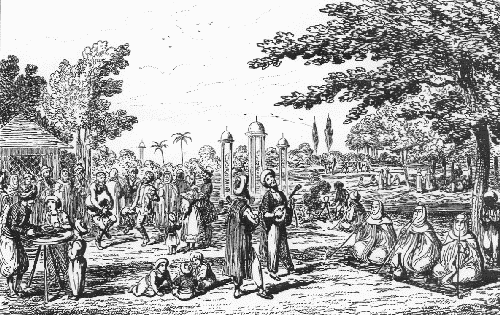
Drawn & Etched by George. Cruikshank, from a Sketch by the Author.
Sweet Waters
CABOBS.—RAPACITY OF THE SULTAN.
Saturday, 11th.—Went to a cabob shop. Cabobs
are made of small pieces of mutton, about
the size of a small walnut; which being strung
on iron or silver skewers, and roasted over a fire,
with plenty of grease, are served up with a
species of soft cake, toasted, and soaked in gravy,
or with milk, water, parsley, and garlic, brought
all together in a large bowl. The Turks eat
it with their fingers; we had forks: they were,
however, so dirty, that we quickly abandoned
them for the Oriental method. This is a capital
dish, with the single exception of the garlic.
A glass of cold water, and a pipe at the nearest
coffee shop, finished our repast, and we then
went to a rich Greek merchant's strong room,
to see some amber mouth-pieces; and he certainly
did shew us a splendid collection, valued
at 200,000 piastres. On returning to his shop,
when about to pay him a large sum on account
of my purchases, he requested me not to do
so there, but accompany him to a more convenient
situation, lest the Turks should observe
that he was receiving money. Both Armenians
and Greeks most anxiously conceal their wealth,
as it might subject them to be pillaged by the
Sultan, ei ther directly, or through the extortions
of his tax gatherers.
NAVAL ARSENAL—CEMETERIES.
Sunday, 12th.—This afternoon I visited the
Valley of Sweet Waters; an appellation conferred
on it by the Franks, instead of its proper name,
Keathane, or "paper manufactory." Greeks,
Armenians, and Turks make parties on Sundays
and holidays to this retired and beautiful promenade,
where they dine and pic-nic. In proceeding
thither, our caique passed the Arsenal,
and we saw one line-of-battle ship afloat, and
nearly ready to join the fleet, another on the
stocks, and two frigates in a forward state. The
American builder, at present at the head of the
dockyard, has built a range of very neat workshops
and stores; and great activity characterises
the whole department. In passing up, I saw the
remains of the old palace of Theodorus, on one
side of which is the Jewish cemetery, extending
an immense distance, but without a single tree;
and the grey head-stones, thickly strewed over
the inclosure, look as if they had fallen from
heaven in a shower. A prettily situated village,
with its Turkish burying-ground, is on the opposite
side; there cypresses cast their mournful
shade upon the tombs of the departed Mahomedans,
and numerous parties had landed there
from their caiques, and were regaling themselves
under the large trees, where any happened
to border the river. On arriving, we
found the landing-place thronged with boats,
and the walks crowded by visitors. Sultan Selim
erected a palace here, which he intended should
resemble that of Versailles. His ambassador,
on returning from Paris, had brought back
some views of that splendid abode of the
PALACE.—TURKISH HORSES.
French monarchs; and Selim, struck by its magnificence,
determined to build a kiosk in imitation
of it. Accordingly he changed the river
into a straight canal; formed avenues, which
were planted with long lines of trees; contrived
waterfalls, and laid out a beautiful park. The
trees have grown up to a magnificent size, and
cast a pleasant shade over the walks and water;
but the deserted palace is fast falling to decay,
and the park is frequented only in the spring.
Here the Sultan's horses are sent to graze; and
their visit is celebrated with great pomp on
St. George's day (Old Style), when they come
in procession, and to each of them is allotted a
place in the park, in which they are picketed
after the fashion usual in the East. The tents
pitched near them are occupied by Bulgarians,
whose duty it is to watch the animals night and
day; and, perhaps, a more magnificent collection
of fine horses was never seen feeding together,
or in an equally beautiful spot.
AUDIENCE OF THE SULTAN.Here were
assembled parties of all nations. Crowds of
Turkish women, closely veiled, sat under the
trees, listening to the performances of itinerant
musicians and dancers, whose instruments were
fiddles, dulcimers, and tambourines. The singing
consists solely in dwelling a considerable time
on a single note, with the mouth wide open, the
head thrown back, and the eyes half shut; then,
suddenly changing to another tone, about half a
dozen words are strung together, and a sort of
dialogue, in recitative, is kept up by the performers.
In one direction, a conjurer is seen exhibiting
his feats of manual dexterity, surrounded
by a motley gaping crowd;—in another, a story-teller
exercises the risible faculties of the sedate
Turk, as well as of the merry laughter-loving
Greek. A string of Armenian women approach,
walking two and two with slow solemn steps, and
followed by a slave carrying a basket of refreshments.
Behind these come a party of gaily dressed
Greeks of Pera, laughing and joking, the very
personification of merriment; while their more
stately country-woman of the Fanal, moves majestically
along in another direction, with the pride
of a thousand years of ancestry, conspicuous in
her air and carriage, and all the consciousness of
perfect classic beauty, in her form and face. Nor
THE ERRABA.
does she omit to display her delicate foot with
its stocking of snowy white, and neat morocco
shoe. Under the shelter of yonder magnificent
plane trees, stands an erraba or Turkish carriage,
in which the Sultan's sister and a large party
of female slaves are seated, eating mahalabé and
drinking sherbet, while they enjoy the busy
scene before them. The erraba has no springs,
and is richly ornamented with a profusion of
gilding, and covered with beautiful shawls,
crimson silk, or white muslin fringed with silk
or gold, according to the taste and fancy of the
owner. The interior is furnished with cushions,
and the entrance is from behind, by a small
ladder: it is drawn by two oxen, guided by a
man on foot; and when out on distant excursions,
is generally followed by a boy, carrying
provisions. The heads of the oxen alone are
furnished with harness, to which a string of
large bright blue glass beads is added, to protect
the animals from the fascination of the evil eye.
From either yoke, a long curved stick, painted
alternately with blue and red, and decorated
with woollen tassels of the same colour, extends
backwards over the oxen, as far as the front of
the carriage.
BEAUTIFUL WOMEN.
The Turkish women, when none of their
countrymen are present, are fond of conversing
with a Frank, particularly if he appears to be a
stranger newly arrived, and not a resident at
Pera. They will offer confectionary, mahalabé,
and remove their yashmaks, as several did to-day;
but not one of the fair wearers could vie in
personal beauty with some of the Greeks who
surrounded them. Still, however, they were
pretty, with fine dark eyes, but the total absence
of the rosy hue of health is unpleasing;
and the custom of staining the lips and blackening
the eyelashes, communicates a ghastly paleness
to their features. Yet their skin is excessively
delicate; and many of the small white hands I
saw to-day, would create an envious feeling in
more than one lady patroness of Almacks. I
particularly noticed one lady, apparently the
wife of some Turk of distinction, who was
seated upon a splendid Persian carpet spread
upon the grass, and surrounded by fourteen
young female slaves, whose beautiful eyes were
alone visible, the rest of their faces being closely
covered up. They appeared very fond of music,
for they had two bands singing and playing
different airs at the same moment, both parties
contending which could scream the loudest.
On returning towards the landing-place, we met
numbers of Greek ladies and gentlemen with
guitars and clarionets coming up to pass the
evening in singing and dancing upon the green
turf.
As our caique again glided swiftly down the
stream, we passed many similar vessels, containing
seven or eight Turkish women each, and
up went the yashmak at our approach. Boat
loads of Perotes, with gay turbans and toques,
were also seen hastening to the festive scene;
and, on arriving at our homes, we found the
churchyard empty, and all Pera silent and tranquil,
as if deserted by its inhabitants.
DANCING DERVISHES.
Tuesday, 14th.—Visited the mosque at
Pera, to witness the ceremonies of the dancing
dervishes. This edifice is built in the form of
an octagon, having a gallery extending round
the interior on six of the sides, under which the
public sit. In one of these galleries hung the
cloaks of the dervishes; and in another was
posted the music, consisting of a drum, Turkish
flutes, and a dulcimer. Outside the building
on the left of the entrance, but only separated
by a trellis-work, is the women's receptacle.
This was crowded, as was also the part assigned
to such as took no share in the ceremonies.
The centre of the mosque is railed off; and the
chief priest, who wore a green dress, with a
white hat, partly covered by a green shawl, was
seated opposite the grand entrance on a red
cushion, placed upon a carpet spread upon the
floor, which is of chestnut wood, polished to
brightness by the constant friction of the
dervishes' feet. From the centre of the roof,
was suspended an octagonal bar of brass, to
which lamps of different sizes were attached,
and from the galleries, which are supported by
pillars, hung several square pieces of cloth or
pasteboard, painted black, and inscribed with
passages from the Koran.
I left my shoes at the entrance; and on
gaining the interior of the edifice, found the
service had commenced. As each dervish entered,
he saluted the chief priest; besides whom,
there were five other priests, seated in various
situations close to the railing. One, on the
right of the entrance, held a book, from which
he chanted certain verses in a monotonous
voice; while the others sat silent and motionless,
with their eyes fixed on the ground. When he
stopped, a slow and solemn air was played upon
the flutes, accompanied by the drum, which had
an effect by no means unpleasing; but in a few
moments the other instruments commenced a
species of tune between a waltz and march, and
all the dervishes jumping up, the whole assembly
followed each other slowly round the enclosed
space, led by the high priest. On arriving opposite
the seat of their leader, they bowed thrice
to the ground, with their arms crossed upon the
breast, and on passing close to it, they stepped
by, with a stride and a whirl, and then resumed
their march. After the third performance of these
absurdities, the high priest sat down, and the
music, which had hitherto continued playing the
march, presently struck into an air resembling
a sauteuse, accompanied by the chanting of
several voices. The dervishes, having thrown
off their cloaks, again folded their arms across
their breasts, and bowing three times, re-commenced
walking before the high priest, bending
low as they passed his seat, and kissing his
hands, which were joined together. The whirling
at length began in reality: at first with
folded arms, then with one arm extended, the
other slightly bent, and held so as to form an
obtuse angle at the elbow. Thus, with closed
eyes and erect body, these singular people
whirled round and round on one leg, making a
pirouette with the other, and proceeding by
degrees round every part of the enclosure, accelerating
or retarding their movements as the
music and the chant became more or less animated.
By looking at a stop watch, I ascertained
that on an average they turned sixty-four times
in a minute. After spinning round for about
five minutes, at a signal from the high priest,
both music and dancers suddenly stopped, but
re-commenced in a few seconds, bowing as
before. The third time, they kept it up for
nine minutes and three quarters; my brain was
swimming too, so much so, that I could hardly
count their evolutions; and it is extraordinary
their heads should escape being affected in the
same manner. I noticed one little fellow who
went round at an amazing pace. The fourth
and last time they whirled for five minutes and
three quarters, thus making in all
5 + 3 + 9¾ + 5¾ = 23½ x 64 = 1504 turns.
Having been highly amused with this extraordinary
exhibition, I was most anxious to ascertain
when and where their brethren, the howling
dervishes, performed their antics; I found, however,
that they had been banished Stamboul and
Pera, and now went through their orgies at
Scutari, but in secret, and very seldom.
GREEK BOOKSELLER.
Thence I went to the shop of a Greek bookseller
in Galata, who has English and Italian as
well as French and modern Greek books for
sale, all which pay an ad valorem duty of three
per cent. I did not find any worth buying,
except a description of the manners, customs,
and new regulations of Constantinople, up to
1832; written by an Italian attached to the
Sardinian mission, and published in Genoa.
The only Greek books were some wretched
translations of French tales, and of one or two
German plays.
Wednesday, 15th.—This morning we took
Mustapha, once the consul's janissary, and now
his servant, as a guide to the curiosities on the
other side of the water. He is by birth a Swiss,
who, after having experienced various vicissitudes
and adventures, was taken by pirates, sold
as a slave, turned Mussulman, and is now happy
and contented in the service of so good a master.
Few English visitors who have remained any
time in Constantinople during the last fifteen
years, have quitted it without making the acquaintance
of our friend Mustapha.
MOSQUE OF SOLIMANIE.
The first object to which he conducted us
was the mosque of Solimanie, the largest and
most elegant in Stamboul; though it does not
possess the same interest or renown as St.
Sophia, nor the beauty and lightness of that of
Sultan Achmet. The outer court is surrounded
by fine old plane trees, and we looked into the
inner one, which is surrounded on three sides by
cloisters, and several antique pillars, with a fine
ornamented fountain in the centre. On entering
by the principal door, we took off our shoes, which
was no hardship, the whole floor being covered
with soft carpeting. The dome is supported by
four enormous pillars of grey granite, polished
by age. I was desirous to have measured them,
but the priest or servitor, who accompanied us,
refused permission. From the ceiling of the
aisles, and around the dome, hung innumerable
lamps of different sizes; an octangular frame
of iron, suspended under the dome, also supported
an immense quantity about ten feet from
the floor. The aisles were filled with many little
recesses, in which were placed books on stands;
and one of them was occupied by a Turkish
priest, who chanted some verses from one of
these open volumes. Neither ornaments nor
pictures decorate the interior, all being plain
and simple, except that portion nearest Mecca,
where an enormous wax candle is placed on
each side of a little niche in the wall. There
is something extremely impressive in the unadorned
simplicity, vast extent, and sombre
aspect of this mosque, which is the only religious
edifice in Constantinople, that can be seen by a
Christian without a firman; a donation to the
priest of thirty-five piastres being sufficient to
admit a large party.SERASKIER'S TOWER. We now proceeded to the
Seraskier's tower, situated in a large court by
the side of the palace of the Seraskier Pasha.
In the upper chamber a party of men are constantly
stationed to watch for fires, and, I believe
also, to give notice of any unusual assembling
of the people. On the appearance of a fire, they
sound the alarm by beating gongs, and by despatching
messengers to various parts of the city.
From the windows of this apartment, is a most
perfect bird's eye view of the whole capital and
its vicinity. In the whole course of my travels,
I can recall but one prospect, whose exquisite
loveliness affords a similar combination of all the
ingredients necessary to a perfect landscape, and
which I, in some degree, prefer, as presenting
even a still greater variety of beautiful objects,—I
mean the view of Naples from the hermitage
on Vesuvius.
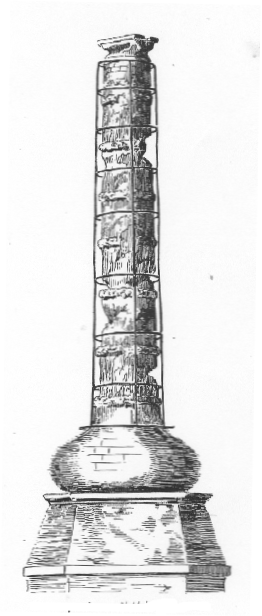
Etched by G. C. from a Sketch by the Author.
The Burnt Pillar.
Published by Longman & Co. April, 1835.
BURNT PILLAR.
A short walk brought us to the Tchernberlé
Tasch, or burnt pillar, built of red porphyry,
which has been cracked and splintered by the
numerous fires that have taken place around it;
and, to prevent its falling to pieces, it has been
enclosed within a sort of iron cage. It is ninety
feet in height, and thirty in circumference at the
base. Of the inscription, only a few letters can at
present be made out. It originally ran thus:—
Το θειον εργον ηενθαδε φθΑρεν χρονω
Καινει μανουῃΛ ευσεβης ΑυτοκρΑτωρ.
Passing onwards, we came to a dark dismal
place, called the Cistern of the Thousand and One
Pillars, a large reservoir for water, but now dry
and occupied by the winders of silk thread. Its
extent is very great, and the number of pillars
far exceeds that above-mentioned. There is also
another cistern, but as the entrance is through
a Turk's dwelling, it cannot be visited except as
a special favour, not always granted.
HIPPODROME.
From this, we were led to the Atmeidan, or place of horses,
the ancient hippodrome; a large oblong area,
on one side of which is the beautiful mosque of
Sultan Achmet, separated from the open square
by a handsome screen of masonry; over which
a number of plane trees hang their luxuriant
foliage, and through its windows we were gratified
with a view of the court of the mosque.
The Atmeidan is famous as being the scene of
countless insurrections and tumults; it was the
rendezvous of the turbulent janissaries; here
they made their last noble stand, and were hewn
to pieces and swept down by the Sultan's
cannon and cavalry. Here too were held games
and reviews, and here stands the obelisk of
Theodosius, the brazen serpents from Delphi,
and the lofty monument of Constantine, built of
rough masonry, and supposed to have been once
covered with brass. It is ninety feet in height.
The obelisk was brought from Egypt and placed
there by Theodosius, as appears from the following
inscription on the pedestal, which is now
covered up with earth, and the Turks will not
allow of its being cleared away.
Difficilis quondam Dominis parere serenis
Jussus, et extinctis palmam portare tyrannis:
Omnia Theodosio cedunt sobolique perenni;
Terenis sic victus ego, duobusque diebus,
Judice sub Proclo, superas elatus ad auras.
It measures sixty feet in height, and each of its
faces is covered with hieroglyphics. On the pedestal
is a badly executed alto relievo, intended
to represent the victories of Theodosius. Between
these two monuments is the celebrated
tripod from the island of Delphos; the heads of
the serpents of which it is composed are lost:
one of them was cut off by Sultan Mechmed
with a single blow of his sword. From the
number of people that gathered about me, I had
some difficulty in making a drawing of these
objects; and the soldiers from a neighbouring
guard-house really appeared to consider I was
forming a plan to pocket the columns and run
away with them. Had not Mustapha been with
me, it is probable I should have been arrested,
as a friend of mine was yesterday, when he attempted
to sketch Constantinople from Tophana.
A superior officer, however, soon ordered him to
be released, and gave him two soldiers as a protection
whilst he finished his drawing.
ST. SOPHIA.Thence
our course lay to St. Sophia, which is a confused
heap of unsightly buildings; the centre having
enormous buttresses built against it, and the
dome is much too low in proportion to the great
size of this edifice. The principal entrance to
the seraglio is also situated in the square, of
which St. Sophia occupies one side, the walls of
the palace another, and a row of small houses
and coffee shops a third. In the centre is a very
beautiful fountain; which, though inferior in size
to that of Tophana, is much more richly ornamented.
SERAGLIO.
The guard having allowed us to pass the gate,
we entered the first court of the seraglio—a
large oblong enclosure, formed by the Sultan's
gardens, the inner gate, the grounds of the serai,
barracks, stables, and a portion of the outer wall.
Within a niche on the left-hand side of this
entrance, the heads of rebellious Pashas and
other traitors are exhibited to the gazing multitude,
and among the more recent of those
placed there, may be mentioned that of Ali
Pasha. The second gate, which is flanked by
double towers, resembles that of an ancient
Gothic abbey; the interior is highly ornamented
with gilding and inscriptions in letters of gold;
and a large gilt cipher of the Sultan decorates
the front. Our attempt to pass into the second
court was less successful: Mustapha being a
great coward, he was afraid to offer the sentinels
a bribe; yet I have no doubt that the sight of a
gold dollar never fails to gain admission for the
unbeliever, whether Jew or Christian. Turning
away from this forbidden paradise, we proceeded
to examine a fine old plane tree, in the trunk
of which three people live and keep a coffee-shop.
A grove of plane, oak, chestnut, and cypress
trees, conducted us out by the lower gate,
and we walked to the sultanas' mosque, where
the bodies of the late Sultan, and of the wives of
his two predecessors, lie in state. The present
Grand Signior's favourite sultana, and her son,
also repose upon the same bier.
TURKISH FUNEREAL POMP.On looking
through the window, we distinguished the Sultan's
coffin, deposited on a kind of throne, with
four large wax tapers burning around it, and
covered with the most splendid Cashmere shawls.
All the other coffins were decorated in a similar
manner: those of the women being distinguished
by having no turban at the head; and the Fez,
or Greek cap, with a feather and diamond
aigrette, lay on that of the Sultan's son. The
court of the Sultana Valide's mosque conducted
us to the water-side; and, embarking at the steps
of the Balook bazar, we glided swiftly across
to Galata, highly delighted with the novelty of
the objects witnessed during our day's excursion.
COSTUME.
Thursday, 16th.—The clothes' bazar attracted
our curiosity to-day, where, in a few minutes, a
person may be rigged out, either à la Turque, or
as an Armenian, the whole dress costing about
270 piastres. A cloth cloak, a silk gown, a silk
jacket, camlet trowsers, yellow or red morocco
boots, a shawl for the waist, with a waistcoat,
shirt, and a calpac or turban, form the dress
of a gentleman or merchant. The Jews wear a
low black hat, round which is twisted a white
handkerchief, inscribed with some Hebrew sentences
from their law. The calpac of the Greek
differs from that of the Armenian, by having a
hole at the top, out of which peeps a bit of red
cloth. The Turks wear yellow, Greeks and
Armenians red, and Jews black, boots. The day
was finished at Mustapha's, the scent dealer; or,
to describe him by his real appellation, "Kortz
Sultanée Amel Mehemet Said," as his card duly
setteth forth. There we generally took a luncheon
of beed caimac, a species of curd; or of
mahalabé, a mixture of rice boiled to a jelly, and
eaten with ice and cream; at other times we
discussed a large dish of cabobs and a few glasses
of lemonade. Occasionally our party adjourned
to the coffee-house built in his garden, where,
under the shelter of a delicious rose and jasmine
bower, we spent the interval between dinner in
all the luxury of idleness, smoking and drinking
sherbet.
ANECDOTE.
Friday, 17th.—I visited a printing-office in
Galata, and saw the types of a work on the
Greek church, some specimens of music, and a
few Turkish books. The types were cast in
Paris, and brought here at a great expense.
The proprietors are now preparing a Hebrew
work for the press, which will take them two
years to execute. Went again in the afternoon
to the Valley of Sweet Waters, where a greater
crowd had assembled than even on the former
occasion. I walked to the village, where there
is a coffee-shop in a very agreeable situation,
overshadowed by plane trees, one of which is
nearly as large as that of the seraglio, and also
quite hollow. In one part of the canal, near
the palace, where the water is very deep, the
favourite sultana of Selim drowned herself. She
was young and exceedingly beautiful, but grew
so jealous of the attentions paid by her lord
and master to a Greek slave whom he had recently
purchased, that she determined on committing
suicide. Accordingly, having succeeded
in eluding the vigilance of the guards and eunuchs,
she one night escaped from the palace;
and having procured a large stone, she carried
it to the edge of the canal, and there fastened
it to her person by means of the Cashmere shawl
which she wore round her waist. On her absence
being discovered next morning, the utmost
consternation prevailed throughout the harem;
and her slaves and attendants trembled at the fate
which awaited them when the Sultan was informed
of his favourite's escape. The harem,
the palace, the gardens, the whole neighbourhood,
were instantly searched, but in vain; no
one had seen the sultana, and her absence remained
a mystery. The eunuchs were threatened
with death, if she were not found; and
the horror of all was aroused by the suggestion
that she might possibly have eloped with some
giaour10, and several of the slaves were sent to
atone for their neglect with the forfeit of their
lives. In the mean time, the poor Sultan remained
inconsolable: all his former love returned,
and the Greek slave was sent as a present
to one of the Pashas. At the expiration of a
few days, as the disconsolate Selim was seated
smoking on the borders of the canal, the body
became detached from the stone, and rose to
the surface of the water. Overwhelmed by the
heart-rending spectacle, which too well explained
the mystery of his beautiful queen's disappearance,
he was with difficulty prevented by his
attendant slaves from throwing himself upon the
corpse. When he retired, it was taken out, and
sent into Constantinople to be buried. Thus
ends this little episode in the life of the mighty
Selim.
IBRAHIM PASHA.
Saturday, 18th.—I went up to Terapia in the
evening, and dined at the palace. Ibrahim's
army is passing the Taurus, and will soon be
followed by its chief, who is taking the baths
near Kutahieh. It is perfectly true, that Greek
pilots are on board the Russian men-of-war, and
that the Count Orloff has proposed to the Sultan
to man the Turkish fleet with Russian artillery-men;
so little dependence can be placed on their
own sailors, should they come to blows with
France or England.
Sunday, 19th.—This morning I went over to
the Sultan's Valley, which is kept by outposts of
Turks and Russians, one of each nation mounting
sentinel together. The Russian has orders
to instruct his Turkish comrade in the manual
exercise, and in marching, during the time they
are on duty. The poor Turks do not like it;
for, when left to themselves, they make but lazy
guards.
The Captain of the Actæon considers that he
has received a marked affront from the Russian
Commander-in-Chief. In consequence of his
invitation, he went to head-quarters, and sent
in his name; but after being kept standing
for twenty minutes in the hall, among orderlies
and common soldiers, he came away in disgust.
Next day the General, who was probably a little
alarmed, came on board to make an apology,
saying the whole matter originated in a mistake,
and that the attendants were ignorant of the
rank of his English visiter. What! not recognise
a captain in his Britannic Majesty's navy,
commanding a frigate which lies moored within
sight of the Russian army, when he visits its
General in full uniform, in his boat, and with his
pennant displayed? I think it is full time that
these northern barbarians should be instructed,
with the point of the bayonet, in the respect due
to a British officer. However, it is to be hoped
that such insolence will not long remain unpunished.
RUSSIAN MILITARY PUNISHMENT.
In this beautiful valley there is a kiosk of the
Sultan, at present used as a paper-mill; and
near the landing-place stands a large house once
occupied by an Englishman, sent hither by the
Sultan to establish a leather manufactory. It
is now the Russian head-quarters, the valley
being their exercising ground. This morning
a Russian soldier was flogged at parade. I was
not in time to witness the punishment, but it
was explained to me by one of the midshipmen.
The whole regiment was drawn up in two lines
facing each other, each man having in his hand
a small twig or stick. The offender, stripped of
his jacket and shirt, was made to run the gauntlet
through the ranks, every man giving him a
sharp cut as he passed, while the officers and
sergeants stood by to see that the blows were
sufficiently severe; and in case of any neglect,
the delinquents are punished themselves. The
man roared like a bull, and seemed to suffer
immensely.
SULTAN'S VALLEY.
Under the pleasant shade of some remarkably
fine plane trees growing near to each other,
close to the borders of a stream, thousands of
Turkish and Armenian, as well as Greek parties,
formerly came to spend the day during the summer
months. This is all over now: the presence
of the Russians prevents a single pic-nic,
and the lovely valley is deserted. Crossing over
to the European side, I walked along the shore
towards Buyukdere, and at the point of Kerridge
Bournu enjoyed a fine view of the entrance to
the Black Sea, and the old Venetian castles which
rise so romantically on the opposite coast, a little
beyond the Giant's Mountain. The view in the
Sultan's Valley is very grand, and the undulating
hills approach each other in a picturesque manner,
forming a wooded vista, terminated in the
distance by the arched aqueduct which carries
the water across several deep valleys from the
bents near Belgrade to Constantinople. These
bents are large reservoirs, resembling artificial
lakes, bordered by thick woods, groves, and
pasture land, and converting their immediate
vicinity into a beautiful and luxuriant landscape,
while all around is barren and exhausted.
RUSSIANS AND TURKS.
Monday, 20th.—I strolled about in the Sultan's
Valley till dinner-time; and on returning
again in the evening to play at cricket with the
officers of the Actæon, I found all the Russian
cavalry horses had been turned out to graze.
They are sorry steeds, supplied for the Cossacks
by the Sultan; they seemed, however, to enjoy
this liberty very much. Just before dusk, some
Russian soldiers came down to catch them,
and we amused ourselves with observing their
motions. In vain they drove them from one
side to the other, and into all the corners of
this extensive pasture-ground; it was of no use,
they would not be caught either by stratagem,
or the temptation of corn. An old white stallion
seemed to be the prime devil of the lot; for the
moment the men got near, away he gallopped,
kicking and flinging, with all the others at his
heels. The Turkish commmandant of the army
encamped near the Russians now came and sat
down, and took a pipe. He laughed heartily
at the discomfiture of his Frankish allies; and
when we asked him how he liked them, (for he
understood Italian, though he could not speak
it,) making every sign of contempt, he spat
upon the ground, pronouncing the word Rusky;
as much as to say, he spat in their faces, and
called them some very unpolite names in Turkish.
But the Inglez—oh! and then he shook our
hands—they were good fellows, he liked them
exceedingly. When our midshipmen visited the
Russians, they did not offer them any refreshment;
but on their arrival at the Turkish encampment
they were immediately taken to the
officers' tent, and regaled with ices, coffee, pipes,
lemonade, &c.; and it was with difficulty that
they got away from their hospitable entertainers.
When it became dark, there came down a reinforcement
of Cossacks, and after a short chase
the horses were caught.
RUSSIAN HORN BANDS.The Russian and
Turkish bands play every evening for a couple
of hours. The latter also chant hymns at
meal-time and at sunset; and the sound of so
many voices, pealing forth these solemn and
beautiful airs, and swelling and modulating as
the breeze wafts them over the waves, diffuses
over the mind a sensation of tranquillity which
it is difficult for language to describe.
Thursday, 23d.—Went to the other side of
Pera, to visit a garden established by a Frenchman
for vegetables and the cultivation of the
vine. He makes a delicious wine from the
Chious grape, called Altintash, resembling the
white lachryma of Vesuvius, but neither so
strong nor so highly flavoured. He also manufactures
an effervescing liquor, in imitation of
champagne, but very inferior to that sparkling
elixir, of which many of the Turks are, in secret,
decided worshippers.
ANECDOTE.
This evening, while sitting under the cypresses
near the walls of Galata, upon the grass-covered
tomb of an old Turk, our guide, Guiseppino,
amused us with some Venetian tales, of which
the following is a specimen:—"Many years
since, there arrived in Venice a traveller of
commanding exterior, and very magnificently
dressed. He appeared exceedingly inquisitive
respecting the curiosities of the city, and spent
all his time in visiting the palaces, the museums,
cathedrals, &c. One day, he called a gondolier,
desiring that he might be carried to the church
of a certain saint. The boat accordingly plied
through several canals, and pulled up, at length,
near the stairs of a church. The gentleman
entered the building, but quickly returned,
saying,—'That it was not the church he
sought.'—'Well, then,' replied the gondolier,
'we will try another.' In this way they
visited half a dozen churches; but the traveller
was still unsatisfied. The gondolier was in
despair: he had been rowing to and fro, from
one end of Venice to the other, for the last four
hours. At length he suddenly pulled up before
a very ancient and venerable building; the
gentleman entered, but as quickly came out
again, with the same complaint. 'Not right
this time?' said the gondolier: 'Why this is the
church of Tutti Santi11; and if your patron
saint is not here, by San Giacomo, he is in no
other church of Venice!'".
COLLEGE OF PAGES.
Friday, 24th.—To-day I passed by the ruins
of the College of Pages, situated at the north end
of Pera. Here were educated, in various languages
and accomplishments, the pages of the
Sultan,—selected from the sons of persons of
the greatest distinction among the Turks. Their
education began about the age of nine years,
and continued till they were thought sufficiently
instructed to attend to the duties of their appointments
about the Sultan's palace. This
noble structure was destroyed in the great fire;
and will, probably, never be rebuilt, unless some
rich merchant purchases the ground and materials,
or some foreign ambassador receives it as a present.
Passed through the Christian burying-ground,
which is adorned with beautiful walks, overshadowed
by cypresses; it is the favourite winter
promenade. Thence a steep descent leads to
the Sultan's new barracks; which are handsome
square buildings, with regular windows,
and a turret at each angle.
SULTAN'S VISIT TO THE MOSQUE.The Sultan himself
is now staying at his new palace in the neighbourhood
of Dolma Batché; and the streets of
the village were gravelled for him to go to
prayers, which we were informed he would do
at twelve o'clock. From a dread of tumult or
assassination, he never visits any mosque in the
city, contrary to the custom of his predecessors;
and, for similar reasons, he never announces to
which he will go until the same morning, and
that as late as possible: in fact, time is only
allowed for the guards to assemble, and the
ordinary preparations to be made for receiving
him.
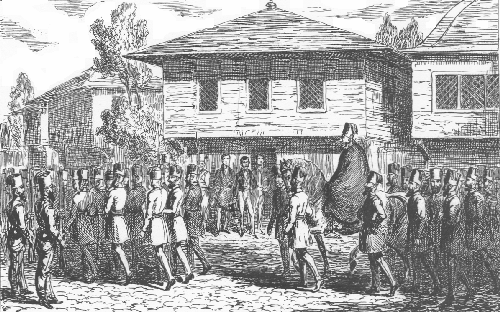
Drawn & Etched by George. Cruikshank, from a Sketch by the Author.
The Sultan going to Mosque.
At half past eleven we were enlivened by the
distant sounds of "Zitti, Zitti," played by a
military band; and in a short time afterwards a
regiment marched by the coffee-house in which
we were smoking, and drew up on either side of
the street, which extends from the new palace
to the mosque. The band was stationed about
midway, and no one was allowed to pass or remain
standing. On taking our position in front
of the crowd at the appointed hour, a Turkish
officer came up, and politely addressed us in
French, with an invitation to come within the
file. He led us some distance nearer the palace,
and placed us under a doorway; where we were
joined by a German baron, who resides near the
village, and who appeared to be on very friendly
terms with all the officers, three of whom speak
French. The one to whom we were indebted
for our present advantageous situation remained
some time conversing with us. He was a very
handsome man, the son of a Georgian; and is
esteemed a good officer, being second in command,
although only nineteen years of age.
He quitted us, to join a party of American
ladies, who came within the lines, and as
soon as the Sultan had passed by, he ordered
ices and lemonade for them; and although he
has never been out of Constantinople, he
behaved just as any well-bred European officer
would have done under similar circumstances.
ANECDOTE.As we stood chatting together, our German
friend related a curious adventure which happened
to him last year:—He was out shooting
behind the village, when his Highness rode up,
accompanied by two or three officers; and as it
is unlawful to appear in the Sultan's presence
with fire-arms, the German felt himself in a very
embarrassed situation. However, he stood still,
taking off his hat. The Sultan, on passing,
looked hard at him; and just at that moment, a
swallow, happening to fly towards the party, he
pointed to it, and said "Tirez!" The German,
though in a great fright, understood him perfectly:
he fired, and, as luck would have it,
killed the bird, which fell at the head of the
Sultan's horse. His Highness was quite delighted,
exclaiming, "Eh, eh," (good, good,)
and desired one of the attendants to enquire
who the sportsman was, and where he lived;
after which he rode away. Next morning, a
person attached to the court came to the
baron's house, with a present of china, flowers,
and a purse containing 5000 piastres, which his
sublime Highness had condescended to present
to the successful shot. The baron requested
the bearer to take his compliments and thanks
to his master, and say, that he was ready to kill
a swallow every day for the same reward.
SULTAN'S VISIT TO THE MOSQUE.
Namik Pasha, who had arrived from England,
France, and Prussia only a few days before, now
came to tell us, that as it was past the usual time
of the Sultan's going to the mosque, he was afraid
he would not come at all to-day; that he had left
him with Count Orloff, with whom he was in a
towering passion, many angry speeches having
passed between the cunning diplomatist and the
enraged sovereign. However, soon after, the
order to fix bayonets and shoulder arms, both of
which were very well executed, announced his
approach, and in a few minutes afterwards the
band struck up his favourite march. At the
head of the procession were three led horses,
richly caparisoned, having saddle-cloths embroidered
with gold and precious stones, and
bridles ornamented in a similar gorgeous style.
They were noble-looking animals, and seemed
as if conscious of the magnificence with which
they were decorated. Next to these followed
about thirty officers, consisting of generals,
colonels, and captains of the fleet, walking
two and two: they wore a sort of frock
coat, with that description of cap called a fez.
HIS PERSONAL APPEARANCE.After the ministers of state, came his Sublime
Highness himself on horseback, closely wrapped
up in a greyish brown cloak, with a collar of
diamonds, emeralds, and rubies, arranged in the
form of flowers—the richest and most brilliant
ornament I ever beheld. Like his officers, he
also wore a plain fez, to the silk tassel of which
the paper was still left attached, as is customary
with the lower orders of the people; this fashion,
in fact, seems almost universal; and when the
paper is destroyed, a new tassel is put to the
cap. It was drawn close over his ears, and
down to his large black eyebrows, and his
beard hung over the diamond clasp of the cloak.
His face is long; his nose, slightly arched, indicates
talent and resolution; and his eye is remarkably
large, bright, and penetrating. We
took off our hats as he passed: he looked earnestly
at us, without turning his head, and after
acknowledging the salute by a slight inclination
of his body, again addressed himself to Namik
Pasha, with whom he had been conversing before
he came up to us. Another party of officers
closed the procession. The Sultan has the appearance
of being about fifty-five years of age;
and his blotched face, and red nose, sufficiently
indicate a penchant for the bottle: indeed, on
the present occasion, he displayed strong symptoms
of being in what is called "a state of
liquor," as well as in a most particular bad
humour. It is reported that he and his sword-bearer
get drunk together every day, and that
he once forced the Grand Mufti to drink half
a bottle of Champagne, which he refused at
first, declaring that to do so was contrary to the
religion and ordinances of the Prophet. But
the Sultan told him that he was himself the
Head of the Church, and that he would make
a new ordinance, bidding the Mufti swallow
what was offered him, or take the consequences
of disobedience. Upon this the Chief Priest
drank off the potion, perhaps, after all, by no
means new or unacceptable; and the Sultan,
turning to a certain officer of state, who had
also refused the wine on account of similar
scruples, said, "Now then you may drink, seeing
that the Head of the Church and the Chief
Priest have set you the example."
NEW REGULATION SOLDIER.
In about a quarter of an hour the Sultan returned
in the same manner, and entering his palace, the
regiment marched off in good order. It was
almost entirely composed of boys; and though
the whole body looked rather imposing when
together, yet individually they have by no
means a military air or appearance. Their uniform
is extremely mean and unbecoming: it
consists of a fez cap, worn slouching over the
eyes and ears; an ill-made jacket of coarse blue
cloth, faced and turned up with red; coarse
white Russia duck trousers, always exceedingly
dirty; Wellington boots in the same condition,
into one of which the right leg of the pantaloon
is generally stuffed, while the left hangs in the
ordinary fashion, or is turned up over the ankle;
the bayonet and cartouch box are both suspended
at least half a foot lower than they
should be; and their linen and persons are also
disgustingly filthy. The whole of this description
is by no means an exaggerated sketch of
the new regulation soldier—the hope of the
Sultan, and the terror—of whom? of himself.
It is but justice, however, to add, that the officers
of this regiment presented a striking contrast to
their men, being all good looking, well dressed,
and of a soldier-like appearance; the band also
was respectable, and executed their different
marches in a masterly style.
PALACE OF THE BRITISH EMBASSY.
I returned by Tophana, where there is a great
mart for tobacco pipes in the vicinity of the
fountain before described. In the evening I
went into the garden of the English palace,
which is very beautiful, with shrubberies, shady
walks, and bowers; but the building itself is in
ruins, having been destroyed during the late
fire. Being quite isolated from any other dwelling,
and surrounded by a large garden enclosed
with lofty walls, it was positive negligence that
caused its destruction. The ambassador, Sir
Robert Gordon, was up the Bosphorus, and his
principal servant obstinately refused to allow
any one to enter the room where the fire had
originated, until it was too late. The damages
are estimated at 20,000l., and perhaps the best
thing that could now be done would be to sell the
materials, and either let the ground on building
leases, or dispose of it altogether. By either of
these methods, a large sum would certainly be
realised, and with the produce a suitable house
might be purchased in Pera, when it is decisively
ascertained that the Russians are not to
be the future masters of Constantinople; until
then, it would be useless to think of spending
the money. In fact, there can be no question
that the ambassador ought to reside in Pera, in
the winter season, when the roads are often
blocked up with snow, and the wind on the
Bosphorus so violent, that all communication
by water, with the villages far up the channel,
is cut off; so that serious evils might arise,
not only from the distance, but occasionally
from the impossibility of claiming the ambassador's
protection on any sudden emergency.
The Russians are building a splendid palace in
Pera; that of the Austrian mission was not injured;
and the representatives of the new Allies,
England and France, are the only two who do
not make Pera their residence, much to the
inconvenience of merchants, and all persons connected
with the embassy, particularly the members
of the diplomatic corps.
ARM BAZAR.
Saturday, 25th.—Went to the arm bazar,
or curiosity shop, which I found stored with
a motley show of weapons, dresses, ornaments,
horse trappings, and armour, such as would
make George Robins's fortune, could he send
his myrmidons of porters to lay hands on all
they could carry away. Helmets, spears,
bucklers, bows, battle-axes, swords, daggers,
rifles, long guns; in a word, every species
of offensive and defensive weapon, from the
common musket of the English soldier to the
stiff bow of the Persian, were here gathered
together from every kingdom of the East and
West.
DAMASCUS SWORD BLADES.A fat Turk, squatting on his counter,
tempts you, on one hand, with a blade of the
rarest Damascus steel, inscribed from hilt to
point with some verse from the Koran in Arabic
letters of gold; such as an invocation to the
one God,—"Strength to the arm who wields
the blade in a righteous cause, and death to him
it reaches," &c. Drawing the sword from the
gold-embroidered velvet scabbard, he rings it
with his nail, to convince you of its soundness
and temper.
SCENE IN THE BAZAR.Cast your eyes in the opposite
direction, and you may observe the Armenian,
in the next stall, winking and slily beckoning
you towards him. He smiles, should you condescend
to notice him, but frowns and shows impatience
when you appear to disregard his attempts
to seduce you from his portly rival. The latter,
finding you will not buy the sword, displays his
pistols, silks, mouth-pieces of tempting amber,
and appears determined that you shall purchase
something; till at length, his patience being
fairly exhausted, he packs up his wares, and
surrenders you to the wiles of his now triumphant
opponent, who feels satisfied that he can
make you take something off his hands, though
the Turk was unsuccessful. As most Englishmen
appear to value swords, he takes from his
cupboard a black-looking, dust-covered, white-handled
weapon; and pushing aside his long
robe with an air of the utmost importance,
he draws forth the blade, which proves to
be a black Khorassan, entirely destitute of
ornament: he rings it, it returns a silver sound;
he points out the beautiful watering, the
gradual deepening of the colour from the edge
to the back, and finishes by swearing to you,
whilst he looks towards the Armenians and Jew
brokers gathered around for their attesting
nods, that it is the most exquisite blade in
Stamboul; that it will cut a lawn kerchief,
thrown into the air, into two parts, as clean as a
pair of scissors. He then closes his panegyric
with the demand of, "How much will you
give?" Scarcely waiting for a reply, he throws
it aside, as if of no value; and, in imitation of
his neighbour the Turk, endeavours to keep
your curiosity awake, by placing all his wares
before you.
JEW BROKERS.The instant you turn from the
disappointed merchant, you are assailed by
twenty Jew brokers at once, who, having espied
their quarry from afar, have assembled from all
quarters of the bazar, and, like a flock of
vultures, are waiting near to devour you, congratulating
themselves on your unwillingness to
buy of the cunning Armenian. One attacks
you in bad Italian, another in modern Greek,
interlarded with a few words of unintelligible
English or French. Each is master of a stall;
where, according to his own account, you can
purchase whatever you want at the greatest
advantage, though, as yet, they know not what
that is, even if you do yourself. Thus, like
Actæon, the unfortunate stranger is exposed to
the chance of being torn to pieces by the dogs
who profess to call him master, and to do his
utmost bidding.
The bazar is always crowded with buyers,
sellers, and idlers, so that it costs some little
squeezing and pushing to get through its various
passages. When a large purchase is contemplated,
or if the seller be an Armenian or Greek,
he will adjourn with you to the neighbouring
coffee-house, and there, over a pipe and a cup
of coffee, the bargain is concluded on much
better terms than in public, where, possibly,
the merchant's pride would not relish the exposure
of abating some hundred piastres, and
where the sharks of brokers might lay claim to
a good recompense, for bringing the Ingles capu
dou to be plucked.
INTERIOR OF THE BAZARS.
In the bazar the noise is deafening from
the screams of the disputing parties, and the
vociferating of prices by those who have articles
for sale. It is a sort of Babel in miniature,
where Jews and brokers push by you every
instant, hastily shuffling along, and loaded with
some piece of second-hand finery to be put up
at auction; such as, for instance, an incense
salver, a piece of Persian silk, an Albanian rifle,
an old silk or velvet robe, embroidered with
gold, the property of some gay Turkish lady,
who having exhausted her purse the day before
in a party of pleasure to the Keathane or "Sweet
Waters," wishes to replenish it by the sale of a
portion of her wardrobe. To these may be
added, amber mouth-pieces, bundles of long
pipe-sticks, a lot of worn-out clothes, a Persian
battle-axe, China ornaments for scents, coffee
cups with their silver filigree stands, a Cashmere
shawl, &c. Each seller bawls out the
last bidding for his separate commodity in the
highest note of which his voice is capable;
and as all are pitched in different keys, the
stranger is soon driven forth to seek a purer and
more quiet retreat, either within the gold and
silver embroidery bazar, or in that of the Broussa
silks, close by.
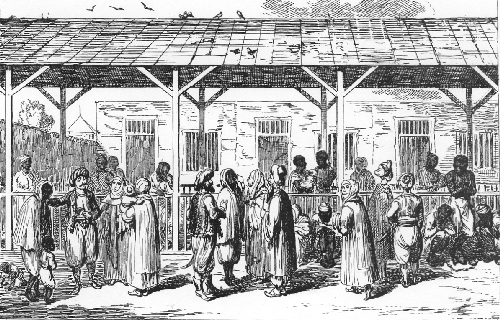
Drawn G. C. from a Sketch by the Author.
Slave Market, Constantinople.
SLAVE MARKET.
Quitting this scene of tumult, I visited a
place of a very different character,—the slave
market, situated in a square yard, three sides of
which are occupied by low stone buildings, with
wooden sheds projecting in front. They were
divided into rows of cells, each having a window
and door opening into the wooden enclosure
just mentioned. Within these dens,—and they
exactly resemble the cells usually occupied by
wild beasts,—a "crowd of shivering slaves"
were seen either penned up within the inner
apartment, or lying about, like cattle, in the
open space in front. They appeared to be all
Nubians,—black, dirty, and clothed in ragged
blankets. Born to no other inheritance but
slavery, they seemed wholly unconscious of their
degraded state; and continued chattering unconcernedly,
and, to all appearance, very happy.
As I stood gazing on the novel scene, the
ruffian keeper (and never did a vile, debasing
occupation stamp its character more indelibly on
the physiognomy of man) led one of the black
victims forth, to meet the speculating caprices
of a haggard old Turkish woman. He proceeded
to point out her good qualities, and to
descant on the firmness of her muscles, the
robustness of her limbs, and her mature age; at
the same time pinching her tender flesh, by way
of proving the truth of his assertions, till the poor
creature shrieked out with agony. He then
tore down her eye-lids, to exhibit the healthiness
of her eye-balls; and wrenched open her mouth,
to prove, by ocular demonstration, that he
practised no deception in speaking of her age.
The old woman herself examined her all the
time, and haggled, as to the price, like a
butcher when purchasing an ox in the cattle
market. As I witnessed all this, my heart
sickened, and I turned with loathing from the
disgusting spectacle. Yet the poor negress
was wanted only for a domestic slave, and
would, probably, be kindly treated, when once
the property of the old hag, who, I believe,
purchased her at last for 1000 piastres, or fifty
dollars. Indeed the girl appeared to be conscious
that the change would be advantageous
to her, from the meekness with which she bore
the treatment of her persecutors. Proceeding a
little further on, we observed, sitting at the
window of one of the cells, a solitary female,
whose head was covered with a linen veil. On
hearing our approach, she looked at us through
its folds; in an instant after, the covering was
removed, and a pair of brilliant, dark eyes shed
their lustre upon us. Nowadays a white slave
is seldom found in the market, the Russians
protecting the Circassian and the Georgian, and
the French and English the Greek. When they
do appear, they are generally disposed of at a
high price.
GEORGIAN SLAVE.This beautiful captive, who proved
to be a Georgian, was neither bashful nor timid.
She saluted us with smiles, severing her raven
locks, and trying to captivate the spectators, by
making her beauty appear to the greatest advantage.
However, it did not seem to possess any
power over the Turks; and as to the Christians,
they are not allowed to purchase slaves publicly,
though sometimes it is done indirectly, and by
the assistance of some friendly Osmanli. I saw
but three or four men-slaves, with a few boys,
all Nubians, and, like their female companions,
in a dirty, miserable condition. They were
chained together, two and two, by the ankles.
Having now satisfied my curiosity in regard to
this much talked-of but loathsome spot, I was
most glad to hear the proposition that we should
adjourn to Mustapha's. From him we learned
that the Georgian beauty had been exposed to
sale for several days; but that no one had offered
to purchase her, the sum demanded being exorbitant.
Her proprietor was a rich man, and
could afford to wait until some one consented to
put down the 2500 piastres at which he valued
her.
TURKISH CONFECTIONERY.
Passing through the old-clothes' bazar, the
Monmouth Street of Stamboul, we came to a
range of stalls occupied by the engravers and
cutters of precious stones. Many talismans
were offered to us, set very neatly in blood-stone,
carnelian, and lapis lazuli. The day was wound
up with the important business of tasting the
different varieties of confectionery to be found
in a large, handsome shop near the Balouk
bazar. All were luscious, and many, particularly
the preserved rose leaves, were even
delicate. We partook of some thirty or forty
different sorts; in which flowers, scents, fruits,
and gums were mixed with sugar, until of the
consistence of damson cheese. The Turks eat
a vast quantity of these cloying sweetmeats,
after which they drink abundance of sherbet.
A glass of good brandy, however, would, in my
opinion, be a much better corrective.
ARMENIAN VISITERS.
Sunday, 26th.—Went up to Terapia this
morning, and spent the day in wandering
through the Sultan's Valley, under the superb
plane trees, and returned to dine on board
the Actæon. After dinner, a party of young
Armenians came on board, accompanied by
their tutor. They were sons of a man of distinguished
rank among his countrymen, residing
on the Bosphorus; and one of them, the eldest,
about eighteen years of age, was so fat, round,
and sleek, that we all decided him to be what
Baba threatened to make poor Juan. The other
two brothers were very fine intelligent lads, and
there was also a cousin with them, a heavy, shy,
youngster. The tutor, who was a young man
of about twenty-two, spoke French, Italian,
English, and Latin, fluently. His pupils, likewise,
understood a little English, and French
uncommonly well. They were delighted with
their reception, and remained a long time at
table in the gun-room, drinking their wine with
much relish, and seeming to prefer it to coffee,
especially the younger boy, who, had he been
permitted, would have willingly finished a whole
bottle to his own share. On taking leave, they
invited us all to their father's residence; but we
never availed ourselves of the invitation, possibly
because we discovered that they had no sisters;
and the inside of the black house, below Jené
Keni, was in itself an insufficient attraction,
without the chance of getting a glimpse of a fair
Armenian girl, divested of her odious gashmak,
and the form-concealing cloak.
The evening was lovely, and my sail down to
Pera delightful: no sound broke upon the ear,
save the rippling of the current against the caique
as it glided lightly along, like the bird, which
skims closely over the surface of the ocean, and
appears to bathe its plumage in the waves,
though in reality without wetting its crescent
wings.
ORIENTAL COSTUME.
Monday, 27th.—Strolled again in the bazar:
this word means barter, or the act of bargaining
for the sale or purchase of any commodity; and
it is in them that all the retail trade of Constantinople
is carried on. As these cloistered passages
exclude the rays of the sun, they are cool
and pleasant places to lounge in, except that
the pavement is usually in a very dilapidated
state. The merchants themselves present an
interesting spectacle, each wearing the proper
costume of his respective country, which, with
the motley garb of the crowd incessantly passing
to and fro, amuses the stranger's eye with
a curious and almost infinite variety of dress
and appearance. For the convenience of those
who arrive periodically at Stamboul from the
most distant portions of the empire, in caravans,
there are large khans provided; which,
being built entirely of stone, are fire-proof, and
afford ample accommodation for the merchants
with their attendants and property.
TURKS.—ARMENIANS.—GREEKS.Yonder
sits the Turk, grave and taciturn: his goods
are spread before him on his counter, and
samples hang around in neat array; but satisfied
with this, and trusting to their intrinsic
value to recommend them, he smokes with
a haughty air, and disdains to utter a single
word to arrest the stranger's passing steps.
Should you question him about the price, and
attempt to cheapen his merchandise, the answer
will be comprised in two words; and if the abatement
be again proposed, he replies with an
economical "No," and a whiff of smoke, after
which he again relapses into his former apathy.
That bearded elder, seated on a low stool with
the dark clouds of thought and mental calculation
visible on his countenance, is an Armenian.
Though he will submit to a diminution of his
price, he is honest; and though a man of few
words also, yet is he civil without affectation,
and persuasive from the apparent sincerity of
his professions.
JEW INTERPRETERS.
Their neighbour, however, makes ample
amends for the taciturnity of both. He is
a Greek, and you may hear him at the other
extremity of the bazar. The most laboured
efforts of the rhetorician bear no comparison
with the honied, artful speeches, and the gay
and cheerful air by which he detains, wheedles,
and finally succeeds in obliging the passer by
to purchase, or at least examine the contents
of his stall. Observe yon poor devil, dragged first
this way, then thrust back again, trying in vain
to still the tempest which rages around him, by
speaking half a dozen languages in a breath.
He is an interpreter, or go-between in a purchase,
and seems torn to pieces in the whirlwind
of voices which assail him from the disputing
parties, in each of whose languages he tries to
explain; but, poor patient Jew! you never could
speak any of them intelligibly, and your nasal
twang, and drawling accent, so disguises what
you do say, that nothing but a miracle could
make you understood. The screams, the grimaces,
the gestures which these people exhibit,
during their unavailing efforts to render themselves
understood, appear inexpressibly ludicrous
to the indifferent spectator, and their
perseverance is still more extraordinary, since it
rarely happens that their best endeavours are
repaid by any thing better than reproaches,
kicks, and imprecations.
TURKISH CIVILITY.
Our old friend Mustapha reposes so much
confidence in the honour of an Englishman, that
this morning he offered to lend me any sum I
wished, with no other security than my simple
word. In order to convince me of his ability to
make good this promise, after removing a stone
from the floor, he unlocked an iron trap-door,
and showed me a mine of gold pieces concealed
below. He was delighted with a rough sketch
I made of him; indeed, many circumstances go
to prove that the fanatical aversion of the Turks
to portraits and pictures is much on the decline,
notwithstanding all representations of the human
figure are strictly prohibited by the Mahomedan
law. The Sultan has had his likeness taken
twice already, and he is going to sit a third time
to an English artist of the name of Atkins.
Tuesday, 28th.—A ship arrived from Malta
to-day, bringing intelligence that the formidable
English fleet destined to join the French squadron
might soon be expected in the Dardanelles.
All Pera is in raptures at this news, and there
is now some hope that the Russian Bear will be
forced to draw in his claws.
DECREASE OF FANATICISM.
I walked about Stamboul to-day, and experienced
much civility from the Turks, who took
infinite trouble to answer all my enquiries. When
I made them understand by signs that I wished
to cross the Horn, many left their little stools
and walked some distance to put me in the right
course. How changed is their conduct in this
respect from what it was at no very remote period,
when a Christian hardly dared be seen in
the streets, and when the Turk, for mere sport,
thought nothing of drawing a pistol and shooting
at any Frank whom he happened to observe
looking out of his window; and not only the
foreign merchant, but even the consul, was
obliged to have a guard of janissaries to attend
him from his house to his office. At that time,
too, the wealthy Christian, in passing through
the streets of Stamboul, was often stopped and
compelled to sweep the muddy crossing; and
even the dogs were allowed to worry him, without
his daring to beat them off. Happily those
days of fanatical intolerance are for ever passed;
and the irresistible march of civilisation, by gradually
weakening his prejudices, has humanised
even the intolerant and ferocious Mussulman.12
CASHMERE SHAWLS.
Thursday, 30th.—To-day a man brought
for sale a quantity of Persian silk, which was
very soft and beautiful, and the colours were
bright and well arranged; he had also some
black Cashmere shawls with variegated borders:
though the patterns looked handsome, they were
of inferior qualities, and not to be compared
with the French and Scotch imitations. Not
being inclined to purchase any, I posted off to
the khan, where the Angora shalée is sold, and
saw some beautiful specimens of this soft and
warm manufacture, whose fine silky texture
renders it a great object of commerce for ladies'
dresses: the price is about 300 piastres for
eight pics, which is the requisite quantity.
TURKISH BATH.
I returned to Pera to take the hummum or bath,
the one there being very clean, quiet, and well
managed. A narrow platform, raised about three
feet from the ground, and covered with cushions,
runs round the whole of the first chamber, which
is lighted from above by a glazed cupola; and a
fountain of clear water playing continually in the
centre, spreads a delicious coolness throughout.
As soon as we had mounted the stage, one of the
bath-men offered carpets and cushions, but my
companion refused them, for the plague is often
communicated by using these pro bono publico
comforts; and a Perote lives in constant dread
of this terrible malady. After undressing, we
hung our clothes on pegs, and covered ourselves
with a linen towel, devoted to that laudable purpose,
and which, if neglected in the slightest degree,
calls forth the most energetic remonstrances
from the old Turk, who sits smoking near the
fountain.
The wooden pattens or slippers used by the
bathers were arranged on the steps by which
we mounted the stage, and I had several narrow
escapes from being prostrated on the marble
pavement ere I reached the small door leading
into the hummum; so difficult do the uninitiated
find the use of these wooden bridges, which are
clumsy, heavy, and slippery as skates. I shuffled
along very awkwardly, much to the amusement
of three sedate old gentlemen, who were puffing
and melting from the effects of a long sojourn
in the heated atmosphere of the inner chamber.
The first hot room was rather pleasant; and after
remaining there a few moments, to break ourselves
in for the furious attack on the pores to be
expected in the next, we entered the second
chamber, and again pushed on into the third,
where the sensation, though at first unpleasant,
gradually became delightful. Coffee and pipes
were now brought in; and sitting down on a
low marble bench, we consigned ourselves to the
influence of the melting atmosphere, thinking
of the unhappy condition of the mutton-chop,
when it exclaimed in a piteous voice to the
gridiron, "I am all of a perspiration." There
were several other bathers undergoing this process
of fermentation; and when the coffee was
finished, and the pipe laid aside, two fellows
placed me gently on my back, and commenced
rubbing, squeezing, and twisting my arms, ribs,
and legs till I thought every joint would be dislocated.
I soon felt satisfied with this sort of
discipline, though, upon the whole, the sensations
were rather disagreeable than painful. The
room where we underwent the operation is an
octagon, with an arched roof, into which light is
admitted through a number of bulls' eyes, or
knots of glass; and a marble basin is fixed
against the wall on each of its eight sides, into
which two pipes, with stop-cocks, admit both
hot and cold water. With this you deluge yourself
by means of a large metal ladle chained to
the wall; or it is done by the bath-man, should
you prefer the assistance of another. Within
this chamber was a smaller one, containing
similar basins, and to one of these I moved, followed
by one of the men, who, after lathering
me from head to foot with a sort of slimy
caustic soap, scrubbed me down with a brush
made of aloe shreds. Having overwhelmed me
once more with cold and hot water, and given
a finishing pull or two at my limbs, he left me
to duck myself, if I thought fit; but I had had
quite enough, and hurried back into the second
chamber. Here I was enveloped in hot towels,
one being wound round my head, another
round each leg, &c., and in this way I returned
to the first court, where I mounted the stage,
and sat down to dry, smoking a good half
hour before I resumed my clothes. Instead of
being exhausted, as might have been expected,
I felt highly refreshed, and grew delightfully
cool in a short time, though I fancied I had lost
some pounds of flesh.
As regards the natives of the East, bathing
can scarcely be styled a luxury; to them, it is
really indispensable; for as they do not change
their clothes even at night for months together,
in fact, not until worn out, they would be otherwise
insufferable beasts; but by frequenting the
bath every day, or every other day, and performing
the ablutions imposed on them in the
Koran, with their quiet sedate mode of life, they
are actually rendered very cleanly animals. The
women have the use of the baths in the afternoon,
when they assemble in crowds, and all
the scandal and news of the town is circulated,
marriages concluded, and the secret intrigues of
the parties are reciprocally detailed; in short,
every thing which may be supposed to be brought
on the tapis in an exclusive meeting of the fair
sex. Nature is every where the same; and I
presume, whether in a bath at Stamboul, a
Parisian saloon, or a drawing-room in London, a
similar love of gossip is their distinguishing characteristic.
Almost every quarter of Stamboul is
furnished with its baths or hummums; and the
houses of all rich Turks possess this desirable
luxury, which is used by the male part of the
family in the morning, and by the females afterwards.
The plan on which they are constructed
is the same throughout the East: in them
shaving is universally performed; the hair is
dyed, the beard is made to assume a beautiful
glossy black; and the depilatory pincers and
ointments of the ladies are applied to the purposes
for which they are designed. The bath I
used was opposite the sherbet vender, on the
hill of Pera, who is so well described in "The
Armenians" of Macfarlane; and whose little
fountain of water, flowing through machinery, and
setting wheels, circles, and bells all in motion together,
is no slight decoy to the thirsty passenger.
I have read "The Armenians" with great pleasure.
The description of the locale, as well as of the
manners, customs, and general appearance of
the native and foreign inhabitants of Constantinople,
is given with admirable fidelity; in short,
no modern work with which I am acquainted
presents a more lively and faithful picture of this
queen of cities.
EASTERN STORY-TELLER.
Friday, 31st.—Instead of making an excursion
to the Sweet Waters, I went with my friend the
American secretary to visit the coffee-houses in
the Armenian quarter, where an improvisatore
exhibits his talents every holyday. Immense
crowds of respectable Turks assemble there to
listen to the narrations of this accomplished story-teller;
and it is even said that the Grand Signior
himself is often present as an auditor in
disguise. In all the coffee-houses there were
concerts of vocal and instrumental music; the
former consisting of songs or chants performed
by a number of voices together, or else one
man sang a single verse, to which all the others
responded by way of chorus. Occasionally they
varied their performances by singing alternate
verses of the same song. We sat in the open
air, on a long pier of wood built out into the
sea, where there were hundreds besides, perched
upon low stools, smoking, or eating delicious ices
and mahalabé, and laughing and talking with
more vivacity than I could have expected in
beings generally so taciturn, and so absorbed in
the contemplation of their own importance. At
last, a man came to the door of the largest coffee-room
and clapped his hands, when the Turks
immediately moved into this apartment, in which
seats were arranged in a semicircular form one
above the other, as in a theatre. A portion of
the floor, in front of the benches, was occupied
by low stools, probably reserved for visiters
of distinction; and close to the wall was a
rostrum and a large easy arm-chair, on one side
of which stood a little desk.
MATTHEWS AT CONSTANTINOPLE.
Our Oriental friends behaved with much politeness:
for, perceiving from our European costume
that we were strangers, they offered us places
in front of the stage; and after a few minutes'
delay a man entered, and was handed up to the
platform and chair amidst a buzz of universal applause.
In his hand he carried a small stick, and
in gait, physiognomy, and manner bore a singular
resemblance to our English Matthews. He
was dressed in a frock coat, now so generally
worn in Constantinople, and wore, on one of his
fingers, a most superb brilliant ring, which, it is
said, was presented to him by the Sultan, as a
mark of his especial approbation. A profound
silence prevailed among the company the moment
he made his appearance; every one seeming
desirous to be amused, and most anxious to catch
every word that fell from his lips.
ORIENTAL JOHN TROT.No story-teller
of Stamboul had ever enjoyed so much
fame and popularity as this Turkish Matthews,
who, rising from his seat and making three very
profound obeisances to the company, commenced
his "At Home" with a series of imitations,
in which he personated a Turk from
Aleppo, the Yorkshire or Calabria of the East.
This Oriental John Trot, is represented as setting
out on his journey to see the world and make
his fortune; and with this intent visits various
places. On one occasion, being mistaken for a
Pasha in disguise, he is every where feasted,
and treated with the most respectful attention,
until the real truth being discovered, he is bastinadoed,
spit upon, plucked by the beard, and,
in short, maltreated in a thousand different ways.
At last he finds his way to Stamboul, and manages
to obtain an interview with his Sublime
Highness; after which he visits England, France,
&c., and on his way back is taken by a pirate,
who carries him to the coast of Africa. During
this compulsatory voyage, he describes himself
as affected with the most horrible sea sickness;
and here his representation of a person labouring
under that detestable malady was so accurate,
that I almost fancied myself again in the cockpit
of the Actæon, and all the terrors of the voyage
across the Adriatic arose fresh to my imagination.
After many other adventures, he returns safe to
INGENIOUS MIMICRY.Aleppo, his native city, no richer than he set
out; but, like the monkey who had seen the
world, "full of wise saws," and strange assertions.
His hairbreadth escapes, the unlucky scrapes he
gets into, the blunders he is incessantly committing
from his imperfect knowledge of the
languages of the various nations among whom
he is thrown, the continual equivoque and play
upon words, his absurd misconceptions of the
orders he receives, his buffetings, bastinadoes,
feasts, imprisonments, and escapes, the odd satirical
remarks elicited by the different objects,
places, and strange fashions he encounters,—all
afforded opportunities to the ingenious mimic
for displaying the versatility of his powers.
The changes, too, of voice, manner, look, gesture,
suitable to the various characters he assumed,
were infinitely ludicrous and entertaining.
In this respect he was little, if at all,
inferior, to his mirth-inspiring brother of the
Adelphi; in proof of which, I need only state,
that, though utterly unacquainted with his language,
and enabled to follow the thread of the
story only by the hurried explanations of Hodgson,
I sat listening and laughing with the
greatest satisfaction for more than two hours,
without feeling my attention at all beginning to
flag.
A DELIGHTED AUDIENCE.As to the Turks, they were literally convulsed
with laughter; shouting, screaming, and
uttering a thousand exclamations of delight;
and more than once it was evident, from their
uproarious mirth, that he had succeeded in satirising
the peculiarities of some well-known individual.
At every pause in the story—very
necessary for the actor, who was often exhausted
by the violence of his gesticulations—wooden
trays were handed about, and every one was expected
to contribute a few paras. Of course the
liberality of the audience was proportioned to
the gratification they received; and on the present
occasion he, no doubt, experienced substantial
proofs of their approbation in a pretty
considerable harvest of silver pieces. I could
have remained with pleasure to hear another
tale, but the heat was overpowering, and my
friend also seemed anxious to get away; so we
quitted the room with our risible muscles somewhat
sore from long-continued exertion.
The refreshing coolness of the sea breeze induced
us to hire a caique, and we coasted along
towards the Seraglio Point. The walls on this side
of the triangle, which encloses Constantinople,
are, perhaps, the most ancient of all, and remains
of former splendour are every where seen intermingled
with the ordinary materials of which
they are composed. Capitals of superb workmanship,
friezes, and columns, are not only
embedded in the masonry, but thousands of
pillars piled one above the other form the foundations,
in many parts, which may be plainly distinguished
beneath the transparent waves.
BOOK MARKET.
Saturday, June 1st.—Notwithstanding it
rained heavily this morning, I went over to
Stamboul to see what I could pick up in the
Sahof Charshousi, or book-market. This bazar
is very quiet, as befits a temple devoted to literature,
and most of the merchants are old fellows
with spectacle on nose, who sit in a corner of
their shop-board, and pass the time in poring
over the Koran, or some of the thousand and one
commentaries written upon it. Their books and
manuscripts are piled up without order, and they
seem never to know where to put their hands
upon any work which may be demanded. There
was an infinite number of manuscripts of Persian
poetry, and I bought several beautifully illuminated
almanacks; but if, while examining these, I
approached a volume of the Koran, or, indeed,
any religious book, they either snatched it away,
or interposed themselves in such a manner, that
I could not touch the object of this extraordinary
precaution.
CURIOUS MANUSCRIPTS.
I bought one book, which the owner said was
a treatise on mathematics; it however appeared
to me to be more like a genealogical tree, and
so it turned out. My friend Hodgson, who
is well versed in the Oriental languages, pronounced
it to be a Silsileh-nameh, or genealogy
of the Ottoman emperors from Adam to the
present Sultan; a work of extreme rarity, and
the most complete he had ever seen. Through
his assistance I procured a very good copy of the
Koran, and also a firman, signed by Sultan Selim,
granting permission to a rich Turk to bequeath
his fortune as an endowment for four priests, on
condition that they employed themselves in
sweeping the mosque at Mecca. This document,
which is very long, is beautifully written
on gold, and is altogether a very splendid specimen
of Oriental penmanship. I also bought
some Turkish spelling-books, very tastefully
painted and ornamented, such as are used in the
schools.
Monday, 3d.—As the heat of the weather
begins to be oppressive, my companion and
myself have determined to remove to Terapia,
where we have, after some difficulty, engaged a
house close to the back gate of the English palace,
and commanding a fine view of the Bosphorus.
This morning we took possession of our abode,
which is furnished by its proprietor, Mauvromati,
with all we required; and we have hired one
Demetrio, a most obliging, clever fellow, who
speaks Persian, Turkish, Greek, French, and
English; besides these accomplishments, he is
an excellent cook.
The mids of the Actæon found a name for
the establishment immediately: pipes, porter,
bread and cheese, and whisky toddy, became
the order of the day, and night, too; and these
jovial youths have transferred their berth to the
"Jolly Landsmen."
NAVAL BANQUET.
But there was another inducement to move to
Terapia; for the midshipmen of the Actæon
gave their brother officers of the French frigate
Galatea a dinner, in return for one to which
they had been invited. The starboard side of
the main deck was partitioned off by sails, and converted
into a very handsome cabin, which was
hung with a drapery of the flags of all nations, except
the Rusky, whom we unanimously voted unworthy
to hold companionship with the Jack and
the Tricolor, which, with the Turkish blood-red
flag, formed a handsome canopy at the head of
the table. The ambassador and the captain lent
their plate, and the ship's cooks were put under
the orders of the palace chef. The pièces montées,
sweetmeats, &c. were under the direction of
the ambassador's Italian confectioner; the wines
were partly from the embassy cellar, and partly
from the captain, and the renowned Stampa of
Galata. Plenty of volunteers from the marines
and sailors joined the ship's boys as attendants; so
that altogether, the affair was splendidly got up,
and did honour to the British mids. Our dinner
was a capital one; for the cook, fired with national
emulation, surpassed all his previous efforts, and,
in consequence, the table was covered with the
rarest delicacies that art and nature could supply;
the dessert consisted of all the rich and exquisite
fruits which this sunny clime and fertile soil
produce in an almost endless variety; and of ices
and Champagne there was no lack. Twenty-six
sat down to the sumptuous repast; and when the
cloth was removed, the wine circulated briskly,
while the bond of amity between the French and
English sailor, was strengthened by the interchange
of many a loyal toast and happy well-timed
allusion to the brave and martial character
of the two nations; nor was music wanting to
complete our joyous revelry: the whole budget
of lower deck songs was completely exhausted;
the guests contributing their quota of chansons
à boire, &c. to the general hilarity; and "God
save the King" and "Rule Britannia" were
succeeded by the "Parisienne" and the "Marseilloise."
Thus was the party bravely kept up
till about midnight, when twenty out of the
number, though sailors, were "half-seas over;"
and though the sea was, in reality, as smooth as
a lake, they imagined themselves tossing in some
heavy swell, bidding their companions remark
how dreadfully the ship pitched and rolled, and
declaring unanimously that a retreat into the
hammocks was next to an impossibility. Three
of our ancient and hereditary foes were borne
(not steadily, I trow) to the ship's side, and gently
lowered from the gangway, 'mid tears of joy;
dead,—but not from piercing of cruel shot, nor
from "ghastly wound of glittering steel:" no, they
were laid prostrate by rapid discharges from the
circling bottle, and the overpowering draughts
of glorious red hot "bishop." Being at length all
safely stowed in the Actæon's jolly-boat,—for in
what other could so noble a band of topers have
been appropriately embarked?—
"They were row'd to their ship,
By the mess they had dined with."
In returning to the Actæon, after a game of
cricket in the Sultan's Valley, we approached as
close as possible to head-quarters, where the
Russian and Turkish bands were playing. The
Russians often sang between the airs; and some two
or three hundred voices joining in chorus, during
the stillness of evening, produced a very impressive
effect. Parties of the soldiers were engaged
in dancing; and, in fact, it seemed to be a gala
day, for there was a display of fireworks, and an
illumination throughout the camp in the evening.
SEVEN TOWERS.
This spectacle, which had all the air of enchantment,
was seen to great advantage from the
quay at Terapia. It continued to a late hour;
and the inhabitants of that quarter assert it to
have been merely a ruse, to occupy the attention
of the idle and inquisitive, who might otherwise
be spying about and discover the other and more
serious game going on behind the Point, where
soldiery are daily landed from the fleet, and the
small craft which come in from the Black Sea.
The stratagem is a good one, and I dare say some
hundreds of men will be added to the encamped
army, while certain unconscious diplomatists are
sipping their coffee, and complacently gazing at
these fiery devices.
Thursday, 6th.—Jeddi Calé, or the Seven
Towers, may be considered as the Bastile of the
East. They were erected by the immediate successors
of Constantine the Great, to strengthen
the fortifications at one of the angles of the wall
which surrounds the city, but in succeeding ages
were converted into a formidable state prison.
This cluster of forts was originally five in number,
until Theodosius, in order to commemorate his
victory over Maximus, erected a triumphal arch,
which being flanked by towers, the structure
thenceforward received the appellation which it
now bears. In 1768, one of the most ancient of
these castles fell down, and its majestic ruins
afford ample proof of the vast solidity of the
masonry. Each tower is about 200 feet high,
and the walls which enclose them are double, and
enormously thick, being constructed of immense
blocks of stone; but since the invention of gunpowder
they are no longer considered impregnable.
This edifice, after being first used as a
barrack for the janissaries, was converted into a
prison, in which, contrary to the law of nations
and every principle of justice, the minister of
any power against whom the Sultan happened
to declare war, was immured, until the termination
of the quarrel.
This shameful and barbarous violation of the
usages which prevail in every other European
government, has at all times been regretted by
the respectable Turks, who acknowledge it to
be a base and disgraceful stigma upon their national
character.
From the time when the Seven Towers thus
became the prison of ambassadors, they acquired
an interest and celebrity which otherwise they
never could have attained. Mystery and romance
took them under their especial protection;
and Eastern imaginations joined themselves to
those of the West, in inventing tales of horror, dark,
deep, and tragical, connected with the dungeons
and caverns beneath these dreaded walls. That
gloomy aperture which yawns beneath your footsteps
is called the Well of Blood; even the Turkish
guide acknowledges that it has often overflowed
with human gore! Within this low arched vault,
from which the cheerful sun is for ever excluded,
the victim lay extended upon the rack, until
death itself became a welcome relief; and upon
its walls were arranged, in dreadful order, all the
infernal instruments of torture, by which the
cruelty of man endeavoured to extort from the
wretched prisoners a confession of crimes, perhaps
never committed, and of conspiracies, existing
only in the guilty imaginations of their oppressors.
A little court within the precincts of
the building was pointed out to me as having
frequently contained a pyramid of human heads,
reaching so high, that, standing upon its summit,
you might have looked over the walls, and beheld
the pure and peaceful Sea of Marmora. The guide
also made me remark a number of narrow passages,
scarcely high enough to admit a dog, through
which it is reported that the miserable captive
was formerly compelled to crawl upon his belly,
and then left to perish from starvation, while he
licked the dust in the extremity of his agony.
Thanks, however, to civilisation, these horrors
are now no longer perpetrated; and, indeed, for
the honour of human nature, one is desirous of believing
that the greater portion of them are mere
fables, invented by the guides, for the purpose
of gratifying a morbid taste for the horrible,
and to enhance the interest of the place. A few
old soldiers are at present the only occupants of
this redoubtable fortress, which is rapidly falling
to ruin, though a remnant of the jealousy
of former ages still requires a firman to be
obtained, before you are allowed to visit its once
formidable interior.
TOMB OF ALI PASHA.
Leaving the towers, and proceeding on towards
the village of Ejub, we came to the range of
tombs, which formed one of the principal objects
of the day's excursion. It is situated near the
gate Selyori, through which passes the road leading
in the direction of Santo Stefano.
It is a low square piece of rough masonry,
erected of oblong stones, in the centre of a small
verdant grove, and canopied by the luxuriant
foliage of a magnificent plane tree.
Intermingled with this mass of smiling verdure
and blossom-loaded boughs, appeared the dark
funereal cypress, the emblem of death, intruding
itself in melancholy contrast with the smiling
and cheerful tints by which it is encircled.
The tombs consist of five tall sculptured stones,
of unequal height, surmounted by turbans, and
inscribed with the following legend in gilded
characters, explanatory of the fate of the individuals
whose names it commemorates:—"Here
is deposited the head of the once celebrated Ali
of Tepeleni, governor of the Sanjak of Janina,
who for upwards of fifty years aspired to independence
in Albania. Also, the heads of his
three sons, Mouktar Pasha, Veli Pasha, Saelik
Pasha; and that of his grandson, Mehemet
Pasha."
RUSSIAN INSOLENCE.
Being unable to proceed farther along the
walls, we returned, through the city, to the
Golden Horn, and arrived rather late in Pera,
where Hodgson and a friend of his from Beiroot,
were waiting dinner. The latter gentleman is
the American Vice-consul in Syria, and has
visited Constantinople in the hope of recovering
some money to which he is entitled for the salvage
of a valuable English ship, lost on the
coast near Beiroot. He amused us until a late
hour with many interesting descriptions of Beiroot,
Lady Stanhope, and the monks and cedars
of Lebanon. Among other anecdotes, he related
a curious incident that happened to him yesterday.
He accompanied a party of Americans to
Buyukdere, where they took a caique, and
rowed alongside the Russian flag-ship. The
sentinel at the gangway immediately ordered
them to sheer off, and, on demanding the reason,
they were told that they must not attempt to
approach without the admiral's permission.
Nothing daunted, they desired the man to ask
the officer of the watch to allow them to inspect
the interior of the vessel; but he flatly refused,
because "they were Englishmen."
No sooner, however, was it explained that
they were Americans, than they were desired to
wait, while the officer reported this communication
to his superior; the result of which was,
that the admiral himself came on deck and
took them down to his cabin, where he treated
them to a luncheon of bread and cheese, fruit,
and porter. When he had shown them over the
ship, he ordered his boat to be manned, and
conducted them himself to the head-quarters of
the camp, sent an officer as their guide, and
patiently waited until they had fully gratified
their curiosity. But his attentions did not end
there; for he took them on board again, gave
them another luncheon, and afterwards sent them
ashore at Buyukdere in his own boat.
My friend Marriot, who left us some time ago to visit Ibrahim at
Kutahieh, has returned with Mr. Costingen, who went to meet him at
Broussa, a charming city, surrounded by mulberry groves, situated at the
foot of Mount Olympus.
It was the first residence of the Ottoman Emirs, commencing with Orchan,
whose mausoleum, strange to say, is a beautiful octagonal church,
belonging to a Greek monastery of that period. The tombs of sultans,
Ilderim, Bayazid, and of Amurath I., are also at Broussa.
IBRAHIM PASHA. Marriot remained a day with Ibrahim, taking the bath and
dining with him. He is a fine fellow by his account; he said he would
have been in Stamboul, in spite of the Russians, if the French and
English had not interposed, and prevented him by their threats; adding,
that they would, ere long, back him, and wish they had not interfered.
If the allies would furnish him with 50,000 muskets, he declared himself
ready to begin the war again, with certain hopes of success, provided
they took no part in the contest; for he could raise 150,000 Syrians,
besides the assistance of 45,000 Persians, who were offered to him. He
says, the day must arrive, when he shall be in Stamboul, with the full
approbation of both English and French, who will find their truest
policy is, to establish him on the throne of Constantinople; and thus
erect an effectual barrier against the encroaching ambition of the
Northern powers.
Marriot and his friend went up to Olympus, and remained encamped there
two days, for the purpose of bear-hunting; but meeting with no
success, they returned, and, taking boat, arrived at Constantinople by
night.
RUSSIAN INSOLENCE. As they were quietly ascending the hill towards Pera,
the guard seized upon them, and, notwithstanding their remonstrances,
took them to the common prison, where they were thrust in among a crowd
of wretches who had been pining there for several days. Indignant at
this outrage, they sent a messenger for the consul, and for Giuseppino,
at break of day; and in the course of the morning, after a tremendous
row with the colonel of the guard-house, they were set at liberty. The
consul is exasperated, but they will get no redress, so long as the
present system of English diplomacy exists. Be it in Pera or in Madrid,
Petersburg or Naples, poor John Bull must always be kicked and cuffed,
ill used, and treated contrary to the law of the land in which he
happens to be sojourning. Is it to be supposed that any minister would
give himself the trouble to mix himself up in such affairs? He might
address a note to the authorities, when the facts would in all
probability be denied, or some paltry excuse made: the minister declares
himself satisfied, and the Perotes have the laugh against us and our
boasted powerful and energetic government. Now, had it been a
Frenchman, a Russian, or even a Prussian, who had been served
in this scandalous manner, how different would have been the result! The
colonel would have been dismissed, if not imprisoned; an apology from
the government, with the corporal punishment of the insolent soldiers,
and every satisfaction that could have washed away such foul treatment,
would have assuredly followed. For, though the law allows the arrest of
persons going through the streets at night without a light; yet, the
officer, seeing they were gentlemen, and just arrived by sea, had full
discretionary power to send them home with a guard; or, if it was
thought requisite to detain them, he had a good chamber in which they
might have been placed. But, insolent and obstinate, he turned a deaf
ear to every remonstrance, and ended by placing them in the same room
with filthy beggars and malefactors.
ANECDOTE. As an illustration of what has been just stated, I will
present the reader with a similar and somewhat more ludicrous anecdote.
A few weeks since, Costingen had gone on horseback to Buyukdere, where,
in passing the Sultan's kiosk at Dolma Batché, it is always
necessary to dismount. Woe betide the unlucky wight who, failing to
comply with this custom, happens to ride through the precincts
of the palace. Our Turk, however, forgot all this, and was instantly
arrested and insulted by the officer of the guard and the soldiers, who
dragged him into the guard-house, preparatory to his being sent off to
prison. Having discovered that he was mistaken for an Englishman, and
finding matters were assuming a rather serious aspect, he luckily
bethought of saying he was a Russian, "Rusky effendi ben! Rusky, Rusky!"
roared he. Consternation immediately spread itself over the sleepy
countenances of the Turks at this announcement. The captain, in the
utmost alarm, begged his pardon, and pipes, coffee, ices, &c. were
offered him by the soldiers, who declared themselves ready to fulfil his
slightest commands. The captain of the guard, as well as he could
explain himself, enquired why did he not say at once that he was a
Russian? "Mashallah! it was an unlucky mistake. Am I not blind, not to
see that you were no Englishman?" Further to propitiate the newly
created Muscovite colonel's wrath, a guard of five men, a guard of
honour,—hear it, ye Englishmen!—was sent to conduct him safe
home, and to protect him from further insult; and with this guard of
honour, Costingen the Turk actually marched through the streets
of Pera, and came to Tongo's house!
RUSSIANS AND TURKS.
Such is the respect paid to the subjects of an
energetic government. Yet it must not be supposed
that the Russian finds any real sympathy
in the breasts of the people: no! the Turks
hate them as they do Satan, and declare in private
that they would "spit upon their beards,
and burn their fathers;" an oriental expression,
indicative of extreme hatred and contempt.
It was very late when I started from Tophana13
to return to Terapia. The evening was calm and
beautiful, and as the caique glided slowly up
the stream, following all the sinuosities of the
shore, the jasmine and orange flower, and the
sweet roses which are now blooming in myriads,
filled the air with their perfumed odours.
TURKISH PUNCHINELLO.
As we passed the house of the Moslem, all
was gloomy silence; but on nearing a Greek
village, the enlivening sound of the song, the
guitar, and followed by bursts of merriment,
broke upon the ear; and the frequent clapping
of hands, and the strain of the romaika, or the
Italian waltz, which came floating over the water,
told of the merry joyous inmates, who are ever
seen to prefer the dance and song, to the pipe
and coffee-cup; the twinkling feet, and sparkling
smile, to the grave nod and solemn demeanour
of their former tyrants. A little below Jené Keni,
near one of the Turkish batteries, the Turkish
Punchinello was exhibiting his grotesque antics.
It is long since this merry devil has been allowed
to stroll about, and amuse the lower orders; but
he does sometimes make his appearance. A
transparent skreen, illuminated from behind, concealed
him from the spectators, so that his
shadow was the sole actor of all his tricks and
adventures, which appeared to resemble very
closely those of his English and Neapolitan
namesake. His conversation must have been
exceedingly humorous, from the bursts of laughter
which it extorted from the soldiers and boatmen;
for I lay to some time, in order to give
them a view of master Punch, who appeared to
have his hands fully occupied with the contests
of his white and black slaves. On one occasion,
his four wives, jealous of his favourite black sultana,
attacked him together; but he eventually
got the upper hand, by thrashing them all. Of
course he breaks the head of a pasha; sets the
bowstring at defiance; decapitates the eunuch
sent to perform that merciful office on himself;
and at last provokes the attack of the Shaitanculy,
or devil's assistant. Just, however, as the
prince of darkness had made his appearance, an
alarm was given, away scampered the crowd,
out went the lights, Punch disappeared, and
before my men had the caique well on her way
again, all was quiet and solitary, as if nothing
forbidden had been there.
BEAUTIFUL NIGHT SCENE.
How lovely Terapia appears as I approach
it; not a breath of wind ruffles the surface of
the water, while the blaze of innumerable lights,
which flash and glitter through the leafy skreen
of the casement-covered hill, reminds me of the
fabled splendours of Aladdin's cave. An almost
perfect silence prevails, interrupted only at intervals
by the faint splash of some distant oar,
or the notes of thousands of nightingales, which
swarm in every rose-garden and orange grove,
pouring forth "their amorous descant through
the livelong night."
The only persons I met, were the soldiers
composing the Turkish guard, which perambulates
the streets every hour. Their leader carries
a staff armed with a large iron ferrule, which
he strikes against the pavement, to give notice
that he is on duty.
THE MUEZZIN.
Friday, 7th.—This was the first morning that
I heard the Ezan, or cry of the muezzin from
the minaret, calling the faithful to prayer. I believe
the invocation he makes, is something like
the following:—"Come to prayer; come to the
temple of salvation. Great God! there is no God
but God.
"La Allah ila Allah, Muhammed14 Resoul Allah:"
No God but God! Mahomet, prophet of God.
This exhortation is uttered in a loud and
piercing tone of voice, which steals through the
calm morning, producing a powerful effect: it is
like the shrill call of a spirit to devotion, and
has an unearthly sound. Though the bell tolling
to prayer, possesses over the soul a power whose
influence is very generally acknowledged, yet
the awful voice of the priest crying from the
minaret is infinitely more solemn, and seems as if
it proceeded from the Divinity itself. There are
few Mohammedans in Terapia who obey the
summons, except those in authority.
I walked out this afternoon with the ambassador,
and took him to a garden belonging to
my landlord, an entrance into which I had stipulated
for on taking the house. It commands
a view of Terapia and the Bosphorus, and the
prospect is so beautiful and picturesque, that it
has even been visited by the Sultan.
MADAME MAUVROMATI.
On entering, we found Madame Mauvromati
and her pretty daughters sitting under the wide-spreading
plane trees; and they presented us
with some delicious strawberries. Madame Mauvromati
is a very old woman, and has been a witness
of most of the atrocities inflicted on the Greeks
during their recent struggles: she is herself of
Genoese parents, but was married to a Greek,
who perished in the great massacre. Of course
she speaks Italian fluently; and her children, like
their mother, are well educated, as, in addition
to their native language, they understand Italian,
French, and one of the sons, English: I
suspect also, that the dark-eyed beauty, who so
modestly proffered the strawberry basket, understood
me better than she chose to acknowledge.
We sat listening to tales of the cruelties
perpetrated on the Greeks and Armenians; the
exploits of the Sultan, and the destruction of the
janissaries; interspersed with various little anecdotes
of individuals well known in Stamboul,
till it grew late, and, in consequence, dinner was
not served at the palace till much beyond the
usual hour. The French ambassador having
sent word he should come in at ten o'clock, our
meal was despatched at double quick time. Admiral
Roussin was accompanied by two of his
suite: politics, the most interesting of topics at
the present crisis, were not the order of the
evening; and, by one o'clock, I believe we were
all glad to hear the pipe to hammocks. I then
strolled up to my lodgings, where, however, I
found that the piping had not reached.
THE PLAGUE.
Saturday, 8th.—A short time since, as two
of the midshipmen were strolling about the country,
they discovered a retired valley, and on proceeding
towards the only dwelling in it, they were
suddenly stopped by a sentinel. On inquiry, they
learned that it contained part of a family resident
in Terapia, three of whom had died of the plague
in April last. They are now shut up in this
solitary building, doing their eighty days penance
or purification; and, of course, no one is
allowed to approach them. The guard places
water, bread, and, perhaps, some other coarse
provisions in a certain spot, and the half-starved
wretches are allowed to remove it, some time
after they have seen their keepers retire.
GREEK MASSACRE.
In the evening I visited my landlord's garden,
in the hope of meeting with Madame Mauvromati,
and learning the concluding portion of her
history of the massacre of her countrymen, and
the destruction of the janissaries. The dark-eyed
houri, with her basket of strawberries, was
there as usual; and the old lady led us to a seat
under the plane trees, commanding a view of
Terapia and the Sultan's kiosk.
"Observe," said she, "that range of dark
houses which lines for some distance the shore
beneath us: they were once the happy homes of
my dearest friends and connexions. The evening
which preceded the fatal day to which you allude,
had been passed in their society, and when
I quitted them, to return to my own residence,
it was with feelings of security as great as could
be reasonably indulged in a city, where, at that
time, the life of a Greek was exposed to a thousand
perils. Alas! it was the last time I ever
saw them alive. On the following morning,
when I looked from my window, I beheld the
body of each of my friends suspended from his own
threshold, where they remained for the greater
part of the day. In vain we petitioned to have
them delivered up, that we might perform towards
them the last sad duties of humanity. No!
the request was denied, and they were delivered
to the Jews, who, with a brutal feeling unequalled,
except among the most ferocious
savages, mutilated and defiled the remains of
these descendants of the Grecian princes;—yesterday
men of rank and fortune,—to-day treated
as dogs, and refused even Christian burial.
ANECDOTE OF THE SULTAN.
"Though this occurrence took place in 1822,
ten years ago, yet the horrid spectacle is still as
fresh in my memory as if it had happened but yesterday.
My husband, being a great favourite with
the Sultan, was allowed to purchase his life by
the sacrifice of nearly all he possessed; but he
was long obliged to remain in concealment.
Those were, indeed, times of misery and distress:
there was not a single family belonging
to my nation but had to deplore the loss of some
one of its members; and every Greek village presented
a scene of pillage and wanton massacre.
"But enough of this; let us now converse on
more agreeable subjects. Two years ago, our
noble Sultan,—may his beard be white!—having
heard of the beauty of this garden, and
the extensive prospects it commands, sent a message
to signify it was his pleasure to pay me a visit;
and, a day being appointed, he came with his
sword-bearer, and two other officers of the court.
Let me first inform you, however, that some
hours previous, every dish and sweetmeat intended
to be placed before his Highness, was
commanded to be sent over to the kiosk, in order
that they might be tasted before he partook of
them, to prevent the possibility of poison being
administered through their means. After each
dish had undergone the necessary scrutiny, it
was returned to me, enclosed in a gauze net,
carefully sealed by the proper officer.
"Well, the Sultan came, as I said before, and
eat, drank, and was merry. He is passionately
fond of music, and the piano-forte was
placed out under the trees, where Anna and
Zuleika sat singing and playing Greek and Italian
music to him, until he was quite enraptured.
"In the course of the evening, several of the
young people of Terapia were sent for by his
Highness's special desire; and we waltzed, and
danced quadrilles, until long after the morn had
shed its golden beams on the smooth waters of
the Bosphorus.
"Our sovereign remained during the whole
time, so perfectly did he relish and enter into
the entertainments we had provided for him.
Next day, I received a magnificent present of
flowers, sufficient to deck some half dozen
churches, and sweetmeats enough to last for a
whole year; accompanied by a message from the
Sultan, expressive of the pleasure he had experienced
the evening before.
"But he could not be more delighted with my
poor efforts to entertain him, than I was by his
affability, condescension, and engaging demeanour.
He promised to renew the visit; but, the
aspect of public affairs has ever since been too
stormy and menacing, to allow the anxious Mahmoud
any opportunity of relaxation. Should
days of peace return, and the father of his people
still remember his promise, he may again delight
us by his presence."
Whilst thus expatiating with an air of enthusiasm
on the virtues of Sultan Mahmoud, all
the cruelty, indignity, and outrage committed
on her countrymen and relations, by his orders,
seemed to vanish from the old lady's recollection,
as though she had tasted of the fabled Lethe.
Happy the tyrant, who, by a single act of condescension,
can thus obliterate the sanguinary
records of his earlier days; and wash out the
remembrance of blood in libations to Bacchus,
and draughts of the too seductive and all-powerful
Champagne!
NEAPOLITAN STEAM-BOAT.
On returning to the house, I found an express
from Pera awaited me, announcing the arrival of
the Neapolitan steam-boat Francesco, with the
Prince of Bavaria.
Sunday, 9th.—I went down to Pera at an
early hour this morning, and found the Francesco
Primo floating proudly in the centre of the
Horn. She was surrounded by hundreds of
caiques, full of Turks and Greeks, admiring this
fine vessel, the largest steamer that had ever
visited Constantinople.
At Tongo's, I roused up some of its passengers,
whom I had expected, and who were in
our old quarters. They had been delighted
with their trip, but were highly dissatisfied with
the treatment on board, where they had to
quarrel with bad provender, bad wine, and disobliging
servants. In the course of the voyage,
they had visited Corfu, Napoli, Egina, Corinth,
Athens, and Smyrna. At the consul's I found
Taylor, and near the house, Lord Wiltshire,
Ruddel, and Hatfield: every lodging-house,
every thing which went by the name of an
albergo, was occupied; and such an immigration
of visitors with purses full of money, and
pockets crammed with note books, had probably
never happened in Stamboul before. The
Prince of Bavaria and his suite occupied the
Palace of Austria.
JEWISH MUSICIAN.
After dinner, we sallied forth for the Sweet
Waters of Europe, where I believe the whole
crew of the boat had gathered together. The
crowd of natives was also considerable to-day;
and I saw many very beautiful Greeks among
them. We stopped to observe a party of Turkish
ladies, to whom a Jew was singing, and accompanying
himself on a guitar. After listening to
various songs, they asked him for a French or
English ditty, as he professed to have visited all
countries; but he attempted to evade the request,
afraid, no doubt, of being detected by the
Europeans standing round, for, probably, he had
never been five miles from Constantinople in his
life. As the ladies insisted, he at last commenced
the following ditty;
Alendo falendo
Malendo Calendo
Li fuli Culendo
Buon Giornò.
which he repeated five or six times, much to the
satisfaction of his Turkish auditors, but more
to our amusement, for most of us laughed
heartily, notwithstanding the sour looks of the
old Turks, who, I presume, were scandalized at
seeing us expose ourselves in the presence of the
fair. The poor singer was heartily glad when
we moved away, when he, no doubt, treated his
attentive listeners to another series of English
or Italian airs.
Boat loads of laughing, joyous Greeks now
began to crowd the landing-place; and every
caique had either a guitar, flute, or violin on
board. After landing, the parties strolled
about, while their servants spread the carpets
and viands upon the velvet turf. This done,
each jovial company squatted down on their
cushions, and commenced feasting and merry-making,
which generally lasted until the night
was far advanced.
BEAUTIFUL GREEK.
Many of the Greeks present were from the
Fanal, and three ladies from that quarter,
who stepped out of the same caique, attracted
universal admiration wherever they moved; for,
if not princesses by birth, they were, at all
events, entitled to claim that distinction in the
court of beauty; and the eldest was the most
lovely creature I ever beheld. She possessed
one of those fine intellectual faces, which, once
seen, can never be obliterated from the gazer's
remembrance; and there was a languor and a
softness in her countenance, and in the expression
of her large, dark, sleepy eyes, inexpressibly
fascinating, though more allied to Oriental than
Grecian loveliness. They were,
"Black as death, their lashes the same hue,
Of downcast length—in whose silk shadow lies
Deepest attraction."
Her hair was of a deep glossy brown, nearly approaching
to black, and fell in luxuriant ringlets
on a neck of ivory; while her tall, commanding
figure seemed to have been moulded by
the Graces; and though somewhat inclining to
the embonpoint, she moved with an elegance
and dignity befitting Juno herself.
I have already observed, that the ankle of the
true Grecian race is remarkable for its exquisite
symmetry; and hers was a model of perfection,
which plainly indicated her descent from a
people, among whom beauty is the most decided
national characteristic. Her delicate small
foot was chaussée'd in a very neat black shoe,
with a stocking of snowy whiteness: in a word,
she seemed the personification of Dudú,
"Somewhat large, languishing, and lazy,
But of a beauty that would drive you crazy."
ELEGANT COSTUME.
The ferridgè or cloak, worn by this "Queen of
the Sweet Waters," was thrown loosely on her
shoulders, disclosing a dress remarkable for its
elegant simplicity. Her veil of white gauze,
worked at the ends with silk and gold, floated
at random over her head and shoulders; a rich
shawl was bound round her waist, and served to
confine the tunic close to her bust: the remainder
of her dress was of muslin, plain, neat, and
of the purest white. She appeared perfectly unconscious
of her superior beauty, and though this
costume was calculated to display her attractions
to the greatest advantage, her whole demeanour
was characterised by the most perfect modesty.
The other ladies, if seen elsewhere, might have
been considered handsome; but on this occasion
their charms were completely eclipsed. In attempting
to describe the person of so singular
and lovely a female, I feel conscious how inadequate
my language has been to convey any
idea of the reality; which, like a Peri descended
from the celestial paradise, flits before my eyes,
"rich in all woman's loveliness."
"Who hath not proved how feebly words essay
To fix one spark of Beauty's heavenly ray?
Who doth not feel, until his failing sight
Faints into dimness with its own delight—
His changing cheek—his sinking heart confess
The might—the majesty of loveliness?"
I could not discover who the enchantress was,
further than that her party came from the Fanal.
After remaining but a very short time, they reentered
their light bark, and sped swiftly down
the stream.
TURKISH LADIES.
Some Turkish ladies present were exceedingly
affable, lowering their gashmaks, and conversing
for some time with us, through Tongo's
brother, who performed the office of interpreter.
They made various inquiries respecting our
nation—why we had come to Stamboul?—how
long we intended to remain? And then came
that question, at once so natural and delightful
to a pretty woman, "Did we think them handsome?"
To this home-thrust at our gallantry,
we of course made a suitable reply; which, unlike
such answers in general, was strictly consistent
with truth, for they were really beautiful,
though the artificial junction of their painted
eyebrows, and their stained nails, by no means
heightened the effects of their natural charms.
Our compliments appeared to amuse them exceedingly,
for they laughed and chattered to
each other with a vivacity not surpassed by the
most accomplished gossips of any country, and
which formed a perfect contrast to their affected
sober demeanour. Just as they were beginning
to be delightfully familiar, and had presented us
with some delicious ices, two or three old Turks
hove in sight. In an instant, every dimpling
smile vanished; their countenances were again
enshrouded in the odious linen masks; their
ample veils dropt around them, and making a
hasty sign for us to depart, our talkative and
merry friends were again as demure and discreet,
as any "magnificent three-tailed bashaw" in the
empire could possibly have desired.
This was my farewell excursion to the Keathane,
for I had no opportunity of visiting it
afterwards; but the happy moments I passed
there, will ever be among the most delightful
recollections of my visit to the East.
THE SERASKIER.
Monday, 10th.—To day I took upon myself
the duties of a cicerone, and volunteered to
pioneer the uninitiated, and show them the
wonders of Stamboul. The first place we visited
was the arm bazaar, with the others in succession;
and when they closed, we went to the
Seraskier's tower. As we were coming away,
the pilot of the Actæon joined us, and we
climbed up the circular stair a second time. In
descending, the cavash who had conducted us,
observed, that he thought he had hit upon
the means of getting admitted into St. Sophia.
As he addressed himself to me, I promised to
give him 100 piastres if I could accomplish it;
and after consulting his brother cavashes, he returned,
saying, it would only be necessary to ask
permission of the Seraskier. Ask the Seraskier!
beard the lion in his den! Who would undertake
to present himself before him on such an errand?
George, however, the fearless pilot of the Actæon,
would have belled the Sultan himself in
his divan; so he was unanimously chosen to represent
the company of English nobles, and
pushed into the presence forthwith.
He found the Seraskier seated smoking upon
his divan, and he politely inquired the purport
of his visit. George, who was in his plain sailor's
clothes, addressed his Excellency by all his titles,
and replied, that he was a British officer, one
of several others, who were waiting outside,
because they felt unwilling to intrude on his
Seraskiership; that the party could remain in
Stamboul but a few days, and having heard much
talk of the magnificent mosque of St. Sophia,
they were most anxious to be admitted within
its sacred precincts; for which favour they
should be ever grateful, and devoutly pray, &c.
To this the Seraskier replied, that he highly
applauded the laudable curiosity of the spokesmen
and his friends: that truly, the mosque was
an object worthy of their inspection, and did
the order for admission depend on him, he would
grant it instanter. It was, however, entirely
foreign to his department, and he could only
refer them to the Scheik Islam, or to the Reis
Effendi, either of whom, on his recommendation,—and
he desired George to convey to
them his humble respects,—would grant the
object of their petition. He prayed to God they
might succeed, for God was great.
So saying, he bowed George out of the audience
chamber into the court, where we stood,
bursting with laughter at the ridiculousness of
the scene, and well aware, that the permission
was never granted, except as an especial favour,
and always by a firman regularly signed and
sealed by the Sultan, and delivered through the
various officers about the court, on the payment
of heavy fees.
FOREIGN VISITERS.
To console ourselves for this disappointment
we bowled away to a cabob shop, and having made
a good luncheon, repaired to Mustapha's, to
assist our digestion with a pipe, and make ready
for the consul's dinner, to which we were invited.
The shop was full of English, French,
Germans, and Russians, all passengers in the
Francesco; indeed, there was hardly a bazaar
where some one of them was not to be found.
The Jew interpreters were making a rare harvest,
and the price of every article had nearly
been doubled. Mustapha pawned off Attar
Gul, as well as every other scent, manufactured
for the occasion: having promised, if I would
not peach, he would serve my friends honestly,
he probably did so; but I am certain he made a
good thing of the contraband.
ORIENTAL BEAUTY.
Tuesday, 11th.—I enjoyed the pleasure, this
morning, of being introduced to a very handsome
Turkish lady, whom Madame Giuseppino
purposely invited to her house, in order to
give me an opportunity of witnessing a perfect
specimen of Oriental beauty. After a good deal
of persuasion, she allowed me to copy her profile.
Her eyes and eyelashes were intensely black;
though I suspect the latter were stained of a
dye deeper than the natural one. Her complexion
was beautifully fair, with the slightest
tint of carnation suffused over the cheek. Her
lips! sweet lips! "that make us sigh even to
have seen such." Her glossy hair, which was
bound with a kalemkeir or painted handkerchief,
representing a whole parterre of flowers, fell in
loose curls upon her shoulders, and down her
back: she wore a short black velvet jacket, embroidered
with gold lace; trowsers of sky blue
silk; an under-jacket of pink crape, and one of
those beautiful transparent shirts which ravish
the beholder, and "half reveal the charms they
fain would hide." A magnificent Persian shawl
encircled her waist, which had nature's own form,
never having been compressed by the cruel
bondage of stays.
Her feet were in slippers, and two or three
ugly rings deformed her white and slender fingers,
the nails of which were dyed with henna.
Around her neck she wore a double row of pearls,
from which hung an amulet. Her skin was very
white and beautiful; the constant use of the dry
vapour bath having reduced it to a fineness, which
I can only compare to highly polished marble;
and it looked as glossy and as cold. She was
well pleased with the drawing I made of her;
and, on rising to go away, she put on her yellow
boots over the beautiful white foot and ankle,
which it was a sin to conceal: then donning her
gashmak and cloak, she bade us adieu, with a
grace and elegance which few English ladies
could equal.
No wonder the Turks sigh for paradise, when
they believe heaven to be peopled with houris
such as these! Egad! it requires the exertion
of all one's philosophy and self-denial to resist
the temptation of turning Turk too.
It was really delightful to watch the elegant
manner in which this young and lovely creature
moved, and with how graceful, yet unstudied
attitude she accepted the sweetmeats I presented
to her. Who would wish for spoons, forks,
or knives, when such fair hands are plunged
with yours into the dish, and draw forth the contents
with an air that fills one with admiration?
So soft, so gentle is the touch with which every
thing is handled,—the contact being effected
with the extreme tip of the finger alone,—that it
reminds you of the half hesitating, half fearful,
yet graceful, motion with which a well-bred cat
dips her paw into water.
I repeatedly thanked our hostess for the pleasure
she had afforded me, by an introduction to
this very beautiful representative of the much
talked-of, and far-famed, Turkish ladies.
Considering the rigid seclusion of eastern
women at home, and the ingenuity with which
their apparel is contrived for concealing their
persons when abroad, I have reason to congratulate
myself on my good fortune in having
seen so many.
OTTOMAN EMPIRE.
Wednesday, 12th.—I took a long ramble
to-day over hill and valley with Lord Ponsonby;
during which we had a very interesting conversation
on the present position of this country.
The Sultan's future prospects were canvassed;
but the opinions being confidential, I cannot report
them here. Thus far, however, I am at liberty
to observe, that to me they appeared sound, judicious,
and suited to the exigency. His plan for
the maintenance of the Turkish empire may not
suit Lord Grey's views; but it is the best, and
must inevitably be adopted, now, or at some future
period. I, however, believe, that, when it
comes to the "ultima ratio regum" with Russia,
which will be sooner or later, Austria will
forsake her quondam ally; that is, if France and
England go hand in hand: Persia will rise in
arms; her southern provinces will probably
rebel; Poland will again revive; and the great
empire fall to pieces. But I will say no more;
for my own ideas appear so identified with
those confided to me, that, in giving them utterance,
I might unconsciously betray a trust, and
make known that which, for the present, ought
to be a secret.
Thursday, 13th.—To-day the Sultan crossed
in the state caique to his new palace near Beglerbeg.
The frigates, &c. manned yards, were
dressed in all their colours, and fired a royal
salute. Unfortunately, this transferring of his
sacred person from Europe to Asia was not previously
made known, so that I did not witness
the procession; but the thundering of the cannon
announced that some great event was going
forward.
MORNING PRAYER.
Friday, 14th.—The sound of the muezzin,
calling the faithful to prayer, again arrested my
attention this morning. Though it was late ere
I got to my couch, I could not resist the pure
and freshening air, which entered my chamber
to summon me forth, and I reached the garden
ere the sun rose upon Terapia. Just then, a loud
voice came borne on the wings of the breeze,
breaking the stillness which reigned below and
around me. The village was yet in repose; Philomel
had ceased her song, and the other choristers
of the grove were silently awaiting the
coming of the god of day. The night breeze, in
dying away, had left the trees calm and motionless;
and it was in that moment of breathless
nature, that the usual solemn invocation to prayer
spread itself in sonorous undulations through the
silent valley, chanted forth in clear distinct tones
from the tapering minaret of the little mosque
on the opposite side of the bay.
In such a scene as this, it sounded like the
voice of the Divinity calling on every frail mortal
to confess and own the power of the omnipresent
Being, the Great Spirit who made the temple
of the universe for his worship. The humbled
sinner acknowledges the awful summons, and
offers the outpourings of a heart full of gratitude
to the Eternal, who made him, and this
beautiful world for his enjoyment; and responds
to the voice of God, speaking through nature,
with an intensity of feeling which is the sure
pledge of its sincerity.
SUNRISE.
As these sounds died away upon the breeze,
the sun arose; the morning gun of the camp
responded to the echoes of that from the fleet;
the rattling of the marine sentries' muskets, discharged
immediately after; the roll of drums,
and the blast of trumpets, proclaimed that man
had started from his couch, to toil or idle
through another day. The smoke soon curled
in thin white masses from the cottage chimneys
of the numerous villages around, and the complicated
machinery of life's business was set in
motion by the Great Engineer in full-orbed
majesty arrayed.
RUSSIAN CAMP.
I have already mentioned the slight offered to
the captain of the Actæon, when he went to
visit the Russian camp; and that the commander-in-chief
had gone on board to make an
apology, and had sent tickets for the officers to
enable them to enter without future difficulty
and trouble. To-day we espied the ambassador's
boat coming over, and, on nearing the head-quarters,
it deposited Lady Ponsonby and a
party, who also went and made an inspection of
this formidable army. On going to the palace
to dinner, I learnt that they had been much
gratified: the officers were attentive; the tents
comparatively clean, much cleaner and more
comfortable than they expected to have found
them; but the men were rather badly clothed,
and looked shabby.
RUSSIAN INSOLENCE.
The ambassador informed me that, in order
to ascertain whether the American consul of
Beiroot, had not made some unintentional mistake
in his story respecting the contemptuous
treatment offered by the Russians to a party
whom they supposed to be English, he had
recently sent the pilot of the Actæon, in plain
clothes, on board the admiral's ship. The experiment,
however, only served to elicit a still
more flagrant and unequivocal manifestation of
their rancorous insolence; for when George
approached within hail, he received orders to
"sheer off instantly, as he was very well
known." He replied that he was not an Englishman;
but that availed nothing: "Be off!"
was the order of the day. I need not add, that
Lord Ponsonby was now quite satisfied of the
truth of the story; yet, though he felt highly
indignant, and has manifested on all occasions the
most earnest desire to shield us from the injurious
treatment experienced from these northern
barbarians, what could he do? The Russians
would, of course, disclaim any intentional insult;
say it was all a mistake, and then repeat the
outrage.
NAMIK PASHA—TAHIR PASHA.
Namik Pasha15 was at the palace to-day; he
professes to be highly gratified with his reception
in England, and is quite enthusiastic in his
encomiums on Lord Grey, the English ministry,
and the ladies. He appears to be a clever, sensible
man; and much benefit must arise to this
country, from the enlarged views he has no
doubt acquired during his sojourn among the
more civilised nations of Europe; especially as
he is known to have considerable influence with
the Sultan. I do not mean politically, for every
one here believes he is bribed by Russia; but
he will take an active part in improving the
manners, customs, and feelings, and in bettering
the condition, of his countrymen. Tahir
Pasha divides the friendship of the Sultan with
him, and will much assist any plans for the amelioration
of the country. He commanded the
Turkish fleet at Navarino, and is the best instructed
and most intelligent man in the Sultan's
service. He converses fluently in several of the
European and Oriental languages; and, as I am
informed, understands those of antiquity. The
Sultan has appointed him general of cannoneers,
and governor of Galata and Pera; while Namik
holds the important post of commander of all
the fortresses and batteries on the Bosphorus, on
which he sails to and fro in a very beautiful
caique, manned by three rowers, who pull up
and down the current at an astonishing rate.
His boat, and that of Dr.—— (I forget his
name), are the most elegant on this stream.
EXCURSION TO THE BLACK SEA.
Saturday, 15th.—It being arranged that the
steam-boat should make an excursion into the
Black Sea, some of the officers and myself went
down to Stamboul this morning, with the intention
of joining the party; and we expected
that a great many Perotes would have accompanied
us; but not above six were on board:
as it was, the deck proved to be sufficiently
crowded. The boat was detained one hour
after all the passengers had arrived, in waiting
for his Highness the Prince; who being at
length on board, off we started. As her paddles
revolved, the caiques of the Turks began to
dance on the waves, much to the terror of their
owners. On approaching the new kiosk, the
Francesco stopped to salute the Sultan, who was
sitting in one of the bow-windows with several
of his suite about him, watching us through an
English spy-glass; and we could discern that
the apartment was fitted up in the Parisian
style. A battery near the palace answered our
salute; and the Sultan having retired, we started
again. In that portion of the building appropriated
to the harem, some females were observed
peeping at us through the blinds; but
none of the lineaments, not even the eyes, could
be distinguished, the mere contour of the figure
being all that was discernible; so those who
were prepared to boast of having exchanged
glances with the Sultan's dark-eyed beauties,
were entirely disappointed.
On nearing the Actæon, the Captain came on
board, and we lay to for some time, while a boat
was despatched to that vessel for a Russian flag,
and when it arrived we steamed on again.
Another salute was fired as we passed the Russian
admiral, which he was so long in returning,
that it was supposed they did not think our boat
worth replying to. However, it came at last,
with a bad grace, though better late than never.
THE SYMPLEGADES.
After sailing past the old ruined Genoese
castles, which have been restored by some French
engineer, we entered the Sea of Storms. Near
the coast, which is low and sandy, in the direction
of Rivaz, arise the "blue Symplegades,"
those fatal rocks, about which so many fables
had been narrated by the ancient poets; and I
expected to behold vast masses of rugged cliffs:
but certainly these geese have been magnified into
swans; for there was nothing to inspire terror
on the present occasion, though it is possible
the waves may break violently on them during a
storm, and perhaps a Turkish vessel might be
reminded of Davy Jones.
COLOUR OF THE BLACK SEA.We returned after
having gone about three miles out, and satisfied
some of our learned associates that, although
the element on which we were sailing was called
the Black Sea, the water was not in reality of
that colour: some of the more hardened unbelievers,
however, aware that experiment is
the test of truth, actually insisted on having a
bucket of it hauled up, and examined in a tumbler,
before they would renounce their preconceived
opinions.
A long discussion now arose, whether the boat
should remain until the next evening at Buyukdere,
or proceed onwards to Galata, after landing
those who wished to disembark at the former
place. After a stormy debate, the first-named
proposition was carried by a large majority, a
majority decided by the democratic principle of
vote by ballot. Notwithstanding this apparent
settlement of the question, the captain changed
his mind, and, landing those who were Buyukderotes,
he left them to find their way to Stamboul,
and obtain lodgings for themselves as they
could: rather a difficult thing, by the by; for
to-morrow evening the Austrian ambassador
gives a grand fête, dinner, ball, and supper to
the Prince of Bavaria, who is to review the Russian
troops in the morning, and leave Stamboul
on Monday. All attempts have failed to procure
him an audience of the Sultan, who will
not receive him, because, he says, naturally
enough, "What has he to do with me, or I with
him? He is brother of the King of Greece:
granted: but why come to intrude himself here?
I will not see him; it can do no good." These
were the Sultan's words, in answer to the application.
CHARACTER OF THE RUSSIANS.
Having landed at Buyukdere, with many of
the Inglesi, we went to the hotel, a clean, comfortable
well-fitted house, with a good cook and
good wines. It was very laughable to hear the
landlord execrating the Russians. "They never,"
said he, "spend a penny; stingy close fellows,
who would eat a tallow candle down to the
very end, and leave not a drop for the waiter!"
He wished to God they were at the bottom of
the Black Sea, with the English fleet anchored
above them. "Then," said he, "we should see
the porter corks fly, the tables swim with grog,
cigar boxes burst their cedar sides, the cook
roast all day, and I be happy in the general
scramble: but, alas! there's no such luck nowadays."
After partaking of a few bottles of London
porter, we embarked in my caique which had
been waiting for me, and away we rowed to Terapia.
We dined at the palace, and went to bed
early, to be up betimes, and over the water, in
order to accompany the Prince at the review.
By the by, the splendid lobsters we had for
supper must not be forgotten. I never saw such
immense shell-fish; any one of them would have
satisfied the cravings of an alderman.
GRAND REVIEW.
Sunday, 16th.—Our party arrived in time to
see the Prince received by a guard of honour.
Count Orloff, the general, and a staff of officers,
were present, superbly dressed in Polish, Russian,
and Turkish uniforms. The guard consisted of
one man in full dress, from each regiment, and a
brass trumpet band; and, from what I afterwards
observed, it was very evident that the uniform
worn on this occasion by each soldier was the
only one of the kind belonging to his respective
regiment. After inspecting this body, the Prince
got on horseback, and we also found horses provided
for us all and many to spare, though most
of us preferred going on foot.
We first visited the Turkish camp, and then
proceeded to that of the Cossacks. A guard of
the latter, wild fierce-looking marauders, led the
way; then followed the Prince and his staff; and
the procession was closed by a troop of Turkish
lancers, very odd-looking soldiers, and our party of
pedestrians, who managed, by making short cuts,
to get before the main body of reviewers. The
tents were all whitened, and put in the best possible
order for the occasion; and it must be allowed
they looked very pretty and comfortable, being
surrounded by tall green branches, which were
stuck into the ground; so that, in walking between
them, we seemed to be moving through
a grove of shady trees. Each regiment was
drawn out, with its arms piled, and the soldiers
were dressed in grey great-coats, though it was
the hottest day I ever remember to have experienced
during my stay at Constantinople.
As the royal cortège passed along the line,
the soldiers doffed their caps, and when it arrived
at the centre of each regiment, the fugle-man
gave a signal, and they raised a loud shout,
followed by a short expressive ejaculation, in their
native language, which means, "God save the
Emperor!" But the most striking and novel
portion of the whole was, when the regiments,
after being reviewed, successively poured forth
one of those beautiful solemn chants, which
I heard once before, from the quarter-deck of
the Actæon.
GIANT'S MOUNTAINIn the present instance, the whole
army did not commence singing together, but
each regiment caught up the strain as the preceding
one dropped it, so that the music lasted for
a considerable period; and never did the elaborate
productions of the most celebrated composers,
sound to me half so beautiful as these sacred
simple melodies, when chanted by a thousand
united voices, and spreading heavenly music over
the whole mountain. I shall not readily forget
the effect produced on my feelings by this harmonious
"concord of sweet sounds;" and at
that moment how highly poetical did the rich
descriptive imagery of Shakspeare appear, where
he makes one of his characters exclaim:—
"That strain again;—it had a dying fall:
O, it came o'er my ear like the sweet south,
That breathes upon a bank of violets,
Stealing, and giving odour!"
After following the Prince to the top of the
Giant's Mountain, we allowed him to descend
without our train, and remained to enjoy the
wide extended prospect.
Behind the mosque situated on this eminence,
is an oblong narrow garden, full of rose trees
and jasmine, which vulgar tradition points out as
the grave of the giant who gives name to the
mountain, and who figures in the Pagan annals
as a hero of extraordinary size and valour.
Among the Christians, he is said to have been
a vast and ferocious giant; while the Mussulmans
will have him to be a holy dervish. In each
tradition he was a monster, that sat on the top
of the mountain, and dangled his feet in the
waters of Buyukdere to cool himself. According
to the poets, every one who passed the Bosphorus
was compelled to engage him in single
combat, until he fell, at last, by the hand of
Pollux. The Christian version of the story, that
describes him as the stirrer up of whirlpools, and
the devourer of the sailors who attempted to
pass the channel without paying tribute, is equally
wild and fabulous. The Mussulman account,
which makes him a dervish that lived to a vast
age, and whose favour it was the object of every
one of the Faithful to gain, is the least improbable
of the whole.
DISTANT PROSPECT.
Near the mosque stands a pretty little kiosk,
belonging to the Sultan, shaded by some amazingly
fine plane trees. Constantinople is not
seen from this spot, but the view extends along
the whole channel, and the isles in the Sea of
Marmora are just visible; while beyond them,
towering into the skies, and of the most dazzling
whiteness, appears Mount Olympus, the habitation
of the gods. The prospect on the European
side is tame and unpicturesque, consisting almost
entirely of a succession of flat uncultivated
downs, with nothing to break the dull monotony
of the scene, except here and there, where the
tall slender minaret of a mosque, or a single tree,
rises against the horizon, and resembles the
mast of some solitary vessel ploughing its course
through the boundless waste of waters.
We descended by a different route, through
part of the ground marked out for a new camp,
the necessity for which it is difficult to comprehend,
unless more troops are expected. We got
into the Sultan's Valley, and lounged under the
trees till dinner-time, when we passed over to
Terapia.
GRAND FÊTE.
Most of the Turkish ministers were present
at the grand fête and dinner given by the Austrian
embassy, at which the Seraskier got "plenissimus
Bacchi," and, I believe, proved rather
uproarious; at least he became terribly amorous,
and attentive to the ladies. Had he been able,
and dared, he would have waltzed and danced
with them all. I did not go, for a good reason,—I
was not asked. One had, after all, the satisfaction
of the "fox and the grapes." It was a
poor affair! There could, in reality, be no great
pleasure in seeing an assembly of old grey-bearded
Turks getting drunk on porter and Champagne,
and making fools of themselves, however much
gratification it might afford the sapient heir to
the throne of Bavaria, and his attendant crowd
of Germans and Neapolitans.
THE PRINCE AND THE SULTAN.
Monday, 17th.—This morning the Russians
began to embark their tumbrils and heavy baggage,
so that they seem to be absolutely going
in earnest. I went down to Pera to learn the
result of the negotiations for delaying the steam-boat,boat,
and found most of the passengers in a
state of fury. Some among them had resigned
their passage, and resolved to travel home by
land; others were storming, because it was now
proposed to put off the boat's starting till
Saturday, Prince Butera having been offered
an audience on Friday. It seems that when
the Sultan refused the Austrian application,
Orloff went and COMMANDED him to receive his
Royal Highness, "UNDER PAIN OF INCURRING
THE DISPLEASURE OF HIS IMPERIAL MASTER THE
Emperor OF ALL THE Russias, THE Emperor
OF THE East!" And how did Mahmoud act?
Why, he consented; ay, consented, not only to
receive with open arms this man, who is the
brother of a king set over a portion of his empire,
which has been wrested by force and treachery
from his sublime grasp, and once the
brightest jewel of his diadem, but also to present
him with a snuff-box set in diamonds, with his
own portrait on the lid! This is the first instance
in which the great imperial monkey has made
use of the sublime cat's paw!
PRINCE BUTERA.
Though the delay in the starting of the boat
was openly resisted by all the English, as well as
by the supercargoes, the Prince's governors continued
running from one passenger to the other,
canvassing for votes. The almost universal reply
to this unreasonable application was, "that
it appeared extraordinary a prince royal, who,
together with his suite, had treated the passengers
during the whole voyage with supercilious
contempt, and thwarted them whenever
they wished the slightest change in the route,
should now condescend to solicit those same
individuals to delay the boat a week, and inconvenience
themselves, to further an object in
which the Prince alone was at all interested."
The conduct of the royal party, on the very
morning when this selfish request was made,
was not at all calculated to remove the prejudices
to which their previous behaviour had given
rise. The Prince had obtained a firman to see
the mosques, which would have admitted four
hundred as readily as four; yet he had not the
good feeling or politeness to announce to any
single passenger that he was going to visit these
exclusive curiosities, but went with his suite
and his particular friends alone; and though he
had appointed a certain hour for assembling before
St. Sophia, he actually went thither an hour
earlier, so that those who intended to spunge
upon the royal firman came too late, and were
disappointed.
PREPARATIONS TO DEPART.After such treatment, could they
assent to postpone the departure of the boat for
a single day? Though I am proud to say none
of my countrymen gave in, yet the Neapolitans,
Germans, and Spaniards, and one or two
Frenchmen on board, uniting with the Prince's
friends and suite, obtained a majority for the
measure. As we dined at the palace, I determined
to sound Lord Ponsonby, in the evening,
as to the probability of the Actæon's departure;
for hitherto he had repeatedly told me it would
take place in a few days, or, at the latest, by the
end of the month. This state of uncertainty
was very unpleasant; for I was prevented from
leaving Terapia on any excursion, even for two or
three days; because it was possible she might sail
any day at six hours' notice. Now, as it seemed
very probable that the steam-boat would remain
in the harbour till the end of the week, I might
arrange to go in her, especially as my friend and
fellow-lodger Barrow was very anxious to be off,
and a house divided cannot go on smoothly.
By taking a passage in the Francesco, I should
also have an opportunity of visiting Smyrna and
most of the Greek islands. Unfortunately, however,
the French ambassador and several of his
legation came in, and sat until a late hour; so
the opportunity did not occur. In fact, the
reply of Captain Grey, in answer to an observation
made by the commander of the French
frigate, in the course of the evening, sufficiently
explained that his departure was altogether uncertain.
Tuesday, 18th.—I was informed to-day, by
Hodgson, that on Thursday, the American
chargé d'affaires intends visiting the mosques,
having received a firman for that purpose; and
he very kindly invited me to go, observing, at
the same time, that if my two friends chose to
be at the gate of the seraglio, opposite St.
Sophia, at a certain hour, they might enter in
the train.
ROYAL COUNTRY SEAT.
On returning to Terapia, I joined a party who
were going to see the Sultan's palace on the
lower side of the bay. It is a very comfortable
pleasant country seat, without containing any
furniture of a costly description; the usual display
of Oriental taste and magnificence being
lavished on the baths, which are situated at a
short distance from the main building, in a
delightfully secluded spot; and are as splendid
and luxurious as art can render them. The
little valley in which the kiosk stands has been
entirely enclosed by stone walls, in order to
form gardens and pleasure-grounds; and it is
possible to ride for five or six hours through
the broad and stately alleys cut through the
groves and shrubberies of this lovely domain,
without passing twice over the same route.
RAPACITY OF THE SULTAN.This truly royal dwelling once belonged to an
imân, whom the Sultan thought proper to
bowstring16, and forfeit his lands. Of the precise
nature of his crime I am ignorant; but in a
country like Turkey, where the caprice of the
Sultan is the law, a very slight pretext is sufficient
to ensure the destruction of such as have
excited his rapacity by an imprudent display of
wealth, or his jealousy by attempts to acquire
popularity: in the present case, it was probably
the great beauty of this estate that caused its
owner's destruction. However this be, I certainly
envied his sublime highness the possession
of so charming a retreat: it is a place to live
and die in; and I felt a momentary desire to pass
the remainder of my existence within its ever-blooming
orange, rose, and jasmine bowers. I
believe it might belong to the British government
for a trifle, having been offered by the
Sultan to Mr. Stratford Canning, who refused it,
from very honourable motives, as he considered
it possible he might be suspected of pressing the
government to purchase it, with a view to his
own private enjoyment.
The Sultan is now not sorry we declined his
offer, for he spends a great portion of his leisure
in this, the most pleasant, romantic, and delightful
of all his summer residences. We left it
highly gratified, after partaking of some delicious
strawberries, cherries, and melons, which the
gardeners brought us from the hot-houses.
DEPARTURE OF THE ACTÆON.
After dining at the palace, I found an opportunity
of mentioning to his Lordship that I
was invited to return home in the Actæon, she
being supposed to be on the point of sailing;
but, if this was uncertain, I should endeavour
to find another mode of conveyance. Lord
Ponsonby, thus appealed to, acknowledged that
there was no chance of the ship sailing till her
time was up, for he had written to the admiral
of the station, and the government at home, to
have the Actæon fixed at Terapia, at his disposal.
As he did not know what might happen
between him and the Russians, he thought it
right to have a frigate to go away in, if necessary;
and he preferred that vessel for the purpose,
as he felt a strong personal friendship and
regard towards both captain and officers. This
communication, which was highly complimentary
to my friends, as well as particularly satisfactory
to myself, decided me at once, and, on returning
home, I announced to my gay warm-hearted companions
on board the Actæon that the painful
moment of separation was at hand. The blow
was not unexpected, yet some of us would
rather it had been deferred. The next morning
I started for Pera, and bargained with the directors
of the steam-boat for my own and my
friend's passage to Malta.
VISIT TO THE MOSQUES.
Thursday, 20th.—This being the day fixed
for the American chargé d'affaires' visit to the
mosques, at nine o'clock our party sallied forth,
and, on arriving opposite the Seraglio Gate, we
bought slippers, took our pipes, and squatted in
the shade, under the wide-spreading roof of the
beautiful fountain in the centre of the square.
St. Sophia was built by Justinian on the ruins
of a church of the same name, already twice
destroyed; and part of the dome was a third
time overthrown by an earthquake. Splendid
and various were the treasures it once contained;
but these have been long since removed by the
desecration and sacrilege of the Latin and the
Moslem; and nothing of that description is now
left to astonish the pilgrim of either creed, who
approaches this sacred temple. Justinian gloried
that he had erected a place of worship which
far surpassed the work of Solomon; and on dedicating
it the second time, after the restoration
of the dome, he was nearly maddened by joy.
What would have been his feelings, could he
have foreseen the day when the conquering
Latin should defile its altar, and the infidel Turk
convert it into a temple for the worshippers of
his prophet, after being consecrated to the pure
religion of Christianity for a period of nine
hundred years! St. Sophia is thus equally an
object of veneration to the Christian and the
Musulman.
On the arrival of our American friends, we
mustered in a large party before the bronze
gates of the church, where we were all for a few
moments busily engaged in taking off our boots
and putting on the slippers we had purchased.
This done, we proceeded into the interior of the
edifice, with which I confess myself greatly disappointed;
as the tout ensemble displays no
magnificence, and the impressions on the gazer's
mind, partake of none of that involuntary admiration
and religious awe, which the sight of an
old English cathedral, or the splendid churches
of Italy, never fails to produce. One of its
greatest defects arises from want of loftiness in
the dome, the diameter of which is one hundred
and fifteen, while its height does not exceed
twenty feet. There is an immense number of
columns, the spoils of various heathen temples.
Of these, eight, of porphyry, are from that dedicated
to the Sun by the Emperor Aurelian; and
the same number, of green marble, verd antique,
or serpentine, from the temple of Ephesus.
Very little of the ancient mosaic now remains,
as the devotees, both Turk and Christian, have
for ages been in the habit of pillaging it, to make
ornaments, beads, and talismans; so that the
work of destruction is nearly complete, and a
manufacture of these relics, which are composed
of gilded glass, will soon be required. I bought
a whole handful for a few paras; and having
seen them dug out of their cement by the mufti
who sold them, I can vouch for their being genuine.
We now ascended into the upper and lower
galleries; in the former of which the Greek women
performed their devotions, and the men in
the latter. Two doors, one on either side of the
passage in which we now were, opened into a
third gallery, where I was told stood the "gates
of heaven and hell." They are of marble, but
the origin of this superstition I could not learn.
The floor of the mosque was covered with beautiful
carpets, and the ornaments resembled those
I saw in that of Soliman the Magnificent, which
is considered a much finer building. St. Sophia
is also surpassed in beauty by the mosque of
Sultan Mehemet, which may be considered as
the St. Peter's of the East. The next in size
and grandeur are those of Achmet and Osman;
but as these buildings very much resemble each
other, both in external and internal form and
decorations, to see one is quite sufficient: "ab
uno disce omnes." A greater or less number of
elegant, tall, slender minarets or towers, are attached
to each mosque in proportion to its size.
They are dazzlingly white, like the edifices to
which they belong, and are surmounted by
golden crescents that flash and sparkle in the
brilliant sunbeams of this sultry clime; and, as
the number of public religious foundations is
immense, independently of thousands of private
mosques; the united splendour of so many glittering
objects, added to the beauty of the deep
blue cloudless sky, contribute to render the view
of Constantinople, from a distance, one of the
most singular and attractive prospects on the
earth.
On quitting St. Sophia, we proceeded to the
mosque of the Sultan Achmet, situated in the
Atmeidan17; but I did not observe any thing
particularly worthy of notice, except the court,
which is very beautiful and shaded by fine trees.
The Osmalie, or "light of Osman," is built of
pure white marble; and may be pronounced to
hold the same rank among giomi, or mosques, as
the Cathedral of Milan among Christian churches.
Its clean and white appearance, the untarnished
splendour of the gilded railings which surround
that sacred spot, pointing eastward towards
Mecca, the burial-place of the Prophet; together
with the rich and brilliant patterns of the soft
carpets that overspread the floor, called forth
unqualified admiration from the whole party.
We were equally pleased with the assiduity and
politeness of the mufti, or priest, who acted as
our conductor, in explaining every thing worthy
of notice; as well as the purposes to which the
different portions of the edifice were applied.
By this time, our fair American friends had
pretty well satisfied their curiosity; and they
judiciously resolved not to weaken these favourable
impressions, by visiting any less respectable
mosque. For my own part, I had been congratulating
myself on the pleasure I should enjoy, in
making a sort of pilgrimage to that of the lovely,
gentle, and virtuous Rose, better known by the
name of the Sultana Validè: but the ladies out-voted
me; and, after expending a vast deal of
eloquence in vain endeavours to inspire them
with a portion of my sentimental enthusiasm, I
was reluctantly compelled to submit to the disappointment;
it being impracticable to get admitted
any where without the firman. I therefore
made my bow, and returned to Terapia, to
complete the necessary arrangements for our intended
departure.
Friday, 21st.—I again visited many of the
beautiful spots in the vicinity of my residence,
to-day; and crossed over to the Sultan's Valley
to bid it a final adieu. In recalling to mind, hereafter,
the scenes and occurrences of which I was
there a partaker, I anticipate even more pleasure
than was produced by their actual enjoyment.
"Hæc olim meminisse juvabit."
FATE OF CONSTANTINOPLE.
Saturday, 22d.—To-day is, probably, the
last of my present sojourn in a neighbourhood
where I have passed so many happy hours; and
I cannot help reflecting on the important changes
which may take place in the destiny of this empire
before I visit its capital again, in case it
should ever be my good fortune to return. Who
can at present decide whether the white-haired
Russian or the cunning Egyptian, the subtle
Greek or the ambitious Gaul, shall be the future
monarch of the Queen of cities, and occupy
the throne of the Cæsars and the Prophet? Yet,
come what may, her glory can suffer but a
temporary eclipse; for, independently of the
vast political advantages of her position, the
beauty of her capacious harbour, which, from
the earliest period, has been crowded with the
rich navies of the East and West, and which
acquired from that circumstance the appellation
of the Golden Horn, points out Constantinople
as the mistress of a great empire. "The genius
of the place will ever triumph over the accidents
of time and fortune."
ARMENIAN PAINTER.Having bidden farewell to the officers of the
Actæon (the best and worthiest set of fellows
whom I ever had the happiness of knowing), and
taken leave at the embassy18, I glided away on the
rapid current; and soon Terapia19, "the abode
of health," was entirely lost to the view. After
seeing my baggage safely deposited on board the
Francesco, I hastened into Stamboul to take leave
of Mustapha; and having given the worthy old
Turk a hearty shake of the hand, I returned to
Pera. The old Armenian, who paints the costumes
of the Turks in water-colours, was there
in waiting for me; and after disburthening him
of all his collection, I copied the portrait of a
Georgian slave, which he had in his possession.
She was another rare specimen of Eastern loveliness.
The evening was finished at Cartwright's,
where we took a "doch'an doras," and bade farewell
to that honest warm-hearted jovial fellow.
POETICAL DESCRIPTION.
Sunday, 23d.—At 8 o'clock all were on
board; and the Prince having done us the honour
to be punctual, in one hour afterwards the
anchor was up, the steam on, and away we went
round the Seraglio Point; leaving the
"Queen of the morn! Sultana of the East!
City of wonders, on whose sparkling breast
191
Fair, slight and tall, a thousand palaces
Fling their gay shadows over golden seas!
Where towers and domes bestud the gorgeous land,
And countless masts a mimic forest stand;
Where cypress shades; the minarets snowy hue,
And gleams of gold dissolve on skies of blue;
Daughter of Eastern art! the most divine,
Lovely, yet faithless bride of Constantine:
Fair Istamboul, whose tranquil mirror flings,
Back with delight thy thousand colourings;
And who no equal in the world dost know
Save thy own image, pictured thus below!
Dazzled—amazed—our eyes, half-blinded, fail,
While sweeps the phantasm past our gliding sail.
Like as in festive scene, some sudden light
Rises in clouds of stars upon the sight.
Struck with a splendour never seen before,
Drunk with the perfumes wafted from the shore;
Approaching near these peopled groves we deem
That from enchantment rose the gorgeous dream.
Day without voice;—and motion without sound;
Silently beautiful! this haunted ground
Is paved with roofs beyond the bounds of sight,
Countless and colour'd; wrapp'd in golden light!
'Mid groves of cypress, measureless and vast,
In thousand forms of crescents, circles, cast,
Gold glitters; spangling all the wide extent,
And flashes back to Heaven the rays it sent.
Gardens and domes—bazars, begem the woods—
Seraglio, harems, peopled solitudes,
Where the veil'd idol kneels; and vistas through
Barr'd lattices, that give th' enamoured view;
Flowers, orange-trees—and waters sparkling near.
And black and lovely eyes, alas! that fear
To scare even fancy from her promised land."20
192
I long'd to see the isles that gem
Old Ocean's purple diadem.
I sought by turns—and saw them.
The Seraglio and its dark groves; the gilded
domes and their snowy, arrow-like minarets;
the Seven Towers, with their fancy-pictured terrors,
fade gradually from my sight, as the steam-boat
rapidly ploughs the glassy wave. The eye,
straining itself for a last glimpse of the beautiful
city, beholds it resting, like a phantom, on the indistinct
verge where heaven and the waters meet,
until it sinks into the bosom of the unruffled
ocean.
MY FELLOW PASSENGERS.
What a motley crew! A royal prince; Spanish
nobles; Italian counts; French marquises;
Dutch chevaliers; and, I may proudly add, English
gentlemen. We had also a quack doctor
from Paris; a gaming-house-keeper from Milan;
a clergyman, poor as an Apostle, from Iceland;
a grim-looking student from the University
of Göttingen; a Danish baron, music-mad; a
singing count from Sienna; a crazy architect
from Paris; and two Russian noblemen. There
were only two ladies;—a Russian countess, who
read nothing but Homer, and made classical mistakes;
and a Bavarian lady, whose great merit
was her inclination to render herself agreeable.
Then there were the chief captain, the second
captain, and the sub-captain; the manager, second
manager, and sub-manager. However, two
things most necessary to the establishment were
still wanting; namely, a good cook, and an honest
steward.
MARBLE QUARRIES.
The vessel carried a Neapolitan pennant, and
was armed with six brass cannon, a very sufficient
stand of small-arms, and a forest of boarding-pikes;
in case we should be attacked by any of the pirates
infesting the Greek Archipelago. An awning
was spread over its spacious deck, under which
we lived like a swarm of flies, fifty in number,
feeding on detestable provender, and sleeping in
beds remarkable for uncleanness and their innumerable
parasitical tenants. The place marked
on our route to be first visited was that part of the
Island of Marmora containing the quarries which
have supplied Constantinople with building materials
from time immemorial; but in reference
to the precise spot where they were to be found,
there were as many opinions as voices. The
truth was plain, no one knew; neither captains,
managers, pilots (of whom there were two),
nor tourists; and in the midst of our Babylonish
discussion, the boat arrived off the town of Marmora;
and, of course, on the wrong side of the
island for our purpose. Some insisted on returning;
others were for crossing the isle on mules,
or, if these could not be procured, on foot: but
the majority, of which I was one, seemed satisfied
with staying where fortune and steam had
brought them. When the quarryites landed, they
found it would take fourteen hours to visit their
lion, and, as luck would have it, twelve hours
only were marked on the itinerary as the period
allowed for the passengers to remain at the island.
Backed by this powerful argument, we the anti-quarryites
demanded a ballot, and an overwhelming
majority decided that the boat should start
at midnight.
GREEK DEPUTATION.
Soon after the return of the passengers who
had landed, a deputation of the inhabitants,
consisting of the papa, or chief priest, with some
of his brethren, as well as the civil authorities,
all Greeks, came on board to compliment the
brother of their King. As the Prince did not
understand one word of their language, he begged
Madame Manochini (the owner of a lodging-house
at Smyrna, who had been treated to a
passage to Stamboul and back) to be his interpretress.
After thanking them in his name, she
enquired if they had any daughters?
"Certainly."
"Are they pretty?"
Each father expatiated on the superior beauty
of his own child; and the papa added that his
was angelic,—"Καλὴ καλὴ." "Then," continued
Madame, "I am desired to say, the
Prince is very much obliged to you for your
visit, and requests that you will immediately send
the prettiest maiden of the whole to bear him
company on board." Perfectly thunderstruck
at this extraordinary address, the papa and his
brethren looked first at each other, then at
Madame and the Prince; and, making a hurried
bow to the German Pasha, they jostled one another
down the ladder, and into their boat, with
a rapidity that amused as well as surprised us
all; for, at the time, we were unacquainted with
the nature of this audacious reply. They probably
took him for a vardoulacha, or vampire, and
thought to themselves, "If this Prince is such
a curiosity, what must little Otho be!"
Well, of course his Royal Highness demanded
the meaning of their abrupt and sudden flight,
and wished to know what Madame had said to
scare the holy fathers thus? "Was the reply
complimentary? if so, it had produced a most
extraordinary effect: they could not be pleased,
that was evident."
"Oh yes," answered she, with a satirical
smile; "I said you were delighted to see them,
and that, knowing they had plenty of handsome
daughters, you desired them to send the
prettiest on board to bear your Highness company."
His Highness looked somewhat foolish: he
did not know what to say; and appeared little
less chagrined himself, than the Greek papas of
the Isle of Marmora. We afterwards understood
that the Prince had made some reductions in
her bill while he occupied her house at Smyrna;
and, by way of retaliation, she thus insolently
attempted to injure his character among her
countrymen; and, I have no doubt, completely
succeeded, as far as the Greeks of this island are
concerned.
PLEASANT DORMITORY.
Monday, 24th.—Myself and four companions
in misery have passed a horrible night
in a cabin worse than the Black Hole of Calcutta.
The offensive odour from the chicken-coop,
which stands just at the side of the only aperture
where fresh air can find an entrance; the heat
of the confined chamber; the myriads of insects,
that devoured my body with ravenous appetite,
after having endured a fortnight's starvation;
kept me in such a fever, that I vowed never to
enter the cabin again.
EXTRAORDINARY TRANSFORMATION.When I looked out, my
fellow-passengers burst into a laugh; and Barrow,
taking an observation, as my phiz came to the
meridian above them, exclaimed, "Who has
been painting your face? it is as yellow as a
canary-bird!" "Nonsense!" I exclaimed; and,
jumping upon deck, I seized my glass, and saw
myself indeed as yellow as our good King's face
on a sovereign. Not my face only, but, by all
that's startling! hands, arms, legs, body, were
in the same condition, as though I had been
plunged into a curry-pot. I beheld myself with
jaundiced eyes! It was wholly inexplicable; for
I had not suffered a moment's illness, since I
arrived in Stamboul; neither have I felt any
symptoms of approaching disease; yet, in one
night, my skin has been gilded over like a counterfeit
sovereign,—
"Suffering a yellow change
Into something rich and strange."
Nevertheless, I am afraid, unlike the false coinage,
the gilt will not very easily rub off. On my
first appearance, I observed the French doctor,
who seemed to possess a hawk's eye for business,
vanish from the quarter deck, and descend
hastily below; in a few minutes he reappeared,
bearing in his hand an ample supply of his rob;
but I declined his services, as a medical officer
from Corfu undertook to give me the necessary
advice. We had also an English physician, and
the Prince's body-surgeon.
BRITISH FLEET.
At the Dardanelles we learned the very interesting
news that the English fleet had arrived
in Basiké Bay; and in swinging round "old
Sigæum," we beheld the Admiral's ship at
anchor, and several other large vessels sailing
towards the harbour. At mid-day we were alongside
the Britannia; and a boat came off from her,
to ask intelligence from Constantinople. As I was
anxious to renew my acquaintance with Sir Pulteney
Malcolm, and as many of the passengers
wished to see the ship, the boat took as many
as could get into her, and in a few minutes we
stood on the deck of the largest of those majestic
floating castles which, I trust, are destined, ere
long, to teach the Russian that all "Old England's
wooden walls" have not got the dry rot in
them. It is some years since I had the pleasure
of seeing the Admiral before; and though the
march of time has imprinted on his noble figure
a few slight traces of its progress, yet he appears
to be as active, enterprising, and determined as
ever. He accompanied us over the ship; and was
very anxious that we should inspect his improved
kitchen, cattle-pen, and newly invented gun-screws
for elevating the breech of the cannon.
After a hearty luncheon, during which I forgot
all my jaundice, we took leave, and on entering the
Captain's gig the Francesco hoisted the British
colours, and saluted. The compliment was immediately
returned, and the thunder of the
cannon re-echoed from Tenedos, and spread
itself over the Plain of Troy, with a report loud
enough to rouse Achilles, Ajax, and Hector,
from their graves,—
"That with the hurly, death itself might wake."
It was a beautiful, no less than a proud and
gratifying sight to behold the Malabar, the St.
Vincent, and the Alfred, all sailing in with every
stitch of canvass set; telegraphing the Britannia,
and with the utmost precision taking up their
positions as the Admiral announced them. At
that moment there could not have been a soul on
board the Francesco who did not acknowledge
the superiority of Britain on the seas.
GULF OF SMYRNA.
Passing Mitylene and the opposite ruins of
Assos, we entered the Gulf of Smyrna as it was
growing dark. As I was by no means comfortable
from a slight fever which enervated me,
I determined to sleep below no longer, and therefore
brought my mattress on deck. I laid it out
near the cabin skylight, and there courted sleep,
rolled in my Greco. Thank Heaven and a clear
sky for most delicious repose!
Towards morning, I was awakened by a sensation
of damp and cold; and found myself and
mattress soaking wet, and exhaling the odour of
rose-water. I found that a stream of this rich
perfume had inundated me; it was flowing from
a large jar belonging to one of the passengers,
which, standing too near the tiller of the helm,
had been broken by it during the night.
FRENCH SQUADRON.
Tuesday, 25th.—This morning we saw the
French fleet lying at Vourla. The four combatants
on these seas have thus passed in review
before us; and I cannot suppose England and
France have sent their fleets here on a pleasure
trip; but that they actually mean to do
something effective. Of these four, the Russian
is the weakest, and the Turk the next in inferiority:
report says, also, that the French fleet is
not in the most perfect order; but, at all events,
it is equal, if not superior, to the two former
united. As soon as we came in sight of the
Madagascar, which was lying in the harbour or
roadstead of Smyrna, a boat put off from it towards
the steam-vessel, and in a few moments
the King of Greece was in the arms of his brother.
The usual bustle incident to the transfer
of luggage from one vessel to another, at sea,
followed; and the Prince, with all his suite, left
us, to accompany the King in his cruise on board
the Madagascar.
SMYRNA.
We established our quarters at a wretched
little inn, close to the water-side, kept by a negro,
who had been cook on board some English man-of-war.
Unpromising as was its external appearance,
the house was clean notwithstanding; and,
having all to ourselves, except the billiard-room,
we got on famously; particularly as the dinners
were wholesome, and of good, plain, English cookery.
We had plenty of soda-water, porter, and ale,
which were kept constantly flowing; for the heat
was excessive. In the evening, I strolled about
this celebrated sea-port for a short time, and was
much struck with the beautiful appearance of
the houses of the merchants, which, however,
are situated in narrow dirty streets. The bazars
are much inferior to those of Constantinople;
and I did not see a single Smyrniote woman
who had any pretensions to beauty. In the
course of the day the King landed incog., and
went through the town; and towards night, the
Madagascar sailed away for Syra.
DEPARTURE FOR SYRA.
Thursday, 27th.—Hotter by several degrees
than yesterday: I wish to heaven we could get
away from this broiling place. Not a breath of air
stirs to relieve me, or mitigate the weakness and
fainting with which I am oppressed. I am incapable
of exertion, and, indeed, there is no inducement
to walk out: it is too much labour to
play at billiards; and smoking sickens and disgusts
me: I have but one pleasure, if such it
can be called; namely, that of lying on the sofa,
in a state of stupor. This afternoon the American
corvette John Adams sailed away in fine
style.
Friday, 28th.—Another oppressive day: a
storm of thunder and rain, during the night, has
had no effect in cooling the air. I walked out
on the Marina in the evening; and having ascertained
that they produce ices in great perfection
at Smyrna, I have fully availed myself
of the discovery, and the day was spent in cooling
one's interior, as no means could be found
to do the same for the outward man.
Saturday, 29th.—This morning the Rover,
a very pretty and wicked-looking sloop, came in
from the West, and sailed again soon after. I
was occupied this entire day in making blue
and white lights to burn in the grotto of Antiparos.
By midnight all the passengers and
crew were in their places on board the steamer;
and the ladders were hauled up, the cook's assistant
being the only individual missing. Our
object was, to get a day off the quarantine, by
having every one on board before midnight, and
making that day count as one, as we might be
said to have nominally left Smyrna on it. The
Spaniards returned to the vessel, accompanied
by a band, and three boat-loads of ladies, who
continued sailing round and round the vessel
until a very early hour, so unwilling were they
to say farewell.
FORTUNATE ESCAPE.
One of the young gallants, in leaning over the
bows of the boat, overbalanced himself, and
dropped into the water, from whence he was
quickly rescued by these fair damsels, who thus
became the guardian Naiads of the place; for
without their assistance he most probably would
have been drowned.
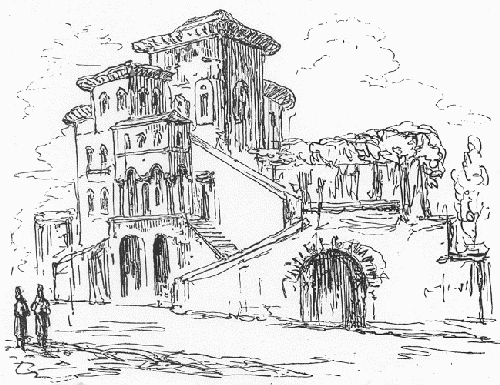
Drawn by Sir W. Gell
HOUSES IN SCIO.
Sunday, 30th.—At five this morning we
bade adieu to Smyrna; and never did I send
aloft a more sincere prayer than when petitioning
to see it no more. By the forenoon, we
were off the Island of Scio, the coast of
which presented much beautiful and picturesque
scenery. The wind now gradually increased to
a stiff breeze, and the weather became threatening;
so that the first symptoms of turning in
made their appearance among the passengers.
The night following was black and stormy, and
we had reason to anticipate an Archipelago
gale: fortunately, however, it cleared up, much
to the satisfaction of the captain and myself; for
never did a boat traverse these seas with less of
the seaman in the composition of its crew, from
the said captain down to the slop-boy.
QUARANTINE.
Monday, July 1st.—The Island of Tinos was
in sight at daylight this morning; and, passing
through the channel between it and Andros, we
approached Syra, the quarantine station of the
new Greek kingdom for all vessels coming from
Smyrna or the plague countries. The situation
of Syra is very beautiful; the houses rising gradually
in a succession of terraces, built upon
the slope of a steep mountain, situated at the
bottom of an extensive bay, in which we found
the Madagascar lying at anchor.
KING OF GREECE.
Shortly after our arrival, the officers of health
came alongside, and informed us we were destined
to seven days' quarantine. Of these, the
day we left Smyrna counted as one, that passed
at sea as another, and the one on which we got
pratique as a third; so we had, in reality, only
four days to remain in durance vile. To console
us for the unwelcome detention, the inhabitants
brought off quantities of delicious fruit, honey,
and meat to regale our appetites; while, in the
evening, our eyes were gratified with the brilliant
spectacle afforded by the illumination of
the Madagascar and the town. The presence
of the King seemed to have transported the good
people of the island beyond themselves: such
firing of guns and blazing of bonfires, such
screaming and hallooing, probably never before
disturbed the quiet precincts of Syra. His Majesty
gets pratique to-morrow, and there is to be
a dinner and ball ashore. We could plainly
discern them making preparations, and decorating
the governor's house, but had no prospect
of partaking of these festivities.
It was very late before I could get asleep,
owing to the gambling going forward on deck
until two o'clock in the morning. There was a
rouge et noir table, and a whist party, by both of
which very high stakes were played, much to
the annoyance of the better disposed passengers,
who wished for rest and quietness.
SHIP LAUNCH.
Tuesday, 2d.—At nine o'clock, after dressing
the ship in her colours, and receiving a
salute from the shore, the King left the Madagascar
in the captain's gig. A deputation of
the principal inhabitants awaited his arrival, and
the keys of the town, according to "ancient
and approved usage," were delivered to him
under a triumphal arch. The governor then
addressed him in a Greek speech, to which his
Majesty replied; but in what language the
court newsman has not thought fit to inform us.
After parading through the town, the procession
arrived at the governor's, where the King held
a levee. In the afternoon, he returned to the
vessel, on board of which a dinner was given to
the principal inhabitants; and again the poor
Greeks illumined their houses and burnt bonfires.
The English in the steamer set up a singing-party
this evening, in opposition to the hazard-players;
and we kept it up until there was a
dissolution of the card table; it being impossible
either to gain or lose money with any satisfaction
while the jovial chorus disturbed their
calculations.
INHABITANTS OF SYRA.
Wednesday, 3d.—Great preparations were
made for a ship-launch; and again the King
went in state to the governor's residence, and
proceeded thence to the dockyard, where he
performed the ceremony of naming a small
vessel; which glided beautifully into the ocean
amid salvos of artillery, volleys of small-arms,
and the cheers of the surrounding spectators.
The grand festival and ball took place on shore
in the evening; when they kept it up till past
midnight; and the moment the King and his
party returned on board, the Madagascar set sail,
and "left us alone in our glory." It seems
rather extraordinary that the Prince of Bavaria
had not the inclination, as he certainly had the
power, to put off these fêtes until the passengers
of the Francesco, with whom he had sailed for
two months, and to whom he was now under
some obligation, could have participated in them.
There was no reason for hurry; there existed no
necessity for the King's immediate return to
Nauplia; in short, no excuse can be found to
palliate such paltry, ungenerous, unfeeling conduct:
certainly unfeeling, when it is considered
that his fellow-travellers were witnesses of these
festivities, without the possibility of joining in
them.
Friday, 5th.—By the first boat which came
alongside to-day, many of the more restless part
of our crew hurried ashore. I remained on board
till the evening; and amused myself, during the
interval, in watching the numerous boats, crowded
with the inhabitants, which came off to visit
the steamer. I did not notice a single Greek
woman who maintained the reputation of her
countrywomen for any thing but ugliness; and
none of the men were of that fine race of beings
whom I expected to see. There was nothing
national in their costume; the women being
mostly dressed in imitation of the Parisian mode;
and, apparently, many of the men took their cut
from Bond Street. Over a cabinet in the billiard-room,
I afterwards observed several plates from
the "Courrier des Dames;" and as Syra is destined
to be the principal port of the Greek
islands, I presume its inhabitants wish also to
show themselves leaders in the march of improvement.
Of course, the ladies will prefer stiff
stays, gigot sleeves, and spacious bustle, to the
loose jacket, short petticoat, and coloured stockings
of their grandmothers.
GRAND FESTA.
There is to be a grand festa this evening, to-day
being the eve of the γενεθλιον του προδρομου, or
birth of St. John the Baptist. There was an incessant
firing of muskets and petards; which
proved that the gunpowder had not been all expended
upon King Otho. Towards night, every
one lighted a large bonfire before his house, and
the favourite amusement seemed to be, who
would run the oftenest through it when the blaze
was at the fiercest. Shouts of laughter burst
from the crowd, as each unlucky wight issued,
scorched and singed, from the fiery trial; while
the applause was proportionate towards those
who ventured bravely, and escaped uninjured.
Many of us joined in the sport, leaping through
the mass of newly kindled flame, and, among
others, I had the satisfaction of presenting myself
on the other side, minus a good portion of
whiskers, and with eyelashes singed into little
tufts, close to the lid.
SYRA.
Syra, like many of the Greek towns, is best seen
at a distance; for it is, in reality, but an insignificant
place, and there is not a respectable street
in it. The houses, too, are low and dirty; and a
disagreeable smell of dried fish and bad olives
salutes one in every quarter. However, the inhabitants
appear to be wealthy and enterprising;
and at some future period it may become a large,
populous, flourishing city.
Saturday, 6th.—We started at midnight, and
in the morning were off St. Nicolo, in the island
of Tinos. The town is very pretty; and the
house of the bishop, near the church, is a very
favourable specimen of Greek domestic architecture.
LADIES OF MYCONE.
After remaining here a short time, we proceeded
on our course to Mycone. Several boat-loads
of the natives put off to see the vessel; and
on being received on board, they expressed the
greatest surprise and admiration at the size and
beauty of the steamer's cabin and deck. On our
part, we were no less gratified with the graceful,
varied costume, worn by our island visiters; one
of whom, a female, was dressed in a most superb
style; and being also exceedingly pretty, she
set off her decorations to great advantage. Dark
eyelashes overshadowed a pair of eyes, blue, soft,
and beautiful as the heaven of her native clime.
A shawl of parti-coloured silk was so disposed
upon her head as to cover its upper part, and form
a bow on the right side; while the ends hung
over each ear, allowing the rich tresses of her
glossy auburn hair to flow from under them unconfined.
A plain loose jacket of light blue
cloth covered a deep-red bodice laced close to
the form; and a petticoat of the same colour,
descending in ample folds to the knee, was fastened
round the waist by a narrow black silk
shawl. Her stockings were black, and the garters
vermilion. Another lady of the party, a
dark beauty, also wore a dress of rich and elegant
fashion. Her hair, black as jet, was closely bound
round her head, and fastened in a knot upon the
crown, as one sees it arranged on the Greek statues.
A thin gauze veil, ornamented at the two
extremities with flowers and gold embroidery,
was thrown carelessly over this elegant coiffure,
heightening and adding new graces to a beauty
it was intended to conceal. Her jacket was of
green velvet braided with gold, and lined with
white silk. The remainder of her dress consisted
of rose-coloured silk; and a magnificent
shawl, of that brilliant red and yellow pattern so
common among the Greeks, encircled her waist.
I believe she was the wife of the Neapolitan
consul, who also fulfilled the duties of that office
for half a dozen countries besides.
VULGAR TOURISTS.
Proceeding next to Delos, we anchored opposite
Mount Cynthus, and went on shore immediately,
to visit the ruins of the theatre, and of
some vast temple, built upon the ascent of that
hill. Thence we passed to the Thermæ, and to
the ruins of the great Temple of Apollo, which
cover an immense extent of ground, where capitals,
columns, architraves, friezes, and cornices, lie
mingled in undistinguished confusion; and from
their size and number they had more the appearance
of the fragments of some fallen mountain,
than the remains of man's handiwork. While engaged
in contemplating these stupendous ruins,
the rest of the party wandered about, and saw
many things which necessarily escaped my observation.
But four hours only were granted us
to examine one of the most interesting of the
places marked down in the itinerary; and it was
necessary to hurry over the scene. It really
seemed, that the feelings of the generality of our
tourists must be of a very low and vulgar description,
thus to visit any spot consecrated by history
or fable, as it were for an instant, merely to gratify
the empty vanity of being able to say "Oh! I
have been there;" and then to hurry on towards
the next object with the same heartless indifference.
How different is their conduct on arriving
at the busy haunts of men, which promise balls,
dinners, or festás! Then, hours and days are not
sufficient for the gratification of their favourite
enjoyments, and every stratagem is put in practice
to create delay.
Hardly one third of the passengers landed at
Delos, yet five days were absolutely lost in
Smyrna. The same parties who grumbled, and
grudged four short hours at this isle, would have
detained us as many days over the number
specified in the city of figs, had they been permitted.
Nor was the cool morning, or evening,
freshened by the never-failing breeze, selected
for going ashore; but the very hottest time of
day, when on this treeless, barren, granite island,
the reflection of light and heat is almost insupportable:
when Apollo darts his fiercest rays on those
who wander to seek his fane, and Diana was unable
to offer them any cool, shady retreat which, at
such an hour, she would herself have loved so well.
Yonder, under the soot-imbued awning of the
Francesco, sits many a listless cold-hearted being
gazing without emotion,—
——"on the sacred place,
Where once stood shrines and gods;"
and with no enviable feelings putting the question
to him, who, with his imagination rapt on
the thoughts of other days, hastens to the classic
shore:—"What is the use of running out in the
sun; cannot you see those piles of stones from
the deck?"—Senseless, unfeeling, sordid, and
degraded! what can have induced you to approach
this consecrated land?
A MODERN ANTIQUE.There was one of our party who thought
he had made a grand discovery and capture.
With great labour and exertion, we carried for
him to the water's edge a large block of marble,
resembling a portion of a basin or font. He at
once decided, that it had been some receptacle
for water belonging to the temple, and resolved
on carrying it to Palermo. Unfortunately,
however, it was shortly afterwards recognised
to be nothing more than a Turkish mortar
for pounding the sulphur, nitre, and charcoal
used in the manufacture of gunpowder; and on
examination, there was no doubt of its being
perfectly modern. "Never mind," said its proprietor;
"it shall go to my palace; and there
being no reason to explain what it really is
only whence it came, the Sicilians will admire
and venerate it as a relic from Delos!"
BEAUTIFUL ANCHORAGE.
Sunday, 7th.—In the middle of the night
we started for Naxos, bidding adieu to Delos
over a cup "mantling with rosy wine," and with
the song of sociality; thus worshipping the
glorious gods of the table, as, leaving the temple
of the one, we approached the spot hallowed
by the worship of the other. Where, indeed,
should the chorus sound more joyously than in
the waters of Delos, or the sparkling wine flow
faster than in the sight of Naxos?
It was a beautiful night; the moon shone
with resplendent lustre, and the sea, calm and
unruffled as a mountain lake, reflected all its
beams, until each rippling wave became like
molten silver.
Crossing from Naxos to Paros, and coasting
along the latter mountainous isle, we stopped
opposite the town of the same name, to discover
the most convenient anchorage, for visiting the
celebrated grotto. While waiting for the necessary
information, several of the passengers
went in search of the quarries which supplied
the ancients with marble; but as, without interpreters,
they could not make themselves
understood, they returned unsuccessful. We,
however, were fortunate in meeting with a rich
proprietor, who lived opposite the grotto and
village of Antiparos, and who promised to have
men and torches ready for us by daylight. We
then started again, and at length dropt anchor
in a beautiful strait between the two islands.
The greatest caution is requisite in getting to
this position; the passage being extremely narrow,
and the water shallow: the latter was so
beautifully transparent, that each pebble on the
yellow sand appeared distinctly visible, and myriads
of sportive fish were seen darting in every
direction from the clamorous hissing monster
that invaded their quiet abode.
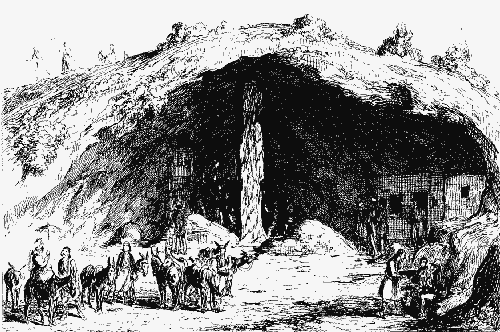
Drawn & Etched by George Cruikshank, from a Sketch by the Author.
Grotto Antiparos.
Published by Longman & Cº. April, 1835.
VISIT TO ANTIPAROS.
Monday, 8th.—The expedition to Antiparos
seemed to suit the general taste, and all were
ready by the appointed hour. At four o'clock
we embarked in two large country boats, and
proceeding through the strait, we landed in a
little bay, and found an assemblage of donkeys
and guides awaiting our arrival. The distance,
as we were informed, was two hours, and all
being mounted, away we started on this grotto
chase at a double quick step; so that in a short
time many began to show symptoms of fatigue.
For the first half hour the country appeared
almost destitute of trees, but arriving at length
MARINE PROSPECT.
on the brow of a hill, after a long and gradual
ascent, a richly cultivated and finely wooded
hollow, surrounded by mountains, opened upon
our view. As the abrupt faces of these eminences
form an insurmountable barrier on three sides
of the basin just alluded to, we fancied that the
grotto must be there. But no! we had to
descend, cross it, and mount again towards the
south, by a steep path that wound up the least
precipitous side of this punchbowl. Hitherto
the rock had been primitive limestone lying on
gneiss, but we now came upon a thick stratum
of pure limestone.
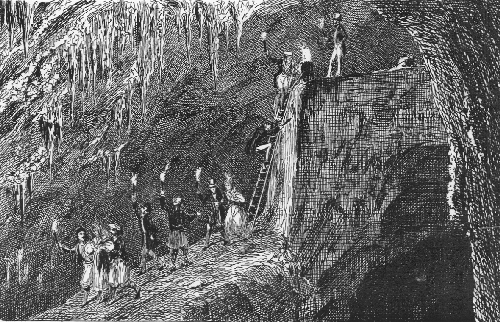
Drawn & Etched by George Cruikshank, from a Sketch by the Author.
Interior of the Grotto of Antiparas.
ENTRANCE TO THE CAVERN.
Passing over the brow of a tolerably high
mountain, we found that it declined towards the
south into the plain; and thence to the sea by a
gentle slope. The ground was covered with
myrtle and arbutus, and presented a wild but
beautiful aspect. We had now nearly reached
the further end of the island, where a narrow
promontory extends far into the calm blue
waters. Far off in the distance appeared the
islands of Sikyno and Raclia, floating like huge
birds upon the bosom of the waves. Close
under the western shore, where the island of
Paros terminates in bold perpendicular cliffs,
lay the little island of Spotico; while all around,
the sea bristled with rocks as far as the eye could
reach. On one side of a steep path, which we
were now slowly ascending, the guides pointed
out a huge fissure or break in the rock, which
they said was the platform in front of the grotto.
At the further end of this cavern, behind a vast
stalactite, reaching from the roof to the ground,
and suggesting to the imagination the idea of
some gigantic sentinel before the pit of Acheron,
yawned a low narrow opening, the interior of which
presented to the view a more than Egyptian darkness.
Around this spot were assembled a band
of kirtled Greeks, provided with ropes, ladders,
and flambeaux. Our appearance was the signal
for a general uproar: each commenced talking,
screaming, and fighting for possession of the
ladies, and every now and then edging in a word
of French or English, by way of additional recommendation.
Much time was lost in squabbling
for the torches, the number of which proved to be
less than that of the adventurers; and it was
only fair that "first come should be first served."
Those who had loitered behind complained bitterly
of the deficiency in this respect; especially
the chevalier d'industrie from Milan, who,
being less expert with his feet than with his
hands, had been one of the last to arrive. Of
his adroitness with the latter, he quickly gave
us a specimen; for, while one of my friends was
peering into the entrance of this Acherontic cave,
he very cunningly appropriated his torch; and
it was not until the matter became serious, that
he could be induced to restore it.
PERILOUS DESCENT.
It was with feelings wrought up to a high degree
of excitement, in which I believe all my
companions participated, that I heard the order
given to advance, when the whole party trod
closely on the footsteps of the guides, who preceded
us with torches. Our speed, however,
soon received a check; for by the time we had
advanced fifteen or twenty paces, the light of day
entirely failed us. All now became enveloped in
utter darkness, except a small space in front,
where the tapers of our conductors, nearly extinguished
by the damp and unwholesome atmosphere,
emitted a pale and livid blaze, which,
failing to reveal the extent and termination
of this frightful cavern, produced a "darkness
visible," and magnified every danger. It was a
long, narrow, winding chasm, gradually increasing
in the abruptness of the descent as we
advanced; and the floor, that consisted of carbonate
of lime, was rendered slippery as ice by
the damp and the friction of the feet of those
who, for the last three thousand years, have
visited this extraordinary place from motives
similar to our own. A single cable of no very
satisfactory appearance was all we had to depend
upon for support, and it chafed against the sharp,
rugged, angular projections of the rocks in a
fearful manner, when violently dragged from side
to side by the united action of the forty individuals
who clung to it. The feelings of insecurity to
which this naturally gave rise were not at all
diminished by the shrieks and exclamations of
terror proceeding from such as lost their footing
upon the polished floor, and lay struggling in
ineffectual efforts to get up, without letting go the
rope. My own personal safety did not so wholly
occupy my attention as to prevent me from being
affected with wonder and admiration at the exceeding
beauty of some portions of this subterranean
corridor, which glittered in the torch-light
with a splendour no language can describe;
for the innumerable minute crystals scattered
over its surface, glowed at one moment with
a deep blood-red, and at another exhibited all
the different hues of the most brilliant rainbow.
MELODRAMATIC SCENE.
It is hardly possible to conceive a more extraordinary
spectacle than that in which I was now an
actor: it was perfectly melodramatic, and would
make the fortune of any minor theatre in London,
though the pen of a Dante is alone equal to
its description. First and foremost, were seen
the Greek guides exciting us to persevere, and the
STRIFE OF TONGUES.
beckoning us onwards by waving the flaming
torches high above their heads; and when the
light flashed upon their savage countenances,
wild streaming locks, and picturesque garments,
as well as over the pale, stumbling, struggling
crowd which followed, it required no great
stretch of fancy to imagine that I saw the attendant
demons of some mighty sorcerer, the
inhabitant of this rocky den, deluding us onwards
to destruction. The laughter, screams, and
hallooing, which accompanied our efforts to
maintain a hold upon the cable, our only hope
of safety, united to the smoke and stench of the
flambeaux, rendered the whole scene no unapt
representation of Pandemonium. The Greeks
shouted forth oaths, warnings, entreaties, and
directions, in their native tongue: with these
were intermingled, in indescribable confusion,
the English "d—n," the French "sacre," the
German "mein Got," the Italian "corpo di
Bacco," and the gentler exclamations of certain
of the fair sex who, strange to say, accompanied
us in this hazardous expedition.
SYMPTOMS OF ALARM.
On reaching the brink of a most frightful precipice,
we were instructed to crawl down by
means of some rude steps cut in the surface of
a sloping buttress or inclined plane of rock,
which appeared to extend to the bottom. The
sight of this horrible den acted as a "pretty
considerable" sedative to our enthusiasm. Each
exclaimed to himself, (at least I did for one)
"Can I venture?"—as he contemplated the
dismal, and, to all appearance, bottomless gulf,
where nothing was visible but the strange figures
of our guides at a prodigious distance beneath us,
clinging to the wall with one hand, while they
brandished their torches with the other. However,
there was little space for reflection; and
though, by this time, I shrewdly suspect most of
the party had pretty well "satisfied the sentiment,"
as Sterne says, none were heard to say
so; and after a short delay we pushed on again,
apparently regardless of danger. Our progress,
however, became every moment more and more
difficult and discouraging; for this rude and imperfect
staircase, also slippery as ice, was covered
with loose stones, that came rattling down on our
devoted heads at every false step of those above;
and many who had eagerly contested at the
outset for the distinction of leading the party,
would now have gladly made an inglorious retreat
rearward, to escape the contusions, or something
worse, with which they were momentarily
threatened; convinced, with Falstaff, that "honour
hath no skill in surgery."
PETRIFIED GARDEN.
After remaining for a few minutes suspended
from the cord, like a cluster of bees in the act of
swarming, we again found ourselves on terra
firma; and a passage behind some masses of projecting
rock brought me to a platform, in front
of which rose a stalagmite, admirably adapted
by its position for the display of my fireworks.
Accordingly I let off a blue-light, which illuminated
the grotto beneath, the arches of which
were of immense size; and their vast ribs,
protruding from the rock, and extending to a
great height, formed a magnificent dome, from
which hung innumerable concretions of pointed
form. Masses of crystallised limestone grew
from the floor in every shape that fancy could
picture. There were trees, teeth, flowers, houses,
men, &c.: in short, imagination never could exhaust
itself in pointing out resemblances between
these phenomena, and the ordinary productions
of nature and art.
The predominance of the figures of trees,
plants, and flowers among these fantastical
creations, gives to the whole grotto the appearance
of a petrified garden; but it was no slight
drawback on our gratification to find these objects
covered with slime and mud, obscuring the
brilliant ever-changing hues of the myriads of
crystals with which they are studded, and which
former travellers have alluded to in terms of admiration.
It was only when the blue flame shed
its beautiful light upon the scene, that it at all
realised my preconceived ideas of this "Palace
of the genii, the most beautiful of fairy land,"
as it has been frequently styled.
By a ladder fastened to the stalagmite, we
descended into another frightful cavern, where
on one side several dismal-looking pits, like the
entrances to coal mines, and black pools of dirty,
stagnant water, menaced us with death under
a twofold aspect, until we reached the uneven
and shelving floor of the grotto. There were
several chambers, more or less resembling each
other, being separated from the grand nave of
this magnificent temple by the accumulation of
the crystallising mass for ages.
DESCRIPTION BY A NAVAL OFFICER.
It is a scene that ought to be visited by a few
congenial spirits, quietly and leisurely. On the
present occasion the effect and the illusion were
dissipated by the glare of the torch lights, the
hallooing and screaming of those present, and the
thumping of hammers and blocks of stone to
get fragments of the crystal. This part of the
grotto is certainly the heaven, the paradise;
though, of a truth, the descent into it is through
purgatory; an opinion in which I am by no
means singular; and in confirmation I shall beg
leave to introduce a portion of the narrative of a
gallant officer belonging to one of our vessels
cruising in the Levant, who saw the grotto under
more favourable auspices than we did; though,
like the poor Frenchman, whom I shall have
occasion to mention hereafter, he acknowledges
that he purchased the gratification at the cost of
some mortal terror.
MAGNIFICENT PASSAGE.
Speaking of the deepest and most gloomy of
the caverns into which we had penetrated, he
says:—"I was quite disheartened at this horrible
prospect, and declared I would go back, but our
guides assured us there was no danger, and the
rest of the company resolving to see the bottom
after having come so far, I would not leave
them: so we went to a corner where was placed
an old slippery rotten ladder, which hung down
close to the wall, and down this, one after
another, we at length descended. When we
reached the bottom we found ourselves at the
entrance of another passage, which was indeed
horrible enough; but in this there was not wanting
something of beauty. It was a wide and
gradual descent, at the entrance of which one of
our guides seated himself, and began to slide
down, telling us we must do the same. We
could discover by the light of his torch that this
passage was one of the noblest in the world. It
was about nine feet high, seven wide, and had
for its bottom a fine green glossy marble. The
walls and arch of the roof, being in many places
as smooth as if wrought with art, and made of a
fine glittering red and white granite, supported
here and there with columns of a deep blood red
shining porphyry, made with the reflection of
the lights an appearance not to be conceived.
Our guides could here keep on each side of us;
and what with the prodigious beauty and grandeur
of the place, our easy travelling through it,
and the diversion of now and then running over
one another whether we would or not, made this
the pleasantest part of the journey.
EXCESSIVE TERROR.
"When we had passed about two hundred
yards, we found ourselves on the brink of another
very terrible precipice; but this our guides assured
us was the last, and there being a very
good ladder to go down by, we readily ventured.
After about forty yards' walking, we were again
presented by our guides with ropes, which we
fastened around our waists, though not to be
swung by; but only for fear of danger, as there
are lakes and deep wells all the way hence on
the left hand. With this precaution, we entered
the last alley; and horrible work, indeed, it was to
get through it. The sides and roof of the passage
were of black stone, and the rocks in our
way were in some places so steep, that we were
forced to lie all along on our backs and slide
down; and so rough, that they cut our clothes
and bruised us in passing. Over our heads there
were nothing but rugged black rocks, some of
them looking as if they were every moment
ready to fall on us; and on the left hand the
light of our torches showed us continually the
surfaces of dirty and miserable-looking lakes of
water.
DISAPPEARANCE OF THE GUIDES.
"If I heartily repented my expedition before,
here I was in a cold perspiration, and fairly gave
myself up for lost, heartily cursing all the travellers
that had written of the place, because they
had described it so as to tempt people to visit it,
without telling them of the horrors they must
encounter in the way. In the midst of these
reflections, and in the very dismallest part of the
cavern, on a sudden we lost four of our six
guides. What was my horror on this occasion!
The place was a thousand times more dark and
terrible for the want of their torches; and I expected
no other but every moment to follow
them into one or the other of these lakes, into
which I doubted not they had fallen. The remaining
two guides said all they could to cheer
us up, and told us we should see the other four
again soon, and that we were near the end of
our journey. I do not know what effect this
might have had on my companions, but I believed
no part of their speech but the last, which
I expected very soon to find fulfilled in some
pond or precipice: in that sense, indeed, we
were near our journey's end!
SPLENDID TRANSITION.
"While engaged in meditating on the perils
that environed me, I suddenly heard a little
hissing noise, and found myself in utter and
indescribable darkness. Our guides, indeed, called
cheerfully to us, and told us they had accidentally
dropped their torches into a puddle of water,
but that they should soon reach their companions,
when they would light them again, and we
had nothing to do but crawl forward. I cannot
say but that I was amazed at the courage of these
people in a place where I thought four of their
number had already perished, and from whence
none of us could ever escape; and I determined
to lie down and die where I was.
"One of our guides, perceiving that I did not
advance, came up to me, and, clapping his fingers
over my eyes, dragged me a few paces forward.
While I was in this strange condition, expecting
every moment death in a thousand shapes, and
trembling to think what the fellow meant by this
rough proceeding, he lifted me at once over a
great stone, set me down upon my feet, and took
his hand from before my eyes. What words can
describe my astonishment and transport at that
instant! Instead of darkness and despair, all
was splendour and magnificence around me;
the place was illumined with fifty torches; and
our guides, who all reappeared about us, with a
loud shout welcomed us to the Grotto of Antiparos!
The four that were first missing, I now
found, had only given us the slip to get the
torches lighted up before we came; and the
other two had put out their lights on purpose,
to make us enter out of utter darkness into this
pavilion of splendour and glory.
DIMENSIONS OF THE GROTTO.
"The grotto is a cavern of about 120 yards
wide, 113 long, and seems about 60 yards high
in most places. Imagine, then, an immense arch
like this, almost entirely lined with fine bright
white marble, and the mind will then acquire
some faint idea of the place I had the pleasure to
spend three hours in: this, however, is but a very
insufficient description of its beauties. The roof,
which consists of a fine vaulted arch, is hung all
over with icicles of fine white marble, some of
them ten feet long, and as thick as one's middle
at the root; and among these there hung a thousand
festoons of leaves and flowers of the same
substance, but so very glittering that there was no
bearing to look at them. All the sides of the arch
are planted with the representations of trees of
the same white crystal, rising in rows one
above the other. From these trees were also
hung festoons, tied, as it were, from one to another,
in vast quantities; and in some places
among them are seen rivers of marble flowing in
a thousand meanders. All these things have
been produced, during a long series of years, by
the dropping of water, but really look like petrified
trees and brooks. Our guides had tied
torches two or three to a pillar, and kept continually
beating them to make them burn bright:
imagine, then, what a glare of splendour and
beauty must be the effect of this illumination
among such rocks and columns of marble. All
around the lower part of the sides of the arch
are a thousand white masses of crystal, in the
shape of oak trees, which are in many places
large enough for a bedchamber. One of these
chambers has a fine white curtain, whiter than
satin, of the same marble, stretching all over the
front of it. In this we cut our names and the
date of the year."
TERRIFIED FRENCHMAN.
I shall not dwell upon our return, though it
was, if possible, more laborious and difficult than
the descent. Just as I had got upon the first
ladder and my white light was extinguished,
there arose the most shrill and piercing shriek I
ever remember to have heard, followed by loud
exclamations of "Sauvez moi! sauvez moi! je
suis perdu!" It immediately occurred to me
that some unfortunate creature had fallen into
the abyss; and, lowering my torch, I beheld
a figure convulsively grasping the rock with one
hand and the ladder with the other; while a
Greek, who stood underneath, was endeavouring
to force him onwards. There he hung, in
perfect safety, though unable to assist himself; trembling
like an aspen leaf, pale as death, and crying
like a child. After we had drawn him up, he
sat down for some time, to recover his scattered
senses; and, positively, I could hardly refrain from
laughing as he made his piteous complaint. It
seems, without reflecting that the man did not
understand a word of French, he had charged
the Greek, who followed him, not to get upon
the ladder until he was off. Just, however, as
his hand was on the last step, he felt some one
climbing after him. The poor Frenchman's
terror was then at its height: he fancied the
ladder slipping from under his feet, and, grasping
the wood still more tightly, in doing so he got
his finger pinched against the rock. In the
exertion of releasing it, he nearly overbalanced
himself in reality, and again he screamed out with
terror and dismay! All this occurred in a brief
instant; though, between his tears and his heart
throbbing, many minutes were consumed in the
narration.
A HINT FOR THE LADIES.
I am not a little surprised that the two ladies
who accompanied the party had courage to
descend into such a place. In my opinion, excursions
like these are by no means adapted
to either the mental or corporeal delicacy of the
fair sex; and, however disagreeable the position
might have momentarily proved to them, it was
impossible to witness the tall slender figure of
one of them, grasped in the arms of a bearded
swarthy Greek, now squeezed against the wall,
now almost astride upon his shoulders, without
indulging in the laughter such a spectacle was
well calculated to inspire.
Thanks to the kind influence of the guardian
genii of the cave, who preserved us from falling
victims to the perils of the way, we all got safely
out; and as each, begrimed with dirt, and
black as a chimney-sweep, emerged into upper
air, enveloped in smoke, which now issued in
huge volumes from the cavern's mouth, he was
received by his companions with shouts of mirth
that made the old vault echo again. Verily, we
could be likened to nothing but the devils in the
opera of Don Giovanni.
We now turned our steps again towards the
village of Antiparos, and, under the influence of
those potent stimulants, hunger and thirst, got
over the ground more rapidly than might have
been anticipated, considering how exhausted
the whole party felt previously to starting.
The time passed rapidly enough in the interchange
of a good deal of lively and amusing
raillery on the truly laughable appearance which
every individual presented, with clothes rent
almost to tatters, and visage bedaubed with
oil and soot; besides, each of us became the
"hero of his little tale," and could narrate a
hundred perilous incidents and hairbreadth
escapes which he had encountered during his
descent and ascent from the "antres vast" of
this extraordinary place.
It was eleven o'clock before we got on board,
where all did ample homage to the breakfast that
awaited us.
PORT OF MILO.
In the meantime the boat quitted the island,
and after sailing between Serpho and Siphanto,
and coasting along the Argentiera, all volcanic
islands, she came in sight of the port of Milo.
By properly fortifying the entrance of this harbour,
it might be rendered perfectly impregnable.
In shape it resembles a horse-shoe much
contracted at the two extremities; and consists
of the crater of an extinct volcano, the cone of
which remains on three sides, but more or less
in a state of degradation. The town is built on
the top of the cone, and the whole island appears
to be volcanic. In our passage here, we
sailed by the Pelican sloop of war, bound to
Malta, on her voyage home.
WARLIKE MOUNTAINEERS.
Tuesday, 9th.—Early this morning, the Madagascar
came in, in fine style, with every sail
set, and anchored close to us. After bathing
in the sea with the midshipmen, by leaping off
the vessel's chains, the King of Greece landed,
to go up to the town. The Greek soldiers and
sailors, most of whom were pirates formerly, hailed
his disembarkation on an old Turkey carpet,
with shouts and acclamations, followed by a discharge
of their long guns loaded with ball; several
of which plunged into the water within a
few feet of the steam-boat.
When all was quiet we went ashore also, and
landed on the snow-white beach, formed of pumice
stone, which sparkled in the sun's rays
like myriads of diamonds, and in which several
large masses of grey lava, exceedingly fragile, lay
deeply imbedded.
ANECDOTE.
In the paltry collection of wine-shops, here
dignified with the name of village, we saw
a number of Greeks waiting the return of Otho:
each wore a gaily coloured kerchief on the head;
an embroidered jacket; a shawl encircling the
waist; red greaves; a dirk; and a long gun,
ornamented with gold, slung over the shoulder.
Their wild fearless demeanour struck me as more
characteristic of the freebooter, than the soldier
of a regular government. Yet seldom have
I seen more elegant graceful figures than were
possessed by these mountain robbers, whose robust
symmetry rendered each one of them a
perfect model for the sculptor's art.
I went on board the Madagascar in the evening,
and enjoyed a pleasant confab with the
officers. There is a striking difference in the
tempers and dispositions of the two royal brothers;
the one being greatly beloved, while the
other is disliked by every person in the ship.
The King is very kind and affable, giving no
unnecessary trouble, and mixing freely with the
midshipmen and sailors: many a luncheon has
he partaken of in the den of the former. His
brother, on the contrary, is all fuss and superciliousness;
and the very first morning after he
embarked, the captain was compelled to read him
a practical lecture on the necessity of complying
with the established regulations. He had been
told that, as punctuality was a most indispensable
maxim on board a man-of-war, where every thing
depended on the example afforded to the sailors
by their officers and superiors, he would be
expected at breakfast by eight o'clock every
morning.
PARTING OF THE ROYAL BROTHERS.
On the following day, at the hour prescribed,
the King was seated at the cabin table, and, after
waiting a quarter of an hour, as the Prince came
not, breakfast was finished. About half past
nine his Royal Highness made his début, and
expressed some surprise at seeing the table
cleared; however, the Captain told him he was
sorry he had lost his breakfast, particularly as it
was a long time to dinner; and the regulations of
the ship precluded his having any meal served before
that was ready. The Prince frowned and
looked marvellously discomfited; but, pocketing
his lecture, he made an apology, and went
sulkily on deck.
The moment of parting between the royal
brothers had now arrived, and they came on
board the steamer together at a late hour. The
anchor was already up:—"Give way!" cried
the captain: the heir of Bavaria and the hope
of Greece fell into each other's arms; and, after
a short embrace and a kissing of each cheek, the
latter hurried down the ladder; the Prince hastened
to his cabin; and in a few minutes more
we were merrily ploughing our way through the
rippling waves of the calm and beautiful harbour
of Milo.
Wednesday, 10th.—Cerigo was in sight this
morning; and, after coasting along its almost
uninhabited shore, and rounding Cape Matapan,
we entered the Gulf of Coron,—the scene of
one of the most beautiful spirit-stirring poems
that ever proceeded from the heaven-inspired
pen of Byron. We sailed slowly along its wild
and wooded coast, anxious to reach the town21
of the same name in the evening; for, by going
on shore there, we might probably avoid some
days' quarantine at Zante.
When off the island, a boat was sent ashore,
and on its return we started again, and, passing
between the Isle of Venetico and the main land,
and rounding the point of Modon, we kept the
high and barren coast of Arcadia in sight.
ZANTE.
Thursday, 11th.—This morning Zante appeared
in the distance, and about mid-day we
entered the harbour of this fine island. The
interior is a beautiful plain, rich in pastures,
well wooded, and cultivated with the greatest
assiduity. The town looked clean and cheerful:
but we were not permitted to land; for it turned
out that our quarantine had been of no use.
Seven additional days' purification being required,
we decided on starting again immediately. Several
barge loads of coal, therefore, were brought
alongside, and, their crews having quitted them
(for they fled as if the plague had been actually on
board), our men got to work, and we soon had
our quantum of fuel for the voyage to Malta.
Friday, 12th.—We landed ten passengers to-day;
four of them British officers belonging to the
garrison of Corfu; and the other six, disgusted
with the boat, and with the prospect of twenty
days' detention at Malta, had resolved to await
the steamer expected in six days from the former
place, and bound to Ancona, where they understood
the quarantine was limited to five days.
SEA SICKNESS.
The swell becoming unpleasant towards evening,
one by one the passengers went below; and
the Prince, turning gradually pale, showed unequivocal
symptoms of being affected by a
malady which, like death, is no respecter of persons,
but fastens indifferently on the sceptred
monarch and the shoeless cowherd, when either
ventures to go "ploughing the billows of the
faithless deep."
We took in two English passengers who had
been making the tour of Greece and Asia Minor,
and who strongly advised the seceders not to
trust to the expected boat, but to stick to the
Francesco. However; as they still remained
obstinately bent on following their own plans,
we left them, and were soon out in the Ionian
Sea.
VALETTA.
Sunday, 14th.—At four o'clock this morning,
the mountains of Calabria, above Branco and
Cape Spartivento, were visible. About seven,
Ætna reared its giant head, towering magnificently
over the scene through the clouds of mist
that enveloped its base. At half-past two we
entered the harbour of Syracuse, after a few
hours' delay, started again in a gale. We had
a very rough time of it during the night, but
to-morrow our troubles will end.
Monday, 15th.—At daybreak a speck was
seen in the horizon; now it is visible above the
hollow wave, now curtained from our sight by
the swelling billow: we approach nearer; the
speck divides, and two spots appear; they are
Calypso's Isles,—
"The sister tenants of the middle deep,
There, for the weary, still a haven smiles,
Though the fair goddess long hath ceased to weep."
LAZZARETTO.
At ten o'clock we passed into the quarantine
harbour.
What a formidable array of guns! what bustle
in every direction! and what a clean comfortable-looking
place is this Valetta, with its white houses
encircled with verandas. What a contrast is afforded
by the neat trim boats, the well-appointed
sentinel, and the civil, attentive officer of health,
when compared with what I have been so long
accustomed to! Every thing around bespeaks
the influence of English habits and feelings.
The whole of the great lazzaretto and Fort
Emanuel were prepared for us: the latter for
the Prince, and such as chose to go there in preference
to the former. We landed in a hurry;
the object of every one being to secure a good
room for himself, as, with a piece of chalk in
hand, he wandered through the vast corridors of
this immense building. All were well satisfied.
Myself and two friends agreed to mess together,
and we secured a couple of good apartments,
one for a bed, and the other for a sitting-room; to
which two great comforts were attached, namely,
a thorough draught and a kitchen. Valetta supplied
the necessary furniture, and every luxury
we required; and we made our engagements for
getting our dinners brought from thence daily.
With a boat and a servant in addition to these
comforts, we found ourselves established in so
agreeable a manner, that our party became the
envy of the surrounding messes. Every liberty
was permitted that the regulations of the place
could sanction; and we were allowed to row
about the harbour, and amuse ourselves in any
other way we liked, from daybreak until night.
Some of the messes had regular cooks in their
establishment; but I think our plan was preferable,
and we certainly lived better than they.
DAYS OF QUARANTINE.
Notwithstanding the heat of the weather, our
domicile was cool, and the spacious apartments
attached to the building, and the cloisters below,
afforded plenty of space for exercise. In the
evenings we generally visited the fort, or went
to the quarantine ground on the other side of
the water: sometimes we took a row out to sea;
and, on our return, the English portion of the
crew generally came into our reception room,
where we smoked, drank, and sang far into the
night. No musquitoes, no little blood-sucking
tormentors, were there to tease us; and the time
passed gaily and delightfully. Thus we held
the even tenor of our course for a fortnight,
when our confinement had virtually expired; for
though the established period of quarantine was
sixteen days, yet the one on which we went into
the lazzaretto, and that on which we came out,
were allowed to count as two. Though very few
incidents occurred to break the uniformity of
our lives, the time flew on rapidly.
The gaming-table was established, as usual, by
the foreigners; and heavy were the fluctuations
of fortune, if we might judge from the changeful
demeanour of those who frequented it. His
Royal Highness never deigned to visit us;
indeed, it could hardly be expected he should
do so, when he did not even condescend to pay
his respects to the ladies in the fort, or the party
there established, though living within the same
walls as himself.
THE PARLATORIO.In consequence of its having been decided
that the boat was to go to Alicata, Girgenti,
and Palermo, I arranged with one of the passengers
to take a felucca and sail direct for
Naples. The Pelican came in, and immediately
went off again to England, leaving her first lieutenant,
who was promoted, to join the boat for
Naples. Some portion of every day was spent at
the parlatorio eating ices, and looking at the
curious scene going forward there; for some
fresh ship daily arrived to undergo the same
ordeal as ourselves; or a knot of lucky fellows,
having finished their purgatory, were seen sallying
forth to enjoy a ramble through the clean
and pleasant streets of Valetta.
The lazzaretto is a little world within itself,
highly interesting for many reasons; and I confess
I felt rather sorry as the time approached
when we were to quit our quiet, tranquil abode,
and be again let loose upon the busy, noisy
world.
We narrowly escaped having forty days allotted
us, owing to the circumstance of there
being a quantity of carpets on board; but, by
entering them as ship's furniture, they were put
into long quarantine, and we escaped with a
comparatively short one. Every passenger seemed
to possess two or three Persian carpets: Prince
Butera had a great number; but I saw none that
were at all valuable.
MALTESE WOMEN.
At the parlatorio we saw many of the Maltese
women coming to speak with their husbands,
fathers, brothers, and lovers; most of whom
were sailors or owners of craft in the harbour.
Their dress is very becoming, and some of them
were pretty. The black silk mantilla is a very
beautiful head dress, and much to be preferred
to the misshapen bonnet with which fashion
commands the fair to disfigure themselves in
other parts of Europe. The petticoat is also of
black silk, with the body of white muslin. Some
one likened them to magpies: i'faith, they talked
as fast; but who would not wish to hear the
beautiful Arabic flowing softly from such ruby
lips, and watch the smiling flashes of—
"The coal-black eye, that mocks the coal-black veil?"
that pleasant lightning which warms, but scathes
not.
Thus our time passed until—
Sunday, 29th,—when the medical officer
of the establishment came round to make the
usual examination, which was over in a few
minutes. Our party were in bed when he
entered; and, approaching each of us with a
bow, he said, "Pretty well?—ah! I see, quite
well;"—and then, with another congé, he left
us. We afterwards understood that he addressed
every single person in the lazzaretto, the fort,
and the vessel, from the Prince to the Steward's
boy, precisely with the same words.
Tuesday, 30th.—I rose early, for the steam-packet
from Corfu had arrived in the night, and,
lo! all the passengers who quitted us at Zante
were on board of her. It appears there had
been a mistake in the number of days first allotted
them for quarantine; and, instead of three, they
were condemned to seven days' misery, all
crowded together in a very small building, where
they suffered dreadfully from the combined effect
of heat, vermin, and bad living. The expected
steam-boat had met with an accident at sea, and
she passed in sight of Zante, without entering
the harbour; so that these unlucky fellows
were obliged to hire a speranaro, in which,
after being twice driven back, and suffering
various hardships and misfortunes, they arrived
at Corfu.
There was no truth in the report respecting
the short quarantine at Ancona, and, eventually,
they all embarked in the steam-packet for Falmouth.
VALETTA.
At eight o'clock, we landed from our boat at
the harbour stairs, and entered Valetta. Rarely
have I seen a city so remarkable for its cleanliness:
in that very essential quality, it may be said
to equal the most agreeable towns of Flanders
and Holland. My first visit was to the Neapolitan
consul, when I found there was some difficulty
about the Turkish tobacco which I had
in my possession. As this knotty affair could
not be arranged, it was decided we should remain
one day more; and I engaged myself to dine at
the palace. As the Malta gazette did us the
honour to publish a detailed account of the festivities
of that day, let me transcribe it here.
"Malta, 31st.—The passengers by the Neapolitan
steamer, Francesco Primo, were yesterday
admitted to pratique.
"His Excellency the Governor entertained
His R. H. the Prince of Bavaria, the Prince of
Butera, and the other noblemen and gentlemen,
passengers in the steamer, at a grand dinner at
the palace.
GARRISON OF MALTA.
"The whole of the garrison was afterwards
reviewed on the Florian parade; and, certainly,
in no quarter of the world could a finer body of
troops be seen, than those composing the garrison
of Malta; consisting of a detachment of the
Royal Artillery, the Royal Fusileers, the Royal
Highlanders, the 73d and 94th regiments, and
the Royal Malta Fencibles.
LADY BRIGG'S BALL.
"In the evening, Lady Briggs gave a magnificent
ball, at which his R. H. the hereditary
Prince of Bavaria, Prince Butera of Sicily, and
the other distinguished personages who came by
the steamer, were present."
The writer of this "Court Journal" was right
in saying that no finer body of troops could be
seen; and the foreigners present were particularly
struck with the Fusileers and the Highlanders;
but the whole garrison was greatly offended
at the conduct of the Prince, who never
acknowledged the salute of the officers, nor the
lowering of the colours to the ground in passing
his royal person. Every one besides stood uncovered,
and the populace cheered loudly; while
he displayed a sort of contemptuous indifference,
and remained motionless as a statue. The Admiral's
ball was given as much in honour of Sir
Thomas Briggs's elevation to the Grand Cross of
St. Michel as of the illustrious persons of the
steam-boat. It was crowded and splendid; but
there was a sad lack of beauty.
The Captain of the Speranaro having refused
to take the tobacco, our bargain became void,
and the baggage was again shifted to the steam-boat,
which sailed about eight o'clock on a beautiful
moonlight night. We were kept waiting
outside the harbour for nearly an hour for Captain
Hayland, one of the passengers, who, it
seems, went to sleep, and the people in his hotel
forgot to wake him in due time. He was greatly
alarmed, all his baggage being on board; and for
some time he supposed we had really left him
behind. The boat he hired was engaged to take
him to Syracuse, in case it did not overtake the
steamer. The commander of the Francesco,
however, behaved very well on this occasion;
for, when some of the passengers remonstrated
at the delay, he replied, that the absent person
was not only attentive and obliging to all on
board, but had been punctual hitherto; and,
therefore, he would stretch a point for him,
though he would not do as much for many
others who sailed with him.
SICILY—GIRGENTI.
Thursday, August 1st.—We are off Alicata,
having landed Prince Butera, whose estates are
situated near the town. I was not sorry for the
opportunity of seeing Girgenti thus afforded me;
and a day or two sooner or later in Naples made
no difference. Some extra charge was made for
this addition to the eastern voyage, merely sufficient
to pay the expenses of the boat.
We coasted along this beautiful island, now
almost a wilderness, and nearly depopulated by
a long series of oppressive edicts and taxes, imposed
by the government of a nation which has
no sympathy with its distresses. It may be truly
called the Ireland of the great kingdom of the
two Sicilies; a wretched country, which can only
be preserved from destruction by a war to which
Naples is a party. When that occurs, Sicily may
again raise its desponding head, and, by seeking
the protection of England, whose remembrance
is indelibly stamped on the hearts of its inhabitants,
it would soon be regenerated, and, with a
liberal government and free trade, might once
more become the rich and happy Sicily, the garden
of Europe.
GIRGENTI.
We anchored off Girgenti: in the distance,
against the clear blue vault of heaven stood its
ruined temples, the sad enduring monuments of
former greatness; which appeal to the miserable
and oppressed inhabitants, impressively reminding
them of the glory of their forefathers,
and the power which has passed away from the
land.
Half an hour after midnight, a party I had
formed, started to view the temples by that light,
"Which mingles dark shadows into gentleness."
After rambling across the country, and losing
ourselves among groves of olive trees, we were
obliged to take a guide at last. We were several
times stopped by the deep ravines which the
torrents have cut in the face of the country.
There were an immense number of aloes in the
hedges, many in flower.
The night was as fine and clear as could be
desired; and the moon shone with an intensity
of light. On arriving at the Temple of Hercules,
nothing met our eyes but one solitary column
rising from a mass of prostrate ruins, and over-topping
the cluster of Indian fig-trees that grew
around it. Pointing towards the heavens, it
seemed to whisper,—"Mortals, there must you
look for eternity: here all is crumbling to decay!"
REFLECTIONS.
We passed on through groves of the above-mentioned
trees, and alongside walls and turrets
excavated from the solid rock, until the whole of
the Temple of Concord, and, immediately afterwards,
that of Juno, burst upon our sight. In
this still hour, as we stood upon their ruins, and
extended our view over the boundless prospect of
sea and land,—the one calm and tranquil as a
sleeping child; the other, like an old but vigorous
man, marked and furrowed by the devastating
hand of time,—how impressive was the scene!
Can I ever lose the recollection of that moment?
No. Girgenti,—
"My eye hath play'd the painter, and hath steeled
Thy beauty's form in table of my heart!"
Often have I lingered within the Coliseum
when its majestic ruins were silvered o'er by the
light of the same lovely orb, which now threw
its lustre on these prostrate relics of departed
greatness: I have wandered alone among the
temples of Pæstum; I have stood on the Parthenon
while the sun threw his latest, brightest
ray over that hallowed spot: but never did I feel
as among the ruins of Girgenti. On all these
former scenes, the combination of nature and art
has fixed the impress of mere beauty; here their
union is sublime.
The Eastern sky is brightening with the beams
of the morning sun, and its reflection tints each
mouldering column with a purple light. The
moon slowly resigns her influence over the scene,
and a splendid prospect of earth and sea bursts
upon the eye, as the sun springs upwards from
behind the ruins, like the presiding deity of the
spot.
We next proceeded to the Temple of Giants;
and, judging from the fragments which lie scattered,
over a vast area, how colossal must have
been the proportions of this once magnificent
edifice! The caryatide, or giant, which lies prostrate
there, the last of his race, is 27 feet long;
and the remains of the columns, capitals, ovaca,
tryglyphi, &c., are all on the same enormous
scale, and tend to impress the gazer's mind with
the idea that its erection was in reality the work
of supernatural agency.
The space between the temple and the town
affords a beautiful prospect, varied with undulating
hills, green valleys, wooded slopes, and
sharp-pointed rocks, and interspersed with
gardens in the richest cultivation.
GALLEY SLAVES.There is a great number of galley-slaves at Girgenti;
and they must be a happy race, if laughing
and merriment be any criterion to judge by.
In the evening, Prince Butera having joined
us from Alicata, we started for Palermo. Poor
Marquis St. Isodore has lost all his curiosities
which he landed here; his property being close
to Girgenti. The servant who was in charge of
his baggage easily passed it through the custom-house
by means of a bribe; and, having loaded
a cart, instead of going off at once to the country,
he placed it under a shed, and went to drink
with some of his companions. In the mean time,
one of those on board, who had an enmity against
either the Marquis, or his man, laid an information,
that there were many contraband articles;
and the officer went to the shed and seized every
thing.
MARSALA.
Saturday, 3d.—The sea has become very boisterous,
and most of the passengers are sick. We
passed Marsala and Mazzara, where an increasing
people enjoy comparative abundance, and are
happy in consequence. All this benefit arises
from the attention paid to the cultivation of the
grape for Marsala wine, set on foot by an enterprising
Englishman.
At two o'clock the steamer was off Trapani,
and many of our passengers landed to visit Selinuntum;
more, I believe, with the desire of
escaping the horrors of sea-sickness, than for the
purpose of searching after ruined temples.
Our course now lay along the shore, which
presented a succession of bold mountainous
scenery, interspersed with rich and smiling valleys.
It was evening when we approached Palermo,
and the setting sun shed a flood of golden
light over each mountain summit, dark grey
rock, and wooded glen: it was a beautiful scene,
and reminded me of one of those landscapes
which so often employed the immortal pencil of
Claude Lorraine.
An unfortunate delay of half an hour in rounding
Point Pellegrino, prevented us from getting
pratique that night; and we had to endure the
mortification of hearing the hum of enjoyment
arising from every part of this gay city, without
the possibility of being partakers in the amusement
going forward. The marina was well illuminated,
and the distant sound of music, which
ever and anon came softened over the waves,
communicated an air of enchantment to the
scene.
PALERMO.
Sunday, 4th.—We landed in Palermo at daylight;
and I established myself in the same hotel
where, two years before, I had spent a pleasant
fortnight. Here it is that an Italian summer may
be truly enjoyed; for pleasure would seem to be
the presiding deity of the place. The inhabitants
spend the whole night in driving about, eating
delicious ices, listening to music, or in wandering
among the orange and lemon groves situated in
and about the town.
"This is the land where the lemon trees bloom;
Where the dark orange glows in the deep thicket's gloom,
Where a wind ever soft from the kind Heaven blows,
And the groves are of myrtle, and laurel, and rose."
DUCHESS DE BERRI.
After visiting every object of curiosity in Palermo,
I surrendered myself to that pleasing indolence
in which every one appears more or less
to indulge. Nevertheless, I could not resist the
temptation of making an excursion to Prince
Butera's villa, in order to catch a glimpse of her
who had soared so high and sunk so low.22 She
came to the window while we were in the garden;
and a Carlist, who formed one of our party,
seemed to gaze at her as though she had been a
deity. A dispute having arisen about some
trivial circumstance, she stormed with rage, and
her gesticulations were perfectly furious. She
is a perfect Neapolitan.
As this illustrious lady had expressed a desire
to go to Naples, we were requested to agree to a
delay of a few days. Who could resist the
temptations of a longer sojourn in the city of the
syren pleasure? and it was readily agreed to.
It was not, therefore, until the morning of—
SCENE ON BOARD.
Friday, 9th—that we bade adieu to Sicily.
The Duchess came on board with her husband
and suite, Count Menars, and the Prince
and Princess——. Her face is by no means
a handsome one; and she is very short, thin,
and vulgar-looking. Nothing in her personal
appearance marks her out for a heroine, or is calculated
to inspire her followers with the awe
and respect with which they seem to worship her.
She soon sat down to whist with her husband,
Butera, and the old Princess St. Theodore; but
the game received many unpleasant interruptions
from the pitching and rolling of the boat. Each
time the fit came on, she sprang upon the
bench on which she had been sitting, and, after
bending her head sans cérémonie over the vessel's
side, quietly sat down again to resume her
cards. This rather unroyal and unlady-like exhibition
occurred repeatedly; and we were impressed
with the idea that her manners altogether
were very unfitting her rank and station. As it
was publicly known that we had the Duchess
de Berri on board, she attracted considerable
attention; otherwise her carriage would never
have distinguished her from the most ordinary
passenger. Our Carlist friend appeared on the
quarter deck, wearing the colours of his party:
at first, she took no notice of him; but at length
it occurred to her that he might be a spy in disguise,
and she haughtily demanded who he was.
His loyalty and devotion were not proof against
this affront: in an instant he retreated below,
and, having disencumbered himself of the once-cherished
badge, reappeared on deck with a
countenance glowing with indignation; and, if
I am not much deceived, "Louis-Philip" gained
a convert from that moment.
We had a great increase of passengers, besides
the Duchess and her suite; most of whom, being
unaccustomed to sailing, were quickly on their
beam ends. The weather, which, at starting,
had threatened to be stormy, now cleared up;
and, though the evening was calm and beautiful,
a heavy swell still continued to render the motion
of the vessel disagreeable. The heroine of La
Vendée is sleeping in her arm-chair: the faithful
Menars reposes at her feet; and her husband,
whom she hardly seems to notice, is sitting on a
bench beside her.
CAPRI.
Saturday, 10th.—All hail to thee, Capri!
Four months have glided away on the stream of
time since I last beheld the sun casting thy
shadow far over the surface of the azure waters,
and then leave thee in darkness. Now his morning
beams paint with gold the summits of thy
lofty indented cliffs, that resemble the battlements
of some magnificent cathedral: they will
soon envelope thee in brightness. During the
long interval between that setting and this rising,
many beautiful pictures, painted by Nature's
hand, have been spread out before me, but none
more perfect than that which now unfolds itself,
as, passing thy rocky isle, I enter the bay,
where—
"Truth and Fable have shed, in rivalry,
Each her peculiar influence."
CONCLUSION.Once more in port, my task is finished; and,
gentle reader, I must now e'en bid thee adieu!
| |
Frigates |
8 |
| |
Line of Battle |
5 |
| |
Three Deckers |
2 |
| |
Corvettes |
3 |
| |
Sloops |
5 |
| |
Cutters |
5 |
| At Lamsacké |
Frigates |
4 |
| |
Sloops |
2 |
| |
Cutters |
1 |
| At St. Stefano. |
Frigates |
3 |
| |
GUNS |
|
GUNS |
| 1. Masr |
138 |
13. Mufti Gehat |
22 |
| 2. Acre |
138 |
14. Tantah |
24 |
| 3. Mahellet-el-Kebir |
100 |
15. Pelenga Gehat |
22 |
| 4. Mansourah |
100 |
16. Psyche |
22 |
| 5. Alexandria |
96 |
17. Fouah |
20 |
| 6. Aboukir |
90 |
18. Genah Baharia |
20 |
| 7. Jaffaria |
62 |
19. Cervelli |
20 |
| 8. Bahirah |
60 |
20. Satalia |
20 |
| 9. Rashid |
58 |
21. Washington |
18 |
| 10. Kafr-el-Sheïkh |
58 |
22. Semuda Gehat |
18 |
| 11. Sheergehat |
54 |
23. Timsah |
13 |
| 12. Damietta |
50 |
|
|
State of the Thermometer at Constantinople, from May 6.
to June 3. inclusive.
| |
LOWEST AT NIGHT. |
A. M. |
|
| May 6. |
46° |
8 |
56° |
| 7. |
42° |
— |
— |
| 8. |
45° |
— |
60° |
| 9. |
47° |
— |
56° |
| 10. |
47° |
— |
— |
| 11. |
— |
— |
57° |
| 12. |
44° |
— |
55° |
| 13. |
— |
— |
— |
| 14. |
49° |
— |
56° |
| 15. |
51° |
— |
55° |
| 16. |
47° |
7 |
52° |
| 17. |
— |
— |
55° |
| 18. |
52° |
8 |
58° |
| 22. |
59° |
— |
69° |
| 23. |
52° |
— |
55° |
| 24. |
— |
— |
57° |
| 25. |
42° |
— |
51° |
| 26. |
49° |
— |
60° |
| 27. |
58° |
— |
62° |
| 28. |
59° |
— |
69° |
| 29. |
56° |
— |
60° |
| 30. |
55° |
— |
65° |
| 31. |
55° |
— |
64° |
| June 1. |
56° |
— |
58° |
| 2. |
52° |
— |
80° |
| 3. |
55° |
— |
59° |
| Here it ceased to be an object of remark. |
This practice of insulting the religion of such as profess a
faith different from their own has ever been a characteristic
of the Oriental nations, and is illustrative of a passage in the
New Testament, which I have not seen explained by any of
the commentators: I mean the expression of our Saviour,
where he denounces the votaries of avarice, by declaring
that "it is easier for a camel to go through the eye of a
needle, than for a rich man to enter into the kingdom of
God."
For a long time previous to Christ's appearance, it had
been usual for the "Sons of Ishmael," or pagan Arabs of
Asia Minor, to make hostile incursions into the provincial
towns of Judea, and riding their dromedaries into the synagogues,
to desecrate the altar in the manner here ascribed to
the Turks. In order to put a stop to these enormities, the Jews
hit upon the expedient of constructing the doors of their
churches so low, that an ordinary-sized man could only enter
by stooping; and thus they completely foiled their persecutors,
for the disinclination of the Arabs to dismount, even
on the most pressing occasions, is well known to such as
have travelled among these sons of the Desert. In the
hyperbolical phraseology of the East, these diminished apertures
were compared to the eye of a needle; and the impossibility
of a camel making his way through them, became at
length a proverbial expression for any impracticable undertaking.
THE END.
FOOTNOTES:
| |
| SPELLINGS OF THE TURKISH WORDS |
| |
IN THE BOOK |
IN MODERN TURKISH |
| Altintash |
Altıntaş |
| Balouk |
Balık |
| Bounarbashi |
Pınarbaşı |
| Buyukdere |
Büyükdere |
| caique |
kayık |
| caimac |
kaymak |
| erraba |
araba |
| Dolma Batché |
Dolmabahçe |
| ferridgè |
ferace |
| gashmak |
yaşmak |
| hummum |
hamam |
| Jeddi Calé |
Yedi Kule |
| Keathane |
Kağıthane |
| Kutahieh |
Kütahya |
| mahalabé |
mahallebi |
| narghilé |
nargile |
| SOLIMANIE |
SÜLEYMANİYE |
| Seraskier |
Serasker |
| Sultanée |
Sultani |
| Tchernberlé Tash |
Çemberli Taş |
| Tophana |
Tophane |
| Validè |
Valide |
London:
Printed by A. Spottiswoode,
New-Street-Square.