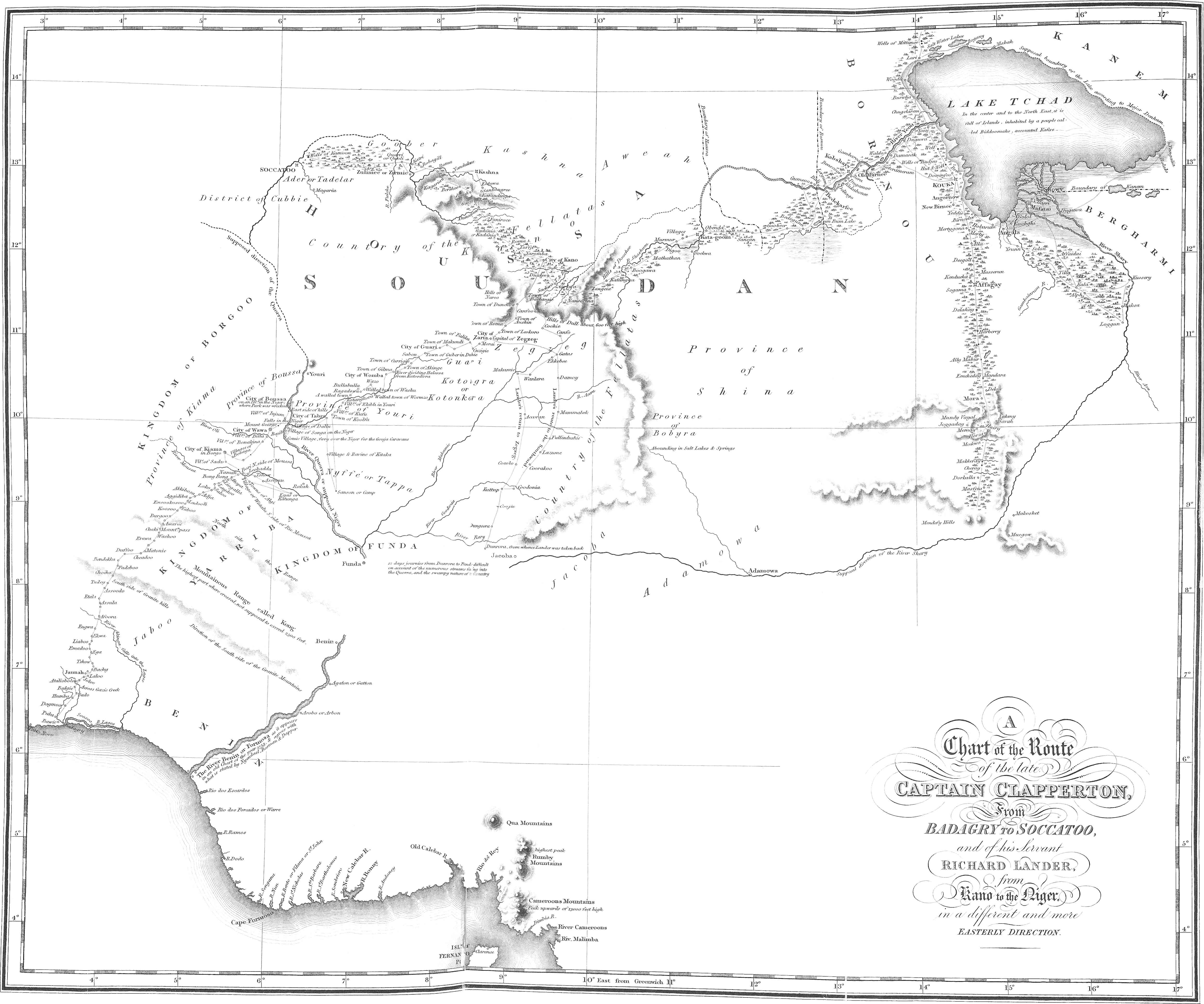
JOURNAL, &c.
November 20, 1826.—The sultan sent a
messenger for me this morning, and after waiting in a coozie an
hour, I was introduced to him. He informed me of his having
received a letter from my father (after the death of Dr. Morrison I
always passed for my master’s son), desiring him to send me to
Soccatoo, with the whole of the property intrusted to my care. I
had myself received a letter from my master only two days
previously, in which he expressed no such intention; but, on the
contrary, said he should be with me shortly. In that letter he
complained of a violent pain in his side, to which he had been for
some time subject; and I fancied, by his not writing me to-day, he
had died; and that, from motives of delicacy, the king had withheld
the news from me.
22d.—The sultan again sent for me, and said he would make my
father a present of five pack bullocks to convey the goods to
Soccatoo, and send four men to take charge of them on the road; at
the same time wished me to leave on the 25th.
24th.—Paid my respects to the sultan in the morning; remained
with him upwards of an hour; and on leaving, he said in a feeling
tone, shaking hands with me at the same time, “Good bye, little
Christian; God take you safe to Soccatoo.” He sent a letter by me
to my master, and desired me to give his compliments to the king of
the Mussulmans (sultan Bello, who was invariably designated by that
appellation). On returning to my house, found Hadji Hat Sallah
waiting for me. He told me it was necessary I should take the whole of my master’s
money, which consisted of 212,000 cowries, to him. As this could
not be done conveniently without a camel, I purchased one for
62,000 cowries.
25th.—At half-past seven in the morning, left my house,
accompanied by old Pascoe, a messenger from sultan Bello, and one
from the king of Kano. Could not, however, get without the gates of
the city till ten, the bullocks being very restive, and throwing
off their burdens repeatedly. At one o’clock halted at Zungugwa:
the camel, in endeavouring to enter the gate, unfortunately broke
two boxes in which was stationery, &c. This accident detained
us an hour outside the walls, and the men were ultimately obliged
to carry the goods on their heads to the residence of the chief,
which was a quarter of a mile’s distance. I waited on him, and gave
him a pair of scissors, fifty needles, and a small paper of cloves,
which pleased him highly. The chief showed me into one of his best
huts, where, he told me, I might remain till I thought proper to
leave the place; and shortly afterwards sent me butter, sour milk,
a couple of fine fowls, and tuah and corn.
26th.—At six in the morning left the hut of this hospitable
chief; and, after a ride of six hours, came to Markee, a large, but
rather thinly inhabited village. The chief, a kind-hearted old man,
upwards, I should suppose, of ninety years of age, and very feeble,
was delighted to see me, and testified the pleasure he felt by
shaking hands with me repeatedly, and by doing me many acts of
kindness. He presented me with fowls, rice, corn, and
tuah. After a little conversation, he took me into an
inner apartment, and bidding me to sit, took from a calabash, which
was suspended to a piece of wood attached to the roof, a small box
made of skin, round which was wound, with the greatest care,
upwards of five hundred yards of thread, which occupied him twenty
minutes in taking off. In this box he showed me four bits of tin,
about the size of swan and common shot, which he told me were
silver. The old chief gave me to understand, with much seriousness and
earnestness of manner, that they had been given by an Arab fifteen
years before, who told him they were possessed of life. The larger
pieces, he continued, were males, and the smaller females; and were
to produce young at the end of every twelve years, before which
time they were by no means to be looked at. He had enveloped them
in a quantity of cotton-wool, in order to impart warmth to them;
and the thread was tied round the box that the offspring might have
no opportunity of escaping! “But,” said the old man, with a
disappointed air, “though I kept them with the greatest care for
twelve years, suffering no one to approach them, I found, to my
sorrow, at the expiration of that time, they had made no increase;
and I begin to fear they never will:” in saying which the old man
was so grievously affected that he burst into tears. It was with
considerable difficulty I could refrain from laughing aloud in his
face. I succeeded, however, in subduing the great inclination I had
to be merry; and told him, with all the solemnity the occasion
deserved, that the Arab was a rogue, and had deceived him; that the
articles were bits of tin, and not of silver; that they were
without life, and therefore could not produce young. I consoled the
old gentleman on the hoax that had been played off upon him, and
sympathized with him in his sorrow. He soon afterwards became more
composed, although at times he could not help sobbing audibly.
After answering the numerous questions he put to me about my
country, &c. I complained of fatigue, and retired to rest. Ill
with dysentery all day.
27th.—Passing a very restless night, got up at six in the
morning and proceeded on my journey. At 10 A.M. passed close to a
large Fellata town, called Kaowah, in the neighbourhood of which
were numerous herds of cattle grazing. Here, as in other parts of
Houssa, the cows are mostly white; and the sheep
generally white,
with black and red spots, which had a very agreeable appearance at
a distance, and put me strongly in remembrance of Jacob’s spotted
sheep, mentioned in Scripture. A ride of four hours brought us to
Goguay, a large walled town. The beasts were unable to enter the
gate with their loads, by reason of its extreme narrowness; and
being ill, and much in want of rest, I was unwilling for so much
time to be consumed in conveying them into the town on men’s heads:
I accordingly reposed for the night underneath the branches of a
large tree. On learning of my arrival, the chief came to see me,
seated himself by my side, and entered familiarly into
conversation. He observed that tigers abounded in the
neighbourhood, and advised me by all means to keep fires burning
the whole of the night round my attendants and cattle, to prevent
their being attacked by those rapacious animals, which would very
likely be the case if that precaution were not used. The chief told
me that about two years before the Gooberites took and plundered
his town, and put to the sword nearly the whole of its inhabitants,
he himself very narrowly escaping with his life. This was no doubt
the reason of the scantiness of the population, and the poverty of
the chief and his remaining subjects. As soon as the chief left me,
a new married couple paid me a visit. I gave the bride, a very
pretty girl of eighteen, guinea nuts to the value of one hundred
cowries, for which she dropped on one knee, and thanked me in a
graceful and becoming manner. I shortly afterwards received some
butter-milk from her, which was a welcome present.
28th.—Left Goguay at half-past six in the morning, and halted at
Kookay, a small wretched looking village, at twelve at noon. The
chief sent provisions for myself and people, and provender for the
cattle; and the inhabitants complained sadly of the mischief done
to their crops by wild pigs, a great part of which was
completely
destroyed. They were miserably clad, and exhibited signs of extreme
poverty. This night slept a little, which is a comfort I seldom
enjoy.
29th.—At half-past six in the morning proceeded on our journey,
and at twelve stopped at Duncammee, a moderately sized walled town.
I was both surprised and pleased to observe the neatness of this
town, and the cleanliness of its inhabitants. Every inch of spare
ground was planted with tobacco, and very tastefully fenced round
with dried tobacco stalks. The natives manufacture large quantities
of cotton cloths, which are neat and durable; and at the north end
of the town are several dye-pits. The wall surrounding the town is
in rather a ruinous state. The chief welcomed me to his house, and
offered me the best apartment in it. Provisions were plentiful, and
we fared exceedingly well. In return for his kindness, I gave him a
clasp knife, and a hundred needles.
30th.—At six in the morning were again on our route, and halted
at Gaza at one at noon. The chief was happy to see me, lodged me in
his own house, and seemed to take pleasure in obliging me.
31st.—Continued our journey at the usual hour, and halted at
Rayoo at one o’clock. In this town I was considerably worse, became
debilitated in a surprising manner, lost my sight, and could not
rise in bed. Fancying I should not be able to proceed any further,
and that my life was drawing to a close, I called Pascoe to my
bed-side, and advised him, after he had buried me, to make all
haste to my master at Soccatoo; to take particular care of the
property he would have the charge of, and I had no doubt my master
would reward him.
December 1st.—This day was dreadfully ill—unable to taste any
kind of food, and expecting every moment would be my last.
2d.—Did not find myself at all better this morning, and was
surprised I had lived so long. At 2 P.M., finding myself a little
revived, but unable to sit up, I determined to see my dear
master, if I could,
before I died. For this purpose ordered my people to make a couch
on the back of the camel; after which they gently lifted me into
it, and I almost immediately ordered them to proceed. The chief of
Rayoo, who was one of Bello’s principal fighting men, behaved
particularly kind to me, and, I really believe, sincerely
sympathized in my distress. He expressed much sorrow on parting,
and hinted it would be dangerous to proceed, but did not oppose my
determination. The path, the greater part of the way, being very
narrow, and thickly lined on each side with a species of thorn, I
was annoyed greatly, by reason of the thorns frequently tearing the
covering from my bed, and exposing me to the intense heat of a
burning sun. The sultan of Kano’s messenger, however, seeing me in
this state, rode before the camel, and dexterously lopped off the
overhanging branches with his cutlass: this proved of the utmost
advantage. The violent shaking of the camel caused me to be faint
several times on the road; on which occasions my party uniformly
halted until I revived. In this manner we journeyed till seven in
the evening, when we entered a walled town called Koolefee. The
chief, a very fine old man, never having seen a white man before,
was in raptures when he learned of my being in the town; and
running to the camel, took me from its back, and carried me in his
arms into an apartment which had been hastily prepared for my
reception. Placing me on a bed, he took a gora nut from his pocket,
and holding it betwixt his finger and thumb, wished me to chew one
end of it, that he might have the pleasure of eating with a
Christian. I did it after some difficulty, when he immediately ate
the remainder with much apparent satisfaction. His great men, who
surrounded me, reproved him sharply for doing this. He quickly
answered them, in a pleasant but firm tone, that he believed the
“little Christian” was as good a man as himself or any of them;
which effectually silenced their remarks. He shortly afterwards
went out, and returned with a bowl, containing six quarts of new milk, with which
a little flour and some honey had been mixed. He told me he was
determined to see me eat the whole of it before he left the
apartment. I partook sparingly of it at first, but in the night
tasted it several times, which refreshed and invigorated me.
3d.—Finding myself considerably better this morning, I ordered a
pillow to be laid across my horse’s saddle, that I might travel for
a short distance on his back. Entered a miserable village named
Zunko, and slept there for the night.
4th.—Arose at sun-rise, and after a fatiguing journey reached
Roma at two in the afternoon. This town is built on an eminence,
and commands a delightful view of the country for miles round.
Proceeded to the house of the chief, and slept there. He made me
the accustomed presents of provisions, &c. and received in
return a pair of scissors, a hundred needles, and a paper of
cloves. Several Fellata girls came to me this evening, of a bright
copper colour, and extremely beautiful, with delicate and graceful
forms. With a curiosity so natural to their sex, they were all
eager to catch a glance of the “little Christian,” having
seen the “great Christian,” as they termed my master,
before. In the course of the afternoon and evening they brought me
a little milk and butter, for which I recompensed them with a few
beads. Here, I am happy to say, the dysentery quite left me, and my
health wonderfully improved.
5th.—Left Roma for Bogell early in the morning, and arrived
there at half-past four in the afternoon. Found myself so well
to-day that I was enabled to ride on horseback the whole of the
journey. As usual, went to the residence of the chief, who gave me
a little corn for the horses only. In the night slept profoundly,
and next morning was completely recovered.
6th.—At six in the morning left for Zulamee, where we arrived at
two in the afternoon. The chief was overjoyed to see me, and
ordered four armed men to guard the beasts and property. A
band of robbers
having infested the town for some time, and committed numerous
depredations, he was fearful some of my goods or cattle would be
stolen, and desired me to fire a gun morning and evening, that the
brigands might not think I was unprepared to meet them. They did
not, however, molest me; but the king of Kashna was not quite so
fortunate: he had a fine horse stolen from him yesterday, which he
never afterwards recovered. Rested here two days, in order to
recruit the spirits of my followers, and refresh the animals under
their charge.
9th.—At six in the morning, having got every thing in readiness,
left Zulamee. Both men and beasts seemed much invigorated with the
rest they had enjoyed, and at two in the afternoon reached
Gundumowah, a small but neat Fellata village. The chief sent me a
little milk.
10th.—Early in the morning started for Sansanee. The country
traversed was thickly wooded, and the path lay for three hours
through a large bush, which, having recently been visited by a
horde of elephants, the prints of whose feet were very perceptible,
rendered travelling extremely unpleasant, and even dangerous.
Reached Sansanee at one at noon. The site on which the town is
built not being long cleared, none of the houses were quite
finished. On our arrival, the chief had an open shed, occupied by
fifteen calves, cleaned out for our reception. In the evening,
putting the goods in the centre, I ordered the men to lie around
them, whilst I placed myself near the most valuable articles. Not
deeming them sufficiently secure, my sleep was rather disturbed;
and awaking about ten o’clock, I found my camel had strayed from
outside the hut, and being unwilling to arouse my drowsy
companions, went myself in search of him. On my return, to my
infinite surprise and alarm, discovered Pascoe had decamped, taking
with him a valuable gun, two pistols, a cutlass, six sovereigns,
nineteen dollars, ten large and ten small knives, and several other
articles, which he had contrived to take from the boxes in which they had
been placed. To deceive me, the artful old villain had put a pillow
into a sack, which he had laid along on his own mat. On the
discovery, I immediately made an alarm, and sent to the chief for
twelve horsemen to go in pursuit of him.
11th.—About three o’clock in the afternoon, as I was standing in
my shed, I perceived a party of horsemen coming towards me in full
gallop. On coming within a few yards of me, they suddenly checked
their horses, and flourishing their spears over their heads,
exclaimed, “Nasarah, acqui de moogoo!” (Christian, we have the
rogue!) They informed me that a little before day-break in the
morning they heard the report of a gun, and going towards the place
whence the sound seemed to proceed, saw Pascoe perched on the top
of a high tree, and the stolen goods lying at the root of it. They
threatened to shoot him with their poisoned arrows unless he
immediately came down. This had the desired effect. He hastily
descended, and delivered himself into their hands. One of the
soldiers took the trembling scoundrel behind him on his horse, when
the whole party immediately clapped spurs to their horses, and made
all the haste they could to the village. I asked Pascoe what could
have induced him to leave me in so disgraceful a manner. He replied
that his countrymen (the Gooburites) were at war with the Fellatas,
who would cut off his head on arriving at Soccatoo. The chief
coming up at the instant, cried out, “A blessing, a blessing; you
have taken the thief, let me take off his head!” This was Pascoe’s
third offence; and I ordered him to be heavily ironed and pinioned
in the town dungeon.
12th.—Pascoe having expressed a wish to see me, I sent for him.
He begged most piteously to be forgiven, and holding up his naked
arms, which were swollen to thrice their natural size, implored me
at least not to have him pinioned again. This I freely consented to, but he was not
freed from his irons till the morning we left the town.
13th.—This day 500 camels laden with salt, obtained from the
borders of the Great Desert, arrived at the town. They were
preceded by a party of twenty Tuarick salt-merchants, whose
appearance was grand and imposing. They entered at full trot,
riding on handsome camels, some of them red and white, and others
black and white. All the party were dressed exactly alike. They
wore black cotton tobes and trousers, and white caps with black
turbans, which hid every part of the face but the nose and eyes. In
their right hand they held a long and highly-polished spear, whilst
the left was occupied in holding their shields, and retaining the
reins of their camels. The shields were made of white leather, with
a piece of silver in the centre. As they passed me, their spears
glittering in the sun, and their whole bearing bold and warlike,
they had a novel and singular effect, which delighted me. They
stopped suddenly before the residence of the chief, and all of them
exclaiming, “Choir!” each of the camels dropped on its knees, as if
by instinct, whilst their riders dismounted to pay their respects.
They came in a body to see me just after, and notwithstanding their
apparent respectability, felt not the least repugnance to beg money
in a most importunate manner. One of them, in the hope of obtaining
some, described himself as “God’s own slave.” I refused to accede
to his request, observing, that God always loved his servants, and
made them prosperous and happy, and could not believe what he had
told me. Becoming at length very troublesome, I was under the
necessity of turning him out: as he went away, he muttered
something I did not understand, and said, I was the first person
that ever refused to give him money. Like thousands of others,
these merchants were very inquisitive, and amongst other questions
asked whether any of my countrymen had tails like monkeys? I assured them none
of them had that elegant appendage, but they would not believe me.
After remaining an hour, they went to look after their wives and
children, who were on the camels on the road, and not yet
arrived.
14th.—The goods being properly secured, I took my gun this
morning and shot enough of pigeons for dinner. The Tuarick men,
women, and children, surrounded me in great numbers on hearing the
report of my gun, and were amazed to see the birds falling dead at
my feet from the tops of the high trees. They examined them with
great attention, declaring I was a beautiful man, too good for a
Kafer, and ought to be a worshipper of the true faith.
16th.—In the afternoon an escort, consisting of fifty armed
horsemen sent by Bello, arrived, to conduct me to Soccatoo. They
brought with them my master’s two camels, to carry the goods,
which, as I afterwards learnt, the Gadado had borrowed under false
pretences. A messenger belonging to the sultan of Kano brought a
letter from my master, unknown to the escort, and was on his way to
Kano with it. The letter informs me of the total ignorance of my
master of my having left Kano, and his expectations of seeing me
there in a week or two. It struck me forcibly at the time that
Bello wished to get me in his power, in order to put us out of the
way, to become the sole possessor of the sheik of Bornou’s
presents, &c. As soon as I had read the letter, I asked the
Gadado’s brother, who commanded the escort, if it was the sultan’s
intention to murder us on my arrival at Soccatoo, as my master knew
nothing of the transaction. He answered, “Fear nothing, the king
will not hurt you; as he has never seen but one Christian, he
wishes to view a second.”
17th and 18th.—The Gadado’s brother came to me several times for
money to buy goora nuts. I at length told him the money in my
possession belonged to my father, who would not permit me to part with any,
unless I had previously obtained his consent. This answer by no
means pleased him: but on my telling him he should be handsomely
rewarded on our safe arrival at Soccatoo, he became a little
appeased.
19th.—Liberated old Pascoe in the morning, who had behaved
peaceably since his imprisonment, and seemed truly sorry for the
offence he had committed; and at two in the afternoon went out of
the town, but was obliged to leave a bullock behind, being lamed
and unable to proceed. Travelled till eleven o’clock the next
night, when we arrived much fatigued at Magaria. The poor camels
and horses could hardly stand, and suffered dreadfully from thirst,
not having drank during this long journey.
21st and 22d.—The horses and camels not being sufficiently
recovered to continue the journey, staid at Magaria both these
days. Resided at a house belonging to the Gadado, who supplied me
with abundance of provisions. Received a message from him to come
to see him, with my gun, in order to show the head men of the town
the manner in which birds were shot in my country. I soon gratified
their curiosity by firing at a small bird, at a distance of fifty
yards. The whole of them testified the greatest astonishment on
taking it up, and would not for a long time believe it was really
dead.
23d.—To my great joy I entered the gates of Soccatoo in the
afternoon, about two o’clock, after a tedious and wearisome journey
of nearly a month. Not having seen my master for three months, I
hastened to his house; but not finding him at home, I went to the
Gadado’s, where, I was told, he had gone. My master was in earnest
conversation with the Gadado and an old Arab, and was much
surprised when informed of the reason of my leaving Kano: he spoke
with warmth of the artful and unhandsome conduct of the sultan; and
after this act of duplicity on the part of Bello, to the hour of his death, I never
observed him to smile. My master had been ill of dysentery before
my arrival, but was then much better.
On the 13th December, the day after my arrival, Sultan Bello
sent for my master and myself to repair to his residence. As soon
as we entered, he began to make inquiries of the nature of the
presents I had with me, and was extremely desirous to know if I had
left any with Hadji Ben Sallah for the sheik of Bornou. I replied,
I had not. “Are you sure you have not?” said he. I again answered
with firmness in the negative. The sultan then demanded the king of
England’s letters to the sheik of Bornou, which my master
reluctantly produced; but refused to accede to the sultan’s request
to open and read them, observing that, when his king discovered, on
his return to his country, he had so unfaithfully broken his trust,
he would immediately be beheaded. The sultan himself took the
letters, and waving his hand for us to withdraw, we left the
apartment. We had not been in our hut more than a couple of hours
when the Gadado, his brother, Hadji Ben Sallah, and several of the
principal inhabitants of Soccatoo, entered, and demanded, in the
name of Bello, the presents intended for the sheik of Bornou,
together with all the arms and ammunition we did not want
ourselves. My master became deeply agitated when he had heard their
errand, and rising up from his couch, exclaimed with much energy
and bitterness—“There is no faith in any of you; you are an unjust
people; you are worse than highway robbers.” They cautioned him to
be more guarded in his expressions, or it might cost him his head.
“If I lose my head,” rejoined my master in the same determined manner, “I
lose it for speaking for the just rights of my country only.” Ben
Sallah and others entreated him to moderate his anger, or it might
indeed be fatal to him. I also implored him to accede to the
demands of the sultan, how unjust and tyrannic soever they might
be, observing, that two debilitated white men stood no chance in
holding out against the united force of so many Fellatas, who only
waited the command of their sovereign to assassinate them. After
much entreaty, and not without considerable reluctance, my master
desired that they should be given to them; and said to the Gadado,
on his leaving the hut, “Tell your sovereign I never wish to see
him again; my business with him is now at an end.” A short time
after Mallam Mudey returned with a message from the sultan,
acquainting my master of his intention of writing to the king of
England in explanation of his conduct. He desired Mallam Mudey to
tell Bello that the king of England would not even look at
a letter from him, after the treatment his subjects had
received.
I took an opportunity one day of acquainting my master of
Pascoe’s villany, who immediately dismissed him, without paying his
wages. The old man went to a native lawyer to obtain advice in what
manner he was to act; but instead of holding out the hope of
obtaining the sum due to him, the learned Fellata expressed his
astonishment that Abdullah had not cut off his head. Pascoe then
turned snuff-merchant; but having given too extensive credit, soon
became a bankrupt, and was finally obliged to cut wood from the
adjoining country, and sell it in the market at Soccatoo, by which
means he contrived to procure a precarious subsistence.
One day the Gadado came and begged me to lend him my camel to go
to the war against the sheik of Bornou: knowing it would be
impolitic to refuse, I let him have it. The animal was returned to
me, about six weeks after, in a most shameful state,
reduced to a mere
skeleton, and having two immense holes in its back. I wished the
Gadado to give me another in its stead, but he would not listen to
me.
My master and myself enjoyed pretty good health for some time
after my arrival at Soccatoo, and amused ourselves with going a
shooting almost every day. At one shot my master brought down
thirteen wild ducks, about two miles to the north-east of the city,
ten of which were secured. We remained at Soccatoo much longer than
was intended, believing the sultan would consent to our proceeding
to Bornou when the war had become somewhat abated; but this he
never granted.
On the 12th of March, 1827, I was greatly alarmed on finding my
dear master attacked with dysentery. He had been complaining a day
or two previously of a burning heat in his stomach, unaccompanied,
however, by any other kind of pain. From the moment he was taken
ill he perspired freely, and big drops of sweat were continually
rolling over every part of his body, which weakened him
exceedingly. It being the fast of Rhamadan, I could get no one, not
even our own servants, to render me the least assistance. I washed
the clothes, which was an arduous employment, and obliged to be
done eight or nine times each day, lit and kept in the fire, and
prepared the victuals myself; and the intermediate time was
occupied in fanning my poor master, which was also a tedious
employment. Finding myself unable to pay proper attention to his
wants in these various avocations, I sent to Mallam Mudey, on the
13th, entreating him to send me a female slave to perform the
operation of fanning. On her arrival I gave her a few beads, and
she immediately began her work with spirit; but she soon relaxed in
her exertions, and becoming tired, ran away, on pretence of going
out for a minute, and never returned. Alla Sellakee, a young man my
master had purchased on the road from Kano to take care of the
camels, and whom he had invariably treated with his
usual kindness, and
given him his freedom, no sooner was made acquainted with his
master’s illness than he became careless and idle, and instead of
leading the camels to the rich pasturage in the vicinity of
Soccatoo, let them stray wherever they pleased, whilst he himself
either loitered about the city, or mixed with the most degraded
people in it: by this means the camels became quite lean; and being
informed of the reason, I told my master, who instantly discharged
him from his service.
My master grew weaker daily, and the weather was insufferably
hot, the thermometer being, in the coolest place, 107 at twelve in
the morning, and 109 at three in the afternoon. At his own
suggestion I made a couch for him outside the hut, in the shade,
and placed a mat for myself by its side. For five successive days I
took him in my arms from his bed in the hut to the couch outside,
and back again at sunset, after which time he was too much
debilitated to be lifted from the bed on which he lay. He attempted
to write once, and but once, during his illness; but before paper
and ink could be brought him, he had sunk back on his pillow,
completely exhausted by his ineffectual attempt to sit up in his
bed. Fancying by various symptoms he had been poisoned, I asked him
one day whether he thought that, in any of his visits to the Arabs
or Tuaricks, any poisonous ingredients had been put into the
camel’s milk they had given him, of which he was particularly fond.
He replied, “No, my dear boy; no such thing has been done, I assure
you. Do you remember,” he continued, “that when on a shooting
excursion at Magaria, in the early part of February, after walking
the whole of the day, exposed to the scorching rays of the sun, I
was fatigued, and lay down under the branches of a tree for some
time? The earth was soft and wet, and from that hour to the present
I have not been free from cold: this has brought on my present
disorder, from which, I believe, I shall never recover.”
For twenty days
my poor master remained in a low and distressed state. He told me
he felt no pain; but this was spoken only to comfort me, for he saw
I was dispirited. His sufferings must have been acute. During this
time he was gradually, but perceptibly, declining; his body, from
being robust and vigorous, became weak and emaciated, and indeed
was little better than a skeleton. I was the only person, with one
exception, he saw in his sickness. Abderachman, an Arab from
Fezzan, came to him one day, and wished to pray with him, after the
manner of his countrymen, but was desired to leave the apartment
instantly. His sleep was uniformly short and disturbed, and
troubled with frightful dreams. In them he frequently reproached
the Arabs aloud with much bitterness; but being an utter stranger
to the language, I did not understand the tenor of his remarks. I
read to him daily some portions of the New Testament, and the
ninety-fifth Psalm, which he was never weary of listening to, and
on Sundays added the church service, to which he invariably paid
the profoundest attention. The constant agitation of mind and
exertions of body I had myself undergone for so long a time, never
having in a single instance slept out of my clothes, weakened me
exceedingly, and a fever came on not long before my master’s death,
which hung upon me for fifteen days, and ultimately brought me to
the very verge of the grave. Finding myself unequal to pay that
attention to my master’s wants which his situation so particularly
required, I solicited and obtained his consent to have old Pascoe
once more to assist me. On entering the hut, he fell on his knees,
and prayed to be forgiven, promising to be faithful to my master’s
service. Master immediately pardoned him, and said he would forget
all that had passed, if he conducted himself well: by this means
the washing and all the drudgery was taken from my shoulders, and I
was enabled to devote all my time and attention to my master’s
person. I fanned him for hours together, and this
seemed to cool the
burning heat of his body, of which he repeatedly complained. Almost
the whole of his conversation turned upon his country and friends,
but I never heard him regret his leaving them; indeed he was
patient and resigned to the last, and a murmur of disappointment
never escaped his lips.
On the 1st of April, he became considerably worse, and though
evidently in want of repose, his sleep became more and more
disturbed. He swallowed eight drops of laudanum, four times a day,
for three days; but finding it did him not the least benefit, he
discontinued taking it altogether: this, with the exception of two
papers of Seidlitz powders and four ounces of Epsom salts, was the
only medicine he had during his illness. On the 9th, Maddie, a
native of Bornou, whom master had retained in his service, brought
him about twelve ounces of green bark from the butter tree, and
said it would do him much good. Notwithstanding all my
remonstrances, master immediately ordered a decoction of it to be
prepared, observing, “No man will injure me.” Accordingly Maddie
himself boiled two basins-full, the whole of which he drank in less
than an hour. Next morning he was much altered for the worse, and
regretted his not having followed my advice. About twelve o’clock
of the same day, he said, “Richard, I shall shortly be no more; I
feel myself dying.” Almost choked with grief, I replied, “God
forbid, my dear master: you will live many years yet.” “Don’t be so
much affected, my dear boy, I entreat you,” said he: “it is the
will of the Almighty; it cannot be helped. Take care of my journal
and papers after my death; and when you arrive in London, go
immediately to my agents, send for my uncle, who will accompany you
to the Colonial Office, and let him see you deposit them safely
into the hands of the secretary. After I am buried, apply to Bello,
and borrow money to purchase camels and provisions for your journey
over the desert, and go in the train of the Arab merchants to
Fezzan. On your arrival there, should your money be exhausted, send a messenger to Mr.
Warrington, our consul at Tripoli, and wait till he returns with a
remittance. On reaching Tripoli, that gentleman will advance what
money you may require, and send you to England the first
opportunity. Do not lumber yourself with my books; leave them
behind, as well as the barometer, boxes, and sticks, and indeed
every heavy article you can conveniently part with; give them to
Malam Mudey, who will take care of them. The wages I agreed to give
you my agents will pay, as well as the sum government allowed me
for a servant; you will of course receive it, as Columbus has never
served me. Remark what towns or villages you pass through; pay
attention to whatever the chiefs may say to you, and put it on
paper. The little money I have, and all my clothes, I leave you:
sell the latter, and put what you may receive for them into your
pocket; and if, on your journey, you should be obliged to expend
it, government will repay you on your return.” I said, as well as
my agitation would permit me, “If it be the will of God to take
you, you may rely on my faithfully performing, as far as I am able,
all that you have desired; but I trust the Almighty will spare you,
and you will yet live to see your country.” “I thought I should at
one time, Richard,” continued he; “but all is now over; I shall not
be long for this world: but God’s will be done.” He then took my
hand betwixt his, and looking me full in the face, while a tear
stood glistening in his eye, said, in a low but deeply affecting
tone, “My dear Richard, if you had not been with me, I should have
died long ago; I can only thank you, with my latest breath, for
your kindness and attachment to me, and if I could have lived to
return with you, you should have been placed beyond the reach of
want; but God will reward you.” This conversation occupied nearly
two hours, in the course of which my master fainted several times,
and was distressed beyond measure. The same evening he fell into a
slumber, from which he awoke in much perturbation, and said
he had heard with
much distinctness the tolling of an English funeral bell: I
entreated him to be composed, and observed that sick people
frequently fancy they hear and see things which can possibly have
no existence. He made no reply.
About six o’clock in the morning of the 11th, on asking how he
did, my master answered he was much better, and requested me to
shave him. He had not sufficient strength to lift his head from the
pillow; and after finishing one side of the face, I was obliged to
turn his head, in order to shave the other. As soon as it was done,
he desired me to fetch him a looking-glass which hung on the other
side of the hut. On seeing himself in it, he observed that he
looked quite as ill at Bornou, on his former journey; and as he had
borne his disorder so long a time, he might yet recover. On the
following day he still fancied himself getting better. I began to
flatter myself, also, that he was considerably improved. He eat a
bit of hashed guinea-fowl in the day, which he had not done before
since his illness, deriving his sole sustenance from a little
fowl-soup and milk and water. On the morning of the 13th, however,
being awake, I was much alarmed by a peculiar rattling noise,
proceeding from my master’s throat, and his breathing was loud and
difficult; at the same instant he called out “Richard!” in a low
and hurried tone. I was immediately at his side, and was astonished
at seeing him sitting upright in his bed, and staring wildly
around. I held him in my arms, and placing his head gently on my
left shoulder, gazed a moment on his pale and altered features:
some indistinct expressions quivered on his lips; he strove, but
ineffectually, to give them utterance, and expired without a
struggle or a sigh. When I found my poor master so very ill, I
called out with all my strength, “O God, my master is dying!” which
brought Pascoe and Mudey into the apartment. Shortly after the
breath had left his body, I desired Pascoe to fetch some water,
with which I washed the corpse. I then got Pascoe and Mudey to
assist me in taking
it outside of the hut, laid it on a clean mat, and wrapped it in a
sheet and blanket. Leaving it in this state two hours, I put a
large clean mat over the whole, and sent a messenger to Sultan
Bello, to acquaint him of the mournful event, and ask his
permission to bury the body after the manner of my own country, and
also to know in what particular place his remains were to be
interred. The messenger soon returned with the sultan’s consent to
the former part of my request; and about 12 o’clock at noon of the
same day a person came into my hut, accompanied by four slaves,
sent by Bello to dig the grave. I was desired to follow them with
the corpse. Accordingly I saddled my camel, and putting the body on
its back, and throwing an union-jack over it, I bade them proceed.
Travelling at a slow pace, we halted at Jungavie, a small village,
built on a rising ground, about five miles to the south-east of
Soccatoo. The body was then taken from the camel’s back, and placed
in a shed, whilst the slaves were digging the grave; which being
quickly done, it was conveyed close to it. I then opened a
prayer-book, and, amid showers of tears, read the funeral service
over the remains of my valued master. Not a single person listened
to this peculiarly distressing ceremony, the slaves being at some
distance, quarrelling and making a most indecent noise the whole of
the time it lasted. This being done, the union-jack was taken off,
and the body was slowly lowered into the earth, and I wept bitterly
as I gazed for the last time upon all that remained of my generous
and intrepid master. The pit was speedily filled, and I returned to
the village about thirty yards to the east of the grave, and giving
the most respectable inhabitants, both male and female, a few
trifling presents, entreated them to let no one disturb its sacred
contents. I also gave them 2,000 cowries to build a house, four
feet high, over the spot, which they promised to do. I then
returned, disconsolate and oppressed, to my solitary habitation,
and leaning my head on my hand, could not help being deeply
affected with my
lonesome and dangerous situation; a hundred and fifteen days’
journey from the sea-coast, surrounded by a selfish and cruel race
of strangers, my only friend and protector mouldering in his grave,
and myself suffering dreadfully from fever. I felt, indeed, as if I
stood alone in the world, and earnestly wished I had been laid by
the side of my dear master: all the trying evils I had endured
never affected me half so much as the bitter reflections of that
distressing period. After a sleepless night, I went alone to the
grave, and found that nothing had been done, nor did there seem the
least inclination on the part of the inhabitants of the village to
perform their agreement. Knowing it would be useless to remonstrate
with them, I hired two slaves at Soccatoo the next day, who went
immediately to work, and the house over the grave was finished on
the 15th.
One instance, out of many, of the kindness and affection with
which my departed master uniformly treated me, occurred at Jenna,
on our journey into the interior. I was dangerously ill with fever
in that place, when he generously gave up his own bed to me, and
slept himself on my mat, watched over me with parental assiduity
and tenderness, and ministered to all my wants. No one can express
the joy he felt on my recovery: and who, possessing a spark of
gratitude, could help returning it but by the most inviolable
attachment and devoted zeal? It was his sympathy for me in all my
sufferings that had so powerful a claim on my feelings and
affections, and taught me to be grateful to him in hours of
darkness and distress, when pecuniary recompense was entirely out
of the question.
The great sufferings, both mental and bodily, I had undergone at
the death and burial of my master, and the constant agitation in
which I was kept, occasioned a rapid increase in my disorder; and
on the 16th I could with difficulty crawl round my hut, and was
obliged to lay myself on my mat, from which I had not strength to
arise till the 27th; old Pascoe, during that period, being very
kind and attentive
to me. The Arabs in the city visited me daily, and did all in their
power to raise my spirits; telling me not to be disheartened at the
death of my father, and that no injury would happen to me. But I
plainly saw these visits of condolence did not proceed from a
charitable spirit; they came more for the purpose of obtaining
presents than any thing else: but I did not give them any. The
sultan also sent messengers to inquire after my health nearly as
often. The weather was dreadfully warm; and I was obliged to have a
tub of water close at my side, into which I frequently plunged my
hands and arms, and occasionally sprinkled my head and body. This
much refreshed me; indeed it was the only means by which I was
enabled to obtain a little sleep. I had given up all hopes of life,
when on the 26th I found my health improve in a wonderful manner;
the next day I was able to sit up on my mat. In the course of this
day (27th) the Gadado, Malem Moodie, and Sidi Sheik, came with a
commission from the sultan to search my boxes, as he had been
informed they were filled with gold and silver; but, to their great
amazement, found I had not sufficient money to defray my expenses
to the sea-coast. They, however, took an inventory of all my
articles, and carried it to Bello. The gold watch intended for him,
and the private watches of Captains Clapperton and Pearce, I had
taken the precaution to conceal about my person. In a short time
the Gadado and his companions returned with a message from the
sultan, commanding me to deliver to them the following articles,
viz. a rifle-gun, double-barrelled ditto, two bags of ball, a
canister of powder, a bag of flints, a ream and a half of paper,
and six gilt chains, for which he promised to give me whatever I
might ask. I consequently charged him 245,000 cowries, which I was
to receive from Hadji Hat Sallah, at Kano; and an order was given
me to receive this sum, and what more I might require in my journey
over the Great Desert. A letter was also sent by me to Hadji Hat
Sallah.
On the 28th I
made Ben Gumso a present of four yards of blue, and the same
quantity of scarlet damask, an unwritten journal-book, two pairs of
scissors, and two knives: with these articles I endeavoured to get
into the good graces of this old Arab. By a singular piece of good
fortune he had just begun to exercise a powerful influence over the
mind and opinions of the sultan. Bello, in an excursion into the
Gooberite country, had come to an engagement with a large party of
the natives; and in the midst of the fight was shot in the neck
with a poisoned arrow, which turned the tide of victory in favour
of his enemies. On his return to Soccatoo, Ben Gumso wrote a charm
on a bit of wood, which was washed off into a calabash of water,
and drank immediately by the sultan; who, shortly after recovering,
attributed it solely to the virtues of this charm, and he was
advanced accordingly. I begged Ben Gumso to use his influence with
the sultan to obtain leave for my departure from his capital, and
make the best of my way homewards. He accordingly represented to
Bello the impolicy and injustice of detaining any longer a subject
of the king of England; advised him to allow me to quit Soccatoo as
soon as possible; and insinuated that, if I were to die in his
dominions, a report would be circulated and believed that he had
murdered both my father and me, by which he would get a bad name.
The sultan approved of these weighty arguments of Ben Gumso; and
word was sent me, almost immediately, to appear before him. After a
little preliminary conversation, Bello asked me which route I
should prefer. Although my master had advised me to proceed with
the Arabs to Fezzan, just before his death, I much feared that the
papers intrusted to my care would be stolen, and myself murdered,
by that wily and treacherous race, whose behaviour to my master,
from the time of his arrival in Houssa, I very much disliked; and
would rather cast myself, unarmed and unprotected, upon the good
faith of the natives, than go with them. Under these impressions I
answered the sultan
that, as I wished to get to England in as short a time as possible,
the route to Kubbi, through Boussa, was most likely to answer that
end. “It is impossible,” he continued, “to travel that way: the
rainy season is commenced; the rivers are overflowed; the country
is inundated; and you will not be able to reach the sea-coast in
safety. It will be much better for you to go over the desert; and,
to facilitate your progress, I will write Hat Sallah to get a
trustworthy person to accompany you; he will also furnish you with
camels and provisions, and advance you what money it is likely you
will want.” I only replied, “Very well, sultan.” He then asked if
Abdullah had forgiven Pascoe in his book, for the roguery he had
committed. I said, “He had not been able to write during the whole
of his sickness; and therefore nothing was stated about the
matter.”—“If Abdullah has not pardoned him in his book,” rejoined
the sultan, “your king will certainly cut off his head on his
arrival in England.” I assured him Pascoe would not be punished by
any one, if his future conduct was good; but this the sultan was in
no haste to believe; and observed, “I cannot suffer him to go with
you; he shall stay here to clean and repair my guns!” this
latter consideration having evidently more influence with the
sultan than Pascoe’s safety, which he cared nothing at all about. I
then besought Bello to permit him to accompany me as far as Kano,
as an interpreter; to which he rather reluctantly consented, on
condition that I should procure him a horse to return, and pay him
wages, on my arrival at Kano, to the amount of 15,000 cowries,
which of course I agreed to do; and finding the sultan had nothing
more to say, I bowed profoundly and retired. I never saw him
again.
On the evening of the 3d of May, a messenger came from the
sultan, and told me to get every thing in readiness to depart on
the following morning, with a promise of a camel and provisions,
which I never received. Early next day, therefore, I left Soccatoo,
where I had suffered so much, heartily tired of the place and its
inhabitants; and, accompanied with a messenger from the kind old
Gadado, Pascoe and Mudey, with our three camels and two horses,
proceeded to a flat, five miles to the east of Magaria, where we
arrived in the afternoon, and rested for the night under the
branches of a large tree, near to a small lake. Mosquitoes were
numerous and troublesome, and consequently could not sleep till
morning, when a refreshing breeze springing up, it drove them away.
At this flat we joined a party of above 4,000 people, consisting of
Tuarick salt-merchants returning to Kilgris, pilgrims on their way
to Mecca, Goora merchants returning to Kano and Nyffé, &c.
&c.; all travelling in company, for mutual protection, with an
immense number of camels, horses, and bullocks. The merchants
invariably meet at Kashna, where they disperse for their different
destinations. In the same train was the king of Jacoba, with fifty
slaves, which he had driven to Soccatoo, as a present to the
sultan, who, having learnt the dreadful losses he had sustained in
men and cattle in his wars with the sheik of Bornou, and the number
of his villages which had been plundered and burnt by the soldiers
of the sheik, would not accept of them, and desired the king of
Jacoba to re-conduct them to his own dominions.
At eleven o’clock in the morning of the 4th of May, a signal to
prepare to depart was made with the horns and drums of the party,
which made a loud and most discordant noise; and, about an hour
after, the whole body was in motion. We travelled in great
haste till three
o’clock in the afternoon of the 5th, when Boussa Jack, the horse on
which I rode, and which was made a present of by the king of Boussa
to my late master, became much fatigued, and began to lag. The
weather was at this time intolerably hot, and the dust was rolling
in thick clouds in every direction, entering my eyes and nostrils,
and penetrating into the very pores of the skin. I felt nearly
suffocated, and was faint and exhausted. Finding I was unable to
proceed, I ordered Pascoe to overtake the camels, his horse being
fresh and vigorous, and bring me some water. I then dismounted, and
sat under a tree by the road-side, whose branches afforded but an
indifferent shelter against the scorching rays of an African sun,
and holding the bridle of my poor horse in my hand, I implored the
hundreds of Fellatas and Tuaricks who were passing to sell me a
drop of water; but the cold-hearted wretches refused my earnest
request, observing one to another, “He is a Kafir; let him die.” At
length a young Fellata, from Footatoora, accidentally seeing me,
came to the spot, exclaiming, “Nasarah, Nasarah, triffi manora!”
(Christian, Christian, go on!) I answered, “I am faint and sick for
want of water; no one will give me any; and I am so weary that I
cannot proceed.” On hearing which the young man kindly gave me a
small calabash full; part of which I drank, and with the remainder
washed the nostrils of Boussa Jack, and sprinkled a little into his
mouth. The people, who observed the Fellata performing this
generous action, upbraided him in strong language for giving water
to the Christian; but he, showing them a double-barrelled gun,
remarked that he had obtained it of my countrymen, who were all
good men, and would do no harm. This somewhat appeased them. On
examining the gun shortly afterwards, I found it to be of English
manufacture, with “Arnold, maker, London,” on its lock. I, as well
as the horse, was greatly refreshed with the small quantity of
water I had taken; but soon becoming again weak and dispirited, I
was almost in as
bad a state as on the former occasion; my legs were swollen
prodigiously, and I felt the most acute pains in every part of my
body. At length I perceived Pascoe, whom I had sent for water three
or four hours previously, comfortably seated under a tree, and
seeming to be enjoying himself much with Mudey,—the camels feeding
at a short distance. I had half an inclination to shoot the
heartless old scoundrel, knowing as he did how keen my sufferings
must have been. Reflecting, however, that the safety of my papers,
and even my own life, was placed in some measure in his hands, I
restrained myself, and merely asked why he did not return with the
water, on which he answered, very composedly, “I was tired.”
The young Fellata who had so generously saved my life came to me
on the 7th, and informed me that the whole of the slaves of the
king of Jacoba being missing, a party of horsemen had been sent in
quest of them, and had just returned with the dreadful account of
having seen thirty-five of their dead bodies exposed on the road;
the remaining fifteen could not be found, but were strongly
suspected of having met a similar fate. These unfortunate creatures
had to carry heavy burdens on their heads the day before; and being
unable to keep up with the rapid pace of the camels, were
necessarily obliged to be left behind, and thus miserably perished
of thirst. I congratulated myself on my own good fortune in having
so narrowly escaped so horrid a death; and thanked the Almighty for
having so providentially rescued me. On leaving me, I gave the
Fellata a pair of scissors, and twenty flints for his gun, which
pleased him highly. On our road to Kano, the king of Jacoba became
very sociable with me, and was my constant companion. He pressed me
very much to visit his country, where he would do all in his power
to make my stay agreeable. He told me that his neighbours, the
Yamyam people, who had assisted him in his war against the sheik of
Bornou, were surrounded, with some of his own people, on a plain
near Jacoba, by the sheik’s soldiers, who made a dreadful slaughter of them. The
fight lasted a whole day, when the Yamyams and people of Jacoba
were entirely routed; he himself narrowly escaping being taken
prisoner. The morning after, the surviving Yamyams repaired to the
field of action, and bearing off a great number of the dead bodies
of their enemies, made a fire, roasted, and ate them!
Soon after our arrival at Markee, on the 19th, the spouse of the
chief, a finely formed and intelligent looking woman, aged about 22
years, came to me with tears in her eyes, and implored me to give
her some magarie, as she had no child. I accordingly presented her
with a couple of tea-spoonfuls of oil of cinnamon, and ordered her
to put two drops of it into a pint of cow’s milk, which should be
taken three times a day till the whole was consumed. I told her
that on my return to Markee I had not the least doubt I should have
the pleasure of seeing her the happy mother of a numerous progeny.
On her husband being made acquainted with the circumstance, he came
and thanked me in the heartiest manner for my kindness, gave me
abundance of fresh milk, fowls, rice, &c.; telling me at the
same time, that on my return from England he would give me a large
sum of money, which, no doubt, he will do. Bidding them adieu the
next morning, they said to me, “Christian! God send you safely to
your country, and may you speedily come back to Markee.”
On my arrival at Kano on the 25th of May, I delivered Sultan
Bello’s order and letter to Hadji Hat Sallah; but he declared,
after perusing the letter, he would have nothing to do with it: he
had nearly lost his head on my father’s account at Soccatoo, and
therefore positively refused to lend me a single cowrie. He had no
objection to give, in goods and a slave, the amount of my demands
on Bello, but refused to let me have any money. I accordingly
received from him a strong female slave, a quantity of unwrought
silk, and scarlet caps and beads. I sold my weakened and
diseased camels for
15,000 cowries each, and discharged their keeper, Maddie. Not
having sufficient money to purchase fresh camels, provisions, and
presents for the chiefs on my way to Fezzan, I was necessitated to
take a different route; and for that purpose purchased a horse and
two asses. Bello had not forgotten to mention in his letter for
Hadji Hat Sallah to send back Pascoe to Soccatoo, on his arrival at
Kano. I begged of him, however, to let me take him as far as
Coulfo, in Nyffé, which he at first refused; but giving him two
yards of scarlet damask, two pairs of scissors, two dollars, a
large knife, and two yards of blue damask, the old Arab seemed to
relax in his determination; and calling Pascoe to him, gave him
leave to accompany me to Coulfo, but cautioned him to return the
moment he arrived, on pain of having Jerrub (the devil)
sent after him. The old man came to me just after in great
trepidation, every member of his body trembling like an aspen leaf,
and gave me to understand, as well as he was able, the conversation
he had had with Hadji Hat Sallah, and in consequence thereof, his
great reluctance to quit Kano with me. I did all I could to laugh
him out of his superstitious fears, but it utterly failed of the
desired effect; the name of Jerrub being enough to put him
in a fever. I had given the slave that Hadji Hat Salah had sold me
to Pascoe as a wife. I told him that, unless he accompanied me, he
should not have her. As soon as he learnt he was to be parted from
the girl, all his scruples vanished, and he consented to go to
Coulfo, but no farther, he having left a wife at Soccatoo, where he
much wished to go. This woman, whom I had seen several times as Ben
Gumso’s slave, was remarkably ugly, and had had before marriage a
male child, by a blind fiddler belonging to Sultan Bello’s band at
Soccatoo. On my asking what had induced him to marry so frightful
an object, he replied, in a tone full of tenderness, it was because
she loved him very much, and made the best tuah he had
ever tasted: these powerful recommendations were irresistible to a
man of Pascoe’s
stamp; and a very short time after he had first tasted her
tuah, Ben Gumso’s ugly slave became the wife of Abbou
Boukir (Pascoe’s native name).
On the 29th, Hadji Hat Sallah desired me to pay my respects to
the king of Kano, who was then at Faniso, his country residence. I
complied with his wishes, and on my leaving his majesty he said,
“When you return to your own country, Christian, give the Fellatas
a good name.” He was not, however, kind enough to send a messenger
with me, so I hired two men to accompany me as far as Funda, paying
them 8,000 cowries each for their journey. The same day at one left
Kano, and travelling at a quick pace, halted on the banks of the
river Kogie, four hours’ journey from that place; but being much
swollen, did not dare to pass. To our great regret we found that
the tent-poles had been left behind; I was consequently obliged to
send back one of the hired servants after them, giving him a sword
as a proof that he was sent by me; but the scoundrel never
returned. It being necessary for us to rest on the banks of the
river that night, I slung the tent to the branch of a tree, and
fastened the lower part to the earth. At seven in the evening it
came to fall heavy rain, accompanied with the loudest thunder I
ever recollect to have heard, and lightning, which continued with
great violence till nine next morning. In the night, our tent
becoming completely drenched and heavy, the bough to which it was
attached gave way, and it fell on us as we were sitting on our
mats, it being utterly impossible to sleep. We remained in this
miserable plight till day-light, for no one could venture out in
that dreadful weather.
30th.—As soon as things were put to rights this morning, I sent
Pascoe to Kano to endeavour to bring back the fellow that had
cheated me yesterday, but he had not been seen near the place; and
Pascoe returned in the afternoon with the poles. The river was now
become fordable, but, owing to the strength and
rapidity of the
current, we crossed with extreme difficulty. We had no sooner
landed on the opposite side than four armed slaves from Soccatoo
came up to us, and demanded 4,000 cowries of Pascoe, which Ben
Gumso had lent him to defray the expenses of the marriage ceremony
with his slave, the celebrated maker of tuah; and if Pascoe were
unable to pay that sum, they were to take him back to Soccatoo.
Pascoe informed them he had left English clothes and money in that
capital worth 50,000 cowries, out of which Ben Gumso might pay
himself. This answer by no means satisfied the slaves, who were
about to take him away by force, when I myself paid the money
demanded. This little affair being settled to the complete
gratification of Pascoe, we stopped till morning on the spot. The
weather during the whole of the night was just as bad as yesterday.
In the evening sent Mohamed, the other hired servant, to a
neighbouring village to purchase provisions; but he brought with
him a little corn only.
31st.—The weather clearing up this morning about eight, we
proceeded on our journey, and at two P.M. arrived at Madubie, a
small walled town. The chief invited me to remain at his house, but
I preferred staying in my tent, which I had fixed within the walls,
close to the gate. In the evening the chief’s daughter came to see
me, bringing milk, a bowl of stewed beef, and tuah, sufficient for
the whole of us for supper. I afterwards made her a trifling
present. The weather as usual.
June 1st.—Having dried our tent, at 9 A.M. journeyed till we
came to the banks of the Gora, a narrow but deep and rapid river. I
was much afraid the men would be washed down the stream in
crossing; but at length every thing was landed on the opposite
side. Passed the walled town of Bebajie at one at noon; and
ordering the men to proceed ahead, I followed at some distance,
being afraid the inhabitants would detain me if recognised. Half an
hour after, came to a spot where are two roads, one leading
to Nyffé, and the
other to Funda. My master had said, before his death, at Soccatoo,
that if I returned through Nyffé and Youriba, the inhabitants, who
must have heard of our having taken presents to Sultan Bello, with
whom they were at war, would certainly assassinate me; and feeling
an earnest and irrepressible desire to visit Funda, on the banks of
the Niger, and trace, in a canoe, that river to Benin, without
hesitation I chose the Funda road. We therefore proceeded, and at 6
A.M. pitched our tent within half a mile of the walled town of
Koufa. Sent Pascoe to the town for provisions; who shortly
afterwards returned with some of the inhabitants to look at the
tent. The chief did not visit me, thinking I was an Arab on his way
to Funda. I was fortunate enough to obtain a little sleep this
night, for the first time since leaving Kano. The town is situated
at the foot of an immense rock, on which there is not the slightest
trace of vegetation, is about two miles in circumference, and
pretty thickly inhabited. To the east of the town is a range of
high hills, stretching from north to south as far as the eye can
reach. Their sides had a most pleasing appearance, and vegetation
looked green and luxuriant. Travelled in a south-east direction
till ten in the morning, when our course lay more westerly.
2d.—Left Koufa at 6 A.M., the weather being rainy, and halted at
the small walled town of Cookie at twelve at noon.
3d.—It began to rain at day-break, and continued without
intermission till ten in the morning, when, brightening a little,
we struck our tent, and started at eleven.
At 5 P.M. came near Carifo, a small walled town, similar in
extent and form to those we had seen yesterday and the day before.
In the course of the day crossed a large river and two smaller
ones, all running in a westerly direction, but no one could tell me
their names. The hills seen yesterday still on our left, and
extending to the horizon.
At 9 A.M. a dreadful thunder-storm came on, with
lightning and
torrents of rain, which threatened to wash down our tent. The
country traversed to-day and yesterday, though level, is
picturesque and beautiful; all nature wears a gay and lively
aspect: the soil rich, and of a deep red colour.
4th.—At eight this morning, after drying the tent, proceeded;
and at eleven reached the foot of a high and craggy mountain,
called Almena, consisting of gigantic blocks of granite, fearfully
piled on each other, and seeming ready to fall to the ground below.
They much resemble the rocks near the Logan-stone, in Cornwall, but
infinitely larger. Mahomet, my servant, who is acquainted with the
traditions of the natives of every part of this country, and had
travelled far and near, gave me the following story:—“About 500
years ago a queen of the Fantee nation, having quarrelled with her
husband about a golden stool, fled from her dominions with a great
number of her subjects, and built a large town at the foot of this
mountain, which she called Almena, from which it took its name.”
The town was surrounded with a stone wall, as the ruins which now
remain plainly attest. Crossed three small streams in the day,
flowing in a north-westerly direction. At 3 P.M. passed a small
walled town called Gowgee; and at four halted at Gatas, which it
exactly resembled. Here I met with some Kano merchants from Cuttup.
The inhabitants of Gatas, discovering by some means my being a
Christian, came in crowds to see me; but behaved in a quiet and
orderly manner. I invited some of the most respectable of the
females into my tent, which they greatly admired, and shortly
afterwards presented me with milk and foorah. The natives of this,
as well as every other town I have seen in this direction, are of
Houssa, but tributary to the Fellatas.
5th.—At five in the morning were again on the road, and halted
at the south side of Damoy, a small walled town, at 2 P.M. The
inhabitants of this town informed me that the range of hills I have
mentioned extended to the salt water, and are inhabited by the ferocious Yamyams, whom
they all declare, as did every one I had questioned on the road, to
be cannibals. The Yamyams formerly carried on an extensive traffic
with the Houssa men, in red cloth, beads, &c. which they took
in exchange for elephant’s teeth: but five years before they
assassinated a gaffle of merchants, and had afterwards eaten them;
since which time the Houssa people have been shy in dealing with
them.
6th.—Started at eight in the morning, and traversing a hilly and
steril country, covered with small loose stones, reached the south
side of a large river called by the natives Accra, at 3 P.M.,
running to the north-west. I was in hopes of getting into a town
this day; but having a burning fever on me, and the nearest village
being at some distance, we were obliged to fix the tent on the
banks of the river, and remain there till morning without food of
any kind.
7th.—Left at six in the morning, and proceeding in a south-west
course, arrived at a walled town called Nammaleek, at twelve at
noon; the north-east part of which is defended by a mountain, and
the remaining parts by a high mud wall. The mountain is nearly
perpendicular, and thickly covered with wood. Thousands of hyenas,
tiger-cats, jackals, monkeys, &c. inhabit it; and the terrific
noise they made during the night prevented me from closing my eyes.
These animals are so rapacious, that the poor inhabitants cannot
keep a single bullock, sheep, or goat; in consequence of which no
animal food could be obtained in the place. The chief put us into a
hut, and gave us tuah, with a sauce made from the monkey’s
bread-fruit tree, which is most unpalatable stuff. I intended to
stop a short time here, and take medicine; but the people coming in
scores to see me, I had no opportunity of opening my box but in
their presence, which I did not choose to do. This day, two
Fellatas, messengers of the sultan of Zegzeg, unfortunately saw me,
and asked where I was going. On my acquainting them, they immediately rode off,
and, as I subsequently learnt, returned to Zegzeg, and informed the
king that I was on my way to Funda with two asses, loaded with
riches, and a beautiful horse, as presents to the king of that
place.
8th.—At eight in the morning left Nammaleek, and keeping in a
south-west direction, at the foot of a range of mountains,
perceived an opening, and went through it at about twelve. Our
course then lay more easterly, and crossing one large and three
small rivers, whose names I could not learn, arrived at
Fullindushie, the frontier town in Catica. On our journey to-day,
we met, on their way to Zegzeg, as a tax to sultan Bello, from a
neighbouring country, thirty slaves, men, women, and children, all
apparently ill with the small-pox. The men were tied to each other
by the neck with twisted bullocks’ hide; but the women and children
were at liberty. The inhabitants of Fullindushie were the first
people I had seen in Africa who disdained to make use of any kind
of dress. They laughed immoderately on seeing me; whilst I, on my
part, made myself quite merry at their expense. They were soon on
the most familiar footing with me, and seem an artless and
good-humoured people; but disgusting in their manners, and filthy
in their persons: their sheep, goats, and poultry eat and sleep in
the same hut with them, and a most intolerable stench is exhaled
from all their dwellings. They do not appear to have the least
affection for their offspring: a parent will sell his child for the
merest trifle in the world, with no more remorse or repugnance than
he would a chicken. They invariably wear a large piece of blue
glass, in the shape of a semicircle, in their upper and lower lip;
and a piece of red wood, about the size of a man’s thumb, dangles
from their ears. They rub red clay, softened with an oil extracted
from the guinea-nut, over their heads and bodies, which by no means
improves their appearance. Their features do not resemble in any
way those of the Negro, but are fine and handsome, and bear great
similitude to the
European. The inhabitants make fetishes, like the natives of
Yariba.
9th.—Leaving at seven in the morning, did not halt till we
arrived at La Zumee, a small town, with a good population, at three
in the afternoon. On my entering, perceived two men sitting under
the date-tree, one of whom having a tobe on, I saluted, thinking
him to be the chief; but was surprised at his telling me he was a
Kano merchant, and that the person by his side was that individual.
The chief is a mean and dirty looking old man, and had a sheep-skin
covered with filth tied round his waist. After showing me a hut,
and staying away two hours, he came back, and apologized for not
sending me provisions, saying his wives were at work in the
gardens, but that on their return I should have some: accordingly,
about three hours after, they brought me a couple of fowls, and
some tuah and rice; for which I gave them a pair of scissors and
fifty needles. Surrounding the town is a remarkably broad and deep
ditch, which appeared to have been formerly filled with water. The
country in the vicinity of the town is well cultivated. The Catica
or Bowchee people do not possess a single bullock.
10th.—Arose at six in the morning, and pursuing a S.W.
direction, over a fine and rich country, arrived at Coorokoo, a
small walled town, environed with hills, at twelve.
11th.—Started at half-past seven in the morning, and halted at
twelve at noon on the north-east side of the banks of a large
river, rolling to the north-west, called Coodoonia, which empties
itself into the Niger, near Funda. Finding it too deep to cross, we
were obliged to remain till next day without food.
12th.—Crossed the river at nine o’clock this morning, the water
reaching to our chins; and immediately proceeded towards Cuttup,
where we arrived after three hours’ travelling. Having heard, on my
route, so many different reports of Cuttup, its wealth,
population, and
celebrated market, I was rather surprised on finding it to consist
of nearly five hundred small villages, almost adjoining each other;
nearly the whole of which occupy a vast and beautiful plain,
adorned with the finest trees. Here, for the first time since
leaving the coast, I saw plantain, palm, and cocoa-nut trees, in
great abundance, and in a flourishing condition; the country
resembling, in a striking manner, some parts of Yariba. A
considerable traffic is carried on here in slaves and bullocks; the
latter are bred by Fellatas, a great number of whom reside here for
no other purpose. Slaves, as well as bullocks and sheep, are
exposed in the market, which is held daily; and also red cloth,
gum, salt, goora nuts, trona, beads, tobacco, country cloth, rings,
needles, cutlery articles, and honey, rice, milk, &c. People
from the most distant parts of the country resort here in vast
numbers, to purchase these various articles. The sultan being a
very great man, I thought it necessary to make him a present worthy
the representative (however humble) of the king of England. I
accordingly gave him four yards of blue damask, the same quantity
of scarlet ditto, a print of my own gracious sovereign, and one of
his royal highness the Duke of York, with several more trifling
articles. In return, I received from him a sheep, the humps of two
bullocks, and stewed rice sufficient for fifty men. Ten of the
king’s wives, on paying me a visit a day or two after my arrival,
took a fancy to the gilt buttons on my jacket, which I cut off and
presented to their sable majesties. Thinking them to be gold, they
immediately stuck them in their ears. In this belief I took care
not to undeceive them.
During my stay at Cuttup I was never in want of a bullock’s hump
(by far the best part of the animal, weighing from twelve to
fifteen pounds), for the king invariably receives, as a tax from
the butchers, the hump of every bullock they slaughtered; and one
or two was sent me by his wives each day. Being in want of money, I
sent to the market and informed the people I had needles
and beads to sell;
on which several buyers came into my hut and purchased freely,
giving me fifteen or twenty cowries each for the needles, whilst
the Arabs could only get ten at most for theirs; but whether they
conceived my needles to be superior, or whether it was the desire
of obtaining something of a white man, I did not learn. Unlike the
princes of Houssa, Borgoo, Nyffé, Cuttumkora, and other places in
the interior, the sultan of Cuttup gives his wives unrestricted
liberty.
An old woman came to me one afternoon, full of grief, informing
me of her having frequently been robbed of the little money she had
saved from her earnings, from holes in her hut, where she had hid
it, by some of her neighbours and acquaintances. She entreated me
to let her have a charm to prevent such dishonest acts in future.
Being ever willing to oblige the simple-hearted Africans, I gave
her a tea-spoonful of common sweet oil, in a small phial, telling
her that she must, on her return to her hut, pour it into the hole
in which she intended concealing her money; and that if any one but
herself touched the money while there, without her permission, he
would not long survive. I advised her by all means to give the
virtues of this charm as extensive a circulation as possible, and I
had no doubt she would not be robbed again. The poor old woman
could not express the gratitude she felt for my kindness; she
dropped on her knees before me, thanked me in the warmest terms,
and pressed me to accept of forty cowries, the only money she had
then in the world. Of course I refused to deprive the old woman of
her substance, and sent her away highly pleased with the treatment
she had received.
16th.—Having paid my respects to the king and his wives last
evening, left Cuttup at six in the morning; and pursuing a
south-west direction till half-past one, when we proceeded due
south, arrived at Coogie, a small town, at half-past three in the
afternoon. Owing to the bites and stings of myriads of flies, the
asses, for the
whole of the journey, were restive and unmanageable, frequently
throwing off their loads, and detaining us on the way by their
wanton pranks. The roads were of the very worst description; at one
moment obliged to carry the loads ourselves over dangerous
precipices, and at the next up to our waist in mud and water on the
low grounds. Two Fellatas came to see me this day, but made no
observations.
17th.—Pursuing our journey at half-past five in the morning,
arrived at a town called Dungoora at two in the afternoon. It
rained heavily during this day’s journey, and consequently got wet
to the skin on halting. The water rushed in torrents through the
valleys, and in some places on the hills the beasts sank to their
knees in mud and dirt. Crossed a large river to-day, named Rary,
flowing to the south-east, our course being to the
south-south-west. The country traversed is hilly and thickly
wooded; the soil rich and fertile. Not being able to obtain
provisions, and every article being wet through, obliged to remain
in our wet clothes all night, without fire or food.
18th.—At 6 A.M. proceeded on our journey, and arrived at Dunrora
at 6 P.M. Our route, some parts of the day, lay over steep and
craggy precipices, some of them being of a most awful height. On
the summit of one of these places the path was barely wide enough
for a single beast to pass. The horse that carried the
portmanteaus, in which were the journal, papers, watches, &c.
struck himself against a piece of rock projecting over the road,
and was precipitated a distance of eighty yards, the ropes which
were bound round the portmanteaus arresting his further progress. I
was horror-struck on observing the poor little animal tumbling head
over heels down the frightful declivity, and was much afraid he
would be dashed to pieces, the portmanteaus broken, and their
contents destroyed; but was most happy to see him entangled in some
stunted trees which fortunately grew on the side of the
precipice, which is
seven hundred yards in height. This accident occasioned us two
hours’ delay; but the horse was not materially hurt. We had been
travelling about half an hour after leaving this spot, when we came
to a place from which there was an extensive and beautiful prospect
of the surrounding country; and eight days’ journey might plainly
be seen before us. I halted for a moment to gaze upon the fine and
noble scene around me. About half a day’s journey to the east stood
a lofty hill, at the foot of which lay the large city of Jacoba.
Mahomet affirmed that there is a river called Shar, or Sharry,
about half a mile from that place, which derives its source from
the lake Tchad; and that canoes can go from the lake to the Niger
at any season of the year. The Sharry empties itself into the Niger
at Funda; and the Niger, after leaving the towns of Cuttum
Currijee, Gattoo, and Jibboo, joins the salt water, but at what
particular place Mahomet could not rightly inform me, never having
heard the word “Benin” mentioned before. Funda lies due west of
Dunrora. Not being aware that the chief of Dunrora was so very
great a man, I this day sent him only a pair of scissors and fifty
needles, which were shortly afterwards returned to me with a
request that I would give them to a less exalted personage. On
asking the reason of this conduct, the people informed me I had
insulted the dignity of their chief by offering so trifling a
present, he being a mighty man. Not feeling disposed, however, to
add any thing else to it, I sent back the messenger empty-handed.
Dunrora contains 4000 inhabitants.
19th.—This morning as I was loading my beasts, and preparing to
depart, I perceived four armed men ride up at full gallop to
the residence of
the chief, their horses covered with foam and perspiration. The
chief had no sooner been made acquainted with their errand than he
came to me, followed by an immense multitude of people, and gave me
to understand that I must immediately return with the messengers,
who had just arrived, to the king of Zegzeg, who much wished to see
me. I remonstrated with him on the injustice of the command,
telling him it was a hard case I should go back to Zegzeg, having
proceeded so far on my way unmolested: his only reply was, that if
he suffered me to depart he should lose his head. Finding entreaty
and persuasion useless, I consented, with a bad grace, to return
with the messengers. Thus, after seventeen days’ perilous
travelling from Kano, with a fair prospect of reaching Funda in
twelve or thirteen more, from whence four days’ sail would bring me
to the salt water, a new country opening before me, and filled with
the most lively anticipations of solving the geographical problem
which had for so long a time puzzled Europeans, of ascertaining
whether the Niger actually joins the sea in that direction, was I
obliged to abandon my fondest and long cherished hopes, and return
to Zegzeg; from thence to be transported the Lord knew whither. I
felt depressed and unhappy at this sudden turn in my affairs, and
cared not much whether I lived or died. We left the town in the
course of the day, and entered Cuttup by the same route I had taken
on the 21st.
I was attacked with dysentery on my arrival, and remained at
Cuttup four days, much against the inclination of my guards;
suffering during that period, and indeed for several days after,
more dreadfully than I can describe.
25th.—Left Cuttup by another route at eight in the morning,
accompanied by two messengers on foot, in lieu of the horsemen,
who, on finding me very tractable, and too ill to make the least
exertion, had thought them strong enough to guard me.
After proceeding in
a northerly direction till twelve, reached an insignificant
village, forming part of Cuttup. The country traversed level, but
thickly wooded, and fertile.
26th.—Arose at 6 A.M., and did not halt till ten at night, when
we fixed our tent on a clear space in the midst of a large wood;
vast quantities of bamboo, palm, and cocoa-nut trees growing in
every direction. The asses were very troublesome to-day, having
been annoyed by the forest flies; myriads of which swarm in the
woods, and alight in great numbers on men and animals. These
insects bit the asses so severely that the blood streamed copiously
from their sides and legs, and made them so restive that they
frequently flung off their loads, and rolled themselves on the
ground. Being unable to procure any better provisions, we contented
ourselves with a little boiled corn. Although still very ill, found
myself greatly improved.
27th.—At seven in the morning proceeded, and after a fatiguing
journey, reached a Bowchee village, named Cokalo, at 2 P.M. The
inhabitants being very poor, could procure nothing but corn. The
chief of the village had made a fetish, and having roasted a dog,
stewed a large snake in oil and water, and boiled a good deal of
corn, invited his people to a feast, of which they partook freely.
A small bowl of boiled corn, enriched with a portion of the
reptile, and the liquid in which it had been dressed, was sent me
from the chief’s table. Supposing it to be fish on the boiled corn,
I ate a mouthful or two, but there being a peculiar, and not
disagreeable flavour with it, I cursorily asked a person, who stood
by my side, what kind of fish I was eating; but on his telling me
it was part of the snake, I could eat no more. Pascoe, however, was
not quite so fastidious, and consumed the remainder with great
relish, declaring that, in his opinion, it was much superior to
dried ling.
28th.—Proceeding this morning at eight, arrived an hour after on
the banks of the Coodoonia; but here it was broader,
deeper, and more
rapid than at Cuttup. In attempting to convey, on a small bamboo
raft, one of my portmanteaus to the opposite side, found it would
not bear its weight, and snatched it from the raft just in time to
save it from sinking. Finding it, therefore, dangerous to cross,
till the river became more shallow, I strenuously refused to accede
to the wishes of the messengers, who strongly urged the necessity
of my reaching Zegzeg as quickly as possible; observing, that I
would neither risk my property nor person on so weak and dangerous
a conveyance. They abused me in the most insolent terms, and
threatened to go immediately and inform their king of my refusal to
proceed. I desired them to give my best respects to his Zegzeg
majesty, and told them they were at liberty to go as soon as they
pleased. They left me in great anger, cursing me as they went;
whilst I slowly proceeded with my horses and asses to the village
we had left in the morning.
Whether the messengers did or did not go to Zegzeg I cannot
tell, but they did not return till the 11th July following. I
remained all that time in the village, very ill, with nothing to
eat but boiled corn, not by any means relishing their roasted dogs.
The inhabitants, who came by hundreds each day to visit me, were
destitute of apparel of any kind, but, nevertheless, behaved in a
modest and becoming manner. The men did not appear to have any
occupation or employment whatever, and spent their time in
loitering about the village. The women were generally engaged most
of the day in manufacturing an oil from a small black seed and the
guinea nut.
July 11th.—The messengers being returned, came to me, and, in a
very submissive tone, requested me to accompany them, as the king
did not think it proper to permit me to go any where until I had
first seen him. Accordingly I loaded my beasts, and followed them a
second time to the river, but found it still much too deep to walk
through; and one bamboo raft being too small to bear a heavy article, I caused two to
be lashed together, which answered the purpose extremely well. The
portmanteaus, &c. were first taken over; and I, laying myself
flat on my face, was next ferried across by the two messengers, who
swam behind, and dexterously propelled it forward with their hands.
The horses and asses were not quite so fortunate; the current being
strong and rapid, they were borne by it nearly a quarter of a mile
from the place at which they entered the water. Every thing being
at length safely landed on the opposite side, at 11 P.M. left the
banks of the river, and pursuing a north-east course till sunset,
pitched our tent on a rising ground near a small stream. The asses
have been again troublesome the whole of the way.
12th.—Leaving at half-past six in the morning, pitched our tent
outside a small walled town called Accoran, the first I had seen
since leaving Nammaleek, at two in the afternoon. The west end of
the town is defended by an immense naked rock, and the other parts
by a mud wall and a deep ditch. It is inhabited by Bowchee people,
miserably poor, who could not sell us even a single goat or fowl. A
thunder-storm came on this afternoon, with its usual violence,
accompanied with vivid lightning and floods of rain, which
continued the whole of the night.
13th.—Started at eight in the morning, and reached Cowroo at
three in the afternoon. The country traversed differed but little
from that previously mentioned. The palm and cocoa-nut trees,
however, which had been so plentiful since leaving Cuttup, suddenly
disappeared, and I saw no more of them till our arrival near the
sea-coast in Yariba. Crossed several streams in the day, and
numerous steep and craggy but low mountains lay on our left and
right, on the very summits of which small villages are built; the
roads leading to them must be extremely dangerous. Remained here
three days, in order to refresh my men and beasts. The chief is a
fine looking man, and was very neatly dressed in a plain
white tobe and
trousers, his feet bare, and stained red. I gave him an old piece
of carpeting, a scarlet cap, white turban, and a gilt chain, in
return for abundance of excellent provisions, &c. The
inhabitants of the town are principally Houssa people.
17th.—Started at seven in the morning, and keeping a north-east
course, reached a large river called Makammee, running southerly,
which derives its name from a town at a short distance. Were
ferried across in a canoe, which cost one hundred needles and sixty
cowries. On landing on the opposite side, suddenly altered our
route to due east, and arrived at the town of Makammee, at two in
the afternoon. Sent the chief a paper of unwrought silk, fifty
needles, and a pair of scissors, which he was very grateful for,
and returned me two fish, weighing seven or eight pounds each, and
plenty of other provisions.
18th.—At six in the morning proceeded, and travelling north by
east till twelve at noon, halted at Wautorah, another walled town.
The chief sent me some tuah and corn; but there being no
poultry to be had, shot a few pigeons, which surprised and
terrified the inhabitants to an alarming degree. Gave the chief a
pair of scissors and a hundred needles.
19th.—This morning, it being damp and foggy, Mahomet and the two
messengers refused to proceed, and told me I might go alone,
thinking to detain me in the town till it would be too late to
leave this day; but ordering Pascoe and his wife to assist me,
loaded the beasts, and went on without them. Unfortunately the path
leading to some gardens belonging to the inhabitants of Wautorah
misled me. I had gone some distance when, discovering my mistake,
instead of returning to the beaten track the way I came, crossed
the country in order to save time; but owing to the marshy nature
of the ground, and the swamps, which were numerous, did not get
into the proper path till four in the afternoon; when, after
travelling two hours on it, the beast became fatigued and
exhausted, in
consequence of which fixed the tent by the road-side; and being
much distressed for water, luckily slaked my thirst from some
which, oozing from the fissures of a neighbouring rock, I was
enabled to obtain in small quantities.
20th.—At six in the morning proceeded on the path, and crossing
a large river running to the south at one, entered a spacious town
named Eggebee at two in the afternoon; the chief of which is one of
the king of Zegzeg’s principal fighting men. Eggebee is an
extremely neat as well as large town, surrounded with a high wall,
and situated in the centre of a fine and highly-cultivated plain.
Nothing can be more beautiful than the appearance of the country
for miles round. Lofty trees, covered with the most beautiful
foliage, casting their welcome shade along the earth; plots of
ground, planted with corn, every here and there enriching the
landscape, and vegetation springing up at every step in the richest
luxuriance, afforded a gratifying and delightful relief to the
sameness of African scenery, which is welcomed with emotions of
pleasure that a person who has never wandered in these regions can
never know. The town contains six or seven thousand inhabitants,
who are all dressed with peculiar neatness; while the cleanliness
they display, both in their huts and persons, strongly reminded me
of my own far-distant country.
21st.—Left Eggebee at six in the morning, and travelling till
two in the afternoon, were obliged to fix our tent in the midst of
a wood, the asses being completely exhausted. No village being
near, could obtain no provisions. Our course this day was
northerly.
22d.—Started at five in the morning, and entered Zegzeg at
twelve at noon. The country the whole of the way from the “bush” is
rich and fertile, principally laid out in gardens. The king of
Zegzeg did not see me this day, but ordered me to lodge at the
house of Abbel Crême, in which my late master and
myself stopped on
our way to Kano. In the evening plenty of provisions were sent by
the king.
23d.—Visited the king this morning, taking with me four yards of
blue, and the same quantity of scarlet damask; four yards of blue
and scarlet silk, a gilt chain, six prints, among which is one of
his majesty, and another of the duke of York, two pair of scissors,
a quire of paper, a scarlet cap, six yards of white muslin, and a
blank drawing book. This present pleased him highly; and not long
after my return to my lodgings, he sent me two fine bullocks. The
chief subsequently told me that the reason for his ordering me to
be brought back to Zegzeg was on account of the war between Sultan
Bello and the king of Funda, who would murder me as soon as he had
me in his power, for having taken presents to his powerful enemy:
it was therefore doing me a great act of favour. Abbel Crême, my
host, thought it necessary for me to give something to the king’s
eldest son: I accordingly presented him, shortly afterwards, with
two yards of blue and scarlet damask, an unwritten journal-book,
half a canister of powder, a quire of paper, and a gilt chain. The
prince is a remarkably fine and handsome young man, about
twenty-two years of age, and was particularly kind to me. As an
especial mark of favour, he took me into his inner apartments to
see his wives, fifty in number, who, on my entrance, were all
sitting in the shade outside their huts, and industriously occupied
in preparing cotton, making thread, and weaving it into cloth. The
prince said, “I have brought the Christian to see you.” They no
sooner looked up than they all instantly dropped their work, and
ran, or rather flew, into their coozies, and I saw no more of them.
Four of these ladies reside together in one coozie. In the course
of the day the prince offered me a young female slave, named
Aboudah, for a wife! I accepted of her with gratitude, as I knew
she would be serviceable to me on my journey, and I should also have the satisfaction
of giving her her freedom on arriving at the sea-coast. Mahomet
came to me to-day, having just returned from Wantorah; but he had
used me so ill that I immediately discharged him. I had seen enough
to convince me that no dependence could be placed on the fidelity
of hired domestics; I therefore purchased a young slave named
Jowdie for seven dollars, to supply Mahomet’s place. The asses
being nearly worn out with our long and fatiguing journey, and
wanting at least twenty days to recruit their strength, I thought
it better to exchange them for a strong Yariba pony that remained
in Zegzeg for so long a time. This pony, with the pack bullock the
king had given me, were fully equal to supply the place of the
asses. Presented Abbel Crême with an unwrought journal-book, a
turban, and a scarlet cloth cap. Both the king and his son were at
the wars when we passed through their territories on our way to
Kano; and it was in order to gratify their curiosity, I verily
believe, that I was so unfortunately stopped on my journey to
Funda. Asked and obtained permission of the king to proceed
to-morrow.
24th.—Left at 6 A.M., and halted at Wauree at 3 P.M., fixing the
tent within the walls.
25th.—Arose at the same hour, and entered Fatica at four in the
afternoon. The king of Zegzeg had sent a messenger to the chief of
this town, desiring him to provide us with an escort to conduct us
through a wood which was infested with robbers.
26th.—Rested at Fatica to-day, the chief supplying us with
abundance of provisions, &c. Gave him two yards of scarlet
silk, a cloth cap of the same colour, two pair of scissors, and a
hundred needles.
27th.—Left at
eight o’clock in the morning, escorted by eight armed men on
horseback and four on foot, passed unmolested through the wood, and
pitched our tent near Kazigee, at 7 P.M. Giving the men fifty
needles each for their trouble, I ordered them to return to Fatica.
We had now left the Houssa country, and entered Guarie.
28th.—Previous to leaving Kazigee, a tax of 600 cowries, or a
present was demanded, before we could go on: preferred paying the
money; and, travelling till three in the afternoon, halted near
Maccondie, a small walled town. Here I fell in with a gaffle of
merchants on their way to Coulfo. Purchased a small goat of them
for 1800 cowries.
29th.—Left the town at six in the morning, and at twelve at noon
fixed our tent outside the walls of the city of Guarie, the king of
which sent me a quantity of stewed beef, a calabash of honey, and
milk and tuah.
30th.—Unable to cross the river to-day.
31st.—Waited on the king this morning, and gave him three yards
of light blue damask, the same quantity of blue and scarlet silk,
an unwritten journal-book, and a red cap. To one of the chief men a
red cap and a hundred needles. The old king asked the reason of my
having been so long on the road from Kano, as merchants had told
him I had left a great while ago. I answered I had attempted the
route to Funda, it being much nearer to my country than any other.
He observed, in reply, that if I wished to go that way then, he
would send a messenger with me, and had no doubt of my reaching
Funda in safety, the king of that place being his particular
friend. I expressed much regret at not being able to embrace his
kind offer, telling him my presents were nearly exhausted, and I
had nothing good enough to give the king: on this account I felt no
inclination to pass through his dominions. The king of Guarie had a
eunuch in his service who was born not far from Funda. This man, at the instigation of
his sovereign, came to see me, and I had a long conversation with
him, in the course of which he stated his native place was Gibboo,
on the banks of the Niger, four or five days’ journey from Funda.
He was given as a slave to the king of the latter place, who had
sent him to his present master. He had gone by water from Gibboo to
Funda in eight days, the river running five knots an hour against
him. The voyage from Funda to Gibboo might easily be done in three
or at most four days. Fell in with a party of merchants in the town
to-day, so far on their journey to Coulfo, who begged me to
accompany them, observing that the road to that place was rendered
dangerous by banditti, who had lately committed many excesses.
Fearing there might be some truth in these reports, I waited for
them three days; but not having then paid the accustomed duty, and
not seeming to have the least inclination to depart, I preferred
risking the dangers of the route to remaining any longer in
Guarie.
August 2d.—Paid my respects to the king this evening, who wished
me to take a messenger as far as Womba; but declined his generous
offer, observing I was not afraid to proceed with my own small
party, and would not put him to any trouble or inconvenience.
3d.—At half-past five in the morning left Guarie, and reached
Fullindushie at two in the afternoon.
4th.—Heavy rain the whole of the day, which disabled us from
taking down the tent.
5th.—Leaving Fullindushie at six in the morning, pitched our
tent outside the walled town of Kazzagebubba at four in the
afternoon. The chief sent tuah and corn to us; but not being
market-day, apologized for having nothing better. A red cap and a
pair of scissors made him quite proud.
6th.—Started at the same hour as yesterday, and crossing a large
river in a canoe at three in the afternoon, pitched our tent in
the midst of about
fifty small uninhabited grass huts, erected by a party of
merchants, as a temporary abode, some months before. In the night,
the mosquitoes were so numerous and troublesome that we were
obliged to set fire to the huts to drive them away.
7th.—Took down our tent at six in the morning, and travelling
till six in the evening, arrived at Womba, a large town, surrounded
by a high wall. The chief sent us fowls, rice, milk, and a bowl of
honey, with corn, &c. for the horses. Being in want of money,
sent needles to the market to sell, which fetched fifteen cowries
each, and brought me in the whole 3,400 cowries. Presented the
chief with two yards of scarlet and blue silk, a scarlet cap, and a
pair of scissors.
8th.—This day paid my respects to the king, who insisted on
sending a messenger with me, declaring the roads to be dangerous
and unsafe without a guide.
9th.—At six in the morning left Womba, accompanied by the
messenger; and at six in the evening, crossing a large river,
halted on the south side, and fixed our tent amidst a number of
grass huts, similar to those mentioned on the sixth. In the night
burnt them to the ground, in order to destroy the mosquitoes and
vermin, which annoyed us exceedingly.
10th.—Started at the same hour as yesterday, and halted in the
town of Beari at 2 P.M. Instead of journeying in a south-west
direction to Youri, took another road, and kept due south, having
been informed that a party of merchants had been plundered, and
many of them murdered, on the road I intended taking. The chief
sent me a sheep, a Muscovy duck, a quantity of yams, and some beer
made from Indian corn. Returned him one yard of scarlet and blue
silk, a scarlet cap, and four prints, which much delighted him. As
soon as one of the head men was aware of my approach to the king’s
residence, he blew a shrill and loud blast through a long brass
trumpet, the noise of which brought all the principal male
inhabitants to the spot, who entered the hut, and seated themselves in a circle
round their sovereign and myself. The chief is a fine looking man,
apparently about fifty years of age, with a noble expression of
countenance, and a commanding air. The coozie into which I was
introduced is the largest I had ever seen in Africa, being not
less, I should think, than eighty yards in circumference. A man
stood by the side of the chief while I remained, who repeated to
him what I had to say, and the answers were returned to me by the
same individual: this singular custom is, I believe, peculiar to
Beari, as I never observed it in any other town in Africa. The
chief asked the usual questions about my king and country. The town
is surrounded by a high wall and a deep ditch, and contains about
four thousand inhabitants, some of whom had seen us before at
Womba.
11th.—At six in the morning continued our journey, and arrived
at Ragada at two in the afternoon. Remained outside the walls, in
order that the horses might feed on the rich grass which grew in
abundance on the spot. The chief wished me to lodge with him in the
town; but, for the reason above stated, did not accept his
invitation. The walls of the town are about three miles in
circumference.
12th.—In passing through the town this morning, at 6 A.M.,
waited on the chief, who was delighted to see me, and gave me a
sheep, some fowls, and a jar of gear (a beer made from Indian
corn), and offered me a messenger, which I declined. Journeyed
onwards without halting, till we pitched our tent a little to the
west of Wittesa, at three in the afternoon. It began to rain about
an hour after leaving Ragada, and continued with great violence
till after sunset. Although the portmanteaus were defended by a
thick bullock’s hide, every thing in them, with the exception of
the papers, became completely soaked. Here I met with a party of
merchants going to Koulfa.
13th.—Remained here to-day to dry our tent, clothes, &c.
Boussa Jack, the
horse which was presented to my late master by the king of Boussa,
became dangerously ill. I bled him profusely, and in the evening he
was much revived. Sold an unwritten journal-book and a few needles
for 2000 cowries.
A man from the town in a state of intoxication came to my tent
this evening, with a calabash of bum, and insisted, in an insolent
tone, that I should come out and drink with him. Being busily
engaged in packing up the articles that had been put out to dry, I
did not choose to oblige him so far. When he found I had no
inclination to leave the tent, he said he was determined to come
in. Wishing to intimidate the fellow, I took a loaded pistol, and
went to him, threatening to shoot him unless he immediately left
the place; but this, instead of having the desired effect, only
exasperated him the more; and flourishing a long spear he had with
him over his head, as quick as lightning he made a desperate thrust
at me. Slipping a little on one side, I caught the weapon in my
hands, within an inch of my breast, which saved my life. I was
highly incensed at this violent act, and told the people who stood
by, and were spectators of the whole affair, that if they did not
that moment take him from the tent, I would shoot him in earnest:
half a dozen of them accordingly dragged him away. Next morning the
fellow returned, and throwing himself at my feet, begged I would
not inform Sultan Magie of his conduct; for if it came to his ears
he would lose his head. I forgave him, on condition that he should
never get tipsy again.
14th.—Struck our tent at six in the morning, and passing through
the ruins of a large town called Kabojie at twelve at noon, reached
Dogo at three in the afternoon; but stopping only to pay the
accustomed duty, halted a little to the westward of it. In the
evening several respectable females of the town came to the tent,
with tuah and stewed beef, for which I gave them a few beads.
15th.—At seven in the morning proceeded on our route,
and arrived at
Coulfo at two in the afternoon. I was met at the gates by the
female in whose house we lodged on our way to Kano, accompanied by
the most respectable of her sex in the town. They expressed the
most lively joy at seeing me; but when I told them that my father
was dead, they were deeply affected, and made loud lamentations.
Although the town was full of merchants, and her own house occupied
with some of them, this kind old woman turned out her lodgers, and
gave me the best apartment in it. These merchants came from Cuttum
Kora, Youri, Kano, Soccatoo, Borgou, and Yariba, to purchase Nyffé
cloth, which is the best in central Africa, iron bits and stirrups,
brass ornaments for saddles and bridles, and brass ear and common
rings: this traffic is carried on to a considerable extent. The
good old chief sent me fowls, tuah, milk, and bum: my hostess gave
me a sheep; and during my stay, this excellent old lady sent me
provisions daily.
Remained at Coulfo five days, and finding my Yariba pony, and
the bullock the king of Zegzeg had given me, unfit to bear the
fatigues of a journey to the sea-coast, exchanged the bullock and
an old Turkish jacket for a couple of asses; but could not dispose
of the pony, although I offered to sell him for a dollar. The
morning before my departure found poor little Boussa Jack dead
outside my hut. It was with the utmost reluctance my hostess would
part with me; and I left her with a promise of returning in two
years. She gave me an order to purchase looking-glasses, &c.
for her on my arrival in England, which I was to bring with me; all
which I promised to do. Gave her a dollar to make a ring, and half
a yard of scarlet damask. I took to the old chief a scarlet cap and
one of my late master’s turbans, and begged he would not compel me
to visit Sultan Magie at Sanson, as I had nothing to give him. He
replied, if I did not wish to visit the sultan, to leave as soon as
possible, or he might send messengers for me. Sold 5000 cowries
worth of needles to assist me on my journey.
20th.—Having
paid my respects to the king last evening, left Coulfo, in high
spirits and good health, at six in the morning, and halted outside
Makonja at five in the afternoon. Here I found a party of merchants
going to Gonja, near Ashantee, for gora nuts. Unable to procure any
kind of provisions in the town, I took my gun and shot a heron; not
being aware that this, being a fetish bird, is allowed to be eaten
only by the chiefs. On being made acquainted with the circumstance,
one of the principal inhabitants came with a loaded gun, and
threatened to shoot me, making use of the most abusive language. I
dared him to fire, and said I should complain to Sultan Magie of
his conduct.
21st.—Early this morning, the person who had threatened to shoot
me yesterday came to beg my pardon, excusing his conduct on the
plea of being intoxicated with drinking too much bum. At six in the
morning continued our route, and at twelve at noon halted at Dalho,
on the banks of the river Quontakora. At 3 P.M. every thing was
safely landed on the opposite side; and journeying till sunset,
reached the foot of a hill five miles to the east of the Niger, and
rested there for the night. The country traversed to-day was one
continued swamp, the mud and water frequently reaching up to the
asses’ side. Rained continually throughout the day.
22d.—At nine in the morning left the hill, and at eleven at noon
came to the river Niger, which was full one hundred yards wider
than we found it on our way to Soccatoo. After waiting an hour, a
canoe came to fetch us; but we did not get over till two in the
afternoon, the horses, &c. being obliged, by reason of the
rapidity of the current, to be ferried across in the canoe. My poor
slave Jowdie, never having in all his life seen so large a body of
water before, became greatly agitated, and was afraid to cross.
Getting him at length, after much persuasion, into the canoe, he
reached the other side, but fainted the moment he put his foot
on terra firma. We
landed at Inguazhilligee, where the principal inhabitants pressed
us to remain; but having no presents to offer, declined stopping.
Expecting to reach a village in the evening, made all possible
haste to get out of the town; but at six o’clock, P.M. the asses
being quite spent, were obliged to fix our tent on a marshy spot in
the midst of a bush. The roads were horribly bad, through swampy
ground, and could only travel two miles an hour. This evening, as
well as the two former ones, went to rest without food.
23rd.—At six in the morning, proceeding on similar roads, and
having heavy rain, reached a small village at one, and were obliged
to remain there for the day to give the asses a little rest. The
poor animals had stuck in bogs seven times in the morning, each of
which times the loads were taken from their backs, and they
themselves dragged with much difficulty and loss of time out of
their unpleasant situation. None of the poor inhabitants of the
village understanding the Houssa language, I entered a hut, the
door of which was open, and giving the inmates a few beads, made
signs with my hands that we stood in need of provisions and rest.
One small lean fowl, however, was all that could be procured from
them; but having the good fortune to shoot a guinea-fowl, made a
tolerable meal, and slept soundly.
24th.—At seven in the morning left the village, and journeying
till 3 P.M., halted at the pleasant town of Wowow, one of the
handsomest, if not the handsomest, in the interior of Africa. It
had taken us two days and a half on the road from Inguazhilligee,
while in the dry season we did it with ease in one.
25th.—Took the old king a present, consisting of four yards of
scarlet and four yards of blue damask, four yards of scarlet silk,
a cap of the same colour, and a white turban. Though overjoyed to
see me at first, he was much distressed on mentioning the death
of Captain
Clapperton at Soccatoo. He wondered at my being alive, after
visiting the Fellata country, the inhabitants of which he described
as the most barbarous in the world; said my preservation was
miraculous, and that I was certainly one of God’s favourites. I was
obliged to comply with his request, which was tantamount to a
command, to remain with him a few days to clean seven muskets and
three pistols, which he afterwards told me belonged to the white
men who were drowned at Boussa. They have the Tower mark on
them.
26th.—Solicited and obtained permission to visit Boussa, to pay
my respects to its king.
27th.—At five in the morning, accompanied by Pascoe, proceeded
on the road to Boussa; but, after journeying till six in the
evening, had only got half way. The country is full of bogs and
swamps, which in some places took the horses up to their saddles in
mud and wet; and Pascoe being the worst rider I ever saw, was
soused in them more than a hundred times. The remaining part of the
road appearing still more difficult and dangerous, found it
impossible to proceed any further.
28th.—Returned to Wowow.
29th.—The king sent me a goat, cut up into small pieces, and a
large bowl of tuah, to make a sadacco for my poor master;
a ceremony common in many places in the interior, on the decease of
any person of consequence. The pieces of goat and the bowl of tuah
are sent to the mallam or priest, who repeats a short prayer over
them: it is however necessary, before this can be performed, to
place a gold or silver coin, or at least an article made of either
of those metals, on the top of the bowl. Having no coin I could
part with, I put a silver pencil-case in its stead, which was never
returned me. After the prayer has been pronounced over the tuah and
goat’s flesh, they are sent back to the person to whom they belong;
and any one who is
disposed comes and eats; each person, before tasting, repeating
this pious ejaculation, “God send him safe to heaven!” The goat’s
flesh and tuah sent to me were soon consumed.
30th.—Having finished cleaning the muskets and pistols, asked
the chief permission to leave Wowow. The old man, smiling, told me
not half my business was done; he wanted six charms, which I alone
could write. These charms were to be worn on his person, and to
possess the following virtues: 1st charm. If his enemies thought of
making war on him, it would cause them to forget to put it in
practice. 2d. If they should be on their way to his city, for the
purpose of warring, it would turn them back. 3d. If they should
discharge their arrows at his people, when close to the city walls,
it would cause them to rebound in their own faces, and wound them.
4th. It was the province of this charm to prevent his guns from
bursting. 5th, was to preserve the person who might hold the gun
from receiving any injury, should it unfortunately explode. The 6th
and last charm was to make him the happiest and most successful of
men.
31st.—Carried the charms to the king, on which I had written
scraps of old English ballads, which made him in the best humour in
the world.
September 1st.—The king still wished to detain me longer, and
insisted on my selling or giving him my gun and pistols, the only
arms I had left. I endeavoured to soften him by every means in my
power; but finding him firm in his determination of having the gun,
and at least one of the pistols, and knowing resistance would be
ridiculous, I sent them to him, leaving it entirely to his
generosity to give what he thought proper. The liberal-minded chief
shortly afterwards returned 4,000 cowries (worth little more than a
dollar), as a sufficient remuneration for the gun and pistol, but
made me a present the next day of a beautiful little mare.
3d.—Early in the morning the old chief desired to see me
before I left, and
obtained from me a promise to return to him after having visited my
own country. He showed me various patterns of silk for a tobe I was
to bring from England for him; and said, as I was going out of the
apartment, “Your countrymen may come here, and build a town, and
trade up and down the Niger: we know now that they are good men,
but we did not think so when the white men who were drowned at
Boussa were in the country.” He kept me with him till nine o’clock
in the morning, when, on going to my hut, I found a party of
merchants waiting for me, whom the kind old chief had detained on
purpose that they might accompany me to Khiama (which had been
concealed from me entirely), the roads to that city being infested
with bands of robbers. Crossed the river Auli at twelve at noon.
The current being very rapid, we had extreme difficulty in getting
over; but no accident occurred, and we fixed our tent on the south
bank of the river. In the evening the mallam, or priest of the
merchants, came to my tent, and gave me the following account of
Mungo Park and his unfortunate companions:
“You are not, Christian, the first white man I have seen. I knew
three of your countrymen very well. They arrived at Youri at the
fast of the Rhamadan (April). I went with two of them three times
to the sultan. The person that appeared to be the head of the party
made the sultan a valuable present on one of his visits, which
consisted of a handsome gun, a cutlass, a large piece of scarlet
cloth, a great quantity of beads, several knives, and a
looking-glass. He was a very tall and powerful man, with long arms
and large hands, on which he wore leather gloves reaching above the
elbows. Wore a white straw hat, long coat, full white trousers, and
red leather boots. Had black hair and eyes, with a bushy beard and
mustachios of the same colour. The sultan of Youri advised your
countrymen to proceed the remainder of the way on land, as the
passage by water was rendered dangerous by numerous sunken
rocks in the Niger,
and a cruel race of people inhabiting the towns on its banks. They
refused, however, to accede to this, observing that they were bound
to proceed down the Niger to the Salt Water.” The old mallam
further observed that, “as soon as the sultan of Youri heard of
their death, he was much affected; but it was out of his power to
punish the people who had driven them into the water. A pestilence
reaching Boussa at the time, swept off the king and most of the
inhabitants, particularly those who were concerned in the
transaction. The remainder, fancying it was a judgment of the white
man’s God, placed every thing belonging to the Christians in a hut,
and set it on fire.” It is not a little remarkable that it is now a
common saying, all through the interior of Africa, “Do not hurt a
Christian, for if you do, you will die like the people of Boussa.”
The old man left me shortly afterwards; and I thanked him for his
information thus voluntarily given.
4th.—At nine in the morning left the bank of the river, and at
two in the afternoon fixed our tent in a bush. Proceeded this day
by ourselves, the merchants not being ready to start in time.
Notwithstanding the account the king of Wowow had given me of the
dangers of the road, we were not molested in our journey.
5th.—At six in the morning were again in motion, and halted at
four in the afternoon in a small town called Gorkie. This day one
of the asses was taken suddenly ill on the road, and it was with
the utmost difficulty we could drag him to the halting place. The
chief of the town, at the instigation of the king of Wowow,
supplied us abundantly with fowls, rice, yams, &c. Gave him a
pair of scissors and a few needles.
6th.—Finding the ass that was taken ill yesterday unable to
proceed any farther, was obliged to leave him behind. On seeing his
companion going away, the poor animal brayed most piteously, and
made many ineffectual attempts to rise. At six in the morning left
the town, and after sunset came to a number of grass
huts, similar to
those mentioned before; in the largest of which we rested for the
night, and did not fix the tent. On crossing a river, apparently
very narrow, to-day, my horse unexpectedly sunk several feet in mud
and sand, and his legs becoming entangled in the roots of some
trees lying at the bottom, fell on his side, and plunging
violently, threw me off his back; but not being able to get one of
my feet from the stirrup, lay several seconds under water, in a
most perilous and distressed state. Freeing myself at length from
the stirrup, I got out much exhausted, and succeeded in extricating
the horse also from his no less unpleasant situation. Some
merchants told me afterwards at Khiama, that I might think myself
highly fortunate in escaping so easily, the river being filled with
large crocodiles.
7th.—Started at six in the morning, and arrived at Yaro after
sunset. The chief made us the usual presents of provisions, &c.
A dreadful hurricane came on about nine o’clock in the evening,
which lasted three hours, when it became awfully still and calm.
The storm was unusually violent, and tore up large trees by the
roots; the peals of thunder were fearfully loud, and shook the
ground on which our tent was fixed; while large masses of fire,
falling from the heavens, added not a little to this scene of
devastation and terror.
8th.—Heavy rain all day; unable to proceed.
9th.—At half-past six in the morning continued our journey, and
at noon entered the city of Khiama. Went immediately to the king’s
residence, who, as soon as he saw me, asked how I dared to come
into his town without having previously sent him a messenger to
inform him of my approach. I answered I had sent one of his own
men, three or four days before, to acquaint him of it. “That is of
no consequence,” he continued; “you should have sent another this
morning. Get on horseback directly, and return an hour and a half’s
journey the way you came: on arriving there, send me a messenger, and I will order a
sufficient escort to conduct you into the city, in a manner
deserving your rank and respectability.” I was in the act of
obeying this odd mandate, when he bawled after me: “I forgive you
this time, Christian, but never be so remiss again.” The chief is
an eccentric but friendly kind of man, and regretted very much my
father’s death, which had been told him some days before by a
merchant. He had heard the Fellatas had behaved very roughly to us,
and had robbed us; but asked what business we had at Soccatoo? I
told him we were at Kano, on our road to Bornou, when Sultan Bello
sent for us, and we were obliged in consequence to visit him. He
offered to send me safely to Bornou, and said he was tributary to
the sheik. I replied, that Bello had taken the presents intended
for him, and that I had none left worthy so great a prince,
therefore could not accept his kind offer. My present to the chief
consisted of a silk sword-sash, three yards of scarlet and blue
damask, the same quantity of blue silk, a red cap, two pairs of
scissors, and a hundred needles. I likewise gave him my old tent,
which was full of holes, and quite useless.
Remained at Khiama five days, during which time the queen’s
treatment was kind and generous, supplying us every day with
excellent provisions in great abundance. The day before my
departure the king gave me a strong pony; and observed that, “if my
king wished, at any future period, to send any one to Bornou, he
would conduct him there by a safe route, without the necessity of
going through the Fellata country.” The king of Khiama is, without
exception, the finest and handsomest man we had seen in Africa (far
superior to Bello); and, with the exception of the king of Yariba,
was most respectably dressed.
14th.—At six in the morning left Khiama, and halted in Subia at
one at noon. The country traversed is full of bogs, which caused
the horses to fall repeatedly with their riders. The chief of
this town gave me a
goat and some yams, by command of the king of Khiama’s
messenger.
15th.—Started at six in the morning, and travelled the whole of
the day, till ten at night, when we rested in a bush.
16th.—Crossing a creek at 6 A.M. arrived at Mossa, a town
situated on the banks of a river of the same name, which divides
Yariba from Borgoo. The river was overflown, and the current strong
and rapid; in consequence of which the people of the town were
afraid to ferry us over. No food of any kind this day.
17th.—Asked the king of Khiama’s messenger why he was so much
afraid of crossing the water, observing that I had myself swam
across many larger and more rapid rivers; and among others
mentioned the Niger. The man, in great trepidation, begged me, as I
valued my life, not to mention the names of rivers in the hearing
of the Mossa, who was a female river, and had many rivals in the
affections of the Niger, who was her husband. She had a capricious,
jealous, and cruel disposition; and if I ventured to place myself
in her power, she would certainly swallow me up, as I had spoken
slightingly of her. She was continually quarrelling with her
husband, thinking he was too familiar with other rivers; and where
they met they made the “devil’s own noise” with their disputes. I
roared with laughter when the man had done speaking, at the loves
of the Niger, which made him very angry, and I had much to do to
pacify him. Being unable to procure provisions of any kind in the
village, went to the chief, and wished to know whether he intended
to starve us. The old scoundrel had a garden in which he grew a
quantity of yams; but he refused to sell me any, asserting that he
had none for himself. I then asked leave for Pascoe to cut grass in
his garden for the horses, suspecting his yams might be hid in some
part of it: this he sulkily granted. In the evening Pascoe returned
with a bundle of grass, concealed in which were several yams he had
had the good fortune to discover. If this had not been the case, I really believe we
should all have died of hunger.
18th.—Went again to the chief in the morning, and demanded
something to eat. He solemnly declared he was himself starving, and
could get nothing to eat. I then pressed him to send his canoe to
the opposite side for provisions: after much intreaty he consented
to do so, but first made a charm that it might not be injured in
its perilous voyage. For this purpose he killed a fetish fowl,
sprinkled its blood in the river, placed some of the entrails in
the bow of the canoe, and in the stern put a broken egg: he then
muttered several expressions I did not understand; and a man was
sent over with the boat, which arrived there in safety; but in
returning loaded with poultry and yams, it ran foul of a tree which
unluckily lay in the middle of the stream, and sunk immediately, in
consequence of which the whole cargo was lost. The chief informed
me of the accident, and said that the river could not be crossed in
safety for three or four days. Pascoe returned in the evening with
more of the chief’s yams and grass.
19th, 20th, and 21st.—Nothing to eat on these days but the yams
Pascoe stole from the king’s garden.
22d.—Attempted to cross the river at noon; but did not succeed
in getting every thing on the opposite side till five in the
evening. The horses and asses were borne a quarter of a mile down
the stream, and had nearly perished. Halted at Wantatah, the first
town in Yariba, about two hours after.
23d.—At seven in the morning pursued our journey, and at eleven
entered Hogie, where we remained for the day. The chief gave me a
pig, yams, corn, &c. A red cap and fifty needles fully
satisfied him.
24th.—Rested at Hogie to-day.
25th.—Left at six in the morning, and arrived at Katunga, the
capital of Yariba, at seven in the evening. The low grounds
were rendered
almost impassable by reason of the rain, which fell in torrents. On
our arrival I was put into the same house we occupied on our
journey into the interior.
26th.—The king would not let me wait on him, fearing it might
wet my feet; and accordingly he visited me with five hundred of his
wives (out of two thousand), and the principal inhabitants of the
city. The wives welcomed my return by singing a simple and
plaintive air, with much pathos and feeling: their voices were
sweet and musical; and the whole had a novel and pleasing effect.
Nothing could be heard but their strains, to which every one
listened with the profoundest attention until the conclusion of the
performance. The king expressed his sorrow for my master’s death;
and questioned me very minutely on the motives that induced us to
go into the interior. On telling him it was to see if there was any
thing worth trading for in the country, he appeared satisfied. He
was richly dressed in a scarlet damask tobe, and a pair of trowsers
made of country cloth, scarlet ground with a blue stripe; the
former ornamented with coral beads; his legs, as far as the knee,
were stained red with hennah; and on his feet he wore red leather
sandals. A cap made of blue damask, thickly studded with coral
beads, was on his head; and silver rings hung round his neck, arms,
and legs. I offered him the horse I had purchased at Kano, a fine
animal, that had carried me the whole of the way from that city:
and regretted my inability to make him a more valuable present; but
promised, if he permitted two messengers to accompany me to the
sea-coast, I would send him something else. In the evening I
received a goat and a great quantity of yams from the king.
27th.—The king having desired me to call on some of his head
men, I waited on the master of the horse, and two others. The
former gave me a goat and a bottle of honey. I remarked I was very
poor, and could make him no return.
30th.—I informed
the king I was short of money, on which he generously sent me a
duck and four thousand cowries (little more than a dollar). The
eunuch, the king’s head man, begged of me my remaining pistol, two
dollars, and a scarlet cap, which I was necessitated to give him.
He also wanted my ass to make a fetish, but this I refused to let
him have. This evening I sent for the ass from a neighbouring
pasture, when I found the poor animal had been shot in the side
with two poisoned arrows. I have no doubt but this cruel action was
performed at the instigation of the disappointed eunuch. The beast
became a complete skeleton, and after languishing for six days in
great agony, I desired Pascoe and Jowdie to take him to a short
distance, and cut his throat. When the king heard of the
circumstance, he immediately ordered the carcass to be cut into
quarters, and conveyed to his house. After which he ordered the
meat to be dressed, and having assembled his wives and head men,
they regaled themselves on it with peculiar satisfaction. Wishing
to pay for so delicious a treat, the king sent me a goat and a
thousand cowries for the dead ass.
The people of Yariba are not very delicate in the choice of
their food; they eat frogs, monkeys, dogs, cats, rats, mice, and
various other kinds of vermin. A fat dog will always fetch a better
price than a goat. Locusts and black ants, just as they are able to
take wing, are a great luxury. Caterpillars also are held in very
high estimation. The caterpillars are stewed, and eat with yams and
tuah. Ants and locusts are fried in butter, and are said to be
delicious. I could never make up my mind to taste any of these rich
insects; Pascoe, however, is particularly fond of them, and calls
them land-shrimps.
It is a custom in Katunga, when the king dies, for his eldest
son, first wife, and all the head men of the kingdom, to drink
poison over his grave, and are afterwards buried with him. None of
the king’s sons
ever come to the throne. After the king’s death, his successor is
chosen from among the wisest persons of the country; an elderly man
is generally preferred.
Remained at Katunga till the 21st of October, when the king gave
me 4,000 cowries, and some trona to sell on the road. He ordered
his head messengers to accompany me, with a desire they should
command the chiefs of every town through which we were to pass, to
contribute, according to their means, to our support.
On the 22d of October I left Katunga, and after a rapid and
hasty journey, during which nothing of consequence occurred,
arrived at Engwa on the 9th of November following. I found the
railing which had been placed round the grave of poor captain
Pearce washed away by the rains, and the piece of wood on which I
had myself cut out his name, age, &c. and the day on which he
died, either taken off by the natives, or also washed away by the
rains. The only means by which I recognized the spot was the
appearance of the earth, on which there was no vegetation, and its
having sunk five or six inches. I went to the chief, and giving him
half a yard of blue damask, and a pair of scissors, entreated him
to build a house over the spot, and have it thatched, promising to
send him a present from England in a short time, if he did it. He
promised faithfully to erect a house as soon as the rains were
over.
Nov. 12th.—Arrived at Jennah this afternoon, and found the grave
of Dr. Morrison to be in a perfect condition. The king had had it
kept in excellent order, and was to have been rewarded by Mr.
Houston, who himself died shortly afterwards at Accra. In this city
the horses the kings of Wowwow and Khiama had given me,
unfortunately died.
Remained two days at Jennah, when we proceeded, and on the 21st
entered Badagry; all the natives on the road from Kano having behaved remarkably well
to us. The country traversed was swampy, and full of water the
greatest part of the way, which rendered travelling tedious and
unpleasant.
The king was glad to see me, gave me his own house, constructed
of bamboo, whilst he himself, much against my inclination, resided
in a small miserable mud hut. Like every other prince on the road,
he was grieved to learn the decease of my master. I gave him my
little horse, which I had brought the whole of the way from
Soccatoo, and all the articles for presents that were left,
consisting of two yards of light blue damask, and the same quantity
of scarlet ditto, two yards of scarlet and blue silk, and two dozen
pair of stockings.
On the 28th I waited on captain Morrison, a Portuguese
slave-merchant, and obtained from him goods amounting to
ninety-four dollars; and a barrel of gunpowder, which cost a
doubloon, I paid for myself.
Three of the Portuguese slave-merchants residing at Badagry,
went to the king one day, and told him and his principal men that I
was a spy sent by the English government, and if suffered to leave,
would soon return with an army and conquer their country. This the
credulous people believed, and I was treated with coldness and
distrust by the king and his subjects, who seldom came to see me.
All the chief men at length assembled at the fetish hut, and having
come to a resolution that I was to drink a fetish, sent for me to
appear before them. On my way five or six hundred people gathered
round me, and I could proceed with difficulty. A great number of
them were armed with hatchets, bows and arrows, and spears; and
waited outside the hut till I came out. On entering one of the men
presenting me with a bowl, in which was about a quart of a liquid
much resembling water, commanded me to drink it, saying, “If you
come to do bad, it will kill you; but if not, it cannot hurt you.” There being no
resource, I immediately, and without hesitation, swallowed the
contents of the bowl, and walked hastily out of the hut, through
the armed men, to my own lodgings, took powerful medicine and
plenty of warm water, which instantly ejected the whole from my
stomach, and I felt no ill effects from the fetish. It had a bitter
and disagreeable taste, and I was told almost always proved
fatal.
When the king and chief men found, after five days, that the
fetish had not hurt me, they became extremely kind, and sent me
presents of provisions, &c. daily, and frequently said I was
protected by God, and that it was out of the power of man to do me
an injury.
I remained at Badagry two months, but was advised by the king
never to go out unarmed, as the Portuguese took no pains to conceal
their inveterate dislike to me; and would no doubt assassinate me
the first opportunity that might present itself. Several persons in
canoes passed repeatedly from Badagry to Cape Coast, but although I
offered to reward them, I could never get them to take a note for
me to the latter place, so active had been the exertions of the
Portuguese to debar me from every means of communicating with my
countrymen.
There were five factories at Badagry, in which were upwards of
one thousand slaves of both sexes, chained by the neck to each
other, waiting for vessels to take them away.
Captain Morris, of the brig Maria, of London, hearing of my
being at Badagry, kindly came from Whydah to fetch me, and on the
20th of January I went on board, and arrived at Cape Coast on the
31st of the same month. Here I gave my faithful slaves, Aboudah,
Jowdie, and Pascoe’s wife their freedom, who testified their sorrow
on my departure by heaping sand on their heads, and other marks of
grief peculiar to the African race. Colonel Lumley generously promised to give
them pieces of ground and a small sum of money, and I have no doubt
they will do well.
Sailed from Cape Coast in the Esk sloop of war February 3d. and
arrived in England the 30th of April following.
THE END.