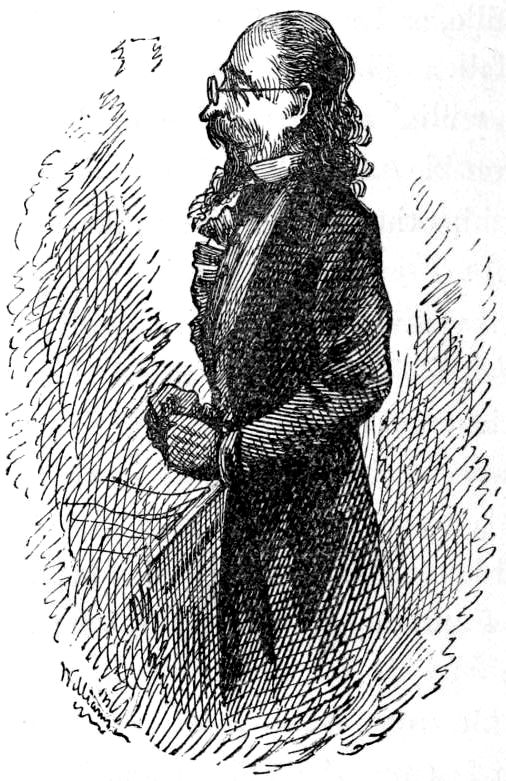
As I mentioned, more formally Josiah’s brother’s
wife had come to live with us. My opinion is
she is most a natural fool; howsumever, bein’ one of
the relations on his side, I haint told her what I think
of her, but bear with her as I would wish the relations
on my side to be bore with by Josiah. How
long she will live with us, that I don’t know. But
she haint no place to go to, and we can’t turn her out
of doors; so it looks dark to me, for it is a considerable
sized tribulation, that I don’t deny; fools was
always dretful wearin’ to me. But I don’t ort to call
her a fool, and wouldn’t say it where it would git out,
for the world. But she don’t know no more’n the
law’l allow, that I will contend for boldly with my
last breath.
But if her principles was as hefty as cast-iron, and
her intellect as bright as it is t’other way—if it was
bright as day—she would be a sort of a drawback to
55happiness—anybody would, whether it was a he or a
she. Home is a Eden jest large enough to hold
Adam and Eve and the family, and when a stranger
enters its gate to camp down therein for life with you,
a sort of a cold chill comes in with ’em. You may
like ’em, and wish ’em well, and do the best you can
with ’em, but you feel kinder choked up, and bound
down; there is a sort of a tightness to it; you can’t for
your life feel so loose and soarin’ as you did when
you was alone with Josiah and the childern.
But I am determined to put up with her and do
the best I can. She hadn’t no home, and was a
comin’ on the town, so Josiah thought for the sake
of Tim—that was his brother—it was our duty to take
her in and do for her. And truly Duty’s apron
strings are the only ones we can cling to with perfect
safety. Inclination sometimes wears a far more
shining apron, and her glitterin’ strings flutter down
before you invitingly, and you feel as if you must
leggo of Duty, and lay holt of ’em. But my friends,
safety is not there; her strings are thin, and slazy, and
liable to fall to pieces any minute. But hang on to
Duty’s apron strings boldly and blindly, get a good
holt and have no fear; let her draw you over rough
pathways, through dark valleys, up the mounting
side, and through the deep waters; don’t be afraid,
but hang on. The string won’t break with you, and
the country she will lead you into is one that can’t be
bettered.
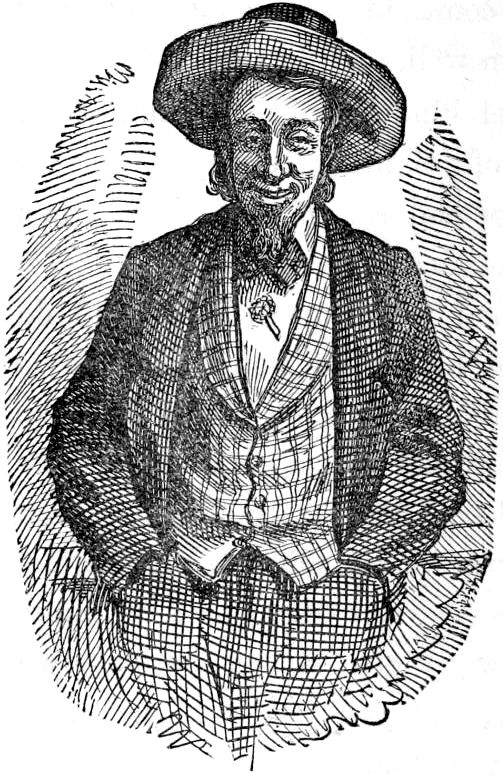
56Her first husband was Josiah’s only brother. He
died a few years after they were married, and then
she married to another man, David Doodle by name
and a shiftless creeter by nater—but good lookin’, so I
hearn. Howsumever, I don’t know
nothin’ about it
only by hearsay, for
I never laid eyes on
none of the lot till
she come on to us
for a home. They
lived out to the
Ohio. But she fairly
worships that
Doodle to this day,
talks about him day
and night. I haint
heerd her say a
dozen words about
Josiah’s brother
Timothy, though they say he was a likely man, and a
good provider, and did well by her. Left her a good
farm, all paid for, and Doodle run through it; and
five cows and two horses; and Doodle run through
them, and a colt.
But she don’t seem to remember that she ever had
no such husband as Timothy Allen, which I know
makes it the more wearin’ onto Josiah, though he
57don’t complain. But he thought a sight of Tim—they
used to sleep together when they was children,
and heads that lay on the same mother’s bosom, can’t
git so fur apart but what memory will unite ’em.
They got separated when they grew up; Tim went
to the Ohio to live, as I say, but still, when Josiah’s
thoughts git to travelin’, as thoughts will,—I never
see such critters to be on the go all the time—they
take him back to the old trundle-bed, and Tim.
But she don’t mention brother Timothy only when
Josiah asks her about him. But Doodle! I can truly
say without lyin’ that if ever a human bein’ got sick
of any thing on earth, I got sick of Doodle, sick
enough of him. Bein’ shet up in the house with
her I sense it more than Josiah does. It is Doodle
in the morning, and Doodle at noon, and Doodle at
night, and Doodle between meals; and if she talks in
her sleep—which she is quite a case to—it is about
Doodle. I don’t complain to Josiah much, knowin’
it will only make his road the harder; but I told
Thomas Jefferson one day, after she had jest finished
a story about her and Doodle that took her the biggest
part of the forenoon, for the particulars that she will
put in about nothin’, is enough to make any body
sweat in the middle of winter. She had went and
lay down in her room after she got through; and good
land! I should think she would want to—I should
think she would have felt tuckered out. And I says
to Thomas Jefferson—and I sithed as I said it:
58“It does seem as if Doodle will be the death of
me.” And I sithed again several times.
“Wall,” says he, “if he should, I will write a
handsome piece of poetry on it;” says he, “Alf Tennyson
and Shakespeare have written some pretty fair
pieces, but mine shall
“Beat the hull caboodle,
And the burden of the him shall be,
That mother died of Doodle.”
I stopped sithin’ then, and I says to him in real
severe tones, “You needn’t laugh Thomas J., I’d love
to see you try it one day.” Says I, “You and your
father bein’ outdoors all day, when you come in for a
few minutes to your meals, her stiddy stream of talk
is as good as a circus to you, sunthin’ on the plan of
a side show. But you be shet up with it all day long,
day after day, and week after week, and then see how
you would feel in your mind; then see how the name
of Doodle would sound in your ear.”
But I try to do the best I can with her. As I said,
how long she will stay with us I don’t know. But I
don’t s’pose there is any hopes of her marryin’ again.
When she first came to live with us, I did think—to
tell the plain truth—that she would marry again
if she got a chance. I thought I see symptoms of it.
But it wasn’t but a few days after that that I give up
the hope, for she told me that it wasn’t no ways
likely that she should ever marry again. She talks a
sight about Doodle’s face, always calls it his ‘linement’,
59says it is printed on her heart, and it haint no
ways likely that she will ever see another linement,
that will look to her as good as Mr. Doodle’s linement.
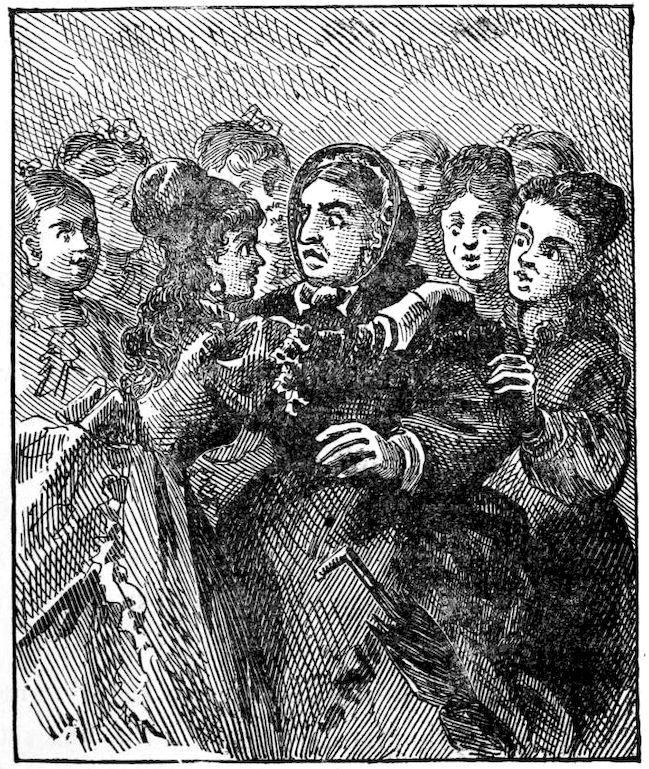
I declare for’t, sometimes when she is goin’ on, I
have to call on the martyrs in my own mind almost
wildly, call on every one I ever heerd of, to keep my
principles stiddy, and keep me from sayin’ sunthin’
I should be sorry for. Sometimes when she is goin’
on for hours about “Doodle and his linement” and
so forth, I set opposite to her with my knittin’ work
in my hand, with no trace on the outside, of the
almost fearful tempest goin’ on inside of me. There
I’ll be, a bindin’ off my heel, or seamin’ two and one,
or toein’ off, as the case may be; calm as a summer
mornin’ on the outside, but on the inside I am a sayin’
over to myself in silent but almost piercin’ tones of
soul agony:
“John Rogers! Smithfield! nine children, one at
the breast! Grid-irons! thum-screws! and so 4th,
and so 4th!” It has a dretful good effect on me, I
think over what these men endured for principle, and
I will say to myself:
“Josiah Allen’s wife, has not your heart almost
burnt up within you a thinkin’ of these martyrs?
Have you not in rapped moments had longin’s of the
sole to be a martyr also? Lofty principle may boy
the soul up triumphant, but there can’t be anybody
burnt up without smartin’, and fire was jest as hot in
them days as it is now, and no hotter. If David
60Doodle is the stake on which you are to be offered
up, be calm Samantha—be calm.”
So I would be a talkin’ to myself, and so she would
be a goin’ on, and though I have suffered pangs that
can’t be expressed about, my principles have grown
more hefty from day to day. I begun to look more
lofty in mean, and sometimes I have been that boyed
up by hard principle, that jest to see what heights a
human mind could git up on to, while the body was
yet on the ground, I would begin myself about
Doodle. And so,
speakin’ in a martyr
way, the Widder
Doodle was not
made in vain.
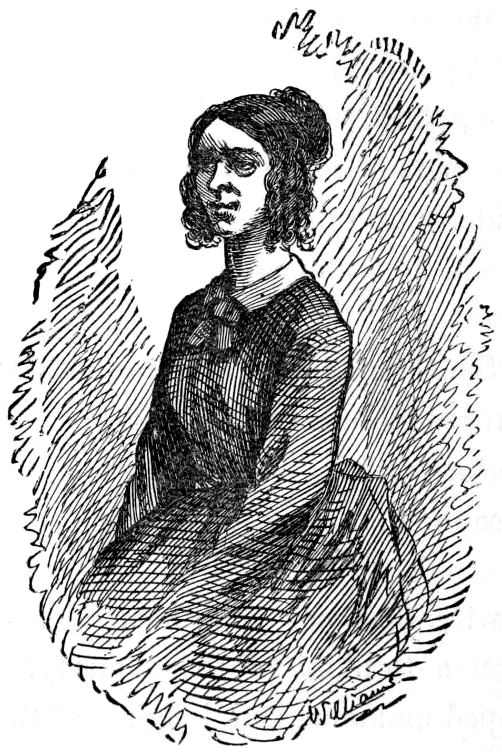
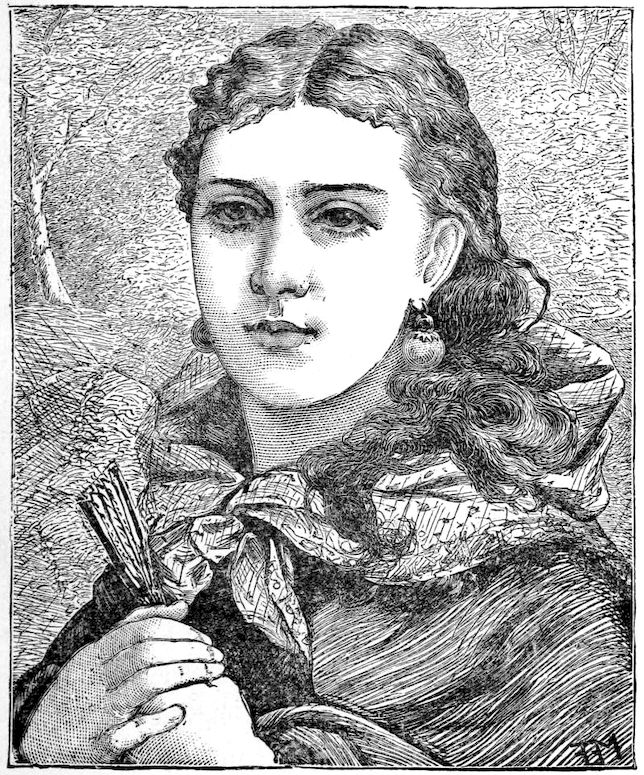
She is a small
boneded woman,
dretful softly lookin’;
and truly, her
looks don’t belie
her, for she
seems to me that
soft, that if she
should bump her
head, I don’t see
what is to hinder it
from flattin’ right out like a piece of putty. I guess
she was pretty good lookin’ in her day; on no other
grounds can I account for it, that two men ever took
61after her. Her eyes are round as blue beads, and
sort of surprised lookin’, she is light complected,
and her mouth is dretful puckered up and drawed
down. Josiah can’t bear her looks—he has told me
so in confidence a number of times—but I told him I
have seen wimmen that looked worse; and I have.
“I have seen them that looked far better,” says he.
“Who Josiah?” says I.
Says he, “Father Smith’s daughter, Samantha.”
Josiah thinks a sight of me, it seems to grow on
him; and with me also, it is ditto and the same.
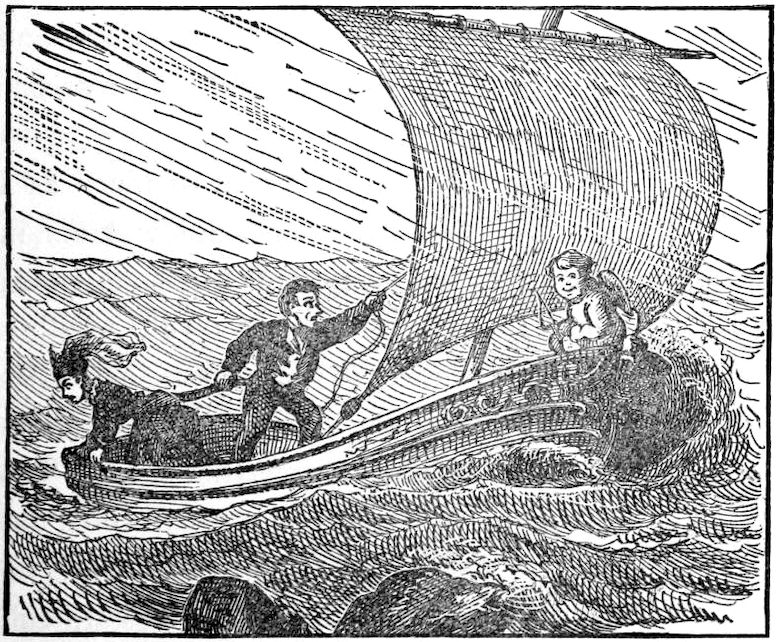
When two souls set out in married life, a sailin’
out on the sea of True Love, they must expect to
steer at first through rocks, and get tangled in the
62sea weed, the rocks of opposing wills, and the sea
weed of selfishness. And before they get the hang
of the boat it will go contrary, squalls will rise and
most upset it, and they’ll hist up the wrong sails and
tighten the wrong ropes and act like fools generally.
And they’ll be sick, very; and will sometimes look
back with regret to the lonesome, but peaceful shores
they have left, and wish they hadn’t never sot out.
But if they’ll be patient and steer their boat straight
and wise, a calmer sea is ahead, deeper waters of trust
and calm affection, in which their boat will sail onwards
first rate. They’ll git past the biggest heft of
the rocks, and git the nack of sailin’ round the ones
that are left so’s not to hit ’em nigh so often, and
the sea weed, unbeknown to them, will kinder drizzle
out, and disappear mostly.
I don’t have to correct Josiah near so much as I
used to, though occasionally, when I know I am in
the right, I set up my authority, and will be minded;
and he hisen. I never see a couple yet, whether
they’d own it or not, but what would have their little
spats; but good land! if they love each other they
git right over it, and it is all fair weather again. The
little breeze clears the air, and the sun will shine out
again clear as pure water, and bright as a dollar.
Sister Doodle, (Josiah thought it was best to call
her so some of the time, he thought it would seem
more friendly) she says, the widder does, that she
never see a couple live together any happier and
63agreabler than me and Josiah live together. She told
me it reminded her dretfully of her married life with
Doodle. (Josiah had cooed at me a very little that
mornin’—not much, for he knows I don’t encourage
it in him.)
Truly Doodle is her theme, but I hold firm.
She was a helpin’ me wash my dishes, and she
begun: how much Josiah and I reminded her of her
and Doodle.
Says she—“Nobody knows how much that man
thought of me; he would say sometimes in the
winter when we would wake up in the mornin’: ‘My
dear Dolly,’—he used to call me that, though my
name is Nabby, but he said I put him in mind so of a
doll, that he couldn’t help callin’ me so—‘My dear
Dolly,’ he’d say, ‘I have been a dreamin’ about you.’
“‘Have you Mr. Doodle?’ says I.
“‘Yes,’ says he, ‘I have been a dreamin’ how
much I love you, and how pretty you are—jest as
pretty as a pink posy.’ Them was Mr. Doodle’ses
very words: ‘a pink posy.’
“I’d say,—‘Oh shaw, Mr. Doodle, I guess you
are tryin’ to foolish me.’
“Says he—‘I haint, I dremp it.’ And then there
would come such a sweet smile all over his linement,
and he would say:
“‘Dolly, I love to dream about you.’
“‘Do you, Mr. Doodle?’ says I.
“‘Yes,’ says he, ‘and it seems jest as if I want to
64go to sleep and have another nap, jest a purpose to
dream about you.’
“And so I would git up and cut the kindlin’ wood,
and build the fire, and feed the cows, and go round the
house a gettin’ breakfast, as still as a mice so’s not to
disturb him, and he’d lay and sleep till I got the coffee
turned out, then
he’d git up and tell
me his dream. It
would be all about
how pretty I was,
and how much he
loved me and how
he would die for
my sake any time
to keep the wind
from blowin’ too
hard onto me. And
he would eat jest
as hearty and enjoy
himself dretfully.
Oh! we took a sight of comfort together, me
and Mr. Doodle did. And I can’t never forget him;
I can’t never marry again, his linement is so stamped
onto my memory. Oh, no, I can’t never forgit his
linement; no other man’s linement can be to me what
his linement was.”
She stopped a minute to ask me where she should
set the dishes she had wiped, and I was glad of the
65respit, though I knew it would be but a short one.
And I was right, for in settin’ up the dishes, she see
a little milk pitcher that belonged to my first set of
dishes; there was a woman painted onto it, and that
set her to goin’ again. Truly, there is nothin’ on the
face of the earth, or in the sky above, but what reminds
her, in some way, of Doodle. I have known
the risin’ sun to set her to goin’, and the fire-shovel,
and the dust-pan. She held the pitcher pensively in
her hand a minute or two, and then she says:
“This picture looks as I did, when I married Mr.
Doodle. I was dretful pretty, so he used to tell me;
too pretty to have any hardships put onto me, so he
used to say. There was considerable talk about wimmen’s
votin’, about that time, and he said there wasn’t
money enough in the world to tempt him to let his
Dolly vote. Anything so wearin’ as that, he said he
should protect me from as long as he had a breath
left in his body. He used to git dretful excited
about it, he thought so much of me. He said it
would ‘wear a woman right out; and how should I
feel,’ says he, ‘to see my Dolly wore out.’
“He couldn’t use to bear to have me go a visitin’,
either. He said talkin’ with neighborin’ wimmen’
was wearin’ too, and to have to come home and git
supper for him after dark; he said he couldn’t bear
to see me do it. He never was no hand to pick up
a supper, and I always had to come home and git
his supper by candle light—meat vittles; he always
66had to have jest what he wanted to eat, or it made
him sick, he was one of that kind—give him the palsy.
He never had the palsy, but he always said that all
that kep’ him from it, was havin’ jest what he wanted
to eat, jest at the time he wanted it; and so he would
lay down on the lounge while I got his supper ready.
I’d have to begin at the very beginning, for he never
was one of the men that could hang over the tea-kettle,
or git up potatoes, or anything of that sort; and I’d
most always have to build up the fire, for he thought
it wasn’t a man’s place to do such things. He was a
dretful hand to want everybody to keep their place;
that was one reason why he felt so strong about
wimmen’s votin’. He had a deep, sound mind, my
Doodle did. But, as I said, he’d lay on the lounge
and worry so about its bein’ too much for me; that,
ruther than make him feel so bad, I give up visitin’
almost entirely. But he never worried about that, so
much as he did about votin’; it seemed as if the
thought of that almost killed him. He said that with
my health, (I didn’t enjoy very good health then) I
wouldn’t stand it a year; I would wilt right down
under it. Oh! how much that man did think of me!
68
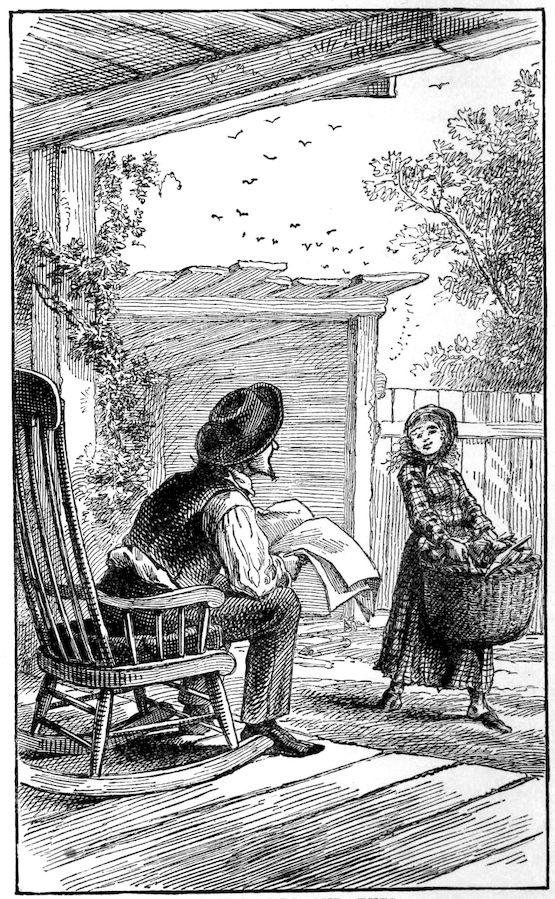
69“When I would be a workin’ in the garden, (I took
all the care of the garden,) or when I would be a
pickin’ up chips—we was kinder bothered for wood—he’d
set out on the back piazza with his paper, the
Evenin’ Grippher—awful strong paper against wimmen’s
rights—and as I would be a bringin’ my chips
in, (we had a old bushel basket that I used,) he
would look up from his paper and say to me,—‘Oh,
them pretty little hands, how cunning they look, a
quirling round the basket handles; and oh, them
pretty little eyes; what should I do if it wasn’t for
my Dolly? And how should I feel if them pretty
little eyes was a lookin’ at the pole?’ Says he, ‘It
would kill me Dolly; it would use me right up.’
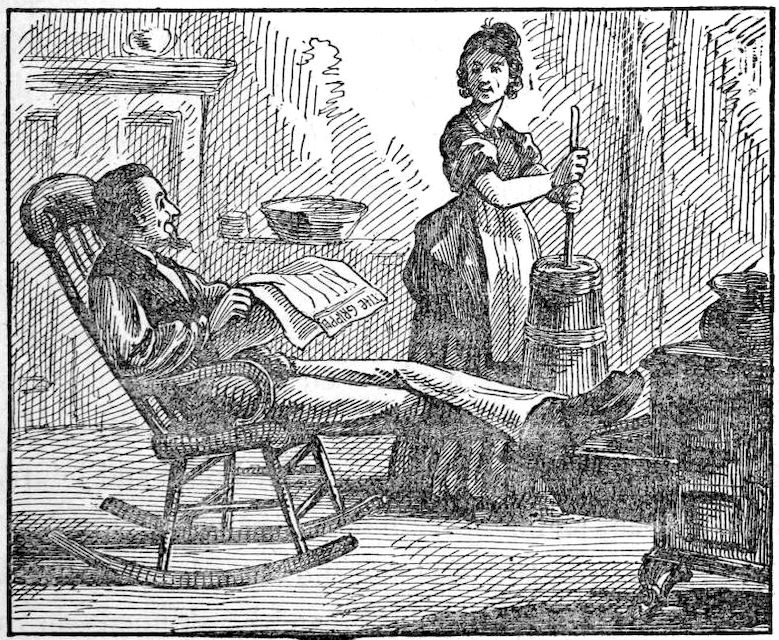
“And then, when I would be a churnin’—we had a
good deal of cream, and the butter come awful hard;
sometimes it would take me most all day and lame my
back for a week—and when I would be a churnin’, he
would be so good to me to help me pass away the
time. He would set in his rockin’ chair—I cushioned
70it a purpose for him—and he would set and read the
Evenin’ Grippher to me; sometimes he would read it
clear through before I would fetch the butter; beautiful
arguments there would be in it ag’inst wimmen’s
rights. I used to know the Editor was jest another
such a man as my Mr. Doodle was, and I would
wonder how any livin’ woman could stand out ag’inst
such arguments, they proved right out so strong that
votin’ would be too much for the weaker sect, and
that men wouldn’t feel nigh so tender and reverential
towards ’em, as they did now.
“We wasn’t very well off in them days, for Mr.
Doodle was obliged to mortgage the farm I brought
him when we was married, and it was all we could do
to keep up the money due on the mortgage, and
father wouldn’t help us much; he said we must work
for a livin’, jest as he did; and the farm kinder run
down, for Mr. Doodle said he couldn’t go out to
work and leave me for a hull day, he worshiped me
so; so we let out the place on shares, and I took
in work a good deal. When I was a workin’, Mr.
Doodle would set and look at me for hours and hours,
with a sweet smile on his linement, and tell me how
delicate and pretty I was and how much he thought
of me, and how he would die and be skinned—have
his hide took completely off of him—before he’d let
me vote, or have any other hardship put on me. Oh!
what a sight of comfort me and Mr. Doodle did take
together; and when I think how he died, and was a
71corpse—and he was a corpse jest as quick as he was
dead, Mr. Doodle was—oh how I do feel. I can’t
never forget him, his linement is so stamped onto my
memory. I never can forget his linement, never.”
And so she’ll go on from hour to hour, and from
day to day, about Doodle and Wimmen’s Rights—Wimmen’s
Rights and Doodle; drivin’ ahead of her
a drove of particulars, far, far more numerous than
was ever heerd of in Jonesville, or the world; and I—inwardly
callin’ on the name of John Rogers—hear
her go on, and don’t call Doodle all to nothin’, or
argue with her on Wimmen’s Rights. My mean is
calm and noble; I am nerved almost completely up
by principle; and then, it is dretful wrenchin’ to the
arm to hit hard blows ag’inst nothin’.
Truly, if anybody don’t know anything, you can’t
git any sense out of ’em. You might jest as well go
to reckonin’ up a hull row of orts, expectin’ to have
’em amount to sunthin’. Ort times ort is ort, and
nothin’ else; and ort from ort leaves nothin’ every
time, and nothin to carry; and you may add up ort
after ort, all day, and you wont have nothin’ but a
ort to fall back on. And so with the Widder Doodle,
you may pump her mind till the day of pancakes, (as
a profane poet observes,) and you wont git anything
but a ort out of it,—speakin’ in a ’rithmatic way.
Not that she is to blame for it, come to look at it
in a reasonable and scientific sense. All figgers in
life can’t count up the same way. There’s them that
72count one,—made so; got a little common sense unbeknown
to them. Then there’s some that double on
that, and count two,—more sense, and can’t help it;
and all the way up to nine; and then there is the orts—made
orts entirely unbeknown to them; and so,
why should figgers seven, or eight, or even nine, boast
themselves over the orts.
Truly, we all have abundant reason to be humble,
and feel a humiliatin’ feelin’. The biggest figgers
in this life don’t count up any too high, don’t know
any too much. And all the figgers put together, big
and little mingled in with orts, all make up a curious
sum that our heads haint strong enough to figger
out straight. It is a sum that is bein’ worked out
by a strong mind above our’n, and we can’t see the
answer yet, none on us.
0000000000
0000000000
—————
0000000000
73
A DEBATE ON INTEMPERANCE.
Last Tuesday evenin’ the “Creation Searchin’
Society” argued on this question.
“Resolved; It is right to licence intemperance.”
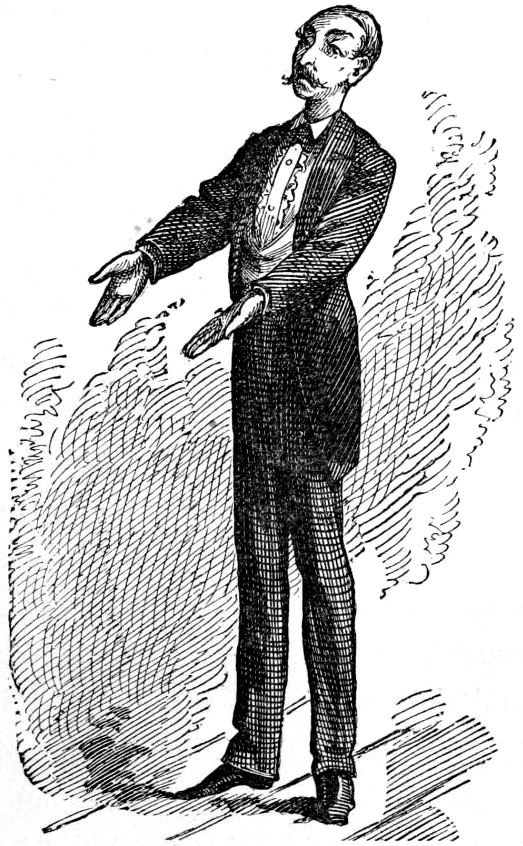
Cornelius Cork, the President, got up and give the
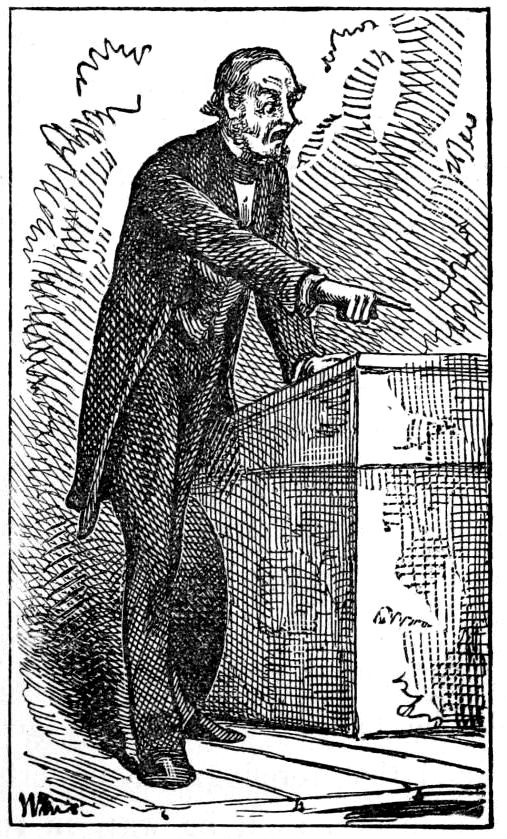
question out, and then a stern majestic look swept
over his face, some like a thunder cloud, and says he,
pintin’ out his forefinger nobly:
“Brother ‘Creation Searchers,’ and friends and
neighbors promiscous. Before we tackle this momentous
subject to-night, I have got a little act of justice
to preform, which if I shirked out of doin’ of it, would
send my name down to posterity as a coward, a rank
traitor, and almost a impostor. The public mind is
outraged at the present time, by officers in high
places provin’ traitors to their trust: traitors to the
confidin’ public that have raised ’em up to their high
stations. The public of Jonesville will find that I am
not one of that kind, that I am not to be trifled with,
74nor will I be seduced by flattery or gifts, to permit
them that have raised me up to the height I now stand
on, to be trifled with.”
Here he paused a moment, and laid his forefinger
on his heart and looked round on us, as if he was
invitin’ us all to take our lanterns and walk through
it, and behold its purity. That gesture took dretful
well with the audience. The President realized it, he
see what he had done, and he kep’ the same position
as he proceeded and went on.
“Every one who was present at the last meetin’ of
our ‘Creation Searchin’ Society’ knows there was a
disturbance there. They know and I know that right
in the midst of our most searchin’ investigations, some
unprincipled villain in the disguise of humanity outraged
us, and insulted us, and defied us by blimmin’;
in other words by yellin’ out ‘Blim! Blim!’ every
few minutes. And now I publicly state and proclaim
to that blimmer, that if he blims here to night,
I will put the papers onto him. I will set the law at
him. I’ll see what Blackstone and Coke has to say
about blimmin’.”
He hadn’t no more’n got the words out of his
mouth, when “Blim!” came from one side of the
house, and “Blim! Blim!” came from the other side.
Nobody couldn’t tell who it was, there was such a
crowd. Cornelius Cork’s face turned as red as a
root-a-bagy beet, and he yelled out in the awfulest
tone I had ever heerd him use—and if we had all
75been polar bears right from the pole, he couldn’t have
took a more deadly aim at us with that awful forefinger:
“Stop that blimmin’ instantly!”
His tone was so loud and awful, and his gesture so
fearfully commandin’ and threatenin’, that the house
was still as a mice. You could hear a clothes-pin drop
in any part of it.
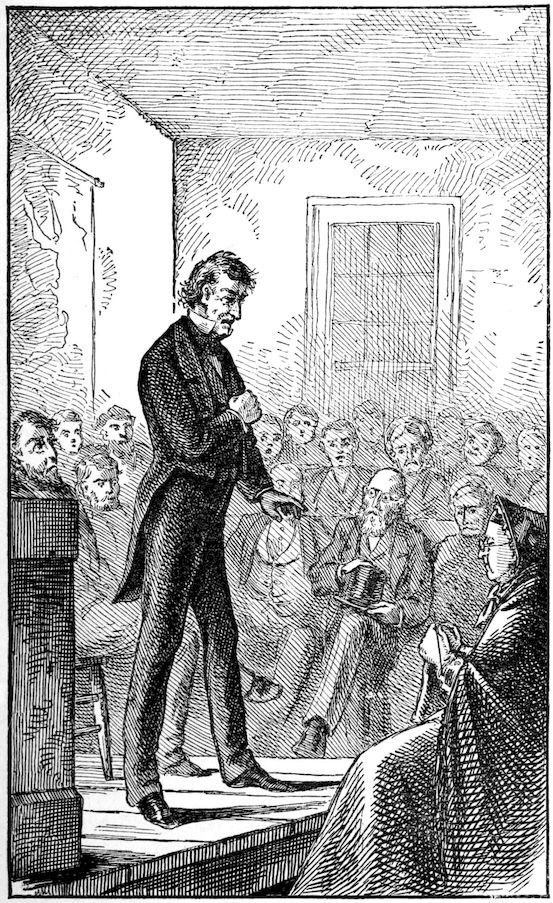
Here he set down, and the meetin’ begun. Elder
Easy was on the affirmative, and Thomas J. on the
negative, as they call it.
Elder Easy is a first-rate man, and a good provider,
but awful conservative. He believes in doin’ jest as
his 4 fathers did every time round. If anybody
should offer to let him look at the other side of the
moon, he would say gently but sweetly: “No, I
thank you, my 4 fathers never see it, and so I would
rather be excused from beholdin’ it if you please.”
He is polite as a basket of chips, and well meanin’; I
haint a doubt of it in my own mind. But he and
Samantha Allen, late Smith, differs; that female loves
to look on every side of a heavenly idee. I respect
my 4 fathers, I think a sight of the old men. They
did a good work in cuttin’ down stumps and so
4th. I honor ’em; respect their memory. But
cities stand now where they had loggin’ bees. Times
change, and we change with ’em. They had to rastle
with stumps and brush-heaps, it was their duty; they
did it, and conquered. And it is for us now, who
76dwell on the smooth places they cleared for us, to
rastle with principle and idees. Have loggin’ bees to
pile up old rusty brushwood of unjust laws and
customs, and set fire to ’em and burn ’em up root and
branch, and plant in their ashes the seeds of truth and
right, that shall yet wave in a golden harvest, under
happier skies than ourn. If we don’t, shall we be
doin’ for posterity what they did for us? For we too
are posterity, though mebby we don’t realize it, as
we ort to.
77

But Elder Easy, although he lives in the present
time, is in spirit a 4 father, (though I don’t say it in a
runnin’ way at all, for I like ’em, have swapped hens
with him and her, and neighbored with ’em considerable.)
He was on the likker side, not that he wants
to get drunk, or thinks anything particular of likker
himself, but he believes in moderate drinkin’ because
his 4 fathers drank moderate. He believes in licensin’
intemperance because his 4 fathers was licensed.
And Shakespeare Bobbet was on his side, and old Mr.
Peedick, and the Editor of the Auger, (he is a democrat
and went for slavery strong, felt like death when
the slaves was set free, and now he wants folks to
drink all they can, goes for intemperance strong. He
drinks, so they say, though I wouldn’t have it go
from Josiah or me for the world.) And Solomon
Cypher was on that side. He drinks. And Simon
Slimpsey; howsumever, he haint of much account anyway,
he has almost ruined himself with the horrors.
He has ’em every day
stiddy, and sometimes
two and three times a
day. He told a neighborin’
woman that he
hadn’t been out of ’em
sense the day he was
married to Betsey, she
was so uncommon mean
to him. I told her when
she was a tellin’ me
about it (she is a real
news-bearer, and I
didn’t want to say anything
she could carry
back) I merely observed
in a cool way:
“I have always had my
opinion about clingers,
and wimmen that didn’t
want no rights, I have
kep’ my eye on ’em, I
have kep’ my eye on
their husbands, and my
mind haint moved a
inch concernin’ them
from the place it stood
in more formally.” I
didn’t say no more, not wantin’ to run Betsey to her
78back, and then truly, as a deep thinker observes in
one of his orations, “a dog that will fetch a bone,
will carry one.”
On Thomas Jefferson’s side was himself, the Editor
of the Gimlet, Lawyer Nugent, Doctor Bombus,
Elder Morton, and Whitfield Minkley—six on each
side. Thomas Jefferson spoke first, and he spoke
well, that I know. I turned right round and give
sister Minkley a proud happy look several times
while Thomas J. was a talkin’; she sot right behind
me. I felt well. And I hunched Josiah several
times when he said his best things, and he me, for
we both felt noble in mind to hear him go on.
His first speech was what they call an easy, or
sunthin’ considerable like that; Josiah said when we
was a goin’ home that they called it an essence, but I
told him I knew better than that. He contended,
and I told him I would leave it to Thomas J. but it
slipped my mind. Howsumever it haint no matter;
it is the thing itself that Josiah Allen’s wife looks
at, and not the name of it. The easy—or sunthin’ like
it,—run as follows: I believe my soul I can git the
exact words down, for I listened to it with every ear
I had, and upheld by the thoughts of the future generations,
and the cause of Right, I kinder took it out
of his overcoat pocket the next day, and read it over
seven times from beginnin’ to end. I should have
read it eight times, if I had had time.
He seemed to be a pryin’ into what the chief
79glory and pleasure of gettin’ drunk consisted in; he
said the shame, the despair, and the ruin of intemperance
anyone could see. And he pictured out the
agony of a drunkard’s home, till there wasn’t a dry
eye in my head, nor Josiah’s nuther. And he said in
windin’ up, (I shan’t put down the hull on’t, for it
would be too long) but the closin’ up of it was:
“I don’t believe there is a sadder sight for men or
angels, than to see a man made in the image of God
willfully casting aside his heritage of noble and true
manhood; slipping the handcuffs over his own wrists;
and offering himself a willing captive to the mighty
but invisible wine spirit.
“No slave bound to the chariot wheels of a conqueror
is so deplorable a sight as the captive of
wine. His face does not shine like the face of an
angel, as did a captive in the old time—but with so
vacant and foolish an expression, that you can see at
once that he is hopelessly bound, body, mind and soul
to his conqueror’s chariot. And a wonderful conqueror
is he, so weak in seeming as to hide beneath
the ruby glitter of a wine cup, and yet so mighty as
to fill our prisons with criminals, our asylums with
lunatics—and our graveyards with graves. Mightier
than Time or Death, for outstripping time, he ploughs
premature furrows on the brow of manhood and
alienates affection Death has no power over.
“I have often marvelled where the chief glory of
dissipation came in. Its evil effects were always too
80hideously palpable to be misunderstood; but in what
consists the gloating pleasure for which a man is
willing to break the hearts of those who love him,
bring himself to beggary, endow his children with an
undeserved heritage of shame, destroy his intellect,
ruin his body, and imperil his soul, is a mystery.
“I have wondered whether its chief bliss consisted
in the taste of the cup; if so, it must be indeed a delicious
enjoyment, transitory as it is, for which a man
would be willing to loose earth and heaven. Or if it
were in that intermediate stage, before the diviner
nature is entirely merged in the animal—the foolish
stage, when a man is so affectionately desirous of doing
his full duty by his hearers, that he repeats his commonest
remarks incessantly, with a thick tongue and thicker
meaning, and if sentimentally inclined, smiles, oh how
feebly, and sheds such very foolish tears. In lookin’
upon such a scene, another wonder awakens in
me, whether Satan, who with all his faults is uncommonly
intelligent, is not ashamed of his maudlin
friend. Or is the consummation of glory in the next
stage, where with oaths and curses a man dashes his
clenched fists into the faces of his best friends, pursues
imaginary serpents and fiends, thrusts his wife and
children out into the cold night of mid-winter, and
bars against them the doors of home. And home!
what a desecration of that word which should be the
synonym of rest, peace and consolation, is a drunkard’s
home. Or is the full measure of pleasure attained
81when he, the noblest work of God, is stretched out at
his full six feet length of unconsciousness, stupidity
and degradation.
“If there be a lonely woman amid the multitude of
lonely and sorrowful women, more to be pitied than
another, I think it is a wife lookin’ upon the one she
has promised to honor, lying upon the bed with his
hat and boots on. Her comforter, who swore at her
as long as he could speak at all. Her protector,
utterly unable to brush a fly from his own face. Her
companion, lying in all the stupor of death, with
none of its solemn dignity. As he is entirely unconscious
of her acts, I wonder if she never employs the
slowly passing moments in taking down her old idol,
her ideal, from its place in her memory, and comparing
it with its broken and defaced image before
her. Of all the poor broken idols, shattered into
fragments for the divine patience of womanhood to
gather together and cement with tears, such a ruin as
this seems the most impossible to mould anew into
any form of comliness. And if there is a commandment
seemingly impossible to obey, it is for a woman
to love a man she is in deadly fear of, honor a man
she can’t help bein’ ashamed of, and obey a man who
cannot speak his commands intelligibly.”
It was a proud moment for Josiah Allen and me,
to hear Thomas J. go on; and to have the hull house
so still, while he was makin’ his eloquent speech,
that you could hear a clothes-pin drop in any part
82of the room. And though my companion, perfectly
carried away by his glad emotions, hunched me several
time harder than he had any idee of, and almost gored
my ribs with his elbo, I didn’t, as you may say,
seem to sense it at all. And though in hunchin’ and
bein’ hunched, I dropped more’n 20 stitches in Josiah’s
socks, I didn’t care for that a mite; I had plenty of
time to pick ’em up durin’ the next speech, which
was the Editor of the Auger’es, (he has got over the
zebra, so’s to be out.)
I have said, and I say still, that I never see a man
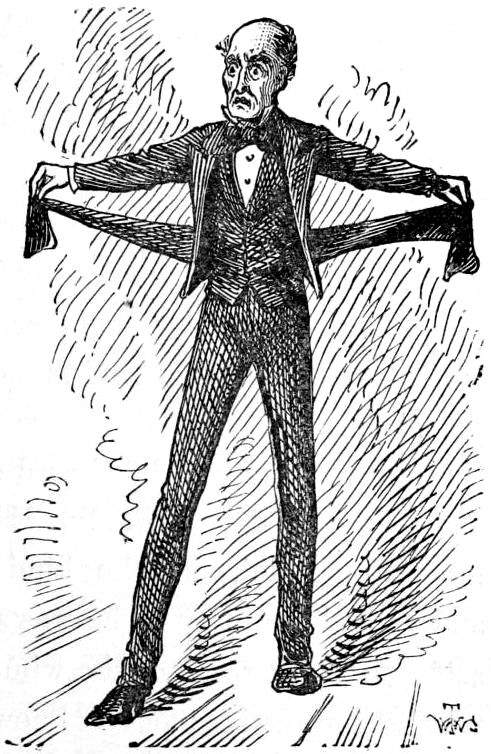
that would spread a idee out thinner than he will,—cover
more ground with it. Talk about Ingy Rubber
stretchin’,—why that man will take one small thought
and pull it out and string on enough big words to
sink it, seemin’ly.
Howsumever, his talk did jest about as much good
on Thomas J’s side, as on hisen, for he didn’t seem to
pay any attention to the subject, but give his hull
mind to stringin’ big words onto his idees, and then
stretchin’ ’em out as fur as human strength can go.
That, truly, was his strong pint. But jest as he bent
his knees and begun to set down, he kinder straightened
up again and said the only thing that amounted
to a thing. He said,—“Keepin’ folks from sellin’
likker, is takin’ away their rights.”
84
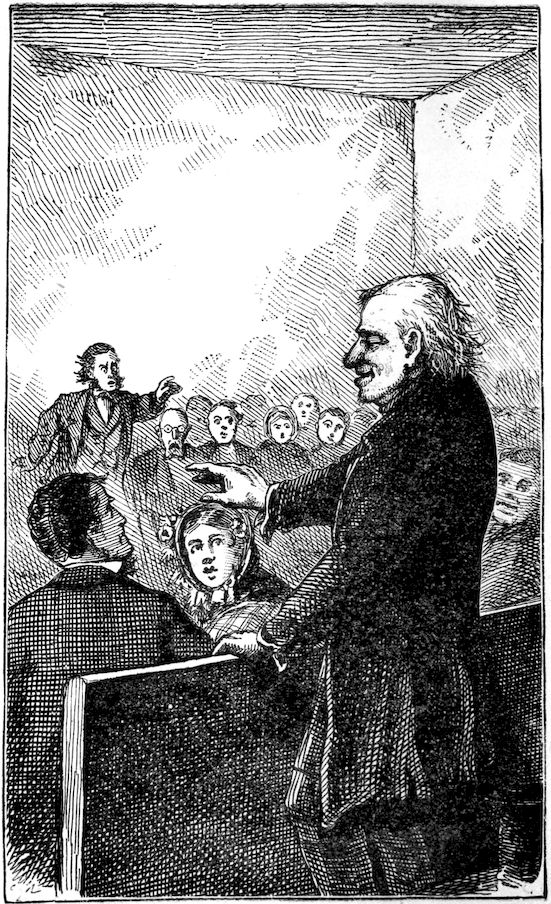
NOT THE RIGHT KIND OF HORNS.
85“Rights!” says Thomas Jefferson, jumpin’ upon
his feet the minute he set down. “Rights! The
first right and law of our nature, is self-preservation,
and what safety has any man while the streets are
filled with men turned into crazed brutes by this
traffic you are upholdin’? Every one knows that a
drunken man entirely loses for the time his reasoning
faculties, his morality and his conscience, and is
made ripe for any crime. That he is jest as ready to
rob and murder innocent citizens as to smoke his
pipe. So if you and I lend our influence and our
votes to make intemperance legal, we make arson,
burglary, rape, robbery, murder, legal. Tell me a
man has a right to thus plant the seeds of crime
and murder in a man’s soul, and imperil the safety of
the whole community. Why, the Bible says, that if
a man let loose a wild ox, and it gored men with its
horns and killed them, the men that let it go loose
should surely be put to death.”
Here Simon Slimpsey got up, kinder hangin’ on to
the bench, and made a dretful simple sort of a wink
with one eye, and says he:
“Them haint the kind o’ horns we are a talkin’
about, we are talkin’ about takin’ a horn of whisky
now and then.”
“Yes,” said Thomas J. “there was never a more
appropriate name; for if there ever were horns that
gored, and stabbed, and killed, it is these.”
Elder Easy spoke out, and says he,—“The Bible
says: ‘take a little wine for the stomach sake.’”
But Elder Morton jumped up, and says he,—“There
was two kinds of likker in earlier times; one
86that was unfermented and harmless, and contained no
alcohol or any principle of intoxication, and another
that contained this raging mocker.”
Then old Peedick spoke up. Says he,—“Likker
would be all right if it wasn’t for the adultery in it:
poison stuff, wormwood, and etcetery.”
But Dr. Bombus jumped up, and says he,—“Nothing
that can be put into it, can be worse poison than
the pure alcohol itself, for that is a rank poison for
which no antidote has ever been found; useful for
medical purposes, like some other poisons: arsenic,
opium, laudanum, and so 4th.”
But old Peedick kep’ a mutterin’,—“I know there’s
adultery in it;” and kep’ a goin’ on till Cornelius Cork,
the President, sot him down, and choked him off.
Solomon Cypher spoke up, and says he:
“No! licence bills don’t do no good; there is more
likker drunk when there haint no licence, than when
there is. If you hinder one man from sellin’ it, another
will.”
I declare, that excited me so, that entirely unbeknown
to myself, I spoke right out loud to Josiah:
“Good land! of all the poor excuses I ever heerd,
that is the poorest. If I don’t kill my grandmother,
somebody else will; or she’ll die herself, of old age,
or sunthin’; good land!”
The sound of my voice kinder brought my mind
back, and Josiah hunched me hard, and I went to
knittin’ dretful fast. Whitfield looked round to me
87and kinder smiled, and says he, right out in meetin’:
“That’s so, Mother Allen!”
I declare for’t, I didn’t know whether I was seamin’
two and one, or towin’ off, or in the narrowins.
I was agitated.
But Whitfield went right on, for it was his turn.
His speech was about licencing wrong: admitting a
thing was wrong, evil in itself and evil in its effects,
and then allowin’ folks to carry on the iniquity, if
they’d pay enough for it. It was about givin’ folks
the privilege of bein’ mean, for money; about a nation
sellin’ the right to do wrong, and so 4th.
Whitfield done well; I know it, and Tirzah Ann
knows it. Jest as quick as he sot down, Solomon
Cypher got up and says he—with an air as if the argument
he was about to bring forred, would bring
down the school-house, convince everybody, and set
the question to rest forever:
“The way I look at it, is this:” said he, (smitin’ his
breast as hard as I ever see a breast smote,) “if there
haint no licence, if a man treats me, and I want to
treat him back again, where—” (and again he smote
his breast almost fearfully,) “where will I git my
likker to do it with.”
“That’s so;” said Simon Slimpsey, “there he has
got you; you can’t git round that.”
Then Thomas J. spoke and brought up facts and
figgers that nobody couldn’t git over, or crawl round;
proved it right out, that intemperance caused more
88deaths than war, pestilence, and famine; that more
than half the crimes committed in the United States
could be traced back to drink; and eighty out of
every hundred was helped on by it. And then he
went on to tell how they transmitted the curse to their
childern, and how, through its effects, infant babes
was born drunkards, idiots, and criminals, entirely
unbeknown to them; that the influence of our free
schools is destroyed by the influence of the other free
schools the nation allows for the childern of the
people—the dram shops, and other legalized places of
ruin—that while the cries of the starving and naked
were filling our ears from all sides, seven hundred
millions of dollars were annually spent for intoxicatin’
drink. Instead of spendin’ these millions for food
and clothin’ for the perishin’, we spent them for ignorance,
beastliness, taxation, crime, despair, madness
and death. Says he:
“The cost of likker-drinkin’, from 1861 to 1870,
was six thousand millions of dollars. Add to that, the
labor in raisin’ the grain to make it; all the labor of
distillin’ it; all the loss of labor the drinkin’ of it entailed;
the sickness, deaths and crimes that resulted
from its use; the ships that went down in mid-ocean,
through the drunkenness of their crews—engulfin’
thousands of lives; the ghastly railroad accidents that
fill our newspapers with long death-lists; the suicides
and thousands of fatal accidents, all over the land,
caused by it; the robberies and murders, and the cost
89of tryin’ the criminals, buildin’ the prisons, penitentiaries
and jails, and supportin’ them therein; the
alms-houses for the paupers made by it; the asylums
for the insane, and the hirin’ of officers and attendants
to take care of them. Imagine the sum-total if
you can, and add to it, the six thousand millions of
dollars,—and all spent for that which is not only useless,
but ruinous. And honest, sober citizens consent
to have their property taxed to support this system.
“What if this enormous amount of money was spent
by our government, for the compulsory education of
the childern of the poor; takin’ them from their
wretched haunts and dens—schools of infamy, where
they are bein’ educated in criminality—and teachin’
them to be honest and self-supportin’. What a
marvelous decrease of crime there would be; what
a marvelous increase of the national wealth and
respectability.”
He said he had been lookin’ upon the subject in a
financial point of view, for its moral effects could not
be reduced to statistics. Says he:
“Now, with our boasted civilization, we support
four drinkin’ saloons to one church. Which exerts
the widest influence? In one of the finest cities of
New England, there are to-day, ten drinkin’ saloons
to one church, and a buildin’ owned by the Governor
of the state has two drinkin’ saloons in it, the rumsellers
hiring directly of him. The Indians, Buddhists,
and Brahmins, the savage and heathen races,
90whom we look down upon with our wise and lofty
pity, are our superiors in this matter, for they know
nothin’ of drunkenness still we teach them. How will
it be looked upon by the Righteous Judge above, that
with all our efforts to evangelize the heathen; our
money offerin’s of millions of dollars; our life offerin’s
of teachers and missionaries; our loud talkin’,
and our long prayers; after all the efforts of the
Christian world, the facts face us: that for one
heathen who is converted to Christ by the preachin’
of the tongue of our civilized race, one thousand
sober heathen are made drunkards by the louder
preachin’ of our example; are made by us—if we
believe the Bible—unfit for ever enterin’ the heaven
we make such powerful efforts to tell them of.”
“And” says he, “the sufferin’ intemperance has
caused cannot possibly be reckoned up by figgers,—the
shame, disgrace, and desolation, wretchedness to
the guiltless, as well as the guilty. The blackness of
despair that is dark enough to veil the very heavens
from innocent eyes, and make them doubt the existence
of a God—who can permit a nation to make
such a traffic respectable and protect it with the shadow
of the law.”
Says he, “When you have licenced a man to sell
likker, and protected him by the law you have helped
to make, he sells a pint of likker to a drunkard;
do you know what you and he are sellin’? You
know you are sellin’ poverty, and bodily ruin, and
91wretchedness; this you know. But you may be sellin’
a murder, a coffin and a windin’-sheet; sellin’ broken
hearts, and a desolate hearth-stone; sufferin’ to the
innocent, that will outlast a life-time; ruin, disgrace,
despair, and the everlastin’ doom of a deathless soul.
Tell me any one has a right to do this? Men in their
greed and self interest may make their wretched laws
to sanction this crime, but God’s laws are mightier
and will yet prevail.”
Every word Thomas J. said went right to my
heart. You see, a heart where a child’s head has laid—asleep
or awake—till it has printed itself completely
onto it, that heart seems to be a holdin’ it still when
the head’s got too large to lay there bodily (as it were.)
Their wrong acts pierce it right through, and their
noble doin’s cause it to swell up with proud happiness.
Dr. Bombus bein’ dretful excited riz right up, and
says he, “How any good man can sanction this infamous
traffic, how any minister of the Gospel-—”
But here the President made the Dr. set down, for it
was Elder Easy’s turn.
And the Elder got up. I see he was kinder touched
up by what the Dr. had said, and he made a long
speech about what he thought it was a minister’s place
to do. He thought it wasn’t their place to meddle in
political matters. I kinder got it into my head from
what he said, though he didn’t say it right out, that
he thought there was bad men enough to make our
laws without good men meddlin’ with ’em. And in
92windin’ up he said he thought ministers took too
active a part in the Temperance move; he heerd of
ministers preachin’ sermons about it on Sunday, and
though he had no doubt they meant well, still, he
must say he thought there was other subjects that
was better fitted for good men to hold forth and improve
upon. He thought the cross of Christ, warnin’
sinners to keep out of a future hell, was better subjects
for ’em, and then he said the Bible was full of
beautiful themes for Sunday discourses, such as the
possibility of recognizin’ our friends in a future
world, and so 4th.
Thomas J. got up and answered him.
Says he, “The subject of recognizin’ our friends
in a future world is a beautiful one, and worthy of
much thought. But I think it is commendable to try
to keep our friends in a condition to recognize us in
this world, try to keep a man while he is alive, so he
will know his own wife and children, and not turn
them out into the storm of a winter midnight, and
murder them in his mad frenzy.”
Jest at this minute—when Thomas J. was goin’ on
his noblest—some unprincipled creeter and no nothing,—whoever
it was—yelled out “Blim!” again, and
Cornelius Cork, the President, bein’ on a keen watch
for iniquities, jumped out of his seat as if he had
been shot out of it with a shot-gun. And he lifted
up his head nobly and walked down the aisle of the
school-house, in jest that proud triumphant way that
93Napoleon walked along on top of the Alp, and with
that same victorious mean of a conqueror onto him,
with his forefinger pinted out firmly and calmly, and
almost nobly, he exclaimed in loud, glad tones, and
the majesticest I ever heerd in my life:
“I’ve catched him at it! I’ve catched the blimmer!
I heerd him blim! I seen him! I seen him
when he was a blimmin’! Ike Gansey, I fine you ten
cents and cost for blimmin.”
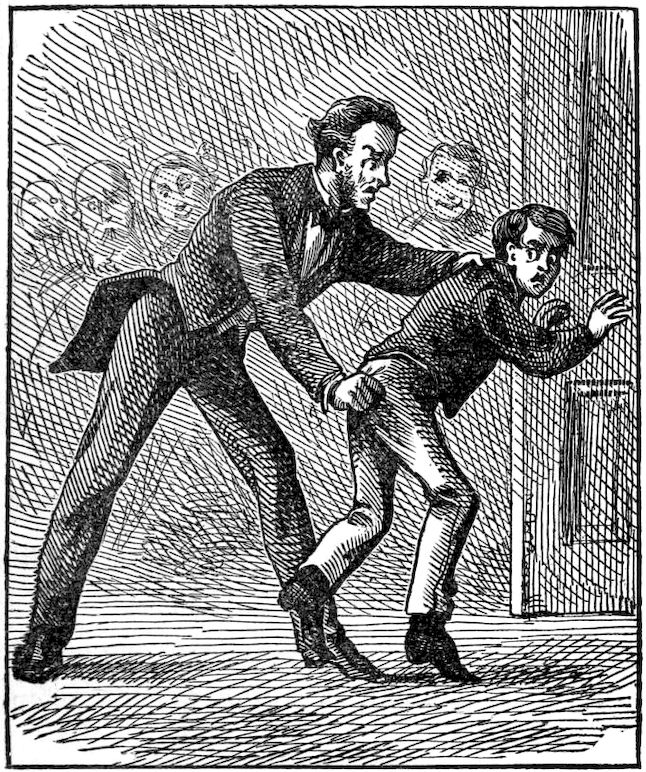
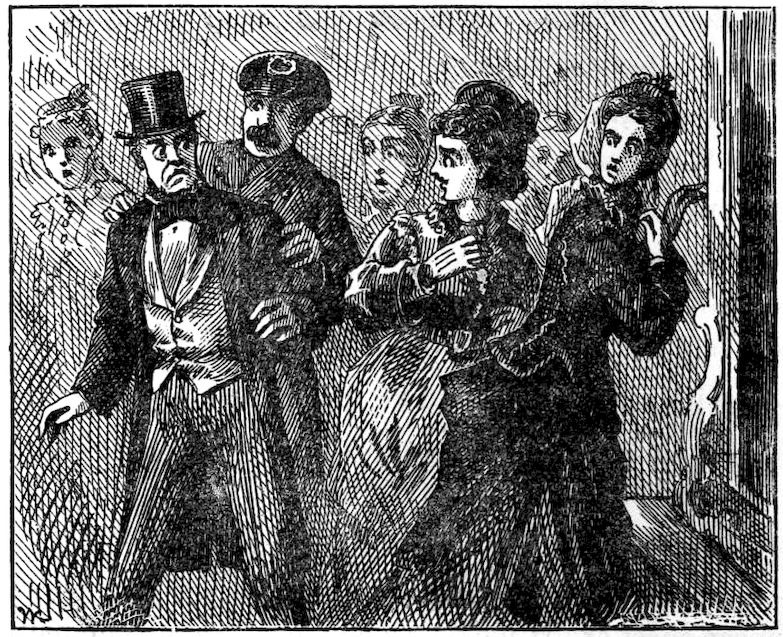
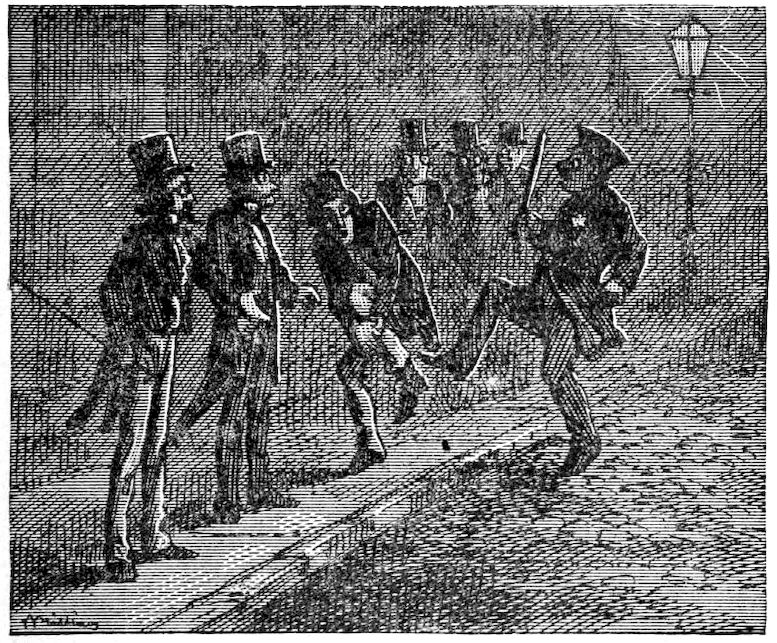
Here he collared him, dragged him out by the
seat of his breeches, and shet the door in his face,
94and came back pantin’ for breath, but proud and
victorious in his mean. Then the Editor of the
Auger got up to make the closing speech, when all of
a sudden the door opened, and in walked Miss Gowdey.
I thought in a minute she looked dretful kinder
flustrated and awe-struck. She sot right down by me—Josiah
had gone across the school-house to speak to
Whitfield on business—and says I:
“What is the matter, sister Gowdey!” (sister in
the church;) says I: “you look as white as a white
woolen sheet.”
Then she says to me and sister Minkley; says she:
“Sunthin’ dretful has happened!”
“What is it?” says I.
“Do tell us sister Gowdey!” says sister Minkley.
Says she, “You know how cold it is!”
Says I, “I guess I do; Josiah froze one of his ears
a comin’ here to-night, as stiff as a chip offen the
north pole.”
“And our buttery shelves froze for the first time
in years,” says sister Minkley.
96
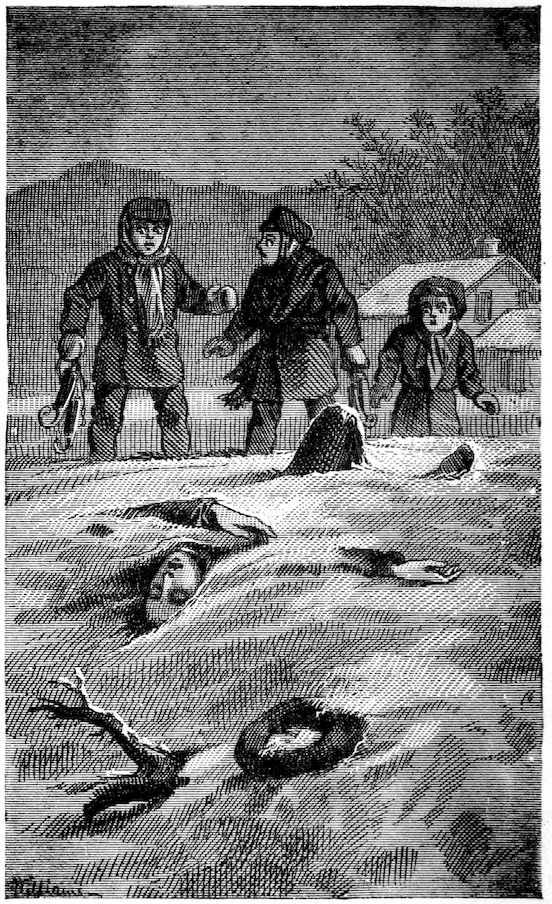
97“Well,” says she “Willie Harris, Widder Harris’es
Willie, was found froze to death in that big snow
drift jest the other side of the canal. You know
sense they licenced that new drinkin’ saloon, Willie
has got into bad company, and he left there late last
night, after he and a hull party of young fellers had
been a drinkin’ and carousin’; he couldn’t hardly
stand up when he left, and they s’pose he lost his
way and fell in the snow; and there he was, jest the
other side of his mother’s, half covered up in the
snow; some boys that were skatin’ on the canal
found him jest at dark. I never see such a house in
my life; the Dr. thinks it will kill his mother, you
know she has worked so hard to educate him, almost
killed herself, and was happy a doin’ it; she loved
him so, and was so proud of him; and she has
such a loving, dependent nature; such a affectionate
tender-hearted little woman; and Willie was all
she had. She lays there, lookin’ like a dead woman.
I have been there all the evenin’.”
All the while Miss Gowdey was a speakin’, my heart
kep’ a sinkin’ lower and lower, further and further
down every minute, till I declare for’t, I didn’t know
where it would go to, and I didn’t much care. Willie
Harris! that handsome, happy boy that had sot on my
knee a hundred times with my Thomas Jefferson;
played with him, slept with him. That bright pretty
boy, with his frank generous face, his laughing blue
eyes, and his curly brown hair—his mother’s pride
and darling. Oh! what feelin’s I felt. And then all
of a sudden, my heart took a new start, and sunk down
more’n two inches I’ll bet, at one sinkin’, as a thought
gripped holt of me. What if it had been my Thomas
Jefferson! And as that thought tackled me, without
mistrustin’ what I was a doin’ I turned round in my seat
and spoke right out loud to sister Minkley. Says I:
“Sister Minkley what if it was my Thomas Jefferson
98that was murdered accordin’ to law? What if it was
my boy that was layin’ out there under the snow?”
Sister Minkley had her white linen handkerchief up
to her eyes, and she didn’t say a word; but she give
several sithes, awful deep; she has got a mother’s heart
under her breast bone; she has had between twelve
and thirteen childern of her own, and they was on
her mind. She couldn’t speak a word, but she sithed
powerful, and frequent. But though I was as agitated
as agitated could be, and though there wasn’t a dry
eye in my head, I began to feel dretful eloquent in
mind; my soul soared up awfully, and I kep’ on:
Says I, “Sister Minkley, how can we mother’s
live if we don’t put our shoulder blades to the
wheel?” says I, “we must put ’em there whether
or no; we are movin’ the wheel one way, or the other
anyway. In this, as in every other reform, public
sentiment has got to work with the law, stand behind
the law and push it ahead of it, or else it wont never
roll onward to victory.” Says I, “It is a wheel that
is loose jinted, the spokes are sot loose on the hub; it
is slippery, and easy to run backwards; it is always
easier to push anything down hill than up, and there is
far more pushers in that direction. And one of the
solemnest things I ever see, sister Minkley, is this
thought—that you and I, and everybody else is a pushin’
it one way or the other every day of our lives;
we can’t shirk out of it, we are either for it or
ag’inst it. A man or a woman can’t git away from
99castin’ their influence one way or the other no more
than they can git away from their shadder on a desert,
with the sun bilein’ down on ’em, and no shade trees
in sight. There haint no trees tall enough to hide us
from the blazin’ sun of God’s truth; this cause is before
us, and we must work with God or ag’inst him.”
“Amen!” says sister Minkley out from under her
white linen handkerchief, and she sithed hard.
“How can we help workin’, sister Minkley? How
can we fold our hands up, and rest on our feather
beds? If a deadly serpent had broke loose from some
circus, and was a wreathin’ and twistin’ his way through
Jonesville, swallerin’ down a man or a woman every
few days, would men stand with their hands in their
pockets, or a leanin’ up ag’inst barn-doors a whittlin’;
arguin’ feebly from year to year, whether it was best
to try to catch the serpent and cut its head off, or
whether it was best after all to let him go free?
After they had seen some of their best friends
swallered down by it, wouldn’t they make an effort to
capture it? Wouldn’t they chase it into any hole
they could get it into? Wouldn’t they turn the first
key on it they could git holt of? And if it broke
loose from that, wouldn’t they try another key, and
another, till they got one that would holt him?
“Do you s’pose they would rent out that serpent at
so much a year to crunch and swaller folks accordin’
to law? And would it be any easier for the folks that
was crunched and swallered, and for the survivin’
100friends of the same, if they was killed by act of
Congress? What would such a law be thought of
sister Minkley? and that is nothin’ to the wickedness
of the laws as they be. For what is one middlin’
sized serpent in a circus, that couldn’t eat more’n one
man a week with any relish, to this of intemperance
that swallers down a hundred thousand every year,
and is as big as that Great Midgard serpent I have
heerd Thomas J. read about, whose folds encompass
the earth.”
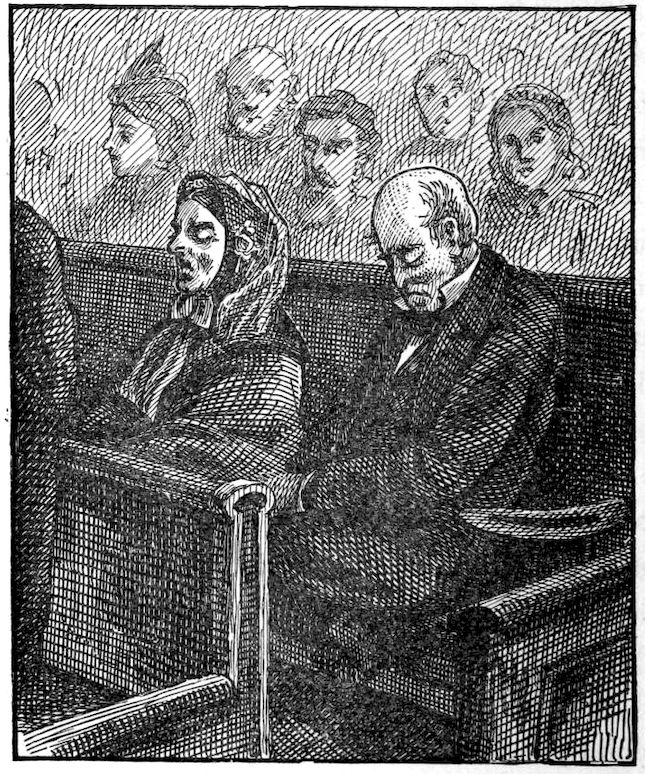
Sister Minkley sithed so loud that it sounded some
like a groan, and I kep’ on in a dretful eloquent way:
“We have got to take these things to home sister
Minkley, in order to realize ’em. Yours and mine,
are as far apart as the poles when we are talkin’ about
such things. As a general rule we can bear other
folks’es trials and sufferin’s with resignation. When
it is your brother, and husband, that is goin’ the
downward road, we can endure it with considerable
calmness; but when it is a part of my own
heart, my Willie, or my Charley that is goin’ down
to ruin, we feel as if men and angels must help rescue
him. When it is mine, when it is mother’s boy that
is lyin’ murdered by this trade of death—when the
cold snow has drifted down over the shinin’ curls that
are every one wove into her heart strings, and the
colder drifts of disgrace and shame are heaped over
his memory—how does the poison look to her that
has killed her darling? How does the law that
101sanctions the murder seem to her? Then it is that
yours and mine draw near to each other. It is the
divine fellowship of suffering our Lord speaks of, that
brings other hearts near to ours, makes us willin’ to
toil for others, live for them, die for them if need be.
It was this, that sent forth that wonderful Woman’s
Crusade, made tender timid women into heroes willin’
to oppose their weakness to banded strength. It was
this that made victory possible to them.
“When a king was chosen in the old time to lead
the people of the Lord to victory, he was consecrated
by the touch of a royal hand. And it was these
women, weak and tender, touched with the divine
royalty of sorrow, that God chose to confound the
mighty.
“And other great souled women, who loved the
praise of God better than the praise of the world,
joined ’em; they swept over the land, the most
wonderful army that was ever seen. Conquerin’
minds and hearts, instead of bodies, with tears and
prayers for weapons. Hindered not by ridicule,
helped by angels, enduring as seeing Him who is
invisible, conquerin’ in His name. What was the
Crusade to the Holy Land that I have heerd Thomas
J. read about, to this? That was to protect the sepulchre
where the body of our Lord was once laid, but
this was to defend the living Christ, the God in man.”
I don’t know how much longer I should have kep’
on, for I seemed to feel more and more eloquent every
102minute—if I hadn’t all of a sudden heerd a little low
modest snore right in front of me, and I see sister
Minkley was asleep, and that brung my senses back
as you may say, and when I took a realizin’ sense of
my situation, and see how still the school-house was
and everybody a listenin’ to me, I was completely
dumbfounded to think I had spoke right out in meetin’
entirely unbeknown to me.
Cornelius Cork the President was a sheddin’ tears,
though bein’ a man he tried to conceal ’em by blowin’
his nose and coughin’ considerable hard. But
coughin’ couldn’t deceive me; no! the whoopin’ cough
couldn’t, not if he had whooped like an Injun’s warwhoop.
I see ’em, I had my eye on ’em.
You see he was own cousin to Willie Harris on his
mother’s side—Willie’s mother and his, was own
sisters. They was old Joe Snyder’ses girls by his first
wife.
Cornelius Cork never asked a person to judge on
the question, or vote on it, or anything. He jest
jumped right up onto his feet, and says he in a real
agitated and choked up voice:
“It is decided, that it is wrong to licence intemperance.”
And then he coughed again awful hard.
And Lawyer Nugent got up and said sunthin’ about
adjournin’ the meetin’ till “Sime-die.” Though what
Simon he meant, and what ailed Sime, and whether
he died or not, I don’t know to this day no more than
you do. Howsumever, we all started for home.
103
TIRZAH ANN AS A WIFE.
Tirzah Ann was to home a visitin’, yesterday.
They keep house in part of Brother Minkley’ses
house, for this winter. Brother Minkley’ses house is
a bigger one than they need, or can furnish, and it is
handy for Whitfield on account of its bein’ near to
the law office where he learnt his trade. But Whitfield
lays out to open a office of his own next summer.
Everybody says he will do well, for the lawyer he
learnt his trade of, has a awful creek in his back most
the hull time. If he is a tryin’ anybody, or a swearin’
anybody,—right when he is a usin’ the biggest
words, a tryin’ and a swearin’—he is liable to crumple
right down, and be carried out with that creek,—no
dependence on him at all; and lawyer Snow has got
so rich that he don’t care whether he works at his
trade or not; so there seems to be a clear road for
Whitfield.
And they are a goin’ to have a house of their own,
104before long,—though nobody knows a word about it,
only jest Tirzah Ann’s pa, and me. I atted Josiah to
give Tirzah Ann her portion, now. Says I,—“They
are a stiddy, likely, equinomical couple, and wont run
through it; why not give ’em a start now, when they
need it, as well as to wait till you and I die, and have
’em kinder lookin’ forred and ‘hankerin’ after our
shoes,’ as the poet says.” Says I,—“give her her talent
now, Josiah, and let her improve on it.” Says I,—“less
buy ’em a house, Josiah Allen; they wont run
through it, I know they wont.”
I would sejest this to Josiah Allen, every little
while; but he hung off. Josiah is close, (but honest.)
But I kep’ a sejestin’ and I kep’ a ’swaidin’, and finally
he give his consent.
We are goin’ to buy ’em a neat little cream-colored
house, with green blinds, right on the age of the village.
We have got our eyes on it now, Josiah and
me have; and to speak more plain, and let out a
secret—which mustn’t go no further—we have got a
contract of it. The man can’t give a clear deed till
1st of September.
This house and the one next to it—which is jest
exactly like it—are kinder set off by themselves, and
are the handsomest, pleasantest places in Jonesville,
and everybody says so. I told Josiah he couldn’t do
better than to buy one of ’em, and he sees it now;
he feels well.
In the back garden is fruit trees of all kinds, and
105berry vines, and bushes, and a well of soft water;
two acres of land, “be it more or less: to wit, namely,
and so 4th, a runnin’ up to a stake, and back again,
to wit.”
Josiah read it all off to me; he is a great case to
read deeds and insurance papers, and so 4th. He
thinks they are dretful agreeable readin’.
I know when we was first married, and he wanted
to use me so awful well,—bein jest married, he naturally
wanted to make himself agreeable and interestin’
to me—and so to happyfy me and keep me
from bein’ homesick, and endear himself still more to
me, he would draw out his tin trunk from under the
bed, and read over deeds and mortgages to me by the
hour. But I didn’t encourage him in it, and kinder
broke it up; but he loves to read ’em to this day;
and I felt so neat over this contract, that I let him
read the hull thing right through, and was glad to
hear it, though it took him one hour by the clock. He
reads slow, and then there was so many whereases,
and namelys, and to wits, that he would git baulked
every few minutes. He would git to wanderin’ round
in ’em—git perfectly lost—and I’d have to lay holt
and help him out.
We are goin’ to git a deed of the house, unbeknown
to Whitfield and Tirzah Ann, and make ’em a present
of it. They was married the 14th day of September,
at 4 o’clock in the afternoon—jest the time Josiah
was born—so I told Josiah that I would bake up as
106nice vittles as I could, and enough of ’em,—enough
to last a week or ten days—and we would have supper
all ready in the new house, jest the day of the month
and the time of the day he was born and they was
married, and invite ’em over; and we’d have Thomas
Jefferson and Maggie Snow, and the Widder Doodle,
and turn it into a sort of 4th of July,—keep the day
in a kind of a camp-meetin’, holiday style.
I believe in workin’ and earnin’ your honest bread,
etc. and so 4th; but still, I believe in makin’ things
agreeable and pleasant, very. We Americans, as a
nation, are a dretful anxious-lookin’, hard-workin’,
long-faced, ambitious, go-ahead race, and we tackle a
holiday as if it was a hard day’s work we had got to
git through with jest as quick as we could; and we
face enjoyments with considerable the same countenance
we do funerals. But I am layin’ out now to
take a good deal of comfort the 14th of next September,
Providence permittin’.
I think a sight of Tirzah Ann. I’ve done well by
her, and she sees it now; she thinks a sight of old
mother, I can tell you. She enjoys middlin’ poor
health, now-a-days, and her pa and I feel anxious
about her, and we talk about her a good deal nights,
after we git to bed; and I wake up and think of her
considerable, and worry.
And truly, if anybody is goin’ to set up in the
worry business, nights is the best time for it in the
hull twenty-four hours; middlin’-sized troubles swell
107out so in the dark; tribulations that haint by daylight
much bigger’n a pipes-tail, at midnight will look
bigger’n a barn. I declare for’t, I’ve had bunnets before
now, that didn’t suit me,—was trimmed up too
gay, or come over my face too much, or sunthin’, and
when I’d wake up in the night and think on ’em,
they’d look as big to me as a bushel basket, and humblier;
and I’d lay and sweat to think of ever wearin’
’em to meetin’; but at daylight, they would kinder
dwindle down again to their natural shape. And so
with other sufferin’s that come tougher to me to bear.
When I was a bringin’ up Thomas Jefferson, tryin’ to
git him headed right, how many times he has stood
before me at midnight a black-leg—his legs as black
as a coal, both of ’em;—a pirate; a burglar; he has
burgled his pa and me, night after night; set Jonesville
afire; burnt New York village to ashes; and has
swung himself on the gallows.
And Tirzah Ann has had cancers; and childern;
and consumptions; and has been eloped with; and
drownded in the canal, night after night; but good
land! in the mornin’ the childern was all right. The
sunshine would shine into my heart like the promises
in the Bible to them that try to bring up their childern
in the fear of the Lord; and I could lay holt of
them promises and feel first rate.
And Josiah Allen! I s’pose I have buried that man
as many times as he has got hairs on his head, (he is
pretty bald) when he’d have a cold or anything. I’d
108wake up in the latter part of the night, when it was
dark as Egyptian darkness, and I’d git to thinkin’
and worryin’, and before I knew it, there Josiah
would be all laid out and the procession a meanderin’
off towards Jonesville buryin’ ground, and I a follerin’
him, a weepin’ widder. And there I’d lay and
sweat about it; and I’ve gone so far as to see myself
lay dead by the side of him, killed by the feelin’s I
felt for that man; and there we’d lay, with one stun
over us, a readin’:
“Here lays Josiah and Samantha;
Their warfare is accomplished.”
Oh! nobody knows the feelin’s I would feel there
in the dead of night, with Josiah a snorin’ peacefully
by my side. But jest as quick as the sun would rise
up and build up his fire in the east, and Josiah would
rise up and build up his fire in the stove, why them
ghosts of fears and anxieties that haunted me, would,
in the language of the poem Thomas J. was readin’
the other day:—Fold up their tents like an Arab
man and silently go to stealin’ somewhere else. And
I’d git up and git a splendid breakfast, and Josiah
and I would enjoy ourselves first rate.
There is sunthin’ in the sunlight that these phantoms
can’t stand; curious, but so it is. Their constitution
seems to be like the Serious flower that blows
out in the night. These serious ghosts—as you may
say—are built jest right for livin’ in the dark; they
109eat darkness and gloom for a livin’, die off in the daytime,
and then resurrect themselves when it comes
dark, ready to tackle anybody again, and haunt ’em,
and make ’em perfectly miserable for the time bein’.
But truly, I am a episodin’; and to resoom and go on:
Tirzah Ann, as I said, come down a visitin’; she
brought down a little pail of canned sweet corn, all
fixed for the table. I thought that sweet corn would
be the death of the Widder Doodle; it made her
think so of Doodle.
“Oh!” says she, “when I think how I used to
raise sweet corn in my garden, and how Mr. Doodle
would set out on the back stoop and read to me them
beautiful arguments ag’inst wimmen’s rights, when I
was a hoein’ it; and how he would enjoy eatin’ it
when I’d cook it, it seems as if I can’t stand it; and
shant I never see that man?” says she, “shant I
never see that dear linement again?”
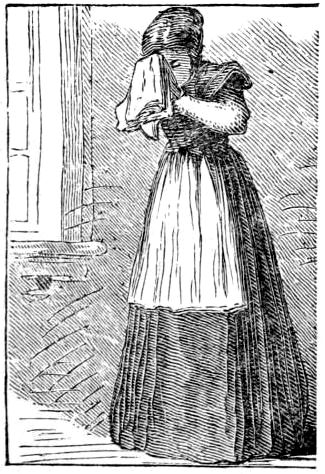
And she out with her snuff handkerchief and covered
her face with it. Whether she cried or not, I
don’t know. I shant say she did, or didn’t; but she
went through with the motions, that I know.
Tirzah Ann was all offen the hooks, yesterday, she
felt down-hearted and nervous. She is dretful nervous
lately; but I tell Josiah that I’ve seen other
wimmen jest as nervous, and I have; and they got
over it, and Tirzah Ann will. There was she that
was Celestine Gowdey, she was so nervous—I’ve
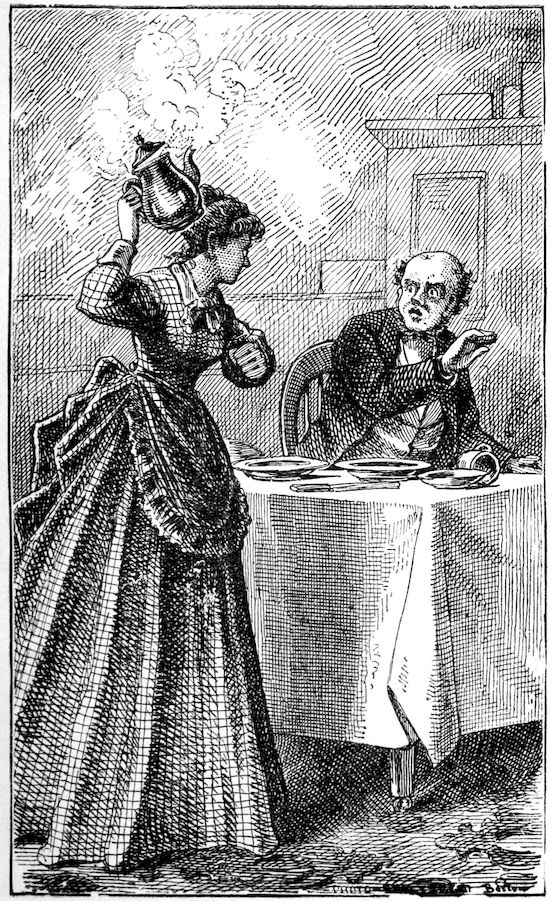
heerd her mother say—her husband was most afraid
110of his life; she would throw anything at him—the
tea-pot, or anything—if he said a word to her she
didn’t like; scalded him a number of times, real bad.
But he, bein’ considerable of a family man—he had
had three wives and fourteen or fifteen childern, before
he married Celestine—didn’t mind it, knowin’
what wimmen was, and that she’d git over it and she
did; and so will Tirzah Ann. It comes considerable
hard on Whitfield now, but he will git over it
and wont mind bein’ scolded at, if it rains, or if it
don’t rain, or if the old cat has kittens.
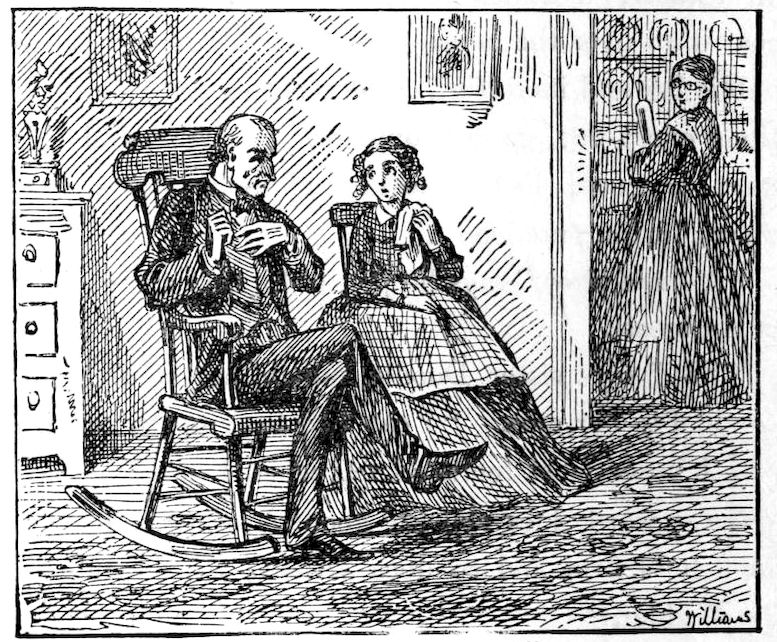
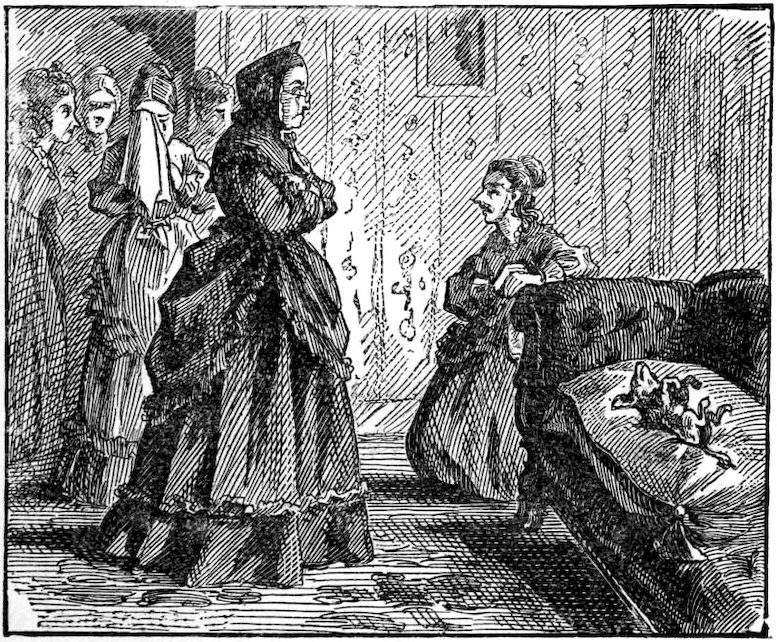
After dinner the Widder Doodle went up stairs
and laid down for a nap, as she makes a practice of
doin’ every day; and glad enough was I to see her
go. And after she had laid down and our ears had
got rested off, and I had got the work all done up,
and Tirzah Ann and me had sot down to our sewin’—she
was doin’ some fine sewin’ and I laid to and
helped her—as we sot there all alone by ourselves
she began on me, and her face lengthened down a
considerable number of inches longer than I had ever
seen it as she went on:
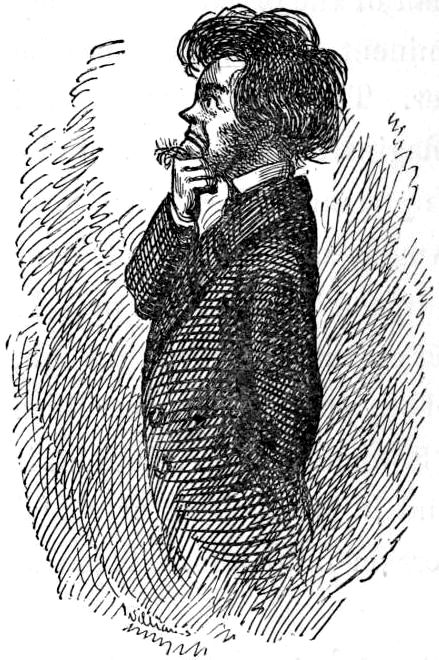
She was afraid Whitfield didn’t think so much of
her as he used to; he didn’t act a mite as he used to
when he was a courtin’ of her. Didn’t kiss her so
much in a week now, as he used to one Sunday night.
Didn’t set and look at her for hours and hours at a
time, as he did then. Didn’t seem to be half as ’fraid
of her wings spreadin’ out, and takin’ her up to
heaven. Didn’t seem to be a bit afraid of her goin’
up bodily. Didn’t call her “seraph” any more, or
“blessed old honey-cake,” or “heavenly sweetness,”
or “angel-pie.” About all he called her now besides
Tirzah Ann, was “my dear.”
111
113I see in a minute the cause of the extra deprested
look onto her face that day, I see in a minute “where
the shoe pinched” as the poet says. And I see here
was a chance for me to do good; and I spoke up real
earnest like, but considerable calm, and says I:
“Tirzah Ann, that is a first-rate word, and your
husband Whitfield Minkley hits the nail on the
head every time he says it. ‘Dear!’ that is jest
what you are to him, and when he puts the ‘my’ onto
it that tells the hull of the story; you are dear, and
you are hisen, that is the hull on’t.” Says I, in a real
solemn and almost camp-meetin’ tone, “Tirzah Ann
you are a sailin’ by that rock now that the happiness
of a great many hearts founder on, that a great many
life boats are wrecked on.” Says I, “lots of happy
young hearts have sailed smilin’ out of the harbor of
single blessedness, hit ag’inst that rock and gone
down; don’t you be one of ’em;” says I, “don’t make
a shipwreck of the happiness of T. A. Minkley late
Allen; histe up the sail of common sense and go round
the rock with flyin’ colors,” and says I in agitated
tones, “I’ll help you, I’ll put my shoulder blades to
the wheel.” And I continued in almost tremblin’
114tones—as I trimmed off the edge of the linen cambric,
and went to overcastin’ of it:
“I never could bear to see anybody want to set
down and stand up at the same time,” says I, “it
always looked so unreasonable to me.” And says I:
“Tirzah Ann, you are in the same place; you want
to be courted, and you want to be married at the same
time; you want a husband and you want a bo out of
the same man, simultaneous, as it were.”
Says I: “Truly we can’t have everything we want
at one time. There is a time for apple trees to blow
out, rosy color—sweet—with honey bees a hummin’
round ’em; and there is a time for the ripe fruit, and
apple sass. We can’t have good sleighin’ in hot
weather, we can’t be drawed out to a peach tree to
eat ripe peaches on a hand sled. Slidin’ down hill is
fun, but you can’t slide down hill over sweet clover
blows, for clover and snow don’t blow out at the same
time. And you can’t have peace, and rest, and quiet
of mind, at the same time with delerious enjoyment,
and highlarious mirth.
“There is as many kinds of happiness as ‘there is
stars in the heavens,’ and no two stars are alike, they
all differ from each other in their particular kind of
glory.
“Now courtin’ is considerable fun, sunthin’ on the
plan of catchin’ a bird, kind o’ resky and uncertin’
but excitin’ like, and considerable happyfyin’. To
set down after a good supper, contented and quiet, by
115a bright fireside with your knittin’ work, and your
affectionate pardner fast asleep and a snorin’ in the
arm chair opposite, is another kind of happiness,
nothin’ delerious nor highlarious about it, but considerable
comfortin’ and consolin’ after all. Now you
have got a good affectionate husband Tirzah Ann, a
man that will look out for your comfort, do well by
you, and be a good provider; and you musn’t expect to
keep the lover; I mean, you musn’t expect him to go
through with all the performances he used to when he
was tryin’ to get you; why it is as unreasonable as
anything in the world can be unreasonable.”
“Now” says I, “there’s your pa and me, Tirzah
Ann; we have lived together in the neighborhood of
twenty years, and we are attached to each other with
a firm and cast-iron affection, our love for each other
towers up like a pillow. But if that man should go
to talkin’ to me as he used to when he came a courtin’
me, I’d shet him up in the smoke house, for I should
be afraid of him, I’ll be hanged if I shouldn’t; I
should think he was a luny.
“I s’pose he thought it was necessary to go through
with all them mysterious, curious performances,—talkin’
strange; praisin’ me up to the skies; runnin’ other
wimmen down to the lowest notch; jealous of likely
men; actin’ wild, spooney; eyein’ me all the time as
close as if he was a cat, and I was a rat hole; writin’
the curiousest letters to me; threatenin’ to kill himself
if I wouldn’t have him; and jumpin’ up as if he
116would jump out of his skin, if I went to wait on myself
any, pick up a ball of yarn, or open a door or
anything. I s’pose he thought he had got to go
through all this, or else it wouldn’t be courtin’. But
good land! he couldn’t keep it up, I hadn’t no idee
he could, or he couldn’t get no rest nor I nuther. It
wore on me, he used to talk so dretful curious to
me, so ’fraid I’d get killed or wait on myself a little
or sunthin’; and eat! why I s’pose he eat next to
nothin’, till I promised to have him. Why! when we
got engaged he wasn’t much more’n skin and bones.
But good land! he eats enough now to make it up; we
hadn’t been married a month before he’d eat everything
that was put before him, and instead of settin’
down and talkin’ strange at me, or jumpin’ up as if
he was shot to open the door—so ’fraid that I would
strain myself openin’ a door;—why, he would set and
whittle and let me wait on myself jest as natural—let
me sprain my back a reachin’ for things at the table,
or bring in wood, or anything. Or he would drop to
sleep in his chair, and sleep most the hull evenin’ he
felt so contented and happy in his mind.”
I see I was a impressin’ Tirzah Ann the way I wanted
to—and it made me feel so neat, that I went to allegorin,
as I make a practice of doin’ real often, when
I get eloquent; sunthin’ in the Bunyan style, only
not so long. It is a dretful impressive way of talkin’.
118
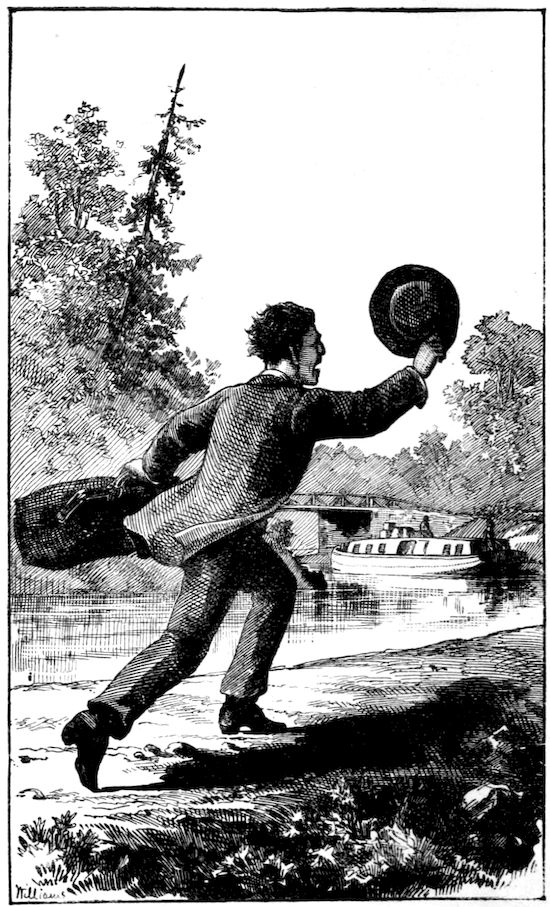
119Says I, “S’posen a man was a racin’ to catch a
boat, that was liable to start off without him. How
he would swing his arms and canter, and how the
sweat would pour offen his eyebrows, so dretful afraid
he wouldn’t get there in time to embark. But after
he had catched it, and sot down as easy as could be,
sailin’ along comfortable and happy towards the place
he wants to go to; how simple it would be in him,
if he should keep up his performances. Do you s’pose
he is any more indifferent about the journey he has
undertook because he haint a swingin’ his arms, and
canterin’? No! the time for that was when he was a
catchin’ the boat, ’fraid he shouldn’t git it in time.
That was the time for racin’, that was the time for
lookin’ wild, that was the time for sweat. And when
he had catched it that was the time for quiet and
happiness.
“When Whitfield Minkley was a tryin’ to git you,
anxious, ’fraid he shouldn’t, jealous of Shakespeare
Bobbet, and etcetery,—that was the time for exertion,
that was the time for strange talk, spoony, wild,
spiritual runnin’ and swingin’ of the arms, sentimental
canterin’ and sweat. Now he has got you, he is
jest as comfortable and happy as the man on the boat,
and what under the sun is the use of his swingin’ his
arms and hollerin’.
“There you two are, in your boat a sailin’ down
the river of life, and don’t you go to upsetin’ it and
your happiness, by insistin’ on makin’ him go through
with all the performances he did when he was a tryin’
to catch you. It is unreasonable.”
120I never see any one’s mean change much more in
same length of time than Tirzah Ann’s mean did, while
I was a allegorin’. Her face seemed to look a number
of inches shorter than it did when I begun.
Pretty soon Whitfield come, and he and Tirzah
Ann stayed and eat supper, and we should have got
along first rate, only there was a nutcake—a long slim
one with two legs—that put the Widder in mind of
Doodle; it happened to be put on her plate, and she
cried one hour and a half by the clock.
121
P. A. AND P. I.
Last Tuesday, Thomas J. took Maggy Snow over
to Tirzah Ann’s a visitin’, and they stayed to the
Debatin’ school; and it was that evenin’ that Josiah
and me first talked it over about goin’ to the Sentinal.
Thomas J. and Maggy haint married yet; when they
will be I don’t exactly know, but before long I think.
Josiah can’t bear the thought of havin’ Thomas J.
goin’ away from home, and Squire Snow wants to
keep Maggy jest as long as he can. He has been
awful sot, the old Squire has, on havin’ ’em live
there right in the family after they was married.
But Thomas J. is as determined as a rock in one
thing, that when he and Maggy are married they are
goin’ to keep house by themselves. And I don’t
blame him a mite. The Squire’s folks are well off and
have got everything nice and convenient, hot and cold
water comes right up into the chambers, and other
things for their comfort. But his sister Sophronia
122Snow, lives with ’em; has got to have a home there
always accordin’ to old Mr. Snow’ses will. And I’ve
heerd, and haint a doubt of it in my own mind, that
she is a meddlesome critter, and grows worse as she
grows older. You know time affects different natures
different, etcetery, and to wit:—it will make wine
softer, and sweeter, and mellower, and make vinegar
sour, and sharper than a serpent’s tooth, if serpents
have got teeth, which I never believed for a minute.
I don’t blame Thomas J. a mite for not wantin’ to
settle down and live with ’em, neither do I blame
’em for not wantin’ to come and live with us, though
it would be dretful agreeable to me and Josiah.
Thomas J. talks about goin’ west to live, when he
gets married, and if he does it will be a awful blow
to me, but still I want him to do what is best for
him, and I tell Josiah that we all ort to use reason if
we have got any to use. Let the young birds build
a nest for themselves, even if the old birds are lonesome.
Says I to Josiah:
“We left two old birds lonesome Josiah Allen,
when we built our own nest and feathered it out on
the inside to our own comfort and likin’, with the
pure white feathers of love and content;” (I meant
by the two old birds father Smith and mother Allen,
though they don’t look a mite like birds either of
’em.) “and them feathers we feathered it out with,
are warm and soft now as anything.”
“Well,” says Josiah, “we didn’t go west.”
123That thought seems to plague him the most of
anything, and it does me too, I don’t deny.
But Thomas J. is in the right on’t about wantin’ to
set out in married life without any outside weights
and incumbrances. The first years in married life is
a precarious time, make the best of it. A dretful
curious, strange, precarious time; and if ever a
woman wants a free room for meditation and prayer,
it is then; and likewise the same with the man.
There never was two persons so near alike, but what
they was different, and had their different ways and
eccentricities; and folks don’t realize the difference
in their dispositions so much, I can tell you, when
they live from a half to three quarters of a mile
apart, as they do when they cook over the same stove,
and sleep under the same comforter. A woman may
think she knows a man jest as well as if she had been
through his head with a lantern a number of times;
but let her come to live with him from day to day,
and from week to week—in sunshine and in storm;
when dinner is ready at noon, and when it is late;
when his boot-jack is on the nail, and when it gets
lost; when stove pipes are up, and when they are
bein’ put up; and in all other trials and reverses of
life. I tell you she will come acrost little impatient
obstinate streaks in him she never laid eyes on before,
little selfish, overbearin’ streaks. And the same with
her. He may have been firm as a rock in the belief
he was marryin’ an angel, but the very first time
124he brings unexpected company home to dinner on
washin’ day, he’ll find he haint. They may be awful
good-principled well-meanin’ folks nevertheless, but
there are rocks they have got to sail round, and they
want strength, and they want patience, and they
want elbo’ room. It is a precarious time for both on
’em, and they don’t want no third person round be she
male or female, sacred or profane, to intermeddle or
molest. Let ’em fight their own warfare, enjoy their
own blessings, build up their own homes in the fear
of God, sacred to their own souls alone, and to Him.
They don’t want any little hasty word they may
say to each other, commented on and repeated five
minutes after, when it is all made up and forgiven.
They don’t want anybody to run and complain to, in
the little storms of temper that sometimes darken the
honeymoon. Good land! if they are let alone the
little clouds will disperse of themselves. And there
is another moon, what you may call the harvest moon
of married life, that rises to light true married lovers
on their pilgrimage. It may not be so brilliant and
dazzlin’ as the honeymoon, but its light is stiddy, and
calm, and mellow as anything, and it shines all the
way down to the dark valley, and throws its pure
light clear acrost it to the other side. Thomas J.
and Maggy will walk in its light yet, if they are let
alone, for they love each other with a firm and cast-iron
affection, that reminds me of Josiah and me, my
affection and hisen.
125So as I say I don’t blame ’em a mite for not wantin’
to live with his folks or hern. When passion has
burnt itself out, and been purified into a calm tender
affection but firm as anything can be firm, and patience
has been born of domestic tribulation; when
they have built up their own home on the foundations
of mutual forbearance, and unselfishness, and trust in
each other, as they will have to build it in order to
have it stand—then in the true meanin’ of the term
the two twain have become one. The separate strands
of their own individual existence will become twisted
into one firm cord, strong enough to stand any outside
pressure—Sophronia Snow, or any other strain.
Then if they want to take in a few infirm or even bedrid
relations on his side or on hers, let ’em take ’em
in, it would be perfectly safe. Let ’em do as they are
a mind to, with fear and tremblin’.
But though I tell all this to Josiah Allen a tryin’ to
make him reconciled to the idee of lettin’ Thomas J.
go, though I keep a firm demeanor on the outside of
me, nobody knows the feelin’s I feel when I think of
his goin’ west to live.
Why when Tirzah Ann was married, the day after
she moved away, the feelin’s I felt, the lonesomeness
that took holt on me, wore on me so that I had to go
to bed regular, ondress, and everything. But I held
firm there in the bed, I hung on to reason, and never
let on what ailed me. And Josiah and the Widder
Doodle, was skairt most to death about me, and sweat
126me—give me a hemlock sweat. And though I didn’t
say nothin’ thinks’es I to myself, with the bitter feelin’s
I have got inside of me, and a hemlock sweat on
the outside, I am in a pretty hot place.
But I persume that sweat was the best thing they
could have done. It kinder opened the pours, and
took my mind offen my troubles. It was so oncommon
disagreeable, and hard to bear, that I couldn’t
think of anything else while it was a goin’ on. And
then it satisfied them, that was why I let ’em go on
with it; it kinder took up their minds, and kep’ ’em
from talkin’ to me every minute, and mournin’ to me
about Tirzah Ann’s goin’ away. Truly, feelin’ as I
felt, I could stand a hemlock sweat better than I could
that.
But as I said more formally, I held firm there in the
bed. Though my body was wet with sweat, my mind
was dry and firm, and my principles cool and hefty.
I knew it was the way of nater, what I ort to have
expected, and what was perfectly right. I couldn’t
expect to keep the childern with me always, it was
unreasonable. And though it would seem as lonesome
and roomy as if one side of the house was gone,
I must stand it the best I could. Now when a bird
lets her young ones fly away from the old nest, I dare
persume to say, lots of memories almost haunt that
old bird’s heart, of sweet May mornin’s, and the little
ones chirpin’ in the nest, and her mate a workin’ for
’em, and a singin’ to ’em close by. I dare say she
127thought it all over, that old bird did, how the sweet
May mornin’ with its bloom and gay brightness, she
couldn’t never see again, and the little soft, dependent,
lovin’ things couldn’t never come back to her heart
again, to be loved and to be worked for, and she, paid
for that work every minute by watchin’ their growin’
strength and beauty. But she held firm—and when
the time came for ’em to fly, she let ’em fly. No
matter what she felt, upheld by duty and principle
she pushed ’em out of the nest herself. She held
firm, and so Samantha Allen is determined to, she
whose maiden name was Smith.
If Thomas J. and Maggy could feel contented to
settle down in Jonesville after they was married, the
cup of my happiness would be full and runnin’ over,
and so would Josiah’s cup; for we could see him
every day, or three times a day if we wanted to.
But they have got a good Doctor there now—Thomas
J. has studied for a Doctor; goin’ to get his sheep-skin
in July. Though I have said and I say still,
that I never heerd of such a present to give the last
day of school as a sheep-skin. And it looks to me
as if his teachers was dretful hard up for presents, to
have to fall back on a sheep-skin. I told Thomas J.
that when a scholar had studied day and night as he
had for three years and over, it seemed as if (if they
was goin’ in to sheep presents at all,) they ort to give
him as much as a live sheep, instead of killin’ it and
eatin’ the mutton themselves, and givin’ him the
128hide; howsumever, it haint none of my business, and
if he is satisfied I ort to be. Old Dr. Bombus speaks
dretful well of him, says he is jest as good a Doctor
to-day as he is; but folks have got kinder attached
to the old Doctor, he havin’ helped their friends into
life and out of it, for years, they naturally take to him,
and there don’t seem to be much of any chance for a
young Doctor, I think; and I know that Thomas J.
and Maggy had ruther stay in Jonesville if it wasn’t
for that he and Maggy settle down by themselves
there—than to go west. But if he makes up his mind
to go, I am determined to put my shoulder blades to
the wheel, keep my mind stiddy and stabled, so’s to
do justice to my own principles, and be a comfort to
my Josiah.
As I said, Thomas J. took Maggy over to Tirzah
Ann’s in the mornin’ a calculatin’ to stay to the Debatin’
school, and I told Josiah we’d have an early supper,
and go in good season. We had stewed oysters, and
warm biscuit and canned peaches, a first rate supper,
and Josiah said it was. And it went off dretful agreeable
all but one thing; the Widder Doodle shed tears
when Josiah passed the oysters to her, she said them
oysters put her in mind so of Doodle.
But she wiped up in a minute or two, and enjoyed
her supper first rate. She didn’t want to go out in the
cold she said, and she offered to wash up the dishes—there
wasn’t but a handful of ’em and so I let her.
The dish-pan put her in mind of Doodle again, and
129we left her a cryin; it was time to go and we
started off.
Josiah went to the Post-office, and I had a little
tradin’ to do to the stores and the groceries. But
Jonesville was all up in end, as you may say, and
every place where I went to I could see that every
man was rent with excitement to his very foundations.
A grocer man where we did our tradin’ had been
burgled the night before. A poor man, a chair
bottomer by trade, had stole a codfish weighin’ two
pounds and a half, and a dozen of onions. He had
tried to git work and couldn’t git a thing to do, so he
was obleiged to follow his trade in a different way
from what he wanted to follow it; and the consequence
was, his family was perishin’ for food. And
his wife havin’ the consumption thought she could eat
a little codfish and onions if she had ’em. So, as he
couldn’t get trusted for 22 cents he lay to and stole
’em. And Jonesville rose to a man in anger and
wrath, I never see so big a excitement there, and
Josiah said he never seen a excitement there or any
where else, any where near the size of this. More’n
a dozen told us the story before we had been in the
grocery twenty minutes, for they was rampant to
tell it.
They said: they got on the track of the codfish
and onions early in the mornin’, tracked ’em to the
haunt of the robber (he lived in a shanty on the age
of the village) and tore the booty he had obtained by
130lawless rapine from his grasp. The grocer man that
was rapined got back the biggest part of the codfish
skin, and three of the onions. Though they said the
robber’s pardner in iniquity tried to conceal her guilty
treasure beneath the straw bolster, for she was sick
abed, and didn’t know when she should ever get anything
to eat again.
They said they demolished the straw bolster right
there on the spot, in their righteous anger and
as an example to the woman of the mighty power
and justice of the law, and dragged the man off to
jail of course. But they wasn’t satisfied with that,
they wanted to make an example of him. The man
he rapined came out boldly and said he ort to be masicreed
right there in the streets. Says he, “What is
the nation comin’ to, if thieves and robbers haint made
public patterns and examplers of?”
An old man in a blue soldier overcoat who was
tryin’ to get trusted for some plug tobacco said to the
grocer man: “He ort to be guletined.”
But the grocer didn’t know what that meant; he
thought the old man was kinder praisin’ him up, so
he acted mad and wouldn’t trust him. But the one
that seemed to talk the biggest about it was P. Cypher
Bumpus. Bein’ a lawyer by trade, he has got well
acquainted with some uncommon big words, and he
naturally loves to let folks see on what familiar terms
he is with ’em.
131
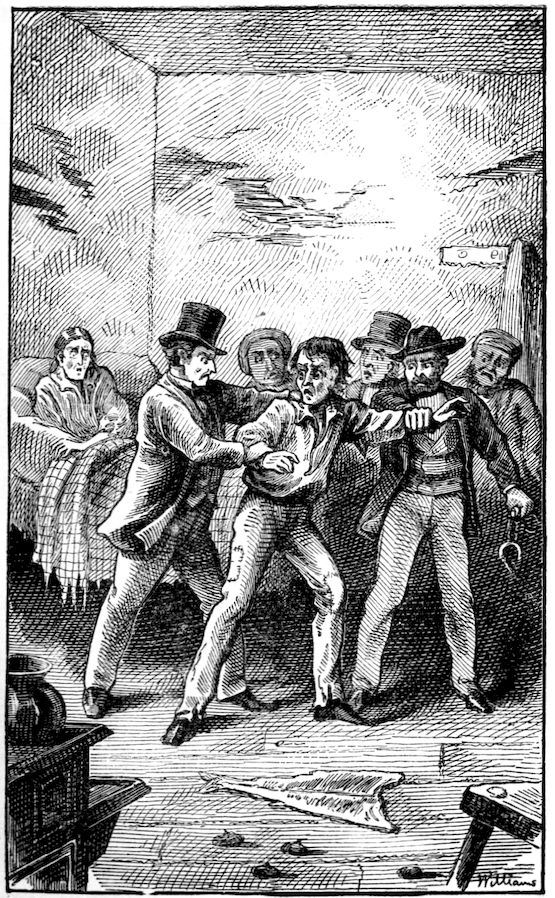
133He uses ’em like a master workman. He didn’t
gesture a mite; they say he wont on common occasions.
I’d give a cent though if he had been willin’
to, for I s’pose it is a sight worth goin’ miles to see.
But he used words more’n three inches long, and I
don’t know but some would have come nigh onto
four inches in length, a goin’ on about this rapine.
“Yes,” says Cornelius Cork takin’ aim at us with
his forefinger as if we was rabbits eatin’ his early
cabbages. “Stealin’ is sunthin’ that Jonesville and
the nation cannot and will not, put up with. And
such villains and robbers will find out that we wont;
fur frummit.”
“He ort to be gulentined,” says the old man again.
“Ort to have his head chopped right off with an axe.”
They all looked favorably at the old man now, and
the grocer man trusted him right on the spot for a
plug of tobacco.
Josiah come in jest then with the World in his hand,
and he turned to Cornelius Cork, and says he:
“I see by the World to-day, there has been another
case of public stealin’; another hundred and fifty
thousand stole from us out of the public treasury.”
“Yes,” said Cornelius Cork in a mild gentle tone:
“A little case of fraud, that is all.”
“Merely a deficit in accounts,” says the grocer man
who was rapined, in a ’poligy tone.
“Only a triflin’ defalcation from the revenue,”
says the old man, bitin’ off another chew of his
tobacco with a serene countenance.
134“Nothin’ to speak of,” says P. Cypher Bumpus.
“Nothin’ worth mentionin’, a triflin’ abstraction, a
diminution, a withdrawal of funds, a emblezzlement.”
Oh, what feelin’s I felt to hear ’em go on; but I
didn’t say a word to ’em, I don’t believe in a woman
bein’ bold and forred in her demeanor. But to see
every one on ’em givin’ that stealin’ a bigger and a
bigger name, swellin’ and puffin’ it out from fraud
clear up to embezzlement, and no knowin’ where they
would stop, if somebody didn’t interfere. I declare
for’t, it give me such feelin’s that I spoke right out
to Josiah, and my tones sounded low and awful, for I
heerd ’em unbeknown to me.
Says I, “Josiah Allen, what feelin’s it makes me
feel to see folks strain so, and hang back from eatin’
a gnat, and then swaller a elephant and a rinosterrous
and a drumedary.” Says I, “When a poor
man in the case of sickness steals a onion and a codfish,
he is called a thief and a robber; he is drummed
out of camp, sent to jail, knocked down by public
opinion, and kicked after he is down by the same, till
he is completely mortified, and shame and disgrace
bow his forward down into the dust. But let a rich
man steal all he can lay his hands to, and they think
it is sunthin’ pretty in him, so pretty that they make
a new name for it, and he wears that name like a
feather in his cap. If he breaks down a purpose to
cheat his creditors, they call it ‘compromisin’ ‘repudiation,’
both of these name stand up like beautiful
135feathers over his forward, and he looks grand and
feels so. If he lays to and steals right out openly
hundreds of thousands of dollars they have lots of
curious and handsome names to ornament him with,
all the way from defalcator and deficitor up to embezzler.
Why, if some politician should steal the hull
United States treasury, they would have to make a
new set of names to trim him off with, there wouldn’t
be none in the dictionary half big and noble enough.”
I follered my pardner almost mekanically out of
the store. What they said to my back after I left, I
know not. But we must all expect to be backbited
some, else why do we have backs.
In about seven minutes time we was seated in front
of the Jonesville Creation Searchers, a listenin’ to a
epicac poem from Shakespeare Bobbet—or that is
how Josiah understood it; I myself thought they
called it a epock poem; but Josiah said when we was
a talkin’ it over a goin’ home, that he would bet the
colt it was a epicac.
Says he, “You know epicac means sunthin’ kinder
weakenin’, and sickenin’, and that is why such poems
as hisen are called epicacs.”
“Well,” says I, “seein’ we haint either of us certain,
we wont lay out too much breath arguin’ about
it. But this I know, that the poetry was as long
and dreary as the desert of Sarah, and as dry as Sarah
ever was in her dryest times.”
It happened dretful kinder curious, but the question
136up that night before the Creation Searchers was about
Kleptomania—another big name for stealin’ that I
never heerd before—and they proved it out so beautiful,
how Kleptomania worked in the system, and how
anybody couldn’t help stealin’ who had the distemper.
After they settled this to their own satisfaction, and
the enlightenment of the world, the President got up
and in a awful thrillin’ and impressive manner,—and
usein his gesture as handy as I ever see a gesture used—went
on and talked in a foamin’ manner about the
Sentinal that was goin’ to be at Filadelfy village to
celebrate old Epluribus’es birthday; and he went on
for probable half an hour about its uncommon and
amazin’ bigness, and he said when all the rest of the
celebrated men of America and the world was to be
there, it didn’t look well for them to hang back, and
shirk out of goin’, and he motioned that the Creation
Searchin’ Society should send a body there, to encourage
the Sentinal, and collect information as a body,
and he went on to say that if they concluded to
send a body there, they would proceed to vote on who
should be the body, and how many it should be.
Solomon Cypher got up and said the name told on
the face of it: Sent-ten-al. He said the doin’s was
named with the view that there would be ten sent
there from the Jonesville Creation Searchin’ Society.
The minute he sot down, Simon Slimpsey got up
lookin’ as if he would sink right down through the
floor into the suller. I’d seen that Betsey, his wife
137had been a hunchin’ and pokin’ him, tryin’ to make
him git up, and whisperin’ to him in a loud angry
whisper. And says he in a heart broken tone: “If
it will add any to the gloom and melancholy”—here
Betsey give such a jerk at his coat skirts that he
crumpled right down for a minute, and his tone was
skairt as he went on—“and highlarity of Filadelfy to
have a poem sent by Betsey, I can carry it, I s’pose.”
And he sunk down a murmurin’: “I may live through
it, and I may not.” And he almost buried his face in
his right hand, and I think shed tears. It come hard
on Simon.
But Solomon Cypher’s face looked dark and severe,
and he rose up and smote himself powerful and frequent
as he said:
“For the time bein’ I represent the body. And
speakin’ in the name of the body which I now am, I
say, that we, the body cannot, and will not be trammeled
and bound down by either poetry, or bed-quilts.”
(Two wimmen jest in front of him was a
whisperin’ loud; rampant to send a blazin’ star and a
sunflower.) “The body has got a great reputation to
keep up, the eye or eyes of the different globes assembled
there will be on it, watchin’ the demeanor of the
body and copyin’ after it. A great reputation is to
be kep’ up.”
Here he made a low bow and set down. And
Shakespeare Bobbet, Secretary of the Creation Searchers,
got up, and said as it was doubtless the aim
138of all present to make as great a stir as possible in the
literary and scientific world, and as they were all a
workin’ for that end, and as there was now nine shillings
and six pence in the treasury, he proposed those
moneys should be expended in purchasing spectacles
for the body to wear on the body.
The Editor of the Auger jumped up and seconded
the motion, sayin’ he hadn’t a doubt about its increasin’
its reputation for deep and scientific wisdom. And
he thought large round eyes would be best adapted to
givin’ the body a wise look, and that heavy brass
bows would help to give weight to its opinions.
They all agreed on this and the motion was carried
in triumphant. Then one feller who had been round
to literary conventions a good deal and had got high
notions in his head, proposed that the body should let
their hair grow long in their necks; he said it would
be a great help to ’em. But as the President, and
Solomon Cypher and the most of the head ones was
as bald as a bald eagle—hadn’t hardly a mite of hair
to their heads—the motion was laid down under the
table; and they began to vote on who was to be sent.
They voted in Cornelius Cork, and Solomon Cypher,
and the Editor of the Auger, and Shakespeare Bobbet
and several others, and everything seemed peaceful
and happy—Solomon Cypher countin’ ’em serenely
out of his hat—when all of a sudden without no warnin’
he jumped up, and brandished a vote in his hand,
and yelled out in a voice a good deal like thunder:
139“Who! where is the villain who has dared to demean
this society and put it to shame by votin’ for a
woman? Where is the wretch and the demeaner?”
And he looked as black and wrathful as an iron
musket, and he struck himself in the breast powerful
blows, and with every smite he would call out for
“that villain and demeaner.” It was a fearful time;
but right when the excitement was rainin’ most fearfully,
I felt a motion by the side of me, and my companion
got up and stood on his feet and says in pretty
firm tones, though some sheepish:
“I did, and there’s where I stand now; I vote for
Samantha.”
And then he sot down again. Oh! the fearful excitement
and confusion that rained down again. The
President got up and tried to speak, the Editor of
the Auger talked wildly, Shakespeare Bobbet talked
to himself incoherently, but Solomon Cypher’s voice
drownded ’em all out, as he kep’ a smitin’ his breast
and a hollerin’ that he wasn’t goin’ to be infringed
upon, or come in contract with by no woman! No
female woman needn’t think she was the equal of
man; and I should go as a woman or stay to home.
I was so almost wore out by their talk that I spoke
right out, and says I, “Good land! how did you s’pose
I was a goin’?”
The President then said that he meant, if I went I
musn’t look upon things with the eye of a “Creation
Searcher” and a man, (here he pinted his forefinger
140right up in the air and waved it round in a real free
and soarin’ way,) but look at things with the eye of a
Private Investigator and a woman; (here he pinted his
finger firm and stiddy right down into the wood-box,
and a pan of ashes,) it was impressive, very. Then he
went on to ask me, if I was willin’ to go as a woman,
and with what eyes I was willin’ to look at things.
I kep’ on a knittin’ with considerable calm, and
assured ’em with quite a lot of dignity, that bein’
a woman, I should most probable go as one, and not
bein’ blind, I should look at things with my own eyes.
“But will you promise to look upon things in a
private way, not as a man and a ‘Creation Searcher?’
Will you go as Josiah Allen’s wife, P. I., which means
Private Investigator?”
I declare, their talk was enough to wear out a snipe;
and as I sot there hearin’ ’em go on, big, lofty idees
and hefty aspirations began to tackle me. Truly the
fires of persecutions are always fruitful of great idees;
and while the storms of opposition, and Cornelius
Cork and Solomon Cypher and etcetery was a ravin’
round me, I see a mission a loomin’ up in front of me,
like a war-horse a waitin’ for me to mount and ride
off to victory promiscous. And I spoke out in a noble
tone, and says I: “No! I will not go as a P. I., I will
go as a P. A.;” and I continued in still firmer axents,
“I am not one of the whifflin’ ones of earth, my mind
is firm and stabled, and my principles are high and
foundered on a rock; if I go at all I shall go as
141Josiah Allen’s wife, P. A., which means Promiscous
Advisor, in the cause of Right.” But Josiah whispered
to me, and says he: “Let ’em put on the P. I.,
Samantha; it has a sort of a good sound; go as a P.
A. and a P. I.”
And finally, after givin’ it a half a moment’s
thought, and meditatin’ it wasn’t nothin’ ag’inst my
principles, and would please my companion, I consented
to go as Josiah Allen’s wife, P. A. and P.
I., which bein’ translated from the original means,
Promiscous Advisor, and Private Investigator. And
bein’ dretfully worked up by more than a dozen different
emotions, and almost by the side of myself
with principles and everything—without mistrustin’
what I was a doin’—I riz right up and stood on my
feet, and spoke right out about my mission; wavin’
my knittin’ work almost eloquently. Says I:
“When childern was a bein’ brung up, and mortgages
was abroad, my place was to home, and to home
I stayed. But when liberated from these cumberin’
cares, and mortgages was flown and childern growed
up; my mind was a mind that couldn’t be curbed
in, when great questions was before the world: deep
conundrums that has puzzled the ages waitin’ for an
answer, and them answers to be worked out by individual
men and wimmen, by the sweat of their brows
and the might of their shoulder-blades, says I. My
mind was one that worked nobly for the good of the
human race, and women; and on that great and lofty
142mission it took a tower. And now it is a mind that
can’t be held in and hitched to the fence that cowards
set acrost, while the conflict is a ragin’ on every side
of ’em. The battle-field where Right opposes Wrong
is a broad one, as broad as the hull world, and in every
great warfare of principle there has been martyrs,
from St. Stephen—whose body was stunned to death
while heaven’s glory was a shinin’ out of his soul—to
old John Brown who died faithful to that eternal
spirit of justice, that old Error never could stand.”
Says I,—“Old Mr. Brown was none the less a
martyr because he fell in our day, and has not been
cannonized by the hand of old Time;” says I, “that
same old warfare of Justice with Injustice, Freedom
with Oppression, and True Religion with Bigotry, is
a goin’ on now, and the spirit of Martyrdom is strong
in me. Gladly would I lead on the hull army of the
Right triumphant into victory, even if I fell in the
conflict, and was drownded in my own goar. But
such a crown of honor is reserved for a nobler and
mebby a higher forward, but not a more well-wisher
to the cause. And if I can’t head a army, and lead
the vanguard on to glory and to victory, I can tussle
with the little guerillas of wrong, that are let loose in
society; I can grapple with the solitary pickets that
Error sends out ahead of his army to see how the
land lays, and if the enemy is asleep on a post. I can
lay holt of his spies that are hid under the ambush of
fashion and custom.”
143“Any Advisor is a martyr more or less, for when
was advice not scorned and rejected of men and wimmen?
In my mission of Promiscous Advisor, I shall
go forth, expectin’ to tread on the hot coals of public
opinion; be briled on the gridiron old bigotry keeps
to brile her enemies on; be scalded by the melted
lead of old custom; and be burnt up on the stake of
opposition.” Says I—wipin’ my heated forward—“I
am happy in the thought.
“And I am ready to set forth to-night, or to-morrow,
or next summer, not harnessed up in the splendid
trappin’s of a Major-General, but in the modest mean
of a humble militia officer, earnest and sincere, and
therefore feelin’ as much self-respect, as if I was Commander-in-Chief
over the hull caboodle. I can go,”
says I—wavin’ my knittin’-work outward with as
noble a wave as I ever see waved—“I can go forth
with Josiah by my side a conqueror and to conquer.”
And then I sot down, for principle had tuckered me
almost completely out; and while they was a votin’
on who else was to be the body, Josiah and I started
for home. There was a contented look to his face, as
he started off; finally he spoke out in gentle axents:
“I am glad we are goin’ to git home in such good
season, Samantha. I guess we will hang over the
kettle, and have a little bite of sunthin’ to eat; I
didn’t eat much supper.”
144
HOW I WENT TO ’LECTION.
I was a makin’ Josiah some cotton flannel shirts,
and I lacked enough for the gussets and one
shoulder band. I had also run out of shirt buttons;
and I was a tellin’ the Widder Doodle in the
forenoon, that I couldn’t work another stitch on ’em
till I had been to Jonesville. And she said, speakin’
of cotton flannel, made her think of Doodle. She
took in work—hetchelled tow for a woman—and
bought some cotton flannel to make him some shirts;
and when she got ’em all done, they didn’t set exactly
right somehow, kinder wrinkled in the back a little,
and she had to take ’em all to pieces and make ’em
over; and Mr. Doodle would set and read the Evenin’
Grippher to her, and smile at her so sweet when she
was a rippin’ of ’em up. She said, nobody knew but
jest her, how much that man worshipped her. Says
she, “I can’t never forget his linement, and I can’t
never marry again and there needn’t nobody ask me
145to, for no linement can ever look to me like Mr.
Doodle’ses linement.”
Says I, “Don’t take on so sister Doodle; he’s
most probable in a land where he’ll have justice done
to him.”
Josiah looked up from the World, and says he:
“I am goin’ to Jonesville to ’lection bime by,
Samantha; you’d better ride down, and get the stuff
for my shirts.” Says he, “The Town Hall, as you
know, is bein’ fixed, and the pole is sot up right in
the store. It will be handy, and you can go jest as
well as not.”
But I looked my companion in the face with a icy,
curious mean, and says I in low, strange tones:
“Wouldn’t it be revoltin’ to the finer feelin’s of
your sole, to see a tender woman, your companion,
a crowdin’ and elboin’ her way amongst the rude
throng of men surroundin’ the pole; to have her hear
the immodest and almost dangerous language, the
oaths and swearin’; to see her a plungin’ down in the
vortex of political warfare, and the arena of corruption?”
Says I, “How is the shrinkin’ modesty and
delicacy of my sect a goin’ to stand firm a jostlin’ its
way amongst the rude masses, and you there to see
it?” Says I, “Aint it a goin’ to be awful revoltin’
to you, Josiah Allen?”
“Oh no!” says he in calm gentle axents, “not if
you was a goin’ for shirt buttons.”
“Oh!” says I almost wildly, “a woman can plunge
146up head first ag’inst the pole, and be unharmed if
she is in search of cotton flannel; she can pursue
shirt buttons into the very vortex of political life,
into the pool of corruption, and the mirey clay, and
come out white as snow, and modest as a lilly of the
valley. But let her step in them very tracks, a
follerin’ liberty and freedom, and justice, and right,
and truth and temperance, and she comes out black as
a coal.” And says I in a almost rapped way, liftin’ up
my eyes to the ceelin’: “Why are these things so?”
“Yes,” says the Widder Doodle, that is jest what
Mr. Doodle used to say. He said it would make a
woman’s reputation black as a coal, would spile her
modesty entirely to go to the pole, and be too wearin’
on her. Says he, “Dolly it would spile you, and I
would rather give my best cow than to see you spilte.
Poor Mr. Doodle! there was a heavy mortgage on old
Lineback then—it was a cow I brought to him when
we was married, and Mr. Doodle was obleeged to
mortgage her to git his tobacco through the winter;
it was foreclosed in the spring, and had to go, but
his speakin’ as he did, and bein’ so willin’ to give up
my cow, showed jest how much he thought of me.
Oh! he almost worshipped me, Mr. Doodle did.”
Jest at that very minute, Josiah laid down the
World, and says he: “I am a goin to hitch up the
old mare, Samantha. I guess you had better go, for I
am a sufferin for them shirts; my old ones are a
gettin’ so thin; I am cold as a frog.”
147I braided my hair and done it up, and then I made
a good cup of coffee, and brought out a cherry pie,
and some bread, and butter, and cheese, and cold
meat. We all eat a little, and then sister Doodle
bein’ anxious about the shirts, and dretful tickled
about my goin’, offered to wash up the dishes.
Josiah said we’d got to stop to the barn for the
buffalo skin; he come out with it all rolled up in a
curious way, and I see there was a middlin’ sized
bundle in it, that he slipped under the seat. He
seemed so anxious for me not to see it that I never
let on that I did; but I kep’ my eye on it. I didn’t
like the looks of things; Josiah acted strange, but he
acted dretful affectionate towards me. But all the
while I was on my tower towards ’lection—and the
old mare went slow, all the time—though my face was
calm, my mind was worked up and agitated and felt
strange, and I kep’ s’posen things. I said to myself,
here I be started for ’lection, my companion settin’
by my side, affection on his face, sweetness and peace
throned onto his eyebrow, and at home is a Widder
Doodle a helpin’ me off to ’lection. Everything is
peace and harmony and gay, because I am a goin’ to
’lection after buttons and gussets for men’s shirts.
And then I’d s’pose t’other way; s’posen I was a settin’
off with my mind all boyed up with enthusiasm
in the cause of Right, a earnest tryin’ to do my full
duty to God and man, pledgin’ my life and sacred honor
to help the good cause forred and put my shoulder
148blades to the wheel; s’posen I was on my way to vote,—and
it wouldn’t take me half so long as it would
to pick out the shirt buttons, and things—my Josiah’s
face would look black as a thunder cloud, anger and
gloom would be throned on his eyebrow, his mean
would be fierce and warlike; I should be an outcast
from Isreal, and sister Doodle wouldn’t have washed
a dish.
And so I kep’ s’posen things till we got clear to the
store door and Josiah went to help me out; and then
thinkin’ what my companion had warned me about so
many times—about how dangerous and awful it was
for wimmen to go near the pole—I says to him, in
middlin’ quiet tones:
“Josiah I guess I’ll set in the buggy till you hitch
the old mare, and then you can go in with me, so’s to
kinder keep between me and the pole.”
But he says in excited tones:
“Oh shaw! Samantha; what fools wimmen can be,
when they set out to! Who do you s’pose is a goin’
to hurt you? Do you s’pose Elder Minkley is a goin’
to burgle you, or old Bobbet asalt and batter you?
There haint a man there but what you have been to
meetin’ with. You wasn’t afraid last Sunday was
you? Go in and get your buttons and things, so’s
to be ready by the time I am for once,—wimmen are
always so slow.”
I didn’t argue with him, I only said in cold tones:
“I wanted to be on the safe side, Josiah.”
150
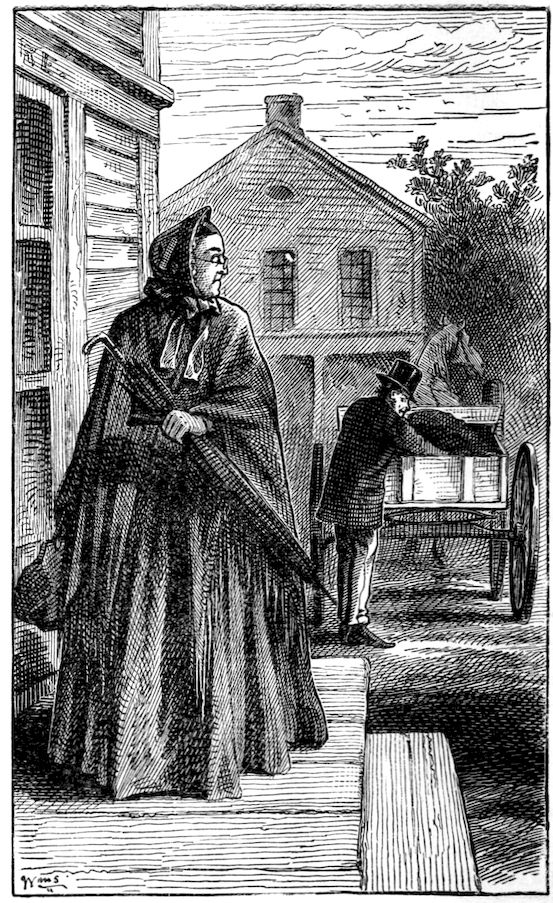
151But oh! how I kep’ s’posen things, as he lifted me
out right in front of the pole, and left me there alone.
Josiah had business on his mind and it made him
more worrysome; but I didn’t know what it was till
afterwards. As I was a goin’ up the store steps
I kinder looked back, and I see him take that bundle
out of the wagon in a dretful sly way, and kinder
meach off with it. I didn’t like the looks of things;
he acted guilty, strange, and curious.
As I went into the store, I see sister Minkley up to
the counter by the front winder, and I was glad to
see her. The store was a big one and quite a lot of
men was goin’ up and votin’. But good land! there
wasn’t nothin’ frightful about it, I’ve seen three times
as many men together, time and again. I wasn’t
skairt a mite, nor sister Minkley wasn’t nuther. Two
men was a swearin’, some, as I went in, but we heerd
’em swear as hard again 4th of July’s and common
days; but the minute they catched sight of sister
Minkley and me, they stopped off right in the middle
of a swear, and looked as mild as protracted meetin’s,
and took up some sticks and went to whittlin’ as
peaceable as two sheeps.
Sister Minkley said she shouldn’t thought she could
have come out that day, she had such a cold in her
head, if her husband hadn’t urged her so, to come
on his business. His heart seemed to be so sot on
Kentucky Jane—
“Jane who?” says I in awful axents, for I couldn’t
152hardly believe my ears—my faith in that man’s morals
was so high, it was like a steeple to my soul, and
always had been ever sense I had known him—and
I thought to myself if I have got to give up Elder
Wesley Minkley, if his morals have got to totterin’ and
swayin’ to and fro, a tottlin’ off after Janes and other
wimmen, and if he is mean enough to send his wife
off after ’em, I declare for’t I don’t know but I shall
mistrust my Josiah. I know I looked wild and
glarin’ out of my eyes, and horror was on my mean,
as I asked her again in still more stern tones:
“Jane who?” For I was determined to get to the
bottom of the affair, and if worst come to worst, to
lay it before the meetin’ house myself, and have it
stopped, and hushed up, before it got out amongst the
world’s people, to bring a shame onto the meetin’
house, and them that belonged to it. And then as a
woman that had a vow on her in the cause of Right,
I felt it my duty to look out for Jane, and if there
was any hopes of reformin’ her, to befriend her.
And so I says in tones that would be replied to:
“Jane who?”
“Why Kentucky Jane for overhauls, he thought
my judgment on Janes was better than hisen.”
“Oh!” says I in dretful relieved tones, for my
heart would have sung for joy if it had understood the
notes, it was that joyful, and thankful. Says I,
“They have got a piece here that wears like iron,
Josiah has got a frock offen it.”
153Well, we stood there by the counter, a feelin’ of
Jane, and tryin’ the thickness and color of it, and
talkin’ together—as wimmen will—when who should
come in but the Editor of the Auger’ses wife. She is
a woman that is liked better on further acquaintance.
She is thought a sight on in Jonesville; more’n her
husband is, ten times over. She’s had two pair of
twins sense she was married; I never see such a hand
for twins as the Editor is. He’s had three pair and
a half sense I knew him.
Well, as I was a sayin’, she came in, and called for
some cigars. She told us he sent her to git ’em, the
two biggest twins bein’ to school, and there bein’
nobody to come only jest him or her. She had
walked afoot, and looked tired enough to sink; they
lived about a mile and a half out of the village.
She said the Editor could not come himself for he
was writin’ a long article on “The Imprudence, Impurity,
and Impiety of Woman’s Appearance at the
Pole.” She said, he said he was goin’ to make a
great effort; he was goin’ to present the indecency
and immorality of woman’s goin’ to ’lection, in such
a masterly way that it would set the matter to rest forever.
It was for to-morrow’s paper, and bein’ obleeged
to use up so much brain, as he had to in the effort, he
felt he must have some cigars, and a codfish; you
know fish is dretful nourishin’ to the mind, and he is
fond of it; he told her to get the biggest codfish she
could get, and bile it up. And she was goin’ to.
154I didn’t say much in reply to her, truly, as the
poet says, “The least said is the soonest mended.” I
only told her in a kind of a blind way, that if codfish
was good for common sense, not to stent him on it.
And jest then the storekeeper came back from down
suller with the fish.
“Good land!” says I the minute I laid eyes on it;
“haint you made a mistake?”
“What mistake?” says he.
Says I, “Haint it a whale?”
“Oh no,” says he, “it is a codfish; but it is a
pretty sizeable one.”
“I should think as much,” says I. For as true as I
155live, when the Editor of the Auger’ses wife laid it
over her arm, it touched the floor head and tail; and
it made her fairly lean over it was so heavy. And I
thought to myself that I could have tackled the biggest
political question of the day, easier than I could
tackle that whale, and carry it a mile and a half. And
so the Editor of the Auger’ses wife went home from
’lection, luggin’ a whale, and walkin’ afoot.
I picked out my buttons, five cents a dozen, and
bought my cotton flannel, and no Josiah. I felt
worried in my mind. I thought of that mysterious
bundle, and my companion’s strange and curious looks
as he brought it out from the barn, seemin’ly unbeknown
to me, and his dretful curious actions about it
as he meached out of the buggy with it. And I felt
worried, and almost by the side of myself. But I
kep’ a cool demeanor on the outside of me—it is my
way in the time of trouble to be calm, and put my
best foot forred.
Jest then a man come up to me that I never laid
eyes on before. He was a poor lookin’ shack; his
eyes was white mostly, and stood out of his head as
if in search for some of the sense he never could git
holt of, and his mouth was about half open. A dretful
shiftless lookin’ critter, and ragged as a Jew—all
but his coat, and I’ll be hanged if that didn’t look
worse than if his clothes was all of a piece. It was a
blue broadcloth coat, swaller tailed, and had been a
dretful genteel coat in the day of it—which I should
156judge was some fifty or sixty years previous to date.
It was awful long waisted, and small round, and what
they call single breasted; it turned back at the breast
in a low, genteel way, over his old ragged vest; and
ragged, red woolen
shirt, and pinched
him in at the bottom
of his waist
like a pismire, and
the tails floated
down behind, so
polite over his pantaloons,
which was
fairly rags and tatters.
As I said,
I never laid eyes
on him before, and
still as he come up,
and stood before
me, I felt a curious,
and strange feelin’
go most through me; sunthin’ in the arrer way. A
curiouser more familiar-like, strange feelin’, I never
felt. But I didn’t know then what it meant, I was in
the dark. But more of this, anon, and hereafter.
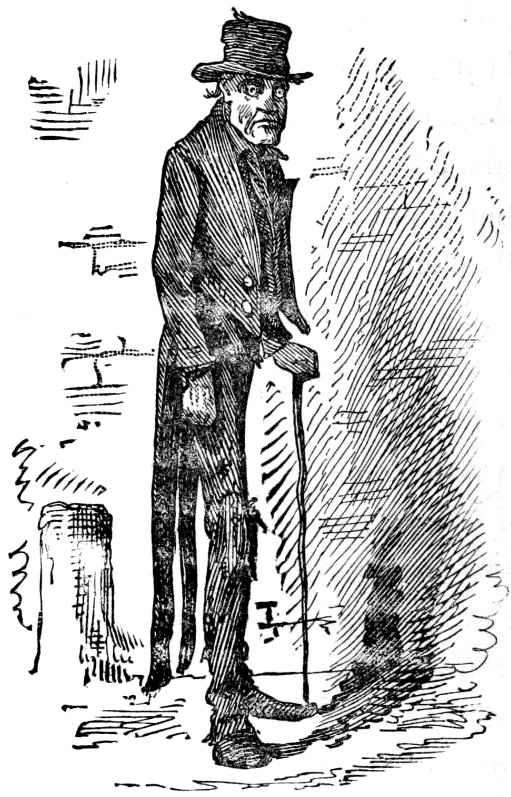
Says the man, says he; “I beg your parding mom,
for speaking to you, but you have got such a dretful
good look to your face, somehow—,” (Truly as I have
said prior, and before this, my trials with the Widder
157Doodle, my martyrdom on the stake of Doodle and
particulars, borne like a martyr, have purified my
mean and make me look first-rate.) Says the man,
says he: “You look so good, somehow, that I want
to ask your advice.”
Says I kindly, “I am a Promiscous Advisor by
trade; advisin’ is my mission and my theme. Ask me
any advice my honest man, that you feel called to
ask, and I will proceed to preform about my mission.”
He handed me a ticket, with a awful dirty hand,
every finger nail of which was seemin’ly in the deepest
of mournin’ for the pen-knife and nail-brushes
they never had seen; and says he, “Will you tell
me mom, whether that ticket is a democrat ticket, or
the t’other one?”
I put on my specks, and says I, “It is the t’other
one.”
“Good Gracious!” says he; “Christopher Columbus!
Pocahontas! Jim Crow and Jehosiphat!” says
he. But I interrupted of him coldly, and says I:
“Stop swearin’, instantly and this minute; and if
you want my advice, proceed, and go on.”
Says he, “There I have voted that ticket seventeen
times, and I was paid to vote the democrat.” Says
he, “I am a man of my word, I am a poor man but a
honest one. And here I have,”—says he in a mournful
tone—“here I have voted the wrong ticket seventeen
times.” Says he in a bitter tone, “I had ruther
have give half a cent than to had this happen.”
158Says he, “I am a poor man, I haint no capital to live
on, and have got to depend on my honesty and principles
for a livin’. And if this gets out, I am a ruined
man;” says he in awful bitter tones, “what would
the man that hired me say, if he should hear of it?”
“What did he give you?” says I, and as I said this,
that strange, curious feelin’ came over me again, as
strange a feelin’ as I ever felt.
Says he, “He give me this coat.”
Then I knew it all. Then the cast-iron entered my
sole, the arrer that had been a diggin’ into me, unbeknown
to me as it was, went clear through me, and
come out on the other side, (the side furtherest from
sister Minkley.) Then I knew the meanin’ of the
strange feelin’ I had felt. It was Father Allen’s coat—one
that had fell to Josiah. Then I knew the meanin’
of my companion’s mysterious demeanor, as he
bore the bundle from the barn. His plottin’s the
week before, and his drawin’s onto my sympathy,
to keep me from puttin’ it into the carpet rags, when
I was fairly sufferin for blue in the fancy stripe, and
refrained from takin’ it, because he said it would hurt
his feelin’s so. Oh the fearful agony of that half a
moment. What a storm was a ragin’ on the inside of
my mind. But with a almost terrible effort, I controlled
myself, and kep’ considerable calm on the outside.
Truly, everybody has their own private collection
of skeletons; but that haint no sign they
should go abroad in public a rattlin’ their bones; it
159don’t help the skeletons any nor their owners, and it
haint nothin’ highlarious and happyfyin’ to the public.
I hadn’t no idee of lettin’ sister Minkley into the
clothes-press where my skeletons hung, knowin’ that
she probable had a private assortment of her own
skeletons, that she could look at unbeknown to me.
“What made you vote the wrong ticket?” Says
I, “can’t you read?”
“No,” says he, “we can’t none of us read, my
father, nor my brothers; there is nine of us in all.
My father and mother was first cousins,” says he in
a confidential tone; “and the rest of my brothers
don’t know only jest enough to keep out of the fire.
I am the only smart one in the family. But,” says he,
“my brothers will all do jest as father and I tell ’em
to, and they will all vote a good many times a day,
every ’lection; and we are all willin’ to do the fair
thing and vote for the one that will pay us the most.
But not knowin’ how to read, we git cheated,” says
he with that bitter look, “there is so much corruption
in politics now-a-days.”
“I should think as much,” says I. And almost
overcome by my emotions, I spoke my mind out loud.
“There couldn’t be much worse goin’s on, anyway,
if wimmen voted.”
“Wimmen vote!” says he in a awful scornful tone.
“Wimmen!”
“Then you don’t believe in their votin’,” says I
mekanically (as it were) for I was agitated, very.
160“No I don’t,” says he, in a bold, hauty tone.
“Wimmen don’t know enough to vote.”
I wouldn’t contend with him, and to tell the truth,
though I haint hauty, and never was called so, I
was fairly ashamed to be catched talkin’ with him, he
looked so low and worthless. And I was glad enough
that that very minute brother Wesley Minkley came
up a holdin’ out his hand, and says he:
“How do you do sister Allen, seems to me you look
some cast down. How do you feel in your mind to-day,
sister Allen?”
Bein’ very truthful, I was jest a goin’ to tell him
that I felt considerable strange. But I was glad
indeed that he forgot to wait for my answer, but went
on, and says he:
“I heard the words the poor man uttered as I drew
near, and I must say that although he had the outward
appearance of bein’ a shack—an idiotic shiftless
shack, as you may say,—still he uttered my sentiments.
We will wave the subject, however, of wimmen’s
incapacity to vote.”
Elder Minkley is a perfect gentleman at heart, and
he wouldn’t for anything, tell me right out to my face
that I didn’t know enough to vote. I too am very
lady-like when I set out, and I wasn’t goin’ to be outdone
by him, so I told him in a genteel tone, that I
should think he would want to wave off the subject,
after perusin’ such a specimen of male sufferage as
had jest disappeared from our vision.
SENATOR VYSE AND HIS VICTIM
161“Yes,” says Elder Minkley mildly, and in a gentlemanly
way, “we will wave it off. But Senator Vyse
was a sayin’ to me jest now—he has come in to vote,
and we got to talkin’, the Senator and I did, about
wimmen’s votin’; and he is bitter ag’inst it. And I
believe jest as the Senator does, that woman’s sufferage
would introduce an element into politics, that
would tottle it down from the foundation of justice and
purity, on which it now firmly rests.”
I didn’t say a word, but oh! what a strange agitated
feelin’ I felt, to hear brother Minkley go on—for
that very Senator Vyse he was a talkin’ about, is a
disgrace to Jonesville and the world. A meaner,
licentiouser man never trod shoe leather. He lives
two or three miles out of Jonesville, in a awful big,
nice place; looks like a castle; he has troops of servants,
and a colored nigger to drive his horses, and is
considered a big-bug. And truly, if meanness makes
a man feel big he has reason enough to feel. I never
could bear the sight on him, though he is called handsome,
and has dretful fascinatin’ ways. Bein’ so
awful rich (he owns township after township, and
heaps of money) he is made as much of as if he was
made of pure gold from head to feet. But he’ll never
git me nor Josiah to make of him; Josiah’s morals
are as sound as brass.
But brother Minkley went on a talkin’, and oh!
how I went on a thinkin’: “Senator Vyse says, that
the nation would be so madded to have wimmen try
162to vote, that it would rise up to a man, to defend the
purity of the pole. Ah! here comes the Senator to
vote; look quick, Alzina Ann! stand up close to
me, and I’ll try to introduce you.”
Oh! how reverentially, and awe-struck everybody
in the store looked at the Senator as he came a sailin’
in, a lookin’ as big and hauty as if he owned Jonesville
and the hull world. I believe they would have
strewed palm leaves in his way, if they had any palms
by ’em. He stopped a minute to speak to brother
Minkley and the Elder introduced his wife to him,
with an air as if he was a settlein’ a dowery on her,
that would make her rich for life. And sister Minkley
looked on to him as awe-stricken, and admirin’ly,
as if he was a entire menagery of new and curious animals,
and she beholdin’ ’em for the first time on a free
ticket. And when he reached out his hand to shake
hands with her, she acted perfectly overcome with joy.
Then brother Minkley introduced the Senator to
me, with considerable the mean as if he was makin’
me a present of a nice house and lot, all paid for.
But when that Senator reached out his hand to shake
hands with Josiah Allen’s wife, that woman, nerved
completely up with principle, jest looked at him with
a stiddy lofty mean, and gripped holt of her brown
alpaca overskirt, and never touched his hand. I
wouldn’t. It was white and delicate, and a great seal
ring set with diamonds glittered on it, but it was
stained with crimes blacker than murder, enough
sight; I had jest as lives laid holt of a pisen serpent.
163
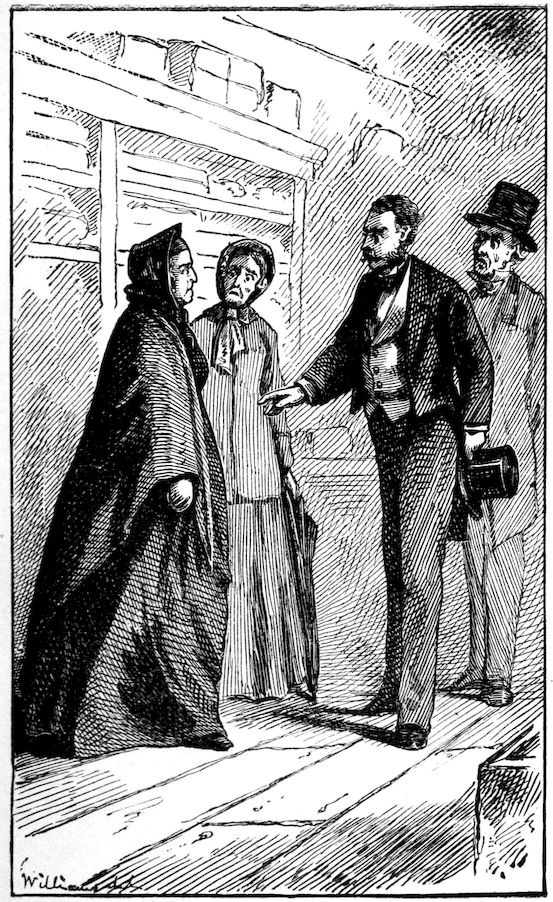
INTRODUCTION TO THE SENATOR.
165I am naturally well bred, and polite in my demeanor,
and the politest way is generally the quietest way;
so ruther than make a fuss, I bowed my head a very
little, mebby half or three quarters of a inch. But
oh! what a majestic look there was on my eyebrow;
what a terrible rebukin’ expression curved my nostrils;
what a firmness, and a icyness there sot throned on
my upper lip. He felt it. His handsome false face
turned red as blood, as I calmly replied to brother
Minkley’s last words. Says I:
“I agree with you brother Minkley in what you
said. I think it would be a first-rate plan to keep
impure people from the pole, male or female. It
would be apt to thin the voters out considerable; it
would be apt to make it considerable lonesome for
the pole. But howsumever, I should approve of it
highly and so would Josiah.”
Truly, if the coat fits anybody, let ’em put it on
freely, without money and without price. Senator
Vyse felt what I said deeply, I know he did, for I’ll
be hanged if I ever see Josiah’s face look any meachener
in his meachinest times. I then coolly turned
my back to ’em and looked out of the winder; and
the Senator and brother Minkley went up towards the
pole together, for the Elder seemed to think it would
be a perfect treat to see such a big man vote. And
sister Minkley followed him with her eyes, as admirin’ly
as if he was a hull circus, side show and all.
166When Senator Vyse and Brother Minkley moved off
toward the pole, Sister Minkley and I was left alone.
We was in a little corner by the winder, fenced in by
a high counter and still more deeply secluded by a
lofty and almost precipitous pile of rag carpetin’,
that towered up on the nigh side of us. On the off
side as I said was the counter.
My body stood there a lookin’ out of the winder,
but my mind was nearly lost in thought, a wanderin’
off into a complete wilderness of strange and conflictin’
idees; little underbrushes of puzzlin’ contradictions,
runnin’ every which way, and hedgin’ my
mind almost completely up, when it tried to soar off
free and noble; great high trees of the world’s curious
beliefs, and practices, and proceedin’s, castin’ a
shadder black as night down on the ever green mosses
beneath ’em all. Sometimes my tuckered out mind
would git half a minute’s rest, reclinin’ as you may
say, on them mosses, that with tender, faithful fingers,
touch with the same repose, the ruins of castle and
hovel; that are ever green in sunshine and in shade;
that quietly, silently—never hastin’, never restin’,
never tirin’—make a soft piller for all tired heads
alike; the lofty, and the lowly. Sometimes, as I say,
I would rest half a moment in the thought of that
tender Mercy and Compassion. And little wild
flowers of sweet thoughts and consolations, would
kinder peep up at me, and hopes, and prophecies of
167truth and justice would shine out like glorious stars;
and I’d git perhaps for three quarters of a moment
or so, all lit up and a feelin’ awful well. Then my
mind would soar off again, considerable of a ways,
and some of them runnin’ vines of curious idees and
customs, that was a tanglin’ up the tree tops, would
trip it up, and down it would come again—all the
harder from fallin’ from such a height. Good land!
what a hard time it was a havin’. All of a sudden
sister Minkley spoke up, for she too, it seems, had
been a lookin’ out of the winder, entirely unbeknown
to me.
Says she, “I believe jest as Wesley and Senator
Vyse does. Look at that creeter across the street.
What would become of the nation if such things was
permitted to vote?”
And she pinted with her gingham umberell across
the street to a girl that was sometimes in Jonesville,
and sometimes in the city. A girl, that every time I
looked at her, made my cheeks blush with shame for
her, and my eyes brim over with tears for her. I
don’t believe there was ever a dry eye in my head
when I looked at that girl, because I had heerd her
story, the hull thing, from one that knew. And
that was one very great reason, why I turned my
back to Senator Vyse, and wouldn’t touch his hand;
the mean, contemptible, creeter.
168
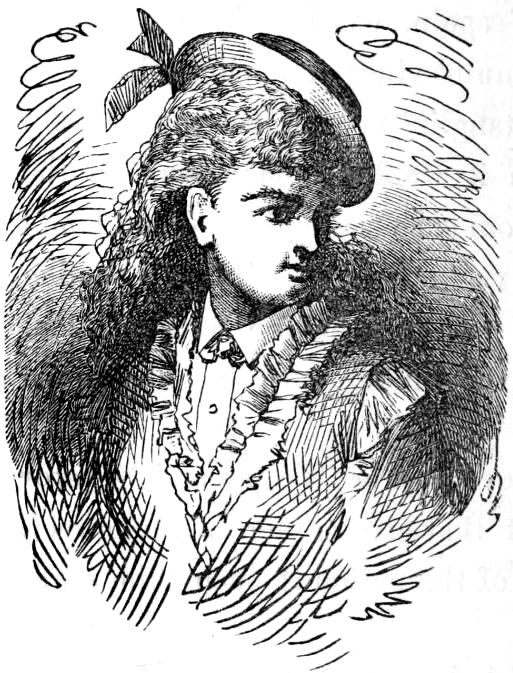
This very girl when she was a child, was left to his
care by her dyin’ mother and she grew up as pretty as a
half blown rose bud, and jest as innocent; an orphan,
unbeknowin’ to the world, its glory, and its wickedness.
And he learnt
it all to her, all its
glory, and all its
wickedness; for she
thought, innocent
young lamb, that a
new world of light
and glory had
swung down from
heaven a purpose
for him and her, in
them days when he
ransacked heaven
and earth to find
tender ways and tender words enough to tell his
love for her, his admiration for her beauty, her brightness,
her grace, her sweet confidin’ innocence. And
so he held her heart, her life in his hands, and she
would have been thankful to have laid them down
for the handsome villain, if he had told her to. And
holdin’ her heart as he did, he broke it. Holdin’ her
life as he did, he ruined it. By every hellish art that
could be called to aid him, he deliberately committed
this sin. Brought her down from innocence and
happiness, to ruin, wretchedness, disgrace, despair,
169drink, the streets. And then he was unanimously
chosen by a majority of the people to make wise laws,
such as legalizing sin and iniquity, and other noble
statutes, for the purifyin’ of the nation. And she,—why,
as she is too low and worthless for anything
else, she is used as a capital illustration to enforce the
fact, that wimmen like her are too sinful to vote.
Says I speakin’ right out, loud and very eloquent:
“Sister Minkley, as sure as there is a God in heaven,
such injustice will not be permitted to go on forever.”
I s’pose I skairt her, speakin’ out so sudden like,
and she not knowin’ what performances had been a
performin’ in my mind. And she murmured again
almost mekanically:
“It would be the awfulest thing I ever hearn on,
for such creeters to vote.”
Says I, “That old torment can vote can’t he, the
one that brought her where she is?”
“No doubt but what she was to blame,” says
sister Minkley drawin’ her lips down in a real womanly
way.
“Who said she wasn’t!” says I in real excited
axents. “But this I will contend for, that her sin
compared to his, wasn’t so much as a morphine powder
to a barrell of flour.”
“She no need to have sunk down to where she is
now,” says sister Minkley speakin’ again, in a real
prudent, womanly tone.
170
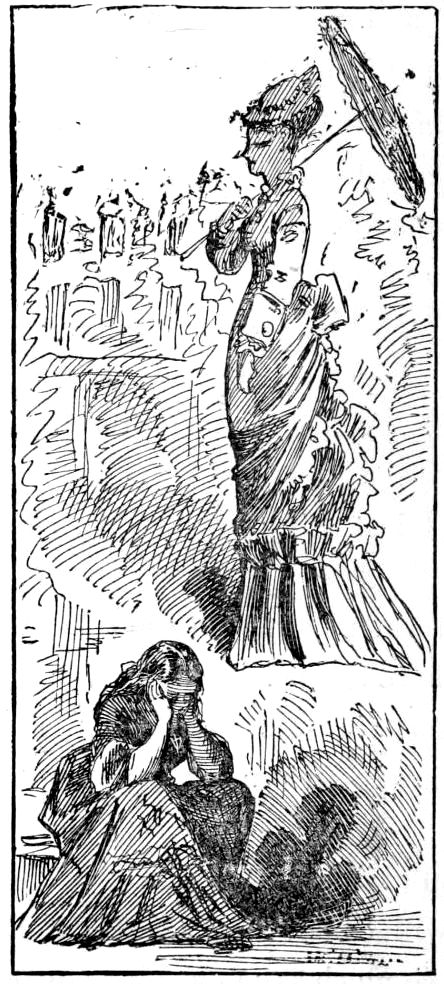
Says I, “Sister Minkley, when that girl found out
that the man she loved better than her own soul, that
she looked up to as a God, as wimmen will, when she
found that that man had betrayed her, ruined her, do
you s’pose she had any
faith left in God or
man? The hull world
reeled with her, and she
went down with the
shock. How low she
went down, you nor I
shall never know. And
may the God above,
who is able to keep us
all from temptation,
keep your childern and
mine, sister Minkley.”
“Amen!” says sister
Minkley jest as solemn
as if she was to camp-meetin’.
For danger
never looks so dangerous,
nor ruin so ruinous,
as when a mother thinks
of her own childern fallin’ onto it.
Says I, “Sister Minkley when I think it might
have been my Tirzah Ann, what feelin’s I feel.”
“And jest so I feel,” says she. Sister Minkley
171does dretful well by her childern, thinks a sight on
’em, and the mother in her was touched.
Says I, “Sister Minkley, that girl had a mother
once. A mother’s hand to guide her upwards—to lay
on her brow when it ached. A mother’s love to keep
her from temptation. A mother’s arms to hold her
from evil, from coldness, from blame. A mother’s
heart to rest on, when tired, tired out with the world.
Less try to feel for her a little as that faithful heart
would, if it wasn’t put away under the grasses.”
Says I, almost eloquently, “It don’t look well
sister Minkley for mother’s hands that have held little
trustin’ baby fingers in them, to be pinted out in
mockery, or stun bruised in stunnin’ such as she. No!
rather let them be lifted up to high heavens in prayer
for ’em, or reached in help to ’em, or wipin’ away
tears of pity and sorrow for ’em. Let mothers think
for one half or even one third of a moment, what if
death had unloosed their own claspin’ lovin’ hands
from the baby fingers—tender trustin’ little fingers,—and
so many different hands in the world reached out
to clasp ’em, and they so weak, so confidin’, and so
woefully ignorant what hands to lay holt of, little
helpless, foolish lambs, that love guarded, love watched
in safe homes, need such wise guidance, and
prayers, and tears, and watchfulness—what would
become of them wanderin’ alone in a world full of
wolves, temptation, starvation, and more’n forty other
old whelps, some of the fiercest ones so covered
172up with honest lookin’ wool, that the keenest spectacles
are powerless for the time bein’ to tell ’em
from sheep. Little white lambs travelin’ alone so
dangerous and black a road, how can they keep themselves
white unless God keeps ’em. We mothers ort
to think such thoughts sister Minkley, and pray
prayers daily, not alone for our own childern, but for
all of Gods little ones—for all of these poor wanderers;
askin’ for heavenly wisdom and strength to save
them, win them back to a better life.”
“Amen,” says sister Minkley, speakin’ up jest as
prompt and serene as if she was carryin’ on a conference
meetin’. She is as well meanin’ a woman as I
ever see, and bein’ a Methodist by perswasion ‘Amens’
173come jest as natural to her as the breath she breathes.
They are truly her theme; but she means well.
Says I goin’ on and resumin’:
“After that girl gave her freshness and beauty to
the little face that lay for a few months on her bosom—dear
to her, dearer to her in all her shame and
guilt, than her life, because she could see his features
in it—then Senator Vyse grew tired of her.
“And then her baby died. Perhaps God knew she
was not fit to guide a deathless life, so he took to
himself the little white soul. And she missed it.
Missed the little constant hands that clung to her
trustingly—the innocent eyes that never looked at
174her scornfully, and the little loving head that nestled
fearlessly on her guilty breast.
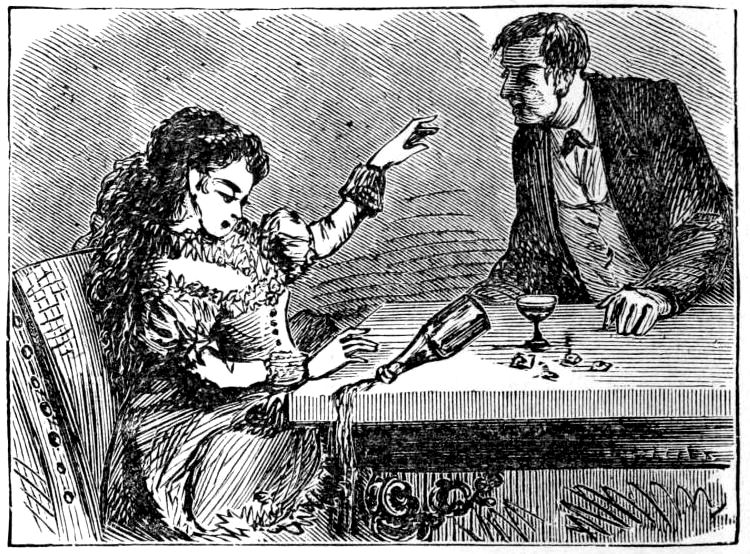
“And then, the Senator bein’ very tired of her, and
havin’ found a newer face that he liked better, turned
her out doors, and she went ravin’ wild, they say,
run off into the woods, tried to kill herself. They
took her to the hospittle, and when she got over
her wildness, she would set by the winder all day,
pale as a ghost, jest for the chance of seein’ him
ridin’ by—for she couldn’t kill her love for him,
that was one of the hardest things for her; she
couldn’t strangle it out no more’n she could kneel
down and pray the sun out of the sky, because she
had had a sunstroke. And what did she do to try to
forget him and her agony? She took to drinkin’, and
fell lower and lower; so low, that nothin’ but God’s
mercy can ever reach down to her.”
175Says I, “Her face used to be as innocent and sweet
as your baby’s face, your little Katy; and look at it
now, if you want to see what this man has done.
Look at the shame there, where there used to be fearlessness
and trust; look at the wretchedness, where
there used to be happiness; look at the vicious look,
the guilty look, where there was innocence and purity;
see how she is shunned and despised by those who
used to love and respect her; consider the gulf his
hands have dug, deep as eternity, between her and
the old life she weeps over but can never return to.
If, when she was sweet, and innocent, and trustin’,
and fitter for heaven than she ever will be again—when
she was first left to his care—he had killed her with
his own hands, it wouldn’t have been half the crime
he has done now, for then he would only have harmed
her body, not her immortal soul.
“And what seems to me the most pitiful thing, sister
Minkley, is, he ruined that girl through the best part
of her nater—her trust, her affection. Jest as a young
deer is led to its death by an old panther mockin’
the voice of its dam, jest so did this old human
panther lead this innocent young creeter astray by
mockin’ the voice of love,—that holiest of voices—lead
her down to destruction through her tenderness, her
love for him. And now, after he has stole her happiness,
her innocence, her purity, her self-respect, and
the respect of others, all her earthly hopes of happiness
and her hopes of heaven; after she has lost all
176for his sake; after he has committed this crime against
her, the greatest that man can commit, he crows over
her and feels above her; says, ‘you can’t vote, but I
can; oh yes, I am all right because I am a man.’
Good land! sister Minkley, how mad it makes me to
see such injustice and iniquity.”
But sister Minkley’s mind had got to travelin’ again
the ways of the world, and she spoke out in a sort of
a preachin’ tone—I s’pose she kinder catched it from
Brother Minkley, unbeknown to her:
“Listen to the voice of Solomon concernin’ strange
wimmen. ‘She layeth in wait as for a prey. She
increaseth the trangressions amongst men. My son
rejoice with the wife of thy youth, be thou ravished
always with her love. Beware of strange wimmen!
Her feet go down to death. Her steps take hold on
hell!’”
I was agitated and almost by the side of myself,
and I spoke out quick like, before I had time to think
how it would sound.
Says I, “That very same strange woman that
Solomon was bewarin’ his son about, was innocent
once, and in the first on’t some man led her astray,
and I shouldn’t wonder a mite if it was old Solomon
himself.”
“Good gracious!” says sister Minkley, “Why’e!”
Says I, “I mean well sister Minkley; and there
can’t nobody go ahead of me in honorin’ Solomon for
what was honorable in him, and admirin’ what was
177admirable in him. He bilt one of the biggest meetin’
housen’s that ever was bilt, did lots of good, and
some of his words are truly like ‘apples of gold in
pitchers of silver,’ chuck full of wisdom and goodness.
But I must speak the truth if I speak at all
sister Minkley, especially where my sect is concerned.
As you probable know, private investigation into the
wrongs of my sect and tryin’ to right them wrongs,
is at present my mission and my theme, (and also
promiscous advisin’.) And I must say, that I think
Solomon talked to his son a little too much about
bewarin’ of strange wimmen, and exhortin’ him to
stick to the wife of his youth, when he had ten hundred
wimmen by him all the time, and then wasn’t
satisfied but started off to git a couple more—upwards
of a thousand wimmen. Good gracious! sister
Minkley; I should have thought some of ’em would
have looked strange to him.”
“Why sister Allen! why’e!”
“I mean well, sister Minkley; I mean first rate.
And I’ll bet a cent if you should speak your mind
right out, you would say that you don’t uphold
Solomon in all his doin’s no more’n I do. He was
altogether too familiar with wimmen, Solomon was,
to suit me. Marryin’ seven hundred of ’em. Good land!
And folks make a great fuss now-a-days if a man
marries two; claps him right into jail quicker’n a
wink, and good enough for him; he ort to go. One
woman at a time is my theme, and that is the theme
178of the new testament, and what that says is good
enough for me or anybody else; it is God’s own
words to us sister Minkley.”
I had been dretful kinder agitated in tone, I felt so
deeply what I said. But I continued on in some
milder axents, but impressive as impressive could be—for
I was a talkin’ on principle, and I keep a tone
by me all the time on purpose for that, a dretful deep,
lofty, eloquent tone; and I used it now, as I went on
and proceeded.
As I said sister Minkley, I have made the subject
of wimmen my theme for quite a number of years—ever
sense the black African and the mortgage on our
farm was released. I have meditated on what wimmen
has done, and what she haint done; what treatment
she has received, and what she haint received.
Why sometimes, sister Minkley, when I have got onto
that theme, my mind has soared to that extent that
you wouldn’t have any idee of, if you never had seen
anything done in the line of soarin’. It has sailed
back to the year one, and sailed onwards through the
centuries that lie between to that golden year we
both believe in sister Minkley. It has soared clear
from the east to the west, and seen sad eyed Eastern
wimmen with veiled faces, toys, or beasts of burden,
not darin’ to uncover their faces to the free air and
light of heaven, because man willed it so. It has
seen Western wimmen, long processions of savages,
the wimmen carryin’ the babies, the house, and household
179furniture on their backs, while the men, unburdened
and feathered out nobly, walked in front of
’em, smoking calmly, and meditatin’ on the inferiority
of wimmen.
I never contended that wimmen was perfect, far
from it. You have heerd me say in the past, that I
thought wimmen was meaner than pusly about some
things. I say so still. My mind haint changed about
wimmen, nor about pusly. But justice is what I have
been a contendin’ for; justice, and equal rights, and a
fair dividin’ of the burdens of life is my theme; and
I say they haint been used well.
Now in the year one, when Adam and Eve eat that
180apple, jest as quick as Adam swallowed it—probable
he most choked himself with the core, he was in such
a awful hurry to get his mouth clear, so he could lay
the blame onto Eve. “The woman did tempt me,
and I did eat.”
“But thank fortin, he didn’t make out much, for
Eternal Goodness, which is God, is forever on the
side of Right. And Adam and Eve—as any two ort
to be who sin together—got turned out of Eden, side
by side, out of the same gate, into the same wilderness;
and the flaming sword that kept Eve back from
her old life of beauty and innocence, kept Adam
back, too. Sister Minkley, that is my theme. When
two human souls turn the Eden of their innocence into
a garden of guilt, punish ’em both alike, and don’t turn
her out into the wilderness alone; don’t flash the
flamin’ sword of your righteous indignation in her
eyes and not in hisen.
“And then, there was Hagar’ses case,—when Abraham
turned Hagar and his baby out into the desert.
If I had lived neighbor to ’em, at the time, I should
have give him a talkin’ to about it; I should have
freed my mind, and felt relieved so fur, anyway. I
should have said to the old gentleman, in a pleasant
way, so’s not to git him mad:—‘I think a sight of
you, Abraham, in the patriarch way. You are a
good man, in a great many respects; but standin’ up
for wimmen is my theme, (and also promiscous advisin’,)
and do you think you are doin’ the fair thing
181by Hagar, to send her and your baby off into the
desert with nothin’ but one loaf of bread and a bottle
of water between them and death?’ Says I, ‘It is
your child, and if it hadn’t been for you, Hagar
would probable now be a doin’ housework round in
Beersheba, a happy woman with no incumbrances.
It is your child as well as hern, and you, to say the
least of it, are as guilty as she is; and don’t you
think it is a little ungenerous and unmanly in you,
to drive her off into the desert—to let her in her
weakness, take all the consequences of the sin you
and she committed, when she had paid for it already
pretty well, in the line of sufferin’?’ Says I, ‘I
think a sight of you, Abraham, but in the name of
principle, I say with the poet,—that what is sass for
the goose, ort to be sass for the gander—and if she is
drove off into the desert, you ort to lock arms with
her and go too.’
“I’ll bet a cent I could have convinced Abraham
that he was doin’ a cowardly and ungenerous act by
Hagar. But then I wasn’t there; I didn’t live neighbor
to ’em. And I persume Sarah kep’ at him all
the time; kep’ a tewin’ at him about her; kep’ him
awake nights a twittin’ him about her, and askin’
him to start her off. I persume Sarah acted meaner
than pusly.
“Human nater, and especially wimmen human nater
is considerable the same in the year 18 and 1800, and
I’ll bet a cent, (or I wouldn’t be afraid to bet a cent,
182if I believed in bettin’,) that if Sarah had had her
way, Hagar wouldn’t have got even that loaf of
bread and bottle of water. It says, Abraham got up
early—probable before Sarah was up—and give ’em to
her, and started her off. I shouldn’t wonder a mite
if Sarah twitted Abraham about that loaf of bread
every time she did a bakin’, for a number of years
after. And that bottle. I dare persume to say, if
the truth was known, that she throwed that bottle in
his face more’n a hundred times, deplorin’ it as the
toughest-hided, soundest bottle in all Beersheba.
“But as I said, I wasn’t there, and Abraham turned
her out, and Hagar had a hard time of it out in the
desert, toilin’ on alone through its dreary wastes, hungry
for bread, and hungry for love; dying from starvation
of soul and body; deceived; despised; wronged;
deserted; lonely; broken-hearted; and carrying with
all the rest of her sorrow—as mothers will—the
burden of her child’s distress. Why, this woman’s
wrongs and misery opened the very gates of Heaven,
and God’s own voice comforted and consoled her;
again Eternal Justice and Mercy spoke out of Heaven
for wimmen. Why is it that his childern on earth
will continue to be so deaf and dumb—deaf as a
stun—for 6000 years.
“But from that time to this, take it between the
Abrahams and the Sarahs of this world, the Hagars
have fared hard, and the Abrahams have got along
first rate; the Hagars have been turned out into the
183desert to die there, and the Abrahams that ruined
’em, have increased in flocks and herds; are thought a
sight of and are high in the esteem of wimmen.
Seems as though the more Hagars they fit out for the
desert business, the more feathers it is in their cap.
Every Hagar they start out is a new feather, till some
get completely feathered out; then they send ’em to
Congress, and think a sight on ’em.
“I declare for’t it is the singularest thing I ever
see, or hearn tell on, how folks that are so just in
every thing else, are so blinded in this one. And”
says I almost wildly—for I grew more and more agitated
every minute, and eloquent—“the female sect are
to blame for this state of affairs;” says I, “men as a
general thing, all good men, have better idees in this
matter than we do, enough sight. Wimmen are to
blame—meetin’ house wimmen and all,—you and I
are to blame sister Minkley,” says I. “As a rule
the female sect wink at men’s sins, but not a wink
can you ever git out of them about our sins. Not a
wink. We have got to toe the mark in morals, and
we ort to make them toe the mark. And if we did,
we should rise 25 cents in the estimation of every good
man, and every mean one too, for they can’t respect
us now, to toady and keep a winkin’ at ’em when they
wont at us; they can’t respect us. We ort to require
as much purity and virtue in them, as they do in us,
and stop winkin’.” Says I, “Winkin’ at men’s sins
is what is goin’ to ruin us all, the hull caboodle of us;
184ruin men, ruin wimmen, Jonesville, and the hull
nation. Let the hull female race, fur and near, bond
and free, in Jonesville and the world, stop winkin’.”
I don’t believe I had been any more eloquent sense
war times; I used to get awful eloquent then, talkin’
about the colored niggers. And I declare I don’t know
where, to what heights and depths my eloquence
would have flown me off to, if I hadn’t jest that
minute heard a low, lady-like snore—sister Minkley
was asleep. Yes, she had forgot her troubles; she
was leanin’ up ag’inst the high pile of rag carpetin’,
that kinder fenced us in, fast asleep. But truly, she
haint to blame. She has bad spells,—a sort of weakness
she can’t help. But jest at that very minute my
Josiah came up and says he:
“Come Samantha! haint you about ready to go?”
“Yes,” says I, for truly principle had tuckered
me out. Josiah’s voice had waked up sister Minkley,
and she give a kind of a start, and says she:
“Amen, sister Allen! I can say amen to that with
all my heart. You talked well sister Allen, especially
towards the last. You argued powerful.”
I wasn’t goin’ to twit her of not hearin’ a word of
it. Brother Minkley jest that minute sent in word
that he was ready, and to hurry up, for the colts
wouldn’t stand. (He had hired a neighborin’ team.)
And so we two wimmen, sister Minkley and I started
home from ’lection.
I don’t know as I ever see Josiah Allen in any
185better spirits, than he was, as we started off on our
tower homewards. He had been to the clothin’ store
and bought him a new Sentinal neck-tie, red, white
and blue. It was too young for him by forty years,
and I told him so; but he said he liked it the minute
he sot his eyes on it, it was so dressy. That man is
vain. And then ’lection bid fair to go the way he
wanted it to. He was awful animated, his face was
almost wreathed in a smile, and before the old mare
had gone several rods, he begun what a neat thing
it was, and what a lucky hit for the nation, that
wimmen couldn’t vote. And he kep’ on a talkin’,
that man did, as he was a carryin’ me home from
’lection, about how it would break a woman’s modesty
down to go to the pole, and how it would devour
her time and so 4th, and so 4th. And I was that
tired out and fatigued a talkin’ to sister Minkley that
I let him go on for more’n a mile, and never put in
my note at all. Good land! I’d heerd it all over
from him, word for word, more’n a hundred times,
and so I sot still. I s’pose he never thought how
it was my lungs that ailed me, that I had used ’em
almost completely up in principle, how I was almost
entirely out of wind. And though a woman’s will may
be good, and her principles lofty, still she can’t talk
without wind. For truly in the words of a poem, I
once perused:
“What’s Paul, or Pollus, when a sinner’s dead?
dead for want of breath.”
186I don’t s’pose he thought of my bein’ tuckered out,
but honestly s’pose he thought he was convincin’ of
me; for his mean grew gradually sort of overbearin’
like, and contemptible, till he got to be more big
feelin’ and hauty in his mean than I had ever known
him to be, and independenter. And he ended up as
follers:
“Now, we have purity, and honesty, and unswervin’
virtue, and incorruptible patriotism at the pole.
Now, if corruption tries to stalk, honest, firm, lofty
minded men stand ready to grip it by the throat.
How can it stalk, when it is a chokin’? Wimmen
haint got the knowledge, the deep wisdom and insight
into things that we men have. They haint got
the lofty idees of national honor, and purity, that we
men have. Wimmen may mean well—”
He was feelin’ so neat that he felt kinder clever
towards the hull world, hemale, and female. “Wimmen
may mean well, and for arguments sake, we’ll
say they do mean well. But that haint the pint, the
pint is here—”
And he pinted his forefinger right towards the
old mare. Josiah can’t gesture worth a cent. He
wouldn’t make a oriter, if he should learn the trade
for years. But ever sense he has been to the Debatin’
school, he has seemed to have a hankerin’ that way.
“The pint is here. Not knowin’ so much as we men
know, not bein’ so firm and lofty minded as we be,
if wimmen should vote corruption would stalk; they
187not havin’ a firm enough grip to choke it off. They
would in the language of the ’postle be ‘blowed about
by every windy doctor.’ They would be tempted by
filthy lucre to ‘sell their birth-right for a mess of
pottery,’ or crockery, I s’pose the text means. They
haint got firmness; they are whifflin’, their minds
haint stabled. And if that black hour should ever
come to the nation, that wimmen should ever go to
the pole—where would be the lofty virtue, the firm
high-minded honesty, the incorruptible patriotism
that now shines forth from politics? Where would
be the purity of the pole? Where? oh! where?”
I’ll be hanged if I could stand it another minute,
and my lungs havin’ got considerable rested, I spoke
up, and says I:
“You seem to be havin’ a kind of a enquiry meetin’
in politics, Josiah Allen, and I’ll get up in my mind,
and speak in meetin’.” And then I jest let loose that
eloquent tone I keep by me expressly for the cause of
principle; I used the very loftiest and awfulest one I
had by me, as I fastened my specks immovably on
hisen. “Where is that swaller tailed coat of Father
Allen’s?”
And in slower, sterner, colder tones, I added:
“With the brass buttons. Where is it Josiah
Allen? Where? oh! where?”
Oh! What a change came over my companion’s
mean. Oh, how his feathers drooped and draggled
on the ground speakin’ in a rooster and allegory way.
188Oh, what a meachin’ look covered him like a garment
from head to foot. I declare for’t if his boots didn’t
look meachin’, and his hat and his vest. I never seen
a meachener lookin’ vest than hisen, as I went on:
“I’d talk Josiah Allen about men bein’ so pure-minded,
and honest. I’d talk about wimmens bein’
whifflin’ and their minds not stabled. I’d talk about
the purity of the pole. I’d love to see Josiah Allen’s
wife buyin’ votes; bribin’ Miss Gowdey or sister
Minkley away from the paths of honesty and virtue,
with a petticoat or a bib apron. I’d love to see
George Washington offerin’ his jack knife to Patrick
Henry to get him to vote his ticket; or Benjamin
Franklin, or Thomas Jefferson sellin their votes for
store clothes. I should be ashamed to go to the Sentinal
Josiah Allen, if I was in your place. I should
be perfectly ashamed to set my eyes on that little
hatchet that George Washington couldn’t tell a lie
with. I should think that hatchet would cut your
conscience clear to the bone—if you have got a conscience,
Josiah Allen.
“Oh! Did I ever expect to see the companion of my
youth and middle age, betrayin’ his country’s honor;
trafficin’ in bribery and sin; dickerin’ with dishonesty;
tradin’ in treason; buyin’ corruption; and payin’ for it
with a swaller tailed coat, with his old father’s blue
swaller tailed coat that his lawful pardner wanted for
carpet rags. Oh, the agony of this half an hour,
Josiah Allen! Oh, the feelin’s that I feel.”
189
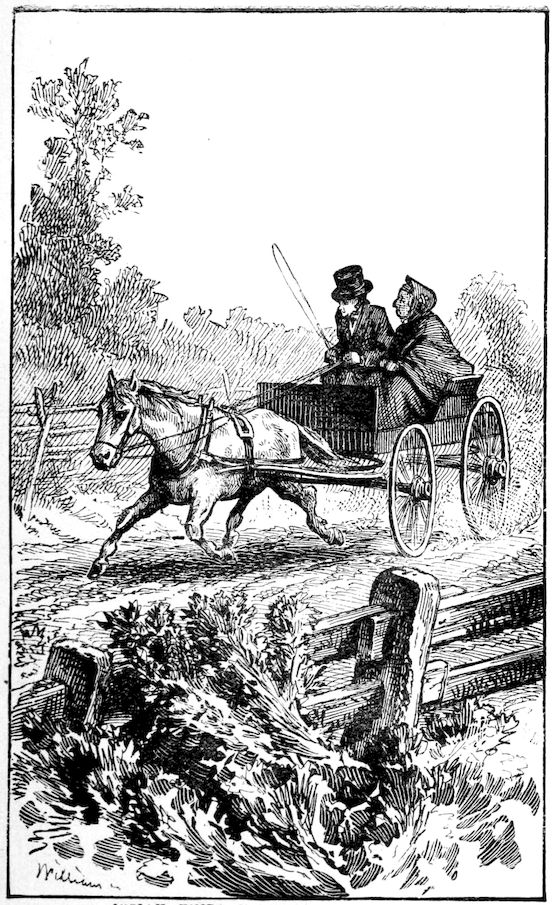
JOSIAH FINDS HIS SECRET IS KNOWN.
191But Josiah had begun to pick up his crumbs again.
Truly it is hard work to keep men down in the valley
of humiliation. You can’t keep ’em worked up and
mortified for any great length of time, do the best you
can. But I continued on in almost dretful axents.
“You ort to repent in sackcloth and ashes, Josiah
Allen.”
“We haint got no sackcloth Samantha,” says he,
“and we have sold our ashes. Probable the man
wouldn’t want me to be a repentin’ in ’em. It would
be apt to leach ’em, too much lie for ’em.”
“I’d try to turn it off into a joke, Josiah Allen,
I’d laugh if I was in your place about lyin’. Your
tears ort to flow like a leach barrell. Oh if you
could realize as I do the wickedness of your act.
Destroyin’ your country’s honor. Sellin’ your father’s
coat when I wanted it for carpet rags.” Says I, “I
am as good a mind as I ever was to eat, to color the
hull thing black, warp and all, makin’ a mournin’
carpet of it, to set down and bewail my pardner’s
wickedness from year to year.”
“It would look pretty solemn Samantha.” I see
the idee worried him.
“It wouldn’t look no solemner than I feel, Josiah
Allen.”
And then I kep’ perfectly still for a number of
minutes, for silence is the solemn temple with its
roof as high as the heavens, convenient for the human
soul to retire into, at any time, unbeknown to anybody;
192to offer up thanksgivin’s, or repent of iniquities.
And I thought my Josiah was repentin’ of hisen.
But truly as I said men’s consciences are like ingy
rubber, dretful easy and stretchy, and almost impossible
to break like a bruised reed. For while I was a
hopin’ that my companion was a repentin’, and
thought mebby he would burst out a cryin’, overcome
by a realizin’ sense of his depravities; and I was a
thinkin’ that if he did, I should take up a corner of
his bandanna handkerchief and cry on it too—that
man for all his back slidin’s is so oncommon dear to
me—he spoke out in jest as chirp a way as I ever
seen him, and for all the world, jest as if he hadn’t
done nothin’:
“I wonder if sister Doodle will have supper ready,
Samantha. I meant to have told her to fried a little
o’ that beef.”
193
HOW WE BOUGHT A SEWIN’ MACHINE AND ORGAN.
We done dretful well last year. The crops come
in first-rate, and Josiah had five or six heads of
cattle to turn off at a big price. He felt well, and he
proposed to me that I should have a sewin’ machine.
That man,—though he don’t coo at me so frequent as
he probable would if he had more encouragement in
it, is attached to me with a devotedness that is firm
and almost cast-iron, and says he, almost tenderly:
“Samantha, I will get you a sewin’ machine.”
Says I, “Josiah, I have got a couple of sewin’ machines
by me that have run pretty well for upwards
of—well it haint necessary to go into particulars, but
they have run for considerable of a spell anyway”—says
I, “I can git along without another one, though
no doubt it would be handy to have round.”
But Josiah hung onto that machine. And then he
up and said he was goin’ to buy a organ. Thomas
Jefferson wanted one too. They both seemed sot
onto that organ. Tirzah Ann took hern with her of
194course when she was married, and Josiah said it
seemed so awful lonesome without any Tirzah Ann
or any music, that it seemed almost as if two girls had
married out of the family instead of one. He said
money couldn’t buy us another Tirzah Ann, but it
would buy us a new organ, and he was determined to
have one. He said it would be so handy for her to
play on when she came home, and for other company.
And then Thomas J. can play quite well; he can play
any tune, almost, with one hand, and he sings first-rate,
too. He and Tirzah Ann used to sing together
a sight; he sings bearatone, and she sulfireno—that is
what they call it. They git up so many new fangled
names now-a-days, that I think it is most a wonder that
I don’t make a slip once in a while and git things
wrong. I should, if I hadn’t got a mind like a ox
for strength.
But as I said, Josiah was fairly sot on that machine
and organ, and I thought I’d let him have his way.
So it got out that we was goin’ to buy a sewin’
machine, and a organ. Well, we made up our minds
on Friday, pretty late in the afternoon, and on Monday
forenoon I was a washin’, when I heard a knock
at the front door, and I wrung my hands out of the
water and went and opened it. A slick lookin’ feller
stood there, and I invited him in and sot him a chair.
“I hear you are talkin’ about buyin’ a musical instrument,” says
he.
“No,” says I, “we are goin’ to buy a organ.”
195“Well,” says he, “I want to advise you, not that I
have any interest in it at all, only I don’t want to see
you so imposed upon. It fairly makes me mad to
see a Methodist imposed upon; I lean towards that
perswasion myself. Organs are liable to fall to pieces
any minute. There haint no dependence on ’em at
all, the insides of ’em are liable to break out at any
time. If you have any regard for your own welfare
and safety, you will buy a piano. Not that I
have any interest in advising you, only my devotion
to the cause of Right; pianos never wear out.”
“Where should we git one?” says I, for I didn’t
want Josiah to throw away his property.
“Well,” says he, “as it happens, I guess I have
got one out here in the wagon. I believe I threw
one into the bottom of the wagon this mornin’, as I
was a comin’ down by here on business. I am glad
now I did, for it always makes me feel ugly to see a
Methodist imposed upon.”
Josiah came into the house in a few minutes, and
I told him about it, and says I:
“How lucky it is Josiah, that we found out about
organs before it was too late.”
But Josiah asked the price, and said he wasn’t goin’
to pay out no 300 dollars, for he wasn’t able. But
the man asked if we was willin’ to have it brought
into the house for a spell—we could do as we was a
mind to about buyin’ it; and of course we couldn’t
refuse, so Josiah most broke his back a liftin’ it in,
196and they set it up in the parlor, and after dinner the
man went away.
Josiah bathed his back with linement, for he had
strained it bad a liftin’ that piano, and I had jest got
back to my washin’ again (I had had to put it away
to git dinner) when I heerd a knockin’ again to the
front door, and I pulled down my dress sleeves and
went and opened it, and there stood a tall, slim feller;
and the kitchen bein’ all cluttered up I opened the
parlor door and asked him in there, and the minute
he catched sight of that piano, he jest lifted up both
hands, and says he:
“You haint got one of them here!”
He looked so horrified that it skairt me, and says
I in almost tremblin’ tones:
“What is the matter with ’em?” And I added in
a cheerful tone, “we haint bought it.”
He looked more cheerful too as I said it, and says
he “You may be thankful enough that you haint.
There haint no music in ’em at all; hear that,” says
he, goin’ up and strikin’ the very top note. It did
sound flat enough.
Says I, “There must be more music in it than that,
though I haint no judge at all.”
“Well, hear that, then,” and he went and struck
the very bottom note. “You see just what it is, from
top to bottom. But it haint its total lack of music
that makes me despise pianos so, it is because they
are so dangerous.”
197“Dangerous?” says I.
“Yes, in thunder storms, you see;” says he, liftin’
up the cover, “here it is all wire, enough for fifty
lightnin’ rods—draw the lightnin’ right into the room.
Awful dangerous! No money would tempt me to
have one in my house with my wife and daughter.
I shouldn’t sleep a wink thinkin’ I had exposed ’em
to such danger.”
“Good land!” says I, “I never thought on it before.”
“Well, now you have thought of it, you see plainly
that a organ is jest what you need. They are full
of music, safe, healthy and don’t cost half so much.”
Says I, “A organ was what we had sot our minds
on at first.”
“Well, I have got one out here, and I will bring
it in.”
“What is the price?” says I.
“100 and 90 dollars,” says he.
“There wont be no need of bringin’ it in at that
price,” says I, “for I have heerd Josiah say, that he
wouldn’t give a cent over a 100 dollars.”
“Well,” says the feller, “I’ll tell you what I’ll do.
Your countenance looks so kinder natural to me, and
I like the looks of the country round here so well,
that if your mind is made up on the price you want
to pay, I wont let a trifle of 90 dollars part us. You
can have it for 100.”
“Well, the end on’t was, he brung it in and sot it
198up the other end of the parlor, and drove off. And
when Josiah come in from his work, and Thomas J.
come home from Jonesville, they liked it first rate.”
But the very next day, a new agent come, and he
looked awful skairt when he catched sight of that
organ, and real mad and indignant too.
“That villain haint been a tryin’ to get one of them
organs off onto you, has he?” says he.
“What is the trouble with ’em?” says I, in a awe-struck
tone, for he looked bad.
“Why,” says he, “there is a heavy mortgage on
every one of his organs. If you bought one of him,
and paid for it, it would be liable to be took away
from you any minute when you was right in the
middle of a tune, leavin’ you a settin’ on the stool;
and you would lose every cent of your money.”
“Good gracious!” says I, for it skairt me to think
what a narrow chance we had run. Well, finally, he
brung in one of hisen, and sot it up in the kitchen,
the parlor bein’ full on ’em.
And the fellers kep’ a comin’ and a goin’ at all
hours. For a spell, at first, Josiah would come in and
talk with ’em, but after a while he got tired out, and
when he would see one a comin’, he would start on a
run for the barn, and hide, and I would have to stand
the brunt of it alone. One feller see Josiah a runnin’
for the barn, and he follered him in, and Josiah dove
under the barn, as I found out afterwards. I happened
to see him a crawlin’ out after the feller drove
off. Josiah come in a shakin’ himself—for he was all
covered with straw and feathers—and says he:
199
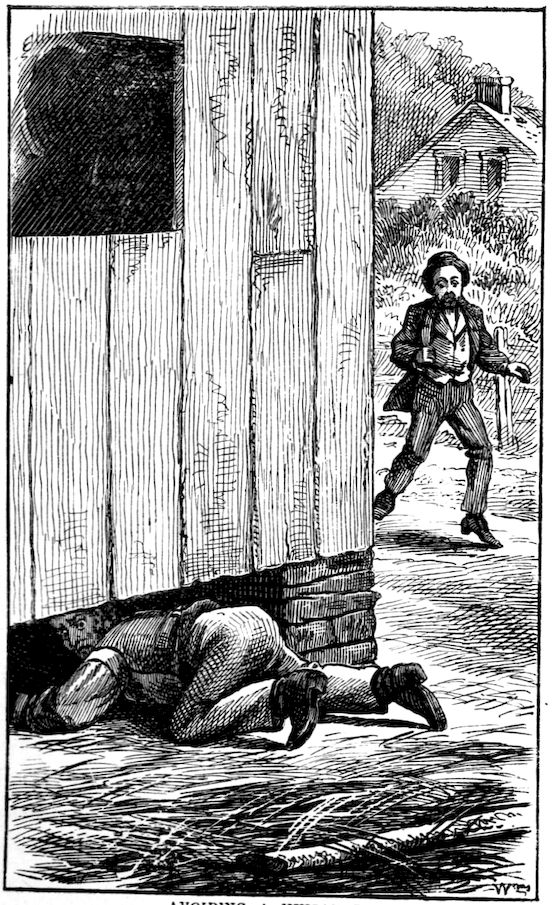
201“Samantha there has got to be a change.”
“How is there goin’ to be a change?” says I.
“I’ll tell you,” says he, in a whisper—for fear some
on ’em was prowlin’ round the house yet—“we will
git up before light to-morrow mornin’, and go to
Jonesville and buy a organ right out.”
I fell in with the idee, and we started for Jonesville
the next mornin’. We got there jest after the
break of day, and bought it of the man to the breakfast
table. Says Josiah to me afterwards, as we was
goin’ down into the village:
“Let’s keep dark about buyin’ one, and see how
many of the creeters will be a besettin’ on us to-day.”
So we kep’ still, and there was half a dozen fellers
follerin’ us round all the time a most, into stores and
groceries and the manty makers, and they would
stop us on the sidewalk and argue with us about
their organs and pianos. One feller, a tall slim
chap, never let Josiah out of his sight a minute;
and he follered him when he went after his horse,
and walked by the side of the wagon clear down to
the store where I was, a arguin’ all the way about his
piano. Josiah had bought a number of things and
left ’em to the store, and when we got there, there
stood the organ man by the side of the things, jest
like a watch dog. He knew Josiah would come and
git ’em, and he could git the last word with him.
202Amongst other things, Josiah had bought a barrel
of salt, and the piano feller that had stuck to Josiah
so tight that day, offered to help him on with it.
And the organ man—not goin’ to be outdone by the
other—he offered too. Josiah kinder winked to me,
and then he held the old mare, and let ’em lift. They
wasn’t used to such kind of work, and it fell back on
’em once or twice, and most squashed ’em; but they
nipped to, and lifted again, and finally got it on; but
they was completely tuckered out.
And then Josiah got in, and thanked ’em for the
liftin’; and the organ man, a wipin’ the sweat offen
his face—that had started out in his hard labor—said
he should be down to-morrow mornin’; and the
piano man, a pantin’ for breath, told Josiah not to
make up his mind till he came; he should be down
that night if he got rested enough.
And then Josiah told ’em that he should be glad
to see ’em down a visitin’ any time, but he had jest
bought a organ.
I don’t know but what they would have laid holt
of Josiah, if they hadn’t been so tuckered out; but
as it was, they was too beat out to look anything
but sneakin’; and so we drove off.
The manty maker had told me that day, that there
was two or three new agents with new kinds of sewin’
machines jest come to Jonesville, and I was tellin’
Josiah on it, when we met a middle-aged man, and
he looked at us pretty close, and finally he asked us
203as he passed by, if we could tell him where Josiah
Allen lived.
Says Josiah, “I’m livin’ at present in a Democrat.”
Says I, “In this one horse wagon, you know.”
Says he, “You are thinkin’ of buyin’ a sewin’
machine, haint you?”
Says Josiah, “I am a turnin’ my mind that way.”
At that, the man turned his horse round, and follered
us, and I see he had a sewin’ machine in front
of his wagon. We had the old mare and the colt,
and seein’ a strange horse come up so close behind
us, the colt started off full run towards Jonesville,
and then run down a cross-road and into a lot.
Says the man behind us, “I am a little younger
than you be, Mr. Allen; if you will hold my horse I
will go after the colt with pleasure.”
Josiah was glad enough, and so he got into the
feller’s wagon; but before he started off, the man,
says he:
“You can look at that machine in front of you
while I am gone. I tell you frankly, that there
haint another machine equal to it in America; it
requires no strength at all; infants can run it for
days at a time; or idiots; if anybody knows enough to
set and whistle, they can run this machine; and it’s
especially adapted to the blind—blind people can run
it jest as well as them that can see. A blind woman
last year, in one day, made 43 dollars a makin’ leather
aprons; stitched them all round the age two rows.
204She made two dozen of ’em, and then she made
four dozen gauze veils the same day, without changin’
the needle. That is one of the beauties of the machine,
its goin’ from leather to lace, and back again,
without changin’ the needle. It is so tryin’ for wimmen,
every time they want to go from leather, to
gauze and book muslin, to have to change the needle;
but you can see for yourself that it haint got its equal
in North America.”
He heerd the colt whinner, and Josiah stood up in
the wagon, and looked after it. So he started off
down the cross road.
And we sot there, feelin’ considerable like a procession;
Josiah holdin’ the stranger’s horse, and I the
old mare; and as we sot there, up driv another slick
lookin’ chap, and I bein’ ahead, he spoke to me, and
says he:
“Can you direct me, mom, to Josiah Allen’s
house?”
“It is about a mile from here,” and I added in a
friendly tone, “Josiah is my husband.”
“Is he?” says he, in a genteel tone.
“Yes,” says I, “we have been to Jonesville, and
our colt run down that cross road, and-—”
“I see,” says he interruptin’ of me, “I see how it
is.” And then he went on in a lower tone, “If you
think of buyin’ a sewin’ machine, don’t git one of
that feller in the wagon behind you—I know him
well; he is one of the most worthless shacks in the
205country, as you can plainly see by the looks of his
countenance. If I ever see a face in which knave
and villain is wrote down, it is on hisen. Any one
with half an eye can see that he would cheat his
grandmother out of her snuff handkerchief, if he got
a chance.”
He talked so fast that I couldn’t git a chance to
put in a word age ways for Josiah.
“His sewin’ machines are utterly worthless; he
haint never sold one yet; he cant. His character has
got out—folks know him. There was a lady tellin’
me the other day that her machine she bought of
him, all fell to pieces in less than twenty-four hours
after she bought it; fell onto her infant, a sweet little
babe, and crippled it for life. I see your husband is
havin’ a hard time of it with that colt. I will jest
hitch my horse here to the fence, and go down and
help him; I want to have a little talk with him
before he comes back here.” So he started off on
the run.
I told Josiah what he said about him, for it madded
me, but Josiah took it cool. He seemed to love
to set there and see them two men run. I never did
see a colt act as that one did; they didn’t have time
to pass a word with each other, to find out their mistake,
it kep’ ’em so on a keen run. They would git
it headed towards us, and then it would kick up its
heels, and run into some lot, and canter round in a
circle with its head up in the air, and then bring up
206short ag’inst the fence; and then they would leap
over the fence. The first one had white pantaloons
on, but he didn’t mind ’em; over he would go, right
into sikuta or elderbushes, and they would wave
their hats at it, and holler, and whistle, and bark like
dogs, and the colt would whinner and start off again
right the wrong way, and them two men would go a
pantin’ after it. They had been a runnin’ nigh onto
half an hour, when a good lookin’ young feller come
along, and seein’ me a settin’ still and holdin’ the old
mare, he up and says:
“Are you in any trouble that I can assist you?”
Says I, “We are goin’ home from Jonesville,
Josiah and me, and our colt got away and—”
But Josiah interrupted me, and says he, “And
them two fools a caperin’ after it, are sewin’ machine
agents.”
The good lookin’ chap see all through it in a minute,
and he broke out into a laugh it would have
done your soul good to hear, it was so clear and
hearty, and honest. But he didn’t say a word; he
drove out to go by us, and we see then that he had a
sewin’ machine in the buggy.
“Are you a agent?” says Josiah.
“Yes,” says he.
“What sort of a machine is this here?” says Josiah,
liftin’ up the cloth from the machine in front of him.
“A pretty good one,” says the feller, lookin’ at
the name on it.
207
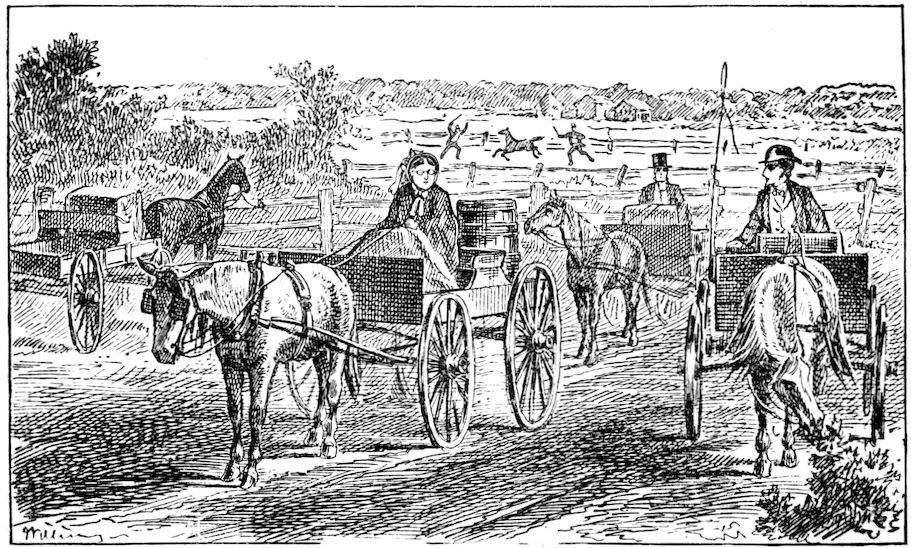
THE SEWIN’ MACHINE AGENTS.
209“Is yours as good?” says Josiah.
“I think it is better,” says he. And then he started
up his horse.
“Hello! stop!” says Josiah.
The feller stopped.
“Why don’t you run down other fellers’ machines,
and beset us to buy yourn?”
“Because I don’t make a practice of stoppin’ people
on the street.”
“Do you haunt folks day and night; foller ’em
up ladders, through trap-doors, down sullers, and
under barns?”
“No,” says the young chap, “I show people how
my machine works; if they want it, I sell it; and if
they don’t, I leave.”
“How much is your machine?” says Josiah.
“75 dollars.”
“Can’t you,” says Josiah, “because I look so much
like your old father, or because I am a Methodist, or
because my wife’s mother used to live neighbor to
your grandmother—let me have it for 25 dollars?”
The feller got up on his wagon, and turned his
machine round so we could see it plain—it was a
beauty—and says he:
“You see this machine, sir; I think it is the best one
made, although there is no great difference between
this and the one over there; but I think what difference
there is, is in this one’s favor. You can have it
for 75 dollars if you want it; if not, I will drive on.”
210“How do you like the looks on it, Samantha?”
Says I, “It is the kind I wanted to git.”
Josiah took out his wallet, and counted out 75
dollars, and says he:
“Put that machine into that wagon where Samantha
is.”
The good lookin’ feller was jest liftin’ of it in, and
countin’ over his money, when the two fellers come
up with the colt. It seemed that they had had a
explanation as they was comin’ back; I see they had
as quick as I catched sight on ’em, for they was
a walkin’ one on one side of the road, and the other
on the other, most tight up to the fence. They was
most dead the colt had run ’em so, and it did seem
as if their faces couldn’t look no redder nor more
madder than they did as we catched sight on ’em
and Josiah thanked ’em for drivin’ back the colt;
but when they see that the other feller had sold us a
machine, their faces did look redder and madder.
But I didn’t care a mite; we drove off tickled
enough that we had got through with our sufferin’s
with agents. And the colt had got so beat out a
runnin’ and racin’, that he drove home first-rate,
walkin’ along by the old mare as stiddy as a deacon.
211
PREPARIN’ FOR OUR TOWER.
It was on a fair and lovely mornin’, though middlin’
cool, that I told my Josiah that if he and I
was a goin’ to see the Sentinal it was time for us to
be makin’ some preparations. Thomas J. haint a
goin’ till bime-by. He wants to go in company with
Maggy Snow and her father, and I don’t blame him a
mite—I was young once myself. The Squire is laid
up now with rheumatiz, can’t step a step on his left
foot. I was out on the back stoop, a shakin’ my
table cloth and Josiah was out there a grindin’ his jack
knife on the grindstun, and I says to him, again:
“Josiah Allen it is time for us to prepare.”
Says he, “I thought mebby you’d want to give up
goin’, Samantha.”
“I want to give up goin’!” says I, in a almost mekanical
tone, but very cold.
“Yes,” says he in a sickly and almost foolish tone.
“I didn’t know but you’d want to wait till the next
one; I didn’t know but you’d drather.”
212“Drather!” I repeated still more icily. “I would
wait if I was in your place Josiah Allen, till we are
as old as the hills; if we was alive we’d be carried
there in a side show, and you know it;” and I folded
up my table cloth almost severely.
“Well,” says he, tryin’ the age of the knife with
his fingers, “I don’t think I shall go anyway.”
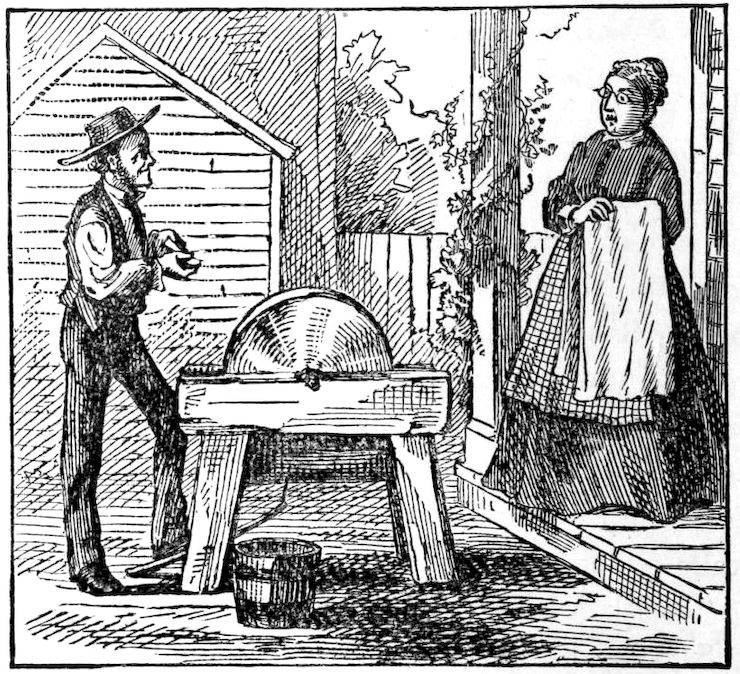
“IT HAINT ALWAYS BEST TO TELL REASONS.”
Says I layin’ the table cloth over my left arm, and
foldin’ my right and left arm, tryin’ hard to keep some
composed (on the outside):
“What are your reasons, Josiah Allen?”
“Oh,” says he in a kind of a blind way—goin’ to
grindin’ again,—“I have my reasons, but it haint
always best to tell reasons to everybody.”
213And jest so he kep’ a grindin’ and a hangin’ back
and a actin’. It was a curious time, very. I a standin’
there erect and firm on the stoop, with my table cloth
on my left arm and earnestness on my eyebrow, and
he half bent, a grindin’ away on that old jack knife,
with obstinacy on his brow, a tellin’ me in a blind
mysterious way that he had his reasons and wouldn’t
tell ’em. Oh! how offish and strange men will act.
Truly, truly, doth the poet observe, “that men are
wild, and have their spells.”
There Josiah Allen had acted to the Debatin’-school
all up in arms about goin’. He knew the nation
would expect me to be present. He knew well what
a gloom it would cast over the Sentinal if I wasn’t
there, a shadder that would spread (as you may say)
from pole to pole. Josiah Allen knew all about it; he
knew well how I had lotted on makin’ a martyr of
myself in the cause of Right and Wimmen, and here
he had to baulk in the harness. Truly, men are as
contrary creeters as the earth affords, when they are
a mind to be. Every married woman will join with
me in sayin’, that there are moments in married life,
when mules seem to be patterns of yieldin’ sweetness
and obligin’ness compared with lawful pardners.
But here, in this tryin’ moment was where mind
stepped in to the relief of matter and Samantha.
Some wimmen when they see their pardners act so
strange and curious, would have give up. Not so
Samantha. Here was where the deep and arduous
214study of her life-time into the heights and depths of
the manly mind soared up and triumphed. I didn’t
act skairt at all by him, neither did I show out that I
was mad—though I was inwardly—to see him act so
offish and obstinate. No! I looked down on him a
grindin’, and a actin’, with a almost marble calm; and
with a resolution nearly cast-iron I concealed my
opinion of him and kep’ my tongue in my head, and
with a slow, even, and almost majestic tread I turned
round and went back into the house, laid my table-cloth
on the buttery shelf, and begun my preparations
to conquer and to triumph. At jest noon, I called
him into the house to as good a dinner as Jonesville
ever offered to man or beast.
Again science, philosophy and Samantha conquered.
Josiah had got through with the turkey and vegetables
of all kinds, and there was a sweet smile on his
face as I brought on the cherry puddin’, and a tender,
affectionate look to his eyes as he looked up at me
when I sot the bowl of sweet sass to eat on it in front
of him. Then I knew the time had come, the hour
was ripe, and I boldly and confidently tackled him
as to what his reasons was. And without a struggle
or a murmur he says in gentle axents:
“Samantha, my pantaloons haint suitable to wear to
the Sentimental, they are all frayed out round the
bottoms, and you can see your face in the knees, they
are so shiny, they are as good as lookin’ glasses.”
I felt dretful well to think I had come off conqueror,
215and awful relieved to think my pardner’s reasons was
them I could grapple with and overthrow. I see that
my mission could be preformed about, my tower gone
off on. And then my companion’s affectionate mean
endeared him to me dretfully for the time bein’, and
take it altogether I felt so dretful eloquent, I soared
right up in half a minute to a height of happiness and
eloquence that I hadn’t sot on for days and days,
and I broke right out in a noble oriterin’ tone, and
as affectionate as they make:
“Josiah Allen that pure and heavenly blossom of
True Love never floated down from Eden bowers into
this troublesome world, without its whiteness makin’
the soul whiter that it lighted down on. It never
warmed the heart with a breath of the heavenly
climate it was born in without inspirin’ that heart
with a desire and a inspiration to help the beloved
object.” Says I firmly, “Store clothes are not a
goin’ to part my companion and happiness;” and I
added—in still more lofty tones for I felt noble in
spirit as I said it—“take the last churnin’ of butter
Josiah Allen, and go to Jonesville and git the cloth
for a new pair of pantaloons, and I will make them
for you or perish on the press board.”
“Well,” says he sweetly, as he helped himself to
the sweet sass, “then we will go to the Sentimental.”
(I have give up tryin’ to have Josiah call it anything
but Sentimental, because I see plain after arguin’
for several weeks on it, that argument was
216wasted, and breath spent in vain. He says he has
spelt the word over time and again, and studied on
it a sight, and he knows it is as near that as anything,
and he will call it Sentimental.)
Well, the very day I finished his trowsers, he
broached a new idee to me. We had been a layin’
out to go on the cars, but Josiah says to me, says he:
“What do you say Samantha to goin’ with the old
mare, and kinder visitin’ along the road; we have got
lots of relations that live all along the way, some on
my side, and some on yourn. They’ve all visited us
time and again, and we haint never been nigh ’em to
visit ’em. What do you say Samantha, to goin’ in
our own conveniance.”
“You mean conveyance,” says I firmly.
“Well I said so didn’t I; what do you say to it,
Samantha?”
Says I, “I haint a goin’ in that old buggy of
ourn.”
Says he, “That buggy was high-toned enough for
father, and for grandfather, and it ort to be for us.”
Says I, “It is dangerous Josiah Allen and you
know it. Have you forgot,” says I, “how sister
Minkley went right down through the bottom the
other day when you was a helpin’ her in?” Says I,
“It skairt you Josiah Allen, and you know it; the
minute you leggo of her, to have her go right down
through the bottom, and set down on the ex. It was
enough to start anybody.”
217“Well, what business has a woman to weigh more’n
a ton? I’ve mended it.”
Says I, “Truly in the matter of heft Josiah Allen,
let everybody be fully perswaded in their own mind.
And she don’t weigh near a ton, she don’t weigh
more’n three hundred and fifty.”
“The buggy was good enough for father and grandfather,”
he kep’ a arguin’.
“But,” says I in reasonable axents, “them two old
men never sot out on towers of Principle. They
never sot out as Promiscous Advisors in the cause of
Right; if they had, they would have wanted to feel
free and promiscous in their minds. They wouldn’t
have wanted to feel liable in the loftiest moments of
their high mission, to break through and come down
acrost a ex. They would have felt that a top buggy
was none too high-toned to bear ’em onwards.”
Says he, “It will make talk, Samantha. The
neighbors will think we are too loose-principled, and
hauty.”
Says I, “The neighbors say now we are too tight
to git a new one. I had jest as lives be called too
loose, as too tight. And you know,”—says I in reasonable
tones, “you know Josiah Allen, that we have
got to be called sunthin’ by ’em, anyway. We have
got money out at interest, and we are goin’ down the
hill of life, and if we can go down any easier in a top
buggy, I don’t see why we shouldn’t have it to go in.”
So finally after considerable urgin’, I got Josiah
218headed towards Jonesville after a top buggy. And I
and the Widder Doodle kep’ watch to the winder
all day, expectin’ to see the new buggy a comin’ home
with Josiah; but he come back at night empty-handed
but all worked up with another new idee, and says he:
“What do you say Samantha to buyin’ a phantom,—a
pony phantom. The man says they are easier
ridin’, easier to get into, and he thought you would
like it better than a top buggy. And he said they
was all the fashion too.”
But I answered him calmly. “Fashion, or no
fashion, I shant ride no phantom Josiah Allen. I
shant go to the Sentinal on my lofty mission, a
ridin’ a phantom. Though,” says I more mildly,
“phantoms may be willin’ critters to go, and easy
ridin’, but I don’t seem to have no drawin’ towards
’em. A top buggy is my theme.”
So I held firm, and finally Josiah bought one. It
was a second-handed one, and fair lookin’, big and
roomy. In shape it wasn’t the height of fashion,
bein’ kind o’ bowin’ up at the back, and sort o’ spread
out like in front; a curious shape. I never see none
exactly like it, before nor sense. They said the man
that built it, made up the pattern in his own head,
and there hadn’t nobody ever follered it. He died a
few weeks after he made it; Thomas Jefferson said
he guessed it killed him, the shape was so curious that
it skairt the man to death. But it wasn’t no such
thing; he had the billerous colic.
219Josiah was so perfectly delighted with it that he
would go out to the barn and look at it for hours,
and I was most afraid he was settin’ his heart too
much on it; and I told Thomas Jefferson so, but he
told me not to worry; says he, “it wouldn’t be a
mite wicked for father to worship it.”
Says I, “Thomas Jefferson do you realize what
you are a talkin’ about?” says I, “it scares me to hear
you talk so wicked when I brought you up in such a
Bible way.”
Says he, “There is where I got it, mother. I got
it out of the Bible; you know it says you shall not
worship anything that is in the shape of anything on
earth, or in the heavens, or in the waters under the
earth. And that is why it would be perfectly safe
for father to worship the buggy.”
I see through it in a minute; though I never
should have thought on it myself. What a mind
that boy has got; he grows deep every day.
Josiah said he couldn’t leave the colt to home, as
the old mare would be liable to turn right round in
the road with us any time, and start back for home;
but I told him that when anybody sot off on a tower
as a martyr and a Promiscous Advisor, a few colts
more or less wasn’t a goin’ to overthrow ’em and
their principles. Says I, we will hitch the colt to
the old mare, Josiah Allen, and march onwards
nobly in the cause of Right.
But still there was a kind of a straggler of a
220thought hangin’ round the age of my mind, to worry
me a very little; and I says to my Josiah dreamily:
“I wonder if they’ll be glad to see us. Anything
but bringin’ trouble onto folks, because they are
unfortunate enough to be born cousins to you, unbeknown
to them.”
“But,” says Josiah, “we owe a visit to every one
on ’em, and some on ’em two or three.”
And so we did. They had all of ’em visited us
years ago, more or less on ’em out of every family.
There was Zebulin Coffin’ses wife and four of his
boys; Philander Spicer’ses wife and Philander—they
all made us long visits; and Serepta Simmons—she
that was Serepta Smith—made it her home with mother
and me for years before she was married—we helped
to bring her up on a bottle. And then there was
Delila, Melankton Spicer’ses wife had visited us with
Philander’ses folks when they was first married; she
was Philander’s wife’s sister. We had promised to
pay their visits back, and laid out to, but it hadn’t
seemed to come right, somehow. But now, everything
seemed to promise fair for a first-rate time for
us and them. We would be journeyin’ onwards
towards the Sentinal, and the cause of Right. Our
clothes (now Josiah had got some new pantaloons
and I a new dress) would look well, and almost
foamin’. We had a beautiful top buggy, and take it
altogether, it did truly seem almost as Josiah said,
that we was havin’ our good things all on earth.
221But anon, or a very little after, a new question come
up; what should we do with the Widder Doodle;
she didn’t want to go, and she didn’t want to stay.
And so, what should we do with her to do right?
I am sot on doin’ by the Widder as I would wish
to be done by if I should come onto the town and
have to be took in and done for; and so day and
night this deep and wearin’ thought kep’ a hauntin’
me—though I tried to keep cool on the outside—“she
don’t want to go, and she don’t want to stay; and so
what shall I do with the Widder Doodle?”
222
THE WIDDER AND WIDOWER.
Solomon Cypher is a widower! Yes, he has
lost his wife with the tyfus; she was a likely
woman, had a swelled neck, but that wasn’t nothin’
ag’inst her; I never laid it up ag’inst her for a
minute. I told Thomas J. when he brought me the
news, that I wished he and I was as likely a woman
as she was, and says I still more warmly, “if the
hull world was as likely a woman as she was, there
wouldn’t be so much cuttin’ up, and actin’ as there is
now.” And says I, “Thomas J., it stands us in hand
to be prepared.”
But somehow it is awful hard to git that boy to
take a realizin’ sense of things; his morals are dretful
sound, but a good deal of the time he is light
and triflin’ in his demeanor and his talk; and his
mind don’t seem to be so stabled as I could wish
it to be.
Now I don’t s’pose there would anybody believe
me, but the very next day but one after Nancy
223Cypher’ses death, that boy begun to laugh at his aunt
Doodle about the relict. I told him I never see
anything in my hull life so wicked and awful, and I
asked him where he s’posed he’d go to.
He was fixin’ on a paper collar to the lookin’ glass,
and he says in a kind of a chirk way, and in a fine
polite tone: “I s’pose I shall go to the weddin’.”
Good land! you might jest as well exhort the wind
to stop blowin’ when it is out on a regular spree, as
to stop him when he gits to behavin’. But I guess
he got the worst of it this time, I guess his aunt
Doodle skairt him—she took on so when he sejested
the idee of her marryin’ to another man.
She bust right out cryin’, took out her snuff handkerchief,
and rubbed her eyes with both hands, her
elbo’s standin’ out most straight; she took it awful.
“Oh Doodle! Doodle!” says she, “what if you
had lived to hear your relict laughed at about
marryin’ to another man. What agony it would
have brung to your dear linement; I can’t bear it,
I can’t. Oh! when I think how he worshipped the
ground I walked on; and the neighbors said he did;
they said he thought more of the ground than he did
of me: but he didn’t, he worshipped us both. And
what would his feelin’s be if he’d lived to see his
Widder laughed at about another man.”
She sobbed like a infant babe; and I come to the
buttery door with my nutmeg grater in my hand,
and winked at Thomas Jefferson two or three times,
224not to say another word to hurt her feelin’s. They
was real firm and severe winks and he knew I meant
’em, and he took up one of his law books and went to
readin’, and I went back to makin’ my fruit cake and
cherry pies. But I kep’ one eye out at her, not
knowin’ what trouble of mind would lead her into;
she kep’ her snuff handkerchief over her eyes and
groaned bad for nearly nine moments I should judge,
and then she spoke out from under it:
“Do you think Solomon Cypher is good lookin’
Tommy?”
“Oh! from fair to middlin’,” says Thomas J.
And then she bust out again: “Oh what a linement
my Doodle had on him; how can I think of
any other man. I can’t! I can’t!” And she groaned
the hardest she had yet. And I come to the buttery
door again, and shook my head and winked at
Thomas Jefferson again, severer and more reprovin’
winks than they was before, and more of ’em; and
he, feelin’ sorry I guess for what he had done, got
up and said he guessed he’d go out to the barn, and
help his father. Josiah was puttin’ some new stanchils
in the stable.
Thomas J. hadn’t much more’n got to the barn,
and I had finished my cake, and had jest got my
hands into the pie crust a mixin’ it up, when there
come a knock to the door, and my hands bein’ in the
dough, the Widder stopped groanin’ for the time bein’,
and opened it. It was Solomon Cypher himself come
225to borry my bombazeen dress and crape veil for some
of the mourners. Bein’ engaged and busy, I thought
I wouldn’t go out till I had finished my pies; he and
the Widder bein’ some acquainted. He hadn’t sot
but a few minutes when he spoke up, and says he:
“This is a dretful blow to me, Widder;” and he
hit himself a knock in the stomach so you could
hear it all over the house—for he has got so used to
public life and its duties, that he makes gestures right
along every day, good enough for anybody, and this
was; it would have knocked anybody down that
wasn’t in the practice.
“A hard blow,” says he peltin’ himself again right
in his breast.
“Yes,” says sister Doodle, puttin’ her snuff handkerchief
to her eyes. “I can feel to sympathize with
you, I know what feelin’s I felt when I lost Doodle.”
Not a word does she say about brother Timothy,
but I hold firm and so does Josiah; we do well by
the Widder.
Says he, “I believe you never see the corpse.”
“No,” says she, “but I have heerd her well spoke
of; sister Samantha was a sayin’ jest before you come
in, that she was a likely woman.”
“She was!” says he a smitin’ himself hard, “she
was; my heart strings was completely wrapped round
that woman; not a pair of pantaloons have I hired
made sense we was both on us married to each other;
nor a vest. I tell you it is hard to give her up Widder;
226dretful hard; she was healthy, savin’, equinomical,
hard workin’, pious; I never realized how much I
loved that woman;” says he in a heart broken tone,
“I never did till I see I must give her up and hire a
girl at 2 dollars a week; and they waste more’n their
necks are worth.” Here he stopped a minute and
sithed, and she sithed, so loud that I could hear ’em
plain into the buttery; and then he went on in still
more melancholly and despairin’ tones.
“I tell you I have seen trouble for the last month
Widder. It’s only four weeks ago yesterday, that I
lost the best cow I had, and now my wife is dead; I
tell you it cuts me right down Widder, it makes me
feel dretful poor.”
227I could tell by his voice that he was jest ready to
bust out cryin’; Solomon takes her death hard, dretful.
Here they both sithed again so powerful that
they seemed more like groans than common sithes;
and then he continued on:
“It seems Widder as if my heart will bust,” and I
could see as I went acrost the buttery for the rollin’
pin, that he had laid his left hand over his heart, as
if he was holdin’ it inside of his vest by main strength;
“it seems as if it must bust, it is so full of tender
memories for that woman. When I think how she
would git up and build fires in the winter—”
“That is jest what I love to do,” says sister
Doodle, “I always built fires for my Doodle.”
“Did you Widder?” says he, and his tone seemed
to be some chirker than it was. “I wish you had
been acquainted with the corpse, I believe you would
have loved each other like sisters.”
Sister Doodle took her snuff handkerchief down
from her face and says she in a more cheerful tone:
“You must chirk up, Mr. Cypher; you must look
forred to happier days.”
“Yes,” says he, “I know there is another spear,
and I try to keep it in view, and hang my hopes upon
it; a spear where hired girls are unknown, and
partin’s are no more.”
“I can’t bear hired girls,” says sister Doodle. “I
wouldn’t have one round when I was a keepin’ house.”
“Can’t you bear hired girls?” says Solomon. “You
228make me feel better, Widder, than I did feel when I
come in here! You chirk me up Widder! I believe
you look like the corpse; you look out of your eyes
as she looked out of hern. Oh what a woman that
was; she knew her place so well; you couldn’t have
hired her to vote; she said she’d drather dig potatoes
any time—she was as good as a man at that, when I’d
git kinder belated with my work; she’d dig as fast as
I could any day.”
“I love to dig potatoes,” says the Widder.
“I do feel better,” says Solomon. “I know I don’t
feel nigh so cast down as I did.”
“And no money wouldn’t hire me to vote.”
“You do look like her,” says he bustin’ out in a
real convinced tone, “I know you do; I can see it
plainer and plainer. You make me think on her.”
“Well,” says she “then you must think on me all
you can. Think on me anytime it’s agreeable to you;
it don’t make no difference when; any time, day or
night; don’t be delicate about it at all. I’ll be glad
if I can chirk you up that way, or any other.”
“You have; you have chirked me up Widder; I feel
better than I did when I come in here.”
“Well then you must come real often and be
chirked up. I haint nothin’ to do hardly, and I may
jest as well be a chirkin’ you up as not, and better.”
“I will come,” says he.
“Well, so do; come Sunday nights or any time
when it is the handiest to you.”
229“I will, Widder, I will;” says he.
I can’t say but what my mind put out this deep
question to myself as I stood there a hearin’ sister
Doodle go on;
“Samantha, ort times ort is how many?” And
though I answered back to myself calmly and firmly,
“ort;” still, thinks’es I to myself, she is a clever
critter, and what little sense she has got runs to goodness—and
that is more than you can say of some
folks’es sense—some folks’es runs to meanness every
mite of it; I went out and got my dress and veil. I
felt sorry for Solomon, very; and as I handed ’em to
him, I says, tryin’ to comfort him:
“She was a likely woman, and I haint a doubt but
what she is better off now.”
But he didn’t seem to like it, though I spoke with
such good motives. He spoke up real crank:
“I don’t know about that; I don’t know about her
bein’ better off, I did well by her.”
I heerd my pies a sozzlin over in the oven bottom,
and I hastened to their rescue, and Solomon started
off. The Widder, that clever critter, went to the door,
and as he went down the door step, I didn’t hear jest
what she said to him—bein’ a turnin’ my pies at the
time—but I heerd his answer; it was this:
“I feel better than I did feel.”
I thought considerable that afternoon (to myself)
what clever streaks the Widder Doodle did have in
her, (considerin’ her sense) when all of a sudden she
230give me another sample of it. We got to talkin’ about
the Sentinal and though my demeanor was calm, and
my mean considerable cool, the old question would
come up in my mind: “What shall I do with the
Widder Doodle; what can I do with a Widder that
don’t want to go, and don’t want to stay?”
The question was a goarin’ me (inwardly) the very
minute when she spoke up, and says to me that
she would stay to home and keep house for me; she
wanted to.
But says I, “I hate to have you stay here sister
Doodle; I am afraid you’ll git lonesome; you haint
seemed to think you could, and I hate to put it on
you. You know Thomas J. will be to Jonesville
more’n half his time, and our tower will be a long
one.” Says I, “visitin’, as we shall all along the way
to the Sentinal, it will be the longest tower ever gone
off on by us; and I am afraid you’ll be lonesome,
sister Doodle; I am awful ’fraid you will.” Says she:
“Sister Samantha I want to be lonesome if it is a
goin’ to be any accomodation to you; it will be a real
treat to me to be lonesome. I never seemed to feel
so willin’ to be lonesome in my hull life before.”
And as she wouldn’t take no for an answer, it was
settled that she should stay and keep house. A
cleverer critter (considerin’ her sense) never walked
the earth than sister Doodle, and so I told Josiah.
231
HOW SEREPTA CARRIED THE MEETIN’ HOUSE.
Never did the year let a lovlier day slip offen
his string (containin’ jest 365) than the day my
pardner and me set off on our tower. Never did a
brighter light rest upon a more peaceful realm and a
serener wave, than that mornin’ sun a shinin’ down
on our door-yard, and the crystal waters of the canal.
Sweeter winds never blew out of the west, than the
fresh mornin’ breeze that sort o’ hung round our bed-room
winder where we was a fixin’, and gently
waved the table-cloth, as Sister Doodle shook it offen
the back steps. And never, sense the Widder had
been took in and done for by us, had she been in such
spirits. We had hired Betsey Slimpsey knee Bobbet
to do all the heaviest of the work, and the Widder
seemed glad and light of heart. For though the fried
ham which we had for breakfast, and the salt-suller,
and the sugar-bowl, had all put her in mind of
Doodle—and though reminessinces was brought up,
232and particulars was abroad, still she didn’t weep a
tear, but seemed to think of him and life with peace
and resignation.
When I got all ready to start, I looked well, and
felt well. I had bought a bran new dress expressly
for the occasion, a sort of a Quaker brown, or lead
color. It was cotton and worsted, I don’t know really
what they do call it, but it was handsome, and very
nice. It cost 18 pence per yard. It was made very
fashionable; had a overskirt, and a cape all trimmed
round the edge with a narrow strip of the same cut
on the bias. Settin’ out as I did as a martyr, I sot
my foot down firmly on ruffles and puckers. But
this straight and narrow strip cut crossways of the
cloth and sot on plain, suited both my eyes and my
principles. It was stitched on with my new sewin’
machine. Almira Hagidone come to the house and
made it for me—took her pay in white beans.
The cape looked noble when it was finished, and I
knew it would. I would have it cut to suit me. It
didn’t look flighty and frivolous, but it had a sort of
a soarin’, deep look to it. It rounded up in the back,
and had long, noble tabs in front. Almira said tabs
had gone out, and argued warm ag’inst ’em, but I told
her I seemed to have a drawin’ towards ’em, and finally
I come right out and told her firmly; says I, “tabs
I will have.” So she give in and cut it tab fashion.
I had another argument about my bunnet—I had
233my brown silk one done over. I had a frame made
to order, for I was determined to have a bunnet that
shaded my face some. I told the millener plainly that
one of my night-caps—cut sheep’s-head fashion—was
far better to the head as a protector, than bunnets
as wore by wimmen; so I give my orders, and stood
by her till the frame was done; and it looked well.
It was a beautiful shape behind, and had a noble,
roomy look to it in front. And when I put it on,
and my green veil was tied round it, and hung in
long, graceful folds down on one side of it, it suited
me to a T. I trimmed off the edges of my veil where it
was frayed out, and hemmed it over, and run in a new
lutestring-ribbin string, and it looked as good as new.
Havin’ a cape like my dress, I didn’t lay out to wear
anything else round me on my tower, but I took my
black silk mantilla along in case of need.
There was enough left of my dress to make a new
sheath for my umberell, and though some of the neighbors
thought and said, (it came right straight back to
me) that it was awful extravagant in me, I launched
out and made it, and wasn’t sorry I did. I am very
tasty naturally, and love to see things correspond. I
also bought me a new pair of cotton gloves—most the
color of my dress, only a little darker so’s not to show
dirt—at an outlay of 27 and a ½ cents.
Josiah was dressed up as slick as I was, and looked
more trimmed off, and fancy, for he would wear that
234red, white, and blue, neck-tie, though upheld by duty,
I says to him:
“Josiah Allen; bald heads, and red and blue neck-ties
don’t correspond worth a cent; it is too dressy
for you, Josiah Allen.”
I meant well, but as it is too often the case in
this world—as all true Reformers know—my motives
wasn’t took as they was meant. And he says in a
complainin’ tone:
“You haint willin’ I should look dressy, Samantha,
and you never was—that is the dumb of it.”
Says I firmly, “Stop swearin’ at once, and instantly,
Josiah Allen.” And then as I see he was so awful sot
on it, I said no more, and we started off in 2 excellent
spirits—Josiah’s spirits and mine.
It was one good day’s journey to Miss Elder Simmons’es,
she that was Serepta Smith, and the top
buggy assisted by the old mare bore us on nobly.
The colt’s demeanor was like a horse’s for morality
and sobriety, and as the shades of night was a descendin’
down, we drew near the place where we
wanted to be. They lived about a quarter of a mile
from the village of Shackville, and as we drew near
the dwellin’—a smallish kind of a house, but comfortable
lookin’—we see considerable of a procession a
settin’ towards the house.
And says I to my companion, “I am afraid there is
trouble ahead, Josiah.”
235
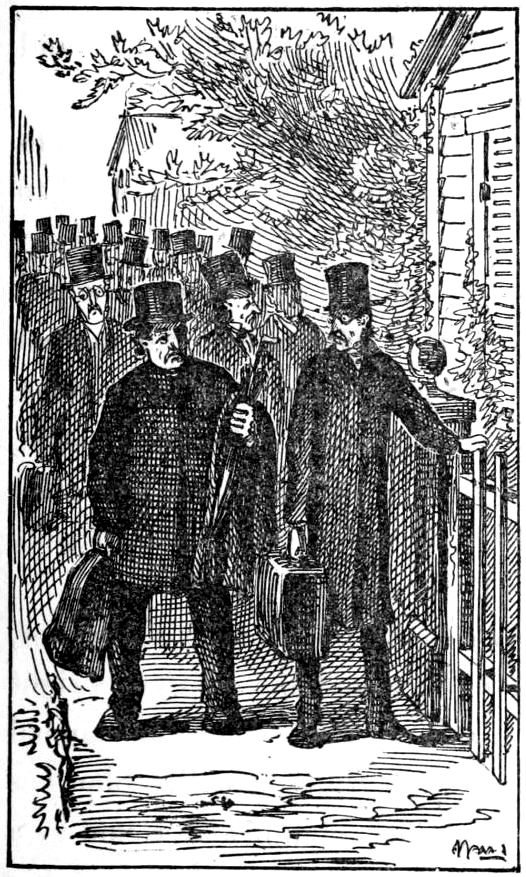
He said he guessed not; he had heard there was a
convention at Elder Simmons’es church in Shackville,
and he guessed these was delegates, a goin’ to the
minister’s to stay.
Says he, “You
know they can
lodge there without
payin’ for
their lodge.”
And come to
look at ’em again
they was peaceable
lookin’ men,
and most all of
’em had a satchel-bag
in their
hands. But how
all of ’em was a
goin’ to stay all
night in that
house, was one of
the mysteries to
me, unless they had poles for ’em to roost on, or hung
’em up over nails on the wall, such a sight on ’em.
And I spoke up to Josiah, and says I, “Our room
will be better than our company here, Josiah Allen;
less go back to Shackville and stay all night.”
“Wall,” says he, “bime-by; we’ll go in and tell
Serepta we’ve come.”
236Says I, “I guess it wont be much of a treat to her
to tell her anybody else has come, if she has got to
take care of this drove of men,” says I, “less go back
to Shackville, and stay to the tarven.”
“Wall,” says he, “bime-by; but we’ll go in and
tell Serepta we’ve come.”
I argued with him that it wouldn’t be no treat to
Serepta; but howsumever, she was awful tickled to
see us—she always did think a sight of her Aunt
Samantha. I s’pose one thing was, because I helped
to bring her up on a bottle. Her father and mother
both dyin’ and leavin’ her an orphan on both sides,
she was brought up by the Smith family, on a bottle.
Mother and I brought her part way up, and then
other Smiths would take her and bring her up a spell.
And so we kep’ on till she was brought up.
We sent her off to school, and done well by her,
and she lived with mother and me two years right
along jest before she was married. She was married
to our house, and was as pretty as a doll. She was
a little mite of a thing, but plump and round as a
banty pullet. She had a fresh, rosy face, and big
blue eyes that had a sort of a timid scareful look to
’em. She was a gentle babyish sort of a girl, but a
master hand to do jest what she thought was her
duty; and though she knew enough, anybody could
make her think the moon was made of green sage
cheese, she was that yieldin’, and easy influenced, and
237innocent-hearted. I thought a sight on her, and I
said so to Elder Simmons the day they was married.
He was a good man, but dretful deep learnt, and absent-minded.
He says to me, says he:
“She is jest as sweet as an apple blossom.”
His eyes was sot kind o’ dreamily on the apple
trees out in the orchard which was in full blow.
238“Yes,” says I, “and jest as fraguile and tender;”
says I, “the sweetest poseys are the easiest nipped by
the frost,” says I, “nothin’ looks more pitiful than a
pink posy after the frosts have got holt of it,” says I,
“keep the frosts of unkindness, and neglect, and
hard usage from our little apple blow that you have
picked to-day and are a wearin’ off on your heart, and
may God bless you Brother Simmons,” says I. (He
was of the Methodist perswasion.)
There wasn’t hardly a dry eye in my head, as I
said this, nor in hisen. I thought a sight on her, and
so did he. He thought enough on her I always said.
But he was dretful absent-minded, and deep learnt.
They stopped with us a week or two after they was
married, and I hadn’t laid eyes on ’em sense, though
I had heerd from ’em a number of times by letter;
and then Uncle Eliphalet Smith had visited ’em, and
he said she had to work awful hard, and the Elder was
so absent-minded that it took a sight of her time to get
him headed right. He’d go down suller lots of times,
and bring up ag’inst the pork barrell, when he thought
he was a goin’ up into his study; and get on her stockin’s
and things, thinkin’ they was hisen. And then he
said she had the care of the meetin’ house on her; had
to sort o’ carry the meetin’ house. Shackville bein’ a
place where they thought the minister’s wife belonged
to ’em, as some other places do think besides Shackville.
Howsumever, I didn’t know any of these
things only by hearsay, until I arrove at her dwelling;
then I knew by sight, and not by ear.
239
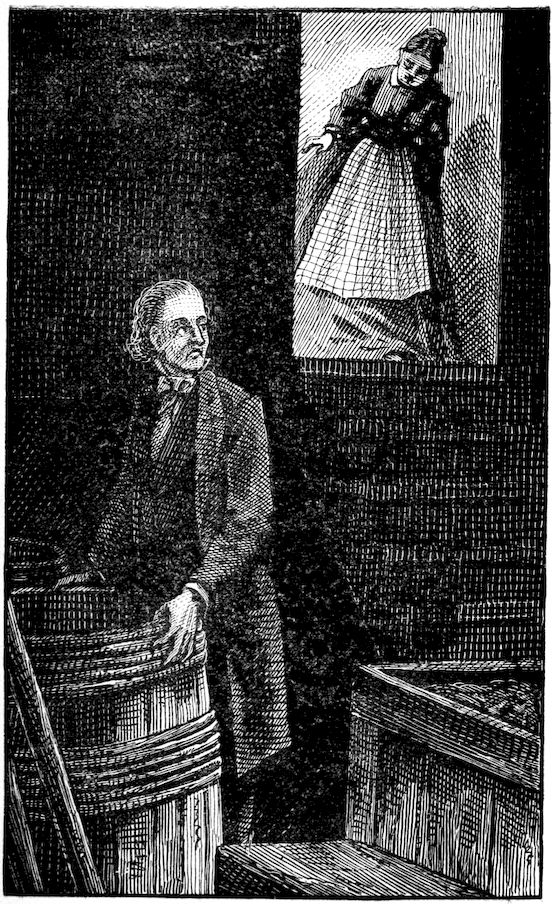
241As I first looked on her face, I couldn’t help thinkin’
of what I told Elder Simmons the mornin’ he was
married; for never did a apple blow show more signs
of frost and chill after an untimely storm, than did
the face of she that was Serepta Smith. Her cheeks
was as white and pale as a posy blown down on the
frosty ground, and her eyes had the old timid, scareful
look, and under that, whole loads of care and anxiety,
and weariness; and over all her face was the old look
I remembered so well—only 100 times stronger—of
wantin’ to do jest right, and jest what everybody
wanted her to do.
As I said, she was awful tickled to see us. But she
was so full of care, and anxiety, and work, she couldn’t
hardly speak to us. She hadn’t no girl, and was tryin’
to get supper for that hull drove of men, and hadn’t
much to do with, for the Elder after spendin’ his hull
life and strength in tryin’ to keep ’em straight in this
world and gettin’ ’em headed straight towards the
next, couldn’t get his pay from the Shackvillians.
Her childern was a follerin’ her round—her husband
needin’ headin’ off every moment or two, he was that
absent-minded. I declare, I never was sorrier for
anybody than I was for Serepta.
And then right on top of her other sufferin’s, every
time she would come into the settin’-room, one tall
242minister with a cadavery look and long yeller whiskers
would tackle her on the subject of religion, tryin’
to get her to relate her experience, right there, and
tellin’ of her hisen. That seemed to wear on her the
most of anything, a wantin’ to use him well, and
knowin’ her supper was a spilein’, and her infant
babes demandin’ her attention, and her husband a
fumblin’ round in the suller way, or buttery, needin’
headin’ off.
Truly, in the words of the Sammist, “there is a
time for things, and a place for ’em,” and it seemed
as if he might have known better. But he was one
of the kind that will talk. And there he sot lookin’
calm and cadavery, a pullin’ his old yeller whiskers,
and holdin’ her tight by the reins of her good manners,
a urgin’ her to tell her experience, and tellin’ of
her hisen. I declare, I’d been glad to have laid holt
of his old yeller whiskers myself, I was that out of
patience with him, and I’ll bet he’d a felt it if I had.
Finally I spoke up and says I:
“Set right down and relate your experience, Serepta.”
Says I, “What is vittles compared to instructive
and edifyin’ conversation.” Says I, “I wouldn’t try
to get a mite of supper to-night.”
Knowin’ what I do know, divin’ deep into the
heights and depths of men’s naters as I have doven,
I knew that this would break Serepta’s chains. She
wasn’t exhorted any more. She had time to get their
243suppers. And I laid to and helped her all I could. I
got two of the infant babes to sleep, and give the two
biggest boys some candy, and headed him off once or
twice, and eased her burdens all I could.
But she was dretful worried where to put ’em to
sleep. The hard and wearisome task of gettin’ 17
men into three beds without layin’ ’em on top of each
other, was a wearin’ on her. And she was determined
to have Josiah and me stay too. She said she
was used to jest such a house full, and she should get
along.
Says I, mildly but firmly, “Serepta I haint a goin’
to sleep on the buttery shelves, nor I don’t want you
to, it is dangerous. Josiah and me will get a lodgement
to the tarven in Shackville, and lodge there.
And to-morrow when the crowd gets thinned out, we
will come back and make our visit.”
She told us not to go; she said there was a corner of
the parlor that wasn’t occupied, and she had blankets
enough, she could make us comfortable.
Says I, “Hang on to the corner yourself, Serepta,
if you can. Josiah and me have made up our 2
minds. We are goin’ to the tarven.”
Says Josiah—for he seemed to think it would comfort
her—“We’ll come back again Serepta, we’ll come
back bime-by.”
The next day early in the forenoon, A. M., we arrove
again at Serepta’s dwellin’. She had jest got the last
244man of the drove started off, but she was tusslin’
with two colporters and an agent for a Bible Society.
And two wimmen set by ready to grapple her as soon
as the men started off. One of ’em had a sort of a
mournful look, and the other was as hard a lookin’
woman as I ever see. She was fearfully humbly, but
that haint why I call her hard lookin’. I don’t lay
up her humbleness ag’inst her, knowin’ well that our
faces haint made to order. But she looked hard, as
if her nater was hard as a rock; and her heart, and
her disposition, and everything. She had a large wart
on her nose, and that also looked hard as a gravel
stun, and some like it. She had a few long whiskers
growin’ out under her chin, and I couldn’t help wonderin’
how anything in the line of vegetation could
grow out of such a grannyt soil.
After lookin’ at her a half minute it didn’t surprise
me a mite to hear that her name was Horn, Miss Horn.
I see these two wimmen look round the house examinin’
everything as close as if they was goin’ to be swore
about it to a justice to save their lives. Serepta hadn’t
had time to wash a dish, nor sweep a single sweep,
and her childern wasn’t dressed. And I heerd Miss
Horn hunch the other one with her large, bony
knuckles, and whisper:
“She lays abed shamefully late, sometimes. The
smoke rose out of her chimbly this mornin’ at exactly
17 minutes past 6, jest an hour and two minutes earlier
245than it was yesterday mornin’, and half an hour and
twenty seconds earlier than it was the mornin’ before
that.”
“Gettin’ up and burnin’ out the wood the meetin’
house furnishes for ’em, and not a dish washed. It is
a shame,” says the other woman.
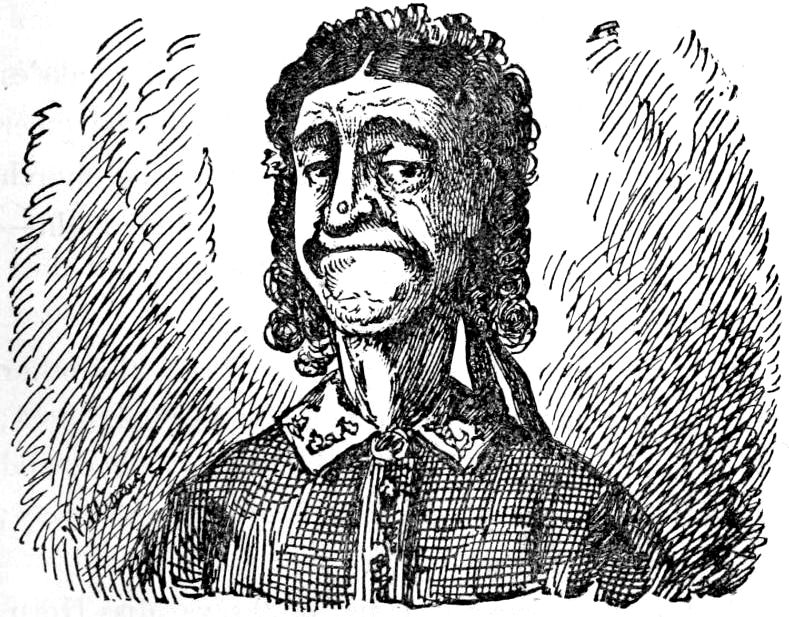
“A shame!” says Miss Horn. “It is a burnin’
shame, for a minister’s wife, that ort to be a pattern
to the meetin’ house. And she can’t find time to go
a visitin’ and talk about her neighbors’ affairs. When
anybody don’t feel like visitin’, and talkin’ about their
neighbors’ doin’s, it is a sign there is sunthin’ wrong
about ’em. There haint a thing done in the neighborhood
but what I am knowin’ to; not a quarrel for
the last twenty years but what I have had my hand in
246it. I am ready to go a visitin’ every day of my life,
and see what is goin’ on. I haint too haughty and
proud spirited to go into back doors without knockin’
and see what folks are a doin’ in their kitchens, and
what they are a talkin’ about when they think nobody
is round. And it shows a haughty, proud spirit, when
anybody haint willin’ to go round and see what they
can see in folks’es housen, and talk it over with the
other neighbors.”
Says the mournful woman, “I heard Bill Danks’es
wife say the other day, that she thought it looked queer
to her, her visitin’ the poor members of the church
jest as often as she did the rich ones. She thought—Bill’s
wife did—that it looked shiftless in her.”
“She is shiftless,” says Miss Horn.
“She acts dretful sort o’ pleasant,” says the other
woman, “seems willin’ to accomidate her neighbors;
stands ready to help ’em in times of trouble; and
seems to treat everybody in a lady-like, quiet way;
but I persume it is all put on.”
“Put on! I know it is put on,” says Miss Horn,
“She has got a proud, haughty soul, or she would be
willin’ to do as the rest of us do.” And then she
stopped whisperin’ for half a minute and looked
round the house again, and hunched the other woman,
and whispered—“For a minister’s wife that ort to
be a pattern, such housekeepin’ is shameful.”
And the Bible agent spoke up jest then, and says
247he, “Of course, as a minister’s wife and a helper in
Israel, you are willin’ to give your time to us, and
bear our burdens.”
And Serepta sithed and said she was—and she
meant it too. I declare, it was all I could do to keep
my peace. But I am naterally very close-mouthed, so
I kep’ still. Serepta couldn’t hear what the wimmen
said, for she was a tryin’ with that anxious face of
hern to hear every word the Bible agent had to say,
and to try to do jest what was right by the colporters.
And the mournful lookin’ woman hunched Miss Horn,
and says she,—
“Jest see how she listens to them men. She seems
to talk to ’em jest as free as if they was wimmen. It
may be all right, but it don’t look well. And how
earnest they are a talkin’ to her; they seem to sort o’
look up to her, as if she was jest about right. Men
don’t have no such a sort of a respectful, reverential
look onto their faces when they are a talkin’ to you
or me; they don’t look up to us in no such sort of a
way. There may be nothin’ wrong in it, but it don’t
look well. It would almost seem as if they was after
her.”
“After her! I know they are after her, or else
they wouldn’t be a talkin’ to her so respectful, and
she is after them that is plain to be seen, or else she
wouldn’t be a listenin’ to ’em just as quiet and composed
as if they was wimmen. A right kind of a
248woman has a sort of a mistrustin’ look to ’em, when
they are a talkin’ to men; they have a sort of a watchful
turn to their eye, as if they was a lookin’ out for
’em, lookin’ out for sunthin’ wrong. I always have
that look onto me, and you can see that she haint a
mite of it. See her set there and talk. If ever a
woman was after a man she is after them three men.”
I couldn’t have sot and heerd another word of their
envious, spiteful, low-lived gossip, without bustin’
right out on the spot, and speakin’ my mind before
’em all, so I baconed the childern out into Serepta’s
room, and washed and dressed ’em, and then I took
holt and put on her dish-water and bilt a fire under
it, for it had gone out while she was a tusslin’ with
them agents. When I went back into the sittin’-room
again, I see the colporters had gone, and the
wimmen had tackled her. They wanted her to join
a new society they had jest got up, “The Cumberin’
Marthas.”
Serepta’s face looked awful troubled, her mind a
soarin’ off I knew out into the kitchen, amongst her
dishes that wasn’t washed, and her infant babes, and
I could see she was a listenin’ to see if she could hear
anything of her husband, and whether he needed
headin’ off. But she wanted to do jest right, and
told ’em so.
“She would join it, if the church thought it was her
duty to, though as she belonged to fourteen different
249societies now, she didn’t know really when she could
git time—”
“Time!” says Miss Horn. “I guess there is time
enough in the world to do duties. ‘Go to the ant
thou sluggard, consider her ways and be wise.’” And
as she repeated this line of poetry, she groaned some,
and rolled up the whites of her eyes.
Serepta’s face looked red as blood, but she didn’t
answer a word back. Serepta Simmons is a Christian.
I believe it as much as I believe I am J. Allen’s wife.
And I spoke right up and says I:
“Bein’ a searcher after information, and speakin’
as a private investigater, and a woman that has got a
vow on her, I ask what are the Marthas expected to
do?”
Says Miss Horn, “They are expected to be cumbered
all the time with cares; to be ready any time,
day or night, to do anything the public demands
of ’em; to give all their time, their treasure if they
have got any, and all the energies of their mind and
body to the public good, to be cumbered by it in any
and every way.”
Says I, “Again, I ask you as a private woman with
a vow, aint it hard on the Marthas?”
She said it was; but she was proud to be one of
’em, proud to be cumbered. And she said—givin’
Serepta a awful searchin’ look—“That when a certain
person that ort to be a pattern, and a burnin’ and
250a shinin’ light, wouldn’t put their name down, there
was weaker vessels that it would be apt to break
into—it would make divisions and sisms.”
That skairt Serepta and she was jest about puttin’
her name down, but she couldn’t help murmurin’
sunthin’ about time, “afraid I won’t have time to do
jest right by everybody.”
“Time!” says Miss Horn, scornfully and angrily,—“Time!
‘Go to the ant thou sluggard, consider her
ways and be wise.’”
But jest as Miss Horn was a finishin’ repeatin’ her
poetry, and before Serepta had time to put her name
down, all of a sudden the door opened, and another
great tall woman marched in. I noticed there didn’t
none of ’em knock, but jest opened the door and
stalked in, jest as if the minister’s house, as well as
he and his wife belonged to ’em and they had a perfect
right to stream in every minute. I declare, it
madded me, for I say if home means anything it
means a place where anybody can find rest, and repose
and freedom from unwelcome intrusion. And I
say, and I contend for it, that I had jest as lives have
anybody steal anything else from me, as to steal my
time and my comfort. There probable haint a woman
standin’ on feet at the present age of the world, (with
or without vows on ’em) that is more horsepitable,
and gladder to see her friends than Samantha Allen,
late Smith. There are those, whose presence is more
251restful, and refreshin’ and inspirin’, than the best cup
of tea or coffee that ever was drunk. The heart,
soul, and mind send out stronger tendrils that cling
closer and firmer even than some of the twigs of the
family tree. Kindred aims, hopes, and sympathies
are a closer tie than 4th cousin.
There is help, inspiration and delight in the presence
of those who are more nearly and truly related
to us than if they was born on our father’s or mother’s
side unbeknown to them. And friends of our soul,
it would be a hard world indeed, if we could never
meet each other. And I would advise Serepta as a
filler of the bottle she was brought up on, and a well-wisher,
to visit back and forth occasionally, at proper
times and seasons, and neighbor considerable with all
who might wish to neighbor, be they aliens or friends,
Horns or softer material. Standin’ firm and steadfast,
ready to borry and lend salaratus, clothes-pins,
allspice, bluein’ bags, and etcetery, and in times of
trouble, standin’ by ’em like a rock, and so 4th.
The Bible says, “Iron sharpeneth iron, so does a
man the countenance of his friend.” But in the
words of the Sammist (slightly changed), there is a
time for visitin’ and a time for stayin’ to home. A
time to neighbor, and a time to refrain from neighborin’,—a
time to talk, and a time to write sermons,
wash dishes, and mop out the kitchen. And what I
would beware Miss Horn and the rest of ’em is, of
252sharpenin’ that “iron” so uncommon sharp that it
will cut friendship right into in the middle; or keep
on sharpenin’ it, till they git such a awful fine pint
on it, that before they know it, it will break right off
so blunt that they can’t never git an age put on it
again.
They ort to respect and reverence each other’s individuality.—(That
is a long hefty word, but I have
got it all right, for I looked it out in Thomas Jefferson’s
big dictionary, see what it meant, and spelt it
all out as I went along; nobody need to be afraid of
sayin’ it jest as I have got it down.) Because Miss
Horn, and the rest of ’em git lonesome, they hadn’t
ort to inflict themselves and their gossip onto a busy
man or woman who don’t git lonesome. Good land!
if anybody lays holt of life as they ort to, they haint
no time to be lonesome. Now Serepta Simmons
meant well, and liked her neighbors, and their childern,
and wanted to treat ’em friendly and handsome.
But she hankered dretfully after havin’ a home of
her own, and not livin’ with ’em all premiscous (as it
were.) But they wouldn’t let her; she didn’t have a
minute she could call her own. The Shackvillians
seemed to think she belonged to ’em, jest as much as
the clock on the meetin’ house did, and they perused
her every minute jest as they did that. It made her
feel curious, sunthin’ as if she was livin’ out doors, or
in an open cage in the menagery way.
253They flocked in on her all the hull time without
knockin’, at all times of the day and night, before
breakfast, and after bedtime, and right along through
the day, stiddy; watchin’ her with as keen a vision as
if she was a one-eyed turkey carried round for a side-show;
findin’ fault with everything she did or didn’t
do, inflictin’ their gossip on her, and collectin’ all they
could to retail to other folks’es housen; watchin’ every
motion she made, and commentin’ on it in public;
catchin’ every little word she dropped in answer to
their gossipin’ remarks, and addin’ and swellin’ out
that little word till it wouldn’t know itself it was so
different, and then repeatin’ it on the house tops (as
it were).
I declare, it madded me to see a likely woman so
imposed upon, and I thought to myself, if it was me,
I should ruther have ’em steal pork right out of my
pork barrell, than to have ’em steal my peace and
comfort.
But as I was sayin’, this woman come in right
through the back door without knockin’, as independent
as you please, and as she sot down she looked all
round the house so’s to remember how everything
looked, so’s to tell it again, though Serepta wasn’t no
more to blame than a babe two or three hours old, for
her work not bein’ done up. I see that this woman
glared at Miss Horn, and Miss Horn glared back
at her, and I knew in a minute she was gittin’ up
254another society. And so it turned out. She wanted
Serepta to head the list of the “Weepin’ Marys” a
opposition party to the “Cumberin’ Marthas.”
Serepta looked as if she would sink. But I spoke
right up, for I was determined to take her part. And
says I, “Mom, I am of a investigatin’ turn, and
am collectin’ information on a tower, and may I ask
as a well-wisher to the sect, what job has the ‘Weepin’
Marys’ got ahead of ’em. What are they expected
to tackle?” says I in a polite way.
Says she, “They are expected to spend the hull of
their time, day and night, a learnin’, pryin’ into docterines,
and studyin’ on some way to ameliorate the
condition of the heathen, and the African gorillas.”
Says I, “In them cases if Serepta jines ’em, what
chance would the Elder run of gittin’ anything to eat,
or Serepta, or the childern?”
“Eatin’,” says she, “what is eatin’ compared to a
knowledge of the docterines and the condition of the
perishin’ heathen?”
“But,” says I in reasonable axents, “folks have
got to eat or else die—and if they haint able to hire
a girl, they have got to cook the vittles themselves or
else they’ll perish, and die jest as dead as a dead
heathen.”
Speakin’ about Serepta’s time, always seemed to
set Miss Horn off onto her poetry, and she repeated
again,—“Go to the ant—”
255But I interrupted of her, and says I, “You have
advised Serepta several times to go to her aunt and
be wise. I am her aunt, and I motion she falls in
with the advice you have give her, in a handsome
way. I advise her to do up her work. And I advise
you to clear out, all of you, and give her a chance to
wash her dishes, and nurse her babies, and get her
dinner.” For truly dinner time was approachin’.
They acted mad, but they started off. Serepta’s face
was as white as a white cotton sheet, as she seen ’em
go, she was that skairt; but I kep’ pretty cool and
considerable firm, for I see she needed a friend. I
laid to and helped her do up her work, and git her
dinner. And she owned up to me that her work
wouldn’t seem to be nothin’ to her if she could have
her house and her time to herself some. I see plain,
that she was a carryin’ the hull meetin’ house on her
back, though she didn’t say so. I could see that she
dassant say her soul was her own, she was so afraid of
offendin’ the flock.
She happened to say to me as we was a washin’ up
the dishes, how much she wanted a new dress. Her
uncle had give her the money to git one, and she
wanted it the worst way.
“Why don’t you git it then?” says I.
“Oh,” says she, “the church don’t like to have me
git anything to wear, and they make so many speeches
about my bein’ extravagant, and breakin’ down my
256husband’s influence, and settin’ a wicked example of
extravagance, and ruinin’ the nation, that I can’t bear
to git a rag of clothes to wear.”
“Well,” says I calmly wipin’ the butter plate, “if
you feel like that, I don’t see anything to hinder you
from goin’ naked. I don’t s’pose they would like
that.”
“Oh no,” says she, ready to burst out a cryin’.
“They don’t like it if I haint dressed up slick. They
say I am a stumblin’ block, if I haint as dressy as the
other minister’s wife.”
Says I, “Serepta you are in a bad spot. You seem
to be in the same place the old drunkard’s wife was.
He said he’d ‘whip Sally if supper was ready,’ and
he’d ‘whip Sally if it wasn’t.’”
“Yes,” says she, “that is just where I stand. They
say I am a pattern for the church to foller, and so I
must be all the time away from home a workin’ for
the heathen and missionary societies, for a minister’s
wife must ‘be given to good works.’ And I must at
the same time be to home all the time a workin’ and
a takin’ care of my family, ‘For Sarah kept the tent.’
I have got to be to home a encouragin’ my husband
all the time, ‘a holdin’ up his arms,’ like Aaron and
Hur, and I have got to be away all the time, a ‘holdin’
up the ark.’ I have got to be to home a lettin’
out my little boy’s pantaloons, and at the same time
away ‘enlargin’ the borders of Zion.’ I have got to
257give all my time to convertin’ the heathen or ‘woe be
to me,’ and have got to be to home all the time a takin’
care of my own household, or I am ‘worse than an
infidel.’ And amongst it all,” says she, “there is so
much expected of me, that I git sometimes so worn
out and discouraged I don’t know what to do.”
And Serepta’s tears gently drizzled down into the
dish-water, for she was a washin’, and I was a wipin’.
I rubbed away on a pie plate, a musin’ in deep
thought, and then I segested this to her, in pretty
even tones, but earnest and deep:
“Did you ever try a mindin’ your own business,
and makin’ other folks mind theirn?”
“No,” says she meekly. And she sithed as deep
as I ever heerd any one sithe. “I mind my business
pretty well,” says she, “but I never tried to make
other folks mind theirn. I wasn’t strong enough.”
“Well,” says I, “before I leave this place, I lay
out to make a change.” Says I, “many is the time I
have filled the bottle you was brought up on, and I
haint a goin’ to stand by and see you killed. And
before I leave Shackville, the meetin’ house has got
to git offen your back, or I’ll know the reason why.”
She looked considerable skairt, but I could see it
made her feel better to have somebody to sort o’ lean
on. And as we finished our dishes, (the buttery was
full on ’em, she hadn’t had time to half wash ’em the
night before,) she went on and told more of her
troubles to me.
258She said her husband bein’ a handsome man, the
other wimmen in the church naturally took to him.
She said there wasn’t a jealous hair in the hull of her
back hair, or foretop, and her husband’s morals was
known to her to be sound as sound could be, and
she said he didn’t like it no better than she did, this
bein’ follered up so uncommon close by ’em. She
said it was kinder wearin’ on her to see it go on.
But she meant to be reasonable, knowin’ that ministers
was always took to by wimmen.
“Took to!” says I. “I should think as much!”
Says I, “Wimmen are as flat as pancakes in some
things, and this is one of ’em. I have seen a pack of
wimmen before now, a actin’ round a minister, till their
actin’ was jest as good as thoroughwort to my stomach,
jest as sickenin’.” Says I, “I don’t wonder that the
’postle spoke about how beautiful minister’s feet was.
I don’t wonder that he mentioned their feet in particular,
for if ever there was a set of men that needed
good feet in a world full of foolish wimmen, it is
them.”
But Serepta sithed, and I see that she was a carryin’
the meetin’ house, (as it were.) I see that Miss
Horn was on her mind, and I pitted her. She said
Miss Horn was the hardest cross she had to bear.
She said she would watch her chimbly for hours, to
see what time they got up. And havin’ the newraligy
a good deal, and settin’ up with it, watchin’ with that
259and her babies, she sometimes slept till late in the
mornin’. And her husband would git his brain so
completely rousted up a writin’ his sermons that he
couldn’t quell it down, and git it quieted off so’s to
rest any till most mornin’. And she said Miss Horn
and her hired girl would rise at daybreak and watch
her chimbly, one hour on, and one hour off, till they
see the smoke come out of it, and then one of ’em
would sally out to tell the exact minute to the neighborhood,
while the other got the breakfast. They
didn’t try to do anything else only jest cook, and tend
to Serepta and the other neighbors. And their gittin’
up so early, give ’em a chance to git their housework
done, and then have as many as seven hours
apiece left to gossip round the neighborhood. They
made it profitable, dretful, as Miss Horn told Serepta
she despised lazyness.
But Serepta said it made her feel curious, when
they would come in and tell her the exact minute the
smoke of her cook stove rose upward, for she—bein’
in the habit of goin’ to work when she did git up—didn’t
have much time to devote to the pursuit of
smoke. She said it was sort o’ wearin’ on her, not so
much on the account of their callin’ her lazy, which
she expected and looked out for, but it made her feel
as if it was war time, and she was one of the enemy.
She said to think their eyes was on her chimbly jest
as soon as the sun was up, a watchin’ it so close, it
260give her a as curious a feelin’ as she ever felt; she felt
somehow as if she was under the military. She said
she felt as if she was a tory more’n half the time, on
this very account; it wore on her considerable.
“Why don’t you spunk up Serepta Simmons,” says
I, “and tell Miss Horn and the rest of ’em, that
when you git so that you haint nothin’ else to do but
watch other folks’es chimblys, you will hire out for
a scarecrow, and so earn a respectable livin’, and be
somebody?”
“Oh,” says she, “Miss Horn wouldn’t like it if I
did.”
“Like it!” says I. “I don’t s’pose asalt and batterers
love to be took up and handled for their asaltin’,”
and says I, “I had jest as lives have my body salted
and battered, as to have my feelin’s. Oh!” says I
almost wildly, “if I had the blowin’ up of that Horn,
I’d give it such a blast, that there would be no need
of soundin’ on it again for years.” I spoke almost incoherently,
for I was agitated to an extreme degree.
But Serepta went on to say that she had “gained
thirteen ounces of flesh last winter, in one month. Miss
Horn had been a visitin’ to Loontown to a brother’s
who had died and left her quite a property.” And
says she, “I did hear that she was goin’ to be married
to a widower up there, but I don’t s’pose there is any
such good news for me as that. I haint dared to lot
on it much, knowin’ well what a world of sorrow and
261affliction this is, and knowin’ that freedom and happiness
haint much likely to ever be my lot. I s’pose
the chimbly and I have got to be watched jest as long
as we both live.”
But she didn’t have no time to multiply any more
words, for as we looked out of the buttery winder,
we see her husband a walkin’ slowly along backwards
and forwards with his hands under his coat tails, a
composin’ a sermon, as I s’posed. But as we looked,
he forgot himself, and come up bunt ag’inst the barn,
and hit himself a awful blow on his forward; Serepta
started off on the run to tend to him and head him
off.
But that very afternoon I had a chance to speak
my mind, and break her chains. Serepta and I was a
settin’ there as contented and happy as you please,
for Serepta was a master hand to love her home, and
would have give the best ear she had, for the priviledge
of bein’ let alone to make a happy home for
them she loved, and take care of ’em. She was a
mendin’ her 2 boys’ clothes, for they was as ragged
as injuns, though truly as the poet observes,—“she
was not to blame.” And I also was a tryin’ in my
feeble way to help her and put a seat into the biggest
little boy’s pantaloons; we had got ’em to bed for
that purpose. And as we sot and worked, we could
hear ’em in the room overhead, a throwin’ the pillers,
and talkin’ language that for minister’s childern was
262scandelous—for she had had to let ’em run loose,
though to quote again the words of the poet,—“she
was not to blame,” havin’ got it into her head that it
was her duty to carry the meetin’ house.
Well, as I was a sayin’, we was a settin’ there, when
all of a sudden, without no warnin’ of no kind, the
door opened without no rappin’ on it, or anything,
and in walked what I supposed at the time, was
the hull meetin’ house; I was so wild at first as I
beheld ’em, that I almost expected to see ’em bring
in the steeple. I was skairt. But I found by strict
measurement, when my senses come back, that there
wasn’t only sixteen wimmen, and two childern and
one old deacon. I heerd afterwards, that he was the
only man they could git to come with ’em to labor
with Serepta. (He was old as the hills, and dretful
childish, so they got round him.)
Men has their faults. None can be more deeply
sensible of that great truth than I am, as I often tell
Josiah. But truly, so far as gossip and meddlin’ and
interferin’ with your neighbor’s business is concerned,
wimmen is fur ahead of the more opposite sect.
It is mysterious that it should be so, but so it is,
factorum.
263
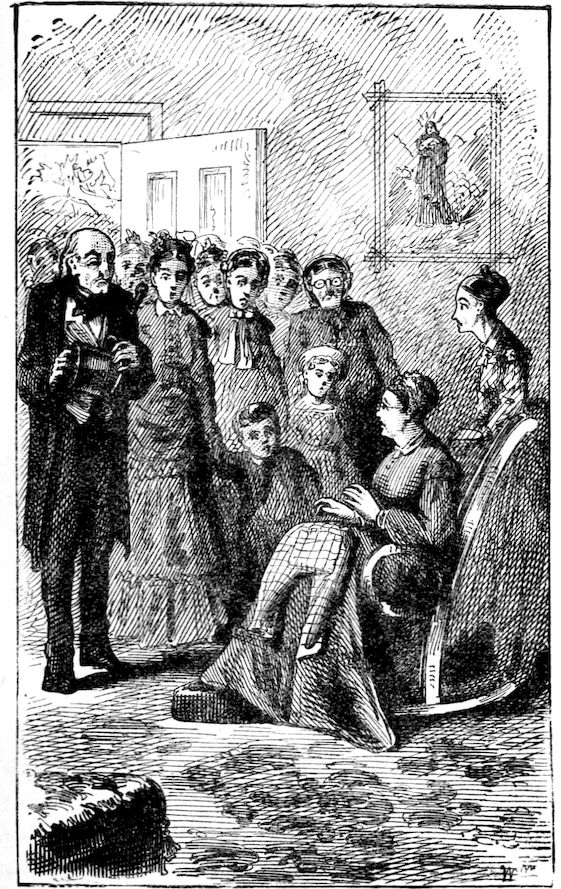
265Serepta looked white as a white ghost, and ready to
sink right down through the floor into the suller, for
from past experience she knew they had come to labor
with her. But I held firm as any rock you can bring
up, Plymouth, or Bunker Hill, or any of ’em. And
when they glared at me, thank fortin I was enabled
to do what duty and inclination both called on me to
do, and glare back at ’em, and do a good job in the
line o’ glarin’ too.
They seemed to be as mad at me as they was at
Serepta, and madder. But I wasn’t afraid of any
on ’em, and when they all commenced talkin’ to once,
a complainin’ of Serepta and her doin’s and her not
doin’s, my principles enabled me to look at ’em
through my specks with a scornful mean that would
have spoke louder than words if they had understood
anything of the language of means.
Finally they all got to talkin’ together, a complainin’.
“Why didn’t she jine the ‘Cumberin’ Marthas?’
Why couldn’t she head the ‘Weepin’ Marys?’ Why
don’t she take more interest in the female fellah’s of
Cairo? Why don’t she show more enthusiasm about
the heathens and gorillas?”
Just then I heerd the biggest little boy swear like
a pirate, and kick the other one out of bed, and I
spoke coldly, very coldly:
“She’ll have a span of gorillas of her own pretty
soon if she haint allowed no time to take care on
’em, she wont have to go to Africa for ’em, either;”
says I, “Serepta will show you some male fellahs
that will need more help than any of your female
ones, bime-by; she will give you a good job in the
266line of heathens to convert in a few years, if things
go on as they are a goin’ on now.”
With that, Serepta burst right out, and wept and
cried, and cried and wept. It affected me awfully,
and I spoke right up, and says I:
“Heathens are first rate themes to foller, but there
is different ways of follerin’ ’em;” says I, “some
will set their eyes on a heathen in Africa, and foller
him so blindly that there can be ten heathens a caperin’
right round ’em to home, and they won’t see none
on ’em.” And then I felt so, that I allegoried some,
right there on the spot. Says I:
“After a big snow-storm, it may seem noble and
grand to go round sweepin’ off meetin’ housen and
etcetery; but in my opinion, duty would call on a
man first, to make a path to the well for his own
family, and the barn, then shovel round freely, where
duty called. What good does it do to go off in foreign
pastures a cuttin’ down thistle tops, when you
are a raisin’ a big crop of ’em to home for somebody
else to be scratched by? What advantage to the
world at large is it, if a woman converts one heathen
way off in India, and at the same time by neglect, and
inattention and carelessness, raises a crop of seven of
’em in her own house. My advise to such would be—and
so would Josiah’s—work in the garden God set you
over. Try by earnest care and prayer, untirin’ diligent
culture and, if need be, an occasional rakin’ down,
267to keep your own heathen crop down to the lowest
possible state, and then after you have done this, do
all you can for other heathens promiscous.”
But they glared at Serepta more glarin’ than they
had before, and says Miss Horn:—“She wont do
nothin’; she is shiftless.” And then I spoke out in
tremblin’ tones, I was so agitated:
“Serepta is my own niece on my father’s side, and
I helped to bring her up on a bottle, and she didn’t
nurse a cast-iron strength and a leather constitution
out of it as some of you seem to think she did;”
says I, “such is not the nature of cow’s milk, neither
is it the nature of bottles.” Says I, “If she has got a
tender, timid, lovin’ disposition, and one that is easily
influenced, so much the more pity for her in this
state, that Shackville has called her to be in. But as
it is, she is willin’ to be killed, and you with probable
religious intentions are willin’ to kill her.”
Oh how they glared at me; but I kep’ on as firm as
Gibbralter:
“Her husband is a good man, and thinks enough of
her; but he is deep learnt and absent-minded, and
needs headin’ off. And when he is walkin’ by himself
through the shady lanes and crooked pathways of
the docterines and creeds, and so on, and so 4th; when
he is tryin’ to stand up straight with one foot on
Genesis, and the other on geoligy, tryin’ his best to
break a path through the wilderniss of beliefs a road
268that shall lead his hearers straight to heaven’s gate;
with all this on his hands, how can he be expected
to keep his eye every minute on the little woman by
his side. How can he, when he is absent-minded,
and needs headin’ off, how can he be expected to
know whether the meetin’ house is a carryin’ her, or
she is a carryin’ the meetin’ house.” Says I, “Serepta
Simmons is a Christian woman, and if she has
time to spare after taken’ care of them that Providence
has placed in her keepin’, she would be willin’ to do
what she could for other heathen nations, and tribes;
it would be her duty and her priviledge.
“But,” says I, “because Serepta’s husband is hired
out to you for 200 and 50 dollars a year, you have
no more right to control Serepta’s actions, and time,
than you have to order round that old stun female
that keeps house by herself out in Egypt by the
pyramids. I can’t think of her name, but howsumever
it haint no matter; I wish Serepta had some of
her traits, a good firm stun disposition, that couldn’t
be coaxed nor skairt into bearin’ burdens enough to
break down seven wimmen. I’d love to see you order
old what’s-her-name round; I’d love to see you make
her do all the housework and sewin’ for a big family,
head off a deep learnt, absent-minded husband, take
care of five infant childern, and carry round a meetin’
house. She’s kep’ a stiddy head on her shoulders and
minded her own business for centuries, and so is a
269pattern for some other wimmen I know of, to foller.”
Oh how that madded ’em, and Miss Horn spoke
up and says she:
“We have got a claim on her, and we’ll let you
know we have.”
Says I, “The meetin’ house pays Elder Simmons
200 and 50 dollars, and so has got a claim on him,
and how much does it lay out to pay Serepta; how
much does it lay out to give her for the comin’ year?”
“Not one cent,” screamed out Miss Horn in skairt,
excited axents. “Not one cent,” says nine other
wimmen and the old deacon.
Then says I, risin’ up on my feet and wavin’ my
hand out nobly:
“Clear out, the hull caboodle of you, and” I added
in still firmer, nobler axents, “if the meetin’ house
don’t leggo of Serepta, I’ll make it leggo.”
I s’pose my mean was that awful and commandin’
that it filled ’em with awe, and affright. They started
right off, almost on the run, two able-bodied wimmen
takin’ the old deacon between ’em.
I had a letter from Serepta yesterday. She is
a gettin’ along first rate; her time is her own; her
childern are gettin’ more’n half civilized; and she has
gained a pound a week.
270
A VISIT TO PHILANDER SPICER’SES FOLKS.
Knowin’ that Philander Spicers’es folks was well
off, and wouldn’t be put to it for things to wait
on us, we thought we wouldn’t write to tell ’em we
was a comin’, but give ’em a happy surprise. They
owned five hundred acres of land, and had oceans of
money out at interest. Well, it was about the middle
of the afternoon, P. M. when we arrove at their dwellin’
place. It was a awful big, noble lookin’ house,
but every winder and winder blind was shut up tight,
and it looked lonesome, and close; but I haint one to
be daunted, so I stepped up and rung at the bell.
Nobody come. Then I rung at it again, and Josiah
took my umberell and kinder rapped on the door
with it, pretty considerable loud; and then a dejected
lookin’ man hollered at us from the barn door, and
says he:
“You wont get in there.”
271Says I, “Why not, is it the house of mournin’?”
says I; for there was sunthin’ strange and melancholly
in his tone.
“Because you might let in a fly,” says he.
He didn’t say nothin’ more, but stood a lookin’ at
us dretful dejected and melancholly-like, and Josiah
and me stood lookin’ at him, and we felt curious, very.
But pretty soon I found and recovered myself, and I
says in pretty firm tones:
“If Mahala Spicer, she that was Mahala Allen lives
here, I lay out to see her before I leave these premises.”
“Well,” says the man, “foller up that path round
the back side of the house, and you’ll find her; we live
in the wood-house.” As he said that, he seemed to
kinder git over into the manger, and I laid holt of
Josiah, and says I:
“That man is Philander Spicer, and he has seen
trouble.”
“Bein’ a married man he might expect to—”
“Expect to what Josiah Allen?” says I, lookin’ at
him with a mean that was like a icicle for stiffness
and coolness.
“Oh! I meant he might expect to lay up property.
What a big house! I declare Samantha, I haint seen
so big and nice a house sense we left Jonesville.”
And truly, it was awful big and nice; big enough
for half a dozen families, but it was shet up fearfully
close and tight, as tight as if air and sunshine and
Josiah and me was deadly pisen. And as we meandered
272on round the house by winder after winder
and door after door, shet up as tight as glass and
blinders could make ’em, I’ll be hanged if it didn’t
seem some as if it was war time, and Josiah and me
was two Hessian troopers, a tryin’ to break in and
couldn’t.
At last, way on the back side of the house, we come
to a little wood-house built on, and there we see the
first sign of life. The door was open and three little
childern sot out in a row by the side of the house, on
a clean board. They looked lonesome; they was
ruffled off dretful nice, and their shoes shone like
glass bottles, but they looked awful old and care-worn
in their faces.
“Does Mahala Spicer, she that was Mahala Allen
live here?” says I to the oldest one. She looked in
her face as if she might be a hundred years of age,
but from her size she wasn’t probable more’n nine or
nine and a half.
“Yes mom,” says she, sort o’ turnin’ her eyes at
me, but she never moved a mite.
Says I, “Is she to home?”
“Yes mom.”
Says I, “Speakin’ as a investigator, what are you
settin’ there all in a row for? Why haint you out a
playin’ in the yard this nice day?”
As I mentioned the idee of playin’, their faces, as
long as they was before, lengthened out awfully, and
the two youngest ones kicked right out.
273
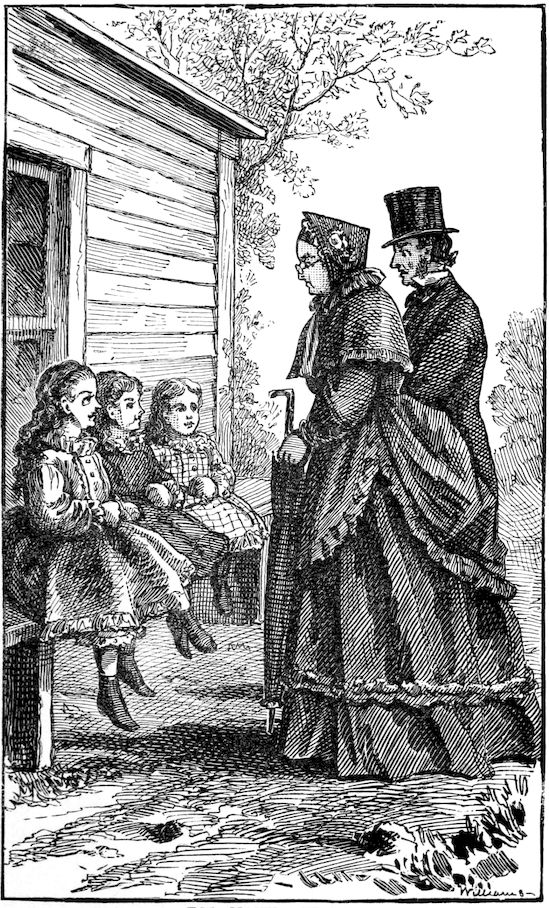
275“Mother wont let us play;” says the oldest one in
bitter axents. “She says we should muss up our
ruffles, and rip off the knife pleatin’s.”
“Get our shoes dusty,” says the next one in vicious
tones.
“Tear our overskirts,” says the four year old in
loud angry axents, and again she kicked right out, and
every one of ’em looked bitterly mad, and morbid; a
morbider lot of faces I never laid eyes on. I didn’t
say nothin’ more, but I looked at Josiah, and Josiah
looked at me; we felt curious. But anon, or pretty
near that time, I found and recovered myself and so
did Josiah, and we walked up to the door and knocked.
“Come in,” says a voice in a kind of a sharp tone,
as if the owner of the voice was awful busy and care-worn.
So I and my companion walked in. It was as
comfortable a room as wood-houses generally be, but
of course there wasn’t much grandeur to it. There
was about a dozen clean boards laid along one side
for a floor and on it a cook stove was sot, and right
by it was a sewin’ machine, and Mahala set by it a
sewin’. But I’ll be hanged if I could see in that minute,
one of Mahala Spicer’ses old looks; she looked
so thin and care-worn and haggard. And if she is
one of the relations on Josiah side, I’ll say, and I’ll
stick to it that she looked as cross as a bear. I
shouldn’t have had no idee who she was, if I hadn’t
seen her there. She knew Josiah and me in a minute
for—though I do say it that shouldn’t—folks say
276that my companion Josiah, and myself do hold our
looks wonderful. And bein’ (sometimes) so affectionate
towards each other in our demeanor, we have
several times been took for a young married couple.
I should judge there was from half a bushel to
three pecks of ruffles and knife pleatin’s that lay
round her sewin’ machine and in her lap; but she
got up and shook hands with us and invited us to
take our things off. And then she said, bein’ as we
was such near relations, (all in the family as it were,)
she would ask us to set right down where we was; it
bein’ fly time, she had got the rest of the house all
shet up tight; had jest got it cleaned out from top
to bottom, and she wanted to keep it clean.
I didn’t say nothin’, bein’ one that is pretty close
mouthed naturally; but I kep’ up considerable of a
thinkin’ in my mind. After we sot down, she give
a kind of a anxious look onto the floor, and she see a
little speck of dirt that had fell off of Josiah’s boots,
and first we knew she was a wipin’ it up with a mop.
Josiah felt as cheap as the dirt, I know he did, and
cheaper; but he didn’t say nothin’, nor I nuther.
She said then, if we’d excuse her she’d keep right
on with her work, because she had got dretful behindhand
in ruffles. She said it kep’ her every minute of
her spare time to work a makin’ ruffles in order to
keep herself decent, and make the childern keep up
with other folks’es childern. So she nipped to and
worked away dretfully, and every time the door
277opened she would look up with such a wild anxious
gaze, horrified seeminly, for fear a fly would git in;
and every time Josiah or her husband (that man at
the barn did prove to be her husband) would move,
she would run after ’em, and wipe ’em up with a
mop. It was a curious time as I ever see in my life.
She didn’t seem to sense anything only ruffles and
such like. Her mind all seemed to be narrowed
down and puckered up, jest like trimmin’, nothin’
free and soarin’ about it at all—though she would
talk some about fly time, and how hard it was to
keep ’em out of the house, and once she asked me
which I preferred for mops, rags or tow.
I tried to make talk with her; and says I, in a real
friendly way:
“You have got three good lookin’ childern Mahala.”
“Yes,” says she, “three and three is six, and
three is nine, and three is twelve, and three is fifteen;
fifteen ruffles at the least calculation, to make ’em
look decent, and like other folks’es childern; and
the biggest one ought to have six.”
Says I, “Your husband looks as if he might be a
good man, and a good provider.”
“Yes,” says she, “he means well, but he is a awful
hand to let in flies. Two years ago this summer he
let in four at one time into my best room, I counted
them as I drove ’em out. I got so wore out, a chasin’
’em, and a tryin’ to keep decent, that I made up my
mind that we would live out here.”
278“You don’t keep a girl, it seems?”
“No,” said she, “I cannot get one to suit me.
When I do my work myself I know how it is done.”
Then I atted her on other subjects; says I, “Do you
see the Atlantic, and Scribner’s, and Peterson’s and
Harper’s, this summer? they are awful interestin’.”
Says she, “I haint seen the ocean sense I was
married; and the other families you speak of don’t
live any where near us.”
Says I, “Have you read Ruskin, Mahala?”
I was all engaged in it at that time for Thomas J.
was a readin’ it out loud evenin’s—dretful interestin’
readin’, made you feel as if you never got acquainted
with the world till he introduced you.
“Red Ruskin,” says she with a dreamy mean, “it
seems as if we have got some winter apples by that
name, though I can’t tell for certain.”
Then truly I thought to myself, I had got to the
end of my chain. I said no more, but sot silently
knittin’, and let her foller her own bent.
And there was truly as curious doin’s as I ever see.
The little childern couldn’t move for fear they would
soil their clothes or muss their ruffles. Her husband
couldn’t take a step hardly without bein’ follered
round by a mop, and exhorted about lettin’ in flies,
though he didn’t realize his sufferin’s so much as he
would, for he was to the barn the most of the time;
he had a chair out there, Josiah said, and kinder made
it his home in the manger.
279When she got supper, we had enough, and that that
was good; but we eat on a oil-cloth because it was
easier to keep clean than a table cloth, and we eat on
some awful old poor lookin’ dishes, she said she had
washed up her best ones, and put ’em away so’s to
keep the dust out of ’em, and she didn’t want to open
the cupboard, for fear of lettin’ in a fly. And when
we went up stairs to our room that night, way up in
the front bed-room, it was carpeted all the way, the
hall and stairs, and our room, with shinin’ oil cloth.
You could see your faces in it, but it seemed awful
sort o’ slippery and uncomfortable. There wasn’t a
picture nor a bracket nor a statute on any of the walls;
she said her husband wanted some, but she wouldn’t
have ’em they catched dust so. The sheets and
piller cases was starched stiff to keep clean longer,
and ironed and pressed till they shone like glass.
My companion almost slipped up on the oil cloth
when he went to git into bed, and as he lay down
between the stiff shinin’ sheets, he says to me in sad
tones:
“This is a slippery time, Samantha.”
I was a takin’ off my head-dress, and didn’t reply
to him, and he says to me in still more pitiful and
lonesome tones:
“Samantha, this is a slippery time.”
His tone was very affectin’, very; and I says to
him soothinly, as I undid my breast-pin, and took
off my collar:
280“Less make the best of what we can’t help Josiah.”
But though my tone was soothin’, it didn’t seem to
soothe him worth a cent, for says he in tremblin’
tones:
“I am a sufferer Samantha, a great sufferer.”
Truly as Josiah said, it was a slippery time, and
then not bein’ used to be follered round and wiped
up by a mop, it all wore on him. Says he, speakin’
out in a louder, sort o’ fiercer tone:
“Have we got to stay in this house Samantha, one
minute longer than to-morrow mornin’ at sunrise?”
Says I, “We will set sail from here some time in
the course of the day.” For truly I thought myself
I couldn’t stand the doin’s much longer; and then
Josiah went on and told me what Philander had told
him; he said Philander said he was completely wore
out. He was a good lookin’ sort of a man, and one
that would, I thought, under other and happier circumstances,
love a joke; but his spirit was all broke
down now. He told Josiah it was done by a mop,
by bein’ run after with a mop; he said it would
break down a leather man in a year; he said he
drather set out doors all winter then go into the house;
he said he made it his home to the barn the most of
the time—lived in the manger. He said when he
first commenced life, he had a young man’s glowin’
hopes in the future; he had loftier, higher aims in
life; but now his highest ambition was to keep house
by himself in the barn, live alone there from year to
281year, go jest as nasty as he could, live on flies, and
eat dirt; he talked reckless and wild.
“But” says he, “if I should try it, she would be
out there a scourin’ the rafters; before I had been
there half an hour, she would be out there with her
mop. I hope,” says he, “that I am a Christian; but,”
says he, “I dassant express the feelin’ I have towards
mops. Ministers of the Gospel would call it a wicked
feelin’, and so I shant never try to tell any one how I
feel towards ’em; mops is what I bury deep in my
breast.”
Josiah said he spoke to him about how anxious and
haggard his wife looked, and how wild and keen her
eyes was.
“Yes,” say she, “she got that look a chasin’ flies;
she wont let one come within half a mile of the house
if she can help it; and,” says he, “she would be glad
to keep me a horseback a helpin’ her chase ’em off;
but I wont”, says he, with a gloomy look, “I never
will take a horse to it; I’ll run ’em down myself
when she sets me at it, but I wont chase ’em a
horseback as long as my name is Philander Spicer.”
The doin’s there wore on Josiah dretfully, I could
see. Two or three times after he got into a nap, he
started up a shoutin’:
“There is one! catch it! take holt of ’em Nance.”
Oh, how I pitied my pardner, for I knew’ he was on
the back of a Nite-Mare (as it were) a chasin’ flies;
and then he’d kinder shy off one side of the bed, and
282I’d hunch him, and he’d say there was a hull regiment
of wimmen after him with mops.
But towards mornin’ I got a little good sleep, and
so did he.
The next mornin’ Mahala kinder atted me about
my house; said she s’posed it wasn’t half as nice,
nor furnished near so well as hern. Her mean was
proud, and I could see she felt hauty with her nice
things, though I couldn’t see half on ’em when she
led me through the rooms they was so shet up and
dark, dark as a dark pocket, a most; and the air was
musty and tight, tight as a drum; she said she didn’t
air it only in the night for fear of flies.
Says she again, “I s’pose your house haint furnished
near so nice as mine.”
Says I, “I have got two elegant things in my
house that you haint got in yourn, Mahala.”
“What are they?” says she.
Says I, “Sunshine and air;” says I, “our house
haint a big one, but it is comfortable and clean, and
big enough to hold Josiah and me, and comfort, and
the childern.” Says I, “My parlor looks well, everybody
says it does. The carpet has got a green ground
work that looks jest like moss, with clusters of leaves
all scattered over it, crimson and gold colored and
russet brown, that look for all the world as if they
might have fell offen the maple trees out in the yard
in the fall of the year. I have got a good honorable
set of chairs; two or three rockin’ chairs, and a settee
283covered with handsome copper-plate; lots of nice
pictures and books, for Thomas J. will have ’em, and
I am perfectly willin’ and agreeable in that respect.”
Says I, “Everybody says it is as pleasant and cozy a
room as they ever laid eyes on; and that room,
Mahala, is open every day to my companion Josiah,
fresh air, sunshine, myself and the childern;” says
I, “when we have got our work done up and want
to rest, there is the place we go to rest in; it makes
anybody feel as chirk again as a poor dull lookin’
room; and what under the sun do I want of a
pleasant bright lookin’ room if it haint to take some
comfort with it?”
Says she, with a horrified look, “the idee of lettin’
the sunshine in on a nice carpet; it fades ’em, it fades
green awfully.”
Says I, “My carpet haint fadin’ colors, and if it
was, there is more where that come from. But,” says
I, “there is other things that fade besides carpets;”
says I, “there is such a thing as fadin’ all the greenness
and brightness of life out;” says I, “I had
ruther have my carpet fade, than to have my childern’s
fresh gayety, and my companion’s happiness and comfort
fade out as grey as a rat;” says I, “the only
way to git any comfort and happiness out of this old
world, is to take it as you travel on, day by day, and
hour by hour.”
Says I, “In my opinion it is awful simple to stent
yourselves, and scrimp yourselves along all your lives
284lookin’ for some future time, fur ahead, when you are
goin’ to enjoy things and live agreeable;” says I, “if
such folks don’t look out, the street of By and By
they are travellin’ on, will narrow down to that road
that is only broad enough for one to travel on it at a
time, and the house they are expectin’ to take so
much comfort in, will have a marble door to it, and
be covered over with the grasses of the valley.”
My tone was as solemn as solemn could be a most,
but good land! she didn’t sense it a mite; it seemed
as if she follered us round with a mop closer than
ever, and the minute she got her work done up she
went right to her ruffles again; she didn’t take time
to change her dress or comb her hair or anything.
Her dress was clean enough, but it was faded and
considerable ragged, and not a sign of a collar or
cuff; and her hair, which was wavy and crinkly
naturally, and would have been glad to curl, was
tucked up tight in a little wad at the back side of her
head, to save work a combin’ it. I didn’t see much
of Philander, for he stayed to the barn the most of
the time, though he seemed to have a desire to use us
well, and every little while he would come in and
visit a few words with us; but he acted awful uneasy,
and low spirited, and meachin’, and I was most glad
every time when he’d git started for the barn, and
she’d set her mop down, for she’d scold him about
flies and exhort him about dust, and foller him round
with a mop most every moment. She had in the
285neighborhood of a bushel of ruffles a layin’ by her,
and she said she must stitch ’em, and pucker ’em all
that day, and her face looked so care-worn and haggard
as she said it, that I almost pitted her; and I says to
her in tones about half pity, and half rebuke:
“What makes you lay so to ruffles Mahala, it is a
wearin’ on you and I can see it is.”
“Oh,” says she, and she nipped-to, harder than
ever as she said it: “I do it because other folks do.
They wear ruffles a sight now.”
But I says in calm tones: “Have you got to be a
fool Mahala, because they be?”
She didn’t answer me a word, only kep’ right on
her ruffles as if they was cases of life and death, and I
continued on in reasonable axents.
“I am considerable dressy myself, and in the name
of principle I believe it is every woman’s duty to
look as well and agreeable as she can, especially if
she has got a companion to show off before.”
As I said this, she give as scornful and humiliatin’
a look onto my overskirt as I ever see looked. It was
my new grey dress, all trimmed off on the age of
the overskirt with a plain piece cut ketrin’ ways of
the cloth, and stitched on. It looked well, but I see
she despised it, because it wasn’t ruffled; she showed
it plain in her face, how fearfully she felt above the
biasin’ piece and me; she despised us both, and acted
so hauty towards us, that I was determined to give
her a piece of my mind, and says I again firmly:
286“I believe it is every woman’s duty especially if
she has got a pardner, to put her best foot forred
and look pleasant and agreeable from day to day, and
from hour to hour. But in my mind a woman don’t
add to her good looks by settin’ down lookin’ like
fury for nineteen days, a workin’ too hard to speak a
pleasant word to her family, or give ’em a pleasant
look, for the sake of flauntin’ out on the twentieth
for a few hours, to show off before a lot of folks she
don’t care a cent for, nor they for her.” Says I, “A
middlin’ plain dress for instance, one made with a
plain strip set on the bias round the overskirt, or
sunthin’ of that sort,” says I, “such a dress with a
bright healthy, happy face, looks better to me than
the height of fashion wore with a face that is almost
completely worn out with the work a makin’ of it,
drawn down by care, and crossness, and hard work
into more puckers than there is on the ruffles;” says
I, “if a woman is able and willin’ to hire her clothes
made, that’s a different thing; in them cases let wimmen
ruffle themselves off to their heart’s content, and
the more work the better for the sewin’ wimmen.”
I don’t think Mahala sensed my talk much of any,
for she was nippin’-to, sewin’ on her ruffles, and I
heerd her say seeminly to herself:
“Lemme see; nine yards for the bottom ruffle, and
a little over. Three times nine is twenty-seven, and
that leaves fourteen yards of trimmin’ for the poleynay,
and up and down the back will be seventeen
287more—lemme see!” And she was a measurin’ it off
with her hands. Finally she seemed to sense where
she was for a minute, and turned to me with a still
more haggard look onto her face.
Says she: “Mebby you have heerd about it; is it
so, or not? I must know,” says she.
Says I, in anxious axents, for she looked fearfully
bad: “Is it your childern’s future you are a worryin’
about? Is your companion’s morals a totterin? Is
the Human Race on your mind, a tirin’ you, Mahala?”
“No!” says she. “It haint none of them triflin’
things, but I heerd a rumor that they wasn’t a goin’
to wear poleynays trimmed up the back. Do you
know? Can you tell me what they are a goin’ to do?”
Oh! what a wild gloomy glarin’ look settled down
onto her face as she asked me this question:
“They” says I, a bustin’ right out almost wildly,
“who is old They that is leadin’ my sect into chains
and slavery?” Says I, almost by the side of myself
with emotion, “Bring him up to me, and lemme
wrastle with him, and destroy him.” Says I, “I
hear of that old tyrant on all sides. If he gives the
word, wimmen will drop their dresses right down a
yard into the mud, or tack ’em up to their knees;
they will puff ’em out like baloons, or pin ’em back, a
bandegin’ themselves like mummies; they will wear
their bunnets on the back of their necks leavin’ their
faces all out in the sun, or they will wear ’em over
their forwards, makin’ ’em as blind as a bat—leavin’
288the backside of their heads all out to the weather;
they will wear low slips as thin as paper, or be
mounted up on high heels like a ostridge; they will
frizzle their hair all up on top of their heads like a
rooster’s comb, or let it string down their backs like
a maniac’s; and if I ask ’em wildly why these things
are so; they say they do it because They do it. I
find old They at the bottom of it.
“And where does all the slander, and gossip, and
lies come from? You find a lie that there wont anybody
father, and jest as sure as you live and breathe,
every time, you can track it back to old They. They
said it was so. And,” says I, growin’ almost wild
again, “who ever see him come up in a manly way
and own up to anything? Who ever sot eyes on
him? A hidin’ himself, and a lyin’, is his strong pint.
I hate old They! I perfectly despise the old critter.”
I see my emotions was a renderin’ me nearly wild
for the time bein’, and with a fearful effort, I collected
myself together, some, and continued on in a
more milder tone, but awful earnest, and convincing:
“Fashion is king and They is his prime minister
and factorum; and between ’em both, wimmen is
bound hand and foot, body and soul. And,” says I
in a sort of a prophecyin’ tone, “would that some
female Patrick Henry or George Washington would
rise up and set ’em free from them tyrants.” Says I,
“It would be a greater victory for female wimmen,
than the one the male sect, mostly, are a celebratin’ to
the Sentinal this summer.”
289“Sentinal!” says she. “Celebrate!” she murmured
in enquirin’ axents.
“Yes,” says I, “haint you heerd on it Mahala—the
big Sentinal that is to Filadelfy;” says I, in considerable
dry axents, “I didn’t know as there was a
dog on the American continent but what had heerd of
it, and talked it over—with other dogs.” Says I,
“They talked about it to Jonesville more’n they did
the weather, or their neighbors, or anything.”
“Well,” says she, “it seems as if I heerd the word
once, when I was a scrapin’ out the suller, or was it
when I was a whitewashin’ the wood-house. I can’t
tell,” says she; “but anyway I know I was a cleanin’
sunthin’ or other, or makin’ ruffles, and a workin’
so hard that it slipped completely out of my mind.”
I told her what the Sentinal was, and says I, “I
want you to go Mahala. Josiah and I are a goin’, and
it will do you good to git away from home a spell;
you can git some good girl to keep house for you.
S’posen you go?”
She looked at me as if she thought I was as crazy
as a loon.
“Go!” says she. “Go! why it will be right in fly
time and spider time. Do you s’pose that anybody
that haint a perfect slouch of a housekeeper would
leave their house in fly time or spider web time?
Thank fortin nobody can find a spider web in my
house nor my wood-house. I haint one to let things
go as some will, and go off on pleasure towers right
in dog days.”
290I see she was a twittin’ me of lettin’ things go, and
bein’ off on a tower, and my high mission goared me,
and principle nerved me up to give her a piece of my
mind; and says I to her:
“There is cobwebs a hangin’ from your brain this
minute Mahala Spicer, more’n a yard long.” Says I,
“You have chased me round with a mop, and kinder
limbered me up, so I feel like marchin’ forred nobly
in the cause of Right;—and I say to you, and I say it
in a friendly way,—that if there was ever any brightness
to your intellect, there is dust over it now a
inch thick. You twit me about lettin’ things go, and
bein’ off on a tower; you say you wont let things go;
in my way of thinkin’ you do let things go; you let
all the beauty and brightness of life go; all the peace
and enjoyment and repose of home go; all your husband’s
and childern’s rest, and enjoyment, and love,
and respect for you, go. You say you don’t even git
time to look into a book from one year’s end to another.
Think of that great world of delight and culture you
leggo. You say you don’t find time to step or look
out of doors. Jest think of God’s great picture-book
that He spreads out before your blind eyes from day
to day—every page filled with wonder, surprise and
admiration. Think of how that book looks when the
leaf is turned down to sunset, or when it is turned over
to bright Indian summer and etcetery.” My tone was
eloquent, very; and my hand waved out in noble waves
as I went on:
291“Jest think how from day to day the sun’ rises in
splendor and goes down in heavenly glory; how the
white clouds like feathered out chariots for the baby
angels to ride out in, float over the beautiful blue
sky unbeknown to you; how the winds kinder rustle
the green leaves in the woods, and the sun shoots
down her gold arrers through ’em, a chasin’ the cool
shadders over the green moss, and never catchin’ of
’em. How the white lilys fatigue their sweet selves
a perfumin’ the air and the roses and pinks blush
crimson at their own prettiness, and the violets hide
their blue eyes down under the grass, so awful pretty
that they are fairly ashamed of themselves, and the
ferns wave their green banners in triumphant delight
to let ’em know they have found ’em out. How the
lake changes to more’n forty pictures a day, every
one handsomer than the other, from the time it looks
kinder blue, and hazy, and dreamy in the mornin’
twilight, till the settin’ sun makes a shinin’ path on
it, that seems to lead right out into that city of golden
streets.
“Think what low and kinder contented songs the
brook sings to the pussy willow, and what the willows
whisper back to the brook. How the birds chirp and
twitter and sail and sing, a well behaved melodious
orkustre givin’ free tickets to everybody; and your
ears as deaf as a stun to it all. Think of all these
things you leggo to pore over ruffles and knife pleatin’s.
You used to be a fine musician—made first-rate
292music—and that melodious job, the only piece of work
you can begin on earth and finish up in heaven, all
that happiness for yourself and family, you leggo. If
you was obleeged to do all this, I should pity you; and
if you was obleeged to wear yourself down to a early
grave—as I see you are a doin’,—leavin’ your childern
plenty of ruffles and no mother, I should pity you;
but your husband is abundantly able, and more’n
willin’ to hire help for you to do your work decently
and comfortably, and leave you time to make your
home a place of delight and rest to him and the
childern. But instead of that, instead of throwin’
open the doors of your heart and your house to the
free air of heaven, and the sunshine;—instead of keepin’
your husband’s and childern’s love and makin’ their
happiness and hisen and your own life beautiful by
culture, and sweet thoughts, and generous deeds; instead
of liftin’ your eyes heavenward and seein’ with
the eyes of your soul some divine ideal and pursuin’
after it, you have set your aim in life on a fly and
chase that aim blindly, and prefer to go through life
on all fours with a scrub rag.”
If you’ll believe it, that woman was mad; it does
beat all how good advice will make some folks squirm;
but as we was on the very pint of leavin’, I didn’t care a
cent; and I didn’t feel in the least mite beholden to
her, for they come to our house when they was first
married, and stayed three weeks right along, and I
guess they didn’t git treated much as she treated
293Josiah and me. I done well by ’em—killed a hen
most every day—and made a fuss. That was before
she took to chasin’ flies; she was bright as a new
dollar, didn’t act like the same critter, nor he nuther;
that was before he had the nip took out of him, by
bein’ chased round by a mop.
I kissed the little childern all a settin still in a
row—or little old wimmen I ort to say, bid Mahala
a glad and happy good bye, and then we went out to
the barn and took leave of Philander in the manger,
and sot forred again on our tower.
294
MELANKTON SPICER AND HIS FAMILY.
Philander Spicer told Josiah and me that
he did wish we would stop and visit his brother
Lank, seein’ we had to pass right by his house.
Melankton Spicer, Philander’s twin brother, married
Mahala’s sister Delila Ann, makin’ ’em double and
twisted relations, as you may say. And we told him
that seein’ it was right on our way we would stop a
few minutes, but I guessed we wouldn’t stay long for
we wasn’t much acquainted with ’em, though she had
visited me years ago, and we had seen ’em to Father
Allen’s once or twice.
Philander told us mebby we hadn’t better stay
long, for they had hard work to git along; he said
Delila Ann wasn’t a mite such a turn as Mahala,
for whereas Mahala, havin’ a husband that was well
off, would work and scrub every minute with no need
on it, Delila Ann, havin’ married a poor man who
needed help, wouldn’t work a mite; hadn’t been no
295help to him at all sense they was married, only by
puttin’ on appearances, and havin’ seven girls and
they bein’ growed up, and their ma not allowin’ ’em
to do a speck of work only to dress up to catch a bo.
Lank had to work from mornin’ till night in the store
where he was a clerk, and then set up half the night
to copy papers for a lawyer, to try to pay their milliner
bills and the hired girls; but he couldn’t, he was
in debt to everybody. And he didn’t git no rest and
peace to home, for they was a teasin’ him the hull time
for gold bracelets and silk dresses and things; he said
they lived poor, and their morals was all run down.
Lank hadn’t ever been able to git enough ahead
to buy a Bible; he hadn’t nothin’ but the Pokrafy,
and a part of the Old Testament that had fell to
him from his grandfather, fell so fur that the ’postles
and all the old prophets—except Malachi—had got
tore to pieces, and he was battered considerable.
Philander said Lank told him it was hard work to
bring up a family right, with nothin’ but the Pokrafy
to go by, and he wanted to git a Bible the worst way;
and when he got his last month’s wages he did mean
to git enough ahead to buy one, and a sack of flour;
but when he got his pay, his wife said she was sufferin’
for a new gauze head-dress, and the seven girls
had got to have some bobinet neck-ties, and some new
ear-rings; that after they had got these necessarys,
then, if there was anything left, they would git a sack
of flour and a Bible. But there wasn’t, and so they
296had to git along with the Pokrafy, and without the
sack of flour; and he said that workin’ so hard, and
farin’ so awful bad, Lank was a most used up; he said
Lank wasn’t more’n two or three moments older than
he was, but he looked as if he was seventy-five years
old, and he was afraid he wouldn’t stand it more than
several months longer if things went on so.
I said to myself, when Philander was tellin’ us this,
here is mebby another chance for me to burn myself
up and brile myself on a gridiron (as it were)
in the cause of Right. I felt a feelin’ that mebby I
could win a victory, and advise Delila Ann for her
good. And so I spoke up mildly, but with a firm
noble mean on me, and says to him: “Philander, we
will stop there an hour or two.”
When we got to the village where Lank lived,
Josiah said he guessed he would go right down to the
store where Lank worked and see him, and I might
go in and call on Delila Ann. A small white-headed
boy with tow breeches held up by one lonely gallus
told me he would show me the way—the same boy
offerin’ to hitch the mare.
298
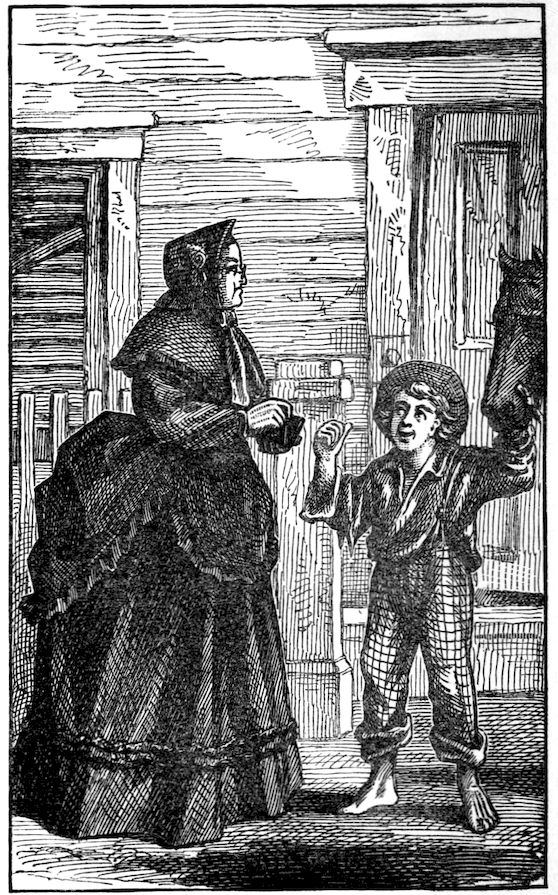
“THAT DOOR WANTS MENDIN’ BAD.”
299It had been a number of years sense I had seen
Delila Ann, and I didn’t s’pose I should know her if
I should see her in my porridge dish, Philander said
she had changed so. He said she had that sort of
anxious, haggard, dissatisfied, kinder sheepish, and
kinder bold look—a mean that folks always git by
puttin’ on appearances; I’ve heerd, and I believe,
that is jest about as wearin’ a job as anybody can
git into to foller from year to year. There didn’t
seem to be anything hull and sound about the front
door, except the key-hole; but it had a new brass
plate on it, with a bell kinder fixed in it, and the
plate bore Lank’s name in bold noble letters which I
s’pose was a comfort to the family, and rose ’em up
above the small afflictions of the snow and rain that
entered at will, and when they was a mind to.
The white headed boy, with the solitary and lonesome
gallus, said to me as he stood waitin’ for the
five cent bill I was a gettin’ for him out of my port-money:
“That door needs mendin’ bad!”
I give him his bill and started him off, and I was
jest a musin’ on his last words, and thinkin’ that
Lank’s best way would be to take the key-hole and
have a new door made to it, when the hired girl come
to the door. I told her who I was and she seemed
to be kinder flustrated and said she’d go and tell the
family. And I, a standin’ there in the hall, and not
knowin’ how long she would be gone, thought I
would set down—for it always tires me to stand any
length of time on my feet. There was a elegant
imposin’ lookin’ chair by the side of a real noble
lookin’ table, but to my surprise and mortification
when I went to set down, I sot right down through
it, the first thing; I catched almost wildly at the
massive table to try to save myself, and I’ll be
hanged if that didn’t give way and spilte on my
300hands, as you may say; it tottled and fell right over
onto me; and then I see it was made of rough shackly
boards, but upholstered with a gorgeous red and
yeller cotton spread, like the chair; they both looked
splendid. I gathered myself up, and righted the table
murmurin’ to myself, “Put not your trust in princes,
nor turkey red calico, Josiah Allen’s wife; set not
down upon them blindly, lest you be wearied and
faint in your mind, and lame in your body.”
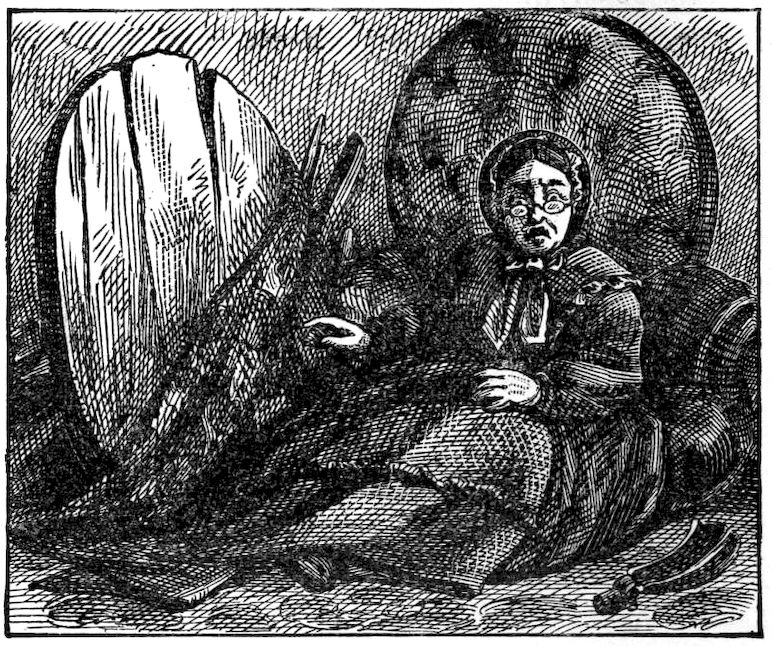
I was jest a rehearsin’ this to myself, when the
hired girl come back, and says I:
“I am glad you have come, for I don’t know but I
should have brought the hull house down in ruins
onto me, if you hadn’t come jest as you did.”
301“And then she up and told me that that chair and
table wasn’t made for use, but jest for looks; she
said they wanted a table and a reception chair in the
hall, and not bein’ able to buy sound ones, they had
made ’em out of boards they had by ’em.”
“Well,” says I mildly, “I went right down through
the chair the first thing, and it skairt me.”
I got along through the hall first-rate after this,
only I most fell twice, for the floor bein’ carpeted
with wall paper varnished (to be oil-cloth appariently)
and tore up, and the varnish makin’ it stiff, it was as
bad as a man-trap to catch folks in, and throw ’em.
Jest before we got to the parlor door I see, that in
the agitation of body and mind I had experienced
sense I come in, I had dropped one of my cuff buttons,
nice black ones that I had bought jest before I started
at a outlay of 35 cents, and the hired girl said she
would go back for it; and while she was a lookin’
for it—the plasterin’ bein’ off considerable, and the
partition jest papered over—I heard ’em a sayin’ and
they seemed to be a cryin’ as they said it:
“What did she want to come here for? I should
think she would know enough to stay away.”
“To think we have got to be tormented by seein’
her,” says another voice.
“I hate to have her come as bad as you do children,” says
a voice I knew was Delila Ann’s; “but
we must try to bear up under it; she wont stay
probable more’n two or three hours.”
302“I thay, I hope she wont sthay two minith,” says
another voice with a lisp to it.
“We wont let her stay,” says a little fine voice.
I declare for’t, if it hadn’t been for my vow I
would have turned right round in my tracks; but I
remembered it wasn’t the pious folks that needed the
most preachin’, and if ever promiscous advisin’ seemed
to be called for, it was now. And jest as I was a
rememberin’ this, the hired girl come back with my
cuff button.
The minute she opened that parlor door, I see that
I had got into the house of mournin’. The room,
which resembled the hall and the front door as much
as if they was three twins, seemed to be full of braize
delaine, and bobinet lace, and thin ribbin, all bathed
in tears and sobs. When I took a closer look, I see
there was eight wimmen under the gauzes and frizzles
and folderols and etcetery; some of ’em held
dime novels in their hands, and one of ’em held a
white pup.
The moment I went in, every one of ’em jumped
up and kissed me, and throwed their arms round me.
Some of the time I had as many as six or seven arms
at a time round me in different places, and every one
of ’em was a tellin’ me in awful warm tones, how
glad, how highly tickled they was to see me; they
never was so carried away with enjoyment and happy
surprise in their hull lives before; and says four of
’em tenderly:
303“You must stay a week with us anyway.”
“A week!” says the little fine voice, “that haint
nuthin’, you must stay a month, we wont let you off
a day sooner.”
“No, we wont!” says six warm voices, awful warm.
“Sthay all thummer—do,” says the lispin’ voice.
“Yes do!” says the hull seven.
And then Delila Ann threw both her arms round
my neck, and says she:
“Oh if you could only stay with us always, how
happy, happy we should be.” And then she laid her
304head right down on my shoulder and begun to sob,
and weep, and cry; I was almost sickened to the
stomach by their actin’ and behavin’, but the voice of
sorrow always appeals to my heart. I see in a minute
what the matter was; Lank had give out, had killed
himself with hard work; and though I knew she was
jest as much to blame as if she was made of arsenic
and Lank had swallered her, still pity and sympathy
makes the handsomest, shineyest kind of varnish to
cover up folks’es faults with, and Delila Ann shone
with it from head to foot, as she lay there on my
neck, wettin’ my best collar with her tears, and
almost tearin’ the lace offen it with her deep windy
sithes. I pitied Delila Ann, from pretty near the
bottom of my heart; I forgot for the time bein’ her
actin’ and behavin’; I felt bad, and says I:
“Then he is gone Delila Ann, I feel to sympathize
with you; I am sorry for you as I can be.”
“Yes,” says she, pretty near choked up with emotion,
“he is gone; we have lost him.”
I wept; I thought of my Josiah, and I says in tremblin’
tones: “When love is lost out of a heart that
has held it, oh, what a goneness there must be in
that heart; what a emptyness; what a lonesomeness;
but,” says I, tryin’ to comfort her, “He who made
our hearts knows all about ’em; His love can fill all
the deep lonesome places in ’em; and hearts that He
dwells in wont never break; He keeps ’em, and they
are safe with an eternal safety.”
305All the hull of the girls was a sobbin’, and one of
’em sithed out: “Oh, it does seem as if our hearts
must break, right in to.”
Then I spoke up and says in tremblin’ tones: “If
you are willin’ Delila Ann, it would be a melancholly
satisfaction to me to see the corpse.”
The girls led the way a sobbin’ and sithin’, and I
follered on kinder holdin’ up Delila Ann, expectin’
every minute she would faint away on my hands.
We was a mournful lookin’ procession; they led the
way into the next room, and led me up to a sofy, and
there laid out on a gorgeous yeller cotton cushin, lay
a dead pup; I was too dumbfoundered to speak for
nearly half a moment.
306Oh! what feelin’s I felt as I stood there a lookin’
on ’em, to think how I had been a sympathizin’ and a
comfortin’, a pumpin’ the very depths of my soul
to pour religious consolation onto ’em, and bewailin’
myself, a sheddin’ my own tears over a whiffet pup.
As I thought this over, my dumbfounder begun to go
off on me, and my mean begun to look different, and
awfuler; I thrust my cotton handkerchief back into
my pocket again with my right hand, and drew my
left arm hautily from Delila Ann, not carin’ whether
she crumpled down and fainted away or not; I s’pose
my mean apauled ’em, for Delila Ann says to me in
tremblin’ tones:
“All genteel wimmen dote on dogs.” And she
added in still more tremblin’ tones, as she see my
mean kep’ a growin’ awfuler, and awfuler every
minute: “Nothin’ gives a woman such a genteel air
as to lead ’em round with a ribbin.” And she says
still a keepin’ her eye on my mean: “I always know
a woman is genteel the minute I see her a leadin’
’em round, and I never have been mistakin’ once;
the more genteel a woman is, the more poodle dogs
she has to dote on.”
I didn’t say a word to Delila Ann nor the hull set
on ’em, but my emotions riz up so that I spoke right
out loud, unbeknown to me; I episoded to myself in
a deep voice:
307
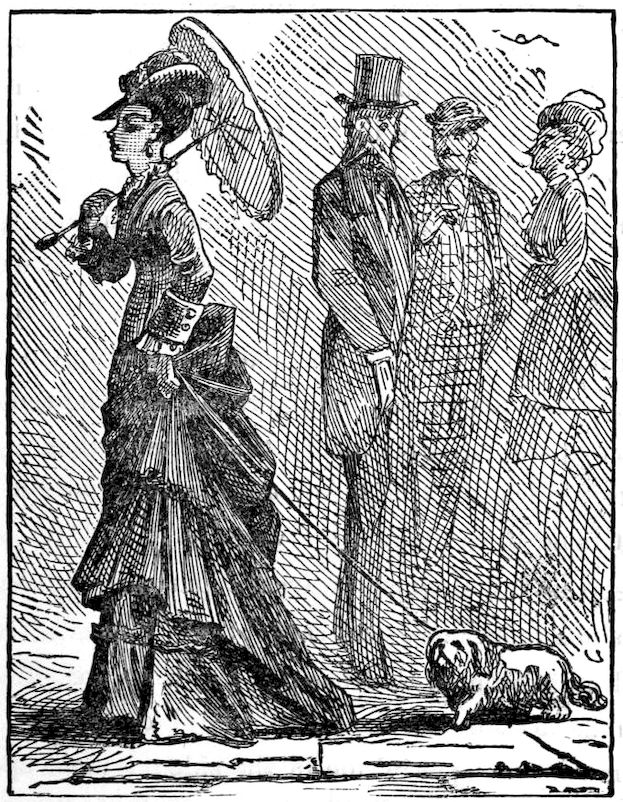
“Fathers bein’ killed with labor, and a world layin’
in wickedness, and wimmen dotin’ on dogs; hundreds
of thousands of houseless and homeless childern—little
fair souls bein’ blackened by ignorance and vice
with a black that can’t never be rubbed off this side of
heaven, and immortal wimmen spendin’ their hull
energies in keepin’ a pup’s hair white; little tender
feet bein’ led down into the mire and clay, that might
be guided up to heaven’s door, and wimmen utterly
refusin’ to notice ’em, so rampant and sot on leadin’
round a pup by a string. Good heavens!” says I, “it
makes me sweat to think on it;” and I pulled out my
308cotton handkerchief and wiped my forred almost
wildly. I s’pose my warm emotions had melted down
my icy mean a very little, for Delila Ann spoke up in
a little chirker voice, and says she:
“If you was one of the genteel kind, you would
feel different about it;” says she—a tryin’ to scare
me—“I mistrust that you haint genteel.”
“That don’t scare me a mite,” says I, “I hate that
word and always did,” says I still more warmly,
“there is two words in the English language that I
feel cold, and almost hauty towards, and they are
‘affinity,’ such as married folks hunt after, and ‘genteel.’
I wish,” says I, “that these two words would
join hands and elope the country; I’d love to see
their backs, as they sot out, and bid ’em a glad farewell.”
She see she hadn’t skairt me, and the thought
of my mission goared me to that extent, that I rose
up my voice to a high key and went on wavin’ my
right hand in as eloquent a wave as I had by me—I
keep awful eloquent waves a purpose to use on
occasions like these—and says I:
“I am a woman that has got a vow on me; I am a
Promiscous Advisor by trade, and I can’t shirk out
when duty is a pokin’ me in the side; I must speak.
And I say unto you Delila Ann, and the hull on you
promiscous, that if you would take off some of your
bobinet lace, empty your laps of pups and dime
novels, and go to work and lift some of the burdens
from the breakin’ back of Melankton Spicer, you
309would raise yourselves in my estimation from 25 to
30 cents, and I don’t know but more.”
“Oh,” says Delila Ann, “I want my girls to marry;
and it haint genteel for wimmen to work; they wont
never catch a bo if they work.”
“Well,” says I almost coldly, “I had ruther keep
a clear conscience and a single bedstead, than twenty
husbands and the knowledge that I was a father
killer; but,” says I in reasonable tones—for I wanted
to convince ’em—“it haint necessary to be lazy, to
read dime novels, and lead round pups, in order to
marry; if it was, I should be a single woman to-day.”
“Oh I love to read dime novelth,” says the lispin’
one; “I love to be thad and weep, it theemth tho
thweet, tho thingularly thweet.”
Says I, “There is a tragedy bein’ lived before your
eyes day after day that you ort to weep over; a father
killin’ himself for his wife and childern—bearin’ burdens
enough to break down a leather man—and they
a spendin’ their time a leadin’ round whiffet pups.”
“Whiffet pups!” says Delila in angry tones, “they
are poodles.”
“Well,” says I calmly, “whiffet poodle pups, if
that suits you any better, it don’t make any particular
difference to me.”
Says Delila Ann, “I paid seven dollars a piece for
’em, and they have paid their way in comfortin’ the
girls when they feel bad; of course my girls have
their dark hours and git low-spirited when they
310teaze their pa for things that he wont buy for ’em;
when they want a gold butterfly to wear in their hair,
are sufferin’ for it or for other necessaries, and their pa
wont git ’em for ’em; in such dark hours the companionship
of these dear dogs are such a comfort to ’em.”
“Why don’t they go to work and earn their own
butterflies if they have got to have ’em?” says I.
“Because they wont never marry if they demean
themselves and work.”
Says I, “It haint no such thing! A man whose love
is worth havin’ would think the more of ’em;” and
I went on eloquently—“do you s’pose Delila, that the
love of a true man,—a love that crowns a woman more
royally than a queen, a love that satisfies her head
and her heart and that she can trust herself to through
life and death; a love that inspires her to think all
goodness and purity are possible to her for its sake,—that
makes her, through very happiness, more humble
and tender and yet fearless, liftin’ her above all
low aims and worryments; do you s’pose this love
that makes a woman as rich as a Jew if she owns
nothin’ on earth beside, can be inspired and awakened
by a contemplation of sham gentility and whiffet
pups? Can bobinet lace spangled with gilt butterflies
weave a net to catch this priceless treasure? Never!
Delila Ann Spicer, never! that is,—a love that is
worth havin’; some men’s love haint worth nothin’;
I wouldn’t give a cent a bushel for it by the car-load.”
But, as I said, “Delila Ann and the hull eight on you
311promiscous, a earnest, true, noble man would think
as much again of a girl who had independence and
common sense enough to earn her own livin’ when
her father was a poor man. Good land! how simple
it is to try to deceive folks; gauze veils, and cotton-velvet
cloaks haint a goin’ to cover up the fact of
poverty; if we be poor there’s not a mite of disgrace
in it. Poverty is the dark mine where diamonds are
found lots of times by their glitterin’ so ag’inst the
blackness. The darkness of poverty can’t put out
the light of a pure diamond; it will shine anywhere,
as bright in the dark dirt as on a queen’s finger, for
its light comes from within; and rare pearls are
formed frequent by the grindin’ touch of poverty,
tears of pain and privation and patience crystalized
into great drops of light that will shine forever.
Honest hard workin’ poverty is respectable as anything
can be respectable and should be honored, if
for no other reason, for the sake of Him who eighteen
hundred years ago made it illustrious forever. But
poverty hidin’ itself behind the appariently; poverty
hidin’ itself under a sham gentility; pretentious, deceitful
poverty—tryin’ to cover a empty stomach with
a tinsel breast-pin—is a sight, and enough to make
angels weep, and sinners sick. Let your girls learn
some honest trade Delila Ann, let ’em be self-respectin’,
industrious—”
“Oh my! I wouldn’t have ’em miss of bein’ married
for nothin’ in the world.”
312“Good land!” says I. “Is marryin’ the only
theme that anybody can lay holt of? It seems to me
that the best way would be to lay holt of duty now,
and then if a bo comes lay holt of him. But if they
catch a bo with such a hook as they are a fishin’ with
now, what kind of a bo will it be? Nobody but a
fool would lay holt of a hook baited with dime novels,
lazyness, deceitfulness, and pups. Learn your girls
to be industrious and to respect themselves. They
can’t now, Delila Ann, I know they can’t. No woman
can feel honorable and reverential towards themselves,
when they are a foldin’ their useless hands
over their empty souls, waitin’ for some man—no
matter who—to marry ’em and support ’em. When
in the agony of suspense and fear they have narrowed
down to this one theme all their hopes and prayers:
“Good Lord, anybody!” But when a woman lays
holt of life in a noble earnest way, when she is dutiful,
cheerful, and industrious, God-fearin’ and self-respectin’,
though the world sinks, there is a rock
under her feet that wont let her down fur enough to
hurt her any.”
“Oh dear;” says Delila Ann again, “I should think
she would want to get married—want to awfully.”
Truly everybody has their theme, and marryin’ is
hern. But I kep’ cool and says I in calm axents,
but sort o’ noble and considerable eloquent:
“If love comes to board with her, so much the
better; she will be ready to receive him royally, and
313keep him when she gets him—some folks don’t know
how to use love worth a cent, can’t keep him any
length of time. Such a woman wont git crazy as a
loon, and wild-eyed, and accept the wrong man—so
dead with fear that the right one wont be forth comin’.
She wont barter her truth and self respect for a
home and housen stuff, and the sham dignity of a
false marriage. No mom, or moms; though a regiment
of men are at her feet a askin’ her in pleadin’
axents if their bride she will be, her ears will be deaf
as a stun to the hull caboodle of ’em, unless the true
voice speaks to her; and she wont listen with the ear
of flesh, she wont hear it unless her soul can listen.
Mebby that voice, that true voice is soundin’ to her
heart through the centuries; mebby, like as not, she
was born a century too soon, or a hundred years too
late—what of it? That don’t scare her a mite, she
will keep right on a livin’ jest as calm and collected
and happy and contented as anything, till the eternal
meetin’ of true souls crowns him and her with the
greatness of that love. No, Delila Ann Spicer, such
a woman as that, no matter whether she be single or
double, I am not afraid of her future.”
“What! not get married! Oh dear me suz,” screamed
Delila Ann, for truly the thought seemed to scare
her nearly to death. “Oh how awful, how lonely,
lonely, they must be.”
“Who said they wasn’t?” says I in pretty middlin’
short tones—for she was a beginnin’ to wear me
314out some—but I continued on in more mild axents:
“I have seen married folks before now, that I
knew was in their souls as lonesome as dogs and lonesomer,”
says I, “a disagreeabler feelin’ I never felt,
than to have company that haint company, stay right
by you for two or three days. And then what must it
be to have ’em stand by you from forty to fifty years.
Good land! it would tucker anybody out. A desert
haint to be compared to a crowd of strangers; woods
can’t be compared to human bein’s for loneliness,
for Nater is a friendly critter, and to them that love
her, she has a hundred ways to chirk ’em up and comfort
’em. And solitude is sacred, when the world’s
babble dies away, you hush your soul, and hear the
footfalls of the Eternal. Hear His voice speakin’ to
your heart in better thoughts, purer aspirations,
nobler idees. No! for pure loneliness give me the
presence of an alien soul, whose thoughts can never
be your thoughts, whose eyes can no more see what
your eyes see than if they wore leather spectacles,
whose presence weighs you down like four Nite Mairs
and a half. And if for any reason, fear, thoughtlessness,
or wantin’ a home, you are married to such a
one, there is a loneliness for you Delila Ann Spicer.”
But she kep’ right on, with her former idees, for
she felt ’em deeply.
“Oh Dear! I don’t see how folks git along that
haint married. Nothin’ in the world looks so poverty-struck,
and lonesome as a woman that haint married.”
315“Yes,” says I reasonably, “they do have a sort
of a one sided look I’ll admit, and sort o’ curious, at
certain times, such as processions, and etcetery; I
always said so, and I say so still. But,” says I, “in
my opinion, there haint no lonesomeness to be compared
to the lonesomeness of the empty-headed and
aimless, and no amount of husbands can make up to
any woman for the loss of her self-respect. Them is
my idees, howsumever everybody to their own mind.”
Whether I did ’em any good or not I don’t know,
for my companion arrived jest that moment, and we
departed onto our tower; but it is a sweet and comfortin’
thought, that whether you hit the mark you
aim at or not, you have done your best and a good
pile of arrers somewhere will bear witness that you
have took aim, and fired nobly in the cause of Right.
316
UNCLE ZEBULIN COFFIN
Ever sense I had married to Josiah Allen, I had
heerd of Uncle Zebulin Coffin, what a good man
he was. Every time Josiah would git low spirited
and kinder back slid in his mind, he would groan out,
“Oh, if I could only be as good as Uncle Zebulin is!”
And when he would be in this deprested state, if
he and I would laugh out kinder hearty at sunthin’
the childern said or done, he would mutter:
“Oh Samantha, what would Uncle Zebulin say if
he should hear us laugh! I don’t believe we shall ever
get to be so good as he is in this world.”
“What has he done so awful good?” I would say.
“Why,” says Josiah, “Uncle Zebulin haint laughed
in over forty years. You don’t have no idee what a
good man he is.”
“That don’t raise him 7 cents in my estimation,”
says I. “What else has he done so uncommon good?”
“Oh,” says Josiah. “I don’t know of anything in
317particular. But you never see so good a man as he
is. He’s made a regular pattern of himself. He
never smiles, and he would sooner cut off anybody’s
head than to joke with ’em; and he is so quick to
see if anybody else does wrong. He’ll make anybody
feel so wicked, when they are with him; they’ll see
so plain how much better he is than they be. He is
so uncommon good, that I never could bear to stay
there; I realized his goodness so much, and see my
own wickedness so plain. A dretful good man, Uncle
Zebulin is, dretful.”
I knew when we sot out for the Sentinal that we
should go within a few miles of him; we had got to
go right through Loon Town, where his letters was
sent to. (Josiah had helped him to money to pay up
a mortgage, and they had wrote back and forth about
it.) I beset Josiah to stop and visit him, not that
I had such a awful high opinion of him, but I wanted
to go more out of curiosity, a sort of a circus feelin’;
but Josiah hung back, and I says to him:
“Anybody would think Josiah Allen, that after
praisin’ up a Uncle Zebulin day and night for goin’
on twenty years, a man would be willin’ to let his
lawful pardner git a glimpse on him;” but Josiah
hung back, and says he:
“He is so tarnal good, Samantha, you haint no
idee how powerful uncomfortable and unsatisfactory
he makes wickeder folks feel.” But I says cheerfully:
“If he is so dretful good as you say, he wont be
318likely to hurt us, and I don’t go for comfort, I go in
a sort of a menagery way; and also,” I added with
dignity, “as a P. A. and a P. I.”
“Well,” he kinder whimpered out, “mebby it is all
for the best. We’ll go if you are so sot on it, but
there don’t seem to be no need of our stayin’ any
length of time.”
“Well,” says I, “we’ll see, when we git there.”
But after we got started off on our tower, and as
we drew near Loon Town, (thirteen miles from Melankton
Spicer’ses) and I spoke to Josiah about our
visit to Uncle Zebulin, he made as strange of it, as if
he never had heerd of the idee; said he never had
borrowed any trouble about it, never had had an idee
of goin’ nigh him.
“Then what made you say so,” says I.
“Say so!” says he in a wanderin’, unbelievin’ tone,
“I haint said so,” says he, “you must have dremp it.”
I argued with him for quite a spell, but he stuck to
it; said he didn’t blame me any for sayin’ it, for I had
most probable dremp it.
It madded me so to hear him go on, that I wouldn’t
multiply no more words with him, and I should probable
never have sot eyes on Zebulin Coffin, if it hadn’t
been for a axident that took place jest as we was a
enterin’ Loon Town.
I thought there had been sunthin’ kinder loose and
shackly about the buggy for some time, and so I says
to Josiah:
319“There seems to be sunthin’ wrong about the buggy
Josiah Allen, I believe the whiffletrys are loose.”
“The whiffletrys are all right. You are notional
Samantha—wimmen always be, not havin’ such strong
firm minds as we men have they git the hypo.”
Says I, almost coldly, “After you throw us out,
and kill both on us, mebby you wont twit me of havin’
the hypo.”
“I haint never killed you yet, Samantha,” says he,
“and you have been a lookin’ out for it for the last
twenty years.”
But that man hadn’t hardly got the words out of
his mouth, when all of a sudden jest what I had been
bewarin’ him of happened; sunthin’ did break down;
he said it was the ex. But everything seemed to give
320way all of a sudden under us; I was skairt, very. The
old mare bein’ a orniment to her sect stopped stun
still, so there wasn’t no killed nor wounded to repent
on, but the top buggy had got to go to the wagon shop
to be repaired upon. Josiah acted mad; says he:
“That darned man cheated me on that buggy, I’ll
bet a cent. We’d done better to have bought a
phantom; I told you so Samantha in the first on’t.”
Knowin’ it was the nater born in every man to
want to blame somebody or sunthin’ in a time like
this, and knowin’ if anything could be a comfort to
my companion that would, I didn’t feel like arguin’
with him a mite about our buyin’ or not buyin’ a
phantom to ride. I was sorry for him, but feelin’
I had a vow onto me, and knowin’ it was my duty to
lock arms (as it were) with my companion, and lead
him gently back if I see him a strayin’ off into the
wrong, I says to him in a kind of a roundabout way,
but mildly and firmly:
“When companions was falsely told they had dremp
things, mebby judgments was sometimes sent onto
Josiahs.”
I had hinted this in a dretful blind way, but he took
it in a minute, and snapped out enough to take my
head off.
“Well, well! I s’pose we can go to Uncle Zeb’s, if
you are so sot on it, while this is bein’ mended;” and
he added with a gloomy face: “I guess you’ll have
the worst on’t, when you see how good he is.”
321I felt glad to go, for I had a curious feelin’ that I
was needed there as a Promiscous Advisor; as if I
had a job there to tackle in the cause of Right. The
blacksmith sent a boy for a man that did such jobs,
and in a few minutes time we was on our way to
Uncle Zebulin Coffin’ses. It was a good lookin’ iron
grey man, about the age of Josiah who was a carryin
us. He had a nice span of horses, and we rode in a
respectable democrat with two seats. Josiah sot on
the front seat with the driver, and the satchel and
umberell and I sot on the back seat. After we had
got started, the man spoke up and says he:
“You are a goin’ over to Deacon Coffin’ses?”
“Yes,” says Josiah.
His face grew sad, and he shook his head in a
mournful way.
“A dretful good man the Deacon is.”
Says I, “Sunthin’ in the line of Paradise Lost, or
the Course of Time; sunthin’ like Milton or Pollock,
haint he?”
Says he “I haint acquainted with the gentlemen you
speak of.”
He looked so kinder sharp and curious at me, that I
spoke up again, and says I:
“I have got the idee from what I have heerd, that
he is sunthin’ like them books I spoke of. Everybody
knows they are hefty and respectable, but somehow
they don’t take so much comfort a perusin’ ’em as
they do in admirin’ ’em at a distance—bein’ wrote
322in blank verse, they make folks feel sort o’ blank.”
The man didn’t answer me but put on a still more
melancholly and deprested look, and says he:
“He haint smiled in more’n thirty years, and haint
snickered in goin’ on fifty. It’s curious, how anybody
can be so good haint it? You see, I carry passengers
back and forth, and the Deacon rode with me about
a year ago, and he labored with me powerful about
my son Tom, Tom Pitkins! my name is Elam
Pitkins.”
He was a settin’ on the same seat with Josiah, and
they had been a visitin’ together like old friends.
But Josiah turned right round and shook hands with
him, and say he: “How do you do Mr. Pitkins,
happy to make your acquaintance, sir.”
And then he took his hat off, and held it in his lap
for a few moments; then he put it on his head again.
I was almost proud of that man at that minute, to see
how well he knew what belonged to good manners;
(I had took him in hand, and tutored him a sight,
before we sot out on our tower,) and bein’ Josiah’s
teacher in politeness, I wasn’t a goin’ to be out done by
him; so I riz right up, and made a low curchy and
shook hands with him. The democrat jolted jest
then, and I come down pretty sudden, and bein’ a
hefty woman I struck hard—but I didn’t begreech my
trouble. True politeness is dear to me; true courtesy
is a near relation to principle, as near as 2nd
cousin.
323This little episode over, and polite manners attended
to, Elam Pitkins continued on:
“As I say, the Deacon give it to me strong about
my son Tom—he made me feel wicked as a dog—said
I’d be the ruination of him. You see the way on’t
was, Loon Town is a great place for politics; lots of
congressmen make it their home here summers, and so
it is run down in its morals—lots of drinkin’ saloons,
and other places of licenced ruination, and billiard-rooms,
and so 4th—and Tom bein a bright, wide-awake
lad, got kinder unstiddy for a spell. You know boys
at that age take to fun and amusement as naterally as a
duck takes to water; its nater, jest as much as the sun
is nater or the moon, and can’t be helped any more
than they can. Well, his ma and I talked it over; I
was a great case to read nights—solid books, such as
Patent Office Reports and the Dictionary bein’ my
holt—and she was great on mendin’—socks bein’ her
theme and stiddy practice. But Tom was a gettin’
unstiddy; and we talked it over and come to the conclusion
that these occupations of ourn, though they
was as virtuous as two young sheep’s, still they wasn’t
very highlarious and happyfyin’ to a boy like Tom.
And what do you s’pose we did—his ma and I? Well
sir, if you’ll believe it, we learnt to play dominoes,
that woman and I did and both on us a goin’ on fifty.
You ort to seen us handle them dominoes at first!
We’d never either on us touched one before, but we
kep’ at it, a studyin’ deep, till we could play a good
324hand; and if I had give Tom a 50 dollar bill, he
wouldn’t have been half so tickled as he was when his
ma and I sot down to play dominoes with him for
the first time.
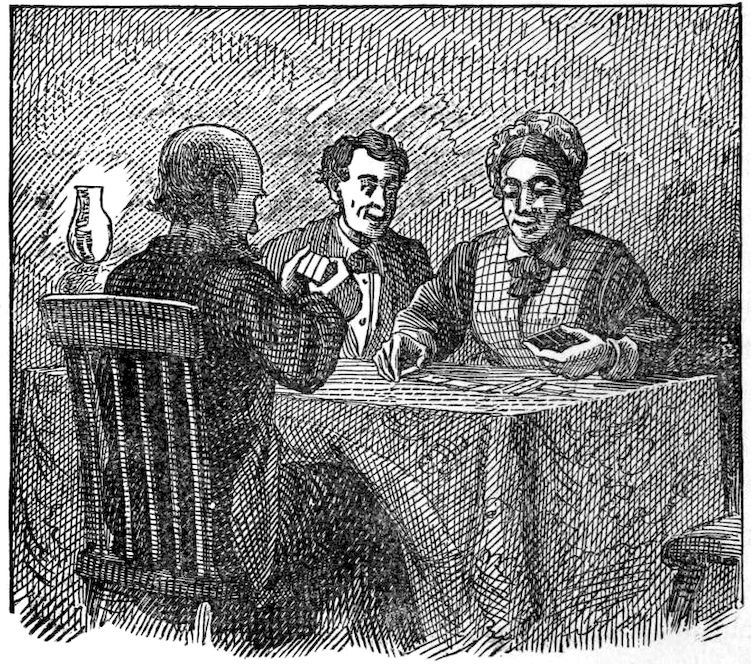
COMPETING WITH THE BAR-ROOM.
“And then if you’ll believe it, his ma and I tackled
the checker board next, and mastered that; Tom
beats us most every time, and I am glad on it, and
his ma is too. Then I got a box of authors; it
don’t take near so much mind to play that as it does
dominoes, most anybody can learn that, and it is a
beautiful game—Thackuary and Dickens and all on
’em painted out as plain as day on ’em—and we
bought lots of interestin’ books wrote by these very
325men that we got acquainted with in this way. And
before winter was out, I got a set of parlor crokay;
and when the bar-room winders was all lit up, seeminly
a beconin’ Tom and others like him to come
and be ruined, we lit up our sittin’-room winders
brighter still, and bein’ considerable forehanded, and
thinkin’ it is cheaper than to pay whisky bills, and
gamblin’ debts, and worse—we lay out—Tom’s ma
and I do—to have fruit, and nuts, and pop-corn, and
lemonade and so 4th every evening; and Tom’s mates
are made welcome, when they come. Why good
land! You can’t git Tom away from home now
hardly enough to be neighborly. We have kep’
up such doin’s year after year, and Tom is goin’ on
twenty-two; and between you and me—you are
related to Deacon Coffin’ses folks, you say?”
“Yes,” says Josiah and I.
“Well, you look so sort o’ friendly, and you’d be
apt to hear of it any way, so I’ll tell you; Tom got
sweet on the Deacon’s Molly; perfectly smit by her,
and before they knew it, as you may say, they was
engaged. Nater, you know, jest as nateral as the
sun is, or the moon, or anything; but when Tom told
us about it, and we had always been so kind of
familiar with him, sort o’ mated with him, that it
come nateral in him to confide in us—he thinks a
sight on us Tom does—I told him to be honorable
and manly, and tackle the old Deacon about it. Tom
is brave as a lion—he wouldn’t hang back a inch from
326bears or tigers or crockydiles or anything of the kind—but
when I mentioned the idee of his tacklin’ the old
Deacon, I’ll be hanged if Tom didn’t flinch, and hang
back.” Says he:
“I hate to; I hate to go near him, he is such a good
man;” says he, “he makes me feel as if I could
crawl through a knot hole, as if I wanted to.”
But my advice to Tom was from day to day,
“tackle the old Deacon.”
And finally Tom tackled him; and the old Deacon
was madder than a hen.
“A pious hen,” says I coldly, for I was a beginnin’
to not bear the old Deacon.
“Yes,” says he, “bein’ so darned good, he said
Molly shouldn’t marry any feller that laughed and
played dominoes and danced—and Tom had danced
once or twice to one of our neighbors, and the old
Deacon had heerd of it—so he turned Tom out doors,
and forbid Molly’s speakin’ to him again; Molly,
they say, took it bad, and it come powerful hard on
Tom. He is a soft hearted feller Tom is, and he
fairly worshipped her; but his ma and I brought him
up to meet trials bravely, and it is a pattern to anybody
to see how brave, and calm, and patient he is,
with his trouble makin’ him as poor as a snail. Stiddy
to work as a clock, cheerful, and growin’ poor all
the time; awful good to babys, and childern Tom is,
sense it took place, and growin’ pale, and poor as a
rat. I tell you it comes pretty tough on his ma and
327me to see it go on; but Tom wont be underhanded,
and he’ll have to grin and bear it, for the Deacon
says he never changes his mind, and he is so tarnal
good I s’pose he can’t.
“He talked powerful to me the day he rode with
me; I don’t know when I ever felt wickeder and
meaner than I did then; I can truly say that when the
old Deacon got out of the buggy, and for several hours
after that, I could have been bought cheap—probable
from 25 to 30 cents—he give it to me so for lettin’
Tom play games, and playin’ with him myself. He
said I was doin’ the devil’s work; a immortal soul
left to my charge, and I a fillin’ it up with dominoes
and checkers.
“‘But,’ says I, ‘Tom got to runnin’ to the tarven;
he got into bad company; I did it to stop him; factorum
Deacon, honor bright.’
“And then the Deacon give it to me for swearin’;
he was so good, he thought honor bright and factorum
was swearin’, and says he:
“‘S’posen Tom did git to runnin’ to the tarven and
other places of ruination; then was the time for you
to do your duty. Preach his wickedness to him;
keep at it every time he come into the house day and
night, down suller, and up stairs, to the table and the
altar. I s’posed you was a prayin’ man, and prayed
in your family.’
“‘I haint missed a night nor mornin’ sense I joined
the meetin’-house,’ says I.
328“‘Well, what a weapon that family altar might be,
if you handled it right, to pierce Tom to the heart;
to show him how gloomy his sins made you; to make
him see your goodness, and his sinfulness; to make a
pattern of yourself before him; and then evenin’s
you ort to be stern and gloomy, and awful dignified,
and spend ’em, every one of ’em, in readin’ religious
tracts to him; warnin’s to sinners, and the perils of
the ungodly. I would lend you half a bushel that I
have used in bringin’ up my own family; and if you
took this course, what a happyfyin’ thought it would
be, that, whatever course he took, whether he went
to ruin or not, you had done your duty, set him a
pattern of righteousness, and his wickedness couldn’t
be laid to your charge; and you could have a clear
conscience, and be happy, even if you looked down
from the shinin’ shore, and see him a wreathin’ in
torment.’
“‘But,’ says I, ‘what if my preachin’ his wickedness
into him, and readin’ tracts at him had the effect
of makin’ him hate religion, and drivin’ him away
from home to the tarven and wickedness? After
Tom was ruined, my makin’ a pattern of myself, and
feelin’ innocent, wouldn’t bring Tom back. And,’
says I, ‘if I kep’ Tom from goin’ to ruin, by keepin’
him to home, and playin’ dominoes with him—and
didn’t feel innocent—lemme see—where be I—’”
“And I scratched my head till every hair stood up
on end, I was so puzzled, and kinder worked up, a
329thinkin’ how I would go to work to be innocent in
the matter, and whether after I had lost Tom, my
bein’ a pattern would be much of a comfort to me or
his ma; but though I scratched my head powerful, I
couldn’t scratch a clear idee of the matter out of it.
But I tell you, the Deacon made me feel small, so
small that when I got home, I was most tempted to
go in through the key-hole; and mean—I knew I was
the meanest man in North America, I could have
took my oath on it with a clear conscience.
“But Tom’s ma felt different about it when I talked
it over with her; and she went on and give her views
on bringin’ up childern and religion, and things, for
about the first time I ever heerd her in my life—she
bein’ one of the kind that believes in doin’ more and
sayin’ less; though, if there is anybody livin’ that
can beat her in piety, I’d love to see ’em. As I say, I
never see her talk so earnest and sort of inspired like,
as she did then; it went to my heart so, took me so
‘right where I lived’—as the poet says—and I have
thought it over so many times sense, that I can
remember every word on it, though there was powerful
long words in it. But good land! long words haint
nothin’ for Tom’s ma to handle; she’s dretful high
learnt, teached a deestrick school for years; I never
shall forget how she looked when she was a talkin’ it
to me; how her eyes shone; she has got big brown
eyes jest like Tom’s, and they sort o’ lit up, jest as if
there was a kerosine lamp a burnin’ inside of her face,
330or several candles; she talked powerful. She said
she didn’t think we need feel condemned; says she:
“‘We have always taught our boy to love God, and
taught him that He was the one reality in an unreal
world.’ Says she, ‘I have tried from his childhood
to make Him who is invisible, a real presence to him,
not an abstract idee; taught him that unseen things
were more real than the seen; that love—even his
mother’s love for him, which was as intangible as a
breath of air—yet was still so much more imperishable
than the form that enshrined it—stronger than
life or death—was but a faint symbol of that greater
love that so far transcended mine. That this love was
the one rock of safety standin’ for evermore the same
amid the ebb and flow of this changeful earthly life;
and that safe in that love he could not by any possibility
be harmed by life or death or any other
creature; and if he was lost, it would not be because
God desired it;’ says she, ‘I could not teach our
boy to love God with a slave’s love for a tyrant, made
up of fear and doubt; to think of Him as a far-off
unapproachable bein’, in a remote inaccessible heaven;
lookin’ down from a height of gloomy grandeur with
a stern composure, a calm indifference, on the strugglin’
souls below, he had created; indifferent to their
sufferin’s, their gropin’s after light and truth, their
temptations, their blind mistakes; ready and anxious
to condemn; angry with their innocent happiness.’
Says she, ‘It would be as impossible for me to worship
331the God of some Christians, as to worship a heathen
God; and I have not taught our boy to worship such
a bein’, but I have learned him from a child, to look
upon Him as his nearest and dearest friend, the truest,
and the tenderest; the one always near him, ready to
help him when all other help was vain; grieved with
his wrong doin’; rejoicin’ in his efforts to do right;
helpin’ him in his struggles with his small temptations;
drawin’ his soul upward with his divine love
and tenderness. We have tried to teach him by our
lives—which is the loudest preachin’—that the best
way to show our love to God, is by bein’ helpful and
compassionate to a sorrowful humanity.’”
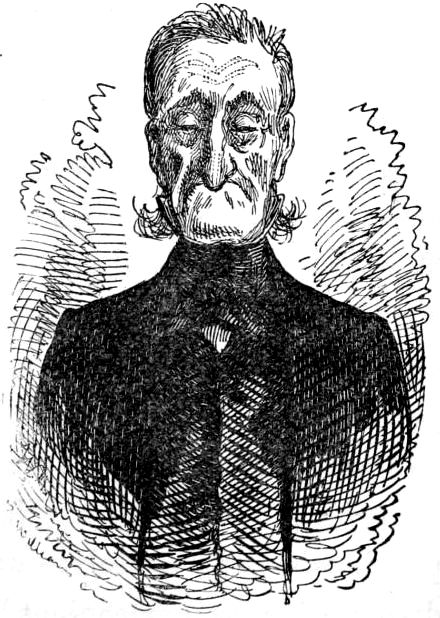
Says I, “‘The old Deacon don’t look on religion in
that light at all; he
don’t seem to want to
do any good, but jest
gives his whole mind
to bein’ wretched himself,
and condemnin’
other folks’es sins, and
makin’ them wretched.
He seems to think if he
can only do that, and
keep himself from bein’
amused in any way, he
is travelin’ the straight
road to heaven; that truly is his strong pint.’”
“Well, she said she thought of the Saviour’s last
332charge to his disciples after his death and resurrection,
when his words might well contain all earthly experience,
and heavenly wisdom. Three times he asked
that disciple, ‘Lovest thou me?’ And each separate
time he bade him prove that love, not by bein’
gloomy faced and morose, not by loud preachin’ and
condemnation of others, and long prayers and vows to
Him, but in carin’ for the flock He had left. And when
he pronounced the doom of the condemned, it was
not because they had been happy and cheerful; not
because they had neglected the creeds and forms of
religion, but because they had seen Him in the form
of a sufferin’ humanity, naked, athirst, and faint, and
had not ministered unto Him.
“She talked like a little female preacher, Tom’s ma
did; it was the first speech she had made sense I
knew her, and that was goin’ on forty years, countin’
in seven years of stiddy courtin’. And says she in
windin’ up—you know preachers always wind up, and
Tom’s ma did—says she:
“‘I guess we won’t begin to be stern and dignified
with Tom now, for we don’t care in particular about
gainin’ the admiration of an awe-struck world, or
awakenin’ Tom’s fears by makin’ patterns of ourselves;’
and says she, ‘I have always found, that
people who set themselves up for patterns are very
disagreeable as companions.’ Says she, ‘What we
want is to save our boy, make him good and happy,
and I am not a bit afraid of makin’ him too happy in
an innocent way;’ says she, ‘for goodness is the
own child of happiness on its mother’s side.’
334
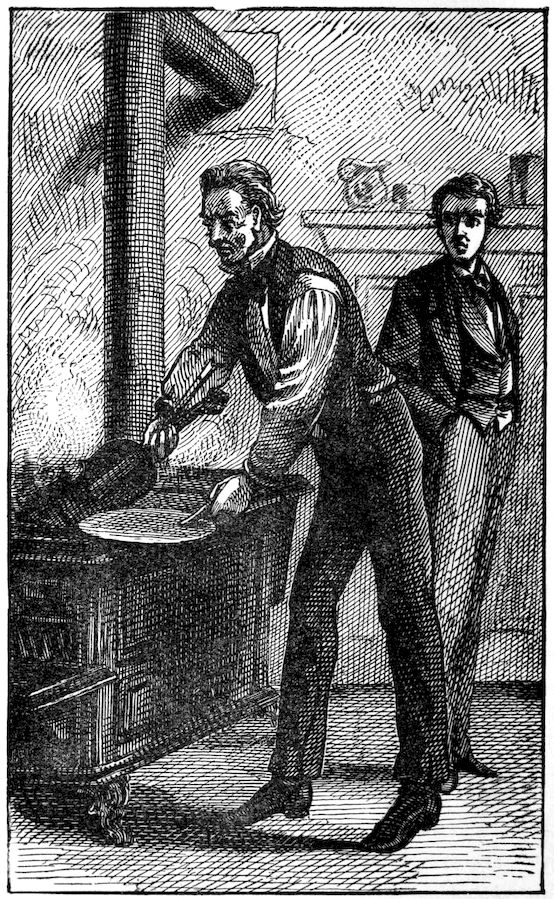
335“Who is the other parent?” says I.
Says she with a reverent look:
“‘Goodness is born of God, and happiness is its
own mother, nursed and brought up by her.’ She
talked powerful, Tom’s ma did. But as I was a sayin’,
in the matter of Molly the Deacon stands firm,
and Molly bein’ the only child there, the old Deacon
most probable hates to be left alone, though they do
say that the Deacon is goin’ to marry a Miss Horn,
who spent last winter here to her brother’s, and—’”
But my Josiah interrupted him: “Molly the only
child? Where’s Zebulin Jr.”
“Oh he run away in war time. He’d worked day
and night to make a fiddle. His mind was all sot on
music, and they said the fiddle sounded first-rate;
but when he got it done, the old Deacon burnt it up;
he was so everlastin’ good, that he thought fiddlin’
was wicked. But Zeb Jr. not bein’ so good, couldn’t
look at it in that light, so he left.”
“Where’s Zacheus?”
“Oh Zack, he run away a few weeks after Zeb
did. It was sunthin’ about a checker-board that ailed
Zack—I believe the old Deacon split it up for kindlin’
wood. Anyway it was someway where the Deacon
showed up his own goodness and Zack’s sinfulness.”
“Well, where are the twins, Noah and Nathan?”
“Oh the twins got to runnin’ to the tarvern. They’d
336get out of the winder nights, after pretendin’ to go to
bed early; said they couldn’t stay to home. I s’pose
the Deacon was so good, that it made ’em powerful
uncomfortable, they bein’ so different. It was jest
about that time I had such a tussle to keep Tom to
home. They was both of ’em jest about Tom’s age,
they was next older than Molly. Well, as might be
expected, they got into bad company to the tarvern,
got to drinkin’ and carousin’, and the Deacon turned
’em out doors. Bein’ so good he naturally couldn’t
stand such doin’s at all, and they went from bad to
worse. I don’t know where they be now, though I
heerd they had gone to sea. They seemed to be the
most sot ag’inst religion of any of ’em, the two twins
was. I heerd they vowed they’d be pirates before
they died, but I don’t know whether they ever got up
to that aim of theirn or not.”
“Well, there was another boy, between Zebulin Jr.
and Zack. Where is he?”
“Oh, that was Jonathan. A real good-hearted feller
Jont was, and full of fun when his father wasn’t
round; of course the old Deacon wouldn’t stand no
fun. Jont was the smartest one of the lot, and his
mother’s idol. Well, the old Deacon was bent on
Jonts preachin’, was determined to make an Elder of
him, and Jont hadn’t never experienced religion, nor
nothin.’ He told his father, I’ve heern, that he never
had no call to preach, and that he was sot on bein’ a
carpenter. Always putterin’ round a carpenter’s shop,
337and makin’ little housen, and wheels and things, Jont
was; his nateral nater all seemed to run that way,
but the old Deacon wouldn’t give in, said he called
him, himself. He atted Jont about it all the time,
preachin’ at him, and exhortin’ him. He was bound
at convertin’ Jont himself. I s’pose he exhorted him
powerful, and Jont not bein’ good enough to stand it,
the upshot of the matter was, he jined a circus; turns
summersets and so 4th.”
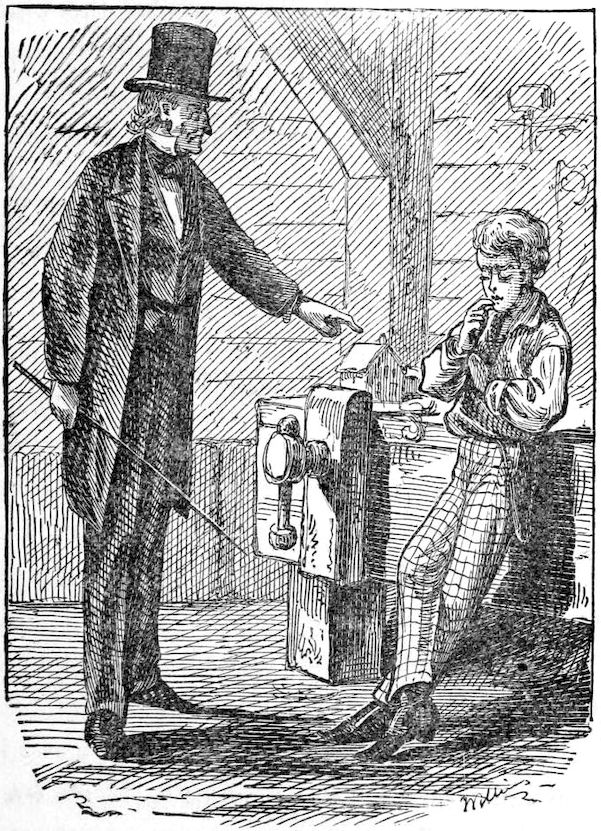
338“What did Uncle Zebulin say to that?”
“Oh, the old Deacon is so dignified you can’t never
see no change in him, he haint one of the kind to
squirm. He said in a conference meetin’ that week,
that it was dretful consolin’ to think he had always
done his duty by Jont, sot his sinful state before him
day and night, and been a pattern before him from his
youth. He was thankful and happy that his sin didn’t
lay on his coat-skirts. But it jest killed the old lady;
she didn’t live only a few weeks after Jont left.”
“Then Aunt Patience is dead?” says Josiah sithin’.
“Yes, she had been in a kind of a melancholly way
for sometime, had kind o’ crazy spells, and when Jont
left home that used her completely up.”
“It seems to me there was another boy, but I can’t
call him by name this minute.”
“Oh, you mean Absolom.”
“Yes, Absolom! Where’s he?” says Josiah.
“Oh, Absolom stole a cow and was sent to jail.
He said he’d always been called ungodly, and if he
had the name, he’d have the game; so he stole a cow
and was shet up.”
“I was a thinkin’ I heerd that Aunt Patience’es
neice’s boy was a goin’ to live with him,—the one that
never had no father in particular.”
“Yes,” says Elam Pitkins, “he did go to live
there, but the old Deacon was so tarnal good that the
boy couldn’t stand it with him.”
“What was the matter?” says Josiah.
339“Well, the old Deacon bein’ sot so firm onto the
docterines himself, thought the boy ort to think as he
did, and be willin’, if it was for heaven’s glory, to be
burnt up root and branch. The old Deacon worked
at that boy eight months night and day to make him
willin’ to go to hell; and the boy, bein’ a master hand
for tellin’ the truth, and not bein’ good enough to be
willin’ to go, wouldn’t say that he was. But the old
Deacon had ‘got his back up,’—as a profane poet
observes—and he was bound to carry the day, and
he’d argue with him powerful, so they say, as to why
he ort to be willin’. He’d tell him he was a child of
wrath, and born in sin; and the boy, bein’ so mean,
would sass him right back again, and tell him that he
didn’t born himself; that it wasn’t none of his doin’s
and he wasn’t to blame for it; and that if he had had
his way, and been knowin’ to it at the time, he’d
drather give ten cents than to have been born at all.
“And the Deacon couldn’t stand no such wicked
talk as that, and he’d lay to and whip him, and then
he’d try again to make him willin’ to go to hell.
“And finally, the boy told him one day that he was
willin’; he’d drather go, root and branch, than to live
with him. And then the Deacon whipped him harder
than ever; and the boy got discouraged and took
to lyin’, and probable there haint so big a liar to-day
in North America. He’s studyin’ for a lawyer.”
Again my companion seemed to be almost lost in
thought, and says he:
340“It is the most astonishin’ thing I ever see, that so
good a man as Uncle Zebulin, should have a family
that turned out so bad. It seems to be a mysterious
dispensation of Providence.”
“Yes!” says Elam Pitkins. “It is Providence
that done it, I haint a doubt of it.”
This made me so agitated, that entirely unbeknown
to myself I riz right up in the wagon, and says I:
“Josiah Allen if you lay any more such doin’s to
Providence, I’ll know the reason why.” Says I,
“Not bein’ Elam Pitkins’es natural gardeun, if he’s a
mind to slander Providence I can’t help it, but you
shant, Josiah Allen. You shall not talk ag’inst
Providence, and abuse him by layin’ conduct to him
that He is as innocent of as a infant babe.
“Well! well! do set down Samantha. How it
does look for you to be a standing up a ridin’.”
The democrat give a awful jolt jest that minute,
and truly I did what my companion advised me to, I
sot down. But though my body was a settin’ down
my mind was up and a doin’, for I see what was
before me. I see that as a Promiscous Advisor there
was a job ahead of me to tackle in the cause of Right.
When Elam Pitkins sot us down in front of Uncle
Zebulin Coffin’ses house door, (two miles and a half
almost, from Loon Town), the sun was jest a goin’ to
bed for the night; a settlin’ down into a perfect pile
of gold and purple and crimson bed clothes and comforters.
But it seemed as if after he had pulled up
341the great folds of shinin’ drapery over him and covered
his head up, he was a laughin’ to himself down
under the bed-clothes, to think he had left the world
lookin’ so beautiful and cheerful. Everything seemed
to appear sort of happy and peaceful and still, still
as a mouse, almost. It was the time of daisies and
sweet clover, and all along the quiet country road, the
white daisies was a smilin’ and noddin’ their bright
heads. And the sweet clover, and the wild roses with
their pretty red lips that the bees had been a kissin’
the biggest heft of the day, seemed to take a solid
comfort in lookin’ bright, and makin’ the air sweet as
honey, and sweeter.
There had been a shower of rain in the mornin’, and
old Nater’s face was all washed off as clean as a pink;
not a mite of dust on it. The medder was green as
green could be, and the wavin’ wheat fields, looked
first-rate. There was a strip of woods towards the
west, quite a considerable ways off, shady and still
it looked, and beyond that we could see the lake,
part of it blue and serene like, and part of it lookin’
like them streets of gold, we read about.
The birds was a singin’ sort o’ low and sweet in the
trees in the orchard. The sky overhead blushed up
kinder pink, but the east was blue and clear, and the
moon was sailin’ up in it like a silver boat that had
sot out for the land of Pure Delight and expected to
get there in a few moments. I don’t know when I
ever see a handsomer time.
342There are times you know, when it seems as if
heaven and earth got so near to each other, that the
stream of the Unknown that divides our world from
the world of eternal light and beauty, could be spanned
by one minute, if you could fix that minute onto an
arrer, and aim it right, and shoot it straight. Oh!
how beautiful and consolin’ and inspirin’ and happyfyin’
every thing looked, and I remarked to my pardner
in tones of rapped admiration and extacy:
“Josiah, did you ever see so handsome a time?”
Josiah realized it; that man has a great eye for
beauty. Though he don’t say so much as some men
do, he feels the more. His eyes looked dreamy and
sort o’ meditatin’, and his tones was low and gentle,
as he replied to me:
“I hope they haint eat supper yet Samantha.”
Before I could answer him, a man come round the
corner of the house, a walkin’ slowly along with his
hands clasped under his coat-tails, and I knew the
minute I sot eyes on him it was Uncle Zebulin Coffin.
He was tall, and big boneded, but in dretful poor
order; he had wintered bad, I knew. His face was
from half to three-quarters of a yard in length. (I may
not git the exact number of inches, never havin’ laid
a yard stick to him, but I made a careless estimate in
my mind, and have probable got it pretty near right.)
343
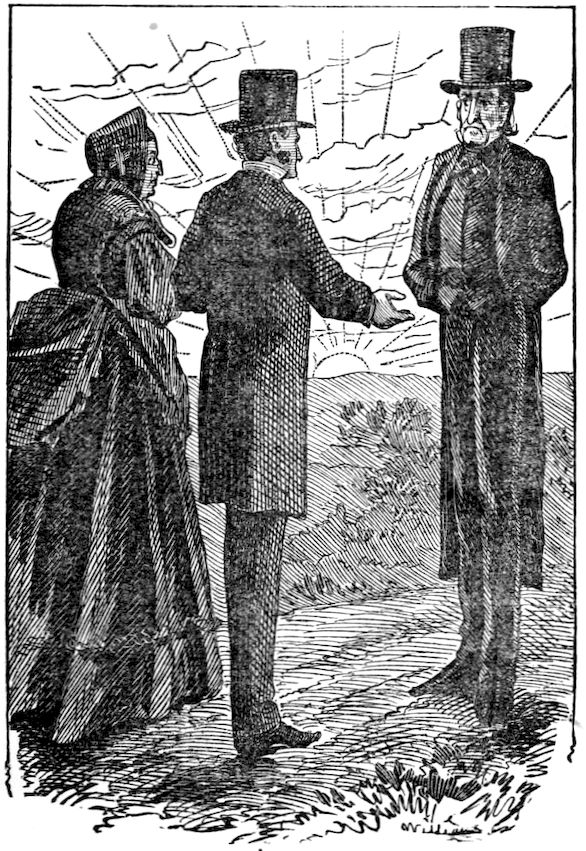
He seemed lengthy everyway. His nose was long,
and his chin was long, and his mouth was drawed
down lengthways dretful long, and his vest was long,
and his coat tails was long, and black as a coal his
clothes was, every mite of ’em; his vest was buttoned
up tight to his chin, and he had a black stock
on that come up to his ears. His head was well
lifted up, partly by the stock, and partly by dignity—about
half-and-half I should judge; or come to think
it over, there was probable more dignity than there
was stock. He was awful dignified, and oh! how
344cold he looked. Why, when he come round the
corner of the house and faced the west with his cold
disapprovin’ eyes, I’ll be hanged if I didn’t think that
he would freeze all the beauty and gladness out of the
sky. And sure enough when I looked round, the
sun had stopped laughin’ in a minute, and in order to
hide himself from the Deacon (as it were) had begun
to haul up over his shinin’ bed-clothes, a old faded
out coverlet, grey as a rat; and a dark shadder was
a fallin’ over all the brightness of the world.
When his eyes fell onto us, Josiah trembled imperceptably;
but though cold shivers was a runnin’ over
his back, he approached him—because he must—and
I, not being one to desert my companion in the time
of trouble, marched close by his side.
“How do you do, Uncle Zebulin,” and Josiah tried
hard to smile. “We have come to see you.”
His face looked more dignified than ever, and several
degrees colder. I declare it did seem as if Josiah’s
whiskers must show signs of frost, if it kep’ on.
“What stranger cometh to see me out of a world
of darkness and sin? Who claims me as his kinsman?”
And his voice was as cold as a axe in a December
mornin,’ jest as cold and icy.
“It is Josiah Allen, Uncle Zebulin, don’t you know
me? and this is Samantha.” (And Josiah again made
a fearful effort to smile.)
But Zebulin Coffin drew his hands back, and folded
’em up under his coat-skirts, and looked at Josiah a
345minute or two in complete stillness, and his mean was
as cold as a thermomiter hangin’ up right on the North
pole. It was a awful time. Finally he spoke:
“I remember you Josiah Allen; you tarried with us
occasionally in your youthful days. The last time you
were here you snickered at prayer time, one of my
own ungodly sons piercin’ you with a pin. Have you
repented of your sinful ways, Josiah Allen? Are you
weary of husks?”
Oh! how wretched and meachin’ Josiah Allen
looked. He felt too mean to speak, and Uncle Zebulin
went on:
“If you are weary of husks and tired of swine, I
can forgive you Josiah. Have you repented? Are you
worthy of forgiveness? Speak, Josiah Allen; have
you come to eat of the fatted calf?”
If Josiah Allen had been a sheep, a full blooded
merino, he couldn’t have looked any more sheepish.
Jest at that minute a real sweet voice, but sort o’
sad like, called out from the other side of the house:
“Supper’s ready, father.”
And then Zebulin Coffin ungripped his hands from
under his coat tails, and shook hands first with Josiah
and then with me. But it was done in such a way
that takin’ the clammy feelin’ of his hand, and the cold
icy look of his eye, and his name bein’ Coffin, and all,
I declare I felt jest as if I was at a funeral, and was
one of the first mourners.
A prettier girl than Molly Coffin I don’t want to
346see! Nater is likely and well behaved,—does lots of
work too; but sometimes through havin’ so much on
her mind, I s’pose the old gal gits frisky and cuts up
curious capers. And if she had made a rosebud
spring up and blow out in a dark suller bottom, it
wouldn’t have been a mite curiouser caper than for
such a blossom of a girl to blow out of such a soil as
the Deacon’s soil.
Pretty, and patient, and tender-hearted, and sad, and
hopeless, and half broken hearted, I could see that too;
and the minute we was introduced, I jest laid holt of
her and kissed her as if she had been my own girl.
And Josiah kissed her too, and I was glad on it. I
haint one of the jealous kind, and I know my companion
is one man out of a thousand. He has perfect
confidence in my behavior day and night, and I have
in hisen; and oh! what a consolin’ comfort that is.
Confidence is the anchor of the heart; if it holds fast
and firm, what safety and rest it gives; but if the
anchor wont hold, if it is waverin’ and goes a driftin’
back and forth, a draggin’ the ropes of your affections
that try to grip holt of it—through the mud and the
mire, oh, how wearin’ it is to the rope and to the
heart. But my trust in Josiah is like a cast-iron anchor
that grapples the rock every time; no shock of
the waves of change and chance and other wimmen
can unhitch it; for truly I know that though Josiah
Allen is a short man, his morals are as high and towerin’
as a meetin’ house steeple; but I am a episodin’.
347
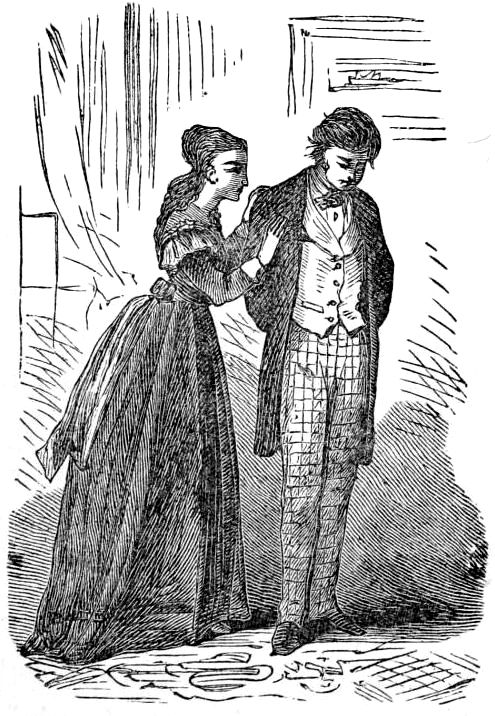
MOLLY CONSOLIN’ TOM PITKINS.
Molly had baked potatoes and cold meat, besides
pie and cake and preserves, and such stuff; and as we
had gone in entirely unexpected, I knew that Molly
was a good housekeeper, for her vittles was good
enough for the very best of company. But the
Deacon didn’t seem to be satisfied with a thing she
did. His eyes, as cold as the middle of last winter,
follered her all the time chuck full of disapproval.
Her big sorrowful eyes watched his face anxiously
and sort o’ fearful like, every time he spoke, for she
was one of them gentle,
lovin’ ones, that
a harsh word or a
cold look stabs like
a blow; and I know
it was them words
and looks added to
sorrow and Tom Pitkins,
that had made
her pretty cheeks so
thin and white, and
give that wistful,
frightened, sorrowful
look to her big
brown eyes. There
she sot not darin’ to
say a word, and there my companion sot lookin’ as if
he had stole a sheep.
The Deacon asked a blessin’, remindin’ the Lord
348how awful good a Christian he was, and asked
him for mercy’s sake to pity the sinners assembled
round his board. It was about as long as one chapter
of Pollock’s Course of Time. Josiah thought when
we was a talkin’ it over afterwards, that it was as long
as the hull book, the hull course of time itself, but it
wasn’t. We stood it first-rate, only his words was so
condemnin’ to us, and frigid, and he did it in such a
freezin’ way that I was most afraid it would make the
potatoes cold as snow-balls. I am a great case for
potatoes; the poet made a mistake as fur as I am
concerned, for truly to me potatoes are “the staff of
life”—or staffs I suppose would be more grammarius.
And as I see that man set at the head of the table
almost completely wrapped up in dignity—like a great
self-righteous damper a shettin’ off all the warmth
and brightness of life from the hull on us, and a feelin’
so uncommon big over it—I declare, duty and principle
kep’ a hunchin’ me so, and puttin’ me up to tackle
him, that I couldn’t hardly eat. I knew the hour
drew near for me to set fire to myself as a martyr,
and as a Promiscous Advisor to tackle him in the
cause of Right and Molly.
Most all the while we was a eatin’, the Deacon kep’
a hintin’ and a preachin’ about the wickedness and
depravity of wimmen dressin’ themselves up; and
every time he would say anything, he would look at
Molly as if he was determined to freeze her as stiff
as a poker. When we got up from the table, and
349sot out in the settin’-room, I see what his talk meant.
It seemed she was a makin’ a white dress for herself
out of muslin—jest a finishin’ it off with some
modest lookin’ lace on the neck and sleeves, and a
small—a very small and reasonable amount of puckers;
she could make the hull on it in a day and a half at
the outside, and I could see she would look as pretty
in it as a pink. When the old Deacon went to set
down, he took the skirt of the dress that happened
to be a layin’ over his chair, and handlin’ it with
considerable the countenance he would a checkered
adder, he broke out colder and frigider than ever:
“No wonder the national debt haint paid; no
wonder ruin and bankruptcy are in the land, and it is
wimmen’s base carnal extravagance that does it.”
“Yes,” says Josiah—who seemed to want to curry
the Deacon’s favor—“it is jest as you say; wimmen
is tarnal extravagant.”
Oh how he looked at Josiah; “I said carnal, I am
not in the practice of profane swearin’.”
Oh how sorry my Josiah looked, to think he had
tried to curry him down.
And then the Deacon went on about wimmen’s base
and vile extravagance, as much as seventeen minutes
by the clock, givin’ such a look once in a while onto
my respectable overskirt, and lace head-dress, and
Molly’s dress, enough to make icikles hang to ’em. I
heerd him go on as long as I could, and then says I:
350
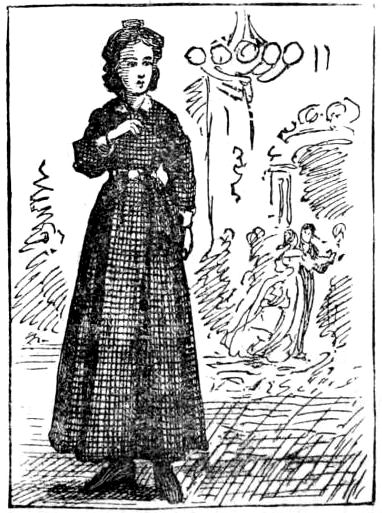
“No doubt some of my sect are extravagant; I
dare persume to say that some of the big wimmen in
Washington and New York, and other big villages of
the Union, git new clothes sometimes before the old
ones are wore out; I hear they say, that they have to
dress up or they can’t git any attention paid to ’em
from the more opposite sect; I hear they say, that
the men there look down on ’em, and slight ’em, and
treat ’em like perfect underlin’s if they haint dressed
right up in the height of fashion. Why, they say
there was a fashionable woman at Washington whose
bo had wrote a witherin’ piece ag’inst wimmen’s base
wicked extravagance, bewarin’ ’em, and urgin’ ’em in
the name of all that was great and good to come out
and wear thick shoes, and dress with republican simplicity;
and she, bein’ converted by his burnin’ eloquence,
and bein’ anxious
to marry him, thought she
could bring him to terms
by follerin’ on after his advice.
So she arrayed her
self in a brown, high-necked
alpaca dress, barren of ruffles
and puckers, made to
clear the floor and show
her sensible calf-skin shoes,
and went to a big party, expectin’
her bo would be so thankful to her for follerin’
his advice; so proud of her; so highly pleased
with her behavior, that she would go home as good
351as married to him. But they say, when he see how
she was dressed, he wouldn’t speak to her, nor look
at her; it broke up the match, he treated her with
awful contempt, and witherin’ scorn; and she went
into extravagance more than ever; spent every cent
of her property in gauzes, and bobinet lace and things,
wore ’em all out, and then went to the poor-house, a
victim of leanin’ too
heavy onto such
men’s bewares. Lost
and ondone; broke
down and mortified
by hangin’ too blindly
onto that man’s
moral apron strings;
I pity her, but I don’t
uphold her, nor him
neither; their heads
was soft, both on
’em, too soft for
comfort.
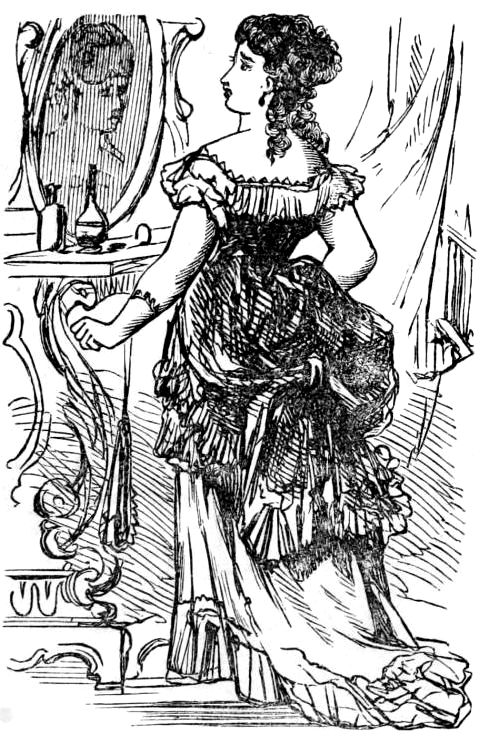
“I dare say that
there are lots of wimmen
besides her that git new bunnets when they
haint a sufferin’ for ’em, and buy new dresses when
their old ones haint hardly come to mendin’, and
mebby some of ’em have two or three sets of jewelry
at one time; and these dresses, and bunnets, and
jewelry, folks can lay holt of, and shake out before
352the eyes of the public, and the public can look at ’em,
and shed tears onto ’em, and bewail over ’em about
wimmen’s extravagance; but men’s extravagance haint
so easy to git holt of as store clothes be. You can’t
weep over cigar smoke when it is evaporated, and
after they are over with, you can’t git holt of costly
wines, and club dinners, and yot races, and rides after
fast horses, and bets, and gamblin’ debts, and worse.
As I said, their extravagance is harder to git holt of,
but it is worse than hers; for if she and he gits hungry,
she can sell her jewelry and fine clothes to buy
bread for ’em, but who—no matter how big a speculator
he is—who can sell costly lunches years afterwards,
and wines after they are drunk up, and gamin’ and
horse debts after they are paid up, and old pleasure
rides after fast horses, and etcetery. A man couldn’t
sell ’em at any lay at all, if he starved to death; so man’s
extravagance is more extravagant than woman’s.”
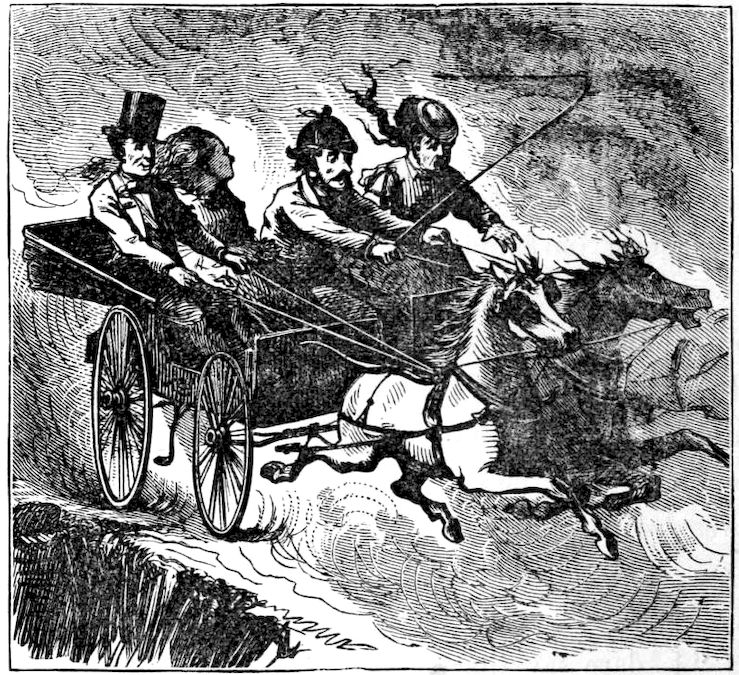
HOW I MARRIED THE DEACON’S DAUGHTER
353The Deacon didn’t mind my words no more’n the
wind a whistlin’ round the corner of the barn; but
he give a look onto the little white waist that was a
layin’ on the table, as angry and rebukin’ a look as I
ever see, and says he: “To think an immortal soul
will peril its hopes of heaven on such wicked vanity.”
“Wicked!” says I, holdin’ up the little waist
admirin’ly on my thumb and forefinger. “It haint
wicked, it is as white as chalk clean through;” says
I, “who told us to consider the lilies, and they are
puckered up, and ruffled off as much again as this is,
and all ornamented off with little gold ornaments;
if there was any wickedness in ’em would He have
sot us to considerin’ of ’em? No! Zebulin Coffin,
no!” And then I went on in pretty reasonable
tones: “No woman can have stronger principles
than I have on the subject of ruffles and knife pleatin’s,
when pursued after as a stiddy business and a
trade. But I say it is jest as sensible to expect
young folks in the spring of life, to want to kinder
trim themselves out and look pretty, as it is to expect
everything else to kinder blow out in the spring of
the year; apple trees, and pozy beds and so 4th.”
Says I, “I am a Promiscous Advisor by trade Uncle
354Zebulin, and I feel it my duty to say to you promiscously,
that you are unreasonable; you don’t have
charity enough for folks.”
And then as I calculated to all the time, I give him
a very, very blind hint about Tom Pitkins—for I
thought mebby I could mollyfy the old Deacon about
him—and so says I in a awful roundabout, blind
way: “Mebby you haint charity enough for a certain
person that is likely as likely can be; mebby you condemn
this certain person because he plays dominoes,
and has danced a very little in a neighborly way.”
The Deacon acted mad; and he run on about dancin’
almost fearfully, when I asked him considerable
calmly: “Did you ever dance when you was young,
Uncle Zeb?”
If a look could have cut anybodys head off, my
Josiah would have mourned over a guluntined companion
that very minute.
“Dance! I dance!” Oh how he went on; and
says I, “I s’pose you went to parties and played?”
“Oh yes,” says he, “In youthful mirth I gambolled
through the innocent forms of ‘Wink ’em Slyly’ and
such, but I never danced, I never committed that sin.”
355
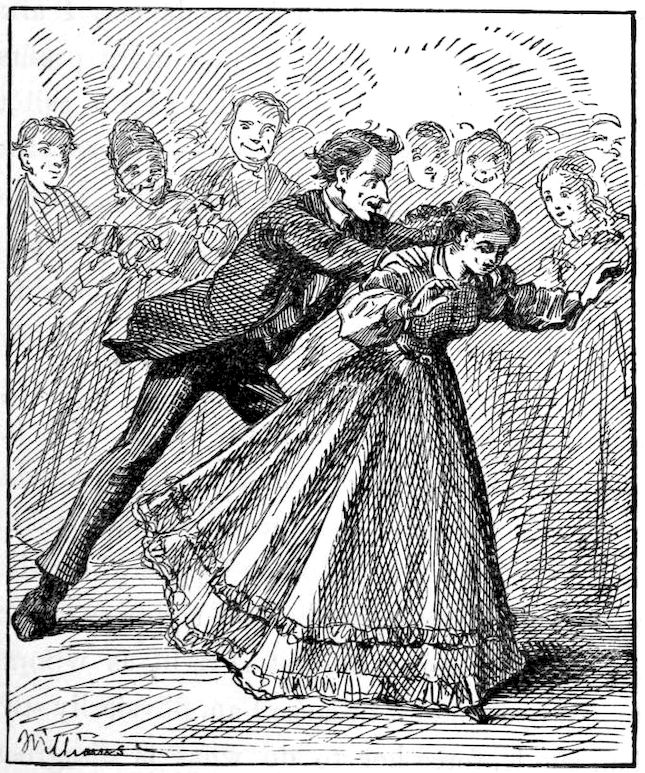
“No,” says I, “but you went through with all the
motions of dancin’, caperin’ round the room, chasin’
likely wimmen to Copenhagen; and a runnin’ ’em
through the Needles-eye till they was most dead.
Winkin’ of ’em slyly, and racin’ ’em round till you
most run your precious legs off and theirn too. You
went through all the motions of dancin’, only instead
of takin’ their hands and promenadin’ down the room
with ’em at a slow respectable gait to the sound of
music, you laid too and chased ’em, galloped after
’em like a wild Injun till you chased ’em down;
takin’ the advantage of ’em by dodgin’ unbeknown to
’em—catchin’ holt of ’em and a tearin’ their dresses,
rippin’ of ’em off at the waist; steppin’ through
their flounces, towzelin’ their hair, and lamin’ of ’em.
You chased ’em round in a particular form jest like
dancin’ only what took the wickedness off was your
356kissin’ ’em when you catched ’em; every man in the
room kissin’ every woman promiscous; that made it
moral and religious, so Deacons and all other meetin’
house folks could foller it up.”
He looked wrathful, very; but I continued on in
more reasonable axents:
“I never had no call to be a dancer, I always
thought my time could be spent in a more profitable
way; and my Tirzah Ann never had no call that
way, and neither did she ever take to those promiscous
kissin’ parties. When she was a little mite of a
girl she didn’t want to kiss anybody but her pa and
me, and I wouldn’t make her. Some thought she
was too dainty and I ort to punish her. Wimmen
with their faces covered with scotch snuff, have argued
with me that it was my duty to whip her for hangin’
back from kissin’ ’em; but I says to ’em what if
some big giant should stand over me and make me
kiss Simon Slimpsey or Solomon Cypher, how should
I feel? And Tirzah Ann has her rights as well as I
have—childern’s rights are jest as right as wimmen’s
rights. Why should I, because I am physically stronger
than she is, force her to do what is disagreeable
and repulsive to her? There is no justice in it.
Little childern forced into this life entirely unbeknown
to them, called out of the peaceful land of
Nowhere into this troublesome world by no will of
their own, ort to be treated well, Zebulin Coffin, by
their fathers and mothers and parents. It is a solemn
357thing, one of the solemnest things that ever was done
to wake up a deathless soul, to be endlessly happy or
miserable. An immortal soul, that can’t through
time or eternity—no matter how tired it is, ever go to
sleep again; can’t never lay off for half a moment, if
ever so weary and despairin’, the burden of life’s
responsibilities, the burden of life’s sorrows; can’t
never lay down the awful—awful because so mysterious—gift
of immortality; can’t never go back to the
serene if lonesome land you called ’em from—they
have got to face sorrow and weariness and death. You
have sot ’em down in front of them troubles anyway;
and the least you can do for ’em is to make ’em as
happy as you can; treat ’em with respect and civility
and do well by ’em. And if their hearts seem to be
sot on certain persons, if them certain persons are
likely—which they be—we ort to do as we would be
done by if we was in Tom’s and Molly’s place.”
But I see then that even these roundabout hints
wouldn’t be took. I see how hard it was to mollyfy
him about Molly, and I hastened to continue on.
“As I was a sayin’, I wouldn’t make Tirzah Ann
kiss folks promiscous when she was a child, and when
she grew up sort of bashful like, it didn’t trouble me,
for I knew her little dainty, timid, modest ways was
jest like the blush on a peach or a bunch of grapes;
if that got brushed off by rough handlin’, all the
world couldn’t never put it back again. As I said, she
never had no drawin’ towards balls and promiscous
358parties, and runnin’ off nights away from home. And
though I don’t consider it the height of wickedness
at all, still it didn’t worry me a bit to have her contented
and willin’ to stay to home. She said home
was the pleasantest spot in the world to her, and so
Thomas J. said. Josiah and I did our best to make
home pleasant to the childern; we had all sorts of
virtuous and harmless games, music and etcetery, to
make ’em happy—and they was happy. We worked
hard to git ’em headed right—and they did head right;
and when a likely young man come along that loved
Tirzah Ann, and she him, why we give our consent,
jest as in my opinion certain persons ort to have the
free and full consent of a certain Deacon.”
I would give him a blind hint once in a while, if he
took my head off; but I see by his looks that it
wouldn’t do to come out plain jest yet, so I went on:
“I tried to make myself a sort of a mate to my
Tirzah Ann, brought her up so’s not to feel awe-struck,
and afraid of me; afraid to confide all her
little tribulations and worryments to me.” Says I,
“We worked head work to keep ’em good and happy;
Josiah and me did.”
The Deacon had sot for the last several moments
with his head right up in the air, and his eyes rolled
up so I couldn’t see much besides the whites of ’em,
and as I stopped a few moments (for truly my breath
had give out, my deep principle tone uses up breath
dretful fast) he groaned out; “Works.”
359But I says mildly, “don’t you believe in works?”
“No I don’t, I believe in faith; you seem to lay
out to be saved by works.” And again he spoke out
that “works,” as if it was the meanest thing he ever
heerd on; he lifted up his nose in as unbelievin, and
scornful a way as I ever see a nose lifted up.
But I kep’ cool, and says I, “No, I don’t; but I
believe faith and works ort to go together; they ort
to work in one harness a drawin’ the soul along
the straight and narrer way.” Says I, “They haint
calculated to work in a single harness, either of ’em;
they are double breasted, and folks ort to realize that
they be.” Says I, “I have seen folks before now
that kep’ the eye of their faith bent so stiddy upwards,
that they didn’t know nor care how many
weak and helpless ones they was crunchin’ down
under their heels; how many infant babes was a perishin’
with hunger about ’em, starvin’ physically, and
spiritually; the air full of the groans and prayers of a
sufferin’ humanity, and they a walkin’ calmly on, a
hangin’ on to their faith, and their old beliefs, as if it
was the most delightful and consolin’ thing they ever
heerd on, to think they was goin’ to be saved, and
somebody else wasn’t. And then I’ve seen them that
laid themselves out on their good works, thought they
was goin’ to earn a deed of the heavenly homestead
by doin’ day’s works below; think they made themselves,
and worship their maker. But there haint
either of these ways the right way.”
360
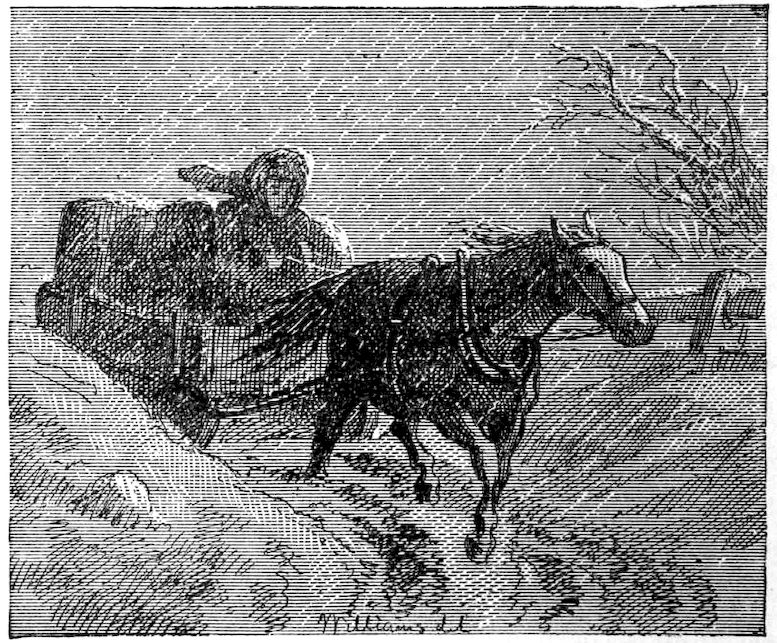
Says I, “If you was a drowndin’, you would believe
in faith and works both. You would want somebody
to have faith, they could git you out, and then you
would want ’em to lay to, and haul you ashore.” Says
I, “Faith alone in that case would drownd you stiffer’n
a mushrat; and jest so in various cases,—poor
widders for instance. Now several hundred deacons
may git together in a warm meetin’-house, and lean
over on their creeds and have faith that a certain widder
will come through the winter all right. And
probable it wouldn’t be half the help to her that one
small deacon would be that loaded up his Bobs with
stove-wood, and flour, and potatoes, and side-pork, and
jest worked his way along through the snow to her
361cold empty suller. And then on the other hand not
to have any faith, that I couldn’t stand. Some folks
say they wont believe in anything they can’t see for
themselves. Good land! how will they git holt of
the prefume of a rose, or tackle a gust of wind? One
is sweet enough to fill you with happiness, and the
other is strong enough to blow you over; but you
can’t git holt of one, with your two hands, or wrastle
with the other and throw it.
“We work by faith every day of our lives; we
plant seed in the dark earth, believin’ that though the
seed perishes, it will break the bands of death, and
rise in greenness and bloom; though jest how it does
that job you cant tell, nor I cant, nor Josiah. They
needn’t talk to me about not believin’ anything they
don’t understand; for what do we understand come to
look at the matter fair and square?” Says I, “Life itself
is a sober riddle, the solemnest conundrum that was ever
put out to humanity. Who has ever been able to git
the right answer to it by reasonin’ it out himself, and
if he did cypher out an answer, to suit himself, how
would he know it was the right one? We see that
things be, but why they be so, you can’t tell, nor I,
nor Josiah.
“Truly, if anybody gits to pryin’ into hidden
things, and reasonin’ on first causes, he finds that the
flood is deep and the rain is descendin’ onto him, and
the proud peaks of his own reason and judgment is
drownded completely out. But God has sent forth
362an ark that rides triumphant on the face of the waters;
His revealed word floats above the rainy deluge of
our fears and wonderments. Not to have any faith
would tucker me completely out; there would be a
looseness to it I couldn’t stand, a waverin’ unstiddyness
that would upset me, and take me offen my feet.”
Says I, “Faith and works ort to be twisted in one
strand, and when they are, they make a cord that
anchors the soul to the Rock of Ages, and holds it
there fast and firm, so that change, and chance, and
sin, and temptation, and all the storms of this stormy
life will beat ag’inst it in vain, and bime-by that very
cord will draw the soul right up through the pearly
gates into the city of our Lord.”
I declare I didn’t hardly know where I was, nor
who I was, I was so almost lost and carried away
some distance by my emotions. But I was soon
drawed back to the realities of this life by Zebulin
Coffin. His mind was a roamin’ back to the subject
on which he had went on, and again he spoke out
with a groan: “To think! to think I have lived to
see and hear a church member uphold dancin’.”
“I haint a holdin’ it up,” says I, coldly. “With the
firm cast-iron principles I have got, I never would
dance a step with anybody but my Josiah; and it
haint much likely we shall begin to learn the trade
now, as old as we be, and most dead with the rheumatiz,
both on us. Why, if we should waltz together, as
lame as I be, I couldn’t keep my feet half a minute;
363and if I should fall on my pardner, he would be a
dead man, and I know it; I am hefty, very, and he
is small boneded, and weighs but little by the steelyards.
I love that man devotedly, and I don’t want
to dance; but I say and I contend for it, if I was a
follerin’ up ‘Wink-em-Slyly’ and etcetery, I wouldn’t
have too much to say ag’inst other kinds of caperin’
round the floor, such as dancin’ and so 4th.”
“I say all this to you, Uncle Zebulin, not as Josiah
Allen’s wife, but as a woman with a vow on her.
When folks set out on towers as Promiscous Advisors,
they set out as sufferers and martyrs; they set out
expectin’ to be burnt up on various stakes of the same.
I have locked arms with Principle, I am keepin’
stiddy company with Duty, and they are a drawin’
me along and a hunchin’ of me in the side, a makin’
me say to you, that you are as self-righteous as the
Old Harry; that you are more sot on makin’ a pattern
of yourself than in makin the world ’round you happier
and brighter; that instead of reflectin’ heaven’s
peace and glory back again upon a sad earth as Christians
ort to, you have made a damper of yourself, shettin’
off all warmth and light and happiness; a damper
for sinners to set down and freeze to death by.”
“To think!” he groaned out, “that anybody should
dare to find fault with me when I haint committed a
sin in thirty-five years, nor smiled in over forty.”
“Not laughin’ haint no sign of religion Uncle Zeb;
because a man makes himself disagreeable and repulsive,
364that haint another sign; gloom and discomfort
haint piety; because a man is in pain it haint no sign
he is enjoyin’ religion. I wouldn’t give two or three
straws for a religion that didn’t make folks happier as
well as better; more tender and charitable and pitiful;
more loving and helpful to all humanity. Bigotry
and intolerance never was religion, Uncle Zeb, nor
never will be, though they have been called so time
and again; religion is sunthin’ different, it is as beautiful
as they are hegus; it is gentle, full of joy and
peace, pure, easily entreated, full of good works,
mercy, and charity—which is love.
“It is not Samantha, but a woman on the battle-field
of Right, who is a rakin’ you down with the
arrers of Truth; it is a Promiscous Advisor who
says to you, that you have for years been doin’ what
a great many do in the name of religion; you have
wrapped yourself in your own dignity and self-righteousness,
and worshipped yourself instead of God.”
I didn’t say no more then to the old Deacon in a
martyr way; I pulled in the reins and dismounted
down from the war horse that was a canterin’ away
nobly with me, and a snortin’ in the cause of Right.
Though ready and willin’ in spirit to mount this war
horse and foller on where Principle leads, without
saddle or bridle, and to suffer as a Promiscous Advisor,
still it is a tuckerin’ business, and if anybody don’t
believe it, let em ride off this war-horse on a tower.
And the very hardest and most tuckerin’ place it
365ever cantered into, the most gaulin’ and awfulest
place it ever pranced round in, is other folks’es housen.
When it comes to advisin’ folks promiscously, under
their own “vials and mantletrees,” never, never do I
feel such temptations to give up my shield and fall
offen his back. Oh, John Rogers! you never, never
suffered more excruciatin’ly than does Josiah Allen’s
wife in such moments. Nothin’, nothin’ but principle
could nerve me up to the agonizin’ effort. As I
said, I didn’t say no more to the old Deacon that
night in a martyr way, and oh! what a relief it was
to dismount from the prancin’ steed of Duty, throw
off the sharp moral spur from my achin’ feet, curl in
my lofty principle tone, and assume again the gentle
and almost affectionate axents of Samantha.
And another reason why I thought I would be kinder
easy with the old Deacon and not say anything to
git him mad, was my determination to mollyfy him
about Molly—and a plan I had in my head growin’
bigger and stronger every minute—to marry that girl
to Tom Pitkins, myself, before I left that house.
The hired girl had told me—I went out to wash
my hands to the sink and I happened to ask her in
a polite way if she was goin’ to see the Sentinal, and
she said she was, that the old Deacon had told her that
day he was goin’ to be married in two weeks to Miss
Horn, and shouldn’t want her no longer—and if he
was a goin’ to marry that Horn what good was Molly
a goin’ to do there, only in a martyr way. Some
366gentle souls seem to be born martyrs, not to principles
and idees, but ready to be offered up on a Horn or
anything; ready to be pricked and scattered over
with snuff in their pinnin’ blankets, and grow up
ready to sacrifice themselves to any idol that calls on
’em to—crumple right down and be sot fire to—such
was Molly. And it is for some strong hearted friend
to snatch ’em away from the fagots and the kindlin’
wood,—such a friend is Samantha. Some see happiness
right in front of ’em, and are too weak to grasp
holt of it; such need the help of a hand like hers.
I lay awake the biggest heft of that night, a thinkin’
in deep thought, and a layin’ on plans. And finally
I guess about three o’clock, I spoke out and says I:
“Josiah Allen, we have got to marry Molly to-day
before we leave this house.”
“Good land!” says Josiah startin’ up on his piller
full of horrer. “Good land,” says he, “I haint a
Mormon, Samantha, I can’t marry to another woman.”
Says I coolly, “Lay down and compose yourself
Josiah Allen; I am a goin’ to marry her myself.”
This skairt him worse than ever I could see, and he
started up, with a still more ghastly look onto him.
He was so pale with horrer that his bald head shone
in the moonlight like a big goose egg, and his eyes
stood out about a quarter of an inch with fear and
excitement. He thought I was delerious; says he in
tremblin’ tones: “What does ail you Samantha! Shant
I rub your back? Don’t you want sunthin’ to take?”
367Says I calmly, “I want a companion that wont
interrupt me before I finish a speech. I am a goin’
to marry Molly to Tom Pitkins myself before I leave
this house. Lay down Josiah Allen and keep still
while I talk it over with you.”
“Talk it over!” says he in loud angry tones, throwin’
his head back on the piller. “I would break out
in the dead of night, and scare a man to death, a talkin’
and a arguin’. Do go to sleep, and lemme.”
But I held firm, and would tell him about the plan
I had been a layin’ on through the night. I would tell
him how I meant to mollyfy the Deacon about Molly.
Says I, “Josiah Allen, I am a woman that has got
368a vow on me, and I love that girl, as little as I have
seen of her, and I am a goin’ to do by her as I would
want our Tirzah Ann done by.” Says I, “We shant
probable never visit Loon Town again; Tom Pitkins
is liable to die off any time with the feelin’s he feels
for her; she is liable to die off any minute with her
unhappiness, and her feelin’s for him. I shouldn’t
wonder a mite if they didn’t live more’n ten or fifteen
years if things go on as they be now. And as bad
off and wretched as Molly is now, worse is ahead of
her, the gloom of a Coffin is enough, let alone the
hardness of a Horn. Molly haint a goin’ to be sacrificed
on that Horn, while I have got a life left.
Desperate diseases require desperate medicines.”
“Well, do for mercy’s sake go to sleep and lemme.”
“What if it was our Tirzah Ann that was in her
place.” Says I in a low deep voice, “Haint you a
father, Josiah Allen?”
“No I haint!” he snapped out enough to tear my
night cap in to. “No I haint, nothin’ nor nobody,
nor I wont be at this time of night.”
“Haint you no principle?” says I.
“No I haint! not a darn principle.”
“I’d lay and swear if I was in your place Josiah
Allen,” says I almost coldly.
“Well! the idee of roustin’ anybody up in the
dead of night, and callin’ on ’em for principle and
things. But you wont git any principle out of me
at this time of night, you’ll see you wont,” he hollered.
369He was almost a luny for the time bein’. I pitted
him, and says I soothin’ly:
“Go to sleep Josiah, and we’ll talk it over in the
mornin’.”
He dropped off to sleep, and I kep’ on a thinkin’
and a layin’ on my plans to marry Molly off till most
mornin’. And I did it, I married off Molly about
one o’clock and we started for the Sentinal in the
neighborhood of two.
Jest how I mollyfied the old Deacon about Molly,
and brought him to terms, I thought I wouldn’t tell
to anybody but Josiah. Mebby there was hints
throwed out to him that there was Horns that would
be meddled with, and sot up ag’inst him. I guess I
hadn’t better tell it, for I made up my mind that I
wouldn’t say nothin’ about it to anybody but my
Josiah. But I dressed Molly up that very afternoon,—she
a blushin’ and a laughin’ and a cryin’ at the
same time—in that very white dress, and married
her myself (assisted by a Methodist minister) to Tom
Pitkins.
And I have learned by a letter from Molly, and
she sent me her new picture, (they have gone to
housekeepin’ and are as happy as kings) that her
father is married to Miss Horn. And all I have got
to say is, that she needs a good horn disposition to git
along with him. And he, unless I am mistaken, will
wish before the year was up that he was a sleepin’
peacefully inside of his own Sername.
370
THE GRAND EXHIBITION.
From the first minute I had give a thought to goin’
to see the Sentinal, my idee had been to git boarded
up in a private house. And I had my eye (my
mind’s eye) upon who was willin’ and glad to board us.
The Editor of the Auger’ses wife’s sister’s husband’s
cousin boarded folks for a livin’—she was a Dickey
and married to a Lampheare. The Editor of the
Auger’ses wife told me early in the spring, that if
she went, she should go through the Sentinal to her
sisters’, and she happened to mention Miss Lampheare
and the fact that she boarded up folks for a livin’. So
when we decided to go, I told her when she wrote to
her sister to ask her, to ask Miss Lampheare if she
was willin’ to board Josiah and me, and how much
she would ask for the boards. She wrote back; her
terms was moderate and inside of our means, and
my mind was at rest. I almost knew that Josiah
would want to throw himself onto his relatives
371through the Sentinal, but the underpinnin’ was no
firmer and rockier under our horse barn than the determination
of her that was Samantha Smith, not to
encamp upon a 2nd cousin. We had quite a lot of
relations a livin’ out to Filadelfy—though we never
seen ’em,—sort o’ distant, such as 2nd cousins, and
so 4th, till they dwindled out of bein’ any relations
at all; descendants of the Daggets and Kidds,—Grandmother
Allen was a Kidd—no relation of old
Captain Kidd. No! if any of his blood had been in
my Josiah’s veins, I would have bled him myself if I
had took a darnin’ needle to it. No! the Kidd’ses
are likely folks as I have heerd—and Josiah was
rampant to go to cousin Sam Kidds (a Captain in the
late war), through the Sentinal. But again I says to
him calmly but firmly:
“No! Josiah Allen, no! anything but bringin’
grief and trouble onto perfect strangers jest because
they happened to be born second cousin to you, unbeknown
to ’em;” and I repeated with icy firmness—for
I see he was a hankerin’ awfully,—“Josiah
Allen I will not encamp upon Captain Kidd through
the Sentinal.”
No! Miss Lampheare was my theme, and my gole,
and all boyed up with hope we arrove at her dwellin’
place. Miss Lampheare met us at the door herself.
She was a tall spindlin’ lookin’ woman, one that had
seen trouble—for she had always kep’ boarders, and
had had four husbands, and buried ’em in a row, her
372present one bein’ now in a decline. When I told her
who I was, she met me with warmth and said that
any friend of she that was Alminy Dickey was dear
to her. But friendship, let it be ever so ardent can
not obtain cream from well water, or cause iron bedsteads
to stretch out like Injy Rubber. She had expected
us sooner, if we come at all, and her house was
overflowin’—every bed, lounge, corner and cupboard,
being occupied, and the buro and stand draws made
up nightly for childern.
What was we to do? Night would soon let down
her cloudy mantilly upon Josiah and me, and what
was to become of us. Miss Lampheare seemed to
pity us, and she directed us to a friend of hers; that
friend was full; he directed us to another friend; that
friend was overflowin’. And so it went on till we
was almost completely tired out. At last Josiah come
out of a house, where he had been seekin’ rest and
findin’ it not; says he:
“They said mebby we could git a room at the
‘Grand Imposition Hotel.’” So we started off there,
Josiah a scoldin’ every step of the way, and a sayin’:
“I told you jest how it would be, we ort to have
gone to Captain Kidd’s.”
I didn’t say nothin’ back on the outside for I see
by his face that it was no time for parley. But my
mind was firm on the inside, to board in grocery
stores, and room under my umberell, before I threw
myself onto a perfect stranger through the Sentinal.
373But a recital of our agony of mind and body will
be of little interest to the gay, and only sadden the
tender hearted; and suffice it to say in a hour’s time,
we was a follerin’ the hired man to a room in the
“Grand Imposition Hotel.”
Our room was good enough, and big enough for
Josiah and me to turn round in it one at a time. It
had a bed considerable narrer, but good and healthy—hard
beds are considered healthy, by the best of
doctors—a chair, a lookin’ glass, and a wash-stand.
Josiah made a sight of fun of that, because it didn’t
have but three legs.
But says I firmly, “That is one more than you have
got Josiah Allen.” I wouldn’t stand none of his
foolin’.
The room bein’ pretty nigh to the ruff,—very nigh
on the backside,—Josiah complained a sight about
hittin’ his head ag’inst the rafters. I told him to
keep out then where he belonged, and not go to
prowlin’ round at the foot of the bed.
“Where shall I go to Samantha,” says he in
pitiful axents. “I let you have the chair, and what
will become of me, if I don’t set somewhere, on the
bed, or sunthin’.”
“Well,” says I mildly, “less try to make the
best of things. It haint reasonable to expect to be to
home and on a tower at the same time, simultaneous.”
When we eat supper we had a considerable journey
to the dinin’ room, which looked a good deal on the
374plan of Miss Astor’ses, with lots of colored folks a
goin’ round, a waitin’ on the hungry crowd. I didn’t
see the woman of the house—mebby she was laid up
with a headache, or had gone out for an afternoon’s
visit—but the colored waiters seemed to be real careful
of her property; they’d catch a tea-spoon right out
of their pocket and put it in your tea; she couldn’t
have kep’ a closer grip on her tea-spoons herself.
I can truly say without stretchin’ the truth the
width of a horse hair, that the chamber-maid was as
cross as a bear, for every identical thing I asked her
for was a extra—she couldn’t do it without extra
pay, but she did git me some ice water once, without
askin’ me a cent extra for it. After we got to
bed Josiah would lay and talk. He would speak out
all of a sudden:
“Grand Imposition Hotel!”
And I’d say, “What of it, what if it is?”
And then he’d say: “They have got a crackin’
good name, Samantha. I love to see names that
mean sunthin’.” And then he’d ask me if I remembered
the song about Barbara Allen, and if it would
hurt my feelin’s if he should lay and sing a verse of
it to me, the bed put him in mind of it so.
I asked him what verse—but there was that in my
tone that made him say no more about singin’—he
said it was the verse where Barbara wanted her
mother to have her coffin made “long and narrer.”
And then he’d begin again about the pillers, and say
375how he wished he had brought a couple of feathers
from home, to lay on, so he could have got some rest.
He had pulled out a little wad of cotton-battin’ before
we went to bed to convince me of their ingredents.
But I says to him: “Josiah Allen, a easy conscience
can rest even on cotton-battin’ pillers,” and I
added in awful meanin’ tones, “I am sleepy, Josiah
Allen, and want to go to sleep. It is time,” says I
with dignity, “that we was both reposin’ in the arms
of Morphine.”
Nothin’ quells him down quicker than to have me
talk in a classical high learnt way, and in a few minutes
he was fast asleep. But though, as I told Josiah,
my conscience was at rest and I felt sleepy, the musquitoes
was dretful, and I don’t know as a guilty conscience
could roust anybody up much more, or gall
anybody more fearfully. They was truly tegus. And
then the partition bein’ but thin, I could hear folks a
walkin’ all night—and take it with their trampin’ and
the musquitoes payin’ so much attention to me, I
never got no good sleep ’till most mornin’; but then
I got a good nap, and felt considerable chirk when I
got up. We eat our breakfast in pretty good season
and laid out to git a early start.
I didn’t have but one drawback worth mentionin’
and that was, I had lost one eye out of my specks
somewhere on our way from Melankton Spicer’ses,
and I told Josiah I felt mortified, after I had lotted
so on seein’ the Sentinal, to think I had got to see
376him with one eye out; says he: “I guess you’ll see
enough with one eye before night.”
Then I put on my things and we sot sail. It was
a lovely mornin’ though considerable warm, and I felt
well, and almost gay in spirits as we wended our way
on our long and tegus journey from our room to the
outside of the house; (we was goin’ to walk afoot to
the Sentinal, the distance bein’ but short and triflin’)
but at last we reached the piazza, and emerged into
the street; I see that every man, woman and child
was there in that identical street, and I thought to
myself, there haint no Sentinal to-day, and everybody
has come out into this street for a walk. I knew it
stood to reason that if there had been a Sentinal
there would have been one or two men or wimmin
attendin’ to it, and I knew that every man woman and
child on the hull face of the globe was right there
before me, and behind me, and by the side of me, and
fillin’ the street full, walkin’ afoot, and up in big covered
wagons, all over ’em, on the inside, and hangin’
on to the outside, as thick as bees a swarmin’. Some
of the horses was hitched ahead of each other, I s’pose
so they could slip through the crowd easier. I couldn’t
see the village hardly any owin’ to the crowd a crushin’
of me; but from what little I did see, it was perfectly
beautiful. I see they had fixed up for us, they
had whitewashed all their door-steps, and winderblinds,
white as snow, and trimmed the latter all off
with black ribbin strings.
377Everything looked lovely and gay, and I thought
as I walked along, Jonesville couldn’t compare with
it for size and grandeur. I was a walkin’ along,
crowded in body, but happy in mind, when all of a
sudden a thought come to me that goared me worse
than any elbo or umberell that had pierced my ribs
sense we sot out from the tarvern. Thinks’es I all of
a sudden; mebby they have put off the Sentinal ’till
I come: mebby I have disappointed the Nation, and
belated ’em, and put ’em to trouble.
This was a sad thought and wore on my mind
considerable, and made me almost forget for the time
bein’ my bodily sufferin’s as they pushed me this
way and that, and goared me in the side with parasols
and umberells, and carried off the tabs of my mantilly
as far as they would go in every direction, and shoved,
and stamped, and crowded. I declare I was tore to
pieces in mind and body, when I arrove at last at
the entrance to the grounds. The crowd was fearful
here, and the yells of different kinds was distractive;
one conceited little creeter catched right holt of the
tabs of my mantilly, and yelled right up in my face:
“Wont you have a guide? Buy a guide mom to the
Sentinal.” And seven or eight others was a yellin’
the same thing to me, the impudent creeters; I jest
turned round and faced the one that had got holt of
my cape, and says I:
“Leggo of my tabs!”
He wouldn’t leggo; he stood and yelled out right
378up in my face, “Buy a guide, you haint got no guide!”
Says I with dignity, “Yes I have; duty is my
guide and also Josiah; and now,” says I firmly, “if
you don’t leggo of my tabs, I’ll make you leggo.”
My mean skairt him; he leggo, and I follered on
after my Josiah; but where was Josiah? I couldn’t
see him; in tusslin with that impudent creeter over
my cape, my companion had got carried by the crowd
out of my sight. Oh! the agony of that half a moment;
I turned and says to a policeman in almost
agonizin’ tones:
“Where is my Josiah?”
He looked very polite at me, and says he:
“I don’t know.”
Says I, “Find him for me instantly! Have you
the heart to stand still and see husbands and wives
parted away from each other? Have you any principle
about you? Have you got entirely out of pity?”
Says he with the same polite look, “I don’t know.”
“Have you a wife?” says I in thrillin’ axents:
“Have you any childern?”
Says he, “I don’t know.”
I had heerd that there wasn’t no information to be
extracted from ’em as a class, and I give up; and I
don’t know what my next move would have been, if
I hadn’t catched sight of that beloved face and that
old familiar hat in front of me; I hastened forred
and kep’ considerable calm in mind, while my body
was bein’ crowded and pushed round, for I thought
if my conjectures was true they would have reason
enough to goar me.
379
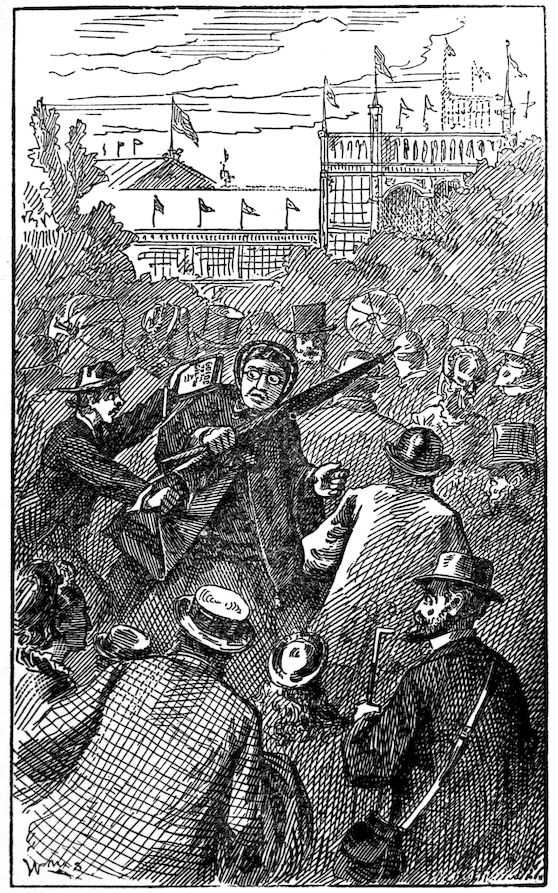
381But presently, or about that time we found ourselves
carried by the crowd, and stranded (as it were)
before some little places that looked some like the
place the ticket agent looked from at Betsey Bobbet
and me, when we bought our tickets for New York
village; and I begun to feel easier in my mind,
for they seemed to be purchasin’ tickets for the
Sentinal. There was one place for wimmen, and one
for men, not but a little ways apart; and my Josiah
and me kinder divided up and waited our turn, and
when he got a chance I see him step up in a peaceable
way and ask how much a ticket cost.
“Fifty cents for a adult,” says the man.
Says Josiah, “I haint a adult.”
Says the man, “You be.”
Josiah looked as if he would sink to be accused—right
there in company—of sunthin’ he never was
guilty of in the world; it took him so aback that he
couldn’t say another word to defend himself; he
looked as mortified and sheepish as any black sheep
I ever laid eyes on; and I jest stepped forred and
took his part—for it madded me to see my pardner so
brow-beat and imposed upon. Again Josiah says in
a meachin’ way, for as mortified as he felt he seemed
determined to stick to the truth, and not own up to
what he wasn’t guilty of. “I haint a adult,” says he.
“No!” says I, “anybody that says that of my
382pardner, says what they can’t prove. Josiah Allen is
a likely man; his character stands firm; he never had
no such name, and it can’t be proved onto him; he is
as sound moralled a man as you will find in Jonesville
or the world!”
“I mean,” says the man, “50 cents for everybody
except childern carried in the arms.”
“Well,” says I out of all manner of patience with
him, “why didn’t you say so in the first on’t, and not
go to hintin’ and insinuatin’.”
He tried to turn it off in a laugh, but his face
turned red as blood, and well it might; tryin’ to
break down a likely man’s character and gettin’ found
out in the mean caper. Josiah took out a dollar bill
and handed it to him, and he handed back sunthin’
which was tickets as Josiah s’posed; but when he
handed me one soon afterwards or thereabouts, I see
they was two fifty cent bills. Josiah was dumbfounded
and so was I; but I spoke right out and says
I, “That mean creeter is tryin’ to make us trouble, or
else he is tryin’ to hush it up, and bribe us not to tell
of his low lived conduct.” Says I firmly, “Less go
right back and give him back his money and command
him to give us a lawful ticket, and tell him we haint
to be bought or sold; that our principles are elevated
and we are on a tower.”
GOOD LAND! GOOD LAND! AND GOOD LAND!
383So we went back again; and oh the sufferin’s of
that season; if our agony was great when we was bore
along by the crowd, what was our sufferin’s when we
was stemmin’ our way ag’inst it. Two or three times
my companion would have sunk beneath his burdens,
but boyed up by my principle I held him up (as it
were) and at last almost completely exhausted and
wore out, and our faces covered with prespiration we
stood before him again. He looked mad and cross,
but tried to turn it off in a laugh when Josiah told
him our business, and handed him back the money.
He said it was all right and told us to give the
money to a man near the turn stile and go in. I see
he was in earnest, so I told Josiah we would go back
and try it, and we did, and found it was jest as he
said, but there was a great mystery to it; we handed
out fifty cents a piece to a man, and he dropped it
down through a little slit in a counter; and a gate that
looked some like my new fashioned clothes bars, sort
o’ turned round with us and let us in one at a time;
and the minute I was inside I see my gloomy forebodin’s
had been in vain—they hadn’t put off the
Sentinal for me! That was my first glad thought;
but my very next thought was,
Good land! and Good
land! and Good land! Them was my very first words,
and they didn’t express my feelin’s a half or even
a quarter. Why, comin’ right out of that contracted
and crushin’ crowd, it seemed as if the place we found
ourselves in was as roomy and spacious as the desert
of Sarah, s’posen she, the desert, was fixed off into a
perfect garden of beauty, free for anybody to wander
round and git lost in.
384And the majestic Main Buildin’ that nearly loomed
up in front of us! Why! if old Ocian herself, had
turned into glass, and wood-work, and cast-iron, and
shinin’ ruffs, and towers, and flags, and statutes, and
everything, and made a glitterin’ palace of herself, it
couldn’t, (as it were) have looked any more grand and
imposin’ and roomy; and if every sand by the seashore
had jumped up and put on a bunnet or hat as
the case may be, there couldn’t have been a bigger
crowd (seeminly) than there was a passin’ into it, and
a passin’ by, and a paradin’ round Josiah and me.
Under these strange and almost apaulin’ circumstances,
is it any wonder that I stood stun still, and
said, out of the very depths of my heart, the only
words I could think of, that would any where nigh
express my feelins, and they was “Good land!”
But as my senses begun to come back to me, my
next thought was, as I looked round on every side of
me, “Truly did my Josiah say, that I could see
enough with one eye;” and jest then a band commenced
playin’ the “Star Spangled Banner.” And
hearin’ that soul stirrin’ music, and seein’ that very
banner a wavin’ and floatin’ out, as if all the blue sky
and rainbows sense Noah’s rainbow was cut up into
its glorious stripes, with the hull stars of heaven a
shinin’ on ’em,—why, as my faculties come back to
me, a seein’ what I see—and hearin’ what I heerd, I
thought of my 4 fathers, them 4 old fathers, whose
weak hands had first unfurled that banner to the
385angry breeze, and thinks’es I, I would be willin’ to
change places with them 4 old men right here on
the spot, to let ’em see in the bright sunshine of 1876,
what they done in the cloudy darkness of 1776.
I felt these feelin’s for I persume most a minute.
But nobody—however strong principle may soar up
in ’em—can be willin’ to die off when it haint a goin’
to be any particular benefit to anybody; they can’t
feel so for any length of time, especially in such a
strange and almost curious time as this was; souls may
soar, but heart clings to heart—I thought of Josiah
and without sayin’ a word to him, or askin’ his consent,
I jest reached out my arm and locked arms with
him for the first time in goin’ on thirteen years—not
sense we had went to grandfather Smith’s funeral,
and walked in the procession.
He begun to nestle round and wiggle his arm to
make me leggo, but I hung on tight and never
minded his worrysome actions, and finally he come
out plain and says he:
“What is the use of lockin’ arms Samantha, it will
make talk.”
Says I in a deep warnin’ voice, “Do you keep still,
or you will be a lost Josiah.” Says I, firmly, “I think
more of my pardner than I do of the speech of people,
and if this endless host and countless multitude
swallers us down, and we are never heard from again
in Jonesville or the world, we will be swallered down
together Josiah Allen,—a sweet thought to me.”
PATRONIZIN’ THE RAILROAD
386So we walked round, lockin’ arms, and not sensin’
of it, (as it were) a lookin’ on the grandeur and imposin’
doins on every side of us. Presently, or not
fur from that time—for truly I could not keep a correct
run of the time of day, feelin’ as I did—I told
Josiah that we would take the cars and ride round the
Sentinal; there was a little railroad a purpose. So
we crossed a square—green as green grass could make
it—and all of a sudden I felt Josiah give a shudder,
and heerd his teeth chatter; he was lookin’ at that
fearfully wonderful statute of Washington crossin’ the
Deleware. Oh dear! what a situation George was in.
Then he hunched me again, to look at a fountain
made they say to show off light and water. Three
handsome female girls a holdin’ up a bowl or rather
a platter, bigger than any platter I ever see, to catch the
water other female wimmin’ was a pourin’ down into
it; and as many as ten globe lamps, a bein’ held up by
beautiful arms. I’ll bet the hull on it was forty feet
high, and I don’t know but more. Josiah would have
staid there some time if I had encouraged him in it;
he said with a dreamy look, that them girls was
first-rate lookin’, but he should think their arms
would ache a holdin’ up that platter and them big
lamps. But says I, “Josiah Allen you haint no time
to spend a pityin’ cast-iron wimmen in such a time as
this, or admirin’ of em;” so I hurried him onwards to
one of the stations of the railroad, and we paid five
cents apiece and they let us up into the cars, and oh,
387how lovely everything did look as we rode onwards,
drawed by as stiddy and smart a little enjun as ever I
see hitched to a car. How cool and wet the lake did
look on that hot day, with its great fountain sprayin’
out the water in so many different sprays, as we
passed between it and the green, level grass all flowered
off with gorgeous flower beds.
Anon, (or nearly that time) the enjun stopped before
the Woman’s Pavilion—a noble big buildin’ that
filled me with such proud and lofty emotions as I
looked at it, that I don’t know to what height I should
have soared up to a gazin’ on it, and thinkin’ of the
sect that built it, if one of them very sect weighin’
about three hundred and fifty, in gittin’ out of the
car, hadn’t stepped on my foot and crushed it so fearfully
that instinctively my emotions was brought
right down to the ends of my toes. In two minutes
more, or two and a-half, we went round the head of
the dell, and though my foot still felt the effects of
tramplin’, I didn’t sense it, as I looked down the
beautiful shady paths, all a seemin’ to lead to some
handsome buildin’ and then up at the Agricultural
Buildin’, big enough (seeminly) for old Agriculture
and all his family all over the country to settle down
and live in; and then we went on a little further by a
cheese and butter house, and Brewers’ Hall. And
then the enjun turned round and we went back most
to the Woman’s Pavilion, and then sailed off down
the avenue of State Buildins, by Machinery Hall
388(big enough for every machine in the world, and several
of the planetary system’s machines, as it were)
clear the hull length of this buildin’, back to the place
we started from.
Here Josiah would have got out, ruther than paid
five cents more; but I says to him, “Never before,
Josiah Allen did five cents buy pleasure for me any
where near the size and heft of this pleasure;” and I
added kindly but firmly, “I am goin’ round again
Josiah Allen.” He argued some, but I stood firm,
and round we went again’, and then twice more which
made four. I paid for the two last rides out of my
own pocket, and didn’t begreech the money. No
sooner would we go by one grand majestic buildin’
and mebby a few smaller ones, but perfectly beautiful,
than another one would rise up before us seeminly
still more majesticer than the last one.
And we wouldn’t no more than git our mouths
well open with great astonishment and admiration and
almost extacy, and our specks well sot on ’em, before
another one would rise up before us, and we with our
mouths not yet shet up from the last one. Oh dear!
what a time we did have in our 2 minds. And
seein’ what I see wouldn’t have been half so much, if
I hadn’t had such a immense quantity of emotions;
and every one of ’em the very biggest and noblest
size they make. Eloquent, happy emotions of patriotism
and grand pride in my Nation’s honor, and
majesty, and power, and glory.
389Oh! what a time I did have a settin’ there crowded
in body but soarin’ in soul; the eye of my speck a
calmly gazin’ into the faces environin’ of me round,
and not seein’ of em, (as it were) but seein’ with my
mind’s eye the Spirit of ’76, a risin’ up through the
ghastly clouds of war, a misty shape that Hope could
jest make out; a pale face, and shadowy hands with
a little handful of stars and stripes most slippin’ out
of ’em.
And then to see that face growin’ brighter and
brighter, and more loftier and inspired; to see both
of them hands reached heavenward in triumph, holdin’
firm clasped above her head the stars and the
stripes a floatin’ out over the hull land; to see them
eyes full of glory and mystery bent forever onwards
and outwards, a lookin’ on sunthin’ I couldn’t see if I
had both eyes to my specks; to see that lofty brow
crowned with the Star of Empire, and that majestic
form a floatin’ in triumph from the Atlantic over the
Rocky mountains, clear to the Golden Gate, while the
radiance of that star, a burnin’ on that almost inspired
forward, sheds a light ahead over the deep waters to
some still grander future; and then to see them
deep mysterious eyes of glory and prophecy a follerin’
that light outward and onward, a seein’ what I
couldn’t see, nor Josiah, nor anybody.
I kep’ a feelin’ nobler and nobler every minute,
and finally I told Josiah of my own accord that I
wanted to git out of that little contracted car, and
390walk afoot again. So we got out and roamed round,
walkin’ afoot down the broad noble paths, by buildins
some that looked you square in the face, some a
steppin’ off sideways, (seeminly) some sot down flat
on the ground, sort o’ solid and heavy as if they had
sot down for good, and some standin’ up on tip-toe
(as it were) on the top of big high steps, as if they
was a startin’ off somewhere a visitin’; and some of
the curiousest shaped ones I ever see, with their ruffs
pinted up, with flags a flyin’ like big darnin’ needles
threaded with red, white, and blue; some sort o’ leanin’
over as if they was a meditatin’; some ruffs
shaped like a sheep’s head night-cap, with a cross
standin’ up out of the crown; some long ruffs supportin’
hull rows of little ruffs like offsprings. Some
Gabriel ends loftier and majesticer than you can think
on; some dretful kinder peaked up and polite lookin’.
Some of the housen was plain and glossy on the sides,
some criss-crossed off, some up and down, some sideways.
There was housen of every color that ever was
colored, with winders of every shape that ever a pain
was cut into, and every sort of ornament that ever
a house was trimmed off with. Why some of ’em
seemed to be clear ornament, and nothin’ else. There
was one in particular, with a flight of stairs on each
side and some little slender pillows, that seemed to
be clear trimmin’. It looked as light as if it was made
of air and sunshine and ornament—which it was mostly.
I says to Josiah: “That would be a beautiful
391home for summer, Josiah, but it would be too cold
and windy in the winter season for me.” A young
woman, sort o’ vacant lookin’, but dressed up slick
spoke out to me, and says in a sort of a uppish tone:
“It haint a house, it is a music stand.”
Says I, “It haint a stand.”
Says she, “It is.”
But I wasn’t a goin’ to be brow-beat by her, so I
says in a dignified tone:
“Young woman I have seen furniture and housen
stuff when you was in Nonentity, and I guess I know
a stand when I see it.” Says I, “I had two black
cherry stands with curly maple drawers, with my
settin’ out, and I helped Josiah pick out a noble
bass-wood stand for Tirzah Ann when she was married
and I say that haint a stand.”
Says she, “It is; don’t you see the Muse on top
with the lyre.”
But I wouldn’t look up, I had too much dignity,
and I resented deeply her tryin’ to lie to me so, and
I jest looked at her keenly, and says I: “I can see
liars without searchin’ for ’em on the top of housen.”
Says she, “I meant one of the Muses; one of Jupiter
and Mnemosyne’s daughters, with her lyre?”
Says I firmly, “I don’t care whose daughters they
be. I don’t think no more of a liar because they
happen to have a likely father and mother. I abominate
’em, and always did.”
I looked very sharp at her, and she felt it; her
392face looked red as blood, and all swelled up with mortification.
But truly I had no time to waste on story
tellers, or muse on their lies. Such sights as I see,
such grand and imposin’ grandeur, such beautiful and
soarin’ beauty; I wondered whether Paradise could
have looked much better, and more foamin’; and if
it did, I wondered more and more how Eve (a distant
relative of mine on my mother’s side) could have done
what she did do. As we walked along a broad and
shady path I says:
“Never, never did I feel towards E Pluribus as I
do to-day, Josiah. When I think of that old map of
Grandfather Smith’s, and think how E Pluribus was
huddled down there close to the shore, so insignificant
and skairt lookin’ that it seemed as if it wouldn’t take
but a very few more war-whoops and hatchets to tumble
him right off into the Atlantic to drownd himself.
And then to think how that old man has got
up and spread himself out from ocian to ocian, to
look round here and see this Sentinal a tellin’ to all
the world how he has prospered;” says I, “never
never did I feel towards E Pluribus U, as I do to-day;”
and says I in tones tremblin’ with pride and
thankfulness, “how do you feel Josiah Allen?”
Says he firmly, “I feel as hungry as a bear.”
I calmly took two cookies out of my pocket and
handed them to him, and kep’ right on: “Never!
never, did I realize the size, the grandeur, the loftiness,
of E Pluribus as I do now; how high and lofty
393he stands, Josiah Allen; how forehanded he has got.”
My lofty episodin’ tone was ruther loud, and a by
stander who had been a standin’ behind me unbeknown
to me spoke up and says he:
“Yes, E Pluribus has got pretty well off, but what
do you think Madam of the rings he wears on his
honored fingers? What do you think of his choosin’
Tweed for raiment? What do you think of his wearin’
such dirty clothin’ as he has wore of late, and so thin
too, so awfully thin.”
I declare for’t, I was most mad to think of anybodys
tryin’ to bring me down from the height I
stood upon, by talkin’ about store clothes and jewelry;
but bein’ very polite in my demeanor, I answered
him mildly, that I didn’t believe in anybodys wearin’
dirty clothes, and I never had no opinion of Tweed,
nor none of that kind of cloth; it was slazy, and
liable to drop all to pieces, and I’d ruther look further
and pay more for cloth that was firmer and would
stand more of a strain.
“Yes,” says he, “that is jest my opinion, and I
think if E Pluribus wants to preserve his health he
must keep cleaner, and be a little more careful about
the material he chooses to protect his honored form;
and in my opinion, he would look fur better if he
didn’t wear so many rings on his venerable fingers;
money rings; and wheat rings; and railroad rings.”
He went on and named over a hull lot of jewelry,
but I thought to myself that he was makin’ a little
394too free to talk with a perfect stranger, and I answered
him in pretty cold tones:
Says I, “I never approved of old men’s wearin’
jewelry;” and says I, in still more frigid tones, “I
never, even in my young days thought a man looked
any the better for wearin’ ear-rings;” then I drew
Josiah onwards down a path that looked shady, and
considerable still and quiet; but jest as we moved on
a man standin’ in front of us spoke up in a awe struck
tone, and says he:
“That gentleman that jest spoke to you was a
English Lord.”
“Well,” says I, “Lord or no lord, I don’t over and
above like his looks; he looks smart, but kinder
mean.”
Jest then all of a sudden, on happenin’ to turn the
eye of my speck onto a little bench under a shade tree,
I see settin’ there a friend I knew; I see a face that
telescopes are bein’ aimed at by the envious to spy
out every little freckle, spot and wrinkle; (and where
is there a complexion however light, that can stand
firm under a telescope, and the strong glarin’ light of
the present time, without showin’ a wrinkle?) It was
the face of a man I respected, and almost loved, (a
meetin’ house love, calm, yet firm as a settin’ hen.)
Without sayin’ a word, I jest drawd Josiah right
up in front of him. At the first glance he didn’t
know me, but I jest made him a noble curchy, and
says I: “Ulysses how do you?” Says I, “The last
395time I see you I had the honor to rescue you from
pain and poetry and Betsey Bobbet.”
Before I could say another word he took the cigar
he had in his lips with one hand and reached out the
other, and shook hands with me almost warmly.
“Josiah Allen’s wife, my preserver! I am glad to
meet you.”
Then and there I introduced Josiah; but I was
sorry to see at that moment that the knowledge that
he was a talkin’ with the President of the United
States, made him act bashful and meachin’; but I
was that inspired and lifted up, that even my pardner’s
meachin’ and almost foolish mean didn’t seem to
have no effect on me. I spoke right out and says I:
“Ulysses, I never was so proud of my Nation before
in my hull life as I be now, and never did I feel such
feelin’s for my 4 fathers. What a undertakin’ they
undertook! When a thing is done, and you are a
standin’ up on the results safe and happy, then you
feel well, and at rest; but the curious time, and the
solemn time, is when the thing haint done, and you
are a settin’ out to do it, with the risk and the uncertainty
before you. When you are a steppin’ off in
the darkness and don’t have no idee whether you are
a steppin’ on sunthin’, or on nothin’; no idee where
you are a comin’ to next. I’ve got lost in our suller
several times when my candle went out, and it was a
curious feelin’, Ulysses, to grope our way along in
the dark not knowin’ whether we would come out
396all right to the bottom of the stairs, or come up sudden
ag’inst the wall, or the pork barrell. I’ve fell
flat a number of times, when I thought I was a steppin’
high, and doin’ the best I could; when you have
reached the stairs and git holt of ’em, and Josiah has
opened the door and stands there with a candle in his
hand, then you feel well and safe, but you can’t forgit
your curious feelin’s when you was in the dark, a
gropin’ and a feelin’ and not knowin’ where you was
a goin’ to.
“Now, there was a time when the colonies was a
gropin’ their way along in the dark, not knowin’
where the next step would take ’em to—whether they
would come out to the stairs that led up to Freedom
and Liberty and happiness, or come up sudden and
hard ag’inst the wall of defeat. They was walkin’ a
slender, slippery pathway, and if they slipped off
they knew black waters was under ’em, deep black
waters, to drownd them and their posterity in. They
fell a number of times, but they got up again nobly;
they held firm, and stepped high, and at last they
groped their way to the stairs that led up to Liberty.
And by God’s help, by prayer and hard work, they
mounted them stairs; and then another long flight of
lofty stairs was before ’em; and they rose them stairs,
and have gone up on ’em, higher and higher, ever
sense to national power, and honor, and glory. And
now let ’em hold firm and examine the platform they
are a standin’ on.”
397Ulysses smoked his cigar with a very thoughtful
and attentive smoke. And oh! how sort o’ solemn
and martyr-like my tone was as I went on a talkin’ to
him, and a thinkin’ to myself: Here I be, advisin’
the Nation for its good—a performin’ my mission,
and advisin’ the United States, E Pluribus Unim,
through its chief magistrate. I felt noble and curious,
fearfully so, as I continued on:
“Oh! how awful it would be for ’em, Ulysses, a
standin’ up on the height they stand up on, if political
rottenness should crumble away any of the tall proud
ladder that holds ’em up. Oh! how it would hurt
’em to fall down flat, and lay on their backs with the
ladder and platform on top of ’em. Let ’em be careful,
and let ’em be prayerful; let ’em examine every
inch of the lumber that they are a standin’ on; if
there is a rotten spot in it, or a weak spot, or a suspicious
spot, let ’em spurn it nobly; let ’em not ask
wildly and blindly: ‘Did this board grow in Republican
forests, or did it grow in Democratic swamps?’
Let ’em throw that question down, and trample on it;
and let ’em ask this question only, and let ’em ask it
in a firm loud voice: ‘Is it a sound board?’
“And let ’em git a straight plain answer to it,
before they set foot on it. Good land! The idee of
shettin’ your eyes blindly, and runnin’ up a rascal
because he happens to belong to your party. As for
me, when I hold a rose I don’t care a cent whether
it grew in a marble basin, or in the corner of a rail
398fence; I only ask myself calmly, is it fresh and sweet?
If it is, I treasure it highly; if it is wormy and rotten
at the heart, I spurn it from me almost indignantly.
“I advise this Nation as a friend and well wisher,
to worship the true God, and not make a God of party
and bow down to it. I advise it to choose men for
leaders, who are true, and honest and God-fearin’.
Men who are more careful of their character than
of their reputation; more careful to have the National
capitol clean on the inside than to flower off the front
gate with brass nails; more sot on the Nation’s well-bein’
and prosperity, than on a big pocket-book, or a
post-office and some minin’ and railroad shares for
that brother-in-law; more anxious to have a white
soul, than to white-wash their sepulchres. If the
Nation votes for bad men, how does it expect to have
good laws?” says I almost wildly. “Tell me, Ulysses,
and tell me plainly; how can you expect to be
led onward in a straight path by a blind man? How
can you obtain figs from thistles, or anything to carry
from an ort?
“If this Nation trusts God, and prizes the great
gift our 4 fathers died to leave us as it ort to be
prized, who can paint the glory and splendor before
it. It is the home of the oppressed, and (when its
laws relatin’ to wimmen are changed slightly) the
true and only land of liberty and freedom; its virtues
ort to be grand and lofty and picturesque—on a big
noble New World plan. It ort to be as rich in goodness,
399as its earth is rich in gold and silver and preciousness.
Its dignity and calmness ort to be wide
and level and even, like its boundless praries; and at
the same time, it ort to have brilliant, unexpected
streaks and flashes of dazzlin’ generosities, jest like
its flashin’ water-falls. Its principles ort to be as
firm and solid and high toned and soarin’ as the biggest
mountain peaks on the Yo Semitry; and these
solid virtues ort to be trimmed and ornamented off
with consideration for the rights of others, humanity,
charity, courtesy and etcetery, and they ort to be
jest as pinted and as ever-green as the big pines
them firm old mountains have trimmed themselves
off with. It should be jest as set on follerin’ the
right, and headed jest as strong that way, and be jest
as deep and earnest in that flow as Niagara is in hern;
turnin’ not to the right hand nor to the left, not multiplyin’
words nor foolin’, but jest keep on a mindin’
its own business, and floodin’ right on.”
400
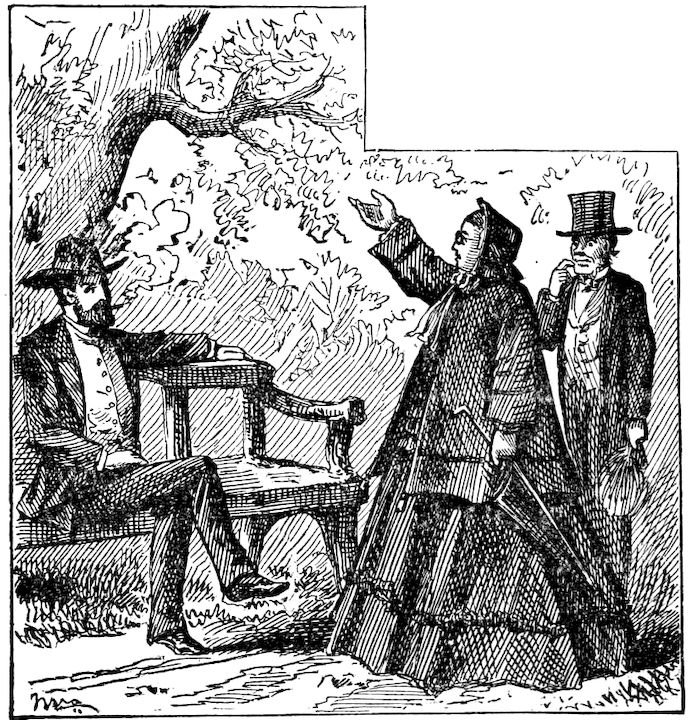
SAMANTHA ADVISIN’ PRESIDENT GRANT.
I ADVISE THE NATION THOUGH ITS GREAT MEN
And then I advised the Nation (through Ulysses,)
what to do in the great cause of Wimmen’s Rights.
I talked eloquent on that subject, and in closin’ up I
drawed his mind back a few years to the time when
a great war was goin’ on between justice and injustice,
and how God wrought out of it the freedom of
a race, before He gave the victory. I reminded him
that another great battle was goin’ on now between
temperance and intemperance, and how, in that warfare,
I believed God was helpin’ another race of
human female beins to liberty; by showin’ to man
how He enabled them to win greater victories than
had ever crowned man’s efforts, and provin’ what
they would do for God and humanity if the power
was given them. I told him I didn’t want to scare
him or the Nation, but
still it wouldn’t do no
hurt for ’em to think
back how God had kep’
that oppressed race from all harm while the warfare
for ’em was a goin’ on, while thousands of them who
had unjestly denied them their rights went down on
the battle-field; and I hinted to him in a kind of
a blind way, that it wouldn’t do no harm for the
Nation once in a while to read over that old story of
401Pharioh; I told him—not knowin’ how well off they
was for such readin’ in Washington—that he would
find that story in the Bible.
I talked about the Heathen Chinee; I told him
it seemed jest about as impossible to git a stun to
keep company with a turnip, and make it its bride as
to git a Chinee to fall in love with our institutions and
foller ’em; and after a man had tried to git water
and oil to mix in a friendly and sociable way—after
he has sot and stirred ’em, and sweat over ’em for
weeks and weeks, I don’t know as he would be to
blame to empty the basin out for good; but then
when I’d think again, I’d know it was cruel and
awful to turn anybody out doors, (as it were) especially
a heathen. And I knew I never could have the
heart to do it, never in the world. So says I, “I
cannot advise the Nation what to do. It must try to
git along in this thing, without my tellin’ it what to
do; it must think it over and do the very best it can.”
But on the warlike fightin’ question, I come out
strong; I knew jest what advice to give the Nation,
and I give it freely without money, and without price.
Says I, “I should think the Nations would all be
perfectly ashamed of themselves to git together to
show off their civilization and progress, when they
hold on to that most barbarious of all barbarism, that
ever come from Barbery. The most cruel and awful
and the most simple too; why,” says I, “you’d whip
a lot of school childern that would go to settlin’ their
402quarrels with their jack knives; you’d make ’em
leave it out to their teacher, or the trustees, or somebody;
you’d spank ’em till their nose bled if they
didn’t, and,” says I, “childern ort to grow wiser as
they grow older instead of foolisher; it haint a mite
handsomer in grown folks than it is in childern.”
Says I, “Think how those bloody warfares are
powerful for all sorts of evils and crimes; how they
turn human beins into wild beasts of prey; think
how humanity, and mercy, and purity and all goodness
are trod down under the feet of the great armys;
and how the more ghastly army of pestilence, and
disease, and crime, and want, foller on after them—a
phantom host shadderin’ the land for years, mightier
for evil than the army they foller. Why Ulysses, I
couldn’t begin to tell all the horrers and evils of
war, not if I should stand here and talk to you till
the year 1900; for it can’t be told not by mortal
tongue. It is a language writ in broken hearts, and
despair, and want, and agony, and madness, and
crime, and death, and it takes them to read it.”
Ulysses haint much of a talker, but he took his
cigar out of his mouth, and says he mildly: “How
will Nations settle their difficulties then?”
“Why,” says I, “leave it out to some good man to
decide upon. Let ’em have a honorable-minded Peace
Commissioner. Why,” says I, “if it wasn’t for havin’
everything else under the sun on my hands, I would
be one myself, and not charge a cent for my trouble.”
403The Nation, (through Ulysses) seemed to take my
advice first-rate; he stood it like a major, and sot
peacefully and smoked that cigar in as friendly and
meditatin’ a way as I ever see one smoked, and he
said I spoke his mind about the Peace Commissioners.
And then I spoke up and says I:
“Ulysses, I must also speak to you about Lo.”
“Lo who?” says he.
“Why,” says I, “Lo, the poor Injun.”
The minute I said Injun, he give a kind of a groan,
and begun to look as fractious and worrysome as I ever
see Josiah look, and says he:
“Darn Lo, anyway.”
“Well,” says I, “when I look round here, and see
how nobly Uncle Sam has stood up and spread himself
out here, see what wonders of glory and enchantment
he has wrought for his own race, it don’t seem
to me that I can bear to see him a settin’ down on the
Injun race, a tryin’ to choke ’em to death. Samuel
never took a posture that I hated to see worse than
that posture. It haint Christian nor even dignified.”
He looked very fractious, very, and he snapped out:
“He has got to take that posture or be scalped.”
“If Samuel would let me pick out postures for
him, I would have him stand up so far above Lo—in
mercy, and justice, and patience, and truth,—that he
couldn’t reach up to his scalp; and standin’ up on that
height, he might deal less in glass beads, and more in
common honesty,” says I mildly.
404But again Ulysses looked me full in the eye of my
speck, and says he firmly:
“Darn Lo, anyway;” and at that same minute
Josiah whispered to me: “Lo haint no nearer starvin’
than I am this minute.”
He did look almost famishin’; and so tellin’ Ulysses
to give my love to Julia, and my best respects to Mr.
Dents’es folks, and Fred and his wife, and be sure
and take good care of Nelly’s baby, I curchied to
him nobly and bid him good-bye.
So we wended our way along, the eye of my speck
takin’ in the heavenly beauty of the scene, when all
of a sudden Josiah spoke up, and says he: “What a
pity it is that they are a goin’ to licence the Sentinal.”
I stopped stun still, leggo of his arm, and turned
right round and faced my pardner. “Licence the
Sentinal, Josiah Allen!” says I.
“Yes,” says he, “they be, and they are tryin’ hard
not to have no Sunday neither.”
“A tryin’ to have the Sentinal not keep Sunday?”
“Yes,” says he.
Says I firmly, “Who is the man to go to, to advise
the Nation through in this matter? Never! never!
did my mission as a Advisor soar up before me more
promiscously. Who is the man Josiah Allen?”
Says Josiah, “I have heerd that Gen. Hawley is
the head one. But it haint his doin’s; he has been
tewed at, night and day.”
I drawed my companion onwards, almost wildly, he
405a hangin’ back and in pitiful axents, sayin’ to me:
“Do less go back to the tarvern Samantha and git
sunthin’ to eat before we traipse off any further; do
you want me to faint away on your hands?”
Says I, “You must have a different appetite from
what I have, Josiah Allen, if you can swaller your
conscience and set down at your ease, while the Nation
is a destroyin’ herself. I must advise her about this
matter instantly and at once, before it is too late.
But you can go home if you want to. Principle will
be my pardner, and go a lockin’ arms with me.”
“I shall go if you do,” says he in a cross surly
voice. “I s’pose I can starve it out;” and then he
says almost mekanically, (as it were,) “Gen. Hawley
is a handsome feller, they say.”
“Well,” says I in a almost dry tone, “you needn’t
worry about that; what if he is? I should be ashamed
of myself Josiah Allen, to go to bein’ jealous in such
a time as this.”
“Who said I was?” says he.
I didn’t multiply no more words, and a policeman
happenin’ to come along that minute, I says to him:
“Can you tell me where to find Gen. Hawley?”
Says he, “You will probably find him in the
‘Buro of Installation.’”
“In a buro!” says I coldly. “Do you s’pose
young man, that I am a goin’ to crawlin’ and creepin’
round into buro draws? Do you s’pose, at my age,
and with my dignity I’m a goin’ to foller any man
406into a buro? Gropin’ round, tryin’ to find somebody
in a buro draw.”
INTERVIEW WITH GEN. HAWLEY
His face looked red—he see I wasn’t to be imposed
upon—and he pinted out the room where we should
be apt to find him, he a goin’ most there with us;
and anon, or about that time, I found myself in the
presence of Gen. Hawley, a shakin’ hands with him
and a introducin’ Josiah. He was lookin’ over a lot
of papers, but he looked up dretful sort o’ pleasant,
and in that tryin’ and almost curious time, I couldn’t
help thinkin’ that Josiah was in the right on’t about
his looks; for never, on a tower, or off on it, did I
ever see a franker, nobler, honester, well meanin’er
face than hisen. I never asked him whether he was
enjoyin’ good health, or poor, but I says right out:
“Joseph,” (I knew his name was Joseph, and I
thought he would take it more friendly in me if I
called him that, and it would look more familiar in
me—as if my noble mission didn’t make me feel above
him.) “Joseph,” says I, “I have come to advise you
as a P. A. about what I have discovered as a P. I.”
He looked up at me from the awful pile of papers,
sort o’ dreamy and wonderin’, and I come out plainer
still, and says I, “Joseph, tell me; is it true that the
Nation has licenced the Sentinal to git drunk, and
not to keep no Sundays?” And says I, “Haint it the
time for the Nation, if ever, for her to put her best
foot forred, and if she has got any remnants of
Puritan habits, and religion, and solid principles, to
show ’em off? Haint it time to brush the dirt and
dust off of Plymouth Rock, and let the world git a
glimpse of the old original stun? Why,” says I, “if the
Mayflower could float back again from the past, and
them old Mayflowers should hear what this Nation is
a doin’, they would say they was glad they was dead.”
407
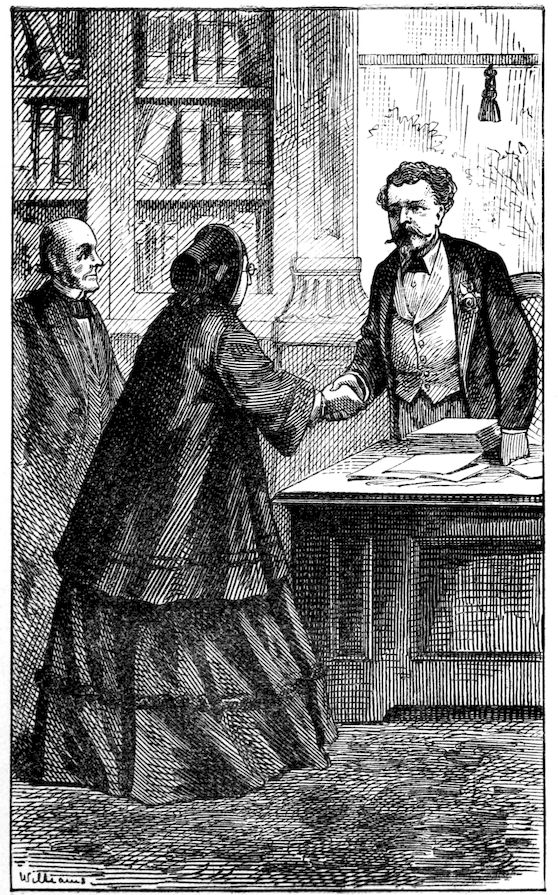
INTERVIEW WITH GOV. HAWLEY
409Joseph looked as if he felt what I said deeply. But
he went on in a sort of apologisin’ way, about his
wantin’ to treat our fureign guests with courtesy—and
some of them was accustomed to beer and wine-drinkin’
to home, and wasn’t in the habit of havin’
Sundays, and so 4th and so 4th.
“But,” says I in tremblin’ tones: “when a mother
is weepin’ over the ruin of what was once her son,
and tracin’ back his first love of strong drink to this
place of beauty and enchantment, it wont remove her
agony nor hisen, to think it was done to please the
German, Dutch, or Tunicks, or even Turkeys.” Says
I, “If the Nation gives her lawful consent and lets the
Sentinal drink all the beer and wine it wants to in
1876, in 1976 she will reap the seed she is a plantin’
now; and if you happen to see me then, Joseph, you
tell me if I haint in the right on’t. And then, not
havin’ no Sundays! I never in my hull life see anything
look so shiftless,—when we haint been out of
Sundays for 1800 years, to all flat out now and not
have none,—it would look poor as poverty in us.”
He said it was handier for some folks; they could
come better Sundays than any other day.
410“Handier!” says I, in a almost dry tone, “it would
be awful handy for me sometimes, to do my week’s
washin’ Sundays, or knit striped mittens, or piece up
bed-quilts, but you don’t catch me at it.” Says I “Had
we ort to begreech one day out of the week to Him
who give us the hull of ’em?” And says I, “I don’t
blame you a mite for wantin’ to make our fureign visitors
feel to home, and use ’em well; but when I go a
visitin’ I don’t expect ’em to kill off their grandmothers
if I don’t happen to like the looks of the old lady
and haint used to grandmothers. Good land! how
simple it would be in me to expect it.”
Says Joseph, “Josiah Allen’s wife, you have presented
the subject to me in a interestin’ and eloquent
manner.” Says he, “The other matter is out of my
power to change, but as for Sundays, I will get ’em
back again; I will have ’em.”
Oh, how earnest and good he did look out of his
eyes (a bright blueish-grey) as he said this, and how
fearfully handsome. And I a thinkin’ to myself—here
I be advisin’ the Nation for her good, and she a
takin’ my advice. I felt noble, very. If I could have
accomplished both of my undertakin’s, I don’t know
but I should have felt too noble; but we all, like Mr.
Paul, if we go to soarin’ up too high, have to have a
thorn in the flesh to prick us and keep us down in
our place. So I bid Joseph a almost affectionate good-bye,
and Josiah and me started homewards.
411
DOIN’ THE MAIN BUILDIN’.
The next mornin’ I told Josiah we would tackle
the Main Buildin’; so we follered a lot of folks
from our tarvern—another spiked gate turned round
with us and let us in, and—and what didn’t that
gate let us into? Oh, good land! Oh, dear suz! You
may think them words are strong, and express a good
deal, but they don’t begin to explain to you how
I felt. Why, a hull Dictionary of jest such words
couldn’t begin to tell my feelins as I stood there a
lookin’ round on each side of me, down that broad,
majestic, glitterin’ street full of folks and fountains
and glitterin’ stands, and statutes, and ornaments, with
gorgeous shops on each side containin’ the most beautiful
beauty, the sublimest sublimity, and the very
grandest grandeur the hull world affords. I advanced
a little ways, and then, not sensin’ it at all, I stopped
stun still and looked round me, Josiah kinder drawin’
me along—entirely unbeknown to me. Finally he
spoke in a sort of a low, awe-stricken whisper:
412“Do come along, Samantha!”
But I still stood stun still, lookin’ round me through
the eyes of my specks (Josiah had got the other eye
put in), and didn’t sense what he was a sayin’ to me
till he spoke again—hunchin’ me hard at the same
time: “What is the matter Samantha?”
Says I, in low strange tones, “I am completely
dumbfoundered Josiah Allen!”
“So be I,” says he, “but it won’t do to be a blockin’
up the path, and actin’ baulky; it will make talk.
Less go along and do as the rest do.” So we walked
along. And as my dumbfounder began to leave me,
and I recovered the use of my tongue, my first words
was:
“Josiah Allen, if I was as young as I once was, and
knew I’d live to die of old age, I’d come right here
to this village and live, and go through this buildin’
and see the biggest heft of its contents. But at my
age, there haint no use of tryin’ to see a half or even
a quarter of ’em.”
Says Josiah, “You know Tirzah Ann wanted you
to remember what you see here and describe it to her.”
“Good land!” says I, “I might jest as well undertake
to divide off the sands of the sea, set ’em off into
spans and call ’em by name, and describe the best
pints of each on ’em;” says I almost wildly: “if I
should undertake the job I should feel so curious
that I shouldn’t never git over it, like as not;” says I,
“Josiah Allen, when anybody tackles a subject they
413want a place to take holt, or leggo; it makes ’em feel
awful not to have neither.”
Why, if you’d lift up your head a minute to kind
o’ rest your eyes, you would see enough to think on
for a hull natural life. Havin’ in all the emergencies
of life found it necessary to stand firm, and walk even,
and straight forred, I laid out to take the different
countries on the north side, and go through ’em, and
then on the south side, go through ’em coolly and in
order, and with calmness of spirit. But long before I
had gone through with the United States, my mind
was in a state it had never been in before through my
hull life. I thought I had felt promiscous in days
that was past and gone, but I give up that I never
knew the meanin’ of the word before. Why, if there
had been a pain of glass put into my mind, and anybody
had looked into my feelins through it, they
would say if they wasn’t liars that they see a sight
long to be remembered; though if they had went
to dividin’ off my feelins and settin’ ’em in a row
and tellin’ ’em to set still, they would truly have had
a tegus time. Why I haint got ’em curbed in, so’s to
keep any order now, when I go to thinkin’ about that
Main Buildin’.
Instead of travelin’ right through it with dignity,
they are jest as likely as anyway to begin right in the
centre of that grand buildin’; see that great round
platform with broad steps a leadin’ up to it on every
side, and that railin’ round it, a fencin’ in the most
414entrancin’ and heavenly music that ever a earthly
quire discoursed upon—music that would rest you
when you was tired, and inspire and elevate you into
a realm of Pure Delight when you wasn’t. And seein’
way up and up to the ruff, little railins all ornamented
off, tear after tear of ’em, and folks in ’em a
lookin’ down onto the endless crowd below; and lions
and eagles, and stars and stripes, and the honored
forms and names of George Washington and B. Franklin
up there, to make us feel safe and good. And
then all of a sudden entirely unbeknown to me, my
mind will work sometimes one way, sometimes the
other. Sometimes it will give a jump clear to the
west end, and see ornaments, and glass cases, and shinin’
counters with wimmen standin’ behind ’em, and
tall jars big enough to preserve my Josiah hull in, if
it was the fashion to preserve pardners.
And it wont think things out with any order, or
hardly decency; sometimes the next thing after a pulpit
I’ll think of a dragon; and then mebby I’ll think of a
thermomiter with the quick silver a tryin’ to git out at
the top to walk out to cool itself, and the next thing
a Laplander covered with fur, and a sled; it beats all.
There is no use tellin’ what I did see, but I could
tell what I didn’t see in half a minute. I can’t think
now of but one thing that I didn’t see and that is butternuts,
though truly, I might have seen bushels, and
not sensed ’em.
Why, along at first when I was a beginnin’ my tower
415through the United States, I would be fearfully surprised
at the awfully grand and beautiful things;
but before noon I got so that I wasn’t surprised at
nothin’, and Josiah couldn’t make me, though he
hunched me several times, a tryin’ to surprise me,
and couldn’t. Why, I’d think I had come to an end
of the grandeur and glory; it must be there couldn’t
be any more, and I’d git my specks all ready to rest
off for a minute—when I’d kinder grope round a little,
and out I’d come again into another room full to
overflowin’ of splendor and beauty. Why, once I
come out into a room that had six high pillows in the
form of palm trees with long scalloped leaves towerin’
clear up to the ruff, which was ornamented off
with vines and flowers, and the counters was all covered
with raised work, representin’ the gatherin’ of
flowers and the extraction of their perfumes, and two
noble silver-plated gold-tipped fountains, sprayin’ out
sweetness; why, no posy bed I ever smelled of could
compare with that room.
And then there was a beautiful pavilion all trimmed
off with flowers; and in the centre, one of the likeliest
lookin’ fountains I ever did see, with four different
perfumes a jettin’ out, and round each spray a design
showin’ what kind it was. And each one was more
perfectly fragrant and beautiful than the other (as it
were). I told Josiah I wished Shakespeare Bobbet
could jest step in here; I guessed he never would use
peppermint essence again on his handkerchief. When
416he used to come to see Tirzah Ann, he always would
scent up high with peppermint or cinnamon; he smelt
like a apothecary.
But I kep’ a lookin’ round, and oh, such sights of
pianos and organs as I did see; it beat all. Why,
there was one parlor organ with twenty-eight stops to
it. Says I, “Josiah Allen what do you think of that?”
Josiah had seen so much he was a gittin’ cross, and he
said he had heerd folks play when he would have been
thankful to have had one stop to it, if they had used it.
And such iron and steel works; why we see a rod over
a mile long. And there was one lock that they said
had four billion changes to it. Josiah told me he
had jest as good a mind as he ever had to eat, to stop
and count ’em, for he didn’t believe there was three
billions in it if there was two. And there was safes,
large enough to lock up my Josiah in—who is indeed
by far the most valuable ornament I possess—and
teeth, and artificial eyes. There was one big black
eye, that Josiah said he would buy if he was able.
Says I, “What under the sun would you do with
it Josiah Allen?”
“Oh,” says he, “it might come handy sometime,
I am liable to accidents.”
“Why,” says I, “your eyes are as blue as indigo.”
“Well,” says he, “I always liked black eyes, and
that is such a awful smart lookin’ eye, it would give
anybody such a knowin’ look.”
I told him I guessed he would look knowin’; I
417guessed he would know it when he went round with
one black eye, and one blue one. I didn’t encourage
the idee. He looked wishful at it to the last, and he
has said sense, that that was the smartest lookin’ eye
he ever see in his life.
And such sights and sights of glass ware, and crystal
fountains. I told Josiah that I had sung about ’em
all my life, but never did I expect to see one. But I
did, here it was; handsomer than song could sing.
About three feet from the floor was a basin twelve
feet wide, and round this, seventy-two cut glass vases
for flowers, and four pillows havin’ twelve lights and
four more for flowers. In the centre column half
way up, was the most beautiful crystal ornaments and
doins you ever see, with burnin’ jets inside; and over
all was a dome held up by three columns, topped off
with spread eagles. The age of this dome was all trimmed
off with red, white, and blue, and under it was the
Goddess of Liberty standin’ on the globe. There is
between three and four thousand pieces of glass in
this fountain—so they told me—and they said it was
the nicest one in the world; and I told ’em I didn’t
dispute it, for I had travelled round a good deal, and
I never see the beat on’t. And here it was that I
got agitated and frightened; skairt most to death,
and I wont deny it. I was a walkin’ along, cool as a
cluster cucumber at sunrise, and as calm, when I
looked up and thinks’es I, there comes a woman that
looks jest like the Smiths; thinks’es I, she looks jest
418like me, only not quite so good lookin’. I stopped
completely dumbfoundered, and she stopped also in
dumbfounder. I looked her in the face with a almost
wild mean, and her mean looked almost wild.
I give right up that she was a Smith, and then
realizin’ what sort of a tower it was that I was on, I
knew it was my place to make the first move towards
gittin’ acquainted with her; so I made her a low
curchy, and she made me a low curchy. And then
I walked right up and held out my hand to her, and
she walked right up to me a holdin’ out her hand.
Says I, “Who you be mom, I don’t know, but I
believe my soul you are one of the Smiths, for you
look as near like me as two peas, only you are a little
fleshier than I be, and not quite so light complected.”
But what the next move would have been I
don’t know if all of a sudden right over her shoulder
I hadn’t seen the face of my Josiah, and I knew he
was the other side of me. Cold shivers run over my
back, when I felt a hand a seizin’ and a holdin’ of me
back, and the voice of Josiah a sayin’:
“What under the heavens Samantha, are you a
tryin’ to walk through that lookin’-glass for?”
420
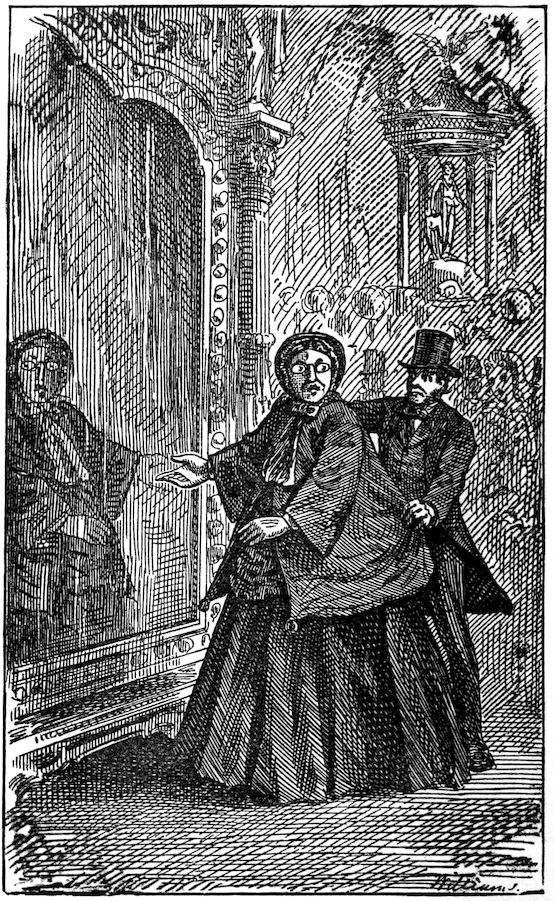
421I see then where I was, and says I in faint axents:
“Josiah Allen, I should have been through it in a
minute more;” and I should. I told him I was most
glad it took place, for it truly seemed as if he renewed
his age, it pleased him so. But he stopped it pretty
sudden, for he had a little incident happen to him,
that made him pretty shy about pokin’ fun at me.
The way on’t was, he had been sick all one night, and
the next day he got so tired out that he said he guessed
he would git into one of those rollin’ chairs a few
moments to rest him. He whispered to me that he
shouldn’t ride out but seven cents and a half, which
would be only half a quarter of an hour. I whispered
back to him that it would look small in him, and if
I was in his place, I would ride a quarter of an hour, or
not try to ride at all. But he whispered back to me,
firm as brass, that seven cents worth and a half was
all he should ride and that was more than he could
afford. And knowin’ well he was close, but honest,
I didn’t argue no more. He didn’t tell the man, for
fear he wouldn’t want the bother for so little while.
That was the last I see of Josiah Allen for five
hours and a half. He promised to meet me at a certain
time and place, and I was skairt nearly to death.
And I don’t know as I should ever have seen him
again, if I hadn’t happened to meet him face to face.
There he was a layin’ back fast asleep, and that man
had been a rollin’ him round for five hours and a half
by the clock, through the different worlds, and he
not sensin’ a thing—sleepin’ jest as sweet in front
of them horrible antediluvian monsters, and the
crockydiles, as before calico and bobinet lace—treatin’
’em all alike, snorin’ at the hull of ’em. I s’pose
he had dropped to sleep the minute I left him, not
sleepin’ any the night before. I catched right holt
422of his arm, and says to the man: “Stop instantly!
it is my pardner that you are a rollin’ on; it is a
sleepin’ Josiah.”
JOSIAH’S RIDE IN A CHAIR
I declare, the man looked almost as foolish as
Josiah, only Josiah’s mean had agony on it; and as
he paid out the 3 dollars and 30 cents, his sithes were
more like groans than common sithes. I haint heerd
a word sense from Josiah Allen about my walkin’
through a lookin’ glass in search of a Smith.
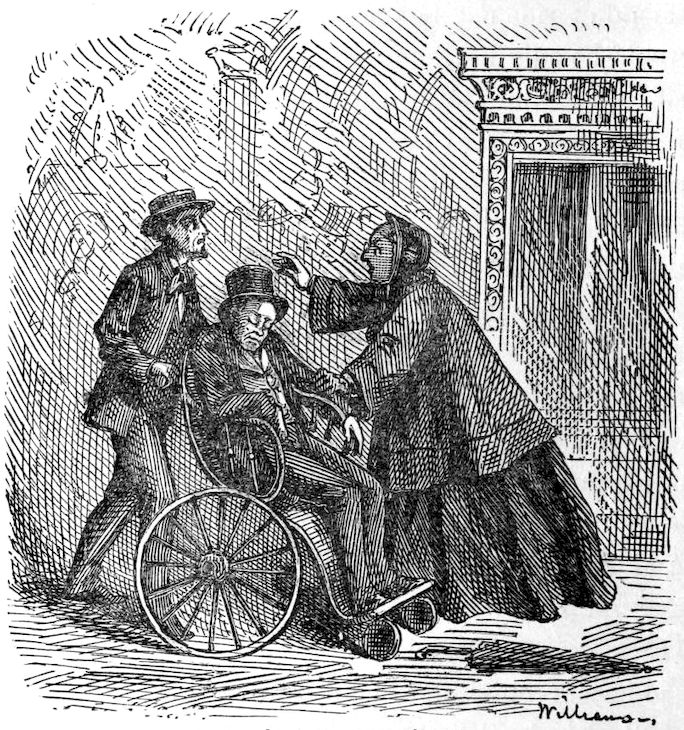
JOSIAH’S FIVE HOURS’ RIDE.
We then went into Mexico and found it was a noble
lookin’ Nation, considerable on the castle plan;
423trimmed off handsome at the top with several open
places filled with statutes, and large minerals, and
some of the handsomest plants I ever see. It seemed
to have everything it needed to git along with.
But what was as interestin’ to me as anything, was
a great stone, weighin’ about four thousand pounds,
that fell right down out of some other world, landin’
on ours, down in Mexico. Oh! what emotions I had
in lookin’ at it and thinkin’ if I only knew what that
stun knew, I should be a sight to behold. But I
knew the stun wouldn’t speak up and tell me anything
about the world he had come from, or how he
happened to start off alone, or whether he liked our
world better than he did hisen, or anything, if I stood
there till the next Sentinal.
And then we went in under a lofty arch, with curtains,
and tassels, and banners, and lions, and crosses,
and so 4th into Netherlands. And right there in the
vestibule was pictures and drawin’s and models;
showin’ plain what awful hard work they do have to
keep their land from drowndin’; dretful interestin’
it must be to inebriate drunkards there, seein’ what
strong barriers they have raised up between them and
the water.
And we see a little brick house, with part of the
thatched roof left open so you could see right down
into the house; and a eatin’ house with little folks
settin’ to the table, and some East India curiosities
as curious as any curiosities I ever laid eyes on. And
424then we travelled over into Brazil. I always knew
Brazil was a noble Nation, but never, never did I
imagine it was trimmed and ornamented off to such
an extent. We went right in boldly under the ornaments
and trimmins, and truly we did see enough to
pay us for our trouble; there was flowers made out
of the most brilliant feathers you ever see. Why I
had s’posed old Hail the Day’s feathers was shinin’;
I’ve seen ’em look perfectly gorgeous to me when he
was standin’ round on one foot at the back door a
crowin’ and the sun was a shinin’ down on him; but
good land! what was his feathers compared to these.
And then we see the big topaz, brilliant and clear as
well-water almost, sunthin’ the size of a goose egg—s’posen
she, the goose, laid almost square eggs. And
oh! if I only had a goose that laid such eggs, how
well off I could git in one season if she done well; it
is worth 150,000 dollars. And we see a sun dial
fixed so the sun fired off a cannon every day at noon.
Josiah said he never see the beat on’t, to think the
sun should be willin’ to do such work for anybody—hire
out to do day’s works (as it were.) But I says,
“if anybody could git him at it, it is Mr. Pedro;”
says I, “it don’t surprise me, that without makin’ any
fuss about it, or boastin’ a mite, he has got the sun
so it will fire off cannons for him or anything; it is
jest like him.” Says I, “Some monarchs are obleeged
to wear a crown instead of a hat, and hold out a
septer in their hand to make anybody mistrust they
425are kings. But it haint so with him; his royalty
haint put on the outside, it is inherient in him, and
works out from his heart and soul.”
A TRIP THROUGH THE WORLD
I should have went on about him considerable more,—I
have such a deep honor and respect, and such a
strong (meetin’ house) regard for him—but Josiah
looked so restless and worrysome. He haint a jealous
hair on the top of his head, (nor a hair of any
description) but he worships me so, I s’pose it gauls
him to see me praise up any other man; so we moved
on and made a short tower into Belgium, and see
their laces—I don’t believe there is such splendid
laces in the hull world as I see there, and they call
’em Brussels laces; mebby they be, but I don’t believe
it; anyway they haint made out of hog’s brussels;
that I know; and I told Josiah I knew it, and he
said he did, or else they was different from any
brussels he ever see—why you never see anything
so perfectly fine and beautiful; the very nicest bobinet
lace that Mother Smith ever made into a cap
border couldn’t compare with the poorest of it. Jest
one lace dress cost 7,000 dollars, and I wouldn’t have
made it for a cent less for anybody, even if they had
found their own brussels. But where under the sun
they ever found such brussels is a mystery to me, and
to Josiah—we have talked it over lots of times sense.
And then we made a short call in Switzerland. She
wasn’t so big or trimmed off inside so much as some
of the Nations. Her show cases was quaker color,
426made up plain, but they looked well. And oh! such
watches as I did see there, and such music boxes!
There was one elegant lookin’ one that played thirtysix
tunes, and Josiah said he’d love to buy it, for he
believed if he practiced enough, he could play on it
first-rate. That man has a awful good opinion of himself—by
spells; says he: “Don’t you believe Samantha,
that by tendin’ right to it, and givin’ my mind
up to it, I could learn?”
Says I dryly, “If you knew enough to play well on
a fannin’ mill, or a grindstun you probably could.”
And then we went back into the Main Aisle, that
broad, and glitterin’ highway, full of folks—for as big
a crowd as you would see through all the Nations,
you would always find a bigger one here, of Yankeys,
Turkeys, German, Dutch, Tunicks, Jappaned men and
Chinee, of all sizes, and every sex—and sot out for
France. And truly if I hadn’t give up bein’ surprised
long before, this place would have been the
ruination of me. Why, if it hadn’t been for a little
episode that took place there, I don’t know but I
should be a wanderin’ round there now. It beats all
how the French race can look right down through
even the useful, and see beauty in it, or make it.
You could see everything there, from a necklace worth
forty thousand dollars, to a clay pipe; from a little
gold bird that sings every half hour by the watch, up to
Virgins, and sweet faced Madonnas and saints; and
the Shepherds and wise men worshippin’ the infant
427Christ in a stable, with real straw in the manger, and
real hay in the oxen’s rack. But good land! there’s
no use tryin’ to tell what was there. I couldn’t do it
if I talked my tongue off, so I wont try.
I was a settin’ down in the centre of the room on
as soft a lounge as I ever sot on, a lookin’ at the perfectly
gorgeous and wonderful display of silks and
velvets a displayin’ themselves to me, when a good
lookin’ feller and girl come in, and sot down by me,
and they was a talkin’ over the things they had seen,
and I a mindin’ my own business, when the young
feller spoke up, and says he to the girl:
“Have you seen John Rogers goin’ to the Parson,
to git married?”
“No,” says she.
“Well,” says he, “you ort to.”
I turned right round and give that young feller a
look witherin’ enough to wither him, and says I:
“That is a pretty story to tell to wimmen, that you
have seen John Rogers goin’ to the Parson to git
married.”
“I did see it,” says he, jest as brazen as a brass
candlestick.
Says I firmly, “You didn’t.”
Says he, “I did.”
Says I with dignity, “Don’t you tell me that again,
or I’ll know the reason why. You never see John
Rogers a goin’ to git married. John was burnt up
years ago; and if he wasn’t, do you think he was a
428man to go and try to git married again when he
had a wife and nine childern, and one at the breast?
Never! John Rogers’es morals was sound; I guess it
will take more than you to break ’em down at this
late day.”
The young feller’s face looked awful red and he
glanced up at the young woman and tried to turn it
off in a laugh and says he:
“This is John Rogers Jr., old John Rogers’es boy.”
“Why how you talk!” says I in agitated tones:
“Which one is it; is it the one at the breast?”
“No!” says he. “It is the seventh boy, named
after his father. I am well acquainted with him,”
says he takin’ out his watch: “I have an appointment
to meet him in about half an hour, and I’ll
introduce you to him. You’d love to see his ‘Goin’
to the Parson,’ it is a beautiful statute.”
“Oh,” says I, “then he is a Statuary by trade!
why didn’t you say so in the first on’t.”
“Yes,” says he, “he has got beautiful ones, and
we will both go with you;” and he smiled again at
her, and she smiled back at him. My mind was all
took up and agitated at the idee of seein’ the son of
that noble maytyr, my elevator over Betsey, the
Widder and other sufferin’s. I told Josiah I would
be back again in a few moments, and then I told the
young feller I was ready to go with ’em; and presently
I stood in the United States again, a lookin’ at
some beautiful little statutes.
429John Rogers Jr. wasn’t there when we arrived, and
so I went to admirin’ his statutes. They was perfectly
beautiful, though middlin’ small sized, and they all
had clothes on, which was a surprise to me, and indeed
a treat. The young couple comin’ to the Parson,
looked first-rate, though considerable sheepish.
And there was the “Favored Scholar,” lookin’ pretty
and important, and the little boy, who I persume got
whipped several times a day, makin’ up a face at her,
jest as natural. And there was “We Boys,” on the
horse’s back—goin’ after the cows, mebby; you could
almost smell the clover blows, and the sweet hay a
blowin’ down the lane, and almost hear the tinklin’
of the cow bell way off in the age of the woody
pasture; the boys faces told the hull story. And then
there was the confederate lady with the sick child,
“Drawin’ Rations” of the triumphant North. All the
pride of a long race of proud ancestors looked out of
her sad eyes, as she came to take charity of her conqueror;
but it was done for love’s sake—you could
see that too, and that makes hard things easy. It is
a middlin’ quiet influence, but it is more powerful in
movin’ folks than a earthquake. And then there was
the “Tap on the Window,” and “Rip Van Winkle,”
and others; and before I had got half through admirin’
of ’em, a good lookin’ man come along that seemed
awful tickled to see the feller and girl with me, and
they laughed and whispered to each other real friendly,
and then the young chap says he: “Allow me to
430introduce you Madam, to my friend John Rogers Jr.”
Says I, in tones tremblin’ with emotion: “How do
you do, John Rogers Jr., I’ll make you acquainted
with Josiah Allen’s wife;” and then I made a low
curchy and shook hands with him, and says I, “I am
all well, and hope you are the same.” And then
politeness bein’ attended to, I spoke out and says I:
“John Rogers Jr., you haint no idee how I have
been admirin’ your statutes, not only on account of
their wonderful beauty, but on the account of your
honored father. Your father, John Rogers Jr., was
one of the noblest men I ever got acquainted with—in
a history way, I mean. Folks may think they have
got sound, well-seasoned principles that will stand
most any strain, but I tell you, let anybody be sot
fire to, and that will show what stuff they are made
of.” Says I, “I have heerd folks tell about gittin’
up and bearin’ the cross, in a room all carpeted off,
and jest warm enough for comfort; I never loved to
hear it, for if that means anything, it means bearin’
the hull sin and sorrows of the world, the agony and
despair, when earth destroyed and Heaven seemed
to have forgotten. It means a good deal; I’ve heerd
folks talk about bearin’ their cross in gittin’ up and
exhortin’ folks, when you couldn’t tie ’em down they
wanted to git up and talk so awful bad, and you
couldn’t stop ’em, when they got at it. Why, to look
round on the congregation sometimes, you would
think if there was any agony about it, the hearers was
431the ones a sufferin’ of it. It is all right to talk in
meetin’; I have heerd them that I had jest as lives
hear as any minister—tender, simple messages that
come straight from a good lovin’ Christian heart, and
went to other hearts, jest like a arrer from a bo.”
But I never loved to hear folks say they was bearin’
a cross when they wasn’t. I say it is jest as bad
to tell a wrong story in a meetin’-house as in a barn,
or a sugar bush. I have heerd these same folks git
up and say they was willin’ to die off that minute for
the Lord’s sake, and after meetin’ I would ask ’em to
give 25 cents to help God’s poor—work He left below
for His childern to do in His name, and not a cent
could I git from ’em. They was willin’ to bear the
cross for Him with their tongue, and die off for Him
with the same, in conference meetin’; but when it
come to lendin’ the Lord 25 cents, this they truly felt
was askin’ too much of ’em. And then I had my own
idees whether they was really willin’ to die off, and I
had my own mind too whether I was willin’ to have
’em. When they was baptized they left their pocket
books to home, in the stand draw, but they ort to have
been baptized too—all over by immersion.
“When the Lord gives a person health and strength
to enjoy the beautiful world he placed him in, and powers
to labor for Him and for humanity, I don’t believe
He requires at the same time dyin’ grace of em. He
wants them to have livin’ grace, and use it. They
ort to be willin’ to live, which is a great deal harder
432sometimes. But truly, I was drawed into this episodin’
by comparin’ your honored father in my mind with
these I have named. If they won’t give 25 cents for
their religion, what would they say if they had to give
what your father gave. His principle and religion
bore the flames of agony and death and wasn’t burnt
up—they couldn’t make a fire hot enough.” John
put his handkerchief to his face and I see he was dretfully
affected, so I bid him a almost tender good-bye
and jined my pardner, and we went into England.
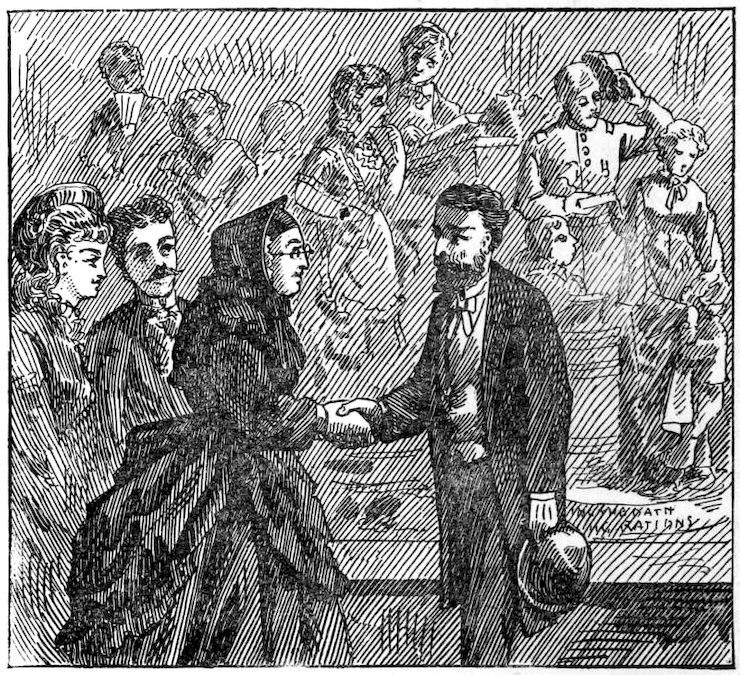
INTRODUCED TO JOHN ROGERS JR.
I took a sight of comfort in my tower through
Great Britain, a seein’ her noble doins and meditatin’
how well off she was, and how she has prospered.
433Of course I can’t help feelin’ a little parshal to
America, but the old lady country seems awful near
to me; I think a sight of her. You can’t tear up a
tree and set it out in a new place without leavin’ lots
of little roots in the old soil; a mother and daughter
can’t be parted away from each other without lots of
memories and affections clingin’ round each other’s
heart. Now, after I left Mother Smith’s and had a
home of my own, I was always glad to see Mother
Smith have things for her comfort; the more dresses
and housen stuff she had, the better I liked it. And
so it was with me and England, I didn’t feel a bit
hurt because she seemed so well off; not a bit. Her
display that she displayed to the Sentinal was next to
our own in size and grandeur. It was beyond all
description, so fur beyond, that description couldn’t
think of catchin’ up, but would set right down.
I will merely mention one thing, a statute of the
Saviour holdin’ a child in his arms, “Safe in the arms
of Jesus;” it was beautiful, extremely so; it almost
brought tears to my eyes it was so affectin’.
And then we went to India, Josiah and me did;
almost the oldest country in the world, and exceedingly
curious. Here we see some of the most fine
and delicate store clothes I ever laid eyes on; I could
have hid a hull muslin dress of thirty-five yards in
Josiah’s vest pocket, if it would have been right so to
do, and nobody would have mistrusted he was carryin’
off a thing. Why, a double thickness hangin’ over
434my Josiah wouldn’t hinder me from seein’ my pardner
a particle; and then we see dresses of the lower class,
all made ready to put on; fourteen yards of cloth in
a straight strip. Them wimmen don’t fool away
their time on boddis waists and overskirts.
Then we went through the hull of the British
Colonies, stopped in front of the hull of ’em, treated
’em all friendly and alike. Then we tackled a hull
lot of Islands, sailed round the hull of ’em from Victoria
to New Zealand. While travellin’ through the
last named, I clung to Josiah’s arm almost mekanically,
though I knew his small weight by the steelyards,
(one hundred pounds, mostly bones) was in his
favor. We see there the skeleton of the great wingless
bird Moa, bigger than the ostridge; by their tell,
the eggs would be splendid for cookin’. Seven by ten—one
biled egg would be enough for a large family.
I asked ’em if they s’posed I could git a couple of eggs;
I thought if I could, I would set three or four hens on
’em and a goose or two, and git a flock started.
And in Bermuda we see amongst lots of other
things, some brain coral. And as the poet truly saith,
“Every part strengthens a part,” I thought what a
interestin’ and agreeable food that would be for some
people to eat three times a day, till their symptoms
was removed. We was travellin’ through the Nations
now pretty middlin’ fast, not alone from principle
heretofore named, but also from the fact that we had
seen so much, that we didn’t see nothin’.
435In Sweden my feelins got worked upon to a very
affectin’ degree; first I knew, right there in the midst
of life, and the brilliant animation of the scene, I see
a little coffin and a cradle with a dead baby in it, and
leanin’ over it weepin’, as if her heart would break
was the afflicted mother; and in a chair nigh by,
jest as if it was my Josiah, sot the father lookin’ as if
he would sink, with a little girl jest about the age of
Tirzah Ann when I married her pa, a standin’ by
him. A man, a minister I thought by his looks
stood by ’em, but not a woman nigh ’em, nobody
offerin’ to do a thing for ’em, and they in a strange
land. I walked right up to ’em and says I in a tremblin’
voice:
“You are a stranger to me, mom, but I see you are
in deep trouble, and the hand of sorrow draws hearts
that was wide apart close together, and the voice of
pity and sympathy speaks through every language
under the sun. Can I do anything to help you mom?
If I can, command me do it, for I feel for you,” says
I drawin’ out my white cotton handkerchief and
wipin’ my eyes, “I too am a stepmother.”
She didn’t say nothin’; I see grief was overcomin’
of her, and I turned to him and says I, “If I can be
of any use to you sir, if there is any preparations to
make, I stand willin’ and ready to make ’em.”
He didn’t say nothin’; so I says to the minister:
“Respected sir, I see this afflicted family is perfectly
overcome with their feelins; but I want ’em to know
436when they come to and realize things, that if they
need help I stand ready to help ’em. Will you tell
’em so?”
He didn’t answer me a word; and thinks’es I, there
haint but one more step that I can take to show my
good will, and I says to the little girl in tender tones:
“Come to Aunt Samantha sissy, your poor pa is
feelin’ awfully.” And I took holt of her hand, and
there it was, nothin’ but a dumb figger, and there they
all was, nothin’ but dumb figgers! And as I took a
realizin’ sense of it, I was a dumb figger myself (as it
were), for most a minute I stood in deep dumbfounder—not
shame, for my words had sot out from good
motives, and the home of principle. But I put my
handkerchief in my pocket and started along; Experience
keeps a good school. There was more than
twenty other figgers that I should have tackled as
sure as the world, if I hadn’t come right out of that
school kep’ by E. And in Norway I persume I
should have asked that Laplander in a sledge, some
questions about his own country; if reindeers was
profitable as horses, or if he didn’t think a cutter
would be easier goin’, or sunthin’. But as it was, I
passed ’em with a mean almost marble for composure.
I had had an idee that Sweden and Norway was sort
o’ hangin’ back in the onward march of the Nations;
why, I almost thought they was a settin’ down; but
I see my ignorance; they are a keepin’ up nobly
with Jonesville and the world.
437And then we, Josiah and me, went off into Italy,
and there see more carved wood-work, perfectly wonderful,
some of it; and jewelry and furniture, and
statutes. There was one of David—I never see David
look any better—and then there was one small statute
of Dante. I wasn’t formally acquainted with Dante
myself, but I have heerd Thomas J. read about him a
sight. Oh what troubles that man went through. It
was very interestin’ and agreeable to me to form his
acquaintance here, (as it were.)
And then, not wantin’ to slight nobody, we made a
short tower, a very short one, through the Argentine
Republic, though the news never had got to Jonesville—I
never heerd in my life that there was such a
Nation till I see its name wrote out. And there we
see minerals, and shawls, and so 4th, and so 4th.
Hearin’ that Peru was right back of it, and feelin’
that I would ruther lose a dollar bill than to have
Peru feel slighted, we made ’em a short visit. I
hadn’t been there two moments before I told Josiah
that I’d ruther have run the risk of hurtin’ her feelins
than to have gone near her, if I had had any idee
what I was a goin’ to see.
I can truly say without lyin’ that they had the
very humbliest skulls there that I ever did see. There
haint any too much beauty in common skulls, but
these were truly hegus. And such relics of humbliness;
such awful lookin’ water-jars—how anybody
could ever drink a drop of water out of ’em is a
438mystery to me. And such fearfully humbly mummys;
there was eight on ’em, some with their knees drawd
up to their breasts, and some in other postures, but
every one on ’em enough to scare a cast-iron man—Josiah
groaned aloud as he looked at ’em. I told him
we ort to bear up under the sight as well as we could,
for they was interestin’ from the fact that they was
dug up out of old tombs and mounds.
But he groaned again louder than ever, and says he,
“What made ’em dig ’em up?” Says he, “If they
had been on my land, I’d ruther give a dollar than to
have had ’em dug out where I could see ’em.”
I got Josiah out as quick as I could for I see them
mummys and relics had overcome him so. I hurried
him out, for I was afraid he would git completely
unstrung, and I knew if he should, I was too afflicted
with horror myself to try to string him up again. So
we went back still further, into Orange, for I told
Josiah I would be glad enough to git a couple of
fresh oranges, for we both needed refreshin’ after
what we had passed through. But I didn’t see an
orange there, though I see some noble ostridge feathers,
and diamonds, and wheat, and elephant tusks, and
cream of tartar vegetable, and so 4th, and etcetery;
and then we went right off into China.
I told Josiah it would look friendly in us to pay
considerable attention to China, they bein’ neighbors
of ours, (their land joins our farm I s’pose, on the
underside.) Some folks think that this is the most
439strikin’ Nation to the Sentinal, but I don’t know as
it struck me much harder than Japan did—they both
dealt my mind fearful blows. We entered into this
country through a tall noble gateway of carved wood
painted in dark colors, with the roof turned up, and
trimmed off with dragons like tea-chests and pagodas,
and all other Chinese public structures. And the
show cases was on the same plan, all fixed off with
such curious figgers; and curious is no name for what
we see there. Such carvin’s of wood and ivory; why
there was a hull meetin’ house, most all steeple, seven
or eight stories high, with bells a hangin’ from every
one of ’em. This meetin’ house was all fenced in
with trees in the door yard, and men and wimmen a
walkin’ up to the house of Joss. The hull thing was
carved out of ivory. I almost disputed the eye of my
spectacles as I see it. And then there was a hull
procession of ivory Mandarins, meanderin’ along;
and balls within balls, fifteen in number, the outside
one bein’ not much bigger than a hen’s egg, and
every one of ’em carved with the most exquisite vines
and flowers. How they ever done it is a mystery to
me, and so it is to Josiah.
And then such splendid though extremely curious
furniture as we see here; there was seven elegant
pieces which was made of mahogony, trimmed off
beautifully with whitewood and ivory; each piece was
about the height of a table, and the seven could be
formed into seven thousand shapes. Anybody could
440change ’em into a new article of furniture every day
for twenty years. For a restless woman that is always
movin’ round her bedstead and buro, and parlor table,
these would be indeed refreshin’ and agreeable housen
stuff. And there was a four thousand dollar bedstead,
all ornamented and embellished with different sorts of
dragons, and other interestin’ reptiles. There was
sights of work on it. I haint got a bedstead in my
house, that there is half the work on; but I have got
them that I believe my soul I could sleep in as well
again, for there was so many animals of different kinds
a creepin’ up, and lookin’ down from overhead, and
crawlin’ along the sides, that, thinks’es I to myself,
after layin’ on it for several days, a nite mair would
be almost a treat. I don’t say that the mair would
look so curious, but she would be a sort of a rarity.
IN THE CHINESE DEPARTMENT
But if I had disputed the eye of my spectacle in
China, what could I say to ’em in Japan. Such
nicety of work, such patience and long sufferin’ as
must have gone into their manufactorys. Why there
was a buro, black and gold, with shelves and draws, and
doors hung with gold and silver hinges, and every
part of that buro clear to the backside of the bottom
draw, was nicer, and fixed off handsomer than any
handkerchief pin. They asked four thousand five
hundred dollars for it, and it was worth it; I wouldn’t
make it for a cent less, and so I told the Jappaned
man that showed it off to us. Though, as I said to
him, bein’ a literary woman doin’ my own housework,
and off on towers of principle every little while, it
wasn’t much likely I should ever git time to make one.
441
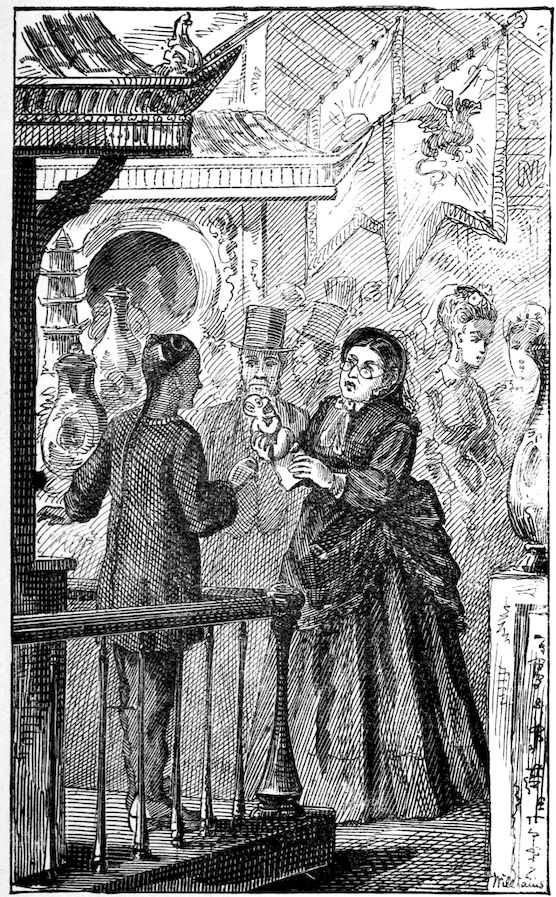
443I was jest lookin’ admirinly at a tall noble tea-pot,
when a woman dressed up awful slick says to me:
“Did you ever see such rare and lovely articles of
virtu?”
Says I coolly, “I have seen jest as virtuous tea-pots
as that is, though,” says I, “I don’t know a
thing ag’inst its character, and persume it is as likely
a tea-pot as tea was ever steeped in; but I don’t know
as it is any more so.”
Says she, “You didn’t understand me Madam; I
said they were rare articles of virtu.”
Says I firmly, and with dignity, “I heerd you the
first time; but I differ with you mom. I don’t think
virtuous tea-pots are rare, I never was one to be a mistrustin’
and lookin’ out for meanness so much as some
be. I never should think of mistrustin’ a tea-pot or
sugar bowl no more than I should my Josiah, and I
should jest as soon mistrust a meetin’ house as him.”
She looked me full in the face in a sort of a wonderin’
way, and started off. I guess she didn’t know much,
or mebby she made a blunder. I know I never heerd
anybody talk about stunware bein’ virtuous in my hull
life before. But folks will git things wrong sometimes;
I persume I should myself if I wasn’t so awful
careful what I said and who I said it to.
After she went off I went to lookin’ at the bronzes.
Never before did I feel on such intimate terms with
444dragons, and cranes, and storks. Why I felt as if I
knew ’em like sisters.
There was one vase higher than my Josiah, that the
handles of it was clear dragons, and nothin’ else, and
a row of wimmen a dancin’ round it, each one carryin’
a rose in her hand bigger than her head, and up the
sides of it was foxes in men’s clothes. And the handles
of another vase was a flock of birds settlin’ down
on a rock, with a dragon on it, and on top of it a
eagle a swoopin’ down onto a snake. There was the
most lovely blue and white vases as tall again as
my pardner, with gold dragons on ’em; and scarlet
and green vases with sandy complected dragons on
’em. Oh, how well acquainted I did git with ’em!
I told Josiah I almost wished we could buy a
span of ’em to take home with us, to remember
Japan by, for she is a example to follow in lots of
things. Her patriotism, her enthusiasm in learnin’ is
a pattern for Jonesville and other Nations of the
world to foller. Better behaved, well-meaniner little
men than them Jappaned men (though dark complexioned)
I don’t want to see; they are truly gentlemen.
To see ’em answerin’ questions so patient and polite,
impudent questions and foolish ones and everything,
and they a bearin’ it, and not losin’ their gentle ways
and courtesy, not gettin’ fractious or worrysome a
mite; I hunched Josiah to take notice, and says I,
“Josiah Allen you might set at their feet and learn
of ’em with advantage to you. China and Japan are
445both queer, but Japan’s queerness has a imaginative
artistic quirl to it that China’s queerness don’t have.
Truly the imaginations of them Jappaned men must
be of a size and heft that we can hardly realize.”
Leavin’ Japan, I told Josiah I guessed we would
not go to Denmark, and he said he might live
through it, and he might not, he was so near starved.
But he hadn’t hardly got into that country when all
of a sudden he laid holt of me and pulled me out one
side, and says he:
“Look out my dear Samantha, or you’ll git hurt.”
I looked up and I was most startled for a minute
myself, for a man stood there holdin’ a great stun over
his head, a lookin’ down as if he was a goin’ to throw
it right at our heads. But in a minute I says, “It is
a statute, Josiah, it wont hurt us.”
And he cooled down; he hadn’t called me “dear
Samantha” before, for over fourteen years; but truly
danger is a blister that draws love to the outside. He
almost worships me, but like other married men, he
conceals it a good deal of the time. His affectionate
mean had softened up my own feelins too, so I didn’t
stay to Denmark only jest long enough to see some
very beautiful crockery, and a large collection of exceedinly
curious curiosities from Greenland, and then
Josiah and me (at his request) went and took a lunch
at a little tarvern right in the buildin’.
I felt kinder disappointed about not stayin’ no longer
in Denmark, on account of Hamlet (he come from
446that neighborhood, you know) and I always did think
so much of him, and Ophelia too. I have often heerd
Thomas J. read about ’em; and I’ve always thought
if they had been let alone they would have done well,
for she seemed to think everything of him, and he of
her. I got to thinkin’ over her affection and her disappointment
while I was eatin’ my dinner. Thinks’es
I, love is too sacred and holy a emotion to be dickered
and fooled with; it is a great emotion, and ort to be
treated greatly and reverently; but their haint a single
emotion in the hull line of emotions that is so meddled
and fooled round with as this is. Folks that have
it seem to be ashamed of it, and other folks make fun
of ’em for havin’ it. Curious! you haint ashamed of
havin’ gratitude, or pity, or generosity in your heart,
and other folks don’t make light of you for havin’ ’em;
but when it comes to love, which is the holiest of all,
the shadder of the Infinite, the symbol of all that is
heavenly and glorious, the brightest reflection we
catch on earth of the Divine Nature, folks giggle at it
and snicker; curious, very! But I always felt sorry
for Ophelia and Hamlet.
Then we sot sail for Egypt. There was a heavy
lookin’ wall and gateway, and on each side was a big
square column, or pillow, though some tippin’. Over
the gate was the flags of Egypt and the United States,
green and yeller, red, white, and blue, minglin’ together
jest as friendly as the green earth, and red and
yeller sunsets, with stars a shinin’ through ’em ever
447did; and some of the curiousest lookin’ writin’ I ever
did see. On each side, amongst lots of other ornaments
and things, was two as ancient lookin’ females
as I ever see on a bust, and these words printed out in
good noble writin’: “The oldest people of the world
sends its morning greeting to the youngest Nation.”
As we went in, two Egyptians met us, dressed in
their national costume, as loose and baggy as a meal
bag, and Josiah looked admirinly at ’em, and says he,
“How remarkable they do hold their age, Samantha;
they don’t look much older than I do;” and says he in
a still more respectful tone, “they must be pretty
nigh onto two hundred.”
“What makes you think so, Josiah Allen?” says I.
“Why” says he “you see it wrote out there ‘the
oldest people in the world’, and we have ’em here over
a hundred.”
Says I, “Josiah Allen if it wasn’t for me how little
your tower would elevate you, and inform you;” says
I, “it don’t mean them, it means most probable them
old wimmen up there on a bust, or mebby it means
old sphynx—the old lady who takes care of the pyramids—you
know she is old as the hills, and older than
lots of ’em.”
Says he “I wonder if that is her handwritin’ clear
up over the gateway! I should think she was old by
that; I should jest as lives go down to the creek and
read duck’s tracks and slate stuns.”
And we see a bust of Pharioh, who was drownded
448in the Red Sea. A good lookin’ man for one that was
twenty-two hundred and fifty years old, and was
plagued so much, and went through with what he did.
And in another room of the Court we see the man
that built one of the pyramids, Cephenes by name,—a
feller six thousand years old. Good land! As I looked
on him, I felt as if Josiah and me was two of the very
smallest drops in a mighty ocian that hadn’t no beginnin’
nor no endin’, no bottom and no shore. I felt
almost choked up, and exceedinly curious. From
Egypt we went straight into Turkey, and there we
saw lots of beautiful articles them Turkeys had made
out of olive-wood, and etcetery. We saw pipes with
long stems for smokin’ water; Josiah said he’d love
to try one of ’em, and I believe he would if it hadn’t
been for me. There was a Turkish Bazzar on the
grounds where they go to smoke ’em; but I told him
almost coldly, that he had better go home and smoke
the penstock that he draws water with from the canal;
and he give up the idee.
And there was handsome silks of all colors; there
was one piece of a soft grey color, that I told Josiah
I would love dearly to have a dress of it, and after I
said that, that man hurried me along so I didn’t
hardly see anything—I s’pose he wanted to git the
idee out of my head, for he never seemed easy a minute
till he got me out of Turkey back into Portugal. I
never felt intimately acquainted with this Nation—I
knew our port come from Portugal, and that they
449raised considerable cork—but I found many handsome
things there; splendid paper of all sorts, writin’ paper,
and elegant bound books, and some printin’ on satin,
invitations to bull fights, and other choice amusements.
I told Josiah I should think they would have
to be printed on satin to git anybody started to ’em.
And jest as I was sayin’ this, a good-lookin’ woman
says to me: “Splendid stationery, isn’t it?”
I see she had made a blunder and it was my duty to
set her right, so says I to her: “I don’t know as
it is any more stationery than paper and books commonly
is; they are always stationary unless you move
’em round.”
She looked at me sort o’ wonderin’ and then laughed
but kep’ her head up as high as ever. It beats all
what mistakes some folks will make and not act mortified
a mite; but if I should make such blunders I
should feel cheap as dirt. Then we took a short
tower into Spain, and we found she had trimmed and
ornamented herself beautiful. You could stand for
hours a lookin’ at the front of this Nation painted to
look like colored marble, and all figured off so emblematical
and curious. And then we started for Russia,
and we see that if any Nation had done well, and put
her best foot forred, she had. Such furs as I see there
I don’t never expect to see again.
Such awful sights of silks and velvets, and embroideries
in gold! There was one man all embroidered in
gold that looked splendid, with a crown of the most
450brilliant jewels on his head, and another shinin’ one
on the table by the side of him; and all round in a
border was as many as twenty other gold saints; they
looked rich. And then there was all sorts of linen
and cotton goods and umberells and everything.
And in Austria and Hungary we see beautiful
bent wood furniture of all kinds, and the awfulest
sight of kid gloves, and chromos, and oil paintins,
and musical instruments, and the most beautiful
Bohemian glass anybody ever did see. And it was
there we see the biggest opal in the world; it is
worth 25,000 dollars, and the man told me it weighed
six hundred and two carats.
I spoke right up and says I, “They must be awful
small carrots then.”
We didn’t argue with him, but we didn’t believe it,
Josiah nor I didn’t, for if the carrots was any size at
all, six hundred of ’em would have made more’n two
bushels. But it was a noble lookin’ stun, and a
crowd of wimmen was round it all the while. I declare
I admired some of their jewelry fearfully;
Josiah see that I did, and with a anxious mean he
hurried me off into Germany. And here we see
everything, etcetery and so 4th; makin’ one of the
nicest displays to the Sentinal—and jewelry, and gold
and silver ware, and ivory ware, of all sorts. There
was one case containin’ velvet that was made of glass
and velvet, the finest case in the hull Main Buildin’.
But now, havin’ gone the rounds of the Nations,
451and treatin’ ’em all alike, so they couldn’t one of ’em,
call me uppish or proud spirited; politeness bein’
attended to and nobody slighted, I told Josiah that I
must git out in the open air and rest off the eyes
of my spectacles a little, or I didn’t know what the
result would be. My head was in a fearful state;
I had seen so much, it seemed as if I couldn’t see
nothin’, and at the same time I could see everything,
right where it wasn’t, or anywhere. Why, when I
would look up in my Josiah’s face, it seemed as if I
could see right on his forward, dragons, and pulpits,
and on that peaceable bald head I could see (as it
were) crockydiles, and storks, and handkerchief pins;
my mean must have looked bad. So we hurried out
through the crowd, and went out under a venerable
tree by the side of the path, and sot down; and anon,
or about that time, my spectacles begun to be rested
off, and I see clearer, and realized things one at a
time, more than I had realized ’em. When I come
out of that Main Buildin’, everything was mixed up
together to a degree that was almost alarmin’.
But the minute Josiah Allen got rested, he was all
rousted up with a new idee. He had catched a sight
that day of a Photograph Gallery, and nothin’ to do
but he must go and have his picture took.
Says he, “I will go and be took Samantha; sunthin’
may happen that we shall have to go home sudden,
and I do want to be took before I leave the village,
for I shant probable look so dressy, and have so pretty
452a expression onto me for some time; I shall make a
crackin’ good lookin’ picture, Samantha.”
That man is vain! but I didn’t throw it in his face, I
only told him almost coldly to be took if he wanted to.
And then he beset me to be took too. Says he, “If
you will, we will be holt of hands, or lockin’ arms,
or any way.”
But I told him firmly, I was on a tower of Right,
and though I expected and lotted on sufferin’ and
bein’ persecuted as a P. A., I would not suffer as the
foolish ones do; I would not, for nothin’, go into a
job I dreaded worse than makin’ soap, or bilein’ sap.
But, says I, “I will set here and wait for you.”
So he set off to be took, feelin’ awful neat, and
sayin’ to me the last thing, what a crackin’ handsome
picture he was a goin’ to make.
That man is as vain as a pea-hen! I sot right
there peaceful and considerable composed, though it
give me solemn feelins to watch the crowd a passin’
by all the time, no two alike, always a movin’ on,
never a stoppin’. They seemed like the waves of a
river that was surgin’ right on towards a sea whose
name is Eternity; oh, how they kep’ a movin’ on!
Liberals from Liberia, Tunicks from Tunis, Sandwiches
from Sandwich, Oranges from Orange, Turkeys
from Turkey and Poles from Poland; white
men, and yeller men, and black men, and red men,
and brown men. Oh! what a sight it was to see the
endless wave and rush a settin’ on and on forever.
453And as I see ’em,—though in body I was a settin’
there—I too was one of ’em a bein’ carried on, and
floatin’ toward the ocian. I seemed to be kinder
dizzy, “a ridin’,” as childern say when they set on
a bridge and watch the current sweep by; I was one
of the waves, and the river was a runnin’ swift.
I MEET OLD ACQUAINTANCES
I hadn’t allegoried (to myself) more than two or
three minutes, probable, when I see a form I knew,
Jonathan Beans’es ex-wife by name, and a vegetable
widow by trade. I rose right up and catched holt of
her pin back, and says I, “Jonathan Beans’es ex-wife,
how do you do?” she turned round.
“Why Josiah Allen’s wife! is it you?” And we
shook hands, and kissed each other, (though I don’t
make a practice of it.) And then I told her that
Josiah had gone to be took, and I was a waitin’ for
him, and she sot right down by me, cousin Bean did.
Perhaps you will notice that I say Bean, and not ex-Bean,
as formally; she is livin’ with her husband
again, so she told me the first thing. Bean has come
back, and they are keepin’ a hen dairy in Rhode
Island; I asked her if the hens didn’t bother her a
fallin’ off in the water, and she said they didn’t;
and I told her you couldn’t always tell by the looks
of a map how things really was. Then we talked
a good deal about the Sentinal, and then I inquired
about Miss Astor and the boys; and then we spoke
about Alexander, and I told her I felt awful cut
down when I heerd he was gone; and then we talked
454about Alexander’s Widder, and we felt glad to think
that it wasn’t likely she would ever be put to it for
things to eat or wear, and had a comfortable house to
live in, “most a new one,” Miss Bean said.
I told her I was glad she had a house that wouldn’t
want shinglin’ right away; it is hard enough to be a
Widder without bein’ leaked down on.
And then we meandered off into other friends in
the village, and I asked her if Victoria had been
cuttin’ up and behavin’?
She said, she guessed my advice had quieted her
down. She hadn’t heerd of her actin’ for quite a
spell. I felt noble when she told me this, but her very
next words made me feel different; I didn’t feel so
good as I did. Says she: “Beecher has been talked
about some sense you was to the village.”
Says I in a almost dry tone, “I have heerd his name
mentioned once or twice durin’ the past few years.”
“I believe he is guilty,” says she with a radiant look.
“Well I don’t,” says I almost warmly. “I don’t
believe it no more than I believe my pardner is a
drumedary.” And says I firmly, “I will come out
still plainer; I don’t believe it no more than I believe
Josiah Allen is an ostridge.”
“Oh!” says she with a still more delighted and
lively mean, “I never see anybody talked about quite
so bad as he has been; and that shows that meetin’
house folks haint no better than common folks.”
Miss Bean is a Nothingarian in good standin’, and
455loves to see meetin’ house folks brought low; loves it
dearly. “Jest think,” says she with that proud and
raptuous look on her, “how high he has stood up on
a meetin’ house, and how he has been run down it.”
But I interrupted of her by askin’ her this conundrum,
in about as cold a tone as they make.
“Miss Bean, which would be apt to have the biggest,
blackest shadder at its feet; a mullien stalk, or a
meetin’ house?”
“Why, a meetin’ house, of course,” says she.
“Well,” says I, “that is reasonable. I didn’t know,”
says I in a very dry tone, “but you would expect to
see a shadder as black and heavy as a meetin’ house
shadder, a taggin’ along after a mullien stalk. But it
wouldn’t be reasonable; the cloud of detraction and
envy and malice that follers on at the feet of folks is
generally proportioned to their size.” Says I, “Jonathan
Beans’es wife, you are not a runnin’ at Henry,
you are runnin’ at Religion.”
Says I, “If Christianity can stand ag’inst persecution
and martyrdom, if it is stronger than death and the
grave, do you s’pose Jonathan Beans’es wife, and the
hull Nothingarian church is a goin’ to overthrow it?”
Says I, “Eighteen hundred years ago the unbelievers
thought they had hurt it all it could be; they
thought they had crucified it, buried it up, and rolled
a stun ag’inst it; but it was mightier than death and
the grave, it rose up triumphant. And the fires of
martyrdom in which they have tried to destroy it
456ever sense, has only burnt away the chaff; the pure
seed has remained, and the waves of persecution in
which time and again they have tried to drownd it,
has only scattered the seed abroad throughout the
world, wafted it to kinder shores: friendlier soils, in
which it has multiplied and blossomed a thousand
fold more gloriously. And,” says I, “the wave of
infidelity that is sweepin’ over it now, will only sweep
away the dross, the old dry chaff of dead creeds, superstitions,
and bigotry—it can no more harm religion
than you can scatter dust on the floor of heaven.”
“Well,” says she, “Sam Snyder’ses wife, she that
was Cassandra Bean is a waitin’ for me and I must
go.” She looked uneasy, and she told me she would
see me the next day, and started off.
And I sot there and waited for Josiah, and when
he did come I see he was wore almost completely out,
and his mean looked as bad as I ever see a mean look.
He didn’t seem to want to talk, but I would make
him tell the particulars, and finally he up and told
’em. He said he got into the wrong buildin’—one
that had pictures to show off, but didn’t take ’em.
But a clever lookin’ feller showed him the way to go
to be took, way acrost Agricultural Avenue, and he
got into the wrong house there, got into Judges
Hall, right where they was a judgin’. He said he
never felt so mortified in his life.
“I should think as much,” says I.
But he looked still more deprested, and says he:
457“Worse is to come, Samantha.” I see by his looks
he had had a tegus time. I see he was completely
unstrung, and it was my duty to try to string him up
with kindness and sympathy, and so says I almost
tenderly, “Tell your pardner all about it Josiah.”
“I hate too,” says he.
Says I firmly, “Josiah, you must.”
“Well,” says he. “I got into another wrong room,
where some wimmen was a kinder dressin’ ’em.”
“Josiah Allen!” says I sternly.
“Well, who under the sun would have been a lookin’
out for any such thing. Who would think,” says
he with a deeply injured air, “that wimmen would go
a prancin’ off so fur from home before they got their
dresses hooked up, or anything.”
I knew there was a room there a purpose for ladies
to go and fix up in, and I says more mildly—for his
mean most skairt me—“I persume there was no harm
done Josiah, only most probable you skairt ’em.”
“Skairt ’em!” says he. “I should think so; they
yelled like lunys.”
“And what did you say?” says I.
“I told ’em,” says he, “I wanted to be took.”
“And what did they say?” says I, for he would keep
a stoppin’ in the particulars.
“Oh! they yelled louder than ever; they seemed
to think I was crazy, and a policeman come—”
“And what did you tell him?” says I.
“What could I tell him?” he snapped out. “Of
458course I told him I wanted to be took, and he said he’d
take me, and he did,” says Josiah sadly. Again the
particulars stopped, and again I urged him. And
says he: “Comin’ out of that room, and down the
steps so awful sudden, got my head kinder turned
round, and instead of goin’ into the picture room, I
went the wrong way and got into the Japan house.”
“Did you make any move towards gittin’ me a
Japaned dust pan?” I interrupted of him.
“No, I didn’t! I should think I see trouble enough,
without luggin’ round dust pans. I told them I
wanted to be took, and they didn’t understand me,
and I come right out and offered a boy I see there,
five cents to git me headed right, and he did it.”
459Josiah stopped here, as if he wasn’t goin’ to speak another
word. But says I, “Josiah Allen was you took?”
“Yes I was,” he snapped out.
“Lemme see the picture,” says I firmly.
He hung off, and tried to talk with me on religion,
but I stood firm, and says I, “You was a lottin’ on a
handsome picture, Josiah Allen.”
“Throw that in my face will you, what if I was.
I’d like to know if you expect a man to have a handsome
dressy expression, after he has traipsed all over
Pennsylvany, and been lost, and mortified, and helped
round by policeman, and yelled at by wimmen. And
the man told me after I sot down, to look at a certain
knot-hole, and git up a brilliant happy expression, and
git inspired and animated. I did try to, but the man
told me such a gloomy expression wouldn’t do no
how, and says he, ‘my kind friend, you must look
happier; think of the beautiful walk you had a comin’
here; think of the happy scenes you passed through.’
“I did think of ’em,” says Josiah, “and you can see
for yourselves jest how it looks.”
It truly went ahead of anything I ever see for
meachinness, and wretchedness. But I wouldn’t say
a word to add to his gloom, I only says in a warnin’
way, “You had better keep by your pardner after
this Josiah Allen.” And I added as I heerd the hour
a strikin’ from the great clock on Machinery Hall,
“It is time for us to go home.” And we went.
460
WIDDER DOODLE AS A BRIDE.
The next mornin’ we went to the grounds early
and walked along the broad, beautiful path (though
very warm) and anon, we see through the tall, noble
trees on the nigh side of us, beautiful Horticultural
Hall a risin’ up lookin’ considerable like some splendid
foreign pictures I had seen of Morocco (not Morocco
shoes, but jography Morocco); and there I was
calmly walkin’ along admirin’ the gorgeous, and stately
but delicate and almost dream-like beauty of the structure,
when all of a sudden I see a peaceable lookin’
old lady a comin’ along with her hair braided up in
one long braid, and her dress cut night-gown fashion;
she looked cool and comfortable and was mindin’ her
own business, and carryin’ a umberell; and in her
other hand she had some things done up in a paper.
She was from some of the old countries I knew by
her dress and her curious looks—her eyes bein’ sot in
sort o’ biasin’, and her complexion was too yeller for
461health—she wasn’t well; she eat tea-grounds I knew
the minute I looked at her; nothin’ will give the complexion
that saffrony yeller look that tea-grounds will.
And jest as she got most up to us three young fellers
begun to impose upon her. They wasn’t men, and
they wasn’t childern; they was passin’ through the
land of conceitedness, feeble whiskers, and hair-oil.
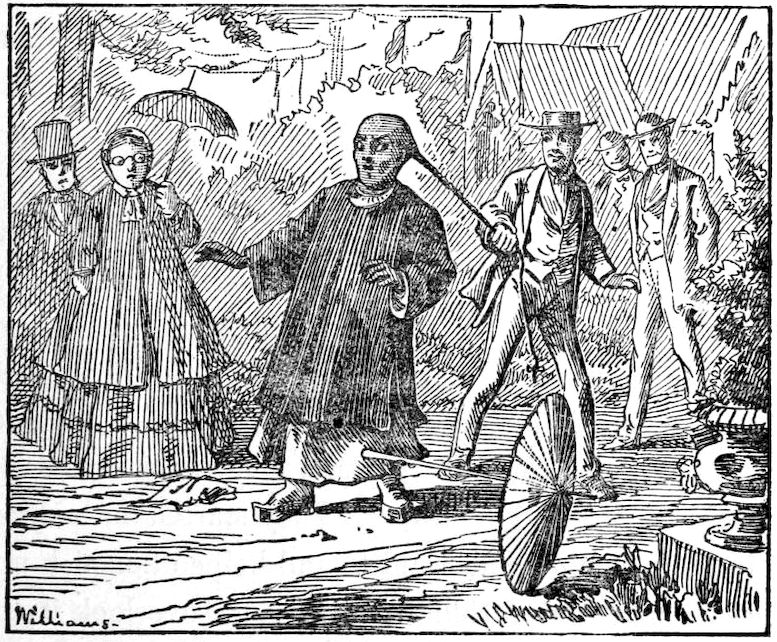
POLITENESS TO A STRANGER.
And there she was, behavin’ herself like a perfect
lady, and them three healthy young American fellers
a laughin’ and a scorfin’ and a pokin’ fun at her—a
pintin’ at her hair and her dress, and her shoes, which
was wooden—but none of their business nor mine if
they was; finally one of them took holt of her long
braid and give it a yank, and called her “John”; and
462she, a tryin’ to save herself, dropped her paper and it
bust open and all the things in it scattered out on the
ground. As she stooped down in a patient way and
went to pickin’ ’em up, I jest advised them young
fellers for their good. I had been told that day that
the fureigners had most all of ’em had to change their
own costume for ourn, the Americans made such fun
of ’em; it mortified me dretful to have my own folks
show such awful bad manners; and says I:
“I would be ashamed of myself if I was in your
places; are you such conceited fools as to think our
dress is the dress of the world, and our ways all the
ways there is under the sun? Although you probable
don’t know it, you are only a very small part of
the world—a very little and mean part. You would
do well to learn a little Japan gentleness, and some
Turkey politeness,” and says I, warmly, as I looked
at their pert impudent faces, and then at her patient
form—“Poles could learn you a good deal, and they
would to, if I had my way.” They started off lookin’
kinder meachin’, and I laid to and helped her pick up
her things; and I told her she must overlook it in
coots; says I, “most Americans would be ashamed of
them, as they ort to be of themselves.”
But Josiah hunched me, and whispered: “Be you
a goin’ to stand all day a talkin’ to that man?”
“Man” says I, in witherin’ tones.
“Yes, it is a Chinaman, and do come along.”
Says I, “Josiah Allen, it is a pity if I can’t have
463the privilege of speakin’ to a likely woman, afflicted
with ganders, without your up and callin’ her a man.”
He argued back that it was a man, but I wouldn’t
multiply any more words with him, and we went on
by the broad lawn, or so they called it—though I told
Josiah it looked more like velvet than it did like any
lawn I ever see. It looked jest like the green velvet
I had a bunnet made out of when I was a girl; fresh,
and green, and soft, and bright. And there was hundreds
of the most gorgeous and brilliant flower beds
scattered over it, and ornamental vases runnin’ over
with vines and flowers, and evergreens of all sorts;
but I can’t describe it and wont try.
I said before, that Horticultural Hall was dream-like
in its beauty, but as I got nearer to it I see
my mistake; it was fur handsomer. I couldn’t have
drempt out such a exquisitely lovely buildin’ if I
had gone to sleep a purpose; and so I told Josiah, as
we went up the broad blue marble steps, past great
century plants and oranges with oranges on ’em, up
into a lofty place filled with folks, and flights of the
most elegant steps on each side, and tall pillows
standin’ up at the foot of ’em, with clusters of lamps
on top, and folks a goin’ up and down on ’em—the
stairs I mean. Goin’ right in out of the blazin’ sunshine,
it seemed to me as if I never did see coolness so
cool, and greenness so green, and shade so uncommon
shady before. Never did I see such noble and almost
foamin’ lookin’ green leaves of all kinds and shapes,
464from the size of a pusly leaf, to them big enough to
make my Josiah a pair of pantaloons and a overcoat.
The floor was sort o’ openwork, with plain stripes
runnin’ down through it, sunthin’ as I knit stockins
when I want ’em to look uncommon well. But oh!
how lovely it did look to me, as I glanced down as fur
as I could see ahead of me, to see clear from the floor
to away up overhead, the beautiful green branches a
spreadin’ out, and the lovely poseys, and over ’em and
amongst ’em great bunches of lamps a hangin’ that
looked like drops of light as the sun shone through
’em, and stars and ornaments of all kinds, a glistenin’
up there on the lofty ceilin’; and down below there
was white marble statutes a gleamin’ and fountains a
gushin’ out.
There was one fountain that I took to dretfully. A
noble big vase bound with acanthus leaves, was a shootin’
up water, clear as a crystal, and at the foot of it
on some rock work, sot three handsome childern jest
ready to plunge down into the cool, wet water; one
of ’em was blowin’ a shell, he felt so awful neat.
There was lots of fountains in the Hall but none so
uncommon handsome as this; and that noble fountain
was the work of a woman; and as I looked at it, I
thought I should be proud and happy to take her by
the hand and say:
“Miss Foley, I too am a woman, I am proud to
sympathize with you.”
A good lookin’ woman, dressed up slick, with a little
465book and pencil in her hand spoke up and says to me:
“It is wonderful, haint it?”
Says I, “Wonderful haint no name for it.”
“That’s so;” says she, and added, “have you seen
the phantom leave?” or sunthin’ like that.
Says I, firmly, “There haint been no phantom here
appearin’ to me, and how could I see it leave?” Then
thinkin’ of my vow, and likin’ her looks first-rate, I
says in a encouragin’ tone, “There has somebody been
a tryin’ to fool you mom, there haint no such things
as ghosts and phantom’ses. Ghosts and phantoms are
made of moonshine, and fear and fancy are the makers
of ’em.”
She took up her parasol—a pale blue one all covered
with white lace—and pinted right up at a glass
case, and says she:
“Phantom leaves I mean, you can see them.”
“Oh!” says I, “I thought you meant a ghost.”
They was handsome; looked as white and delicate as
the frost-work on our winders in December.
It wasn’t probable more’n half an hour after this
that my pride had a fall. Truly, when we seem to
be a standin’ up the straightest, tottlin’ may come
onto us, and sudden crumplin’ of the spiritual knees.
There I had been a boastin’ in my proud philosophical
spirit that there was no such things as phantoms, and
lo, and behold! within thirty-one minutes time, I
thought I see a ghost appearin’ to me; I was skairt,
and awe-stricken. The way on’t was, Josiah beset
466me to go into some of the different hot-houses in the
buildin’, and I had told him firmly, that bein’ very
fleshy and warm-blooded, I was satisfied and more’n
satisfied with the heat of the place I was in; but if he
wasn’t—bein’ thinner in flesh, if he felt chilly, he
could go and I would meet him in a certain place. So
he went on, and I meandered back into the Main
Hall. And there I stood a lookin’ peacefully up into
the boughs of a Injy Rubber tree, and thinkin’ pensively
to myself what fools anybody was to think that
rubber-boots and shoes grew right out of the tree, for
they didn’t—no such thing; they had green leaves like
any tree—when all of a sudden I heerd these words:
“Oh Doodle! Doodle! if you was alive, I shouldn’t
be in this perdickerment!”
If I had had some hen’s feathers by me, I should
have burnt a few, or if I had had a tea-cup of water I
should have throwed some in my face, to keep me
from faintin’ away. But not havin’ none of these
conveniences by me, I see I must make a powerful
effort, and try to control myself down; and jest as I
was a makin’ this effort, these words come again to
my almost rigid ear:
“Oh Doodle! Doodle! you never would have stood
by, and seen your relict smashed to pieces right before
your dear linement.”
And as I heerd these words I see her appearin’ to
me. I see the Widder Doodle, emergin’ from the
crushin’ crowd, and advancin’ onto me like a phantom.
467Says I to myself, “Be you a ghost or be you a phantom?
Are you a fore-runner, Widder?” says I,
“you be a fore-runner, I know you be,” for even as
I looked I see behind her the form of Solomon Cypher
advancin’ slowly on, and appearin’ to me too. I
felt fearfully curious. But in about three-fourths of
a minute my senses come back—for the big wave of
folks sort o’ swept off somewhere else, and left the
Widder Doodle some like a sea-weed nigh me. And
on lookin’ closer at her I see that no respectable ghost
who thought anything of itself, would go out in company
lookin’ so like furyation—I felt better, and says I:
“Widder Doodle, how under the sun did you come
here to the Sentinal?”
468Says she, “Samantha, I am married; I am on my
tower.”
Says I in faint axents, “Who to?”
“Solomon Cypher,” says she.
Again I thought almost wildly of burnt feathers,
for it seemed so fearfully curious to think she should
be a double and twisted ort, as you may say; should
be a ort by name, after bein’ one by nater all her
days. But again the thought come to me, that I had
no conveniences for faintin’ away, and I must be
calm, so says I, “Married to Solomon Cypher!”
And then it all come back to me—their talk the
day he come to borry my clothes for the mourners;
her visits to his housekeeper sense; and his strange
and almost foolish errants to our house from day to
day; but I didn’t speak my thoughts, I only said:
“Widder Doodle, what ever put it into your head
to marry again?”
Well, she said she had kinder got into the habit of
marryin’, and it seemed some like a second nater to
her—and she thought Solomon had some of Doodle’ses
linement—so she thought she would marry him. She
said he offered himself in a dretful handsome style;
she said the childern of the Abbey, or Thadeus of
Warsaw couldn’t done it up in any more foamin’
and romantic way; she said he was a bringin’ her
home in his wagon from a visit I remembered her
makin’ to his housekeeper.
“Three weeks after his wife’s death!” says I.
469“Yes,” says she, “Solomon said the corpse wouldn’t
be no deader than she was then, if he waited three
months, as some men did.” Says she, “The way on’t
was, I was a praisin’ up his horse and wagon—a new
double wagon with a spring seat—when all of a sudden
he spoke out in a real ardent and lover like tone:
‘Widder Doodle, if you will be my bride, the wagon
is yourn, and the mares.’ Says he, ‘Widder, I throw
myself onto your feet, and I throw the wagon and
mares onto ’em; and with them and me, I throw
eighty-five acres of good land, fourteen cows, five
calves, four three year olds and a yearlin’, a dwellin’
house, a good horse barn, and myself. I throw ’em
all onto your feet, and there we lay on ’em.’
“He waited for me to answer and it flustrated me so
that I says: ‘Oh Doodle! Doodle! if you was alive
you would tell me what to do, to do right.’” “And
that,” says she, “seemed to mad him; he looked black
and hard as a stove pipe, his forward all wrinkled up,
and he yelled out that he didn’t want to hear nothin’
about no Doodle nor he wouldn’t neither.” Says she,
“He hollered it up so, and looked so threatnin’ that I
took out my snuff handkerchief and cried onto it, and
he said he’d overlook Doodle for once, and then he
said again in a kind of a solemn and warnin’ way:
‘Widder I am a layin’ on your feet, and my property,
my land, my live stock, my housen, and my housen
stuff, are all a layin’ on ’em; make up your mind, and
at once, for if you don’t consent I have got other
470views ahead on me, which must be seen to at once,
and instantly. Time is hastenin’, and the world is
full of willin’ wimmen, Widder, what do you say?’
“And then,” says she, “I kinder consented, and he
said we’d be married and he’d turn off his hired girl,
and I could go right there and do the housework,
and help him what I could out doors, and tend to the
milk of fourteen cows, and be perfectly happy. He
thought,” says she, “as he was hurried with his summer’s
work, we had better be married on Sunday, so’s
not to break into the week’s work; so we was.”
Says I, “Be you perfectly happy, Widder?”
When I asked her this in sympathizin tones, she
took her snuff handkerchief right out, and bust out a
cryin’ onto it, and said she wasn’t.
“Does Solomon misuse you? Does he make you
work too hard?”
“Yes,” says she, “I have to work hard, but that
haint my worse trouble.” And she sithed bitterly.
“Does he act hauty and domineerin’ and look
down on you, as if you wasn’t his equal?”
“Yes,” says she, “but I expected that, I could
stand that if I didn’t have no harder affliction.”
“Is he a poor provider, does he begreech you things?”
Says she, “He is a poor provider, and he begreeches
things to me, but that haint my worse trial; he wont
let me talk about Doodle. And what is life worth to
me if I can’t speak of that dear man?” Says she, “I
can’t never forget that dear Doodle, never!”
471“Well,” says I, “You ort to have thought of that
before you promised Solomon Cypher his bride you
would be;” says I, “mournin’ for Doodle was jest
as honorable as anything could be; I never blamed
you for it, I stood firm. But a woman hadn’t ort to
try to be a mourner for one man, and a bride to
another man at the same time; it haint reasonable;
let ’em be fully perswaded in their own mind which
business would be the most happyfyin’ and profitable
to ’em, and then go at it with a willin’ heart, and
foller it up.”
Says I, “If you wanted to spend your days as a
mourner you ort to have done it as a Widder, and
not as a bride.” Says I, “When a Widder woman or
a Widder man embarks in a new sea of matrimony,
they ort to burn the ship behind ’em that they sailed
round with in them other waters. They hadn’t ort
to be a sailin’ round in both of ’em to once, it is
unreasonable; and it is gaulin’ to man or woman.”
On lookin’ at her closer I see what made her look
so curious. She had tried to dress sort a bridey, and
at the same time was a mournin’ a little for Doodle;
she said she wouldn’t have Solomon know it, and git
to rarin’ round for nothin’ in the world; she put on
the white bobinet lace veil to please him, but says
she, “though he don’t mistrust it, my black bead collar
and jest half of my weddin’ dress means Doodle.”
It was a black and white lawn, with big even checks;
and she told me (in strict confidence) that she had
472got a black bombazine pocket to her dress, and had on
a new pair of black elastic garters. Says she, “I can’t
forget Doodle, I never can forget that dear man.”
And she wont; I know she never will git over
Doodle in the world. Everything we see put her in
mind of him. But about this time Josiah and Solomon
Cypher joined us, and the last named told us
that the “Creation Searchers” had all come on the day
before, and was makin’ a great stir in the village,
the literary and scientific world. And he said that as
little a while as they had been here, they had found
fault with a great many things, pictures and statutes
and the like; he said anybody had got to find fault
and not seem to be satisfied with anything, in order to
be looked up to. He said it was a trade that, well follered
up, give anybody a great reputation.
“Yes,” says Josiah, “I know lots of folks that
have got monstrous big reputations for wisdom in jest
that way.”
But I was sick of this talk and was glad enough
when they sot off for somewhere else. But his last
words to me was:
“Josiah Allen’s wife, we shall probable be heerd
from before we leave the village.”
“Well,” says I, “I am willin’;” and I was. It never
worries me to see anybody git up in the world; I haint
got a envious hair in my head—and I have got a noble
head of hair for one of my age.
473
THE ARTEMUS GALLERY.
The next mornin’ we went onto the ground, (Mr.
Fairmount’s farm, where the Sentinal stands) in
good season. I told Josiah we would go the first thing
to the Artemus Gallery.
“Artemus who!” says he. “I didn’t know as you
knew any Artemus down here.”
Says I with dignity, “I don’t know the gentleman’s
other name myself; they call him Art, but I wont; I
have too much respect for him to nick name that
noble man.” Says I, “When any man takes such pains
as Artemus has, to git such a splendid assortment of
pictures and statutes together for my pleasure, and the
pleasure of the Nation, I admire and respect him, and
feel almost affectionate towards him.”
Presently, or soon after, the soft grey walls of that
most magestic, and beautifulest of housen, loomed up
before us as we passed up into it by some broad noble
steps with a bronze horse on each side—lookin’ considerable
in the face like our old mare—only higher
474headed with wings to ’em. I told Josiah that if she
(the mare) was fixed off like them with wings, we
shouldn’t be all day a goin’ a mile or two. And he
said, after lookin’ close and thoughtfully at the span,
that he couldn’t take a mite of comfort a ridin’ after
’em, they looked so curious. So we went on, by them
and two as big female statutes as I most ever see,
with their minds seeminly rousted up and excited
about sunthin’. But we hadn’t much more’n got inside
the door, when we felt curious again, both on us,
a seein’ George Washington a ridin’ up to heaven
on the back of a eagle. George always looks good to
me, but I never see him look heavier than he did
there; he would have been a good load for a elephant.
Oh what a time that eagle was a havin’! I never was
sorrier for a fowl in my hull life.
But oh! what lovely forms and faces was round me
on every side, as I moved on. Grace, and beauty,
and sublimity, and tenderness, and softness all carved
out of hard stun marble for my delight; all painted out
on canvas and hung up for me to smile upon and weep
over—for beauty always affects me dretfully. One
little piece of beauty that I could take up in my hand,
such as a bit of moss, or a sea shell, or a posey, has
made me happy for over half a day. A pussy willow
bendin’ down to see its face in the water, has reflected
its grace and pretty looks right into my soul. Why
even a green grass blade in the spring of the year has
had power to cut the chains that bound my spirit
475down to unhappiness, and let it soar up nobly, clear
away from Jonesville, Betsey Bobbet, Widder Doodle,
and all other cares and worryments of life. And
havin’ such feelins for beauty, such a close affection
for her that I was always a lookin’ for her, even where
I knew she wasn’t nor never would be; jest imagine
what my emotions must have been to walk right into
acres and acres of the most entrancin’ beauty; miles
and miles of grace and loveliness; dreams of immortal
beauty caught by artist souls from heaven knows
what realm of wonder and glory, all wrought out in
marble, and painted on canvas for me to wonder at,
and admire over, and almost weep upon.
The tears did run down my face every few minutes
all through that Artemus Gallery, entirely unbeknown
to me; and I shouldn’t have sensed it at all if I had
cried out loud, for I was perfectly carried away from
myself for the time bein’.
Oh what beautiful little white stun childern there
was before me, in every beautiful posture that childern
ever got into—a laughin’ and a cryin’, and a
feedin’ birds, and a pickin’ thorns out of their feet
and a hidin’ and a seekin’. And one little bit of a
girl baby was holdin’ a bird in her hand, and she had
bared her little chest on one side and was squeezin’
up the flesh to form a breast, and holdin’ up the bird
to nurse. The roguish looks of her face would almost
make a grindstun or Zebulin Coffin smile. And there
was one gittin’ ready for bed, and one tellin’ his prayers
476when he didn’t want to. He looked exactly as
Thomas J. did when I married his pa. He had run
wild, and wouldn’t pray; I’d git him all knelt down,
and he’d say:
I wont lay me down to sleep,
I wont pray the Lord my soul to keep,
I wont die before I wake,
I wont pray the Lord my soul to take.
And when he’d say the Lord’s prayer, he’d say:
“Lead us into Temptation,” jest as loud as he could
yell, and cross as a bear. Jest as quick as I got him
civilized down, he’d tell ’em off like a little pasture.
But oh! how cross and surly he did look at first,
jest for all the world, like this little feller. I hunched
Josiah to take notice, and he said if Thomas J. had
been sculped in the act, it couldn’t look more natteral.
And there was such lovely female wimmen faces, innocent
as angels—one with a veil over her face; only
think on it, a marble veil, and I a seeing’ right through it.
But there was some Italian statutes that instinctively
I got between and Josiah, and put my fan up, for I felt
that he hadn’t ort to see ’em. Some of the time I
felt that he was too good to look at ’em, and some of
the time I felt that he wasn’t good enough; for I
well knew when I come to think it over, that human
nater wasn’t what it once was, in Eden, and it wasn’t
innocence, but lack of innocence that ailed folks.
But whether he was too good, or not good enough,
and I couldn’t for my life tell which; either way I
felt it wasn’t no place for him; so I hurried him
through on a pretty good jog.
477
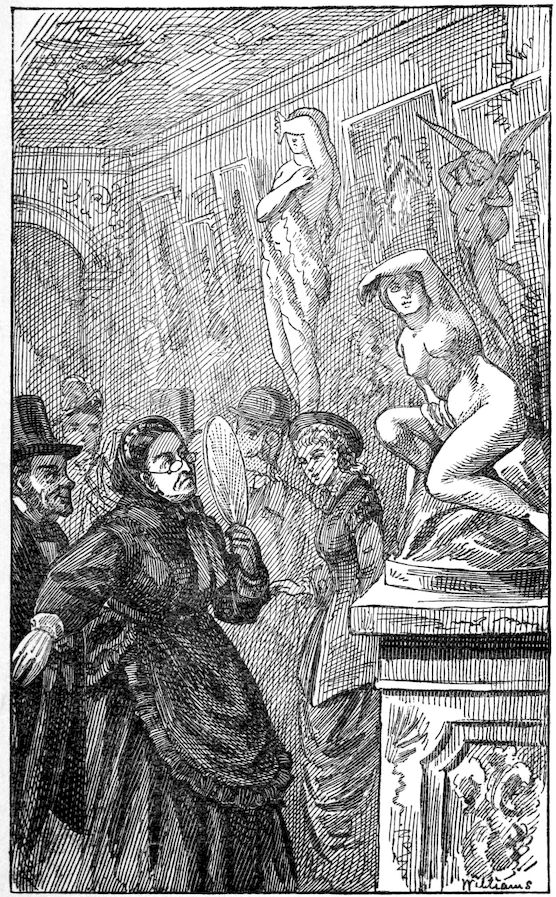
SAMANTHA IN THE ART GALLERY.
479And among the statutes of my own Nation, was
Aurora; it seems as if it struck me about as hard a
blow as any of ’em. To see that beautiful figger of
Mornin’ risin’ right up sailin’ over the earth with her
feet on nothin’; her arms over her head scatterin’ the
brightness of day down in roses upon the earth,
and the stars and the shadders of night a fallin’ away
from her; it was as beautiful a marble thought, as I
ever laid eyes on—or I’d think so till I see some
other one, and then I’d think that was the beautifulest.
There was Nydia the blind girl of Pompeii!
What pain and helplessness was on her face, and what
a divine patience born of sufferin’. What a countenance
that was! And then there was two little Water
Babies layin’ in a sea shell—I don’t believe there was
ever any cunniner little creeters in the hull world.
And havin’ such feelins for her, feelin’ so sort o’
intimate with her and Hamlet, it was very affectin’
to me to see Ophelia, a lookin’ jest as I have heerd
Thomas J. read about her. She was standin’ holdin’
some flowers in her dress with one hand, and with
the other hand she was holdin’ out a posey jest as if
she was a sayin’:
“There’s rosemary, that’s for rememberance; pray
you love remember, and there’s pansies that’s for
thoughts.” She was dressed up in store clothes too,
which was indeed a treat, and a sweeter face I don’t
480want to see. And then there was a noble group—Death
a tryin’ to kill Honor, and couldn’t. Strength
and Courage and Perseverance had gone down before
him, but Honor he couldn’t kill; it was a very noble
and inspirin’ sight. And Media was another dretful
affectin’ statute to me; what trials and tribulations
that woman did go through, killin’ her childern, and
ridin’ after serpents, and everything. I was some
acquainted with her (through Thomas Jefferson.)
And then there was Night and Mornin’; I never see
’em look better in my life, either of ’em. And Ruth
a gleanin’; she was a kneelin’ down on one knee, and
looked first-rate, though I did think it would have
been better if she had pulled her dress waist up
where it belonged. Howsumever, everybody to their
own mind. There was two statutes of Cleopatra,
pretty nigh together, one by a man, and one by a
woman. Mebby you’ll think I am parshal to my sect,
but if I wasn’t a woman—if I was a man—I’d say and
I’d contend for it that her Cleopatra looked fur handsomer
and better than hisen. And there was a minute
man, that looked stern and noble, and as if he would
be right there jest to the minute.
But what’s the use of tryin’ to tell what pictures
was the loveliest, amidst such acres and acres of loveliness,
such sweet and nearly bewitchin’ faces, such
lovely and almost glowin’ landscapes.
There was “Yankey Doodle” as interestin’ as I always
knew that yankey was; I never see him look
481better than he did here; there stood three generations
with the soul of 1776 a shinin’ through their faces,
and the oldest face of all was lit up with the deepest
glow and inspiration. It was a dretful animatin’ and
inspirin’ picture to me and to Josiah. And then
there was another picture called “Elaine” that dealt
both my mind and my heart fearful blows. I had
heerd Thomas J. read about her so much that she
seemed almost like one of the relations on the side of
the Smiths. She was a handsome girl, and likely as
she could be, but she got disappointed, fell in love with
Mr. Launcelot—and he, bein’ in love with another
man’s wife, couldn’t take to her, so she died off. But
her last request was to be laid, after she died, in a
boat with a letter in her hand for him she died off for,
biddin’ him good-bye; and that the boat—steered by
her father’s dumb hired man—should float off down to
Camelot where he was a stayin’ a visitin’. (I don’t
s’pose I have told it in jest exactly the words, Thomas
J. reads so much, but I have probable got the heads
of the story right). And there she lay, perfectly
lovely—in her right hand, the lily, and in her left the
letter; the dead steered by the dumb, floatin’ down the
still waters. It was exceedinly affectin’ to me, and
I was jest a goin’ to take out my white cotton handkerchief
to cry onto it, when all of a sudden I heerd
behind me the voice of the Editor of the Auger a sayin’:
“It is a false perspective.”
“Yes,” says Cornelius Cork, in the same fault-findin’
482tone: “it’s awful false, not a mite of truth in it.”
“A perfect lie,” says Shakespeare Bobbet.
“The tone is too low down,” says the Editor of the
Auger again, in a complainin’ way.
“Low down again as it ort to be,” says old Bobbet.
I declare for’t, I jest locked arms with Josiah and
hurried him off, and never stopped till we got clear
into Austria. But on the way there, I says, “How
mad it makes me, Josiah Allen, to see anybody find
fault and sneer at things they can’t understand.”
“Well,” says Josiah mildly, “you know they have
got a reputation to keep up, and they are bound to do
it. Why, they say if anybody haint dressed up a
mite, if you see ’em a lookin’ at handsome pictures,
or statutes, or anything of that sort, with a cold and
wooden look to their faces, and turning their noses up,
and finding fault, you may know they are somebody.”
“I s’pose” says Josiah, “the ‘Creation Searchers’
can’t be outdone in it; I s’pose they put on as
hauty and superior-silly-ous looks as anybody ever
did, that haint had no more practice than they have.”
Josiah will make a slip sometimes, and says I, “you
mean super-silly, Josiah.”
“Well, I knew there was a silly to it. They say,”
says Josiah, “that runnin’ things down is always safe;
that never hurts anybody’s reputation. The pint is,
they say, in not bein’ pleased with anything, or if you
be, to conceal it, look perfectly wooden, and not
show your feelins a mite; that is the pint they say.”
483Says I, “The pint is, some folks always did make
natteral fools of themselves, and always will I s’pose.”
“Well,” says Josiah, “there must be sunthin’ in
it, Samantha, or there wouldn’t be such a lot a gittin’
up a reputation for wisdom in that way.”
I couldn’t deny it without lyin’, and so bein’ in
Austria, as I said, I commenced lookin’ round me.
Comin’ right out of the United States I couldn’t help
thinkin’ that Austria had a meller, rich look, sunthin’
like Autumn in the fall of the year, while the
United States looked considerable like Summer. The
picture that arrested my attention first and foremost
in Austria was, “Venice paying homage to Caterina
Cornaro.” It was a noble big picture, as big as one
hull side of our house a most. I looked at that picture
very admirinly and so did Josiah. We see a
Emperor on a bust, and other interestin’ statutes; we
give a glance at a sleepin’ Nymph—she was as handsome
as a doll, but I thought then and I think still,
that if Nymphs would put on store clothes, they would
look better, and feel as well again.
“Convulsed with Grief,” was a beautiful picture but
fur too affectin’ for my comfort. It was a bier all
covered with flowers, and a dead child lyin’ on it
with a veil thrown over its face, but painted in such
a way that the beautiful white face was plain to be
seen under it; and the mother was settin’ by it with
grief, and agony, all painted out on her face. And as I
looked on her, the tears jest started on a run down
484my cheeks, for though I well knew it was one of the
sweetest and holiest things in life to become the mother
of a baby angel, still I knew it was one of the saddest
things too. I knew that mother heart where the
pretty head had lain, was as empty and lonesome as
a bird’s nest in winter; and the shadder of the little
low grave would be high enough to cast its blackness
and gloom over the hull earth. I felt for that mother
so that I come pretty near cryin’ out loud. But I
didn’t; I took out my white cotton handkerchief and
wiped both of my eyes, and composed myself down.
And then feelin’ a little tired I seated myself on
a bench in the middle of the room, Josiah sayin’
that he wanted to look at the Alps, and one or two
convents, and a “Bull Dog.” But I watched him
out of one corner of my speck, and I see that he never
went nigh ’em, but kep’ a lookin’ at a “Centeur carryin’
off a Nymph” and a “Siesta of a Oriental Woman”
and a “Nun’s Revery,” and a “Smilin’ Girl,”
and some sirens, and other females. But I didn’t care;
I haint got a jealous hair in the hull of my foretop,
or back hair; and I well know the state of my pardner’s
morals,—brass is no sounder. And I couldn’t
help takin’ it as a compliment, and feelin’ flattered in
behalf of my sect, to see all through the Sentinal,
how sot men did seem to be a lookin’ at the pictures
and statutes of wimmen. They looked at ’em as much
again as they did at the figgers of their own sect; and
it showed plain to me, that though they do some on
485’em seem to feel rather hauty and proud-spirited towards
us, they do think a sight on us—as a race.
So there I sot bounded by beauty on every side of
me, and happy as a queen, when a likely lookin’
woman come in and sot down by me. Says she, “I
have jest been a lookin’ at the Gobelin tapistry.”
“Why how you talk!” says I, “I never believed
there was any such things as Gobelins or spooks.”
“I mean men;” says she, “men that foller the trade
of the Gobelins.”
“Oh Gobblers?” says I in a enquirin’ tone.
“Weavers,” says she. “They set at the back of
their frame and never see the right side of their work
till the picture is finished, and each color they weave
in has twenty different shades.”
“How you talk!” says I, and seein’ she had a kind
of a knowin’ look, as if she would understand episodin’;
(I hate to episode to anybody that don’t
know what I’m a doin’.) I says to her, “That is a
good deal like our lives, haint it; we set in the dark
a weavin’ in our actions day by day, every act havin’
more’n forty different shades and motives to it, and
we can’t tell how the picture looks from the other
side till our work is done, and the frame laid down.”
“That is so,” says she. And then we both went
to look at ’em, and Josiah went too; and such weavin’
I never see before, nor never expect to again. One
of ’em was Mrs. Penelope settin’ a weavin’ her web.
A likely creeter she was. After her husband was
486dragged off to war she would set and weave all day,
and rip it all out at night, for she had promised to
marry again when she had got her weavin’ done; and
hated to. I have heerd Thomas J. read about her,
and always took right to her. We had jest finished
lookin’ at her, and I was a goin’ to tackle some of
the pictures, when a slimmish sort of a girl, by the
side of us says to another one, in reply to a question:
“Yes, I have jest come from there; it is the greatest
exhibition of Antique art ever seen in this country.
Pottery, crockery ware, marbles, and jewelry, twenty-three
hundred years old, some of it.”
Josiah hunched me, and give me a wink; as excited
and agitated a wink as I ever see wunk. And
says I, “What is the matter Josiah, you scare me.”
Says he in a loud excitable whisper:
“Now is my time, Samantha. You have wanted
me to buy sunthin’ for Tirzah Ann to remember the
Sentinal by, and I can probable git some things here
cheap as dirt, if they are as old as that, and they’ll be
jest as good for her as new; they’ll last till she gits
sick of ’em. I will see old Antique, and try to make
a dicker with him.”
Says I, “If I had a only girl by my first wife, and
was as well off as you be, I wouldn’t try to git second
hand jewelry or old crockery for ’em, because I could
git ’em for little or nothin’.”
But he was sot on it, and so we went in and looked
round, tryin’ to find sunthin’ that would suit her.
487There was lots and lots of things, but I couldn’t see a
article that I thought she would want and told him
so; there was some big platters with humbly faces
painted on ’em, and bowls and vases and jars. One
little bowl was marked “Anno Jubilee 1600,” and
Josiah says, “Don’t you s’pose that would do, Samantha?
S’posen Ann has used it, she haint hurt it, and
it would be handy to feed the—”
Says I, “Josiah Allen, it don’t look half so well as
bowls she has got by her now.”
“Well,” says he, “I could git it cheap, its bein’ so
awful old, and I believe it would be as good for her,
as a new one.”
“Well,” says I, “before you decide, less look round
a little more.”
It does beat all how many things was marked Anno
Domina; Josiah said he wondered what under the
sun Ann wanted of so much jewelry and stuff, and he
thought it looked extravagant in her.
Says he with a dreamy look “Mebby Ann would
have left sunthin’ to our girl, if she had known she
was named after her—as it were.”
Says I, “Josiah Allen don’t try to git off on that
track.” Says I, “It is bad enough to buy second-handed
jewelry without plottin’ round tryin’ to git it for
nothin’.”
So finally he picked out a ring of carved stone,
sardonic, I think I heerd it called, and says he: “this
will be just as good for Tirzah Ann as sunthin’
488that would cost a dollar or ten shillin’,” says he “I
will give old Antique ten cents for it, and not try to
beat him down. Do you s’pose the old man would
ask any more for it?” says he, addressin’ a middle
aged, iron grey man a standin’ near us. “He dug
’em out of old graves and ruins, I hear; they can’t be
worth much to him.”
“You can learn the price from Signor Alessandro
Castellani.”
“Who?” says Josiah.
“The gentleman who owns the collection, the head
of the Italian Commission. There he is a comin’ this
way now.” He was a good lookin’ chap, with a animated
eager look to his face. And when he got up
to us Josiah says to him, “How much is that little
sardonic ring?”
Says he, in a pleasant way though sort o’ foreign
in axent, “That ring sir, is eight hundred dollars.”
My pardner stood with his head bent forward, and
his arms hangin’ down straight, in deep dumb founder.
Finally he spoke, and says he in low agitated axents,
“How much do you call the hull lot of old stuff
worth?”
“Two hundred thousand dollars,” says he.
Says Josiah, “I thought five dollars would buy
the hull. I guess we had better be goin’ Samantha.”
After we got out, I says “I guess, Josiah Allen, you
wish you had heerd to me.”
489“Dummit! who thought they were such fools?”
says he.
Says I sternly, “Josiah Allen, it scares me to think
you have got to be such a profane swearer,” says I
“you never swore such profane oaths in your hull life
before, as you have sense you have been on your
tower. What would your pasture say if he could hear
you? And you call ’em fools,” says I, “I guess they
haint the only fools in the world!”
“Who said they wuz,” says he. And then he spoke
up and says he, “I guess I will go out and look at
some mules, and steers.”
“Well,” says I more mildly, “Mebby you had
better.” And we agreed when it was time to go
home, to meet at the Department of Public Comfort.
So Josiah went to look at the live stock, (he seemed
to enjoy himself better when he was in that situation)
and I wandered round through them wildernesses of
entrancin’ beauty, perfectly happy (as it were.) I had
roamed round mebby an hour, lookin’ at the pictures
and statutes that lined the walls on every side, not
mindin’ the crowd a mite, some of the time a laughin’
and some of the time a cryin’ (entirely unbeknown to
me.) I was a standin’ in Germany, enjoyin’ myself
dretfully, for the Germans are a affectionate, social
race, and their pictures of home life are exceedin’ly
interestin’ and agreeable, to one who loves home as
does she, whose name was once Smith. And then
490there was pictures that would make you smile, such
as “Buying the Cradle,” and “The Disagreement.”
And there was lovely landscapes, and grand and inspirin’
pictures. I had jest been a lookin’ at “Christ
Appearing to Mary Magdelane,” a noble picture;
our Saviour clad in white like Eternal Purity, and
she rushing forward with outstretched arms and her
face all lit up with joy and adoration. I had jest
left this picture and was a lookin’ at “Luther Intercepted,”
and thinkin’ how sort o’ lonesome the woods
looked, and how sorry I was for Luther—when all of
a sudden I heerd a awe-stricken whisper on the nigh
side of me:
INTERVIEW WITH DOM PEDRO
“There is the Emperor of Brazil! There is Dom
Pedro!”
And lookin’ up I see a tall man with greyish
whiskers and mustache, come in in a quiet way with
a little book in his hand, and go to lookin’ at the
pictures. For nearly three quarters of a moment I
felt strange, curious, exceedingly so. But Principle
showed me jest what to do, to do right, and Duty
locked arms with me and bore me onwards, right up
in front of that noblest of men, for I felt that I ort
to make some move towards gettin’ acquainted with
him. I took it right to myself; he was a literary
man; I was a literary woman; he was on a tower
of investigation and principle; I too, was on such a
tower; and I knew if I should go to Brazil to get
491Brazil nuts or anything, if I should happen to go to
his neighborhood to any doin’s where he was, and
he shouldn’t make any move towards gettin’ acquainted
with me, I should feel hurt. I shouldn’t
be mad, but it would grieve me—work on my feelin’s.
And so thinks’es I, I wont stand on no ceremony
but do as I would be done by, and scrape acquaintance
with him.
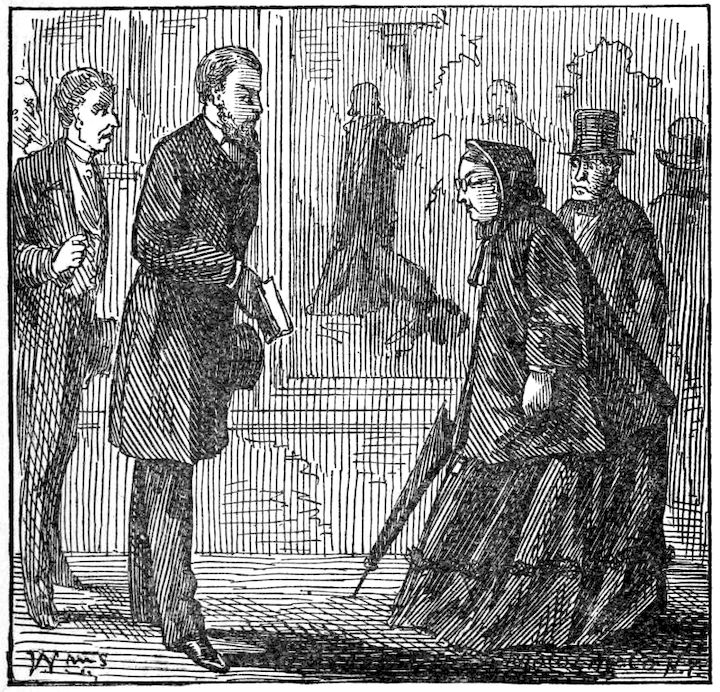
SAMANTHA MEETS DOM PEDRO.
I am very polite when I set out to be. Anybody
to see me appear sometimes, would almost think I was
born in a meetin’ house. I have a very noble way
to me sometimes, it comes natural, and I put on
492now, the very best mean I had by me, and curchied
nobly. And though I do say it that shouldn’t, I can
make as good lookin’ a curchy as any woman of my
age and size when I set out. Of course I can’t put in
all the little curious motions I could if I weighed less
than two hundred, but I did well. And jest as I got
through curchyien I spoke up in a very polite, but
calm tone: “How do you do Mr. Pedro?”
They call him Dom, a nickname for Dombey, I
s’pose. But I always think it looks better for females
to be sort o’ reserved and dignified, and so I called
him Mr. Pedro. And says I, “I will make you
acquainted with Josiah Allen’s wife.”
He looked at me kinder searchin’ like, and then
when I had a full look at him, I could see that he
looked well. Though, like myself, he couldn’t be
called handsome, he had a good look to his face. His
eyes had that sort of a weary look, considerable sad,
and considerable hopeful too, and very deep and
searchin’, jest as if they had looked a good deal at
things that worried and perplexed him; just as if they
had looked at bigotry, and prejudice, and ignorance,
and then seen, clear acrost ’em the sunlight of education,
and freedom, and true religion a dawnin’ on the
land he loved. I don’t know when I have seen a
face that I liked better. And my admirin’ and reverential
emotions riz up so that I never spoke about
the weather—or asked him whether he was enjoyin’
493good health, or whether Miss Pedro and the rest of
his folks was as well as could be expected, or anything—but
I spoke right up and says I in tones
tremblin’ with emotion:
“I have been on towers before, Mr. Pedro, and
have felt noble and grand on ’em, but never did I feel
so lifted up on any tower as I do now. Never,
never, did I meet a literary man that I feel such
emotions towards, either on a tower or offon it.”
And as I went on I grew more and more agitated,
and eloquent; why, I felt so eloquent that I see there
wasn’t no use to try to stop myself, and I says in
fearfully noble axents:
“When a man in a lofty station like yourn, instead
of spendin’ his days admirin’ himself, works earnest,
hard work to benefit the people God placed in his
keepin’; studies day and night how to advance their interests,
in every way, and raise them up and make them
prosperous and happy; that man Mr. Pedro, raises
himself from 35 to 40 cents in my estimation. And
when that literary, and noble minded man gets down
out of his high chair—soft as royalty and a people’s
devotion can make it—and sets off on a tower to
collect information to still further benefit them, he
raises himself still further up in my estimation, he
still further endears himself to her whose name was
formally Smith. For,” says I wipin’ my heated forward,
“I feel a sympathizin’ feelin’ for him; I too,
494am literary, and a investigator in the cause of right, I
too am on a tower.”
He looked dretful sort o’ earnest at me, and surprised.
I s’pose it kind o’ took him back, and almost
skairt him to see a woman so awful eloquent. But I
kep’ right on, unbeknown to me. Says I “Some
kings look down on the people as if they was only
dust for their throne to rest on; while they set up on
it, with their crown on, a playin’ with their septer,
and countin’ over their riches and admirin’ themselves.
But,” says I, “such feelin’s felt towards the
people makes the waves of angry passions rise up
below, muddy waves of feelin’, underminin’ the
throne, and tottlin’ it right over. But when a ruler
plants the foundations of his throne in Justice, and
goodness, and the hearts of his people, they are firm
foundations, and will stand a pretty good shakin’
before tumblin’ down.”
Says I (still entirely unbeknown to me) “Some
folks thinks it lifts ’em up and makes ’em higher and
nobler, if they have somebody beneath ’em to look
down on and feel contemptuous towards; but it
haint Christ-like. And they who are the most like
Him, the loftiest, truest souls, have the most generous
and helpful spirit, the tenderest compassion for them
who are accounted beneath them. They would much
rather offend an equal, than to add, by a word or a
look, to the burdens of those already burdened by a
495sense of their poverty and inferiority. And that is
one reason why I always liked the sun Mr. Pedro, why
I always fairly took to him: because he is so great
and noble and royal hearted, and with all his kingly
and soarin’ grandeur, has such awful tender streaks to
him, so thoughtful and helpful to the little neglected
cast off things of the earth. If he turns the cold
shoulder to any one, it is to the high, the hauty,
and the big feelin’. How different he appears how
much more cold and icy his mean is to the loftiest
mountain peaks, to what it is to the little cowslip
blow and blue-eyed violet down by the swamp, or
the low grasses growin’ in fence corners and by the
door-steps of the poor. How warm and almost tender
he is to them, never twittin’ them of their worthlessness
and how much he has done for them, but smilin’
right down on ’em, helpin’ ’em to grow, and makin’
no fuss about it. Not a mite afraid of losin’ his
dignity the sun haint, when he is bendin’ himself
down to lift up a myrtle blow, or encourage a skairt
little dandelion, trampled down by the side of the
road. He has got a big job of shinin’ on his hands.
He has took the job of lightin’ the world, and he
haint got no time or disposition to be exclusive and
nurse his dignity, as little naters do, and he don’t
need to.”
I knew by the expression of Mr. Pedro’s face, that
he mistrusted that I was comparin’ him to the sun,
496and bein’ so modest—jest like all great naters—it
was fairly distressin’ to him. And givin’ a glance
round the room, at the noble pictures, and gorgeous
doin’s, he says:
“I congratulate you all Madam, on your great
display. I see much to admire.”
That man is a perfect gentleman, if there ever was
one. But I wasn’t goin’ to be outdone in politeness;
I wasn’t goin’ to have him feel uncomfortable because
we had better doin’s than he had to home. And so
says I, “Yes, we have got up a pretty fair show, but
you mustn’t think we have such doin’s every day
Mr. Pedro. Columbia has got her high heeled shoes
on, as you may say, and is showin’ off, tryin’ to see
what she can do. She has been keepin’ house for a
hundred years, and been a addin’ to her house every
year, and repairin’ of it and gettin’ housen stuff
together, and now she is havin’ a regular house
warmin’, to show off, what a housekeeper she is.”
Again he said with that courteous and polite look
of hisen: that “it was a grand, and instructive scene;
nothing like it had met his eyes in his own land. He
didn’t blame the nation for the pride they felt, it was
deserved; the display was grand, magnificent, and
the country was prosperous; in traveling through it
he had been delighted and amazed.”
I thought then, he was so generous, and praised
us up so, it would be polite for me to sort o’ run
497ourselves down, a very little. Principle wouldn’t let
me run far, and says I:
“Yes, our American Eagle has laid quite a pile
of eggs and hatched out quite a quantity of likely
growin’ states and territories, and I don’t know as she
ort to be blamed too much if she does cackle pretty
loud, and look as wise, and satisfied, and knowin’ as a
hen turkey.”
And then thinkin’ it would be very polite in me to
turn the subject away from our national and personal
glory, I spoke out in as friendly a tone as I had by
me—for I truly felt as if the nation and I couldn’t do
too much, or say too much to show our admiration
and appreciation for the smartest and sensiblest monarch
we ever had amongst us. Says I in a real
neighborly tone:
“How is your wife, Mr. Pedro? How glad I
should be if you and she could come to Jonesville
before you go down home, and make us a good visit;”
says I, “I would love to git acquainted with her and
so would Josiah; and I don’t s’pose I shall ever git
so far from home as Brazil, for Josiah and me don’t
visit much anyway, and South America seems to be
sort o’ out of our way. But”—says I, in that same
friendly, and almost affectionate manner—“don’t
wait for us Mr. Pedro, if you and she can come
now, or after you git home, come right up; we shall
be glad and proud to see you at any time.” And
498then I happened to think, what I had heerd about her
enjoyment of poor health, and says I, “How is
Theresy’s lameness now, does she git any the better
of it?”
He thanked me dretful polite, and said she “wasn’t
any better.”
“Did she ever try any arneky?” says I, “I do
believe if she should try that and yarrer, she would
git help.”
He said he didn’t think she ever had.
“Well,” says I, “I can recommend it to her, and
I haint the only one. If she has any doubts of its
bein’ good, let her go right to Miss Archibald Gowdey
and she’ll convince her.” Says I, “Miss Gowdey
told me with her own mouth that her brother’s wife’s
grandmother was bed rid with lameness and she took
arneky and wormwood, half and half, and steeped ’em
up in vinegar, and put in one or two red peppers to
git up a circulation on the outside, and took boneset
and yarrer on the inside, and in three weeks time
she felt like a new critter—could have waltzed if it
wasn’t for her principles (she was a Methodist and
wouldn’t be catched at it.) And I believe my soul
if Miss Pedro should try it she would feel the good
effects of it. And you tell her from me that if she
haint brought up any herbs with her, or got any
good vinegar by her, I’ll furnish her in welcome and it
shant cost her a cent. I have got a piller case full of
499yarrer, and other herbs accordin’, and as good a hogset
of vinegar as ever made its own mother.”
He felt well, Mr. Pedro did. He kinder laughed
with his eyes, he took it so well in me, and he said
he’d “mention it to the Empress.”
“Well,” says I, “so do; she needn’t be a mite
afraid of takin’ the boneset and yarrer, for we have
used ’em in our own family. My Josiah is kinder
spindlin’, springs and falls, and I give it to him.”
Says I, “Josiah looked so bad when he began to
take it last fall that I was awful afraid I shouldn’t
winter him through. He looked like a bean pole.”
All of a sudden, jest as I said bean pole, a thought
came to me that mortified me awfully. Comin’ off so
sudden as I had from his Theresy’s sickness onto my
Josiah’s, bewailin’ their two feeblenesses as I had,
and dwellin’ so on their two enjoyments of poor
health, I didn’t know but he would think I was a
actin’ some like Hamlet’s ghost, I have heerd Thomas
J. read about, “Movin’ on towards a design.”
And I wouldn’t have him think so for the world, or
git any false idees or false hopes and expectations
into his head. Mr. Pedro is a sensible, smart, good-hearted
feller; we are both literary, and investigatin’,
and our minds are congenial, very. But if my
Josiah should die off, I never should marry again,
never. Life nor death can’t part two souls that are
bound completely up in each other. No, when the
500clay that wraps them two souls round drops away
from one of ’em, it only makes ’em nearer to each
other. And so in the name of Principle I mildly but
firmly sort o’ changed the conversation, and told him
“Be sure and give my best respects to Miss Pedro,
and tell her not to feel hurt at all if I don’t call on
her while we are here to the village, for we can’t stay
more than three days longer anyway, for we have got
a settin’ hen that must be seen to, and other important
business that calls us home. And we have got
sights and sights of things to see before we go, and
so have you I know; so I wont detain you another
minute, though I’d love to visit with you longer.”
And then I curchied again the best I knew how, and
he bowed very pleasant and agreeable. I went and
set down again for a few moments and Mr. Pedro
walked round the room a little more, a lookin’ at
the pictures and talkin’ with some of his mates,
and they’d look at me every little while, dretful
smilin’. They felt friendly to me I know, I had
appeared well, I knew it and they knew it. There
was a woman amongst ’em that a bystander standin’
by me said was the Empress. But I knew better; I
knew if it had been his wife, Mr. Pedro would have
made me acquainted with her, and been glad of the
chance.
I did not see Josiah when I entered into the
Department of Public Comfort. But there were
501enough there to be sociable; you wouldn’t be apt
to feel lonesome. Never! never was I so nearly
crushed, never did I see such a crowd; our faces
were all red, our bodies wet with perspiration and
sweat; I can compare our situation to nothin’ but
red rossberrys when you make jam of ’em. It was
truly a tegus time. And I sithed out to myself several
times, “Is this a Department of Comfort Samantha?
Tell me Josiah Allen’s wife is this Comfort, or what
is it?” I would thus question myself almost wildly
as I made nearly frantic efforts to keep my breath in
my body, and my body hull and sound on the outside
of my breath. Finally, I got kinder wedged in so my
back was to the wall, and I began to breath easier,
and feel happy. But little as I thought it, a worse
trial was in front of me.
There was a tall sepulchral lookin’ chap standin’
right by the side of me, and I s’pose seein’ I had such
a friendly and noble mean on me, he began to talk
with me about the Sentinal and so 4th. And finally
puttin’ on a kind of a confidential, but important look,
he says:
“Keep your composure mom, and don’t be afraid
of me, I am a lecturer mom.”
He see by my mean that I wasn’t skairt, and he
went on and continued:
“Yes, I am a lecturer on spiritualism,” and says he,
“Do you believe in spirits mom?”
502“Yes,” says I “some.” And I added in a cautious
tone for I didn’t like his looks a mite. “What
spirits do you mean, and how many?”
“Why spirits,” says he, “common spirits.”
“Well” says I “I believe in the spirit of true
Christianity, and the spirit of the age, and on bein’
in good spirits all you can, and when you see meanness
a goin’ on, in bein’ sort o’ proud spirited; and I
believe in spirits of turpentine, and—”
But he interrupted of me. “I see Madam you are
ignorant of our glorious spirit manifestations. Oh
what a time we had last night.”
“What did they manifest,” says I calmly, “and
how many?”
“Why,” says he, “Elizabeth Browning tipped the
table over nobly last night. I never see Elizabeth do
better. She would catch our hats off, and grab hold
of our hands; I tell you Lib was lively last night.
And George Washington! I never see George git
friskier than he did. He would ontie us, jest as fast
as anybody would tie us up; George would.”
“Well,” says I calmly, “the Bible says ‘we shall
be changed,’ and truly I should think as much, though
I can’t say as the change would be for the better if
George Washington haint found no better employment
for his immortal soul than ontyin’ tow strings.
And truly the change in Mrs. Browning is great, if
she feels like catchin’ off men’s hats, and grabbin’
holt of their hands, and foolin’ round.”
503Says he rollin up his eyes: “That unseen world,
the land we come from so lately and will return to so
soon, is very near to us; it is all round and about us;
only a breath divides us from it. Who dare deny
that we get tidings from it? Who dare deny that
voices of warning, or greeting comes to us, exiles
from that true fatherland, home of the soul?”
He was nearly eloquent, and says I in reasonable
axents, “I haint denied it, only it seems to me that
anything so sweet and solemn and holy would be
revealed to us in some other way than through the
legs of a pine table. It does seem to me that He who
rides on the whirlwind and the clouds, and who has
the winds and waves for His messengers, wouldn’t find
it necessary to tie a man up in a little bass-wood box
in order to reveal His will to us. Howsumever, I don’t
say it haint so, I only tell my own idees; other folks
have a right to theirn. But I told him I guessed
I would be excused from goin’ to see the spirits perform,
as I didn’t seem to have no drawins that way.”
He acted surly, but I didn’t care a mite; and jest
that minute I see my pardner a tryin’ to enter into
the abode of Comfort. I will not try to paint my
agony nor hisen, on our way to each other, and on
our way out. Josiah groaned out that he had had
enough Comfort to last him the hull of a long life;
and I groaned back again that a very little more
Comfort would have been the death of me. But we
got out alive, which we felt was indeed a blessin’.
504
VARIOUS MATTERS.
The next day was Sunday, and if it hadn’t been
we couldn’t have gone anywhere. We was sick
critters, me and Josiah both; a sort of a Collery
Morbeus. Some called it the Sentinal gripe. It was
very fashionable to have it, though that didn’t make
a mite of difference with Josiah or me; we don’t
foller up the fashion so close as some do. Fashion or
no fashion, it wasn’t nothin’ we wanted. Josiah felt
better towards night, and went out for a little walk,
and when he come back, says he:
“The ‘Creation Searchers’ got into a real scrape
last night; was took up for vagrants and shet up in
the Station House, the hull ten on ’em.”
“How you talk!” says I.
“Yes, I met Sam Snyder jest now and he told me
all about it. You see their spectacles blinded ’em so,
not bein’ used to ’em, that they got to wanderin’ off,
and got lost and couldn’t find the way back, till it got
505most midnight, and the policemen took ’em up, thinkin’
they was either crazy or fools. It seems they’d
all stand in a row, and tell him they was ‘Creation
Searchers,’ thinkin’ it would scare him; and he’d
holler back to ’em, that he’d ‘Creation Search’ ’em,
if they didn’t move on. And then they’d tell him
they was ‘World Investigators;’ and he’d tell ’em
he’d ‘investigate’ ’em with a club if they didn’t start
along. Then they’d try to scare him again. They
would all stand still and tell him they was ‘takin’
moments of the Sentinal, and collectin’ information;’
and he’d sass ’em right back, that he’d help ’em to
‘information;’ and then he’d kick ’em. I s’pose they
had a awful time, but he got help and shet ’em up.”
THE “CREATION SEARCHERS” AT THE SENTINAL
506Says I firmly,—“Them spectacles will be the ruination
of ’em, Josiah.”
“I know it,” says he, “but they have got a reputation
to keep up, and will wear ’em.”
The next mornin’, feelin’ sort o’ weak and mauger,
we thought we would ride to the Sentinal; and jest
as we stepped out into the street, a man from the
Grand Imposition Hotel hailed a big covered wagon,
and it stopped and he got in. It was jest as full as
it could be, seeminly; but the driver said there was
“sights of room,” so we got in.
I thought I had seen close times, and tight times,
in days that was past and gone, but I found that I
knew nothin’ about the words. Why, a tower two
miles in length, like that, would have been my last
tower. It wasn’t so much that I hadn’t a mite of
room, and stood on nothin’, and was squeezed to that
extent that a corset was as unnecessary as blinders
on a blind man; but I expected the ruff would come
onto me every minute, such a tramplin’ round on it.
And there I was with my arms pinned to my sides as
close as if I was broke in to and they was bandaged
to me for splinters. Oh! the tegusness of that time!
And my pardner, another mummy by my side, a
sweatin’ more prespiration than I would have thought
possible, and couldn’t git his hands to his face, to
save him; and we a groanin’, and more men a clamberin’
up on the outside, and hangin’ on with one
hand, and more wimmen dragged up to suffer on the
507inside. Oh, never! never! did 10 cents buy such a
terrible amount of bodily and mental agony as that
10 cents did.
MACHINERY HALL
But it passed away (the wagon) as all other sufferin’
will, if you give it time. The little turnin’ stile
creaked round with us, and we started straight for
Machinery Hall, for Josiah said he fairly hankered
after seein’ the big “Careless Enjun,” and the great
“Corrupt Gun.” The minute we entered into that
buildin’ we had sunthin’ to think about.
We went through the three avenues. Josiah
thought they was forty miles in length, each one of
’em. I, myself, don’t believe they was, though they
was very, very lengthy, and piled completely full of
usefulness, beauty and distraction. Every trade in
the known world a goin right on there before our
face and eyes, and we a walkin’ along a seein’ of
’em:—jewelers a jewelin’; rubber shoemakers a rubbin’;
weavers, of all sorts and kinds, a weavin’; and
bobbins a bobbin’; rock-crushers a crushin’; fanners
a fannin’; lacers a lacin’; silk-worms a silkin’; butterfly-makers
a butterflyin’; paper-makers a paperin’;
printers, of all kinds, a printin’; and gas-makers a
gassin’; elevators a elevatin’; steamers a steamin’;
and pumpers a pumpin’; sewin’ machines a sewin’;
braiders a braidin’; and curlers a curlin’; rollers a
rollin’; and gymnastickers a gymnastickin’; wrenchers
a wrenchin’; chucks a chuckin’; drills a drillin’
and gaugers a gaugin’; railroad signals, and frogs;
508switches a switchin’; bridges; railroads; steamships;
threshin’ machines, all in full blast; and cataracks
a catarackin’; and if there was anything else in the
known world that wasn’t a goin’ on there, I would
love to have somebody mention it.
The noise was truly distractin’; but if anybody
could stand the wear and tear of their brains and ears,
it was one of the most instructive and interestin’
places the world ever afforded to man or woman.
Why, if there hadn’t been another thing in the hull
buildin’, that great “Careless Enjun” alone, was enough
to run anybody’s idees up into majestic heights and
run ’em round and round into lofty circles and spears
of thought, they hadn’t never thought of runnin’
into before. And there was everything else under
the sun to see, and we see it; and everything under
the sun to hear, and we heerd it. Though I can’t
be expected to describe upon it, for I had to keep
such a eye onto myself to keep myself collected together.
Why, the noise of my sewin’ machine will
make my head ache so sometimes, that I can’t stand
it; and then think of takin’ the noise of seventy or
eighty thunder-claps, and a span of big earthquakes,
and forty or fifty sewin’ societies (run by wimmen),
and all the threshin’ machines you can think of, and
fifty or sixty big droves of lions and hyena’s a roarin’,
and the same number of strong, healthy infants,
under the influence of colic, and several hundred
political meetin’s and deestrick schools jest let out,
509and several Niagara Falls; take the noise of all these
put together and they don’t give you any jest idee of
the noise and distraction.
Why, there was such a awful buzz and clatter of
machinery; big wheels a turnin’ little wheels, and
little wheels a turnin’ big ones, and all a buzzin’;
such a glitterin’ of glass and gildin’ and colors of all
kinds, and a swarmin’ of folks and chatterin’ of voices,
and rustlin’ of dresses, and thumpin’ of canes, stampin’
of shoes and runnin’ of childern, and flutterin’ of
ribbins, and wavin’ of hands, and bowin’ of heads;
that though beauty and instruction was on every side
of me and I knew it, yet I couldn’t take a realizin’
sense of it. I had to keep askin’ myself every few
moments:—“Josiah Allen’s wife, is it you? tell me
frankly, whether it is or not; or is it some of the relation
on your mother’s side? or be you Josiah? or
who be you?”
Jest as I was a thinkin’ this, who should I meet
face to face but Cousin Bean, and says she: “Have
you seen the mummy from Egypt, three thousand
years old?”
“Mummy who?” says I.
Says she,—“It is a Egyptian woman, a princess;
she is dead,” says she.
Says I,—“I thought so, from her age.”
“She is embalmed,” says Cousin Bean.
“What kind of balm?” says I, coolly.
She said she nor nobody else knew exactly what
510kind of balm it was; she said it had got lost thousands
of years ago; covered up with the dust of centuries.
I asked her if she knew whether she was any relation
of Sphynx; comin’ from the same neighborhood,
I didn’t know but she might be.
She said she believed she was.
“Well,” says I, “I’ll go and see her then, for old
Sphynx is a woman I have always respected;” says I
in a noble tone, “there is a woman who has minded
her own business, and kep’ her own secrets for thousands
of years. Some say that a woman can’t keep
anything to herself for any length of time, and if
she has got a secret, has got to git some other woman
to help her keep it. But there she has stood and
seen the old things become new, and the new, old;
the sun of knowledge go down, and the night of barbarism
sweep its black shadders over her, and the sun
rise up on her again, each one takin’ thousands of
years, and she a mindin’ her own business, and keepin’
her affairs to herself through it all; foolin’ the hull
world, and not smilin’ at it; nations runnin’ crazy
with new idees, and risin’ up and crashin’ down on
each other every few hundred years, and she lookin’
on with the calmness and patience of eternity wrote
down on her forward. It does me good to see one of
my own sect stand so firm.”
So we sot off to see it; Josiah sayin’ he would
meet us at noon, down by the Japan House.
My first thought on seein’ it was, “I don’t believe
511you was hung for your beauty, or would be, if you had
lived another three thousand years,” but then my very
next thought was, “folks may look sort o’ contemptuous
at you, and, in the pride and glory of their butterfly
existence, pass you by in a hauty way; but if
your still lips could open once, they would shake the
hull world with your knowledge of the mysterious
past and the still more mysterious future, whose
secrets you understand.” And then (unbeknown to
me) I reveried a little: thinks’es I, what scenes did
them eyes look upon the last time they was opened
in this world? What was the last words she heerd,—the
last face that bent over her? And what strange
and beautiful landscape is it that is spread out before
her now? What faces does she see? What voices
does she hear? I had quite a number of emotions
while I stood there a reverin’—probable as many as
twenty or thirty.
But about this time Cousin Bean says she: “Did
you see Queen Victoria’s pictures, that she has lent?”
I turned right round and faced her, and says I, in
agitated tones,—“You don’t tell me, Miss Bean, that
the Widder Albert has got some pictures of her own,
here, that she has lent to the Sentinal?”
“Yes,” says she, “she has got three or four, in the
English Department of the Art Gallery.”
I turned right round and started for the Artemus
Gallery, for I see I had missed ’em the day before,
and after I had got into the English Department, a
512good woman pinted ’em all out to me, at my request.
The first one I looked at, thinks’es I,—how curious
that the Widder Albert should send a paintin’ here,
picturin’ all out what I had thought about ever sense
I had thought at all. Thinks’es I, I most know she
has heerd how I always felt about it, and sent it over
a purpose to accommodate me. It was the “Death
of Wolfe.” Oh! how often I had heerd Josiah sing
(or what he called singin’) about it; how
“Brave Wolfe drew up his men
In a line so pretty,
On the field of Abraham,
Before the city.”
That was when we was first married, and he wantin’
to treat me first-rate would set and sing to me evenins,
(or what he called singin’) till he was hoarse as a
owl, about “Lovely Sophronia Sleeps in Death,” and
“Lady Washington’s Lament,” and “Brave Wolfe.”
And I, bein’ jest married, and naturally feelin’ kind
o’ sentimental and curious, would set and cry onto
my handkerchief till it was wet as sop.
Then there was the Widder Albert, herself, dressed
up slicker than I ever was, or ever shall be; but
I was glad to see it. There haint a envious hair
in my head; if there was, I would pull it out by the
roots, if I had to take the pinchers to it. It wouldn’t
have hurt my feelins if she had been dressed in pure
gold, from head to foot. Store clothes can’t be made
too good for that woman.
THE MARQUIS OF LORNE
513But what was about as interestin’ to me, as any of
’em, was the weddin’ of the Widder Albert’s oldest
boy, Albert Wales. It was a noble, large picture.
There they stood before the minister, as natteral as
life; and lots of the most elegant dressed folks of
both sects, and officers dressed in uniform, a standin’
all round ’em; and the Widder’s benign face a lookin’
down on ’em like a benediction.
I see there was a man a standin’ by this picture,
keepin’ his eye on it all the time, and a woman in
front of me said to another one:
“He stands there a watchin’ the Queen’s pictures
all the time, don’t he?”
“Yes,” says the other one, “so afraid they will git
injured in some way.”
Before I could say a word to ’em, they sailed off
out of the room. But it all come to me in a minute,
who he was. It was the Widder Albert’s son-in-law,
Loeezy’s husband. I remembered readin’ that he was
expected to the Sentinal; and here he was, a watchin’
his mother-in-law’s pictures. Thinks’es I, how awful
clever that is in him; some men despise their mother-in-laws.
And I declare, my admirin’ feelins towards
him, for treatin’ his wife’s ma so well, and the feelins
I felt for that woman, so rousted me up, that I
walked right up to him and held out my right hand,
and says I, in tones tremblin’ with emotion:
“How do you do, Mr. Lorne? Little did I think I
should have this honor and deep pleasure; little did I
514think I should see one of the Widder Albert’s own
family here to-day.”
He kinder glared at me, in a strange and almost
shocked way, and says I, in polite axents:
“You don’t know me, of course,” and then I made
a handsome curchy as I says, “but I am Josiah
Allen’s wife. Do tell me, how is your mother-in-law;
how is the Widder Albert?” And then I wiped
my heated forward, and says I,—“I am a very warm
friend of hern. It takes more than the same blood
to make folks related. Congenial spirits and kindred
souls, are the truest relationship, and she is dretful
near to me. Is the warm weather kinder wearin’ on
her? It uses me right up.” I have sweat more prespiration
to-day, than any day sense I was on my tower.
I have told my husband, Josiah, that if it kep’ on, I
didn’t know but he would have to carry me home in a
pail, (or pails.)
He spoke out and says he,—“Madam, you are mistaken,
I—”
He looked awful sort o’ surprised, and even angry.
It probable surprised him to see such polite manners
in a Yankey. I was a actin’ well and friendly, and I
knew it, and I kep’ right on a appearin’. Says I:
“Josiah and I have worried about her, a sight.
We read last spring, in the World, that she was enjoyin’
real poor health, and we was afraid that this
weather would go hard with her; for there haint another
woman on the face of the earth, that I honor
515and admire, more than I do the Widder Albert.
She is jest about right, I think; handsome enough,
and not too handsome, so’s to be vain, and envied by
other wimmen; smart enough, and not too smart, so’s
to be conceited and top-heavy; and sound principles,
sound as anything can be sound. Her heart is in the
right place, exactly, bounded on one side by sympathy
and tenderness, and on the other by reason and common
sense. Why shouldn’t her husband have been a
happy man, settin’ in the centre of such a heart?
Why shouldn’t she have brought her childern up
well? She is a woman that has had her Rights, and
has honored them and herself. And let any opposer
and scoffer of Woman’s Rights, take a telescope and
look at the Widder Albert, and then look at her 4
fathers; let ’em see whether England has prospered
best under her rain, or under their rain; let ’em see
who has been the most God-fearin’ and well-behaved;
let ’em turn that telescope onto her public actions,
and then onto theirn; and then let ’em look close
and searchin’ onto the private life of them 4 old
fathers, and then onto hern, and see which looks the
purest and prettiest.
“And after they have done, let ’em lay that telescope
down, and say that wimmen don’t know enough,
and haint sound-minded enough to vote; jest let ’em
say it if they dare! And wimmen, too; why! her
example ort to stand up in life, before some vain,
frivolous wimmen I could mention—wimmen that
516don’t believe in havin’ a right—jest as plain as if it
was worked on a canvas sampler, with a cross stitch,
and hung up in their kitchens. A young woman,
crowned with all the glory and honor the world could
give, devotin’ her life first to God, and then to the
good of her people; carryin’ her Right jest as stiddy
and level as a Right ever was carried; faithful to all
her duties, public and private; her brightest crown,
the crown of true motherhood; no more truly the
mother of princes, than mother of England. Why,
the farm she had left to her by her uncle George, is
so big that the sun don’t never go down on it; larger
in dimensions than we can hardly think on with our
naked minds; and all over that enormous farm of
hern, the flowers turn no more constant to that sun,
and that sun is no more consolin’ and inspirin’ to
them flowers, than is the thought of this kind, gracious
lady to them that work her farm on shares.
Why! her memory, the memory of a woman—who
had a Right—will go down to future ages as one to
be revered, and almost worshiped.”
But if you’ll believe it, after all my outlay of politeness,
and good manners, that feller acted mad. What
under the sun ailed him I don’t know to this day,
unless it was he couldn’t git over it—my praising up
his mother-in-law so. Some men are at such sword’s
pints with their mother-in-laws that they can’t bear
a word in their favor. But I wasn’t goin’ to encourage
no such feelins in him, and I was determined to
517be polite myself, to the last, so I says in conclusion:
“Good-bye, Mr. Lorne, give my best respects to your
mother-in-law.”
He give me a look witherin’ enough to wither me,
if I had been easy withered, which I wasn’t. And
that was the last words I said to him. Jest that minute
Josiah come in, and I told him that I hadn’t no
idee the Marquis of Lorne was such a feller.
Says Josiah, “I don’t believe it was Mark, it was
some tyke or other; mebby it was the Widder’s hired
man.”
I wouldn’t contend with him, but I knew what I
did know. I went to lookin’ at some of the other
pictures. There was faces that was glad and happy,
and some that had desolation wrote out on ’em.
There was one picture, “War Times” that made me
feel very sad feelins; an old man leanin’ on a rough
stun fence, lookin’ over the lonely winter fields, and
thinkin’ of his boys away on the field of death—the
boys that made the old farm jubilant with their happy
voices and gay young faces. You can see it all in the
old man’s face—the memory, the dread, and the
heartache. And then there was another one “La
Rota,” by name that worked on my feelins dretfully.
A mother standin’ before a foundlin’ hospital, jest
about puttin’ her baby into the little turnin’ box in
the winder that would turn him forever from his
mother’s arms into the arms of charity, which are
colder. After that one kiss on the baby face, she
518would never see him, never know of his fate; he
would be as lost to her as if she had lost him in the
crowd of heavenly childern; though in that case she
would know where he was: safe forever from sin and
misery, and here—how could she tell what would be
the baby’s fate. Oh, how bad La Rota was a feelin’;
how I did pity her.
And then there was “The Prodigal,” a comin’ back
in rags, and misery, and remorse, to the home he left
in his pride and strength; and to see that old father
a waitin’ to welcome him, and the feeble old mother
bein’ helped out by her sons and daughters—a forgivin’
of him. Oh, what a idee that did give of the long
sufferin’ and patience of love.
Finally, my eyes fell onto a picture that affected me
more than any I had seen as yet. The name on’t was:
“The Lord gave, the Lord hath taken away, Blessed
be the name of the Lord.” They had gathered round
the table for the first time since death had been there,
and the minister was askin’ a blessin’. A woman sat
at the head of the table with her hands clasped close,
as if to crush back her agony; her face white and thin
from watchin’ and sorrow—jest as a certain person’s
would be if it was Josiah,—her eyes bent down, jest
as if she could not look at that vacant chair. On one
side of her with his face bent down in grief, was a
young feller about the age of Thomas Jefferson; on
the other side, a girl about the age of Tirzah Ann, was
kneelin’ right down by the table a sobbin’ as if her
519heart would break. And as I looked at it the thought
would come up, though I ordered it back, “What!
what if it was Josiah?” And this thought rousted up
such feelins that I couldn’t control ’em, and I turned
round instinctively and locked arms with him, and we
went into another room.
Presently, or about that time we found ourselves in
the French Department. I laid out to pay a good
deal of attention to France, whether they showed off
in the Main Buildin’ or Art Gallery, or anywhere;
because, wherever I stood before their doins,—above
all the beauty and grandeur of their display, I see
with my mind’s eye, that gallant form that left glory
and happiness behind him to come with army and
treasure to help a strugglin’ land to freedom. I see
that noble face—not middle-aged and brass-mounted
as he looks on his monument, but young and eager
eyed—a standin’ on the vessel’s keel, (or keeler) a
goin’ at Liberty’s call, into a New World, and the perils
and hardships of a camp; and wavin’ back a good
bye to the gay pleasures of his youth, to rank, and
all he loved best—his sweetheart and his native land.
I feel most skairt to say it, and don’t know as I
ort to, but somehow I feel a little different about
Layfayette from what I do about our own glorious
Washington. For G. W. was a fightin’ for his own
land, and there was most likely a little mite of selfishness
mixed up with his noble emotions, (probable not
more than one part in two or three hundred) but in
520this noble young feller these wasn’t a mite. He give
all, and dared all, from pure love of Liberty, and sympathy
for the oppressed. And so France’s hull doins
would have looked good to me anyway for his sake.
But if they had stood up on their own merits alone
they would have stood firm and solid as a hemlock
post newly sot. They done well, clear from the ceilin’
down. There was one picture, there was a great
crowd before, and amongst the rest I see the “Creation
Searchers” a standin’ in a row, a gazin up at it with a
dissatisfied though nearly wooden expression of countenance.
The picture was “Rizpah Defendin’ the
bodies of Saul’s childern from the Eagles;” it affected
me terribly—I thought of Thomas Jefferson. The
wild desolation of the spot, the great beams a risin’
out of the rocks with the seven dead bodies a hangin’
up in the air—left there to die of hunger and agony,—with
the slow death of agonizin’ horrer wrote out on
their dead faces and their stiffened forms. And
beneath them standin’ with her yeller dress and blue
drapery a floatin’ back from her, is Rizpah, fightin’
back a huge vulture that with terrible open mouth
and claws is contendin’ with her for the bodies of her
sons. They were slain to avert the famine, and there
is in her face the strength of the martyr, and the energy
of despair. How that woman, so strong, so
heroic by nature must have loved her two boys! It
was a horrible, scareful picture but fearfully impressive.
When I look at anything very beautiful, or very
521grand and impressive, my emotions lift me clear up
above speech. I s’pose the higher we go up the less
talkin’ there is done. Why if anybody could feel
sociable and talkative when they first look at that
picture, I believe they could swear, they wouldn’t be
none too good for it. But jest at that minute when
I was feelin’ so awful horrified, and lifted up, and
curious, and sublime and everything, I heerd a voice
sayin’ in a pert lively tone, but very scorfin’,
“That haint true to nater at all.”
“No,” says Solomon Cypher in a complainin’, fault-findin’
way, “there’s nothin’ natteral about it at all.
Why!” says he strikin’ himself a eloquent blow in the
pit of his stomach—“why didn’t they hang the scarecrows
nearer to the cornfield?”
“And I never,” says Cornelius Cork, a holdin’ his
glasses on with both hands—for his nose bein’ but
small, they would fall off—“I never see a crow that
looked like that; it haint shaped right for a crow.”
“The perspective of the picture haint the right
size,” says Shakespeare Bobbet.
“The tone is too low down,” says Solomon Cypher;
“the cheerful obscure is too big and takes up too
much room.”
“Cheerful obscure,” says I in witherin’ tones, as I
looked round at ’em.
“Don’t you think we know what we are a talkin’
about Josiah Allen’s wife?” says Solomon Cypher.
“I wont say that you don’t,” says I “for it wouldn’t
522be good manners.” I wouldn’t stay another minute
where they was, and I hurried Josiah out tellin’ him
Miss Bean would be a waitin’ for us at the Japan
house. I told Josiah on our way that them “Creation
Searchers” fairly sickened me, a runnin’ things down,
and pretendin’ not to admire ’em, and lookin’ wooden,
and findin’ fault.
THE SPIRITUALIST
“Well,” says Josiah, “they say they have got a
reputation for wisdom to keep up, and they will do it.”
“They are keepin’ up the reputation of natteral
fools,” says I warmly.
“Well,” says Josiah with that same triumphant look
to his mean he always wore when we talked on this
subject, “if there haint anything in it Samantha, why
does so many do it?”
He had got the better of me for once, and he knew
it. I knew well there was hundreds of folks that got
up on big reputation in jest that way, so I wouldn’t
multiply another word with him, for I couldn’t.
THE WIMMEN’S PAVILION
523Josiah said he wanted to look at a mowin’ machine,
and as I hadn’t been to the Woman’s Pavilion only
to take a cursory view of it, I thought now was my
time, and so I went through it with a proud and
happy heart. Yes, I can truly say without lyin’ that
my emotions as I went through that buildin’ was
larger in size and heftier in weight than any emotions
I had enjoyed sense I had been to the Sentinal.
Feelin’ such feelins for my sect as I felt, holdin’
their honor and prosperity, and success nearer to my
heart, than to any earthly object, (exceptin’ Josiah)
I suppose if anybody could have looked inside of my
mind as I wandered through them rooms, they would
have seen a sight they never would have forgot the
longest day they ever lived; I s’pose it would have
skairt ’em most to death if they wasn’t used to seein’
emotions performin’. Oh! such proud and lofty
feelins as I did enjoy a seein’ the work of my sect
from all over the length and breadth of the world.
The wonderful, useful inventions of the sect, showin’
the power and solid heft of her brains; the beautiful
works of art showin’ her creative artist soul, and
provin’ plain the healthy and vigorous state of her
imagination. The wonderful wood carvin’, and dainty
fancy needle work, and embroideries of all kinds you
can imagine, showin’ the stiddy, patient, persistent
powers of her hands and fingers; and what was fur
more interestin’ to me of all, was the silent exhibit at
the south entrance, showin’ what sort of a heart she
has within her, a record of eight hundred and twenty-two
large noble sized charities, organized and carried
on by the sect which a certain person once Smith, is
proud to say she belongs to.
Oh! I can truly say that I felt perfectly beautiful,
a goin’ through them noble halls, a seein’ everything
and more too, (as it were) from doll’s shoes, and pictures
of poseys, and squirrels, and five little pigs, up
to the Vision of St. Christopher, and a big statute of
Eve standin’ with her arm over her face, hidin’ the
524shame in it. There was Injun basket work, perfectly
beautiful, and settin’ by the side of it weavin’ her
baskets sot as dignified and good appearin’ a woman,
(though dark complexioned) as any nation of the
world sent to the Sentinal. I bought a little basket
of her right there on the spot, for I liked her looks,
and she handed me out her card:
Margaret Kesiah, Obkine Injun of Canada.
And there was napkins, the linen of which was
wove by my friend, the Widder Albert; and as I
looked at ’em, I thought gently to myself: how
many wimmen who haint got a Right, and don’t want
one, could spin linen equal to this? And then
amongst every other way to honor and glorify my
sect that could be thought of, there was a female
woman all carved out of butter. I had thought in
my proud spirited hautiness of soul that I could make
as handsome butter balls, and flower ’em off as nobby
as any other woman of the age. But as I looked at
that beautiful roll of butter all flattened out into such
a lovely face, I said to myself in firm axents, though
mild: “Samantha, you have boasted your last boast
over butter balls.”
There was some bright happy pictures, and some
that wasn’t. One was of a sick child and its mother
out in the desert alone with the empty water jug
standin’ by ’em. The mother holdin’ the feeble little
hands, and weepin’ over him. Her heart was a desert,
and she was in a desert, which made it hard for her,
525and hard for me too, and I was jest puttin’ my hand
into my pocket after my white cotton handkerchief,
when somebody kinder hunched me in the side, and
lookin’ round, there was that very female lecturer I
see at New York village. Says she: “Come out
where it is more quiet, Josiah Allen’s wife; I want to
have a little talk with you.”
THE FEMALE LECTURER
She looked perfectly full of talk, but says I: “I
haint only jest commenced lookin’ round at the splendid
doins in this buildin’;” says I, “I don’t want to
stir out of this house for 13 or 14 hours.”
Says she, “You can come again, but I must have a
talk with you.”
Says I, “Feelin’ as I do, wont you excuse me mom?”
But she wouldn’t excuse me, and seein’ she was
fairly sufferin’ to talk, I led the way to a rendezvoo
where I promised Josiah to be, not knowin’ how long
she would talk when she got at it, for—though I am
very close mouthed myself—I know well the failins
of my sect in that respect. The very moment we
sot down on the pleasant and secluded bench I took
her to, she begun:
“What do you think of men meetin’ here to celebrate
National Independance and the right of self-government,
when they hold half of their own race
in political bondage?”
Says I, firmly, “I think it is a mean trick in ’em.”
Says she, bitterly: “Can’t you say sunthin’ more
than that?”
526“Yes,” says I, “I can, and will; it is mean as
pusly, and meaner.”
Says she, “What do you think of their meetin’ here
and glorifyin’ the sentiment up to the heavens in
words, ‘true government consists in the consent of
the governed’ and tramplin’ it practically down to
the dust under their feet? What do you think of
this great ado over grantin’ the makin’ of our laws to
the Irishman jest out of prison, whom they dislike
and despise—and denyin’ these rights to intelligent,
native-born citizens, whom they love and respect?
What do you think of their taxin’ the Christian and
earnest souled woman, worth half a million, and leave
it to men, not worth the shoes they wear to the pole,
the ignorant, and the vicious, to vote how that money
shall be used; she, by the work of her hands or brains,
earnin’ property to be used in this way, in makin’ and
enforcin’ laws she despises and believes to be ruinous,
and unjust in the sight of God and man. What do
you think of this?” says she.
Says I, with a calm but firm dignity: “I think
pusly is no meaner.”
“Oh!” says she, turnin’ her nose in the direction
of the Main Buildin’ and shakin’ her brown lisle thread
fist at it, “how I despise men! Oh, how sick I be of
’em!” And she went on for a long length of time, a
callin’ ’em every name I ever heerd men called by,
and lots I never heerd on, from brutal whelps, and
roarin’ tyrants, down to lyin’ sneakin’ snipes; and for
527every new and awful name she’d give ’em, I’d think
to myself: why, my Josiah is a man, and Father Smith
was a man, and lots of other relatives, and 4 fathers
on my father’s side. And so says I:
“Sister, what is the use of your runnin’ men so?”
says I, mildly, “it is only a tirin’ yourself; you never
will catch ’em, and put the halter of truth onto ’em,
while you are a runnin’ ’em so fearfully; it makes ’em
skittish and baulky.” Says I, “Men are handy in a
number of ways, and for all you seem to despise ’em
so, you would be glad to holler to some man if your
horse should run away, or your house git a fire, or
the ship go to sinkin’, or anything.”
Says she, “Men are the most despiseable creeters
that ever trod shoe leather.”
“Well,” says I, calmly, “take wimmen as a race,
mom, and they don’t cherish such a deadly aversion
to the other sect as you seem to make out they do;
quite the reverse and opposite. Why, I have seen
wimmen act so, a follerin’ of ’em up, pursuin’ of ’em,
clingin’ to ’em, smilin’ almost vacantly at ’em; I
have seen ’em act and behave till it was more sickenin’
than thoroughwort to my moral stomach.” Says
I, “I cherish no such blind and almost foolish affection
for ’em as a sect, (one, I almost worship) but I
have a firm, reasonable, meetin’-house esteem for ’em,
as a race. A calm, firm regard, unmoved and stiddy
as a settin’ hen; I see their faults, plainly, very—as
my Josiah will testify and make oath to; and I also see
528their goodnesses, their strength, their nobilities, and
their generosities—which last named are as much more
generous than ourn, as their strength is stronger.”
Says I, “Pause a moment, mom, in your almost
wild career of runnin’ men down, to think what they
have done; look round the world with your mind’s
eye, and see their work on land and sea. See the
nations they have founded; see the cities stand where
there used to be a wilderness: see the deserts they
have made to blossom like a rosy; see the victories
they have got over time and space,—talkin’ from one
end of the world to the other in a minute, and travellin’
almost as quick, through mountains and under
the water, and every thing. See how old ocian herself—who
used to roar defiance at ’em—was made by
’em to bile herself up into steam to git the victory
over herself. And in spite of the thunder that tried
to scare ’em out, see how they have drawrd the lightnin’
out of the heavens to be their servant. Look
there,” says I, pintin’ my forefinger eloquently
towards the main Halls: Machinery, Agricultural—and
so 4th—“see the works of that sect you are runnin’
so fearfully; see their time-conquerin’, labor-savin’
inventions, see—”
“I won’t see,” says she, firmly, and bitterly. “I
won’t go near any of their old machines; I’ll stand
by my sect, I’ll stick to the Woman’s Pavilion. I
haint been nigh Machinery Hall, nor the Main Buildin’,
nor the Art Gallery, nor I won’t neither.”
529“I have,” says I, in triumphant, joyful tones, “I
have been lost in ’em repeatedly, and expect to be again.
I have been destracted and melted down in ’em, and
have been made almost perfectly happy, for the time
bein’, to see the wonderful fruits of men’s intellects;
the labor of strong heads and hearts; to see the works
of men’s genius, and enterprise, and darin’; the useful,
the beautiful and grand, the heroic and sublime. Why
I have been so lifted up that I didn’t know but I
should go right up through the ruff, (over 200 pounds
in all). I have been elevated and inspired as I don’t
expect to be elevated and lifted up again for the next
100 years. And lookin’ round on what I see, and
thinkin’ what I thought, it made me so proud and
happy, that it was a sweet thought to me that my
Josiah was a man.”
“Oh shaw!” says she, “you had better be a lookin’
at the Woman’s Pavilion, than lookin’ on what
them snipes have done.”
Says I, “Do you take me for a natteral fool mom?
Do you s’pose I am such a fool or such a luny, that
every time I have looked at the Woman’s Pavilion,
and gloried over the works of her hands and brains, I
haint felt jest so—only more so?” Says I, “That
buildin’ stands there to-day as a solid and hefty proof
that wimmen are sunthin’ more than the delicate, and
helpless zephyrs and seraphines, that they have been
falsely pointed out to be.” Says I, “It is a great
scientific fact, that if men go to canterin’ blindly
530down that old pathway of wimmen’s weakness and
unfitness for labor and endurance and inability to
meet financikal troubles and discouragements again,
they must come bunt up ag’inst that buildin’ and
recognize it as a solid fact, and pause before it respectfully,
ponderin’ what it means, or else fall. They
can’t step over it, their legs haint long enough.”
And says I, “It is earnest thought and work that
has filled it, and that is what wimmen want to do—to
do more, and say less. No stream can rise higher
than its fountain; a universe full of laws to elevate
wimmen can’t help her, unless she helps herself.
Sufferagin’ will do a good deal, but it haint a goin’ to
fill up a empty soul, or a vacant frivolous mind.
There are thoughts that have got to turn right square
round and travel another road; there is tattin’ and
bobinet lace to be soared over; there is shoulder blades
that has got to be put to the wheel. Every flag on
the buildin’ seems to float out like good deeds and
noble eloquent thoughts, while the gabriel ends stand
firm under ’em, like the firm, solid motives and principles
that great and good deeds have got to wave out
from, in order to amount to anything.”
“But,” says she, “the mean snipes won’t let us vote.”
Says I calmly, “That’s so; they haint willin’ all on
’em, to give us the right of sufferagin’ jest at present,
and as I have said, and say now, it is mean as pusly
in ’em. But it don’t look so poor in them as it does
in the wimmen that oppose it, a fightin’ ag’inst their
531own best interests. It seems to me that any conscientious,
intelligent woman, who took any thought for
herself and her sect, would want a Right to—”
Here she hollered right out interruptin’ me; says
she: “Less vote! less take a hammer and go at the
men, and make them let us vote this minute.”
Says I, “I’d love to convince men of the truth,
but it haint no use to take a hammer and try to
knock unwelcome truths into anybody’s head, male or
female. The idee may be good, and the hammer
may be a moral, well meanin’ hammer; but you see
the dander rises up in the head that is bein’ hit, and
makes a impenetrable wall, through which the idee
can’t go; that is a great philosophical fact, that can’t
be sailed round, or climbed over. And it is another
deep scientific principle, that you can’t git two persons
to think any more of each other or think any nearer
alike by knockin’ their heads together. Nobody can
git any water by breakin’ up a chunk of ice with a
axe; not a drop; you have got to thaw it out gradual;
jest like men’s and wimmen’s prejudices in the cause
of Wimmen’s Rights. Public sentiment is the warm
fire that is a goin’ to melt this cold hard ice of injustice
that we are contendin’ ag’inst; laws haint good for
much if public opinion don’t stand behind ’em pushin’
’em onward to victory.”
“I wont wait a minute,” says she, “I will vote.”
But I argued with her; says I: “Sister, you are
well meanin’, no doubt, but you ort to remember that
532the battle haint always to the swift.” Says I, “It
wont harm none of us to foller Nater’s ways a little
more close; and Nater is a female that—if she is
ruther slow motioned—generally has her way in the
end to an uncommon degree. You don’t catch her
gittin’ mad, wild, impatient, tearin’ open a kernel of
corn, or grain of wheat, or anything, and growin’ a
stalk out of it sudden and at once. No! jest like all
patient toilers for the Right, she plants the seed, and
then lets it take time to swell out, and git full to
bustin’ with its own convictions and desires to grow,
till it gits so sick of the dark ground where it is hid,
and longs so for the light and the free air above it,
that it can’t be kep’ back a minute longer, but soars
right up of its own free will and accord, towards the
high heavens and the blessed sunlight. But if seeds
haint good for nothin’, they wont come up; all the sunshine
and rain on earth can’t make ’em grow, nor cultivators,
nor horse rakes, nor nothin’.
“And so with principles. Lots of folks spend most of
their days a plantin’ seeds that wont come up. What
is worthless wont amount to nothin’—in accordance
with that great mathematical fact, that scientific folks
like me apply to lots of things, and find that it comes
right every time—that ort from ort leaves nothin’,
and nothin’ to carry. But if the idee is true and
has got life in it, no matter how dark the mould that
covers it, it is morally bound to sprout—positively
bound to, and can’t be hindered. Don’t you know,
533when a big forest has been cut down, berry bushes
will spring right up, seem to have stood all ready to
spring up for the refreshin’ of men and wimmen jest
as quick as the shadders of the tall trees had got offen
’em; curious, but so it is. Who knows how many centuries
them seeds have laid there a waitin’ their time
to grow, gittin’ sick of the shadders mebby, but jest a
waitin’ with considerable patience after all.
“And thinkin’ of these things mom, ort to make us considerable
patient too, willin’ to work, and willin’ to
wait; knowin’ that gittin’ mad and actin’ haint a goin’
to help us a mite; knowin’ that the seeds of good
and right, planted with tears and prayers, are bound to
spring up triumphant; knowin’ that the laughin’
and cold sneers of the multitude haint a goin’ to frost
bite ’em; knowin’ that the tears of weakness, and
weariness, and loneliness, fallin’ from human eyes
over the hoe handle in plantin’ time, only moistens
the sod, and kinder loosens it up first-rate. And that
even the ashes of persecution, and all the blood that
falls in righteous cause, only nourishes the snowy
flowers and golden grain of the future. Mebby it is
our mission to clear away trees and stumps—sort o’
wood choppers, or sawyers—I don’t care a mite what I
am called. We may never see the seed spring up;
we may not be here when it breaks through the dark
mould triumphant; but somebody will see it; happy
skies will bend over it; happy hearts will hail it;
and if Freedom, Truth, and Justice is remembered,
534what matters it if Josiah Allen’s wife is forgotten.”
Says she, “I will hammer ’em.”
I declare for’t I had forgot where I was, and who I
was, and who she was, and who Josiah was—I was
carried away such a distance by my emotions. But
her remark soared up like a brass pin or a tack nail,
and pierced my wrapped mood. I see I hadn’t convinced
her, her eyes looked wild and glarin’.
“Well,” says I, “if you do you will probable have
the worst of it, besides injurin’ the hammer.”
Jest at that very minute I see Josiah a comin’, and
I watched that beloved and approachin’ form for
mebby half or two thirds of a minute, and when I
looked round again she was gone, and I was glad on’t;
I never liked her looks. And in a few minutes Miss
Bean come too, and says she: “Don’t you want to
go and see some relicks?”
Says I, “I haint particular either way. Bein’ a
respectable married woman with a livin’ pardner of
my own, I shant make no move either way, I shant
run towards ’em or from ’em. Havin’ lived a vegetable
widow for so many years, I s’pose you feel
different about relicks.”
Says she, “I mean relicks from Jerusalem and
other old places, made out of wood from Mount Olive,
and the cross, and the Holy Sepulchre, and so 4th.”
And then she kinder whispered to me: “They do say
that they have used up more than ten cords of stove-wood
right here in the village of Filadelphy, a makin’
535relicks for Turks to sell—Turks right from Ireland.”
Says she, “You are so awful patriotic you ort to see
George Washington’s clothes, and old Independence
Hall, and Liberty bell.”
AMONG THE RELICS
Says I in agitated axents: “Cousin Bean has George
Washington got any clothes here to the Sentinal?”
“Yes,” says she, “they are in the United States
Government Buildin’.”
I gripped holt of her hand, and says I, “Lead me
there instantly!” and she led the way to the buildin’.
But though I see everything on my way and more
too seeminly, I didn’t seem to sense anything as it
should be sensed, till I stood before them relicks;
and then, oh! what feelins I did feel as I see that
coat and vest that George had buttoned up so many
times over true patriotism, truthfulness, and honor.
When I see the bed he had slept on, the little round
table he had eat on, the wooden bottomed chair he
had sot down on, the belluses he had blowed the fire
with in cold storms and discouragements; and then
to see the bed quilts worked by his own mother,
and to think what powerful emotions, what burnin’
plans, what eager hopes, and what dark despairs they
had covered up in 76. And then to see—a layin’ on
the bed—the cane that Benjamin give to George, and
to see George’s glasses and candle stick, and trunks
and etcetery. Why, they all rousted up my mind so,
that I told Josiah I must see Independance Hall before
I slept, or I wouldn’t answer for the consequences.
536I was fearfully rousted up in my mind, as much so as
if my emotions had been all stirred up with that little
hatchet that G. W. couldn’t tell a lie with.
Leavin’ Miss Bean, we started off for Independance
Hall. What feelins I felt, as I stood in the room where
our 4 fathers signed the papers givin’ their childern
liberty; where them old fathers signed the deed without
flinchin’ a hair, though they well knew that it had
got to be sealed red with their blood. To stand on
that very floor—kinder checkered off—that they had
stood on, to see them very chairs that they had sot
in, and then to see their brave, heroic faces a lookin’
down on me—I felt strange, curious. And there was
that old bell that had rung out the old slavery and
oppression, and rung in the new times of freedom and
liberty. My emotions tuckered me out so that when I
got to sleep that night, I was dreamin’ that I was upon
the top of that bell a swingin’ over the land, soarin’
right back and forth; a swingin’ back into them times
that tried men’s and wimmen’s souls, and then forth
again into the glorious nineteenth century. I had
a awful time of it, and so did Josiah, and I wouldn’t
go through it again for a dollar bill, and Josiah says
he wouldn’t.
537
ANOTHER DAY ON THE GROUNDS.
The next mornin’ we got onto the grounds early
and took a short tower through the Main Buildin’
when Josiah says to me all of a sudden:
“Less go and be elevated Samantha!”
Says I, “What do you mean, Josiah Allen?” I
was skairt; I thought he was goin’ the way of lunys.
“Why,” says he “I mean less go and be elevated up
in the elevator.”
“Oh!” says I, “I thought you wanted me to go
and git intoxicated with you.”
I didn’t blame Josiah, for I knew it was a principle
implanted in his sect to see all they could see,
but still I hung back; I didn’t feel like it; somehow
I didn’t feel like bein’ elevated; and knowin’ what
would be the strongest argument to bear onto him, I
mentioned the expense, but he argued back again:
“Ten cents won’t make or break us. Do less be
elevated Samantha; come on, less.”
538So seein’ he was determined on’t, we went back
again into the Main Buildin’ and was elevated. And
what a sight that was that was spread out below us.
Never shall I forget it while memory sets up in her
high chair. As I looked on it all, I couldn’t think of
but jest one thing, how the—the—D—D—David took
the Master up on a high mountain, and showed him
all the kingdoms and glory of the world, and—Josiah
hunched me jest then and says he: “Haint you glad
I took you up here, Samantha?”
And then I told him what I was thinkin’ of, and he
didn’t seem to like it; he wanted to know in a
cross, surly tone “if I was a hingin’ on him;” I
told him I wasn’t.
And then we traipsed around to see several other
things, until I was tired completely out. I thought
seein’ so much would sort o’ quiet Josiah down, but
it only made him more rampant to see more; he
wanted to see some wild beasts; he said he wanted to
go to the bear pits.
Says I, “I don’t want to see any wild beasts.”
“Well,” says he, “you set down here and rest, and
I will come back in half an hour or three quarters.”
So he left me, and soon after, I thought I would
saunter around the grounds all alone by myself, and
while doin’ so, I arrove at the same fountain I and
Josiah had looked upon several days previous; where
the beautiful girls was upholdin’ the platter on which
the water was a fallin’; and as my eyes fell upon it,
539they also fell upon the form of my Josiah, a gazin’
upon the female figgers in wrapped attention.
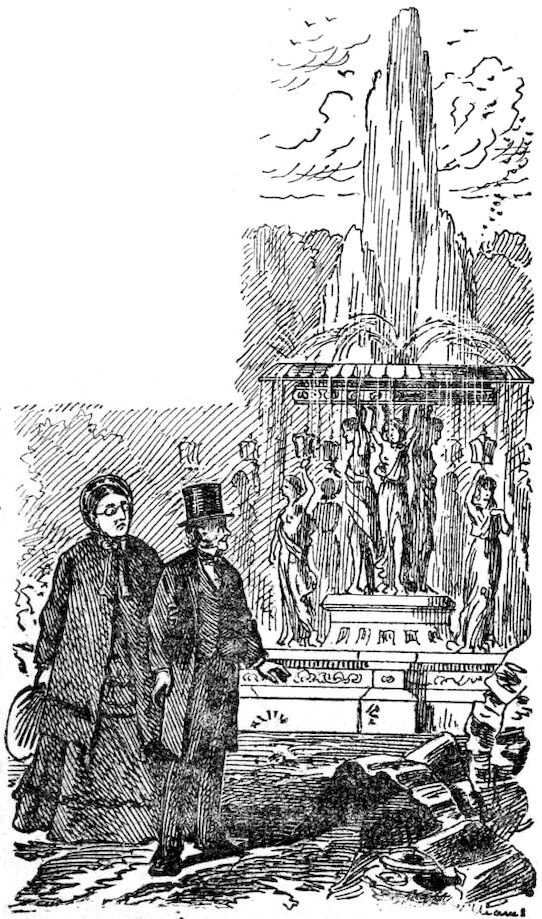
ADMIRIN’ THE BEAUTIFUL WATER.
AMONG THE WILD BEASTS
But as I have remarked once before (I believe,) I
haint a jealous hair in my head,
but I can’t deny that I was
dumbfoundered now. I took
him firmly by the arm; says I:
“What are you a lookin’ at,
Josiah Allen?”
He was awful surprised; but
it’s wonderful how the male sect
will turn off anything.
Says he:
“I was a admirin’
the water,
Samantha, how
beautiful it biles
up and then falls
down into the
platter.” And
he turned round
to the fountain.
Says I, “Josiah Allen, are these the wild beasts,
is this the bear pit you wanted to see?” And I added
in dry tones: “You had better hereafter remain near
your pardner.” And I led him away. We sauntered
along for some time, but Josiah was dretful uneasy.
I never see him so restless; and anon, says he: “I
feel to-day, somehow, Samantha, jest like meanderin.”
540I see it was no use to restrain him, and says I:
“Well, you can keep right on a meanderin’, but I
can’t meander another step.” Says I—wipin’ my
heated forward on my white cotton handkerchief—“I
have meandered too much now for my own good,
and I must go to some quiet spot, where I can rest
both my limbs and the eyes of my spectacles, for they
are both fearfully weary. I must have a little quiet,
Josiah Allen.”
Says he, “How will you git holt of any quiet here,
Samantha?”
Says I, “I have heerd it is to be obtained down in
the raven between this Hall and the Artemus Gallery;”
so he said he would meet me there in a couple
of hours, and started off. The raven (probable so
called from ravens bein’ found there in the past) is
perfectly delightful. A brook goes laughin’ through
it; there is beautiful shady walks and bridges, easy
benches are to be found under the great noble forest
trees, and there is green grass, and ferns, and daisies,
and a spring with a tin-dipper. It is a lovely place,
and I sot down feelin’ first-rate. Nobody’s arms, not
even the most trained nurses, can rest a tired baby so
well as its mother’s; nobody can rest the weary, and
fatigued out like Nater. I hadn’t been there more’n
2 minutes before I begun to feel rested off, and as it
is my way to do, I begun to think deeply and allegore
to myself. Thinks’es I, here I be in Pennsylvany;
and then I went to thinkin’ of Penn,—thought what
541a noble, good man he was; thinks’es I, no wonder the
Pennsylvanyans have prospered; no wonder the Sentinal
stands firm, for they all stand on ground honestly
bought from their true owners, by that noble
Penn, and paid for.
THE INDIAN QUESTION
And then I thought a sight about Penn; how firm
his scalp always stood, how peaceful his frontiers was,
and I wondered if there would be so much Injun
difficulty if the spirit of honesty, justice, and truth,
that he showed to the Injuns, could be showed to ’em
now. Anyway, as I sot there, I wished eloquently
to myself, that when he ascended to the Heavens prepared
for just men, his mantilly could have fell onto
the men who make our laws, and could be wore now
in Washington by them, and laid gracefully accrost
the Injun Buro.
I was just a thinkin’ this to myself when I see a
dretful pleasant lookin’ lady come and set down on a
bench only a little ways from me. She had such a
good look onto her that I says to a man who happened
to be a goin’ by where I sot, “Can you tell me who
that lady is?” “Mrs. Ulysses Grant,” says he. “Not
she that was Julia Dent?” says I. “Yes,” says he.
I walked right up to her and says I—holdin’ out my
hand in a warm and affectionate manner:
“How do you do, Julia? I am highly tickled to
see you; how does the baby do—and how does Mr.
Dent’ses folks do? Are they all so as to be about?”
says I, “I am Josiah Allen’s wife.”
542“Oh!” says she, “I have heerd my husband speak
of you.” And she shook hands with me, and made
room on the bench for me to set down by her.
“Yes,” says I, “I rescued him when he called for
peace and couldn’t find it; I had the honor of savin’
him from pain and Betsey Bobbet.” I thought I
would explain it to her, though she didn’t act jealous
a mite. But it is always best to explain to wimmen
jest what business you and her pardner have been
talkin’ about.’ It may save some bad feelin’ towards
you, and some curtain lectures for him.
Says I, “I had a talk with your husband in the
cause of Right, and advised the Nation promiscously
through him. But there was several other things I
wanted to say, but I see he was gittin’ hungry, and
so, of course, fractious and worrysome, and I stopped
in a minute, for I well know there is a time to advise
men, and a time to refrain from it.” Says I, “Wimmen
who have had a man to deal with for any length
of time, learn to take advantage of times and seasons.”
I see by her looks she didn’t want no tutorin’ on
that subject—she haint nobody’s fool. Says she,
“What did you want to speak to my husband about?”
Says I, “I wanted to talk to him more about the
Injuns.”
Says she, “My husband has honestly tried to do
the best he could with ’em.”
Says I, “I believe it Julia; I believe it from nearly
the bottom of my heart.”
543Says she, “They are a low, dirty, degraded race.”
Says I, “It haint reasonable to expect to git high-toned
virtues and principles from ignorance and superstition.
Think of minds narrowed down to one thought,
by a total lack of culture and objects of interest;
think of their constant broodin’ over the centuries of
wrongs they think they have endured from the white
race; and what wonder is it that this spirit flames out
occasionally in deeds that make the world shudder.
And then, people will shet their eyes to the causes
that led to it, and lift up their hands in horrer, and
cry out for extermination.”
Says Julia, “It is Destiny; it is the wave of civilization
and progress that is movin’ on from the East
to the West. The great resistless wave whose rush
and might nothin’ can withstand. Rushin’ grandly
onward, sweepin’ down all obstacles in its path.”
Says I, “Julia, that is a sublime idee of yourn,
very sublime, and dretful comfortin’ to the waves;
but let me ask you in a friendly way, haint it a little
tough on the obstacles?”
She said that it was, though she hadn’t never looked
at it so much in that light before.
“Yes,” says I, “I know jest how it is; you have
looked at the idee with the eye of a wave. But that
wont do, Julia; when we look at an idee we must
look at it from more than one side; we must look at
it with several pair of eyes in order to git the right
light onto it;” says I, “I don’t blame you for lookin’
544at it with the eye of a wave—a noble, sublime eye,
full of power, and might, and glory, calm and stiddy
as eternity. And then to be fair, we ort to look at
it with the eye of a obstacle, pleadin’, and frightened,
and melancholly, with a prophecy of comin’ doom.
And when we s’posen the case, it wont do for us to
s’posen ourselves waves all the hull time, we must, in
order to be just, s’posen ourselves obstacles part of
the time. And s’posen you was a obstacle, Julia,
and your Ulysses was one, and s’posen I was one, and
my Josiah was another one; this wouldn’t hinder us
from bein’ faint when we hadn’t nothin’ to eat; and
our legs from achin’ when we had been drove clear
from the Atlantic to the Pacific; and our hearts from
greivin’ when we was forced from our homes to let our
enemies live there; and our eyes from rainin’ floods
of tears when they see our loved ones fallin’ by our
side for defendin’ our homes from what we look upon
as a invader. It wouldn’t hinder our hearts from
breakin’ when we was drove off and denied the right
even to weep over the graves where our hopes was a
lyin’ buried up with our beloved obstacles.”
Julia was almost in tears, but she reminded me
that they only used the land for low, triflin’ pursuits;
such as huntin’ and other worthless amusements; that
we put it to better use.
Says I, “Julia, I haint a denyin’ of it, I haint said,
and I haint a goin’ to say that it wasn’t necessary to
plough up and smooth out their graveyards to make
545race courses and base ball and crokay grounds for
our nobler race; I haint denied it; I was only remindin’
you, that it seemed to be uncommon tough on ’em;
that is all. I think on ’em a sight;” says I, “how
they used to own the hull of this continent; a friendly,
peaceable set Columbus said they was; would have
done anything for him, knelt right down and worshipped
him, they was so glad to see him. It seems
sort o’ pitiful to me, to think they looked with such
reverent admirin’ eyes on the comin’ race that was
to destroy ’em; knelt down and kissed the white
hands that was to strike ’em such fearful blows;
thought they come right down from heaven; and how
soon they didn’t think so—how soon they thought
they come from a different place. I s’pose they was
a simple, well meanin’, childlike lot, livin’ so near to
Nater, that they got nearer to her heart than we can
ever think of gittin’. And the mountains and waters
cling to their names yet; it seems as if they don’t
forget ’em; the Alleghany’s seem to be a liftin’ up
their heads a lookin’ for the Alleghanies and wonderin’
what has become of ’em. The Deleware seems to
be a rushin’ along clear to the sea, a huntin’ for the
Delewares; and Huron and Erie git fairly mad, and
storm and rage a hollerin’ for the Hurons and Eries;
and old Ontario, I never see her but what she seems
to be a murmurin’ and whisperin’ sunthin’ about the
Ontarios; her blue waters have a sort of a mournful
sound to me; a nevermore sounds in the wave as it
546swashes up on the beach, as if it was a cryin’ out to
me, askin’ me what we have done with ’em. Her
great breast seems to be a heavin’ up and sithin’ for
the fate of them whose canoes used to float on her
bosom—them light canoes that have floated off further
and further, till pretty soon the last one will
float off into that ocian whose further shore we haint
never seen.”
Says Julia, “I will speak to my husband on the
subject at once.”
Says I, “So do; and choose the time when he is
cleverer than common, jest as I would deal with my
Josiah.”
Then I told her, that I would be glad to stay right
by her all the afternoon, I felt such a friendship
for her but, says I, “you know Julia that even
respect and admiration, when they come in conflict
with love, have to stand back; and my companion I
know is almost famishin’ with hunger, and I have
got the key to the satchel bag containin’ our lunch;”
and says I, “you know what ravages hunger makes
in a man.” She said she knew it well and that I was
perfectly excusable. And I bid her good-bye and
started on towards the place where I promised to
meet my Josiah. I found him a watchin’ the satchel
bag, with a gloomy and fractious face, but after he
eat, he looked well and happy again. His plan for
the afternoon was to see all the live stock on the
ground, all the iron work, the mineral annex, the
547warlike preparations of the different nations, their
ships and farmin’ tools, the dairy, brewery, the
model of Paris, the newspaper offices, the lighthouses,
cheese factory, wagon shops, wind mills and
the different tarverns, and he sot right out.
548
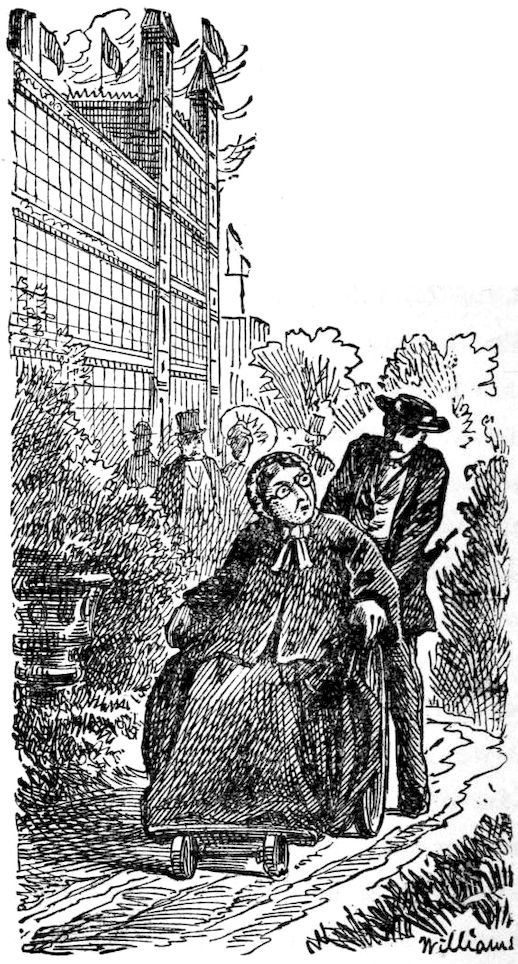
MY SUCCESS AS P. A. AND P. I.
The statement of his plan—added to my meanderins
and outlay of eloquence—had wearied me nearly out,
but I knew well where to go and git rested. I knew
what could take me right up—though my heft was
great—and waft me off into a land where weariness
was never admitted through its gate, where pain and
tiredness and care never climbed over its fence. I
didn’t know whether to go and be lifted up to this
beautiful realm by the music in the glen, or the
piano and organ concert in the Main Buildin’; but
finally I chose the latter. And seatin’ my body on a
seat I peacefully left this weary world, and for about
a half or three quarters of an hour I was a triumphant
and blessed citizen of that other world which is so
near to ours that we can be transported to it in half a
moment, and so fur off that no one can ever find the
path a leadin’ to it, or tell how it is bounded, or how
big it is, or who made it, or why it was made, or anything.
But that it is a land of entrancin’ beauty and
delight, that we all know; and I don’t know but I
should have lingered in it all day, if a rollin’ chair
containin’ a woman hadn’t rolled right onto me as I
sot on the end of the seat; and bein’ rousted up and
brought down to the world again, thinks’es I, I will
take a short roll round the buildin’ myself. So I
beconed to a young feller whose chair a lady had jest
got out of, and took her place; but the move wasn’t
a happyfyin’ one to me; I got
to thinkin’; thinks’es I who
knows where he’ll roll me off
to—no knowin’ but what all of
a sudden he’ll take a start and
run with me clear out of sight.
I put in a appearance
of
calm, and I
thought I’d try
to stand it a
little longer,
for I knew he’d
think strange
my gittin’ out
so soon. But I
couldn’t seem
to sense a thing
I see; I kep’ a
thinkin’ of Josiah
and the
peril he was in
mebby; I turned round and looked at the chap, and I
mistrusted he looked sort o’ wild out of his eye; and
I told him in agitated axents that if he was willin’, I’d
pay him for the hull hour I bargained for, and git out
549on the spot. He seemed willin’, and I descended
down out of the chair—and was glad of the chance.
Then I went and sot down on a bench by the noble
fountain of Moses and Temperance, and I was episodin’
to myself what a hard time Mr. Moses did have
in the wilderness, and how he made water flow out of
a rock. And I wondered dreamily if he was here
now if he wouldn’t have to give a harder knock
ag’inst rocky hearts and the rocks of selfishness and
custom, before he made water flow instead of likker;
when first I knew, Josiah come and sot right down
by me, and says he: “You know I told you this
mornin’ Samantha, about the ‘Creation Searchers’ all
wanderin’ off last night a searchin’ round and gittin’
lost again, and how Shakespeare Bobbet estimated
that they had travelled in the neighborhood of one
hundred and forty miles, and that he thought his
father and old Dagget would be bed rid for life;
and how that Shakespeare had shipped ’em home
this mornin’ by car load—he goin’ along to lift ’em
round, and keep ’em together—all but Solomon
Cypher, Cornelius Cork, and the Editor of the Auger.”
“Yes,” says I, “you told me of it, but what of it?”
“Well,” says he, “the three ‘Creation Searchers’ that
was left are in jail.”
“In jail, Josiah Allen?”
“Yes, in jail for playin’ horse and disturbin’ the
peace. Sam Snyder has jest told me the particulars.
They got to thinkin’ I s’pose, how many scrapes they
550had got into sense they was here as a body; how
much money they had lost, and how much fun had
been made of ’em; and they seemed to lose every
mite of dignity, and every spec of decency they had
got about ’em, and they all got drunk as fools—”
THE SENTINAL PROMISCOUS
Says I warmly, “I told the Nation jest how it
would be, and I told you Josiah, but you wouldn’t
believe me, neither on you, and now there is Solomon
Cypher drunk as a fool; mebby you’ll hear to me
another time, Josiah Allen.”
Says Josiah with a gloomy look, “I don’t see what
you want to lay it all to me for; their sellin’ likker
here to the Sentimental wasn’t my doin’s.”
“Well, you sort o’ upholded the Nation in it; did
they catch ’em here to the Sentinal, Josiah?”
“No, they got their likker here, and then they
went down into the village a cuttin’ up and actin’
every step of the way; and when they catched ’em
they was playin’ horse right in front of the meetin’
house. Cornelius and the Editor was horses and old
Cypher they say had got holt of their galluses a
drivin’ ’em double; and he was a yellin’ and cluckin’
to ’em to git up, and they was a prancin’ and a snortin’,
and the Editor of the Auger was pretendin’ to be
balky, and was a kickin’ up and a whinnerin’; the
likker had made three perfect fools of ’em. And
what gauls me,” says he with a deprested look, “is,
that a relation of ourn by marriage should be in the
scrape; it will make such talk; and we mixed up in it.”
THE “CREATION SEARCHERS” IN JAIL
551Says I calmly but firmly, “He must have a bail
put onto him.”
“I won’t put it on,” says he—and he added in a loud
mad tone—“he won’t git no
bails put onto him by me, not
a darned bail.”
“Well,” says I, “if you
haint no pity by you, you can
probable stop swearin’ if you
set out to. They are relations
on your side Josiah Allen.”
“Throw the Widder in my face again will you!”
says he, “if she was fool enough to marry him, she
may take care of him for all of me, and if she wants
any bails put onto him, she may put ’em on herself.”
552Says I lookin’ my pardner calmly in the eye. “Ort
from ort leaves how many Josiah Allen?”
“Ort,” says he, and snapped out, “what of it?
What do you go a prancin’ off into Rithmatic for, such
a time as this?”
Says I mildly, for principle held my temper by the
reins, a leadin’ me along in the harness first-rate,
“When you reckon up a row of orts and git ’em to
amount to anything, or git anything from ’em to
carry, then you can set the bride to doin’ sunthin’
and expect to have it done;” says I, “won’t Sam Snyder
succor him?”
“No he won’t; he says he won’t and there haint
a Jonesvillian that will; you won’t catch ’em at it.”
“Well,” says I firmly, with a mean that must have
looked considerable like a certain persons at Smithfield
when he was bein’ set fire to; “if you nor
nobody else won’t go and help put a bail onto Solomon
Cypher, I shall.”
And then Josiah hollered up and asked me if I was
a dumb fool, and twitted me how hauty and overbearin’
Solomon had been to wimmen, how he had
looked down on me and acted.
But says I calmly, “Josiah Allen, you have lived
with me month after month, and year after year, and
you don’t seem to realize the size and heft of the
principles I am a carryin’ round with me, no more
than if you never see me a performin’ with ’em on a
tower. Rememberance of injuries, ridicule, nor Josiah
553can’t put up no bars accrost the path of Right high
enough to stop Samantha. She is determined and
firm; she will be merciful and heap coals of fire on
the head of the guilty Cypher, for the sake of duty,
and that weepin’ ort.”
And then Josiah pretended not to understand my
poetic and figgerative speech, and said that—Solomon
bein’ so bald—I’d have a chance to give him a good
singein’ and he hoped I’d blister his old skull good.
And I walked off with dignity, and wouldn’t demean
myself by sayin’ another word. He had told
me where the bride was, and I started off; and
though memory (as well as Josiah) hunched me up to
remember how hauty the “Creation Searchers” had
all been as a body, and how rampant they had been
that a woman shouldn’t infringe on ’em, or come in
contract with ’em, still the thought that they was
moulderin’ in jail made me feel for them and their
weepin’ brides.
The female elements in politics would be, as you
may say, justice tempered down with mercy; justice
kep’ a sayin’ to me, “Solomon Cypher is in jail and he
ort to be, for truly he played horse and disturbed the
peace;” but mercy whispered to me in the other ear:
“If he is humbled down and willin’ to do better, give
him a chance.”
Punishment if it means anything means jest that;
it hadn’t ort to be malicious enjoyment to the punishers;
it ort to be for the reformin’ of the criminals, and
554makin’ of ’em better. And that is why I never could
believe that chokin’ folks to death was the way to
reform ’em, and make better citizens of ’em.
I found the bride a settin’ like a statute of grief on
a bench, a groanin’ and weepin’ and callin’ wildly on
Doodle, and sayin’ if he was alive she wouldn’t be
in that perdickerment—which I couldn’t deny, and
didn’t try to. But I told her firmly that this was no
time to indulge in her feelins, or call on Doodle, and
if she wanted a bail put onto Solomon Cypher, we
must hasten to his dungeon.
So we hurried onwards, and right in the path we
met Gen. Hawley; and even then, in that curious
time, I thought I never did see a handsomer, well
meaniner face than hisen. And now it looked better
than ever for it had pity onto it, which will make
even humblyness look well. That man respects me
deeply; he see the mission I was a performin’ on, and
the hefty principles I was a carryin’ round with me
on a tower, and now as he looked at my agitated face
and then at the weepin’ bride, he stopped and says
in that honest good way of hisen, and with that dretful
clever look to his eyes:
“Josiah Allen’s wife, you are in trouble; can I help
you in any way?”
“No,” says I, “not now you can’t.” I put a
awful meanin’ axent onto that ‘now,’ and says he:
“Do I understand you to say Madam that at some
future time I can? You know you can command me.”
555(A better dispositioned, accommodatiner, well meaniner
man, never walked afoot; I knew that from the
first on’t.) But duty and justice hunched me up,
one on each side, and says I sadly, “My advice wasn’t
took, the Sentinal was licenced, and Solomon Cypher
is drunk as a fool.”
He felt bad; he sithed, to think after all I had said
and done about it, the Sentinal was licenced, and some
of my folks had got drunk. It mortified him dretfully
I know, but I wouldn’t say anything to make
him feel any worse, and I only says, says I:
“The Nation wouldn’t take my advice, and you
see if it don’t sup sorrow for it; you see if it don’t
see worse effects from it than Solomon Cypher’s gittin’
drunk and playin’ horse. And if you see me to
the next Sentinal, Joseph, you jest tell me if I haint
in the right on’t.”
But I hadn’t no time to multiply any more words
with him, for the bride groaned out agonizinly, and
called on Doodle and his linement in such a heartbreakin’
way, they was enough to draw tears from
a soap stun.
But I will pass over my sufferins of mind, body
and ears, only sayin’ that they was truly tegus, till at
last we stood before the recumbard form of Solomon
Cypher a layin’ stretched out on the floor in as uncomfortable
a position as I ever sot my eyes on; he
looked almost exactly like a sick swine that Josiah
had in the spring. But I hope to goodness the swine
556won’t never hear I said so, if it should, I should be
ashamed and apologize to it, for that got sick on
sweet whey, which is a far nobler sickness than likker
sickness. And then the Lord had made that a brute
by nater, and it hadn’t gone to work and made itself
so as Solomon had.
But oh! how the bride did weep and cry as she
looked down on him, and how heartrendin’ she did
call on Doodle, sayin’ if he had lived she wouldn’t
have been in that perdickerment; it was a strange
time,—curious.
And we left him after leavin’ some money to have
him let out jest as quick as he could walk. I didn’t
try to do anything for Cornelius Cork or the Editor
of the Auger’ses case. I was completely tuckered
out; and in the mornin’ I was so lame that I couldn’t
hardly stand on my feet. My back was in a awful
state; it wasn’t so much a pain as I told Josiah, but
there seemed to be a creek a runnin’ down through
my back, as curious a feelin’ as I ever felt; and though
we hadn’t seen half or a fourth of what we wanted to
see, I told Josiah that we must start for home that
day; had it not been for the creek runnin’ down my
back we should have staid two days longer at least.
Josiah rubbed my back with linement before we
started, almost tenderly; but right when he was rubbin’
in the linement the most nobby he says to me:
“This creek wouldn’t never have been Samantha, if
you hadn’t helped put a bail onto anybody.”
THE END OF OUR TOWER
557Says I, “When anybody is preformin’ about a
mission like mine, on a tower, and gits hurt; their
noble honor, their happy conscience holds ’em up
even if their own pardner tries to run ’em down.”
Says I, “Mebby it is all for the best, our goin’
home this mornin’, for that hen is liable to come off
now any minute, and I ort to be there.”
He said he had been ready for a week, which
indeed he had, for truly the price he had to pay for
our two boards was enormous; I never see nor heerd
of such costly boards before. So we started about
half-past eight o’clock, calculatin’ to git home the
second day, for we was goin’ home the shortest way,
stayin’ one night to a tarvern.
And the next night about sundown my Josiah and
me arrove home from the Sentinal, and it seemed
as if old Nater had been a lottin’ on our comin’ and
fixed up for us and made a fuss, everything looked so
uncommon beautiful and pleasant. There had been
a little shower that afternoon, and the grass in the
door yard looked green and fresh as anything. The
sweet clover in the meadow made the air smell good
enough to eat if you could have got holt of it; our
bees was a comin’ home loaded down with honey, and
the robins in the maples and the trees over in the
orchard sang jest as if they had been practicin’ a piece
a purpose to meet us with, it was perfectly beautiful.
And the posy beds and the mornin’ glories at the
winders and the front porch, and the curtains at our
558bed-room winder, and the door step, and everything,
looked so good to me that I turned and says to my
pardner with a happy look:
“Home is the best place on earth, haint it Josiah
Allen?” says I, “towers are pleasant to go off on,
but they are tuckerin, especially high towers of principle
such as I have been off a performin’ on.”
But Josiah looked fractious and worrysome, and
says he:
“What I want to know is, what we are goin’ to
have for supper; there haint no bread nor nothin’,
and I’d as lives eat bass-wood chips and shingles as
to eat Betsey Slimpsey’s cookin’.”
But I says in tender tones, for I knew I could
soothe him down instantly:
“How long will it take your pardner, Josiah Allen,
to make a mess of cream biscuit, and broil some of
that nice steak we jest got to Jonesville, and mash up
some potatoes? And you know,” says I in the same
gentle axents, “there is good butter and cheese and
honey and canned peaches and everything right in
the suller.”
All the while I was speakin’, my Josiah’s face begun
to look happier and happier, and more peaceful
and resigned, and as I finished, and he got down to help
me out, he looked me radiantly and affectionately in
the face, and says he:
“It is jest as you say, Samantha; there’s no place
like home.”
HOME AFFAIRS
559Says I, “I knew you would feel jest so; home when
it is the home of the heart as well as the body, is
almost a heaven below. And,” I added in the same
tones, or pretty nigh the same, “mebby you had better
git me a little kindlin’ wood Josiah, before you
unharness.”
He complied with my request and in about an hour’s
time we sot down to a supper good enough for a
king, and Josiah said it was. He acted happy, very,
and exceedinly clever; he had found everything
right to the barn, and I also to the house, and we felt
well. And though we had held firm, and wouldn’t
have took no rash means to git rid of our trouble, it
did seem such a blessed relief to be at rest from
David Doodle; it seemed so unutterably sweet not to
have his linement throwed in our faces every moment.
Thomas J. wasn’t comin’ home till Saturday. We
see him and Tirzah Ann as we come through Jonesville,
and they said the last of the ‘Creation Searchers’
had got home, but their conduct had leaked out
through the bride and the Editor of the Auger’ses
wife, and they dassant go out in the street, any one of
’em, they had so much fun poked at ’em. Betsey come
in at night; she had been to Miss Daggets to work,
and she had a flour sack with some beans, and other
provisions.
Says I in pityin’ axents, “How do you do, Betsey?”
Well she said she enjoyed real poor health; she had
got the shingles the worst kind, and a swelled neck,
560and the newraligy, and the ganders, and says she,
“Havin’ to support a big family in this condition
makes it hard for me.”
“Don’t your husband help you any, Betsey?”
says I.
“Oh!” says she, “he is down with the horrers the
hull time,” says she, “my work days haint half so
bad as the hard times I have nights,” she said she
didn’t git no sleep at all hardly.
Says I, “Haint you most sorry Betsey that you
ever tried to git married?”
She felt so bad and was so discouraged and down-hearted
that she come out the plainest I ever see her,
and says she:
“Josiah Allen’s wife, I’ll tell you the truth! If it
wasn’t for the name of bein’ married, and the dignity
I got by bein’ in that state, I should be sorry as I
could be; but,” says she as she lifted her flour sack of
provisions onto her tired shoulders previous to startin’
home, “I wouldn’t part with the dignity I got
by bein’ married, not for a ten cent bill, as bad as I
want money, and as much as I need it.”
561
THE REUNION.
The mornin’ of the fourteenth of September dawned
fair and peacefully. The sun rose up considerable
early in the mornin’, and looked down with a
calm and serene face upon Jonesville and the earth.
And not fur from the same time, I too, rose up and
with as calm and serene a face as hisen, I went to
work and got a excellent breakfast for my Josiah and
me. It was the day we had looked forred to for a
year. The deed that was to give our Tirzah Ann and
her pardner a handsome home lay in security in the
depths of my Josiah’s vest pocket, and in the buttery
was a big basket full of as good vittles as was ever
baked by woman—enough to last ’em a week. The new
carpets and housen stuff had been privately carried
into the house, unbeknown to them; and that very
afternoon was the time we was a goin’ to make ’em
almost perfectly happy. Oh! how serene and noble
I felt as I poured out my dish-water and washed my
breakfast dishes.
562And as I washed and wiped I thought of the childern;
thought how well Thomas J. was a doin’, and
how Tirzah Ann and Whitfield had been prospered
ever sense they took their bridal tower. I s’pose they
had a dretful hard time then; I s’pose they suffered as
much agony on that bridal tower, as any two bridals
ever suffered in the same length of time. Tirzah
Ann haint got over that tower to this day, and Whitfield
looks mad every time he hears the word mentioned.
They have both told me sense (in strict confidence)
at two separate times, that if they was a goin’
to be married twenty-five times a piece, they had gone
off on their last tower.
You see the way on’t was, Tirzah Ann—not bein’
used to travellin’—got lost. Whitfield left her a
minute on the platform to go back after her parasol,
and she heerd ’em say “All aboard,” and she thought
she must git on that minute or die. He, seein’ she
was gone, thought she had went back after him, and
he went searchin’ after her. The train went on; he
took the next train up, and she the next train down,
and they passed each other; and then she took the
next train up, and he the next train down, and they
missed each other again. And so they kep’ it up all
the first day and night. Finally, the next mornin’ the
conductor—bein’ a old gentleman, and good hearted—telegraphed
to Whitfield that he would be to the upper
depot at 10 o’clock, and told him to come on instantly
and claim his property and pay charges, or it would
563spile on his hands. I s’pose she did take on awfully,
not bein’ used to trouble; she fainted dead away
when Whitfield come on and claimed her and paid
charges; and the old gentleman bein’ crazy with
trouble deluged a mop-pail full of water onto her, and
spilte every rag of her clothes, bunnet and all. Thirty
dollars wouldn’t have made her whole; I s’pose she
looked like a banty hen after a rain storm.
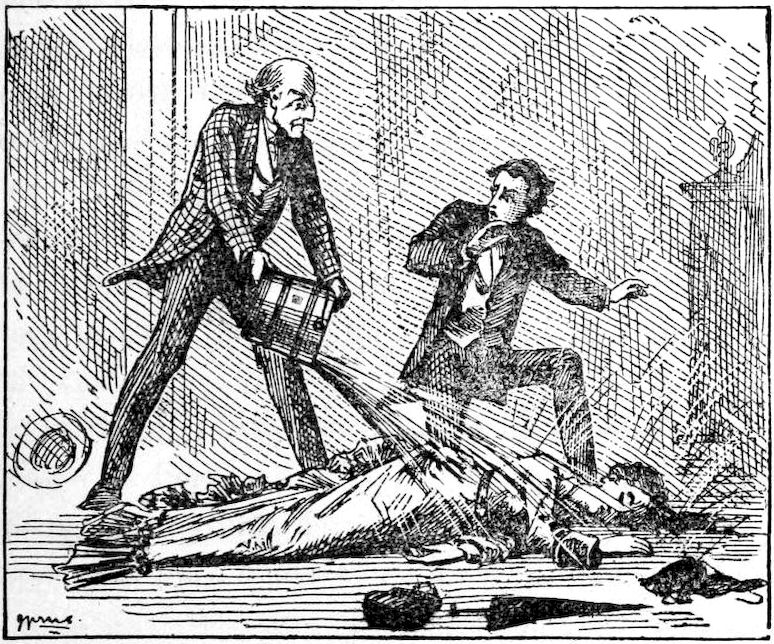
A BRIDAL TOWER
When they got to Whitfield’s cousins—where they
expected to stay—they was away from home. Then
they went to a second cousins; they was havin’ a funeral.
Then they went to a third cousins, and they had
the tyfus. Then they went to the only tarvern in the
place; they was all right there, only the whoopin’
564cough; and they never havin’ had it, took it, and come
down in nine days—coughed and whooped awful.
They laid out to stay a fortnite on their tower,
and they did; but they have both told me sense (in
confidence, and I wouldn’t want it told of from me,)
that their sufferins durin’ that time, can be imagined,
but never described upon. The first cousin come
home and sent for ’em, but she was of a jealous make,
and kinder hinted that Tirzah Ann run away from
Whitfield a purpose—didn’t come right out and say
it, but kep’ a hintin’—made them feel as uncomfortable
as if they was raked up on a coal. And then
she would look at Tirzah Ann’s clothes that was spilte—when
she fainted away, and was fetched to by
water—and kinder hint that she had fell into some
creek. I s’pose she kep’ Tirzah Ann on the tenderhooks
the hull time, without sayin’ a word they could
resent or make her take back.
And then she and Whitfield was dressed up all the
time, and wanted to act natteral, and couldn’t—felt as
if they must behave beautiful, and polite every minute.
Why! I s’pose they got so sick of each other
that they wished, both on ’em, that they had lived
single, till they died of old age. And then on their
way back they both had the blind headache, every
step of the way, coughed their heads most off, and
whooped—Tirzah Ann told me—as if they was two
wild Injuns on a war path. Truly they had got
enough of weddin’ towers to last through a long life.
565Somehow Thomas Jefferson always felt different
about such things. I’ve heerd him and Tirzah Ann—before
she was married—argue about it, time and
again. He said he couldn’t for his life see why folks
felt as if they had got to go a caperin’ off somewhere,
the minute they was married—and to tell the plain
truth, I, myself, never could see the necessity, when
they both feel as strange as strange can be, to think
of goin’ off into a strange land to feel strange in.
It is curious enough and solemn enough to enter
into a new life, untried, crowded full of possibilities
for happiness or misery, if you face that future calmly
and with bodily ease. It is a new life, not to be entered
into highlariously, tired to death, and wild as
two lunys, at the rate of twenty miles an hour, amidst
the screechins of omnibus drivers and pop corn peddlers,
but with calmness, meditation, and prayer.
That is my idee; howsumever, everybody to their own.
And then another thing that made Tirzah Ann’s
tower so awful tryin’; she had wore herself down
almost to a skeleton and got irritable and nervous, a
makin’ tattin, and embroideries; for she felt she
couldn’t be married till she had got her nineteenth
suit all trimmed off to the extreme of the fashion.
Thomas J. and Maggy (they think alike on most
things) always felt different about that. I have heerd
Maggy say that she never could understand why it
was necessary for a girl to make up such a stupendus
amount of clothin’ to marry one man in—a man she
566had seen every day from her youth up. She said
that any civilized young woman who respected herself,
would have enough clothin’ by her all the time
to be comfortable and meet any other emergency of
life; and she couldn’t understand why her marryin’ to
a mild dispositioned young man, should render it imperative
to disable several dressmakers, make mothers
lunatics with fine sewin’, and work themselves down
to a complete skeleton, makin’ up as many garments
as if they was goin’ for life into a land where needles
was unknown, and side thimbles was no more.
And to tell the truth I joined with her; I always
thought that health and a good disposition would be
more useful, and go further than tattin in the cares
and emergencies of married life; and that girls
would do better to spend some of their time a makin’
weddin’ garments for their souls, gettin’ ready the
white robes of patience and gentleness, and long
sufferins. They’ll need them, every rag on ’em if
they are married any length of time. But everybody
has their ways, and Tirzah Ann had hers, and truly
she had the worst of it.
I finished washin’ my dishes, and then I brought
out my linen dress and cape, and my common bunnet,
so’s to have everything ready. Jest as I come out
with ’em on my arm, Thomas J. come in, and says he:
“Wear your best shawl and bunnet this afternoon,
won’t you mother?”
Says I, “Why, Thomas Jefferson?”
567Says he, “I didn’t know but you would want to
step into the Presbeteryun church this afternoon on
your way down to Tirzah Ann’s. There is a couple a
goin’ to be married there at two o’clock.”
“Who be they Thomas J.?” says I.
Says he, “It is a couple that don’t want to be gossiped
about; that think marriage is sunthin’ too
sacred and holy to be turned into a circus, with tinsel
and folderols, and a big crowd of strangers a gazin’
on—the woman dressed up for principal performer,
and the man for a clown. A couple that wants jest
them they love best—”
I dropped right down into a chair and put up my
gingham apron over my eyes and bust right out a
cryin’, and I couldn’t have helped it, if Josiah had
stood over me with a meat-axe. I knew who it was
that was goin’ to be married and most probable set
off for the west in the mornin’. Goin’ way off west;
my boy, my Thomas Jefferson.
He come up behind me and put his hand on my
shoulder and said in a kind of a tremblin’ voice—he
thinks a sight of me, my boy does; and then he knows
enough to know that a new life is a serious thing to
set out on, even if love goes with ’em—says he:
“I thought you loved Maggy, mother.”
Says I, out from under my apron, “You know I do,
Thomas Jefferson, and you ort to know your mother
well enough to know she is a cryin’ for pleasure, pure
enjoyment.” I wasn’t a goin’ to put no dampers onto
568my boy’s happiness that day, not if he sot off the next
minute for the Antipithes. He stood there for a
moment with his hand on my shoulder, and then he
bent down and kissed me, and that was every word
he said. Then he went up stairs to git ready.
It seems he had jest told his father to the barn, and
Josiah come in all broke down about his goin’ off
west. Maggy was my choice, and hisen, but the goin’
west was where the cast-iron entered into our very
souls. But when I see my companion’s mean, I see
where my duty lay, and I grasped holt of it. I knew
he was completely unstrung, and I had got to string
him up by my example, or he would crumple completely
down on my hands. I see if I kep’ my Josiah
collected together, I must keep my own composure
up, and be calm. But while holdin’ up Duty and
Josiah with a almost marble grip, what feelins I
felt when we was on our way to the meetin’ house.
What feelins I felt when I see Thomas J. and Maggy
standin’ up in front of the altar, and Elder Colvin
Kirk a marryin’ of ’em.
Maggy was dressed up in a white mull dress, with
some lace ruffles round her neck and wrists. Not a
mite of jewelry on her from head to foot, only a little
pearl cross and ring that Thomas J. had give her; the
ruffle round her neck was fastened in front with some
sweet white poseys,—and she looked as pretty as the
poseys herself, and prettier. Thomas Jefferson had on
his best suit of clothes, and oh! how good he did look
569to me. And to think he was a goin’ way off where
I couldn’t lay my eyes on him, or her either!
Why, if I had leggo for a half a moment of Duty and
Josiah, I should have groaned to that extent that it
would have skairt ’em nearly to death.
But I held firm, and in the stoop of the meetin’-house
I kissed ’em both and wished ’em well, with a
almost marble composure. And with the same cast-iron
command of myself, I got into the buggy and
sot out for Tirzah Ann’s; she, and Whitfield and—well,
it haint no matter who, but they, and Thomas
J. and Maggy follerin’, and Judge Snow (he has been
put in Judge and feels big about it they say) sayin’
he would join us at supper. He was in the secret of
the deed, and so was Thomas Jefferson and Maggy.
But as we started off, Josiah groaned to that extent
that he skairt the old mare, and I almost commanded
him to control himself and be calm. But though he
made a great effort, it was in vain; he groaned nearly
every step of the way, and when he wasn’t a groanin’
he was a sithin’ fearful sithes. Oh! what a time I had.
Well, when we got to Tirzah Ann’s, we (havin’ the
supper on our minds) told ’em we had a little business
to tend to, and we wouldn’t git out of the buggy jest
then, so we drove on and left ’em there by the gate.
Oh! how beautiful and fair the house did look on the
inside and on the outside, and I says to Josiah: “I
don’t believe Josiah Allen, there is another so pretty
a place in Jonesville as this is!”
A GOOD TIME GENERALLY
570He was a standin’ out in the front portico as I said
this, and says he: “Yes there is, Samantha; this house
that stands right here by it, is jest as pretty;” and it
was. There it stood, so peaceful and pretty, right by
the side of this one, with green shady yards in front,
and a handsome little lattice work gate all runnin’
over with green vines and poseys openin’ between the
two. Oh! how perfectly beautiful they did look, and I
knew this thought goared Josiah and me at the same
time,—what if Thomas J. could be the doctor here in
Jonesville and live right here by Tirzah Ann. Oh,
what bliss it would be! Then I turned and went to
unpackin’ my vittles, and settin’ the table. It looked
splendid; and after I got it all done I sent Josiah
for the childern and—well, I sent him for all on ’em.
And I shant begin to tell how Whitfield and Tirzah
Ann acted when they come into that bright cosy little
home, and Josiah put the deed of it into their hands;
I dassant tell, for anybody would think they was lunys.
I have seen tickled folks in my life, but never, never,
did I see tickleder, that I know. Why, Whitfield
looked fairly pale at first, and then his face flushed up
as happy as a king. And Tirzah Ann cried a little,
and then she laughed, and then she went to kissin’ of
us like a little fury; she kissed her pa and me, and
Whitfield and Thomas J. and Maggy, and—well, she
kissed the hull on us more’n forty times I do believe.
And seein’ ’em both so tickled, and feelin’ so happy
in their happiness, I do believe if it hadn’t been for
571the drawback of our boy’s goin’ west, Josiah and me
would have broke down, and acted simple.
Judge Snow come jest as we was a settin’ down to
the table. He seemed to be in awful good spirits,
kep’ a jokin’ all supper time, and thinks’es I to myself,
“You must feel different from what I do, if you
can face the idee of your child’s goin’ west with such
highlarity and mirth.” But truly, I wronged him;
truly a shock was in store for us all; for as we got up
from the supper table and went back into the settin’room,
he stood up and says he in a deep noble voice:
(they say his voice sounds a good deal nobler, and
deeper, sense he got to be a Judge,)
“Have you heerd that Doctor Bombus has had a
dowery fall to him, and has give up docterin’?”
“No!” says I, and we all said “no!” we hadn’t
heerd on’t.
“Yes,” says he, “he has; he doctered a woman up
in the town of Lyme and her husband settled 500
dollars a year on him for life.”
“He cured her,” says I, “what gratitude!”
“No,” says he, “he didn’t cure her, she died, but
the widower give him the dowery, and he is goin’ to
give up docterin’,”
The minute he said “give up docterin’,” the thought
come to me: what a chance for Thomas Jefferson!
mebby he wouldn’t have to go west; and I felt as if
there had been as many as seven flat-irons took offen
my heart, and two or three cannon balls, and some
572lead, and things. I looked at Josiah, and Josiah
looked at me, and we both smiled; we couldn’t help
it. But better was a comin’, for right while we was a
smilin’ the Judge spoke out again in a eloquent, sort
of a low tone:
“Whereas Josiah Allen and Samantha his wife,
has presented a deed of this house and lot to their
daughter and her husband aforesaid, I, the party of
the second part, I mean, I, Judge Snow, have purchased
of Dr. Bombus his practice, and got a deed of
the house and lot adjoinin’ this for you Maggy, and
you Thomas Jefferson, and may the Lord have mercy
on your souls.”
I s’pose bein’ so agitated, he forgot where he was
and thought he was a judgin’, and then he handed the
deed to Maggy, and blew his nose hard. As for me,
nobody need to ask me how any of ’em behaved, for
the minute I see what was a comin’, I almost buried
my face in my handkerchief, and sobbed and wept
like a infant babe. But through my wrapped blissfulness
of mood—for the ear of affection is keen—I could
hear my Josiah a blowin’ his nose, and I knew he too
was in perfect rapture. Oh! Oh! what a time it was.
573
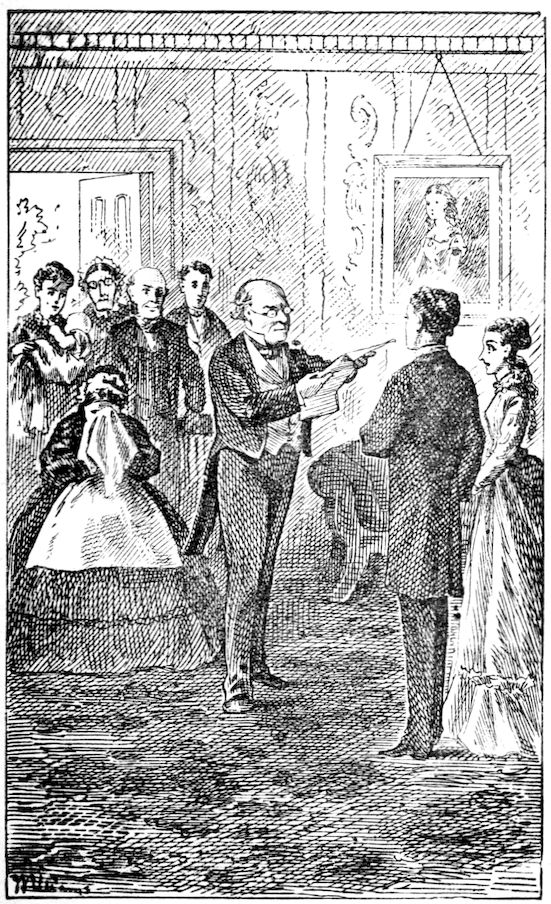
575But I hadn’t time to weep long in my pure blissfulness
of spirit, for Judge Snow proposed we should
all walk over and see the house, and he took right
holt of my arm and locked arms with me (he meant
well, Josiah was right there) and we led the way, and
Thomas Jefferson and Maggy a follerin’ as happy as
any two turtle doves I ever see, and then Whitfield
and Tirzah Ann, and then Josiah and—well, who do
you s’pose he was a waitin’ on. What female do you
s’pose he was a carryin’ in his arms, and wouldn’t let
no one else touch it if he could help it, and kissin’ her
right before his lawful pardner too, and she enjoyin’
of it? Who was it? I can’t keep in a minute longer;
it was the baby—Tirzah Ann’s little infant babe. I
have kep’ still about it; I have held the baby back to
surprise the reader and happyfy ’em. And so the
hull procession of us walked over the grass, green as
green velvet, under the pleasant shade trees, under the
little vine covered gate, and so through the other yard
jest as green and shady and pleasant, up into the house
which was to be my boy’s home.
Bimeby they all went over to Whitfield’s house, to
examine sunthin’ or measure sunthin’, for Judge
Snow was rampant now about furnishin’ the house
right off, so they could git to housekeepin’. And
Josiah and I and the baby went out and sot down
under a big maple out in the yard. And we sot there
happy as a king and queen, knowin’ them we loved
best was a goin’ to be right here where we could lay our
hands on ’em any time day or night. Come a visitin’
’em every day if we wanted to, spend the forenoon
with one, and the afternoon with the other or anyway
to make it agreeable. Oh what a happyfyin’ time it
was out there under the maple tree! The baby would
kinder nod its head towards their house, and laugh
576when Josiah would shake it up, jest as if she thought
their house was the prettiest. Such a knowledgeable
child! I never see the beat of it in my life.
THE BABY
We think, and we know—Josiah and me do—that
there never was such a child before. It is only eleven
weeks old but its intellect is sunthin’ wonderful to
study on. It understands everything that is goin’ on
jest as well as I do, and it does have such a cunnin’ look
to it, and so sensible. Its eyes are big, and a goin’ to
be a sort of grey brown; they have a unworldly, innocent
look, sort o’ deep and dreamy, jest as if it could
tell if it was a mind to, a awful sight about the world
it had come from so lately. Sometimes when there
is foolish talk a goin’ on round it, it will kinder curl
up its little lip and wink at me with its big solemn
eyes, till it fairly scares me to see such a little thing
know so much more than any grown folks.
And then it is so lady-like in its appearance; has
got such good manners, such composure, such almost
cool dignity; it is jest as much at its ease before a
minister as before a tin peddler, uses ’em both well,
but not put out by ’em a mite; cool, and collected
together all the time, jest like a little queen. And
it don’t seem to be a mite deceitful; it don’t try to
cover up its thoughts and idees, it is jest like lookin’
through these clay bodies of ourn and seein’ a soul,
to look at that babe.
I am one that loves reason and philosophy. I have
acted well about it; some grandmothers will act so
577foolish. I can’t bear to see foolishness in grandparents,
and Josiah can’t neither. Now when it was
half a day old, Sister Minkley thought it looked like
Whitfield; I, myself, thought it looked more like a
monkey. I didn’t say so, I wouldn’t for the world.
I looked at it jest as I do at a little hard green bud
that appears first on a rose bush; there haint no
beauty to speak of in it; it is hard lookin’ and it is
green lookin,’ and curious. But you set a awful
sight of store by that little hard lookin’ thing, for you
know the possibilities of handsomeness that are folded
up in it,—the dainty rosiness, the freshness, the sweetness.
And so with the baby; when I thought of the
possibilities of beauty wrapped up in it—the smiles,
the pinky dimpled cheeks, the curly gold hair, the innocent
baby laugh, the pretty broken talk, the angelical
purity, and the confidin’ confidence—why, when
I thought of all this, there wasn’t a dry eye in my
head, and my heart sung for joy (though it don’t
understand a single note).
When the baby was four days old, Josiah thought
it knew him; when it was a week old he thought it
was a tryin’ to talk to him, and said it laughed jest as
quick as he went near the cradle.
Says I, “Josiah Allen, it is wind!”
“Wind!” he hollered, “mebby you think it is wind
that makes you know me, and set considerable store
by me.” He almost took my head off, and I see by
his mean that it wouldn’t do to say any more.
578But when it was two weeks old, I think, myself,
that the baby knew us—Josiah and me; it looked up
to us somehow different from what it did to its Grandpa
and Grandma Minkley, though it used them well.
We are there to see the baby almost every day and
we take a sight of comfort with it, for we see and
realize jest what a child it is, and bein’ foundered on
firm reason and solid truth, we are not afraid to express
our opinions to anybody freely, without money
and without price. But as I remarked more formally,
we don’t act foolish about it at all.
“Its name is Samantha Jo, after me, and Josiah.
You know they call girls Jo and Josie a sight lately;
its name is agreeable to Josiah and me, very. Josiah
is goin’ to give it a cow for the Samantha, and I am
goin’ to give it a set of silver spoons for the Jo. If
it had been a boy, we was a layin’ out to call it Josiah
Sam,—Sam for Samantha.”
There is a dark veil that drops down between us
and future events; you can’t lift up that curtain,
or tear it offen its hooks, for it is as high up as
Eternity, and solid down to the ground, as solid can
be. You can’t peek round it, or tear a hole in it;
tea-grounds haint a goin’ to help you; planchettes
and cards can’t hist it up a mite; you have got to set
down before the curtain that hides the future from
you, and wait patiently till it is rolled up by the
hand that put it there; but I am a episodin.’
579
ALL HAPPY
And so we sot there under the maples—Josiah and
me and the baby. And once in a while, a maple leaf
would come a flutterin’ down like a great crimson
posey, and the baby would laugh and stretch out its
little dimpled hands and try to catch it, and the sunshine
would throw golden rings on her little white
gown and hands and arms, and she would try to lay
holt of ’em and couldn’t, jest as natteral as if she was
bigger. And then the baby would laugh, and Josiah
would laugh, and the old maple tree as the settin’ sun
shone through it seemed to be all lit up with the general
enjoyment. That old maple tree acted sensible,
and I knew it. What if her leaves was a flutterin’
down gradual; what if the fall of the year was a
comin’ on? She didn’t mourn over it no more than
580I mourned as I sot there, over all the days and years,
the delights and the sorrows, that had slipped away
from me somehow, and floated off out of my life
unbeknown to me.
She knew—that old maple did—that it was only for
a time. That another summer was a comin’, when
God would give back to her all she had lost, and
more. Knowin’ that the very loss of what she had
loved and cherished most, that even what some foolish
ones called decay and death, would be changed by
His divine hand into deeper growth, diviner beauty.
Oh, how chirk and happy my companion did look
in his face; and oh, how sort o’ lifted up, and yet
dretful serene and happyfied I felt in the inside of my
mind. It was a beautiful time, very.
And never did I see my pardner wear a more contented
and happy look on his face when he sot down
to a extra good dinner, than he did as he says to me,—after
lookin’ at the baby in perfect silence from a
half to three-quarters of a minute:
“Heaven bless every little girl and boy in the land,
for the sake of little Samantha Jo!”
And I felt so handsome and uncommon happy in
my mind, and so wrapped up in Josiah, that I spoke
right up and says:
“Yes, and all the old boys and girls too; amen!”
- Silently corrected typographical errors and variations in spelling.
- Archaic, non-standard, and uncertain spellings retained as printed.
- Added sidenotes for the items in the “WHAT I HAVE WRIT ABOUT” contents without
headings.