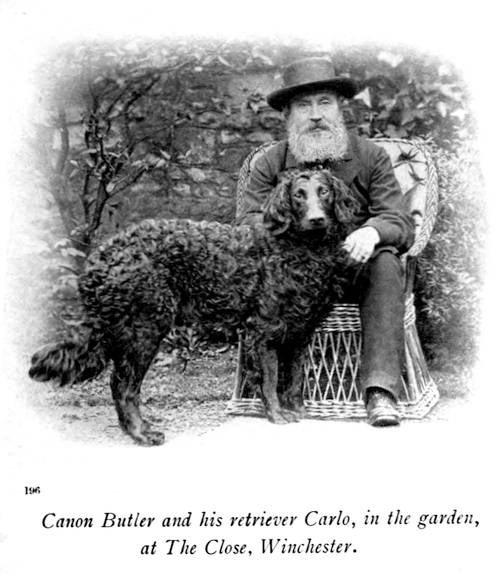
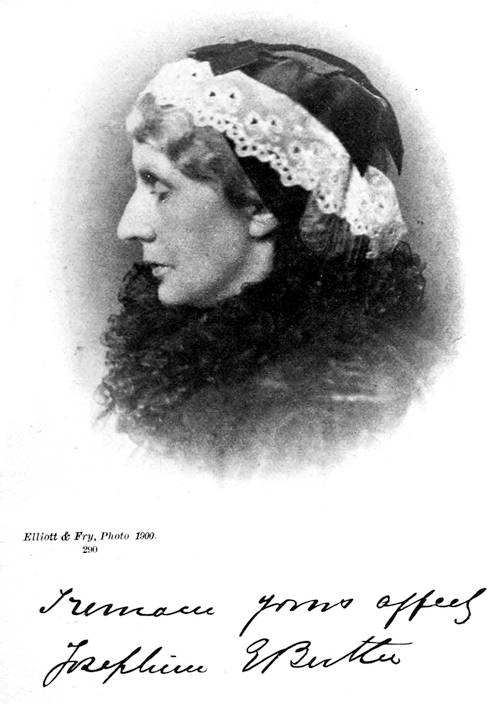
No record of Josephine Butler’s life would be at all
true or complete which did not include some account
of her husband. His strong and gentle spirit greatly
influenced and aided her in all her public work, not
only with whole-hearted sympathy, but with active
co-operation whenever he had leisure from his other
duties. The following pages are taken from her
Recollections of George Butler.
In visiting some great picture gallery, and passing
along amidst portraits innumerable of great men—of
kings, statesmen, discoverers, authors or poets—I
have sometimes been attracted above all by a portrait
without a name, or without the interest attaching
to it of any recorded great exploit, but which, nevertheless
interests for its own sake. Something looks
forth from those eyes—something of purity, of
sincerity, of goodness—which draws the beholder
to go back again and again to that portrait, and which
gives it a lasting place in the memory long after many
other likenesses of earth’s heroes are more or less
forgotten. It is somewhat in this way that I think
of a memorial or written likeness of George Butler, if
it can but be presented with a simplicity and fidelity
worthy of its subject. His character—his singlemindedness,
purity, truth, and firmness of attachment
to those whom he loved—seem to me worthy to be
recorded and to be had in remembrance.
M. Fallot, in the Revue du Christianisme Pratique,
sketches in a few words the character of the revered
teacher of his youth, Christophe Dieterlin, whose
mortal remains rest beneath the hallowed soil of the
Ban de la Roche, in the Vosges, surmounted by a
rock of mountain granite—a suitable monument for
such a man. When his pupil questioned him concerning
prayer, he replied: “The Lord’s Prayer is
in general sufficient for me. When praying in these
words, all my personal preoccupations become mingled
with and lost in the great needs and desires of the
whole human race.” “He was a Christian,” says
M. Fallot, ”hors cadre, refractory to all classification,
living outside all parties,” a child of Nature and a son
of God. These words might with truth be applied
to the character of George Butler. It would be
difficult to assign him a definite place in any category
of persons or parties. He stands apart, hors cadre,
in his gentleness and simplicity, and in a certain
sturdy and immovable independence of character.
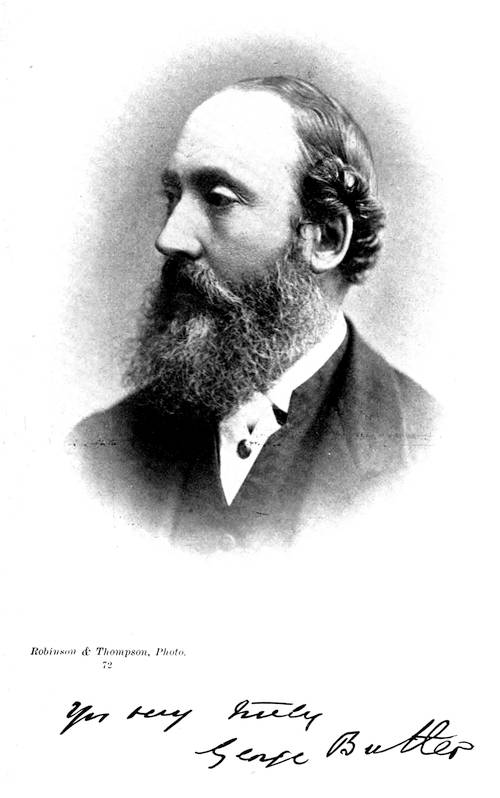
George Butler was born at Harrow on the 11th of
June, 1819. He was the eldest son of a family of ten—four
brothers and six sisters. Nothing very remarkable
in the way of hard study or distinction
can be recorded of him during his school career.
When questioned in later life concerning any
excellency he attained there, he would answer,
reflectively, that he was considered to be extremely
good at “shying” stones. He could hit or knock
over certain high-up and difficult chimney-pots with
wonderful precision, to the envy of other mischievous
boys, and I suppose to the annoyance of the owners
of the chimney-pots. His father, the Dean of Peterborough,
wrote to me in 1852: “Your references to
George’s early days make me feel quite young again.
He certainly was a nice-looking boy, and had a pretty
head of hair; at least I thought so, and the remembrance
of those nursery days is pleasant to me. But
oh! those early experiments in the science of projectiles
upon the chimney-pots of the Harrovian
neighbours—why remind me of them, unless you are
yourself possessed of the same spirit of mischief?”
But school life was not all play for George Butler.
He showed an early aptitude for scholarship, gaining
among several prizes that for Greek Iambics. In the
autumn of 1838 George went up to Trinity College,
Cambridge. During the year he spent at Cambridge
the sense of duty and of responsibility for the use
of opportunities and gifts which he possessed lay
dormant within him. Those who loved him best
often thanked God, however, as he did himself in
later life, that he had escaped the contamination of
certain influences which leave a stain upon the soul,
and sometimes tend to give a serious warp to the
judgment of a man in regard to moral questions. A
remarkable native purity of mind, and a loyal and
reverent feeling towards women, saved him from
associations and actions which, had he ever yielded
to them, would have been a bitter memory to such a
man as he was. In the interval between leaving
Cambridge and going to Oxford he spent several
months in the house of Mr. Augustus Short (afterwards
Bishop of Adelaide). It was while under his
roof that he imbibed a true love of work, and learned
the enjoyment of overcoming difficulties, and of a
steady effort, without pause, towards a definite goal.
One of his life-long and most valued friends,
the Rev. Cowley Powles, writes: “It was, I think,
in 1841 that Butler got the Hertford Scholarship.
I remember meeting him just after his success had
been announced. I was coming back from a ride, and
he stopped me and said: ‘I have got the Hertford.’
The announcement was made in his quietest voice,
and with no elation of manner, though his countenance
showed how much he was pleased. Never was
there a man with less brag about him.” In 1843
George Butler took his degree, having obtained a
first class. He kept up his connection very closely
with Oxford for four years, making use of the
time for various studies, and taking pupils or reading
parties during the long vacations. In 1848 he was
appointed to a Tutorship at the University of
Durham, which he retained for a little more than two
years. It was during the latter part of his residence
there that I first made his acquaintance.
The following, written after our engagement,
shows his extreme honesty of character, while it
indicates in some faint degree his just and unselfish
view of what the marriage relation should be;
namely, a perfectly equal union, with absolute freedom
on both sides for personal initiative in thought
and action and for individual development.
“I do not ask you to write oftener. I would have
you follow the dictates of your own heart in this;
but be always certain that whatever comes from
you is thrice welcome. I write because I feel it to
be necessary to my happiness. I have lately written
to you out of the fulness of my heart, when my soul
was deeply moved to strive after a higher life. But
often my letters will be about trifling matters, so
that you may be tempted to say, ‘Why write at
all?’ Yet, after all, life is largely made up of
trifles. Moreover, I do not wish to invest myself in
borrowed plumes. I do not want you to find out
later that I am much like other people, perhaps even
more commonplace than most. I would rather your
eyes were opened at once. I cannot reproach myself
with ever having assumed a character not my own to
you or to anyone. Such impostures are always too
deeply purchased by the loss of self-respect. But
I fear that you may have formed too high an estimate
of my character—one to which I can never come up;
and for your sake I would wish to remove every veil
and obstacle which might prevent your seeing me
just as I am. If I were only to write to you when
my better feelings were wrought upon, you might
think me much better than I am, so I will write to
you on every subject and in every mood. Those lines
which I sent to you gave no exaggerated picture.
I have often felt in a very different spirit to that in
which we should say ‘Our Father.’ The praying
for particular blessings, which is enjoined by the
words of the Lord Jesus, ‘Ask, and ye shall receive,’
has appeared to me at times as derogatory to the
omniscient and all-provident character of God.
Can He, I have thought, alter the smallest of His
dispensations at the request of such a weak and
insignificant being as I am? This vain philosophy,
the offspring of intellectual pride, has had more to do
with blighting my faith than wilful sin or the world’s
breath! But though I have ‘wandered out of the
way in the wilderness,’ I do not despair of taking
possession of the promised land. You say you can
do so little for me. Will it be little, Josephine, if,
urged by your encouragement and example, I put off
the works of darkness and put on the armour of light?
Blessings from the Giver of all blessings fall upon
you for the joy you have given to me, for the new life
to which you have called me! I should think it
undue presumption in me to suggest anything to
you in regard to your life and duties. He who has
hitherto guided your steps will continue to do so.
Believe me, I value the expression of your confidence
and affection above ‘pearls and precious stones’; but
I must not suffer myself to be dazzled, or to fancy
that I have within me that power of judging and
acting aright which would alone authorise me to point
out to you any path in which you ought to walk.
I am more content to leave you to walk by yourself
in the path you shall choose; but I know that I do not
leave you alone and unsupported, for His arm will
guide, strengthen and protect you. I only pray,
then, that you may be more and more conformed to
the image of Him who set us a perfect example, and
that He will dispose my heart to love and admire
most those things in you which are most admirable
and lovely.”
During the years 1848-49 the Dean of Peterborough
frequently wrote to his son expressing his
desire to see him turning his mind towards the
ministry—hoping that he would decide on taking
orders. The Dean was sincerely convinced that
there was nothing which ought to make his son
hesitate to take so serious a step, and that the duties
of a clergyman would have a beneficial effect on his
character, tending to his highest good and happiness.
That, however, was far from being his son’s view of
the matter. While appreciating his father’s motives
in urging him in this direction, and replying in
general terms with a gentle courtesy, he seems to
have felt convinced that it was impossible for him
to follow his advice in the matter. Finally he wrote:
“I thank you, my dear father, for your welcome
letter. I think I have already told you that I have
no internal call to, nor inclination for, the Church.
On the contrary, I should feel I was guilty of a wrong
action if I embarked in any work or profession for
neither the theoretical nor the practical part of
which I had any taste. And if this be true of
ordinary professions, is it not so in a tenfold degree
in the case of the Church? I feel at present no
attraction towards the study of dogmatical theology,
or any branch of study in which a clergyman should
be versed; and I cannot get over the scruples I have
against such a step as you advise. I am at present
engaged, usefully I hope, in a place of Christian
education, closely connected with a cathedral church,
with abundant opportunities of adding to my stock
of knowledge in various subjects, as well as of
imparting to others what I know. I do not see, at
present, any necessity for planning any change in my
mode of life.”
How was it then, it may be asked, that he did
actually elect to become a clergyman some six years
later? The answer is, he had gradually become
convinced that the work of his life was to be
educational, and the desire arose in his mind to be
able to stand towards the younger men or boys who
should come under his care in the position of their
pastor as well as their teacher. He weighed the
matter gravely for a long time before becoming a
clergyman; but after having taken the step, he never
repented of having done so. To the end of his life,
however, his character continued to be essentially
that of a layman. In 1851 he wrote:—
“You know that I don’t like parsons; but that
is not to the point. If I should ever take orders,
I don’t mean to be a mere parson; for if I were like
some of them whom I know I should cease to be a
man. I shall never wear straight waistcoats, long
coats and stiff collars! I think all dressing up and
official manner are an affectation; while great
strictness in outward observances interferes with the
devotion of the heart; and though it may indicate
a pious spirit—and therefore deserves our respect—it
shows, as I think, a misconception of the relation in
which we stand to God, and of the duties we owe to
man. It seems to me, after all, that being a good
clergyman is much the same thing as being a good
man. I have a longing to be of use, and I know of no
line in which I can be more useful than the educational,
my whole life having been turned more or
less in this direction. It is a blessed office that of a
teacher. With all its troubles and heart-wearyings
and disappointments, yet it is full of delight to those
who enter upon it with their whole heart and soul,
and in reliance upon our great Teacher. I know of
no occupation which more carries its present reward
with it.”
Our marriage took place on the 8th of January,
1852, at Dilston. Shortly afterwards we settled at
Oxford, which became our home for five years. In reviewing
the work done by George Butler in the course
of his educational career, one cannot but be struck
by the fact that he was somewhat in advance of his
time. There are men theoretically in advance of
their times, who do good service by their advocacy of
progressive principles in writing or in speech. With
him it was more a matter of simple practice. He
perceived that some study useful or necessary for
the future generations, and in itself worthy, had
scarcely an acknowledged place in the curriculum of
the schools and universities, or that some new ground
necessary to be explored was still left untrodden; and
without saying much about it, without any thought
of being himself a pioneer in any direction, he
modestly set himself to the task of acting out his
thoughts on the subject. His absolute freedom from
personal vanity withheld him from proclaiming that
he was about to enter on any new line, and at the
same time enabled him to bear with perfect calm, if
not with indifference, the criticisms, witty remarks
and sometimes serious opposition which are seldom
wanting when a man or woman ventures quietly to
encroach upon the established order of things in any
department of life. At Oxford he was the first who
brought into prominence the study of geography.
His geographical lectures there were quite an innovation,
creating some amusement and a good deal
of wonder as to how he would succeed. It was a
subject which had hitherto been relegated in an
elementary form to schools for boys and girls, and
was unrecognised, except by a very few persons, as
the grand and comprehensive scientific study which
it is now acknowledged to be.
At Oxford the subject was entirely new, at least
to the older members of the university, who, however,
to their credit, came to the lectures, and
listened with teachable minds to truths novel to
them concerning the world they were living in. We
drew large illustrative maps for the walls of the
lecture room. I recall a day when I was drawing
in a rough form an enlarged map of Europe, including
the northern coast of Africa and a part of Asia Minor.
It happened that several fellows and tutors of colleges
called at that moment. I continued my work while
they chatted with him on the curiosity of his introduction
in Oxford of so elementary a study. The
conversation then turned on letters we had just
received from Arthur Stanley and Theodore Walrond,
who were visiting Egypt. “Where is Cairo?”
someone asked, turning to the map spread on the
table. I put the question to an accomplished
college tutor. His eye wandered hopelessly over the
chart. He could not even place his hand on Egypt!
I was fain to pretend that I needed to study my
performance more closely, and bent down my head
in order to conceal the irreverent laughter which
overcame me.
George Butler was one of the first, also, who
introduced and encouraged the study of Art in Oxford
in a practical sense. In the winter of 1852-53 he
obtained the permission of the Vice-Chancellor and
Curators to give a course of lectures on Art in the
Taylor building. These lectures were afterwards
published by J. W. Parker, under the title of
Principles of Imitative Art. While promoting the
study of Art in Oxford, working with pupils, and
examining in the schools, he undertook to write a
series of Art criticisms for the Morning Chronicle and
afterwards for another paper, visiting for this
purpose the galleries and yearly exhibitions in
London. This he did for a year or two.
“It was amusing,” he wrote to his mother, after
his first visit in this capacity to the Society of
British Artists, “to see the ‘gentlemen of the press’
(of whom I was one!) walking about dotting down
observations. I travelled up to town with Scott,
the architect, who has engaged me to attend a
meeting of his workmen, and give them an address
on ‘Decorative Art and the Dignity of Labour.’
Josephine and I are both engaged in copying some
drawings by Turner in the Taylor Gallery.”
Indefatigable in his efforts to master any subject
which attracted him, he was also equally ready
and anxious to impart to others any knowledge
he had thus gained. He found time among his
other occupations to make a very thorough study
of some ancient Oscan inscriptions, with engravings
of their principal monuments, which he
found in the Bodleian Library. He became much
interested in that portion of history—almost lost
in the mists of the past—which is illustrated by
the marvellous records and monuments of Oscan,
Umbrian, and Etruscan life in the great museum at
Bologna. He worked at and completed, during one
of the long vacations, a series of enlarged copies in
sepia of the small engravings and prints of these
monuments in the Bodleian. These enlargements
were suitable for wall illustrations, for a set of lectures
which he afterwards gave on the “Ancient Races of
Italy.” It was very pleasant to us when we visited
Florence together, some years later, to see the
originals of some of the Cyclopean ruins of which we
had together made large drawings, those gigantic
stones of all that remains of the ancient Etruscan
walls of Fiesole, up to the lovely heights of which
we drove one clear, bright winter’s day.
I have many other memories of our life at Oxford—some
very sweet, others grave. I recall with special
pleasure our summer evening rides. During the first
two years we spent there my father kindly provided
me with a horse, a fine, well-bred chestnut. My
husband and I explored together all the rising grounds
round Oxford. Behind our own little garden there
were tall trees where nightingales sang night and day
for a few weeks in spring. But it was in the Bagley
Woods and in Abingdon Park that those academic
birds put forth all their powers. We sometimes rode
from five in the afternoon till the sun set and the
dew fell, on grassy paths between thick undergrowths
of woods such as nightingales love to haunt, and from
which issued choruses of matchless song.
Our Italian studies were another source of enjoyment.
Dante Rossetti was then preparing matter
for his book, Dante and His Circle, by carefully
translating into English the Vita Nuova and lyrical
poems of Dante, together with other sonnets and
poems written by some of his predecessors, such as
Cavalcante, Orlandi and Angiolieri of Siena. Mr.
Rossetti sent to us occasionally for criticism some of
his translations of the exquisite sonnets of Dante, the
English of which he was anxious to make as perfect
as possible. We had visited Rossetti’s studio at
Chelsea, where he had shown us his portfolios of
original sketches for his great paintings, besides many
unfinished drawings and pathetic incidents expressed
in artist’s shorthand—slight but beautiful pencil
designs. My husband’s critical faculty and classical
taste enabled him to return the sonnets submitted
to his judgment with occasional useful comments.
There was little to find fault with in them, however.
Aurelio Saffi was at this time in exile and living
in Oxford. He had been associated with Mazzini
and Armellini in the Triumvirate which ruled in
Rome for a short period, and was parliamentary
deputy for his own native town of Forli. He was
a cultivated and literary man, with a thorough
knowledge of the Italian poets. As an exile his
material means were at that time very slender.
My husband sought his acquaintance, and invited
him to give a series of evening lectures on Dante
in our own drawing-room. These were attractive to
some, and increased the personal interest felt in Saffi
in the university. Twenty-seven years later, having
returned to Italy from exile, Saffi was presiding at a
great congress in Genoa where we were. He alluded,
with much feeling, to the years he had spent in
Oxford; and turning to my husband, who was near
him, he said: “It is twenty-seven years to-day that,
an exile from my native land, I had the happiness of
being received in your house at Oxford, and I have
never forgotten, and shall never forget, the hospitable
and gracious reception given to me by you and your
worthy companion. The times are changed; a long
interval has elapsed, and it is to me a great joy
to-day to greet you once more, and on my native
soil.”
But this pleasant life at Oxford had its shadow
side. I had come from a large family circle, and from
free country life to a university town—a society of
celibates, with little or no leaven of family life; for
Oxford was not then what it is now under expanded
conditions, with its married fellows and tutors, its
resident families, its ladies’ colleges, and its mixed,
general social life. With the exception of the families
of a few heads of houses, who lived much secluded
within their college walls, there was little or no home
life, and not much freedom of intercourse between
the academical portion of the community and others.
A one-sidedness of judgment is apt to be fostered by
such circumstances—an exaggeration of the purely
masculine judgment on some topics, and a conventual
mode of looking at things.
In the frequent social gatherings in our drawing-room
in the evenings there was much talk, sometimes
serious and weighty, sometimes light, interesting,
critical, witty and brilliant, ranging over many
subjects. It was then that I sat silent, the only
woman in the company, and listened, sometimes with
a sore heart; for these men would speak of things
which I had already revolved deeply in my own mind,
things of which I was convinced, which I knew,
though I had no dialectics at command with which to
defend their truth. A few remarks made on those
evenings stand out in my memory. They may seem
slight and unimportant, but they had a significance
for me, linking themselves, as they did, to long trains
of thought which for some years past had been
tending to form my own convictions.
A book was published at that time by Mrs. Gaskell,
and was much discussed. This led to expressions
of judgment which seemed to me false—fatally false.
A moral lapse in a woman was spoken of as an
immensely worse thing than in a man; there was no
comparison to be formed between them. A pure
woman, it was reiterated, should be absolutely
ignorant of a certain class of evils in the world,
albeit those evils bore with murderous cruelty on
other women. One young man seriously declared
that he would not allow his own mother to read such
a book as that under discussion—a book which
seemed to me to have a very wholesome tendency,
though dealing with a painful subject. Silence was
thought to be the great duty of all on such subjects.
On one occasion, when I was distressed by a bitter
case of wrong inflicted on a very young girl, I
ventured to speak to one of the wisest men—so
esteemed—in the university, in the hope that he
would suggest some means, not of helping her, but
of bringing to a sense of his crime the man who had
wronged her. The sage, speaking kindly however,
sternly advocated silence and inaction. “It could
only do harm to open up in any way such a question
as this. It was dangerous to arouse a sleeping
lion.” I left him in some amazement and discouragement,
and for a long time there echoed in my
heart the terrible prophetic words of the painter-poet
Blake—rude and indelicate as he may have been
judged then—whose prophecy has only been averted
by a great and painful awakening—
The harlot’s curse, from street to street,
Shall weave old England’s winding-sheet.
Every instinct of womanhood within me was
already in revolt against certain accepted theories
in society, and I suffered as only God and the faithful
companion of my life could ever know. Incidents
occurred which brought their contribution to the
lessons then sinking into our hearts. A young
mother was in Newgate for the murder of her infant,
whose father, under cover of the death-like silence
prescribed by Oxford philosophers—a silence which
is in fact a permanent endorsement of injustice—had
perjured himself to her, had forsaken and forgotten
her, and fallen back, with no accusing conscience,
on his easy, social life, and possibly his academic
honours. I wished to go and speak to her in prison
of the God who saw the injustice done, and who cared
for her. My husband suggested that we should
write to the chaplain of Newgate, and ask him to
send her to us when her sentence had expired. We
wanted a servant, and he thought that she might
be able to fill that place. She came to us. I think
she was the first of the world of unhappy women of
a humble class whom he welcomed to his own home.
She was not the last.
A travelling circus came to the neighbourhood.
A young woman who performed as an acrobat somehow
conveyed to us her longing desire to leave the
life in which she was plunged, the most innocent part
of which was probably her acrobatic performances.
She had aspirations very far beyond what is usually
expected from a circus woman. She wanted to
serve God. She saw a light before her, she said, and
she must follow it. She went secretly to churches
and chapels, and then she fled—she did not know
where—but was recaptured. It was a Sunday
evening in hot summer weather. I had been sitting
for some time at my open window to breathe more
freely the sultry air, and it seemed to me that I heard
a wailing cry somewhere among the trees in the
twilight which was deepening into night. It was a
woman’s cry—a woman aspiring to heaven and
dragged back to hell—and my heart was pierced with
pain. I longed to leap from the window, and flee
with her to some place of refuge. It passed. I
cannot explain the nature of the impression, which
remains with me to this day; but beyond that
twilight, and even in the midst of the pitiful cry,
there seemed to dawn a ray of light and to sound
a note not wholly of despair. The light was far off,
yet coming near, and the slight summer breeze in
those tall trees had in them a whisper of the future.
But when the day dawned it seemed to show me again
more plainly than ever the great wall of prejudice,
built up on a foundation of lies, which surrounded a
whole world of sorrows, griefs, injustices and crimes
which must not be spoken of—no, not even in
whispers—and which it seemed to me then that no
human power could ever reach or remedy. And
I met again the highly-educated, masculine world
in our evening gatherings more than ever resolved
to hold my peace—to speak little with men, but much
with God. No doubt the experience of those years
influenced in some degree my maturer judgment of
what is called “educated public opinion.”
My motive in writing these recollections is to tell
what he was—my husband—and to show how,
besides all that he was in himself and all the work he
did, which was wholly and especially his own, he
was of a character to be able from the first to correct
the judgment and soothe the spirit of the companion
of his life when “the waters had come in even unto
her soul.” I wish to show, also, that he was even
more to me in later life than a wise and noble supporter
and helper in the work which may have been
called more especially my own. He had a part in
the creation of it, in the formation of the first
impulses towards it. Had that work been purely a
product of the feminine mind, of a solitary, wounded
and revolted heart, it would certainly have lacked
some elements essential to its becoming in any
way useful or fruitful. But for him I should have
been much more perplexed than I was. The idea of
justice to women, of equality between the sexes, and
of equality of responsibility of all human beings to
the moral law, seems to have been instinctive in him.
He never needed convincing. He had his convictions
already from the first—straight, just and clear. I did
not at that time speak much, but whenever I spoke to
him the clouds lifted. It may seem a little strange to
say so, but, if I recall it truly, what helped me most
of all at that time was, not so much any arguments
he may have used in favour of an equal standard,
but the correctness with which he measured the men
and the judgments around him. I think there was
even a little element of disdain in his appreciation of
the one-sided judgments of some of his male friends.
He used to say, “I am sorry for So-and-So,” which
sounded to me rather like saying, “I am sorry for
Solomon,” my ideas of the wisdom of learned men
being, perhaps, a little exaggerated. He would tell
me that I ought to pity them. “They know no
better, poor fellows.” This was a new light for me,
I had thought of Oxford as the home of learning and
of intellect. I thought the good and gifted men we
daily met must be in some degree authorities on
spiritual and moral questions. It had not occurred
to me to think of them as “poor fellows!” That
blessed gift of common sense, which he possessed
in so large a degree, came to the rescue to restore for
me the balance of a mind too heavily weighted with
sad thoughts of life’s perplexing problems. And then
in the evenings, when our friends had gone, we read
together the words of Life, and were able to bring
many earthly notions and theories to the test of what
the Holy One and the Just said and did. Compared
with the accepted axioms of the day, and indeed of
centuries past, in regard to certain vital questions, the
sayings and actions of Jesus were, we confessed to
one another, revolutionary. George Butler was not
afraid of revolution. In this sense he desired it,
and we prayed together that a holy revolution might
come about, and that the Kingdom of God might be
established on the earth. And I said to myself: “And
it is a man who speaks to me thus—an intelligent,
a gifted man, a learned man too, few more learned
than he, and a man who ever speaks the truth from
his heart.” So I was comforted and instructed. It
was then that I began to see his portrait given, and
I see it still more clearly now as I look back over his
whole past life, in the 15th Psalm: “Lord, who shall
dwell in Thy tabernacle? Or who shall rest upon
Thy holy hill? Even he that leadeth an uncorrupt
life, and doeth the thing which is right, and speaketh
the truth from his heart. He that hath used no
deceit in his tongue, nor done evil to his neighbour,
and hath not slandered his neighbour. He that
setteth not by himself, but is lowly in his own eyes,
and maketh much of them that fear the Lord. He
that sweareth unto his neighbour, and disappointeth
him not, even though it were to his own hindrance.”
The winter floods which so often surrounded Oxford
during the years of which I am writing are probably
remembered with a shudder by others besides
myself. The mills and locks, and other impediments
to the free flow of the waters of the Isis, were, I
believe, long ago removed, and the malarial effect
of the stagnation of moisture around the city ceased
with its cause. But at that time Oxford in winter
almost resembled Venice, in its apparent isolation
from the land, and in the appearance of its towers
and spires reflected in the mirror of the floods.
“It rained,” wrote George in January, 1856, “all
yesterday, and to-day it is cold and damp. Indeed,
immediately after sunset the atmosphere of Oxford
resembles that of a well, though that is scarcely
so bad as the horrible smell of the meadows when
the floods are retiring. Then one is conscious of a
miasma which only a strong constitution can long
resist.”
My health failed. I became weak and liable to
attacks of chills and fever. We drove out occasionally
to the heights above Oxford, to reach which we were
obliged to pursue for some distance a road which
resembled a sort of high level or causeway (as in
Holland) with water on each side. Looking back
from the higher ground, the view of the academic
city sitting upon the floods was very picturesque.
Indeed, the sound of “Great Tom” knelling the
curfew from his tower had a very musical and
solemn effect as it came over the still waters, resembling
a little in pathos the sound of a human
voice giving warning of the approach of night; or,
like Dante’s Squilla di lontana—
The distant bell
Which seems to weep the dying day;
but poetry and sentiment could not hold out against
rheumatic pains and repeated chills.
I spent several months of that year—1856—in
Northumberland with our children, my husband
joining us after he had completed his engagements
as a public examiner in London. His letters, during
the few weeks of our separation, seemed to show a
deepening of spiritual life—such as is sometimes
granted in the foreshadowing of the approach of
some special discipline or sorrow. He seems to have
felt more deeply during this summer that he must
not reckon on the unbroken continuance of the
outward happiness which had been so richly granted
to us.
To Mrs. Grey.
Oxford, June 6th, 1856.
“I am glad to feel that my treasures are in such
good hands and life-giving air. I hope their presence
at Dilston will contribute to the assurance that
marriage is not a severance of family ties, but that
both Josephine and I revert with the fondest
attachment to old scenes and dearly loved friends
at Dilston.”
To his wife.
June, 1856.
“I am grieved to hear of your sufferings; but you
write so cheerfully, and express such a loving confidence
in One who is able to heal all our sicknesses,
that I dare not repine. However sad at heart I may
sometimes feel about you, I will try to bring myself
face to face with those mighty promises which are
held out to those who ‘rest in the Lord and wait
patiently for Him.’ And then I hope we shall still
be able to go hand in hand in our work on earth.”
To his wife.
July 13th, 1856.
“I have been reading Tennyson’s ‘Maud,’ and
correcting my review of it for Fraser’s Magazine.
Reading love stories which end in death or separation
makes me dwell the more thankfully on my own
happiness. It is no wonder that I am sanguine in
all circumstances, and that I trust the love and care
of our Almighty Father, for has He not blessed me
far beyond my deserts in giving me such a share of
human happiness as falls to the lot of few? Yet He
has given us our thorn in the flesh, in your failing
health, and our uncertain prospects. But these shall
never hinder our love; rather we will cling to that
more closely as the symbol and earnest of the heavenly
love which displayed itself in that wondrous act—on
Calvary—which the wise men of this world may deem
of as they will, but which to us will ever be the most
real of all realities, and the sure token of our reconciliation
with God.
“I think we are well fitted to help each other. No
words can express what you are to me. On the
other hand, I may be able to cheer you in moments
of sadness and despondency, when the evils of this
world press heavily upon you, and your strength
is not sufficient to enable you to rise up and do anything
to relieve them, as you fain would do. And
by means of possessing greater physical strength,
and considerable power of getting through work,
I may be enabled to help you in the years to come, to
carry out plans which may under His blessing do
some good, and make men speak of us with respect
when we are laid in our graves; and in the united
work of bringing up our children, may God so help
us that we may be able to say, ‘Of those whom
Thou gavest us have we lost none.’”
While exercising much self-denial and reserve in
making such extracts as the above, I give these few
as affording glimpses of his inner mind and deep
affection; for his character would be very inadequately
portrayed if so prominent a feature of
it were concealed as that of his love for his wife, and
the constant blending of that love with all his
spiritual aspirations and endeavours. That love was
part of his being, becoming ever more deep and
tender as the years went on. I have spoken of the
strength and tenacity of his friendships. These
qualities entered equally into his closest domestic
relations. In the springtime of life, men dream,
speak, write and sing of love—of love’s gracious
birth and beautiful youth. But it is not in the
springtime of life that love’s deepest depths can be
fathomed, its vastness measured, and its endurance
tested. There is a love which surmounts all trial
and discipline, all the petty vexations and worries,
as well as the sorrows and storms of life, and which
flows on in an ever deepening current of tenderness,
enhanced by memories of the past and hopes of the
future—of the eternal life towards which it is tending.
It was such a love as this, that dwelt and deepened
in him of whom I write to the latest moment of his
earthly life, to be perfected in the Divine presence.
On joining us at Dilston, an arrangement was made
with the vicar of the parish of Corbridge (in which
Dilston was situated) that he should take his duty,
occupying his house for the autumn, during his
absence from home. Dissent prevailed largely in
the neighbourhood. But during the time that he
acted as the clergyman of the parish the church was
well filled. Many Wesleyans came, who had not
before entered its doors, as well as several families
of well-to-do and well-instructed Presbyterian
farmers—shrewd people, well able to maintain their
ground in a theological controversy. They were
attracted, no doubt, partly by the relationship of
the temporary minister to my father, who was so
much beloved and esteemed throughout the county,
and a constant worshipper in the village church,
and partly by the simple Christian teaching for which
they thirsted, and which they now found. There
was little real poverty. We visited the people
sometimes together, and their affections were
strongly gained.
Our return to Oxford was not auspicious. The
autumn fell damp and cold. It was decided that
I should go to London to consult Sir James Clarke,
on account of what seemed the development of a
weakness of the lungs. I recall the tender solicitude
which my husband showed for me on the journey,
and also the kindness of the venerable physician.
I was scarcely able to rise to greet him when he
entered the room. At the close of our interview he
merely said, “Poor thing, poor thing! You must
take her away from Oxford.” We proposed to
return therefore at once to make necessary preparations
for the change, when he interposed, “No, she
must not return to the chilling influence of those
floods, not for a single day.”
This was no light trial. Our pleasant home must
be broken up; all the hopes and plans my husband
had cherished abandoned; the house he had taken
and furnished at some expense as a Hall for unattached
students thrown on his hands. To carry
it on alone, to be separated for an indefinite time from
each other, was scarcely possible. There seemed for
the present no alternative. He accepted calmly,
though not without keen regret, what was clearly
inevitable. The difficulties of our position were for
a time increased by a serious reverse of fortune
experienced by my father, who had always been
ready to aid on occasion the different members of the
family. There had occurred a complete collapse
of a bank in which he was a large shareholder. The
loss he sustained was great. The spirit in which he
bore the trial raised him still higher in the estimation
of those who already so highly valued and admired
him. Trouble followed upon trouble for a time,
and my husband suffered all the more because of
some inward self-reproach for having failed to exercise
sufficient providence and foresight in the past. His
greatest anxiety was for me; but that happily was
gradually lightened as time went on.
Through the kindness of his friend, Mr. Powles, my
husband was called to take temporarily the charge of
a chapel at Blackheath, in the summer of 1857, which
gave him useful and congenial ministerial work while
continuing his literary pursuits. He had gone on in
advance to arrange for our removal to Blackheath.
To her husband.
St. Barnabas Day,
June 11th, 1857.
God bless you to-day and always, and make you
a “Son of Consolation” to many in the time to come,
as you have been to me. Earthly success is no
longer our aim. What I desire above all for you is
the fulfilment of the promise: “They that are wise
shall shine as the light, and they that turn many to
righteousness, as the stars for ever and ever.” I had
an encouraging conversation yesterday with——,
which fell in with the train of my thoughts regarding
you and myself. She said she had seen many cases
in which individual chastening had preceded a life of
great usefulness, though the subject of the chastening
had thought at the time that his life was passing
away, wasted or only spent in learning the lesson of
submission. She thought that those to whom the
discipline of life comes early rather than late ought
to thank God; for it makes them better able to
minister to others, and to walk humbly with their
God. May that be the case with us. The little boys
remembered your birthday before they were out of
bed this morning, and have made an excursion to
Nightingale Valley in honour of it.