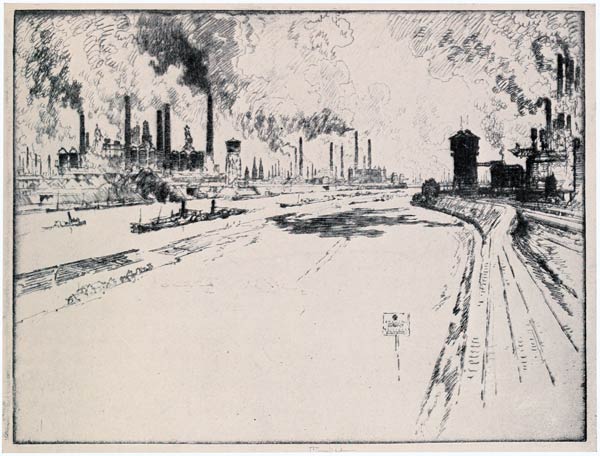
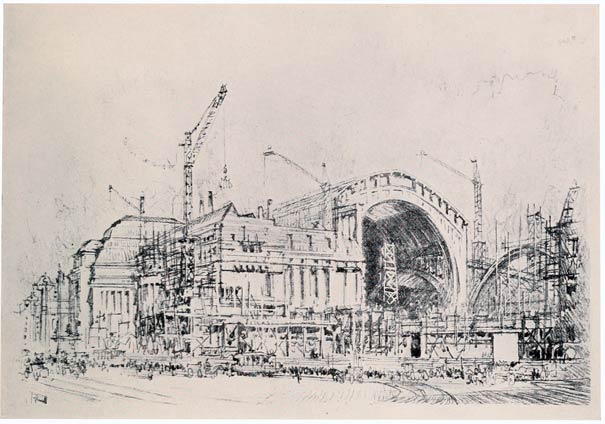
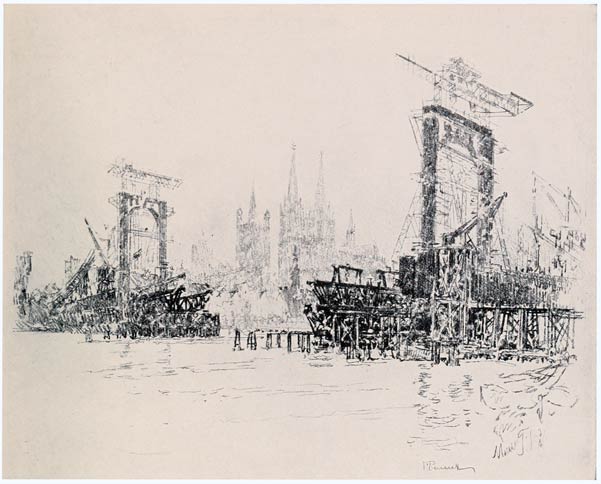
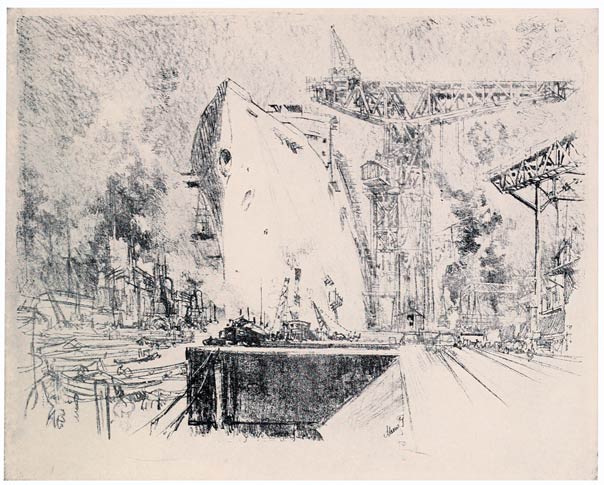
Work to-day is the greatest thing in the world, and the artist
who best records it will be best remembered. Work has
always been an inspiration to artists, from the time when we were
told to earn our bread by the sweat of our brow, till now, when
most of us are trying to forget the command, and act like "ladies and
gentlemen."
Under the Church, work—the building of the Tower of Babel and
the Temple—was the subject of endless imaginings by painters, sculptors
and gravers who never assisted at the functions they illustrated.
Painters, who sat in their studios hundreds of years after the towers
and temples were designed and destroyed, have showed what they
imagined the towers and the temples looked like. This—this sort of
creation or invention—we art students in America called "genius
work" because it was "done out of our heads." In Europe it is
called "scholarly," and is concocted from a classical dictionary; a trip
for a few weeks to Greece or Italy is useful but not necessary, and
adds to the expense; illustrated post cards may be used instead.
Now educated people, cultured people, take such painters seriously—and
pay to sit in darkened chambers and brood. These are carefully
but sadly illuminated, and the spectators pursue with diligence, scarce
looking at the exhibits, the remarks of critics who prove conclusively
that these painters show exactly what the world was like, what buildings
were like and how they were built, and how the builders worked
according to the bookman and archæologist, and the critic.
Now as to these popular forms of art—the backbone of academics,—I
know, for I am a multi-academician—I have nothing to say. The
results, in a few instances, have been works of art because of excellence
of technique. But the man with the greatest imagination is the man
with the greatest information about his own surroundings, which he
uses so skilfully that we call the result imagination, and this is the way
the greatest art of the world has been created.
I am not disputing the power, in their day, nor the charm they
still have—for the very few who understand—of Cimabue, of Giotto,
of the painters of the Campo Santo at Pisa, when they painted the
subjects I have mentioned, nor of Pintoricchio—he put work in the
background of his paintings, as Dürer did in his prints. And there
is a wonderful building of a cathedral by Van Eyck in Antwerp. There
are compositions by Bellini and Carpaccio which show they studied
work. It is strange, so far as I know, that Leonardo ignored work—in
his pictures—he who was such a great workman, yet vowed he
could paint with any one, amongst his other accomplishments. But,
with all these artists, either work was a detail or imaginative; it was
never the dominant motive, never a study of work for work's sake.
There are a few records in sculpture, most notable amongst them
being the Assyrian Reliefs at the British Museum. Curiously, I am
unable to find, though they must exist, any sculptures, reliefs or paintings
of the great architectural work of the Egyptians—or those of the
Greeks either. In the Bayeux tapestries there is the work of the shipbuilder
and porter.
The first artist I know of—though I am not an art historian—to
see the pictorial possibility of work, the Wonder of Work for Work's
Sake, was Rembrandt.
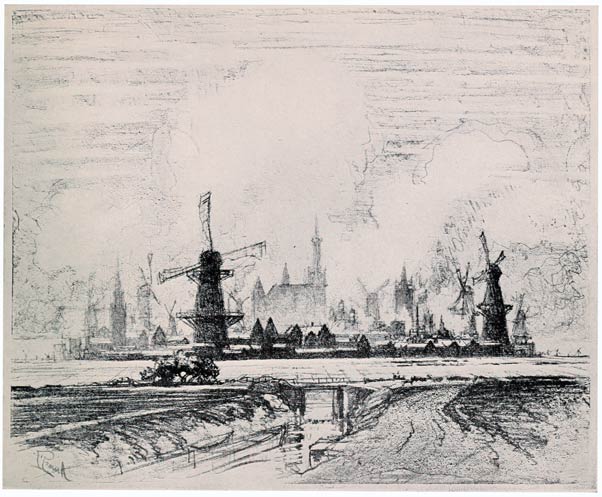
Rembrandt saw that his father's mill was beautiful, and by his
renderings of the windmills and the dykes of Holland proved them the
great works of his little country, and showed they were pictorial. And
he drew, etched and painted them because he loved their big powerful
forms, their splendid sails, the way they lorded the land and kept out
the sea. They were for him the Wonder of Work, the wondrous
works of his time, the works that were all about him. So strong and
so powerful were these Dutch works that they have lasted till to-day,
and so well were they designed that all windmills and watermills have
kept their form till now. The working parts have possibly been improved,
but the design has not been changed, and Rembrandt's etchings—so
accurately drawn they would serve as working models—prove
it. And yet Rembrandt has made a perfect artistic composition
as well as a true mechanical rendering of these mills and dykes. And
as Whistler said in the "Ten O'clock," the Bible of Art, Rembrandt
regretted not that the Jews of the Ghetto were not Greeks, nor—may
I add?—did he regret the windmills were not temples.
Then came Claude and found the Wonder of Work in commercial
harbours, dominated by necessary lighthouses, and in the hustling
cities of Civita Vecchia and Genoa—for it is amid the work, the life
of one's own time, that the Wonder of Work is to be found.
Canaletto followed, and saw in the building of Venice the same
inspiration that Tintoret found in her history, Titian in her great men.
And Piranesi discovered the prisons, the Carceri, to be as enthralling
as the ruins of Rome.
Turner imitated Claude. Claude saw his subjects about him;
Turner used Claude's motives and tried to rival his predecessor.
Claude painted what he saw in his own time; Turner tried to reconstruct
his unconscious rival's facts out of his head, and failed even in
his rendering of work about him, signally in Steam, Rain, Speed,
where an impossible engine conducts itself in an incredible fashion
in a magnificent landscape. Turner was not here trying to carry on
tradition—the only thing worth doing in art—but to embêter les
bourgeois—and Ruskin!
Turner's Carthage would not stand up, if built—Claude's palaces
do. Turner, too, defying Ruskin—Ruskin anathematising workaday
England—was a spectacle. But Turner was sometimes in the right,
with Constable and Crome, and they, and not Ruskin, have triumphed.
Turner had magnificent ideas, wonderful colour sense, grand composition.
But when he came to fact he was often ridiculous or pitiful,
simply because he had not observed work, noted facts—and to paint
work one must study work. And lately I was given a print from a
Book of Beauty by Allom of a coke furnace, while Mr. Joseph Jackson
has discovered a painting of a forge by Bass Otis in the Pennsylvania
Academy of the Fine Arts—surprisingly well done, both are, too.
It is far easier to paint a heavenly host or a dream city in one's
studio than to make a decoration out of a group of miners, or to draw
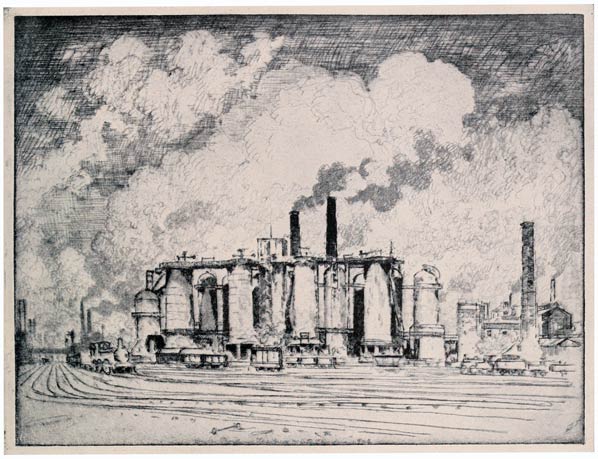
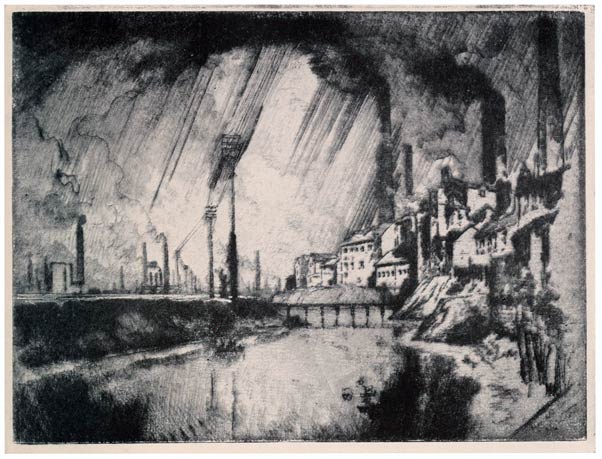
a rolling mill in full blast. Yet one of these subjects can be as noble
as the other, as Whistler proved, when he showed for the first time
how in London "the poor buildings lose themselves in the dim sky,
and the tall chimneys become campanile, and the warehouses are
palaces in the night, and the whole city hangs in the heavens and
fairyland is before us." That is the Gospel of the Wonder of Work.
Though I never studied under Whistler—never was his pupil—he
is and always will be my master—the master of the modern world,
the master who will endure. Because he glorified the things about
him, the things he knew, by "The Science of the Beautiful." What
are the Thames etchings—"Wapping," "The Last of Old Westminster,"
"The Nocturnes"—but records of work? A fact most
critics have never realised. But Whistler was a many-sided—a so
many-sided—genius that his many essays in many fields are only just
becoming known, and this study of work—the most difficult study
in the world, under the most trying conditions—was never abandoned
by him till he said what he wanted, in the ways he wanted, not till he
had made a series of masterpieces which live and will live forever.
But there was a man—all the great have gone from us in the last
few years, which accounts for the momentary popularity of the little—there
was a man who gave his later life to the Wonder of Work—Constantin
Meunier.
"Un jour—Meunier approchait déjà de la cinquantaine—Camille
Lemonnier l'emmena dans le Hainaut: il devait y faire quelques
illustrations pour La Belgique. Ce voyage de Meunier à travers le
Borinage lui fut une révélation. Il s'y découvrit lui-même, il y
découvrit son art. Dans ce sombre paysage de fumée et de feu, dans
le halètement formidable des fabriques, parmi les farouches mineurs
et les puddleurs et les verriers, toute une humanité damnée à la peine,
son âme tragique s'emplit de cette pitié et de cette admiration qui
devaient résonner à travers tout son art. Il avait conquis son propre
domaine.
"Meunier a conquis à l'art la beauté spéciale de la nouvelle industrie:
la formidable fabrique, pleine de lumière sombre et de tonnerre,
les fêtes flamboyantes des fonderies, la puissance grondante des
machines. Et toujours cette tendance est au monumental.
"L'hymne au Travail chante avec plus de force lyrique encore
dans ses bronzes."
This was his life work, and the life of his world, the world, as with
Whistler, around him, for "that is best which nearest lieth." Courbet
in work had influenced Legros and Brett and Millet and Segantini,
and I have no doubt Ford Madox Brown, the man too big to be a
pre-Raphaelite, whose biggest picture is work—"Work in London"—the
man who will one day make Manchester a place of pilgrimage
because of his pictures of work and of war in the Town Hall.
The Japanese count for a little in work, Hokusai and Hiroshigi.
Repine and De Nittis, L'Hermette, Bastien-Lepage, Tissot, Ridley,
and W. L. Wyllie have shown the Wonder of Work, the last three on
the Thames; and hundreds of imitators of these men have starved
peasants, herded kine, rowed boats, and sat in harvest fields, and
hauled barges, because they thought it the correct thing to do, or else
that they could work the sentimental, pathetic, socialistic game as a
diversion from mummy's darling, baby and the mustard-pot, dear
little doggie, or poor old Dobbin. I do not mean to say there have not
been, there are not, artists who have cared for the work and workers
of the fields for their own sake: there are some; but I wish to speak
only of industrial work. Millet has, I believe, honestly done the life
around his home, the life of the fields, but, though he has endless
imitators, there are scarcely any painters to-day who see through their
own eyes the real life of the fields and farms and the fisherman—they
are blinded by the Frenchman and debauched with sentiment.
It was incredible, but at the Panama-Pacific Exposition there was
not one single official "mural" devoted to the glorification of the greatest
work of modern times—the Panama Canal—the reason for the Exposition—in
fact, there was only one in which there was any attempt
at making a decoration out of the things the artist might have known
or seen save Mr. Trumbull's Iron Workers in the Pennsylvania Building—and
a few rather unimportant things in the Dutch and Argentine
Pavilions.
Meunier showed without sentiment the workman at work, not
with any idea of preaching about his wrongs, his trials, his struggles,
his misery, but to show the Wonder of Work for its own sake, and the
pictorial possibilities of workmen and workwomen in Belgium.
Meunier showed that the workman was worthy of the artist's chisel,
chalk, needle, and paint. There is no sentiment about Meunier; there
is grandeur, dignity, and power, and from him we have learned that
modern work is wonderful. Meunier was an old man when a few
years ago I first heard of him and saw his work. He had then done
his heroic "Antwerp" and his puddlers and miners in bronze, his
paintings and his chalk drawings, his decorations, his great apse for
the unbuilt basilica—the monument to modern work and workers.
His work is decorative because it is true, and this brings up another
side of the Wonder of Work. In France, Germany, and Italy the
Wonder of Work around us has been made the subject of endless
commissions from the State to artists mostly realistic. But records
of facts, facts of one's own time, in England and America, are scarcely
ever recorded. Go to the Royal Exchange, in London, and you will
find Wat Tyler, Phœnicians, Britons painted blue, and everything in
the history of London that can be made into a painting of the past,
and not a single record of the present. Where is the building of the
Tower Bridge, the Power Houses, the Docks, the Blackwall Tunnel,
the Trams, the Tube, or any of the other works by which this age, this
workaday age, has distinguished itself, all of which are worth painting?
In America we have imaginings of Holy Grails, Pied Pipers, Religious
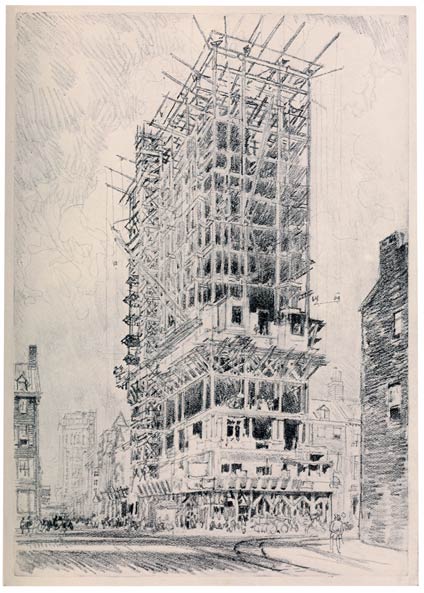
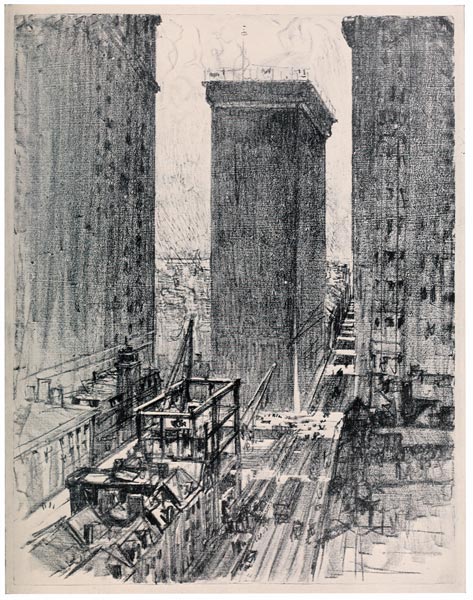
Liberties, when one fact in "murals" about steel works, skyscrapers,
or the Brooklyn Bridge would be worth the lot in the future,
when these factless fancies are whitewashed out, or made a good
ground to paint on. One man in America, W. B. Van Ingen, has
glorified work by his Panama decorations in the Administration
Building at Balboa. These were not wanted at the Panama Exhibition.
In France men like Henri Martin have painted decoratively,
yet realistically, the harvest of last summer; Besnard and Anquetin
have done wonders; and the biggest French artists have decorated the
Mairies. In Chicago they turn students out to make "murals" in
school houses, a system of artistic debauchery worthy of Chicago's originality.
And Puvis de Chavannes, first of all magnificently showed the
way to combine the old decoration with the new realism. His life work
at Amiens is pure convention, so are his designs in the Boston Library
and in the Sorbonne, but they are the most perfect examples of
decorative, imaginative, conventional work in the modern world.
At Rouen and Marseilles he has treated decoratively modern
subjects, or rather he has used modern motives. At Rouen, the city
with its spires and chimneys, its old bridges and new transporters, as
seen from Bon Secours, prove the Wonder of Work; in the foreground
are modern figures, greeting the Spirit of old France. At
Marseilles there are two subjects in which symbolism and realism,
modernity and mediævalism are harmonised—the most difficult problem
to solve; but Puvis has solved it, and proved himself the greatest
if not the only decorator since Pierro della Francesco, the supreme
master of decoration. Raphael, in the Stanzi of the Vatican, was a
decorator of his own time, and so was Pintoricchio in the Library at
Siena, and Mantegna at Padua, for they made decoration out of the
life about them.
And John Lavery has made, in Glasgow, a decoration out of
shipbuilding which is worth the whole wall coverings of the Royal
Exchange and the Library of Congress, and the Carnegie Institute
put together. But decoration is a difficult matter, and Lavery has
done much for Glasgow. I regret that John Alexander and E. A.
Abbey, who had far better official opportunities, only proved how
unfit the average painter is to decorate.
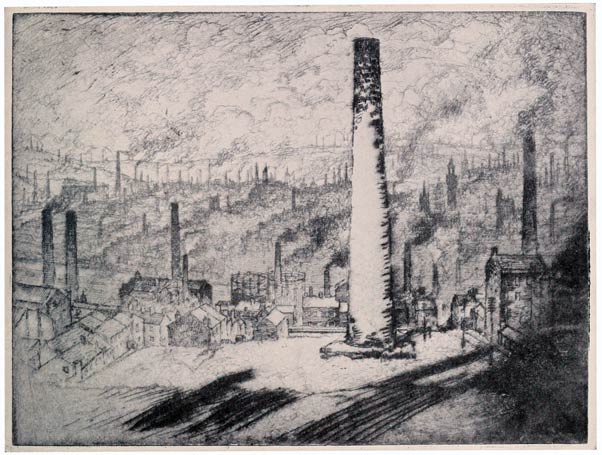
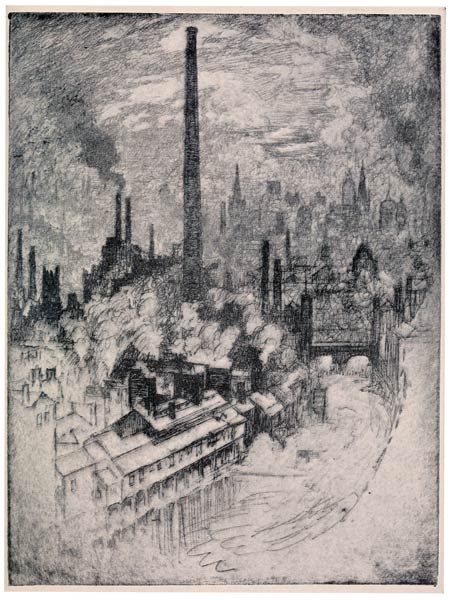
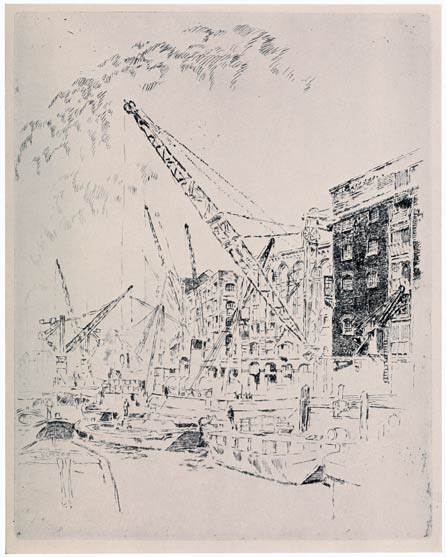
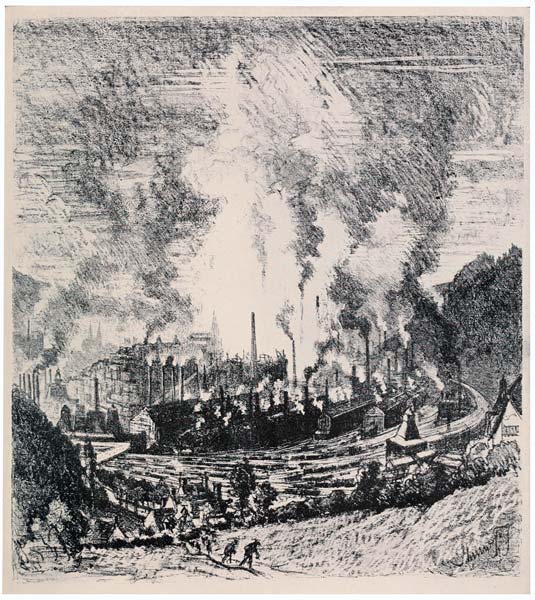
From the very beginning I have cared for the Wonder of Work;
from the time I built cities of blocks and sailed models of ships of
them across the floor in my father's office, till I went to the Panama
Canal, I have cared for the Wonder of Work. There are others who
care—Brangwyn has cared, and so have Sauter, Muirhead Bone,
Strang and Short. Crane and Anning Bell, Way, Cameron, Bone
and Brangwyn have cared for the building up and the breaking down,
and Brangwyn for life—the life of the workman, possibly because of
his Belgian and seafaring education or his knowledge of Meunier, his
countryman. And Seymour Haden's "Breaking-up the Agamemnon"
is notable. And there are Belgians like Baertsoen, de Bruyeke
and Pierre Paulus; and Frenchmen like Lepere, Gillot and Adler;
and Italians like Pieretto Bianco, and there was the great German
Menzel.
But it is to America we must turn, to White's etching of Brooklyn
Bridge, Cooper's skyscrapers, Alden Weir's New York at night,
Bellow's docks, Childe Hassam's high buildings, Thornton Oakley's
coal breakers—to these one must look for the modern rendering of
work. There are others, too, who have seen the opportunity to prig
and steal—but this is evident, just as it is evident that they will give
up painting or drawing work for the next new thing. And there is
another artist who really cares for the Wonder of Work. I do not
know what else Van Ingen has done, but he has made a huge decoration
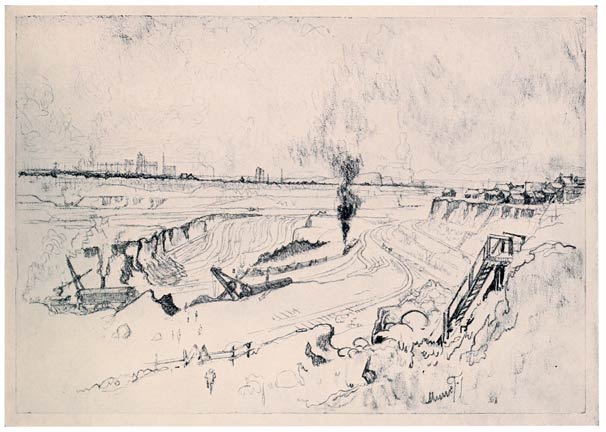
of Culebra Cut—and Paul Bartlett has put American work on
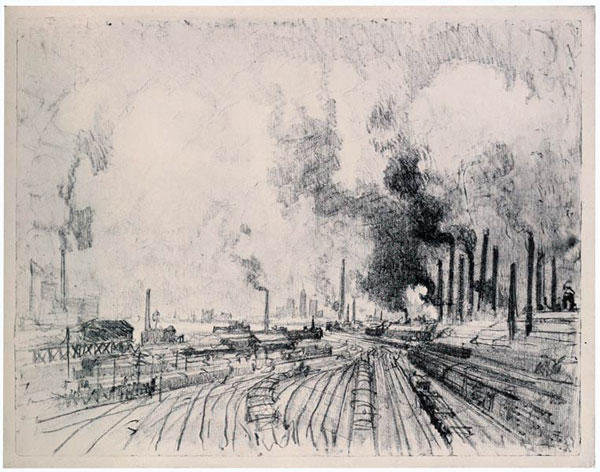
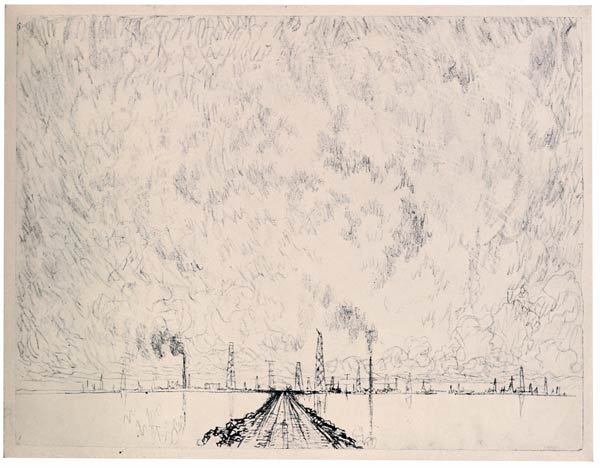
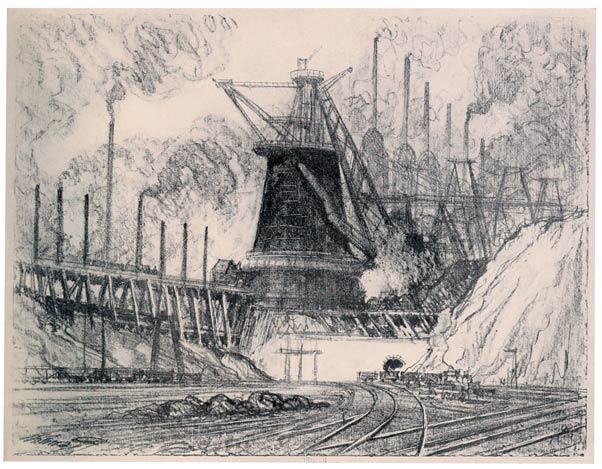
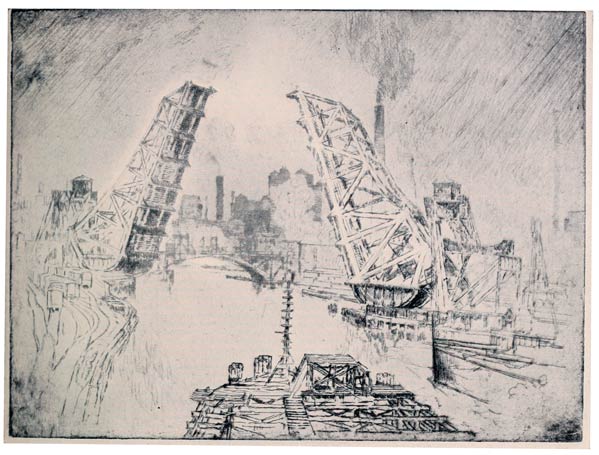
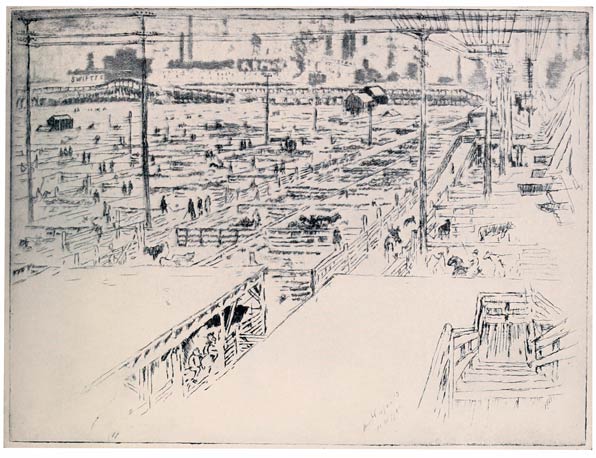
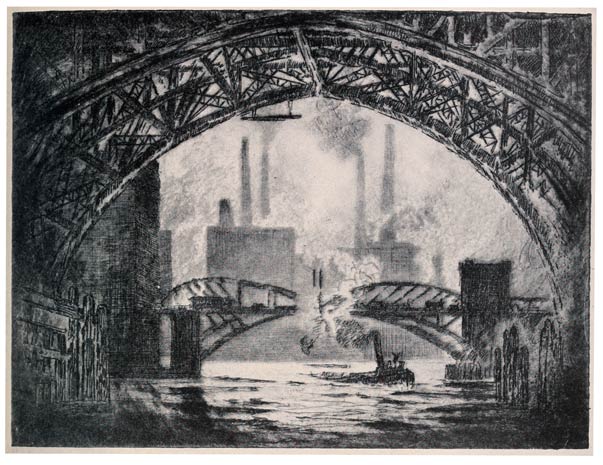
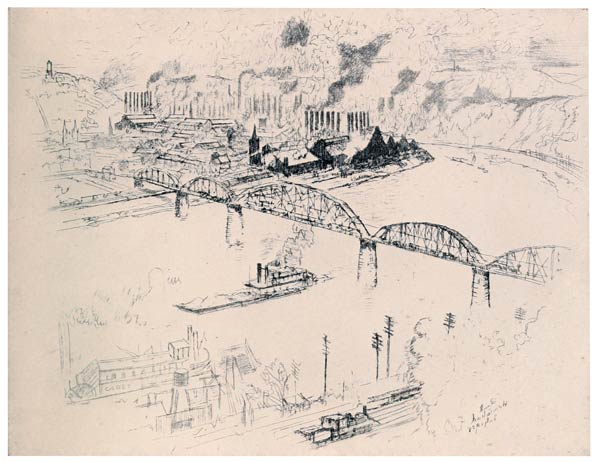
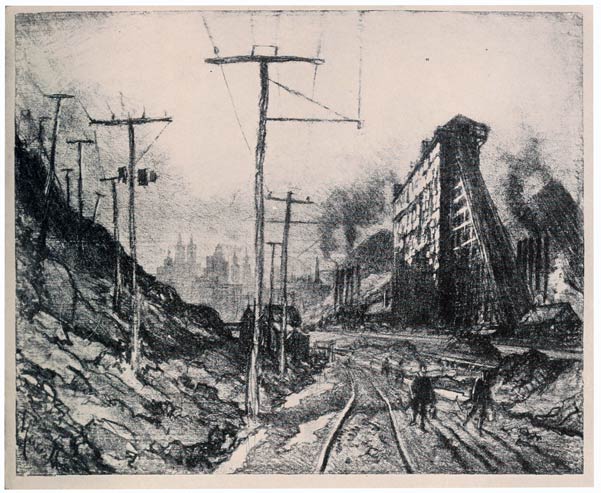
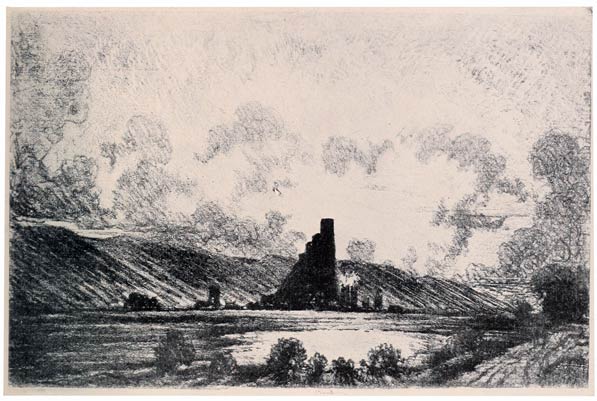
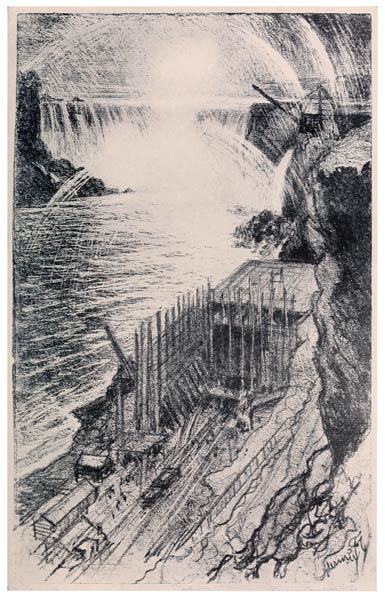
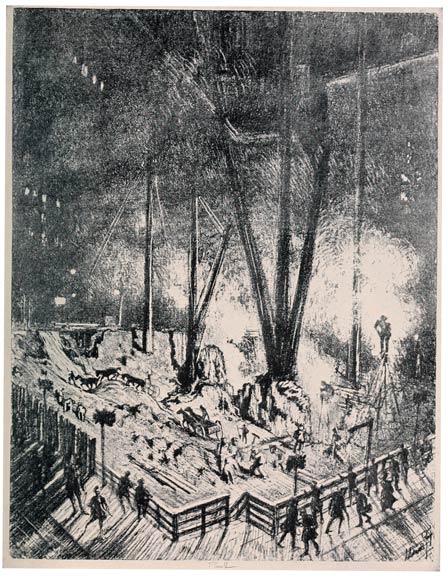
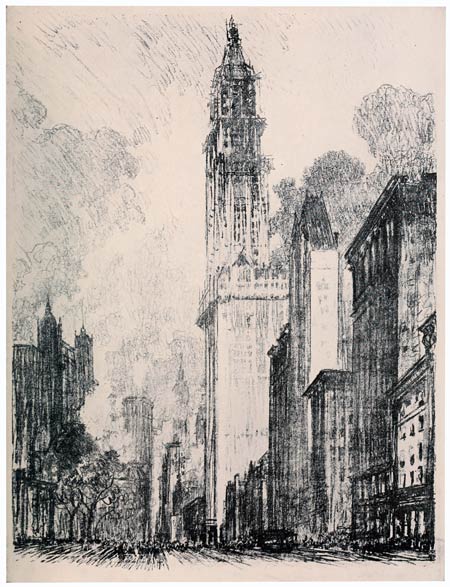
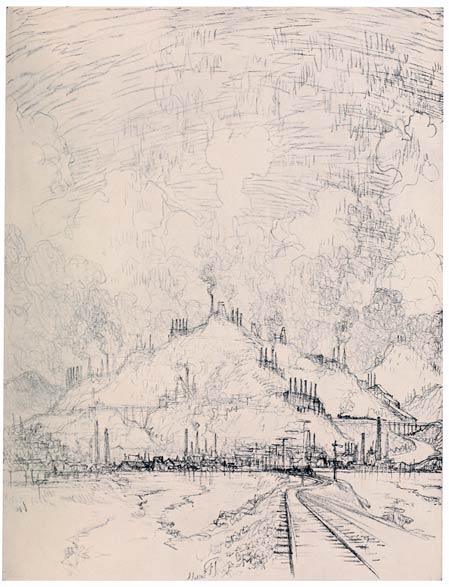
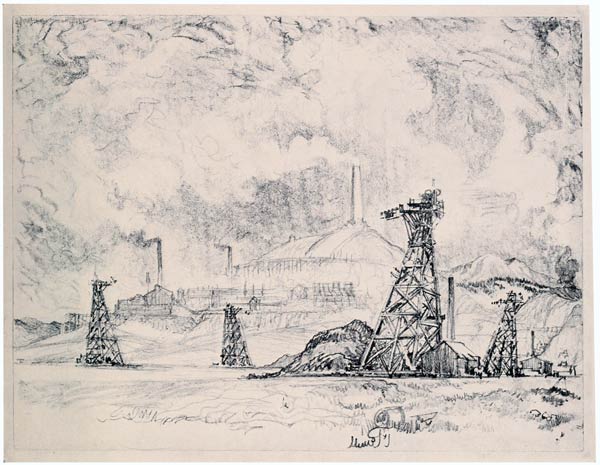
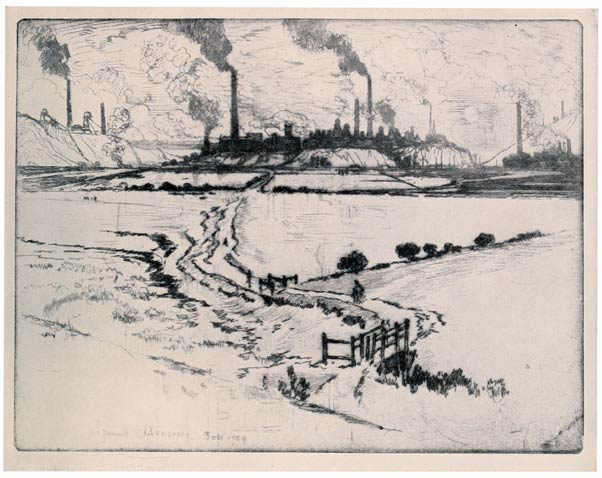
the pediment of the Capitol. I have tried to do what I could in
New York, Chicago, San Francisco, the coal mines of my native State—Niagara—and
in Europe and at Panama; and whatever their
worth, I can only tell of the Wonder of Work as I see it.
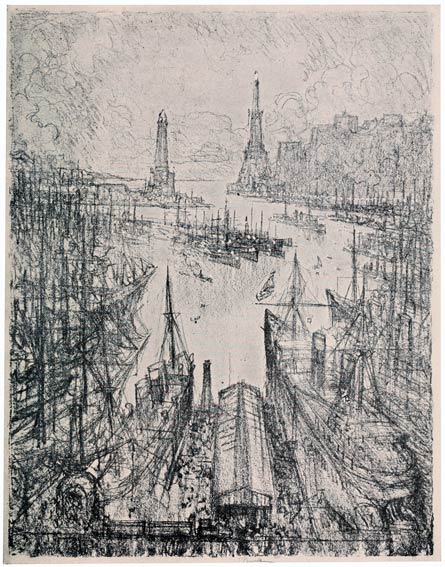
New York, as the incoming foreigner, full of prejudice, or doubt,
or hope, and the returning American, crammed with guide-book and
catalogue culture, see it or might see it, rises a vision, a mirage of the
lower bay, the colour by day more shimmering than Venice, by night
more magical than London. In the morning the mountains of buildings
hide themselves, to reveal themselves in the rosy steam clouds
that chase each other across their flanks; when evening fades, they
are mighty cliffs glimmering with glistening lights in the magic and
mystery of the night. As the steamer moves up the bay on the left
the Great Goddess greets you, a composition in colour and form,
with the city beyond, finer than any in any world that ever existed,
finer than Claude ever imagined, or Turner ever dreamed. Why did
not Whistler see it? Piling up higher and higher right before you is
New York; and what does it remind you of? San Gimignano of the
Beautiful Towers away off in Tuscany, only here are not eleven, but
eleven times eleven, not low mean brick piles, but noble palaces
crowned with gold, with green, with rose; and over them the waving,
fluttering plume of steam, the emblem of New York. To the right,
filmy and lace-like by day, are the great bridges; by night a pattern
of stars that Hiroshigi never knew. You land in streets that are
Florence glorified. You emerge in squares more noble than Seville.
Golden statues are about you, triumphal arches make splendid frames
for endless vistas; and it is all new and all untouched, all to be done,
and save for the work of a few of us, and we are Americans, all undone.
The Unbelievable City, the city that has been built since I
grew up, the city beautiful, built by men I know, built for people I
know. The city that inspires me, that I love. And all America is
like this and—all—or nearly all unseen, unknown, untouched.
I went to Panama because I believed that, in the making of the
greatest work of modern time, I should find my greatest inspiration.
Almost before I left the Canal, artists, architects and decorators
were on their way there. I hope it may interest them half as much
as it interested me. One man has succeeded, I repeat, in doing something
for himself down there—W. B. Van Ingen—and this has been
acknowledged by the government, which has purchased his great
decoration. This is the finest, in fact the only complete decorative
work from him done in the United States—and done because Van
Ingen, the pupil of La Farge—who alone counts—was trained in the
right way and had something to say for himself.
We have recently been told that art will disappear in fifty years
(by a person who says he will call his last book—with possible appropriateness—Vale).
But, though he will disappear, and Post Impressionism
will be swallowed up in shopkeeping, and war has engulfed
that, and work is stopped—save for war—and though the
mustard pot has gone with the soulful doggie, and the tearful baby
rival of the Dresden Madonna, the artist who has something to say
in his own way about his own time, and can say it, will live, and his
work will live, with Rembrandt, Velasquez, Franz Hals, Meunier,
and Whistler—artists who painted and drew the work and life about
them, who carried on tradition, and never regretted the past. And
art which shows life and work will never die, for such art is everlasting,
undying, "The Science of the Beautiful."
Joseph Pennell
This introduction is founded on a lecture delivered before the Royal
Society of Arts, London, and awarded its medal, and an article
published by The Studio, and the author wishes to thank the Council
and Publisher for permission to reproduce parts of it. And it was repeated
before the Royal College of Art, London, The Corporation
of Bradford and the British Architectural Association, London, etc.