The great Major-General Arthur Wellesley, the famous
Duke of Wellington of after days, was the centre of all
eyes as the force with which Owen and his friends had
marched came into camp and joined the main party.
He sat his horse immovable as a rock, and answered
salute with salute with such composure and in such a
soldierly manner that all were impressed. Once only
did he deign to smile as a hoarse voice from the passing
ranks called for three cheers for their leader, and when
the echo of the tumultuous shouting had died down he
showed his appreciation by lifting his embroidered hat.
That was all, and yet in all ranks there was satisfaction,
for from commanding-officer to drummer-boy he was
the idol of the soldiers.
"A very keen commander who knows his men and
can get the very utmost out of them," said the Major,
as the men were dismissed. "Now, Owen, and you too,
Jack, I shall introduce you to your regiments. From
this time we shall see less of one another. But whenever
you have a spare half-hour come across to my tent."
A little later our hero was seated in a tent owned
by the 7th native cavalry, where he found himself a
stranger amongst many officers. He felt ill at ease,
and somewhat bashful for a little while, but soon settled
down, and on the following day took up his duties.
Three days later the army got in motion and set off in
the direction of Ahmednuggur. Long before then
rumours of his adventures had come to the ears of his
brother officers, and he was requested to give the details.
Nor did he omit to say how he had come to be sent to
India, and how, in his younger days, he had been a
corporal in the 64th, and earlier a waif in charge of
the matron at the poorhouse.
"With a mystery attached to your going there,
Jones, I think," said the Colonel heartily. "Well, my
boy, I admire the open manner in which you have told
the tale of your early days. There are heaps of young
fellows, and older men too, who would keep the matter
dark, and feel very chary of mentioning it. And so
you have two wounds to boast of?"
Owen acknowledged the fact with heightened colour,
as if he were ashamed, at which there was a roar of
laughter.
"And have had a couple of good tussles, besides a
little affray aboard ship? Very good! Before you have
finished you will bring some credit on this regiment."
There was another roar of laughter, which set his
blood tingling, and his colour mounting to his cheeks.
But it was all good-natured chaff, and like the sensible
fellow he was, he showed no resentment. More than
that, he was glad now that he had fought Hargreaves;
for he began to learn that tales fly in a country like
India, and that it is everything for a youngster to come
to his regiment with a good recommendation.
"We heard that you were coming a week ago," said
one of the younger officers with whom he shared a tent.
"Some fellows came in from another column, and it
seems that they had sailed from Calcutta to Bombay,
beating you by some weeks. They had come out in
the same ship, and that is how we heard of the fight, of
the pirates, and your escape. And there is a yarn in
camp about this other affair at the native fort. You
must tell me all about that. I mean, you must give me
full details, for by what you said in the mess tent the
whole affair might have lasted only a few minutes."
Owen had indeed been very modest when describing
the contest at the native fort, and it was only when
Mulha was appealed to that the full details became
known. And as they filtered from mess to mess, they
came in time to the headquarters' mess, and the General
heard the tale.
"Send for him," he said abruptly. "A little affair
of that sort is often more difficult to arrange than one
of greater magnitude. I wish to question this officer."
Very hot and uneasy did Owen feel when, dressed in
his cavalry uniform, belted, and with his sabre on, he
was ushered before the General. He was still a little
hampered by the wound he had received in the affray
with the pirates, while the slash he had received across
his ankle in the affair of the fort, though a trifling affair,
was sufficient to increase the limp. He drew himself up
to attention and saluted stiffly, keeping his eyes steadily
on the General. Then he dropped his hand, retaining
his position at attention. The leader of the troops
stood in front of his tent, with two other officers beside
him, and for the space of a few seconds he returned the
glance of this cavalry ensign, his sharp eyes seeming to
pierce to the back of Owen's head. It was an ordeal
at which many an old soldier would have flinched, and
do what he would Owen could hardly contain himself.
A moment later the tension was broken.
"Mr. Jones, sir," said one of the officers. "You
wished to see him."
"Yes. How old are you, please?"
Owen gave his age as correctly as was possible,
considering the fact that the unusual circumstances
surrounding his birth made a precise answer impossible.
"Tell me about this fort. Who was with you?"
"My servant, sir. A Mahratta."
"How many helped in the defence?"
One after another the General shot off his questions,
demanding the size of the place, the number of the
enemy, and the dispositions taken for defence.
"If you had had twenty-five English troops to help
you, how long could you have held out?"
"I should have tried to beat them off altogether, sir,"
came the prompt reply. "If not, I should have contented
myself with holding the place. There was food
and water enough to last for a week at least."
"You discovered that? When?"
"Within a few minutes of entering the fort, sir."
"And how would you have attempted to carry out
the first part of the programme, Mr. Jones? Be precise,
please. How would you have beaten them off?"
"I should have held the walls till night came, sir,"
Owen answered without hesitation, "and then I should
have made a sortie. Those roving bands consist of the
roughest characters, and they seldom set a watch at
night. Often enough they are almost overcome with
the opium or bhang they have taken. I should have
driven off their horses and attacked them in the early
hours."
"A bold programme," said the General, with a lift of
his eyes. "Success would much depend upon your information.
Is it a fact, for instance, that they take opium?
How do you know it?"
Owen at once told his questioner how Mulha had
taught him all that seemed of interest with regard to the
Mahrattas, and how in their daily discussions he had
mentioned this fact.
"Then you speak Mahratti? Sufficiently well to
understand, or better?"
This time the General looked at our hero with
awakening interest, while he waited eagerly for his
answer.
"I can, I am told, speak like a native, sir," answered
Owen modestly. "I can also speak Hindustani."
It was evident that General Wellesley was not the
one to allow the possibility of a mistake. He turned to
one of the officers and gave a short order. A little later
a Mahratta advanced and salaamed.
"This is one of the Mahratta friendly chiefs," he said.
"I have instructed him to converse with you."
Had our hero told anything but the strict and accurate
truth, he would then and there have been confounded.
But he was sure of himself, and a minute later found the
Mahratta salaaming to him and conversing at a pace
which utterly forbade those who had a smattering of the
language following the conversation.
"My lord," said the native, turning to the General,
"the sahib tells me that he believes that he lived in this
country when a babe, and learned Hindustani, and
mayhap some of our tongue even before he was taught
his own. Truly, I can believe it. But for his colour and
his dress he is a Mahratta."
"And here is a report to that effect, received from
Calcutta, sir," said one of the officers, abstracting a
parchment from a leather satchel. "This came through
with the column with which Mr. Jones marched."
"I will see it. Put this officer's name down for special
service, in connection with interpreting or otherwise.
He has shown great energy and courage. Good-morning,
Mr. Jones."
He acknowledged Owen's salute and stood looking
after him as he limped away.
"We shall see him again, I think," he said very
quietly. "It is something to have a youngster amongst
us who can speak like a native and has the pluck to
carry out the part."
Marching across the plain watered by the Soona, the
force under General Wellesley at length came in sight
of Ahmednuggur, having passed numerous villages en
route which had been fired by the lawless Mahrattas.
And here they found a city and fortress which promised
to tax their powers, for the pettah boasted a lofty wall,
flanked with towers, though it had no battlements. In
addition it had an excellent ditch, and, according to the
General, was the strongest fort which he had seen, saving
only Vellore, in the Carnatic. The place was garrisoned
by a body of Arabs, aided by one of Scindia's regular
battalions, trained no doubt by some French officer, while
between it and the fortress lay a column of horse.
The little army sat down before the place in a business-like
manner, and Owen very soon had an opportunity
of seeing how troops conducted the affairs of a siege.
Having accompanied his own troop of horse round the
stronghold, he found himself free for a time, and with
Jack Simpson beside him, now an ensign in a native foot
battalion, for he had been unfortunate enough not to
attain to the cavalry, he watched as the gunners prepared
their batteries. They broke ground that very night at an
easy range, and it was not long before the thunder of the
guns awoke the echoes. Then there were other matters
of interest to see and admire. There were the hundreds
of bullock-carts, the slow-moving yet very trusty transport
of our armies in India, and there were the lines of
tents erected for the men, the hospital tents, the orderly
groups of canvas shelters for the officers, and the numerous
hucksters and small merchants who hovered in the lines.
Further, there were the native servants, hurrying about
their masters' business, leading ponies and horses to
water, cleaning saddlery, brushing travel-stained uniforms,
and performing the hundred and one duties which fall to
the lot of servants. Not that a native will do the tithe
of work that one can expect from a European servant,
for in India caste rules far and wide, and the man who
will sweep the compound and perform other menial
offices is looked down upon by the grass-cutter or the
syce who tends the ponies. It was all most interesting,
and it was long before the two young fellows had made
a round of the camp.
And now, while the gunners are bombarding the
walls of Ahmednuggur, let us halt for a while to learn
what had actually been the course of events from the
commencement of this Mahratta trouble. And perhaps
it would be as well to mention to the reader the forces
to which we were to be opposed. The Mahratta chiefs,
controlling a turbulent population, and ever eager for
war, and delighting in the clatter of arms, had united
for the time being, a somewhat unusual occurrence,
considering the jealousies and rivalries which existed
amongst them. They had, in the first instance, marked
the Nizam for their prey, and were deeply offended
because the Company had taken him under their wing.
And now the Peishwa, whom Holkar, the most powerful,
perhaps, of Mahratta chiefs, had driven from his throne,
had become an ally of ours, and we were pledged to
support him. Backed by his trained battalions, officered
by Frenchmen, Scindia openly threatened the British,
and it was abundantly clear that if left to himself he
would rapidly increase in power, and would one day
become a serious menace to our hopes in India. War
was, in fact, imminent and would be undertaken on our
part with the object of humbling this native ruler's
power, and, perhaps with a greater object still, that of
ridding the country for ever of the French and the
native battalions they trained. Our success would bring
about in natural course a third object, that of securing
the Peishwa on his throne.
General Wellesley had the command of our troops, and
these prior to the commencement of the campaign were
separated. Colonel Stevenson, with two regiments of
native cavalry, and the Nizam's subsidiary force, amounting
in all to 8000 men, took up his position at Parinda,
on the Peishwa's frontier, where he was accompanied
by 15,000 of the troops of the Deccan. He was therefore
about a hundred miles east of Poonah, the Peishwa's
seat of government, then in the hands of Holkar.
A second force, that commanded in person by
Arthur Wellesley, and to which Owen was now
attached, commenced operations at the northern frontier
of Mysore, and numbered 8000 infantry and 1700 horse.
They showed the energy of their leader at once, for
they marched with all their baggage and heavy guns
upon Poonah, accomplishing a journey of some six
hundred miles at the average rate of thirteen and a
half miles a day, and that without losing a single
draught animal, though the country had been swept by
Holkar, a powerful chief in command of a host of
freebooters, and it was the worst season of the year.
Poonah was taken without encountering opposition,
though Holkar's freebooters only fled as the British
force came into sight, and the dethroned Peishwa was
again brought to his capital and safely installed there,
with the help of our bayonets. At this stage Colonel
Stevenson moved towards the Godavery, there to
overlook Holkar and his freebooters, his co-operation
being no longer necessary; while Wellesley prepared
for further eventualities should the Mahratta chiefs
prove troublesome.
The reader will have noticed the mention of Holkar,
and it may be as well to state here who this chieftain
was, for his name is destined to appear again in the
narrative. Jeswunt Rao Holkar, to give him his full
title, was the descendant of a family which had had a
meteoric career, rising from humble circumstances to
great power and wealth. Originally they were members
of the Dungar shepherd tribe, located some fifty miles
from Poonah, and it was one of these shepherds who
first carved fame and fortune for his house with the
keen edge of his tulwar. Indeed, he obtained much
power and wealth, and became virtual ruler of eighty-two
districts north of the Nerbudda. It is unnecessary
to follow the doings of his family, but it will suffice if
we state that, according to the almost universal custom,
his successors did not always come to their rights peacefully,
and this Holkar, an illegitimate descendant, found
himself in his younger days a fugitive. But he possessed
the spirit of that forebear of his, for with a tiny following
he carved his fortune anew, gathered adherents at
every stride, and finally became the terror of the
Peishwa and of Scindia. He hung on their frontiers,
ravaged their territories, and plundered friend and foe
alike. And at this stage, when Britain may be said to
have entered into war with Scindia, to whom were
allied other Mahratta chiefs, this Holkar hung like a
cloud on the frontiers, with a horde of ruffians and freebooters,
scowling at both parties and threatening the
peace of our other possessions.
Information had reached General Wellesley that
Scindia and the Rajah of Berar had joined forces and
had taken up a hostile position. He requested them to
withdraw, and meeting with refusal made ready for active
operations. The troops marched for Ahmednuggur,
meeting with the column which had accomplished the
enormous land journey from Calcutta. And now they
were before the town, which was of great importance.
For it covered Poonah and the Peishwa's frontier, while
the possession of this place would give our troops an
excellent depot, would cut Scindia off from his southern
supporters, and would give into our hands his territories
south of the Godavery.
While referring to Scindia, it is of interest to mention
that he had an immense force of irregular cavalry, a large
number of well-trained infantry battalions, and marched
light. That is, he carried no magazines, but subsisted on
the country, plundering whenever and wherever he could,
like Holkar on the frontier. He had a marked awe of
the British regulars, and in this campaign he did his
utmost to carry on a predatory warfare, attacking when
in overwhelming force, hanging on our flanks, and
marching swiftly and incessantly whenever our troops
became too troublesome. However, we shall see how he
succeeded.
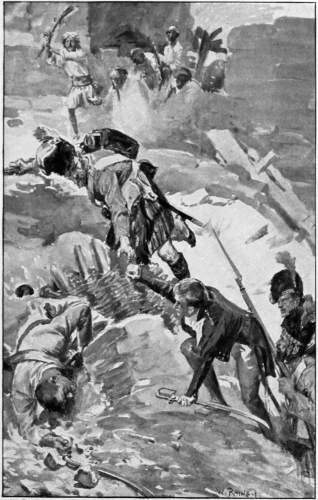
HE STRETCHED OUT A HUGE PAW AND DRAGGED OWEN UP
"We shall be marching to the assault soon, lads," said
the Major that evening, as the boom of the cannon died
down. "It will require very little bombarding to make
an effective breach, and then you'll see how we'll turn the
beggars out. How'd you like to be one of the boys?"
Owen's eyes glistened, while he looked across the
narrow camp-table at the Major, who was faintly discernible
by the aid of a smoky native lamp.
"Ha, ha! This time you will look on," laughed the
Major. "Jack and I are the boys who will try for
honour and glory. The cavalry will be watching the
enemy's horsemen and will be foraging outside the
lines."
"I'd like to go though, sir," answered Owen. "I
shall ask my commanding officer."
He said nothing more then, but on the following day,
when the call sounded for the troop to fall in, he rode up
to the Colonel.
"Well, Mr. Jones," said the latter, "what can I do for
you? You have your orders, or rather the troop commander
has. You are to ride well in rear of that fort and
keep a careful watch. Not that you are likely to have
much to report, for our spies tell us that there are none
of the enemy within miles."
"Then could you excuse me, sir?" asked our hero.
"You see, sir, I wanted to know what it would be like
attacking a wall, and——"
"Why, you know. What about that rickety native
fort? Bless me!"
The Colonel swung round in his saddle, while the
adjutant grinned.
"A regular young fire-eater, sir," he whispered.
"And what if all my cornets made the same request?"
demanded the Colonel. "But there. We can spare you.
I'll see one of the staff and ask him to manufacture some
orders for you, for you can't accompany the storming
party unless there is good excuse. Now be careful, and
if you get a crack over the head, or get killed, why, don't
blame me."
He acknowledged Owen's salute somewhat surlily,
and rode off with the adjutant, while Owen, his spirits
raised to a high pitch, clapped heels to the fine Mahratta
horse he rode and went furiously off the parade ground.
However, within some fifty yards he was brought up with
a shout, and checking his mount, turned him with an
easy swerve. There was a native orderly beside him by
now, and his lance went to the salute.
"The Colonel Sahib desires you to return."
"To tell me I cannot go," groaned Owen, as he set
his beast in motion. However, he little guessed the
cause. He pulled up within a horse's length of the
commanding officer and saluted.
"Mr. Jones, will you please to remember that you
are not to gallop off the parade ground unless carrying
an order. There is no need for such haste. Bear that
in mind in future."
With a swing the Colonel and his adjutant pulled
their animals round and trotted away, leaving our hero
somewhat crestfallen. But the two who rode away wore
a smile of evident amusement.
"Will do him good! Some of these youngsters
think they know everything. Jones doesn't, but he
might, don't you see," said the Colonel, "so I've pulled
him up and dressed him down. He'll make a capital
officer."
Owen saluted the Colonel's back as the latter rode
away, and then walked his horse from the parade
ground. And presently the adjutant came up to him.
"Got into hot water that time, my boy," he laughed.
"But the Colonel is right. You mustn't allow excitement
to carry you away. It's a standing order that
about galloping off the parade ground, though I fancy
we let it drop when on service. But I have your orders.
You are to go with the storming party, not to lead it,
you understand, and are to interview any prisoners who
may happen to be taken. Now for a bit of advice.
When you pass an enemy who is down just make sure
that he is really hit. More than a few of our poor
fellows have been sabred or bayoneted by men who
have made pretence to be killed."
Owen was delighted, and his spirits again soared up.
He rode off to his tent and dismounted. Then he fell
in in rear of the storming party, and sat down beside
the officers while the guns thundered against the wall.
They watched the balls strike against the mud and
masonry, sending clouds of dust into the air, and often
bringing down such a pile of material that the crash
could be heard at that distance. And in a little while
the bugles sounded, the men fell in, and the order to
advance was given.
Only those who have experienced the feeling can
know what it is to be one of a storming party, or the
curious sensations with which men are filled. Happily
for Owen he was a high-spirited, merry youngster, and
had been in tight places before. He allowed nothing to
damp his ardour, and when the men broke into a trot,
crushed well towards the front. Very soon he found
himself beside the ranks of one of the two Highland
regiments which were with this force, and just in front of
a Sepoy battalion. There was a shout, bayonets came
down to the charge, while the kilts of the men swung
out still wider. There was a hoarse growl of excitement,
and then a roar from the throats of the gallant
fellows. They were in the ditch. Owen caught his foot
on a piece of masonry at the very summit and pitched
head foremost to the bottom, alighting on the shoulders
of a brawny Highlander, who shook him off with an oath,
recognised an officer, and helped him to his feet. Then,
side by side, Owen sabre in hand, and the kilted soldier
armed with his fearsome bayonet, they scrambled up the
steep slope and into the breach.
"Hang on, sir. Give me your hand!" shouted the
fine fellow as Owen was forced back. "Hah! that's as
muckle as ye'll want."
He stretched out a huge paw and dragged Owen up,
turning just in time to ward off a thrust made by one of
the enemy. Then he lifted his weapon and brought the
butt with terrific force against the man's chest, dashing
him to the ground so suddenly that the unfortunate
native split his head against a portion of tumbled
masonry. Then there was a fierce mêlée for a few
seconds, a mêlée in which bayonets crossed, and tulwars
and swords flashed in the sun. The air was filled with
the shouts of the Mahratta foot, and with the guttural
exclamations of the Arabs. Blows fell thick and fast,
while from attackers and attacked there came the sound
of deep-drawn breathing. Then a shout was heard.
"Forward! into the town!" A fierce excited cheer
answered the summons, and in a moment the Highlanders
flung the enemy aside as if they had been but spray
from the ocean, and won their way through the breach.
"Charge! Don't give them time to get to the houses,
men," called out the commanding officer.
At once the ranks, which were already broken, divided
altogether, and the Highlanders charged against the
houses clustered near at hand. But the enemy were
before them, and for some little while Owen and his new
comrades had tough work to carry through.
"Sahib, come here, where you can shelter," said one
of the Sepoys, with whom he now found himself fighting.
"You have no musket and can do nothing. Presently
we will charge and then you can lead."
The enemy had taken refuge in the houses on either
side of the street, and for a while their fire made progress
almost impossible. But the attackers answered with the
utmost spirit, sheltering wherever they could, while some,
reckless of the consequences, dashed forward, burst in
the doors, and fell upon the enemy. It was a most
exciting time, and there is no wonder that Owen forgot
all else but the fighting. He caught sight of the brawny
Highlander again, his kilt all adrift in the wind, and
showing unmistakable signs of the conflict. He was
charging down the street with some dozen of his
comrades, while three or four of the Sepoys were with
the gang. Owen could not resist the temptation. He
burst from his cover and dashed after them. Shots
struck the ground at his feet, kicking dust into his eyes.
A man thrust a musket between the lattice of a ground-floor
window and fired in his face, so that the flash
singed his hair. But he hardly noticed the incident.
He was whole, uninjured, and there were deeds still to
be done. With a shout he joined the little party, and
threw himself against the doors of a house of large size.
They gave with a crash, and the men were in. With a
shout they flung themselves upon the enemy and then——
"Pull yourself together, man. We're in and the place
is ours. Here, take a sip."
Owen sat up, giddy and confused. All he could
grasp at present was the fact that Jack Simpson was
beside him. Stars whirled before his eyes, the walls, the
floor, the figure of an Arab and a Sepoy were strangely
jumbled up with the large form of a Highlander, who
lay full length, looking quietly at him, while an officer
bandaged his wounded leg. There was a terrible din
outside. What had happened?
"Shut your eyes and hold your tongue. Now, sip
that. Right, I'll get some water."
Ten minutes later he was standing up, somewhat unsteadily,
while Jack Simpson detailed the events which
had just passed.
"They fought stubbornly," he said, "and we lost
fairly heavily, for this street fighting is very nasty work.
However, we turned them all out, and here we are,
masters of the town. The guns are getting into position
to bombard the fort. Now about you, old fellow! The
Highlander tells me that just as you burst into the
house an Arab hit you over the head with a sponging
rod, and brought you down like a ninepin. My word!
You are a fellow for go and dash! I saw you in the
breach and afterwards as you made your rush."
Owen had indeed displayed not a little of that daring
and pluck which have made our soldiers famous. The
excitement of the attack had carried him away, and the
sudden friendship of the Highlander had served to feed
the fire. Fighting together, as if they were of equal
rank and had known each other for years, the two had
struggled on till they were separated. And then Owen
had again joined his friend, only to be beaten to the
ground, while the Highlander had a bullet through his
leg. However, it was not till an hour later when he
emerged from the house, walking beside the litter of
the gallant Scot, that he gathered that his conduct had
attracted attention. The General and his staff were
standing beside the breach, while within a few yards the
Highland regiment was drawn up, standing there at
ease, till orders came for another advance. As Owen
stumbled along, for he was still very giddy, a murmur
went down the ranks, and men nudged one another.
Then one of the lads tore off his bonnet and threw it
into the air, catching it upon the point of his bayonet.
"Three cheers for Cornet Jones and Andrew
Macnalty!"
The hoarse roar which followed might have been
heard a mile away, and, as may be imagined, attracted
the attention of the General and his staff. He turned,
saw the bonnets in the air, and Owen and the Scot
passing between himself and the ranks.
"Our friend of the fort again, I think," he said with
a quaint little smile. "Did I not say that we should
see more of this young officer?"
 Cover
Cover