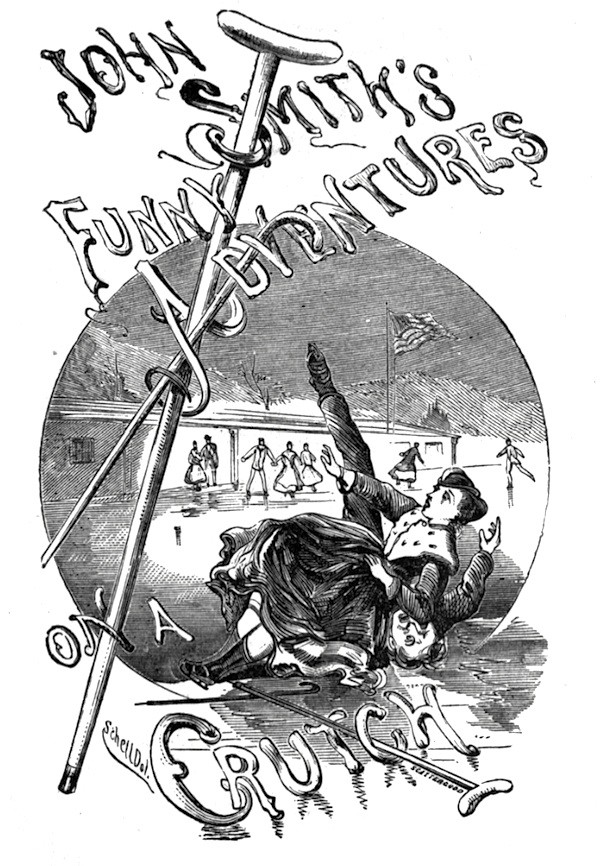
John Smith's Funny Adventures On A Crutch! — CHAPTER I. The Way It Happened.
John Smith’s
FUNNY
Adventures On A Crutch!,
or the
Remarkable Peregrinations of a One-
Legged Soldier after the War.
BY
A. F. HILL,
AUTHOR OF “OUR BOYS, OR ADVENTURES IN THE ARMY,”
“THE WHITE ROCKS, OR THE ROBBERS OF
THE MONONGAHELA,” ETC., ETC.
WITH ILLUSTRATIONS.
PHILADELPHIA:
THE KEYSTONE PUBLISHING CO.
1890.
Copyright
By KEYSTONE PUBLISHING CO.
TO THE
MEMORY
OF
ARTEMUS WARD,
WHOM THE WORLD OWES FOR A THOUSAND
HAPPY SMILES,
THIS WORK IS FRATERNALLY
DEDICATED
BY
THE AUTHOR.
Preface.
It is verily more difficult to write a good preface
for a book than to write the book itself.
We don’t mind telling the reader, very confidentially,
that this is not, by any means, our first
effort at a preface for this work: and we earnestly
hope that the public will not pronounce
this ninth one so stupid as we deemed the eight
preceding ones that we tore up.
It will be perceived that our hero bears the
historic name of John Smith. Original old John
Smith, the Virginia settler, met with many
adventures—some of them funny and others
not so funny—among the latter was the affair
with Miss Pocahontas and her stern old parent:
and we claim, for our own John Smith, as many
adventures as his illustrious namesake—some
of them quite as funny and others funnier.
Nothing in this narrative of real incidents is
at all calculated to reflect on the excellent
character of Mr. Smith: and this is because we
esteem him very highly and not from any dread
of the law; for John Smith is so multitudinous,
that one could handle the name with impunity,
and not incur any risk of prosecution for libel.
What would a court say to an action against a
writer for libeling John Smith, yeoman!—especially
when the writer should plead that he
never meant thatJohn Smith, but quite another,
unknown to the court.
There are those who will shrewdly guess that
the hero of the narrative represents the author
himself, the chief grounds for such inference
being a striking similarity in the number of
nether limbs. That, however, should scarcely
be taken as conclusive; for, since “this cruel
war is over,” there are nearly as many one-legged
men in the country as there are John
Smiths!
CRACK! went a rifle at the battle of Antietam.
Not that it was the only one fired, for they
were rattling away at the rate of a thousand
per second just then; but there was one rifle in particular
discharged, which, so far as I was concerned,
was clearly distinguishable from all the rest. I did
not see it, nor am I confident that, in the din of battle,
I heard its report; yet I was made painfully aware
of its existence and proximity, and shall no doubt
entertain a recollection of it while life lasts, and
reason retains her throne.
That rifle, evidently fired by some one whom I
would have shot first, if I had had a good chance—and
therefore I couldn’t blame him much for shooting
me—threw a leaden ball of one ounce in weight, and
similar to an acorn in shape; and that missile, travelling
at the rate of five thousand miles an hour—though
they rarely travel a whole hour without resting—struck
and wounded me, John Smith. It passed
through the thigh, lacerating that muscle vulgarly
known as the tensor vaginæ femoris, and causing a
compound fracture of the femur, barely below the
trochanter major; that is to say, it broke the bone
about three inches below the hip.
The ball had come diagonally from the direction
of my right and front, passing through the outside
portion of the left thigh, and coming out only an
inch and a half from where it had entered; and I
could not help, when I had regained my composure,
making some little geometric calculations on the subject.
I reckoned that if the man who had fired the
rifle—allowing him to have been one hundred yards
distant, and the barrel of the piece to have been four
feet long—had moved the muzzle the one-hundredth
part of an inch to the right, I should have been
missed; if he had elevated it about the same distance
I should have been missing. My next thought was
that whereas my antagonist had discharged his rifle, I
must request the government to discharge me.
Some of my comrades carried me from the field,
and, after a little diversion in the way of fainting,
got me loaded into a one-horse ambulance—a vehicle
that can beat a wild-cat jumping on moderately rough
ground—and away it went, plunging diagonally across
a corn-field, like a schooner hove to in a storm. A
shattered limb is one of the most painful things in the
world, especially when its owner is jostled about like
old rusty nails. For good, solid, substantial pain, I
know of nothing worthy of being spoken of on the
same day with it. The toothache, in its worst form,
is bliss compared with it.
There was another wounded “hero” in the ambulance,
lying beside me; his leg was shattered below
the knee; and I reckon that the yelling he and I did,
jointly, wasn’t the sort to be excelled by any other
two youths of medium abilities.
We were driven to a small log schoolhouse that
was used as a surgical hospital, and there unloaded.
I do not know what became of my companion in
misery—that is, in the ambulance—for it was as
much as I could do to keep myself in view for some
days following.
Within the schoolhouse were several surgeons
busily engaged in amputating limbs; while without,
beneath some oak trees that stood near, lay a great
many sufferers awaiting their turn. I must give the
surgeons credit for considerable dispatch—and no
doubt they dispatched many a poor fellow that day—for
I observed that every few minutes, a whole man,
(in a bad state of repair, to be sure,) was carried in,
and soon after carried out, in from two to four pieces.
They did their work up with rapidity, and by evening,
the arms and legs that were piled up against
the wall of the schoolhouse without, would have
amounted to a full cord—limb measure.
Well, as I do not intend to dwell on this part of
the narrative very long, I will simply say that the
doctors finally reached my case. I was carried into
the little building, where so many pangs had been
suffered that day, and laid on an operating-table; and
after a slight examination of my wound, and a consultation
of eight or nine seconds, they lulled me to
repose with chloroform, and scientifically relieved me
of my left leg. When I returned from the state of
profound oblivion into which the chloroform had
thrown me, I was glad to find that they had not made
a mistake, and cut off the wrong limb—as a doctor
was once known to do. They had amputated the
right leg, because the left one was the right one—it
being the wounded one—and my right leg was now
my left one, because it was the only one left. Yet, the
other was always the left one, and it has remained so,
because it has been ever since left on the battle ground.
However, that is all right.
What I suffered during the ensuing three months
in Smoketown Hospital, several miles from Sharpsburg,
I will pass over with but a thought and a
shudder, and hasten on to tell of the curious and
amusing adventures I have since met with, “on a
crutch.”
I will never forget my first attempt to walk on
crutches. I thought it looked easy, to see others
walking about the hospital on crutches; just as an inexperienced
person is apt to think rowing a boat an
easy matter, because he sees others do it with apparent
facility. So, one day, when my strength had so
increased that I thought I could bear my weight on
my only leg, I urged the nurse to lift me up and let
me try a pair of crutches.
He did so. He raised me up, and I stood holding
tremulously to the tent-post—for I and five other unfortunates
occupied a hospital tent—while he carefully
placed a crutch under each of my arms. It was
the first time for several months that I had been in
an erect position, and you can’t well imagine how I
felt—without studying a good while about it. The
ground on which I stood seemed so far beneath that
it made me quite dizzy to look down on it, and I
trembled at the awful possibility of falling.
With the crutches under my arms, and the nurse’s
strong hand on my shoulder to keep me steady, I
made two or three feeble, timid strides, and concluding
that walking on crutches was not quite what it
was “cracked up” to be, I faintly said:
“Nurse, put me down on the bed again: I fear I
will never walk well on a crutch.”
“Pshaw!” said he, as he assisted me to return to
my couch of straw; “you do well, and you’ll do
twice as well next time you try it.”
“Twice as well would be but poorly,” I rejoined.
“However, I will do my best.”
“Certainly! Don’t think of getting discouraged.”
As I now look back on that dismal scene, and remember
the sinking heart that throbbed so feebly
within me, and the wasted trembling limbs with
which I attempted to flee from my prison-like bed, I
cannot help smiling;—now, when I can skate as fast
as any one, on my solitary foot, swim as well as I
ever could, climb like a squirrel, jump on a saddled
horse and ride at any pace I please, place a hand on a
fence as high as my head and spring over in a quarter
of a second, or walk twenty-five or thirty miles a
day—all this with one good leg, a crutch and a cane!
When the spring came, and I could walk about
with some ease, I went from my country home to
Philadelphia, to get one of Palmer’s artificial legs,
supposing that I could wear one advantageously.
While on the subject, I will simply say that I got
one, but never used it much, because there was too
little of the thigh left to attach it to firmly. Not
that I would be understood to detract from the reputation
of Palmer’s patent limb; for we all liked the
Doctor, and were most favorably impressed with his
handiwork; and my subsequent observations have
left no doubt in my mind that his are the most nearly
perfect of any artificial limbs manufactured.
Major King, Assistant Surgeon-General of Philadelphia,
sent me to Haddington Hospital, to wait till
the proposed new limb should be ready for me; and
it was there that I, John Smith, fairly began my
somewhat eventful career—“On a Crutch.”
The hospital, located near the beautiful suburban
village of Haddington, was set apart for such “heroes,”
as had lost arms or legs, and desired to replace them
with substantial wooden ones. It was not unusual at
that time to see fifty or sixty one-legged men strolling
about the grounds, in fine weather; or squads of
fifteen or twenty, supplied with passes for the day,
clambering upon a street car and going into the city
for a bit of a spree.
A person once asked me if it was not a rather sad
sight, and if the boys in this condition were not
rather morose and gloomy. The very thought is
amusing. I never, anywhere, or under any circumstances,
saw a livelier crowd of fellows than the
maimed and crippled soldiers at Haddington Hospital!
They were nearly all young men, from seventeen
to twenty-two, and a happier, noisier, more frolicsome
set of boys I never saw! It was no unusual
thing for some of them, in a merry mood, to carry on
till they got put into the guard-house, by the impatient
surgeons—sometimes when they scarcely deserved
it; but of that, I will say more hereafter.
CHAPTER II. John’s Adventures with a Crazy Man.
HADDINGTON Hospital had its “characters,”
as every place has. I formed ties and associations
during the spring of my stay there, which
can never be forgotten. Nearly all who were there at
the time, I remember with pleasure. There was
“Chris.” Miller, whose leg was amputated below the
knee, and who walked splendidly on his “Palmer
leg,” when he got it. If there was one of the boys
there whom I liked better than any other, it was
“Chris.” He was a jovial fellow, humorous and
witty, and the boys were never at a loss for a laugh
when he was about. When he got his artificial leg
on tight he got tight himself on the strength of it,
and made so much noise that the Doctors came to the
melancholy conclusion that it was necessary to put
him into the guard-house—which was Room No. 41,
fourth story. There he made more noise than ever,
sat in the open window with his feet dangling out—one
a wooden one, you know—and threatened to
jump down upon the roof of the piazza, a distance
of twenty-five or thirty feet; so, the Doctors got
scared, lest he should do so, and thus sprain the
ankle of his new leg, and they had him brought
down and locked up in the cellar, where there was
not such a broad field for exercise.
Nor shall I ever forget Young, a reckless boy of
the New York Fire Zouaves, whose leg was amputated
five times. One evening when I was just
about to retire, he came home from the city, more
than tight, fell, as he came blundering up the steps,
and bursted his unfortunate “stump” open, so that
half-an-inch more of the bone had to be sawed off.
He begged the privilege of keeping this fragment of
himself, and when he got into a convalescent state
again, he worked whole days at it with a pocket
knife, and carved it into a very handsome ring,
which he ever afterwards wore on his middle finger,
both at the table and elsewhere.
There, too, was Mr. Becker, (a citizen,) the clerk
of the hospital. He was a handsome fellow, with
black curling hair; and he made love, pro tempore, to
one of the village girls.
And there was Bingham, whom I shall never
forget, a religious fellow who sung psalms of an
evening, and induced the boys to make up money
enough for him to go home on—although it was subsequently
ascertained that he had plenty of money
himself at the time. He was the only mean fellow I
remember; but he had lost a leg in the service of his
country, and I will spare him.
One evening, a few weeks after I had been admitted
to the hospital, a man named Thomas, who
had been absent for ten days, returned and occupied
a bed by the side of mine. He was a soldier who
had been slightly wounded, and was doing guard
duty at the hospital. He had been absent without
leave, had been drinking all that time, and now returned
in a very nervous and shattered state of body,
and an uneasy and gloomy frame of mind. To add
to his trepidation, he was apprehensive that he had
been marked as a deserter, during his absence; and
he retired to bed in uncommonly low spirits.
I was just falling asleep, and every thing was quiet
about the hospital, when Mr. Thomas suddenly startled
me by springing up to a sitting posture in his bed,
and crying out:
“No you don’t! I’ll die first! I won’t be taken!
You want to try me for a deserter and shoot me with
twelve muskets! I tell you, I’ll not be taken!”
“What’s the matter, Thomas?” I asked in alarm.
“Matter? Why, don’t you see? There’s a whole
company of soldiers surrounding the house, and they
want to take me for a deserter! Look!” he exclaimed
wildly, pointing through the window. “Don’t you
see them?”
“No, no,” I replied, perceiving that he was afflicted
with a mild attack of the horrors. “There are no
soldiers there. Lie down!”
“Yes, there are!” he exclaimed, springing out
upon the floor. “See! See! Twenty! Thirty! Forty!
Fifty!—I’ll cut their hearts out if they try to take
me! I will!”—— ——Here he swore a profane oath.
I confess that I felt rather uneasy in the presence
of this madman, but calming my fears, I said, coaxingly:
“Come, now, Thomas, there’s no one after you.
Don’t act so foolishly! Do lie down and go to sleep!”
“But I see them! They are down there by that
car, now. Do you see? O, I’m watching them!
They’ll be sharp if they take me alive!”
The terminus of the Market Street and West
Philadelphia horse railway is at the building then
used as a hospital, and a car arrived and departed
every forty minutes till eleven o’clock. At this time,
there was one standing some fifty yards from the
building, awaiting its time to depart for the depot in
West Philadelphia.
“Yes, I do see them now,” I said, thinking it better
to humor him; “but it is very plain they have concluded
you are not here, for they are getting on that
car to leave.”
“O, I know their tricks!” he replied, quickly.
“They only want to make me think they are gone,
so that I will go to sleep, and they can come and take
me easily. But they don’t catch me that way! I
should think not! Ha! Ha! Ha!”
“Really, Thomas,” said I, persuasively, “I believe
they intend to go. Go to bed, and I will watch for
you. If they do not leave on that car when it goes,
and offer to come this way, I will wake you and tell
you. Depend on me.”
“Will you?”
“Yes, indeed I will. Lie down.”
“I will, then; but, mind, don’t let ’em get near.
They’re sly as foxes. Watch ’em.”
“Don’t fear,” I replied. “Go to bed, and I will
wake you in good time if I see them coming.”
Thereupon Thomas, who was a large strong man
of thirty years, returned somewhat reluctantly to his
bed, while some of the other boys of the “ward”
began to wake up, and swear moderately because
their slumbers had been disturbed. The murmur
soon subsided, however, Thomas seemed to sleep, all
grew quiet, and I lay down again.
I was just getting into a comfortable doze, when
Thomas started suddenly, sprung out upon the floor,
between his bed and mine, making the whole house
quiver, placed his hands upon my stomach, and leaped
clear over me and my bed at a bound. At first, I
thought my “time had come,” for I fancied he was
about to “slash” me in two with a knife; but having
executed the gymnastic feat just described, he withdrew
his hands, and stood in a kind of crouching
position, trembling like a leaf—especially like an
aspen leaf.
“What’s the matter?” I asked, trembling about
as much as he.
“Hush!” he whispered, in an awful manner.
“They’re at the window! They were pointing their
muskets in! One of them touched me on the head.
Look! See their bayonets at the window! Where’s
my knife? Reach and get it for me from my pants’
pocket! Do!”
“Wait a moment,” I replied, “till I go to the door
and look out. I want to see how many there are.”
My object was to get out into the hall, go and wake
the Doctor, and inform him of this sad case.
“No, no, no, no, no, no!” he said, quickly, at the
same time jumping about four feet high, and coming
down on the floor like a thunderbolt; “don’t open
the door! They would all rush in!”
“Only the hall-door,” I persisted, beginning to
rise. “They’re not in the hall. Stay here, and I’ll
get you a musket to defend yourself with.”
The muskets belonging to the guards off duty were
kept on a kind of rack in the hall, immediately
adjoining the room I was in. I did not wait to hear
any further remonstrances on the part of Thomas,
but leaving him standing there trembling, as only a
man suffering from delirium tremens can tremble, I
seized my two crutches—for I used two then—stalked
to the door, went out into the hall, closed the
door after me and hastened to the room in which the
Doctor slept, which was on the same floor.
It was some little time before I succeeded in getting
him awake, and when I did, he growled out in an ill
humor, asked what in the deuce I wanted, imagined
I was some one come to rob him, seized his revolver,
cocked it, threatened to blow my unhappy brains out,
called to me to “halt, or I was a dead man;” and, in
fact, he was, altogether, quite playful.
“Don’t shoot! Don’t shoot!” I fairly yelled. “It
is I, Doctor—I, John Smith!”
“What do you want—waking a fellow at this time
of night?” he demanded. “Are you sick? Do you
want medicine? Go to the cadet and tell him to give
you:
℞ Sac., Satur. ʒi,
Ext. Vr. Viride, ℈ii,
Emetia, ʒi,
Ol. Tiglii, gtt, xx.
Acid. Tannicum, ℥iss,
Fowler’s Sol. Ars., ℥ss,
Aqua distillata, ℥iiiss.
Coch. mag. every ten minutes, till relieved;
and if——”
“Stop! stop, for suffering humanity’s sake!” I interrupted.
“I am not sick, at all. On the contrary,
am quite well—thank you. But——”
“Well, what is the matter?”
“I came to tell you that Mr. Thomas is raving
mad. He imagines that a provost-guard is after him,
and that he is to be shot as a deserter; and he is
scampering about over the ward, like a rat in a hot
stove. He talks strangely about cutting people’s
hearts out; and he may hurt some of the boys.”
“O, is that it?” said the Doctor, now wide awake.
“Well, I’ll attend to him!” And he hurriedly turned
out and drew on his unmentionables.
Accompanied by the Doctor, a light, and a guard
of two men armed with muskets, I soon returned to
“Ward A,” and found Thomas raving like a “wild
man of the woods.” He imagined himself already
attacked by a company of soldiers, and he was hammering
away at my empty bed with his big fists, and
cursing and swearing like an officer of the Regular
Army. All the boys of the “ward” were now wide
awake, and more than scared. They were all cripples,
and some of them still in a weak condition,
and they really had much to fear in case of Thomas’s
becoming generally pugnacious.
“What do you mean, Thomas?” demanded the
Doctor, angrily. “Do you want to go into the guard-house
right now? or will you lie down and take a
night’s rest?”
“They’ve surrounded me!” vociferated Thomas,
with a profane oath. “And I’ll not be taken! I’ll
sell my life as dearly as possible! I will!”
“Confound you!” said the Doctor, vexatiously.
“You’ll cheat the man that buys it, then!—seize him,
boys, and put him in the cellar. Put on your pantaloons,
Thomas; you must sleep in the cellar to-night.
You shall not carry on in this way.”
Much to my surprise, Thomas at once cooled down,
and became perfectly tractable. He offered no resistance,
nor showed any signs of disobedience, but
straightway drew on his trousaloons, put on his
blouse, placed his cap on his head, with the visor
shoved down over his eyes, and quietly accompanied
the guard, and allowed himself to be locked up in a
strong room in the basement. So, our peace and
tranquillity were no more invaded till roll-call in the
morning.
When one of the guards went to give Thomas his
breakfast, he found him sitting with a grave air on a
low stool near the door of his prison, with a large
bloody pocket-knife in his hand. There was a pool
of gore on the floor at his feet, and his neck and
breast were terribly gashed.
“Why, Thomas!” exclaimed the horrified sentinel,
“What have you done?”
“Some fellow,” returned Thomas, in a calm, and
even dignified tone, “murdered my father last night
in the room above, and——” pointing to the blood
on the floor—“his blood ran down here. Some
of it fell on me, but how could I help that?”
“But what are you doing with that knife? You
have surely cut yourself.”
“O,” he retorted coolly, as he pointed to his lacerated
breast, “I have been merely trying to get my
heart out. I had hold of it once, but it slipped out
of my hand.”
There was a wild look in his eye, and he presented
a rather dangerous appearance with the gory knife
in his hand, and his clothes stained with blood. The
sentinel paused a moment, then duty triumphing
over fear, he advanced boldly, and said, in an authoritative
tone:
“Give me that knife!”
Without a word, Thomas submissively handed him
the bloody instrument, with which he had been attempting
self-destruction. It was a large knife with
eating-fork attached, such as was much used by soldiers
during the war—the blade being about four
inches long.
Having secured this weapon, the sentinel closed
and locked the door, then hastened to inform the
Doctor of what had occurred. Thereupon Thomas
was conducted to an upper room, his wounds—twenty-two
in number—were examined and dressed,
and he was put to bed. There were two Doctors at
the hospital at the time, and both expressed a like
opinion on the case of poor Thomas. They said they
wouldn’t be surprised if he should die, but yet, that
it was possible he might get well—if “kept quiet:”
so, by this non-committal course, they did not endanger
their reputation.
CHAPTER III. Proposes to Leap From a Third-Story Window.
FOR some days, the recovery of Mr. Thomas was
very doubtful. Some one had to stay with him
continually, and especially at night, for at that
dreary hour, “when churchyards yawn,” and one experiences
an inclination to sup on “hot blood,” (vide
Hamlet,) he was in the habit of raving a good deal
and of threatening to destroy himself, and the greater
portion of the human race.
By and by, “sitting up” with him got to be a
rather sleepy task, and as there were not very many
whole men about, it was necessary for the cripples to
take turns at it.
One night, a week or so after the attempted suicide,
my turn came. I was told early in the evening that
I was detailed to get up at twelve o’clock, and stay
with the sufferer till three. At the appointed time
I was awakened by one of the nurses, arose, dressed,
and proceeded to the invalid’s apartments. I entered
the room with some misgivings, and relieved a
one-armed “hero,” who had been watching since nine
o’clock. The latter retired at once, and left me alone
with the patient. The latter was asleep at that time,
and the single candle that was burning in the room
shed a ghastly light over his ashen face, and the white
bandage, slightly blood-stained, that was bound around
his unhappy neck.
“He is asleep now,” the one-armed soldier had said,
before withdrawing, “and may not give you any
trouble. If he should awake and try to hurt you,
ring the bell.”
The bell-wires, et cetera, used when the building
was a hotel, were still in good working order, and
all that lent me courage was the bell-pull that hung
down close to my ear, when I had taken a seat on a
chair near the door.
I was just getting into an uncomfortable doze,
when the patient waked up, awoke me, and raising
up quietly in bed, remarked:
“I believe I’ll jump out of this window.”
He said it as coolly as a man in good health would
say: “I believe I’ll take a walk.”
It was a third-story room, and the bed stood immediately
by the window. I thought of the disastrous
consequences of such a proceeding on the part
of Thomas, and earnestly advised him not to think
seriously of embarking in such a colossal enterprise.
The window was raised about two feet, it being a
warm night, and he gazed wistfully out into the sombre
darkness.
“Don’t do it, Thomas,” said I, with earnestness.
“We are at least thirty feet from the ground, and in
your present condition it would not be judicious.
Wait till you get well, at least.”
“You jump out,” he suggested, turning and looking
upon me with a wild stare.
He seemed to have just thought of it. What could
be my excuse, for not taking a flying leap in the
dark, I being in sound health—what there was of
me?
I glanced furtively at the bell-pull, and replied.
“O no; not from that window. You see, that is a
back window. The laundress has some clothes hung
out to dry just below, and it might injure them.
Besides, I am in the habit of doing my leaping from
a fourth-story front window. You’ll always find,
Thomas, that a man of refinement prefers a leap
from a window of the fourth floor.”
He sat awhile, in a sort of thoughtful attitude
while I kept one eye on the bell-cord, and the other
on him; then, to my relief, he deliberately lay down
again, drew the covers close up to his chin, and
glided off into a gentle slumber.
I had no more trouble with him. Thomas got
well, in the course of a month, left off drinking, and
got to be a pretty sensible sort of fellow. The last
time I saw him was one day, some months after I
had left the hospital, when I returned to the old
place on a brief visit. He was engaged in a four-hand
game of euchre, and I observed, just as I arrived,
that he held in his hand both bowers, ace, king
and queen: would you believe it?——he had the
temerity to play it “alone,” and the extraordinarily
good luck to make “four times.”
CHAPTER IV. Locked Up.
THE inmates of the hospital were allowed passes,
after roll-call in the morning, to go into the city,
or whither they pleased; but it was imperative
that they should return by half-past seven in the
evening, positively, without fail. One morning, as
usual, I got a pass to go into the city, and as the Doctor
handed it to me, he said:
“Don’t fail to be back at half-past seven.”
“I won’t,” I replied, with the best intentions in the
world.
As new patients arrived almost every day, some of
whom might be ignorant of the rules and regulations,
the Doctor had got into the habit of repeating this injunction
every time he gave out a pass; and as he
gave, on an average, about one hundred and fifty per
day, Sundays excluded, he must, in the course of a
year, have said, “Don’t fail to return by half-past
seven,” forty-six thousand nine hundred and fifty times.
I had just stepped from the street-car in the heart
of the city, when I ran squarely against one of the
boys of my own regiment, whom I had not seen since
the battle of Antietam.
“Hallo, Charlie!” I exclaimed, delighted to see the
familiar face of my comrade; “what are you doing
here?”
“I have been in the Chestnut Hill Hospital,” was
his reply, as we shook hands. “I was wounded at
Fredericksburg, and am just well enough now to return
to the regiment: I go to Washington to-day.
What are you doing here?”
“I am staying at Haddington Hospital,” I returned,
“waiting to have a Palmer leg fitted on me that is
made of willow, and only weighs three ounces and a
half.”
“Come and go to Washington with me,” he said,
as the thought appeared to strike him. (It struck me
rather forcibly about the same time, I confess.)
“I couldn’t—I—I—”
“Why couldn’t you?”
“Because I only have a pass till evening.”
“Oh, that will make no difference. They will
hardly be so strict with the cripples.”
“When do you go?” I asked, thoughtfully.
“At eleven o’clock.”
“Where is the regiment?”
“Lying at Upton’s Hill. Come—you’ll go with
me!”
“I might get into trouble,” I said, wavering. “I
only have a pass till half-past seven, and if I should
go away and stay whole days——”
“O, pshaw! They wouldn’t care. You have no
duty to perform there.”
“No, but——”
“O, come,” he urged—all I wanted was a little
urging—“the boys would be so glad to see you!
You don’t know how they felt about your losing a
leg at Antietam!”
This argument completely disarmed me. I had
not been with the regiment since I was carried away
from it in the smoke of battle, and, O, I knew that
the boys would be glad to see me! No one who has
not been a soldier knows how dear one’s comrades
are to him! And especially his messmates—those
with whom he has slept many a time on the cold
ground, and under the same narrow tent; those with
whom he has drank from the same canteen, or eaten
from the same scanty dish! The attachment that grows
up among companions in arms is like no other. It is
not like paternal or fraternal love; it is not like the
love of lovers; but it is as fond, as deep, and as lasting!
I accompanied my comrade to Washington, thence
to Upton’s Hill, and saw the “boys;” and I think I
never enjoyed so much true happiness, in the same
length of time, as I did during that pleasant visit. I
never thought of my being absent without leave, till
I neared Philadelphia again. Then I began to wonder
if “any thing would be done with me” on my return
to the hospital. I tried to persuade myself that there
was no danger of any thing of the sort, but something
would keep whispering to me that I was going to
“get into trouble.”
I arrived at the hospital again just one week from
the day I had left. The roll was regularly called,
both in the morning and in the evening, and I could
not suppress an involuntary shudder, as I thought of
the fourteen roll-calls I had evidently missed, and of
the fourteen black marks that were surely placed, by
this time, opposite the honest, unassuming name of
Smith, John.
However, I put on a bold face, walked up the hospital
steps, paid no attention to the guard, who said,
“Where the deuce have you been all this time?”
walked in, and calmly reported myself to the
surgeon.
“Doctor,” said I, “it isn’t half-past seven yet, is
it?” (It was about two o’clock, post meridian.)
I had hoped he would enjoy this joke, and good-naturedly
laugh the affair off, but I saw no such indications
on his stern countenance.
“Where have you been, Smith?” he asked. Do I
say asked? I should say, demanded. That is putting
it mildly enough.
“I went to Upton’s Hill to see my regiment,” I
replied.
“Exactly. Upton’s Hill. Let me see—that is—”
“Upton’s Hill,” said I, “is about eight or nine
miles from Alexandria, by the pike. From Washington,
it is situated——”
In fact, I was going on to deliver a first class
lecture on geography, when he interrupted me
with:
“So you went there, eh? A pretty way to act! I
gave you a pass a week ago to-day, as the records
will show, telling you to return by half-past seven,
and, until now, have not seen you or heard of
you!”
“Well,” said I, still hoping that the affair might
be accepted as a joke, “I am back, you see, before
half-past seven. The mere matter of a week——”
“Go to your ward,” interrupted the Doctor, who
did not seem to be in a joking mood.
“Glad to get off so easily,” I muttered to myself,
as I withdrew. “I really did begin to get a little
scared; but it’s all right now. I believe I’ll go and
write a letter or two.”
Now, there was at the hospital, acting as sergeant
of the guard, a contemptible little fellow named
Kinsley, who had never been wounded, and probably
had never seen any active service. I do not remember
what regiment he belonged to. He was very fond
of displaying his sergeant’s stripes, paper collar, and
delicate little mustache. I had not been in my ward
long, when this pompous little fellow came in with a
key in his hand, approached me and said:
“Come and go with me, Smith.”
Observing the key, I at first supposed that new
quarters had been assigned me—in truth, I was
nearly right—and I arose and followed him. He led
the way up one flight of stairs, then another, then
another. We had not quite reached the fourth story
when the horrible truth suddenly flashed upon me. I
was to be put in the guard-house—yes, the GUARD-HOUSE!
“Sergeant,” said I, pausing on the stairs, “I half
believe that you contemplate locking me up.”
“So I am ordered,” he replied.
“I’ve considered the matter,” I continued, coolly,
“and have come to the conclusion not to go.”
“But you’ve got to go,” said he. “There’s no use
in——”
“No, I really don’t think I’ll go: not right away,
anyhow,” I said, coolly; and I turned about and began
to descend the stairs.
He quickly followed me, and roughly seized one of
my arms. Letting my crutches fall, I turned impetuously
upon him, and with all the fire of assailed
dignity, seized the foppish little sergeant by both
arms, and hurled him down the stairs with all my
might. I tumbled down after him, however, for I
had not then such command of my equilibrium as I
have since acquired, and we landed at the foot of the
stairs all in a heap. I was up first, and snatching up
one of my crutches for a weapon, I stood with my
back to the wall, and proposed to “split his skull” if
he should dare to approach. He did not dare, however,
but with a savage oath for so small a man, he
picked himself up and ran down the other two flights
of stairs. I deliberately followed. I was half-way
down the last flight, when the Doctor and two guards,
armed with musket and bayonet, appeared in the hall.
“Doctor,” said I, “did you order me to be put in
the guard-house?”
“Yes,” he replied, frankly.
“You have no right to do it,” I said, with some
force. “I am a sergeant, and cannot, without a trial,
be confined in a guard-house.”
“But you can,” he retorted, “if there are men
enough here to carry you up. Go, boys, and put him
in No. 41.”
The two guards came up to me, and one of them
said:
“Come, now, you see we are ordered to do it. We
don’t like to, but——”
“I will go with you,” said I, “for I know you are a
soldier; but if that dandified little sergeant comes
within reach of me, I will break his head!”
I again ascended the stairs, for I saw that resistance
would be both useless and wrong; and one of the
guards, inserting the key, opened the door, and I
walked in. Just then, the cowardly little sergeant
made his appearance, rushed to the door, drew it to,
turned the key, and tauntingly said:
“Now I’ve got you, my fine fellow! You see a sergeant
can be put in the guard-house!”
I could not help acknowledging the truth of this,
but did not do so to him. I merely promised to lick
him as soon as I should get out.
“You know nobody would hurt you, because you
are a cripple,” he replied, “or you wouldn’t talk that
way.”
“And you,” I retorted, “who never went into
danger enough to lose a limb, can well afford to
lounge about a hospital, and bully over the cripples!”
No reply was made: I heard them going down
stairs, and I was alone in my prison!
Fortunately, during my youthful days I had not
neglected one important branch of my education. I
had read, with deep interest, minute and graphic accounts
of the daring adventures and hair-breadth
escapes of Claude Duval, Dick Turpin, and Sixteen-string
Jack, contained in a series of twenty-four octavo
volumes, of one hundred pages each, handsomely
bound in orange-colored paper, and illustrated with
numerous spirited lithographic engravings, done on
brown stone.
There is no sort of learning that will not come in
play at some time or other; and, with my extensive
theoretic knowledge of prisons, it is not to be supposed
that an ordinary hotel-room, with the lock on
the inside of the door, would hold me very long. I
looked about me for means of escape. The window
was too high to think of taking a jump from it, as it
will be remembered I had led Thomas to believe I
was in the habit of doing, and as Chris. Miller had
threatened to do; so I resolved to force the door open
or die in the attempt.
There was a stove in the room, without fire, of
course, and I opened the door and peered in. It contained
about eighteen quarts of ashes and cinders, and——a
small iron shovel with an iron handle. I
seized it with joy. I saw liberty beaming all over it.
First I tried to insert the handle between the lock
and the iron “catch,” into which the bolt went, which
was only secured by a couple of one-and-a-half-inch
wood-screws. The crevice was too small, or the
shovel-handle too big. I next tried a corner of the
shovel itself: it entered the crevice, but it proved too
pliable—it bent. Then, with some effort, I wrenched
the handle from the shovel, and tried that end. It
was smaller than the other end, and success stared me
in the face. I inserted it in the crevice, and, with a
reasonable expenditure of strength, pried the “catch”
off, and it fell to the floor, in a somewhat bent and
dented condition. The door swung open. I was
free.
Thus liberated, I walked calmly down stairs, and
went out on the piazza, where the Doctor and a
number of the boys were sitting, airing themselves.
“Doctor,” I said, coolly, as I boldly confronted
him, “I am not accustomed to sleeping in the fourth
story: couldn’t you give me a room lower down?”
CHAPTER V. Accommodated with a “Room Lower down.”
I NEVER saw a man stare with such pure unalloyed
astonishment as the Doctor did on this occasion.
Not five minutes had elapsed since he had
had me locked up in the guard-house, and yet, there I
was—free. He stared at me for a moment as though
I were an apparition from the dead, then stammered:
“Why—why—is—is—this—John Smith?”
“So I am called,” I replied, coolly taking a seat
on a bench.
He arose from his seat, stared for a moment, again,
with contracted brows and a puzzled expression of
countenance, then said:
“I—I—thought you—were put—in No. 41!”
“So I was,” I calmly replied. And I deliberately
took a newspaper from my pocket and cast my eye
over the late items.
“How—how—in the name of sense—did you get
out?”
“O, that was easy,” I replied, carelessly, as I regarded
the paper more attentively.
“Sergeant Kinsley,” said the Doctor, calling to
the insignificant little sergeant who was standing at
the other end of the porch, “come here.”
The sergeant approached.
“Didn’t you put Smith in the guard-house?”
“Yes sir,” returned Kinsley.
“Here he is,” said the Doctor, pointing to me.
“How did he get out?”
Kinsley, who had not before observed my presence,
started back, turned pale, and said: “I—I—don’t
know.”
“Go and see,” said the Doctor.
Glad to get out of my presence, Kinsley ran up
stairs, and in a minute or so returned, and reported
what had been done.
Now, if the Doctor had possessed the heart of a
human being he would have suspended his persecutions,
after that—in a word, would have “let up”
on me—but he seemed entirely impervious to good
jokes, practical or otherwise, and was more than ever
determined to punish me.
“Sergeant,” said he, no doubt thinking he was perpetrating
a joke—but I couldn’t see it—“Smith
wants a room lower down, he says. I think we can
accommodate him. Put him in the cellar!”
There was, in the basement, a dark apartment with
an iron door—the same room in which crazy Thomas
had been confined—and that was the “room lower
down” assigned me on this melancholy occasion.
“Will you go?” said Kinsley, standing off at a
respectful distance: “Or will it be necessary to call
the guard?”
“It will be necessary to call the guard,” I replied,
folding up my paper, arising and taking a hostile
attitude.
“You might as well go with him quietly, Smith”—the
Doctor began.
“No I won’t,” I interrupted. “Should I do so, it
is not positively certain that he would get back in a
sound condition, and you might lose a valuable servant,
who is not scrupulous about turning his hand to
any sort of work.”
“Call the guard,” said the Doctor.
The guard was called.
I was put in the cellar.
Only a few dim rays of light found their way into
my dismal prison, and they came struggling through
a small crevice in the double partition of thick pine
boards that divided the “cell” from the knapsack-room.
On this formidable partition I at once went
to work, with extraordinary nonchalance, with a small
six-bladed knife I had in my pocket. I think this
course was much more laudable than that pursued by
Mr. Thomas, when confined in the same apartment,
with a knife for a companion.
I worked diligently, cutting off one thin shaving
after another, till night came; by which time I had
actually cut a hole in the thick partition through
which I could easily thrust my arm.
Next morning, after a miserable fragment of repose
on an old mattress, I arose early, and resumed my
work. I had not been long at it when Sergeant
Kinsley came down with some provisions for me,
consisting of bread and water. I took the large tin
cup of water from his hand, dashed it in his face,
slammed the iron door to, braced it with one of my
crutches, and went at my work again; while he,
strangling, sputtering and swearing in wild rage,
locked the door, and rushed up stairs.
Cutting, splintering and shaving, I worked away,
and by noon, I had made an aperture in the wall
through which one might have thrown a hat—that
wasn’t too wide in the brim.
By and by, I heard some one coming down the
steps, and a light from the door above shone down
through the bars of the iron door. Some one unlocked
it and entered. It was one of the guards—one
who had been wounded in the service.
“I have brought you your dinner,” said he.
“They only gave me some bread and water for you,
but I stole a nice piece of boiled beef from the cook-house.
Here it is.”
“Thank you,” I said, gladly accepting the repast.
“What did Kinsley say?”
“O, he’s as mad as a hornet! He said you threw the
water in his face.”
“So I did.”
“Served him right,” said the guard, laughing.
“He’s an overbearing young puppy, who never
heard a bullet whistle in his life. I knocked him
down one day, and he has been civil towards me ever
since. Not very comfortable down here, is it?”
“Not very.”
“Well, you’ll soon be out. I heard the Doctor say
he would let you out this evening. He told me not
to tell you, and I said I wouldn’t. I meant, I
wouldn’t till I’d see you.”
I eat my dinner with a relish and, after he had
gone, I worked away at my new window—merely for
pastime. I did not make it much larger that afternoon,
but I trimmed it up around the edges, and got
it into some shape, thinking it might do to put a pane
of glass into, some day.
That evening I was released, and informed by the
Doctor that my name should go on the “Black List,”
for the space of one week. The “black list” was a
list of the names of those who, for misdemeanor,
were denied passes for a certain time. And on this
roll was the noble name of John Smith, to be placed
for seven days! I thought the Doctor would relent
by Monday morning, so I called on him at his office
and said:
“Doctor, I should be most happy to visit the city
to-day, and if you will have the kindness to favor me
with——”
“No, no, Smith,” he interrupted, in a decided tone;
“You can have no pass to-day.”
“But——”
“No use talking: you can have no pass to-day.”
I saw that he “meant it;” so I turned away for
the time, and called again the next morning.
“Doctor,” said I, with a beaming smile, “there is
a friend of mine in the city, whom I would like to
see, and if——”
“You can have no pass to-day, Smith,” he interrupted:
“nor till your week is up. We have discovered
how you cut the partition-wall when you were
in the cellar. What did you do that for?”
“To get out,” I replied.
“If I had known it,” said he, with some severity,
“I would have kept you in three days longer!”
“Then I am glad you didn’t know it,” said I.
“At least,” he rejoined, “you can have no pass till
your week is up. That will be on Saturday.”
I gave it up for that morning, but promptly returned
and renewed my importunities on Wednesday
morning. I was refused, as before, and peremptorily
ordered not to solicit a pass again till Saturday. In
accordance (?) with this order, I promptly returned
on Thursday morning, and most earnestly requested
the favor of a pass, stating that it was indispensable
that I should visit the city that day. The Doctor refused
again, and threatened to put me in the cellar
again for three days, and place my name on the
“Black List” for two weeks, if I should “bore” him
for a pass again, sooner than Saturday.
Therefore, I concluded to go to the city anyhow.
So I slipped out the back way, threw my crutches
over the fence, climbed over after them, and, without
being observed by the guard, made my way to the
street-car that stood awaiting its starting-time, and got
aboard of it: thus I clandestinely went into the city.
There, the first thing I did was to call on Doctor
Levis, at his residence. He was controlling surgeon
of Haddington Hospital, and I determined to make a
“point.” I informed him that I had not been very
well treated at the hospital, talked nice to him, used
the best language of which I was master, introduced
foreign words and phrases, made vague allusions to
law and history, touched on chemistry, gave him to
understand that the assistant surgeons at the hospital
were the most tyrannical fiends in existence, and that
I was the very paragon of all human excellence; and,
finally, requested him to do me the slight favor of
giving me a standing pass—that is, an order addressed
to the assistant-surgeons at the hospital, commanding
them to allow the bearer, John Smith, “who had
friends in the city, with whom he might desire to stay
a night now and then,”—to pass in and out of the
hospital, day or night, for all time to come. This,
Doctor Levis,—who, I must say, is a perfect gentleman,
and was beloved by all the wounded soldiers
under his charge—wrote, signed, and gave to me,
without a word of objection; while I poured out the
overflowings of my grateful heart in the most profuse
thanks, and earnestly begged him, in case he should
ever visit Western Pennsylvania, where I then resided,
to call on me by all means, assuring him that
he would be as welcome as a brother. The Doctor
smiled, and, with renewed thanks, I put on my cap,
picked up my crutches, saluted him a la militaire,
bade him a cheerful “good morning,” and withdrew.
CHAPTER VI. The Way Smith gets Bored.—An Episode.
HAVING taken a stroll of six or seven hours about
the city, I proceeded to Market street, and got into
the first car going westward. Soon after, a dignified
gentleman, whom I liked the appearance of,—and
I modestly think he liked the looks of me,—got into
the car, and occupied a vacant seat directly opposite.
He glanced at my crutches, then at the vacant space
where my left leg should have been, if I had possessed
one, and said:
“How do you do, sir? You lost your leg in the
army, I suppose?”
Just here, reader, before I tell you who this excellent
gentleman was, pardon a slight digression. Did
it ever occur to you that one who has lost a limb in
the service of his country, finds it necessary to answer
“a question or two” now and then—to put it
mildly—for some time after his return? He is looked
upon as public property, and is almost bored to death
with questions, by the many curious strangers he
meets. No one who has not experienced it, can
imagine what a nuisance this quizzing is. I can
never have a moment’s rest in any public place. I
no sooner take a seat in a car, restaurant, or lecture-room,
than my right-hand or left-hand lady or gentleman
commences. I give below an impartial list of
the questions they ask, and which I, at first, answered
with pride and pleasure; but which, however, after I
had answered them a few hundred thousand times,
grew rather stale. Here they are: they have been
asked me so often, as to become stereotyped upon
my heart and brain:
Did you lose your limb in battle?
What battle?
Did a cannon ball take it off?
A rifle ball, eh?
Did it knock it clear off?
Did it sever an artery?
Did it hit the bone?
Did it break it?
Did you afterward find the ball?
Was it crushed out of shape?
Did you fall when hit?
Did you walk off the field?
Who carried you off?
Did you feel much pain?
How long after you were wounded till it was amputated?
Who performed the operation?
Did you take chloroform?
Did it put you to sleep?
And didn’t you feel the operation?
Not even the sawing of the bone?
Could not your limb have been saved?
Was it taken off right where the wound was?
Can you wear an artificial leg?
Would the Government furnish it if you could?
Do you draw a pension?
How much?
How old are you?
What is your name?
What did you do before the war?
Don’t you often wish you hadn’t lost your leg?
How does a person feel with a leg off?
Does it ache when the weather changes?
Would you rather lose a leg than an arm?
I have heard persons say that an amputated limb still feels as if it were on—is that so?
How do you account for that?
All these questions, dear public, I have answered
thousands of times, and may have to answer thousands
of times yet, if my miserable existence is
lengthened out for many years. Imagine how it must
torment me! The same old questions, to me long
since devoid of interest, I must meekly answer, over
and again, day by day, week by week, year by year!
How would you like to commence and repeat the A
B C’s five thousand times every day, as long as you
live?—Be pleasant, wouldn’t it?
But this is not all. After the affable stranger has
asked all the ridiculous questions he can think of, he
commences, without being solicited for a narrative,
and entertains (?) me with a glowing (?) account of
the army experience of one of his relatives—his son,
nephew, cousin, or wife’s uncle’s brother’s cousin,
and I must patiently listen. He, poor fellow, goes
the story, was wounded, too: arm or leg nearly torn
off, barely hanging by a bit of the hide. Doctors
wanted to carve it off. He wouldn’t let ’em. But
they said he’d die unless his limb was amputated.
Said he’d die all in one piece, then, and save the
trouble of digging two graves: wasn’t going to die a
piece at a time. Doctors said they knew best and
limb must come off. “Hero” declared they didn’t,
and that it shouldn’t be cut off, and, moreover, he’d
shoot ’em if they tried it. Hence, limb left on.
Patient got well, although Doctors said wouldn’t live
a day, “and to-day,” continues the narrator, “the
limb is sounder and stronger than before it was
wounded.” I have heard ten thousand such stories
told of persons I never knew, never saw, and never
heard of, and never wished to hear of. Yet I had to
sit and listen. How interesting!!!
Nor is this all. I occasionally meet with one who,
in addition to all this, asks a few questions and makes
a few remarks too ridiculous to be believed. Once,
a gentleman who had been quizzing me for half-an-hour
in a street-car, gravely asked:
“Don’t you think there are a great many unnecessary
legs taken off, by army surgeons?”
He meant, I suppose, “legs taken off unnecessarily,”
and I thought so; but he had been boring
me till I felt pale and looked like fainting, and I
replied:
“Yes. I think that, strictly speaking, all that are
taken off are unnecessary, for those who lose them
manage to live without them.”
He didn’t bother me any more.
On a similar occasion, a gentleman asked:
“Do you ever go away and forget your crutch?”
When too late, he perceived how ridiculous the
question was; but I gravely replied:
“Yes, I once went away and left it standing in the
corner of a restaurant. I went several hundred
yards before I missed it; and I then had a deuce of
a time getting back to it.”
Another once thoughtfully asked:
“Now, suppose you had lost your left arm instead
of your left leg, where would you have placed your
crutch?” He never considered that in such a case it
would not have been necessary for me to use a crutch
at all.
“Then,” I replied, “I would have used the crutch
under the right shoulder, and a cane in my left
hand.”
Another idiot, one day, after having asked the
usual questions and entertained me with the usual
incidents, consolingly remarked:
“Well, you don’t have to pay so much for shoes.”
“I never pay any thing for shoes,” I replied.
“For boots then,” he suggested, with a complacent
smile.
“No, nor for boots either,” I replied.
“Why so?” he asked, with some curiosity.
“I buy neither boots nor shoes.”
“How then?”
“I buy only one.”
Thus, dear public, am I, John Smith, tormented
for having sacrificed a leg for my country. How
often have I felt that I would be far happier if I
were still a mark for the bullets at Malvern Hill,
Bull Run, or Antietam! This accursed quizzical disposition
on the part of the public has made me feel,
at times, that life was actually a burden to me!
One day I met an elderly lady in Philadelphia who
stopped me on the street, asked a profusion of questions,
and wound up by giving me an accurate history
of her son. She said he had gone into the army, had
been missing ever since a certain battle, and she
feared he was no more. Ever after that, whenever
we met—and it happened frequently—she would hail
me, commence with, “I’ve never heard from my son
yet!” and talk at me till I felt weak in the knee.
At last, I met her one day, and pretending I did not
see her, I was passing by, when I felt her grasp on
my elbow, and was obliged to stop.
“My son’s dead,” she said. “I’ve heard from his
officers, and they say he was killed.”
O, how I envied him! Sleeping peacefully in a
quiet grave, somewhere, with nothing to trouble him,
and no one to torment him with questions, he must
have been happy compared with the wretched John
Smith! The old lady began again to give me his full
history, as she had related it to me many times before,
while the cold perspiration started from my
frame, and I felt as though death was not two doors
from me.
Thus am I bored without mercy. No one spares
me, except such as have been in the army themselves.
Men, women, children, foreigners, fools and even
negroes, subject me to this systematic torture.
One day I was walking in front of the Naval
Asylum, when two little girls passed me, on their
way to school. When they had passed, I heard one
of them say:
“O, look at that man with one leg!”
“Hush!” said the other. “How would you like
it if your pa had but one leg and a little girl would
call out that way.”
“He aint anybody’s pa,” retorted the first.
“How do you know?” rejoined the other.
CHAPTER VII. John Smith’s Friend.
NOW let me proceed. The gentleman in the
Market-street car spared me. The questions
he asked were few and to the point. He was
an exception. When I replied in the affirmative to
his first question, he said
“Where do you live?”
“In Western Pennsylvania,” I replied.
“Where are you staying now?”
“In Haddington Hospital.”
“I suppose you will soon be discharged?”
“Yes, I shall soon take my discharge.”
“Have you any employment in view?”
“No, sir; none.”
“If you would like to remain in Philadelphia
awhile, when discharged from the service, I will get
you a situation.”
This rather took me by surprise, but I had the presence
of mind to say,——
“Thank you: I think I would like it.”
“Then,” said he, “call at my office near Fifth and
Chestnut and I will do as I promise. My name is
M* * * * * * *: I am United States Marshal.”
“I am truly obliged,” I said.
“Not at all,” he returned. “When I do any thing
for a soldier I am only paying an honest debt.”
I returned to Haddington in triumph, and exhibited
my pass to the assistant-surgeon who had put
me in the guard-house.
“Didn’t you know,” said I, with dignity, “that
Doctor Levis and I were particular friends?”
“No,” said he, turning slightly pale. “Are—are
you acquainted?”
“Acquainted!” said I. “I should think so! We’ve
known each other for—for—I don’t know how long.”
I didn’t know exactly how long, but knew it was
something short of twenty-four hours.
“Ah? You should have told me. I am sorry.
Well, go in and out of the hospital whenever you
please.”
“I will,” said I.
From that time forth I had perfect liberty, during
my stay at the hospital.
In June I got my artificial leg, which I have never
worn much—finding a crutch and cane far superior as
a means of locomotion—and having received my discharge,
I called one fine morning at the United States
Marshal’s office. It was early, and he had not come in
yet. To pass the time, I walked to the corner of Fifth
and Chestnut streets, and stood for a moment gazing at
the good old clock in the State-house steeple. Streams
of people were passing up and down the street; and I
had not stood long before a man came up and held out
his hand as though, I thought, to shake hands. Supposing
him to be some old acquaintance, whose visage had
faded from my memory in the course of the sanguinary
scenes through which I had lately passed, I was
about to seize his hand, and request him to remind
me where and when we had last met, when I observed
that there was a ten-cent note in the extended hand,
and he seemed to be offering that to me, and not the
hand. I stared in astonishment.
“Take it,” said he: “you’re welcome to it.”
I was dumb with amazement. Was the man an
escaped lunatic? Might he be dangerous, like
Thomas of the hospital? I felt like “getting.”
“Take it,” he repeated, still presenting the trifling
bit of fractional currency: “I owe it to you.”
I was still lost in wonder. Could it be possible
that it was some country gentleman to whom I had
lent the sum of ten cents before the war, and that he
was so honest and upright as to return it on the first
opportunity? No, he must be mistaken. I had
never seen him before, certainly.
“My dear sir,” I said, “you are mistaken. I never
lent you——”
“O, not that,” he interrupted. “You’ve served
your country; you’ve fought my battles for me, while
I stayed at home; you’ve got crippled, and now——”
“Really, sir,” I interrupted, smothering my
indignation, “I am not in need of pecuniary assistance.
On the contrary, my income is ten thousand dollars a
year.” (That was a big one.) “If you wish to do
good to the amount of ten cents, pray give it to some
one who needs it. I thank you.” I spoke the latter
words with dignity, and turned away disgusted.
Since that day, I have ever feared to stop a
moment at a street corner, no matter how tired I
might be, lest some other unpardonable fool should
chance to be near, and bring a burning flush of crimson
to my face. The idea of being suspected of soliciting
pecuniary assistance, simply because I stood
resting at a corner with a crutch in my hand! It
is so revolting to me that I can not look back on
that little—extremely little—incident without a shudder.
Another reward for serving my country. O,
John Smith! John Smith!
I saw Mr. M * * * * * * *, who, remembering me
at once, gave me a letter to Colonel C * * * * * *,
a blunt, but good-hearted old soldier, who at once
procured me a situation in the United States Arsenal.
I remained in my situation eight months, during
which I saw a great many queer things, and got a
pretty fair idea of the purity, (?) probity (?) and integrity
(?) that prevail among the men who have
charge of such public institutions.
CHAPTER VIII. John thought he would like to Travel.
I HAD always been of a literary turn; so, while
employed in the Arsenal, I concluded to write a
book, and give to the world, therein, an account
of soldier life, as I had experienced it; and I had very
little doubt that eighty or ninety thousand dollars
might be made out of it. I carried out my determination,
writing in the evenings, after my daily labors;
and when I left the Arsenal, I had completed the
manuscript of my work, which, when published, a few
months after, constituted a duodecimo volume of over
four hundred pages.[1]
I did not make “eighty or ninety thousand” out of
the work, as my sanguine nature had led me to
anticipate; but I made a “few thousand,” and I
concluded to travel a little and see some of that portion
of the world lying within the boundaries of the
United States: and it was while thus traveling,
chiefly in our own country, that I met with a great
many funny adventures which I shall relate in this
book.
The first time I visited New York, I went to remain
a few weeks as correspondent of a Pennsylvania
newspaper. I think any stranger’s first impression
of Gotham is, that it is a busy sort of a place; and
the longer he stays there the more he “keeps on
thinking so.” The bustle of Broadway has been so
frequently dilated upon, that I will not attempt to
enter upon a regular description of it. It must be
seen to be appreciated; and I concluded to see it the
first thing. So I hailed an omnibus that came
thundering along, and somewhat astonished the
driver by climbing nimbly to the top of it, instead of
taking a seat within.
“You get up quicker than a two-legged man,” was
his brief comment.
“Havn’t so much weight to pull up,” I replied;
and paid my fare.
From my lofty perch I had a good view up and
down Broadway, as well as on each side. Numberless
pedestrians thronged the sidewalks, while vehicles,
of all kinds, shapes and sizes, crowded together,
rolled along and swayed to and fro in the street like a
mighty torrent.
We had not proceeded far up Broadway, when
cluck! went one of the front wheels of our “bus”
against another one that was coming down—they got
tangled and a “jam-up” ensued. Although I could
not see that it was the fault of either driver, they
cursed each other in round terms. One driver swore
at the other, and the other swore at him; then they
swore at each other, in concert, for a quarter of a
minute, in the course of which they were very earnest
and emphatic in advising each other to emigrate
to a certain fabled climate where the mercury in the
thermometer seldom falls to the freezing point. The
way these drivers curse each other is frightful. If all
the men told to go to that hot climate in the course
of a year by Broadway drivers, should go, the place
would be crowded to suffocation. The expression
I refer to seems to be a favorite one among the drivers
of vehicles on Broadway; and I presume, that on
that thoroughfare there are more men urged to visit
Erebus in one day, then there are warned against it in
all the rest of the land in a whole year.
For about two miles up Broadway, the rattle of
omnibuses, express-wagons, drays, furniture-cars, buggies,
barouches, cabriolets, etc., was really bewildering.
As I looked upon the busy streams of men that
hurried along the sidewalks—their faces all strange
to me, yet no two alike—and saw the rumbling
carriages, all crowding forward as though life depended
on their speed, I could not help thinking of
this stanza in Byron’s Childe Harold:
“But ’midst the crowd, the hum, the shock of men,
To hear, to see, to feel and to possess,
And roam along the world’s tired denizen,
With none who bless us, none whom we can bless;
Minions of splendor, shrinking from distress!
None that with kindred consciousness endued,
If we were not, would seem to smile the less,
Of all that flattered, followed, sought or sued,
This is to be alone; this, this is solitude!”
Every one who has had any experience in the matter,
must have observed that a person is more lonely in a
crowded city, where he is unacquainted, than in the
depths of the forest where no human being is seen.
As I had no money to throw away, I stayed at a
modest hotel in Park Row, where one could live on
less than twenty-five dollars a day. I shall never
forget a brief acquaintance I made there. The first
evening I stayed in New York, I was seated in the
hotel trying to make up my mind whether to go to
the theater or not, when I observed, sitting near me,
a sedate gentleman of prepossessing exterior, fifty or
sixty years old, and dressed in plain clothes and a
broad-brimmed silk hat, of a grave and dignified
appearance. I could not help fancying that he was
at least an ex-governor, or something of the sort;
and I felt somewhat flattered when he moved his
chair closer to mine, with the obvious intention of
addressing me. He opened his mouth to speak, and
I nerved myself to reply with respectful dignity,
when he said, in a low tone:
“Would you lend me fifteen cents?”
The man was a “dead beat.” I resolved never to
place much reliance on appearances again.
Having made up my mind to go to the theater and
see John E. Owens play “Solon Shingle,” I walked
out. At the door I met a solitary boot-black, who
greeted me with, “black ’em?”
“You may black it,” I replied, “for you see I have
only one to black.”
“All right,” said he; whereupon I seated myself
on a low railing that guarded a cellar-way, and placed
my foot on his box.
He had soon “shined” it sufficiently, but was still
brushing away at it, when I said:
“There, that will do; what do you charge?”
The dirty, ragged little fellow looked thoughtfully
and earnestly up into my face, and replied:
“O, I won’t charge you any thing; you’re only got
one.”
I compelled him to accept a ten-cent note, of course,
assuring him that I had “bushels of ’em;” but the
intention was no less kind in him; and such a noble
thought, though the poor little heart from which it
sprung be clothed in rags and filth, will shine in
heaven when the rust has long covered and hidden
the millions of gold which men of wealth have contributed
to “charitable institutions!”
Before leaving New York, (which is ironically
styled Gotham, from an old English town noted for
the stupidity of its citizens,) let me say one word
about its early history. New York, the great commercial
metropolis of this country, is built on an
island fourteen miles long, and from one fourth of a
mile to two miles and a half wide, called, originally,
Manhattan Island. This island was purchased from
the Indians many years ago for twenty-four silver
dollars. No wonder that race of people have had such
bad luck during the last century; for any people who
would extort such a sum of money from simple, inoffensive
Europeans, don’t deserve any providential
favors. Poor, impoverished New York has been
struggling ever since to get out of debt, but in vain;
this colossal sum, which the heartless savages demanded
in ready hard cash, completely “strapped”
the mayor and city council, and they have never
been able to struggle up to an independent pecuniary
position since.
Shortly before leaving the city, I was taking my
usual stroll, when, turning the corner of Broadway
and Fulton street rather abruptly, I accidentally
planted my crutch fairly upon the unfortunate toes
of an elderly gentleman. He proved to be one of the
irascible sort—and no doubt it did hurt like the
deuce—and he turned angrily toward me, brandished
a cane, and vociferated:
“****’* fire and ***nation! If you were not a
one-legged man I’d knock your head off!”
Thus, you see, that having lost a leg saved my
head.
I felt a little riled at first, but seeing that he was
an old man, I curbed my fiery passion and calmly
replied:
“If I were not a one-legged man, sir, I would not be
using a crutch; and hence it wouldn’t have happened.”
And we went our ways.
Without getting robbed, or garroted, or murdered
in cold blood—in fact without getting “done” in any
shape, I spent several weeks in New York, visiting
many places of interest in the vicinity, such as Central
Park, High Bridge, and the various islands in the
bay and harbor; and finally returned to Philadelphia,
my adopted city, with the impression that New York
wasn’t such a bad place after all.
CHAPTER IX. Sea-Sick.—Ugh!
IN January, 1865, I concluded to visit the New
England—otherwise called the “Yankee” or
“Eastern”—States; and thought I would at once
strike for Boston, Massachusetts, which is called the
“Hub of the Universe,” and make that city my head-quarters
during my stay in the “land of steady
habits:” that means the six New England States:
Maine, New Hampshire, Vermont, Massachusetts,
Rhode Island, and Connecticut. The habits of the
people of all the rest of the United States are very
unsteady.
I fancied that a “sea voyage” must be a delightful
thing, according to all that poets and novelists had
said about the “deep blue sea,” the “ocean wave,”
the “rolling deep,” and the like; so, I determined to
go by sea. I took passage aboard a large propeller
one squally day, and away we went, amid the ice and
snow, down the Delaware river, down the bay, and
out upon the bosom of the “mighty deep.” Yes, and
it is “mighty deep,” as Davie Crockett would have
said—a “mighty sight” deeper than is really necessary,
merely for the encouragement of navigation and
the cultivation of whales and sharks!
I had heard of such a thing as “sea-sickness,” but I
believed it was half imagination, and that any brave
heart could bear up against it. In a word, I resolved
not to get “sea-sick” myself. The mate of the
vessel told me that it was “more than likely” I
would feel a little “squeamish” when we should get
out where it was “rough”—that was, if I had never
been to sea before. I didn’t believe it, though.
We started on Saturday morning, and it took us
all day to get “outside.” During that time I ate
three hearty meals on board the propeller, for traveling
on the water lent me an appetite. It was only
lent, for I returned it.
Well, about dark that evening, we got out where it
was “rough.” The vessel began to roll, pitch, and
plunge, and I heard the sea roaring, the waves splashing
over the deck, a few loose articles on board
rattling and tumbling about; and I began to wonder
if everything about the vessel was secure. I sat on
a sofa in the cabin, and presently, I began to feel—well,
I felt, in a word, that a “voyage” was, like all
other enjoyments, not quite what one anticipates;
but still, well enough. Then, immediately, I felt a
little—just a little—“worse.” I didn’t like the way the
cabin was throwing itself around: it made my head
feel queer. I thought that if the vessel would just
stop rolling for half-a-minute, I would feel all right
again. It didn’t stop, though, and I rapidly began to
feel all wrong. In a word, I grew dizzy.
Dizzy? O, no! That’s no fair expression. I rather
felt as though I was a large cask filled a little too
full of mixed white lead, putty, or something heavy
that way, and that the head was forced down upon it
with considerable pressure—especially about the
stomach, where I fancied one of the hoops of the
imaginary cask might be located, and about the
“brow,” where the upper hoop might be, did I experience
this indescribable heaviness. I imagined the
heavy cask (myself, John Smith,) to be rolling and
tumbling about loose, and the white lead or putty
straining to get out. I couldn’t stand that thought.
The mate came into the cabin, asked me if I wasn’t
sick, remarked that I looked “deathly pale,” and advised
me to “turn in” as quickly as “the law would
allow me.”
“Where?” I asked, as I rapidly grew sicker. “O,
dear! Where’ll I sleep?”
“Here!” he said, hastily opening a stateroom door
very near me. “Get in there. I’ll help you. Take
the lower bunk. You will be the only passenger in
this room.” In fact, there were but few passengers
aboard.
As I attempted to rise, the ship gave a playful
lurch, laid over on her side, then quickly tossed herself
upon the other side, and if the mate had not
caught me, I should have plunged clear across the
cabin and tumbled back again, far more quickly than
a man could have walked it. My crutch and cane
escaped me, however, striking an opposite stateroom
door in less than a second, and throwing themselves
savagely about over the cabin floor.
“Never mind them just now,” said the mate. “I’ll
help you in.” And he helped me in.
“There’s a bucket hanging to the side of the berth,”
said he. “If you should feel a little sick——”
Ugh! Human nature couldn’t stand it any longer.
I tumbled recklessly into the berth, and—O, wasn’t I
sick! Even now, after the lapse of several years, I
shudder to think of it! Supper, dinner, breakfast—all
eaten in vain! Bauh-gosh-gslish-shesh! O, lordy!
The ship was tossing about like a man intoxicated,
and I, worse still, was tossing about like a man sick
drunk; I heard the wind howling, for it was blowing
hard, the waves dashing overhead, the ship creaking
and groaning; and I groaned, and prayed for land or
death! Then I regretted that I had ever been born.
I also reproached the fates for having sent me to sea
in such stormy weather, and solemnly vowed—and I
kept that vow for nearly a year—that, in case I ever
reached land, (which I now thought rather unlikely),
I would never, never, never venture out upon the
broad ocean again! O, O, O, O, Ugh! Gushshshsh!
O, how I wished the ship would stop rolling for
just a moment! But it wouldn’t stop at all. It rolled,
and plunged, and tossed, and tumbled, and pitched;
and I got sicker, and sicker, and sicker, till I imagined
myself at “death’s door,” with my hand on the bell-handle.
To gain a slight conception as to how I felt, fancy
how a boy would feel, if, when sick on his first cigar,
he were not allowed to throw it away, but forced to
retain it in his mouth and smoke away! Thus it is
with one who is sea-sick. The motion of the vessel
causes it, and when a fellow grows dizzy, and feels
wretched about the bottom of the vest, he can’t throw
that motion away, like a cigar. It has made him sick,
it makes him sicker, and don’t even stop when he gets
“deathly sick.” To treat a patient scientifically,
physicians remove the cause of his illness; but in this
case, the cause—that is, the motion of the vessel—cannot
be removed, and there is nothing left for the
unhappy patient but to get “used to it.”
The only thing I remember of that fearful night,
except pure, unbroken, unalloyed misery, is that I
asked the captain, as he passed through the cabin, if
it was actually storming. He carelessly replied:
“O, it’s only blowing a fresh little nor’-wester;” and
passed on.
A fresh little nor’-wester! I groaned in agony, and
rolled about in my berth, thinking that if that was
only a fresh little nor’-wester, what a fearful thing a
stale big nor’-wester would be!
Next morning at daylight the steward came to my
berth and asked me if I could “eat something?”
Eat! Whew? Ugh! The very thought came near
bringing on a relapse. “No, no, no!” I shuddered;
and buried my face in my bunk.
About ten o’clock he passed through the cabin,
and I asked him if we were “out of sight o’ land?”
“Out o’ sight?” he returned. “Yes, and have been
for ten hours!”
I felt somewhat better—in fact, a good deal better
than during the terrible night just passed—and I determined
to make my way to the deck to view a
scene that had never before blessed my eyes. The
wind had abated, but the waves ran high, and the
vessel was still rolling considerably. Feeling light-headed
and queer, I got out of my berth, grasping
something all the time to keep from being spilled out
into the cabin, got my crutch, left my state-room, and
began to move toward the companion-way. By hugging
the wall, grasping state-room door-knobs, and
the like, I reached the foot of the staircase without
falling, and looking up—the hatch being open—I saw
the blue sky staggering about overhead. Holding
firmly to a polished brass railing, I ascended to the
deck and took a seat on the companion-hatch.
Before me and all around me was the long wished-for
sight. Our ship, the dark-green sea, the sun, the
clear blue sky and a few wild sea-birds flitting about,
were all that the eye could find to rest on. The sea
and sky met on all sides, forming a grand and mighty
circle around us. I remember remarking to myself,
in my enthusiasm, that to see such a sight as this,
was “worth risking a fellow’s life!”
To do “old ocean” justice, I must say that there is
nothing in the world more delightful than to be at
sea a little while in mild weather; but when a gale is
blowing, as I have since seen it, the ship going to
pieces every hour, and the waves foaming, and snarling,
and gnashing their teeth, as it were, in their impatience
to get you and strangle you; then you naturally
wish there wasn’t such a thing as a sea in the
world; or that your lot had been cast in the “new
world,” where “there was no more sea.” (Revelations
xxi. 1.)
On Monday we came in sight of Cape Cod, and I
thought we should never get round it. Those who
have noticed Cape Cod on the map have no doubt
observed that it is shaped like a human foot; and we
went gliding along near its sole, traveling from heel
to toe. For hours, I was every moment expecting
to go “round the point,” which I imagined I could
see all the time a little way ahead: but it kept receding
all the while, like an ignis fatuus, till I began
to fancy that the foot belonged to some great giant,
who was bending his knee, and drawing it back
stealthily, in order to straighten it out again and give
us a kick.
CHAPTER X. The “Hub.”
WE arrived in Boston Harbor Monday afternoon
about four o’clock, and entered a very dense
fog about the same time. The fog was so thick
for several minutes that objects could not be seen
from one end of the vessel to the other. The engine
was quickly stopped, and we narrowly escaped a collision
with a steamer. But in the course of ten
minutes, the heavy mist swept down the harbor in a
body, and left all clear around us; when we were
somewhat surprised to find ourselves within one hundred
yards of the shore. We floated up to the pier
at the foot of State street; the propeller was soon
made fast, and I immediately went ashore, in the
midst of a soaking rain that seemed to be sent just
then for my express benefit. I got into a carriage—one
that had sleigh-runners substituted for wheels—and
rode to a good comfortable hotel which the Captain
had recommended.
It rained till after dark; and, in fact, I retired to
my room, went asleep and left it raining. I remember
that I heard some one remark, just before I
retired, that if it kept on raining,—he didn’t say how
long—it would spoil the sleighing, and wheels would
come into requisition again: for in the New England
States, especially Massachusetts, and those lying
north of it, a vehicle with wheels is seldom seen in
the depth of winter. The sleighing usually continues
good till spring, and the wheels are removed
for a time from all vehicles, and runners are adjusted
in their stead. Not even the street-cars or omnibuses
are any exceptions: they, too, cease to rattle,
roll and rumble over the streets, and go gliding about
with so little noise that one gets the queer idea into
his head that they are barefooted.
Next morning I discovered that it had cleared off,
and that the thermometer had gracefully descended to
zero. [Well, that was nothing.] In fact, during the
ensuing six weeks which I spent in the New England
States, the sleighing continued excellent, and the
thermometer ranged pretty generally from about five
degrees above zero to five below. To be sure, we
had a cool night or two, now and then, when it
went down to ten or fifteen below; but no one
thought much of that. Such is the character of the
winter in New England—the good old-fashioned kind
that a fellow likes to see.
I glanced over toward Charlestown early on the
morning after my arrival, beheld Bunker Hill Monument
towering far above the smoke-stacks and steeples
in the perspective; and I determined to visit it at once.
I accordingly climbed to the top of an omnibus, cold
as it was—for I wanted to see all I could—and rode
over.
It is not universally known that the battle of
Bunker Hill is so called because it was fought on
Breed’s Hill. The latter is near Bunker’s Hill, and
it is on Breed’s Hill that the monument now stands—and
always has stood since it was built, (for they
never moved it.) The reason the battle was called
the battle of Bunker Hill, and, consequently, that the
monument is styled the “Bunker Hill Monument,”
is, that the engagement should have been fought there.
Colonel Prescott was sent with a thousand men to
throw up earthworks on Mr. Bunker’s Hill, which
overlooked Charlestown Neck; but either mistaking
his instructions, or not being acquainted with the
vicinity, he took possession of Breed’s Hill instead,
and threw up an earthwork there in rather unpleasant
proximity to the British fleet in the harbor.
The monument is built of granite, is about twenty-five
feet square at the base, and about twelve or fifteen
at the top; which top is accessible by means of an
interior winding stone stairway, dimly lighted with
rather small jets of gas that are too few and too far
between. At intervals of about twenty feet there are
narrow apertures to let in air; and that cold morning
they let in too much. During the previous night,
too, the rain had blown in and frozen on the stone
steps, so that fully one half of them were perfectly
enameled with ice.
To ascend these with a crutch under such circumstances
was no less than a dangerous undertaking.
The superintendent advised me not to try it, but I
could not act upon his advice, from the fact that I
had “made up my mind” to go up. (It’s a wonder I
didn’t “go up,” in another way.) If there had not
been a small iron railing to cling to, I could never
have reached the head of that almost interminable
staircase. As it was, I came near falling backward,
and only saved myself by clutching this railing.
Should one start to fall down these steps, nothing
would save him. They wind around and around,
with here and there only a narrow landing, not more
than twice the width of a stair, and too narrow to
arrest the progress of a descending form. One might
as well leap down from the top, either outside or
within the circular shaft around which the stairs
wind, as to go tumbling around and around, down,
down, down, the solid spiral stairway, thumped and
beaten by the edges of two or three hundred stone
steps; for in either case I suppose that brandy and
water wouldn’t save him.
I reached the top pretty tired, after having ascended
two hundred and ninety-five icy steps; and from
this height of two hundred feet, had a good view of
Boston, Charlestown, Roxbury, and the harbor.
Finding it rather cold up there—for there were
several good sized windows open for the wind to
blow in at, and visitors to look out of—I soon made
up my mind to descend; in fact the cold was so
severe that it had a rather benumbing effect on me;
and as my thigh and the calf of my leg fairly ached
from my recent exertions, I fully realized the danger
of descending, and fancied I would have made a
considerable pecuniary sacrifice to be safely at the
base of the tall structure. There was no way to get
there, however, but to walk down, if it might be so
called, and I began the perilous descent. I was not
half way down when my crutch and cane both slipped
from an icy step, and I fell. O, what a fall there
would have been, my countrymen, if I hadn’t caught
the iron railing! I gripped the cold iron with my
right hand, and arrested my crutch with my left; but
my cane escaped me, and away it went, tumbling knocking,
cracking rattling and clattering, till it reached the
bottom. I fancied it took it something like a minute
to make the descent, but the probability is that the
time it occupied in the journey was not more than
ten seconds. Its last echo had just died away, when
I heard the voice of the superintendent calling to me
from below; and his voice had a kind of twisty
sound by the time it wound its way up to me.
“Did you fall?” he asked.
“No,” I replied, telling a white one, “I merely
threw my cane down because I can get down better
without it.”
I did, however, get along better without it, for I
could now grasp the railing all the time with one
hand while the other held the crutch.
Well, it is not my intention to write an ordinary
book of travels. That has been done too often. All
the places I have visited have been described time
and again; and I will only entertain the reader with
my (John Smith’s) odd adventures therein.
While in Boston I had the pleasure of an introduction
to Mrs. Partington. That amiable old lady is a
jovial, round-faced old gentleman of fifty-five or sixty.
His name is B. P. Shillaber, and he is connected with
the Boston Gazette. He is a noble-hearted, excellent
gentleman; and the people of this country owe him
their thanks for the many happy smiles his eccentric
and inimitable pen has called out upon their faces.
Long life and many happy years to Mrs. Partington!
I remained in New England during the rest of the
winter, and had a pleasant time and many sleigh-rides.
I visited Lexington, Lowell, Lawrence and most of
the large towns of Massachusetts; Manchester, Concord
and Portsmouth, New Hampshire; Bellows Falls,
Rutland and Burlington, Vermont; and Portland and
some smaller towns and cities in Maine.
In the city of Portland I hired a horse and sleigh
one morning, and resolved to drive a few miles into
the country. It was snowing vigorously, but was
not very cold; I had a spirited horse before me; a
good light sleigh under me; and away I went, bounding
over the road, neither knowing nor caring whither
I went. By and by, when I had traveled five or six
miles, and distanced a number of other travelers, in
similar vehicles, on the way, I saw a town just ahead
of me. The snow was still falling so briskly that I
was almost in the town before I saw it. As I drove
along, I asked a boy what place it was, and he said,
“Westbrook.” I entered the village, and found it to
be one of considerable extent. In fact, I drove half-a-mile,
and still there was no end of houses. On the
contrary, they became thicker and thicker; and I
began to conclude that “Westbrook” must be quite a
city. By and by I found myself on a street that reminded
me forcibly of one I had seen in Portland;
and, what made it more remarkable, I observed that
it rejoiced in the same name. What a coincidence!
But I marveled more still, as I followed this street a
little way and passed an hotel that was the very image
of the one I stayed at in Portland—and lo! there
stood at the door a porter who was dark-skinned and
cross-eyed, exactly like the porter of my hotel in that
city! Was I dreaming? No, not exactly; but I
must have been during my drive, for I had wandered
around among the country roads in the snow-storm,
lost my reckoning, and actually entered Portland
again. I had come in through a little suburban village,
north of the city, called “Westbrook;” and
hence my delusion.
In Rutland, a beautiful little city nestling in a kind
of basin high up among the Green Mountains of Vermont,
I arrived one night at a late hour. I went to
a good comfortable hotel—for they have such there—and
asked for a “single room.” The host regretted
that he had no single rooms unoccupied. Passengers
from the earlier trains had taken them all. He could
put me in a double-bedded room where another guest
had just retired—one who appeared to be a “perfect
gentleman:” that was the best he could do. It was
the best I could do, too; so, I was shown to the room.
I had a few hundred dollars in my pocket, and, not
being perfectly sure that the man in the other bed was
a perfect angel, I thought there would be no harm in
placing it in the watch-fob of my unimpeachables,
and placing the same rolled up in a ball, under my
neck. I did so. When morning came, the “other
fellow” got up first, and I felt somewhat amused when
I chanced to observe—for I was awake, and dreading
to “turn out” on account of the sharp morning air—that
he had done so too. We had both taken each
other for rogues.
Well, that is the right way to view every stranger
when you are traveling. Look on every man you meet,
and especially if he speaks to you, as a deep-dyed
villain, till you have had the most incontrovertible
proof that he is not.
I made Boston my head-quarters, while visiting
different portions of Maine, New Hampshire, Vermont
and Massachusetts; and about the last of February, I
departed for Philadelphia. I didn’t try the “dark-blue
sea” again; but took the “Shore Line” railroad,
stopping a short time in Providence, New Haven and
New York.
I arrived in New York one March evening, and,
allowing my baggage to go on to Philadelphia, resolved
to remain in the city that night and go to the
“Quaker City” next day. I wanted to go via the
Camden and Amboy Railroad, and was told that the
boat—for passengers on this road take the boat from
New York to South Amboy, a distance of twenty-eight
miles—would leave at six in the morning.
That evening, while in the sitting-room of my old
hotel, I observed two suspicious-looking fellows eyeing
me rather sharply, and I felt that they were
entitled to a little watching from me. So, I watched
them. When I retired, I locked and bolted my door
and even braced it with my crutch. [A handy thing
to have in a house, sometimes.] I slept soundly till
five o’clock, at which time the porter, according to
instructions, knocked at my door and awoke me.
There was no one in the hotel below, when I went
down but a sleepy porter, and I was wondering
where my suspicious-looking friends (?) were, and
where they stayed, and congratulating myself that I
was escaping them nicely by going away at that early
hour in the morning, when the street-door opened
and the two identical gentlemen stepped in, and took
a seat by the stove. Pretending not to notice them,
I stepped out.
It was still far from daylight, and the snow was
flying merrily. The wind was howling, and each
blaze of gas in the street-lamps was fluttering and
struggling as though it might go out at any moment.
I wanted to go to Pier No. 1, North River, from
which the boat was to start, and I walked as fast as I
could—and that was not slow—toward Broadway,
glancing back over my shoulder at intervals of two
seconds, to see if my villains were coming. It was
the quietest hour I ever saw in New York. Not a
stage, carriage, cart or car was astir in that part of
the city; and neither policeman nor “any other man”
was to be seen. The snow and wind combined were
fairly blinding, and it was very far from being a
“fine morning.”
I had nearly reached Broadway, when I looked
back and saw the two dears coming, a square distant.
They were passing a lamp-post, and the glimpse I
caught of their figures convinced me of their identity.
Without exhibiting any haste or trepidation, I
walked on to the corner of Broadway and Park Row
and turned to the left; but instead of walking down
Broadway, suddenly stepped aside and stood in the
door-way of Barnum’s old Museum—which was still
standing at that time, but over whose ashes Bennett’s
majestic marble palace now stands—leaned my cane
up in a corner, drew my revolver, cocked it, and
awaited the attack.
I had just completed my preparations for a defence
of my position, when the happy pair came. The light
of a street-lamp at the corner shone full upon them,
and I must have been blind indeed if I had not recognized
them. Their hats were drawn down over
their eyes, to shield those organs from the driving
snow, and as I was in the shade, they failed to see me,
and rushed by. They were running, their footsteps
soon died away, and their “forms” faded down Broadway,
which was then as quiet as a country lane. I
was very well satisfied to escape an encounter with
them, because I preferred not to shoot them, as I
would certainly have found it necessary to do had
they seen me.
I knew they would soon discover that I had
dodged them, and return; so, replacing my revolver,
taking my cane, and keeping an eye down Broadway,
I glided across the silent thoroughfare, went down
Vesey Street to North River, and thence down West
Street to Pier No. 1, which was not really much out
of my way.
I reached the boat in good time, and arrived in
Philadelphia that day by twelve o’clock.
CHAPTER XI. Narrow Escape in a Row at Baltimore.
ABOUT the middle of March I concluded to take
a tour to Baltimore, Harper’s Ferry, Antietam
Battle-field, Hagerstown and Harrisburg: at
all of which places—and especially Antietam—I had
been before. I intended to occupy three or four
weeks, and made arrangements to act meantime as
correspondent for a paper.
Nothing unusual happened to me on the way to
Baltimore, except that on looking from a car window
at Havre de Grace, a small particle of cinder from
the engine flew into my eye; which kept it red and
inflamed, and furnished me with first-class pain, at intervals,
for the ensuing two weeks.
A bit of cinder from a locomotive, with all its
“fine points,” is, I think, the severest thing that can
work its way into a man’s optic organ. Had railroads
been in vogue in the days of King John, what
a point young Arthur might have made, when remonstrating
with Hubert who had been authorized to
burn his eyes out with a red-hot poker, and eloquently
descanting on the sensitiveness of the eye,
by reminding him how it felt even when a cinder
from a locomotive got into it. For example, how
would the passage read in this shape?——
“O, heaven! that there were but a mote in yours,
A grain, a dust, a gnat, a wand’ring hair,
Or the ten-thousandth part of a dead spark
From the smoke-stack of a lo-com’-o-tive;
Any annoyance in that precious sense!
Then, feeling what small things are boisterous there,
Your vile intent must needs seem horrible!”
It will be perceived that the two lines in italics are
my (John Smith’s) own production: the rest is
Shakspeare’s. I will not venture to predict what
critics will say of the relative merits of the two
authors in this case.
As the trains from Philadelphia enter Baltimore,
they cross a wide, clean, quiet street, called “Broadway.”
It bears no resemblance to the Broadway of
New York, as it is occupied chiefly by private dwellings.
The trains always stop there a minute or two
to allow those who wish to get off. This street runs
north and south and of course crosses Baltimore
street, the principal business thoroughfare, which
runs east and west. The Baltimore-street railway
extends down Broadway, and as several cars are
always in waiting when trains arrive, many passengers
get off the train here, take a street-car, and ride into
the heart of the city. I always do so when I visit the
“Monumental city.” I did so on this occasion,
having first instructed the baggage-express agent to
send my trunk to my hotel.
As I jumped from the train, (before it had quite
stopped,) and walked toward the street-car that stood
waiting on Broadway, a soldier approached me, and
tapping me familiarly on the shoulder, said:
“Why, Locke! how are you?”
I saw at a glance that he had mistaken me for some
one else, and soberly replied:
“I believe this isn’t I.”
“O, so it isn’t! Excuse me,” he said, perceiving
his mistake and laughing at my joke.
I got into a crowded car and rode to my hotel on
West Baltimore street; for the principal street is
divided into East and West Baltimore streets by a
canal, which it crosses near the center of the city.
Having a week or two before me, with very little
to do, I determined to see all the places of interest in
the vicinity, for I had, theretofore, neglected to visit
them, although I had frequently been in Baltimore. I
had never even visited the Washington Monument
there.
Here let me commend Baltimore for being the
only city that has ever erected a monument to the
memory of that pure-hearted patriot to whom we are
indebted for our liberties and free institutions—George
Washington!
Baltimore has another monument which was erected
in honor of the Maryland soldiers who fell in the
war of 1812; and is hence styled the “Monumental
City.”
The Washington Monument is indeed quite a fine
structure. It is built of marble to the height of
about two hundred feet, and its top is adorned with a
large statue of the “Father of His Country.” Within,
is a spiral stairway of stone, like that in the Bunker
Hill Monument; but it is not lighted with gas, nor
has it any embrasures for the admission of air and
daylight. The superintendent, or some one employed
for the purpose, accompanies each visitor, who wishes
to ascend, carrying a lantern. He may well be
termed a man who has a great many “ups and downs”
in the world. From the top of this monument, the
view of the city is excellent; almost every house in
it can be seen.
Of course, I visited this monument, but as nothing
extraordinary occurred, and especially nothing funny,
I will not entertain the reader with a full description
of my visit, nor of the monument itself.
I was always fond of rowing, and as the weather
was mild and pleasant next day, I concluded to go
down to the harbor, hire a boat and take a row. I
was told that I could get one at the foot of a little
street running obliquely toward the piers from the
junction of Broadway and Pratt streets, the latter
being the street on which the Philadelphia trains run
into the city—and I took a street-car and went down.
When I asked the man for the boat, he looked at
my crutch and said:
“Can you row?”
I told him that reminded me of a lady friend of
mine, who shortly after my return from the “field of
glory,” asked me if I didn’t find my corporeal defect
very inconvenient about eating. “Why shouldn’t
I row?” said I. “A man don’t hold the oars
with his toes, any more than he holds his knife
and fork in them when eating at the table—which
would look rather odd, and render it necessary for
him instead of sitting in the usual manner to take a
somewhat novel position.”
No further doubts were expressed as to my ability
to row, and I got into a fifty-cents-an-hour boat, and
rowed out into the harbor.
“Be careful,” was the owner’s admonition as I
pulled away, “that you don’t get caught in a squall
and be driven away. The weather is uncertain in
March.”
“No danger,” I replied, and my boat glided out to
where there was a stiff breeze blowing, and was soon
dancing on the waves.
I moved toward the southeast a mile or so, rested
awhile near a ship that was lying at anchor, and had
a chat with one of the mates. I was beginning to
pull away from the ship, when I heard an excited
voice toward my right sing out:
“Look out there! Where the deuce are you
going?”
Immediately followed a confusion of voices, the
ringing of bells, and the shriek of a steam whistle. I
turned in the direction, and was somewhat alarmed to
discover that I was about to cross the bow of a
propeller, that came dashing along. Had I pulled
the oars but once more, nothing would have saved
me from being run down. My boat would have
been shivered to pieces, I would have been stunned
and my chances of being saved from a watery grave
would have been as one against a hundred. With
all the presence of mind I could command, I “backed
oars,” and checked my boat, which of its own accord
turned side-wise; and the propeller rushed by at
such a trifling distance from me as to strike the
blade of my right-hand oar.
“Whew! my young man,” said the mate with
whom I had been talking—for he still stood by the
bulwark—“you came near going down.”
I fully realized this, and quite satisfied with my
row, put back for shore. The wind had increased,
and I now noticed, for the first time, that some dark
clouds were coming from the west. I had a good
mile to row against the wind, which, as well as the
waves, was every moment increasing in violence. I
was yet a quarter of a mile from the dock in which
the boat belonged, when a regular squall came on.
Then I had a time of it. Throwing off my coat and
hat, and placing them in the bottom of the boat, I
grasped my oars and pulled away with all the strength
and energy I possessed. I made rather slow time,
and when within one hundred yards of port, perceived
that I was just making out to lie still against the
wind. I was nearly exhausted, and felt like throwing
down my oars in despair; but seeing what a short
distance was yet to be accomplished, I nerved
myself for a final effort; and such a battle as I had
with the wind and waves no one need want to engage
in. After ten minutes of the most strenuous exertion,
I arrived in the dock, trembling from exhaustion,
perspiring from exercise, and wet all over with spray.
I concluded, taking my narrow escape into consideration,
that rowing in the harbor was no delightful
recreation, and solemnly vowed never again to
venture out there in a row-boat. I kept my word
faithfully till next afternoon; when the weather
being very delightful, I broke it, went out again, and
had a very pleasant row in the same boat.
At four o’clock one evening I left Baltimore for
Harper’s Ferry, via the Baltimore and Ohio Railroad,
having first sent my trunk back to Philadelphia by
express. I arrived at Harper’s Ferry by nine o’clock.
A great many soldiers were there—for it will be
recollected that the war was not yet ended—and I
found it difficult to secure a comfortable lodging.
Every private house was acting the part of an hotel,
furnishing supper to many soldiers and a few sorry-looking
travelers; while those desiring a night’s
lodging were packed into rooms at the rate of from
seven to twenty-seven in each.
By paying a few dollars extra, talking politely, and
pretending that I was not in the best of health—although
I eat an astonishing supper for an invalid—I
succeeded in securing a small room to myself, to
which I retired immediately after supper; and having
carefully fastened the door, I lay down on a clean bed
and slept comfortably till the morning.
CHAPTER XII. How Smith traveled A-Foot—and More.
WHEN morning came, I tried for an hour to get
a conveyance to Sharpsburg, near Antietam
Creek, twelve miles distant; but in vain. Not
a horse or carriage of any kind was to be had for love
or money; and I made up my mind to walk it,
although I had never yet walked any such distance
on one leg. When a man makes up his mind to do a
thing, however, he will do it, if he has firmness, no
matter whether he has any limbs or not.
At eight o’clock, I went to the office of the provost-marshal
to get a pass over the bridge—for it will be
recollected that the village of Harper’s Ferry is on
the Virginia side—but he had not come in yet.
Wishing to start as soon as possible, I thought I
would try to face my way over. So, I went to the
bridge, bade the sentinel a cheerful good-morning,
and was moving on, when he said:
“Have you a pass?”
“No,” I replied, stopping. “I am not in the service.
Is a pass necessary?”
“No,” said he, after a slight pause. “Your crutch
is pass enough. I suppose you got that in the
Army?”
“Yes,” I replied, “at Antietam. I am going up
there to-day to see the old ground.”
“How are you going?”
“I’m going to walk.”
“Walk! Why, can you do it?”
“I think I can, although I have never yet walked
so far on a crutch.”
“You’ll have a good walk of it. It is fully twelve
miles.”
“Yes, so I have been told; but I could get no conveyance,
and must try it.”
“I hope you’ll get along well.”
“Thank you.”
I passed on. When I reached the middle of the
bridge, I could not refrain from stopping to admire
the scenery, which had never before appeared so
grand to me. Harper’s Ferry presents a romantic
picture indeed. All around are tall majestic wood
covered hills that gaze down upon the village and
bridge with quiet and awful dignity; and the beautiful
river, wandering silently about among them,
looks as if it would never find its way out. It was
the twenty-fifth of March, the morning was pleasant,
the sun was smiling on the heights and glancing
down on the little village and the pure river. I
thought I had never before seen such a beautiful
sight.
I passed over the bridge, turned to my left and
walked up the tow-path of the canal. The first two
or three miles I got over in an hour or so, very
smoothly; but after that I felt weary at times, and
found it an advantage to rest every mile or two.
By a quarter to twelve o’clock I had reached the
mouth of Antietam Creek, ten miles from Harper’s
Ferry, and had now to leave the river and strike over
the hills for Sharpsburg, two miles distant. Nothing
had happened to me during my walk, save that a
stray bullet from beyond the river had now and then
whistled about my ears. They were no doubt fired
at random by some of our pickets there who did not
see me.
I had now to cross the canal, in order to direct my
course toward Sharpsburg. This was no easy matter.
There was no bridge or lock near, and no ordinary
jumper could clear it at a bound. I did fancy that
I might make it in two jumps, but did not try. It
was not full of water, and, seeing no plan but to
wade through it, I removed my shoe, and other
apparel liable to get saturated in the course of such
an enterprise, and stalked in. I did not find it
deeper than twenty inches, but its temperature felt
very little above thirty-two degrees, Fahrenheit, and
it made my foot and the calf of my leg ache clear
through by the time I got across.
Having passed this obstruction and replaced my
shoe, etc., I went to a house not far off, where I inquired
the way to Sharpsburg, and was directed to
follow a country road that took its way over the hill;
and did so. I reached Sharpsburg by one o’clock
having walked a little more than twelve miles in five
hours. There was an hotel there and having taken
dinner, I started for Smoketown, three miles distant,
where I had lain in the hospital. I visited the village—a
village consisting of two dwelling-houses and
a corn-crib—then returned to the battle-field and
spent an hour or two traveling about in search of the
spot on which I had received my wound.
I failed to find the interesting place, although I
had felt confident of being able to walk directly to it
in a straight line. It is remarkable what a change
takes place in a year or two in the appearance of the
ground on which a battle has been fought. Thirty
months had now elapsed since the battle of Antietam,
and a casual observer would not have noticed any
trace of the conflict.
I saw a Mr. Miller plowing in a field opposite the
little Tunker Church by the pike—a building that
had been nearly knocked to pieces in the fight, but
had since been repaired—and he showed me a full
set of “bones” lying in a fence-corner, which he had
just “plowed up.” He said they had been scarcely
under the surface of the earth; but that he would
bury them deeper. This was the famous cornfield in
which the struggle between Hooker’s and Longstreet’s
corps was so terrible, and where so many of the
Pennsylvania Reserves were killed. I found in this
field several bullets, a fragment of shell, and a few
canteens, straps, etc., lying about.
As evening approached and I had walked from
eighteen to twenty miles since morning, I started for
Keedysville, several miles distant, with the intention
of staying there all night.
After the amputation of my leg at Antietam, as
mentioned in the first chapter, I had lain in a barn
near the creek, a week or two; and this evening, after
crossing the creek and walking a little way toward
Keedysville, I recognized this same barn, although
I had never known its precise location: and O, what
recollections of misery it brought back to me! My
sufferings in that barn were so terrible, so far exceeding
any thing that might merely be termed pain, that,
as I look back now, the time spent there seems more
like a horrible dream than a reality!
The sun was sinking as I stood in the road gazing
thoughtfully at the barn; and I thought of the evenings
I had lain within, almost dead, and seen the
sun’s last red rays struggling into that somber apartment
of misery, through the crevices. While I thus
stood, a lady, who had come out of an adjacent house,
approached me. Her footsteps as she drew near
aroused me from my train of thought.
“Good evening, ma’am,” said I.
“How do you do? Will you walk into the
house?” was the response.
“No, I thank you,” I rejoined. “I am on my way
to Keedysville, and was just looking at this barn,
which I recognize as one in which I lay for some
days after the battle here.”
“Ah,” said she; “were you one of the wounded
ones who occupied the barn?”
“Yes, ma’am. Who is the owner?”
“Mr. Pry—my husband.”
“I have been on the battle-ground,” I observed,
“trying to find the place I was when wounded.”
“And did you find it?”
“I am sorry to say that I failed,” said I.
“A pity. Where did you come from to-day?”
“Harper’s Ferry.”
“How did you get up?”
“Walked.”
“Walked! You surely did not walk it on one
leg?”
“Yes, ma’am, and this crutch and cane. I reached
Sharpsburg by dinner-time, and have spent the afternoon
in rambling over the battle-field and visiting
Smoketown.”
“You surprise me. I did not suppose a person on
crutches could do all that.”
“Nor did I till I tried it.”
“Well, you must go no further to-night. You
were our guest before, and must be again, now that
we are better prepared to accommodate you.”
“Why, really, I——”
“You musn’t think of going any further. Why,
you’ve walked twenty miles to-day—and on a crutch!
No, indeed, you must not pass my house. Come in.
Mr. Pry is just coming in to supper. Come, no
excuses.”
I did not further decline the proffered hospitality
of this excellent lady. I was ushered into the house,
and was made no less welcome by Mr. Pry, his sons
and a beautiful and amiable daughter.
An excellent supper, a pleasant evening chat, a
tidy bed, a comfortable chamber, and, O, such a
delicious, dreamless slumber, after my day’s exertion,
made me forget all my weariness; and I awoke next
morning—the beautiful Sunday morning of March
twenty-sixth—with all the vigor of youth. Never
let me forget the Pry family for their cordial welcome
and hospitable entertainment!
CHAPTER XIII Romance in John Smith’s “Real Life.”
THAT Sunday morning I determined to visit the
battle-ground again, and try to find that part of
the field on which I had had the honor to be
shot; then walk to Hagerstown, a distance of twelve
miles. Having discovered, the previous day, that I
was something of a walker, I now thought nothing
of going that distance on foot. My excellent friends
urged me to stay till Monday morning, but I declined.
I have now to record a little incident such as we
sometimes read of but seldom gain cognizance of
through our own auricular and optic organs. It may
well be termed a “Romance in real life.”
Once, while in the army, I had picked up a small
white pebble on the battle-ground of Bull Run, intending
to keep it as a relic of that famed field. I had
put it in a port-monnaie, and carried it with me
through all my battles. While lying in the barn
alluded to, I had lost my port-monnaie, which only
contained, besides the pebble, a small bit of white
paper on which I had made some notes of marches
and their dates; and since then I had scarcely given
it a thought. In fact, it had gone quite out of my
mind.
Well, on Sunday morning, March twenty-sixth,
1865, before I left Mr. Pry’s house, Mrs. Pry showed
me a small fancy basket of curiosities, such as little
shells, bullets, and the like, and as she handed it to
me to examine, she said:
“You will find among those shells a little white
pebble, to which there is probably some story
attached.”
“Ah?” I replied, moving the shells about. “How
so?”
“Why, I think,” said she, “that it must have been
the property of some soldier who, no doubt, carried it
as a relic. Our boys were fishing one day, not long
ago, and one of them drew up on his hook a port-monnaie—and
what a fish he thought he had!—when——”
“A port-monnaie!” I exclaimed, as the recollection
of my pebble suddenly flashed upon my mind for the
first time since my leaving the army.
“Yes,” she went on; “and in it was the pebble——”
“And this is it!” I interrupted, as I found it at that
moment among the shells and instantly recognized it
by its peculiar shape and a little dark streak running
through it.
“Yes, that is it.”
“And do you guess whose it is?”
“Is it yours?”
“Yes, ma’am. I recollect it distinctly now. I
picked it up on the battle-field of Bull Run, when
visiting the ground one day, before I had ever been
in a fight, and carried it with me through all my
campaigns, till wounded; and I lost it from my blouse
pocket while lying in the barn. Was there not a
piece of paper in the port-monnaie?”
“Yes, so the boys said.”
“With some marches and their dates noted down——”
“Exactly.”
“Well, is it not rather romantic!”
“It is, indeed. The pebble is yours now. Take
it.”
“Thank you. I am indeed glad to see it again;
but if you prefer to keep it, as you have established
an undoubted right to it as property, by rescuing it
from the depths of the waters, I will cheerfully leave
it with you.”
“No, no,” said the good lady. “It is a pleasure to
me to be able to restore it to you, after the lapse of
more than two years. I am so glad I happened to
mention it. If I had read of such an incident I could
scarcely have believed it.”
“Nor any one. I thank you a thousand times!
To think that, after thirty months, I should recover a
little thing like that!—and that after it had been
associating with the fish at the bottom of Antietam
Creek! To think that it should so happen that I
should stop at this house all night and that you
should happen to mention it to me just before departing!
It is indeed romantic!”
“It is, truly. Be assured that I am as happy to
restore it to you as you are to recover it.”
I took the pebble, and have it yet in my possession.
Any one calling on John Smith at his residence,
(wherever that is,) will have an opportunity of seeing
it, and of thus satisfying himself that this story is
true.
Accompanied by Mr. Pry’s two sons, I departed for
the battle-ground, in the midst of the most earnest
solicitations to remain till Monday morning, and
made another tour of the battle-field. At last, we
succeeded in finding the identical spot of ground on
which I had stood when shot, which I recognized by
unmistakable landmarks. Especially did I remember
a little ledge of rocks in the midst of a small grove
of trees, over which we had climbed in advancing,
and where two men had fallen back, shot dead—one
at my right hand and the other at my left. I also
found and recognized the identical tree against which
I had leaned my rifle on finding myself to be too
badly wounded to continue firing. There were some
graves in the quiet little grove, and on a small head-board
I found the name of one of my old regiment.
Among some of the sunken graves, were also visible
whitened bones that had barely been covered with
earth, and were now, after the rains and storms of
more than two years, entirely unearthed and exposed
to view.
Between ten and eleven o’clock, I started for
Hagerstown. The boys wanted me either to go back
to the house or wait there till they should get a team
ready to convey me to my destination, but I declined,
assuring them that I could walk easily, and would
really prefer to do so, as the weather was fine.
I made my way to the Hagerstown pike, and had
not traveled far, when I fell in with a farmer who
was returning from a Sunday-school he had been
attending at the little church, and he urged me to go
home with him and take dinner. Not wishing to
stop so soon, I declined, with thanks. I met with
several similar invitations on the pike. I must say,
that the hospitality and kind-heartedness of the people
of Maryland cannot be too highly spoken of. They
had no fair opportunity to show these good qualities
while whole armies were passing through their land,
although even then they did all they reasonably
could do for us; but let a person travel through the
country districts, especially if he be crippled or laboring
under any physical disadvantage, and he will meet
with kind smiles of welcome from all, regardless of
political sentiments.
Having traveled four or five miles, I was passing a
house where dinner was just ready, when a good-natured
old gentleman came out to the gate and
said:
“How do you do, sir? Stop a moment. Which
way are you traveling?”
“I am going to Hagerstown,” I replied, pausing.
“Well, you have not had your dinner yet,” he said
with a tone and manner that distinctly added, “So, of
course, you simply walk in at this gate and up into
the house and get your dinner, to be sure.”
“No,” I could not help admitting; “but——”
“But What?——in the name of sense.”
“I am not decidedly hungry, and would like to
walk a mile or two further before I stop.”
“O, nonsense! Come in!” And he opened the
gate with such an air that I could not have remained
in the road without insulting him. “Did you say
you intended to walk to Hagerstown?”
“Yes, sir; such is my intention.”
“Well, you mustn’t think of it. Come in, take
dinner and rest awhile, and I will hitch up to my
spring wagon and take you to Hagerstown in less
time than it would take you to walk a mile! Come.”
I could no longer resist, and allowed myself to be
smiled and welcomed into the house. The good people
therein—an elderly lady and her daughter—were
somewhat astonished when I told them of my walk
of the previous day.
“Is it possible you couldn’t get a wagon?” said the
old gentleman.
“I could not.”
“If I had known it,” said he, while his noble heart
shone out all over his face, “I would have hitched
up and come down for you! Surely, there ought to
have been some one there—However, people get
pretty hard-hearted where soldiers are quartered so
long.”
“Very natural,” I observed.
After a good dinner, which I had the appetite to
enjoy, this hospitable gentleman, despite my protestations,
hitched up his horse and wagon, and took me
to Hagerstown. I offered to pay him, but he regarded
that idea as one of the best jokes he had heard lately.
No, indeed; I mustn’t give a thought to such a
thing!
“The idea of taking pay from you!” he said; and
laughed till we both forgot about it.
I stayed at Hagerstown that night and next morning
took an early train for Harrisburg, arriving
there about noon. I only spent a couple of hours in
Harrisburg, then took a train for Philadelphia, where
I arrived that evening, and found my trunk awaiting
me.
CHAPTER XIV. The Hudson.
I SPENT the remainder of the spring and the first
two months of the summer in New York, but as
the extreme “caloric” of the “heated term” began
to make the giant walls and solid streets of the metropolis
next to intolerable, I determined to take a
little tour up the Hudson, and out by the lakes into
Ohio: and did.
But my grateful heart will not allow me to pass
quietly by New York again without briefly acknowledging
the sincere thanks I owe, for distinguished
favors, to the following excellent gentlemen:
Manton Marble, Editor of the World; Drexel,
Winthrop & Co., Bankers, Wall street; Willy Wallach,
Stationer, John street; Paschal S. Hughes.
Merchant, Broadway; Henry S. Camblos, Broker,
New street; and E. S. Jaffray, Merchant, Broadway.
I can say no more.
Having made arrangements to correspond with a
certain well-known journal, I started, about the first
of August, on my projected tour, taking passage on
the handsome steamer Daniel Drew for Albany.
They have on the Hudson river some of the finest
boats in the world—low-pressure boats of immense
size, that never think of bragging on speed that
falls below twenty miles an hour. Some of them, by
straining a muscle or two, have made twenty-five
miles an hour, and felt none the worse for it next
morning.
We started at eight o’clock one August morning;
and what a change of atmosphere we experienced as
we left the hot streets of the city far behind us, and
glided up the Hudson—that most picturesque and romantic
of rivers! The sky was bright and clear;
and, however hot and close may have been the narrow
and crowded streets of New York, the air with us
was charming.
Most of the passengers sat on the cabin deck, which
was protected from the sun by an awning, that hovered
over us like the ghost of some broad sail that Old
Ocean might have swallowed. We had not gone far,
when a band of musicians from the land of Horace,
Virgil, Cicero, Titus, Vespasian and the Cesars, treated
us with some melodious strains on the violin, harp,
and some other instruments. Although we would
have regarded them as a nuisance in front of our
doors in the city, we now really appreciated their
talent; and when they had played half-an-hour, and
one of them came round with an empty hat in his
hand, there were but few, if any, who did not acknowledge
their approbation by contributions of ten
cent notes, or the like.
They had just disappeared, and I was beginning to
regard the delightful scenery that began to unfold itself
to us along the shores, when a very black African
made his appearance on deck, and leaning over a kind
of sky-light, called out to some one below in a loud
tone:
“Hillo, Bill, down dah!”
“Well, what does you want?” was the response
from below. It was evident that William was also
a gentleman from the land where snakes, crocodiles,
and savage beasts grow to their full size.
“Are you gwine up to Albany?” asked the darkey
on deck.
“Yes, reckon I’se gwine up dah,” came from
below.
“How’d you leabe all de folks?”
“O, well enough—but don’t ask so darned many
questions,” said Bill, testily.
“Gettin’ rudder techy, ain’t you?”
“O, don’t bodder me! I didn’t git no sleep last
night—I didn’t.”
By this time the attention of the passengers in the
vicinity was attracted, and all eyes were turned upon
the darkey. As for myself, I felt somewhat annoyed,
and wondered why the black cuss didn’t go below and
carry on his animated chat with his friend, instead of
standing up there, yelling down, and disturbing the
tranquillity of the passengers.
“Well, why didn’t you sleep? It was your own
fault.”
“O, let me ’lone, Sam,” came from below. “I don’t
want no foolin’!”
“I won’t let you ’lone. You ain’t gwine to get no
sleep dis day, you isn’t,” said Sam, thrusting a cane
he had in his hand down through the open sky-light.
Some one appeared to seize it from below, and at
the same time the voice of Bill said:
“Now, look yere, I say, I’ll break dis ’ole cane fur
you, if you don’t look out!”
“Yes, you bettah try dat,” said Sam, thrusting the
cane down several times, as though he were stirring a
’possum out of a hollow log.
“Now you be keerful!” vociferated the voice below,
angrily; and the stick was seized again and an effort
made to wrench it from Sam’s hand.
“Let go o’ dat now, I say,” said Sam, at the same
time freeing it with a savage jerk.
“Den you let me ’lone,” said Bill, in a kind of
compromising tone.
The passengers were looking on in astonishment.
It was rather singular that this black employé of the
boat, as he evidently was, was allowed to come up
among the passengers, and go to raising such an altercation
through the sky-light with some one below.
One passenger, who had been reading, seemed very
much annoyed, and at last testily said:
“O, let the fellow alone—whoever he is!”
“I’ll let you ’lone if I come up dar!” retorted the
voice below, evidently addressing the irritated passenger.
“Look out, Bill,” exclaimed Sam; “dat’s a white
gemman you’s talkin’ to! d’ye know dat?”
“Don’t car for dat. He’s no wuss dan a black
gem man,” retorted Bill. “De white cuss!”
“Confound him!” exclaimed the angry passenger,
rising and going to the sky-light. “Where is he?
I’ll punch his head!”
“Don’t you wish you’d ketch me! Ha, ha, ha, ha,
ha, ha!” laughed the voice, in taunting exultation;
and now, to the astonishment of all, it sounded distinctly
as though it were on the awning above our
heads.
All looked up as though expecting to see the
shadow of some one there, but only the broad beams
of the sun covered the canvas from side to side.
“Ha, ha, ha! What’s de mattah?” yelled the
same voice. “Ha, ha, ha!”
First it appeared on the canvas, then under the
deck, next toward the cabin-door, next toward the
bow of the boat, and, after apparently making a rapid
circle around us, finally subsided in our midst—in
fact, in the very mouth of the darkey who stood on
deck. He was a ventriloquist—a skillful one, too—and
had been thus beautifully “doing” us all this
time. As for “Bill,” the darkey below, he was of
course a fictitious personage. A loud laugh came
from the passengers, as they realized this, and the
irascible man, who had threatened to punch Bill’s
head, returned to his seat, trying to look unconcerned.
Sam passed around his cap for tokens of our appreciation
of his powers, and each one—including the
irascible passenger—contributed from five to twenty-five
cents. That was the last “tax” we paid that
day.
I might give a long, and even interesting, account
of my journey up the Hudson; but such is not my
intention. There are already numerous books of
travel extant, which describe the Hudson as well as
it can be described in words. My object is to amuse;
and if I relate all the funny things that happened to
me, I shall succeed. I might describe the view of the
Catskill Mountains, the towns of Hudson, Peekskill,
Newburg, West Point, etc., but will leave that to
tourists, as already hinted.
But I must not pass by without mentioning one or
two points on the Hudson. The Catskill Mountains,
viewed from the river, present so lovely a picture
that neither pen nor brush can convey any adequate
idea of them. No one should live and die without
viewing such scenery as this.
A few miles above West Point, and on the same
shore of the river—the western—rises a mountain
peak called the Crow Nest. Joseph Rodman Drake,
an American poet who died in 1820, at the age of
twenty-five, thus exquisitely depicts this delightful
region, in his poem entitled, “The Culprit Fay:”
“’Tis the middle watch of a summer’s night—
The earth is dark, but the heavens are bright;
Nought is seen in the vault on high,
But the moon, and the stars, and the cloudless sky,
And the flood which rolls its milky hue,
A river of light on the welkin blue.
The moon looks down on old Crow Nest,
She mellows the shades on his shaggy breast,
And seems his huge gray form to throw
In a silver cone on the wave below;
His sides are broken by spots of shade,
By the walnut bough and the cedar made,
And through their clustering branches dark,
Glimmers and dies the fire-fly’s spark—
Like starry twinkles that momently break
Through the rifts of the gathering tempest’s rack.
“The stars are on the moving stream,
And fling, as its ripples gently flow,
A burnished length of wavy beam
In an eel-like spiral line below:
The winds are whist, and the owl is still,
The bat in the shelvy rock is hid,
And nought is heard on the lonely hill
But the cricket’s chirp, and the answer shrill
Of the gauze-winged katy-did;
And the plaint of the wailing whip-poor-will,
Who moans unseen and ceaseless sings,
Ever a note of wail and woe,
Till morning spreads her rosy wings,
And earth and sky in her glances glow.
“’Tis the hour of fairy ban and spell;
The wood-tick has kept the minutes well;
He has counted them all with click and stroke
Deep in the heart of the mountain oak,
And he has awakened the sentry elve,
Who sleeps with him in the haunted tree,
To bid him to ring the hour of twelve,
And call the fays to their revelry.”
CHAPTER XV. John at Saratoga.
WE reached Albany at five o’clock, and I stepped
ashore and walked carelessly up the street,
trying to look as though I had been there before.
I don’t think I succeeded. It is the most difficult
thing in the world to step off a boat or train in
a strange city, and not fancy that at least half the
assembled spectators are looking at you and saying:
“There’s a fellow who never was here before:
that’s clear.”
I went up to an hotel, gave my check to the porter
and told him to bring my baggage from the boat. I
have hitherto forborne to give the names of hotels,
because it might look like surreptitious advertising;
and John Smith is above that sort of thing. But, it
might be urged, why not mention the names of the
good hotels, that travelers who read this work may
know where to stay when they visit such cities as I
mention? One reason is, this is no traveler’s guide;
and another is, that an hotel that was comfortable and
well-conducted two or three years ago, may have
changed proprietors, and become quite the reverse
by this time. I have seen this demonstrated myself,
as I may have occasion to mention in the course of
this work.
I remained at Albany a week, during which time
I visited the penitentiary—only as a visitor, remember—and
other places of interest. I also visited
Troy, six miles above, on the east side of the river,
and some of its manufactories. At a nail and horseshoe
factory there I saw the largest wheel in this
country. It is a monstrous water-wheel, which runs
the machinery of the whole establishment. I was
told that its diameter was seventy-four feet. It was
in operation while I was there; it revolved rather
slowly, and looked like the world turning around on
a cloudy day. At Troy I also saw a Trojan horse;
though not the one Homer tells about.
Before going westward, I paid a visit to Saratoga
Springs, the great fashionable summer resort, which
is about thirty miles from Albany. Do not infer that
I went there to spend the fashionable “season.” I
am above such a place as that. So is any one that
hasn’t too much money. It is there that glittering
wealth and giddy fashion congregate during the hot
weather, and that merchants from New York and
other cities go to gamble away in a week—sometimes
in a single night—all they have made in a year.
“Faro” prevails there to an alarming extent. So
do poker, roulette, billiards, nine-pins and horse-racing.
I stood by a faro-table for an hour, and the
amount of cash I saw change hands in that time was
something frightful. Thousands seemed but a trifle
at that board. I saw one gentleman looking on with
idle interest, while others were betting, losing and
winning, and I said to myself, “That fellow is going
to try his luck: I can tell by the way he looks.”
And he did try it.
“I’ll put that V on the ace,” said he, laying down
a five-dollar greenback.
It lost.
“Pshaw!” said he; to which nobody paid any
attention.
The betting went on. Presently my man tried it
again.
“Here’s an X on the ace.”
And he put an X on the ace.
It lost.
“Confound it!” he exclaimed, vexatiously. “Here’s
twenty-five for the deuce.”
He put two Xs and a V on the deuce.
The ace won this time, and the deuce lost. And he
lost. He was now forty dollars “out.”
“Give me some checks,” he said, handing a hundred-dollar
bill to the banker. He was evidently going
into it more extensively.
The banker quietly took his hundred dollars, and
counted him out some ivory checks used to represent
cash in the game.
The betting went on. He laid down five dollars’
worth of checks on the ace and won. He laid down
another five and lost. He laid twenty on and lost.
He laid twenty more on and lost.
“Confound that unlucky ace!” said he, “I will not
try it again.”
So, he tried betting on two others at once. He laid
five on the seven, and thirty on the eight. The seven
won and the eight lost. He won five dollars and lost
thirty.
“Blast the luck!” said he. “Here are the rest of
the checks on the ace. I’ll try my luck on it again.”
And he placed the remainder of his hundred dollars’
worth of checks on the ace.
And lost.
He then abruptly mentioned the vulgar name of a
place that is also called Hades and Erebus, and wished
ugly wishes on himself if he’d bet any more. But he
soon thought he would like to try it again—just once.
He resolved to risk one bet of a hundred dollars, and
if that should lose, he wouldn’t try it again.
“Let me see,” said he, “I’ll put it on the ace. No,
I won’t. The ace is unlucky for me. I’ll put it on
the seven; that won for me once.”
He put it on the seven and lost. If he had put it
on the ace that time he would have won.
He then used profane language, and spoke very
disrespectfully of the cards in general, and of the
seven-spot in particular. Then he left the room.
Presently he returned with a roll of bills in his
hand—a thousand-dollar one being placed conspicuously
on the outside, as a kind of index, to show what
was within. He handed a thousand-dollar bill to the
banker, and said:
“Change that.”
The banker changed it.
He then laid down five hundred dollars on the ace
and lost. He laid five hundred more on it and lost.
He took another thousand-dollar bill from the roll,
laid it down, and lost. He laid down another, and
won.
“Good luck, at last,” said he. “I believe that ace
will win again. It will be sure to: it has won so
little of late.” So he put three thousand dollars on
it. Others followed his example, and two thousand
dollars more were laid on the ace. All who sat at the
table now, or stood by, looked for the issue with
much interest.
It lost.
This most unfortunate of the gamblers made a
slight movement of the hand, as though to place his
remaining cash in his pocket and quit; but he hesitated
a moment, then placed the whole “pile” on the
ace.
“There,” said he, “are seven thousand dollars.”
Yes, seven thousand.
The ace lost that time.
The unfortunate man, who had now lost about ten
thousand dollars, articulated a number of bad words,
and, turning away, left the room with as sad-looking
a face as I ever saw under a hat. No one paid any
attention to him. The game went on, and he was soon
forgotten.
Of course, others were betting, winning and losing
all this time, for there were a score around the table,
and it would be no exaggeration to say that at least
a hundred thousand dollars changed hands while I
was standing there. I have merely mentioned this
one gentleman in particular, because his case was,
perhaps, the saddest of any that came under my notice,
and made the greatest impression on my mind.
Whether he returned with any more cash, or whether
he could raise any more, I do not know, as I soon
after left the room and returned to Albany; but, if
he was able to raise any more “spondoolix,” there is
little doubt that he tried it again that evening, for the
more bitter lessons of this kind a man learns, the
more they don’t do him any good. “I will try it
again till I at least win back what I have lost,” is his
plea. If he has been fortunate, and won, he will say
“I seem to be pretty lucky; it’s worth trying again.”
He does and often finds it is worth trying again—to
the banker. Win or lose, a gambler will be a
gambler.
CHAPTER XVI. The Sail Boat.
NEXT day I left Albany for Rochester, via the
New York Central Railroad. Those who have
done much traveling by railroad must have been
annoyed and tormented from time to time by the
flying dust, and the smoke and cinders from the locomotive.
Every dying spark that flies from the chimney
seems to go right for the eyes of any unhappy
visage that dares to thrust itself from a car window
for a breath of fresh air or a glance at the scenery
ahead. And O, how it does hurt! The sting of a
bumblebee is joy compared with it.
On this occasion I determined to adopt a plan that
would enable me to thrust my head out all the time
if I chose, and stare at the locomotive with impunity.
Before leaving Albany, I purchased a pair of fifty-cent
goggles—window-glass focus—which I wore
during my journey from Albany to Rochester (a
distance of over two hundred miles). Hence, my
eyes being secure, I paid no attention to the smoke and
dust I was continually breathing; and the result was,
that next morning my throat and lungs were so sore
as to interfere materially with my articulation, and
for some weeks I was afflicted with a regular “grave-yard
cough,” that I had reason to fear would merge
into some permanent pulmonary affection. I got
over it, though, and I also got over wearing goggles
on an express train.
To this day, I can not help shuddering as I contemplate
what a frightful appearance I must have presented
with those goggles on. A good-looking young
man like myself, on a crutch, with such an immense
round patch on either side of his nose, must have
been a marvel to look at. I regret that I did not procure
a mirror, and take a look at myself while wearing
them, for I have never had the courage to put
them on since.
My memory records that several passengers, with
subdued smiles on their countenances, manifested the
most intense interest in my welfare, and asked me
what was the matter with my eyes? In reply to this
impertinent question, I gave them to understand that
it was an hereditary weakness of the “windows of
the soul;” and intimated that the Smith family had,
from time immemorial, been amateur astronomers,
and had done a good deal of gazing at the moon and
stars.
The New York Central Railroad takes its way
through the beautiful Mohawk valley. That valley
is famed in history, and we read of a great many
bloody scenes enacted there by the savage Mohawk
tribe; but I think that now, with its green meadows,
its fields of grain, its grazing sheep and cattle, its farm-houses
and dairies, with PEACE smiling over all, it is
far more beautiful and interesting than it was in its
wildness, when the red-skinned son of nature made it
his home, and followed killing bears, deer, and the
pale-faces for a living.
There is one grand picture in the Mohawk valley
which I can not forbear to mention. It is an enchanting
cascade. The amount of water is not great, but it
comes streaming down from a height of two hundred
feet, sparkling in the sunbeams, and bounding from
rock to rock like a thing of life. For calm, quiet
enjoyment, I would rather sit among the trees that
hover about this romantic cascade and listen to its
murmurs, than on the banks of the Niagara, and hear
the roars of that grand old cataract.
It was after night-fall when we reached Rochester,
and as I wanted to stay there a few days, I went into
an hotel that was in the same building with the
depot itself, and registered my name. Next morning
I walked out and looked about me. Rochester is a
very pleasant city of about sixty thousand inhabitants,
and is situated at the Falls of the Genesee river, seven
miles from Lake Ontario. I say at the Falls, for the
city is built on all sides of the cataract, except one.
It occupies either shore, and one of its principal
streets, with its solid rows of buildings, actually
crosses the river on an arched bridge or viaduct about
two hundred yards above the Falls.
It will be remembered that it was at these Falls
that Samuel Patch, Esquire, made his last leap; and
here I am compelled to dispel a very popular delusion
that prevails in regard to the matter. I do not wish
to detach a particle from the glory and honor of Mr.
Patch, for he was an American, like myself—not exactly
like myself, either, for he is said to have had
two legs—and I feel a kind of national pride in
holding him up before the world as the paragon of
jumpers. But what I wish to say, is this: Patch did
not stand in the water below, as is generally supposed,
and jump up over the falls. On the contrary, he
stood above on a platform erected at the brink of the
precipice, where there was not much water pouring
over at the time, and jumped down; and who couldn’t
do that? I saw persons in Rochester who saw him
make his last leap, and they told me all about it, confidentially.
Another thing: It is generally known that Patch
leaped over the Falls of Genesee twice, but it is not
generally known on which of these occasions he
killed himself; some suppose it was the first: but I
can assure them, on the best authority, that it was his
second leap at Rochester, and not his first, that proved
fatal.
On one occasion Daniel Webster was called upon
to speak at a public dinner given at Rochester.
“Gentlemen,” said he, “Athens had her Acropolis,
and Rome her Coliseum, but, gentlemen, they could
boast of no such falls as those of Rochester!” Here,
being slightly under the influence of the wine which
he had been drinking, he paused, and hesitating, was
about to sit down, when some one whispered to him
“The national debt!” Rising to his full height the
great orator exclaimed: “And then, gentlemen, there
is the National Debt! It should be paid, gentlemen.
It must be paid, gentlemen.” And then, in louder
tones, “I’ll be d——d if it shan’t be paid. I’ll pay it
myself!” pulling out his pocket-book. “How much
is it?”
Two miles below Rochester there is a wharf where
steamboats and other lake craft land, and where a
man keeps boats to let. The street-cars run to
within three quarters of a mile of the place, and I
got on one and rode down. On leaving the car
at the terminus of the city railway, I walked to the
river bank, and found a graded wagon-road leading
down to the landing, the bank being about two hundred
feet high; and very steep.
When I reached the landing I concluded to hire a
sail boat and have a little ride on the river.
“Can you manage one?” asked the owner.
“O, yes,” I replied. “That is, pretty well.” The
truth was, I had never tried it, and therefore didn’t
know whether I could manage one or not.
“Well, take that one,” said he, pointing to a small
sail boat of about three quarters of a ton burthen.
“There are oars in it, and if you can not manage it
you can row it back.”
It was well enough, for without those oars I could
never have brought it back. I got in, the sail being
set, and he pushed me from shore. A stiff breeze
was sweeping down the river, and I did not like to
run before it, lest it should blow me out upon the lake
and clear over to Canada. So, I thought I would try
tacking, and run up the river a little way, in order to
have easy sailing back. With the helm in one hand
and a line attached to the boom in the other, I went
flying across the river, which was only about four
hundred feet wide, and presently brought up against
the other shore. I looked quickly around to see if
the owner was observing me, found he wasn’t, pushed
my boat off with an oar, got the sail set right for the
other tack, and went sailing for the western shore
again. This time, I “tacked” in time, turned the boat
pretty skillfully, and the boom sweeping around before
the wind hit me a deuce of a “belt” on the head
and knocked my hat off into the water. I then
lowered the sail and shipped the oars. Recovering
my hat, I then unshipped the oars, and hoisted my
sail again.
“The boom sweeping around before the wind, hit me a deuce of a ‘belt’ on the head and knocked my hat off into the water.”—Smith on the Genesee. Page 120.
I had seen persons “tack” before, and make pretty
good time against a head-wind. It looked simple
and easy; but with me it went rather awkwardly.
I couldn’t make any “time” up stream at all, but
found after each “tack” that I had drifted further
and further down. I had better have cast anchor
and waited for a port or starboard wind, so far as
making “time” was concerned.
At last, much disgusted with a sail boat, I lowered
my sail and took her in with the oars, vowing never
to try a sail boat again: another vow I kept for
nearly a year.
I then hired a light row boat and went up to the
“Lower Falls”—that is, a cataract of some seventy
or eighty feet, about a mile and a half below the
principal Falls of Genesee. I had some stiff rowing
to get up, too, for the current was very swift near the
Falls. But didn’t I come back, though, when I started
to return! I only used my oars to keep the boat
straight, and the current carried me down as the wind
bears a feather before it.
The next day was Sunday, and learning that a
small steam pleasure boat was to make a trip that
afternoon from the landing, to a little harbor on the
lake shore, some eight or ten miles from the mouth
of the river, I went down and embarked for the
voyage.
The boat started early in the afternoon, crowded
with pleasure-seekers. It was the slowest boat and
about the lightest draft steamboat I ever had the
honor to travel on. We were three or four hours
reaching our destination: and on entering the harbor,
she plowed through the shallowest water I ever saw
navigated. The water in the lake was low at that
time, and we passed over some places where the
rushes grew up so thick that at a little distance the
water could not be seen at all. It looked a little more
like navigating a meadow than any thing I ever saw.
At intervals, when we could see the water ahead of
us, it did not appear to be a foot deep. And, O, the
way our boat stirred the mud up! I pity the fish that
lost their way in our wake: they must have been a
long time finding it again.
The voyage was a little tedious, in consequence
of the slow “time” we made, but not unpleasant.
It was nine o’clock that evening when we returned
to the landing in the Genesee river, and a two-horse
spring wagon waited there for all who preferred a
ten-cent ride up the long hill to a free walk. I preferred
the ride and got in. But I wished myself out
again before we reached the upper end of the perilous
road, for I never enjoyed the luxury of a more
dangerous ride. It was extremely dark—so dark
that you couldn’t have seen a candle, if it had not
been lighted—and the wagon was crowded. As we
moved up the road there was a high perpendicular
bank on our right hand, and on our left was the brink
of a steep precipice, whose height became greater
and greater as we advanced; and I could not help
contemplating the fearful consequences of a possible
accident, such as the balking of the horses, the breaking
of the traces, or the giving way of the earth at
the brink of the declivity beneath the weight of the
wheels. It was, in truth, a perilous ride, and before
we reached the top of the tall shore half the passengers
had got scared and jumped off: but I had paid
for my ride, and was determined to have it at the risk
of my neck. So I stayed in.
We reached the head of the narrow road without
accident, and half-an-hour later I was in my bed, reposing
after the pleasures and perils of the day.
CHAPTER XVII. Niagara Falls.
ON the following Wednesday morning I took the
accommodation train for Niagara Falls. When
I say “accommodation train,” do not fancy that
we went jogging along at the rate of six or eight
miles an hour. That is not the style of the New
York Central. The accommodation trains make
twenty miles an hour, including numerous stoppages,
which is better time than is made by the express
trains of some roads I have traveled on.
So, I arrived at Niagara, eighty miles from Rochester,
by nine o’clock; where I left my trunk at an
hotel and walked out to see the sights.
It would be presumptuous in any man to attempt a
regular description of Niagara Falls, with the expectation
of doing the subject justice—much more so
in the unpretending John Smith. No one can form
a fair idea of the mighty cataract without having
seen it. Nor will one mere glance be sufficient.
You may spend whole days there before you arrive
at a just appreciation of it. The mind cannot grasp
it at once.
A friend had told me that I should, on first visiting
Niagara, experience a sense of disappointment—that
the Falls would not appear quite equal to their reputation
and my consequent anticipations; but that, by
and by, as I should come to contemplate them more
maturely, I should be led to regard them as infinitely
grander and more majestic, than my loftiest anticipations
had painted them. I found it true. As the
train approached, I heard the roar of the cataract,
and saw the green waters tumbling down with their
white robes of spray; but I somehow thought they
did not come up to my expectations, or rather experienced
a vague, indescribable impression that I had
seen the like before. But when I walked down to
the bank, stood in the midst of the mighty thunder,
felt the earth tremble beneath the giant leap of the
great river, saw the dashing spray, arising like clouds
of smoke and dust from the sudden ruin of some great
city; when I remembered that for ages and ages, from
time lost in dim obscurity, day and night, winter and
summer, never ceasing, never tiring, the mighty waters
had been tumbling and plunging down from the dizzy
height, as now; and when I thought of the future,
when I mused of the unknown ages to come, fancied
generation after generation to have passed away; when
I imagined this great round sphere to have made
thousands of annual revolutions around the sun, and
pictured the grand old cataract, with none of its
vigor lost in the maze of centuries, still thundering
away, with the same old strength, young, mighty,
glorious, majestic as ever: then did I begin to realize
the magnitude of the lofty cataract, the work of the
Almighty Maker of heaven and earth, and feel the
littleness, the nothingness, of man!
The following lines written in the immediate presence
of the great cataract, by David Paul Brown, Jr.,
Esquire, of the Philadelphia Bar, are highly worthy
of perusal:
“Niagara! O Niagara! long thy memory will remain
A source of mingled wonder, of happiness and pain.
When burst thine awful grandeur on my raptured, ravished sight,
My senses broke from Reason’s chain, in frenzied, wild delight;
But as the God-like attribute resumed its sovereign sway,
A calmer feeling soothed my breast—its tumult passed away,
The spirit bowed, and then a tear—my Nature was subdued,
A thrill of awe swept through my frame, I worshiped as I viewed;
A moment more I silent gazed, then humbly bent the knee,
As, in Niagara’s mightiness, I felt God’s majesty!
I saw His glory shining round where tremblingly I stood,
I cast a glance to His bright realm then on the foaming flood:
And is there strength, I humbly asked, in the Almighty will
To calm this boisterous element, and bid its rage be still?—
To sweep it e’en from Nature’s face, with but a single breath,
Resistlessly as human life is swept away by death?
And can Niagara not rebel, with all its force and power,
When crumbling Nature shall give way at the appointed hour?
Must its fierce torrent tamely hush—its giant rocks then fall?
The still voice of my soul replied, ‘Yes, yes, frail mortal, all!’
Then let me meekly bow the head before such Power Divine—
The only Power that never ends—Niagara’s God and mine!”
I am sure you will not quarrel with me, reader,
for introducing these graphic and eloquent lines, and
for growing sentimental over my remembrance of
Niagara Falls. They are too grand to be passed over
lightly. Thus far, since my arrival at Niagara, you
have not found much of the John Smithian tone in
my narrative.
I had heard a good deal about the “Cave of the
Winds,” and thought I would like to visit it. So,
after standing for a full hour, wrapped up in the
glories of the thundering cataract, I inquired of a
respectable-looking gentleman where the “Cave of
the Winds” was?
“You must go over on Goat Island to see that,” he
said; “but I hope you don’t think of going down?”
“O, yes,” I replied.
“What——on one leg?”
“Yes, I shall certainly take it with me.”
“But it is dangerous. You will have to go down
a steep flight of wooden steps, and pass behind the
sheet of water where you cannot stand up. The
spray will blind you, and the wind will take your
breath and lift you off your feet——”
“Foot,” I interrupted.
“Yes, will lift you off your foot; and one mis-step
is certain death. Many strong men with two legs are
afraid to try it.”
“They have two feet, and are therefore just twice
as apt to slip or make a mis-step.”
“Well,” said he, “go and see it, and I don’t believe
you will venture down. A look down into it will
satisfy you. It will remind you of all the accounts
you have heard of Hades——”
“Where I thought water was not so plenty,” I interrupted.
“You are ahead of me again,” said he, laughing.
“Well, follow the bank of the river till you reach a
bridge: that will take you over to Goat Island.”
“Thank you.”
I walked up the shore of the river a little way and
came to the bridge—a suspension bridge of four or
five spans—and went over to Goat Island. This island
divides the turbulent river, just before it takes
its fearful plunge, into two cataracts. That on this
side is termed the “American Fall;” that between
Goat Island and Canada being termed the “Horse-shoe
Fall,” because of its shape. The American Fall
is nine hundred feet wide and one hundred and sixty-four
feet high; while the Horse-shoe Fall is two
thousand feet wide and one hundred and fifty-eight
feet high. By far the larger portion of the water
tumbles over on the Canada side of the island, no
doubt because the rocky bed of the river is six feet
lower on that side; the cataract on either side, however,
is stupendous enough for all practical purposes.
In this connection I am reminded of an anecdote,
with which I will conclude this chapter. Two
Yankees, one of a sentimental and the other of a
practical turn of mind, were standing side by side,
gazing on this prodigy of Nature.
“How sublime!” exclaimed the former. “To think
that it falls one hundred and sixty-four feet at a single
leap!”
“What’s to hinder it?” responded the other.
CHAPTER XVIII. Cave of the Winds.
IN order to reach the “Cave of the Winds”—I don’t
see why it should be so styled, for the winds
never caved there yet—I had to descend a winding
stairway within a wooden tower at the north western
margin of the island. On arriving at the base of the
tower, I found myself on a shelf about forty feet
above the water-line below the Falls, with the American
Fall on my right hand and the Horse-shoe Fall
on my left. The “Cave of the Winds” is simply a
vacant space between the great perpendicular wall of
rock over which the torrent leaps, on the American
side, and the broad sheet of descending water itself.
A flight of wooden steps takes the visitor down nearly
to the water level, behind the foaming, dashing folds
of this fearful curtain; and from the foot of the stairs
a narrow plank walk extends some distance, to a point
where the sheet of water is again parted by a projecting
rock at the brink far above. The visitor, after
reaching this welcome recess in the furious torrent,
can pass out and take a seat on a great heap of rocks
at the foot of the mighty cataract, where he hears
nothing but the eternal thunder of waters and a cloud
of mist hides the whole world from his view!
Pardon me for coming down from the sublime to
the common-place, and for stating that a suit of water-proof
clothes is provided for the visitor.
At a little house near the entrance to the “Cave of
the Winds” I met a man whom I asked where the
guide was.
“I am one of the guides,” said he: “but you don’t
want to go down into the Cave of the Winds?”
“Yes, I had rather thought of going down,” I replied.
“O, dear me!” he said, decidedly. “You can’t go
down!”
“Why?” I asked.
“I wouldn’t let you go down for a thousand dollars!
you would be drowned, certain. Just step this
way and take a look down.—Did you lose your leg
in the army?”
“Yes,” I replied, as we walked to the head of the
wooden stairway, “at the battle of Antietam, in
Meade’s Division, Hooker’s Corps—got struck with a
rifle ball, and the leg was amputated the same day
about six hours after; I draw a pension of eight dollars
a month, but can’t wear an artificial leg on account
of the shortness of the stump; I am never
troubled by change of weather—am twenty-two years
old and my name is John Smith.—That place down
there is the Cave of the Winds, is it?—Well, it’s a
much milder looking place than I had expected to
find it.”
It will be perceived that I gave all this voluntary
information to save time, by sparing the guide the
trouble of asking the usual questions; for every hour
a man stays at Niagara costs him from two to five
dollars, if he is economical.
“What do you think of it?” he asked, in a loud
voice, so as to be heard above the roar of the cataract.
“A fine place,” I coolly shouted.
“Wouldn’t think of going down, now, I hope?”
“I’ll go down now, by all means,” I calmly yelled.
“O, no; it would be recklessness,” he shouted.
“We’ve never lost any one here yet, and we don’t
want to.”
He didn’t want me “lost.”
“No danger,” I shrieked.
“I can’t give my consent,” he yelled, decidedly.
“If you don’t,” I screamed, “I’ll jump down
without it. I’ve traveled eighteen hundred miles for
the sole purpose of going down in the Cave of the
Winds, and I’ll not return to my free home in the
Rocky Mountains without it! Give me a water-proof
suit!”
That began to tell on him. A man who lived in
a free home among the Rocky Mountains might be
dangerous. So he yelled, in a softer tone:
“Well, if you will only go to the foot of the stairs,
and will not try to follow the walk to that heap of
stones out there, I’ll give you the water-proof clothes,
and you may go down.”
“John Smith never rejected any thing like a reasonable
compromise,” I replied; “so I will promise
to go no further than the foot of the steps. Get me
the water-proofs.”
He gave me the oil-cloths, and I donned them and
carefully descended into the famous Cave of the
Winds, and stood on the frail plank walk, between
the thundering torrent and the black, rocky wall over
which it tumbled. As I began to descend, I felt as
though I was leaving the face of the earth for ever;
but who can describe my emotions as I stood at the
very heels of the raving and raging cataract? Who
shall describe that awful place? It exceeded all the
wild storms I had ever dreamed of. The spray dashed
into my face, and fairly blinded me; while the fierce,
unceasing wind rushed violently upon me from all
sides, took the very breath from me, and seemed
about to snatch me up from the frail plank on which
I stood, and hurl me under the mighty torrent! It
was wildly, fearfully bewildering. The wind and
spray and the roar of the cataract fairly took away
from me the senses of sight and hearing; I was conscious
that the water had thrust its way beneath my
water-proof clothes, and that I was wet all over,
but could not feel the dampness; I could scarcely command
my mind so as to think or reason. I scarcely
knew whether I felt, thought, or was conscious at all,
so absorbed were all my faculties in that eternal
storm. I fancy that, if one were to remain there
long, he would lose all consciousness, sink prostrate,
tumble from the walk, plunge under the wild torrent,
and be no more.
On returning to the face of the earth again, and removing
my water-proof clothes, I realized how wet I
was. I fancied it would not help my cough very
much, but although I got wringing wet four different
times during the few days of my sojourn at Niagara,
it never injured me: which is a strong point in favor
of the water-cure system; i. e., if it don’t cure, it, at
least, is not quite certain to kill.
“What is your charge?” I asked of the proprietor.
“Nothing at all,” was the reply. “We charge
visitors two dollars each when we attend them through
the whole walk; but, under the circumstances, we
won’t charge you any thing.”
“I am willing to pay, if——”
“No, no; not a cent. If any one ought to pay, I
ought to pay you ten dollars for the privilege of
seeing you go down there. You are the first and only
one-legged man that ever ventured into the Cave of
the Winds.”
I returned to my hotel, took a lemonade, changed
my clothes, imbibed another lemonade, took dinner,
then another lemonade, and was about to start for the
river again, when the host said:
“Are you going to see Leslie walk the rope?”
“Walk the rope? Where?” I queried.
“Just below the railroad bridge—the large suspension
bridge, two miles below.”
“At what time?”
“Four o’clock. You will have an hour or two yet
to get there.”
“I will go, by all means,” I said, much delighted
at this opportunity. “I thank you for mentioning
it.”
I went out, and walked leisurely down to the Suspension
Bridge. I found a great many people collected
on the bridge, and on either shore, and observed
that there was a rope stretched across from
bank to bank, not far from the bridge.
This bridge is one of the grandest of structures. It
is an iron bridge with a single span of eight hundred
feet, and is suspended two hundred and fifty feet above
the water. The trains run over on top of it, while
on a level with the bank are a carriage-way and a
walk for pedestrians.
I paid twenty-five cents to be admitted upon the
bridge, in order to view the feats of Mr. Leslie. It
was crowded with spectators, but I succeeded in getting
a good position, from which I could see the rope.
Not long after, Mr. Leslie, arrayed in the garb of a
circus actor, and carrying a long pole in his hands, as
a man is apt to carry a fence-rail when constructing a
worm fence, made his appearance on the American
shore, stepped boldly out upon the rope, over the
fearful abyss, and walked leisurely toward Canada.
He moved nimbly till he had traveled more than half
the length of the rope, when he seemed to lose his
confidence for awhile, stopped, and tottered from side
to side. At this point, the ladies all became pale, a
great many of them said, “O, Lord!” fervently, and
turned away; while we stronger-hearted men gazed on
with the most absorbing interest and anxiety. Leslie
soon regained his composure and equilibrium, and
resumed his perilous walk.
On reaching the Canada side, he was saluted with
thunders of applause from both shores and the bridge;
and, after resting awhile, and taking a glass of lemonade
(probably), he again stepped upon the rope,
balancing-pole in hand, and a coffee-sack over his
head. He thus again accomplished the fearful walk,
and was again greeted with cheers. Then he went
out upon the rope, with only the balancing-pole,
stopped about the middle, and performed some gymnastic
feats. He laid his pole carefully down—one
end resting on the main rope, and the other on one of
the guys—hung there by his hands a moment, two
hundred and fifty feet above the foaming waters, that
were still angry from their recent leap, then hung
suspended by one hand, then by his chin, then by his
feet, and finally by one foot. To use the very mildest
expression, it looked dangerous.
His hanging suspended by one foot was his last
feat for that day; the crowd soon after dispersed, and
I got into an omnibus and returned to Niagara.
CHAPTER XIX. Canada.
EARLY next morning I started for Canada. Just
below the Falls a flight of three hundred steps,
protected by a weather-boarded frame-work and
roof, descends the steep bank to the water’s edge, and
beside the flight of steps is a track for small cars, that
are drawn up and let down by means of a windlass
run by water-power. I got on one of the cars and
rode down to the water; but before taking the boat
for Canada, visited the foot of the Falls near by, and
got completely wet with spray again. Here the wind
created by the vast masses of water continually tumbling
down is very strong, and the flying spray is
equal to a violent rain; so that this place reminded
me of the “Cave of the Winds.” I had to climb
over a huge heap of slippery rocks that had at one
time fallen from above, and I got my shin scraped
and bruised, and my knee cut in the operation. O,
what difficulties a mortal will overcome for the sake
of novelty. Charles Dickens thus speaks of this
place in his “American Notes:”
“Climbing over some broken rocks, deafened by
the noise, half-blinded by the spray, and wet to the
skin, we were at the foot of the American Fall. I
could see an immense torrent of water tearing headlong
down from some great height, but had no idea
of shape or situation, or any thing but vague immensity.”
After getting as wet as I wanted, I (John Smith,)
returned to the foot of the stairway and got aboard
the ferry-boat. This is only a kind of yawl that will
accommodate twenty or twenty-five passengers, and
is rowed across the turbulent stream by one strong
man. It was crowded with visitors, of both sexes
and all ages; and when we reached the middle of the
stream, where the waves were rolling, and the boat
rocked handsomely, a lady grew dizzy and pale,
dropped her parasol in the water, fainted, and fell
back in the boat, into the arms of a friend. I seized
the parasol before it could float away, sprinkled a
little of the sparkling water upon her face, and she
revived. We soon after reached the Canada shore
and she was all right again.
When we landed, the passengers all arose from
their seats in the crowded boat, and made a rush to
see who should be first ashore, just as though the
first would see the most. The result was that one
fell overboard, and another, in making a leap from
the gunwale of the boat, miscalculated the distance,
and alighted in water of such a depth that it just ran
into his watch-pocket to see what time it was. Both
were rescued, completely saturated, and terribly
scared. I quietly retained my seat in the boat till the
rush was over. As I stepped ashore, last of all, the
boatman, whom I shall always remember gratefully
for his kindness, slyly said to me:
“You are going over here for the first time, I
suppose, be careful that you don’t get beat. Do not
buy any thing or hire a carriage without first making
your bargain, or you will be charged six prices.”
I thanked him, and treasured up his advice.
On the Canada side, a carriage-road winds its way
in a serpentine course up the steep, high shore; and,
on stepping from the boat I was immediately assailed
by half-a-dozen drivers of carriages, who expressed a
curiosity to know whether I desired to ride up or
not. But I replied that I lived “just over the hill,”
and would walk up. One of them winked at the
other, and I passed on.
On gaining the top of the high shore, I visited
Table Rock, from which prominent point I had an
excellent view of the whole cataract. I was again
assailed by cabmen.
“Do you want to go to Lundy’s Lane?” “Do
you want to go to the Burning Springs?” “Do you
want to go to the Suspension Bridge?” “Do you want
to go to Brock’s Monument?” I was asked in a second.
“Yes, but I’m going to walk,” I replied.
“Walk! You can’t! It’s four miles to Lundy’s
Lane.” [It’s only a little over a mile, reader. J.
Smith.] “It’s five miles to the Burning Springs.”
[It’s only one and a half. J. Smith.] “It’s ten
miles to Brock’s Monument.” [It’s only five or six.
J. Smith.] “It’s three and a half to the Bridge.”
[It’s only two. J. Smith.]
“Is that all? Then I’ll walk, certainly.”
They left me—having probably come to the conclusion
that I was a heathen.
I was told that there was a place on the Canada
side similar to the “Cave of the Winds,” where one
could go behind the sheet of water. Desiring to see
all that was to be seen, I went into an adjacent building,
in which was a museum, got a water-proof suit,
and, with others, explored this dangerous place.
It is a fact worthy of remark, that the Canadian
in charge of the place, did not offer a single objection
to my venturing upon the perilous walk; nor
did he offer a single objection to accepting the fee of
two dollars. Why? ’Cause I was a “Yankee.”
We walked fifty feet behind the sheet of water, on
a narrow and slippery path. The wind and spray
here, as in the “Cave of the Winds,” formed a perfect
tempest. It is really surprising that so few accidents
happen at this place. Many ladies visit it. I believe
only one person ever fell from the path, and that
was a gentleman. He lost his footing, rolled down a
steep and slippery declivity, fell under the resistless
torrent, and, of course, never breathed again.
Having returned to the building and removed my
water-proof clothes, I went into the museum awhile,
where I saw a mummy, a native of Egypt, that had
reached the remarkable age of three thousand years,
and there wasn’t a gray hair in his head. He had a
healthy and vigorous appearance, and looked as
though by being careful about his diet, and avoiding
damp weather, he might live a thousand years yet.
I also saw the skeleton of a mammoth that had been
discovered at the bottom of an oil-well. It was
chiefly made of the best seasoned oak timber, and
constructed with an eye to strength and beauty combined.
On leaving the building, I saw a very black seventeen-year
old negro sitting lazily in a buggy, and I
approached him and asked:
“What will you charge to drive to Lundy’s Lane?”
“Why,” he replied after regarding me attentively
for a moment, “dey charges six dol——”
“O, never mind,” I interrupted. “I’ll walk it!”
And I turned away.
“No, no; wait a minute,” he said, quickly; and I
stopped to learn what he might have the honor to
represent.
“Dey charges six dollahs,” said he, “but you git
in an’ I’ll take you dar an’ to de Burnin’ Springs
bofe, fur dat. Did you want to go any oder whar?”
“Don’t know,” said I. “But come, I’ll tell you
what I’ll do. I may want to visit several places, or
may only go to Lundy’s Lane. Now, I’ll give you a
dollar an hour for the time we’re gone.”
“O, dat’s too——”
“Very well,” I interrupted, walking away.
“Hold on! Wait!” he called, excitedly. “Let’s
see. Well, don’ car. May be I kin afford it. Git
in.—Or, I’ll help you.”
He was going to get out to help me in, but I placed
one hand on the buggy and the other on the top of
my crutch, and sprung up upon the seat with ease.
“Golly!” he exclaimed. “You kin git up better’n
anoder man!”
“Certainly, old coon,” I replied. “You awkward
two-legged fellows can’t get about in the world.—Drive on:
don’t waste my time. Let me see——” I
looked at my watch—“it is just ten o’clock.”
“Whar’ll I go de fustest?”
“To Lundy’s Lane. Move it, now.”
My ebony companion touched up his horse, and we
got over the ground pretty fast. He might have
jogged along slowly, to extend the time, as he was
paid by the hour; but he saw I was up to all that,
and it wouldn’t do.
On the old battle ground of Lundy’s Lane, there is
a wooden tower fifty or sixty feet high, from the top
of which one can see not only all the ground on
which the battle was fought, but also a vast expanse
of country on both sides of the river, including the
vicinity of the Falls, and also many miles of the
river, its mouth and a portion of Lake Ontario.
The tower is ascended by means of a winding stairway;
and a surly old cove, who pretends that he was
in the battle of Lundy’s Lane—but I’ll bet my hat
he wasn’t—stays there and acts as guide. He accompanied
me to the top of the tower, and showed me a
telescope supported on a pivot. With this I proceeded
to sweep the wide, wide landscape before me,
and I began to ask the old “soldier” a few questions.
He was very reticent, and his answers were not only
very brief, but also very vague, ambiguous, and unsatisfactory.
I soon discovered why. His tongue
had to be greased with a trifle of change—for he was
only employed by the owner of the tower, who kept a
drinking-saloon at the bottom—that is, the base-meant.
“Is that Brock’s Monument?” I queried, perceiving
a tall column of masonry in the direction of Lake
Ontario.
“A-hem,” he replied, reluctantly, and with an
apparent difficulty of articulation—“I—I—it bothers
my head to talk much, ever since I got my wound in
this battle. That is Brock’s—A-hem—I—Visitors
usually gives me—a—a—they generally—a little—a—a—ahem——”
“O, to be sure,” said I. “It’s perfectly right they
should not forget your services.”
I gave him a quarter, and found his speech much
improved. Still, it was not so fluent as I could have
desired, and I further touched it up in this way:
“Do you ever drink any thing?”
“Yes, sometimes,” he replied, distinctly, brightening
up.
“The gentleman below keeps something, does he
not?”
“Yes, I believe he—Yes, he keeps a little on
hand.”
“Then,” said I, “we will take a little of a good
article when we go down. It always does me good
to take a little something strengthening that way
with an old soldier—especially one who, like yourself,
has that graceful military air that can leave no
doubt of his having served his country with distinction.”
This was certainly piling it on pretty strong, but
not too much so, it seemed, for he took it all with as
good a grace as a toper would take his “bitters” in
the morning. He grew extremely affable, and gave
me all the information I wanted; and more, too, for I
am satisfied he made up about thirty-nine or forty
lies and told me—among which was this one: That
he was captured at Lundy’s Lane and taken before
General (then Colonel) Winfield Scott—whom he
pronounced the noblest soldier that ever lived—and
that the latter gave him a drink of most excellent
rum, and said to him: “You have an air of greatness
about you—you have. Are you not a British general
in disguise?”
The veteran guide also told me that Buffalo was
clearly visible through the telescope, and tried to
point it out to me. I will not deny the fact that it
was visible from the tower, but I couldn’t “see it.”
When we went below, I treated him, as I had
promised, tasting something myself; then I asked the
proprietor what was to pay for drinks and visiting
the tower?
He let me off for a dollar.
Returning to my sable friend in the buggy, I got
in again and told him to drive to the Burning Springs,
“as fast as the law would allow him;” and in less
than half-an-hour we were there.
The water of these springs is characterized by an
accompaniment of inflammable gas—sulphuretted hydrogen,
I think—and when a lighted match is applied
to it a blue flame springs up over the surface,
like the flames of burning spirits.
I returned to the Falls and found that we had been
gone a little over two hours and a half. I then gave
the darkey three dollars, and told him to drive me
down to the river; which he cheerfully did.
The ferry-boat was just leaving, as I jumped from
the vehicle, but the boatman saw me, and began to
push back. To reach the boat, I had to step over
some stationary rocks that protruded from the water,
and in attempting to step from one of them to the
boat, I slipped, lost my footing, and down I went
into the river, striking my chin on the sharp edge of
the rock, as I descended, and cutting it to the bone.
I went in up to my neck, and would have gone lower
still had I not clung to the rock. I scrambled up
into the boat, with some assistance, and the boatman
recovered my crutch and cane that were floating on
the water.
The gash on my chin healed up in a few weeks,
but it left a scar that will be unpleasant ground for
my barber to get over as long as I live.
A couple of days later, having visited all the points
of interest in the vicinity of Niagara, I departed for
Buffalo, a city at the head of the Niagara river,
twenty-two miles from the Falls. I did not leave
however, without regret: I fancied I could never
grow tired of Niagara Falls. The great cataract,
whose youth, and vigor, and might are the same they
were a thousand years ago, could never grow old to
me!
CHAPTER XX. Colonel John Smith at an Hotel.
I LOCATED in a delightful place called “Cold
Spring,” in the suburbs of Buffalo, and there remained
two weeks; during which time I recovered
from my cough, and the gash on my chin healed up.
I made some pleasing acquaintances at Cold Spring,
and became as much attached to the beautiful locality
as though I had lived there for years.
From Buffalo I went to Erie, Pennsylvania; thence,
to Cleveland, Ohio, a beautiful city of about forty-five
thousand inhabitants, situated on the shore of
Lake Erie.
As I desired to remain at Cleveland a week or so,
I took lodgings at an hotel about two or three miles
from the city, near the terminus of the City Railway,
where the air was clear and pure and the green fields
lay spread out around me; and yet where I could
jump on a street-car and ride into the heart of the
city in twenty-five or thirty minutes.
While at this hotel, a little incident happened to
me, which some might term “funny”—but I did not
think it so at the time, because it was rather calculated
to wound my pride and dignity—and which
further illustrates the mortification to which an unhappy
one-legged fellow is sometimes subjected,
through the pardonable ignorance or want of
judgment of others. I was sitting on the piazza of
the hotel one delightful evening in September enjoying
the mild balmy air and admiring the glowing
sunset, when two charming young ladies, in a
buggy, drove up to the pump in front of the hotel
obviously with the intention of quenching their delicate
thirst by quaffing the pure, sparkling water.
One was about to jump out for the purpose of getting
the water for herself and her companion. No one
else was near. Could I sit there and see the beautiful
creature climb out for a draught of the water, when it
was in my power to help them both to it where they
sat, and thus save them the trouble? Not while my
name was John Smith—and thus far the Legislature
of my State had not been petitioned to change it.
“Do not get out, miss,” I said, rising, taking up
my crutch, and walking to the pump. “Do not get
out: I will hand you a drink.—Fine evening.”
“Yes, very.—But, I am afraid it’s too much tr—”
“O, not at all,” said I, taking the pump-handle in
one hand, and with the other holding the tin cup that
was at the pump under the spout. “Pray remain
where you are.”
“You are so kind——”
“O, not at all,” I interrupted, as the sparkling
water gushed from the spout and overflowed the cup.
I handed the cup to the nearest fair one, and she
handed it to her companion.
“You drink,” said her companion.
“O, no; you,” said the fair one nearest me.
“No you drink first,” said the other.
“I won’t: you must drink first.” So, the one farthest
from me took the cup and drank.
I describe this little episode in the incident, because
I suppose it to be a scene entirely new, and one that
no person ever saw any thing like before (?).
When the lovely one on the other side had drank,
the lovely one on my side took the cup, which was
yet half full, drank it off and handed me the vessel,
with a sweet,
“Thank you.”
“Will you have some more?”
“No, thank you.”
“Perhaps, the other lady——” It will be seen
that I was getting extremely gallant.
“No, thank you; no more,” interrupted the other
lady.
They had been driving in the country—driving at
a lively pace, probably—and I noticed that the horse
was perspiring and looked tired and thirsty; so, my
humanity being fully equal to my gallantry, I said:
“Here is a bucket at the pump—perhaps your
horse would—”
“O, you couldn’t——”
“Yes, I can easily give the animal a bucket of
water.” And I set the bucket under the spout.
“If I thought you could, easily——”
“I can, I assure you.”
I pumped the bucket full in three seconds and a
fraction, picked it up and held it to the mouth of the
“noble steed.” He drank it, seemed satisfied, and
looked volumes of thanks at me with his big eyes.
Considering my mission at an end, I set the bucket
down, and stood by the pump in a position favorable
to touching my cap gracefully to the ladies as they
should thank me and drive off, which I supposed
they would now do. But here comes the mortifying
part. One of the ladies held out her hand. Was
she going to shake hands with me and bid me an
affectionate farewell? No. My brain reeled, as I
looked closer at the hand.
“Here, please take it,” said she.
Take——not the hand, but a ten-cent note which
she held out and desired me to “take” in return for
my distinguished services. I felt the hot blood rush
to my cheeks, but mastering my emotion, I said:
“O, no, miss, I thank you, indeed. I am not the
porter here now. I used to be, but my Uncle Charles
Exeter Johnson Smith died two days before last
Christmas a year ago, and left me a large fortune;
since which time, I have only been a boarder here.
I thank you. Good evening.” And I turned and
walked away, while they drove slowly toward the
city.
I can only impute the young lady’s conduct to the
grossest ignorance. I was not miserably clad, or any
thing of that sort, and her reason for offering me the
little contribution could only have been that I had
lost a leg, and she no doubt thought it naturally followed
that I was “needy.” A great mistake. The
wealthiest man in the world would have lost his leg
had he been standing where I was when I was shot.
Having spent a week at Cleveland, I departed for
the smoky city of Pittsburg; where I arrived one
evening at five o’clock. Before returning to Philadelphia,
I desired to visit the celebrated “White Rocks,”
near Uniontown, about seventy miles south of Pittsburg;
and as no train was to leave for Uniontown till
next morning, I was obliged to remain in Pittsburg
all night—a thing I never do if I can help it, because
I never spent a comfortable night in the smoky old
place: nor do I believe any other civilized person
ever did.
Before the train reached Pittsburg, I had given
orders to a baggage-expressman to send my trunk to
the St. Charles hotel, which had once been a first-class
house, but which, without my knowledge, had of late
degenerated to some extent. At the depot I got into
a “bus” and rode to the St. Charles; when I saw at a
glance that it had changed proprietors and was not
conducted as of yore. It was in the hands of two or
three brothers who were lineal descendants of the
patriarch Abraham. One of them was acting as
clerk. He was blustering about the office, like a rat
that had got into a hot brick-kiln and couldn’t find
its way out, giving orders to the porter, talking to
several guests at once, and getting very little accomplished.
“Can I get a single room, to-night?” I asked.
“I ton’t knows,” he said, in the odious dialect of a
Teutonic Jacobite, “I sees apout it pretty soons
direcklies leetle whiles;” and he kept on talking with
some body about nothing.
I stood by the counter for some minutes, entirely
unnoticed by the contemptible fellow; and beginning
to think that “pretty soons direcklies leetle whiles”
had about expired, I said:
“My friend, my trunk will be here presently, and
I would like to know if you can accommodate me
with a room.”
“In vun meenutes,” he said. “We’s some fulls
now, don’t knows.”
Had I not already ordered my trunk to this hotel,
I would not have trifled there many seconds, but
would have gone at once to another house. Wondering
why he seemed so inattentive to me, I glanced at
my apparel and was thereby reminded that I was not
well dressed. I seldom wear good clothes during a
journey of several hundred miles in a railroad car,
for the smoke and dust will ruin a good suit of clothes
in half that distance. I had on, for one thing, a military
coat which I had worn considerably, and it
immediately suggested an idea to me. I opened the
register, with a commanding and dignified air, put on
expressly for the occasion, took up a pen, examined
it, found it very good, but dashed it impatiently
down, as though not quite good enough for me, then
took up another, found it good enough, dipped it
savagely into the ink, and wrote:
“JOHN SMITH, Colonel U. S. A., New York.”
“There is my name,” said I, turning the book
around, and pointing to what I had written. “Try
to hunt up a single room for me, and put my trunk
in it when it comes. My name is on it. There is my
check for it. I am going out awhile.” And I gave
him the check of the baggage-express agent.
The disgusting groveler glanced at my name, and
fairly jumped from the floor: he was all obsequiousness
in a moment.
“Certainly, Colonels,” he exclaimed, and I fancied
he would have embraced me if the counter had not
been between us, “I tends to it right aways.” And
he immediately wrote the number of a room opposite
my name. “Porters, see eef Colonels Schmidt’s
drunks comes yet aready now. Ven it ish comes put
it in Numbers Finf. We sees to it, Colonels. You
says you goes out? Vell, you have suppers any
times vat you vants it.”
All eyes were turned on me. Those present must
have thought me a rather young-looking colonel. I
have no doubt that a great many went to the register
and examined my signature, after my back was
turned. They were no doubt proud of the honor,
too.
I walked out, and had just descended the steps of
the hotel, when I ran against a young man who had a
cane in his hand and walked a little lame.
“Excuse me,” I said.
“No harm done—” he began, then opened his eyes
wide with surprise and interrupted himself with,
“Why, John Smith! this you?”
It was “Chris.” Miller, whom I had known at
Haddington Hospital, and he was walking on his
artificial leg.
“Hollo! Miller, my boy! How do you do?” I
exclaimed, as we shook hands.
“Fine,” he said.
“Do you live here?”
“Yes—or rather, in Alleghany City.”
“I am glad we have met. I stay at the St. Charles
to-night. I hope you are not engaged.”
“No.”
“Then you must take supper with me. Come up
a moment; then we will take a walk.”
I re-entered the hotel, accompanied by Miller, and
opening the register again with the air of the owner,
I wrote immediately under my name:
“MAJOR C. MILLER, Pittsburg Arsenal.”
“Major Miller,” said I, addressing the clerk, “will
take supper with me.”
“All right, Colonels,” was the obsequious reply;
“any times you blease.”
Miller and I walked out for a stroll, and I explained
to him, somewhat to his amusement, my reason for
adopting those high-sounding military titles. We
then stopped at the first respectable saloon, and took
a hearty lemonade, with a powerful “stick” in it—dispensing
with the lemons, water and sugar.
We soon returned, and, after supper at the hotel,
walked out for another stroll about the city. At ten
o’clock we parted, and I returned to the hotel, ready
to retire.
“Colonels,” said the clerk, “you drunks comes.
We puts him in ze rooms for you.”
“Very well; I will retire,” I said. “See that I am
awakened in time for the seven-o’clock train for
Uniontown.”
“Certainly, Colonels; we tends to dat. You vants
to go to pet? I shows you de rooms.”
He went with me to a double-bedded room on the
first floor, where I found my trunk, (with a fresh dent
in it,) and lighting the gas for me, and leaving the
key in the door, he bade me a humble good night, as,
with a cringing bow, he retired from my military
presence.
It was after one o’clock before the mosquitoes consented
to my going asleep, and I had not been asleep
long, when thump, thump, knock, knock, knock,
went some one at my door, breaking upon my slumbers
most unpleasantly. They wanted to put another
man in my room, and, as I did not concur in the
arrangement, I lay still and let them pound at the
door till their knuckles were sore. At last I heard
some one say:
“There’s no waking that fellow.”
Presently a hurried footstep approached, and the
well-known voice of the clerk who had assigned me
my room, exclaimed excitedly:
“Vat you does dere? Dat’s de Colonels! Mein
Gott!”
And I was left in peaceable and untrammeled
possession of the room.
I was awakened in due time in the morning; and,
putting my rusty-looking clothes into my trunk and
donning a more respectable suit, I came down to
breakfast, and received such marked attention that I
began to fancy myself a major-general, instead of a
mere colonel. Immediately after breakfast, I paid
my bill—($5.25)—found a carriage awaiting me at
the door; and, having been bidden an affectionate
adieu by the proprietors, three or four times, I rode
to the depot.
I have not recorded this incident for the purpose
of injuring the St. Charles Hotel; as it has since
changed proprietors, and is now conducted in a
creditable manner.
If you want to get along smoothly and comfortably
while traveling, do not fail to make the clerks and
proprietors of hotels believe you are something more
than mortal: if you don’t, you will find rough sailing.
A very good plan is to knock down a porter or waiter
now and then, by way of preserving your dignity.
You will find it profitable. Also, threaten to shoot
the proprietor, occasionally, when you have a shadow
of a pretext: that will never fail to establish your
importance. Above all, I enjoin you to register
yourself as a senator, governor or military officer.
CHAPTER XXI. Courtesies of Travelers.
AFTER a ramble through the wild mountainous
region of southwestern Pennsylvania, I returned
to Philadelphia; and soon afterward
started for Washington, to remain there a few weeks
in the capacity of correspondent.
When I travel in a railroad car, I always prefer
that end of the seat next to the window. My reasons
for this are various. For one thing a person can get
a little fresh air, when he wants it—and too much
when he don’t want it—he can get a far better view
of the scenery without; and, besides, he can keep a
look-out ahead for collisions, and jump out head foremost,
if he sees another train coming from the opposite
direction on the same track. Influenced by these
considerations, I always manage to get to the depot a
full half-hour before the starting-time of the train,
and this course never fails to secure me my favorite
end of the seat.
On this occasion, I was at the depot at Broad and
Prime streets, in good time, and had no difficulty in
locating myself on the train to my perfect satisfaction.
When the car was nearly full of passengers, and it
was within two minutes of the time for starting, a
lady and gentleman came in, and began to canvass the
interior in search of a wholly vacant seat that they
might both occupy; but their search proved futile.
Quite a number of the seats were occupied by but
one passenger, each, but there was not one entirely
vacant. Failing to find an empty seat, the gentleman
concluded he would make one empty, and he therefore
came to me, and said:
“Young man, won’t you take a seat with another
gentleman and give us this seat?”
“Very cheerfully,” I replied, “if the other gentleman
will allow me to sit by the window.”
He regarded this as equivalent to a refusal, and
became vexed.
“But,” he said, rather petulantly, “don’t you see I
have my lady with me?”
Until he said this, I had supposed her to be his
wife.
“My friend,” I returned, “I came to the station
early for the express purpose of obtaining a comfortable
seat, and I do not think it right that I should keep
it this long, and then give it up to another. I therefore
respectfully decline to relinquish my seat.”
“I hope,” said he, fairly grinding his teeth with
anger and vexation, “that you will some day be
traveling with a lady, and——”
“I hope so,” I interrupted; “but I fear I will
never be so fortunate.”
“Well,” he rejoined, changing his tactics, “I will
see the conductor, and see if he don’t make the
arrangement for me.”
“Very well,” I retorted; “see the conductor. I
myself would like to see a conductor with the power
and authority to take this seat from me. That conductor
would be a living wonder. Barnum would
pay handsomely for him.”
“Young man,” put in a gentleman behind me, who
was also occupying a seat alone, “why don’t you
give them the seat? You can sit by me.”
“Why don’t you?” I retorted. “You can sit by
me.”
“I like to sit by the window,” he responded; “and
am not well.”
“I, too, am partial to the window,” said I, “and
have been at the point of death for a long time, with
the toothache and a bad cold. I am quite an invalid.—Now,
my friend,” I went on, addressing the gentleman
with his lady, “why did you come to me, the
first one, and ask me to move, when you see that I
am a cripple? There are others in the car who
occupy whole seats, and who could certainly move
more easily than I. Were I the only one, I would
willingly resign my seat, for the accommodation of
the lady.”
“I think you shouldn’t ask him to move,” said a
gentleman who sat with another on an opposite seat.
“A man with but one leg ought to have some show
in the world.”
This remark made the first gentleman a little
ashamed of himself, and he turned and said to his
lady:
“Come, let us try another car.”
They walked to the car-door, and not one offered
to surrender his much-loved seat-by-the-window, to
accommodate them. Man is naturally a selfish creature,
and nowhere is his selfishness brought out in so
strong a light as on a railroad car. Do not censure
me, gentle public, for not relinquishing my seat.
This was not the first or last time I was asked to
abandon a comfortable seat in a car, after taking the
trouble to go early and secure it. It seems that in
such cases they always come right to me. I do not
know why. It may be that I look young, innocent
and verdant; and that they jump to the conclusion
that I am one of those persons who, as the poet
doesn’t say:
“Know not their rights;
And, knowing not, dare not maintain.”
When I saw the two unfortunates about to leave
the car, I called them back.
“Come,” I said; “you can have my seat. I cannot
see a lady in a dilemma, when I can relieve her
by making so slight a sacrifice.” And I arose, seized
my crutch and was about to walk out from between
the seats.
“No, no,” said the gentleman who occupied the
seat behind me, and whose better nature began to
show itself, while, at the same time a dozen others
arose, ready to give up their seats. “No, you musn’t
move. You’re crippled, and I am not. They can
take my seat.” And he jumped up, with an agility
that one could scarcely expect to see displayed by an
invalid, and took a seat beside me; while the gentleman
and his lady returned, and took possession of the
vacated seat, without a single expression of thanks.
“Well,” said I, addressing my companion, “if you
wish to take the end by the window, I will exchange
with you—at least, for part of the journey.”
“O, never mind,” he replied: “I am only going as
far as Wilmington.”
Here, then, was a man who was only going about
twenty miles, who had at first refused to give up his
seat for the accommodation of the lady, and yet expected
me to give up mine, which I had secured for a
ride of a hundred and forty miles. O, the selfishness
of the traveler!
As I remarked before, there are always a dozen or
two of passengers who come aboard the car at the
eleventh hour, and have a time of it getting seated.
Among them there are usually two or three gentlemen
with their ladies, as in this case, and they always
come to me, the first thing, and ask me to give up
my seat. I have long since, however, adopted a
course to pursue on such occasions, which, although
it involves a little fib or two—which are certainly
pardonable—spares me all controversy. On being
asked to remove from my seat and take the wrong
end of another, I smilingly state that I would cheerfully
do so if I were alone, but that unfortunately,
my wife and three little boys are out on the platform,
bidding some friends good-by, and will presently
come in to share the seat with me. Of course they
don’t detect the “white one” till the train has started,
and by that time, they have procured seats, by some
means; and I don’t care how much I overhear them—as
I often do—wondering “where that one-legged
fellow’s wife and three little boys went to?”
CHAPTER XXII. “ The City of Magnificent Distances. ”
WASHINGTON City is styled the “City of
Magnificent Distances,” because it is laid out
to cover a space four and a half miles long by
two and a half miles wide, that is, eleven square
miles. It is the Capital of the United States of
America, and is composed of the Capitol building,
the Treasury building, the Post-Office building, the
Patent Office building, the Executive Mansion, War
and State Department buildings, the Smithsonian
Institute, Willard’s Hotel and five thousand gin-mills.
Such is the Capital of our country, the “City
of Magnificent Distances:” and if it were a magnificent
distance from the Country, the Country would
be much better off and much more well-to-do in the
world. I regret that a city which bears the name of
that noble and pure man, George Washington, should
be such a concentration of vice, corruption, intrigue,
fraud and iniquity, as it has become of late years.
It was night when I reached Washington, and
going to an hotel and registering my name, John
Smith, Major U. S. Army—I never go below the
rank of major—I received every attention. While
there, my bill was only twenty-five or thirty dollars
a week, which they did not ask me to pay till I was
ready to leave, several weeks after, and then I paid
it without being asked. Meantime all the attaches of
the hotel were so attentive, obliging and polite, that
I did not find it necessary to kill a single one of them.
The day following my arrival in Washington, the
weather being fine, I walked out to Tenallytown,
three miles from Georgetown, to visit the old ground
on which I had been encamped for several months,
while a soldier, early in the war. I found the ground
without difficulty, as well as a handsome earthwork
our division had thrown up while there, and which I
myself had worked on. It had been originally named
Fort Pennsylvania, but was now called Fort Reno.
Thinking I should like to walk in I approached the
entrance, and found it guarded by a negro soldier,
with musket and bayonet; while a sable corporal
stood talking to him.
“You can’t come in dis place, sah,” said the corporal
with an insolent grin, before I was near enough to
solicit admittance.
I could not help feeling cut by such a greeting as
this, from a negro, at the entrance of a fort I had
helped to build. I smothered my rising indignation,
however, and with a sunny smile replied:
“No admittance, eh?”
“No, sah; guess not,” was the taunting reply.
“I did not know that,” I rejoined, still keeping
down my wrath. “I helped to build the fort, and
thought I would like to take a look through it.
However, I suppose you are ordered to allow no one
to enter.”
“Guess we is. You helped to build it, eh?”
“Yes.”
“You didn’t tink den us cullud fellahs ’d git possession!”
he said, with an insolent laugh.
Without replying I turned and walked away.
I cannot imagine why this black brute should thus
wantonly insult an inoffensive person like me, and
especially a crippled ex-soldier who had walked all
the way from Georgetown to see his old camping-ground:
but I have given the words as he spoke
them. I do not relate the incident because it will
please or displease any political party: I simply tell
the truth. No one will fail to admit that it was humiliating
and mortifying to me, after having helped
to build the fort, to be insolently turned away from it
by a coarse and ignorant negro. Had a white soldier
been on post there, he would have received me cordially,
and if his orders not to admit any one had been
very strict, he would have sent some one to his officer
and asked permission to let me go in. There is
always a certain sympathy between soldiers of one
race; but I never yet saw any between white and
black soldiers.
Although I had been in Washington many times,
I had never yet ascended the dome of the Capitol, or
visited the embryo “Washington Monument;” so,
next day, I determined to visit both. In the Capitol,
at the base of the stairway leading to the dome, the
doorkeeper asked me if I had a pass to go up.
“No,” I replied; “I was not aware that any was required.”
“Yes, visitors are not admitted to the dome without
passes.”
“If you will tell me where to get one,” I rejoined,
“I will go and——”
“O, never mind,” he interrupted. “I won’t send
you for a pass. But can you walk to the top?”
“O, yes.”
“Go ahead then, and never mind the pass. Don’t
fall.”
“Thank you,” I replied, beginning the ascent.
I must say this much for my race—for this was a
white man—that it is not made up entirely of selfishness.
I frequently meet with little courtesies like
this, and they are very gratifying to me: not for
their intrinsic merit, alone, but because they show
cheerful little gleamings of the bright side of the
human heart.
When I reached the top of the dome, I felt a little
tired; but probably not much more so than others
who ascended. It is a fatiguing task for any one, to
ascend to the height of three hundred feet, by means
of a winding stairway.
That same afternoon I visited the unfinished monument
erected to the memory of George Washington.
This monument is beautiful in design. It was to have
been five hundred feet high, surrounded at the base
by a pantheon one hundred feet high and two hundred
and fifty feet in diameter. But it has only reached
the height of one hundred and seventy feet, having
there abruptly stopped. It stands now a monument
of the forgetfulness and ingratitude of the American
people. Till it is finished—which I fear will never
be—the whole land ought to be covered with one
broad blush of shame.
The monument was commenced years ago, by a
certain “Association” which collected large sums of
money for the purpose; and for a short time the work
went on so actively that had it thus continued till
now, the grand column of stone would have pierced
the clouds, and there would have been no way of
getting at the top except by means of a balloon. It
stopped short, however, at the height mentioned; and
its square blunt-looking top is covered with boards,
to keep the rain off; the poorly protected walls are
cracking; and the stray swine are rooting and wallowing
about in the mud at its base. Not seventy years
have elapsed since George Washington, without whom
we would probably never have been an independent
nation, passed from earth, and now, alas! it
seems that his memory has also passed from the hearts
of his unworthy countrymen. Take John Smith’s
word for it, reader, a nation that can thus soon forget
its father and founder, the very author of its being,
must, at no very distant day, lose sight of itself.
Byron says:
“There is the moral of all human tales;
Tis but the same rehearsal of the past;
First freedom, and then glory—when that fails,
Wealth, vice, corruption, barbarism at last.”
In the Revolutionary war we gained our freedom,
in the war of 1812 we perpetuated it; in the Mexican
war we gained glory; then followed wealth, in the
acquisition of California, Texas and other territory:
in the recent civil war, we almost reached the vice,
corruption and barbarism.
Next day I rode out to Georgetown, in a street-car
and then hired a riding-horse, to visit Camp Pierpont,
Virginia, several miles from the Chain Bridge, where
I had spent my first winter in the army. The proprietor
of the livery stable, as he led the horse out,
saddled and bridled, said:
“You can ride a horse, eh?”
“With ease,” I replied.
“How will you manage to get on?” he asked.
“This way,” I replied; and I placed one hand on
the saddle and the other on my crutch, and sprung
up with ease.
He opened his eyes with astonishment.
“Whew! You get on a horse easier than I can.
But don’t get thrown off.”
“I won’t,” I replied. “Get up, old hoss!” And
touching the animal with a spur I had put on—I only
wear one, on ordinary occasions—darted away toward
the river at a brisk gallop.
I visited the old camping-ground, and had the
satisfaction of finding the exact spot—now lonely and
deserted—on which the cabin of our mess had stood
during the first winter of the war, and on which I
had slept many a night, with a thin blanket and hard
puncheon floor under me, a wood fire in the chimney
near my feet—I had two of the articles then—and my
knapsack, containing an extra shirt and pair of
drawers, a few writing-materials, letters and photographs
of friends, under my head. How the old
scenes did come back to me! How vividly I saw, in
imagination, the forms and faces that have passed
away, and heard the merry voices that are hushed
forever! How distinctly I saw and heard around me
a hundred of the liveliest boys of my old regiment,
who sleep in unmarked graves before Richmond, at
Bull Run, South Mountain, Antietam, Fredericksburg
and Gettysburg! I had visited the old ground because
I thought it would be a pleasure, but somehow,
when the scenes of the past came crowding back upon
me, and I remembered so many of my jovial comrades,
now no more, a melancholy settled over me; and
when I turned away toward Washington, it was with
a sadness of heart that I cannot express.
CHAPTER XXIII. Smith’s Experience on a Skate.
I SPENT the ensuing winter in Philadelphia, the
great city which was laid out by William Penn,
Esquire, who took a checker-board—an article
used in a game invariably played “on the square”—for
a pattern, and, hence, laid it out in squares that
were perfectly square, and have remained so to the
present day. Mr. Penn deserves great credit for his
peaceable manner of acquiring the land on which the
city is built. Instead of going to work and killing
the poor innocent savages, like others did, he purchased
the land from them, at a good round price in
buttons, keys, tooth picks, shoe-pegs, marbles, rum
and the like. This course, besides speaking well for
the goodness of his heart, is also strong evidence of
his superior judgment and foresight, as the Indians at
that time were too numerous to be easily overcome.
One day, in the middle of the skating season, I
concluded to go down to Eastwick Park, Mr. R. O.
Lowry’s popular resort, and amuse myself awhile by
watching the skaters tumbling head over heels and
cracking their brain-pans on the ice. I always had
a passion for seeing any one fall, especially on skates.
There is a calm, quiet enjoyment about it—to the
observer—that is not equaled by any thing else. “We
always,” remarks La Rochefoucault “have strength
enough to bear the misfortunes of others,” a saying
which, however humiliating it may be to confess it,
has a certain truth. The ancient Greek writer Isidorus
puts it very bluntly when he says: “Nothing
is more pleasant than to sit at ease in the harbor and
behold the shipwreck of others,” a sentiment which
is repeated in an old English song:
“I wander not to seek for more:
In greatest storm I sit on shore,
And laugh at those that toil in vain,
To get what must be lost again;”
to wit, their life. But to return to myself:
For the information of non-residents of Philadelphia,
I will state that Eastwick Park is the largest
skating-park in the world. It is a resort for pleasure
seekers, both in the winter and in the summer: for
skating and dancing in the former season; and
dancing and rowing in the latter. It is something for
Philadelphia to boast of, and for which she is indebted
to the enterprise of the Park King, Mr. R. O. Lowry.
The smooth lake of ice was alive with skaters, of
both sexes, and the scene was one of the gayest. I
had not seen much skating since my return from the
army, and, O, how this made me regret my inability
to enjoy the delightful exercise. For the first time, I
heartily regretted that I had ever served my country,
and lost one of my nether limbs; and, in my vexation,
felt that if I had it to do over, my loved land might
go to the deuce before I would sacrifice a leg, and
thus deprive myself of such delightful recreation.
“Never more,” I muttered, “will my nimble feet
glide over the smooth ice, and the bright, ringing
steel of my skates sing gleeful songs behind me, while
I fly like the wind! Never more shall I go it at the
rate of twenty miles an hour, tumble heels over head
on the dear, clear, smooth, cold ice, get my head
cracked and my eyes blacked, and spring up and try
it again, cheerful and happy! Ah, John Smith!
John Smith! thy skating days are over! They are
numbered with the things of the past, and with the
things that were, and are not!”
Just then, the veteran skater, Colonel P * * *, an
excellent friend of mine, came gliding gracefully
along, to the shore of the lake, where I was standing,
and seeing me, said, with his usual cheerful and
jovial manner:
“How do you do, Smith? You are looking on as
though you would like to try it.”
“I wish it were possible, Colonel,” I replied.
“Did you skate before you went into the army?”
“O, yes.”
“Well, why don’t you try it?”
“On a crutch?”
“Certainly—as active as you are, I have no doubt
you could skate. Try it!”
“I would as soon risk another battle,” said I.
“Who ever heard of a man skating on one leg?”
“Have you never heard of the like?”
“I think not.”
“I have then. Last year, I read of a one-legged
skater in Boston. He was hard to beat too, it was
said.”
“Ah? Is that so?”
“I assure you it is. Go into the skate-room, get a
skate and try it. There is a little nook of ice extending
behind the buildings, try it there first, and if you find
it a success, you can venture out upon the main body
of ice.”
“I believe I will,” I said.
I went into the skate-room, and somewhat astonished
the clerk by asking for “half-a-pair of skates.”
“Are you in earnest?” he asked.
“Yes, by all means.”
“Can you skate?”
“Yes,” I replied, although I had never yet tried it
in my present condition; “no mere amateur can beat
me.”
He gave me the skate, lent me a gimlet and file,
and furnished me with a couple of nails. I drove one
of the nails into the lower end of the crutch and the
other into the end of the cane, and filed them off
sharp about half-an-inch from the wood. I then put
on the skate and went out upon the ice in rear of the
row of buildings. With some misgivings, I stepped
on the ice and gave myself a shove. I sailed out
pretty nicely, and didn’t fall. To my astonishment
and delight, I discovered that I could skate nearly as
well as ever. This discovery lent me confidence and
vigor, and, without hesitation, I glided out upon the
extensive lake of ice, among the throng of skaters,
where I was regarded as a novelty; and, in a word, I
created quite a sensation. I felt that I would much
rather all the eyes turned upon me had been bullets
aimed at me; but I “cheeked” it out, with all the
“brass” I could muster, and glided around, apparently
so much at my ease, that the observers might have
fancied it was not my first attempt to skate on one
leg, but that, on the contrary, I had skated many
thousand miles thus. I soon met my friend, the
Colonel, who was highly elated at my success.
As this was my first exercise of this kind, since
my return from the army, I only remained on the ice
about five hours that day: by the end of which time
I felt as though I might travel two or three times
around the globe on a skate.
I did get a fall or two, of course. In fact, I had not
been on the ice fifteen minutes, when I got to skating
too fast—my skate going so fast that I couldn’t keep
up—and the result was that I presently had the ice
for a pillow, and lay there gazing at the clouds, with
only one overhanging skate-clad foot to interrupt
the view. Then, before I had time to stir from this
novel position, a handsome young lady, who was trying
the backward skating, endeavored to skate over
me—a feat frequently attempted without success—and
the result was, she violently took a seat upon my stomach
and jobbed one of her elbows in my eye. She
struggled up and said, “O, excuse me! Did I hurt
you?”
“O, no; not at all!” I replied, although she had
nearly knocked the breath out of me.
“I am glad of it,” she said, skating away.
I recovered my crutch and cane, and arose, wondering
whether she meant that she was glad she hadn’t
hurt me or glad she had fallen on me. I didn’t feel
glad about any thing.
This was my first skating adventure, on a crutch;
but I have skated many times since. So, you see,
that, after all, the loss of a limb does not necessarily
deprive a man of such little enjoyments. Energy,
will and self-confidence will work wonders. What I
want to do, I do. I have swam in the Schuylkill,
Delaware, Monongahela, Ohio and Mississippi rivers,
and in all the lakes; skated hundreds of miles; ridden
hundreds of miles on horseback; walked hundreds of
miles—all with one leg. There are only two things
I can’t do, which another man can. One is to run;
the other is to sit cross-legged. I do not say this to
boast; for John Smith is modest. I merely mention
these facts, that the public may know what a one-legged
man can do, and that he’s “a man for a’ that.”
CHAPTER XXIV. Over the Mountains.
AS Spring approached, I resolved to take a
western tour; and with that view left Philadelphia
in February. For the sake of variety,
having frequently traveled through Pennsylvania, I
concluded to go to Pittsburg via Baltimore, Maryland;
Fairmont, in Western Virginia; and Uniontown,
Western Pennsylvania—certainly a circuitous
route. I desired to visit some friends in southwestern
Pennsylvania, however, and it was not much
out of my way, after all, to take the Philadelphia and
Wilmington, and Baltimore and Ohio Railroads.
One very cold day, I went from Philadelphia to
Baltimore, and at ten o’clock that night left the latter
place on the express train that was to run through to
Wheeling—intending myself to get off at Fairmont.
On this occasion, just after taking a seat in the car,
a gentleman sat down by me, and after regarding my
countenance attentively for a moment, said:
“Pardon me: isn’t your name Smith?”
I pardoned him, as desired, and told him it was.
“First name John?”
There was no denying it, and I replied in the affirmative.
“Delighted to meet you!” he exclaimed, as we shook
hands cordially. “When did you leave Nashville?”
“I never left it,” was my response. “I was never
there.”
“No? Then excuse me: you cannot be the gentleman
I supposed you, although your appearance and
name strikingly correspond with those of a person I
knew in Nashville a year ago—especially the name.
He had also lost a leg, as you have.”
“A remarkable coincidence,” said I. “In the course
of my own travels, I have met with a great many of
me—in name.”
My fellow-traveler was an agreeable and good-humored
gentleman, and I related to him the following
anecdote of Doctor B. Frank Palmer, of Philadelphia,
the great manufacturer of artificial limbs.
Receiving an order for a leg from plain John Smith
one day, and being in a merry mood, the Doctor sat
down and answered John’s letter thus:
“Look here! What do you mean? I have already
furnished you with five hundred of my patent limbs,
and I don’t think the Government allows you any
more. However, I’ll send this one yet, and if you
continue so extravagant in the use of patent legs, I
advise you to set up a manufactory for your own accommodation.”
* * *
The Doctor, who has manufactured thousands of artificial
limbs for mutilated soldiers, once jocosely remarked
to the writer that he found, by referring to
his books, that John Smith had been literally hacked
to pieces during the war. He had had his right hand
cut off; his left hand; his right arm below the elbow;
his left arm below the elbow; his right arm above
the elbow; his left arm above the elbow; his right
arm at shoulder-joint, with skin-flap; his left arm at
shoulder-joint, with skin-flap; his right toes; his left
toes; his right foot; his left foot; his right leg below
the knee; his left leg below the knee; his right leg
above the knee; his left leg above the knee; both
hands, both arms below the elbow; both arms above
the elbow; both feet; both legs below the knee; both
legs above the knee; the right arm and left leg; the
right arm and right leg; the right arm and both legs;
the left arm and right leg; the left arm and left leg;
the left arm and both legs; both arms and both legs;
et cetera. All that can remain of him now, it might
well be inferred, is about the size and shape of a sack
of wheat, though far less useful to himself and the
world.
The number of plain John Smiths on the Doctor’s
book is quite astounding, to say nothing of the innumerable
John A., John B., John C., John D., John E.,
John F., John G., John H., John I., John J., John K.,
John L., John M., John N., John O., John P., John
Q., John R., John S., John T., John U., John V., John
W., John X., John Y., and John Z., Smiths!
Things went on very finely through the night of
my journey over the snow-covered mountains of Virginia,
and in the morning the train stopped at Cumberland,
on the Potomac, where the passengers took
breakfast. Then we thundered on again among the
frosted hills. Within ten miles of Grafton, Western
Virginia, the wheels of the forward truck of the car I
was in, jumped off the track, and went bouncing along
on the ties beside the iron rails, in a way calculated to
startle the timid. I sprang from my seat, seized the
bell-cord, and gave it a vigorous pull; but although I
surely made the engine-bell ring, I could see no immediate
diminution in the speed of the train.
I knew that this state of things could not last long
before the car should break to pieces. The stove was
soon shaken from its moorings, and fell over, scattering
the fire about and filling the car with smoke and
dust; several of the seats were also shaken loose, a
deliberate crashing was heard; and, glancing around
among the passengers, I saw as delicious a collection
of pale faces as I had ever seen. The men all sprang
to their feet, the women screamed, and some raised
their windows, as though to squeeze through and drop
out. I raised my window and thrust my arm out, so
that I might thus cling to the side of the car, in case
the floor should be shattered and torn out, as it must
soon have been if the train had not been checked.
At last, the welcome sound of the whistle was heard,
the brakes were applied and the speed of the train
began to slacken. Just then, the axles of the front
truck broke, the frame smashed up, and the floor of
the car began to give way. With screams of horror
the passengers all rushed to the rear end of the car;
but in another moment, before any further damage
was done or any one hurt, the train came to a full
stop. Then the passengers all rushed out as quickly
as possible, as though there were still danger within,
and some of them got their ribs strained, squeezing
through the door. I walked out and examined the
wreck. Up to this time, I had not felt any trepidation;
but now, when it was all over, and I realized
what terrible danger we had passed through, I could
not help trembling. Had the train proceeded fifty
yards further, the car we were in must have been torn
to pieces, and it would have been indeed a lucky passenger
who would have escaped death or severe injury.
There was one car in the rear of us, and as the
wrecked car could not be moved, the two were left
standing, and all the passengers crowded into the
three or four cars in our front. Thus we proceeded
to Grafton, where other cars were added.
The Baltimore and Ohio Railroad is very well conducted,
and accidents on it are not of frequent occurrence.
It just chanced to be my luck to witness this.
I heard the conductor say that it was the only accident
of any kind that had happened to his train for
three years.
At Fairmont, on the Monongahela river, I got off
the train, and took the stage for Uniontown, which is
forty-five miles from the above place.
After spending a few weeks in Fayette county, I
went down the Monongahela river to Pittsburg, intending
to remain there a few days, and learn whether the
sun was to be seen there or not.
CHAPTER XXV. Difficulty with the Owner of Pittsburg.
I ARRIVED in the “Iron City,” one morning, and
having registered my name at an hotel on Grant
street, I went down to the “Diamond,” to see a
friend of mine in a wholesale grocery there. Having
had a talk with him and promised to call again before
leaving the city, I bade him good morning; and, in a
quiet, modest, unassuming manner, took my way up
Diamond alley, toward Grant street, intending to
return to my hotel. As I crossed Wood street, I
observed a considerable crowd collected about the
corner of that street and Diamond alley, and discovered
that there was a fire in the vicinity, and that the
house and goods of Openheimer & Co., were feeding
the flames. A steamer was puffing away as usual, to
try which could damage and destroy the most goods,
water or fire. [This is a question which has never
been satisfactorily decided.]
Feeling no curiosity to see the fire, I crossed Wood
street, passed through the crowd, and continued up
Diamond alley. I had not walked far, and was about
clear of the crowd, when an insolent voice called out
near me:
“Get out of the way, you! Do you hear? I’m
Chief of Police, and am here to keep the crowd away!”
And immediately, before I had time to look up, a
hand was laid violently on my shoulder, and I was
nearly snatched from my foot.
Now, fancying that I was a “free white male”
citizen of the United States, “of the age of twenty-one
years and upwards,” I was quite otherwise than
delighted with this extraordinary treatment at the
hands of the arrogant chief of villains; and turning
upon him, and verbally apprising him of the fact that
he was a “scoundrel,” I was about to “belt” him
“over the ear” with my cane, when a quiet gentleman
of prepossessing appearance, walked up to me, restrained
me in a friendly manner, and said:
“Come, my friend, I will see you righted for this.
He has treated you shamefully. I suppose you have
been a soldier; I have, too. I am General P * * * * * *,
I am also a lawyer. Come with me.”
“Thank you,” I said.
“It was an unprovoked assault,” he pursued, as we
walked up Diamond alley. “That man is Bob.
H * * * *, Chief of the Police. He is a coarse, ignorant,
insolent, overbearing man. He insults every one
that comes in his way, if he happens to be a little out
of humor. You do not live here?”
“No, I live in Philadelphia. I thank you for your
kindness. If you will tell me where to find an alderman,
I will have this fellow’s case attended to.”
“Go to Alderman B * * * * *,” said he; and he
directed me where to find it. “I will be a witness, if
necessary. Prefer a charge of assault and battery
against Robert H * * * *, Chief of Police, and you
will find Mr. B * * * * * a man who will do you justice.”
“Thank you; I will go at once.”
And I went to the office of Alderman B * * * * *,
who did not chance to be any bosom friend of the
Chief.
“Alderman,” said I, “my name is John Smith, and
I reside in Philadelphia. I come before you to prefer
against one Robert H * * * *,—a fellow calling himself
Chief of Police—a charge of assault and battery.”
“What! Not assault and battery on you—a cripple!”
“Yes, sir, sad as the case is, it is true. I charge
him with assault and battery. Please take my deposition.
I have other witnesses. General P * * * * * *
is one of them. He saw it.”
“Ah! He was present?”
“Yes, sir.”
I was then sworn to tell “the truth, the whole
truth, and nothing but the truth;” and I then made
my statement—“in accordance with the facts.”
“Come to-morrow afternoon at four o’clock,” said
the Alderman. “I will have him here to answer at
that time.”
“I will. Thank you.”
Next day I was at the Alderman’s “on time.” I
had not been there long before Robert H * * * *
stepped in. The Alderman had just finished making
out a commitment for a lady, who had struck another
in the face eight times with a broomstick for doubting
her word, and saying so, pointedly; and he was
now ready to attend to our case.
“Alderman,” said Chief Robert, with his usual
arrogant air, “I want to get this trifling affair delayed
for a week, as all my witnesses are out of town. I
can’t attend to it before next Friday. That will be
just a week from to-day.”
“Alderman,” I put in, rising from my chair, “I
respectfully object to any such delay. I am traveling,
and it is not consistent with my interests to remain in
the city beyond a day or two: and the prisoner knows
it.”
On my styling the defendant the prisoner, he
scowled on me like a very demon, and I felt that it
wouldn’t have been pleasant to have had my life in
his exclusive keeping, just then.
“Alderman,” he said, fairly choking with malignant
anger, “it will be impossible to get my witnesses
soon, and you must give me a show.”
“It is singular,” I urged, addressing the Alderman,
“that I, who am a comparative stranger here, can find
and produce my witnesses so much sooner than the
defendant, who is an official here, and ought to be
well acquainted. I most earnestly object to any such
delay, as it would be scarcely just to detain me here,
on expense, especially when business calls me away
soon.”
“Probably,” insinuated the Chief, “the gentleman’s
business is not so urgent—if he is a gentleman.”
“Mr. H * * * *,” said the Alderman, who was too
honest to allow any one to be insulted in his office,
“the plaintiff appears to be a gentleman. However,
it is not to be discussed here whether he is or not.
That is not to the point.”
“Mr. Alderman,” I remarked, calmly, “if our
respective behavior here were taken as evidence, I
think I could be proved quite as much of a gentleman
as the defendant.”
“We’ll see about that by the time I get my witnesses,”
said Chief Robert. “I’ve been keeping an
eye on him since he came to the city, I know——”
“Mr. H * * * *,” interrupted the Alderman, “I
cannot, and will not, allow any such talk in my office!
For you, Chief of Police, to speak thus, is to insinuate
that Mr. Smith is a suspicious character. There is
nothing in his appearance to warrant such an insinuation.
But let me not talk of that. Let us proceed
with the case. This is Friday: I will postpone the
hearing only till Monday. I think that will be dealing
fairly by both.”
“It will be no such thing!” vociferated the irate
official. “You are not giving me a fair show! You
are showing partiality toward——”
“Mr. H * * * *!” interrupted the Alderman, peremptorily;
“not another such word in my office! I shall——”
“But I’ll be——”
“Do you hear? Not another word! I shall send
the case right down to court! You must go there
and answer to the charge.”
“Send it! and be——”
Boiling over with rage, the Chief had seized his
hat, bolted from the office, banged the door after him,
and thus prevented me from hearing the conclusion
of his invective.
“The case will be tried in court,” said the Alderman,
to me. “Be at the court-house on Monday,
and give your evidence before the Grand Jury. By
Tuesday, then, it may be tried.”
“I will; thank you.”
Monday came, and I gave my evidence before the
Grand Jury, making the case against H * * * * as
strong as I could, without swerving from “the truth,
the whole truth, and nothing but the truth: s’help—”
etc.
A “bill” was “found” against him, in the brief
space of sixty seconds; and early next morning the
case came up before the “Criminal Court.” It was such
a plain case against the poor cuss, that his counsel
advised him to plead guilty; which he did. He was
then severely reprimanded by the Judge, in a long
speech, in which he urged upon him the importance
of being careful about laying hands on an inoffensive
person, without a warrant, and mildly sentenced him
to pay a fine of twenty-five dollars, and the costs;
making in all, the handsome little sum of seventy-three
dollars and eighty-two cents: and what was still
more aggravating and humiliating to the dread (?)
Chief, he was immediately taken into custody, by two
tipstaves, and escorted into the sheriff’s office, where
he had to pay the fine and costs, “on sight.”
The affair cost me nothing. In fact, I gained by
it; for I was about that time commencing to write a
work of fiction, (since published), and I had been for
several days at a loss for some one to represent the
villainous character. This let me out, nicely. I
named my “villain” Robert H * * * *, gave an exact
description of him, went on swimmingly with my
novel, and, at the conclusion, brought him to a terrible
and tragic death.[2]
CHAPTER XXVI. Peculiarities of Travelers.
NEXT morning I took an early train for Wheeling,
which city I desired to visit on my westward
way.
On this occasion, about twelve minutes before the
train started, two men came in, and, desiring to sit
together and finding no seat wholly vacant, one of
them had the incredible, the unparalleled, the unexampled,
the unheard-of audacity to ask me to move
and sit with another person—a thing I have refused
to do even to accommodate a lady. It was not yet
quite light in the car, as the sun was not up, and I
pointed to my crutch, that stood leaning against the
back of the seat in front of me, and stated that I had
been badly shot in the knee the previous night, in
a saloon difficulty, and that it was impossible for me
to move with any sort of comfort or ease. Moreover,
I observed, that my uncle was to accompany me on
my journey, to take care of me, that he would of
course occupy the seat with me, and that he had just
gone to a neighboring saloon to get me a glass of ale
and hand it in at the window. Otherwise, I said, I
should accommodate them by moving to any part of
the car they might desire, and take pleasure in it.
Taking all I said for the truth,—and thus making a
wholesale mistake—they turned and went to the rear
end of the car, where they urgently requested a respectable-looking
negro passenger to get up and let
them have his seat. But he knew his rights, and,
knowing, durst maintain; and he maintained them
after this manner:
“Guess not.”
“O, come, now,” argued one of the two passengers;
“you might as well. You’ll be just as comfortable
some——”
“Well, now, I guess I won’t leab dis yer, by
golly!”
“You might have to,” suggested one of the Caucasians.
“Hab to? Like to see de man——”
“For half-a-cent I’d move you!”
The darkey was now very much “riled,” and being,
besides, a little drunk, and naturally ill-natured
and habitually profane in his language, he railed
out thus:
“No, I’ll be (profanity) if you does! (Profanity)
my heart, if I jis’ didn’ fight fur dis (profanity)
country, and I’ll be (profanity, profanity, profanitied)
if I ain’t as good as any oder (profanity) man! I
know what my rights is! I does! I’ll be (profanity,
profanitied) if I don’t! (Profanity, profanity, profanity,
profanity)——”
“Look here!” exclaimed the conductor, who had
just entered the car, and was adjusting the bell-cord;
“what the (here he made a concise and pointed
allusion to a dark personage who wears a tail with a
dart on the end of it, and carries off bad boys that
won’t mind their mothers and who run off and play
base ball when sent to school) do you mean? What
are you cursing that way for? Don’t you see there
are ladies in the car——”
“Dey wants my seat, and——”
“Well, they havn’t got it, have they? You shall
keep your seat, if you want to. No one is going to
take it from you! Now, another word out of your
black head, and I’ll split it for you, and throw it out
of the window, a piece at a time!”
The two troublesome travelers had, meantime,
located themselves in separate seats, as near each
other as possible; the darkey said no more, and quiet
reigned for a moment or so.
Glancing out at my window, which I had raised, I
presently saw two Irishmen—both drunk—approaching
the car; and one of them was carrying a valise, a
fiddle, a hat-box, a saw, a side of leather, an overcoat
and an extra pair of boots. He was evidently going
on a journey; but the other was in his shirt-sleeves,
and had only accompanied him to the train to see
him off.
“Good-by, Mike,” said he in his shirt-sleeves.
“Take gude care o’ yer-sel.”
“I’ll do that, Zhammie,” said the traveler, who
was the drunkest of the two. “When’ll’seeyez’gin,
m’b’y?”
“I’ll mate ye’n Whalin’, Mike. Steek till the
cause, me boy. Don’t forgit the Fanians an’ yer
counthry!”
By this time, a number of the passengers who sat
on the same side of the car with me had raised their
windows, and were now listening to this dialogue,
much amused. The conversation was carried on in
loud, harsh tones.
“F’rgit m’ counthry an’ th’ cause? Och! I shud
thaink naught,” said the Milesian traveler, who was
now about to ascend the steps to the platform of the
car I was in.
He paused a moment, before blundering up, and
then struck up a patriotic Fenian song, the first verse
of which was something like this:
“Och! Kra! Kri mo kreeh! mee barry braugh,
Augh quih-queeh, McQuairy, O!
Grah me Kreh! Grah me Kree! Ahkushlee! Hurrah!
Mike graughin, Och borry bro!”
“Good me b’y!” exclaimed his friend, grasping his
hand. “Wull done, that! Now, good-by, Mike.
Tak care o’ yer-sel!”
“Good-by, till ye, Zhammie. God be good till
ye!”
After shaking hands cordially, they parted. He
in his shirt-sleeves, James, by name, walked away,
with some sadness naturally engendered by the parting;
while Michael entered the car and took a seat
by the darkey—for all the rest were entirely occupied
by this time—his saw, as he sat down, accidentally
grazing the darkey’s cheek, and coming within half-an-inch
of sawing one of his white eyes out.
“’Scuse me, dairlint,” said Mike; and he deposited
his luggage down among both their feet, threw himself
carelessly back in his seat, with his cheek resting
on his dusky companion’s shoulder, and soon fell
asleep.
The pleasant (?) time the conductor had waking
him, when he came round for his ticket, might be
described with excellent effect, by a professional
humorist; but let the reader picture it in his imagination.
CHAPTER XXVII. McCulloch’s Leap.
ABOUT eleven o’clock, A. M., the train arrived at
the little village of Bridgeport, opposite Wheeling,
where an omnibus was in waiting to carry
over the river all passengers destined for the city.
Between Bridgeport and Wheeling is an island, whose
name I forget, and there are two bridges required
for communication between the two places. That on
the Wheeling side is a very excellent suspension
bridge, ninety or a hundred feet above the water,
with a span of one thousand feet. That on the
Bridgeport side is a substantial wooden bridge with
five or six piers. The steamboat channel is, as may
naturally be supposed, on the Wheeling side of the
island.
I and my trunk took passage on the omnibus, and
I had reason to be pleased with the gentlemanly demeanor
of the conductor, and with his moderate
charges.
The first object of interest near Wheeling that I
desired to visit, was the steep declivity down which
the pioneer McCulloch made his fearful plunge on
horseback, when pursued by the Indians. This, if
my memory serves me correctly, happened in 1790.
It was on a beautiful day, late in March, that I
arrived in Wheeling; and, having taken dinner at a
comfortable and tidy hotel, I walked into the sitting-room
where several gentlemen were seated poring
over the newspapers. I looked around me before
venturing to speak to any one, and was not long in
making up my mind as to which to address my inquiries
to.
This was a man of forty-five or fifty years, who was
in the act of folding up a paper he had been reading
and whom I judged to be a resident of Wheeling.
Besides, his countenance was clearly the index of a
good mind, and a noble and congenial heart.
As I afterward learned, his name was Charles Cracraft—he
was familiarly styled Charlie—an intelligent,
well-known and much respected citizen of Wheeling.
He and I became the warmest friends during the brief
week that I remained in Wheeling, and his society
delighted me. He was one of those “gems” of which
Gray speaks in his “Elegy in a Country Churchyard.”
A man better versed in history and general literature
I have seldom met. Few notable events ever happened
in the world that Charlie could not tell all
about. Why he had never made his mark in the
world, I could not tell; but I felt sure he might have
done so. In addition to his love of reading, and a
good memory, I found him possessed of most excellent
judgment, strong reasoning powers, an impressive
address, liberality of views and an admirable knowledge
of language and composition. With all his
gifts—gifts that would enable a man to shine anywhere—he
was not known beyond his native city;
and that is why I regard him as one of those “gems”
which Gray says are “born to blush unseen.”
Well, it was to Charlie Cracraft that I addressed
my inquiries regarding the place where McCulloch,
under pressing circumstances, executed his celebrated
equestrian feat.
“It is barely half a-mile distant,” said Charlie.
“Are you going to see it?”
“Yes, by all means,” I replied.
“It is just outside the city. You go to the upper
end of the city, and—however, I was just thinking
of taking a walk myself, and I will accompany you, if
you desire.”
“I shall be pleased with your company,” said I,
“and I thank you.”
We were friends from that moment. Charlie
arose, and we left the hotel and walked up the street.
Emerging from the upper end of the city we followed
a pike for a few hundred yards, which led us to a
considerable elevation, where I found laid before me
about as grand a scene as I ever beheld.
“Here,” said Charlie, “is where McCulloch rode
down.” We were standing with our faces toward the
east; behind us, deep among the tall hills, flowed the
Ohio river, and before us was a valley of great depth,
through which Wheeling creek wound its way. This
stream flowed directly toward the Ohio river, till it
reached the base of the declivity immediately beneath
us; then turning about, guarded away from the river,
as it were, by the long, steep, intervening ridge, it
flowed clear around Wheeling, and emptied into the
river below. That portion of the creek which we
could see, hemmed in by a semicircular range of
hills on its right side, formed a path similar in shape
to a horse-shoe; only its principal curve was more
abrupt.
It was at this abrupt curve that the daring McCulloch
plunged down the declivity. He had been pursued
from a northerly direction, by the Indians, and
intended to gallop along the verge of the descent, and
turn toward the east, as the creek turned far below.
But just here he found himself intercepted by another
band of savages, and retreat in that direction cut off.
Behind him lay the Ohio river, three hundred feet
below, on either hand was a horde of howling bloodthirsty
savages, and before him was a steep descent
of several hundred feet, whose face was interrupted
by several perpendicular ledges of rock; and, in this
terrible exigence, he clutched his reins tightly, and
spurred his horse quickly over the brink and down
the fearful declivity. It is not really so steep as
some who have read the account suppose, for a line
drawn from the summit to the base, where the creek
flows, would form an angle with the horizon of only
between forty and forty-five degrees; but at intervals
there are precipitous ledges of rock, quite perpendicular,
of from ten to twenty feet in height. That
the horse and rider plunged down over them in safety,
seems little less than a miracle.
This range of hills, or rather this ridge, is higher and
even steeper in some places than at the point where
McCulloch plunged down. Charlie and I walked
along the verge of the precipice, ascending gradually,
till we came to a point over four hundred feet above
the high-water mark of the river. From this point,
we could see over many miles of Ohio landscape
beyond the river.
It was at this highest point that, a few years ago,
a man named Wheat, a citizen of Wheeling, actually
drove over the precipice in a two-horse sleigh. Two
other persons were in the sleigh with him, riding
along the summit of the ridge, and on his declaring
that he was going to eclipse McCulloch, they jumped
out, and the fool actually touched up his horses and
drove down the precipice. His name was Wheat, as
I stated; but Charlie told me that rye had more to do
with it than any one else.
Down tumbled Wheat, the sleigh and two horses;
and only that good luck that ever seems to attend
an intoxicated man could have saved him from a
violent and speedy death. While the sleigh was
dashed to splinters, and both the horses precipitated
into Wheeling creek and killed, Mr. Wheat lodged
among some stunted trees, about half-way down—badly
bruised and “stove up,” it is true, but still
alive and in moderate spirits. He is still living, but
has been a cripple ever since his mad and daring
sleigh-ride.
Charlie and I returned from our pleasant walk,
feeling as though we had been acquainted for years.
We had considerable conversation, on various topics,
and I will never forget a remark I heard him make.
We were speaking of religion, and I found that he,
like myself, was a dissenter from the orthodox faith.
Speaking of the doubts and perplexities that always
arose, when he thought on the subject, he said:
“If I possessed the wealth of the whole world; if
the lands, the houses, the gold, the gems, the kingdoms,
and the thrones were mine; I would gladly
give them all to know the TRUTH!”
The reader has, no doubt, heard or read of a certain
cave among the rocks on Wheeling creek, in which
an Indian once concealed himself with a rifle, and,
by imitating the voice of a turkey, decoyed several
men from the fort in succession, and shot them. His
stratagem was at last detected, however, and a pioneer
who was as shrewd as he, went in the night,
concealed himself in the neighborhood, and in the
morning saw the dusky savage go and ensconce himself
in his usual hiding-place, and begin the song of
the turkey. The pioneer, who could see his dark visage
among the rocks, took aim with his rifle, and with
one shot silenced him forever.
Charlie pointed this cave out to me, and I went
the next day and visited it. He would have accompanied
me, but he was subject to rheumatism, and
was suffering considerably that day; so I went alone.
The cave is about a mile from Wheeling. I had to
climb up the rocks fifteen or twenty feet, in order to
get into it, and I sat there awhile, aiming my crutch
at a stump beyond Wheeling creek, and imagining
myself the cunning but unfortunate Indian who personated
a turkey and got shot for it. The cave is not
large—in fact, one cannot stand erect; but half-a-dozen
persons could be stowed in it in a reclining position,
provided none of them were ladies in capacious
crinoline.
Returning from the cave, via McCulloch’s Leap,
it was my lot to encounter one of the greatest bores
I ever met. He was one of those persons who, it is
said, can “talk a man to death.” He made me think
of the celebrated lines of Pope:
“No place so sacred from such fops is barred,
Nor is Paul’s church more safe than Paul’s churchyard.
Nay, fly to altars, there they talk you dead,
And fools rush in where angels fear to tread.”
He lived in a solitary house, by the creek at the
base of the declivity, and he happened to come out
just as I was about to make the ascent. He was a
fast talker, said a great many words in a few seconds,
and often spoke a good many seconds at a time.
“How do you do, sir? How do you do?” he said
familiarly. “Fine day.”
“Very,” I said. “Quite pleasant.”
I wanted to get back to my hotel, for my stomach
admonished me that it was fully dinner-time; and so,
I made an attempt to pass on and begin to climb the
hill. It was no use, though. He commenced by
asking me if I lost my leg in the army, then went on
asking one question after another—in such rapid succession
that I only got each one about half answered—till
he had asked three times the number usually
proposed. He asked questions such as I had never
thought of before, and kept on so fast that I fancied
he asked them merely for the pleasure of it, and not
for the sake of hearing them answered. He not only
asked me if I was born in this country, where I was
brought up, what kind of saw-mills we had there,
and what barbers charged for cutting hair; but also
desired to know if I had ever looked at the moon
through a telescope, and if I thought corn as good a
diet for horses as oats. Every question that any
mortal man could think of in so short a time, he asked
me, till I finally felt that I must either move on, or
die. I moved on, in the midst of the conversation,
and looked back over my shoulder now and then to
answer questions, which he continued to ask.
“Are you going to walk up the hill?”
“Yes.”
“Can you do it?”
“O, yes.”
“Aint you afraid you’ll fall?”
“No.”
I began to ascend the acclivity, and he talked on.
“Did you ever go up such a steep place before?”
“Yes, steeper,” I yelled back, thinking of Bunker
Hill Monument.
“And didn’t fall?” he continued, as I took another
labored stride onward and upward.
“No.”
“Wasn’t you afraid of falling?”
“No.”
“You must be plucky.”
As this did not strictly demand any answer, I took
advantage of a momentary pause to say,
“Good day.”
“Good——But say? What regiment did you say
you were in?”
“Eighth Pennsyl——”
“Did you know a man in that regiment by the
name of—”
I had now ascended to the height of seventy-five
or eighty feet, when I stopped on a sort of shelf, to
rest a moment, turned about and said:
“What was his name?”
“I forget—I was just trying to think—O, yes, it
was—let me see—was it—no—was it—Harbertson?”
“I knew none of that name in my regiment.” I
yelled back; for the conversation now had to be
carried on in a loud voice.
“I don’t think that was the name,” said he. “Now
that I come to think of it, he was in a New Jersey
regiment. I used to work with him, in——”
“Well,” said I, facing the hill again to continue
the ascent, “I’ll move on. Good——”
“Wait a minute,” he interrupted, coming up ten or
fifteen feet to where it began to grow pretty steep,
and there stopping. “What did you say your name
was.”
“Smith,” I yelled. “Good——”
“I have relations of that name in Pennsyl——”
“Ah, well, good-day,” and I continued up the
ascent.
“When will you leave Wheeling?”
“I have to leave on the two o’clock train,” I sinfully
replied, without pausing in the ascent.
“Where going?”
“To Pitt——, Cleve——, Cincinnati!” I replied,
scarcely knowing what lie to tell.
“You’ll have plenty of time,” he yelled. “It isn’t
more’n twelve now.” And thus he went on till he
talked me clear to the top of the rugged height.
“Good——”
“I was going to ask you——”
“—— Day,” I madly yelled, as I reached the
summit, and disappeared, half-fainting, from his view.
Of all the bores I ever met, this man was incomparably
the greatest. If I ever visit McCulloch’s
Leap again, I will remain at the summit, and not go
near enough the verge for that dread man, who lives
in the lone cottage far below, to catch a glimpse of
me!
CHAPTER XXVIII. Cincinnati.
IT was about the first of April, when the weather
was delightful, and the nights were lighted by the
full moon, that I left Wheeling for Cincinnati, on
board the new little steamer “Como.” I had a pleasant
voyage of two days and two nights, and might
write a good many pages descriptive of it; but that’s
old. Moreover, it is not John-Smithian.
As I wished to remain in Cincinnati for a month, I
hired a lodging-room for that length of time, paying
the money in advance, because it was not perfectly
clear that I wasn’t a “deep-dyed villain.”
The landlady, for the sum of eighteen dollars,
placed me in possession of a neat, tidy room, upstairs,
and I there wrote and slept for one month; taking
my meals at a neighboring saloon.
The proprietress of my lodging-house, who was a
German lady—one of the Germanest I ever saw—accompanied
me to the hall-door as I walked out to
have my trunk sent up. On reaching the foot of the
stairs in the hall, I noticed a room on the left-hand
side, with the door standing open, and, involuntarily
glancing in, perceived that it was handsomely furnished.
“Dat,” said the landlady, whose knowledge of English,
it will be perceived, was very imperfect, “is—is—two—ah—ah—play-mens—actors,
you knows. Dey
rent it from me. Dirty-five tollar pays.”
“Quite reasonable,” said I. “A nice room. Where
do they play?”
“At de—de Deaters, you knows.”
I had naturally inferred as much, but pretended to
receive this as a piece of extraordinary information,
and said:
“Ah? Indeed?”
“Yes. Dey gets—lots—great big much—vat you
call ’em—vages.”
“O, yes. They get good wages?”
“Yes, von pig much tollars.”
I had my trunk sent to my new quarters, then took
a leisurely stroll through the “City of Pork.” I
first called on my friend Major J. P. Kline, on Sixth
street, and before I left him, he made me promise to
accompany him to the theater that night, stating that
Proctor was to play the tragedy of “Virginius,” at the
I-forget-the-name-of-it Theater. I then took a further
walk, and in a couple of hours returned to my lodgings
and wrote a letter to an eastern paper, in which I gave
a great deal of valuable information concerning Cincinnati—considering
my limited knowledge of it.
I accompanied my friend to the theater that evening,
and saw Proctor play “Virginius.” He performed
his part well; but there was one actor, of lofty
mien, who personated Icilius in the tragedy, and
who attracted my attention and won my admiration
more than any other. He was perfectly majestic.
I thought he should have been born a king, at least.
He uttered every word with a loftiness and dignity,
and in clear, ringing, impressive, awe-inspiring tones,
that would have graced an emperor. Every word he
uttered he seemed to feel; and whenever he was on
the stage, I fancied I was looking on the genuine
Icilius, himself, and on those real tragic events that
occurred in the days of the Decemviri; instead of a
mere representation of them.
Virginius was cheered, applauded, encored; but
Icilius more than “brought down the house.” When
he came out with the eloquent and brilliant passages
which it was his office to repeat, the effect was electrical.
The audience was dumb with admiration, and
seemed ready to rise up in the air on the wings of enthusiasm,
bear Icilius to the skies, and have him enrolled
among the gods!
That night, on reaching my “apartments” on Plum
street, (having loitered by the way,) I observed that
the ground-floor room I mentioned was lighted, and
that its occupants were at home. As I entered the
hall and closed the street-door behind me, I observed
that the room-door stood wide open; and I heard voices
within. One of them, who was standing at the center
of the room, adjusting the gas-burner, just then vexedly
exclaimed to his companion:
“Pshaw! Gol-darn it, Bill! Where’s me pipe?”
Wondering if a person so harsh-spoken could be
one of the actors mentioned by the landlady, I involuntarily
glanced in, as I walked past the door
toward the hall-stairs. The face of the speaker, who
continued to growl about “me pipe,” was toward the
door, and the glare of several gas-burners shone full
upon his visage.
Ye mythic gods! Ye gods, Grecian and Roman!
Ye gods, from great Jupiter down to the nude little
cuss with the bow and arrows, inclusive! It was
Icilius! Where now his gallant bearing—his majestic
mien—his glittering armor—his proud helmet—his
waving plume—and the burnished sword I had
seen him flourish, as though it were a king’s scepter?
Where!! Where, too, was that noble look of defiance
with which he had confronted Claudius Appius?
Where that expression of more than mortal anguish
that had settled upon his god-like face when beautiful
Virginia, loved Virginia, his Virginia, was slain with a
butcher-knife by her own father, to avert dishonor?
All gone! Gone!!
“Dash it, then, give me a cigar,” I heard him say,
as I passed the door.
He was in his shirt-sleeves, his shirt was unbuttoned
at the collar, and carelessly thrown open to let
the air in upon his manly breast, after his exertion;
and, instead of the “raven locks” he had worn that
night, his head was covered with short, stiff, reddish
hair—locks not so easily broken. Still, in his eyes,
features, and voice, with all his change of dress and
bearing, I recognized Icilius! “How are the mighty
fallen!” Was it for him I had that night stamped,
clapped my hands, and screamed “Encore?” I felt
small, and said, to myself, “Icilius! I-cili-us! I
silly ass! To think how I yelled, cheered, and encored
this night for such a worm as thou!” I then
went up to my room, resolving never to applaud an
actor again, without knowing him to be a “star.” It
is perfectly safe then, for we seldom see them in dishabille.
Next day Major Kline and I visited a pleasant
resort on the river shore, several miles above the city,
known as “Ohmer’s Zoological Gardens.” “Pete”
Ohmer, the proprietor, was a friend of Major Kline,
and he cheerfully accompanied us through his
pleasant grounds, showed us the numerous animals
which he had on exhibition, and explained their peculiarities.
They were all in cages, because some of
them were dangerous, while the others might run
away.
He had one “gentle” bear that was a perfect pet,
and would fondle upon one like a dog. (That sentence
is ambiguous. I do not mean that he would fondle
upon one who was like unto a dog, (the son of a female
dog,) but that he would fondle in a manner similar to
that of that sagacious animal.) I put my hand in his
mouth, and he playfully closed on it with his excellent
teeth, just enough to make the blood come: no more.
After that, I patted him affectionately on the head
and left the cage. As I did so, he left the marks
of his teeth on my crutch, and growled a pleasant
“good-by.”
Another cage we visited contained an animal which
I thought looked fully as good-natured as the pet
bear.
“What animal is this, Mr. Ohmer?” I asked, as I
walked up to the cage, and was about to thrust my
hand through the bars and pat the gentle-looking
creature on the head.
“That is the Cal——Look out! Don’t put your
hand in! Were you going to?”
“Yes: he looks so pleasant, and——”
“O, it’s well you didn’t. You think him a good-natured
fellow, eh? That’s what we call a California
Tiger. Watch me stir him up, if you think him
a pleasant fellow.”
He picked up an iron rod, thrust it into the cage,
between the bars, and gave the creature, which had
the honor to hail from California, an abrupt poke
on the ribs. The result fairly startled me. The
animal, which had appeared as docile as a kitten
a moment before, now sprang up, uttered a growl
as fierce as thunder only ten yards distant, displayed
a mouthful of sharp white teeth an inch
long, and fastened upon the iron rod with its savage
jaws. At the same time its eyes glared like balls
of fire, and seemed ready to dart out at me. Altogether,
the savage creature looked as though it
could bite a man’s leg off without noticing that there
was a bone in it.
“What if you had put your hand in?” said Major
Kline.
“It would have bit it off, I suppose,” I returned;
“and I couldn’t well afford to lose it.”
“Yes,” said Pete Ohmer, “he could snap your
hand off in a second, and eat it up; and it would only
give him an appetite to eat the rest of you.”
I could not help congratulating myself on my
narrow escape, and resolved never to trust my hand
to an unknown animal, merely because I liked its
gentle appearance.
CHAPTER XXIX. Falls City and Cave City.
EARLY in May, I left Cincinnati and went to
Louisville, Kentucky, one hundred and fifty
miles down the river. I took passage on a splendid
steamer—one of the finest on the Ohio or Mississippi.
The fare was only two dollars, and each passenger
was furnished with two excellent meals by
the way, and a state-room berth when night came.
It will naturally be thought that this was remarkably
cheap; and so it was. But it was the result of competition.
“Opposition” boats were at that time running
between Cincinnati and Louisville, and the fare—usually
four or five dollars—had crawled down
to two. Certainly “Competition is the life of trade.”
This, however, does not quite equal, for extreme
consistence, the rates of fare on the Hudson river boats
some years ago, when an “Opposition line” from
New York to Albany was established. The distance
from New York to Albany is about the same as that
from Cincinnati to Louisville; and the fare got lower
and lower, at one period, till any weary traveler
could go from New York to Albany—or vice versa—for
twelve cents—meals not included. Nor did the
freaks of competition end then. One of the lines, at
last, concluding that the difference between twelve
cents and nothing was but a mere trifle, reduced the
fare twelve cents, and carried passengers a week or
two for nothing. Not to be outdone, the other line
not only carried all for nothing, but promptly paid
each passenger a premium of six cents for riding from
one place to the other. It will be naturally supposed
that they could not make much at such rates, but it
is said that the number of passengers was so great
that they did a better business then than they had
done when the fare was two-and-a-half dollars.
Louisville is the largest city in Kentucky—its
population being now about ninety thousand. It is a
great tobacco market, and has some of the most
extensive warehouses, for the storage of that weed, in
the United States. The principal business street in
the city is called Main street, and it is one that would
do no discredit to any city. It is wide, perfectly
straight, about four miles long, and is lined with fine
large buildings occupied by merchants. A well-conducted
passenger railway is laid on this street.
Louisville is also called the “Falls City,” because
the Ohio river there takes a considerable fall, so that
steamboats, except at high water, are compelled to
pass through a canal with several locks. The Falls
of the Ohio at Louisville, are not abrupt, but extend
with a gradual descent, over two or three miles. Opposite
Louisville is the town of Jeffersonville, Indiana;
and three miles below, on the Indiana side, is the city
of New Albany, with a population of about sixteen
thousand. Of course I visited those places.
From Louisville I determined to go on a visit to
the celebrated Mammoth Cave, a very considerable
and extraordinary hole in the ground, situated about
half-way between Louisville and Nashville—that is
to say, nearly one hundred miles from each place. I
was informed at the Falls City, that I should take the
Louisville and Nashville Railroad, and get off at
Cave City, whence I should take a stage for the
Mammoth Cave, ten miles from the railroad.
Leaving my trunk at my hotel in Louisville, I took
the five o’clock evening train, and arrived at Cave
City—a small village that isn’t a city at all—by
reasonable bedtime, where I retired to rest for the
night in a good but rather expensive hotel. I was
put in a double-bedded room with another passenger
from Louisville, who also intended to visit the Mammoth
Cave next day.
The clerk having conducted us to our room, withdrew
from the chamber and closed the door after
him.
“I wonder if there is a lock on the door?” said my
companion.
“There ought to be,” I replied. “We should secure
it by some means, at all events.”
“Yes,” he remarked, “I always make it a rule,
when traveling, to see that every thing is secure.—Yes,
here is a lock and bolt,” he said, as he walked to
the door and examined it. He turned the key and
shot the bolt. “Are you going to the Cave to-morrow?”
“Yes, that is my object.”
“Did you come on the train from Louisville?”
“Yes; did you?”
“Yes, I too. I am from Missouri: and you?”—
“I am from Pennsylvania.”
“Were you engaged in the war?”
“Yes.”
“Federal side, I suppose.”
“Yes; and were you also—”
“Confederate.”
“Exactly. Well, we are fellow-citizens and countrymen
once more, and let us congratulate each other
that the strife is over. If you are going in the
stage in the morning, we will be traveling companions,
and, I am sure, will prove agreeable to each
other, notwithstanding that we have been fighting in
opposing armies, and possibly shooting at each other.”
“I agree with you,” he replied, “and was about to
make such a remark myself. True soldiers never
carry animosities home with them, when the contest
on the field is over.”
My Confederate companion was a young man of
prepossessing appearance, twenty-five or twenty-six
years of age, intelligent, affable and polite; and, as the
lamp was extinguished and we retired to our respective
beds in opposite corners of the room, I congratulated
myself on my prospect of having an agreeable companion
to join me in my visit to the Mammoth Cave
on the morrow. Nor was I mistaken. My new acquaintance
proved to be all that he appeared—a perfect
gentleman.
With a confidence I seldom feel while a stranger
is sleeping in the same room with me, I fell asleep,
and enjoyed a good night’s rest, after my ride on the
train from Louisville.
CHAPTER XXX. John Smith’s Absence from the Face of the Earth.
NEXT morning, having taken breakfast, we got
into the coach, and departed for the Mammoth
Cave, which we reached after a not unpleasant
ride of ten miles, over a hilly and wooded country.
It was one of the pleasantest days of the year, and the
conversation between my companion and myself was
of such an agreeable nature, that when we reached
the hotel near the cave, I fancied we had scarcely traveled
half-a-dozen miles. The length of time we had
been on the road, however, indicated that we must
have traveled fully ten miles. It was about ten
o’clock.
We each paid two dollars for the services of a guide;
and the latter providing three lanterns, and some
combustible material for temporary lights at certain
particular points, accompanied us into a deep valley
near by: and in this valley, in so obscure a place as
to be almost hid from the eyes of men, we found the
entrance to the renowned Mammoth Cave.
It is not my intention to give a general description
of it. Many a graphic account of the great cave has
been furnished by tourists; and yet, as in the case
of Niagara Falls, no one has ever given an adequate
description, and no one can form any proper conception
of it without having seen it. However, I’ll
mention a point or two that may prove interesting or
amusing to the “gentle reader.”
Once within the cave,—which we entered without
striking our “brows” on the overhanging rocks at
the entrance, where a little cascade sings away its
happy life—the guide lighted the three lamps he carried.
It is customary to give one to each visitor, on
entering the cave; but as I could not have carried one
conveniently, the guide, having given one to my Confederate
friend, carried two himself.
We then walked on, following a straight and narrow
passage for a quarter of a mile; by which time
we began to feel quite independent of the sun. It
would be natural to suppose that dampness would
predominate in this cave, but such is not the case.
On the contrary, quite the opposite state of things
prevails. Except near the subterranean streams, the
cave, both over-head and under-foot, is as dry as one
could wish the paper on which he writes—and you
know that isn’t sloppy.
The temperature of the atmosphere within the cave,
at all seasons of the year, is about fifty-nine degrees;
and chemists have decided that the air is purer there
than without—that it contains a far less proportion of
carbonic acid gas.
The first point to which the guide respectfully directed
our attention—for he was very polite—was a
place called the “Rotunda,” situated at the first turn
of the passage—or rather at the junction of this passage
with another running off toward the left, nearly
at a right angle. The “ceiling” of this “Rotunda”—so-called
from its resemblance to the interior of a
dome—is about one hundred feet high, and eighty
feet in diameter. Over the floor are still strewn some
of the wooden pipes, used by the miners in 1812, at
which time saltpeter was taken from the cave in large
quantities.
Turning to the left, we soon passed a small stone
hut, and, somewhat surprised, we asked the guide
what it meant to see a building thus far under ground,
half-a-mile from the light of the sun.
“That,” said he, “and another similar one, which
we shall soon pass, were built ten or fifteen years ago,
for residences for consumptive patients, who, it was
thought, would be benefited by the mild and regular
temperature of the air.”
“And is it possible that any came in here to live,
and thus shut themselves up from the light of day,” I
asked.
“Yes,” returned the guide, “a number tried the
experiment.”
“And with what result?” asked my companion.
“Not a very satisfactory one. Several of them
died in here, and never saw the sun again; while
nearly all who lived to be taken out, died within a
week or two after. When they reached the light
again, it was discovered that all their eyes were perfectly
black, no matter what their original color had
been.”
This fact, my friend and I silently doubted; but
subsequent inquiry convinced us that it was true.
Any person who desires black eyes can acquire
them by a residence of a few months in the Mammoth
Cave. If any of my lady readers are afflicted
with eyes of celestial blue, and are tired of them,
they can have them promptly dyed black by taking
apartments for three months in the Mammoth Cave. I
don’t advise them to do it, though, for I—John Smith
is but mortal—have a weakness for blue eyes that I
cannot overcome.
A few hundred yards from the Rotunda, the passage
widens out into a spacious apartment, styled the
“Methodist Church.” It is so-called because a congregation
of Methodists used to hold “divine services”
there. A good idea; for if they were a little noisy in
their adorations, they did not disturb any one; and
their prayers could as easily ascend through the two
hundred feet of earth above them, as through a slate
roof, with a tall spire to point out the way.
A little further on we saw a huge rock which had
evidently at some time or other fallen from above—I
mean from the roof of the cave—which, to look at
it from a certain position, is a most perfect semblance
of a coffin. It is termed the “Giant’s Coffin,” as the
guide informed us. It is forty feet long, twenty feet
wide and eight feet deep. It would make a good
sarcophagus to bury some great politician in, some
day.
Just beyond, the guide called our attention to some
huge figures on the ceiling above. They represented
the outlines of several persons of immense size. He
informed us that they were styled the “Giant, his
Wife and Child;” and I just wondered, but didn’t ask
him, if they were to be put in the “Giant’s Coffin,”
when they should die? These figures had been
formed by some dark substance that had apparently
oozed from the rocky roof.
Soon after passing them, we emerged into another
spacious apartment, called the “Star Chamber.” It is
so called, because the ceiling, which is there of a dark
hue, is covered with white spots; and when we gazed
upon it for a moment, in the meager light of the
lanterns, it looked like the mighty heavens studded
with stars.
“Now,” said the guide, “sit down on those rocks
there a little while, and I will take all the lamps and
retire into a recess, where you cannot see a single
beam of them. You can then see what perfect darkness
is.”
We sat down, and the guide, taking all the lamps,
walked away, descended into a kind of pit, and disappeared
in a small sub-cavern; and every ray of light
soon vanished. The darkness was indeed perfect; and
it occurred to me that if a man intended to remain in
such a position, he might as well have his eyes sewed
up and covered with black sealing-wax.
Neither my companion nor myself spoke. The
darkness was so absolute, and the silence so profound
that strange thoughts came into my head. I thought
of the busy world without—fancied I saw the thronging
multitudes of all the cities and towns of the globe;
and the moving men and women scattered over the
broad land; the ships with their crews, tossing about
over the breasts of the great oceans; and I asked myself:
“Does the eye of the great unknown, incomprehensible,
Almighty Being who created and who governs
the Universe, take note of all these, and still
peer into this silent and secret place?”
“There is a light!” exclaimed my companion, after
a minute or so of black darkness and grave-like
silence.
Silence? No—all the while I had heard the
beating of my own heart, although I was almost unconscious
of it as I sat musing, and the very absence
of sound caused a singular imaginary ringing in my
ears that I had never experienced before.
I looked and saw our guide approaching from a
different direction. He had traversed a small passage
not known to visitors, and emerged from it some
forty yards distant.
“Now, gentlemen,” said the guide, when he reached
us again, “I am ready to accompany you further.”
“I presume we will see the ‘Bottomless Pit,’ by
and by,” observed my Confederate friend, as we arose.
“Yes,” returned the guide, while we walked on.
“That is a mile from here. We will pass over it.”
“And the river Styx,” said I—“where is it?”
“About two miles from here,” responded the guide.
The nonchalance with which the guide would speak
of miles of distance in the cave was very remarkable.
He would say of such and such a point, “Why, that
is two-and-a-half (or three or five, as the case might
be,) miles from here,” just the same as one in the outside
world would say, “You will find the Cross-roads
about two miles from here;” or, “The village is just
four miles distant.” I remember his once telling us
that some point—I forget what—was “five miles
from here.” Five miles underground! Think of it.
However, that is not the extreme. Persons who go
in to spend the whole day, travel as far as nine miles
from the entrance. We only went three or four
miles from the entrance that day, but we visited a
great many intermediate passages, etc.; so that we
probably traveled ten miles in the aggregate.
In half-an-hour, after having seen many curiosities
by the way, we reached the celebrated “Bottomless
Pit.” Much curiosity regarding this pit prevails
among those who have only heard it spoken of:
therefore, I will remark that its very name is a contradiction
in terms. A pit, in order to be bottomless, must
have no bottom at all; but this pit has one bottom, in
a very good state of preservation, and, therefore, cannot
be bottomless. If the word bottomless is an adjective
of the comparative order, I would say of the
“Bottomless Pit;” “There are no doubt bottomlesser
pits in the world than it is, but it is the bottomlessest
pit I ever saw.”
Directly over the Pit is constructed a wooden
bridge, which—for every thing is named there—is
called the “Bridge of Sighs.” It might be termed
the “Bridge of rather small Size,” for it is not much
wider than a darkey’s foot.
We stepped upon this structure—which the guide
assured us was perfectly safe—and stood directly over
the center of the yawning pit. While we stood there
he lighted a piece of peculiar paper he carried with
him for the purpose, and dropped it from the bridge.
Away it went, glaring, flaring, blazing, fluttering,
down, down, down, till it reached the bottom of the
pit that has no bottom. I do not mean to make light
of it—in fact, it is too dark and gloomy to be made
light of—for it is grand and terrible even as it is. Its
depth is probably one hundred and fifty feet. It is
round, like a well, and about twenty feet in diameter.
Water a few inches deep stands silently on the bottom,
and the loose stones—probably such as have been
cast down from time to time—can be seen peeping
above the surface.
The guide showed us another pit called “Side-saddle
Pit”—so named because to see into it one must
thrust his head through a small aperture, the lower
part of which is in shape very similar to a side-saddle.
This pit is very little wider than an ordinary well,
and is, we were informed, more than one hundred feet
deep.
Not far from this we arrived at a wide place in the
subterraneous passage called “Revelers’ Hall;” because
it is customary for visitors to stop there awhile,
rest from their rambles and drink each other’s, or
somebody else’s health—if they have anything to
drink it with. I happened to have about my person
somewhere—say in the breast pocket of my coat, for
example—a willow-encased receptacle containing a
strong unmixed toddy, without water or sugar. I
produced it, and my companion, the guide and I imbibed
all our healths, the healths of all other visitors,
the healths of distant friends, the health of the owner,
and finally of the Cave itself, with all its curiosities
and wonders. If I had thought of it at the time, I
would, moreover, have proposed Horne Tooke’s regular
after-dinner sentiment: “All kings in h—l; the
door locked, the key lost!”
We soon after visited the river “Styx,” which,
unlike the Styx of mythology, we can cross without
arriving in Erebus. We went over it on a natural
bridge of rock, with a single arch through which the
dark river flows, and found the other shore about the
same as this—either being gloomy enough to represent
Erebus, on a small scale. We descended to the
water’s edge on the opposite shore, and embarked in
a small boat, which the guide propelled with a long
pole, and rode a few hundred yards on the bosom of
the awful stream. As we went gliding along through
those gloomy passages that frown in everlasting
silence, our figures barely seen in the dim light of the
lamps, and the black walls grumbling at each sound,
and echoing it back and forth, I thought that
nothing in the depths of the earth could be more like
the fabled mythic river over which Charon ferries
his passengers to Hades. Certainly, the subterranean
stream could not have been more appropriately
named.
In some places we passed under dark arches that
hovered over us so closely that they seemed ready to
close upon us and crush us in their dismal grasp;
and in other places we passed through narrow passages
where there was no path on either shore, and we were
hemmed in on both sides by perpendicular walls of
sombre rock. The stream is from twenty to fifty
feet wide, and is not very deep, except in some noted
places. The guide assured us that it is inhabited
by fish without eyes. I have heard doubts expressed
on this point, but there can be no reasonable
doubt about it. In fact, why should they need eyes
there? What material eye could penetrate the
awful gloom?
While gliding leisurely down the dusky river, the
guide struck up a song; and whether his voice was
sonorous or not, or the words beautiful, I thought I
had never heard anything sound so majestically musical.
The dim dark walls took up the words and
echoed them again and again; and they rolled along
the passages, like half-tamed thunder, and returned
to us again from remote pits and recesses.
O, what’s the use for humble John Smith to attempt
to describe those scenes of awful and gloomy
grandeur! Let me desist, and escort the reader from
the grandly dismal labyrinths, the yawning pits and
frowning recesses, to the bright day again! As we
go toward the entrance I will mention a few other
things that I saw. The guide conducted us into an
avenue—I forgot what he called it: some “arcade,”
I think—which was adorned with innumerable stalactites
and stalagmites, and many grand columns that
seemed placed there to support the ceiling, which
had been formed by the meeting and blending together
of stalactites and stalagmites. The stalactites
form like icicles. They are carbonate of lime, i. e.,
limestone. The carbonate of lime, mingled with
some other chemical substance, has oozed from the
ceiling, and, as the other substance leaves, it hardens
into suspending columns, as water freezes into icicles
when the cold air carries away the caloric from it.
In one place, four columns arise in a kind of
cluster, so that one can stand among them. They
constitute what is termed the “Altar.” The guide
told us that a marriage ceremony was once performed
there. A young lady had promised her mother
during the latter’s dying moments, that she would
“never get married on top o’ ground;” but as time
rolled on, and the dear creature concluded that it was
not good to be alone, she and her “intended,” accompanied
by a minister, entered the Mammoth Cave,
repaired to this novel place, and were married under
ground. Literally, she kept her promise, but scarcely
in spirit. It looked like “whipping the—’ould
one—round the stump.” I do not censure her,
though; nor should I, even if she had got married on
the “cloud-capped” crest of Mount Hood; for, “a bad
promise is better broken than kept.”
It was three o’clock when we emerged from the
cave, and experienced the blinding influence of suddenly
returning daylight. Without delay we repaired
to the hotel and took dinner—for which we
had acquired a good appetite—then got into a coach
and returned to Cave City. My Confederate friend
wanted to travel into Tennessee, and cordially bidding
me good-by at Cave City, he left on an evening train.
I had to wait till twelve o’clock for a train northward;
and I passed the interim very agreeably, playing
“All-fours” with an ugly gentleman who wore
spectacles, and begged on three trumps.
Although this work is no “Traveler’s Guide,” as
I have mildly insinuated before, I will favor the
reader with a tabular statement of the cost of visiting
the Mammoth Cave, making Louisville the starting-point:
From Louisville to Cave City,
$4.00
Supper at Cave City,
1.00
Night’s repose at Cave City,
1.00
Breakfast at Cave City,
1.00
Coach from Cave City to Mammoth Cave,
2.00
For guide, (paid to proprietor,)
2.00
Trifle presented to guide as mark of esteem,
1.00
Dinner at Mammoth Cave Hotel,
1.00
Coach back to Cave City,
2.00
Supper at Cave City,
1.00
Playing “All-fours” with ugly gent. for lemonade,
1.00
Train back to Louisville,
4.00
Incidentals,
5.00
Other incidentals,
2.00
_____
$28.00
That was what it cost me, and I’ll venture to say
that anyone, by being economical, can visit the Mammoth
Cave from Louisville for the same amount.
CHAPTER XXXI. The Nightingale.
IN the course of my stay in Louisville, I had the
pleasure of an introduction to George D. Prentice,
Esquire, the well-known editor of the Louisville
Journal; and I found him as agreeable and good-natured
as he is witty. He was engaged in writing a
scathing article denunciatory of Parson Brownlow,
at the time my friend and I entered his sanctum, and
was in excellent spirits.
Perhaps no one of the many who have heard of the
witty journalist, and read his writings, but have never
seen him, has ever formed any correct impression of
his personal appearance. He is quite homely, does
not look half as bright as he really is, is noble-hearted,
kind, affable, polite, and exhibits a partiality
for grain products in a liquid form, at all seasons of
the year. But this is nobody’s business but his own.
About the middle of May, or a little later, perhaps,
I took passage on the steamer Nightingale, for Saint
Louis. The steamer was a stern-wheel one, pretty
well loaded, and did not make very fast time; but the
weather was delightful, every thing on board was comfortable
and pleasant, and, as I was in no hurry, I
could not have complained if the journey had occupied
a week.
Fellow passengers on board a steamer soon make
themselves acquainted with each other, and I had not
been aboard twenty-four hours before the faces of all
were as familiar to me as though I had known them
for years. With but few exceptions they were agreeable
persons. The captain was a handsome man of
twenty-eight or thirty, and one glance at him was
enough to convince any one that he was a true gentleman.
All the attaches of the boat, including the
bartender and porter, were just what they should be.
Among the passengers was a fellow of twenty-seven
or twenty-eight, who called himself a Doctor.
He told me he was from New York, and was going to
Saint Louis to establish a practice for himself.
“I don’t care,” said he, “whether I am successful at
first or not. I have five thousand dollars in my
pocket, and that will keep me a year or so without my
doing much. By that time, I’ll get myself worked
into a practice, no doubt.”
“Certainly,” I agreed.
He was not a fine-looking man, but he was obviously
a vain fool, and one whom I thought I should
not like to trust further than I could throw a comet
by the tail. Every one called him “Doctor,” and he
seemed to like it. I will say more of him by and by.
The sharer of my state-room—he occupied the
lower berth—was a venerable man of eighty years, a
native of Missouri. He was a man of finished education,
and, by profession, a physician. He and I were
so much pleased with each other, that we have since
corresponded; and I have found his acquaintance
truly edifying, as well as agreeable. His name was
Crele.
Dr. Crele told me a sad tale of his troubles in
Missouri during the war. He resided in Lafayette
county, of that State, where old feuds held carnival
during the desolating civil war. He had taken no
part in the contest, in any way, he told me; and he
said that his nearest and best friend on earth had
lately been an only son of thirty years—whom he
pictured to me as all that was manly, noble, pure,
honorable, and worthy of a parent’s fond affection.
This son, he said, had studied for the ministry, had
acquired a rare education, and, like himself, had
taken no part in the war. But one bitter night, when
he himself was seriously ill, and his son was sitting
by his bedside, a party of armed men, headed by an
old enemy of his family, abruptly burst into his
house, and shot down that son—the last prop of his
old age. One of the reckless and deluded men was
going to shoot him, as he lay in bed, but another interrupted
him, saying:
“Never mind the old white-headed reprobate. It
isn’t worth while. He’ll soon die, anyhow.”
So, sparing him a few dim years of bitterness, they
ransacked the house, carried off all the valuables they
could find, damaged much of the furniture, set the
building on fire, and departed. The flames were extinguished
by friendly neighbors, who came to his
assistance, and who lifted up from a pool of blood the
lifeless form of his son.
There were tears in the old man’s eyes as he told
me this; and no wonder. His hair was white, his
hand trembled, and his step was unsteady with age.
He must have felt alone in the world.
I will not state which cause the villains professed
to be attached to, who murdered the Doctor’s son, and
left him a blank and desolate old age. There were
wrongs and outrages committed on both sides during
the war. No reasonable person will fail to admit this.
A civil war gives a horrible license to bad men; and
God forbid that our land should ever be blighted by
another.
Gambling was not allowed on board the Nightingale,
but there was a good deal of euchre-playing, for
amusement, during the voyage. At Evansville, Indiana,
a flourishing town of eight thousand inhabitants,
we landed for half-an-hour, and, while there,
several passengers came aboard; among them was a
well-dressed young man, with what I considered a bad
countenance. He had cold, gray, almost expressionless
“windows” for his “soul,” to look out at, a
smooth, beardless face, and a mouth with an unusually
crescent-like shape.
This person had not been aboard very long—in
fact, the boat had barely backed away from the landing
and begun to move on down the river, when he
suggested to a green-looking fellow that they should
get up “a little four-handed game of euchre—just for
amusement.” Mr. Greeney assented; and inducing two
other passengers to join them, they began to while
away the time, as we glided down the river, “passing,”
“taking it up,” “turning it down,” “ordering it up,”
“assisting”, “making it,” “going it alone,” and the
like. If I remember correctly, Mr. Greeney and Mr.
Sharper—I take the liberty of providing these names
for them—were “partners.”
Well, a game was played through, pleasantly
enough, and another commenced: and, by and by, it
was Mr. Sharper’s deal, for the third time. There is
something magical about that number three. “The
third time is the charm,” it is said. The third time
a man does any particular thing, something unusual
is sure to happen. This was no exception.
“My hand would be a good one if we were playing
poker,” observed Mr. Sharper, carelessly, as he took
up his cards.
I chanced to be standing behind Mr. Greeney at the
moment, and lo! as he picked up his cards, he, too,
held no trifling poker hand: four kings and a seven
spot.
“I myself,” said Mr. Greeney, “haven’t a bad hand
on poker.”
“A pity we’re not playing it then,” Mr. Sharper
lazily rejoined. “Well, what will you do?” He
addressed this pointed inquiry to the player on
his left.
“I pass,” replied the latter.
“I pass.” said Mr. Greeney.
“I pass,” repeated the player on Mr. Greeney’s left
and Mr. Sharper’s right.
“I turn it down,” said Mr. Sharper, adroitly whirling
the face of the trump card downward. “Who
will make it?”
“I won’t,” said the player on his left.
“I won’t,” said Mr. Greeney. “But—but—”
“Well, what is it?” said Mr. Sharper, in a tone
barely tinged with impatience.
“Why,” rejoined Mr. Greeney, with a frankness
that spoke better for his heart than his head, “I just
wish it was poker!”
“Why?” asked Mr. Sharper.
“Because, I’d bet some—”
“Well,” suggested Mr. Sharper, with a careless
yawn, “we might get up a little bet on our hands,
anyhow, just to pass away the time. I’ve felt dull
for the last half-hour, I’d risk something on my hand,
if I were sure of losing. But I warn you, it is not a
bad hand. Have you all any thing like poker hands?
Come: a pair of deuces——”
“I haven’t,” said his left-hand man, interrupting him.
“Nor I,” said his left-hand-man’s partner, who sat
on his right.
“Well, darned if I haven’t, though,” said Mr.
Greeney.
“Have you, really?” responded Mr. Sharper.
“Well, I’ll bet five dollars on my hand, win or lose.”
And he carelessly threw upon the table a crumpled
five-dollar bill, which he took from his vest pocket.
Mr. Greeney got a little excited at this demonstration,
laid his cards on the table, faces downwards,
of course, thrust his hand deep into his right-hand
trousers pocket, and nervously drew forth his
pocketbook.
“I’ll cover your five dollars, and go five dollars
better,” he said, with firmness, as he laid down a ten-dollar
bill.
Who wouldn’t have ventured something on four
kings—next to the best hand in the pack—that had
thus come out by chance, while playing euchre for
amusement?
“You do?” said Mr. Sharper, glancing up and
down the cabin. “Now, the captain wouldn’t allow—however,
he isn’t about. I didn’t think of risking
more than five dollars, but I guess you are trying to
bluff me. I’ll not back out. Here’s fifteen dollars
more, and that makes the bet twenty.” And he produced
the amount specified.
“Ten dollars better still,” said Mr. Greeney,
promptly, as he laid down twenty dollars. It was
quite clear he had played poker before.
Mr. Sharper hesitated. “Thirty dollars,” said he.
“I—no, confound it!—I’ll put fifty on the top of it,
and that’s all I will risk!—No—or, yes; I’ve said it
now, and will stick to it. It won’t make me a bankrupt,
if I do lose.” Thereupon, he produced three
twenty-dollar bills and laid them on the table—making
the bet eighty dollars.
“I call you,” said Mr. Greeney, eagerly, as he
counted out five ten-dollar bills and threw them down
upon the table.
“Four aces,” said Mr. Sharper, as he smilingly displayed
the hateful four that can’t be beat. “What
have you?”
What could he have, in a case of that kind?
“Only four kings! Darn the luck!” poor Mr.
Greeney exclaimed, in unfeigned vexation. Then he
said, “Pshaw!” “The deuce on it!” “I’ll be!——”
and several other words, better and worse; while Mr.
Sharper, with a calmness, complacence and benignity
that one could not but admire, raked down the
“pile,” and stowed it away in his pocket.
“Well, whose deal is it?” said Mr. Sharper, who
seemed to devote no further thought to the trifle he
had won.
They finished that game of euchre—for amusement—then
Mr. Greeney, with a most extraordinary
expression of countenance, arose from his seat at the
table, and, in a rather husky voice, said he believed
he wouldn’t play any more: he seemed to have lost
all interest in the game: and he walked away whistling.
Whistling? Yes. But, O, what a dull, dry sort
of a whistle he made of it! The sudden loss of eighty
dollars is not very elevating to the spirits of a person
in moderate circumstances; and who can say what the
poor dupe suffered? Notwithstanding all his attempts
to appear unconcerned, and to emit a forced
whistle, it was plain that he was suffering no ordinary
mental torture.
How remarkable it is, that when a man feels right
bad, and don’t want the fact made public, he tries to
turn it off with whistling! There seems to be something
soothing in a strain or two of this species of
music, if only executed with any skill; but a man
who is suffering inward “pangs” can rarely get the
right “pucker” on his lips. Poor Mr. Greeney made
a miserable whistle of it, and if he had wept aloud
for his lost cash, he could not have more clearly exhibited
his anguish to the unsympathizing spectators.
The game being ended, Mr. Sharper purchased a
good cigar at the bar, lighted it, and, taking an armchair
out upon the cabin deck, seated himself, rested
his polished boots on the railing, and laid back in his
chair, quietly smoking, and at the same time regarding
the picturesque shores of the river, with a calmness
and self-satisfaction that must have been agonizing
for poor Mr. Greeney to look at.
When the Captain learned what had happened in
the cabin, he went to Mr. Sharper, and told him he
must leave the boat at Cairo, as soon as a landing
could be conveniently effected, as he could not tolerate
a gambler on his boat.
Mr. Sharper coolly replied that he had not intended
to go further than Cairo, anyhow; but, if he had——
The Captain interrupted him with a friendly warning
against any thing bordering on defiance or insolence.
He remarked that he had not picked a blackleg
or thief up by the neck and heels, and pitched him
into the river, for nearly a year, and that he was beginning
to feel marvelously like taking a bit of such
exercise; and that he would assuredly do so, if so
much as one more articulate sound should escape him
(Mr. Sharper). The latter appreciated the warning,
and during the remainder of his stay on board the
Nightingale, maintained a commendable silence.
At Cairo, where the Ohio river empties into the
Mississippi, we landed, and laid for a couple of hours
before proceeding up the broad Mississippi; and Mr.
Sharper promptly left us.
Cairo is a city of about twelve thousand inhabitants,
and but for the unhealthy nature of the low
country surrounding, it would eventually become one
of the greatest cities of the Mississippi Valley. Its
geographic location is one of the best in the country,
being, as it is, at the junction of two noble rivers.
But in that vicinity, the land is so low that it becomes
inundated for many miles around; so that the air,
especially in the summer season, becomes fraught with
miasma. Cairo itself is built on very low ground,
and but for the high levee, that stands as a perpetual
sentinel before the gates of the city, the river would
be continually staring in at all the doors and windows
in the place. Even the levee is overflowed sometimes,
and the streets become navigable for boats of moderate
size.
I went up to a periodical store, on the principal
street, and purchased several newspapers of a late
date. Among them was a Louisville Journal; and,
on casting my eye over it, what was my astonishment
to run across a very flattering notice of myself, which
Mr. Prentice had inserted. It stated that “J. Smith,
Esquire, the celebrated author and poet, who had lost
a limb in the civil war, was making a tour of the
Western States; had honored both him and the Mammoth
Cave with a visit, and had just departed for
Saint Louis, on board the steamer Nightingale!!!”
This really alarmed me, and I fancied that every
one who looked at me recognized me as the redoubtable
John Smith, the “celebrated author and poet,”
who was “making a tour of the Western States.”
Fearing that some enthusiastic demonstration might
be made by the citizens of Cairo, who had probably
read of my approach, and that I might be called upon
for a speech—and I hadn’t as much as the framework
of one ready—I hastily returned to the boat, and shut
myself up in my stateroom, and did not sally forth
again till the Nightingale was steaming gallantly up
the Mississippi.
Nothing worthy of note occurred during our
voyage up the river, except that the mosquitoes
tormented us in a style entirely new to me. They
were about the first crop of the season, fresh and vigorous,
and they attacked the boat in numbers amounting
to millions of millions. O, the misery of that
night! How the little fiends tormented me! Warm
as it was, I shut myself up almost air-tight in my
stateroom and tried to defy them. I thought I would
rather be smothered to death than eaten up alive.
But even there, they found me. They came in through
the keyhole, in two ranks, military order, and at
once began the attack. I fought bravely, but it was
of no use. Faster than I could cut them down, they
received reinforcements through the keyhole—while,
to utterly dishearten me, and drive me to despair, I
could hear myriads of them still without, knocking
at the door, and impatiently waiting their respective
turns to file in at the key-hole and drink some of me.
I could not stand it. I opened the back door and
fled—fled to the cabin deck—to the hurricane deck—to
the boiler deck—up stairs and down—and down
and up—and back and forth, and forth and back
half crazed—I knew not, cared not, where! I had
half a mind to jump into the river, and take refuge
from these and my other woes in the bosom of the
Father of Waters—but didn’t.
They pursued me everywhere; some of them, I
believe, went in advance of me, to be ready to meet
me at any new point I should flee to. My eyes, ears,
mouth, nose, cheeks, chin, neck, hands and wrists
were covered with them; and, while thus tormenting
me, they sang musically in my ears, even as Nero
played “Hail Columbia, happy land!” on a banjo,
while Rome was burning. O, the agonies of that
night! The thundering cannon of battle, the shrieking
shell, the hissing bullet, and glistening bayonet,
are mere toys compared with these fiendish tormentors!
How I ever got through the night I cannot
remember distinctly. It seems like a kind of long-continued
dream to me. I have a vague recollection of
standing at the bar and asking the bar-tender if he
had “anything calculated to keep the mosquitoes
away?” This scene recurs to me as having been repeated
several times that night; but I think it only
originated in the imagery of delirium—for I must
have grown delirious.
The next night, for some reason, they “let up” on
us a little, and I got some sleep; and early on the
second morning after leaving Cairo, we arrived at the
“Mound City,” Saint Louis, the chief city of the Mississippi
Valley. It was a charming morning, not too
warm, and leaving my trunk on board, I walked up
into the city for the purpose of securing lodgings for
a month. Before I did so, the passengers had all bid
each other good-by, and were beginning to go their
different ways, wondering if any two of us should
ever meet again.
My aged companion bade me a cordial farewell,
and took passage on the steamer “Post Boy,” bound
up the Missouri river.
The vain young “Doctor,” whom I have mentioned,
went to the Southern Hotel—one of the grandest and
most aristocratic in the country—and registered his
name, stating that he would remain a couple of weeks.
That I may not be troubled to speak again of so
worthless a fellow, I will here state, that, a week after,
I met another fellow-passenger in Saint Louis, who
told me that the “Doctor” had stayed four days at the
Southern Hotel, and then absconded without paying
his bill. This most pretentious and presumptuous of
the passengers of the Nightingale, proved to be an
unworthy loafer and a base fraud. Such is life!
CHAPTER XXXII. Smith’s Extraordinary Adventures in the “Mound City.”
WE had landed at the foot of Pine street, which I
followed directly up into the city. I was just
about to cross Third street, when my attention
was irresistibly attracted to a very beautiful girl of
eighteen, who came walking down Third, on the lower
side, and turned to cross and go up Pine street but a
few feet in advance of me. I was just thinking how
happy a man her husband would be, in case she should
ever take it into her head to get one, when, as she reached
the opposite corner, a man standing in the door of a
periodical store near the corner, called to his dog,
which had strayed across the street. The dog was
a fine, large, sleek, spotted, good-natured, intelligent-looking
fellow, dressed in a burnished brass collar.
He wore a pleasant smile on his sagacious face, and
looked as though he wouldn’t harm a flea that was
biting him. With all the ready obedience of the
faithful animal, he came bounding toward his master
just as the young lady in question arrived opposite
the door. It appeared that she had not observed the
owner of the dog, or heard him call to his property;
and seeing the animal come bouncing toward her, she
naturally imagined that the sagacious creature was
“going for” her—and how did she know but that he
was afflicted with chronic hydrophobia? On the impulse
of the moment, she uttered a musical scream,
whirled around to rush back across Third street, and
came in direct contact with me. It was so sudden,
and unexpected, that the shock came near knocking
me down under a cart-wheel as the heavy vehicle
went jogging by, near the curbstone; and, to make
the matter worse, she slipped on a bit of orange-rind,
and we came near falling down together, all mixed up.
To prevent this catastrophe, I instinctively
clasped her waist in my encircling arms, while she,
on the spur of the moment, threw her plump arms
confidingly around my manly neck! And there we
stood, at one of the most public street-corners of
Saint Louis, unconsciously embracing, like two gentle
lovers that hadn’t seen each other for a month of
Sundays.
“It was so sudden and unexpected.”—Page 235.
“O!—O!—O-o-oo-oo!” she exclaimed; “excuse
me! I was so afraid of that dog!”
“He shall not hurt you,” I gallantly replied, as I
released her from my protecting arms, and picked up
my cane, which had fallen in the confusion.
“I declare!” she said, blushing confusedly,—I
have always thought this was because she perceived
that I was young and handsome—“I might have
pushed you over! I’m sorry! Did I hurt you?”
“O, no!” I replied warmly, wondering at the same
time whether she meant she was sorry she hadn’t
pushed me over; “I was only anxious on your account.
I am happy that it was my privilege to save
you from falling, when you slipped.”
“Thank you; but it wouldn’t have hurt me. If
you had fallen, though—and you—you”—
She was going to allude to the trifling circumstance
that I lacked one of the usual number of legs,
but, with some delicacy, hesitated.
“O, it wouldn’t have hurt me,” I said, coming to
her relief; “there isn’t so much of me to fall now
and I, therefore, don’t fall so hard as others.”
As we were both going up Pine street, we walked
on, side by side, and I had the pleasure of her company
for four squares. We walked slowly, too. I
could have walked four hundred squares, if she had
kept on; but when we reached Seventh street, she
told me she lived just around the corner. Thereupon,
we bade each other an affectionate farewell and
parted.
I crossed Seventh street and walked about half
way to Eighth, when, thinking that the young lady
had had time to get out of sight, I retraced my steps.
After I had gone a little way below Seventh, I descried
a card on a door, containing the following
notice:
“Furnished Rooms to Let.”
I rang the door-bell, was soon shown in, and,
stating that I desired a lodging-room for three or
four weeks, was shown a neat, well-furnished room
on the second floor, which the landlady said was
worth five dollars a week, and would be very suitable
for a gentleman and wife. I stated that I would
occupy it alone, gave the landlady twenty dollars for
four weeks’ possession of the room, then went down
to the boat and sent my trunk up by an express
wagon.
I was again walking up Pine street, and once more
crossing Third, when some one tapped me on the
shoulder, and a voice behind me exclaimed,
“Why, Smith! is this you?”
I turned, stating that it was—for I never ignored
my proud name—and beheld a familiar face. It was
that of one whom I had known when a boy, but had
not seen for some years. His history is somewhat remarkable.
When I knew him in my youth, he was
a young man of twenty years, and quite proverbial
for his piety. He was often pointed out, to the profligate
youth of the village I lived in, as a shining example
of Christianity, and he was, in truth—or
seemed—so sober, honest, and good, as to put ordinary
young fellows to shame, by comparison.
His name was Albert Hague. His occupation was
that of salesman in a dry-goods store; and such confidence
did he ever command, that his employers
trusted him implicitly with everything about their
stores—safe keys, cash accounts, and the like. By
and by, however, much to the astonishment and
amazement of all who knew him, he actually stole
ten thousand dollars from his employer, and absconded.
From that time forth, nothing, to my
knowledge, had been heard of him in the old neighborhood;
and this was the man I unexpectedly met
in Saint Louis.
“Why, Bert!” I exclaimed, shaking hands with
him—for I was truly glad to meet any familiar face
in a strange city—“is this you? Where do you come
from?”
“I am living here,” he said. “I saw you crossing
the street, and did not know whether to hail you or
not. I fancied that, after what you know of me, you
would not speak to me.”
“Then you do not know me,” I replied. “You
never injured me, if you did commit a grievous offense.
It is a great mistake to cast every one down as soon
as he commits an error. It is no way to recover him.
It only discourages him, and renders him indifferent
about reforming.—I have just hired a room on Pine
street. Come with me, and tell me all about it.”
We walked up Pine street, and were soon sitting
in my room. There he told me all that had happened
to him. He had eluded the law, and fled with his
ill-gotten ten thousand dollars to California, where,
he said, he saw no rest, day or night. He declared
that when I knew him as a pious young man, he was
all that he appeared to be; but said that, by and by,
he began to be tempted to take advantage of the excellent
opportunity he had to acquire a large amount
of money; and, in an evil moment, yielded.
He did not remain in California three weeks, he
said, before his conscience compelled him to return
to Pennsylvania and restore the ill-gotten cash to its
owner; which, he said, he had recently done.
He had now determined, he remarked, never to yield
to temptation again, and was resolved to atone for
the past by a future life of integrity and uprightness;
he now had a position as salesman in a wholesale
house in Saint Louis, and was doing well. He gave
me the name of the house, and asked me to call and
see him. He remarked that he could freely confide
in one who had so readily overlooked his former disgrace.
I replied that, as a matter of course, it would injure
him for his employers to know his past history,
that I believed he was sincere in his good resolution,
and that he need not feel apprehensive that I should
ever cast a stumbling-block in his way.
The strictly “pious,” with the blindness that too
often characterizes them, may censure me for not
warning his employers; but let them do so. Do they
think, that when a man commits one crime, he is
necessarily lost, forever? Suppose I should have
regarded it as a duty to go to his employers and tell
them what I knew of Hague? He would have been
discharged at once, because they could never have
relied on him. He would then have despaired of
recovering from the effects of that one error; and no
matter how good his intentions might have been,
while his prospects were bright, he would, probably,
have turned a rogue again, on the first opportunity,
because he had no other alternative.
It is a fearful mistake to thrust a man down at
once, for his first crime, instead of taking him by the
hand and lifting him up: it is that unchristian-like
policy that fills our penitentiaries, and gives such
frequent employment to the hangman. Frown on
vice as much as you please; but do not frown on all
who once yield to temptation. If you hope or wish
to save them, display some forbearance. Remember
we all have our faults. And we are all only too apt to
“Compound for sins we are inclined to,
By damning those we have no mind to,”—
as Hudibras says.
“There is none good: no, not one.” We have all
committed bad deeds, of some kind or other, whether
they come within the pale of the law or not. If you
demand strict justice, look to yourself. “Use every
man after his desert,” says Hamlet, “and who shall
’scape whipping?”
My pious friends, remember that none of you are
quite perfect. Remember, that if there is a God,—“And
that there is, all Nature cries aloud!”—His
eye is upon you; and if you cannot tolerate your
fellow-creatures, simply because their sins happen to
be of a different class from yours—though probably
no worse—how can you expect Him to bear with
you?
I did not remove from Saint Louis for four weeks,
and during that time made a number of little excursions
into the interior of the state, and also into the
state of Illinois, which lies on the east side of the
river.
I liked the “Mound City” very well. As it may
not be generally known why Saint Louis is styled
the “Mound City,” I will state that it is because the
ground on which it is built was once occupied by
numerous artificial mounds, supposed to have been
built by the Indians.
It may not be out of place, either, to say a word
regarding the pronunciation of the name of the city.
I observed that all the citizens give it the old French
pronunciation—that is, Saint Loo-ee—the final “s” not
being sounded. It should be so pronounced by all,
as the citizens of a place are generally accepted as
authority in such matters. I observed the same fact
in Louisville, Kentucky. The citizens there pronounce
it Lou-ee-ville. It would sound harsh to
them to hear it pronounced as it is spelled—Lou-is-ville.
The sibilant sound of the “s” would make
the drums of their ears quiver.
I was not at first favorably impressed with the
water in Saint Louis; but I soon became fond even
of that. The water is taken from the Mississippi
river, and is always very muddy. Let an ordinary
bucketful of it stand awhile, and an inch of “mire”
will settle on the bottom. This muddy state of the
fluid is owing to the turbid Missouri river, which
empties into the Mississippi twenty miles above
Saint Louis. Chemically, however, this water has
been pronounced, by scientific men, the purest in
the country. It is said to be perfectly free from
all deleterious minerals, and, when the mud is
taken from it, is as nearly pure water as can be produced.
The fire arrangements in Saint Louis, as in most
western cities, are very imperfect. While there, it
was my luck one day—and I had had the same luck
in Louisville, where I made the same observations—to
stand in the immediate presence of a destructive
fire, when it first broke out. A heavy volume of
black smoke rolled up toward the blue sky, the
flames burst out through roofs and windows, and
leaped for mad joy, walls crumbled down at their
leisure, and I think that twenty-five minutes or half-an-hour
elapsed before any steamer or hose-carriage
made its appearance. I do not attach so much blame
to the firemen themselves—although they are not so
active as New York or Philadelphia firemen—as to
the deficiency of the force. On this occasion I was
told that the same firemen had been working all the
afternoon, at a fire in a distant part of the city, and I
could not wonder that they were a little tardy.
Their force should be at least doubled—but I think
they will realize this ere long. Louisville and Saint
Louis are now fast recovering from the paralyzing
effects of the recent unhappy war; they do not lack
enterprise; and I predict that in a few years their
arrangements for protecting property against the
flames will be equal to those of the eastern cities.
CHAPTER XXXIII. How Not To Open a Patent Lock.
WISHING to visit some portions of Iowa, I started
up the Mississippi in June, on a boat running
regularly between Saint Louis and Keokuk,
an Iowa town or city with a population of eight thousand,
situated at the mouth of the Des Moines river.
It is two hundred and twenty-four miles above Saint
Louis.
Only one funny thing happened during my voyage
from Saint Louis to Keokuk, and, probably, one of the
parties concerned could not have been led to agree
that even that was funny. It occurred during the
day following our departure from Saint Louis, while
the boat was lying at the landing at Quincy, a city of
twenty-five thousand souls, on the Illinois shore.
The boat laid there for half an-hour; I know not
what for, as no freight was being shipped or put
ashore. During that brief half-hour, two sharpers
came aboard. They were confederates, or “pals,”
but pretended not to know each other. In fact, one
of them, whom I shall style Number One—although
they were both number one rogues—came aboard a
few minutes before the other, whom I shall call
Number Two. He did not go up to the cabin deck,
but stood on the boiler deck, talking with the deck-hands—most
of whom were darkeys—and asking such
questions as were calculated to convince any one that
he was badly green.
By and by, Number Two, Esquire, came aboard,
carrying a kind of padlock in his hand, and, with a
respectful manner, said to Number One:
“My friend, can you tell me how soon this boat
will go up the river?”
“No, sir,” replied Number One; “I just came
aboard.”
“She go up de riber in a little bit,” put in one of
the darkeys that were lounging idly about the bulkhead.
“Thank you,” said Number Two, who appeared to
be a perfect gentleman. He was walking up the
steps leading to the cabin deck, when Number One
called out:
“Stranger—excuse me—but are you the gentleman
I saw up in town with the new patent lock?”
“Yes,” returned Number Two, pausing on the
stairs: “this is it.”
“Would you be kind enough to let me look at it?”
“Certainly,” returned Number Two, with an
obliging air, as he descended the stairs.
“Perhaps,” suggested Number One, “you are in a
hurry, and—”
“O, no,” replied Number Two; “not at all. I
intend to take passage on the boat, and I can go up to
the office at any time and pay my fare.” And he
handed Number One the lock.
“I believe I heard you say,” observed Number
One, as he began to inspect it, “that this is your own
invention.”
“It is,” replied Number Two.
“Have you a patent for it?”
“Yes, it was patented but lately.”
The deck-hands and several passengers, who happened
to be strolling about the lower deck, now
collected around and gazed on the lock with curious
eyes.
“Did I understand you to say,” queried Number
One, “that no key is used to open the lock?”
“Correct. No key is required, I can simply take
it, shoot the ring-bolt into its place, and I’ll bet any
man a hundred dollars that he can’t open it.”
The spectators looked on with increased interest.
“Lock it for me,” said Number One, handing it
back to the owner. “I would like to try it.”
“Certainly.” Number Two took the lock—a
spring-lock, apparently—shot the bolt into its place,
with a snap, and returned it to Number One. “There,”
said he, “you’ll be the sharpest man I ever saw if you
open it.”
The spectators now gathered around closer, and
looked on with an interest that was intense.
Number One took the lock, inserted his finger in
the ring-bolt and took a dead pull on it.
“It won’t come open that way,” he remarked, as he
pretended to scan it more closely.
“No,” replied Number Two; “you might as well
pull against two yoke of oxen.”
Presently, Number One appeared to discover a
slight,—almost imperceptible,—protuberance, which
looked as though it might connect with a secret
spring; and pressing this slyly, he opened the lock,
and handed it back to Number Two, with an air of
triumph.
“There,” said he; “when you invent another lock
bring it to me and I’ll open it for you.”
A loud laugh went round at the expense of Number
Two, who seemed much disconcerted.
“Ha, ha, ha,” laughed an ebony deck-hand. “If all
de locks was dat easy opened a fellah’s prwopehty
wouldn’t be very safe.”
“You can’t open it,” retorted Number Two, a little
irritated.
“What’ll you bet?” said darkey.
“I’ll bet a hundred dollars you can’t,” said Number
Two, whom discomfiture seemed to have rendered
reckless.
“Will you bet me a hundred dollars that I can’t
open it?” asked Number One, boldly.
“No,” returned Number Two. “You have opened
it once, and know how; or else I would. Why
didn’t you bet before you tried it? you would have
won then.”
“I’m sorry I didn’t now,” said Number One.
“O, pshaw!” said the same darkey who had spoken
before. “I seen how him opened it!”
“Well, you can’t open it,” retorted Number Two,
banteringly.
“An’ will you bet me a hundred dollahs I can’t?”
said the darkey, on whose black face I could read
enterprise.
I happened to be sitting by the railing of the cabin
deck just above, and could look down and witness the
whole scene.
“Why—I—yes—yes, I will,” stammered Number
Two, with well-feigned hesitation.
“You’ll lose then,” Number One said, in a low tone,
as though speaking to himself.
“Will you put up de money?” pursued the darkey.
“I—why wouldn’t—yes, I will. I won’t be backed
out, even if I lose. I’ll put up the money in the
hands of this gentleman or any one else.” When he
said “this gentleman,” he pointed to Number One.
“You had better not trust me with the stakes,” said
the latter jocosely, “I might run off.”
“O, no fear of that,” replied Number Two. “We’ll
trust you. I know a gentleman when I see one.”
“By golly!—I—I bet,” said the darkey, decidedly.
And he produced a fifty-dollar bill and some odd tens
and fives amounting in all to one hundred dollars;
and he handed the money to Number One, who was
to act as stake holder.
“Come, now,” said another darkey, to Number
Two, as the latter hesitated. “Don’t back out. Put
up your money.”
“Confound me if I’ll be backed out!” he said, as
he took out his pocket-book, counted out one hundred
dollars and handed it to the stake-holder.
O, that money was in precious hands!
“Now,” said the darkey, who had made up his mind
to win or lose one hundred dollars, “fix de lock fur
me.”
Number Two “fixed” it.
The darkey took it, and first, merely as a matter of
form, took a pull at the ring-bolt. It would not open,
of course. Well, no matter: he knew where that
“secret spring” was. You bet! He easily found the
little protuberance, and pressed on it with his thumb.
But it wouldn’t open. He pressed harder. No go.
He pressed harder still, and pulled harder at the ring-bolt,
at the same time. Bootless. He pressed harder
still and pulled harder still. Vain efforts. He got a
little apprehensive and a little desperate. The sum
of one hundred dollars was at stake. The lock must
be opened. He inserted the ring-bolt between his
white teeth, placed his thumb on the imaginary spring,
and pulled and pressed, and pressed and pulled, with
the energy of despair. The lock was firm: his efforts
futile.
A laugh now went round at the poor darkey’s expense;
and he trembled, perceptibly, while his face
assumed a sort of lead-color, with a greenish tinge.
His thick lips also became quite void of moisture, and
he spoke in a husky voice.
“Dun’no—dun’no—wedder I kin open him or not.”
“I don’t think you can,” said Number Two, calmly.
The poor darkey saw that his “stamps” were gone.
Still, he tried it once more. He shook the lock—and
something loose within rattled with a taunting sound,
tapped it against the capstan, pulled at the bolt,
pressed the delusive spring, pulled and pressed, again
and again. All was in vain. He gave it up; but, O,
with what a poor grace! and handed the lock to
Number Two.
“I b’lieve dah’s som’in’ wrong about it,” said he.
“It seems, I’ve won the money,” Number Two observed,
carelessly; and Number One handed him the
two hundred dollars.
Another laugh went round. O, the heartlessness
of human beings! What they would regard as a grave
misfortune, if it happened to themselves, they look
upon as an excellent joke, when another is the victim.
“Dat’s nuffin,” said the darkey, trying to appear
unconcerned. But, O, how poorly he succeeded!
“Nothing, when you get used to it once,” observed
one of the spectators, soothingly.
“But it takes a fellow a deuce of a time to get used
to it,” put in another unfeeling passenger.
Poor darkey turned away, as sad a picture as I ever
saw, went and took a seat on the capstan, and tried to
whistle a careless tune. But his clumsy lips were
dry and unsteady, and he couldn’t get them puckered
in any sort of shape.
“Confound if I haven’t come near forgetting my
valise, with this fooling,” said Number Two, abruptly,
after he had stowed away his money. “I left it up in
Quincy, and must go and get it.” So, he walked
down the gangway plank, up the wharf, and disappeared
in the city.
“I wouldn’t be surprised if that fellow were a
regular rogue,” observed Number One, gazing after
him. “I intend to keep my eye on him.” And he,
too, went ashore.
Soon after, the boat backed out from the landing,
and proceeded up the river; but neither Number One
nor Number Two were among the passengers.
CHAPTER XXXIV. A Game of Checkers.
IN traveling up the Mississippi river, I could not
help remarking that the Illinois shore was, with
but few exceptions, very low—in many places not
more than a foot or two above ordinary water, and,
in some places, even submerged; while the western
shore—that of Missouri and Iowa—was, with some
exceptions, reasonably high.
Illinois is a low, swampy State, nearly all over. I
have visited all portions of it, both the borders and
the interior; and, excepting the vicinity of Peoria,
and some few bluffs along the Mississippi river, the
ground is low, flat, marshy, and evidently anything
but salubrious. The soil, however, is as rich as any
in the world; and things grow there in a way that
would be quite novel to an eastern man. By and by,
it will be drained, grow more healthy, and, perhaps,
become the richest and most desirable State of the
Mississippi Valley.
The most beautiful land I ever saw any where, was
in Iowa, between Davenport, on the Mississippi shore,
and Iowa City, in the interior. It is difficult to look
upon that garden-like land, when clothed in its
dress of summer, without actually breaking forth in
words of admiration. It is slightly rolling—just
enough so to relieve it from excess of water—the view
is little obstructed by timber; and one can stand on a
somewhat elevated point, and see for eight or ten
miles in any direction—see the smooth green fields
spread out before him, like the face of the ocean, till
they fade in dimness and kiss the blue sky at the distant
horizon!
But, in winter, stay away from these regions, with
all their beauty, unless you are fond of being frozen;
for the winter winds there can split a tough white-oak
into rails, in no time, and fire itself couldn’t stand it
long out-of-doors, without being frozen into icicles.
Even their thermometers cannot stand it out-of-doors.
They are obliged to hang them by the stove or fireplace—where
they make it a point to keep the temperature
of the air as high as twenty-five or thirty degrees
below zero.
But this is a digression I did not intend.
At Keokuk, I stayed all night, and, next morning,
took an early train for Fort Madison, a flourishing
town situated at the head of the Rapids, twenty-five
miles above Keokuk. Not every one is aware that
the navigation of the Mississippi is obstructed for
some miles above Keokuk, by extensive rapids, in the
course of which the water falls considerably. Yet
such is the case. To obviate the difficulty, a railroad
has been constructed from Keokuk to Fort Madison,
where the traveler takes another boat up the river.
When the water is high, however, boats of any size
go over the rapids, as they do over the Falls of the
Ohio at Louisville.
In the car, a gentleman, who was a native of Iowa,
occupied the same seat with me. Noticing that I had
a checker-board in my hand, which I had taken out
of my trunk while on board the boat, the previous
day, he said:
“Do you play checkers?”
“A little,” I replied. “Do you?”
“I don’t often get beat,” was his modest (?) rejoinder.
“Will you take the boat at Fort Madison?”
“Yes.”
“Then, if you desire, we will play a game or two,
when we get aboard.”
“I was just about to make the same proposition,”
he returned.
The train had not proceeded far, when, as we were
passing a saw-mill, we saw a man, who had charge of
a yoke of oxen, standing, with open mouth, gazing
upon the train, and staring the very locomotive out
of countenance. He was one of the homeliest men I
ever saw. My companion and I had had some conversation
with two lively young ladies, who occupied
the seat in front of us, and one of them remarked:
“What a singular-looking man!”
The other laughed.
“He isn’t a very pretty man, is he?” said I.
“No,” retorted my male companion, who probably
thought this (because he knew me to be from Pennsylvania,)
a thrust at Iowa generally, “he looks like
a Pennsylvanian.” This, he certainly meant for a
hit at the old Keystone State.
I said nothing, however, but silently determined to
have revenge at checkers, when we should get on the
boat—unless my companion should prove to be a remarkable
player.
So, when we had embarked at Fort Madison, and
were gliding up the river, I saw the Iowa gentleman
sauntering through the cabin, and said:
“Are you ready for that game of checkers?”
“O, yes,” he replied; “I was looking for you.”
We sat down by one of the tables, arranged the
board and “men,” and went at it. He moved with
much circumspection, and was very careful lest he
should make a blunder. But, with all his caution, he
soon made one, which I quickly saw; and I gave him
one of my men, took three of his in exchange, and
hopped into the king-row.
“Pshaw!” he exclaimed, in a tone of vexation. “I
wasn’t watching!”
I soon won that game, and he didn’t get a king.
“Let’s try it again,” said he. “I will do better next
time.”
“I hope so,” I replied, as we replaced the men—but
I didn’t hope so.
This time he moved with more care than ever, and
succeeded—in getting beaten as badly as before.
He tried it again and again, till we had played
eight games, and I had won two-thirds of a dozen of
them.
“I will not play any more,” he said, petulantly, as
he arose from the table. “I never met with such a
player.”
“I play the Pennsylvania game,” I complacently
observed.
I landed at Muscatine, Iowa, that evening, where I
remained all night. Muscatine is about thirty miles
below Davenport, and is called a city. Its population
is eight or ten thousand.
Next morning, I took an early train for Wilton, a
flourishing town situated at the intersection of two
railroads, in the interior of the State. I visited some
relatives there, and passed a week or two with them
very pleasantly.
CHAPTER XXXV. John in Chicago.
EARLY in July, having visited various sections
of Iowa, I started one evening for Chicago,
where I arrived next morning about daylight—the
distance from Wilton being a little over two hundred
miles.
Chicago is styled the “Garden City,” because
handsome private gardens are attached to many of
the residences. There are other cities, however,
which, for the same reason, are equally entitled to
the sobriquet.
Chicago is much the largest city of the north-west.
It has sprung up faster than any other, and has now
a population of about two hundred and ten thousand.
It is situated in North-eastern Illinois, on the shore
of Lake Michigan. It is one of the liveliest cities in
the country, and must always be the largest city of
the Mississippi Valley, except Saint Louis, which will
naturally stand number one, on account of the numerous
advantages of its position.
An appropriate sobriquet for Chicago, I think,
would be “City of Boards”—because it is built
chiefly of boards. Most of the houses are frame
buildings, weather-boarded; the sidewalks are nearly
all composed of thick pine boards; and the streets
are paved with the “Nicholson pavement.” The
sidewalks are raised some feet above what was once
the original height of the ground, leaving many dirty
caverns beneath—an arrangement highly gratifying
to the rats. The rat population of Chicago is supposed
to amount to about one hundred to each inhabitant
of the genus homo, which would make their
whole number about twenty-one millions. As Josh
Billings remarks, “This shows at a glance how many
waste rats there is.” They are very playful, especially
about eleven o’clock, when one is going home
from the theater. One night, returning from Crosby’s
Opera House, I counted all I saw on my way to my
lodging-house. I had but three or four squares to
go, however, and therefore only counted eighteen.
Of these, I succeeded in knocking only two over with
my cane, by way of amusement.
As I had done in Cincinnati and Saint Louis, I
hired a lodging-room, and took my meals at a restaurant.
The room was a very good one, in a house on
Dearborn street, opposite the Post office.
I spent some weeks quite pleasantly in the “Garden
City,” during which, the only very funny thing
that happened to me, was my nearly getting drowned
in Lake Michigan. My love of rowing led to this.
On a beautiful moonlight evening, two young ladies,
and a young gentleman who lived in the same house,
went down with me to the lake, and we hired a row-boat.
We seated ourselves comfortably in the boat—I
taking the oars—glided away from the shore, and
were soon outside of the breakwater, where the full
moon, rising in the eastern sky, made an endless path
of quivering and shining silver over the limpid waves.
The air was still, balmy and pleasant on the water.
But the wind had been blowing that day, the waters
were agitated, and the waves rolled considerably.
When we were two miles from shore, we lay-to for a
time; and while the waves rocked us about, in a
playful manner, the two young ladies and the gentleman—I
never sing—sung a beautiful song, which,
the murmuring of the lake blending with it, and the
beauty of the evening, rendered quite enchanting.
When they ceased singing, one of the young ladies
said:
“I wonder if I could row?”
“I have no doubt of it,” I responded; “did you
ever try it?”
“No, never.”
“Then,” I rejoined, “it is possible you are an excellent
rower, and have never given yourself an
opportunity to discover it. Will you try it?”
“I’m afraid,” she said, timidly.
“Nothing to fear,” I urged; “the oars are stationary
in the row-locks, and you cannot lose them.
Moreover, there is no wind or tide, and the boat cannot
run away with you.”
Thus encouraged, she said, “I believe I’ll try it.”
“Then let us exchange seats,” said I.
“Well.”
She was sitting aft, and as we moved to exchange
seats, we awkwardly attempted to pass each other on
the same side of the boat thus throwing too much
weight on the port gunwale, and destroying the equilibrium
of the boat and all the crew. Just then, too,
a fine fresh, unusually large wave came rolling along.
The lady caught at the side of the boat as she lost
her balance, but missed it, and pitched out! The
boat dipped; the wave swept over, nearly filling it
with the pure waters of the lake; and a wild scream
of terror from the other lady lent interest to the
scene.
I seized the unfortunate one in time, dragged her
into the boat and called quickly to the gentleman to
go to bailing, and never mind the price of hats. He
wore a fine silk castor that held a gallon or so, and it
was refreshing to see the way he began bailing with it.
I hastily turned the head of the boat toward the
waves, and we rose with the next one. Managing to
keep her straight with one oar, I took my “beaver”
in the other hand, and went to bailing for dear life.
Meantime, the two ladies were trembling with terror,
one of them coughing, sneezing and strangling, too—and
uttering brief impromptu prayers, such as “Lord,
save us!” and the like.
I assured them there was not the slightest danger—that
the water was not deep there anyhow, that I
could reach the bottom with an ordinary poker—I
meant by jumping out and diving with it, though—and
I succeeded in restoring their nerves to something
like composure.
As we were all soaking wet, from top to toe—and
especially the young lady who had taken an involuntary
dive into the deep-green waters—we began
to steer for the “Garden City:” which we reached
with thankful hearts, wet clothes and hats utterly
ruined.
As the others stepped out of the boat before me,
I observed that, with the exception of my person, it
was entirely empty, and said:
“Where in the deuce is my crutch?”
“Isn’t it in the boat?” responded the young gentleman,
who stood on the shore.
I will never forget the picture he presented, as he
stood there in the moonlight. His ruined hat was on
his head, and it had lost all its stiffening, the nap
was no longer sleek, smooth and shiny, but was
rumpled and crooked, and stuck out in all directions;
while the now pliable crown was crushed down till it
rested on his cranium, like a wet dishcloth laid on the
top of his head, and looked as though it had been
beaten down by a terrific hail-storm. The dull, lifeless,
lead-like way in which his garments hung about
him may be imagined.
“Your crutch?” said he. “Can it be possible that
it fell out when the boat tipped?”
“Blazes!” I exclaimed. “How will I get home?”
I might have hopped all the way—four squares—but
that novel mode of locomotion would have
attracted public attention and placed me in an undignified
light.
“Here it is,” said one of the girls, laughing. “I
took it out when I left the boat.” And, much to my
relief and delight, she handed it to me.
The other young lady also handed me my cane,
which she had picked up on leaving the boat.
You had better believe I was glad, if you are fond
of being correct in your opinion, for I was just
making up my mind to row out upon the Lake again,
and look for my crutch, as I thought it possible I
might find it floating about somewhere. I would
have had a wide bit of territory to canvass.
CHAPTER XXXVI. Traveling Companions.
ABOUT the middle of July, I resolved to return
to Philadelphia before completing my tour;
and one evening I took an express train for
Pittsburg, via the Pittsburg, Fort Wayne and Chicago
Railroad. The train was not crowded, and each
passenger in the car I was in had a whole seat to
himself.
We had traveled about a hundred miles, and were
rolling across the State of Indiana, in the darkness of
night, when two persons got on at a station, somewhere,
came to the middle of the car, and one took a
seat beside me, while the other sat immediately in
front. I glanced casually at my companion, and had
not the slightest difficulty in making out that he was
a sharper.
“This is a fine evening,” he said to me, politely,
as the train thundered onward.
“Very,” I replied.
Let it be borne in mind, however, that he had no
special reason for stating, nor I for agreeing, that it
was a “fine evening.” On the contrary, it was dark
and cloudy, and looked like rain.
“How far are you going?” he asked.
“To Philadelphia,” I frankly replied.
“Ah? So am I.”
“Do you live there?” I queried.
“No; but I have an uncle there—a merchant——”
“What street?” I asked, pertly.
“Why—I—O, yes! Market street.” He then
changed the subject, and said: “I see you have lost
a leg.”
“Yes,” I assented.
“In the war, I suppose?”
“Yes.”
“Ah!” he pursued, with earnestness, “many noble
youths have made this sacrifice for their country, and
I hope they will never be forgotten.”
“I hope so, truly,” I replied.
“I know,” he went on, “that you must find it very
inconvenient traveling, in your condition—especially
when it comes to changing cars, and the like—and I
was going to suggest that I would remain with you
till we reach Philadelphia, and render you any
assistance——”
“Thank you,” I interrupted. “The truth is, I
used to get around very clumsily, when I had two
feet to take care of; but now, having got rid of one
of the encumbrances, I get about astonishingly well.
If you knew how convenient it is to have but one leg
to take care of, you wouldn’t retain both yours a week.
You’d have one of them sawed off, sir. You would
indeed.”
Mr. Sharper began to see that I wasn’t his man, and
he presently got up and took a seat just in front of
his pal. On the same seat was a young man who
evidently had not made a regular business of traveling,
and with him Mr. Sharper struck up an animated conversation,
soon gaining his confidence. By and by,
he introduced a very curious puzzle, with two cups
and ivory balls, which he said he had bought that
day from an Italian peddler with one eye, who had
lost a brother and two wives in a storm at sea, on his
way to this country. I was not near enough to see
the exact construction of the cups and balls; but it
was not long before he got up a bet about them,
with the green traveler. His confederate, sitting on
the seat between him and me, still pretending to be a
stranger to him, made a sham bet of thirty dollars,
and the other man on the same seat—also a man who
had never been sharpened on the grindstone of experience—bet
fifteen dollars. The money was put up
in the hands of a passenger, and, of course, Sharper
won. He and his confederate got off at the next
station, each about twenty dollars “in;” leaving a
couple of foolish passengers so much poorer, and, it is
to be hoped, so much wiser.
Reader, in your travels, beware of friendly strangers.
John Smith always bewares of ’em, and it pays.
A description of a forty hours’ ride by railroad,
would prove as tiresome to the reader as the ride
always does to me. It is a delightful thing, in fine
weather, to take a ride of fifty or a hundred miles on
a train; to see the fields, and houses, and gardens, and
barns, and woods, and fences flying past you, and to
feel that lightning would get tired before it could
catch you: but when you have to ride a thousand
miles, as I have often done, the thing becomes frightfully
monotonous, and is any thing but a pastime.
Especially when night comes does the ride grow
tiresome. As for sleeping-cars, I have long since
vetoed them, as far as I am concerned. I decide that
they are a nuisance, and I believe the majority of
travelers will ratify and endorse my decision—and
thus render it legal. I never slept in one yet, that I
did not suffer all the time, either from heat or cold.
Such a thing as an even or moderate temperature, I
never experienced in a sleeping-car. Then the space!
To be stuffed, as tight as the wad in a pop-gun, into
a narrow cell, which they honor with the appellation
of “berth,” a cell so narrow as to evoke unpleasant
contemplations of the anticipated long and narrow
home we must all go to; so narrow and contracted
that you haven’t room for your elbows; so narrow that
you can’t turn over without getting out upon the floor
for the purpose; so narrow and close that, as you lie
on your back, you are afraid to wink, lest you should
scrape your eyelids against the ceiling above you and
break the lashes off: to be crammed into a place like
this, I say, with an implied promise of repose, is the
opposite extreme of extraordinary felicity!
However, occupying a seat in a car, for a whole
night, is no delicacy, either; although I prefer it to
the “berth.” How frequently one consults his time-piece
on such an occasion! I look at my watch, and
find it, say, twelve o’clock, P. M. Then I recline on
my seat and try to steal a little sleep. At first, I feel
quite comfortable, and fancy I can sleep in that position
for several hours. But scarcely have I time to
draw a breath, before I find that my head does not rest
quite comfortably against the window-sill or the back
of the seat; I move it slightly; then I find that my
arm is going asleep; I move it; then my ankle is
twisted; I move it; then I find that my whole body
is out of shape; I move, turn round and lie with my
head the other way; then I close my eyes, and doze;
I wake, presently, with a start; find my nose itching,
and my leg asleep and beginning to tingle as though
ten million insects were swarming in it; I then rub
my eyes, think an hour has passed, look at my watch,
and find it thirteen minutes after eleven. Find I
made a mistake of an hour when I looked the other
time.
At last, the night has dragged itself away; and,
O, how welcome are the tips of morning’s “rosy
wings,” as they flutter upon the horizon among the
hills or over the plains! How welcome are the gray
streaks that play in the east, ushering glorious morning
upon the skies! How welcome the green fields
again, as the curtain of the gloomy night is lifted from
the face of Nature! I involuntarily exclaim with
Shakspeare:
“Look what streaks
Do lace the severing clouds in yonder East!
Night’s candles are put out; and jocund day
Stands tiptoe on the misty mountain top.”
CHAPTER XXXVII. Milwaukee and the Lakes.
I REMAINED in Philadelphia a month, then returned
to Chicago, in order to begin where I left
off and finish my tour. I only remained in the
“Garden City” long enough to give my old friends
there a call, and to get a slight attack of cholera; then
moved northward. I went by railroad to Milwaukee,
Wisconsin, a city with a population of sixty thousand,
situated on the shore of Lake Michigan, about ninety
miles from Chicago.
Milwaukee is remarkable for at least three things.
First, it is built, almost exclusively, of a kind of
yellow brick that presents a neat appearance I much
admire. Second, the German element predominates
in the population. In fact, I believe that fully three-fourths
of the inhabitants are Germans. Third, the
lager-beer there is of a superior quality. So superior
is it, that it deserves more than a passing remark. It
is everywhere conceded among intelligent persons,
that Milwaukee produces the best lager-beer that is
made in this country. It has such extraordinary
“body.” It has none of that resin soap-and-old-boot
taste, which we frequently have the misfortune to
discover in beer; but is the pure, unadulterated, unsophisticated
lager-beer, even such as nature intended
it should be, when she produced the grain, hops and
water to make it of. Beside, they give a fellow such
a large glass there for five cents! The glass holds
about a pint. I confess that I felt conscience-stricken
whenever I took one, and only paid five cents for it.
That was the price, however. I would have offered
more, only I feared that I might be thought verdant;
and John Smith does not desire to rest under such an
imputation.
Early in September, I embarked for Detroit, Michigan,
on the St. Louis, a handsome lake propeller,
running between Chicago and Buffalo. Our route
was via Lake Michigan, Fort Mackinaw, (in the
straits,) Lake Huron, the St. Clair river, Lake St.
Clair and the Detroit river. If you will take the
trouble to glance at a map of the United States, dear
reader, you will perceive that Lakes Huron and
Michigan are two parallel lakes running north and
south, and that they curve round and intersect each
other at the north, forming an inverted letter U.
I look back upon my voyage on the Lakes, as the
pleasantest of my life. Our vessel was a first-class
steamer, the passengers were all jolly and good-natured,
taken collectively; the ladies were amiable,
affable and beautiful; and the gentleman were sober,
intelligent, agreeable, and good judges of beer.
I will never forget my first evening on board the
St. Louis. We were steering N. N. E., the western
shore had just faded from view, and the sun was
sinking into his rosy couch. A few light clouds
hung over the horizon, like crimson and purple curtains,
as the god of day sunk into his luxuriant bed
of rest, reminding one of McDonald Clark’s beautiful
lines:
“Now twilight lets her curtain down
And pins it with a star.”
The lake was nearly smooth, and the red light,
making its lengthy paths over the wide waters, from
west to east, looked like myriads of playful little
flames chasing each other over the crests of the
waves.
The sun rose next morning and smiled on us over
the north-western shore of the State of Michigan, and
we found ourselves approaching Mackinaw Straits.
That afternoon the vessel laid for a couple of hours at
an island in the Straits, and the passengers all went
ashore. We discovered the earth to be about as
nearly barren as any soil could be. Late as it was in
the season, September, we found a few stunted raspberries,
that were just making a feeble effort to ripen.
While the propeller lay there, half-a-dozen of the
male passengers, I among them, hired a sail boat, and,
accompanied by three or four of the lady passengers,
took a pleasant sail of an hour. I think I never saw
such clear water anywhere as I saw there. A pin
could have been distinctly seen at the depth of twenty
feet. I was so charmed with the limpid water, and
the white sand and pebbles at the bottom, that I
fancied it would have been almost a luxury to be
drowned there.
That night we stopped for an hour at Fort Mackinaw.
Next morning—Sunday morning—we found ourselves
in Lake Huron. Another beautiful day passed
away in perfect harmony and happiness on board the
St. Louis, and another night came. All this time the
propeller glided along so smoothly that one could
scarcely believe, at times, that she moved at all, till
he should go out, look over the side, and see the
green waters rushing by, and the waves receding from
the prow on either side. I never slept anywhere
more tranquilly than on board the St. Louis.
Next morning, we found ourselves in the St. Clair
river, which runs north and south, and connects Lake
Huron with Lake St. Clair. On its eastern shore is
Canada, and on its western the State of Michigan.
About nine o’clock, we landed at the town of Newport,
Michigan, the home of the captain. Being
assured by him that she would lie there several
hours, another passenger and myself went ashore and
walked up into the town, with the view of hunting a
billiard-table and playing a game or two. Some
others also went ashore for a stroll.
We found one, and played one game. I do not
remember who won it. What happened shortly after
was calculated to rub out trifles from one’s memory.
“Now,” said I, when we had finished the game,
“we had better go. Something tells me we will not
have time to play another.”
“O, pshaw!” replied my companion. “Didn’t the
captain tell us the boat would lie here several hours?”
“True, but I cannot help feeling uneasy.”
“O, nonsense! let’s play another.”
We commenced another game, and had each made
fifteen or twenty points, when another fit of uneasiness
seized me.
“Come,” said I, “something tells me the boat is
ready to leave; I’ll give you this game. Let us go.”
“O, there’s no danger of the boat’s going,” he replied.
“It will whistle first, anyhow.”
We played about seven minutes longer, when a
boy came in.
“Bub,” said I, “is the St. Louis lying at the landing
yet?”
“Why,” he replied, “did you ’uns intend to go on
her?”
“Yes,” said I.
“Yonder she goes!” he said, coolly, as he pointed
out the window looking down the river.
Yes, the St. Louis had gone, and was just disappearing
round a bend nearly half a mile distant.
If the reader wants to know what pure, unalloyed
anguish is, I can tell him that I experienced it on
this occasion. There I was, fifty miles from my destination,
and the propeller, on which I had spent
several such happy days, gliding away and disappearing
from my gaze, bearing from me the many good
friends I had made among the passengers, whom I
should now never, probably, see again, depriving me
of the melancholy pleasure of bidding them good-by,
and also of taking the address of a handsome young
lady I fell in love with—to say nothing of my trunk,
and some other articles I prized highly, scattered
about in my state-room.
“I told you so,” said I to my conscience-stricken
companion.
He gazed from the window, threw down his cue,
and pronounced a great many words, in rapid succession,
which, if found in the Scriptures, are not found
exactly in the same order in which he uttered them.
His case was worse than mine. His destination was
Buffalo; and should we fail to reach Detroit ere the
propeller should leave there—and we had little hope
in that direction—he would lose four hundred miles
of his ride. Besides, he had left his overcoat and
revolver in his state-room, and who should answer
for their safety?
As for me, my trunk was checked to Detroit, and I
felt sure that it would be put off there; but in my
state-room were left my chess-board, a set of chessmen,
and other property, amounting in all to the
value of about fifteen dollars—and what hope had I
of ever seeing them again? Kein!
“Well,” said I, “let us make the best of it.”
“Yes, we might as well finish the game now,” said
he, ruefully.
“First,” I proposed, “let us drown our sorrows in
a glass of beer.”
“Agreed,” said he.
And we did.
“There’ll be another boat along soon,” observed
the boy.
“How soon?” we both asked, eagerly.
“It ought to be here by eleven o’clock; that’s its
time.”
“Does it run to Detroit?”
“Yes; it’s a little side-wheeler.”
“Then we’ll watch for it.”
“If you will give me a glass of beer,” said the
boy, “I’ll watch for it, and tell you when it comes.”
“Very well, watch for it. Whenever you see it
coming, run and tell us, and we’ll give you the beer.”
In less than half an hour, sure enough, we received
the welcome intelligence that the boat was coming;
and, giving the boy his beer, we hurried down to the
landing, and reached it as the little steamer came up.
We went aboard, and paid our fare to Detroit—another
net loss of two dollars—and she soon moved on
after the St. Louis. But we soon saw, with sinking
hearts, that her speed was not equal to that of the
propeller.
When we reached Lake St. Clair—a lake as round
as a dollar, (or the city of Boston,) and twenty-five
miles in diameter—we fancied we could see the St.
Louis just sinking beneath the southern horizon. If
we did, we never saw her again—at least I never did.
When we reached Detroit, she had been gone half an
hour. My trunk was there, but my other articles
were clearly forfeited.
My companion and I got on the ferry-boat, went
over to Windsor, Canada, just opposite Detroit, and
inquired when the first train would depart for Buffalo.
We were informed that an express-train would
go at seven. He determined to go, and did so, no
doubt, arriving at Buffalo a dozen hours in advance
of the propeller. I have never heard of him since.
I told him, when we parted, to go to my state-room
when he should reach the propeller, and take possession
of my chess-board, et cetera, remarking that I
“willed” them to him; and I presume that he did so.
The city of Detroit, where I remained a week, is
about the size of Milwaukee, Wisconsin, and is the
largest city in Michigan. It was there that Hull surrendered
to the British, during the war of 1812; and
it was there that the Fenians crossed into Canada and
frightened the Canadians in 1866. So much for its
historical importance. Its sobriquet is, “The City of
the Straits.” Its location on the Detroit river—which
is, more properly, a strait, connecting Lake
St. Clair with Lake Erie—gives it this name. Detroit
is a French word for strait.
CHAPTER XXXVIII. Smith in search of his Uncle.
FROM Detroit, I went, by railroad, to Toledo,
Ohio, distant eighty or ninety miles. I stopped
there with the view of visiting an uncle of mine,
whom I had never seen, and who resided near a little
village called Holland, nine miles from the city. I
inquired a whole day for a village of that name, but
no one knew where it was. I began to think of offering
a reward for it; but at last went to the post-office,
where I gained the desired information. I was told
that Holland was a little place on the Air Line Railroad,
and that it was also—and, in fact, regularly—called
Springfield. I was furthermore told that the
first train would go at ten o’clock that night.
As I did not contemplate remaining long at my
uncle’s, I left my trunk at an hotel in Toledo, and
went out to Holland, alias Springfield, on that ten-o’clock
train. It happened to be a naturally slow
train, and, besides, it met with a little accident on the
way; so that it was eleven o’clock when we reached
Holland, which I found to be a little village, comprising
a couple of dwelling-houses and a small grocery-store.
When I got off the train, it moved on, and I found
myself standing beside the track, alone—a “stranger
in a strange land,” at night-time. What was I to do?
The village appeared to be wrapped in sleep, and not
a light was to be seen. Presently, however, I looked
toward Toledo, and saw a man—obviously an employé
of the road—approaching me, carrying a red
lantern in his hand.
“Good evening,” said I.
“How do you do?” he returned, sleepily. “Did
you just come up?”
“Yes—just got off the train.”
“How did you—O, I thought it was Simon
McCann,” he said, as he drew nearer.
“No, I am not Simon,” I replied. “On the contrary,
my name is Smith—first name John. Do you
know any one of that name here?”
What a question to ask anywhere in the world!
“O, yes; half-a-dozen families. There’s old John,
and——”
“Do you know William Smith?”
“Yes—quite an old man, is he not?”
“Probably he is. I never saw him. He moved
here twenty-five years ago.”
“From Pennsylvania?”
“Yes.”
“Are you from Pennsylvania?”
“Yes; can you——”
“I see you’ve lost a”—I began to tremble now—“leg.”
“Yes, can——”
“In the army?”
I shuddered at the thought of having to stand
there and answer four or five hundred questions, at
that time of night; and I determined, as I perceived
he was getting into a regular train of army questions,
to make a desperate attempt at insulation.
“Yes, can——”
“What battle?”
“Antietam where does——”
“What reg——”
I had already begun to ignore commas, and I now
saw the necessity of throwing out the spaces between
my words; and I hurriedly replied:
The spell was broken, and he responded, like a
white man:
“About two miles from here.”
“Is there no hotel here?”
“None.”
“No house of entertainment?”
“No.”
“Is there any chance then to get a conveyance?”
“None that I know of.”
“Then I must walk it. Will you direct me to his
house?”
“Yes; you go——”
He gave me the directions, and they appeared so
plain that I fancied I could find my uncle’s house
with my eyes shut.
The moon was just up, the night was beautiful and
pleasant, and the roads surpassingly muddy; and I
had a walk that night that, I think, will never “slip
my memory.” The land in this portion of Ohio is
low and flat, the soil black, loose and soft—very fertile,
too, so far as that is concerned; but a man isn’t
particular about rich ground to walk on with a
crutch—and the soundings were from three to thirty
inches.
At the first cross-road, I went astray—took the
wrong road, traveled half-a-mile on it, and, beginning
to grow apprehensive, stopped by a gate, yelled,
waked somebody’s neighbor, and asked if that was
the road to William Smith’s?
“Did you come from the station?” was the response
of the neighbor, who was in his night-dress.
“Yes.”
“Then you are on the wrong road. You should
have kept on toward the south at the cross-roads. It
is at the next cross-road after that. Then you turn
to the——” I thought he said——“right.”
“Thank you,” I said. “Good-night.”
“Good-night.”
The door closed, and I was alone. I retraced my
muddy way, followed closely by a large savage dog
belonging to the owner of the house, while—the soil
being unusually pliable there—my crutch sunk in
eighteen inches at every step.
Before reaching my uncle’s that night, I got off the
wrong road, and on it again, five times, did two miles
of superfluous walking and two miles of the requisite
article, waked whole dozens of neighbors, and
alarmed whole battalions of dogs. These faithful
creatures barked furiously as I approached, and set
others to barking, in response, at a distance, and they
barked and set others to barking at another distance,
and they others, and so on, and so on, again; till I
must have indirectly and innocently aroused or disturbed
the greater portion of the population of Ohio
that night. Cleveland, Sandusky, Steubenville,
Columbus, Dayton, and Cincinnati, all heard from
me through the dogs.
At last, worn and weary and covered with mud, I
found the place, and not without apprehensions of
getting shot for a robber, approached the door, and
knocked.
As intimated, I had never seen my uncle, and how
did I know what kind of man he was, or what sort
of reception awaited me? Suppose he should be ill-natured,
being disturbed at that time of night, and
make me feel as though I were not welcome? Such
misgivings suggested themselves to me, as I stood at
the door.
I knocked a couple of times, without getting any
reply, and began to fear that my uncle supposed me
to be a burglar and was getting his gun ready to
shoot through the door. I therefore stepped aside,
and yelled:
“Hallo!”
I heard a movement within, but no reply.
“Hallo!” I repeated: the somber echoes of my
voice rang through a gloomy wood near by; and I
was a little afraid it might stir up a panther or wildcat,
and tempt it to come out and eat a piece of me.
“Who is there?” came from within.
“Does William Smith live here?” was my non-committal
rejoinder.
“Yes.”
“I am his nephew from Pennsylvania, John Smith,
Junior,” said I, in a distinct voice.
The whole house shook, as my uncle sprung from
the bed and alighted on the floor of the little old-fashioned
farm-house.
“Wait one moment,” said he, in a voice that was
musical with welcome.
There was a hasty fumbling among garments for a
moment, and a glad little light sprung up within, and
peeped slyly out at me from crevices about the door.
Then the door opened, and before me stood a strong old
man of seventy-three, with snow-white hair and beard.
“Is this my uncle?” I asked.
“Yes,” he replied, cordially grasping my hand.
“Come in, my boy! You are my nephew John?”
“Yes.”
“And have lost your leg. Too bad!”
“O, I don’t mind that any more, uncle,” I said, as I
walked in.
Never have I been received anywhere with such
open-hearted welcome, as by this aged uncle. It was
nearly two o’clock; my aunt—only two years younger
than he—soon made her appearance, and welcomed
me as cordially as he had done: ten thousand questions
were asked and answered, and the early morning
would have found us still in conversation, but that
my uncle, by and by, observed that I must be tired,
after my walk, and said I had better take some rest.
That I had walked from the station with my crutch
and cane, lost my way several times, and wandered
about over some portion of the State of Ohio, was a
matter of marvel to him.
Not to tire the reader with family affairs—however
interesting a general history of the Smith Family
might be—I will silently pass over the brief and
happy period I spent with my good uncle and aunt.
I took a propeller at Toledo, for Buffalo, and after
a pleasant voyage of two nights and a day, on Lake
Erie, arrived at that city.
I spent a few days there among my Cold Spring
friends—in the course of which I had but one narrow
escape from drowning, while out on the lake on a
pleasure-excursion—then returned to Philadelphia,
via the New York and Erie, Northern Central, and
Pennsylvania Central Railroads.
CHAPTER XXXIX. Smith’s Knowledge of German, et cetera.
IN the fall, I determined on another western tour,
which I accomplished. In this tour I visited the
following places: Columbus, Dayton, and Cincinnati,
Ohio; Indianapolis and Lafayette, Indiana;
Springfield, Decatur, Bloomington, El Paso, and
Peoria, Illinois. I had intended to go on into Iowa
again, but winter came on, and it began to get too
cold for me. So, I returned to Philadelphia shortly
before Christmas, via Logansport, Fort Wayne, and
Pittsburg.
During this tour, not much happened that would
interest or divert the reader. I might briefly mention
one or two amusing incidents that came under my
notice.
Often as I had passed through Lancaster, Pennsylvania,
I had never stopped there; and, on my way
west, I determined to drop off for twenty-four hours.
In Lancaster every one talks English and German, (or
Dutch, as they call it there,) with equal fluency; and
it is not unusual for a person relating an incident or
making some remarks, to begin in English, and end
in Dutch; or vice versa.
While I was sitting in my hotel, not far from the
depot, a Lancastrian, who lounged in, got to telling
the proprietor a very interesting story, of an adventure
he had recently met with while hunting ducks.
He was relating the story in English, and I listened
with interest. The purport of the story was that he
and another man had shot at a duck simultaneously;
it had fallen, and a dispute had arisen as to which
had brought it down. Just as he reached the crisis
of the story, where the dispute was about to be decided,
against the other fellow, of course—and there
seemed some funny circumstance about it, for they
laughed immoderately—he jumped off the track, as it
were, and finished in Dutch, something like this:
“Undsehrichtienochtuchuherkroshomlustienblosterb
hionmemmtehtehtchtchch-h-h—h-h-h—h——h——h
—— ——-h—— — —h— — —h—cht—AUGH!”
Imagine how tantalizing this was to me. My
knowledge of German or Dutch is very limited. Beyond
Lager Bier und Schweitzer Kase, ein, swei, drei I
simply know nothing of any of those Teutonic languages;
and I, therefore, do not, to this day, know
the denouement of the Lancastrian’s story.
While in Lancaster, I took the liberty of calling
on two prominent men of opposite political parties,
both of whom have since passed away. I allude to
James Buchanan and Thaddeus Stevens. Each received
me cordially and conversed with me in an easy
and pleasant manner. From the citizens of Lancaster,
I learned that they were kind-hearted and noble men,
and that their private characters were above reproach.
Those two public men were regarded with some bitterness
during their lives; but whatever may have been
their errors, I believe they were errors of the head
and not of the heart. They are at rest now, and I
earnestly ask the whole people of our Country to join
me in saying—“Peace to the ashes of both!”
I shall never forget the extraordinary courage I
saw displayed by an hotel clerk, in Columbus, Ohio,
while sojourning there during the little tour in question.
I was in the sitting-room, one day, when a large,
rough-looking man, in a state of inebriation, came in,
took a seat in one of the arm-chairs, and manifested
symptoms of slumber. The clerk soon saw him,
went promptly to him, and gave him to understand
that that state of things wouldn’t do.
“Come,” said the clerk, “this won’t do. You
must get out of this. We don’t want a man to come
in here drunk, and sit around half asleep.”
“Wha-at?” growled the inebriate.
“I say you must get out of this,” said the clerk,
laying his hand on his shoulder. “Come!”
He said this in a decided tone, as though he expected
the drunken gentleman to get up and be led out.
But the man made no move toward getting up, and,
moreover, didn’t appear to be much afraid of the
clerk.
“Did you hear what I said?” demanded the latter,
shaking him slightly.
“Well, s’pose I did? What then?”
Such impudence to an hotel clerk!
“What then! I’ll show you what then! Now, you
get out o’ here!” And he seized the inebriate’s
shoulder.
Thereupon the latter arose slowly, and I supposed
he was going out; but when he got straightened up,
he turned defiantly on the clerk, and raised his fist as
though about to strike “from the shoulder.”
“Clear out, you darn cuss!” he said, to the
frightened clerk, who retreated with agility. “Don’
come layin’ yer hands onto me, or I’ll batter the nose
off o’ yer face!”
“Well, you’ve got to get out of here,” said the
clerk.
“You can’t put me out,” retorted the intoxicated
gentleman, defiantly.
“You’ll see pretty soon,” said the clerk, who, however,
kept at a safe distance. “I’m not going to allow
a fellow that’s been somewhere and got full of rum to
come in here and sleep it off! You got nothing to
drink in this house.”
“I would if I’d ’a’ wanted it.”
“You would, eh?” The clerk now walked toward
the door, and, in doing so, was obliged to pass within
a few feet of the intruder; and the latter, not knowing
what his intentions were, turned round slowly, as
if on a pivot, so as to keep his face toward the clerk
till he went out. In about three-quarters of a minute
the latter returned, and exclaimed:
“What! Haven’t you gone yet?”
“No—nor aint a goin’ till I’m ready. An’, look
out!” he exclaimed, as the clerk approached him
again. “Don’t ye come near me, or I’ll spilter ye!”
I do not know exactly what he meant by this remarkable
word, as I have searched in vain for it in
the lexicons of several languages; but I suppose he
meant something dreadful.
The clerk, however, did not seem inclined, as yet
to make any aggressive movement: he merely walked
past him, as before and again the pugnacious gentleman
stood on the defensive, and personated a first-class
pivot. Strange as it may seem, I could not
help fancying that if I had been in authority at the
hotel, as the clerk was, I would not have trifled quite
so long with an insolent drunken man.
While these sage thoughts were revolving in my
mind, the clerk seemed to grow all at once inspired
with extraordinary courage. Starting suddenly from
where he stood, he walked briskly toward the intruder,
saying, decidedly:
“Now walk out of here in less than a second!”
And he actually laid hands on the big fellow.
The secret of the matter was that two policemen
entered at that moment, having been sent for by the
clerk at the time of his brief absence from the room;
and that was what raised his courage so wonderfully.
The two officers walked the pugnacious inebriate out,
and the clerk followed him to the door, saying:
“Confound you! You won’t come in here loafing
around! Next time you try such a game, I’ll kick
you out!”
“Go to——” The sound of the loafer’s voice died
away, as he was trotted out by the preservers of the
peace, and I am unable to record what the rest of the
sentence was.
While at Decatur, Illinois, I heard a conversation
between a traveler and an hotel clerk, that strikingly
exemplifies the irregularity of western railroad trains.
“What time does the train go to Springfield?” he
inquired, at the counter, about eight o’clock in the
evening.
“At twelve,” replied the clerk.
“Then,” rejoined the traveler, who was evidently
posted, “give me a room, and wake me at about one.
That will be time enough.”
He was right. The “twelve o’clock train” from
Lafayette, going through to Springfield, did not
come along till about fifteen minutes after one. In
the winter time, a traveler in the west can always
count on a train about one hour after its time, unless
some unusual accident has delayed it.
At Logansport, Indiana, I got taken down a little.
The way of it was this: On the train from Peoria, I
made the acquaintance of a gentleman who kept an
hotel in Logansport, and, in the course of the morning,
as we neared that place, I borrowed a literary paper
from him, which I forgot to return. Having an hour or
two to wait for a train to Fort Wayne, where I should
be obliged to change cars again for Pittsburg, I went
into the hotel of the gentleman mentioned, for the
purpose of getting breakfast. Having taken breakfast,
I thought of the paper I had borrowed, and not
seeing the landlord, and desiring to return it to the
owner in person, and thank him for the favor, I asked
the clerk where he was
“He is out at the stables,” returned the clerk.
“Will he be in soon?”
“I don’t know. He went out to show a man a
horse that he has for sale.”
“Then I will go out; shall I go through this way?”
I asked, pointing to a path leading from the rear of
the house to the stables.
“Yes, go right out that way. But be careful.
There is a dog out in the yard that is a little cross
sometimes, and——”
“O,” I interrupted, carelessly, “no dog bites me. I
am not afraid.”
The fact is, I have ever prided myself on the
“charm” I can exercise over the canine race, and
have often taken the most ill-natured dogs in my
hands, picked them up bodily, and even put my
hands invitingly to their mouths, and they have not
harmed me. The reason is simply that I never shrink
from them, or exhibit any fear; which demeanor inspires
the sagacious creatures with respect for a fellow.
It was a large, and beautifully-spotted black-and-white
dog, and, as I pursued my way to the stables, it
came trotting out from a kennel it occupied, and
looked at me as much as to say:
“Are you afraid of me, sir?”
I looked calmly down upon the animal, as if to
reply:
“Sagacious creature, I am not.”
To prove that I wasn’t, I paused to admire it, and
fearlessly laid my hand upon its head. Thereupon, it
capered around me, joyfully, and made a succession
of springs upon me as though to kiss me. Just then
three juvenile canines, that I had not observed before,
came running from the kennel; and their resemblance
to the adult one was so striking, that I had no difficulty
in making out the fact that a near relationship
existed between and among them. I stooped down
to pat one of the little beauties on the head, and just
then, the big one made another playful spring at my
face, not with any intention of biting me,—I’ll be
sworn to that,—when one of its confounded, awkward
teeth struck me just below the eye and penetrated
to the cheek-bone; and the crimson “gore” flowed
from the incision.
It was a most provoking circumstance, for the
clerk was looking from the window, and the landlord
and another man just then appeared at the stable-door,
all thinking that the dog had bitten me; which placed
me in a ridiculous light, in the eyes of the clerk,
after my boast that dogs were not in the habit of
biting me. Although the dog did not purposely hurt
me, and was still capering about, playfully, I execrated
its awkwardness, and felt that I could have
knocked the top of its head off with my crutch—had
no one been looking. It was a female dog, too, and
I told it so, very concisely, in my vexation: which
was all the satisfaction I had.
Traveling incessantly for forty-eight hours, I
reached Philadelphia on a winter night, when the
wind was howling and the snow falling fast. I had
slept very little on the trains during the last two
nights, and it might well be surmised that an individual
like John Smith (or “any other man”) would
feel like “turning in,” under the circumstances. Such
a conclusion would be but rational.
But it is said that, “Man is a creature of circumstances;”
and that adage was fully exemplified by my
remarkable experience on that memorable night.
I had already instructed the baggage-agent on the
Pennsylvania Central train to send my trunk to my
residence, and I was just stepping forth from the
depot, at Thirty-first and Market streets, with the
view of walking home through the jovial snow-storm,
when a familiar voice accosted me with:
“Hallo, Smith! Where have you been this long
time? Where are you going?”
I recognized a young friend named Feeny, who
was standing near a sleigh, to which two handsome
and spirited horses were attached. In the sleigh sat
another friend named Aaron, who also said:
“Why, Smith! How do you do? Glad to see
you. Where have you been?”
“In the West,” I replied.
“Going home?”
“Yes.”
“Not going to walk?”
“Yes.”
“O, don’t do that! Get into the sleigh with Feeny
and me, and ride.”
“By all means,” urged Feeny.
“Are you going directly home?” They lived near
my residence.
“N—no—but that need make no difference. We
were just taking a little sleigh-ride. You don’t mind
a ride of an hour before you go home?”
“I am rather weary,” I replied. “I have been
rattling along in the cars for two days and two nights.
Have come all the way from Peoria, Illinois.”
“Well, jump in. We will at least take a little
drive down Darby Road. You must feel chilly.
Here is something to warm you.”
This was an article of glassware, containing a
genial fluid, designed for the interior of mankind.
Having availed myself of this blessing, I sprung into
the sleigh; Feeny jumped in after me; and we dashed
away in the blinding storm.
“We were just at the depot to meet a friend we
expected,” said he, “but he did not come.”
Away we went out Market street, defying even the
wintry wind to outstrip us. Instead of turning down
the Darby Road, as proposed, we kept on out Market
street.
“We’ll take a little ride out this way first,” said
Mr. Aaron, “then we will return, go down Darby
Road, cross Gray’s Ferry Bridge, and go home.”
“All right!”
We had an extensive ride through West Philadelphia;
and candor compels me to say that some of the
proprietors of hotels in that vicinity lost nothing by
it.
At last, we found ourselves dashing down Darby
Road: the noble steeds still fresh and vigorous, and
we three “jolly boys” suffering nothing at all from
the malady known as “depression of spirits.”
Rest! I thought not of it now. I remembered
not that I had slept none for two nights. Away we
went in the snow-storm; the wide fields of snow my
imaginary bed, the murky clouds my curtains, the
wind and sleigh-bells singing a merry song in concert
to lull me to—wakefulness and mirth.
We approached a certain toll-gate. What hour it
was, I can never know; but any one supposing it to
be earlier than the beginning of another day, would
subject himself to great ridicule among the “posted.”
“Wonder if the toll-man’s up?” said Feeny.
“Doubtful,” responded Aaron.
“We’ll wake him, of course,” said I.
“Certainly—if we can yell loud enough.”
We dashed onward. So far from tiring, our horses
seemed to gain new strength and energy just then.
The toll-gate and the little house there situated, were
very near.
We did not slacken our speed.
“Toll!” yelled Feeny, in a loud voice.
“Toll! Toll!” shouted Aaron, as we reached the
gate without stopping.
“Toll! Toll! Toll!” I shrieked, in a jolly mood as
we dashed by.
Alas! the keeper of the gate never had the felicity
to receive that “toll.” He did not get his due; but
we got plenty of snow.
“Get up! Get up!” screamed Aaron, addressing
the horses.
The animals “flew.”
The snow-covered road rushed away behind us so
fast that I fancied we were leaving the whole earth behind,
and plunging away into space.
“Hurrah! Hurrah!” shouted Feeny.
“Hip-Hip-Hoowee!”
We reached the road leading to Gray’s Ferry
Bridge, and Mr. Aaron, who had the lines, drove recklessly
“round the corner.”
The result may be imagined. The centrifugal force
overturned the sleigh in about the sixteenth part of a
second; we were all spilt; Aaron was hurled into a
fence-corner; Feeny was scattered along the road
behind the sleigh; I, with my crutch and cane strewn
all around me, was “chucked” into a snow-bank at
the road-side, in an inverted position—fairly buried
in the cold snow, and my lonely foot pointing up
toward the clouded heavens: and in the midst of this
scene of general confusion, our conveyance dashed
away through the winter night, and—we had to pick
ourselves up and walk home, a distance of two miles
and three quarters!
“I was chucked into a snow bank and fairly buried in an inverted position, my lonely foot pointing up towards the clouded heavens.”—On the Darby Road.Page 292.
CHAPTER XL. “A life on the ocean wave, and a home on the rolling deep.”
FOR some time I had projected, for the spring of
1867, a voyage to San Francisco, via Cape Horn.
My friends advised me, if I wanted to go to
California, to take a steamer and go by way of the
Isthmus; but, for the novelty of the thing, I determined
to take passage on a sailing-ship and double
Cape Horn, South America, where the Patagonians
live, who eat up all the unfortunate sailors driven
on their shores. [It’s a pity Cape Horn should ever
be doubled, for there is too much of it now.]
When March came, and it began to get windy and
stormy, I went to New York, with the intention of
taking passage on the first sailing-vessel that should
clear for San Francisco.
My friends again gave me a little wholesome advice,
and endeavored to dissuade me from attempting
the voyage till after the stormy season, but I replied
that I didn’t mind seeing a storm at sea, that, in fact,
I rather desired it: so, I went.
Some of the merchants, shipowners and underwriters
of New York, have occasion to remember the
clipper-ship Brewster, which sailed from New York
for San Francisco, on the fourteenth of March, 1867,
with a fresh north-west wind and under good auspices,
generally. I, John Smith, was that ship’s only passenger.
She was not a passenger ship; but I was
allowed to take passage on her, because I wanted to
go round Cape Horn. Captain Collins, the master of
the vessel, asked me whether I thought I could stand
up on my crutch, when the ship should come to be
tossed about on a rough sea: I replied that I didn’t
know about that, but that I was quite skillful at
falling down.
As before hinted, we sailed on the fourteenth of
March; and as a powerful little tug towed us out of
the harbor, past Forts Richmond, Lafayette and
Hamilton, and I looked back and saw Trinity Church
steeple fading from view, I pondered on the long
voyage of four or five months before me, and wondered
when, if ever, I should see New York and the
Atlantic coast again.
That day, and the day following, the weather was so
extremely cold, that the salt water of old Ocean, as it
splashed over the bulwarks, froze into a nasty uncomfortable
slush, upon the deck. On the third morning—that
of Saturday, the sixteenth of March—the air
was much milder, and I began to entertain the liveliest
hopes that we were to be favored with pleasant
weather, that I might sit by the low bulwarks of the
forecastle deck, and watch the blue waves foaming
and splashing as the ship plowed its way through
them.
Captain Collins was an excellent fellow, a lively
and agreeable companion, and a perfect gentleman.
The two mates, Messrs. Trufant and Gorham, were
unexceptionable; I was soon on the best terms with
them, and anticipated a pleasant voyage.
But, somehow or other, these three gentlemen were
a little morose on this pleasant Saturday morning.
It was quite unaccountable to me.
“What can be the reason?” I asked myself.
“Can it be that they don’t like pleasant weather, and
would prefer it cold and stormy?” I had heard such
things, of sea-faring men. [Reader, when you hear it
said that sailors enjoy stormy weather, don’t believe
it.]
About ten o’clock the first mate, Mr. Trufant,
after several earnest consultations with the Captain,
came out of the cabin,—while I was standing on
deck enjoying the pleasant breeze and the fine view
I had of the waste of waters—and called out:
“Steward!”
“Ay, ay, sir,” responded the steward, from the
galley.
“Get up a few barrels of potatoes, and what other
things you may need from the after-hatch: we’re
going to have a gale o’ wind.”
[That was what the matter was. The barometer
was getting low.]
“Ay, ay, sir,” said the steward.
The wind was still N. W., and glancing in that
direction, I perceived that some solid-looking, lead
colored clouds were rising above the horizon.
“Going to blow, is it?” I said, to the mate, as he
walked by me.
“Yes, a little,” he replied, as he proceeded to give
some order to the sailors.
A couple of hours passed by, and I saw no indications
of a storm. It had grown a trifle cloudy; and
the wind had increased but little.
“We won’t have that gale, after all, will we?” I
remarked, as we sat at dinner.
The captain laughed. “Give it time,” said he.
“The barometer usually warns in advance. If you
don’t see a fresh breeze before morning, there will be
a big change in the weather somewhere.”
I said no more.
After dinner I was on deck, and, observing that
the sailors were working the pumps, I said to Mr.
Gorham, the second mate:
“The ship leaks a little, does it?”
“O, yes,” he replied, indifferently: “all ships leak
more or less.”
“I hope ours will leak less, then, if we get in a
gale,” I said.
“So do I,” he returned; “but I fear it will leak
more.”
The ship was rocking somewhat, but I had not yet
grown sea-sick. In fact, persons who have once been
sea-sick are not quite so easily or so severely affected
the second time.
I walked to the bulwark, scanned the north-western
horizon, and perceived that it was beginning to wear
a threatening aspect. The wind was stronger, the
waves rolling higher, and the sailors grave and
thoughtful.
It was no easy matter for me to stand, without
holding to something: and hatch-houses, masts, bulwarks,
ropes and belaying-pins came quite handy to
brace myself against, or cling to with one hand.
In another hour, the wind was blowing hard, the
waves were running high, and one of them jumped
over the bulwarks, and wet everybody on deck—myself
included. That is what sailors term, “Shipping
a sea.”
“You had better stand within the cabin,” observed
the second mate.
I thought so, too, made my way to the door, and
stepped in. The cabin was built on deck; but a
high sill at the bottom of the door-way kept the
water from running in.
I then stood at the cabin-door for a couple of hours,
grasping each side of the door-way to brace myself,
and watched the rising gale.
CHAPTER XLI. J. Smith’s Curiosity to See a Gale more than Satisfied.
ANOTHER heavy wave dashed over the bulwarks,
and fell upon the deck, with a thump
that made the ship tremble. The wind rose
higher, and was soon howling among the rigging
with a fierceness entirely new to me. Wave after
wave swept over, and the deck was continually
washed with the agitated waters. Evening came and
I had no appetite for supper.
Night came, darkness frowned on the furious sea,
the wind increased in violence, and fairly screamed
among the ropes, shrouds, masts, and yards; we were
indeed in a gale.
The ship tumbled about so, that I got sick; but
determined not to give way to it. I stood by the
cabin door, leaned over the high sill, and contributed
my dinner to the waters of the ocean.
The sails had all been taken in but the three lower
top-sails, and with those still unfurled, we had been
running before the wind. These were now taken in—except
the lower main top-sail, which is always left
unfurled, in order to control the ship—and the vessel
was hove to: that is, turned with her head to the
wind, her bow a point or two off, in order that she
might rise on the waves.
When these measures had been taken, it seemed to
me that the wind just tried how hard it could blow;
and to do it justice, I must say, that it blew much
harder than I had ever before thought it could. Wave
after wave—every successive one seeming to run
higher and higher—struck the ship, which was continually
trembling, and straining, and “working,” as
though it might at any moment break to splinters.
Ah, I began to realize that a storm at sea is no
luxury! Reader, if you have not seen one, you are
fortunate. If you ever start on a voyage, pray
earnestly for smooth weather, and if your prayers are
answered be very thankful.
I retired to my room at last, and “turned in.”
That is the nautical phrase for “going to bed.” You
never hear a sailor say he will “go to bed.” He
never “goes to bed.” Such an expression would
sound very odd at sea. “Turn in,” is the proper
term there. If a sailor should hear a man talk about
“going to bed,” he would think that man had actually
never been out of sight of land in his life.
I “turned in,” and slept. When I awoke again,
the ship was tumbling about so that I wondered I
had not been pitched out of my berth. Seeing one
of the mates pass through the cabin, I accosted
him with—
“How is it, without?”
“Blowing a regular gale,” he replied.
“What time is it?”
“Seven bells.”
At sea, they never say eight, nine, ten, eleven, or
half-past eleven o’clock. There is a large bell at the
forecastle, which is tapped every half-hour. At half-past
twelve, it receives one tap; which is called “one
bell.” At one o’clock, it is tapped twice: that is,
“two bells.” At half-past one, it is tapped three
times: that is “three bells;” and so on, till four
o’clock, which time is “eight bells.” Then at half-past
four “one bell” is struck again; at five o’clock,
“two bells;” and so on, up to eight o’clock, which is
“eight bells,” again. Commencing at half-past eight,
“one bell” is again sounded, “two bells” at nine;
and so on till twelve, when “eight bells” is reached
once more. So, when the mate told me it was “seven
bells,” it will be perceived that it was half-past
eleven.
I tried to sleep again, and succeeded. How long I
slept, I could not tell; but when I awoke again, the
vessel was tossing about fearfully, and the waves
dashing over her fore and aft, with a fierceness that
threatened to burst her to pieces. But the wind had
suddenly lulled. Not a breath of air was stirring;
the lower main top-sail was flapping idly about; they
had lost control of the ship, because she would no
longer steer when the wind ceased; and so, falling
fairly into the trough of the sea, she could not
struggle up over the billows; and there she lay at
the mercy of the waves, being buffeted by them without
any mercy at all.
It was indeed a perilous time. The captain, with
his many years of experience at sea, knew our danger;
but what could be done? Should this state of things
continue long, the ship must inevitably be beaten to
pieces. All hands had been called on deck; and I
got out of my bunk and struggled to the cabin-door.
I opened it a little way, but a fearful sea swept over
and dashed it shut in my face. I could hear the voice
of the captain giving hurried commands to the sailors
who were at work securing the rigging. The shrouds
were growing slack, and it was every minute expected
that the masts would be carried away.
No breeze came; and probably the angry sea would
have crushed us down then and there, but that the
clouds gathered thickly over, and a heavy rain came
pattering upon the agitated waters—a very unusual
accompaniment of a north-west wind.
It may be wondered, by the uninitiated, how a
heavy shower of rain could help us. It is not generally
known that rain has a soothing effect on the
angry sea. Yet, such is the case. No matter how
fiercely the waves are running, let the wind lull, and
a brisk rain of an hour will take all the rough edge
off them. It is the dashing and breaking waves that
sailors dread. A regular swelling wave, no matter
how high it towers, will do no harm, as a vessel will
rise with it, and ride lightly over.
This rain of twenty-five or thirty minutes, so far
soothed the turbulent waves as to place us out of immediate
danger; and not long after, the wind sprung
up again, command of the ship was recovered, and
so the night passed—and the morning of Sunday, the
seventeenth of March, St. Patrick’s Day, dawned
upon the wide ocean.
The wind was still blowing freshly, but the sky
was clear, the sun shining brightly, and the waves of
the sea rolling within the pale of moderation. They
still washed the deck at intervals, but I had got used
to that, for the deck had scarcely been free from the
briny water since the middle of the previous day.
The officers and sailors all wore high rubber boots,
and oil-cloth hats and clothes. But still, the water
dashed over them so violently, that they were wet
to the skin all the time. If any one ever asks you,
dear reader, whether a sailor’s life is a pleasant one
or not, say “No!”
A strong breeze blew all day, and as night approached,
it increased to a gale again. I had hoped
the storm was over; but a storm at sea seldom subsides
entirely within twenty-four hours.
What we had experienced on Saturday night, was
not to be compared with the terrors of that memorable
Sunday night. I have suffered much, and undergone
much danger in my time, but I never, either
before or since, passed such a terrible night.
The gale grew fierce again—fiercer even than before—and
the lofty waves thundered over us so, that
much of the time it was difficult to determine whether
we were still floating or not.
But the most fearful time was about midnight.
Light clouds were hurrying over, driven by the
mighty wind, while, at intervals, portions of the sky
grew clear, and the moon shone down upon us. It
was an odd sight—such an awful tempest seen in the
moonlight. The wind blew with such violence that
the ship was nearly the whole time on her beam-ends,
that is, lying over on her side. At intervals she
would struggle up for a moment, but the fierce blast
would soon hurl her over again. On one occasion,
while she stood up for a moment, the pumps were
sounded, and the captain soon after called out,
“Starboard watch to the pumps!”
The fact was, the ship was found to be leaking
badly, and the hold already contained about four-and-a-half
feet of water! One of the mates informed me
of this. I had requested him to be frank with me,
and to let me know the full extent of any danger;
stating, that if it became necessary for us to die, I
would do my share of it with as good a grace as possible
under the circumstances.
The crew of a vessel is divided into two watches—one
called the Starboard, and the other the Port. The
port watch is commanded by the first mate, and the
starboard by the second. [The port side of a ship is
the left-hand side, the starboard the right.] While
the starboard watch worked most energetically at the
pumps, the port watch went aft with the captain and
first mate, and proceeded to heave cargo overboard.
All that was cared for now was to save our lives,
and to do that, the ship must be kept afloat. What
cared we now for stores of wealth! The wealth of
the whole world would not have been more highly
regarded than an old rusty nail! What cared I for
my trunk, my clothes, my books, money, papers,
manuscripts, and little valuable and favorite trinkets!
I could have seen them all, and a million times more,
swept overboard into the dashing sea, without giving
them another thought.
How faithfully those sailors worked! both at the
pumps, and at the after-hatch, where the valuable
cargo was being dashed from the ship, as though a
sacrifice to appease the wrath of the billows! How
quickly and submissively they sprung to execute
every slight command! There was no tardiness now.
They were working for dear life, and it was only
necessary for them to know what to do. The commands
of the officers were merely instructions. There
was no cursing the sailors by the officers. [As for
the captain, he seldom swore at the sailors; but the
mates could do so, in mild weather, with a skill that
no reasonable person could impeach.]
There was no longer any distinction between
officers and men. All appeared equal. All labored
for a common end. Death, which lays every one low,
with an impartial hand, was apparently near us, and
we were comrades now. Kings and emperors, had
they been aboard that seemingly doomed ship, must
have felt that they were only men!
I remained at the cabin door, most of the time,
watching, at times—as the receding sea would allow
me to open the door a little way—the second mate,
Mr. Gorham, and his watch, working at the pumps,
and the phosphorescent sparks chasing each other
over the deck and out at the ports and scuppers. I
could also see long lines of gleaming phosphorus on
the crests of the waves far out upon the dreadful sea.
The steward, who had been helping at the pumps,
made his way into the cabin for some purpose, and
said to me,
“Passenger, don’t you think we’re gone?”
His voice indicated that he had already abandoned
all hope.
“Things look rather gloomy,” I replied.
“Well,” he rejoined, “we have but once to die.
If we go down, it will soon be over; we won’t suffer
long.”
This was all the consolation any of us had. The
water in the hold did not decrease—the storm raged
with unabated fury—and the question now, was not,
“Shall we go down?” but, “How soon?” It seemed
but a question of time. If we had a spark of hope
left, it was merely as one compared with one hundred.
The mate told me it was possible the ship could be
kept afloat till morning, and that then it was possible
some vessel might be in sight and come to our assistance.
But these vague possibilities were worse than
no hope at all. They were too tantalizing. I should
really have felt better if I had known, beyond a
doubt, that we should go down in ten minutes.
Still, it is natural for man to cling to any hope that
is held out to him, however slight. Probably, hope,
faint as it was, saved us on this occasion. Had all
given up, and sat down, with the conviction that we
were lost—although no one on board was really of
any other opinion—the ship would have filled in an
hour, and we must have gone down to our dismal
graves in the depths of the Gulf Stream.
In this awful extremity, I could not help remembering
certain verses from Byron’s “Don Juan”
which were very applicable to the occasion. I quote
them:
The night passed—I scarcely know how—and, contrary
to our anticipation, morning found us still afloat.
The storm was yet raging, and the sailors were still
busy pumping and heaving cargo overboard. I took
my position at the cabin door again, standing in
water six or eight inches deep—for the water had
made its way into the cabin, where my trunk was
leisurely soaking. I heard the first mate tell one of
the sailors to climb up to the mast-head and keep a
look out for a vessel. Shortly afterward he came to
the door, held it a little way open and said:
“Mr. Smith, just glance out! There is the wildest
sight I ever saw, during all my experience at sea!”
And he pointed to windward.
I looked; but how shall I describe that sublime
and awful picture! The sun was shining brightly,
the wind blowing so fiercely that it shattered the
green waves, lifted up the waters bodily and dispersed
them into a thick spray, so that I could not
discern where sea and sky met. The next moment
we were enveloped in such a cloud that we could not
see thirty yards around us; the heavens grew black
and it began to look like the dusk of evening. A
minute later, the clouds had swept over, and the
bright sun burst once more upon that scene of fearful
grandeur. Never did the god of day shed light
on a wilder picture! It was grand—majestically
grand—awfully grand, beyond the expression of
human tongue! Notwithstanding our prospect of
speedy death, I was lost and swallowed up in momentary
admiration. How vividly came to my mind, as
I stood there gazing on the tempestuous scene, those
sublime words from the one-hundred-and-seventh
Psalm—words that I had never before properly appreciated—
“They that go down to the sea in ships, that do
business in great waters;
“These see the works of the Lord, and his wonders
in the deep.
“For he commandeth, and raiseth the stormy wind,
which lifteth up the waves thereof.
“They mount up to the heaven, they go down
again to the depths; their soul is melted because of
trouble.
“They reel to and fro, and stagger like a drunken
man, and are at their wit’s end.”
Presently the whole wild picture was again wrapped
in gloom, and I was only conscious of the thunder
of the waves beating over the ship, of the howling
wind and dashing, blinding spray; a moment of
gloom: then the clouds were dashed away by the
wind, the sun burst out and the wild day shone
round again.
We were in the Gulf Stream, which is of a warmer
temperature than the other waters of the Atlantic in
the same latitude; and the cooler wind seemed to
grasp the water up and dash it into the sky; so that, at
times, as the spray mounted up and formed in clouds,
the sea and sky appeared to leave their places, rushing
about through space and commingling in unutterable
confusion.
In the midst of all this, how frail did our ship
seem!—so frail, that I fancied it lived only because
the battling elements did not deign to notice it, or
think it worth their while to crush it, as they might
have done with a breath!
But now, a beam of hope dawned on us; and it
could be seen shining on the faces of all. Every
countenance was radiant with it. There was, at last,
after eight hours of constant pumping, a perceptible
decrease of water in the hold. Sixty or seventy tons
of cargo had been thrown from the after part of the
ship; the carpenter had gone down and succeeded in
patching up one of the rifts: and, to our joy, it was
found that the pumps were now capable of throwing
the water out a little faster than it ran in. Although
the gale was still blowing, and many planks had been
torn from the bulwarks by the waves, imminent
death no longer threatened us, and we felt comparatively
happy.
All that day, (Monday,) that night, and a portion of
the following day, the storm raged. But on Tuesday
afternoon it gradually lulled, and on Wednesday
morning the sun smiled cheerfully on a nearly smooth
sea. A slight breeze was blowing, the sky was clear
and blue, the air perfectly charming; and I began to
forget the terrors and dangers of the storm through
which we had passed. After all, now, it was pleasant
to be at sea.
Of course, such a thing as proceeding on a voyage
of fifteen thousand miles was not to be thought of;
and the captain put back for New York, which was
now about seven hundred miles distant, as we had
drifted a long way during the north-west gale.
That beautiful morning, as I went up on the after
deck—a deck, usually called the poop deck, which
surrounds the cabin, and is raised about three or four
feet above the main deck—I met the captain walking
to and fro, and he said:
“Well, Mr. Smith, taking into consideration our
recent gale, what do you think of the man who wrote
‘A life on the ocean wave?’”
“One of two things,” I replied: “he was either a
lunatic, or else never saw the ‘ocean wave.’ In the
latter case, he was, at least, a fool.”
“That,” rejoined the captain, “reminds me of a
certain Doctor—a friend of mine—who once took a
voyage with me. He was much elated with the idea
of going to sea, and, as we sailed from port, and he
gazed out upon the endless expanse before us, he was
perfectly enraptured. But, by and by, as we got out
where it was a little rough, he became sea-sick—terribly
so—and I found him aft, in a little while, hanging
over the bulwark, and ready to turn inside out. O,
wasn’t he sick! ‘Hallo, Doctor,’ said I; ‘not sick, I
hope?’ ‘O, Lordy! yes,’ said he. ‘O, dear!’ Then
I thought his stomach itself would come up. ‘What
do you now think of the man who wrote, “A life
on the ocean wave?” I was cruel enough to ask.
‘Think!’ said he. ‘I think—bawk!—think he was a
d——d fool! Bawk! Bawk! O, Lordy, O!’”
CHAPTER XLII. More of the Dreadful Sea.
WITH Thursday morning came an east wind: it
was moderate, at first, but freshened up, and
blew positively strong; the sky became heavily
overcast with clouds, the rain fell—so did the mercury
in the barometer—and there was every indication
of an easterly gale.
Still, as night came on, and it had not yet amounted
to a gale, the ship was kept running before the wind
under her three lower top-sails, and we made pretty
good time toward New York.
I retired that night not quite at ease, but still sufficiently
so to rest well; and as the vessel was kept
before the wind all night, and did not rock much, I
didn’t tumble out of my berth, as one may reasonably
expect to do when the vessel rolls heavily.
I am not in the habit of paying any attention to
dreams, or of relating them; but one that visited me
that night was so inexpressibly ludicrous, that I must
“out with it.”
I dreamed that I, in company with a very black
African, armed with an axe, was in a deep, thick wood
in California, looking for a pole to make sled-soles of,
when a big bear made his appearance, and immediately
“went for” us. The darkey dropped the axe,
sprung upon a stump near by, and squatted on the top
of it, trembling with terror; but I, not being in a
condition to retreat with speed, caught up the axe,
threw down my crutch, balanced myself on my foot,
and as the bear came on and reared up to hug me to
death, I aimed a blow at his head. But it missed his
head and cut off one of his fore-paws—a bear has four
of them, you know—the blood spurting forth from
the stump, in a way that was quite gratifying to me.
He was not placed hors du combat, however, but persisted
in his attack on me with extraordinary vigor.
I aimed another blow at the seat of his intellect; but,
singularly enough, missed it again, and cut off the
other fore-paw. As I did so, the axe flew from my
hands, and fell at the foot of a big tree, thirty feet
distant. The bear, not yet discomfitted, growled
savagely, showed his teeth, and came dancing at me,
holding up his bloody stumps, as though still determined,
even with them, to crush me. Finding myself
unarmed, and without so much leisure time as to
pick up my crutch, I turned about and made a hop
toward the stump on which the darkey sat. The bear
hopped after me. I had thought of climbing up on
the stump, but the frightened darkey occupied all the
space there; so I just kept on retreating round the
stump, hopping as fast as I could, and close at my heel
came the bloody bear, hopping, too, as fast as he could.
The whole picture, with the scared nigger on the
stump in the center,—his thick lips mumbling unintelligible
words of fright, and his white eyes starting
out so that they could have been knocked off with a
club, without touching his flat nose—was so unprecedentedly
ludicrous, that terrified, as I fancied I was, I
laughed outright, in the very midst of my visionary
peril; and so awoke.
It was daylight; the roar of the agitated sea struck
on my ear; the waves were dashing over the stern
of the ship and rolling over the roof of the cabin; the
winds were howling without; the ship was plunging
and pitching, rising in the misty air and sinking into
the depths among the waves: it was blowing a regular
gale. I got up and was making my way toward the
cabin door, when the captain entered.
“Good-morning,” said I. “How are things now?”
“O,” he replied, in a tone of vexation, “about as
bad as they can be, this side of the bottom. We have
an easterly gale to contend with, and the ship is still
before the wind. I wanted to run as long as I could,
in order to get out of this cursed Gulf Stream. Now,
I am half afraid to heave the ship to, lest it should
strain her. Every thing goes wrong. This is the
most unlucky voyage of my life. I have followed
the sea for twenty years; I have been in innumerable
gales; I have had ships burnt under me; I have been
shipwrecked on coasts; I have run upon icebergs,
and been attacked by pirates; but never had such
continued ill-luck. I hoped the other gale would
have been enough for one trip. We got out of that
by barely a hair’s-breadth; and now, in our crippled
condition, before we have time to get out of the Gulf
Stream, we have a black, blustering easterly gale
rushing upon us. If it lasts as long as the other, we
must either go to the bottom or be driven upon the
coast. Nothing can save us.”
“Too bad,” said I, taking advantage of a momentary
lull, to attempt to walk across the cabin.
But just then the ship gave a fearful lurch, and
I was dashed violently back upon a sofa, striking,
upon the back of it, that leader in the elbow commonly
styled the “crazy-bone,” and temporarily, paralyzing
my arm.
“Are you hurt?” asked the captain.
“Only my arm,” I replied, grasping the back of the
sofa with my other hand to keep from rolling off.
“Only my arm. It, I am inclined to believe, is
broken.”
“I hope not.”
My arm was so paralyzed that I could not move it
for a quarter of a minute; when, as it began to recover
from the benumbing effects of the shock, it
tingled in a way that was agonizing. It was not
broken, however, but badly bruised.
“I think,” said the captain, “you must be the
Jonah of this ship. It is said when ships are unfortunate,
that they have a Jonah on board. Hadn’t
we better throw you overboard?”
“If you will insure me a safe voyage to land in a
whale’s stomach,” I replied, “you may do so. If it
will take me to New York in three days and three
nights, I think I will reach land much sooner than
this leaky old ship.”
“I don’t know,” he rejoined. “We may reach the
nearest point of land much sooner.”
“Where is that,” I asked.
“The bottom.”
The gale did not grow so fierce that day as our
north-western gale had done; but still it was a bigger
gale than any man need wish for.
Two of the men were severely injured at the wheel,
and had to be conveyed to the forecastle and stowed
away. Moreover, one or two others had fallen ill,
from sheer exhaustion; and as the crew only numbered
twenty-three, including officers, steward, and carpenter,
this was a considerable diminution of force. The
ship leaked as badly as ever, and the pumps had to
be kept going continually.
That night, in the midst of the gale, the wind
hushed suddenly, as on the night of the sixteenth,
while the sea was running high, and left us again
struggling in a trough of the sea.
“At mercy of the waves, whose mercies are
As human beings’ during civil war.”
However, it was soon blowing again, and the
captain, who wanted to get across the Gulf Stream as
soon as possible—for the sea is always more turbulent
there than elsewhere—put the ship before the wind,
determined to run her “as long as she would float.”
CHAPTER XLIII John Smith’s End Imminent.
BY morning—Saturday, the twenty-third of March—a
fearful gale was blowing, and the weather
was so heavy that the dismal, misty clouds
seemed to float on the bosom of the sea.
The ship was leaking worse than ever, the water
in the hold was actually gaining; and the second mate,
who was on watch, told the captain that unless the
vessel was hove to soon, she must go down, as it was
impossible, with the gale astern—the chief leakage
being aft—to keep her from filling. The captain told
him to call all hands on deck at once; and he came
to the cabin door and called the first mate.
Mr. Trufant, the first mate, “turned out” hastily,
put on his water-proof clothes, and stepped forth on
deck. Just then a heavy sea swept over and carried
him off his feet, dashing him against the starboard
bulwark, where both his feet slipped under one of
the spare spars that was loosely lashed there, and was
floating on the water. As the wave receded, and the
water ran off through the rents in the bulwarks,
the spar settled down again, its immense weight resting
on one of his legs, which he could not withdraw
in time. He uttered an exclamation of pain, and Mr.
Gorham and the sailors at the pumps, hurried to his
assistance. They could not move the heavy spar,
and the unfortunate man was obliged to lie there, suffering
the most excruciating pain, till another sea
swept over, half drowning him, and floated it again.
Then Mr. Gorham and the sailors hastily dragged
him from the bulwark, and carried him, groaning
and fainting, into the cabin. His leg was
broken about five inches below the knee.
Here then was another important portion of our
force rendered useless; to say nothing of the depressing
influence their officer’s misfortunes and sufferings
had on the sailors, who, like most seamen, were superstitious,
and were heard declaring that the Brewster
was an “unlucky ship.” Mr. Trufant was an
exemplary seaman, and could have handled the ship
as well as the captain.
At this most distressing time, the gale grew more
violent than ever; heavy seas swept over from stern
to stem, in rapid succession; the main hatch-house
was stove to pieces; both galley doors were stove in,
and the sea dashed through, putting out the fires,
washing away provisions and important utensils, and
hurling the steward out against the bulwark, and
almost overboard; nearly all the remaining planks of
the bulwarks were torn away; the wheel-house began
to go to pieces; the lower fore top-sail was blown to
ribbons; and the ship broached to—that is, came
round into the trough of the sea, and lay with her
side to the wind and waves.
The captain hurried out upon the after-deck, had
the lower mizzen top-sail taken in, and ordered the
lower main top-sail to be braced so that the ship
should lie close to the wind, and steer over the waves.
This done, he returned to the cabin, and he and I
“set” Mr. Trufant’s broken leg—and a deuce of a
“set” we made of it. I had read “anatomy” in my
time, and fancied I knew something of surgery and
the general construction of the human frame; but,
tossing about as the ship was at that time, the most
skillful surgeon could scarcely have done justice to
the case.
Only the tibia—that is, the large bone of the leg—was
broken, and we applied three splints to it, bound
it too tightly, with too much bandage, and fancied we
had “reduced the fracture,” in a scientific manner.
When we arrived in New York Harbor, nine days
later, and the mate was taken to the Brooklyn City
Hospital, the surgeons there had to set it over again,
and attach a forty-pound weight to the foot to keep
it in its place.
Our troubles were not over when Mr. Trufant’s accident
occurred. Another man at the wheel had his
shoulder dislocated, and was carried to the forecastle.
Every wave that swept over did some additional
damage—crushing in a panel of the house on deck, or
tearing a plank from the bulwarks. Mr. Gorham told
the captain that the water in the hold was increasing,
and that one of the two pumps was out of order. The
rigging grew slack again; the shrouds had endured
such a strain that some of them were beginning to
give way and were flapping loosely in the wind: and
it began to be pretty clear that the main-mast would
soon go.
The sky was not quite so heavy as it had been;
and the captain went aft with his glass and anxiously
scanned the horizon. There was a schooner in sight,
three or four miles to windward, and as she rose on
the waves we could see her distinctly. So, he went
into the cabin, got an odd-looking flag from his
private state-room, took it out and hoisted it at the
mizzen-mast. It was a signal of distress.
“Mr. Gorham,” he shouted, “don’t give it up!
Keep the pump going! She may not see us!”
“Ay, ay, sir!” responded the brave mate. “I will
not give it up!—Work away with a will, men!”
The remaining effective pump was worked with
unusual energy for half-an-hour; during which time,
I climbed up the companion-way, went out on the
stormy after-deck, clung to a rope with which the
wheel-house was lashed, and anxiously watched the
schooner. She was standing several points off, and
did not change her course. Whether she had failed
to see our signal, or was herself in a bad condition,
or both, I am unable to say: but she moved on, and
finally grew dim at the misty horizon.
Again the captain scanned the ocean on all sides;
but no sail was in sight. He then, with an air of sadness
and disappointment, hauled down the signal.
Next, he went to Mr. Gorham, and asked him how
the water was. There was no hope in that direction.
He could not tell how much water was in the hold,
but any one could see that the ship was slowly
settling. If any one had mentioned hope to us now,
we would have laughed at him—laughed with the
wild laugh of despair!
A thousand thoughts of home and friends came
crowding upon me; and I wondered how many
months the fathomless waters would roll over me—how
many months I should lie entangled, perhaps,
among some slimy sea-weeds, if not immediately devoured
by the monsters of the deep, before the dear
ones, whom I had seen for the last time, would give
me up for lost. They could never know how I
perished, I mused; none would be left to tell the
tale.
In an hour, perhaps the waves would be dashing
a thousand fathoms above us all. Time would roll
on, the Brewster would never be heard of, no letter
from San Francisco would ever bear to my friends
the welcome words, “All is well!” Years would
pass away—no tidings of the wanderer—one by one,
all who were dear to me would grow old and die, and
sink down into the grave, thinking of the lost one
who disappeared in the dim years gone by, and
wondering how he died!
These thoughts were saddening indeed to one who
believed that his end was nigh; but I remembered
that no fretting, or repining, or yearning for loved
faces, could at all help the matter; and made up my
mind to die like a man!
The captain returned to the after-deck, and I went
down into the cabin and stayed with Mr. Trufant,
whose sufferings, as the vessel tossed about, were
indeed heartrending. He was a brave fellow, though,
and stood it with fortitude. He had served in the
navy, and his face was disfigured from the explosion
of a shell; and he told me he had been unlucky all
his life. He did not know the extent of our danger—and
I did not tell him—and related some of his
misfortunes, as I sat there on a sofa, near his berth,
clinging to it to retain my seat. He said that, only
a year before, he had met with an accident on a ship,
had nearly been crushed by a falling yard, that it had
taken him eight or nine months to recover, during
which time he had spent, in doctor-bills, and the like,
all the hard-earned money he had saved up in the
course of years; that now, just when he had got able
to start on a voyage again, with hopes of a brighter
future, this sad accident had occurred, and would lay
him up for months, should we reach shore. It was
hard, he said, after what he had suffered in the navy;
and I thought so, too.
Well, his misfortunes and sorrows, my misfortunes
and sorrows, and the misfortunes and sorrows of the
whole crew would soon have ended, had the storm
continued so much as an hour longer. But at six
bells—vulgarly called on land, eleven o’clock—it
began to abate, as though its very strength was exhausted;
and by evening, had entirely subsided. The
ship was again comparatively relieved from water;
and there’s no use in any ordinary mortal attempting
to give a passable description of our joy, as we found
ourselves once more basking in the full light of
hope!
CHAPTER XLIV. Courtesies at Sea.
NEXT day, (Sunday,) a fresh north-west breeze
blew all day, and we made but little progress
toward New York. The weather was pleasant,
and the ship did not leak so much as before. The
sailors were busy all day, repairing the damages, as
best they could, securing the rigging and so forth; the
carpenter nailed some boards on the almost bare
framework of the bulwarks, made another inspection
of the hold, and got some of the leaks stopped: especially
did he secure one of the stern planks, that was
so loose that a man might have pulled it off with his
hands.
On Monday morning, the sea was perfectly calm.
Not the slightest breeze stirred, the surface of the
water was glassy, and scarcely any swell was perceptible.
[They have swells at sea, as well as on land.]
By and by, as we laid perfectly motionless, we saw
a steamer coming from the southward, and the captain
ran up his “ensign,” as a signal that he wanted
to communicate with her. It was the Moro Castle,
from Havana for New York. As she passed astern
of us, within half a cable’s length, Captain Collins
called out:
“This is the Brewster, leaking badly and returning
in distress! Please report me in New York!”
“Ay, ay,” replied the captain of the steamer, as she
rushed by.
On Monday evening, a stiff north-west breeze sprung
up again, as though determined to keep us away
from New York harbor; and it lasted a whole week.
On Thursday, the twenty-eighth, after we had been
tacking about for three days without gaining much
distance, a pilot-boat came dancing out to us, over
the rough waves, and a pilot left her in a yawl and
came aboard the Brewster.
“Have you any Newspapers?” was the question
the captain and I asked him, in a breath, as he
came up over the bulwark.
I shall never forget the anxiety and impatience
with which we asked this question. We had been
absent from the world, as it were, about three weeks:
and so full of terror and danger had the period been
that it seemed like a moderate life-time. I almost
fancied that my country might have undergone a
revolution during my absence, and that I might find
it necessary, on going ashore, to bend my solitary
knee to a crowned monarch. However, I saw no
indications of any such state of things, in the World,
Herald and Times with which the pilot responded to
our earnest inquiries. Things seemed to be going on
about as usual in Gotham, and the remainder of the
United States: the markets appeared to be good;
whisky, cotton and iron were quoted at fair figures:
while the usual healthy number of fires, accidents and
murders were reported in the proper columns.
On Monday morning, the first day of April, having
been all this time beating about in front of the harbor,
we found ourselves becalmed again, about seventy
miles from New York. The sky was heavily clouded,
a dull, damp, misty rain fell, and the barometer was
low. Every thing augured ugly weather. Soundings
were taken, which indicated that we were in fifty
fathoms water. Other sails could be seen on all
sides.
By and by, we saw a small side-wheel steamer
coming toward us, from the direction of the harbor;
whereupon the captain said to the pilot:
“Don’t you think that’s a steamer coming to take
us in tow?”
“It looks very like it,” was the reply.
The captain then called the carpenter and instructed
him to remove from the stern of the ship the board
on which the name Brewster was painted.
“What is that for, Captain?” I asked.
“Don’t you know?” he replied.
“No.”
“How dull you are,” said he.
“You would be dull, too,” I retorted, “if you had
never been out of sight of land but three or four times
in your life. But, tell me—what is it for?”
“Why, you see, we have already been reported in
distress; and if that fellow coming should recognize
us, he would ask a thousand or fifteen hundred dollars
to tow us in.”
“Ah?” said I, somewhat enlightened. “Is that
their style?”
“Yes, indeed: let them get a fellow in a tight place
once, as we are now, and they’ll pile it on—no telling
how high.—Hurry, carpenter.”
The steamer reached us at last, crossed our stern,
and with a graceful curve, came round on our port
side, within hailing distance.
“Good morning,” said the captain of the little
steamer—the Wm. Fletcher—who stood in the
pilot-house.
“Good morning,” returned Captain Collins.
“Where are you from?” asked the steamer captain,
looking curiously at the blank place where the
Brewster’s name ought to have been.
“San Francisco,” responded Captain Collins.
“What vessel?”
This was a stunner, and Collins, after hesitating a
moment, pretended not to have heard, and said:
“How do the Highlands bear from here?”
“About north-west,” was the response. “What
ves——”
“What will you charge to tow me in?” interrupted
Captain Collins.
“Three hundred dollars,” was the prompt reply.
“O, nonsense,” rejoined Collins. “That’s too
much. That’s all they charge when the harbor is
full of ice.”
“Our regular price,” said the other.
“O, no, captain,” said Collins; “come, be reasonable.
I’ll give you a hundred and fifty.”
“Couldn’t do it, really.”
“Well,” rejoined Collins, “I think we will have a
favorable wind soon, and I can get in without being
towed.”
“Yes,” retorted the other, ironically; “quite likely.
If you have no barometer on board, I’ll lend you one.
The mercury has gone clean down out of sight, and
we’re going to have a deuce of a blow. I’ll venture
it will be a nor’-wester, too.”
“Pooh! No danger. I’ll sail in.”
“All right,” said the steamer captain. “Now that
I come to think, I’m sorry I made so good an offer.
I begin to believe you have an underwriter’s job of
it. You haven’t been to San Francisco.”
“I’ll give you two hundred dollars,” said Collins,
without paying any attention to the other’s last remark.
“No, not a cent lower than three hundred. I
wouldn’t do it for that, if I had not already offered to.
I’ll swear, I believe that is the Brewster! We
heard of it.”
“The what?” said Collins.
“The Brewster. Come, isn’t it now? Captain
Adams, of the Moro Castle, reported her returning in
distress.”
“What do I know of the Blueskin? I never
heard of such a ship.—Come, I’ll give you two
hundred and fifty.”
“No, three hundred; not a cent less. I’ll put you
alongside the pier for that.”
“O, you’re a hard one! Well, you can tow us in,
and I’ll lick you the first time I catch you in New
York. Mind, now, you are to take the ship to the
pier whenever I want you to. I will anchor in the
harbor to-day.”
“All right; I’ll stick to that.”
“Well, Mr. Gorham, give him our hawser.”
“Ay, ay, sir.”
The hawser is a very thick, heavy line, used for
towing or making a ship fast; and one end of this
rope the sailors gladly threw over to the steamer,
while the other was made fast to the capstan on the
forecastle deck.
We arrived in the harbor about four o’clock that
afternoon, and had just cast anchor when we were
visited with a rough north-west gale. But we did not
care now, we were safe.
We anchored near Hart’s Island, and I got on the
little steamer, with Captain Collins, and went up to
the city. We landed at the foot of Catharine street,
and my glad heart never before bounded as it did
when, after the perils of the past three weeks, I
stepped upon terra firma once more. I felt that I
wouldn’t care if somebody would knock a hole in the
bottom of the nasty old sea and let all the salty water
run out. It isn’t of any use, anyhow, only to raise
sharks, and whales, and mermaids, and porpoises, and
sea-horses, and sea-serpents, and such like hideous
creatures, to float iron-clads and drown people; and
for idiots that never saw it to write pretty verses
about. I am not habitually a fighting man; on the
contrary, quite a peaceably-disposed citizen of the
United States; but if I ever come across the cuss that
wrote,
“A life on the ocean wave,
A home on the rolling deep;
Where the scattered waters rave,
And the winds their revels keep,”
I’ll lick him or he’ll lick me!
CHAPTER XLV. Ho! for California!
ABOUT the middle of April, a little more than a
year after my fearful experience on board the
Brewster, I might have been seen, (if anybody
had been watching), in the vicinity of the Pacific
Steamship Company’s buildings, at the foot of Canal
street, New York, making inquiry as to the rates of
passage from New York to San Francisco. I had
about recovered from my maritime scare.
“One hundred dollars, first cabin,” said the clerk;
“seventy-five dollars second; and forty dollars steerage.
The cabin tickets, however, are all sold. We
have but a few steerage tickets left.”
“The deuce!” I exclaimed, forgetting my good
manners, in the agony of disappointment.
It was two days prior to the sailing of the Ocean
Queen. I did not like the idea of going in the steerage,
for I had been informed that it was “rough,”
and that even a soldier would find it so; nor did I
relish waiting eight days for the next steamer.
“Pshaw!” I ejaculated.
“You wanted a cabin ticket, I suppose?”
“Couldn’t think of going in the steerage; I have
distant relations who have been in Congress.”
“You might,” he said, with some hesitation, “be
crowded into the cabin, but I have no cabin ticket to
sell you. If you will take a steerage ticket, I am
confident you can arrange it with the purser to get
transferred to the cabin.”
“Do you think so?”
“I am sure of it.”
“Then I will take one.”
I paid forty dollars, and the clerk filled out a
steerage ticket for me—which I took with thanks,
and walked away, fancying I had learned a great
secret.
It was a great secret, for I afterward discovered
that it was necessary to intrust it to a great many
people in order to have it well kept.
The day the Ocean Queen sailed was a rainy, dismal
day. The steamer was crowded, and it required the
neatest bit of skill to set one’s crutch down anywhere
on the steerage deck without injuring any one’s
toes. There were more than fourteen hundred passengers
aboard.
The steamer did not get out of the harbor before
five o’clock, and the purser being busy collecting
tickets, I was unable to see him in order to make that
little “arrangement;” and as night closed in and we
plunged out among the waves of the mighty deep, I
felt myself doomed to “turn in” in the steerage.
How shall I describe that night of horror? It
fairly takes away my appetite to think of it! As the
shores disappeared in the darkness and distance, a
strong wind blew, the waves rolled savagely, then
began that pitching and tossing of the vessel so terrible
to the stomachs of the unsailor-like.
No sooner had we got “outside” and some slight
“motion” was perceptible, than some of the more
susceptible passengers grew blue under the eyes and
white as a sheet all over the face, and proceeded to
manifest their regret for having dined, by violently
casting up the masticated provisions, to the celebrated
and popular tune of “New York!” Then, as the
vessel went plunging on, growing more and more
reckless in its manner of tossing itself about, others
began to feel the wretched reeling of the brain and
morbid heaviness of the stomach—others grew sick,
while the already sick grew sicker—others turned
deathly pale, groaned in agony, gasped, shrieked “New
York!” and let their recently-procured nourishment
rush out with a gush, and gush out with a rush;
while a wild, agonizing chorus of “O, deary!” “O,
Lordy!” “Oo-oo-oo-Godbemerciful,” and the like, resounded
and reverberated through the ship, penetrated
dark recesses and corners, mingled with the dash
of the surging waves without, and the dull splash of
repudiated nutrition on the main deck within.
As for myself—I wasn’t exactly sick; I’ll never
acknowledge that I was, as long as I live. That I
felt slightly indisposed—just enough so not to feel in
the humor for receiving visitors—I will not deny; but
it was not sea-sickness. It was only a kind of nausea
and dizziness, accompanied by violent spasms just beneath
the lungs and a rapid ejectment from the
stomach of some trifling article of food that didn’t
agree with me—under the circumstances. I am subject
to these spells—usually on the water. On such
occasions, the natural depression of spirits makes me
rather morose, and I am not apt to talk much. On
the occasion in question, all I said was “New York,”
when a man asked another where he was from, and I
thought he was talking to me. I should have said
“Philadelphia,” instead of “New York,” but I didn’t
care much, just then, where I was from. Realizing
that I had articulated when I was not spoken to, I
was about to excuse myself when the vessel plunged
violently, and I simply said, “O, Lordy! Ugh!”
Such was all the conversation I indulged in that
night.
I went to the purser next day—late in the day, for I
felt better in the afternoon than in the morning—told
him the circumstances, and requested him to make
that little “arrangement;” stating that I was willing
to pay the difference. He said the cabin was
crowded, but that, in consideration of about thirty-five
dollars, he could probably find me a place. This
I paid him; and, to make the matter short, I paid
thirty-five more in gold on the other side—that is,
from Panama to San Francisco—making in all about
one hundred and twenty-five dollars for the luxury
of a voyage to San Francisco.
In a day or two, I was able to stagger about the
vessel in a very successful manner, considering my
means of perambulating, and on the first Sunday out—three
days from New York—the weather being
fine, I wended my way forward to give a drink of
wine to a sick steerage-passenger, and it was on that
occasion that I witnessed a very amusing scene which
I shall endeavor to describe.
My sick friend was lying on the hurricane deck,
shaded by an awning, and very near him were four
unchristian-like passengers engaged in the absorbing
game of “seven-up.” About that time, a Methodist
minister came over from the cabin to conduct a
“divine service” or two, and enlighten the benighted
steerage-passengers as to the great probability of
their losing their immortal souls.
He took his position a little way from our “seven-up”
party, gave out a text from memory, and proceeded
to preach the gospel—during which the game
went on—my attention being divided between it and
the sermon.
“My Christian friends,” began the minister, “I
would have you know, in the beginning, that ——”
[“You’re bound to trump or follow suit, if you
have it,” interrupted one of the card-players.]
“—— There are two ——”
[“Trumps! by jingo!”]
“—— Spheres of existence for all mankind. First ——”
[“Whose deal is it?”]
“—— We are placed on earth to ——”
[“Play for a quarter a game.”]
“—— Live such a life of honesty, integrity, piety,
and godliness, ——”
[“Confound such a game!”]
“—— That when we come to ——”
[“Deal a little faster.”]
“—— Leave the scenes of our earthly labors, and
trials, and woes, and miseries, we may be ——”
[“Skunked, by thunder!”]
“—— Prepared to enter upon ——”
[“A new game.”]
“—— A new and holy existence among ——”
[“Clubs or spades.”]
“—— The angels.”
[“There! he’s turned a jack!”]
“But what, my thoughtless friends, what will
become of the wicked and ungodly man who ——”
[“Deals all the time! That’s three times that I
know of!”]
“—— Persists in his evil ways till ——”
[“The trump is turned.”]
“—— The day of judgment? What will be the
fate of those who refuse ——”
[“Trump three times!”]
“—— The offers of mercy, and reject the offered
salvation till it is forever too late? When the
awful ——”
[“Trump!”]
“—— Trumpet shall sound and they are summoned
from their graves to answer for ——”
[“Fifty cents: let’s play another.”]
“—— The deeds done in the body, they shall be
damb with the consciousness of their guilt, and shall
have ——”
[“High, low, jack, and the game! Run ’em.”]
“—— Their part in the lake that burneth with ——”
[“Spades.”]
“—— Fire and brimstone, which is the ——”
[“Third game.”]
“—— Second death!”
[“The deuce. I thought it was the trey.”]
“Now, my friends, you are ——”
[“High, low, to our jack, game.”]
“—— Aware of the uncertainty of life, at all times,
but especially at ——”
[“Seven-up.”]
“—— Sea, where ships may ——”
[“Play trump.”]
“—— Go down at any moment, and where those
on board may ——”
[“Follow suit.”]
“—— Be hurled upon the merciless waters ——”
[“Without a single trump.”]
“—— Without a straw between them and ——”
[“The end of the game.”]
“—— The awful judgment seat! What would be
your cry then?”
[“There now! play the square game, or I won’t
play any more!”]
“What could you, who are unprepared to die, say
in your defense?”
[“Twenty-nine for game.”]
“Nothing—simply nothing. You could only turn
away in shame and wretchedness, and cry ——”
[“We’re out! Fork over the stamps! Don’t let’s
play any more; it’s about dinner time.”]
“—— Unto the rocks, ‘Fall on us!’ and unto the
hills, ‘Cover us!’”
[“That makes it right. I’m just a dollar ahead.”]
The game now broke up, the sermon, for lack of
variety, began to lose its interest, and I returned to
the cabin much edified by the preaching and that
scientifically played game of “seven-up.”
I will not attempt to give a full account of the
incidents of the voyage from New York to Aspinwall—a
distance of nineteen hundred and eighty three
nautical miles—but will conclude this chapter by
mentioning the death of a middle-aged lady, who died
the day before our arrival in port. She had been ill
of pneumonia for some days, and early on the morning
in question she breathed her last, leaving a
sorrow-stricken husband and eight children to continue
the voyage and life’s cheerless journey, without
the light of a wife’s and mother’s smile.
The children were all small—the oldest not more
than ten years old—and were not able to realize their
loss and their desolate condition; but that heart-broken
man, whose haggard face and dark sunken
eyes I can never forget, mourned enough for all.
Every innocent prattle of the motherless ones was a
thrust into his stricken heart, and if they did not
weep he wept for them.
I have seen many horrible sights, such as the
mangling of men in battle; but I never saw any thing
so calculated to make the heart weep as the sorrow
of that lone-hearted father of motherless children.
Never can I forget how I saw him, just after a dull
splash aft of the leeward wheel announced that the
corpse had been committed to the deep, come languidly
out of his stateroom, surrounded by his wondering
little ones, sit down on the deck under the shadow of
a companion-way, bury his face in his hands, and
weep like a lone and friendless child!
It is sad to see a woman weep; but when a strong
man sheds tears they must be wrung out by an
anguish of soul too poignant for the simple name of
grief!
CHAPTER XLVI. On the Isthmus.
EARLY on the morning of the ninth day from
New York we landed at Aspinwall, New Granada,
United States of Columbia. The eastern
shores of this country, which is a portion of Central
America, are washed by the Caribbean Sea. Aspinwall
is composed of a score of substantial buildings,
such as we see in our own country, and a few hundred
thatched huts.
A few Americans and Europeans are engaged in
business there; but it might be suggested that the
natives are the chief feature in the population.
These natives are a remarkable people—a true type
of a mongrel race. We see among them every shade
of complexion, from the hue of midnight in a coal-pit
to that of wood ashes mixed with lime. Having
stated that they are a mongrel people, it is but proper
to say what races they are composed of, as nearly as I
can guess, and I will do so in a tabular manner, thus:
Caucasian
1½
per cent.
American
19½
“
Mongolian
0
“
Australian
1
“
Arctic
0
“
Malay
0
“
European
1
“
Ethiopian
77
“
Amounting to
100
They speak the Spanish tongue: how well I am
unable to judge, as I am unfamiliar with that language;
but, considering the general character of the
benighted creatures, it is fair to presume that they
cold-bloodedly murder it.
They seldom address each other by name, but style
each other Hombre (pronounced almost Umbra, with
a frightful quiver on the “r”): which is equivalent
to “Fellow.”
As I before remarked, they have all shades of
color; and I will add, that while some have straight,
black, glossy hair, like that of the aborigines, others
“sport” the fearfully-“kinked” article, like that of
the pure African.
They are a mean, cowardly, pusillanimous set. They
cheat, lie, swear, get drunk, steal, murder, etc., with
great nonchalance: and for the last-named crime their
law condemns the criminal to imprisonment—for one
year.
There is a railroad, belonging to an American company,
running from Aspinwall to Panama, a distance
of forty-seven miles. Panama, it will be remembered,
is on the Pacific side of the Isthmus. In this connection,
I will remark, that persons sometimes find it
difficult to remember which, of the two cities, Aspinwall
and Panama, is on the Atlantic side, and which
on the Pacific. A rule that will always enable one
to remember it is, that the initial letter of each city
is the same as that of the ocean on whose shore it
stands. Aspinwall, beginning with the letter A, is on
the Atlantic side; Panama, with P, on the Pacific.
No one will forget this.
During our ride in the cars from Aspinwall to
Panama, we saw hundreds of natives—all wearing
about the same appearance as those in Aspinwall.
One remarkable feature was, that their children were
running about in a state of nudity that was quite
shocking to modest persons. Children under twelve
years wear no raiment from the neck down, and
usually go bare-headed. Even the adult males wear
nothing but hat and breeches, and are therefore always
in trim for a pugilistic encounter. Some of the ladies
wear only a petticoat and a cigar. It is fashionable
for the ladies there to “use the weed.”
Panama is a much larger and more important place
than Aspinwall. Its population is probably ten
thousand. There are many more houses of respectable
appearance there, among which are several hotels.
There are also two antiquated Catholic churches, one
of which is said to be nearly two hundred years old.
A dilapidated old wall surrounds the city, but it
would prove a feeble protection against a civilized navy.
The weather is extremely hot all the year, the temperature
never falling much below ninety degrees
Fahrenheit. The heat is not so extreme, however,
during the “rainy season,” which comprises our fall,
and a portion of our summer and winter months. All
kinds of tropical fruits grow there in abundance. I
saw oranges, lemons, limes, bananas, pineapples, cocoanuts,
and other fruits, on the trees.
The natives obtain these fruits by merely gathering
them, and do a good business by selling them to
travelers, at prices which, though lower than New
York prices, are there considered enormous.
In justice to these natives I will say that travelers
who conduct themselves with propriety, are always
civilly treated by them. But it is not safe to injure
or abuse them, where they are in such a decided majority;
for, like most cowards, they are brutal and
vicious, and, if irritated, do not hesitate to murder
foreigners.
Many, no doubt, remember the terrible riot that
occurred in Panama, a dozen years ago, between
foreigners and natives. It was occasioned by one
rascally drunken passenger, who managed to raise a
dispute with a fruit-vender, and concluded to settle
the matter by knocking over the fruit-stand and
shooting at the owner. Thus it originated: the natives
making an assault on the offender, and his fellow-passengers
attempting to defend him. The riot soon
became general; and the military of the New Granadian
Government being called out to quell the disturbance,
did so by wantonly shooting down every
white man that came in their way. The slaughter
was fearful. It should be a warning to all coarse
and reckless fools, like the originator of this difficulty,
who do not know how to conduct themselves with
common decency in a foreign country.
CHAPTER XLVII. The “Golden City.”
WE embarked at Panama on the steamer “Golden
Age,” the same day we landed at Aspinwall,
and made the passage to San Francisco in fourteen
days—touching at the ports of Acapulco and
Manzanillo, Mexico—coaling at the former place.
The distance from Panama to San Francisco is three
thousand two hundred and sixty-seven nautical miles,
according to the record of our run. Manzanillo is
about midway between the two places, while Acapulco
is about three hundred miles nearer Panama.
I will not trouble the reader with the details of this
voyage, but, simply stating that we arrived in the
grand harbor of San Francisco early in May, and landed
early one pleasant Sunday morning, I will proceed
to tell what kind of place it is, and relate what befell
the redoubtable John Smith there.
First, I will briefly mention the peculiarities of
San Francisco, commencing with—
The Climate.—In San Francisco, as well as along
the whole coast of California and Oregon, the temperature
of the air does not vary much during the
year. There are no extremes of heat or cold. The
trade winds prevail during the summer, and there is
no rain except in the winter months—the period of
the “rainy season.” It seldom snows or freezes—and
never to any considerable extent. In the summer
the thermometer seldom indicates a higher degree of
temperature than eighty. This would be rather warm,
but for the steady breeze that sweeps in from the
broad Pacific.
The Harbor of San Francisco has not, probably,
an equal in the world. The entrance is narrow, and
tall, abrupt hills stand guard on either side. This entrance
is termed the “Golden Gate.” The harbor is
large enough to float all the vessels in the world; it
is adorned with several picturesque islands; and its
shores, where not occupied with buildings, are beautiful
and green, except on the south side near the entrance,
where immense heaps (almost mountains) of
sand are the prevailing feature.
The Population was fifty-six thousand in 1860,
according to the National Census, but it is now three
times as great. It is, of course, composed of people
from all parts of the world, but chiefly from the United
States. A large proportion of the population are
the Chinese. These people are small in stature, yellow
in color, pagan in religion, ingenious, industrious,
inoffensive, cowardly, low-lived, filthy, and ugly as
toads—creatures to which they bear a striking family
resemblance. They work at any and every thing,
many of them doing housework, washing and ironing,
and the like. I remember seeing the following names
of “Orientals” on their business signs: Wo Hop,
Hung Gee, Cum Lum Sam, Sam Lee, Wo Lee, Wo
Wing, Ah Sing, Wing Wo, Yek Wa. These distinguished
gentlemen from the Orient, (or rather, to
one in California, from the Occident) were all extensively
engaged in the laundry business. There are
but few negroes in San Francisco. I do not think
I saw a dozen while there.
The Money in circulation in the “Golden City”
is only silver and gold. No paper money of any kind
is seen.
Earthquakes are a luxury which this city indulges
in occasionally. We had one gentle shock while
I was there. A few years ago they were favored with
one that did much damage, and scared many of the
inhabitants out of a year’s growth: and in October,
1868, they had one still more severe. Slight shocks
are quite common.
San Francisco is one of the greatest fruit, vegetable,
and grain markets in the world.
During my sojourn in San Francisco, I was employed
as “Funny Man” of a well-known literary
paper, the “Golden City;” and shortly after my
arrival I published an article, under a nom de plume, in
which I touched up some of the peculiarities of the
city as they presented themselves to me, in the following
manner:
“CAT’S-EYE VIEW OF SAN FRANCISCO. BY O. JOB JONES.
“One morning, shortly after my arrival in San
Francisco, I strolled out to take a view of the city as
it was and is—the clerk of my hotel having kindly
informed me that it was ‘piled up all around us.’
“I first directed my steps to the post-office, where,
making my way up to the ‘J’ window, I modestly
inquired if there was any letter for O. Job Jones?
The clerk without looking, informed me that there
wasn’t. Wondering how he found it out, I asked if
there were any newspapers? Yes, wrong as it was to
annoy him with so many foolish questions, I did.”
“What was his reply?
“I will tell you.
“The truth of the matter was, the steamer hadn’t
been in more than twenty-four hours, and the papers
had not yet been distributed. This the clerk might
have informed me, in calm, gentlemanly and comprehensive
language: but, did he? No. Such a course
would have been inconsistent with his dignity. Here’s
the way he answered me; he says—and that in a rude
tone that startled me—says he:
“‘You’d better wait till they’re distributed
first, hadn’t you!’
“Abashed and mortified at this exhibition of superior
greatness, and enjoying a full sense of my littleness—my
comparative nothingness—I turned away,
trembling. If I had never before felt that I was but
mortal, I felt it now—felt it sensibly, deeply, awfully,
as I shrunk from the stern presence of this great
being.
“I was patient, however. I remembered that the
morning was a little damp; and, wishing to return
good for evil, I informed this mighty man that there
was a more genial climate located somewhere—a
climate where they have warm weather the year
round—and recommended his emigration thither at
once. All this in the most laconic language imaginable.
“The Atheist claims that there is no God: but he is
clearly mistaken. Just let him go to that post-office
window and inquire for a paper or letter inopportunely,
and he will see before him the stern, exalted
countenance of as fine a little god as any one would
wish to see. Vulcan, the god of fire; Mars, the god
of war; Neptune, the god of the deep; and Jupiter,
the great big god of all, are simply nowhere, compared
with that pompous and pretentious clerk of
the P. O.!
“Full of these thoughts, I wended my way westward,
towards the more elevated regions of the city.
I had not gone far till I met a singular being, whose
name (I have since learned) was John Hung Kee
Dung Kee Lung Kee Mung Kee Choo Bang. This
person, I understood, constituted a considerable portion
of the population of San Francisco. The most
remarkable feature about him was, that he didn’t resemble
anybody else I had ever seen, in any feature.
His color was a mixture about half-way between that
of a bay colt and that of a cream-colored pony. His
nose was the puggest of the pug, and the ugliest of
the ugly. He wore a blue cotton petticoat on each
leg, and a black shirt, which he hadn’t the decency to
stuff in anywhere. He had a pair of skates on, but
the iron part was broken off, and he walked on the
wood. He had no hat on, but his head was tied up
in a piece of goods such as they make black cotton
umbrellas of. He had no hair on his head at all, except
just one single one that grew out at the back
about as thick as a corn-cob, and hung down to his
heels, where it came to a point. This, I fancied,
would be very convenient to hang him. He appeared
to be an adult male, not younger than fifteen, or
older than forty-nine; but somewhere along about
there.
“I have been informed that this individual was imported
in large numbers from a little island, somewhere
in the Pacific, called China. It is but a small
island, inhabited by only a few hundred millions of
these people; so they can never do much harm anywhere.
“As I walked up street, I was a little surprised to
meet a house on its way down to the post-office.[4] It
was traveling slowly, to be sure; but it looked
smiling and happy, and even intelligent. I am informed
that when a man gets dissatisfied with the
location of his dwelling, he just ties a rope round the
door-knob and leads it away, up or down street, to
some more agreeable vicinity, like a man leading a
horse to water with a halter. I have since met quite
a number walking about. They seem quite tractable
and docile, and will follow where led, just like a
good-natured elephant.
“I like this system very much. I cannot help
thinking how convenient it would be if I had a house
up in that neighborhood where the “John” element
prevails. I should just put a halter on and lead it
away a mile or two to-morrow morning before breakfast.
“I like several things about San Francisco. I like
its ‘fractional currency’ for one thing. The material
it is printed on is better calculated for standing all
sorts of weather, and the wear and tear of time, than
that in the States. Moreover, it is not near so likely
to be repudiated, and enjoys a better foreign reputation.
“I like the ladies here; they have but one fault.
That fault is similar to that of the very small congregation
that turned out one Sunday morning at the
church I used to attend. There were not more than
nineteen of us, and the parson scolded us for an hour
because we didn’t turn out better. It wasn’t our
fault that the rest didn’t come. I’m sure I was all
there. So, I suppose it is hardly just to censure the
ladies here because there are not more of them; it
isn’t their fault.
“I am also pleased with the elevated points around;[5]
they give a man a chance to rise in the world, without
principle, capital or reputation. Besides, one of
them would be such a fine start for a monument.
One might be topped out on Telegraph Hill, for instance,
with very little expense; and in a graphic
description of it, it might be stated that the top was
five hundred and twenty-three feet above tide-water.
No allusion need be made to the bottom.
“Among other peculiarities of San Francisco, I perceive
that the blacking of boots and shoes is done by
grown-up adult men, and that they have regular
establishments for the accommodation of the customer.
This is a grand idea. The customer not only has a
comfortable seat to sit in while his brogans are being
rubbed down and shined up, but he also enjoys the
luxury of a shelter, which is ample protection against
the heavy summer rains and winter snows, which, I
believe, prevail very extensively here.
“Pardon me if I make any blunders in giving my
views of San Francisco.[6]
“I have perceived, in the course of my perambulations,
that they were moving Kearny street further
up the hill.[7] I didn’t like to ask any questions concerning
it, lest I should be considered green; but I
supposed that the reason was that it had slid down
at the time of the earthquake here, a few years ago.
“I have heard so much about the rough state of
society here, that I am surprised and delighted to find
that law and order are as strictly observed here as in
any city of the States. From what I have heard in
times gone by, I was led to anticipate that I should
hear a bullet whiz every time I should step from my
door, and that I should find a fresh dead man lying at
every corner. I am glad to find, however, that the
streets are entirely clear of such obstructions, and
that men are not killed here, except in cases of absolute
necessity. I highly approve of this orderly
state of things. I don’t deny that it is quite a
pleasant pastime to a new beginner to help kill a man
or two each week; but, as is the case with every
other enjoyment, the novelty soon wears off, and one
gets tired of it.”
I carried a letter of introduction from a gentleman
in Philadelphia to Mr. J. M. Foard, of the “Golden
City,” San Francisco, and was very cordially received.
“Mr. Foard,” I said one day, shortly after my arrival,
“I am very fond of the water——”
“Not as a beverage, I hope,” he interrupted.
“Not as a regular beverage; but as a medium of
navigation. I love riding on the water. I would like
to go out and take a row.”
“Where?” he asked.
“On the harbor,” I replied.
“Don’t do it.”
“Why?”
“You are not familiar with our harbor. It is an
unsafe one for an inexperienced boatman. Even
some of the most skillful lose their lives. It may be
calm and smooth as a river one moment; the next, the
tide may change, the wind rise against it, and it may
become so boisterous, all at once, that you might
imagine it was ready to boil over. Don’t venture out
in a small boat. We have a list of drownings to record
every week, and should be most unhappy to
place your name in our next week’s list. Don’t
go!”
“I won’t,” I replied, fully impressed with the
dangers of the harbor.
I meant it.
But—perfidious as it was—I afterward basely disregarded
the advice of my excellent friend Foard, and
justly came to grief.
Five minutes after leaving the office of the “Golden
City,” I met two fellow-passengers, named Gilmore
and Brooker—both good fellows, and fond of fun—the
latter a nephew of a celebrated “ornament of the
stage,” then “drawing houses” in San Francisco.
“Smith,” said Gilmore, “suppose we take a ride
somewhere?”
“Where?” I asked.
“Any where,” said he.
“Let us take a boat-ride,” suggested Brooker.
“The very thing!” said Gilmore.
“I have been told,” I interposed, “that the harbor
here is rather dangerous, and——”
“O, never mind! We can manage a boat in any
harbor. I am some oarsman, myself.”
“There can’t be much danger with three of us to
run the craft,” remarked Brooker. “Let us go!”
We went.
The face of the harbor was as smooth and gentle as
that of a “sleeping beauty,” and the three of us glided
gracefully out from one of the piers—a pair of oars, in
my skillful (?) hands, gently dipping into the unruffled
waters at irregular intervals. The friendly warning
of Foard was entirely forgotten.
O, Foard! Thou best of friends! Though John
Smith may be wandering thousands of miles from the
happy spot where thy kind face first smiled a welcome
to him in a strange land, yet fresh in his memory
is that noble and pleasing face, as on the day thy
warning voice said: “Don’t go out on the harbor,
Smith!”
The air is usually quiet in the morning, at San Francisco,
but as the day advances, a stiff breeze springs
up, and, on meeting the ebbing tide, stirs up the
waters of the harbor, as though a young son of Neptune
were just beneath the surface, lashing them with
his toy-whip: the waterman must then exercise his
utmost strength and skill to navigate with safety.
We had not proceeded more than a mile, when the
tide commenced to run out, the wind came sweeping
in through the “Golden Gate,” and the waters began
to evince their illest humor.
The first trifling mishap that befel us was that a
rough, ill-natured, foam-crested wave came slashing
along, wrested an oar from my hand, and left it floating
on the “briny deep.” The boat became unmanageable,
turned with her side to the waves, and
lay in a trough of the—harbor.
In endeavoring to recover the truant oar, Gilmore
pitched out into the “yeast of waves;” and, in endeavoring
to recover him, by means of his coat-tail, I
pitched out; and, in endeavoring to save himself from
the same fate, Brooker pitched out; and there, with
“Nothing save the waves and”—us,
and the boat, (half-full of water,) we commenced a
manly and awkward struggle for existence. With
this boon in view, Gilmore clung to the oar, and
Brooker and I to the boat.
By this time, the wind was blowing with actual
fierceness, and the waves swept clear over our heads
every second. There can be little doubt that we
would all have found an eternal nest among the slimy
harbor-weed, with only the monsters of the shallow to
drop a (crocodile) tear upon our “moist, uncomfortable
bodies,” but for certain timely “succor” that appeared
on the scene at this critical juncture. The
said “succor” comprised two skillful oarsmen, who
owned the boat, and, having seen that we managed it
poorly, and fearing the loss of their property, had put
out to our assistance some minutes prior to the startling
accident—arriving just in time to save their boat
(and us) from an aqueous tomb.
They hauled us and the lost oar aboard their own
boat, like so many packages of damaged goods, (flotsam
Blackstone would have styled us,) took the other boat
in tow, and started for shore,—giving us a good round
cursing for our awkwardness in so nearly sacrificing
their property.
I never told Foard of this adventure till about two
months had elapsed, and it had got a little “old.”
Then, having first exacted a promise from him that
he would not scold me for what I was about to tell
him, frankly confessed the whole affair, bringing out
all the little extenuating points, such as, “The morning
was so fine,” “The harbor was so smooth,” “We
thought that three of us could surely manage one
boat.” “We had partaken of fluid refreshments,”
“We hadn’t seen each other for several days, and felt
so jolly glad,” et cetera.
He did not break his promise: but——
“Smith,” said he, “if I had not promised not to
scold you, I would give you the (blank)est blackguarding
any man ever got in San Francisco! To
think that, in the very face of the good, healthy advice
I gave you, you should have the unparalleled audacity
to—Well, never mind: I promised not to
scold: but if you ever do such a thing again—I
wonder what time it is? I feel dry.”
I didn’t, the day I pitched out of the boat.
CHAPTER XLVIII. The Doctor.
DEAR reader, before bidding adieu to San Francisco,
let your one-legged friend introduce you
to a noble citizen of that cosmopolitan city,
whom, for the sake of a name, shall be styled Dr.
Charles Rowell of Kearny street.
Let us call this chapter an imaginary sketch of
what might be, what has been, and what will be.
Let us suppose your friend John Smith on a crutch
to be only mortal: let us suppose him, after all, an
ordinary object for—
“The slings and arrows of outrageous fortune,”
as well as subject to—
“The heart-ache and the thousand natural shocks
That flesh is heir to:”
let us suppose him a human being who eats, drinks—yes,
drinks!—sleeps, and indulges in other like amusements,
and let us suppose him susceptible of suffering,
when the means of these enjoyments are, by any
chance, temporarily withheld. Let us even suppose
that he may be “broke,” sick, and “in a strange
land,” all at once. Let us suppose that the “Panama
Fever,” which is “no respecter of persons” may lay
hold of him on any proper occasion, and let us suppose
that poverty which is another “no-respecter-of-persons,”
may happen to pay him a friendly visit
about the same time. Let us suppose both visitors
going hand in hand and calling on John Smith at the
same time at his lodging-house in San Francisco.
In asking the reader to assume all this, I do not
positively assert that such things did actually happen
to John Smith himself, in this connection, but I can
testify to the substantial truth of what I am about to
relate, and it is no harm to make use of Mr. Smith as
an actor.
I have heard a good deal said about angels: but as
no one now living can prove to the satisfaction of the
public that he ever saw one, the personal appearance
and general traits of their characters can be but
matters of conjecture.
We are inclined, however, when speaking or thinking
of an angel, to fancy it a lovely creature—whether
male or female, I cannot say—of fair complexion,
blue eyes and light curling hair, and clothed in a long
white robe, with the hue of the “driven snow”—the
handsome toes just peeping out from beneath the
lower folds. In addition to this, we fancy a pair of
gentle wings protruding from the shoulder blades.
These, however useful, when the angel happens to be
in a hurry, are rather calculated to detract from the
handsome outline of a fine figure, in case the fashionable
clothing of the present day should be used, instead
of the robe. I believe that every reader will readily
comprehend me, without my going to the trouble to
say that the wings alluded to, if covered with a neat
dress coat, (or other fashionable garment,) would give
the wearer a lamentable appearance of being hump-backed.
Such, however, are not my ideas of an angel. As
we cannot know, positively, what shape we are to
assume after leaving the scenes of our present existence,
I have selected my beau ideal of an angel from
among the sons of men. The angel I shall describe
has a handsome, manly, noble, genial, smiling face;
the calm gray eyes twinkle with merriment and good
nature; a heavy black beard flows from the lower half
of the countenance; the brow is one of the intelligent
order, the hair is dark; the figure is full and strong,
and dressed—not in a flowing white robe—but in
black pantaloons, vest and frock-coat, actually made
by a corporeal tailor. For the latter article of clothing,
while the owner lounges easily in his neat office, during
hours of leisure, might be substituted a dressing-gown.
At such times, too, place a common, brierwood
pipe in the hand, and the figure of my angel
is complete.
Such was Doctor Rowell, whose image, but poorly
portrayed here, may well supersede the bright one of
the winged angel in the fancy of John Smith.
John Smith being in San Francisco; without employment;
attacked with a return of Panama Fever
contracted on the Isthmus; suffering a natural depression
of spirits; withal, in “reduced circumstances;”
and being of too delicate a nature to apply to friends,—although
he had some there who would have
rushed to his assistance with a relish—came to the
melancholy conclusion that the best thing he could
do, sad as it was, was to enter the City Hospital for—say—an
indefinite period.
With this view, he, languid, pale and emaciated,
walked into the office of a physician—walked into
the same office on a crutch—to ask for information as
to the measures to be resorted to in order to gain admittance
to the City Hospital.
This physician chanced to be the man whom we
style Dr. Charlie Rowell. This was the angel, who,
unlike the popular angel with robe and wings, wore
a common black suit, a smile, a merry twinkle of the
eye, and carried a pipe in his hand, at which he took
occasional deliberate whiffs.
“Sit down,” he said to the one-legged young man.
The latter seated himself on a sofa.
“You are the Doctor?”
“That’s what they call me,” answered the physician,
cheerfully. Then he took a calm whiff of that
pipe, and deliberately sat down in a rocking-chair.
Smith would have remarked that the weather was
fine, but he remembered that the weather is always
pleasant in San Francisco. So, he switched off on an
other subject—the subject—and said:
“Doctor, I have simply come in to ask for a little
information. I am a stranger here, and I suppose you
can tell me what I desire to know.”
“What is that?”
“I wish information as to the means of gaining admittance
to the City Hospital.”
“Why do you want to go to the hospital?”
“Because, I am quite unwell, have no immediate
business prospects, and am nearly broke.”
“What seems to be the matter with you?”
“Something like ague.”
“Have you come through Panama lately?”
“Yes, I only landed here a week or two ago. I
have not felt quite well since my arrival, and since I
fell out of a boat in the harbor the other day and got
wet, I have felt worse.”
After some discussing of symptoms, the Doctor
said:
“You have what is called Panama Fever. But
that’s nothing. Where did you lose your leg?”
“In the army.”
“Well, it is not necessary for you to go to the hospital.
It would be a hard place for you to go to, any
how, and I cannot allow it. Do not be discouraged.
It is nothing here for new-comers to find themselves
pecuniarily reduced. Such things happen every day.
A great many persons are arriving here now, and
many of them come with but little spare means. As
numbers do not get into business so soon as they
hope, the result is very natural. Now, as for yourself,
if you suppose that I, who can easily cure you in
a short time, would sit here with my arms folded,
smoking my pipe, and see you go into the hospital for
want of treatment, and that, too, after you have lost
a limb in the service of your country, I must say that
it speaks poorly for your discernment of human
character. I should——”
“But I am almost without means, and——”
“Well, suppose you are? I am not. You shall
not go into the hospital; you shall accept medicine
from me; you shall also allow me to see that you
want for nothing in the way of living till you are
well and succeed in getting into business.”
“But, Doctor, it would not be right for me to——”
“Excuse me one moment,” interrupted the Doctor,
rising and going into another room.
When, after a brief absence, he returned, it was
with several small packages of medicines in his hand
with “directions” pasted on them.
“Take these with you to your lodging-house, and
come in and see me to-morrow.”
“But how can I, consistently——”
“Come, now, after I have prepared the medicines
for your particular case, you would not surely refuse
them, and thus render them useless.”
“Very well, Doctor, I will take them; but remember
that I do not accept them gratuitously.
That, however, does not lessen your kindness in
offering them. I will accept treatment at present, but
it must be with the understanding that I am to pay
you as soon as I——”
“Have more money than I have,” interrupted the
Doctor.
On arriving at his lodging-house, and entering his
room, the owner of the packages began to examine
them. One was a small vial with a brandy-colored
liquid in it, and a label on instructing the patient to
indulge in a certain number of drops at certain intervals.
Another was a small, round paper box,
which rattled in such a way as to entirely preclude
the idea of its containing any thing else than pills.
A label on this box suggested to the afflicted the
expedience of enveloping one of them in his stomach
each evening about bed-time.
A third box, however, was a puzzle. It was like
the second in size, was heavier, did not rattle, and
bore the following astounding directions:
“Use According to Judgment.”
What could this mean? How should the patient
know what rules to observe in the use of this box of
“medicine,” limited as was his knowledge of the art
of Esculapius? Still, it would do no harm to open
the box and see what manner of medicine it contained.
This proceeding being carried out, developed the
fact that it contained several hard, shiny, yellowish,
metallic, button-shaped “pills,” wrapped in paper,
each containing the following strange inscription:
“ACIREMA FO SETATS DETINU. LOD EVIF.”
CHAPTER XLIX. A Startling Bundle.
EARLY one Monday morning in August, after a
sojourn of about three months in San Francisco,
in the course of which I had been, on the whole,
rather prosperous than otherwise, I was sitting in the
office of the “Golden City,” when I suddenly, without
knowing why, conceived the idea of returning to
“the States.” The steamer Nevada, of the “Opposition
Line,” was to leave for Panama on the ensuing
Wednesday; and I walked down to the office of the
company and bought a ticket—being just in time to
secure the last stateroom.
The astonishment and sadness of my numerous
friends—for by this time there were two full semicircles
of them in San Francisco—on learning of this
rash act, were a source of mingled amusement and
pain to me. I half regretted what I had done, and
if I had not already purchased my ticket, I should
have relinquished the idea of going. But the die
was cast, and, concealing from them the regret I felt,
I lightly reminded them that they too well knew that
“When I took a notion to go to any place,” I was
moderately certain to go.
Not till the steamer floated away from the pier
amid the cheers and blessings of several thousand
spectators, and I saw the waving hands, hats, and
handkerchiefs, and heard the friendly farewells of a
score who had come to see me off, and of hundreds
who had come to bid other passengers adieu, did I
fully realize that I was leaving the city I had so soon
learned to love—again starting on a long journey of
more than five thousand geographic miles. When I
did realize it, it was with a depth of sadness I cannot
describe: and had I not been a man, I think I should
hardly have subdued that moisture of the eyes that is
looked upon as an evidence of weakness—though it
is sometimes a noble and heavenly weakness!
The voyage to Panama, in the course of which we
put in at Manzanillo, Mexico, for coal, occupied fourteen
days. Much space might be absorbed with a
full description of it; but it would be scarcely pertinent.
Let us close our eyes on the voyage, imagine
a lapse of two weeks, and we find the good steamer
Nevada quietly anchored at early morn in the
picturesque harbor of Panama, New Granada. There
are no piers for the accommodation of large vessels at
Panama, so that ocean steamers must anchor three
miles from shore, in the deep water, and be relieved
of their cargoes and passengers, or loaded therewith,
by means of lighters and small steamboats.
We rose from our berths on the morning the Nevada
anchored in the harbor of Panama, elated with the
prospect of crossing the Isthmus and taking another
steamer at Aspinwall for New York. It was, therefore,
somewhat to our chagrin that we learned that
an accident had happened to the connecting steamer,
Dakotah, that although due at Aspinwall five or six
days previously, she had barely arrived, and that we
must lie at Panama and wait till she should have
discharged her cargo. The prospective delay was
variously estimated by the officers at from “a few
days,” to “some little time.”
The natives learned that we were to lie in the
harbor for some days, and soon flocked about the
steamer in small boats, offering to convey to shore all
who wished to visit the rusty old city. The price
they asked was cuarto rialos per head—which means
half-a-dollar.
Many of us took advantage of this means of escaping
from the confinement of the vessel, and in an
hour or two the greater portion of the steamer Nevada’s
“population” might have been seen intermingled
with the inhabitants of benighted Panama. Prominent
among those who visited the city might have
been seen the owner of a certain crutch.
It was now the “rainy season,” but the heat, between
the showers that visited us daily, was intense
and oppressive. To counteract its effects, the thirsty
Caucasians resorted to certain iced drinks, containing
stimulants, which were to be had at the saloons at
twenty-five cents (coin) each. I regret to chronicle
the fact that many of them used these beverages to
an extent rather calculated to engender thirst (next
morning) than to allay it.
As the shades of evening began to fall over the
tropics, three persons, Monsieur Figaro, a Frenchman;
Mr. Hawes, an Englishman; and I, John Smith, Esq.,
an Americo-Caucasian, wended their way down a
street of Panama, with the intention of taking a small
boat at the beach, and returning to the steamer
Nevada.
Now, at the lower end of this street, near the archway
in the city’s wall, affording an outlet to the
beach, there is a certain saloon with the alluring
name of “Oregonian Shades.” The proprietor is
an intelligent native, about the color of new leather
who speaks both Spanish and English.
When we had come over to Panama, that morning,
there was in “our crowd” a humorous and witty passenger
named Briggs; but, in the course of the day,
we had lost sight of him, and I just glanced in at the
“Oregonian Shades,” as we passed, deeming it possible
that he might be there; and hoping for the
pleasure of his company, together with that of my
French and English friends, to the steamer. Mr.
Briggs was not there; but there was within a lady
passenger of the Nevada, who was one of the most
remarkable persons I ever met. This lady, whose
husband was also a passenger, was about twenty-eight
years old, five feet four inches high, and
weighed two hundred and ten pounds. Her width
may be imagined. To add that she was inclined to
embonpoint, would be rather mild language. She was
obviously of Irish birth and parentage: but whatever
I may have occasion to say, of her personal merits or
demerits, must not be construed into any invidious
insinuations against her nationality, for I am not prejudiced
against the Irish, but rather in their favor,
claiming that, everything fairly considered, they possess
as many noble traits as any other people.
This corpulent lady was not, I regret to say, in a
rational mood. She had visited Panama early in the
day, in the company of her husband—a big, ill-looking,
muscular American—who had become intoxicated
during the day and basely deserted her. His
name was Philip—somebody—and he was termed
“Pheel” by the lady in question, whose accent was
peculiar. When I have stated that Mrs. “Pheel,”
however temperate, was not of the total abstinence
“stripe,” but rather given to the moderate use of
aqueous stimulus, and that she had not departed a
hair’s breadth from her principles on the day in question,
I think that the intelligent reader will not fail
to comprehend the true state of things.
“Hombre,” said I, addressing the proprietor of the
Oregonian Shades, as I looked in, “have you seen the
gentleman with side-whiskers who was in here with
us to-day, and whom we called Briggs?”
“Not since two o’clock,” replied Hombre.
At this moment Mrs. “Pheel” started up from her
seat like one excited.
“Hov ye seen Pheel?” she eagerly asked.
“I have not, madam,” I replied.
“Och, he’s lift me!” she exclaimed, throwing herself
back into her seat, and dropping two of five
bundles of goods she had been buying.
This was too much for me. My sympathies were
aroused in a moment. I knew by Philip’s complexion
that he was a drinking man, and here was the
patient and gentle wife anxiously awaiting his return
to the “Oregonian Shades.” Can it be wondered at
that, meantime, hot weather, corpulence, anxiety, and
general depression of spirits all taken into consideration,
she had not sat there all that time dying of
thirst, while the means of allaying it were before
her? Not rationally. The proprietor afterward informed
me that she had “drank nothing but ale:”
how much, he could not undertake to compute.
“Probably,” said I, to the deserted woman, as I
stepped in and gently picked up her bundles for
her, “Philip has taken a little too much, and forgotten
you. You had better return to the steamer.”
“Is he in there?” asked my English companion at
the door.
“Who?—Briggs?”
“Yes.”
“No, he is not: but here is a lady whom you have
seen on the steamer, and who has lost sight of her
husband. Had she not better return with us?”
“I suppose so.”
“Well, madam,” said I, “we are going back to the
steamer now; will you come with us? Phil will be
all right. No doubt he is there by this time.”
“Och, Mr. Smith, ye won’t desart me, will ye!” she
exclaimed, letting two more bundles fall.
Mr. Smith! she actually called me by name! That
she knew my name I was not aware. How she had
learned it was a mystery to me; but it was more
marvelous still that, having learned so strange and
rare a name, she remembered it!
“No, madam,” said I, “you shall go with us to the
ship. Come.” And I gallantly picked up her two
bundles and restored them to her fulsome arms.
By this time Monsieur Figaro was looking over
Mr. Hawes’s shoulder at the door, and I fancied I
saw him smile. It may have been imagination.
“Come, madam,” said I. “we are going down to
hire a boat immediately. Will you go with us?”
“Och! Indade I wull!”
She now rose—being very little taller standing
than when sitting—dropping all her bundles but one.
I picked up all but one.
“Come, let us go.”
It was now fully dark.
Somewhat to my chagrin, this charming and confiding
creature grasped my gallant arm, as a support;
and we all started for the beach.
With the care of two hundred and ten unsteady
pounds on my arm, and I walking on a frail crutch,
I confess that I experienced a difficulty in traveling
to the beach which I did not acknowledge at the
time.
On the way to the boat, my voluptuous companion
dropped all her bundles, one by one, and they were
promptly picked up, taken care of, and carried after
us, by a little native with nothing but a hat on—whose
attention and fidelity I generously rewarded
with a silver half-dollar on arriving at the water’s edge.
I will not take it upon myself to say that Mrs.
“Pheel” had drank too much, as I should not wish
to do her the slightest injustice: it may have been
the extreme heat of the climate; it may have been
her obesity; it may have been her anxiety; it may
have been that she was not blessed with a strong constitution;
it may have been all or part of these combined
that governed her conduct: but certain it is,
that Mrs. “Pheel,” acted strangely and unlike a lady
at the beach. Some little delay was occasioned there,
by the fact that the native who engaged to take us to
the steamer, had to go and hunt up his partner; and
during the interval, Mrs. “Pheel” not only talked
strangely, walked strangely, and bore herself in an
unaccountable manner; but actually became unreasonable,
unmanageable, and even pugnacious. She first
opened our eyes by declaring that we were going to
rob her, and adding:
“Bedad, I’ll make Pheel put a head on yez all!”
This was somewhat startling to me, as I had one
head that suited me very well, and, with my means of
perambulating, did not desire to be encumbered with
another.
“Madam,” I remonstrated, “I pray that you will
be quiet. We are your friends, and you are welcome
to go with us to the steamer. I hope——”
“Where’s my fan?” she interrupted, springing
with some abruptness to a new theme of conversation.
“I do not know. Have you lost one?”
“Bedad some one’s sthole it,” she vociferated.
By this time a dozen natives had collected on the
beach, and were viewing the female Caucasian with
mingled wonder and amusement.
Mr. Hawes was sitting on an old spar at this time,
calmly fanning himself with a palm-leaf fan he had
carried all day. The object, at this unfortunate
moment, caught the eye of Mrs. Pheel.
“Ye blaggard ye!” she fairly screamed, staggering
clumsily toward the startled Englishman; “ye hov
me fan! Bad luck to ye, ye divil! Give me that!”
Without waiting for a word of remonstrance from
Mr. Hawes, she dealt him a blow on the cheek bone
that sent him backward over the spar, with his feet
elevated in the night air; and, at the same time, staggered,
herself, whirled round and fell prostrate on
the rough stones and sand of the beach.
She was actually crazy. She screamed, struggled
convulsively, swore a few regular brimstone oaths,
then lay a little while apparently insensible, and
gasping as though she were in a retort and the air
had suddenly been pumped away.
By this time, quite a concourse of curious natives
had collected around us.
After an apparent death-struggle of three-quarters
of a minute, she actually ceased to breathe, and I
feared she was dead. I took her ample wrist in my
hand and there was not the slightest perceptible pulsation.
Here was a go! Here was a fix for John
Smith! Night; foreign country; a dead woman on
the beach; only two of my race present, and they
scared like the deuce; surrounded by a score or two
of the swarthy, blood-thirsty natives of a semi-barbarous
land! O, how I wished that crutch of mine
were but clicking on the side-walk in front of Trinity
church, New York; or the State House, Philadelphia.
But no, there I was; and the gloom of night, mingled
with the black faces of vicious and cowardly ruffians,
frowned on me. O, Smith! Smith!
What was to be done? What could be done?
Fortunately, the boat was soon after ready, and I
thought the best thing we could do would be to have
the “body” put aboard, and take it along. My companions
concurred. But how should we get it into
the boat? The quickest way was to hire the natives,
so, I spoke to them. In my extremity, I remembered
that but a small proportion of those present could
speak English, so I endeavored to address them with
a mixture of both English and Spanish. As nearly
as I can recollect, I thus spoke to any and all of
them, individually and collectively:
“Hombre! Signor! Carryo this hero fatwomano
into boato for cuarto rialos! Do you mind!”
It appears they comprehended me, for eight of them,
in view of half-a-dollar each, laid hold of the “form”
and proceeded to carry it into the boat. It was indeed
a clumsy burden. Yet they conveyed it to the
boat on scientific principles. The following was the
programme: any anatomist will readily comprehend:
Two of the Hombres supported their share of the
weight by locking hands beneath the glutæus maximi;
two others, in like manner, supported the clavicles,
coracoid process and acromion of scapula, the humeri,
ulna, radius, et cetera, besides the sternum and latissimus
dorsi; two others supported the tibia, fibula, gastrocnemius,
tibialis anticus and extensor communis digitorum;
the seventh supported the base of tibia, astragalus,
peronæus tertius, abductor minimi digiti, and extensor
pollicis proprius; while the eighth took charge of the
occipito-frontalis temporalis, os frontis, parietal and orbicularis
palpebrarum.
Thus they conveyed the inanimate form to the
small boat; but they were just on the point of “dumping”
it in, when it returned to consciousness, opened
its eyes and mouth, breathed, and was once more
Mrs. “Pheel.”
“Murther!” was the first articulate sound of the
resuscitated.
“Hush, my good woman,” I implored. “You are
all right now. We are starting for the steamer.”
Thereupon, she opened her mouth and uttered a
series of screams that made the night hateful, and
causes me to shudder yet, when I think of them.
The substance of them was:
This, however, is but an abridged edition of the
original. For five minutes—every one seeming like
an age—she continued to scream in this manner,
making the old walls of Panama to resound as with
the voices of all the fiends.
Had this happened at the piers of any civilized
town or city, the gens-d’armes would soon have been
down upon us and arrested the whole party; but as it
was, we were not molested, and much to our relief, at
last succeeded in getting clear of shore, and we glided
away toward the steamer in the dim darkness, with
our baleful charge.
CHAPTER L. Exit Smith.
ENOUGH. I need not tell of our arrival at the
steamer; of the trouble the sailors had getting
the drunken woman up the gang-ladder; of our
meeting Briggs there; of his suggesting, while they
were tugging away at the again insensible creature,
pulling her up step by step, to “send for the baggage-master,”
as the proper person to take charge of the
immense bundle; of our lying in the harbor five days;
of my meeting drunken “Pheel” in Panama, the day
after our adventure with his charming bigger half;
of his threatening to “punch a hole through” me
with a sword-cane, for “running away with” his
gentle wife—the proprietor of the Oregonian Shades
having told him, on inquiry, that “she went away
with that one-legged fellow;”—of our final crossing
the Isthmus; of our embarking at last on the crippled
Dakotah; of our tedious voyage of fourteen days,
from Aspinwall to New York; of the various events
on the passage; of the death and burial at sea of a
bright little boy, who had eaten too much tropical fruit;
of our suffering for cold water—there being no ice on
board the miserable ship; of our poor food, and but
little of it—being restricted to two meals a day; of the
machinery giving out off the coast of Cuba, and our
danger of not being able to reach any port; of our
being towed by a bark, to whom we showed a signal
of distress; of a fire on board, which was happily extinguished;
of a hard blow off Cape Hatteras; of our
final arrival in New York: et cetera, and all that.
It is proper, in this chapter, to make some disposition
of myself, as writers usually do of their principal
characters in the concluding chapter. Therefore, prepare
to bid John Smith an everlasting farewell.
To wind up by stating that I got married to a beautiful
heiress, after the usual stern opposition, but final
consent of her stony-hearted old “parient,” and that
I settled down after my rambles, and lived to a green
old age, would be a very happy termination; but the
events narrated are of too recent occurrence, and
would appear like anachronisms. So, I must abandon
that idea.
Still, I must make some disposition of myself, for
if the reader is allowed to suppose me still perambulating
over the world with the inevitable Crutch, he
will feel that he has not yet read the conclusion of
my story, and will look forward to the publication of
a supplementary volume of adventures, similar to
these—look forward, I heartily assure him, only to
be bitterly disappointed. Linger over this volume,
gentle reader, for when you have laid it down you
will hear of John Smith, the man of the Crutch, no
more. He is a dead letter.
But now for that disposition. This remarkable
character must be got rid of some how. But how?
I can think of no end for him so fitting as death.
So, dear reader, as I have abandoned the idea of
concluding with an account of my marriage; as death
is a circumstance of almost as much importance in
one’s history; and as I am supported in this course
by eminent precedent—Moses having given a graphic
account of his own death in Deuteronomy; and as,
moreover, this may be read years hence, when the
hand that is writing it has indeed grown cold, and the
pen fallen from its weary grasp, (and when there will
be a vacant crutch to let,) I will conclude by simply
stating that I died.
J-o-h-n•S-m-i-t-h.
1. Our Boys. Comprising the personal experiences of the
author while in the army, and embracing some of the richest
and raciest scenes of army and camp life ever published. By
A. F. Hill, of the Eighth Pa. Reserves. With portrait of the
author on steel, and several characteristic illustrations on wood.
12mo. Cloth, price $1.75.
2. The White Rocks; Or, the Robbers of the Monongahela.
A thrilling story of Outlaw Life in Western Pennsylvania.
By A. F. Hill, author of “Our Boys,” etc., etc. 12mo. Cloth,
price $1.75.
3. Pedrillo, a licentiate who accompanied Don Juan, and was his tutor.
4. This is an allusion to the moving of buildings, which is
carried on to a considerable extent in San Francisco. It is no
unusual thing there, to move a frame building as much as a
mile when the owner finds it profitable to sell the ground it
stands on.
5. I have already intimated that there were a few rough hills
in this vicinity. There are streets in San Francisco which it
is difficult to ascend without ladders.
6. As the reader may have already gathered, they have no
rain in summer or snow in winter.
7. An allusion to the widening and improving of that street.
Transcriber's Notes
All changes were typographical in nature. Punctuation errors were silently fixed. Inconsistent or older spellings of words were not changed.
Differences between chapter titles in the Table of Contents and at the beginning of a chapter were left as printed.
The other spelling changes were: